<?xml version="1.0" encoding="ISO-8859-1"?><article xmlns:mml="http://www.w3.org/1998/Math/MathML" xmlns:xlink="http://www.w3.org/1999/xlink" xmlns:xsi="http://www.w3.org/2001/XMLSchema-instance">
<front>
<journal-meta>
<journal-id>1688-1249</journal-id>
<journal-title><![CDATA[Archivos de Pediatría del Uruguay]]></journal-title>
<abbrev-journal-title><![CDATA[Arch. Pediatr. Urug.]]></abbrev-journal-title>
<issn>1688-1249</issn>
<publisher>
<publisher-name><![CDATA[Sociedad Uruguaya de Pediatría]]></publisher-name>
</publisher>
</journal-meta>
<article-meta>
<article-id>S1688-12492017000100003</article-id>
<title-group>
<article-title xml:lang="es"><![CDATA[Incidencia del síndrome de abstinencia en niños críticamente enfermos]]></article-title>
<article-title xml:lang="en"><![CDATA[Incidence of withdrawal syndrome in critically ill children]]></article-title>
</title-group>
<contrib-group>
<contrib contrib-type="author">
<name>
<surname><![CDATA[Burastero]]></surname>
<given-names><![CDATA[Marina]]></given-names>
</name>
<xref ref-type="aff" rid="A01"/>
</contrib>
<contrib contrib-type="author">
<name>
<surname><![CDATA[Telechea]]></surname>
<given-names><![CDATA[Héctor]]></given-names>
</name>
<xref ref-type="aff" rid="A01"/>
</contrib>
<contrib contrib-type="author">
<name>
<surname><![CDATA[González]]></surname>
<given-names><![CDATA[Sebastián]]></given-names>
</name>
<xref ref-type="aff" rid="A01"/>
</contrib>
<contrib contrib-type="author">
<name>
<surname><![CDATA[Manassi]]></surname>
<given-names><![CDATA[Alicia]]></given-names>
</name>
<xref ref-type="aff" rid="A01"/>
</contrib>
<contrib contrib-type="author">
<name>
<surname><![CDATA[Mendez]]></surname>
<given-names><![CDATA[Paula]]></given-names>
</name>
<xref ref-type="aff" rid="A01"/>
</contrib>
<contrib contrib-type="author">
<name>
<surname><![CDATA[Brunetto]]></surname>
<given-names><![CDATA[Mabel]]></given-names>
</name>
<xref ref-type="aff" rid="A01"/>
</contrib>
<contrib contrib-type="author">
<name>
<surname><![CDATA[Menchaca]]></surname>
<given-names><![CDATA[Amanda]]></given-names>
</name>
<xref ref-type="aff" rid="A01"/>
</contrib>
</contrib-group>
<aff id="A01">
<institution><![CDATA[,Administración de Servicios de Salud del Estado (ASSE) Centro Hospitalario Pereira Rossell (CHPR) Unidad de Cuidados Intensivos Neonatales (UCIN)]]></institution>
<addr-line><![CDATA[ ]]></addr-line>
</aff>
<pub-date pub-type="pub">
<day>00</day>
<month>02</month>
<year>2017</year>
</pub-date>
<pub-date pub-type="epub">
<day>00</day>
<month>02</month>
<year>2017</year>
</pub-date>
<volume>88</volume>
<numero>1</numero>
<fpage>6</fpage>
<lpage>11</lpage>
<copyright-statement/>
<copyright-year/>
<self-uri xlink:href="http://www.scielo.edu.uy/scielo.php?script=sci_arttext&amp;pid=S1688-12492017000100003&amp;lng=en&amp;nrm=iso"></self-uri><self-uri xlink:href="http://www.scielo.edu.uy/scielo.php?script=sci_abstract&amp;pid=S1688-12492017000100003&amp;lng=en&amp;nrm=iso"></self-uri><self-uri xlink:href="http://www.scielo.edu.uy/scielo.php?script=sci_pdf&amp;pid=S1688-12492017000100003&amp;lng=en&amp;nrm=iso"></self-uri><abstract abstract-type="short" xml:lang="es"><p><![CDATA[Objetivo: determinar la incidencia del síndrome de abstinencia (SA), describir presentación clínica e identificar la presencia de factores de riesgo. Metodología: se realizó un estudio prospectivo, observacional, de evaluaciones reiteradas usando la Sophia Observation Withdrawal Symptoms Scale (SOWS), en la Unidad de Cuidado Intensivo de Niños (UCIN) de 20 camas, del Centro Hospitalario Pereira Rossell (CHPR). Se incluyeron los niños ingresados en UCIN entre el 1 de noviembre de 2013 y el 30 de setiembre de 2014 tratados con benzodiacepinas y/o opiáceos por cinco días o más. Se registró: duración de la estadía, fármacos utilizados para sedación y analgesia, días de uso, máximo de dosis, dosis total acumulada. El diagnóstico de SA se realizó a través del uso de la SOWS. Los pacientes fueron divididos en dos grupos, con y sin SA. Se analizaron y compararon las características de ambos grupos. Resultados: se incluyeron 39 niños. La incidencia de SA fue 18% (7/39). Los ítems del SOWS más frecuentes fueron ansiedad y sueño menor a 1 hora. Los niños que desarrollaron SA presentaron dosis acumulativas más elevadas tanto de midazolam (54,1 mg/kg vs 44,2 mg/kg) como de fentanilo (464,2 mg/kg vs 380,1 mg/kg). Conclusiones: el SA fue frecuente en este grupo de niños. Las dosis acumulativas fueron mayores en el grupo con SA. La SOWS es una herramienta útil y de fácil aplicación para el diagnóstico de SA.]]></p></abstract>
<abstract abstract-type="short" xml:lang="en"><p><![CDATA[Objective: The study aims to determine the incidence of withdrawal syndrome, its clinical features and the presence of risk factors. Methodology: An observational and prospective study. Assessment was repeated and the Sophia Observation Withdrawal Symptoms Scale (SOWS) was used. The study was conducted at the Pediatric Intensive Care Unit (PICU) of Centro Hospitalario Pereira Rossell (CHPR). Hospitalized children in PICU between 1/11/2013- 30/9/2014 and treated with benzodiazepines and opioids during 5 days or more were included in the study. Days of stay at the PICU, agents used for sedation (dose, duration) and cumulative doses were recorded. Withdrawal syndrome diagnosis was done using the SOWS. Results: 39 children were included in the study. The incidence of withdrawal syndrome was 18% (7/39). Children who developed withdrawal syndrome presented higher cumulative doses of midazolam (54.1 mg/kg vs. 44.2 mg/kg) and fentanyl (464.2µg/kg vs. 380.1 µg/kg) than those without withdrawal syndrome. Conclusions: the withdrawal syndrome was frequent in this population. Cumulative doses of midazolam and fentanyl were higher in those with withdrawal symptoms. The SOWS is a useful resource for diagnosis.]]></p></abstract>
<kwd-group>
<kwd lng="es"><![CDATA[SÍNDROME DE ABSTINENCIA A SUSTANCIAS]]></kwd>
<kwd lng="es"><![CDATA[ENFERMEDAD CRÍTICA]]></kwd>
<kwd lng="es"><![CDATA[INCIDENCIA]]></kwd>
<kwd lng="es"><![CDATA[NIÑO]]></kwd>
<kwd lng="en"><![CDATA[SUBSTANCE WITHDRAWAL SYNDROME]]></kwd>
<kwd lng="en"><![CDATA[CRITICAL ILLNESS]]></kwd>
<kwd lng="en"><![CDATA[INCIDENCE]]></kwd>
<kwd lng="en"><![CDATA[CHILD]]></kwd>
</kwd-group>
</article-meta>
</front><body><![CDATA[ <div class="Section1">     <p class="TIT" style="margin-top: 0cm; line-height: normal;"><b style=""><span style="font-size: 14pt; font-family: Verdana;">Incidencia del s&iacute;ndrome de abstinencia     <br>   en ni&ntilde;os cr&iacute;ticamente enfermos<o:p></o:p></span></b></p>       <p class="TIT2" style="margin: 0cm 0cm 0.0001pt; line-height: normal; page-break-after: auto;"><span style="font-size: 12pt; font-family: Verdana;" lang="EN-US">Incidence of withdrawal syndrome in critically ill children<o:p></o:p></span></p>       <p class="AUTOR" style="margin-top: 0cm; line-height: normal;"><span style="font-size: 10pt; font-family: Verdana;" lang="EN-US"><o:p>&nbsp;</o:p></span></p>       <p class="AUTOR" style="margin-top: 0cm; line-height: normal;"><span style="font-size: 10pt; font-family: Verdana;" lang="EN-US">Marina Burastero</span><a href="#a1"><span style="font-family: Verdana;"><sup>1</sup></span></a><span style="font-size: 10pt; font-family: Verdana; color: rgb(31, 26, 23);"></span><span style="font-size: 10pt; font-family: Verdana;" lang="EN-US"><a name="-a1"></a>, H&eacute;ctor Telechea</span><a href="#a2"><span style="font-family: Verdana;"><sup>2</sup></span></a><span style="font-size: 10pt; font-family: Verdana;" lang="EN-US"><a name="-a2"></a>, Sebasti&aacute;n Gonz&aacute;lez</span><a href="#a3"><span style="font-family: Verdana;"><sup>3</sup></span></a><span style="font-size: 10pt; font-family: Verdana;" lang="EN-US"><a name="-a3"></a>, Alicia Manassi</span><a href="#a4"><span style="font-family: Verdana;"><sup>4</sup></span></a><span style="font-size: 10pt; font-family: Verdana;" lang="EN-US"><a name="-a4"></a>, Paula Mendez</span><a href="#a4"><span style="font-family: Verdana;"><sup>4</sup></span></a><span style="font-size: 10pt; font-family: Verdana;" lang="EN-US">, Mabel Brunetto</span><a href="#a4"><span style="font-family: Verdana;"><sup>4</sup></span></a><span style="font-size: 10pt; font-family: Verdana;" lang="EN-US">, Amanda Menchaca</span><a href="#a5"><span style="font-family: Verdana;"><sup>5</sup></span></a><sup><a name="-a5"></a></sup></p>       <p class="AUTOR" style="margin-top: 0cm; line-height: normal;"><span style="font-size: 10pt; font-family: Verdana;" lang="EN-US"><o:p>&nbsp;</o:p></span></p>       <p class="MsoNormal"><span style="font-size: 10pt; font-family: Verdana;" lang="EN-US"><a name="a1"></a><a href="#-a1">1</a>. Pediatra. Intensivista. Facultad de Medicina. UDELAR.<o:p></o:p></span></p>       <p class="MsoNormal"><span style="font-size: 10pt; font-family: Verdana;" lang="EN-US"><a name="a2"></a><a href="#-a2">2</a>. Prof. Adj. UCIN. Prof. Adj. </span><span style="font-size: 10pt; font-family: Verdana;">Farmacolog&iacute;a. Facultad de Medicina. UDELAR.<o:p></o:p></span></p>       <p class="MsoNormal"><span style="font-size: 10pt; font-family: Verdana;"><a name="a3"></a><a href="#-a3">3</a>. Asistente UCIN. Facultad de Medicina. UDELAR.<o:p></o:p></span></p>       ]]></body>
<body><![CDATA[<p class="MsoNormal"><span style="font-size: 10pt; font-family: Verdana;"><a name="a4"></a><a href="#-a4">4</a>. Lic. <span class="SpellE">Enf</span>. UCIN.<span style="">&nbsp; </span>Facultad de Medicina. UDELAR.<o:p></o:p></span></p>       <p class="MsoNormal"><span style="font-size: 10pt; font-family: Verdana;"><a name="a5"></a><a href="#-a5">5</a>. Prof. Dra. UCIN. Facultad de Medicina. UDELAR.<o:p></o:p></span></p>       <p class="MsoNormal"><span style="font-size: 10pt; font-family: Verdana;">UCIN. CHPR. Facultad de Medicina. UDELAR. ASSE.<o:p></o:p></span></p>       <p class="MsoNormal"><span style="font-size: 10pt; font-family: Verdana;">Trabajo in&eacute;dito.<o:p></o:p></span></p>       <p class="MsoNormal"><span style="font-size: 10pt; font-family: Verdana;">Declaramos no tener conflictos de inter&eacute;s.<o:p></o:p></span></p>       <p class="MsoNormal"><span style="font-size: 10pt; font-family: Verdana;">Fecha recibido: 13 de julio de 2016<o:p></o:p></span></p>       <p class="MsoNormal"><span style="font-size: 10pt; font-family: Verdana;">Fecha aprobado: 19 de <span class="SpellE">setiembre</span> de 2016<o:p></o:p></span></p>       <p class="AUTOR" style="margin-top: 0cm; line-height: normal;"><span style="font-size: 10pt; font-family: Verdana;"><o:p>&nbsp;</o:p></span></p>       <p class="SUB1" style="margin: 0cm 0cm 0.0001pt; line-height: normal; page-break-after: auto;"><b style=""><span style="font-size: 10pt; font-family: Verdana;">Resumen<o:p></o:p></span></b></p>       <p class="COPETE" style="line-height: 17pt;"><b><span style="font-size: 10pt; font-family: Verdana; color: black;">Objetivo: </span></b><span style="font-size: 10pt; font-family: Verdana; color: black;">determinar la incidencia del s&iacute;ndrome de abstinencia (SA), describir presentaci&oacute;n cl&iacute;nica e identificar la presencia de factores de riesgo.    ]]></body>
<body><![CDATA[<br>   </span><b><span style="font-size: 10pt; font-family: Verdana; color: black;" lang="ES-MX">Metodolog&iacute;a:</span></b><span style="font-size: 10pt; font-family: Verdana; color: black;" lang="ES-MX"> se realiz&oacute; un estudio prospectivo, <span class="SpellE">observacional</span>, de evaluaciones reiteradas usando la <span class="SpellE">Sophia</span> <span class="SpellE">Observation</span> <span class="SpellE">Withdrawal</span> <span class="SpellE">Symptoms</span> <span class="SpellE">Scale</span> (SOWS), en la Unidad de Cuidado Intensivo de Ni&ntilde;os (UCIN) de 20 camas, del Centro Hospitalario Pereira <span class="SpellE">Rossell</span> (CHPR). Se incluyeron los ni&ntilde;os ingresados en UCIN entre el 1 de noviembre de 2013 y el 30 de <span class="SpellE">setiembre</span> de 2014 tratados con <span class="SpellE">benzodiacepinas</span> y/o opi&aacute;ceos por cinco d&iacute;as o m&aacute;s. Se registr&oacute;: duraci&oacute;n de la estad&iacute;a, f&aacute;rmacos utilizados para sedaci&oacute;n y analgesia, d&iacute;as de uso, m&aacute;ximo de dosis, dosis total acumulada. El diagn&oacute;stico de SA se realiz&oacute; a trav&eacute;s del uso de la SOWS. Los pacientes fueron divididos en dos grupos, con y sin SA. Se analizaron y compararon las caracter&iacute;sticas de ambos grupos.    <br>   <b>Resultados:</b> se incluyeron 39 ni&ntilde;os. La incidencia de SA fue 18% (7/39). Los &iacute;tems del SOWS m&aacute;s frecuentes fueron ansiedad y sue&ntilde;o menor a 1 hora. Los ni&ntilde;os que desarrollaron SA presentaron dosis acumulativas m&aacute;s elevadas tanto de <span class="SpellE">midazolam</span> (54,1 <span class="SpellE">mg</span>/<span class="SpellE">kg</span> <span class="SpellE">vs</span> 44,2 <span class="SpellE">mg</span>/<span class="SpellE">kg</span>) como de <span class="SpellE">fentanilo</span> (464,2 </span><span style="font-size: 10pt; font-family: Symbol; color: black;" lang="ES-MX"><span style="">m</span></span><span style="font-size: 10pt; font-family: Verdana; color: black;" lang="ES-MX">g/<span class="SpellE">kg</span> <span class="SpellE">vs</span> 380,1 </span><span style="font-size: 10pt; font-family: Symbol; color: black;" lang="ES-MX"><span style="">m</span></span><span style="font-size: 10pt; font-family: Verdana; color: black;" lang="ES-MX">g/<span class="SpellE">kg</span>).    <br>   <b>Conclusiones:</b> el SA fue frecuente en este grupo de ni&ntilde;os. Las dosis acumulativas fueron mayores en el grupo con SA. La SOWS es una herramienta &uacute;til y de f&aacute;cil aplicaci&oacute;n para el diagn&oacute;stico de SA.<o:p></o:p></span></p>       <p class="PC" style="margin: 0cm 0cm 0.0001pt; line-height: normal;"><span style="font-size: 10pt; font-family: Verdana;">Palabras clave:</span><span style="font-size: 10pt; font-family: Verdana;"><span style="">&nbsp; </span><span style="text-transform: uppercase;">S&Iacute;NDROME DE ABSTINENCIA     <br>   <span style="">&nbsp;&nbsp;&nbsp;&nbsp;&nbsp;&nbsp;&nbsp;&nbsp;&nbsp; </span></span></span><span style="font-size: 10pt; font-family: Arial;" lang="ES-MX">&emsp;</span><span style="font-size: 10pt; font-family: Verdana; text-transform: uppercase;">A SUSTANCIAS    <br>   <span style="">&nbsp;</span><span style="">&nbsp;&nbsp;&nbsp;&nbsp;&nbsp;&nbsp;&nbsp;&nbsp; </span>ENFERMEDAD CR&Iacute;TICA    <br>   <span style="">&nbsp;</span><span style="">&nbsp;&nbsp;&nbsp;&nbsp;&nbsp;&nbsp;&nbsp;&nbsp; </span>INCIDENCIA    <br>   <span style="">&nbsp;</span><span style="">&nbsp;&nbsp;&nbsp;&nbsp;&nbsp;&nbsp;&nbsp;&nbsp; </span>NI&Ntilde;O</span><span style="font-size: 10pt; font-family: Verdana;"><o:p></o:p></span></p>       <p class="SUB1" style="margin: 0cm 0cm 0.0001pt; line-height: normal; page-break-after: auto;"><b style=""><span style="font-size: 10pt; font-family: Verdana;" lang="EN-US">Summary<o:p></o:p></span></b></p>       <p class="COPETE" style="margin-bottom: 0.0001pt; line-height: normal;"><b><span style="font-size: 10pt; font-family: Verdana;" lang="EN-US">Objective: </span></b><span style="font-size: 10pt; font-family: Verdana;" lang="EN-US">The study aims to determine the incidence of withdrawal syndrome, its clinical features and the presence of risk factors. </span><span style="font-size: 10pt; font-family: Verdana;" lang="EN-US">    ]]></body>
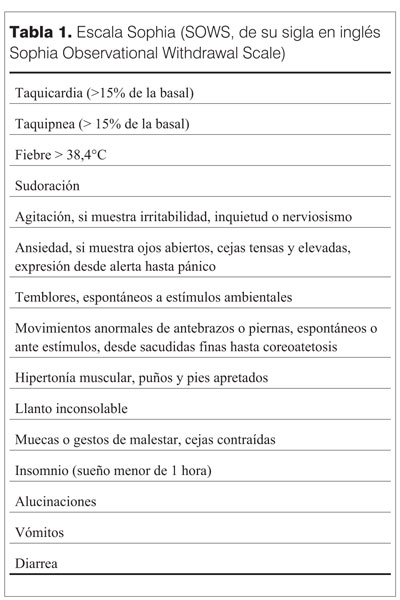
<body><![CDATA[<br>   <b>Methodology: </b>An observational and prospective study.<span style="">&nbsp; </span>Assessment was repeated and the Sophia Observation Withdrawal Symptoms Scale (SOWS) was used. The study was conducted at the Pediatric Intensive Care Unit (PICU) of Centro Hospitalario Pereira Rossell (CHPR). Hospitalized children in PICU between 1/11/2013- 30/9/2014 and treated with benzodiazepines and opioids during 5 days or more were included in the study. Days of stay at the PICU, agents used for sedation (dose, duration) and cumulative doses were recorded. Withdrawal syndrome diagnosis was done using the SOWS.    <br>   <b>Results: </b>39 children were included in the study. The incidence of withdrawal syndrome was 18% (7/39). Children who developed withdrawal syndrome presented higher cumulative doses of midazolam (54.1 mg/kg vs. 44.2 mg/kg) and fentanyl (464.2&micro;g/kg vs. 380.1 &micro;g/kg) than those without withdrawal syndrome.     <br>   <b>Conclusions:</b> the withdrawal syndrome was frequent in this population. Cumulative doses of midazolam and fentanyl were higher in those with withdrawal symptoms. The SOWS is a useful resource for diagnosis.</span><span style="font-size: 10pt; font-family: Verdana;" lang="EN-US"><o:p></o:p></span></p>       <p class="PC" style="margin: 0cm 0cm 0.0001pt; line-height: normal;"><b><span style="font-size: 10pt; font-family: Verdana;" lang="EN-US">Key words:</span></b><span style="font-size: 10pt; font-family: Verdana;" lang="EN-US"><span style="">&nbsp;&nbsp;&nbsp;&nbsp; </span></span><span style="font-size: 10pt; font-family: Verdana; text-transform: uppercase;" lang="EN-US">SUBSTANCE WITHDRAWAL SYNDROME    <br>   <span style="">&nbsp; </span><span style="">&nbsp;&nbsp;&nbsp;&nbsp;&nbsp;&nbsp;&nbsp; </span>CRITICAL ILLNESS    <br>   <span style="">&nbsp; </span><span style="">&nbsp;&nbsp;&nbsp;&nbsp;&nbsp;&nbsp;&nbsp; </span>INCIDENCE     <br>   <span style="">&nbsp; </span><span style="">&nbsp;&nbsp;&nbsp;&nbsp;&nbsp;&nbsp;&nbsp; </span>CHILD</span><span style="font-size: 10pt; font-family: Verdana;" lang="EN-US"><o:p></o:p></span></p>       <p class="SUB1" style="margin: 0cm 0cm 0.0001pt; line-height: normal; page-break-after: auto;"><b style=""><span style="font-size: 10pt; font-family: Verdana;">Introducci&oacute;n<o:p></o:p></span></b></p>       <p class="PRIMER" style="text-align: left; line-height: normal;" align="left"><span style="font-family: Verdana;">La sedaci&oacute;n y analgesia son uno de los pilares del tratamiento de los ni&ntilde;os cr&iacute;ticamente enfermos, para disminuir la respuesta al <span style="color: black;">estr&eacute;s</span>, evitar la <span class="SpellE">extubaci&oacute;n</span> accidental, el retiro de accesos vasculares y lograr la adaptaci&oacute;n a la asistencia <span class="SpellE">ventilatoria</span> mec&aacute;nica (AVM)<sup>(<a href="#1">1-6</a>)</sup><a name="-1"></a><a name="-2"></a><a name="-3"></a><a name="-4"></a><a name="-5"></a><a name="-6"></a>. Los grupos m&aacute;s frecuentemente utilizados son las <span class="SpellE">benzodiacepinas</span> (BZD) y los <span class="SpellE">opioides</span>. Ambos generan dependencia f&iacute;sica en la administraci&oacute;n continua o por per&iacute;odos prolongados<sup>(<a href="#7">7</a>,<a href="#8">8</a>)</sup><a name="-7"></a><a name="-8"></a>. La <span class="SpellE">sobresedaci&oacute;n</span> y la <span class="SpellE">infrasedaci&oacute;n</span> son frecuentes en las Unidades de Cuidados Intensivos Pedi&aacute;tricos (UCIP). La <span class="SpellE">sobresedaci&oacute;n</span> determina mayor estad&iacute;a en UCIP y riesgo de s&iacute;ndrome de abstinencia (SA)<sup>(<a href="#9">9</a>)</sup><a name="-9"></a>.<o:p></o:p></span></p>       <p class="MsoBodyText" style="text-align: left; text-indent: 0cm; line-height: normal;" align="left"><span style="font-family: Verdana;">El SA se define como el conjunto de signos y s&iacute;ntomas que se manifiestan al discontinuar o descender la dosis <span class="SpellE">opioides</span> y/o BZD<sup>(<a href="#7">7</a>)</sup>. Las manifestaciones del SA dependen de muchos factores: f&aacute;rmaco, edad, estado cognitivo<sup>(<a href="#7">7</a>,<a href="#8">8</a>)</sup>. El riesgo de SA es mayor con la administraci&oacute;n en infusi&oacute;n continua y con <span class="SpellE">opioides</span> sint&eacute;ticos (<span class="SpellE">fentanilo</span>) que con morfina<sup>(<a href="#10">10</a>)</sup><a name="-10"></a>. El uso de <span class="SpellE">bloqueantes</span> <span class="SpellE">neuromusculares</span> (BNM) concomitante puede aumentar el riesgo de SA<sup>(<a href="#10">10</a>)</sup>. Las infusiones prolongadas, dosis acumulativas elevadas y la discontinuaci&oacute;n brusca son los principales factores de riesgo para el SA<sup>(<a href="#11">11</a>,<a href="#12">12</a>)</sup><a name="-11"></a><a name="-12"></a>. Dosis acumulativas de <span class="SpellE">midazolam</span> </span><span style="font-family: Verdana;"><span style="">&#61619;</span></span><span style="font-family: Verdana;"> 60 <span class="SpellE">mg</span>/<span class="SpellE">kg</span> y de <span class="SpellE">fentanilo</span> </span><span style="font-family: Verdana;"><span style="">&#61619;</span></span><span style="font-family: Verdana;"> 1,5 <span class="SpellE">mg</span>/<span class="SpellE">kg</span> se asocian con el SA<sup>(<a href="#11">11</a>,<a href="#13">13</a>)</sup>. La incidencia de SA en las UCIP tiene una <span class="SpellE">prevalencia</span> variable entre 35%-57%<sup>(<a href="#11">11</a>,<a href="#13">13</a>,<a href="#14">14</a>)</sup><a name="-13"></a><a name="-14"></a>. El diagn&oacute;stico de SA es dificultoso, ya que sus s&iacute;ntomas y signos se solapan con entidades frecuentes en UCIP<sup>(<a href="#15">15</a>,<a href="#16">16</a>)</sup><a name="-15"></a><a name="-16"></a>. No existe un <span class="SpellE"><i>gold</i></span><i> <span class="SpellE">standard</span> </i>para el diagn&oacute;stico y es necesaria una alta sospecha cl&iacute;nica<sup>(<a href="#4">4</a>,<a href="#17">17</a>,<a href="#18">18</a>)</sup><a name="-17"></a><a name="-18"></a>. El momento de aparici&oacute;n del SA depende de la vida media de eliminaci&oacute;n, siendo temprano en aquellos de vida media corta o d&iacute;as m&aacute;s tarde si el agente o sus metabolitos tienen vida media larga<sup>(<a href="#19">19</a>,<a href="#20">20</a>)</sup><a name="-19"></a><a name="-20"></a>. La sintomatolog&iacute;a del SA se produce por <span class="SpellE">sobreestimulaci&oacute;n</span> de sistema nervioso central, disturbios gastrointestinales y <span class="SpellE">disregulaci&oacute;n</span> auton&oacute;mica<sup>(<a href="#21">21</a>)</sup><a name="-21"></a>. Dado lo <span class="SpellE">proteiforme</span> de la cl&iacute;nica, es necesario un sistema de evaluaci&oacute;n para el mismo<sup>(<a href="#16">16</a>)</sup>. <span class="SpellE">Ista</span> y colaboradores desarrollaron el <span class="SpellE">Sophia</span> <span class="SpellE">Observation</span> <span class="SpellE">Withdrawal</span> <span class="SpellE">Symptoms</span> <span class="SpellE">Scale</span> (SOWS), que ha presentado adecuado rendimiento para el diagn&oacute;stico de SA en ni&ntilde;os y ha sido desarrollado para su uso en lactantes y ni&ntilde;os mayores<sup>(<a href="#22">22</a>,<a href="#23">23</a>)</sup><a name="-22"></a><a name="-23"></a>. Esta escala incluye 15 &iacute;tems (<a href="#t1">tabla 1</a>). El presente estudio se realiz&oacute; con el objetivo de determinar la incidencia de SA secundario al uso de <span class="SpellE">opioides</span> y BZD en la Unidad de Cuidados Intensivos de Ni&ntilde;os (UCIN) del Centro Hospitalario Pereira <span class="SpellE">Rossell</span> (CHPR). Los objetivos secundarios fueron identificar los factores de riesgo presentes para el desarrollo de SA.</span></p>       ]]></body>
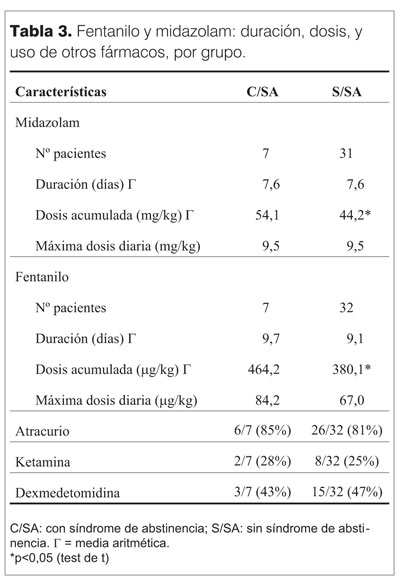
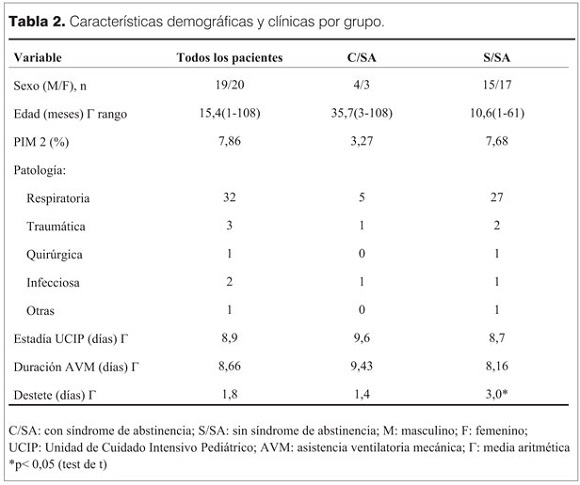
<body><![CDATA[<p class="MsoBodyText" style="text-align: left; text-indent: 0cm; line-height: normal;" align="left"><a name="t1"></a><img style="width: 400px; height: 600px;" alt="" src="/img/revistas/adp/v88n1/n1a03t1.jpg"><span style="font-family: Verdana;"><o:p></o:p></span></p>       <p class="SUB1" style="margin: 0cm 0cm 0.0001pt; line-height: normal; page-break-after: auto;"><b style=""><span style="font-size: 10pt; font-family: Verdana;">Pacientes y m&eacute;todos<o:p></o:p></span></b></p>       <p class="MsoBodyText" style="text-align: left; text-indent: 0cm; line-height: normal;" align="left"><span style="font-family: Verdana;">Se realiz&oacute; un estudio prospectivo, <span class="SpellE">observacional</span> de evaluaciones reiteradas con la SOWS. El mismo se realiz&oacute; en la UCIN del CHPR. Este es el centro de referencia nacional materno-infantil en Uruguay. UCIN es una UCIP polivalente que cuenta con ocho camas de cuidados intensivos y 12 de cuidados intermedios. Se incluyeron los ni&ntilde;os ingresados entre el 1 noviembre de 2013 hasta el 30 de <span class="SpellE">setiembre</span> de 2014 y que recibieron BZD y/o opi&aacute;ceos por cinco d&iacute;as o m&aacute;s. Se excluyeron aquellos con enfermedad neurol&oacute;gica subyacente previa y estado de mal convulsivo tratado con BZD. Para valorar la presencia del SA se aplic&oacute; el SOWS. Luego del comienzo del destete o la suspensi&oacute;n de los <span class="SpellE">opioides</span> y BZD, se realizaron dos evaluaciones diarias (cada 12 horas), por 72 horas o hasta el alta de UCIN si &eacute;sta se produjo previo a las 72 horas. Cuando se realiz&oacute; diagn&oacute;stico de SA por el SOWS, no se realizaron m&aacute;s observaciones en dicho paciente.<o:p></o:p>    <br>   Se consider&oacute; que el destete comenz&oacute; el d&iacute;a que la dosis de <span class="SpellE">opioides</span> o BZD se redujo 10% o m&aacute;s. La SOWS fue aplicada por integrantes del equipo m&eacute;dico y de enfermer&iacute;a. En cada una de las observaciones se chequearon los 15 &iacute;tems y se marcaron presentes o ausentes, en las 12 horas previas de iniciado el destete o de la observaci&oacute;n previa. Los &iacute;tems presentes se puntearon con valor de 1, y los ausentes 0. El <span class="SpellE">score</span> total result&oacute; de la suma de todos los valores (m&iacute;nimo 0, m&aacute;ximo 15). Para el diagn&oacute;stico de SA se consider&oacute; un puntaje&nbsp;</span><span style="font-family: Verdana;">= &oacute; </span><span style="font-family: Verdana;">&gt;&nbsp;4<sup>(<a href="#15">15</a>)</sup>. Se consign&oacute; la modalidad de destete (interrupci&oacute;n brusca o discontinuaci&oacute;n escalonada) y duraci&oacute;n del destete. Se registraron datos adicionales (edad, sexo, estad&iacute;a en UCIN y duraci&oacute;n de AVM). Se utiliz&oacute; el escore <span class="SpellE">predictor</span> de Mortalidad al ingreso 'PIM <st1:metricconverter productid="2&rdquo;" w:st="on">2'</st1:metricconverter> expresado en porcentaje. De las BZD y <span class="SpellE">opioides</span> utilizados se registraron: d&iacute;as de uso, m&aacute;ximo de dosis, dosis total acumulada y uso de otros f&aacute;rmacos <span class="SpellE">sedoanalg&eacute;sicos</span>. Cuando se us&oacute; morfina, se calcul&oacute; su equivalencia en dosis de <span class="SpellE">fentanilo</span>, asumiendo una potencia 40 veces mayor que la morfina<sup>(<a href="#24">24</a>)</sup><a name="-24"></a>. Los pacientes fueron divididos en dos grupos, con y sin SA. Se analizaron y compararon las caracter&iacute;sticas de ambos grupos en busca de diferencias entre ellos. Para el an&aacute;lisis de los datos se utiliz&oacute; el programa estad&iacute;stico SPSS versi&oacute;n 11.8 (SPSS Inc. Chicago &reg;). Para las variables continuas se us&oacute; el <span class="SpellE">test</span> de t, y para las categ&oacute;ricas el <span class="SpellE">test</span> de Chi cuadrado. El estudio cont&oacute; con la autorizaci&oacute;n de las autoridades hospitalarias. Dada la naturaleza <span class="SpellE">observacional</span> del mismo, no se requiri&oacute; con&shy;sentimiento informado.<o:p></o:p></span></p>       <p class="SUB1" style="margin: 0cm 0cm 0.0001pt; line-height: normal; page-break-after: auto;"><b style=""><span style="font-size: 10pt; font-family: Verdana;">Resultados<o:p></o:p></span></b></p>       <p class="PRIMER" style="text-align: left; line-height: normal;" align="left"><span style="font-family: Verdana;">De los 573 pacientes que ingresaron en UCIN durante el per&iacute;odo de realizaci&oacute;n del estudio, 39 cumplieron los criterios de inclusi&oacute;n. Los 39 requirieron AVM. De &eacute;stos, 38 recibieron la asociaci&oacute;n de <span class="SpellE">midazolam</span> con <span class="SpellE">fentanilo</span> y uno recibi&oacute; &uacute;nicamente <span class="SpellE">fentanilo</span>. Presentaron puntaje</span><span style="font-family: Verdana;"> = &oacute; </span><span style="font-family: Verdana;">&gt;</span><span style="font-family: Verdana;"><span style=""></span></span><span style="font-family: Verdana;">&nbsp;4 en el SOWS siete de los 39, con una incidencia de SA de 18%. En los siete pacientes con SA se realizaron 32 evaluaciones y los &iacute;tems del SOWS m&aacute;s frecuentes identificados fueron: ansiedad y sue&ntilde;o menor de una hora, present&aacute;ndose cada uno de ellos en 14 evaluaciones de las 32. En orden de frecuencia le siguieron taquicardia (10/32), fiebre (9/32) llanto, <span class="SpellE">taquipnea</span> (8/32), <span class="SpellE">polipnea</span> (7/32), diarrea (6/32), v&oacute;mitos (3/32). Las principales caracter&iacute;sticas de ambos grupos se presentan en la <a href="#t2">tabla 2</a>.&nbsp;</span></p>       <p class="PRIMER" style="text-align: left; line-height: normal;" align="left"><a name="t2"></a><span style="font-family: Verdana;"></span><img style="width: 580px; height: 485px;" alt="" src="/img/revistas/adp/v88n1/n1a03t2.jpg"></p>       <p class="PRIMER" style="text-align: left; line-height: normal;" align="left"><span style="font-family: Verdana;">La mediana de la edad del total de la poblaci&oacute;n fue 5 meses. En el grupo con SA fue 19 meses y 4 meses en los que no desarrollaron SA. La principal causa de internaci&oacute;n fue la patolog&iacute;a respiratoria en ambos. Si bien la estad&iacute;a en UCIP y la duraci&oacute;n de la AVM no presentaron diferencias de significaci&oacute;n estad&iacute;stica, si se observ&oacute; una tendencia a mayor duraci&oacute;n de estad&iacute;a y AVM en el grupo con SA (<a href="#t2">tabla 2</a>). Las caracter&iacute;sticas en el uso de <span class="SpellE">midazolam</span>, <span class="SpellE">fentanilo</span> y otros f&aacute;rmacos se muestran en la tabla 3. En relaci&oacute;n a las BZD, los pacientes de ambos grupos recibieron <span class="SpellE">midazolam</span>, por igual tiempo (media 7,5 d&iacute;as). En el grupo con SA la dosis acumulativa fue mayor (media 54,1 <span class="SpellE">mg</span>/<span class="SpellE">kg</span> <span class="SpellE">vs</span> 44,2 <span class="SpellE">mg</span>/<span class="SpellE">kg</span>) (p&lt;0,05). La dosis m&aacute;xima no present&oacute; diferencias significativas. En relaci&oacute;n a <span class="SpellE">fentanilo</span>, la duraci&oacute;n del uso fue similar en los dos grupos, la media de las dosis acumulativa fue 464,2 </span><span style="font-family: Symbol;"><span style="">m</span></span><span style="font-family: Verdana;">g/<span class="SpellE">kg</span> en el grupo con SA <span class="SpellE">vs</span> 380,1 </span><span style="font-family: Symbol;"><span style="">m</span></span><span style="font-family: Verdana;">g/<span class="SpellE">kg</span> en ni&ntilde;os sin SA (p&lt;0,05). El m&aacute;ximo de dosis de <span class="SpellE">fentanilo</span>, fue mayor en ni&ntilde;os con SA, pero esta diferencia no fue significativa. La duraci&oacute;n de la infusi&oacute;n de <span class="SpellE">midazolam</span> y <span class="SpellE">fentanilo</span> fue similar en ambos grupos (<a href="#t3">tabla 3</a>). Se usaron en forma concomitante con <span class="SpellE">fentanilo</span> y <span class="SpellE">midazolam</span> otros f&aacute;r&shy;macos. Estos fueron <span class="SpellE">atracurio</span> y <span class="SpellE">ketamina</span>, en un por&shy;centaje similar en los dos grupos (<a href="#t3">tabla 3</a>).<o:p></o:p></span></p>       <p class="MsoBodyText" style="text-align: left; text-indent: 0cm; line-height: normal;" align="left"><span style="font-family: Verdana;">Para el destete se utiliz&oacute; <span class="SpellE">dexmedetomidina</span> tambi&eacute;n en un porcentaje similar (<a href="#t3">tabla 3</a>). En cuanto a la duraci&oacute;n promedio del destete, fue menor en el grupo con SA, 1,71 d&iacute;as <span class="SpellE">vs</span> 3,0 d&iacute;as en el grupo sin SA (p&lt;0,05). Luego de la suspensi&oacute;n total de las drogas, los pacientes que m&aacute;s tempranamente manifestaron SA, lo hicieron a las 10 h.</span></p>       <p class="MsoBodyText" style="text-align: left; text-indent: 0cm; line-height: normal;" align="left"><a name="t3"></a><span style="font-family: Verdana;"></span><span style="font-family: Verdana;"><o:p></o:p></span><img style="width: 400px; height: 579px;" alt="" src="/img/revistas/adp/v88n1/n1a03t3.jpg"></p>       ]]></body>
<body><![CDATA[<p class="SUB1" style="margin: 0cm 0cm 0.0001pt; line-height: normal; page-break-after: auto;"><span style="font-size: 10pt; font-family: Verdana;">Discusi&oacute;n<o:p></o:p></span></p>       <p class="PRIMER" style="text-align: left; line-height: normal;" align="left"><span style="font-family: Verdana;">El SA es una     complicaci&oacute;n     resultante de un <span class="SpellE">desbalance</span> entre la     necesidad de     mantener al ni&ntilde;o confortable en la etapa m&aacute;s     cr&iacute;tica de su enfermedad y los     efectos de los f&aacute;rmacos requeridos para lograr este confort. La     evidencia     disponible para caracterizarlo es escasa, como muestra una     ]]></body>
<body><![CDATA[revisi&oacute;n sistem&aacute;tica     reciente<sup>(<a href="#25">25</a>)</sup><a name="-25"></a>. La nuestra     constituye la primera experiencia     nacional     sobre la incidencia de SA en ni&ntilde;os hospitalizados en una UCIP.     En esta     oportunidad se observ&oacute; una incidencia de SA de 18%. Otros     autores han reportado     valores entre 35 y 57%, con el uso de <span class="SpellE">opioides</span>     y BZD     ]]></body>
<body><![CDATA[en forma conjunta<sup>(<a href="#12">12</a>,<a href="#13">13</a>)</sup>.     Esta diferencia probablemente sea     multifactorial por el uso de diferentes estrategias en el tratamiento     sedo-analg&eacute;sico y en el destete; diferencias en el dise&ntilde;o     del estudio, o al uso     de diferentes escalas para el diagn&oacute;stico del SA. En esta     oportunidad no se incluyeron     ni&ntilde;os que recibieron infusiones por menos de 5 d&iacute;as, que     pueden haber     desarrollado SA. A su vez en otros estudios se ha utilizado la Escala     ]]></body>
<body><![CDATA[de <span class="SpellE">Finnegan</span> para el diagn&oacute;stico de     SA, lo cual puede     determinar diferencias en la incidencia<sup>(<a href="#26">26</a>)</sup><a name="-26"></a>. Esta muestra     present&oacute;     mayor&iacute;a de ni&ntilde;os en el rango <span class="SpellE">etario</span>     de <st1:metricconverter productid="1 a" w:st="on">1 a</st1:metricconverter>     <st1:metricconverter productid="12 m" w:st="on">12 m</st1:metricconverter>,     con una mediana de 5     meses. A pesar de que se ha postulado que el SA podr&iacute;a ser     m&aacute;s frecuente en     ]]></body>
<body><![CDATA[ni&ntilde;os m&aacute;s peque&ntilde;os y la edad ser un factor de     riesgo, esto no ha podido ser     confirmado<sup>(<a href="#14">14</a>,<a href="#20">20</a>)</sup>. Las     causas de internaci&oacute;n,     estad&iacute;a en UCIN y     duraci&oacute;n de la AVM fueron similares en ambos grupos. <span class="SpellE">Fonsmark</span>     et al describen mayor estad&iacute;a y mayor duraci&oacute;n de la AVM     en ni&ntilde;os con SA<sup>(<a href="#11">11</a>)</sup>.     <span class="SpellE">Ista</span> y colaboradores tambi&eacute;n     confirman estos     ]]></body>
<body><![CDATA[resultados<sup>(<a href="#23">23</a>)</sup>. Este hecho no fue     observado en nuestro     estudio y     probablemente se deba al n&uacute;mero de pacientes. Con un mayor     n&uacute;mero de     participantes esta diferencia podr&iacute;a haber sido detectada. Los     dos factores de     riesgo con mayor fuerza de asociaci&oacute;n con el SA son la     duraci&oacute;n de exposici&oacute;n a     drogas y la dosis acumulada<sup>(<a href="#23">23</a>,<a href="#26">26</a>)</sup>.     ]]></body>
<body><![CDATA[Las dosis acumulativas     de <span class="SpellE">midazolam</span> y <span class="SpellE">fentanilo</span>     fueron     mayores en los ni&ntilde;os con SA. Se ha postulado que dosis     acumulativas elevadas de     <span class="SpellE">fentanil</span> (&gt;0,48 <span class="SpellE">mg</span>/<span class="SpellE">kg</span>) y de <span class="SpellE">midazolam</span>     (&gt;40 <span class="SpellE">mg</span>/<span class="SpellE">kg</span>)     aumentan riesgo de SA<sup>(<a href="#26">26</a>,<a href="#27">27</a>)</sup><a name="-27"></a>.     En este caso la dosis acumulativa media de <span class="SpellE">fentanil</span>     fue cercana a 0,48 <span class="SpellE">mg</span>/<span class="SpellE">kg</span>     ]]></body>
<body><![CDATA[y     la de <span class="SpellE">midazolam</span> mayor a 40 <span class="SpellE">mg</span>/<span class="SpellE">kg</span> en el grupo     con SA. Es necesario elaborar estrategias     que permitan disminuir el uso de dosis acumulativas elevadas. En este     aspecto     es esencial el uso de escalas estandarizadas para obtener un nivel de     sedaci&oacute;n     &oacute;ptimo, evitando tanto la <span class="SpellE">sobresedaci&oacute;n</span>     e <span class="SpellE">infrasedaci&oacute;n</span><sup>(<a href="#27">27</a>,<a href="#28">28</a>)</sup><a name="-28"></a>.     Se ha establecido a la <span class="SpellE">sobresedaci&oacute;n</span>     ]]></body>
<body><![CDATA[como un <span class="SpellE">predictor</span>     del desarrollo de SA<sup>(<a href="#29">29</a>,<a href="#30">30</a>)</sup><a name="-29"></a><a name="-30"></a>. Otro hecho identificado fue la     menor     duraci&oacute;n del destete en los pacientes que desarrollaron SA (1,4     d&iacute;as <span class="SpellE">vs</span> 3,0 d&iacute;as). El uso de     un destete programado de la     medicaci&oacute;n es &uacute;til para prevenir la aparici&oacute;n de SA<sup>(<a href="#25">25</a>,<a href="#30">30</a>)</sup>.     El     inicio de la sintomatolog&iacute;a en los pacientes analizados se     observ&oacute; con un     ]]></body>
<body><![CDATA[m&iacute;nimo de 10 h y m&aacute;ximo de 48 h luego de la     suspensi&oacute;n total. Es por ende     importante que el cl&iacute;nico pesquise la aparici&oacute;n del SA,     incluso luego de     finalizado el destete. Se debe considerar que en este trabajo, se     evaluaron los     pacientes por 72 h luego de iniciado el destete, no pudiendo saber     entonces la     existencia de SA luego de ese per&iacute;odo. Se ha <span class="SpellE">hipotetizado</span>     que el uso de BNM junto a las BZD y los <span class="SpellE">opioides</span>     ]]></body>
<body><![CDATA[podr&iacute;a favorecer la aparici&oacute;n de SA. El uso de BNM suele     prolongar la estad&iacute;a     en cuidados intensivos y esto favorece dosis acumulativas de     f&aacute;rmacos <span class="SpellE">sedoanalg&eacute;sicos</span><sup>(<a href="#10">10</a>)</sup>.     En nuestro estudio no fue     m&aacute;s frecuente el uso de BNM ni de <span class="SpellE">ketamina</span>     en los     pacientes con SA. Otros estudios tampoco han sido concluyentes al     respecto<sup>(<a href="#26">26</a>)</sup>.     <span class="SpellE">Ista</span> y colaboradores encontraron que los     ]]></body>
<body><![CDATA[pacientes     que hab&iacute;an recibido m&aacute;s de una droga <span class="SpellE">sedoanalg&eacute;sica</span>     adicional ten&iacute;an mayor frecuencia de SA, pero estos pacientes     tambi&eacute;n hab&iacute;an     recibido dosis acumulativas mayores de <span class="SpellE">midazolam</span>     y <span class="SpellE">fentanilo</span><sup>(<a href="#23">23</a>)</sup>.     En     relaci&oacute;n al uso y validez del     SOWS, al igual que en el estudio de <span class="SpellE">Ista</span>,     la ansiedad     ]]></body>
<body><![CDATA[fue el signo m&aacute;s frecuente<sup>(<a href="#16">16</a>)</sup>. Las     alucinaciones y     las muecas     faciales no se observaron en ning&uacute;n paciente con SA. En el caso     de las     alucinaciones podr&iacute;a explicarse por ser una poblaci&oacute;n     mayoritariamente entre 28     d&iacute;as y 12 meses en la que despistar las mismas es muy     dif&iacute;cil. A su vez cabe     destacar que el <span class="SpellE">score</span> utilizado fue de     ]]></body>
<body><![CDATA[f&aacute;cil     aplicaci&oacute;n, r&aacute;pida realizaci&oacute;n y presenta la     ventaja de no requerir la     estimulaci&oacute;n del ni&ntilde;o. El SOWS presenta una sensibilidad     de 83% y una     especificidad de 93% para el diagn&oacute;stico de SA cuando se     considera un valor de     4 o mayor<sup>(<a href="#23">23</a>)</sup>. Es necesario considerar que     la escala fue     aplicada     ]]></body>
<body><![CDATA[por distintos observadores. Esta escala ha presentado una fiabilidad <span class="SpellE">interob&shy;servado</span>r (coeficiente kappa)     variable entre <st1:metricconverter productid="0,73 a" w:st="on">0,73 a</st1:metricconverter>     1,00 para los     distintos &iacute;tems<sup>(<a href="#22">22</a>)</sup>. A partir de     este estudio surge     la necesidad de     aplicar escalas estan&shy;darizadas con el objetivo de evitar las dosis     acumulativas elevadas de <span class="SpellE">opioides</span> y BZD. A     su vez     tambi&eacute;n es preciso contar con protocolos de destete en aquellos     ]]></body>
<body><![CDATA[ni&ntilde;os que han     reque&shy;rido sedaci&oacute;n por per&iacute;odos prolon&shy;gados.<o:p></o:p></span></p>     <p class="SUB1" style="margin: 0cm 0cm 0.0001pt; line-height: normal; page-break-after: auto;"><b style=""><span style="font-size: 10pt; font-family: Verdana;">Conclusiones<o:p></o:p></span></b></p>       <p class="PRIMER" style="text-align: left; line-height: normal;" align="left"><span style="font-family: Verdana;">El SA fue frecuente en este grupo de ni&ntilde;os. Las dosis acumulativas fueron elevadas en el grupo con SA. La SOWS es una herramienta &uacute;til y de f&aacute;cil aplicaci&oacute;n para el diagn&oacute;stico de SA. Es esencial el uso de escalas para lograr un diagn&oacute;stico temprano y certero del SA.</span></p>       <p class="PRIMER" style="text-align: left; line-height: normal;" align="left"><span style="font-family: Verdana;"><o:p></o:p></span></p>       <p class="SUB1" style="margin: 0cm 0cm 0.0001pt; line-height: normal; page-break-after: auto;"><b style=""><span style="font-size: 10pt; font-family: Verdana;" lang="EN-US">Referencias bibliogr&aacute;ficas<o:p></o:p></span></b></p>       <!-- ref --><p class="BIB" style="margin: 0cm 0cm 0.0001pt; text-align: left; text-indent: 0cm; line-height: normal;" align="left"><span style="font-size: 10pt; font-family: Verdana;" lang="EN-US"><a name="1"></a><a href="#-1">1</a>.<span style="">&nbsp;&nbsp;&nbsp;&nbsp;&nbsp;&nbsp; </span><b>Howard R.</b> Current status of pain management in children. JAMA 2003; 290(18):2464-9.    <o:p></o:p></span></p>       <!-- ref --><p class="BIB" style="margin: 0cm 0cm 0.0001pt; text-align: left; text-indent: 0cm; line-height: normal;" align="left"><span style="font-size: 10pt; font-family: Verdana;" lang="EN-US"><a name="2"></a><a href="#-2">2</a>.<span style="">&nbsp;&nbsp;&nbsp;&nbsp;&nbsp;&nbsp; </span><b>Middleton C.</b> Understanding the physiological effects of unrelieved pain. Nurs Times 2003; 99(37):28-31.    <o:p></o:p></span></p>       ]]></body>
<body><![CDATA[<!-- ref --><p class="BIB" style="margin: 0cm 0cm 0.0001pt; text-align: left; text-indent: 0cm; line-height: normal;" align="left"><span style="font-size: 10pt; font-family: Verdana;" lang="EN-US"><a name="3"></a><a href="#-3">3</a>.<span style="">&nbsp;&nbsp;&nbsp;&nbsp;&nbsp;&nbsp; </span><b>Anand K.</b> Relationship between stress responses and clinical outcome in newborns, infants, and children. Crit Care Med 1993; 21(9):S358-9.    <o:p></o:p></span></p>       <!-- ref --><p class="BIB" style="margin: 0cm 0cm 0.0001pt; text-align: left; text-indent: 0cm; line-height: normal;" align="left"><span style="font-size: 10pt; font-family: Verdana;" lang="EN-US"><a name="4"></a><a href="#-4">4</a>.<span style="">&nbsp;&nbsp;&nbsp;&nbsp;&nbsp;&nbsp; </span><b>Playfor S, Jenkins I, Boyles C, Choonara I, Davies G, Haywood T, et al; United Kingdom Paediatric Intensive Care Society Sedation; Analgesia and Neuromuscular Blockade Working Group.</b> Consensus guidelines on sedation and analgesia in critically ill children. Intensive Care Med 2006; 32(8):1125-36.    <o:p></o:p></span></p>       <!-- ref --><p class="BIB" style="margin: 0cm 0cm 0.0001pt; text-align: left; text-indent: 0cm; line-height: normal;" align="left"><span style="font-size: 10pt; font-family: Verdana;" lang="EN-US"><a name="5"></a><a href="#-5">5</a>.<span style="">&nbsp;&nbsp;&nbsp;&nbsp;&nbsp;&nbsp; </span><b>da Silva P, de Aguiar V, Neto H, de Carvalho W. </b>Unplanned extubation in a paediatric intensive care unit: impact of a quality improvement programme. Anaesthesia 2008; 63(11):1209-16.    <o:p></o:p></span></p>       <!-- ref --><p class="BIB" style="margin: 0cm 0cm 0.0001pt; text-align: left; text-indent: 0cm; line-height: normal;" align="left"><span style="font-size: 10pt; font-family: Verdana;" lang="EN-US"><a name="6"></a><a href="#-6">6</a>.<span style="">&nbsp;&nbsp;&nbsp;&nbsp;&nbsp;&nbsp; </span><b>Anand K, Hansen D, Hickey P.</b> Hormonal-metabolic stress responses in neonates undergoing cardiac surgery. Anesthesiology 1990; 73(4):661-70.    <o:p></o:p></span></p>       <!-- ref --><p class="BIB" style="margin: 0cm 0cm 0.0001pt; text-align: left; text-indent: 0cm; line-height: normal;" align="left"><span style="font-size: 10pt; font-family: Verdana;" lang="EN-US"><a name="7"></a><a href="#-7">7</a>.<span style="">&nbsp;&nbsp;&nbsp;&nbsp;&nbsp;&nbsp; </span><b>Tobias JD.</b> Tolerance, withdrawal, and physical dependency after long-term sedation and analgesia of children in the pediatric intensive care unit. Crit Care Med 2000; 28(6):2122-32.    <o:p></o:p></span></p>       ]]></body>
<body><![CDATA[<!-- ref --><p class="BIB" style="margin: 0cm 0cm 0.0001pt; text-align: left; text-indent: 0cm; line-height: normal;" align="left"><span style="font-size: 10pt; font-family: Verdana;" lang="EN-US"><a name="8"></a><a href="#-8">8</a>.<span style="">&nbsp;&nbsp;&nbsp;&nbsp;&nbsp;&nbsp; </span><b>Arnold JH, Truog R, Scavone JM, Fenton T.</b> Changes in the pharmacodynamics response to fentanyl in neonates during continuous infusion. J Pediatr 1991; 119(4):639-43.    <o:p></o:p></span></p>       <!-- ref --><p class="BIB" style="margin: 0cm 0cm 0.0001pt; text-align: left; text-indent: 0cm; line-height: normal;" align="left"><span style="font-size: 10pt; font-family: Verdana;" lang="EN-US"><a name="9"></a><a href="#-9">9</a>.<span style="">&nbsp;&nbsp;&nbsp;&nbsp;&nbsp;&nbsp; </span><b>Vet N, Ista E, de Wildt S, van Dijk M, Tibboel D, de Hoog M.</b> Optimal sedation in pediatric intensive care patients: a systematic review. Intensive Care Med 2013; 39(9):1524-34.    <o:p></o:p></span></p>       <!-- ref --><p class="BIB" style="margin: 0cm 0cm 0.0001pt; text-align: left; text-indent: 0cm; line-height: normal;" align="left"><span style="font-size: 10pt; font-family: Verdana;" lang="EN-US"><a name="10"></a><a href="#-10">10</a>.<span style="">&nbsp;&nbsp;&nbsp;&nbsp; </span><b>Cammarano W, Pittet JF, Weitz S, Schlobohm R, Marks JD. </b>Acute withdrawal syndrome related to the administration of analgesic and sedative medications in adult intensive care unit patients. Crit Care Med 1998; 26(4):676-84.    <o:p></o:p></span></p>       <!-- ref --><p class="BIB" style="margin: 0cm 0cm 0.0001pt; text-align: left; text-indent: 0cm; line-height: normal;" align="left"><span style="font-size: 10pt; font-family: Verdana;" lang="EN-US"><a name="11"></a><a href="#-11">11</a>.<span style="">&nbsp;&nbsp;&nbsp;&nbsp; </span><b>Fonsmark L, Rasmussen Y, Carl P.</b> Occurrence of withdrawal in critically ill sedated children. Crit Care Med 1999; 27(1):196-9.    <o:p></o:p></span></p>       <!-- ref --><p class="BIB" style="margin: 0cm 0cm 0.0001pt; text-align: left; text-indent: 0cm; line-height: normal;" align="left"><span style="font-size: 10pt; font-family: Verdana;" lang="EN-US"><a name="12"></a><a href="#-12">12</a>.<span style="">&nbsp;&nbsp;&nbsp;&nbsp; </span><b>Hughes J, Gill A, Leach H, Nunn A, Billingham I, Ratcliffe J, et al.</b> A prospective study of the adverse effects of midazolam on withdrawal in critically ill children. Acta Paediatr 1994; 83(11):1194-9.    <o:p></o:p></span></p>       ]]></body>
<body><![CDATA[<!-- ref --><p class="BIB" style="margin: 0cm 0cm 0.0001pt; text-align: left; text-indent: 0cm; line-height: normal;" align="left"><span style="font-size: 10pt; font-family: Verdana;" lang="EN-US"><a name="13"></a><a href="#-13">13</a>.<span style="">&nbsp;&nbsp;&nbsp;&nbsp; </span><b>Katz R, Kelly H, Hsi A. </b>Prospective study on the occurrence of withdrawal in critically ill children who receive fentanyl by continuous infusion. Crit Care Med 1994; 22(5):763-7.    <o:p></o:p></span></p>       <!-- ref --><p class="BIB" style="margin: 0cm 0cm 0.0001pt; text-align: left; text-indent: 0cm; line-height: normal;" align="left"><span style="font-size: 10pt; font-family: Verdana;" lang="EN-US"><a name="14"></a><a href="#-14">14</a>.<span style="">&nbsp;&nbsp;&nbsp;&nbsp; </span><b>Anand K, Willson D, Berger J, Harrison R, Meert K, Zimmerman J, et al; Eunice Kennedy Shriver National Institute of Child Health and Human Development Collaborative Pediatric Critical Care Research Network.</b> Tolerance and withdrawal from prolonged opioid use in critically ill children. Pediatrics 2010; 125(5):e1208-25.    <o:p></o:p></span></p>       <!-- ref --><p class="BIB" style="margin: 0cm 0cm 0.0001pt; text-align: left; text-indent: 0cm; line-height: normal;" align="left"><span style="font-size: 10pt; font-family: Verdana;" lang="EN-US"><a name="15"></a><a href="#-15">15</a>.<span style="">&nbsp;&nbsp;&nbsp;&nbsp; </span><b>Sury MR, Billingham I, Russell G, Hopkins C, Thornington R, Vivori E. </b>Acute benzodiazepine withdrawal syndrome after midazolam infusions in children. Crit Care Med 1989; 17(3):301-2.    <o:p></o:p></span></p>       <!-- ref --><p class="BIB" style="margin: 0cm 0cm 0.0001pt; text-align: left; text-indent: 0cm; line-height: normal;" align="left"><span style="font-size: 10pt; font-family: Verdana;" lang="EN-US"><a name="16"></a><a href="#-16">16</a>.<span style="">&nbsp;&nbsp;&nbsp;&nbsp; </span><b>Ista E, van Dijk M, Gamel C, Tibboel D, de Hoog M. </b>Withdrawal symptoms in critically ill children after long-term administration of sedatives and/or analgesics: a first evaluation. Crit Care Med 2008; 36(8):2427-32.    <o:p></o:p></span></p>       <p class="BIB" style="margin: 0cm 0cm 0.0001pt; text-align: left; text-indent: 0cm; line-height: normal;" align="left"><span style="font-size: 10pt; font-family: Verdana;" lang="EN-US"><a name="17"></a><a href="#-17">17</a>.<span style="">&nbsp;&nbsp;&nbsp;&nbsp; </span><b>Ista E, van Dijk M, Gamel C, Tibboel D, de Hoog M. </b>Withdrawal symptoms in children after long-term administration of sedatives and/or analgesics: a literature review. &ldquo;Assessment remains troublesome&rdquo;. Intensive Care Med 2007; 33(8):1396-406.<o:p></o:p></span></p>       <!-- ref --><p class="BIB" style="margin: 0cm 0cm 0.0001pt; text-align: left; text-indent: 0cm; line-height: normal;" align="left"><span style="font-size: 10pt; font-family: Verdana;" lang="EN-US"><a name="18"></a><a href="#-18">18</a>.<span style="">&nbsp;&nbsp;&nbsp;&nbsp; </span><b>Franck L, Harris S, Soetenga D, Amling JK, Curley MA. </b>The Withdrawal Assessment Tool-1 (WAT-1): an assessment instrument for monitoring opioid and benzodiazepine withdrawal symptoms in pediatric patients. Pediatr Crit Care Med 2008; 9(6):573-80.    <o:p></o:p></span></p>       <!-- ref --><p class="BIB" style="margin: 0cm 0cm 0.0001pt; text-align: left; text-indent: 0cm; line-height: normal;" align="left"><span style="font-size: 10pt; font-family: Verdana;" lang="EN-US"><a name="19"></a><a href="#-19">19</a>.<span style="">&nbsp;&nbsp;&nbsp;&nbsp; </span><b>Cunliffe M, McArthur L, Dooley F.</b> Managing sedation withdrawal in children who undergo prolonged PICU admission after discharge to the ward. Paediatr Anaesth 2004; 14(4):293-8.    <o:p></o:p></span></p>       <!-- ref --><p class="BIB" style="margin: 0cm 0cm 0.0001pt; text-align: left; text-indent: 0cm; line-height: normal;" align="left"><span style="font-size: 10pt; font-family: Verdana;" lang="EN-US"><a name="20"></a><a href="#-20">20</a>.<span style="">&nbsp;&nbsp;&nbsp;&nbsp; </span><b>Anand K, Ingraham J.</b> Pediatric tolerance, dependence, and strategies for compassionate withdrawal of analgesics and anxiolytics in the pediatric ICU. Crit Care Nurse 1996; 16(6):87-93.    <o:p></o:p></span></p>       <!-- ref --><p class="BIB" style="margin: 0cm 0cm 0.0001pt; text-align: left; text-indent: 0cm; line-height: normal;" align="left"><span style="font-size: 10pt; font-family: Verdana;" lang="EN-US"><a name="21"></a><a href="#-22">21</a>.<span style="">&nbsp;&nbsp;&nbsp;&nbsp; </span><b>Franck L, Naughton I, Winter I.</b> Opioid and benzodiazepine withdrawal symptoms in paediatric intensive care patients. Intensive Crit Care Nurs 2004; 20(6):344-51.    <o:p></o:p></span></p>       <!-- ref --><p class="BIB" style="margin: 0cm 0cm 0.0001pt; text-align: left; text-indent: 0cm; line-height: normal;" align="left"><span style="font-size: 10pt; font-family: Verdana;" lang="EN-US"><a name="22"></a><a href="#-22">22</a>.<span style="">&nbsp;&nbsp;&nbsp;&nbsp; </span><b>Ista E, van Dijk M, de Hoog M, Tibboel D, Duivenvoorden H.</b> Construction of the Sophia Observation withdrawal Symptoms-scale (SOS) for critically ill children. Intensive Care Med 2009; 35(6):1075-81.    <o:p></o:p></span></p>       <!-- ref --><p class="BIB" style="margin: 0cm 0cm 0.0001pt; text-align: left; text-indent: 0cm; line-height: normal;" align="left"><span style="font-size: 10pt; font-family: Verdana;" lang="EN-US"><a name="23"></a><a href="#-23">23</a>.<span style="">&nbsp;&nbsp;&nbsp;&nbsp; </span><b>Ista E, de Hoog M, Tibboel D, Duivenvoorden H, van Dijk M.</b> Psychometric evaluation of the Sophia Observation withdrawal symptoms scale in critically ill children. Pediatr Crit Care Med 2013; 14(8):761-9.    <o:p></o:p></span></p>       <!-- ref --><p class="BIB" style="margin: 0cm 0cm 0.0001pt; text-align: left; text-indent: 0cm; line-height: normal;" align="left"><span style="font-size: 10pt; font-family: Verdana;" lang="EN-US"><a name="24"></a><a href="#-24">24</a>.<span style="">&nbsp;&nbsp;&nbsp;&nbsp; </span><b>Fl&oacute;rez J. F&aacute;rmacos analg&eacute;sicos opioides. En: Fl&oacute;rez J, Armijo J, Mediavilla A. </b>Farmacolog&iacute;a humana. Barcelona: Elsevier-Masson, 2008:523-42.    <o:p></o:p></span></p>       <!-- ref --><p class="BIB" style="margin: 0cm 0cm 0.0001pt; text-align: left; text-indent: 0cm; line-height: normal;" align="left"><span style="font-size: 10pt; font-family: Verdana;" lang="EN-US"><a name="25"></a><a href="#-25">25</a>.<span style="">&nbsp;&nbsp;&nbsp;&nbsp; </span><b>Best K, Boullata JI, Curley MA. </b>Risk factors associated with iatrogenic opioid and benzodiazepine withdrawal in critically ill pediatric patients: a systematic review and conceptual model. Pediatr Crit Care Med 2015; 16(2):175-83.    <o:p></o:p></span></p>       <!-- ref --><p class="BIB" style="margin: 0cm 0cm 0.0001pt; text-align: left; text-indent: 0cm; line-height: normal;" align="left"><span style="font-size: 10pt; font-family: Verdana;" lang="EN-US"><a name="26"></a><a href="#-26">26</a>.<span style="">&nbsp;&nbsp;&nbsp;&nbsp; </span><b>Fern&aacute;ndez F, Gabioli M, Gonz&aacute;lez R, G&oacute;mez P, Fern&aacute;ndez S, Murga V, et al.</b> </span><span style="font-size: 10pt; font-family: Verdana;">S&iacute;ndrome de abstinencia en cuidados intensivos pedi&aacute;tricos: incidencia y factores de riesgo. <span class="SpellE">Med</span> Intensiva 2012; 37(2):67-74.    <o:p></o:p></span></p>       <!-- ref --><p class="BIB" style="margin: 0cm 0cm 0.0001pt; text-align: left; text-indent: 0cm; line-height: normal;" align="left"><span style="font-size: 10pt; font-family: Verdana;"><a name="27"></a><a href="#-27">27</a>.<span style="">&nbsp;&nbsp;&nbsp;&nbsp; </span><span class="SpellE"><b>Valdivielso</b></span><b> A, Grupo de Trabajo de Analgesia y Sedaci&oacute;n de la SEMICYUC. </b>Analgesia, sedaci&oacute;n y relajaci&oacute;n en el ni&ntilde;o con ventilaci&oacute;n mec&aacute;nica. <span class="SpellE">Med</span> Intensiva 2008; 32(<span class="SpellE">supl</span> 1):115-24.    <o:p></o:p></span></p>       <!-- ref --><p class="BIB" style="margin: 0cm 0cm 0.0001pt; text-align: left; text-indent: 0cm; line-height: normal;" align="left"><span style="font-size: 10pt; font-family: Verdana;"><a name="28"></a><a href="#-28">28</a>.<span style="">&nbsp;&nbsp;&nbsp;&nbsp; </span><b>Bernal J, Sandoval L, <span class="SpellE">Tombe</span> L, Hern&aacute;ndez N. </b>M&eacute;todo de destete en pacientes pedi&aacute;tricos ventilados mec&aacute;nicamente en una unidad de cuidado intensivo de una cl&iacute;nica de cuarto nivel de la ciudad de Cali. </span><span style="font-size: 10pt; font-family: Verdana;" lang="EN-US">ACCI 2012; 12(4):202-10.    <o:p></o:p></span></p>       <!-- ref --><p class="BIB" style="margin: 0cm 0cm 0.0001pt; text-align: left; text-indent: 0cm; line-height: normal;" align="left"><span style="font-size: 10pt; font-family: Verdana;" lang="EN-US"><a name="29"></a><a href="#-29">29</a>.<span style="">&nbsp;&nbsp;&nbsp;&nbsp; </span><b>Ista E, Tibboel D, van Dijk M. </b>Opioid and benzodiazepine withdrawal syndrome: can we predict and prevent it? Pediatr Crit Care Med 2015; 16(2):195-6.    <o:p></o:p></span></p>       <!-- ref --><p class="BIB" style="margin: 0cm 0cm 0.0001pt; text-align: left; text-indent: 0cm; line-height: normal;" align="left"><span style="font-size: 10pt; font-family: Verdana;" lang="EN-US"><a name="30"></a><a href="#-30">30</a>.<span style="">&nbsp;&nbsp;&nbsp;&nbsp; </span><b>Best K, Asaro L, Franck L, Wypij D, Curley MA; Randomized Evaluation of Sedation Titration for Respiratory Failure Baseline Study Investigators. </b>Patterns of sedation weaning in critically ill children recovering from acute respiratory failure. </span><span class="SpellE"><span style="font-size: 10pt; font-family: Verdana;">Pediatr</span></span><span style="font-size: 10pt; font-family: Verdana;"> <span class="SpellE">Crit</span> <span class="SpellE">Care</span> <span class="SpellE">Med</span> 2016; 17(1):19-29.    </span></p>       <p class="BIB" style="margin: 0cm 0cm 0.0001pt; text-align: left; text-indent: 0cm; line-height: normal;" align="left"><span style="font-size: 10pt; font-family: Verdana;"><o:p></o:p></span></p>       <p class="CORRESPONDENCIA" style="margin-bottom: 0.0001pt; line-height: normal;"><b><span style="font-family: Verdana;">Correspondencia: </span></b><span style="font-family: Verdana;">Dr. H&eacute;ctor <span class="SpellE">Telechea</span>.    <br>   Correo electr&oacute;nico: <a href="mailto:hmteleo@gmail.com">hmteleo@gmail.com</a><o:p></o:p></span></p>   </div>        ]]></body><back>
<ref-list>
<ref id="B1">
<label>1</label><nlm-citation citation-type="journal">
<person-group person-group-type="author">
<name>
<surname><![CDATA[Howard]]></surname>
<given-names><![CDATA[R]]></given-names>
</name>
</person-group>
<article-title xml:lang="en"><![CDATA[Current status of pain management in children]]></article-title>
<source><![CDATA[JAMA]]></source>
<year>2003</year>
<volume>290</volume>
<numero>18</numero>
<issue>18</issue>
<page-range>2464-9</page-range></nlm-citation>
</ref>
<ref id="B2">
<label>2</label><nlm-citation citation-type="journal">
<person-group person-group-type="author">
<name>
<surname><![CDATA[Middleton]]></surname>
<given-names><![CDATA[C]]></given-names>
</name>
</person-group>
<article-title xml:lang="en"><![CDATA[Understanding the physiological effects of unrelieved pain]]></article-title>
<source><![CDATA[Nurs Times]]></source>
<year>2003</year>
<volume>99</volume>
<numero>37</numero>
<issue>37</issue>
<page-range>28-31</page-range></nlm-citation>
</ref>
<ref id="B3">
<label>3</label><nlm-citation citation-type="journal">
<person-group person-group-type="author">
<name>
<surname><![CDATA[Anand]]></surname>
<given-names><![CDATA[K]]></given-names>
</name>
</person-group>
<article-title xml:lang="en"><![CDATA[Relationship between stress responses and clinical outcome in newborns, infants, and children]]></article-title>
<source><![CDATA[Crit Care Med]]></source>
<year>1993</year>
<volume>21</volume>
<numero>9</numero>
<issue>9</issue>
<page-range>S358-9</page-range></nlm-citation>
</ref>
<ref id="B4">
<label>4</label><nlm-citation citation-type="journal">
<person-group person-group-type="author">
<name>
<surname><![CDATA[Playfor]]></surname>
<given-names><![CDATA[S]]></given-names>
</name>
<name>
<surname><![CDATA[Jenkins]]></surname>
<given-names><![CDATA[I]]></given-names>
</name>
<name>
<surname><![CDATA[Boyles]]></surname>
<given-names><![CDATA[C]]></given-names>
</name>
<name>
<surname><![CDATA[Choonara]]></surname>
<given-names><![CDATA[I]]></given-names>
</name>
<name>
<surname><![CDATA[Davies]]></surname>
<given-names><![CDATA[G]]></given-names>
</name>
<name>
<surname><![CDATA[Haywood]]></surname>
<given-names><![CDATA[T]]></given-names>
</name>
</person-group>
<article-title xml:lang="en"><![CDATA[Consensus guidelines on sedation and analgesia in critically ill children]]></article-title>
<source><![CDATA[Intensive Care Med]]></source>
<year>2006</year>
<volume>32</volume>
<numero>8</numero>
<issue>8</issue>
<page-range>1125-36</page-range></nlm-citation>
</ref>
<ref id="B5">
<label>5</label><nlm-citation citation-type="journal">
<person-group person-group-type="author">
<name>
<surname><![CDATA[da Silva]]></surname>
<given-names><![CDATA[P]]></given-names>
</name>
<name>
<surname><![CDATA[de Aguiar]]></surname>
<given-names><![CDATA[V]]></given-names>
</name>
<name>
<surname><![CDATA[Neto]]></surname>
<given-names><![CDATA[H]]></given-names>
</name>
<name>
<surname><![CDATA[de Carvalho]]></surname>
<given-names><![CDATA[W]]></given-names>
</name>
</person-group>
<article-title xml:lang="en"><![CDATA[Unplanned extubation in a paediatric intensive care unit]]></article-title>
<source><![CDATA[Anaesthesia]]></source>
<year>2008</year>
<volume>63</volume>
<numero>11</numero>
<issue>11</issue>
<page-range>1209-16</page-range></nlm-citation>
</ref>
<ref id="B6">
<label>6</label><nlm-citation citation-type="journal">
<person-group person-group-type="author">
<name>
<surname><![CDATA[Anand]]></surname>
<given-names><![CDATA[K]]></given-names>
</name>
<name>
<surname><![CDATA[Hansen]]></surname>
<given-names><![CDATA[D]]></given-names>
</name>
<name>
<surname><![CDATA[Hickey]]></surname>
<given-names><![CDATA[P]]></given-names>
</name>
</person-group>
<article-title xml:lang="en"><![CDATA[Hormonal-metabolic stress responses in neonates undergoing cardiac surgery]]></article-title>
<source><![CDATA[Anesthesiology]]></source>
<year>1990</year>
<volume>73</volume>
<numero>4</numero>
<issue>4</issue>
<page-range>661-70</page-range></nlm-citation>
</ref>
<ref id="B7">
<label>7</label><nlm-citation citation-type="journal">
<person-group person-group-type="author">
<name>
<surname><![CDATA[Tobias]]></surname>
<given-names><![CDATA[JD]]></given-names>
</name>
</person-group>
<article-title xml:lang="en"><![CDATA[Tolerance, withdrawal, and physical dependency after long-term sedation and analgesia of children in the pediatric intensive care unit]]></article-title>
<source><![CDATA[Crit Care Med]]></source>
<year>2000</year>
<volume>28</volume>
<numero>6</numero>
<issue>6</issue>
<page-range>2122-32</page-range></nlm-citation>
</ref>
<ref id="B8">
<label>8</label><nlm-citation citation-type="journal">
<person-group person-group-type="author">
<name>
<surname><![CDATA[Arnold]]></surname>
<given-names><![CDATA[JH]]></given-names>
</name>
<name>
<surname><![CDATA[Truog]]></surname>
<given-names><![CDATA[R]]></given-names>
</name>
<name>
<surname><![CDATA[Scavone]]></surname>
<given-names><![CDATA[JM]]></given-names>
</name>
<name>
<surname><![CDATA[Fenton]]></surname>
<given-names><![CDATA[T]]></given-names>
</name>
</person-group>
<article-title xml:lang="en"><![CDATA[Changes in the pharmacodynamics response to fentanyl in neonates during continuous infusion]]></article-title>
<source><![CDATA[J Pediatr]]></source>
<year>1991</year>
<volume>119</volume>
<numero>4</numero>
<issue>4</issue>
<page-range>639-43</page-range></nlm-citation>
</ref>
<ref id="B9">
<label>9</label><nlm-citation citation-type="journal">
<person-group person-group-type="author">
<name>
<surname><![CDATA[Vet]]></surname>
<given-names><![CDATA[N]]></given-names>
</name>
<name>
<surname><![CDATA[Ista]]></surname>
<given-names><![CDATA[E]]></given-names>
</name>
<name>
<surname><![CDATA[de Wildt]]></surname>
<given-names><![CDATA[S]]></given-names>
</name>
<name>
<surname><![CDATA[van Dijk]]></surname>
<given-names><![CDATA[M]]></given-names>
</name>
<name>
<surname><![CDATA[Tibboel]]></surname>
<given-names><![CDATA[D]]></given-names>
</name>
<name>
<surname><![CDATA[de Hoog]]></surname>
<given-names><![CDATA[M]]></given-names>
</name>
</person-group>
<article-title xml:lang="en"><![CDATA[Optimal sedation in pediatric intensive care patients: a systematic review]]></article-title>
<source><![CDATA[Intensive Care Med]]></source>
<year>2013</year>
<volume>39</volume>
<numero>9</numero>
<issue>9</issue>
<page-range>1524-34</page-range></nlm-citation>
</ref>
<ref id="B10">
<label>10</label><nlm-citation citation-type="journal">
<person-group person-group-type="author">
<name>
<surname><![CDATA[Cammarano]]></surname>
<given-names><![CDATA[W]]></given-names>
</name>
<name>
<surname><![CDATA[Pittet]]></surname>
<given-names><![CDATA[JF]]></given-names>
</name>
<name>
<surname><![CDATA[Weitz]]></surname>
<given-names><![CDATA[S]]></given-names>
</name>
<name>
<surname><![CDATA[Schlobohm]]></surname>
<given-names><![CDATA[R]]></given-names>
</name>
<name>
<surname><![CDATA[Marks]]></surname>
<given-names><![CDATA[JD]]></given-names>
</name>
</person-group>
<article-title xml:lang="en"><![CDATA[Acute withdrawal syndrome related to the administration of analgesic and sedative medications in adult intensive care unit patients]]></article-title>
<source><![CDATA[Crit Care Med]]></source>
<year>1998</year>
<volume>26</volume>
<numero>4</numero>
<issue>4</issue>
<page-range>676-84</page-range></nlm-citation>
</ref>
<ref id="B11">
<label>11</label><nlm-citation citation-type="journal">
<person-group person-group-type="author">
<name>
<surname><![CDATA[Fonsmark]]></surname>
<given-names><![CDATA[L]]></given-names>
</name>
<name>
<surname><![CDATA[Rasmussen]]></surname>
<given-names><![CDATA[Y]]></given-names>
</name>
<name>
<surname><![CDATA[Carl]]></surname>
<given-names><![CDATA[P]]></given-names>
</name>
</person-group>
<article-title xml:lang="en"><![CDATA[Occurrence of withdrawal in critically ill sedated children]]></article-title>
<source><![CDATA[Crit Care Med]]></source>
<year>1999</year>
<volume>27</volume>
<numero>1</numero>
<issue>1</issue>
<page-range>196-9</page-range></nlm-citation>
</ref>
<ref id="B12">
<label>12</label><nlm-citation citation-type="journal">
<person-group person-group-type="author">
<name>
<surname><![CDATA[Hughes]]></surname>
<given-names><![CDATA[J]]></given-names>
</name>
<name>
<surname><![CDATA[Gill]]></surname>
<given-names><![CDATA[A]]></given-names>
</name>
<name>
<surname><![CDATA[Leach]]></surname>
<given-names><![CDATA[H]]></given-names>
</name>
<name>
<surname><![CDATA[Nunn]]></surname>
<given-names><![CDATA[A]]></given-names>
</name>
<name>
<surname><![CDATA[Billingham]]></surname>
<given-names><![CDATA[I]]></given-names>
</name>
<name>
<surname><![CDATA[Ratcliffe]]></surname>
<given-names><![CDATA[J]]></given-names>
</name>
</person-group>
<article-title xml:lang="en"><![CDATA[A prospective study of the adverse effects of midazolam on withdrawal in critically ill children]]></article-title>
<source><![CDATA[Acta Paediatr]]></source>
<year>1994</year>
<volume>83</volume>
<numero>11</numero>
<issue>11</issue>
<page-range>1194-9</page-range></nlm-citation>
</ref>
<ref id="B13">
<label>13</label><nlm-citation citation-type="journal">
<person-group person-group-type="author">
<name>
<surname><![CDATA[Katz]]></surname>
<given-names><![CDATA[R]]></given-names>
</name>
<name>
<surname><![CDATA[Kelly]]></surname>
<given-names><![CDATA[H]]></given-names>
</name>
<name>
<surname><![CDATA[Hsi]]></surname>
<given-names><![CDATA[A]]></given-names>
</name>
</person-group>
<article-title xml:lang="en"><![CDATA[Prospective study on the occurrence of withdrawal in critically ill children who receive fentanyl by continuous infusion]]></article-title>
<source><![CDATA[Crit Care Med]]></source>
<year>1994</year>
<volume>22</volume>
<numero>5</numero>
<issue>5</issue>
<page-range>763-7</page-range></nlm-citation>
</ref>
<ref id="B14">
<label>14</label><nlm-citation citation-type="journal">
<person-group person-group-type="author">
<name>
<surname><![CDATA[Anand]]></surname>
<given-names><![CDATA[K]]></given-names>
</name>
<name>
<surname><![CDATA[Willson]]></surname>
<given-names><![CDATA[D]]></given-names>
</name>
<name>
<surname><![CDATA[Berger]]></surname>
<given-names><![CDATA[J]]></given-names>
</name>
<name>
<surname><![CDATA[Harrison]]></surname>
<given-names><![CDATA[R]]></given-names>
</name>
<name>
<surname><![CDATA[Meert]]></surname>
<given-names><![CDATA[K]]></given-names>
</name>
<name>
<surname><![CDATA[Zimmerman]]></surname>
<given-names><![CDATA[J]]></given-names>
</name>
</person-group>
<article-title xml:lang="en"><![CDATA[Tolerance and withdrawal from prolonged opioid use in critically ill children]]></article-title>
<source><![CDATA[Pediatrics]]></source>
<year>2010</year>
<volume>125</volume>
<numero>5</numero>
<issue>5</issue>
<page-range>e1208-25</page-range></nlm-citation>
</ref>
<ref id="B15">
<label>15</label><nlm-citation citation-type="journal">
<person-group person-group-type="author">
<name>
<surname><![CDATA[Sury]]></surname>
<given-names><![CDATA[MR]]></given-names>
</name>
<name>
<surname><![CDATA[Billingham]]></surname>
<given-names><![CDATA[I]]></given-names>
</name>
<name>
<surname><![CDATA[Russell]]></surname>
<given-names><![CDATA[G]]></given-names>
</name>
<name>
<surname><![CDATA[Hopkins]]></surname>
<given-names><![CDATA[C]]></given-names>
</name>
<name>
<surname><![CDATA[Thornington]]></surname>
<given-names><![CDATA[R]]></given-names>
</name>
<name>
<surname><![CDATA[Vivori]]></surname>
<given-names><![CDATA[E]]></given-names>
</name>
</person-group>
<article-title xml:lang="en"><![CDATA[Acute benzodiazepine withdrawal syndrome after midazolam infusions in children]]></article-title>
<source><![CDATA[Crit Care Med]]></source>
<year>1989</year>
<volume>17</volume>
<numero>3</numero>
<issue>3</issue>
<page-range>301-2</page-range></nlm-citation>
</ref>
<ref id="B16">
<label>16</label><nlm-citation citation-type="journal">
<person-group person-group-type="author">
<name>
<surname><![CDATA[Ista]]></surname>
<given-names><![CDATA[E]]></given-names>
</name>
<name>
<surname><![CDATA[van Dijk]]></surname>
<given-names><![CDATA[M]]></given-names>
</name>
<name>
<surname><![CDATA[Gamel]]></surname>
<given-names><![CDATA[C]]></given-names>
</name>
<name>
<surname><![CDATA[Tibboel]]></surname>
<given-names><![CDATA[D]]></given-names>
</name>
<name>
<surname><![CDATA[de Hoog]]></surname>
<given-names><![CDATA[M]]></given-names>
</name>
</person-group>
<article-title xml:lang="en"><![CDATA[Withdrawal symptoms in critically ill children after long-term administration of sedatives and/or analgesics: a first evaluation]]></article-title>
<source><![CDATA[Crit Care Med]]></source>
<year>2008</year>
<volume>36</volume>
<numero>8</numero>
<issue>8</issue>
<page-range>2427-32</page-range></nlm-citation>
</ref>
<ref id="B17">
<label>17</label><nlm-citation citation-type="journal">
<person-group person-group-type="author">
<name>
<surname><![CDATA[Ista]]></surname>
<given-names><![CDATA[E]]></given-names>
</name>
<name>
<surname><![CDATA[van Dijk]]></surname>
<given-names><![CDATA[M]]></given-names>
</name>
<name>
<surname><![CDATA[Gamel]]></surname>
<given-names><![CDATA[C]]></given-names>
</name>
<name>
<surname><![CDATA[Tibboel]]></surname>
<given-names><![CDATA[D]]></given-names>
</name>
<name>
<surname><![CDATA[de Hoog]]></surname>
<given-names><![CDATA[M]]></given-names>
</name>
</person-group>
<article-title xml:lang="en"><![CDATA[Withdrawal symptoms in children after long-term administration of sedatives and/or analgesics: a literature review. ‘Assessment remains troublesome’]]></article-title>
<source><![CDATA[Intensive Care Med]]></source>
<year>2007</year>
<volume>33</volume>
<numero>8</numero>
<issue>8</issue>
<page-range>1396-406</page-range></nlm-citation>
</ref>
<ref id="B18">
<label>18</label><nlm-citation citation-type="journal">
<person-group person-group-type="author">
<name>
<surname><![CDATA[Franck]]></surname>
<given-names><![CDATA[L]]></given-names>
</name>
<name>
<surname><![CDATA[Harris]]></surname>
<given-names><![CDATA[S]]></given-names>
</name>
<name>
<surname><![CDATA[Soetenga]]></surname>
<given-names><![CDATA[D]]></given-names>
</name>
<name>
<surname><![CDATA[Amling]]></surname>
<given-names><![CDATA[JK]]></given-names>
</name>
<name>
<surname><![CDATA[Curley]]></surname>
<given-names><![CDATA[MA]]></given-names>
</name>
</person-group>
<article-title xml:lang="en"><![CDATA[The Withdrawal Assessment Tool-1 (WAT-1): an assessment instrument for monitoring opioid and benzodiazepine withdrawal symptoms in pediatric patients]]></article-title>
<source><![CDATA[Pediatr Crit Care Med]]></source>
<year>2008</year>
<volume>9</volume>
<numero>6</numero>
<issue>6</issue>
<page-range>573-80</page-range></nlm-citation>
</ref>
<ref id="B19">
<label>19</label><nlm-citation citation-type="journal">
<person-group person-group-type="author">
<name>
<surname><![CDATA[Cunliffe]]></surname>
<given-names><![CDATA[M]]></given-names>
</name>
<name>
<surname><![CDATA[McArthur]]></surname>
<given-names><![CDATA[L]]></given-names>
</name>
<name>
<surname><![CDATA[Dooley]]></surname>
<given-names><![CDATA[F]]></given-names>
</name>
</person-group>
<article-title xml:lang="en"><![CDATA[Managing sedation withdrawal in children who undergo prolonged PICU admission after discharge to the ward]]></article-title>
<source><![CDATA[Paediatr Anaesth]]></source>
<year>2004</year>
<volume>14</volume>
<numero>4</numero>
<issue>4</issue>
<page-range>293-8</page-range></nlm-citation>
</ref>
<ref id="B20">
<label>20</label><nlm-citation citation-type="journal">
<person-group person-group-type="author">
<name>
<surname><![CDATA[Anand]]></surname>
<given-names><![CDATA[K]]></given-names>
</name>
<name>
<surname><![CDATA[Ingraham]]></surname>
<given-names><![CDATA[J]]></given-names>
</name>
</person-group>
<article-title xml:lang="en"><![CDATA[Pediatric tolerance, dependence, and strategies for compassionate withdrawal of analgesics and anxiolytics in the pediatric ICU]]></article-title>
<source><![CDATA[Crit Care Nurse]]></source>
<year>1996</year>
<volume>16</volume>
<numero>6</numero>
<issue>6</issue>
<page-range>87-93</page-range></nlm-citation>
</ref>
<ref id="B21">
<label>21</label><nlm-citation citation-type="journal">
<person-group person-group-type="author">
<name>
<surname><![CDATA[Franck]]></surname>
<given-names><![CDATA[L]]></given-names>
</name>
<name>
<surname><![CDATA[Naughton]]></surname>
<given-names><![CDATA[I]]></given-names>
</name>
<name>
<surname><![CDATA[Winter]]></surname>
<given-names><![CDATA[I]]></given-names>
</name>
</person-group>
<article-title xml:lang="en"><![CDATA[Opioid and benzodiazepine withdrawal symptoms in paediatric intensive care patients]]></article-title>
<source><![CDATA[Intensive Crit Care Nurs]]></source>
<year>2004</year>
<volume>20</volume>
<numero>6</numero>
<issue>6</issue>
<page-range>344-51</page-range></nlm-citation>
</ref>
<ref id="B22">
<label>22</label><nlm-citation citation-type="">
<person-group person-group-type="author">
<name>
<surname><![CDATA[Ista]]></surname>
<given-names><![CDATA[E]]></given-names>
</name>
<name>
<surname><![CDATA[van Dijk]]></surname>
<given-names><![CDATA[M]]></given-names>
</name>
<name>
<surname><![CDATA[de Hoog]]></surname>
<given-names><![CDATA[M]]></given-names>
</name>
<name>
<surname><![CDATA[Tibboel]]></surname>
<given-names><![CDATA[D]]></given-names>
</name>
</person-group>
<source><![CDATA[]]></source>
<year></year>
</nlm-citation>
</ref>
<ref id="B23">
<label>23</label><nlm-citation citation-type="journal">
<person-group person-group-type="author">
<name>
<surname><![CDATA[Ista]]></surname>
<given-names><![CDATA[E]]></given-names>
</name>
<name>
<surname><![CDATA[de Hoog]]></surname>
<given-names><![CDATA[M]]></given-names>
</name>
<name>
<surname><![CDATA[Tibboel]]></surname>
<given-names><![CDATA[D]]></given-names>
</name>
<name>
<surname><![CDATA[Duivenvoorden]]></surname>
<given-names><![CDATA[H]]></given-names>
</name>
<name>
<surname><![CDATA[van Dijk]]></surname>
<given-names><![CDATA[M]]></given-names>
</name>
</person-group>
<article-title xml:lang="en"><![CDATA[Psychometric evaluation of the Sophia Observation withdrawal symptoms scale in critically ill children]]></article-title>
<source><![CDATA[Pediatr Crit Care Med]]></source>
<year>2013</year>
<volume>14</volume>
<numero>8</numero>
<issue>8</issue>
<page-range>761-9</page-range></nlm-citation>
</ref>
<ref id="B24">
<label>24</label><nlm-citation citation-type="book">
<person-group person-group-type="author">
<name>
<surname><![CDATA[Flórez]]></surname>
<given-names><![CDATA[J]]></given-names>
</name>
</person-group>
<article-title xml:lang="es"><![CDATA[Fármacos analgésicos opioides]]></article-title>
<person-group person-group-type="editor">
<name>
<surname><![CDATA[Flórez]]></surname>
<given-names><![CDATA[J]]></given-names>
</name>
<name>
<surname><![CDATA[Armijo]]></surname>
<given-names><![CDATA[J]]></given-names>
</name>
<name>
<surname><![CDATA[Mediavilla]]></surname>
<given-names><![CDATA[A]]></given-names>
</name>
</person-group>
<source><![CDATA[Farmacología humana]]></source>
<year>2008</year>
<page-range>523-42</page-range><publisher-loc><![CDATA[Barcelona ]]></publisher-loc>
<publisher-name><![CDATA[ElsevierMasson]]></publisher-name>
</nlm-citation>
</ref>
<ref id="B25">
<label>25</label><nlm-citation citation-type="journal">
<person-group person-group-type="author">
<name>
<surname><![CDATA[Best]]></surname>
<given-names><![CDATA[K]]></given-names>
</name>
<name>
<surname><![CDATA[Boullata]]></surname>
<given-names><![CDATA[JI]]></given-names>
</name>
<name>
<surname><![CDATA[Curley]]></surname>
<given-names><![CDATA[MA]]></given-names>
</name>
</person-group>
<article-title xml:lang="en"><![CDATA[Risk factors associated with iatrogenic opioid and benzodiazepine withdrawal in critically ill pediatric patients: a systematic review and conceptual model]]></article-title>
<source><![CDATA[Pediatr Crit Care Med]]></source>
<year>2015</year>
<volume>16</volume>
<numero>2</numero>
<issue>2</issue>
<page-range>175-83</page-range></nlm-citation>
</ref>
<ref id="B26">
<label>26</label><nlm-citation citation-type="journal">
<person-group person-group-type="author">
<name>
<surname><![CDATA[Fernández]]></surname>
<given-names><![CDATA[F]]></given-names>
</name>
<name>
<surname><![CDATA[Gabioli]]></surname>
<given-names><![CDATA[M]]></given-names>
</name>
<name>
<surname><![CDATA[González]]></surname>
<given-names><![CDATA[R]]></given-names>
</name>
<name>
<surname><![CDATA[Gómez]]></surname>
<given-names><![CDATA[P]]></given-names>
</name>
<name>
<surname><![CDATA[Fernández]]></surname>
<given-names><![CDATA[S]]></given-names>
</name>
<name>
<surname><![CDATA[Murga]]></surname>
<given-names><![CDATA[V]]></given-names>
</name>
</person-group>
<article-title xml:lang="es"><![CDATA[Síndrome de abstinencia en cuidados intensivos pediátricos: incidencia y factores de riesgo]]></article-title>
<source><![CDATA[Med Intensiva]]></source>
<year>2012</year>
<volume>37</volume>
<numero>2</numero>
<issue>2</issue>
<page-range>67-74</page-range></nlm-citation>
</ref>
<ref id="B27">
<label>27</label><nlm-citation citation-type="journal">
<person-group person-group-type="author">
<name>
<surname><![CDATA[Valdivielso]]></surname>
<given-names><![CDATA[A]]></given-names>
</name>
</person-group>
<collab>Grupo de Trabajo de Analgesia y Sedación de la SEMICYUC</collab>
<article-title xml:lang="es"><![CDATA[Analgesia, sedación y relajación en el niño con ventilación mecánica]]></article-title>
<source><![CDATA[Med Intensiva]]></source>
<year>2008</year>
<volume>32</volume>
<numero>^s1</numero>
<issue>^s1</issue>
<supplement>1</supplement>
<page-range>115-24</page-range></nlm-citation>
</ref>
<ref id="B28">
<label>28</label><nlm-citation citation-type="journal">
<person-group person-group-type="author">
<name>
<surname><![CDATA[Bernal]]></surname>
<given-names><![CDATA[J]]></given-names>
</name>
<name>
<surname><![CDATA[Sandoval]]></surname>
<given-names><![CDATA[L]]></given-names>
</name>
<name>
<surname><![CDATA[Tombe]]></surname>
<given-names><![CDATA[L]]></given-names>
</name>
<name>
<surname><![CDATA[Hernández]]></surname>
<given-names><![CDATA[N]]></given-names>
</name>
</person-group>
<article-title xml:lang="es"><![CDATA[Método de destete en pacientes pediátricos ventilados mecánicamente en una unidad de cuidado intensivo de una clínica de cuarto nivel de la ciudad de Cali]]></article-title>
<source><![CDATA[ACCI]]></source>
<year>2012</year>
<volume>12</volume>
<numero>4</numero>
<issue>4</issue>
<page-range>202-10</page-range></nlm-citation>
</ref>
<ref id="B29">
<label>29</label><nlm-citation citation-type="journal">
<person-group person-group-type="author">
<name>
<surname><![CDATA[Ista]]></surname>
<given-names><![CDATA[E]]></given-names>
</name>
<name>
<surname><![CDATA[Tibboel]]></surname>
<given-names><![CDATA[D]]></given-names>
</name>
<name>
<surname><![CDATA[van Dijk]]></surname>
<given-names><![CDATA[M]]></given-names>
</name>
</person-group>
<article-title xml:lang="en"><![CDATA[Opioid and benzodiazepine withdrawal syndrome: can we predict and prevent it?]]></article-title>
<source><![CDATA[Pediatr Crit Care Med]]></source>
<year>2015</year>
<volume>16</volume>
<numero>2</numero>
<issue>2</issue>
<page-range>195-6</page-range></nlm-citation>
</ref>
<ref id="B30">
<label>30</label><nlm-citation citation-type="journal">
<person-group person-group-type="author">
<name>
<surname><![CDATA[Best]]></surname>
<given-names><![CDATA[K]]></given-names>
</name>
<name>
<surname><![CDATA[Asaro]]></surname>
<given-names><![CDATA[L]]></given-names>
</name>
<name>
<surname><![CDATA[Franck]]></surname>
<given-names><![CDATA[L]]></given-names>
</name>
<name>
<surname><![CDATA[Wypij]]></surname>
<given-names><![CDATA[D]]></given-names>
</name>
<name>
<surname><![CDATA[Curley]]></surname>
<given-names><![CDATA[MA]]></given-names>
</name>
</person-group>
<collab>Randomized Evaluation of Sedation Titration for Respiratory Failure Baseline Study Investigators</collab>
<article-title xml:lang="en"><![CDATA[Patterns of sedation weaning in critically ill children recovering from acute respiratory failure]]></article-title>
<source><![CDATA[Pediatr Crit Care Med]]></source>
<year>2016</year>
<volume>17</volume>
<numero>1</numero>
<issue>1</issue>
<page-range>19-29</page-range></nlm-citation>
</ref>
</ref-list>
</back>
</article>