<?xml version="1.0" encoding="ISO-8859-1"?><article xmlns:mml="http://www.w3.org/1998/Math/MathML" xmlns:xlink="http://www.w3.org/1999/xlink" xmlns:xsi="http://www.w3.org/2001/XMLSchema-instance">
<front>
<journal-meta>
<journal-id>0717-5000</journal-id>
<journal-title><![CDATA[CLEI Electronic Journal]]></journal-title>
<abbrev-journal-title><![CDATA[CLEIej]]></abbrev-journal-title>
<issn>0717-5000</issn>
<publisher>
<publisher-name><![CDATA[Centro Latinoamericano de Estudios en Informática]]></publisher-name>
</publisher>
</journal-meta>
<article-meta>
<article-id>S0717-50002015000100004</article-id>
<title-group>
<article-title xml:lang="en"><![CDATA[Tape Mbo’e: A First Experimental Assessment]]></article-title>
</title-group>
<contrib-group>
<contrib contrib-type="author">
<name>
<surname><![CDATA[Grau]]></surname>
<given-names><![CDATA[Ilse]]></given-names>
</name>
<xref ref-type="aff" rid="A01"/>
</contrib>
<contrib contrib-type="author">
<name>
<surname><![CDATA[Travassos]]></surname>
<given-names><![CDATA[Guilherme H]]></given-names>
</name>
<xref ref-type="aff" rid="A02"/>
</contrib>
<contrib contrib-type="author">
<name>
<surname><![CDATA[Cernuzzi]]></surname>
<given-names><![CDATA[Luca]]></given-names>
</name>
<xref ref-type="aff" rid="A03"/>
</contrib>
<contrib contrib-type="author">
<name>
<surname><![CDATA[Villafiorita]]></surname>
<given-names><![CDATA[Adolfo]]></given-names>
</name>
<xref ref-type="aff" rid="A04"/>
</contrib>
</contrib-group>
<aff id="A01">
<institution><![CDATA[,University of Trento  ]]></institution>
<addr-line><![CDATA[Trento ]]></addr-line>
<country>Italy</country>
</aff>
<aff id="A02">
<institution><![CDATA[,Universidade Federal do Rio de Janeiro  ]]></institution>
<addr-line><![CDATA[Rio de Janeiro ]]></addr-line>
<country>Brasil</country>
</aff>
<aff id="A03">
<institution><![CDATA[,Universidad Católica Nuestra Señora de la Asunción  ]]></institution>
<addr-line><![CDATA[Asunción ]]></addr-line>
<country>Paraguay</country>
</aff>
<aff id="A04">
<institution><![CDATA[,FBK Center for Information Technology IRST  ]]></institution>
<addr-line><![CDATA[Trento ]]></addr-line>
<country>Italy</country>
</aff>
<pub-date pub-type="pub">
<day>00</day>
<month>04</month>
<year>2015</year>
</pub-date>
<pub-date pub-type="epub">
<day>00</day>
<month>04</month>
<year>2015</year>
</pub-date>
<volume>18</volume>
<numero>1</numero>
<fpage>4</fpage>
<lpage>4</lpage>
<copyright-statement/>
<copyright-year/>
<self-uri xlink:href="http://www.scielo.edu.uy/scielo.php?script=sci_arttext&amp;pid=S0717-50002015000100004&amp;lng=en&amp;nrm=iso"></self-uri><self-uri xlink:href="http://www.scielo.edu.uy/scielo.php?script=sci_abstract&amp;pid=S0717-50002015000100004&amp;lng=en&amp;nrm=iso"></self-uri><self-uri xlink:href="http://www.scielo.edu.uy/scielo.php?script=sci_pdf&amp;pid=S0717-50002015000100004&amp;lng=en&amp;nrm=iso"></self-uri><abstract abstract-type="short" xml:lang="en"><p><![CDATA[Abstract The development of software not only needs to consider the construction process, but also other aspects such as cost, human resources and communication among stakeholders. The lack of simplicity into this context becomes explicit when some restrictions, such as service oriented architecture, must be considered as the basic style to build sustainable applications into environments were practitioners are not aware of this software technology. In addition to this, most of the available software processes are not directly applicable nor are they reusable, so learning times becomes risk for the development of the project. Therefore, Tape Mbo’e (TME) has been proposed to support the building of such applications, into development environments like developing countries where we can have economic constraints and scarcity of proficient practitioners. The first application of TME has been to develop a service-based application whose goal is to provide the interoperability among legacy systems of different public agencies in Paraguay. Initial results of this experience indicated the feasibility and simplicity of TME when applied in this field. The evaluation process, its results and conclusions are described in this paper.]]></p></abstract>
<abstract abstract-type="short" xml:lang="es"><p><![CDATA[Resumen El desarrollo de software no solo necesita considerar el proceso de construccin, sino tambin otros aspectos tales como los costos, los recursos humanos y la comunicacin entre los interesados. La falta de simplicidad en este contexto se vuelve explicito cuando algunas restricciones tales como la arquitectura orientada a servicios, debe ser considerada como el estilo bsico para construir aplicaciones sustentables en entornos donde los profesionales no estn al tanto de esta tecnologa. Adems, la mayora de los procesos de software no son directamente aplicables o no son reutilizables, por lo que el tiempo de aprendizaje se vuelve un riesgo para el desarrollo del proyecto. Por lo tanto, Tape Mbo’e (TME) ha sido propuesto para apoyar la construccin de tales aplicaciones, en contextos como el de pases en vas de desarrollo donde se puede tener limitaciones econmicas y escasez de profesionales competentes. La primera aplicacin de TME has sido para desarrollar una aplicacin basada en servicios cuyo objetivo es la interoperabilidad entre sistemas legados de diferentes instituciones pblicas en Paraguay. Los resultados iniciales de esta experiencia indicaron la viabilidad y simplicidad de TME cuando se aplica en este campo. El proceso de evaluacin, sus resultados y conclusiones son descriptos en este artculo.]]></p></abstract>
<kwd-group>
<kwd lng="en"><![CDATA[Sustainability]]></kwd>
<kwd lng="en"><![CDATA[Interoperability]]></kwd>
<kwd lng="en"><![CDATA[Evaluation]]></kwd>
<kwd lng="en"><![CDATA[Service-Based Application]]></kwd>
<kwd lng="es"><![CDATA[Sustentabilidad]]></kwd>
<kwd lng="es"><![CDATA[Interoperabilidad]]></kwd>
<kwd lng="es"><![CDATA[Evaluacin]]></kwd>
<kwd lng="es"><![CDATA[Aplicaciones Basadas en Servicios]]></kwd>
</kwd-group>
</article-meta>
</front><body><![CDATA[ <div class="maketitle">                                                                                                                                                                                                                                                                                                                                                                          <h2 class="titleHead" style="font-size:14pt">Tape Mbo&#8217;e: A First Experimental Assessment</h2>                            <div class="author" > <span  class="cmbx-12">Ilse Grau</span> <br />                  <span  class="cmr-12">University of Trento,</span> <br />                      <span  class="cmr-12">Trento, Italy,</span> <br />    <span  class="cmti-12"><a href="mailto:ilse.grau@disi.unitn.it">ilse.grau@disi.unitn.it</a> </span><br class="and" /><span  class="cmbx-12">Guilherme H. Travassos</span> <br />         <span  class="cmr-12">Universidade Federal do Rio de Janeiro,</span> <br />            <span  class="cmr-12">Rio de Janeiro, Brasil, 21941-972,</span> <br />             <span  class="cmti-12"><a href="mailto:ght@cos.ufrj.br">ght@cos.ufrj.br</a> </span><br class="and" /><span  class="cmbx-12">Luca Cernuzzi</span> <br /> <span  class="cmr-12">Universidad Cat</span><span  class="cmr-12">ólica &#8220;Nuestra Se</span><span  class="cmr-12">ñora de la Asunci</span><span  class="cmr-12">ón&#8221;,</span> <br />                  <span  class="cmr-12">Asunci</span><span  class="cmr-12">ón, Paraguay,</span> <br />        <span  class="cmti-12"><a href="mailto:lcernuzz@uca.edu.py">lcernuzz@uca.edu.py</a> </span><br class="and" /><span  class="cmbx-12">Adolfo Villafiorita</span> <br />     <span  class="cmr-12">FBK Center for Information Technology IRST,</span> <br />                   <span  class="cmr-12">Trento, Italy 38123,</span> <br />                <span  class="cmti-12"><a href="mailto:adolfo.villafiorita@fbk.eu">adolfo.villafiorita@fbk.eu</a> </span></div><br />     <div class="date" ></div>    </div>    <div  class="abstract"  >     <div class="center"  > <!--l. 25-->    <p class="noindent" >                                                                                                                                                                                         <div class="minipage">    <div class="center"  > <!--l. 25-->    <p class="noindent" > <!--l. 25-->    <p class="noindent" ><span  class="cmbx-10">Abstract</span></div> <!--l. 26-->    ]]></body>
<body><![CDATA[<p class="noindent" >The development of software not only needs to consider the construction process, but also other aspects such as cost, human resources and communication among stakeholders. The lack of simplicity into this context becomes explicit when some restrictions, such as service oriented architecture, must be considered as the basic style to build sustainable applications into environments were practitioners are not aware of this software technology. In addition to this, most of the available software processes are not directly applicable nor are they reusable, so learning times becomes risk for the development of the project. Therefore, Tape Mbo&#8217;e (TME) has been proposed to support the building of such applications, into development environments like developing countries where we can have economic constraints and scarcity of proficient practitioners. The first application of TME has been to develop a service-based application whose goal is to provide the interoperability among legacy systems of different public agencies in Paraguay. Initial results of this experience indicated the feasibility and simplicity of TME when applied in this field. The evaluation process, its results and conclusions are described in this paper.     <div class="center"  > <!--l. 29-->    <p class="noindent" > <!--l. 29-->    <p class="noindent" ><span  class="cmbx-10">Resumen</span></div> <!--l. 32-->    <p class="noindent" >El desarrollo de software no solo necesita considerar el proceso de construccin, sino tambin otros aspectos tales como los costos, los recursos humanos y la comunicacin entre los interesados. La falta de simplicidad en este contexto se vuelve explicito cuando algunas restricciones tales como la arquitectura orientada a servicios, debe ser considerada como el estilo bsico para construir aplicaciones sustentables en entornos donde los profesionales no estn al tanto de esta tecnologa. Adems, la mayora de los procesos de software no son directamente aplicables o no son reutilizables, por lo que el tiempo de aprendizaje se vuelve un riesgo para el desarrollo del proyecto. Por lo tanto, Tape Mbo&#8217;e (TME) ha sido propuesto para apoyar la construccin de tales aplicaciones, en contextos como el de pases en vas de desarrollo donde se puede tener limitaciones econmicas y escasez de profesionales competentes. La primera aplicacin de TME has sido para desarrollar una aplicacin basada en servicios cuyo objetivo es la interoperabilidad entre sistemas legados de diferentes instituciones pblicas en Paraguay. Los resultados iniciales de esta experiencia indicaron la viabilidad y simplicidad de TME cuando se aplica en este campo. El proceso de evaluacin, sus resultados y conclusiones son descriptos en este artculo.</div></div> </div> <!--l. 36-->    <p class="noindent" ><span  class="cmbx-10">Keywords:  </span>Sustainability, Interoperability, Evaluation, Service-Based Application <!--l. 38-->    <p class="indent" >   Palabras claves: Sustentabilidad, Interoperabilidad, Evaluacin, Aplicaciones Basadas en Servicios <!--l. 40-->    <p class="indent" >   Received: 2014-07-29 Revised: 2015-02-26 Accepted: 2015-02-26                                                                                                                                                                                        <h3 class="sectionHead"><span class="titlemark">1   </span> <a   id="x1-10001"></a>Introduction</h3> <!--l. 2-->    <p class="noindent" >The interest in Service Oriented Computing has increased due to its observed benefits: support the interoperability among heterogeneous legacy systems, re-usability of functionalities and construction of adaptable and loosely coupled applications. <!--l. 4-->    <p class="indent" >   Building service-based applications requires repeatable software development processes to produce high quality software. On one hand, the existing development processes, like those proposed for object-oriented or component-based paradigms, do not completely satisfy the needs of service oriented application development <span class="cite">[<a  href="#X126">1</a><a id="br1">]</a></span>. On the other hand, the service oriented processes focus on developing services, but not on project management. Project management is critical in the construction of complex systems (e.g. e-government applications) to properly address different aspects such as human resources management, quality assurance management, and outsourcing, among others <span class="cite">[<a  href="#X125">2</a><a id="br2">]</a></span>, <span class="cite">[<a  href="#X127">3</a><a id="br3">]</a></span>. <!--l. 7-->    ]]></body>
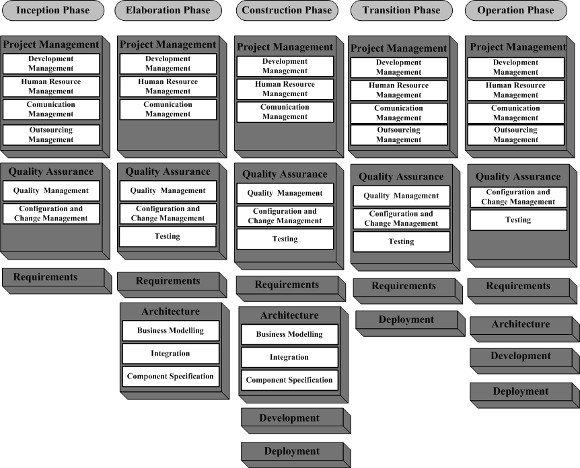
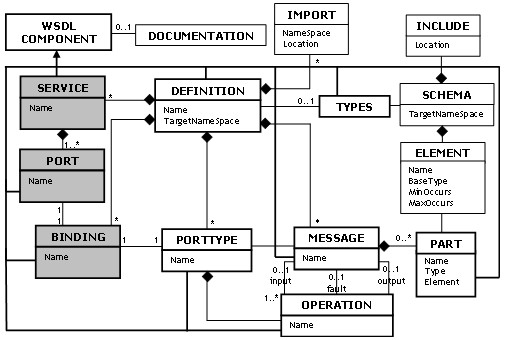
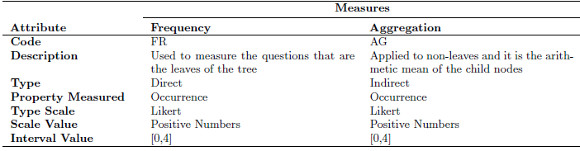
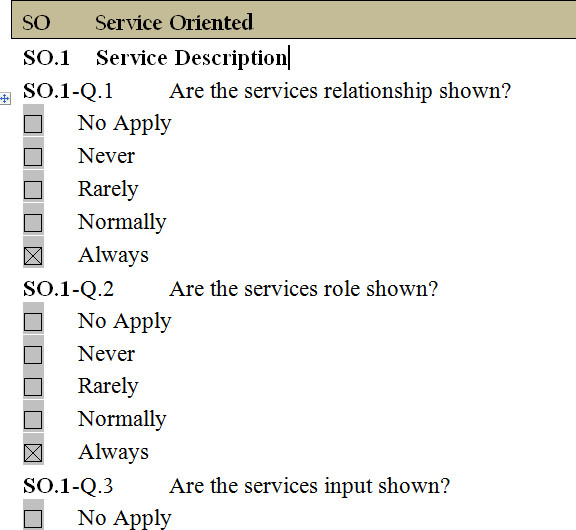
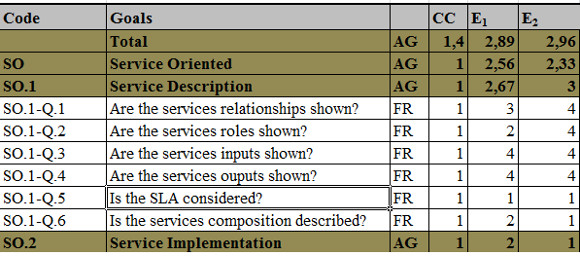
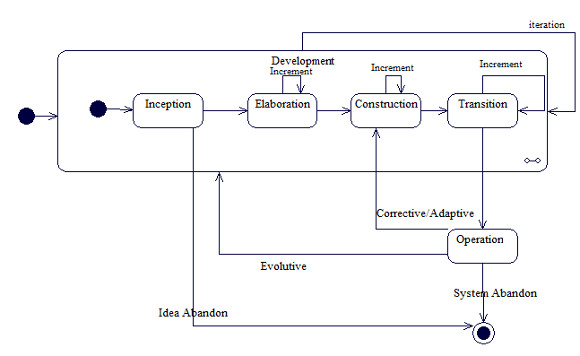
<body><![CDATA[<p class="indent" >   For these reasons, Grau et al. have proposed Tape Mbo&#8217;e (TME) (Tape Mbo&#8217;e means: &#8220;method&#8221; in Guarani Language), a service oriented process <span class="cite">[<a  href="#X128">4</a><a id="br4">]</a></span>, <span class="cite">[<a  href="#X133">5</a><a id="br5">]</a></span>. It encompasses the whole life cycle of service-based applications (SBAs) that are built considering the sustainability, which means the capability of affording the operation of software in the long term <span class="cite">[<a  href="#X49">6</a><a id="br6">]</a></span>. Besides, an extended version of TME with life cycle, roles, disciplines, and work products is presented in this paper. <!--l. 11-->    <p class="indent" >   TME was not built from scratch; it is based on Open Unified Process (OpenUP) (<a  href="http://epf.eclipse.org/wikis/openup/" class="url" ><span  class="cmtt-10">http://epf.eclipse.org/wikis/openup/</span></a>), that has been chosen for being a light version of Rational Unified Process (RUP). RUP is a well-organized methodology and it has been widely used in the industry. However, it includes many artefacts and documents, making its use hard in this context because its adaptation would be time consuming and expensive <span class="cite">[<a  href="#X20">7</a><a id="br7">]</a></span>. <!--l. 13-->    <p class="indent" >   TME has adapted OpenUP to support the development of SBAs. TME extends the life cycle and disciplines of OpenUP to cover the maintenance and retirement of applications and to assure the quality of SBAs. Besides, TME improves the project management discipline of OpenUP to consider the needs of development projects of public agencies of the Paraguayan government. The changes in this discipline have been inspired on the standard of project management <span class="cite">[<a  href="#X124">8</a><a id="br8">]</a></span>. <!--l. 16-->    <p class="indent" >   We are aware that the changes proposed by TME reduce its agility. However, they support the sustainability, which is more valuable for the type of projects that we are interested in, such as the government projects. <!--l. 18-->    <p class="indent" >   TME is being applied for the first time in the Information Exchange System (IES) that is in charge of interchanging citizens&#8217; data among the legacy systems of the whole public sector of Paraguayan government. The validation of TME represents a long-term study. However, the first observations indicated the feasibility and applicability of TME when used by practitioners. It is worth noting, that TME&#8217;s evaluation has been the first application of rigorous experimental evaluation in the public sector in Paraguay. Therefore, the first results of this experience are going to be described in this paper. <!--l. 20-->    <p class="indent" >   The paper is organized as follows. Section <a  href="#x1-20002">2<!--tex4ht:ref: 'TME' --></a> depicts the TME including life cycle, roles, how the disciplines are performed during the life cycle, and differences between TME and OpenUP. Section <a  href="#x1-380003">3<!--tex4ht:ref: 'EVA' --></a> outlines the followed process to evaluate the application of TME in case studies. Moreover, the process is illustrated with the experience of applying TME in a public agency in Paraguay. Finally, conclusion indicates some future directions.    <h3 class="sectionHead"><span class="titlemark">2   </span> <a   id="x1-20002"></a>Tape Mbo&#8217;e: a Service Oriented Process</h3> <!--l. 3-->    <p class="noindent" >TME is a process for developing and maintaining service-based applications (SBAs), and it is based on Open Unified Process (OpenUP) (version: June 1, 2012). OpenUP has been chosen after examining various Agile Methods (AMs) such as Scrum <span class="cite">[<a  href="#X47">9</a><a id="br9">]</a></span>, <span class="cite">[<a  href="#X105">10</a><a id="br10">]</a></span>, Extreme Programming (XP) <span class="cite">[<a  href="#X13">11</a><a id="br11">]</a></span>, <span class="cite">[<a  href="#X106">12</a><a id="br12">]</a></span>, Feature Driven Development (FDD) <span class="cite">[<a  href="#X137">13</a><a id="br13">]</a></span>, Dynamic Systems Development Method (DSDM) <span class="cite">[<a  href="#X137">13</a><a id="br13">]</a></span>. We have chosen OpenUP because it is the only one among those AMs that considers the project management and the deployment as disciplines. Its work products cover more aspects of the life cycle than the other AMs. Additionally, it is the light version of the Rational Unified Process (RUP). There are differences between TME an OpenUP, however; we will describe them in the next sections.                                                                                                                                                                                        <h4 class="subsectionHead"><span class="titlemark">2.1   </span> <a   id="x1-30002.1"></a>Life cycle</h4> <!--l. 8-->    <p class="noindent" >TME adopts the four phases of OpenUP and extends the life cycle of software development by adding the new &#8220;Operation Phase&#8221;. <!--l. 11-->    <p class="indent" >   The life cycle is iterative, incremental, and the phases are executed sequentially. Each iteration produces an incremental value to stakeholders, results of iterations should be defined in the iteration plan. The duration of the iteration might vary depending on project characteristics, but it is suggested to last for one-month. <!--l. 14-->    <p class="indent" >   The increment is a unit of work that can be used to measure project progress, and to make decisions in each iteration. <!--l. 16-->    ]]></body>
<body><![CDATA[<p class="indent" >   TME suggests that independent parts of the development can be carried out in parallel iterations. <!--l. 18-->    <p class="indent" >   The next sub-sections describe the phases whose sequences of execution are illustrated in Figure &#x00A0;<a  href="#x1-30011">1<!--tex4ht:ref: hbtp12 --></a>. <hr class="figure">    <div class="figure"  >                                                                                                                                                                                     <a   id="x1-30011"></a>                                                                                                                                                                                      <!--l. 21-->    <p class="noindent" ><img  src="/img/revistas/cleiej/v18n1/1a04f1.jpg" alt="PIC"   > <br />     <div class="caption"  ><span class="id">Figure&#x00A0;1: </span><span   class="content">Life Cycle </span></div><!--tex4ht:label?: x1-30011 -->                                                                                                                                                                                     <!--l. 23-->    <p class="indent" >   </div><hr class="endfigure">      <ul class="itemize1">      <li class="itemize"><span  class="cmbx-10">Inception Phase. </span>The starting point is the need to develop a software that has to meet a set of      requirements. The requirements can be refined through the iterations. Thus, the general requirements      are collected to estimate cost, human resources, schedule, and to identify stakeholders.      <!--l. 28-->    <p class="noindent" >Having determined the requirements, major decisions such as recruiting human resources, acquiring      infrastructure, outsource the whole development or a part of it are taken. Also, the quality is planned.      </li>      <li class="itemize"><span  class="cmbx-10">Elaboration Phase. </span>This phase aims at outlining the architecture of the software, described by work      products of the disciplines executed during it.      <!--l. 32-->    <p class="noindent" >At  the  beginning,  the  iteration  is  organized;  this  includes  the  selection  of  the  requirement  to  be      developed. Secondly, the selected requirement is described considering the remark of users, and it is      refined incrementally.      <!--l. 34-->    <p class="noindent" >Moreover, staff, schedule, and risks are all managed, and the quality of the work products are monitored      and controlled. The output of this phase is a set of work products that describe the requirements (see      Table <a  href="#x1-80031">1<!--tex4ht:ref: table:TAP-MBO --></a>).      </li>      <li class="itemize"><span  class="cmbx-10">Construction Phase. </span>The effort is focused on building and testing the solution that has to meet the      pre-established quality standards. Thus, this phase is composed of increments of building and testing.      <!--l. 41-->    <p class="noindent" >Once the solution fits the requirements, it is ready to be tested by users in the next phase.      </li>      <li class="itemize"><span  class="cmbx-10">Transition Phase. </span>This phase involves the software release for users testing before its deployment.      It can comprehend various increments of testing in which minor adjustments can result from users&#8217;      feedback.      <!--l. 45-->    ]]></body>
<body><![CDATA[<p class="noindent" >Moreover, users can request to change some functionality. In that case, a decision on whether accepting      the request or not, and on when it will be implemented, has to be taken.      <!--l. 47-->    <p class="noindent" >At the end, the software is deployed and the users are trained on how to operate it.      </li>      <li class="itemize"><span  class="cmbx-10">Operation Phase. </span>It tackles software productive life that encompasses corrective, adaptive, perfective,      and evolution maintenance as well as the software retirement.      <!--l. 51-->    <p class="noindent" >The  corrective  maintenance  focuses  on  repairing  faults  and  errors  detected  during  the  software      operation  while  the  perfective  aims  at  improving  code.  The  adaptive  maintenance  adjusts  the      application to support changes such as in the infrastructure layer; in the application context and      location; of the user types, preferences, and constraints; in the functionalities provided by the composed      services; in the way the service is being used and managed by its consumers. Furthermore, in this phase      it is possible to adapt or substitute the component services to improve the performance of the software.      <!--l. 56-->    <p class="noindent" >The evolution implies starting a new development cycle.      <!--l. 58-->    <p class="noindent" >Finally, software retirement entails uninstalling the whole application or services from production      environment. Due to its critic importance for service consumers, we have to assure the remaining      services continue to work correctly.</li>    </ul>    <h4 class="subsectionHead"><span class="titlemark">2.2   </span> <a   id="x1-40002.2"></a>Roles</h4> <!--l. 61-->    <p class="noindent" >Tape Mbo&#8217;e (TME) defines roles, each in charge of tasks needed to meet objectives. Its roles are like the three types proposed by OpenUP (<a  href="http://epf.eclipse.org/wikis/openup/" class="url" ><span  class="cmtt-10">http://epf.eclipse.org/wikis/openup/</span></a>): Basic, Deployment, and Environment.                                                                                                                                                                                        <h5 class="subsubsectionHead"><span class="titlemark">2.2.1   </span> <a   id="x1-50002.2.1"></a>Basic Roles</h5> <!--l. 63-->    <p class="noindent" >This type of roles encompasses those who participate in the development and the stakeholders. <!--l. 65-->    <p class="indent" >   TME introduces two changes in the basic roles of OpenUP, it removes the Any Role and add one of Quality Analyst. The former has been exempted because it does not participate in a specific discipline, while the latter is included to be in charge of the Quality Assurance discipline. <!--l. 67-->    <p class="indent" >   The roles are the following:      <ul class="itemize1">      <li class="itemize"><span  class="cmbx-10">Stakeholder. </span>The role represents all the people interested on the execution of the project or affected      by it. In this sense, all other roles can be considered as a stakeholder, and besides a stakeholder is      called user when it is the person who asks for the development and/or will use the application.      </li>      <li class="itemize"><span  class="cmbx-10">Project Manager. </span>The role is responsible for the Project Management discipline. Hence, the project      manager is responsible for coordinating and controlling the team and the project execution.      </li>      <li class="itemize"><span  class="cmbx-10">Analyst. </span>The role is responsible for the Requirements discipline. The analyst meets with stakeholders      to gather the requirements. Having collected these, the analyst describes them with use cases and      mock-ups.      </li>      <li class="itemize"><span  class="cmbx-10">Architect.  </span>The  role  is  responsible  for  the  Architecture  discipline.  The  architect  examines  the      requirements to outline architecture of the application through models and documents. Moreover, is      in charge of the technical decision-making that can affect the whole development.      </li>      <li class="itemize"><span  class="cmbx-10">Developer. </span>The role is responsible for the Development Discipline. Developers constructs the software      according to the architecture and perform verification tasks once the development is done.      </li>      <li class="itemize"><span  class="cmbx-10">Tester. </span>The role is responsible for the Testing Sub-discipline. The tester verifies and validates the      software. The tester supports the revision of the software when it is reviewed by an user.      </li>      <li class="itemize"><span  class="cmbx-10">Quality Analyst. </span>The role is responsible for the Quality Management sub-discipline. The role is in      charge of ensuring the quality of the process and deliverables.      <!--l. 79-->    ]]></body>
<body><![CDATA[<p class="noindent" >At the end of a phase or iteration, the Quality Analyst controls and evaluates the quality of the work      products of the disciplines to suggest adjustments or improvements if necessary.</li>    </ul> <!--l. 81-->    <p class="noindent" >    <h5 class="subsubsectionHead"><span class="titlemark">2.2.2   </span> <a   id="x1-60002.2.2"></a>Deployment Roles</h5> <!--l. 82-->    <p class="noindent" >These roles are in charge of the tasks that are carried out after submitting the application. TME does not include the roles of &#8220;Course Developer&#8221;, &#8220;Product Owner&#8221;, &#8220;Technical Writer&#8221; of OpenUP. <!--l. 84-->    <p class="indent" >   TME assigns the responsibilities of the &#8220;Course Developer&#8221; to the &#8220;Trainer&#8221;, and it hands the responsibilities of the &#8220;Technical Writer&#8221; to the &#8220;Quality Analyst&#8221;. Also, it calls &#8220;User&#8221; to the &#8220;Product Owner&#8221;. The roles are the following:      <ul class="itemize1">      <li class="itemize"><span  class="cmbx-10">Deployment Engineer. </span>The role is in charge of deploying software into production environment      as well as publishing services into service repository. After deployment it verifies the success of the      procedure, as well as the implementation of the roll-back plan if needed.      </li>      <li class="itemize"><span  class="cmbx-10">Deployment Manager. </span>The role is responsible for coordinating the deployment into production      environment and service repository as well as monitoring and controlling the deployment engineers.                                                                                                                                                                                          </li>      <li class="itemize"><span  class="cmbx-10">Trainer. </span>The role is responsible for training the team members and users. Team members are trained      on skills needed to accomplish their jobs, while users on software usage. Additionally, the trainer      prepares the material for the training course.</li>    </ul> <!--l. 92-->    <p class="noindent" >    <h5 class="subsubsectionHead"><span class="titlemark">2.2.3   </span> <a   id="x1-70002.2.3"></a>Environment Roles</h5> <!--l. 93-->    <p class="noindent" >These roles include people in charge of tools, configuration, and assets. TME considers the role of &#8220;Configuration Analyst&#8221; to be in charge of the Configuration and Change Management. Moreover, it excludes the role of &#8220;Process Engineer&#8221; proposed by OpenUP because its responsibilities are carried out by the Quality Analyst. <!--l. 95-->    <p class="indent" >   The roles are described as follows:      <ul class="itemize1">      <li class="itemize"><span  class="cmbx-10">Tool Specialist. </span>The role is responsible for the Configuration and Change Management sub-discipline.      It takes care of providing technical assistance about the tools used in the project including purchasing,      installation, configuring, and maintenance.      </li>      <li class="itemize"><span  class="cmbx-10">Configuration Analyst. </span>This role is in charge of tracking and controlling the changes in the assets      of the project, as well as keeping the assets.</li>    </ul> <!--l. 100-->    ]]></body>
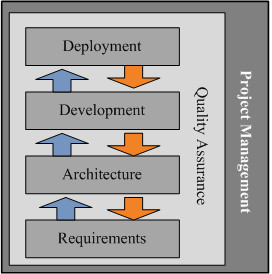
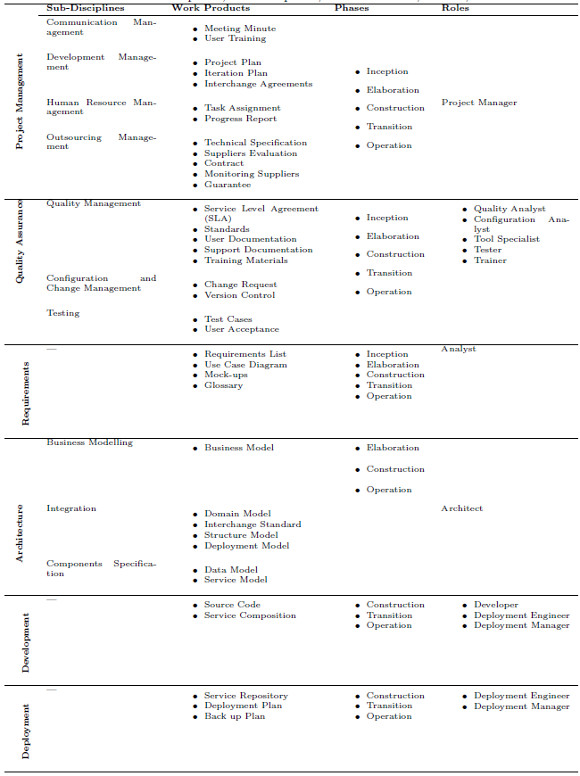
<body><![CDATA[<p class="noindent" >    <h4 class="subsectionHead"><span class="titlemark">2.3   </span> <a   id="x1-80002.3"></a>Disciplines execution during the life cycle</h4> <!--l. 102-->    <p class="noindent" >Tape Mbo&#8217;e (TME) follows an iterative, incremental, architecture-centric, and risk driven process. It is represented by analysing two dimensions: temporal evolution (life cycle) and disciplines as it is illustrated in Figure <a  href="#x1-80012">2<!--tex4ht:ref: PHA-DIS --></a>. The former shows the software life cycle, while the latter mentions the disciplines involved to produce software <span class="cite">[<a  href="#X128">4</a><a id="br4">]</a></span>. <hr class="figure">    <div class="figure"  >                                                                                                                                                                                     <a   id="x1-80012"></a>                                                                                                                                                                                      <!--l. 106-->    <p class="noindent" ><img  src="/img/revistas/cleiej/v18n1/1a04f2.jpg" alt="PIC"   > <br />     <div class="caption"  ><span class="id">Figure&#x00A0;2: </span><span   class="content">Life Cycle and Disciplines</span></div><!--tex4ht:label?: x1-80012 -->                                                                                                                                                                                     <!--l. 107-->    <p class="indent" >   </div><hr class="endfigure"> <!--l. 109-->    <p class="indent" >   A discipline is a set of tasks that have a common goal, and produce work products. The work products can be documents (manual, planes, schedule, contract, etc.), models, code, templates, mock-ups, service level agreement (SLA). The disciplines are executed during the life cycle, and each of them is under the responsibility of one of the aforementioned roles. <!--l. 111-->    <p class="indent" >   TME proposes six disciplines whose relationships are shown in Figure&#x00A0;<a  href="#x1-80023">3<!--tex4ht:ref: REL-DIS --></a>. The vertical disciplines (i.e., Project Management and Quality Assurance) are in charge of organizing, controlling, and suggesting tasks to the horizontal disciplines. <hr class="figure">    <div class="figure"  >                                                                                                                                                                                     <a   id="x1-80023"></a>                                                                                                                                                                                      <!--l. 114-->    <p class="noindent" ><img  src="/img/revistas/cleiej/v18n1/1a04f3.jpg" alt="PIC"   > <br />     ]]></body>
<body><![CDATA[<div class="caption"  ><span class="id">Figure&#x00A0;3: </span><span   class="content">TME Disciplines</span></div><!--tex4ht:label?: x1-80023 -->                                                                                                                                                                                     <!--l. 115-->    <p class="indent" >   </div><hr class="endfigure"> <!--l. 116-->    <p class="indent" >   The disciplines, their sub-disciplines, work products, and the phases in which they are carried out are presented in Table <a  href="#x1-80031">1<!--tex4ht:ref: table:TAP-MBO --></a> and described bellow.        <div class="table">                                                                                                                                                                                     <!--l. 124-->    <p class="indent" >   <a   id="x1-80031"></a><hr class="float">    <div class="float"  >                                                                                                                                                                                          <div class="caption"  ><span class="id">Table&#x00A0;1: </span><span   class="content">Disciplines, Sub-disciplines, Work Products, Phases, and Roles </span></div><!--tex4ht:label?: x1-80031 -->      <div class="pic-tabular"><img  src="/img/revistas/cleiej/v18n1/1a04t1.jpg"></div>                                                                                                                                                                                        </div><hr class="endfloat" />    </div>    <h5 class="subsubsectionHead"><span class="titlemark">2.3.1   </span> <a   id="x1-90002.3.1"></a>Inception</h5> <!--l. 371-->    <p class="noindent" >The major goals are the definition and delimitation of the development project. These are accomplished through the following disciplines: <!--l. 372-->    <p class="noindent" ><span class="paragraphHead"><a   id="x1-100002.3.1"></a><span  class="cmbx-10">Project Management.</span></span>    The project is established applying the next sub-disciplines:      <ul class="itemize1">      <li class="itemize"><span  class="cmbx-10">Development Management. </span>A Feasibility study is carried out to determine the project&#8217;s viability.      <!--l. 377-->    ]]></body>
<body><![CDATA[<p class="noindent" >The project scope is delimited, and first estimations of cost, time, infrastructure, and human resources      needed are done.      <!--l. 379-->    <p class="noindent" >The risks are identified, and suitable responses to them are planned.      <!--l. 381-->    <p class="noindent" >Moreover, the work breakdown structure (WBS), schedule, and budget are elaborated as part of the      project plan.      </li>      <li class="itemize"><span  class="cmbx-10">Human Resources Management. </span>Recruitment can be needed in which case the candidates are      interviewed, and hired thereafter.      <!--l. 385-->    <p class="noindent" >The team is organized, and its members are notified about their responsibilities and functions.      <!--l. 387-->    <p class="noindent" >In addition, training courses for the staff of the project are planned.      </li>      <li class="itemize"><span  class="cmbx-10">Communication Management. </span>The stakeholders are identified and the information flow among      them is prepared/organized.      <!--l. 390-->    <p class="noindent" >Furthermore, the meeting frequency is established. Meetings with users are arranged and performed,      and during those meetings, the major decision of the project are taken.      <!--l. 394-->    <p class="noindent" >Meeting minutes are elaborated to report on the topics discussed in these meetings      </li>      <li class="itemize"><span  class="cmbx-10">Outsourcing Management. </span>The decision about outsourcing development is made, and as a results      technical specification of purchase or engagement is created.      <!--l. 398-->    <p class="noindent" >The suppliers are called, and their proposals are assessed in order to carry out the selection process.      Finally, negotiating, awarding, and the signing of the contract with the selected supplier is done.</li>    </ul> <!--l. 400-->    <p class="noindent" ><span class="paragraphHead"><a   id="x1-110002.3.1"></a><span  class="cmbx-10">Quality Assurance.</span></span>    It aims at planning how the quality during the whole project will be managed. The following sub-disciplines are considered.      <ul class="itemize1">      <li class="itemize"><span  class="cmbx-10">Quality Management. </span>The definition and standardization of process, documents, and work product      products are set. Templates, as well as tools (check-lists, questionnaires) are created in order to evaluate      the quality of work products. Also, good practices are suggested to be employed during the whole life      cycle.      </li>      <li class="itemize"><span  class="cmbx-10">Configuration and Changes Management. </span>The identification, collection, classification, labelling,      and maintenance of project assets version are done. Moreover, process of change request is established.</li>    ]]></body>
<body><![CDATA[</ul>                                                                                                                                                                                     <!--l. 409-->    <p class="noindent" ><span class="paragraphHead"><a   id="x1-120002.3.1"></a><span  class="cmbx-10">Requirements.</span></span>    The major project requirements are identified with users, and these are ordered by priority.    <h5 class="subsubsectionHead"><span class="titlemark">2.3.2   </span> <a   id="x1-130002.3.2"></a>Elaboration</h5> <!--l. 412-->    <p class="noindent" >This phase is characterized by the activities of analysis and design. Therefore, it involves the following disciplines: <!--l. 413-->    <p class="noindent" ><span class="paragraphHead"><a   id="x1-140002.3.2"></a><span  class="cmbx-10">Project Management.</span></span>    It is performed through the next sub-disciplines.      <ul class="itemize1">      <li class="itemize"><span  class="cmbx-10">Development Management. </span>At the beginning of the phase, the iteration is planned and arranged.      Also the requirements to be developed during the iteration are negotiated with users.      <!--l. 418-->    <p class="noindent" >The tasks of monitoring, controlling, and updating scope, risks, schedule, and cost are carried out.      </li>      <li class="itemize"><span  class="cmbx-10">Human Resources Management. </span>The tasks are assigned to human resources who are monitored      to ensure the tasks completion.      </li>      <li class="itemize"><span  class="cmbx-10">Communication Management. </span>At the beginning of the phase, the analysts meet with users to      determine the requirement to develop in the iteration and receive requests for changes.      <!--l. 424-->    <p class="noindent" >Moreover, team meetings are held according to the settled frequency, as to update about progress,      pitfalls, and support decision-making.</li>    </ul> <!--l. 426-->    <p class="noindent" ><span class="paragraphHead"><a   id="x1-150002.3.2"></a><span  class="cmbx-10">Quality Assurance.</span></span>    It focuses on the quality of design and keeping assets version. These following sub-disciplines are involved.      <ul class="itemize1">      <li class="itemize"><span  class="cmbx-10">Quality Management. </span>At the beginning of the iteration, the Service License Agreement (SLA) is      negotiated.      <!--l. 432-->    <p class="noindent" >The quality of the design is monitored, and corrective actions can be suggested.      </li>      <li class="itemize"><span  class="cmbx-10">Configuration and Changes Management. </span>All the assets affected by changes are identified and,      they must be updated accordingly All the work products have to be maintained and their versions are      tracked. The tools to be used for designing are installed and customized as well.</li>    </ul> <!--l. 439-->    ]]></body>
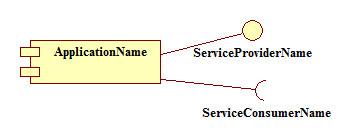
<body><![CDATA[<p class="noindent" ><span class="paragraphHead"><a   id="x1-160002.3.2"></a><span  class="cmbx-10">Requirements.</span></span>    The requirements are gathered from users, documents, and forms. First, the use cases and then the mock-ups are created. The mock-ups helps identifying inputs and outputs as well as understanding how the interface has to be. <!--l. 442-->    <p class="indent" >   A glossary is created to unify concepts that can be either incompatible or different across diverse legacy systems. <!--l. 444-->    <p class="indent" >   Finally, use cases, mock-ups, and glossary can be refined, and the requirements list can be updated.                                                                                                                                                                                     <!--l. 445-->    <p class="noindent" ><span class="paragraphHead"><a   id="x1-170002.3.2"></a><span  class="cmbx-10">Architecture.</span></span>    It focuses on defining, depicting, and updating the application architecture. It is performed through the following sub-disciplines.      <ul class="itemize1">      <li class="itemize"><span  class="cmbx-10">Business  Modelling.  </span>The  organizational  processes  that  can  be  reused  and/or  affected  during      development are identified.      <!--l. 450-->    <p class="noindent" >The process description is made using Business Process Modelling Notation (BPMN) that has been      chosen for being a standard notation (<a  href="http://www.omg.org/spec/BPMN/2.0/" class="url" ><span  class="cmtt-10">http://www.omg.org/spec/BPMN/2.0/</span></a>). BPMN involves process,      sub-processes, activities, services, flows, and entities.      <!--l. 452-->    <p class="noindent" >TME calls <span  class="cmbx-10">Business Model </span>to each BPMN diagram, and suggests describing with BPMN each use      case identified by the Requirements Discipline.      </li>      <li class="itemize"><span  class="cmbx-10">Integration. </span>The top-down description of the application and its environment is provided including      services and legacy systems. This is represented with the <span  class="cmbx-10">Domain Model </span>that is elaborated with      UML Component diagram according to the meta-model shown in Figure&#x00A0;<a  href="#x1-170014">4<!--tex4ht:ref: DoMet --></a>. <hr class="figure">    <div class="figure"  ><a   id="x1-170014"></a> <img  src="/img/revistas/cleiej/v18n1/1a04f4.jpg" alt="PIC"   > <br />     <div class="caption"  ><span class="id">Figure&#x00A0;4: </span><span   class="content">Domain Meta-model </span></div><!--tex4ht:label?: x1-170014 -->      <!--l. 458-->    <p class="noindent" ></div><hr class="endfigure">      <!--l. 459-->    <p class="noindent" >The meta-model represents the applications as components, and the services as interfaces. Relation of      dependency connects the service consumed with its component, and relation of realization links up the service      provider with its component.      <!--l. 461-->    ]]></body>
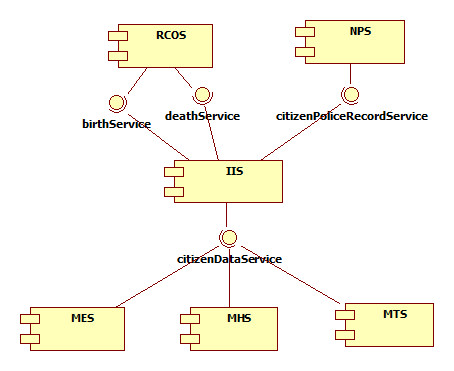
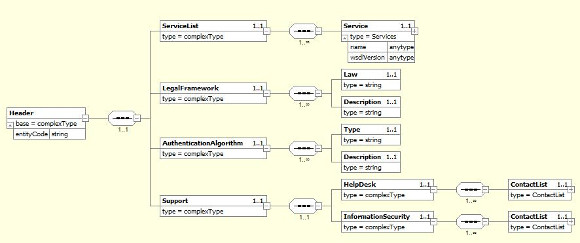
<body><![CDATA[<p class="noindent" >As an example, the Domain Model of Information and Interchange System (IIS) shown in Figure&#x00A0;<a  href="#x1-170025">5<!--tex4ht:ref: EJ-DOM --></a> is      proposed. The model includes the systems of the following agencies: Civil Registration Office      (CROS), Ministry of Education MES), Ministry of Heath (MHS), Secretary of Information and      Communication (IIS), National Police (NPS), and Ministry of Treasury (MTS). CROS provides the      <span  class="cmti-10">birthService </span>and <span  class="cmti-10">deathService </span>while NPS supplies <span  class="cmti-10">citizenPoliceRecordService</span>. IIS consumes these      services, and composes them into the <span  class="cmti-10">citizenDataService </span>consumed in turn by MES, MHS, and MTS.      We can observe how the domain encompasses legacy systems and also produced and consumed      services for them. This supports the re-usability of functionalities and services. <hr class="figure">    <div class="figure"  ><a   id="x1-170025"></a> <img  src="/img/revistas/cleiej/v18n1/1a04f5.jpg" alt="PIC"   > <br />     <div class="caption"  ><span class="id">Figure&#x00A0;5: </span><span   class="content">Example of Domain Model </span></div><!--tex4ht:label?: x1-170025 -->      <!--l. 467-->    <p class="noindent" ></div><hr class="endfigure">      <!--l. 469-->    <p class="noindent" >The application is decomposed into modules, which are held in the <span  class="cmbx-10">Structure Model</span>.      <!--l. 471-->    <p class="noindent" >Furthermore, this sub-discipline defines the interchange standards including data format and      processes. An example of standard data format is presented in Figure&#x00A0;<a  href="#x1-170036">6<!--tex4ht:ref: EJ-SDF --></a>. The example is in XML      Schema Definition (XSD), a format in which the service providers present the information needed to      consume their services. <hr class="figure">    <div class="figure"  ><a   id="x1-170036"></a> <img  src="/img/revistas/cleiej/v18n1/1a04f6.jpg" alt="PIC"   > <br />     <div class="caption"  ><span class="id">Figure&#x00A0;6: </span><span   class="content">Example of Standard Data Format </span></div><!--tex4ht:label?: x1-170036 -->      <!--l. 476-->    <p class="noindent" ></div><hr class="endfigure">      <!--l. 478-->    <p class="noindent" >The identification of services to be re-used is another important activity. It is expected to reduce redundancy,      development time, and save costs for both maintenance and operation. TME suggests the application of      techniques for service identification, but does not indicate a specific one. However, some suggestions can be      found in the work of Arsanjani et al <span class="cite">[<a  href="#X3">14</a><a id="br14">]</a></span> which are Domain decomposition, Goal-service modelling, and      Existing Asset Analysis <span class="cite">[<a  href="#X5">15</a><a id="br15">]</a></span>, <span class="cite">[<a  href="#X28">16</a><a id="br16">]</a></span>, <span class="cite">[<a  href="#X101">17</a><a id="br17">]</a></span>, <span class="cite">[<a  href="#X103">18</a><a id="br18">]</a></span>. The techniques focus on searching a set of candidate services      which might accomplish the development requirements. The search can embrace business processes, existing      assets which include legacy systems, functionalities, procedures, existing services into service      repository, rules and others <span class="cite">[<a  href="#X5">15</a><a id="br15">]</a></span>. After discovering the candidate services, they should be filtered      according to pre settled criteria such as Service Litmus Test (SLT) <span class="cite">[<a  href="#X3">14</a><a id="br14">]</a></span>, <span class="cite">[<a  href="#X28">16</a><a id="br16">]</a></span>. SLT is a set of tests      applied in iterative way to assess service candidates in order to select those which will be re-used.      Finally, the selected services are developed, unless they have been already deployed in the service      repository.                                                                                                                                                                                          <!--l. 484-->    ]]></body>
<body><![CDATA[<p class="noindent" >The domain model, the structure model, the interchange standards, and the glossary of terms can be refined      and updated.      </li>      <li class="itemize"><span  class="cmbx-10">Components Specification. </span>A bottom-up description of the application is done including service and      database.      <!--l. 488-->    <p class="noindent" >The service structure is described with inputs, outputs, messages, ports, and protocols according to      the UML meta-model proposed by De Castro et al <span class="cite">[<a  href="#X100">19</a><a id="br19">]</a></span>. The meta-model is shown in Figure&#x00A0;<a  href="#x1-170047">7<!--tex4ht:ref: SerMet --></a>, and it      represents the WSDL with a UML class diagram in which each part of WSDL is a class. The model is      called <span  class="cmbx-10">Service Model</span>. <hr class="figure">    <div class="figure"  ><a   id="x1-170047"></a> <img  src="/img/revistas/cleiej/v18n1/1a04f7.jpg" alt="PIC"   > <br />     <div class="caption"  ><span class="id">Figure&#x00A0;7: </span><span   class="content">Service Model <span class="cite">[<a  href="#X100">19</a><a id="br19">]</a></span> </span></div><!--tex4ht:label?: x1-170047 -->      <!--l. 492-->    <p class="noindent" ></div><hr class="endfigure">      <!--l. 494-->    <p class="noindent" >The database is designed and depicted using UML class diagram and/or entity-relation diagram, this      representation is called <span  class="cmbx-10">Data Model</span>.      <!--l. 496-->    <p class="noindent" >Additionally, the service model and the data model can be refined and updated.</li>    </ul> <!--l. 498-->    <p class="noindent" >    <h5 class="subsubsectionHead"><span class="titlemark">2.3.3   </span> <a   id="x1-180002.3.3"></a>Construction</h5> <!--l. 499-->    <p class="noindent" >The effort is focused on building an application that fulfils the requirements and quality standard. Therefore, the disciplines are applied as follows: <!--l. 500-->    ]]></body>
<body><![CDATA[<p class="noindent" ><span class="paragraphHead"><a   id="x1-190002.3.3"></a><span  class="cmbx-10">Project Management.</span></span>    It is performed through the following sub-disciplines.      <ul class="itemize1">      <li class="itemize"><span  class="cmbx-10">Development  Management.  </span>The  tasks  of  monitoring,  controlling,  and  updating  scope,  risks,      schedule, and cost are carried out.      </li>      <li class="itemize"><span  class="cmbx-10">Human Resources Management. </span>The human resources are monitored and controlled.      </li>      <li class="itemize"><span  class="cmbx-10">Communication Management. </span>Team meetings are held according to settled frequency, as to update      about progress, pitfalls, and support decision-making .</li>    </ul> <!--l. 507-->    <p class="noindent" ><span class="paragraphHead"><a   id="x1-200002.3.3"></a><span  class="cmbx-10">Quality Assurance.</span></span>    It is accomplished through the following sub-disciplines:      <ul class="itemize1">      <li class="itemize"><span  class="cmbx-10">Quality Management. </span>The code quality is monitored, and corrective actions can be suggested.      </li>      <li class="itemize"><span  class="cmbx-10">Configuration and Changes Management. </span>The identification, collection, classification, labelling,      and maintenance of project assets version are done.      <!--l. 513-->    <p class="noindent" >The changes of project assets are monitored, and the version is updated if needed.      <!--l. 515-->    <p class="noindent" >Furthermore, the tools to be used for programming are installed and customized.      </li>      <li class="itemize"><span  class="cmbx-10">Testing. </span>The types of tests to be carried out are chosen, and the test cases are elaborated. Then, the      verification of functionality, usability, supportability, reliability, and performance of software is carried      out by developers and testers.</li>    </ul>                                                                                                                                                                                     <!--l. 520-->    <p class="noindent" ><span class="paragraphHead"><a   id="x1-210002.3.3"></a><span  class="cmbx-10">Requirements.</span></span>    The requirements list, use cases, mock-ups, and glossary can be updated. <!--l. 521-->    <p class="noindent" ><span class="paragraphHead"><a   id="x1-220002.3.3"></a><span  class="cmbx-10">Architecture.</span></span>    It is performed through the following sub-disciplines:      <ul class="itemize1">      <li class="itemize"><span  class="cmbx-10">Business Modelling. </span>The business model can be updated and refined.      </li>      <li class="itemize"><span  class="cmbx-10">Integration. </span>The run-time configuration of processing nodes and its components are described in the      <span  class="cmbx-10">Deployment Model </span>that is elaborated using UML deployment diagram.      <!--l. 526-->    <p class="noindent" >Besides, the domain model, the structure model, the interchange standards, and the deployment model      can be refined and updated.      </li>      <li class="itemize"><span  class="cmbx-10">Components Specification. </span>The service model and the data model can be updated.</li>    </ul> <!--l. 529-->    ]]></body>
<body><![CDATA[<p class="noindent" ><span class="paragraphHead"><a   id="x1-230002.3.3"></a><span  class="cmbx-10">Development.</span></span>    It is carried out according to the design and the quality standards. The service composition is performed using an orchestration language. <!--l. 530-->    <p class="noindent" ><span class="paragraphHead"><a   id="x1-240002.3.3"></a><span  class="cmbx-10">Deployment.</span></span>    The plans of deployment and back-up are elaborated. <!--l. 532-->    <p class="indent" >   Once the application is finished, it is deployed in test environment.    <h5 class="subsubsectionHead"><span class="titlemark">2.3.4   </span> <a   id="x1-250002.3.4"></a>Transition</h5> <!--l. 534-->    <p class="noindent" >Once the software is ready to be delivered, its verification, validation, and acceptance are carried out by users. Finally, it is deployed and its productive life starts. <!--l. 536-->    <p class="indent" >   In this phase the following disciplines are involved: <!--l. 537-->    <p class="noindent" ><span class="paragraphHead"><a   id="x1-260002.3.4"></a><span  class="cmbx-10">Project Management.</span></span>    It is performed through the following sub-disciplines.      <ul class="itemize1">      <li class="itemize"><span  class="cmbx-10">Development Management. </span>The project plan and chart can be updated. Additionally, the process      to authorize the application deployment is followed.      </li>      <li class="itemize"><span  class="cmbx-10">Human Resources Management. </span>The human resources are monitored and controlled.      </li>      <li class="itemize"><span  class="cmbx-10">Communication Management. </span>The team meeting is held to discuss about the iteration issues and      lessons learned.      <!--l. 543-->    <p class="noindent" >The analysts meet with users to verify and validate the application. Furthermore, users are trained to      use the software.      </li>      <li class="itemize"><span  class="cmbx-10">Outsourcing  Management. </span>The  provider  delivers  the  application  that  has  to  be  verified  and      validated before accepting.</li>    </ul>                                                                                                                                                                                     <!--l. 546-->    <p class="noindent" ><span class="paragraphHead"><a   id="x1-270002.3.4"></a><span  class="cmbx-10">Quality Assurance.</span></span>    It is performed through the following sub-disciplines.      <ul class="itemize1">      <li class="itemize"><span  class="cmbx-10">Quality Management. </span>The quality of deliverables is monitored and controlled, and improvements      can be suggested.      <!--l. 550-->    <p class="noindent" >Furthermore, the deliverable documentation and manual are elaborated to be given to final users.      </li>      <li class="itemize"><span  class="cmbx-10">Configuration and Changes Management. </span>The deliverable version is maintained and tracked.      <!--l. 553-->    ]]></body>
<body><![CDATA[<p class="noindent" >The change request can be received and analysed. Finally, decisions are made on whether to apply the      changes or not.      </li>      <li class="itemize"><span  class="cmbx-10">Testing. </span>The verification and validation of the software is performed by users who have to accept it      before deployment.</li>    </ul> <!--l. 556-->    <p class="noindent" ><span class="paragraphHead"><a   id="x1-280002.3.4"></a><span  class="cmbx-10">Requirements.</span></span>    The requirements list is updated. <!--l. 557-->    <p class="noindent" ><span class="paragraphHead"><a   id="x1-290002.3.4"></a><span  class="cmbx-10">Deployment.</span></span>    The infrastructure where the application will be installed is verified to ensure its adequacy, and corrective actions can be suggested. Then, the software is installed in production environment, and the services are published in the service repository. The services repository provides information about business entities, the type of services, and mechanisms for accessing to them. The industrial standards of service registry are the Universal Description, Discovery and Integration (UDDI) and Electronic Business Markup Language (ebXML) thought the most widely spread is UDDI <span class="cite">[<a  href="#X69">20</a><a id="br20">]</a></span>. <!--l. 560-->    <p class="indent" >   In addition, the deployment can be reversed if necessary.    <h5 class="subsubsectionHead"><span class="titlemark">2.3.5   </span> <a   id="x1-300002.3.5"></a>Operation</h5> <!--l. 562-->    <p class="noindent" >The activities focus on ensuring the effective and efficient performance of the software. Moreover, the software or part of it can be retired of the production environment; in this case, the operation of related applications has to be assured. <!--l. 564-->    <p class="indent" >   These activities are achieved with the following disciplines: <!--l. 565-->    <p class="noindent" ><span class="paragraphHead"><a   id="x1-310002.3.5"></a><span  class="cmbx-10">Project Management.</span></span>    It is performed through the following sub-disciplines.      <ul class="itemize1">      <li class="itemize"><span  class="cmbx-10">Development Management. </span>It deals with warranties management as well as notification of software      retirement. However, a decision to start the new development iteration can be taken to evolve the      software.      </li>      <li class="itemize"><span  class="cmbx-10">Human Resources Management. </span>The staff in charge of maintenance is monitored to ensure the      tasks completion.      </li>      <li class="itemize"><span  class="cmbx-10">Communication Management. </span>The team meetings can be held.      </li>      <li class="itemize"><span  class="cmbx-10">Outsourcing Management. </span>The warranty fulfilment can be requested to the provider.</li>    </ul>                                                                                                                                                                                     <!--l. 573-->    <p class="noindent" ><span class="paragraphHead"><a   id="x1-320002.3.5"></a><span  class="cmbx-10">Quality Assurance.</span></span>    It is performed through the following sub-disciplines.      <ul class="itemize1">      <li class="itemize"><span  class="cmbx-10">Configuration and Changes Management. </span>Changes on project assets are monitored, and the      version is updated if necessary.      </li>      <li class="itemize"><span  class="cmbx-10">Testing. </span>The verification and validation of the software, that have been maintained, are carried out      by developers and users. Users have to accept the software before deployment.</li>    ]]></body>
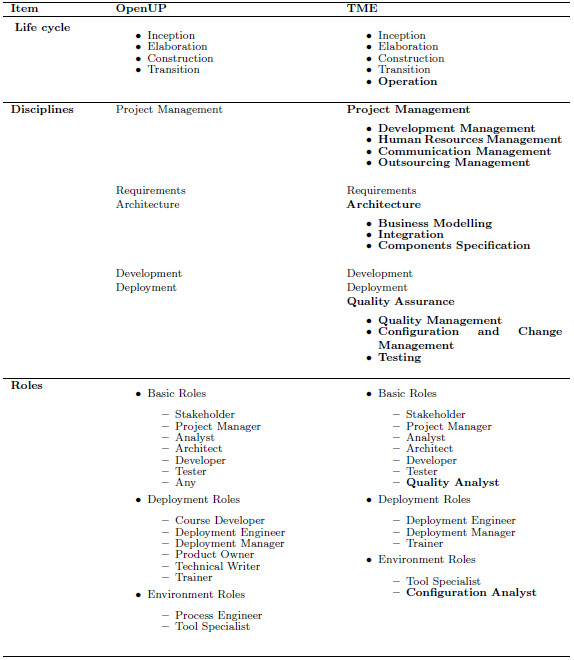
<body><![CDATA[</ul> <!--l. 581-->    <p class="noindent" ><span class="paragraphHead"><a   id="x1-330002.3.5"></a><span  class="cmbx-10">Requirements.</span></span>    The glossary can be updated. <!--l. 582-->    <p class="noindent" ><span class="paragraphHead"><a   id="x1-340002.3.5"></a><span  class="cmbx-10">Architecture.</span></span>    The business model, the domain model, the interchange standards, the structure model, and the deployment model can be updated. <!--l. 584-->    <p class="noindent" ><span class="paragraphHead"><a   id="x1-350002.3.5"></a><span  class="cmbx-10">Development.</span></span>    The corrective, adaptive, and perfective maintenance are performed. <!--l. 587-->    <p class="indent" >   As we stated in Section <a  href="#x1-20002">2<!--tex4ht:ref: 'TME' --></a>, it is possible to adapt and substitute the constituent services to improve software performance. TME considers mechanisms to monitor the needs for adaptation. Once adaptation requirements are detected, it is possible to choose the most suitable mechanisms to carry out the adaptation. The mechanism to be implemented depends on the change that promotes these needs. Some of such mechanisms could eventually support self-adapting service based applications. <!--l. 590-->    <p class="indent" >   Before retiring software from the production environment, all the related legacy systems have to be examined and adjusted if necessary. Thereafter, the retirement takes place and the environment is tested again. <!--l. 591-->    <p class="noindent" ><span class="paragraphHead"><a   id="x1-360002.3.5"></a><span  class="cmbx-10">Deployment.</span></span>    Updates are deployed into production environment, and / or into the service repository. The software can be returned to a previous state if necessary.    <h4 class="subsectionHead"><span class="titlemark">2.4   </span> <a   id="x1-370002.4"></a>TME and OpenUP: extensions and differences</h4> <!--l. 594-->    <p class="noindent" >TME has introduced various changes into OpenUP, mainly, in the life cycle, roles, and disciplines. The goal of these changes has been to provide to OpenUP with the characteristics required to support the development of SBAs. Besides, they intend to overcome some weaknesses of OpenUP such as the lack of quality assurance; a life cycle disregards maintenance and retirement; project management that does not consider outsourcing, human resource, and so on. <!--l. 597-->    <p class="indent" >   Considering this, TME has incorporated a new phase into its life cycle &#8220;Operation Phase&#8221;, in order to cover the gap between deployment and retirement of the application in OpenUP&#8217;s life cycle. <!--l. 599-->    <p class="indent" >   On one hand, TME has added the new discipline &#8220;Quality Assurance&#8221;, to assure the quality of the process and work products; and has included the Test Discipline of OpenUP into this new discipline, as a sub-discipline. On the other hand, it has given up the Environment Discipline of OpenUP, because its functions are covered by the Configuration and Change Management sub-discipline. <!--l. 602-->    ]]></body>
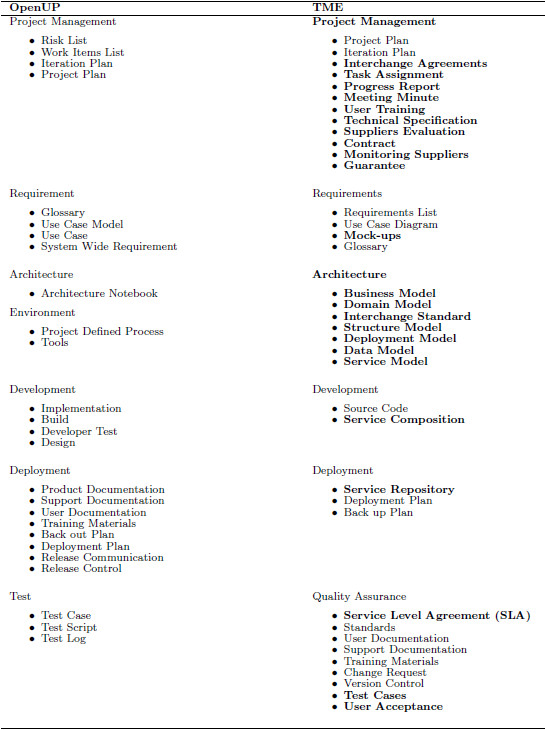
<body><![CDATA[<p class="indent" >   In addition, TME has modified various disciplines of OpenUP; the major changes have been into the Architecture and Project Management disciplines. They have been separated into sub-disciplines to specialize their management, and their work products have been incremented as well (see Table <a  href="#x1-370023">3<!--tex4ht:ref: table:DROL2 --></a>). <!--l. 604-->    <p class="indent" >   TME has introduced the new work product &#8220;mock-up&#8221; to the Requirements discipline. Since the service oriented computing involves a new programming paradigm, the Development discipline has been adjusted, including the service composition and the Deployment discipline to consider service publication into the service repository.                                                                                                                                                                                     <!--l. 607-->    <p class="indent" >   All these changes have affected the definition of roles, consequently. Two roles: Quality Analyst and Configuration Analyst have been added. Moreover, TME has excluded roles whose functions are covered by others, namely the: &#8220;Any&#8221;, &#8220;Course Developer&#8221;, &#8220;Product Owner&#8221;, &#8220;Technical Writer&#8221;, and &#8220;Process Engineer&#8221; roles. <!--l. 609-->    <p class="indent" >   The major changes incorporate in TME are shown in bold face in Tables <a  href="#x1-370012">2<!--tex4ht:ref: table:DROL1 --></a> and <a  href="#x1-370023">3<!--tex4ht:ref: table:DROL2 --></a>.     <div class="table">                                                                                                                                                                                     <!--l. 615-->    <p class="indent" >   <a   id="x1-370012"></a><hr class="float">    <div class="float"  >                                                                                                                                                                                          <div class="caption"  ><span class="id">Table&#x00A0;2: </span><span   class="content">Differences between TME and OpenUP </span></div><!--tex4ht:label?: x1-370012 -->     <div class="pic-tabular"> <img  src="/img/revistas/cleiej/v18n1/1a04t2.jpg"></div>                                                                                                                                                                                        </div><hr class="endfloat" />    </div>        <div class="table">                                                                                                                                                                                     <!--l. 755-->    ]]></body>
<body><![CDATA[<p class="indent" >   <a   id="x1-370023"></a><hr class="float">    <div class="float"  >                                                                                                                                                                                          <div class="caption"  ><span class="id">Table&#x00A0;3: </span><span   class="content">Work Products of TME and OpenUP </span></div><!--tex4ht:label?: x1-370023 -->     <div class="pic-tabular"> <img  src="/img/revistas/cleiej/v18n1/1a04t3.jpg"></div>                                                                                                                                                                                        </div><hr class="endfloat" />    </div> <!--l. 890-->    <p class="indent" >   To summarize, we highlight the improvements that TME has proposed, as follows:      <ul class="itemize1">      <li class="itemize">TME  manages  the  characteristics  of  service-oriented  computing  while  OpenUP  does  not  consider      these aspects. This is noted on, OpenUP&#8217;s Deployment discipline missing the services deployment and      publication.      </li>      <li class="itemize">From the software engineering perspective, TME covers the whole life cycle. During its elaboration      phase various work products are created to describe the application&#8217;s architecture in more detail than      the Architecture Notebook. The Architecture Notebook is the only work product of OpenUP that      depicts the architecture (see Table <a  href="#x1-370023">3<!--tex4ht:ref: table:DROL2 --></a>).      <!--l. 895-->    <p class="noindent" >Moreover, TME covers a larger domain by including operations outside the scope of OpenUP      </li>      <li class="itemize">From a quality assurance viewpoint, TME manages quality through standards, definition of process for      managing configuration, controlling changes, etc. However, OpenUP does not consider these aspects.      <!--l. 898-->    <p class="noindent" >OpenUP involves the test practices, but does not envisage the user acceptance.      </li>      <li class="itemize">In the project management dimension, TME proposes to manage human resource, communication,      outsourcing and development as part of the Project Management discipline. By being loyal to agile      philosophy, OpenUP manages the project informally, and as a result being loyal with agile philosophy.      and as a result, the activities of controlling schedule compliance, cost, scope, accomplished tasks, human      resources, outsourcing, and quality are not considered.</li>    </ul> <!--l. 903-->    <p class="noindent" >For all of these reasons, TME seems to be an interesting process in order to produce and maintain high quality service-based applications whose life cycle is supported by a well-defined project management.    <h3 class="sectionHead"><span class="titlemark">3   </span> <a   id="x1-380003"></a>Evaluation Plan</h3> <!--l. 3-->    <p class="noindent" >The assessment is inspired in the evaluation framework proposed by Grau et al <span class="cite">[<a  href="#X127">3</a><a id="br3">]</a></span> whose baseline is the work of Cernuzzi and Rossi <span class="cite">[<a  href="#X132">21</a><a id="br21">]</a></span>. The evaluation plan is composed of three phases: Planning, Execution and Analysis.    <h4 class="subsectionHead"><span class="titlemark">3.1   </span> <a   id="x1-390003.1"></a>Planning Phase</h4> <!--l. 6-->    ]]></body>
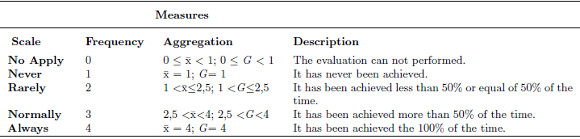
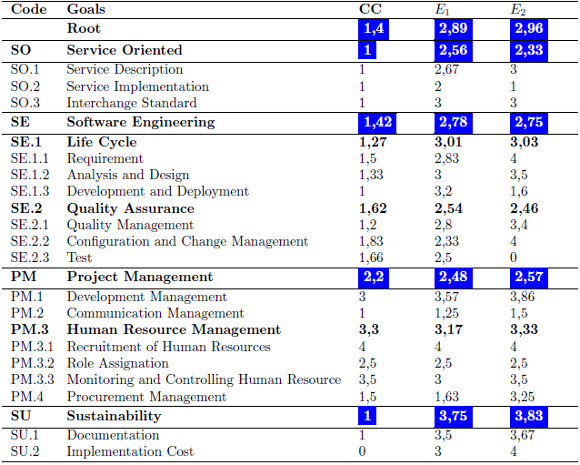
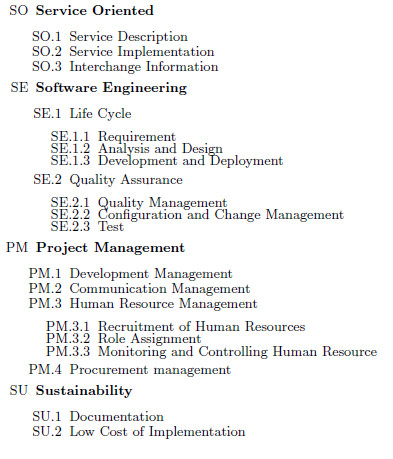
<body><![CDATA[<p class="noindent" >The Planning Phase describes how TME evaluation will be done and includes its goals, measures, scales, formulas, and steps. More specifically, it encompasses the following steps:    <h5 class="subsubsectionHead"><span class="titlemark">3.1.1   </span> <a   id="x1-400003.1.1"></a>Definition of Research Questions</h5> <!--l. 9-->    <p class="noindent" >The goal of this evaluation step is to identify the relevant questions that will be answered. <!--l. 11-->    <p class="indent" >   To do so, we focus on answering the following questions:      <ul class="itemize1">      <li class="itemize">Does TME cover the intrinsic features of the service oriented computing better than the previous      organization process?.      </li>      <li class="itemize">Does TME address the major characteristics of a software engineering process better than the previous      organization process?.                                                                                                                                                                                          </li>      <li class="itemize">Does TME address activities for project management better than the previous organization process?.      </li>      <li class="itemize">Does TME support the sustainability of applications better than the previous organization process?.</li>    </ul> <!--l. 18-->    <p class="noindent" >    <h5 class="subsubsectionHead"><span class="titlemark">3.1.2   </span> <a   id="x1-410003.1.2"></a>Definition of Measuring Goals</h5> <!--l. 20-->    <p class="noindent" >With the research questions defined, for each of these questions we proceed to define a set of goals using GQM technique <span class="cite">[<a  href="#X111">22</a><a id="br22">]</a></span>. GQM separates goals in sub-goals hierarchically, as a tree where the leaves are the metric-associated questions used to measure the goals&#8217; achievement. The major goals with their sub-goals are described as follows (see Table <a  href="#x1-410014">4<!--tex4ht:ref: table:TREE --></a>).     <div class="table">                                                                                                                                                                                     <!--l. 21-->    <p class="indent" >   <a   id="x1-410014"></a><hr class="float">    <div class="float"  >                                                                                                                                                                                          <div class="caption"  ><span class="id">Table&#x00A0;4: </span><span   class="content">Tree of Goals </span></div><!--tex4ht:label?: x1-410014 -->     ]]></body>
<body><![CDATA[<div class="pic-tabular"> <img  src="/img/revistas/cleiej/v18n1/1a04t4.jpg"></div>                                                                                                                                                                                        </div><hr class="endfloat" />    </div> <!--l. 78-->    <p class="noindent" ><span class="paragraphHead"><a   id="x1-420003.1.2"></a><span  class="cmbx-10">SO Service Oriented.</span></span>    Is related to intrinsic characteristics of service computing and data interchange issues. Its major sub-goals are the following:      <ul class="itemize1">      <li class="itemize"><span  class="cmbx-10">SO.1  Service  Description. </span>Examines  how  services,  relationships  among  services,  service  roles,      parameters, messages, service level agreements (SLA), and service composition are described.      </li>      <li class="itemize"><span  class="cmbx-10">SO.2  Service  Implementation.  </span>Finds  out  how  service  deployment,  service  publication,  and      enterprise service bus (ESB) are carried out.      </li>      <li class="itemize"><span  class="cmbx-10">SO.3 Interchange Information. </span>Inquires about the processes and data format defined to support      the interoperability among legacy systems.</li>    </ul> <!--l. 84-->    <p class="noindent" ><span class="paragraphHead"><a   id="x1-430003.1.2"></a><span  class="cmbx-10">SE Software Engineering.</span></span>    Involves the qualities that are required to be present for any software engineering process. Its major sub-goals are the following:      <ul class="itemize1">      <li class="itemize"><span  class="cmbx-10">SE.1 Life Cycle. </span>Covers the software life cycle from the conception of its original ideas until the software is      abandoned. The life cycle encompasses the following sub-goals:          <ol  class="enumerate1" >          <li    class="enumerate" id="x1-43001x3.1.2"><span  class="cmti-10">SE.1.1 Requirement. </span>Inquires on how the requirements are managed.          </li>          <li    class="enumerate" id="x1-43002x3.1.2"><span  class="cmti-10">SE.1.2 Analysis and Design. </span>Examines how the architecture of the software is designed and          documented.          </li>          <li    class="enumerate" id="x1-43003x3.1.2"><span  class="cmti-10">SE.1.3 Development and Deployment. </span>Ascertains how the construction and deployment of the          software are done.</li>    </ol>      </li>      <li class="itemize"><span  class="cmbx-10">SE.2 Quality Assurance. </span>Focuses on the quality of development process and work products, and it is      composed of the following sub-goals:          <ul class="itemize2">          <li class="itemize"><span  class="cmbx-10">SE.2.1 Quality Management. </span>Examines the quality of the development process; if the work          products have templates; if good practices of development are implemented.          </li>          <li class="itemize"><span  class="cmbx-10">SE.2.2 Configuration and Change Management. </span>Inquires how the changes are managed; if          the versions of the project assets are kept up, and they are updated when necessary.          </li>          <li class="itemize"><span  class="cmbx-10">SE.2.3 Test. </span>Inquires about the verification and validation of the software.</li>    </ul>      </li>    </ul>                                                                                                                                                                                     <!--l. 101-->    <p class="noindent" ><span class="paragraphHead"><a   id="x1-440003.1.2"></a><span  class="cmbx-10">PM Project Management.</span></span>    Involves the fundamental activities necessary to manage any type of project according to project management standard <span class="cite">[<a  href="#X124">8</a><a id="br8">]</a></span>. Its major sub-goals are the following:      <ul class="itemize1">      <li class="itemize"><span  class="cmbx-10">PM.1 Development Management. </span>Encompasses the Integration Management, Scope Management,      Time Management, and Cost Management of the standard of project management <span class="cite">[<a  href="#X124">8</a><a id="br8">]</a></span>. Consequently,      it verifies how these areas of processes are managed.      </li>      <li class="itemize"><span  class="cmbx-10">PM.2 Communication Management. </span>Ascertains how the communication is carried out among the      stakeholders, and how the information is distributed.      </li>      <li class="itemize"><span  class="cmbx-10">PM.3 Human Resource Management. </span>Verifies how staff is managed, and it includes the following      sub-goals.          <ol  class="enumerate1" >          <li    class="enumerate" id="x1-44001x3.1.2"><span  class="cmti-10">PM.3.1 Recruitment of Human Resources. </span>Verifies how the processes of recruitment, selection,          and hiring of human resources are done.          </li>          <li    class="enumerate" id="x1-44002x3.1.2"><span  class="cmti-10">PM.3.2 Role Assignment. </span>Ascertains whether the human resources know their responsibilities,          and the tasks that they have to carry out.          </li>          <li    class="enumerate" id="x1-44003x3.1.2"><span  class="cmti-10">PM.3.3 Monitoring and Controlling Human Resource. </span>Verifies if human resources are monitored,          and evaluated.</li>    </ol>      </li>      <li class="itemize"><span  class="cmbx-10">PM.4 Procurement Management. </span>Encompasses identifying, and selecting sellers as well as awarding      contracts. It also manages the relationship with sellers, while monitoring contract execution. It is referred not      only to infrastructure purchases, but also to outsourcing.</li>    </ul> <!--l. 113-->    ]]></body>
<body><![CDATA[<p class="noindent" ><span class="paragraphHead"><a   id="x1-450003.1.2"></a><span  class="cmbx-10">SU Sustainability</span></span>    is the capability of organizations to support long-term software maintenance <span class="cite">[<a  href="#X49">6</a><a id="br6">]</a></span>. Its major sub-goals are the following:      <ul class="itemize1">      <li class="itemize"><span  class="cmbx-10">SU.1 Documentation. </span>Examines if TME proposes models and documents to cover the different      aspects of the software development.      </li>      <li class="itemize"><span  class="cmbx-10">SU.2 Low Cost of Implementation. </span>Inquires about the strategies implemented to save development      costs.</li>    </ul> <!--l. 119-->    <p class="noindent" >    <h5 class="subsubsectionHead"><span class="titlemark">3.1.3   </span> <a   id="x1-460003.1.3"></a>Definition of Measures and Scales</h5> <!--l. 121-->    <p class="noindent" >Two types of measurements are done: direct and indirect. The former is used for leaves while the latter for the others. For each of theses types the following measures have been established: Frequency and Aggregation. These measures are described in Table <a  href="#x1-460015">5<!--tex4ht:ref: table:MED --></a>.     <div class="table">                                                                                                                                                                                     <!--l. 128-->    <p class="indent" >   <a   id="x1-460015"></a><hr class="float">    <div class="float"  >                                                                                                                                                                                          <div class="caption"  ><span class="id">Table&#x00A0;5: </span><span   class="content">Measures</span></div><!--tex4ht:label?: x1-460015 -->     <div class="pic-tabular"> <img  src="/img/revistas/cleiej/v18n1/1a04t5.jpg"></div>                                                                                                                                                                                        </div><hr class="endfloat" />    </div> <!--l. 155-->    <p class="indent" >   The scale of the Aggregation Measure encompasses the range of values that are interpreted as the degree of satisfaction for goal achievement. The interpretation of the Frequency and Aggregation Measures is shown in Table <a  href="#x1-460026">6<!--tex4ht:ref: table:INT --></a>.     ]]></body>
<body><![CDATA[<div class="table">                                                                                                                                                                                     <!--l. 156-->    <p class="indent" >   <a   id="x1-460026"></a><hr class="float">    <div class="float"  >                                                                                                                                                                                          <div class="caption"  ><span class="id">Table&#x00A0;6: </span><span   class="content">Interpretation of Frequency and Aggregation Measures </span></div><!--tex4ht:label?: x1-460026 -->     <div class="pic-tabular"> <img  src="/img/revistas/cleiej/v18n1/1a04t6.jpg" ></div>                                                                                                                                                                                        </div><hr class="endfloat" />    </div>    <h5 class="subsubsectionHead"><span class="titlemark">3.1.4   </span> <a   id="x1-470003.1.4"></a>Definition of Measurement Process</h5> <!--l. 176-->    <p class="noindent" >The leaves are the questions answered by practitioners. These are measured by giving it a value found in the Frequency Scale (see Table <a  href="#x1-460026">6<!--tex4ht:ref: table:INT --></a>). Once all the questions are answered, the value of non-leaves (goals and sub-goals) is calculated by finding out the arithmetic mean (<span class="bar-css">X</span>) obtained with Formula <a  href="#x1-47001r1">1<!--tex4ht:ref: e.1 --></a>. Thus, the value of a non-leaf is equal to the arithmetic mean calculated from its child nodes.    <table class="multicols" id="multicols-1"><tr><td class="multicol-1">    <table  class="equation"><tr><td>    <center class="math-display" > <img  src="/img/revistas/cleiej/v18n1/1a046x.png" alt="    &#x2211;n        ai ¯   k=0-- X =   n " class="math-display" ><a   id="x1-47001r1"></a></center></td><td class="equation-label">(1)</td></tr></table> <!--l. 181-->    <p class="nopar" > <br  class="newline" /><span  class="cmbxti-10">a </span><span  class="cmti-10">is the child node </span><br  class="newline" /><span  class="cmbxti-10">i </span><span  class="cmti-10">is the depth where the child node is located</span><br  class="newline" /><span  class="cmbxti-10">n </span><span  class="cmti-10">is the number of child nodes </span><br  class="newline" />    </td></tr></table> <!--l. 189-->    <p class="indent" >   Different practitioners can be interviewed for a given case study. Each of these practitioners responds a questionnaire that contains a set of questions that are grouped according to the goals of the tree of goals, and they aim to measure its achievement (see Table <a  href="#x1-410014">4<!--tex4ht:ref: table:TREE --></a>). The possible responses to each question is in a frequency scale (see Table <a  href="#x1-460026">6<!--tex4ht:ref: table:INT --></a>), as the example shown in Figure <a  href="#x1-470028">8<!--tex4ht:ref: CUE --></a> shows. <hr class="figure">    <div class="figure"  >                                                                                                                                                                                     <a   id="x1-470028"></a>                                                                                                                                                                                      <!--l. 194-->    <p class="noindent" ><img  src="/img/revistas/cleiej/v18n1/1a04f8.jpg" alt="PIC"   > <br />     ]]></body>
<body><![CDATA[<div class="caption"  ><span class="id">Figure&#x00A0;8: </span><span   class="content">Questionnaire Example</span></div><!--tex4ht:label?: x1-470028 -->                                                                                                                                                                                     <!--l. 195-->    <p class="indent" >   </div><hr class="endfigure"> <!--l. 197-->    <p class="indent" >   The questions chosen are matched with their numerical value in a measurement template. Figure <a  href="#x1-470039">9<!--tex4ht:ref: PLA --></a> shows the measurement template for the example of Figure <a  href="#x1-470028">8<!--tex4ht:ref: CUE --></a> that corresponds to the questionnaire <img  src="/img/revistas/cleiej/v18n1/1a047x.png" alt="E2  "  class="math" >. <hr class="figure">    <div class="figure"  >                                                                                                                                                                                     <a   id="x1-470039"></a>                                                                                                                                                                                      <!--l. 201-->    <p class="noindent" ><img  src="/img/revistas/cleiej/v18n1/1a04f9.jpg" alt="PIC"   > <br />     <div class="caption"  ><span class="id">Figure&#x00A0;9: </span><span   class="content">Template of Measurement Example </span></div><!--tex4ht:label?: x1-470039 -->                                                                                                                                                                                     <!--l. 202-->    <p class="indent" >   </div><hr class="endfigure"> <!--l. 204-->    <p class="indent" >   Using this the value of sub-goals, goals, dimensions, and total value are calculated. Finally, the total value of the case study is the upshot of combining the dimensions and the total value of all the questionnaires. The combination is done through obtaining the geometric mean (<span  class="cmti-10">G</span>) with Formula <a  href="#x1-47004r2">2<!--tex4ht:ref: e.2 --></a>.    <table class="multicols" id="multicols-2"><tr><td class="multicol-1">    <table  class="equation"><tr><td>    <center class="math-display" > <img  src="/img/revistas/cleiej/v18n1/1a048x.png" alt="    M&#x2218;--------------- G =   R1 * R2 * ...*RM " class="math-display" ><a   id="x1-47004r2"></a></center></td><td class="equation-label">(2)</td></tr></table> <!--l. 208-->    <p class="nopar" > <br  class="newline" /><span  class="cmbxti-10">G </span><span  class="cmti-10">is the geometric mean</span><br  class="newline" /><span  class="cmbxti-10">R </span><span  class="cmti-10">can be the value of the dimension or the total value </span><br  class="newline" /><span  class="cmbxti-10">M </span><span  class="cmti-10">is the number of individual questionnaires</span>    </td></tr></table> <!--l. 218-->    <p class="indent" >   The results of Formulas <a  href="#x1-47001r1">1<!--tex4ht:ref: e.1 --></a> and <a  href="#x1-47004r2">2<!--tex4ht:ref: e.2 --></a> are given using the Aggregation Scale (see Table <a  href="#x1-460026">6<!--tex4ht:ref: table:INT --></a>). <!--l. 220-->    ]]></body>
<body><![CDATA[<p class="indent" >   This linear model is very simple and will probably be replaced by a more powerful aggregation mechanism, like the Logic Scoring of Preference <span class="cite">[<a  href="#X138">23</a><a id="br23">]</a></span>. Moreover, according to the objective of the stakeholder it is possible to associate a priority or different weights to specific goal and /or any goal of the tree to better cover significant aspects for the assessment. Such differentiation accommodates the needs of assigning priorities to a specific aspects and a more sophisticated comparative analysis. However, we leave this consideration for future works.    <h4 class="subsectionHead"><span class="titlemark">3.2   </span> <a   id="x1-480003.2"></a>Execution Phase</h4> <!--l. 223-->    <p class="noindent" >The goal of this phase is the execution of the evaluation plan by running case studies. From the set of evaluation studies already performed for our case study, we will described the first one in the following section.    <h5 class="subsubsectionHead"><span class="titlemark">3.2.1   </span> <a   id="x1-490003.2.1"></a>Case Study: Information Exchange System (IES)</h5> <!--l. 225-->    <p class="noindent" >TME was first evaluated in a case study regarding an Information Exchange System (IES) developed in a public institution in Paraguay (PIP). The PIP was set up in April 2012 and, before using TME its development process used to be informal, according to the information collected from its quality analyst in October 2012. <!--l. 229-->    <p class="indent" >   The PIP used TME to manage the development of the IES, which had as its main goal the interoperability of legacy systems in public agency through the use of service-oriented computing. The operation of the mentioned IES is as follows: first, it consumes services from the providers; second, it integrates these services into a new single service; and thirdly, it provides this new service (see Figure&#x00A0;<a  href="#x1-170036">6<!--tex4ht:ref: EJ-SDF --></a>). It will take some years to complete the full development of the IES. Therefore, this first evaluation encompasses the period from October 2012 to March 2013.                                                                                                                                                                                     <!--l. 232-->    <p class="indent" >   During this period, four services were developed that exchanged citizens&#8217; data from five legacy systems that belonged to different public agencies. Each agency has a development team that is represented by a leader. The leader of the PIP is in charge of managing the communication among all leaders, and the PIP is responsible for defining the interoperability standards such as data format (see Figure&#x00A0;<a  href="#x1-170036">6<!--tex4ht:ref: EJ-SDF --></a>), request process and to access to a service etc. The development team is in charge of services development for the owner of the legacy systems (provider or consumer). At the moment, there are three consumers, but this number is planned to increase in the future. <!--l. 237-->    <p class="indent" >   There have been six teams in charge of developing the IES. However, our analysis only involves the PIP team that was composed of a project manager, a leader, an architect, a quality analyst, and three developers. The project manager and one of the developers have a degree in computer sciences; the leader, the architect, the quality analyst, and one of the developers are system engineers; one developer is a student; and finally, the quality analyst is a Ph.D. student. <!--l. 239-->    <p class="indent" >   As far as professional experience is concerned, the project manager, the leader, the architect, the quality analyst, and one of the developer have been working in diverse projects, for more than ten years. One developer worked in a project before the IES, while for the other developer this is its first work. <!--l. 241-->    <p class="indent" >   The first part of the IES development was financed by a sponsor who monitored the development and demanded that his own quality standards to be followed. The sponsor support lasted until March of 2013. <!--l. 243-->    <p class="indent" >   The IES construction was delayed several times before due to some external factors such as political reasons, lack of a law that regulates exchange of sensitive data, and staff changes. The regulating of exchange of sensitive data was only passed on January 2013, which facilitated the decision making regarding the system. <!--l. 245-->    <p class="noindent" ><span class="paragraphHead"><a   id="x1-500003.2.1"></a><span  class="cmbx-10">Definition of the Assessment Scope.</span></span>    The evaluation encompassed from the Inception Phase to the Transition Phase, over the course of six months. Focusing above all in the interoperability of legacy systems that can belong to different public agencies, the project management, and the sustainability of the project. <!--l. 248-->    ]]></body>
<body><![CDATA[<p class="indent" >   Since we were able to implement TME only in the PIP, the assessment considers only this agency. <!--l. 250-->    <p class="indent" >   The interviewees where selected according to their knowledge on the whole process proposed by TME. Furthermore, it was required that they were part of the IES team of during the period from October 2012 to March 2013. Only the team leader and the quality analyst fulfilled these requirements. <!--l. 251-->    <p class="noindent" ><span class="paragraphHead"><a   id="x1-510003.2.1"></a><span  class="cmbx-10">Data Collection.</span></span>    The questions associated to each goal or sub-goal were presented in a questionnaire that was answered by the case study participants. <!--l. 253-->    <p class="indent" >   The questionnaires were then sorted out in Control or Experimental categories, according to the process that they report on. The control questionnaires were answered by the control group, these inform about the process of development before applying TME in the PIP. The experimental questionnaires were answered by the experimental group (i.e the team leader and quality analyst) and they measure TME&#8217;s performance. <!--l. 257-->    <p class="indent" >   The questionnaire used for this case study is composed of 83 questions that measure 20 sub-goals. The questionnaire is written in the local language (Spanish), and it takes 20 minutes approximately to be filled by the practitioners. An example of the format of the questionnaires is shown in Figure <a  href="#x1-470028">8<!--tex4ht:ref: CUE --></a>. We assign a numeric value in the Frequency scale to each response of the questionnaire. Having completed the questionnaire, the numeric value of each selected response is registered in a template to calculate the results (see Figure <a  href="#x1-470039">9<!--tex4ht:ref: PLA --></a>). The control questionnaire (CC) was answered by the quality analyst before applying TME. After six months of TME implementation, its performance was examined from the viewpoint of team leader (<img  src="/img/revistas/cleiej/v18n1/1a049x.png" alt="E1  "  class="math" >) and the quality analyst (<img  src="/img/revistas/cleiej/v18n1/1a0410x.png" alt="E2  "  class="math" >) who filled in the experimental questionnaires. <!--l. 263-->    <p class="indent" >   It is worth noting that for the purpose of this study all the goals and sub-goals have the same weight. However, according to the stakeholder&#8217;s objectives of the TME allows to assign different weight to specific goal and/or any goal of the tree.                                                                                                                                                                                     <!--l. 264-->    <p class="noindent" ><span class="paragraphHead"><a   id="x1-520003.2.1"></a><span  class="cmbx-10">Measuring Process.</span></span>    Once the questionnaires were completed, their responses were matched to the values of the Frequency Measure (see Table <a  href="#x1-460026">6<!--tex4ht:ref: table:INT --></a>). Subsequently, the values of goals and sub-goals were obtained according to the process defined in Section <a  href="#x1-470003.1.4">3.1.4<!--tex4ht:ref: 'PP' --></a>. <!--l. 266-->    <p class="indent" >   As the questionnaires are clustered by type, next step was to follow the process defined in Section <a  href="#x1-470003.1.4">3.1.4<!--tex4ht:ref: 'PP' --></a>. <!--l. 268-->    <p class="indent" >   According to the range of values in which the numerical results are to be interpreted, these were matched to the scale of Aggregation Measure. The tree of goals with the results of the three questionnaires (i.e, 1 before TME and 2 after adopting TME) is shown in Table <a  href="#x1-520017">7<!--tex4ht:ref: table:EVA-SII --></a>. Note that the results are in aggregation measure, and the questions (which are measured in frequency measure) are not presented. <!--l. 271-->    <p class="indent" >   The results for each dimension in Aggregation Measure are shown in Table <a  href="#x1-520028">8<!--tex4ht:ref: table:RES-SII --></a>, and the final result is &#8220;Normally&#8221;.     ]]></body>
<body><![CDATA[<div class="table">                                                                                                                                                                                     <!--l. 279-->    <p class="indent" >   <a   id="x1-520017"></a><hr class="float">    <div class="float"  >                                                                                                                                                                                          <div class="caption"  ><span class="id">Table&#x00A0;7: </span><span   class="content">The tree of goals with the results of the three questionnaires </span></div><!--tex4ht:label?: x1-520017 -->     <div class="pic-tabular"> <img  src="/img/revistas/cleiej/v18n1/1a04t7.jpg" ></div>                                                                                                                                                                                        </div><hr class="endfloat" />    </div>        <div class="table">                                                                                                                                                                                     <!--l. 326-->    <p class="indent" >   <a   id="x1-520028"></a><hr class="float">    <div class="float"  >                                                                                                                                                                                          <div class="caption"  ><span class="id">Table&#x00A0;8: </span><span   class="content">Upshot of Dimensions </span></div><!--tex4ht:label?: x1-520028 -->     <div class="pic-tabular"> <img  src="/img/revistas/cleiej/v18n1/1a04t8.jpg" ></div>                                                                                                                                                                                        </div><hr class="endfloat" />    </div>    <h4 class="subsectionHead"><span class="titlemark">3.3   </span> <a   id="x1-530003.3"></a>Assessment Validity</h4> <!--l. 350-->    ]]></body>
<body><![CDATA[<p class="noindent" >The IES mentioned in this study is the first service-based application implemented in the public sector in Paraguay. For this reason, we could not compare TME with another development process for service-based application in the same context. <!--l. 353-->    <p class="indent" >   Since the questionnaires are the tool used to measure the achievement of the goals, their reliability affect the validity of the evaluation. For this reason, they have been elaborated to embrace all the aspects related with the goals and their questions strive to be accurate and easy to understand. It is also important to note that the validity is constrained by the skills and perception of the interviewees. <!--l. 355-->    <p class="indent" >   Another limitation is that only two persons were interviewed. Even though these two persons are considered proficient professional, and they have been in charge of important projects in public and private sector in Paraguay.    <h4 class="subsectionHead"><span class="titlemark">3.4   </span> <a   id="x1-540003.4"></a>Analysis Phase</h4> <!--l. 358-->    <p class="noindent" >Even though one study is not enough to support a strong claim, independent observers have managed to observe improvements in their processes due the use of TME. <!--l. 360-->    <p class="indent" >   It is worth mentioning that almost all the dimensions achieved the value &#8220;Normally&#8221;, and particularly the Sustainability goal achieved values very close to &#8220;Always&#8221; (see Table <a  href="#x1-520028">8<!--tex4ht:ref: table:RES-SII --></a>): <!--l. 361-->    <p class="noindent" ><span class="paragraphHead"><a   id="x1-550003.4"></a><span  class="cmbx-10">Service Oriented Dimension.</span></span>    The score given to this dimension is &#8220;Rarely&#8221;, this means that less than the 50% of the time, the suggestions of TME have not been observed (see Table <a  href="#x1-520028">8<!--tex4ht:ref: table:RES-SII --></a>). Nevertheless, if we consider its the numerical value of &#8220;2,44&#8221; we can appreciate that it is quite close to &#8220;2,5&#8221; that represents &#8220;Normally&#8221;. <!--l. 364-->    <p class="indent" >   Even though TME suggests signing the Service Level Agreement (SLA), having a service repository (UDDI), and implementing techniques for concepts unification; they have not been implemented by the PIP (see Table <a  href="#x1-80031">1<!--tex4ht:ref: table:TAP-MBO --></a>). Table <a  href="#x1-520017">7<!--tex4ht:ref: table:EVA-SII --></a> shows that the &#8220;Service Implementation&#8221; is the weakest goal of this dimension. Moreover, the quality analyst did not give an answer on the &#8220;Service Implementation&#8221;, because she did not participate in the development. <!--l. 368-->    <p class="indent" >   Previous processes of the PIP have obtained a &#8220;Never&#8221; mark, so when comparing this with the &#8220;Rarely&#8221; mark obtained through TME, we can observe that TME has improved the development process of the PIP in response to the question research &#8220;Q.1&#8221;. <!--l. 369-->    <p class="noindent" ><span class="paragraphHead"><a   id="x1-560003.4"></a><span  class="cmbx-10">Software Engineering Dimension.</span></span>    There are different responses in Requirement and Configuration, and Change Management due to practices and documents proposed to them; but they have not always been considered by the developers. <!--l. 372-->    <p class="indent" >   The quality analyst suggested to follow certain standards during the development, but it was not her responsibility to guarantee that the developers really followed the suggested standards. <!--l. 374-->    ]]></body>
<body><![CDATA[<p class="indent" >   Testing has not always been carried out by other people besides developers and there was not a responsible person for accepting the development before deploying. Besides, verification and validation practices were not suggested at that moment. <!--l. 376-->    <p class="indent" >   This dimension has obtained the mark &#8220;Normally&#8221;, which means that more than the 50% of the time the suggestions of TME in the &#8220;Software Engineering&#8221; area have been observed. This result suggests that TME has improved the previous process of the PIP, considering the question research &#8220;Q.2&#8221; (see Table <a  href="#x1-520028">8<!--tex4ht:ref: table:RES-SII --></a>). <!--l. 377-->    <p class="noindent" ><span class="paragraphHead"><a   id="x1-570003.4"></a><span  class="cmbx-10">Project Management Dimension.</span></span>    Various processes and documents were not followed and completed because they were unknown by the majority of the staff due to a fault in Communication Management. This situation is reflected in the very low score in &#8220;Communication Management&#8221;, and affected the Role Assignation because some members of the team were not                                                                                                                                                                                     notified about their responsibilities. <!--l. 381-->    <p class="indent" >   Part of the IES development was outsourced, and the contract with the provider was signed before applying TME. For this reason, several of TME&#8217;s suggestions were not been considered. <!--l. 382-->    <p class="noindent" ><span class="paragraphHead"><a   id="x1-580003.4"></a><span  class="cmbx-10">Sustainability Dimension.</span></span>    Even though the models were not easily understandable to some of the staff, the documentation was usually updated. <!--l. 385-->    <p class="indent" >   The PIP determined that all the tools used for developing IES should be open source. These tools include database, programming language, modelling language, project management software, version control software, etc. Moreover, TME includes standard notation such as UML and BPMN. <!--l. 387-->    <p class="indent" >   However, the lack of documentation of the applications developed at the PIP before applying TME has hindered their maintenance. <!--l. 389-->    <p class="indent" >   Since the previous process of the PIP obtained the &#8220;Never&#8221; mark, when comparing it to the &#8220;Normally&#8221; mark obtained with TME we can consider that it has become more sustainable than the previous process in response to research question &#8220;Q.4&#8221; (see Table <a  href="#x1-520028">8<!--tex4ht:ref: table:RES-SII --></a>).    <h3 class="sectionHead"><span class="titlemark">4   </span> <a   id="x1-590004"></a>Ongoing works and Conclusion</h3> <!--l. 2-->    <p class="noindent" >Among the various Agile Methods, OpenUP has been chosen to be the baseline of Tape Mbo&#8217;e (TME). Furthermore, TME is a service oriented process that modified the life cycle and the disciplines of OpenUP. The former covers the maintenance and retirement of systems while the latter includes the service oriented computing features, the quality assurance, and improvements to the project management. These changes have affected the definition of roles and work products as well. Consequently, TME introduces new roles, gives up some existent roles, and includes new work products. <!--l. 4-->    <p class="indent" >   On the one hand, TME aims at proposing a general process. For this reason, the processes for addressing more specific aspects such as the publication of services on the service repositories have not been included by this version of TME. It is worth noting that TME is not a methodology, consequently, specific aspects like techniques for service identification, criteria for reusing functionalities, metrics to measure the complexity of the development, etc. are not presented here. However, as mentioned in section <a  href="#x1-80002.3">2.3<!--tex4ht:ref: 'DIS' --></a> for service identification, TME consider the adoption of other existing proposal. <!--l. 7-->    ]]></body>
<body><![CDATA[<p class="indent" >   To evaluate the TME, we prepared an evaluation plan that is described in Section <a  href="#x1-380003">3<!--tex4ht:ref: 'EVA' --></a>. This plan includes goals, measures, and scales. In addition, it applies Goal-Question Metric to organize the overall observation structure and guide the case studies execution. <!--l. 9-->    <p class="indent" >   This paper has presented the results of the first case study evaluated with the TME plan, which is also the first application of rigorous experimental evaluation in the public sector in Paraguay. The case study is the Information Exchange System (IES) which belongs to a public Paraguayan agency. The development of IES had been addressed using TME and its performance was assessed. In the evaluation TME has demonstrated to contribute to the agency&#8217;s improvement when compared to the previous process as it is shown in Section <a  href="#x1-540003.4">3.4<!--tex4ht:ref: 'ANY' --></a>. <!--l. 13-->    <p class="indent" >   The assessment of other case studies is still on going. These represent the experiences of using TME in different public and private organizations in Paraguay. The results of those case studies are currently being integrated by using meta-analysis (non-parametric aggregation) through Vote Counting <span class="cite">[<a  href="#X129">24</a><a id="br24">]</a></span>. Since this paper intended to discuss just one of these case studies, the use of vote counting is not feasible. <!--l. 15-->    <p class="indent" >   As future work we are going to present the results of assessing TME with vote counting. In addition, in order to outfit TME with a set of suggestions about existing techniques, we have researched about techniques for service identification and criteria for their selection, techniques to estimate the project size, criteria to reuse existing assets, etc. <!--l. 18-->    <p class="indent" >   The contributions of this paper are the description of the evaluation plan and its application to the first assessment of TME&#8217;s performance in a real case study in Paraguay.                                                                                                                                                                                     <!--l. 2-->    <p class="noindent" >    <h3 class="likesectionHead"><a   id="x1-600004"></a>References</h3> <!--l. 2-->    <p class="noindent" >         <div class="thebibliography">         <p class="bibitem" ><span class="biblabel">   [<a href="#br1">1</a>]<span class="bibsp">&#x00A0;&#x00A0;&#x00A0;</span></span><a   id="X126"></a>V.&#x00A0;Andrikopoulos,  A.&#x00A0;Bucchiarone,  E.&#x00A0;D.  Nitto,  R.&#x00A0;Kazhamiakin,  S.&#x00A0;Lane,  V.&#x00A0;Mazza,  and     I.&#x00A0;Richardson, &#8220;Service engineering,&#8221; in <span  class="cmti-10">S-CUBE Book</span>, 2010, pp. 271&#8211;337.     </p>         <p class="bibitem" ><span class="biblabel">   [<a href="#br2">2</a>]<span class="bibsp">&#x00A0;&#x00A0;&#x00A0;</span></span><a   id="X125"></a>S.&#x00A0;Lane  and  I.&#x00A0;Richardson,  &#8220;Process  models  for  service-based  applications:  A  systematic     literature review,&#8221; <span  class="cmti-10">Inf. Softw. Technol.</span>, vol.&#x00A0;53, no.&#x00A0;5, pp. 424&#8211;439, May 2011. [Online]. Available:     <a  href="http://dx.doi.org/10.1016/j.infsof.2010.12.005" class="url" >http://dx.doi.org/10.1016/j.infsof.2010.12.005</a>     </p>         ]]></body>
<body><![CDATA[<p class="bibitem" ><span class="biblabel">   [<a href="#br3">3</a>]<span class="bibsp">&#x00A0;&#x00A0;&#x00A0;</span></span><a   id="X127"></a>I.&#x00A0;Grau, L.&#x00A0;Cernuzzi, and A.&#x00A0;Villafiorita, &#8220;Analysing service oriented methodologies for sustainable     applications,&#8221; in <span  class="cmti-10">The 32nd International Conference of the Chilean Computer Science Society (SCCC)</span>,     November 2013.     </p>         <p class="bibitem" ><span class="biblabel">   [<a href="#br4">4</a>]<span class="bibsp">&#x00A0;&#x00A0;&#x00A0;</span></span><a   id="X128"></a>I.&#x00A0;M. Grau, L.&#x00A0;Cernuzzi, and A.&#x00A0;Villafiorita, &#8220;Tape Mbo&#8217;e TME: A service oriented process,&#8221; in     <span  class="cmti-10">The 32nd International Conference of the Chilean Computer Science Society (SCCC)</span>, November 2013.     </p>         <p class="bibitem" ><span class="biblabel">   [<a href="#br5">5</a>]<span class="bibsp">&#x00A0;&#x00A0;&#x00A0;</span></span><a   id="X133"></a>I.&#x00A0;Grau,  G.&#x00A0;Travassos,  L.&#x00A0;Cernuzzi,  and  A.&#x00A0;Villafiorita,  &#8220;Tape  Mbo&#8217;e:  A  first  experimental     assessment,&#8221;  in  <span  class="cmti-10">Actas  del  XVII  Congreso  Iberoamericano  en  Software  Engineering,  CIbSE  2014,</span>     <span  class="cmti-10">(Experimental Software Engineering Latin American Workshop - ESELAW)</span>, April 2014.     </p>         <p class="bibitem" ><span class="biblabel">   [<a href="#br6">6</a>]<span class="bibsp">&#x00A0;&#x00A0;&#x00A0;</span></span><a   id="X49"></a>B.&#x00A0;Eshete,  A.&#x00A0;Mattioli,  A.&#x00A0;Villafiorita,  and  K.&#x00A0;Weldemariam,  &#8220;ICT  for  Good:  Opportunities,     Challenges and the Way Forward,&#8221; in <span  class="cmti-10">Fourth International Conference on Digital Society, 2010. ICDS</span>     <span  class="cmti-10">&#8217;10.</span>, feb. 2010, pp. 14&#8211;19.     </p>         <p class="bibitem" ><span class="biblabel">   [<a href="#br7">7</a>]<span class="bibsp">&#x00A0;&#x00A0;&#x00A0;</span></span><a   id="X20"></a>I.&#x00A0;Christou,  S.&#x00A0;Ponis,  and  E.&#x00A0;Palaiologou,  &#8220;Using  the  agile  unified  process  in  banking,&#8221;  <span  class="cmti-10">IEEE</span>     <span  class="cmti-10">Software</span>, vol.&#x00A0;27, pp. 72&#8211;79, may-june 2010.     </p>         <p class="bibitem" ><span class="biblabel">   [<a href="#br8">8</a>]<span class="bibsp">&#x00A0;&#x00A0;&#x00A0;</span></span><a   id="X124"></a><span  class="cmti-10">A Guide to the project management body of knowledge</span>.   Project Management Institute, Inc, 2008.     </p>         <p class="bibitem" ><span class="biblabel">   [<a href="#br9">9</a>]<span class="bibsp">&#x00A0;&#x00A0;&#x00A0;</span></span><a   id="X47"></a>K.&#x00A0;Schwaber, <span  class="cmti-10">Agile Project Management With Scrum</span>.  Redmond, WA, USA: Microsoft Press, 2004.     </p>         <p class="bibitem" ><span class="biblabel">  [<a href="#br10">10</a>]<span class="bibsp">&#x00A0;&#x00A0;&#x00A0;</span></span><a   id="X105"></a>P.&#x00A0;Deemer and G.&#x00A0;Benefield, &#8220;The scrum primer. An introduction to agile project management     with Scrum,&#8221; 2007. [Online]. Available: <a  href="http://www.rallydev.com/documents/scrumprimer.pdf" class="url" >http://www.rallydev.com/documents/scrumprimer.pdf</a>                                                                                                                                                                                         </p>         <p class="bibitem" ><span class="biblabel">  [<a href="#br11">11</a>]<span class="bibsp">&#x00A0;&#x00A0;&#x00A0;</span></span><a   id="X13"></a>S.&#x00A0;Ambler, <span  class="cmti-10">Agile Modeling: Effective Practices for eXtreme Programming and the Unified Process</span>.     New York, NY, USA: John Wiley &amp; Sons, Inc., 2002.     </p>         <p class="bibitem" ><span class="biblabel">  [<a href="#br12">12</a>]<span class="bibsp">&#x00A0;&#x00A0;&#x00A0;</span></span><a   id="X106"></a>K.&#x00A0;Beck  and  C.&#x00A0;Andres,  <span  class="cmti-10">Extreme Programming Explained: Embrace Change</span>.     Addison-Wesley     Professional, 2004.     </p>         ]]></body>
<body><![CDATA[<p class="bibitem" ><span class="biblabel">  [<a href="#br13">13</a>]<span class="bibsp">&#x00A0;&#x00A0;&#x00A0;</span></span><a   id="X137"></a>P.&#x00A0;Abrahamsson, O.&#x00A0;Salo, J.&#x00A0;Ronkainen, and J.&#x00A0;Warsta, &#8220;Agile software development methods -     review and analysis,&#8221; VTT PUBLICATIONS, Tech. Rep. 478, 2002.     </p>         <p class="bibitem" ><span class="biblabel">  [<a href="#br14">14</a>]<span class="bibsp">&#x00A0;&#x00A0;&#x00A0;</span></span><a   id="X3"></a>A.&#x00A0;Arsanjani,  S.&#x00A0;Ghosh,  A.&#x00A0;Allam,  T.&#x00A0;Abdollah,  S.&#x00A0;Gariapathy,  and  K.&#x00A0;Holley,  &#8220;SOMA:  a     method for developing service-oriented solutions,&#8221; <span  class="cmti-10">IBM Systems Journal</span>, vol.&#x00A0;47, pp. 377&#8211;396, July     2008. [Online]. Available: <a  href="http://dx.doi.org/10.1147/sj.473.0377" class="url" >http://dx.doi.org/10.1147/sj.473.0377</a>     </p>         <p class="bibitem" ><span class="biblabel">  [<a href="#br15">15</a>]<span class="bibsp">&#x00A0;&#x00A0;&#x00A0;</span></span><a   id="X5"></a>Y.&#x00A0;Tian, Y.&#x00A0;Su, and X.&#x00A0;Zhuang, &#8220;Research on service identification methods based on SOA,&#8221; in     <span  class="cmti-10">2010 3rd International Conference on Advanced Computer Theory and Engineering (ICACTE)</span>, vol.&#x00A0;6,     Aug. 2010, pp. V6&#8211;27 &#8211; V6&#8211;31.     </p>         <p class="bibitem" ><span class="biblabel">  [<a href="#br16">16</a>]<span class="bibsp">&#x00A0;&#x00A0;&#x00A0;</span></span><a   id="X28"></a>N.&#x00A0;Zhou, L.&#x00A0;Zhang, Y.&#x00A0;Chee, and L.&#x00A0;Chen, &#8220;Legacy asset analysis and integration in model-driven     soa solution,&#8221; in <span  class="cmti-10">2010 IEEE International Conference on Services Computing (SCC)</span>, ser. SCC &#8217;10,     Washington, DC, USA, july 2010, pp. 554&#8211;561.     </p>         <p class="bibitem" ><span class="biblabel">  [<a href="#br17">17</a>]<span class="bibsp">&#x00A0;&#x00A0;&#x00A0;</span></span><a   id="X101"></a>L.&#x00A0;Zhang, A.&#x00A0;Arsanjani, A.&#x00A0;Allam, D.&#x00A0;Lu, and Y.&#x00A0;Chee, &#8220;Variation oriented analysis for SOA     solution design,&#8221; in <span  class="cmti-10">IEEE SCC</span>.   IEEE Computer Society, 2007, pp. 560&#8211;568.     </p>         <p class="bibitem" ><span class="biblabel">  [<a href="#br18">18</a>]<span class="bibsp">&#x00A0;&#x00A0;&#x00A0;</span></span><a   id="X103"></a>K.&#x00A0;Levi  and  A.&#x00A0;Arsanjani,  &#8220;A  goal-driven  approach  to  enterprise  component  identification     and  specification,&#8221;  <span  class="cmti-10">Commun.  ACM</span>,  vol.&#x00A0;45,  no.&#x00A0;10,  pp.  45&#8211;52,  Oct  2002.  [Online].  Available:     <a  href="http://doi.acm.org/10.1145/570907.570930" class="url" >http://doi.acm.org/10.1145/570907.570930</a>     </p>         <p class="bibitem" ><span class="biblabel">  [<a href="#br19">19</a>]<span class="bibsp">&#x00A0;&#x00A0;&#x00A0;</span></span><a   id="X100"></a>V.&#x00A0;de&#x00A0;Castro,  E.&#x00A0;Marcos,  and  B.&#x00A0;Vela,  &#8220;Representing  WSDL  with  extended  UML,&#8221;  <span  class="cmti-10">Revista</span>     <span  class="cmti-10">Colombiana de Computaci</span><span  class="cmti-10">ón - RCC</span>, 2004.     </p>         <p class="bibitem" ><span class="biblabel">  [<a href="#br20">20</a>]<span class="bibsp">&#x00A0;&#x00A0;&#x00A0;</span></span><a   id="X69"></a>W.&#x00A0;T. Tsai, X.&#x00A0;Zhou, Y.&#x00A0;Chen, B.&#x00A0;Xiao, R.&#x00A0;Paul, and W.&#x00A0;Chu, &#8220;Roadmap to a full service broker     in service-oriented architecture,&#8221; in <span  class="cmti-10">Proceedings of the IEEE International Conference on e-Business</span>     <span  class="cmti-10">Engineering</span>, ser. ICEBE &#8217;07.   Washington, DC, USA: IEEE Computer Society, 2007, pp. 657&#8211;660.     [Online]. Available: <a  href="http://dx.doi.org/10.1109/ICEBE.2007.95" class="url" >http://dx.doi.org/10.1109/ICEBE.2007.95</a>                                                                                                                                                                                         </p>         <p class="bibitem" ><span class="biblabel">  [<a href="#br21">21</a>]<span class="bibsp">&#x00A0;&#x00A0;&#x00A0;</span></span><a   id="X132"></a>L.&#x00A0;Cernuzzi and G.&#x00A0;Rossi, &#8220;On the evaluation of agent oriented modeling methods,&#8221; in <span  class="cmti-10">Proceedings</span>     <span  class="cmti-10">of Agent Oriented Methodology Workshop</span>, 2002, pp. 21&#8211;30.     </p>         <p class="bibitem" ><span class="biblabel">  [<a href="#br22">22</a>]<span class="bibsp">&#x00A0;&#x00A0;&#x00A0;</span></span><a   id="X111"></a>V.&#x00A0;Basili and D.&#x00A0;Weiss, &#8220;A methodology for collecting valid software engineering data,&#8221; <span  class="cmti-10">Software</span>     <span  class="cmti-10">Engineering, IEEE Transactions on</span>, vol. SE-10, no.&#x00A0;6, pp. 728&#8211;738, 1984.     </p>         ]]></body>
<body><![CDATA[<p class="bibitem" ><span class="biblabel">  [<a href="#br23">23</a>]<span class="bibsp">&#x00A0;&#x00A0;&#x00A0;</span></span><a   id="X138"></a>J.&#x00A0;J. Dujmovi&#8217;c, &#8220;The LSP method for evaluation and selection of computer and communication     equipment,&#8221; in <span  class="cmti-10">Proceedings of MELECON&#8217;87, Mediterranean Electro technical Conference and 34th</span>     <span  class="cmti-10">Conference on Electronics, IEEE/RIENA</span>, 1987, pp. 251&#8211;254.     </p>         <p class="bibitem" ><span class="biblabel">  [<a href="#br24">24</a>]<span class="bibsp">&#x00A0;&#x00A0;&#x00A0;</span></span><a   id="X129"></a>G.&#x00A0;V. Glass, &#8220;Primary, secondary, and meta-analysis of research,&#8221; <span  class="cmti-10">Educational Researcher</span>, vol.&#x00A0;5,     no.&#x00A0;10, pp. 3&#8211;8, 1976. [Online]. Available: <a  href="http://dx.doi.org/10.2307/1174772" class="url" >http://dx.doi.org/10.2307/1174772</a> </p>     </div>           ]]></body><back>
<ref-list>
<ref id="B1">
<label>1</label><nlm-citation citation-type="">
<person-group person-group-type="author">
<name>
<surname><![CDATA[Andrikopoulos]]></surname>
<given-names><![CDATA[V.]]></given-names>
</name>
<name>
<surname><![CDATA[Bucchiarone]]></surname>
<given-names><![CDATA[A]]></given-names>
</name>
<name>
<surname><![CDATA[Nitto]]></surname>
<given-names><![CDATA[E. D.]]></given-names>
</name>
<name>
<surname><![CDATA[Kazhamiakin]]></surname>
<given-names><![CDATA[R.]]></given-names>
</name>
<name>
<surname><![CDATA[Lane]]></surname>
<given-names><![CDATA[S.]]></given-names>
</name>
<name>
<surname><![CDATA[Mazza]]></surname>
<given-names><![CDATA[V.]]></given-names>
</name>
<name>
<surname><![CDATA[Richardson]]></surname>
<given-names><![CDATA[I.]]></given-names>
</name>
</person-group>
<article-title xml:lang="en"><![CDATA[Service engineering]]></article-title>
<source><![CDATA[S-CUBE Book]]></source>
<year>2010</year>
<page-range>271-337</page-range></nlm-citation>
</ref>
<ref id="B2">
<label>2</label><nlm-citation citation-type="journal">
<person-group person-group-type="author">
<name>
<surname><![CDATA[Lane]]></surname>
<given-names><![CDATA[S.]]></given-names>
</name>
<name>
<surname><![CDATA[Richardson]]></surname>
<given-names><![CDATA[I.]]></given-names>
</name>
</person-group>
<article-title xml:lang="en"><![CDATA[Process models for service-based applications: A systematic literature review]]></article-title>
<source><![CDATA[Inf. Softw. Technol]]></source>
<year>May </year>
<month>20</month>
<day>11</day>
<volume>53</volume>
<numero>5</numero>
<issue>5</issue>
<page-range>424-439</page-range></nlm-citation>
</ref>
<ref id="B3">
<label>3</label><nlm-citation citation-type="confpro">
<person-group person-group-type="author">
<name>
<surname><![CDATA[Grau]]></surname>
<given-names><![CDATA[I.]]></given-names>
</name>
<name>
<surname><![CDATA[Cernuzzi]]></surname>
<given-names><![CDATA[L.]]></given-names>
</name>
<name>
<surname><![CDATA[Villafiorita]]></surname>
<given-names><![CDATA[A.]]></given-names>
</name>
</person-group>
<article-title xml:lang="en"><![CDATA[Analysing service oriented methodologies for sustainable applications]]></article-title>
<source><![CDATA[]]></source>
<year></year>
<conf-name><![CDATA[32nd International Conference of the Chilean Computer Science Society (SCCC)]]></conf-name>
<conf-date>November 2013</conf-date>
<conf-loc> </conf-loc>
</nlm-citation>
</ref>
<ref id="B4">
<label>4</label><nlm-citation citation-type="confpro">
<person-group person-group-type="author">
<name>
<surname><![CDATA[Grau]]></surname>
<given-names><![CDATA[I. M.]]></given-names>
</name>
<name>
<surname><![CDATA[Cernuzzi]]></surname>
<given-names><![CDATA[L.]]></given-names>
</name>
<name>
<surname><![CDATA[Villafiorita]]></surname>
<given-names><![CDATA[A.]]></given-names>
</name>
</person-group>
<article-title xml:lang="en"><![CDATA['Tape Mbo’e TME: A service oriented process]]></article-title>
<source><![CDATA[]]></source>
<year></year>
<conf-name><![CDATA[32nd International Conference of the Chilean Computer Science Society (SCCC)]]></conf-name>
<conf-date>November 2013</conf-date>
<conf-loc> </conf-loc>
</nlm-citation>
</ref>
<ref id="B5">
<label>5</label><nlm-citation citation-type="confpro">
<person-group person-group-type="author">
<name>
<surname><![CDATA[Grau]]></surname>
<given-names><![CDATA[I.]]></given-names>
</name>
<name>
<surname><![CDATA[Travassos]]></surname>
<given-names><![CDATA[G.]]></given-names>
</name>
<name>
<surname><![CDATA[Cernuzzi]]></surname>
<given-names><![CDATA[L.]]></given-names>
</name>
<name>
<surname><![CDATA[Villafiorita]]></surname>
<given-names><![CDATA[A.]]></given-names>
</name>
</person-group>
<article-title xml:lang="en"><![CDATA[Tape Mbo’e: A first experimental assessment]]></article-title>
<source><![CDATA[]]></source>
<year></year>
<conf-name><![CDATA[ Actas del XVII Congreso Iberoamericano en Software Engineering, CIbSE]]></conf-name>
<conf-date>April 2014</conf-date>
<conf-loc> </conf-loc>
</nlm-citation>
</ref>
<ref id="B6">
<label>6</label><nlm-citation citation-type="confpro">
<person-group person-group-type="author">
<name>
<surname><![CDATA[Eshete]]></surname>
<given-names><![CDATA[B.]]></given-names>
</name>
<name>
<surname><![CDATA[Mattioli]]></surname>
<given-names><![CDATA[A.]]></given-names>
</name>
<name>
<surname><![CDATA[Villafiorita]]></surname>
<given-names><![CDATA[A.]]></given-names>
</name>
<name>
<surname><![CDATA[Weldemariam]]></surname>
<given-names><![CDATA[K.]]></given-names>
</name>
</person-group>
<article-title xml:lang="en"><![CDATA[ICT for Good: Opportunities, Challenges and the Way Forward]]></article-title>
<source><![CDATA[]]></source>
<year></year>
<conf-name><![CDATA[Fourth International Conference on Digital Society, 2010. ICDS ’10]]></conf-name>
<conf-date>feb. 2010</conf-date>
<conf-loc> </conf-loc>
</nlm-citation>
</ref>
<ref id="B7">
<label>7</label><nlm-citation citation-type="journal">
<person-group person-group-type="author">
<name>
<surname><![CDATA[Christou]]></surname>
<given-names><![CDATA[I.]]></given-names>
</name>
<name>
<surname><![CDATA[Ponis]]></surname>
<given-names><![CDATA[S.]]></given-names>
</name>
<name>
<surname><![CDATA[Palaiologou]]></surname>
<given-names><![CDATA[E.]]></given-names>
</name>
</person-group>
<article-title xml:lang="en"><![CDATA[Using the agile unified process in banking]]></article-title>
<source><![CDATA[IEEE Software]]></source>
<year>may-</year>
<month>ju</month>
<day>ne</day>
<volume>27</volume>
<page-range>72-79</page-range></nlm-citation>
</ref>
<ref id="B8">
<label>8</label><nlm-citation citation-type="">
<source><![CDATA[A Guide to the project management body of knowledge: Project Management Institute, Inc]]></source>
<year>2008</year>
</nlm-citation>
</ref>
<ref id="B9">
<label>9</label><nlm-citation citation-type="book">
<person-group person-group-type="author">
<name>
<surname><![CDATA[Schwaber]]></surname>
<given-names><![CDATA[K.]]></given-names>
</name>
</person-group>
<source><![CDATA[Agile Project Management With Scrum]]></source>
<year>2004</year>
<publisher-loc><![CDATA[Redmond^eWA WA]]></publisher-loc>
<publisher-name><![CDATA[Microsoft Press]]></publisher-name>
</nlm-citation>
</ref>
<ref id="B10">
<label>10</label><nlm-citation citation-type="">
<person-group person-group-type="author">
<name>
<surname><![CDATA[Deemer]]></surname>
<given-names><![CDATA[P.]]></given-names>
</name>
<name>
<surname><![CDATA[Benefield]]></surname>
<given-names><![CDATA[G.]]></given-names>
</name>
</person-group>
<source><![CDATA[The scrum primer: An introduction to agile project management with Scrum]]></source>
<year>2007</year>
</nlm-citation>
</ref>
<ref id="B11">
<label>11</label><nlm-citation citation-type="book">
<person-group person-group-type="author">
<name>
<surname><![CDATA[Ambler]]></surname>
<given-names><![CDATA[S.]]></given-names>
</name>
</person-group>
<source><![CDATA[Agile Modeling: Effective Practices for eXtreme Programming and the Unified Process]]></source>
<year>2002</year>
<publisher-loc><![CDATA[New York^eNY NY]]></publisher-loc>
<publisher-name><![CDATA[John Wiley & Sons]]></publisher-name>
</nlm-citation>
</ref>
<ref id="B12">
<label>12</label><nlm-citation citation-type="book">
<person-group person-group-type="author">
<name>
<surname><![CDATA[Beck]]></surname>
<given-names><![CDATA[K.]]></given-names>
</name>
<name>
<surname><![CDATA[Andres]]></surname>
<given-names><![CDATA[C.]]></given-names>
</name>
</person-group>
<source><![CDATA[Extreme Programming Explained: Embrace Change]]></source>
<year>2004</year>
<publisher-name><![CDATA[Addison-Wesley Professional]]></publisher-name>
</nlm-citation>
</ref>
<ref id="B13">
<label>13</label><nlm-citation citation-type="journal">
<person-group person-group-type="author">
<name>
<surname><![CDATA[Abrahamsson]]></surname>
<given-names><![CDATA[P.]]></given-names>
</name>
<name>
<surname><![CDATA[Salo]]></surname>
<given-names><![CDATA[O.]]></given-names>
</name>
<name>
<surname><![CDATA[Ronkainen]]></surname>
<given-names><![CDATA[J.]]></given-names>
</name>
<name>
<surname><![CDATA[Warsta]]></surname>
<given-names><![CDATA[J.]]></given-names>
</name>
</person-group>
<article-title xml:lang="en"><![CDATA[Agile software development methods - review and analysis]]></article-title>
<source><![CDATA[VTT PUBLICATIONS, Tech. Rep]]></source>
<year>2002</year>
<volume>478</volume>
</nlm-citation>
</ref>
<ref id="B14">
<label>14</label><nlm-citation citation-type="journal">
<person-group person-group-type="author">
<name>
<surname><![CDATA[Arsanjani]]></surname>
<given-names><![CDATA[A.]]></given-names>
</name>
<name>
<surname><![CDATA[Ghosh]]></surname>
<given-names><![CDATA[S.]]></given-names>
</name>
<name>
<surname><![CDATA[Allam]]></surname>
<given-names><![CDATA[A.]]></given-names>
</name>
<name>
<surname><![CDATA[Abdollah]]></surname>
<given-names><![CDATA[T]]></given-names>
</name>
<name>
<surname><![CDATA[Gariapathy]]></surname>
<given-names><![CDATA[S.]]></given-names>
</name>
<name>
<surname><![CDATA[Holley]]></surname>
<given-names><![CDATA[K.]]></given-names>
</name>
</person-group>
<article-title xml:lang="en"><![CDATA[SOMA: a method for developing service-oriented solutions]]></article-title>
<source><![CDATA[IBM Systems Journal]]></source>
<year>July</year>
<month> 2</month>
<day>00</day>
<volume>47</volume>
<page-range>377-396</page-range></nlm-citation>
</ref>
<ref id="B15">
<label>15</label><nlm-citation citation-type="confpro">
<person-group person-group-type="author">
<name>
<surname><![CDATA[Tian]]></surname>
<given-names><![CDATA[Y.]]></given-names>
</name>
<name>
<surname><![CDATA[Su]]></surname>
<given-names><![CDATA[Y.]]></given-names>
</name>
<name>
<surname><![CDATA[Zhuang]]></surname>
<given-names><![CDATA[X.]]></given-names>
</name>
</person-group>
<article-title xml:lang="en"><![CDATA[Research on service identification methods based on SOA]]></article-title>
<source><![CDATA[]]></source>
<year></year>
<conf-name><![CDATA[3rd International Conference on Advanced Computer Theory and Engineering (ICACTE)]]></conf-name>
<conf-date>Aug. 2010</conf-date>
<conf-loc> </conf-loc>
</nlm-citation>
</ref>
<ref id="B16">
<label>16</label><nlm-citation citation-type="confpro">
<person-group person-group-type="author">
<name>
<surname><![CDATA[Zhou]]></surname>
<given-names><![CDATA[N.]]></given-names>
</name>
<name>
<surname><![CDATA[Zhang]]></surname>
<given-names><![CDATA[L.]]></given-names>
</name>
<name>
<surname><![CDATA[Chee]]></surname>
<given-names><![CDATA[Y.]]></given-names>
</name>
<name>
<surname><![CDATA[Chen]]></surname>
<given-names><![CDATA[L.]]></given-names>
</name>
</person-group>
<source><![CDATA[]]></source>
<year></year>
<conf-name><![CDATA[ IEEE International Conference on Services Computing (SCC)]]></conf-name>
<conf-date>july 2010</conf-date>
<conf-loc>Washington DC</conf-loc>
</nlm-citation>
</ref>
<ref id="B17">
<label>17</label><nlm-citation citation-type="journal">
<person-group person-group-type="author">
<name>
<surname><![CDATA[Zhang]]></surname>
<given-names><![CDATA[L.]]></given-names>
</name>
<name>
<surname><![CDATA[Arsanjani]]></surname>
<given-names><![CDATA[A.]]></given-names>
</name>
<name>
<surname><![CDATA[Allam]]></surname>
<given-names><![CDATA[A.]]></given-names>
</name>
<name>
<surname><![CDATA[D.]]></surname>
<given-names><![CDATA[Lu]]></given-names>
</name>
<name>
<surname><![CDATA[Chee]]></surname>
<given-names><![CDATA[Y.]]></given-names>
</name>
</person-group>
<article-title xml:lang="en"><![CDATA[Variation oriented analysis for SOA solution design]]></article-title>
<source><![CDATA[IEEE SCC. IEEE Computer Society]]></source>
<year>2007</year>
<page-range>560-568</page-range></nlm-citation>
</ref>
<ref id="B18">
<label>18</label><nlm-citation citation-type="journal">
<person-group person-group-type="author">
<name>
<surname><![CDATA[Levi]]></surname>
<given-names><![CDATA[K.]]></given-names>
</name>
<name>
<surname><![CDATA[Arsanjani]]></surname>
<given-names><![CDATA[A.]]></given-names>
</name>
</person-group>
<article-title xml:lang="en"><![CDATA[A goal-driven approach to enterprise component identification and specification]]></article-title>
<source><![CDATA[Commun. ACM]]></source>
<year>Oct </year>
<month>20</month>
<day>02</day>
<volume>45</volume>
<numero>10</numero>
<issue>10</issue>
<page-range>45-52</page-range></nlm-citation>
</ref>
<ref id="B19">
<label>19</label><nlm-citation citation-type="journal">
<person-group person-group-type="author">
<name>
<surname><![CDATA[de Castro]]></surname>
<given-names><![CDATA[V.]]></given-names>
</name>
<name>
<surname><![CDATA[Marcos]]></surname>
<given-names><![CDATA[E.]]></given-names>
</name>
<name>
<surname><![CDATA[Vela]]></surname>
<given-names><![CDATA[B.]]></given-names>
</name>
</person-group>
<article-title xml:lang="en"><![CDATA[Representing WSDL with extended UML]]></article-title>
<source><![CDATA[Revista Colombiana de Computación - RCC]]></source>
<year>2004</year>
</nlm-citation>
</ref>
<ref id="B20">
<label>20</label><nlm-citation citation-type="confpro">
<person-group person-group-type="author">
<name>
<surname><![CDATA[Tsai]]></surname>
<given-names><![CDATA[W. T.]]></given-names>
</name>
<name>
<surname><![CDATA[Zhou]]></surname>
<given-names><![CDATA[X.]]></given-names>
</name>
<name>
<surname><![CDATA[Chen]]></surname>
<given-names><![CDATA[Y.]]></given-names>
</name>
<name>
<surname><![CDATA[Xiao]]></surname>
<given-names><![CDATA[B.]]></given-names>
</name>
<name>
<surname><![CDATA[Paul]]></surname>
<given-names><![CDATA[R.]]></given-names>
</name>
<name>
<surname><![CDATA[Chu]]></surname>
<given-names><![CDATA[W.]]></given-names>
</name>
</person-group>
<article-title xml:lang="en"><![CDATA[Roadmap to a full service broker in service-oriented architecture]]></article-title>
<source><![CDATA[]]></source>
<year></year>
<conf-name><![CDATA[ IEEE International Conference on e-Business Engineering]]></conf-name>
<conf-date>2007</conf-date>
<conf-loc>Washington DC</conf-loc>
</nlm-citation>
</ref>
<ref id="B21">
<label>21</label><nlm-citation citation-type="">
<person-group person-group-type="author">
<name>
<surname><![CDATA[Cernuzzi]]></surname>
<given-names><![CDATA[L.]]></given-names>
</name>
<name>
<surname><![CDATA[Rossi]]></surname>
<given-names><![CDATA[G.]]></given-names>
</name>
</person-group>
<article-title xml:lang="en"><![CDATA[On the evaluation of agent oriented modeling methods]]></article-title>
<source><![CDATA[Proceedings of Agent Oriented Methodology Workshop]]></source>
<year>2002</year>
<page-range>21-30</page-range></nlm-citation>
</ref>
<ref id="B22">
<label>22</label><nlm-citation citation-type="journal">
<person-group person-group-type="author">
<name>
<surname><![CDATA[Basili]]></surname>
<given-names><![CDATA[V.]]></given-names>
</name>
<name>
<surname><![CDATA[Weiss]]></surname>
<given-names><![CDATA[D.]]></given-names>
</name>
</person-group>
<article-title xml:lang="en"><![CDATA[A methodology for collecting valid software engineering data]]></article-title>
<source><![CDATA[Software Engineering, IEEE Transactions]]></source>
<year>1984</year>
<volume>SE-10</volume>
<numero>6</numero>
<issue>6</issue>
<page-range>728-738</page-range></nlm-citation>
</ref>
<ref id="B23">
<label>23</label><nlm-citation citation-type="confpro">
<person-group person-group-type="author">
<name>
<surname><![CDATA[Dujmovi’c]]></surname>
<given-names><![CDATA[J. J.]]></given-names>
</name>
</person-group>
<article-title xml:lang="en"><![CDATA[The LSP method for evaluation and selection of computer and communication equipment]]></article-title>
<source><![CDATA[]]></source>
<year></year>
<conf-name><![CDATA[ Mediterranean Electro technical Conference and 34th Conference on ElectronicsIEEE/RIENA]]></conf-name>
<conf-date>1987</conf-date>
<conf-loc> </conf-loc>
</nlm-citation>
</ref>
<ref id="B24">
<label>24</label><nlm-citation citation-type="journal">
<person-group person-group-type="author">
<name>
<surname><![CDATA[Glass]]></surname>
<given-names><![CDATA[G. V.]]></given-names>
</name>
</person-group>
<article-title xml:lang="en"><![CDATA[Primary, secondary, and meta-analysis of research]]></article-title>
<source><![CDATA[Educational Researcher]]></source>
<year>1976</year>
<volume>5</volume>
<numero>10</numero>
<issue>10</issue>
<page-range>3-8</page-range></nlm-citation>
</ref>
</ref-list>
</back>
</article>