<?xml version="1.0" encoding="ISO-8859-1"?><article xmlns:mml="http://www.w3.org/1998/Math/MathML" xmlns:xlink="http://www.w3.org/1999/xlink" xmlns:xsi="http://www.w3.org/2001/XMLSchema-instance">
<front>
<journal-meta>
<journal-id>2301-1548</journal-id>
<journal-title><![CDATA[Agrociencia (Uruguay)]]></journal-title>
<abbrev-journal-title><![CDATA[Agrociencia Uruguay]]></abbrev-journal-title>
<issn>2301-1548</issn>
<publisher>
<publisher-name><![CDATA[Facultad de Agronomía - Instituto Nacional de Investigación Agropecuaria]]></publisher-name>
</publisher>
</journal-meta>
<article-meta>
<article-id>S2301-15482013000100015</article-id>
<title-group>
<article-title xml:lang="en"><![CDATA[A Comparison of Greenhouse Gas Emissions from Uruguayan and New Zealand Beef Systems]]></article-title>
<article-title xml:lang="es"><![CDATA[Comparación de emisiones de Gases Efecto Invernadero en sistemas de producción de carne de Uruguay y Nueva Zelanda]]></article-title>
</title-group>
<contrib-group>
<contrib contrib-type="author">
<name>
<surname><![CDATA[Becoña López]]></surname>
<given-names><![CDATA[Gonzalo]]></given-names>
</name>
<xref ref-type="aff" rid="A01"/>
</contrib>
<contrib contrib-type="author">
<name>
<surname><![CDATA[Ledgard]]></surname>
<given-names><![CDATA[Stewart]]></given-names>
</name>
<xref ref-type="aff" rid="A02"/>
</contrib>
<contrib contrib-type="author">
<name>
<surname><![CDATA[Wedderburn]]></surname>
<given-names><![CDATA[Elizabeth]]></given-names>
</name>
<xref ref-type="aff" rid="A02"/>
</contrib>
</contrib-group>
<aff id="A01">
<institution><![CDATA[,Plan Agropecuario  ]]></institution>
<addr-line><![CDATA[Montevideo ]]></addr-line>
<country>Uruguay</country>
</aff>
<aff id="A02">
<institution><![CDATA[,AgResearch Limited  ]]></institution>
<addr-line><![CDATA[ ]]></addr-line>
</aff>
<pub-date pub-type="pub">
<day>00</day>
<month>06</month>
<year>2013</year>
</pub-date>
<pub-date pub-type="epub">
<day>00</day>
<month>06</month>
<year>2013</year>
</pub-date>
<volume>17</volume>
<numero>1</numero>
<fpage>120</fpage>
<lpage>130</lpage>
<copyright-statement/>
<copyright-year/>
<self-uri xlink:href="http://www.scielo.edu.uy/scielo.php?script=sci_arttext&amp;pid=S2301-15482013000100015&amp;lng=en&amp;nrm=iso"></self-uri><self-uri xlink:href="http://www.scielo.edu.uy/scielo.php?script=sci_abstract&amp;pid=S2301-15482013000100015&amp;lng=en&amp;nrm=iso"></self-uri><self-uri xlink:href="http://www.scielo.edu.uy/scielo.php?script=sci_pdf&amp;pid=S2301-15482013000100015&amp;lng=en&amp;nrm=iso"></self-uri><abstract abstract-type="short" xml:lang="en"><p><![CDATA[In order to reduce greenhouse gas (GHG) emissions from beef production Uruguayan and New Zealand systems have a significant role to play. Despite the differences, both are exposed to the same threats, i.e. more profitable alternative systems competing for the land, with enhanced production through intensification being a common response, and increasing pressure on the environment. This issue has attracted attention around the world concerning climate change and GHG emissions associated with animal production systems. The comparison using a whole-farm model (OVERSEER®), shows clear differences in GHG emissions, with higher emissions (in carbon dioxide equivalents, CO2eq) per kilogram of beef on Uruguayan farms (18.4-21.0 kg CO2eq/beef) compared with New Zealand farms (8-10 kg CO2eq/beef) as a result of lower production efficiency. However, the emissions per hectare were higher on intensive New Zealand farms (3013-6683 kg CO2eq/ha/year) than on Uruguayan farms (1895-2226 kg CO2eq/ha/year) due to high stocking rates and increased inputs. Sensitivity analysis revealed a large effect of methodology and the benefit of using tier 2 factors that account for differences in animal productivity and feed quality. Nitrous oxide emissions factors for animal excreta determined in New Zealand are half of the default IPCC factors, while activity factors for indirect nitrous oxide emissions from excreta-ammonia and N leaching are 50% and 23% respectively. Increased feed conversion efficiency in the more intensive systems was associated with lower GHG intensity but farm systems also need to account for other environmental factors that are more important on a regional or catchment basis.]]></p></abstract>
<abstract abstract-type="short" xml:lang="es"><p><![CDATA[Uruguay y Nueva Zelanda desempeñan un papel importante en la reducción de emisiones de gases de efecto invernadero (GEI) en sistemas ganaderos. Pese a las diferencias, experimentan similares amenazas, donde sistemas alternativos compiten por la tierra y las respuestas apuntan a intensificar para aumentar la producción, conjuntamente con mayor presión sobre el ambiente. Esto atrae la atención mundial, especialmente referido al cambio climático y las emisiones de GEI en sistemas de producción animal. La comparación utilizando un modelo integral (OVERSEER®), muestra emisiones más altas de GEI por kilogramo de carne vacuna en explotaciones en Uruguay (18,4 a 21,0 kg CO2eq/kg PV) comparando con Nueva Zelanda (8-10 kg CO2eq/kg PV), como resultado de una baja eficiencia de producción. Sin embargo hubo mayores emisiones por hectárea en sistemas en Nueva Zelanda (3013 a 6683 kg CO2eq/ha/año) que en Uruguay (1895 a 2226 kg CO2eq/ha/año), debido a una alta carga y mayor uso de insumos. El análisis de sensibilidad revela un efecto importante de la metodología y el beneficio de usar factores nacionales de nivel 2. Los factores de emisión en Nueva Zelanda en óxido nitroso para excrementos animales son la mitad a los por defecto del IPCC, mientras que los factores en emisiones indirectas debido a volatilización y la lixiviación son 50% y 23% respectivamente. La mayor eficiencia de conversión alimenticia en sistemas intensivos se asoció con menor intensidad de GEI, no obstante en sistemas agropecuarios también es necesario tener en cuenta otros aspectos ambientales importantes a nivel regional o cuenca.]]></p></abstract>
<kwd-group>
<kwd lng="en"><![CDATA[BEEF CATTLE]]></kwd>
<kwd lng="en"><![CDATA[GREENHOUSE GAS]]></kwd>
<kwd lng="en"><![CDATA[FARM SYSTEM]]></kwd>
<kwd lng="en"><![CDATA[URUGUAY]]></kwd>
<kwd lng="en"><![CDATA[NEW ZEALAND]]></kwd>
<kwd lng="es"><![CDATA[GANADO BOVINO]]></kwd>
<kwd lng="es"><![CDATA[GASES EFECTO INVERNADERO]]></kwd>
<kwd lng="es"><![CDATA[SISTEMAS PRODUCCIÓN]]></kwd>
<kwd lng="es"><![CDATA[URUGUAY]]></kwd>
<kwd lng="es"><![CDATA[NUEVA ZELANDA]]></kwd>
</kwd-group>
</article-meta>
</front><body><![CDATA[ <p style="margin-bottom: 0cm;"> <font style="font-size: 13pt;font-weight:700" size="4" face="Verdana">A Comparison of Greenhouse Gas Emissions from Uruguayan and New Zealand Beef Systems </font> </p>        <p style="margin-bottom: 0cm;"><font face="Verdana" size="2">    <br>    </font>    </p>        <p style="margin-bottom: 0cm;"> <font style="font-size: 10pt;" size="2" face="Verdana"><a name="1.."></a>Beco&ntilde;a L&oacute;pez Gonzalo<a href="#1."><sup>1</sup></a>,  <a name="2.."></a>Ledgard Stewart<a href="#2."><sup>2</sup></a>,  Wedderburn Elizabeth<a href="#2."><sup>2</sup></a> </font> </p>        <p style="margin-bottom: 0cm;"><font face="Verdana" size="2">    <br>    </font>    </p>        <p style="margin-bottom: 0cm;"> <font style="font-size: 10pt;" size="2" face="Verdana"><i><sup><a name="1."></a><a href="#1..">1</a></sup>Plan Agropecuario, Bvar.  Artigas 3802, Montevideo, Uruguay . Correo electr&oacute;nico: <a href="mailto:gbecona@planagropecuario.org.uy">gbecona@planagropecuario.org.uy</a> </i></font> </p>        <p style="margin-bottom: 0cm;"> <font style="font-size: 10pt;" size="2" face="Verdana"><i><sup><a name="2."></a><a href="#2..">2</a></sup>AgResearch Limited, Ruakura Research Ce.</i></font></p>        <p style="margin-bottom: 0cm;"><font face="Verdana" size="2">    <br>    </font>    </p>        ]]></body>
<body><![CDATA[<p style="margin-bottom: 0cm;"><font face="Verdana" size="2">    <br>    </font>    </p>        <p style="margin-bottom: 0cm;" align="center"><font size="2" face="Verdana">Recibido: 11/4/12   Aceptado: 18/4/13</font></p>        <p style="margin-bottom: 0cm;"><font face="Verdana" size="2">    <br>    </font>    </p>        <p style="margin-bottom: 0cm;"> <font style="font-size: 10pt;" size="2" face="Verdana"><b>Summary</b></font></p>        <p style="margin-bottom: 0cm;">  <font style="font-size: 10pt;" size="2" face="Verdana"><i>In order to reduce greenhouse gas (GHG) emissions from beef production Uruguayan and New Zealand systems have a significant role to play. Despite the differences, both are exposed to the same threats, i.e. more profitable alternative systems competing for the land, with enhanced production through intensification being a common response, and increasing pressure on the environment. This issue has attracted attention around the world concerning climate change and GHG emissions associated with animal production systems. The comparison using a whole-farm model (OVERSEER&reg;), shows clear differences in GHG emissions, with higher emissions (in carbon dioxide equivalents, CO<sub>2</sub>eq) per kilogram of beef on Uruguayan farms (18.4-21.0 kg CO<sub>2</sub>eq/beef) compared with New Zealand farms (8-10 kg CO<sub>2</sub>eq/beef) as a result of lower production efficiency. However, the  emissions per hectare were higher on intensive New Zealand farms (3013-6683 kg CO<sub>2</sub>eq/ha/year) than on Uruguayan farms (1895-2226 kg CO<sub>2</sub>eq/ha/year) due to high stocking rates and increased inputs. Sensitivity analysis revealed a large effect of methodology and the benefit of using tier 2 factors that account for differences in animal productivity and feed quality. Nitrous oxide emissions factors for animal excreta determined in New Zealand are half of the default IPCC factors, while activity factors for indirect nitrous oxide emissions from excreta-ammonia and N leaching are 50% and 23% respectively. Increased feed conversion efficiency in the more intensive systems was associated with lower GHG intensity but farm systems also need to account for other environmental factors that are more important on a regional or catchment basis. </i></font> </p>        <p style="margin-bottom: 0cm;"><font face="Verdana" size="2">    <br>    </font>    </p>        <p style="margin-bottom: 0cm;"> <font style="font-size: 10pt;" size="2" face="Verdana"><b>Keywords: </b></font><font size="2" face="Verdana"><span lang="en-US">BEEF CATTLE, GREENHOUSE GAS, FARM SYSTEM, URUGUAY, NEW ZEALAND</span></font></p>        ]]></body>
<body><![CDATA[<p style="margin-bottom: 0cm;">      </p>        <p style="margin-bottom: 0cm;"><font face="Verdana" size="2">    <br>    </font>    </p>        <p style="margin-bottom: 0cm;"> <font style="font-size: 10pt;" size="2" face="Verdana"><b>Resumen</b></font></p>        <p style="margin-bottom: 0cm;"><font face="Verdana" size="2">    <br>    </font>    </p>        <p style="margin-bottom: 0cm;"> <font style="font-size: 10pt;" size="4" face="Verdana">Comparaci&oacute;n de emisiones de Gases Efecto Invernadero  en sistemas de producci&oacute;n de carne de Uruguay y Nueva Zelanda</font><b><font face="Verdana" size="2">	</font></b></p>        <p style="margin-bottom: 0cm;"><font face="Verdana" size="2">    <br>    </font>    </p>        <p style="margin-bottom: 0cm;"> <font style="font-size: 10pt;" size="2" face="Verdana"><i>Uruguay y Nueva Zelanda  desempe&ntilde;an un papel importante en la reducci&oacute;n de emisiones de gases de efecto invernadero (GEI) en sistemas ganaderos. Pese a las diferencias,  experimentan similares amenazas, donde sistemas alternativos compiten por la tierra y las respuestas apuntan a intensificar para aumentar  la producci&oacute;n, conjuntamente con mayor presi&oacute;n sobre el ambiente. Esto atrae la atenci&oacute;n mundial, especialmente referido al cambio clim&aacute;tico y las emisiones de GEI en sistemas de producci&oacute;n animal. La comparaci&oacute;n utilizando un modelo integral (OVERSEER&reg;), muestra  emisiones m&aacute;s altas de GEI por kilogramo de carne vacuna en explotaciones en Uruguay (18,4 a 21,0 kg CO<sub>2</sub>eq/kg PV) comparando con  Nueva Zelanda (8-10 kg CO<sub>2</sub>eq/kg PV), como resultado de una baja eficiencia de producci&oacute;n. Sin embargo hubo mayores emisiones por hect&aacute;rea en sistemas en Nueva Zelanda (3013 a 6683 kg CO<sub>2</sub>eq/ha/a&ntilde;o) que en Uruguay (1895 a 2226 kg CO<sub>2</sub>eq/ha/a&ntilde;o), debido a una alta carga y mayor uso de insumos. El an&aacute;lisis de sensibilidad revela un efecto importante de la metodolog&iacute;a y el beneficio de usar factores nacionales de nivel 2. Los factores de emisi&oacute;n en Nueva Zelanda en &oacute;xido nitroso para excrementos animales son la mitad a los por defecto del IPCC, mientras que los factores en emisiones indirectas debido a volatilizaci&oacute;n y la lixiviaci&oacute;n son  50% y 23% respectivamente. La mayor eficiencia de conversi&oacute;n alimenticia en sistemas intensivos se asoci&oacute; con menor intensidad de GEI, no obstante en sistemas agropecuarios tambi&eacute;n es necesario tener en cuenta otros aspectos ambientales importantes a nivel regional o cuenca.</i></font></p>        ]]></body>
<body><![CDATA[<p style="margin-bottom: 0cm;"><font face="Verdana" size="2">    <br>    </font>    </p>        <p style="margin-bottom: 0cm;"> <font style="font-size: 10pt;" size="2" face="Verdana"><b>Palabras clave:</b></font><font size="2" face="Verdana"> GANADO BOVINO, GASES EFECTO INVERNADERO, SISTEMAS PRODUCCI&Oacute;N, URUGUAY, NUEVA ZELANDA </font> </p>        <p style="margin-bottom: 0cm;"><font face="Verdana" size="2">    <br>    </font>    </p>        <p style="margin-bottom: 0cm;"><font face="Verdana" size="2">    <br>    </font>    </p>        <p style="margin-bottom: 0cm;"> <font style="font-size: 10pt;" size="2" face="Verdana"><b>Introduction</b></font></p>        <p style="margin-bottom: 0cm;"><font size="2" face="Verdana">During recent years, most food production chains have come under pressure in relation to product quality, environmental impacts, distribution and consumer acceptance. In a world where the global demand for food is predicted to increase in coming decades, food provenance is a factor gaining increasing significance for the agriculture sector and for policy makers. There are many reasons for this, but the key factor is that consumers are increasingly interested in how food is produced and harvested, and especially knowing that it has been produced from practices that are proven to be sustainable <a name="McGregor_et_al._2004"></a>(<a href="#16">McGregor <i>et al.</i>, 2004</a>). In this global context, farmers are required to achieve increases in production per hectare, which generally require increasing inputs such as water, fertilizer and energy. Recently, climate change has also thrown the spotlight on greenhouse gas (GHG) emissions from ruminant animals as a dominant contributor in the agriculture sector <a name="Steinfeld_et_al._2006"></a>(<a href="#24">Steinfeld <i>et al.</i>, 2006</a>).                                                                                              </font> </p>        <p style="margin-bottom: 0cm;"><font size="2" face="Verdana">Uruguay has beef systems based on natural rangelands which record low production per hectare, and result in relatively low impacts on the environment <a name="DIEA_2010"></a>(<a href="#5">DIEA, 2010</a>). However, &laquo;progress&raquo; is pushing these systems into greater intensification.	</font></p>        ]]></body>
<body><![CDATA[<p style="margin-bottom: 0cm;"><font face="Verdana" size="2">    <br>    </font>    </p>        <p style="margin-bottom: 0cm;"><font size="2" face="Verdana">In New Zealand, the intensification of farming systems has resulted in greater pressure on natural resources and increasing environmental damage in the form of N leaching and GHG emissions <a name="Smeaton_2003"></a>(<a href="#23">Smeaton, 2003</a>). This has led to enhanced sensitivity on farm environmental practices that have encouraged regulation at the local and regional level, mainly regarding the loss of nutrients to water. More recently, GHG emissions have become a political driver and have given rise to the advent of the Emissions Trading Scheme (ETS), nutrient budgeting, and the introduction of mitigation options. Uruguay, however, is somewhat removed from global trends due to its lower environment impacts and lack of liability in the global context, and shows a consequent absence of environment regulations on pastoral systems. Within this framework it is important to establish a baseline for Uruguayan beef systems so that a comparison can be made with New Zealand systems, and an understanding gained of the possible environmental implications of intensification in Uruguay. This comparison can then be used to build capacity at the stakeholder and farmer levels, and to gain a better understanding of the uncertainty around how these drivers can affect production systems and on-farm decision-making. Some of these insights could also prove useful in the development of future marketing opportunities.</font></p>        <p style="margin-bottom: 0cm;">                                                                                                                                                      </p>        <p style="margin-bottom: 0cm;"><font size="2" face="Verdana">In this context, this paper seeks to identify current GHG emissions and their intensity from beef and wool systems in Uruguay and New Zealand, with particular attention to the use of national emission factors and the search for pathways for future development.</font></p>        <p style="margin-bottom: 0cm;"><font face="Verdana" size="2">    <br>    </font>    </p>        <p style="margin-bottom: 0cm;"> <font style="font-size: 10pt;" size="2" face="Verdana"><b>Materials and Methods </b></font> </p>        <p style="margin-bottom: 0cm;"><font face="Verdana" size="2">    <br>    </font>    </p>        ]]></body>
<body><![CDATA[<p style="margin-bottom: 0cm;"><font size="2" face="Verdana">Two different sheep and beef systems in Uruguay and New Zealand were selected, to illustrate &laquo;typical&raquo; commercial family farms with different management and production systems. The measures used in the study represent real data from these farms, and are therefore not necessarily representative of national data. However, they may represent a good guide to the comparative global warming potential (GWP) of beef systems in both countries. A modelling approach was used to provide a quantitative comparative assessment which could assist in understanding and interpreting the results. </font> </p>        <p style="margin-bottom: 0cm;"><font face="Verdana" size="2">    <br>    </font>    </p>        <p style="margin-bottom: 0cm;"><font size="2" face="Verdana"><b>Models used</b></font></p>        <p style="margin-bottom: 0cm;"><font face="Verdana" size="2">    <br>    </font>    </p>        <p style="margin-bottom: 0cm;"><font size="2" face="Verdana">The aim of the first stage was to compare the production results from farmers during one productive cycle (one year). Models commonly used by farmers and consultants in both countries were used to define farm performance. The main models and tools used were &laquo;Farmax&raquo; (developed by Farmax Ltd.; e.g. <a name="Webby_and_Bywater_2007"></a><a href="#28">Webby and Bywater, 2007</a>) and &laquo;Carpeta Verde&raquo; (developed by Plan Agropecuario) for New Zealand and Uruguayan farms, respectively. The second stage aim was to identify the environmental impacts of different management and farmer practices in each system. In order to reduce differences and errors the goal was to use the same environmental model for both systems. Since such models are not available in Uruguay, the challenge was to adapt New Zealand&rsquo;s &laquo;OVERSEER&reg;&raquo; model <a name="Wheeler_et_al._2007"></a>(<a href="#29">Wheeler <i>et al.</i>, 2007</a>) for that purpose.</font></p>        <p style="margin-bottom: 0cm;">                                                                                                                                                              </p>        <p style="margin-bottom: 0cm;"><font size="2" face="Verdana">The OVERSEER&reg; model combines nutrient budgets with indices derived from this budget, to estimate nutrient use, flows and losses within a farm. It also provides a detailed description of GHG emissions within the farm boundary and enables investigation of mitigation options to reduce environmental impacts. The OVERSEER&reg; nutrient budget model is the main nutrient decision support model used in New Zealand, and covers a wide range of management options, including animal type and stocking rate, winter management options, supplementary feed inputs and fertilizer rates, forms and timing <a name="Ledgard_et_al._2004"></a>(<a href="#14">Ledgard <i>et al.</i>, 2004</a>). Although this model was created for New Zealand conditions and resources, it was possible to adapt it to Uruguayan conditions by altering some characteristics, such as soil types, and converting emissions factors linked with GHG emissions.</font></p>        <p style="margin-bottom: 0cm;"><font face="Verdana" size="2">    ]]></body>
<body><![CDATA[<br>    </font>    </p>        <p style="margin-bottom: 0cm;"><font size="2" face="Verdana"><b>GHG Methodology</b></font></p>        <p style="margin-bottom: 0cm;"><font face="Verdana" size="2">    <br>    </font>    </p>        <p style="margin-bottom: 0cm;"><font size="2" face="Verdana">To describe how environmental issues are impacting on systems, and to make a reliable comparison, the first step was to use unique characteristics. This meant that to reduce errors, the emission factors related to GHG emissions were modified with reference to available data and the default IPCC emissions factors used for each country.	</font></p>        <p style="margin-bottom: 0cm;">                                                                                             </p>        <p style="margin-bottom: 0cm;"><font size="2" face="Verdana">To estimate GHG emissions from each farm, the OVERSEER<sup> </sup> model was used. Such model adapted IPCC guidelines and methodologies in tier 2 inventory calculations for the assessment at a farm scale. Animal dry matter intake (DMI) was calculated by the model (<a href="#29">Wheeler <i>et al</i>., 2007</a>) and combined with a factor for methane (CH<sub>4</sub>)/kg DMI from the New Zealand national inventory <a name="MfE_2007"></a>(<a href="#17">MfE, 2007</a>) to predict enteric methane emissions. Similarly, DMI was used to calculate deposition of fecal material, and a fecal CH<sub>4 </sub>emission factor was applied <a name="Saggar_et_al._2003"></a>(<a href="#22">Saggar <i>et al.</i>, 2003</a>). For New Zealand, the data used were derived from national research and assumed methane emissions of 21.6 g CH<sub>4</sub>/kg DMI in beef cattle (<a href="#17">MfE, 2007</a>). These data are not yet available for Uruguay, and so the <a name="IPCC_2006"></a><span style="color: rgb(51, 51, 255);">IPCC</span> (<a href="#10">2006</a>) recommended default emission factor of 56 kg CH<sub>4</sub>/animal/year for methane was used instead.</font></p>        <p style="margin-bottom: 0cm;">&nbsp;</p>        <p style="margin-bottom: 0cm;"><font size="2" face="Verdana">Beyond this tier 1 emission factor, the way to adapt the OVERSEER&reg; model to Uruguayan conditions was to estimate the emissions per kilogram of DMI. Based on specific feed quality data for Uruguay it was possible to determine that an appropriate estimate for livestock methane emissions in Uruguayan conditions would be 24.9 g CH<sub>4</sub>/kg DMI (pers. comm., Cesar Pinares-Pati&ntilde;o, AgResearch). This was calculated taking into account the worst-case IPCC default conversion factor for methane emissions from enteric fermentation (7.5%) (<a href="#10">IPCC, 2006</a>), assuming livestock methane emissions from grazing natural grassland between 7.5-8% of gross energy intake in pastures <a name="Pinares-Pati&ntilde;o_et_al._2007"></a>(<a href="#21">Pinares-Pati&ntilde;o <i>et al</i>., 2007</a>), where gross energy concentration of the diet is 18.5 MJ/kg DM (4.4 Mcal/kg DM) and one molecule of methane (16 g) has 0.89 MJ of energy.</font></p>        <p style="margin-bottom: 0cm;"><font face="Verdana" size="2">    ]]></body>
<body><![CDATA[<br>    </font>    </p>        <p style="margin-bottom: 0cm;"><font size="2" face="Verdana">Estimation for livestock methane emissions:</font></p>        <p style="margin-bottom: 0cm;"><font size="2" face="Verdana">18.5 MJ/kg DM x 7.5% = 1.39 MJ/kg DM  </font> </p>        <p style="margin-bottom: 0cm;"><font size="2" face="Verdana">1.39 MJ/kg DM / 0.89 MJ/mol = 1.56 mol/kg DM</font></p>        <p style="margin-bottom: 0cm;"><font size="2" face="Verdana">1.56 mol/kg DM x 16 g CH<sub>4</sub>/mol = 24.9 g CH<sub>4</sub>/kg DM             </font> </p>        <p style="margin-bottom: 0cm;">                        </p>        <p style="margin-bottom: 0cm;"><font size="2" face="Verdana">For nitrous oxide (N<sub>2</sub>O) determination, animal DMI was combined with dietary N concentration data to estimate N intake, and N output in meat was subtracted to calculate excreta-N deposition. The amount of N excreted was then combined with NZ specific direct and indirect (from N leaching and ammonia volatilization) N<sub>2</sub>O emission factors (<a href="/img/revistas/agro/v17n1/1a15t1.GIF" target="_blank">Table 1</a>) to calculate N<sub>2</sub>O emissions. The same tier 2 approach was used to calculate emissions from N fertilizer. It is important to take into account that, while the model assumes a pasture nitrogen (N) concentration of 3% (based on NZ average data), this is higher than the average for natural grassland from Uruguay. This could therefore exaggerate the N<sub>2</sub>O emissions calculated for Uruguayan conditions because cows on feed with a lower concentration of N or crude protein result in less excreta-N and proportionately less urinary N <a name="Misselbrook_et_al._2005"></a>(<a href="#18">Misselbrook<i> et al.</i>, 2005</a>) and hence lower N<sub>2</sub>O emissions. Thus, analyses for the Uruguayan farm systems used an average of 2.5%N <a name="Formoso_and_Colucci_1999"></a>(<a href="#7">Formoso and Colucci, 1999</a>). </font> </p>        <p style="margin-bottom: 0cm;"><font face="Verdana" size="2">    <br>    </font>    </p>        <p style="margin-bottom: 0cm;"><font size="2" face="Verdana">It is important to highlight the big differences between emission factors used to measure GHG emissions in both countries (<a href="/img/revistas/agro/v17n1/1a15t1.GIF" target="_blank">Table 1</a>). In Uruguay the lack of development of national emission factors for our particular production conditions determine that IPCC default values need to be used for GHG inventories. On the other side New Zealand in the last decade has invested in national research to define national emission factors to report their emission. This process results now in more accurate measurements and better mitigation options.  </font> </p>        ]]></body>
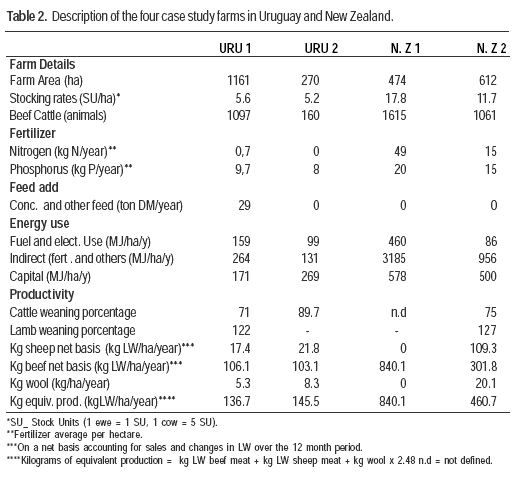
<body><![CDATA[<p style="margin-bottom: 0cm;"><font face="Verdana" size="2">    <br>    </font>    </p>        <p style="margin-bottom: 0cm;"><font size="2" face="Verdana">Finally, CO<sub>2</sub> factors were calculated based on total embodied emissions for key inputs of fertilizers (including manufacturing and transportation stages), lime, fuel and electricity use (<a href="#29">Wheeler <i>et al.</i>, 2007</a>).  </font> </p>        <p style="margin-bottom: 0cm;"><font face="Verdana" size="2">    <br>    </font>    </p>        <p style="margin-bottom: 0cm;"><font size="2" face="Verdana"><b>Description of farms</b></font></p>        <p style="margin-bottom: 0cm;"><font face="Verdana" size="2">    <br>    </font>    </p>        <p style="margin-bottom: 0cm;"><font size="2" face="Verdana">Four farms were selected; one New Zealand beef only system (NZ 1) and three beef and sheep systems (two Uruguayan and one New Zealand URU 1, URU 2 and NZ 2, respectively).</font></p>        <p style="margin-bottom: 0cm;"><font face="Verdana" size="2">    ]]></body>
<body><![CDATA[<br>    </font>    </p>        <p style="margin-bottom: 0cm;"><font size="2" face="Verdana">The level of intensification was quite different in these two New Zealand farm systems due to the amount of inputs used and stocking rates (<a href="#t2">Table 2</a>), and they were also characterized by different productive performances. In both systems, the animals grazed perennial grass/clover pasture and no supplementary food was used. NZ 1 is a grazing rear-finishing farm, where pasture is the main food source. The cattle management consists of buying weaned bull calves every year during spring and summer at an average of  214 kg live weight (LW), and selling two year bulls for slaughter mainly during autumn at an average of 606 kg LW (306 kg carcass weight). NZ 2 is a hill country farm with a complete beef and sheep system including breeding cows and ewes, finishing steers, cull cows, bulls, hoggets and lambs. Sheep management includes ewe mating in June, lambing in December, and weaning lambs at an average of 29 kg LW. Sheep sales are mixed lambs and hoggets for slaughter throughout the year at an average of 38.3 kg LW and 7.2 kg wool production per head. Beef cattle mating occurs in December-January using local bulls and weaning calves at 152 kg LW. One and a half and 2 year bulls are sold during autumn and spring respectively at an average of 484 kg LW.</font></p>       <p style="margin-bottom: 0cm;"></p>       <p style="margin-bottom: 0cm; text-align: center;"> <font size="2" face="Verdana"><a name="t2"></a></font></p>       <p style="margin-bottom: 0cm; text-align: center;"> <font size="2" face="Verdana"><img style="width: 522px; height: 483px;" alt="" src="/img/revistas/agro/v17n1/1a15t2.GIF"> </font> </p>        <p style="margin-bottom: 0cm;"><font face="Verdana" size="2">    <br>    </font>    </p>        <p style="margin-bottom: 0cm;"><font size="2" face="Verdana">URU1 was a beef and sheep complete cycle farm, including breeding cows and ewes maintained on natural rangelands, and finishing steers, culls cows, and lambs mainly on sown pastures. Fifty percent of the feed in this system was derived from natural rangeland and 50% from improved pastures (comprising 85% oversown legumes in natural rangelands and 15% new introduced pastures with white clover and ryegrass). In addition, supplementary feeding of concentrates (sorghum) was used for different categories: to finish one year steers (60 days), for finishing steers (150 days on pasture) during wintertime and 30 days for calves after weaning. The cow-calf component consisted of mating Hereford cows and 2 years heifers (25% are retained as replacement) with bulls from the same farm between December to February, and weaning calves in April at an average of 140 kg LW. The average sale weight for the whole beef cattle system was 388 kg LW taking into account whole finishing cattle (3 years steers and culls cows) and non-replacement cattle (heifers and female calves). The sheep management involved mating ewes in early autumn (March-April) and weaning lambs in December at 20 kg LW. The finishing of lambs for slaughter involved grazing of best quality pasture and selling them in autumn at 40 kg LW per head and wool production of 5 kg per head for the whole system. </font> </p>        <p style="margin-bottom: 0cm;"><font face="Verdana" size="2">    <br>    </font>    </p>        ]]></body>
<body><![CDATA[<p style="margin-bottom: 0cm;"><font size="2" face="Verdana">URU 2 was also a beef and sheep farm in a typical Uruguayan rolling landscape, comprising mainly breeding animals and selling all male weaned calves and some female calves, as well as finishing mutton and hoggets. The feed used in this case included 22% of high quality pastures (oversowing legumes in natural rangelands) with the rest being natural rangelands. Best quality pastures were used mainly from calving time to weaning and during finishing of mutton (for about 45 days). The average sale weight for calves was 190 kg after weaning in April and for mutton and hogget 37 kg mainly during December. The cow-calf component consisted of 90% annual calving rate, of which 25% were retained as replacement heifers. </font> </p>        <p style="margin-bottom: 0cm;"><font face="Verdana" size="2">    <br>    </font>    </p>        <p style="margin-bottom: 0cm;"><font size="2" face="Verdana">No animals were stabled in any of our four farm systems used in the study.</font></p>        <p style="margin-bottom: 0cm;"><font face="Verdana" size="2">    <br>    </font>    </p>        <p style="margin-bottom: 0cm;"><font size="2" face="Verdana"><b>Comparison of methods</b></font></p>        <p style="margin-bottom: 0cm;"><font face="Verdana" size="2">    <br>    </font>    </p>        <p style="margin-bottom: 0cm;"><font size="2" face="Verdana">To compare the environmental impact of livestock production or any agri-food, it is important to take into account that the process is not only related to what happens on-farm. In recent years a holistic method known as life cycle assessment (LCA) has been used to evaluate the environmental impact during the entire life cycle of a product <a name="Casey_and_Holden_2006"></a>(<a href="#3">Casey and Holden, 2006</a>; <a name="De_Vries_and_de_Boer_2010"></a><a href="#4">De Vries and de Boer, 2010</a>; <a name="Pelletier_et_al._2010"></a><a href="#19">Pelletier <i>et al.</i>, 2010</a>; <a name="Ledgard_et_al._2011"></a><a href="#13">Ledgard <i>et al.</i>, 2011</a>). This takes into account the use of resources, such as land or fossil fuel, and the emissions of pollutants such as GHG or ammonia <a name="Guine&eacute;_et_al._2002"></a>(<a href="#8">Guine&eacute; <i>et al.</i>, 2002</a>, <a href="#4">De Vries and de Boer, 2010</a>). This means that different processes that contribute to environmental damage, such as transport of the product or even the production of the fertilizer to be used on farm or farm operation <a name="Lal_2004"></a>(<a href="#12">Lal, 2004</a>), can be taken into account. These &laquo;cradle to grave&raquo; studies can be used to compare functional units or selected products. In assessing these measurements it is important to highlight that all livestock systems are different. This means that there is a high probability of finding differences not only among countries, but also between different farms in the same country <a name="Stewart_et_al._2009"></a>(<a href="#25">Stewart <i>et al.</i>, 2009</a>;&nbsp;<a name="Veysset_et_al._2010"></a><a href="#27">Veysset <i>et al.</i>, 2010</a>). The life cycle estimates of GHG emissions or the &laquo;Carbon footprint&raquo; is typically given on a per kg of product basis, while GHG emissions per hectare are appropriate for comparing systems at the farm level. This study was confined to the cradle to farm gate stage of the life cycle, which typically comprises at least 70% of the whole lifecycle (e.g. <a href="#13">Ledgard <i>et al</i>., 2011</a>).        </font> </p>        ]]></body>
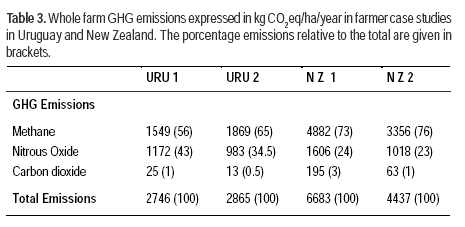
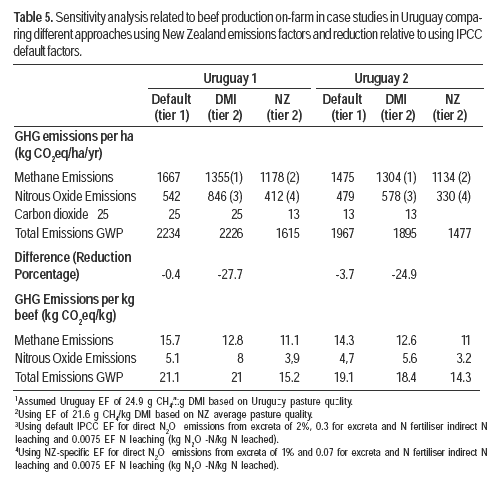
<body><![CDATA[<p style="margin-bottom: 0cm;"><font size="2" face="Verdana">The GHG emissions are expressed in terms of Global Warming Potential for a 100 year time horizon <a name="IPCC_2007"></a>(<a href="#9">IPCC, 2007</a>) in kg CO<sub>2</sub>-equivalents, i.e. with multiplication factors of 1 for CO<sub>2</sub>  , 25 for CH<sub>4</sub>  and 298 for N<sub>2</sub>O. </font> </p>        <p style="margin-bottom: 0cm;"><font face="Verdana" size="2">    <br>    </font>    </p>        <p style="margin-bottom: 0cm;"><font size="2" face="Verdana"><b>Sensitivity Analysis</b></font></p>        <p style="margin-bottom: 0cm;"><font face="Verdana" size="2">    <br>    </font>    </p>        <p style="margin-bottom: 0cm;"><font size="2" face="Verdana">This analysis covered use of the tier 1 method (Default) including default IPCC EFs of 56 kg CH</font><sub><font size="2" face="Verdana">4</font></sub><font size="2" face="Verdana">/an/year, 0.3 kg N leached/kg N excreted, 0.2 kg NH</font><sub><font size="2" face="Verdana">3</font></sub><font size="2" face="Verdana">/kg N excreted and for direct N</font><sub><font size="2" face="Verdana">2</font></sub><font size="2" face="Verdana">O </font><font size="2" face="Verdana">emissions from excreta of 2%, compared with the tier 2 method. In fact, the one used for the comparison between systems (<a href="#t3">Table 3</a>) assuming an EF of 24.9 g CH</font><sub><font size="2" face="Verdana">4</font></sub><font size="2" face="Verdana">/kg DMI based on Uruguay pasture quality and IPCC default values for N</font><sub><font size="2" face="Verdana">2</font></sub><font size="2" face="Verdana">O emissions (<a href="/img/revistas/agro/v17n1/1a15t1.GIF" target="_blank">Table 1</a>). The remaining tier 2 (NZ) (<a href="#t5">Table 5</a>) for methane accounted the NZ emission factor of 21.6 g CH</font><sub><font size="2" face="Verdana">4</font></sub><font size="2" face="Verdana">/k</font><font size="2" face="Verdana">g DMI, while for nitrous oxide emissions it accounted for the effect of using the NZ-specific emission factors (<a href="/img/revistas/agro/v17n1/1a15t1.GIF" target="_blank">Table 1</a>). </font> </p>        <p style="margin-bottom: 0cm; text-align: center;"> <font face="Verdana" size="2"><a name="t3"></a></font></p>       <p style="margin-bottom: 0cm; text-align: center;"> <font face="Verdana" size="2"><img style="width: 465px; height: 227px;" alt="" src="/img/revistas/agro/v17n1/1a15t3.GIF"></font></p>       <p style="margin-bottom: 0cm; text-align: center;"></p>       ]]></body>
<body><![CDATA[<p style="margin-bottom: 0cm; text-align: center;"> <font face="Verdana" size="2"><a name="t4"></a></font></p>       <p style="margin-bottom: 0cm; text-align: center;"> <font face="Verdana" size="2"><img style="width: 409px; height: 195px;" alt="" src="/img/revistas/agro/v17n1/1a15t4.GIF"></font></p>       <p style="margin-bottom: 0cm; text-align: center;"></p>       <p style="margin-bottom: 0cm; text-align: center;"> <font face="Verdana" size="2"><a name="t5"></a></font></p>       <p style="margin-bottom: 0cm; text-align: center;"> <font face="Verdana" size="2"><img style="width: 500px; height: 480px;" alt="" src="/img/revistas/agro/v17n1/1a15t5.GIF"></font></p>       <p style="margin-bottom: 0cm;"><font face="Verdana" size="2">    <br>    </font>    </p>        <p style="margin-bottom: 0cm;"> <font style="font-size: 10pt;" size="2" face="Verdana"><b>Results and Discussion</b></font></p>        <p style="margin-bottom: 0cm;"><font face="Verdana" size="2">    <br>    </font>    </p>        ]]></body>
<body><![CDATA[<p style="margin-bottom: 0cm;"><font size="2" face="Verdana">A significant difference in per-hectare production exists between the farms studied in the two countries and New Zealand farms had three to six times higher production levels (<a href="#t2">Table 2</a>). These differences are mainly explained by higher pasture production allowing higher per hectare stocking rates in New Zealand. Although one of the Uruguayan systems did supplement the diet to lift feed restrictions during the winter, the amounts used are not sufficient to modify the performance of the whole system. In addition, the lower productivity rates per hectare compared to New Zealand systems are probably not related to management problems, and are possibly explained mainly by lower amounts of food produced by the grazing resources.</font></p>        <p style="margin-bottom: 0cm;"><font face="Verdana" size="2">    <br>    </font>    </p>        <p style="margin-bottom: 0cm;"><font size="2" face="Verdana">In New Zealand intensive systems, higher productivity per hectare is mainly achieved through enhanced food production resulting from use of productive pasture species and higher levels of fertilization, and helped by favorable climate conditions, where for example rainfalls level are similar but with better distribution during the year. This is most evident in the New Zealand finishing system NZ1.</font></p>        <p style="margin-bottom: 0cm;"><font face="Verdana" size="2">    <br>    </font>    </p>        <p style="margin-bottom: 0cm;"><font size="2" face="Verdana">GHG emissions in all systems are principally in the form of methane, resulting from the enteric fermentation process (<a href="#t3">Table 3</a>). Enteric fermentation is the largest contributor to global warming potential on-farm. Even though the emissions per kilogram of DMI are less in New Zealand than in Uruguay and less energy is lost from digestion of feed, the high stocking rates per hectare make CH<sub>4 </sub>emissions per hectare higher overall.</font></p>        <p style="margin-bottom: 0cm;"><font face="Verdana" size="2">    <br>    </font>    </p>        <p style="margin-bottom: 0cm;"><font size="2" face="Verdana">Regarding N<sub>2</sub>O emissions, even though the default direct N<sub>2</sub>O emission factor for excreta-N used for Uruguay is double that of the NZ-specific factor for NZ, the amount of emissions from NZ systems is clearly higher. It is important to highlight that Uruguayan farm system emissions result almost entirely from dung and urine patches, that for NZ 1 represent 84% and for NZ 2 92%. However, N<sub>2</sub>O emissions in New Zealand resulting from the use of nitrogen fertilizers represent 16% (264 kg CO<sub>2</sub>eq/ha/year) and 8% (79 kg CO<sub>2</sub>eq/ha/year) of the total N<sub>2</sub>O emissions for NZ 1 and NZ 2 systems respectively.</font></p>        ]]></body>
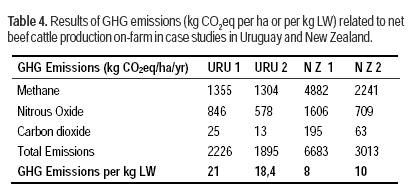
<body><![CDATA[<p style="margin-bottom: 0cm;"><font face="Verdana" size="2">    <br>    </font>    </p>        <p style="margin-bottom: 0cm;"><font size="2" face="Verdana">In all cases, carbon dioxide represents a very low percentage of GHG emissions. These are mostly attributable to fertilizers in NZ and to electricity use and fossil fuel consumption in Uruguay. Except for C in CH<sub>4</sub>, the majority of C in forage feeds is recycled to the atmosphere as CO<sub>2</sub>; hence CO<sub>2</sub> emissions from these sources are ignored for agricultural inventory purposes unless there is a change in land use <a name="Pinares-Pati&ntilde;o_et_al._2009"></a>(<a href="#20">Pinares-Pati&ntilde;o <i>et al.</i>, 2009</a>).</font></p>        <p style="margin-bottom: 0cm;"><font face="Verdana" size="2">    <br>    </font>    </p>        <p style="margin-bottom: 0cm;"><font size="2" face="Verdana">Taking into account total annual GHG emissions expressed in CO<sub>2 </sub>equivalents per hectare, there is a considerable difference between systems and between countries. In Uruguay these differences could be explained by lower stocking rates and less fertilizer use.</font></p>        <p style="margin-bottom: 0cm;"><font size="2" face="Verdana">Based on the information presented using the global warming potential of each gas to estimate the total global warming burden for each system, it is possible to determine that there is a positive link between intensification and GHG emissions. Furthermore, comparing both New Zealand systems with different degrees of intensification, when more inputs are used to increase the production there is a greater per-hectare impact on the environment. </font> </p>        <p style="margin-bottom: 0cm;"><font face="Verdana" size="2">    <br>    </font>    </p>        <p style="margin-bottom: 0cm;"><font size="2" face="Verdana">Clearly, the global warming potential per hectare within extensive Uruguayan systems is at least 1.5 times less than intensive New Zealand systems. Both Uruguayan cases corroborate that when less inputs are used, less production is obtained per hectare, although with reduced environment impact. However, when comparing GHG emissions per kilogram for beef cattle production (<a href="#t4">Table 4</a>), the results show that although intensive systems increase per-hectare production and GHG emissions, they reduce these GHG emissions per kilogram of LW production. </font> </p>        ]]></body>
<body><![CDATA[<p style="margin-bottom: 0cm;"><font face="Verdana" size="2">    <br>    </font>    </p>        <p style="margin-bottom: 0cm;"><font size="2" face="Verdana">In the NZ 1 study case, it is important to mention that the emissions account for the stage from brought-in calves to finishing. This would be an underestimate of whole-system GHG emissions since it excludes emissions associated with calf production from the dairy sector, including additional emissions from feed inputs such as milk powder to raise the calf through to weaning. The latter feed inputs for calf rearing would add approximately 3% to total emissions based on LCA analyses <a name="Lieffering_et_al._2010"></a>(<a href="#15">Lieffering <i>et al</i>., 2010</a>).</font></p>        <p style="margin-bottom: 0cm;"><font face="Verdana" size="2">    <br>    </font>    </p>        <p style="margin-bottom: 0cm;"><font size="2" face="Verdana">These results (<a href="#t4">Table 4</a>) confirm that with increasing productivity (NZ 1 and NZ 2), adding more efficiency to the process can result in lower emissions per kilogram of product. This trend could also be explained due to the different production stages i.e. breeding vs finishing. </font> </p>        <p style="margin-bottom: 0cm;"><font face="Verdana" size="2">    <br>    </font>    </p>        <p style="margin-bottom: 0cm;"><font size="2" face="Verdana">The results also show the great dilemma and different position of farming systems between global warming potential and intensive and extensive systems, taking into account GHG emissions recorded per hectare and per functional unit achieved.</font></p>        <p style="margin-bottom: 0cm;"><font face="Verdana" size="2">    ]]></body>
<body><![CDATA[<br>    </font>    </p>        <p style="margin-bottom: 0cm;"><font size="2" face="Verdana"><b>Sensitivity analysis</b></font></p>        <p style="margin-bottom: 0cm;"><font face="Verdana" size="2">    <br>    </font>    </p>        <p style="margin-bottom: 0cm;"><font size="2" face="Verdana">Currently, due to lack of available research data in Uruguay for national inventory reporting, the default emissions factors stipulated by the IPCC must be used. This, almost certainly, results in an overestimation of GHG emissions from Uruguayan beef systems. </font> </p>        <p style="margin-bottom: 0cm;"><font face="Verdana" size="2">    <br>    </font>    </p>        <p style="margin-bottom: 0cm;"><font size="2" face="Verdana">Considering the similarities in production conditions and pastoral resource uses in both countries, it is useful to conduct a sensitivity analysis of the effect of using common emissions factors (<a href="#t5">Table 5</a>).  By conducting a sensitivity analysis using the default IPCC and NZ emissions factors, it is possible to estimate how using researched emissions factors, consistent with the Uruguayan reality, might alter total GHG emission figures. </font> </p>        <p style="margin-bottom: 0cm;"><font face="Verdana" size="2">    <br>    </font>    </p>        ]]></body>
<body><![CDATA[<p style="margin-bottom: 0cm;"><font size="2" face="Verdana">Overall, this sensitivity analysis showed higher methane emissions but lower nitrous oxide emissions using the default tier 1 method compared to using the tier 2 approach based on Uruguayan default values. The net effect was only a small change in total GHG emissions between these two methods. In contrast, the use of the New Zealand tier 2 values resulted in GHG emissions that were 25-28% lower than the ones for the Uruguayan default values.  </font> </p>        <p style="margin-bottom: 0cm;"><font face="Verdana" size="2">    <br>    </font>    </p>        <p style="margin-bottom: 0cm;"><font size="2" face="Verdana">It is important to take into account that Uruguayan natural grasslands, including those with introduced legumes, have a lower crude protein concentration than high quality pastures (with clovers and ryegrass)  in New Zealand e.g. 1.5 -2.5% N (<a href="#7">Formoso and Colucci, 1999</a>) versus 3.0% N (<a href="#29">Wheeler <i>et al</i>., 2007</a>), respectively. Thus, including a lower N percentaje (2.5%) typical of Uruguayan pastures would have a direct effect on N<sub>2</sub>O emissions (used for analysis in <a href="#t5">Table 5</a>). In this case, it reduced total nitrous oxide emissions by 17% compared to using the default New Zealand value of 3% N.</font></p>        <p style="margin-bottom: 0cm;"><font face="Verdana" size="2">    <br>    </font>    </p>        <p style="margin-bottom: 0cm;"><font size="2" face="Verdana">These results clearly show that differences in methodology can have a large effect on calculated GHG emissions. The much lower emissions per kg DMI from NZ-specific data highlight the benefit in obtaining specific national data from Uruguay to estimate GHG emissions per hectare and per functional unit.  </font> </p>        <p style="margin-bottom: 0cm;"><font face="Verdana" size="2">    <br>    </font>    </p>        <p style="margin-bottom: 0cm;"><font size="2" face="Verdana"><b>Comparison with other studies</b></font></p>        ]]></body>
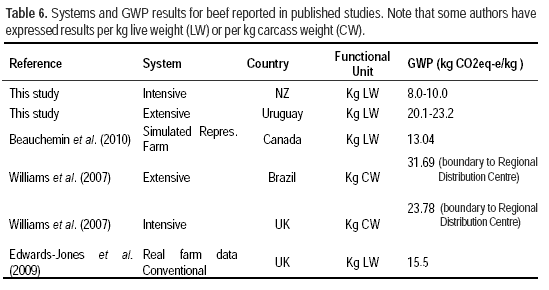
<body><![CDATA[<p style="margin-bottom: 0cm;"><font face="Verdana" size="2">    <br>    </font>    </p>        <p style="margin-bottom: 0cm;"><font size="2" face="Verdana">Being able to identify the provenance of food production is an issue that is becoming more important to consumers, the agriculture sector and policy makers. This has sparked an increase in associated research in relation to production of primary products throughout the life cycle. </font> </p>        <p style="margin-bottom: 0cm;"><font face="Verdana" size="2">    <br>    </font>    </p>        <p style="margin-bottom: 0cm;"><font size="2" face="Verdana">LCA studies of whole beef and sheep farming systems that assessed the same product can differ in their characteristics. This is because LCA measurements depend on animal productivity and diet composition, as well as on the production period and system. These features can result in different calculated effects on the environment.</font></p>        <p style="margin-bottom: 0cm;"><font face="Verdana" size="2">    <br>    </font>    </p>        <p style="margin-bottom: 0cm;"><font size="2" face="Verdana">The emissions per kilogram of live weight obtained from these studies of two different systems in Uruguay and New Zealand are consistent with data reported in different systems around the world (<a href="#t6">Table 6</a>). However, making a comparison between studies is problematic due to the different methodologies used to obtain the results. Nevertheless, published studies in beef production systems do demonstrate differences between farms producing the same product. <span style="color: rgb(51, 51, 255);">De Vries and de Boer</span> (<a href="#4">2010</a>) state that beef production systems are heterogeneous, while pork, chicken and egg systems are usually homogeneous because their production methods are standardized worldwide.</font></p>       <p style="margin-bottom: 0cm;"></p>       ]]></body>
<body><![CDATA[<p style="margin-bottom: 0cm; text-align: center;"> <font size="2" face="Verdana"><a name="t6"></a></font></p>       <p style="margin-bottom: 0cm; text-align: center;"> <font size="2" face="Verdana"><img style="width: 549px; height: 290px;" alt="" src="/img/revistas/agro/v17n1/1a15t6.GIF"></font></p>        <p style="margin-bottom: 0cm;"><font face="Verdana" size="2">    <br>    </font>    </p>        <p style="margin-bottom: 0cm;"><font size="2" face="Verdana">Estimated emissions of greenhouse gases, taking into account the extensive systems in Uruguay (18.4-21 kg CO<sub>2</sub>eq/kg LW), were broadly similar to studies by Williams <i>et al.</i> (<a href="#30">2007</a>) (31.7 kg CO<sub>2</sub>eq/kg CW <sub>~</sub> 16 kg CO<sub>2</sub>eq/kg LW) for Brazil of the systems using native grasses. However, different methodologies were used (including the functional unit and system boundary), and there will be some production differences due to lower stocking rates, lower efficiency and productivity per hectare. </font> </p>        <p style="margin-bottom: 0cm;"><font face="Verdana" size="2">    <br>    </font>    </p>        <p style="margin-bottom: 0cm;"><font size="2" face="Verdana">New Zealand beef production systems have GHG emissions broadly similar to those for Canada by <a name="Beauchemin_et_al._2010"></a><span style="color: rgb(51, 51, 255);">Beauchemin </span><i style="color: rgb(51, 51, 255);">et al.</i> (<a href="#1">2010</a>) and for Wales by Edwards-Jones <i>et al.</i> (<a href="#6">2009</a>), and reflect high daily LW gain and enhanced animal performance. The difference between these two studies is that, unlike New Zealand, Canadian farms include supplements as grain, concentrate or silage in feeding. The differences recorded between farmers and countries in this study, and also illustrated in different studies (<a href="#t6">Table 6</a>), highlight the inability to generalize carbon footprint claims for a whole country or region which are not based on a representative sample of the farm <a name="Edwards-Jones_et_al._2009"></a>(<a href="#6">Edwards-Jones <i>et al.</i>, 2009</a>). </font> </p>        <p style="margin-bottom: 0cm;"><font face="Verdana" size="2">    <br>    </font>    </p>        ]]></body>
<body><![CDATA[<p style="margin-bottom: 0cm;"><font size="2" face="Verdana"><b>GHG emissions per hectare or per product?</b></font></p>        <p style="margin-bottom: 0cm;"><font face="Verdana" size="2">    <br>    </font>    </p>        <p style="margin-bottom: 0cm;"><font size="2" face="Verdana">In this study the differences between the farming systems were expressed in terms of both emissions per unit of product and emissions per hectare. This illustrates that in general extensive systems produce higher emissions per unit of product, due to lower animal productivity and lower GHG emissions per hectare, while the reverse is true of intensive systems. </font> </p>        <p style="margin-bottom: 0cm;"><font face="Verdana" size="2">    <br>    </font>    </p>        <p style="margin-bottom: 0cm;"><font size="2" face="Verdana">This fact<b> </b>can be a source of confusion to consumers, or to international markets and the best way to express the environmental impacts of livestock production is a key point for discussion.</font></p>        <p style="margin-bottom: 0cm;"><font face="Verdana" size="2">    <br>    </font>    </p>        <p style="margin-bottom: 0cm;"><font size="2" face="Verdana">Several studies verify that increasing the efficiency of ruminant production may reduce emissions per unit of product resulting in more production for the same DMI, but not necessarily in net reduction of GHG emissions <a name="Beukes_et_al._2010"></a>(<a href="#2">Beukes <i>et al.</i>, 2010</a>). Such justification, however, belies the negative impacts from other factors such as high fossil fuel use and the greater overall sustainability of extensive systems from a wider environmental perspective (e.g. for water quality and biodiversity).  </font> </p>        ]]></body>
<body><![CDATA[<p style="margin-bottom: 0cm;"><font size="2" face="Verdana">In the short term, consumers are likely to be the ones requiring environmental information related to animal products and LCA is one accepted method for providing this information. LCA provides a framework by where the environmental impact of production can be estimated in terms of emissions per unit. In the case of GHG emissions this method is gaining increasing acceptance and beginning to have an influence on consumer choices and consumption patterns, thereby potentially giving the producers with the lowest carbon footprint a commercial advantage (<a href="#6">Edwards-Jones <i>et al.</i>, 2009</a>).  Under this scenario, the best path for extensive systems to become more competitive for premium prices in the international context is by increasing feed quality, pasture yield patterns and improvement management practices through the year. This trajectory in turn will result in overall higher efficiency within beef cattle systems.  </font> </p>        <p style="margin-bottom: 0cm;"><font face="Verdana" size="2">    <br>    </font>    </p>        <p style="margin-bottom: 0cm;"><font size="2" face="Verdana">As time goes on, consumers may demand a more comprehensive environmental checklist requiring a quality assurance system that takes account of total environmental impacts e.g. energy, water use, nutrient loss to water bodies or pesticides use. Therefore, further developments in environmental impact methodologies are required to take account of carbon efficiencies in relation to wider global environmental impact. Besides discussing the differences between extensive and intensive systems, the challenge is for sustainable systems in terms of carbon efficiency and net environment impacts.</font></p>        <p style="margin-bottom: 0cm;"><font face="Verdana" size="2">    <br>    </font>    </p>        <p style="margin-bottom: 0cm;"> <font style="font-size: 10pt;" size="2" face="Verdana"><b>Conclusions</b></font></p>        <p style="margin-bottom: 0cm;"><font face="Verdana" size="2">    <br>    </font>    </p>        <p style="margin-bottom: 0cm;"><font size="2" face="Verdana">The results of the comparison between Uruguayan and New Zealand farms demonstrate that a significant productivity gap exists between the countries. In most cases, productivity differences correlate strongly with the degree of intensification.</font></p>        ]]></body>
<body><![CDATA[<p style="margin-bottom: 0cm;"><font face="Verdana" size="2">    <br>    </font>    </p>        <p style="margin-bottom: 0cm;"><font size="2" face="Verdana">The different degree of intensification in each country demonstrates the effects of the intensification process, and its exacerbation of GHG emissions per ha, mainly in the form of methane and nitrous oxide, as well as increased risks of environment damage (e.g. water quality). However, the higher productive efficiency of intensive systems achieves lower environmental impacts per unit of product in terms of global warming potential. </font> </p>        <p style="margin-bottom: 0cm;"><font face="Verdana" size="2">    <br>    </font>    </p>        <p style="margin-bottom: 0cm;"><font size="2" face="Verdana">These issues are becoming increasingly important due to the environmental impacts no longer being only the farmers&rsquo; business. In fact, this driver has captured interest from consumers, communities and the global population, and is regarded as a major political driver where regulations are one of the main threats. </font> </p>        <p style="margin-bottom: 0cm;"><font face="Verdana" size="2">    <br>    </font>    </p>        <p style="margin-bottom: 0cm;"><font size="2" face="Verdana">For Uruguay, the results recorded in the sensitivity analysis demonstrate that the lack of national research data pertaining to methane and nitrous oxide emissions could result in overestimation of GHG emissions and a possible future disadvantage in some international markets. Thus, research is required to provide country-specific emission factors.</font></p>        <p style="margin-bottom: 0cm;"><font face="Verdana" size="2">    ]]></body>
<body><![CDATA[<br>    </font>    </p>        <p style="margin-bottom: 0cm;"><font size="2" face="Verdana">The results of intensification practices in New Zealand and the influence of environmental policies are worthy of attention in Uruguay. Furthermore the development of tools to estimate environmental impact, monitor progress and the efficacy of mitigation options would be a wise step forward for possible future regulation. Developing markets prospects based on reduced total environmental impacts could bring opportunities to further develop the sustainability of whole farming systems.</font></p>        <p style="margin-bottom: 0cm;"><font face="Verdana" size="2">    <br>    </font>    </p>        <p style="margin-bottom: 0cm;"> <font style="font-size: 10pt;" size="2" face="Verdana"><b>Acknowledgments</b></font></p>        <p style="margin-bottom: 0cm;"><font face="Verdana" size="2">    <br>    </font>    </p>        <p style="margin-bottom: 0cm;"><font size="2" face="Verdana">Thanks to &laquo;Learn Program&raquo; on behalf of the Ministry of Agriculture and Forestry for financial support, and to Plan Agropecuario (Uruguay) for their support and belief in the opportunity to develop these type of studies.</font></p>        <p style="margin-bottom: 0cm;"><font face="Verdana" size="2">    <br>    </font>    </p>        ]]></body>
<body><![CDATA[<p style="margin-bottom: 0cm;"> <font style="font-size: 10pt;" size="2" face="Verdana"><b>References</b></font></p>        <p style="margin-bottom: 0cm;"><font face="Verdana" size="2">    <br>    </font>    </p>        <!-- ref --><p style="margin-bottom: 0cm;"><font size="2" face="Verdana"><b><a name="1"></a><a href="#Beauchemin_et_al._2010">Beauchemin K, Janzen H, Little S, McAllister T, McGinn S. </a></b><a href="#Beauchemin_et_al._2010">2010</a>. Life cycle assessment of greenhouse gas emissions from beef production in western Canada: A case study. <i>Agricultural Systems</i>, 103: 371-379.    </font></p>        <!-- ref --><p style="margin-bottom: 0cm;"><font size="2" face="Verdana"><b><a name="2"></a><a href="#Beukes_et_al._2010">Beukes PC, Gregorini P, Romera AJ, Levy G, Waghorn GC.</a></b><a href="#Beukes_et_al._2010"> 2010</a>. Improving production efficiency as a strategy to mitigate greenhouse gas emissions on pastoral dairy farms in New Zealand. <i>Agriculture, Ecosystems and Environment</i>, 136: 358 -365.    </font></p>        <!-- ref --><p style="margin-bottom: 0cm;"><font size="2" face="Verdana"><b><a name="3"></a><a href="#Casey_and_Holden_2006">Casey JW, Holden NM.</a></b><a href="#Casey_and_Holden_2006"> 2006</a>. Quantification of GHG emissions from sucker-beef production in Ireland. <i>Agricultural Systems</i>, 90: 79-98.    </font></p>        <!-- ref --><p style="margin-bottom: 0cm;"><font size="2" face="Verdana"><b><a name="4"></a><a href="#De_Vries_and_de_Boer_2010">De Vries M, de Boer IJM.</a></b><a href="#De_Vries_and_de_Boer_2010"> 2010</a>. Comparing environmental impacts for livestock products : A review of life cycle assessments. <i>Livestock Science</i>, 128: 1-11.    </font></p>        <!-- ref --><p style="margin-bottom: 0cm;"><font size="2" face="Verdana"><b><a name="5"></a><a href="#DIEA_2010">DIEA</a></b><a href="#DIEA_2010">. 2010</a>. Anuario Estad&iacute;stico Agropecuario 2010 [On line]. Cited April 18 2013. Available from: <a href="http://www.mgap.gub.uy/portal/hgxpp001.aspx?7,5,352,O,S,0,%20MNU;E;27;6;MNUDIEA" target="_blank">http://www.mgap.gub.uy/portal/hgxpp001.aspx?7,5,352,O,S,0,                MNU;E;27;6;MNUDIEA</a>.    </font></p>        <!-- ref --><p style="margin-bottom: 0cm;"><font size="2" face="Verdana"><b><a name="6"></a><a href="#Edwards-Jones_et_al._2009">Edwards-Jones G, Plassmann K, Harris I.</a></b><a href="#Edwards-Jones_et_al._2009"> 2009</a>. Carbon footprinting of lamb and beef production systems : insights from an empirical analysis of farms in Wales, UK. <i>Journal of Agricultural Science</i>, 148: 707-719.    </font></p>        <!-- ref --><p style="margin-bottom: 0cm;"><font size="2" face="Verdana"><b><a name="7"></a><a href="#Formoso_and_Colucci_1999">Formoso, D, Colucci, PE.</a></b><a href="#Formoso_and_Colucci_1999"> 1999</a>. Efecto del sistema de pastoreo en la dieta de primavera de ovinos y bovinos pastoreando campo natural. <i>Producci&oacute;n Ovina,</i> 12: 19-26.    </font></p>        <!-- ref --><p style="margin-bottom: 0cm;"><font size="2" face="Verdana"><b><a name="8"></a><a href="#Guine%E9_et_al._2002">Guin&eacute;e JB, Gorr&eacute;e M, Heijungs R, Huppes G, Kleijn R, de Koning A, van Oers L, Wegener Sleeswijk A, Suh S, Udo de Haes HA, de Bruijn H, van Duin R, Huijbregts MAJ, Lindeijer E, Roorda AAH, van der Ven BL, Widema BP.</a></b><a href="#Guine%E9_et_al._2002"> 2002</a>. Handbook on Life Cycle Assessment: Operational Guide to the ISO Standards. Netherlands: Institute for Environmental Science. 704p.    </font></p>        <!-- ref --><p style="margin-bottom: 0cm;"><font size="2" face="Verdana"><b><a name="9"></a><a href="#IPCC_2007">IPCC.</a></b><a href="#IPCC_2007"> 2007</a>. Climate Change 2007: The physical science basis : Contribution of Working Group I to the Fourth Assessment Report of the Intergovernmental Panel on Climate<b> </b>Change [On line]. Cambridge: Cambridge University Press. 996p. Cited July 11 2012. Available from: <a href="http://www.ipcc.ch/publications_and_data/publications_ipcc_fourth_assessment_report_wg1_report_the_physical_science_basis.htm" target="_blank">http://www.ipcc.ch/publications_and_data/publications_ipcc_fourth_assessment_report_wg1_report_the_physical_science_basis.htm</a>.    </font></p>        <!-- ref --><p style="margin-bottom: 0cm;"><font size="2" face="Verdana"><a name="10"></a><a href="#IPCC_2006"><span style="font-weight: bold;">IPCC</span>. 2006</a>. 2006 IPCC Guidelines for National Greenhouse Gas Inventories: agriculture, forestry and other land use [On line]. Vol 4. Kanagawa: IGES. Cited July 11 2012. Available from:  <a href="http://www.ipcc-nggip.iges.or.jp/public/2006gl/index.htm" target="_blank">http://www.ipcc-nggip.iges.or.jp/public/2006gl/index.htm</a>.    </font></p>        <!-- ref --><p style="margin-bottom: 0cm;"><font size="2" face="Verdana"><b>Kelliher FM, de Klein CAM, Li Z, Sherlock R.</b> 2005. Review of nitrous oxide emission factor (EF3) data. Wellington : Ministry of Agriculture and Forestry. 20p.    </font></p>        <!-- ref --><p style="margin-bottom: 0cm;"><font size="2" face="Verdana"><b><a name="12"></a><a href="#Lal_2004">Lal R. </a></b><a href="#Lal_2004">2004</a>. Carbon emission from farm operations. <i>Environment International</i>, 30: 981-990.    </font></p>        <p style="margin-bottom: 0cm;"><font size="2" face="Verdana"><b><a name="13"></a><a href="#Ledgard_et_al._2011">Ledgard SF, Lieffering M, Zonderland-Thomassen MA, Boyes M.</a></b><a href="#Ledgard_et_al._2011"> 2011</a>. Life Cycle Assessment &ndash; a tool for evaluating resource and environmental efficiency of agricultural products and systems from pasture to plate. <i>Proceedings of the NZ Society of Animal Production</i>, 71: 139-148.</font></p>        <!-- ref --><p style="margin-bottom: 0cm;"><font size="2" face="Verdana"><b><a name="14"></a><a href="#Ledgard_et_al._2004">Ledgard SF, Journeaux P, Furness H, Petch R, Wheeler D. </a></b><a href="#Ledgard_et_al._2004">2004</a>. Use of nutrient budgeting and management options for increasing nutrient use efficiency and reducing environmental emissions from New Zealand farms. [On line]. In: OECD expert meeting on farm management indicators and the environment; 8 - 12 March 2004; Palmerston North, New Zealand. Cited July 11 2012. Available from: <a href="https://community.oecd.org/streamPage.jspa?cwsDb=Farm%20Management%20Indicators&amp;community=2283&amp;showHeader=0&amp;link=http://livelinkfe.main.oecd.org:84/LES_RM/livelink.exe/fetch/1202765/1232121/232176/Ledgard.PDF" target="_blank">https://community.oecd.org/streamPage.jspa?cwsDb=Farm%20Management%20Indicators&amp;community=2283&amp;showHeader=0&amp;link=http://livelinkfe.main.oecd.org:84/LES_RM/livelink.exe/fetch/1202765/1232121/232176/Ledgard.PDF</a>.      </font> </p>        ]]></body>
<body><![CDATA[<!-- ref --><p style="margin-bottom: 0cm;"><font size="2" face="Verdana"><b><a name="15"></a><a href="#Lieffering_et_al._2010">Lieffering M, Ledgard S, Boyes M, Kemp R.</a></b><a href="#Lieffering_et_al._2010"> 2010</a>. Beef greenhouse gas footprint: Final report. Hamilton: AgResearch. 95p.    </font></p>        <p style="margin-bottom: 0cm;"><font size="2" face="Verdana"><b><a name="16"></a><a href="#McGregor_et_al._2004">McGregor M, van Berkel R, Narayanaswamy V, Altham J. </a></b><a href="#McGregor_et_al._2004">2004</a>. Eco-Efficiency in Farm Management &ndash; the application of Life Cycle Analysis as a basis for evaluating the environmental performance of farms [On line]. In: OECD expert meeting on farm management indicators and the environment; March 8 - 12 2004; Palmerston North, New Zealand. Cited July 11 2012. Available from: <a href="https://community.oecd.org/streamPage.jspa?cwsDb=Farm%20Management%%2020Indicators&amp;community=2283&amp;showHeader=0&amp;link=http://livelinkfe.main.%20oecd.org:84/LES_RM/livelink.exe/fetch/1202765/1232121/1232176/McGregorSession4.PDF" target="_blank">https://community.oecd.org/streamPage.jspa?cwsDb=Farm%20Management%                  20Indicators&amp;community=2283&amp;showHeader=0&amp;link=http://livelinkfe.main.                  oecd.org:84/LES_RM/livelink.exe/fetch/1202765/1232121/1232176/McGregorSession4.PDF</a>. </font> </p>        <p style="margin-bottom: 0cm;"><font size="2" face="Verdana"><b><a name="17"></a><a href="#MfE_2007">MfE. </a></b><a href="#MfE_2007">2007</a>. New Zealand&rsquo;s Greenhouse Gas Inventory 1990&ndash;2005 : the national inventory report and common reporting format [On line]. Wellington: Ministry for the Environment. Cited July 11 2012. Available from: <a href="http://www.mfe.govt.nz/publications/climate/nir-jul07/nir-jul07.pdf" target="_blank">http://www.mfe.govt.nz/publications/climate/nir-jul07/nir-jul07.pdf</a>.</font></p>        <!-- ref --><p style="margin-bottom: 0cm;"><font size="2" face="Verdana"><b><a name="18"></a><a href="#Misselbrook_et_al._2005">Misselbrook TH, Powell JM, Broderick GA, Grabber JH.</a></b><a href="#Misselbrook_et_al._2005"> 2005</a>. Dietary manipulation in dairy cattle: laboratory experiments to assess the influence on ammonia emissions. <i>Journal of Dairy Science</i>, 88: 1765-1777.    </font></p>        <!-- ref --><p style="margin-bottom: 0cm;"><font size="2" face="Verdana"><b><a name="19"></a><a href="#Pelletier_et_al._2010">Pelletier N, Pirog R, Rasmussen R. </a></b><a href="#Pelletier_et_al._2010">2010</a>. Comparative life cycle environmental impacts of three beef production strategies in the Upper Midwestern United States. <i>Agricultural Systems</i>, 103: 380-389.    </font></p>        <!-- ref --><p style="margin-bottom: 0cm;"><font size="2" face="Verdana"><b><a name="20"></a><a href="#Pinares-Pati%F1o_et_al._2009">Pinares-Pati&ntilde;o CS, Waghorn G, Hegarty R, Hoskin S.</a></b><a href="#Pinares-Pati%F1o_et_al._2009"> 2009</a>. Effects of intensification of pastoral farming on greenhouse gas emissions in New Zealand. <i>New Zealand veterinary journal</i>, 57: 252-261.    </font></p>        ]]></body>
<body><![CDATA[<!-- ref --><p style="margin-bottom: 0cm;"><font size="2" face="Verdana"><b><a name="21"></a><a href="#Pinares-Pati%F1o_et_al._2007">Pinares-Pati&ntilde;o CS, D&acute;Hour P, Jouany J, Martin C. </a></b><a href="#Pinares-Pati%F1o_et_al._2007">2007</a>. Effects of stocking rate on methane and carbon dioxide emissions from grazing cattle. <i>Agriculture, Ecosystems and Environment</i>, 121: 30-46.    </font></p>        <!-- ref --><p style="margin-bottom: 0cm;"><font size="2" face="Verdana"><b><a name="22"></a><a href="#Saggar_et_al._2003">Saggar S, Clark H, Hedley C, Tate K, Carran A, Cosgrove G.</a></b><a href="#Saggar_et_al._2003"> 2003</a>. Methane emissions from animal dung and waste management systems, and its contribution to national budget. New Zealand : Ministry of Agriculture and Forestry. 39p. (Landcare Research Contract Report; LC0301/02).    </font></p>        <!-- ref --><p style="margin-bottom: 0cm;"><font size="2" face="Verdana"><b><a name="23"></a><a href="#Smeaton_2003">Smeaton D.</a></b><a href="#Smeaton_2003"> 2003</a>. Profitable Beef Production : A guide to beef production in New Zealand. Wellington : New Zealand Beef Council. 220p.    </font></p>        <p style="margin-bottom: 0cm;"><font size="2" face="Verdana"><b><a name="24"></a><a href="#Steinfeld_et_al._2006">Steinfeld H, Gerber P, Wassenaar T, Castel V, Rosales M, de Haan C.</a></b><a href="#Steinfeld_et_al._2006"> 2006</a>.  Livestock&rsquo;s Long Shadow : environmental issues and options. Rome : FAO. 414p.</font></p>        <!-- ref --><p style="margin-bottom: 0cm;"><font size="2" face="Verdana"><b><a name="25"></a><a href="#Stewart_et_al._2009">Stewart AA, Little SM, Ominski KH, Wittenberg KM, Janzen HH.</a></b><a href="#Stewart_et_al._2009"> 2009</a>. Evaluating greenhouse gas mitigation practices in livestock systems: illustration of a whole-farm approach. <i>Journal of Agricultural Science</i>, 147: 367-382.    </font></p>        <p style="margin-bottom: 0cm;"><font size="2" face="Verdana"><b>Thomas SM, Ledgard SF, Francis GS.</b> 2005. Improving estimates of nitrate leaching for quantifying New Zealand&rsquo;s indirect nitrous oxide emissions. <i>Nutrient Cycling in Agroecosystems</i>, 73: 213-226.</font></p>        ]]></body>
<body><![CDATA[<!-- ref --><p style="margin-bottom: 0cm;"><font size="2" face="Verdana"><b><a name="27"></a><a href="#Veysset_et_al._2010">Veysset P, Lherm M, B&eacute;bin D.</a></b><a href="#Veysset_et_al._2010"> 2010</a>. Energy consumption, greenhouse gas emissions and economic performance assessments in French Charolais suckler cattle farms : Model-based analysis and forecasts. <i>Agricultural Systems</i>, 103: 41-50.    </font></p>        <!-- ref --><p style="margin-bottom: 0cm;"><font size="2" face="Verdana"><b><a name="28"></a><a href="#Webby_and_Bywater_2007">Webby RW, Bywater AC. </a></b><a href="#Webby_and_Bywater_2007">2007</a>. Principles of feed planning and management. In: Rattray PV, Brookes IM, Nicol AM. [Eds.]. Pasture and supplements for grazing animals. Hamilton : NZ Society of Animal Production. (Occasional Publication; 14). pp. 189-220.    </font></p>        <!-- ref --><p style="margin-bottom: 0cm;"><font size="2" face="Verdana"><b><a name="29"></a><a href="#Wheeler_et_al._2007">Wheeler DM, Ledgard SF, de Klein CAM.</a></b><a href="#Wheeler_et_al._2007"> 2007</a>. Using the OVERSEER nutrient budget model to estimate on-farm greenhouse gas emissions. <i>Australian Journal of Experimental Agriculture</i>, 48(2): 99-103.    </font></p>        <!-- ref --><p style="margin-bottom: 0cm;"><font size="2" face="Verdana"><b>Williams A, Pell J, Webb J, Tribe E, Evans D, Moorhouse E, Watkiss P. </b>2007. Comparative life cycle assessment of food commodities procured for UK consumption through a diversity of supply chains [On line]. Department for Environment, Food and Rural Affairs. (FO0103). Cited July 11 2012. Available from: <a href="http://randd.defra.gov.uk">http://randd.defra.gov.uk/Menu&amp;Module=More&amp;Location=Default.aspx ?Menu=None&amp;ProjectID=15001&amp;FromSearch=Y&amp;Publisher=1&amp;SearchText=comparative&amp;SortString=ProjectCode&amp;SortOrder=Asc&amp;Paging=10#Description.    </a></font></p>        <p style="margin-bottom: 0cm;"><font face="Verdana" size="2">    <br>    </font>    </p>        ]]></body>
<body><![CDATA[<p style="margin-bottom: 0cm;"><font face="Verdana" size="2">    <br>    </font>    </p>         ]]></body><back>
<ref-list>
<ref id="B1">
<nlm-citation citation-type="journal">
<person-group person-group-type="author">
<name>
<surname><![CDATA[Beauchemin]]></surname>
<given-names><![CDATA[K]]></given-names>
</name>
<name>
<surname><![CDATA[Janzen]]></surname>
<given-names><![CDATA[H]]></given-names>
</name>
<name>
<surname><![CDATA[Little]]></surname>
<given-names><![CDATA[S]]></given-names>
</name>
<name>
<surname><![CDATA[McAllister]]></surname>
<given-names><![CDATA[T]]></given-names>
</name>
<name>
<surname><![CDATA[McGinn]]></surname>
<given-names><![CDATA[S]]></given-names>
</name>
</person-group>
<article-title xml:lang="en"><![CDATA[Life cycle assessment of greenhouse gas emissions from beef production in western Canada: A case study]]></article-title>
<source><![CDATA[Agricultural Systems]]></source>
<year>2010</year>
<volume>103</volume>
<page-range>371-379</page-range></nlm-citation>
</ref>
<ref id="B2">
<nlm-citation citation-type="journal">
<person-group person-group-type="author">
<name>
<surname><![CDATA[Beukes]]></surname>
<given-names><![CDATA[PC]]></given-names>
</name>
<name>
<surname><![CDATA[Gregorini]]></surname>
<given-names><![CDATA[P]]></given-names>
</name>
<name>
<surname><![CDATA[Romera]]></surname>
<given-names><![CDATA[AJ]]></given-names>
</name>
<name>
<surname><![CDATA[Levy]]></surname>
<given-names><![CDATA[G]]></given-names>
</name>
<name>
<surname><![CDATA[Waghorn]]></surname>
<given-names><![CDATA[GC]]></given-names>
</name>
</person-group>
<article-title xml:lang="en"><![CDATA[Improving production efficiency as a strategy to mitigate greenhouse gas emissions on pastoral dairy farms in New Zealand]]></article-title>
<source><![CDATA[Agriculture, Ecosystems and Environment]]></source>
<year>2010</year>
<volume>136</volume>
<page-range>358 -365</page-range></nlm-citation>
</ref>
<ref id="B3">
<nlm-citation citation-type="journal">
<person-group person-group-type="author">
<name>
<surname><![CDATA[Casey]]></surname>
<given-names><![CDATA[JW]]></given-names>
</name>
<name>
<surname><![CDATA[Holden]]></surname>
<given-names><![CDATA[NM]]></given-names>
</name>
</person-group>
<article-title xml:lang="en"><![CDATA[Quantification of GHG emissions from sucker-beef production in Ireland]]></article-title>
<source><![CDATA[Agricultural Systems]]></source>
<year>2006</year>
<volume>90</volume>
<page-range>79-98</page-range></nlm-citation>
</ref>
<ref id="B4">
<nlm-citation citation-type="journal">
<person-group person-group-type="author">
<name>
<surname><![CDATA[De Vries]]></surname>
<given-names><![CDATA[M]]></given-names>
</name>
<name>
<surname><![CDATA[de Boer]]></surname>
<given-names><![CDATA[IJM]]></given-names>
</name>
</person-group>
<article-title xml:lang="en"><![CDATA[Comparing environmental impacts for livestock products: A review of life cycle assessments]]></article-title>
<source><![CDATA[Livestock Science]]></source>
<year>2010</year>
<volume>128</volume>
<page-range>1-11</page-range></nlm-citation>
</ref>
<ref id="B5">
<nlm-citation citation-type="">
<collab>DIEA</collab>
<source><![CDATA[Anuario Estadístico Agropecuario 2010]]></source>
<year>2010</year>
</nlm-citation>
</ref>
<ref id="B6">
<nlm-citation citation-type="journal">
<person-group person-group-type="author">
<name>
<surname><![CDATA[Edwards-Jones]]></surname>
<given-names><![CDATA[G]]></given-names>
</name>
<name>
<surname><![CDATA[Plassmann]]></surname>
<given-names><![CDATA[K]]></given-names>
</name>
<name>
<surname><![CDATA[Harris]]></surname>
<given-names><![CDATA[I]]></given-names>
</name>
</person-group>
<article-title xml:lang="en"><![CDATA[Carbon footprinting of lamb and beef production systems: insights from an empirical analysis of farms in Wales, UK]]></article-title>
<source><![CDATA[Journal of Agricultural Science]]></source>
<year>2009</year>
<volume>148</volume>
<page-range>707-719</page-range></nlm-citation>
</ref>
<ref id="B7">
<nlm-citation citation-type="journal">
<person-group person-group-type="author">
<name>
<surname><![CDATA[Formoso]]></surname>
<given-names><![CDATA[D]]></given-names>
</name>
<name>
<surname><![CDATA[Colucci]]></surname>
<given-names><![CDATA[PE]]></given-names>
</name>
</person-group>
<article-title xml:lang="es"><![CDATA[Efecto del sistema de pastoreo en la dieta de primavera de ovinos y bovinos pastoreando campo natural]]></article-title>
<source><![CDATA[Producción Ovina]]></source>
<year>1999</year>
<volume>12</volume>
<page-range>19-26</page-range></nlm-citation>
</ref>
<ref id="B8">
<nlm-citation citation-type="book">
<person-group person-group-type="author">
<name>
<surname><![CDATA[Guinée]]></surname>
<given-names><![CDATA[JB]]></given-names>
</name>
<name>
<surname><![CDATA[Gorrée]]></surname>
<given-names><![CDATA[M]]></given-names>
</name>
<name>
<surname><![CDATA[Heijungs]]></surname>
<given-names><![CDATA[R]]></given-names>
</name>
<name>
<surname><![CDATA[Huppes]]></surname>
<given-names><![CDATA[G]]></given-names>
</name>
<name>
<surname><![CDATA[Kleijn]]></surname>
<given-names><![CDATA[R]]></given-names>
</name>
<name>
<surname><![CDATA[de Koning]]></surname>
<given-names><![CDATA[A]]></given-names>
</name>
<name>
<surname><![CDATA[van Oers]]></surname>
<given-names><![CDATA[L]]></given-names>
</name>
<name>
<surname><![CDATA[Wegener Sleeswijk]]></surname>
<given-names><![CDATA[A]]></given-names>
</name>
<name>
<surname><![CDATA[Suh]]></surname>
<given-names><![CDATA[S]]></given-names>
</name>
<name>
<surname><![CDATA[Udo de Haes]]></surname>
<given-names><![CDATA[HA]]></given-names>
</name>
<name>
<surname><![CDATA[de Bruijn]]></surname>
<given-names><![CDATA[H]]></given-names>
</name>
<name>
<surname><![CDATA[van Duin]]></surname>
<given-names><![CDATA[R]]></given-names>
</name>
<name>
<surname><![CDATA[Huijbregts]]></surname>
<given-names><![CDATA[MAJ]]></given-names>
</name>
<name>
<surname><![CDATA[Lindeijer]]></surname>
<given-names><![CDATA[E]]></given-names>
</name>
<name>
<surname><![CDATA[Roorda]]></surname>
<given-names><![CDATA[AAH]]></given-names>
</name>
<name>
<surname><![CDATA[van der Ven]]></surname>
<given-names><![CDATA[BL]]></given-names>
</name>
<name>
<surname><![CDATA[Widema]]></surname>
<given-names><![CDATA[BP]]></given-names>
</name>
</person-group>
<source><![CDATA[Handbook on Life Cycle Assessment: Operational Guide to the ISO Standards]]></source>
<year>2002</year>
<publisher-loc><![CDATA[Netherlands ]]></publisher-loc>
<publisher-name><![CDATA[Institute for Environmental Science]]></publisher-name>
</nlm-citation>
</ref>
<ref id="B9">
<nlm-citation citation-type="book">
<collab>IPCC</collab>
<source><![CDATA[Climate Change 2007: The physical science basis : Contribution of Working Group I to the Fourth Assessment Report of the Intergovernmental Panel on Climate Change]]></source>
<year>2007</year>
<publisher-loc><![CDATA[Cambridge ]]></publisher-loc>
<publisher-name><![CDATA[Cambridge University Press]]></publisher-name>
</nlm-citation>
</ref>
<ref id="B10">
<nlm-citation citation-type="book">
<collab>IPCC</collab>
<source><![CDATA[2006 IPCC Guidelines for National Greenhouse Gas Inventories: agriculture, forestry and other land use]]></source>
<year>2006</year>
<volume>4</volume>
<publisher-loc><![CDATA[Kanagawa ]]></publisher-loc>
<publisher-name><![CDATA[IGES]]></publisher-name>
</nlm-citation>
</ref>
<ref id="B11">
<nlm-citation citation-type="book">
<person-group person-group-type="author">
<name>
<surname><![CDATA[Kelliher]]></surname>
<given-names><![CDATA[FM]]></given-names>
</name>
<name>
<surname><![CDATA[de Klein]]></surname>
<given-names><![CDATA[CAM]]></given-names>
</name>
<name>
<surname><![CDATA[Li]]></surname>
<given-names><![CDATA[Z]]></given-names>
</name>
<name>
<surname><![CDATA[Sherlock]]></surname>
<given-names><![CDATA[R]]></given-names>
</name>
</person-group>
<source><![CDATA[Review of nitrous oxide emission factor (EF3) data]]></source>
<year>2005</year>
<publisher-loc><![CDATA[Wellington ]]></publisher-loc>
<publisher-name><![CDATA[Ministry of Agriculture and Forestry]]></publisher-name>
</nlm-citation>
</ref>
<ref id="B12">
<nlm-citation citation-type="journal">
<person-group person-group-type="author">
<name>
<surname><![CDATA[Lal]]></surname>
<given-names><![CDATA[R]]></given-names>
</name>
</person-group>
<article-title xml:lang="en"><![CDATA[Carbon emission from farm operations]]></article-title>
<source><![CDATA[Environment International]]></source>
<year>2004</year>
<volume>30</volume>
<page-range>981-990</page-range></nlm-citation>
</ref>
<ref id="B13">
<nlm-citation citation-type="journal">
<person-group person-group-type="author">
<name>
<surname><![CDATA[Ledgard]]></surname>
<given-names><![CDATA[SF]]></given-names>
</name>
<name>
<surname><![CDATA[Lieffering]]></surname>
<given-names><![CDATA[M]]></given-names>
</name>
<name>
<surname><![CDATA[Zonderland-Thomassen]]></surname>
<given-names><![CDATA[MA]]></given-names>
</name>
<name>
<surname><![CDATA[Boyes]]></surname>
<given-names><![CDATA[M]]></given-names>
</name>
</person-group>
<article-title xml:lang="en"><![CDATA[Life Cycle Assessment - a tool for evaluating resource and environmental efficiency of agricultural products and systems from pasture to plate]]></article-title>
<source><![CDATA[Proceedings of the NZ Society of Animal Production]]></source>
<year>2011</year>
<volume>71</volume>
<page-range>139-148</page-range></nlm-citation>
</ref>
<ref id="B14">
<nlm-citation citation-type="confpro">
<person-group person-group-type="author">
<name>
<surname><![CDATA[Ledgard]]></surname>
<given-names><![CDATA[SF]]></given-names>
</name>
<name>
<surname><![CDATA[Journeaux]]></surname>
<given-names><![CDATA[P]]></given-names>
</name>
<name>
<surname><![CDATA[Furness]]></surname>
<given-names><![CDATA[H]]></given-names>
</name>
<name>
<surname><![CDATA[Petch]]></surname>
<given-names><![CDATA[R]]></given-names>
</name>
<name>
<surname><![CDATA[Wheeler]]></surname>
<given-names><![CDATA[D]]></given-names>
</name>
</person-group>
<article-title xml:lang="en"><![CDATA[Use of nutrient budgeting and management options for increasing nutrient use efficiency and reducing environmental emissions from New Zealand farms.]]></article-title>
<source><![CDATA[]]></source>
<year>2004</year>
<conf-name><![CDATA[ OECD expert meeting on farm management indicators and the environment]]></conf-name>
<conf-date>8 - 12 March 2004</conf-date>
<conf-loc>Palmerston North </conf-loc>
</nlm-citation>
</ref>
<ref id="B15">
<nlm-citation citation-type="book">
<person-group person-group-type="author">
<name>
<surname><![CDATA[Lieffering]]></surname>
<given-names><![CDATA[M]]></given-names>
</name>
<name>
<surname><![CDATA[Ledgard]]></surname>
<given-names><![CDATA[S]]></given-names>
</name>
<name>
<surname><![CDATA[Boyes]]></surname>
<given-names><![CDATA[M]]></given-names>
</name>
<name>
<surname><![CDATA[Kemp]]></surname>
<given-names><![CDATA[R]]></given-names>
</name>
</person-group>
<source><![CDATA[Beef greenhouse gas footprint: Final report]]></source>
<year>2010</year>
<publisher-loc><![CDATA[Hamilton ]]></publisher-loc>
<publisher-name><![CDATA[AgResearch]]></publisher-name>
</nlm-citation>
</ref>
<ref id="B16">
<nlm-citation citation-type="confpro">
<person-group person-group-type="author">
<name>
<surname><![CDATA[McGregor]]></surname>
<given-names><![CDATA[M]]></given-names>
</name>
<name>
<surname><![CDATA[van Berkel]]></surname>
<given-names><![CDATA[R]]></given-names>
</name>
<name>
<surname><![CDATA[Narayanaswamy]]></surname>
<given-names><![CDATA[V]]></given-names>
</name>
<name>
<surname><![CDATA[Altham]]></surname>
<given-names><![CDATA[J]]></given-names>
</name>
</person-group>
<article-title xml:lang="en"><![CDATA[Eco-Efficiency in Farm Management - the application of Life Cycle Analysis as a basis for evaluating the environmental performance of farms]]></article-title>
<source><![CDATA[]]></source>
<year>2004</year>
<conf-name><![CDATA[ OECD expert meeting on farm management indicators and the environment]]></conf-name>
<conf-date>March 8 - 12 2004</conf-date>
<conf-loc>Palmerston North </conf-loc>
</nlm-citation>
</ref>
<ref id="B17">
<nlm-citation citation-type="book">
<collab>MfE</collab>
<source><![CDATA[New Zealand&rsquo;s Greenhouse Gas Inventory 1990-2005: the national inventory report and common reporting format]]></source>
<year>2007</year>
<publisher-loc><![CDATA[Wellington ]]></publisher-loc>
<publisher-name><![CDATA[Ministry for the Environment]]></publisher-name>
</nlm-citation>
</ref>
<ref id="B18">
<nlm-citation citation-type="journal">
<person-group person-group-type="author">
<name>
<surname><![CDATA[Misselbrook]]></surname>
<given-names><![CDATA[TH]]></given-names>
</name>
<name>
<surname><![CDATA[Powell]]></surname>
<given-names><![CDATA[JM]]></given-names>
</name>
<name>
<surname><![CDATA[Broderick]]></surname>
<given-names><![CDATA[GA]]></given-names>
</name>
<name>
<surname><![CDATA[Grabber]]></surname>
<given-names><![CDATA[JH]]></given-names>
</name>
</person-group>
<article-title xml:lang="en"><![CDATA[Dietary manipulation in dairy cattle: laboratory experiments to assess the influence on ammonia emissions]]></article-title>
<source><![CDATA[Journal of Dairy Science]]></source>
<year>2005</year>
<volume>88</volume>
<page-range>1765-1777</page-range></nlm-citation>
</ref>
<ref id="B19">
<nlm-citation citation-type="journal">
<person-group person-group-type="author">
<name>
<surname><![CDATA[Pelletier]]></surname>
<given-names><![CDATA[N]]></given-names>
</name>
<name>
<surname><![CDATA[Pirog]]></surname>
<given-names><![CDATA[R]]></given-names>
</name>
<name>
<surname><![CDATA[Rasmussen]]></surname>
<given-names><![CDATA[R]]></given-names>
</name>
</person-group>
<article-title xml:lang="en"><![CDATA[Comparative life cycle environmental impacts of three beef production strategies in the Upper Midwestern United States]]></article-title>
<source><![CDATA[Agricultural Systems]]></source>
<year>2010</year>
<volume>103</volume>
<page-range>380-389</page-range></nlm-citation>
</ref>
<ref id="B20">
<nlm-citation citation-type="journal">
<person-group person-group-type="author">
<name>
<surname><![CDATA[Pinares-Patiño]]></surname>
<given-names><![CDATA[CS]]></given-names>
</name>
<name>
<surname><![CDATA[Waghorn]]></surname>
<given-names><![CDATA[G]]></given-names>
</name>
<name>
<surname><![CDATA[Hegarty]]></surname>
<given-names><![CDATA[R]]></given-names>
</name>
<name>
<surname><![CDATA[Hoskin]]></surname>
<given-names><![CDATA[S]]></given-names>
</name>
</person-group>
<article-title xml:lang="en"><![CDATA[Effects of intensification of pastoral farming on greenhouse gas emissions in New Zealand]]></article-title>
<source><![CDATA[New Zealand veterinary journal]]></source>
<year>2009</year>
<volume>57</volume>
<page-range>252-261</page-range></nlm-citation>
</ref>
<ref id="B21">
<nlm-citation citation-type="journal">
<person-group person-group-type="author">
<name>
<surname><![CDATA[Pinares-Patiño]]></surname>
<given-names><![CDATA[CS]]></given-names>
</name>
<name>
<surname><![CDATA[D&rsquo;Hour]]></surname>
<given-names><![CDATA[P]]></given-names>
</name>
<name>
<surname><![CDATA[Jouany]]></surname>
<given-names><![CDATA[J]]></given-names>
</name>
<name>
<surname><![CDATA[Martin]]></surname>
<given-names><![CDATA[C]]></given-names>
</name>
</person-group>
<article-title xml:lang="en"><![CDATA[Effects of stocking rate on methane and carbon dioxide emissions from grazing cattle]]></article-title>
<source><![CDATA[Agriculture, Ecosystems and Environment]]></source>
<year>2007</year>
<volume>121</volume>
<page-range>30-46</page-range></nlm-citation>
</ref>
<ref id="B22">
<nlm-citation citation-type="book">
<person-group person-group-type="author">
<name>
<surname><![CDATA[Saggar]]></surname>
<given-names><![CDATA[S]]></given-names>
</name>
<name>
<surname><![CDATA[Clark]]></surname>
<given-names><![CDATA[H]]></given-names>
</name>
<name>
<surname><![CDATA[Hedley]]></surname>
<given-names><![CDATA[C]]></given-names>
</name>
<name>
<surname><![CDATA[Tate]]></surname>
<given-names><![CDATA[K]]></given-names>
</name>
<name>
<surname><![CDATA[Carran]]></surname>
<given-names><![CDATA[A]]></given-names>
</name>
<name>
<surname><![CDATA[Cosgrove]]></surname>
<given-names><![CDATA[G]]></given-names>
</name>
</person-group>
<source><![CDATA[Methane emissions from animal dung and waste management systems, and its contribution to national budget]]></source>
<year>2003</year>
<publisher-loc><![CDATA[New Zealand ]]></publisher-loc>
<publisher-name><![CDATA[Ministry of Agriculture and Forestry]]></publisher-name>
</nlm-citation>
</ref>
<ref id="B23">
<nlm-citation citation-type="book">
<person-group person-group-type="author">
<name>
<surname><![CDATA[Smeaton]]></surname>
<given-names><![CDATA[D]]></given-names>
</name>
</person-group>
<source><![CDATA[Profitable Beef Production: A guide to beef production in New Zealand]]></source>
<year>2003</year>
<publisher-loc><![CDATA[Wellington ]]></publisher-loc>
<publisher-name><![CDATA[New Zealand Beef Council]]></publisher-name>
</nlm-citation>
</ref>
<ref id="B24">
<nlm-citation citation-type="book">
<person-group person-group-type="author">
<name>
<surname><![CDATA[Steinfeld]]></surname>
<given-names><![CDATA[H]]></given-names>
</name>
<name>
<surname><![CDATA[Gerber]]></surname>
<given-names><![CDATA[P]]></given-names>
</name>
<name>
<surname><![CDATA[Wassenaar]]></surname>
<given-names><![CDATA[T]]></given-names>
</name>
<name>
<surname><![CDATA[Castel]]></surname>
<given-names><![CDATA[V]]></given-names>
</name>
<name>
<surname><![CDATA[Rosales]]></surname>
<given-names><![CDATA[M]]></given-names>
</name>
<name>
<surname><![CDATA[de Haan]]></surname>
<given-names><![CDATA[C]]></given-names>
</name>
</person-group>
<source><![CDATA[Livestock&rsquo;s Long Shadow: environmental issues and options]]></source>
<year>2006</year>
<publisher-loc><![CDATA[Rome ]]></publisher-loc>
<publisher-name><![CDATA[FAO]]></publisher-name>
</nlm-citation>
</ref>
<ref id="B25">
<nlm-citation citation-type="journal">
<person-group person-group-type="author">
<name>
<surname><![CDATA[Stewart]]></surname>
<given-names><![CDATA[AA]]></given-names>
</name>
<name>
<surname><![CDATA[Little]]></surname>
<given-names><![CDATA[SM]]></given-names>
</name>
<name>
<surname><![CDATA[Ominski]]></surname>
<given-names><![CDATA[KH]]></given-names>
</name>
<name>
<surname><![CDATA[Wittenberg]]></surname>
<given-names><![CDATA[KM]]></given-names>
</name>
<name>
<surname><![CDATA[Janzen]]></surname>
<given-names><![CDATA[HH]]></given-names>
</name>
</person-group>
<article-title xml:lang="en"><![CDATA[Evaluating greenhouse gas mitigation practices in livestock systems: illustration of a whole-farm approach]]></article-title>
<source><![CDATA[Journal of Agricultural Science]]></source>
<year>2009</year>
<volume>147</volume>
<page-range>367-382</page-range></nlm-citation>
</ref>
<ref id="B26">
<nlm-citation citation-type="journal">
<person-group person-group-type="author">
<name>
<surname><![CDATA[Thomas]]></surname>
<given-names><![CDATA[SM]]></given-names>
</name>
<name>
<surname><![CDATA[Ledgard]]></surname>
<given-names><![CDATA[SF]]></given-names>
</name>
<name>
<surname><![CDATA[Francis]]></surname>
<given-names><![CDATA[GS]]></given-names>
</name>
</person-group>
<article-title xml:lang="en"><![CDATA[Improving estimates of nitrate leaching for quantifying New Zealand&rsquo;s indirect nitrous oxide emissions]]></article-title>
<source><![CDATA[Nutrient Cycling in Agroecosystems]]></source>
<year>2005</year>
<volume>73</volume>
<page-range>213-226</page-range></nlm-citation>
</ref>
<ref id="B27">
<nlm-citation citation-type="journal">
<person-group person-group-type="author">
<name>
<surname><![CDATA[Veysset]]></surname>
<given-names><![CDATA[P]]></given-names>
</name>
<name>
<surname><![CDATA[Lherm]]></surname>
<given-names><![CDATA[M]]></given-names>
</name>
<name>
<surname><![CDATA[Bébin]]></surname>
<given-names><![CDATA[D]]></given-names>
</name>
</person-group>
<article-title xml:lang="en"><![CDATA[Energy consumption, greenhouse gas emissions and economic performance assessments in French Charolais suckler cattle farms: Model-based analysis and forecasts]]></article-title>
<source><![CDATA[Agricultural Systems]]></source>
<year>2010</year>
<volume>103</volume>
<page-range>41-50</page-range></nlm-citation>
</ref>
<ref id="B28">
<nlm-citation citation-type="book">
<person-group person-group-type="author">
<name>
<surname><![CDATA[Webby]]></surname>
<given-names><![CDATA[RW]]></given-names>
</name>
<name>
<surname><![CDATA[Bywater]]></surname>
<given-names><![CDATA[AC]]></given-names>
</name>
</person-group>
<article-title xml:lang="en"><![CDATA[Principles of feed planning and management]]></article-title>
<person-group person-group-type="editor">
<name>
<surname><![CDATA[Rattray]]></surname>
<given-names><![CDATA[PV]]></given-names>
</name>
<name>
<surname><![CDATA[Brookes]]></surname>
<given-names><![CDATA[IM]]></given-names>
</name>
<name>
<surname><![CDATA[Nicol]]></surname>
<given-names><![CDATA[AM]]></given-names>
</name>
</person-group>
<source><![CDATA[Pasture and supplements for grazing animals]]></source>
<year>2007</year>
<page-range>189-220</page-range><publisher-loc><![CDATA[Hamilton ]]></publisher-loc>
<publisher-name><![CDATA[NZ Society of Animal Production]]></publisher-name>
</nlm-citation>
</ref>
<ref id="B29">
<nlm-citation citation-type="journal">
<person-group person-group-type="author">
<name>
<surname><![CDATA[Wheeler]]></surname>
<given-names><![CDATA[DM]]></given-names>
</name>
<name>
<surname><![CDATA[Ledgard]]></surname>
<given-names><![CDATA[SF]]></given-names>
</name>
<name>
<surname><![CDATA[de Klein]]></surname>
<given-names><![CDATA[CAM]]></given-names>
</name>
</person-group>
<article-title xml:lang="en"><![CDATA[Using the OVERSEER nutrient budget model to estimate on-farm greenhouse gas emissions]]></article-title>
<source><![CDATA[Australian Journal of Experimental Agriculture]]></source>
<year>2007</year>
<volume>48</volume>
<numero>2</numero>
<issue>2</issue>
<page-range>99-103</page-range></nlm-citation>
</ref>
<ref id="B30">
<nlm-citation citation-type="book">
<person-group person-group-type="author">
<name>
<surname><![CDATA[Williams]]></surname>
<given-names><![CDATA[A]]></given-names>
</name>
<name>
<surname><![CDATA[Pell]]></surname>
<given-names><![CDATA[J]]></given-names>
</name>
<name>
<surname><![CDATA[Webb]]></surname>
<given-names><![CDATA[J]]></given-names>
</name>
<name>
<surname><![CDATA[Tribe]]></surname>
<given-names><![CDATA[E]]></given-names>
</name>
<name>
<surname><![CDATA[Evans]]></surname>
<given-names><![CDATA[D]]></given-names>
</name>
<name>
<surname><![CDATA[Moorhouse]]></surname>
<given-names><![CDATA[E]]></given-names>
</name>
<name>
<surname><![CDATA[Watkiss]]></surname>
<given-names><![CDATA[P]]></given-names>
</name>
</person-group>
<source><![CDATA[Comparative life cycle assessment of food commodities procured for UK consumption through a diversity of supply chains]]></source>
<year>2007</year>
<publisher-name><![CDATA[Department for EnvironmentFood and Rural Affairs]]></publisher-name>
</nlm-citation>
</ref>
</ref-list>
</back>
</article>