<?xml version="1.0" encoding="ISO-8859-1"?><article xmlns:mml="http://www.w3.org/1998/Math/MathML" xmlns:xlink="http://www.w3.org/1999/xlink" xmlns:xsi="http://www.w3.org/2001/XMLSchema-instance">
<front>
<journal-meta>
<journal-id>2301-1548</journal-id>
<journal-title><![CDATA[Agrociencia (Uruguay)]]></journal-title>
<abbrev-journal-title><![CDATA[Agrociencia Uruguay]]></abbrev-journal-title>
<issn>2301-1548</issn>
<publisher>
<publisher-name><![CDATA[Facultad de Agronomía - Instituto Nacional de Investigación Agropecuaria]]></publisher-name>
</publisher>
</journal-meta>
<article-meta>
<article-id>S2301-15482013000100011</article-id>
<title-group>
<article-title xml:lang="en"><![CDATA[Musca domestica as a Host for Mass Rearing of Parasitoid Palmistichus elaeisis (Hymenoptera: Eulophidae)]]></article-title>
<article-title xml:lang="es"><![CDATA[Musca domestica como huésped para la cría masiva del parasitoide Palmistichus elaeisis (Hymenoptera: Eulophidae)]]></article-title>
</title-group>
<contrib-group>
<contrib contrib-type="author">
<name>
<surname><![CDATA[Zaché]]></surname>
<given-names><![CDATA[Bruno]]></given-names>
</name>
<xref ref-type="aff" rid="A01"/>
</contrib>
<contrib contrib-type="author">
<name>
<surname><![CDATA[Zaché Rodrigues da Costa]]></surname>
<given-names><![CDATA[Ronelza]]></given-names>
</name>
<xref ref-type="aff" rid="A01"/>
</contrib>
<contrib contrib-type="author">
<name>
<surname><![CDATA[Candelária]]></surname>
<given-names><![CDATA[Murici Carlos]]></given-names>
</name>
<xref ref-type="aff" rid="A01"/>
</contrib>
<contrib contrib-type="author">
<name>
<surname><![CDATA[Wilcken]]></surname>
<given-names><![CDATA[Carlos Frederico]]></given-names>
</name>
<xref ref-type="aff" rid="A01"/>
</contrib>
</contrib-group>
<aff id="A01">
<institution><![CDATA[,São Paulo State University School of Agronomic Sciences Department of Plant Protection]]></institution>
<addr-line><![CDATA[Botucatu São Paulo]]></addr-line>
<country>Brazil</country>
</aff>
<pub-date pub-type="pub">
<day>00</day>
<month>06</month>
<year>2013</year>
</pub-date>
<pub-date pub-type="epub">
<day>00</day>
<month>06</month>
<year>2013</year>
</pub-date>
<volume>17</volume>
<numero>1</numero>
<fpage>98</fpage>
<lpage>100</lpage>
<copyright-statement/>
<copyright-year/>
<self-uri xlink:href="http://www.scielo.edu.uy/scielo.php?script=sci_arttext&amp;pid=S2301-15482013000100011&amp;lng=en&amp;nrm=iso"></self-uri><self-uri xlink:href="http://www.scielo.edu.uy/scielo.php?script=sci_abstract&amp;pid=S2301-15482013000100011&amp;lng=en&amp;nrm=iso"></self-uri><self-uri xlink:href="http://www.scielo.edu.uy/scielo.php?script=sci_pdf&amp;pid=S2301-15482013000100011&amp;lng=en&amp;nrm=iso"></self-uri><abstract abstract-type="short" xml:lang="en"><p><![CDATA[Musca domestica (Diptera: Muscidae), is a potential mechanical vector of etiological agents such as viruses, bacteria, protozoan cysts and larvae of helminthes. It has shown potential as an alternative host for the mass raising of parasitoids. Studies demonstrate the possibility of producing large quantities of hosts in a small space and a short time. Palmistichus elaeisis (Hymenoptera: Eulophidae) is a potential parasitoid for insects of different orders. This is the first report of P. elaeisis parasitizing pupae of Musca domestica in Brazil]]></p></abstract>
<abstract abstract-type="short" xml:lang="es"><p><![CDATA[Musca domestica (Diptera: Muscidae), es potencial vector mecánico de los agentes etiológicos tales como virus, bacterias, quistes de protozoos y larvas de helmintos. Se ha mostrado como un huésped alternativo potencial para la cría masiva de parasitoides. Los estudios muestran la posibilidad de producir grandes cantidades de huéspedes en un pequeño espacio y en tiempo corto. Palmistichus elaeisis (Hymenptera: Eulophidae) es un parasitoide potencial para los insectos de diferentes órdenes. Este es el primer reporte de P. elaeisis parasitando pupas de Musca domestica en Brasil.]]></p></abstract>
<kwd-group>
<kwd lng="en"><![CDATA[ALTERNATIVE HOST]]></kwd>
<kwd lng="en"><![CDATA[ETIOLOGICAL AGENTS]]></kwd>
<kwd lng="en"><![CDATA[BIOLOGICAL CONTROL]]></kwd>
<kwd lng="en"><![CDATA[PUPAL PARASITOID]]></kwd>
<kwd lng="es"><![CDATA[HUÉSPED ALTERNATIVO]]></kwd>
<kwd lng="es"><![CDATA[AGENTES ETIOLÓGICOS]]></kwd>
<kwd lng="es"><![CDATA[BIOCONTROL]]></kwd>
<kwd lng="es"><![CDATA[PARASITOIDE DE PUPAS]]></kwd>
</kwd-group>
</article-meta>
</front><body><![CDATA[ <p style="margin-bottom: 0cm;"><font size="2" face="Verdana"><b>Technical Note</b></font></p>        <p style="margin-bottom: 0cm;"><font face="Verdana" size="2">    <br>    </font>    </p>        <p style="margin-bottom: 0cm;"> <font style="font-size: 13pt;font-weight:700" size="4" face="Verdana"><i>Musca domestica</i> as a Host for Mass Rearing of Parasitoid <i>Palmistichus elaeisis</i> (Hymenoptera: Eulophidae)</font></p>        <p style="margin-bottom: 0cm;"><font face="Verdana" size="2">    <br>    </font>    </p>        <p style="margin-bottom: 0cm;"> <font size="2" face="Verdana"><a name="1.."></a>Zach&eacute;  Bruno<a href="#1."><sup>1</sup></a>,  Zach&eacute; Ronelza Rodrigues da Costa<a href="#1."><sup>1</sup></a>,  Candel&aacute;ria Murici Carlos<a href="#1."><sup>1</sup></a>,  Wilcken Carlos Frederico<a href="#1."><sup>1</sup></a></font></p>        <p style="margin-bottom: 0cm;"> <font style="font-size: 10pt;" size="2" face="Verdana"><i><sup><a name="1."></a><a href="#1..">1</a></sup>S&atilde;o Paulo State University (UNESP), Department of Plant Protection, School of Agronomic Sciences. Botucatu, S&atilde;o Paulo, Brazil. Correio eletr&ocirc;nico: <a href="mailto:bzache@bol.com.br">bzache@bol.com.br</a></i></font></p>        <p style="margin-bottom: 0cm;"><font face="Verdana" size="2">    <br>    </font>    </p>        ]]></body>
<body><![CDATA[<p style="margin-bottom: 0cm;" align="center"><font size="2" face="Verdana">Recibido: 26/2/12   Aceptado: 19/3/13</font></p>        <p style="margin-bottom: 0cm;"><font face="Verdana" size="2">    <br>    </font>    </p>        <p style="margin-bottom: 0cm;"> <font style="font-size: 10pt;" size="2" face="Verdana"><b>Summary </b></font> </p>        <p style="margin-bottom: 0cm;"> <font style="font-size: 10pt;" size="2" face="Verdana"><i>Musca domestica (Diptera: Muscidae), is a potential mechanical vector of etiological agents such as viruses, bacteria, protozoan cysts and larvae of helminthes. It has shown potential as an alternative host for the mass raising of parasitoids. Studies demonstrate the possibility of producing large quantities of hosts in a small space and a short time. Palmistichus elaeisis (Hymenoptera: Eulophidae) is a potential parasitoid for insects of different orders. This is the first report of P. elaeisis parasitizing pupae of Musca domestica in Brazil. </i></font> </p>        <p style="margin-bottom: 0cm;"><font face="Verdana" size="2">    <br>    </font>    </p>        <p style="margin-bottom: 0cm;"> <font style="font-size: 10pt;" size="2" face="Verdana"><b>Key words: </b></font><font size="2" face="Verdana">ALTERNATIVE HOST, ETIOLOGICAL AGENTS, BIOLOGICAL CONTROL, PUPAL PARASITOID</font></p>        <p style="margin-bottom: 0cm;"><font face="Verdana" size="2">    <br>    </font>    </p>        ]]></body>
<body><![CDATA[<p style="margin-bottom: 0cm;"><font face="Verdana" size="2">    <br>    </font>    </p>        <p style="margin-bottom: 0cm;"> <font style="font-size: 10pt;" size="2" face="Verdana"><b>Resumen</b></font></p>        <p style="margin-bottom: 0cm;"><font face="Verdana" size="2">    <br>    </font>    </p>        <p style="margin-bottom: 0cm;"> <font style="font-size: 10pt;" size="4" face="Verdana"><i>Musca domestica</i> como hu&eacute;sped para la cr&iacute;a masiva del parasitoide <i>Palmistichus elaeisis</i> (Hymenoptera: Eulophidae)</font></p>        <p style="margin-bottom: 0cm;"><font face="Verdana" size="2">    <br>    </font>    </p>        <p style="margin-bottom: 0cm;"> <font style="font-size: 10pt;" size="2" face="Verdana"><i>Musca domestica (Diptera: Muscidae), es potencial vector mec&aacute;nico de los agentes etiol&oacute;gicos tales como virus, bacterias, quistes de protozoos y larvas de helmintos. Se ha mostrado como un hu&eacute;sped alternativo potencial para la cr&iacute;a masiva de parasitoides. Los estudios muestran la posibilidad de producir grandes cantidades de hu&eacute;spedes en un peque&ntilde;o espacio y en tiempo corto. Palmistichus elaeisis (Hymenptera: Eulophidae) es un parasitoide potencial para los insectos de diferentes &oacute;rdenes. Este es el primer reporte de P. elaeisis parasitando pupas de Musca domestica en Brasil.</i></font></p>        <p style="margin-bottom: 0cm;"><font face="Verdana" size="2">    ]]></body>
<body><![CDATA[<br>    </font>    </p>        <p style="margin-bottom: 0cm;"> <font style="font-size: 10pt;" size="2" face="Verdana"><b>Palabras clave: </b></font><font size="2" face="Verdana">HU&Eacute;SPED ALTERNATIVO, AGENTES ETIOL&Oacute;GICOS, BIOCONTROL, PARASITOIDE DE PUPAS</font></p>        <p style="margin-bottom: 0cm;"><font face="Verdana" size="2">    <br>    </font>    </p>        <p style="margin-bottom: 0cm;"><font face="Verdana" size="2">    <br>    </font>    </p>        <p style="margin-bottom: 0cm;"> <font style="font-size: 10pt;" size="2" face="Verdana"><b>Introduction</b></font></p>        <p style="margin-bottom: 0cm;"><font size="2" face="Verdana">The development of techniques that allow the rearing of natural enemies on a commercial scale is one of the basic requirements for biological control. Among the main natural enemies, parasitoids have been evaluated for their performance in controlling agricultural and forest pests. The success of parasitoids implies compatibility with their hosts <a name="Strand_and_Pech"></a>(<a href="#14">Strand and Pech, 1995</a>; <a name="Strand_2008"></a><a href="#13">Strand, 2008</a>). Beyond mass production, the study of alternative hosts elucidates the ability of a natural enemy to control the pest population <a name="Pratissoli_et_al."></a>(<a href="#11">Pratissoli <i>et al.,</i> 2005</a>; <a name="Soares_et_al._2007"></a><a href="#12">Soares <i>et al.,</i> 2007</a>). </font> </p>        <p style="margin-bottom: 0cm;"><font face="Verdana" size="2">    <br>    </font>    </p>        ]]></body>
<body><![CDATA[<p style="margin-bottom: 0cm;"><font size="2" face="Verdana">The ease of rearing <i>Musca domestica </i>L. (Diptera: Muscidae) on an artificial diet, and its short life cycle, have rendered it a strong candidate as an alternative host for parasitoid mass rearing in several biological control programs. Further studies are being carried out to contribute to a better understanding of the host and parasitoid population biodynamic.</font></p>        <p style="margin-bottom: 0cm;"><font face="Verdana" size="2">    <br>    </font>    </p>        <p style="margin-bottom: 0cm;"><font size="2" face="Verdana"><i>M. domestica</i> has shown potential as an alternative host for the mass raising of parasitoids. Research studies on <i>M. domestica </i>larvae demonstrate the possibility of producing large quantities of hosts in a small space and a short time <a name="Hou_et_al._2007"></a>(<a href="#5">Hou <i>et al., </i>2007</a>).</font></p>        <p style="margin-bottom: 0cm;"><font face="Verdana" size="2">    <br>    </font>    </p>        <p style="margin-bottom: 0cm;"><font size="2" face="Verdana">Parasitoids are important regulators of insect populations of different orders <a name="Pennacchio_and_Strand_2006"></a>(<a href="#9">Pennacchio and Strand, 2006</a>). The family Eulophidae presents 283 genera and 3,977 species, in tropical and temperate regions, as endoparasitoids or ectoparasitoids, idiobiont or coinobiont, solitary or gregarious, primary or hyperparasitoids, specialists or generalists, and many of these species have been studied and utilized successfully in biological control programs <a name="Noyes_1998"></a>(<a href="#8">Noyes, 1998</a>; <a name="Gauthier_et_al._2000"></a><a href="#3">Gauthier <i>et al.</i>, 2000</a>; <a name="Hansson_2004"></a><a href="#4">Hansson, 2004</a>).</font></p>        <p style="margin-bottom: 0cm;"><font face="Verdana" size="2">    <br>    </font>    </p>        <p style="margin-bottom: 0cm;"><font size="2" face="Verdana">Tetrastichinae is a major subfamily of Eulophidae, and has as hosts representatives of 100 insect families of different orders <a name="Lasalle_1993"></a>(<a href="#6">Lasalle, 1993</a>; <a name="Lasalle_and_Schauff_1995"></a><a href="#7">Lasalle and Schauff, 1995</a>). A new Tetrastichinae species was described as <i>Palmistichus elaeisis</i> (Hymenoptera: Eulophidae) and reported in pupae of <i>Eupseudosoma involuta</i> (Lepidoptera: Arctiidae), <i>Euselasia eucerus</i>  (Lepidoptera: Riodinidae) <a name="Delvare_and_Lasalle_1993"></a>(<a href="#2">Delvare and Lasalle, 1993</a>), <i>Sabulodes sp</i>. (Lepidoptera: Geometridae) <a name="Bittencourt_and_Berti_1999"></a>(<a href="#1">Bittencourt and Berti, 1999</a>), <i>Thyrinteina arnobia </i>and <i>Thyrinteina leucoceraea</i> (Lepidoptera: Geometridae) <a name="Pereira_et_al._2008"></a>(<a href="#10">Pereira <i>et al</i>., 2008</a>) and <i>Sarsina violascens</i> (Lepidotpera: Lymantriidae) <a name="Zach&eacute;_et._2012"></a>(<a href="#15">Zach&eacute;</a> <a href="#15"><i>et.,</i> 2012</a>). </font> </p>        ]]></body>
<body><![CDATA[<p style="margin-bottom: 0cm;"><font face="Verdana" size="2">    <br>    </font>    </p>        <p style="margin-bottom: 0cm;"><font size="2" face="Verdana">The generalist behavior of <i>P. elaeisis</i> characterizes this natural enemy as a promising agent for utilization in biological control programs. </font> </p>        <p style="margin-bottom: 0cm;"><font face="Verdana" size="2">    <br>    </font>    </p>        <p style="margin-bottom: 0cm;"><font size="2" face="Verdana">The objective of this study was to evaluate the impact of <i>P. elaeisis </i>as a pupal parasitoid on <i>M. domestica </i>and as a host for mass rearing. </font> </p>        <p style="margin-bottom: 0cm;"><font face="Verdana" size="2">    <br>    </font>    </p>        <p style="margin-bottom: 0cm;"> <font style="font-size: 10pt;" size="2" face="Verdana"><b>Material and Methods</b></font></p>        <p style="margin-bottom: 0cm;"><font face="Verdana" size="2">    ]]></body>
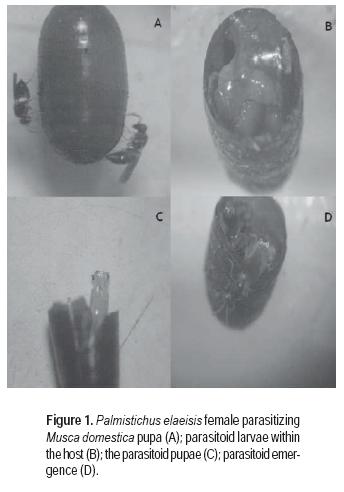
<body><![CDATA[<br>    </font>    </p>        <p style="margin-bottom: 0cm;"><font size="2" face="Verdana">Parasitoids used in this test were originally collected on pupae of <i>E. eucerus</i>. (Lepidoptera: Riodinidae) in eucalyptus plantations in Len&ccedil;ois Paulista, S&atilde;o Paulo State, Brazil, in  2011.<i> </i>Thereafter, a laboratory culture has been maintained, using pupae of <i>Spodoptera frugiperda</i> (J. E. Smith) (Lepidoptera: Noctuidae) as hosts. The parasitoid rearing technique was described in detail by <a name="2010"></a><span style="color: rgb(51, 51, 255);">Zach&eacute; </span><i style="color: rgb(51, 51, 255);">et al</i><span style="color: rgb(51, 51, 255);">.</span> (<a href="#16">2010</a>) for <i>Trichospilus diatreae</i> (Hymenoptera: Eulophidae) Pupae of <i>M. domestica</i> were removed from the rearing and placed individually in glass tubes, 4 cm in diameter, closed with &laquo;voil&raquo;, wherein 15 pupae were offered to <i>P. elaeisis </i>females at a 5:1 (parasitoid: host) ratio for 72 h. Thereafter, the female was removed and containers with <i>M. domestica</i> pupae were maintained in a climate-controlled chamber at 26 &plusmn; 2 &deg;C, 60 &plusmn; 10% relative humidity, and a 12 hour photophase. The following parameters were determined: level of parasitism, number of emerged and non-emerged parasitoids and duration of egg-adult cycle. The <i>M. domestica </i>pupa were dissected to evaluate the non-emerged parasitoids.</font></p>        <p style="margin-bottom: 0cm;"><font face="Verdana" size="2">    <br>    </font>    </p>        <p style="margin-bottom: 0cm;"> <font style="font-size: 10pt;" size="2" face="Verdana"><b>Results and Discussion </b></font> </p>        <p style="margin-bottom: 0cm;"><font face="Verdana" size="2">    <br>    </font>    </p>        <p style="margin-bottom: 0cm;"><font size="2" face="Verdana">This represents the first report of this species parasitizing <i>M. domestica </i>pupae (<a href="#f1">Fig.1</a>) and offers new opportunities for research to determine the potential of <i>M. domestica </i>as an alternative host for mass<i> </i>rearing. </font> </p>        <p style="margin-bottom: 0cm; text-align: center;"> <font face="Verdana" size="2"><a name="f1"></a></font></p>      <p style="margin-bottom: 0cm; text-align: center;"> <font face="Verdana" size="2"><img style="width: 344px; height: 492px;" alt="" src="/img/revistas/agro/v17n1/1a11f1.JPG"></font></p>      ]]></body>
<body><![CDATA[<p style="margin-bottom: 0cm;"><font face="Verdana" size="2">    <br>    </font>    </p>        <p style="margin-bottom: 0cm;"><font size="2" face="Verdana">The level of parasitism reached 80%, with an emergence rate of 60%. It was verified an emergence of 11.3 &plusmn; 0.2 parasitoids/individual pupa  versus only 0.8&plusmn;0.2 non-emerged parasitoids. The <i>P. elaeisis </i>egg-adult cycle was 17.3&plusmn;0.4 days in <i>M. domestica</i> pupa.</font></p>        <p style="margin-bottom: 0cm;"><font face="Verdana" size="2">    <br>    </font>    </p>        <p style="margin-bottom: 0cm;"> <font style="font-size: 10pt;" size="2" face="Verdana"><b>Conclusions</b></font></p>        <p style="margin-bottom: 0cm;"><font face="Verdana" size="2">    <br>    </font>    </p>        <p style="margin-bottom: 0cm;"><font size="2" face="Verdana">More studies are needed to determine the potential of <i>P. elaeisis,</i> given that this biocontrol agent may enable the use of this host in mass rearing.</font></p>        <p style="margin-bottom: 0cm;"> <font style="font-size: 10pt;" size="2" face="Verdana"><b>Acknowledgements</b></font></p>        ]]></body>
<body><![CDATA[<p style="margin-bottom: 0cm;"><font face="Verdana" size="2">    <br>    </font>    </p>        <p style="margin-bottom: 0cm;"><font size="2" face="Verdana">We are grateful to the Coordena&ccedil;&atilde;o de Aperfei&ccedil;oamento de Pessoal de N&iacute;vel Superior (CAPES) for funding this study.</font></p>        <p style="margin-bottom: 0cm;"><font face="Verdana" size="2">    <br>    </font>    </p>        <p style="margin-bottom: 0cm;"> <font style="font-size: 10pt;" size="2" face="Verdana"><b>References</b></font></p>        <p style="margin-bottom: 0cm;"><font face="Verdana" size="2">    <br>    </font>    </p>        <!-- ref --><p style="margin-bottom: 0cm;"><font size="2" face="Verdana"><b><a name="1"></a><a href="#Bittencourt_and_Berti_1999">Bittencourt MAL, Berti E.</a></b><a href="#Bittencourt_and_Berti_1999"> 1999</a>. Prefer&ecirc;ncia de <i>Palmistichus</i> <i>elaeisis </i>por pupas de diferentes lepid&oacute;pteros praga. <i>Scientia Agricola (Piracicaba)</i>, 56(4): 1281-1283.    </font></p>        ]]></body>
<body><![CDATA[<!-- ref --><p style="margin-bottom: 0cm;"><font size="2" face="Verdana"><b><a name="2"></a><a href="#Delvare_and_Lasalle_1993">Delvare G, Lasalle JA.</a></b><a href="#Delvare_and_Lasalle_1993"> 1993</a>. New genus of Tetrastichinae (Hymenoptera: Eulophidae) from the  region, with the description of a new species parasitica on key pests of oil palm. <i>Journal of Natural History</i>, 27(1): 435 -444.    </font></p>        <!-- ref --><p style="margin-bottom: 0cm;"><font size="2" face="Verdana"><b><a name="3"></a><a href="#Gauthier_et_al._2000">Gauthier N, Lassale J, Quicke DLJ, Godfray HCJ.</a></b><a href="#Gauthier_et_al._2000"> 2000</a>. Phylogeny of Eulophidae (Hymenoptera: Chalcidoidea), with a reclassification of Eulophinae and the recognition that Elasmidae are derived eulophids. <i>Systematic Entomology</i>, 25(1): 521-539.    </font></p>        <!-- ref --><p style="margin-bottom: 0cm;"><font size="2" face="Verdana"><b><a name="4"></a><a href="#Hansson_2004">Hansson C.</a></b><a href="#Hansson_2004"> 2004</a>. Eulophidae of Costa Rica (Hymenoptera: Chalcidoidea), 2. <i>Memoirs of the American Entomological Institute</i>, 75: 537p.    </font></p>        <!-- ref --><p style="margin-bottom: 0cm;"><font size="2" face="Verdana"><b><a name="5"></a><a href="#Hou_et_al._2007">Hou L, Shi Y, Zhai P, L&ecirc; G.</a></b><a href="#Hou_et_al._2007"> 2007</a>. Antibacterial activity and in vitro anti-tumor activity of the extract of the larvae of the housefly (<i>Musca domestica</i>). <i>Journal Ethnopharmacology</i>, 111: 227-231.    </font></p>        <!-- ref --><p style="margin-bottom: 0cm;"><font size="2" face="Verdana"><b><a name="6"></a><a href="#Lasalle_1993">Lasalle J.</a></b><a href="#Lasalle_1993"> 1993</a>. North American genera of Tetrastichinae (Hymenoptera: Eulophidae). <i>Journal of Natural History, </i>28(1): 109-236.    </font></p>        ]]></body>
<body><![CDATA[<!-- ref --><p style="margin-bottom: 0cm;"><font size="2" face="Verdana"><b><a name="7"></a><a href="#Lasalle_and_Schauff_1995">Lasalle J, Schauff M.E.</a></b><a href="#Lasalle_and_Schauff_1995"> 1995</a>. The Chalcidoid families. <i>Eulophidae</i>, 1: 315-329.    </font></p>        <!-- ref --><p style="margin-bottom: 0cm;"><font size="2" face="Verdana"><b><a name="8"></a><a href="#Noyes_1998">Noyes JS.</a></b><a href="#Noyes_1998"> 1998</a>. Catalogue of the Chalcidoidea of the World [CD-ROM]. Amsterdam: ETI Eletronic Publication.    </font></p>        <!-- ref --><p style="margin-bottom: 0cm;"><font size="2" face="Verdana"><b><a name="9"></a><a href="#Pennacchio_and_Strand_2006">Pennacchio F, Strand MR.</a></b><a href="#Pennacchio_and_Strand_2006">  2006</a>. Evolution of developmental strategies in parasitic Hymenoptera. <i>Annual Review of Entomology</i>, 51: 233-258.     </font> </p>        <!-- ref --><p style="margin-bottom: 0cm;"><font size="2" face="Verdana"><b><a name="10"></a><a href="#Pereira_et_al._2008">Pereira FF, Zanuncio JC, Serr&atilde;o JE, Oliveira HN, F&aacute;vero K, Gance ALV.</a></b><a href="#Pereira_et_al._2008"> 2008</a>. Prog&ecirc;nie de <i>Palmistichus elaeisis</i> Delvare &amp; LaSalle (Hymenoptera: Eulophidae) parasitando pupas de <i>Bombyx mori</i> L. (Lepidoptera: Bombycidae) de diferentes idades. <i>Neotropical Entomolgy</i>, 38: 660-64.    </font></p>        <!-- ref --><p style="margin-bottom: 0cm;"><font size="2" face="Verdana"><b><a name="11"></a><a href="#Pratissoli_et_al.">Pratissoli D, Viana UR, Zago HB, Pastori PL.</a></b><a href="#Pratissoli_et_al."> 2005</a>. Capacidade de dispers&atilde;o de <i>Trichogramma pretiosum</i> em tomate estaqueado. <i>Pesquisa Agropecuaria Brasileira,</i> 40: 613-616.    </font></p>        ]]></body>
<body><![CDATA[<!-- ref --><p style="margin-bottom: 0cm;"><font size="2" face="Verdana"><b><a name="12"></a><a href="#Soares_et_al._2007">Soares MA, Leite GLD, Zanuncio JC, Rocha SL, De S&aacute; VGM, Serr&atilde;o JE. </a></b><a href="#Soares_et_al._2007"> 2007</a>. Flight capacity, parasitism and emergence of five <i>Trichogramma </i>(Hymenoptera: Trichogrammatidae) species from forest areas in Brazil. <i>Phytoparasitica,</i><b> </b>35: 314 -318.     </font> </p>        <!-- ref --><p style="margin-bottom: 0cm;"><font size="2" face="Verdana"><b><a name="13"></a><a href="#Strand_2008">Strand MR.</a></b><a href="#Strand_2008">  2008</a>. The insect cellular immune response. <i>Insect Science,</i> 15: 1-14.     </font> </p>        <!-- ref --><p style="margin-bottom: 0cm;"><font size="2" face="Verdana"><b><a name="14"></a><a href="#Strand_and_Pech">Strand MR, Pech LL. </a></b><a href="#Strand_and_Pech">1995</a>. Immunological basis for compatibility in parasitoid host relationships. <i>Annual Review of Entomology,</i> 40: 31-56.     </font> </p>        <!-- ref --><p style="margin-bottom: 0cm;"><font size="2" face="Verdana"><b><a name="15"></a><a href="#Zach%E9_et._2012">Zach&eacute; B, Zach&eacute; CRR, Wilcken CF.</a></b><a href="#Zach%E9_et._2012"> 2012</a>. Evaluation of <i>Palmistichus elaeisis </i>Delvare &amp; LaSalle (Hymenoptera: Eulophidae) as parasitoid of the <i>Sarcina violascens</i> Herrich-Schaeffer (Lepidoptera: Lymantriidae). <i>Journal of Plant Studies,</i> 1: 86-89.    </font></p>        <!-- ref --><p style="margin-bottom: 0cm;"><font size="2" face="Verdana"><b><a name="16"></a><a href="#2010">Zach&eacute; B, Wilcken CF, Dacosta RR, Soliman EP.</a></b><a href="#2010"> 2010</a>.<i>Tricho&shy;spilus diatraeae </i>Cherian &amp; Margabandhu, 1942 (Hymenop&shy;tera: Eulophidae), a new parasitoid of <i>Melanolophia con&shy;similaria </i>(Lepidoptera: Geometridae). <i>Phytoparasitica, </i>38: 355 -357.    </font></p>        ]]></body>
<body><![CDATA[<p style="margin-bottom: 0cm;"><font face="Verdana" size="2">    <br>    </font>    </p>        <p style="margin-bottom: 0cm;"><font face="Verdana" size="2">    <br>    </font>    </p>        <p style="margin-bottom: 0cm;"><font face="Verdana" size="2">    <br>    </font>    </p>        <p style="margin-bottom: 0cm;"><font face="Verdana" size="2">    <br>    </font>    </p>         ]]></body><back>
<ref-list>
<ref id="B1">
<nlm-citation citation-type="journal">
<person-group person-group-type="author">
<name>
<surname><![CDATA[Bittencourt]]></surname>
<given-names><![CDATA[MAL]]></given-names>
</name>
<name>
<surname><![CDATA[Berti]]></surname>
<given-names><![CDATA[E]]></given-names>
</name>
</person-group>
<article-title xml:lang="pt"><![CDATA[Preferência de Palmistichus elaeisis por pupas de diferentes lepidópteros praga]]></article-title>
<source><![CDATA[Scientia Agricola (Piracicaba)]]></source>
<year>1999</year>
<volume>56</volume>
<numero>4</numero>
<issue>4</issue>
<page-range>1281-1283</page-range></nlm-citation>
</ref>
<ref id="B2">
<nlm-citation citation-type="journal">
<person-group person-group-type="author">
<name>
<surname><![CDATA[Delvare]]></surname>
<given-names><![CDATA[G]]></given-names>
</name>
<name>
<surname><![CDATA[Lasalle]]></surname>
<given-names><![CDATA[JA]]></given-names>
</name>
</person-group>
<article-title xml:lang="en"><![CDATA[New genus of Tetrastichinae (Hymenoptera: Eulophidae) from the region, with the description of a new species parasitica on key pests of oil palm]]></article-title>
<source><![CDATA[Journal of Natural History]]></source>
<year>1993</year>
<volume>27</volume>
<numero>1</numero>
<issue>1</issue>
<page-range>435 -444</page-range></nlm-citation>
</ref>
<ref id="B3">
<nlm-citation citation-type="journal">
<person-group person-group-type="author">
<name>
<surname><![CDATA[Gauthier]]></surname>
<given-names><![CDATA[N]]></given-names>
</name>
<name>
<surname><![CDATA[Lassale]]></surname>
<given-names><![CDATA[J]]></given-names>
</name>
<name>
<surname><![CDATA[Quicke]]></surname>
<given-names><![CDATA[DLJ]]></given-names>
</name>
<name>
<surname><![CDATA[Godfray]]></surname>
<given-names><![CDATA[HCJ]]></given-names>
</name>
</person-group>
<article-title xml:lang="en"><![CDATA[Phylogeny of Eulophidae (Hymenoptera: Chalcidoidea), with a reclassification of Eulophinae and the recognition that Elasmidae are derived eulophids]]></article-title>
<source><![CDATA[Systematic Entomology]]></source>
<year>2000</year>
<volume>25</volume>
<numero>1</numero>
<issue>1</issue>
<page-range>521-539</page-range></nlm-citation>
</ref>
<ref id="B4">
<nlm-citation citation-type="journal">
<person-group person-group-type="author">
<name>
<surname><![CDATA[Hansson]]></surname>
<given-names><![CDATA[C]]></given-names>
</name>
</person-group>
<article-title xml:lang="en"><![CDATA[Eulophidae of Costa Rica (Hymenoptera: Chalcidoidea), 2.]]></article-title>
<source><![CDATA[Memoirs of the American Entomological Institute]]></source>
<year>2004</year>
<volume>75</volume>
</nlm-citation>
</ref>
<ref id="B5">
<nlm-citation citation-type="journal">
<person-group person-group-type="author">
<name>
<surname><![CDATA[Hou]]></surname>
<given-names><![CDATA[L]]></given-names>
</name>
<name>
<surname><![CDATA[Shi]]></surname>
<given-names><![CDATA[Y]]></given-names>
</name>
<name>
<surname><![CDATA[Zhai]]></surname>
<given-names><![CDATA[P]]></given-names>
</name>
<name>
<surname><![CDATA[Lê]]></surname>
<given-names><![CDATA[G]]></given-names>
</name>
</person-group>
<article-title xml:lang="en"><![CDATA[Antibacterial activity and in vitro anti-tumor activity of the extract of the larvae of the housefly (Musca domestica)]]></article-title>
<source><![CDATA[Journal Ethnopharmacology]]></source>
<year>2007</year>
<volume>111</volume>
<page-range>227-231</page-range></nlm-citation>
</ref>
<ref id="B6">
<nlm-citation citation-type="journal">
<person-group person-group-type="author">
<name>
<surname><![CDATA[Lasalle]]></surname>
<given-names><![CDATA[J]]></given-names>
</name>
</person-group>
<article-title xml:lang="en"><![CDATA[North American genera of Tetrastichinae (Hymenoptera: Eulophidae).]]></article-title>
<source><![CDATA[Journal of Natural History]]></source>
<year>1993</year>
<volume>28</volume>
<numero>1</numero>
<issue>1</issue>
<page-range>109-236</page-range></nlm-citation>
</ref>
<ref id="B7">
<nlm-citation citation-type="journal">
<person-group person-group-type="author">
<name>
<surname><![CDATA[Lasalle]]></surname>
<given-names><![CDATA[J]]></given-names>
</name>
<name>
<surname><![CDATA[Schauff]]></surname>
<given-names><![CDATA[M.E.]]></given-names>
</name>
</person-group>
<article-title xml:lang="en"><![CDATA[The Chalcidoid families]]></article-title>
<source><![CDATA[Eulophidae]]></source>
<year>1995</year>
<volume>1</volume>
<page-range>315-329</page-range></nlm-citation>
</ref>
<ref id="B8">
<nlm-citation citation-type="book">
<person-group person-group-type="author">
<name>
<surname><![CDATA[Noyes]]></surname>
<given-names><![CDATA[JS]]></given-names>
</name>
</person-group>
<source><![CDATA[Catalogue of the Chalcidoidea of the World]]></source>
<year>1998</year>
<publisher-loc><![CDATA[Amsterdam ]]></publisher-loc>
<publisher-name><![CDATA[ETI Eletronic Publication]]></publisher-name>
</nlm-citation>
</ref>
<ref id="B9">
<nlm-citation citation-type="journal">
<person-group person-group-type="author">
<name>
<surname><![CDATA[Pennacchio]]></surname>
<given-names><![CDATA[F]]></given-names>
</name>
<name>
<surname><![CDATA[Strand]]></surname>
<given-names><![CDATA[MR]]></given-names>
</name>
</person-group>
<article-title xml:lang="en"><![CDATA[Evolution of developmental strategies in parasitic Hymenoptera]]></article-title>
<source><![CDATA[Annual Review of Entomology]]></source>
<year>2006</year>
<volume>51</volume>
<page-range>233-258</page-range></nlm-citation>
</ref>
<ref id="B10">
<nlm-citation citation-type="journal">
<person-group person-group-type="author">
<name>
<surname><![CDATA[Pereira]]></surname>
<given-names><![CDATA[FF]]></given-names>
</name>
<name>
<surname><![CDATA[Zanuncio]]></surname>
<given-names><![CDATA[JC]]></given-names>
</name>
<name>
<surname><![CDATA[Serrão]]></surname>
<given-names><![CDATA[JE]]></given-names>
</name>
<name>
<surname><![CDATA[Oliveira]]></surname>
<given-names><![CDATA[HN]]></given-names>
</name>
<name>
<surname><![CDATA[Fávero]]></surname>
<given-names><![CDATA[K]]></given-names>
</name>
<name>
<surname><![CDATA[Gance]]></surname>
<given-names><![CDATA[ALV]]></given-names>
</name>
</person-group>
<article-title xml:lang="pt"><![CDATA[Progênie de Palmistichus elaeisis Delvare & LaSalle (Hymenoptera: Eulophidae) parasitando pupas de Bombyx mori L. (Lepidoptera: Bombycidae) de diferentes idades.]]></article-title>
<source><![CDATA[Neotropical Entomolgy]]></source>
<year>2008</year>
<volume>38</volume>
<page-range>660-64</page-range></nlm-citation>
</ref>
<ref id="B11">
<nlm-citation citation-type="journal">
<person-group person-group-type="author">
<name>
<surname><![CDATA[Pratissoli]]></surname>
<given-names><![CDATA[D]]></given-names>
</name>
<name>
<surname><![CDATA[Viana]]></surname>
<given-names><![CDATA[UR]]></given-names>
</name>
<name>
<surname><![CDATA[Zago]]></surname>
<given-names><![CDATA[HB]]></given-names>
</name>
<name>
<surname><![CDATA[Pastori]]></surname>
<given-names><![CDATA[PL]]></given-names>
</name>
</person-group>
<article-title xml:lang="pt"><![CDATA[Capacidade de dispersão de Trichogramma pretiosum em tomate estaqueado]]></article-title>
<source><![CDATA[Pesquisa Agropecuaria Brasileira]]></source>
<year>2005</year>
<volume>40</volume>
<page-range>613-616</page-range></nlm-citation>
</ref>
<ref id="B12">
<nlm-citation citation-type="journal">
<person-group person-group-type="author">
<name>
<surname><![CDATA[Soares]]></surname>
<given-names><![CDATA[MA]]></given-names>
</name>
<name>
<surname><![CDATA[Leite]]></surname>
<given-names><![CDATA[GLD]]></given-names>
</name>
<name>
<surname><![CDATA[Zanuncio]]></surname>
<given-names><![CDATA[JC]]></given-names>
</name>
<name>
<surname><![CDATA[Rocha]]></surname>
<given-names><![CDATA[SL]]></given-names>
</name>
<name>
<surname><![CDATA[De Sá]]></surname>
<given-names><![CDATA[VGM]]></given-names>
</name>
<name>
<surname><![CDATA[Serrão]]></surname>
<given-names><![CDATA[JE]]></given-names>
</name>
</person-group>
<article-title xml:lang="en"><![CDATA[Flight capacity, parasitism and emergence of five Trichogramma (Hymenoptera: Trichogrammatidae) species from forest areas in Brazil]]></article-title>
<source><![CDATA[Phytoparasitica]]></source>
<year>2007</year>
<volume>35</volume>
<page-range>314 -318</page-range></nlm-citation>
</ref>
<ref id="B13">
<nlm-citation citation-type="journal">
<person-group person-group-type="author">
<name>
<surname><![CDATA[Strand]]></surname>
<given-names><![CDATA[MR]]></given-names>
</name>
</person-group>
<article-title xml:lang="en"><![CDATA[The insect cellular immune response]]></article-title>
<source><![CDATA[Insect Science]]></source>
<year>2008</year>
<volume>15</volume>
<page-range>1-14</page-range></nlm-citation>
</ref>
<ref id="B14">
<nlm-citation citation-type="journal">
<person-group person-group-type="author">
<name>
<surname><![CDATA[Strand]]></surname>
<given-names><![CDATA[MR]]></given-names>
</name>
<name>
<surname><![CDATA[Pech]]></surname>
<given-names><![CDATA[LL]]></given-names>
</name>
</person-group>
<article-title xml:lang="en"><![CDATA[Immunological basis for compatibility in parasitoid host relationships]]></article-title>
<source><![CDATA[Annual Review of Entomology]]></source>
<year>1995</year>
<volume>40</volume>
<page-range>31-56</page-range></nlm-citation>
</ref>
<ref id="B15">
<nlm-citation citation-type="journal">
<person-group person-group-type="author">
<name>
<surname><![CDATA[Zaché]]></surname>
<given-names><![CDATA[B]]></given-names>
</name>
<name>
<surname><![CDATA[Zaché]]></surname>
<given-names><![CDATA[CRR]]></given-names>
</name>
<name>
<surname><![CDATA[Wilcken]]></surname>
<given-names><![CDATA[CF]]></given-names>
</name>
</person-group>
<article-title xml:lang="en"><![CDATA[Evaluation of Palmistichus elaeisis Delvare & LaSalle (Hymenoptera: Eulophidae) as parasitoid of the Sarcina violascens Herrich-Schaeffer (Lepidoptera: Lymantriidae)]]></article-title>
<source><![CDATA[Journal of Plant Studies]]></source>
<year>2012</year>
<volume>1</volume>
<page-range>86-89</page-range></nlm-citation>
</ref>
<ref id="B16">
<nlm-citation citation-type="journal">
<person-group person-group-type="author">
<name>
<surname><![CDATA[Zaché]]></surname>
<given-names><![CDATA[B]]></given-names>
</name>
<name>
<surname><![CDATA[Wilcken]]></surname>
<given-names><![CDATA[CF]]></given-names>
</name>
<name>
<surname><![CDATA[Dacosta]]></surname>
<given-names><![CDATA[RR]]></given-names>
</name>
<name>
<surname><![CDATA[Soliman]]></surname>
<given-names><![CDATA[EP]]></given-names>
</name>
</person-group>
<article-title xml:lang="en"><![CDATA[Tricho-spilus diatraeae Cherian & Margabandhu, 1942 (Hymenop-tera: Eulophidae), a new parasitoid of Melanolophia con-similaria (Lepidoptera: Geometridae).]]></article-title>
<source><![CDATA[Phytoparasitica]]></source>
<year>2010</year>
<volume>38</volume>
<page-range>355 -357</page-range></nlm-citation>
</ref>
</ref-list>
</back>
</article>
