<?xml version="1.0" encoding="ISO-8859-1"?><article xmlns:mml="http://www.w3.org/1998/Math/MathML" xmlns:xlink="http://www.w3.org/1999/xlink" xmlns:xsi="http://www.w3.org/2001/XMLSchema-instance">
<front>
<journal-meta>
<journal-id>2301-1548</journal-id>
<journal-title><![CDATA[Agrociencia (Uruguay)]]></journal-title>
<abbrev-journal-title><![CDATA[Agrociencia Uruguay]]></abbrev-journal-title>
<issn>2301-1548</issn>
<publisher>
<publisher-name><![CDATA[Facultad de Agronomía - Instituto Nacional de Investigación Agropecuaria]]></publisher-name>
</publisher>
</journal-meta>
<article-meta>
<article-id>S2301-15482010000100004</article-id>
<title-group>
<article-title xml:lang="en"><![CDATA[Presence of the Wheat Curl Mite, Aceria tosichella Keifer (Prostigmata: Eriophyidae), in Uruguay]]></article-title>
<article-title xml:lang="es"><![CDATA[Presencia del ácaro del enrollamiento del trigo, Aceria tosichella Keifer (Prostigmata: Eriophyidae), en Uruguay]]></article-title>
</title-group>
<contrib-group>
<contrib contrib-type="author">
<name>
<surname><![CDATA[Castiglioni]]></surname>
<given-names><![CDATA[Enrique]]></given-names>
</name>
<xref ref-type="aff" rid="A01"/>
</contrib>
<contrib contrib-type="author">
<name>
<surname><![CDATA[Navia]]></surname>
<given-names><![CDATA[Denise]]></given-names>
</name>
<xref ref-type="aff" rid="A02"/>
</contrib>
</contrib-group>
<aff id="A01">
<institution><![CDATA[,UDELAR Facultad de Agronomía EEMAC]]></institution>
<addr-line><![CDATA[ Paysandú]]></addr-line>
<country>Uruguay</country>
</aff>
<aff id="A02">
<institution><![CDATA[,Embrapa Recursos Genéticos e Biotecnologia ]]></institution>
<addr-line><![CDATA[ ]]></addr-line>
</aff>
<pub-date pub-type="pub">
<day>00</day>
<month>01</month>
<year>2010</year>
</pub-date>
<pub-date pub-type="epub">
<day>00</day>
<month>01</month>
<year>2010</year>
</pub-date>
<volume>14</volume>
<numero>1</numero>
<fpage>19</fpage>
<lpage>26</lpage>
<copyright-statement/>
<copyright-year/>
<self-uri xlink:href="http://www.scielo.edu.uy/scielo.php?script=sci_arttext&amp;pid=S2301-15482010000100004&amp;lng=en&amp;nrm=iso"></self-uri><self-uri xlink:href="http://www.scielo.edu.uy/scielo.php?script=sci_abstract&amp;pid=S2301-15482010000100004&amp;lng=en&amp;nrm=iso"></self-uri><self-uri xlink:href="http://www.scielo.edu.uy/scielo.php?script=sci_pdf&amp;pid=S2301-15482010000100004&amp;lng=en&amp;nrm=iso"></self-uri><abstract abstract-type="short" xml:lang="en"><p><![CDATA[The Wheat Curl Mite (WCM), Aceria tosichella (Keifer), a vector of important virus that affect wheat and corn, was recently detected in South America, in Argentina. This found alerted to the risk of dissemination of the pest to neighbor countries in the continent. Aiming to determine the status of the WCM in Uruguay, a survey of eriophyid mites associated with wheat, barley, corn and other common grasses was conducted in the main wheat production areas of this country, in November 2007. WCM specimens were collected from wheat, Triticum aestivum L., in Ombúes de Lavalle, Tarariras and San Juan, Department of Colonia and in San Javier, Department of Río Negro; and also from ryegrass, Lolium multiflorum Lam (Rosario and San Juan, Colonia; Cardona, Soriano) and brome, Bromus unioloides (Willd.) Kunth (Rosario, Colonia). This is the first report of A. tosichella in Uruguay and also the first time the mite is found, in field surveys, on other hosts different from wheat in South America.]]></p></abstract>
<abstract abstract-type="short" xml:lang="es"><p><![CDATA[El ácaro del enrollamiento del trigo Aceria tosichella (Keifer), vector de importantes virosis que afectan trigo y maíz, fue recientemente detectado en Argentina. Este hallazgo alertó el riesgo de diseminación de esta plaga en los países vecinos del Cono Sur. Con el objetivo de determinar la presencia de este ácaro en Uruguay, fue realizada una prospección en trigo, cebada, maíz y otras gramíneas comúnmente asociadas al área de producción de trigo en este país, a principios de noviembre de 2007. Ejemplares de A. tosichella fueron colectados en trigo, Triticum aestivum L. en Ombúes de Lavalle, Tarariras y San Juan, Departmento de Colonia y en San Javier, Departmento de Río Negro; y también en raigrás, Lolium multiflorum Lam (Rosario y San Juan, Colonia; Cardona, Soriano) y cebadilla, Bromus unioloides (Willd.) Kunth (Rosario, Colonia). Esta es la primera referencia de A. tosichella en Uruguay y la primera vez que este ácaro es encontrado, en prospecciones de campo, en un hospedero diferente de trigo en América del Sur.]]></p></abstract>
<kwd-group>
<kwd lng="en"><![CDATA[Acari]]></kwd>
<kwd lng="en"><![CDATA[Eriophyoidea]]></kwd>
<kwd lng="en"><![CDATA[virus vector]]></kwd>
<kwd lng="en"><![CDATA[Triticum aestivum]]></kwd>
<kwd lng="en"><![CDATA[brome]]></kwd>
<kwd lng="en"><![CDATA[ryegrass]]></kwd>
<kwd lng="es"><![CDATA[Acari]]></kwd>
<kwd lng="es"><![CDATA[Eriophyoidea]]></kwd>
<kwd lng="es"><![CDATA[vector de virus]]></kwd>
<kwd lng="es"><![CDATA[Triticum aestivum]]></kwd>
<kwd lng="es"><![CDATA[cebadilla]]></kwd>
<kwd lng="es"><![CDATA[raigrás]]></kwd>
</kwd-group>
</article-meta>
</front><body><![CDATA[ <p class="western" style="text-indent: 0cm;" align="left" lang="en-US"><b> <font style="font-size: 13pt;" face="Verdana">Presence of the Wheat Curl Mite, Aceria tosichella Keifer (Prostigmata: Eriophyidae), in Uruguay</font></b></p>       <p style="text-indent: 0cm;" align="left" lang="en-US"> <font face="Verdana" size="2">    <br>   </font>   </p>        <p style="text-indent: 0cm;" lang="es-ES"><font size="2" face="Verdana"><a name="1.."></a>Castiglioni, Enrique</font><sup><font size="2" face="Verdana"><a href="#1.">1</a> </font></sup><font size="2" face="Verdana">y <a name="2.."></a>Navia, Denise</font><a href="#2."><sup><font size="2" face="Verdana">2</font></sup></a></p>       <p class="western" style="text-indent: 0cm;" align="left" lang="en-US"> <font face="Verdana">    <br>   </font>   </p>       <p class="western" style="text-indent: 0cm;" align="left" lang="en-US"> <font face="Verdana">    <br>   </font>   </p>       <p style="margin-left: 0.15cm; text-indent: -0.15cm;" lang="es-ES"><i><sup> <font face="Verdana"><a name="1."><font size="2"></font></a><font size="2"><a href="#1..">1</a></font></font></sup><font face="Verdana" size="2">UDELAR, Facultad de Agronom&iacute;a, EEMAC. Departamento de Protecci&oacute;n Vegetal, Ruta 3 Gral. Artigas km 363, 60000, Paysand&uacute;, Uruguay. Correo electr&oacute;nico: </font></i><a href="mailto:bbcast@fagro.edu.uy"> <font face="Verdana"><span style="font-style: normal;"><font size="2">bbcast@fagro.edu.uy</font></span></font></a></p>       <p style="margin-left: 0.15cm; text-indent: -0.15cm;" lang="es-ES"><i><sup> <font face="Verdana"><a name="2."><font size="2"></font></a><font size="2"><a href="#2..">2</a></font></font></sup><font size="2" face="Verdana">Embrapa Recursos Gen&eacute;ticos e Biotecnologia, Cx. Postal 02372, 70.770-900, Bras&iacute;lia, DF, Brazil. </font></i> </p>       ]]></body>
<body><![CDATA[<p class="western" style="text-indent: 0cm;" align="left" lang="es-ES"> <font face="Verdana">    <br>   </font>   </p>       <p class="western" style="text-indent: 0cm;" align="left" lang="es-ES"> <font face="Verdana">    <br>   </font>   </p>       <p class="western" style="text-indent: 0cm; text-align: center;" lang="es-ES"> <font face="Verdana">Recibido: 2/4/09  Aceptado: 10/2/10</font></p>       <p class="western" style="text-indent: 0cm;" align="left" lang="es-ES"> <font face="Verdana">    <br>   </font>   </p>       <p class="western" style="text-indent: 0cm; line-height: 150%;" align="left" lang="en-US"> <font face="Verdana"><b>Summary</b></font></p>       <p class="western" style="text-indent: 0cm;" align="justify" lang="es-ES"> <font face="Verdana"><span lang="en-US">The Wheat Curl Mite (WCM), <i>Aceria tosichella</i> (Keifer), a vector of important virus that affect wheat and corn, was recently detected in South America, in Argentina. This found alerted to the risk of dissemination of the pest to neighbor countries in the continent.  Aiming to determine the status of the WCM in Uruguay, a survey of eriophyid mites associated with wheat, barley, corn and other common grasses was conducted in the main wheat production areas of this country, in November 2007. WCM specimens were collected from wheat, <i>Triticum aestivum </i>L., in Omb&uacute;es de Lavalle, Tarariras and San Juan, Department of Colonia and in San Javier, Department of R&iacute;o Negro; and also from ryegrass, <i>Lolium multiflorum </i>Lam (Rosario and San Juan, Colonia; Cardona, Soriano) and brome, <i>Bromus unioloides</i> (Willd.) Kunth (Rosario, Colonia). This is the first report of <i>A. tosichella</i> in Uruguay and also the first time the mite is found, in field surveys, on other hosts different from wheat in South America.</span></font></p>       <p class="western" style="text-indent: 0cm;" align="justify" lang="en-US"> <font face="Verdana">     ]]></body>
<body><![CDATA[<br>   </font>   </p>       <p class="western" style="text-indent: 0cm;" align="justify" lang="es-ES"> <font face="Verdana"><span lang="en-US"><b>Key Words</b>: Acari, Eriophyoidea, virus vector, <i>Triticum aestivum</i>, brome, ryegrass</span></font></p>       <p class="western" style="text-indent: 0cm; line-height: 0.93cm;" align="center" lang="en-US"> <font face="Verdana">     <br>   </font>   </p>       <p class="western" style="text-indent: 0cm; line-height: 150%;" align="left" lang="es-ES"> <font face="Verdana"><b>Resumen </b></font> </p>       <p class="western" style="text-indent: 0cm;" align="left" lang="es-ES"> <font face="Verdana">Presencia del &aacute;caro del enrollamiento del trigo, Aceria tosichella Keifer (Prostigmata: Eriophyidae), en Uruguay</font></p>       <p class="western" style="text-indent: 0cm;" align="left" lang="es-ES"> <font face="Verdana">    <br>   </font>   </p>       <p class="western" style="text-indent: 0cm;" align="justify" lang="es-ES"> <font face="Verdana">El &aacute;caro<b> </b>del enrollamiento del trigo <i>Aceria tosichella</i> (Keifer), vector de importantes virosis que afectan trigo y ma&iacute;z, fue recientemente detectado en Argentina. Este hallazgo alert&oacute; el riesgo de diseminaci&oacute;n de esta plaga en los pa&iacute;ses vecinos del Cono Sur. Con el objetivo de determinar la presencia de este &aacute;caro en Uruguay, fue realizada una prospecci&oacute;n en trigo, cebada, ma&iacute;z y otras gram&iacute;neas com&uacute;nmente asociadas al &aacute;rea de producci&oacute;n de trigo en este pa&iacute;s, a principios de  noviembre de  2007. Ejemplares de <i>A. tosichella</i> fueron colectados en trigo, <i>Triticum aestivum </i>L. en Omb&uacute;es de Lavalle, Tarariras y San Juan, Departmento de Colonia y en San Javier, Departmento de R&iacute;o Negro; y tambi&eacute;n en raigr&aacute;s, <i>Lolium multiflorum </i>Lam (Rosario y San Juan, Colonia; Cardona, Soriano) y cebadilla, <i>Bromus unioloides</i> (Willd.) Kunth (Rosario, Colonia). Esta es la primera referencia de <i>A. tosichella</i> en Uruguay y la primera vez que este &aacute;caro es encontrado, en prospecciones de campo, en un hospedero diferente de trigo en Am&eacute;rica del Sur.</font></p>       <p class="western" style="text-indent: 0cm;" align="justify" lang="es-ES"> <font face="Verdana">     ]]></body>
<body><![CDATA[<br>   </font>   </p>       <p class="western" style="text-indent: 0cm;" align="justify" lang="es-ES"> <font face="Verdana"><b>Palabras clave:</b> Acari, Eriophyoidea, vector de virus, <i>Triticum aestivum</i>, cebadilla, raigr&aacute;s</font></p>       <p style="text-indent: 0cm; margin-top: 0.4cm; margin-bottom: 0.3cm;" align="left" lang="en-US"> <font face="Verdana" size="2">     <br>      <br>   </font>   </p>       <p class="western" style="text-indent: 0cm; line-height: 150%;" align="left" lang="en-US"> <font face="Verdana"><b>Introduction</b></font></p>       <p class="western" lang="es-ES"><font face="Verdana" color="#000000"><span lang="en-US">The Wheat Curl Mite (WCM), <i>Aceria tosichella </i>Keifer (Acari: Eriophyidae), a pest of cereal crops is widespread in North America, Europe, Asia, the Middle East, Africa and Oceania <a name="OldfieldandProeseler1996"></a>(<a href="#24">Oldfield and Proeseler, 1996</a>; <a name="CABI2002"></a><a href="#7">CABI, 2002</a>; <a href="#34">Thomas </a> </span></font><a href="#34"> <font face="Verdana" color="#000000"><span lang="en-US"><i>et al</i></span></font></a><font face="Verdana" color="#000000"><span lang="en-US"><a href="#34">., 2004</a>). However in South America the report of the WCM and associated virus is recent. In this continent the WCM was first found in Argentina, in 2004 <a name="Naviaetal.2006"></a>(<a href="#22">Navia </a></span></font><a href="#22"> <font face="Verdana" color="#000000"><span lang="en-US"><i>et al</i></span></font></a><font face="Verdana" color="#000000"><span lang="en-US"><a href="#22">., 2006</a>), a few years after the report of the presence of a WCM transmitted virus, the <i>Wheat streak mosaic virus</i> (WSMV), in 2002 <a name="Truoletal.2004"></a>(<a href="#35">Truol </a> </span></font><a href="#35"> <font face="Verdana" color="#000000"><span lang="en-US"><i>et al.</i></span></font></a><font face="Verdana" color="#000000"><span lang="en-US"><a href="#35">, 2004</a>). Since the detection of the WSMV in Argentina, serious epiphytes have been observed in wheat crops some years later, especially in the Province of Buenos Aires, with losses that reached 100 % in the most affected areas <a name="Sagadinetal.2008"></a>(<a href="#25">Sagadin </a></span></font><a href="#25"> <font face="Verdana" color="#000000"><span lang="en-US"><i>et al</i></span></font></a><font face="Verdana" color="#000000"><span lang="en-US"><a href="#25">., 2008</a>).  </span></font> </p>       <p class="western" lang="es-ES"><font face="Verdana" color="#000000"><span lang="en-US">Damages of <i>A. tosichella </i>can be direct, due to the feeding of the mites, mainly when there are high infestations, or indirect, due to their action as phytovirus vectors. Direct damage includes discoloration, curling or rolling of leaves, abnormal development of leaves and plant stunting. The stunting occurs because infested leaves do not expand normally, remaining inside older leaves and the plant stays arched <a name="Jeppsonetal.1975"></a>(<a href="#14">Jeppson </a> </span></font><a href="#14"> <font face="Verdana" color="#000000"><span lang="en-US"><i>et al</i></span></font></a><font face="Verdana" color="#000000"><span lang="en-US"><a href="#14">., 1975</a>; <a href="#7">CABI, 2002</a>). Yield losses in wheat crops due to WCM high population infestations can reach 30 % <a name="Harveyetal.2002"></a>(<a href="#12">Harvey </a></span></font><a href="#12"> <font face="Verdana" color="#000000"><span lang="en-US"><i>et al., </i></span></font></a><font face="Verdana" color="#000000"><span lang="en-US"><a href="#12">2002</a>). However the main damage caused by <i>A. tosichella </i>is due to the transmission of <i>Wheat streak mosaic virus</i> (WSMV) and <i>High plain virus</i> (HPV) (<a href="#24">Oldfield and Proeseler, 1996</a>; <a name="Maliketal.2003ab"></a><a href="#19">Malik </a> </span></font><a href="#19"> <font face="Verdana" color="#000000"><span lang="en-US"><i>et al.</i></span></font></a><font face="Verdana" color="#000000"><span lang="en-US"><a href="#19">, 2003</a>ab). The WSMV is the etiological agent of one of the most important virus diseases in wheat crops, causing major yield losses in North America, and also occurring in Europe, the Middle East, Oceania and Asia (<a href="#24">Oldfield and Proeseler, 1996</a>; <a name="FrenchandStenger2003"></a><a href="#10">French and Stenger, 2003</a>; <a name="Sanchez-Sanchezetal.2001"></a><a href="#28">Sanchez-Sanchez </a></span></font><a href="#28"> <font face="Verdana" color="#000000"><span lang="en-US"><i>et al</i></span></font></a><font face="Verdana" color="#000000"><span lang="en-US"><a href="#28">., 2001</a>). The HPV was first observed in 1993 in the High Plains of the US from Texas, Idaho, Kansas and Colorado <a name="Jensenetal.1996"></a>(<a href="#13">Jensen </a></span></font><a href="#13"> <font face="Verdana" color="#000000"><span lang="en-US"><i>et al.</i></span></font></a><font face="Verdana" color="#000000"><span lang="en-US"><a href="#13">, 1996</a>). Later, it was also found in South Dakota, Nebraska and South Florida <a name="Seifersetal.1997"></a>(<a href="#29">Seifers </a></span></font><a href="#29"> <font face="Verdana" color="#000000"><span lang="en-US"><i>et al.</i></span></font></a><font face="Verdana" color="#000000"><span lang="en-US"><a href="#29">, 1997</a>; <a name="Mahmoodetal.1998"></a><a href="#18">Mahmood </a></span></font><a href="#18"> <font face="Verdana" color="#000000"><span lang="en-US"><i>et al.</i></span></font></a><font face="Verdana" color="#000000"><span lang="en-US"><a href="#18">, 1998</a>; <a name="BrownJr.2001"></a><a href="#6">Brown Jr., 2001</a>). HPV presence was also confirmed in the Province of Buenos Aires, Argentina, in mixed infections with WSMV <a name="TruolySagadin2008"></a>(<a href="#36">Truol y Sagadin, 2008</a>). Losses due to HPV infection in corn were estimated to be around 75 % in some regions of the US <a name="AQIS2000"></a>(<a href="#4">AQIS, 2000</a>). Mixed infections of WSMV and HPV have been usually observed in the US, making it difficult to estimate the losses due to each virus separately. </span></font> </p>       <p class="western" lang="es-ES"><font face="Verdana" color="#000000"><span lang="en-US">WCM occurs mainly on wheat, but its populations can also develop on corn (<i>Zea mays </i>L.), sorghum (<i>Sorghum </i>sp.), barley (<i>Hordeum vulgare </i>L.), oats (<i>Avena sativa </i>L.), rye (<i>Secale cereale </i>L.) (<a href="#14">Jeppson </a></span></font><a href="#14"> <font face="Verdana" color="#000000"><span lang="en-US"><i>et al.</i></span></font></a><font face="Verdana" color="#000000"><span lang="en-US"><a href="#14">, 1975</a>), and a large number of grasses of minor economic importance and weeds, with more than one hundred host plants, all of them in the Poaceae family <a name="AmrineanddeLillo2003"></a>(<a href="#1">Amrine and de Lillo, 2003</a>). The knowledge of <i>A. tosichella</i> host plants in an area is important to guide the adoption of management measures. At the end of wheat growing season, <i>A. tosichella</i> dispersion forms, also called &laquo;airborne mites&raquo;, migrate to spontaneous wheat, neighbor crops or to grasses around the crop, where they remain until the next wheat season <a name="Somsem1966"></a>(<a href="#32">Somsem, 1966</a>), acting as a &laquo;green bridge&raquo;. There is no information on <i>A. tosichella</i> host plants different from wheat in South America. </span></font> </p>       <p class="western" lang="es-ES"><font face="Verdana" color="#000000"><span lang="en-US">The occurrence of <i>A. tosichella</i> and associated virus in Argentina have alerted to the threat that the pathosystem WCM/WSMV and HPV represents to cereal crops in other countries in South America, especially to neighbor countries presenting close or contiguous cereal production areas. Thus, in 2006 a collaborative project among Argentina, Brazil, Paraguay and Uruguay institutions was initiated, entitled &laquo;The mite <i>Aceria tosichella</i> Keifer and the transmitted viruses <i>Wheat streak mosaic virus </i>and <i>High plain virus</i>, a new threat to cereal crops in South America &ndash; Pest Risk Assessment, geographic distribution, hosts, characterization and control&raquo;. Among other objectives this project aimed to contribute to the knowedge of the distribution of the pathosystem in the South Cone Region. </span></font> </p>       ]]></body>
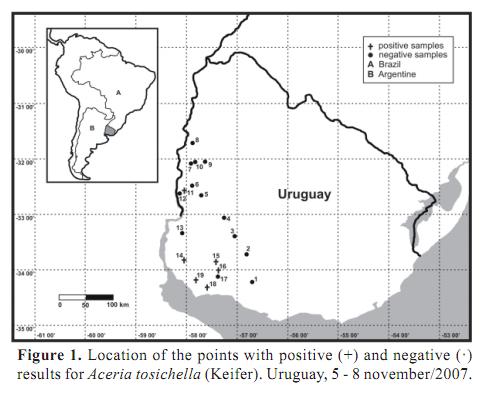
<body><![CDATA[<p class="western" lang="en-US"><font face="Verdana">Wheat is a main cereal crop in Uruguay, traditionally included in the double cropping of winter and summer crops for grain production and soil protection along the season. After a period of stagnation, the wheat production area has grown in the South Cone <a name="D&iacute;azyAbadie1998"></a>(<a href="#8">D&iacute;az y Abadie, 1998</a>), reaching higher yields that confirm a process of technological improvement, added with sustainability associated to no-till, among other agricultural practices <a name="Ernst2000"></a>(<a href="#9">Ernst, 2000</a>). Disease management has always been a major concern in wheat production in Uruguay, because of the risks of losses they represent in the achievement of the expected yields.      </font> </p>       <p class="western" lang="en-US"><font face="Verdana">In this paper, the results of a survey of eriophyid mites associated with wheat, corn, oat and other common grasses, conducted in the main winter cereal production area of Uruguay, are presented.</font></p>       <p class="western" style="text-indent: 0cm; line-height: 150%;" align="left" lang="en-US"> <font face="Verdana">     <br>   </font>   </p>       <p class="western" style="text-indent: 0cm; line-height: 150%;" align="left" lang="en-US"> <font face="Verdana"><b>Materials and Methods</b></font></p>       <p class="western" lang="es-ES"><font face="Verdana" color="#000000"><span lang="en-US">Surveys were conducted in 13 municipalities of six Departments of Uruguay, between 5</span></font><font color="#000000"><sup><font face="Verdana"><span lang="en-US">th</span></font></sup><font face="Verdana"><span lang="en-US"> to 8</span></font><sup><font face="Verdana"><span lang="en-US">th</span></font></sup><font face="Verdana"><span lang="en-US"> of november 2007, covering most of the traditional agricultural and wheat production areas of the country (<a href="/img/revistas/agro/v14n1/1a04t1.GIF" target="_blank">Table 1</a>, <a href="#f1">Figure 1</a>).</span></font></font></p>      <p style="text-align: center;" class="western" lang="es-ES"> <font face="Verdana" color="#000000"><span lang="en-US"><a name="f1"></a></span></font></p>      <p style="text-align: center;" class="western" lang="es-ES"> <font face="Verdana"><img style="width: 481px; height: 393px;" alt="" src="/img/revistas/agro/v14n1/1a04f1.JPG"></font></p>      <p class="western" lang="es-ES"> </p>       <p class="western" lang="en-US"><font face="Verdana">Samples were taken from cultivated wheat, barley and corn as well as of common native or spontaneous grasses nearby the crop areas. A total of 11 species of Poaceae including the cultivated grasses were sampled. Samples of wheat, barley and corn were composed of approximately 50 stems with their leaves, randomly collected from a stripe approximately 100 m of length by 5 m of width, on the border of the crop field. Samples of non-sown grasses were composed of approximately ten plants randomly collected surrounding cultivated areas. After removing the roots, the samples were placed inside paper bags appropriately identified. Samples were processed at the end of the day of collection or the day after, in order to preserve the quality of the plants and the eventually associated mites. </font> </p>       ]]></body>
<body><![CDATA[<p class="western" lang="en-US"><font face="Verdana">For the extraction of the mites, the leaves were detached of the stems, in order to facilitate the release of the eriophyid mites eventually present on the leaf sheaths, and the complete sample of vegetal tissue was submerged in a detergent solution (5 %) shaking gently for a few minutes, aiming the detachment of superficial particles (including arthropods) and leaving for decantation for another 10 minutes. After that time, samples were passed through a pair of granulometric sieves of 500 mesh (open 0.028 mm) and 18 mesh (open 1 mm), in ascending order. The material retained by the 500 mesh sieve was collected and placed in hermetic plastic labeled vials containing ethyl alcohol 70 %. </font> </p>       <p class="western" lang="es-ES"><font face="Verdana" color="#000000"><span lang="en-US">Samples in the alcoholic solution were examined under stereomicroscope (40x) at the Laboratory of Plant Quarantine, Embrapa Genetic Resources and Biotechnology, Brasilia, Brazil. The eriophyoid mites detected were mounted in permanent microscope preparations using Berlese modified medium <a name="AmrineandManson1996"></a>(<a href="#2">Amrine and Manson, 1996</a>) and then identified using a phase contrast microscope <a name="Amrineetal.2003"></a>(<a href="#3">Amrine </a></span></font><a href="#3"> <font face="Verdana" color="#000000"><span lang="en-US"><i>et al</i></span></font></a><font face="Verdana" color="#000000"><span lang="en-US"><a href="#3">., 2003</a>). Eriophyoid mites identified as belonging to genus <i>Aceria</i> Keifer were compared with the description of <i>A. tosichella</i> <a name="Keifer1969"></a>(<a href="#15">Keifer, 1969</a>). Some of the mites identified as <i>A. tosichella</i> had taxonomic structures measured using a phase contrast microscope (100x objective) and measurements were compared to those of the original description to confirm identification. Micrographs of <i>A. tosichella</i> were taken at the Lab. of Plant Quarantine, Embrapa Genetic Resources and Biotechnology, Bras&iacute;lia, Brasil. Specimens of <i>A. tosichella</i> collected in this survey were deposited at the Reference Mite Collections of the Laboratories of Plant Quarantine of Brasilia and of the &laquo;Ministerio de Ganader&iacute;a Agricultura y Pesca&raquo;, Montevideo, Uruguay. </span></font> </p>       <p class="western" style="text-indent: 0cm; line-height: 150%;" align="left" lang="en-US"> <font face="Verdana">     <br>   </font>   </p>       <p class="western" style="text-indent: 0cm; line-height: 150%;" align="left" lang="en-US"> <font face="Verdana"><b>Results and Discussion</b></font></p>       <p class="western" lang="es-ES"><font face="Verdana" color="#000000"><span lang="en-US"><i>Aceria tosichella</i> was found in wheat samples from four municipalities of two Departments of Uruguay: San Javier (R&iacute;o Negro) and Omb&uacute;es de Lavalle, Tarariras and San Juan (Colonia) - points 11, 14, 18 and 19, respectively ( <a href="/img/revistas/agro/v14n1/1a04t1.GIF" target="_blank">Table 1</a>, <a href="#f1">Figure 1</a>). <i>A. tosichella</i> was also found in samples of ryegrass from Cardona (Soriano) and Rosario and San Juan (Colonia) &ndash; points 15, 16 and 19, respectively, and of brome from Rosario (Colonia, point 16). Main characters used to identify <i>A. tosichella</i>, differentiating it from <i>A. tulipae</i>, are described in <span style="color: rgb(51, 51, 255);">Navia </span></span></font> <font face="Verdana" style="color: rgb(51, 51, 255)" color="#000000"><span lang="en-US"><i>et al</i></span></font><font face="Verdana" color="#000000"><span lang="en-US"><span style="color: rgb(51, 51, 255);">.</span> (<a href="#22">2006</a>). This is the first report of the presence of <i>A. tosichella</i> in Uruguay and also for the occurrence of the WCM in other host species different from wheat, in field surveys, in South America.</span></font></p>      <p class="western" lang="en-US"><font face="Verdana">The WCM had formerly been found only in wheat in South America, thus the present founding of its occurrence in alternative grass hosts should be considered in the adoption of integrated management measures, because they can act as a &laquo;green bridge&raquo; to wheat infestations in the following growing season (<a href="#32">Somsen, 1966</a>; <a name="NaultandStyer1969"></a><a href="#21">Nault and Styer, 1969</a>). Mainly because ryegrass and brome are both very common grasses in the area of wheat production.</font></p>       <p class="western" lang="es-ES"><font face="Verdana" color="#000000"><span lang="en-US">There were not found symptoms of the WCM or the associated virus on the plants of the samples of crops or grasses. In addition, <i>A. tosichella</i> was not found in barley or corn, sampled at five and three points, respectively, which are known to be hosts of this species (<a href="#14">Jeppson </a> </span></font><a href="#14"> <font face="Verdana" color="#000000"><span lang="en-US"><i>et al.</i></span></font></a><font face="Verdana" color="#000000"><span lang="en-US"><a href="#14">, 1975</a>). Based in those considerations it is suggested that the populations of the mites are still low, and poorly disseminated in Uruguay, because their presence was verified in a few proportion of the samples. </span></font> </p>       <p class="western" lang="es-ES"><font face="Verdana" color="#000000"><span lang="en-US">The meaning of the presence of <i>A. tosichella</i> in the host grasses remains still unknown in terms of risks for the wheat production. It could be an important way of dissemination because of the role of &laquo;green bridge&raquo; (<a href="#32">Somsem, 1966</a>) of these grasses between successive wheat crops (or also in a following corn or barley in the sequence of crops). On the other hand, the WCM could prefer some of these alternative host grasses, as referred by <a name="SkorackaandKuczynski2006"></a>(<a href="#31">Skoracka and Kuczynski, 2006</a>) in Polony, where <i>A. tosichella</i> infestations on wheat have been less important than on other host grasses. </span></font> </p>       <p class="western" lang="es-ES"><font face="Verdana" color="#000000"><span lang="en-US">Although there is no information about the way <i>A. tosichella</i> arrived in Argentina (<a href="#22">Navia </a> </span></font><a href="#22"> <font face="Verdana" color="#000000"><span lang="en-US"><i>et al.</i></span></font></a><font face="Verdana" color="#000000"><span lang="en-US"><a href="#22">, 2006</a>), the dissemination of this mite to Uruguay, a neighbor country, probably occurred by natural ways. The most important natural ways to eriophyid mites dissemination, in short and medium distances, are wind, pollinators and water <a name="Lindquistetal.1996"></a>(<a href="#16">Lindquist </a></span></font><a href="#16"> <font face="Verdana" color="#000000"><span lang="en-US"><i>et al.</i></span></font></a><font face="Verdana" color="#000000"><span lang="en-US"><a href="#16">, 1996</a>). Although mites actively initiate dispersal, it is a passive process resulting in their random deposition throughout the environment <a name="Bergh2001"></a>(<a href="#5">Bergh, 2001</a>). <i>A. tosichella</i> rely on wind currents to passively disperse to other host plants, by using their caudal pad to regulate dispersal time <a name="Liuetal.2005"></a>(<a href="#17">Liu </a> </span></font><a href="#17"> <font face="Verdana" color="#000000"><span lang="en-US"><i>et al.</i></span></font></a><font face="Verdana" color="#000000"><span lang="en-US"><a href="#17">, 2005</a>). The trigger for dispersal is not clear and may depend on a number of factors, including the host it is dispersing from, crowding among mites and declining food quality. However, deteriorating host plant condition is not as important as the size of the source population regarding mite dispersal <a name="ThomasandHein2003"></a>(<a href="#33">Thomas and Hein, 2003</a>).  </span></font> </p>       ]]></body>
<body><![CDATA[<p class="western" lang="es-ES"><font face="Verdana" color="#000000"><span lang="en-US">Recently, studies from Argentina demonstrated that seeds can be a source of dissemination of the virus vectorized by WCM, even at low rates (0.07 to 0.55 %) <a name="SagadinyTruol2006"></a>(<a href="#26">Sagadin y Truol, 2006</a>, <a href="#25">2008</a>). However, virus incidence was high in the location where higher rates of seed infection had been found <a name="SagadinyTruol2008"></a>(<a href="#27">Sagadin y Truol, 2008</a>). According to <span style="color: rgb(51, 51, 255);">Sagadin y</span></span></font><font face="Verdana" style="color: rgb(51, 51, 255)" color="#000000"><span lang="en-US"><i> </i></span></font><font face="Verdana" color="#000000"><span lang="en-US"><span style="color: rgb(51, 51, 255);">Truol</span> (<a href="#26">2006</a>), with a transmission of 0.07 %, a hectare could have 1944 infected plants, which represent an important source of inoculum. It should be advertised the importance of controlling the site of entry of imported seed, mainly form Argentina, now that the vector has been found.   </span></font> </p>       <p class="western" lang="es-ES"><font face="Verdana" color="#000000"><span lang="en-US">Malik <i>et al.</i> (<a href="#20">2003b</a>) reported the occurrence of six biotypes of <i>A. tosichella</i> deriving from different locations of the United States and from Alberta, Canada. Different responses to resistance genes in different grass hosts have been observed <a name="Harveyetal.1995"></a>(<a href="#11">Harvey </a> </span></font><a href="#11"><font face="Verdana" color="#000000"><span lang="en-US"><i>et al</i></span></font></a><font face="Verdana" color="#000000"><span lang="en-US"><a href="#11">., 1995</a>, <a name="Maliketal.2003a"></a><a href="#19">Malik </a></span></font><a href="#19"> <font face="Verdana" color="#000000"><span lang="en-US"><i>et al.</i></span></font></a><font face="Verdana" color="#000000"><span lang="en-US"><a href="#19">, 2003a</a>) and also WCM populations of different geographic origin showed a variation in ability to transmit the virus <a name="Seifersetal.2002"></a>(<a href="#30">Seifers </a></span></font><a href="#30"> <font face="Verdana" color="#000000"><span lang="en-US"><i>et al</i></span></font></a><font face="Verdana" color="#000000"><span lang="en-US"><a href="#30">., 2002</a>).     </span></font> </p>       <p class="western" lang="es-ES"><font face="Verdana" color="#000000"><span lang="en-US">Considering that severe WSMV epiphytes and HPV presence have been reported in Argentina (<a href="#36">Truol y Sagadin, 2008</a>; <a name="Truoletal.2008"></a><a href="#37">Truol </a></span></font><a href="#37"> <font face="Verdana" color="#000000"><span lang="en-US"><i>et al.</i></span></font></a><font face="Verdana" color="#000000"><span lang="en-US"><a href="#37">, 2008</a>), the potential economic risk of WCM /WSMV and HPV in neighbor countries is high <a name="Naviaetal.2007"></a>(<a href="#23">Navia </a></span></font><a href="#23"> <font face="Verdana" color="#000000"><span lang="en-US"><i>et al.</i></span></font></a><font face="Verdana" color="#000000"><span lang="en-US"><a href="#23">, 2007</a>). Also, the possibility of introduction of WSMV and HPV by the seed trade with Argentina, justify the focus on quarantine procedures to seeds originated from this country. </span></font> </p>       <p class="western" lang="en-US"><font face="Verdana">Management of varieties could be of importance, according to the differences observed in the incidence of WSMV and HPV and in the number of WCM individuals in wheat cultivars in Argentina (<a href="#36">Truol y Sagadin, 2008</a>), as well as the arrangement of vegetal species in the crop rotation. </font> </p>       <p class="western" lang="en-US"><font face="Verdana">This information can be useful for the development of studies aiming to define pest integrated management strategies to be applied in wheat and other cereal crops to minimize the impact of the pathosystem WCM/WSMV/HPV in South America. </font> </p>       <p class="western" style="text-indent: 0cm; line-height: 150%;" align="left" lang="es-ES"> <font face="Verdana">     <br>   </font>   </p>       <p class="western" style="text-indent: 0cm; line-height: 150%;" align="left" lang="es-ES"> <font face="Verdana"><b>Acknowledgements</b></font></p>       <p class="western" lang="es-ES"><font face="Verdana" color="#000000">To Dr. Pablo Boggiano, &laquo;Departamento de Producci&oacute;n Animal y Pasturas, Facultad de Agronom&iacute;a, Universidad de la Rep&uacute;blica&raquo;, Uruguay, for identification of Poaceae species. <span lang="en-US">To Claudia Pereyra and Horacio Silva for their help in mite extraction. To Marcella Teles dos Reis for helping in sample inspection and slides preparation. To Paulo Roberto Valle da Silva Pereira, EMBRAPA-Trigo for helping with the map of points location. To CNPq/PROSUL for the support to the project &laquo;O &Aacute;caro <i>Aceria tosichella</i> Keifer e Viroses Transmitidas <i>Wheat streak mosaic virus </i>e <i>High plain virus</i>, uma Nova Amea&ccedil;a aos Cultivos de Cereais na Am&eacute;rica do Sul &ndash; An&aacute;lise de Risco de Pragas, Distribui&ccedil;&atilde;o Geogr&aacute;fica, Hospedeiros, Caracteriza&ccedil;&atilde;o e Controle&raquo;. To CNPq for the fellowship to the second author. </span></font> </p>       <p class="western" style="text-indent: 0cm; line-height: 150%;" align="left" lang="en-US"> <font face="Verdana">     ]]></body>
<body><![CDATA[<br>   </font>   </p>       <p class="western" style="text-indent: 0cm; line-height: 150%;" align="left" lang="en-US"> <font face="Verdana"><b>References</b></font></p>       <!-- ref --><p style="margin-left: 0.8cm; text-indent: -0.8cm; font-weight: normal;" lang="es-ES"> <font face="Verdana" size="2"> <a name="1"></a></font><a href="#Amrineetal.2003"><font size="2" face="Verdana"><span lang="en-US"><b>Amrine Jr.; J. W. and de Lillo, E.</b></span></font></a><font size="2" face="Verdana"><span lang="en-US"><a href="#Amrineetal.2003">  2003</a>. Database on Eriophyoidea (Acarina: Prostigmata) of the world. Filemaker 4.0. West Virginia University, USA.    &nbsp;&nbsp;&nbsp;&nbsp;&nbsp;&nbsp;&nbsp;&nbsp;[&#160;<a href="javascript:void(0);" onclick="javascript: window.open('/scielo.php?script=sci_nlinks&ref=542968&pid=S2301-1548201000010000400001&lng=','','width=640,height=500,resizable=yes,scrollbars=1,menubar=yes,');">Links</a>&#160;]<!-- end-ref --> </span></font> </p>       <!-- ref --><p style="margin-left: 0.8cm; text-indent: -0.8cm; font-weight: normal;" lang="es-ES"> <font face="Verdana" size="2"> <a name="2"></a></font><a href="#AmrineandManson1996"> <font size="2" face="Verdana"><span lang="en-US"><b>Amrine, J. W. Jr. and Manson, D. C. M.</b></span></font></a><font size="2" face="Verdana"><span lang="en-US"><a href="#AmrineandManson1996"> 1996</a>. Preparation, mounting and descriptive study of eriophyoid mites. </span></font><font style="font-size: 9pt;" size="2"> <font size="2" face="Verdana"><span lang="en-US"><i>In</i></span></font><font style="font-size: 9pt;" size="2"><font size="2" face="Verdana"><span lang="en-US">: Lindquist, E. E., Sabelis, M. W. and Bruin, J. Eriophyoid mites: their biology, natural enemies and control. Elsevier, Amsterdam. pp. 383-396.    &nbsp;&nbsp;&nbsp;&nbsp;&nbsp;&nbsp;&nbsp;&nbsp;[&#160;<a href="javascript:void(0);" onclick="javascript: window.open('/scielo.php?script=sci_nlinks&ref=542970&pid=S2301-1548201000010000400002&lng=','','width=640,height=500,resizable=yes,scrollbars=1,menubar=yes,');">Links</a>&#160;]<!-- end-ref --></span></font></font></font></p>       <!-- ref --><p style="margin-left: 0.8cm; text-indent: -0.8cm; font-weight: normal;" lang="es-ES"> <font face="Verdana" size="2"> <a name="3"></a></font><a href="#AmrineanddeLillo2003"> <font size="2" face="Verdana"><span lang="en-US"><b>Amrine, J. W. Jr.; Stasny T. A. H. and Flechtmann, C. H. W.</b></span></font></a><font size="2" face="Verdana"><span lang="en-US"><a href="#AmrineanddeLillo2003"> 2003</a>. Revised Keys to World Genera of Eriophyoidea (Acari: Prostigmata). Indira Publishing House, West Bloomfield, Michigan, USA, 244p.    &nbsp;&nbsp;&nbsp;&nbsp;&nbsp;&nbsp;&nbsp;&nbsp;[&#160;<a href="javascript:void(0);" onclick="javascript: window.open('/scielo.php?script=sci_nlinks&ref=542972&pid=S2301-1548201000010000400003&lng=','','width=640,height=500,resizable=yes,scrollbars=1,menubar=yes,');">Links</a>&#160;]<!-- end-ref --></span></font></p>       <!-- ref --><p style="margin-left: 0.8cm; text-indent: -0.8cm; font-weight: normal;" lang="es-ES"> <font face="Verdana" size="2"> <a name="4"></a></font><a href="#AQIS2000"><font size="2" face="Verdana"><span lang="en-US"><b>AQIS</b></span></font></a><font size="2" face="Verdana"><span lang="en-US"><a href="#AQIS2000">, 2000</a>. Australian Quarantine and Inspection Service. Import risk analysis for the importation of bulk maize (</span></font><font style="font-size: 9pt;" size="2"><font size="2" face="Verdana"><span lang="en-US"><i>Zea mays</i></span></font><font style="font-size: 9pt;" size="2"><font size="2" face="Verdana"><span lang="en-US"> L.) from the United States of America. Department of Agriculture, Fisheries and Forestry, Australia.    &nbsp;&nbsp;&nbsp;&nbsp;&nbsp;&nbsp;&nbsp;&nbsp;[&#160;<a href="javascript:void(0);" onclick="javascript: window.open('/scielo.php?script=sci_nlinks&ref=542974&pid=S2301-1548201000010000400004&lng=','','width=640,height=500,resizable=yes,scrollbars=1,menubar=yes,');">Links</a>&#160;]<!-- end-ref --> </span></font></font> </font> </p>       ]]></body>
<body><![CDATA[<!-- ref --><p style="margin-left: 0.8cm; text-indent: -0.8cm; font-weight: normal;" lang="es-ES"> <font face="Verdana" size="2"><a name="5"></a> </font><a href="#Bergh2001"><font size="2" face="Verdana"><span lang="en-US"><b>Bergh, J.C.</b></span></font></a><font size="2" face="Verdana"><span lang="en-US"><a href="#Bergh2001"> 2001</a>. Ecology and aerobiology of dispersing citrus rust mites (Acari: Eriophyidae) in Central Florida. Environmental Entomology, 30(2): 318-326.    &nbsp;&nbsp;&nbsp;&nbsp;&nbsp;&nbsp;&nbsp;&nbsp;[&#160;<a href="javascript:void(0);" onclick="javascript: window.open('/scielo.php?script=sci_nlinks&ref=542976&pid=S2301-1548201000010000400005&lng=','','width=640,height=500,resizable=yes,scrollbars=1,menubar=yes,');">Links</a>&#160;]<!-- end-ref --> </span></font> </p>       <!-- ref --><p style="margin-left: 0.8cm; text-indent: -0.8cm; font-weight: normal;" lang="es-ES"> <font face="Verdana" size="2"> <a name="6"></a></font><a href="#BrownJr.2001"><font size="2" face="Verdana"><span lang="en-US"><b>Brown J</b></span></font><font style="font-size: 9pt;" size="2"><font size="2" face="Verdana"><span lang="en-US"><b>r., W. M.</b></span></font></font></a><font style="font-size: 9pt;" size="2"><font style="font-size: 9pt;" size="2"><font size="2" face="Verdana"><span lang="en-US"><a href="#BrownJr.2001"> 2001</a>. </span></font><font style="font-size: 9pt;" size="2"> <font size="2" face="Verdana"><span lang="en-US"><i>High Plains Virus</i></span></font><font style="font-size: 9pt;" size="2"><font size="2" face="Verdana"><span lang="en-US"> causing damage in some front range sweet corn fields. Pest Alert, 18 (12) August 10, 2001. CAB International. Crop Protection Compendium. Wallingford, 2001.  1 CD-ROM.    &nbsp;&nbsp;&nbsp;&nbsp;&nbsp;&nbsp;&nbsp;&nbsp;[&#160;<a href="javascript:void(0);" onclick="javascript: window.open('/scielo.php?script=sci_nlinks&ref=542978&pid=S2301-1548201000010000400006&lng=','','width=640,height=500,resizable=yes,scrollbars=1,menubar=yes,');">Links</a>&#160;]<!-- end-ref --></span></font></font></font></font></font></p>       <!-- ref --><p style="margin-left: 0.8cm; text-indent: -0.8cm; font-weight: normal;" lang="es-ES"> <font face="Verdana" size="2"> <a name="7"></a></font><a href="#CABI2002"><font size="2" face="Verdana"><span lang="en-US"><b>CABInternational.</b></span></font></a><font size="2" face="Verdana"><span lang="en-US"><a href="#CABI2002">  2002</a>. Crop Protection Compendium. Wallingford. </span></font><font style="font-size: 9pt;" size="2"> <font size="2" face="Verdana">1 CD-ROM.    &nbsp;&nbsp;&nbsp;&nbsp;&nbsp;&nbsp;&nbsp;&nbsp;[&#160;<a href="javascript:void(0);" onclick="javascript: window.open('/scielo.php?script=sci_nlinks&ref=542980&pid=S2301-1548201000010000400007&lng=','','width=640,height=500,resizable=yes,scrollbars=1,menubar=yes,');">Links</a>&#160;]<!-- end-ref --></font></font></p>       <!-- ref --><p style="margin-left: 0.8cm; text-indent: -0.8cm; font-weight: normal;" lang="es-ES"> <font face="Verdana" size="2"> <a name="8"></a></font><a href="#D%EDazyAbadie1998"> <font size="2" face="Verdana"><b>D&iacute;az, R. y Abadie, T.</b></font></a><font size="2" face="Verdana"><a href="#D%EDazyAbadie1998">  1998</a>. Rendimiento potencial y brechas tecnol&oacute;gicas de trigo en el Uruguay y en el Cono Sur. In:</font><font style="font-size: 9pt;" size="2"><font size="2" face="Verdana"><i> </i></font><font style="font-size: 9pt;" size="2"><font size="2" face="Verdana">Kohli, M. M. y Martino, D. (Eds.). Explorando altos rendimientos en trigo. INIA, La Estanzuela, Colonia Uruguay. Octubre 20-23, 1997. p.1-19.    &nbsp;&nbsp;&nbsp;&nbsp;&nbsp;&nbsp;&nbsp;&nbsp;[&#160;<a href="javascript:void(0);" onclick="javascript: window.open('/scielo.php?script=sci_nlinks&ref=542982&pid=S2301-1548201000010000400008&lng=','','width=640,height=500,resizable=yes,scrollbars=1,menubar=yes,');">Links</a>&#160;]<!-- end-ref --></font></font></font></p>       <!-- ref --><p style="margin-left: 0.8cm; text-indent: -0.8cm; font-weight: normal;" lang="es-ES"> <font face="Verdana" size="2"> <a name="9"></a></font><a href="#Ernst2000"><font size="2" face="Verdana"><b>Ernst, O.</b></font></a><font size="2" face="Verdana"><a href="#Ernst2000"> 2000</a>. Siete a&ntilde;os de siembra sin laboreo. </font><font style="font-size: 9pt;" size="2"> <font size="2" face="Verdana"><span lang="en-US">Cang&uuml;&eacute;, 20:9-13.    &nbsp;&nbsp;&nbsp;&nbsp;&nbsp;&nbsp;&nbsp;&nbsp;[&#160;<a href="javascript:void(0);" onclick="javascript: window.open('/scielo.php?script=sci_nlinks&ref=542984&pid=S2301-1548201000010000400009&lng=','','width=640,height=500,resizable=yes,scrollbars=1,menubar=yes,');">Links</a>&#160;]<!-- end-ref --></span></font></font></p>       ]]></body>
<body><![CDATA[<!-- ref --><p style="margin-left: 0.8cm; text-indent: -0.8cm; font-weight: normal;" lang="es-ES"> <font face="Verdana" size="2"> <a name="10"></a></font><a href="#FrenchandStenger2003"> <font size="2" face="Verdana"><span lang="en-US"><b>French, R. and Stenger, D. C.</b></span></font></a><font size="2" face="Verdana"><span lang="en-US"><a href="#FrenchandStenger2003"> 2003</a>. Evolution of Wheat Streak Mosaic Virus: dynamics of population growth within plants may explain limited variation. Annual Review of Phytopathology, 41: 199-214.    &nbsp;&nbsp;&nbsp;&nbsp;&nbsp;&nbsp;&nbsp;&nbsp;[&#160;<a href="javascript:void(0);" onclick="javascript: window.open('/scielo.php?script=sci_nlinks&ref=542986&pid=S2301-1548201000010000400010&lng=','','width=640,height=500,resizable=yes,scrollbars=1,menubar=yes,');">Links</a>&#160;]<!-- end-ref --></span></font></p>       <!-- ref --><p style="margin-left: 0.8cm; text-indent: -0.8cm; font-weight: normal;" lang="es-ES"> <font face="Verdana" size="2"> <a name="11"></a></font><a href="#Harveyetal.1995"> <font size="2" face="Verdana"><span lang="en-US"><b>Harvey, T. L.; Martin, T. J. and Seifers, D. L.</b></span></font></a><font size="2" face="Verdana"><span lang="en-US"><a href="#Harveyetal.1995"> 1995</a>. Survival of five wheat curl mite, </span></font><font style="font-size: 9pt;" size="2"> <font size="2" face="Verdana"><span lang="en-US"><i>Aceria tosichilla </i></span></font><font style="font-size: 9pt;" size="2"> <font size="2" face="Verdana"><span lang="en-US">Keifer (Acari: Eriophyidae), strains on mite resistant wheat. Experimental Applied Acarology, 19(8): 459-463.    &nbsp;&nbsp;&nbsp;&nbsp;&nbsp;&nbsp;&nbsp;&nbsp;[&#160;<a href="javascript:void(0);" onclick="javascript: window.open('/scielo.php?script=sci_nlinks&ref=542988&pid=S2301-1548201000010000400011&lng=','','width=640,height=500,resizable=yes,scrollbars=1,menubar=yes,');">Links</a>&#160;]<!-- end-ref --></span></font></font></font></p>       <!-- ref --><p style="margin-left: 0.8cm; text-indent: -0.8cm; font-weight: normal;" lang="es-ES"> <font face="Verdana" size="2"> <a name="12"></a></font><a href="#Harveyetal.2002"> <font size="2" face="Verdana"><span lang="en-US"><b>Harvey, T. L.; Martin, T. J. and Seifers, D. L.</b></span></font></a><font size="2" face="Verdana"><span lang="en-US"><a href="#Harveyetal.2002"> 2002</a>. Wheat yield reduction due to wheat curl mite (Acari: Eriophyidae) infestations. Journal of Agricultural and Urban Entomology, 19(1):  9-13.    &nbsp;&nbsp;&nbsp;&nbsp;&nbsp;&nbsp;&nbsp;&nbsp;[&#160;<a href="javascript:void(0);" onclick="javascript: window.open('/scielo.php?script=sci_nlinks&ref=542990&pid=S2301-1548201000010000400012&lng=','','width=640,height=500,resizable=yes,scrollbars=1,menubar=yes,');">Links</a>&#160;]<!-- end-ref --></span></font></p>       <!-- ref --><p style="margin-left: 0.8cm; text-indent: -0.8cm; font-weight: normal;" lang="es-ES"> <font face="Verdana" size="2"> <a name="13"></a></font><a href="#Jensenetal.1996"> <font size="2" face="Verdana"><span lang="en-US"><b>Jensen, S. G.; Lane, L. C. and Seifers, D. L.</b></span></font></a><font size="2" face="Verdana"><span lang="en-US"><a href="#Jensenetal.1996"> 1996</a>. A new disease of maize and wheat in the high plains</span></font><font style="font-size: 9pt;" size="2"><font size="2" face="Verdana"><span lang="en-US"><b>. </b></span></font><font style="font-size: 9pt;" size="2"> <font size="2" face="Verdana"><span lang="en-US">Plant Disease, 80: 1387-1390.    &nbsp;&nbsp;&nbsp;&nbsp;&nbsp;&nbsp;&nbsp;&nbsp;[&#160;<a href="javascript:void(0);" onclick="javascript: window.open('/scielo.php?script=sci_nlinks&ref=542992&pid=S2301-1548201000010000400013&lng=','','width=640,height=500,resizable=yes,scrollbars=1,menubar=yes,');">Links</a>&#160;]<!-- end-ref --></span></font></font></font></p>       <!-- ref --><p style="margin-left: 0.8cm; text-indent: -0.8cm; font-weight: normal;" lang="es-ES"> <font face="Verdana" size="2"> <a name="14"></a></font><a href="#Jeppsonetal.1975"> <font size="2" face="Verdana"><span lang="en-US"><b>Jeppson, L. R.; Keifer, H. H. and Baker, E. W.</b></span></font></a><font size="2" face="Verdana"><span lang="en-US"><a href="#Jeppsonetal.1975"> 1975</a>. Mites injurious to economic plants. University of of California Press, Berkeley. 614p.    &nbsp;&nbsp;&nbsp;&nbsp;&nbsp;&nbsp;&nbsp;&nbsp;[&#160;<a href="javascript:void(0);" onclick="javascript: window.open('/scielo.php?script=sci_nlinks&ref=542994&pid=S2301-1548201000010000400014&lng=','','width=640,height=500,resizable=yes,scrollbars=1,menubar=yes,');">Links</a>&#160;]<!-- end-ref --></span></font></p>       ]]></body>
<body><![CDATA[<!-- ref --><p style="margin-left: 0.8cm; text-indent: -0.8cm; font-weight: normal;" lang="es-ES"> <font face="Verdana" size="2"> <a name="15"></a></font><a href="#Keifer1969"><font size="2" face="Verdana"><span lang="en-US"><b>Keifer, H. H. </b></span></font></a><font size="2" face="Verdana"><span lang="en-US"><a href="#Keifer1969">1969</a>. Eriophyid studies C-3. Agricultural Research Service, U.S. Department of Agriculture. 24p.    &nbsp;&nbsp;&nbsp;&nbsp;&nbsp;&nbsp;&nbsp;&nbsp;[&#160;<a href="javascript:void(0);" onclick="javascript: window.open('/scielo.php?script=sci_nlinks&ref=542996&pid=S2301-1548201000010000400015&lng=','','width=640,height=500,resizable=yes,scrollbars=1,menubar=yes,');">Links</a>&#160;]<!-- end-ref --></span></font></p>       <!-- ref --><p style="margin-left: 0.8cm; text-indent: -0.8cm; font-weight: normal;" lang="es-ES"> <font face="Verdana" size="2"> <a name="16"></a></font><a href="#Lindquistetal.1996"> <font size="2" face="Verdana"><span lang="en-US"><b>Lindquist, E. E.; Sabelis, M. W. and Bruin, J.</b></span></font></a><font size="2" face="Verdana"><span lang="en-US"><a href="#Lindquistetal.1996"> 1996</a>. Eriophyoid mites: their biology, natural enemies and control. Elsevier, Amsterdam, 790p.    &nbsp;&nbsp;&nbsp;&nbsp;&nbsp;&nbsp;&nbsp;&nbsp;[&#160;<a href="javascript:void(0);" onclick="javascript: window.open('/scielo.php?script=sci_nlinks&ref=542998&pid=S2301-1548201000010000400016&lng=','','width=640,height=500,resizable=yes,scrollbars=1,menubar=yes,');">Links</a>&#160;]<!-- end-ref --> </span></font> </p>       <!-- ref --><p style="margin-left: 0.8cm; text-indent: -0.8cm; font-weight: normal;" lang="es-ES"> <font face="Verdana" size="2"> <a name="17"></a></font><a href="#Liuetal.2005"><font size="2" face="Verdana"><span lang="en-US"><b>Liu, J.; Lee, E. A.; Sears, M.K. and Schaafsma, A. W.</b></span></font></a><font size="2" face="Verdana"><span lang="en-US"><a href="#Liuetal.2005"> 2005</a>. Wheat curl mite (Acari: Eriophyidae) dispersal and its relationship with kernel red streaking in maize. Journal of Economic Entomology, 98(5): 1580-1586.    &nbsp;&nbsp;&nbsp;&nbsp;&nbsp;&nbsp;&nbsp;&nbsp;[&#160;<a href="javascript:void(0);" onclick="javascript: window.open('/scielo.php?script=sci_nlinks&ref=543000&pid=S2301-1548201000010000400017&lng=','','width=640,height=500,resizable=yes,scrollbars=1,menubar=yes,');">Links</a>&#160;]<!-- end-ref --> </span></font> </p>       <!-- ref --><p style="margin-left: 0.8cm; text-indent: -0.8cm; font-weight: normal;" lang="es-ES"> <font face="Verdana" size="2"> <a name="18"></a></font><a href="#Mahmoodetal.1998"> <font size="2" face="Verdana"><span lang="en-US"><b>Mahmood, T.; Hein, G.L. and Jensen, S. G.</b></span></font></a><font size="2" face="Verdana"><span lang="en-US"><a href="#Mahmoodetal.1998"> 1998</a>. Mixed infection of hard red winter wheat with high plains virus and wheat streak mosaic virus from wheat curl mites in Nebraska. Plant Disease, 82(3): 311-315.    &nbsp;&nbsp;&nbsp;&nbsp;&nbsp;&nbsp;&nbsp;&nbsp;[&#160;<a href="javascript:void(0);" onclick="javascript: window.open('/scielo.php?script=sci_nlinks&ref=543002&pid=S2301-1548201000010000400018&lng=','','width=640,height=500,resizable=yes,scrollbars=1,menubar=yes,');">Links</a>&#160;]<!-- end-ref --></span></font></p>       <!-- ref --><p style="margin-left: 0.8cm; text-indent: -0.8cm; font-weight: normal;" lang="es-ES"> <font face="Verdana" size="2"> <a name="19"></a></font><a href="#Maliketal.2003a"> <font size="2" face="Verdana"><span lang="en-US"><b>Malik, R.; Brown-Guedira, G. L.; Smith, C. M.; Harvey, T. L. and Gill, B. S.</b></span></font></a><font size="2" face="Verdana"><span lang="en-US"><a href="#Maliketal.2003a"> 2003a</a>. Genetic mapping of wheat curl mite resistance genes Cmc3 and Cmc4 in common wheat. Crop Science,  43(2): 644-650.    &nbsp;&nbsp;&nbsp;&nbsp;&nbsp;&nbsp;&nbsp;&nbsp;[&#160;<a href="javascript:void(0);" onclick="javascript: window.open('/scielo.php?script=sci_nlinks&ref=543004&pid=S2301-1548201000010000400019&lng=','','width=640,height=500,resizable=yes,scrollbars=1,menubar=yes,');">Links</a>&#160;]<!-- end-ref --> </span></font> </p>       ]]></body>
<body><![CDATA[<!-- ref --><p style="margin-left: 0.8cm; text-indent: -0.8cm; font-weight: normal;" lang="es-ES"> <font face="Verdana" size="2"> <a name="20"></a></font><a href="#Maliketal.2003ab"> <font size="2" face="Verdana"><span lang="en-US"><b>Malik, R.; Brown-Guedira, G. L.; Smith, C. M.; Harvey, T. L. and Gill, B. S.</b></span></font></a><font size="2" face="Verdana"><span lang="en-US"><a href="#Maliketal.2003ab"> 2003b</a>. Assessment of </span></font><font style="font-size: 9pt;" size="2"> <font size="2" face="Verdana"><span lang="en-US"><i>Aegilops tauschii</i></span></font><font style="font-size: 9pt;" size="2"><font size="2" face="Verdana"><span lang="en-US"> for resistance to biotypes of wheat curl mite (Acari: Eriophyidae). Journal of Economic Entomology, 96(4): 1329-1333.    &nbsp;&nbsp;&nbsp;&nbsp;&nbsp;&nbsp;&nbsp;&nbsp;[&#160;<a href="javascript:void(0);" onclick="javascript: window.open('/scielo.php?script=sci_nlinks&ref=543006&pid=S2301-1548201000010000400020&lng=','','width=640,height=500,resizable=yes,scrollbars=1,menubar=yes,');">Links</a>&#160;]<!-- end-ref --> </span></font></font> </font> </p>       <!-- ref --><p style="margin-left: 0.8cm; text-indent: -0.8cm; font-weight: normal;" lang="es-ES"> <font face="Verdana" size="2"> <a name="21"></a></font><a href="#NaultandStyer1969"> <font size="2" face="Verdana"><span lang="en-US"><b>Nault, L. R. and Styer, W. E.</b></span></font></a><font size="2" face="Verdana"><span lang="en-US"><a href="#NaultandStyer1969"> 1969</a>. The dispersal of </span></font><font style="font-size: 9pt;" size="2"> <font size="2" face="Verdana"><span lang="en-US"><i>Aceria tulipae</i></span></font><font style="font-size: 9pt;" size="2"><font size="2" face="Verdana"><span lang="en-US"> and three other grass-infesting eriophyid mites in Ohio. Annals of the Entomological Society of America, 62: 1446-1455.    &nbsp;&nbsp;&nbsp;&nbsp;&nbsp;&nbsp;&nbsp;&nbsp;[&#160;<a href="javascript:void(0);" onclick="javascript: window.open('/scielo.php?script=sci_nlinks&ref=543008&pid=S2301-1548201000010000400021&lng=','','width=640,height=500,resizable=yes,scrollbars=1,menubar=yes,');">Links</a>&#160;]<!-- end-ref --></span></font></font></font></p>       <!-- ref --><p style="margin-left: 0.8cm; text-indent: -0.8cm; font-weight: normal;" lang="es-ES"> <font face="Verdana" size="2"> <a name="22"></a></font><a href="#Naviaetal.2006"><font size="2" face="Verdana"><span lang="en-US"><b>Navia, D.; Truol, G.; Mendon&ccedil;a, R. S. and Sagadin, M.</b></span></font></a><font size="2" face="Verdana"><span lang="en-US"><a href="#Naviaetal.2006"> 2006</a>. </span></font><font style="font-size: 9pt;" size="2"> <font size="2" face="Verdana"><span lang="en-US"><i>Aceria tosichella</i></span></font><font style="font-size: 9pt;" size="2"><font size="2" face="Verdana"><span lang="en-US"> Keifer (Acari: Eriophyidae) from Wheat Streak Mosaic Virus-infected wheat plants in Argentina. International Journal of Acarology, 32(2): 189-193.    &nbsp;&nbsp;&nbsp;&nbsp;&nbsp;&nbsp;&nbsp;&nbsp;[&#160;<a href="javascript:void(0);" onclick="javascript: window.open('/scielo.php?script=sci_nlinks&ref=543010&pid=S2301-1548201000010000400022&lng=','','width=640,height=500,resizable=yes,scrollbars=1,menubar=yes,');">Links</a>&#160;]<!-- end-ref --></span></font></font></font></p>       <!-- ref --><p style="margin-left: 0.8cm; text-indent: -0.8cm; font-weight: normal;" lang="es-ES"> <font face="Verdana" size="2"> <a name="23"></a></font><a href="#Naviaetal.2007"><font size="2" face="Verdana"><span lang="en-US"><b>Navia, D.; Mendonca, R. S.; Batista, M. F.; Truol, G.; Pereira, P. R. V. S.; Guedes, J. V. C.; Castiglioni, E. and Morel, N. N. E. </b></span></font></a> <font size="2" face="Verdana"><span lang="en-US"><a href="#Naviaetal.2007">2007</a>. The Wheat Curl Mite, </span></font><font style="font-size: 9pt;" size="2"> <font size="2" face="Verdana"><span lang="en-US"><i>Aceria tosichella</i></span></font><font style="font-size: 9pt;" size="2"><font size="2" face="Verdana"><span lang="en-US"> Keifer, and associated viruses, Wheat streak mosaic virus and High plain virus - the risks posed to cereal crops in South America. </span></font><font style="font-size: 9pt;" size="2"> <font size="2" face="Verdana"><span lang="en-US"><i>In</i></span></font><font style="font-size: 9pt;" size="2"><font size="2" face="Verdana"><span lang="en-US">: XVI International Plant Protection Congress, 2007, Glasgow. Congress Proceedings. Hampshire : The British Crop Production Council. </span></font><font style="font-size: 9pt;" size="2"> <font size="2" face="Verdana">2: 612-613.    &nbsp;&nbsp;&nbsp;&nbsp;&nbsp;&nbsp;&nbsp;&nbsp;[&#160;<a href="javascript:void(0);" onclick="javascript: window.open('/scielo.php?script=sci_nlinks&ref=543012&pid=S2301-1548201000010000400023&lng=','','width=640,height=500,resizable=yes,scrollbars=1,menubar=yes,');">Links</a>&#160;]<!-- end-ref --></font></font></font></font></font></font></p>       <!-- ref --><p style="margin-left: 0.8cm; text-indent: -0.8cm; font-weight: normal;" lang="es-ES"> <font face="Verdana" size="2"> <a name="24"></a></font><a href="#OldfieldandProeseler1996"> <font size="2" face="Verdana"><span lang="en-US"><b>Oldfield, G. N. and Proeseler, G.</b></span></font></a><font size="2" face="Verdana"><span lang="en-US"><a href="#OldfieldandProeseler1996"> 1996</a>. Eriophyoid mites as vectors of plant pathogens. </span></font><font style="font-size: 9pt;" size="2"> <font size="2" face="Verdana"><span lang="en-US"><i>In</i></span></font><font style="font-size: 9pt;" size="2"><font size="2" face="Verdana"><span lang="en-US">: Lindquist, E. E.; Sabelis, M. W. and Bruin, J. (Orgs.). Eriophyoid mites - their biology natural enemies and control. World Crop Pests, 6: 259-275.    &nbsp;&nbsp;&nbsp;&nbsp;&nbsp;&nbsp;&nbsp;&nbsp;[&#160;<a href="javascript:void(0);" onclick="javascript: window.open('/scielo.php?script=sci_nlinks&ref=543014&pid=S2301-1548201000010000400024&lng=','','width=640,height=500,resizable=yes,scrollbars=1,menubar=yes,');">Links</a>&#160;]<!-- end-ref --></span></font></font></font></p>       ]]></body>
<body><![CDATA[<!-- ref --><p style="margin-left: 0.8cm; text-indent: -0.8cm; font-weight: normal;" lang="es-ES"> <font face="Verdana" size="2"> <a name="25"></a></font><a href="#SagadinyTruol2008"> <font size="2" face="Verdana"><b>Sagadin, M.; Rodr&iacute;guez, S. M. y Truol, G.</b></font></a><font size="2" face="Verdana"><a href="#SagadinyTruol2008"> 2008</a>. Transmisi&oacute;n por semilla de </font><font style="font-size: 9pt;" size="2"> <font size="2" face="Verdana"><i>Wheat streak mosaic virus</i></font><font style="font-size: 9pt;" size="2"><font size="2" face="Verdana"> (WSMV) en infecciones naturales y experimentales. </font><font style="font-size: 9pt;" size="2"> <font size="2" face="Verdana"><i>In</i></font><font style="font-size: 9pt;" size="2"><font size="2" face="Verdana">: VII Congreso Nacional de Trigo, 2 a 4 Julio 2008, Santa Rosa, La Pampa, Argentina (<a href="mailto:trabajos@anguil.inta.gov.ar">trabajos@anguil.inta.gov.ar</a>). INTA/UNLPam. 5pp.    &nbsp;&nbsp;&nbsp;&nbsp;&nbsp;&nbsp;&nbsp;&nbsp;[&#160;<a href="javascript:void(0);" onclick="javascript: window.open('/scielo.php?script=sci_nlinks&ref=543016&pid=S2301-1548201000010000400025&lng=','','width=640,height=500,resizable=yes,scrollbars=1,menubar=yes,');">Links</a>&#160;]<!-- end-ref --> </font></font> </font> </font> </font> </p>       <!-- ref --><p style="margin-left: 0.8cm; text-indent: -0.8cm; font-weight: normal;" lang="es-ES"> <font face="Verdana" size="2"> <a name="26"></a></font><a href="#SagadinyTruol2006"> <font size="2" face="Verdana"><b>Sagadin, M. y Truol, G.</b></font></a><font size="2" face="Verdana"><a href="#SagadinyTruol2006"> 2006</a>. Determinaci&oacute;n del porcentaje de transmisi&oacute;n por semilla del Wheat streak mosaic virus (WSMV) seg&uacute;n su incidencia en infecciones naturales del cultivo de trigo. XXXIII Jornadas Cient&iacute;ficas, Asociaci&oacute;n de Biolog&iacute;a de Tucum&aacute;n. Argentina.    &nbsp;&nbsp;&nbsp;&nbsp;&nbsp;&nbsp;&nbsp;&nbsp;[&#160;<a href="javascript:void(0);" onclick="javascript: window.open('/scielo.php?script=sci_nlinks&ref=543018&pid=S2301-1548201000010000400026&lng=','','width=640,height=500,resizable=yes,scrollbars=1,menubar=yes,');">Links</a>&#160;]<!-- end-ref --></font></p>       <!-- ref --><p style="margin-left: 0.8cm; text-indent: -0.8cm; font-weight: normal;" lang="es-ES"> <font face="Verdana" size="2"> <a name="27"></a></font><a href="#Sagadinetal.2008"> <font size="2" face="Verdana"><b>Sagadin, M. y Truol, G.</b></font></a><font size="2" face="Verdana"><a href="#Sagadinetal.2008"> 2008</a>. Enfermedades virales asociadas al cultivo de trigo en Argentina. Virus transmitidos por semilla y de importancia en el marco de las exportaciones. </font><font style="font-size: 9pt;" size="2"> <font size="2" face="Verdana"><i>Wheat streak mosaic virus</i></font><font style="font-size: 9pt;" size="2"><font size="2" face="Verdana"> (WSMV) (Mosaico estriado del trigo), transmisi&oacute;n por semilla. Informe N&deg;5, INTA-IFFIVE, C&oacute;rdoba, Argentina, ISBN 987-521-031-5, 4 pp.    &nbsp;&nbsp;&nbsp;&nbsp;&nbsp;&nbsp;&nbsp;&nbsp;[&#160;<a href="javascript:void(0);" onclick="javascript: window.open('/scielo.php?script=sci_nlinks&ref=543020&pid=S2301-1548201000010000400027&lng=','','width=640,height=500,resizable=yes,scrollbars=1,menubar=yes,');">Links</a>&#160;]<!-- end-ref --></font></font></font></p>       <!-- ref --><p style="margin-left: 0.8cm; text-indent: -0.8cm; font-weight: normal;" lang="es-ES"> <font face="Verdana" size="2"> <a name="28"></a></font><a href="#Sanchez-Sanchezetal.2001"> <font size="2" face="Verdana"><b>Sanchez-Sanchez, H.; Henry, M.; Cardenas-Soriano, E. and Alvizo-Villasana, H. F.</b></font></a><font size="2" face="Verdana"><a href="#Sanchez-Sanchezetal.2001"> 2001</a>. </font><font style="font-size: 9pt;" size="2"> <font size="2" face="Verdana"><span lang="en-US">Identification of Wheat Streak Mosaic Virus and its vector </span></font><font style="font-size: 9pt;" size="2"> <font size="2" face="Verdana"><span lang="en-US"><i>Aceria tosichella</i></span></font><font style="font-size: 9pt;" size="2"><font size="2" face="Verdana"><span lang="en-US"> in Mexico. Plant Disease, 85(1): 13-17.    &nbsp;&nbsp;&nbsp;&nbsp;&nbsp;&nbsp;&nbsp;&nbsp;[&#160;<a href="javascript:void(0);" onclick="javascript: window.open('/scielo.php?script=sci_nlinks&ref=543022&pid=S2301-1548201000010000400028&lng=','','width=640,height=500,resizable=yes,scrollbars=1,menubar=yes,');">Links</a>&#160;]<!-- end-ref --></span></font></font></font></font></p>       <!-- ref --><p style="margin-left: 0.8cm; text-indent: -0.8cm; font-weight: normal;" lang="es-ES"> <font face="Verdana" size="2"> <a name="29"></a></font><a href="#Seifersetal.1997"> <font size="2" face="Verdana"><span lang="en-US"><b>Seifers, D. L; Harvey, T. L.; Martin, T. J. and Jensen, S. G.</b></span></font></a><font size="2" face="Verdana"><span lang="en-US"><a href="#Seifersetal.1997"> 1997</a>. Identification of the wheat curl mite as the vector of the High Plains Virus of corn and wheat. Plant Disease, 81(10): 1161-1166.    &nbsp;&nbsp;&nbsp;&nbsp;&nbsp;&nbsp;&nbsp;&nbsp;[&#160;<a href="javascript:void(0);" onclick="javascript: window.open('/scielo.php?script=sci_nlinks&ref=543024&pid=S2301-1548201000010000400029&lng=','','width=640,height=500,resizable=yes,scrollbars=1,menubar=yes,');">Links</a>&#160;]<!-- end-ref --> </span></font> </p>       ]]></body>
<body><![CDATA[<!-- ref --><p style="margin-left: 0.8cm; text-indent: -0.8cm; font-weight: normal;" lang="es-ES"> <font face="Verdana" size="2"> <a name="30"></a></font><a href="#Seifersetal.2002"> <font size="2" face="Verdana"><span lang="en-US"><b>Seifers, D. L.; Harvey, T. L.; Louise, R.; Gordon. D. T. and Martin, T. J.</b></span></font></a><font size="2" face="Verdana"><span lang="en-US"><a href="#Seifersetal.2002"> 2002</a>. Differencial transmission of isolates of the High Plain Virus by different sources of wheat curl mite. Plant Disease</span></font><font style="font-size: 9pt;" size="2"><font size="2" face="Verdana"><span lang="en-US"><b>,</b></span></font><font style="font-size: 9pt;" size="2"><font size="2" face="Verdana"><span lang="en-US"> 86: 138-142.    &nbsp;&nbsp;&nbsp;&nbsp;&nbsp;&nbsp;&nbsp;&nbsp;[&#160;<a href="javascript:void(0);" onclick="javascript: window.open('/scielo.php?script=sci_nlinks&ref=543026&pid=S2301-1548201000010000400030&lng=','','width=640,height=500,resizable=yes,scrollbars=1,menubar=yes,');">Links</a>&#160;]<!-- end-ref --> </span></font></font> </font> </p>       <!-- ref --><p style="margin-left: 0.8cm; text-indent: -0.8cm; font-weight: normal;" lang="es-ES"> <font face="Verdana" size="2"> <a name="31"></a></font><a href="#SkorackaandKuczynski2006"> <font size="2" face="Verdana"><span lang="en-US"><b>Skoracka, A. and Kuczynski, L.</b></span></font></a><font size="2" face="Verdana"><span lang="en-US"><a href="#SkorackaandKuczynski2006"> 2006</a>. Infestation parameters and morphological variation of the wheat curl mite &nbsp;</span></font><font style="font-size: 9pt;" size="2"><font size="2" face="Verdana"><span lang="en-US"><i>Aceria tosichella</i></span></font><font style="font-size: 9pt;" size="2"><font size="2" face="Verdana"><span lang="en-US">&nbsp;Keifer (Acari: Eriophyoidea). </span></font><font style="font-size: 9pt;" size="2"> <font size="2" face="Verdana"><span lang="en-US"><i>In</i></span></font><font style="font-size: 9pt;" size="2"><font size="2" face="Verdana"><span lang="en-US">: Gabry&oelig;, G. and Ignatowicz, S. (Eds.) </span></font><font style="font-size: 9pt;" size="2"> <font size="2" face="Verdana"><span lang="en-US"><i>Advances in Polish Acarology,</i></span></font><font style="font-size: 9pt;" size="2"><font size="2" face="Verdana"><span lang="en-US"> p.330-339, SGGW, Warszawa (460 pp).    &nbsp;&nbsp;&nbsp;&nbsp;&nbsp;&nbsp;&nbsp;&nbsp;[&#160;<a href="javascript:void(0);" onclick="javascript: window.open('/scielo.php?script=sci_nlinks&ref=543028&pid=S2301-1548201000010000400031&lng=','','width=640,height=500,resizable=yes,scrollbars=1,menubar=yes,');">Links</a>&#160;]<!-- end-ref --> </span></font></font> </font> </font> </font> </font> </font> </p>       <!-- ref --><p style="margin-left: 0.8cm; text-indent: -0.8cm; font-weight: normal;" lang="es-ES"> <font face="Verdana" size="2"> <a name="32"></a></font><a href="#Somsem1966"><font size="2" face="Verdana"><span lang="en-US"><b>Somsen, H. W.</b></span></font></a><font size="2" face="Verdana"><span lang="en-US"><a href="#Somsem1966"> 1966</a>. Development of the migratory form of wheat curl mite. Journal of Economic Entomology, 59: 1283-1284.    &nbsp;&nbsp;&nbsp;&nbsp;&nbsp;&nbsp;&nbsp;&nbsp;[&#160;<a href="javascript:void(0);" onclick="javascript: window.open('/scielo.php?script=sci_nlinks&ref=543030&pid=S2301-1548201000010000400032&lng=','','width=640,height=500,resizable=yes,scrollbars=1,menubar=yes,');">Links</a>&#160;]<!-- end-ref --> </span></font> </p>       <!-- ref --><p style="margin-left: 0.8cm; text-indent: -0.8cm; font-weight: normal;" lang="es-ES"> <font face="Verdana" size="2"> <a name="33"></a></font><a href="#ThomasandHein2003"> <font size="2" face="Verdana"><span lang="en-US"><b>Thomas, J. A. and Hein, G. L.</b></span></font></a><font size="2" face="Verdana"><span lang="en-US"><a href="#ThomasandHein2003"> 2003</a>. Influence of volunteer wheat plant condition on movement of the wheat curl mite, </span></font><font style="font-size: 9pt;" size="2"> <font size="2" face="Verdana"><span lang="en-US"><i>Aceria tosichella</i></span></font><font style="font-size: 9pt;" size="2"><font size="2" face="Verdana"><span lang="en-US">, in winter wheat. Experimental Applied Acarology, 31(3/4): 253-268.    &nbsp;&nbsp;&nbsp;&nbsp;&nbsp;&nbsp;&nbsp;&nbsp;[&#160;<a href="javascript:void(0);" onclick="javascript: window.open('/scielo.php?script=sci_nlinks&ref=543032&pid=S2301-1548201000010000400033&lng=','','width=640,height=500,resizable=yes,scrollbars=1,menubar=yes,');">Links</a>&#160;]<!-- end-ref --> </span></font></font> </font> </p>       <!-- ref --><p style="margin-left: 0.8cm; text-indent: -0.8cm; font-weight: normal;" lang="es-ES"> <font size="2" face="Verdana"><span lang="en-US"><b>Thomas, J. B.; Conner, R. L. and Graf, R. J.</b> 2004. Comparison of different sources of vector resistance for controlling wheat streak mosaic in winter wheat. Crop Science, v.44, p.1, p. 125-130.    &nbsp;&nbsp;&nbsp;&nbsp;&nbsp;&nbsp;&nbsp;&nbsp;[&#160;<a href="javascript:void(0);" onclick="javascript: window.open('/scielo.php?script=sci_nlinks&ref=543034&pid=S2301-1548201000010000400034&lng=','','width=640,height=500,resizable=yes,scrollbars=1,menubar=yes,');">Links</a>&#160;]<!-- end-ref --> </span></font> </p>       ]]></body>
<body><![CDATA[<!-- ref --><p style="margin-left: 0.8cm; text-indent: -0.8cm; font-weight: normal;" lang="es-ES"> <font face="Verdana" size="2"> <a name="35"></a></font><a href="#Truoletal.2004"><font size="2" face="Verdana"><span lang="en-US"><b>Truol, G.; French, R.; Sagadin, M. and Arneodo J.</b></span></font></a><font size="2" face="Verdana"><span lang="en-US"><a href="#Truoletal.2004"> 2004</a>. First report of Wheat Streak Mosaic Virus infecting wheat in Argentina. </span></font><font style="font-size: 9pt;" size="2"> <font size="2" face="Verdana">Australian Plant Pathology. 33:   137-138.    &nbsp;&nbsp;&nbsp;&nbsp;&nbsp;&nbsp;&nbsp;&nbsp;[&#160;<a href="javascript:void(0);" onclick="javascript: window.open('/scielo.php?script=sci_nlinks&ref=543036&pid=S2301-1548201000010000400035&lng=','','width=640,height=500,resizable=yes,scrollbars=1,menubar=yes,');">Links</a>&#160;]<!-- end-ref --> </font></font> </p>       <!-- ref --><p style="margin-left: 0.8cm; text-indent: -0.8cm; font-weight: normal;" lang="es-ES"> <font face="Verdana" size="2"> <a name="36"></a></font><a href="#TruolySagadin2008"> <font size="2" face="Verdana"><b>Truol, G. y Sagad&iacute;n, M.</b></font></a><font size="2" face="Verdana"><a href="#TruolySagadin2008"> 2008</a>. Monitoreo de </font><font style="font-size: 9pt;" size="2"> <font size="2" face="Verdana"><i>Aceria tosichella</i></font><font style="font-size: 9pt;" size="2"><font size="2" face="Verdana"> Keifer vector de </font><font style="font-size: 9pt;" size="2"> <font size="2" face="Verdana"><i>Wheat streak mosaic virus</i></font><font style="font-size: 9pt;" size="2"><font size="2" face="Verdana"> (WSMV) y de </font><font style="font-size: 9pt;" size="2"> <font size="2" face="Verdana"><i>High plain virus</i></font><font style="font-size: 9pt;" size="2"><font size="2" face="Verdana"> (HPV) en trigos de la provincia de Buenos Aires y C&oacute;rdoba. In: VII Congreso Nacional de Trigo, 2 a 4 julio 2008, Santa Rosa, La Pampa, Argentina (<a href="mailto:trabajos@anguil.inta.gov.ar">trabajos@anguil.inta.gov.ar</a>). INTA/UNLPam. 5p.    &nbsp;&nbsp;&nbsp;&nbsp;&nbsp;&nbsp;&nbsp;&nbsp;[&#160;<a href="javascript:void(0);" onclick="javascript: window.open('/scielo.php?script=sci_nlinks&ref=543038&pid=S2301-1548201000010000400036&lng=','','width=640,height=500,resizable=yes,scrollbars=1,menubar=yes,');">Links</a>&#160;]<!-- end-ref --> </font></font> </font> </font> </font> </font> </font> </p>       <!-- ref --><p style="margin-left: 0.8cm; text-indent: -0.8cm; font-weight: normal;" lang="es-ES"> <font face="Verdana" size="2"> <a name="37"></a></font><a href="#Truoletal.2008"><font size="2" face="Verdana"><b>Truol, G.; Sagadin, M.; Melchiorre, G. e Izaurralde, J.</b></font></a><font size="2" face="Verdana"><a href="#Truoletal.2008"> 2008</a>. Enfermedades virales asociadas al cultivo de trigo en Argentina: Virus transmitidos por semilla y de importancia en el marco de las exportaciones. Detecci&oacute;n en Argentina de sitios geogr&aacute;ficos con presencia de </font><font style="font-size: 9pt;" size="2"> <font size="2" face="Verdana"><i>Wheat streak mosaic virus</i></font><font style="font-size: 9pt;" size="2"><font size="2" face="Verdana"> (WSMV). Informe N&deg; 6, INTA-IFFIVE, C&oacute;rdoba, Argentina, ISBN 987-521-031-5. 3p.    &nbsp;&nbsp;&nbsp;&nbsp;&nbsp;&nbsp;&nbsp;&nbsp;[&#160;<a href="javascript:void(0);" onclick="javascript: window.open('/scielo.php?script=sci_nlinks&ref=543040&pid=S2301-1548201000010000400037&lng=','','width=640,height=500,resizable=yes,scrollbars=1,menubar=yes,');">Links</a>&#160;]<!-- end-ref --></font></font></font></p>       <p class="western" style="text-indent: 0cm;" align="left" lang="es-ES"> <font face="Verdana">    <br>   </font>   </p>        ]]></body>
<back>
<ref-list>
<ref id="B1">
<nlm-citation citation-type="book">
<person-group person-group-type="author">
<name>
<surname><![CDATA[Amrine Jr.]]></surname>
<given-names><![CDATA[J. W.]]></given-names>
</name>
<name>
<surname><![CDATA[de Lillo]]></surname>
<given-names><![CDATA[E.]]></given-names>
</name>
</person-group>
<source><![CDATA[Database on Eriophyoidea (Acarina: Prostigmata) of the world]]></source>
<year>2003</year>
<publisher-name><![CDATA[West Virginia University]]></publisher-name>
</nlm-citation>
</ref>
<ref id="B2">
<nlm-citation citation-type="book">
<person-group person-group-type="author">
<name>
<surname><![CDATA[Amrine]]></surname>
<given-names><![CDATA[J. W.]]></given-names>
</name>
<name>
<surname><![CDATA[Manson]]></surname>
<given-names><![CDATA[D. C. M.]]></given-names>
</name>
</person-group>
<article-title xml:lang="en"><![CDATA[Preparation, mounting and descriptive study of eriophyoid mites]]></article-title>
<person-group person-group-type="editor">
<name>
<surname><![CDATA[Lindquist]]></surname>
<given-names><![CDATA[E. E.]]></given-names>
</name>
<name>
<surname><![CDATA[Sabelis]]></surname>
<given-names><![CDATA[M. W.]]></given-names>
</name>
<name>
<surname><![CDATA[Bruin]]></surname>
<given-names><![CDATA[J.]]></given-names>
</name>
</person-group>
<source><![CDATA[Eriophyoid mites: their biology, natural enemies and control]]></source>
<year>1996</year>
<page-range>383-396</page-range><publisher-loc><![CDATA[Amsterdam ]]></publisher-loc>
<publisher-name><![CDATA[Elsevier]]></publisher-name>
</nlm-citation>
</ref>
<ref id="B3">
<nlm-citation citation-type="book">
<person-group person-group-type="author">
<name>
<surname><![CDATA[Amrine]]></surname>
<given-names><![CDATA[J. W.]]></given-names>
</name>
<name>
<surname><![CDATA[Stasny]]></surname>
<given-names><![CDATA[T. A. H.]]></given-names>
</name>
<name>
<surname><![CDATA[Flechtmann]]></surname>
<given-names><![CDATA[C. H. W.]]></given-names>
</name>
</person-group>
<source><![CDATA[Revised Keys to World Genera of Eriophyoidea (Acari: Prostigmata)]]></source>
<year>2003</year>
<publisher-loc><![CDATA[West Bloomfield ]]></publisher-loc>
<publisher-name><![CDATA[Indira Publishing House]]></publisher-name>
</nlm-citation>
</ref>
<ref id="B4">
<nlm-citation citation-type="book">
<collab>AQIS</collab>
<source><![CDATA[Import risk analysis for the importation of bulk maize (Zea mays L.) from the United States of America]]></source>
<year>2000</year>
<publisher-name><![CDATA[Department of Agriculture, Fisheries and Forestry]]></publisher-name>
</nlm-citation>
</ref>
<ref id="B5">
<nlm-citation citation-type="journal">
<person-group person-group-type="author">
<name>
<surname><![CDATA[Bergh]]></surname>
<given-names><![CDATA[J.C.]]></given-names>
</name>
</person-group>
<article-title xml:lang="en"><![CDATA[Ecology and aerobiology of dispersing citrus rust mites (Acari: Eriophyidae) in Central Florida]]></article-title>
<source><![CDATA[Environmental Entomology]]></source>
<year>2001</year>
<volume>30</volume>
<numero>2</numero>
<issue>2</issue>
<page-range>318-326</page-range></nlm-citation>
</ref>
<ref id="B6">
<nlm-citation citation-type="journal">
<person-group person-group-type="author">
<name>
<surname><![CDATA[Brown]]></surname>
<given-names><![CDATA[W. M.]]></given-names>
</name>
</person-group>
<article-title xml:lang="en"><![CDATA[High Plains Virus causing damage in some front range sweet corn fields]]></article-title>
<source><![CDATA[Pest Alert]]></source>
<year>2001</year>
<volume>18</volume>
<numero>12</numero>
<issue>12</issue>
</nlm-citation>
</ref>
<ref id="B7">
<nlm-citation citation-type="">
<collab>CABInternational</collab>
<source><![CDATA[Crop Protection Compendium]]></source>
<year>2002</year>
<publisher-loc><![CDATA[Wallingford ]]></publisher-loc>
</nlm-citation>
</ref>
<ref id="B8">
<nlm-citation citation-type="book">
<person-group person-group-type="author">
<name>
<surname><![CDATA[Díaz]]></surname>
<given-names><![CDATA[R.]]></given-names>
</name>
<name>
<surname><![CDATA[Abadie]]></surname>
<given-names><![CDATA[T.]]></given-names>
</name>
</person-group>
<article-title xml:lang="es"><![CDATA[Rendimiento potencial y brechas tecnológicas de trigo en el Uruguay y en el Cono Sur]]></article-title>
<person-group person-group-type="editor">
<name>
<surname><![CDATA[Kohli]]></surname>
<given-names><![CDATA[M. M.]]></given-names>
</name>
<name>
<surname><![CDATA[Martino]]></surname>
<given-names><![CDATA[D.]]></given-names>
</name>
</person-group>
<source><![CDATA[Explorando altos rendimientos en trigo]]></source>
<year>1998</year>
<page-range>1-19</page-range><publisher-loc><![CDATA[La Estanzuela^eColonia Colonia]]></publisher-loc>
<publisher-name><![CDATA[INIA]]></publisher-name>
</nlm-citation>
</ref>
<ref id="B9">
<nlm-citation citation-type="journal">
<person-group person-group-type="author">
<name>
<surname><![CDATA[Ernst]]></surname>
<given-names><![CDATA[O.]]></given-names>
</name>
</person-group>
<article-title xml:lang="es"><![CDATA[Siete años de siembra sin laboreo]]></article-title>
<source><![CDATA[Cangüé]]></source>
<year>2000</year>
<volume>20</volume>
<page-range>9-13</page-range></nlm-citation>
</ref>
<ref id="B10">
<nlm-citation citation-type="journal">
<person-group person-group-type="author">
<name>
<surname><![CDATA[French]]></surname>
<given-names><![CDATA[R.]]></given-names>
</name>
<name>
<surname><![CDATA[Stenger]]></surname>
<given-names><![CDATA[D. C.]]></given-names>
</name>
</person-group>
<article-title xml:lang="en"><![CDATA[Evolution of Wheat Streak Mosaic Virus: dynamics of population growth within plants may explain limited variation]]></article-title>
<source><![CDATA[Annual Review of Phytopathology]]></source>
<year>2003</year>
<volume>41</volume>
<page-range>199-214</page-range></nlm-citation>
</ref>
<ref id="B11">
<nlm-citation citation-type="journal">
<person-group person-group-type="author">
<name>
<surname><![CDATA[Harvey]]></surname>
<given-names><![CDATA[T. L.]]></given-names>
</name>
<name>
<surname><![CDATA[Martin]]></surname>
<given-names><![CDATA[T. J.]]></given-names>
</name>
<name>
<surname><![CDATA[Seifers]]></surname>
<given-names><![CDATA[D. L.]]></given-names>
</name>
</person-group>
<article-title xml:lang="en"><![CDATA[Survival of five wheat curl mite, Aceria tosichilla Keifer (Acari: Eriophyidae), strains on mite resistant wheat]]></article-title>
<source><![CDATA[Experimental Applied Acarology]]></source>
<year>1995</year>
<volume>19</volume>
<numero>8</numero>
<issue>8</issue>
<page-range>459-463</page-range></nlm-citation>
</ref>
<ref id="B12">
<nlm-citation citation-type="journal">
<person-group person-group-type="author">
<name>
<surname><![CDATA[Harvey]]></surname>
<given-names><![CDATA[T. L.]]></given-names>
</name>
<name>
<surname><![CDATA[Martin]]></surname>
<given-names><![CDATA[T. J.]]></given-names>
</name>
<name>
<surname><![CDATA[Seifers]]></surname>
<given-names><![CDATA[D. L.]]></given-names>
</name>
</person-group>
<article-title xml:lang="en"><![CDATA[Wheat yield reduction due to wheat curl mite (Acari: Eriophyidae) infestations]]></article-title>
<source><![CDATA[Journal of Agricultural and Urban Entomology]]></source>
<year>2002</year>
<volume>19</volume>
<numero>1</numero>
<issue>1</issue>
<page-range>9-13</page-range></nlm-citation>
</ref>
<ref id="B13">
<nlm-citation citation-type="journal">
<person-group person-group-type="author">
<name>
<surname><![CDATA[Jensen]]></surname>
<given-names><![CDATA[S. G.]]></given-names>
</name>
<name>
<surname><![CDATA[Lane]]></surname>
<given-names><![CDATA[L. C.]]></given-names>
</name>
<name>
<surname><![CDATA[Seifers]]></surname>
<given-names><![CDATA[D. L.]]></given-names>
</name>
</person-group>
<article-title xml:lang="en"><![CDATA[A new disease of maize and wheat in the high plains]]></article-title>
<source><![CDATA[Plant Disease]]></source>
<year>1996</year>
<volume>80</volume>
<page-range>1387-1390</page-range></nlm-citation>
</ref>
<ref id="B14">
<nlm-citation citation-type="book">
<person-group person-group-type="author">
<name>
<surname><![CDATA[Jeppson]]></surname>
<given-names><![CDATA[L. R.]]></given-names>
</name>
<name>
<surname><![CDATA[Keifer]]></surname>
<given-names><![CDATA[H. H.]]></given-names>
</name>
<name>
<surname><![CDATA[Baker]]></surname>
<given-names><![CDATA[E. W.]]></given-names>
</name>
</person-group>
<source><![CDATA[Mites injurious to economic plants]]></source>
<year>1975</year>
<publisher-loc><![CDATA[Berkeley ]]></publisher-loc>
<publisher-name><![CDATA[University of of California Press]]></publisher-name>
</nlm-citation>
</ref>
<ref id="B15">
<nlm-citation citation-type="book">
<person-group person-group-type="author">
<name>
<surname><![CDATA[Keifer]]></surname>
<given-names><![CDATA[H. H.]]></given-names>
</name>
</person-group>
<source><![CDATA[Eriophyid studies C-3]]></source>
<year>1969</year>
<publisher-name><![CDATA[Agricultural Research Service, U.S. Department of Agriculture]]></publisher-name>
</nlm-citation>
</ref>
<ref id="B16">
<nlm-citation citation-type="book">
<person-group person-group-type="author">
<name>
<surname><![CDATA[Lindquist]]></surname>
<given-names><![CDATA[E. E.]]></given-names>
</name>
<name>
<surname><![CDATA[Sabelis]]></surname>
<given-names><![CDATA[M. W.]]></given-names>
</name>
<name>
<surname><![CDATA[Bruin]]></surname>
<given-names><![CDATA[J.]]></given-names>
</name>
</person-group>
<source><![CDATA[Eriophyoid mites: their biology, natural enemies and control]]></source>
<year>1996</year>
<publisher-loc><![CDATA[Amsterdam ]]></publisher-loc>
<publisher-name><![CDATA[Elsevier]]></publisher-name>
</nlm-citation>
</ref>
<ref id="B17">
<nlm-citation citation-type="journal">
<person-group person-group-type="author">
<name>
<surname><![CDATA[Liu]]></surname>
<given-names><![CDATA[J.]]></given-names>
</name>
<name>
<surname><![CDATA[Lee]]></surname>
<given-names><![CDATA[E. A.]]></given-names>
</name>
<name>
<surname><![CDATA[Sears]]></surname>
<given-names><![CDATA[M.K.]]></given-names>
</name>
<name>
<surname><![CDATA[Schaafsma]]></surname>
<given-names><![CDATA[A. W.]]></given-names>
</name>
</person-group>
<article-title xml:lang="en"><![CDATA[Wheat curl mite (Acari: Eriophyidae) dispersal and its relationship with kernel red streaking in maize.]]></article-title>
<source><![CDATA[Journal of Economic Entomology]]></source>
<year>2005</year>
<volume>98</volume>
<numero>5</numero>
<issue>5</issue>
<page-range>1580-1586</page-range></nlm-citation>
</ref>
<ref id="B18">
<nlm-citation citation-type="journal">
<person-group person-group-type="author">
<name>
<surname><![CDATA[Mahmood]]></surname>
<given-names><![CDATA[T.]]></given-names>
</name>
<name>
<surname><![CDATA[Hein]]></surname>
<given-names><![CDATA[G.L.]]></given-names>
</name>
<name>
<surname><![CDATA[Jensen]]></surname>
<given-names><![CDATA[S. G.]]></given-names>
</name>
</person-group>
<source><![CDATA[Plant Disease]]></source>
<year></year>
<volume>82</volume>
<numero>3</numero>
<issue>3</issue>
<page-range>311-315</page-range></nlm-citation>
</ref>
<ref id="B19">
<nlm-citation citation-type="journal">
<person-group person-group-type="author">
<name>
<surname><![CDATA[Malik]]></surname>
<given-names><![CDATA[R.]]></given-names>
</name>
<name>
<surname><![CDATA[Brown-Guedira]]></surname>
<given-names><![CDATA[G. L.]]></given-names>
</name>
<name>
<surname><![CDATA[Smith]]></surname>
<given-names><![CDATA[C. M.]]></given-names>
</name>
<name>
<surname><![CDATA[Harvey]]></surname>
<given-names><![CDATA[T. L.]]></given-names>
</name>
<name>
<surname><![CDATA[Gill]]></surname>
<given-names><![CDATA[B. S.]]></given-names>
</name>
</person-group>
<article-title xml:lang="en"><![CDATA[Genetic mapping of wheat curl mite resistance genes Cmc3 and Cmc4 in common wheat]]></article-title>
<source><![CDATA[Crop Science]]></source>
<year>2003</year>
<volume>43</volume>
<numero>2</numero>
<issue>2</issue>
<page-range>644-650</page-range></nlm-citation>
</ref>
<ref id="B20">
<nlm-citation citation-type="journal">
<person-group person-group-type="author">
<name>
<surname><![CDATA[Malik]]></surname>
<given-names><![CDATA[R.]]></given-names>
</name>
<name>
<surname><![CDATA[Brown-Guedira]]></surname>
<given-names><![CDATA[G. L.]]></given-names>
</name>
<name>
<surname><![CDATA[Smith]]></surname>
<given-names><![CDATA[C. M.]]></given-names>
</name>
<name>
<surname><![CDATA[Harvey]]></surname>
<given-names><![CDATA[T. L.]]></given-names>
</name>
<name>
<surname><![CDATA[Gill]]></surname>
<given-names><![CDATA[B. S.]]></given-names>
</name>
</person-group>
<article-title xml:lang="en"><![CDATA[Assessment of Aegilops tauschii for resistance to biotypes of wheat curl mite (Acari: Eriophyidae)]]></article-title>
<source><![CDATA[Journal of Economic Entomology]]></source>
<year>2003</year>
<volume>96</volume>
<numero>4</numero>
<issue>4</issue>
<page-range>1329-1333</page-range></nlm-citation>
</ref>
<ref id="B21">
<nlm-citation citation-type="journal">
<person-group person-group-type="author">
<name>
<surname><![CDATA[Nault]]></surname>
<given-names><![CDATA[L. R.]]></given-names>
</name>
<name>
<surname><![CDATA[Styer]]></surname>
<given-names><![CDATA[W. E.]]></given-names>
</name>
</person-group>
<article-title xml:lang="en"><![CDATA[The dispersal of Aceria tulipae and three other grass-infesting eriophyid mites in Ohio.]]></article-title>
<source><![CDATA[Annals of the Entomological Society of America]]></source>
<year>1969</year>
<volume>62</volume>
<page-range>1446-1455</page-range></nlm-citation>
</ref>
<ref id="B22">
<nlm-citation citation-type="journal">
<person-group person-group-type="author">
<name>
<surname><![CDATA[Navia]]></surname>
<given-names><![CDATA[D.]]></given-names>
</name>
<name>
<surname><![CDATA[Truol]]></surname>
<given-names><![CDATA[G.]]></given-names>
</name>
<name>
<surname><![CDATA[Mendonça]]></surname>
<given-names><![CDATA[R. S.]]></given-names>
</name>
<name>
<surname><![CDATA[Sagadin]]></surname>
<given-names><![CDATA[M]]></given-names>
</name>
</person-group>
<article-title xml:lang="en"><![CDATA[Aceria tosichella Keifer (Acari: Eriophyidae) from Wheat Streak Mosaic Virus-infected wheat plants in Argentina.]]></article-title>
<source><![CDATA[International Journal of Acarology]]></source>
<year>2006</year>
<volume>32</volume>
<numero>2</numero>
<issue>2</issue>
<page-range>189-193</page-range></nlm-citation>
</ref>
<ref id="B23">
<nlm-citation citation-type="confpro">
<person-group person-group-type="author">
<name>
<surname><![CDATA[Navia]]></surname>
<given-names><![CDATA[D.]]></given-names>
</name>
<name>
<surname><![CDATA[Mendonca]]></surname>
<given-names><![CDATA[R. S.]]></given-names>
</name>
<name>
<surname><![CDATA[Batista]]></surname>
<given-names><![CDATA[M. F.]]></given-names>
</name>
<name>
<surname><![CDATA[Truol]]></surname>
<given-names><![CDATA[G.]]></given-names>
</name>
<name>
<surname><![CDATA[Pereira]]></surname>
<given-names><![CDATA[P. R. V. S.]]></given-names>
</name>
<name>
<surname><![CDATA[Guedes]]></surname>
<given-names><![CDATA[J. V. C]]></given-names>
</name>
<name>
<surname><![CDATA[Castiglioni]]></surname>
<given-names><![CDATA[E.]]></given-names>
</name>
<name>
<surname><![CDATA[Morel]]></surname>
<given-names><![CDATA[N. N. E.]]></given-names>
</name>
</person-group>
<article-title xml:lang="en"><![CDATA[The Wheat Curl Mite, Aceria tosichella Keifer, and associated viruses, Wheat streak mosaic virus and High plain virus - the risks posed to cereal crops in South America.]]></article-title>
<source><![CDATA[]]></source>
<year>2007</year>
<volume>2</volume>
<conf-name><![CDATA[XVI International Plant Protection Congress]]></conf-name>
<conf-date>2007</conf-date>
<conf-loc>Glasgow </conf-loc>
<page-range>612-613</page-range><publisher-loc><![CDATA[Hampshire ]]></publisher-loc>
<publisher-name><![CDATA[The British Crop Production Council]]></publisher-name>
</nlm-citation>
</ref>
<ref id="B24">
<nlm-citation citation-type="">
<person-group person-group-type="author">
<name>
<surname><![CDATA[Oldfield]]></surname>
<given-names><![CDATA[G. N.]]></given-names>
</name>
<name>
<surname><![CDATA[Proeseler]]></surname>
<given-names><![CDATA[G.]]></given-names>
</name>
</person-group>
<article-title xml:lang="en"><![CDATA[Eriophyoid mites as vectors of plant pathogens]]></article-title>
<person-group person-group-type="editor">
<name>
<surname><![CDATA[Lindquist]]></surname>
<given-names><![CDATA[E. E.]]></given-names>
</name>
<name>
<surname><![CDATA[Sabelis]]></surname>
<given-names><![CDATA[M. W.]]></given-names>
</name>
<name>
<surname><![CDATA[Bruin]]></surname>
<given-names><![CDATA[J.]]></given-names>
</name>
</person-group>
<source><![CDATA[Eriophyoid mites - their biology natural enemies and control]]></source>
<year>1996</year>
<page-range>259-275</page-range></nlm-citation>
</ref>
<ref id="B25">
<nlm-citation citation-type="confpro">
<person-group person-group-type="author">
<name>
<surname><![CDATA[Sagadin]]></surname>
<given-names><![CDATA[M.]]></given-names>
</name>
<name>
<surname><![CDATA[Rodríguez]]></surname>
<given-names><![CDATA[S. M.]]></given-names>
</name>
<name>
<surname><![CDATA[Truol]]></surname>
<given-names><![CDATA[G.]]></given-names>
</name>
</person-group>
<article-title xml:lang="en"><![CDATA[Transmisión por semilla de Wheat streak mosaic virus (WSMV) en infecciones naturales y experimentales]]></article-title>
<source><![CDATA[]]></source>
<year>2008</year>
<conf-name><![CDATA[VII Congreso Nacional de Trigo]]></conf-name>
<conf-date>2 a 4 Julio 2008</conf-date>
<conf-loc>Santa Rosa La Pampa</conf-loc>
<page-range>5</page-range><publisher-name><![CDATA[INTA/UNLPam]]></publisher-name>
</nlm-citation>
</ref>
<ref id="B26">
<nlm-citation citation-type="confpro">
<person-group person-group-type="author">
<name>
<surname><![CDATA[Sagadin]]></surname>
<given-names><![CDATA[M.]]></given-names>
</name>
<name>
<surname><![CDATA[Truol]]></surname>
<given-names><![CDATA[G.]]></given-names>
</name>
</person-group>
<article-title xml:lang="es"><![CDATA[Determinación del porcentaje de transmisión por semilla del Wheat streak mosaic virus (WSMV) según su incidencia en infecciones naturales del cultivo de trigo]]></article-title>
<source><![CDATA[]]></source>
<year>2006</year>
<conf-name><![CDATA[XXXIII Jornadas Científicas]]></conf-name>
<conf-loc> </conf-loc>
</nlm-citation>
</ref>
<ref id="B27">
<nlm-citation citation-type="book">
<person-group person-group-type="author">
<name>
<surname><![CDATA[Sagadin]]></surname>
<given-names><![CDATA[M]]></given-names>
</name>
<name>
<surname><![CDATA[Truol]]></surname>
<given-names><![CDATA[G.]]></given-names>
</name>
</person-group>
<source><![CDATA[Enfermedades virales asociadas al cultivo de trigo en Argentina: Virus transmitidos por semilla y de importancia en el marco de las exportaciones. Wheat streak mosaic virus (WSMV) (Mosaico estriado del trigo), transmisión por semilla.]]></source>
<year>2008</year>
<publisher-loc><![CDATA[^eCórdoba Córdoba]]></publisher-loc>
<publisher-name><![CDATA[INTA-IFFIVE]]></publisher-name>
</nlm-citation>
</ref>
<ref id="B28">
<nlm-citation citation-type="journal">
<person-group person-group-type="author">
<name>
<surname><![CDATA[Sanchez-Sanchez]]></surname>
<given-names><![CDATA[H.]]></given-names>
</name>
<name>
<surname><![CDATA[Henry]]></surname>
<given-names><![CDATA[M.]]></given-names>
</name>
<name>
<surname><![CDATA[Cardenas-Soriano]]></surname>
<given-names><![CDATA[E.]]></given-names>
</name>
<name>
<surname><![CDATA[Alvizo-Villasana]]></surname>
<given-names><![CDATA[H. F.]]></given-names>
</name>
</person-group>
<article-title xml:lang="en"><![CDATA[Identification of Wheat Streak Mosaic Virus and its vector Aceria tosichella in Mexico]]></article-title>
<source><![CDATA[Plant Disease]]></source>
<year>2001</year>
<volume>85</volume>
<numero>1</numero>
<issue>1</issue>
<page-range>13-17</page-range></nlm-citation>
</ref>
<ref id="B29">
<nlm-citation citation-type="journal">
<person-group person-group-type="author">
<name>
<surname><![CDATA[Seifers]]></surname>
<given-names><![CDATA[D. L]]></given-names>
</name>
<name>
<surname><![CDATA[Harvey]]></surname>
<given-names><![CDATA[T. L]]></given-names>
</name>
<name>
<surname><![CDATA[Martin]]></surname>
<given-names><![CDATA[T. J.]]></given-names>
</name>
<name>
<surname><![CDATA[Jensen]]></surname>
<given-names><![CDATA[S. G.]]></given-names>
</name>
</person-group>
<article-title xml:lang="en"><![CDATA[Identification of the wheat curl mite as the vector of the High Plains Virus of corn and wheat.]]></article-title>
<source><![CDATA[Plant Disease]]></source>
<year>1997</year>
<volume>81</volume>
<numero>10</numero>
<issue>10</issue>
<page-range>1161-1166</page-range></nlm-citation>
</ref>
<ref id="B30">
<nlm-citation citation-type="journal">
<person-group person-group-type="author">
<name>
<surname><![CDATA[Seifers]]></surname>
<given-names><![CDATA[D. L.]]></given-names>
</name>
<name>
<surname><![CDATA[Harvey]]></surname>
<given-names><![CDATA[T. L.]]></given-names>
</name>
<name>
<surname><![CDATA[Louise]]></surname>
<given-names><![CDATA[R]]></given-names>
</name>
<name>
<surname><![CDATA[Gordon]]></surname>
<given-names><![CDATA[D. T.]]></given-names>
</name>
<name>
<surname><![CDATA[Martin]]></surname>
<given-names><![CDATA[T. J]]></given-names>
</name>
</person-group>
<article-title xml:lang="en"><![CDATA[Differencial transmission of isolates of the High Plain Virus by different sources of wheat curl mite]]></article-title>
<source><![CDATA[Plant Disease]]></source>
<year>2002</year>
<volume>86</volume>
<page-range>138-142</page-range></nlm-citation>
</ref>
<ref id="B31">
<nlm-citation citation-type="">
<person-group person-group-type="author">
<name>
<surname><![CDATA[Skoracka]]></surname>
<given-names><![CDATA[A.]]></given-names>
</name>
<name>
<surname><![CDATA[Kuczynski]]></surname>
<given-names><![CDATA[L.]]></given-names>
</name>
</person-group>
<article-title xml:lang="en"><![CDATA[Infestation parameters and morphological variation of the wheat curl mite Aceria tosichella Keifer (Acari: Eriophyoidea)]]></article-title>
<person-group person-group-type="editor">
<name>
<surname><![CDATA[Gabry&oelig]]></surname>
<given-names><![CDATA[G.]]></given-names>
</name>
<name>
<surname><![CDATA[Ignatowicz]]></surname>
<given-names><![CDATA[S.]]></given-names>
</name>
</person-group>
<source><![CDATA[Advances in Polish Acarology]]></source>
<year>2006</year>
<page-range>330-339</page-range><publisher-loc><![CDATA[Warszawa ]]></publisher-loc>
</nlm-citation>
</ref>
<ref id="B32">
<nlm-citation citation-type="journal">
<person-group person-group-type="author">
<name>
<surname><![CDATA[Somsen]]></surname>
<given-names><![CDATA[H. W.]]></given-names>
</name>
</person-group>
<article-title xml:lang="en"><![CDATA[Development of the migratory form of wheat curl mite]]></article-title>
<source><![CDATA[Journal of Economic Entomology]]></source>
<year>1966</year>
<volume>59</volume>
<page-range>1283-1284</page-range></nlm-citation>
</ref>
<ref id="B33">
<nlm-citation citation-type="journal">
<person-group person-group-type="author">
<name>
<surname><![CDATA[Thomas]]></surname>
<given-names><![CDATA[J. A.]]></given-names>
</name>
<name>
<surname><![CDATA[Hein]]></surname>
<given-names><![CDATA[G. L.]]></given-names>
</name>
</person-group>
<article-title xml:lang="en"><![CDATA[Influence of volunteer wheat plant condition on movement of the wheat curl mite, Aceria tosichella, in winter wheat]]></article-title>
<source><![CDATA[Experimental Applied Acarology]]></source>
<year>2003</year>
<volume>31</volume>
<numero>3/4</numero>
<issue>3/4</issue>
<page-range>253-268</page-range></nlm-citation>
</ref>
<ref id="B34">
<nlm-citation citation-type="journal">
<person-group person-group-type="author">
<name>
<surname><![CDATA[Thomas]]></surname>
<given-names><![CDATA[J. B]]></given-names>
</name>
<name>
<surname><![CDATA[Conner]]></surname>
<given-names><![CDATA[R. L.]]></given-names>
</name>
<name>
<surname><![CDATA[Graf]]></surname>
<given-names><![CDATA[R. J.]]></given-names>
</name>
</person-group>
<article-title xml:lang="en"><![CDATA[Comparison of different sources of vector resistance for controlling wheat streak mosaic in winter wheat]]></article-title>
<source><![CDATA[Crop Science]]></source>
<year>2004</year>
<volume>44</volume>
<numero>1</numero>
<issue>1</issue>
<page-range>125-130</page-range></nlm-citation>
</ref>
<ref id="B35">
<nlm-citation citation-type="journal">
<person-group person-group-type="author">
<name>
<surname><![CDATA[Truol]]></surname>
<given-names><![CDATA[G.]]></given-names>
</name>
<name>
<surname><![CDATA[French]]></surname>
<given-names><![CDATA[R.]]></given-names>
</name>
<name>
<surname><![CDATA[Sagadin]]></surname>
<given-names><![CDATA[M.]]></given-names>
</name>
<name>
<surname><![CDATA[Arneodo]]></surname>
<given-names><![CDATA[J.]]></given-names>
</name>
</person-group>
<article-title xml:lang="en"><![CDATA[First report of Wheat Streak Mosaic Virus infecting wheat in Argentina]]></article-title>
<source><![CDATA[Australian Plant Pathology]]></source>
<year>2004</year>
<volume>33</volume>
<page-range>137-138</page-range></nlm-citation>
</ref>
<ref id="B36">
<nlm-citation citation-type="confpro">
<person-group person-group-type="author">
<name>
<surname><![CDATA[Truol]]></surname>
<given-names><![CDATA[G.]]></given-names>
</name>
<name>
<surname><![CDATA[Sagadín]]></surname>
<given-names><![CDATA[M]]></given-names>
</name>
</person-group>
<article-title xml:lang="es"><![CDATA[Monitoreo de Aceria tosichella Keifer vector de Wheat streak mosaic virus (WSMV) y de High plain virus (HPV) en trigos de la provincia de Buenos Aires y Córdoba]]></article-title>
<source><![CDATA[]]></source>
<year>2008</year>
<conf-name><![CDATA[VII Congreso Nacional de Trigo]]></conf-name>
<conf-date>2 a 4 julio 2008</conf-date>
<conf-loc>Santa Rosa La Pampa</conf-loc>
<publisher-name><![CDATA[INTA/UNLPam]]></publisher-name>
</nlm-citation>
</ref>
<ref id="B37">
<nlm-citation citation-type="book">
<person-group person-group-type="author">
<name>
<surname><![CDATA[Truol]]></surname>
<given-names><![CDATA[G]]></given-names>
</name>
<name>
<surname><![CDATA[Sagadin]]></surname>
<given-names><![CDATA[M]]></given-names>
</name>
<name>
<surname><![CDATA[Melchiorre]]></surname>
<given-names><![CDATA[G.]]></given-names>
</name>
<name>
<surname><![CDATA[Izaurralde]]></surname>
<given-names><![CDATA[J.]]></given-names>
</name>
</person-group>
<source><![CDATA[Enfermedades virales asociadas al cultivo de trigo en Argentina: Virus transmitidos por semilla y de importancia en el marco de las exportaciones. Detección en Argentina de sitios geográficos con presencia de Wheat streak mosaic virus (WSMV)]]></source>
<year>2008</year>
<publisher-loc><![CDATA[^eCórdoba Córdoba]]></publisher-loc>
<publisher-name><![CDATA[INTA-IFFIVE]]></publisher-name>
</nlm-citation>
</ref>
</ref-list>
</back>
</article>
