<?xml version="1.0" encoding="ISO-8859-1"?><article xmlns:mml="http://www.w3.org/1998/Math/MathML" xmlns:xlink="http://www.w3.org/1999/xlink" xmlns:xsi="http://www.w3.org/2001/XMLSchema-instance">
<front>
<journal-meta>
<journal-id>2301-1548</journal-id>
<journal-title><![CDATA[Agrociencia (Uruguay)]]></journal-title>
<abbrev-journal-title><![CDATA[Agrociencia Uruguay]]></abbrev-journal-title>
<issn>2301-1548</issn>
<publisher>
<publisher-name><![CDATA[Facultad de Agronomía - Instituto Nacional de Investigación Agropecuaria]]></publisher-name>
</publisher>
</journal-meta>
<article-meta>
<article-id>S2301-15482009000100001</article-id>
<title-group>
<article-title xml:lang="en"><![CDATA[Establishment of micropropagation and cell suspension culture conditions on Achyrocline flaccida (Weinm.) DC. (Asteraceae)]]></article-title>
<article-title xml:lang="es"><![CDATA[Establecimiento de suspensiones celulares de Achyrocline flaccida (Weinm.) DC. (Asteraceae) y condiciones para su micropropagación]]></article-title>
</title-group>
<contrib-group>
<contrib contrib-type="author">
<name>
<surname><![CDATA[Bonnecarrère]]></surname>
<given-names><![CDATA[V]]></given-names>
</name>
<xref ref-type="aff" rid="A01"/>
</contrib>
<contrib contrib-type="author">
<name>
<surname><![CDATA[Berná]]></surname>
<given-names><![CDATA[L]]></given-names>
</name>
<xref ref-type="aff" rid="A02"/>
</contrib>
<contrib contrib-type="author">
<name>
<surname><![CDATA[Castillo]]></surname>
<given-names><![CDATA[A]]></given-names>
</name>
<xref ref-type="aff" rid="A01"/>
</contrib>
</contrib-group>
<aff id="A01">
<institution><![CDATA[,Instituto Nacional de Investigación Agropecuaria  ]]></institution>
<addr-line><![CDATA[ Canelones]]></addr-line>
<country>Uruguay</country>
</aff>
<aff id="A02">
<institution><![CDATA[,Stazione Zoologica Anton Dohrn Laboratory of Animal Physiology and Evolution ]]></institution>
<addr-line><![CDATA[Napoli Italy]]></addr-line>
</aff>
<pub-date pub-type="pub">
<day>00</day>
<month>00</month>
<year>2009</year>
</pub-date>
<pub-date pub-type="epub">
<day>00</day>
<month>00</month>
<year>2009</year>
</pub-date>
<volume>13</volume>
<numero>1</numero>
<fpage>1</fpage>
<lpage>6</lpage>
<copyright-statement/>
<copyright-year/>
<self-uri xlink:href="http://www.scielo.edu.uy/scielo.php?script=sci_arttext&amp;pid=S2301-15482009000100001&amp;lng=en&amp;nrm=iso"></self-uri><self-uri xlink:href="http://www.scielo.edu.uy/scielo.php?script=sci_abstract&amp;pid=S2301-15482009000100001&amp;lng=en&amp;nrm=iso"></self-uri><self-uri xlink:href="http://www.scielo.edu.uy/scielo.php?script=sci_pdf&amp;pid=S2301-15482009000100001&amp;lng=en&amp;nrm=iso"></self-uri><abstract abstract-type="short" xml:lang="en"><p><![CDATA[Summary Achyrocline flaccida (Weinm.) DC. (Asteraceae) is a medicinal plant species, commonly known as yellow marcela. It is a rich source of flavonoids and other secondary metabolites with antioxidant properties. Their inflorescences are used as remedies in folk medicine for the treatment of a variety of human ailments. In fact, the permanence of this species is threatened by the increased interest of medicinal herb collectors. Thus, techniques which could provide vegetative propagated material for commercial use are necessary, and in vitro-propagation is a valuable method for producing large numbers of genetically uniform, pathogen-free plants in a short time. Moreover, the production of Achyrocline secondary metabolites is crucial for research and commercial large scale production since they are controllable systems and easy to scale up. Besides productive aims, cell culture suspensions are valuable tools to investigate metabolic pathways involved in secondary metabolites synthesis and to discover new bioactive molecules. The aims of this study were the optimization of a method to propagate in vitro plant of A. flaccida and the establishment of cell suspension cultures to determine the optimal culture conditions in order to improve cell growth as a first step toward secondary metabolites production. It was concluded that DKW without growth regulators is the optimal medium for micropropagation of this species. Friable callus formation was optimized in MS supplied with 0.5 mg L-1 2,4-D while cell suspensions were better obtained and maintained in DKW supplied with 1mg L-1 2,4-D.]]></p></abstract>
<abstract abstract-type="short" xml:lang="es"><p><![CDATA[Resumen Achyrocline flaccida (Weinm.) DC. (Asteraceae), comúnmente conocida como marcela amarilla, es una especie de importancia medicinal debido a su alto contenido de flavonoides y otros metabolitos secundarios con propiedades antioxidantes. Sus inflorescencias son usadas para el tratamiento de un gran número de enfermedades, lo que ha conducido a considerar esta especie en riesgo de extinción debido al gran interés de los colectores de hierbas medicinales. Por esta razón, es muy importante el establecimiento de técnicas de propagación vegetativa con fines comerciales, que permitan la producción de un gran número de plantas, libre de patógenos, y en un corto plazo. Además, la producción directa de metabolitos secundarios de Achyrocline es crucial para la investigación y la producción con fines comerciales ya que son sistemas controlados donde es posible aumentar fácilmente la escala de producción. Además de ser utilizados con fines comerciales, los cultivos de células presentan grandes ventajas como sistema para el estudio de vías metabólicas y el descubrimiento de nuevas biomoléculas. Los objetivos de este trabajo fueron la optimización de métodos de micropropagación in vitro de A. flaccida y el establecimiento de suspensiones celulares para determinar las condiciones óptimas de crecimiento celular como primer paso hacia la producción de metabolitos secundarios. Se determinó que DKW sin reguladores del crecimiento es el medio adecuado para la micropropagación de esta especie. La obtención de callos friables se optimizó en medio MS suplementado con 0.5 mg L-1 de 2,4-D mientras que las suspensiones celulares se obtuvieron y mantuvieron en medio DKW suplementado con 1 mg L-1 de 2,4-D.]]></p></abstract>
<kwd-group>
<kwd lng="en"><![CDATA[growth regulators]]></kwd>
<kwd lng="en"><![CDATA[in vitro culture,]]></kwd>
<kwd lng="en"><![CDATA[friable callus]]></kwd>
<kwd lng="es"><![CDATA[reguladores del crecimiento]]></kwd>
<kwd lng="es"><![CDATA[cultivo in vitro]]></kwd>
<kwd lng="es"><![CDATA[callo friable]]></kwd>
</kwd-group>
</article-meta>
</front><body><![CDATA[ <p class="western" style="text-indent: 0cm;" align="left" lang="es-ES"> <font face="Verdana"><b>Comunicaci&oacute;n Breve</b></font></p>        <p class="western" style="text-indent: 0cm;" align="left" lang="es-ES"> <font face="Verdana">    <br>    </font>    </p>        <p class="western" style="text-indent: 0cm;" align="left" lang="es-ES"> <font style="font-size: 13pt;font-weight:700" face="Verdana"><span lang="en-US">Establishment of micropropagation and cell suspension culture conditions on<i> Achyrocline flaccida</i> (Weinm.) </span>DC. (Asteraceae)</font></p>      <p class="western" style="text-indent: 0cm;" align="left" lang="es-ES"></p>      <p class="western" style="text-indent: 0cm;" align="left" lang="es-ES"> <font size="3" face="Verdana">Establecimiento de suspensiones celulares de <i>Achyrocline</i> <i>flaccida </i>(Weinm.) DC. (Asteraceae) y condiciones para su micropropagaci&oacute;n</font></p>        <p class="western" style="text-indent: 0cm;" align="left" lang="es-ES"> <font face="Verdana">    <br>    </font>    </p>        <p class="western" style="text-indent: 0cm;" align="left" lang="es-ES"> <font face="Verdana">    <br>    </font>    </p>        ]]></body>
<body><![CDATA[<p class="western" style="text-indent: 0cm;" align="left" lang="es-ES"> <font face="Verdana"><a name="1.."></a>Bonnecarr&egrave;re, V.</font><a href="#1."><sup><font face="Verdana">1</font></sup></a><font face="Verdana">; <a name="2.."></a>Bern&aacute;, L.</font><a href="#2."><sup><font face="Verdana">2</font></sup></a><font face="Verdana">; Castillo, A.</font><a href="#1."><sup><font face="Verdana">1</font></sup></a></p>        <p class="western" style="text-indent: 0cm;" align="left" lang="es-ES"> <font face="Verdana">    <br>    </font>    </p>        <p style="text-indent: 0cm;" lang="es-ES"><i><sup><font face="Verdana"><a name="1."> <font size="2"></font></a><font size="2"><a href="#1..">1</a></font></font></sup><font size="2" face="Verdana">Instituto Nacional de Investigaci&oacute;n Agropecuaria. Ruta 48 km 10, Rinc&oacute;n del Colorado, Canelones, Uruguay.</font></i></p>        <p class="western" style="text-indent: 0cm;" align="left" lang="es-ES"><sup> <font face="Verdana"><span lang="en-US"><i><a name="2."></a><a href="#2..">2</a> </i></span></font></sup><font face="Verdana"><span lang="en-US"><i>Laboratory of Animal Physiology and Evolution, Stazione Zoologica Anton Dohrn, Napoli, Italy.</i></span></font></p>        <p class="western" style="text-indent: 0cm;" align="left" lang="en-US"> <font face="Verdana">    <br>    </font>    </p>        <p class="western" style="text-indent: 0cm;" align="center" lang="es-ES"> <font face="Verdana">     <br>    </font>    </p>        <p class="western" style="text-indent: 0cm; text-align: center;" lang="es-ES"> <font face="Verdana">Recibido: 17/3/09  Aceptado: 24/8/09</font></p>        ]]></body>
<body><![CDATA[<p class="western" style="text-indent: 0cm;" align="center" lang="es-ES"> <font face="Verdana">     <br>    </font>    </p>        <p class="western" style="text-indent: 0cm;" align="center" lang="es-ES"> <font face="Verdana">     <br>    </font>    </p>        <p class="western" style="text-indent: 0cm;" align="left" lang="en-US"> <font face="Verdana"><b>Summary</b></font></p>        <p class="western" style="text-indent: 0cm;" align="left" lang="en-US"> <font face="Verdana">    <br>    </font>    </p>        <p class="western" style="text-indent: 0cm;" align="justify" lang="es-ES"> <font face="Verdana"><span lang="en-US"><i>Achyrocline flaccida</i> (Weinm.) DC. (Asteraceae) is a medicinal plant species, commonly known as yellow marcela.  It is a rich source of flavonoids and other secondary metabolites with antioxidant properties. Their inflorescences are used as remedies in folk medicine for the treatment of a variety of human ailments. In fact, the permanence of this species is threatened by the increased interest of medicinal herb collectors.  Thus, techniques which could provide vegetative propagated material for commercial use are necessary, and <i>in vitro</i>-propagation is a valuable method for producing large numbers of genetically uniform, pathogen-free plants in a short time. Moreover, the production of <i>Achyrocline</i> secondary metabolites is crucial for research and commercial large scale production since they are controllable systems and easy to scale up. Besides productive aims, cell culture suspensions are valuable tools to investigate metabolic pathways involved in secondary metabolites synthesis and to discover new bioactive molecules. The aims of this study were the optimization of a method to propagate <i>in vitro</i> plant of <i>A. flaccida </i>and the establishment of cell suspension cultures to determine the optimal culture conditions in order to improve cell growth as a first step toward secondary metabolites production.  It was concluded that DKW without growth regulators is the optimal medium for micropropagation of this species. Friable callus formation was optimized in MS supplied with 0.5 mg  L</span></font><sup><font face="Verdana"><span lang="en-US">-1</span></font></sup><font face="Verdana"><span lang="en-US"> 2,4-D while cell suspensions were better obtained and maintained in DKW supplied with  1mg L</span></font><sup><font face="Verdana"><span lang="en-US">-1</span></font></sup><font face="Verdana"><span lang="en-US"> 2,4-D.</span></font></p>        <p class="western" style="text-indent: 0cm;" align="justify" lang="en-US"> <font face="Verdana">     <br>    </font>    </p>        ]]></body>
<body><![CDATA[<p class="western" style="text-indent: 0cm;" align="justify" lang="es-ES"> <font face="Verdana"><span lang="en-US"><b>Key words</b>: growth regulators, <i>in vitro</i> culture, friable callus</span></font></p>        <p class="western" style="text-indent: 0cm;" align="center" lang="en-US"> <font face="Verdana">     <br>    </font>    </p>        <p class="western" style="text-indent: 0cm;" align="left" lang="es-ES"> <font face="Verdana">    <br>    </font>    </p>        <p class="western" style="text-indent: 0cm;" align="left" lang="es-ES"> <font face="Verdana"><b>Resumen</b></font></p>        <p class="western" style="text-indent: 0cm;" align="left" lang="es-ES">&nbsp;</p>        <p class="western" style="text-indent: 0cm;" align="justify" lang="es-ES"> <font face="Verdana"><i>Achyrocline</i> <i>flaccida </i>(Weinm.) DC. (Asteraceae), com&uacute;nmente conocida como marcela amarilla, es una especie de importancia medicinal debido a su alto contenido de flavonoides y otros metabolitos secundarios con propiedades antioxidantes. Sus inflorescencias son usadas para el tratamiento de un gran n&uacute;mero de enfermedades, lo que ha conducido a considerar esta especie en riesgo de extinci&oacute;n debido al gran inter&eacute;s de los colectores de hierbas medicinales. Por esta raz&oacute;n, es muy importante el establecimiento de t&eacute;cnicas de propagaci&oacute;n vegetativa con fines comerciales, que permitan la producci&oacute;n de un gran n&uacute;mero de plantas, libre de pat&oacute;genos, y en un corto plazo. Adem&aacute;s, la producci&oacute;n directa de metabolitos secundarios de <i>Achyrocline</i> es crucial para la investigaci&oacute;n y la producci&oacute;n con fines comerciales ya que son sistemas controlados donde es  posible aumentar f&aacute;cilmente la escala de producci&oacute;n. Adem&aacute;s de ser utilizados con fines comerciales, los cultivos de c&eacute;lulas presentan grandes ventajas como sistema para el estudio de v&iacute;as metab&oacute;licas y el descubrimiento de nuevas biomol&eacute;culas. Los objetivos de este trabajo fueron la optimizaci&oacute;n de m&eacute;todos de micropropagaci&oacute;n <i>in vitro</i> de <i>A. flaccida</i> y el establecimiento de suspensiones celulares para determinar las condiciones &oacute;ptimas de crecimiento celular como primer paso hacia la producci&oacute;n de metabolitos secundarios. Se determin&oacute; que DKW sin reguladores del crecimiento es el medio adecuado para la micropropagaci&oacute;n de esta especie. La obtenci&oacute;n de callos friables se optimiz&oacute; en medio MS suplementado con 0.5 mg L</font><sup><font face="Verdana">-1</font></sup><font face="Verdana"> de 2,4-D mientras que las suspensiones celulares se obtuvieron y mantuvieron en medio DKW suplementado con 1 mg L</font><sup><font face="Verdana">-1</font></sup><font face="Verdana"> de 2,4-D.</font></p>        <p class="western" style="text-indent: 0cm;" align="justify" lang="es-ES"> <font face="Verdana">     <br>    </font>    </p>        ]]></body>
<body><![CDATA[<p class="western" style="text-indent: 0cm;" align="justify" lang="es-ES"> <font face="Verdana"><b>Palabras clave</b>: reguladores del crecimiento, cultivo <i>in vitro</i>, callo friable</font></p>        <p class="western" style="text-indent: 0cm;" align="center" lang="es-ES"> <font face="Verdana">     <br>    </font>    </p>        <p class="western" style="text-indent: 0cm;" align="center" lang="es-ES"> <font face="Verdana">     <br>    </font>    </p>        <p class="western" style="text-indent: 0cm; line-height: 150%;" align="left" lang="en-US"> <font face="Verdana"><b>Introduction</b></font></p>        <p class="western" lang="es-ES"><font face="Verdana" color="#000000"><span lang="en-US"><i>Achyrocline flaccida</i>  (Weinm.) DC. (Asteraceae) is a medicinal plant species, native of Brazil, Paraguay, Argentina and Uruguay&nbsp;<a name="Bandoni2000"></a>(<a href="#1">Bandoni, 2000</a>). It is commonly known as yellow marcela and their inflorescences are used as remedies in folk medicine for the treatment of a variety of human ailments. They are used as medicinal tea and are widely known for their choleretic, antispasmodic and digestive actions <a name="Toursarkissian1980"></a>(<a href="#27">Toursarkissian, 1980</a>; <a name="Kadarianetal.2002"></a><a href="#13">Kadarian </a></span></font><a href="#13"> <font face="Verdana" color="#000000"><span lang="en-US"><i>et al</i></span></font></a><font face="Verdana" color="#000000"><span lang="en-US"><a href="#13">., 2002</a>). Other medical properties have been related to <i>Achyrocline</i> species, such as: antioxidant, anti-microbial, antiherpetic, anti-HIV, hepatoprotective, antihyperglycemic, immunostimulant, insecticidal and molluscicidal <a name="Gutkindetal.1981"></a>(<a href="#11">Gutkind </a> </span></font><a href="#11"> <font face="Verdana" color="#000000"><span lang="en-US"><i>et al</i></span></font></a><font face="Verdana" color="#000000"><span lang="en-US"><a href="#11">., 1981</a>; <a name="Wagneretal.1985"></a><a href="#28">Wagner </a></span></font><a href="#28"> <font face="Verdana" color="#000000"><span lang="en-US"><i>et al</i></span></font></a><font face="Verdana" color="#000000"><span lang="en-US"><a href="#28">., 1985</a>; <a name="Garciaetal.1990"></a><a href="#8">Garcia </a></span></font><a href="#8"> <font face="Verdana" color="#000000"><span lang="en-US"><i>et al</i></span></font></a><font face="Verdana" color="#000000"><span lang="en-US"><a href="#8">., 1990</a>; <a name="Puhlmannetal.1992"></a><a href="#20">Puhlmann </a></span></font><a href="#20"> <font face="Verdana" color="#000000"><span lang="en-US"><i>et al</i></span></font></a><font face="Verdana" color="#000000"><span lang="en-US"><a href="#20">., 1992</a>; <a name="Desmarchelieretal.1998"></a><a href="#5">Desmarchelier </a></span></font><a href="#5"> <font face="Verdana" color="#000000"><span lang="en-US"><i>et al</i></span></font></a><font face="Verdana" color="#000000"><span lang="en-US"><a href="#5">., 1998</a>; <a name="Garciaetal.1999"></a><a href="#9">Garcia </a></span></font><a href="#9"> <font face="Verdana" color="#000000"><span lang="en-US"><i>et al</i></span></font></a><font face="Verdana" color="#000000"><span lang="en-US"><a href="#9">., 1999</a>; <a name="Hnatyszynetal.1999"></a><a href="#12">Hnatyszyn </a></span></font><a href="#12"> <font face="Verdana" color="#000000"><span lang="en-US"><i>et al</i></span></font></a><font face="Verdana" color="#000000"><span lang="en-US"><a href="#12">., 1999</a>; <a name="Carneyetal.2002"></a><a href="#4">Carney </a></span></font><a href="#4"> <font face="Verdana" color="#000000"><span lang="en-US"><i>et al</i></span></font></a><font face="Verdana" color="#000000"><span lang="en-US"><a href="#4">., 2002</a>; <a name="GugliucciandMenini2002"></a><a href="#10">Gugliucci and Menini, 2002</a>; <a name="Ruffaetal.2002"></a><a href="#23">Ruffa </a></span></font><a href="#23"> <font face="Verdana" color="#000000"><span lang="en-US"><i>et al</i></span></font></a><font face="Verdana" color="#000000"><span lang="en-US"><a href="#23">., 2002</a>). </span></font> </p>        <p class="western" lang="es-ES"><font face="Verdana" color="#000000"><span lang="en-US">Phytochemical analyses of <i>Achyrocline</i> spp. demonstrated that they are a rich source of secondary compounds, including terpenoids, phenylpropanoids and flavonoids <a name="Ferraroetal.1981"></a>(<a href="#7">Ferraro </a> </span></font><a href="#7"> <font face="Verdana" color="#000000"><span lang="en-US"><i>et al</i></span></font></a><font face="Verdana" color="#000000"><span lang="en-US"><a href="#7">., 1981</a>; <a name="Mesquitaetal.1986"></a><a href="#17">Mesquita </a></span></font><a href="#17"> <font face="Verdana" color="#000000"><span lang="en-US"><i>et al</i></span></font></a><font face="Verdana" color="#000000"><span lang="en-US"><a href="#17">., 1986</a>; <a name="Broussalisetal.1989"></a><a href="#3">Broussalis </a></span></font><a href="#3"> <font face="Verdana" color="#000000"><span lang="en-US"><i>et al</i></span></font></a><font face="Verdana" color="#000000"><span lang="en-US"><a href="#3">., 1989</a>). Initially, chemistry studies identified many poliphenols such as: galangin, galangin-3-mehtyl ether, quercetin, quercetin-3-methyl ether, caffeic acid, two esters of calleryanin (3,4-dihydroxybenzyl alcohol 4-glucoside) and protocatechuic acid (<a href="#7">Ferraro </a></span></font><a href="#7"> <font face="Verdana" color="#000000"><span lang="en-US"><i>et al</i></span></font></a><font face="Verdana" color="#000000"><span lang="en-US"><a href="#7">., 1981</a> and <a href="#3">Broussalis </a></span></font><a href="#3"> <font face="Verdana" color="#000000"><span lang="en-US"><i>et al</i></span></font></a><font face="Verdana" color="#000000"><span lang="en-US"><a href="#3">., 1989</a>). <span style="color: rgb(51, 51, 255);">Mesquita </span></span></font> <font face="Verdana" style="color: rgb(51, 51, 255)" color="#000000"><span lang="en-US"><i>et al</i></span></font><font face="Verdana" color="#000000"><span lang="en-US"><span style="color: rgb(51, 51, 255);">.</span> (<a href="#17">1986</a>) isolated two new flavonoids: 5-hydroxy-3,6,7-trimethoxyflavone (alustin) and 5,7,8-trimethoxyflavone which are considered very rare flavonoids. <i>A. flaccida </i>is the only <i>Achyrocline</i> species with epoxybutoxy derivatives, which are difficult to find in other plant species (<a href="#3">Broussalis </a> </span></font><a href="#3"> <font face="Verdana" color="#000000"><span lang="en-US"><i>et al</i></span></font></a><font face="Verdana" color="#000000"><span lang="en-US"><a href="#3">., 1989</a>). Recently, <a name="Rettaetal.2008"></a><span style="color: rgb(51, 51, 255);">Retta </span></span></font> <font face="Verdana" style="color: rgb(51, 51, 255)" color="#000000"><span lang="en-US"><i>et al</i></span></font><font face="Verdana" color="#000000"><span lang="en-US"><span style="color: rgb(51, 51, 255);">.</span> (<a href="#21">2008</a>) studied quantitative and qualitative composition of essential oil in <i>A. flaccida </i>and demonstrated that it is a rich source of </span>a<span lang="en-US">-pinene and </span>b<span lang="en-US">-caryophyllene.</span></font></p>        <p class="western" lang="es-ES"><font face="Verdana" color="#000000"><span lang="en-US">Considering analytical and biological studies, <i>A. flaccida</i> has demonstrated to be a valuable source of pharmaceutical and cosmetically interesting molecules. For these reasons this species is threatened by the increased interest of medicinal herb collectors.  Therefore, techniques which could provide vegetative propagated material for commercial use and for possible reintroduction are very important. <i>In vitro</i>-propagation is consideres a valuable method for producing large numbers of genetically uniform, pathogen-free plants in a short time. Moreover, the production of<i> A. flaccida </i>secondary metabolites in a high quantity and quality manner, is an important challenge in order to cover market demands. Cell suspension culture is a suitable alternative since they are controllable systems and feasible to scale up <a name="RobertsandShuler1997"></a>(<a href="#22">Roberts and Shuler, 1997</a>). The development of plant cell culture systems for  the production of high value chemicals was driven by the possibility to manipulate the culture conditions to lead to high flux into secondary metabolic pathways, and then to be able to grow such cultures in large scale bioreactors <a name="SudhaandRavishankar2002"></a>(<a href="#25">Sudha and Ravishankar, 2002</a>). Important metabolites, such as paclitaxel (Taxol) are being successfully produced in cell suspension cultures using elicitors to increase product yield <a name="Zhong2002"></a>(<a href="#29">Zhong, 2002</a>). Besides productive aims, cell culture suspensions are helpful tools to investigate metabolic pathways involved in secondary metabolite synthesis and to discover new bioactive molecules. </span></font> </p>        <p class="western" lang="es-ES"><font face="Verdana" color="#000000"><span lang="en-US">The aim of this study was the optimization of a method to propagate <i>in vitro</i> plant cell growth as a first step toward secondary metabolite production. </span></font> </p>        ]]></body>
<body><![CDATA[<p class="western" lang="en-US"><font face="Verdana">    <br>    </font>    </p>        <p class="western" style="text-indent: 0cm; line-height: 150%;" align="left" lang="en-US"> <font face="Verdana"><b>Materials and methods</b></font></p>        <p class="western" style="text-indent: 0cm; line-height: 150%;" align="left" lang="en-US"> <font face="Verdana"><b>Plant material and surface sterilization </b></font> </p>        <p class="western" lang="es-ES"><font face="Verdana" color="#000000"><span lang="en-US">Seeds were collected from a population of <i>A. flaccida </i>situated at the nursery of medicinal and aromatic plants of the National Agricultural Research Institute (INIA) in Las Brujas, Canelones, Uruguay. They were surface sterilized by immersions on 20 % (v/v) hypochlorite solution for 15 min under continuous agitation. They were immediately rinsed three times with sterile distilled water and germinated on MS (Murashige and Skoog) medium <a name="MurashigeandSkoog1962"></a>(<a href="#18">Murashige and Skoog, 1962</a>).</span></font></p>        <p class="western" style="text-indent: 0cm; line-height: 150%;" align="left" lang="en-US"> <font face="Verdana">     <br>    </font>    </p>        <p class="western" style="text-indent: 0cm; line-height: 150%;" align="left" lang="es-ES"> <font face="Verdana"><span lang="en-US"><i><b>In vitro</b></i><b> culture and micropropagation</b></span></font></p>        <p class="western" lang="en-US"><font face="Verdana">Cultures were initiated in 25 x 150 mm test tubes. Afterwards, they were transferred to 300 ml glass jars for shoot proliferation. Inorganic and organic media constituents, growth regulators, and their interactions were investigated.</font></p>        <p class="western" lang="es-ES"><font face="Verdana" color="#000000"><span lang="en-US">Plants were micropropagated by cutting internodal segments which were located in new media. Three salt media were tested: MS, Driver and Kuniyuki Walnut (DKW) <a name="DriverandKuniyuki1984"></a>(<a href="#6">Driver and Kuniyuki, 1984</a>) and Woody Plant Medium (WPM) <a name="LloydandMcCown1981"></a>(<a href="#16">Lloyd and McCown, 1981</a>). The effect of cytokinin 6-benzylaminopurine (BAP) was evaluated by adding 0.3 mg.L</span></font><font color="#000000"><sup><font face="Verdana"><span lang="en-US">-1</span></font></sup><font face="Verdana"><span lang="en-US"> to each medium. All the media contained 30 g L</span></font><sup><font face="Verdana"><span lang="en-US">-1</span></font></sup><font face="Verdana"><span lang="en-US"> of sucrose and 8 g L</span></font><sup><font face="Verdana"><span lang="en-US">-1</span></font></sup><font face="Verdana"><span lang="en-US"> of agar for solidification. The pH was adjusted to 5.8 before autoclaving (1.1 kg cm</span></font><sup><font face="Verdana"><span lang="en-US">-2</span></font></sup><font face="Verdana"><span lang="en-US"> at 121&ordm; C for 20 min).  Plants were grown at 22 &plusmn; 2&ordm; C with 16-hour photoperiod under 3 nmol m</span></font><sup><font face="Verdana"><span lang="en-US">-2</span></font></sup><font face="Verdana"><span lang="en-US"> s</span></font><sup><font face="Verdana"><span lang="en-US">-1</span></font></sup><font face="Verdana"><span lang="en-US"> photosynthetic photon flux.  Growth was assayed after 4 weeks considering the fresh weight (FW), morphology and presence of plant hyperhydricity. FW data were analyzed with ANOVA.</span></font></font></p>        ]]></body>
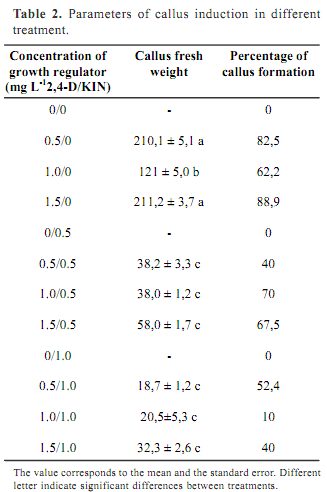
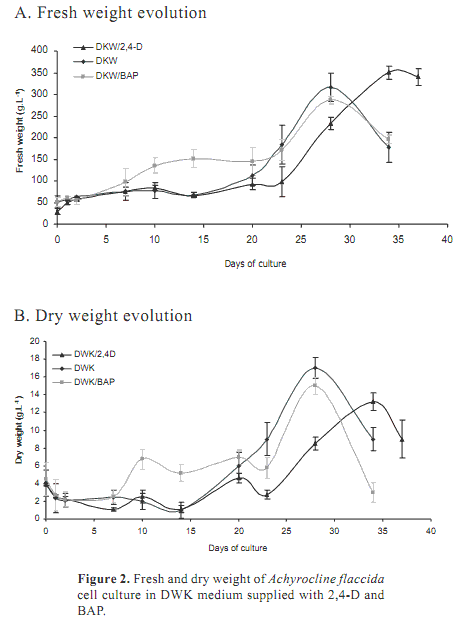
<body><![CDATA[<p class="western" style="text-indent: 0cm; line-height: 150%;" align="left" lang="en-US"> <font face="Verdana">     <br>    </font>    </p>        <p class="western" style="text-indent: 0cm; line-height: 150%;" align="left" lang="en-US"> <font face="Verdana"><b>Determination and optimization of callus induction medium</b></font></p>        <p class="western" lang="es-ES"><font face="Verdana" color="#000000"><span lang="en-US">Calli were established by culturing segments leaves excised from aseptic seedlings.  Leaves of five weeks old plants were cut into 0.5 cm</span></font><font color="#000000"><sup><font face="Verdana"><span lang="en-US">2</span></font></sup><font face="Verdana"><span lang="en-US"> segments and placed upside down in Petri- dishes containing MS solidified with 0.8 % agar (Agar Chile) and supplemented with casein (250 mg L</span></font><sup><font face="Verdana"><span lang="en-US">-1</span></font></sup><font face="Verdana"><span lang="en-US">), 2,4-dichlorophenoxyacetic acid (2,4-D) and kinetin (KIN). Three 2,4-D concentrations (0.5 mg L</span></font><sup><font face="Verdana"><span lang="en-US">-1</span></font></sup><font face="Verdana"><span lang="en-US">; 1.0 mg L</span></font><sup><font face="Verdana"><span lang="en-US">-1</span></font></sup><font face="Verdana"><span lang="en-US">; 1.5 mg L</span></font><sup><font face="Verdana"><span lang="en-US">-1</span></font></sup><font face="Verdana"><span lang="en-US">), two KIN concentrations (0.5 mg L</span></font><sup><font face="Verdana"><span lang="en-US">-1</span></font></sup><font face="Verdana"><span lang="en-US">; 1.0 mg L</span></font><sup><font face="Verdana"><span lang="en-US">-1</span></font></sup><font face="Verdana"><span lang="en-US">) and all possible combinations were tested. Each treatment contained 4 replications with 10 explants per replication. Cultures were maintained at 22 &plusmn; 2&ordm; C with 16-hour photoperiod under 3 nmol m</span></font><sup><font face="Verdana"><span lang="en-US">-2</span></font></sup><font face="Verdana"><span lang="en-US"> s</span></font><sup><font face="Verdana"><span lang="en-US">-1</span></font></sup><font face="Verdana"><span lang="en-US"> photosynthetic photon flux.  After 4 weeks, callus number (percentage), friability and FW was determined. FW data were analysed with ANOVA.</span></font></font></p>        <p class="western" style="text-indent: 0cm; line-height: 150%;" align="left" lang="en-US"> <font face="Verdana">     <br>    </font>    </p>        <p class="western" style="text-indent: 0cm; line-height: 150%;" align="left" lang="en-US"> <font face="Verdana"><b>Generation of cell suspensions and establishment of optimal cell growth conditions</b></font></p>        <p class="western" lang="es-ES"><font face="Verdana" color="#000000"><span lang="en-US">Friable callus (1 g wet weight) was transferred to 50 ml of MS and DKW liquid medium in 300 ml Erlenmeyer flask closed with aluminium foil. The media was amended either with 1 mg L</span></font><font color="#000000"><sup><font face="Verdana"><span lang="en-US">-1</span></font></sup><font face="Verdana"><span lang="en-US"> 2,4-D or 0.3 mg L</span></font><sup><font face="Verdana"><span lang="en-US">-1 </span></font></sup><font face="Verdana"><span lang="en-US">BAP in order to analyze different growth regulators. They were incubated under 16-hour photoperiod at 22 &plusmn; 2&ordm; C on an orbital shaker model SLR-25T (Ikeda Scientific Co. Ltd) at 120 rpm. Cell growth was determined by measuring cell suspension FW and dry weight (DW) every 3 days over 37 days. Three mL of culture were taken from each flask and filtered through a filter paper (Whatman &reg; No. 1) under vacuum suction. The DW was calculated after drying the samples at 65&ordm; C for 48 h. The values obtained are the mean of the three replicates. </span></font></font> </p>        <p class="western" lang="en-US"><font face="Verdana">Growth rates (&micro;) were calculated according to the equation for exponential growth cultures:  </font> </p>        <p class="western" lang="es-ES"><font face="Verdana" color="#000000"><span lang="en-US">&micro; = ln (W1/W2)/t2-t1 <a name="Singeretal.1985"></a>(<a href="#24">Singer </a></span></font><a href="#24"> <font face="Verdana" color="#000000"><span lang="en-US"><i>et al</i></span></font></a><font face="Verdana" color="#000000"><span lang="en-US"><a href="#24">., 1985</a>).</span></font></p>        ]]></body>
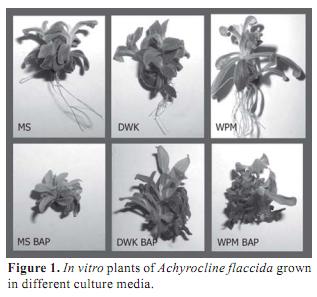
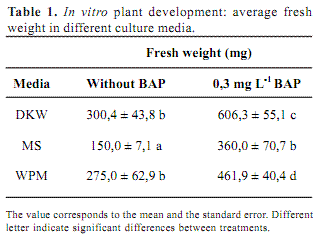
<body><![CDATA[<p class="western" lang="en-US"><font face="Verdana">    <br>    </font>    </p>        <p class="western" style="text-indent: 0cm; line-height: 150%;" align="left" lang="en-US"> <font face="Verdana">     <br>    </font>    </p>        <p class="western" style="text-indent: 0cm; line-height: 150%;" align="left" lang="en-US"> <font face="Verdana"><b>Results and discussion</b></font></p>        <p class="western" style="text-indent: 0cm; line-height: 150%;" align="left" lang="es-ES"> <font face="Verdana"><span lang="en-US"><b>Plant </b><i><b>in vitro</b></i><b> culture and micropropagation</b></span></font></p>        <p class="western" lang="es-ES"><font face="Verdana" color="#000000"><span lang="en-US">Considering <i>A. flaccida</i> seeds small size, the very thin tegument thickness and the hardness of the sterilization method it was expected very low germination rate. Nevertheless, 100 % of seed germination was obtained 10 days after disinfection and all plants were able to grow on different culture media. In order to asses the best growth medium, three parameters were considered: fresh weight, morphology and hyperhydricity. In all cases, plant fresh weight was higher in media supplied with BAP respect to the same medium without the regulator (<a href="#t1">Table 1</a>). However, BAP induced shorter internodes, forming very compact structures and all plant showed high degree of hyperhydricity (<a href="#f1">Figure 1</a>). Hyperhydricity, also known as vitrification, is a morphological, anatomical and physiological malformation that makes the plant tissue water-swollen <a name="PaquesandBoxus1987"></a>(<a href="#19">Paques and Boxus, 1987</a>). The phenomenon has been correlated to water availability, microelements and/or hormonal imbalance in the tissue culture medium <a name="Kataevaetal.1991"></a>(<a href="#14">Kataeva </a> </span></font><a href="#14"><font face="Verdana" color="#000000"><span lang="en-US"><i>et al</i></span></font></a><font face="Verdana" color="#000000"><span lang="en-US"><a href="#14">., 1991</a>).</span></font></p>       <p style="text-align: center;" class="western" lang="es-ES"> <font face="Verdana" color="#000000"><span lang="en-US"><a name="t1"></a></span></font></p>       <p style="text-align: center;" class="western" lang="es-ES"> <font face="Verdana"><img style="width: 320px; height: 240px;" alt="" src="/img/revistas/agro/v13n1/1a01t1.GIF"></font></p>       <p class="western" lang="es-ES">&nbsp;</p>       ]]></body>
<body><![CDATA[<p style="text-align: center;" class="western" lang="es-ES"> <font face="Verdana" color="#000000"><span lang="en-US"><a name="f1"></a></span></font></p>       <p style="text-align: center;" class="western" lang="es-ES"> <font face="Verdana" color="#000000"><span lang="en-US"><img style="width: 317px; height: 297px;" alt="" src="/img/revistas/agro/v13n1/1a01f1.JPG"></span></font></p>        <p class="western" lang="es-ES"><font face="Verdana" color="#000000"><span lang="en-US">Media salt composition also affected plant development. The best plant performance was obtained in DKW compared to WPM and MS. Considering FW, DKW and WPM did not showed any differences but plants grown in DKW presented better structure.  DKW and WPM contain lower concentration of nitrogen, either nitrate or ammonium, and potassium in comparison to MS. These concentrations resemble natural conditions where Marcela normally grows. Possibly high nitrogen or potassium concentrations inhibit plant development. In addition, the content of other nutrient such as calcium, and specially micronutrient as chloride and iodide, are considerable different among these media. Iodide and chloride are only present in MS and they may be the responsible of plant growth inhibition. In conclusion, the best salt medium for <i>A. flaccida</i> micropropagation is DKW without any plant regulator.</span></font></p>        <p class="western" style="text-indent: 0cm; line-height: 150%;" align="left" lang="en-US"> <font face="Verdana">     <br>    </font>    </p>        <p class="western" style="text-indent: 0cm; line-height: 150%;" align="left" lang="en-US"> <font face="Verdana"><b>Establishment of cell suspension cultures</b></font></p>        <p class="western" lang="es-ES"><font face="Verdana" color="#000000"><span lang="en-US">Despite of the results obtained with entire plants, it was not possible to get friable callus on DKW media. In fact, these results confirm that organogenesis and callus formation optimal conditions differ, since both physiological processes are completely different. The only media where friable callus were formed was MS. Consequently it was selected for callus formation. After 4 weeks callus were induced in all media containing 2,4-D and KIN. However, there were significant differences among treatment. <a href="#t2">Table 2</a> shows the percentages of callus formation and the average of callus FW per treatment.  No friable callus was formed from explants cultured on MS without hormones and in all medium supplied with only  KIN.  On the contrary, all media containing 2,4-D, either 0,5 mg L</span></font><font color="#000000"><sup><font face="Verdana"><span lang="en-US">-1</span></font></sup><font face="Verdana"><span lang="en-US">, 1,0 mg L</span></font><sup><font face="Verdana"><span lang="en-US">-1</span></font></sup><font face="Verdana"><span lang="en-US">, or 1,5 mg L</span></font><sup><font face="Verdana"><span lang="en-US">-1</span></font></sup><font face="Verdana"><span lang="en-US">, induced friable callus formation. The best results were obtained in medium supplied only with 2,4-D regardless the concentration. The growth regulator 2,4-D has been cited as the best regulator to induce callus formation in <i>Rubus idaeus</i> <a name="Borejsza-WysokiandHrazdin1994"></a>(<a href="#2">Borejsza-Wysoki and Hrazdin, 1994</a>) and <i>Orthosiphon stamineus</i> <a name="LeeandChang2004"></a>(<a href="#15">Lee and Chang, 2004</a>).</span></font></font></p>       <p style="text-align: center;" class="western" lang="es-ES"> <font face="Verdana" color="#000000"><span lang="en-US"><a name="t2"></a></span></font></p>       <p style="text-align: center;" class="western" lang="es-ES"> <font face="Verdana" color="#000000"><span lang="en-US"><img style="width: 327px; height: 492px;" alt="" src="/img/revistas/agro/v13n1/1a01t2.GIF"> </span></font> </p>        <p class="western" lang="en-US"><font face="Verdana">Friable callus were dispersed on liquid media in order to get cell suspensions. Normally, cell suspensions are established in the same media were callus are formed (<a href="#15">Lee and Chang, 2004</a>). However, in MS media, all suspension differentiates to roots (data not shown). Considering theses results, DKW was selected as medium for the establishment of cell culture. In this medium no tissue differentiation was registered and it was possible to establish continuous suspensions over one year.  </font> </p>        ]]></body>
<body><![CDATA[<p class="western" lang="es-ES"><font face="Verdana" color="#000000"><span lang="en-US">Auxins, particularly 2,4-D, are commonly used for the establishment of cell suspension cultures <a name="Szabadosetal.1991"></a>(<a href="#26">Szabados </a></span></font><a href="#26"> <font face="Verdana" color="#000000"><span lang="en-US"><i>et al</i></span></font></a><font face="Verdana" color="#000000"><span lang="en-US"><a href="#26">., 1991</a>). The action of BAP cytokinin was also evaluated. <a href="#f2">Figure 2</a> shows the evolution of fresh and dry weight registered over 37 days. All media showed a very large latent phase, approximately 20 days. There were differences during the exponential phase. Media without regulators or supplied with BAP had greater growth rates (m) compared to DKW supplied with 2,4-D (m</span></font><font color="#000000"><sub><font face="Verdana"><span lang="en-US">DKW</span></font></sub><font face="Verdana"><span lang="en-US">=1.19, m</span></font><sub><font face="Verdana"><span lang="en-US">DKW/BAP</span></font></sub><font face="Verdana"><span lang="en-US">=1.02 and m</span></font><sub><font face="Verdana"><span lang="en-US">DKW/2,4-D</span></font></sub><font face="Verdana"><span lang="en-US"> 0.99).  However, in DKW supplied with 2,4-D the exponential phase was longer (10 days) and the FW at the end of the period was higher. This increase in FW is not correlated to DW, where suspensions containing 2,4-D showed the lowest values. It is known that 2,4-D induce the formation of soft callus by increasing the size of vacuoles (<a href="#2">Borejsza-Wysoki and Hrazdin, 1994</a>). The same phenomenon could happen in this suspension culture and it has to be considered for the production of metabolites which are secreted to the vacuole.</span></font></font></p>       <p class="western" lang="es-ES">&nbsp;</p>       <p style="text-align: center;" class="western" lang="es-ES"> <font face="Verdana"><a name="f2"></a></font></p>       <p style="text-align: center;" class="western" lang="es-ES"> <font face="Verdana"><img style="width: 464px; height: 634px;" alt="" src="/img/revistas/agro/v13n1/1a01g1.GIF"></font></p>       <p class="western" lang="es-ES">&nbsp;</p>        <p class="western" lang="es-ES"><font face="Verdana" color="#000000"><span lang="en-US">In summary, cell suspension cultures of <i>A. flaccida</i> could be established from friable callus produced by culturing leaf explants on MS medium supplied with    0.5 mg L</span></font><font color="#000000"><sup><font face="Verdana"><span lang="en-US">-1</span></font></sup><font face="Verdana"><span lang="en-US"> 2,4-D. The optimal medium for cell suspension is DKW amended with 1 mg L</span></font><sup><font face="Verdana"><span lang="en-US">-1</span></font></sup><font face="Verdana"><span lang="en-US"> 2,4-D.</span></font></font></p>        <p class="western" lang="es-ES"><font face="Verdana" color="#000000"><span lang="en-US">This study is the preliminary work for upcoming experiments focused on secondary metabolite production by <i>A. flaccida</i> cell suspension cultures. To accomplish this aim it is necessary to evaluate different cell sources, as stems, roots and petiole. The type of explants has been cited as influencing callus formation (<a href="#15">Lee and Chang, 2004</a>), cell suspension and metabolite profile. Therefore optimal growth conditions and metabolite production have to be determined for all these explants, in order to compare their metabolic profile. </span></font> </p>        <p class="western" style="text-indent: 0cm; line-height: 150%;" align="left" lang="en-US"> <font face="Verdana">     <br>    </font>    </p>        <p class="western" style="text-indent: 0cm; line-height: 150%;" align="left" lang="en-US"> <font face="Verdana"><b>Acknowledgments</b></font></p>        ]]></body>
<body><![CDATA[<p class="western" lang="es-ES"><font face="Verdana" color="#000000"><span lang="en-US">We thank the staff of the <i>in vitro</i> culture laboratory of the Biotechnology Unit and the nursery of medicinal and aromatic plants of the National Institute of Agriculture Research (INIA) in Las Brujas, Canelones, Uruguay.</span></font></p>        <p class="western" style="text-indent: 0cm; line-height: 150%;" align="left" lang="es-ES"> <font face="Verdana">     <br>    </font>    </p>        <p class="western" style="text-indent: 0cm; line-height: 150%;" align="left" lang="es-ES"> <font face="Verdana"><b>References</b></font></p>        <!-- ref --><p style="margin-left: 0.8cm; text-indent: -0.8cm; font-weight: normal;" lang="es-ES"> <font face="Verdana" size="2"> <a name="1"></a></font><a href="#Bandoni2000"><font size="2" face="Verdana"><b>Bandoni, L.</b></font></a><font size="2" face="Verdana"><a href="#Bandoni2000"> 2000</a>. Los Recursos Vegetales Arom&aacute;ticos en Latinoam&eacute;rica. Ed. Universidad Nacional de La Plata. La Plata, Argentina.    </font></p>        <!-- ref --><p style="margin-left: 0.8cm; text-indent: -0.8cm; font-weight: normal;" lang="es-ES"> <font face="Verdana" size="2"> <a name="2"></a></font><a href="#Borejsza-WysokiandHrazdin1994"> <font size="2" face="Verdana"><b>Borejsza-Eysocki, W. and Hrazdin, G.</b></font></a><font size="2" face="Verdana"><a href="#Borejsza-WysokiandHrazdin1994"> 1994</a>. </font><font style="font-size: 9pt;" size="2"> <font size="2" face="Verdana"><span lang="en-US">Establishment of callus and cell suspension cultures of raspberry (</span></font><font style="font-size: 9pt;" size="2"><font size="2" face="Verdana"><span lang="en-US"><i>Rubus idaues</i></span></font><font style="font-size: 9pt;" size="2"><font size="2" face="Verdana"><span lang="en-US"> cv. Royalty). Plant Cell, Tissue and Organ Culture. 37: 213-216.    </span></font></font></font></font></p>        <!-- ref --><p style="margin-left: 0.8cm; text-indent: -0.8cm; font-weight: normal;" lang="es-ES"> <font face="Verdana" size="2"> <a name="3"></a></font><a href="#Broussalisetal.1989"> <font size="2" face="Verdana"><span lang="en-US"><b>Broussalis, A. M.; Ferraro, G. E.; Gurni, A. A. and Coussio, J. D.</b></span></font></a><font size="2" face="Verdana"><span lang="en-US"><a href="#Broussalisetal.1989"> 1989</a>. </span></font><font style="font-size: 9pt;" size="2"> <font size="2" face="Verdana">Aspectos fitoqu&iacute;micos de especies Argentinas del g&eacute;nero </font><font style="font-size: 9pt;" size="2"><font size="2" face="Verdana"><i>Achyrocline</i></font><font style="font-size: 9pt;" size="2"><font size="2" face="Verdana">. Acta Farmaceutica Bonaerense, 8: 11-16.    </font></font></font></font></p>        ]]></body>
<body><![CDATA[<!-- ref --><p style="margin-left: 0.8cm; text-indent: -0.8cm; font-weight: normal;" lang="es-ES"> <font face="Verdana" size="2"> <a name="4"></a></font><a href="#Carneyetal.2002"><font size="2" face="Verdana"><span lang="en-US"><b>Carney, J.; Krenisky, J.; Williamson, R. and Luo, J.</b></span></font></a><font size="2" face="Verdana"><span lang="en-US"><a href="#Carneyetal.2002"> 2002</a>. Achyrofuran, a new antihyperglycemic dibenzofuran from the South American medicinal plant </span></font><font style="font-size: 9pt;" size="2"> <font size="2" face="Verdana"><span lang="en-US"><i>Achyrocline satureioides</i></span></font><font style="font-size: 9pt;" size="2"><font size="2" face="Verdana"><span lang="en-US">. Journal of Natural Products, 65: 203-205.    </span></font></font></font></p>        <!-- ref --><p style="margin-left: 0.8cm; text-indent: -0.8cm; font-weight: normal;" lang="es-ES"> <font face="Verdana" size="2"> <a name="5"></a></font><a href="#Desmarchelieretal.1998"> <font size="2" face="Verdana"><span lang="en-US"><b>Desmarchelier, C.; Coussio J. and Ciccia G.</b></span></font></a><font size="2" face="Verdana"><span lang="en-US"><a href="#Desmarchelieretal.1998"> 1998</a>. Antioxidant and free radical scavenging effects in extracts of the medicinal herb </span></font><font style="font-size: 9pt;" size="2"> <font size="2" face="Verdana"><span lang="en-US"><i>Achyrocline satureioides</i></span></font><font style="font-size: 9pt;" size="2"><font size="2" face="Verdana"><span lang="en-US"> (Lam.) D.C. (marcela). Braz. J. Med. Biol. Res., 31: 163-170.    </span></font></font></font></p>        <!-- ref --><p style="margin-left: 0.8cm; text-indent: -0.8cm; font-weight: normal;" lang="es-ES"> <font face="Verdana" size="2"> <a name="6"></a></font><a href="#DriverandKuniyuki1984"> <font size="2" face="Verdana"><span lang="en-US"><b>Driver, D. and Kuniyuki, D.</b></span></font></a><font size="2" face="Verdana"><span lang="en-US"><a href="#DriverandKuniyuki1984"> 1984</a>. </span></font><font style="font-size: 9pt;" size="2"> <font size="2" face="Verdana"><span lang="en-US"><i>In vitro</i></span></font><font style="font-size: 9pt;" size="2"><font size="2" face="Verdana"><span lang="en-US"> propagation of Paradox walnut rootstock. HortScience, 19: 507-509.    </span></font></font></font></p>        <!-- ref --><p style="margin-left: 0.8cm; text-indent: -0.8cm; font-weight: normal;" lang="es-ES"> <font face="Verdana" size="2"> <a name="7"></a></font><a href="#Ferraroetal.1981"> <font size="2" face="Verdana"><span lang="en-US"><b>Ferraro, G.; Norbedo, C. and Coussio, J.</b></span></font></a><font size="2" face="Verdana"><span lang="en-US"><a href="#Ferraroetal.1981"> 1981</a>. Polyphenols from </span></font><font style="font-size: 9pt;" size="2"> <font size="2" face="Verdana"><span lang="en-US"><i>Achyrocline satureioides</i></span></font><font style="font-size: 9pt;" size="2"><font size="2" face="Verdana"><span lang="en-US">. </span></font><font style="font-size: 9pt;" size="2"> <font size="2" face="Verdana">Phytochemistry, 8: 2053-2054.    </font></font></font></font></p>        <!-- ref --><p style="margin-left: 0.8cm; text-indent: -0.8cm; font-weight: normal;" lang="es-ES"> <font face="Verdana" size="2"> <a name="8"></a></font><a href="#Garciaetal.1990"><font size="2" face="Verdana"><b>Garcia, G. H.; Campos, R. and De Torres, R. A.</b></font></a><font size="2" face="Verdana"><a href="#Garciaetal.1990"> 1990</a>. </font><font style="font-size: 9pt;" size="2"> <font size="2" face="Verdana"><span lang="en-US">Antiherpetic activity of some Argentine medicinal plants. </span></font><font style="font-size: 9pt;" size="2"> <font size="2" face="Verdana">Fitoterapia, 6: 542-546.    </font></font></font></p>        ]]></body>
<body><![CDATA[<!-- ref --><p style="margin-left: 0.8cm; text-indent: -0.8cm; font-weight: normal;" lang="es-ES"> <font face="Verdana" size="2"> <a name="9"></a></font><a href="#Garciaetal.1999"><font size="2" face="Verdana"><b>Garcia, G.; Cavallaro, L.; Broussalis, A.; Ferraro, G.; Martino, V. and Campos, R.</b></font></a><font size="2" face="Verdana"><a href="#Garciaetal.1999"> 1999</a>. </font><font style="font-size: 9pt;" size="2"> <font size="2" face="Verdana"><span lang="en-US">Biological and chemical characterization of the fraction with antiherpetic activity from </span></font><font style="font-size: 9pt;" size="2"> <font size="2" face="Verdana"><span lang="en-US"><i>Achyrocline flaccida</i></span></font><font style="font-size: 9pt;" size="2"><font size="2" face="Verdana"><span lang="en-US">. Planta Med., 65: 343-346.    </span></font></font></font></font></p>        <!-- ref --><p style="margin-left: 0.8cm; text-indent: -0.8cm; font-weight: normal;" lang="es-ES"> <font face="Verdana" size="2"> <a name="10"></a></font><a href="#GugliucciandMenini2002"> <font size="2" face="Verdana"><span lang="en-US"><b>Gugliucci A. and Menini T.</b></span></font></a><font size="2" face="Verdana"><span lang="en-US"><a href="#GugliucciandMenini2002"> 2002</a>. Three different pathways for human LDL oxidation are inhibited </span></font><font style="font-size: 9pt;" size="2"> <font size="2" face="Verdana"><span lang="en-US"><i>in vitro</i></span></font><font style="font-size: 9pt;" size="2"><font size="2" face="Verdana"><span lang="en-US"> by water extracts of the medicinal herb </span></font><font style="font-size: 9pt;" size="2"> <font size="2" face="Verdana"><span lang="en-US"><i>Achyrocline satureioides</i></span></font><font style="font-size: 9pt;" size="2"><font size="2" face="Verdana"><span lang="en-US">. Life Science, 71: 693-705.     </span></font></font> </font> </font> </font> </p>        <!-- ref --><p style="margin-left: 0.8cm; text-indent: -0.8cm; font-weight: normal;" lang="es-ES"> <font face="Verdana" size="2"> <a name="11"></a></font><a href="#Gutkindetal.1981"> <font size="2" face="Verdana"><span lang="en-US"><b>Gutkind, G. O.; Martino, V. and Gra&ntilde;a, N.</b></span></font></a><font size="2" face="Verdana"><span lang="en-US"><a href="#Gutkindetal.1981"> 1981</a>. Screening of South American plants for biological activities. 1. Antibacterial and antifungal activity. Fitoterapia, 52: 213-218.    </span></font></p>        <!-- ref --><p style="margin-left: 0.8cm; text-indent: -0.8cm; font-weight: normal;" lang="es-ES"> <font face="Verdana" size="2"> <a name="12"></a></font><a href="#Hnatyszynetal.1999"> <font size="2" face="Verdana"><span lang="en-US"><b>Hnatyszyn, O.; Broussalis, A.; Herrera, G.; Muschietti, L.; Coussio, J.; Martino, V.; Ferraro, G.; Font, M.; Monge, A.; Martinez-Irujo, J. J.; Sanroman, M.; Cuevas, M. T.; Santiago, E. and Lasarte, J. J. </b></span></font></a> <font size="2" face="Verdana"><span lang="en-US"><a href="#Hnatyszynetal.1999">1999</a>. Argentine plant extracts active against polymerase and ribonuclease H activities of HIV-1 reverse transcriptase. Phytotherapy Research, 13: 206-209.    </span></font></p>        <!-- ref --><p style="margin-left: 0.8cm; text-indent: -0.8cm; font-weight: normal;" lang="es-ES"> <font face="Verdana" size="2"> <a name="13"></a></font><a href="#Kadarianetal.2002"> <font size="2" face="Verdana"><span lang="en-US"><b>Kadarian, C.; Broussalis, A. M.; Mi&ntilde;o, J.; Lopez, P.; Gorzalczany, S.; Ferraro, G. and Acevedo, C. </b></span></font></a><font size="2" face="Verdana"><span lang="en-US"><a href="#Kadarianetal.2002">2002</a>. Hepatoprotective activity of </span></font><font style="font-size: 9pt;" size="2"> <font size="2" face="Verdana"><span lang="en-US"><i>Achyrocline satureioides</i></span></font><font style="font-size: 9pt;" size="2"><font size="2" face="Verdana"><span lang="en-US"> (LAM) D.C. Pharmacol. Res., 45: 57-61.    </span></font></font></font></p>        ]]></body>
<body><![CDATA[<!-- ref --><p style="margin-left: 0.8cm; text-indent: -0.8cm; font-weight: normal;" lang="es-ES"> <font face="Verdana" size="2"> <a name="14"></a></font><a href="#Kataevaetal.1991"> <font size="2" face="Verdana"><span lang="en-US"><b>Kataeva, N. V.; Alexanandrova, I. G.; Butenko, R. G. and Dragavtceva, E. V.</b></span></font></a><font size="2" face="Verdana"><span lang="en-US"><a href="#Kataevaetal.1991"> 1991</a>. Effect of applied and internal hormones on vitrification and apical necrosis of different plants cultured </span></font><font style="font-size: 9pt;" size="2"> <font size="2" face="Verdana"><span lang="en-US"><i>in vitro</i></span></font><font style="font-size: 9pt;" size="2"><font size="2" face="Verdana"><span lang="en-US">. Plant Cell, Tissue and Organ Culture, 27: 149-154.    </span></font></font></font></p>        <!-- ref --><p style="margin-left: 0.8cm; text-indent: -0.8cm; font-weight: normal;" lang="es-ES"> <font face="Verdana" size="2"> <a name="15"></a></font><a href="#LeeandChang2004"> <font size="2" face="Verdana"><span lang="en-US"><b>Lee, W. L. and Chang, L.K.</b></span></font></a><font size="2" face="Verdana"><span lang="en-US"><a href="#LeeandChang2004"> 2004</a>. Establishment of </span></font><font style="font-size: 9pt;" size="2"> <font size="2" face="Verdana"><span lang="en-US"><i>Orthosiphon stamineus</i></span></font><font style="font-size: 9pt;" size="2"><font size="2" face="Verdana"><span lang="en-US"> cell suspension culture for cell growth. Plant Cell, Tissue and Organ Culture, 78: 101-106.    </span></font></font></font></p>        <!-- ref --><p style="margin-left: 0.8cm; text-indent: -0.8cm; font-weight: normal;" lang="es-ES"> <font face="Verdana" size="2"> <a name="16"></a></font><a href="#LloydandMcCown1981"> <font size="2" face="Verdana"><span lang="en-US"><b>Lloyd, G. and MC Cown, B.</b></span></font></a><font size="2" face="Verdana"><span lang="en-US"><a href="#LloydandMcCown1981"> 1981</a>. Commercially feasible micropropagation of mountain laurel, </span></font><font style="font-size: 9pt;" size="2"> <font size="2" face="Verdana"><span lang="en-US"><i>Kalmia latifolia</i></span></font><font style="font-size: 9pt;" size="2"><font size="2" face="Verdana"><span lang="en-US">, by use of shoot-tip culture. Comb. Proc. Intl. Plant Prop. Soc., 30: 421-427.    </span></font></font></font></p>        <!-- ref --><p style="margin-left: 0.8cm; text-indent: -0.8cm; font-weight: normal;" lang="es-ES"> <font face="Verdana" size="2"> <a name="17"></a></font><a href="#Mesquitaetal.1986"> <font size="2" face="Verdana"><span lang="en-US"><b>Mesquita, A.; Correa, D.; De Paula, A.; Guedes, M. and Gottlieb, O.</b></span></font></a><font size="2" face="Verdana"><span lang="en-US"><a href="#Mesquitaetal.1986"> 1986</a>. </span></font><font style="font-size: 9pt;" size="2"> <font size="2" face="Verdana">Flavonoids from four Compositae species. Phytochemistry, 5: 1255-1256.    </font></font></p>        <!-- ref --><p style="margin-left: 0.8cm; text-indent: -0.8cm; font-weight: normal;" lang="es-ES"> <font face="Verdana" size="2"> <a name="18"></a></font><a href="#MurashigeandSkoog1962"> <font size="2" face="Verdana"><span lang="en-US"><b>Murashige, T. and Skoog, F.</b></span></font></a><font size="2" face="Verdana"><span lang="en-US"><a href="#MurashigeandSkoog1962"> 1962</a>. A revised medium for rapid growth and bioassays with tobacco tissue cultures. Physiol. Plant, 15: 473-497.    </span></font></p>        ]]></body>
<body><![CDATA[<!-- ref --><p style="margin-left: 0.8cm; text-indent: -0.8cm; font-weight: normal;" lang="es-ES"> <font face="Verdana" size="2"> <a name="19"></a></font><a href="#PaquesandBoxus1987"> <font size="2" face="Verdana"><span lang="en-US"><b>Paques, M. and Boxus, P.</b></span></font></a><font size="2" face="Verdana"><span lang="en-US"><a href="#PaquesandBoxus1987"> 1987</a>. Vitrification: review of literature. Acta Hort., 66: 212:155.    </span></font></p>        <!-- ref --><p style="margin-left: 0.8cm; text-indent: -0.8cm; font-weight: normal;" lang="es-ES"> <font face="Verdana" size="2"> <a name="20"></a></font><a href="#Puhlmannetal.1992"> <font size="2" face="Verdana"><span lang="en-US"><b>Puhlmann, J.; Knaus, U.; Tubaro, L.; Schaefer, W. and Wagner, H.</b></span></font></a><font size="2" face="Verdana"><span lang="en-US"><a href="#Puhlmannetal.1992"> 1992</a>. Immunologically active metallic ion-containing polysaccharides of </span></font><font style="font-size: 9pt;" size="2"> <font size="2" face="Verdana"><span lang="en-US"><i>Achyrocline satureioides</i></span></font><font style="font-size: 9pt;" size="2"><font size="2" face="Verdana"><span lang="en-US">. Phytochemistry, 31: 2617-2621.     </span></font></font> </font> </p>        <!-- ref --><p style="margin-left: 0.8cm; text-indent: -0.8cm; font-weight: normal;" lang="es-ES"> <font face="Verdana" size="2"> <a name="21"></a></font><a href="#Rettaetal.2008"><font size="2" face="Verdana"><b>Retta, D.; Gattuso, M.; Gattuso, S.; Di Leo Lira, P.; van Baren, C.; Ferraro, G. and Bandoni, A.</b></font></a><font size="2" face="Verdana"><a href="#Rettaetal.2008"> 2008</a>. </font><font style="font-size: 9pt;" size="2"> <font size="2" face="Verdana"><span lang="en-US">Essential oil composition of </span></font><font style="font-size: 9pt;" size="2"> <font size="2" face="Verdana"><span lang="en-US"><i>Achyrocline flaccida</i></span></font><font style="font-size: 9pt;" size="2"><font size="2" face="Verdana"><span lang="en-US"> (Weinm.) DC. (Asteraceae) from different locations of Argentina. Bioch. System. and Ecol., 36: 877-881.    </span></font></font></font></font></p>        <p style="margin-left: 0.8cm; text-indent: -0.8cm; font-weight: normal;" lang="es-ES"> <font face="Verdana" size="2"> <a name="22"></a></font><a href="#RobertsandShuler1997"> <font size="2" face="Verdana"><span lang="en-US"><b>Roberts, S. C. and Shuler, M. L.</b></span></font></a><font size="2" face="Verdana"><span lang="en-US"><a href="#RobertsandShuler1997"> 1997</a>. Large-scale plant cell culture. Current Opinion in Biotechnology, 8:154&ndash;159.</span></font></p>        <!-- ref --><p style="margin-left: 0.8cm; text-indent: -0.8cm; font-weight: normal;" lang="es-ES"> <font face="Verdana" size="2"> <a name="23"></a></font><a href="#Ruffaetal.2002"><font size="2" face="Verdana"><span lang="en-US"><b>Ruffa, M. J.; Ferraro, G.; Wagner, M. L.; Calcagno, M. L.; Campos, R. H. and Cavallaro, L.</b></span></font></a><font size="2" face="Verdana"><span lang="en-US"><a href="#Ruffaetal.2002"> 2002</a>. Cytotoxic effect of Argentine medicinal plant extratcs on human hepatocellular carcinoma cell line. J. Ethnopharmacology, 79: 335-339.     </span></font> </p>        <!-- ref --><p style="margin-left: 0.8cm; text-indent: -0.8cm; font-weight: normal;" lang="es-ES"> <font face="Verdana" size="2"> <a name="24"></a></font><a href="#Singeretal.1985"> <font size="2" face="Verdana"><span lang="en-US"><b>Singer, S. R.</b></span></font></a><font size="2" face="Verdana"><span lang="en-US"><a href="#Singeretal.1985"> 1985</a>. Analyzing growth in cell cultures. I. Calculating growth rates. Can. J. Bot., 60: 233-237.    </span></font></p>        <!-- ref --><p style="margin-left: 0.8cm; text-indent: -0.8cm; font-weight: normal;" lang="es-ES"> <font face="Verdana" size="2"> <a name="25"></a></font><a href="#SudhaandRavishankar2002"> <font size="2" face="Verdana"><span lang="en-US"><b>Sudha G. and Ravishankar, G. A.</b></span></font></a><font size="2" face="Verdana"><span lang="en-US"><a href="#SudhaandRavishankar2002"> 2002</a>. Involvement and interaction of various signaling compounds on the plantmetabolic events during defense response, resistance to stress factors, formation of secondary metabolites and their molecular aspects. Plant Cell, Tissue and Organ Culture, 71: 181-212.     </span></font> </p>        <!-- ref --><p style="margin-left: 0.8cm; text-indent: -0.8cm; font-weight: normal;" lang="es-ES"> <font face="Verdana" size="2"> <a name="26"></a></font><a href="#Szabadosetal.1991"> <font size="2" face="Verdana"><span lang="en-US"><b>Szabados, L.; Mroginski, L. A. y Roca, W. M.</b></span></font></a><font size="2" face="Verdana"><span lang="en-US"><a href="#Szabadosetal.1991"> 1991</a>. </span></font><font style="font-size: 9pt;" size="2"> <font size="2" face="Verdana">Suspensiones Celulares: Descripci&oacute;n, Manipulaci&oacute;n y Aplicaciones. En Cultivos de Tejidos en la Agricultura. Fundamentos y Aplicaciones. Publicaci&oacute;n CIAT, 151: 173-210.    </font></font></p>        <!-- ref --><p style="margin-left: 0.8cm; text-indent: -0.8cm; font-weight: normal;" lang="es-ES"> <font face="Verdana" size="2"> <a name="27"></a></font><a href="#Toursarkissian1980"> <font size="2" face="Verdana"><b>Toursarkissian, M.</b></font></a><font size="2" face="Verdana"><a href="#Toursarkissian1980"> 1980</a>. Plantas medicinales de la Argentina. Ed. Hemisferio Sur, Buenos Aires, Argentina.    </font></p>        <!-- ref --><p style="margin-left: 0.8cm; text-indent: -0.8cm; font-weight: normal;" lang="es-ES"> <font face="Verdana" size="2"> <a name="28"></a></font><a href="#Wagneretal.1985"> <font size="2" face="Verdana"><span lang="en-US"><b>Wagner, H.; Proksch, A.; Riess-Maurer, I.; Vollmar, A.; Odenthal, S.; Stup, H.; Jurcic, K.; Le Turdu, M. and Heur, Y. H.</b></span></font></a><font size="2" face="Verdana"><span lang="en-US"><a href="#Wagneretal.1985"> 1985</a>. Immunostimulant action of polysaccharides (heteroglycans) from higher plants. Arzneimittelforschung, 7: 1069-1105.    </span></font></p>        <!-- ref --><p style="margin-left: 0.8cm; text-indent: -0.8cm; font-weight: normal;" lang="es-ES"> <font face="Verdana" size="2"> <a name="29"></a></font><a href="#Zhong2002"><font size="2" face="Verdana"><span lang="en-US"><b>Zhong, J. J.</b></span></font></a><font size="2" face="Verdana"><span lang="en-US"><a href="#Zhong2002"> 2002</a>. Plant cell culture for production of paclitaxel and other taxanes. </span></font><font style="font-size: 9pt;" size="2"> <font size="2" face="Verdana">Journal of BioScience and Bioengineering, 94: 591-599.    </font></font></p>        <p class="western" style="text-indent: 0cm;" align="center" lang="es-ES"> <font face="Verdana">     <br>    </font>    </p>         ]]></body><back>
<ref-list>
<ref id="B1">
<nlm-citation citation-type="book">
<person-group person-group-type="author">
<name>
<surname><![CDATA[Bandoni]]></surname>
<given-names><![CDATA[L.]]></given-names>
</name>
</person-group>
<source><![CDATA[Los Recursos Vegetales Aromáticos en Latinoamérica]]></source>
<year>2000</year>
<publisher-loc><![CDATA[La Plata ]]></publisher-loc>
<publisher-name><![CDATA[Ed. Universidad Nacional de La Plata]]></publisher-name>
</nlm-citation>
</ref>
<ref id="B2">
<nlm-citation citation-type="journal">
<person-group person-group-type="author">
<name>
<surname><![CDATA[Borejsza-Eysocki]]></surname>
<given-names><![CDATA[W]]></given-names>
</name>
<name>
<surname><![CDATA[Hrazdin]]></surname>
<given-names><![CDATA[G]]></given-names>
</name>
</person-group>
<article-title xml:lang="en"><![CDATA[Establishment of callus and cell suspension cultures of raspberry (Rubus idaues cv. Royalty): Plant Cell]]></article-title>
<source><![CDATA[Tissue and Organ Culture]]></source>
<year>1994</year>
<volume>37</volume>
<page-range>213-216</page-range></nlm-citation>
</ref>
<ref id="B3">
<nlm-citation citation-type="journal">
<person-group person-group-type="author">
<name>
<surname><![CDATA[Broussalis]]></surname>
<given-names><![CDATA[A. M.]]></given-names>
</name>
<name>
<surname><![CDATA[Ferraro]]></surname>
<given-names><![CDATA[G. E]]></given-names>
</name>
<name>
<surname><![CDATA[Gurni]]></surname>
<given-names><![CDATA[A. A.]]></given-names>
</name>
<name>
<surname><![CDATA[Coussio]]></surname>
<given-names><![CDATA[J. D.]]></given-names>
</name>
</person-group>
<article-title xml:lang="es"><![CDATA[Aspectos fitoquímicos de especies Argentinas del género Achyrocline]]></article-title>
<source><![CDATA[Acta Farmaceutica Bonaerense]]></source>
<year>1989</year>
<volume>8</volume>
<page-range>11-16</page-range></nlm-citation>
</ref>
<ref id="B4">
<nlm-citation citation-type="journal">
<person-group person-group-type="author">
<name>
<surname><![CDATA[Carney]]></surname>
<given-names><![CDATA[J.]]></given-names>
</name>
<name>
<surname><![CDATA[Krenisky]]></surname>
<given-names><![CDATA[J.]]></given-names>
</name>
<name>
<surname><![CDATA[Williamson]]></surname>
<given-names><![CDATA[R.]]></given-names>
</name>
<name>
<surname><![CDATA[Luo,]]></surname>
<given-names><![CDATA[J.]]></given-names>
</name>
</person-group>
<article-title xml:lang="en"><![CDATA[Achyrofuran, a new antihyperglycemic dibenzofuran from the South American medicinal plant Achyrocline satureioides]]></article-title>
<source><![CDATA[Journal of Natural Products]]></source>
<year>2002</year>
<volume>65</volume>
<page-range>203-205</page-range></nlm-citation>
</ref>
<ref id="B5">
<nlm-citation citation-type="journal">
<person-group person-group-type="author">
<name>
<surname><![CDATA[Desmarchelier]]></surname>
<given-names><![CDATA[C]]></given-names>
</name>
<name>
<surname><![CDATA[Coussio]]></surname>
<given-names><![CDATA[J.]]></given-names>
</name>
<name>
<surname><![CDATA[Ciccia]]></surname>
<given-names><![CDATA[G.]]></given-names>
</name>
</person-group>
<article-title xml:lang="en"><![CDATA[Antioxidant and free radical scavenging effects in extracts of the medicinal herb Achyrocline satureioides (Lam.) D.C. (marcela).]]></article-title>
<source><![CDATA[Braz. J. Med. Biol. Res.,]]></source>
<year>1998</year>
<volume>31</volume>
<page-range>163-170</page-range></nlm-citation>
</ref>
<ref id="B6">
<nlm-citation citation-type="journal">
<person-group person-group-type="author">
<name>
<surname><![CDATA[Driver]]></surname>
<given-names><![CDATA[D.]]></given-names>
</name>
<name>
<surname><![CDATA[Kuniyuki]]></surname>
<given-names><![CDATA[D.]]></given-names>
</name>
</person-group>
<article-title xml:lang="en"><![CDATA[In vitro propagation of Paradox walnut rootstock]]></article-title>
<source><![CDATA[HortScience]]></source>
<year>1984</year>
<volume>19</volume>
<page-range>507-509</page-range></nlm-citation>
</ref>
<ref id="B7">
<nlm-citation citation-type="journal">
<person-group person-group-type="author">
<name>
<surname><![CDATA[Ferraro]]></surname>
<given-names><![CDATA[G.]]></given-names>
</name>
<name>
<surname><![CDATA[Norbedo]]></surname>
<given-names><![CDATA[C.]]></given-names>
</name>
<name>
<surname><![CDATA[Coussio]]></surname>
<given-names><![CDATA[J.]]></given-names>
</name>
</person-group>
<article-title xml:lang="en"><![CDATA[Polyphenols from Achyrocline satureioides.]]></article-title>
<source><![CDATA[Phytochemistry]]></source>
<year>1981</year>
<volume>8</volume>
<page-range>2053-2054</page-range></nlm-citation>
</ref>
<ref id="B8">
<nlm-citation citation-type="journal">
<person-group person-group-type="author">
<name>
<surname><![CDATA[Garcia]]></surname>
<given-names><![CDATA[G. H.]]></given-names>
</name>
<name>
<surname><![CDATA[Campos]]></surname>
<given-names><![CDATA[R.]]></given-names>
</name>
<name>
<surname><![CDATA[De Torres]]></surname>
<given-names><![CDATA[R. A.]]></given-names>
</name>
</person-group>
<article-title xml:lang="en"><![CDATA[Antiherpetic activity of some Argentine medicinal plants.]]></article-title>
<source><![CDATA[Fitoterapia]]></source>
<year>1990</year>
<volume>6</volume>
<page-range>542-546</page-range></nlm-citation>
</ref>
<ref id="B9">
<nlm-citation citation-type="journal">
<person-group person-group-type="author">
<name>
<surname><![CDATA[Garcia,]]></surname>
<given-names><![CDATA[G.]]></given-names>
</name>
<name>
<surname><![CDATA[Cavallaro]]></surname>
<given-names><![CDATA[L]]></given-names>
</name>
<name>
<surname><![CDATA[Broussalis]]></surname>
<given-names><![CDATA[A.]]></given-names>
</name>
<name>
<surname><![CDATA[Ferraro]]></surname>
<given-names><![CDATA[G.]]></given-names>
</name>
<name>
<surname><![CDATA[Martino]]></surname>
<given-names><![CDATA[V.]]></given-names>
</name>
<name>
<surname><![CDATA[Campos]]></surname>
<given-names><![CDATA[R.]]></given-names>
</name>
</person-group>
<article-title xml:lang="en"><![CDATA[Biological and chemical characterization of the fraction with antiherpetic activity from Achyrocline flaccida]]></article-title>
<source><![CDATA[Planta Med]]></source>
<year>1999</year>
<volume>65</volume>
<page-range>343-346</page-range></nlm-citation>
</ref>
<ref id="B10">
<nlm-citation citation-type="journal">
<person-group person-group-type="author">
<name>
<surname><![CDATA[Gugliucci]]></surname>
<given-names><![CDATA[A.]]></given-names>
</name>
<name>
<surname><![CDATA[Menini]]></surname>
<given-names><![CDATA[T.]]></given-names>
</name>
</person-group>
<article-title xml:lang="en"><![CDATA[Three different pathways for human LDL oxidation are inhibited in vitro by water extracts of the medicinal herb Achyrocline satureioides]]></article-title>
<source><![CDATA[Life Science]]></source>
<year>2002</year>
<volume>71</volume>
<page-range>693-705</page-range></nlm-citation>
</ref>
<ref id="B11">
<nlm-citation citation-type="journal">
<person-group person-group-type="author">
<name>
<surname><![CDATA[Gutkind]]></surname>
<given-names><![CDATA[G. O.]]></given-names>
</name>
<name>
<surname><![CDATA[Martino]]></surname>
<given-names><![CDATA[V.]]></given-names>
</name>
<name>
<surname><![CDATA[Graña]]></surname>
<given-names><![CDATA[N.]]></given-names>
</name>
</person-group>
<article-title xml:lang="en"><![CDATA[Screening of South American plants for biological activities.: . Antibacterial and antifungal activity.]]></article-title>
<source><![CDATA[Fitoterapia]]></source>
<year>1981</year>
<volume>52</volume>
<page-range>213-218</page-range></nlm-citation>
</ref>
<ref id="B12">
<nlm-citation citation-type="journal">
<person-group person-group-type="author">
<name>
<surname><![CDATA[Hnatyszyn]]></surname>
<given-names><![CDATA[O.]]></given-names>
</name>
<name>
<surname><![CDATA[Broussalis]]></surname>
<given-names><![CDATA[A.]]></given-names>
</name>
<name>
<surname><![CDATA[Herrera]]></surname>
<given-names><![CDATA[G.]]></given-names>
</name>
<name>
<surname><![CDATA[Muschietti]]></surname>
<given-names><![CDATA[L]]></given-names>
</name>
<name>
<surname><![CDATA[Coussio]]></surname>
<given-names><![CDATA[J.]]></given-names>
</name>
<name>
<surname><![CDATA[Martino]]></surname>
<given-names><![CDATA[V.]]></given-names>
</name>
<name>
<surname><![CDATA[Ferraro]]></surname>
<given-names><![CDATA[G.]]></given-names>
</name>
<name>
<surname><![CDATA[Font]]></surname>
<given-names><![CDATA[M.]]></given-names>
</name>
<name>
<surname><![CDATA[Monge]]></surname>
<given-names><![CDATA[A.]]></given-names>
</name>
<name>
<surname><![CDATA[Martinez-Irujo]]></surname>
<given-names><![CDATA[J. J.]]></given-names>
</name>
<name>
<surname><![CDATA[Sanroman]]></surname>
<given-names><![CDATA[M.]]></given-names>
</name>
<name>
<surname><![CDATA[Cuevas]]></surname>
<given-names><![CDATA[M. T.]]></given-names>
</name>
<name>
<surname><![CDATA[Santiago]]></surname>
<given-names><![CDATA[E.]]></given-names>
</name>
<name>
<surname><![CDATA[Lasarte]]></surname>
<given-names><![CDATA[J. J.]]></given-names>
</name>
</person-group>
<article-title xml:lang="en"><![CDATA[Argentine plant extracts active against polymerase and ribonuclease H activities of HIV-1 reverse transcriptase]]></article-title>
<source><![CDATA[Phytotherapy Research]]></source>
<year>1999</year>
<volume>13</volume>
<page-range>206-209</page-range></nlm-citation>
</ref>
<ref id="B13">
<nlm-citation citation-type="journal">
<person-group person-group-type="author">
<name>
<surname><![CDATA[Kadarian]]></surname>
<given-names><![CDATA[C.]]></given-names>
</name>
<name>
<surname><![CDATA[Broussalis]]></surname>
<given-names><![CDATA[A. M.]]></given-names>
</name>
<name>
<surname><![CDATA[Miño]]></surname>
<given-names><![CDATA[J.]]></given-names>
</name>
<name>
<surname><![CDATA[Lopez]]></surname>
<given-names><![CDATA[P.]]></given-names>
</name>
<name>
<surname><![CDATA[Gorzalczany]]></surname>
<given-names><![CDATA[S.]]></given-names>
</name>
<name>
<surname><![CDATA[Ferraro]]></surname>
<given-names><![CDATA[G]]></given-names>
</name>
<name>
<surname><![CDATA[Acevedo]]></surname>
<given-names><![CDATA[C.]]></given-names>
</name>
</person-group>
<article-title xml:lang="en"><![CDATA[2002. Hepatoprotective activity of Achyrocline satureioides (LAM) D.C]]></article-title>
<source><![CDATA[Pharmacol. Res]]></source>
<year></year>
<volume>45</volume>
<page-range>57-61</page-range></nlm-citation>
</ref>
<ref id="B14">
<nlm-citation citation-type="journal">
<person-group person-group-type="author">
<name>
<surname><![CDATA[Kataeva]]></surname>
<given-names><![CDATA[N. V.]]></given-names>
</name>
<name>
<surname><![CDATA[Alexanandrova]]></surname>
<given-names><![CDATA[I. G.]]></given-names>
</name>
<name>
<surname><![CDATA[Butenko]]></surname>
<given-names><![CDATA[R. G.]]></given-names>
</name>
<name>
<surname><![CDATA[Dragavtceva]]></surname>
<given-names><![CDATA[E. V.]]></given-names>
</name>
</person-group>
<article-title xml:lang="en"><![CDATA[Effect of applied and internal hormones on vitrification and apical necrosis of different plants cultured in vitro]]></article-title>
<source><![CDATA[Plant Cell, Tissue and Organ Culture]]></source>
<year>1991</year>
<volume>27</volume>
<page-range>149-154</page-range></nlm-citation>
</ref>
<ref id="B15">
<nlm-citation citation-type="journal">
<person-group person-group-type="author">
<name>
<surname><![CDATA[Lee]]></surname>
<given-names><![CDATA[W. L.]]></given-names>
</name>
<name>
<surname><![CDATA[Chang]]></surname>
<given-names><![CDATA[L.K.]]></given-names>
</name>
</person-group>
<article-title xml:lang="en"><![CDATA[Establishment of Orthosiphon stamineus cell suspension culture for cell growth]]></article-title>
<source><![CDATA[Plant Cell, Tissue and Organ Culture]]></source>
<year>2004</year>
<volume>78</volume>
<page-range>101-106</page-range></nlm-citation>
</ref>
<ref id="B16">
<nlm-citation citation-type="journal">
<person-group person-group-type="author">
<name>
<surname><![CDATA[Lloyd]]></surname>
<given-names><![CDATA[G.]]></given-names>
</name>
<name>
<surname><![CDATA[MC Cown]]></surname>
<given-names><![CDATA[B.]]></given-names>
</name>
</person-group>
<article-title xml:lang="en"><![CDATA[Commercially feasible micropropagation of mountain laurel, Kalmia latifolia, by use of shoot-tip culture]]></article-title>
<source><![CDATA[Comb. Proc. Intl. Plant Prop. Soc]]></source>
<year>1981</year>
<volume>30</volume>
<page-range>421-427</page-range></nlm-citation>
</ref>
<ref id="B17">
<nlm-citation citation-type="journal">
<person-group person-group-type="author">
<name>
<surname><![CDATA[Mesquita]]></surname>
<given-names><![CDATA[A.]]></given-names>
</name>
<name>
<surname><![CDATA[Correa]]></surname>
<given-names><![CDATA[D.]]></given-names>
</name>
<name>
<surname><![CDATA[De Paula]]></surname>
<given-names><![CDATA[A.]]></given-names>
</name>
<name>
<surname><![CDATA[Guedes]]></surname>
<given-names><![CDATA[M.]]></given-names>
</name>
<name>
<surname><![CDATA[Gottlieb]]></surname>
<given-names><![CDATA[O.]]></given-names>
</name>
</person-group>
<article-title xml:lang="en"><![CDATA[Flavonoids from four Compositae species]]></article-title>
<source><![CDATA[Phytochemistry]]></source>
<year>1986</year>
<volume>5</volume>
<page-range>1255-1256</page-range></nlm-citation>
</ref>
<ref id="B18">
<nlm-citation citation-type="journal">
<person-group person-group-type="author">
<name>
<surname><![CDATA[Murashige]]></surname>
<given-names><![CDATA[T.]]></given-names>
</name>
<name>
<surname><![CDATA[Skoog]]></surname>
<given-names><![CDATA[F.]]></given-names>
</name>
</person-group>
<article-title xml:lang="en"><![CDATA[A revised medium for rapid growth and bioassays with tobacco tissue cultures]]></article-title>
<source><![CDATA[Physiol. Plant]]></source>
<year>1962</year>
<volume>15</volume>
<page-range>473-497</page-range></nlm-citation>
</ref>
<ref id="B19">
<nlm-citation citation-type="journal">
<person-group person-group-type="author">
<name>
<surname><![CDATA[Paques]]></surname>
<given-names><![CDATA[M.]]></given-names>
</name>
<name>
<surname><![CDATA[Boxus]]></surname>
<given-names><![CDATA[P.]]></given-names>
</name>
</person-group>
<article-title xml:lang="en"><![CDATA[Vitrification: review of literature]]></article-title>
<source><![CDATA[Acta Hort]]></source>
<year>1987</year>
<volume>66</volume>
<page-range>212:155</page-range></nlm-citation>
</ref>
<ref id="B20">
<nlm-citation citation-type="journal">
<person-group person-group-type="author">
<name>
<surname><![CDATA[Puhlmann]]></surname>
<given-names><![CDATA[J.]]></given-names>
</name>
<name>
<surname><![CDATA[Knaus]]></surname>
<given-names><![CDATA[U.]]></given-names>
</name>
<name>
<surname><![CDATA[Tubaro]]></surname>
<given-names><![CDATA[L.]]></given-names>
</name>
<name>
<surname><![CDATA[Schaefer]]></surname>
<given-names><![CDATA[W.]]></given-names>
</name>
<name>
<surname><![CDATA[Wagner]]></surname>
<given-names><![CDATA[H.]]></given-names>
</name>
</person-group>
<article-title xml:lang="en"><![CDATA[Immunologically active metallic ion-containing polysaccharides of Achyrocline satureioides]]></article-title>
<source><![CDATA[Phytochemistry]]></source>
<year>1992</year>
<volume>31</volume>
<page-range>2617-2621</page-range></nlm-citation>
</ref>
<ref id="B21">
<nlm-citation citation-type="journal">
<person-group person-group-type="author">
<name>
<surname><![CDATA[Retta]]></surname>
<given-names><![CDATA[D.]]></given-names>
</name>
<name>
<surname><![CDATA[Gattuso]]></surname>
<given-names><![CDATA[M.]]></given-names>
</name>
<name>
<surname><![CDATA[Gattuso]]></surname>
<given-names><![CDATA[S.]]></given-names>
</name>
<name>
<surname><![CDATA[Di Leo Lira]]></surname>
<given-names><![CDATA[P.]]></given-names>
</name>
<name>
<surname><![CDATA[van Baren]]></surname>
<given-names><![CDATA[C.]]></given-names>
</name>
<name>
<surname><![CDATA[Ferraro]]></surname>
<given-names><![CDATA[G.]]></given-names>
</name>
<name>
<surname><![CDATA[Bandoni]]></surname>
<given-names><![CDATA[A]]></given-names>
</name>
</person-group>
<article-title xml:lang="en"><![CDATA[Essential oil composition of Achyrocline flaccida (Weinm.) DC. (Asteraceae) from different locations of Argentina]]></article-title>
<source><![CDATA[Bioch. System. and Ecol.,]]></source>
<year>2008</year>
<volume>36</volume>
<page-range>877-881</page-range></nlm-citation>
</ref>
<ref id="B22">
<nlm-citation citation-type="journal">
<person-group person-group-type="author">
<name>
<surname><![CDATA[Roberts]]></surname>
<given-names><![CDATA[S. C.]]></given-names>
</name>
<name>
<surname><![CDATA[Shuler]]></surname>
<given-names><![CDATA[M. L.]]></given-names>
</name>
</person-group>
<article-title xml:lang="en"><![CDATA[Large-scale plant cell culture.]]></article-title>
<source><![CDATA[Current Opinion in Biotechnology]]></source>
<year>1997</year>
<volume>8</volume>
<page-range>154-159</page-range></nlm-citation>
</ref>
<ref id="B23">
<nlm-citation citation-type="journal">
<person-group person-group-type="author">
<name>
<surname><![CDATA[Ruffa]]></surname>
<given-names><![CDATA[M. J.]]></given-names>
</name>
<name>
<surname><![CDATA[Ferraro]]></surname>
<given-names><![CDATA[G.]]></given-names>
</name>
<name>
<surname><![CDATA[Wagner]]></surname>
<given-names><![CDATA[M. L.]]></given-names>
</name>
<name>
<surname><![CDATA[Calcagno]]></surname>
<given-names><![CDATA[M. L.]]></given-names>
</name>
<name>
<surname><![CDATA[Campos]]></surname>
<given-names><![CDATA[R. H.]]></given-names>
</name>
<name>
<surname><![CDATA[Cavallaro]]></surname>
<given-names><![CDATA[L.]]></given-names>
</name>
</person-group>
<article-title xml:lang="en"><![CDATA[Cytotoxic effect of Argentine medicinal plant extratcs on human hepatocellular carcinoma cell line.]]></article-title>
<source><![CDATA[Ethnopharmacology]]></source>
<year>2002</year>
<volume>79</volume>
<page-range>335-339.</page-range></nlm-citation>
</ref>
<ref id="B24">
<nlm-citation citation-type="journal">
<person-group person-group-type="author">
<name>
<surname><![CDATA[Singer]]></surname>
<given-names><![CDATA[S. R.]]></given-names>
</name>
</person-group>
<article-title xml:lang="en"><![CDATA[Analyzing growth in cell cultures: I. Calculating growth rates]]></article-title>
<source><![CDATA[Can. J. Bot.,]]></source>
<year>1985</year>
<volume>60</volume>
<page-range>233-237</page-range></nlm-citation>
</ref>
<ref id="B25">
<nlm-citation citation-type="journal">
<person-group person-group-type="author">
<name>
<surname><![CDATA[Sudha]]></surname>
<given-names><![CDATA[G.]]></given-names>
</name>
<name>
<surname><![CDATA[Ravishankar]]></surname>
<given-names><![CDATA[G. A.]]></given-names>
</name>
</person-group>
<article-title xml:lang="en"><![CDATA[Involvement and interaction of various signaling compounds on the plantmetabolic events during defense response, resistance to stress factors, formation of secondary metabolites and their molecular aspects]]></article-title>
<source><![CDATA[Plant Cell, Tissue and Organ Culture]]></source>
<year>2002</year>
<volume>71</volume>
<page-range>181-212</page-range></nlm-citation>
</ref>
<ref id="B26">
<nlm-citation citation-type="book">
<person-group person-group-type="author">
<name>
<surname><![CDATA[Szabados]]></surname>
<given-names><![CDATA[L.]]></given-names>
</name>
<name>
<surname><![CDATA[Mroginski]]></surname>
<given-names><![CDATA[L. A.]]></given-names>
</name>
<name>
<surname><![CDATA[Roca]]></surname>
<given-names><![CDATA[W. M.]]></given-names>
</name>
</person-group>
<article-title xml:lang="en"><![CDATA[Suspensiones Celulares: Descripción, Manipulación y Aplicaciones]]></article-title>
<source><![CDATA[Cultivos de Tejidos en la Agricultura: Fundamentos y Aplicaciones]]></source>
<year></year>
<volume>151</volume>
<page-range>1991</page-range><page-range>173-210</page-range><publisher-name><![CDATA[Publicación CIAT]]></publisher-name>
</nlm-citation>
</ref>
<ref id="B27">
<nlm-citation citation-type="book">
<person-group person-group-type="author">
<name>
<surname><![CDATA[Toursarkissian]]></surname>
<given-names><![CDATA[M.]]></given-names>
</name>
</person-group>
<source><![CDATA[Plantas medicinales de la Argentina]]></source>
<year>1980</year>
<publisher-loc><![CDATA[Buenos Aires ]]></publisher-loc>
<publisher-name><![CDATA[Ed. Hemisferio Sur]]></publisher-name>
</nlm-citation>
</ref>
<ref id="B28">
<nlm-citation citation-type="journal">
<person-group person-group-type="author">
<name>
<surname><![CDATA[Wagner]]></surname>
<given-names><![CDATA[H.]]></given-names>
</name>
<name>
<surname><![CDATA[Proksch]]></surname>
<given-names><![CDATA[A.]]></given-names>
</name>
<name>
<surname><![CDATA[Riess-Maurer]]></surname>
<given-names><![CDATA[I.]]></given-names>
</name>
<name>
<surname><![CDATA[Vollmar]]></surname>
<given-names><![CDATA[A.]]></given-names>
</name>
<name>
<surname><![CDATA[Odenthal]]></surname>
<given-names><![CDATA[S.]]></given-names>
</name>
<name>
<surname><![CDATA[Stup]]></surname>
<given-names><![CDATA[H.]]></given-names>
</name>
<name>
<surname><![CDATA[Jurcic]]></surname>
<given-names><![CDATA[K.]]></given-names>
</name>
<name>
<surname><![CDATA[Le Turdu]]></surname>
<given-names><![CDATA[M.]]></given-names>
</name>
<name>
<surname><![CDATA[Heur]]></surname>
<given-names><![CDATA[Y. H.]]></given-names>
</name>
</person-group>
<article-title xml:lang="en"><![CDATA[Immunostimulant action of polysaccharides (heteroglycans) from higher plants]]></article-title>
<source><![CDATA[Arzneimittelforschung]]></source>
<year>1985</year>
<month>.</month>
<volume>7</volume>
<page-range>1069-1105.</page-range></nlm-citation>
</ref>
<ref id="B29">
<nlm-citation citation-type="journal">
<person-group person-group-type="author">
<name>
<surname><![CDATA[Zhong]]></surname>
<given-names><![CDATA[J. J.]]></given-names>
</name>
</person-group>
<article-title xml:lang="en"><![CDATA[Plant cell culture for production of paclitaxel and other taxanes]]></article-title>
<source><![CDATA[Journal of BioScience and Bioengineering]]></source>
<year>2002</year>
<month>.</month>
<volume>94</volume>
<page-range>591-599</page-range></nlm-citation>
</ref>
</ref-list>
</back>
</article>