<?xml version="1.0" encoding="ISO-8859-1"?><article xmlns:mml="http://www.w3.org/1998/Math/MathML" xmlns:xlink="http://www.w3.org/1999/xlink" xmlns:xsi="http://www.w3.org/2001/XMLSchema-instance">
<front>
<journal-meta>
<journal-id>1688-9339</journal-id>
<journal-title><![CDATA[Odontoestomatología]]></journal-title>
<abbrev-journal-title><![CDATA[Odontoestomatología]]></abbrev-journal-title>
<issn>1688-9339</issn>
<publisher>
<publisher-name><![CDATA[Facultad de Odontología - Universidad de la República]]></publisher-name>
</publisher>
</journal-meta>
<article-meta>
<article-id>S1688-93392014000200002</article-id>
<title-group>
<article-title xml:lang="es"><![CDATA[Estudio morfológico y morfométrico del agujero mentoniano mediante evaluación por tomografía computarizada Cone Beam en pacientes adultos dentados]]></article-title>
<article-title xml:lang="en"><![CDATA[Morphological and morphometric study of the mental foramen using cone-beam CT in dentate adult patients]]></article-title>
</title-group>
<contrib-group>
<contrib contrib-type="author">
<name>
<surname><![CDATA[Cabanillas Padilla]]></surname>
<given-names><![CDATA[Juan]]></given-names>
</name>
<xref ref-type="aff" rid="A01"/>
</contrib>
<contrib contrib-type="author">
<name>
<surname><![CDATA[Quea Cahuana]]></surname>
<given-names><![CDATA[Eduardo]]></given-names>
</name>
<xref ref-type="aff" rid="A01"/>
</contrib>
</contrib-group>
<aff id="A01">
<institution><![CDATA[,Universidad de San Martín de Porres Facultad de Odontología ]]></institution>
<addr-line><![CDATA[ ]]></addr-line>
</aff>
<pub-date pub-type="pub">
<day>00</day>
<month>11</month>
<year>2014</year>
</pub-date>
<pub-date pub-type="epub">
<day>00</day>
<month>11</month>
<year>2014</year>
</pub-date>
<volume>16</volume>
<numero>24</numero>
<fpage>4</fpage>
<lpage>12</lpage>
<copyright-statement/>
<copyright-year/>
<self-uri xlink:href="http://www.scielo.edu.uy/scielo.php?script=sci_arttext&amp;pid=S1688-93392014000200002&amp;lng=en&amp;nrm=iso"></self-uri><self-uri xlink:href="http://www.scielo.edu.uy/scielo.php?script=sci_abstract&amp;pid=S1688-93392014000200002&amp;lng=en&amp;nrm=iso"></self-uri><self-uri xlink:href="http://www.scielo.edu.uy/scielo.php?script=sci_pdf&amp;pid=S1688-93392014000200002&amp;lng=en&amp;nrm=iso"></self-uri><abstract abstract-type="short" xml:lang="es"><p><![CDATA[Objetivo. Estudiar la morfología y morfometría del agujero mentoniano mediante tomografía ConeBeam en pacientes adultos dentados Metodología. Estudio descriptivo transversal. Se estudiaron 180 tomografías ConeBeam analizando la distancia de la cortical superior e inferior del agujero mentoniano hasta la cresta alveolar y la basal mandibular respectivamente, así como la ubicación, forma, tamaño y presencia de agujeros accesorios. Resultados. Se encontró que la media respecto de la cortical superior a la cresta alveolar fue de 15.00 mm y la media respecto de la cortical inferior a la basal mandibular de 13.75 mm. La ubicación más frecuente se apreció en el eje longitudinal del segundo premolar (44.4% en el lado derecho y 47.2% en el lado izquierdo). La forma predominante fue la oval y el tamaño se ubicó en el rango de 2 mm a 2.99mm. Los agujeros accesorios estuvieron presentes en 55.5% de los casos. Conclusión. El conocimiento exacto de la ubicación del agujero mentoniano y sus variaciones, ayuda a una correcta planificación para los procedimientos quirúrgicos, y a una eficaz colocación de anestesia, evitando daños al paquete vasculonervioso.]]></p></abstract>
<abstract abstract-type="short" xml:lang="en"><p><![CDATA[Objective. To study the morphology and morphometry of the mental foramen using cone-beam CT in dentate adult patients. Methods. Transversal descriptive study in which 180 cone-beam CTs were studied to analyze the distance between the upper and lower cortical areas of the mental foramen to the alveolar crest and the mandibular basal bone respectively, as well as the location, shape, size and presence of accessory holes. Results. It was found that the mean of the upper cortical area in relation to the alveolar crest was 15.00 mm and the mean of the lower cortical area to the mandibular basal bone was 13.75 mm. The most frequent location was the longitudinal axis of the second premolar (44.4% right side and 47.2% left side). The predominant shape was oval and the size was in the range of 2.00 mm to 2.99 mm. Accessory holes were present in 55.5% of cases. Conclusion. Knowing the exact location of the mental foramen and its variations helps to properly plan surgical procedures and to administer anesthesia effectively without damaging the neurovascular bundle]]></p></abstract>
<kwd-group>
<kwd lng="es"><![CDATA[Agujero mentoniano]]></kwd>
<kwd lng="es"><![CDATA[Tomografía computada]]></kwd>
<kwd lng="es"><![CDATA[Cone Beam]]></kwd>
<kwd lng="en"><![CDATA[Mental foramen]]></kwd>
<kwd lng="en"><![CDATA[Cone-Beam]]></kwd>
<kwd lng="en"><![CDATA[Computerized tomography]]></kwd>
</kwd-group>
</article-meta>
</front><body><![CDATA[ <div style="text-align: justify;"><span style="font-family: Verdana; font-weight: bold;">Estudio morfol&oacute;gico y morfom&eacute;trico del agujero mentoniano mediante evaluaci&oacute;n por tomograf&iacute;a computarizada Cone Beam en pacientes adultos dentados</span><br style="font-family: Verdana; font-weight: bold;">      <br style="font-family: Verdana; font-weight: bold;">      <br style="font-family: Verdana; font-weight: bold;">      <small><span style="font-family: Verdana; font-weight: bold;">Morphological and morphometric study of the mental foramen using cone-beam CT in dentate adult patients</span></small><br style="font-family: Verdana;">          <br>          <br>      <br style="font-family: Verdana;">      <br style="font-family: Verdana;">      <font size="-1"><span style="font-family: Verdana;"> Cabanillas Padilla, Juan <a href="#1.">*</a>, Quea Cahuana, Eduardo <a href="#2.">**</a></span></font><br style="font-family: Verdana;">      <br style="font-family: Verdana;">      <br style="font-family: Verdana;">          <br>          <br>      <br style="font-family: Verdana;">      <br style="font-family: Verdana;">      <font size="-1"><span style="font-family: Verdana;"><a name="1."></a> * Docente de la Facultad de Odontolog&iacute;a, Universidad de San Mart&iacute;n de Porres (USMP), Lima, Per&uacute;. Cirujano Dentista    <br>     </span></font><a href="mailto:Juancabanillaspadilla@gmail.com"><font size="-1"><span style="font-family: Verdana;">Juancabanillaspadilla@gmail.com</span></font></a><br style="font-family: Verdana;">     <br style="font-family: Verdana;">     <font size="-1"><span style="font-family: Verdana;"><a name="2."></a>     ** Docente de la Facultad de Odontolog&iacute;a, Universidad de San     ]]></body>
<body><![CDATA[Mart&iacute;n de Porres (USMP), Lima, Per&uacute;. Cirujano Dentista</span></font><br style="font-family: Verdana;">     <br style="font-family: Verdana;">     <br style="font-family: Verdana;">     <br style="font-family: Verdana;">     <br style="font-family: Verdana;">     <hr style="width: 100%; height: 2px;"><br style="font-family: Verdana;">     <br style="font-family: Verdana;">     <br style="font-family: Verdana;">     <font size="-1"><span style="font-family: Verdana;">     <span style="font-weight: bold;">Resumen</span></span></font><br style="font-family: Verdana;">     ]]></body>
<body><![CDATA[<br style="font-family: Verdana;">     <font size="-1"><span style="font-family: Verdana;">     Objetivo. Estudiar la morfolog&iacute;a y morfometr&iacute;a del     agujero mentoniano mediante tomograf&iacute;a ConeBeam en pacientes     adultos dentados Metodolog&iacute;a. Estudio descriptivo transversal.     Se estudiaron 180 tomograf&iacute;as ConeBeam analizando la distancia     de la cortical superior e inferior del agujero mentoniano hasta la     cresta alveolar y la basal mandibular respectivamente, as&iacute; como     la ubicaci&oacute;n, forma, tama&ntilde;o y presencia de agujeros     accesorios. Resultados. Se encontr&oacute; que la media respecto de la     ]]></body>
<body><![CDATA[cortical superior a la cresta alveolar fue de 15.00 mm y la media     respecto de la cortical inferior a la basal mandibular de 13.75 mm. La     ubicaci&oacute;n m&aacute;s frecuente se apreci&oacute; en el eje     longitudinal del segundo premolar (44.4% en el lado derecho y 47.2% en     el lado izquierdo). La forma predominante fue la oval y el     tama&ntilde;o se ubic&oacute; en el rango de 2 mm a 2.99mm. Los     agujeros accesorios estuvieron presentes en 55.5% de los casos.     Conclusi&oacute;n. El conocimiento exacto de la ubicaci&oacute;n del     agujero mentoniano y sus variaciones, ayuda a una correcta     planificaci&oacute;n para los procedimientos quir&uacute;rgicos, y a     ]]></body>
<body><![CDATA[una eficaz colocaci&oacute;n de anestesia, evitando da&ntilde;os al     paquete vasculonervioso</span></font><br style="font-family: Verdana;">     <br style="font-family: Verdana;">     <font size="-1"><span style="font-family: Verdana;">     Palabras claves: Agujero mentoniano, Tomograf&iacute;a computada, Cone Beam.</span></font><br style="font-family: Verdana;">     <br style="font-family: Verdana;">     <br style="font-family: Verdana;">     <br style="font-family: Verdana;">     <font size="-1"><span style="font-family: Verdana;">     <span style="font-weight: bold;">Abstract</span></span></font><br style="font-family: Verdana;">     ]]></body>
<body><![CDATA[<br style="font-family: Verdana;">     <font size="-1"><span style="font-family: Verdana;">     Objective. To study the morphology and morphometry of the mental     foramen using cone-beam CT in dentate adult patients. Methods.     Transversal descriptive study in which 180 cone-beam CTs were studied     to analyze the distance between the upper and lower cortical areas of     the mental foramen to the alveolar crest and the mandibular basal bone     respectively, as well as the location, shape, size and presence of     accessory holes. Results. It was found that the mean of the upper     cortical area in relation to the alveolar crest was 15.00 mm and the     ]]></body>
<body><![CDATA[mean of the lower cortical area to the mandibular basal bone was 13.75     mm. The most frequent location was the longitudinal axis of the second     premolar (44.4% right side and 47.2% left side). The predominant shape     was oval and the size was in the range of 2.00 mm to 2.99 mm. Accessory     holes were present in 55.5% of cases. Conclusion. Knowing the exact     location of the mental foramen and its variations helps to properly     plan surgical procedures and to administer anesthesia effectively     without damaging the neurovascular bundle.</span></font><br style="font-family: Verdana;">     <br style="font-family: Verdana;">     <font size="-1"><span style="font-family: Verdana;">     ]]></body>
<body><![CDATA[Keywords: Mental foramen, Cone-Beam, Computerized tomography.</span></font><br style="font-family: Verdana;">     <br style="font-family: Verdana;">     <font size="-1"><span style="font-family: Verdana;">     &nbsp;</span></font><br style="font-family: Verdana;">     <br style="font-family: Verdana;">     <br style="font-family: Verdana;">     <font size="-1"><span style="font-family: Verdana;">Fecha recibido: 09.03.14 - Fecha aceptado: 27.06.14</span></font><br style="font-family: Verdana;">     <br style="font-family: Verdana;">     <br style="font-family: Verdana;">     <br style="font-family: Verdana;">     ]]></body>
<body><![CDATA[<br style="font-family: Verdana;">     <hr style="width: 100%; height: 2px;"><br style="font-family: Verdana;">     <br style="font-family: Verdana;">     <br style="font-family: Verdana;">     <font size="-1"><span style="font-family: Verdana;">     <!-- big --><span style="font-weight: bold;">Introducci&oacute;n</span><!-- /big --></span></font><br style="font-family: Verdana;">     <br style="font-family: Verdana;">     <font size="-1"><span style="font-family: Verdana;">     La mand&iacute;bula tiene su origen en el primer arco braquial,     presenta una osificaci&oacute;n mixta y su crecimiento se dirige hacia     ]]></body>
<body><![CDATA[abajo y adelante ya que se desarrolla a expensas del c&oacute;ndilo     (<a name="1a"></a><a href="#1">1</a>-<a name="2a"></a><a href="#2">2</a>).</span></font><br style="font-family: Verdana;">     <br style="font-family: Verdana;">     <font size="-1"><span style="font-family: Verdana;">     &nbsp;</span></font><br style="font-family: Verdana;">     <br style="font-family: Verdana;">     <font size="-1"><span style="font-family: Verdana;">     El crecimiento mandibular cambia la direcci&oacute;n del agujero     mentoniano. Al nacer, el haz neurovascular emerge por el agujero     dirigido hacia adelante y en el adulto se encuentra dirigido hacia     ]]></body>
<body><![CDATA[atr&aacute;s <a name="3a"></a><a href="#3">(3</a><a href="#3">)</a>.</span></font><br style="font-family: Verdana;">     <br style="font-family: Verdana;">     <font size="-1"><span style="font-family: Verdana;">     &nbsp;</span></font><br style="font-family: Verdana;">     <br style="font-family: Verdana;">     <font size="-1"><span style="font-family: Verdana;">     El agujero mentoniano se define como una apertura en la superficie     lateral de la mand&iacute;bula. En este punto el nervio alveolar     inferior se bifurca dando origen al nervio mentoniano y al nervio     incisivo, las cuales son ramas terminales, y responsables de la     ]]></body>
<body><![CDATA[inervaci&oacute;n sensorial de los tejidos blandos de la zona     vestibular, el labio inferior y la barbilla hasta la l&iacute;nea media     mandibular. La posici&oacute;n del agujero mentoniano var&iacute;a en     relaci&oacute;n con la edad. En los ni&ntilde;os, antes de la     erupci&oacute;n de las piezas dentarias, se ubica m&aacute;s cerca de     la cresta alveolar; en los adultos se encuentra en promedio entre 13 -     15 mm por encima del borde inferior mandibular; y en personas con     reabsorci&oacute;n &oacute;sea se encuentra m&aacute;s cerca a la     cresta alveolar, pudiendo ubicarse sobre el mismo, por lo que se debe     tener en consideraci&oacute;n al realizar una pr&oacute;tesis total, ya     ]]></body>
<body><![CDATA[que esta puede presionar el bucle del nervio mentoniano (<a href="#1">1</a>, <a name="4a"></a><a href="#4">4</a>, <a name="5a"></a><a href="#5">5</a>-<a name="7a"></a><a href="#7">7</a>, <a name="18a"></a><a href="#18">18</a>).</span></font><br style="font-family: Verdana;">     <br style="font-family: Verdana;">     <font size="-1"><span style="font-family: Verdana;">     &nbsp;</span></font><br style="font-family: Verdana;">     <br style="font-family: Verdana;">     <font size="-1"><span style="font-family: Verdana;">     Utilizando la tomograf&iacute;a computarizada Cone Beam se puede     conocer con exactitud la ubicaci&oacute;n, la forma, el tama&ntilde;o     del agujero mentoniano, y la presencia de agujeros accesorios. Esto     permite realizar an&aacute;lisis morfom&eacute;tricos exactos, para     ]]></body>
<body><![CDATA[dise&ntilde;ar una adecuada planificaci&oacute;n del tratamiento y una     correcta colocaci&oacute;n anest&eacute;sica y de esa manera ejecutar     procedimientos invasivos evitando da&ntilde;ar el nervio mentoniano (<a name="6a"></a><a href="#6">6</a>,     <a name="24a"></a><a href="#24">24</a>). De la misma manera esta tecnolog&iacute;a brinda una imagen en     escala real, en la cual se pueden realizar trazos y mediciones exactas,     debido a que los voxeles presentan una configuraci&oacute;n     isotr&oacute;pica. Asimismo, se puede obtener im&aacute;genes en los     tres planos del espacio (<a name="8a"></a><a href="#8">8</a>-<a name="10a"></a><a href="#10">10</a>).</span></font><br style="font-family: Verdana;">     <br style="font-family: Verdana;">     <font size="-1"><span style="font-family: Verdana;">     ]]></body>
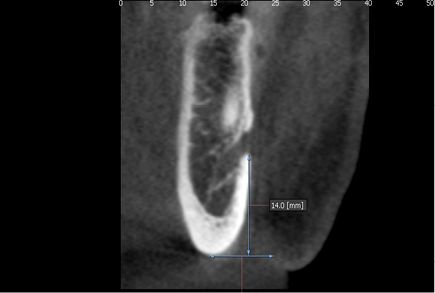
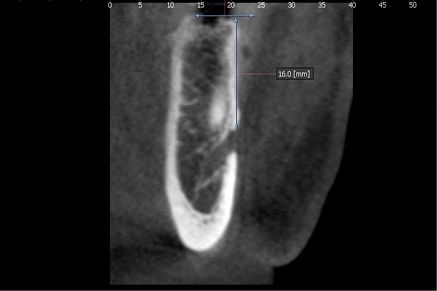
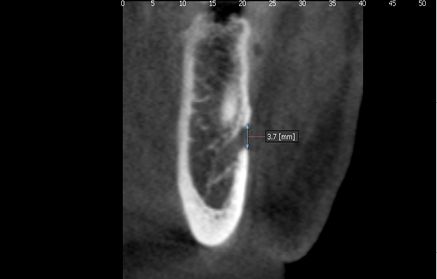
<body><![CDATA[&nbsp;</span></font><br style="font-family: Verdana;">     <br style="font-family: Verdana;">     <span style="font-family: Verdana;"><span style="font-weight: bold;">     Materiales y m&eacute;todos</span></span><font size="-1"><span style="font-family: Verdana;">    <br>          <br>      Se analizaron 180 tomograf&iacute;as de pacientes adultos dentados de ambos sexos (74 hombres y 106 mujeres) entre 20 y 50 a&ntilde;os, recolectadas del Centro de Diagn&oacute;stico por Im&aacute;genes, Lima &ndash; Per&uacute;, las tomograf&iacute;as fueron realizadas con un equipo marca Vatech, modelo Picasso Master, con el software Easy Dent, un campo de visi&oacute;n (FOV) de 20 X 19 mm, con 70 Kv, 8 Ma, con tiempo de exposici&oacute;n de 25 segundos y un punto focal de 0.5 mm. Las variables estudiadas en el plano transaxial se realizaron a trav&eacute;s de cortes de 1 mm e intervalos de 0,5 mm.</span></font><br style="font-family: Verdana;">      <br style="font-family: Verdana;">      <font size="-1"><span style="font-family: Verdana;"> &nbsp;</span></font><br style="font-family: Verdana;">      <br style="font-family: Verdana;">      <font size="-1"><span style="font-family: Verdana;"> Se realiz&oacute; el an&aacute;lisis morfol&oacute;gico y morfom&eacute;trico de los agujeros mentonianos de ambos lados. Las tomograf&iacute;as evaluadas presentaron todas las piezas dentarias y la cresta alveolar conservada. Se excluyeron tomograf&iacute;as con presencia de lesiones periapicales, dientes supernumerarios, pacientes con tratamiento ortod&oacute;ntico y con ausencia bilateral del agujero mentoniano.</span></font><br style="font-family: Verdana;">      <br style="font-family: Verdana;">      <font size="-1"><span style="font-family: Verdana;"> &nbsp;</span></font><br style="font-family: Verdana;">      <br style="font-family: Verdana;">      <font size="-1"><span style="font-family: Verdana;"> Se analizaron las distancias de las corticales superior e inferior del agujero mentoniano hacia la cresta alveolar y basal mandibular respectivamente y el tama&ntilde;o del mismo en el corte transaxial, en este &uacute;ltimo se consider&oacute; la distancia entre las corticales superior e inferior de dicha estructura y las medidas se agruparon en rangos (<a href="#f1">Fig. 1</a> y <a href="#f2">2</a>).</span></font><br style="font-family: Verdana;">      <br style="font-family: Verdana;">      <font size="-1"><span style="font-family: Verdana;"> &nbsp;</span></font><br style="font-family: Verdana;">      <br style="font-family: Verdana;">      <font size="-1"><span style="font-family: Verdana;"></span></font><font size="-1"><span style="font-family: Verdana;"><a name="f1"></a><img style="width: 435px; height: 293px;" alt="" src="/img/revistas/ode/v16n24/24a02f1.jpg">    <br>          <br>   <img style="width: 437px; height: 291px;" alt="" src="/img/revistas/ode/v16n24/24a02f2.jpg">    <br>          <br>      Fig. 1: Ubicaci&oacute;n del agujero mentoniano en el plano transaxial    ]]></body>
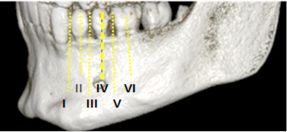
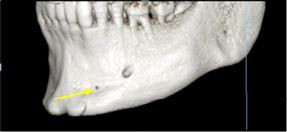
<body><![CDATA[<br>          <br>          <br>      <a name="f2"></a><img style="width: 437px; height: 279px;" alt="" src="/img/revistas/ode/v16n24/24a02f3.jpg"><br style="font-family: Verdana;">      </span></font><font size="-1"><span style="font-family: Verdana;"></span></font><small>Fig. 2 Tama&ntilde;o del agujero mentoniano</small><br style="font-family: Verdana;">      <br style="font-family: Verdana;">      <font size="-1"><span style="font-family: Verdana;"> Para determinar la ubicaci&oacute;n, forma y presencia de agujeros accesorios se utiliz&oacute; la reconstrucci&oacute;n en 3D, para la ubicaci&oacute;n se tom&oacute; como referencia los ejes longitudinales de las piezas dentarias seg&uacute;n la clasificaci&oacute;n de Al Jasser &amp; Nwoku <a name="21a"></a><a href="#21">(21)</a>. Posici&oacute;n 1: Situado anterior del primer premolar, posici&oacute;n 2: En l&iacute;nea con el primer premolar, posici&oacute;n 3: Entre el primer y segundo premolar, posici&oacute;n 4: En l&iacute;nea con el segundo premolar, posici&oacute;n 5: Entre el segundo premolar y el primer molar, posici&oacute;n 6: En l&iacute;nea con el primer molar. <a href="#f3">(Fig. 3)</a>.</span></font><br style="font-family: Verdana;">      <br style="font-family: Verdana;">      <font size="-1"><span style="font-family: Verdana;"> Se consider&oacute; la forma oval y circular como criterios de evaluaci&oacute;n y se evalu&oacute; la presencia de agujeros accesorios <a href="#f4">(Fig. 4)</a>.</span></font><br style="font-family: Verdana;">      <br style="font-family: Verdana;">      <font size="-1"><span style="font-family: Verdana;"></span></font><font size="-1"><span style="font-family: Verdana;">    <br>          <br>      <a name="f3"></a><img style="width: 287px; height: 132px;" alt="" src="/img/revistas/ode/v16n24/24a02f4.jpg">    <br>      Fig. 3: Ubicaci&oacute;n del agujero mentoniano seg&uacute;n la clasificaci&oacute;n de Al Jaser &amp; Nwoku    <br>          <br>          <br>      <a name="f4"></a><img style="width: 287px; height: 132px;" alt="" src="/img/revistas/ode/v16n24/24a02f5.jpg">    <br>      Fig. 4 Presencia de agujeros mentonianos accesorios<br style="font-family: Verdana;">      </span></font><font size="-1"><span style="font-family: Verdana;"></span></font><br style="font-family: Verdana;">      <br style="font-family: Verdana;">      <font size="-1"><span style="font-family: Verdana;"> El procesamiento y an&aacute;lisis de datos; se realiz&oacute; a trav&eacute;s del programa estad&iacute;stico SPSS versi&oacute;n 15. Las variables cuantitativas se presentaron en valores m&iacute;nimos, m&aacute;ximos, medias y desviaciones est&aacute;ndar. Se aplic&oacute; la prueba U de Mann-Whitney, para comparar las diferencias entre el lado derecho e izquierdo.</span></font><br style="font-family: Verdana;">      <br style="font-family: Verdana;">      <font size="-1"><span style="font-family: Verdana;"> Las variables cualitativas se presentaron a trav&eacute;s de tablas de distribuci&oacute;n de frecuencias y se aplicaron las pruebas Chi cuadrado de Pearson y exacta de Fisher para comparar la diferencia entre el lado derecho e izquierdo. Todas las pruebas se trabajaron a un nivel de significancia de 5%.    ]]></body>
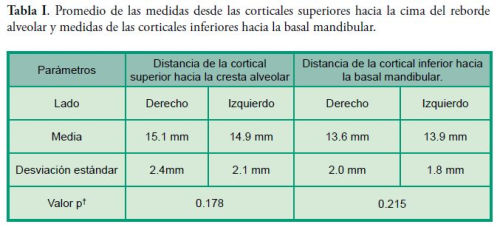
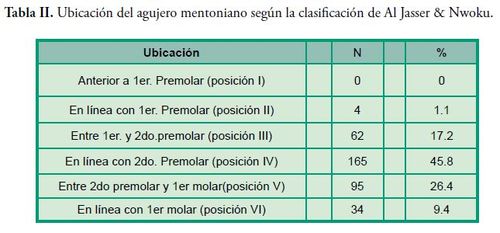
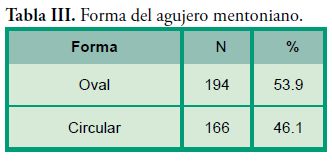
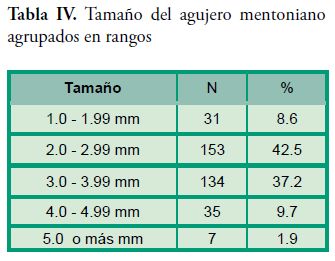
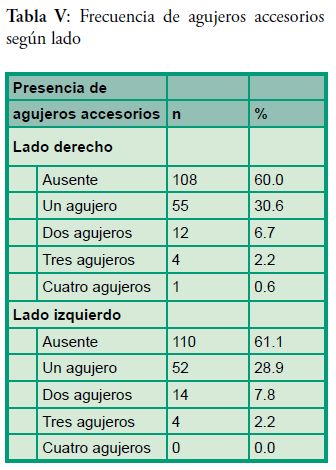
<body><![CDATA[<br>      <br style="font-family: Verdana;">      </span></font>    <br>      <br style="font-family: Verdana;">      <span style="font-family: Verdana;"> <span style="font-weight: bold;">Resultados</span></span><br style="font-family: Verdana;">          <br>      <font size="-1"><span style="font-family: Verdana;">Las tomograf&iacute;as fueron evaluadas por tres especialistas calibrados (Kappa 1.00).</span></font><br style="font-family: Verdana;">      <br style="font-family: Verdana;">      <font size="-1"><span style="font-family: Verdana;"> Se midi&oacute; la distancia desde la cortical superior e inferior del agujero mentoniano hacia la cresta alveolar y basal mandibular respectivamente, no evidenci&aacute;ndose diferencias estad&iacute;sticamente significativas entre los lados derecho e izquierdo de ambas mediciones. (p*0.178), (p*0.215) <a href="#t1">(Tabla I)</a></span></font><br style="font-family: Verdana;">      <br style="font-family: Verdana;">      <font size="-1"><span style="font-family: Verdana;"> &nbsp;</span></font><br style="font-family: Verdana;">      <font size="-1"><span style="font-family: Verdana;"></span></font><br style="font-family: Verdana;">      <a name="t1"></a><img style="width: 500px; height: 230px;" alt="" src="/img/revistas/ode/v16n24/24a02t1.jpg"><br style="font-family: Verdana;">      <font size="-1"><span style="font-family: Verdana;"> &nbsp;</span></font><br style="font-family: Verdana;">      <font size="-1"><span style="font-family: Verdana;"></span></font><font size="-1"><span style="font-family: Verdana;"></span></font><br style="font-family: Verdana;">      <br style="font-family: Verdana;">      <font size="-1"><span style="font-family: Verdana;"> &nbsp;</span></font><br style="font-family: Verdana;">      <br style="font-family: Verdana;">      <font size="-1"><span style="font-family: Verdana;"> La ubicaci&oacute;n m&aacute;s frecuente del agujero mentoniano se evidenci&oacute; en el eje longitudinal del segundo premolar en ambos lados (posici&oacute;n IV) seguido de la posici&oacute;n V, III, VI, y II, no se observ&oacute; ning&uacute;n agujero mentoniano en la posici&oacute;n I, tampoco se evidenci&oacute; diferencias significativas comparado con su lado contralateral. ( p*0.764) <a href="#t2">(Tabla II)</a></span></font><br style="font-family: Verdana;">      <br style="font-family: Verdana;">      <font size="-1"><span style="font-family: Verdana;"> &nbsp;</span></font><br style="font-family: Verdana;">      <br style="font-family: Verdana;">      <font size="-1"><span style="font-family: Verdana;"></span></font><font size="-1"><span style="font-family: Verdana;"></span></font><a name="t2"></a><img style="width: 500px; height: 233px;" alt="" src="/img/revistas/ode/v16n24/24a02t2.jpg"><br style="font-family: Verdana;">      <font size="-1"><span style="font-family: Verdana;"></span></font><font size="-1"><span style="font-family: Verdana;"></span></font><font size="-1"><span style="font-family: Verdana;"></span></font><font size="-1"><span style="font-family: Verdana;"></span></font><font size="-1"><span style="font-family: Verdana;"></span></font><font size="-1"><span style="font-family: Verdana;"></span></font><br style="font-family: Verdana;">      <br style="font-family: Verdana;">      <font size="-1"><span style="font-family: Verdana;"> &nbsp;</span></font><br style="font-family: Verdana;">      <br style="font-family: Verdana;">      <font size="-1"><span style="font-family: Verdana;"> La forma oval se present&oacute; con mayor frecuencia, no evidenci&aacute;ndose diferencia significativa comparado con su lado contralateral (p*0.057) <a href="#t3">(Tabla III)</a>.</span></font><br style="font-family: Verdana;">      <br style="font-family: Verdana;">      <font size="-1"><span style="font-family: Verdana;"> &nbsp;</span></font><br style="font-family: Verdana;">      <a name="t3"></a><img style="width: 332px; height: 164px;" alt="" src="/img/revistas/ode/v16n24/24a02t3.jpg"><br style="font-family: Verdana;">      <font size="-1"><span style="font-family: Verdana;"></span></font><font size="-1"><span style="font-family: Verdana;"></span></font><br style="font-family: Verdana;">      <br style="font-family: Verdana;">      <font size="-1"><span style="font-family: Verdana;"> &nbsp;</span></font><br style="font-family: Verdana;">      <br style="font-family: Verdana;">      <font size="-1"><span style="font-family: Verdana;"> El tama&ntilde;o del agujero mentoniano se agrup&oacute; en cinco rangos de medici&oacute;n, ubic&aacute;ndose la mayor cantidad de ellos (n= 153; 42.5 %) en el rango de 2 mm a 2.99 mm en ambos lados. No se evidenci&oacute; diferencia significativa comparado con su lado contralateral (p*0.623) <a href="#t4">(Tabla IV)</a></span></font><br style="font-family: Verdana;">      <br style="font-family: Verdana;">      <font size="-1"><span style="font-family: Verdana;"> &nbsp;</span></font><br style="font-family: Verdana;">      <font size="-1"><span style="font-family: Verdana;"></span></font><br style="font-family: Verdana;">      <font size="-1"><span style="font-family: Verdana;"></span></font><font size="-1"><span style="font-family: Verdana;"></span></font><a name="t4"></a><img style="width: 335px; height: 261px;" alt="" src="/img/revistas/ode/v16n24/24a02t4.jpg"><br style="font-family: Verdana;">      <br style="font-family: Verdana;">      <font size="-1"><span style="font-family: Verdana;"> &nbsp;</span></font><br style="font-family: Verdana;">      <br style="font-family: Verdana;">      <font size="-1"><span style="font-family: Verdana;"> Se encontr&oacute; que los agujeros accesorios estuvieron presentes en 100 casos (55.5 %) de las 180 tomograf&iacute;as analizadas. <a href="#t5">(Tabla V)</a></span></font><br style="font-family: Verdana;">      <br style="font-family: Verdana;">      <font size="-1"><span style="font-family: Verdana;"> &nbsp;</span></font><br style="font-family: Verdana;">      <font size="-1"><span style="font-family: Verdana;"></span></font><br style="font-family: Verdana;">      <font size="-1"><span style="font-family: Verdana;"></span></font><font size="-1"><span style="font-family: Verdana;"></span></font><font size="-1"><span style="font-family: Verdana;"></span></font><a name="t5"></a><img style="width: 336px; height: 470px;" alt="" src="/img/revistas/ode/v16n24/24a02t5.jpg">    <br>     <br style="font-family: Verdana;">     <br style="font-family: Verdana;">     <span style="font-family: Verdana;">     <span style="font-weight: bold;">Discusi&oacute;n</span></span><br style="font-family: Verdana;">     <br style="font-family: Verdana;">     <font size="-1"><span style="font-family: Verdana;">     ]]></body>
<body><![CDATA[En la presente investigaci&oacute;n se evidenci&oacute; que la medida     de la distancia desde la cortical superior del agujero mentoniano hacia     la cresta alveolar present&oacute; resultados similares a otros     estudios (<a href="#4">4</a>, <a name="11a"></a><a href="#11">11</a>) ; asimismo, otras investigaciones (<a href="#6">6</a>, <a name="12a"></a><a href="#12">12</a>) en donde se     realizaron mediciones en mand&iacute;bulas secas, se encontraron     resultados menores, los cuales difieren con el presente estudio.</span></font><br style="font-family: Verdana;">     <br style="font-family: Verdana;">     <font size="-1"><span style="font-family: Verdana;">     La medida de la distancia de la cortical inferior del agujero     mentoniano hacia la basal mandibular fue de (13.6 mm &plusmn; 2.0 mm) y     ]]></body>
<body><![CDATA[(13.9 mm &plusmn; 1.8 mm), en el lado derecho e izquierdo     respectivamente, los cuales concuerdan en promedio con lo reportado por     otras investigaciones (<a href="#4">4</a>, <a name="13a"></a><a href="#13">13</a>, <a name="14a"></a><a href="#14">14</a>).</span></font><br style="font-family: Verdana;">     <br style="font-family: Verdana;">     <font size="-1"><span style="font-family: Verdana;">     Hay un debate considerable en la literatura respecto a la     ubicaci&oacute;n del agujero mentoniano en diferentes grupos     &eacute;tnicos. En este estudio se evidenci&oacute; que dicha     estructura se encontr&oacute; ubicada en todas las muestras entre la     ra&iacute;z del primer premolar y la ra&iacute;z del primer molar.</span></font><br style="font-family: Verdana;">     ]]></body>
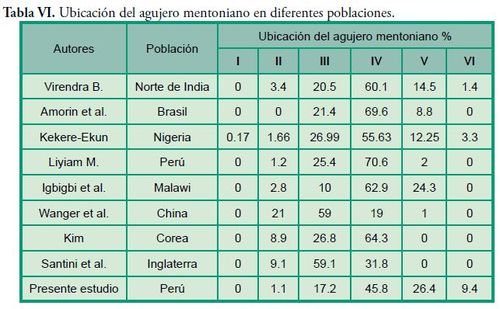
<body><![CDATA[<br style="font-family: Verdana;">     <font size="-1"><span style="font-family: Verdana;">     Los resultados obtenidos fueron semejantes a lo reportado por otras     investigaciones (<a href="#4">4</a>, <a href="#6">6</a>, <a href="#11">11</a>, <a href="#13">13</a>-<a name="17a"></a><a href="#17">17</a>, <a href="#24">24</a>) quienes observaron el agujero     mentoniano en el eje longitudinal del segundo premolar.     (Posici&oacute;n IV). Otros estudios (<a href="#7">7</a>, <a href="#12">12</a>, <a href="#18">18</a>, <a name="19a"></a><a href="#19">19</a>) evidenciaron la     ubicaci&oacute;n m&aacute;s frecuente del agujero mentoniano en la     posici&oacute;n III, lo que discrepa con lo encontrado en el presente     estudio, pues la posici&oacute;n V y III se ubicaron en el segundo y     tercer lugar de frecuencia respectivamente.</span></font><br style="font-family: Verdana;">     ]]></body>
<body><![CDATA[<br style="font-family: Verdana;">     <font size="-1"><span style="font-family: Verdana;">     Diversos autores han estudiado la ubicaci&oacute;n del agujero     mentoniano utilizando como referencia los ejes longitudinales de las     piezas dentarias, sin embargo, se reportaron variabilidades en los     resultados que se podr&iacute;a atribuir a un componente &eacute;tnico     <a href="#t6">(Tabla VI)</a>.</span></font><br style="font-family: Verdana;">     <br style="font-family: Verdana;">     <font size="-1"><span style="font-family: Verdana;">     &nbsp;</span></font><br style="font-family: Verdana;">     ]]></body>
<body><![CDATA[<font size="-1"><span style="font-family: Verdana;"></span></font><br style="font-family: Verdana;">     <font size="-1"><span style="font-family: Verdana;"></span></font><font size="-1"><span style="font-family: Verdana;"></span></font><font size="-1"><span style="font-family: Verdana;"></span></font><a name="t6"></a><img style="width: 500px; height: 309px;" alt="" src="/img/revistas/ode/v16n24/24a02t6.jpg"><br style="font-family: Verdana;">     <font size="-1"><span style="font-family: Verdana;"></span></font><font size="-1"><span style="font-family: Verdana;"></span></font><font size="-1"><span style="font-family: Verdana;"></span></font><font size="-1"><span style="font-family: Verdana;"></span></font><font size="-1"><span style="font-family: Verdana;"></span></font><br style="font-family: Verdana;">     <br style="font-family: Verdana;">     <font size="-1"><span style="font-family: Verdana;">     Respecto a la forma del agujero mentoniano existen diversas     investigaciones cuyos resultados no guardan consenso en la     clasificaci&oacute;n de la misma, sin embargo, otros estudios     consideran la forma oval y circular como criterio de evaluaci&oacute;n,     dichas investigaciones (<a href="#4">4</a>, <a href="#6">6</a>, <a href="#11">11</a>, <a href="#12">12</a>, <a name="15a"></a><a href="#15">15</a>, <a name="22a"></a><a href="#22">22</a> ) evidencian, en la     ]]></body>
<body><![CDATA[mayor&iacute;a de los casos, una forma oval, el cual coincide con el     presente estudio, sin embargo, otros autores (<a href="#14">14</a>, <a href="#16">16</a>, <a name="20a"></a><a href="#20">20</a>, <a href="#24">24</a>) discrepan     con nuestros resultados, al reportar la forma circular como la     m&aacute;s frecuente.</span></font><br style="font-family: Verdana;">     <br style="font-family: Verdana;">     <font size="-1"><span style="font-family: Verdana;">     El tama&ntilde;o del agujero mentoniano fue agrupado en 5 rangos. En la     mayor&iacute;a de los casos se encontraron en el rango de 2 mm a 2.99     mm en ambos lados, present&aacute;ndose una frecuencia de 75 casos     (41.7%) en el lado derecho y 78 casos (43.3%) en el lado izquierdo.</span></font><br style="font-family: Verdana;">     ]]></body>
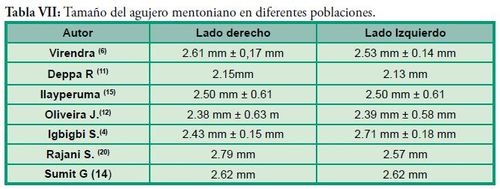
<body><![CDATA[<br style="font-family: Verdana;">     <font size="-1"><span style="font-family: Verdana;">     &nbsp;</span></font><br style="font-family: Verdana;">     <br style="font-family: Verdana;">     <font size="-1"><span style="font-family: Verdana;">     Distintos autores realizaron la evaluaci&oacute;n del tama&ntilde;o del     agujero mentoniano en mand&iacute;bulas secas, encontrando similitud     con los resultados obtenidos en el presente estudio en el rango de 2 mm     a 2 .99 mm. <a href="#t7">(Tabla VII)</a></span></font><br style="font-family: Verdana;">     <br style="font-family: Verdana;">     ]]></body>
<body><![CDATA[<font size="-1"><span style="font-family: Verdana;">     &nbsp;</span></font><br style="font-family: Verdana;">     <br style="font-family: Verdana;">     <font size="-1"><span style="font-family: Verdana;"></span></font><font size="-1"><span style="font-family: Verdana;"></span></font><a name="t7"></a><img style="width: 500px; height: 189px;" alt="" src="/img/revistas/ode/v16n24/24a02t7.jpg"><br style="font-family: Verdana;">     <br style="font-family: Verdana;">     <font size="-1"><span style="font-family: Verdana;"></span></font><br style="font-family: Verdana;">     <br style="font-family: Verdana;">     <font size="-1"><span style="font-family: Verdana;">     Los agujeros mentonianos accesorios estuvieron presentes en el 55.5 %     de todos los casos, lo que difiere con la mayor&iacute;a de estudios     ]]></body>
<body><![CDATA[realizados en mand&iacute;bulas secas y evaluadas mediante     tomograf&iacute;a Cone Beam (<a href="#6">6</a>, <a href="#14">14</a>, <a href="#15">15</a>, <a href="#20">20</a> y <a name="23a"></a><a href="#23">23</a>). Singh R &amp;     Srivastav evidenci&oacute; la presencia de agujeros accesorios en el     13% del total de la poblaci&oacute;n evaluada, otros estudios (<a href="#6">6</a>, <a href="#14">14</a>     ,<a href="#15">15</a> y <a href="#23">23</a>) evidenciaron una prevalencia de 6.67%, 6.6%, 3.92% y 6.5%     respectivamente.</span></font><br style="font-family: Verdana;">     <font size="-1"><span style="font-family: Verdana;">&nbsp;</span></font><br style="font-family: Verdana;">     <br style="font-family: Verdana;">     <font size="-1"><span style="font-family: Verdana;">     Todas las variables estudiadas coinciden con lo reportado por Igbigbi     ]]></body>
<body><![CDATA[&amp; Lesbona, quien evalu&oacute; la morfolog&iacute;a y     morfometr&iacute;a del agujero mentoniano en una poblaci&oacute;n     Africana.</span></font><br style="font-family: Verdana;">     <br>          <!-- ref --><br>      <br style="font-family: Verdana;">      <span style="font-family: Verdana;"> <span style="font-weight: bold;">Conclusi&oacute;n</span></span><br style="font-family: Verdana;">      <br style="font-family: Verdana;">      <font size="-1"><span style="font-family: Verdana;"> Se concluye que el agujero mentoniano en una poblaci&oacute;n adulta dentada se ubica en promedio en 13.75 mm por encima de la basal mandibular; la ubicaci&oacute;n m&aacute;s frecuente se evidenci&oacute; debajo del eje longitudinal del segundo premolar, la forma predominante fue oval, el tama&ntilde;o se ubic&oacute; en el rango de 2 mm a 2.99 mm y se evidenci&oacute; que los agujeros mentonianos accesorios estuvieron presentes en m&aacute;s de la mitad de los casos estudiados. (55.5 %)</span></font><br style="font-family: Verdana;">      <br style="font-family: Verdana;">      <font size="-1"><span style="font-family: Verdana;"> &nbsp;</span></font><br style="font-family: Verdana;">      <br style="font-family: Verdana;">      <span style="font-family: Verdana;"> <span style="font-weight: bold;">Referencias</span></span><br style="font-family: Verdana;">      <br style="font-family: Verdana;">      <font size="-1"><span style="font-family: Verdana;"><a name="1"></a><a href="#1a">1</a>. Velayos JL. Anatom&iacute;a de la Cabeza para Odont&oacute;logos. 4a ed. Buenos aires: Editorial Panamericana, 2007.    <br>         <br>     </span></font> <font size="-1"><span style="font-family: Verdana;"><a name="2"></a><a href="#2a">2.</a> Solano Reina JE, Mendoza Mendoza A. Crecimiento Craneofacial y Desarrollo de las Arcadas Dentarias. En: Odontopediatria.Barcelona: Masson. 2004. p37&ndash;53.    <br>         <!-- ref --><br>     </span></font> <font size="-1"><span style="font-family: Verdana;"><a name="3"></a><a href="#3a">3.</a> Ries Centeno GA. Cirug&iacute;a bucal: Patolog&iacute;a, Cl&iacute;nica y Terap&eacute;utica. 9a ed. Buenos Aires: Editorial el Ateneo. 1987.    <br>         ]]></body>
<body><![CDATA[<!-- ref --><br>     </span></font> <font size="-1"><span style="font-family: Verdana;"><a name="4"></a><a href="#4a">4.</a> Igbigbi PS, Lesbona S. The Position and Dimensions of the Mental Foramen in Adult Malawian Mandibles. West African J Med. 2005; 24 (3): 184-189.    <br>         <!-- ref --><br>     </span></font> <font size="-1"><span style="font-family: Verdana;"><a name="5"></a><a href="#5a">5.</a> Hassan T, Fauzi M, Hassan D. Bilateral Absence of Mental Foramen: A Rare Variation. Int J Anatomic Variations [en l&iacute;nea] 2010; 3: 187-189. Citado el 8 de Enero 2014. Disponible en: <a href="http://www.ijav.org/2010/ijav_10_167-169.pdf" target="_blank">http://www.ijav.org/2010/ijav_10_167-169.pdf</a>    <br>         <br>     </span></font> <font size="-1"><span style="font-family: Verdana;"><a name="6"></a><a href="#6a">6.</a> Budhiraja V, Rastogi R, Lalwani R, Goel P, Chandra S. Study of Position, Shape, and Size of Mental Foramen Utilizing Various Parameters in Dry Adult Human Mandibles From North India. Int Scholarly Res Notices [en l&iacute;nea] 2012; 1-5. Citado el 27 de Noviembre 2013. Disponible en: <a href="http://dx.doi.org/10.5402/2013/961429" target="_blank">http://dx.doi.org/10.5402/2013/961429</a>    <br>         <br>     </span></font> <font size="-1"><span style="font-family: Verdana;"><a name="7"></a><a href="#7a">7.</a> Haghanifar S, Rokouei M. Radiographic Evaluation of the Mental Foramen in a Selected Iranian Population. Indian J Dent Res. [en l&iacute;nea] 2009; 20: 150-2. Citado el 17 de Diciembre 2013. Disponible en:    <!-- ref --><br>      &nbsp;<a href="http://www.ijdr.in/article.asp?issn=0970-9290;year=2009;volume=20;issue=2;spage=150;epage=152;aulast=Haghanifar" target="_blank">http://www.ijdr.in/article.asp?issn=0970-9290;year=2009;volume=20;issue=2;spage=150;epage=152;aulast=Haghanifar</a>    <br>         <!-- ref --><br>     </span></font> <font size="-1"><span style="font-family: Verdana;"><a name="8"></a><a href="#8a">8</a>. Montoya K. Tomograf&iacute;a Cone Beam como M&eacute;todo de Diagn&oacute;stico Preciso y Confiable en Odontolog&iacute;a [tesis] Universidad Veracruzana: 2011. Citado el 8 de Enero 2014. Disponible en: <a href="http://cdigital.uv.mx/bitstream/123456789/30959/1/MontoyaHernandez.pdf" target="_blank">http://cdigital.uv.mx/bitstream/123456789/30959/1/MontoyaHernandez.pdf</a>    <br>         <!-- ref --><br>     </span></font> <font size="-1"><span style="font-family: Verdana;"><a name="9"></a><a href="#8a">9.</a> Oviedo P. Tomograf&iacute;a Cone Beam Aplicado a la Endodoncia [tesis] Lima- Per&uacute;. Universidad Peruana Cayetano Heredia: 2010.    <br>         <!-- ref --><br>     </span></font> <font size="-1"><span style="font-family: Verdana;"><a name="10"></a><a href="#10a">10.</a> Ige M. Tomograf&iacute;a Computarizada Volum&eacute;trica: Cone Beam&rdquo; [tesis] Lima- Per&uacute;. Universidad Peruana Cayetano Heredia: 2010.    <br>         <br>     </span></font> <font size="-1"><span style="font-family: Verdana;"><a name="11"></a><a href="#11a">11.</a> Agarwal D, Gupta S. Morphometric Analysis of Mental Foramen in Human Mandibles of South Gujarat. People&rsquo;s Journal of Scientific Research 2011; 15.4(1).    <br>         <br>     </span></font> <font size="-1"><span style="font-family: Verdana;"><a name="12"></a><a href="#12a">12.</a> Oliveira J, Araujo A, Da Silva C, Sousa R, Lima F. Morphological and Morphometric Study of the Mental Foramen on the M-CP.18 Jianchenjiang Point. Int J Morpho [en l&iacute;nea] 2009; 27 (1): 231-238. Citado el 12 de Diciembre 2013. Disponible en <a href="http://www.scielo.cl/scielo.php?script=sci_pdf&amp;pid=S0717-95022009000100039&amp;lng=es&amp;nrm=iso&amp;tlng=en" target="_blank">http://www.scielo.cl/scielo.php?script=sci_pdf&amp;pid=S0717-95022009000100039&amp;lng=es&amp;nrm=iso&amp;tlng=en</a>    <br>         <br>     </span></font> <font size="-1"><span style="font-family: Verdana;"><a name="13"></a><a href="#13a">13.</a> Amorin M, Prado F, Borini C, Bittar T, Volpato M, Groppo F, et al. The Mental Foramen Position in Dentate and Edentulous Brazilian&rsquo;s Mandible. Int J Morpho [en l&iacute;nea] 2008; 26 (4): 981-987. Citado el 21 de Enero 2014. Disponible en:    ]]></body>
<body><![CDATA[<br>      &nbsp;<a href="http://www.scielo.cl/scielo.php?script=sci_pdf&amp;pid=S0717-95022008000400033&amp;lng=es&amp;nrm=iso&amp;tlng=en" target="_blank">http://www.scielo.cl/scielo.php?script=sci_pdf&amp;pid=S0717-95022008000400033&amp;lng=es&amp;nrm=iso&amp;tlng=en</a>    <br>         <!-- ref --><br>     </span></font> <font size="-1"><span style="font-family: Verdana;"><a name="14"></a><a href="#14a">14.</a>&nbsp;Gupta S, Soni JS. Study of Anatomical Variations and Incidence of Mental Foramen and Accessory Mental Foramen in Dry Human Mandibles. Natl J Med Res 2012; 2 (1): 28-30.    <br>         <br>     </span></font> <font size="-1"><span style="font-family: Verdana;"><a name="15"></a><a href="#15a">15.</a> Ilayperuma I, Nanayakkara G, Palahepitiya N. Morphometric Analysis of the Mental Foramen in Adult Sri Lankan Mandibles. Int J Morphol [en l&iacute;nea] 2009; 27 (4): 1019-1024.Citado el 10 de Enero 2014. Disponible en:    <!-- ref --><br>      &nbsp;<a href="http://www.scielo.cl/scielo.php?script=sci_pdf&amp;pid=S0717-95022009000400010&amp;lng=es&amp;nrm=iso&amp;tlng=en" target="_blank">http://www.scielo.cl/scielo.php?script=sci_pdf&amp;pid=S0717-95022009000400010&amp;lng=es&amp;nrm=iso&amp;tlng=en</a>    <br>         <!-- ref --><br>     </span></font> <font size="-1"><span style="font-family: Verdana;"><a name="16"></a><a href="#17a">16.</a> C&oacute;rdova L. Caracter&iacute;sticas Radiogr&aacute;ficas del Foramen Mentoniano en Pacientes del Instituto de Salud Oral de la FAP del 2000 al 2008 [tesis] Lima- Per&uacute;. Universidad Nacional Federico Villarreal: 2009.    <br>         <br>     </span></font> <font size="-1"><span style="font-family: Verdana;"><a name="17"></a><a href="#17a">17.</a> Kim IS, Kim SG, Kim YK, Kim JD. Position of the mental foramen in a Korean population: a clinical and radiographic study. Implant dentistry [en l&iacute;nea] 2006; 15 (4): 404-411. Citado el 9 de Enero 2014. Disponible en:    ]]></body>
<body><![CDATA[<!-- ref --><br>      &nbsp;<a href="http://www.researchgate.net/publication/6627058_Position_of_the_mental_foramen_in_a_Korean_population_a_clinical_and_radiographic_study" target="_blank">http://www.researchgate.net/publication/6627058_Position_of_the_mental_foramen_in_a_Korean_population_a_clinical_and_radiographic_study</a>    <br>         <!-- ref --><br>     </span></font> <font size="-1"><span style="font-family: Verdana;"><a name="18"></a><a href="#18a">18.</a> Rupesh S, Winnier J, Sherin A, Tatu J, Prasad A, venugopal R. Radiographic Study of the Location of Mental Foramen in a Randomly Selected Asian Indian Population on Digital Panoramic Radiographs. J Med Sci [en l&iacute;nea] 2011; 11 (2): 90-95. Citado el 20 de Diciembre 2013. Disponible en: <a href="http://scialert.net/fulltext/?doi=jms.2011.90.95" target="_blank">http://scialert.net/fulltext/?doi=jms.2011.90.95</a>    <br>         <br>     </span></font> <font size="-1"><span style="font-family: Verdana;"><a name="19"></a><a href="#19a">19.</a> Gungor K, Ozturk M, Semiz M, Brooks SL. Location of Mental Foramen in Turkish Population, Coll Antropol 2006; 30 (4): 801&ndash;805.    <br>         <br>     </span></font> <font size="-1"><span style="font-family: Verdana;"><a name="20"></a><a href="#20a">20.</a> Singh R, Srivastav A. Study of position, shape, size and incidence of mental foramen and accessory mental foramen in Indian adult human skulls. Int J Morphol [en l&iacute;nea] 2010; 28 (4): 1141-1146. Citado el 21 de Enero 2014. Disponible en:    <!-- ref --><br>      &nbsp;<a href="http://www.scielo.cl/scielo.php?script=sci_pdf&amp;pid=S0717-95022010000400025&amp;lng=es&amp;nrm=iso&amp;tlng=en" target="_blank">http://www.scielo.cl/scielo.php?script=sci_pdf&amp;pid=S0717-95022010000400025&amp;lng=es&amp;nrm=iso&amp;tlng=en</a>    <br>         <br>     </span></font> <font size="-1"><span style="font-family: Verdana;"><a name="21"></a><a href="#21a">21.</a> Al Jasser NM, Nwoku AL. Radiograpich Study of the mental foramen in a selected Saudi Population. Dentomaxillofacial Radiol [en l&iacute;nea] 1998; 27: 34-3. Citado el 15 Abril 2014. Disponible en: <a href="http://www.birpublications.org/toc/dmfr/27/6" target="_blank">http://www.birpublications.org/toc/dmfr/27/6</a>    ]]></body>
<body><![CDATA[<br>         <br>     </span></font> <font size="-1"><span style="font-family: Verdana;"><a name="22"></a><a href="#22a">22.</a> Hasan T. Mental foramen morphology: a must knowin clinical dentistry. J Pak Dent Assoc. [en l&iacute;nea] 2012; 21 (03): 167-172. Citado el 21 de Abril 2014. Disponible en:    <br>      &nbsp;<a href="http://www.researchgate.net/publication/233790049_Morphology_of_the_mental_foramena_must_know_in_clinical_dentistry" target="_blank">http://www.researchgate.net/publication/233790049_Morphology_of_the_mental_foramena_must_know_in_clinical_dentistry</a>    <br>         <br>     </span></font> <font size="-1"><span style="font-family: Verdana;"><a name="23"></a><a href="#23a">23.</a> Kalender A, Orhan K, Aksoy U. Evaluation of the Mental Foramen and Accessory Mental Foramen in Turkish Patients Using Cone-Beam Computed Tomography Imagen Reconstructed From a Volumetric Rendering Program. Clin Anat [en l&iacute;nea] 2012; 25 (5): 584&ndash;592 Citado el 23 de Abril 2014. Disponible en:    <br>      &nbsp;<a href="http://onlinelibrary.wiley.com/doi/10.1002/ca.21277/abstract?deniedAccessCustomisedMessage=&amp;userIsAuthenticated=false" target="_blank">http://onlinelibrary.wiley.com/doi/10.1002/ca.21277/abstract?deniedAccessCustomisedMessage=&amp;userIsAuthenticated=false</a>    <br>         <br>     </span></font> <font size="-1"><span style="font-family: Verdana;"><a name="24"></a><a href="#24a">24.</a> Sekerci A, Sahman H, Sisman Y, Aksu Y. Morphometric analysis of the mental foramen in a Turkish population based on multi-slice computed tomography. J Oral and Maxillofacial Radio [en l&iacute;nea] 2013; 1: 1-7. Citado el 28 de Abril 2014. Disponible en:    <!-- ref --><br>      &nbsp;<a href="http://www.joomr.org/temp/JOralMaxillofacRadiol112-2975328_081553.pdf" target="_blank"><span style="text-decoration: underline;">http://www.joomr.org/temp/JOralMaxillofacRadiol112-2975328_081553.    pdf</span></a></span></font>    ]]></body>
<body><![CDATA[<br>      <font size="-1"><span style="font-family: Verdana;"> &nbsp;</span></font><br style="font-family: Verdana;">      <font size="-1"><span style="font-family: Verdana;"> &nbsp;</span></font><br style="font-family: Verdana;">      <br style="font-family: Verdana;">      <font size="-1"><span style="font-family: Verdana;"> </span></font>                                                                                                                                                                                                                                                                                                                                        </div>           ]]></body><back>
<ref-list>
<ref id="B1">
<label>1</label><nlm-citation citation-type="book">
<person-group person-group-type="author">
<name>
<surname><![CDATA[Velayos]]></surname>
<given-names><![CDATA[JL]]></given-names>
</name>
</person-group>
<source><![CDATA[Anatomía de la Cabeza para Odontólogos]]></source>
<year>2007</year>
<edition>4a ed</edition>
<publisher-loc><![CDATA[Buenos Aires ]]></publisher-loc>
<publisher-name><![CDATA[Editorial Panamericana]]></publisher-name>
</nlm-citation>
</ref>
<ref id="B2">
<label>2</label><nlm-citation citation-type="book">
<person-group person-group-type="author">
<name>
<surname><![CDATA[Solano Reina]]></surname>
<given-names><![CDATA[JE]]></given-names>
</name>
<name>
<surname><![CDATA[Mendoza Mendoza]]></surname>
<given-names><![CDATA[A]]></given-names>
</name>
</person-group>
<article-title xml:lang="es"><![CDATA[Crecimiento Craneofacial y Desarrollo de las Arcadas Dentarias]]></article-title>
<source><![CDATA[Odontopediatria]]></source>
<year>2004</year>
<page-range>p37-53</page-range><publisher-loc><![CDATA[Barcelona ]]></publisher-loc>
<publisher-name><![CDATA[Masson]]></publisher-name>
</nlm-citation>
</ref>
<ref id="B3">
<label>3</label><nlm-citation citation-type="book">
<person-group person-group-type="author">
<name>
<surname><![CDATA[Ries Centeno]]></surname>
<given-names><![CDATA[GA]]></given-names>
</name>
</person-group>
<source><![CDATA[Cirugía bucal: Patología, Clínica y Terapéutica]]></source>
<year>1987</year>
<edition>9a ed</edition>
<publisher-loc><![CDATA[Buenos Aires ]]></publisher-loc>
<publisher-name><![CDATA[Editorial el Ateneo]]></publisher-name>
</nlm-citation>
</ref>
<ref id="B4">
<label>4</label><nlm-citation citation-type="journal">
<person-group person-group-type="author">
<name>
<surname><![CDATA[Igbigbi]]></surname>
<given-names><![CDATA[PS]]></given-names>
</name>
<name>
<surname><![CDATA[Lesbona]]></surname>
<given-names><![CDATA[S]]></given-names>
</name>
</person-group>
<article-title xml:lang="en"><![CDATA[The Position and Dimensions of the Mental Foramen in Adult Malawian Mandibles]]></article-title>
<source><![CDATA[West African J Med]]></source>
<year>2005</year>
<volume>24</volume>
<numero>3</numero>
<issue>3</issue>
<page-range>184-189</page-range></nlm-citation>
</ref>
<ref id="B5">
<label>5</label><nlm-citation citation-type="journal">
<person-group person-group-type="author">
<name>
<surname><![CDATA[Hassan]]></surname>
<given-names><![CDATA[T]]></given-names>
</name>
<name>
<surname><![CDATA[Fauzi]]></surname>
<given-names><![CDATA[M]]></given-names>
</name>
<name>
<surname><![CDATA[Hassan]]></surname>
<given-names><![CDATA[D]]></given-names>
</name>
</person-group>
<article-title xml:lang="en"><![CDATA[Bilateral Absence of Mental Foramen: A Rare Variation]]></article-title>
<source><![CDATA[Int J Anatomic Variations]]></source>
<year>2010</year>
<volume>3</volume>
<page-range>187-189</page-range></nlm-citation>
</ref>
<ref id="B6">
<label>6</label><nlm-citation citation-type="journal">
<person-group person-group-type="author">
<name>
<surname><![CDATA[Budhiraja]]></surname>
<given-names><![CDATA[V]]></given-names>
</name>
<name>
<surname><![CDATA[Rastogi]]></surname>
<given-names><![CDATA[R]]></given-names>
</name>
<name>
<surname><![CDATA[Lalwani]]></surname>
<given-names><![CDATA[R]]></given-names>
</name>
<name>
<surname><![CDATA[Goel]]></surname>
<given-names><![CDATA[P]]></given-names>
</name>
<name>
<surname><![CDATA[Chandra]]></surname>
<given-names><![CDATA[S]]></given-names>
</name>
</person-group>
<article-title xml:lang="en"><![CDATA[Study of Position, Shape, and Size of Mental Foramen Utilizing Various Parameters in Dry Adult Human Mandibles From North India]]></article-title>
<source><![CDATA[Int Scholarly Res Notices]]></source>
<year>2012</year>
<page-range>1-5</page-range></nlm-citation>
</ref>
<ref id="B7">
<label>7</label><nlm-citation citation-type="journal">
<person-group person-group-type="author">
<name>
<surname><![CDATA[Haghanifar]]></surname>
<given-names><![CDATA[S]]></given-names>
</name>
<name>
<surname><![CDATA[Rokouei]]></surname>
<given-names><![CDATA[M]]></given-names>
</name>
</person-group>
<article-title xml:lang="en"><![CDATA[Radiographic Evaluation of the Mental Foramen in a Selected Iranian Population]]></article-title>
<source><![CDATA[Indian J Dent Res]]></source>
<year>2009</year>
<volume>20</volume>
<page-range>150-2</page-range></nlm-citation>
</ref>
<ref id="B8">
<label>8</label><nlm-citation citation-type="">
<person-group person-group-type="author">
<name>
<surname><![CDATA[Montoya]]></surname>
<given-names><![CDATA[K]]></given-names>
</name>
</person-group>
<source><![CDATA[Tomografía Cone Beam como Método de Diagnóstico Preciso y Confiable en Odontología]]></source>
<year></year>
</nlm-citation>
</ref>
<ref id="B9">
<label>9</label><nlm-citation citation-type="">
<person-group person-group-type="author">
<name>
<surname><![CDATA[Oviedo]]></surname>
<given-names><![CDATA[P]]></given-names>
</name>
</person-group>
<source><![CDATA[Tomografía Cone Beam Aplicado a la Endodoncia]]></source>
<year></year>
</nlm-citation>
</ref>
<ref id="B10">
<label>10</label><nlm-citation citation-type="">
<person-group person-group-type="author">
<name>
<surname><![CDATA[Ige]]></surname>
<given-names><![CDATA[M]]></given-names>
</name>
</person-group>
<source><![CDATA[Tomografía Computarizada Volumétrica: Cone Beam&rdquo]]></source>
<year></year>
</nlm-citation>
</ref>
<ref id="B11">
<label>11</label><nlm-citation citation-type="journal">
<person-group person-group-type="author">
<name>
<surname><![CDATA[Agarwal]]></surname>
<given-names><![CDATA[D]]></given-names>
</name>
<name>
<surname><![CDATA[Gupta]]></surname>
<given-names><![CDATA[S]]></given-names>
</name>
</person-group>
<article-title xml:lang="en"><![CDATA[Morphometric Analysis of Mental Foramen in Human Mandibles of South Gujarat]]></article-title>
<source><![CDATA[Peoples Journal of Scientific Research]]></source>
<year>2011</year>
<volume>4</volume>
<numero>1</numero>
<issue>1</issue>
<page-range>15-18</page-range></nlm-citation>
</ref>
<ref id="B12">
<label>12</label><nlm-citation citation-type="journal">
<person-group person-group-type="author">
<name>
<surname><![CDATA[Oliveira]]></surname>
<given-names><![CDATA[J]]></given-names>
</name>
<name>
<surname><![CDATA[Araujo]]></surname>
<given-names><![CDATA[A]]></given-names>
</name>
<name>
<surname><![CDATA[Da Silva]]></surname>
<given-names><![CDATA[C]]></given-names>
</name>
<name>
<surname><![CDATA[Sousa]]></surname>
<given-names><![CDATA[R]]></given-names>
</name>
<name>
<surname><![CDATA[Lima]]></surname>
<given-names><![CDATA[F]]></given-names>
</name>
</person-group>
<article-title xml:lang="en"><![CDATA[Morphological and Morphometric Study of the Mental Foramen on the M-CP.18 Jianchenjiang Point]]></article-title>
<source><![CDATA[Int J Morpho]]></source>
<year>2009</year>
<volume>27</volume>
<numero>1</numero>
<issue>1</issue>
<page-range>231-238</page-range></nlm-citation>
</ref>
<ref id="B13">
<label>13</label><nlm-citation citation-type="journal">
<person-group person-group-type="author">
<name>
<surname><![CDATA[Amorin]]></surname>
<given-names><![CDATA[M]]></given-names>
</name>
<name>
<surname><![CDATA[Prado]]></surname>
<given-names><![CDATA[F]]></given-names>
</name>
<name>
<surname><![CDATA[Borini]]></surname>
<given-names><![CDATA[C]]></given-names>
</name>
<name>
<surname><![CDATA[Bittar]]></surname>
<given-names><![CDATA[T]]></given-names>
</name>
<name>
<surname><![CDATA[Volpato]]></surname>
<given-names><![CDATA[M]]></given-names>
</name>
<name>
<surname><![CDATA[Groppo]]></surname>
<given-names><![CDATA[F]]></given-names>
</name>
</person-group>
<article-title xml:lang="en"><![CDATA[The Mental Foramen Position in Dentate and Edentulous Brazilian&rsquo;s Mandible]]></article-title>
<source><![CDATA[Int J Morpho]]></source>
<year>2008</year>
<volume>26</volume>
<numero>4</numero>
<issue>4</issue>
<page-range>981-987</page-range></nlm-citation>
</ref>
<ref id="B14">
<label>14</label><nlm-citation citation-type="journal">
<person-group person-group-type="author">
<name>
<surname><![CDATA[Gupta]]></surname>
<given-names><![CDATA[S]]></given-names>
</name>
<name>
<surname><![CDATA[Soni]]></surname>
<given-names><![CDATA[JS]]></given-names>
</name>
</person-group>
<article-title xml:lang="en"><![CDATA[Study of Anatomical Variations and Incidence of Mental Foramen and Accessory Mental Foramen in Dry Human Mandibles]]></article-title>
<source><![CDATA[Natl J Med Res]]></source>
<year>2012</year>
<volume>2</volume>
<numero>1</numero>
<issue>1</issue>
<page-range>28-30</page-range></nlm-citation>
</ref>
<ref id="B15">
<label>15</label><nlm-citation citation-type="journal">
<person-group person-group-type="author">
<name>
<surname><![CDATA[Ilayperuma]]></surname>
<given-names><![CDATA[I]]></given-names>
</name>
<name>
<surname><![CDATA[Nanayakkara]]></surname>
<given-names><![CDATA[G]]></given-names>
</name>
<name>
<surname><![CDATA[Palahepitiya]]></surname>
<given-names><![CDATA[N]]></given-names>
</name>
</person-group>
<article-title xml:lang="en"><![CDATA[Morphometric Analysis of the Mental Foramen in Adult Sri Lankan Mandibles]]></article-title>
<source><![CDATA[Int J Morphol]]></source>
<year>2009</year>
<volume>27</volume>
<numero>4</numero>
<issue>4</issue>
<page-range>1019-1024</page-range></nlm-citation>
</ref>
<ref id="B16">
<label>16</label><nlm-citation citation-type="">
<person-group person-group-type="author">
<name>
<surname><![CDATA[Córdova]]></surname>
<given-names><![CDATA[L]]></given-names>
</name>
</person-group>
<source><![CDATA[Características Radiográficas del Foramen Mentoniano en Pacientes del Instituto de Salud Oral de la FAP del 2000 al 2008]]></source>
<year></year>
</nlm-citation>
</ref>
<ref id="B17">
<label>17</label><nlm-citation citation-type="journal">
<person-group person-group-type="author">
<name>
<surname><![CDATA[Kim]]></surname>
<given-names><![CDATA[IS]]></given-names>
</name>
<name>
<surname><![CDATA[Kim]]></surname>
<given-names><![CDATA[SG]]></given-names>
</name>
<name>
<surname><![CDATA[Kim]]></surname>
<given-names><![CDATA[YK]]></given-names>
</name>
<name>
<surname><![CDATA[Kim]]></surname>
<given-names><![CDATA[JD]]></given-names>
</name>
</person-group>
<article-title xml:lang="en"><![CDATA[Position of the mental foramen in a Korean population: a clinical and radiographic study]]></article-title>
<source><![CDATA[Implant dentistry]]></source>
<year>2006</year>
<volume>15</volume>
<numero>4</numero>
<issue>4</issue>
<page-range>404-411</page-range></nlm-citation>
</ref>
<ref id="B18">
<label>18</label><nlm-citation citation-type="journal">
<person-group person-group-type="author">
<name>
<surname><![CDATA[Rupesh]]></surname>
<given-names><![CDATA[S]]></given-names>
</name>
<name>
<surname><![CDATA[Winnier]]></surname>
<given-names><![CDATA[J]]></given-names>
</name>
<name>
<surname><![CDATA[Sherin]]></surname>
<given-names><![CDATA[A]]></given-names>
</name>
<name>
<surname><![CDATA[Tatu]]></surname>
<given-names><![CDATA[J]]></given-names>
</name>
<name>
<surname><![CDATA[Prasad]]></surname>
<given-names><![CDATA[A]]></given-names>
</name>
<name>
<surname><![CDATA[venugopal]]></surname>
<given-names><![CDATA[R]]></given-names>
</name>
</person-group>
<article-title xml:lang="en"><![CDATA[Radiographic Study of the Location of Mental Foramen in a Randomly Selected Asian Indian Population on Digital Panoramic Radiographs]]></article-title>
<source><![CDATA[J Med Sci]]></source>
<year>2011</year>
<volume>11</volume>
<numero>2</numero>
<issue>2</issue>
<page-range>90-95</page-range></nlm-citation>
</ref>
<ref id="B19">
<label>19</label><nlm-citation citation-type="journal">
<person-group person-group-type="author">
<name>
<surname><![CDATA[Gungor]]></surname>
<given-names><![CDATA[K]]></given-names>
</name>
<name>
<surname><![CDATA[Ozturk]]></surname>
<given-names><![CDATA[M]]></given-names>
</name>
<name>
<surname><![CDATA[Semiz]]></surname>
<given-names><![CDATA[M]]></given-names>
</name>
<name>
<surname><![CDATA[Brooks]]></surname>
<given-names><![CDATA[SL]]></given-names>
</name>
</person-group>
<article-title xml:lang="en"><![CDATA[Location of Mental Foramen in Turkish Population]]></article-title>
<source><![CDATA[Coll Antropol]]></source>
<year>2006</year>
<volume>30</volume>
<numero>4</numero>
<issue>4</issue>
<page-range>801-805</page-range></nlm-citation>
</ref>
<ref id="B20">
<label>20</label><nlm-citation citation-type="journal">
<person-group person-group-type="author">
<name>
<surname><![CDATA[Singh]]></surname>
<given-names><![CDATA[R]]></given-names>
</name>
<name>
<surname><![CDATA[Srivastav]]></surname>
<given-names><![CDATA[A]]></given-names>
</name>
</person-group>
<article-title xml:lang="en"><![CDATA[Study of position, shape, size and incidence of mental foramen and accessory mental foramen in Indian adult human skulls]]></article-title>
<source><![CDATA[Int J Morphol]]></source>
<year>2010</year>
<volume>28</volume>
<numero>4</numero>
<issue>4</issue>
<page-range>1141-1146</page-range></nlm-citation>
</ref>
<ref id="B21">
<label>21</label><nlm-citation citation-type="journal">
<person-group person-group-type="author">
<name>
<surname><![CDATA[Al Jasser]]></surname>
<given-names><![CDATA[NM]]></given-names>
</name>
<name>
<surname><![CDATA[Nwoku]]></surname>
<given-names><![CDATA[AL]]></given-names>
</name>
</person-group>
<article-title xml:lang="en"><![CDATA[Radiograpich Study of the mental foramen in a selected Saudi Population]]></article-title>
<source><![CDATA[Dentomaxillofacial Radiol]]></source>
<year>1998</year>
<volume>27</volume>
<page-range>34-3</page-range></nlm-citation>
</ref>
<ref id="B22">
<label>22</label><nlm-citation citation-type="journal">
<person-group person-group-type="author">
<name>
<surname><![CDATA[Hasan]]></surname>
<given-names><![CDATA[T]]></given-names>
</name>
</person-group>
<article-title xml:lang="en"><![CDATA[Mental foramen morphology: a must knowin clinical dentistry]]></article-title>
<source><![CDATA[J Pak Dent Assoc]]></source>
<year>2012</year>
<volume>21</volume>
<numero>03</numero>
<issue>03</issue>
<page-range>167-172</page-range></nlm-citation>
</ref>
<ref id="B23">
<label>23</label><nlm-citation citation-type="journal">
<person-group person-group-type="author">
<name>
<surname><![CDATA[Kalender]]></surname>
<given-names><![CDATA[A]]></given-names>
</name>
<name>
<surname><![CDATA[Orhan]]></surname>
<given-names><![CDATA[K]]></given-names>
</name>
<name>
<surname><![CDATA[Aksoy]]></surname>
<given-names><![CDATA[U]]></given-names>
</name>
</person-group>
<article-title xml:lang="en"><![CDATA[Evaluation of the Mental Foramen and Accessory Mental Foramen in Turkish Patients Using Cone-Beam Computed Tomography Imagen Reconstructed From a Volumetric Rendering Program]]></article-title>
<source><![CDATA[Clin Anat]]></source>
<year>2012</year>
<volume>25</volume>
<numero>5</numero>
<issue>5</issue>
<page-range>584-592</page-range></nlm-citation>
</ref>
<ref id="B24">
<label>24</label><nlm-citation citation-type="journal">
<person-group person-group-type="author">
<name>
<surname><![CDATA[Sekerci]]></surname>
<given-names><![CDATA[A]]></given-names>
</name>
<name>
<surname><![CDATA[Sahman]]></surname>
<given-names><![CDATA[H]]></given-names>
</name>
<name>
<surname><![CDATA[Sisman]]></surname>
<given-names><![CDATA[Y]]></given-names>
</name>
<name>
<surname><![CDATA[Aksu]]></surname>
<given-names><![CDATA[Y]]></given-names>
</name>
</person-group>
<article-title xml:lang="en"><![CDATA[Morphometric analysis of the mental foramen in a Turkish population based on multi-slice computed tomography]]></article-title>
<source><![CDATA[J Oral and Maxillofacial Radio]]></source>
<year>2013</year>
<volume>1</volume>
<page-range>1-7</page-range></nlm-citation>
</ref>
</ref-list>
</back>
</article>