<?xml version="1.0" encoding="ISO-8859-1"?><article xmlns:mml="http://www.w3.org/1998/Math/MathML" xmlns:xlink="http://www.w3.org/1999/xlink" xmlns:xsi="http://www.w3.org/2001/XMLSchema-instance">
<front>
<journal-meta>
<journal-id>1688-9339</journal-id>
<journal-title><![CDATA[Odontoestomatología]]></journal-title>
<abbrev-journal-title><![CDATA[Odontoestomatología]]></abbrev-journal-title>
<issn>1688-9339</issn>
<publisher>
<publisher-name><![CDATA[Facultad de Odontología - Universidad de la República]]></publisher-name>
</publisher>
</journal-meta>
<article-meta>
<article-id>S1688-93392010000100006</article-id>
<title-group>
<article-title xml:lang="es"><![CDATA[Niveles de bioelectricidad en amalgamas con y sin base intermedia]]></article-title>
<article-title xml:lang="en"><![CDATA[Bioelectricity levels in amalgam filling with or without intermediate base]]></article-title>
</title-group>
<contrib-group>
<contrib contrib-type="author">
<name>
<surname><![CDATA[Dominguez]]></surname>
<given-names><![CDATA[John Alexis]]></given-names>
</name>
<xref ref-type="aff" rid="A01"/>
</contrib>
<contrib contrib-type="author">
<name>
<surname><![CDATA[Ortega]]></surname>
<given-names><![CDATA[Diana Carolina]]></given-names>
</name>
<xref ref-type="aff" rid="A02"/>
</contrib>
<contrib contrib-type="author">
<name>
<surname><![CDATA[Cabrera]]></surname>
<given-names><![CDATA[Elizabeth]]></given-names>
</name>
<xref ref-type="aff" rid="A02"/>
</contrib>
</contrib-group>
<aff id="A01">
<institution><![CDATA[,Maestría en Dentística Restauradora e Materiales dentales Universidad Estadual de Ponta Grossa ]]></institution>
<addr-line><![CDATA[Ponta Grossa ]]></addr-line>
<country>Brasil</country>
</aff>
<aff id="A02">
<institution><![CDATA[,Universidad Cooperativa de Colombia-Pasto Odontologia VIII ]]></institution>
<addr-line><![CDATA[ ]]></addr-line>
</aff>
<pub-date pub-type="pub">
<day>00</day>
<month>05</month>
<year>2010</year>
</pub-date>
<pub-date pub-type="epub">
<day>00</day>
<month>05</month>
<year>2010</year>
</pub-date>
<volume>12</volume>
<numero>14</numero>
<fpage>54</fpage>
<lpage>57</lpage>
<copyright-statement/>
<copyright-year/>
<self-uri xlink:href="http://www.scielo.edu.uy/scielo.php?script=sci_arttext&amp;pid=S1688-93392010000100006&amp;lng=en&amp;nrm=iso"></self-uri><self-uri xlink:href="http://www.scielo.edu.uy/scielo.php?script=sci_abstract&amp;pid=S1688-93392010000100006&amp;lng=en&amp;nrm=iso"></self-uri><self-uri xlink:href="http://www.scielo.edu.uy/scielo.php?script=sci_pdf&amp;pid=S1688-93392010000100006&amp;lng=en&amp;nrm=iso"></self-uri><abstract abstract-type="short" xml:lang="es"><p><![CDATA[Los nuevos materiales estéticos no han ocasionado el abandono de las obturaciones de amalgama, es por eso que es importante proponer elementos que le den longevidad a las restauraciones. El propósito de este estudio fue determinar la relación entre los niveles de bioelectricidad y la presencia de base intermedia en obturaciones de amalgama. El presente estudio es un diseño de tipo descriptivo transversal, la población de estudio se conformó por un total de 30 obturaciones de pacientes que fueron atendidos en la Clínica Odontológica de la Universidad Cooperativa de Colombia de la ciudad de Pasto en el segundo semestre académico del 2007, los niveles de bioelectricidad se midieron en microamperios con un tester Techma TM-086 en sensibilidad de 20 &micro;A. El mayor promedio de bioelectricidad lo generaron las restauraciones de amalgama que no presentaron base intermedia con un promedio de 0,02867 &micro;A (Mann-Whitney - p=0,031) con respecto a las que tenían base intermedia con un promedio de -0.07133 &micro;A , y la marca de amalgama que mas bioelectricidad generó fue la New Stetic con un promedio de 0,01535 &micro;A (Kruskal wallis - p=0,008) con respecto a SDI con un promedio de -0.1633 &micro;A y Kerr con un promedio de -0.098 &micro;A. La intensidad del pasaje de corriente disminuye en las obturaciones de amalgamas cuando presentan base intermedia.]]></p></abstract>
<abstract abstract-type="short" xml:lang="en"><p><![CDATA[The new aesthetic materials have not caused amalgam fillings to be abandoned. For that reason it is important to give dental restorations the necessary elements to last. The purpose of the following paper is to determine the relation between the bioelectricity levels and the presence of intermediate base in amalgam fillings. The following is a transversal descriptive study, carried out at &ldquo;Clinica Odontologica de la Universidad Cooperativa de Colombia&rdquo; (Dentistry Clinic at Cooperativa de Colombia University) in the city of Pasto during the second academic semester of 2007, taking 30 patients as the sample population. The bioelectricity levels were measured using a Techma tester TM-086 and a sensibility of 20 &micro;A taking microamperes as the measurement unit. The amalgam fillings with no intermediate base showed the highest bioelectricity levels, with an average of 0.02867 &micro;A (Mann- Whitney - p=0.031) in relation to the ones that had intermediate base which had an average of -0.07133 &micro;A. The New Stetic amalgam filling produced the highest bioelectricity levels with an average of 0.01535 &micro;A (Krustal wallis - p=0.008) in relation to SDI that showed an average of -0.1633 &micro;A and Kerr with an average of -0.098 &micro;A respectively. When there is a presence of intermediate base, the electricity flow levels in amalgam fillings decrease]]></p></abstract>
<kwd-group>
<kwd lng="es"><![CDATA[Obturación de amalgama]]></kwd>
<kwd lng="es"><![CDATA[Corrosión]]></kwd>
</kwd-group>
</article-meta>
</front><body><![CDATA[ <p style="margin-bottom: 0.35cm; font-family: Verdana; text-align: center; font-weight: bold;" lang="es-CO"> <font style="font-size: 13pt;">Niveles de bioelectricidad en amalgamas con y sin base intermedia</font></p>      <div style="text-align: center;"> </div>      <p style="margin-bottom: 0cm; line-height: 100%; font-family: Verdana; text-align: center; font-style: italic;" lang="es-CO"><font size="2">John Alexis Dominguez<a href="#r1">*</a> , Diana Carolina Ortega<a href="#r2">**</a>, Elizabeth Cabrera<a href="#r2">**</a>.</font></p>      <div style="text-align: center;"> </div>      <div style="font-family: Times New Roman; text-align: center;"> </div>      <div style="text-align: center;"> </div>      <p style="margin-bottom: 0.35cm; font-family: Verdana; text-align: left;" lang="es-CO"> <font size="2">* OD Neurofocal. Residente de Maestr&iacute;a en Dent&iacute;stica Restauradora e Materiales dentales de la Universidad Estadual de Ponta Grossa, Brasil. Docente Tiempo Completo. Universidad Cooperativa de Colombia-Pasto</font></p>      <p style="margin-bottom: 0.35cm; font-family: Verdana; text-align: left;" lang="es-CO"><font size="2">** Estudiantes Odontolog&iacute;a VIII semestre Universidad Cooperativa de Colombia - Pasto</font></p>  <font face="Verdana" size="2">     <br>  </font>     <p style="margin-bottom: 0.35cm; text-align: justify; font-family: Verdana;" lang="es-CO"> <font size="2"><b>Resumen</b></font></p>      ]]></body>
<body><![CDATA[<div style="text-align: justify; font-family: Times New Roman;"> </div>      <p style="margin-bottom: 0cm; line-height: 100%; text-align: justify; font-family: Verdana;" lang="es-CO"> <font size="2">Los nuevos materiales est&eacute;ticos no han ocasionado el abandono de las obturaciones de amalgama, es por eso que es importante proponer elementos que le den longevidad a las restauraciones. El prop&oacute;sito de este estudio fue determinar la relaci&oacute;n entre los niveles de bioelectricidad y la presencia de base intermedia en obturaciones de amalgama.&nbsp;</font></p>      <div style="text-align: justify; font-family: Times New Roman;"> </div>      <p style="margin-bottom: 0cm; line-height: 100%; text-align: justify; font-family: Times New Roman;" lang="es-CO"><font face="Verdana" size="2"><span lang="es-EC">El presente estudio es un dise&ntilde;o de tipo descriptivo transversal, la poblaci&oacute;n de estudio se conform&oacute; por un total de 30 obturaciones de pacientes que fueron atendidos en la Cl&iacute;nica Odontol&oacute;gica de la Universidad Cooperativa de Colombia de la ciudad de Pasto en el segundo semestre acad&eacute;mico del 2007, los niveles de bioelectricidad se midieron en microamperios con un tester Techma TM-086 en sensibilidad de 20</span> &micro;A<span lang="es-EC">. </span></font></p>      <div style="text-align: justify; font-family: Times New Roman;"> </div>      <p style="margin-bottom: 0cm; line-height: 100%; text-align: justify; font-family: Times New Roman;" lang="es-CO"><font face="Verdana" size="2"><span lang="es-EC">El mayor promedio de bioelectricidad lo generaron las restauraciones de amalgama que no presentaron base intermedia con un promedio de 0,02867 </span>&micro;A<span lang="es-EC"> (Mann-Whitney - p=0,031) con respecto a las que ten&iacute;an base intermedia con un promedio de -0.07133 </span>&micro;A<span lang="es-EC"> , y la marca de amalgama que mas bioelectricidad gener&oacute; fue la New Stetic con un promedio de 0,01535 </span>&micro;A<span lang="es-EC"> (Kruskal wallis - p=0,008) con respecto a SDI con un promedio de -0.1633 </span>&micro;A<span lang="es-EC"> y Kerr con un promedio de -0.098 </span>&micro;A<span lang="es-EC">. </span></font></p>      <div style="text-align: justify; font-family: Times New Roman;"> </div>      <p style="margin-bottom: 0cm; line-height: 100%; text-align: justify; font-family: Times New Roman;" lang="es-CO"><font face="Verdana" size="2"><span lang="es-EC">La intensidad del pasaje de corriente disminuye en las obturaciones de amalgamas cuando presentan base intermedia.</span></font></p>      <div style="text-align: justify; font-family: Times New Roman;"> </div>      <p style="margin-bottom: 0.35cm; text-align: justify; font-family: Times New Roman;" lang="es-EC"> </p>      ]]></body>
<body><![CDATA[<div style="text-align: justify; font-family: Times New Roman;"> </div>      <p style="margin-bottom: 0.35cm; text-align: justify; font-family: Verdana;" lang="es-EC"><font size="2"><i>Palabras Claves: Obturaci&oacute;n de amalgama, Corrosi&oacute;n. </i></font> </p>      <div style="text-align: justify; font-family: Times New Roman;"> </div>      <p style="margin-bottom: 0.35cm; text-align: justify; font-family: Verdana;" lang="es-CO"> <font size="2">     <br>  </font> <small>    <br>  </small> </p>      <div style="text-align: justify; font-family: Times New Roman;"> </div>      <p style="margin-bottom: 0.35cm; text-align: justify; font-family: Verdana;" lang="en-US"> <font size="2"><b>Bioelectricity levels in amalgam filling with or without intermediate base</b></font></p>      <p style="margin-bottom: 0.35cm; text-align: justify; font-family: Times New Roman;" lang="en-US">&nbsp;</p>      <div style="text-align: justify; font-family: Times New Roman;"> </div>      ]]></body>
<body><![CDATA[<p style="margin-bottom: 0cm; line-height: 100%; text-align: justify; font-family: Verdana;" lang="en-US"> <font size="2">John Alexis Dominguez, Diana Carolina Ortega, Elizabeth Cabrera.</font></p>      <div style="text-align: justify; font-family: Times New Roman;"> </div>      <p style="margin-bottom: 0cm; line-height: 100%; text-align: justify; font-family: Verdana;" lang="en-US"> <font size="2">     <br>  </font> </p>      <div style="text-align: justify; font-family: Times New Roman;"> <blockquote class="western" style="margin-left: 0.05cm; margin-right: 0.03cm; text-indent: -0.08cm; text-align: justify;" lang="es-CO"> <font color="#000000" face="Verdana" size="2"><span lang="en-GB">The new aesthetic materials have not caused amalgam fillings to be abandoned. For that reason it is important to give dental restorations the necessary elements to last. The purpose of the following paper is to determine the relation between the bioelectricity levels and the presence of intermediate base in amalgam fillings. <b>    <br>    </b>    <br>  The following is a transversal descriptive study, carried out at &ldquo;Clinica Odontologica de la Universidad Cooperativa de Colombia&rdquo; (Dentistry Clinic at Cooperativa de Colombia University) in the city of Pasto during the second academic semester of 2007, taking 30 patients as the sample population. The bioelectricity levels were measured using a Techma tester TM-086 and a sensibility of </span><span lang="en-US">20 &micro;A</span><span lang="en-GB"> taking microamperes as the measurement unit. <b>    <br>    </b>    <br>  The amalgam fillings with no intermediate base showed the highest bioelectricity levels, with an average of 0.02867 </span><span lang="en-US">&micro;A</span><span lang="en-GB"> (Mann- Whitney - p=0.031) in relation to the ones that had intermediate base which had an average of -0.07133 </span><span lang="en-US">&micro;A</span><span lang="en-GB">. The New Stetic amalgam filling produced the highest bioelectricity levels with an average of 0.01535 </span><span lang="en-US">&micro;A</span><span lang="en-GB"> (Krustal wallis - p=0.008) in relation to SDI that showed an average of -0.1633 </span><span lang="en-US">&micro;A and Kerr with an average of -0.098 &micro;A respectively</span><span lang="en-GB">. <b>    <br>    </b>     ]]></body>
<body><![CDATA[<br>  When there is a presence of intermediate base, the electricity flow levels in amalgam fillings decrease<i>    <br>        <br>        <br>    </i> </span></font></blockquote>  </div>      <p style="margin-bottom: 0.35cm; text-align: justify; font-family: Verdana;" lang="es-CO"> <font size="2"><b>Introducci&oacute;n</b></font></p>      <div style="text-align: justify; font-family: Times New Roman;"> </div>      <p style="margin-bottom: 0.35cm; text-align: justify; font-family: Verdana;" lang="es-CO"> <font size="2">La amalgama dental es un material utilizado por m&aacute;s de 150 a&ntilde;os (<a href="#1">1</a>)<a name="1."></a>, su longevidad depende de factores como la manipulaci&oacute;n y los elementos que est&aacute;n presentes en boca como saliva, cambio de pH, temperatura y alimentaci&oacute;n (<a href="#2">2</a>-<a href="#4">4</a>)<a name="2."></a><a name="3."></a><a name="4."></a>. </font></p>      <div style="text-align: justify; font-family: Times New Roman;"> </div>      <p style="margin-bottom: 0.35cm; text-align: justify; font-family: Verdana;" lang="es-CO"> <font size="2">La bioelectricidad o el electrogalvanismo es otro de los elementos que puede llegar a disminuir la longevidad de las restauraciones de amalgama, reconociendo que al producirse el material con el potencial electr&oacute;nico m&aacute;s bajo ceder&aacute; un electr&oacute;n y producir&aacute; una corrosi&oacute;n el&eacute;ctrica (<a href="#5">5</a>, <a href="#6">6</a>)<a name="5."></a><a name="6."></a>, esto produce cambios en la estructura superficial por perder elementos de enlace al contacto con saliva como lo reporta el Dr. Okada y col. (<a href="#7">7</a>)<a name="7."></a>.</font></p>      <div style="text-align: justify; font-family: Times New Roman;"> </div>      ]]></body>
<body><![CDATA[<p style="margin-bottom: 0.35cm; text-align: justify; font-family: Verdana;" lang="es-CO"> <font size="2">Muchos estudios informan sobre la comunicaci&oacute;n que existe entre la dentina y la pulpa, encontrando procesos inflamatorios despu&eacute;s de colocar alg&uacute;n material en dentina (<a href="#8">8</a> -<a href="#10">10</a>)<a name="8."></a><a name="9."></a><a name="10."></a>; esto va de la mano con la prolongaci&oacute;n citoplasm&aacute;tica de los odontoblastos y la teor&iacute;a de los fluidos intratubulares.</font></p>      <div style="text-align: justify; font-family: Times New Roman;"> </div>      <p style="margin-bottom: 0.35cm; text-align: justify; font-family: Verdana;" lang="es-CO"> <font size="2">La base intermedia es un material de fondo cavitario, generalmente un cemento de fosfato, policarboxilato de zinc, polialquenoato de vidrio que protege la pared dentinal y sirve como aislante t&eacute;rmico, barrera ante los agentes qu&iacute;micos y el&eacute;ctricos provenientes del material restaurador (<a href="#11">11</a>, <a href="#12">12</a>)<a name="11."></a><a name="12."></a>.</font></p>      <div style="text-align: justify; font-family: Times New Roman;"> </div>      <p style="margin-bottom: 0.35cm; text-align: justify; font-family: Verdana;" lang="es-CO"> <font size="2">Al tener en cuenta la teor&iacute;a de los flu&iacute;dos intratubulares, reconocer que todo l&iacute;quido es un excelente conductor el&eacute;ctrico y la bioelectricidad es un agente medible, el prop&oacute;sito de este estudio fue comparar los niveles de bioelectricidad en pacientes con tres tipos de amalgama, con y sin base intermedia.</font></p>      <div style="text-align: justify; font-family: Times New Roman;"> </div>      <p style="margin-bottom: 0.35cm; text-align: justify; font-family: Times New Roman;" lang="es-CO"></p>      <div style="text-align: justify; font-family: Times New Roman;"> </div>      <p style="margin-bottom: 0.35cm; page-break-before: always; text-align: justify; font-family: Verdana;" lang="es-CO"> <font size="2"><b>Material y m&eacute;todo</b></font></p>      <div style="text-align: justify; font-family: Times New Roman;"> </div>      ]]></body>
<body><![CDATA[<p style="margin-bottom: 0.35cm; text-align: justify; font-family: Verdana;" lang="es-CO"> <font size="2">Se realiz&oacute; un estudio descriptivo transversal, con una muestra por conveniencia de 30 obturaciones de amalgama de pacientes <span lang="es-EC">atendidos en la Cl&iacute;nica Odontol&oacute;gica de la Universidad Cooperativa de Colombia en la ciudad de Pasto. Se consideraron los siguientes criterios de inclusi&oacute;n: </span>pacientes que asistieron a la Cl&iacute;nica, sist&eacute;micamente sanos, que no estuvieran ingiriendo ning&uacute;n medicamento, que se le haya realizado obturaciones de amalgama en el per&iacute;odo II del 2007 con el protocolo de la instituci&oacute;n, de cualquier edad, o g&eacute;nero, <span lang="es-ES">con una sola obturaci&oacute;n de amalgama en boca</span>, que su obturaci&oacute;n se haya realizado con las marcas <span lang="es-ES">SDI</span></font><font color="#000000" size="2">&reg;</font><font size="2"><span lang="es-ES">, Kerr</span></font><font color="#000000" size="2">&reg; </font><font size="2"><span lang="es-ES">o New Stetic</span></font><font color="#000000" size="2">&reg;,</font><font size="2"><span lang="es-ES"> sin presencia de </span>otras<span lang="es-ES"> obturaciones met&aacute;licas y que la medici&oacute;n se pudiese realizar 15 d&iacute;as despu&eacute;s de su colocaci&oacute;n. </span></font> </p>      <div style="text-align: justify; font-family: Times New Roman;"> </div>      <p style="margin-bottom: 0.35cm; text-align: justify; font-family: Verdana;" lang="es-CO"> <font size="2"><b>Procedimiento</b></font></p>      <div style="text-align: justify; font-family: Times New Roman;"> </div>      <p style="margin-bottom: 0.35cm; text-align: justify; font-family: Verdana;" lang="es-CO"> <font size="2">A los pacientes que cumplieron los criterios de inclusi&oacute;n, se les diligenci&oacute; la ficha de recolecci&oacute;n de informaci&oacute;n, se les solicit&oacute; firmar el consentimiento informado y luego se les tom&oacute; una radiograf&iacute;a para determinar si presentaban o no base intermedia. Se encendi&oacute; el tester marca Techma TM 086 &reg; y se coloc&oacute; en 20 &micro;A, y se verific&oacute; que la pantalla digital estuviera en ceros. Se solicit&oacute; al paciente que humedeciera con su saliva la obturaci&oacute;n a medir. Se pas&oacute; una gasa seca por las puntas met&aacute;licas y a continuaci&oacute;n se coloc&oacute; la punta met&aacute;lica con mango de color negro (polo negativo) en el centro de la obturaci&oacute;n de amalgama por todo oclusal. Despu&eacute;s de ubicar &eacute;sta, se coloc&oacute; la punta met&aacute;lica de mango de color rojo (polo positivo) en el tejido gingival por vestibular del diente que presentaba la obturaci&oacute;n de amalgama. Se registr&oacute; la informaci&oacute;n en &micro;A en la ficha t&eacute;cnica de recolecci&oacute;n de datos (<a href="#13">13</a>)<a name="13."></a>, junto a la referencia de la marca de amalgama que hab&iacute;a utilizado el estudiante y si la obturaci&oacute;n ten&iacute;a o no base intermedia.</font></p>      <div style="text-align: justify; font-family: Times New Roman;"> </div>      <p style="margin-bottom: 0.35cm; text-align: justify; font-family: Verdana;" lang="es-CO"> <font size="2"><i>Prueba Piloto</i></font></p>      <div style="text-align: justify; font-family: Times New Roman;"> </div>      <p style="margin-bottom: 0.35cm; text-align: justify; font-family: Verdana;" lang="es-CO"> <font size="2">Antes de comenzar la recolecci&oacute;n de datos, se realiz&oacute; la estandarizaci&oacute;n del grupo que tom&oacute; las medidas de bioelectricidad, teniendo en cuenta el grado de precisi&oacute;n de la medida del Tester Techma TM-086 en 20<i> &micro;A</i>. Se midi&oacute; cada obturaci&oacute;n cinco veces y el grado de sensibilidad se determin&oacute; midiendo el coeficiente de correlaci&oacute;n infraclase CCI= 0.788 con un intervalo de confianza de 95% (0.227, 0.948). </font><font color="#000000" size="2">Para el an&aacute;lisis de la informaci&oacute;n se cre&oacute; una base de datos en el programa estad&iacute;stico SPSS versi&oacute;n 12 en donde se procesaron los datos y se realizaron los siguientes an&aacute;lisis estad&iacute;sticos: frecuencias, obtenci&oacute;n de medias, desviaci&oacute;n t&iacute;pica, prueba de normalidad Shapiro-Wilk y contrastes de variables con Mann-Whitney y Kruskal Wallis (prueba post-test de Dunn&rsquo;s para encontrar diferencias entre marcas).</font></p>      <div style="text-align: justify; font-family: Times New Roman;"> </div>      ]]></body>
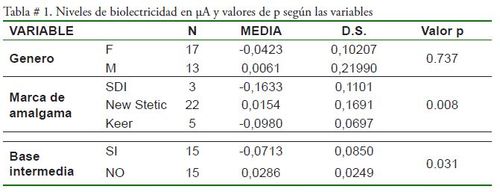
<body><![CDATA[<p style="margin-bottom: 0.35cm; text-align: justify; font-family: Times New Roman;" lang="es-CO"></p>      <div style="text-align: justify; font-family: Times New Roman;"> </div>      <p style="margin-bottom: 0.35cm; text-align: justify; font-family: Times New Roman;" lang="es-CO">&nbsp;</p>      <div style="text-align: justify; font-family: Times New Roman;"> </div>      <p style="margin-bottom: 0.35cm; text-align: justify; font-family: Verdana;" lang="es-CO"> <font size="2"><b>Resultados</b></font></p>      <div style="text-align: justify; font-family: Times New Roman;"> </div>      <p style="margin-bottom: 0.35cm; text-align: justify; font-family: Verdana;" lang="es-CO"> <font color="#000000" size="2">En la investigaci&oacute;n se evaluaron 30 pacientes: 17 mujeres y 13 hombres, cuyas edades estuvieron entre los 15-50 a&ntilde;os. El estudio se realiz&oacute; en molares y premolares que presentaran amalgama oclusal u ocluso mesial o distal, realizadas por los estudiantes del sexto semestre en el per&iacute;odo II 2007 de la Facultad de Odontolog&iacute;a de la Universidad Cooperativa de Colombia, Pasto, con el protocolo establecido por la Cl&iacute;nica UCC Pasto. Se midieron por marca de amalgama: 3 obturaciones con SDI &reg;, 22 obturaciones con New Stetic &reg; y 5 con Kerr&reg; teniendo 15 de ellas base intermedia y 15 sin base intermedia (Tabla 1). La prueba de Shapiro-Wilk mostr&oacute; que los niveles de bioelectricidad no presentaron una distribuci&oacute;n normal de los datos, por ello, se utilizaron pruebas estad&iacute;sticas no param&eacute;tricas para su comparaci&oacute;n. La prueba de Mann Whitney se us&oacute; para comparar los niveles de bioelectricidad con el g&eacute;nero y no se encontraron diferencias estad&iacute;sticamente significativas. Los niveles de bioelectricidad presentaron diferencias estad&iacute;sticamente significativas entre las amalgamas con y sin base intermedia, valor p=0.031. (<a href="#t1">Tabla 1</a>). El mayor registro se obtuvo cuando la obturaci&oacute;n de amalgama no presentaba base intermedia con un nivel de bioelectricidad de 0.680 &micro;A. </font> </p>      <div style="text-align: justify; font-family: Times New Roman;"> </div>      <p style="margin-right: 0.03cm; margin-bottom: 0cm; line-height: 100%; text-align: justify; font-family: Verdana;" lang="es-CO"> <font size="2">     <br>  </font> </p>      ]]></body>
<body><![CDATA[<div style="text-align: justify; font-family: Times New Roman;"> </div>      <p style="margin-bottom: 0.35cm; text-align: justify; font-family: Verdana;" lang="es-CO"> <font color="#000000" size="2">Se compararon los niveles de bioelectricidad con la marca de amalgama mostrando diferencias estad&iacute;sticamente significativas valor p=0,008 para la prueba de Kruskal-Wallis (<a href="#t1">Tabla 1</a>). Las diferencias estad&iacute;sticamente significativas encontradas fueron entre las Marcas SDI y New Stetic, seg&uacute;n prueba posthoc de Dunnett y donde el mayor promedio de niveles de bioelectricidad, seg&uacute;n las marcas de amalgamas, fue New Stetic con valores que oscilaron entre 0,01535</font><font size="2"> </font><font color="#000000" size="2">y -0,01928 </font><font size="2">&micro;A</font><font color="#000000" size="2">. </font></p>      <div style="text-align: justify; font-family: Times New Roman;"> </div>      <p style="margin-right: 0.03cm; margin-bottom: 0cm; line-height: 100%; text-align: justify; font-family: Verdana;" lang="es-CO"> <font size="2">Tabla 1 - Niveles de bioelectricidad en &micro;A y valores de p seg&uacute;n las variables</font></p>      <p style="margin-right: 0.03cm; margin-bottom: 0cm; line-height: 100%; text-align: justify; font-family: Times New Roman;" lang="es-CO"></p>      <div style="text-align: justify; font-family: Times New Roman;"> <font face="Verdana" size="2"> <a name="t1"></a><img style="width: 500px; height: 192px;" alt="" src="/img/revistas/ode/v12n14/14a06t1.jpg">    <br>      <br>  </font> </div>      <p style="margin-bottom: 0.35cm; line-height: 100%; text-align: justify; font-family: Verdana;" lang="es-CO"> <font size="2">     <br>      ]]></body>
<body><![CDATA[<br>  </font> </p>      <div style="text-align: justify; font-family: Times New Roman;"> </div>      <p style="margin-bottom: 0.35cm; text-align: justify; font-family: Verdana;" lang="es-CO"> <font size="2">     <br>      <br>  </font> </p>      <div style="text-align: justify; font-family: Times New Roman;"> </div>      <p style="margin-bottom: 0.35cm; text-align: justify; font-family: Verdana;" lang="es-CO"> <font size="2"><b>Discusi&oacute;n</b></font></p>      <div style="text-align: justify; font-family: Times New Roman;"> </div>      <p style="margin-bottom: 0.35cm; text-align: justify; font-family: Verdana;" lang="es-CO"> <font size="2">Los materiales dentales deben presentar caracter&iacute;sticas importantes para su utilizaci&oacute;n, biocompatibilidad, propiedades mec&aacute;nicas, tener f&aacute;cil manipulaci&oacute;n y resistencia a la corrosi&oacute;n (<a href="#14">14</a>)<a name="14."></a>, por lo que el cl&iacute;nico debe proporcionarle al material la manipulaci&oacute;n correcta y elementos que disminuyan su posible degradaci&oacute;n.</font></p>      <div style="text-align: justify; font-family: Times New Roman;"> </div>      ]]></body>
<body><![CDATA[<p style="margin-bottom: 0.35cm; text-align: justify; font-family: Verdana;" lang="es-CO"> <font size="2">El ambiente oral conduce a producir corrosi&oacute;n tanto qu&iacute;mica como el&eacute;ctrica por su fluctuante temperatura, pH y cambio de alimentaci&oacute;n (<a href="#15">15</a>, <a href="#16">16</a>)<a name="15."></a><a name="16."></a>. Entre las cualidades de un buen operador est&aacute; el reconocer factores que disminuyan la corrosi&oacute;n de las obturaciones de amalgamas, aumentando as&iacute; la longevidad de las restauraciones, como lo reporta Kedici y col. (<a href="#17">17</a>)<a name="17."></a>. Asimismo, Sarkar y Greener determinaron que a medida que pasa el tiempo en las restauraciones de amalgamas disminuye la corrosi&oacute;n (<a href="#18">18</a>)<a name="18."></a>.</font></p>      <div style="text-align: justify; font-family: Times New Roman;"> </div>      <p style="margin-bottom: 0.35cm; text-align: justify; font-family: Verdana;" lang="es-CO"> <font size="2">Bergman M. y col (<a href="#19">19</a>)<a name="19."></a> reportan como la cavidad oral presenta las condiciones necesarias para aumentar la corrosi&oacute;n en diferentes tipos de amalgama. Marshal y col. (<a href="#20">20</a>)<a name="20."></a> informan como la estructura de las restauraciones de amalgama ricas en cobre presentaban fallas en la superficie y &aacute;reas aisladas</font><sup><font size="2">.</font></sup></p>      <div style="text-align: justify; font-family: Times New Roman;"> </div>      <p style="margin-bottom: 0.35cm; text-align: justify; font-family: Times New Roman;" lang="es-CO"></p>      <div style="text-align: justify; font-family: Times New Roman;"> </div>      <p style="margin-bottom: 0.35cm; font-weight: bold; text-align: justify; font-family: Verdana;" lang="es-CO"> <font size="2">Conclusiones</font></p>      <div style="text-align: justify; font-family: Times New Roman;"> </div>      <p style="margin-bottom: 0cm; line-height: 100%; color: rgb(12, 12, 12); text-align: justify; font-family: Times New Roman;"> <font face="Verdana" size="2"> <span class="western">De acuerdo a los resultados del presente estudio, las obturaciones con base intermedia presentan una disminuci&oacute;n en la intensidad del pasaje de corriente el&eacute;ctrica.</span></font></p>      <div style="text-align: justify; font-family: Times New Roman;"> </div>      ]]></body>
<body><![CDATA[<p style="margin-bottom: 0cm; line-height: 100%; text-align: justify; font-family: Verdana;"> <font color="#575757" size="2"><span class="sdfootnotesym">    <br>  </span></font></p>      <div style="text-align: justify; font-family: Times New Roman;" id="sdendnote2">     <p style="margin-bottom: 0cm; line-height: 100%;" lang="pt-BR"> <font size="2" face="Verdana">    <br>  </font> </p>      <p style="margin-bottom: 0cm; line-height: 100%;" lang="pt-BR"> <font size="2" face="Verdana">    <br>  </font> </p>      <p style="margin-bottom: 0.35cm;" lang="en-US"> <font face="Verdana" size="2"><b>Referencias Bibliogr&aacute;ficas</b></font></p>           <!-- ref --><p style="font-family: Verdana;" lang="es-CO"> <a href="#1."><font size="2">1</font></a><font size="2">. <a name="1"></a>Ralph W Philiphs. La ciencia de los materials dentales.Houston: Interamericana Mc Graw- Hill;1998: 193-196</font>&nbsp;&nbsp;&nbsp;&nbsp;&nbsp;&nbsp;&nbsp;&nbsp;[&#160;<a href="javascript:void(0);" onclick="javascript: window.open('/scielo.php?script=sci_nlinks&ref=045909&pid=S1688-9339201000010000600001&lng=','','width=640,height=500,resizable=yes,scrollbars=1,menubar=yes,');">Links</a>&#160;]<!-- end-ref --><p style="font-family: Verdana;" lang="es-CO"><a href="#2."><font size="2">2</font></a><font size="2">. <a name="2"></a>Berry TG, Summitt JB, Chung AHK, Osborne JW. Amalgam at the new millwnnium. JADA 1998; 129: 1547-1556.</font></p>                ]]></body>
<body><![CDATA[<p style="font-family: Verdana;" lang="es-CO"><a href="#3."><font size="2">3</font></a><font size="2">. <a name="3"></a>Leinfelder K. Current developments in dentin bonding systems: major progress found in today&rsquo;s products. JADA 1993;124:40-2.</font></p>                <p style="font-family: Verdana;" lang="es-CO"><a href="#4."><font size="2">4</font></a><font size="2">. <a name="4"></a>Li J, Beetzen MV, Sundstro&Egrave;m F. Strength and setting behavior of resin-modied glass ionomer cements. Acta Odontolologica Scandinavica 1995; 53: 311-7.</font></p>                <p style="font-family: Verdana;" lang="es-CO"><a href="#5."><font size="2">5</font></a><font size="2">. <a name="5"></a>Mumford JM. Electrolytic action in the mouth and its relationship to pain. J Dent Res 1957; 36: 632-40.</font></p>                <p style="font-family: Verdana;" lang="es-CO"><a href="#6."><font size="2">6</font></a><font size="2">. <a name="6"></a>Richard SW, Gardiner W, Gelsomina I, Nikhil KS. Galvanic Interation between gold and amalgam. JADA 2003; 134: 1463- 1467.</font></p>                <p style="font-family: Verdana;" lang="es-CO"><a href="#7."><font size="2">7</font></a><font size="2">. <a name="7"></a>Okada K, Tosaki S, Hirota K, Hume WR. Surfaces hardness change of restorative filling materials stored in saliva. Dental Materials 2001; 17: 34-39.</font></p>                <p style="font-family: Verdana;" lang="es-CO"><a href="#8."><font size="2">8</font></a><font size="2">. <a name="8"></a>Bra&Egrave;nnstrom M, Nyborg H. Pulpal reaction to composite resin restorations. J Prosth Dent 1972;27:181-189.</font></p>                <p style="font-family: Verdana;" lang="es-CO"><a href="#9."><font size="2">9</font></a><font size="2">. <a name="9"></a>Cox CF. Biocompatibility of dental materials in the absence of bacterial infection. Oper Dent 1987;12:146-152.</font></p>                <p style="font-family: Verdana;" lang="es-CO"><a href="#10."><font size="2">10</font></a><font size="2">. <a name="10"></a>Akimoto N, Momoi Y, Kohno A, Suzuki S, Otsuki S, Suzuki S, et al. Biocompatibility of Clearl Liner Bond and Clearl AP-X system on nonexposed and exposed primate teeth. Quint Int 1998;29:177-188.</font></p>                <p style="font-family: Verdana;" lang="es-CO"><a href="#11."><font size="2">11</font></a><font size="2">. <a name="11"></a>Sunico MC, Shinkai KK. Two year clinical performance of occlusal and cervical GIOMER restorations. Operative Dent 2005; 30 (3): 282-289.</font></p>                <p style="font-family: Verdana;" lang="es-CO"><a href="#12."><font size="2">12</font></a><font size="2">. <a name="12"></a>Guzman HJ. Biomateriales Odontologicos de uso cl&iacute;nico. Cuarta Edicion. Bogota: ECOE Ediciones Cuarta Edicion; 2006: 100-101.</font></p>                ]]></body>
<body><![CDATA[<p style="font-family: Verdana;" lang="es-CO"><a href="#13."><font size="2">13</font></a><font size="2">. <a name="13"></a>Dominguez JA, Mafla AC, Pasaje MB, Daza JA, RoseroLS. Niveles de bioelectricidad en restauraciones de amalgamas. Rev CES Odontologia 2008;21 (1):46.</font></p>                <p style="font-family: Verdana;" lang="es-CO"><a href="#14."><font size="2">14</font></a><font size="2">. <a name="14"></a>Nomoto S, Ano M, Onese M. Microprobe for measurementof corrosion of metallic restoration of in mouth. J. of Dent R , 58 (7):1688-1690 july 1979</font></p>                <p style="font-family: Verdana;" lang="es-CO"><a href="#15."><font size="2">15</font></a><font size="2">. <a name="15"></a>Anusavice KJ. Phillip&rsquo;s science of dental materials, 10th edn. Philadelphia: WB Saunders Company; 1996:347-348</font></p>                <p style="font-family: Verdana;" lang="es-CO"><a href="#16."><font size="2">16</font></a><font size="2">. <a name="16"></a>McCabe, J.F. Aplied dental materials . 7th Edicion , Buttler &amp; Tanner Ltd, London 1990: 1-27.</font></p>                <p style="font-family: Verdana;" lang="es-CO"><a href="#17."><font size="2">17</font></a><font size="2">. <a name="17"></a>Kedici S.P, Alikilicarlasan M, Bayramoglu G, Gokdemir K. Corrosion behaviour of dental metals and alloys different media. Journal of oral rehabilitation 1998; 25: 800-808.</font></p>                <p style="font-family: Verdana;" lang="es-CO"><a href="#18."><font size="2">18</font></a><font size="2">. <a name="18"></a>Sarkar NK, Greener EH. Electrochemical properties of cooper and gold containing dental amalgam. Journal of Oral Rehabilitation 1975;2: 157-164.</font></p>                <p style="font-family: Verdana;" lang="es-CO"><a href="#19."><font size="2">19</font></a><font size="2">. <a name="19"></a>Bergman M, Ginstrup O, Nilner K. Potential and polarization measurements in vivo of oral galvanism. Scand J Dent Res 1978; 85:135&ndash;145</font></p>                <p style="font-family: Verdana;" lang="es-CO"><a href="#20."><font size="2">20</font></a><font size="2">. <a name="20"></a>Marshall J, Jackson B, Marshall S. Cooper- Rich and conventional amalgam restorations after clinical use. J Amer Dent Assoc 1980; 100(1): 43-47.</font></p>     <font face="Verdana" size="2">     <br>  </font>     <div style="font-family: Times New Roman; text-align: left;"><a href="mailto:johnalexis.dominguez@gmail.com">   <font color="#0000ff" face="Verdana" size="2"><span lang="pt-BR">johnalexis.dominguez@gmail.com</span></font></a></div>      ]]></body>
<body><![CDATA[<p style="margin-bottom: 0.35cm; text-align: justify; font-family: Times New Roman;" lang="es-CO"></p>  </div>       ]]></body>
<back>
<ref-list>
<ref id="B1">
<nlm-citation citation-type="book">
<person-group person-group-type="author">
<name>
<surname><![CDATA[Philiphs]]></surname>
<given-names><![CDATA[Ralph W]]></given-names>
</name>
</person-group>
<source><![CDATA[La ciencia de los materials dentales]]></source>
<year>1998</year>
<page-range>193-196</page-range><publisher-loc><![CDATA[Houston ]]></publisher-loc>
<publisher-name><![CDATA[Interamericana Mc Graw- Hill]]></publisher-name>
</nlm-citation>
</ref>
</ref-list>
</back>
</article>
