<?xml version="1.0" encoding="ISO-8859-1"?><article xmlns:mml="http://www.w3.org/1998/Math/MathML" xmlns:xlink="http://www.w3.org/1999/xlink" xmlns:xsi="http://www.w3.org/2001/XMLSchema-instance">
<front>
<journal-meta>
<journal-id>1688-9339</journal-id>
<journal-title><![CDATA[Odontoestomatología]]></journal-title>
<abbrev-journal-title><![CDATA[Odontoestomatología]]></abbrev-journal-title>
<issn>1688-9339</issn>
<publisher>
<publisher-name><![CDATA[Facultad de Odontología - Universidad de la República]]></publisher-name>
</publisher>
</journal-meta>
<article-meta>
<article-id>S1688-93392009000200006</article-id>
<title-group>
<article-title xml:lang="es"><![CDATA[Manejo clínico de la caries profunda]]></article-title>
</title-group>
<contrib-group>
<contrib contrib-type="author">
<name>
<surname><![CDATA[Alonso]]></surname>
<given-names><![CDATA[María Elia]]></given-names>
</name>
<xref ref-type="aff" rid="A01"/>
</contrib>
<contrib contrib-type="author">
<name>
<surname><![CDATA[Calabria Díaz]]></surname>
<given-names><![CDATA[Hugo]]></given-names>
</name>
<xref ref-type="aff" rid="A02"/>
</contrib>
<contrib contrib-type="author">
<name>
<surname><![CDATA[Lorenzo]]></surname>
<given-names><![CDATA[Irene]]></given-names>
</name>
<xref ref-type="aff" rid="A01"/>
</contrib>
<contrib contrib-type="author">
<name>
<surname><![CDATA[Añaña]]></surname>
<given-names><![CDATA[Nelly]]></given-names>
</name>
<xref ref-type="aff" rid="A01"/>
</contrib>
<contrib contrib-type="author">
<name>
<surname><![CDATA[Golubchin]]></surname>
<given-names><![CDATA[Diana]]></given-names>
</name>
<xref ref-type="aff" rid="A01"/>
</contrib>
<contrib contrib-type="author">
<name>
<surname><![CDATA[Vola]]></surname>
<given-names><![CDATA[Joanna]]></given-names>
</name>
<xref ref-type="aff" rid="A02"/>
</contrib>
</contrib-group>
<aff id="A01">
<institution><![CDATA[,Universidad de la República Facultad de Odontología Cátedra de Endodoncia]]></institution>
<addr-line><![CDATA[ ]]></addr-line>
</aff>
<aff id="A02">
<institution><![CDATA[,Universidad de la República Facultad de Odontología Cátedra de Clínica Operatoria Dental 2]]></institution>
<addr-line><![CDATA[ ]]></addr-line>
</aff>
<pub-date pub-type="pub">
<day>00</day>
<month>11</month>
<year>2009</year>
</pub-date>
<pub-date pub-type="epub">
<day>00</day>
<month>11</month>
<year>2009</year>
</pub-date>
<volume>11</volume>
<numero>13</numero>
<fpage>59</fpage>
<lpage>67</lpage>
<copyright-statement/>
<copyright-year/>
<self-uri xlink:href="http://www.scielo.edu.uy/scielo.php?script=sci_arttext&amp;pid=S1688-93392009000200006&amp;lng=en&amp;nrm=iso"></self-uri><self-uri xlink:href="http://www.scielo.edu.uy/scielo.php?script=sci_abstract&amp;pid=S1688-93392009000200006&amp;lng=en&amp;nrm=iso"></self-uri><self-uri xlink:href="http://www.scielo.edu.uy/scielo.php?script=sci_pdf&amp;pid=S1688-93392009000200006&amp;lng=en&amp;nrm=iso"></self-uri><abstract abstract-type="short" xml:lang="es"><p><![CDATA[La lesión cariosa profunda por la posibilidad de afectación pulpar, es un cuadro clínico de especial significación y permanente vigencia. Su tratamiento requiere de protocolos bien establecidos, de manera que la técnica empleada pueda ser conservadora y proporcione una amplia cobertura asistencial. Es fundamental el conocimiento de la etiopatogenia, de los correctos diagnósticos de la salud pulpar, de las propiedades de bases y protectores, así como también del correcto sellado marginal de la restauración coronaria. El objetivo será siempre mantener de manera conservadora la salud pulpar, dejando a la pieza apta para su restauración en forma, función y estética. Este artículo recoge el trabajo de una comisión que sistematizó los protocolos clínicos para la Protección Pulpar Indirecta (PPI) y para el Tratamiento Pulpar Indirecto (TPI), con eliminación de caries en forma diferida. Los mismos se utilizan actualmente en la Clínica Integrada de Adultos III, Facultad de Odontología, Universidad de la República (Uruguay). Se considera que el Hidróxido de Calcio (Ca(OH)2) sigue manteniendo su vigencia, siendo condición necesaria de su uso una pulpa saludable y requerimientos de reacción defensiva por depósito de tejido mineralizado]]></p></abstract>
<abstract abstract-type="short" xml:lang="en"><p><![CDATA[The deep decay lesion represent a serious disturbs of teeth&rsquo;s calcify tissues, and the possible appears of pulp affectation. Practices and strict protocols are necessary to apply restoratives and conservatives tactics. A correct knowledge of the etiopathology lesion, a certain pulp diagnosis, a management of pulp protects proprieties, to obtain and support a correct seal border at coronal obturation, together with the know that a time waiting helps to recuperate capacity of the pulp tissue. Anyway, the final object will be to keep the health of the pulp, and will obtain a tooth apt to receive a final restoration. This paper collects the results of a commission work in the matter. In there, was systematized clinics protocols for Indirect Pulp Protection (IPP) and Indirect Pulp Treatment (IPT), with deferring decay elimination. This protocols are been applied in the Integral Clinical of Adults III, at Odontology Faculty, University of the Republic (Uruguay). Even emerges new techniques, materials or new methods in p r a c t i c e , the Calcium Hydroxide(Ca(OH)2) maintain validity in the treatment of this pathology, ever we had a healthy pulp and the need of defensive reaction with calcify tissue deposit.]]></p></abstract>
<kwd-group>
<kwd lng="es"><![CDATA[caries profunda]]></kwd>
<kwd lng="es"><![CDATA[protección pulpar]]></kwd>
<kwd lng="es"><![CDATA[hidróxido de calcio]]></kwd>
<kwd lng="en"><![CDATA[deep decay lesion]]></kwd>
<kwd lng="en"><![CDATA[pulp protection]]></kwd>
<kwd lng="en"><![CDATA[calcium hydroxide]]></kwd>
</kwd-group>
</article-meta>
</front><body><![CDATA[ <p style="font-style: normal; font-weight: normal; text-align: justify;"> <font style="font-size: 13pt;" size="4" face="Verdana"><b>Manejo cl&iacute;nico de la caries profunda</b></font><font style="font-size: 13pt;font-weight:700" face="Verdana">    <br>    </font><font style="font-size: 10pt;" face="Verdana">    <br>        <br>    </font>    </p>        <div style="text-align: justify;"> </div>        <p style="font-weight: normal; text-align: justify;"> <font style="font-size: 10pt;" size="2" face="Verdana"><i><a name="1.."></a>Dra. Mar&iacute;a Elia Alonso<a href="#1.">*</a>, <a name="2.."></a>Dr. Hugo Calabria D&iacute;az<a href="#2.">**</a>, <a name="3.."></a>Dra. Irene Lorenzo<a href="#3.">***</a>,    <br>   <a name="4.."></a> Dra. Nelly A&ntilde;a&ntilde;a<a href="#4.">****</a>, <a name="5.."></a>Dra. Diana Golubchin<a href="#5.">*****</a>, <a name="6.."></a>Dra. Joanna Vola<a href="#6.">******</a> </i></font></p>        <div style="text-align: justify;"> </div>        <p style="text-align: justify;"><font face="Verdana" style="font-size: 10pt">    <br>        ]]></body>
<body><![CDATA[<br>    </font>    </p>        <div style="text-align: justify;"> </div>        <p style="font-style: normal; text-align: justify;"> <font style="font-size: 10pt;" size="2" face="Verdana"><b>Resumen</b></font></p>        <div style="text-align: justify;"> </div>        <p style="margin-bottom: 0cm; font-style: normal; font-weight: normal; text-align: justify;"> <font style="font-size: 10pt;" size="2" face="Verdana">La lesi&oacute;n cariosa profunda por la posibilidad de afectaci&oacute;n pulpar, es un cuadro cl&iacute;nico de especial significaci&oacute;n y permanente vigencia. Su tratamiento requiere de protocolos bien establecidos, de manera que la t&eacute;cnica empleada pueda ser conservadora y proporcione una amplia cobertura asistencial.</font></p>        <div style="text-align: justify;"> </div>        <p style="margin-bottom: 0cm; font-style: normal; font-weight: normal; text-align: justify;"> <font style="font-size: 10pt;" size="2" face="Verdana">Es fundamental el conocimiento de la etiopatogenia, de los correctos diagn&oacute;sticos de la salud pulpar, de las propiedades de bases y protectores, as&iacute; como tambi&eacute;n del correcto sellado marginal de la restauraci&oacute;n coronaria. El objetivo ser&aacute; siempre mantener de manera conservadora la salud pulpar, dejando a la pieza apta para su restauraci&oacute;n en forma, funci&oacute;n y est&eacute;tica.</font></p>        <div style="text-align: justify;"> </div>        <p style="margin-bottom: 0cm; font-style: normal; font-weight: normal; text-align: justify;"> <font style="font-size: 10pt;" size="2" face="Verdana">Este art&iacute;culo recoge el trabajo de una comisi&oacute;n que sistematiz&oacute; los protocolos cl&iacute;nicos para la Protecci&oacute;n Pulpar Indirecta (PPI) y para el Tratamiento Pulpar Indirecto (TPI), con eliminaci&oacute;n de caries en forma diferida. Los mismos se utilizan actualmente en la Cl&iacute;nica Integrada de Adultos III, Facultad de Odontolog&iacute;a, Universidad de la Rep&uacute;blica (Uruguay).</font></p>        <div style="text-align: justify;"> </div>        ]]></body>
<body><![CDATA[<p style="margin-bottom: 0cm; font-style: normal; font-weight: normal; text-align: justify;"> <font style="font-size: 10pt;" size="2" face="Verdana">Se considera que el Hidr&oacute;xido de Calcio (Ca(OH)2) sigue manteniendo su vigencia, siendo condici&oacute;n necesaria de su uso una pulpa saludable y requerimientos de reacci&oacute;n defensiva por dep&oacute;sito de tejido mineralizado.</font></p>        <div style="text-align: justify;"> </div>        <p style="margin-bottom: 0cm; text-align: justify;"> <font face="Verdana" style="font-size: 10pt">    <br>    </font>    </p>        <div style="text-align: justify;"> </div>        <p style="margin-bottom: 0cm; font-style: normal; text-align: justify;"> <font style="font-size: 10pt;" size="2" face="Verdana"><b>Abstract</b></font></p>        <div style="text-align: justify;"> </div>        <p style="margin-bottom: 0cm; text-align: justify;"> <font face="Verdana" style="font-size: 10pt">    <br>    </font>    </p>        <div style="text-align: justify;"> </div>        ]]></body>
<body><![CDATA[<p style="margin-bottom: 0cm; font-style: normal; font-weight: normal; text-align: justify;"> <font style="font-size: 10pt;" size="2" face="Verdana">The deep decay lesion represent a serious disturbs of teeth&rsquo;s calcify tissues, and the possible appears of pulp affectation. Practices and strict protocols are necessary to apply restoratives and conservatives tactics. A correct knowledge of the etiopathology lesion, a certain pulp diagnosis, a management of pulp protects proprieties, to obtain and support a correct seal border at coronal obturation, together with the know that a time waiting helps to recuperate capacity of the pulp tissue.</font></p>        <div style="text-align: justify;"> </div>        <p style="margin-bottom: 0cm; font-style: normal; font-weight: normal; text-align: justify;"> <font style="font-size: 10pt;" size="2" face="Verdana">Anyway, the final object will be to keep the health of the pulp, and will obtain a tooth apt to receive a final restoration.</font></p>        <div style="text-align: justify;"> </div>        <p style="margin-bottom: 0cm; font-style: normal; font-weight: normal; text-align: justify;"> <font style="font-size: 10pt;" size="2" face="Verdana">This paper collects the results of a commission work in the matter. In there, was systematized clinics protocols for Indirect Pulp Protection (IPP) and Indirect Pulp Treatment (IPT), with deferring decay elimination. This protocols are been applied in the Integral Clinical of Adults III, at Odontology Faculty, University of the Republic (Uruguay).</font></p>        <div style="text-align: justify;"> </div>        <p style="margin-bottom: 0cm; font-style: normal; font-weight: normal; text-align: justify;"> <font style="font-size: 10pt;" size="2" face="Verdana">Even emerges new techniques, materials or new methods in practice , the Calcium Hydroxide(Ca(OH)2) maintain validity in the treatment of this pathology, ever we had a healthy pulp and the need of defensive reaction with calcify tissue deposit.</font></p>        <div style="text-align: justify;"> </div>        <p style="margin-bottom: 0cm; text-align: justify;"> <font face="Verdana" style="font-size: 10pt">    <br>    </font>    </p>        ]]></body>
<body><![CDATA[<div style="text-align: justify;"> </div>        <p style="margin-bottom: 0cm; font-style: normal; font-weight: normal; text-align: justify;"> <font style="font-size: 10pt;" size="2" face="Verdana"><b>Palabras clave</b>: caries profunda, protecci&oacute;n pulpar, hidr&oacute;xido de calcio.</font></p>        <div style="text-align: justify;"> </div>        <p style="margin-bottom: 0cm; text-align: justify;"> <font face="Verdana" style="font-size: 10pt">    <br>    </font>    </p>        <div style="text-align: justify;"> </div>        <p style="margin-bottom: 0cm; font-style: normal; font-weight: normal; text-align: justify;"> <font style="font-size: 10pt;" size="2" face="Verdana"><b>Key words</b>: deep decay lesion, pulp protection, calcium hydroxide</font></p>        <div style="text-align: justify;"> </div>        <p style="margin-bottom: 0cm; text-align: justify;"> <font face="Verdana" style="font-size: 10pt">    <br>    </font>    </p>        ]]></body>
<body><![CDATA[<div style="text-align: justify;"> </div>        <p style="margin-bottom: 0cm; text-align: justify;"> <font face="Verdana" style="font-size: 10pt">    <br>    </font>    </p>        <div style="text-align: justify;"> </div>        <p style="margin-bottom: 0cm; text-align: justify;"> <font face="Verdana" style="font-size: 10pt">    <br>    </font>    </p>        <div style="text-align: justify;"> </div>        <p style="margin-bottom: 0cm; font-style: normal; font-weight: normal; text-align: justify;"> <font style="font-size: 10pt;" size="2" face="Verdana"><a name="1."></a><a href="#1..">*</a> Prof. Tit. C&aacute;tedra de Endodoncia. Facultad de Odontolog&iacute;a. UDELAR</font></p>        <div style="text-align: justify;"> </div>        <p style="margin-bottom: 0cm; font-style: normal; font-weight: normal; text-align: justify;"> <font style="font-size: 10pt;" size="2" face="Verdana"><a name="2."></a><a href="#2..">**</a> Prof. Tit. C&aacute;tedra Cl&iacute;nica Operatoria Dental 2. Prof. Tit. C&aacute;tedra T&eacute;cnica Operatoria Dental. Facultad de Odontolog&iacute;a. UDELAR.</font></p>        ]]></body>
<body><![CDATA[<div style="text-align: justify;"> </div>        <p style="margin-bottom: 0cm; font-style: normal; font-weight: normal; text-align: justify;"> <font style="font-size: 10pt;" size="2" face="Verdana"><a name="3."></a><a href="#3..">***</a> Prof. Agr. C&aacute;tedra de Endodoncia. Facultad de Odontolog&iacute;a. UDELAR</font></p>        <div style="text-align: justify;"> </div>        <p style="margin-bottom: 0cm; font-style: normal; font-weight: normal; text-align: justify;"> <font style="font-size: 10pt;" size="2" face="Verdana"><a name="4."></a><a href="#4..">****</a> Prof. Adj. C&aacute;tedra de Endodoncia. Facultad de Odontolog&iacute;a. UDELAR</font></p>        <div style="text-align: justify;"> </div>        <p style="margin-bottom: 0cm; font-style: normal; font-weight: normal; text-align: justify;"> <font style="font-size: 10pt;" size="2" face="Verdana"><a name="5."></a><a href="#5..">*****</a> Asist. C&aacute;tedra de Endodoncia. Facultad de Odontolog&iacute;a. UDELAR</font></p>        <div style="text-align: justify;"> </div>        <p style="margin-bottom: 0cm; font-style: normal; font-weight: normal; text-align: justify;"> <font style="font-size: 10pt;" size="2" face="Verdana"><a name="6."></a><a href="#6..">******</a> Asist. C&aacute;tedra Cl&iacute;nica Operatoria Dental 2. Facultad de Odontolog&iacute;a. UDELAR</font></p>        <div style="text-align: justify;"> </div>        <p style="margin-bottom: 0cm; text-align: justify;"> <font face="Verdana" style="font-size: 10pt">    ]]></body>
<body><![CDATA[<br>    </font>    </p>        <div style="text-align: justify;"> </div>        <p style="margin-bottom: 0cm; text-align: justify;"> <font face="Verdana" style="font-size: 10pt">    <br>    </font>    </p>        <div style="text-align: justify;"> </div>        <p style="margin-bottom: 0cm; text-align: justify;"> <font face="Verdana" style="font-size: 10pt">    <br>    </font>    </p>        <div style="text-align: justify;"> </div>        <p style="margin-bottom: 0cm; font-style: normal; font-weight: normal; text-align: justify;"> <font face="Verdana" style="font-size: 10pt">Introducci&oacute;n</font></p>        <div style="text-align: justify;"> </div>        ]]></body>
<body><![CDATA[<p style="margin-bottom: 0cm; text-align: justify;"> <font face="Verdana" style="font-size: 10pt">    <br>    </font>    </p>        <div style="text-align: justify;"> </div>        <p style="margin-bottom: 0cm; font-style: normal; font-weight: normal; text-align: justify;"> <font style="font-size: 10pt;" size="2" face="Verdana">La caries es una enfermedad multifactorial de naturaleza infecciosa y transmisible, que afecta a los tejidos dentarios (<a name="1.-"></a><a href="#1">1</a>). El conocimiento actual acerca de su etiolog&iacute;a ha permitido identificar y controlar los factores que se asocian con la enfermedad, realizar un diagn&oacute;stico precoz y aplicar procedimientos terap&eacute;uticos cada vez menos invasivos (<a name="2.-"></a><a href="#2">2</a>, <a name="3.-"></a><a href="#3">3</a>). No obstante ello, el tratamiento de la lesi&oacute;n cavitada todav&iacute;a plantea dificultades a la hora de establecer protocolos de remoci&oacute;n de tejido, no s&oacute;lo en cantidad o calidad, sino tambi&eacute;n en su oportunidad (<a name="4-6.-"></a><a href="#4">4</a>-<a href="#6">6</a>).</font></p>        <div style="text-align: justify;"> </div>        <p style="margin-bottom: 0cm; font-style: normal; font-weight: normal; text-align: justify;"> <font style="font-size: 10pt;" size="2" face="Verdana">La identificaci&oacute;n precisa de las zonas patol&oacute;gicas en base a criterios de color o dureza puede generar diagn&oacute;sticos err&oacute;neos. Varios estudios demuestran la ausencia de relaci&oacute;n entre dureza dentinaria y/o color y presencia de bacterias (<a name="7-9.-"></a><a href="#7">7</a>-<a href="#9">9</a>). Fusayama ha descrito dos zonas estructuralmente diferentes en la capa desmineralizada (<a href="#6">6</a>,<a href="#7">7</a>) :</font></p>        <div style="text-align: justify;"> </div>        <p style="margin-bottom: 0cm; text-align: justify;"> <font face="Verdana" style="font-size: 10pt">    <br>    </font>    </p>        <div style="text-align: justify;"> </div>    <ol style="text-align: justify;">          ]]></body>
<body><![CDATA[<li>                        <p style="margin-bottom: 0cm; font-style: normal; font-weight: normal;">      <font style="font-size: 10pt;" size="2" face="Verdana">Una zona externa, caracterizada por intensa invasi&oacute;n microbiana. Los puentes que mantienen unidas a las cadenas de tropocol&aacute;geno se encuentran gravemente alterados, lo que hace imposible su remineralizaci&oacute;n e indica que esta zona debe ser removida en su totalidad</font></p>      </li>          <li>                        <p style="margin-bottom: 0cm; font-style: normal; font-weight: normal;">      <font style="font-size: 10pt;" size="2" face="Verdana">La zona interna muestra un tejido parcialmente desmineralizado, afectado por la llegada de toxinas y metabolitos bacterianos pero con mucha menor cantidad de microorganismos. Desde el punto de vista fisiol&oacute;gico puede ser conservada ya que algunos puentes se mantienen intactos y ser&aacute; pasible de remineralizaci&oacute;n (73). </font> </p>      </li>        </ol>        <div style="text-align: justify;"> </div>        <p style="margin-bottom: 0cm; font-style: normal; font-weight: normal; text-align: justify;"> <font style="font-size: 10pt;" size="2" face="Verdana">El l&iacute;mite entre las 2 zonas antes mencionadas no es f&aacute;cilmente identificable por lo cu&aacute;l se ha recurrido al auxilio de colorantes para diagn&oacute;stico (<a href="#7">7</a>,<a name="8.-"></a><a href="#8">8</a>,<a name="9.-"></a><a href="#9">9</a>,<a name="15.-"></a><a href="#15">15</a>).</font></p>        <div style="text-align: justify;"> </div>        <p style="margin-bottom: 0cm; font-style: normal; font-weight: normal; text-align: justify;"> <font style="font-size: 10pt;" size="2" face="Verdana">Sin embargo su uso tiene que ser acompa&ntilde;ado de la experiencia cl&iacute;nica pertinente, ya que puede resultar en la innecesaria remoci&oacute;n de dentina sana (<a name="16-18.-"></a><a href="#16">16</a>-<a href="#18">18</a>). Las zonas de menor mineralizaci&oacute;n y m&aacute;s permeables (con mayor proporci&oacute;n de matriz org&aacute;nica), como son el l&iacute;mite amelodentinario (AD) y la dentina circumpulpar (<a name="12.-"></a><a href="#12">12</a>,<a name="20.-"></a><a href="#20">20</a>,<a name="21.-"></a><a href="#21">21</a>), son m&aacute;s susceptibles a la tinci&oacute;n independientemente de la presencia de microorganismos (<a href="#16">16</a><a name="-19-.-"></a>-<a href="#20">20</a>).Tambi&eacute;n</font></p>        <div style="text-align: justify;"> </div>        ]]></body>
<body><![CDATA[<p style="margin-bottom: 0cm; font-style: normal; font-weight: normal; text-align: justify;"> <font style="font-size: 10pt;" size="2" face="Verdana">debe se&ntilde;alarse que existe una tendencia a suplantar la fucsina por colorantes como Rojo &Aacute;cido 52 (<a href="#6">6</a>-<a href="#8">8</a>) u otros colorantes vegetales biocompatibles como &ldquo;Carbolan Green&rdquo; (<a href="#9">9</a>).</font></p>        <div style="text-align: justify;"> </div>        <p style="margin-bottom: 0cm; font-style: normal; font-weight: normal; text-align: justify;"> <font style="font-size: 10pt;" size="2" face="Verdana">De acuerdo a lo antedicho, la terap&eacute;utica en cavidades profundas se hace naturalmente m&aacute;s problem&aacute;tica y riesgosa (<a name="11.-"></a><a href="#11">11</a>-<a name="-13-14.-"></a><a href="#14">14</a>), por lo cual usualmente se suelen manejar dos alternativas:</font></p>        <div style="text-align: justify;"> </div>        <p style="margin-bottom: 0cm; text-align: justify;"> <font face="Verdana" style="font-size: 10pt">    <br>    </font>    </p>        <div style="text-align: justify;"> </div>        <p style="margin-bottom: 0cm; font-style: normal; font-weight: normal; text-align: justify;"> <font style="font-size: 10pt;" size="2" face="Verdana">a) La extensi&oacute;n de la lesi&oacute;n cariosa permite la eliminaci&oacute;n completa de la misma sin riesgo de exponer la pulpa, para lo cual se indica una &ldquo;Protecci&oacute;n Pulpar Indirecta&rdquo; (P.P.I.) (<a href="#21">21</a><a name="-22-23.-"></a>-<a href="#23">23</a>,<a name="25.-"></a><a href="#25">25</a>,<a name="26.-"></a><a href="#26">26</a>).</font></p>        <div style="text-align: justify;"> </div>        <p style="margin-bottom: 0cm; text-align: justify;"> <font face="Verdana" style="font-size: 10pt">    ]]></body>
<body><![CDATA[<br>    </font>    </p>        <div style="text-align: justify;"> </div>        <p style="margin-bottom: 0cm; font-style: normal; font-weight: normal; text-align: justify;"> <font style="font-size: 10pt;" size="2" face="Verdana">b) La extensi&oacute;n de la lesi&oacute;n es tal que existe riesgo de exposici&oacute;n pulpar, por lo cual se posterga la eliminaci&oacute;n total del tejido cariado a sesiones venideras indicando un &ldquo;Tratamiento Pulpar Indirecto&rdquo; (T.P.I.) (<a href="#23">23</a>, <a name="24.-"></a><a href="#24">24</a>,<a name="27.-"></a><a href="#27">27</a>,<a name="28.-"></a><a href="#28">28</a>,<a name="30.-"></a><a href="#30">30,</a> <a name="31.-"></a><a href="#31">31</a>) con eliminaci&oacute;n total de caries diferida&rdquo;.</font></p>        <div style="text-align: justify;"> </div>        <p style="margin-bottom: 0cm; text-align: justify;"> <font face="Verdana" style="font-size: 10pt">    <br>    </font>    </p>        <div style="text-align: justify;"> </div>        <p style="margin-bottom: 0cm; font-style: normal; font-weight: normal; text-align: justify;"> <font face="Verdana" style="font-size: 10pt">Desarrollo</font></p>        <div style="text-align: justify;"> </div>        <p style="margin-bottom: 0cm; text-align: justify;"> <font face="Verdana" style="font-size: 10pt">    ]]></body>
<body><![CDATA[<br>    </font>    </p>        <div style="text-align: justify;"> </div>        <p style="margin-bottom: 0cm; font-style: normal; text-align: justify;"> <font style="font-size: 10pt;" size="2" face="Verdana"><b>I) PROTECCI&Oacute;N PULPAR INDIRECTA</b></font></p>        <div style="text-align: justify;"> </div>        <p style="margin-bottom: 0cm; font-style: normal; font-weight: normal; text-align: justify;"> <font style="font-size: 10pt;" size="2" face="Verdana">(PPI) Tratamiento con eliminaci&oacute;n total de caries inmediata</font></p>        <div style="text-align: justify;"> </div>        <p style="margin-bottom: 0cm; text-align: justify;"> <font face="Verdana" style="font-size: 10pt">    <br>    </font>    </p>        <div style="text-align: justify;"> </div>        <p style="margin-bottom: 0cm; text-align: justify;"> <font face="Verdana" style="font-size: 10pt">    ]]></body>
<body><![CDATA[<br>    </font>    </p>        <div style="text-align: justify;"> </div>        <p style="margin-bottom: 0cm; font-style: normal; font-weight: normal; text-align: justify;"> <font style="font-size: 10pt;" size="2" face="Verdana">Definici&oacute;n y objetivos</font></p>        <div style="text-align: justify;"> </div>        <p style="margin-bottom: 0cm; text-align: justify;"> <font face="Verdana" style="font-size: 10pt">    <br>    </font>    </p>        <div style="text-align: justify;"> </div>        <p style="margin-bottom: 0cm; font-style: normal; font-weight: normal; text-align: justify;"> <font style="font-size: 10pt;" size="2" face="Verdana">Es un tratamiento conservador cuyo objetivo es la &ldquo;preservaci&oacute;n de la salud del complejo dentino&ndash;pulpar&rdquo; mediante la protecci&oacute;n del remanente dentinario sano o afectado, con un protector dentino&ndash;pulpar. Se realiza en una sesi&oacute;n. </font> </p>        <div style="text-align: justify;"> </div>        <p style="margin-bottom: 0cm; text-align: justify;"> <font face="Verdana" style="font-size: 10pt">    ]]></body>
<body><![CDATA[<br>    </font>    </p>        <div style="text-align: justify;"> </div>        <p style="margin-bottom: 0cm; font-style: normal; font-weight: normal; text-align: justify;"> <font style="font-size: 10pt;" size="2" face="Verdana">Indicaciones</font></p>        <div style="text-align: justify;"> </div>        <p style="margin-bottom: 0cm; text-align: justify;"> <font face="Verdana" style="font-size: 10pt">    <br>    </font>    </p>        <div style="text-align: justify;"> </div>        <p style="margin-bottom: 0cm; text-align: justify;"><font face="Verdana"> <span style="font-size: 10pt">&bull;</span><font style="font-size: 10pt;" size="2"><span style="font-weight: normal; font-style:normal">Lesiones de gran avance en profundidad, sin</span></font></font></p>        <div style="text-align: justify;"> </div>        <p style="margin-bottom: 0cm; font-style: normal; font-weight: normal; text-align: justify;"> <font style="font-size: 10pt;" size="2" face="Verdana">exposici&oacute;n pulpar.</font></p>        ]]></body>
<body><![CDATA[<div style="text-align: justify;"> </div>        <p style="margin-bottom: 0cm; text-align: justify;"><font face="Verdana"> <span style="font-size: 10pt">&bull;</span><font style="font-size: 10pt;" size="2"><span style="font-weight: normal; font-style:normal">Dientes permanentes j&oacute;venes y adultos.</span></font></font></p>        <div style="text-align: justify;"> </div>        <p style="margin-bottom: 0cm; text-align: justify;"><font face="Verdana"> <span style="font-size: 10pt">&bull;</span><font style="font-size: 10pt;" size="2"><span style="font-weight: normal; font-style:normal">Pulpa asintom&aacute;tica o cuadro reversible (hiperemia).</span></font></font></p>        <div style="text-align: justify;"> </div>        <p style="margin-bottom: 0cm; text-align: justify;"> <font face="Verdana" style="font-size: 10pt">    <br>    </font>    </p>        <div style="text-align: justify;"> </div>        <p style="margin-bottom: 0cm; text-align: justify;"> <font face="Verdana" style="font-size: 10pt">    <br>    </font>    </p>        ]]></body>
<body><![CDATA[<div style="text-align: justify;"> </div>        <p style="margin-bottom: 0cm; font-style: normal; font-weight: normal; text-align: justify;"> <font style="font-size: 10pt;" size="2" face="Verdana">Contraindicaciones</font></p>        <div style="text-align: justify;"> </div>        <p style="margin-bottom: 0cm; text-align: justify;"> <font face="Verdana" style="font-size: 10pt">    <br>    </font>    </p>        <div style="text-align: justify;"> </div>        <p style="margin-bottom: 0cm; text-align: justify;"><font face="Verdana"> <span style="font-size: 10pt">&bull;</span><font style="font-size: 10pt;" size="2"><span style="font-weight: normal; font-style:normal">Cuadros inflamatorios irreversibles.</span></font></font></p>        <div style="text-align: justify;"> </div>        <p style="margin-bottom: 0cm; text-align: justify;"><font face="Verdana"> <span style="font-size: 10pt">&bull;</span><font style="font-size: 10pt;" size="2"><span style="font-weight: normal; font-style:normal">Cuando es imprescindible el anclaje radicular.</span></font></font></p>        <div style="text-align: justify;"> </div>        ]]></body>
<body><![CDATA[<p style="margin-bottom: 0cm; text-align: justify;"><font face="Verdana"> <span style="font-size: 10pt">&bull;</span><font style="font-size: 10pt;" size="2"><span style="font-weight: normal; font-style:normal">En casos de atrofia pulpar. En estos casos se considerar&aacute; especialmente a aquellos dientes sometidos a tallados extensos, y/o grandes cargas oclusales.</span></font></font></p>        <div style="text-align: justify;"> </div>        <p style="margin-bottom: 0cm; text-align: justify;"> <font face="Verdana" style="font-size: 10pt">    <br>    </font>    </p>        <div style="text-align: justify;"> </div>        <p style="margin-bottom: 0cm; text-align: justify;"> <font face="Verdana" style="font-size: 10pt">    <br>    </font>    </p>        <div style="text-align: justify;"> </div>        <p style="margin-bottom: 0cm; font-style: normal; font-weight: normal; text-align: justify;"> <font style="font-size: 10pt;" size="2" face="Verdana">Estas indicaciones y contraindicaciones requerir&aacute;n en cada caso su an&aacute;lisis particular. En dientes con conductos atr&eacute;sicos se podr&aacute; aplicar el protocolo s&oacute;lo en aquellos casos destinados a restauraciones individuales simples, sin incluir rehabilitaciones mediante f&eacute;rulas o puentes complejos. Igualmente el pron&oacute;stico ser&aacute; siempre reservado, por lo cual se mantendr&aacute; una conducta expectante y un control riguroso de la vitalidad (<a name="19.-"></a><a href="#19">19</a>, <a href="#26">26</a>, <a href="#31">31</a>).</font></p>        <div style="text-align: justify;"> </div>        ]]></body>
<body><![CDATA[<p style="margin-bottom: 0cm; text-align: justify;"> <font face="Verdana" style="font-size: 10pt">    <br>    </font>    </p>        <div style="text-align: justify;"> </div>        <p style="margin-bottom: 0cm; font-style: normal; font-weight: normal; text-align: justify;"> <font style="font-size: 10pt;" size="2" face="Verdana">T&eacute;cnica operatoria</font></p>        <div style="text-align: justify;"> </div>        <p style="margin-bottom: 0cm; text-align: justify;"> <font face="Verdana" style="font-size: 10pt">    <br>    </font>    </p>        <div style="text-align: justify;"> </div>        <p style="margin-bottom: 0cm; text-align: justify;"><font face="Verdana"> <span style="font-size: 10pt">&bull;</span><font style="font-size: 10pt;" size="2"><span style="font-weight: normal; font-style:normal">Diagn&oacute;stico cl&iacute;nico y radiogr&aacute;fico (radiograf&iacute;a de aleta de mordida Bite Wing, o periapical).</span></font></font></p>        <div style="text-align: justify;"> </div>        ]]></body>
<body><![CDATA[<p style="margin-bottom: 0cm; text-align: justify;"><font face="Verdana"> <span style="font-size: 10pt">&bull;</span><font style="font-size: 10pt;" size="2"><span style="font-weight: normal; font-style:normal">Anestesia terminal sin vasoconstrictor o anestesia troncular con vasoconstrictor.</span></font></font></p>        <div style="text-align: justify;"> </div>        <p style="margin-bottom: 0cm; text-align: justify;"><font face="Verdana"> <span style="font-size: 10pt">&bull;</span><font style="font-size: 10pt;" size="2"><span style="font-weight: normal; font-style:normal">Aislamiento absoluto y antisepsia del campo operatorio. Si durante la eliminaci&oacute;n primaria del proceso carioso la goma dique interfiriera en proximal, se podr&aacute; comenzar con aislaci&oacute;n relativa mediante rollos de algod&oacute;n y eyector (pero s&oacute;lo en los pasos iniciales).</span></font></font></p>        <div style="text-align: justify;"> </div>        <p style="margin-bottom: 0cm; text-align: justify;"><font face="Verdana"> <span style="font-size: 10pt">&bull;</span><font style="font-size: 10pt;" size="2"><span style="font-weight: normal; font-style:normal">Eliminaci&oacute;n de la dentina reblandecida con cucharita de dentina bien afilada.</span></font></font></p>        <div style="text-align: justify;"> </div>        <p style="margin-bottom: 0cm; text-align: justify;"><font face="Verdana"> <span style="font-size: 10pt">&bull;</span><font style="font-size: 10pt;" size="2"><span style="font-weight: normal; font-style:normal">Eliminaci&oacute;n total de caries en paredes laterales con control colorim&eacute;trico. Se utilizar&aacute; fresa esf&eacute;rica de corte liso de buen tama&ntilde;o para evitar profundizaciones involuntarias. En el l&iacute;mite amelo-dentinario se utilizar&aacute; una fresa redonda peque&ntilde;a (de&frac12; &not;a 1 punto), apta para circunscribir el fresado en esta &aacute;rea.</span></font></font></p>        <div style="text-align: justify;"> </div>        <p style="margin-bottom: 0cm; text-align: justify;"><font face="Verdana"> <span style="font-size: 10pt">&bull;</span><font style="font-size: 10pt;" size="2"><span style="font-weight: normal; font-style:normal">Pared pulpar: lavado con suero y secado mediante torundas est&eacute;riles. Siempre con aislaci&oacute;n absoluta se har&aacute; una eliminaci&oacute;n total de caries con el auxilio de colorantes diagn&oacute;stico (<a name="36.-"></a><a href="#36">36</a>, <a name="37.-"></a><a href="#37">37</a>, <a name="57.-"></a><a href="#57">57</a>, <a name="58.-"></a><a href="#58">58</a>, 104, 112), y utilizando fresa est&eacute;ril, esf&eacute;rica, de buen tama&ntilde;o, (de preferencia tungsteno).</span></font></font></p>        <div style="text-align: justify;"> </div>        ]]></body>
<body><![CDATA[<p style="margin-bottom: 0cm; font-style: normal; font-weight: normal; text-align: justify;"> <font style="font-size: 10pt;" size="2" face="Verdana">Se cuidar&aacute; de conservar la dentina &ldquo;afectada&rdquo; de la pared pulpar, pasible de ser remineralizada (<a href="#7">7</a>,<a href="#14">14</a>,<a href="#24">24</a>).</font></p>        <div style="text-align: justify;"> </div>        <p style="margin-bottom: 0cm; text-align: justify;"> <font face="Verdana" style="font-size: 10pt">    <br>    </font>    </p>        <div style="text-align: justify;"> </div>        <p style="margin-bottom: 0cm; text-align: justify;"> <font face="Verdana" style="font-size: 10pt">    <br>    </font>    </p>        <div style="text-align: justify;"> </div>        <p style="margin-bottom: 0cm; font-style: normal; font-weight: normal; text-align: justify;"> <font style="font-size: 10pt;" size="2" face="Verdana">Obturaci&oacute;n de acuerdo a los siguientes criterios</font></p>        <div style="text-align: justify;"> </div>        ]]></body>
<body><![CDATA[<p style="margin-bottom: 0cm; text-align: justify;"> <font face="Verdana" style="font-size: 10pt">    <br>    </font>    </p>        <div style="text-align: justify;"> </div>        <p style="margin-bottom: 0cm; font-style: normal; font-weight: normal; text-align: justify;"> <font style="font-size: 10pt;" size="2" face="Verdana">a) En cuadros asintom&aacute;ticos de cavidades muy profundas con conductos normales o amplios:</font></p>        <div style="text-align: justify;"> </div>        <p style="margin-bottom: 0cm; text-align: justify;"> <font face="Verdana" style="font-size: 10pt">    <br>    </font>    </p>        <div style="text-align: justify;"> </div>        <p style="margin-bottom: 0cm; text-align: justify;"><font face="Verdana"> <span style="font-size: 10pt">&bull;</span><font style="font-size: 10pt;" size="2"><span style="font-weight: normal; font-style:normal">Lavado con suero, secado y aplicaci&oacute;n de Clorhexidina al 2% durante 10 seg. (como antimicrobiano e inhibidor de lasMMP)(<a name="32.-"></a><a href="#32">32</a>,<a name="33.-"></a><a href="#33">33</a>).</span></font></font></p>        <div style="text-align: justify;"> </div>        ]]></body>
<body><![CDATA[<p style="margin-bottom: 0cm; text-align: justify;"><font face="Verdana"> <span style="font-size: 10pt">&bull;</span><font style="font-size: 10pt;" size="2"><span style="font-weight: normal; font-style:normal">Base de Hidr&oacute;xido de Calcio (Ca(OH)2) fraguable recubierto con Vidrio Ion&oacute;mero para otorgar sellado y resistencia (<a href="#22">22</a>).</span></font></font></p>        <div style="text-align: justify;"> </div>        <p style="margin-bottom: 0cm; text-align: justify;"><font face="Verdana"> <span style="font-size: 10pt">&bull;</span><font style="font-size: 10pt;" size="2"><span style="font-weight: normal; font-style:normal">Restauraci&oacute;n definitiva.</span></font></font></p>        <div style="text-align: justify;"> </div>        <p style="margin-bottom: 0cm; text-align: justify;"><font face="Verdana"> <span style="font-size: 10pt">&bull;</span><font style="font-size: 10pt;" size="2"><span style="font-weight: normal; font-style:normal">Control cl&iacute;nico a la semana.</span></font></font></p>        <div style="text-align: justify;"> </div>        <p style="margin-bottom: 0cm; text-align: justify;"> <font face="Verdana" style="font-size: 10pt">    <br>    </font>    </p>        <div style="text-align: justify;"> </div>        <p style="margin-bottom: 0cm; text-align: justify;"> <font face="Verdana" style="font-size: 10pt">    ]]></body>
<body><![CDATA[<br>    </font>    </p>        <div style="text-align: justify;"> </div>        <p style="margin-bottom: 0cm; font-style: normal; font-weight: normal; text-align: justify;"> <font style="font-size: 10pt;" size="2" face="Verdana">b) En cuadros de hiperemia</font></p>        <div style="text-align: justify;"> </div>        <p style="margin-bottom: 0cm; text-align: justify;"> <font face="Verdana" style="font-size: 10pt">    <br>    </font>    </p>        <div style="text-align: justify;"> </div>        <p style="margin-bottom: 0cm; text-align: justify;"><font face="Verdana"> <span style="font-size: 10pt">&bull;</span><font style="font-size: 10pt;" size="2"><span style="font-weight: normal; font-style:normal">Sellado sedativo de &Oacute;xido de Zn-Eugenol, o base de Ca(OH)2 fraguable y &Oacute;xido de Zn-Eugenol (<a href="#21">21</a>,<a name="46.-"></a><a href="#46">46</a>).</span></font></font></p>        <div style="text-align: justify;"> </div>        <p style="margin-bottom: 0cm; text-align: justify;"><font face="Verdana"> <span style="font-size: 10pt">&bull;</span><font style="font-size: 10pt;" size="2"><span style="font-weight: normal; font-style:normal">Control cl&iacute;nico a la semana y realizaci&oacute;n de reconstrucci&oacute;n definitiva a los 15 d&iacute;as si no existe sintomatolog&iacute;a.</span></font></font></p>        ]]></body>
<body><![CDATA[<div style="text-align: justify;"> </div>        <p style="margin-bottom: 0cm; font-style: normal; font-weight: normal; text-align: justify;"> <font style="font-size: 10pt;" size="2" face="Verdana">(Si se utilizan resinas deber&aacute; evaluarse la conveniencia del control de los residuos fen&oacute;licos del eugenol).</font></p>        <div style="text-align: justify;"> </div>        <p style="margin-bottom: 0cm; text-align: justify;"> <font face="Verdana" style="font-size: 10pt">    <br>    </font>    </p>        <div style="text-align: justify;"> </div>        <p style="margin-bottom: 0cm; font-style: normal; font-weight: normal; text-align: justify;"> <font style="font-size: 10pt;" size="2" face="Verdana">c)Cavidades profundas en conductos atr&eacute;sicos</font></p>        <div style="text-align: justify;"> </div>        <p style="margin-bottom: 0cm; text-align: justify;"> <font face="Verdana" style="font-size: 10pt">    <br>    </font>    </p>        ]]></body>
<body><![CDATA[<div style="text-align: justify;"> </div>        <p style="margin-bottom: 0cm; text-align: justify;"><font face="Verdana"> <span style="font-size: 10pt">&bull;</span><font style="font-size: 10pt;" size="2"><span style="font-weight: normal; font-style:normal">Base de vidrio ion&oacute;mero, no es necesario ni aconsejable el Ca(OH)2. Deber&aacute; evaluarse la posibilidad de una endodoncia profil&aacute;ctica.</span></font></font></p>        <div style="text-align: justify;"> </div>        <p style="margin-bottom: 0cm; text-align: justify;"><font face="Verdana"> <span style="font-size: 10pt">&bull;</span><font style="font-size: 10pt;" size="2"><span style="font-weight: normal; font-style:normal">Restauraci&oacute;n definitiva.</span></font></font></p>        <div style="text-align: justify;"> </div>        <p style="margin-bottom: 0cm; text-align: justify;"><font face="Verdana"> <span style="font-size: 10pt">&bull;</span><font style="font-size: 10pt;" size="2"><span style="font-weight: normal; font-style:normal">Control cl&iacute;nico a la semana.</span></font></font></p>        <div style="text-align: justify;"> </div>        <p style="margin-bottom: 0cm; text-align: justify;"> <font face="Verdana" style="font-size: 10pt">    <br>    </font>    </p>        <div style="text-align: justify;"> </div>        ]]></body>
<body><![CDATA[<p style="margin-bottom: 0cm; font-style: normal; font-weight: normal; text-align: justify;"> <font style="font-size: 10pt;" size="2" face="Verdana">La utilizaci&oacute;n de odontolog&iacute;a adhesiva impondr&aacute; circunscribir la protecci&oacute;n pulpar a las zonas m&aacute;s profundas sin involucrar innecesariamente paredes laterales funcionales a la adhesi&oacute;n.</font></p>        <div style="text-align: justify;"> </div>        <p style="margin-bottom: 0cm; text-align: justify;"> <font face="Verdana" style="font-size: 10pt">    <br>    </font>    </p>        <div style="text-align: justify;"> </div>        <p style="margin-bottom: 0cm; text-align: justify;"> <font face="Verdana" style="font-size: 10pt">    <br>    </font>    </p>        <div style="text-align: justify;"> </div>    <ol style="text-align: justify;" start="2" type="I">          <li>                        <p style="margin-bottom: 0cm; font-style: normal;">     <font style="font-size: 10pt;" size="2" face="Verdana"><b>TRATAMIENTO PULPAR INDIRECTO (T.P.I.)</b></font></p>      </li>        ]]></body>
<body><![CDATA[</ol>        <div style="text-align: justify;"> </div>        <p style="margin-bottom: 0cm; text-align: justify;"> <font face="Verdana" style="font-size: 10pt">    <br>    </font>    </p>        <div style="text-align: justify;"> </div>        <p style="margin-bottom: 0cm; font-style: normal; font-weight: normal; text-align: justify;"> <font style="font-size: 10pt;" size="2" face="Verdana">ELIMINACI&Oacute;N TOTAL DE CARIES EN FORMA DIFERIDA</font></p>        <div style="text-align: justify;"> </div>        <p style="margin-bottom: 0cm; text-align: justify;"> <font face="Verdana" style="font-size: 10pt">    <br>    </font>    </p>        <div style="text-align: justify;"> </div>        ]]></body>
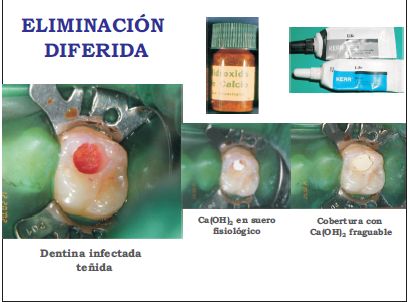
<body><![CDATA[<p style="margin-bottom: 0cm; font-style: normal; font-weight: normal; text-align: justify;"> <font style="font-size: 10pt;" size="2" face="Verdana">Definici&oacute;n</font></p>        <div style="text-align: justify;"> </div>        <p style="margin-bottom: 0cm; text-align: justify;"> <font face="Verdana" style="font-size: 10pt">    <br>    </font>    </p>        <div style="text-align: justify;"> </div>        <p style="margin-bottom: 0cm; font-style: normal; font-weight: normal; text-align: justify;"> <font style="font-size: 10pt;" size="2" face="Verdana">Es la remoci&oacute;n completa del proceso carioso, realizada gradualmente en 2 o m&aacute;s sesiones, lo cual permite un tiempo de reacci&oacute;n fisiol&oacute;gica y disminuye el riesgo de exposici&oacute;n pulpar.</font></p>        <div style="text-align: justify;"> </div>        <div style="text-align: justify;"> </div>        <p style="margin-bottom: 0cm; font-style: normal; font-weight: normal; text-align: justify;"> <font style="font-size: 10pt;" size="2" face="Verdana">Comprende la eliminaci&oacute;n minuciosa del tejido enfermo en la periferia de la lesi&oacute;n pero conservando temporalmente una capa delgada de dentina infectada sobre la pared pulpar. Sobre la misma se colocar&aacute; una base de Ca (OH)2, el cu&aacute;l promover&aacute; un cambio ecol&oacute;gico por su alcalinidad (principal responsable de sus propiedades antimicrobianas) (<a name="56.-"></a><a href="#56">56</a>). Esto parece detener o enlentecer el proceso carioso y crear un ambiente propicio para la reparaci&oacute;n (<a name="52.-"></a><a href="#52">52</a>,<a name="53.-"></a><a href="#53">53</a>,<a href="#57">57</a>).</font></p>        <div style="text-align: justify;"> </div>        ]]></body>
<body><![CDATA[<div style="text-align: justify;"> </div>        <p style="margin-bottom: 0cm; text-align: justify;"> <font face="Verdana" style="font-size: 10pt">    <br>    </font>    </p>        <div style="text-align: justify;"> </div>        <div style="text-align: justify;"> </div>        <p style="margin-bottom: 0cm; font-style: normal; font-weight: normal; text-align: justify;"> <font style="font-size: 10pt;" size="2" face="Verdana">Es fundamental lograr un buen sellado marginal (<a href="#26">26</a>, <a name="48.-"></a><a href="#48">48</a>), de tal manera que las bacterias no puedan obtener sustratos metab&oacute;licos del entorno bucal para reavivar el proceso. Se reduce as&iacute; la producci&oacute;n de &aacute;cido, control&aacute;ndose por consiguiente la progresi&oacute;n de la lesi&oacute;n (<a name="67.-"></a><a href="#67">67</a>,<a name="68.-"></a><a href="#68">68</a>). Por lo antedicho se trata de estimular los mecanismos naturales de defensa del complejo dentinopulpar para lograr la formaci&oacute;n de dentina escler&oacute;tica y terciaria, reduciendo la permeabilidad y alejando la c&aacute;mara pulpar del proceso carioso (<a href="#11">11</a>,<a name="59.-"></a><a href="#59">59</a>).</font></p>        <div style="text-align: justify;"> </div>        <p style="margin-bottom: 0cm; text-align: justify;"> <font face="Verdana" style="font-size: 10pt">    <br>    </font>    </p>        <div style="text-align: justify;"> </div>        ]]></body>
<body><![CDATA[<p style="margin-bottom: 0cm; font-style: normal; font-weight: normal; text-align: justify;"> <font style="font-size: 10pt;" size="2" face="Verdana">Su aplicaci&oacute;n oportuna y criteriosa no s&oacute;lo obtiene una respuesta biol&oacute;gica favorable sino que adem&aacute;s disminuye costos al simplificar los tratamientos restauradores. Contribuye por tanto a una mayor cobertura asistencial. </font> </p>        <div style="text-align: justify;"> </div>        <div style="text-align: justify;"> </div>        <p style="margin-bottom: 0cm; font-style: normal; font-weight: normal; text-align: justify;"> <font style="font-size: 10pt;" size="2" face="Verdana">Los dientes permanentes con for&aacute;men apical abierto y los permanentes de adultos j&oacute;venes, est&aacute;n espec&iacute;ficamente indicados ya que en ellos el tejido pulpar es amplio, con gran cantidad de c&eacute;lulas, buen aporte vascular, y por tanto buena capacidad defensiva (<a href="#27">27</a>-<a href="#30">30</a>,<a href="#37">37</a>). En los primeros adem&aacute;s, se conforma una estrategia adecuada y necesaria para una completa apexog&eacute;nesis (<a name="39.-"></a><a href="#39">39</a>, <a href="#60">60</a>).</font></p>        <div style="text-align: justify;"> </div>        <p style="margin-bottom: 0cm; text-align: justify;"> <font face="Verdana" style="font-size: 10pt">    <br>    </font>    </p>        <div style="text-align: justify;"> </div>        <p style="margin-bottom: 0cm; font-style: normal; font-weight: normal; text-align: justify;"> <font style="font-size: 10pt;" size="2" face="Verdana">Objetivos</font></p>        <div style="text-align: justify;"> </div>        ]]></body>
<body><![CDATA[<p style="margin-bottom: 0cm; text-align: justify;"> <font face="Verdana" style="font-size: 10pt">    <br>    </font>    </p>        <div style="text-align: justify;"> </div>        <p style="margin-bottom: 0cm; text-align: justify;"><font face="Verdana"> <span style="font-size: 10pt">&bull;</span><font style="font-size: 10pt;" size="2"><span style="font-weight: normal; font-style:normal">Crear las condiciones favorables para una adecuada repuesta defensiva de la pulpa.</span></font></font></p>        <div style="text-align: justify;"> </div>        <p style="margin-bottom: 0cm; text-align: justify;"><font face="Verdana"> <span style="font-size: 10pt">&bull;</span><font style="font-size: 10pt;" size="2"><span style="font-weight: normal; font-style:normal">Evitar la necesidad de realizar tratamiento pulpar radical.</span></font></font></p>        <div style="text-align: justify;"> </div>        <p style="margin-bottom: 0cm; text-align: justify;"><font face="Verdana"> <span style="font-size: 10pt">&bull;</span><font style="font-size: 10pt;" size="2"><span style="font-weight: normal; font-style:normal">Lograr una mayor cobertura asistencial.</span></font></font></p>        <div style="text-align: justify;"> </div>        <p style="margin-bottom: 0cm; text-align: justify;"> <font face="Verdana" style="font-size: 10pt">    ]]></body>
<body><![CDATA[<br>    </font>    </p>        <div style="text-align: justify;"> </div>        <p style="margin-bottom: 0cm; text-align: justify;"> <font face="Verdana" style="font-size: 10pt">    <br>    </font>    </p>        <div style="text-align: justify;"> </div>        <p style="margin-bottom: 0cm; font-style: normal; font-weight: normal; text-align: justify;"> <font style="font-size: 10pt;" size="2" face="Verdana">Indicaciones</font></p>        <div style="text-align: justify;"> </div>        <p style="margin-bottom: 0cm; text-align: justify;"> <font face="Verdana" style="font-size: 10pt">    <br>    </font>    </p>        <div style="text-align: justify;"> </div>        ]]></body>
<body><![CDATA[<p style="margin-bottom: 0cm; text-align: justify;"><font face="Verdana"> <span style="font-size: 10pt">&bull;</span><font style="font-size: 10pt;" size="2"><span style="font-weight: normal; font-style:normal">Lesiones que por su extensi&oacute;n presupongan la inminente exposici&oacute;n pulpar.</span></font></font></p>        <div style="text-align: justify;"> </div>        <p style="margin-bottom: 0cm; text-align: justify;"><font face="Verdana"> <span style="font-size: 10pt">&bull;</span><font style="font-size: 10pt;" size="2"><span style="font-weight: normal; font-style:normal">Dientes permanentes j&oacute;venes y adultos con capacidad defensiva intacta.</span></font></font></p>        <div style="text-align: justify;"> </div>        <p style="margin-bottom: 0cm; text-align: justify;"><font face="Verdana"> <span style="font-size: 10pt">&bull;</span><font style="font-size: 10pt;" size="2"><span style="font-weight: normal; font-style:normal">Pulpa asintom&aacute;tica o cuadro reversible (hiperemia).</span></font></font></p>        <div style="text-align: justify;"> </div>        <p style="margin-bottom: 0cm; text-align: justify;"> <font face="Verdana" style="font-size: 10pt">    <br>    </font>    </p>        <div style="text-align: justify;"> </div>        <p style="margin-bottom: 0cm; font-style: normal; font-weight: normal; text-align: justify;"> <font style="font-size: 10pt;" size="2" face="Verdana">Contraindicaciones</font></p>        ]]></body>
<body><![CDATA[<div style="text-align: justify;"> </div>        <p style="margin-bottom: 0cm; text-align: justify;"> <font face="Verdana" style="font-size: 10pt">    <br>    </font>    </p>        <div style="text-align: justify;"> </div>        <p style="margin-bottom: 0cm; text-align: justify;"><font face="Verdana"> <span style="font-size: 10pt">&bull;</span><font style="font-size: 10pt;" size="2"><span style="font-weight: normal; font-style:normal">Cuadros inflamatorios irreversibles pulpares.</span></font></font></p>        <div style="text-align: justify;"> </div>        <p style="margin-bottom: 0cm; text-align: justify;"><font face="Verdana"> <span style="font-size: 10pt">&bull;</span><font style="font-size: 10pt;" size="2"><span style="font-weight: normal; font-style:normal">Cuando est&aacute; indicado el anclaje radicular.</span></font></font></p>        <div style="text-align: justify;"> </div>        <p style="margin-bottom: 0cm; text-align: justify;"><font face="Verdana"> <span style="font-size: 10pt">&bull;</span><font style="font-size: 10pt;" size="2"><span style="font-weight: normal; font-style:normal">Cambios regresivos pulpares: c&aacute;lculos, conductos atr&eacute;sicos, atrofia. En estos casos se considerar&aacute; especialmente aquellos dientes sometidos a tallados extensos y/o grandes cargas oclusales.</span></font></font></p>        <div style="text-align: justify;"> </div>        ]]></body>
<body><![CDATA[<p style="margin-bottom: 0cm; font-style: normal; font-weight: normal; text-align: justify;"> <font style="font-size: 10pt;" size="2" face="Verdana">Estas indicaciones y contraindicaciones requerir&aacute;n en cada caso de su an&aacute;lisis particular, con los mismos criterios considerados en el punto anterior.</font></p>        <div style="text-align: justify;"> </div>        <p style="margin-bottom: 0cm; text-align: justify;"> <font face="Verdana" style="font-size: 10pt">    <br>    </font>    </p>        <div style="text-align: justify;"> </div>        <p style="margin-bottom: 0cm; text-align: justify;"> <font face="Verdana" style="font-size: 10pt">    <br>    </font>    </p>        <div style="text-align: justify;"> </div>        <p style="margin-bottom: 0cm; font-style: normal; font-weight: normal; text-align: justify;"> <font style="font-size: 10pt;" size="2" face="Verdana">T&eacute;cnica Operatoria</font></p>        <div style="text-align: justify;"> </div>        ]]></body>
<body><![CDATA[<p style="margin-bottom: 0cm; text-align: justify;"> <font face="Verdana" style="font-size: 10pt">    <br>    </font>    </p>        <div style="text-align: justify;"> </div>        <p style="margin-bottom: 0cm; font-style: normal; font-weight: normal; text-align: justify;"> <font style="font-size: 10pt;" size="2" face="Verdana">Primera Sesi&oacute;n</font></p>        <div style="text-align: justify;"> </div>        <p style="margin-bottom: 0cm; text-align: justify;"> <font face="Verdana" style="font-size: 10pt">    <br>    </font>    </p>        <div style="text-align: justify;"> </div>        <p style="margin-bottom: 0cm; font-style: normal; font-weight: normal; text-align: justify;"> <font style="font-size: 10pt;" size="2" face="Verdana">Diagn&oacute;stico cl&iacute;nico y radiogr&aacute;fico, con toma de radiograf&iacute;a periapical orto-radial.</font></p>        <div style="text-align: justify;"> </div>        ]]></body>
<body><![CDATA[<p style="margin-bottom: 0cm; text-align: justify;"> <font face="Verdana" style="font-size: 10pt">    <br>    </font>    </p>        <div style="text-align: justify;"> </div>        <p style="margin-bottom: 0cm; text-align: justify;"> <font face="Verdana" style="font-size: 10pt">    <br>    </font>    </p>        <div style="text-align: justify;"> </div>        <p style="margin-bottom: 0cm; text-align: justify;"><font face="Verdana"> <span style="font-size: 10pt">&bull;</span><font style="font-size: 10pt;" size="2"><span style="font-weight: normal; font-style:normal">Anestesia terminal sin vasoconstrictor o anestesia troncular con vasoconstrictor.</span></font></font></p>        <div style="text-align: justify;"> </div>        <p style="margin-bottom: 0cm; text-align: justify;"><font face="Verdana"> <span style="font-size: 10pt">&bull;</span><font style="font-size: 10pt;" size="2"><span style="font-weight: normal; font-style:normal">Aislamiento absoluto y antisepsia del campo operatorio. En caso de que la goma dique interfiera en proximal durante la eliminaci&oacute;n del tejido cariado se podr&aacute; comenzar con aislaci&oacute;n relativa (pero solamente en los pasos iniciales).</span></font></font></p>        <div style="text-align: justify;"> </div>        ]]></body>
<body><![CDATA[<p style="margin-bottom: 0cm; text-align: justify;"><font face="Verdana"> <span style="font-size: 10pt">&bull;</span><font style="font-size: 10pt;" size="2"><span style="font-weight: normal; font-style:normal">Eliminaci&oacute;n de la dentina reblandecida con cucharita de dentina bien afilada.</span></font></font></p>        <div style="text-align: justify;"> </div>        <p style="margin-bottom: 0cm; text-align: justify;"><font face="Verdana"> <span style="font-size: 10pt">&bull;</span><font style="font-size: 10pt;" size="2"><span style="font-weight: normal; font-style:normal">Aplicaci&oacute;n de colorantes diagn&oacute;stico (<a href="#7">7</a>) seg&uacute;n protocolos (<a href="#8">8</a>,<a href="#12">12</a>) y con las salvedades ya comentadas (<a name="10.-"></a><a href="#10">10</a>,<a href="#18">18</a>).</span></font></font></p>        <div style="text-align: justify;"> </div>        <p style="margin-bottom: 0cm; text-align: justify;"><font face="Verdana"> <span style="font-size: 10pt">&bull;</span><font style="font-size: 10pt;" size="2"><span style="font-weight: normal; font-style:normal">Eliminaci&oacute;n total de caries de las paredes laterales utilizando fresa redonda de corte liso de buen tama&ntilde;o y realizando control colorim&eacute;trico. En el l&iacute;mite amelo-dentinario usar una fresa redonda peque&ntilde;a.</span></font></font></p>        <div style="text-align: justify;"> </div>        <p style="margin-bottom: 0cm; text-align: justify;"><font face="Verdana"> <span style="font-size: 10pt">&bull;</span><font style="font-size: 10pt;" size="2"><span style="font-weight: normal; font-style:normal">La eliminaci&oacute;n de caries de la pared pulpar debe realizarse bajo aislaci&oacute;n absoluta, con fresa de tungsteno est&eacute;ril y a baja velocidad.</span></font></font></p>        <div style="text-align: justify;"> </div>        <p style="margin-bottom: 0cm; text-align: justify;"><font face="Verdana"> <span style="font-size: 10pt">&bull;</span><font style="font-size: 10pt;" size="2"><span style="font-weight: normal; font-style:normal">En la misma se trabajar&aacute; hasta dejar una fina capa de dentina te&ntilde;ida desmineralizada infectada, evitando el riesgo de exposici&oacute;n (<a href="#14">14</a>, <a href="#25">25</a>, <a href="#26">26</a>).</span></font></font></p>        <div style="text-align: justify;"> </div>        ]]></body>
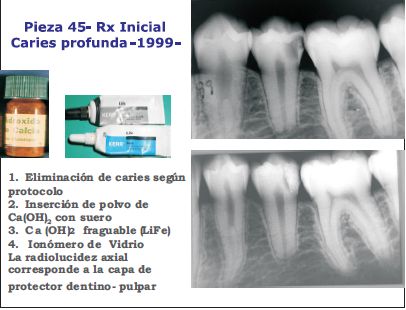
<body><![CDATA[<p style="margin-bottom: 0cm; text-align: justify;"><font face="Verdana"> <span style="font-size: 10pt">&bull;</span><font style="font-size: 10pt;" size="2"><span style="font-weight: normal; font-style:normal">Lavar la cavidad con suero y secar con torundas de algod&oacute;n est&eacute;riles. Colocar en la pared pulpar o axial, Ca(OH)2 en polvo preparado con suero fisiol&oacute;gico sin cubrir las paredes laterales. Esta forma de empleo explota al m&aacute;ximo sus propiedades antibacterianas y remineralizadoras. Sobre el mismo se dispone una capa de Ca(OH)2 fraguable realizando una cobertura protectora.</span></font></font></p>        <div style="text-align: justify;"> </div>        <p style="margin-bottom: 0cm; text-align: justify;"><font face="Verdana"> <span style="font-size: 10pt">&bull;</span><font style="font-size: 10pt;" size="2"><span style="font-weight: normal; font-style:normal">Se obtura con vidrio Ion&oacute;mero, Amalgama, u otro material que otorgue buen sellado y resistencia (<a name="35.-"></a><a href="#35">35</a>,<a href="#67">67</a>,<a href="#68">68</a>).</span></font></font></p>        <div style="text-align: justify;"> </div>        <p style="margin-bottom: 0cm; text-align: justify;"><font face="Verdana"> <span style="font-size: 10pt">&bull;</span><font style="font-size: 10pt;" size="2"><span style="font-weight: normal; font-style:normal">En algunas cavidades con dificultad de espesor para utilizar estas dos capas protectoras, se podr&aacute; utilizar Ca(OH)2 fraguable directamente en contacto con la pared pulpar. Luego se recubrir&aacute; con Ion&oacute;mero, Amalgama u otros con el fin de obtener sellado y resistencia.</span></font></font></p>        <div style="text-align: justify;"> </div>        <p style="margin-bottom: 0cm; text-align: justify;"><font face="Verdana"> <span style="font-size: 10pt">&bull;</span><font style="font-size: 10pt;" size="2"><span style="font-weight: normal; font-style:normal">Control cl&iacute;nico a la semana.</span></font></font></p>        <div style="text-align: justify;"> </div>        <p style="margin-bottom: 0cm; text-align: justify;"> <font face="Verdana" style="font-size: 10pt">    <br>    </font>    </p>        ]]></body>
<body><![CDATA[<div style="text-align: justify;"> </div>        <p style="margin-bottom: 0cm; text-align: justify;"> <font face="Verdana" style="font-size: 10pt">    <br>    </font>    </p>        <div style="text-align: justify;"> </div>        <p style="margin-bottom: 0cm; font-style: normal; font-weight: normal; text-align: justify;"> <font style="font-size: 10pt;" size="2" face="Verdana">Segunda Sesi&oacute;n</font></p>        <div style="text-align: justify;"> </div>        <p style="margin-bottom: 0cm; font-style: normal; font-weight: normal; text-align: justify;"> <font style="font-size: 10pt;" size="2" face="Verdana">(a los 3 meses como m&iacute;nimo)</font></p>        <div style="text-align: justify;"> </div>        <p style="margin-bottom: 0cm; text-align: justify;"> <font face="Verdana" style="font-size: 10pt">    <br>    </font>    </p>        ]]></body>
<body><![CDATA[<div style="text-align: justify;"> </div>        <p style="margin-bottom: 0cm; text-align: justify;"><font face="Verdana"> <span style="font-size: 10pt">&bull;</span><font style="font-size: 10pt;" size="2"><span style="font-weight: normal; font-style:normal">Optativo: radiograf&iacute;a que corrobore la reacci&oacute;n defensiva y el alejamiento pulpar.</span></font></font></p>        <div style="text-align: justify;"> </div>        <p style="margin-bottom: 0cm; text-align: justify;"><font face="Verdana"> <span style="font-size: 10pt">&bull;</span><font style="font-size: 10pt;" size="2"><span style="font-weight: normal; font-style:normal">Anestesia terminal sin vasoconstrictor o troncular con vasoconstrictor.</span></font></font></p>        <div style="text-align: justify;"> </div>        <p style="margin-bottom: 0cm; text-align: justify;"><font face="Verdana"> <span style="font-size: 10pt">&bull;</span><font style="font-size: 10pt;" size="2"><span style="font-weight: normal; font-style:normal">Aislaci&oacute;n absoluta.</span></font></font></p>        <div style="text-align: justify;"> </div>        <p style="margin-bottom: 0cm; text-align: justify;"><font face="Verdana"> <span style="font-size: 10pt">&bull;</span><font style="font-size: 10pt;" size="2"><span style="font-weight: normal; font-style:normal">Remoci&oacute;n de ap&oacute;sito curativo.</span></font></font></p>        <div style="text-align: justify;"> </div>        <p style="margin-bottom: 0cm; text-align: justify;"><font face="Verdana"> <span style="font-size: 10pt">&bull;</span><font style="font-size: 10pt;" size="2"><span style="font-weight: normal; font-style:normal">Lavado con suero y secado con torundas est&eacute;riles.</span></font></font></p>        ]]></body>
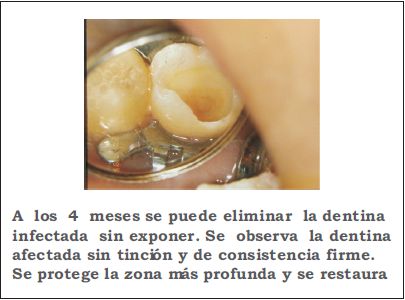
<body><![CDATA[<div style="text-align: justify;"> </div>        <p style="margin-bottom: 0cm; text-align: justify;"><font face="Verdana"> <span style="font-size: 10pt">&bull;</span><font style="font-size: 10pt;" size="2"><span style="font-weight: normal; font-style:normal">La reacci&oacute;n pulpar in situ se corrobora por un aumento notorio de la dureza, el cambio de color (se oscurece) y brillo de la dentina y por la menor afinidad por los colorantes (<a href="#19">19</a>-<a href="#21">21</a>).</span></font></font></p>        <div style="text-align: justify;"> </div>        <p style="margin-bottom: 0cm; text-align: justify;"> <font face="Verdana" style="font-size: 10pt">    <br>    </font>    </p>        <div style="text-align: justify;"> </div>        <p style="margin-bottom: 0cm; font-style: normal; font-weight: normal; text-align: justify;"> <font style="font-size: 10pt;" size="2" face="Verdana">Si esto se corrobora se prosigue:</font></p>        <div style="text-align: justify;"> </div>        <p style="margin-bottom: 0cm; text-align: justify;"> <font face="Verdana" style="font-size: 10pt">    <br>    </font>    </p>        ]]></body>
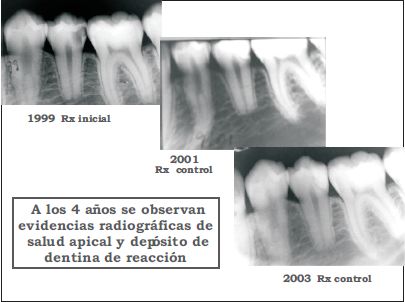
<body><![CDATA[<div style="text-align: justify;"> </div>        <p style="margin-bottom: 0cm; text-align: justify;"><font face="Verdana"> <span style="font-size: 10pt">&bull;</span><font style="font-size: 10pt;" size="2"><span style="font-weight: normal; font-style:normal">Eliminaci&oacute;n total de caries y su comprobaci&oacute;n mediante colorante de diagn&oacute;stico.</span></font></font></p>        <div style="text-align: justify;"> </div>        <p style="margin-bottom: 0cm; text-align: justify;"><font face="Verdana"> <span style="font-size: 10pt">&bull;</span><font style="font-size: 10pt;" size="2"><span style="font-weight: normal; font-style:normal">Lavado con suero, secado y aplicaci&oacute;n de Clorhexidina al2%durante 10 seg (<a href="#32">32</a>,<a href="#33">33</a>).</span></font></font></p>        <div style="text-align: justify;"> </div>        <p style="margin-bottom: 0cm; text-align: justify;"><font face="Verdana"> <span style="font-size: 10pt">&bull;</span><font style="font-size: 10pt;" size="2"><span style="font-weight: normal; font-style:normal">Colocaci&oacute;n de base de Ca(OH)2 fraguable y/ o vidrio ion&oacute;mero.</span></font></font></p>        <div style="text-align: justify;"> </div>        <p style="margin-bottom: 0cm; text-align: justify;"><font face="Verdana"> <span style="font-size: 10pt">&bull;</span><font style="font-size: 10pt;" size="2"><span style="font-weight: normal; font-style:normal">Reconstrucci&oacute;n definitiva.</span></font></font></p>        <div style="text-align: justify;"> </div>        <p style="margin-bottom: 0cm; text-align: justify;"><font face="Verdana"> <span style="font-size: 10pt">&bull;</span><font style="font-size: 10pt;" size="2"><span style="font-weight: normal; font-style:normal">Control cl&iacute;nico y radiogr&aacute;fico al a&ntilde;o.</span></font></font></p>        ]]></body>
<body><![CDATA[<div style="text-align: justify;"> </div>        <p style="margin-bottom: 0cm; text-align: justify;"> <font face="Verdana" style="font-size: 10pt">    <br>    </font>    </p>        <div style="text-align: justify;"> </div>        <p style="margin-bottom: 0cm; text-align: justify;"> <font face="Verdana" style="font-size: 10pt">    <br>    </font>    </p>        <div style="text-align: justify;"> </div>        <p style="margin-bottom: 0cm; font-style: normal; font-weight: normal; text-align: justify;"> <font style="font-size: 10pt;" size="2" face="Verdana">Si existen dudas respecto a la respuesta pulpar (cl&iacute;nica o radiogr&aacute;fica), se puede optar por una nueva eliminaci&oacute;n parcial y diferir la eliminaci&oacute;n total por otro per&iacute;odo.</font></p>        <div style="text-align: justify;"> </div>        <p style="margin-bottom: 0cm; font-style: normal; font-weight: normal; text-align: justify;"> <font style="font-size: 10pt;" size="2" face="Verdana">Si el caso lo ameritara (piezas j&oacute;venes con cavidades pulpares amplias, necesidad de apexificaci&oacute;n, etc.) podr&iacute;a optarse por una t&eacute;cnica todav&iacute;a m&aacute;s conservadora, del tipo Stepwise (<a name="62-64.-"></a><a href="#62">62</a>-<a href="#64">64</a>), en donde en la primera sesi&oacute;n se mantiene intocada la pared pulpar conservando incluso una capa localizada de dentina blanda y h&uacute;meda altamente infectada. Se establece un comp&aacute;s de espera por un per&iacute;odo de 6 a 12 meses con estricto control del sellado marginal (<a href="#35">35</a>,<a name="45.-"></a><a href="#45">45</a>). Est&aacute; claro que en esta situaci&oacute;n los test de vitalidad pulpar deben ser extremadamente rigurosos.</font></p>        ]]></body>
<body><![CDATA[<div style="text-align: justify;"> </div>        <p style="margin-bottom: 0cm; text-align: justify;"> <font face="Verdana" style="font-size: 10pt">    <br>    </font>    </p>        <div style="text-align: justify;"> </div>        <p style="margin-bottom: 0cm; text-align: justify;"> <font face="Verdana" style="font-size: 10pt">    <br>    </font>    </p>        <div style="text-align: justify;"> </div>        <p style="margin-bottom: 0cm; font-style: normal; font-weight: normal; text-align: justify;"> <font style="font-size: 10pt;" size="2" face="Verdana">Obturaci&oacute;n de acuerdo a los siguientes criterios</font></p>        <div style="text-align: justify;"> </div>        <p style="margin-bottom: 0cm; text-align: justify;"> <font face="Verdana" style="font-size: 10pt">    ]]></body>
<body><![CDATA[<br>    </font>    </p>        <div style="text-align: justify;"> </div>        <p style="margin-bottom: 0cm; text-align: justify;"><font face="Verdana"> <span style="font-size: 10pt">&bull;</span><font style="font-size: 10pt;" size="2"><span style="font-weight: normal; font-style:normal">En cuadros asintom&aacute;ticos de cavidades muy profundas con conductos normales o amplios. Si se considerara aplicar el procedimiento en dientes con conductos atr&eacute;sicos se manejar&aacute;n los mismos criterios estudiados en la P.P.I.</span></font></font></p>        <div style="text-align: justify;"> </div>        <p style="margin-bottom: 0cm; text-align: justify;"><font face="Verdana"> <span style="font-size: 10pt">&bull;</span><font style="font-size: 10pt;" size="2"><span style="font-weight: normal; font-style:normal">Recordar tambi&eacute;n que la utilizaci&oacute;n de odontolog&iacute;a adhesiva impone, en lo posible, circunscribir la protecci&oacute;n pulpar a las zonas m&aacute;s profundas sin involucrar paredes laterales funcionales a la adhesi&oacute;n (<a name="38.-"></a><a href="#38">38</a>,<a href="#48">48</a>,<a name="50.-"></a><a href="#50">50</a>,<a name="66.-"></a><a href="#66">66</a>).</span></font></font></p>        <div style="text-align: justify;"> </div>        <p style="margin-bottom: 0cm; text-align: justify;"> <font face="Verdana" style="font-size: 10pt">    <br>    </font>    </p>        <div style="text-align: justify;"> </div>        <p style="margin-bottom: 0cm; font-style: normal; font-weight: normal; text-align: justify;"> <font face="Verdana" style="font-size: 10pt">Discusi&oacute;n</font></p>        ]]></body>
<body><![CDATA[<div style="text-align: justify;"> </div>        <p style="margin-bottom: 0cm; text-align: justify;"> <font face="Verdana" style="font-size: 10pt">    <br>    </font>    </p>        <div style="text-align: justify;"> </div>        <p style="margin-bottom: 0cm; font-style: normal; font-weight: normal; text-align: justify;"> <font style="font-size: 10pt;" size="2" face="Verdana">El manejo de los procesos cariosos avanzados en profundidad es un reto importante para el cl&iacute;nico y una conducta conservadora que deber&aacute; estar siempre entre las primeras opciones del protocolo asistencial.</font></p>        <div style="text-align: justify;"> </div>        <div style="text-align: justify;"> </div>        <p style="margin-bottom: 0cm; font-style: normal; font-weight: normal; text-align: justify;"> <font style="font-size: 10pt;" size="2" face="Verdana">El dar tiempo a los mecanismos naturales de defensa y reacci&oacute;n pulpar se est&aacute; imponiendo como una conducta de rutina apoyada por trabajos in vitro e in vivo de numerosos autores (<a name="41.-"></a><a href="#41">41</a>,<a name="51-54-."></a><a href="#51">51</a>-<a href="#54">54</a>,<a href="#58">58</a>) y por la evidencia pr&aacute;ctica de la experiencia cl&iacute;nica.</font></p>        <div style="text-align: justify;"> </div>        <div style="text-align: justify;"> </div>        ]]></body>
<body><![CDATA[<p style="margin-bottom: 0cm; font-style: normal; font-weight: normal; text-align: justify;"> <font style="font-size: 10pt;" size="2" face="Verdana">Adem&aacute;s de su importancia en la lesi&oacute;n misma, el tratamiento conservador se incluye en el m&aacute;s amplio enfoque del tratamiento y prevenci&oacute;n del fen&oacute;meno caries como una de las enfermedades m&aacute;s prevalentes (<a href="#1">1</a>). En efecto, la inactivaci&oacute;n de focos (<a href="#3">3</a>) contribuye, junto a otras maniobras, a revertir los Factores de Riesgo y a poner en pr&aacute;ctica un Plan Preventivo Integral en el llamado Nuevo Modelo de Atenci&oacute;n (<a href="#2">2</a>).</font></p>        <div style="text-align: justify;"> </div>        <div style="text-align: justify;"> </div>        <p style="margin-bottom: 0cm; font-style: normal; font-weight: normal; text-align: justify;"> <font style="font-size: 10pt;" size="2" face="Verdana">El establecimiento de protocolos adecuados es una necesidad clara existiendo en la literatura algunas discrepancias en los mismos. Estos desacuerdos incluyen aspectos como el uso e importancia de los colorantes diagn&oacute;stico (<a href="#10">10</a>,<a href="#16">16</a>-<a href="#20">20</a>) y especialmente de los mecanismos de acci&oacute;n del Hidr&oacute;xido de Calcio (<a href="#11">11</a>,<a name="40.-"></a><a href="#40">40</a>,<a href="#41">41</a>,<a name="49.-"></a><a href="#49">49</a>,<a href="#51">51</a>,<a href="#52">52</a>,<a href="#53">53</a>,<a href="#58">58</a>), del efecto de sus distintas presentaciones comerciales e incluso de su recomendaci&oacute;n o no para estos cuadros, optando algunos autores por utilizar s&oacute;lo Ion&oacute;mero de Vidrio (<a href="#63">63</a>) o exclusivamente adhesivos dentinarios (<a href="#35">35</a>-<a href="#38">38</a>) .</font></p>        <div style="text-align: justify;"> </div>        <div style="text-align: justify;"> </div>        <p style="margin-bottom: 0cm; font-style: normal; font-weight: normal; text-align: justify;"> <font style="font-size: 10pt;" size="2" face="Verdana">En el acuerdo interc&aacute;tedra arribado se mantiene al CaOH como material de elecci&oacute;n para las zonas m&aacute;s profundas de la lesi&oacute;n, bas&aacute;ndose en sus virtudes antibacterianas y favorecedoras de la remineralizaci&oacute;n (<a href="#41">41</a>,<a href="#49">49</a>,<a href="#52">52</a>-<a href="#58">58</a>) . Se lo indicar&aacute; en aquellos casos en que se requieran procesos reaccionales defensivos y la pulpa ostente niveles de salud objetivables. Estar&iacute;a indicado cuando se requiera reacci&oacute;n pulpar defensiva y no estemos en presencia de procesos pulpares atr&oacute;ficos.</font></p>        <div style="text-align: justify;"> </div>        <div style="text-align: justify;"> </div>        <p style="margin-bottom: 0cm; font-style: normal; font-weight: normal; text-align: justify;"> <font style="font-size: 10pt;" size="2" face="Verdana">Distintos materiales (<a href="#63">63</a>,<a name="65.-"></a><a href="#65">65</a>) o t&eacute;cnicas de hibridizaci&oacute;n dentinaria (<a href="#28">28</a>,<a href="#30">30</a>,<a href="#31">31</a>,<a href="#35">35</a>,<a href="#36">36</a>,<a href="#37">37</a>,<a href="#66">66</a>) usando distintos tipos de imprimadores (<a href="#38">38</a>) todav&iacute;a no han desplazado a esta base alcalina en el manejo de la caries profunda (<a href="#11">11</a>,<a href="#23">23</a>,<a href="#39">39</a>,<a name="42.-"></a><a href="#42">42</a>,<a href="#57">57</a>,<a name="60.-"></a><a href="#60">60</a>).</font></p>        ]]></body>
<body><![CDATA[<div style="text-align: justify;"> </div>        <p style="margin-bottom: 0cm; text-align: justify;"> <font face="Verdana" style="font-size: 10pt">    <br>    </font>    </p>        <div style="text-align: justify;"> </div>        <p style="margin-bottom: 0cm; font-style: normal; font-weight: normal; text-align: justify;"> <font face="Verdana" style="font-size: 10pt">Conclusiones</font></p>        <div style="text-align: justify;"> </div>        <p style="margin-bottom: 0cm; text-align: justify;"> <font face="Verdana" style="font-size: 10pt">    <br>    </font>    </p>        <div style="text-align: justify;"> </div>        <p style="margin-bottom: 0cm; text-align: justify;"><font face="Verdana"> <span style="font-size: 10pt">&bull;</span><font style="font-size: 10pt;" size="2"><span style="font-weight: normal; font-style:normal">Los tratamientos conservadores en el manejo de la caries profunda resultan una opci&oacute;n eficaz en el planeo preventivo integral, permitiendo el abordaje por Enfoque de Riesgo y una amplia cobertura asistencial.</span></font></font></p>        ]]></body>
<body><![CDATA[<div style="text-align: justify;"> </div>        <p style="margin-bottom: 0cm; text-align: justify;"><font face="Verdana"> <span style="font-size: 10pt">&bull;</span><font style="font-size: 10pt;" size="2"><span style="font-weight: normal; font-style:normal">La utilizaci&oacute;n del Ca(OH)2 sigue siendo de primera elecci&oacute;n cuando se requiere capacidad defensiva reaccional.</span></font></font></p>        <div style="text-align: justify;"> </div>        <p style="margin-bottom: 0cm; text-align: justify;"><font face="Verdana"> <span style="font-size: 10pt">&bull;</span><font style="font-size: 10pt;" size="2"><span style="font-weight: normal; font-style:normal">Debe acompa&ntilde;arse de un correcto examen de la salud pulpar en todo momento y de la aplicaci&oacute;n cuidadosa de los protocolos establecidos.</span></font></font></p>        <div style="text-align: justify;"> </div>        <p style="margin-bottom: 0cm; text-align: justify;"><font face="Verdana"> <span style="font-size: 10pt">&bull;</span><font style="font-size: 10pt;" size="2"><span style="font-weight: normal; font-style:normal">Un estricto control del sellado marginal en la obturaci&oacute;n coronaria es condici&oacute;n imprescindible para alcanzar los objetivos.</span></font></font></p>        <div style="text-align: justify;"> </div>        <p style="margin-bottom: 0cm; text-align: justify;"> <font face="Verdana" style="font-size: 10pt">    <br>    </font>    </p>        <div style="text-align: justify;"> </div>        ]]></body>
<body><![CDATA[<p style="margin-bottom: 0cm; text-align: justify;"> <font face="Verdana" style="font-size: 10pt"><img style="width: 408px; height: 302px;" alt="" src="/img/revistas/ode/v11n13/13a06f1.jpg">    <br>    </font>    </p>        <div style="text-align: justify;"> </div>        <p style="margin-bottom: 0cm; text-align: justify;"></p>        <div style="text-align: justify;"> <font face="Verdana" style="font-size: 10pt"> <img style="width: 406px; height: 310px;" alt="" src="/img/revistas/ode/v11n13/13a06f2.jpg">    <br>        <br>        <br>    <img style="width: 405px; height: 300px;" alt="" src="/img/revistas/ode/v11n13/13a06f3.jpg">    <br>        <br>        ]]></body>
<body><![CDATA[<br>    <img style="width: 405px; height: 302px;" alt="" src="/img/revistas/ode/v11n13/13a06f4.jpg">    <br>    </font>    </div>        <p style="margin-bottom: 0cm; font-style: normal; font-weight: normal; text-align: justify;"> <font face="Verdana" style="font-size: 10pt">Referencias bibliogr&aacute;ficas</font></p>        <div style="text-align: justify;"> </div>        <p style="margin-bottom: 0cm; font-style: normal; font-weight: normal; text-align: justify;"> <font face="Verdana" style="font-size: 10pt">     <br>    </font>    </p>        <div style="text-align: justify;"> </div>        <!-- ref --><p style="margin-bottom: 0cm; font-style: normal; font-weight: normal; text-align: justify;"> <font style="font-size: 10pt;" size="2" face="Verdana"><a name="1"></a><a href="#1.-">1</a>.Thylstrup A., Fejerskov O. Textbook of clinical cariology. 2&ordf; ed. Copenhagen: Munskgaard; 1994. Cap 11, p&aacute;g. 170- 193.    </font></p>        <div style="text-align: justify;"> </div>        ]]></body>
<body><![CDATA[<!-- ref --><p style="margin-bottom: 0cm; font-style: normal; font-weight: normal; text-align: justify;"> <font style="font-size: 10pt;" size="2" face="Verdana"><a name="2"></a><a href="#2.-">2</a>.Fejerskov O., Kidd E.- Dental Caries- The disease and its clinical management- Blackwell Munksgaard, 2003.    </font></p>        <div style="text-align: justify;"> </div>        <!-- ref --><p style="margin-bottom: 0cm; font-style: normal; font-weight: normal; text-align: justify;"> <font style="font-size: 10pt;" size="2" face="Verdana"><a name="3"></a><a href="#3.-">3</a>.Anderson M., Bales D.J., Money K.A. Manejo moderno de la caries dental. JADA. Vol. 124, Junio 1993: 37-44.    </font></p>        <div style="text-align: justify;"> </div>        <!-- ref --><p style="margin-bottom: 0cm; font-style: normal; font-weight: normal; text-align: justify;"> <font style="font-size: 10pt;" size="2" face="Verdana"><a name="4"></a><a href="#4-6.-">4</a>.Reeves R., Stanley H.R. The relationship of bacterial penetration and pulp pathosis in carious teeth. Oral Surg. Oral Med Oral Pathol. 1966 Jul; 22(1): 59-65.    </font></p>        <div style="text-align: justify;"> </div>        <!-- ref --><p style="margin-bottom: 0cm; font-style: normal; font-weight: normal; text-align: justify;"> <font style="font-size: 10pt;" size="2" face="Verdana"><a name="5"></a><a href="#4-6.-">5</a>.Ricketts D. Management of the deep carious lesion and the vital pulp dentine complex. Br. Dent. J. 2001; 191 (11): 606-610.    </font></p>        <div style="text-align: justify;"> </div>        <!-- ref --><p style="margin-bottom: 0cm; font-style: normal; font-weight: normal; text-align: justify;"> <font style="font-size: 10pt;" size="2" face="Verdana"><a name="6"></a><a href="#4-6.-">6</a>.Fusayama T, .Differentiation of two layers of carious dentin by staining. J.Dent Res. 1972;51 (3): 866 .    </font></p>        <div style="text-align: justify;"> </div>        <!-- ref --><p style="margin-bottom: 0cm; font-style: normal; font-weight: normal; text-align: justify;"> <font style="font-size: 10pt;" size="2" face="Verdana"><a name="7"></a><a href="#7-9.-">7</a>.Fusayama T. Clinical guide for removing caries using a caries detecting solution. Oper. Dent. 1988; 19(6): 397-408.    </font></p>        <div style="text-align: justify;"> </div>        <!-- ref --><p style="margin-bottom: 0cm; font-style: normal; font-weight: normal; text-align: justify;"> <font style="font-size: 10pt;" size="2" face="Verdana"><a name="8"></a><a href="#7-9.-">8</a>.Boston D.W., Graver H.T. Histological study of an acid red caries disclosing dye. Oper. Dent. 1989; 14(4):186-192.    </font></p>        ]]></body>
<body><![CDATA[<div style="text-align: justify;"> </div>        <!-- ref --><p style="margin-bottom: 0cm; font-style: normal; font-weight: normal; text-align: justify;"> <font style="font-size: 10pt;" size="2" face="Verdana"><a name="9"></a><a href="#7-9.-">9</a>.Ansari G., Beely J.A., Reid J.S., Foye R.H. Caries detector dyes- an in vitro assessment of some new compounds. J. Oral Rehab. 1999; 26(6):453-458.    </font></p>        <div style="text-align: justify;"> </div>        <!-- ref --><p style="margin-bottom: 0cm; font-style: normal; font-weight: normal; text-align: justify;"> <font style="font-size: 10pt;" size="2" face="Verdana"><a name="10"></a><a href="#10.-">10</a>.De Botero M., Mart&iacute;nez C., Rivas P. Restrepo B.E. Necesidad o no del uso de colorantes durante la remoci&oacute;n de la dentina cariada: soporte microbiol&oacute;gico. Rev. Fac. Odont Univ. Ant. 1988; 19(2): 73-80.    </font></p>        <div style="text-align: justify;"> </div>        <!-- ref --><p style="margin-bottom: 0cm; font-style: normal; font-weight: normal; text-align: justify;"> <font style="font-size: 10pt;" size="2" face="Verdana"><a name="11"></a><a href="#11.-">11</a>.Schwartz R.S., Summitt J.B., Robbins J.W. Fundamentos en Odontolog&iacute;a Operatoria. Un logro contempor&aacute;neo. Edit. Actualidades M&eacute;dico Odontol&oacute;gicas Latinoamericanas, C.A. Venezuela. 1999. Cap. 3, P&aacute;gs. 51-66.    </font></p>        <div style="text-align: justify;"> </div>        ]]></body>
<body><![CDATA[<!-- ref --><p style="margin-bottom: 0cm; font-style: normal; font-weight: normal; text-align: justify;"> <font style="font-size: 10pt;" size="2" face="Verdana"><a name="12"></a><a href="#12.-">12</a>.Alvarez Cantoni H. y Cols. Fundamentos, T&eacute;cnicas y Cl&iacute;nica en Rehabilitaci&oacute;n Bucal. 1999. Edit. Hacheace. Cap. 3, P&aacute;g.:75-84.    </font></p>        <div style="text-align: justify;"> </div>        <!-- ref --><p style="margin-bottom: 0cm; font-style: normal; font-weight: normal; text-align: justify;"> <font style="font-size: 10pt;" size="2" face="Verdana"><a name="13"></a><a href="#-13-14.-">13</a>.Banerjee T.F., Watson, E.A., Kidd M. Dentine Caries: Take it or leave it? Dental Update- July/August 2000, 27: 272- 276.    </font></p>        <div style="text-align: justify;"> </div>        <!-- ref --><p style="margin-bottom: 0cm; font-style: normal; font-weight: normal; text-align: justify;"> <font style="font-size: 10pt;" size="2" face="Verdana"><a name="14"></a><a href="#-13-14.-">14</a>.Henostroza Haro G., Caries Dental. Principios y procedimientos para el diagn&oacute;stico. Universidad Peruana Cayetano Heredia, 2007. Ripano Edit. M&eacute;dica. Primera edici&oacute;n.    </font></p>        <div style="text-align: justify;"> </div>        <!-- ref --><p style="margin-bottom: 0cm; font-style: normal; font-weight: normal; text-align: justify;"> <font style="font-size: 10pt;" size="2" face="Verdana"><a name="15"></a><a href="#15.-">15</a>.Turell J.C. Rehabilitaciones Dentarias. Edit. Mundi 1976.    </font></p>        <div style="text-align: justify;"> </div>        <!-- ref --><p style="margin-bottom: 0cm; font-style: normal; font-weight: normal; text-align: justify;"> <font style="font-size: 10pt;" size="2" face="Verdana"><a name="16"></a><a href="#16-18.-">16</a>.Yip H. y Cols.- The specificity of caries detector dyes in cavity preparation- Br. Dent J. 1994; 176: 417- 421.    </font></p>        <div style="text-align: justify;"> </div>        <!-- ref --><p style="margin-bottom: 0cm; font-style: normal; font-weight: normal; text-align: justify;"> <font style="font-size: 10pt;" size="2" face="Verdana"><a name="17"></a><a href="#16-18.-">17</a>.Kidd E.A., Joyston-Bechal S, Beighton D. The use of a caries detector dye during cavity preparation: a microbiological assessment. Br Dent J. 1993 Apr 10; 174 (7): 245-248.    </font></p>        <div style="text-align: justify;"> </div>        <!-- ref --><p style="margin-bottom: 0cm; font-style: normal; font-weight: normal; text-align: justify;"> <font style="font-size: 10pt;" size="2" face="Verdana"><a name="18"></a><a href="#16-18.-">18</a>.Kidd E y cols. Criteria for caries removal at the enamel-dentin junction: a clinical and microbiological study- Br. Dent J 1996; 180: 287- 291.    </font></p>        ]]></body>
<body><![CDATA[<div style="text-align: justify;"> </div>        <!-- ref --><p style="margin-bottom: 0cm; font-style: normal; font-weight: normal; text-align: justify;"> <font style="font-size: 10pt;" size="2" face="Verdana"><a name="19"></a><a href="#19.-">19</a>.List G., Lommel T.J, Tilk M.A., Murdoch H.G. Use o a dye in caries identification. Quintessence International. Vol. 18. Number5/1987.    </font></p>        <div style="text-align: justify;"> </div>        <p style="margin-bottom: 0cm; font-style: normal; font-weight: normal; text-align: justify;"> <font style="font-size: 10pt;" size="2" face="Verdana"><a name="20"></a><a href="#20.-">20</a>.Trejo-Alvarado A., Hern&aacute;ndez-P&eacute;rez M. &amp; Diez-De-Bonilla J. (1995). In vivo diagnostic assessment of dentinal caries utilising acid red and povidone-iodine dyes. Operative Dentistry, 20, 119.</font></p>        <div style="text-align: justify;"> </div>        <p style="margin-bottom: 0cm; font-style: normal; font-weight: normal; text-align: justify;"> <font style="font-size: 10pt;" size="2" face="Verdana"><a name="21"></a><a href="#21.-">21</a>.Barrancos Mooney J. Operatoria Dental. Editorial M&eacute;dica Panamericana, 1999.Cap.8, P&aacute;g.: 239 &ndash; 277; cap 23, p&aacute;gs.:691-717.</font></p>        <div style="text-align: justify;"> </div>        <!-- ref --><p style="margin-bottom: 0cm; font-style: normal; font-weight: normal; text-align: justify;"> <font style="font-size: 10pt;" size="2" face="Verdana"><a name="22"></a><a href="#-22-23.-">22</a>.Uribe Echevarr&iacute;a J. Operatoria Dental: ciencia y pr&aacute;ctica. Ediciones Avances M&eacute;dico-Dentales, 1990. Cap. 6. P&aacute;gs.:147-194.    </font></p>        ]]></body>
<body><![CDATA[<div style="text-align: justify;"> </div>        <!-- ref --><p style="margin-bottom: 0cm; font-style: normal; font-weight: normal; text-align: justify;"> <font style="font-size: 10pt;" size="2" face="Verdana"><a name="23"></a><a href="#-22-23.-">23</a>.Langeland K. Tissue response to dental caries. Endod Dent Traumatol. 1987 Aug; 3 (4): 149-71.    </font></p>        <div style="text-align: justify;"> </div>        <!-- ref --><p style="margin-bottom: 0cm; font-style: normal; font-weight: normal; text-align: justify;"> <font style="font-size: 10pt;" size="2" face="Verdana"><a name="24"></a><a href="#24.-">24</a>.Mount G.J., Hume W.R. Conservacion y restauraci&oacute;n de la estructura dental. Harcourt brace, 1999.    </font></p>        <div style="text-align: justify;"> </div>        <!-- ref --><p style="margin-bottom: 0cm; font-style: normal; font-weight: normal; text-align: justify;"> <font style="font-size: 10pt;" size="2" face="Verdana"><a name="25"></a><a href="#25.-">25</a>.Camejo M.V. y Cols. Protecci&oacute;n dentinopulpar. Acta Odontol. Venez. 1999; 37 (3): 98-105.    </font></p>        <div style="text-align: justify;"> </div>        ]]></body>
<body><![CDATA[<!-- ref --><p style="margin-bottom: 0cm; font-style: normal; font-weight: normal; text-align: justify;"> <font style="font-size: 10pt;" size="2" face="Verdana"><a name="26"></a><a href="#26.-">26</a>.Hasse P.N.; Conrado C.A., De Olivera M.R.- Prote&ccedil;&atilde;o Pulpar Indirecta- Uma revis&atilde;o bibliogr&aacute;fica, anal&iacute;tica e apresenta&ccedil;&atilde;o de casos cl&iacute;nicos. Rev. Od. Cien. 2001; 16 (34): 288- 297.    </font></p>        <div style="text-align: justify;"> </div>        <!-- ref --><p style="margin-bottom: 0cm; font-style: normal; font-weight: normal; text-align: justify;"> <font style="font-size: 10pt;" size="2" face="Verdana"><a name="27"></a><a href="#27.-">27</a>.Perrone J.R. Temas de endodoncia: cofiado y pulpotom&iacute;a. Universidad de la Rep&uacute;blica. Facultad de Odontolog&iacute;a, 1982.    </font></p>        <div style="text-align: justify;"> </div>        <!-- ref --><p style="margin-bottom: 0cm; font-style: normal; font-weight: normal; text-align: justify;"> <font style="font-size: 10pt;" size="2" face="Verdana"><a name="28"></a><a href="#28.-">28</a>.Tziafas D, Simth A.J, Lesot H. Desingning new strategies in vital pulp therapy. J. Dent. 2000; 28: 77-92.    </font></p>        <div style="text-align: justify;"> </div>        <!-- ref --><p style="margin-bottom: 0cm; font-style: normal; font-weight: normal; text-align: justify;"> <font style="font-size: 10pt;" size="2" face="Verdana">29.Ten Cate, A.R. Oral histology: development, structure and function. 5th ed. Mosby, 1998</font><div style="text-align: justify;"> </div>        <!-- ref --><p style="margin-bottom: 0cm; font-style: normal; font-weight: normal; text-align: justify;"> <font style="font-size: 10pt;" size="2" face="Verdana"><a name="30"></a><a href="#30.-">30</a>.Camp J.H. Terap&eacute;utica pulpar de los dientes permanentes j&oacute;venes. Clin. Odontol. Nort. Am. 1984; (4): 639-656.    </font></p>        <div style="text-align: justify;"> </div>        <!-- ref --><p style="margin-bottom: 0cm; font-style: normal; font-weight: normal; text-align: justify;"> <font style="font-size: 10pt;" size="2" face="Verdana"><a name="31"></a><a href="#31.-">31</a>.Cevallos Guti&eacute;rrez F.A. Dise&ntilde;o de nuevas estrategias de tratamiento en la terapia pulpar de dientes vitales: parte 1. Univ. Odontol. 2002(a); 22 (47): 37-47.    </font></p>        <div style="text-align: justify;"> </div>        <!-- ref --><p style="margin-bottom: 0cm; font-style: normal; font-weight: normal; text-align: justify;"> <font style="font-size: 10pt;" size="2" face="Verdana"><a name="32"></a><a href="#32.-">32</a>.Tay F.., Pshley D. H., Loushine R.J., Weller R.N., Monticelli F., Osorio R. Self-Etching Adhesives Increase Collagenolytic Activity in Radicular Dentin. JOE. Vol 32,N&ordm;9. Set. 2006.    </font></p>        <div style="text-align: justify;"> </div>        ]]></body>
<body><![CDATA[<!-- ref --><p style="margin-bottom: 0cm; font-style: normal; font-weight: normal; text-align: justify;"> <font style="font-size: 10pt;" size="2" face="Verdana"><a name="33"></a><a href="#33.-">33</a>.Hebling J., Pashley D.H., Tj&auml;derhane L., Tay F.R. Clorhexidine arrests subclinical degradation of dentin hybrid layers in vivo. J Dent Res 2005; 84: 741-6.    </font></p>        <div style="text-align: justify;"> </div>        <!-- ref --><p style="margin-bottom: 0cm; font-style: normal; font-weight: normal; text-align: justify;"> <font style="font-size: 10pt;" size="2" face="Verdana">34.Costa C.A. y Cols. Pulp-capping studies with zinc oxide-eugenol, varying the age of materials, correlated with fluidity. Rev. Odont. UNESP&nbsp;1993; 22(2): 223-230.    </font></p>        <div style="text-align: justify;"> </div>        <!-- ref --><p style="margin-bottom: 0cm; font-style: normal; font-weight: normal; text-align: justify;"> <font style="font-size: 10pt;" size="2" face="Verdana"><a name="35"></a><a href="#35.-">35</a>.Cox C.F. Biocompatibility of dental materials in the absence of bacterial infection. Oper Dent. 1987; 12(4): 146-52.    </font></p>        <div style="text-align: justify;"> </div>        <p style="margin-bottom: 0cm; font-style: normal; font-weight: normal; text-align: justify;"> <font style="font-size: 10pt;" size="2" face="Verdana"><a name="36"></a><a href="#36.-">36</a>.Cox C.F., Suzuki S. Re-evaluating pulp protection: calcium hydroxide liners vs cohesive hybridization. 1994; 125 (7): 823-31.</font></p>        ]]></body>
<body><![CDATA[<div style="text-align: justify;"> </div>        <!-- ref --><p style="margin-bottom: 0cm; font-style: normal; font-weight: normal; text-align: justify;"> <font style="font-size: 10pt;" size="2" face="Verdana"><a name="37"></a><a href="#37.-">37</a>.Cox C.F. y Cols. Biocompatibility of various dental materials: pulp healing with a surface seal. Int. J. Periodontics Restorative Dent .1996; 16 (3): 240-251.    </font></p>        <div style="text-align: justify;"> </div>        <!-- ref --><p style="margin-bottom: 0cm; font-style: normal; font-weight: normal; text-align: justify;"> <font style="font-size: 10pt;" size="2" face="Verdana"><a name="38"></a><a href="#38.-">38</a>.Burrow M.F., Satoh M., Tagami J. Dentin bond durability after three years using a dentin bonding agent with and without priming. Dent. Mater. 1996 Sep; 12(5): 302-307.    </font></p>        <div style="text-align: justify;"> </div>        <!-- ref --><p style="margin-bottom: 0cm; font-style: normal; font-weight: normal; text-align: justify;"> <font style="font-size: 10pt;" size="2" face="Verdana"><a name="39"></a><a href="#39.-">39</a>.Estrela C. Ciencia endod&oacute;ntica. Cap 1: pag1-21 Editorial Artes M&eacute;dicas. 2005.    </font></p>        <div style="text-align: justify;"> </div>        ]]></body>
<body><![CDATA[<!-- ref --><p style="margin-bottom: 0cm; font-style: normal; font-weight: normal; text-align: justify;"> <font style="font-size: 10pt;" size="2" face="Verdana"><a name="40"></a><a href="#40.-">40</a>.Fern&aacute;ndez Monjes J., Maresca B.M. Consideraciones sobre el uso del hidr&oacute;xido de calcio y el i&oacute;n de calcio en endodoncia. Presentaci&oacute;n de un caso cl&iacute;nico. RAAO. Vol. XLVII/N&ordm;2. Jun.-Set. 2008.    </font></p>        <div style="text-align: justify;"> </div>        <!-- ref --><p style="margin-bottom: 0cm; font-style: normal; font-weight: normal; text-align: justify;"> <font style="font-size: 10pt;" size="2" face="Verdana"><a name="41"></a><a href="#41.-">41</a>.Conrado C.A. Remineralization of Carious Dentin. II: In Vivo Microradiographic and Chemical Studies in Human Permanent Teeth Capped with Calcium Hydroxide. Braz Dent J 2004, 15(3): 186-189.    </font></p>        <div style="text-align: justify;"> </div>        <!-- ref --><p style="margin-bottom: 0cm; font-style: normal; font-weight: normal; text-align: justify;"> <font style="font-size: 10pt;" size="2" face="Verdana"><a name="42"></a><a href="#42.-">42</a>.Estrela C., de Almeida Decurcio d.:; Gon&ccedil;alvez de Alencar A. H.,Blitzkow Sydney G., Almeida Silva J. Efficacy of calcium hydroxide dressing in endodontic infection treatment: a systematic review. Rev. Odonto ci&ecirc;nc. 2008; 23(1):82-86.    </font></p>        <div style="text-align: justify;"> </div>        <p style="margin-bottom: 0cm; font-style: normal; font-weight: normal; text-align: justify;"> <font style="font-size: 10pt;" size="2" face="Verdana">43.Farhad A., Mohammadi Z. Calcium Hydroxide: a review. Int. Dental J. Int Dent J. 2005 Oct; 55(5): 293-301.</font></p>        ]]></body>
<body><![CDATA[<div style="text-align: justify;"> </div>        <!-- ref --><p style="margin-bottom: 0cm; font-style: normal; font-weight: normal; text-align: justify;"> <font style="font-size: 10pt;" size="2" face="Verdana">44. Foreman PC, Barnes J.E. Review of calcium hydroxide. Int Endod J. 1990 Nov; 23(6): 283-97.     Review.</font></p>        <div style="text-align: justify;"> </div>        <!-- ref --><p style="margin-bottom: 0cm; font-style: normal; font-weight: normal; text-align: justify;"> <font style="font-size: 10pt;" size="2" face="Verdana"><a name="45"></a><a href="#45.-">45</a>.Holland R. y Cols. The influence of the sealing material in the healing process of inflamed pulps capped with calcium hydroxide on zinc oxide eugenol cement. Acta Odontol. Pediatr. 1981; 2(1): 5-9.    </font></p>        <div style="text-align: justify;"> </div>        <!-- ref --><p style="margin-bottom: 0cm; font-style: normal; font-weight: normal; text-align: justify;"> <font style="font-size: 10pt;" size="2" face="Verdana"><a name="46"></a><a href="#46.-">46</a>.Hume W. The pharmacologic and toxicological properties of zinc oxide-eugenol. J AmDent Assoc. 1986 Nov; 113(5): 789-91.    </font></p>        <div style="text-align: justify;"> </div>        ]]></body>
<body><![CDATA[<!-- ref --><p style="margin-bottom: 0cm; font-style: normal; font-weight: normal; text-align: justify;"> <font style="font-size: 10pt;" size="2" face="Verdana">47.Ingle J., Bakland L.- Endodoncia- Cap. 17, p&aacute;gs. 875-878. Mc Graw Hill Interamericana. M&eacute;xico, 2004. 5&deg; edici&oacute;n.    </font></p>        <div style="text-align: justify;"> </div>        <!-- ref --><p style="margin-bottom: 0cm; font-style: normal; font-weight: normal; text-align: justify;"> <font style="font-size: 10pt;" size="2" face="Verdana"><a name="48"></a><a href="#48.-">48</a>.Mj&ocirc;r, Ivar A. - Pulp Dentin Biology in Restorative Dentistry- Quintessence- Chicago, 2002.    </font></p>        <div style="text-align: justify;"> </div>        <!-- ref --><p style="margin-bottom: 0cm; font-style: normal; font-weight: normal; text-align: justify;"> <font style="font-size: 10pt;" size="2" face="Verdana"><a name="49"></a>49.Murray P.E., Lumley P.J., Smith A.J., Ross H.F. The influence of sample dimensions on hydroxyl ion from calcium hydroxide products. Endo. Dent Traumatol. 2000 Dec; 16(6):251-7.    </font></p>        <div style="text-align: justify;"> </div>        <!-- ref --><p style="margin-bottom: 0cm; font-style: normal; font-weight: normal; text-align: justify;"> <font style="font-size: 10pt;" size="2" face="Verdana"><a name="50"></a><a href="#50.-">50</a>.Perdig&atilde;o J., Ramos J.C., Lambrechts P. In vitro interfacial relationship between human dentin and one-bottle dental adhesives. Dent. Mater. 1997 jul; 13(4): 218-27.    </font></p>        <div style="text-align: justify;"> </div>        <!-- ref --><p style="margin-bottom: 0cm; font-style: normal; font-weight: normal; text-align: justify;"> <font style="font-size: 10pt;" size="2" face="Verdana"><a name="51"></a><a href="#51-54-.">51</a>.Safavi K.E., Nichols F. C. Alteration of biological properties of bacterial lipopolysaccharide by calcium hydroxide treatment. J Endod. 1994 Mar; 20(3): 127-9.    </font></p>        <div style="text-align: justify;"> </div>        <!-- ref --><p style="margin-bottom: 0cm; font-style: normal; font-weight: normal; text-align: justify;"> <font style="font-size: 10pt;" size="2" face="Verdana"><a name="52"></a><a href="#51-54-.">52</a>.Salazar C. Hidr&oacute;xido de calcio: efectos biol&oacute;gicos y mecanismos de acci&oacute;n. Rev. Fac. Odont. Antioqu&iacute;a 1994; 5(2).    </font></p>        <div style="text-align: justify;"> </div>        <!-- ref --><p style="margin-bottom: 0cm; font-style: normal; font-weight: normal; text-align: justify;"> <font style="font-size: 10pt;" size="2" face="Verdana"><a name="53"></a><a href="#51-54-.">53</a>.Sarmiento M., y Col. Efecto del hidr&oacute;xido de calcio a nivel intracelular. Rev. Fed. Odontol. Colomb; 1994 Oct; 49(182): 89-99.    </font></p>        ]]></body>
<body><![CDATA[<div style="text-align: justify;"> </div>        <!-- ref --><p style="margin-bottom: 0cm; font-style: normal; font-weight: normal; text-align: justify;"> <font style="font-size: 10pt;" size="2" face="Verdana"><a name="54"></a><a href="#51-54-.">54</a>.Segura J.J. y Cols. Calcium hydroxide inhibits substrate adherence capacity of macrophages. J Endod. 1997 Jul; 23(7): 444-7.    </font></p>        <div style="text-align: justify;"> </div>        <!-- ref --><p style="margin-bottom: 0cm; font-style: normal; font-weight: normal; text-align: justify;"> <font style="font-size: 10pt;" size="2" face="Verdana">55.Siqueira J.F. Jr., Lopes H. P. Mechanisms of antimicrobial activity of calcium hydroxide: a critical review. Int Endod. J. 1999; 32: 361-369.    </font></p>        <div style="text-align: justify;"> </div>        <!-- ref --><p style="margin-bottom: 0cm; font-style: normal; font-weight: normal; text-align: justify;"> <font style="font-size: 10pt;" size="2" face="Verdana"><a name="56"></a><a href="#56.-">56</a>.Staehle H.J., Pioch T., Hoppe W. The alcalizing properties of calcium hydroxide compounds. Endod Dent Traumatol 1989; 5: 147- 152.    </font></p>        <div style="text-align: justify;"> </div>        ]]></body>
<body><![CDATA[<p style="margin-bottom: 0cm; font-style: normal; font-weight: normal; text-align: justify;"> <font style="font-size: 10pt;" size="2" face="Verdana"><a name="57"></a><a href="#57.-">57</a>.Stanley H.R., Pameijer C.H. Dentistry&rsquo;s friend, calcium hydroxide. Oper. Dent. 1997 Jan- Feb; 22(1):1-3.</font></p>        <div style="text-align: justify;"> </div>        <!-- ref --><p style="margin-bottom: 0cm; font-style: normal; font-weight: normal; text-align: justify;"> <font style="font-size: 10pt;" size="2" face="Verdana"><a name="58"></a><a href="#58.-">58</a>.Fisher F.J., Shortall A.C. Setting Calcium Hydroxide Base Materials. Studies on their Antibacterial Effects in vitro. Br Den J. 1984; 1157: 133</font><div style="text-align: justify;"> </div>        <!-- ref --><p style="margin-bottom: 0cm; font-style: normal; font-weight: normal; text-align: justify;"> <font style="font-size: 10pt;" size="2" face="Verdana"><a name="59"></a><a href="#59.-">59</a>.Ten Cate A.R. Histolog&iacute;a oral: desarrollo, estructura y funci&oacute;n. 2da ed. Panamericana, 1986 </font> <div style="text-align: justify;"> </div>        <!-- ref --><p style="margin-bottom: 0cm; font-style: normal; font-weight: normal; text-align: justify;"> <font style="font-size: 10pt;" size="2" face="Verdana"><a name="60"></a><a href="#60.-">60</a>.Weine F.S. Tratamiento endod&oacute;ntico. 5ta Ed. Harcourte Brace, 1997.    </font></p>        <div style="text-align: justify;"> </div>        <!-- ref --><p style="margin-bottom: 0cm; font-style: normal; font-weight: normal; text-align: justify;"> <font style="font-size: 10pt;" size="2" face="Verdana">61.Sano H. y Cols. Nanoleakage: leakage within the hybrid layer. Oper. Dent. 1995 Jan-Feb.; 20(1): 18-25.    </font></p>        <div style="text-align: justify;"> </div>        <!-- ref --><p style="margin-bottom: 0cm; font-style: normal; font-weight: normal; text-align: justify;"> <font style="font-size: 10pt;" size="2" face="Verdana"><a name="62"></a><a href="#62-64.-">62</a>.Bjorndal L. Indirect Pulp Therapy and Stepwise Excavation. JOE. Vol. 34, N&ordm;78. July 2008.    </font></p>        <div style="text-align: justify;"> </div>        <!-- ref --><p style="margin-bottom: 0cm; font-style: normal; font-weight: normal; text-align: justify;"> <font style="font-size: 10pt;" size="2" face="Verdana"><a name="63"></a><a href="#62-64.-">63</a>.Torabinejad M., Walton R. E. Endodontics Principles and Practice. Edit Saunders 4ta ed. 2009. Cap 3, p&aacute;gs: 38-48.    </font></p>        <div style="text-align: justify;"> </div>        <!-- ref --><p style="margin-bottom: 0cm; font-style: normal; font-weight: normal; text-align: justify;"> <font style="font-size: 10pt;" size="2" face="Verdana"><a name="64"></a><a href="#62-64.-">64</a>.Endodoncia Cl&iacute;nica. Manual de Apoyo a la Ense&ntilde;anza Cl&iacute;nica en Terapias Endod&oacute;nticas. C&aacute;tedra de Endodoncia. Facultad de Odontolog&iacute;a. UDELAR.    </font></p>        ]]></body>
<body><![CDATA[<div style="text-align: justify;"> </div>        <p style="margin-bottom: 0cm; font-style: normal; font-weight: normal; text-align: justify;"> <font style="font-size: 10pt;" size="2" face="Verdana"><a name="65"></a><a href="#65.-">65</a>.Witherspoon D.E., y cols. Mineral trioxide agr&eacute;gate pulpotimies: a cese series outcomes assessment. J Am. Dent Assoc. 2006 May; 137(5): 610-18.</font></p>        <div style="text-align: justify;"> </div>        <!-- ref --><p style="margin-bottom: 0cm; font-style: normal; font-weight: normal; text-align: justify;"> <font style="font-size: 10pt;" size="2" face="Verdana"><a name="66"></a><a href="#66.-">66</a>.Kurosaki N., Kubota M., Yamamoto Y., Fusayama T. El efecto del grabado sobre el suelo de la cavidad. Quintessence (ed. Esp.), Vol. 4, N&ordm; 1, 1991.    </font></p>        <div style="text-align: justify;"> </div>        <!-- ref --><p style="margin-bottom: 0cm; font-style: normal; font-weight: normal; text-align: justify;"> <font style="font-size: 10pt;" size="2" face="Verdana"><a name="67"></a><a href="#67.-">67</a>.Trondstad L. y Cols. Influence of coronal restorations on the periapical health of endodontically treated teeth, Endod. Dent Traumatol, Copenhagen, Vol. 16: 218-21, 2000.    </font></p>        <div style="text-align: justify;"> </div>        <!-- ref --><p style="margin-bottom: 0cm; font-style: normal; font-weight: normal; text-align: justify;"> <font style="font-size: 10pt;" size="2" face="Verdana"><a name="68"></a><a href="#68.-">68</a>.Bottino M.A. Nuevas T&eacute;cnicas de Endodoncia. Edit. Artes M&eacute;dicas. Brasil, 2008. Cap. 2, p&aacute;gs. 29- 32.    </font></p>        <div style="text-align: justify;"> </div>        <p style="margin-bottom: 0cm; text-align: justify;"> <font face="Verdana" style="font-size: 10pt">    <br>    </font>    </p>        <div style="text-align: justify;"> </div>        <p style="margin-bottom: 0cm; text-align: justify;"> <font face="Verdana" style="font-size: 10pt">    <br>    </font>    </p>         ]]></body><back>
<ref-list>
<ref id="B1">
<label>1</label><nlm-citation citation-type="book">
<person-group person-group-type="author">
<name>
<surname><![CDATA[Thylstrup]]></surname>
<given-names><![CDATA[A]]></given-names>
</name>
<name>
<surname><![CDATA[Fejerskov]]></surname>
<given-names><![CDATA[O]]></given-names>
</name>
</person-group>
<source><![CDATA[Textbook of clinical cariology]]></source>
<year>1994</year>
<edition>2 ed</edition>
<page-range>170- 193</page-range><publisher-loc><![CDATA[Copenhagen ]]></publisher-loc>
<publisher-name><![CDATA[Munskgaard]]></publisher-name>
</nlm-citation>
</ref>
<ref id="B2">
<label>2</label><nlm-citation citation-type="book">
<person-group person-group-type="author">
<name>
<surname><![CDATA[Fejerskov]]></surname>
<given-names><![CDATA[O]]></given-names>
</name>
<name>
<surname><![CDATA[Kidd]]></surname>
<given-names><![CDATA[E]]></given-names>
</name>
</person-group>
<source><![CDATA[Dental Caries: The disease and its clinical management]]></source>
<year>2003</year>
<publisher-name><![CDATA[Blackwell Munksgaard]]></publisher-name>
</nlm-citation>
</ref>
<ref id="B3">
<label>3</label><nlm-citation citation-type="journal">
<person-group person-group-type="author">
<name>
<surname><![CDATA[Anderson]]></surname>
<given-names><![CDATA[M]]></given-names>
</name>
<name>
<surname><![CDATA[Bales]]></surname>
<given-names><![CDATA[D.J]]></given-names>
</name>
<name>
<surname><![CDATA[Money]]></surname>
<given-names><![CDATA[K.A]]></given-names>
</name>
</person-group>
<article-title xml:lang="es"><![CDATA[Manejo moderno de la caries dental]]></article-title>
<source><![CDATA[JADA]]></source>
<year>Juni</year>
<month>o </month>
<day>19</day>
<volume>124</volume>
<page-range>37-44</page-range></nlm-citation>
</ref>
<ref id="B4">
<label>4</label><nlm-citation citation-type="journal">
<person-group person-group-type="author">
<name>
<surname><![CDATA[Reeves]]></surname>
<given-names><![CDATA[R]]></given-names>
</name>
<name>
<surname><![CDATA[Stanley]]></surname>
<given-names><![CDATA[H.R]]></given-names>
</name>
</person-group>
<article-title xml:lang="en"><![CDATA[The relationship of bacterial penetration and pulp pathosis in carious teeth]]></article-title>
<source><![CDATA[Oral Surg. Oral Med Oral Pathol]]></source>
<year>1966</year>
<volume>22</volume>
<numero>1</numero>
<issue>1</issue>
<page-range>59-65</page-range></nlm-citation>
</ref>
<ref id="B5">
<label>5</label><nlm-citation citation-type="journal">
<person-group person-group-type="author">
<name>
<surname><![CDATA[Ricketts]]></surname>
<given-names><![CDATA[D]]></given-names>
</name>
</person-group>
<article-title xml:lang="en"><![CDATA[Management of the deep carious lesion and the vital pulp dentine complex]]></article-title>
<source><![CDATA[Br. Dent. J]]></source>
<year>2001</year>
<volume>191</volume>
<numero>11</numero>
<issue>11</issue>
<page-range>606-610</page-range></nlm-citation>
</ref>
<ref id="B6">
<label>6</label><nlm-citation citation-type="journal">
<person-group person-group-type="author">
<name>
<surname><![CDATA[Fusayama]]></surname>
<given-names><![CDATA[T]]></given-names>
</name>
</person-group>
<article-title xml:lang="en"><![CDATA[Differentiation of two layers of carious dentin by staining]]></article-title>
<source><![CDATA[J.Dent Res]]></source>
<year>1972</year>
<volume>51</volume>
<numero>3</numero>
<issue>3</issue>
<page-range>866</page-range></nlm-citation>
</ref>
<ref id="B7">
<label>7</label><nlm-citation citation-type="journal">
<person-group person-group-type="author">
<name>
<surname><![CDATA[Fusayama]]></surname>
<given-names><![CDATA[T]]></given-names>
</name>
</person-group>
<article-title xml:lang="en"><![CDATA[Clinical guide for removing caries using a caries detecting solution]]></article-title>
<source><![CDATA[Oper. Dent]]></source>
<year>1988</year>
<volume>19</volume>
<numero>6</numero>
<issue>6</issue>
<page-range>397-408</page-range></nlm-citation>
</ref>
<ref id="B8">
<label>8</label><nlm-citation citation-type="journal">
<person-group person-group-type="author">
<name>
<surname><![CDATA[Boston]]></surname>
<given-names><![CDATA[D.W]]></given-names>
</name>
<name>
<surname><![CDATA[Graver]]></surname>
<given-names><![CDATA[H.T]]></given-names>
</name>
</person-group>
<article-title xml:lang="en"><![CDATA[Histological study of an acid red caries disclosing dye]]></article-title>
<source><![CDATA[Oper. Dent]]></source>
<year>1989</year>
<volume>14</volume>
<numero>4</numero>
<issue>4</issue>
<page-range>186-192</page-range></nlm-citation>
</ref>
<ref id="B9">
<label>9</label><nlm-citation citation-type="journal">
<person-group person-group-type="author">
<name>
<surname><![CDATA[Ansari]]></surname>
<given-names><![CDATA[G]]></given-names>
</name>
<name>
<surname><![CDATA[Beely]]></surname>
<given-names><![CDATA[J.A]]></given-names>
</name>
<name>
<surname><![CDATA[Reid]]></surname>
<given-names><![CDATA[J.S]]></given-names>
</name>
<name>
<surname><![CDATA[Foye]]></surname>
<given-names><![CDATA[R.H]]></given-names>
</name>
</person-group>
<article-title xml:lang="en"><![CDATA[Caries detector dyes- an in vitro assessment of some new compounds]]></article-title>
<source><![CDATA[J. Oral Rehab]]></source>
<year>1999</year>
<volume>26</volume>
<numero>6</numero>
<issue>6</issue>
<page-range>453-458</page-range></nlm-citation>
</ref>
<ref id="B10">
<label>10</label><nlm-citation citation-type="journal">
<person-group person-group-type="author">
<name>
<surname><![CDATA[De Botero]]></surname>
<given-names><![CDATA[M]]></given-names>
</name>
<name>
<surname><![CDATA[Martínez]]></surname>
<given-names><![CDATA[C]]></given-names>
</name>
<name>
<surname><![CDATA[Rivas]]></surname>
<given-names><![CDATA[P]]></given-names>
</name>
<name>
<surname><![CDATA[Restrepo]]></surname>
<given-names><![CDATA[B.E]]></given-names>
</name>
</person-group>
<article-title xml:lang="es"><![CDATA[Necesidad o no del uso de colorantes durante la remoción de la dentina cariada: soporte microbiológico]]></article-title>
<source><![CDATA[Rev. Fac. Odont Univ. Ant]]></source>
<year>1988</year>
<volume>19</volume>
<numero>2</numero>
<issue>2</issue>
<page-range>73-80</page-range></nlm-citation>
</ref>
<ref id="B11">
<label>11</label><nlm-citation citation-type="book">
<person-group person-group-type="author">
<name>
<surname><![CDATA[Schwartz]]></surname>
<given-names><![CDATA[R.S]]></given-names>
</name>
<name>
<surname><![CDATA[Summitt]]></surname>
<given-names><![CDATA[J.B]]></given-names>
</name>
<name>
<surname><![CDATA[Robbins]]></surname>
<given-names><![CDATA[J.W]]></given-names>
</name>
</person-group>
<source><![CDATA[Fundamentos en Odontología Operatoria: Un logro contemporáneo]]></source>
<year>1999</year>
<page-range>51-66</page-range><publisher-name><![CDATA[Edit. Actualidades Médico Odontológicas Latinoamericanas, C.A]]></publisher-name>
</nlm-citation>
</ref>
<ref id="B12">
<label>12</label><nlm-citation citation-type="book">
<person-group person-group-type="author">
<name>
<surname><![CDATA[Alvarez Cantoni]]></surname>
<given-names><![CDATA[H]]></given-names>
</name>
</person-group>
<source><![CDATA[Fundamentos, Técnicas y Clínica en Rehabilitación Bucal]]></source>
<year>1999</year>
<page-range>75-84</page-range><publisher-name><![CDATA[Edit. Hacheace]]></publisher-name>
</nlm-citation>
</ref>
<ref id="B13">
<label>13</label><nlm-citation citation-type="journal">
<person-group person-group-type="author">
<name>
<surname><![CDATA[Banerjee]]></surname>
<given-names><![CDATA[T.F]]></given-names>
</name>
<name>
<surname><![CDATA[Watson]]></surname>
<given-names><![CDATA[E.A]]></given-names>
</name>
<name>
<surname><![CDATA[Kidd]]></surname>
<given-names><![CDATA[M]]></given-names>
</name>
</person-group>
<article-title xml:lang="en"><![CDATA[Dentine Caries: Take it or leave it?]]></article-title>
<source><![CDATA[Dental Update]]></source>
<year>July</year>
<month>/A</month>
<day>ug</day>
<volume>27</volume>
<page-range>272- 276</page-range></nlm-citation>
</ref>
<ref id="B14">
<label>14</label><nlm-citation citation-type="book">
<person-group person-group-type="author">
<name>
<surname><![CDATA[Henostroza Haro]]></surname>
<given-names><![CDATA[G]]></given-names>
</name>
</person-group>
<source><![CDATA[Caries Dental: Principios y procedimientos para el diagnóstico]]></source>
<year>2007</year>
<publisher-name><![CDATA[Universidad Peruana Cayetano HerediaRipano Edit. Médica]]></publisher-name>
</nlm-citation>
</ref>
<ref id="B15">
<label>15</label><nlm-citation citation-type="book">
<person-group person-group-type="author">
<name>
<surname><![CDATA[Turell]]></surname>
<given-names><![CDATA[J.C.]]></given-names>
</name>
</person-group>
<source><![CDATA[Rehabilitaciones Dentarias]]></source>
<year>1976</year>
<publisher-name><![CDATA[Edit. Mundi]]></publisher-name>
</nlm-citation>
</ref>
<ref id="B16">
<label>16</label><nlm-citation citation-type="journal">
<person-group person-group-type="author">
<name>
<surname><![CDATA[Yip]]></surname>
<given-names><![CDATA[H]]></given-names>
</name>
</person-group>
<article-title xml:lang="en"><![CDATA[The specificity of caries detector dyes in cavity preparation]]></article-title>
<source><![CDATA[Br. Dent J.]]></source>
<year>1994</year>
<volume>176</volume>
<page-range>417- 421</page-range></nlm-citation>
</ref>
<ref id="B17">
<label>17</label><nlm-citation citation-type="journal">
<person-group person-group-type="author">
<name>
<surname><![CDATA[Kidd]]></surname>
<given-names><![CDATA[E.A]]></given-names>
</name>
<name>
<surname><![CDATA[Joyston-Bechal]]></surname>
<given-names><![CDATA[S]]></given-names>
</name>
<name>
<surname><![CDATA[Beighton]]></surname>
<given-names><![CDATA[D]]></given-names>
</name>
</person-group>
<article-title xml:lang="en"><![CDATA[The use of a caries detector dye during cavity preparation: a microbiological assessment]]></article-title>
<source><![CDATA[Br Dent J.]]></source>
<year>1993</year>
<volume>174</volume>
<numero>7</numero>
<issue>7</issue>
<page-range>245-248</page-range></nlm-citation>
</ref>
<ref id="B18">
<label>18</label><nlm-citation citation-type="journal">
<person-group person-group-type="author">
<name>
<surname><![CDATA[Kidd]]></surname>
<given-names><![CDATA[E]]></given-names>
</name>
</person-group>
<article-title xml:lang="en"><![CDATA[Criteria for caries removal at the enamel-dentin junction: a clinical and microbiological study]]></article-title>
<source><![CDATA[Br. Dent J]]></source>
<year>1996</year>
<volume>180</volume>
<page-range>287- 291</page-range></nlm-citation>
</ref>
<ref id="B19">
<label>19</label><nlm-citation citation-type="journal">
<person-group person-group-type="author">
<name>
<surname><![CDATA[List]]></surname>
<given-names><![CDATA[G]]></given-names>
</name>
<name>
<surname><![CDATA[Lommel]]></surname>
<given-names><![CDATA[T.J]]></given-names>
</name>
<name>
<surname><![CDATA[Tilk]]></surname>
<given-names><![CDATA[M.A]]></given-names>
</name>
<name>
<surname><![CDATA[Murdoch]]></surname>
<given-names><![CDATA[H.G]]></given-names>
</name>
</person-group>
<article-title xml:lang="en"><![CDATA[Use o a dye in caries identification]]></article-title>
<source><![CDATA[Quintessence International]]></source>
<year>1987</year>
<volume>18</volume>
<numero>5</numero>
<issue>5</issue>
</nlm-citation>
</ref>
<ref id="B20">
<label>20</label><nlm-citation citation-type="journal">
<person-group person-group-type="author">
<name>
<surname><![CDATA[Trejo-Alvarado]]></surname>
<given-names><![CDATA[A]]></given-names>
</name>
<name>
<surname><![CDATA[Hernández-Pérez]]></surname>
<given-names><![CDATA[M]]></given-names>
</name>
<name>
<surname><![CDATA[Diez-De-Bonilla]]></surname>
<given-names><![CDATA[J]]></given-names>
</name>
</person-group>
<article-title xml:lang="en"><![CDATA[In vivo diagnostic assessment of dentinal caries utilising acid red and povidone-iodine dyes]]></article-title>
<source><![CDATA[Operative Dentistry]]></source>
<year>1995</year>
<volume>20</volume>
<page-range>119</page-range></nlm-citation>
</ref>
<ref id="B21">
<label>21</label><nlm-citation citation-type="book">
<person-group person-group-type="author">
<name>
<surname><![CDATA[Barrancos Mooney]]></surname>
<given-names><![CDATA[J]]></given-names>
</name>
</person-group>
<source><![CDATA[Operatoria Dental]]></source>
<year>1999</year>
<page-range>239-277</page-range><publisher-name><![CDATA[Editorial Médica Panamericana]]></publisher-name>
</nlm-citation>
</ref>
<ref id="B22">
<label>22</label><nlm-citation citation-type="book">
<person-group person-group-type="author">
<name>
<surname><![CDATA[Uribe Echevarría]]></surname>
<given-names><![CDATA[J]]></given-names>
</name>
</person-group>
<source><![CDATA[Operatoria Dental: ciencia y práctica]]></source>
<year>1990</year>
<page-range>147-194</page-range><publisher-name><![CDATA[Ediciones Avances Médico-Dentales]]></publisher-name>
</nlm-citation>
</ref>
<ref id="B23">
<label>23</label><nlm-citation citation-type="journal">
<person-group person-group-type="author">
<name>
<surname><![CDATA[Langeland]]></surname>
<given-names><![CDATA[K]]></given-names>
</name>
</person-group>
<article-title xml:lang="en"><![CDATA[Tissue response to dental caries]]></article-title>
<source><![CDATA[Endod Dent Traumatol]]></source>
<year>1987</year>
<month> A</month>
<day>ug</day>
<volume>3</volume>
<numero>4</numero>
<issue>4</issue>
<page-range>149-71</page-range></nlm-citation>
</ref>
<ref id="B24">
<label>24</label><nlm-citation citation-type="book">
<person-group person-group-type="author">
<name>
<surname><![CDATA[Mount]]></surname>
<given-names><![CDATA[G.J]]></given-names>
</name>
<name>
<surname><![CDATA[Hume]]></surname>
<given-names><![CDATA[W.R]]></given-names>
</name>
</person-group>
<source><![CDATA[Conservacion y restauración de la estructura dental]]></source>
<year>1999</year>
<publisher-name><![CDATA[Harcourt brace]]></publisher-name>
</nlm-citation>
</ref>
<ref id="B25">
<label>25</label><nlm-citation citation-type="journal">
<person-group person-group-type="author">
<name>
<surname><![CDATA[Camejo]]></surname>
<given-names><![CDATA[M.V]]></given-names>
</name>
</person-group>
<article-title xml:lang="es"><![CDATA[Protección dentinopulpar]]></article-title>
<source><![CDATA[Acta Odontol. Venez]]></source>
<year>1999</year>
<volume>37</volume>
<numero>3</numero>
<issue>3</issue>
<page-range>98-105</page-range></nlm-citation>
</ref>
<ref id="B26">
<label>26</label><nlm-citation citation-type="journal">
<person-group person-group-type="author">
<name>
<surname><![CDATA[Hasse]]></surname>
<given-names><![CDATA[P.N]]></given-names>
</name>
<name>
<surname><![CDATA[Conrado]]></surname>
<given-names><![CDATA[C.A]]></given-names>
</name>
<name>
<surname><![CDATA[De Olivera]]></surname>
<given-names><![CDATA[M.R]]></given-names>
</name>
</person-group>
<article-title xml:lang="pt"><![CDATA[Proteção Pulpar Indirecta: Uma revisão bibliográfica, analítica e apresentação de casos clínicos]]></article-title>
<source><![CDATA[Rev. Od. Cien]]></source>
<year>2001</year>
<volume>16</volume>
<numero>34</numero>
<issue>34</issue>
<page-range>288- 297</page-range></nlm-citation>
</ref>
<ref id="B27">
<label>27</label><nlm-citation citation-type="book">
<person-group person-group-type="author">
<name>
<surname><![CDATA[Perrone]]></surname>
<given-names><![CDATA[J.R]]></given-names>
</name>
</person-group>
<source><![CDATA[Temas de endodoncia: cofiado y pulpotomía]]></source>
<year>1982</year>
<publisher-name><![CDATA[Universidad de la República. Facultad de Odontología]]></publisher-name>
</nlm-citation>
</ref>
<ref id="B28">
<label>28</label><nlm-citation citation-type="journal">
<person-group person-group-type="author">
<name>
<surname><![CDATA[Tziafas]]></surname>
<given-names><![CDATA[D]]></given-names>
</name>
<name>
<surname><![CDATA[Simth]]></surname>
<given-names><![CDATA[A.J]]></given-names>
</name>
<name>
<surname><![CDATA[Lesot]]></surname>
<given-names><![CDATA[H]]></given-names>
</name>
</person-group>
<article-title xml:lang="en"><![CDATA[Desingning new strategies in vital pulp therapy]]></article-title>
<source><![CDATA[J. Dent]]></source>
<year>2000</year>
<volume>28</volume>
<page-range>77-92</page-range></nlm-citation>
</ref>
<ref id="B29">
<label>29</label><nlm-citation citation-type="book">
<person-group person-group-type="author">
<name>
<surname><![CDATA[Ten Cate]]></surname>
<given-names><![CDATA[A.R]]></given-names>
</name>
</person-group>
<source><![CDATA[Oral histology: development, structure and function]]></source>
<year>1998</year>
<edition>5th ed</edition>
<publisher-name><![CDATA[Mosby]]></publisher-name>
</nlm-citation>
</ref>
<ref id="B30">
<label>30</label><nlm-citation citation-type="journal">
<person-group person-group-type="author">
<name>
<surname><![CDATA[Camp]]></surname>
<given-names><![CDATA[J.H]]></given-names>
</name>
</person-group>
<article-title xml:lang="es"><![CDATA[Terapéutica pulpar de los dientes permanentes jóvenes]]></article-title>
<source><![CDATA[Clin. Odontol. Nort. Am]]></source>
<year>1984</year>
<numero>4</numero>
<issue>4</issue>
</nlm-citation>
</ref>
<ref id="B31">
<label>31</label><nlm-citation citation-type="journal">
<person-group person-group-type="author">
<name>
<surname><![CDATA[Cevallos Gutiérrez]]></surname>
<given-names><![CDATA[F.A]]></given-names>
</name>
</person-group>
<article-title xml:lang="es"><![CDATA[Diseño de nuevas estrategias de tratamiento en la terapia pulpar de dientes vitales: parte 1]]></article-title>
<source><![CDATA[Univ. Odontol]]></source>
<year>2002</year>
<volume>22</volume>
<numero>47</numero>
<issue>47</issue>
<page-range>37-47</page-range></nlm-citation>
</ref>
<ref id="B32">
<label>32</label><nlm-citation citation-type="journal">
<person-group person-group-type="author">
<name>
<surname><![CDATA[Tay]]></surname>
<given-names><![CDATA[F]]></given-names>
</name>
<name>
<surname><![CDATA[Pshley]]></surname>
<given-names><![CDATA[D. H]]></given-names>
</name>
<name>
<surname><![CDATA[Loushine]]></surname>
<given-names><![CDATA[R.J]]></given-names>
</name>
<name>
<surname><![CDATA[Weller]]></surname>
<given-names><![CDATA[R.N]]></given-names>
</name>
<name>
<surname><![CDATA[Monticelli]]></surname>
<given-names><![CDATA[F]]></given-names>
</name>
<name>
<surname><![CDATA[Osorio]]></surname>
<given-names><![CDATA[R]]></given-names>
</name>
</person-group>
<article-title xml:lang="en"><![CDATA[Self-Etching Adhesives Increase Collagenolytic Activity in Radicular Dentin]]></article-title>
<source><![CDATA[JOE]]></source>
<year>Set.</year>
<month> 2</month>
<day>00</day>
<volume>32</volume>
<numero>9</numero>
<issue>9</issue>
</nlm-citation>
</ref>
<ref id="B33">
<label>33</label><nlm-citation citation-type="journal">
<person-group person-group-type="author">
<name>
<surname><![CDATA[Hebling]]></surname>
<given-names><![CDATA[J]]></given-names>
</name>
<name>
<surname><![CDATA[Pashley]]></surname>
<given-names><![CDATA[D.H]]></given-names>
</name>
<name>
<surname><![CDATA[Tjäderhane]]></surname>
<given-names><![CDATA[L]]></given-names>
</name>
<name>
<surname><![CDATA[Tay]]></surname>
<given-names><![CDATA[F.R.]]></given-names>
</name>
</person-group>
<article-title xml:lang="en"><![CDATA[Clorhexidine arrests subclinical degradation of dentin hybrid layers in vivo]]></article-title>
<source><![CDATA[J Dent Res]]></source>
<year>2005</year>
<volume>84</volume>
<page-range>741-6</page-range></nlm-citation>
</ref>
<ref id="B34">
<label>34</label><nlm-citation citation-type="journal">
<person-group person-group-type="author">
<name>
<surname><![CDATA[Costa]]></surname>
<given-names><![CDATA[C.A]]></given-names>
</name>
</person-group>
<article-title xml:lang="en"><![CDATA[Pulp-capping studies with zinc oxide-eugenol, varying the age of materials, correlated with fluidity]]></article-title>
<source><![CDATA[Rev. Odont. UNESP]]></source>
<year>1993</year>
<volume>22</volume>
<numero>2</numero>
<issue>2</issue>
<page-range>223-230</page-range></nlm-citation>
</ref>
<ref id="B35">
<label>35</label><nlm-citation citation-type="journal">
<person-group person-group-type="author">
<name>
<surname><![CDATA[Cox]]></surname>
<given-names><![CDATA[C.F]]></given-names>
</name>
</person-group>
<article-title xml:lang="en"><![CDATA[Biocompatibility of dental materials in the absence of bacterial infection]]></article-title>
<source><![CDATA[Oper Dent]]></source>
<year>1987</year>
<volume>12</volume>
<numero>4</numero>
<issue>4</issue>
<page-range>146-52</page-range></nlm-citation>
</ref>
<ref id="B36">
<label>36</label><nlm-citation citation-type="journal">
<person-group person-group-type="author">
<name>
<surname><![CDATA[Cox]]></surname>
<given-names><![CDATA[C.F]]></given-names>
</name>
<name>
<surname><![CDATA[Suzuki]]></surname>
<given-names><![CDATA[S]]></given-names>
</name>
</person-group>
<article-title xml:lang="en"><![CDATA[Re-evaluating pulp protection: calcium hydroxide liners vs cohesive hybridization]]></article-title>
<source><![CDATA[J Am Dent Assoc]]></source>
<year>1994</year>
<volume>125</volume>
<numero>7</numero>
<issue>7</issue>
<page-range>823-31</page-range></nlm-citation>
</ref>
<ref id="B37">
<label>37</label><nlm-citation citation-type="journal">
<person-group person-group-type="author">
<name>
<surname><![CDATA[Cox]]></surname>
<given-names><![CDATA[C.F]]></given-names>
</name>
</person-group>
<article-title xml:lang="en"><![CDATA[Biocompatibility of various dental materials: pulp healing with a surface seal]]></article-title>
<source><![CDATA[Int. J. Periodontics Restorative Dent]]></source>
<year>1996</year>
<volume>16</volume>
<numero>3</numero>
<issue>3</issue>
<page-range>240-251</page-range></nlm-citation>
</ref>
<ref id="B38">
<label>38</label><nlm-citation citation-type="journal">
<person-group person-group-type="author">
<name>
<surname><![CDATA[Burrow]]></surname>
<given-names><![CDATA[M.F]]></given-names>
</name>
<name>
<surname><![CDATA[Satoh]]></surname>
<given-names><![CDATA[M]]></given-names>
</name>
<name>
<surname><![CDATA[Tagami]]></surname>
<given-names><![CDATA[J]]></given-names>
</name>
</person-group>
<article-title xml:lang="en"><![CDATA[Dentin bond durability after three years using a dentin bonding agent with and without priming]]></article-title>
<source><![CDATA[Dent. Mater]]></source>
<year>1996</year>
<volume>12</volume>
<numero>5</numero>
<issue>5</issue>
<page-range>302-307</page-range></nlm-citation>
</ref>
<ref id="B39">
<label>39</label><nlm-citation citation-type="book">
<person-group person-group-type="author">
<name>
<surname><![CDATA[Estrela]]></surname>
<given-names><![CDATA[C]]></given-names>
</name>
</person-group>
<source><![CDATA[Ciencia endodóntica]]></source>
<year>2005</year>
<page-range>pag1-21</page-range><publisher-name><![CDATA[Editorial Artes Médicas]]></publisher-name>
</nlm-citation>
</ref>
<ref id="B40">
<label>40</label><nlm-citation citation-type="journal">
<person-group person-group-type="author">
<name>
<surname><![CDATA[Fernández Monjes]]></surname>
<given-names><![CDATA[J]]></given-names>
</name>
<name>
<surname><![CDATA[Maresca]]></surname>
<given-names><![CDATA[B.M]]></given-names>
</name>
</person-group>
<article-title xml:lang="es"><![CDATA[Consideraciones sobre el uso del hidróxido de calcio y el ión de calcio en endodoncia: Presentación de un caso clínico]]></article-title>
<source><![CDATA[RAAO]]></source>
<year>Jun.</year>
<month>-S</month>
<day>et</day>
<volume>XLVII</volume>
<numero>2</numero>
<issue>2</issue>
</nlm-citation>
</ref>
<ref id="B41">
<label>41</label><nlm-citation citation-type="journal">
<person-group person-group-type="author">
<name>
<surname><![CDATA[Conrado]]></surname>
<given-names><![CDATA[C.A]]></given-names>
</name>
</person-group>
<article-title xml:lang="en"><![CDATA[Remineralization of Carious Dentin. II: In Vivo Microradiographic and Chemical Studies in Human Permanent Teeth Capped with Calcium Hydroxide]]></article-title>
<source><![CDATA[Braz Dent J]]></source>
<year>2004</year>
<volume>15</volume>
<numero>3</numero>
<issue>3</issue>
<page-range>186-189</page-range></nlm-citation>
</ref>
<ref id="B42">
<label>42</label><nlm-citation citation-type="journal">
<person-group person-group-type="author">
<name>
<surname><![CDATA[Estrela]]></surname>
<given-names><![CDATA[C]]></given-names>
</name>
</person-group>
<source><![CDATA[Rev. Odonto ciênc]]></source>
<year>2008</year>
<volume>23</volume>
<numero>1</numero>
<issue>1</issue>
<page-range>82-86</page-range></nlm-citation>
</ref>
<ref id="B43">
<label>43</label><nlm-citation citation-type="journal">
<person-group person-group-type="author">
<name>
<surname><![CDATA[Farhad]]></surname>
<given-names><![CDATA[A]]></given-names>
</name>
<name>
<surname><![CDATA[Mohammadi]]></surname>
<given-names><![CDATA[Z]]></given-names>
</name>
</person-group>
<article-title xml:lang="en"><![CDATA[Calcium Hydroxide: a review]]></article-title>
<source><![CDATA[Int. Dental J]]></source>
<year>2005</year>
<volume>55</volume>
<numero>5</numero>
<issue>5</issue>
<page-range>293-301</page-range></nlm-citation>
</ref>
<ref id="B44">
<label>44</label><nlm-citation citation-type="journal">
<person-group person-group-type="author">
<name>
<surname><![CDATA[Foreman]]></surname>
<given-names><![CDATA[PC]]></given-names>
</name>
<name>
<surname><![CDATA[Barnes]]></surname>
<given-names><![CDATA[J.E]]></given-names>
</name>
</person-group>
<article-title xml:lang="en"><![CDATA[Review of calcium hydroxide]]></article-title>
<source><![CDATA[Int Endod J]]></source>
<year>1990</year>
<volume>23</volume>
<numero>6</numero>
<issue>6</issue>
<page-range>283-97</page-range></nlm-citation>
</ref>
<ref id="B45">
<label>45</label><nlm-citation citation-type="journal">
<person-group person-group-type="author">
<name>
<surname><![CDATA[Holland]]></surname>
<given-names><![CDATA[R]]></given-names>
</name>
</person-group>
<article-title xml:lang="en"><![CDATA[The influence of the sealing material in the healing process of inflamed pulps capped with calcium hydroxide on zinc oxide eugenol cement]]></article-title>
<source><![CDATA[Acta Odontol. Pediatr]]></source>
<year>1981</year>
<volume>2</volume>
<numero>1</numero>
<issue>1</issue>
<page-range>5-9</page-range></nlm-citation>
</ref>
<ref id="B46">
<label>46</label><nlm-citation citation-type="journal">
<person-group person-group-type="author">
<name>
<surname><![CDATA[Hume]]></surname>
<given-names><![CDATA[W]]></given-names>
</name>
</person-group>
<article-title xml:lang="en"><![CDATA[The pharmacologic and toxicological properties of zinc oxide-eugenol]]></article-title>
<source><![CDATA[J AmDent Assoc]]></source>
<year>1986</year>
<volume>113</volume>
<numero>5</numero>
<issue>5</issue>
<page-range>789-91</page-range></nlm-citation>
</ref>
<ref id="B47">
<label>47</label><nlm-citation citation-type="book">
<person-group person-group-type="author">
<name>
<surname><![CDATA[Ingle]]></surname>
<given-names><![CDATA[J]]></given-names>
</name>
<name>
<surname><![CDATA[Bakland]]></surname>
<given-names><![CDATA[L]]></given-names>
</name>
</person-group>
<source><![CDATA[Endodoncia]]></source>
<year>2004</year>
<edition>5</edition>
<page-range>875-878</page-range><publisher-loc><![CDATA[México ]]></publisher-loc>
<publisher-name><![CDATA[Mc Graw Hill Interamericana]]></publisher-name>
</nlm-citation>
</ref>
<ref id="B48">
<label>48</label><nlm-citation citation-type="book">
<person-group person-group-type="author">
<name>
<surname><![CDATA[Mjôr]]></surname>
<given-names><![CDATA[Ivar A]]></given-names>
</name>
</person-group>
<source><![CDATA[Pulp Dentin Biology in Restorative Dentistry]]></source>
<year>2002</year>
<publisher-loc><![CDATA[Chicago ]]></publisher-loc>
<publisher-name><![CDATA[Quintessence]]></publisher-name>
</nlm-citation>
</ref>
<ref id="B49">
<label>49</label><nlm-citation citation-type="journal">
<person-group person-group-type="author">
<name>
<surname><![CDATA[Murray]]></surname>
<given-names><![CDATA[P.E]]></given-names>
</name>
<name>
<surname><![CDATA[Lumley]]></surname>
<given-names><![CDATA[P.J]]></given-names>
</name>
<name>
<surname><![CDATA[Smith]]></surname>
<given-names><![CDATA[A.J]]></given-names>
</name>
<name>
<surname><![CDATA[Ross]]></surname>
<given-names><![CDATA[H.F]]></given-names>
</name>
</person-group>
<article-title xml:lang="en"><![CDATA[The influence of sample dimensions on hydroxyl ion from calcium hydroxide products]]></article-title>
<source><![CDATA[Endo. Dent Traumatol]]></source>
<year>2000</year>
<volume>16</volume>
<numero>6</numero>
<issue>6</issue>
<page-range>251-7</page-range></nlm-citation>
</ref>
<ref id="B50">
<label>50</label><nlm-citation citation-type="journal">
<person-group person-group-type="author">
<name>
<surname><![CDATA[Perdigão]]></surname>
<given-names><![CDATA[J]]></given-names>
</name>
<name>
<surname><![CDATA[Ramos]]></surname>
<given-names><![CDATA[J.C]]></given-names>
</name>
<name>
<surname><![CDATA[Lambrechts]]></surname>
<given-names><![CDATA[P]]></given-names>
</name>
</person-group>
<article-title xml:lang="en"><![CDATA[In vitro interfacial relationship between human dentin and one-bottle dental adhesives]]></article-title>
<source><![CDATA[Dent. Mater]]></source>
<year>1997</year>
<volume>13</volume>
<numero>4</numero>
<issue>4</issue>
<page-range>218-27</page-range></nlm-citation>
</ref>
<ref id="B51">
<label>51</label><nlm-citation citation-type="journal">
<person-group person-group-type="author">
<name>
<surname><![CDATA[Safavi]]></surname>
<given-names><![CDATA[K.E]]></given-names>
</name>
<name>
<surname><![CDATA[Nichols]]></surname>
<given-names><![CDATA[F. C]]></given-names>
</name>
</person-group>
<article-title xml:lang="en"><![CDATA[Alteration of b i o l o g i c a l p r o p e r t i e s o f b a c t e r i a l lipopolysaccharide by calcium hydroxide treatment]]></article-title>
<source><![CDATA[J Endod]]></source>
<year>1994</year>
<month> M</month>
<day>ar</day>
<volume>20</volume>
<numero>3</numero>
<issue>3</issue>
<page-range>127-9</page-range></nlm-citation>
</ref>
<ref id="B52">
<label>52</label><nlm-citation citation-type="journal">
<person-group person-group-type="author">
<name>
<surname><![CDATA[Salazar]]></surname>
<given-names><![CDATA[C]]></given-names>
</name>
</person-group>
<article-title xml:lang="es"><![CDATA[Hidróxido de calcio: efectos biológicos y mecanismos de acción]]></article-title>
<source><![CDATA[Rev. Fac. Odont. Antioquía]]></source>
<year>1994</year>
<volume>5</volume>
<numero>2</numero>
<issue>2</issue>
</nlm-citation>
</ref>
<ref id="B53">
<label>53</label><nlm-citation citation-type="journal">
<person-group person-group-type="author">
<name>
<surname><![CDATA[Sarmiento]]></surname>
<given-names><![CDATA[M]]></given-names>
</name>
</person-group>
<article-title xml:lang="es"><![CDATA[Efecto del hidróxido de calcio a nivel intracelular]]></article-title>
<source><![CDATA[Rev. Fed. Odontol. Colomb]]></source>
<year>1994</year>
<month> O</month>
<day>ct</day>
<volume>49</volume>
<numero>182</numero>
<issue>182</issue>
<page-range>89-99</page-range></nlm-citation>
</ref>
<ref id="B54">
<label>54</label><nlm-citation citation-type="journal">
<person-group person-group-type="author">
<name>
<surname><![CDATA[Segura]]></surname>
<given-names><![CDATA[J.J]]></given-names>
</name>
</person-group>
<article-title xml:lang="en"><![CDATA[Calcium hydroxide inhibits substrate adherence capacity of macrophages]]></article-title>
<source><![CDATA[J Endod]]></source>
<year>1997</year>
<month> J</month>
<day>ul</day>
<volume>23</volume>
<numero>7</numero>
<issue>7</issue>
<page-range>444-7</page-range></nlm-citation>
</ref>
<ref id="B55">
<label>55</label><nlm-citation citation-type="journal">
<person-group person-group-type="author">
<name>
<surname><![CDATA[Siqueira]]></surname>
<given-names><![CDATA[J.F. Jr]]></given-names>
</name>
<name>
<surname><![CDATA[Lopes]]></surname>
<given-names><![CDATA[H. P]]></given-names>
</name>
</person-group>
<article-title xml:lang="en"><![CDATA[Mechanisms of antimicrobial activity of calcium hydroxide: a critical review]]></article-title>
<source><![CDATA[Int Endod. J.]]></source>
<year>1999</year>
<volume>32</volume>
<page-range>361-369</page-range></nlm-citation>
</ref>
<ref id="B56">
<label>56</label><nlm-citation citation-type="journal">
<person-group person-group-type="author">
<name>
<surname><![CDATA[Staehle]]></surname>
<given-names><![CDATA[H.J]]></given-names>
</name>
<name>
<surname><![CDATA[Pioch]]></surname>
<given-names><![CDATA[T]]></given-names>
</name>
<name>
<surname><![CDATA[Hoppe]]></surname>
<given-names><![CDATA[W]]></given-names>
</name>
</person-group>
<article-title xml:lang="en"><![CDATA[The alcalizing properties of calcium hydroxide compounds]]></article-title>
<source><![CDATA[Endod Dent Traumatol]]></source>
<year>1989</year>
<volume>5</volume>
<page-range>147- 152</page-range></nlm-citation>
</ref>
<ref id="B57">
<label>57</label><nlm-citation citation-type="journal">
<person-group person-group-type="author">
<name>
<surname><![CDATA[Stanley]]></surname>
<given-names><![CDATA[H.R]]></given-names>
</name>
<name>
<surname><![CDATA[Pameijer]]></surname>
<given-names><![CDATA[C.H]]></given-names>
</name>
</person-group>
<article-title xml:lang="en"><![CDATA[Dentistry’ s friend, calcium hydroxide]]></article-title>
<source><![CDATA[Oper. Dent]]></source>
<year>1997</year>
<volume>22</volume>
<numero>1</numero>
<issue>1</issue>
<page-range>1-3</page-range></nlm-citation>
</ref>
<ref id="B58">
<label>58</label><nlm-citation citation-type="journal">
<person-group person-group-type="author">
<name>
<surname><![CDATA[Fisher]]></surname>
<given-names><![CDATA[F.J]]></given-names>
</name>
<name>
<surname><![CDATA[Shortall]]></surname>
<given-names><![CDATA[A.C]]></given-names>
</name>
</person-group>
<article-title xml:lang="en"><![CDATA[Setting Calcium Hydroxide Base Materials: Studies on their Antibacterial Effects in vitro]]></article-title>
<source><![CDATA[Br Den J]]></source>
<year>1984</year>
<volume>1157</volume>
<page-range>133</page-range></nlm-citation>
</ref>
<ref id="B59">
<label>59</label><nlm-citation citation-type="book">
<person-group person-group-type="author">
<name>
<surname><![CDATA[Ten Cate]]></surname>
<given-names><![CDATA[A.R]]></given-names>
</name>
</person-group>
<source><![CDATA[Histología oral: desarrollo, estructura y función]]></source>
<year>1986</year>
<edition>2da ed</edition>
<publisher-name><![CDATA[Panamericana]]></publisher-name>
</nlm-citation>
</ref>
<ref id="B60">
<label>60</label><nlm-citation citation-type="book">
<person-group person-group-type="author">
<name>
<surname><![CDATA[Weine]]></surname>
<given-names><![CDATA[F.S]]></given-names>
</name>
</person-group>
<source><![CDATA[Tratamiento endodóntico]]></source>
<year>1997</year>
<edition>5ta Ed</edition>
<publisher-name><![CDATA[Harcourte Brace]]></publisher-name>
</nlm-citation>
</ref>
<ref id="B61">
<label>61</label><nlm-citation citation-type="journal">
<person-group person-group-type="author">
<name>
<surname><![CDATA[Sano]]></surname>
<given-names><![CDATA[H]]></given-names>
</name>
</person-group>
<article-title xml:lang="en"><![CDATA[Nanoleakage: leakage within the hybrid layer]]></article-title>
<source><![CDATA[Oper. Dent]]></source>
<year>1995</year>
<volume>20</volume>
<numero>1</numero>
<issue>1</issue>
<page-range>18-25</page-range></nlm-citation>
</ref>
<ref id="B62">
<label>62</label><nlm-citation citation-type="journal">
<person-group person-group-type="author">
<name>
<surname><![CDATA[Bjorndal]]></surname>
<given-names><![CDATA[L]]></given-names>
</name>
</person-group>
<article-title xml:lang="en"><![CDATA[Indirect Pulp Therapy and Stepwise Excavation]]></article-title>
<source><![CDATA[JOE]]></source>
<year>July</year>
<month> 2</month>
<day>00</day>
<volume>34</volume>
<numero>78</numero>
<issue>78</issue>
</nlm-citation>
</ref>
<ref id="B63">
<label>63</label><nlm-citation citation-type="book">
<person-group person-group-type="author">
<name>
<surname><![CDATA[Torabinejad]]></surname>
<given-names><![CDATA[M]]></given-names>
</name>
<name>
<surname><![CDATA[Walton]]></surname>
<given-names><![CDATA[R. E]]></given-names>
</name>
</person-group>
<source><![CDATA[Endodontics Principles and Practice]]></source>
<year>2009</year>
<edition>4ta ed</edition>
<page-range>38-48</page-range><publisher-name><![CDATA[Edit Saunders]]></publisher-name>
</nlm-citation>
</ref>
<ref id="B64">
<label>64</label><nlm-citation citation-type="">
<collab>Facultad de Odontología. UDELAR^dCátedra de Endodoncia</collab>
<source><![CDATA[Endodoncia Clínica: Manual de Apoyo a la Enseñanza Clínica en Terapias Endodónticas]]></source>
<year></year>
</nlm-citation>
</ref>
<ref id="B65">
<label>65</label><nlm-citation citation-type="journal">
<person-group person-group-type="author">
<name>
<surname><![CDATA[Witherspoon]]></surname>
<given-names><![CDATA[D.E]]></given-names>
</name>
</person-group>
<article-title xml:lang="en"><![CDATA[Mineral trioxide agrégate pulpotimies: a case series outcomes assessment]]></article-title>
<source><![CDATA[J Am. Dent Assoc]]></source>
<year>2006</year>
<month> M</month>
<day>ay</day>
<volume>137</volume>
<numero>5</numero>
<issue>5</issue>
<page-range>610-18</page-range></nlm-citation>
</ref>
<ref id="B66">
<label>66</label><nlm-citation citation-type="journal">
<person-group person-group-type="author">
<name>
<surname><![CDATA[Kurosaki]]></surname>
<given-names><![CDATA[N]]></given-names>
</name>
<name>
<surname><![CDATA[Kubota]]></surname>
<given-names><![CDATA[M]]></given-names>
</name>
<name>
<surname><![CDATA[Yamamoto]]></surname>
<given-names><![CDATA[Y]]></given-names>
</name>
<name>
<surname><![CDATA[Fusayama]]></surname>
<given-names><![CDATA[T]]></given-names>
</name>
</person-group>
<article-title xml:lang="es"><![CDATA[El efecto del grabado sobre el suelo de la cavidad]]></article-title>
<source><![CDATA[Quintessence (ed. Esp.)]]></source>
<year>1991</year>
<volume>4</volume>
<numero>1</numero>
<issue>1</issue>
</nlm-citation>
</ref>
<ref id="B67">
<label>67</label><nlm-citation citation-type="journal">
<person-group person-group-type="author">
<name>
<surname><![CDATA[Trondstad]]></surname>
<given-names><![CDATA[L]]></given-names>
</name>
</person-group>
<article-title xml:lang="en"><![CDATA[Influence of coronal restorations on the periapical health of endodontically treated teeth]]></article-title>
<source><![CDATA[Endod. Dent Traumatol]]></source>
<year>2000</year>
<volume>16</volume>
<page-range>218-21</page-range><publisher-loc><![CDATA[Copenhagen ]]></publisher-loc>
</nlm-citation>
</ref>
<ref id="B68">
<label>68</label><nlm-citation citation-type="book">
<person-group person-group-type="author">
<name>
<surname><![CDATA[Bottino]]></surname>
<given-names><![CDATA[M.A]]></given-names>
</name>
</person-group>
<source><![CDATA[Nuevas Técnicas de Endodoncia]]></source>
<year>2008</year>
<page-range>29- 32</page-range><publisher-name><![CDATA[Edit. Artes Médicas]]></publisher-name>
</nlm-citation>
</ref>
</ref-list>
</back>
</article>