<?xml version="1.0" encoding="ISO-8859-1"?><article xmlns:mml="http://www.w3.org/1998/Math/MathML" xmlns:xlink="http://www.w3.org/1999/xlink" xmlns:xsi="http://www.w3.org/2001/XMLSchema-instance">
<front>
<journal-meta>
<journal-id>1688-499X</journal-id>
<journal-title><![CDATA[Revista Uruguaya de Ciencia Política]]></journal-title>
<abbrev-journal-title><![CDATA[Rev. Urug. Cienc. Polít.]]></abbrev-journal-title>
<issn>1688-499X</issn>
<publisher>
<publisher-name><![CDATA[Universidad de la República. Facultad de Ciencias Sociales. Instituto de Ciencia Política.]]></publisher-name>
</publisher>
</journal-meta>
<article-meta>
<article-id>S1688-499X2015000200001</article-id>
<title-group>
<article-title xml:lang="en"><![CDATA[Ideas and the Study of Political Parties: The Added Value of the Discursive Institutionalist Approach]]></article-title>
<article-title xml:lang="es"><![CDATA[Las ideas y el estudio de los partidos políticos: el valor agregado del institucionalismo discursivo]]></article-title>
</title-group>
<contrib-group>
<contrib contrib-type="author">
<name>
<surname><![CDATA[Gorp]]></surname>
<given-names><![CDATA[Johannes A.A.M. van]]></given-names>
</name>
<xref ref-type="aff" rid="A01"/>
</contrib>
</contrib-group>
<aff id="A01">
<institution><![CDATA[,American University of Sharjah Department of International Studies ]]></institution>
<addr-line><![CDATA[ ]]></addr-line>
</aff>
<pub-date pub-type="pub">
<day>00</day>
<month>07</month>
<year>2015</year>
</pub-date>
<pub-date pub-type="epub">
<day>00</day>
<month>07</month>
<year>2015</year>
</pub-date>
<volume>24</volume>
<numero>spe</numero>
<fpage>15</fpage>
<lpage>28</lpage>
<copyright-statement/>
<copyright-year/>
<self-uri xlink:href="http://www.scielo.edu.uy/scielo.php?script=sci_arttext&amp;pid=S1688-499X2015000200001&amp;lng=en&amp;nrm=iso"></self-uri><self-uri xlink:href="http://www.scielo.edu.uy/scielo.php?script=sci_abstract&amp;pid=S1688-499X2015000200001&amp;lng=en&amp;nrm=iso"></self-uri><self-uri xlink:href="http://www.scielo.edu.uy/scielo.php?script=sci_pdf&amp;pid=S1688-499X2015000200001&amp;lng=en&amp;nrm=iso"></self-uri><abstract abstract-type="short" xml:lang="en"><p><![CDATA[There are four methods often used to study party locations along salient cleavages in party systems: expert surveys, content analysis of party manifestos, media analyses and broad opinion surveys of electorates. Most of the literature that explores the relationship between political parties and these cleavages has two shortcomings: (1) it treats parties as cohesive units, and (2) while the combination of policies adopted by a party is considered important, almost none consider how they are communicated to the voters. Both matter: if politicians within a party remain torn over an issue, parties will have a difficult time agreeing on what position to take and cannot effectively communicate their ideas to the public. That is why one should examine the coordinative and communicative discourses of parties. Coordinative discourse encompasses the process whereby political actors agree on a policy program, while communicative discourse is the process through which this program is framed. To provide evidence for this argument, communicative discourse in the Netherlands is discussed.]]></p></abstract>
<abstract abstract-type="short" xml:lang="es"><p><![CDATA[Hay cuatro métodos usados a menudo para estudiar los posicionamientos de los partidos políticos sobre los clivajes prominentes en los sistemas de partidos: encuestas de expertos, análisis del contenido de los pronunciamientos partidarios, análisis de los medios masivos de comunicación y encuestas de opinión del electorado. La mayoría de la literatura que explora la relación entre partidos políticos y dichos clivajes tiene dos deficiencias: (1) trata a los partidos como unidades cohesivas, y (2) mientras la combinación de políticas adoptadas por un partido es considerado importante, casi nadie considera cómo han de ser comunicadas a los votantes. Ambos asuntos son importantes: si los políticos de un partido permanecen divididos sobre un tema, los partidos tendrán dificultad para ponerse de acuerdo en la posición que deben tomar y no podrán comunicar efectivamente sus ideas al público. Por eso uno debe examinar los discursos de coordinación y los discursos comunicativos de los partidos. Los discursos de coordinación engloban el proceso por el cual los actores políticos acuerdan un programa de políticas; mientras que el discurso comunicativo es el proceso por el cual este programa es enmarcado. Para proveer evidencia en respaldo de este argumento, el discurso comunicativo en los Países Bajos es discutido]]></p></abstract>
<kwd-group>
<kwd lng="en"><![CDATA[Discursive institutionalism]]></kwd>
<kwd lng="en"><![CDATA[party politics]]></kwd>
<kwd lng="en"><![CDATA[discourse]]></kwd>
<kwd lng="en"><![CDATA[Dutch politics]]></kwd>
<kwd lng="en"><![CDATA[party cohesion]]></kwd>
<kwd lng="es"><![CDATA[institucionalismo discursivo]]></kwd>
<kwd lng="es"><![CDATA[política de partidos]]></kwd>
<kwd lng="es"><![CDATA[discurso]]></kwd>
<kwd lng="es"><![CDATA[política holandesa]]></kwd>
<kwd lng="es"><![CDATA[cohesión partidaria]]></kwd>
</kwd-group>
</article-meta>
</front><body><![CDATA[ <div type="HEADER"> 	     <p lang="en-US">    <br>      <br>   	</p>   </div>       <p class="western" style="page-break-inside: avoid; widows: 8;" align="justify" lang="en-US"> <font face="Verdana, sans-serif"><font size="4"><b>Ideas and the Study of Political Parties: The Added Value of the Discursive Institutionalist Approach</b></font></font><sup><b><a class="sdfootnoteanc" name="sdfootnote1anc" href="#sdfootnote1sym" sdfixed=""><sup>*</sup></a></b></sup></p>       <p class="western" style="page-break-inside: avoid; widows: 8;" align="justify" lang="en-US">     <br>      <br>   </p>       <p class="western" style="page-break-inside: avoid; widows: 8;" align="justify" lang="en-US"> <font face="Verdana, sans-serif"><span lang="es-MX"><b>Las ideas y el estudio de los partidos pol&iacute;ticos: el valor agregado del institucionalismo discursivo</b></span></font></p>       <p class="western" style="page-break-inside: avoid; widows: 8;" align="justify" lang="es-UY">     ]]></body>
<body><![CDATA[<br>      <br>   </p>       <p class="western" style="page-break-inside: avoid; widows: 8;" align="justify" lang="en-US"> <font face="Verdana, sans-serif"><font size="2">Johannes A.A.M. van Gorp</font></font><sup><font face="Verdana, sans-serif"><font size="2"><b><a class="sdfootnoteanc" name="sdfootnote2anc" href="#sdfootnote2sym" sdfixed=""><sup>*</sup></a>*</b></font></font></sup></p>       <p class="western" style="page-break-inside: avoid; widows: 8;" align="justify" lang="en-US">     <br>      <br>   </p>       <p class="western" style="page-break-inside: avoid; widows: 8;" align="justify" lang="en-US"> <font face="Verdana, sans-serif"><font size="2"><b>Abstract</b></font></font></p>       <p class="western" style="page-break-inside: avoid; widows: 8;" align="justify" lang="en-US"> <font face="Verdana, sans-serif"><font size="2">There are four methods often used to study party locations along salient cleavages in party systems: expert surveys, content analysis of party manifestos, media analyses and broad opinion surveys of electorates. Most of the literature that explores the relationship between political parties and these cleavages has two shortcomings: (1) it treats parties as cohesive units, and (2) while the combination of policies adopted by a party is considered important, almost none consider how they are communicated to the voters. Both matter: if politicians within a party remain torn over an issue, parties will have a difficult time agreeing on what position to take and cannot effectively communicate their ideas to the public. That is why one should examine the coordinative and communicative discourses of parties. Coordinative discourse encompasses the process whereby political actors agree on a policy program, while communicative discourse is the process through which this program is framed. To provide evidence for this argument, communicative discourse in the Netherlands is discussed.</font></font></p>       <p class="western" style="page-break-inside: avoid; widows: 8;" align="justify" lang="en-US">     <br>      ]]></body>
<body><![CDATA[<br>   </p>       <p class="western" style="page-break-inside: avoid; widows: 8;" align="justify" lang="en-US"> <font face="Verdana, sans-serif"><font size="2"><b>Keywords</b>: Discursive institutionalism, party politics, discourse, Dutch politics, party cohesion</font></font></p>       <p class="western" style="page-break-inside: avoid; widows: 8;" align="justify" lang="en-US">     <br>      <br>   </p>       <p class="western" style="page-break-inside: avoid; widows: 8;" align="justify" lang="es-MX"> <font face="Verdana, sans-serif"><font size="2"><b>Resumen </b></font></font> </p>       <p class="western" style="page-break-inside: avoid; widows: 8;" align="justify" lang="en-US"> <font face="Verdana, sans-serif"><font size="2"><span lang="es-MX">Hay cuatro m&eacute;todos usados a menudo para estudiar los posicionamientos de los partidos pol&iacute;ticos sobre los clivajes prominentes en los sistemas de partidos: encuestas de expertos, an&aacute;lisis del contenido de los pronunciamientos partidarios, an&aacute;lisis de los medios masivos de comunicaci&oacute;n y encuestas de opini&oacute;n del electorado. La mayor&iacute;a de la literatura que explora la relaci&oacute;n entre partidos pol&iacute;ticos y dichos clivajes tiene dos deficiencias: (1) trata a los partidos como unidades cohesivas, y (2) mientras la combinaci&oacute;n de pol&iacute;ticas adoptadas por un partido es considerado importante, casi nadie considera c&oacute;mo han de ser comunicadas a los votantes. Ambos asuntos son importantes: si los pol&iacute;ticos de un partido permanecen divididos sobre un tema, los partidos tendr&aacute;n dificultad para ponerse de acuerdo en la posici&oacute;n que deben tomar y no podr&aacute;n comunicar efectivamente sus ideas al p&uacute;blico. Por eso uno debe examinar los discursos de coordinaci&oacute;n y los discursos comunicativos de los partidos. Los discursos de coordinaci&oacute;n engloban el proceso por el cual los actores pol&iacute;ticos acuerdan un programa de pol&iacute;ticas; mientras que el discurso comunicativo es el proceso por el cual este programa es enmarcado. Para proveer evidencia en respaldo de este argumento, el discurso comunicativo en los Pa&iacute;ses Bajos es discutido.</span></font></font></p>       <p class="western" style="page-break-inside: avoid; widows: 8;" align="justify" lang="es-UY">     <br>      <br>   </p>       ]]></body>
<body><![CDATA[<p class="western" style="page-break-inside: avoid; widows: 8;" align="justify" lang="en-US"> <font face="Verdana, sans-serif"><font size="2"><span lang="es-MX"><b>Palabras Clave</b></span><span lang="es-MX">: institucionalismo discursivo, pol&iacute;tica de partidos, discurso, pol&iacute;tica holandesa, cohesi&oacute;n partidaria</span></font></font></p>       <p class="western" style="page-break-inside: avoid; widows: 8;" align="justify" lang="es-UY">     <br>      <br>   </p>       <p class="western" style="page-break-inside: avoid; widows: 8;" align="justify" lang="es-UY">     <br>      <br>   </p>   <ol>   	    <li>              <p class="western" style="page-break-inside: avoid; widows: 8;" align="justify" lang="en-US"> 	<font face="Verdana, sans-serif"><font size="2"><b>Party Politics as a 	Field of Study</b></font></font></p>     </li>      </ol>       ]]></body>
<body><![CDATA[<p class="western" style="page-break-inside: avoid; widows: 8;" align="justify" lang="en-US">     <br>      <br>   </p>       <p class="western" style="page-break-inside: avoid; widows: 8;" align="justify" lang="en-US"> <font face="Verdana, sans-serif"><font size="2">Within the study of party politics, four methods are most often used to study party locations along salient cleavages in party systems: expert surveys, the content analysis of party manifestos, media analyses and broad opinion surveys of electorates (<a name="_Gemenis_and_Dinas_2010:_181"></a><a href="#Gemenis_Kostas_and_Elias_Dinas_2010">Gemenis and Dinas 2010: 181</a>; <a name="_Volkens_2007"></a><a href="#Volkens_Andrea_2007">Volkens 2007</a>). The approaches link parties to ideas, placing them on an imagined spatial plane composed of cleavages that best explain existing divides within a state. According to <a name="_Bartoloni_and_Mair_1990:_215"></a><a href="#Bartoloni_Stefano_and_Peter_Mair_1990">Bartoloni and Mair (1990: 215)</a>, a &ldquo;cleavage&rdquo; consists of a socio-political fault line between social groups that is strong enough to structure party political conflict between them. It must contain at least three elements:</font></font></p>       <p class="western" style="page-break-inside: avoid; widows: 8;" align="justify" lang="en-US"> <font face="Verdana, sans-serif"><font size="2">An empirical element, which identifies the empirical referent of the concept, and which can define in socio-structural terms; a normative element, that is, the set of values and beliefs which provides a sense of identity and role to the empirical element, and which reflects the self-consciousness of the social group(s) involved; and an organizational/behavioral element, that is, the set of individual interactions, institutions, and organizations, such as political parties, which develop as part of the cleavage.</font></font></p>       <p class="western" style="page-break-inside: avoid; widows: 8;" align="justify" lang="en-US">     <br>      <br>   </p>       <p class="western" style="page-break-inside: avoid; widows: 8;" align="justify" lang="en-US"> <font face="Verdana, sans-serif"><font size="2">Accordingly, for politically contentious issues to form a cleavage, they have to not just result in conflict. They have to, &ldquo;generate group consciousness or political organizations that structure debate and behavior in an enduring fashion&rdquo; around these issues (<a name="_Webb_2002:_116"></a><a href="#Webb_Paul_2002">Webb 2002: 116</a>).</font></font></p>       <p class="western" style="page-break-inside: avoid; widows: 8;" align="justify" lang="en-US"> <font face="Verdana, sans-serif"><font size="2">The four approaches most often used all have one major common shortcoming: while they are concerned with the combination of policies a party holds, none really are concerned with how these positions are communicated to the public. If parties cannot communicate these ideas effectively to voters, voters will have a difficult time linking parties to the policies they stand for (Van Gorp 2012: 17). Political parties, after all, are supposed to connect &lsquo;leaders and elected officials around common programs&rsquo; (<a name="_Norris_2005a:_3"></a><a href="#Norris_Pippa_2005a">Norris 2005a: 3</a>). If politicians within the same party differ in their views, this will be difficult to achieve. Disagreements, in turn, will make it much more difficult for the party to clearly communicate its position on important issues to voters. This is why much of the literature on political parties argues that party cohesion, over time, is the norm.</font></font></p>       ]]></body>
<body><![CDATA[<p class="western" style="page-break-inside: avoid; widows: 8;" align="justify" lang="en-US"> <font face="Verdana, sans-serif"><font size="2">Counterintuitively, cohesion on issues salient to many Dutch voters has remained especially elusive for parties that used to dominate Dutch politics. Over the last three decades socio-cultural issues have become increasingly important to Dutch voters. Whereas parties such as the List Pim Fortuny (LPF), the Freedom Party (PVV), the Socialist Party (SP), and Democrats &rsquo;66 (D66) have been able to profit from this, the Christian Democratic Appeal (CDA), the People&rsquo;s Party for Freedom and Democracy (VVD), and the Labor Party (PvdA) have seen their share of the vote decrease as this cleavage gained in salience (<a name="_Van_Gorp_2012"></a><a href="#Van_Gorp_Johannes_A.A.M._2012">Van Gorp 2012</a>). Despite the importance of this electoral cleavage to voters &ndash;<span lang="en-GB">it</span><span lang="en-GB"> </span><span lang="en-GB">now</span><span lang="en-GB"> </span><span lang="en-GB">defines</span><span lang="en-GB"> </span><span lang="en-GB">what</span><span lang="en-GB"> </span><span lang="en-GB">it</span><span lang="en-GB"> </span><span lang="en-GB">means</span><span lang="en-GB"> </span><span lang="en-GB">to</span><span lang="en-GB"> </span><span lang="en-GB">be</span><span lang="en-GB"> &ldquo;</span><span lang="en-GB">left</span><span lang="en-GB">&rdquo; </span><span lang="en-GB">and</span><span lang="en-GB"> &ldquo;</span><span lang="en-GB">right</span><span lang="en-GB">&rdquo; </span><span lang="en-GB">to</span><span lang="en-GB"> </span><span lang="en-GB">voters</span><span lang="en-GB"> </span><span lang="en-GB">(Aarts,</span><span lang="en-GB"> </span><span lang="en-GB">Van</span><span lang="en-GB"> </span><span lang="en-GB">der</span><span lang="en-GB"> </span><span lang="en-GB">Kolk,</span><span lang="en-GB"> </span><span lang="en-GB">and</span><span lang="en-GB"> </span><span lang="en-GB">Rosema</span><span lang="en-GB"> </span><span lang="en-GB">2007; <a href="#Van_Gorp_Johannes_A.A.M._2012">Van Gorp 2012</a>)</span><span lang="en-GB">&#9472;</span><span lang="en-GB">  parties such as the PvdA, VVD and CDA have </span>remained internally torn over how to position themselves on these issues. In the literature on party cohesion, it is assumed such discord will dissipate with time. Over time, parties are expected to remove or discipline those politicians that do not tow the party line. What if despite these expectations internal discord, rather than unity, remains the norm?</font></font></p>       <p class="western" style="page-break-inside: avoid; widows: 8;" align="justify" lang="en-US"> <font face="Verdana, sans-serif"><font size="2">While the above methods used to study the positioning of political parties do not allow one to measure such discord, a discursive institutionalist approach does. The virtues of this approach have been extolled by Vivien Schmidt (<a name="_Schmidt_2006a"></a><a href="#Schmidt_Vivien_2006a">2006a</a>; <a name="_Schmidt_2008"></a><a href="#Schmidt_Vivien_2008">2008</a>; <a name="_Schmidt_2010"></a><a href="#Schmidt_Vivien_A._2010">2010</a>) and <a href="#Van_Gorp_Johannes_A.A.M._2012">Van Gorp (2012)</a>. Discursive institutionalism examines how discourse is affected and incentivized by institutional settings. It is especially interested in &ldquo;coordinative&rdquo; and &ldquo;communicative&rdquo; discourses. While the former is concerned with how epistemic communities and political elites communicate with one another on what policies to adopt, the latter is concerned with how those positions are communicated to the broader polity. This article argues that by examining the coordinative discourse of political parties, one can better understand why cohesion is sometimes lacking on issues that are salient to voters. To examine this coordinative discourse, 51 Dutch politicians were interviewed and asked the same nine questions about socio-cultural issues. Answers were then coded to create a socio-cultural index for each party. By discussing evidence from the Dutch case, it shown that despite the salience of socio-cultural issues to Dutch voters, traditionally dominant parties have remained divided on these issues. Internal discord within these parties helps explain why the communicative discourse of these parties surrounding socio-cultural issues has left much to be desired. Accordingly, the positioning of these parties on these issues remains unclear to voters. </font></font> </p>       <p class="western" style="page-break-inside: avoid; widows: 8;" align="justify" lang="en-US"> <font face="Verdana, sans-serif"><font size="2">The Netherlands serves as an especially interesting case because most of the newer parties do not conform to the discursive behavior one would expect from political parties in a compound polity (<a name="_Schmidt_2002:_243-246"></a><a href="#Schmidt_Vivien_2002">Schmidt 2002: 243-246</a>). In such polities, coordinative discourse is described as being elaborate, while communicative discourse is described as being &ldquo;thin&rdquo; (Schmidt 2006: 258-262). For parties such as the PVV, the opposite is true. Having seen how internal discord brought down both the LPF and the short-lived General Elderly Alliance,</font></font><sup><font face="Verdana, sans-serif"><font size="2"><a class="sdfootnoteanc" name="sdfootnote3anc" href="#sdfootnote3sym"><sup>1</sup></a></font></font></sup><font face="Verdana, sans-serif"><font size="2"> Wilders opted to create a party with only one member &ndash; himself (<a name="_Vossen_2013:_179-181"></a><a href="#Vossen_Koen_2013">Vossen 2013: 179-181</a>). This means that the party leadership can focus on establishing a clear communicative discourse on issues it deems important and does not have to worry about convincing potential dissidents within the party to tow the party line. Those that do publicly challenge Wilders, like Hero Brinkman, are simply forced to leave the party. Similarly, parties such as the SP, D66 and the Greenleft have much clearer communicative discourse on socio-cultural issues than the VVD, CDA and PvdA have. Considering how important socio-cultural issues have become to Dutch voters, the decreasing vote share of traditionally dominant parties might be partially explained by the continued inability of these parties to clearly communicate their socio-cultural policies to voters.</font></font></p>       <p class="western" style="page-break-inside: avoid; widows: 8;" align="justify" lang="en-US">     <br>      <br>   </p>   <ol start="2">   	    <li>              <p class="western" style="page-break-inside: avoid; widows: 8;" align="justify" lang="en-US"> 	<font face="Verdana, sans-serif"><font size="2"><b>The Existing 	Literature on Party Cohesion</b></font></font></p>     </li>      </ol>       <p class="western" style="page-break-inside: avoid; widows: 8;" align="justify" lang="en-US">     ]]></body>
<body><![CDATA[<br>      <br>   </p>       <p class="western" style="page-break-inside: avoid; widows: 8;" align="justify" lang="en-US"> <font face="Verdana, sans-serif"><font size="2">The existing literature on party cohesion assumes that if there is disagreement within a party over an issue, these disputes will be short lived (<a name="_Hazan_2006"></a><a href="#Hazan_Reuven_Y._2006">Hazan 2006</a>; <a name="_Jensen_2000:_210-236"></a><a href="#Jensen_Torben_K._2000">Jensen 2000: 210-236</a>; <a name="_Lucardie_Marchand_and_Voerman_2007"></a><a href="#Lucardie_Paul_Arjan_Marchand__Gerrit">Lucardie, Marchand and Voerman 2007</a>; <a name="_&Ouml;zbudun_1970"></a><a href="#%D6zbudun_Ergun_1970">&Ouml;zbudun 1970</a>; <a name="_Thomassen_and_Andeweg_2007"></a><a href="#Thomassen_Jacques_J.A.__Rudy_B.">Thomassen and Andeweg 2007</a>). There is a strong rational choice logic underlying this argument, with the assumption being made that politicians are ultimately self-interested and desire to be reelected above anything else (<a href="#Thomassen_Jacques_J.A.__Rudy_B.">Thomassen and Andeweg 2007: 168-173</a>). In proportional representation systems, most owe their job to party leaders. Once elected to parliament, party leaders decide who will fill sit on what committee. Leaders also decide the placement of members on the party list prior to an election. If a Member of Parliament has deviated too far and too often from the party line, he or she runs the risk of being placed lower on that list. One could even be placed on an unelectable position.</font></font></p>       <p class="western" style="page-break-inside: avoid; widows: 8;" align="justify" lang="en-US"> <font face="Verdana, sans-serif"><font size="2">As a last resort dissidents can choose to leave their party. However, defectors face low odds of being reelected. In a study of the British, German, Belgian and Dutch party systems from 1945 to 2005, <a href="#Lucardie_Paul_Arjan_Marchand__Gerrit">Lucardie, Marchand and Voerman (2007)</a> found that defectors often did not get reelected. Belgian defectors had the most chance of being reelected (40.5 percent). In Germany and Great Britain, only 25.2 and 22.8 percent, respectively, returned to parliament following the next election. Dutch politicians faced even worse odds. Only 8.3 percent &ndash;three out of 36 defectors&ndash; were reelected. Because of all these tools available to a party through which it can enforce unity, it is assumed that most politicians within a party will ultimately agree on issues that really matter to voters (<a href="#Thomassen_Jacques_J.A.__Rudy_B.">Thomassen and Andeweg 2007: 173</a>). After all, presenting a unified front to voters come election time is important to parties.</font></font></p>      <br>      <br>    <ol start="3">   	    <li>              <p class="western" style="page-break-inside: avoid; widows: 8;" align="justify" lang="en-US"> 	<font face="Verdana, sans-serif"><font size="2"><b>Discursive 	Institutionalism and Party Cohesion</b></font></font></p>     </li>      </ol>       <p class="western" style="page-break-inside: avoid; widows: 8;" align="justify" lang="en-US">     ]]></body>
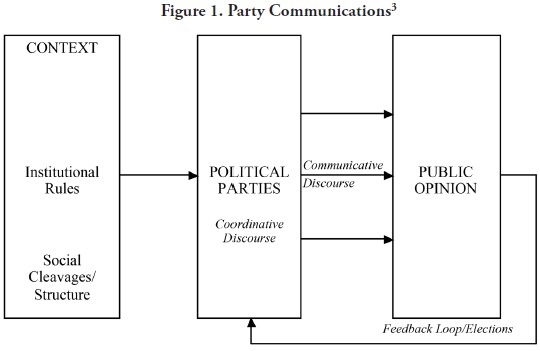
<body><![CDATA[<br>      <br>   </p>       <p class="western" style="page-break-inside: avoid; widows: 8;" align="justify" lang="en-US"> <font face="Verdana, sans-serif"><font size="2">The turn towards institutionalism as a way of explaining the political world has been well documented (<a name="_Hall_and_Taylor_1996"></a><a href="#Hall_Peter_A._and_Rosemary_C.R._Taylor">Hall and Taylor 1996</a>; <a name="_Lichbach_2002"></a><a href="#Lichbach_Mark_I._2002">Lichbach 2002</a>; <a href="#Schmidt_Vivien_A._2010">Schmidt 2010</a>; <a name="_Aspinwall_and_Schneider_2000"></a><a href="mailto:#Aspinwall_Mark_and_Gerald_Schneider">Aspinwall and Schneider 2000</a>). The three &ldquo;new institutionalisms&rdquo; that developed independently from one another &#9472;historical, sociological and rational choice institutionalism&ndash; sought to move beyond the behavioralism of the 1960s and 70s by refocusing on the role that institutions play in shaping political outcomes. Institutions in their simplest definition are seen as rules. Their study can vary from those on organizations and formal rules, to norms and informal rules (<a name="_Streeck_and_Thelen_2005"></a><a href="#Streeck_Wolfgang_and_Kathleen_Thelen">Streeck and Thelen 2005</a>; <a name="_Steinmo_2008"></a><a href="#Steinmo_Sven_2008">Steinmo 2008</a>).</font></font></p>       <p class="western" style="page-break-inside: avoid; widows: 8;" align="justify" lang="en-US"> <font face="Verdana, sans-serif"><font size="2">However, explaining change in the political world through &ldquo;static institutions&rdquo; can be problematic (<a href="#Schmidt_Vivien_2006a">Schmidt 2006a: 11</a>). That is why one has recently seen a turn to ideas in all three institutionalist approaches (for a discussion see <a name="_B&eacute;land_and_Cox_2011"></a><a href="#B%E9land_Daniel_and_Robert_Henry_Cox">B&eacute;land and Cox 2011</a>). Some have stayed within the confines of their approach, while others have moved into what Schmidt has labeled &ldquo;discursive institutionalism&rdquo;. <font color="#000000">She sees this institutionalism as &ldquo;an umbrella concept for the vast range of works in political science that take account of the substantive content of ideas and the interactive process by which ideas are conveyed and exchanged through discourse&rdquo; (<a href="#Schmidt_Vivien_A._2010">Schmidt 2010: 3</a>). </font>As an approach, it is closely related to sociological institutionalism. The difference between the two is more one of degree than kind: discursive institutionalism treats ideas as &ldquo;dynamic constructs&rdquo;, while sociological institutionalism treats them as &ldquo;static structures&rdquo; (<a href="#Schmidt_Vivien_2008">Schmidt 2008: 320</a>). Through the tracing of discourse, discursive institutionalism allows one to trace when change happens within a political system. Discourse, as defined by Schmidt, is &ldquo;whatever policy actors say to one another and to the public in their efforts to generate and legitimize a policy programme&rdquo; (<a href="#Schmidt_Vivien_2002">Schmidt 2002: 210</a>). The institutional context of a country also matters, for it frames the discourse.</font></font></p>       <p class="western" style="page-break-inside: avoid; widows: 8;" align="justify" lang="en-US"> <font face="Verdana, sans-serif"><font size="2">The emphasis in this approach is on examining the discursive interactions that take place in any given system. It focuses on agents, or &lsquo;who is speaking to whom&rsquo;. There are two ideal types of discourse: (1) &ldquo;Coordinative discourse&rdquo; and (2) &ldquo;Communicative discourse&rdquo;. While the first examines how political elites and epistemic communities decide to adopt certain policy positions, the latter is concerned with how those policies are communicated to the public. Schmidt has used this approach to explain differing outcomes between countries, distinguishing between &ldquo;simple&rdquo; and &ldquo;complex&rdquo; polities. Also referred to as &ldquo;single-actor&rdquo; and &ldquo;multi-actor&rdquo; systems, Schmidt argues that due to a stronger executive and the limited need to compromise with others, simple polities are characterized by stronger communicative discourse and weaker coordinative discourse. The opposite holds for compound polities. They will see stronger coordinative discourse because political actors need to coordinate and compromise with one another (<a name="_Schmidt_2006b"></a><a href="#Schmidt_Vivien_2006b">Schmidt 2006b</a>). This makes their communicative discourse thinner, especially for those involved with governing. This is because those governing likely do not want to have the compromises reached behind closed doors publicly scrutinized.</font></font></p>       <p class="western" style="page-break-inside: avoid; widows: 8;" align="justify" lang="en-US"> <font face="Verdana, sans-serif"><font size="2">While Schmidt has employed the discursive insitutionalist approach to explain outcomes at the national level vis-&agrave;-vis the welfare state (2002) and perceptions of the European Union (2006) in Europe, this article argues it is also well suited to study party cohesion and communication. The literature on political parties takes ideas, institutions and interests seriously. It is useful to consider it in terms of discursive institutionalism in order to be able to theorize with greater precision the ideational and discursive processes. Though they do not identify themselves as ideationalist, the four main methods used to study party politics are all concerned with linking parties to ideas. However, while all are concerned with the combination of policies each party holds, almost none consider how they are communicated to the public.</font></font><sup><font face="Verdana, sans-serif"><font size="2"><a class="sdfootnoteanc" name="sdfootnote4anc" href="#sdfootnote4sym"><sup>2</sup></a></font></font></sup></p>       <p class="western" style="page-break-inside: avoid; widows: 8;" align="justify" lang="en-US"> <font face="Verdana, sans-serif"><font size="2">If parties do not effectively communicate their positions to voters, this will hurt those parties at the polls. This is well established in the political communications literature.  Within this literature, two different types of framing are identified: &ldquo;emphasis framing&rdquo; and &ldquo;equivalence framing&rdquo;.  While the latter examines how the way in which the same issue is framed influences outcomes, &ldquo;emphasis framing&rdquo; analyzes the, &ldquo;process in which competing frames emphasize different messages and arguments in a policy debate&rdquo; (<a name="_Shaffner_and_Sellers_2010:_2-3"></a><a href="#Shaffner_Brian_F._and_Patrick_J.">Shaffner and Sellers 2010: 2-3</a>). What is called emphasis framing in the communications literature is referred to as communicative discourse in the discursive institutionalist approach. In essence, it is the study of which frame wins out over another.</font></font></p>       <p class="western" style="page-break-inside: avoid; widows: 8;" align="justify" lang="en-US"> <font face="Verdana, sans-serif"><font size="2">Before a political party can even communicate its ideas to the public, it first needs to agree on what ideas to promote. It needs to &ldquo;connect leaders and elected officials around common programs&rdquo; (<a href="#Norris_Pippa_2005a">Norris 2005a: 3</a>). Put differently: it has to decide what the content of their frame is going to be regarding an issue. This is easier to do if its politicians hold similar views. If they differ substantially in their opinions regarding an issue, disagreement is likely to ensue. In the literature on party cohesion discussed above, it is assumed that such discord will not last long on issues that matter. After all, parties have the means to remove those politicians that do not adhere to a party&rsquo;s views. In the discursive institutionalist approach this process of reaching agreement on what ideas to communicate to the public is described as coordinative discourse. As can be seen in <a href="#figura1">Figure 1</a>, both types of discourses do not take place in a vacuum: they are shaped and constrained by the institutions that underpin a political system.</font></font></p>     <p class="western" style="page-break-inside: avoid; widows: 8;" align="justify" lang="en-US"><font face="Verdana, sans-serif"><font size="2"><a name="figura1"></a></font></font></p>     <p class="western" style="page-break-inside: avoid; widows: 8;" align="justify" lang="en-US"><font face="Verdana, sans-serif"><font size="2"><img style="width: 540px; height: 351px;" alt="" src="/img/revistas/rucp/v24nspe/spea01f1.jpg"></font></font></p>     ]]></body>
<body><![CDATA[<br> <font face="Verdana, sans-serif"><font size="2"><b>Discursive 	Institutionalism and Party Discourse: the Dutch Case</b></font></font>    <br>     <p class="western" style="page-break-inside: avoid; widows: 8;" align="justify" lang="en-US">     <br>   </p>       <p class="western" style="page-break-inside: avoid; widows: 8;" align="justify" lang="en-US"> <font face="Verdana, sans-serif"><font size="2"><font color="#000000">According to Schmidt&rsquo;s ideal types, the Netherlands would be categorized as a compound polity. One should expect a stronger coordinative discourse to be present between the various political parties and epistemic communities. However, when it comes to communicative discourse, one should expect it to be weaker, since &ldquo;political leaders are schooled in communicating only in vague terms on agreements reached among the wide range of actors involved in the coordinative discourse of policy construction&rdquo; (<a href="#Schmidt_Vivien_2006b">Schmidt, 2006b: 45</a>). Even when in opposition, politicians in a compound system are expected to speak vaguely. While today the governing parties are their foes, tomorrow they may be their coalition partners. As a political actor you do not want to burn any bridges unnecessarily. Reaching a consensus in such a fragmented system takes time and is difficult. This discourse framework goes a long way towards explaining why traditionally dominant political parties were so slow in forming a discourse concerning immigration and Dutch identity once the issue became more salient.</font></font></font></p>       <p class="western" style="page-break-inside: avoid; widows: 8;" align="justify" lang="en-US"> <font face="Verdana, sans-serif"><font size="2"><font color="#000000">Upon closer examination of political discourse in the Netherlands these last two decades, the above theoretical framework should be amended to distinguish between &ldquo;newer&rdquo; and more &ldquo;traditional&rdquo; political parties. Schmidt contends that communicative discourse becomes more pronounced in compound polities only during election times and during periods when coordinative discourse breaks down (<a href="#Schmidt_Vivien_2006b">Schmidt 2006b: 262</a>). However, politicians such as Geert Wilders (Freedom Party - PVV), Pim Fortuyn (LPF), Alexander Pechtold (D66) and Jan Marijnissen (Socialist Party - SP) have continued to employ polarizing discourse even during non-election times (<a href="#Van_Gorp_Johannes_A.A.M._2012">Van Gorp 2012</a>). With his party serving as a minority partner of the governing coalition from 2010 to 2012, Wilders for a while got the best of both worlds. More stringent immigration and integration policies were proposed, while at the same time the PVV had no reason to moderate its discourse. As for the other parties, D66, the SP, and the GreenLeft also have displayed clear communicative discourse vis-&agrave;-vis socio-cultural issues during both election and non-election times. Parties such as the CDA, VVD and PvdA have not and continue to conform to Schmidt&rsquo;s expectations. </font></font></font> </p>       <p class="western" style="page-break-inside: avoid; widows: 8;" align="justify" lang="en-US"> <font face="Verdana, sans-serif"><font size="2">Despite the increased importance of socio-cultural issues to voters, parties such as the CDA, VVD and PvdA have remained internally torn over them. Socio-cultural issues became politicized in the 1990s. Following the 1960s, the religious cleavage that had been so important to explaining post-war Dutch politics began to lose much of its salience amongst voters (<a name="_Lijphart_1975"></a><a href="#Lijphart_Arend_1975">Lijphart, 1975</a>). In the 1990s a socio-cultural one began to take its place as a significant segment of the electorate not only became anti-immigrant, but also voiced that it found it one of <i>the </i>most important issues facing the nation. For example, close to half the voters identified &ldquo;immigration&rdquo; as the most important issue facing the nation in the 1994 elections (<a name="_Boomgaarden_2007:_104"></a><a href="#Boomgaarden_Hajo_G._2007">Boomgaarden 2007: 104</a>). Parties now had to decide what position to take on these issues. In the Netherlands, this is decided through coordinative discourse that involves politicians and the think-tanks attached to most parties. They decide what the party manifesto will be prior to each election.</font></font></p>       <p class="western" style="page-break-inside: avoid; widows: 8;" align="justify" lang="en-US"> <font face="Verdana, sans-serif"><font size="2">Initially only the leader of the VVD, Frits Bolkestein, was willing to employ frames that not only were critical of immigrant integration, but also questioned existing immigration policy and whether Islamic culture was really equal to that of the West. He first voiced such criticism in the early 1990s and repeated these claims in the 1994 and 1998 elections. Even after Bolkenstein broached the subject, most other politicians continued to avoid it.</font></font><sup><font face="Verdana, sans-serif"><font size="2"><a class="sdfootnoteanc" name="sdfootnote6anc" href="#sdfootnote6sym"><sup>4</sup></a></font></font></sup><font face="Verdana, sans-serif"><font size="2"> Though a considerable segment of his own party remained critical of his positioning on socio-cultural issues, voters rewarded the VVD handsomely in 1994 and 1998. This changed when Bolkestein left for a position in Brussels following the 1998 elections. With Bolkestein gone, the VVD under the leadership of Hans Dijkstal refrained from further politicizing these issues and moved further to the left.</font></font></p>       <p class="western" style="page-break-inside: avoid; widows: 8;" align="justify" lang="en-US"> <font face="Verdana, sans-serif"><font size="2">With Pim Fortuyn capitalizing on the vacuum left on the right of the political spectrum as a result of the VVD&rsquo;s moderation on socio-cultural issues, the national elections that followed in 2002 were a watershed moment with regard to the discussion of immigration and integration in politics. Taking an even harsher stance against immigrants and the perceived problems associated with their integration than Bolkestein had done resulted in large electoral gains for the LPF. In an analysis of voter motivation in the 2002 elections, Van Holsteyn and Irwin found that LPF voters cited &ldquo;sending back asylum-seekers&rdquo;, and &ldquo;foreigners should adapt&rdquo; as the two main reasons for voting for the party (<a name="_Van_Holsteyn_2003:_41-68"></a><a href="#Van_Holsteyn_Joop_J.M._van_and_Galen">2003: 41-68</a>). Despite Fortuyn&rsquo;s assassination by a lawyer with close ties to the animal rights movement, the campaign he had run resulted in an unprecedented 26 seats out of 150 in the Second Chamber for the LPF. Ranked </font></font><font color="#000000"><font face="Verdana, sans-serif"><font size="2">on the Pedersen index of electoral volatility, these elections ranked &ldquo;fourth among all West European general elections in the period 1900-2002.&rdquo; (<a href="#Van_Holsteyn_Joop_J.M._van_and_Galen">Van Holsteyn and Irwin: 2003</a>).</font></font></font><font face="Verdana, sans-serif"><font size="2"> </font></font><font color="#000000"><font face="Verdana, sans-serif"><font size="2">Though the LPF as a party collapsed soon after the 2002 elections</font></font></font><sup><font color="#000000"><font face="Verdana, sans-serif"><font size="2"><a class="sdfootnoteanc" name="sdfootnote7anc" href="#sdfootnote7sym"><sup>5</sup></a></font></font></font></sup><font color="#000000"><font face="Verdana, sans-serif"><font size="2"> &ndash;in the 2003 parliamentary elections the party fell to 8 seats and gained 0 during the 2006 elections&ndash; the subsequent rise of the PVV has shown that anti-immigrant sentiment can still lead to large electoral gains. </font></font></font> </p>       <p class="western" style="page-break-inside: avoid; widows: 8;" align="justify" lang="en-US"> <font face="Verdana, sans-serif"><font size="2">Parties willing to take a critical stance towards immigration and integration policies &ndash;and communicate that position effectively&ndash; have made significant electoral gains. Neither the VVD nor the CDA were able to step into the void left by the LPF, as both parties remained publicly internally divided over socio-cultural issues. Instead, Geert Wilders left the VVD after disagreements over the party&rsquo;s socio-cultural positioning and established his own party, the PVV. That party made impressive gains in two successive elections. Mainly because of its critical framing towards socio-cultural issues, the PVV became the third largest party in parliament in just five years. <font color="#000000">Following the June 2010 elections, the party became the third largest in parliament. Through their support for the VVD/CDA led minority government, the PVV also played an important role in the shaping of policy from 2010 to 2012. </font>As for the parties that used to dominate Dutch politics, the CDA, VVD and PvdA: they received just over 50 percent of the vote in the last election.</font></font></p>       ]]></body>
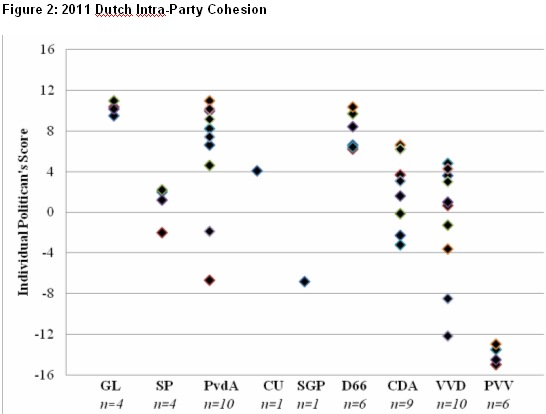
<body><![CDATA[<p class="western" style="page-break-inside: avoid; widows: 8;" align="justify" lang="en-US"> <font face="Verdana, sans-serif"><font size="2">With socio-cultural issues having been politically salient for almost a decade by 2011, it was decided to undertake an analysis of coordinative discourse in the Netherlands to see how unified politicians within parties were over these issues. If the literature on party cohesion was to be believed, parties should have become more unified by now. Since it would be almost impossible to be invited into the backroom deliberations during which decisions were made on how to position a party on these issues, a proxy was devised. To measure how much internal discord there was within parties, 51 politicians from 7 different parties were interviewed. To create a socio-cultural index, politicians were asked nine questions in a semi-structured interview that covered the spectrum of socio-cultural issues (immigration, identity, European integration, and the integration of minorities). Answers were than coded on an ordinal scale ranging from +16 to -16. </font></font> </p>       <p class="western" style="page-break-inside: avoid; widows: 8;" align="justify" lang="en-US"> <font face="Verdana, sans-serif"><font size="2">The more pro-immigrant, pro-European and anti-nationalist a politician&rsquo;s answers were, the higher their individual score was. Inversely, if answers were anti-immigrant, anti-EU and pro-nationalistic, the politician&rsquo;s individual score was lower. Examples of how answers were coded are given below for two of the questions asked. One of the questions asked of the politicians was whether </font></font><font face="Verdana, sans-serif"><font size="2">it matters where immigrants come from for their integration, or if the country of origin does not matter at all? </font></font><font face="Verdana, sans-serif"><font size="2">This question was coded on a scale from -1 to +1. Politicians who argued that the country of emigration mattered for the integration of immigrants into Dutch society received a score of -1. Examples of such responses were: &ldquo;Cultural differences matter. If the culture in the country of emigration is closer to that of the Netherlands, then you have a much easier time integrating.&rdquo;</font></font><sup><font face="Verdana, sans-serif"><font size="2"><a class="sdfootnoteanc" name="sdfootnote8anc" href="#sdfootnote8sym"><sup>6</sup></a></font></font></sup><font face="Verdana, sans-serif"><font size="2"> Another: &ldquo;We have most problems with non-western immigrants.&rdquo;</font></font><sup><font face="Verdana, sans-serif"><font size="2"><a class="sdfootnoteanc" name="sdfootnote9anc" href="#sdfootnote9sym"><sup>7</sup></a></font></font></sup><font face="Verdana, sans-serif"><font size="2"> Politicians who responded that the country of emigration matters but that other variables are just as important for the integration of immigrants, received a score of 0. An example: &ldquo;The country plays </font></font><font face="Verdana, sans-serif"><font size="2"><i>a</i></font></font><font face="Verdana, sans-serif"><font size="2"> role, in various manners, but it is always in combination with other factors. Educational level, socio-economic position... whether you stay with your own group here in the Netherlands [are all factors that matter].&rdquo;</font></font><sup><font face="Verdana, sans-serif"><font size="2"><a class="sdfootnoteanc" name="sdfootnote10anc" href="#sdfootnote10sym"><sup>8</sup></a></font></font></sup><font face="Verdana, sans-serif"><font size="2"> Finally, respondents that said the country of emigration did not matter at all for integration into Dutch society received a score of +1. Amongst these responses was the following: &ldquo;The background of immigrants matter, but the land of origin does not&hellip;It matters whether people studied or not, whether they are from rural regions or from cities. It matters how wealthy immigrants are and how much knowledge of the world they have, how cosmopolitan one is&hellip; The country itself is not an explanatory variable.&rdquo;</font></font><sup><font face="Verdana, sans-serif"><font size="2"><a class="sdfootnoteanc" name="sdfootnote11anc" href="#sdfootnote11sym"><sup>9</sup></a></font></font></sup></p>       <p class="western" style="page-break-inside: avoid; widows: 8;" align="justify" lang="en-US"> <font face="Verdana, sans-serif"><font size="2">Some answers were coded on a scale from -2 to +2. For example, one question asked the following about integration policy: &ldquo;In January 2000, Paul Scheffer published an article entitled &ldquo;The Multicultural Drama&rdquo; in De Volkskrant. In it he was very critical of integration policy in the 1980s. Had that policy really failed, or were there also positive aspects to the policy of &lsquo;integration with retention of one&rsquo;s own identity&rsquo;?&rdquo; Respondents who argued integration policy of the 1980s was a total failure and had no redeeming qualities received a score of -2. Such answers included the following: &ldquo;It was failing policy. The emphasis was too much on the &lsquo;new Dutchmen&rsquo;, while little thought was given to the &lsquo;original Dutchmen&rsquo;, the man that lives in an apartment building in Rotterdam and was just fired from his job because of increased competition&hellip; and encounters the problems [associated with immigration] daily.&rdquo;</font></font><sup><font face="Verdana, sans-serif"><font size="2"><a class="sdfootnoteanc" name="sdfootnote12anc" href="#sdfootnote12sym"><sup>10</sup></a></font></font></sup><font face="Verdana, sans-serif"><font size="2"> Another: &ldquo;It was totally failed policy.  We wouldn&rsquo;t have the mess we have now if the policy had been successful.&rdquo;</font></font><sup><font face="Verdana, sans-serif"><font size="2"><a class="sdfootnoteanc" name="sdfootnote13anc" href="#sdfootnote13sym"><sup>11</sup></a></font></font></sup><font face="Verdana, sans-serif"><font size="2"> If politicians identified the policy as failed, but then identified just a few positive aspects, their answer was coded as -1. Two examples are: &ldquo;The policy failed in the sense that it failed to stimulate a large group of people to actively participate in society... But the thought process behind the policy was a positive one,&rdquo;</font></font><sup><font face="Verdana, sans-serif"><font size="2"><a class="sdfootnoteanc" name="sdfootnote14anc" href="#sdfootnote14sym"><sup>12</sup></a></font></font></sup><font face="Verdana, sans-serif"><font size="2"> and, &ldquo;While the policy was failing, the integration itself has been relatively successful.&rdquo;</font></font><sup><font face="Verdana, sans-serif"><font size="2"><a class="sdfootnoteanc" name="sdfootnote15anc" href="#sdfootnote15sym"><sup>13</sup></a></font></font></sup><font face="Verdana, sans-serif"><font size="2"> The answer was coded as 0 if the emphasis of the answer was on equally identifying both positive and negative aspects of integration policy in the 1980s. Answers were coded as +1 if respondents claimed there were problems with integration policy in the 1980s, but spent most of their time identifying its good qualities. Such answers were, &ldquo;The Netherlands is a multicultural society&hellip;You do need a common language and values that people follow,&rdquo;</font></font><sup><font face="Verdana, sans-serif"><font size="2"><a class="sdfootnoteanc" name="sdfootnote16anc" href="#sdfootnote16sym"><sup>14</sup></a></font></font></sup><font face="Verdana, sans-serif"><font size="2"> and, &ldquo;I enjoy living in a country where you see different identities and cultures&hellip;At the same time I don&rsquo;t live in a neighborhood where you encounter 20 different cultures a day.&rdquo;</font></font><sup><font face="Verdana, sans-serif"><font size="2"><a class="sdfootnoteanc" name="sdfootnote17anc" href="#sdfootnote17sym"><sup>15</sup></a></font></font></sup><font face="Verdana, sans-serif"><font size="2">  If respondents refused to identify the policy as failed and claimed identity could still be retained while integrating, their answer was coded as +2. An example: &ldquo;When integration is successful, you don&rsquo;t have to relinquish your whole identity. It&rsquo;s about your behavior, that&rsquo;s what matters.&rdquo;</font></font><sup><font face="Verdana, sans-serif"><font size="2"><a class="sdfootnoteanc" name="sdfootnote18anc" href="#sdfootnote18sym"><sup>16</sup></a></font></font></sup></p>       <p class="western" style="page-break-inside: avoid; widows: 8;" align="justify" lang="en-US"> <font face="Verdana, sans-serif"><font size="2">Figure 2 shows how individual scores were then compared within parties to see how similar opinions were within a party over socio-cultural issues. This serves a strong indicator as to how much internal discord remains within parties over socio-cultural issues and how fraught their coordinative discourse is likely to be. The <font color="#000000">placement of political parties on this figure from left to right is</font> based on how <font color="#000000"><a name="_Van_Kersbergen_and_Krouwel_2008"></a><a href="#Van_Kersbergen_Kees_and_Andr%E9_Krouwel">Van Kersbergen and Krouwel (2008)</a> positioned parties on the socio-economic cleavage in their piece on the Dutch centre-right. In their study parties rank as follows on this cleavage: GreenLeft, SP, PvdA, CU, SGP, D66, CDA, VVD, and PVV.</font> Despite having been salient to voters for over two decades, scores made clear that the CDA, VVD and PvdA, as of 2011, remained internally torn over socio-cultural issues, while politicians of the SP, D66, GreenLeft and PVV were unified in their views towards these issues. Therefore, it is not surprising that these parties have not had major public disagreements over socio-cultural issues. Accordingly, they have also been very effective in communicating their position on the socio-cultural dimension. In other words: they have had both successful coordinative and communicative discourses. This stands in stark contrast to the CDA, VVD, and PvdA. These three parties have remained internally divided over socio-cultural issues. They continue to be so today, despite the importance of these issues to a significant portion of the electorate.</font></font></p>     <p class="western" style="page-break-inside: avoid; widows: 8;" align="justify" lang="en-US"><font face="Verdana, sans-serif"><font size="2"><a name="figura2"></a></font></font></p> <img style="width: 546px; height: 414px;" alt="" src="/img/revistas/rucp/v24nspe/spea01g1.jpg"><span style="font-family: &quot;Times New Roman&quot;,serif;">    <br>      <br>  </span>     <p class="western" style="page-break-inside: avoid; widows: 8;" align="justify" lang="en-US">     <font face="Verdana, sans-serif"><font size="2">One can speculate as to     why these traditionally dominant parties continue to remain more     ]]></body>
<body><![CDATA[divided over socio-cultural issues than others. In the appropriately     entitled </font></font><font face="Verdana, sans-serif"><font size="2"><i>The     Brawlers Party </i></font></font><font face="Verdana, sans-serif"><font size="2">(De     Vechtpartij),</font></font><font face="Verdana, sans-serif"><font size="2"><i>     </i></font></font><font face="Verdana, sans-serif"><font size="2"><a name="_Niemantsverdriet_2014"></a><a href="#Niemantsverdriet_Thijs_2014">Niemantsverdriet     (2014)</a> argues that internal discord within the PvdA is to blame on     its &ldquo;ideological insecurity&rdquo; that has dominated since     1986, the unpleasant internal culture that exists within the party,     and the temptation of Dutch labor politicians to publicly     self-chastise themselves (256). Alternatively, despite their     ]]></body>
<body><![CDATA[decreasing share of the vote, many politicians within the CDA and     PvdA continue to see their parties as broad &ldquo;people&rsquo;s     parties&rdquo; (volkspartijen). Hans Spekman, who has been chairman     of the PvdA since 2011, has publicly argued on multiple occasions     that: &ldquo;</font></font><font face="Verdana, sans-serif"><font size="2"><span lang="en-GB">I</span></font></font><font face="Verdana, sans-serif"><font size="2"><span lang="en-GB">     </span></font></font><font face="Verdana, sans-serif"><font size="2"><span lang="en-GB">find</span></font></font><font face="Verdana, sans-serif"><font size="2"><span lang="en-GB">     </span></font></font><font face="Verdana, sans-serif"><font size="2"><span lang="en-GB">it</span></font></font><font face="Verdana, sans-serif"><font size="2"><span lang="en-GB">     </span></font></font><font face="Verdana, sans-serif"><font size="2"><span lang="en-GB">important</span></font></font><font face="Verdana, sans-serif"><font size="2"><span lang="en-GB">     </span></font></font><font face="Verdana, sans-serif"><font size="2"><span lang="en-GB">that</span></font></font><font face="Verdana, sans-serif"><font size="2"><span lang="en-GB">     </span></font></font><font face="Verdana, sans-serif"><font size="2"><span lang="en-GB">the</span></font></font><font face="Verdana, sans-serif"><font size="2"><span lang="en-GB">     ]]></body>
<body><![CDATA[</span></font></font><font face="Verdana, sans-serif"><font size="2"><span lang="en-GB">PvdA</span></font></font><font face="Verdana, sans-serif"><font size="2"><span lang="en-GB">     </span></font></font><font face="Verdana, sans-serif"><font size="2"><span lang="en-GB">remain</span></font></font><font face="Verdana, sans-serif"><font size="2"><span lang="en-GB">     </span></font></font><font face="Verdana, sans-serif"><font size="2"><span lang="en-GB">a</span></font></font><font face="Verdana, sans-serif"><font size="2"><span lang="en-GB">     </span></font></font><font face="Verdana, sans-serif"><font size="2"><span lang="en-GB">broad</span></font></font><font face="Verdana, sans-serif"><font size="2"><span lang="en-GB">     </span></font></font><font face="Verdana, sans-serif"><font size="2"><span lang="en-GB">people</span></font></font><font face="Verdana, sans-serif"><font size="2"><span lang="en-GB">&rsquo;</span></font></font><font face="Verdana, sans-serif"><font size="2"><span lang="en-GB">s</span></font></font><font face="Verdana, sans-serif"><font size="2"><span lang="en-GB">     </span></font></font><font face="Verdana, sans-serif"><font size="2"><span lang="en-GB">party</span></font></font><font face="Verdana, sans-serif"><font size="2"><span lang="en-GB">     </span></font></font><font face="Verdana, sans-serif"><font size="2"><span lang="en-GB">and</span></font></font><font face="Verdana, sans-serif"><font size="2"><span lang="en-GB">     </span></font></font><font face="Verdana, sans-serif"><font size="2"><span lang="en-GB">that</span></font></font><font face="Verdana, sans-serif"><font size="2"><span lang="en-GB">     </span></font></font><font face="Verdana, sans-serif"><font size="2"><span lang="en-GB">the</span></font></font><font face="Verdana, sans-serif"><font size="2"><span lang="en-GB">     </span></font></font><font face="Verdana, sans-serif"><font size="2"><span lang="en-GB">tensions</span></font></font><font face="Verdana, sans-serif"><font size="2"><span lang="en-GB">     ]]></body>
<body><![CDATA[</span></font></font><font face="Verdana, sans-serif"><font size="2"><span lang="en-GB">that</span></font></font><font face="Verdana, sans-serif"><font size="2"><span lang="en-GB">     </span></font></font><font face="Verdana, sans-serif"><font size="2"><span lang="en-GB">are</span></font></font><font face="Verdana, sans-serif"><font size="2"><span lang="en-GB">     </span></font></font><font face="Verdana, sans-serif"><font size="2"><span lang="en-GB">apparent</span></font></font><font face="Verdana, sans-serif"><font size="2"><span lang="en-GB">     </span></font></font><font face="Verdana, sans-serif"><font size="2"><span lang="en-GB">in</span></font></font><font face="Verdana, sans-serif"><font size="2"><span lang="en-GB">     </span></font></font><font face="Verdana, sans-serif"><font size="2"><span lang="en-GB">society...     also</span></font></font><font face="Verdana, sans-serif"><font size="2"><span lang="en-GB">     </span></font></font><font face="Verdana, sans-serif"><font size="2"><span lang="en-GB">remain</span></font></font><font face="Verdana, sans-serif"><font size="2"><span lang="en-GB">     </span></font></font><font face="Verdana, sans-serif"><font size="2"><span lang="en-GB">within</span></font></font><font face="Verdana, sans-serif"><font size="2"><span lang="en-GB">     </span></font></font><font face="Verdana, sans-serif"><font size="2"><span lang="en-GB">the</span></font></font><font face="Verdana, sans-serif"><font size="2"><span lang="en-GB">     </span></font></font><font face="Verdana, sans-serif"><font size="2"><span lang="en-GB">Labour</span></font></font><font face="Verdana, sans-serif"><font size="2"><span lang="en-GB">     ]]></body>
<body><![CDATA[</span></font></font><font face="Verdana, sans-serif"><font size="2"><span lang="en-GB">Party.</span></font></font><font face="Verdana, sans-serif"><font size="2"><span lang="en-GB">     </span></font></font><font face="Verdana, sans-serif"><font size="2"><span lang="en-GB">That</span></font></font><font face="Verdana, sans-serif"><font size="2"><span lang="en-GB">     </span></font></font><font face="Verdana, sans-serif"><font size="2"><span lang="en-GB">is</span></font></font><font face="Verdana, sans-serif"><font size="2"><span lang="en-GB">     </span></font></font><font face="Verdana, sans-serif"><font size="2"><span lang="en-GB">the</span></font></font><font face="Verdana, sans-serif"><font size="2"><span lang="en-GB">     </span></font></font><font face="Verdana, sans-serif"><font size="2"><span lang="en-GB">way</span></font></font><font face="Verdana, sans-serif"><font size="2"><span lang="en-GB">     </span></font></font><font face="Verdana, sans-serif"><font size="2"><span lang="en-GB">it</span></font></font><font face="Verdana, sans-serif"><font size="2"><span lang="en-GB">     </span></font></font><font face="Verdana, sans-serif"><font size="2"><span lang="en-GB">has</span></font></font><font face="Verdana, sans-serif"><font size="2"><span lang="en-GB">     </span></font></font><font face="Verdana, sans-serif"><font size="2"><span lang="en-GB">always</span></font></font><font face="Verdana, sans-serif"><font size="2"><span lang="en-GB">     </span></font></font><font face="Verdana, sans-serif"><font size="2"><span lang="en-GB">been</span></font></font><font face="Verdana, sans-serif"><font size="2"><span lang="en-GB">&rdquo;     </span></font></font><font face="Verdana, sans-serif"><font size="2"><span lang="en-GB">(<a name="_Spekman_2011"></a><a href="#Spekman_Hans_in_Oldenbeuving_Joanne">Spekman</a></span></font></font><a href="#Spekman_Hans_in_Oldenbeuving_Joanne"><sup><font face="Verdana, sans-serif"><font size="2"><span lang="en-GB">     ]]></body>
<body><![CDATA[</span></font></font></sup></a><font face="Verdana, sans-serif"><font size="2"><span lang="en-GB"><a href="#Spekman_Hans_in_Oldenbeuving_Joanne">2011</a>).     After sliding in the polls throughout 2011, the leadership of the CDA     decided it was time to analyse why this was happening. Despite all     the changes proposed, the report that this produced concluded that:     &ldquo;</span></font></font><font color="#000000"><font face="Verdana, sans-serif"><font size="2"><span lang="en-GB">The</span></font></font></font><font color="#000000"><font face="Verdana, sans-serif"><font size="2"><span lang="en-GB">     </span></font></font></font><font color="#000000"><font face="Verdana, sans-serif"><font size="2"><span lang="en-GB">CDA</span></font></font></font><font color="#000000"><font face="Verdana, sans-serif"><font size="2"><span lang="en-GB">     </span></font></font></font><font color="#000000"><font face="Verdana, sans-serif"><font size="2"><span lang="en-GB">is</span></font></font></font><font color="#000000"><font face="Verdana, sans-serif"><font size="2"><span lang="en-GB">     </span></font></font></font><font color="#000000"><font face="Verdana, sans-serif"><font size="2"><span lang="en-GB">and</span></font></font></font><font color="#000000"><font face="Verdana, sans-serif"><font size="2"><span lang="en-GB">     </span></font></font></font><font color="#000000"><font face="Verdana, sans-serif"><font size="2"><span lang="en-GB">remains</span></font></font></font><font color="#000000"><font face="Verdana, sans-serif"><font size="2"><span lang="en-GB">     </span></font></font></font><font color="#000000"><font face="Verdana, sans-serif"><font size="2"><span lang="en-GB">a</span></font></font></font><font color="#000000"><font face="Verdana, sans-serif"><font size="2"><span lang="en-GB">     ]]></body>
<body><![CDATA[</span></font></font></font><font color="#000000"><font face="Verdana, sans-serif"><font size="2"><span lang="en-GB">Christian-Democratic</span></font></font></font><font color="#000000"><font face="Verdana, sans-serif"><font size="2"><span lang="en-GB">     </span></font></font></font><font color="#000000"><font face="Verdana, sans-serif"><font size="2"><span lang="en-GB"><i>people</i></span></font></font></font><font color="#000000"><font face="Verdana, sans-serif"><font size="2"><span lang="en-GB"><i>&rsquo;</i></span></font></font></font><font color="#000000"><font face="Verdana, sans-serif"><font size="2"><span lang="en-GB"><i>s</i></span></font></font></font><font color="#000000"><font face="Verdana, sans-serif"><font size="2"><span lang="en-GB">     </span></font></font></font><font color="#000000"><font face="Verdana, sans-serif"><font size="2"><span lang="en-GB">party</span></font></font></font><font color="#000000"><font face="Verdana, sans-serif"><font size="2"><span lang="en-GB">&rdquo;     </span></font></font></font><font color="#000000"><font face="Verdana, sans-serif"><font size="2"><span lang="en-GB">(</span></font></font></font><a href="#Du_Pr%E9_Raoul_2012"><font face="Verdana, sans-serif"><font size="2"><span lang="en-GB"></span></font></font></a><font face="Verdana, sans-serif"><font size="2"><a name="_Du_Pr&eacute;_2012"></a>Du</font></font><font face="Verdana, sans-serif"><font size="2"><span lang="en-GB">     </span></font></font><font face="Verdana, sans-serif"><font size="2"><span lang="en-GB">Pr&eacute;</span></font></font><sup><font color="#000000"><font face="Verdana, sans-serif"><font size="2"><span lang="en-GB">     </span></font></font></font></sup><font color="#000000"><font face="Verdana, sans-serif"><font size="2"><span lang="en-GB"><a href="#Du_Pr%E9_Raoul_2012">2012</a>).     Some of those that were interviewed had held leadership positions in     the PvdA and VVD. They were asked directly about this discord in     their parties. One PvdA politician emphasized that since his party     was a &ldquo;people&rsquo;s party&rdquo;, it would naturally have a     ]]></body>
<body><![CDATA[broader spectrum of views represented within it than some of the     newer parties.</span></font></font></font></p>     <p class="western" style="page-break-inside: avoid; widows: 8;" align="justify" lang="en-US"> <font face="Verdana, sans-serif"><font size="2"><font color="#000000"><span lang="en-GB">While the above remains speculative, these findings do raise important questions about </span></font>the assumption in the existing literature that party cohesion will be the norm over time on issues that matter to voters. The above findings from the Netherlands are any indication that is not always the case. Despite having become increasingly important to Dutch voters, socio-cultural issues continue to divide traditionally dominant parties. &ldquo;View of self&rdquo; might be partially to blame for this. By conceiving of themselves as &ldquo;big-tent&rdquo; parties that are at least supposed to partially reflect the divisions that exist over certain issues within society, politicians in traditionally dominant parties continue to place members on their lists that are reflective of these divides. </font></font> </p>       <p class="western" style="page-break-inside: avoid; widows: 8;" align="justify" lang="en-US">     <br>   </p>   <ol start="5">   	    <li>              <p class="western" style="page-break-inside: avoid; widows: 8;" align="justify" lang="en-US"> 	<font face="Verdana, sans-serif"><font size="2"><b>Conclusion: 	Discursive Institutionalism and the Study of Party Politics</b></font></font></p>     </li>      </ol>       <p class="western" style="page-break-inside: avoid; widows: 8;" align="justify" lang="en-US">     <br>   </p>       ]]></body>
<body><![CDATA[<p class="western" style="page-break-inside: avoid; widows: 8;" align="justify" lang="en-US"> <font face="Verdana, sans-serif"><font size="2"><font color="#000000">While the positioning of parties on social cleavages is important, to understand party system change, one should also examine how these parties communicate about the positions taken. This is not to say that discursive institutionalism can replace the four often used methodologies. They are still necessary for us to understand how parties relate to one another and where the room for maneuver in an electoral system lies, especially if supplemented with voter analysis. Rather, the approach allows us to get a clearer understanding of why openings exist in certain political systems for new parties where before they did not. A discursive institutionalist approach also allows one to analyze how much disagreement exists within parties over a given issue.</font></font></font></p>       <p class="western" style="page-break-inside: avoid; widows: 8;" align="justify" lang="en-US"> <font face="Verdana, sans-serif"><font size="2">The Dutch case shows us that politicians in the traditionally dominant parties have had a difficult time agreeing over socio-cultural policies that newer parties do internally agree over. This has important implications for how effective these parties are at communicating their party&rsquo;s position regarding this cleavage to the public. Newer parties not only are more effective when it comes to deciding what position to take on socio-cultural issues, but also at communicating to the public about a cleavage that has become increasingly important to a significant segment of the electorate. As long as what used to be mainstream parties remain divided over these issues, they are unlikely to regain the voters they have lost.</font></font></p>        <p class="western" style="page-break-inside: avoid; widows: 8;" align="justify" lang="en-US"> <font face="Verdana, sans-serif"><font size="2">While the above limits itself to the discussion of the Dutch case, it presents promising avenues for future research &ndash;especially when it comes to explaining recent party system change in Europe. Not only has there been a rise of the populist radical right, but parties of the &ldquo;new&rdquo; left have also increasingly done well at the polls. An examination of coordinative and communicative discourse patterns in other countries might reveal not only when openings appeared for such parties, but why, and how persistent these internal divisions remain within traditionally dominant parties.</font></font></p>       <p class="western" style="page-break-inside: avoid; widows: 8;" align="justify" lang="en-US">     <br>      <br>  </p>       <p class="western" style="page-break-inside: avoid; widows: 8; page-break-before: always;" align="justify" lang="en-US"> <font face="Verdana, sans-serif"><font size="2"><b>References</b></font></font></p>       <p class="western" style="page-break-inside: avoid; widows: 8;" align="justify" lang="en-US">     <br>      <br>   </p>       ]]></body>
<body><![CDATA[<p class="western" style="page-break-inside: avoid; widows: 8;" align="justify" lang="en-US"> <font face="Verdana, sans-serif"><font size="2"><a name="Aspinwall_Mark_and_Gerald_Schneider"></a><a href="#_Aspinwall_and_Schneider_2000">Aspinwall, Mark and Gerald Schneider (2000)</a> &ldquo;Same Menu, Separate Tables: The Institutionalist Turn in Political Science and the Study of European Integration.&rdquo; <i>European Journal of Political Research </i>38: 1-36.</font></font></p>       <!-- ref --><p class="western" style="page-break-inside: avoid; widows: 8;" align="justify" lang="en-US"> <font face="Verdana, sans-serif"><font size="2"><a name="Bartoloni_Stefano_and_Peter_Mair_1990"></a><a href="#_Bartoloni_and_Mair_1990:_215">Bartoloni, Stefano and Peter Mair (1990)</a> <i>Identity, Competition and Electoral Availability: The Stabilisation of European Electorates, 1885-1985</i>. New York, NY: Cambridge University Press</font></font><!-- ref --><p class="western" style="page-break-inside: avoid; widows: 8;" align="justify" lang="en-US"> <font face="Verdana, sans-serif"><font size="2"><a name="B&eacute;land_Daniel_and_Robert_Henry_Cox"></a><a href="#_B%E9land_and_Cox_2011">B&eacute;land, Daniel and Robert Henry Cox (2011)</a>. <i>Ideas and Politics in Social Science Research</i>. New York, NY: Oxford University Press.    </font></font></p>       <!-- ref --><p class="western" style="page-break-inside: avoid; widows: 8;" align="justify" lang="en-US"> <font face="Verdana, sans-serif"><font size="2"><a name="Bomhoff_Eduard_J._2002"></a><a href="#_Bomhoff_Eduard_J">Bomhoff, Eduard J. (2002)</a> <i>Blinde Ambitie: mijn 87 dagen met Zalm, Heinsbroek en Balkenende</i>. Amsterdam, the Netherlands: Balans.    </font></font></p>       <!-- ref --><p class="western" style="page-break-inside: avoid; widows: 8;" align="justify" lang="en-US"> <font face="Verdana, sans-serif"><font size="2"><a name="Boomgaarden_Hajo_G._2007"></a><a href="#_Boomgaarden_2007:_104">Boomgaarden, Hajo G. (2007)</a> <i>Framing the Others: News and Ethnic Prejudice</i>. Amsterdam, The Netherlands: University of Amsterdam, Ph.D. Dissertation.    </font></font></p>       <p class="western" style="page-break-inside: avoid; widows: 8;" align="justify" lang="en-US"> <font face="Verdana, sans-serif"><font size="2"><span lang="de-DE"><a name="Du_Pr&eacute;_Raoul_2012"></a><a href="#_Du_Pr%E9_2012">Du</a></span><a href="#_Du_Pr%E9_2012"><span lang="de-DE"> </span><span lang="de-DE">Pr&eacute;,</span><span lang="de-DE"> </span><span lang="de-DE">Raoul</span><span lang="de-DE"> </span></a><span lang="de-DE"><a href="#_Du_Pr%E9_2012">(2012)</a> &ldquo;CDA</span><span lang="de-DE"> </span><span lang="de-DE">zoekt</span><span lang="de-DE"> </span><span lang="de-DE">bezielig.</span>&rdquo;<span lang="de-DE"> </span><span lang="de-DE"><i>De</i></span><span lang="de-DE"><i> </i></span><span lang="de-DE"><i>Volkskrant</i></span><span lang="de-DE">,</span><span lang="de-DE"> </span><span lang="de-DE">9</span><span lang="de-DE"> </span><span lang="de-DE">January,</span><span lang="de-DE"> </span><span lang="de-DE">28.</span></font></font></p>       <p class="western" style="page-break-inside: avoid; widows: 8;" align="justify" lang="en-US"> <font face="Verdana, sans-serif"><font size="2"><span lang="en-GB"><a name="Gemenis_Kostas_and_Elias_Dinas_2010"></a><a href="#_Gemenis_and_Dinas_2010:_181">Gemenis,</a></span><a href="#_Gemenis_and_Dinas_2010:_181"><span lang="en-GB"> </span><span lang="en-GB">Kostas</span><span lang="en-GB"> </span><span lang="en-GB">and</span><span lang="en-GB"> </span><span lang="en-GB">Elias</span><span lang="en-GB"> </span><span lang="en-GB">Dinas</span><span lang="en-GB"> </span><span lang="en-GB">(2010)</span></a><span lang="en-GB"> &ldquo;</span><span lang="en-GB">Confrontation</span><span lang="en-GB"> </span><span lang="en-GB">still?</span><span lang="en-GB"> </span><span lang="en-GB">Examining</span><span lang="en-GB"> </span><span lang="en-GB">parties</span><span lang="en-GB"> </span><span lang="en-GB">policy</span><span lang="en-GB"> </span><span lang="en-GB">positions</span><span lang="en-GB"> </span><span lang="en-GB">in</span><span lang="en-GB"> </span><span lang="en-GB">Greece,&rdquo;</span><span lang="en-GB"> </span><span lang="en-GB"><i>Comparative</i></span><span lang="en-GB"><i> </i></span><span lang="en-GB"><i>European</i></span><span lang="en-GB"><i> </i></span><span lang="en-GB"><i>Politics</i></span><span lang="en-GB"><i> </i></span><span lang="en-GB">8(2):</span><span lang="en-GB"> </span><span lang="en-GB">179-201.</span></font></font></p>       ]]></body>
<body><![CDATA[<p class="western" style="page-break-inside: avoid; widows: 8;" align="justify" lang="en-US"> <font face="Verdana, sans-serif"><font size="2"><a name="Golder_Matt_2003"></a>Golder, Matt (2003) &ldquo;Explaining Variation in the Success of Extreme Right Parties in Western Europe.&rdquo; <i>Comparative Political Studies </i>36(4), May: 432-466</font></font></p>       <p class="western" style="page-break-inside: avoid; widows: 8;" align="justify" lang="en-US"> <font face="Verdana, sans-serif"><font size="2"><a name="Hall_Peter_A._and_Rosemary_C.R._Taylor"></a><a href="#_Hall_and_Taylor_1996">Hall, Peter A. and Rosemary C.R. Taylor (1996)</a> &ldquo;<i>Political Science and the Three New Institutionalisms,</i>&rdquo; Paper presented at the <i>MPIFG Scientific Advisory Board</i>, May 9.</font></font></p>       <!-- ref --><p class="western" style="page-break-inside: avoid; widows: 8;" align="justify" lang="en-US"> <font face="Verdana, sans-serif"><font size="2"><span lang="en-GB"><a name="Hazan_Reuven_Y._2006"></a><a href="#_Hazan_2006">Hazan,</a></span><a href="#_Hazan_2006"><span lang="en-GB"> </span><span lang="en-GB">Reuven</span><span lang="en-GB"> </span><span lang="en-GB">Y.</span><span lang="en-GB"> </span><span lang="en-GB">(2006)</span></a><span lang="en-GB"> </span><span lang="en-GB"><i>Cohesion</i></span><span lang="en-GB"><i> </i></span><span lang="en-GB"><i>and</i></span><span lang="en-GB"><i> </i></span><span lang="en-GB"><i>Discipline</i></span><span lang="en-GB"><i> </i></span><span lang="en-GB"><i>in</i></span><span lang="en-GB"><i> </i></span><span lang="en-GB"><i>Legislatures</i></span><span lang="en-GB">. New York, NY:</span><span lang="en-GB"> </span><span lang="en-GB">Routledge.    </span></font></font></p>       <p class="western" style="page-break-inside: avoid; widows: 8;" align="justify" lang="en-US"> <font face="Verdana, sans-serif"><font size="2"><span lang="nl-NL"><a name="Hoogenboom_Marcel_and_Peter_Scholten"></a><a href="#_Hoogenboom_and_Scholten_2008:_115-117">Hoogenboom, Marcel and Peter Scholten (2008)</a> &ldquo;Migranten en de Erfenis van de Verzuiling in Nederland: Een analyse van de invloed van de verzuiling op het Nederlandse migrantenbeleid,&rdquo; </span><span lang="nl-NL"><i>Beleid en Maatschappij </i></span><span lang="nl-NL">35(2): 107-124. </span></font></font> </p>       <p class="western" style="page-break-inside: avoid; widows: 8;" align="justify" lang="en-US"> <font face="Verdana, sans-serif"><font size="2"><span lang="en-GB"><a name="Jensen_Torben_K._2000"></a><a href="#_Jensen_2000:_210-236">Jensen,</a></span><a href="#_Jensen_2000:_210-236"><span lang="en-GB"> </span><span lang="en-GB">Torben</span><span lang="en-GB"> </span><span lang="en-GB">K.</span><span lang="en-GB"> </span><span lang="en-GB">(2000)</span></a><span lang="en-GB"> &ldquo;</span><span lang="en-GB">Party</span><span lang="en-GB"> </span><span lang="en-GB">Cohesion.</span><span lang="en-GB">&rdquo; </span><span lang="en-GB">In:</span><span lang="en-GB"> </span><span lang="en-GB">Esaiasson,</span><span lang="en-GB"> </span><span lang="en-GB">Peter</span><span lang="en-GB"> </span><span lang="en-GB">&amp;</span><span lang="en-GB"> </span><span lang="en-GB">Knut</span><span lang="en-GB"> </span><span lang="en-GB">Heidar.</span><span lang="en-GB"> </span><span lang="en-GB"><i>Beyond</i></span><span lang="en-GB"><i> </i></span><span lang="en-GB"><i>Westminster</i></span><span lang="en-GB"><i> </i></span><span lang="en-GB"><i>and</i></span><span lang="en-GB"><i> </i></span><span lang="en-GB"><i>Congress:</i></span><span lang="en-GB"><i> </i></span><span lang="en-GB"><i>The</i></span><span lang="en-GB"><i> </i></span><span lang="en-GB"><i>Nordic</i></span><span lang="en-GB"><i> </i></span><span lang="en-GB"><i>Experience</i></span><span lang="en-GB">. Chicago, IL:</span><span lang="en-GB"> </span><span lang="en-GB">Ohio</span><span lang="en-GB"> </span><span lang="en-GB">State</span><span lang="en-GB"> </span><span lang="en-GB">University</span><span lang="en-GB"> </span><span lang="en-GB">Press.</span></font></font></p>       <!-- ref --><p class="western" style="page-break-inside: avoid; widows: 8;" align="justify" lang="en-US"> <font face="Verdana, sans-serif"><font size="2"><a name="Kriesi_Hanspeter_Edgar_Grande_Martin"></a><a href="#_Kriesi_et._al.%92s_2012">Kriesi, Hanspeter, Edgar Grande, Martin Dolezal, Marc Helbling, Dominic H&ouml;glinger, Swen Hutter and Bruno W&uuml;est (2012)</a> <i>Political Conflict in Western Europe</i>. New York, NY: Cambridge University Press.    </font></font></p>       <p class="western" style="page-break-inside: avoid; widows: 8;" align="justify" lang="en-US"> <font face="Verdana, sans-serif"><font size="2"><a name="Lichbach_Mark_I._2002"></a><a href="#_Lichbach_2002">Lichbach, Mark I. (2002)</a> &ldquo;Social Theory and Comparative Politics.&rdquo; In: Mark Irving Lichbach and Alan S. Zuckerman. <i>Comparative Politics: Rationality, Culture, and Structure</i>. New York, NY: Cambridge University Press.</font></font></p>       <!-- ref --><p class="western" style="page-break-inside: avoid; widows: 8;" align="justify" lang="en-US"> <font face="Verdana, sans-serif"><font size="2"><a name="Lijphart_Arend_1975"></a><a href="#_Lijphart_1975">Lijphart, Arend (1975)</a> <i>The Politics of Accommodation: Pluralism and Democracy in the Netherlands</i>.  Berkley, CA: University of California Press.    </font></font></p>       <p class="western" style="page-break-inside: avoid; widows: 8;" align="justify" lang="en-US"> <font face="Verdana, sans-serif"><font size="2"><span lang="nl-NL"><a name="Lucardie_Paul_Arjan_Marchand__Gerrit"></a><a href="#_Lucardie_Marchand_and_Voerman_2007">Lucardie,</a></span><a href="#_Lucardie_Marchand_and_Voerman_2007"><span lang="nl-NL"> </span><span lang="nl-NL">Paul,</span><span lang="nl-NL"> </span><span lang="nl-NL">Arjan</span><span lang="nl-NL"> </span><span lang="nl-NL">Marchand</span><span lang="nl-NL"> </span><span lang="nl-NL">&amp;</span><span lang="nl-NL"> </span><span lang="nl-NL">Gerrit</span><span lang="nl-NL"> </span><span lang="nl-NL">Voerman</span><span lang="nl-NL"> </span></a><span lang="nl-NL"><a href="#_Lucardie_Marchand_and_Voerman_2007">(2007)</a> </span><span lang="nl-NL">&ldquo;</span><span lang="nl-NL">Frictie</span><span lang="nl-NL"> </span><span lang="nl-NL">in</span><span lang="nl-NL"> </span><span lang="nl-NL">de</span><span lang="nl-NL"> </span><span lang="nl-NL">fractie.</span><span lang="nl-NL">&rdquo; </span><span lang="nl-NL">In:</span><span lang="nl-NL"> </span><span lang="nl-NL">Van</span><span lang="nl-NL"> </span><span lang="nl-NL">der</span><span lang="nl-NL"> </span><span lang="nl-NL">Hout,</span><span lang="nl-NL"> </span><span lang="nl-NL">Eliora,</span><span lang="nl-NL"> </span><span lang="nl-NL">Wytze</span><span lang="nl-NL"> </span><span lang="nl-NL">van</span><span lang="nl-NL"> </span><span lang="nl-NL">der</span><span lang="nl-NL"> </span><span lang="nl-NL">Woude,</span><span lang="nl-NL"> </span><span lang="nl-NL">&amp;</span><span lang="nl-NL"> </span><span lang="nl-NL">Gerrit</span><span lang="nl-NL"> </span><span lang="nl-NL">Voerman</span><span lang="nl-NL"> </span><span lang="nl-NL">(Eds.).</span><span lang="nl-NL"> </span><span lang="nl-NL"><i>Representatie,</i></span><span lang="nl-NL"><i> </i></span><span lang="nl-NL"><i>fractiediscipline</i></span><span lang="nl-NL"><i> </i></span><span lang="nl-NL"><i>en</i></span><span lang="nl-NL"><i> </i></span><span lang="nl-NL"><i>financiering.</i></span><span lang="nl-NL"><i> </i></span><span lang="nl-NL"><i>Drie</i></span><span lang="nl-NL"><i> </i></span><span lang="nl-NL"><i>onderzoeken</i></span><span lang="nl-NL"><i> </i></span><span lang="nl-NL"><i>rondom</i></span><span lang="nl-NL"><i> </i></span><span lang="nl-NL"><i>het</i></span><span lang="nl-NL"><i> </i></span><span lang="nl-NL"><i>advies</i></span><span lang="nl-NL"><i> </i></span><span lang="nl-NL"><i>over</i></span><span lang="nl-NL"><i> </i></span><span lang="nl-NL"><i>een</i></span><span lang="nl-NL"><i> </i></span><span lang="nl-NL"><i>nieuw</i></span><span lang="nl-NL"><i> </i></span><span lang="nl-NL"><i>kiesstelsel</i></span><span lang="nl-NL">. The Hague, The Netherlands: Ministerie</span><span lang="nl-NL"> </span><span lang="nl-NL">van</span><span lang="nl-NL"> </span><span lang="nl-NL">Binnenlandse</span><span lang="nl-NL"> </span><span lang="nl-NL">Zaken</span><span lang="nl-NL"> </span><span lang="nl-NL">en</span><span lang="nl-NL"> </span><span lang="nl-NL">Koninkrijksrelaties.</span></font></font></p>       <!-- ref --><p class="western" style="page-break-inside: avoid; widows: 8;" align="justify" lang="en-US"> <font face="Verdana, sans-serif"><font size="2"><span lang="nl-NL"><a name="Niemantsverdriet_Thijs_2014"></a><a href="#_Niemantsverdriet_2014">Niemantsverdriet, Thijs (2014)</a>. </span><span lang="nl-NL"><i>De Vechtpartij: De PvdA van Kok tot Samsom</i></span><span lang="nl-NL">. Amsterdam, The Netherlands: Uitgeverij Atlas Contact.    </span></font></font></p>       <p class="western" style="page-break-inside: avoid; widows: 8;" align="justify" lang="en-US"> <font face="Verdana, sans-serif"><font size="2"><a name="Norris_Pippa_2005a"></a><a href="#_Norris_2005a:_3">Norris, Pippa (2005a)</a> &ldquo;Developments in Party Communications.&rdquo; <i>Political Parties and Democracy in Theoretical and Practical Perspectives.</i> Washington, DC: The National Democratic Institute for International Affairs, 2005.</font></font></p>       <!-- ref --><p class="western" style="page-break-inside: avoid; widows: 8;" align="justify" lang="en-US"> <font face="Verdana, sans-serif"><font size="2"><span lang="nl-NL"><a name="Norris_Pippa_2005b"></a><a href="#_Norris_2005b:_5">Norris, Pippa (2005b)</a> </span><i>Radical Right: Voters and parties in the Electoral Market</i>. New York, NY: Cambridge University Press.    </font></font></p>       <!-- ref --><p class="western" style="page-break-inside: avoid; widows: 8;" align="justify" lang="en-US"> <font face="Verdana, sans-serif"><font size="2"><span lang="en-GB"><a name="&Ouml;zbudun_Ergun_1970"></a><a href="#_%D6zbudun_1970">&Ouml;zbudun,</a></span><a href="#_%D6zbudun_1970"><span lang="en-GB"> </span><span lang="en-GB">Ergun</span><span lang="en-GB"> </span><span lang="en-GB">(1970)</span></a><span lang="en-GB"> </span><span lang="en-GB"><i>Party</i></span><span lang="en-GB"><i> </i></span><span lang="en-GB"><i>Cohesion</i></span><span lang="en-GB"><i> </i></span><span lang="en-GB"><i>in</i></span><span lang="en-GB"><i> </i></span><span lang="en-GB"><i>Western</i></span><span lang="en-GB"><i> </i></span><span lang="en-GB"><i>Democracies:</i></span><span lang="en-GB"><i> </i></span><span lang="en-GB"><i>A</i></span><span lang="en-GB"><i> </i></span><span lang="en-GB"><i>Causal</i></span><span lang="en-GB"><i> </i></span><span lang="en-GB"><i>Analysis</i></span><span lang="en-GB">. Beverly Hills, CA:</span><span lang="en-GB"> </span><span lang="en-GB">Sage.    </span></font></font></p>       <!-- ref --><p class="western" style="page-break-inside: avoid; widows: 8;" align="justify" lang="en-US"> <font face="Verdana, sans-serif"><font size="2"><a name="Schmidt_Vivien_2002"></a><a href="#_Schmidt_2002:_243-246">Schmidt, Vivien (2002)</a> <i>The Futures of European Capitalism</i>. New York, NY: Oxford University Press.    </font></font></p>       <p class="western" style="page-break-inside: avoid; widows: 8;" align="justify" lang="en-US"> <font face="Verdana, sans-serif"><font size="2"><a name="Schmidt_Vivien_2006a"></a><a href="#_Schmidt_2006a">Schmidt, Vivien (2006a)</a> &ldquo;Give peace a chance: reconciling the four (not three) new institutionalisms in political science,&rdquo; Paper presented at the <i>Annual Meeting of the American Political Science Association</i>, Philadelphia, PA.</font></font></p>       <!-- ref --><p class="western" style="page-break-inside: avoid; widows: 8;" align="justify" lang="en-US"> <font face="Verdana, sans-serif"><font size="2"><a name="Schmidt_Vivien_2006b"></a><a href="#_Schmidt_2006b">Schmidt, Vivien (2006b)</a> <i>Democracy in Europe: The EU and National Polities</i>, New York, NY: Oxford University Press.    </font></font></p>       <p class="western" style="page-break-inside: avoid; widows: 8;" align="justify" lang="en-US"> <font face="Verdana, sans-serif"><font size="2"><a name="Schmidt_Vivien_2008"></a><a href="#_Schmidt_2008">Schmidt, Vivien (2008)</a> &ldquo;Discursive Institutionalism: The Explanatory Power of Ideas and Discourse,&rdquo; <i>Annual Review of Political Science</i> 11, June: 303-326.</font></font></p>       <p class="western" style="page-break-inside: avoid; widows: 8;" align="justify" lang="en-US"> <font face="Verdana, sans-serif"><font size="2"><a name="Schmidt_Vivien_A._2010"></a><a href="#_Schmidt_2010">Schmidt, Vivien A. (2010)</a> &ldquo;Taking ideas and discourse seriously: explaining change through discursive institutionalism as the fourth &lsquo;new institutionalism&rsquo;,&rdquo; <i>European Political Science Review </i>2(1): 1-25.</font></font></p>       <!-- ref --><p class="western" style="page-break-inside: avoid; widows: 8;" align="justify" lang="en-US"> <font face="Verdana, sans-serif"><font size="2"><a name="Shaffner_Brian_F._and_Patrick_J."></a><a href="#_Shaffner_and_Sellers_2010:_2-3">Shaffner, Brian F. and Patrick J. Sellers (2010)</a> <i>Winning with Words: The Origins &amp; Impact of Political Framing</i>. New York, NY: Routledge.    </font></font></p>       <!-- ref --><p class="western" style="page-break-inside: avoid; widows: 8;" align="justify" lang="en-US"> <font face="Verdana, sans-serif"><font size="2"><span lang="en-GB"><a name="Spekman_Hans_in_Oldenbeuving_Joanne"></a><a href="#_Spekman_2011">Spekman,</a></span><a href="#_Spekman_2011"><span lang="en-GB"> </span><span lang="en-GB">Hans</span><span lang="en-GB"> </span><span lang="en-GB">in</span><span lang="en-GB"> </span><span lang="en-GB">Oldenbeuving,</span><span lang="en-GB"> </span><span lang="en-GB">Joanne</span><span lang="en-GB"> </span><span lang="en-GB">(2011)</span></a><span lang="en-GB"> </span><span lang="en-GB"><i>Pauw</i></span><span lang="en-GB"><i> </i></span><span lang="en-GB"><i>en</i></span><span lang="en-GB"><i> </i></span><span lang="en-GB"><i>Witteman</i></span><span lang="en-GB"><i> </i></span><span lang="en-GB">[Television</span><span lang="en-GB"> </span><span lang="en-GB">broadcast],</span><span lang="en-GB"> </span><span lang="en-GB">Hilversum,</span><span lang="en-GB"> </span><span lang="en-GB">The</span><span lang="en-GB"> </span><span lang="en-GB">Netherlands:</span><span lang="en-GB"> </span><span lang="en-GB">VARA,</span><span lang="en-GB"> </span><span lang="en-GB">4</span><span lang="en-GB"> </span><span lang="en-GB">November.    </span></font></font></p>       ]]></body>
<body><![CDATA[<p class="western" style="page-break-inside: avoid; widows: 8;" align="justify" lang="en-US"> <font face="Verdana, sans-serif"><font size="2"><a name="Steinmo_Sven_2008"></a><a href="#_Steinmo_2008">Steinmo, Sven (2008)</a>. &ldquo;What is Historical Institutionalism?&rdquo; in Della Porta, Donatella, and Michael Keating. <i>Approaches and Methodologies in the Social Sciences</i>. Cambridge, UK: Cambridge University Press.</font></font></p>       <!-- ref --><p class="western" style="page-break-inside: avoid; widows: 8;" align="justify" lang="en-US"> <font face="Verdana, sans-serif"><font size="2"><a name="Streeck_Wolfgang_and_Kathleen_Thelen"></a><a href="#_Streeck_and_Thelen_2005">Streeck, Wolfgang and Kathleen Thelen (2005)</a> <i>Beyond Continuity: Institutional Change in Advanced Political Economies</i>. New York, NY: Oxford University Press.    </font></font></p>       <p class="western" style="page-break-inside: avoid; widows: 8;" align="justify" lang="en-US"> <font face="Verdana, sans-serif"><font size="2"><span lang="nl-NL"><a name="Thomassen_Jacques_J.A.__Rudy_B."></a><a href="#_Thomassen_and_Andeweg_2007">Thomassen,</a></span></font></font><a href="#_Thomassen_and_Andeweg_2007"><font face="Verdana, sans-serif"><font size="2"><span lang="nl-NL"> </span></font></font><font face="Verdana, sans-serif"><font size="2"><span lang="nl-NL">Jacques</span></font></font><font face="Verdana, sans-serif"><font size="2"><span lang="nl-NL"> </span></font></font><font face="Verdana, sans-serif"><font size="2"><span lang="nl-NL">J.A.</span></font></font><font face="Verdana, sans-serif"><font size="2"><span lang="nl-NL"> </span></font></font><font face="Verdana, sans-serif"><font size="2"><span lang="nl-NL">&amp;</span></font></font><font face="Verdana, sans-serif"><font size="2"><span lang="nl-NL"> </span></font></font><font face="Verdana, sans-serif"><font size="2"><span lang="nl-NL">Rudy</span></font></font><font face="Verdana, sans-serif"><font size="2"><span lang="nl-NL"> </span></font></font><font face="Verdana, sans-serif"><font size="2"><span lang="nl-NL">B.</span></font></font><font face="Verdana, sans-serif"><font size="2"><span lang="nl-NL"> </span></font></font><font face="Verdana, sans-serif"><font size="2"><span lang="nl-NL">Andeweg</span></font></font><font face="Verdana, sans-serif"><font size="2"><span lang="nl-NL"> </span></font></font></a><font face="Verdana, sans-serif"><font size="2"><span lang="nl-NL"><a href="#_Thomassen_and_Andeweg_2007">(2007)</a> </span></font></font><font face="Verdana, sans-serif"><font size="2"><span lang="nl-NL">&ldquo;</span></font></font><font face="Verdana, sans-serif"><font size="2"><span lang="nl-NL">Fractiediscipline:</span></font></font><font face="Verdana, sans-serif"><font size="2"><span lang="nl-NL"> </span></font></font><font face="Verdana, sans-serif"><font size="2"><span lang="nl-NL">Vooroordelen</span></font></font><font face="Verdana, sans-serif"><font size="2"><span lang="nl-NL"> </span></font></font><font face="Verdana, sans-serif"><font size="2"><span lang="nl-NL">en</span></font></font><font face="Verdana, sans-serif"><font size="2"><span lang="nl-NL"> </span></font></font><font face="Verdana, sans-serif"><font size="2"><span lang="nl-NL">misverstanden</span></font></font><font face="Verdana, sans-serif"><font size="2"><span lang="nl-NL">,&rdquo; </span></font></font><em><font face="Verdana, sans-serif"><font size="2"><span lang="nl-NL">Jaarboek</span></font></font></em><em><font face="Verdana, sans-serif"><font size="2"><span lang="nl-NL"> </span></font></font></em><em><font face="Verdana, sans-serif"><font size="2"><span lang="nl-NL">Documentatiecentrum</span></font></font></em><em><font face="Verdana, sans-serif"><font size="2"><span lang="nl-NL"> </span></font></font></em><em><font face="Verdana, sans-serif"><font size="2"><span lang="nl-NL">Nederlandse</span></font></font></em><em><font face="Verdana, sans-serif"><font size="2"><span lang="nl-NL"> </span></font></font></em><em><font face="Verdana, sans-serif"><font size="2"><span lang="nl-NL">Politieke</span></font></font></em><em><font face="Verdana, sans-serif"><font size="2"><span lang="nl-NL"> </span></font></font></em><em><font face="Verdana, sans-serif"><font size="2"><span lang="nl-NL">Partijen</span></font></font></em><em><font face="Verdana, sans-serif"><font size="2"><span lang="nl-NL"> </span></font></font></em><em><font face="Verdana, sans-serif"><font size="2"><span lang="nl-NL">2006</span></font></font></em><em><font face="Verdana, sans-serif"><font size="2"><span lang="nl-NL"><span style="font-style: normal;">. Grongingen, The Netherlands: </span></span></font></font></em><font face="Verdana, sans-serif"><font size="2"><span lang="nl-NL">Rijksuniversiteit</span></font></font><font face="Verdana, sans-serif"><font size="2"><span lang="nl-NL"> </span></font></font><font face="Verdana, sans-serif"><font size="2"><span lang="nl-NL">Groningen,</span></font></font><font face="Verdana, sans-serif"><font size="2"><span lang="nl-NL"> </span></font></font><font face="Verdana, sans-serif"><font size="2"><span lang="nl-NL">DNPP.</span></font></font></p>       <p class="western" style="page-break-inside: avoid; widows: 8;" align="justify" lang="en-US"> <font face="Verdana, sans-serif"><font size="2"><a name="Van_Gorp_Johannes_A.A.M._2012"></a><a href="#_Van_Gorp_2012">Van Gorp, Johannes A.A.M. (2012)</a> &ldquo;Discussing Immigrants, Identity, and Europe: Implications for the Dutch Party System.&rdquo; <i>Open Citizenship </i>3(1): 8-35.</font></font></p>       <p class="western" style="page-break-inside: avoid; widows: 8;" align="justify" lang="en-US"> <font face="Verdana, sans-serif"><font size="2"><a name="Van_Holsteyn_Joop_J.M._van_and_Galen"></a><a href="#_Van_Holsteyn_2003:_41-68">Van </a><font color="#000000"><a href="#_Van_Holsteyn_2003:_41-68">Holsteyn, Joop J.M. van, and Galen A. Irwin (2003)</a> &ldquo;Never a dull moment: Pim Fortuyn and the Dutch parliamentary election of 2002,&rdquo; </font><font color="#000000"><i>West European Politics </i></font><font color="#000000">26(2): 41-68.</font></font></font></p>       <p class="western" style="page-break-inside: avoid; widows: 8;" align="justify" lang="en-US"> <font face="Verdana, sans-serif"><font size="2"><a name="Van_Kersbergen_Kees_and_Andr&eacute;_Krouwel"></a><a href="#_Van_Kersbergen_and_Krouwel_2008">Van Kersbergen, Kees and Andr&eacute; Krouwel (2008)</a> &ldquo;A double-edged sword!  The Dutch centre-right and the &lsquo;foreigners issue&rsquo;,&rdquo; <i>Journal of European Public Policy </i>15(3): 398-414.</font></font></p>       <p class="western" style="page-break-inside: avoid; widows: 8;" align="justify" lang="en-US"> <font face="Verdana, sans-serif"><font size="2"><span lang="en-GB"><a name="Volkens_Andrea_2007"></a><a href="#_Volkens_2007">Volkens,</a></span><a href="#_Volkens_2007"><span lang="en-GB"> </span><span lang="en-GB">Andrea</span><span lang="en-GB"> </span><span lang="en-GB">(2007)</span></a><span lang="en-GB"> &ldquo;</span><span lang="en-GB">Strenghts</span><span lang="en-GB"> </span><span lang="en-GB">and</span><span lang="en-GB"> </span><span lang="en-GB">weaknesses</span><span lang="en-GB"> </span><span lang="en-GB">of</span><span lang="en-GB"> </span><span lang="en-GB">approaches</span><span lang="en-GB"> </span><span lang="en-GB">to</span><span lang="en-GB"> </span><span lang="en-GB">measuring</span><span lang="en-GB"> </span><span lang="en-GB">policy</span><span lang="en-GB"> </span><span lang="en-GB">positions</span><span lang="en-GB"> </span><span lang="en-GB">of</span><span lang="en-GB"> </span><span lang="en-GB">parties</span><span lang="en-GB">,&rdquo; </span><span lang="en-GB"><i>Electoral</i></span><span lang="en-GB"><i> </i></span><span lang="en-GB"><i>Studies</i></span><span lang="en-GB"><i> </i></span><span lang="en-GB">26(1):</span><span lang="en-GB"> </span><span lang="en-GB">108-120.</span></font></font></p>       <!-- ref --><p class="western" style="page-break-inside: avoid; widows: 8;" align="justify" lang="en-US"> <font face="Verdana, sans-serif"><font size="2"><span lang="en-GB"><a name="Vossen_Koen_2013"></a><a href="#_Vossen_2013:_179-181">Vossen, Koen (2013)</a> </span><span lang="en-GB"><i>Rondom Wilders: Portret van de PVV</i></span><span lang="en-GB">. Amsterdam, the Netherlands: Boom</span></font></font><p class="western" style="page-break-inside: avoid; widows: 8;" align="justify" lang="en-US"> <font face="Verdana, sans-serif"><font size="2"><a name="Webb_Paul_2002"></a><a href="#_Webb_2002:_116">Webb, Paul (2002)</a>. &ldquo;Party Systems, Electoral Cleavages and Government Stability.&rdquo; In Heywood, Paul, Erik Jones and Martin Rhodes. </font></font><font face="Verdana, sans-serif"><font size="2"><i>Developments in West European Politics</i></font></font><font face="Verdana, sans-serif"><font size="2"> </font></font><font face="Verdana, sans-serif"><font size="2"><i>2</i></font></font><font face="Verdana, sans-serif"><font size="2">. New York, NY: Palgrave</font></font>.</p>       ]]></body>
<body><![CDATA[<div id="sdfootnote1"> 	     <p class="sdfootnote-western" style="page-break-inside: avoid; widows: 8;" align="justify" lang="en-US"> 	<a class="sdfootnotesym" name="sdfootnote1sym" href="#sdfootnote1anc">*</a> 	An earlier version of this paper was presented at the Annual Meeting 	of the Midwest Political Science Association, April 2014. The author 	would like to thank Francisco A. Cantu for the feedback given there.</p>   </div>       <div id="sdfootnote2"> 	     <p class="western" style="widows: 8;" align="justify" lang="en-US"><a class="sdfootnotesym" name="sdfootnote2sym" href="#sdfootnote2anc">*</a><sup><font size="2">*</font></sup><font size="2"> 	Assistant Professor of Political Science, Department of 	International Studies, American University of Sharjah.</font></p>   	     <p class="sdfootnote-western" style="page-break-inside: avoid; widows: 8;" align="justify" lang="en-US"> 	    <br>      <br>   	</p>   </div>       <div id="sdfootnote3"> 	     <p class="sdfootnote-western" style="page-break-inside: avoid;" lang="en-US"> 	<a class="sdfootnotesym" name="sdfootnote3sym" href="#sdfootnote3anc">1</a> 	In Dutch the party was called the &ldquo;Algemeen Oudernverbond&rdquo;. 	It was a pensioner&rsquo;s party created in 1993 that won six seats 	in the 1994 parliamentary elections. Because of internal discord, 	the party soon fell apart. In the 1998 parliamentary elections, none 	of the splinter groups managed to attract enough votes to gain a 	seat in parliament.</p>   </div>       <div id="sdfootnote4"> 	     ]]></body>
<body><![CDATA[<p class="sdfootnote-western" style="page-break-inside: avoid;" lang="en-US"> 	<a class="sdfootnotesym" name="sdfootnote4sym" href="#sdfootnote4anc">2</a> 	A notable exception is Part III of <a name="_Kriesi_et._al.&rsquo;s_2012"></a><a href="#Kriesi_Hanspeter_Edgar_Grande_Martin">Kriesi et. al.&rsquo;s (2012)</a> 	work.</p>   </div>       <div id="sdfootnote5"> 	     <p class="sdfootnote-western" style="page-break-inside: avoid;" lang="en-US"> 	<a class="sdfootnotesym" name="sdfootnote5sym" href="#sdfootnote5anc">3</a> 	This is a modified model from the one found in <a name="_Norris_2005b:_5"></a><a href="#Norris_Pippa_2005b">Norris (2005b: 5)</a></p>   </div>       <div id="sdfootnote6"> 	     <p class="sdfootnote-western" style="page-break-inside: avoid; widows: 8;" align="justify" lang="en-US"> 	<a class="sdfootnotesym" name="sdfootnote6sym" href="#sdfootnote6anc">4</a> 	Only Prime Minister Lubbers is a possible exception. However, his 	comments went mostly unnoticed and he exited the political stage 	soon thereafter. <span lang="nl-NL">For more, see <a name="_Hoogenboom_and_Scholten_2008:_115-117"></a><a href="#Hoogenboom_Marcel_and_Peter_Scholten">Hoogenboom and 	Scholten (2008: 115-117)</a>.</span></p>   </div>       <div id="sdfootnote7"> 	     <p class="sdfootnote-western" style="page-break-inside: avoid; widows: 8;" align="justify" lang="en-US"> 	<a class="sdfootnotesym" name="sdfootnote7sym" href="#sdfootnote7anc">5</a> 	The cabinet consisting of CDA, VVD and LPF only lasted 87 days &ndash;the 	shortest time for any post-World War II Dutch cabinet. Infighting 	between cabinet members of the LPF led to the downfall. Eduard 	Bomhoff (vice-prime minister and Minister of Health, Welfare and 	Sport) and Herman Heinsbroek (Minister of Economic Affairs) fought 	rather publicly for several weeks and were unable to resolve their 	differences. Rather than replace the two and continue the coalition 	government, the CDA and VVD (especially Minister Zalm) decided to 	let the cabinet fall. For a personal recounting of the events see 	<a name="_Bomhoff_Eduard_J"></a><a href="#Bomhoff_Eduard_J._2002">Bomhoff, Eduard J</a>, <i>Blinde Ambitie: mijn 87 dagen met Zalm, 	Heinsbroek en Balkenende</i>, Amsterdam, the Netherlands: Balans, 	2002</p>   </div>       <div id="sdfootnote8"> 	     <p class="sdfootnote-western" style="page-break-inside: avoid;" lang="en-US"> 	<a class="sdfootnotesym" name="sdfootnote8sym" href="#sdfootnote8anc">6</a> 	Interview with CDA politician, 8 June 2011</p>   </div>       <div id="sdfootnote9"> 	     ]]></body>
<body><![CDATA[<p class="sdfootnote-western" style="page-break-inside: avoid;" lang="en-US"> 	<a class="sdfootnotesym" name="sdfootnote9sym" href="#sdfootnote9anc">7</a> 	Interview with VVD(b) politician, 9 June 2011</p>   </div>       <div id="sdfootnote10"> 	     <p class="sdfootnote-western" style="page-break-inside: avoid;" lang="en-US"> 	<a class="sdfootnotesym" name="sdfootnote10sym" href="#sdfootnote10anc">8</a> 	Interview with D66(a) politician, 30 May 2011</p>   </div>       <div id="sdfootnote11"> 	     <p class="sdfootnote-western" style="page-break-inside: avoid;" lang="en-US"> 	<a class="sdfootnotesym" name="sdfootnote11sym" href="#sdfootnote11anc">9</a> 	Interview with PvdA(b) politician, 25 May 2011</p>   </div>       <div id="sdfootnote12"> 	     <p class="sdfootnote-western" style="page-break-inside: avoid;" lang="en-US"> 	<a class="sdfootnotesym" name="sdfootnote12sym" href="#sdfootnote12anc">10</a> 	Interview with VVD politician, 6 June 2011</p>   </div>       <div id="sdfootnote13"> 	     <p class="sdfootnote-western" style="page-break-inside: avoid;" lang="en-US"> 	<a class="sdfootnotesym" name="sdfootnote13sym" href="#sdfootnote13anc">11</a> 	Interview with PVV politician, 1 June 2011</p>   </div>       <div id="sdfootnote14"> 	     ]]></body>
<body><![CDATA[<p class="sdfootnote-western" style="page-break-inside: avoid;" lang="en-US"> 	<a class="sdfootnotesym" name="sdfootnote14sym" href="#sdfootnote14anc">12</a> 	Interview with SP politician, 24 May 2011</p>   </div>       <div id="sdfootnote15"> 	     <p class="sdfootnote-western" style="page-break-inside: avoid;" lang="en-US"> 	<a class="sdfootnotesym" name="sdfootnote15sym" href="#sdfootnote15anc">13</a> 	Interview with SP politician, 6 June 2011</p>   </div>       <div id="sdfootnote16"> 	     <p class="sdfootnote-western" style="page-break-inside: avoid;" lang="en-US"> 	<a class="sdfootnotesym" name="sdfootnote16sym" href="#sdfootnote16anc">14</a> 	Interview with CDA politician, 6 June 2011</p>   </div>       <div id="sdfootnote17"> 	     <p class="sdfootnote-western" style="page-break-inside: avoid;" lang="en-US"> 	<a class="sdfootnotesym" name="sdfootnote17sym" href="#sdfootnote17anc">15</a> 	Interview with PvdA(a) politician, 30 May 2011</p>   </div>       <div id="sdfootnote18"> 	     <p class="sdfootnote-western" style="page-break-inside: avoid;" lang="en-US"> 	<a class="sdfootnotesym" name="sdfootnote18sym" href="#sdfootnote18anc">16</a> 	Interview with VVD(b) politician, 8 June 2011</p>   </div>       <div id="sdfootnote19"> 	     ]]></body>
<body><![CDATA[<p class="sdfootnote-western" style="page-break-inside: avoid;" lang="en-US"> 	<a class="sdfootnotesym" name="sdfootnote19sym" href="#sdfootnote19anc">17</a> 	This figure is a replication of the one found in Van Gorp (2012: 	24).</p>   </div>       <div type="FOOTER"> 	     <p lang="en-US">    <br>      <br>   	</p>   </div>        ]]></body><back>
<ref-list>
<ref id="B1">
<nlm-citation citation-type="journal">
<person-group person-group-type="author">
<name>
<surname><![CDATA[Aspinwall]]></surname>
<given-names><![CDATA[Mark]]></given-names>
</name>
<name>
<surname><![CDATA[Schneider]]></surname>
<given-names><![CDATA[Gerald]]></given-names>
</name>
</person-group>
<article-title xml:lang="en"><![CDATA[Same Menu, Separate Tables: The Institutionalist Turn in Political Science and the Study of European Integration]]></article-title>
<source><![CDATA[European Journal of Political Research]]></source>
<year>2000</year>
<volume>38</volume>
<page-range>1-36</page-range></nlm-citation>
</ref>
<ref id="B2">
<nlm-citation citation-type="book">
<person-group person-group-type="author">
<name>
<surname><![CDATA[Bartoloni]]></surname>
<given-names><![CDATA[Stefano]]></given-names>
</name>
<name>
<surname><![CDATA[Mair]]></surname>
<given-names><![CDATA[Peter]]></given-names>
</name>
</person-group>
<source><![CDATA[Identity, Competition and Electoral Availability: The Stabilisation of European Electorates, 1885-1985]]></source>
<year>1990</year>
<publisher-loc><![CDATA[New York, NY ]]></publisher-loc>
<publisher-name><![CDATA[Cambridge University Press]]></publisher-name>
</nlm-citation>
</ref>
<ref id="B3">
<nlm-citation citation-type="book">
<person-group person-group-type="author">
<name>
<surname><![CDATA[Béland]]></surname>
<given-names><![CDATA[Daniel]]></given-names>
</name>
<name>
<surname><![CDATA[Cox]]></surname>
<given-names><![CDATA[Robert Henry]]></given-names>
</name>
</person-group>
<source><![CDATA[Ideas and Politics in Social Science Research]]></source>
<year>2011</year>
<publisher-loc><![CDATA[New York, NY ]]></publisher-loc>
<publisher-name><![CDATA[Oxford University Press]]></publisher-name>
</nlm-citation>
</ref>
<ref id="B4">
<nlm-citation citation-type="book">
<person-group person-group-type="author">
<name>
<surname><![CDATA[Bomhoff]]></surname>
<given-names><![CDATA[Eduard J.]]></given-names>
</name>
</person-group>
<source><![CDATA[Blinde Ambitie: mijn 87 dagen met Zalm, Heinsbroek en Balkenende]]></source>
<year>2002</year>
<publisher-loc><![CDATA[Amsterdam ]]></publisher-loc>
<publisher-name><![CDATA[Balans]]></publisher-name>
</nlm-citation>
</ref>
<ref id="B5">
<nlm-citation citation-type="book">
<person-group person-group-type="author">
<name>
<surname><![CDATA[Boomgaarden]]></surname>
<given-names><![CDATA[Hajo G.]]></given-names>
</name>
</person-group>
<source><![CDATA[Framing the Others: News and Ethnic Prejudice]]></source>
<year>2007</year>
<publisher-loc><![CDATA[Amsterdam ]]></publisher-loc>
<publisher-name><![CDATA[University of Amsterdam]]></publisher-name>
</nlm-citation>
</ref>
<ref id="B6">
<nlm-citation citation-type="journal">
<person-group person-group-type="author">
<name>
<surname><![CDATA[Du Pré]]></surname>
<given-names><![CDATA[Raoul]]></given-names>
</name>
</person-group>
<article-title xml:lang="nl"><![CDATA[&rsquo;CDA zoekt bezielig&rsquo;]]></article-title>
<source><![CDATA[De Volkskrant]]></source>
<year>2012</year>
<month>9 </month>
<day>Ja</day>
<numero>28</numero>
<issue>28</issue>
</nlm-citation>
</ref>
<ref id="B7">
<nlm-citation citation-type="journal">
<person-group person-group-type="author">
<name>
<surname><![CDATA[Gemenis]]></surname>
<given-names><![CDATA[Kostas]]></given-names>
</name>
<name>
<surname><![CDATA[Dinas]]></surname>
<given-names><![CDATA[Elias]]></given-names>
</name>
</person-group>
<article-title xml:lang="en"><![CDATA[&lsquo;Confrontation still?: Examining parties policy positions in Greece]]></article-title>
<source><![CDATA[Comparative European Politics]]></source>
<year>2010</year>
<volume>8</volume>
<numero>2</numero>
<issue>2</issue>
<page-range>179-201</page-range></nlm-citation>
</ref>
<ref id="B8">
<nlm-citation citation-type="journal">
<person-group person-group-type="author">
<name>
<surname><![CDATA[Golder]]></surname>
<given-names><![CDATA[Matt]]></given-names>
</name>
</person-group>
<article-title xml:lang="en"><![CDATA[Explaining Variation in the Success of Extreme Right Parties in Western Europe]]></article-title>
<source><![CDATA[Comparative Political Studies]]></source>
<year>2003</year>
<volume>36</volume>
<numero>4</numero>
<issue>4</issue>
<page-range>432-466</page-range></nlm-citation>
</ref>
<ref id="B9">
<nlm-citation citation-type="book">
<person-group person-group-type="author">
<name>
<surname><![CDATA[Hall]]></surname>
<given-names><![CDATA[Peter A.]]></given-names>
</name>
<name>
<surname><![CDATA[Taylor]]></surname>
<given-names><![CDATA[Rosemary C.R.]]></given-names>
</name>
</person-group>
<source><![CDATA[Political Science and the Three New Institutionalisms]]></source>
<year>1996</year>
<publisher-name><![CDATA[MPIFG Scientific Advisory Board]]></publisher-name>
</nlm-citation>
</ref>
<ref id="B10">
<nlm-citation citation-type="book">
<person-group person-group-type="author">
<name>
<surname><![CDATA[Hazan]]></surname>
<given-names><![CDATA[Reuven Y.]]></given-names>
</name>
</person-group>
<source><![CDATA[Cohesion and Discipline in Legislatures]]></source>
<year>2006</year>
<publisher-loc><![CDATA[New York ]]></publisher-loc>
<publisher-name><![CDATA[Routledge]]></publisher-name>
</nlm-citation>
</ref>
<ref id="B11">
<nlm-citation citation-type="journal">
<person-group person-group-type="author">
<name>
<surname><![CDATA[Hoogenboom]]></surname>
<given-names><![CDATA[Marcel]]></given-names>
</name>
<name>
<surname><![CDATA[Scholten]]></surname>
<given-names><![CDATA[Peter]]></given-names>
</name>
</person-group>
<article-title xml:lang="nl"><![CDATA[Migranten en de Erfenis van de Verzuiling in Nederland: Een analyse van de invloed van de verzuiling op het Nederlandse migrantenbeleid]]></article-title>
<source><![CDATA[Beleid en Maatschappij]]></source>
<year>2008</year>
<volume>35</volume>
<numero>2</numero>
<issue>2</issue>
<page-range>107-124</page-range></nlm-citation>
</ref>
<ref id="B12">
<nlm-citation citation-type="book">
<person-group person-group-type="author">
<name>
<surname><![CDATA[Jensen]]></surname>
<given-names><![CDATA[Torben K.]]></given-names>
</name>
</person-group>
<article-title xml:lang="en"><![CDATA[Party Cohesion]]></article-title>
<person-group person-group-type="editor">
<name>
<surname><![CDATA[Esaiasson]]></surname>
<given-names><![CDATA[Peter]]></given-names>
</name>
<name>
<surname><![CDATA[Heidar]]></surname>
<given-names><![CDATA[Knut]]></given-names>
</name>
</person-group>
<source><![CDATA[Beyond Westminster and Congress: The Nordic Experience]]></source>
<year>2000</year>
<publisher-loc><![CDATA[Chicago ]]></publisher-loc>
<publisher-name><![CDATA[Ohio State University Press]]></publisher-name>
</nlm-citation>
</ref>
<ref id="B13">
<nlm-citation citation-type="book">
<person-group person-group-type="author">
<name>
<surname><![CDATA[Kriesi]]></surname>
<given-names><![CDATA[Hanspeter]]></given-names>
</name>
<name>
<surname><![CDATA[Grande]]></surname>
<given-names><![CDATA[Edgar]]></given-names>
</name>
<name>
<surname><![CDATA[Dolezal]]></surname>
<given-names><![CDATA[Martin]]></given-names>
</name>
<name>
<surname><![CDATA[Helbling]]></surname>
<given-names><![CDATA[Marc]]></given-names>
</name>
<name>
<surname><![CDATA[Höglinger]]></surname>
<given-names><![CDATA[Dominic]]></given-names>
</name>
<name>
<surname><![CDATA[Hutter]]></surname>
<given-names><![CDATA[Swen]]></given-names>
</name>
<name>
<surname><![CDATA[Wüest]]></surname>
<given-names><![CDATA[Bruno]]></given-names>
</name>
</person-group>
<source><![CDATA[Political Conflict in Western Europe]]></source>
<year>2012</year>
<publisher-loc><![CDATA[New York ]]></publisher-loc>
<publisher-name><![CDATA[Cambridge University Press]]></publisher-name>
</nlm-citation>
</ref>
<ref id="B14">
<nlm-citation citation-type="book">
<person-group person-group-type="author">
<name>
<surname><![CDATA[Lichbach]]></surname>
<given-names><![CDATA[Mark I.]]></given-names>
</name>
</person-group>
<article-title xml:lang="en"><![CDATA[Social Theory and Comparative Politics]]></article-title>
<person-group person-group-type="editor">
<name>
<surname><![CDATA[Lichbach]]></surname>
<given-names><![CDATA[Mark Irving]]></given-names>
</name>
<name>
<surname><![CDATA[Zuckerman]]></surname>
<given-names><![CDATA[Alan S.]]></given-names>
</name>
</person-group>
<source><![CDATA[Comparative Politics: Rationality, Culture, and Structure]]></source>
<year>2002</year>
<publisher-loc><![CDATA[New York ]]></publisher-loc>
<publisher-name><![CDATA[Cambridge University Press]]></publisher-name>
</nlm-citation>
</ref>
<ref id="B15">
<nlm-citation citation-type="book">
<person-group person-group-type="author">
<name>
<surname><![CDATA[Lijphart]]></surname>
<given-names><![CDATA[Arend]]></given-names>
</name>
</person-group>
<source><![CDATA[The Politics of Accommodation: Pluralism and Democracy in the Netherlands]]></source>
<year>1975</year>
<publisher-loc><![CDATA[Berkley ]]></publisher-loc>
<publisher-name><![CDATA[University of California Press]]></publisher-name>
</nlm-citation>
</ref>
<ref id="B16">
<nlm-citation citation-type="book">
<person-group person-group-type="author">
<name>
<surname><![CDATA[Lucardie]]></surname>
<given-names><![CDATA[Paul]]></given-names>
</name>
<name>
<surname><![CDATA[Marchand]]></surname>
<given-names><![CDATA[Arjan]]></given-names>
</name>
<name>
<surname><![CDATA[Voerman]]></surname>
<given-names><![CDATA[Gerrit]]></given-names>
</name>
</person-group>
<article-title xml:lang="en"><![CDATA[Frictie in de fractie]]></article-title>
<person-group person-group-type="editor">
<name>
<surname><![CDATA[Van der Hout]]></surname>
<given-names><![CDATA[Eliora]]></given-names>
</name>
<name>
<surname><![CDATA[van der Woude]]></surname>
<given-names><![CDATA[Wytze]]></given-names>
</name>
<name>
<surname><![CDATA[Voerman]]></surname>
<given-names><![CDATA[Gerrit]]></given-names>
</name>
</person-group>
<source><![CDATA[Representatie, fractiediscipline en financiering: Drie onderzoeken rondom het advies over een nieuw kiesstelsel]]></source>
<year>2007</year>
<publisher-loc><![CDATA[The Hague ]]></publisher-loc>
<publisher-name><![CDATA[Ministerie van Binnenlandse Zaken en Koninkrijksrelaties]]></publisher-name>
</nlm-citation>
</ref>
<ref id="B17">
<nlm-citation citation-type="book">
<person-group person-group-type="author">
<name>
<surname><![CDATA[Niemantsverdriet]]></surname>
<given-names><![CDATA[Thijs]]></given-names>
</name>
</person-group>
<source><![CDATA[De Vechtpartij: De PvdA van Kok tot Samsom]]></source>
<year>2014</year>
<publisher-loc><![CDATA[Amsterdam ]]></publisher-loc>
<publisher-name><![CDATA[Uitgeverij Atlas Contact]]></publisher-name>
</nlm-citation>
</ref>
<ref id="B18">
<nlm-citation citation-type="book">
<person-group person-group-type="author">
<name>
<surname><![CDATA[Norris]]></surname>
<given-names><![CDATA[Pippa]]></given-names>
</name>
</person-group>
<article-title xml:lang="en"><![CDATA[Developments in Party Communications]]></article-title>
<source><![CDATA[Political Parties and Democracy in Theoretical and Practical Perspectives]]></source>
<year>2005</year>
<publisher-loc><![CDATA[Washington, DC ]]></publisher-loc>
<publisher-name><![CDATA[The National Democratic Institute for International Affairs]]></publisher-name>
</nlm-citation>
</ref>
<ref id="B19">
<nlm-citation citation-type="book">
<person-group person-group-type="author">
<name>
<surname><![CDATA[Norris]]></surname>
<given-names><![CDATA[Pippa]]></given-names>
</name>
</person-group>
<source><![CDATA[Radical Right: Voters and parties in the Electoral Market]]></source>
<year>2005</year>
<publisher-loc><![CDATA[New York ]]></publisher-loc>
<publisher-name><![CDATA[Cambridge University Press]]></publisher-name>
</nlm-citation>
</ref>
<ref id="B20">
<nlm-citation citation-type="book">
<person-group person-group-type="author">
<name>
<surname><![CDATA[Özbudun]]></surname>
<given-names><![CDATA[Ergun]]></given-names>
</name>
</person-group>
<source><![CDATA[Party Cohesion in Western Democracies: A Causal Analysis]]></source>
<year>1970</year>
<publisher-loc><![CDATA[Beverly Hills ]]></publisher-loc>
<publisher-name><![CDATA[Sage]]></publisher-name>
</nlm-citation>
</ref>
<ref id="B21">
<nlm-citation citation-type="book">
<person-group person-group-type="author">
<name>
<surname><![CDATA[Schmidt]]></surname>
<given-names><![CDATA[Vivien]]></given-names>
</name>
</person-group>
<source><![CDATA[The Futures of European Capitalism]]></source>
<year>2002</year>
<publisher-loc><![CDATA[New York ]]></publisher-loc>
<publisher-name><![CDATA[Oxford University Press]]></publisher-name>
</nlm-citation>
</ref>
<ref id="B22">
<nlm-citation citation-type="confpro">
<person-group person-group-type="author">
<name>
<surname><![CDATA[Schmidt]]></surname>
<given-names><![CDATA[Vivien]]></given-names>
</name>
</person-group>
<article-title xml:lang="en"><![CDATA[Give peace a chance: reconciling the four (not three) new institutionalisms in political science]]></article-title>
<source><![CDATA[]]></source>
<year>2006</year>
<conf-name><![CDATA[ Annual Meeting of the American Political Science Association]]></conf-name>
<conf-loc>Philadelphia </conf-loc>
</nlm-citation>
</ref>
<ref id="B23">
<nlm-citation citation-type="book">
<person-group person-group-type="author">
<name>
<surname><![CDATA[Schmidt]]></surname>
<given-names><![CDATA[Vivien]]></given-names>
</name>
</person-group>
<source><![CDATA[Democracy in Europe: The EU and National Polities]]></source>
<year>2006</year>
<publisher-loc><![CDATA[New York ]]></publisher-loc>
<publisher-name><![CDATA[Oxford University Press]]></publisher-name>
</nlm-citation>
</ref>
<ref id="B24">
<nlm-citation citation-type="journal">
<person-group person-group-type="author">
<name>
<surname><![CDATA[Schmidt]]></surname>
<given-names><![CDATA[Vivien]]></given-names>
</name>
</person-group>
<article-title xml:lang="en"><![CDATA[Discursive Institutionalism: The Explanatory Power of Ideas and Discourse]]></article-title>
<source><![CDATA[Annual Review of Political Science]]></source>
<year>2008</year>
<numero>11</numero>
<issue>11</issue>
<page-range>303-326</page-range></nlm-citation>
</ref>
<ref id="B25">
<nlm-citation citation-type="journal">
<person-group person-group-type="author">
<name>
<surname><![CDATA[Schmidt]]></surname>
<given-names><![CDATA[Vivien A.]]></given-names>
</name>
</person-group>
<article-title xml:lang="en"><![CDATA[Taking ideas and discourse seriously: explaining change through discursive institutionalism as the fourth &lsquo;new institutionalism&rsquo;]]></article-title>
<source><![CDATA[European Political Science Review]]></source>
<year>2010</year>
<volume>2</volume>
<numero>1</numero>
<issue>1</issue>
<page-range>1-25</page-range></nlm-citation>
</ref>
<ref id="B26">
<nlm-citation citation-type="book">
<person-group person-group-type="author">
<name>
<surname><![CDATA[Shaffner]]></surname>
<given-names><![CDATA[Brian F.]]></given-names>
</name>
<name>
<surname><![CDATA[Sellers]]></surname>
<given-names><![CDATA[Patrick J.]]></given-names>
</name>
</person-group>
<source><![CDATA[Winning with Words: The Origins & Impact of Political Framing]]></source>
<year>2010</year>
<publisher-loc><![CDATA[New York ]]></publisher-loc>
<publisher-name><![CDATA[Routledge]]></publisher-name>
</nlm-citation>
</ref>
<ref id="B27">
<nlm-citation citation-type="book">
<person-group person-group-type="author">
<name>
<surname><![CDATA[Spekman]]></surname>
<given-names><![CDATA[Hans]]></given-names>
</name>
<name>
<surname><![CDATA[Oldenbeuving]]></surname>
<given-names><![CDATA[Joanne]]></given-names>
</name>
</person-group>
<source><![CDATA[Pauw en Witteman]]></source>
<year>2011</year>
<publisher-loc><![CDATA[Hilversum ]]></publisher-loc>
<publisher-name><![CDATA[VARA]]></publisher-name>
</nlm-citation>
</ref>
<ref id="B28">
<nlm-citation citation-type="book">
<person-group person-group-type="author">
<name>
<surname><![CDATA[Steinmo]]></surname>
<given-names><![CDATA[Sven]]></given-names>
</name>
</person-group>
<article-title xml:lang="en"><![CDATA[&lsquo;What is Historical Institutionalism?&rsquo;]]></article-title>
<person-group person-group-type="editor">
<name>
<surname><![CDATA[Della Porta]]></surname>
<given-names><![CDATA[Donatella]]></given-names>
</name>
<name>
<surname><![CDATA[Keating]]></surname>
<given-names><![CDATA[Michael]]></given-names>
</name>
</person-group>
<source><![CDATA[Approaches and Methodologies in the Social Sciences]]></source>
<year>2008</year>
<publisher-loc><![CDATA[Cambridge ]]></publisher-loc>
<publisher-name><![CDATA[Cambridge University Press]]></publisher-name>
</nlm-citation>
</ref>
<ref id="B29">
<nlm-citation citation-type="book">
<person-group person-group-type="author">
<name>
<surname><![CDATA[Streeck]]></surname>
<given-names><![CDATA[Wolfgang]]></given-names>
</name>
<name>
<surname><![CDATA[Thelen]]></surname>
<given-names><![CDATA[Kathleen]]></given-names>
</name>
</person-group>
<source><![CDATA[Beyond Continuity: Institutional Change in Advanced Political Economies]]></source>
<year>2005</year>
<publisher-loc><![CDATA[New York ]]></publisher-loc>
<publisher-name><![CDATA[Oxford University Press]]></publisher-name>
</nlm-citation>
</ref>
<ref id="B30">
<nlm-citation citation-type="book">
<person-group person-group-type="author">
<name>
<surname><![CDATA[Thomassen]]></surname>
<given-names><![CDATA[Jacques J.A.]]></given-names>
</name>
<name>
<surname><![CDATA[Andeweg]]></surname>
<given-names><![CDATA[Rudy B.]]></given-names>
</name>
</person-group>
<source><![CDATA[Fractiediscipline: Vooroordelen en misverstanden]]></source>
<year>2007</year>
<publisher-loc><![CDATA[Grongingen ]]></publisher-loc>
<publisher-name><![CDATA[Rijksuniversiteit Groningen, DNPP]]></publisher-name>
</nlm-citation>
</ref>
<ref id="B31">
<nlm-citation citation-type="journal">
<person-group person-group-type="author">
<name>
<surname><![CDATA[Van Gorp]]></surname>
<given-names><![CDATA[Johannes A.A.M.]]></given-names>
</name>
</person-group>
<article-title xml:lang="en"><![CDATA[Discussing Immigrants, Identity, and Europe: Implications for the Dutch Party System]]></article-title>
<source><![CDATA[Open Citizenship]]></source>
<year>2012</year>
<volume>3</volume>
<numero>1</numero>
<issue>1</issue>
<page-range>8-35</page-range></nlm-citation>
</ref>
<ref id="B32">
<nlm-citation citation-type="journal">
<person-group person-group-type="author">
<name>
<surname><![CDATA[Van Holsteyn]]></surname>
<given-names><![CDATA[Joop J.M. van]]></given-names>
</name>
<name>
<surname><![CDATA[Irwin]]></surname>
<given-names><![CDATA[Galen A.]]></given-names>
</name>
</person-group>
<article-title xml:lang="en"><![CDATA[Never a dull moment: Pim Fortuyn and the Dutch parliamentary election of 2002]]></article-title>
<source><![CDATA[West European Politics]]></source>
<year>2003</year>
<volume>26</volume>
<numero>2</numero>
<issue>2</issue>
<page-range>41-68</page-range></nlm-citation>
</ref>
<ref id="B33">
<nlm-citation citation-type="journal">
<person-group person-group-type="author">
<name>
<surname><![CDATA[Van Kersbergen]]></surname>
<given-names><![CDATA[Kees]]></given-names>
</name>
<name>
<surname><![CDATA[Krouwel]]></surname>
<given-names><![CDATA[André]]></given-names>
</name>
</person-group>
<article-title xml:lang="en"><![CDATA[A double-edged sword!: The Dutch centre-right and the &lsquo;foreigners issue&rsquo;]]></article-title>
<source><![CDATA[Journal of European Public Policy]]></source>
<year>2008</year>
<volume>15</volume>
<numero>3</numero>
<issue>3</issue>
<page-range>398-414</page-range></nlm-citation>
</ref>
<ref id="B34">
<nlm-citation citation-type="journal">
<person-group person-group-type="author">
<name>
<surname><![CDATA[Volkens]]></surname>
<given-names><![CDATA[Andrea]]></given-names>
</name>
</person-group>
<article-title xml:lang="en"><![CDATA[Strenghts and weaknesses of approaches to measuring policy positions of parties]]></article-title>
<source><![CDATA[Electoral Studies]]></source>
<year>2007</year>
<volume>26</volume>
<numero>1</numero>
<issue>1</issue>
<page-range>108-120</page-range></nlm-citation>
</ref>
<ref id="B35">
<nlm-citation citation-type="book">
<person-group person-group-type="author">
<name>
<surname><![CDATA[Vossen]]></surname>
<given-names><![CDATA[Koen]]></given-names>
</name>
</person-group>
<source><![CDATA[Rondom Wilders: Portret van de PVV]]></source>
<year>2013</year>
<publisher-loc><![CDATA[Amsterdam ]]></publisher-loc>
<publisher-name><![CDATA[Boom]]></publisher-name>
</nlm-citation>
</ref>
<ref id="B36">
<nlm-citation citation-type="book">
<person-group person-group-type="author">
<name>
<surname><![CDATA[Webb]]></surname>
<given-names><![CDATA[Paul]]></given-names>
</name>
</person-group>
<article-title xml:lang="en"><![CDATA[Party Systems, Electoral Cleavages and Government Stability]]></article-title>
<person-group person-group-type="editor">
<name>
<surname><![CDATA[Heywood]]></surname>
<given-names><![CDATA[Paul]]></given-names>
</name>
<name>
<surname><![CDATA[Jones]]></surname>
<given-names><![CDATA[Erik]]></given-names>
</name>
<name>
<surname><![CDATA[Rhodes]]></surname>
<given-names><![CDATA[Martin]]></given-names>
</name>
</person-group>
<source><![CDATA[Developments in West European Politics]]></source>
<year>2002</year>
<volume>2</volume>
<publisher-loc><![CDATA[New York ]]></publisher-loc>
<publisher-name><![CDATA[Palgrave]]></publisher-name>
</nlm-citation>
</ref>
</ref-list>
</back>
</article>