<?xml version="1.0" encoding="ISO-8859-1"?><article xmlns:mml="http://www.w3.org/1998/Math/MathML" xmlns:xlink="http://www.w3.org/1999/xlink" xmlns:xsi="http://www.w3.org/2001/XMLSchema-instance">
<front>
<journal-meta>
<journal-id>1688-499X</journal-id>
<journal-title><![CDATA[Revista Uruguaya de Ciencia Política]]></journal-title>
<abbrev-journal-title><![CDATA[Rev. Urug. Cienc. Polít.]]></abbrev-journal-title>
<issn>1688-499X</issn>
<publisher>
<publisher-name><![CDATA[Universidad de la República. Facultad de Ciencias Sociales. Instituto de Ciencia Política.]]></publisher-name>
</publisher>
</journal-meta>
<article-meta>
<article-id>S1688-499X2012000200001</article-id>
<title-group>
<article-title xml:lang="es"><![CDATA[DIFUSIÓN HISTÓRICA, DESARROLLO Y DURABILIDAD DE LAS INSTITUCIONES DEMOCRÁTICAS EN AMÉRICA LATINA EN LOS SIGLOS XIX Y XX*]]></article-title>
<article-title xml:lang="en"><![CDATA[The historical diffusion, development, and durability of democratic institutions in Latin America, nineteenth to twenty&#8208;first century]]></article-title>
</title-group>
<contrib-group>
<contrib contrib-type="author">
<name>
<surname><![CDATA[Drake]]></surname>
<given-names><![CDATA[Paul W.]]></given-names>
</name>
<xref ref-type="aff" rid="A01"/>
</contrib>
</contrib-group>
<aff id="A01">
<institution><![CDATA[,Universidad de California  ]]></institution>
<addr-line><![CDATA[San Diego ]]></addr-line>
</aff>
<pub-date pub-type="pub">
<day>00</day>
<month>12</month>
<year>2012</year>
</pub-date>
<pub-date pub-type="epub">
<day>00</day>
<month>12</month>
<year>2012</year>
</pub-date>
<volume>21</volume>
<numero>spe</numero>
<fpage>7</fpage>
<lpage>30</lpage>
<copyright-statement/>
<copyright-year/>
<self-uri xlink:href="http://www.scielo.edu.uy/scielo.php?script=sci_arttext&amp;pid=S1688-499X2012000200001&amp;lng=en&amp;nrm=iso"></self-uri><self-uri xlink:href="http://www.scielo.edu.uy/scielo.php?script=sci_abstract&amp;pid=S1688-499X2012000200001&amp;lng=en&amp;nrm=iso"></self-uri><self-uri xlink:href="http://www.scielo.edu.uy/scielo.php?script=sci_pdf&amp;pid=S1688-499X2012000200001&amp;lng=en&amp;nrm=iso"></self-uri><abstract abstract-type="short" xml:lang="es"><p><![CDATA[A pesar de que las instituciones democráticas en América Latina se han alternado frecuentemente con regímenes autoritarios, sus características básicas han persistido en los últimos 200 años. Muchas de estas características fundacionales ajustaron modelos usados en otros países a sus condiciones locales, lo que explica en parte su durabilidad. Desde comienzos del siglo XIX hasta finales del siglo XX, la mayoría de las instituciones políticas en Latinoamérica exhibieron constituciones inestables, usualmente con bajo nivel de aplicación, extremadamente centralistas, hiper-presidencialistas, con legislaturas débiles y sin capacidad proactiva, con poderes judiciales conservadoras e ineficaces, elecciones contestadas y partidos políticos efímeros. Las distintas facetas y defectos institucionales pueden explicar solamente algunas de las fallas iniciales y continuas de estas democracias.]]></p></abstract>
<abstract abstract-type="short" xml:lang="en"><p><![CDATA[Although Latin America&rsquo;s democratic institutions have alternated frequently with authoritarian regimes, their basic features have persisted for two hundred years. Many of their foundational characteristics adjusted foreign models to local conditions, which partly accounts for their durability. From the early 1800s to the early 2000s, most Latin American political institutions exhibited unstable and often unenforceable constitutions, extreme centralism, hyperpresidentialism, lackluster legislatures, conservative and ineffective judiciaries, contentious elections, and ephemeral political parties. Institutional facets and defects can explain some important initial and continuing shortcomings of these democracies.]]></p></abstract>
<kwd-group>
<kwd lng="es"><![CDATA[democracia, instituciones, constituciones]]></kwd>
<kwd lng="en"><![CDATA[democracy, institutions, constitutions]]></kwd>
</kwd-group>
</article-meta>
</front><body><![CDATA[ <div class="Section1">      <p style="text-align: justify;"><b> <span style="font-family: &quot;Verdana&quot;;"><font size="4">DIFUSI&Oacute;N HIST&Oacute;RICA, DESARROLLO Y DURABILIDAD DE LAS INSTITUCIONES DEMOCR&Aacute;TICAS EN AM&Eacute;RICA LATINA EN LOS SIGLOS XIX Y XX</font></span></b><a href="#_ftn1" name="_ftnref1" title=""><span class="MsoFootnoteReference"><b><span style="font-family: Verdana;"><font size="4">*</font></span></b></span></a></p>             <p style="text-align: justify;"> <span style="font-family: &quot;Verdana&quot;;" lang="ES-UY"><font size="2">&nbsp;</font></span></p>             <p style="text-align: justify;"><b><i> <span style="font-family: &quot;Verdana&quot;;" lang="EN-US">The historical diffusion, development, and durability of democratic institutions in Latin America, nineteenth to twenty</span></i><font face="Verdana"><i><span lang="EN-US">&#8208;</span></i></font><i><span style="font-family: &quot;Verdana&quot;;" lang="EN-US">first century</span></i></b></p>             <p style="text-align: justify;"> <span style="font-family: &quot;Verdana&quot;;" lang="EN-US"><font size="2">&nbsp;</font></span></p>             <p style="text-align: right;" align="right"> <span style="font-family: &quot;Verdana&quot;;" lang="ES-UY"><font size="2">Paul W. Drake</font></span><font size="2"><a href="#_ftn2" name="_ftnref2" title=""><span class="MsoFootnoteReference"><span style="font-family: Verdana;" lang="ES-UY">*</span></span></a></font><span class="MsoFootnoteReference"><span style="font-family: Verdana;" lang="ES-UY"><font size="2">*</font></span></span></p>             <p style="text-align: justify;"> <span style="font-family: &quot;Verdana&quot;;" lang="ES-UY"><font size="2">&nbsp;</font></span></p>             <p style="text-align: justify;"><b> <span style="font-size: 10pt; font-family: &quot;Verdana&quot;;" lang="ES-UY">Resumen </span></b></p>             <p style="text-align: justify;"> <span style="font-size: 10pt; font-family: &quot;Verdana&quot;;" lang="ES-UY">A pesar de que las instituciones democr&aacute;ticas en Am&eacute;rica Latina se han alternado frecuentemente con reg&iacute;menes autoritarios, sus caracter&iacute;sticas b&aacute;sicas han persistido en los &uacute;ltimos 200 a&ntilde;os. Muchas de estas caracter&iacute;sticas fundacionales ajustaron modelos usados en otros pa&iacute;ses a sus condiciones locales, lo que explica en parte su durabilidad. Desde comienzos del siglo XIX hasta finales del siglo XX, la mayor&iacute;a de las instituciones pol&iacute;ticas en Latinoam&eacute;rica exhibieron constituciones inestables, usualmente con bajo nivel de aplicaci&oacute;n, extremadamente centralistas, hiper-presidencialistas, con legislaturas d&eacute;biles y sin capacidad proactiva, con poderes judiciales conservadoras e ineficaces, elecciones contestadas y partidos pol&iacute;ticos ef&iacute;meros. Las distintas facetas y defectos institucionales pueden explicar solamente algunas de las fallas iniciales y continuas de estas democracias. </span></p>             <p style="text-align: justify;"> <span style="font-size: 10pt; font-family: &quot;Verdana&quot;;" lang="ES-UY">&nbsp;</span></p>             ]]></body>
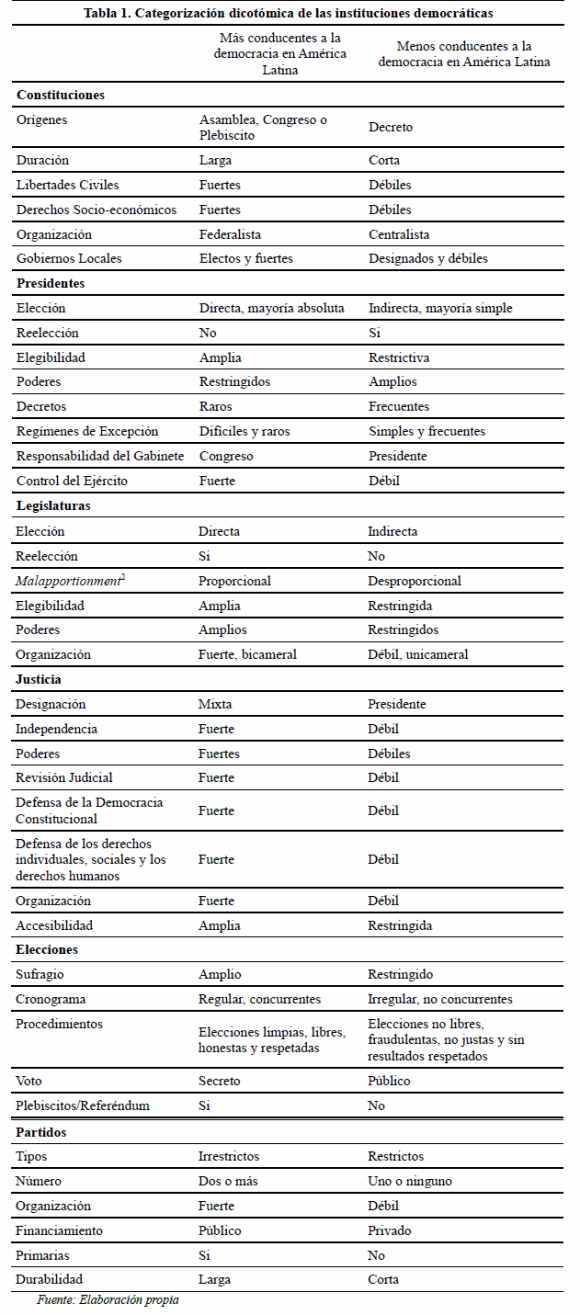
<body><![CDATA[<p style="text-align: justify;"><b> <span style="font-size: 10pt; font-family: &quot;Verdana&quot;;" lang="ES-UY">Palabras clave:</span></b><span style="font-size: 10pt; font-family: &quot;Verdana&quot;;" lang="ES-UY"> democracia, instituciones, constituciones</span></p>             <p style="text-align: justify;"> <span style="font-size: 10pt; font-family: &quot;Verdana&quot;;" lang="ES-UY">&nbsp;</span></p>             <p style="text-align: justify;"><b> <span style="font-size: 10pt; font-family: &quot;Verdana&quot;;" lang="EN-CARRIBEAN">Abstract</span></b></p>             <p style="text-align: justify;"> <span style="font-size: 10pt; font-family: &quot;Verdana&quot;;" lang="EN-CARRIBEAN">Although Latin America&rsquo;s democratic institutions have alternated frequently with authoritarian regimes, their basic features have persisted for two hundred years. Many of their foundational characteristics adjusted foreign models to local conditions, which partly accounts for their durability. From the early 1800s to the early 2000s, most Latin American political institutions exhibited unstable and often unenforceable constitutions, extreme centralism, hyperpresidentialism, lackluster legislatures, conservative and ineffective judiciaries, contentious elections, and ephemeral political parties. Institutional facets and defects can explain some important initial and continuing shortcomings of these democracies. </span></p>                    <p style="text-align: justify;">&nbsp;</p>             <p style="text-align: justify;"><b> <span style="font-size: 10pt; font-family: &quot;Verdana&quot;;" lang="EN-CARRIBEAN">Keywords:</span></b><span style="font-size: 10pt; font-family: &quot;Verdana&quot;;" lang="EN-CARRIBEAN"> democracy, institutions, constitutions &nbsp;</span></p>             <p style="text-align: justify;"> <span style="font-family: &quot;Verdana&quot;;" lang="ES-UY"><font size="2">&nbsp;</font></span></p>             <p style="text-align: justify;"><b> <span style="font-family: &quot;Verdana&quot;;" lang="ES-UY"><font size="2">Introducci&oacute;n </font> </span></b></p>             <p style="text-align: justify;"> <span style="font-family: &quot;Verdana&quot;;" lang="ES-UY"><font size="2">&nbsp;</font></span></p>             <p style="text-align: justify;"> <span style="font-family: &quot;Verdana&quot;;" lang="ES-UY"><font size="2">A pesar de que las instituciones democr&aacute;ticas en Am&eacute;rica Latina se han alternado frecuentemente con reg&iacute;menes autoritarios, sus caracter&iacute;sticas b&aacute;sicas han persistido en los &uacute;ltimos 200 </font></span><font face="Verdana"><span lang="ES-UY"><font size="2">a&ntilde;os.</font></span></font><span style="font-family: &quot;Times New Roman&quot;;" lang="ES-UY"><a href="#_ftn3" name="_ftnref3" title=""><span class="MsoFootnoteReference"><span style="font-family: &quot;Verdana&quot;;" lang="ES-UY"><font size="2">[1]</font></span></span></a></span><span style="font-family: &quot;Verdana&quot;;" lang="ES-UY"><font size="2"> Muchas de estas caracter&iacute;sticas fundacionales ajustaron modelos usados en otros pa&iacute;ses a sus condiciones locales, lo que explica en parte su durabilidad. Desde comienzos del siglo XIX hasta finales del siglo XX, la mayor&iacute;a de las instituciones pol&iacute;ticas en Latinoam&eacute;rica exhibieron constituciones inestables, usualmente con bajo nivel de aplicaci&oacute;n, extremadamente centralistas, hiper-presidencialistas, con legislaturas d&eacute;biles y sin capacidad proactiva, con poderes judiciales conservadores e ineficaces, elecciones contestadas y partidos pol&iacute;ticos ef&iacute;meros. Las distintas facetas y defectos institucionales pueden explicar algunas de las fallas iniciales y continuas de estas democracias. Sin embargo, dado que las caracter&iacute;sticas esenciales de la mayor&iacute;a de estas instituciones han sufrido peque&ntilde;os cambios a lo largo de las d&eacute;cadas y entre pa&iacute;ses, no es claro c&oacute;mo ellas podr&iacute;an dar cuenta de las variaciones significativas en el comportamiento democr&aacute;tico o en los resultados a lo largo del tiempo y en diferentes lugares.</font></span></p>             ]]></body>
<body><![CDATA[<p style="text-align: justify;"> <span style="font-family: &quot;Verdana&quot;;" lang="ES-UY"><font size="2">&nbsp;&nbsp;&nbsp;&nbsp;&nbsp;&nbsp;&nbsp;&nbsp;&nbsp;&nbsp;&nbsp; Desafortunadamente, no hay evidencia suficiente sobre el impacto de los distintos tipos de instituciones pol&iacute;ticas &ndash;constituciones, presidentes, legislaturas, &oacute;rganos judiciales, elecciones, y partidos pol&iacute;ticos- como para poder establecer qu&eacute; dise&ntilde;os facilitar&iacute;an las democracias en diferentes pa&iacute;ses. Los acad&eacute;micos no han alcanzado consenso sobre las mejores instituciones o sobre sus caracter&iacute;sticas &oacute;ptimas. Por lo menos en Am&eacute;rica Latina, sin embargo, el balance entre sentido com&uacute;n y revisi&oacute;n hist&oacute;rica sugiere que la siguiente dicotom&iacute;a tentativa y simplificada puede distinguir algunos atributos que han contribuido, m&aacute;s o menos probablemente, al funcionamiento de reg&iacute;menes democr&aacute;ticos abiertos, representativos, responsables y estables (Karl 1996: 21-46,&nbsp;<a name="Lijphart"></a><a href="#Lijphart_1984">Lijphart 1984: 6-9, 23-26</a>, <a name="Lipset_1981"></a><a href="#Lipset">Lipset 1981: 71, 80-86</a>, <a name="Downs"></a><a href="#Downs_1957">Downs 1957: 23-24</a> y <a name="Dahl"></a><a href="#Dahl_1971">Dahl 1971: 2-3, 227)</a>.</font></span></p>             <p style="text-align: justify;"> <span style="font-family: &quot;Verdana&quot;;" lang="ES-UY"><font size="2">&nbsp;&nbsp;&nbsp;&nbsp;&nbsp;&nbsp;&nbsp;&nbsp;&nbsp;&nbsp;&nbsp; </font> </span></p>             <div align="center">     <div style="text-align: center;"><font face="Verdana" size="2"><a name="tabla_1"></a><img style="width: 580px; height: 1315px;" alt="" src="/img/revistas/rucp/v21nspe/spea01t1.jpg">    <br>     </font>   </div>          <div style="text-align: center;"><font face="Verdana" size="2"><a name="tabla_2"></a><img style="width: 648px; height: 1352px;" alt="" src="/img/revistas/rucp/v21nspe/spea01t2.jpg">    <br>         </font>       </div>   </div>             <p style="text-align: justify; text-indent: 35.45pt;"><i> <span style="font-family: &quot;Verdana&quot;;" lang="ES-UY"><font size="2">    <br>      </font>      </span></i></p>             <p style="text-align: justify;"> <span style="font-family: &quot;Verdana&quot;;" lang="ES-UY"><font size="2">&nbsp; &nbsp;&nbsp;    ]]></body>
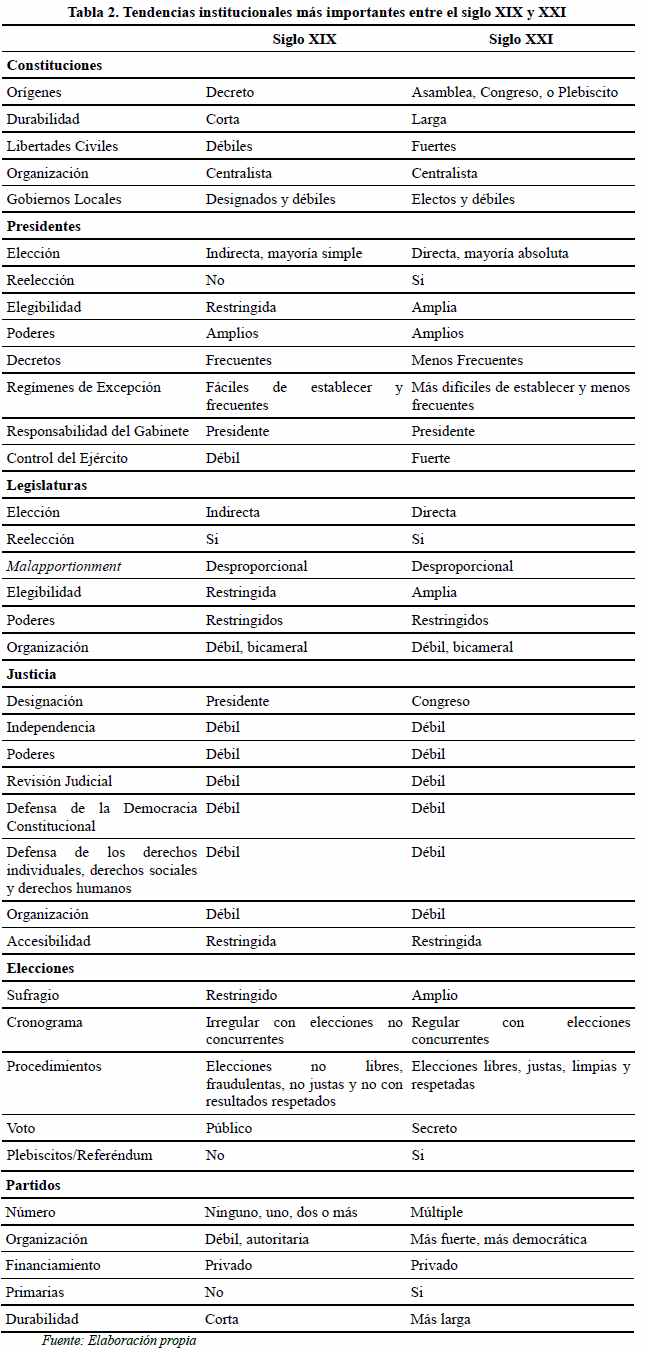
<body><![CDATA[<br>      </font>      </span></p>             <p style="text-align: justify;"> <span style="font-family: &quot;Verdana&quot;;" lang="ES-UY"><font size="2">&nbsp;&nbsp;&nbsp;&nbsp;&nbsp;&nbsp;&nbsp;&nbsp;&nbsp;&nbsp;&nbsp; Muchas de las clasificaciones sobre las caracter&iacute;sticas en esta tabla son cuestionables, como federalismo </font></span><font size="2"><i> <span style="font-family: &quot;Verdana&quot;;" lang="ES-UY">versus</span></i><span style="font-family: &quot;Verdana&quot;;" lang="ES-UY"> centralismo. Es dif&iacute;cil generalizar, y las mejores opciones var&iacute;an de pa&iacute;s en pa&iacute;s. Esta tabla omite criterios m&aacute;s controvertidos, como si el voto debiera ser voluntario u obligatorio y con listas abiertas o cerradas, y si los partidos pol&iacute;ticos debieran ser dos o m&aacute;s, personalistas o program&aacute;ticos, e ideol&oacute;gicos o <i>&nbsp;</i></span></font><i><span style="font-family: &quot;Verdana&quot;;" lang="ES-UY"><font size="2">catch-all.</font></span></i></p>             <p style="text-align: justify;"> <span style="font-family: &quot;Verdana&quot;;" lang="ES-UY"><font size="2">&nbsp;&nbsp;&nbsp;&nbsp;&nbsp;&nbsp;&nbsp;&nbsp;&nbsp;&nbsp;&nbsp; En &uacute;ltima instancia, la tabla sirve como gu&iacute;a para entender las estructuras institucionales discutidas e implementadas en Am&eacute;rica Latina. A pesar del amplio espacio para el disenso, la mayor&iacute;a de los observadores de las instituciones democr&aacute;ticas en Am&eacute;rica Latina han realizado juicios similares a los de la </font></span><font size="2"><a href="/img/revistas/rucp/v21nspe/spea01t1.jpg"> <span style="font-family: &quot;Verdana&quot;;" lang="ES-UY">Tabla </span></a> </font><span style="font-family: &quot;Verdana&quot;;" lang="ES-UY"> <font size="2"><a href="/img/revistas/rucp/v21nspe/spea01t1.jpg">1</a>. La mayor&iacute;a de las instituciones han exhibido hist&oacute;ricamente muchos de los atributos que se encuentran en la columna de la derecha. Los reformadores han tratado de mover estas instituciones desde la columna de la derecha hacia la de la izquierda, y a lo largo del tiempo Latinoam&eacute;rica ha tenido un progreso desigual en esa direcci&oacute;n.</font></span></p>             <p style="text-align: justify;"> <span style="font-family: &quot;Verdana&quot;;" lang="ES-UY"><font size="2">&nbsp;&nbsp;&nbsp;&nbsp;&nbsp;&nbsp;&nbsp;&nbsp;&nbsp;&nbsp;&nbsp; La </font></span><font size="2"><a href="/img/revistas/rucp/v21nspe/spea01t2.jpg"> <span style="font-family: &quot;Verdana&quot;;" lang="ES-UY">Tabla 2</span></a></font><span style="font-family: &quot;Verdana&quot;;" lang="ES-UY"><font size="2"> muestra qu&eacute; patrones institucionales han presentado m&aacute;s resistencia al cambio y permanecen cercanos al dise&ntilde;o original y cu&aacute;les han cambiado desde el siglo XIX al XXI.</font></span></p>             <p style="text-align: justify;"> <span style="font-family: &quot;Verdana&quot;;" lang="ES-UY"><font size="2">&nbsp;</font></span></p>             <div style="text-align: center;"><font face="Verdana" size="2">    <br>         </font>       </div>             <p style="text-indent: 35.45pt; text-align: center;"><i> <span style="font-family: &quot;Verdana&quot;;" lang="ES-UY"><font size="2">&nbsp; &nbsp; &nbsp; &nbsp; &nbsp; &nbsp; &nbsp; &nbsp; &nbsp; &nbsp; &nbsp; &nbsp; &nbsp; &nbsp; &nbsp; &nbsp; &nbsp; &nbsp; &nbsp; &nbsp; &nbsp; &nbsp; &nbsp; &nbsp; &nbsp; &nbsp; &nbsp; &nbsp; &nbsp; &nbsp;    <br>      </font>      </span></i></p>             <p style="text-align: justify;"> <span style="font-family: &quot;Verdana&quot;;" lang="ES-UY"><font size="2">&nbsp; &nbsp; &nbsp; &nbsp; &nbsp; &nbsp; &nbsp; &nbsp; &nbsp; &nbsp; &nbsp; &nbsp; &nbsp; &nbsp; &nbsp; &nbsp; &nbsp; &nbsp; &nbsp; &nbsp; &nbsp; &nbsp; &nbsp; &nbsp; &nbsp; &nbsp; &nbsp; &nbsp; &nbsp; &nbsp;</font></span></p>             ]]></body>
<body><![CDATA[<p style="text-align: justify;"> <span style="font-family: &quot;Verdana&quot;;" lang="ES-UY"><font size="2">&nbsp;&nbsp;&nbsp;&nbsp;&nbsp;&nbsp;&nbsp;&nbsp;&nbsp;&nbsp;&nbsp; Este estudio describe c&oacute;mo los diferentes arreglos institucionales han sido discutidos y han evolucionado en la regi&oacute;n. Muchas de las caracter&iacute;sticas institucionales han permanecido congeladas a lo largo de los &uacute;ltimos siglos, especialmente en lo que respecta a presidentes, legislaturas, justicia y partidos pol&iacute;ticos. Otros aspectos se han democratizado, sobre todo, las elecciones.</font></span></p>             <p style="text-align: justify;"> <span style="font-family: &quot;Verdana&quot;;" lang="ES-UY"><font size="2">&nbsp;&nbsp;&nbsp;&nbsp;&nbsp;&nbsp;&nbsp;&nbsp;&nbsp;&nbsp;&nbsp; Las constituciones todav&iacute;a muestran muchos de sus atributos primitivos, pero han sido adoptadas por instancias m&aacute;s participativas, extendieron su duraci&oacute;n e incorporaron m&aacute;s derechos individuales y socioecon&oacute;micos. La organizaci&oacute;n del gobierno ha permanecido muy centralista, pero las provincias y las municipalidades han hecho algunos avances en t&eacute;rminos de competencias y prerrogativas.</font></span></p>             <p style="text-align: justify;"> <span style="font-family: &quot;Verdana&quot;;" lang="ES-UY"><font size="2">&nbsp;&nbsp;&nbsp;&nbsp;&nbsp;&nbsp;&nbsp;&nbsp;&nbsp;&nbsp;&nbsp; Los presidentes mantienen una posici&oacute;n dominante, pero su elecci&oacute;n ha pasado de ser indirecta a directa y la mayor&iacute;a absoluta sustituy&oacute; a la mayor&iacute;a simple como f&oacute;rmula electoral utilizada. Los requerimientos de elegibilidad se han reducido. Las antiguas prohibiciones a la reelecci&oacute;n parecieron consolidarse. Sin embargo, en los &uacute;ltimos a&ntilde;os ha habido una relajaci&oacute;n de estas restricciones. En este mismo per&iacute;odo, finalmente se increment&oacute; el control de los presidentes sobre los militares.</font></span></p>             <p style="text-align: justify;"> <span style="font-family: &quot;Verdana&quot;;" lang="ES-UY"><font size="2">&nbsp;&nbsp;&nbsp;&nbsp;&nbsp;&nbsp;&nbsp;&nbsp;&nbsp;&nbsp;&nbsp; Los congresos contin&uacute;an siendo d&eacute;biles a pesar de algunos avances recientes. Si bien se mantiene cierto <i>malapportionment</i>, los representantes pasaron a elegirse en forma directa y se redujeron los requerimientos de elegibilidad.</font></span></p>             <p style="text-align: justify;"> <span style="font-family: &quot;Verdana&quot;;" lang="ES-UY"><font size="2">&nbsp;&nbsp;&nbsp;&nbsp;&nbsp;&nbsp;&nbsp;&nbsp;&nbsp;&nbsp;&nbsp; En lo que respecta a las instituciones de gobierno, la justicia es la que ha experimentado menores cambios en direcci&oacute;n del fortalecimiento democr&aacute;tico. Los poderes judiciales permanecen dependientes de las otras ramas del gobierno, aunque el dominio presidencial sobre las designaciones ha disminuido. Al ser mayormente inaccesible para la mayor&iacute;a de la poblaci&oacute;n, la justicia no es efectiva para defender los derechos individuales, sociales y humanos. M&aacute;s importante a&uacute;n, el poder judicial no se ha convertido todav&iacute;a en un revisor activo de la constitucionalidad o en un defensor de la democracia constitucional.</font></span></p>             <p style="text-align: justify;"> <span style="font-family: &quot;Verdana&quot;;" lang="ES-UY"><font size="2">&nbsp;&nbsp;&nbsp;&nbsp;&nbsp;&nbsp;&nbsp;&nbsp;&nbsp;&nbsp;&nbsp; Las elecciones, en muchos sentidos la esencia de la democracia, han procesado los mayores avances en comparaci&oacute;n con el resto de las instituciones pol&iacute;ticas. Las mejoras significativas en el terreno electoral proveen la clave principal para entender la transformaci&oacute;n democr&aacute;tica de Am&eacute;rica Latina. A pesar de que algunos partidos pol&iacute;ticos y sistemas de partidos han madurado, a&uacute;n presentan deficiencias en varios aspectos.</font></span></p>             <p style="text-align: justify;"> <span style="font-family: &quot;Verdana&quot;;" lang="ES-UY"><font size="2">&nbsp;&nbsp;&nbsp;&nbsp;&nbsp;&nbsp;&nbsp;&nbsp;&nbsp;&nbsp;&nbsp; La mayor&iacute;a de estas instituciones fueron incorporadas en las constituciones, las cuales proliferaron de gran manera pero retuvieron tambi&eacute;n muchas caracter&iacute;sticas comunes y resistentes a lo largo del tiempo. Desde los procesos de independencia en adelante, Am&eacute;rica Latina tom&oacute; prestadas varias disposiciones constitucionales de sus vecinos y de Europa, especialmente de Estados Unidos, Francia y Espa&ntilde;a. La influencia de los Estados Unidos declin&oacute; ligeramente en el siglo XX, cuando los derechos socioecon&oacute;micos emergieron en el debate pol&iacute;tico. Sin embargo, muchos de los arreglos institucionales importados se ajustaron pobremente a las realidades nacionales y por lo tanto fueron disfuncionales o inoperantes, mientras otros probaron su valor y utilidad y pudieron adaptarse a las condiciones locales. Aun las instituciones injertadas desde modelos extranjeros, como la presidencia y el congreso estadounidenses, fueron alteradas para funcionar de forma distinta en la regi&oacute;n.</font></span></p>             <p style="text-align: justify;"> <span style="font-family: &quot;Verdana&quot;;" lang="ES-UY"><font size="2">&nbsp;&nbsp;&nbsp;&nbsp;&nbsp;&nbsp;&nbsp;&nbsp;&nbsp;&nbsp;&nbsp; Los fundadores modificaron los principios liberales de muchas de las instituciones de otros pa&iacute;ses, para as&iacute; ajustarlas a las tradiciones autoritarias provenientes del per&iacute;odo colonial y a sus condiciones nacionales, especialmente las severas desigualdades socioecon&oacute;micas.&nbsp; En este sentido, incorporaron caracter&iacute;sticas tales como el centralismo extremo, los desproporcionados poderes de los presidentes, y los estados de excepci&oacute;n. Esta combinaci&oacute;n, de instituciones importadas y dise&ntilde;os dom&eacute;sticos, dio lugar a una tensi&oacute;n entre liberalismo y autoritarismo que ha continuado hasta nuestros d&iacute;as. Sin embargo, los latinoamericanos tambi&eacute;n introdujeron innovaciones democr&aacute;ticas distintivas, incluyendo el &ldquo;amparo&rdquo; (la protecci&oacute;n judicial a las libertades individuales, similar al </font></span><font size="2"><i> <span style="font-family: &quot;Verdana&quot;;" lang="ES-UY">habeas corpus</span></i><span style="font-family: &quot;Verdana&quot;;" lang="ES-UY">) y los derechos sociales. A lo largo del tiempo, ellos tambi&eacute;n promulgaron nuevas constituciones que daban cuenta de cambios pol&iacute;ticos, sociales y econ&oacute;micos locales (como la aparici&oacute;n de los movimientos de trabajadores) y los avances internacionales (como los Derechos Humanos) (<a name="Blanksten"></a><a href="#Blanksten_1958">Blanksten</a></span><a href="#Blanksten_1958"><span style="font-family: &quot;Verdana&quot;;" lang="ES-UY"> </span></a> <span style="font-family: &quot;Verdana&quot;;" lang="ES-UY"><a href="#Blanksten_1958">1958: 225-251</a>, <a name="Colomer"></a></span><a href="#Colomer_1990"> <span style="font-family: &quot;Verdana&quot;;" lang="ES-UY">Colomer </span></a> <span style="font-family: &quot;Verdana&quot;;" lang="ES-UY"><a href="#Colomer_1990">1990: 83, 104-105</a>, <a name="Fitzgerald"></a><a href="#Fitzgerald_1968">Fitzgerald 1968: vii-xiii</a>, <a name="S&aacute;nchez_Agesta"></a><a href="#S%E1nchez_Agresta_1987">S&aacute;nchez</a></span><a href="#S%E1nchez_Agresta_1987"><span style="font-family: &quot;Verdana&quot;;" lang="ES-UY"> Agesta </span></a> <span style="font-family: &quot;Verdana&quot;;" lang="ES-UY"><a href="#S%E1nchez_Agresta_1987">1987: 10-12</a>, <a name="Buergenthal"></a><a href="#Buergenthal_1987">Buergenthal,</a></span><a href="#Buergenthal_1987"><span style="font-family: &quot;Verdana&quot;;" lang="ES-UY"> et al. </span></a> <span style="font-family: &quot;Verdana&quot;;" lang="ES-UY"><a href="#Buergenthal_1987">1987</a>, <a name="Alcalde"></a><a href="#Alcalde_1991">Alcalde</a></span><a href="#Alcalde_1991"><span style="font-family: &quot;Verdana&quot;;" lang="ES-UY"> 1991: 97-126</span></a><span style="font-family: &quot;Verdana&quot;;" lang="ES-UY"> y <a name="Altamira"></a><a href="#Altamira_1928">Altamira</a></span><a href="#Altamira_1928"><span style="font-family: &quot;Verdana&quot;;" lang="ES-UY"> </span></a> </font><span style="font-family: &quot;Verdana&quot;;" lang="ES-UY"> <font size="2"><a href="#Altamira_1928">1928)</a>.</font></span></p>             <p style="text-align: justify;"> <span style="font-family: &quot;Verdana&quot;;" lang="ES-UY"><font size="2">&nbsp;</font></span></p>             <p style="text-align: justify;"><b> <span style="font-family: &quot;Verdana&quot;;" lang="ES-UY"><font size="2">1. Los or&iacute;genes de las instituciones democr&aacute;ticas durante la independencia, 1800-1820</font></span></b></p>             ]]></body>
<body><![CDATA[<p style="text-align: justify;"> <span style="font-family: &quot;Verdana&quot;;" lang="ES-UY"><font size="2">&nbsp;</font></span></p>             <p style="text-align: justify;"> <span style="font-family: &quot;Verdana&quot;;" lang="ES-UY"><font size="2">Antes y durante las guerras de independencia contra el absolutismo ib&eacute;rico, las ideas sobre democracia y republicanismo provenientes del exterior se filtraron en Am&eacute;rica Latina. La Ilustraci&oacute;n, con su &eacute;nfasis en los derechos naturales, y las revoluciones norteamericana y francesa influyeron en las colonias espa&ntilde;olas y portuguesas de Am&eacute;rica. Entre los latinoamericanos de ese tiempo, el t&eacute;rmino &ldquo;rep&uacute;blica&rdquo; usualmente refer&iacute;a al sistema representativo de Estados Unidos, mientras que &ldquo;democracia&rdquo; t&iacute;picamente implicaba una referencia m&aacute;s directa al episodio jacobino. En general, sus l&iacute;deres prefer&iacute;an el modelo norteamericano al socialmente explosivo modelo franc&eacute;s. Como uno de los principales precursores de la independencia, Francisco de Miranda, de Venezuela, dijo en 1799: <i>&ldquo;</i></font></span><i><span style="font-family: &quot;Verdana&quot;;" lang="ES-UY"><font size="2">Tenemos ante nuestros ojos dos grandes ejemplos, la revoluci&oacute;n americana y la francesa. Imitemos prudentemente la primera y evitemos cuidadosamente la segunda.&rdquo;</font></span></i><a href="#_ftn5" name="_ftnref5" title=""><span class="MsoFootnoteReference"><span style="font-family: &quot;Verdana&quot;;" lang="ES-UY"><font size="2">[3]</font></span></span></a><span style="font-family: &quot;Verdana&quot;;" lang="ES-UY"><font size="2"> (<a name="Lynch"></a><a href="#Lynch_1994">Lynch 1994: 28</a>) (<a name="Whitaker"></a><a href="#Whitaker_1961">Whitaker 1961</a>, <a name="Moses"></a><a href="#Moses_1966">Moses 1966</a>, <a name="Romero"></a><a href="#Romero_1963">Romero 1963: 2-58</a>, <a name="Collier"></a><a href="#Collier_1967">Collier 1967: 35-43</a>, <a name="Aguilera_y_Vega"></a><a href="#Aguilera_1991">Aguilera y Vega 1991)</a>. </font> </span></p>             <p style="text-align: justify;"> <span style="font-family: &quot;Verdana&quot;;" lang="ES-UY"><font size="2">&nbsp;&nbsp;&nbsp;&nbsp;&nbsp;&nbsp;&nbsp;&nbsp;&nbsp;&nbsp;&nbsp; Durante el per&iacute;odo de la independencia, algunos latinoamericanos abrazaron la &ldquo;idea del hemisferio occidental&rdquo;. De acuerdo a esta noci&oacute;n, los pueblos de las Am&eacute;ricas compart&iacute;an una identidad com&uacute;n que se diferenciaba del resto del mundo, en particular de Europa. Como Latinoam&eacute;rica tom&oacute; muchos conceptos pol&iacute;ticos de los Estados Unidos, algunos l&iacute;deres tanto del norte como del sur del continente comenzaron a argumentar que el republicanismo unificaba al nuevo mundo. Por ejemplo, el pol&iacute;tico e intelectual mexicano Lucas Alaman en 1826 reivindicaba que entre los pa&iacute;ses de Am&eacute;rica <i>&ldquo;</i></font></span><font size="2"><i><span style="font-family: &quot;Verdana&quot;;" lang="ES-UY">la similitud de sus instituciones pol&iacute;ticas los ha unido a&uacute;n m&aacute;s, fortaleciendo en ellos el dominio de los justos principios liberales.&rdquo;</span></i></font><span class="MsoFootnoteReference"><font face="Verdana"><span lang="ES-UY"><font size="2"> </font></span></font><span style="font-family: &quot;Times New Roman&quot;;" lang="ES-UY"> <a href="#_ftn6" name="_ftnref6" title=""> <span style="font-family: &quot;Verdana&quot;;" lang="ES-UY"><font size="2">[4]</font></span></a></span></span><span style="font-family: &quot;Verdana&quot;;" lang="ES-UY"><font size="2"> <a name="Whitaker2"></a><a href="#Whitaker_1954">(</a></font></span><font size="2"><a href="#Whitaker_1954"><span style="font-family: &quot;Verdana&quot;;" lang="ES-UY">Whitaker </span></a> </font><span style="font-family: &quot;Verdana&quot;;" lang="ES-UY"> <font size="2"><a href="#Whitaker_1954">1954: 2)</a>. </font></span></p>             <p style="text-align: justify;"> <span style="font-family: &quot;Verdana&quot;;" lang="ES-UY"><font size="2">&nbsp;&nbsp;&nbsp;&nbsp;&nbsp;&nbsp;&nbsp;&nbsp;&nbsp;&nbsp;&nbsp; Como los liberales en Am&eacute;rica Latina, los conservadores tambi&eacute;n esperaban a la rep&uacute;blica, pero tem&iacute;an que mucha democracia, federalismo y anticlericalismo desataran divisiones pol&iacute;ticas, geogr&aacute;ficas y sociales devastadoras. En consecuencia, hicieron hincapi&eacute; en una fe cat&oacute;lica oficial, un gobierno central fuerte, un presidente poderoso, un ej&eacute;rcito potente y una participaci&oacute;n pol&iacute;tica m&iacute;nima fuera de su control. En la visi&oacute;n conservadora, el nuevo r&eacute;gimen deb&iacute;a preservar muchos de los aspectos autoritarios del sistema pol&iacute;tico colonial bajo el manto del republicanismo. Su creciente dominio a medida que las batallas contra Espa&ntilde;a llegaban a su fin hizo a un c&iacute;nico lamentarse y decir: <i>&ldquo;</i></font></span><font size="2"><i><span style="font-family: &quot;Verdana&quot;;" lang="ES-UY">La Guerra de Independencia fue la revoluci&oacute;n m&aacute;s conservadora que jam&aacute;s haya ocurrido&rdquo;</span></i></font><font face="Verdana"><span lang="ES-UY"><font size="2">.</font></span></font><span style="font-family: &quot;Times New Roman&quot;;" lang="ES-UY"><a href="#_ftn7" name="_ftnref7" title=""><span class="MsoFootnoteReference"><span style="font-family: &quot;Verdana&quot;;" lang="ES-UY"><font size="2">[5]</font></span></span></a></span><span style="font-family: &quot;Verdana&quot;;" lang="ES-UY"><font size="2"> <a name="Jane"></a><a href="#Jane_1966">(Jane</a></font></span><a href="#Jane_1966"><span style="font-family: &quot;Verdana&quot;;" lang="ES-UY"><font size="2"> 1966: 144)</font></span></a></p>             <p style="text-align: justify;"> <span style="font-family: &quot;Verdana&quot;;" lang="ES-UY"><font size="2">&nbsp;&nbsp;&nbsp;&nbsp;&nbsp;&nbsp;&nbsp;&nbsp;&nbsp;&nbsp;&nbsp; El m&aacute;s importante libertador y pensador pol&iacute;tico de la era de la independencia, Sim&oacute;n Bol&iacute;var, personific&oacute; la evoluci&oacute;n desde el liberalismo al conservadurismo. El Sim&oacute;n Bol&iacute;var idealista y el realista deriv&oacute; sus puntos de vista de la Rep&uacute;blica romana, de sus viajes a Europa, de su contacto con escritos pol&iacute;ticos (especialmente de la Ilustraci&oacute;n francesa), de las instituciones pol&iacute;ticas brit&aacute;nicas, de los Estados Unidos, de la Constituci&oacute;n espa&ntilde;ola de 1812 y de la amarga experiencia del gobierno republicano en los nuevos estados de la Am&eacute;rica hispana. Al menos ret&oacute;ricamente Bol&iacute;var siempre lament&oacute; la existencia de dictaduras inconstitucionales y promovi&oacute; la rep&uacute;blica democr&aacute;tica, elecciones libres, libertades civiles limitadas tales como la libertad de expresi&oacute;n y de prensa, un congreso moderadamente efectivo y una justicia independiente. Tambi&eacute;n apoy&oacute; la defensa hemisf&eacute;rica de las democracias. A diferencia de algunos democratizadores del presente, Bol&iacute;var confiaba en un gobierno centralizado con una presidencia dominante en oposici&oacute;n al poder de las legislaturas y los gobiernos locales y regionales (<a name="Fitzgerald2"></a><a href="#Fitzgerald_1971">Fitzgerald 1971: 4-6</a>, <a name="Bushnell"></a><a href="#Bushnell_2003">Bushnell 2003</a>, <a name="Johnson_y_Ladd"></a><a href="#Johnson_1968">Johnson y Ladd 1968</a> y <a name="Lynch2"></a><a href="#Lynch_2006">Lynch 2006)</a>.</font></span></p>             <p style="text-align: justify;"> <span style="font-family: &quot;Verdana&quot;;" lang="ES-UY"><font size="2">&nbsp;&nbsp;&nbsp;&nbsp;&nbsp;&nbsp;&nbsp;&nbsp;&nbsp;&nbsp;&nbsp; A medida que la campa&ntilde;a por la independencia se fue desarrollando, Bol&iacute;var crey&oacute; crecientemente que los hispanoamericanos, con su herencia colonial ib&eacute;rica, no estaban listos para una democracia como la de los Estados Unidos: </font> <i><font size="2">&ldquo;&iquest;Es concebible que un pueblo que recientemente se liber&oacute; de sus cadenas pueda ascender a la esfera de la libertad sin quemar sus alas como &Iacute;caro y hundirse en el abismo?&rdquo;.</font></i></span><a href="#_ftn8" name="_ftnref8" title=""><span class="MsoFootnoteReference"><span style="font-family: &quot;Verdana&quot;;" lang="ES-UY"><font size="2">[6]</font></span></span></a><span style="font-family: &quot;Verdana&quot;;" lang="ES-UY"><font size="2"> Su respuesta enfatiz&oacute; la necesidad de nutrir las posibilidades de futuro de la democracia bajo </font> <i> <font size="2">&ldquo;el bondadoso cuidado de gobiernos paternales&rdquo;</font></i></span><a href="#_ftn9" name="_ftnref9" title=""><span class="MsoFootnoteReference"><span style="font-family: &quot;Verdana&quot;;" lang="ES-UY"><font size="2">[7]</font></span></span></a><span style="font-family: &quot;Verdana&quot;;" lang="ES-UY"><font size="2"> <a name="Humphreys"></a><a href="#Humphreys_1951">(Humphreys 1951: 319-20)</a>.</font></span></p>             <p style="text-align: justify;"> <span style="font-family: &quot;Verdana&quot;;" lang="ES-UY"><font size="2">&nbsp;&nbsp;&nbsp;&nbsp;&nbsp;&nbsp;&nbsp;&nbsp;&nbsp;&nbsp;&nbsp; Bol&iacute;var entreg&oacute; la m&aacute;s completa expresi&oacute;n de su visi&oacute;n pol&iacute;tica en el discurso de Angostura de 1819 en Venezuela. Argument&oacute; que <i>&ldquo;Venezuela ten&iacute;a, tiene, y deber&iacute;a tener un gobierno republicano. Sus principios deben ser la soberan&iacute;a del pueblo, la divisi&oacute;n de poderes, las libertades civiles, la abolici&oacute;n de la esclavitud y la proscripci&oacute;n de la monarqu&iacute;a y sus privilegios.&rdquo;</i> El libertador conclu&iacute;a que el admirable modelo de los Estados Unidos era inaplicable a la Am&eacute;rica hispana con su falta de antecedentes democr&aacute;ticos y sus enormes disparidades sociales: &ldquo;<i>instituciones fielmente representativas no se adecuan a nuestro car&aacute;cter&rdquo;</i>. &Eacute;l buscaba un delicado equilibrio entre <i>&ldquo;moderaci&oacute;n de la voluntad popular y limitaci&oacute;n de la autoridad p&uacute;blica&rdquo; </i><a name="Fizgerald3"></a><a href="#Fitzgerald_1971">(Fizgerald 1971: 54, 62)</a>.</font></span></p>             <p style="text-align: justify;"> <span style="font-family: &quot;Verdana&quot;;" lang="ES-UY"><font size="2">&nbsp;&nbsp;&nbsp;&nbsp;&nbsp;&nbsp;&nbsp;&nbsp;&nbsp;&nbsp;&nbsp; Los arquitectos de las constituciones ve&iacute;an al republicanismo como la soluci&oacute;n por defecto porque no contaban con alternativas plausibles al vac&iacute;o de legitimidad creado por la eliminaci&oacute;n de la corona. &ldquo;<i>Los norteamericanos de los d&iacute;as de Washington eran republicanos por convicci&oacute;n y elecci&oacute;n; los hispanoamericanos de los d&iacute;as de Bol&iacute;var eran republicanos por compulsi&oacute;n. Los primeros abrazaron con entusiasmo<b> </b>una oportunidad cuando les fue ofrecida; los &uacute;ltimos se inclinaron con tristeza por necesidad&rdquo;</i> <a name="Jane2"></a><a href="#Jane_1966">(Jane 1966:110-114)</a>. Como resultado, <i>&ldquo;En ning&uacute;n lugar hay constituciones m&aacute;s elaboradas -o menos observadas...&rdquo;</i> <a name="Humphreys2"></a></font><a href="#Humphreys_1951"><font size="2">(Humphreys 1951:318).</font></a></span></p>             <p style="text-align: justify;"> <span style="font-family: &quot;Verdana&quot;;" lang="ES-UY"><font size="2">&nbsp;&nbsp;&nbsp;&nbsp;&nbsp;&nbsp;&nbsp;&nbsp;&nbsp;&nbsp;&nbsp; Las constituciones de Am&eacute;rica Latina formaron parte de la tendencia internacional occidental que se alej&oacute; de los estados absolutistas y se acerc&oacute; a un estado limitado por la ley con el objetivo de proteger los derechos individuales y la comunidad. A pesar de las numerosas versiones y variaciones, las constituciones iniciales y las subsiguientes se destacaron por sus similitudes. Compart&iacute;an muchas caracter&iacute;sticas en parte porque extrajeron su inspiraci&oacute;n de los mismos modelos importados y de entre ellas mismas. Tambi&eacute;n se ajustaban a un patr&oacute;n com&uacute;n porque confrontaron los mismos legados del per&iacute;odo colonial y de independencia, incluyendo conflictos disruptivos entre regiones, clases, grupos de inter&eacute;s y jefes militares.</font></span></p>             <p style="text-align: justify;"> <span style="font-family: &quot;Verdana&quot;;" lang="ES-UY"><font size="2">&nbsp;&nbsp;&nbsp;&nbsp;&nbsp;&nbsp;&nbsp;&nbsp;&nbsp;&nbsp;&nbsp; En el proceso de redacci&oacute;n de sus cartas magnas los latinoamericanos siguieron los pasos de otros pa&iacute;ses, especialmente de los Estados Unidos, de Francia y de Espa&ntilde;a. Al menos en el papel, de los Estados Unidos copiaron principalmente la separaci&oacute;n de poderes en tres ramas, el presidencialismo, el congreso bicameral, la carta de derechos y en ocasiones el federalismo. En algunos casos tambi&eacute;n adoptaron el concepto de <i>habeas corpus </i>y la revisi&oacute;n judicial. La influencia de los Estados Unidos &ndash;especialmente del federalismo- apareci&oacute; con fuerza en M&eacute;xico, Venezuela, y sobre todo en Argentina. El pensamiento franc&eacute;s, particularmente el de la Constituci&oacute;n de 1791, dio forma a las nociones de derechos humanos tanto como a ideas como el centralismo, la organizaci&oacute;n municipal, los concejos de estado, la interpelaci&oacute;n a los ministros por parte del congreso, la representaci&oacute;n proporcional, la legislaci&oacute;n por decreto y m&aacute;s significativamente los estados de emergencia y excepci&oacute;n para suspender las garant&iacute;as constitucionales (<a name="S&aacute;nchez_Agesta2"></a><a href="#S%E1nchez_Agresta_1987">S&aacute;nchez Agesta 1987: 9, 20-39</a>, <a name="Collier2"></a><a href="#Collier_1967">Collier 1967: 150-155</a>, <a name="Fitzgibbon"></a><a href="#Fitzgibbon_1954">Fitzgibbon 1951: 214-217</a>, <a name="Blanksten2"></a><a href="#Blanksten_1958">Blanksten 1951: 225-251</a>, <a name="Edelman"></a><a href="#Edelman_1969">Edelman 1969: 389-397</a>, <a name="Loveman"></a><a href="#Loveman_1993">Loveman 1993</a>, <a name="Grossman"></a><a href="#Grossman_1990">Grossman 1990: 176-198</a>, <a name="Gonz&aacute;lez"></a><a href="#Gonz%E1lez_1962">Gonz&aacute;lez 1962)</a>.</font></span></p>             ]]></body>
<body><![CDATA[<p style="text-align: justify;"> <span style="font-family: &quot;Verdana&quot;;" lang="ES-UY"><font size="2">&nbsp;&nbsp;&nbsp;&nbsp;&nbsp;&nbsp;&nbsp;&nbsp;&nbsp;&nbsp;&nbsp; Al mismo tiempo, las constituciones pioneras en Am&eacute;rica Latina incorporaron muchos elementos espa&ntilde;oles, incluyendo leyes coloniales, mientras no entraran abiertamente en conflicto con el republicanismo. La corta vida de la Constituci&oacute;n espa&ntilde;ola de 1812 tambi&eacute;n model&oacute; a Hispanoam&eacute;rica. De esa fuente los criollos transcribieron com&uacute;nmente: la organizaci&oacute;n b&aacute;sica de la naci&oacute;n y la constituci&oacute;n, el catolicismo como religi&oacute;n oficial, el gobierno limitado, el centralismo, y el voto individual y la representaci&oacute;n. Esa monarqu&iacute;a constitucional tambi&eacute;n cre&oacute; tres ramas de gobierno, con una legislatura unicameral (electa de manera indirecta) como el cuerpo primario, la corona en segundo lugar y la justicia en tercer lugar.</font></span></p>             <p style="text-align: justify;"> <span style="font-family: &quot;Verdana&quot;;" lang="ES-UY"><font size="2">&nbsp;&nbsp;&nbsp;&nbsp;&nbsp;&nbsp;&nbsp;&nbsp;&nbsp;&nbsp;&nbsp; Sin embargo, muchos l&iacute;deres en las colonias vieron a ese documento espa&ntilde;ol demasiado cercano al radicalismo franc&eacute;s. La Constituci&oacute;n de 1812 conten&iacute;a algunas caracter&iacute;sticas liberales remarcables. Sus disposiciones catapultaron al mundo hisp&aacute;nico a la vanguardia internacional en muchos de los derechos democr&aacute;ticos. Les dio a los americanos igual representaci&oacute;n que a los espa&ntilde;oles. Estableci&oacute; la libertad de prensa. Tambi&eacute;n reconoci&oacute; a los ind&iacute;genas y a los mestizos, aunque no a los negros, como ciudadanos. En un movimiento audaz, la constituci&oacute;n confiri&oacute; a todos los hombres, excepto a los negros, el derecho a votar sin restricciones de propiedad o educaci&oacute;n, un est&aacute;ndar m&aacute;s liberal que el que prevaleci&oacute; en los Estados Unidos, Francia, o Inglaterra en ese tiempo (<a name="Bushnell2"></a><a href="#Bushnell_1954">Bushnell 1954: 19</a>, <a name="S&aacute;nchez_Agesta3"></a><a href="#S%E1nchez_Agresta_1987">S&aacute;nchez Agesta 1987: 9, 20-39</a>, <a name="Garc&iacute;a_Laguardia"></a><a href="#Garc%EDa_Laguardia_1987">Garc&iacute;a Laguardia et al. 1987: 13-16</a> y <a name="Rodr&iacute;guez"></a><a href="#Rodr%EDguez_1998">Rodr&iacute;guez 1998: 91-103, 246)</a>.</font></span></p>             <p style="text-align: justify;"> <span style="font-family: &quot;Verdana&quot;;" lang="ES-UY"><font size="2">&nbsp;&nbsp;&nbsp;&nbsp;&nbsp;&nbsp;&nbsp;&nbsp;&nbsp;&nbsp;&nbsp; Antes que las colonias espa&ntilde;olas y los modelos constitucionales unitarios y centralistas prevalecieran en las nuevas rep&uacute;blicas de Hispanoam&eacute;rica, muchas de las tempranas constituciones replicaron disposiciones federalistas contenidas en la Constituci&oacute;n de los Estados Unidos. Sin embargo, aquel sistema dio lugar a guerras civiles y caos en Am&eacute;rica Latina. Choc&oacute; con las disparidades de poder arraigadas entre las ciudades capitales y las provincias. Despu&eacute;s de a&ntilde;os de conflictos entre los dos campos y numerosos fiascos de los federalistas, el centralismo pas&oacute; a dominar, a&uacute;n en los pocos pa&iacute;ses que adher&iacute;an oficialmente al federalismo. La mayor&iacute;a de los l&iacute;deres&nbsp; terminaron estando de acuerdo con el rechazo de Bol&iacute;var al federalismo norteamericano: </font> <i><font size="2">&ldquo;Tal sistema no es m&aacute;s que anarqu&iacute;a organizada, o en el mejor de los casos, una ley que impl&iacute;citamente decreta la obligaci&oacute;n de disolver y arruinar al estado con todos sus miembros. Ser&iacute;a mejor, creo, que Am&eacute;rica del Sur adoptara el Cor&aacute;n antes que la forma de gobierno estadounidense, aunque esta &uacute;ltima sea la mejor del mundo&rdquo;</font></i></span><a href="#_ftn10" name="_ftnref10" title=""><span class="MsoFootnoteReference"><span style="font-family: &quot;Verdana&quot;;" lang="ES-UY"><font size="2">[8]</font></span></span></a><span style="font-family: &quot;Verdana&quot;;" lang="ES-UY"><font size="2"> <a name="Lynch3"></a><a href="#Lynch_2006">(Lynch 2006: 261)</a>.</font></span></p>             <p style="text-align: justify;"> <span style="font-family: &quot;Verdana&quot;;" lang="ES-UY"><font size="2">&nbsp;&nbsp;&nbsp;&nbsp;&nbsp;&nbsp;&nbsp;&nbsp;&nbsp;&nbsp;&nbsp; Tanto el imperio espa&ntilde;ol como los imperios de las Indias legaron una herencia de ejecutivos preeminentes en la pol&iacute;tica. Aunque los hispanoamericanos copiaron el esquema del sistema presidencial de la Constituci&oacute;n de los Estados Unidos, este documento era bastante vago respecto a los poderes del cargo presidencial. Consecuentemente, muchos criollos &ndash;por ejemplo en la Constituci&oacute;n mexicana de 1824- recurrieron a la Constituci&oacute;n espa&ntilde;ola de 1812 y a su desglose de los poderes de los regentes para ser ejercidos en nombre del rey. Por ejemplo, las primeras constituciones de Hispanoam&eacute;rica tomaron prestado de la Constituci&oacute;n espa&ntilde;ola de 1812 la atribuci&oacute;n de autoridad al ejecutivo para enviar legislaci&oacute;n al congreso, para proponer el presupuesto, y para conducir las relaciones internacionales. En la ley y en la pr&aacute;ctica, los presidentes de Hispanoam&eacute;rica superaron los poderes de sus contrapartes norteamericanos no solo en lo que respecta a sus poderes de agenda, legislativos y de veto, sino tambi&eacute;n en su capacidad para designar, aunque a menudo con el consentimiento del congreso, a jueces, gobernadores, y en algunas ocasiones hasta oficiales municipales. Las constituciones pioneras generalmente tambi&eacute;n le garantizaban al presidente el control sobre las Fuerzas Armadas, a pesar de que esto result&oacute; dif&iacute;cil de efectivizar (<a name="S&aacute;nchez_Agesta4"></a><a href="#S%E1nchez_Agresta_1987">S&aacute;nchez Agesta 1987: 54-59</a>, <a name="Bushnell3"></a><a href="#Bushnell_2003">Bushnell 2003: 17-18</a>, <a name="Aleman"></a><a href="#Aleman_2005">Aleman y Tsebelis 2005: 3-26)</a>.</font></span></p>             <p style="text-align: justify;"> <span style="font-family: &quot;Verdana&quot;;" lang="ES-UY"><font size="2">&nbsp;&nbsp;&nbsp;&nbsp;&nbsp;&nbsp;&nbsp;&nbsp;&nbsp;&nbsp;&nbsp; Los presidentes de la Am&eacute;rica hispana tambi&eacute;n resultaron m&aacute;s fuertes que sus pares norteamericanos porque la mayor&iacute;a de las constituciones ataron la Iglesia Cat&oacute;lica con el estado. Esta disposici&oacute;n se estableci&oacute; sobre la tradici&oacute;n inca, azteca e ib&eacute;rica de fundir en una sola persona la figura que dirige el estado y la religi&oacute;n oficial. Los presidentes hispanoamericanos tambi&eacute;n superaron a los de Washington porque asumieron, o trataron de asumir, el rol de patronazgo sobre la Iglesia Cat&oacute;lica que hab&iacute;a previamente pertenecido a la corona. M&aacute;s a&uacute;n, los primeros presidentes usualmente contaron con poderes excepcionales para resolver problemas extraordinarios, como el ganar la guerra de independencia, establecer la paz entre facciones civiles despu&eacute;s de esas guerras y crear un nuevo estado de la nada. Mucho m&aacute;s all&aacute; que en los Estados Unidos o en su constituci&oacute;n, ellos mantuvieron la autoridad excepcional para suspender las libertades civiles y dominar a otras ramas del gobierno durante situaciones de emergencia.</font></span></p>             <p style="text-align: justify;"> <span style="font-family: &quot;Verdana&quot;;" lang="ES-UY"><font size="2">&nbsp;&nbsp;&nbsp;&nbsp;&nbsp;&nbsp;&nbsp;&nbsp;&nbsp;&nbsp;&nbsp; Desde el comienzo los presidentes latinoamericanos poseyeron mayor autoridad que sus predecesores norteamericanos para gobernar, en el plano interno y externo, con pocas restricciones por parte de los congresos. Un congreso representativo e independiente no figuraba en la tradici&oacute;n de indios ni de criollos. De las tres ramas, el legislativo fue el m&aacute;s dif&iacute;cil de establecer porque no hab&iacute;a existido en el per&iacute;odo colonial, cuando los cargos de gobierno combinaban funciones ejecutivas y legislativas. La &uacute;nica excepci&oacute;n parcial fueron los representantes hispanoamericanos elegidos para las Cortes de C&aacute;diz y para los cabildos a nivel local. Aunque los padres fundadores de Am&eacute;rica Latina tomaron prestados los rasgos del congreso de los Estados Unidos, tambi&eacute;n incorporaron caracter&iacute;sticas de los concejos abiertos del per&iacute;odo colonial y de independencia, ahora expandidos para transformarse en una instituci&oacute;n nacional (<a name="Woodward"></a><a href="#Woodward_1996">Woodward 1996: 58-89</a>, <a name="S&aacute;nchez_Agesta5"></a><a href="#S%E1nchez_Agresta_1987">S&aacute;nchez Agesta 1987: 53-59</a>, <a name="Bushnell4"></a><a href="#Bushnell_2003">Bushnell 2003: 18, 31-33</a>, <a name="Loveman2"></a><a href="#Loveman_1993">Loveman 1993</a>, y <a name="Grossman2"></a><a href="#Grossman_1990">Grossman 1990)</a>.</font></span></p>             <p style="text-align: justify;"> <span style="font-family: &quot;Verdana&quot;;" lang="ES-UY"><font size="2">&nbsp;&nbsp;&nbsp;&nbsp;&nbsp;&nbsp;&nbsp;&nbsp;&nbsp;&nbsp;&nbsp; M&aacute;s que ninguna otra instituci&oacute;n pol&iacute;tica despu&eacute;s de la independencia, la organizaci&oacute;n de justicia hered&oacute; numerosas pr&aacute;cticas coloniales, algunas de cuales perduran hasta el siglo XXI. Durante muchos a&ntilde;os, los criollos dejaron el sistema espa&ntilde;ol de justicia mayormente intacto. Los legados incluyeron la tradici&oacute;n civil o romana de la ley, la indeterminaci&oacute;n entre funciones pol&iacute;ticas y judiciales, un cuerpo de jueces aut&oacute;nomo y corporativo, una justicia dependiente del ejecutivo y una formidable estructura extra-judicial de empleados y notarios p&uacute;blicos que frustraron cualquier intento de cambio o de tornar al sistema m&aacute;s eficiente y eficaz. Asimismo, el imperio de la ley durante el per&iacute;odo colonial y el posterior a la independencia fue extremadamente irregular y laxo en &aacute;reas perif&eacute;ricas, lo cual gener&oacute; desconfianza y p&eacute;rdida de respeto por el sistema legal <a name="Zimmerman"></a><a href="#Zimmerman_1999">(Zimmerman 1999)</a>. </font> </span></p>             <p style="text-align: justify;"> <span style="font-family: &quot;Verdana&quot;;" lang="ES-UY"><font size="2">&nbsp;&nbsp;&nbsp;&nbsp;&nbsp;&nbsp;&nbsp;&nbsp;&nbsp;&nbsp;&nbsp; Bol&iacute;var recomendaba el sistema judicial norteamericano porque admiraba su independencia. Tambi&eacute;n estaba a favor del juicio por jurados, como el liberal mexicano Jos&eacute; Mar&iacute;a Luis Mora, pero este sistema no tuvo &eacute;xito en Am&eacute;rica Latina. El ex&oacute;tico concepto norteamericano de revisi&oacute;n judicial de la constituci&oacute;n tambi&eacute;n funcion&oacute; pobremente si es que lo hizo en alg&uacute;n momento. Los jueces optaron por las f&oacute;rmulas del pasado al encontrar dificultades para conciliar las disposiciones importadas desde los Estados Unidos con las tradiciones hisp&aacute;nicas. En la mayor&iacute;a de los pa&iacute;ses, la justicia no jug&oacute; un rol significativo en la pol&iacute;tica o en la democracia hasta bien entrado el siglo XX, y a&uacute;n sigue estando por detr&aacute;s de otras instituciones en estos procesos (<a name="Clark"></a><a href="#Clark_Rosenn_1975">Clark y Rosenn 1975</a>, <a name="Bravo_Lira"></a><a href="#Bravo_Lira_1986">Bravo Lira 1986: 166</a>, <a name="Zimmerman2"></a><a href="#Zimmerman_1999">Zimmerman 1999</a>, <a name="Bushnell5"></a><a href="#Bushnell_2003">Bushnell 2003: 45-50</a>, y <a name="Fitzgerald3"></a><a href="#Fitzgerald_1971">Fitzgerald 1971: 52-64)</a>.</font></span></p>             <p style="text-align: justify;"> <span style="font-family: &quot;Verdana&quot;;" lang="ES-UY"><font size="2">&nbsp;</font></span></p>             <p style="text-align: justify;"><b> <span style="font-family: &quot;Verdana&quot;;" lang="ES-UY"><font size="2">2. La difusi&oacute;n de las rep&uacute;blicas olig&aacute;rquicas en Am&eacute;rica Latina, 1830-1920</font></span></b></p>             ]]></body>
<body><![CDATA[<p style="text-align: justify;"> <span style="font-family: &quot;Verdana&quot;;" lang="ES-UY"><font size="2">&nbsp;</font></span></p>             <p style="text-align: justify;"> <span style="font-family: &quot;Verdana&quot;;" lang="ES-UY"><font size="2">Despu&eacute;s de la independencia, las constituciones de Am&eacute;rica Latina y sus instituciones reflejaron arraigados patrones regionales m&aacute;s que nuevas corrientes provenientes de los Estados Unidos y Europa. Despu&eacute;s que los libertadores se alejaron del liberalismo, los conservadores comenzaron a dominar el pensamiento pol&iacute;tico, la pr&aacute;ctica y las instituciones en los treinta y cuarenta del siglo XIX. Abogaron b&aacute;sicamente por la restauraci&oacute;n del orden colonial con un velo republicano, haciendo que la autoridad del estado residiera en la Iglesia y la aristocracia. Lo m&aacute;s que se acercaron a la democracia fue con el establecimiento de rep&uacute;blicas olig&aacute;rquicas. Los sectores conservadores pretendieron que esos reg&iacute;menes elitistas proveyeran orden para el crecimiento econ&oacute;mico y para la preparaci&oacute;n gradual de las mayor&iacute;as excluidas por el republicanismo liberal <a name="Halperin-Donghi"></a>(<a href="#Halperin-Donghi_1973">Halperin-Donghi 1973: 129-140</a>).</font></span></p>             <p style="text-align: justify;"> <span style="font-family: &quot;Verdana&quot;;" lang="ES-UY"><font size="2">&nbsp;&nbsp;&nbsp;&nbsp;&nbsp;&nbsp;&nbsp;&nbsp;&nbsp;&nbsp;&nbsp; Entre las pocas constituciones durables, operativas e influyentes desde los a&ntilde;os treinta a los setenta del siglo XIX, la Constituci&oacute;n chilena fue el ep&iacute;tome de la variante conservadora y la argentina de la liberal. Entre las constituciones hispanoamericanas, la Constituci&oacute;n chilena de 1833 se transform&oacute; en el &eacute;xito m&aacute;s temprano al durar hasta 1925. Funcion&oacute; bien para la clase alta porque reconoci&oacute; al catolicismo romano como la religi&oacute;n oficial, protegi&oacute; la propiedad privada, centraliz&oacute; el poder en el gobierno nacional y el presidente, despreci&oacute; las libertades civiles, previ&oacute; los estados de excepci&oacute;n para suspender las garant&iacute;as constitucionales, puso en marcha una legislatura y un sistema judicial que lograron funcionar y restringi&oacute; el sufragio a los sectores acomodados (<a name="Loveman3"></a><a href="#Loveman_1988">Loveman 1988: 123-126</a>, <a name="Valenzuela"></a><a href="#Valenzuela_1977">Valenzuela 1977: 172-190</a>, <a name="Remmer"></a><a href="#Remmer_1984">Remmer 1984: 10-14</a> y <a name="Zeitlin"></a><a href="#Zeitlin_1968">Zeitlin 1968: 220-234</a>).</font></span></p>             <p style="text-align: justify;"> <span style="font-family: &quot;Verdana&quot;;" lang="ES-UY"><font size="2">&nbsp;&nbsp;&nbsp;&nbsp;&nbsp;&nbsp;&nbsp;&nbsp;&nbsp;&nbsp;&nbsp; La Constituci&oacute;n argentina de 1853 fue la de mayor duraci&oacute;n &ndash;aunque con interrupciones- de Am&eacute;rica Latina. Con la pretensi&oacute;n de emular a Inglaterra y a los Estados Unidos, las elites tomaron como modelos de su constituci&oacute;n a estos &uacute;ltimos. A trav&eacute;s de esta imitaci&oacute;n, los cautos liberales argentinos buscaron incorporarse a las econom&iacute;as del atl&aacute;ntico. M&aacute;s tarde en el siglo XIX, la Suprema Corte argentina identific&oacute; los or&iacute;genes de su constituci&oacute;n en el modelo estadounidense, particularmente en su forma federalista y judicial: </font> <i><font size="2">&ldquo;El sistema de gobierno que nos rige no es nuestra creaci&oacute;n. Lo hemos encontrado en uso, testeado por largos a&ntilde;os de experiencia, y nos lo hemos apropiado&rdquo;</font></i></span><a href="#_ftn11" name="_ftnref11" title=""><span class="MsoFootnoteReference"><span style="font-family: &quot;Verdana&quot;;" lang="ES-UY"><font size="2">[9]</font></span></span></a><span style="font-family: &quot;Verdana&quot;;" lang="ES-UY"><font size="2"> (citado en <a name="Macdonald"></a><a href="#Macdonald_1942">Macdonald 1942:128</a>), (<a name="Waisman"></a><a href="#Waisman_1989">Waisman 1989: 59-110</a>).</font></span></p>             <p style="text-align: justify;"> <span style="font-family: &quot;Verdana&quot;;" lang="ES-UY"><font size="2">&nbsp;&nbsp;&nbsp;&nbsp;&nbsp;&nbsp;&nbsp;&nbsp;&nbsp;&nbsp;&nbsp; Cuando Juan Bautista Alberdi dise&ntilde;&oacute; la Constituci&oacute;n argentina emul&oacute; la chilena para mejorar el modelo norteamericano, provey&eacute;ndola con una presidencia m&aacute;s fuerte y mayor centralizaci&oacute;n, a fin de dotarla de mayor capacidad para mantener el orden. Para eclipsar a los caudillos y a los caciques, la carta cre&oacute; un presidente mucho m&aacute;s poderosos que el congreso y la justicia, lo que signific&oacute; un alejamiento de la huella estadounidense&nbsp; y un elogio al modelo chileno. Alberdi tambi&eacute;n import&oacute; de Chile el estado de excepci&oacute;n que permit&iacute;a la suspensi&oacute;n de la constituci&oacute;n y de los derechos por ella otorgados. Alab&oacute; a la Constituci&oacute;n chilena de 1833 en tanto <i>&ldquo;superior en su escritura a todas las otras de Am&eacute;rica del Sur, sensible y profunda respecto a la rama ejecutiva </i>[...]<i> una mezcla de lo mejor del r&eacute;gimen colonial con lo mejor de los reg&iacute;menes modernos...&rdquo;</i> (citado en <a name="Aleman2"></a><a href="#Aleman_2005">Aleman y Tsebelis 2005: 20</a>) (<a name="Macdonald2"></a><a href="#Macdonald_1942">Macdonald 1942: 194-223</a>, <a name="Adelman"></a><a href="#Adelman_1999">Adelman 1999: 194-223</a>, <a name="Davis"></a><a href="#Davis_1995">Davis 1995: 74-74</a>, y <a name="Gibson_y_Falleti"></a><a href="#Gibson_y_Falleti_2004">Gibson y Falleti 2004: 226-254</a>).</font></span></p>             <p style="text-align: justify;"> <span style="font-family: &quot;Verdana&quot;;" lang="ES-UY"><font size="2">&nbsp;&nbsp;&nbsp;&nbsp;&nbsp;&nbsp;&nbsp;&nbsp;&nbsp;&nbsp;&nbsp; Aunque el federalismo quedara establecido en la Constituci&oacute;n argentina de 1853, Alberdi no ten&iacute;a la intenci&oacute;n de que funcionara hasta que a&ntilde;os de disciplina aseguraran que ni el gobierno central, ni la sociedad permitieran que las pr&aacute;cticas federalistas terminaran en la desuni&oacute;n. Por lo tanto, la constituci&oacute;n permiti&oacute; que el gobierno federal interviniera frecuentemente en las provincias. La Constituci&oacute;n argentina tambi&eacute;n se desvi&oacute; del molde norteamericano al requerir que el presidente y el vicepresidente apoyaran y adhirieran a la fe cat&oacute;lica (<a name="Botana"></a><a href="#Botana_1984">Botana 1984: 310-311, 344-352,&nbsp; 472-493</a>, <a name="Botana2"></a><a href="#Botana_1994">Botana 1994</a>, <a name="Romero2"></a><a href="#Romero_1963">Romero 1963: 126-164</a>, y <a name="Adelman2"></a><a href="#Adelman_1999">Adelman 1999: 165-190</a>).</font></span></p>             <p style="text-align: justify;"> <span style="font-family: &quot;Verdana&quot;;" lang="ES-UY"><font size="2">&nbsp;&nbsp;&nbsp;&nbsp;&nbsp;&nbsp;&nbsp;&nbsp;&nbsp;&nbsp;&nbsp; Durante las d&eacute;cadas posteriores a la independencia, a lo largo de la Am&eacute;rica hisp&aacute;nica la caracter&iacute;stica m&aacute;s notable de la justicia fue su debilidad frente a los crecientes poderes presidenciales. El cambio significativo en los poderes judiciales de la regi&oacute;n solo tom&oacute; forma en la segunda mitad del siglo XIX a medida que algunos gobiernos constitucionales se estabilizaron y las guerras civiles disminuyeron. Las rep&uacute;blicas modificaron ligeramente la estructura colonial de la justicia introduciendo cortes supremas nacionales, al estilo de la de los Estados Unidos (<a name="Miller"></a><a href="#Miller_1997">Miller 1997: 231-329</a>, <a name="Loveman4"></a><a href="#Loveman_1993">Loveman 1993</a>, <a name="Bravo_Lira2"></a><a href="#Bravo_Lira_1986">Bravo Lira 1986</a>, <a name="Clagett"></a><a href="#Clagett_1952">Clagett 1952</a>, <a name="Leiva"></a><a href="#Leiva_1982">Leiva 1982</a>, <a name="Jorrin"></a><a href="#Jorrin_1953">Jorrin 1953</a>, <a name="Flory"></a><a href="#Flory_1981">Flory 1981</a>, <a name="Edelmann"></a><a href="#Edelman_1969">Edelmann 1969: 465-487</a> y <a name="Lambert"></a><a href="#Lambert_1967">Lambert 1967: 287-295</a>).</font></span></p>             <p style="text-align: justify;"> <span style="font-family: &quot;Verdana&quot;;" lang="ES-UY"><font size="2">&nbsp;&nbsp;&nbsp;&nbsp;&nbsp;&nbsp;&nbsp;&nbsp;&nbsp;&nbsp;&nbsp; Las pr&aacute;cticas francesas influyeron predominantemente en c&oacute;digos legales y conceptos, mientras que los Estados Unidos y en una menor medida Espa&ntilde;a y Francia dieron forma al pensamiento constitucional. Las ex colonias comenzaron adoptando la doctrina francesa de la separaci&oacute;n de poderes para proteger al ejecutivo y al legislativo de la excesiva intrusi&oacute;n del poder judicial. La doctrina francesa suger&iacute;a que las decisiones judiciales que declaraban un acto legislativo como inconstitucional interfer&iacute;an inapropiadamente con las prerrogativas de los congresos. Al mismo tiempo, la Constituci&oacute;n de los Estados Unidos alentaba la adopci&oacute;n de la revisi&oacute;n judicial y un sistema presidencial del gobierno te&oacute;ricamente balanceado por los poderes legislativo y judicial. Todos los nuevos pa&iacute;ses de Am&eacute;rica Latina mezclaron ingredientes de ambos sistemas, que nunca lograron complementarse bien (<a name="S&aacute;ez_Garc&iacute;a"></a><a href="#Saez_Garc%EDa_1998">S&aacute;ez Garc&iacute;a 1998: 1267</a>).</font></span></p>             <p style="text-align: justify;"> <span style="font-family: &quot;Verdana&quot;;" lang="ES-UY"><font size="2">&nbsp;&nbsp;&nbsp;&nbsp;&nbsp;&nbsp;&nbsp;&nbsp;&nbsp;&nbsp;&nbsp; Desde la mitad del siglo XIX hasta el XXI, los sistemas legales oscilaron entre los modelos de Derecho P&uacute;blico franc&eacute;s y norteamericano. Como resultado, los latinoamericanos fallaron en desarrollar un sistema coherente capaz de controlar al ejecutivo. En la mayor&iacute;a de los pa&iacute;ses la revisi&oacute;n judicial de las acciones del presidente o el congreso sigui&oacute; siendo problem&aacute;tica e inefectiva. Por m&aacute;s de un siglo, el poder judicial nunca lleg&oacute; a madurar para convertirse en una rama del gobierno con capacidad de enfrentar al ejecutivo y mucho menos en un basti&oacute;n de la democracia (<a name="Clark2"></a><a href="#Clark_1975">Clark 1975: 405-442</a>, <a name="Rosenn"></a><a href="#Rosenn_1974">Rosenn 1974: 785-819</a> y <a name="Eder"></a><a href="#Eder_1950">Eder 1950</a>).</font></span></p>             <p style="text-align: justify;"> <span style="font-family: &quot;Verdana&quot;;" lang="ES-UY"><font size="2">&nbsp;&nbsp;&nbsp;&nbsp;&nbsp;&nbsp;&nbsp;&nbsp;&nbsp;&nbsp;&nbsp; Despu&eacute;s de las constituciones de Chile de 1833 y de Argentina de 1853, la constituci&oacute;n latinoamericana m&aacute;s influyente en el resto de la regi&oacute;n fue la mexicana de 1917. Se transform&oacute; en la constituci&oacute;n m&aacute;s rupturista e imitada de los primeros a&ntilde;os del siglo XX en Am&eacute;rica Latina. Surgida de una revoluci&oacute;n social, el documento inaugur&oacute; una nueva generaci&oacute;n de constituciones que reconoc&iacute;an derechos sociales y que desde entonces pasaron a ser un componente de la democracia populista a lo largo de la regi&oacute;n. Ella ampli&oacute; la definici&oacute;n de democracia para incorporar criterios de justicia social y econ&oacute;mica. Abri&oacute; nuevos caminos al incorporar derechos sociales, especialmente para trabajadores y campesinos, y limit&oacute; los derechos de propiedad, especialmente a los extranjeros. Escrita por una convenci&oacute;n de revolucionarios, la Constituci&oacute;n mexicana declar&oacute; que el gobierno <i>&ldquo;ser&aacute; democr&aacute;tico, considerando a la democracia no solamente como una estructura jur&iacute;dica y un r&eacute;gimen pol&iacute;tico, sino como un sistema de vida fundado en el constante mejoramiento econ&oacute;mico, social y cultural del pueblo...&rdquo; </i>(<a name="Fitzgibbon2"></a><a href="#Fitzgibbon_1948">Fitzgibbon 1948:498</a>). Tambi&eacute;n elev&oacute; el principio de no reelecci&oacute;n hasta nuevas alturas al prohibir que el presidente volviera a ocupar la presidencia. No obstante, en el papel y m&aacute;s a&uacute;n en la pr&aacute;ctica, el autoritario presidente mexicano, antes y despu&eacute;s de 1917, cont&oacute; con los m&aacute;s amplios poderes en el contexto latinoamericano.</font></span></p>             ]]></body>
<body><![CDATA[<p style="text-align: justify;"> <span style="font-family: &quot;Verdana&quot;;" lang="ES-UY"><font size="2">&nbsp;&nbsp;&nbsp;&nbsp;&nbsp;&nbsp;&nbsp;&nbsp;&nbsp;&nbsp;&nbsp; En el cambio de siglo el contexto pol&iacute;tico internacional afect&oacute; una vez m&aacute;s a la democracia en Am&eacute;rica Latina de manera contradictoria. Desde los a&ntilde;os noventa del siglo XIX hasta los a&ntilde;os veinte del XX, los Estados Unidos justificaron parcialmente sus frecuentes intervenciones militares en el Caribe, Centro Am&eacute;rica y M&eacute;xico en nombre de la promoci&oacute;n de la democracia electoral, o al menos de rep&uacute;blicas aristocr&aacute;ticas. En los pa&iacute;ses que ocuparon, los Estados Unidos insistieron con elecciones, escribieron leyes electorales y constituciones en la creencia de que las instituciones ser&iacute;an la llave de la democratizaci&oacute;n, observaron y supervisaron el comportamiento electoral y certificaron ganadores.</font></span></p>             <p style="text-align: justify;"> <span style="font-family: &quot;Verdana&quot;;" lang="ES-UY"><font size="2">&nbsp;&nbsp;&nbsp;&nbsp;&nbsp;&nbsp;&nbsp;&nbsp;&nbsp;&nbsp;&nbsp; Sin embargo, Washington aplic&oacute; esa pol&iacute;tica en Latinoam&eacute;rica de manera inconsistente y poco sincera. Nunca la aplic&oacute; en Am&eacute;rica del Sur. M&aacute;s a&uacute;n, los objetivos econ&oacute;micos y de seguridad superaron por lejos a los de promoci&oacute;n de la democracia, que probaron ser notoriamente un fracaso. El coloso del norte se preocup&oacute; m&aacute;s por la estabilidad que por la democracia. Para el final de este per&iacute;odo algunos de los m&aacute;s despiadados y tenaces tiranos de Am&eacute;rica Latina segu&iacute;an en el poder en los mismos pa&iacute;ses de Am&eacute;rica Central y el Caribe en los que Estados Unidos hab&iacute;a invertido la mayor&iacute;a de sus tropas, tiempo y dinero para instalar fachadas democr&aacute;ticas. A lo largo de estos a&ntilde;os y de todo el siglo XX, la democracia, o al menos las rep&uacute;blicas olig&aacute;rquicas, nacieron m&aacute;s tempranamente y fueron m&aacute;s exitosas all&iacute; donde los Estados Unidos tuvo menos influencia (Am&eacute;rica del Sur) y fueron m&aacute;s tard&iacute;as y tuvieron menos &eacute;xito donde los Estados Unidos ejercieron mayor influencia (M&eacute;xico, Am&eacute;rica Central, y el Caribe) (<a name="Drake"></a><a href="#Drake_1991">Drake 1991: 3-40</a>, <a name="Smith"></a><a href="#Smith_2005">Smith 2005: 36-39, 108-111</a>).</font></span></p>             <p style="text-align: justify;"> <span style="font-family: &quot;Verdana&quot;;" lang="ES-UY"><font size="2">&nbsp;</font></span></p>             <p style="text-align: justify;"><b> <span style="font-family: &quot;Verdana&quot;;" lang="ES-UY"><font size="2">&nbsp;</font></span></b></p>             <p style="text-align: justify;"><b> <span style="font-family: &quot;Verdana&quot;;" lang="ES-UY"><font size="2">3. De las democracias populistas a las neoliberales, 1930-2000</font></span></b></p>             <p style="text-align: justify;"> <span style="font-family: &quot;Verdana&quot;;" lang="ES-UY"><font size="2">&nbsp;</font></span></p>             <p style="text-align: justify;"> <span style="font-family: &quot;Verdana&quot;;" lang="ES-UY"><font size="2">El per&iacute;odo populista que va desde los a&ntilde;os treinta hasta los setenta del siglo XX fue testigo del aumento de la participaci&oacute;n pol&iacute;tica y de la presi&oacute;n sobre las instituciones pol&iacute;ticas de parte de amplios sectores marginalizados de trabajadores y campesinos. Mientras los pobres y los l&iacute;deres que buscaban movilizarlos electoralmente obten&iacute;an logros en las urnas, se enfrentaron tambi&eacute;n a una fuerte resistencia de las elites. Consecuentemente, la era de democracias populistas termin&oacute; en una ola de golpes militares de derecha, seguida por un triunfo, sin precedentes a lo largo de la regi&oacute;n desde los setenta hasta los primeros a&ntilde;os del nuevo siglo, de democracias neoliberales m&aacute;s moderadas.</font></span></p>             <p style="text-align: justify;"> <span style="font-family: &quot;Verdana&quot;;" lang="ES-UY"><font size="2">&nbsp;&nbsp;&nbsp;&nbsp;&nbsp;&nbsp;&nbsp;&nbsp;&nbsp;&nbsp;&nbsp; A&uacute;n en las tumultuosas d&eacute;cadas de populismo, el contenido b&aacute;sico de las constituciones, como la de la mayor&iacute;a de las instituciones pol&iacute;ticas, cambi&oacute; poco. Entre las instituciones pol&iacute;ticas, las constituciones multiplicaron e incluyeron muchas garant&iacute;as sociales y econ&oacute;micas destinadas a incorporar a los menos privilegiados y al desarrollo nacional. Con el objetivo de servir a esos mismos prop&oacute;sitos, los gobiernos centrales y las presidencias expandieron su tama&ntilde;o y poder. Algunos jefes de gobierno comenzaron a respetar crecientemente las libertades civiles. A pesar de que las legislaturas ganaron cierto peso, continuaron siendo d&eacute;biles. No obstante, las confrontaciones entre congresos conservadores y presidentes populistas con frecuencia desencadenaron golpes militares. Los reformadores tornaron m&aacute;s independientes a algunos poderes judiciales. Pero la justicia en general sigui&oacute; siendo poco accesible y mostrando incapacidad o falta de voluntad para defender los derechos humanos y la democracia constitucional bajo dictaduras. Durante el apogeo de los populismos cl&aacute;sicos, el mayor cambio en las instituciones pol&iacute;ticas fue la irrupci&oacute;n de las clases populares y sus partidos pol&iacute;ticos populistas y de izquierda a trav&eacute;s de elecciones m&aacute;s abiertas. En la mayor&iacute;a de los casos, los partidos pol&iacute;ticos y los sistemas de partidos m&aacute;s fuertes apuntalaron a las democracias m&aacute;s s&oacute;lidas.</font></span></p>             <p style="text-align: justify;"> <span style="font-family: &quot;Verdana&quot;;" lang="ES-UY"><font size="2">&nbsp;&nbsp;&nbsp;&nbsp;&nbsp;&nbsp;&nbsp;&nbsp;&nbsp;&nbsp;&nbsp; Al mismo tiempo los latinoamericanos expandieron sus constituciones. Desde los a&ntilde;os treinta a los sesenta del siglo XX, virtualmente todos los pa&iacute;ses siguieron a M&eacute;xico en la incorporaci&oacute;n de secciones referidas a derechos sociales. Las nuevas constituciones generalmente enfatizaron las responsabilidades del estado respecto a temas laborales, de familia, educativos y crecientemente de bienestar econ&oacute;mico, desarrollo y nacionalismo. Las nuevas tendencias en materia de derechos sociales colectivos estuvieron orientadas a la poblaci&oacute;n rural e ind&iacute;gena. Las promesas socioecon&oacute;micas ilustraron la se&ntilde;era asociaci&oacute;n en Am&eacute;rica Latina de la democracia con la justicia social, y no solo con el estado de derecho. Todas estas reformas hicieron a los gobiernos centrales y a los presidentes a&uacute;n m&aacute;s intervencionistas (<a name="Blanksten3"></a><a href="#Blanksten_1958">Blanksten 1958: 237-239</a>, <a name="Bravo_Lira3"></a><a href="#Bravo_Lira_1986">Bravo Lira 1986: 114-117</a>, <a name="Miranda"></a><a href="#Miranda_1957">Miranda 1957: 287-291</a>, y <a name="Lambert2"></a><a href="#Lambert_1967">Lambert 1967: 276-280</a>).</font></span></p>             <p style="text-align: justify;"> <span style="font-family: &quot;Verdana&quot;;" lang="ES-UY"><font size="2">&nbsp;&nbsp;&nbsp;&nbsp;&nbsp;&nbsp;&nbsp;&nbsp;&nbsp;&nbsp;&nbsp; Despu&eacute;s de la Segunda Guerra Mundial, algunas constituciones latinoamericanas tambi&eacute;n introdujeron novedades en com&uacute;n con Europa. Se incorporaron normas internacionales como la Declaraci&oacute;n de los Derechos Humanos, regulaciones referentes a la econom&iacute;a, se impuls&oacute; la representaci&oacute;n proporcional, y se incluyeron leyes anti-fascistas y especialmente anticomunistas dirigidas a proscribir a partidos &ldquo;totalitarios&rdquo; o &ldquo;anti-democr&aacute;ticos&rdquo;. Tambi&eacute;n en ellas se expres&oacute; el nacionalismo y anti-imperialismo al incluir restricciones en los derechos econ&oacute;micos para los extranjeros y se extendi&oacute; la soberan&iacute;a para incluir el subsuelo, los mares y el espacio a&eacute;reo (<a name="Miranda2"></a><a href="#Miranda_1957">Miranda 1957: 231-270</a>&nbsp; y <a name="Fitzgibbon3"></a><a href="#Fitzgibbon_1948">Fitzgibbon&nbsp; 1948</a>).</font></span></p>             ]]></body>
<body><![CDATA[<p style="text-align: justify;"> <span style="font-family: &quot;Verdana&quot;;" lang="ES-UY"><font size="2">&nbsp;&nbsp;&nbsp;&nbsp;&nbsp;&nbsp;&nbsp;&nbsp;&nbsp;&nbsp;&nbsp; En el per&iacute;odo populista, la m&aacute;s significativa y exitosa constituci&oacute;n democr&aacute;tica surgi&oacute; en Costa Rica en 1949. Deline&oacute; una democracia vibrante y duradera as&iacute; como un activo estado de bienestar que garantizaba amplios derechos pol&iacute;ticos y socioecon&oacute;micos a sus ciudadanos. Aunque la mayor&iacute;a de sus provisiones adher&iacute;an al est&aacute;ndar latinoamericano, esta constituci&oacute;n mantuvo un sistema centralista pero con elecciones municipales, restringi&oacute; los poderes del presidente, reforz&oacute; al congreso, le dio el voto a las mujeres, y fund&oacute; un tribunal electoral ejemplar. Lo m&aacute;s trascendental e inusual para la democracia de esta constituci&oacute;n fue la abolici&oacute;n de las Fuerzas Armadas (<a name="Alc&aacute;ntara"></a><a href="#Alc%E1ntara_1999">Alc&aacute;ntara 1999: II, 92-115</a>, <a name="Clark3"></a><a href="#Clark_2001">Clark 2001: 73-89</a> y <a name="Ameringer"></a><a href="#Ameringer_1982">Ameringer 1982: 30-35</a>).</font></span></p>             <p style="text-align: justify;"> <span style="font-family: &quot;Verdana&quot;;" lang="ES-UY"><font size="2">&nbsp;&nbsp;&nbsp;&nbsp;&nbsp;&nbsp;&nbsp;&nbsp;&nbsp;&nbsp;&nbsp; Sin embargo, dictadores de origen militar aplastaron a la democracia, a sus movimientos populistas y de izquierda, y a sus reformas, en la mayor&iacute;a de Am&eacute;rica Latina entre los sesenta y setenta. Luego, entre mediados de los setenta y los primeros a&ntilde;os del nuevo siglo, democracias neoliberales m&aacute;s constre&ntilde;idas reemplazaron a aquellos reg&iacute;menes autoritarios. La difusi&oacute;n de las transformaciones democr&aacute;ticas de los reg&iacute;menes pol&iacute;ticos de Am&eacute;rica Latina se produjo en estos a&ntilde;os y logr&oacute; perdurar. M&aacute;s latinoamericanos que nunca abrazaron las instituciones pol&iacute;ticas democr&aacute;ticas, pero no gracias a ninguna transformaci&oacute;n institucional masiva. Las reglas pol&iacute;ticas formales y la organizaci&oacute;n de estas democracias no cambiaron mucho, pero s&iacute; la conducta. Por una mir&iacute;ada de razones tanto la derecha como la izquierda pasaron a preferir las reglas y los procedimientos democr&aacute;ticos.&nbsp;&nbsp; </font> </span></p>             <p style="text-align: justify;"> <span style="font-family: &quot;Verdana&quot;;" lang="ES-UY"><font size="2">&nbsp;&nbsp;&nbsp;&nbsp;&nbsp;&nbsp;&nbsp;&nbsp;&nbsp;&nbsp;&nbsp; Manteniendo sus principales caracter&iacute;sticas hist&oacute;ricas, las instituciones pol&iacute;ticas se hicieron crecientemente democr&aacute;ticas y estables. La mayor&iacute;a de las transiciones a la democracia aparejaron reformas a las antiguas constituciones o directamente nuevas constituciones, a&uacute;n cuando la mayor parte de sus preceptos cambiaron poco. M&aacute;s duraderas que antes, las constituciones tambi&eacute;n incorporaron derechos sociales adicionales, en particular para los pueblos ind&iacute;genas (<a name="Alc&aacute;ntara2"></a><a href="#Alc%E1ntara_1999">Alc&aacute;ntara 1999: 11-12, 290-294</a>, <a name="Smith2"></a><a href="#Smith_2005">Smith 2005: 156</a>, <a name="Mainwaring"></a><a href="#Mainwaring_1997">Mainwaring y Shugart 1997: 440-460</a>, <a name="Davis2"></a><a href="#Davis_1995">Davis 1995: 140</a>, <a name="Lee_Van_Cott"></a><a href="#Lee_Van_Cott_2006">Lee Van Cott 2006: 157-188</a>, <a href="#Lee_Van_Cott_1995">1995</a>, <a href="#Lee_Van_Cott_2000">2000</a>, <a name="Postero_y_Zamosc"></a><a href="#Postero_Zamosc_2004">Postero y Zamosc 2004</a>, <a name="UNDP"></a><a href="#UNDP_2005">UNDP 2005: 102-107</a>).</font></span></p>             <p style="text-align: justify;"> <span style="font-family: &quot;Verdana&quot;;" lang="ES-UY"><font size="2">&nbsp;&nbsp;&nbsp;&nbsp;&nbsp;&nbsp;&nbsp;&nbsp;&nbsp;&nbsp;&nbsp; El centralismo se mantuvo firme, pero se llev&oacute; a cabo un proceso de descentralizaci&oacute;n sin precedentes. Se expandieron las elecciones municipales, as&iacute; como las responsabilidades y los recursos de los municipios. Esta &ldquo;municipalizaci&oacute;n&rdquo; constituy&oacute; la mayor innovaci&oacute;n institucional del per&iacute;odo neoliberal (<a name="Nickson"></a><a href="#Nickson_1995">Nickson 1995: 7-29</a>, <a name="Eaton"></a><a href="#Eaton_2004">Eaton 2004</a>, y <a name="Montero"></a><a href="#Montero_2004">Montero y Samuels 2004</a>).</font></span></p>             <p style="text-align: justify;"> <span style="font-family: &quot;Verdana&quot;;" lang="ES-UY"><font size="2">&nbsp;&nbsp;&nbsp;&nbsp;&nbsp;&nbsp;&nbsp;&nbsp;&nbsp;&nbsp;&nbsp; A&uacute;n superando a otras ramas de gobierno, los presidentes acumularon m&aacute;s poderes, en parte a trav&eacute;s de elecciones mayoritarias directas. La mayor&iacute;a obtuvo el derecho a la reelecci&oacute;n. Los presidentes ejercieron mayor control sobre las Fuerzas Armadas y pr&aacute;cticamente nunca sucumbieron ante golpes militares. Frecuentemente menospreciaron los procesos de rendiciones de cuentas y las libertades civiles. Muchos cientistas pol&iacute;ticos abogaron por el parlamentarismo, pero ning&uacute;n pa&iacute;s sigui&oacute; ese consejo.</font></span></p>             <p style="text-align: justify;"> <span style="font-family: &quot;Verdana&quot;;" lang="ES-UY"><font size="2">&nbsp;&nbsp;&nbsp;&nbsp;&nbsp;&nbsp;&nbsp;&nbsp;&nbsp;&nbsp;&nbsp; Las nuevas democracias sobrepasaron a sus predecesoras tanto en n&uacute;mero como en comportamiento. En t&eacute;rminos de conducta, los gobiernos alcanzaron mejores est&aacute;ndares que en el pasado tanto en la forma en que llegaron al poder como en la que lo ejercieron. M&aacute;s presidentes comenzaron a respetar las constituciones y el estado de derecho, al tiempo que impusieron menos estados de excepci&oacute;n y lo hicieron de manera m&aacute;s restrictiva. Aunque algunos gobiernos rompieron las reglas y se convirtieron en autoritarismos encubiertos, virtualmente ninguno estableci&oacute; una dictadura militar abierta. Cuando alg&uacute;n presidente cay&oacute; producto de la presi&oacute;n de las Fuerzas Armadas o &nbsp;de movimientos sociales, sus sucesores inmediatamente restauraron los procedimientos constitucionales (<a name="Smith3"></a><a href="#Smith_2005">Smith 2005: 156)</a>.</font></span></p>             <p style="text-align: justify;"> <span style="font-family: &quot;Verdana&quot;;" lang="ES-UY"><font size="2">&nbsp;&nbsp;&nbsp;&nbsp;&nbsp;&nbsp;&nbsp;&nbsp;&nbsp;&nbsp;&nbsp; Los congresos y los poderes judiciales continuaron estando subordinados a los presidentes, aunque han ganado alguna estatura en parte gracias a su profesionalizaci&oacute;n y a la asistencia internacional. El <i>malapportionment </i>hizo que muchos congresos siguieran siendo conservadores y obstruccionistas. Ellos permanecieron esencialmente reactivos. Sin embargo, algunas asambleas han ganado en poder, en particular mediante los juicios pol&iacute;ticos a los presidentes. </font> </span></p>             <p style="text-align: justify;"> <span style="font-family: &quot;Verdana&quot;;" lang="ES-UY"><font size="2">&nbsp;&nbsp;&nbsp;&nbsp;&nbsp;&nbsp;&nbsp;&nbsp;&nbsp;&nbsp;&nbsp; Los reformistas han buscado mejorar la administraci&oacute;n de justicia y su capacidad para controlar los abusos contra los derechos humanos. Tambi&eacute;n han tratado de inculcar pr&aacute;cticas democr&aacute;ticas en la ense&ntilde;anza del Derecho, el estado de derecho, el acceso a la justicia y la conducta judicial. Aunque las reformas de la justicia progresaron m&aacute;s que nunca, los poderes judiciales siguieron haciendo poco por los pobres y por la democracia constitucional (<a name="M&eacute;ndez"></a><a href="#M%E9ndez_1999">M&eacute;ndez et al. 1999</a>, <a name="Domingo"></a><a href="#Domingo_2001">Domingo y Seider 2001</a>, <a name="Eckstein"></a><a href="#Eckstein_2003">Eckstein y Wickham-Crowley 2003</a>, <a name="Soto"></a><a href="#Soto_1982">Soto Kloss 1982</a>, <a name="Lira_Herrera"></a><a href="#Lira_Herrera_1990">Lira Herrera 1990</a>, y <a name="Zamudio"></a><a href="#Zamudio_1996">Zamudio y Cossio D&iacute;az 1996</a>).</font></span></p>             <p style="text-align: justify;"> <span style="font-family: &quot;Verdana&quot;;" lang="ES-UY"><font size="2">&nbsp;&nbsp;&nbsp;&nbsp;&nbsp;&nbsp;&nbsp;&nbsp;&nbsp;&nbsp;&nbsp; Tambi&eacute;n con la ayuda de consultores externos las elecciones han venido siendo m&aacute;s regulares, m&aacute;s inclusivas, con mayor participaci&oacute;n y competitividad, y m&aacute;s limpias, mientras que las reglas de votaci&oacute;n siguieron siendo pr&aacute;cticamente las mismas. El mayor avance legal fue la introducci&oacute;n del refer&eacute;ndum y de otras formas de democracia directa. Al comienzo de este per&iacute;odo neoliberal muchas elecciones inauguraron nuevas democracias. Al final del mismo, ellas tambi&eacute;n permitieron el ascenso de la nueva izquierda. </font> </span></p>             <p style="text-align: justify;"> <span style="font-family: &quot;Verdana&quot;;" lang="ES-UY"><font size="2">&nbsp;&nbsp;&nbsp;&nbsp;&nbsp;&nbsp;&nbsp;&nbsp;&nbsp;&nbsp;&nbsp; Los partidos pol&iacute;ticos y los sistemas multipartidistas proliferaron y ganaron importancia, aunque siguieron siendo fr&aacute;giles en la mayor&iacute;a de los pa&iacute;ses. Nuevos veh&iacute;culos de la voluntad popular reemplazaron a algunos de los viejos partidos. Varios pa&iacute;ses promulgaron leyes que buscaban estimular la existencia de partidos m&aacute;s grandes y m&aacute;s duraderos. Los partidos y sistemas de partidos m&aacute;s fuertes a&uacute;n apuntalan a algunas de las democracias m&aacute;s sanas del continente.&nbsp;&nbsp;&nbsp; </font> </span></p>             ]]></body>
<body><![CDATA[<p style="text-align: justify;"> <span style="font-family: &quot;Verdana&quot;;" lang="ES-UY"><font size="2">&nbsp;&nbsp;&nbsp;&nbsp;&nbsp;&nbsp;&nbsp;&nbsp;&nbsp;&nbsp;&nbsp; &nbsp;&nbsp; En t&eacute;rminos generales, las tradiciones institucionales hist&oacute;ricas de Am&eacute;rica Latina eclipsaron cualquier otro factor en la configuraci&oacute;n de la arquitectura de las nuevas democracias. De forma independiente de las tendencias internacionales, de las lecciones del exterior o del pasado, de las teor&iacute;as de las ciencias sociales, de los legados autoritarios, de las formas de transici&oacute;n, de reformas leves, o del car&aacute;cter de los nuevos gobiernos democr&aacute;ticos, estos pa&iacute;ses han permanecido adheridos desde hace mucho tiempo al mismo sistema constitucional y electoral. En esencia siguen siendo centralistas y presidencialistas, con congresos d&eacute;biles elegidos de manera proporcional, con sistemas judiciales an&eacute;micos, y con un sistema multipartidista inestable e indisciplinado. Los procesos de descentralizaci&oacute;n constituyeron la reforma institucional m&aacute;s significativa. La &uacute;nica diferencia institucional clara entre las democracias m&aacute;s exitosas &ndash;Costa Rica, Chile y Uruguay- y el resto parece ser la existencia de sistemas de partidos robustos; ni las reglas o las regulaciones de la pol&iacute;tica parecen ser explicaciones del &eacute;xito (<a name="Foweraker"></a><a href="#Foweraker_1998">Foweraker 1998</a>).</font></span></p>             <p style="text-align: justify; text-indent: 35.45pt;"> <span style="font-family: &quot;Verdana&quot;;" lang="ES-UY"><font size="2">A pesar de las mejoras sustantivas en la durabilidad y funcionamiento de las democracias, en el per&iacute;odo neoliberal tuvieron que hacer frente a importantes desaf&iacute;os asociados a su calidad. Muchas democracias siguieron siendo altamente elitistas, autocr&aacute;ticas, centralizadas, presidencialistas, personalistas, clientelistas, incompetentes y corruptas. Lucharon para superar el trauma y miedo a las dictaduras, extirparon residuos autoritarios en actitudes e instituciones, debieron hacerse cargo de los abusos a los derechos humanos, y someter a los militares al control civil. En lo que refiere al gobierno, a&uacute;n necesitaron lograr el adecuado balance y control entre poderes del estado, aumentar las capacidades estatales y terminar con las malas conductas. En su relaci&oacute;n con la sociedad, en ocasiones fallaron en hacer efectivo el estado de derecho, asegurar las libertades civiles, tener elecciones limpias, fortalecer a los partidos pol&iacute;ticos, y elevar los niveles de apoyo de la opini&oacute;n p&uacute;blica. Estas democracias tambi&eacute;n encontraron dificultades para elaborar pol&iacute;ticas que pudieran satisfacer intereses socioecon&oacute;micos y regionales establecidos, y a la vez alcanzar crecimiento econ&oacute;mico con equidad. Por sobre todo, la profundizaci&oacute;n de la democracia requer&iacute;a un mejor trabajo en la tarea de representaci&oacute;n y servicio a las clases bajas (<a name="Smith4"></a><a href="#Smith_2005">Smith 2005: 338-345</a>, <a name="Huntington"></a><a href="#Huntington_1991">Huntington 1991: 208-316</a>, <a name="Hagopian"></a><a href="#Hagopian_2004">Hagopian y Mainwaring 2004</a>, <a name="Mainwaring2"></a><a href="#Mainwaring_1992">Mainwaring et al. 1992</a>, <a name="Linz_y_Stepan"></a><a href="#Linz_y_Stepan_1996">Linz y Stepan 1996</a>, <a name="Jelin"></a><a href="#Jelin_1996">Jelin y Hershberg 1996</a>, <a name="Ag&uuml;ero_y_Stark"></a><a href="#Ag%FCero_y_Stark_1998">Ag&uuml;ero y Stark 1998</a>, <a name="Mainwaring3"></a><a href="#Mainwaring_2003">Mainwaring y Welna 2003</a>, <a name="Hite"></a><a href="#Hite_2004">Hite y Cesarini 2004</a>, <a name="Garret&oacute;n"></a><a href="#Garret%F3n_2003">Garret&oacute;n 2003</a>, <a name="UNDP2"></a><a href="#UNDP_2005">UNDP 2005: 154-161</a>).</font></span></p>             <p style="text-align: justify;"> <span style="font-family: &quot;Verdana&quot;;" lang="ES-UY"><font size="2">&nbsp;&nbsp;&nbsp;&nbsp;&nbsp;&nbsp;&nbsp;&nbsp;&nbsp;&nbsp;&nbsp; Durante la era de las democracias neoliberales, los Estados Unidos jugaron, una vez m&aacute;s, su rol hegem&oacute;nico de forma contradictoria. Hasta el final de los ochenta, la Guerra Fr&iacute;a hizo que los Estados Unidos mostraran simpat&iacute;a por algunos dictadores de perfil anticomunista y fueran recelosos de los dem&oacute;cratas menos alertas. Despu&eacute;s de apoyar las dictaduras militares en los sesenta y setenta del siglo XX, de la manera m&aacute;s infame en Brasil y Chile, Washington lider&oacute; la campa&ntilde;a por los derechos humanos y la democracia bajo la presidencia de Jimmy Carter a fines de los setenta. El coloso del norte trat&oacute; de tomar algo de cr&eacute;dito de su lucha por la democratizaci&oacute;n en los ochenta y noventa. Los instrumentos directos empleados por los Estados Unidos para promover la democracia incluyeron pronunciamientos pol&iacute;ticos de altos oficiales del gobierno norteamericano, reportes anuales sobre derechos humanos, asistencia econ&oacute;mica, social y t&eacute;cnica para la democratizaci&oacute;n, presiones econ&oacute;micas, observaci&oacute;n de elecciones, y aun invasiones como la de Granada, Panam&aacute; y Hait&iacute;. Sin embargo, en la mayor&iacute;a de los casos Washington jug&oacute; esencialmente un rol reactivo. En los noventa, mientras los Estados Unidos apoyaban a las democracias, ten&iacute;an una mayor preocupaci&oacute;n por promover el libre mercado y los acuerdos de libre comercio. Mientras tanto, las organizaciones internacionales como la Organizaci&oacute;n de Estados Americanos (OEA) se transformaron en activas defensoras de la democracia. En concreto, la OEA declar&oacute; este compromiso en 1991.</font></span></p>             <p style="text-align: justify;"> <span style="font-family: &quot;Verdana&quot;;" lang="ES-UY"><font size="2">&nbsp;&nbsp;&nbsp;&nbsp;&nbsp;&nbsp;&nbsp;&nbsp;&nbsp;&nbsp;&nbsp; En t&eacute;rminos m&aacute;s generales, un renacimiento ideol&oacute;gico de la econom&iacute;a y la pol&iacute;tica liberal cl&aacute;sica emanaron de Washington y Londres, y fueron esparcidos por el reganismo y el thatcherismo. Al menos igual de importante que esto para la internacionalizaci&oacute;n de los procesos de democratizaci&oacute;n fue la universalizaci&oacute;n del concepto de derechos humanos, incluyendo los de g&eacute;nero. Finalmente, el contagio esparci&oacute; la democracia de un pa&iacute;s a otro, haciendo m&aacute;s probable la democratizaci&oacute;n de los vecinos. Las nuevas democracias empujaron a sus vecinos a incorporarse a la nueva corriente democratizadora. Los partidarios de la democratizaci&oacute;n aprendieron de sus vecinos las t&eacute;cnicas para derrocar a sus propios dictadores, mientras que los defensores de los reg&iacute;menes autoritarios pudieron observar que la democracia no necesariamente terminaba en comunismo, populismo, desastres econ&oacute;micos, caos social, reducci&oacute;n de los niveles de seguridad nacional, o en castigo para las Fuerzas Armadas. Desde fines de los setenta hasta comienzos de los dos mil el acuerdo entre las elites civiles y militares respecto a que las democracias moderadas neoliberales eran deseables pareci&oacute; ser, casi sin necesidad de otras variables, lo que hizo que esas democracias pudieran surgir y mantenerse a pesar de sus deficiencias (<a name="ODonnell"></a><a href="#ODonnell_1986">O'Donnell et al. 1986</a>, <a name="Linz_y_Stepan2"></a><a href="#Linz_y_Stepan_1996">Linz y Stepan 1996</a>, y <a name="Przeworski"></a><a href="#Przeworski_1991">Przeworski 1991</a>)</font></span></p>             <p style="text-align: justify;"> <span style="font-family: &quot;Verdana&quot;;" lang="ES-UY"><font size="2">&nbsp;&nbsp;&nbsp;&nbsp;&nbsp;&nbsp;&nbsp;&nbsp;&nbsp;&nbsp;&nbsp; En doscientos a&ntilde;os de desarrollo de las instituciones democr&aacute;ticas en Am&eacute;rica Latina, los modelos extranjeros ejercieron la mayor influencia durante la crisis de los reg&iacute;menes mon&aacute;rquicos al comienzo del siglo XIX. Los padres fundadores adaptaron aquellas recetas republicanas a las condiciones locales, especialmente a sus deseos de preservar el control autoritario sobre sociedades tremendamente desiguales y conflictivas. En parte porque esas condiciones persistieron, los dise&ntilde;os institucionales originarios mostraron una excepcional capacidad de resistencia. Despu&eacute;s de este comienzo, algunas caracter&iacute;sticas de aquellas instituciones evolucionaron lentamente en una direcci&oacute;n m&aacute;s democr&aacute;tica, principalmente en respuesta a los cambios en las tendencias internacionales y en las preferencias de las elites. Para comienzos del siglo XXI, sin embargo, el aspecto m&aacute;s llamativo de estas instituciones fue su tenaz continuidad.</font></span></p>             <p style="text-align: justify;"> <span style="font-family: &quot;Verdana&quot;;" lang="ES-UY"><font size="2">&nbsp;</font></span></p>             <p style="text-align: justify;"><b> <span style="font-family: &quot;Verdana&quot;;" lang="EN-US"><font size="2">Referencias bibliogr&aacute;ficas </font> </span></b></p>             <p style="text-align: justify;"> <span style="font-family: &quot;Verdana&quot;;" lang="EN-US"><font size="2">&nbsp;</font></span></p>             <!-- ref --><p style="margin-left: 35.45pt; text-align: justify; text-indent: -35.45pt;"> <span style="font-family: &quot;Verdana&quot;;" lang="EN-US"><a name="Adelman_1999"> <font size="2"></font></a><font size="2"><a href="#Adelman">Adelman, Jeremy (1999)</a>. <i>Republic of Capital: Buenos Aires and the Legal Transformation of the Atliantic World</i>. Stanford: Stanford University Press.    &nbsp;&nbsp;&nbsp;&nbsp;&nbsp;&nbsp;&nbsp;&nbsp;[&#160;<a href="javascript:void(0);" onclick="javascript: window.open('/scielo.php?script=sci_nlinks&ref=162728&pid=S1688-499X201200020000100001&lng=','','width=640,height=500,resizable=yes,scrollbars=1,menubar=yes,');">Links</a>&#160;]<!-- end-ref --> </font> </span></p>             ]]></body>
<body><![CDATA[<!-- ref --><p style="margin-left: 35.45pt; text-align: justify; text-indent: -35.45pt;"> <span style="font-family: &quot;Verdana&quot;;" lang="EN-US"><a name="Ag&uuml;ero_y_Stark_1998"> <font size="2"></font></a><font size="2"><a href="#Ag%FCero_y_Stark">Ag&uuml;ero, Felipe y Jeffrey Stark (eds.) (1998)</a>. <i>Fault Lines of Democracy in Post-Transition Latin America</i>. </font> </span> <span style="font-family: &quot;Verdana&quot;;" lang="ES-UY"><font size="2">Miami: North-South Center Press.    &nbsp;&nbsp;&nbsp;&nbsp;&nbsp;&nbsp;&nbsp;&nbsp;[&#160;<a href="javascript:void(0);" onclick="javascript: window.open('/scielo.php?script=sci_nlinks&ref=162730&pid=S1688-499X201200020000100002&lng=','','width=640,height=500,resizable=yes,scrollbars=1,menubar=yes,');">Links</a>&#160;]<!-- end-ref --></font></span></p>             <!-- ref --><p style="margin-left: 35.45pt; text-align: justify; text-indent: -35.45pt;"> <span style="font-family: &quot;Verdana&quot;;" lang="ES-UY"><a name="Aguilera_1991"> <font size="2"></font></a><font size="2"><a href="#Aguilera_y_Vega">Aguilera Pena, Mario y Ren&aacute;n Vega Cantor (1991)</a>. </font> <i><font size="2">Ideal democr&aacute;tico y revuelta popular: Bosquejo hist&oacute;rico de la mentalidad pol&iacute;tica popular en Colombia, 1781-1948. </font> </i></span> <span style="font-family: &quot;Verdana&quot;;"><font size="2">Bogot&aacute;: Instituto Maria Cano.    &nbsp;&nbsp;&nbsp;&nbsp;&nbsp;&nbsp;&nbsp;&nbsp;[&#160;<a href="javascript:void(0);" onclick="javascript: window.open('/scielo.php?script=sci_nlinks&ref=162732&pid=S1688-499X201200020000100003&lng=','','width=640,height=500,resizable=yes,scrollbars=1,menubar=yes,');">Links</a>&#160;]<!-- end-ref --></font></span></p>             <p style="margin-left: 35.45pt; text-align: justify; text-indent: -35.45pt;"> <span style="font-family: &quot;Verdana&quot;;" lang="EN-US"><a name="Alcalde_1991"> <font size="2"></font></a><font size="2"><a href="#Alcalde">Alcalde, Javier (1991)</a>. &ldquo;Differential Impact of American Political and Economic Institutions on Latin America&rdquo;, en Kenneth W. Thompson (Ed.) <i>The U.S. Constitution and the Constitutions of Latin America. </i>Lanham, Maryland: University Press of America, Inc. pp. 97-126.</font></span></p>             <!-- ref --><p style="margin-left: 35.45pt; text-align: justify; text-indent: -35.45pt;"> <span style="font-family: &quot;Verdana&quot;;" lang="EN-US"><a name="Alc&aacute;ntara_1999"> <font size="2"></font></a><a href="#Alc%E1ntara"><font size="2">Alc&aacute;ntara</font></a></span><a href="#Alc%E1ntara"><span style="font-family: &quot;Verdana&quot;;" lang="EN-US"><font size="2"> Saez, Manuel (</font></span></a><span style="font-family: &quot;Verdana&quot;;"><a href="#Alc%E1ntara"><font size="2">1999)</font></a><font size="2">. </font></span><i><span style="font-family: &quot;Verdana&quot;;"><font size="2">Sistemas pol&iacute;ticos de Am&eacute;rica Latina </font></span></i><span style="font-family: &quot;Verdana&quot;;"> <font size="2">(dos vol&uacute;menes) (segunda edici&oacute;n). Madrid: Tecnos.    &nbsp;&nbsp;&nbsp;&nbsp;&nbsp;&nbsp;&nbsp;&nbsp;[&#160;<a href="javascript:void(0);" onclick="javascript: window.open('/scielo.php?script=sci_nlinks&ref=162735&pid=S1688-499X201200020000100005&lng=','','width=640,height=500,resizable=yes,scrollbars=1,menubar=yes,');">Links</a>&#160;]<!-- end-ref --> </font></span></p>             <p style="margin-left: 35.45pt; text-align: justify; text-indent: -35.45pt;"> <span style="font-family: &quot;Verdana&quot;;"><a name="Aleman_2005"> <font size="2"></font></a><font size="2"><a href="#Aleman">Aleman, Eduardo y George Tsebelis (2005)</a>. </font> </span> <span style="font-family: &quot;Verdana&quot;;" lang="EN-US"><font size="2">&ldquo;The Origins of Presidential Conditional Agenda-Setting Power in Latin America&rdquo;, <i>Latin American Research Review </i>40 (2): pp 3-26.</font></span></p>             <!-- ref --><p style="margin-left: 35.45pt; text-align: justify; text-indent: -35.45pt;"> <span style="font-family: &quot;Verdana&quot;;"><a name="Altamira_1928"> <font size="2"></font></a><font size="2"><a href="#Altamira">Altamira, Rafael (1928)</a>. </font> </span><i> <span style="font-family: &quot;Verdana&quot;;" lang="ES-UY"><font size="2">El derecho constitucional americano. </font> </span></i><span style="font-family: &quot;Verdana&quot;;" lang="PT-BR"> <font size="2">Buenos Aires: COM.    &nbsp;&nbsp;&nbsp;&nbsp;&nbsp;&nbsp;&nbsp;&nbsp;[&#160;<a href="javascript:void(0);" onclick="javascript: window.open('/scielo.php?script=sci_nlinks&ref=162738&pid=S1688-499X201200020000100007&lng=','','width=640,height=500,resizable=yes,scrollbars=1,menubar=yes,');">Links</a>&#160;]<!-- end-ref --></font></span></p>             ]]></body>
<body><![CDATA[<!-- ref --><p style="margin-left: 35.45pt; text-align: justify; text-indent: -35.45pt;"> <span style="font-family: &quot;Verdana&quot;;" lang="PT-BR"><a name="Ameringer_1982"> <font size="2"></font></a><font size="2"><a href="#Ameringer">Ameringer, Charles D. (1982)</a>. </font> </span><i><span style="font-family: &quot;Verdana&quot;;" lang="EN-US"> <font size="2">Democracy in Costa Rica. </font> </span></i><span style="font-family: &quot;Verdana&quot;;" lang="EN-US"> <font size="2">New York: Preager Publishers.    &nbsp;&nbsp;&nbsp;&nbsp;&nbsp;&nbsp;&nbsp;&nbsp;[&#160;<a href="javascript:void(0);" onclick="javascript: window.open('/scielo.php?script=sci_nlinks&ref=162740&pid=S1688-499X201200020000100008&lng=','','width=640,height=500,resizable=yes,scrollbars=1,menubar=yes,');">Links</a>&#160;]<!-- end-ref --></font></span></p>             <p style="margin-left: 35.45pt; text-align: justify; text-indent: -35.45pt;"> <span style="font-family: &quot;Verdana&quot;;" lang="EN-US"><a name="Blanksten_1958"> <font size="2"></font></a><font size="2"><a href="#Blanksten">Blanksten, George I. (1958)</a>. &ldquo;Constitution and the Structure of Power&rdquo;, en Harold Eugene Davis, <i>Government and Politics in Latin America. </i>New York: The Ronald Press Company. pp. 225-251.</font></span></p>             <!-- ref --><p style="margin-left: 35.45pt; text-align: justify; text-indent: -35.45pt;"> <span style="font-family: &quot;Verdana&quot;;" lang="EN-US"><a name="Botana_1984"> <font size="2"></font></a><font size="2"><a href="#Botana">Botana, Natalio R. (1984)</a>. </font> </span><i><span style="font-family: &quot;Verdana&quot;;" lang="ES-UY"> <font size="2">La tradici&oacute;n republicana: Alberdi, Sarmiento y las ideas pol&iacute;ticas de su tiempo. </font> </span></i><span style="font-family: &quot;Verdana&quot;;" lang="ES-UY"> <font size="2">Buenos Aires: Editorial Sudamericana.    &nbsp;&nbsp;&nbsp;&nbsp;&nbsp;&nbsp;&nbsp;&nbsp;[&#160;<a href="javascript:void(0);" onclick="javascript: window.open('/scielo.php?script=sci_nlinks&ref=162743&pid=S1688-499X201200020000100010&lng=','','width=640,height=500,resizable=yes,scrollbars=1,menubar=yes,');">Links</a>&#160;]<!-- end-ref --></font></span></p>             <!-- ref --><p style="margin-left: 35.45pt; text-align: justify; text-indent: -35.45pt;"> <span style="font-family: &quot;Verdana&quot;;" lang="ES-UY"><a name="Botana_1994"> <font size="2"></font></a><font size="2"><a href="#Botana2">Botana, Natalio R. (1994)</a>. <i>El orden conservador: La pol&iacute;tica argentina entre 1880 y 1916 </i>(cuarta edici&oacute;n). Buenos Aires: Editorial Sudamericana.    &nbsp;&nbsp;&nbsp;&nbsp;&nbsp;&nbsp;&nbsp;&nbsp;[&#160;<a href="javascript:void(0);" onclick="javascript: window.open('/scielo.php?script=sci_nlinks&ref=162745&pid=S1688-499X201200020000100011&lng=','','width=640,height=500,resizable=yes,scrollbars=1,menubar=yes,');">Links</a>&#160;]<!-- end-ref --></font></span></p>             <!-- ref --><p style="margin-left: 35.45pt; text-align: justify; text-indent: -35.45pt;"> <span style="font-family: &quot;Verdana&quot;;" lang="ES-UY"><a name="Bravo_Lira_1986"> <font size="2"></font></a><font size="2"><a href="#Bravo_Lira">Bravo Lira, Bernardino (1986)</a>. <i>Historia de las instituciones pol&iacute;ticas de Chile e Hispanoam&eacute;rica. </i>Santiago de Chile: Editorial Andr&eacute;s Bello.    &nbsp;&nbsp;&nbsp;&nbsp;&nbsp;&nbsp;&nbsp;&nbsp;[&#160;<a href="javascript:void(0);" onclick="javascript: window.open('/scielo.php?script=sci_nlinks&ref=162747&pid=S1688-499X201200020000100012&lng=','','width=640,height=500,resizable=yes,scrollbars=1,menubar=yes,');">Links</a>&#160;]<!-- end-ref --></font></span></p>             <!-- ref --><p style="margin-left: 35.45pt; text-align: justify; text-indent: -35.45pt;"> <span style="font-family: &quot;Verdana&quot;;" lang="ES-UY"><a name="Buergenthal_1987"> <font size="2"></font></a><font size="2"><a href="#Buergenthal">Buergenthal, Thomas; Jorge Mario Garc&iacute;a Laguardia y Rodolfo Piza Rocafort (1987)</a>. </font> <i><font size="2">La constituci&oacute;n norteamericana y su influencia en Latinoam&eacute;rica: 200 a&ntilde;os, 1787-1987. </font> </i></span> <span style="font-family: &quot;Verdana&quot;;" lang="IT"><font size="2">San Jos&eacute;, Costa Rica: IIDH.    &nbsp;&nbsp;&nbsp;&nbsp;&nbsp;&nbsp;&nbsp;&nbsp;[&#160;<a href="javascript:void(0);" onclick="javascript: window.open('/scielo.php?script=sci_nlinks&ref=162749&pid=S1688-499X201200020000100013&lng=','','width=640,height=500,resizable=yes,scrollbars=1,menubar=yes,');">Links</a>&#160;]<!-- end-ref --></font></span></p>             <!-- ref --><p style="margin-left: 35.45pt; text-align: justify; text-indent: -35.45pt;"> <span style="font-family: &quot;Verdana&quot;;" lang="IT"><a name="Bushnell_1954"> <font size="2"></font></a><font size="2"><a href="#Bushnell2">Bushnell, David (1954)</a>. </font> <i><font size="2">The Santander Regime in Gran Colombia. </font> </i></span><span style="font-family: &quot;Verdana&quot;;" lang="EN-US"> <font size="2">Newark, Delaware: University of Delaware Press.    &nbsp;&nbsp;&nbsp;&nbsp;&nbsp;&nbsp;&nbsp;&nbsp;[&#160;<a href="javascript:void(0);" onclick="javascript: window.open('/scielo.php?script=sci_nlinks&ref=162751&pid=S1688-499X201200020000100014&lng=','','width=640,height=500,resizable=yes,scrollbars=1,menubar=yes,');">Links</a>&#160;]<!-- end-ref --></font></span></p>             <!-- ref --><p style="margin-left: 35.45pt; text-align: justify; text-indent: -35.45pt;"> <span style="font-family: &quot;Verdana&quot;;" lang="EN-US"><a name="Bushnell_2003"> <font size="2"></font></a><font size="2"><a href="#Bushnell">Bushnell, David (Ed.) (2003)</a>. <i>El Libertador: Writings of Simon Bolivar. </i>New York: Oxford University Press.    &nbsp;&nbsp;&nbsp;&nbsp;&nbsp;&nbsp;&nbsp;&nbsp;[&#160;<a href="javascript:void(0);" onclick="javascript: window.open('/scielo.php?script=sci_nlinks&ref=162753&pid=S1688-499X201200020000100015&lng=','','width=640,height=500,resizable=yes,scrollbars=1,menubar=yes,');">Links</a>&#160;]<!-- end-ref --></font></span></p>             <!-- ref --><p style="margin-left: 35.45pt; text-align: justify; text-indent: -35.45pt;"> <span style="font-family: &quot;Verdana&quot;;" lang="EN-US"><a name="Clagett_1952"> <font size="2"></font></a><font size="2"><a href="#Clagett">Clagett, Helen L. (1952)</a>. <i>The Administration of Justice in Latin America. </i>New York: Oceana Publications.    &nbsp;&nbsp;&nbsp;&nbsp;&nbsp;&nbsp;&nbsp;&nbsp;[&#160;<a href="javascript:void(0);" onclick="javascript: window.open('/scielo.php?script=sci_nlinks&ref=162755&pid=S1688-499X201200020000100016&lng=','','width=640,height=500,resizable=yes,scrollbars=1,menubar=yes,');">Links</a>&#160;]<!-- end-ref --> </font> </span></p>             <p style="margin-left: 35.45pt; text-align: justify; text-indent: -35.45pt;"> <span style="font-family: &quot;Verdana&quot;;" lang="EN-US"><font size="2">Clagett, Helen L. (1958). &ldquo;Law and Court Systems&rdquo;. En Harold Eugene Davis, <i>Government and Politics in Latin America. </i>New York: The Ronald Press Company, pp 333-367.</font></span></p>             <p style="margin-left: 35.45pt; text-align: justify; text-indent: -35.45pt;"> <span style="font-family: &quot;Verdana&quot;;" lang="EN-US"><a name="Clark_1975"> <font size="2"></font></a><font size="2"><a href="#Clark2">Clark, David S. (1975)</a>. &ldquo;Judicial Protection of the Constitution in Latin America&rdquo;, <i>Hastings Constitutional Law Quarterly, </i>2 (spring), pp 405-442.</font></span></p>             <!-- ref --><p style="margin-left: 35.45pt; text-align: justify; text-indent: -35.45pt;"> <span style="font-family: &quot;Verdana&quot;;" lang="EN-US"><a name="Clark_Rosenn_1975"> <font size="2"></font></a><font size="2"><a href="#Clark">Clark, Kenneth L. y Keith S. Rosenn (1975)</a>. <i>Law and Development in Latin America: A Case Book. </i>Berkeley: University of California Press.    &nbsp;&nbsp;&nbsp;&nbsp;&nbsp;&nbsp;&nbsp;&nbsp;[&#160;<a href="javascript:void(0);" onclick="javascript: window.open('/scielo.php?script=sci_nlinks&ref=162759&pid=S1688-499X201200020000100019&lng=','','width=640,height=500,resizable=yes,scrollbars=1,menubar=yes,');">Links</a>&#160;]<!-- end-ref --></font></span></p>             <p style="margin-left: 35.45pt; text-align: justify; text-indent: -35.45pt;"> <span style="font-family: &quot;Verdana&quot;;" lang="EN-US"><a name="Clark_2001"> <font size="2"></font></a><font size="2"><a href="#Clark3">Clark, Mary A. (2001)</a>. &ldquo;Costa Rica: Portrait of an Established Democracy&rdquo;, en Roderic Ai Camp (Ed.), <i>Citizen Views of Democracy in Latin America. </i>Pittsburgh: University of Pittsburgh Press. pp. 73-89.</font></span></p>             <!-- ref --><p style="margin-left: 35.45pt; text-align: justify; text-indent: -35.45pt;"> <span style="font-family: &quot;Verdana&quot;;" lang="EN-US"><a name="Collier_1967"> <font size="2"></font></a><font size="2"><a href="#Collier">Collier, Simon (1967)</a>. <i>Ideas and Politics of Chilean Independence, 1808-1933. </i>Cambridge: Cambridge University Press.    &nbsp;&nbsp;&nbsp;&nbsp;&nbsp;&nbsp;&nbsp;&nbsp;[&#160;<a href="javascript:void(0);" onclick="javascript: window.open('/scielo.php?script=sci_nlinks&ref=162762&pid=S1688-499X201200020000100021&lng=','','width=640,height=500,resizable=yes,scrollbars=1,menubar=yes,');">Links</a>&#160;]<!-- end-ref --></font></span></p>             <!-- ref --><p style="margin-left: 35.45pt; text-align: justify; text-indent: -35.45pt;"> <span style="font-family: &quot;Verdana&quot;;"><a name="Colomer_1990"> <font size="2"></font></a><font size="2"><a href="#Colomer">Colomer, Antonio (1990)</a>. </font> </span><i> <span style="font-family: &quot;Verdana&quot;;" lang="ES-UY"><font size="2">Introducci&oacute;n al constitucionalismo iberoamericano.</font></span></i><span style="font-family: &quot;Verdana&quot;;" lang="ES-UY"><font size="2"> </font> </span><span style="font-family: &quot;Verdana&quot;;" lang="EN-US"> <font size="2">Madrid: Ediciones de Cultura Hisp&aacute;nica.    &nbsp;&nbsp;&nbsp;&nbsp;&nbsp;&nbsp;&nbsp;&nbsp;[&#160;<a href="javascript:void(0);" onclick="javascript: window.open('/scielo.php?script=sci_nlinks&ref=162764&pid=S1688-499X201200020000100022&lng=','','width=640,height=500,resizable=yes,scrollbars=1,menubar=yes,');">Links</a>&#160;]<!-- end-ref --> </font> </span></p>             <!-- ref --><p style="margin-left: 35.45pt; text-align: justify; text-indent: -35.45pt;"> <span style="font-family: &quot;Verdana&quot;;" lang="EN-US"><a name="Dahl_1971"> <font size="2"></font></a><font size="2"><a href="#Dahl">Dahl, Robert A. (1971)</a>. <i>Polyarchy: Participation and Opposition.</i> New Haven: Yale University Press.    &nbsp;&nbsp;&nbsp;&nbsp;&nbsp;&nbsp;&nbsp;&nbsp;[&#160;<a href="javascript:void(0);" onclick="javascript: window.open('/scielo.php?script=sci_nlinks&ref=162766&pid=S1688-499X201200020000100023&lng=','','width=640,height=500,resizable=yes,scrollbars=1,menubar=yes,');">Links</a>&#160;]<!-- end-ref --></font></span></p>             <!-- ref --><p style="margin-left: 35.45pt; text-align: justify; text-indent: -35.45pt;"> <span style="font-family: &quot;Verdana&quot;;" lang="EN-US"><a name="Davis_1995"> <font size="2"></font></a><font size="2"><a href="#Davis">Davis, William C. (1995)</a>. <i>Warnings from the Far South: Democracy versus Dictatorship in Uruguay, Argentina, and Chile. </i>Westport, Connecticut: Praeger.    &nbsp;&nbsp;&nbsp;&nbsp;&nbsp;&nbsp;&nbsp;&nbsp;[&#160;<a href="javascript:void(0);" onclick="javascript: window.open('/scielo.php?script=sci_nlinks&ref=162768&pid=S1688-499X201200020000100024&lng=','','width=640,height=500,resizable=yes,scrollbars=1,menubar=yes,');">Links</a>&#160;]<!-- end-ref --></font></span></p>             ]]></body>
<body><![CDATA[<!-- ref --><p style="margin-left: 35.45pt; text-align: justify; text-indent: -35.45pt;"> <span style="font-family: &quot;Verdana&quot;;"><a name="Domingo_2001"> <font size="2"></font></a><font size="2"><a href="#Domingo">Domingo, Pilar y Rachel Seider (Eds.) (2001)</a>. </font> </span><i> <span style="font-family: &quot;Verdana&quot;;" lang="EN-US"><font size="2">Rule of Law in Latin America: The International Promotion of Judicial Reform.</font></span></i><span style="font-family: &quot;Verdana&quot;;" lang="EN-US"><font size="2"> London: Institute of Latin American Studies.    &nbsp;&nbsp;&nbsp;&nbsp;&nbsp;&nbsp;&nbsp;&nbsp;[&#160;<a href="javascript:void(0);" onclick="javascript: window.open('/scielo.php?script=sci_nlinks&ref=162770&pid=S1688-499X201200020000100025&lng=','','width=640,height=500,resizable=yes,scrollbars=1,menubar=yes,');">Links</a>&#160;]<!-- end-ref --></font></span></p>             <!-- ref --><p style="margin-left: 35.45pt; text-align: justify; text-indent: -35.45pt;"> <span style="font-family: &quot;Verdana&quot;;" lang="EN-US"><a name="Downs_1957"> <font size="2"></font></a><font size="2"><a href="#Downs">Downs, Anthony (1957)</a>. <i>An Economic Theory of Democracy. </i>New York: Harper and Row.    &nbsp;&nbsp;&nbsp;&nbsp;&nbsp;&nbsp;&nbsp;&nbsp;[&#160;<a href="javascript:void(0);" onclick="javascript: window.open('/scielo.php?script=sci_nlinks&ref=162772&pid=S1688-499X201200020000100026&lng=','','width=640,height=500,resizable=yes,scrollbars=1,menubar=yes,');">Links</a>&#160;]<!-- end-ref --></font></span></p>             <p style="margin-left: 35.45pt; text-align: justify; text-indent: -35.45pt;"> <span style="font-family: &quot;Verdana&quot;;" lang="EN-US"><a name="Drake_1991"> <font size="2"></font></a><font size="2"><a href="#Drake">Drake, Paul W. (1991)</a>. &ldquo;From Good Men to Good Neighbors&rdquo;, en</font></span><span style="font-family: &quot;Verdana&quot;;" lang="DE"><font size="2"> Abraham F. Lowenthal (Ed.), </font> </span><i> <span style="font-family: &quot;Verdana&quot;;" lang="EN-US"><font size="2">Exporting Democracy. </font> </span></i><span style="font-family: &quot;Verdana&quot;;" lang="EN-US"> <font size="2">Baltimore: Johns Hopkins University Press. pp. 3-40.</font></span></p>             <!-- ref --><p style="margin-left: 35.45pt; text-align: justify; text-indent: -35.45pt;"> <span style="font-family: &quot;Verdana&quot;;" lang="EN-US"><a name="Eaton_2004"> <font size="2"></font></a><font size="2"><a href="#Eaton">Eaton, Kent (2004)</a>. <i>Politics Beyond the Capital: The Design of Subnational Institutions in South America. </i>Stanford: Stanford University Press.    &nbsp;&nbsp;&nbsp;&nbsp;&nbsp;&nbsp;&nbsp;&nbsp;[&#160;<a href="javascript:void(0);" onclick="javascript: window.open('/scielo.php?script=sci_nlinks&ref=162775&pid=S1688-499X201200020000100028&lng=','','width=640,height=500,resizable=yes,scrollbars=1,menubar=yes,');">Links</a>&#160;]<!-- end-ref --></font></span></p>             <!-- ref --><p style="margin-left: 35.45pt; text-align: justify; text-indent: -35.45pt;"> <span style="font-family: &quot;Verdana&quot;;" lang="EN-US"><a name="Eckstein_2003"> <font size="2"></font></a><font size="2"><a href="#Eckstein">Eckstein, Susan Eva y Timothy P. Wickham-Crowley (Eds.) (2003)</a>. <i>What Justice? Whose Justice? Fighting for Fairness in Latin America. </i>Berkeley: University of California Press.    &nbsp;&nbsp;&nbsp;&nbsp;&nbsp;&nbsp;&nbsp;&nbsp;[&#160;<a href="javascript:void(0);" onclick="javascript: window.open('/scielo.php?script=sci_nlinks&ref=162777&pid=S1688-499X201200020000100029&lng=','','width=640,height=500,resizable=yes,scrollbars=1,menubar=yes,');">Links</a>&#160;]<!-- end-ref --></font></span></p>             <!-- ref --><p style="margin-left: 35.45pt; text-align: justify; text-indent: -35.45pt;"> <span style="font-family: &quot;Verdana&quot;;" lang="EN-US"><a name="Edelman_1969"> <font size="2"></font></a><font size="2"><a href="#Edelman">Edelman, Alexander T. (1969)</a>. <i>Latin American government and Politics: The Dynamics of a Revolutionary Society </i>(edici&oacute;n revisada). Homewood: The Dorsey Press.    &nbsp;&nbsp;&nbsp;&nbsp;&nbsp;&nbsp;&nbsp;&nbsp;[&#160;<a href="javascript:void(0);" onclick="javascript: window.open('/scielo.php?script=sci_nlinks&ref=162779&pid=S1688-499X201200020000100030&lng=','','width=640,height=500,resizable=yes,scrollbars=1,menubar=yes,');">Links</a>&#160;]<!-- end-ref --> </font> </span></p>             <!-- ref --><p style="margin-left: 35.45pt; text-align: justify; text-indent: -35.45pt;"> <span style="font-family: &quot;Verdana&quot;;" lang="EN-US"><a name="Eder_1950"> <font size="2"></font></a><font size="2"><a href="#Eder">Eder, Phanor James (1950)</a>. <i>A Comparative Survey of Anglo-American and Latin American Law. </i>New York: New York University Press.    &nbsp;&nbsp;&nbsp;&nbsp;&nbsp;&nbsp;&nbsp;&nbsp;[&#160;<a href="javascript:void(0);" onclick="javascript: window.open('/scielo.php?script=sci_nlinks&ref=162781&pid=S1688-499X201200020000100031&lng=','','width=640,height=500,resizable=yes,scrollbars=1,menubar=yes,');">Links</a>&#160;]<!-- end-ref --></font></span></p>             <!-- ref --><p style="margin-left: 35.45pt; text-align: justify; text-indent: -35.45pt;"> <span style="font-family: &quot;Verdana&quot;;" lang="EN-US"><a name="Fitzgerald_1968"> <font size="2"></font></a><font size="2"><a href="#Fitzgerald">Fitzgerald, Gerald E. (1968)</a>. <i>The Constitutions of Latin America. </i>Chicago: Henry Regnery Company.    &nbsp;&nbsp;&nbsp;&nbsp;&nbsp;&nbsp;&nbsp;&nbsp;[&#160;<a href="javascript:void(0);" onclick="javascript: window.open('/scielo.php?script=sci_nlinks&ref=162783&pid=S1688-499X201200020000100032&lng=','','width=640,height=500,resizable=yes,scrollbars=1,menubar=yes,');">Links</a>&#160;]<!-- end-ref --></font></span></p>             <!-- ref --><p style="margin-left: 35.45pt; text-align: justify; text-indent: -35.45pt;"> <span style="font-family: &quot;Verdana&quot;;" lang="EN-US"><a name="Fitzgerald_1971"> <font size="2"></font></a><font size="2"><a href="#Fitzgerald2">Fitzgerald, Gerald E. (Ed.) (1971)</a>. <i>The Political Thought of Bolivar: Selected Writings. </i>The Hague: Martinus Nijhoff.    &nbsp;&nbsp;&nbsp;&nbsp;&nbsp;&nbsp;&nbsp;&nbsp;[&#160;<a href="javascript:void(0);" onclick="javascript: window.open('/scielo.php?script=sci_nlinks&ref=162785&pid=S1688-499X201200020000100033&lng=','','width=640,height=500,resizable=yes,scrollbars=1,menubar=yes,');">Links</a>&#160;]<!-- end-ref -->&nbsp; </font> </span></p>             <!-- ref --><p style="margin-left: 35.45pt; text-align: justify; text-indent: -35.45pt;"> <span style="font-family: &quot;Verdana&quot;;" lang="EN-US"><a name="Fitzgibbon_1948"> <font size="2"></font></a><font size="2"><a href="#Fitzgibbon2">Fitzgibbon, Russell H. (Ed.) (1948)</a>. <i>The Constitutions of the Americas. </i>Chicago: University of Chicago Press.    &nbsp;&nbsp;&nbsp;&nbsp;&nbsp;&nbsp;&nbsp;&nbsp;[&#160;<a href="javascript:void(0);" onclick="javascript: window.open('/scielo.php?script=sci_nlinks&ref=162787&pid=S1688-499X201200020000100034&lng=','','width=640,height=500,resizable=yes,scrollbars=1,menubar=yes,');">Links</a>&#160;]<!-- end-ref --> </font> </span></p>             <p style="margin-left: 35.45pt; text-align: justify; text-indent: -35.45pt;"> <span style="font-family: &quot;Verdana&quot;;" lang="EN-US"><a name="Fitzgibbon_1954"> <font size="2"></font></a><font size="2"><a href="#Fitzgibbon">Fitzgibbon, Russell H. (1954)</a>. &ldquo;Constitutional Development in Latin America: A Synthesis&rdquo;, en Asher Christensen (Ed.), <i>The Evolution of Latin American Government. </i>New York: Henry </font> </span> <font face="Verdana" size="2"><em><span style="font-style: normal" lang="EN-US">Holt</span></em></font><span style="font-family: &quot;Verdana&quot;;" lang="EN-US"><font size="2"> and Company.</font></span></p>             ]]></body>
<body><![CDATA[<!-- ref --><p style="margin-left: 35.45pt; text-align: justify; text-indent: -35.45pt;"> <span style="font-family: &quot;Verdana&quot;;"><a name="Zamudio_1996"> <font size="2"></font></a><font size="2"><a href="#Zamudio">Fix-Zamudio, H&eacute;ctor y Jos&eacute; Ram&oacute;n Cossio D&iacute;az (1996)</a>. </font> <i> <font size="2">El Poder Judicial en el orde</font></i></span><i><span style="font-family: &quot;Verdana&quot;;" lang="ES-UY"><font size="2">namiento mexicano. </font> </span></i> <span style="font-family: &quot;Verdana&quot;;" lang="ES-UY"><font size="2">M&eacute;xico: Fondo de Cultura Econ&oacute;mica.    &nbsp;&nbsp;&nbsp;&nbsp;&nbsp;&nbsp;&nbsp;&nbsp;[&#160;<a href="javascript:void(0);" onclick="javascript: window.open('/scielo.php?script=sci_nlinks&ref=162790&pid=S1688-499X201200020000100036&lng=','','width=640,height=500,resizable=yes,scrollbars=1,menubar=yes,');">Links</a>&#160;]<!-- end-ref --></font></span></p>             <!-- ref --><p style="margin-left: 35.45pt; text-align: justify; text-indent: -35.45pt;"> <span style="font-family: &quot;Verdana&quot;;" lang="EN-US"><a name="Flory_1981"> <font size="2"></font></a><font size="2"><a href="#Flory">Flory, Thomas (1981)</a>. <i>Judge and Jury in Imperial Brazil, 1808-1871: Social Control and political Stability in the New State. </i>Austin: University of Texas Press.    &nbsp;&nbsp;&nbsp;&nbsp;&nbsp;&nbsp;&nbsp;&nbsp;[&#160;<a href="javascript:void(0);" onclick="javascript: window.open('/scielo.php?script=sci_nlinks&ref=162792&pid=S1688-499X201200020000100037&lng=','','width=640,height=500,resizable=yes,scrollbars=1,menubar=yes,');">Links</a>&#160;]<!-- end-ref --></font></span></p>             <p style="margin-left: 35.45pt; text-align: justify; text-indent: -35.45pt;"> <span style="font-family: &quot;Verdana&quot;;" lang="EN-US"><a name="Foweraker_1998"> <font size="2"></font></a><font size="2"><a href="#Foweraker">Foweraker, Joe (1998)</a>. &ldquo;Review Article: Institutional Design, Party Systems and Governability. Differentiating the Presidential Regimes of Latin America&rdquo;, <i>British Journal of Political Science </i>28(4), pp 651-676.</font></span></p>             <!-- ref --><p style="margin-left: 35.45pt; text-align: justify; text-indent: -35.45pt;"> <span style="font-family: &quot;Verdana&quot;;" lang="ES-UY"><a name="Garc&iacute;a_Laguardia_1987"> <font size="2"></font></a><font size="2"><a href="#Garc%EDa_Laguardia">Garc&iacute;a Laguardia, Jorge Mario; Carlos Mel&eacute;ndez Chaverii y Mariana Volio (1987)</a>. <i>La Constituci&oacute;n de C&aacute;diz y su influencia en Am&eacute;rica (175 a&ntilde;os 1812-1987). </i>San Jos&eacute; de Costa Rica: Centro Interamericano de Asesor&iacute;a y Promoci&oacute;n Electoral (CAPEL).    &nbsp;&nbsp;&nbsp;&nbsp;&nbsp;&nbsp;&nbsp;&nbsp;[&#160;<a href="javascript:void(0);" onclick="javascript: window.open('/scielo.php?script=sci_nlinks&ref=162795&pid=S1688-499X201200020000100039&lng=','','width=640,height=500,resizable=yes,scrollbars=1,menubar=yes,');">Links</a>&#160;]<!-- end-ref --></font></span></p>             <!-- ref --><p style="margin-left: 35.45pt; text-align: justify; text-indent: -35.45pt;"> <span style="font-family: &quot;Verdana&quot;;" lang="EN-US"><a name="Garret&oacute;n_2003"> <font size="2"></font></a><font size="2"><a href="#Garret%F3n">Garret&oacute;n, Manuel Antonio (2003)</a>. <i>Incomplete Democracy: Political Democratization in Chile and Latin America. </i>Chapel Hill: The University of North Carolina Press.    &nbsp;&nbsp;&nbsp;&nbsp;&nbsp;&nbsp;&nbsp;&nbsp;[&#160;<a href="javascript:void(0);" onclick="javascript: window.open('/scielo.php?script=sci_nlinks&ref=162797&pid=S1688-499X201200020000100040&lng=','','width=640,height=500,resizable=yes,scrollbars=1,menubar=yes,');">Links</a>&#160;]<!-- end-ref --></font></span></p>             <p style="margin-left: 35.45pt; text-align: justify; text-indent: -35.45pt;"> <span style="font-family: &quot;Verdana&quot;;"><a name="Gibson_y_Falleti_2004"> <font size="2"></font></a><font size="2"><a href="#Gibson_y_Falleti">Gibson, Edward L. y Tulia G. Falleti (2004)</a>. </font> </span> <span style="font-family: &quot;Verdana&quot;;" lang="EN-US"><font size="2">&ldquo;Unity by the Stick: Regional Conflict and the Origins of Argentine Federalism&rdquo;, en Edward L. Gibson (Ed.), <i>Federalism and Democracy in Latin America. </i>Baltimore: The John Hopkins University Press. pp. 226-254.</font></span></p>             ]]></body>
<body><![CDATA[<!-- ref --><p style="margin-left: 35.45pt; text-align: justify; text-indent: -35.45pt;"> <span style="font-family: &quot;Verdana&quot;;" lang="EN-US"><a name="Gonz&aacute;lez_1962"> <font size="2"></font></a><font size="2"><a href="#Gonz%E1lez">Gonz&aacute;lez, Ariosto D. (1962)</a>. </font> </span><i><span style="font-family: &quot;Verdana&quot;;" lang="ES-UY"> <font size="2">Las primeras f&oacute;rmulas constitucionales en los pa&iacute;ses del plata, 1810-1814</font></span></i><span style="font-family: &quot;Verdana&quot;;" lang="ES-UY"><font size="2">. </font> </span><span style="font-family: &quot;Verdana&quot;;" lang="EN-US"> <font size="2">Montevideo: Claudio Garc&iacute;a &amp; Cia.    &nbsp;&nbsp;&nbsp;&nbsp;&nbsp;&nbsp;&nbsp;&nbsp;[&#160;<a href="javascript:void(0);" onclick="javascript: window.open('/scielo.php?script=sci_nlinks&ref=162800&pid=S1688-499X201200020000100042&lng=','','width=640,height=500,resizable=yes,scrollbars=1,menubar=yes,');">Links</a>&#160;]<!-- end-ref --></font></span></p>             <p style="margin-left: 35.45pt; text-align: justify; text-indent: -35.45pt;"> <span style="font-family: &quot;Verdana&quot;;" lang="EN-US"><a name="Grossman_1990"> <font size="2"></font></a><font size="2"><a href="#Grossman">Grossman, Claudio (1990)</a>. &ldquo;States of Emergency: Latin America and the United States&rdquo;, en Louis Henkin y Albert J. Rosenthal (Eds.) <i>Constitutionalism and Rights: The Influence of the United States Constitution Abroad. </i>New York: Columbia University Press. pp 176-198.</font></span></p>             <!-- ref --><p style="margin-left: 35.45pt; text-align: justify; text-indent: -35.45pt;"> <span style="font-family: &quot;Verdana&quot;;" lang="EN-US"><a name="Hagopian_2004"> <font size="2"></font></a><font size="2"><a href="#Hagopian">Hagopian, Frances y Scott Mainwaring (Eds.) (2004)</a>. <i>The Third Wave of Democratization in Latin America: Advances and Setbacks. </i>Cambridge: Cambridge University Press.    &nbsp;&nbsp;&nbsp;&nbsp;&nbsp;&nbsp;&nbsp;&nbsp;[&#160;<a href="javascript:void(0);" onclick="javascript: window.open('/scielo.php?script=sci_nlinks&ref=162803&pid=S1688-499X201200020000100044&lng=','','width=640,height=500,resizable=yes,scrollbars=1,menubar=yes,');">Links</a>&#160;]<!-- end-ref --></font></span></p>             <!-- ref --><p style="margin-left: 35.45pt; text-align: justify; text-indent: -35.45pt;"> <span style="font-family: &quot;Verdana&quot;;" lang="EN-US"><a name="Halperin-Donghi_1973"> <font size="2"></font></a><font size="2"><a href="#Halperin-Donghi">Halperin-Donghi, Tulio (1973)</a>. <i>The Aftermath of Revolution in Latin America. </i>New York: Harper and Row.    &nbsp;&nbsp;&nbsp;&nbsp;&nbsp;&nbsp;&nbsp;&nbsp;[&#160;<a href="javascript:void(0);" onclick="javascript: window.open('/scielo.php?script=sci_nlinks&ref=162805&pid=S1688-499X201200020000100045&lng=','','width=640,height=500,resizable=yes,scrollbars=1,menubar=yes,');">Links</a>&#160;]<!-- end-ref --></font></span></p>             <!-- ref --><p style="margin-left: 35.45pt; text-align: justify; text-indent: -35.45pt;"> <span style="font-family: &quot;Verdana&quot;;" lang="EN-US"><a name="Hite_2004"> <font size="2"></font></a><font size="2"><a href="#Hite">Hite, Katherine y Paola Cesarini (Eds.) (2004)</a>. <i>Authoritarian legacies and democracy in Latin America and Southern Europe. </i>Notre Dame: University of Notre Dame Press.    &nbsp;&nbsp;&nbsp;&nbsp;&nbsp;&nbsp;&nbsp;&nbsp;[&#160;<a href="javascript:void(0);" onclick="javascript: window.open('/scielo.php?script=sci_nlinks&ref=162807&pid=S1688-499X201200020000100046&lng=','','width=640,height=500,resizable=yes,scrollbars=1,menubar=yes,');">Links</a>&#160;]<!-- end-ref --></font></span></p>             <p style="margin-left: 35.45pt; text-align: justify; text-indent: -35.45pt;"> <span style="font-family: &quot;Verdana&quot;;" lang="EN-US"><a name="Humphreys_1951"> <font size="2"></font></a><font size="2"><a href="#Humphreys">Humphreys, Robert A. (1951)</a>. &ldquo;Democracy and Dictatorship&rdquo;. En Asher N. Christensen (Ed.), <i>The Evolution of Latin American Government. </i>New York: Henry Holt and Company. </font> </span></p>             ]]></body>
<body><![CDATA[<!-- ref --><p style="margin-left: 35.45pt; text-align: justify; text-indent: -35.45pt;"> <span style="font-family: &quot;Verdana&quot;;" lang="EN-US"><a name="Huntington_1991"> <font size="2"></font></a><font size="2"><a href="#Huntington">Huntington, Samuel P. (1991)</a>. <i>The Third Wave: democratization in the Late Twentieth Century. </i>Norman: University of Oklahoma Press.    &nbsp;&nbsp;&nbsp;&nbsp;&nbsp;&nbsp;&nbsp;&nbsp;[&#160;<a href="javascript:void(0);" onclick="javascript: window.open('/scielo.php?script=sci_nlinks&ref=162810&pid=S1688-499X201200020000100048&lng=','','width=640,height=500,resizable=yes,scrollbars=1,menubar=yes,');">Links</a>&#160;]<!-- end-ref --></font></span></p>             <!-- ref --><p style="margin-left: 35.45pt; text-align: justify; text-indent: -35.45pt;"> <span style="font-family: &quot;Verdana&quot;;" lang="EN-US"><a name="Jane_1966"> <font size="2"></font></a><font size="2"><a href="#Jane">Jane, Cecil (1966)</a>. <i>Liberty and Despotism in Spanish America. </i>New York: Cooper Square Publishers</font><i><font size="2">.    &nbsp;&nbsp;&nbsp;&nbsp;&nbsp;&nbsp;&nbsp;&nbsp;[&#160;<a href="javascript:void(0);" onclick="javascript: window.open('/scielo.php?script=sci_nlinks&ref=162812&pid=S1688-499X201200020000100049&lng=','','width=640,height=500,resizable=yes,scrollbars=1,menubar=yes,');">Links</a>&#160;]<!-- end-ref --></font></i></span></p>             <!-- ref --><p style="margin-left: 35.45pt; text-align: justify; text-indent: -35.45pt;"> <span style="font-family: &quot;Verdana&quot;;" lang="EN-US"><a name="Jelin_1996"> <font size="2"></font></a><font size="2"><a href="#Jelin">Jelin, Elizabeth y Eric Hershberg (Eds.) (1996)</a>. <i>Constructing Democracy: Human Rights, Citizenship, and Society in Latin America. </i>Boulder: Westview Press.    &nbsp;&nbsp;&nbsp;&nbsp;&nbsp;&nbsp;&nbsp;&nbsp;[&#160;<a href="javascript:void(0);" onclick="javascript: window.open('/scielo.php?script=sci_nlinks&ref=162814&pid=S1688-499X201200020000100050&lng=','','width=640,height=500,resizable=yes,scrollbars=1,menubar=yes,');">Links</a>&#160;]<!-- end-ref --></font></span></p>             <!-- ref --><p style="margin-left: 35.45pt; text-align: justify; text-indent: -35.45pt;"> <span style="font-family: &quot;Verdana&quot;;" lang="EN-US"><a name="Johnson_1968"> <font size="2"></font></a><font size="2"><a href="#Johnson_y_Ladd">Johnson, John, y Doris M. Ladd (1968)</a>. <i>Sim&oacute;n Bolivar and Spanish American Independence, 1783-1830. </i>Princeton: D.Van Nostrand Company, Inc.    &nbsp;&nbsp;&nbsp;&nbsp;&nbsp;&nbsp;&nbsp;&nbsp;[&#160;<a href="javascript:void(0);" onclick="javascript: window.open('/scielo.php?script=sci_nlinks&ref=162816&pid=S1688-499X201200020000100051&lng=','','width=640,height=500,resizable=yes,scrollbars=1,menubar=yes,');">Links</a>&#160;]<!-- end-ref --> </font> </span></p>             <!-- ref --><p style="margin-left: 35.45pt; text-align: justify; text-indent: -35.45pt;"> <span style="font-family: &quot;Verdana&quot;;" lang="EN-US"><a name="Jorrin_1953"> <font size="2"></font></a><a href="#Jorrin"><font size="2">Jorrin,</font></a></span><a href="#Jorrin"><span style="font-family: &quot;Verdana&quot;;" lang="EN-US"><font size="2"> </font> </span></a><span style="font-family: &quot;Verdana&quot;;" lang="EN-US"><a href="#Jorrin"> <font size="2">Miguel (1953)</font></a><font size="2">. </font></span><i> <span style="font-family: &quot;Verdana&quot;;" lang="EN-US"><font size="2">Governments of Latin America. </font></span></i><span style="font-family: &quot;Verdana&quot;;" lang="EN-US"> <font size="2">New York: D. Van Nostrand Company, Inc.    &nbsp;&nbsp;&nbsp;&nbsp;&nbsp;&nbsp;&nbsp;&nbsp;[&#160;<a href="javascript:void(0);" onclick="javascript: window.open('/scielo.php?script=sci_nlinks&ref=162818&pid=S1688-499X201200020000100052&lng=','','width=640,height=500,resizable=yes,scrollbars=1,menubar=yes,');">Links</a>&#160;]<!-- end-ref --></font></span></p>             ]]></body>
<body><![CDATA[<!-- ref --><p style="margin-left: 35.45pt; text-align: justify; text-indent: -35.45pt;"> <span style="font-family: &quot;Verdana&quot;;" lang="EN-US"><a name="Lambert_1967"> <font size="2"></font></a><a href="#Lambert"><font size="2">Lambert,</font></a></span><a href="#Lambert"><span style="font-family: &quot;Verdana&quot;;" lang="EN-US"><font size="2"> </font> </span></a><span style="font-family: &quot;Verdana&quot;;" lang="EN-US"><a href="#Lambert"> <font size="2">Jacques (1967)</font></a><font size="2">. </font></span><i> <span style="font-family: &quot;Verdana&quot;;" lang="EN-US"><font size="2">Latin America: Social Structure and Political Institutions. </font></span></i><span style="font-family: &quot;Verdana&quot;;" lang="EN-US"> <font size="2">Berkeley: University of California Press.    &nbsp;&nbsp;&nbsp;&nbsp;&nbsp;&nbsp;&nbsp;&nbsp;[&#160;<a href="javascript:void(0);" onclick="javascript: window.open('/scielo.php?script=sci_nlinks&ref=162820&pid=S1688-499X201200020000100053&lng=','','width=640,height=500,resizable=yes,scrollbars=1,menubar=yes,');">Links</a>&#160;]<!-- end-ref --></font></span></p>             <!-- ref --><p style="margin-left: 35.45pt; text-align: justify; text-indent: -35.45pt;"> <span style="font-family: &quot;Verdana&quot;;"><a name="Lee_Van_Cott_1995"> <font size="2"></font></a><a href="#Lee_Van_Cott"><font size="2">Lee</font></a></span><a href="#Lee_Van_Cott"><span style="font-family: &quot;Verdana&quot;;"><font size="2"> Van Cott, Donna </font> </span></a><span style="font-family: &quot;Verdana&quot;;"><a href="#Lee_Van_Cott"> <font size="2">(Ed.) (1995)</font></a><font size="2">. </font></span><i> <span style="font-family: &quot;Verdana&quot;;" lang="EN-US"><font size="2">Indigenous People and Democracy in Latin America. </font></span></i><span style="font-family: &quot;Verdana&quot;;" lang="EN-US"> <font size="2">New York: St. Martins.    &nbsp;&nbsp;&nbsp;&nbsp;&nbsp;&nbsp;&nbsp;&nbsp;[&#160;<a href="javascript:void(0);" onclick="javascript: window.open('/scielo.php?script=sci_nlinks&ref=162822&pid=S1688-499X201200020000100054&lng=','','width=640,height=500,resizable=yes,scrollbars=1,menubar=yes,');">Links</a>&#160;]<!-- end-ref --> </font></span></p>             <!-- ref --><p style="margin-left: 35.45pt; text-align: justify; text-indent: -35.45pt;"> <span style="font-family: &quot;Verdana&quot;;" lang="EN-US"><a name="Lee_Van_Cott_2000"> <font size="2"></font></a><a href="#Lee_Van_Cott"><font size="2">Lee</font></a></span><a href="#Lee_Van_Cott"><span style="font-family: &quot;Verdana&quot;;" lang="EN-US"><font size="2"> Van Cott, </font> </span></a><span style="font-family: &quot;Verdana&quot;;" lang="EN-US"><a href="#Lee_Van_Cott"> <font size="2">Donna (2000)</font></a><font size="2">. </font></span><i> <span style="font-family: &quot;Verdana&quot;;" lang="EN-US"><font size="2">The Friendly Liquidation of the Past: The Politics of Diversity in Latin America. </font></span></i><span style="font-family: &quot;Verdana&quot;;" lang="EN-US"> <font size="2">Pittsburgh: University of Pittsburgh Press.    &nbsp;&nbsp;&nbsp;&nbsp;&nbsp;&nbsp;&nbsp;&nbsp;[&#160;<a href="javascript:void(0);" onclick="javascript: window.open('/scielo.php?script=sci_nlinks&ref=162824&pid=S1688-499X201200020000100055&lng=','','width=640,height=500,resizable=yes,scrollbars=1,menubar=yes,');">Links</a>&#160;]<!-- end-ref --></font></span></p>             <p style="margin-left: 35.45pt; text-align: justify; text-indent: -35.45pt;"> <span style="font-family: &quot;Verdana&quot;;" lang="EN-US"><a name="Lee_Van_Cott_2006"> <font size="2"></font></a><a href="#Lee_Van_Cott"><font size="2">Lee</font></a></span><a href="#Lee_Van_Cott"><span style="font-family: &quot;Verdana&quot;;" lang="EN-US"><font size="2"> Van Cott, </font> </span></a><span style="font-family: &quot;Verdana&quot;;" lang="EN-US"><a href="#Lee_Van_Cott"> <font size="2">Donna (2006)</font></a><font size="2">. &ldquo;Turning Crisis into Opportunity: Achievements of Excluded Groups in the Andes&rdquo;, en Paul W. Drake y Eric Hershberg (Eds.), </font></span><i><span style="font-family: &quot;Verdana&quot;;" lang="EN-US"> <font size="2">State and Society in Conflict: Comparative Perspectives on Andean Crises. </font></span></i><span style="font-family: &quot;Verdana&quot;;" lang="EN-US"> <font size="2">Pittsburgh: University of Pittsburgh Press. pp 157-188.</font></span></p>             <p style="margin-left: 35.45pt; text-align: justify; text-indent: -35.45pt;"> <span style="font-family: &quot;Verdana&quot;;" lang="EN-US"><a name="Woodward_1996"> <font size="2"></font></a><font size="2"><a href="#Woodward">Lee Woodward Jr., Ralph (1996)</a>. &ldquo;The Liberal-Conservative Debate in the Central American Federation, 1823-1840&rdquo;, en Vincent C. Peloso y Barbara A. Tenenbaum (Eds.) <i>Liberals, Politics, and Power: State Formation in Nineteenth-Century Latin America. </i>Athens: The University of Georgia Press.</font></span></p>             <!-- ref --><p style="margin-left: 35.45pt; text-align: justify; text-indent: -35.45pt;"> <span style="font-family: &quot;Verdana&quot;;" lang="EN-US"><a name="Leiva_1982"> <font size="2"></font></a><a href="#Leiva"><font size="2">Leiva,</font></a></span><a href="#Leiva"><span style="font-family: &quot;Verdana&quot;;" lang="EN-US"><font size="2"> Alberto D. (</font></span></a><span style="font-family: &quot;Verdana&quot;;" lang="EN-US"><a href="#Leiva"><font size="2">1982)</font></a><font size="2">. </font></span><i><span style="font-family: &quot;Verdana&quot;;" lang="EN-US"> <font size="2">Fuentes para el estudio de la historia institucional argentina. </font></span></i><span style="font-family: &quot;Verdana&quot;;" lang="EN-US"> <font size="2">Buenos Aires: Editorial Universitaria de Buenos Aires.    &nbsp;&nbsp;&nbsp;&nbsp;&nbsp;&nbsp;&nbsp;&nbsp;[&#160;<a href="javascript:void(0);" onclick="javascript: window.open('/scielo.php?script=sci_nlinks&ref=162828&pid=S1688-499X201200020000100058&lng=','','width=640,height=500,resizable=yes,scrollbars=1,menubar=yes,');">Links</a>&#160;]<!-- end-ref --> </font></span></p>             ]]></body>
<body><![CDATA[<!-- ref --><p style="margin-left: 35.45pt; text-align: justify; text-indent: -35.45pt;"> <span style="font-family: &quot;Verdana&quot;;" lang="EN-US"><a name="Lijphart_1984"> <font size="2"></font></a><font size="2"><a href="#Lijphart">Lijphart, Arend (1984)</a>. <i>Democracies: Patterns of Majoritarian and Consensus Government in Twenty-One Countries. </i>New Haven: Yale University Press.    &nbsp;&nbsp;&nbsp;&nbsp;&nbsp;&nbsp;&nbsp;&nbsp;[&#160;<a href="javascript:void(0);" onclick="javascript: window.open('/scielo.php?script=sci_nlinks&ref=162830&pid=S1688-499X201200020000100059&lng=','','width=640,height=500,resizable=yes,scrollbars=1,menubar=yes,');">Links</a>&#160;]<!-- end-ref --></font></span></p>             <!-- ref --><p style="margin-left: 35.45pt; text-align: justify; text-indent: -35.45pt;"> <span style="font-family: &quot;Verdana&quot;;" lang="EN-US"><a name="Linz_y_Stepan_1996"> <font size="2"></font></a><font size="2"><a href="#Linz_y_Stepan">Linz, Juan J. y Alfred Stepan (1996)</a>. <i>Problems of Democratic Transitions and Consolidation: Southern Europe, South America, and Post-Communist Europe. </i>Baltimore: Johns Hopkins University Press.    &nbsp;&nbsp;&nbsp;&nbsp;&nbsp;&nbsp;&nbsp;&nbsp;[&#160;<a href="javascript:void(0);" onclick="javascript: window.open('/scielo.php?script=sci_nlinks&ref=162832&pid=S1688-499X201200020000100060&lng=','','width=640,height=500,resizable=yes,scrollbars=1,menubar=yes,');">Links</a>&#160;]<!-- end-ref --></font></span></p>             <!-- ref --><p style="margin-left: 35.45pt; text-align: justify; text-indent: -35.45pt;"> <span style="font-family: &quot;Verdana&quot;;" lang="EN-US"><a name="Lipset"> <font size="2"></font></a><font size="2"><a href="#Lipset_1981">Lipset, Seymour M. (1981)</a>. <i>Political Man: The Social Bases of Politics </i>(edici&oacute;n revisada) Baltimore: Johns Hopkins University Press.    &nbsp;&nbsp;&nbsp;&nbsp;&nbsp;&nbsp;&nbsp;&nbsp;[&#160;<a href="javascript:void(0);" onclick="javascript: window.open('/scielo.php?script=sci_nlinks&ref=162834&pid=S1688-499X201200020000100061&lng=','','width=640,height=500,resizable=yes,scrollbars=1,menubar=yes,');">Links</a>&#160;]<!-- end-ref --></font></span></p>             <!-- ref --><p style="margin-left: 35.45pt; text-align: justify; text-indent: -35.45pt;"> <span style="font-family: &quot;Verdana&quot;;"><a name="Lira_Herrera_1990"> <font size="2"></font></a><font size="2"><a href="#Lira_Herrera">Lira Herrera, Sergio (1990)</a>. <i>Recurso de protecci&oacute;n: Naturaleza jur&iacute;dica, doctrina, jurisprudencia, derecho comparado. </i>Santiago de Chile: Alborada SA.    &nbsp;&nbsp;&nbsp;&nbsp;&nbsp;&nbsp;&nbsp;&nbsp;[&#160;<a href="javascript:void(0);" onclick="javascript: window.open('/scielo.php?script=sci_nlinks&ref=162836&pid=S1688-499X201200020000100062&lng=','','width=640,height=500,resizable=yes,scrollbars=1,menubar=yes,');">Links</a>&#160;]<!-- end-ref --></font></span></p>             <!-- ref --><p style="margin-left: 35.45pt; text-align: justify; text-indent: -35.45pt;"> <span style="font-family: &quot;Verdana&quot;;"><a name="Loveman_1988"> <font size="2"></font></a><font size="2"><a href="#Loveman3">Loveman, Brian (1988)</a>. <i>Chile: The Legacy of Hispanic Capitalism </i>(segunda edici&oacute;n). New York: Oxford University Press.    &nbsp;&nbsp;&nbsp;&nbsp;&nbsp;&nbsp;&nbsp;&nbsp;[&#160;<a href="javascript:void(0);" onclick="javascript: window.open('/scielo.php?script=sci_nlinks&ref=162838&pid=S1688-499X201200020000100063&lng=','','width=640,height=500,resizable=yes,scrollbars=1,menubar=yes,');">Links</a>&#160;]<!-- end-ref --></font></span></p>             ]]></body>
<body><![CDATA[<!-- ref --><p style="margin-left: 35.45pt; text-align: justify; text-indent: -35.45pt;"> <span style="font-family: &quot;Verdana&quot;;"><a name="Loveman_1993"> <font size="2"></font></a><font size="2"><a href="#Loveman">Loveman, Brian (1993)</a>. </font> </span><i> <span style="font-family: &quot;Verdana&quot;;" lang="EN-US"><font size="2">The Constitution of Tyranny: Regimes of Exception in Spanish America.</font></span></i><span style="font-family: &quot;Verdana&quot;;" lang="EN-US"><font size="2"> Pittsburgh: University of Pittsburgh Press.    &nbsp;&nbsp;&nbsp;&nbsp;&nbsp;&nbsp;&nbsp;&nbsp;[&#160;<a href="javascript:void(0);" onclick="javascript: window.open('/scielo.php?script=sci_nlinks&ref=162840&pid=S1688-499X201200020000100064&lng=','','width=640,height=500,resizable=yes,scrollbars=1,menubar=yes,');">Links</a>&#160;]<!-- end-ref --></font></span></p>             <p style="margin-left: 35.45pt; text-align: justify; text-indent: -35.45pt;"> <span style="font-family: &quot;Verdana&quot;;" lang="EN-US"><a name="Lynch_1994"> <font size="2"></font></a><font size="2"><a href="#Lynch">Lynch, John (1994)</a>. &ldquo;Introduction&rdquo;. En John Lynch (Ed.) <i>Latin American Revolutions, 1808-1826. </i>Norman: University of Oklahoma Press. Pp. 5-40.</font></span></p>             <!-- ref --><p style="margin-left: 35.45pt; text-align: justify; text-indent: -35.45pt;"> <span style="font-family: &quot;Verdana&quot;;" lang="EN-US"><a name="Lynch_2006"> <font size="2"></font></a><font size="2"><a href="#Lynch2">Lynch, John (2006)</a>. <i>Sim&oacute;n Bolivar: A Life.</i> New Haven: Yale University Press.    &nbsp;&nbsp;&nbsp;&nbsp;&nbsp;&nbsp;&nbsp;&nbsp;[&#160;<a href="javascript:void(0);" onclick="javascript: window.open('/scielo.php?script=sci_nlinks&ref=162843&pid=S1688-499X201200020000100066&lng=','','width=640,height=500,resizable=yes,scrollbars=1,menubar=yes,');">Links</a>&#160;]<!-- end-ref --> </font> </span></p>             <p style="margin-left: 35.45pt; text-align: justify; text-indent: -35.45pt;"> <span style="font-family: &quot;Verdana&quot;;" lang="EN-US"><font size="2">Lynn, Terry L. (1996). &ldquo;Dilemmas of Democratization in Latin America&rdquo;, en Roderic Ai Camp (Ed.) <i>Democracy in Latin America: Patterns and Cycles</i>. Wilmington: Scholarly Resources, Inc. Pp. 21-46.</font></span></p>             <!-- ref --><p style="margin-left: 35.45pt; text-align: justify; text-indent: -35.45pt;"> <span style="font-family: &quot;Verdana&quot;;" lang="EN-US"><a name="Macdonald_1942"> <font size="2"></font></a><font size="2"><a href="#Macdonald">Macdonald, Austin F. (1942)</a>. <i>Government of the Argentina Republic. </i>New York: Thomas Y Crowell Company.    &nbsp;&nbsp;&nbsp;&nbsp;&nbsp;&nbsp;&nbsp;&nbsp;[&#160;<a href="javascript:void(0);" onclick="javascript: window.open('/scielo.php?script=sci_nlinks&ref=162846&pid=S1688-499X201200020000100068&lng=','','width=640,height=500,resizable=yes,scrollbars=1,menubar=yes,');">Links</a>&#160;]<!-- end-ref --> </font> </span></p>             <!-- ref --><p style="margin-left: 35.45pt; text-align: justify; text-indent: -35.45pt;"> <span style="font-family: &quot;Verdana&quot;;" lang="EN-US"><a name="Mainwaring_1992"> <font size="2"></font></a><font size="2"><a href="#Mainwaring2">Mainwaring, Scott; Guillermo O'Donnell y J. Samuel Valenzuela (Eds.) (1992)</a>. <i>Issues in Democratic Consolidation: The New South American Democracies in Comparative Perspective. </i>Notre Dame: University of Notre Dame Press.    &nbsp;&nbsp;&nbsp;&nbsp;&nbsp;&nbsp;&nbsp;&nbsp;[&#160;<a href="javascript:void(0);" onclick="javascript: window.open('/scielo.php?script=sci_nlinks&ref=162848&pid=S1688-499X201200020000100069&lng=','','width=640,height=500,resizable=yes,scrollbars=1,menubar=yes,');">Links</a>&#160;]<!-- end-ref --> </font> </span></p>             ]]></body>
<body><![CDATA[<!-- ref --><p style="margin-left: 35.45pt; text-align: justify; text-indent: -35.45pt;"> <span style="font-family: &quot;Verdana&quot;;" lang="EN-US"><a name="Mainwaring_1997"> <font size="2"></font></a><font size="2"><a href="#Mainwaring">Mainwaring, Scott y Matthew Soberg Shugart (Eds.) (1997)</a>. <i>Presidentialism and Democracy in Latin America. </i>New York: Cambridge University Press.    &nbsp;&nbsp;&nbsp;&nbsp;&nbsp;&nbsp;&nbsp;&nbsp;[&#160;<a href="javascript:void(0);" onclick="javascript: window.open('/scielo.php?script=sci_nlinks&ref=162850&pid=S1688-499X201200020000100070&lng=','','width=640,height=500,resizable=yes,scrollbars=1,menubar=yes,');">Links</a>&#160;]<!-- end-ref --></font></span></p>             <!-- ref --><p style="margin-left: 35.45pt; text-align: justify; text-indent: -35.45pt;"> <span style="font-family: &quot;Verdana&quot;;" lang="EN-US"><a name="Mainwaring_2003"> <font size="2"></font></a><font size="2"><a href="#Mainwaring3">Mainwaring, Scott y Christopher Welna (Eds.) (2003)</a>. <i>Democratic Accountability in Latin America. </i>New York: Oxford University Press.    &nbsp;&nbsp;&nbsp;&nbsp;&nbsp;&nbsp;&nbsp;&nbsp;[&#160;<a href="javascript:void(0);" onclick="javascript: window.open('/scielo.php?script=sci_nlinks&ref=162852&pid=S1688-499X201200020000100071&lng=','','width=640,height=500,resizable=yes,scrollbars=1,menubar=yes,');">Links</a>&#160;]<!-- end-ref --></font></span></p>             <!-- ref --><p style="margin-left: 35.45pt; text-align: justify; text-indent: -35.45pt;"> <span style="font-family: &quot;Verdana&quot;;" lang="EN-US"><a name="M&eacute;ndez_1999"> <font size="2"></font></a><font size="2"><a href="#M%E9ndez">M&eacute;ndez, Juan E.; Guillermo O'Donnell y Paulo S&eacute;rgio Pinheiro (Eds.) (1999)</a>. <i>The (Un)rule of Law and the Underprivileged in Latin America. </i>Notre Dame: University of Notre Dame Press.    &nbsp;&nbsp;&nbsp;&nbsp;&nbsp;&nbsp;&nbsp;&nbsp;[&#160;<a href="javascript:void(0);" onclick="javascript: window.open('/scielo.php?script=sci_nlinks&ref=162854&pid=S1688-499X201200020000100072&lng=','','width=640,height=500,resizable=yes,scrollbars=1,menubar=yes,');">Links</a>&#160;]<!-- end-ref --></font></span></p>             <p style="margin-left: 35.45pt; text-align: justify; text-indent: -35.45pt;"> <span style="font-family: &quot;Verdana&quot;;" lang="EN-US"><a name="Miller_1997"> <font size="2"></font></a><font size="2"><a href="#Miller">Miller, Jonathan M. (1997)</a>. &ldquo;Courts and the Creation of a 'Spirit of Moderation': Judicial Protection of Revolutionaries in Argentina, 1863-1929&rdquo;, </font></span><i><span style="font-family: &quot;Verdana&quot;;" lang="EN-US"> <font size="2">Hastings International and Comparative Law Review </font></span></i> <span style="font-family: &quot;Verdana&quot;;" lang="EN-US"><font size="2">20, pp 231-329.</font></span></p>             <!-- ref --><p style="margin-left: 35.45pt; text-align: justify; text-indent: -35.45pt;"> <span style="font-family: &quot;Verdana&quot;;" lang="ES-UY"><a name="Miranda_1957"> <font size="2"></font></a><font size="2"><a href="#Miranda">Miranda, Jos&eacute; (1957)</a>. <i>Reformas y tendencias constitucionales recientes de la Am&eacute;rica Latina (1945-1956). </i>M&eacute;xico: Instituto de Derecho Comparado, Universidad Nacional Aut&oacute;noma de M&eacute;xico.    &nbsp;&nbsp;&nbsp;&nbsp;&nbsp;&nbsp;&nbsp;&nbsp;[&#160;<a href="javascript:void(0);" onclick="javascript: window.open('/scielo.php?script=sci_nlinks&ref=162857&pid=S1688-499X201200020000100074&lng=','','width=640,height=500,resizable=yes,scrollbars=1,menubar=yes,');">Links</a>&#160;]<!-- end-ref --></font></span></p>             <!-- ref --><p style="margin-left: 35.45pt; text-align: justify; text-indent: -35.45pt;"> <span style="font-family: &quot;Verdana&quot;;" lang="EN-US"><a name="Montero_2004"> <font size="2"></font></a><font size="2"><a href="#Montero">Montero, Alfred P. y David J. Samuels (Eds.) (2004)</a>. <i>Decentralization and Democracy in Latin America. </i>Notre Dame: University of Notre Dame Press.    &nbsp;&nbsp;&nbsp;&nbsp;&nbsp;&nbsp;&nbsp;&nbsp;[&#160;<a href="javascript:void(0);" onclick="javascript: window.open('/scielo.php?script=sci_nlinks&ref=162859&pid=S1688-499X201200020000100075&lng=','','width=640,height=500,resizable=yes,scrollbars=1,menubar=yes,');">Links</a>&#160;]<!-- end-ref -->&nbsp; </font> </span></p>             <!-- ref --><p style="margin-left: 35.45pt; text-align: justify; text-indent: -35.45pt;"> <span style="font-family: &quot;Verdana&quot;;" lang="EN-US"><a name="Moses_1966"> <font size="2"></font></a><font size="2"><a href="#Moses">Moses, Bernard (1966)</a>. <i>The Intellectual Background of the Revolution in South America, 1810-1824</i>. New York: Russell y Russell.    &nbsp;&nbsp;&nbsp;&nbsp;&nbsp;&nbsp;&nbsp;&nbsp;[&#160;<a href="javascript:void(0);" onclick="javascript: window.open('/scielo.php?script=sci_nlinks&ref=162861&pid=S1688-499X201200020000100076&lng=','','width=640,height=500,resizable=yes,scrollbars=1,menubar=yes,');">Links</a>&#160;]<!-- end-ref --></font></span></p>             <!-- ref --><p style="margin-left: 35.45pt; text-align: justify; text-indent: -35.45pt;"> <span style="font-family: &quot;Verdana&quot;;" lang="EN-US"><a name="Nickson_1995"> <font size="2"></font></a><font size="2"><a href="#Nickson">Nickson, R. Andrew (1995)</a>. <i>Local Government in Latin America. </i>Boulder: Lynne Rienner Publishers.    &nbsp;&nbsp;&nbsp;&nbsp;&nbsp;&nbsp;&nbsp;&nbsp;[&#160;<a href="javascript:void(0);" onclick="javascript: window.open('/scielo.php?script=sci_nlinks&ref=162863&pid=S1688-499X201200020000100077&lng=','','width=640,height=500,resizable=yes,scrollbars=1,menubar=yes,');">Links</a>&#160;]<!-- end-ref --> </font> </span></p>             <!-- ref --><p style="margin-left: 35.45pt; text-align: justify; text-indent: -35.45pt;"> <span style="font-family: &quot;Verdana&quot;;" lang="EN-US"><a name="ODonnell_1986"> <font size="2"></font></a><font size="2"><a href="#ODonnell">O'Donnell, Guillermo; Philippe C. Schmitter y Laurence Whitehead (Eds.) (1986)</a>. <i>Transitions from Authoritarian Rule. </i>Baltimore: The Johns Hopkins University Press.    &nbsp;&nbsp;&nbsp;&nbsp;&nbsp;&nbsp;&nbsp;&nbsp;[&#160;<a href="javascript:void(0);" onclick="javascript: window.open('/scielo.php?script=sci_nlinks&ref=162865&pid=S1688-499X201200020000100078&lng=','','width=640,height=500,resizable=yes,scrollbars=1,menubar=yes,');">Links</a>&#160;]<!-- end-ref --></font></span></p>             <!-- ref --><p style="margin-left: 35.45pt; text-align: justify; text-indent: -35.45pt;"> <span style="font-family: &quot;Verdana&quot;;"><a name="Postero_Zamosc_2004"> <font size="2"></font></a><font size="2"><a href="#Postero_y_Zamosc">Postero, Nancy y Le&oacute;n Zamosc (Eds.) (2004)</a>. </font> </span><i> <span style="font-family: &quot;Verdana&quot;;" lang="EN-US"><font size="2">The Struggle for Indigenous rights in Latin America. </font> </span></i> <span style="font-family: &quot;Verdana&quot;;" lang="EN-US"><font size="2">Brighton, Reino Unido: Sussex Academic Press.    &nbsp;&nbsp;&nbsp;&nbsp;&nbsp;&nbsp;&nbsp;&nbsp;[&#160;<a href="javascript:void(0);" onclick="javascript: window.open('/scielo.php?script=sci_nlinks&ref=162867&pid=S1688-499X201200020000100079&lng=','','width=640,height=500,resizable=yes,scrollbars=1,menubar=yes,');">Links</a>&#160;]<!-- end-ref --></font></span></p>             <!-- ref --><p style="margin-left: 35.45pt; text-align: justify; text-indent: -35.45pt;"> <span style="font-family: &quot;Verdana&quot;;" lang="EN-US"><a name="Przeworski_1991"> <font size="2"></font></a><font size="2"><a href="#Przeworski">Przeworski, Adam (1991)</a>. <i>Democracy and the Market: Political and Economic Reforms in Eastern Europe and Latin America. </i>Cambridge: Cambridge University Press.    &nbsp;&nbsp;&nbsp;&nbsp;&nbsp;&nbsp;&nbsp;&nbsp;[&#160;<a href="javascript:void(0);" onclick="javascript: window.open('/scielo.php?script=sci_nlinks&ref=162869&pid=S1688-499X201200020000100080&lng=','','width=640,height=500,resizable=yes,scrollbars=1,menubar=yes,');">Links</a>&#160;]<!-- end-ref --></font></span></p>             <!-- ref --><p style="margin-left: 35.45pt; text-align: justify; text-indent: -35.45pt;"> <span style="font-family: &quot;Verdana&quot;;" lang="EN-US"><a name="Remmer_1984"> <font size="2"></font></a><font size="2"><a href="#Remmer">Remmer, Karen L. (1984)</a>. <i>Party Competition in Argentina and Chile: Political Recruitment and Public Policy, 1890-1930.</i> Lincoln: University of Nebraska Press.    &nbsp;&nbsp;&nbsp;&nbsp;&nbsp;&nbsp;&nbsp;&nbsp;[&#160;<a href="javascript:void(0);" onclick="javascript: window.open('/scielo.php?script=sci_nlinks&ref=162871&pid=S1688-499X201200020000100081&lng=','','width=640,height=500,resizable=yes,scrollbars=1,menubar=yes,');">Links</a>&#160;]<!-- end-ref --></font></span></p>             <!-- ref --><p style="margin-left: 35.45pt; text-align: justify; text-indent: -35.45pt;"> <span style="font-family: &quot;Verdana&quot;;" lang="EN-US"><a name="Rodr&iacute;guez_1998"> <font size="2"></font></a><font size="2"><a href="#Rodr%EDguez">Rodr&iacute;guez, Jaime E. (1998)</a>. <i>The Independence of Spanish America. </i>Cambridge: Cambridge University Press.    &nbsp;&nbsp;&nbsp;&nbsp;&nbsp;&nbsp;&nbsp;&nbsp;[&#160;<a href="javascript:void(0);" onclick="javascript: window.open('/scielo.php?script=sci_nlinks&ref=162873&pid=S1688-499X201200020000100082&lng=','','width=640,height=500,resizable=yes,scrollbars=1,menubar=yes,');">Links</a>&#160;]<!-- end-ref --></font></span></p>             <!-- ref --><p style="margin-left: 35.45pt; text-align: justify; text-indent: -35.45pt;"> <span style="font-family: &quot;Verdana&quot;;" lang="EN-US"><a name="Romero_1963"> <font size="2"></font></a><font size="2"><a href="#Romero">Romero, Jos&eacute; Luis (1963)</a>. <i>A History of Argentine Political Thought. </i>Stanford: Stanford University Press.    &nbsp;&nbsp;&nbsp;&nbsp;&nbsp;&nbsp;&nbsp;&nbsp;[&#160;<a href="javascript:void(0);" onclick="javascript: window.open('/scielo.php?script=sci_nlinks&ref=162875&pid=S1688-499X201200020000100083&lng=','','width=640,height=500,resizable=yes,scrollbars=1,menubar=yes,');">Links</a>&#160;]<!-- end-ref --></font></span></p>             <p style="margin-left: 35.45pt; text-align: justify; text-indent: -35.45pt;"> <span style="font-family: &quot;Verdana&quot;;" lang="EN-US"><a name="Rosenn_1974"> <font size="2"></font></a><a href="#Rosenn"><font size="2">Rosenn,</font></a></span><a href="#Rosenn"><span style="font-family: &quot;Verdana&quot;;" lang="EN-US"><font size="2"> Keith S. (</font></span></a><span style="font-family: &quot;Verdana&quot;;" lang="EN-US"><a href="#Rosenn"><font size="2">1974)</font></a><font size="2">. &ldquo;Judicial Review in Latin America&rdquo;. </font></span><i><span style="font-family: &quot;Verdana&quot;;" lang="EN-US"> <font size="2">Ohio State Law Journal </font></span></i> <span style="font-family: &quot;Verdana&quot;;" lang="EN-US"><font size="2">35, pp 785-819. </font></span></p>             <p style="margin-left: 35.45pt; text-align: justify; text-indent: -35.45pt;"> <span style="font-family: &quot;Verdana&quot;;" lang="EN-US"><a name="Saez_Garc&iacute;a_1998"> <font size="2"></font></a><a href="#S%E1ez_Garc%EDa"><font size="2">Saez</font></a></span><a href="#S%E1ez_Garc%EDa"><span style="font-family: &quot;Verdana&quot;;" lang="EN-US"><font size="2"> Garc&iacute;a, </font> </span></a><span style="font-family: &quot;Verdana&quot;;" lang="EN-US"><a href="#S%E1ez_Garc%EDa"> <font size="2">Felipe (1998)</font></a><font size="2">. &ldquo;The Nature of Judicial Reform in Latin America and Some Strategic Considerations&rdquo;. </font></span><i><span style="font-family: &quot;Verdana&quot;;" lang="EN-US"> <font size="2">American University International Law Review </font></span></i> <span style="font-family: &quot;Verdana&quot;;" lang="EN-US"><font size="2">13(5), pp 1267-1325.</font></span></p>             <!-- ref --><p style="margin-left: 35.45pt; text-align: justify; text-indent: -35.45pt;"> <span style="font-family: &quot;Verdana&quot;;" lang="EN-US"><a name="S&aacute;nchez_Agresta_1987"> <font size="2"></font></a><font size="2"><a href="#S%E1nchez_Agesta">S&aacute;nchez Agresta, Luis (1987)</a>. </font> </span><i><span style="font-family: &quot;Verdana&quot;;" lang="ES-UY"> <font size="2">La democracia en Hispanoam&eacute;rica: Un balance hist&oacute;rico. </font> </span></i> <span style="font-family: &quot;Verdana&quot;;" lang="EN-US"><font size="2">Madrid: Ediciones RIALP, S. A.    &nbsp;&nbsp;&nbsp;&nbsp;&nbsp;&nbsp;&nbsp;&nbsp;[&#160;<a href="javascript:void(0);" onclick="javascript: window.open('/scielo.php?script=sci_nlinks&ref=162879&pid=S1688-499X201200020000100086&lng=','','width=640,height=500,resizable=yes,scrollbars=1,menubar=yes,');">Links</a>&#160;]<!-- end-ref -->.</font></span></p>             <!-- ref --><p style="margin-left: 35.45pt; text-align: justify; text-indent: -35.45pt;"> <span style="font-family: &quot;Verdana&quot;;" lang="EN-US"><a name="Smith_2005"> <font size="2"></font></a><font size="2"><a href="#Smith">Smith, Peter H. (2005)</a>. <i>Democracy in Latin America: Political Change in Comparative Perspective. </i>New York: Oxford University Press.    &nbsp;&nbsp;&nbsp;&nbsp;&nbsp;&nbsp;&nbsp;&nbsp;[&#160;<a href="javascript:void(0);" onclick="javascript: window.open('/scielo.php?script=sci_nlinks&ref=162881&pid=S1688-499X201200020000100087&lng=','','width=640,height=500,resizable=yes,scrollbars=1,menubar=yes,');">Links</a>&#160;]<!-- end-ref --></font></span></p>             <!-- ref --><p style="margin-left: 35.45pt; text-align: justify; text-indent: -35.45pt;"> <span style="font-family: &quot;Verdana&quot;;" lang="ES-UY"><a name="Soto_1982"> <font size="2"></font></a><font size="2"><a href="#Soto">Soto Kloss, Eduardo (1982)</a>. </font> <i><font size="2">El recurso de protecci&oacute;n: Or&iacute;genes, doctrina y jurisprudencia. </font> </i></span> <span style="font-family: &quot;Verdana&quot;;" lang="EN-US"><font size="2">Santiago de Chile: Editorial Jur&iacute;dica de Chile.    &nbsp;&nbsp;&nbsp;&nbsp;&nbsp;&nbsp;&nbsp;&nbsp;[&#160;<a href="javascript:void(0);" onclick="javascript: window.open('/scielo.php?script=sci_nlinks&ref=162883&pid=S1688-499X201200020000100088&lng=','','width=640,height=500,resizable=yes,scrollbars=1,menubar=yes,');">Links</a>&#160;]<!-- end-ref --></font></span></p>             <!-- ref --><p style="margin-left: 35.45pt; text-align: justify; text-indent: -35.45pt;"> <span style="font-family: &quot;Verdana&quot;;" lang="EN-US"><a name="UNDP_2005"> <font size="2"></font></a><font size="2"><a href="#UNDP">UNDP (United Nations Development Programme) (2005)</a>. <i>Democracy in Latin America: Towards a Citizens' Democracy.</i> Buenos Aires: Aguilar, Altea, Taurus, Alfaguara.    &nbsp;&nbsp;&nbsp;&nbsp;&nbsp;&nbsp;&nbsp;&nbsp;[&#160;<a href="javascript:void(0);" onclick="javascript: window.open('/scielo.php?script=sci_nlinks&ref=162885&pid=S1688-499X201200020000100089&lng=','','width=640,height=500,resizable=yes,scrollbars=1,menubar=yes,');">Links</a>&#160;]<!-- end-ref --></font></span></p>             <!-- ref --><p style="margin-left: 35.45pt; text-align: justify; text-indent: -35.45pt;"> <span style="font-family: &quot;Verdana&quot;;" lang="EN-US"><a name="Valenzuela_1977"> <font size="2"></font></a><font size="2"><a href="#Valenzuela">Valenzuela, Arturo (1977)</a>. <i>Political Brokers in Chile: Local Government in Centralized Polity. </i>Durham: Duke University Press.    &nbsp;&nbsp;&nbsp;&nbsp;&nbsp;&nbsp;&nbsp;&nbsp;[&#160;<a href="javascript:void(0);" onclick="javascript: window.open('/scielo.php?script=sci_nlinks&ref=162887&pid=S1688-499X201200020000100090&lng=','','width=640,height=500,resizable=yes,scrollbars=1,menubar=yes,');">Links</a>&#160;]<!-- end-ref --></font></span></p>             <p style="margin-left: 35.45pt; text-align: justify; text-indent: -35.45pt;"> <span style="font-family: &quot;Verdana&quot;;" lang="EN-US"><a name="Waisman_1989"> <font size="2"></font></a><font size="2"><a href="#Waisman">Waisman, Carlos H. (1989)</a>. &ldquo;Argentina: Autarkic Industrialization and Illegitimacy&rdquo;, en Larry Diamond, Juan Linz y Seymour Martin Lipset (Eds.) <i>Democracy in Developing Countries: Latin America. </i>Boulder: Lynne Reinner. pp. 59-110.</font></span></p>             ]]></body>
<body><![CDATA[<!-- ref --><p style="margin-left: 35.45pt; text-align: justify; text-indent: -35.45pt;"> <span style="font-family: &quot;Verdana&quot;;" lang="EN-US"><a name="Whitaker_1954"> <font size="2"></font></a><font size="2"><a href="#Whitaker2">Whitaker, Arthur P. (1954)</a>. <i>The Western Hemisphere Idea: Its Rise and Decline. </i>Ithaca: Cornell University Press.    &nbsp;&nbsp;&nbsp;&nbsp;&nbsp;&nbsp;&nbsp;&nbsp;[&#160;<a href="javascript:void(0);" onclick="javascript: window.open('/scielo.php?script=sci_nlinks&ref=162890&pid=S1688-499X201200020000100092&lng=','','width=640,height=500,resizable=yes,scrollbars=1,menubar=yes,');">Links</a>&#160;]<!-- end-ref --></font></span></p>             <!-- ref --><p style="margin-left: 35.45pt; text-align: justify; text-indent: -35.45pt;"> <span style="font-family: &quot;Verdana&quot;;" lang="EN-US"><a name="Whitaker_1961"> <font size="2"></font></a><font size="2"><a href="#Whitaker">Whitaker, Arthur P. (1961)</a>. <i>Latin America and the Enlightenment</i> (segunda edici&oacute;n). Ithaca: Cornell University Press.    &nbsp;&nbsp;&nbsp;&nbsp;&nbsp;&nbsp;&nbsp;&nbsp;[&#160;<a href="javascript:void(0);" onclick="javascript: window.open('/scielo.php?script=sci_nlinks&ref=162892&pid=S1688-499X201200020000100093&lng=','','width=640,height=500,resizable=yes,scrollbars=1,menubar=yes,');">Links</a>&#160;]<!-- end-ref --> </font> </span></p>             <p style="margin-left: 35.45pt; text-align: justify; text-indent: -35.45pt;"> <span style="font-family: &quot;Verdana&quot;;" lang="EN-US"><a name="Zeitlin_1968"> <font size="2"></font></a><font size="2"><a href="#Zeitlin">Zeitlin, Maurice (1968)</a>. &ldquo;The Social Determinants of Political Democracy in Chile&rdquo;, en James Petras y Maurice Zeitlin (Eds.), <i>Reform or Revolution in Latin America?, </i>New York: Fawcett World Library. pp. 220-234.</font></span></p>             <!-- ref --><p style="margin-left: 35.45pt; text-align: justify; text-indent: -35.45pt;"> <span style="font-family: &quot;Verdana&quot;;" lang="ES-UY"><a name="Zimmerman_1999"> <font size="2"></font></a><font size="2"><a href="#Zimmerman">Zimmerman, Eduardo (Ed.) (1999)</a>. </font> </span><i><span style="font-family: &quot;Verdana&quot;;" lang="EN-US"> <font size="2">Judicial Institutions in Nineteenth-Century Latin America. </font> </span></i> <span style="font-family: &quot;Verdana&quot;;" lang="EN-US"><font size="2">London: Institute of Latin American Studies.    &nbsp;&nbsp;&nbsp;&nbsp;&nbsp;&nbsp;&nbsp;&nbsp;[&#160;<a href="javascript:void(0);" onclick="javascript: window.open('/scielo.php?script=sci_nlinks&ref=162895&pid=S1688-499X201200020000100095&lng=','','width=640,height=500,resizable=yes,scrollbars=1,menubar=yes,');">Links</a>&#160;]<!-- end-ref --></font></span></p>         </div>             <div><font face="Verdana" size="2"><br clear="all">           </font>         <hr align="left" size="1" width="33%">      <div id="ftn1">      <p style="margin-left: 0cm; text-align: justify; text-indent: 0cm;"><a href="#_ftnref1" name="_ftn1" title=""><span class="MsoFootnoteReference"> <span style="font-family: Verdana;" lang="ES-UY"><font size="2">*</font></span></span></a><font size="2"><font face="Verdana"><span lang="ES-UY"> </span> </font><span style="font-family: &quot;Verdana&quot;;">Presentaci&oacute;n preparada para el Congreso de la Asociaci&oacute;n de Estudios Latinoamericanos (LASA), Toronto, Canad&aacute;, del 6 al 9 de octubre de 2010. </span> <span style="font-family: &quot;Verdana&quot;;" lang="EN-US">Este documento adapta materiales de Paul W. Drake, </span><i> <span style="font-family: &quot;Verdana&quot;;" lang="EN-US">Between Tyranny and Anarchy: A History of Democracy in Latin America, 1800-2006</span></i><span style="font-family: &quot;Verdana&quot;;" lang="EN-US">. </span> </font><span style="font-family: &quot;Verdana&quot;;" lang="ES-UY"> <font size="2">Stanford: Stanford University Press, 2009. La traducci&oacute;n fue realizada por Rafael Pi&ntilde;eiro. </font></span></p>         </div>             ]]></body>
<body><![CDATA[<div id="ftn2">      <p><a href="#_ftnref2" name="_ftn2" title=""><span class="MsoFootnoteReference"> <span style="font-family: Verdana;" lang="ES-UY"><font size="2">*</font></span></span></a><font size="2"><span class="MsoFootnoteReference"><span style="font-family: Verdana;" lang="ES-UY">*</span></span><font face="Verdana"><span lang="ES-UY"> </span> </font></font><span style="font-family: &quot;Verdana&quot;;"><font size="2">Profesor de la Universidad de California, San Diego.</font></span></p>         </div>             <div id="ftn3">      <p style="margin-left: 0cm; text-align: justify; text-indent: 0cm;"> <font face="Verdana"><a href="#_ftnref3" name="_ftn3" title=""><span class="MsoFootnoteReference"><span style="font-size: 10pt; font-family: &quot;Liberation Serif&quot;;" lang="ES-UY">[1]</span></span></a><span lang="ES-UY"><font size="2"> </font> </span></font> <span style="font-family: &quot;Verdana&quot;;" lang="ES-UY"><font size="2">Si bien este ensayo pone &eacute;nfasis en la Am&eacute;rica hispana, muchas de las generalizaciones tambi&eacute;n abarcan a Brasil. </font></span></p>             <p><span style="font-family: &quot;Verdana&quot;;" lang="ES-UY"><font size="2">&nbsp;</font></span></p>         </div>             <div id="ftn4">      <p style="text-align: justify;"><a href="#_ftnref4" name="_ftn4" title=""><sup><span style="font-size: 10pt; font-family: &quot;Times New Roman&quot;;" lang="ES-UY"><sup> <span style="font-size: 10pt; font-family: &quot;Verdana&quot;;" lang="ES-UY">[2]</span></sup></span></sup></a><i><span style="font-size: 10pt; font-family: &quot;Verdana&quot;;" lang="ES-UY"> </span></i> <span style="font-size: 10pt; font-family: &quot;Verdana&quot;;" lang="ES-UY">N. de T.&nbsp; <i>Malapportionment</i> hace referencia a la desproporcionalidad entre distritos que termina asignando mayor peso y representaci&oacute;n a unos votantes y menor a otros. Los ejemplos m&aacute;s claros de <i>malapportionment</i> est&aacute;n referidos a la sobrerrepresentaci&oacute;n de distritos rurales. </span></p>             <p style="margin-left: 0cm;"> <span style="font-family: &quot;Verdana&quot;;" lang="ES-UY"><font size="2">&nbsp;</font></span></p>         </div>             <div id="ftn5">      <p><a href="#_ftnref5" name="_ftn5" title=""><sup><span style="font-size: 10pt; font-family: &quot;Times New Roman&quot;;" lang="ES-UY"><sup> <span style="font-size: 10pt; font-family: &quot;Verdana&quot;;" lang="ES-UY">[3]</span></sup></span></sup></a><sup><span style="font-family: &quot;Verdana&quot;;" lang="ES-UY"><font size="2"> </font> </span></sup> <span style="font-size: 10pt; font-family: &quot;Verdana&quot;;" lang="ES-UY">N. de T. cita en ingl&eacute;s en el original. </span></p>         </div>             ]]></body>
<body><![CDATA[<div id="ftn6">      <p><a href="#_ftnref6" name="_ftn6" title=""><sup><span style="font-size: 10pt; font-family: &quot;Times New Roman&quot;;" lang="ES-UY"><sup> <span style="font-size: 10pt; font-family: &quot;Verdana&quot;;" lang="ES-UY">[4]</span></sup></span></sup></a><sup><span style="font-size: 10pt; font-family: &quot;Verdana&quot;;" lang="ES-UY"> </span></sup> <span style="font-size: 10pt; font-family: &quot;Verdana&quot;;" lang="PT-BR">Ib&iacute;dem.</span></p>         </div>             <div id="ftn7">      <p><a href="#_ftnref7" name="_ftn7" title=""><sup><span style="font-size: 10pt; font-family: &quot;Times New Roman&quot;;" lang="ES-UY"><sup> <span style="font-size: 10pt; font-family: &quot;Verdana&quot;;" lang="ES-UY">[5]</span></sup></span></sup></a><font face="Verdana" size="2"><sup><span lang="ES-UY"> </span></sup> </font><span class="FootnoteCharacters"> <span style="font-size: 10pt; font-family: &quot;Verdana&quot;;" lang="ES-UY">Ib&iacute;dem.</span></span></p>         </div>             <div id="ftn8">      <p><a href="#_ftnref8" name="_ftn8" title=""><sup><span style="font-size: 10pt; font-family: &quot;Times New Roman&quot;;" lang="ES-UY"><sup> <span style="font-size: 10pt; font-family: &quot;Verdana&quot;;" lang="ES-UY">[6]</span></sup></span></sup></a><span style="font-size: 10pt; font-family: &quot;Verdana&quot;;" lang="ES-UY"> </span> <span style="font-size: 10pt; font-family: &quot;Verdana&quot;;" lang="PT-BR">Ib&iacute;dem.</span></p>         </div>             <div id="ftn9">      <p><a href="#_ftnref9" name="_ftn9" title=""><sup><span style="font-size: 10pt; font-family: &quot;Times New Roman&quot;;" lang="ES-UY"><sup> <span style="font-size: 10pt; font-family: &quot;Verdana&quot;;" lang="ES-UY">[7]</span></sup></span></sup></a><sup><span style="font-size: 10pt; font-family: &quot;Verdana&quot;;" lang="ES-UY"> </span></sup> <span style="font-size: 10pt; font-family: &quot;Verdana&quot;;" lang="PT-BR">Ib&iacute;dem.</span></p>             <p style="margin-left: 0cm;"> <span style="font-family: &quot;Verdana&quot;;" lang="PT-BR"><font size="2">&nbsp;</font></span></p>         </div>             <div id="ftn10">      ]]></body>
<body><![CDATA[<p><a href="#_ftnref10" name="_ftn10" title=""><sup><span style="font-size: 10pt; font-family: &quot;Times New Roman&quot;;" lang="ES-UY"><sup> <span style="font-size: 10pt; font-family: &quot;Verdana&quot;;" lang="ES-UY">[8]</span></sup></span></sup></a><sup><span style="font-size: 10pt; font-family: &quot;Verdana&quot;;" lang="ES-UY"> </span></sup> <span style="font-size: 10pt; font-family: &quot;Verdana&quot;;" lang="PT-BR">Ib&iacute;dem.</span></p>             <p style="margin-left: 0cm;"> <span style="font-family: &quot;Verdana&quot;;" lang="PT-BR"><font size="2">&nbsp;</font></span></p>         </div>             <div id="ftn11">      <p><a href="#_ftnref11" name="_ftn11" title=""><sup><span style="font-size: 10pt; font-family: &quot;Times New Roman&quot;;" lang="ES-UY"><sup> <span style="font-size: 10pt; font-family: &quot;Verdana&quot;;" lang="ES-UY">[9]</span></sup></span></sup></a><sup><span style="font-size: 10pt; font-family: &quot;Verdana&quot;;" lang="ES-UY">&nbsp; </span></sup> <span style="font-size: 10pt; font-family: &quot;Verdana&quot;;" lang="ES-UY">Ib&iacute;dem.</span></p>             <p style="margin-left: 0cm;"> <span style="font-family: &quot;Verdana&quot;;" lang="ES-UY"><font size="2">&nbsp;</font></span></p>         </div>         </div>              ]]></body>
<back>
<ref-list>
<ref id="B1">
<nlm-citation citation-type="book">
<person-group person-group-type="author">
<name>
<surname><![CDATA[Adelman]]></surname>
<given-names><![CDATA[Jeremy]]></given-names>
</name>
</person-group>
<source><![CDATA[Republic of Capital: Buenos Aires and the Legal Transformation of the Atliantic World]]></source>
<year>1999</year>
<publisher-loc><![CDATA[Stanford ]]></publisher-loc>
<publisher-name><![CDATA[Stanford University Press]]></publisher-name>
</nlm-citation>
</ref>
<ref id="B2">
<nlm-citation citation-type="book">
<person-group person-group-type="author">
<name>
<surname><![CDATA[Agüero]]></surname>
<given-names><![CDATA[Felipe]]></given-names>
</name>
<name>
<surname><![CDATA[Stark]]></surname>
<given-names><![CDATA[Jeffrey]]></given-names>
</name>
</person-group>
<source><![CDATA[Fault Lines of Democracy in Post-Transition Latin America]]></source>
<year>1998</year>
<publisher-loc><![CDATA[Miami ]]></publisher-loc>
<publisher-name><![CDATA[North-South Center Press]]></publisher-name>
</nlm-citation>
</ref>
<ref id="B3">
<nlm-citation citation-type="book">
<person-group person-group-type="author">
<name>
<surname><![CDATA[Aguilera Pena]]></surname>
<given-names><![CDATA[Mario]]></given-names>
</name>
<name>
<surname><![CDATA[Vega Cantor]]></surname>
<given-names><![CDATA[Renán]]></given-names>
</name>
</person-group>
<source><![CDATA[Ideal democrático y revuelta popular: Bosquejo histórico de la mentalidad política popular en Colombia, 1781-1948]]></source>
<year>1991</year>
<publisher-loc><![CDATA[Bogotá ]]></publisher-loc>
<publisher-name><![CDATA[Instituto Maria Cano]]></publisher-name>
</nlm-citation>
</ref>
<ref id="B4">
<nlm-citation citation-type="book">
<person-group person-group-type="author">
<name>
<surname><![CDATA[Alcalde]]></surname>
<given-names><![CDATA[Javier]]></given-names>
</name>
</person-group>
<article-title xml:lang="en"><![CDATA[Differential Impact of American Political and Economic Institutions on Latin America]]></article-title>
<person-group person-group-type="editor">
<name>
<surname><![CDATA[Thompson]]></surname>
<given-names><![CDATA[Kenneth W.]]></given-names>
</name>
</person-group>
<source><![CDATA[The U.S. Constitution and the Constitutions of Latin America]]></source>
<year>1991</year>
<page-range>97-126</page-range><publisher-loc><![CDATA[Lanham, Maryland ]]></publisher-loc>
<publisher-name><![CDATA[University Press of America]]></publisher-name>
</nlm-citation>
</ref>
<ref id="B5">
<nlm-citation citation-type="book">
<person-group person-group-type="author">
<name>
<surname><![CDATA[Alcántara Saez]]></surname>
<given-names><![CDATA[Manuel]]></given-names>
</name>
</person-group>
<source><![CDATA[Sistemas políticos de América Latina]]></source>
<year>1999</year>
<edition>segunda</edition>
<publisher-loc><![CDATA[Madrid ]]></publisher-loc>
<publisher-name><![CDATA[Tecnos]]></publisher-name>
</nlm-citation>
</ref>
<ref id="B6">
<nlm-citation citation-type="journal">
<person-group person-group-type="author">
<name>
<surname><![CDATA[Aleman]]></surname>
<given-names><![CDATA[Eduardo]]></given-names>
</name>
<name>
<surname><![CDATA[Tsebelis]]></surname>
<given-names><![CDATA[George]]></given-names>
</name>
</person-group>
<article-title xml:lang="en"><![CDATA[The Origins of Presidential Conditional Agenda-Setting Power in Latin America]]></article-title>
<source><![CDATA[Latin American Research Review]]></source>
<year>2005</year>
<volume>40</volume>
<numero>2</numero>
<issue>2</issue>
<page-range>3-26</page-range></nlm-citation>
</ref>
<ref id="B7">
<nlm-citation citation-type="book">
<person-group person-group-type="author">
<name>
<surname><![CDATA[Altamira]]></surname>
<given-names><![CDATA[Rafael]]></given-names>
</name>
</person-group>
<source><![CDATA[El derecho constitucional americano]]></source>
<year>1928</year>
<publisher-loc><![CDATA[Buenos Aires ]]></publisher-loc>
<publisher-name><![CDATA[COM]]></publisher-name>
</nlm-citation>
</ref>
<ref id="B8">
<nlm-citation citation-type="book">
<person-group person-group-type="author">
<name>
<surname><![CDATA[Ameringer]]></surname>
<given-names><![CDATA[Charles D.]]></given-names>
</name>
</person-group>
<source><![CDATA[Democracy in Costa Rica]]></source>
<year>1982</year>
<publisher-loc><![CDATA[New York ]]></publisher-loc>
<publisher-name><![CDATA[Preager Publishers]]></publisher-name>
</nlm-citation>
</ref>
<ref id="B9">
<nlm-citation citation-type="book">
<person-group person-group-type="author">
<name>
<surname><![CDATA[Blanksten]]></surname>
<given-names><![CDATA[George I.]]></given-names>
</name>
</person-group>
<article-title xml:lang="en"><![CDATA[Constitution and the Structure of Power]]></article-title>
<person-group person-group-type="editor">
<name>
<surname><![CDATA[Harold]]></surname>
<given-names><![CDATA[Eugene Davis]]></given-names>
</name>
</person-group>
<source><![CDATA[Government and Politics in Latin America]]></source>
<year>1958</year>
<page-range>225-251</page-range><publisher-loc><![CDATA[New York ]]></publisher-loc>
<publisher-name><![CDATA[The Ronald Press Company]]></publisher-name>
</nlm-citation>
</ref>
<ref id="B10">
<nlm-citation citation-type="book">
<person-group person-group-type="author">
<name>
<surname><![CDATA[Botana]]></surname>
<given-names><![CDATA[Natalio R.]]></given-names>
</name>
</person-group>
<source><![CDATA[La tradición republicana: Alberdi, Sarmiento y las ideas políticas de su tiempo]]></source>
<year>1984</year>
<publisher-loc><![CDATA[Buenos Aires ]]></publisher-loc>
<publisher-name><![CDATA[Editorial Sudamericana]]></publisher-name>
</nlm-citation>
</ref>
<ref id="B11">
<nlm-citation citation-type="book">
<person-group person-group-type="author">
<name>
<surname><![CDATA[Botana]]></surname>
<given-names><![CDATA[Natalio R.]]></given-names>
</name>
</person-group>
<source><![CDATA[El orden conservador: La política argentina entre 1880 y 1916]]></source>
<year>1994</year>
<edition>cuarta</edition>
<publisher-loc><![CDATA[Buenos Aires ]]></publisher-loc>
<publisher-name><![CDATA[Sudamericana]]></publisher-name>
</nlm-citation>
</ref>
<ref id="B12">
<nlm-citation citation-type="book">
<person-group person-group-type="author">
<name>
<surname><![CDATA[Bravo Lira]]></surname>
<given-names><![CDATA[Bernardino]]></given-names>
</name>
</person-group>
<source><![CDATA[Historia de las instituciones políticas de Chile e Hispanoamérica]]></source>
<year>1986</year>
<publisher-loc><![CDATA[Santiago de Chile ]]></publisher-loc>
<publisher-name><![CDATA[Andrés Bello]]></publisher-name>
</nlm-citation>
</ref>
<ref id="B13">
<nlm-citation citation-type="book">
<person-group person-group-type="author">
<name>
<surname><![CDATA[Buergenthal]]></surname>
<given-names><![CDATA[Thomas]]></given-names>
</name>
<name>
<surname><![CDATA[García Laguardia]]></surname>
<given-names><![CDATA[Jorge Mario]]></given-names>
</name>
<name>
<surname><![CDATA[Piza Rocafort]]></surname>
<given-names><![CDATA[Rodolfo]]></given-names>
</name>
</person-group>
<source><![CDATA[La constitución norteamericana y su influencia en Latinoamérica: 200 años, 1787-1987]]></source>
<year>1987</year>
<publisher-loc><![CDATA[San José, Costa Rica ]]></publisher-loc>
<publisher-name><![CDATA[IIDH]]></publisher-name>
</nlm-citation>
</ref>
<ref id="B14">
<nlm-citation citation-type="">
<person-group person-group-type="author">
<name>
<surname><![CDATA[Bushnell]]></surname>
<given-names><![CDATA[David]]></given-names>
</name>
</person-group>
<source><![CDATA[]]></source>
<year>1954</year>
</nlm-citation>
</ref>
<ref id="B15">
<nlm-citation citation-type="book">
<person-group person-group-type="author">
<name>
<surname><![CDATA[Bushnell]]></surname>
<given-names><![CDATA[David]]></given-names>
</name>
</person-group>
<source><![CDATA[El Libertador: Writings of Simon Bolivar]]></source>
<year>2003</year>
<publisher-loc><![CDATA[New York ]]></publisher-loc>
<publisher-name><![CDATA[Oxford University Press]]></publisher-name>
</nlm-citation>
</ref>
<ref id="B16">
<nlm-citation citation-type="book">
<person-group person-group-type="author">
<name>
<surname><![CDATA[Clagett]]></surname>
<given-names><![CDATA[Helen L.]]></given-names>
</name>
</person-group>
<source><![CDATA[The Administration of Justice in Latin America]]></source>
<year>1952</year>
<publisher-loc><![CDATA[New York ]]></publisher-loc>
<publisher-name><![CDATA[Oceana Publications]]></publisher-name>
</nlm-citation>
</ref>
<ref id="B17">
<nlm-citation citation-type="book">
<person-group person-group-type="author">
<name>
<surname><![CDATA[Clagett]]></surname>
<given-names><![CDATA[Helen L.]]></given-names>
</name>
</person-group>
<article-title xml:lang="en"><![CDATA['Law and Court Systems']]></article-title>
<person-group person-group-type="editor">
<name>
<surname><![CDATA[Davis]]></surname>
<given-names><![CDATA[Harold Eugene]]></given-names>
</name>
</person-group>
<source><![CDATA[Government and Politics in Latin America]]></source>
<year>1958</year>
<page-range>333-367</page-range><publisher-loc><![CDATA[New York ]]></publisher-loc>
<publisher-name><![CDATA[The Ronald Press Company]]></publisher-name>
</nlm-citation>
</ref>
<ref id="B18">
<nlm-citation citation-type="journal">
<person-group person-group-type="author">
<name>
<surname><![CDATA[Clark]]></surname>
<given-names><![CDATA[David S.]]></given-names>
</name>
</person-group>
<article-title xml:lang="en"><![CDATA['Judicial Protection of the Constitution in Latin America']]></article-title>
<source><![CDATA[Hastings Constitutional Law Quarterly]]></source>
<year>1975</year>
<numero>2</numero>
<issue>2</issue>
<page-range>405-442</page-range></nlm-citation>
</ref>
<ref id="B19">
<nlm-citation citation-type="book">
<person-group person-group-type="author">
<name>
<surname><![CDATA[Clark]]></surname>
<given-names><![CDATA[Kenneth L.]]></given-names>
</name>
<name>
<surname><![CDATA[Rosenn]]></surname>
<given-names><![CDATA[Keith S.]]></given-names>
</name>
</person-group>
<source><![CDATA[Law and Development in Latin America: A Case Book]]></source>
<year>1975</year>
<publisher-loc><![CDATA[Berkeley ]]></publisher-loc>
<publisher-name><![CDATA[University of California Press]]></publisher-name>
</nlm-citation>
</ref>
<ref id="B20">
<nlm-citation citation-type="book">
<person-group person-group-type="author">
<name>
<surname><![CDATA[Clark]]></surname>
<given-names><![CDATA[Mary A.]]></given-names>
</name>
</person-group>
<article-title xml:lang="en"><![CDATA['Costa Rica: Portrait of an Established Democracy']]></article-title>
<person-group person-group-type="editor">
<name>
<surname><![CDATA[Ai Camp]]></surname>
<given-names><![CDATA[Roderic]]></given-names>
</name>
</person-group>
<source><![CDATA[Citizen Views of Democracy in Latin America]]></source>
<year>2001</year>
<page-range>73-89</page-range><publisher-loc><![CDATA[Pittsburgh ]]></publisher-loc>
<publisher-name><![CDATA[University of Pittsburgh Press]]></publisher-name>
</nlm-citation>
</ref>
<ref id="B21">
<nlm-citation citation-type="book">
<person-group person-group-type="author">
<name>
<surname><![CDATA[Collier]]></surname>
<given-names><![CDATA[Simon]]></given-names>
</name>
</person-group>
<source><![CDATA[Ideas and Politics of Chilean Independence, 1808-1933]]></source>
<year>1967</year>
<publisher-loc><![CDATA[Cambridge ]]></publisher-loc>
<publisher-name><![CDATA[Cambridge University Press]]></publisher-name>
</nlm-citation>
</ref>
<ref id="B22">
<nlm-citation citation-type="book">
<person-group person-group-type="author">
<name>
<surname><![CDATA[Colomer]]></surname>
<given-names><![CDATA[Antonio]]></given-names>
</name>
</person-group>
<source><![CDATA[Introducción al constitucionalismo iberoamericano]]></source>
<year>1990</year>
<publisher-loc><![CDATA[Madrid ]]></publisher-loc>
<publisher-name><![CDATA[Ediciones de Cultura Hispánica]]></publisher-name>
</nlm-citation>
</ref>
<ref id="B23">
<nlm-citation citation-type="book">
<person-group person-group-type="author">
<name>
<surname><![CDATA[Dahl]]></surname>
<given-names><![CDATA[Robert A.]]></given-names>
</name>
</person-group>
<source><![CDATA[Polyarchy: Participation and Opposition]]></source>
<year>1971</year>
<publisher-loc><![CDATA[New Haven ]]></publisher-loc>
<publisher-name><![CDATA[Yale University Press]]></publisher-name>
</nlm-citation>
</ref>
<ref id="B24">
<nlm-citation citation-type="book">
<person-group person-group-type="author">
<name>
<surname><![CDATA[Davis]]></surname>
<given-names><![CDATA[William C.]]></given-names>
</name>
</person-group>
<source><![CDATA[Warnings from the Far South: Democracy versus Dictatorship in Uruguay, Argentina, and Chile]]></source>
<year>1995</year>
<publisher-loc><![CDATA[Westport, Connecticut ]]></publisher-loc>
<publisher-name><![CDATA[Praeger]]></publisher-name>
</nlm-citation>
</ref>
<ref id="B25">
<nlm-citation citation-type="book">
<person-group person-group-type="author">
<name>
<surname><![CDATA[Domingo]]></surname>
<given-names><![CDATA[Pilar]]></given-names>
</name>
<name>
<surname><![CDATA[Seider]]></surname>
<given-names><![CDATA[Rachel]]></given-names>
</name>
</person-group>
<source><![CDATA[Rule of Law in Latin America: The International Promotion of Judicial Reform]]></source>
<year></year>
<publisher-loc><![CDATA[London ]]></publisher-loc>
<publisher-name><![CDATA[Institute of Latin American Studies]]></publisher-name>
</nlm-citation>
</ref>
<ref id="B26">
<nlm-citation citation-type="book">
<person-group person-group-type="author">
<name>
<surname><![CDATA[Downs]]></surname>
<given-names><![CDATA[Anthony]]></given-names>
</name>
</person-group>
<source><![CDATA[An Economic Theory of Democracy]]></source>
<year>1957</year>
<publisher-loc><![CDATA[New York ]]></publisher-loc>
<publisher-name><![CDATA[Harper and Row]]></publisher-name>
</nlm-citation>
</ref>
<ref id="B27">
<nlm-citation citation-type="book">
<person-group person-group-type="author">
<name>
<surname><![CDATA[Drake]]></surname>
<given-names><![CDATA[Paul W.]]></given-names>
</name>
</person-group>
<article-title xml:lang="en"><![CDATA['From Good Men to Good Neighbors']]></article-title>
<person-group person-group-type="editor">
<name>
<surname><![CDATA[Lowenthal]]></surname>
<given-names><![CDATA[Abraham F.]]></given-names>
</name>
</person-group>
<source><![CDATA[Exporting Democracy]]></source>
<year>1991</year>
<page-range>3-40</page-range><publisher-loc><![CDATA[Baltimore ]]></publisher-loc>
<publisher-name><![CDATA[Johns Hopkins University Press]]></publisher-name>
</nlm-citation>
</ref>
<ref id="B28">
<nlm-citation citation-type="book">
<person-group person-group-type="author">
<name>
<surname><![CDATA[Eaton]]></surname>
<given-names><![CDATA[Kent]]></given-names>
</name>
</person-group>
<source><![CDATA[Politics Beyond the Capital: The Design of Subnational Institutions in South America]]></source>
<year>2004</year>
<publisher-loc><![CDATA[Stanford ]]></publisher-loc>
<publisher-name><![CDATA[Stanford University Press]]></publisher-name>
</nlm-citation>
</ref>
<ref id="B29">
<nlm-citation citation-type="book">
<person-group person-group-type="author">
<name>
<surname><![CDATA[Eckstein]]></surname>
<given-names><![CDATA[Susan Eva]]></given-names>
</name>
<name>
<surname><![CDATA[Wickham-Crowley]]></surname>
<given-names><![CDATA[Timothy P.]]></given-names>
</name>
</person-group>
<source><![CDATA[What Justice? Whose Justice? Fighting for Fairness in Latin America]]></source>
<year>2003</year>
<publisher-loc><![CDATA[Berkeley ]]></publisher-loc>
<publisher-name><![CDATA[University of California Press]]></publisher-name>
</nlm-citation>
</ref>
<ref id="B30">
<nlm-citation citation-type="book">
<person-group person-group-type="author">
<name>
<surname><![CDATA[Edelman]]></surname>
<given-names><![CDATA[Alexander T.]]></given-names>
</name>
</person-group>
<source><![CDATA[Latin American government and Politics: The Dynamics of a Revolutionary Society]]></source>
<year>1969</year>
<publisher-loc><![CDATA[Homewood ]]></publisher-loc>
<publisher-name><![CDATA[The Dorsey Press]]></publisher-name>
</nlm-citation>
</ref>
<ref id="B31">
<nlm-citation citation-type="book">
<person-group person-group-type="author">
<name>
<surname><![CDATA[Eder]]></surname>
<given-names><![CDATA[Phanor James]]></given-names>
</name>
</person-group>
<source><![CDATA[A Comparative Survey of Anglo-American and Latin American Law]]></source>
<year>1950</year>
<publisher-loc><![CDATA[New York ]]></publisher-loc>
<publisher-name><![CDATA[New York University Press]]></publisher-name>
</nlm-citation>
</ref>
<ref id="B32">
<nlm-citation citation-type="book">
<person-group person-group-type="author">
<name>
<surname><![CDATA[Fitzgerald]]></surname>
<given-names><![CDATA[Gerald E.]]></given-names>
</name>
</person-group>
<source><![CDATA[The Constitutions of Latin America]]></source>
<year>1968</year>
<publisher-loc><![CDATA[Chicago ]]></publisher-loc>
<publisher-name><![CDATA[Henry Regnery Company]]></publisher-name>
</nlm-citation>
</ref>
<ref id="B33">
<nlm-citation citation-type="book">
<person-group person-group-type="author">
<name>
<surname><![CDATA[Fitzgerald]]></surname>
<given-names><![CDATA[Gerald E.]]></given-names>
</name>
</person-group>
<source><![CDATA[The Political Thought of Bolivar: Selected Writings]]></source>
<year>1971</year>
<publisher-loc><![CDATA[The Hague ]]></publisher-loc>
<publisher-name><![CDATA[Martinus Nijhoff]]></publisher-name>
</nlm-citation>
</ref>
<ref id="B34">
<nlm-citation citation-type="book">
<person-group person-group-type="author">
<name>
<surname><![CDATA[Fitzgibbon]]></surname>
<given-names><![CDATA[Russell H.]]></given-names>
</name>
</person-group>
<source><![CDATA[The Constitutions of the Americas]]></source>
<year>1948</year>
<publisher-loc><![CDATA[Chicago ]]></publisher-loc>
<publisher-name><![CDATA[University of Chicago Press]]></publisher-name>
</nlm-citation>
</ref>
<ref id="B35">
<nlm-citation citation-type="book">
<person-group person-group-type="author">
<name>
<surname><![CDATA[Fitzgibbon]]></surname>
<given-names><![CDATA[Russell H.]]></given-names>
</name>
</person-group>
<article-title xml:lang="en"><![CDATA['Constitutional Development in Latin America: A Synthesis']]></article-title>
<person-group person-group-type="editor">
<name>
<surname><![CDATA[Christensen]]></surname>
<given-names><![CDATA[Asher]]></given-names>
</name>
</person-group>
<source><![CDATA[The Evolution of Latin American Government]]></source>
<year>1954</year>
<publisher-loc><![CDATA[New York ]]></publisher-loc>
<publisher-name><![CDATA[Henry Holt and Company]]></publisher-name>
</nlm-citation>
</ref>
<ref id="B36">
<nlm-citation citation-type="book">
<person-group person-group-type="author">
<name>
<surname><![CDATA[Fix-Zamudio]]></surname>
<given-names><![CDATA[Héctor]]></given-names>
</name>
<name>
<surname><![CDATA[Cossio Díaz]]></surname>
<given-names><![CDATA[José Ramón]]></given-names>
</name>
</person-group>
<source><![CDATA[El Poder Judicial en el ordenamiento mexicano]]></source>
<year>1996</year>
<publisher-loc><![CDATA[México ]]></publisher-loc>
<publisher-name><![CDATA[Fondo de Cultura Económica]]></publisher-name>
</nlm-citation>
</ref>
<ref id="B37">
<nlm-citation citation-type="book">
<person-group person-group-type="author">
<name>
<surname><![CDATA[Flory]]></surname>
<given-names><![CDATA[Thomas]]></given-names>
</name>
</person-group>
<source><![CDATA[Judge and Jury in Imperial Brazil, 1808-1871: Social Control and political Stability in the New State]]></source>
<year>1981</year>
<publisher-loc><![CDATA[Austin ]]></publisher-loc>
<publisher-name><![CDATA[University of Texas Press]]></publisher-name>
</nlm-citation>
</ref>
<ref id="B38">
<nlm-citation citation-type="journal">
<person-group person-group-type="author">
<name>
<surname><![CDATA[Foweraker]]></surname>
<given-names><![CDATA[Joe]]></given-names>
</name>
</person-group>
<article-title xml:lang="en"><![CDATA['Review Article: Institutional Design, Party Systems and Governability. Differentiating the Presidential Regimes of Latin America']]></article-title>
<source><![CDATA[British Journal of Political Science]]></source>
<year>1998</year>
<volume>28</volume>
<numero>4</numero>
<issue>4</issue>
<page-range>651-676</page-range></nlm-citation>
</ref>
<ref id="B39">
<nlm-citation citation-type="book">
<person-group person-group-type="author">
<name>
<surname><![CDATA[García Laguardia]]></surname>
<given-names><![CDATA[Jorge Mario]]></given-names>
</name>
<name>
<surname><![CDATA[Meléndez Chaverii]]></surname>
<given-names><![CDATA[Carlos]]></given-names>
</name>
<name>
<surname><![CDATA[Volio]]></surname>
<given-names><![CDATA[Mariana]]></given-names>
</name>
</person-group>
<source><![CDATA[La Constitución de Cádiz y su influencia en América (175 años 1812-1987)]]></source>
<year>1987</year>
<publisher-loc><![CDATA[San José de Costa Rica ]]></publisher-loc>
<publisher-name><![CDATA[Centro Interamericano de Asesoría y Promoción Electoral]]></publisher-name>
</nlm-citation>
</ref>
<ref id="B40">
<nlm-citation citation-type="book">
<person-group person-group-type="author">
<name>
<surname><![CDATA[Garretón]]></surname>
<given-names><![CDATA[Manuel Antonio]]></given-names>
</name>
</person-group>
<source><![CDATA[Incomplete Democracy: Political Democratization in Chile and Latin America]]></source>
<year>2003</year>
<publisher-loc><![CDATA[Chapel Hill ]]></publisher-loc>
<publisher-name><![CDATA[The University of North Carolina Press]]></publisher-name>
</nlm-citation>
</ref>
<ref id="B41">
<nlm-citation citation-type="book">
<person-group person-group-type="author">
<name>
<surname><![CDATA[Gibson]]></surname>
<given-names><![CDATA[Edward L.]]></given-names>
</name>
<name>
<surname><![CDATA[Falleti]]></surname>
<given-names><![CDATA[Tulia G.]]></given-names>
</name>
</person-group>
<article-title xml:lang="en"><![CDATA['Unity by the Stick: Regional Conflict and the Origins of Argentine Federalism']]></article-title>
<person-group person-group-type="editor">
<name>
<surname><![CDATA[Gibson]]></surname>
<given-names><![CDATA[Edward L.]]></given-names>
</name>
</person-group>
<source><![CDATA[Federalism and Democracy in Latin America]]></source>
<year>2004</year>
<page-range>226-254</page-range><publisher-loc><![CDATA[Baltimore ]]></publisher-loc>
<publisher-name><![CDATA[The John Hopkins University Press]]></publisher-name>
</nlm-citation>
</ref>
<ref id="B42">
<nlm-citation citation-type="book">
<person-group person-group-type="author">
<name>
<surname><![CDATA[González]]></surname>
<given-names><![CDATA[Ariosto D.]]></given-names>
</name>
</person-group>
<source><![CDATA[Las primeras fórmulas constitucionales en los países del plata, 1810-1814]]></source>
<year>1962</year>
<publisher-loc><![CDATA[Montevideo ]]></publisher-loc>
<publisher-name><![CDATA[Claudio García & Cia]]></publisher-name>
</nlm-citation>
</ref>
<ref id="B43">
<nlm-citation citation-type="book">
<person-group person-group-type="author">
<name>
<surname><![CDATA[Grossman]]></surname>
<given-names><![CDATA[Claudio]]></given-names>
</name>
</person-group>
<article-title xml:lang="en"><![CDATA['States of Emergency: Latin America and the United States']]></article-title>
<person-group person-group-type="editor">
<name>
<surname><![CDATA[Henkin]]></surname>
<given-names><![CDATA[Louis]]></given-names>
</name>
<name>
<surname><![CDATA[Rosenthal]]></surname>
<given-names><![CDATA[Albert J.]]></given-names>
</name>
</person-group>
<source><![CDATA[Constitutionalism and Rights: The Influence of the United States Constitution Abroad]]></source>
<year>1990</year>
<page-range>176-198</page-range><publisher-loc><![CDATA[New York ]]></publisher-loc>
<publisher-name><![CDATA[Columbia University Press]]></publisher-name>
</nlm-citation>
</ref>
<ref id="B44">
<nlm-citation citation-type="book">
<person-group person-group-type="author">
<name>
<surname><![CDATA[Hagopian]]></surname>
<given-names><![CDATA[Frances]]></given-names>
</name>
<name>
<surname><![CDATA[Mainwaring]]></surname>
<given-names><![CDATA[Scott]]></given-names>
</name>
</person-group>
<source><![CDATA[The Third Wave of Democratization in Latin America: Advances and Setbacks]]></source>
<year>2004</year>
<publisher-loc><![CDATA[Cambridge ]]></publisher-loc>
<publisher-name><![CDATA[Cambridge University Press]]></publisher-name>
</nlm-citation>
</ref>
<ref id="B45">
<nlm-citation citation-type="book">
<person-group person-group-type="author">
<name>
<surname><![CDATA[Halperin-Donghi]]></surname>
<given-names><![CDATA[Tulio]]></given-names>
</name>
</person-group>
<source><![CDATA[The Aftermath of Revolution in Latin America]]></source>
<year>1973</year>
<publisher-loc><![CDATA[New York ]]></publisher-loc>
<publisher-name><![CDATA[Harper and Row]]></publisher-name>
</nlm-citation>
</ref>
<ref id="B46">
<nlm-citation citation-type="book">
<person-group person-group-type="author">
<name>
<surname><![CDATA[Hite]]></surname>
<given-names><![CDATA[Katherine]]></given-names>
</name>
<name>
<surname><![CDATA[Cesarini]]></surname>
<given-names><![CDATA[Paola]]></given-names>
</name>
</person-group>
<source><![CDATA[Authoritarian legacies and democracy in Latin America and Southern Europe]]></source>
<year>2004</year>
<publisher-loc><![CDATA[Notre Dame ]]></publisher-loc>
<publisher-name><![CDATA[University of Notre Dame Press]]></publisher-name>
</nlm-citation>
</ref>
<ref id="B47">
<nlm-citation citation-type="book">
<person-group person-group-type="author">
<name>
<surname><![CDATA[Humphreys]]></surname>
<given-names><![CDATA[Robert A.]]></given-names>
</name>
</person-group>
<article-title xml:lang="en"><![CDATA['Democracy and Dictatorship']]></article-title>
<person-group person-group-type="editor">
<name>
<surname><![CDATA[Christensen]]></surname>
<given-names><![CDATA[Asher N.]]></given-names>
</name>
</person-group>
<source><![CDATA[The Evolution of Latin American Government]]></source>
<year>1951</year>
<publisher-loc><![CDATA[New York ]]></publisher-loc>
<publisher-name><![CDATA[Henry Holt and Company]]></publisher-name>
</nlm-citation>
</ref>
<ref id="B48">
<nlm-citation citation-type="book">
<person-group person-group-type="author">
<name>
<surname><![CDATA[Huntington]]></surname>
<given-names><![CDATA[Samuel P.]]></given-names>
</name>
</person-group>
<source><![CDATA[The Third Wave: democratization in the Late Twentieth Century]]></source>
<year>1991</year>
<publisher-loc><![CDATA[Norman ]]></publisher-loc>
<publisher-name><![CDATA[University of Oklahoma Press]]></publisher-name>
</nlm-citation>
</ref>
<ref id="B49">
<nlm-citation citation-type="book">
<person-group person-group-type="author">
<name>
<surname><![CDATA[Jane]]></surname>
<given-names><![CDATA[Cecil]]></given-names>
</name>
</person-group>
<source><![CDATA[Liberty and Despotism in Spanish America]]></source>
<year>1966</year>
<publisher-loc><![CDATA[New York ]]></publisher-loc>
<publisher-name><![CDATA[Cooper Square Publishers]]></publisher-name>
</nlm-citation>
</ref>
<ref id="B50">
<nlm-citation citation-type="book">
<person-group person-group-type="author">
<name>
<surname><![CDATA[Jelin]]></surname>
<given-names><![CDATA[Elizabeth]]></given-names>
</name>
<name>
<surname><![CDATA[Hershberg]]></surname>
<given-names><![CDATA[Eric]]></given-names>
</name>
</person-group>
<source><![CDATA[Constructing Democracy: Human Rights, Citizenship, and Society in Latin America]]></source>
<year>1996</year>
<publisher-loc><![CDATA[Boulder ]]></publisher-loc>
<publisher-name><![CDATA[Westview Press]]></publisher-name>
</nlm-citation>
</ref>
<ref id="B51">
<nlm-citation citation-type="book">
<person-group person-group-type="author">
<name>
<surname><![CDATA[Johnson]]></surname>
<given-names><![CDATA[John]]></given-names>
</name>
<name>
<surname><![CDATA[Ladd]]></surname>
<given-names><![CDATA[Doris M.]]></given-names>
</name>
</person-group>
<source><![CDATA[Simón Bolivar and Spanish American Independence, 1783-1830]]></source>
<year>1968</year>
<publisher-loc><![CDATA[Princeton ]]></publisher-loc>
<publisher-name><![CDATA[D.Van Nostrand Company, Inc.]]></publisher-name>
</nlm-citation>
</ref>
<ref id="B52">
<nlm-citation citation-type="book">
<person-group person-group-type="author">
<name>
<surname><![CDATA[Jorrin]]></surname>
<given-names><![CDATA[Miguel]]></given-names>
</name>
</person-group>
<source><![CDATA[Governments of Latin America]]></source>
<year>1953</year>
<publisher-loc><![CDATA[New York ]]></publisher-loc>
<publisher-name><![CDATA[D. Van Nostrand Company, Inc.]]></publisher-name>
</nlm-citation>
</ref>
<ref id="B53">
<nlm-citation citation-type="book">
<person-group person-group-type="author">
<name>
<surname><![CDATA[Lambert]]></surname>
<given-names><![CDATA[Jacques]]></given-names>
</name>
</person-group>
<source><![CDATA[Latin America: Social Structure and Political Institutions]]></source>
<year>1967</year>
<publisher-loc><![CDATA[Berkeley ]]></publisher-loc>
<publisher-name><![CDATA[University of California Press]]></publisher-name>
</nlm-citation>
</ref>
<ref id="B54">
<nlm-citation citation-type="book">
<person-group person-group-type="author">
<name>
<surname><![CDATA[Lee Van Cott]]></surname>
<given-names><![CDATA[Donna]]></given-names>
</name>
</person-group>
<source><![CDATA[Indigenous People and Democracy in Latin America]]></source>
<year>1995</year>
<publisher-loc><![CDATA[New York ]]></publisher-loc>
<publisher-name><![CDATA[St. Martins]]></publisher-name>
</nlm-citation>
</ref>
<ref id="B55">
<nlm-citation citation-type="book">
<person-group person-group-type="author">
<name>
<surname><![CDATA[Lee Van Cott]]></surname>
<given-names><![CDATA[Donna]]></given-names>
</name>
</person-group>
<source><![CDATA[The Friendly Liquidation of the Past: The Politics of Diversity in Latin America]]></source>
<year>2000</year>
<publisher-loc><![CDATA[Pittsburgh ]]></publisher-loc>
<publisher-name><![CDATA[University of Pittsburgh Press]]></publisher-name>
</nlm-citation>
</ref>
<ref id="B56">
<nlm-citation citation-type="book">
<person-group person-group-type="author">
<name>
<surname><![CDATA[Lee Van Cott]]></surname>
<given-names><![CDATA[Donna]]></given-names>
</name>
</person-group>
<article-title xml:lang="en"><![CDATA['Turning Crisis into Opportunity: Achievements of Excluded Groups in the Andes']]></article-title>
<person-group person-group-type="editor">
<name>
<surname><![CDATA[Drake]]></surname>
<given-names><![CDATA[Paul W.]]></given-names>
</name>
<name>
<surname><![CDATA[Hershberg]]></surname>
<given-names><![CDATA[Eric]]></given-names>
</name>
</person-group>
<source><![CDATA[State and Society in Conflict: Comparative Perspectives on Andean Crises]]></source>
<year>2006</year>
<page-range>157-188</page-range><publisher-loc><![CDATA[Pittsburgh ]]></publisher-loc>
<publisher-name><![CDATA[University of Pittsburgh Press]]></publisher-name>
</nlm-citation>
</ref>
<ref id="B57">
<nlm-citation citation-type="book">
<person-group person-group-type="author">
<name>
<surname><![CDATA[Lee Woodward Jr.]]></surname>
<given-names><![CDATA[Ralph]]></given-names>
</name>
</person-group>
<article-title xml:lang="en"><![CDATA['The Liberal-Conservative Debate in the Central American Federation, 1823-1840']]></article-title>
<person-group person-group-type="editor">
<name>
<surname><![CDATA[Peloso]]></surname>
<given-names><![CDATA[Vincent C.]]></given-names>
</name>
<name>
<surname><![CDATA[Tenenbaum]]></surname>
<given-names><![CDATA[Barbara A.]]></given-names>
</name>
</person-group>
<source><![CDATA[Liberals, Politics, and Power: State Formation in Nineteenth-Century Latin America]]></source>
<year>1996</year>
<publisher-loc><![CDATA[Athens ]]></publisher-loc>
<publisher-name><![CDATA[The University of Georgia Press]]></publisher-name>
</nlm-citation>
</ref>
<ref id="B58">
<nlm-citation citation-type="book">
<person-group person-group-type="author">
<name>
<surname><![CDATA[Leiva]]></surname>
<given-names><![CDATA[Alberto D.]]></given-names>
</name>
</person-group>
<source><![CDATA[Fuentes para el estudio de la historia institucional argentina]]></source>
<year>1982</year>
<publisher-loc><![CDATA[Buenos Aires ]]></publisher-loc>
<publisher-name><![CDATA[Editorial Universitaria de Buenos Aires]]></publisher-name>
</nlm-citation>
</ref>
<ref id="B59">
<nlm-citation citation-type="book">
<person-group person-group-type="author">
<name>
<surname><![CDATA[Lijphart]]></surname>
<given-names><![CDATA[Arend]]></given-names>
</name>
</person-group>
<source><![CDATA[Democracies: Patterns of Majoritarian and Consensus Government in Twenty-One Countries]]></source>
<year>1984</year>
<publisher-loc><![CDATA[New Haven ]]></publisher-loc>
<publisher-name><![CDATA[Yale University Press]]></publisher-name>
</nlm-citation>
</ref>
<ref id="B60">
<nlm-citation citation-type="book">
<person-group person-group-type="author">
<name>
<surname><![CDATA[Linz]]></surname>
<given-names><![CDATA[Juan J.]]></given-names>
</name>
<name>
<surname><![CDATA[Stepan]]></surname>
<given-names><![CDATA[Alfred]]></given-names>
</name>
</person-group>
<source><![CDATA[Problems of Democratic Transitions and Consolidation: Southern Europe, South America, and Post-Communist Europe]]></source>
<year>1996</year>
<publisher-loc><![CDATA[Baltimore ]]></publisher-loc>
<publisher-name><![CDATA[Johns Hopkins University Press]]></publisher-name>
</nlm-citation>
</ref>
<ref id="B61">
<nlm-citation citation-type="book">
<person-group person-group-type="author">
<name>
<surname><![CDATA[Lipset]]></surname>
<given-names><![CDATA[Seymour M.]]></given-names>
</name>
</person-group>
<source><![CDATA[Political Man: The Social Bases of Politics]]></source>
<year>1981</year>
<publisher-loc><![CDATA[Baltimore ]]></publisher-loc>
<publisher-name><![CDATA[Johns Hopkins University Press]]></publisher-name>
</nlm-citation>
</ref>
<ref id="B62">
<nlm-citation citation-type="book">
<person-group person-group-type="author">
<name>
<surname><![CDATA[Lira Herrera]]></surname>
<given-names><![CDATA[Sergio]]></given-names>
</name>
</person-group>
<source><![CDATA[Recurso de protección: Naturaleza jurídica, doctrina, jurisprudencia, derecho comparado]]></source>
<year>1990</year>
<publisher-loc><![CDATA[Santiago de Chile ]]></publisher-loc>
<publisher-name><![CDATA[Alborada SA.]]></publisher-name>
</nlm-citation>
</ref>
<ref id="B63">
<nlm-citation citation-type="book">
<person-group person-group-type="author">
<name>
<surname><![CDATA[Loveman]]></surname>
<given-names><![CDATA[Brian]]></given-names>
</name>
</person-group>
<source><![CDATA[Chile: The Legacy of Hispanic Capitalism]]></source>
<year>1988</year>
<edition>segunda</edition>
<publisher-loc><![CDATA[New York ]]></publisher-loc>
<publisher-name><![CDATA[Oxford University Press]]></publisher-name>
</nlm-citation>
</ref>
<ref id="B64">
<nlm-citation citation-type="book">
<person-group person-group-type="author">
<name>
<surname><![CDATA[Loveman]]></surname>
<given-names><![CDATA[Brian]]></given-names>
</name>
</person-group>
<source><![CDATA[The Constitution of Tyranny: Regimes of Exception in Spanish America]]></source>
<year>1993</year>
<publisher-loc><![CDATA[Pittsburgh ]]></publisher-loc>
<publisher-name><![CDATA[University of Pittsburgh Press]]></publisher-name>
</nlm-citation>
</ref>
<ref id="B65">
<nlm-citation citation-type="book">
<person-group person-group-type="author">
<name>
<surname><![CDATA[Lynch]]></surname>
<given-names><![CDATA[John]]></given-names>
</name>
</person-group>
<article-title xml:lang="en"><![CDATA['Introduction']]></article-title>
<person-group person-group-type="editor">
<name>
<surname><![CDATA[Lynch]]></surname>
<given-names><![CDATA[John]]></given-names>
</name>
</person-group>
<source><![CDATA[Latin American Revolutions, 1808-1826]]></source>
<year>1994</year>
<page-range>5-40</page-range><publisher-loc><![CDATA[Norman ]]></publisher-loc>
<publisher-name><![CDATA[University of Oklahoma Press]]></publisher-name>
</nlm-citation>
</ref>
<ref id="B66">
<nlm-citation citation-type="book">
<person-group person-group-type="author">
<name>
<surname><![CDATA[Lynch]]></surname>
<given-names><![CDATA[John]]></given-names>
</name>
</person-group>
<source><![CDATA[Simón Bolivar: A Life]]></source>
<year>2006</year>
<publisher-loc><![CDATA[New Haven ]]></publisher-loc>
<publisher-name><![CDATA[Yale University Press]]></publisher-name>
</nlm-citation>
</ref>
<ref id="B67">
<nlm-citation citation-type="book">
<person-group person-group-type="author">
<name>
<surname><![CDATA[Lynn]]></surname>
<given-names><![CDATA[Terry L.]]></given-names>
</name>
</person-group>
<article-title xml:lang="en"><![CDATA['Dilemmas of Democratization in Latin America']]></article-title>
<person-group person-group-type="editor">
<name>
<surname><![CDATA[Ai Camp]]></surname>
<given-names><![CDATA[Roderic]]></given-names>
</name>
</person-group>
<source><![CDATA[Democracy in Latin America: Patterns and Cycles]]></source>
<year>1996</year>
<page-range>21-46</page-range><publisher-loc><![CDATA[Wilmington ]]></publisher-loc>
<publisher-name><![CDATA[Scholarly Resources, Inc.]]></publisher-name>
</nlm-citation>
</ref>
<ref id="B68">
<nlm-citation citation-type="book">
<person-group person-group-type="author">
<name>
<surname><![CDATA[Macdonald]]></surname>
<given-names><![CDATA[Austin F.]]></given-names>
</name>
</person-group>
<source><![CDATA[Government of the Argentina Republic]]></source>
<year>1942</year>
<publisher-loc><![CDATA[New York ]]></publisher-loc>
<publisher-name><![CDATA[Thomas Y Crowell Company]]></publisher-name>
</nlm-citation>
</ref>
<ref id="B69">
<nlm-citation citation-type="book">
<person-group person-group-type="author">
<name>
<surname><![CDATA[Mainwaring]]></surname>
<given-names><![CDATA[Scott]]></given-names>
</name>
<name>
<surname><![CDATA[O'Donnell]]></surname>
<given-names><![CDATA[Guillermo]]></given-names>
</name>
<name>
<surname><![CDATA[Valenzuela]]></surname>
<given-names><![CDATA[J. Samuel]]></given-names>
</name>
</person-group>
<source><![CDATA[Issues in Democratic Consolidation: The New South American Democracies in Comparative Perspective]]></source>
<year>1992</year>
<publisher-loc><![CDATA[Notre Dame ]]></publisher-loc>
<publisher-name><![CDATA[University of Notre Dame Press]]></publisher-name>
</nlm-citation>
</ref>
<ref id="B70">
<nlm-citation citation-type="book">
<person-group person-group-type="author">
<name>
<surname><![CDATA[Mainwaring]]></surname>
<given-names><![CDATA[Scott]]></given-names>
</name>
<name>
<surname><![CDATA[Soberg Shugart]]></surname>
<given-names><![CDATA[Matthew]]></given-names>
</name>
</person-group>
<source><![CDATA[Presidentialism and Democracy in Latin America]]></source>
<year>1997</year>
<publisher-loc><![CDATA[New York ]]></publisher-loc>
<publisher-name><![CDATA[Cambridge University Press]]></publisher-name>
</nlm-citation>
</ref>
<ref id="B71">
<nlm-citation citation-type="book">
<person-group person-group-type="author">
<name>
<surname><![CDATA[Mainwaring]]></surname>
<given-names><![CDATA[Scott]]></given-names>
</name>
<name>
<surname><![CDATA[Welna]]></surname>
<given-names><![CDATA[Christopher]]></given-names>
</name>
</person-group>
<source><![CDATA[Democratic Accountability in Latin America]]></source>
<year>2003</year>
<publisher-loc><![CDATA[New York ]]></publisher-loc>
<publisher-name><![CDATA[Oxford University Press]]></publisher-name>
</nlm-citation>
</ref>
<ref id="B72">
<nlm-citation citation-type="book">
<person-group person-group-type="author">
<name>
<surname><![CDATA[Méndez]]></surname>
<given-names><![CDATA[Juan E.]]></given-names>
</name>
<name>
<surname><![CDATA[O'Donnell]]></surname>
<given-names><![CDATA[Guillermo]]></given-names>
</name>
<name>
<surname><![CDATA[Pinheiro]]></surname>
<given-names><![CDATA[Paulo Sérgio]]></given-names>
</name>
</person-group>
<source><![CDATA[The (Un)rule of Law and the Underprivileged in Latin America]]></source>
<year>1999</year>
<publisher-loc><![CDATA[Notre Dame ]]></publisher-loc>
<publisher-name><![CDATA[University of Notre Dame Press]]></publisher-name>
</nlm-citation>
</ref>
<ref id="B73">
<nlm-citation citation-type="journal">
<person-group person-group-type="author">
<name>
<surname><![CDATA[Miller]]></surname>
<given-names><![CDATA[Jonathan M.]]></given-names>
</name>
</person-group>
<article-title xml:lang="en"><![CDATA['Courts and the Creation of a 'Spirit of Moderation': Judicial Protection of Revolutionaries in Argentina, 1863-1929']]></article-title>
<source><![CDATA[Hastings International and Comparative Law Review]]></source>
<year>1997</year>
<volume>20</volume>
<page-range>231-329</page-range></nlm-citation>
</ref>
<ref id="B74">
<nlm-citation citation-type="book">
<person-group person-group-type="author">
<name>
<surname><![CDATA[Miranda]]></surname>
<given-names><![CDATA[José]]></given-names>
</name>
</person-group>
<source><![CDATA[Reformas y tendencias constitucionales recientes de la América Latina (1945-1956)]]></source>
<year>1957</year>
<publisher-loc><![CDATA[México ]]></publisher-loc>
<publisher-name><![CDATA[Instituto de Derecho ComparadoUniversidad Nacional Autónoma de México]]></publisher-name>
</nlm-citation>
</ref>
<ref id="B75">
<nlm-citation citation-type="book">
<person-group person-group-type="author">
<name>
<surname><![CDATA[Montero]]></surname>
<given-names><![CDATA[Alfred P.]]></given-names>
</name>
<name>
<surname><![CDATA[Samuels]]></surname>
<given-names><![CDATA[David J.]]></given-names>
</name>
</person-group>
<source><![CDATA[Decentralization and Democracy in Latin America]]></source>
<year>2004</year>
<publisher-loc><![CDATA[Notre Dame ]]></publisher-loc>
<publisher-name><![CDATA[University of Notre Dame Press]]></publisher-name>
</nlm-citation>
</ref>
<ref id="B76">
<nlm-citation citation-type="book">
<person-group person-group-type="author">
<name>
<surname><![CDATA[Moses]]></surname>
<given-names><![CDATA[Bernard]]></given-names>
</name>
</person-group>
<source><![CDATA[The Intellectual Background of the Revolution in South America, 1810-1824]]></source>
<year>1966</year>
<publisher-loc><![CDATA[New York ]]></publisher-loc>
<publisher-name><![CDATA[Russell y Russell]]></publisher-name>
</nlm-citation>
</ref>
<ref id="B77">
<nlm-citation citation-type="book">
<person-group person-group-type="author">
<name>
<surname><![CDATA[Nickson]]></surname>
<given-names><![CDATA[R. Andrew]]></given-names>
</name>
</person-group>
<source><![CDATA[Local Government in Latin America]]></source>
<year>1995</year>
<publisher-loc><![CDATA[Boulder ]]></publisher-loc>
<publisher-name><![CDATA[Lynne Rienner Publishers]]></publisher-name>
</nlm-citation>
</ref>
<ref id="B78">
<nlm-citation citation-type="book">
<person-group person-group-type="author">
<name>
<surname><![CDATA[O'Donnell]]></surname>
<given-names><![CDATA[Guillermo]]></given-names>
</name>
<name>
<surname><![CDATA[Schmitter]]></surname>
<given-names><![CDATA[Philippe C.]]></given-names>
</name>
<name>
<surname><![CDATA[Whitehead]]></surname>
<given-names><![CDATA[Laurence]]></given-names>
</name>
</person-group>
<source><![CDATA[Transitions from Authoritarian Rule]]></source>
<year>1986</year>
<publisher-loc><![CDATA[Baltimore ]]></publisher-loc>
<publisher-name><![CDATA[The Johns Hopkins University Press]]></publisher-name>
</nlm-citation>
</ref>
<ref id="B79">
<nlm-citation citation-type="book">
<person-group person-group-type="author">
<name>
<surname><![CDATA[Postero]]></surname>
<given-names><![CDATA[Nancy]]></given-names>
</name>
<name>
<surname><![CDATA[Zamosc]]></surname>
<given-names><![CDATA[León]]></given-names>
</name>
</person-group>
<source><![CDATA[The Struggle for Indigenous rights in Latin America]]></source>
<year>2004</year>
<publisher-loc><![CDATA[Brighton ]]></publisher-loc>
<publisher-name><![CDATA[Sussex Academic Press]]></publisher-name>
</nlm-citation>
</ref>
<ref id="B80">
<nlm-citation citation-type="book">
<person-group person-group-type="author">
<name>
<surname><![CDATA[Przeworski]]></surname>
<given-names><![CDATA[Adam]]></given-names>
</name>
</person-group>
<source><![CDATA[Democracy and the Market: Political and Economic Reforms in Eastern Europe and Latin America]]></source>
<year>1991</year>
<publisher-loc><![CDATA[Cambridge ]]></publisher-loc>
<publisher-name><![CDATA[Cambridge University Press]]></publisher-name>
</nlm-citation>
</ref>
<ref id="B81">
<nlm-citation citation-type="book">
<person-group person-group-type="author">
<name>
<surname><![CDATA[Remmer]]></surname>
<given-names><![CDATA[Karen L.]]></given-names>
</name>
</person-group>
<source><![CDATA[Party Competition in Argentina and Chile: Political Recruitment and Public Policy, 1890-1930]]></source>
<year>1984</year>
<publisher-loc><![CDATA[Lincoln ]]></publisher-loc>
<publisher-name><![CDATA[University of Nebraska Press]]></publisher-name>
</nlm-citation>
</ref>
<ref id="B82">
<nlm-citation citation-type="book">
<person-group person-group-type="author">
<name>
<surname><![CDATA[Rodríguez]]></surname>
<given-names><![CDATA[Jaime E.]]></given-names>
</name>
</person-group>
<source><![CDATA[The Independence of Spanish America]]></source>
<year>1998</year>
<publisher-loc><![CDATA[Cambridge ]]></publisher-loc>
<publisher-name><![CDATA[Cambridge University Press]]></publisher-name>
</nlm-citation>
</ref>
<ref id="B83">
<nlm-citation citation-type="book">
<person-group person-group-type="author">
<name>
<surname><![CDATA[Romero]]></surname>
<given-names><![CDATA[José Luis]]></given-names>
</name>
</person-group>
<source><![CDATA[A History of Argentine Political Thought]]></source>
<year>1963</year>
<publisher-loc><![CDATA[Stanford ]]></publisher-loc>
<publisher-name><![CDATA[Stanford University Press]]></publisher-name>
</nlm-citation>
</ref>
<ref id="B84">
<nlm-citation citation-type="journal">
<person-group person-group-type="author">
<name>
<surname><![CDATA[Rosenn]]></surname>
<given-names><![CDATA[Keith S.]]></given-names>
</name>
</person-group>
<article-title xml:lang="en"><![CDATA['Judicial Review in Latin America']]></article-title>
<source><![CDATA[Ohio State Law Journal]]></source>
<year>1974</year>
<numero>35</numero>
<issue>35</issue>
<page-range>785-819</page-range></nlm-citation>
</ref>
<ref id="B85">
<nlm-citation citation-type="journal">
<person-group person-group-type="author">
<name>
<surname><![CDATA[Saez García]]></surname>
<given-names><![CDATA[Felipe]]></given-names>
</name>
</person-group>
<article-title xml:lang="en"><![CDATA['The Nature of Judicial Reform in Latin America and Some Strategic Considerations']]></article-title>
<source><![CDATA[American University International Law Review]]></source>
<year>1998</year>
<volume>13</volume>
<numero>5</numero>
<issue>5</issue>
<page-range>1267-1325</page-range></nlm-citation>
</ref>
<ref id="B86">
<nlm-citation citation-type="book">
<person-group person-group-type="author">
<name>
<surname><![CDATA[Sánchez Agresta]]></surname>
<given-names><![CDATA[Luis]]></given-names>
</name>
</person-group>
<source><![CDATA[La democracia en Hispanoamérica: Un balance histórico]]></source>
<year>1987</year>
<publisher-loc><![CDATA[Madrid ]]></publisher-loc>
<publisher-name><![CDATA[Ediciones RIALP, S. A.]]></publisher-name>
</nlm-citation>
</ref>
<ref id="B87">
<nlm-citation citation-type="book">
<person-group person-group-type="author">
<name>
<surname><![CDATA[Smith]]></surname>
<given-names><![CDATA[Peter H.]]></given-names>
</name>
</person-group>
<source><![CDATA[Democracy in Latin America: Political Change in Comparative Perspective]]></source>
<year>2005</year>
<publisher-loc><![CDATA[New York ]]></publisher-loc>
<publisher-name><![CDATA[Oxford University Press]]></publisher-name>
</nlm-citation>
</ref>
<ref id="B88">
<nlm-citation citation-type="book">
<person-group person-group-type="author">
<name>
<surname><![CDATA[Soto Kloss]]></surname>
<given-names><![CDATA[Eduardo]]></given-names>
</name>
</person-group>
<source><![CDATA[El recurso de protección: Orígenes, doctrina y jurisprudencia]]></source>
<year>1982</year>
<publisher-loc><![CDATA[Santiago de Chile ]]></publisher-loc>
<publisher-name><![CDATA[Editorial Jurídica de Chile]]></publisher-name>
</nlm-citation>
</ref>
<ref id="B89">
<nlm-citation citation-type="book">
<collab>UNDP</collab>
<source><![CDATA[Democracy in Latin America: Towards a Citizens' Democracy]]></source>
<year>2005</year>
<publisher-loc><![CDATA[Buenos Aires ]]></publisher-loc>
<publisher-name><![CDATA[AguilarAlteaTaurusAlfaguara]]></publisher-name>
</nlm-citation>
</ref>
<ref id="B90">
<nlm-citation citation-type="book">
<person-group person-group-type="author">
<name>
<surname><![CDATA[Valenzuela]]></surname>
<given-names><![CDATA[Arturo]]></given-names>
</name>
</person-group>
<source><![CDATA[Political Brokers in Chile: Local Government in Centralized Polity]]></source>
<year>1977</year>
<publisher-loc><![CDATA[Durham ]]></publisher-loc>
<publisher-name><![CDATA[Duke University Press]]></publisher-name>
</nlm-citation>
</ref>
<ref id="B91">
<nlm-citation citation-type="book">
<person-group person-group-type="author">
<name>
<surname><![CDATA[Waisman]]></surname>
<given-names><![CDATA[Carlos H.]]></given-names>
</name>
</person-group>
<article-title xml:lang="en"><![CDATA[Argentina: Autarkic Industrialization and Illegitimacy]]></article-title>
<person-group person-group-type="editor">
<name>
<surname><![CDATA[Diamond]]></surname>
<given-names><![CDATA[Larry]]></given-names>
</name>
<name>
<surname><![CDATA[Linz]]></surname>
<given-names><![CDATA[Juan]]></given-names>
</name>
<name>
<surname><![CDATA[Lipset]]></surname>
<given-names><![CDATA[Seymour Martin]]></given-names>
</name>
</person-group>
<source><![CDATA[Democracy in Developing Countries: Latin America]]></source>
<year>1989</year>
<page-range>59-110</page-range><publisher-loc><![CDATA[Boulder ]]></publisher-loc>
<publisher-name><![CDATA[Lynne Reinner]]></publisher-name>
</nlm-citation>
</ref>
<ref id="B92">
<nlm-citation citation-type="book">
<person-group person-group-type="author">
<name>
<surname><![CDATA[Whitaker]]></surname>
<given-names><![CDATA[Arthur P.]]></given-names>
</name>
</person-group>
<source><![CDATA[The Western Hemisphere Idea: Its Rise and Decline]]></source>
<year>1954</year>
<publisher-loc><![CDATA[Ithaca ]]></publisher-loc>
<publisher-name><![CDATA[Cornell University Press]]></publisher-name>
</nlm-citation>
</ref>
<ref id="B93">
<nlm-citation citation-type="book">
<person-group person-group-type="author">
<name>
<surname><![CDATA[Whitaker]]></surname>
<given-names><![CDATA[Arthur P.]]></given-names>
</name>
</person-group>
<source><![CDATA[Latin America and the Enlightenment]]></source>
<year>1961</year>
<edition>segunda</edition>
<publisher-loc><![CDATA[Ithaca ]]></publisher-loc>
<publisher-name><![CDATA[Cornell University Press]]></publisher-name>
</nlm-citation>
</ref>
<ref id="B94">
<nlm-citation citation-type="book">
<person-group person-group-type="author">
<name>
<surname><![CDATA[Zeitlin]]></surname>
<given-names><![CDATA[Maurice]]></given-names>
</name>
</person-group>
<article-title xml:lang="en"><![CDATA[The Social Determinants of Political Democracy in Chile]]></article-title>
<person-group person-group-type="editor">
<name>
<surname><![CDATA[Petras]]></surname>
<given-names><![CDATA[James]]></given-names>
</name>
<name>
<surname><![CDATA[Zeitlin]]></surname>
<given-names><![CDATA[Maurice]]></given-names>
</name>
</person-group>
<source><![CDATA[Reform or Revolution in Latin America?]]></source>
<year>1968</year>
<page-range>220-234</page-range><publisher-loc><![CDATA[New York ]]></publisher-loc>
<publisher-name><![CDATA[Fawcett World Library]]></publisher-name>
</nlm-citation>
</ref>
<ref id="B95">
<nlm-citation citation-type="book">
<person-group person-group-type="author">
<name>
<surname><![CDATA[Zimmerman]]></surname>
<given-names><![CDATA[Eduardo]]></given-names>
</name>
</person-group>
<source><![CDATA[Judicial Institutions in Nineteenth-Century Latin America]]></source>
<year>1999</year>
<publisher-loc><![CDATA[London ]]></publisher-loc>
<publisher-name><![CDATA[Institute of Latin American Studies]]></publisher-name>
</nlm-citation>
</ref>
</ref-list>
</back>
</article>