<?xml version="1.0" encoding="ISO-8859-1"?><article xmlns:mml="http://www.w3.org/1998/Math/MathML" xmlns:xlink="http://www.w3.org/1999/xlink" xmlns:xsi="http://www.w3.org/2001/XMLSchema-instance">
<front>
<journal-meta>
<journal-id>1688-4809</journal-id>
<journal-title><![CDATA[Veterinaria (Montevideo)]]></journal-title>
<abbrev-journal-title><![CDATA[Veterinaria (Montev.)]]></abbrev-journal-title>
<issn>1688-4809</issn>
<publisher>
<publisher-name><![CDATA[Sociedad de Medicina Veterinaria del Uruguay]]></publisher-name>
</publisher>
</journal-meta>
<article-meta>
<article-id>S1688-48092016000300001</article-id>
<title-group>
<article-title xml:lang="es"><![CDATA[Estudio de seroprevalencia y de factores que afectan el nivel anticuerpos seroneutralizantes contra EHV-1 en equinos que participan en actividades hípico-deportivas en el Uruguay]]></article-title>
<article-title xml:lang="en"><![CDATA[Seroprevalence and factors that affect the level of seroneutralizing antibodies against EHV-1 in horses in Uruguay]]></article-title>
</title-group>
<contrib-group>
<contrib contrib-type="author">
<name>
<surname><![CDATA[Castro]]></surname>
<given-names><![CDATA[ER]]></given-names>
</name>
<xref ref-type="aff" rid="A01"/>
</contrib>
<contrib contrib-type="author">
<name>
<surname><![CDATA[Gil]]></surname>
<given-names><![CDATA[AD]]></given-names>
</name>
<xref ref-type="aff" rid="A02"/>
</contrib>
<contrib contrib-type="author">
<name>
<surname><![CDATA[Arbiza]]></surname>
<given-names><![CDATA[J]]></given-names>
</name>
<xref ref-type="aff" rid="A03"/>
</contrib>
</contrib-group>
<aff id="A01">
<institution><![CDATA[,MGAP DILAVE División de Laboratorios Veterinarios]]></institution>
<addr-line><![CDATA[Montevideo ]]></addr-line>
<country>Uruguay</country>
</aff>
<aff id="A02">
<institution><![CDATA[,Universidad de la República Facultad de Veterinaria Departamento de Bioestadísticas]]></institution>
<addr-line><![CDATA[Montevideo ]]></addr-line>
<country>Uruguay</country>
</aff>
<aff id="A03">
<institution><![CDATA[,Universidad de la República Facultad de Veterinaria Sección Virología]]></institution>
<addr-line><![CDATA[Montevideo ]]></addr-line>
<country>Uruguay</country>
</aff>
<pub-date pub-type="pub">
<day>23</day>
<month>09</month>
<year>2016</year>
</pub-date>
<pub-date pub-type="epub">
<day>23</day>
<month>09</month>
<year>2016</year>
</pub-date>
<volume>52</volume>
<numero>203</numero>
<fpage>1</fpage>
<lpage>1</lpage>
<copyright-statement/>
<copyright-year/>
<self-uri xlink:href="http://www.scielo.edu.uy/scielo.php?script=sci_arttext&amp;pid=S1688-48092016000300001&amp;lng=en&amp;nrm=iso"></self-uri><self-uri xlink:href="http://www.scielo.edu.uy/scielo.php?script=sci_abstract&amp;pid=S1688-48092016000300001&amp;lng=en&amp;nrm=iso"></self-uri><self-uri xlink:href="http://www.scielo.edu.uy/scielo.php?script=sci_pdf&amp;pid=S1688-48092016000300001&amp;lng=en&amp;nrm=iso"></self-uri><abstract abstract-type="short" xml:lang="es"><p><![CDATA[Resumen La Rinoneumonitis Equina (RE) es un término que describe un conjunto de enfermedades en caballos que pueden incluir cuadros clínicos respiratorios, aborto, neumonitis neonatal de los potros, o mieloencefalopatía, y está causada por los virus EHV-1 y EHV-4. La distribución de estos agentes se considera mundialmente enzoótica provocando importantes pérdidas económicas especialmente en países con buen desarrollo de la industria hípico-deportiva. En el Uruguay se considera enzoótica desde hace muchos años. El objetivo de este trabajo es estimar la seroprevalencia de EHV-1 en equinos de deporte en el Uruguay y determinar si está asociada con factores como la edad, raza, sexo, y los antecedentes de vacunación. Se colectaron 1517 sueros equinos en el período diciembre 2013 a marzo 2014, reseñando la raza, edad, sexo y registro de vacunación, la totalidad de las muestras fueron procesadas por la prueba de seroneutralización viral, y los resultados fueron estudiados mediante modelo de regresión logística. Se comprueba que el virus EHV-1 se encuentra ampliamente distribuido en la población de equinos de deporte en nuestro país, con una prevalencia estimadadel 29% (IC 95% = 27%-31%). Se observa que la presencia de anticuerpos para EHV-1 está asociada a factores como la raza y la vacunación contra RE (p<0,05)]]></p></abstract>
<abstract abstract-type="short" xml:lang="en"><p><![CDATA[Abstract Equine herpesvirus 1 (EHV-1) infection causes disease in horses and extensive economic losses associated with outbreaks of respiratory disease, abortion, neonatal foal death, and myeloencephalopathy, with worldwide distribution and probably are endemic in Uruguay. The objective of this research is to consider the seroprevalence of EHV-1 in horses in Uruguay and to determine if it is associated with factors like the age, breed, sex, and the vaccination antecedents. A total of 1517 serum samples were selected from December 2013 to March 2014. The data registered were the breed, age, sex and vaccination history. All samples were processed by the seroneutralization test and the results obtained were statistically analyzed by a logistic regression model. Itis verified that the EHV-1 is widely distributed in the horse population in Uruguay, whose estimated prevalence is of 29 (IC 95= 27%-31%). The presence of positive serology for EHV-1 was associated to factors like the breed and the vaccination against EHV-1 (p<0.05)]]></p></abstract>
<kwd-group>
<kwd lng="es"><![CDATA[Seroprevalencia anticuerpos EHV-1]]></kwd>
<kwd lng="es"><![CDATA[equinos de deporte]]></kwd>
<kwd lng="es"><![CDATA[Uruguay]]></kwd>
<kwd lng="en"><![CDATA[Seroprevalence antibodies EHV-1]]></kwd>
<kwd lng="en"><![CDATA[sport equines]]></kwd>
<kwd lng="en"><![CDATA[Uruguay]]></kwd>
</kwd-group>
</article-meta>
</front><body><![CDATA[ <div class="WordSection1">      <p class="MsoNoSpacing" style="text-align: center; line-height: 200%;" align="center"><b style=""><span style="font-size: 14pt; line-height: 200%; font-family: &quot;Verdana&quot;,&quot;sans-serif&quot;;" lang="ES-UY">Estudio de <span class="SpellE">seroprevalencia</span> y de factores que afectan el nivel anticuerpos <span class="SpellE">seroneutralizantes</span> contra EHV-1 en equinos que participan en actividades h&iacute;pico-deportivas en el Uruguay<o:p></o:p></span></b></p>        <p class="MsoNoSpacing" style="text-align: justify; line-height: 200%;"><span style="font-size: 10pt; line-height: 200%; font-family: &quot;Verdana&quot;,&quot;sans-serif&quot;;"><o:p>&nbsp;</o:p></span></p>        <p class="MsoNoSpacing" style="text-align: center; line-height: 200%;" align="center"><span class="SpellE"><b style=""><span style="font-size: 14pt; line-height: 200%; font-family: &quot;Verdana&quot;,&quot;sans-serif&quot;;" lang="EN-US">Seroprevalence</span></b></span><b style=""><span style="font-size: 14pt; line-height: 200%; font-family: &quot;Verdana&quot;,&quot;sans-serif&quot;;" lang="EN-US"> and factors that affect the level of <span class="SpellE">seroneutralizing</span> antibodies against EHV-1 in horses in Uruguay<o:p></o:p></span></b></p>        <p class="MsoNoSpacing" style="text-align: justify; line-height: 200%;"><span style="font-size: 10pt; line-height: 200%; font-family: &quot;Verdana&quot;,&quot;sans-serif&quot;;" lang="EN-US"><o:p>&nbsp;</o:p></span></p>        <p class="MsoNoSpacing" style="text-align: center; line-height: 200%;" align="center"><span style="font-size: 10pt; line-height: 200%; font-family: &quot;Verdana&quot;,&quot;sans-serif&quot;;" lang="ES-UY">Castro ER<a href="#1"><sup>1</sup></a><a name="-1"></a><a href="#1a">*</a><a name="-1a"></a>, Gil AD<a href="#2"><sup>2</sup></a><sup><a name="-2"></a></sup>, <span class="SpellE">Arbiza</span> J<sup><a href="#3">3</a><a name="-3"></a><o:p></o:p></sup></span></p>        <p class="MsoNoSpacing" style="text-align: center; line-height: 200%;" align="center"><span style="font-size: 10pt; line-height: 200%; font-family: &quot;Verdana&quot;,&quot;sans-serif&quot;;" lang="ES-UY"><o:p>&nbsp;</o:p></span></p>        <p class="MsoNoSpacing" style="text-align: justify; line-height: 150%;"><a href="#-1"><sup><span style="font-size: 10pt; line-height: 150%; font-family: &quot;Verdana&quot;,&quot;sans-serif&quot;;" lang="ES-UY">1</span></sup></a><span style="font-size: 10pt; line-height: 150%; font-family: &quot;Verdana&quot;,&quot;sans-serif&quot;;" lang="ES-UY"><a name="1"></a>Departamento Virolog&iacute;a, Divisi&oacute;n de Laboratorios Veterinarios &ldquo;<span class="SpellE">M.C.Rubino</span>&rdquo; (DILAVE-MGAP) Ruta 8 Km. 17.500. </span><span style="font-size: 10pt; line-height: 150%; font-family: &quot;Verdana&quot;,&quot;sans-serif&quot;;">Montevideo-Uruguay. Posgrado Facultad de Veterinaria, Universidad de la Rep&uacute;blica, Montevideo, Uruguay.<o:p></o:p></span></p>        <p class="MsoNoSpacing" style="text-align: justify; line-height: 150%;"><a href="#-2"><sup><span style="font-size: 10pt; line-height: 150%; font-family: &quot;Verdana&quot;,&quot;sans-serif&quot;;" lang="ES-UY">2</span></sup></a><span style="font-size: 10pt; line-height: 150%; font-family: &quot;Verdana&quot;,&quot;sans-serif&quot;;" lang="ES-UY"><a name="2"></a>Departamento de Bioestad&iacute;sticas, Facultad de Veterinaria, Universidad de la Rep&uacute;blica, Montevideo, Uruguay.<o:p></o:p></span></p>        <p class="MsoNoSpacing" style="text-align: justify; line-height: 150%;"><a href="#-3"><sup><span style="font-size: 10pt; line-height: 150%; font-family: &quot;Verdana&quot;,&quot;sans-serif&quot;;" lang="ES-UY">3</span></sup></a><sup><a name="3"></a></sup><span style="font-size: 10pt; line-height: 150%; font-family: &quot;Verdana&quot;,&quot;sans-serif&quot;;" lang="ES-UY">Secci&oacute;n Virolog&iacute;a, Facultad de Ciencias, Universidad de la Rep&uacute;blica, Montevideo, Uruguay.<o:p></o:p></span></p>        ]]></body>
<body><![CDATA[<p class="MsoNoSpacing" style="text-align: justify; line-height: 150%;"><a href="#-1a"><sup><span style="font-size: 10pt; line-height: 150%; font-family: &quot;Verdana&quot;,&quot;sans-serif&quot;;">*</span></sup></a><span style="font-size: 10pt; line-height: 150%; font-family: &quot;Verdana&quot;,&quot;sans-serif&quot;;"><a name="1a"></a>Autor para correspondencia:<sup> </sup>ercastro72@gmail.com <a href="mailto:racastro@mgap.gub.uy">racastro@mgap.gub.uy</a><o:p></o:p></span></p>        <p class="MsoNoSpacing" style="text-align: justify; line-height: 200%;"><span style="font-size: 10pt; line-height: 200%; font-family: &quot;Verdana&quot;,&quot;sans-serif&quot;;" lang="ES-UY"><o:p>&nbsp;</o:p></span></p>        <p class="MsoNoSpacing" style="text-align: justify; line-height: 200%;"><span style="font-size: 10pt; line-height: 200%; font-family: &quot;Verdana&quot;,&quot;sans-serif&quot;; color: red;" lang="ES-UY">Recibido: 8/1/2016<span style="">&nbsp;&nbsp;&nbsp;&nbsp;&nbsp;&nbsp;&nbsp;&nbsp;&nbsp;&nbsp;&nbsp;&nbsp;&nbsp;&nbsp;&nbsp;&nbsp;&nbsp;&nbsp;&nbsp;&nbsp;&nbsp; </span>Aceptado: 3/4/2016<o:p></o:p></span></p>        <p class="MsoNoSpacing" style="text-align: justify; line-height: 200%;"><span style="font-size: 10pt; line-height: 200%; font-family: &quot;Verdana&quot;,&quot;sans-serif&quot;;" lang="ES-UY"><o:p>&nbsp;</o:p></span></p>        <p class="MsoNoSpacing" style="text-align: justify; line-height: 200%;"><b style=""><span style="font-size: 14pt; line-height: 200%; font-family: &quot;Verdana&quot;,&quot;sans-serif&quot;;" lang="ES-UY">Resumen<o:p></o:p></span></b></p>        <p class="MsoNoSpacing" style="text-align: justify; line-height: 200%;"><span style="font-size: 10pt; line-height: 200%; font-family: &quot;Verdana&quot;,&quot;sans-serif&quot;;" lang="ES-UY">La <span class="SpellE">Rinoneumonitis</span> Equina (RE) es un t&eacute;rmino que describe un conjunto de enfermedades en caballos que pueden incluir cuadros cl&iacute;nicos respiratorios, aborto, neumonitis neonatal de los potros, o <span class="SpellE">mieloencefalopat&iacute;a</span>, y est&aacute; causada por los virus EHV-1 y EHV-4. La distribuci&oacute;n de estos agentes se considera mundialmente <span class="SpellE">enzo&oacute;tica</span> provocando importantes p&eacute;rdidas econ&oacute;micas especialmente en pa&iacute;ses con buen desarrollo de la industria h&iacute;pico-deportiva. En el Uruguay se considera <span class="SpellE">enzo&oacute;tica</span> desde hace muchos a&ntilde;os. El objetivo de este trabajo es estimar la <span class="SpellE">seroprevalencia</span> de EHV-1 en equinos de deporte en el Uruguay y determinar si est&aacute; asociada con factores como la edad, raza, sexo, y los antecedentes de vacunaci&oacute;n. Se colectaron 1517 sueros equinos en el per&iacute;odo diciembre 2013 a marzo 2014, rese&ntilde;ando la raza, edad, sexo y registro de vacunaci&oacute;n, la totalidad de las muestras fueron procesadas por la prueba de <span class="SpellE">seroneutralizaci&oacute;n</span> viral, y los resultados fueron estudiados mediante modelo de regresi&oacute;n log&iacute;stica. Se comprueba que el virus EHV-1 se encuentra ampliamente distribuido en la poblaci&oacute;n de equinos de deporte en nuestro pa&iacute;s, con una prevalencia <span class="SpellE">estimadadel</span> 29% (IC 95% = 27%-31%). Se observa que la presencia de anticuerpos para EHV-1 est&aacute; asociada a factores como la raza y la vacunaci&oacute;n contra RE (p&lt;0,05).<o:p></o:p></span></p>        <p class="MsoNoSpacing" style="text-align: justify; line-height: 200%;"><span style="font-size: 10pt; line-height: 200%; font-family: &quot;Verdana&quot;,&quot;sans-serif&quot;;" lang="ES-UY"><o:p>&nbsp;</o:p></span></p>        <p class="MsoNoSpacing" style="text-align: justify; line-height: 200%;"><b style=""><span style="font-size: 10pt; line-height: 200%; font-family: &quot;Verdana&quot;,&quot;sans-serif&quot;;" lang="ES-UY">Palabras clave:</span></b><span style="font-size: 10pt; line-height: 200%; font-family: &quot;Verdana&quot;,&quot;sans-serif&quot;;" lang="ES-UY"> <span class="SpellE">Seroprevalencia</span> anticuerpos EHV-1 equinos de deporte Uruguay<o:p></o:p></span></p>        <p class="MsoNoSpacing" style="text-align: justify; line-height: 200%;"><span style="font-size: 10pt; line-height: 200%; font-family: &quot;Verdana&quot;,&quot;sans-serif&quot;;" lang="ES-UY"><o:p>&nbsp;</o:p></span></p>        <p class="MsoNoSpacing" style="text-align: justify; line-height: 200%;"><b style=""><span style="font-size: 12pt; line-height: 200%; font-family: &quot;Verdana&quot;,&quot;sans-serif&quot;;" lang="EN-US">Abstract<o:p></o:p></span></b></p>        ]]></body>
<body><![CDATA[<p class="MsoNoSpacing" style="text-align: justify; line-height: 200%;"><span style="font-size: 10pt; line-height: 200%; font-family: &quot;Verdana&quot;,&quot;sans-serif&quot;;" lang="EN-US">Equine <span class="SpellE">herpesvirus</span> 1 (EHV-1) infection causes disease in horses and extensive economic losses associated with outbreaks of respiratory disease, abortion, neonatal foal death, and <span class="SpellE">myeloencephalopathy</span>, with worldwide distribution and probably are endemic in Uruguay. The objective of this research is to consider the <span class="SpellE">seroprevalence</span> of EHV-1 in horses in Uruguay and to determine if it is associated with factors like the age, breed, sex, and the vaccination antecedents. A total of 1517 serum samples were selected from December 2013 to March 2014. The data registered were the breed, age, <span class="GramE">sex</span> and vaccination history. All samples were processed by the <span class="SpellE">seroneutralization</span> test and the results obtained were statistically analyzed by a logistic regression model. <span class="SpellE">Itis</span> verified that the EHV-1 is widely distributed in the horse population in Uruguay, whose estimated prevalence is of 29 (IC 95= 27%-31%). The presence of positive serology for EHV-1 was associated to factors like the breed and the vaccination against EHV-1 (p&lt;0.05).<o:p></o:p></span></p>        <p class="MsoNoSpacing" style="text-align: justify; line-height: 200%;"><span style="font-size: 10pt; line-height: 200%; font-family: &quot;Verdana&quot;,&quot;sans-serif&quot;;" lang="EN-US"><o:p>&nbsp;</o:p></span></p>        <p class="MsoNoSpacing" style="text-align: justify; line-height: 200%;"><b style=""><span style="font-size: 10pt; line-height: 200%; font-family: &quot;Verdana&quot;,&quot;sans-serif&quot;;" lang="EN-US">Keywords: </span></b><span class="SpellE"><span style="font-size: 10pt; line-height: 200%; font-family: &quot;Verdana&quot;,&quot;sans-serif&quot;;" lang="EN-US">Seroprevalence</span></span><span style="font-size: 10pt; line-height: 200%; font-family: &quot;Verdana&quot;,&quot;sans-serif&quot;;" lang="EN-US"> antibodies EHV-1, sport equines, Uruguay<o:p></o:p></span></p>        <p class="MsoNoSpacing" style="text-align: justify; line-height: 200%;"><span style="font-size: 10pt; line-height: 200%; font-family: &quot;Verdana&quot;,&quot;sans-serif&quot;;" lang="EN-US"><o:p>&nbsp;</o:p></span></p>        <p class="MsoNoSpacing" style="text-align: justify; line-height: 200%;"><b style=""><span style="font-size: 14pt; line-height: 200%; font-family: &quot;Verdana&quot;,&quot;sans-serif&quot;;" lang="ES-UY">Introducci&oacute;n<o:p></o:p></span></b></p>        <p class="MsoNoSpacing" style="text-align: justify; line-height: 200%;"><span style="font-size: 10pt; line-height: 200%; font-family: &quot;Verdana&quot;,&quot;sans-serif&quot;;" lang="ES-UY">La poblaci&oacute;n equina en el Uruguay est&aacute; comprendida por aproximadamente 400.000 animales con 30.000 tenedores. Seg&uacute;n <a name="-Gil_y_col_2009"></a><a href="#Gil_y_col_2009">Gil</a> y col. (2009) casi el 95% de la poblaci&oacute;n equina (sin incluir los equinos pura sangre de carrera), pertenecen a las razas Criolla (75%), Cuarto de Milla (12%) y &Aacute;rabes (7%). En los &uacute;ltimos a&ntilde;os se percibe mayor dinamismo de algunas actividades asociadas al caballo, siendo la H&iacute;pica la que nuclea la mayor cantidad de animales en actividad (39%)<span class="GramE">,seguida</span> por el del Enduro (22%), el Raid (11%) y el Polo (5%). Por esta raz&oacute;n la raza Pura Sangre de Carrera (SPC) actualmente representa el segundo lugar de las razas equinas en el Uruguay (<a name="-Ferrari_2012"></a><a href="#Ferrari_2012">Ferrari</a>, 2012). <o:p></o:p></span></p>        <p class="MsoNoSpacing" style="text-align: justify; line-height: 200%;"><span style="font-size: 10pt; line-height: 200%; font-family: &quot;Verdana&quot;,&quot;sans-serif&quot;;" lang="ES-UY">La <span class="SpellE">Rinoneumonitis</span> Equina (RE) es un t&eacute;rmino que describe un conjunto de cuadros cl&iacute;nicos que pueden incluir enfermedad respiratoria, abortos, neumonitis neonatal de los potros, y <span class="SpellE">mieloencefalopat&iacute;a</span> (<a name="-OIE_2015"></a><a href="#OIE_2015">OIE</a>, 2015). Desde hace m&aacute;s de 60 a&ntilde;os se considera que la enfermedad es una amenaza para la industria equina internacional, y est&aacute; causada por dos miembros de la familia <span class="SpellE">Herpesviridae</span>, EHV-1 y EHV-4, los cuales se consideran los pat&oacute;genos m&aacute;s importantes para la especie equina, desde el punto de vista econ&oacute;mico, cl&iacute;nico y epidemiol&oacute;gico (<span class="SpellE">Patel</span>, 2007). El virus EHV-1 es el agente principal de los cuadros neurol&oacute;gicos y de aborto, mientras que el virus EHV-4 lo es para las formas respiratorias de RE (<a name="-Allen_y_Bryans_1986"></a><a href="#Allen_y_Bryans_1986">Allen</a> y <span class="SpellE"><span class="GramE">Bryans</span></span><span class="GramE"> ,</span> 1986). La distribuci&oacute;n de estos agentes se considera mundialmente <span class="SpellE">enzo&oacute;tica</span> (<a href="#Allen_y_Bryans_1986">Allen</a> y <span class="SpellE">Bryans</span>, 1986; <a href="#OIE_2015">OIE</a>, 2015) provocando importantes p&eacute;rdidas econ&oacute;micas (<a href="#Lunn_y_col_2009"><span class="SpellE"></span></a><a name="-Lunn_y_col_2009"></a><a href="#-Lunn_y_col_2009">Lunn</a></span> <font size="-1"><span style="font-family: Verdana;">y col, 2009) especialmente en pa&iacute;ses con buen desarrollo de la industria h&iacute;pico-deportiva. En Uruguay, esta enfermedad ha sido cl&iacute;nicamente diagnosticada desde hace muchos a&ntilde;os y se piensa que es end&eacute;mica, al igual que otros pa&iacute;ses de la regi&oacute;n. En el a&ntilde;o 2009, </span><a style="font-family: Verdana;" name="-Easton_y_col_2009"></a><a style="font-family: Verdana;" href="#Easton_y_col_2009">Easton</a><span style="font-family: Verdana;"> y col., describen por primera vez en el Uruguay, la detecci&oacute;n de EHV-1 mediante pruebas </span><span style="font-family: Verdana;" class="SpellE">inmunohistoqu&iacute;micas</span><span style="font-family: Verdana;"> y moleculares, en muestras de tejidos de un feto abortado. La vacunaci&oacute;n en equinos destinados a actividades h&iacute;picas es obligatoria.</span></font><o:p></o:p></p>        <p class="MsoNoSpacing" style="text-align: justify; line-height: 200%;"><span style="font-size: 10pt; line-height: 200%; font-family: &quot;Verdana&quot;,&quot;sans-serif&quot;;" lang="ES-UY">El objetivo de este trabajo, es estimar la <span class="SpellE">seroprevalencia</span> de EHV-1 en equinos de <span class="SpellE">deporteen</span> el Uruguay y determinar <span class="SpellE">siest&aacute;</span> asociada con factores como la edad, raza, sexo, y los antecedentes de vacunaci&oacute;n.<o:p></o:p></span></p>        <p class="MsoNoSpacing" style="text-align: justify; line-height: 200%;"><span style="font-size: 10pt; line-height: 200%; font-family: &quot;Verdana&quot;,&quot;sans-serif&quot;;" lang="ES-UY"><o:p>&nbsp;</o:p></span></p>        <p class="MsoNoSpacing" style="text-align: justify; line-height: 200%;"><b style=""><span style="font-size: 14pt; line-height: 200%; font-family: &quot;Verdana&quot;,&quot;sans-serif&quot;;" lang="ES-UY">Materiales <span class="SpellE">ym&eacute;todos</span><o:p></o:p></span></b></p>        ]]></body>
<body><![CDATA[<p class="MsoNormal" style="margin-bottom: 0.0001pt; text-align: justify; line-height: 200%;"><i style=""><span style="font-size: 10pt; line-height: 200%; font-family: &quot;Verdana&quot;,&quot;sans-serif&quot;;" lang="ES-UY">Sueros<o:p></o:p></span></i></p>        <p class="MsoNoSpacing" style="text-align: justify; line-height: 200%;"><span style="font-size: 10pt; line-height: 200%; font-family: &quot;Verdana&quot;,&quot;sans-serif&quot;;" lang="ES-UY">Para realizar el estudio <span class="SpellE">seroepidemiol&oacute;gico</span>, se colectaron 1517 sueros equinos ingresados al laboratorio veterinario oficial del Uruguay (DILAVE) para realizar test de <span class="SpellE">inmuno</span> difusi&oacute;n en gel <span class="SpellE">agar</span> (IDGA) para detecci&oacute;n de anticuerpos para virus de Anemia Infecciosa Equina en el per&iacute;odo diciembre 2013 a marzo 2014, rese&ntilde;ando la raza, edad, sexo y registro de vacunaciones. <o:p></o:p></span></p>        <p class="MsoNoSpacing" style="text-align: justify; line-height: 200%;"><span style="font-size: 10pt; line-height: 200%; font-family: &quot;Verdana&quot;,&quot;sans-serif&quot;;" lang="ES-UY"><o:p>&nbsp;</o:p></span></p>        <p class="MsoNoSpacing" style="text-align: justify; line-height: 200%;"><i style=""><span style="font-size: 10pt; line-height: 200%; font-family: &quot;Verdana&quot;,&quot;sans-serif&quot;;" lang="ES-UY">Prueba de <span class="SpellE">seroneutralizaci&oacute;n</span> (SN)<o:p></o:p></span></i></p>        <p class="MsoNoSpacing" style="text-align: justify; line-height: 200%;"><span style="font-size: 10pt; line-height: 200%; font-family: &quot;Verdana&quot;,&quot;sans-serif&quot;;" lang="ES-UY">El procedimiento de la prueba se realiz&oacute; siguiendo el protocolo establecido por el Manual de las Pruebas de Diagn&oacute;stico y de las Vacunas para los Animales Terrestres (<a href="#OIE_2015">OIE</a>, 2015).La cepa de virus EHV-1 HH 1y la l&iacute;nea celular RK-13 usadas en la prueba, fueron cedidas por el Dr. Ken <span class="SpellE">Inui</span> (Proyecto JICA-DILAVE). Los sueros controles positivos y negativos proceden del Instituto de Virolog&iacute;a <span class="SpellE">delINTA</span> (Castelar-Argentina). Esta prueba serol&oacute;gica se realiz&oacute; en placas de <span class="SpellE">microtitulaci&oacute;n</span> de 96 pocillos de fondo plano (grado de cultivo de tejidos) utilizando una dosis constante de virus y diluciones dobles de sueros equinos de ensayo. Los stocks de virus de t&iacute;tulo conocido se diluyeron para obtener 100 DICT<sup>50</sup> (dosis infectiva media en cultivo de tejidos) por pocillo. Se siembran c&eacute;lulas en suspensi&oacute;n de la l&iacute;nea celular RK&ndash;13 a una concentraci&oacute;n de 5 x 10<sup>5</sup> c&eacute;lulas /ml. En cada ensayo se incluyeron sueros controles positivos y negativos, control decrecimiento celular, titulaci&oacute;n de dosis infecciosas y prueba de citotoxicidad del suero. Los t&iacute;tulos <span class="SpellE">neutralizantesde</span> virus se calcularon determinando el inverso de la diluci&oacute;n m&aacute;s alta de suero que protege al 100% de la <span class="SpellE">monocapa</span> celular de la destrucci&oacute;n por el virus. Los sueros son considerados positivos cuando su t&iacute;tulo neutralizante es &ge; 1:4.<o:p></o:p></span></p>        <p class="MsoNoSpacing" style="text-align: justify; line-height: 200%;"><span style="font-size: 10pt; line-height: 200%; font-family: &quot;Verdana&quot;,&quot;sans-serif&quot;;" lang="ES-UY"><o:p>&nbsp;</o:p></span></p>        <p class="MsoNoSpacing" style="text-align: justify; line-height: 200%;"><i style=""><span style="font-size: 10pt; line-height: 200%; font-family: &quot;Verdana&quot;,&quot;sans-serif&quot;;" lang="ES-UY">An&aacute;lisis estad&iacute;stico<o:p></o:p></span></i></p>        <p class="MsoNoSpacing" style="text-align: justify; line-height: 200%;"><span style="font-size: 10pt; line-height: 200%; font-family: &quot;Verdana&quot;,&quot;sans-serif&quot;;" lang="ES-UY">Inicialmente se realiz&oacute; un an&aacute;lisis <span class="SpellE">univariado</span> para observar el comportamiento de las prevalencias por raza, sexo, edad y vacunaci&oacute;n, utilizando para las evaluaciones la prueba Chi<sup>2</sup> de <span class="SpellE">Pearson</span>. Las variables que fueron seleccionadas por tener un valor de p&lt;0,20 se utilizaron para construir un modelo de regresi&oacute;n log&iacute;stica que fue desarrollado &ldquo;<span class="SpellE">backward</span>&rdquo;. Este modelo tiene como variable respuesta, la presencia o no de serolog&iacute;a positiva para EHV-1 y como variables independientes las seleccionadas en el an&aacute;lisis <span class="SpellE">univariado</span>. Se mantuvieron en el modelo aquellas variables que estaban asociadas con un valor p&lt;0,05. La totalidad de los &ldquo;test&rdquo; estad&iacute;sticos se procesaron utilizando el software <span class="SpellE">Stata</span> (Versi&oacute;n 9.2 <span class="SpellE">Stata-Corp</span>, <span class="SpellE">College</span> <span class="SpellE">Station</span>, Texas, USA). <o:p></o:p></span></p>        <p class="MsoNoSpacing" style="text-align: justify; line-height: 200%;"><span style="font-size: 10pt; line-height: 200%; font-family: &quot;Verdana&quot;,&quot;sans-serif&quot;;" lang="ES-UY"><o:p>&nbsp;</o:p></span></p>        <p class="MsoNoSpacing" style="text-align: justify; line-height: 200%;"><b style=""><span style="font-size: 14pt; line-height: 200%; font-family: &quot;Verdana&quot;,&quot;sans-serif&quot;;" lang="ES-UY">Resultados<o:p></o:p></span></b></p>        ]]></body>
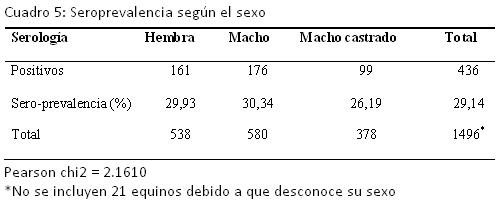
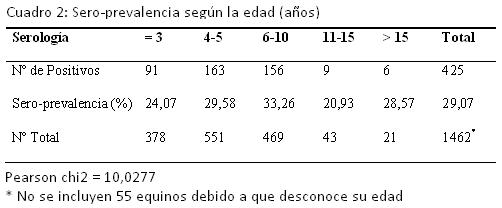
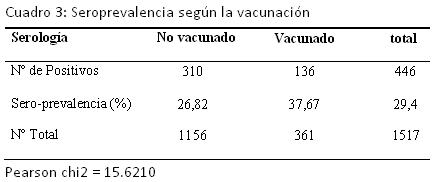
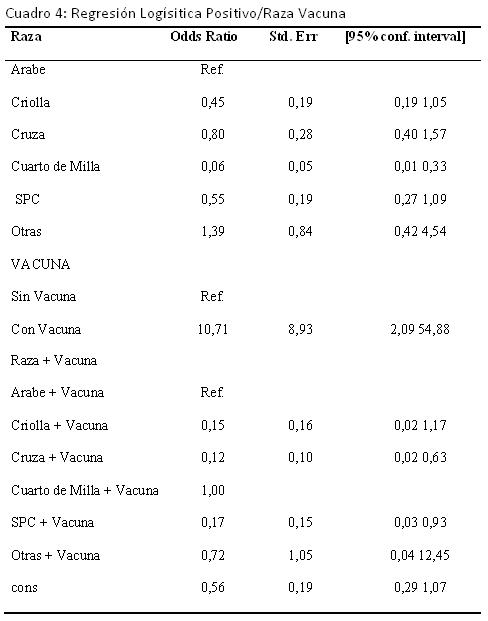
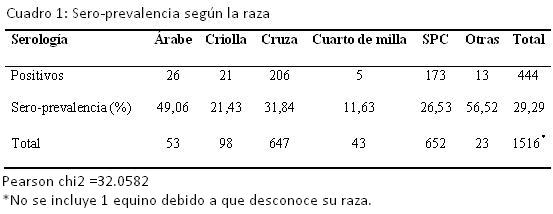
<body><![CDATA[<p class="MsoNormal" style="margin-bottom: 0.0001pt; text-align: justify; line-height: 200%;"><span style="font-size: 10pt; line-height: 200%; font-family: &quot;Verdana&quot;,&quot;sans-serif&quot;;" lang="ES-UY">La mayor cantidad de muestras de sueros equinos colectadas pertenecieron a la raza SPC y a los Cruza representando cada una de ellas el 43% de la poblaci&oacute;n (ver <a href="#tab_1">cuadro 1</a>). El grupo etario m&aacute;s numeroso se hall&oacute; en el rango de 6 a 10 a&ntilde;os de edad con un 32% del total de equinos estudiados (ver <a href="#tab_2">cuadro 2</a>). Se observ&oacute; que 361 equinos fueron recientemente vacunados contra RE, en un plazo menor a los 4 meses y mayor a los 15 d&iacute;as de la toma de muestra de sangre representando el 24% de la poblaci&oacute;n (ver <a href="#tab_3">cuadro 3</a>). La poblaci&oacute;n de equinos que fue vacunada en un plazo mayor a los cuatro meses, se consider&oacute; como poblaci&oacute;n no vacunada, ya que la inmunidad conferida por la vacunaci&oacute;n perdura durante unos pocos meses (<a href="#OIE_2015">OIE</a>, 2015). La prevalencia estimada por la relaci&oacute;n entre los sueros equinos positivos y el total sueros de equinos estudiados fue del 29% oscilando entre el 27% y 31%. (IC95%), siendo la raza <span class="SpellE">Arabe</span>, junto con el grupo de otras razas (Anglo-<span class="SpellE">arabe</span>, <span class="SpellE">Odenburg</span> y KWPN) los grupos con mayor proporci&oacute;n de positivos a EHV-1. Del an&aacute;lisis de regresi&oacute;n <span class="SpellE">univariable</span> (<a href="#tab_4">cuadro 4</a>) se puede inferir que por lo menos hay una raza que presenta diferencias significativas de <span class="SpellE">seroprevalencia</span>, mientras que el an&aacute;lisis de regresi&oacute;n log&iacute;stica permite interpretar que las variables SPC y cuarto de milla son las razas que presentan mayor probabilidad de presentar serolog&iacute;a positiva para EHV-1. A su vez, el estrato de equinos vacunados presenta mayor probabilidad de presentar seropositivos (ver <a href="#tab_3">cuadro 3</a>). El an&aacute;lisis <span class="SpellE">univariable</span>, no detect&oacute; diferencias significativas en los valores de <span class="SpellE">seroprevalencia</span> entre los grupos de macho, hembra y macho castrado (ver <a href="#tab_5">cuadro 5</a>), por lo tanto la variable sexo no se tuvo en cuenta en la modelaci&oacute;n del an&aacute;lisis de regresi&oacute;n log&iacute;stica. El grupo de reaccionantes aumenta con la edad, para luego caer a partir de los 10 a&ntilde;os, sin embargo a pesar de que el an&aacute;lisis de regresi&oacute;n <span class="SpellE">univariable</span> arroj&oacute; diferencias significativas entre las prevalencias de los diferentes grupos de edades, esta variable no se mantuvo en el modelo de regresi&oacute;n log&iacute;stica debido a que corregida por los otros factores no present&oacute; asociaci&oacute;n con la <span class="SpellE">seroprevalencia</span>.<o:p></o:p></span></p>        <p class="MsoNormal" style="margin-bottom: 0.0001pt; text-align: justify; line-height: 200%;"><b style=""><span style="font-size: 10pt; line-height: 200%; font-family: &quot;Verdana&quot;,&quot;sans-serif&quot;;" lang="ES-UY"><o:p>&nbsp;</o:p></span></b></p>        <p class="MsoNormal" style="margin-bottom: 0.0001pt; text-align: justify; line-height: 200%;"><b style=""><span style="font-size: 10pt; line-height: 200%; font-family: &quot;Verdana&quot;,&quot;sans-serif&quot;;" lang="ES-UY"><o:p>&nbsp;<img style="width: 553px; height: 214px;" alt="" src="/img/revistas/vet/v52n203/n203a01t1.JPG"><a name="tab_1"></a></o:p></span></b></p>        <p class="MsoNormal" style="margin-bottom: 0.0001pt; text-align: justify; line-height: 200%;"><b style=""><span style="font-size: 10pt; line-height: 200%; font-family: &quot;Verdana&quot;,&quot;sans-serif&quot;;" lang="ES-UY"><o:p>&nbsp;</o:p></span></b></p>        <p class="MsoNormal" style="margin-bottom: 0.0001pt; text-align: justify; line-height: 200%;"><b style=""><span style="font-size: 10pt; line-height: 200%; font-family: &quot;Verdana&quot;,&quot;sans-serif&quot;;" lang="ES-UY"><o:p>&nbsp;<img style="width: 502px; height: 208px;" alt="" src="/img/revistas/vet/v52n203/n203a01t2.JPG"><a name="tab_2"></a></o:p></span></b></p>        <p class="MsoNormal" style="margin-bottom: 0.0001pt; text-align: justify; line-height: 200%;"><b style=""><span style="font-size: 10pt; line-height: 200%; font-family: &quot;Verdana&quot;,&quot;sans-serif&quot;;" lang="ES-UY"><o:p>&nbsp;</o:p></span></b></p>        <p class="MsoNormal" style="margin-bottom: 0.0001pt; text-align: justify; line-height: 200%;"><b style=""><span style="font-size: 10pt; line-height: 200%; font-family: &quot;Verdana&quot;,&quot;sans-serif&quot;;" lang="ES-UY"><o:p>&nbsp;<img style="width: 434px; height: 182px;" alt="" src="/img/revistas/vet/v52n203/n203a01t3.JPG"><a name="tab_3"></a></o:p></span></b></p>        <p class="MsoNormal" style="margin-bottom: 0.0001pt; text-align: justify; line-height: 200%;"><b style=""><span style="font-size: 10pt; line-height: 200%; font-family: &quot;Verdana&quot;,&quot;sans-serif&quot;;" lang="ES-UY"><o:p>&nbsp;</o:p></span></b></p>        <p class="MsoNormal" style="margin-bottom: 0.0001pt; text-align: justify; line-height: 200%;"><b style=""><span style="font-size: 10pt; line-height: 200%; font-family: &quot;Verdana&quot;,&quot;sans-serif&quot;;" lang="ES-UY"><o:p>&nbsp;<img style="width: 488px; height: 621px;" alt="" src="/img/revistas/vet/v52n203/n203a01t4.JPG"><a name="tab_4"></a></o:p></span></b></p>        <p class="MsoNormal" style="margin-bottom: 0.0001pt; text-align: justify; line-height: 200%;"><b style=""><span style="font-size: 10pt; line-height: 200%; font-family: &quot;Verdana&quot;,&quot;sans-serif&quot;;" lang="ES-UY"><o:p>&nbsp;</o:p></span></b></p>        ]]></body>
<body><![CDATA[<p class="MsoNormal" style="margin-bottom: 0.0001pt; text-align: justify; line-height: 200%;"><b style=""><span style="font-size: 10pt; line-height: 200%; font-family: &quot;Verdana&quot;,&quot;sans-serif&quot;;" lang="ES-UY"><o:p>&nbsp;<img style="width: 501px; height: 202px;" alt="" src="/img/revistas/vet/v52n203/n203a01t5.JPG"><a name="tab_5"></a></o:p></span></b></p>        <p class="MsoNormal" style="margin-bottom: 0.0001pt; text-align: justify; line-height: 200%;"><b style=""><span style="font-size: 10pt; line-height: 200%; font-family: &quot;Verdana&quot;,&quot;sans-serif&quot;;" lang="ES-UY"><o:p>&nbsp;</o:p></span></b></p>        <p class="MsoNormal" style="margin-bottom: 0.0001pt; text-align: justify; line-height: 200%;"><b style=""><span style="font-size: 14pt; line-height: 200%; font-family: &quot;Verdana&quot;,&quot;sans-serif&quot;;" lang="ES-UY">Discusi&oacute;n<o:p></o:p></span></b></p>        <p class="MsoNormal" style="margin-bottom: 0.0001pt; text-align: justify; line-height: 200%;"><span style="font-size: 10pt; line-height: 200%; font-family: &quot;Verdana&quot;,&quot;sans-serif&quot;;" lang="ES-UY">La raza Pura Sangre de Carrera actualmente encabeza el grupo m&aacute;s importante de las razas equinas que participan en actividades de <span class="SpellE">deporteen</span> el Uruguay, lo cual coincide con lo descrito por otros autores (Ferreira, 2012).En muchos pa&iacute;ses la <span class="SpellE">seroprevalencia</span> de EHV-1 y EHV-4 es muy alta (<a href="#Maanen_2002"><span class="SpellE"></span></a><a name="-Maanen_2002"></a><a href="#Maanen_2002">Maanen</a></span>, <font size="-1"><span style="font-family: Verdana;">2002). Sin embargo la interpretaci&oacute;n puede ser confusa ya que test serol&oacute;gicos como la </span><span style="font-family: Verdana;" class="SpellE">seroneutralizaci&oacute;n</span><span style="font-family: Verdana;"> y la fijaci&oacute;n de complemento, no pueden diferenciar anticuerpos de los dos virus debido a la reactividad antig&eacute;nica cruzada entre ellos (</span><a style="font-family: Verdana;" href="#Hartley_y_col_2005"><span class="SpellE"></span></a><a style="font-family: Verdana;" name="-Hartley_y_col_2005"></a><span style="font-family: Verdana;"><a href="#Hartley_y_col_2005">Hartley</a> y col, 2005). En un estudio de protecci&oacute;n cruzada realizado en </span><span style="font-family: Verdana;" class="SpellE">ponies</span><span style="font-family: Verdana;">, </span><a style="font-family: Verdana;" href="#Edingtony_1990"><span class="SpellE"></span></a><a style="font-family: Verdana;" name="-Edingtony_1990"></a><span style="font-family: Verdana;"><a href="#Edingtony_1990">Edingtony</a> Bridges (1990), detect&oacute; una respuesta cruzada para EHV-4, luego de una infecci&oacute;n primaria con EHV-1 </span><span style="font-family: Verdana;" class="SpellE">perocuando</span><span style="font-family: Verdana;"> eran infectados con EHV-4 no se obten&iacute;a una respuesta de inmunidad cruzada para EHV-1. En otro estudio, se comprob&oacute; seroconversi&oacute;n cruzada en caballos infectados con EHV-1 y EHV-4 (</span><a style="font-family: Verdana;" href="#Hartley_y_col_2005"><span class="SpellE">Hartley</span></a><span style="font-family: Verdana;"> y col, 2005). A los efectos de evitar los problemas de interpretaci&oacute;n de los resultados, ocasionados por las reacciones serol&oacute;gicas cruzadas, se han desarrollado pruebas de ELISA tipo espec&iacute;ficas, basadas en el uso de anticuerpos monoclonales anti glicoprote&iacute;na G (</span><a style="font-family: Verdana;" href="#Crabb_y_Studdert_1993"><span class="SpellE"></span></a><a style="font-family: Verdana;" name="-Crabb_y_Studdert_1993."></a><span style="font-family: Verdana;"><a href="#Crabb_y_Studdert_1993.">Crabb</a> y </span><span style="font-family: Verdana;" class="SpellE">Studdert</span><span style="font-family: Verdana;">, 1993) y p&eacute;ptidos sint&eacute;ticos producidos a partir de la glicoprote&iacute;na E de EHV-1 y glicoprote&iacute;na G de EHV-4 (</span><a style="font-family: Verdana;" href="#Lang_y_col_2013"><span class="SpellE"></span></a><a style="font-family: Verdana;" name="-Lang_y_col_2013"></a><span style="font-family: Verdana;"><a href="#Lang_y_col_2013">Lang</a> y col, 2013).</span></font><o:p></o:p></p>        <p class="MsoNormal" style="margin-bottom: 0.0001pt; text-align: justify; line-height: 200%;"><span style="font-size: 10pt; line-height: 200%; font-family: &quot;Verdana&quot;,&quot;sans-serif&quot;;" lang="ES-UY">La prevalencia general de EHV-1 encontrada en los equinos de deporte en el Uruguay es del 29% (IC95%= 27-31%), valor similar al descrito en otros pa&iacute;ses. Sin embargo, cuando se comparan los resultados con los hallados por otros autores es necesario tener en cuenta las pruebas serol&oacute;gicas utilizadas, visto que hay diferencias de especificidad y sensibilidad diagn&oacute;stica entre las mismas, como ya se ha mencionado.<o:p></o:p></span></p>        <p class="MsoNormal" style="margin-bottom: 0.0001pt; text-align: justify; line-height: 200%;"><a href="#Crabb_y_Studdert_1993"><span class="SpellE"><span style="font-size: 10pt; line-height: 200%; font-family: &quot;Verdana&quot;,&quot;sans-serif&quot;;" lang="ES-UY">Crabb</span></span></a><span style="font-size: 10pt; line-height: 200%; font-family: &quot;Verdana&quot;,&quot;sans-serif&quot;;" lang="ES-UY"> y <span class="SpellE">Studdert</span>, 1993, usando una prueba de ELISA tipo espec&iacute;fica, realizaron un muestreo aleatorio en SPC en Australia en el per&iacute;odo 1967-1976 y el a&ntilde;o 1993, encontrando una prevalencia de 9-28% para EHV-1 y 100% para EHV-4. Posteriormente, luego de la primer confirmaci&oacute;n de aborto por EHV-1 en 1997, la prevalencia para este serotipo aument&oacute; al 30% (<a name="-Crabb_y_col_1995"></a><a href="#Crabb_y_col_1995"><span class="SpellE">Crabb</span></a> y col, 1995). En 1995, en un estudio transversal realizado en el mismo <span class="SpellE">pa&iacute;sutilizando</span> la misma prueba de ELISA tipo espec&iacute;fica, con una poblaci&oacute;n de 229 yeguas madres SPC con potrillo al pie, se encontr&oacute; una prevalencia similar, de100% para EHV-4 y de 26,2% y 11,4% para EHV-1 en madres y potrillos respectivamente (<a href="#Gilkerson_y_col_1999"><span class="SpellE"></span></a><a name="-Gilkerson_y_col_1999"></a><a href="#Gilkerson_y_col_1999">Gilkerson</a></span> <font size="-1"><span style="font-family: Verdana;">y col, 1999). En Nueva Zelanda la </span><span style="font-family: Verdana;" class="SpellE">seroprevalencia</span><span style="font-family: Verdana;"> en SPC es mayor que la hallada en Australia y en nuestro pa&iacute;s, ya que fue del 29%, 48% y 70% en potrillos de 6-12 meses, 12-24 meses y adultos mayores de 2 a&ntilde;os de edad, respectivamente (</span><a style="font-family: Verdana;" name="-Donald_y_col_1998"></a><a style="font-family: Verdana;" href="#Donald_y_col_1998">Donald</a><span style="font-family: Verdana;"> y col, 1998), lo cual indica que la infecci&oacute;n est&aacute; m&aacute;s difundida en ese pa&iacute;s (</span><a style="font-family: Verdana;" href="#Dunowska_2014"><span class="SpellE"></span></a><a style="font-family: Verdana;" name="-Dunowska_2014"></a><span style="font-family: Verdana;"><a href="#Dunowska_2014">Dunowska</a>, 2014). Sin embargo, estas diferencias podr&iacute;an ser ocasionadas por el uso de diferentes m&eacute;todos de ensayo serol&oacute;gicos (</span><a style="font-family: Verdana;" href="#Crabb_y_col_1995"><span class="SpellE">Crabb</span></a><span style="font-family: Verdana;"> y col, 1995).</span></font><o:p></o:p></p>        <p class="MsoNormal" style="margin-bottom: 0.0001pt; text-align: justify; line-height: 200%;"><span style="font-size: 10pt; line-height: 200%; font-family: &quot;Verdana&quot;,&quot;sans-serif&quot;;" lang="ES-UY">Por otra parte, en un estudio <span class="SpellE">seroepidemiol&oacute;gico</span> realizado en Turqu&iacute;a, en <span class="SpellE">caballos<span class="GramE">,mostraron</span></span> 14.5% de seropositividad para EHV-1,mientras que el 81,7% fueron positivos a EHV-4 (<a href="#Ataseven_y_col_2009"><span class="SpellE"></span></a><a name="-Ataseven_y_col_2009"></a><a href="#Ataseven_y_col_2009">Ataseven</a></span><font size="-1"><span style="font-family: Verdana;"> y col, 2009). En otro estudio </span><span style="font-family: Verdana;" class="SpellE">serol&oacute;gicorealizado</span><span style="font-family: Verdana;"> en el Estado de San Pablo -Brasil en el 2004, se obtuvo una prevalencia del 26% para EHV-1 (</span><a style="font-family: Verdana;" href="#Cunha_y_col_2009"><span class="SpellE"></span></a><a style="font-family: Verdana;" name="-Cunha_y_col_2009"></a><span style="font-family: Verdana;"><a href="#Cunha_y_col_2009">Cunha</a> y col, 2009) mientras que otro estudio realizado el Estado de Minas Gerais en el 2010 se obtuvo una prevalencia menor (18,7%), probablemente debido a que las muestras colectadas fueron tomadas de animales asintom&aacute;ticos (</span><a style="font-family: Verdana;" name="-Lara_y_col_2010"></a><a style="font-family: Verdana;" href="#Lara_y_col_2010">Lara</a><span style="font-family: Verdana;"> y col, 2010). En el Estado de Par&aacute;, </span><span style="font-family: Verdana;" class="SpellE"><a name="-Heinemann_y_col_2002"></a><a href="#Heinemann_y_col_2002">Heinemann</a> y</span><span style="font-family: Verdana;"> col. (2002), reportaron una prevalencia similar (17,71%).</span></font><o:p></o:p></p>        <p class="MsoNormal" style="margin-bottom: 0.0001pt; text-align: justify; line-height: 200%;"><span style="font-size: 10pt; line-height: 200%; font-family: &quot;Verdana&quot;,&quot;sans-serif&quot;;" lang="ES-UY">En este estudio, los equinos vacunados, representan 24% de la poblaci&oacute;n, siendo la proporci&oacute;n de positivos a EHV-<span class="GramE">1 ,</span> de los vacunados y no vacunados de un </span><span style="font-size: 10pt; line-height: 200%; font-family: &quot;Verdana&quot;,&quot;sans-serif&quot;; color: black;">38</span><span style="font-size: 10pt; line-height: 200%; font-family: &quot;Verdana&quot;,&quot;sans-serif&quot;;" lang="ES-UY">% y 27 % respectivamente. Estos valores difieren con los hallados en Argentina por <a href="#Galosi_y_col_1991"><span class="SpellE"></span></a><a name="-Galosi_y_col_1991"></a><a href="#Galosi_y_col_1991">Galosi</a></span> <font size="-1"><span style="font-family: Verdana;">y col, 1991 (48% y 11% respectivamente). Posiblemente, estas diferencias puedan explicarse en parte, por el criterio adoptado para </span><span style="font-family: Verdana;" class="SpellE">definira</span><span style="font-family: Verdana;"> la poblaci&oacute;n vacunada, ya que los autores incluyen a los equinos con m&aacute;s de cuatro meses de vacunados a la poblaci&oacute;n no vacunada, ya que la inmunidad conferida por la vacunaci&oacute;n perdura durante unos pocos meses (</span><a style="font-family: Verdana;" href="#OIE_2015">OIE</a><span style="font-family: Verdana;">, 2015).</span></font><o:p></o:p></p>        <p class="MsoNormal" style="margin-bottom: 0.0001pt; text-align: justify; line-height: 200%;"><span style="font-size: 10pt; line-height: 200%; font-family: &quot;Verdana&quot;,&quot;sans-serif&quot;;" lang="ES-UY">Se observ&oacute; una prevalencia menor en los estratos menores de 5 a&ntilde;os <span class="SpellE">queen</span> la categor&iacute;a de 5-10 a&ntilde;os de edad, lo cual coincide con lo descrito en otros pa&iacute;ses, donde la prevalencia es mayor en los adultos que en potrillos (<a href="#Gilkerson_y_col_1999"><span class="SpellE">Gilkerson</span></a> y col, 1999). Sin embargo cuando analizamos por la raza y vacunaci&oacute;n en el an&aacute;lisis de regresi&oacute;n log&iacute;stica, no se observ&oacute; el efecto de la edad sobre la <span class="SpellE">seroprevalencia</span>. Tal vez, la raz&oacute;n se deba a que no se pudo <span class="SpellE">subestratificar</span> la categor&iacute;a de equinos menores de 3 a&ntilde;os, para poder evidenciar diferencias significativas entre los estratos menores (por ejemplo 1, 2, y 3 a&ntilde;os de edad). Seg&uacute;n los resultados del an&aacute;lisis de regresi&oacute;n log&iacute;stica, la condici&oacute;n de la raza &aacute;rabe, junto con la Anglo-<span class="SpellE">Arabe</span>, <span class="SpellE">Oldenburg</span> y KWPN, obtuvo mayor probabilidad de presentar seropositivos que las otras razas, y el efecto es mayor en las poblaciones vacunadas, comprob&aacute;ndose que el factor vacunaci&oacute;n tambi&eacute;n afecta la <span class="SpellE">seroprevalencia</span>.<o:p></o:p></span></p>        <p class="MsoNormal" style="margin-bottom: 0.0001pt; text-align: justify; line-height: 200%;"><span style="font-size: 10pt; line-height: 200%; font-family: &quot;Verdana&quot;,&quot;sans-serif&quot;;" lang="ES-UY"><span style=""></span>Esta diferencia entre las razas, podr&iacute;a estar debida a las condiciones de manejo, ya que el sistema de explotaci&oacute;n de estas razas es m&aacute;s intensivo y quiz&aacute;s haya mayores tasas de <span class="SpellE">contacto<span class="GramE">,exposici&oacute;n</span></span> a diferentes factores ambientales, y planes de vacunaci&oacute;n m&aacute;s rigurosos con niveles de inmunidad m&aacute;s altos por efecto &ldquo;<span class="SpellE">booster</span>&rdquo;. Por otro lado la diferencia gen&eacute;tica entre las razas podr&iacute;an ser una explicaci&oacute;n plausible a las diferencias encontradas (<span class="SpellE">Dunowska</span>, 2014).<o:p></o:p></span></p>        ]]></body>
<body><![CDATA[<p class="MsoNormal" style="margin-bottom: 0.0001pt; text-align: justify; line-height: 200%;"><span style="font-size: 10pt; line-height: 200%; font-family: &quot;Verdana&quot;,&quot;sans-serif&quot;;" lang="ES-UY">En el modelo se observa que existe interacci&oacute;n entre las razas y la vacunaci&oacute;n, probablemente porque las frecuencias y los tiempos de vacunaci&oacute;n son diferentes entre las razas, o bien, porque simplemente ellas responden en forma diferencial por razones gen&eacute;ticas (<span class="SpellE">Dunowska</span>, 2014).<o:p></o:p></span></p>        <p class="MsoNormal" style="margin-bottom: 0.0001pt; text-align: justify; line-height: 200%;"><span style="font-size: 10pt; line-height: 200%; font-family: &quot;Verdana&quot;,&quot;sans-serif&quot;;" lang="ES-UY"><o:p>&nbsp;</o:p></span></p>        <p class="MsoNormal" style="margin-bottom: 0.0001pt; text-align: justify; line-height: 200%;"><b style=""><span style="font-size: 14pt; line-height: 200%; font-family: &quot;Verdana&quot;,&quot;sans-serif&quot;;" lang="ES-UY">Conclusiones<o:p></o:p></span></b></p>        <p class="MsoNormal" style="margin-bottom: 0.0001pt; text-align: justify; line-height: 200%;"><span style="font-size: 10pt; line-height: 200%; font-family: &quot;Verdana&quot;,&quot;sans-serif&quot;;" lang="ES-UY">Se comprueba que la RE se encuentra ampliamente distribuida en la poblaci&oacute;n de equinos de deporte en nuestro pa&iacute;s, cuya prevalencia estimada es 29% (IC95% = 27-31%), sin embargo la misma puede ser menor a la estimada debido a la interferencia causada <span class="SpellE">porlos</span> <span class="SpellE">anticuerposseroneutralizantes</span> para EHV-1 asociados a la vacunaci&oacute;n (p&lt;0,05).<o:p></o:p></span></p>        <p class="MsoNormal" style="margin-bottom: 0.0001pt; text-align: justify; line-height: 200%;"><span style="font-size: 10pt; line-height: 200%; font-family: &quot;Verdana&quot;,&quot;sans-serif&quot;;" lang="ES-UY">En el modelo se observa que existe interacci&oacute;n entre las razas y la vacunaci&oacute;n, probablemente porque las frecuencias y los tiempos de vacunaci&oacute;n son diferentes entre las razas.<o:p></o:p></span></p>        <p class="MsoNoSpacing" style="text-align: justify; line-height: 200%;"><span style="font-size: 10pt; line-height: 200%; font-family: &quot;Verdana&quot;,&quot;sans-serif&quot;;" lang="ES-UY"><o:p>&nbsp;</o:p></span></p>        <p class="MsoNoSpacing" style="text-align: justify; line-height: 200%;"><b style=""><span style="font-size: 14pt; line-height: 200%; font-family: &quot;Verdana&quot;,&quot;sans-serif&quot;;">Agradecimientos<o:p></o:p></span></b></p>        <p class="MsoNoSpacing" style="text-align: justify; line-height: 200%;"><span style="font-size: 10pt; line-height: 200%; font-family: &quot;Verdana&quot;,&quot;sans-serif&quot;;">Los autores desean agradecer a la Dra. <span class="SpellE">Maria</span> <span class="SpellE">Barrandeguy</span> y a la Lic. </span><span style="font-size: 10pt; line-height: 200%; font-family: &quot;Verdana&quot;,&quot;sans-serif&quot;;" lang="ES-UY">Aldana <span class="SpellE">Vissani</span> por el env&iacute;o de los reactivos de referencia y por su apoyo en el desarrollo del trabajo. Tambi&eacute;n agradecen a la Dra. Helena <span class="SpellE">Guarino</span> y al Dr. N&eacute;stor <span class="SpellE">D&acute;Anatros</span> por facilitar la recolecci&oacute;n de muestras del Banco de Sueros. Tambi&eacute;n expresan su agradecimiento a los veterinarios en el ejercicio liberal especialistas en equinos y a las secretarias de DILAVE, Adriana Barrios y Elisa <span class="GramE">Ferreira ,</span> por su colaboraci&oacute;n en la b&uacute;squeda de datos de identificaci&oacute;n de las muestras. Tambi&eacute;n desean agradecer a la Lic. Ruth <span class="SpellE">Santestevan</span> por su colaboraci&oacute;n en la revisi&oacute;n de las referencias <span class="SpellE">bibliogr&aacute;ficas.El</span> trabajo fue financiado por el Programa de Posgrados de la Facultad de Veterinaria de <span class="SpellE">UdelaR</span> y por el Proyecto</span><span style="font-size: 10pt; line-height: 200%; font-family: &quot;Verdana&quot;,&quot;sans-serif&quot;;"> JICA- DILAVE-MGAP.<o:p></o:p></span></p>        <p class="MsoNoSpacing" style="text-align: justify; line-height: 200%;"><span style="font-size: 10pt; line-height: 200%; font-family: &quot;Verdana&quot;,&quot;sans-serif&quot;;" lang="ES-UY"><o:p>&nbsp;</o:p></span></p>        <p class="MsoNoSpacing" style="text-align: justify; line-height: 200%;"><b style=""><span style="font-size: 14pt; line-height: 200%; font-family: &quot;Verdana&quot;,&quot;sans-serif&quot;;" lang="ES-UY">Bibliograf&iacute;a<o:p></o:p></span></b></p>        ]]></body>
<body><![CDATA[<!-- ref --><p class="MsoListParagraphCxSpFirst" style="margin: 0cm 0cm 0.0001pt 34pt; text-align: justify; text-indent: -19.8pt; line-height: 200%;"><span style="font-size: 10pt; line-height: 200%; font-family: &quot;Verdana&quot;,&quot;sans-serif&quot;; color: black;" lang="EN-US"><span style="">1.<span style="font-family: &quot;Times New Roman&quot;; font-style: normal; font-variant: normal; font-weight: normal; font-size: 7pt; line-height: normal; font-size-adjust: none; font-stretch: normal;">&nbsp;&nbsp;&nbsp;&nbsp;&nbsp;</span></span></span><span style="font-size: 10pt; line-height: 200%; font-family: &quot;Verdana&quot;,&quot;sans-serif&quot;; color: black;" lang="EN-US"><a name="Allen_y_Bryans_1986"></a><a href="#-Allen_y_Bryans_1986">Allen</a> GP, Bryans JT. </span><span style="font-size: 10pt; line-height: 200%; font-family: &quot;Verdana&quot;,&quot;sans-serif&quot;; color: black;" lang="EN-US">(1986). Molecular <span class="SpellE">epizootiology</span>, pathogenesis, and prophylaxis of equine herpesvirus-1 infections. <span class="SpellE">Prog</span> Vet <span class="SpellE">Microbiol</span> <span class="SpellE">Immunol</span> <span style="">2:</span>78-144.    <o:p></o:p></span></p>        <p class="MsoListParagraphCxSpMiddle" style="margin: 0cm 0cm 0.0001pt 34pt; text-align: justify; text-indent: -19.8pt; line-height: 200%;"><span style="font-size: 10pt; line-height: 200%; font-family: &quot;Verdana&quot;,&quot;sans-serif&quot;; color: black;" lang="EN-US"><span style="">2.<span style="font-family: &quot;Times New Roman&quot;; font-style: normal; font-variant: normal; font-weight: normal; font-size: 7pt; line-height: normal; font-size-adjust: none; font-stretch: normal;">&nbsp;&nbsp;&nbsp;&nbsp;&nbsp;<a name="Ataseven_y_col_2009"></a></span></span></span><a style="color: rgb(49, 49, 248);" href="#-Ataseven_y_col_2009"><span class="SpellE"><span style="font-size: 10pt; line-height: 200%; font-family: &quot;Verdana&quot;,&quot;sans-serif&quot;;">Ataseven</span></span></a><span style="font-size: 10pt; line-height: 200%; font-family: &quot;Verdana&quot;,&quot;sans-serif&quot;; color: black;"><span style="color: rgb(49, 49, 248);"> </span>VS, <span class="SpellE">Dagalp</span> SB, <span class="SpellE">Guzel</span> M, Basaran Z, Tan M.T, <span class="SpellE">Geraghty</span> B. (</span><span style="font-size: 10pt; line-height: 200%; font-family: &quot;Verdana&quot;,&quot;sans-serif&quot;; color: black;">2009). </span><span style="font-size: 10pt; line-height: 200%; font-family: &quot;Verdana&quot;,&quot;sans-serif&quot;; color: black;" lang="EN-US">Prevalence of equine herpesvirus-1 and equine herpesvirus-4infections in <span class="SpellE">equidae</span> species in Turkey as determined by ELISA and multiplex nested PCR. Res Vet <span class="SpellE">Sci</span> <span style="">86:</span>339&ndash;344.<o:p></o:p></span></p>        <!-- ref --><p class="MsoListParagraphCxSpMiddle" style="margin: 0cm 0cm 0.0001pt 34pt; text-align: justify; text-indent: -19.8pt; line-height: 200%;"><span style="font-size: 10pt; line-height: 200%; font-family: &quot;Verdana&quot;,&quot;sans-serif&quot;; color: black;" lang="EN-US"><span style="">3.<span style="font-family: &quot;Times New Roman&quot;; font-style: normal; font-variant: normal; font-weight: normal; font-size: 7pt; line-height: normal; font-size-adjust: none; font-stretch: normal;">&nbsp;&nbsp;&nbsp;&nbsp;&nbsp;</span></span></span><a href="#-Crabb_y_col_1995"><span class="SpellE"><span style="font-size: 10pt; line-height: 200%; font-family: &quot;Verdana&quot;,&quot;sans-serif&quot;; color: black;" lang="EN-US"></span></span></a><a name="Crabb_y_col_1995"></a><font size="-1"><a style="font-family: Verdana;" href="#-Crabb_y_col_1995"><span style="color: rgb(49, 49, 248);">Crabb</span></a></font><span style="font-size: 10pt; line-height: 200%; font-family: &quot;Verdana&quot;,&quot;sans-serif&quot;; color: black;" lang="EN-US"> BS, <span class="SpellE">MacPherson</span> CM, <span class="SpellE">Reubel</span> GH, Browning GF, <span class="SpellE">Studdert</span> MJ, Drummer HE. (</span><span style="font-size: 10pt; line-height: 200%; font-family: &quot;Verdana&quot;,&quot;sans-serif&quot;; color: black;" lang="EN-US">1995). A type-specific serological test to distinguish antibodies to equine <span class="SpellE">herpesviruses</span> 4and 1.Arch <span class="SpellE">Virol</span> <span style="">140:</span>245-258.    <o:p></o:p></span></p>        <!-- ref --><p class="MsoListParagraphCxSpMiddle" style="margin: 0cm 0cm 0.0001pt 34pt; text-align: justify; text-indent: -19.8pt; line-height: 200%;"><span style="font-size: 10pt; line-height: 200%; font-family: &quot;Verdana&quot;,&quot;sans-serif&quot;; color: black;" lang="EN-US"><span style="">4.<span style="font-family: &quot;Times New Roman&quot;; font-style: normal; font-variant: normal; font-weight: normal; font-size: 7pt; line-height: normal; font-size-adjust: none; font-stretch: normal;">&nbsp;&nbsp;&nbsp;&nbsp;&nbsp;</span></span></span><a href="#-Crabb_y_Studdert_1993"><span class="SpellE"><span style="font-size: 10pt; line-height: 200%; font-family: &quot;Verdana&quot;,&quot;sans-serif&quot;; color: black;" lang="EN-US"></span></span></a><a name="Crabb_y_Studdert_1993"></a><font size="-1"><a style="font-family: Verdana;" href="#-Crabb_y_Studdert_1993"><span style="color: rgb(49, 49, 248);">Crabb</span></a></font><span style="font-size: 10pt; line-height: 200%; font-family: &quot;Verdana&quot;,&quot;sans-serif&quot;; color: black;" lang="EN-US"> BS, <span class="SpellE">Studdert</span> MJ</span><span style="font-size: 10pt; line-height: 200%; font-family: &quot;Verdana&quot;,&quot;sans-serif&quot;; color: black;" lang="EN-US">. (1993). <span class="SpellE">Epitopes</span> of glycoprotein G of equine <span class="SpellE">herpesviruses</span> 4 and 1 located near the C termini elicit type-specific antibody responses in the natural host. J <span class="SpellE">Virol</span> <span style="">7</span>:6332-6338.    <o:p></o:p></span></p>        <!-- ref --><p class="MsoListParagraphCxSpMiddle" style="margin: 0cm 0cm 0.0001pt 34pt; text-align: justify; text-indent: -19.8pt; line-height: 200%;"><span style="font-size: 10pt; line-height: 200%; font-family: &quot;Verdana&quot;,&quot;sans-serif&quot;; color: black;"><span style="">5.<span style="font-family: &quot;Times New Roman&quot;; font-style: normal; font-variant: normal; font-weight: normal; font-size: 7pt; line-height: normal; font-size-adjust: none; font-stretch: normal;">&nbsp;&nbsp;&nbsp;&nbsp;&nbsp;</span></span></span><a href="#-Cunha_y_col_2009"><span class="SpellE"><span style="font-size: 10pt; line-height: 200%; font-family: &quot;Verdana&quot;,&quot;sans-serif&quot;; color: black;" lang="ES-UY"></span></span></a><a name="Cunha_y_col_2009"></a><font size="-1"><a style="font-family: Verdana;" href="#-Cunha_y_col_2009"><span style="color: rgb(49, 49, 248);">Cunha</span></a></font><span style="font-size: 10pt; line-height: 200%; font-family: &quot;Verdana&quot;,&quot;sans-serif&quot;; color: black;" lang="ES-UY"> EMS, Villalobos EMC, <span class="SpellE">Nassar</span> AFC, Lara, MCCSH, <span class="SpellE">Peres</span> NF, Palazzo JPC, Pino FA. (</span><span style="font-size: 10pt; line-height: 200%; font-family: &quot;Verdana&quot;,&quot;sans-serif&quot;; color: black;">2009). </span><span class="SpellE"><span style="font-size: 10pt; line-height: 200%; font-family: &quot;Verdana&quot;,&quot;sans-serif&quot;; color: black;" lang="ES-UY">Preval&ecirc;ncia</span></span><span style="font-size: 10pt; line-height: 200%; font-family: &quot;Verdana&quot;,&quot;sans-serif&quot;; color: black;" lang="ES-UY"> de <span class="SpellE">anticorpos</span> contra agentes <span class="SpellE">viraisemequ&iacute;deos</span> no <span class="SpellE">sul</span> </span><span style="font-size: 10pt; line-height: 200%; font-family: &quot;Verdana&quot;,&quot;sans-serif&quot;;" lang="ES-UY">do <span style="color: black;">estado de S&atilde;o Paulo. </span></span><span class="SpellE"><span style="font-size: 10pt; line-height: 200%; font-family: &quot;Verdana&quot;,&quot;sans-serif&quot;; color: black;">Arq</span></span><span style="font-size: 10pt; line-height: 200%; font-family: &quot;Verdana&quot;,&quot;sans-serif&quot;; color: black;"> <span class="SpellE">Inst</span> <span class="SpellE">Biol</span> <span style="">76:</span>165-171.    <o:p></o:p></span></p>        <!-- ref --><p class="MsoListParagraphCxSpMiddle" style="margin: 0cm 0cm 0.0001pt 34pt; text-align: justify; text-indent: -19.8pt; line-height: 200%;"><span style="font-size: 10pt; line-height: 200%; font-family: &quot;Verdana&quot;,&quot;sans-serif&quot;; color: black;" lang="EN-US"><span style="">6.<span style="font-family: &quot;Times New Roman&quot;; font-style: normal; font-variant: normal; font-weight: normal; font-size: 7pt; line-height: normal; font-size-adjust: none; font-stretch: normal;">&nbsp;&nbsp;&nbsp;&nbsp;&nbsp;</span></span></span><span style="font-size: 10pt; line-height: 200%; font-family: &quot;Verdana&quot;,&quot;sans-serif&quot;; color: black;" lang="EN-US"><a name="Donald_y_col_1998"></a><a href="#-Donald_y_col_1998">Donald</a> JJ. (</span><span style="font-size: 10pt; line-height: 200%; font-family: &quot;Verdana&quot;,&quot;sans-serif&quot;; color: black;" lang="EN-US">1998). Epidemiology and diagnosis of <span class="SpellE">equid</span> <span class="SpellE">herpesviruses</span> 1 and 4 in horses in New Zealand. PhD thesis, Massey University, <span class="SpellE">Palmerston</span> North. 232p.    <o:p></o:p></span></p>        <p class="MsoListParagraphCxSpMiddle" style="margin: 0cm 0cm 0.0001pt 34pt; text-align: justify; text-indent: -19.8pt; line-height: 200%;"><span style="font-size: 10pt; line-height: 200%; font-family: &quot;Verdana&quot;,&quot;sans-serif&quot;; color: black;" lang="EN-US"><span style="">7.<span style="font-family: &quot;Times New Roman&quot;; font-style: normal; font-variant: normal; font-weight: normal; font-size: 7pt; line-height: normal; font-size-adjust: none; font-stretch: normal;">&nbsp;&nbsp;&nbsp;&nbsp;&nbsp;</span></span></span><a href="#-Dunowska_2014"><span class="SpellE"><span style="font-size: 10pt; line-height: 200%; font-family: &quot;Verdana&quot;,&quot;sans-serif&quot;; color: black;" lang="EN-US"></span></span></a><a name="Dunowska_2014"></a><font size="-1"><a style="font-family: Verdana;" href="#-Dunowska_2014"><span style="color: rgb(51, 102, 255);">Dunowska</span></a></font><span style="font-size: 10pt; line-height: 200%; font-family: &quot;Verdana&quot;,&quot;sans-serif&quot;; color: black;" lang="EN-US"> M. (</span><span style="font-size: 10pt; line-height: 200%; font-family: &quot;Verdana&quot;,&quot;sans-serif&quot;; color: black;" lang="EN-US">2014). A review of <span class="SpellE">equidherpesvirus</span> 1 for the veterinary practitioner. Part B: pathogenesis and epidemiology. NZ Vet J <span style="">62</span>:179&ndash;188.<o:p></o:p></span></p>        <!-- ref --><p class="MsoListParagraphCxSpMiddle" style="margin: 0cm 0cm 0.0001pt 34pt; text-align: justify; text-indent: -19.8pt; line-height: 200%;"><span style="font-size: 10pt; line-height: 200%; font-family: &quot;Verdana&quot;,&quot;sans-serif&quot;; color: black;" lang="EN-US"><span style="">8.<span style="font-family: &quot;Times New Roman&quot;; font-style: normal; font-variant: normal; font-weight: normal; font-size: 7pt; line-height: normal; font-size-adjust: none; font-stretch: normal;">&nbsp;&nbsp;&nbsp;&nbsp;&nbsp;</span></span></span><span style="font-size: 10pt; line-height: 200%; font-family: &quot;Verdana&quot;,&quot;sans-serif&quot;; color: black;"><a name="Easton_y_col_2009"></a><a href="#-Easton_y_col_2009">Easton</a> C, <span class="SpellE">Fuentealba</span> NA, Paullier C, <span class="SpellE">Alonzo</span> P, <span class="SpellE">Carluccio</span> J, <span class="SpellE">Galosi</span> CM</span><span style="font-size: 10pt; line-height: 200%; font-family: &quot;Verdana&quot;,&quot;sans-serif&quot;; color: black;">. </span><span style="font-size: 10pt; line-height: 200%; font-family: &quot;Verdana&quot;,&quot;sans-serif&quot;; color: black;" lang="EN-US">(</span><span style="font-size: 10pt; line-height: 200%; font-family: &quot;Verdana&quot;,&quot;sans-serif&quot;; color: black;" lang="EN-GB">2009). <span class="SpellE">Immunohistochemical</span> and molecular detection of equine <span class="SpellE">herpesvirus</span> 1 in Uruguay. </span><span style="font-size: 10pt; line-height: 200%; font-family: &quot;Verdana&quot;,&quot;sans-serif&quot;; color: black;" lang="EN-US">Rev <span class="SpellE">Sci</span> Tech <span style="">28:</span>1085-1090.    <o:p></o:p></span></p>        <!-- ref --><p class="MsoListParagraphCxSpMiddle" style="margin: 0cm 0cm 0.0001pt 34pt; text-align: justify; text-indent: -19.8pt; line-height: 200%;"><span style="font-size: 10pt; line-height: 200%; font-family: &quot;Verdana&quot;,&quot;sans-serif&quot;; color: black;" lang="EN-US"><span style="">9.<span style="font-family: &quot;Times New Roman&quot;; font-style: normal; font-variant: normal; font-weight: normal; font-size: 7pt; line-height: normal; font-size-adjust: none; font-stretch: normal;">&nbsp;&nbsp;&nbsp;&nbsp;&nbsp;</span></span></span><a href="#-Edingtony_1990"><span class="SpellE"><span style="font-size: 10pt; line-height: 200%; font-family: &quot;Verdana&quot;,&quot;sans-serif&quot;; color: black;" lang="EN-US"></span></span></a><a name="Edingtony_1990"></a><font size="-1"><a style="font-family: Verdana;" href="#-Edingtony_1990"><span style="color: rgb(49, 49, 248);">Edington</span></a></font><span style="font-size: 10pt; line-height: 200%; font-family: &quot;Verdana&quot;,&quot;sans-serif&quot;; color: black;" lang="EN-US"> N, Bridges CG. (</span><span style="font-size: 10pt; line-height: 200%; font-family: &quot;Verdana&quot;,&quot;sans-serif&quot;; color: black;" lang="EN-US">1990). One way protection between <span class="SpellE">equid</span> <span class="SpellE">herpesvirus</span> 1 and 4 in vivo. </span><span style="font-size: 10pt; line-height: 200%; font-family: &quot;Verdana&quot;,&quot;sans-serif&quot;;" lang="EN-US">Res Vet <span class="SpellE">Sci</span> <span style="color: black;">48</span><span style="color: black;">:235-239.    <o:p></o:p></span></span></p>        <!-- ref --><p class="MsoListParagraphCxSpMiddle" style="margin: 0cm 0cm 0.0001pt 34pt; text-align: justify; text-indent: -19.8pt; line-height: 200%;"><span style="font-size: 10pt; line-height: 200%; font-family: &quot;Verdana&quot;,&quot;sans-serif&quot;; color: black;" lang="ES-UY"><span style="">10.<span style="font-family: &quot;Times New Roman&quot;; font-style: normal; font-variant: normal; font-weight: normal; font-size: 7pt; line-height: normal; font-size-adjust: none; font-stretch: normal;">&nbsp;&nbsp;</span></span></span><span style="font-size: 10pt; line-height: 200%; font-family: &quot;Verdana&quot;,&quot;sans-serif&quot;; color: black;" lang="ES-UY"><a name="Ferrari_2012"></a><a href="#-Ferrari_2012">Ferrari</a> A. </span><span style="font-size: 10pt; line-height: 200%; font-family: &quot;Verdana&quot;,&quot;sans-serif&quot;; color: black;" lang="ES-UY">(2012). Caracterizaci&oacute;n y potencialidades del sector ecuestre en Uruguay. Informe final. Uruguay XXI, Montevideo. 150 pp.    <o:p></o:p></span></p>        <!-- ref --><p class="MsoListParagraphCxSpMiddle" style="margin: 0cm 0cm 0.0001pt 34pt; text-align: justify; text-indent: -19.8pt; line-height: 200%;"><span style="font-size: 10pt; line-height: 200%; font-family: &quot;Verdana&quot;,&quot;sans-serif&quot;; color: black;" lang="ES-UY"><span style="">11.<span style="font-family: &quot;Times New Roman&quot;; font-style: normal; font-variant: normal; font-weight: normal; font-size: 7pt; line-height: normal; font-size-adjust: none; font-stretch: normal;">&nbsp;&nbsp;</span></span></span><a href="#-Galosi_y_col_1991"><span class="SpellE"><span style="font-size: 10pt; line-height: 200%; font-family: &quot;Verdana&quot;,&quot;sans-serif&quot;; color: black;" lang="ES-UY"></span></span></a><a name="Galosi_y_col_1991"></a><font size="-1"><a style="font-family: Verdana;" href="#-Galosi_y_col_1991"><span style="color: rgb(51, 102, 255);">Galosi</span></a></font><span style="font-size: 10pt; line-height: 200%; font-family: &quot;Verdana&quot;,&quot;sans-serif&quot;; color: black;" lang="ES-UY"> CM, Oliva GA, <span class="SpellE">Etcheverrigaray</span> ME. </span><span style="font-size: 10pt; line-height: 200%; font-family: &quot;Verdana&quot;,&quot;sans-serif&quot;; color: black;" lang="ES-UY">(1991). Herpes equino 1 y 4: agente etiol&oacute;gico y enfermedad. <span class="SpellE">Monogr</span> <span class="SpellE">Med</span> <span class="SpellE">Vet</span> <span style="">13:</span>25-27.    <o:p></o:p></span></p>        ]]></body>
<body><![CDATA[<!-- ref --><p class="MsoListParagraphCxSpMiddle" style="margin: 0cm 0cm 0.0001pt 34pt; text-align: justify; text-indent: -19.8pt; line-height: 200%;"><span style="font-size: 10pt; line-height: 200%; font-family: &quot;Verdana&quot;,&quot;sans-serif&quot;; color: black;" lang="ES-UY"><span style="">12.<span style="font-family: &quot;Times New Roman&quot;; font-style: normal; font-variant: normal; font-weight: normal; font-size: 7pt; line-height: normal; font-size-adjust: none; font-stretch: normal;">&nbsp;&nbsp;</span></span></span><span style="font-size: 10pt; line-height: 200%; font-family: &quot;Verdana&quot;,&quot;sans-serif&quot;; color: black;" lang="ES-UY"><a name="Gil_y_col_2009"></a><a href="#-Gil_y_col_2009">Gil</a> A, <span class="SpellE">Nari</span> A, <span class="SpellE">Hirigoyen</span> D. (</span><span style="font-size: 10pt; line-height: 200%; font-family: &quot;Verdana&quot;,&quot;sans-serif&quot;; color: black;">2009). </span><span class="SpellE"><span style="font-size: 10pt; line-height: 200%; font-family: &quot;Verdana&quot;,&quot;sans-serif&quot;; color: black;" lang="ES-UY">CadenaEquina</span></span><span style="font-size: 10pt; line-height: 200%; font-family: &quot;Verdana&quot;,&quot;sans-serif&quot;; color: black;" lang="ES-UY">. En: Propuesta de l&iacute;neas de investigaci&oacute;n y acciones para <span class="SpellE">elPLANISA</span>. pp.160-172. IICA, Montevideo.    <o:p></o:p></span></p>        <!-- ref --><p class="MsoListParagraphCxSpMiddle" style="margin: 0cm 0cm 0.0001pt 34pt; text-align: justify; text-indent: -19.8pt; line-height: 200%;"><span style="font-size: 10pt; line-height: 200%; font-family: &quot;Verdana&quot;,&quot;sans-serif&quot;; color: black;" lang="EN-US"><span style="">13.<span style="font-family: &quot;Times New Roman&quot;; font-style: normal; font-variant: normal; font-weight: normal; font-size: 7pt; line-height: normal; font-size-adjust: none; font-stretch: normal;">&nbsp;&nbsp;</span></span></span><a href="#-Gilkerson_y_col_1999"><span class="SpellE"><span style="font-size: 10pt; line-height: 200%; font-family: &quot;Verdana&quot;,&quot;sans-serif&quot;; color: black;" lang="EN-US"></span></span></a><a name="Gilkerson_y_col_1999"></a><font size="-1"><a style="font-family: Verdana;" href="#-Gilkerson_y_col_1999"><span style="color: rgb(49, 49, 248);">Gilkerson</span></a></font><span style="font-size: 10pt; line-height: 200%; font-family: &quot;Verdana&quot;,&quot;sans-serif&quot;; color: black;" lang="EN-US"> JR, <span class="SpellE">Whalley</span> JM, Drummer HE, <span class="SpellE">Studdert</span> MJ, Love DN.</span><span style="font-size: 10pt; line-height: 200%; font-family: &quot;Verdana&quot;,&quot;sans-serif&quot;; color: black;" lang="EN-US"> (1999). Epidemiology of EHV-1 and EHV-4 in the mare and foal populations on a Hunter Valley stud farm: are mares the source of EHV-1 for <span class="SpellE">unweaned</span> foals. Vet <span class="SpellE">Microbiol</span> <span style="">68:</span>27-34.    <o:p></o:p></span></p>        <p class="MsoListParagraphCxSpMiddle" style="margin: 0cm 0cm 0.0001pt 34pt; text-align: justify; text-indent: -19.8pt; line-height: 200%;"><span style="font-size: 10pt; line-height: 200%; font-family: &quot;Verdana&quot;,&quot;sans-serif&quot;; color: black;" lang="EN-US"><span style="">14.<span style="font-family: &quot;Times New Roman&quot;; font-style: normal; font-variant: normal; font-weight: normal; font-size: 7pt; line-height: normal; font-size-adjust: none; font-stretch: normal;">&nbsp;&nbsp;</span></span></span><span style="font-size: 10pt; line-height: 200%; font-family: &quot;Verdana&quot;,&quot;sans-serif&quot;; color: black;" lang="EN-US"><a name="Hartley_y_col_2005"></a><a href="#-Hartley_y_col_2005">Hartley</a> CA, <span class="SpellE">Wilks</span> CR, <span class="SpellE">Studdert</span> MJ, <span class="SpellE">Gilkerson</span> JR. (</span><span style="font-size: 10pt; line-height: 200%; font-family: &quot;Verdana&quot;,&quot;sans-serif&quot;; color: black;" lang="EN-US">2005<span style="">). </span>Comparison of antibody detection assays for the diagnosis of equine <span class="SpellE">herpesvirus</span> 1 and 4 infections in horses. <span class="GramE">Am</span> J Vet Res <span style="">66:</span>921&ndash;928.<o:p></o:p></span></p>        <!-- ref --><p class="MsoListParagraphCxSpLast" style="margin: 0cm 0cm 0.0001pt 34pt; text-align: justify; text-indent: -19.8pt; line-height: 200%;"><span style="font-size: 10pt; line-height: 200%; font-family: &quot;Verdana&quot;,&quot;sans-serif&quot;; color: black;" lang="EN-US"><span style="">15.<span style="font-family: &quot;Times New Roman&quot;; font-style: normal; font-variant: normal; font-weight: normal; font-size: 7pt; line-height: normal; font-size-adjust: none; font-stretch: normal;">&nbsp;&nbsp;</span></span></span><span style="font-size: 10pt; line-height: 200%; font-family: &quot;Verdana&quot;,&quot;sans-serif&quot;; color: black;" lang="EN-US"><a name="Heinemann_y_col_2002"></a><a href="#-Heinemann_y_col_2002">Heinemann</a> MB, Cortez A, Souza MDCC, <span class="SpellE">Gotti</span> T, Ferreira F, <span class="SpellE">Homem</span> VSF, Ferreira <span class="SpellE">Neto</span> JS, <span class="SpellE">Soares</span> RM, Sakamoto SM, Cunha EM, <span class="SpellE">Richtzenhain</span> LJ. </span><span style="font-size: 10pt; line-height: 200%; font-family: &quot;Verdana&quot;,&quot;sans-serif&quot;; color: black;">(</span><span style="font-size: 10pt; line-height: 200%; font-family: &quot;Verdana&quot;,&quot;sans-serif&quot;; color: black;" lang="ES-UY">2002). </span><span class="SpellE"><span style="font-size: 10pt; line-height: 200%; font-family: &quot;Verdana&quot;,&quot;sans-serif&quot;;" lang="ES-UY">Soropreval&ecirc;nciada</span></span><span style="font-size: 10pt; line-height: 200%; font-family: &quot;Verdana&quot;,&quot;sans-serif&quot;;" lang="ES-UY"> anemia infecciosa <span class="SpellE">eq&uuml;ina</span>, da <span class="SpellE">arterite</span> viral dos <span class="SpellE">eq&uuml;inos</span> e do aborto<span style="color: black;"> viral <span class="SpellE">eq&uuml;ino</span> no <span class="SpellE">munic&iacute;pio</span> de <span class="SpellE">Uruar&aacute;</span>, PA, Brasil. <span class="SpellE">Braz</span> J <span class="SpellE">Vet</span> Res </span></span><span class="SpellE"><span style="font-size: 10pt; line-height: 200%; font-family: &quot;Verdana&quot;,&quot;sans-serif&quot;; color: black;" lang="EN-US">Anim</span></span><span style="font-size: 10pt; line-height: 200%; font-family: &quot;Verdana&quot;,&quot;sans-serif&quot;; color: black;" lang="EN-US"> <span class="SpellE">Sci</span> <span style="">39</span>:50-53.    <o:p></o:p></span></p>        <!-- ref --><p class="MsoNormal" style="margin: 0cm 0cm 0.0001pt 34pt; text-align: justify; text-indent: -19.8pt; line-height: 200%;"><span style="font-size: 10pt; line-height: 200%; font-family: &quot;Verdana&quot;,&quot;sans-serif&quot;; color: black;" lang="EN-US"><span style="">16.<span style="font-family: &quot;Times New Roman&quot;; font-style: normal; font-variant: normal; font-weight: normal; font-size: 7pt; line-height: normal; font-size-adjust: none; font-stretch: normal;">&nbsp;&nbsp;</span></span></span><span style="font-size: 10pt; line-height: 200%; font-family: &quot;Verdana&quot;,&quot;sans-serif&quot;; color: black;" lang="EN-US"><a name="Lang_y_col_2013"></a><a href="#-Lang_y_col_2013">Lang</a> A, de <span class="SpellE">Vries</span> M, <span class="SpellE">Feineis</span> S, <span class="SpellE">M&uuml;ller</span> E, <span class="SpellE">Osterrieder</span> N, <span class="SpellE">Damiani</span> AM. (2013). Development of a peptide ELISA for discrimination between serological <span class="SpellE">responsesto</span> equine <span class="SpellE">herpesvirus</span> type 1and 4. J <span class="GramE">VirolMethods.193(</span>2):667-73.    </span><span style="font-size: 10pt; line-height: 200%; font-family: &quot;Verdana&quot;,&quot;sans-serif&quot;; color: black;" lang="EN-US"><o:p></o:p></span></p>        <!-- ref --><p class="MsoListParagraphCxSpFirst" style="margin: 0cm 0cm 0.0001pt 34pt; text-align: justify; text-indent: -19.8pt; line-height: 200%;"><span style="font-size: 10pt; line-height: 200%; font-family: &quot;Verdana&quot;,&quot;sans-serif&quot;;" lang="EN-US"><span style="">17.<span style="font-family: &quot;Times New Roman&quot;; font-style: normal; font-variant: normal; font-weight: normal; font-size: 7pt; line-height: normal; font-size-adjust: none; font-stretch: normal;">&nbsp;&nbsp;</span></span></span><span style="font-size: 10pt; line-height: 200%; font-family: &quot;Verdana&quot;,&quot;sans-serif&quot;; color: black;" lang="ES-UY"><a name="Lara_y_col_2010"></a><a href="#-Lara_y_col_2010">Lara</a> MCCSH, <span class="SpellE">Torelli</span> CS, <span class="SpellE">Cunha</span> EMS, Vi</span><span style="font-size: 10pt; line-height: 200%; font-family: &quot;Verdana&quot;,&quot;sans-serif&quot;;" lang="ES-UY">llalobos EMC, <span class="SpellE">Cunha</span> MS, Bello ACPP, <span class="SpellE">Cunha</span> AP, Reis JKP, <span class="SpellE">Leite</span> RC, <span class="SpellE">Mori</span> E.</span><span style="font-size: 10pt; line-height: 200%; font-family: &quot;Verdana&quot;,&quot;sans-serif&quot;;" lang="ES-UY">&nbsp;(</span><span style="font-size: 10pt; line-height: 200%; font-family: &quot;Verdana&quot;,&quot;sans-serif&quot;;">2010) </span><span class="SpellE"><span style="font-size: 10pt; line-height: 200%; font-family: &quot;Verdana&quot;,&quot;sans-serif&quot;;" lang="ES-UY">Inqu&eacute;ritosorol&oacute;gico</span></span><span style="font-size: 10pt; line-height: 200%; font-family: &quot;Verdana&quot;,&quot;sans-serif&quot;;" lang="ES-UY"> da <span class="SpellE">infec&ccedil;&atilde;o</span> por <span class="SpellE">herpesv&iacute;rus</span> equino no Estado de Minas Gerais.&nbsp;</span><span class="SpellE"><span style="font-size: 10pt; line-height: 200%; font-family: &quot;Verdana&quot;,&quot;sans-serif&quot;;" lang="EN-US">Braz</span></span><span style="font-size: 10pt; line-height: 200%; font-family: &quot;Verdana&quot;,&quot;sans-serif&quot;;" lang="EN-US"> J Vet Res <span class="SpellE">Anim</span> Sci. <span style="">47:</span>352-356.    <o:p></o:p></span></p>        <p class="MsoListParagraphCxSpMiddle" style="margin: 0cm 0cm 0.0001pt 34pt; text-align: justify; text-indent: -19.8pt; line-height: 200%;"><span style="font-size: 10pt; line-height: 200%; font-family: &quot;Verdana&quot;,&quot;sans-serif&quot;; color: black;" lang="EN-US"><span style="">18.<span style="font-family: &quot;Times New Roman&quot;; font-style: normal; font-variant: normal; font-weight: normal; font-size: 7pt; line-height: normal; font-size-adjust: none; font-stretch: normal;">&nbsp;&nbsp;<a name="Lunn_y_col_2009"></a></span></span></span><a style="color: rgb(51, 51, 255);" href="#-Lunn_y_col_2009"><span class="SpellE"><span style="font-size: 10pt; line-height: 200%; font-family: &quot;Verdana&quot;,&quot;sans-serif&quot;;" lang="EN-US">Lunn</span></span></a><span style="font-size: 10pt; line-height: 200%; font-family: &quot;Verdana&quot;,&quot;sans-serif&quot;; color: black;" lang="EN-US"> DP, Davis-<span class="SpellE">Poynter</span> N, <span class="SpellE">Flaminio</span> MJ, <span class="SpellE">Horohov</span> DW, <span class="SpellE">OsterriederK,Pusterla</span> N, Townsend HG.</span><span style="font-size: 10pt; line-height: 200%; font-family: &quot;Verdana&quot;,&quot;sans-serif&quot;; color: black;" lang="EN-US">&nbsp;(2009) Equine herpesvirus-1 consensus statement. <span class="SpellE">JVet</span> Intern Med.&nbsp;<span style="">23</span>:450&ndash;461.<o:p></o:p></span></p>        <!-- ref --><p class="MsoListParagraphCxSpMiddle" style="margin: 0cm 0cm 0.0001pt 34pt; text-align: justify; text-indent: -19.8pt; line-height: 200%;"><span style="font-size: 10pt; line-height: 200%; font-family: &quot;Verdana&quot;,&quot;sans-serif&quot;; color: black;" lang="EN-US"><span style="">19.<span style="font-family: &quot;Times New Roman&quot;; font-style: normal; font-variant: normal; font-weight: normal; font-size: 7pt; line-height: normal; font-size-adjust: none; font-stretch: normal;">&nbsp;&nbsp;</span></span></span><a href="#-Maanen_2002"><span class="SpellE"><span style="font-size: 10pt; line-height: 200%; font-family: &quot;Verdana&quot;,&quot;sans-serif&quot;; color: black;" lang="EN-US"></span></span></a><a name="Maanen_2002"></a><font size="-1"><a style="font-family: Verdana;" href="#-Maanen_2002"><span style="color: rgb(51, 51, 255);">Maanen</span></a></font><span style="font-size: 10pt; line-height: 200%; font-family: &quot;Verdana&quot;,&quot;sans-serif&quot;; color: black;" lang="EN-US"> C van<span class="GramE">.<span style="">(</span></span></span><span style="font-size: 10pt; line-height: 200%; font-family: &quot;Verdana&quot;,&quot;sans-serif&quot;; color: black;" lang="EN-US">2002) Equine <span class="SpellE">herpesvirus</span> 1 and 4 infections: an update. Vet Quart.&nbsp;<span style="">24</span>:57-78.    <o:p></o:p></span></p>        <!-- ref --><p class="MsoListParagraphCxSpMiddle" style="margin: 0cm 0cm 0.0001pt 34pt; text-align: justify; text-indent: -19.8pt; line-height: 200%;"><span style="font-size: 10pt; line-height: 200%; font-family: &quot;Verdana&quot;,&quot;sans-serif&quot;; color: black;" lang="EN-US"><span style="">20.<span style="font-family: &quot;Times New Roman&quot;; font-style: normal; font-variant: normal; font-weight: normal; font-size: 7pt; line-height: normal; font-size-adjust: none; font-stretch: normal;">&nbsp;&nbsp;</span></span></span><span class="SpellE"><span style="font-size: 10pt; line-height: 200%; font-family: &quot;Verdana&quot;,&quot;sans-serif&quot;; color: black;" lang="EN-US">Maanen</span></span><span style="font-size: 10pt; line-height: 200%; font-family: &quot;Verdana&quot;,&quot;sans-serif&quot;; color: black;" lang="EN-US"> C van.</span><span style="font-size: 10pt; line-height: 200%; font-family: &quot;Verdana&quot;,&quot;sans-serif&quot;; color: black;" lang="EN-US">&nbsp;(2001) Equine <span class="SpellE">herpesvirus</span> 1 and 4 and equine influenza virus infections: diagnosis, epidemiology and <span class="SpellE">vaccinology</span>. PhD thesis Utrecht University, Utrecht, the Netherland.    <o:p></o:p></span></p>        <!-- ref --><p class="MsoListParagraphCxSpMiddle" style="margin: 0cm 0cm 0.0001pt 34pt; text-align: justify; text-indent: -19.8pt; line-height: 200%;"><span style="font-size: 10pt; line-height: 200%; font-family: &quot;Verdana&quot;,&quot;sans-serif&quot;; color: black;"><span style="">21.<span style="font-family: &quot;Times New Roman&quot;; font-style: normal; font-variant: normal; font-weight: normal; font-size: 7pt; line-height: normal; font-size-adjust: none; font-stretch: normal;">&nbsp;&nbsp;</span></span></span><span style="font-size: 10pt; line-height: 200%; font-family: &quot;Verdana&quot;,&quot;sans-serif&quot;; color: black;" lang="EN-US"><a name="OIE_2015"></a><a href="#-OIE_2015">OIE</a>-World Organization for animal health. (</span><span style="font-size: 10pt; line-height: 200%; font-family: &quot;Verdana&quot;,&quot;sans-serif&quot;; color: black;" lang="EN-US">2015) Manual of diagnostic tests and vaccines for terrestrial animals. </span><span style="font-size: 10pt; line-height: 200%; font-family: &quot;Verdana&quot;,&quot;sans-serif&quot;; color: black;">Disponible en:</span><a style="color: rgb(49, 49, 248);" href="http://www.oie.int/en/international-standard-setting/terrestrial-manual/access-online"><span lang="ES-UY"><span style="font-size: 10pt; line-height: 200%; font-family: &quot;Verdana&quot;,&quot;sans-serif&quot;; text-decoration: none;" lang="ES">http://www.oie.int/en/international-standard-setting/terrestrial-manual/access-online/</span></span></a><span style="font-size: 10pt; line-height: 200%; font-family: &quot;Verdana&quot;,&quot;sans-serif&quot;; color: black;"><a style="color: rgb(49, 49, 248);" href="http://www.oie.int/en/international-standard-setting/terrestrial-manual/access-online">AccessoAbril9</a>, 2016.    <o:p></o:p></span></p>        <p class="MsoListParagraphCxSpLast" style="margin: 0cm 0cm 0.0001pt 34pt; text-align: justify; text-indent: -19.8pt; line-height: 200%;"><span style="font-size: 10pt; line-height: 200%; font-family: &quot;Verdana&quot;,&quot;sans-serif&quot;; color: black;" lang="EN-US"><span style="">22.<span style="font-family: &quot;Times New Roman&quot;; font-style: normal; font-variant: normal; font-weight: normal; font-size: 7pt; line-height: normal; font-size-adjust: none; font-stretch: normal;">&nbsp;&nbsp;</span></span></span><span style="font-size: 10pt; line-height: 200%; font-family: &quot;Verdana&quot;,&quot;sans-serif&quot;; color: black;" lang="EN-US">Patel JR, <span class="SpellE">Heldens</span> J.</span><span style="font-size: 10pt; line-height: 200%; font-family: &quot;Verdana&quot;,&quot;sans-serif&quot;; color: black;" lang="EN-US">&nbsp;(2005) Equine <span class="SpellE">herpesviruses</span> 1 (EHV-1) and 4 (EHV-4): epidemiology, disease and <span class="SpellE">immunoprophylaxis</span>.&nbsp;A brief review. Vet J.&nbsp;<span style="">170:</span>14&ndash;23.<o:p></o:p></span></p>        <p class="MsoNormal" style="margin-bottom: 0.0001pt; text-align: justify; line-height: 200%;"><span style="font-size: 12pt; line-height: 200%; font-family: &quot;Times New Roman&quot;,&quot;serif&quot;;" lang="ES-UY"><o:p>&nbsp;</o:p></span></p>    </div>        ]]></body>
<body><![CDATA[ ]]></body><back>
<ref-list>
<ref id="B1">
<nlm-citation citation-type="journal">
<person-group person-group-type="author">
<name>
<surname><![CDATA[Allen]]></surname>
<given-names><![CDATA[GP]]></given-names>
</name>
<name>
<surname><![CDATA[Bryans]]></surname>
<given-names><![CDATA[JT]]></given-names>
</name>
</person-group>
<article-title xml:lang="en"><![CDATA[Molecular epizootiology, pathogenesis, and prophylaxis of equine herpesvirus-1 infections]]></article-title>
<source><![CDATA[Prog Vet Microbiol Immunol]]></source>
<year>1986</year>
<volume>2</volume>
<page-range>78-144</page-range></nlm-citation>
</ref>
<ref id="B2">
<nlm-citation citation-type="journal">
<person-group person-group-type="author">
<name>
<surname><![CDATA[Ataseven]]></surname>
<given-names><![CDATA[VS]]></given-names>
</name>
<name>
<surname><![CDATA[Dagalp]]></surname>
<given-names><![CDATA[SB]]></given-names>
</name>
<name>
<surname><![CDATA[Guzel]]></surname>
<given-names><![CDATA[M]]></given-names>
</name>
<name>
<surname><![CDATA[Basaran]]></surname>
<given-names><![CDATA[Z]]></given-names>
</name>
<name>
<surname><![CDATA[Tan]]></surname>
<given-names><![CDATA[M.T]]></given-names>
</name>
<name>
<surname><![CDATA[Geraghty]]></surname>
<given-names><![CDATA[B]]></given-names>
</name>
</person-group>
<article-title xml:lang="en"><![CDATA[Prevalence of equine herpesvirus-1 and equine herpesvirus-4infections in equidae species in Turkey as determined by ELISA and multiplex nested PCR]]></article-title>
<source><![CDATA[Res Vet Sci]]></source>
<year>2009</year>
<volume>86</volume>
<page-range>339-344</page-range></nlm-citation>
</ref>
<ref id="B3">
<nlm-citation citation-type="journal">
<person-group person-group-type="author">
<name>
<surname><![CDATA[Crabb]]></surname>
<given-names><![CDATA[BS]]></given-names>
</name>
<name>
<surname><![CDATA[MacPherson]]></surname>
<given-names><![CDATA[CM]]></given-names>
</name>
<name>
<surname><![CDATA[Reubel]]></surname>
<given-names><![CDATA[GH]]></given-names>
</name>
<name>
<surname><![CDATA[Browning]]></surname>
<given-names><![CDATA[GF]]></given-names>
</name>
<name>
<surname><![CDATA[Studdert]]></surname>
<given-names><![CDATA[MJ]]></given-names>
</name>
<name>
<surname><![CDATA[Drummer]]></surname>
<given-names><![CDATA[HE]]></given-names>
</name>
</person-group>
<article-title xml:lang="en"><![CDATA[A type-specific serological test to distinguish antibodies to equine herpesviruses 4and 1]]></article-title>
<source><![CDATA[Arch Virol]]></source>
<year>1995</year>
<volume>140</volume>
<page-range>245-258</page-range></nlm-citation>
</ref>
<ref id="B4">
<nlm-citation citation-type="journal">
<person-group person-group-type="author">
<name>
<surname><![CDATA[Crabb]]></surname>
<given-names><![CDATA[BS]]></given-names>
</name>
<name>
<surname><![CDATA[Studdert]]></surname>
<given-names><![CDATA[MJ]]></given-names>
</name>
</person-group>
<article-title xml:lang="en"><![CDATA[Epitopes of glycoprotein G of equine herpesviruses 4 and 1 located near the C termini elicit type-specific antibody responses in the natural host]]></article-title>
<source><![CDATA[J Virol]]></source>
<year>1993</year>
<volume>7</volume>
<page-range>6332-6338</page-range></nlm-citation>
</ref>
<ref id="B5">
<nlm-citation citation-type="journal">
<person-group person-group-type="author">
<name>
<surname><![CDATA[Cunha]]></surname>
<given-names><![CDATA[EMS]]></given-names>
</name>
<name>
<surname><![CDATA[Villalobos]]></surname>
<given-names><![CDATA[EMC]]></given-names>
</name>
<name>
<surname><![CDATA[Nassar]]></surname>
<given-names><![CDATA[AFC]]></given-names>
</name>
<name>
<surname><![CDATA[Lara]]></surname>
<given-names><![CDATA[MCCSH]]></given-names>
</name>
<name>
<surname><![CDATA[Peres]]></surname>
<given-names><![CDATA[NF]]></given-names>
</name>
<name>
<surname><![CDATA[Palazzo]]></surname>
<given-names><![CDATA[JPC]]></given-names>
</name>
<name>
<surname><![CDATA[Pino]]></surname>
<given-names><![CDATA[FA]]></given-names>
</name>
</person-group>
<article-title xml:lang="pt"><![CDATA[Prevalência de anticorpos contra agentes viraisemequídeos no sul do estado de São Paulo]]></article-title>
<source><![CDATA[Arq Inst Biol]]></source>
<year>2009</year>
<volume>76</volume>
<page-range>165-171</page-range></nlm-citation>
</ref>
<ref id="B6">
<nlm-citation citation-type="">
<person-group person-group-type="author">
<name>
<surname><![CDATA[Donald]]></surname>
<given-names><![CDATA[JJ]]></given-names>
</name>
</person-group>
<source><![CDATA[Epidemiology and diagnosis of equid herpesviruses 1 and 4 in horses in New Zealand]]></source>
<year>1998</year>
<page-range>232</page-range></nlm-citation>
</ref>
<ref id="B7">
<nlm-citation citation-type="journal">
<person-group person-group-type="author">
<name>
<surname><![CDATA[Dunowska]]></surname>
<given-names><![CDATA[M]]></given-names>
</name>
</person-group>
<article-title xml:lang="en"><![CDATA[A review of equidherpesvirus 1 for the veterinary practitioner: Part B: pathogenesis and epidemiology]]></article-title>
<source><![CDATA[NZ Vet J]]></source>
<year>2014</year>
<volume>62</volume>
<page-range>179-188</page-range></nlm-citation>
</ref>
<ref id="B8">
<nlm-citation citation-type="journal">
<person-group person-group-type="author">
<name>
<surname><![CDATA[Easton]]></surname>
<given-names><![CDATA[C]]></given-names>
</name>
<name>
<surname><![CDATA[Fuentealba]]></surname>
<given-names><![CDATA[NA]]></given-names>
</name>
<name>
<surname><![CDATA[Paullier]]></surname>
<given-names><![CDATA[C]]></given-names>
</name>
<name>
<surname><![CDATA[Alonzo]]></surname>
<given-names><![CDATA[P]]></given-names>
</name>
<name>
<surname><![CDATA[Carluccio]]></surname>
<given-names><![CDATA[J]]></given-names>
</name>
<name>
<surname><![CDATA[Galosi]]></surname>
<given-names><![CDATA[CM]]></given-names>
</name>
</person-group>
<article-title xml:lang="en"><![CDATA[Immunohistochemical and molecular detection of equine herpesvirus 1 in Uruguay]]></article-title>
<source><![CDATA[Rev Sci Tech]]></source>
<year>2009</year>
<volume>28</volume>
<page-range>1085-1090</page-range></nlm-citation>
</ref>
<ref id="B9">
<nlm-citation citation-type="journal">
<person-group person-group-type="author">
<name>
<surname><![CDATA[Edington]]></surname>
<given-names><![CDATA[N]]></given-names>
</name>
<name>
<surname><![CDATA[Bridges]]></surname>
<given-names><![CDATA[CG]]></given-names>
</name>
</person-group>
<article-title xml:lang="en"><![CDATA[One way protection between equid herpesvirus 1 and 4 in vivo]]></article-title>
<source><![CDATA[Res Vet Sci]]></source>
<year>1990</year>
<volume>48</volume>
<page-range>235-239</page-range></nlm-citation>
</ref>
<ref id="B10">
<nlm-citation citation-type="book">
<person-group person-group-type="author">
<name>
<surname><![CDATA[Ferrari]]></surname>
<given-names><![CDATA[A]]></given-names>
</name>
</person-group>
<source><![CDATA[Caracterización y potencialidades del sector ecuestre en Uruguay]]></source>
<year>2012</year>
<page-range>150</page-range><publisher-loc><![CDATA[Montevideo ]]></publisher-loc>
<publisher-name><![CDATA[Uruguay XXI]]></publisher-name>
</nlm-citation>
</ref>
<ref id="B11">
<nlm-citation citation-type="journal">
<person-group person-group-type="author">
<name>
<surname><![CDATA[Galosi]]></surname>
<given-names><![CDATA[CM]]></given-names>
</name>
<name>
<surname><![CDATA[Oliva]]></surname>
<given-names><![CDATA[GA]]></given-names>
</name>
<name>
<surname><![CDATA[Etcheverrigaray]]></surname>
<given-names><![CDATA[ME]]></given-names>
</name>
</person-group>
<article-title xml:lang="es"><![CDATA[Herpes equino 1 y 4: agente etiológico y enfermedad]]></article-title>
<source><![CDATA[Monogr Med Vet]]></source>
<year>1991</year>
<volume>13</volume>
<page-range>25-27</page-range></nlm-citation>
</ref>
<ref id="B12">
<nlm-citation citation-type="book">
<person-group person-group-type="author">
<name>
<surname><![CDATA[Gil]]></surname>
<given-names><![CDATA[A]]></given-names>
</name>
<name>
<surname><![CDATA[Nari]]></surname>
<given-names><![CDATA[A]]></given-names>
</name>
<name>
<surname><![CDATA[Hirigoyen]]></surname>
<given-names><![CDATA[D]]></given-names>
</name>
</person-group>
<article-title xml:lang="es"><![CDATA[CadenaEquina]]></article-title>
<source><![CDATA[Propuesta de líneas de investigación y acciones para elPLANISA]]></source>
<year>2009</year>
<page-range>160-172</page-range><publisher-loc><![CDATA[Montevideo ]]></publisher-loc>
<publisher-name><![CDATA[IICA]]></publisher-name>
</nlm-citation>
</ref>
<ref id="B13">
<nlm-citation citation-type="journal">
<person-group person-group-type="author">
<name>
<surname><![CDATA[Gilkerson]]></surname>
<given-names><![CDATA[JR]]></given-names>
</name>
<name>
<surname><![CDATA[Whalley]]></surname>
<given-names><![CDATA[JM]]></given-names>
</name>
<name>
<surname><![CDATA[Drummer]]></surname>
<given-names><![CDATA[HE]]></given-names>
</name>
<name>
<surname><![CDATA[Studdert]]></surname>
<given-names><![CDATA[MJ]]></given-names>
</name>
<name>
<surname><![CDATA[Love]]></surname>
<given-names><![CDATA[DN]]></given-names>
</name>
</person-group>
<article-title xml:lang="en"><![CDATA[Epidemiology of EHV-1 and EHV-4 in the mare and foal populations on a Hunter Valley stud farm: are mares the source of EHV-1 for unweaned foals]]></article-title>
<source><![CDATA[Vet Microbiol]]></source>
<year>1999</year>
<volume>68</volume>
<page-range>27-34</page-range></nlm-citation>
</ref>
<ref id="B14">
<nlm-citation citation-type="journal">
<person-group person-group-type="author">
<name>
<surname><![CDATA[Hartley]]></surname>
<given-names><![CDATA[CA]]></given-names>
</name>
<name>
<surname><![CDATA[Wilks]]></surname>
<given-names><![CDATA[CR]]></given-names>
</name>
<name>
<surname><![CDATA[Studdert]]></surname>
<given-names><![CDATA[MJ]]></given-names>
</name>
<name>
<surname><![CDATA[Gilkerson]]></surname>
<given-names><![CDATA[JR]]></given-names>
</name>
</person-group>
<article-title xml:lang="en"><![CDATA[Comparison of antibody detection assays for the diagnosis of equine herpesvirus 1 and 4 infections in horses]]></article-title>
<source><![CDATA[Am J Vet Res]]></source>
<year>2005</year>
<volume>66</volume>
<page-range>921-928</page-range></nlm-citation>
</ref>
<ref id="B15">
<nlm-citation citation-type="journal">
<person-group person-group-type="author">
<name>
<surname><![CDATA[Heinemann]]></surname>
<given-names><![CDATA[MB]]></given-names>
</name>
<name>
<surname><![CDATA[Cortez]]></surname>
<given-names><![CDATA[A]]></given-names>
</name>
<name>
<surname><![CDATA[Souza]]></surname>
<given-names><![CDATA[MDCC]]></given-names>
</name>
<name>
<surname><![CDATA[Gotti]]></surname>
<given-names><![CDATA[T]]></given-names>
</name>
<name>
<surname><![CDATA[Ferreira]]></surname>
<given-names><![CDATA[F]]></given-names>
</name>
<name>
<surname><![CDATA[Homem]]></surname>
<given-names><![CDATA[VSF]]></given-names>
</name>
<name>
<surname><![CDATA[Ferreira]]></surname>
<given-names><![CDATA[JS]]></given-names>
</name>
<name>
<surname><![CDATA[Soares]]></surname>
<given-names><![CDATA[RM]]></given-names>
</name>
<name>
<surname><![CDATA[Sakamoto]]></surname>
<given-names><![CDATA[SM]]></given-names>
</name>
<name>
<surname><![CDATA[Cunha]]></surname>
<given-names><![CDATA[EM]]></given-names>
</name>
<name>
<surname><![CDATA[Richtzenhain]]></surname>
<given-names><![CDATA[LJ]]></given-names>
</name>
</person-group>
<article-title xml:lang="pt"><![CDATA[Soroprevalênciada anemia infecciosa eqüina, da arterite viral dos eqüinos e do aborto viral eqüino no município de Uruará, PA, Brasil]]></article-title>
<source><![CDATA[Braz J Vet Res Anim Sci]]></source>
<year>2002</year>
<volume>39</volume>
<page-range>50-53</page-range></nlm-citation>
</ref>
<ref id="B16">
<nlm-citation citation-type="journal">
<person-group person-group-type="author">
<name>
<surname><![CDATA[Lang]]></surname>
<given-names><![CDATA[A]]></given-names>
</name>
<name>
<surname><![CDATA[de Vries]]></surname>
<given-names><![CDATA[M]]></given-names>
</name>
<name>
<surname><![CDATA[Feineis]]></surname>
<given-names><![CDATA[S]]></given-names>
</name>
<name>
<surname><![CDATA[Müller]]></surname>
<given-names><![CDATA[E]]></given-names>
</name>
<name>
<surname><![CDATA[Osterrieder]]></surname>
<given-names><![CDATA[N]]></given-names>
</name>
<name>
<surname><![CDATA[Damiani]]></surname>
<given-names><![CDATA[AM]]></given-names>
</name>
</person-group>
<article-title xml:lang="en"><![CDATA[Development of a peptide ELISA for discrimination between serological responsesto equine herpesvirus type 1and 4]]></article-title>
<source><![CDATA[J VirolMethods]]></source>
<year>2013</year>
<volume>193</volume>
<numero>2</numero>
<issue>2</issue>
<page-range>667-73</page-range></nlm-citation>
</ref>
<ref id="B17">
<nlm-citation citation-type="journal">
<person-group person-group-type="author">
<name>
<surname><![CDATA[Lara]]></surname>
<given-names><![CDATA[MCCSH]]></given-names>
</name>
<name>
<surname><![CDATA[Torelli]]></surname>
<given-names><![CDATA[CS]]></given-names>
</name>
<name>
<surname><![CDATA[Cunha]]></surname>
<given-names><![CDATA[EMS]]></given-names>
</name>
<name>
<surname><![CDATA[Villalobos]]></surname>
<given-names><![CDATA[EMC]]></given-names>
</name>
<name>
<surname><![CDATA[Cunha]]></surname>
<given-names><![CDATA[MS]]></given-names>
</name>
<name>
<surname><![CDATA[Bello]]></surname>
<given-names><![CDATA[ACPP]]></given-names>
</name>
<name>
<surname><![CDATA[Cunha]]></surname>
<given-names><![CDATA[AP]]></given-names>
</name>
<name>
<surname><![CDATA[Reis]]></surname>
<given-names><![CDATA[JKP]]></given-names>
</name>
<name>
<surname><![CDATA[Leite]]></surname>
<given-names><![CDATA[RC]]></given-names>
</name>
<name>
<surname><![CDATA[Mori]]></surname>
<given-names><![CDATA[E]]></given-names>
</name>
</person-group>
<article-title xml:lang="pt"><![CDATA[Inquéritosorológico da infecção por herpesvírus equino no Estado de Minas Gerais]]></article-title>
<source><![CDATA[J Vet Res Anim Sci]]></source>
<year>2010</year>
<volume>47</volume>
<page-range>352-356</page-range></nlm-citation>
</ref>
<ref id="B18">
<nlm-citation citation-type="journal">
<person-group person-group-type="author">
<name>
<surname><![CDATA[Lunn]]></surname>
<given-names><![CDATA[DP]]></given-names>
</name>
<name>
<surname><![CDATA[Davis]]></surname>
<given-names><![CDATA[N]]></given-names>
</name>
<name>
<surname><![CDATA[Flaminio]]></surname>
<given-names><![CDATA[MJ]]></given-names>
</name>
<name>
<surname><![CDATA[Horohov]]></surname>
<given-names><![CDATA[DW]]></given-names>
</name>
<name>
<surname><![CDATA[Osterrieder]]></surname>
<given-names><![CDATA[K]]></given-names>
</name>
<name>
<surname><![CDATA[Pusterla]]></surname>
<given-names><![CDATA[NT]]></given-names>
</name>
<name>
<surname><![CDATA[ownsend]]></surname>
<given-names><![CDATA[HG]]></given-names>
</name>
</person-group>
<article-title xml:lang="en"><![CDATA[Equine herpesvirus-1 consensus statement]]></article-title>
<source><![CDATA[JVet Intern Med]]></source>
<year>2009</year>
<volume>23</volume>
<page-range>450-461</page-range></nlm-citation>
</ref>
<ref id="B19">
<nlm-citation citation-type="journal">
<person-group person-group-type="author">
<name>
<surname><![CDATA[Maanen]]></surname>
<given-names><![CDATA[C]]></given-names>
</name>
</person-group>
<article-title xml:lang="en"><![CDATA[Equine herpesvirus 1 and 4 infections: an update]]></article-title>
<source><![CDATA[Vet Quart]]></source>
<year>2002</year>
<volume>24</volume>
<page-range>57-78</page-range></nlm-citation>
</ref>
<ref id="B20">
<nlm-citation citation-type="">
<person-group person-group-type="author">
<name>
<surname><![CDATA[Maanen]]></surname>
<given-names><![CDATA[C]]></given-names>
</name>
</person-group>
<source><![CDATA[Equine herpesvirus 1 and 4 and equine influenza virus infections: diagnosis, epidemiology and vaccinology]]></source>
<year>2001</year>
</nlm-citation>
</ref>
<ref id="B21">
<nlm-citation citation-type="">
<collab>OIE</collab>
<source><![CDATA[Manual of diagnostic tests and vaccines for terrestrial animals]]></source>
<year>2015</year>
</nlm-citation>
</ref>
<ref id="B22">
<nlm-citation citation-type="journal">
<person-group person-group-type="author">
<name>
<surname><![CDATA[Patel]]></surname>
<given-names><![CDATA[JR]]></given-names>
</name>
<name>
<surname><![CDATA[Heldens]]></surname>
<given-names><![CDATA[J]]></given-names>
</name>
</person-group>
<article-title xml:lang="en"><![CDATA[Equine herpesviruses 1 (EHV-1) and 4 (EHV-4): epidemiology, disease and immunoprophylaxis: A brief review]]></article-title>
<source><![CDATA[Vet J]]></source>
<year>2005</year>
<volume>170</volume>
<page-range>14-23</page-range></nlm-citation>
</ref>
</ref-list>
</back>
</article>