<?xml version="1.0" encoding="ISO-8859-1"?><article xmlns:mml="http://www.w3.org/1998/Math/MathML" xmlns:xlink="http://www.w3.org/1999/xlink" xmlns:xsi="http://www.w3.org/2001/XMLSchema-instance">
<front>
<journal-meta>
<journal-id>1688-4809</journal-id>
<journal-title><![CDATA[Veterinaria (Montevideo)]]></journal-title>
<abbrev-journal-title><![CDATA[Veterinaria (Montev.)]]></abbrev-journal-title>
<issn>1688-4809</issn>
<publisher>
<publisher-name><![CDATA[Sociedad de Medicina Veterinaria del Uruguay]]></publisher-name>
</publisher>
</journal-meta>
<article-meta>
<article-id>S1688-48092015000400003</article-id>
<title-group>
<article-title xml:lang="es"><![CDATA[Evaluación de dos formulaciones de progesterona en protocolos HeatSynch en vacas Holando lactando en sistemas pastoriles]]></article-title>
<article-title xml:lang="en"><![CDATA[Evaluation of two formulations of progesterone in HeatSynch protocols in lactating Holstein cows in a pasture-based system]]></article-title>
</title-group>
<contrib-group>
<contrib contrib-type="author">
<name>
<surname><![CDATA[Martínez]]></surname>
<given-names><![CDATA[M]]></given-names>
</name>
<xref ref-type="aff" rid="A01"/>
</contrib>
<contrib contrib-type="author">
<name>
<surname><![CDATA[Gil]]></surname>
<given-names><![CDATA[J]]></given-names>
</name>
<xref ref-type="aff" rid="A02"/>
</contrib>
<contrib contrib-type="author">
<name>
<surname><![CDATA[Costa]]></surname>
<given-names><![CDATA[G]]></given-names>
</name>
<xref ref-type="aff" rid="A03"/>
</contrib>
<contrib contrib-type="author">
<name>
<surname><![CDATA[Pombo]]></surname>
<given-names><![CDATA[I]]></given-names>
</name>
<xref ref-type="aff" rid="A03"/>
</contrib>
<contrib contrib-type="author">
<name>
<surname><![CDATA[Peñagaricano]]></surname>
<given-names><![CDATA[J]]></given-names>
</name>
<xref ref-type="aff" rid="A03"/>
</contrib>
<contrib contrib-type="author">
<name>
<surname><![CDATA[Lutz]]></surname>
<given-names><![CDATA[M]]></given-names>
</name>
<xref ref-type="aff" rid="A04"/>
</contrib>
<contrib contrib-type="author">
<name>
<surname><![CDATA[Freire]]></surname>
<given-names><![CDATA[A]]></given-names>
</name>
<xref ref-type="aff" rid="A04"/>
</contrib>
<contrib contrib-type="author">
<name>
<surname><![CDATA[Cavestany]]></surname>
<given-names><![CDATA[D]]></given-names>
</name>
<xref ref-type="aff" rid="A05"/>
</contrib>
</contrib-group>
<aff id="A01">
<institution><![CDATA[,Universidad de la Republica Facultad de Veterinaria Programa de Posgrados]]></institution>
<addr-line><![CDATA[Montevideo ]]></addr-line>
<country>Uruguay</country>
</aff>
<aff id="A02">
<institution><![CDATA[,Universidad de la Republica Facultad de Veterinaria Departamento Producción en los Sistemas Pecuarios]]></institution>
<addr-line><![CDATA[Paysandú ]]></addr-line>
<country>Uruguay</country>
</aff>
<aff id="A03">
<institution><![CDATA[,Doctor en Ciencias Veterinarias  ]]></institution>
<addr-line><![CDATA[ ]]></addr-line>
<country>Uruguay</country>
</aff>
<aff id="A04">
<institution><![CDATA[,Doctor en Ciencias Veterinarias  ]]></institution>
<addr-line><![CDATA[Paysandú ]]></addr-line>
<country>Uruguay</country>
</aff>
<aff id="A05">
<institution><![CDATA[,Universidad de la República Facultad de Veterinaria Departamento de Reproducción]]></institution>
<addr-line><![CDATA[Montevideo ]]></addr-line>
<country>Uruguay</country>
</aff>
<pub-date pub-type="pub">
<day>15</day>
<month>12</month>
<year>2015</year>
</pub-date>
<pub-date pub-type="epub">
<day>15</day>
<month>12</month>
<year>2015</year>
</pub-date>
<volume>51</volume>
<numero>200</numero>
<fpage>3</fpage>
<lpage>3</lpage>
<copyright-statement/>
<copyright-year/>
<self-uri xlink:href="http://www.scielo.edu.uy/scielo.php?script=sci_arttext&amp;pid=S1688-48092015000400003&amp;lng=en&amp;nrm=iso"></self-uri><self-uri xlink:href="http://www.scielo.edu.uy/scielo.php?script=sci_abstract&amp;pid=S1688-48092015000400003&amp;lng=en&amp;nrm=iso"></self-uri><self-uri xlink:href="http://www.scielo.edu.uy/scielo.php?script=sci_pdf&amp;pid=S1688-48092015000400003&amp;lng=en&amp;nrm=iso"></self-uri><abstract abstract-type="short" xml:lang="es"><p><![CDATA[Resumen Para evaluar dos formulaciones de progesterona (inyectable: MAD-4, o impregnada en un dispositivo intravaginal: DIV) incluidas en el protocolo de sincronización de celos HeatSynch, se utilizaron 377 vacas Holando en producción, primíparas y multíparas, ciclando y en anestro, ubicadas en tres tambos. El protocolo consistió en: Día 0: GnRH y administración de MAD-4 o DIV; Día 7: Prostaglandina (PG); Día 8: Benzoato de estradiol (BE); Día 9: detección de celo e IA; Día 10: Inseminación Artificial a Tiempo Fijo (IATF) a vacas que no mostraron celo. Se realizó el diagnóstico de gestación mediante ultrasonografía a 45 días del inicio de los tratamientos. Se extrajeron muestras de leche los Días -7 y 0 para determinación de actividad ovárica mediante la dosificación de progesterona. Los porcentajes de preñez a la primera inseminación fueron: 20,5% en el tambo 1, 30,8% en el tambo 2, y 43,3% en el tambo 3 (P<0,05). La fertilidad del tratamiento no fue afectada por la fuente de progesterona (DIV: 33,0, MAD-4: 33,1%; P&gt;0,01) la ciclicidad (Ciclando: 32,3%, Anestro: 35,3%; P&gt;0,01) ni la paridad (Primíparas: 36,1%, Multíparas: 30,2%; P&gt;0,01). Se encontró una interacción entre tambo y ciclicidad (P<0,05). El porcentaje de preñez fue menor en las primíparas del tambo 1 que las de los tambos 2 y 3 (12,9% vs. 49,8% y 33,3%; P<0,05). No se observaron diferencias entre los tratamientos, concluyéndose que es posible sustituir los dispositivos intravaginales por progesterona inyectable, como una presentación más fácil de aplicar y que no genera residuos hormonales contaminantes.]]></p></abstract>
<abstract abstract-type="short" xml:lang="en"><p><![CDATA[Summary To evaluate two formulations of progesterone (injectable: MAD-4, or intravaginal: DIV) included in the estrus synchronization protocol HeatSynch, 377 lactating Holstein cows, primiparous and multiparous, cycling and in anestrus, located in three dairies were used. The Protocol consisted of: Day 0: GnRH and administration of MAD-4 or DIV; Day 7: Prostaglandin (PG); Day 8: (BE) Estradiol Benzoate; Day 9: heat detection and AI; Day 10: Fixed Time Artificial Insemination (FTAI) to cows that did not show heat; Day 45: pregnancy diagnosis using ultrasound. Milk samples were obtained at Days - 7 and 0 for determination ovarian activity according to levels of progesterone. First service pregnancy rates were: 20.5% in Farm 1, 30.8% in Farm 2, and 43.3% in Farm 3 (P<0.05). Fertility of treatment was not affected by progesterone formulation (DIV: 33.0%, MAD-4: 33.1%; P&gt;0.01) cyclicity (Cycling: 32.3%, Anestrus: 35.3%; P&gt;0.01) or parity (Primiparous: 36.1%, Multiparous: 30.2%; P&gt;0.01). An interaction was found between farm and cyclicity (P<0.05). Pregnancy rate was lower in Primiparous of farm 1 than in farms 2 and 3 (12.9% vs. 49.8% and 33.3%; P<0.05). Bases on the lack of differences between treatments it was concluded that it is possible to replace intravaginal devices with injectable progesterone, as a presentation easier to apply and that does not generate wastes of hormonal pollutants.]]></p></abstract>
<kwd-group>
<kwd lng="es"><![CDATA[vacas para leche]]></kwd>
<kwd lng="es"><![CDATA[progesterona]]></kwd>
<kwd lng="es"><![CDATA[sincronización de celos]]></kwd>
<kwd lng="es"><![CDATA[anestro posparto]]></kwd>
<kwd lng="en"><![CDATA[dairy cows]]></kwd>
<kwd lng="en"><![CDATA[progesterone]]></kwd>
<kwd lng="en"><![CDATA[estrus synchronization]]></kwd>
<kwd lng="en"><![CDATA[postpartum anestrus]]></kwd>
</kwd-group>
</article-meta>
</front><body><![CDATA[ <div class="WordSection1">      <p class="MsoNormal" style="margin-bottom: 0.0001pt; text-align: center; line-height: 200%;" align="center"><b><span style="font-size: 14pt; line-height: 200%; font-family: &quot;Verdana&quot;,&quot;sans-serif&quot;;" lang="ES-TRAD">Evaluaci&oacute;n de dos formulaciones de progesterona en protocolos HeatSynch en vacas Holando lactando en sistemas pastoriles<o:p></o:p></span></b></p>          <p class="MsoNormal" style="margin-bottom: 0.0001pt; text-align: center; line-height: 200%;" align="center"><b><span style="font-size: 10pt; line-height: 200%; font-family: &quot;Verdana&quot;,&quot;sans-serif&quot;;" lang="ES-TRAD"><o:p>&nbsp;</o:p></span></b></p>          <p class="MsoNormal" style="margin-bottom: 0.0001pt; text-align: center; line-height: 200%;" align="center"><b><span style="font-size: 12pt; line-height: 200%; font-family: &quot;Verdana&quot;,&quot;sans-serif&quot;;" lang="EN-US">Evaluation of two formulations of progesterone in HeatSynch protocols in lactating Holstein cows in a pasture-based system<o:p></o:p></span></b></p>          <p class="MsoNormal" style="margin-bottom: 0.0001pt; text-align: center; line-height: 200%;" align="center"><b><span style="font-size: 10pt; line-height: 200%; font-family: &quot;Verdana&quot;,&quot;sans-serif&quot;;" lang="EN-US"><o:p>&nbsp;</o:p></span></b></p>          <p class="MsoNormal" style="margin-bottom: 0.0001pt; text-align: center; line-height: 200%;" align="center"><span style="font-size: 10pt; line-height: 200%; font-family: &quot;Verdana&quot;,&quot;sans-serif&quot;;" lang="ES-TRAD">Mart&iacute;nez-Barbitta M<a href="#1"><sup><span style="">1</span></sup></a><a name="-1"></a>, Gil J<a href="#2"><sup><span style="">2</span></sup></a><a name="-2"></a><sub>,</sub> Costa G<a href="#3"><sup><span style="">3</span></sup></a><a name="-3"></a>, Pombo I<a href="#3"><sup><span style="">3</span></sup></a>, Pe&ntilde;agaricano J<a href="#3"><sup><span style="">3</span></sup></a></span><span style="font-size: 10pt; line-height: 200%; font-family: &quot;Verdana&quot;,&quot;sans-serif&quot;;" lang="ES-UY">, </span><span class="SpellE"><span style="font-size: 10pt; line-height: 200%; font-family: &quot;Verdana&quot;,&quot;sans-serif&quot;;" lang="ES-TRAD">Lutz</span></span><span style="font-size: 10pt; line-height: 200%; font-family: &quot;Verdana&quot;,&quot;sans-serif&quot;;" lang="ES-TRAD"> M<a href="#4"><sup><span style="">4</span></sup></a><a name="-4"></a>, Freire A<a href="#4"><sup><span style="">4</span></sup></a>, Cavestany D<sup><a href="#5"><span style="">5</span></a><a name="-5"></a><a href="#5a"><span style="">*</span></a><a name="-5a"></a><o:p></o:p></sup></span></p>          <p class="MsoNormal" style="margin-bottom: 0.0001pt; text-align: center; line-height: 200%;" align="center"><span style="font-size: 10pt; line-height: 200%; font-family: &quot;Verdana&quot;,&quot;sans-serif&quot;;" lang="ES-TRAD"><o:p>&nbsp;</o:p></span></p>          <p class="MsoNormal" style="margin-bottom: 0.0001pt; text-align: justify; line-height: 150%;"><span style="font-family: &quot;Verdana&quot;,&quot;sans-serif&quot;;" lang="ES-UY"><a href="#-1"><sup><span style="font-size: 10pt; line-height: 150%;" lang="ES-TRAD">1</span></sup></a></span><a name="1"></a><span style="font-size: 10pt; line-height: 150%; font-family: &quot;Verdana&quot;,&quot;sans-serif&quot;;" lang="ES-TRAD">: DCV, Programa de Posgrados, Facultad de Veterinaria, Universidad de <st1:personname productid="la Republica" w:st="on">la Republica</st1:personname>, Montevideo, Uruguay<o:p></o:p></span></p>          <p class="MsoNormal" style="margin-bottom: 0.0001pt; text-align: justify; line-height: 150%;"><span style="font-family: &quot;Verdana&quot;,&quot;sans-serif&quot;;" lang="ES-UY"><a href="#-2"><sup><span style="font-size: 10pt; line-height: 150%;" lang="ES-TRAD">2</span></sup></a></span><a name="2"></a><span style="font-size: 10pt; line-height: 150%; font-family: &quot;Verdana&quot;,&quot;sans-serif&quot;;" lang="ES-TRAD">: Departamento Producci&oacute;n en los Sistemas Pecuarios, Facultad de Veterinaria, Universidad de <st1:personname productid="la Republica" w:st="on">la Republica</st1:personname>, </span><span style="font-size: 10pt; line-height: 150%; font-family: &quot;Verdana&quot;,&quot;sans-serif&quot;;" lang="ES-UY">Paysand&uacute;</span><span style="font-size: 10pt; line-height: 150%; font-family: &quot;Verdana&quot;,&quot;sans-serif&quot;;" lang="ES-TRAD">, Uruguay<o:p></o:p></span></p>          <p class="MsoNormal" style="margin-bottom: 0.0001pt; text-align: justify; line-height: 150%;"><span style="font-family: &quot;Verdana&quot;,&quot;sans-serif&quot;;" lang="ES-UY"><a href="#-3"><sup><span style="font-size: 10pt; line-height: 150%;">3</span></sup></a></span><a name="3"></a><span style="font-size: 10pt; line-height: 150%; font-family: &quot;Verdana&quot;,&quot;sans-serif&quot;;" lang="ES-TRAD">: Doctor en Ciencias Veterinarias, Ejercicio Liberal, Uruguay<o:p></o:p></span></p>          ]]></body>
<body><![CDATA[<p class="MsoNormal" style="margin-bottom: 0.0001pt; text-align: justify; line-height: 150%;"><span style="font-family: &quot;Verdana&quot;,&quot;sans-serif&quot;;" lang="ES-UY"><a href="#-4"><sup><span style="font-size: 10pt; line-height: 150%;">4</span></sup></a></span><a name="4"></a><span style="font-size: 10pt; line-height: 150%; font-family: &quot;Verdana&quot;,&quot;sans-serif&quot;;" lang="ES-TRAD">: Doctor en Veterinaria, Ejercicio Liberal, Paysand&uacute; y R&iacute;o Negro, Uruguay<o:p></o:p></span></p>          <p class="MsoNormal" style="margin-bottom: 0.0001pt; text-align: justify; line-height: 150%;"><span style="font-family: &quot;Verdana&quot;,&quot;sans-serif&quot;;" lang="ES-UY"><a href="#-5"><sup><span style="font-size: 10pt; line-height: 150%;" lang="ES-TRAD">5</span></sup></a></span><a name="5"></a><span style="font-size: 10pt; line-height: 150%; font-family: &quot;Verdana&quot;,&quot;sans-serif&quot;;" lang="ES-TRAD">: DV, MSc, PhD, Departamento de Reproducci&oacute;n, Facultad de Veterinaria, Universidad de la Rep&uacute;blica, Lasplaces 1620, 11600 Montevideo, Uruguay<o:p></o:p></span></p>          <p class="MsoNormal" style="margin-bottom: 0.0001pt; text-align: justify; line-height: 150%;"><span style="font-family: &quot;Verdana&quot;,&quot;sans-serif&quot;;" lang="ES-UY"><a href="#-5a"><sup><span style="font-size: 10pt; line-height: 150%;" lang="ES-TRAD">*</span></sup></a></span><a name="5a"></a><span style="font-size: 10pt; line-height: 150%; font-family: &quot;Verdana&quot;,&quot;sans-serif&quot;;" lang="ES-TRAD">: Autor para correspondencia: <a style="font-family: Verdana;" href="mailto:daniel.cavestany@gmail.com">daniel.cavestany@gmail.com</a><o:p></o:p></span></p>          <p class="MsoNormal" style="margin-bottom: 0.0001pt; text-align: justify; line-height: 200%;"><span style="font-size: 10pt; line-height: 200%; font-family: &quot;Verdana&quot;,&quot;sans-serif&quot;;" lang="ES-TRAD"><o:p>&nbsp;</o:p></span></p>          <p class="MsoNormal" style="margin-bottom: 0.0001pt; text-align: justify; line-height: 200%;"><span style="font-size: 10pt; line-height: 200%; font-family: &quot;Verdana&quot;,&quot;sans-serif&quot;; color: red;" lang="ES-TRAD">Enviado: 29/10/2014&nbsp;&nbsp;&nbsp;&nbsp;&nbsp;&nbsp;&nbsp;&nbsp;&nbsp;&nbsp;&nbsp;&nbsp;&nbsp;&nbsp;&nbsp;&nbsp;&nbsp;&nbsp; Aceptado: 10/8/2015<o:p></o:p></span></p>          <p class="MsoNormal" style="margin-bottom: 0.0001pt; text-align: justify; line-height: 200%;"><span style="font-size: 10pt; line-height: 200%; font-family: &quot;Verdana&quot;,&quot;sans-serif&quot;; color: red;" lang="ES-TRAD"><o:p>&nbsp;</o:p></span></p>          <p class="MsoNormal" style="margin-bottom: 0.0001pt; line-height: 200%;"><b><span style="font-size: 14pt; line-height: 200%; font-family: &quot;Verdana&quot;,&quot;sans-serif&quot;;" lang="ES-TRAD">Resumen<o:p></o:p></span></b></p>          <p class="MsoNormal" style="margin-bottom: 0.0001pt; text-align: justify; line-height: 200%;"><span style="font-size: 10pt; line-height: 200%; font-family: &quot;Verdana&quot;,&quot;sans-serif&quot;;" lang="ES-TRAD">Para evaluar dos formulaciones de progesterona (inyectable: MAD-4, o impregnada en un dispositivo intravaginal: DIV) incluidas en el protocolo de sincronizaci&oacute;n de celos HeatSynch, se utilizaron 377 vacas Holando en producci&oacute;n, prim&iacute;paras y mult&iacute;paras, ciclando y en anestro, ubicadas en tres tambos. El protocolo consisti&oacute; en: D&iacute;a 0: GnRH y administraci&oacute;n de MAD-4 o DIV; D&iacute;a 7: Prostaglandina (PG); D&iacute;a 8: Benzoato de estradiol (BE); D&iacute;a 9: detecci&oacute;n de celo e IA; D&iacute;a 10: Inseminaci&oacute;n Artificial a Tiempo Fijo (IATF) a vacas que no mostraron celo. Se realiz&oacute; el diagn&oacute;stico de gestaci&oacute;n mediante ultrasonograf&iacute;a a 45 d&iacute;as del inicio de los tratamientos. Se extrajeron muestras de leche los D&iacute;as -7 y 0 para determinaci&oacute;n de actividad ov&aacute;rica mediante la dosificaci&oacute;n de progesterona. Los porcentajes de pre&ntilde;ez a la primera inseminaci&oacute;n fueron: 20,5% en el tambo 1, 30,8% en el tambo 2, y 43,3% en el tambo 3</span><span style="font-size: 10pt; line-height: 200%; font-family: &quot;Verdana&quot;,&quot;sans-serif&quot;;" lang="ES-UY"> (P&lt;0,05)</span><span style="font-size: 10pt; line-height: 200%; font-family: &quot;Verdana&quot;,&quot;sans-serif&quot;;" lang="ES-TRAD">. La fertilidad del tratamiento no fue afectada por la fuente de progesterona (DIV: 33,0, MAD-4: 33,1%; P&gt;0,01) la ciclicidad (Ciclando: 32,3%, Anestro: 35,3%; P&gt;0,01) ni la paridad (Prim&iacute;paras: 36,1%, Mult&iacute;paras: 30,2%; P&gt;0,01). Se encontr&oacute; una interacci&oacute;n entre tambo y ciclicidad (P&lt;0,05). El porcentaje de pre&ntilde;ez fue menor en las prim&iacute;paras del tambo 1 que las de los tambos 2 y 3 (12,9% vs. 49,8% y 33,3%; P&lt;0,05). No se observaron diferencias entre los tratamientos, concluy&eacute;ndose que es posible sustituir los dispositivos intravaginales por progesterona inyectable, como una presentaci&oacute;n m&aacute;s f&aacute;cil de aplicar y que no genera residuos hormonales contaminantes. <o:p></o:p></span></p>          <p class="MsoNormal" style="margin-bottom: 0.0001pt; text-align: justify; line-height: 200%;"><span style="font-size: 10pt; line-height: 200%; font-family: &quot;Verdana&quot;,&quot;sans-serif&quot;;" lang="ES-TRAD"><o:p>&nbsp;</o:p></span></p>          <p class="MsoNormal" style="margin-bottom: 0.0001pt; text-align: justify; line-height: 200%;"><b><span style="font-size: 10pt; line-height: 200%; font-family: &quot;Verdana&quot;,&quot;sans-serif&quot;;" lang="ES-TRAD">Palabras clave:</span></b><span style="font-size: 10pt; line-height: 200%; font-family: &quot;Verdana&quot;,&quot;sans-serif&quot;;" lang="ES-TRAD"> </span><span style="font-size: 10pt; line-height: 200%; font-family: &quot;Verdana&quot;,&quot;sans-serif&quot;;" lang="ES-UY">vacas para leche, progesterona</span><span style="font-size: 10pt; line-height: 200%; font-family: &quot;Verdana&quot;,&quot;sans-serif&quot;;" lang="ES-TRAD">, sincronizaci&oacute;n de celos, anestro posparto<o:p></o:p></span></p>          ]]></body>
<body><![CDATA[<p class="MsoNormal" style="margin-bottom: 0.0001pt; text-align: justify; line-height: 200%;"><span style="font-size: 10pt; line-height: 200%; font-family: &quot;Verdana&quot;,&quot;sans-serif&quot;;" lang="ES-TRAD"><o:p>&nbsp;</o:p></span></p>          <p class="MsoNormal" style="margin-bottom: 0.0001pt; line-height: 200%;"><b><span style="font-size: 12pt; line-height: 200%; font-family: &quot;Verdana&quot;,&quot;sans-serif&quot;;" lang="EN-US">Summary</span></b><span style="font-size: 12pt; line-height: 200%; font-family: &quot;Verdana&quot;,&quot;sans-serif&quot;;" lang="EN-US"><o:p></o:p></span></p>          <p class="MsoNormal" style="margin-bottom: 0.0001pt; text-align: justify; line-height: 200%;"><span style="font-size: 10pt; line-height: 200%; font-family: &quot;Verdana&quot;,&quot;sans-serif&quot;;" lang="EN-US">To evaluate two formulations of progesterone (injectable: MAD-4, or intravaginal: DIV) included in the estrus synchronization protocol HeatSynch, 377 lactating Holstein cows, primiparous and multiparous, cycling and in anestrus, located in three dairies were used. The Protocol consisted of: Day 0: GnRH and administration of MAD-4 or DIV; Day 7: Prostaglandin (PG); Day 8: (BE) Estradiol Benzoate; Day 9: heat detection and AI; Day 10: Fixed Time Artificial Insemination (FTAI) to cows that did not show heat; Day 45: pregnancy diagnosis using ultrasound. Milk samples were obtained at Days - 7 and 0 for determination ovarian activity according to levels of progesterone. First service pregnancy rates were: 20.5% in Farm 1, 30.8% in Farm 2, and 43.3% in Farm 3 (P&lt;0.05). Fertility of treatment was not affected by progesterone formulation (DIV: 33.0%, MAD-4: 33.1%; P&gt;0.01) cyclicity (Cycling: 32.3%, Anestrus: 35.3%; P&gt;0.01) or parity (Primiparous: 36.1%, Multiparous: 30.2%; P&gt;0.01). An interaction was found between farm and cyclicity (P&lt;0.05). Pregnancy rate was lower in Primiparous of farm 1 than in farms 2 and 3 (12.9% vs. 49.8% and 33.3%; P&lt;0.05). Bases on the lack of differences between treatments it was concluded that it is possible to replace intravaginal devices with injectable progesterone, as a presentation easier to apply and that does not generate wastes of hormonal pollutants. <o:p></o:p></span></p>          <p class="MsoNormal" style="margin-bottom: 0.0001pt; text-align: justify; line-height: 200%;"><span style="font-size: 10pt; line-height: 200%; font-family: &quot;Verdana&quot;,&quot;sans-serif&quot;;" lang="EN-US"><o:p>&nbsp;</o:p></span></p>          <p class="MsoNormal" style="margin-bottom: 0.0001pt; text-align: justify; line-height: 200%;"><b><span style="font-size: 10pt; line-height: 200%; font-family: &quot;Verdana&quot;,&quot;sans-serif&quot;;" lang="EN-US">Keywords:</span></b><span style="font-size: 10pt; line-height: 200%; font-family: &quot;Verdana&quot;,&quot;sans-serif&quot;;" lang="EN-US"> dairy cows, progesterone, estrus synchronization, postpartum anestrus <o:p></o:p></span></p>          <p class="MsoNormal" style="margin-bottom: 0.0001pt; line-height: 200%;"><span style="font-size: 10pt; line-height: 200%; font-family: &quot;Verdana&quot;,&quot;sans-serif&quot;;" lang="EN-US"><o:p>&nbsp;</o:p></span></p>          <p class="MsoNormal" style="margin-bottom: 0.0001pt; line-height: 200%;"><b><span style="font-size: 14pt; line-height: 200%; font-family: &quot;Verdana&quot;,&quot;sans-serif&quot;;" lang="ES-TRAD">Introducci&oacute;n<o:p></o:p></span></b></p>          <p class="MsoNormal" style="margin-bottom: 0.0001pt; text-align: justify; line-height: 200%;"><span style="font-size: 10pt; line-height: 200%; font-family: &quot;Verdana&quot;,&quot;sans-serif&quot;;" lang="ES-TRAD">El aumento de tama&ntilde;o en los rodeos en sistemas pastoriles de Uruguay, la intensificaci&oacute;n, as&iacute; como la mayor producci&oacute;n individual, ha llevado a una creciente disminuci&oacute;n en los par&aacute;metros reproductivos, anestros postpartos m&aacute;s largos, con p&eacute;rdidas en la detecci&oacute;n de celo, disminuci&oacute;n o ausencia en la expresi&oacute;n del mismo y menor reflejo de aceptaci&oacute;n de la monta (<a name="-Roelofs_y_col_2004"></a><a style="font-family: Verdana;" href="#Roelofs_y_col_2004"><span class="SpellE">Roelofs</span></a> y col., 2004), menor duraci&oacute;n de celos e inseminaciones realizadas a destiempo por la pobre y breve expresi&oacute;n de celos. Asimismo, la presencia de mayor incidencia de enfermedades en el posparto y una mayor posibilidad de mortandad embrionaria temprana y tard&iacute;a (<a name="-Lopez_2004"></a><a style="font-family: Verdana;" href="#Lopez_2004">Lopez</a> et al, 2004) contribuyen a un descenso en la eficiencia reproductiva (<a name="-Cavestany_y_col_2009"></a><a style="font-family: Verdana;" href="#Cavestany_y_col_2009">Cavestany</a> y col., 2009). <a name="-Cavestany_y_Galina_2001"></a><a style="font-family: Verdana;" href="#Cavestany_y_Galina_2001">Cavestany</a> y <span class="SpellE">Galina</span> (2001) reportaron que un 8,5% de vacas ciclando al comienzo de la estaci&oacute;n reproductiva invernal en tambos uruguayos nunca fueron detectadas en celo y reportan un porcentaje de detecci&oacute;n de celos del 46,9%. En la regi&oacute;n, la tasa de detecci&oacute;n de celos promedio reportada para tambos de la cuenca de Santa Fe y C&oacute;rdoba en Argentina tambi&eacute;n es baja, situ&aacute;ndose en el entorno de 42% (<a style="font-family: Verdana;" href="#Capitaine_Funes_2005"><span class="SpellE"></span></a><a name="-Capitaine_Funes_2005"></a><a style="font-family: Verdana;" href="#Capitaine_Funes_2005">Capitaine</a></span> <font size="-1"><span style="font-family: Verdana;">Funes, 2005). Esto resulta en una disminuci&oacute;n de los porcentajes de pre&ntilde;ez (</span><a style="font-family: Verdana;" href="#Yamada_2005"><span class="SpellE"></span></a><a style="font-family: Verdana;" name="-Yamada_2005"></a><span style="font-family: Verdana;"><a style="font-family: Verdana;" href="#">Yamada</a>, 2005). Las vacas de alta producci&oacute;n tienen un mayor metabolismo hep&aacute;tico del estradiol, lo que repercute en una menor duraci&oacute;n y por lo tanto expresi&oacute;n de celo (</span><a style="font-family: Verdana;" href="#Lopez_2004">Lopez</a><span style="font-family: Verdana;"> y col., 2004). Esta situaci&oacute;n ha llevado a la aplicaci&oacute;n cada vez m&aacute;s frecuente de programas de manejo reproductivo con el fin de sincronizar el desarrollo folicular a trav&eacute;s de la administraci&oacute;n de estradiol y/o GnRH, control del cuerpo l&uacute;teo utilizando PG y sincronizaci&oacute;n de la ovulaci&oacute;n con o sin expresi&oacute;n de celo aplicando estradiol o GnRH, asociados adem&aacute;s a inseminaci&oacute;n artificial a tiempo fijo (IATF) con resultados similares al manejo tradicional (</span><a style="font-family: Verdana;" name="-Cavalieri_y_col_2006"></a><a style="font-family: Verdana;" href="#Cavalieri_y_col_2006"><span class="SpellE">Cavalieri</span></a><span style="font-family: Verdana;"> y col., 2006). La progesterona (P4) aplicada en protocolos de sincronizaci&oacute;n ha demostrado ser efectiva ya sea concentrando los celos, previniendo ovulaciones prematuras (</span><a style="font-family: Verdana;" href="#Andringa_y_col_2013"><span class="SpellE"></span></a><a style="font-family: Verdana;" name="-Andringa_y_col_2013"></a><span style="font-family: Verdana;"><a style="font-family: Verdana;" href="#Andringa_y_col_2013">Andringa</a> y col., 2013) o aportando el </span><span style="font-family: Verdana;" class="SpellE">priming</span><span style="font-family: Verdana;"> necesario para el reinicio de la actividad ov&aacute;rica en vacas en anestro (</span><a style="font-family: Verdana;" name="-Cutaia_y_col_2007"></a><a style="font-family: Verdana;" href="#Cutaia_y_col_2007"><span class="SpellE">Cutaia</span></a><span style="font-family: Verdana;"> y col., 2007). Muchos trabajos han reportado efectos beneficiosos de la adici&oacute;n de dispositivos intravaginales de P4 en protocolos de sincronizaci&oacute;n aplicados en vacas ciclando, como asimismo en animales en anestro (</span><a style="font-family: Verdana;" name="-Cavestany_y_col_2000"></a><a style="font-family: Verdana;" href="#Cavestany_y_col_2000">Cavestany</a><span style="font-family: Verdana;"> y col., 2000; </span><a style="font-family: Verdana;" name="-El-Zarkouny_y_col_2004"></a><a style="font-family: Verdana;" href="#El-Zarkouny_y_col_2004">El-<span class="SpellE">Zarkouny</span></a><span style="font-family: Verdana;"> y col., 2004; </span><a style="font-family: Verdana;" name="-Stevenson_y_col_2006"></a><a style="font-family: Verdana;" href="#Stevenson_y_col_2006">Stevenson</a><span style="font-family: Verdana;"> y col., 2006; </span><a style="font-family: Verdana;" name="-Chebel_y_col_2010"></a><a style="font-family: Verdana;" href="#Chebel_y_col_2010">Chebel</a><span style="font-family: Verdana;"> y col., 2010), pero hay poca informaci&oacute;n respecto a la administraci&oacute;n de P4 por otras v&iacute;as. El objetivo de este trabajo fue comparar la respuesta a la administraci&oacute;n de progesterona, inyectable (MAD-4) o en un dispositivo intravaginal de P4 (DIV), en protocolos HeatSynch (GnRH-PG-E2) en vacas prim&iacute;paras y mult&iacute;paras, ciclando o en anestro.</span></font><span style="font-weight: bold;"> </span><o:p style="font-weight: bold;"></o:p></p>          <p class="MsoNormal" style="margin-bottom: 0.0001pt; line-height: 200%; font-weight: bold;"><span style="font-size: 10pt; line-height: 200%; font-family: &quot;Verdana&quot;,&quot;sans-serif&quot;;" lang="ES-TRAD"><o:p>&nbsp;</o:p></span></p>          <p class="MsoNormal" style="margin-bottom: 0.0001pt; line-height: 200%;"><b><span style="font-size: 14pt; line-height: 200%; font-family: &quot;Verdana&quot;,&quot;sans-serif&quot;;" lang="ES-TRAD">Materiales y m&eacute;todos<o:p></o:p></span></b></p>          ]]></body>
<body><![CDATA[<p class="MsoNormal" style="margin-bottom: 0.0001pt; text-align: justify; line-height: 200%;"><i><span style="font-size: 10pt; line-height: 200%; font-family: &quot;Verdana&quot;,&quot;sans-serif&quot;;" lang="ES-TRAD">Predios y Animales<o:p></o:p></span></i></p>          <p class="MsoNormal" style="margin-bottom: 0.0001pt; text-align: justify; line-height: 200%;"><span style="font-size: 10pt; line-height: 200%; font-family: &quot;Verdana&quot;,&quot;sans-serif&quot;;" lang="ES-TRAD">El mismo dise&ntilde;o experimental se aplic&oacute; en 377 vacas lactando en tres </span><span style="font-size: 10pt; line-height: 200%; font-family: &quot;Verdana&quot;,&quot;sans-serif&quot;;" lang="ES-UY">tambos</span><span style="font-size: 10pt; line-height: 200%; font-family: &quot;Verdana&quot;,&quot;sans-serif&quot;;" lang="ES-TRAD">, ubicados en los departamentos de Colonia (1), R&iacute;o Negro (2) y Paysand&uacute; (3). </span><span style="font-size: 10pt; line-height: 200%; font-family: &quot;Verdana&quot;,&quot;sans-serif&quot;;" lang="ES-UY">Todos los animales eran de la raza Holando</span><span style="font-size: 10pt; line-height: 200%; font-family: &quot;Verdana&quot;,&quot;sans-serif&quot;;" lang="ES-TRAD"> y la producci&oacute;n de leche por d&iacute;a promediada para los tres tambos en la semana del comienzo del tratamiento fue de 20,7&plusmn;0,5 L (P&gt;0,1). En el tambo 1 se </span><span style="font-size: 10pt; line-height: 200%; font-family: &quot;Verdana&quot;,&quot;sans-serif&quot;;" lang="ES-UY">utilizaron</span><span style="font-size: 10pt; line-height: 200%; font-family: &quot;Verdana&quot;,&quot;sans-serif&quot;;" lang="ES-TRAD"> 88 vacas, 56 prim&iacute;paras y 32 mult&iacute;paras, con 64&plusmn;20 d&iacute;as posparto (DPP), y un estado corporal (EC) al d&iacute;a&nbsp;<span style="">del comienzo del ensayo de 2,7&plusmn;0,2 (escala del </span><st1:metricconverter productid="1 a" w:st="on">1 a</st1:metricconverter> 5 seg&uacute;n <a name="-Ferguson_y_col_1994"></a><a style="font-family: Verdana;" href="#Ferguson_y_col_1994"><span class="SpellE">Ferguson</span></a> y col., 1994). En el tambo 2 se utilizaron 196 vacas, 98 prim&iacute;paras y 98 mult&iacute;paras, con 76&plusmn;25 DPP y EC al inicio del ensayo de 2,8&plusmn;0,3 y. En el tambo 3 se emplearon 93 vacas, 34 prim&iacute;paras y 59 mult&iacute;paras, 84&plusmn;40 DPP y con EC al comenzar el ensayo de 2,6&plusmn;0,2. La ciclicidad al comienzo del tratamiento se determin&oacute; por progesterona (P4) en leche en base a muestras obtenidas los D&iacute;as -7 y 0 (comienzo del tratamiento), junto a esta &uacute;ltima se realiz&oacute; una palpaci&oacute;n rectal de los ovarios; se defini&oacute; en anestro a aquellos animales que no ten&iacute;an estructuras palpables al tacto y menos de 1 ng/mL de P4 en ambas muestras de leche.<o:p></o:p></span></p>          <p class="MsoNormal" style="margin-bottom: 0.0001pt; line-height: 200%;"><i><span style="font-size: 10pt; line-height: 200%; font-family: &quot;Verdana&quot;,&quot;sans-serif&quot;;" lang="ES-TRAD">Tratamientos<o:p></o:p></span></i></p>          <p class="MsoNormal" style="margin-bottom: 0.0001pt; text-align: justify; line-height: 200%;"><span style="font-size: 10pt; line-height: 200%; font-family: &quot;Verdana&quot;,&quot;sans-serif&quot;;" lang="ES-TRAD">Se aplic&oacute; el protocolo de sincronizaci&oacute;n de celos HeatSynch, variando la fuente de progesterona: dispositivo intravaginal (DIV, <span class="SpellE">Cronipres</span>; 558 mg de progesterona natural, <span class="SpellE">Biogenesis</span> Bag&oacute;, Montevideo, Uruguay) o progesterona inyectable s/c (MAD-4; 200 mg en una dosis &uacute;nica de 8 mL en soluci&oacute;n oleosa, Laboratorio R&iacute;o de Janeiro, Santa Fe, Argentina). Todas las hormonas fueron administradas a las 16 horas luego del orde&ntilde;o. El protocolo HeatSynch consisti&oacute; en: D0, administraci&oacute;n i/m de 8 &micro;g de un an&aacute;logo sint&eacute;tico de <st1:personname productid="la GnRH" w:st="on">la GnRH</st1:personname> (GnRH: Acetato de Buserelina, Laboratorio R&iacute;o de Janeiro, Santa Fe, Argentina) y aplicaci&oacute;n de la fuente de progesterona; D7, administraci&oacute;n i/m de 500 &mu;g de un an&aacute;logo sint&eacute;tico de prostaglandina F2&alpha; (PG) (Prostaglandina: d-cloprostenol, Laboratorio R&iacute;o de Janeiro, Santa Fe, Argentina) y retiro del DIV; D8, administraci&oacute;n i/m de 1 mg de benzoato de estradiol (BE, Estradiol 10: Laboratorio R&iacute;o de Janeiro, Santa Fe, Argentina), a partir de este momento se detect&oacute; celo de ma&ntilde;ana y de tarde durante 30 minutos cada vez, inseminando 12 horas m&aacute;s tarde; D10, IATF a las 8 de la ma&ntilde;ana a aquellas vacas que no mostraron celo. En el tambo 2 se realiz&oacute; solamente IA a celo detectado por decisi&oacute;n de manejo. En todos los casos se utiliz&oacute; semen previamente evaluado de reproductores de probada fertilidad. El inseminador fue un integrante del grupo de trabajo y fue el mismo para los 3 tambos.<o:p></o:p></span></p>          <p class="MsoNormal" style="margin-bottom: 0.0001pt; line-height: 200%;"><i><span style="font-size: 10pt; line-height: 200%; font-family: &quot;Verdana&quot;,&quot;sans-serif&quot;;" lang="ES-TRAD">Diagn&oacute;stico de gestaci&oacute;n<o:p></o:p></span></i></p>          <p class="MsoNormal" style="margin-bottom: 0.0001pt; text-align: justify; line-height: 200%;"><span style="font-size: 10pt; line-height: 200%; font-family: &quot;Verdana&quot;,&quot;sans-serif&quot;;" lang="ES-TRAD">A los 45 d&iacute;as de iniciado el experimento se realiz&oacute; el diagnostico de gestaci&oacute;n mediante ultrasonograf&iacute;a transrectal con transductor lineal de 5 MHz en modo B.<o:p></o:p></span></p>          <p class="MsoNormal" style="margin-bottom: 0.0001pt; line-height: 200%;"><i><span style="font-size: 10pt; line-height: 200%; font-family: &quot;Verdana&quot;,&quot;sans-serif&quot;;" lang="ES-TRAD">Determinaciones hormonales<o:p></o:p></span></i></p>          <p class="MsoNormal" style="margin-bottom: 0.0001pt; text-align: justify; line-height: 200%;"><span style="font-size: 10pt; line-height: 200%; font-family: &quot;Verdana&quot;,&quot;sans-serif&quot;;" lang="ES-TRAD">Las muestras de leche fueron obtenidas en el orde&ntilde;o matinal los d&iacute;as -7 y 0 en tubos con azida de sodio, que fueron refrigerados 30 minutos m&aacute;s tarde. Dentro de la semana siguiente a la obtenci&oacute;n, las muestras se centrifugaron a 3000 RPM durante 10 minutos y el suero fue almacenado a <st1:metricconverter productid="-20 &#65456;C" w:st="on">-20 &deg;C</st1:metricconverter> hasta su an&aacute;lisis. Los niveles de progesterona se determinaron por un RIA en fase s&oacute;lida (<sup>125</sup>I Progesterona CAC, Siemens SA, Montevideo, Uruguay) en el Laboratorio de T&eacute;cnicas Nucleares de <st1:personname productid="la Facultad" w:st="on">la Facultad</st1:personname> de Veterinaria (Universidad de <st1:personname productid="la Rep&#65530;blica" w:st="on">la Rep&uacute;blica</st1:personname>). La sensibilidad del ensayo fue de 0,02 ng/mL y los coeficientes de variaci&oacute;n intraensayo para controles bajo (0,8 ng/mL), medio (8,0 ng/mL) y alto (15 ng/mL) fueron de 6,5%, 9,8% y 6,1%, respectivamente. La variaci&oacute;n interensayo fue de 8,9%, 10,9% y 6,4% para los mismos controles. <o:p></o:p></span></p>          <p class="MsoNormal" style="margin-bottom: 0.0001pt; text-align: justify; line-height: 200%;"><i><span style="font-size: 10pt; line-height: 200%; font-family: &quot;Verdana&quot;,&quot;sans-serif&quot;;" lang="ES-TRAD">An&aacute;lisis estad&iacute;stico<o:p></o:p></span></i></p>          <p class="MsoNormal" style="background: white none repeat scroll 0% 50%; -moz-background-clip: initial; -moz-background-origin: initial; -moz-background-inline-policy: initial; margin-bottom: 0.0001pt; text-align: justify; line-height: 200%;"><span style="font-size: 10pt; line-height: 200%; font-family: &quot;Verdana&quot;,&quot;sans-serif&quot;;" lang="ES-TRAD">Los porcentajes de pre&ntilde;ez por tratamiento, actividad ov&aacute;rica y paridad se analizaron por Chi cuadrado y por regresi&oacute;n log&iacute;stica (SAS). Para estudiar interacciones entre variables se realiz&oacute; un an&aacute;lisis de varianza (<span class="SpellE">Proc</span> GLM, SAS) utilizando el porcentaje de pre&ntilde;ez como variable independiente continua (0,0 a 1,0) y como variables dependientes tambo, tratamiento, ciclicidad y estado corporal. Se determin&oacute; el nivel de significancia en 5%.<o:p></o:p></span></p>          ]]></body>
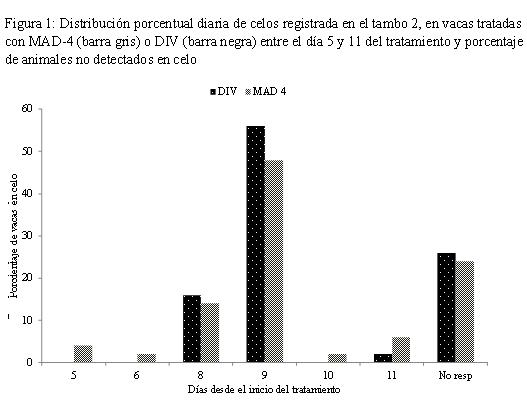
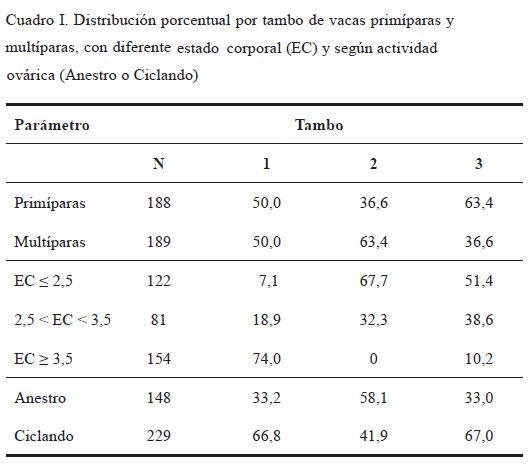
<body><![CDATA[<p class="MsoNormal" style="background: white none repeat scroll 0% 50%; -moz-background-clip: initial; -moz-background-origin: initial; -moz-background-inline-policy: initial; margin-bottom: 0.0001pt; text-align: justify; line-height: 200%;"><span style="font-size: 10pt; line-height: 200%; font-family: &quot;Verdana&quot;,&quot;sans-serif&quot;;" lang="ES-TRAD"><o:p>&nbsp;</o:p></span></p>          <p class="MsoNormal" style="margin-bottom: 0.0001pt; line-height: 200%;"><b><span style="font-size: 14pt; line-height: 200%; font-family: &quot;Verdana&quot;,&quot;sans-serif&quot;;" lang="ES-TRAD">Resultados<o:p></o:p></span></b></p>          <p class="MsoNormal" style="margin-bottom: 0.0001pt; text-align: justify; line-height: 200%;"><span style="font-size: 10pt; line-height: 200%; font-family: &quot;Verdana&quot;,&quot;sans-serif&quot;;" lang="ES-TRAD">La distribuci&oacute;n de animales entre tambos fue homog&eacute;nea en cuando a d&iacute;as posparto y producci&oacute;n de leche, pero se registraron diferencias en paridad, actividad ov&aacute;rica y estado corporal (<a style="font-family: Verdana;" href="#tab_1">Cuadro I</a>).<o:p></o:p></span></p>          <p class="MsoNormal" style="margin-bottom: 0.0001pt; text-align: justify; line-height: 200%;"><span style="font-size: 12pt; line-height: 200%; font-family: &quot;Verdana&quot;,&quot;sans-serif&quot;;" lang="ES-TRAD"><o:p></o:p></span></p>        <p class="MsoNormal" style="margin-bottom: 0.0001pt; text-align: justify; line-height: 200%;"><span style="font-size: 12pt; line-height: 200%; font-family: &quot;Verdana&quot;,&quot;sans-serif&quot;;" lang="ES-TRAD"><o:p><img alt="" src="/img/revistas/vet/v51n200/200a03t1.JPG"><a name="tab_1"></a>&nbsp;</o:p></span></p>          <p class="MsoNormal" style="margin-bottom: 0.0001pt; text-align: justify; line-height: 200%;"><span style="font-size: 12pt; line-height: 200%; font-family: &quot;Verdana&quot;,&quot;sans-serif&quot;;" lang="ES-TRAD"><o:p>&nbsp;</o:p></span></p>          <p class="MsoNormal" style="margin-bottom: 0.0001pt; text-align: justify; line-height: 200%;"><span style="font-size: 10pt; line-height: 200%; font-family: &quot;Verdana&quot;,&quot;sans-serif&quot;;" lang="ES-TRAD">En el tambo 2, donde no se realiz&oacute; IATF, el porcentaje de vacas inseminadas fue del 75% en cada grupo (<a style="font-family: Verdana;" href="#fig_1">Figura 1</a>). Aunque en un n&uacute;mero muy bajo para detectar diferencias estad&iacute;sticas, se registraron vacas en celo en los d&iacute;as 5 y 6 del tratamiento, todas del grupo MAD-4.<o:p></o:p></span></p>          <p class="MsoNormal" style="margin-bottom: 0.0001pt; line-height: 200%;"><span style="font-size: 12pt; line-height: 200%; font-family: &quot;Verdana&quot;,&quot;sans-serif&quot;;" lang="ES-UY"><o:p>&nbsp;</o:p></span></p>        <p class="MsoNormal" style="margin-bottom: 0.0001pt; line-height: 200%;"><span style="font-size: 12pt; line-height: 200%; font-family: &quot;Verdana&quot;,&quot;sans-serif&quot;;" lang="ES-UY"><o:p><img alt="" src="/img/revistas/vet/v51n200/200a03g1.JPG"><a name="fig_1"></a></o:p></span></p>          <p class="MsoNormal" style="margin-bottom: 0.0001pt; line-height: 200%;"><span style="font-size: 12pt; line-height: 200%; font-family: &quot;Verdana&quot;,&quot;sans-serif&quot;;" lang="ES-UY"><o:p>&nbsp;</o:p></span></p>          ]]></body>
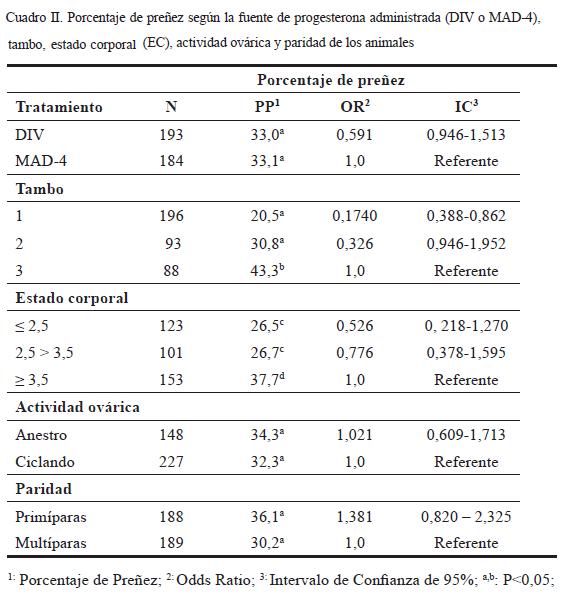
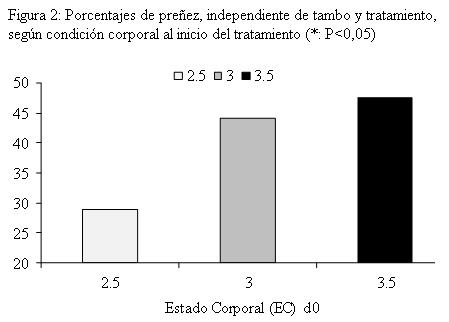
<body><![CDATA[<p class="MsoNormal" style="margin-bottom: 0.0001pt; text-align: justify; line-height: 200%;"><span style="font-size: 10pt; line-height: 200%; font-family: &quot;Verdana&quot;,&quot;sans-serif&quot;;" lang="ES-TRAD">La pre&ntilde;ez al primer servicio fue del 34,1% (<a style="font-family: Verdana;" href="#tab_2">Cuadro II</a>) y no estuvo afectada por la fuente de progesterona, pero s&iacute; por el tambo y el estado corporal al inicio del tratamiento. Un 47,3% de las vacas prim&iacute;paras estaban en anestro al inicio del tratamiento y se registraron diferencias entre tambos. En los tambos 1 y 3 el porcentaje de animales en anestro fue de 33,2% y 33,0% respectivamente, mientras que en el tambo 2 este fue de 58,1% (P&lt;0,001). Sin embargo, la pre&ntilde;ez de vacas en esta categor&iacute;a fue menor solamente en el tambo 1 (12,9% vs. 49,8% y 33,3%; P&lt;0,05). <o:p></o:p></span></p>          <p class="MsoNormal" style="margin-bottom: 0.0001pt; text-align: justify; line-height: 200%;"><span style="font-size: 10pt; line-height: 200%; font-family: &quot;Verdana&quot;,&quot;sans-serif&quot;;" lang="ES-TRAD"><o:p>&nbsp;</o:p></span></p>        <p class="MsoNormal" style="margin-bottom: 0.0001pt; text-align: justify; line-height: 200%;"><span style="font-size: 10pt; line-height: 200%; font-family: &quot;Verdana&quot;,&quot;sans-serif&quot;;" lang="ES-TRAD"><o:p><img alt="" src="/img/revistas/vet/v51n200/200a03t2.JPG"><a name="tab_2"></a></o:p></span></p>          <p class="MsoNormal" style="margin-bottom: 0.0001pt; text-align: justify; line-height: 200%;"><span style="font-size: 10pt; line-height: 200%; font-family: &quot;Verdana&quot;,&quot;sans-serif&quot;;" lang="ES-TRAD"><o:p>&nbsp;</o:p></span></p>          <p class="MsoNormal" style="margin-bottom: 0.0001pt; text-align: justify; line-height: 200%;"><span style="font-size: 10pt; line-height: 200%; font-family: &quot;Verdana&quot;,&quot;sans-serif&quot;;" lang="ES-TRAD">Como se presenta en el <a style="font-family: Verdana;" href="#tab_1">Cuadro I</a>, en el tambo 2 no se registraron vacas con EC mayor a 3,5 por lo que no se pudo analizar esta variable, pero como se muestra en la <a style="font-family: Verdana;" href="#fig_2">Figura 2</a>, las vacas con menor EC al momento del tratamiento registraron un menor porcentaje de pre&ntilde;ez.<o:p></o:p></span></p>          <p class="MsoNormal" style="margin-bottom: 0.0001pt; text-align: justify; line-height: 200%;"><span style="font-size: 12pt; line-height: 200%; font-family: &quot;Verdana&quot;,&quot;sans-serif&quot;;" lang="ES-TRAD"><o:p>&nbsp;</o:p></span></p>        <p class="MsoNormal" style="margin-bottom: 0.0001pt; text-align: justify; line-height: 200%;"><span style="font-size: 12pt; line-height: 200%; font-family: &quot;Verdana&quot;,&quot;sans-serif&quot;;" lang="ES-TRAD"><o:p><img alt="" src="/img/revistas/vet/v51n200/200a03g2.JPG"><a name="fig_2"></a></o:p></span></p>          <p class="MsoNormal" style="margin-bottom: 0.0001pt; line-height: 150%;"><span style="font-size: 12pt; line-height: 150%; font-family: &quot;Verdana&quot;,&quot;sans-serif&quot;;" lang="ES-TRAD"><o:p>&nbsp;</o:p></span></p>          <p class="MsoNormal" style="margin-bottom: 0.0001pt; line-height: 150%;"><span style="font-size: 12pt; line-height: 150%; font-family: &quot;Verdana&quot;,&quot;sans-serif&quot;;" lang="ES-TRAD"><o:p>&nbsp;</o:p></span></p>          <p class="MsoNormal" style="margin-bottom: 0.0001pt; line-height: 150%;"><span style="font-size: 12pt; line-height: 150%; font-family: &quot;Verdana&quot;,&quot;sans-serif&quot;;" lang="ES-TRAD"><o:p>&nbsp;</o:p></span></p>          ]]></body>
<body><![CDATA[<p class="MsoNormal" style="margin-bottom: 0.0001pt; line-height: 200%;"><b><span style="font-size: 14pt; line-height: 200%; font-family: &quot;Verdana&quot;,&quot;sans-serif&quot;;" lang="ES-TRAD">Discusi&oacute;n <o:p></o:p></span></b></p>          <p class="MsoNormal" style="margin-bottom: 0.0001pt; text-align: justify; line-height: 200%;"><span style="font-size: 10pt; line-height: 200%; font-family: &quot;Verdana&quot;,&quot;sans-serif&quot;;" lang="ES-TRAD">Un mayor porcentaje de vacas mult&iacute;paras que de prim&iacute;paras se encontraban ciclando al comenzar el experimento. Este dato concuerda con <a name="-Santos_y_col_2009"></a><a style="font-family: Verdana;" href="#Santos_y_col_2009">Santos</a> y col. (2009) quienes evaluaron los factores que tienen mayor incidencia en el reinicio de la actividad ov&aacute;rica posparto, en un estudio que abarc&oacute; una muestra de m&aacute;s de 6.000 animales pertenecientes a varios establecimientos lecheros. Los investigadores observaron que m&aacute;s vacas mult&iacute;paras retornaron a la ciclicidad luego del parto y m&aacute;s vacas c&iacute;clicas fueron diagnosticadas pre&ntilde;adas a los 30 y 58 d&iacute;as pos inseminaci&oacute;n. En esta l&iacute;nea de trabajo <a name="-Zhang_y_col_2010"></a><a style="font-family: Verdana;" href="#Zhang_y_col_2010">Zhang</a> y col. (2010) realizaron un experimento donde se evalu&oacute; la relaci&oacute;n entre paridad, involuci&oacute;n uterina postparto y reinicio de la actividad ov&aacute;rica y concluyeron que las vacas mult&iacute;paras tuvieron una involuci&oacute;n uterina m&aacute;s r&aacute;pida y un periodo m&aacute;s corto entre el parto y el reinicio de la actividad ov&aacute;rica c&iacute;clica.<o:p></o:p></span></p>          <p class="MsoNormal" style="margin-bottom: 0.0001pt; text-align: justify; line-height: 200%;"><span style="font-size: 10pt; line-height: 200%; font-family: &quot;Verdana&quot;,&quot;sans-serif&quot;;" lang="ES-TRAD">El porcentaje de pre&ntilde;ez al primer servicio, determinado por ultrasonograf&iacute;a a los 45 d&iacute;as de iniciado el experimento, fue diferente entre tambos. No vari&oacute; la fertilidad entre los tratamientos DIV y MAD-4, considerando la totalidad de condiciones reproductivas, lo que resulta un dato positivo considerando una posible sustituci&oacute;n de los dispositivos intravaginales por una presentaci&oacute;n inyectable de f&aacute;cil aplicaci&oacute;n, que no requiere remoci&oacute;n y genera menores contaminantes para el medio ambiente. Esta variaci&oacute;n entre tambos, reflejo de la dependencia multifactorial de la reproducci&oacute;n, implica que es muy dif&iacute;cil predecir el &eacute;xito o fracaso de programas de manejo reproductivo en los sistemas productivos pastoriles de Uruguay (<a name="-Cavestany_y_col_2007"></a><a style="font-family: Verdana;" href="#Cavestany_y_col_2007">Cavestany</a> y col., 2007). A nivel nacional, entre los a&ntilde;os 2004 y el 2007 <a name="-de_Nava_y_col_2010"></a><a style="font-family: Verdana;" href="#de_Nava_y_col_2010">de Nava</a> y col. (2010) inseminaron a tiempo fijo 2659 vacas ciclando en 5 de establecimientos lecheros logrando una pre&ntilde;ez de 45,5%, promedio comparada con los resultados obtenidos en este trabajo entre los animales en este estado reproductivo de los tambos 2 y 3.<font size="-1"><span style="font-family: Verdana;"> </span><o:p style="font-family: Verdana;"></o:p></font></span></p>          <p class="MsoNormal" style="margin-bottom: 0.0001pt; text-align: justify; line-height: 200%; font-family: Verdana;"><font size="-1"><span style="font-size: 10pt; line-height: 200%;" lang="ES-TRAD">El porcentaje de pre&ntilde;ez obtenido en este experimento fue mayor que el reportado por <a href="#Kasimanickam_y_col_2005"><span class="SpellE"></span></a><a name="-Kasimanickam_y_col_2005"></a><a style="font-family: Verdana;" href="#Kasimanickam_y_col_2005">Kasimanickam</a></span> y col. (2005) quienes utilizaron protocolo similar, aunque sin suplementaci&oacute;n con P4, y obtuvieron 15,5% de pre&ntilde;ez al primer servicio. Estos resultados justificar&iacute;an la adici&oacute;n de P4 no s&oacute;lo en animales en anestro por el aporte del &ldquo;<span class="SpellE">priming</span>&rdquo; necesario para reiniciar la actividad ov&aacute;rica posparto (<a style="font-family: Verdana;" href="#Cutaia_y_col_2007"><span class="SpellE">Cutaia</span></a> y col., 2007), sino tambi&eacute;n por su beneficio en la sincronizaci&oacute;n del desarrollo folicular y el bloqueo de ovulaciones prematuras (<a style="font-family: Verdana;" href="#Cavestany_y_col_2000">Cavestany</a><span style="font-family: Verdana;"> y col., 2000; </span><a style="font-family: Verdana;" href="#Andringa_y_col_2013"><span class="SpellE">Andringa</span></a> y col., 2013). <o:p></o:p></font></p>          <p class="MsoNormal" style="margin-bottom: 0.0001pt; text-align: justify; line-height: 200%; font-family: Verdana;"><font size="-1"><span style="font-size: 10pt; line-height: 200%;" lang="ES-TRAD">Aunque casi el 50% de las vacas de primer parto (47,3%) se encontraban en anestro al inicio de los tratamientos, present&aacute;ndose grandes diferencias entre tambos, incidencia superior a los trabajos publicados a nivel nacional (<a name="-de_Nava_y_Cavestany_1996"></a><a style="font-family: Verdana;" href="#de_Nava_y_Cavestany_1996">de Nava</a> y Cavestany, 1996; <a name="-de_Nava_y_Cavestany_2000"></a><a style="font-family: Verdana;" href="#de_Nava_y_Cavestany_2000">de Nava</a> y Cavestany, 2000) e internacional (<a href="#Chebel_2009"><span class="SpellE"></span></a><a name="-Chebel_2009"></a><a style="font-family: Verdana;" href="#Chebel_2009">Chebel</a></span> et al, 2009) justifica, sin duda la intervenci&oacute;n en la prevenci&oacute;n y eventualmente en el tratamiento del anestro. En el tambo 2, donde no se practic&oacute; IATF la inseminaci&oacute;n s&oacute;lo alcanz&oacute; el 75% lo que afect&oacute; el porcentaje de pre&ntilde;ez. Esta incidencia en las tasas de pre&ntilde;ez obtenidas con diferentes tratamientos de inducci&oacute;n de la ovulaci&oacute;n en vacas lecheras en anestro asociados con detecci&oacute;n de celo han sido bajas en nuestras condiciones de explotaci&oacute;n (<a style="font-family: Verdana;" href="#de_Nava_y_Cavestany_1996">de Nava</a><span style="font-family: Verdana;"> y Cavestany, 1996; </span><a style="font-family: Verdana;" href="#de_Nava_y_Cavestany_2000">de Nava</a> y Cavestany, 2000). Para el tambo 2 del ensayo con un 75% de animales inseminados, se logr&oacute; una concepci&oacute;n de 37,4%. A pesar de ello, los tratamientos pueden estar igualmente justificados ya que muchos animales que no se pre&ntilde;an ante la IATF, reinician la ciclicidad luego de la inducci&oacute;n, aumentando notablemente su posibilidad de gestaci&oacute;n.<o:p></o:p></font></p>          <p class="MsoNormal" style="margin-bottom: 0.0001pt; text-align: justify; line-height: 200%; font-family: Verdana;"><font size="-1"><span style="font-size: 10pt; line-height: 200%;" lang="ES-TRAD">En el tambo 1 la condici&oacute;n corporal de las vacas al comenzar el experimento fue en promedio de 2,7&plusmn;0,2 para ambos tratamientos, en el tambo 2 la condici&oacute;n corporal fue de 2,8&plusmn;0,3 y en el tambo 3 fue de 2,6&plusmn;0,4 puntos siendo el valor m&aacute;s bajo y variable de los tres tambos. De acuerdo a la revisi&oacute;n realizada por&nbsp;<a href="#Crowe_2008"><span class="SpellE"></span></a><a name="-Crowe_2008"></a><a style="font-family: Verdana;" href="#Crowe_2008">Crowe</a></span> (2008)<b><i> </i></b>sobre el retorno de la actividad ov&aacute;rica posparto en vacas para carne y leche, para lograr un &oacute;ptimo retorno a la ciclicidad lo ideal es lograr una condici&oacute;n corporal al parto que se ubique entre 2,75 y 3,0. En este trabajo las vacas que iniciaron el tratamiento con una condici&oacute;n corporal menor a 3 obtuvieron una pre&ntilde;ez inferior. De modo similar, <a href="#Pancarci_y_col_2002"><span class="SpellE"></span></a><a name="-Pancarci_y_col_2002"></a><a style="font-family: Verdana;" href="#Pancarci_y_col_2002">Pancarci</a> y col. (2002) observaron que las vacas mult&iacute;paras tuvieron una fertilidad m&aacute;s baja a una condici&oacute;n corporal por debajo de 3,0. Es posible que la condici&oacute;n corporal de los animales al comienzo del experimento haya influido negativamente en los resultados de fertilidad en el tambo 1 y 3, no as&iacute; en el 2, donde la pre&ntilde;ez lograda en tres niveles de condici&oacute;n corporal (&le; 2,5, entre 2,5 y 3,5 y &ge; 3,5) no mostr&oacute; diferencias significativas.<o:p></o:p></font></p>          <p class="MsoNormal" style="margin-bottom: 0.0001pt; text-align: justify; line-height: 200%; font-family: Verdana;"><font size="-1"><span style="font-size: 10pt; line-height: 200%;" lang="ES-TRAD">En los tambos 1 y 3, las vacas que estaban ciclando al inicio del tratamiento mostraron una tendencia a tener mejores resultados de pre&ntilde;ez, independientemente del tratamiento utilizado. Esta observaci&oacute;n concuerda con lo publicado por <a style="font-family: Verdana;" href="#Chebel_y_col_2010">Chebel</a> y col. (2010) en el que las vacas clasificadas como c&iacute;clicas de acuerdo a sus concentraciones plasm&aacute;ticas de P4 mostraron mejores resultados de pre&ntilde;ez a los 40 d&iacute;as que las clasificadas como en anestro (38,2 vs 29,3%; P&lt;0,05) y esta diferencia se mantuvo a los 60 d&iacute;as pos IA (35,1 vs 26,1% para las c&iacute;clicas y en anestro respectivamente). Por otro lado, <a style="font-family: Verdana;" href="#Stevenson_y_col_2006">Stevenson</a> y col. (2006) trabajando con vacas c&iacute;clicas y en anestro registraron mayores p&eacute;rdidas embrionarias entre los d&iacute;as 28 y 56 pos IA en estas &uacute;ltimas, lo que podr&iacute;a explicar en parte la menor fertilidad de las mismas y la influencia hormonal en el mantenimiento de la pre&ntilde;ez. En el tambo 2 las vacas prim&iacute;paras tuvieron una pre&ntilde;ez significativamente mayor que las mult&iacute;paras. <o:p></o:p></span></font></p>          <p class="MsoNormal" style="margin-bottom: 0.0001pt; text-align: justify; line-height: 200%; font-family: Verdana;"><font size="-1"><span style="font-size: 10pt; line-height: 200%;" lang="ES-TRAD">Tambi&eacute;n debe considerarse en los resultados de fertilidad con IATF con semen congelado el efecto asociado a diferencias en la longevidad de los espermatozoides en el tracto genital de la vaca por la posible dispersi&oacute;n de las ovulaciones y probablemente debido a diferencias en el proceso de capacitaci&oacute;n de los espermatozoides (<a href="#Kasimanickam_y_col_2008"><span class="SpellE"></span></a><a name="-Kasimanickam_y_col_2008"></a><a style="font-family: Verdana;" href="#Kasimanickam_y_col_2008">Kasimanickam</a></span> y col., 2008). <o:p></o:p></font></p>          <p class="MsoNormal" style="margin-bottom: 0.0001pt; text-align: justify; line-height: 200%; font-family: Verdana;"><font size="-1"><span style="font-size: 10pt; line-height: 200%;" lang="ES-TRAD">Se encontr&oacute; en los tambos 1 y 2 una mayor eficiencia reproductiva de las vacas prim&iacute;paras en comparaci&oacute;n con las mult&iacute;paras, mientras en el tambo 3 se obtuvo un mejor desempe&ntilde;o de las vacas mult&iacute;paras aunque esta diferencia no fue estad&iacute;sticamente significativa. En este sentido hay reportes de una mejor respuesta de las vacas prim&iacute;paras a protocolos de sincronizaci&oacute;n de la ovulaci&oacute;n (<a style="font-family: Verdana;" href="#de_Nava_y_col_2010">de Nava</a> et al., 2010). Probablemente el mayor estr&eacute;s productivo y metab&oacute;lico al que est&aacute;n sometidas las vacas de m&aacute;s lactancias sea la causa de una disminuci&oacute;n en su eficiencia reproductiva. <a style="font-family: Verdana;" name="-Martins_y_col_2011"></a><a style="font-family: Verdana;" href="#Martins_y_col_2011"><span class="SpellE">Martins</span></a> y col. (2011) propusieron que la ineficacia en la lisis del CL de los programas reproductivos con PG en vacas lactantes producir&iacute;a un descenso importante en la pre&ntilde;ez final. Para evaluar las diferencias en el comportamiento de estas categor&iacute;as <a name="-Tenhagen_y_col_2004"></a><a style="font-family: Verdana;" href="#Tenhagen_y_col_2004"><span class="SpellE">Tenhagen</span></a><span style="font-family: Verdana;"> y col. (2004)</span><b style="font-family: Verdana;"><i> </i></b><span style="font-family: Verdana;">realizaron un estudio sobre 1584 vacas (583 prim&iacute;paras y 1001 mult&iacute;paras) pertenecientes a 3 tambos comerciales. El porcentaje de concepci&oacute;n a </span><st1:personname style="font-family: Verdana;" productid="la IATF" w:st="on">la IATF</st1:personname> result&oacute; mayor en las prim&iacute;paras que en las mult&iacute;paras (37,9% vs. 31,6%) de igual manera la pre&ntilde;ez a los 200 d&iacute;as de lactancia fue mayor para las prim&iacute;paras (81,8% vs 75,4% para prim&iacute;paras y mult&iacute;paras respectivamente). Tambi&eacute;n <a style="font-family: Verdana;" href="#de_Nava_y_col_2010">de Nava</a> y col. (2010), en un estudio que recopil&oacute; los resultados obtenidos sobre 2659 vacas ciclando, durante cuatro a&ntilde;os de aplicaci&oacute;n de un programa de IATF iniciado al primer d&iacute;a de la estaci&oacute;n reproductiva invernal, observaron que la pre&ntilde;ez se vio afectada por el n&uacute;mero de lactancia, disminuyendo de 48,8%, 48,2%, 43,1% y 40,5% para vacas de 1, 2, 3 y 4 o m&aacute;s lactancias respectivamente (P&lt;0,05). Esta diferencia se mantuvo en las tasas de pre&ntilde;ez acumuladas (incluyendo los servicios realizados durante un periodo de 30 d&iacute;as pos IATF), siendo de 63,7%, 62,9%, 59,8% y 56,7% para las vacas de 1, 2, 3 y 4 o m&aacute;s lactancias respectivamente (P&lt;0,05).<o:p></o:p></span></font></p>          <p class="MsoNormal" style="margin-bottom: 0.0001pt; text-align: justify; line-height: 200%;"><font size="-1"><a style="font-family: Verdana;" href="#Pancarci_y_col_2002"><span class="SpellE"><span style="font-size: 10pt; line-height: 200%;" lang="ES-TRAD">Pancarci</span></span></a></font><span style="font-size: 10pt; line-height: 200%; font-family: &quot;Verdana&quot;,&quot;sans-serif&quot;;" lang="ES-TRAD"><font size="-1"><span style="font-family: Verdana;"> y col. (2002) comparando dos protocolos de sincronizaci&oacute;n de ovulaci&oacute;n observaron que para ambos tratamientos los porcentajes de concepci&oacute;n en las vacas prim&iacute;paras eran m&aacute;s altos que en las mult&iacute;paras. Notaron tambi&eacute;n que a una condici&oacute;n corporal menor a 3,0 las vacas mult&iacute;paras tuvieron menores porcentajes de concepci&oacute;n, mientras que las prim&iacute;paras se mantuvieron en par&aacute;metros constantes cuando su condici&oacute;n corporal oscilaba entre 2,5 y 3,0. En el tambo 3 a diferencia de lo ocurrido en los dos</span></font> tambos anteriores se obtuvo un mayor porcentaje de pre&ntilde;ez en las vacas mult&iacute;paras que en las prim&iacute;paras. Tal vez la baja condici&oacute;n corporal que presentaba el grupo de prim&iacute;paras impact&oacute; negativamente en su fertilidad determinando que tuvieran un peor desempe&ntilde;o reproductivo comparado con el grupo de mult&iacute;paras. <a name="-Cerri_y_col_2004"></a><a style="font-family: Verdana;" href="#Cerri_y_col_2004"><span class="SpellE">Cerri</span></a> y col. (2004) realizaron un trabajo en el que se evalu&oacute; la fertilidad obtenida al aplicar un protocolo Heatsynch con IATF o un protocolo SelectSynch (sin empleo de estradiol post PG) con detecci&oacute;n de celo sobre vacas prim&iacute;paras y mult&iacute;paras de alta producci&oacute;n. Los valores de pre&ntilde;ez registrados a los 58 d&iacute;as fueron en el grupo IATF 42,2% para las mult&iacute;paras y 34,4% (P&lt;0,01) para las prim&iacute;paras mientras que en el grupo bajo detecci&oacute;n de celo los resultados fueron de 20,8 y 18,8% para mult&iacute;paras y prim&iacute;paras respectivamente. Es interesante que en nuestro trabajo, los porcentajes de pre&ntilde;ez no variaran para el tambo 2 que no hizo IATF respecto al tambo 3 en el que casi la totalidad de los animales fueron inseminados a tiempo fijo. Lo que s&iacute; es destacable, es que en el tambo 2 un 25% de las vacas no fueron detectadas en celo y por consiguiente tampoco inseminadas, lo que pudo afectar el resultado. <a name="-Stevenson_y_Phatak_2005"></a><a style="font-family: Verdana;" href="#Stevenson_y_Phatak_2005">Stevenson</a> y <span class="SpellE">Phatak</span> (2005)<b><i> </i></b>reportan niveles de pre&ntilde;ez mayores en vacas inseminadas luego de ser detectadas en celo en el marco de un protocolo Heatsynch (44,6% vs 21,6% para celo visto y tiempo fijo respectivamente); y la misma tendencia fue apreciada en el grupo asignado al protocolo Ovsynch (48,7% vs 24,4% para vacas inseminadas bajo detecci&oacute;n de celo y a tiempo fijo respectivamente). <a style="font-family: Verdana;" href="#Kasimanickam_y_col_2005"><span class="SpellE">Kasimanickam</span></a> y col. (2005) observaron tambi&eacute;n mejores resultados de fertilidad en aquellos animales inseminados luego de ser detectados en celo utilizando tanto un protocolo Heatsynch como un Ovsynch. En el tratamiento Heatsynch los valores obtenidos por estos autores fueron 36% vs 15,5% para las vacas inseminadas bajo detecci&oacute;n de celo e IATF respectivamente (P&lt;0,001), y en el tratamiento Ovsynch se registraron porcentajes de pre&ntilde;ez de 35,3 vs 21% para vacas inseminadas a celo visto y a tiempo fijo respectivamente (P&lt;0,05). En contraposici&oacute;n con lo expresado por estos autores el trabajo realizado por <a style="font-family: Verdana;" href="#Cerri_y_col_2004"><span class="SpellE">Cerri</span></a> y col. (2004) obtuvieron mejores resultados con IATF que con inseminaci&oacute;n bajo detecci&oacute;n de celo.<o:p></o:p></span></p>          ]]></body>
<body><![CDATA[<p class="MsoNormal" style="margin-bottom: 0.0001pt; line-height: 200%;"><b><span style="font-size: 10pt; line-height: 200%; font-family: &quot;Verdana&quot;,&quot;sans-serif&quot;;" lang="ES-TRAD"><o:p>&nbsp;</o:p></span></b></p>          <p class="MsoNormal" style="margin-bottom: 0.0001pt; line-height: 200%;"><b><span style="font-size: 14pt; line-height: 200%; font-family: &quot;Verdana&quot;,&quot;sans-serif&quot;;" lang="ES-TRAD">Conclusiones<o:p></o:p></span></b></p>          <p class="MsoNormal" style="margin-bottom: 0.0001pt; text-align: justify; line-height: 200%;"><span style="font-size: 10pt; line-height: 200%; font-family: &quot;Verdana&quot;,&quot;sans-serif&quot;;" lang="ES-TRAD">No se observaron diferencias en el porcentaje de pre&ntilde;ez entre los dos tratamientos en ninguno de los tres tambos, lo que deja planteada la alternativa de sustituir los dispositivos intravaginales por una presentaci&oacute;n inyectable de liberaci&oacute;n lenta, de m&aacute;s f&aacute;cil aplicaci&oacute;n, que no genera residuos contaminantes ambientales y obtiene similares resultados en cuanto a fertilidad. La variaci&oacute;n entre tambos refleja que existen otros factores de manejo, ambientales y nutricionales que afectan la fertilidad independiente de protocolos de sincronizaci&oacute;n utilizados.<o:p></o:p></span></p>          <p class="MsoNormal" style="margin-bottom: 0.0001pt; text-align: justify; line-height: 200%;"><span style="font-size: 10pt; line-height: 200%; font-family: &quot;Verdana&quot;,&quot;sans-serif&quot;;" lang="ES-TRAD"><o:p>&nbsp;</o:p></span></p>          <p class="MsoNormal" style="margin-bottom: 0.0001pt; text-align: justify; line-height: 200%;"><b><span style="font-size: 14pt; line-height: 200%; font-family: &quot;Verdana&quot;,&quot;sans-serif&quot;;" lang="ES-TRAD">Bibliograf&iacute;a<o:p></o:p></span></b></p>          <!-- ref --><p class="MsoNormal" style="margin-bottom: 0.0001pt; line-height: 200%;"><span style="font-size: 10pt; line-height: 200%; font-family: &quot;Verdana&quot;,&quot;sans-serif&quot;;" lang="ES-UY">1. <a name="Andringa_y_col_2013"></a><a style="font-family: Verdana;" href="#-Andringa_y_col_2013"><span class="SpellE">Andringa</span></a> MFA, Cavestany D, van <span class="SpellE">Eerdenburg</span> FJCM. (2013). Relaciones entre la expresi&oacute;n de celo, tama&ntilde;o del fol&iacute;culo y ovulaci&oacute;n en vacas de leche en pastoreo. Veterinaria (Montevideo) 49:4-15.    <o:p></o:p></span></p>          <p class="MsoNormal" style="margin-bottom: 0.0001pt; line-height: 200%;"><span style="font-size: 10pt; line-height: 200%; font-family: &quot;Verdana&quot;,&quot;sans-serif&quot;;">2. <a style="font-family: Verdana;" href="#-Capitaine_Funes_2005"><span class="SpellE"></span></a><a name="Capitaine_Funes_2005"></a><a href="#-Capitaine_Funes_2005"><font size="-1"><span style="font-family: Verdana;">Capitaine</span></font></a></span><font size="-1"><span style="font-family: Verdana;"> </span><span style="font-family: Verdana;" class="SpellE">Funes</span><span style="font-family: Verdana;">, A. (2005). Factores que afectan la tasa de pre&ntilde;ez en rodeos lecheros en Argentina. </span></font><span style="font-size: 10pt; line-height: 200%; font-family: &quot;Verdana&quot;,&quot;sans-serif&quot;;" lang="ES-UY"><font size="-1"><span style="font-family: Verdana;">Simposio Internacional de Reproducci&oacute;n Animal IRAC 5:179-196.</span></font><o:p></o:p></span></p>          <!-- ref --><p class="MsoNormal" style="margin-bottom: 0.0001pt; line-height: 200%;"><span style="font-size: 10pt; line-height: 200%; font-family: &quot;Verdana&quot;,&quot;sans-serif&quot;;">3. <a name="Cavalieri_y_col_2006"></a><a style="font-family: Verdana;" href="#-Cavalieri_y_col_2006">Cavalieri</a> J, Hepworth G, Fitzpatrick LA, Shephard RW, Macmillan KL (2006). </span><span style="font-size: 10pt; line-height: 200%; font-family: &quot;Verdana&quot;,&quot;sans-serif&quot;;" lang="EN-US">Manipulation and control of the estrous cycle in pasture-based dairy cows Theriogenology 65:45-64.    <o:p></o:p></span></p>          ]]></body>
<body><![CDATA[<!-- ref --><p class="MsoBodyText2" style="line-height: 200%;"><span style="font-size: 10pt; line-height: 200%; font-family: &quot;Verdana&quot;,&quot;sans-serif&quot;; color: black;" lang="EN-US">4. <a name="Cavestany_y_col_2007"></a><a style="font-family: Verdana;" href="#-Cavestany_y_col_2007"><span class="SpellE">Cavestany</span></a> D, Betancour H, Blanc E, Lemaire C, Slavica J, Moreira F, Piaggio J, Risco C. (2007). <span class="GramE">Reproductive efficiency in grazing lactating dairy cows under a programmed reproductive management.</span> </span><span class="SpellE"><span style="font-size: 10pt; line-height: 200%; font-family: &quot;Verdana&quot;,&quot;sans-serif&quot;; color: black;">Aust</span></span><span style="font-size: 10pt; line-height: 200%; font-family: &quot;Verdana&quot;,&quot;sans-serif&quot;; color: black;"> <span class="SpellE">Vet</span> J 85:141-147.    </span><span style="font-size: 10pt; line-height: 200%; font-family: &quot;Verdana&quot;,&quot;sans-serif&quot;;" lang="ES-TRAD"><o:p></o:p></span></p>          <!-- ref --><p class="MsoBodyText2" style="line-height: 200%;"><span style="font-size: 10pt; line-height: 200%; font-family: &quot;Verdana&quot;,&quot;sans-serif&quot;; color: black;">5. <a style="font-family: Verdana;" href="#-Cavestany_y_col_2000"><span class="SpellE"></span></a><a name="Cavestany_y_col_2000"></a><a href="#-Cavestany_y_col_2000"><font size="-1"><span style="font-family: Verdana;">Cavestany</span></font></a></span><font size="-1"><span style="font-family: Verdana;">, D.; de Nava, G.; </span><span style="font-family: Verdana;" class="SpellE">Galina</span><span style="font-family: Verdana;">, C. (2000). Sincronizaci&oacute;n de celos con inseminaci&oacute;n artificial a tiempo fijo como alternativa para incrementar la eficiencia reproductiva en programas de inseminaci&oacute;n artificial en vacas lecheras bajo condiciones de pastoreo. </span><span style="font-family: Verdana;" class="SpellE"><span style="font-size: 10pt; line-height: 200%; color: black;" lang="EN-US">Congreso</span></span></font><span style="font-size: 10pt; line-height: 200%; font-family: &quot;Verdana&quot;,&quot;sans-serif&quot;; color: black;" lang="EN-US"><font size="-1"><span style="font-family: Verdana;"> Mundial de Buiatr&iacute;a 21:37.    </span></font><o:p></o:p></span></p>          <!-- ref --><p class="MsoBodyText2" style="line-height: 200%;"><span style="font-size: 10pt; line-height: 200%; font-family: &quot;Verdana&quot;,&quot;sans-serif&quot;; color: black;">6. <a style="font-family: Verdana;" href="#-Cavestany_y_Galina_2001"><span class="SpellE"></span></a><a name="Cavestany_y_Galina_2001"></a><a href="#-Cavestany_y_Galina_2001"><font size="-1"><span style="font-family: Verdana;">Cavestany</span></font></a></span><font size="-1"><span style="font-family: Verdana;">, D; </span><span style="font-family: Verdana;" class="SpellE">Galina</span><span style="font-family: Verdana;">, C.S. (2001). </span><span style="font-size: 10pt; line-height: 200%; color: black; font-family: Verdana;" lang="EN-US">Factors affecting the reproductive efficiency of artificial insemination programs in a seasonal breeding pasture-based dairy system with the aid of milk progesterone. Reprod. <span class="GramE">Domestic.</span> <span class="GramE">Animals.</span> 36(2): 85-</span><span style="font-size: 10pt; line-height: 200%; letter-spacing: -0.05pt; font-family: Verdana;" lang="EN-GB">89</span></font><span style="font-size: 10pt;     line-height: 200%; font-family: &quot;Verdana&quot;,&quot;sans-serif&quot;;" lang="EN-GB"><font size="-1"><span style="font-family: Verdana;">.</span></font><o:p></o:p></span></p>          <!-- ref --><p class="MsoBodyText2" style="line-height: 200%;"><span style="font-size: 10pt; line-height: 200%; font-family: &quot;Verdana&quot;,&quot;sans-serif&quot;;" lang="EN-GB">7. <a style="font-family: Verdana;" href="#-Cavestany_y_col_2009"><span class="SpellE"><span style="color: black;"></span></span></a><a name="Cavestany_y_col_2009"></a><span style="color: rgb(51, 51, 255);">Cavestany</span></span><span style="color: black;"> <font size="-1"><span style="font-family: Verdana;">D, </span><span style="font-family: Verdana;" class="SpellE">Kulcs&aacute;r</span><span style="font-family: Verdana;"> M, Crespi D, </span><span style="font-family: Verdana;" class="SpellE">Chilliard</span><span style="font-family: Verdana;"> Y, La Manna A, Valgo O, </span><span style="font-family: Verdana;" class="SpellE">Keresztes</span><span style="font-family: Verdana;"> B, </span><span style="font-family: Verdana;" class="SpellE">Delavaud</span><span style="font-family: Verdana;"> C, </span><span style="font-family: Verdana;" class="SpellE">Huszenicza</span><span style="font-family: Verdana;"> G, Meikle A. (2009). </span></font></span><font size="-1"><span style="font-family: Verdana;" class="GramE"><span style="font-size: 10pt; line-height: 200%; color: black;" lang="EN-US">Effect of <span class="SpellE">prepartum</span> energetic supplementation on productive and reproductive parameters, and metabolic and hormonal profiles in dairy cows under grazing conditions.</span></span><span style="font-size: 10pt; line-height: 200%; color: black; font-family: Verdana;" lang="EN-US"> </span><span style="font-family: Verdana;" class="SpellE"><span style="font-size: 10pt; line-height: 200%; color: black;" lang="EN-GB">Reprod</span></span><span style="font-size: 10pt; line-height: 200%; color: black; font-family: Verdana;" lang="EN-GB"> <span class="SpellE">Domest</span> <span class="SpellE">Anim</span> 44:663-671.    </span></font><span style="font-size: 10pt; line-height: 200%; font-family: &quot;Verdana&quot;,&quot;sans-serif&quot;;" lang="EN-US"><o:p></o:p></span></p>          <p class="MsoNormal" style="margin-bottom: 0.0001pt; line-height: 200%;"><span class="GramE"><span style="font-size: 10pt; line-height: 200%; font-family: &quot;Verdana&quot;,&quot;sans-serif&quot;;" lang="EN-US">8. <a name="Cerri_y_col_2004"></a><a style="font-family: Verdana;" href="#-Cerri_y_col_2004"><span class="SpellE">Cerri</span></a> RL, Santos JE, <span class="SpellE">Juchem</span> OL, <span class="SpellE">Galvao</span> KN, <span class="SpellE">Chebel</span> RC.</span></span><span style="font-size: 10pt; line-height: 200%; font-family: &quot;Verdana&quot;,&quot;sans-serif&quot;;" lang="EN-US"> (2004). Timed artificial insemination with <span class="SpellE">estradiol</span> <span class="SpellE">cypionate</span> or insemination at estrus in high-producing dairy cows. J <span class="SpellE">Dair</span>y Sci 87:3704&ndash;3715. <o:p></o:p></span></p>          <!-- ref --><p class="MsoNormal" style="margin-bottom: 0.0001pt; line-height: 200%;"><span style="font-size: 10pt; line-height: 200%; font-family: &quot;Verdana&quot;,&quot;sans-serif&quot;;" lang="EN-US">9. <a name="Chebel_y_col_2010"></a><a style="font-family: Verdana;" href="#-Chebel_y_col_2010">Chebel</a> R, Al-Hassan M, Fricke P, Santos JE, Lima J, Martel C, Stevenson J, Garc&iacute;a R. (2010). Supplementation of progesterone via controlled internal drug release inserts during ovulation synchronization protocols in lactating dairy cows. </span><span style="font-size: 10pt; line-height: 200%; font-family: &quot;Verdana&quot;,&quot;sans-serif&quot;;" lang="ES-TRAD">J <span class="SpellE">Dairy</span> <span class="SpellE">Sci</span> 93:922-931.    <o:p></o:p></span></p>          <!-- ref --><p class="MsoNormal" style="margin-bottom: 0.0001pt; line-height: 200%;"><span style="font-size: 10pt; line-height: 200%; font-family: &quot;Verdana&quot;,&quot;sans-serif&quot;;">10. <a name="Chebel_2009"></a><a style="font-family: Verdana;" href="#-Chebel_2009">Chebel</a>, R. (2009). Enfermedad y Reproducci&oacute;n. </span><span class="GramE"><span style="font-size: 10pt; line-height: 200%; font-family: &quot;Verdana&quot;,&quot;sans-serif&quot;;" lang="EN-US">Dairy Cattle Reproduction Conference.</span></span><span style="font-size: 10pt; line-height: 200%; font-family: &quot;Verdana&quot;,&quot;sans-serif&quot;;" lang="EN-US"> 137-146<o:p></o:p></span><!-- ref --><p class="MsoNormal" style="margin-bottom: 0.0001pt; line-height: 200%;"><span style="font-size: 10pt; line-height: 200%; font-family: &quot;Verdana&quot;,&quot;sans-serif&quot;;" lang="EN-US">11. <a name="Crowe_2008"></a><a style="font-family: Verdana;" href="#-Crowe_2008">Crowe</a> MA. (2008). Resumption of ovarian cyclicity in post-partum beef and dairy cows. </span><span style="font-size: 10pt; line-height: 200%; font-family: &quot;Verdana&quot;,&quot;sans-serif&quot;;" lang="ES-TRAD"><span style="color: windowtext; text-decoration: none;" lang="EN-US">Reprod Domest Anim</span></span><span style="font-size: 10pt; line-height: 200%; font-family: &quot;Verdana&quot;,&quot;sans-serif&quot;;" lang="EN-US">&nbsp;43 Suppl 5:20-28.    <o:p></o:p></span></p>          <!-- ref --><p class="MsoNormal" style="margin-bottom: 0.0001pt; line-height: 200%;"><span style="font-size: 10pt; line-height: 200%; font-family: &quot;Verdana&quot;,&quot;sans-serif&quot;;" lang="EN-US">12. <a name="Cutaia_y_col_2007"></a><a style="font-family: Verdana;" href="#-Cutaia_y_col_2007">Cutaia</a> L, Caccia M, Bo GA. </span><span style="font-size: 10pt; line-height: 200%; font-family: &quot;Verdana&quot;,&quot;sans-serif&quot;;" lang="ES-TRAD">(2007). Din&aacute;mica folicular ov&aacute;rica en el ganado bovino: implicancias pr&aacute;cticas en programas de sincronizaci&oacute;n de celos. XXXV Jornadas Uruguayas de Buiatr&iacute;a. Paysand&uacute;, Uruguay.    <o:p></o:p></span></p>          <!-- ref --><p class="MsoBodyText2" style="line-height: 200%;"><span style="font-size: 10pt; line-height: 200%; font-family: &quot;Verdana&quot;,&quot;sans-serif&quot;; color: black;">13. de Nava GT, Rodr&iacute;guez <span class="SpellE">Sabarr&oacute;s</span> M, Corti M, <span class="SpellE">Tutt</span> D, Mart&iacute;nez MF. (2009). <span class="SpellE">Efeto</span> de diferentes fuentes de progesterona y an&aacute;logos de <span class="SpellE">GnRH</span> sobe la fertilidad de vaquillonas en un programa de tiempo fijo. </span><span style="font-size: 10pt; line-height: 200%; font-family: &quot;Verdana&quot;,&quot;sans-serif&quot;; color: black;" lang="EN-US"><span style="color: black; text-decoration: none;" lang="ES">VIII Simposio Internacional de Reproducci&oacute;n Animal IRAC</span></span><span style="font-size: 10pt; line-height: 200%; font-family: &quot;Verdana&quot;,&quot;sans-serif&quot;; color: black;"> <span class="SpellE">Corboba</span> Argentina.    <o:p></o:p></span></p>          <!-- ref --><p class="MsoNormal" style="margin-bottom: 0.0001pt; line-height: 200%;"><span style="font-size: 10pt; line-height: 200%; font-family: &quot;Verdana&quot;,&quot;sans-serif&quot;;">14. </span><span style="font-size: 10pt; line-height: 200%; font-family: &quot;Verdana&quot;,&quot;sans-serif&quot;;" lang="ES-TRAD"><a name="de_Nava_y_col_2010"></a><a style="font-family: Verdana;" href="#-de_Nava_y_col_2010">de Nava</a> GT, Rodr&iacute;guez <span class="SpellE">Sabarr&oacute;s</span> M, Romero D, Rodr&iacute;guez <span class="SpellE">Galluzzo</span> J, Gil A. (2010). Resultados de cuatro a&ntilde;os de aplicaci&oacute;n de un programa de inseminaci&oacute;n a tiempo fijo en vacas lecheras coincidente con el primer d&iacute;a de la estaci&oacute;n reproductiva invernal. Jornadas Uruguayas de Buiatr&iacute;a; 38: 106-107<o:p></o:p></span><!-- ref --><p class="MsoBodyText2" style="line-height: 200%;"><span style="font-size: 10pt; line-height: 200%; font-family: &quot;Verdana&quot;,&quot;sans-serif&quot;; color: black;">15. <a name="de_Nava_y_Cavestany_1996"></a><a style="font-family: Verdana;" href="#-de_Nava_y_Cavestany_1996">de Nava</a>, G.; <span class="SpellE">Cavestany</span>, D. (1996). Efecto de la utilizaci&oacute;n de dos fuentes de progesterona en el tratamiento del <span class="SpellE">anestro</span> posparto en vacas <span class="SpellE">Holando</span> en producci&oacute;n (Resultados Preliminares). Primer Congreso Uruguayo de Producci&oacute;n Animal 1:210-212<o:p></o:p></span><!-- ref --><p class="MsoBodyText2" style="line-height: 200%;"><span style="font-size: 10pt; line-height: 200%; font-family: &quot;Verdana&quot;,&quot;sans-serif&quot;; color: black;">16. <a name="de_Nava_y_Cavestany_2000"></a><a style="font-family: Verdana;" href="#-de_Nava_y_Cavestany_2000">de Nava</a>, G.; <span class="SpellE">Cavestany</span>, D. (2000). Respuesta a la administraci&oacute;n de progesterona en vacas <span class="SpellE">Holando</span> de primera lactancia en <span class="SpellE">anestro</span> posparto. </span><span class="SpellE"><span style="font-size: 10pt; line-height: 200%; font-family: &quot;Verdana&quot;,&quot;sans-serif&quot;; color: black;" lang="EN-US">Congreso</span></span><span style="font-size: 10pt; line-height: 200%; font-family: &quot;Verdana&quot;,&quot;sans-serif&quot;; color: black;" lang="EN-US"> Mundial de Buiatr&iacute;a 21:47.    <o:p></o:p></span></p>          <!-- ref --><p class="MsoNormal" style="margin-bottom: 0.0001pt; line-height: 200%;"><span style="font-size: 10pt; line-height: 200%; font-family: &quot;Verdana&quot;,&quot;sans-serif&quot;;" lang="EN-US">17. <a name="El-Zarkouny_y_col_2004"></a><a style="font-family: Verdana;" href="#-El-Zarkouny_y_col_2004">El-<span class="SpellE">Zarkouny</span></a> SZ, <span class="SpellE">Cartmill</span> JA, Hensley BA, Stevenson JS. <span class="GramE">(2004). Pregnancy in dairy cows after synchronized ovulation regimens with or without <span class="SpellE">presynchronization</span> and progesterone.</span> J Dairy Sci 87:1024-1037<o:p></o:p></span><!-- ref --><p class="MsoNormal" style="margin-bottom: 0.0001pt; line-height: 200%;"><span style="font-size: 10pt; line-height: 200%; font-family: &quot;Verdana&quot;,&quot;sans-serif&quot;;" lang="EN-US">18. <a name="Ferguson_y_col_1994"></a><a style="font-family: Verdana;" href="#-Ferguson_y_col_1994">Ferguson</a> J, <span class="SpellE">Galligan</span> D, Thomsen N. (1994). Principal descriptors of body condition score in Holstein cows. J Dairy <span class="SpellE">Sci</span> 77:2695-2703.    <o:p></o:p></span></p>          <!-- ref --><p class="MsoNormal" style="margin-bottom: 0.0001pt; line-height: 200%;"><span style="font-size: 10pt; line-height: 200%; font-family: &quot;Verdana&quot;,&quot;sans-serif&quot;;" lang="EN-US">19. <a name="Kasimanickam_y_col_2005"></a><a style="font-family: Verdana;" href="#-Kasimanickam_y_col_2005"><span class="SpellE">Kasimanickam</span></a> R, Cornwell JM, <span class="SpellE">Nebel</span> LR. (2005). Fertility following fixed time AI or insemination at observed estrus in Ovsynch and Heatsynch programs in lactating dairy cows. <span class="SpellE">Theriogenology</span>; 63:2550-2559.    <o:p></o:p></span></p>          <!-- ref --><p class="MsoNormal" style="margin-bottom: 0.0001pt; line-height: 200%;"><span style="font-size: 10pt; line-height: 200%; font-family: &quot;Verdana&quot;,&quot;sans-serif&quot;;" lang="EN-US">20. <a name="Kasimanickam_y_col_2008"></a><a style="font-family: Verdana;" href="#-Kasimanickam_y_col_2008"><span class="SpellE">Kasimanickam</span></a>, R.; Hall, J.B.; <span class="SpellE">Currin</span>, J.F.; <span class="SpellE">Whitter</span>, W.D. (2008). Sire effect on the pregnancy outcome in beef cows synchronized with progesterone based Ovsynch and Co-synch protocols. </span><span style="font-size: 10pt; line-height: 200%; font-family: &quot;Verdana&quot;,&quot;sans-serif&quot;;" lang="ES-UY">Anim. <span class="SpellE">Reprod</span>. Sci.104:1-8.    <o:p></o:p></span></p>          <!-- ref --><p class="MsoPlainText" style="text-align: justify; line-height: 200%;"><span style="font-family: &quot;Verdana&quot;,&quot;sans-serif&quot;;" lang="EN-US">21. <a name="Lopez_2004"></a><a style="font-family: Verdana;" href="#-Lopez_2004">Lopez</a> H, <span class="SpellE">Satter</span> LD, <span class="SpellE">Wiltbank</span> MC. (2004). <span class="GramE">Relationship between level of milk production and estrous behavior of lactating.</span> <span class="SpellE">Anim</span> <span class="SpellE">Reprod</span> <span class="SpellE">Sci</span> 2004:81:209-2023.    <o:p></o:p></span></p>          <p class="MsoNormal" style="margin-bottom: 0.0001pt; line-height: 200%;"><span style="font-size: 10pt; line-height: 200%; font-family: &quot;Verdana&quot;,&quot;sans-serif&quot;;" lang="EN-US">22. <a name="Martins_y_col_2011"></a><a style="font-family: Verdana;" href="#-Martins_y_col_2011">Martins</a> JPN, <span class="SpellE">Policelli</span> RK, <span class="SpellE">Neuder</span> LM, Raphael W, <span class="SpellE">Pursley</span> JR. 2011. <span class="GramE">Effects of cloprostenol sodium at final prostaglandin F2<span style="" lang="ES-TRAD">&alpha;</span> of Ovsynch on complete luteolysis and pregnancy per artificial insemination in lactating dairy cows.</span> J. Dairy Sci. 94: 2815-2824.<o:p></o:p></span></p>          <!-- ref --><p class="MsoNormal" style="margin-bottom: 0.0001pt; line-height: 200%;"><span style="font-size: 10pt; line-height: 200%; font-family: &quot;Verdana&quot;,&quot;sans-serif&quot;;" lang="EN-US">23. <a style="font-family: Verdana;" href="#-Pancarci_y_col_2002"><span class="SpellE"></span></a><a name="Pancarci_y_col_2002"></a><a style="font-family: Verdana;" href="#-Pancarci_y_col_2002">Pancarci</a></span> <font size="-1"><span style="font-family: Verdana;">SM, Jordan ER, </span><span style="font-family: Verdana;" class="SpellE">Risco</span><span style="font-family: Verdana;"> CA, Schouten MJ, Lopes FL, </span><span style="font-family: Verdana;" class="SpellE">Moreira</span><span style="font-family: Verdana;"> F, Thatcher WW. (2002). Use of estradiol cypionate in a presynchronized timed artificial insemination program for lactating dairy cattle. J Dairy Sci 85:122-131</span></font><o:p></o:p><p class="MsoNormal" style="margin-bottom: 0.0001pt; line-height: 200%;"><span style="font-size: 10pt; line-height: 200%; font-family: &quot;Verdana&quot;,&quot;sans-serif&quot;;" lang="EN-US">24. </span><a name="Roelofs_y_col_2004"></a><span style="font-size: 10pt; line-height: 200%; font-family: &quot;Verdana&quot;,&quot;sans-serif&quot;;" lang="EN-US"><a style="font-family: Verdana;" href="#-Roelofs_y_col_2004">Roelofs</a> JB, Bouwman EG, Dieleman SJ, van Eerdenburg FJCM, Kaal-Lansbergen LMTE, Soede NM, Kemp B. (2004). Influence of repeated rectal ultrasound examinations on hormone profiles and behaviour around oestrus and ovulation in dairy cattle. <span class="SpellE">Theriogenology</span> 62:1337&ndash;1352.<o:p></o:p></span></p>          <!-- ref --><p class="MsoNormal" style="margin-bottom: 0.0001pt; line-height: 200%;"><span style="font-size: 10pt; line-height: 200%; font-family: &quot;Verdana&quot;,&quot;sans-serif&quot;;" lang="EN-US">25. <a name="Santos_y_col_2009"></a><a style="font-family: Verdana;" href="#-Santos_y_col_2009">Santos</a> JE, <span class="SpellE">Rutigliano</span> HM, <span class="SpellE">S&aacute;</span> <span class="SpellE">Filho</span> MF. <span class="GramE">(2009). Risk factors for resumption of postpartum estrous cycles and embryonic survival in lactating dairy cows.</span> <span class="SpellE">Anim</span> <span class="SpellE">Reprod</span> <span class="SpellE">Sci</span> 110:207-221.    <o:p></o:p></span></p>          <!-- ref --><p class="MsoNormal" style="margin-bottom: 0.0001pt; line-height: 200%;"><span style="font-size: 10pt; line-height: 200%; font-family: &quot;Verdana&quot;,&quot;sans-serif&quot;;" lang="EN-US">26. <a name="Stevenson_y_Phatak_2005"></a><a style="font-family: Verdana;" href="#-Stevenson_y_Phatak_2005">Stevenson</a> JS, <span class="SpellE">Phatak</span> AP. (2005). </span><span class="GramE"><span style="font-size: 10pt; line-height: 200%; font-family: &quot;Verdana&quot;,&quot;sans-serif&quot;;" lang="EN-GB">Inseminations at <span class="SpellE">estrus</span> induced by presynchronization before application of synchronized estrus and ovulation.</span></span><span style="font-size: 10pt; line-height: 200%; font-family: &quot;Verdana&quot;,&quot;sans-serif&quot;;" lang="EN-GB"> </span><span style="font-size: 10pt; line-height: 200%; font-family: &quot;Verdana&quot;,&quot;sans-serif&quot;;" lang="EN-US">J Dairy <span class="SpellE">Sci</span> 88:399-405.    <span style="letter-spacing: -0.15pt;"><o:p></o:p></span></span></p>          <!-- ref --><p class="MsoNormal" style="margin-bottom: 0.0001pt; line-height: 200%;"><span class="GramE"><span style="font-size: 10pt; line-height: 200%; font-family: &quot;Verdana&quot;,&quot;sans-serif&quot;;" lang="EN-US">27. <a name="Stevenson_y_col_2006"></a><a style="font-family: Verdana;" href="#-Stevenson_y_col_2006">Stevenson</a> JS, <span class="SpellE">Pursley</span> JR, <span class="SpellE">Garverick</span> HA, Fricke PM, <span class="SpellE">Kesler</span> DJ, <span class="SpellE">Ottobre</span> JS, <span class="SpellE">Wiltbank</span> MC. (2006).</span></span><span style="font-size: 10pt; line-height: 200%; font-family: &quot;Verdana&quot;,&quot;sans-serif&quot;;" lang="EN-US"> Treatment of cycling and noncycling lactating dairy cows with progesterone during Ovsynch. J Dairy <span class="SpellE">Sci</span> 89:2567-78.    <o:p></o:p></span></p>          ]]></body>
<body><![CDATA[<p class="MsoNormal" style="margin-bottom: 0.0001pt; line-height: 200%;"><span style="font-size: 10pt; line-height: 200%; font-family: &quot;Verdana&quot;,&quot;sans-serif&quot;;" lang="EN-US">28. <a name="Tenhagen_y_col_2004"></a><a style="font-family: Verdana;" href="#-Tenhagen_y_col_2004"><span class="SpellE">Tenhagen</span></a> BA, <span class="SpellE">Surholt</span> R, <span class="SpellE">Wittke</span> M, Vogel C, <span class="SpellE">Drillich</span> M, <span class="SpellE">Heuwieser</span> W. (2004). Use of Ovsynch in dairy herds-differences between primiparous and multiparous cows. <span class="SpellE">Anim</span> <span class="SpellE">Reprod</span> <span class="SpellE">Sci</span>; 81:1&ndash;11.<o:p></o:p></span></p>          <!-- ref --><p class="MsoNormal" style="margin-bottom: 0.0001pt; text-align: justify; line-height: 200%; vertical-align: baseline;"><span style="font-size: 10pt; line-height: 200%; font-family: &quot;Verdana&quot;,&quot;sans-serif&quot;;" lang="EN-US">29. <a name="Yamada_2005"></a><a style="font-family: Verdana;" href="#-Yamada_2005">Yamada</a> K. (2005). <span class="GramE">JSAR Innovative Technology Award.</span> <span class="GramE">Development of ovulation synchronization and fixed time artificial insemination in dairy cows.</span> <span class="SpellE">Jf</span> <span class="SpellE">Reprod</span> Dev 51:177-186.    <o:p></o:p></span></p>          <p class="MsoNormal" style="margin-bottom: 0.0001pt; line-height: 200%;"><span style="font-size: 10pt; line-height: 200%; font-family: &quot;Verdana&quot;,&quot;sans-serif&quot;;" lang="EN-US">30. <a name="Zhang_y_col_2010"></a><a style="font-family: Verdana;" href="#-Zhang_y_col_2010">Zhang</a> J, Deng LX, Zhang HL, <span class="SpellE">Hua</span> GH, Zhu Y, <span class="SpellE">Meng</span> XJ, Yang LG. (2010). <span class="GramE">Effects of parity on uterine involution and resumption of ovarian activities in postpartum Chinese Holstein dairy cows.</span> </span><span style="font-size: 10pt; line-height: 200%; font-family: &quot;Verdana&quot;,&quot;sans-serif&quot;;" lang="ES-UY">J <span class="SpellE">Dairy</span> Sci 93:1979&ndash;1986.</span><span style="font-size: 10pt; line-height: 200%; font-family: &quot;Verdana&quot;,&quot;sans-serif&quot;;" lang="EN-US"><o:p></o:p></span></p>      </div>           ]]></body><back>
<ref-list>
<ref id="B1">
<nlm-citation citation-type="journal">
<person-group person-group-type="author">
<name>
<surname><![CDATA[Andringa]]></surname>
<given-names><![CDATA[MFA]]></given-names>
</name>
<name>
<surname><![CDATA[Cavestany]]></surname>
<given-names><![CDATA[D]]></given-names>
</name>
<name>
<surname><![CDATA[van Eerdenburg]]></surname>
<given-names><![CDATA[FJCM]]></given-names>
</name>
</person-group>
<article-title xml:lang="es"><![CDATA[Relaciones entre la expresión de celo, tamaño del folículo y ovulación en vacas de leche en pastoreo]]></article-title>
<source><![CDATA[Veterinaria (Montevideo)]]></source>
<year>2013</year>
<volume>49</volume>
<page-range>4-15</page-range></nlm-citation>
</ref>
<ref id="B2">
<nlm-citation citation-type="journal">
<person-group person-group-type="author">
<name>
<surname><![CDATA[Cavalieri]]></surname>
<given-names><![CDATA[J]]></given-names>
</name>
<name>
<surname><![CDATA[Hepworth]]></surname>
<given-names><![CDATA[G]]></given-names>
</name>
<name>
<surname><![CDATA[Fitzpatrick]]></surname>
<given-names><![CDATA[LA]]></given-names>
</name>
<name>
<surname><![CDATA[Shephard]]></surname>
<given-names><![CDATA[RW]]></given-names>
</name>
<name>
<surname><![CDATA[Macmillan]]></surname>
<given-names><![CDATA[KL]]></given-names>
</name>
</person-group>
<article-title xml:lang="en"><![CDATA[Manipulation and control of the estrous cycle in pasture-based dairy cows]]></article-title>
<source><![CDATA[Theriogenology]]></source>
<year>2006</year>
<volume>65</volume>
<page-range>45-64</page-range></nlm-citation>
</ref>
<ref id="B3">
<nlm-citation citation-type="journal">
<person-group person-group-type="author">
<name>
<surname><![CDATA[Cavestany]]></surname>
<given-names><![CDATA[D]]></given-names>
</name>
<name>
<surname><![CDATA[etancour]]></surname>
<given-names><![CDATA[H]]></given-names>
</name>
<name>
<surname><![CDATA[Blanc]]></surname>
<given-names><![CDATA[E]]></given-names>
</name>
<name>
<surname><![CDATA[Lemaire]]></surname>
<given-names><![CDATA[C]]></given-names>
</name>
<name>
<surname><![CDATA[Slavica]]></surname>
<given-names><![CDATA[J]]></given-names>
</name>
<name>
<surname><![CDATA[Moreira]]></surname>
<given-names><![CDATA[F]]></given-names>
</name>
<name>
<surname><![CDATA[Piaggio]]></surname>
<given-names><![CDATA[J]]></given-names>
</name>
<name>
<surname><![CDATA[Risco]]></surname>
<given-names><![CDATA[C]]></given-names>
</name>
</person-group>
<article-title xml:lang="en"><![CDATA[Reproductive efficiency in grazing lactating dairy cows under a programmed reproductive management]]></article-title>
<source><![CDATA[Aust Vet J]]></source>
<year>2007</year>
<volume>85</volume>
<page-range>141-147</page-range></nlm-citation>
</ref>
<ref id="B4">
<nlm-citation citation-type="confpro">
<person-group person-group-type="author">
<name>
<surname><![CDATA[Cavestany]]></surname>
<given-names><![CDATA[D]]></given-names>
</name>
<name>
<surname><![CDATA[de Nava]]></surname>
<given-names><![CDATA[G]]></given-names>
</name>
<name>
<surname><![CDATA[Galina]]></surname>
<given-names><![CDATA[C]]></given-names>
</name>
</person-group>
<source><![CDATA[Sincronización de celos con inseminación artificial a tiempo fijo como alternativa para incrementar la eficiencia reproductiva en programas de inseminación artificial en vacas lecheras bajo condiciones de pastoreo]]></source>
<year>2000</year>
<conf-name><![CDATA[21 Congreso Mundial de Buiatría]]></conf-name>
<conf-loc> </conf-loc>
<page-range>37</page-range></nlm-citation>
</ref>
<ref id="B5">
<nlm-citation citation-type="journal">
<person-group person-group-type="author">
<name>
<surname><![CDATA[Cavestany]]></surname>
<given-names><![CDATA[D]]></given-names>
</name>
<name>
<surname><![CDATA[Galina]]></surname>
<given-names><![CDATA[CS]]></given-names>
</name>
</person-group>
<article-title xml:lang="en"><![CDATA[Factors affecting the reproductive efficiency of artificial insemination programs in a seasonal breeding pasture-based dairy system with the aid of milk progesterone]]></article-title>
<source><![CDATA[Reprod. Domestic. Animals]]></source>
<year>2001</year>
<volume>36</volume>
<numero>2</numero>
<issue>2</issue>
<page-range>85-89</page-range></nlm-citation>
</ref>
<ref id="B6">
<nlm-citation citation-type="journal">
<person-group person-group-type="author">
<name>
<surname><![CDATA[Cavestany]]></surname>
<given-names><![CDATA[D]]></given-names>
</name>
<name>
<surname><![CDATA[Kulcsár]]></surname>
<given-names><![CDATA[M]]></given-names>
</name>
<name>
<surname><![CDATA[Crespi]]></surname>
<given-names><![CDATA[D]]></given-names>
</name>
<name>
<surname><![CDATA[Chilliard]]></surname>
<given-names><![CDATA[Y]]></given-names>
</name>
<name>
<surname><![CDATA[La Manna]]></surname>
<given-names><![CDATA[A]]></given-names>
</name>
<name>
<surname><![CDATA[Valgo]]></surname>
<given-names><![CDATA[O]]></given-names>
</name>
<name>
<surname><![CDATA[Keresztes]]></surname>
<given-names><![CDATA[B]]></given-names>
</name>
<name>
<surname><![CDATA[Delavaud]]></surname>
<given-names><![CDATA[C]]></given-names>
</name>
<name>
<surname><![CDATA[Huszenicza]]></surname>
<given-names><![CDATA[G]]></given-names>
</name>
<name>
<surname><![CDATA[Meikle]]></surname>
<given-names><![CDATA[A]]></given-names>
</name>
</person-group>
<article-title xml:lang="en"><![CDATA[Effect of prepartum energetic supplementation on productive and reproductive parameters, and metabolic and hormonal profiles in dairy cows under grazing conditions]]></article-title>
<source><![CDATA[Reprod Domest Anim]]></source>
<year>2009</year>
<volume>44</volume>
<page-range>663-671</page-range></nlm-citation>
</ref>
<ref id="B7">
<nlm-citation citation-type="journal">
<person-group person-group-type="author">
<name>
<surname><![CDATA[Cerri]]></surname>
<given-names><![CDATA[RL]]></given-names>
</name>
<name>
<surname><![CDATA[Santos]]></surname>
<given-names><![CDATA[JE]]></given-names>
</name>
<name>
<surname><![CDATA[Juchem]]></surname>
<given-names><![CDATA[OL]]></given-names>
</name>
<name>
<surname><![CDATA[Galvao]]></surname>
<given-names><![CDATA[KN]]></given-names>
</name>
<name>
<surname><![CDATA[Chebel]]></surname>
<given-names><![CDATA[RC]]></given-names>
</name>
</person-group>
<article-title xml:lang="en"><![CDATA[Timed artificial insemination with estradiol cypionate or insemination at estrus in high-producing dairy cows]]></article-title>
<source><![CDATA[J Dairy Sci]]></source>
<year>2004</year>
<volume>87</volume>
<page-range>3704-3715</page-range></nlm-citation>
</ref>
<ref id="B8">
<nlm-citation citation-type="journal">
<person-group person-group-type="author">
<name>
<surname><![CDATA[Chebel]]></surname>
<given-names><![CDATA[R]]></given-names>
</name>
<name>
<surname><![CDATA[Al-Hassan]]></surname>
<given-names><![CDATA[M]]></given-names>
</name>
<name>
<surname><![CDATA[Fricke]]></surname>
<given-names><![CDATA[P]]></given-names>
</name>
<name>
<surname><![CDATA[Santos]]></surname>
<given-names><![CDATA[JE]]></given-names>
</name>
<name>
<surname><![CDATA[Lima]]></surname>
<given-names><![CDATA[J]]></given-names>
</name>
<name>
<surname><![CDATA[Martel]]></surname>
<given-names><![CDATA[C]]></given-names>
</name>
<name>
<surname><![CDATA[Stevenson]]></surname>
<given-names><![CDATA[J]]></given-names>
</name>
<name>
<surname><![CDATA[García]]></surname>
<given-names><![CDATA[R]]></given-names>
</name>
</person-group>
<article-title xml:lang="en"><![CDATA[Supplementation of progesterone via controlled internal drug release inserts during ovulation synchronization protocols in lactating dairy cows]]></article-title>
<source><![CDATA[J Dairy Sci]]></source>
<year>2010</year>
<volume>93</volume>
<page-range>922-931</page-range></nlm-citation>
</ref>
<ref id="B9">
<nlm-citation citation-type="book">
<person-group person-group-type="author">
<name>
<surname><![CDATA[Chebel]]></surname>
<given-names><![CDATA[R]]></given-names>
</name>
</person-group>
<source><![CDATA[Enfermedad y Reproducción]]></source>
<year>2009</year>
<page-range>137-146</page-range><publisher-name><![CDATA[Dairy Cattle Reproduction Conference]]></publisher-name>
</nlm-citation>
</ref>
<ref id="B10">
<nlm-citation citation-type="journal">
<person-group person-group-type="author">
<name>
<surname><![CDATA[Crowe]]></surname>
<given-names><![CDATA[MA]]></given-names>
</name>
</person-group>
<article-title xml:lang="en"><![CDATA[Resumption of ovarian cyclicity in post-partum beef and dairy cows]]></article-title>
<source><![CDATA[Reprod Domest Anim]]></source>
<year>2008</year>
<volume>43</volume>
<numero>^s5</numero>
<issue>^s5</issue>
<supplement>5</supplement>
<page-range>20-28</page-range></nlm-citation>
</ref>
<ref id="B11">
<nlm-citation citation-type="confpro">
<person-group person-group-type="author">
<name>
<surname><![CDATA[Cutaia]]></surname>
<given-names><![CDATA[L]]></given-names>
</name>
<name>
<surname><![CDATA[Caccia]]></surname>
<given-names><![CDATA[M]]></given-names>
</name>
<name>
<surname><![CDATA[Bo]]></surname>
<given-names><![CDATA[GA]]></given-names>
</name>
</person-group>
<source><![CDATA[Dinámica folicular ovárica en el ganado bovino: implicancias prácticas en programas de sincronización de celos]]></source>
<year>2007</year>
<conf-name><![CDATA[XXXV Jornadas Uruguayas de Buiatría]]></conf-name>
<conf-loc>Paysandú </conf-loc>
</nlm-citation>
</ref>
<ref id="B12">
<nlm-citation citation-type="confpro">
<person-group person-group-type="author">
<name>
<surname><![CDATA[de Nava]]></surname>
<given-names><![CDATA[GT]]></given-names>
</name>
<name>
<surname><![CDATA[Rodríguez]]></surname>
<given-names><![CDATA[M]]></given-names>
</name>
<name>
<surname><![CDATA[Corti]]></surname>
<given-names><![CDATA[M]]></given-names>
</name>
<name>
<surname><![CDATA[Tutt]]></surname>
<given-names><![CDATA[D]]></given-names>
</name>
<name>
<surname><![CDATA[Martínez]]></surname>
<given-names><![CDATA[MF]]></given-names>
</name>
</person-group>
<source><![CDATA[Efeto de diferentes fuentes de progesterona y análogos de GnRH sobe la fertilidad de vaquillonas en un programa de tiempo fijo]]></source>
<year>2009</year>
<conf-name><![CDATA[VIII Simposio Internacional de Reproducción Animal]]></conf-name>
<conf-loc>Corboba </conf-loc>
</nlm-citation>
</ref>
<ref id="B13">
<nlm-citation citation-type="confpro">
<person-group person-group-type="author">
<name>
<surname><![CDATA[de Nava]]></surname>
<given-names><![CDATA[GT]]></given-names>
</name>
<name>
<surname><![CDATA[Rodríguez]]></surname>
<given-names><![CDATA[M]]></given-names>
</name>
<name>
<surname><![CDATA[Romero]]></surname>
<given-names><![CDATA[D]]></given-names>
</name>
<name>
<surname><![CDATA[Rodríguez]]></surname>
<given-names><![CDATA[J]]></given-names>
</name>
<name>
<surname><![CDATA[Gil]]></surname>
<given-names><![CDATA[A]]></given-names>
</name>
</person-group>
<source><![CDATA[Resultados de cuatro años de aplicación de un programa de inseminación a tiempo fijo en vacas lecheras coincidente con el primer día de la estación reproductiva invernal]]></source>
<year>2010</year>
<conf-name><![CDATA[38 Jornadas Uruguayas de Buiatría]]></conf-name>
<conf-loc> </conf-loc>
<page-range>106-107</page-range></nlm-citation>
</ref>
<ref id="B14">
<nlm-citation citation-type="confpro">
<person-group person-group-type="author">
<name>
<surname><![CDATA[de Nava]]></surname>
<given-names><![CDATA[G]]></given-names>
</name>
<name>
<surname><![CDATA[Cavestany]]></surname>
<given-names><![CDATA[D]]></given-names>
</name>
</person-group>
<source><![CDATA[Efecto de la utilización de dos fuentes de progesterona en el tratamiento del anestro posparto en vacas Holando en producción: Resultados Preliminares]]></source>
<year>1996</year>
<conf-name><![CDATA[1 Congreso Uruguayo de Producción Animal]]></conf-name>
<conf-loc> </conf-loc>
<page-range>210-212</page-range></nlm-citation>
</ref>
<ref id="B15">
<nlm-citation citation-type="confpro">
<person-group person-group-type="author">
<name>
<surname><![CDATA[de Nava]]></surname>
<given-names><![CDATA[G]]></given-names>
</name>
<name>
<surname><![CDATA[Cavestany]]></surname>
<given-names><![CDATA[D]]></given-names>
</name>
</person-group>
<source><![CDATA[Respuesta a la administración de progesterona en vacas Holando de primera lactancia en anestro posparto]]></source>
<year>2000</year>
<conf-name><![CDATA[21 Congreso Mundial de Buiatría]]></conf-name>
<conf-loc> </conf-loc>
<page-range>47</page-range></nlm-citation>
</ref>
<ref id="B16">
<nlm-citation citation-type="journal">
<person-group person-group-type="author">
<name>
<surname><![CDATA[El-Zarkouny]]></surname>
<given-names><![CDATA[SZ]]></given-names>
</name>
<name>
<surname><![CDATA[Cartmill]]></surname>
<given-names><![CDATA[JA]]></given-names>
</name>
<name>
<surname><![CDATA[Hensley]]></surname>
<given-names><![CDATA[BA]]></given-names>
</name>
<name>
<surname><![CDATA[Stevenson]]></surname>
<given-names><![CDATA[JS]]></given-names>
</name>
</person-group>
<article-title xml:lang="en"><![CDATA[Pregnancy in dairy cows after synchronized ovulation regimens with or without presynchronization and progesterone]]></article-title>
<source><![CDATA[J Dairy Sci]]></source>
<year>2004</year>
<volume>87</volume>
<page-range>1024-1037</page-range></nlm-citation>
</ref>
<ref id="B17">
<nlm-citation citation-type="journal">
<person-group person-group-type="author">
<name>
<surname><![CDATA[Ferguson]]></surname>
<given-names><![CDATA[J]]></given-names>
</name>
<name>
<surname><![CDATA[Galligan]]></surname>
<given-names><![CDATA[D]]></given-names>
</name>
<name>
<surname><![CDATA[Thomsen]]></surname>
<given-names><![CDATA[N]]></given-names>
</name>
</person-group>
<article-title xml:lang="en"><![CDATA[Principal descriptors of body condition score in Holstein cows]]></article-title>
<source><![CDATA[J Dairy Sci]]></source>
<year>1994</year>
<volume>77</volume>
<page-range>2695-2703</page-range></nlm-citation>
</ref>
<ref id="B18">
<nlm-citation citation-type="journal">
<person-group person-group-type="author">
<name>
<surname><![CDATA[Kasimanickam]]></surname>
<given-names><![CDATA[R]]></given-names>
</name>
<name>
<surname><![CDATA[Cornwell]]></surname>
<given-names><![CDATA[JM]]></given-names>
</name>
<name>
<surname><![CDATA[Nebel]]></surname>
<given-names><![CDATA[LR]]></given-names>
</name>
</person-group>
<article-title xml:lang="en"><![CDATA[Fertility following fixed time AI or insemination at observed estrus in Ovsynch and Heatsynch programs in lactating dairy cows]]></article-title>
<source><![CDATA[Theriogenology]]></source>
<year>2005</year>
<volume>63</volume>
<page-range>2550-2559</page-range></nlm-citation>
</ref>
<ref id="B19">
<nlm-citation citation-type="journal">
<person-group person-group-type="author">
<name>
<surname><![CDATA[Kasimanickam]]></surname>
<given-names><![CDATA[R]]></given-names>
</name>
<name>
<surname><![CDATA[Hall]]></surname>
<given-names><![CDATA[JB]]></given-names>
</name>
<name>
<surname><![CDATA[Currin]]></surname>
<given-names><![CDATA[JF]]></given-names>
</name>
<name>
<surname><![CDATA[Whitter]]></surname>
<given-names><![CDATA[WD]]></given-names>
</name>
</person-group>
<article-title xml:lang="en"><![CDATA[Sire effect on the pregnancy outcome in beef cows synchronized with progesterone based Ovsynch and Co-synch protocols]]></article-title>
<source><![CDATA[Anim. Reprod. Sci]]></source>
<year>2008</year>
<volume>104</volume>
<page-range>1-8</page-range></nlm-citation>
</ref>
<ref id="B20">
<nlm-citation citation-type="journal">
<person-group person-group-type="author">
<name>
<surname><![CDATA[Lopez]]></surname>
<given-names><![CDATA[H]]></given-names>
</name>
<name>
<surname><![CDATA[Satter]]></surname>
<given-names><![CDATA[LD]]></given-names>
</name>
<name>
<surname><![CDATA[Wiltbank]]></surname>
<given-names><![CDATA[MC]]></given-names>
</name>
</person-group>
<article-title xml:lang="en"><![CDATA[Relationship between level of milk production and estrous behavior of lactating]]></article-title>
<source><![CDATA[Anim Reprod Sci]]></source>
<year>2004</year>
<volume>81</volume>
<page-range>209-2023</page-range></nlm-citation>
</ref>
<ref id="B21">
<nlm-citation citation-type="journal">
<person-group person-group-type="author">
<name>
<surname><![CDATA[Martins]]></surname>
<given-names><![CDATA[JPN]]></given-names>
</name>
<name>
<surname><![CDATA[Policelli]]></surname>
<given-names><![CDATA[RK]]></given-names>
</name>
<name>
<surname><![CDATA[Neuder]]></surname>
<given-names><![CDATA[LM]]></given-names>
</name>
<name>
<surname><![CDATA[Raphael]]></surname>
<given-names><![CDATA[W]]></given-names>
</name>
<name>
<surname><![CDATA[Pursley]]></surname>
<given-names><![CDATA[JR]]></given-names>
</name>
</person-group>
<article-title xml:lang="en"><![CDATA[Effects of cloprostenol sodium at final prostaglandin F2&#945; of Ovsynch on complete luteolysis and pregnancy per artificial insemination in lactating dairy cows]]></article-title>
<source><![CDATA[J. Dairy Sci]]></source>
<year>2011</year>
<volume>94</volume>
<page-range>2815-2824</page-range></nlm-citation>
</ref>
<ref id="B22">
<nlm-citation citation-type="journal">
<person-group person-group-type="author">
<name>
<surname><![CDATA[Pancarci]]></surname>
<given-names><![CDATA[SM]]></given-names>
</name>
<name>
<surname><![CDATA[Jordan]]></surname>
<given-names><![CDATA[ER]]></given-names>
</name>
<name>
<surname><![CDATA[Risco]]></surname>
<given-names><![CDATA[CA]]></given-names>
</name>
<name>
<surname><![CDATA[Schouten]]></surname>
<given-names><![CDATA[MJ]]></given-names>
</name>
<name>
<surname><![CDATA[Lopes]]></surname>
<given-names><![CDATA[FL]]></given-names>
</name>
<name>
<surname><![CDATA[Moreira]]></surname>
<given-names><![CDATA[F]]></given-names>
</name>
<name>
<surname><![CDATA[Thatcher]]></surname>
<given-names><![CDATA[WW]]></given-names>
</name>
</person-group>
<article-title xml:lang="en"><![CDATA[Use of estradiol cypionate in a presynchronized timed artificial insemination program for lactating dairy cattle]]></article-title>
<source><![CDATA[J Dairy Sci]]></source>
<year>2002</year>
<volume>85</volume>
<page-range>122-131</page-range></nlm-citation>
</ref>
<ref id="B23">
<nlm-citation citation-type="journal">
<person-group person-group-type="author">
<name>
<surname><![CDATA[Roelofs]]></surname>
<given-names><![CDATA[JB]]></given-names>
</name>
<name>
<surname><![CDATA[Bouwman]]></surname>
<given-names><![CDATA[EG]]></given-names>
</name>
<name>
<surname><![CDATA[Dieleman]]></surname>
<given-names><![CDATA[SJ]]></given-names>
</name>
<name>
<surname><![CDATA[van Eerdenburg]]></surname>
<given-names><![CDATA[FJCM]]></given-names>
</name>
<name>
<surname><![CDATA[Kaal]]></surname>
<given-names><![CDATA[LMTE]]></given-names>
</name>
<name>
<surname><![CDATA[Soede]]></surname>
<given-names><![CDATA[NM]]></given-names>
</name>
<name>
<surname><![CDATA[Kemp]]></surname>
<given-names><![CDATA[B]]></given-names>
</name>
</person-group>
<article-title xml:lang="en"><![CDATA[Influence of repeated rectal ultrasound examinations on hormone profiles and behaviour around oestrus and ovulation in dairy cattle]]></article-title>
<source><![CDATA[Theriogenology]]></source>
<year>2004</year>
<volume>62</volume>
<page-range>1337-1352</page-range></nlm-citation>
</ref>
<ref id="B24">
<nlm-citation citation-type="journal">
<person-group person-group-type="author">
<name>
<surname><![CDATA[Santos]]></surname>
<given-names><![CDATA[JE]]></given-names>
</name>
<name>
<surname><![CDATA[Rutigliano]]></surname>
<given-names><![CDATA[HM]]></given-names>
</name>
<name>
<surname><![CDATA[Sá Filho]]></surname>
<given-names><![CDATA[MF]]></given-names>
</name>
</person-group>
<article-title xml:lang="en"><![CDATA[Risk factors for resumption of postpartum estrous cycles and embryonic survival in lactating dairy cows]]></article-title>
<source><![CDATA[Anim Reprod Sci]]></source>
<year>2009</year>
<volume>110</volume>
<page-range>207-221</page-range></nlm-citation>
</ref>
<ref id="B25">
<nlm-citation citation-type="journal">
<person-group person-group-type="author">
<name>
<surname><![CDATA[Stevenson]]></surname>
<given-names><![CDATA[JS]]></given-names>
</name>
<name>
<surname><![CDATA[Phatak]]></surname>
<given-names><![CDATA[AP]]></given-names>
</name>
</person-group>
<article-title xml:lang="en"><![CDATA[Inseminations at estrus induced by presynchronization before application of synchronized estrus and ovulation]]></article-title>
<source><![CDATA[J Dairy Sci]]></source>
<year>2005</year>
<volume>88</volume>
<page-range>399-405</page-range></nlm-citation>
</ref>
<ref id="B26">
<nlm-citation citation-type="journal">
<person-group person-group-type="author">
<name>
<surname><![CDATA[Stevenson]]></surname>
<given-names><![CDATA[JS]]></given-names>
</name>
<name>
<surname><![CDATA[Pursley]]></surname>
<given-names><![CDATA[JR]]></given-names>
</name>
<name>
<surname><![CDATA[Garverick]]></surname>
<given-names><![CDATA[HA]]></given-names>
</name>
<name>
<surname><![CDATA[Fricke]]></surname>
<given-names><![CDATA[PM]]></given-names>
</name>
<name>
<surname><![CDATA[Kesler]]></surname>
<given-names><![CDATA[DJ]]></given-names>
</name>
<name>
<surname><![CDATA[Ottobre]]></surname>
<given-names><![CDATA[JS]]></given-names>
</name>
<name>
<surname><![CDATA[Wiltbank]]></surname>
<given-names><![CDATA[MC]]></given-names>
</name>
</person-group>
<article-title xml:lang="en"><![CDATA[Treatment of cycling and noncycling lactating dairy cows with progesterone during Ovsynch]]></article-title>
<source><![CDATA[J Dairy Sci]]></source>
<year>2006</year>
<volume>89</volume>
<page-range>2567-78</page-range></nlm-citation>
</ref>
<ref id="B27">
<nlm-citation citation-type="journal">
<person-group person-group-type="author">
<name>
<surname><![CDATA[Tenhagen]]></surname>
<given-names><![CDATA[BA]]></given-names>
</name>
<name>
<surname><![CDATA[Surholt]]></surname>
<given-names><![CDATA[R]]></given-names>
</name>
<name>
<surname><![CDATA[Wittke]]></surname>
<given-names><![CDATA[M]]></given-names>
</name>
<name>
<surname><![CDATA[Vogel]]></surname>
<given-names><![CDATA[C]]></given-names>
</name>
<name>
<surname><![CDATA[Drillich]]></surname>
<given-names><![CDATA[M]]></given-names>
</name>
<name>
<surname><![CDATA[Heuwieser]]></surname>
<given-names><![CDATA[W]]></given-names>
</name>
</person-group>
<article-title xml:lang="en"><![CDATA[Use of Ovsynch in dairy herds-differences between primiparous and multiparous cows]]></article-title>
<source><![CDATA[Anim Reprod Sci]]></source>
<year>2004</year>
<volume>81</volume>
<page-range>1-11</page-range></nlm-citation>
</ref>
<ref id="B28">
<nlm-citation citation-type="journal">
<person-group person-group-type="author">
<name>
<surname><![CDATA[Yamada]]></surname>
<given-names><![CDATA[K]]></given-names>
</name>
</person-group>
<article-title xml:lang="en"><![CDATA[JSAR Innovative Technology Award. Development of ovulation synchronization and fixed time artificial insemination in dairy cows]]></article-title>
<source><![CDATA[Jf Reprod Dev]]></source>
<year>2005</year>
<volume>51</volume>
<page-range>177-186</page-range></nlm-citation>
</ref>
<ref id="B29">
<nlm-citation citation-type="journal">
<person-group person-group-type="author">
<name>
<surname><![CDATA[Zhang]]></surname>
<given-names><![CDATA[J]]></given-names>
</name>
<name>
<surname><![CDATA[Deng]]></surname>
<given-names><![CDATA[LX]]></given-names>
</name>
<name>
<surname><![CDATA[Zhang]]></surname>
<given-names><![CDATA[HL]]></given-names>
</name>
<name>
<surname><![CDATA[Hua]]></surname>
<given-names><![CDATA[GH]]></given-names>
</name>
<name>
<surname><![CDATA[Zhu]]></surname>
<given-names><![CDATA[Y]]></given-names>
</name>
<name>
<surname><![CDATA[Meng]]></surname>
<given-names><![CDATA[XJ]]></given-names>
</name>
<name>
<surname><![CDATA[Yang]]></surname>
<given-names><![CDATA[LG]]></given-names>
</name>
</person-group>
<article-title xml:lang="en"><![CDATA[Effects of parity on uterine involution and resumption of ovarian activities in postpartum Chinese Holstein dairy cows]]></article-title>
<source><![CDATA[J Dairy Sci]]></source>
<year>2010</year>
<volume>93</volume>
<page-range>1979-1986</page-range></nlm-citation>
</ref>
</ref-list>
</back>
</article>