<?xml version="1.0" encoding="ISO-8859-1"?><article xmlns:mml="http://www.w3.org/1998/Math/MathML" xmlns:xlink="http://www.w3.org/1999/xlink" xmlns:xsi="http://www.w3.org/2001/XMLSchema-instance">
<front>
<journal-meta>
<journal-id>1688-4809</journal-id>
<journal-title><![CDATA[Veterinaria (Montevideo)]]></journal-title>
<abbrev-journal-title><![CDATA[Veterinaria (Montev.)]]></abbrev-journal-title>
<issn>1688-4809</issn>
<publisher>
<publisher-name><![CDATA[Sociedad de Medicina Veterinaria del Uruguay]]></publisher-name>
</publisher>
</journal-meta>
<article-meta>
<article-id>S1688-48092015000300002</article-id>
<title-group>
<article-title xml:lang="es"><![CDATA[Producción de ovejas Milchschaf en un sistema lechero en pastoreo]]></article-title>
<article-title xml:lang="en"><![CDATA[Production of Milchschaf sheep in a grazing dairy system]]></article-title>
</title-group>
<contrib-group>
<contrib contrib-type="author">
<name>
<surname><![CDATA[Kremer]]></surname>
<given-names><![CDATA[R]]></given-names>
</name>
<xref ref-type="aff" rid="A01"/>
</contrib>
<contrib contrib-type="author">
<name>
<surname><![CDATA[Giordano]]></surname>
<given-names><![CDATA[JP]]></given-names>
</name>
<xref ref-type="aff" rid="A02"/>
</contrib>
<contrib contrib-type="author">
<name>
<surname><![CDATA[Rosés]]></surname>
<given-names><![CDATA[L]]></given-names>
</name>
<xref ref-type="aff" rid="A01"/>
</contrib>
<contrib contrib-type="author">
<name>
<surname><![CDATA[Rista]]></surname>
<given-names><![CDATA[L]]></given-names>
</name>
<xref ref-type="aff" rid="A01"/>
</contrib>
</contrib-group>
<aff id="A01">
<institution><![CDATA[,Universidad de la República Facultad de Veterinaria Departamento de Ovinos, Lanas y Caprinos]]></institution>
<addr-line><![CDATA[Montevideo ]]></addr-line>
<country>Uruguay</country>
</aff>
<aff id="A02">
<institution><![CDATA[,Médico Veterinario  ]]></institution>
<addr-line><![CDATA[ ]]></addr-line>
</aff>
<pub-date pub-type="pub">
<day>23</day>
<month>11</month>
<year>2015</year>
</pub-date>
<pub-date pub-type="epub">
<day>23</day>
<month>11</month>
<year>2015</year>
</pub-date>
<volume>51</volume>
<numero>199</numero>
<fpage>2</fpage>
<lpage>2</lpage>
<copyright-statement/>
<copyright-year/>
<self-uri xlink:href="http://www.scielo.edu.uy/scielo.php?script=sci_arttext&amp;pid=S1688-48092015000300002&amp;lng=en&amp;nrm=iso"></self-uri><self-uri xlink:href="http://www.scielo.edu.uy/scielo.php?script=sci_abstract&amp;pid=S1688-48092015000300002&amp;lng=en&amp;nrm=iso"></self-uri><self-uri xlink:href="http://www.scielo.edu.uy/scielo.php?script=sci_pdf&amp;pid=S1688-48092015000300002&amp;lng=en&amp;nrm=iso"></self-uri><abstract abstract-type="short" xml:lang="es"><p><![CDATA[Resumen Se evaluó la producción y aptitud al ordeñe mecánico en 148 ovejas Milchschaf en pastoreo, encarneradas en marzo, esquiladas preparto, con destete de corderos a los 10 kg y posterior ordeñe a máquina dos veces al día durante 100 días. Se determinó peso y condición corporal, indicadores reproductivos, producción y composición de la leche, células somáticas (RCS) y prevalencia de mastitis. La aptitud al ordeñe mecánico se evaluó en 10 ovejas determinándose: leche extraída a máquina (LM), apurado a máquina (LAM), repaso manual (LRM) y leche residual (LR) luego de la inyección de oxitocina. El peso a la encarnerada fue de 54,55±6,39 kg y la condición corporal de 2,59±0,44, los que descendieron durante el período de ordeñe (P<0,01). La fertilidad fue de 94,6%, la prolificidad de 115,0% y la parición de 108,8%. La producción de leche en 100 días de ordeño fue de 64,17±16,06 L, con efecto significativo (P<0,01) de edad de la oveja y número de corderos destetados. La composición (%) de la leche fue: grasa 5,43±0,55, proteína 4,67±0,37 y lactosa 4,39±0,23. El RCS promedio fue de 360.000/mL, la prevalencia de mastitis clínica fue 13,3 %. LM fue de 52% del ordeñe total, LAM, fue de 18%, LRM fue de 9% y LR de 21%. Se concluye que la tasa reproductiva y la producción de leche del Milchschaf en pastoreo es inferior a lo reportado en Europa, la aptitud al ordeñe mecánico es similar a la de otras razas lecheras.]]></p></abstract>
<abstract abstract-type="short" xml:lang="en"><p><![CDATA[Summary An experiment was conducted to evaluate production and milkability of 148 Milchschaf ewes on pastures, mated in march, shorn prepartum, the lambs weanned at 10 kg and thereafter twice a day milking for 100 days. Bodyweight and body condition were determined as well as reproductive performance, milk production an composition, somatic cell count (RCS) and prevalence of clinical mastitis. Milkability was evaluated in 10 ewes, the following fractions were volumetrically measured and sampled: machine milk without stripping (LM), machine milk after stripping (LAM), residual hand milked (LRM), residual after injection of oxytocin (LR). At mating bodyweight was 54.55±6.39 kg, body condition score was 2.59±0.44, both diminished during milking period (P<0.01). Fertility was 94.6%, prolificity 115.0% and lambing percentage was 108.8%. Milk yield adjusted to 100díaswas 64.17±16.06, age of ewe and number of weaned lambs per ewe were significantly related to milk yield (P<0.01). Milk composition was (%): fat 5.43±0.55, protein 4.67±0.37 and lactose 4.39±0.23. Average RCS was 360.000/mL; clinical mastitis prevalence was 13.3%. LM was 52.96% of total milk in the udder, LAM was 17.52%, LRM was 8.72% and LR was 20.8%. It is concluded that reproductive traits and dairy milk yield of Milchschaf on pastures are lower than European results; milkability is similar to dairy breeds.]]></p></abstract>
<kwd-group>
<kwd lng="es"><![CDATA[Milchschaf]]></kwd>
<kwd lng="es"><![CDATA[Reproducción]]></kwd>
<kwd lng="es"><![CDATA[Ordeñe]]></kwd>
<kwd lng="es"><![CDATA[Composición de leche]]></kwd>
<kwd lng="es"><![CDATA[Mastitis]]></kwd>
<kwd lng="en"><![CDATA[Milchschaf]]></kwd>
<kwd lng="en"><![CDATA[reproduction]]></kwd>
<kwd lng="en"><![CDATA[milking]]></kwd>
<kwd lng="en"><![CDATA[milk composition]]></kwd>
<kwd lng="en"><![CDATA[mastitis]]></kwd>
</kwd-group>
</article-meta>
</front><body><![CDATA[ <div class="WordSection1">      <p class="MsoNormal" style="text-align: center; line-height: 200%;" align="center"><b><span style="font-size: 14pt; line-height: 200%; font-family: &quot;Verdana&quot;,&quot;sans-serif&quot;;">Producci&oacute;n de ovejas Milchschaf en un sistema lechero en pastoreo<o:p></o:p></span></b></p>          <p class="MsoNormal" style="text-align: center; line-height: 200%;" align="center"><b><span style="font-size: 10pt; line-height: 200%; font-family: &quot;Verdana&quot;,&quot;sans-serif&quot;;"><o:p>&nbsp;</o:p></span></b></p>          <p class="MsoNormal" style="text-align: center; line-height: 200%;" align="center"><b><span style="font-family: &quot;Verdana&quot;,&quot;sans-serif&quot;;" lang="EN-US">Production of Milchschaf sheep in a grazing dairy system<o:p></o:p></span></b></p>          <p class="MsoNormal" style="text-align: center; line-height: 200%;" align="center"><b><span style="font-size: 10pt; line-height: 200%; font-family: &quot;Verdana&quot;,&quot;sans-serif&quot;;" lang="EN-US"><o:p>&nbsp;</o:p></span></b></p>          <p class="MsoNormal" style="text-align: center; line-height: 200%;" align="center"><span style="font-size: 10pt; line-height: 200%; font-family: &quot;Verdana&quot;,&quot;sans-serif&quot;;">Kremer R</span><span style="font-size: 10pt; line-height: 200%; font-family: &quot;Verdana&quot;,&quot;sans-serif&quot;;" lang="EN-US"><a href="#1a"><span style="" lang="ES">*</span></a><a name="-1a"></a><sup><a href="#1"><span style="" lang="ES">1</span></a></sup></span><a name="-1"></a><span style="font-size: 10pt; line-height: 200%; font-family: &quot;Verdana&quot;,&quot;sans-serif&quot;;">, Giordano JP<sup> </sup></span><sup><span style="font-size: 10pt; line-height: 200%; font-family: &quot;Verdana&quot;,&quot;sans-serif&quot;;" lang="EN-US"><a href="#2"><span style="" lang="ES">2</span></a></span></sup><a name="-2"></a><span style="font-size: 10pt; line-height: 200%; font-family: &quot;Verdana&quot;,&quot;sans-serif&quot;;">, Ros&eacute;s L<sup> </sup></span><sup><span style="font-size: 10pt; line-height: 200%; font-family: &quot;Verdana&quot;,&quot;sans-serif&quot;;" lang="EN-US"><a href="#1"><span style="" lang="ES">1</span></a></span></sup><span style="font-size: 10pt; line-height: 200%; font-family: &quot;Verdana&quot;,&quot;sans-serif&quot;;">, Rista L<sup> </sup></span><sup><span style="font-size: 10pt; line-height: 200%; font-family: &quot;Verdana&quot;,&quot;sans-serif&quot;;" lang="EN-US"><a href="#1"><span style="" lang="ES">1</span></a></span></sup><sup><span style="font-size: 10pt; line-height: 200%; font-family: &quot;Verdana&quot;,&quot;sans-serif&quot;;"><o:p></o:p></span></sup></p>          <p class="MsoNormal" style="text-align: center; line-height: 200%;" align="center"><span style="font-size: 10pt; line-height: 200%; font-family: &quot;Verdana&quot;,&quot;sans-serif&quot;;"><o:p>&nbsp;</o:p></span></p>          <p class="MsoNormal" style="line-height: 150%;"><a name="1"></a><sup><span style="font-size: 10pt; line-height: 150%; font-family: &quot;Verdana&quot;,&quot;sans-serif&quot;;" lang="EN-US"><a href="#-1"><span style="" lang="ES">1</span></a></span></sup><span style="font-size: 10pt; line-height: 150%; font-family: &quot;Verdana&quot;,&quot;sans-serif&quot;;"> Departamento de Ovinos, Lanas y Caprinos. Facultad de Veterinaria, Universidad de la Rep&uacute;blica. Lasplaces 1620 Montevideo Uruguay<o:p></o:p></span></p>          <p class="MsoNormal" style="line-height: 150%;"><a name="2"></a><sup><span style="font-size: 10pt; line-height: 150%; font-family: &quot;Verdana&quot;,&quot;sans-serif&quot;;" lang="EN-US"><a href="#-2"><span style="" lang="ES">2</span></a></span></sup><sup><span style="font-size: 10pt; line-height: 150%; font-family: &quot;Verdana&quot;,&quot;sans-serif&quot;;" lang="EN-US"> </span></sup><span style="font-size: 10pt; line-height: 150%; font-family: &quot;Verdana&quot;,&quot;sans-serif&quot;;">M&eacute;dico Veterinario, Ejercicio Liberal<o:p></o:p></span></p>          <p class="MsoNormal" style="line-height: 150%;"><a name="1a"></a><span style="font-size: 10pt; line-height: 150%; font-family: &quot;Verdana&quot;,&quot;sans-serif&quot;;" lang="EN-US"><a href="#-1a"><span style="" lang="ES">*</span></a></span><span style="font-size: 10pt; line-height: 150%; font-family: &quot;Verdana&quot;,&quot;sans-serif&quot;;">Autor para correspondencia: robertokremer@hotmail.com<o:p></o:p></span></p>          ]]></body>
<body><![CDATA[<p class="MsoNormal" style="line-height: 200%;"><span style="font-size: 10pt; line-height: 200%; font-family: &quot;Verdana&quot;,&quot;sans-serif&quot;;"><o:p>&nbsp;</o:p></span></p>          <p class="MsoNormal" style="line-height: 200%;"><span style="font-size: 10pt; line-height: 200%; font-family: &quot;Verdana&quot;,&quot;sans-serif&quot;; color: red;">Recibido: 1/9/2014&nbsp;&nbsp;&nbsp;&nbsp;&nbsp;&nbsp;&nbsp;&nbsp;&nbsp;&nbsp;&nbsp;&nbsp;&nbsp;&nbsp;&nbsp;&nbsp;&nbsp;&nbsp;&nbsp;&nbsp;&nbsp; Aceptado: 23/10/2014<o:p></o:p></span></p>          <p class="MsoNormal" style="line-height: 200%;"><span style="font-size: 10pt; line-height: 200%; font-family: &quot;Verdana&quot;,&quot;sans-serif&quot;; color: red;"><o:p>&nbsp;</o:p></span></p>          <p class="MsoNormal" style="text-align: justify; line-height: 200%;"><b><span style="font-size: 14pt; line-height: 200%; font-family: &quot;Verdana&quot;,&quot;sans-serif&quot;;">Resumen<o:p></o:p></span></b></p>          <p class="MsoNormal" style="text-align: justify; line-height: 200%;"><span style="font-size: 10pt; line-height: 200%; font-family: &quot;Verdana&quot;,&quot;sans-serif&quot;;">Se evalu&oacute; la producci&oacute;n y aptitud al orde&ntilde;e mec&aacute;nico en 148 ovejas Milchschaf en pastoreo, encarneradas en marzo, esquiladas preparto, con destete de corderos a los 10 kg y posterior orde&ntilde;e a m&aacute;quina dos veces al d&iacute;a durante 100 d&iacute;as. Se determin&oacute; peso y condici&oacute;n corporal, indicadores reproductivos, producci&oacute;n y composici&oacute;n de la leche, c&eacute;lulas som&aacute;ticas (RCS) y prevalencia de mastitis. La aptitud al orde&ntilde;e mec&aacute;nico se evalu&oacute; en 10 ovejas determin&aacute;ndose: leche extra&iacute;da a m&aacute;quina (LM), apurado a m&aacute;quina (LAM), repaso manual (LRM) y leche residual (LR) luego de la inyecci&oacute;n de oxitocina. El peso a la encarnerada fue de 54,55&plusmn;6,39 kg y la condici&oacute;n corporal de 2,59&plusmn;0,44, los que descendieron durante el per&iacute;odo de orde&ntilde;e (P&lt;0,01). La fertilidad fue de 94,6%, la prolificidad de 115,0% y la parici&oacute;n de 108,8%. La producci&oacute;n de leche en 100 d&iacute;as de orde&ntilde;o fue de 64,17&plusmn;16,06 L, con efecto significativo (P&lt;0,01) de edad de la oveja y n&uacute;mero de corderos destetados. La composici&oacute;n (%) de la leche fue: grasa 5,43&plusmn;0,55, prote&iacute;na 4,67&plusmn;0,37 y lactosa 4,39&plusmn;0,23. El RCS promedio fue de 360.000/mL, la prevalencia de mastitis cl&iacute;nica fue 13,3 %. LM fue de 52% del orde&ntilde;e total, LAM, fue de 18%, LRM fue de 9% y LR de 21%. Se concluye que la tasa reproductiva y la producci&oacute;n de leche del Milchschaf en pastoreo es inferior a lo reportado en Europa, la aptitud al orde&ntilde;e mec&aacute;nico es similar a la de otras razas lecheras.<o:p></o:p></span></p>          <p class="MsoNormal" style="text-align: justify; line-height: 200%;"><span style="font-size: 10pt; line-height: 200%; font-family: &quot;Verdana&quot;,&quot;sans-serif&quot;;"><o:p>&nbsp;</o:p></span></p>          <p class="MsoNormal" style="text-align: justify; line-height: 200%;"><b><span style="font-size: 10pt; line-height: 200%; font-family: &quot;Verdana&quot;,&quot;sans-serif&quot;;">Palabras clave:</span></b><span style="font-size: 10pt; line-height: 200%; font-family: &quot;Verdana&quot;,&quot;sans-serif&quot;;"> Milchschaf, Reproducci&oacute;n, Orde&ntilde;e, Composici&oacute;n de leche, Mastitis<o:p></o:p></span></p>          <p class="MsoNormal" style="text-align: justify; line-height: 200%;"><span style="font-size: 10pt; line-height: 200%; font-family: &quot;Verdana&quot;,&quot;sans-serif&quot;;"><o:p>&nbsp;</o:p></span></p>          <p class="MsoNormal" style="text-align: justify; line-height: 200%;"><b><span style="font-family: &quot;Verdana&quot;,&quot;sans-serif&quot;;" lang="EN-US">Summary<o:p></o:p></span></b></p>          <p class="MsoNormal" style="text-align: justify; line-height: 200%;"><span style="font-size: 10pt; line-height: 200%; font-family: &quot;Verdana&quot;,&quot;sans-serif&quot;;" lang="EN-US">An experiment was conducted to evaluate production and milkability of 148 Milchschaf ewes on pastures, mated in <span class="GramE">march</span>, shorn prepartum, the lambs weanned at 10 kg and thereafter twice a day milking for 100 days. Bodyweight and body condition were determined as well as reproductive performance, milk production an composition, somatic cell count (RCS) and prevalence of clinical mastitis. Milkability was evaluated in 10 ewes, the following fractions were volumetrically measured and sampled: machine milk without stripping (LM), machine milk after stripping (LAM), <span class="GramE">residual</span> hand milked (LRM), residual after injection of oxytocin (LR). At mating bodyweight was 54.55&plusmn;6.39 kg, body condition score was 2.59&plusmn;0.44, both diminished during milking period (P&lt;0.01). Fertility was 94.6%, prolificity 115.0% and lambing percentage was 108.8%. Milk yield adjusted to 100d&iacute;aswas 64.17&plusmn;16.06, age of ewe and number of weaned lambs per ewe were significantly related to milk yield (P&lt;0.01). Milk composition was (%): fat 5.43&plusmn;0.55, protein 4.67&plusmn;0.37 and lactose 4.39&plusmn;0.23. Average RCS was 360.000/mL; clinical mastitis prevalence was 13.3%. LM was 52.96% of total milk in the udder, LAM was 17.52%, LRM was 8.72% and LR was 20.8%. It is concluded that reproductive traits and dairy milk yield of Milchschaf on pastures are lower than European results; milkability is similar to dairy breeds.<o:p></o:p></span></p>          ]]></body>
<body><![CDATA[<p class="MsoNormal" style="text-align: justify; line-height: 200%;"><span style="font-size: 10pt; line-height: 200%; font-family: &quot;Verdana&quot;,&quot;sans-serif&quot;;" lang="EN-US"><o:p>&nbsp;</o:p></span></p>          <p class="MsoNormal" style="text-align: justify; line-height: 200%;"><b><span style="font-size: 10pt; line-height: 200%; font-family: &quot;Verdana&quot;,&quot;sans-serif&quot;;" lang="EN-US">Keywords:</span></b><span style="font-size: 10pt; line-height: 200%; font-family: &quot;Verdana&quot;,&quot;sans-serif&quot;;" lang="EN-US"> Milchschaf, reproduction, milking, milk composition, mastitis.<o:p></o:p></span></p>          <p class="MsoNormal" style="text-align: justify; line-height: 200%;"><span style="font-size: 10pt; line-height: 200%; font-family: &quot;Verdana&quot;,&quot;sans-serif&quot;;" lang="EN-US"><o:p>&nbsp;</o:p></span></p>          <p class="MsoNormal" style="text-align: justify; line-height: 200%;"><b><span style="font-size: 14pt; line-height: 200%; font-family: &quot;Verdana&quot;,&quot;sans-serif&quot;;">Introducci&oacute;n<o:p></o:p></span></b></p>          <p class="MsoNormal" style="text-align: justify; line-height: 200%;"><span style="font-size: 10pt; line-height: 200%; font-family: &quot;Verdana&quot;,&quot;sans-serif&quot;;">A nivel mundial la leche ovina es el 1,3% de la producci&oacute;n total de leche, la vacuna representa el 83 %, la de b&uacute;fala un 13 %, la de cabra el 2,5 % y la de camella el 0.2 %; la base productiva comprende 217 millones de ovinos lecheros (</span><a name="-FAO_2013"></a><span style="font-size: 10pt; line-height: 200%; font-family: &quot;Verdana&quot;,&quot;sans-serif&quot;;" lang="EN-US"><a href="#FAO_2013"><span style="" lang="ES">FAO</span></a></span><span style="font-size: 10pt; line-height: 200%; font-family: &quot;Verdana&quot;,&quot;sans-serif&quot;;">, 2013). Existen m&aacute;s de 30 razas ovinas que se orde&ntilde;an, siendo algunas de las m&aacute;s conocidas la Manchega, Churra, Latxa, Lacaune, Sarda, Comisana, Manech, Assaff, Awassi y Milchschaf, entre otras (</span><a name="-Larrosa-Borean_1990"></a><span style="font-size: 10pt; line-height: 200%; font-family: &quot;Verdana&quot;,&quot;sans-serif&quot;;" lang="EN-US"><a href="#Larrosa-Borean_1990"><span style="" lang="ES">Larrosa-Borean</span></a></span><span style="font-size: 10pt; line-height: 200%; font-family: &quot;Verdana&quot;,&quot;sans-serif&quot;;">, 1990). En la d&eacute;cada del 80 comenz&oacute; un inter&eacute;s en la regi&oacute;n por desarrollar una base productiva de leche ovina, en 1987 se realiz&oacute; la primera experiencia de orde&ntilde;e de ovinos en Uruguay, en el Departamento de Durazno (</span><a name="-Mackinnon_1990"></a><span style="font-size: 10pt; line-height: 200%; font-family: &quot;Verdana&quot;,&quot;sans-serif&quot;;" lang="EN-US"><a href="#Mackinnon_1990"><span style="" lang="ES">Mackinnon</span></a></span><span style="font-size: 10pt; line-height: 200%; font-family: &quot;Verdana&quot;,&quot;sans-serif&quot;;">, 1990), con ovejas de las razas presentes en el pa&iacute;s como Corriedale, Meril&iacute;n, Merino, Ideal, Romney Marsh y Texel (</span><a name="-Lescano_1991"></a><span style="font-size: 10pt; line-height: 200%;" lang="EN-US"><a href="#Lescano_1991"><span style="font-family: &quot;Verdana&quot;,&quot;sans-serif&quot;;" lang="ES">Lescano</span></a></span><span style="font-size: 10pt; line-height: 200%; font-family: &quot;Verdana&quot;,&quot;sans-serif&quot;;">, 1991).</span><span style=""> <o:p></o:p></span></p>          <p class="MsoNormal" style="text-align: justify; line-height: 200%;"><span style="font-size: 10pt; line-height: 200%; font-family: &quot;Verdana&quot;,&quot;sans-serif&quot;;">La raza Milchschaf, tambi&eacute;n llamada East Friesian, Frisona u ovino Fris&oacute;n, es una raza antigua (por lo menos desde 1530) desarrollada en las zonas pantanosas del Mar del Norte, que desde los a&ntilde;os 70 fue introducida en muchos pa&iacute;ses para mejorar la producci&oacute;n lechera (</span><a name="-Boyazoglu_1980"></a><span style="font-size: 10pt; line-height: 200%; font-family: &quot;Verdana&quot;,&quot;sans-serif&quot;;" lang="EN-US"><a href="#Boyazoglu_1980"><span style="" lang="ES">Boyazoglu</span></a></span><span style="font-size: 10pt; line-height: 200%; font-family: &quot;Verdana&quot;,&quot;sans-serif&quot;;">, 1980; </span><a name="-Ugarte_y_col_2001"></a><span style="font-size: 10pt; line-height: 200%; font-family: &quot;Verdana&quot;,&quot;sans-serif&quot;;" lang="EN-US"><a href="#Ugarte_y_col_2001"><span style="" lang="ES">Ugarte</span></a></span><span style="font-size: 10pt; line-height: 200%; font-family: &quot;Verdana&quot;,&quot;sans-serif&quot;;"> y col., 2001) y la tasa reproductiva de distintas razas (</span><a name="-Farid_y_Fahmy_1996"></a><span style="font-size: 10pt; line-height: 200%; font-family: &quot;Verdana&quot;,&quot;sans-serif&quot;;" lang="EN-US"><a href="#Farid_y_Fahmy_1996"><span style="" lang="ES">Farid</span></a></span><span style="font-size: 10pt; line-height: 200%; font-family: &quot;Verdana&quot;,&quot;sans-serif&quot;;"> y Fahmy, 1996). En Uruguay se introdujo en 1990 por productores de Soriano y el INIA (</span><a name="-Ciappesoni_y_col_2007"></a><span style="font-size: 10pt; line-height: 200%;" lang="EN-US"><a href="#Ciappesoni_y_col_2007"><span style="font-family: &quot;Verdana&quot;,&quot;sans-serif&quot;;" lang="ES">Ciappesoni</span></a></span><span style="font-size: 10pt; line-height: 200%; font-family: &quot;Verdana&quot;,&quot;sans-serif&quot;;"> y col., 2007). A pesar de haber sido introducida hace m&aacute;s de 30 a&ntilde;os, hay muy pocos datos publicados sobre su uso en sistemas lecheros, por el contrario es amplia la informaci&oacute;n disponible en que se la eval&uacute;a en cruzamientos para mejorar aspectos de la producci&oacute;n de carne, como tasa reproductiva, crecimiento y calidad de canal (</span><a name="-Barbato_y_col_2011"></a><span style="font-size: 10pt; line-height: 200%;" lang="EN-US"><a href="#Barbato_y_col_2011"><span style="font-family: &quot;Verdana&quot;,&quot;sans-serif&quot;;" lang="ES">Barbato</span></a></span><span style="font-size: 10pt; line-height: 200%; font-family: &quot;Verdana&quot;,&quot;sans-serif&quot;;"> y col., 2011;</span><span style=""> </span><a name="-Bianchi_y_Garibotto_2006"></a><span style="font-size: 10pt; line-height: 200%;" lang="EN-US"><a href="#Bianchi_y_Garibotto_2006"><span style="font-family: &quot;Verdana&quot;,&quot;sans-serif&quot;;" lang="ES">Bianchi</span></a></span><span style="font-size: 10pt; line-height: 200%; font-family: &quot;Verdana&quot;,&quot;sans-serif&quot;;"> y Garibotto, 2006;</span><span style=""> </span><a name="-Ganz&aacute;bal_y_col_2012"></a><span style="font-size: 10pt; line-height: 200%;" lang="EN-US"><a href="#Ganz%E1bal_y_col_2012"><span style="font-family: &quot;Verdana&quot;,&quot;sans-serif&quot;;" lang="ES">Ganz&aacute;bal</span></a></span><span style="font-size: 10pt; line-height: 200%; font-family: &quot;Verdana&quot;,&quot;sans-serif&quot;;"> y col., 2012, </span><a name="-Kremer_y_col_2004"></a><span style="font-size: 10pt; line-height: 200%;" lang="EN-US"><a href="#Kremer_y_col_2004"><span style="font-family: &quot;Verdana&quot;,&quot;sans-serif&quot;;" lang="ES">Kremer</span></a></span><span style="font-size: 10pt; line-height: 200%; font-family: &quot;Verdana&quot;,&quot;sans-serif&quot;;"> y col., 2004).</span><span style=""><o:p></o:p></span></p>          <p class="MsoNormal" style="text-align: justify; line-height: 200%;"><span style="font-size: 10pt; line-height: 200%; font-family: &quot;Verdana&quot;,&quot;sans-serif&quot;;">Si bien el principal atributo de una oveja lechera es su nivel productivo, tambi&eacute;n es relevante el evaluar su aptitud al orde&ntilde;e mec&aacute;nico, definida como la capacidad del animal de liberar, por el est&iacute;mulo de la m&aacute;quina de orde&ntilde;o, la mayor cantidad de leche en el menor tiempo posible y con la menor intervenci&oacute;n manual (</span><a name="-Labussiere_1988"></a><span style="font-size: 10pt; line-height: 200%; font-family: &quot;Verdana&quot;,&quot;sans-serif&quot;;" lang="EN-US"><a href="#Labussiere_1988"><span style="" lang="ES">Labussiere</span></a></span><span style="font-size: 10pt; line-height: 200%; font-family: &quot;Verdana&quot;,&quot;sans-serif&quot;;">, 1988), la que es proporcionalmente menor en ovinos que en bovinos (</span><a name="-Bruckmaier_y_col_1997"></a><span style="font-size: 10pt; line-height: 200%; font-family: &quot;Verdana&quot;,&quot;sans-serif&quot;;" lang="EN-US"><a href="#Bruckmaier_y_col_1997"><span style="" lang="ES">Bruckmaier</span></a></span><span style="font-size: 10pt; line-height: 200%; font-family: &quot;Verdana&quot;,&quot;sans-serif&quot;;"> y col., 1997) y variable entre las distintas razas ovinas (</span><a name="-Caja_y_col_2000"></a><span style="font-size: 10pt; line-height: 200%; font-family: &quot;Verdana&quot;,&quot;sans-serif&quot;;" lang="EN-US"><a href="#Caja_y_col_2000"><span style="" lang="ES">Caja</span></a></span><span style="font-size: 10pt; line-height: 200%; font-family: &quot;Verdana&quot;,&quot;sans-serif&quot;;"> y col., 2000; <a name="-Such_y_col_1995"></a>Such</span><span style=""> y col., 1995).<o:p></o:p></span></p>          <p class="MsoNormal" style="text-align: justify; line-height: 200%;"><span style="font-size: 10pt; line-height: 200%; font-family: &quot;Verdana&quot;,&quot;sans-serif&quot;;">Este trabajo tiene como objetivo contribuir a la evaluaci&oacute;n en Uruguay de la raza Milchschaf dentro de un sistema de producci&oacute;n de leche, con &eacute;nfasis en la capacidad productiva de leche, la composici&oacute;n, aptitud al orde&ntilde;e mec&aacute;nico (orde&ntilde;e a m&aacute;quina, apurado a m&aacute;quina, repaso manual y leche residual) y sanidad asociada al per&iacute;odo de orde&ntilde;e.<o:p></o:p></span></p>          <p class="MsoNormal" style="text-align: justify; line-height: 200%;"><span style="font-size: 10pt; line-height: 200%; font-family: &quot;Verdana&quot;,&quot;sans-serif&quot;;"><o:p>&nbsp;</o:p></span></p>          <p class="MsoNormal" style="text-align: justify; line-height: 200%;"><b><span style="font-size: 14pt; line-height: 200%; font-family: &quot;Verdana&quot;,&quot;sans-serif&quot;;">Materiales y M&eacute;todos<o:p></o:p></span></b></p>          ]]></body>
<body><![CDATA[<p class="MsoNormal" style="text-align: justify; line-height: 200%;"><i><span style="font-size: 10pt; line-height: 200%; font-family: &quot;Verdana&quot;,&quot;sans-serif&quot;;">General<o:p></o:p></span></i></p>          <p class="MsoNormal" style="text-align: justify; line-height: 200%;"><span style="font-size: 10pt; line-height: 200%; font-family: &quot;Verdana&quot;,&quot;sans-serif&quot;;">Se utilizaron 148 ovejas individualmente identificadas de la raza Milchschaf, que constitu&iacute;a el reba&ntilde;o lechero ovino del Campo Experimental No.1 de la Facultad de Veterinaria-Universidad de la Rep&uacute;blica (Ruta 108 km 12, Migues, Canelones). La estructura de edades de acuerdo a la cronolog&iacute;a dentaria fue de 10,8% de 2 dientes, 17,4% de 4 dientes, 20,7% de 6 dientes y 51,1% de 8 dientes. Las ovejas son resultados de un proceso de absorci&oacute;n sobre Corriedale, iniciado en 1991, todas las ovejas son por lo menos 7/8 Milchschaf, en el proceso de absorci&oacute;n no se realiz&oacute; selecci&oacute;n por producci&oacute;n de leche. Las ovejas se encarneraron desde el 26 de marzo al 29 de abril en forma colectiva con 3 carneros de raza Milchschaf, en el mes de julio se realiz&oacute; la esquila preparto. Durante el per&iacute;odo de parici&oacute;n (20 de agosto al 7 de octubre) se colocaron caravanas a los corderos nacidos. Posteriormente se les pes&oacute; regularmente con el objetivo de realizar el destete a los corderos que cumplieran con dos requisitos: peso m&iacute;nimo de 10 kg y m&aacute;s de 30 d&iacute;as de edad, este sistema es el utilizado en el pa&iacute;s y la regi&oacute;n (</span><a name="-Kremer_y_Barbato_1999"></a><span style="font-size: 10pt; line-height: 200%; font-family: &quot;Verdana&quot;,&quot;sans-serif&quot;;" lang="EN-US"><a href="#Kremer_y_Barbato_1999"><span style="" lang="ES">Kremer</span></a></span><span style="font-size: 10pt; line-height: 200%; font-family: &quot;Verdana&quot;,&quot;sans-serif&quot;;"> y Barbato, 1999). Al destete, las ovejas ingresaron al tambo ovino y se orde&ntilde;aron a m&aacute;quina dos veces al d&iacute;a a las 7:00 y a las 17:00 h, entre los meses de setiembre y diciembre (12 semanas en total). La m&aacute;quina de orde&ntilde;ar utilizada era de circuito cerrado, l&iacute;nea baja, estaba ajustado a un nivel de vac&iacute;o 44 kpa, 90 pulsaciones/min y relaci&oacute;n orde&ntilde;o/vac&iacute;o 1:1, no se realizaba lavado de la ubre previo al orde&ntilde;e, se sellaba el pez&oacute;n con iodopovidona al finalizar el mismo. La alimentaci&oacute;n fue exclusivamente con pasturas; desde enero hasta el inicio del &uacute;ltimo tercio de gestaci&oacute;n sobre pasturas naturales correspondientes al tipo de suelo cristalino superficial y durante el &uacute;ltimo tercio de gestaci&oacute;n hasta el secado las ovejas rotaban sobre praderas sembradas de tercer a&ntilde;o, compuestas por <i>Trifolium repens</i>, <i>Lotus corniculatus</i> y <i>Trifolium repens</i>. Se realiz&oacute; un seguimiento del estado nutricional mediante la determinaci&oacute;n del peso vivo con balanza para ovinos (kg) y el estado corporal con una escala 1 a 5 unidades, (</span><a name="-Russel_y_col_1969"></a><span style="font-size: 10pt; line-height: 200%; font-family: &quot;Verdana&quot;,&quot;sans-serif&quot;;" lang="EN-US"><a href="#Russel_y_col_1969"><span style="" lang="ES">Russel</span></a></span><span style="font-size: 10pt; line-height: 200%; font-family: &quot;Verdana&quot;,&quot;sans-serif&quot;;"> y col., 1969), al inicio de la encarnerada, al destete de los corderos y en el momento del secado de las ovejas. Las ovejas se vacunaron contra clostridiosis en la preencarnerada y el preparto y se dosificaron con antihelm&iacute;nticos de manera estrat&eacute;gica en la preencarnerada, el preparto y al destete. Peri&oacute;dicamente se realiz&oacute; un muestreo de materias fecales y se dosificaban cuando las ovejas ten&iacute;an una carga promedio superior a 500 h.p.g. <o:p></o:p></span></p>          <p class="MsoNormal" style="margin-top: 6pt; text-align: justify; line-height: 200%;"><i><span style="font-size: 10pt; line-height: 200%; font-family: &quot;Verdana&quot;,&quot;sans-serif&quot;;">Determinaci&oacute;n de la producci&oacute;n y composici&oacute;n de la leche<o:p></o:p></span></i></p>          <p class="MsoNormal" style="text-align: justify; line-height: 200%;"><span style="font-size: 10pt; line-height: 200%; font-family: &quot;Verdana&quot;,&quot;sans-serif&quot;;">Se realizaron en total 4 controles lecheros en la ma&ntilde;ana y en la tarde de acuerdo al m&eacute;todo A4 de las normas internacionales (</span><a name="-ICAR_2007"></a><span style="font-size: 10pt; line-height: 200%; font-family: &quot;Verdana&quot;,&quot;sans-serif&quot;;" lang="EN-US"><a href="#ICAR_2007"><span style="" lang="ES">ICAR</span></a></span><span style="font-size: 10pt; line-height: 200%; font-family: &quot;Verdana&quot;,&quot;sans-serif&quot;;">, 2007), donde el primer control se realiza dentro de un m&aacute;ximo de 52 d&iacute;as postparto y no m&aacute;s de 35 d&iacute;as de comenzado el per&iacute;odo de orde&ntilde;e, con un espaciado m&aacute;ximo entre controles de 30 d&iacute;as . Se utilizaron medidores volum&eacute;tricos con una precisi&oacute;n de 10 mL, se tomaron muestras individuales de leche de la ma&ntilde;ana y la tarde que se combinaron y acondicionaron con dicromato de potasio para su transporte. En cada control se eliminaron del grupo las ovejas que produjeran menos de 0,200 L de leche diaria as&iacute; como las que manifestaban s&iacute;ntomas de mastitis cl&iacute;nica.<o:p></o:p></span></p>          <p class="MsoNormal" style="margin: 12pt 0cm 6pt; text-align: justify; line-height: 200%;"><i><span style="font-size: 10pt; line-height: 200%; font-family: &quot;Verdana&quot;,&quot;sans-serif&quot;;">Evaluaci&oacute;n de la aptitud al orde&ntilde;e mec&aacute;nico<o:p></o:p></span></i></p>          <p class="MsoNormal" style="text-align: justify; line-height: 200%;"><span style="font-size: 10pt; line-height: 200%; font-family: &quot;Verdana&quot;,&quot;sans-serif&quot;;">Del grupo de ovejas en orde&ntilde;e se seleccionaron 10 al azar que cumplieran las siguientes condiciones: de segunda o m&aacute;s lactancias y con un nivel productivo en el control lechero previo que no fuera inferior al promedio de su grupo, realiz&aacute;ndose las mediciones a la 5ta y 11ava semanas de orde&ntilde;e, correspondiente a la mitad y final del periodo.<o:p></o:p></span></p>          <p class="MsoNormal" style="text-align: justify; line-height: 200%;"><span style="font-size: 10pt; line-height: 200%; font-family: &quot;Verdana&quot;,&quot;sans-serif&quot;;">En el orde&ntilde;e de la ma&ntilde;ana se determinaron 4 fracciones de acuerdo a la metodolog&iacute;a desarrollada por </span><a name="-Labussi&egrave;re_1984"></a><span style="font-size: 10pt; line-height: 200%; font-family: &quot;Verdana&quot;,&quot;sans-serif&quot;;" lang="EN-US"><a href="#Labussi%E8re_1984"><span style="" lang="ES">Labussi&egrave;re</span></a></span><span style="font-size: 10pt; line-height: 200%; font-family: &quot;Verdana&quot;,&quot;sans-serif&quot;;">, (1984): <o:p></o:p></span></p>          <p class="MsoNormal" style="text-align: justify; text-indent: 35.4pt; line-height: 200%;"><span style="font-size: 10pt; line-height: 200%; font-family: &quot;Verdana&quot;,&quot;sans-serif&quot;;">1 - Fracci&oacute;n leche de m&aacute;quina (LM): cantidad (ml) de leche obtenida desde la puesta de las pezoneras hasta que el flujo de leche se hace muy d&eacute;bil o cesa.<o:p></o:p></span></p>          <p class="MsoNormal" style="text-align: justify; text-indent: 35.4pt; line-height: 200%;"><span style="font-size: 10pt; line-height: 200%; font-family: &quot;Verdana&quot;,&quot;sans-serif&quot;;">2 - Fracci&oacute;n leche de apurado a m&aacute;quina (LAM): cantidad (ml) de leche obtenida luego de un masaje vigoroso de la ubre con las pezoneras colocadas.<o:p></o:p></span></p>          <p class="MsoNormal" style="text-align: justify; text-indent: 35.4pt; line-height: 200%;"><span style="font-size: 10pt; line-height: 200%; font-family: &quot;Verdana&quot;,&quot;sans-serif&quot;;">3 - Fracci&oacute;n de leche de repaso manual (LRM): cantidad de leche (ml) obtenida por orde&ntilde;e manual tras la retirada de las pezoneras.<o:p></o:p></span></p>          ]]></body>
<body><![CDATA[<p class="MsoNormal" style="text-align: justify; text-indent: 35.4pt; line-height: 200%;"><span style="font-size: 10pt; line-height: 200%; font-family: &quot;Verdana&quot;,&quot;sans-serif&quot;;">4 - Fracci&oacute;n de leche residual (LR): cantidad de leche (ml) obtenida por orde&ntilde;o a mano luego de la inyecci&oacute;n de 10 UI de oxitocina intramuscular.<o:p></o:p></span></p>          <p class="MsoNormal" style="text-align: justify; line-height: 200%;"><span style="font-size: 10pt; line-height: 200%; font-family: &quot;Verdana&quot;,&quot;sans-serif&quot;;">La leche obtenida de cada una de las fracciones era transferida y medida en probeta graduada, posteriormente fueron muestreadas y acondicionadas con dicromato de potasio para su env&iacute;o al laboratorio. Las muestras de leche de los controles y de la que se obtuvo de las fracciones del orde&ntilde;o fueron procesadas en un laboratorio certificado (COLAVECO) mediante absorci&oacute;n de radiaci&oacute;n infrarroja (</span><a name="-Norma_2000"></a><span style="font-size: 10pt; line-height: 200%; font-family: &quot;Verdana&quot;,&quot;sans-serif&quot;;" lang="EN-US"><a href="#Norma_2000"><span style="" lang="ES">Norma</span></a></span><span style="font-size: 10pt; line-height: 200%; font-family: &quot;Verdana&quot;,&quot;sans-serif&quot;;"> IDF 141C:2000), obteni&eacute;ndose recuento de c&eacute;lulas som&aacute;ticas (RCS), % de grasa, % de prote&iacute;na y % de lactosa. El protocolo experimental fue aprobado por la Comisi&oacute;n Honoraria de Experimentaci&oacute;n Animal (CHEA) de la Facultad de Veterinaria-UDELAR.<o:p></o:p></span></p>          <p class="MsoNormal" style="margin-top: 6pt; text-align: justify; line-height: 200%;"><i><span style="font-size: 10pt; line-height: 200%; font-family: &quot;Verdana&quot;,&quot;sans-serif&quot;;">An&aacute;lisis estad&iacute;stico<o:p></o:p></span></i></p>          <p class="MsoNormal" style="text-align: justify; line-height: 200%;"><span style="font-size: 10pt; line-height: 200%; font-family: &quot;Verdana&quot;,&quot;sans-serif&quot;;">El an&aacute;lisis estad&iacute;stico se realiz&oacute; utilizando el programa </span><a name="-STATA_2011"></a><span style="font-size: 10pt; line-height: 200%; font-family: &quot;Verdana&quot;,&quot;sans-serif&quot;;" lang="EN-US"><a href="#STATA_2011"><span style="" lang="ES">STATA</span></a></span><span style="font-size: 10pt; line-height: 200%; font-family: &quot;Verdana&quot;,&quot;sans-serif&quot;;"> (2011). <o:p></o:p></span></p>          <p class="MsoNormal" style="text-align: justify; line-height: 200%;"><span style="font-size: 10pt; line-height: 200%; font-family: &quot;Verdana&quot;,&quot;sans-serif&quot;;">Los resultados reproductivos (ovejas paridas/ovejas encarneradas x 100; corderos nacidos/ovejas paridas x 100; corderos nacidos/ovejas encarneradas x 100) pertenecen a las 148 ovejas encarneradas, el efecto evaluado fue la edad de la oveja (2, 4, 6 y 8 dientes), la significancia estad&iacute;stica fue analizada mediante Chi<sup>2</sup>.<o:p></o:p></span></p>          <p class="MsoNormal" style="text-align: justify; line-height: 200%;"><span style="font-size: 10pt; line-height: 200%; font-family: &quot;Verdana&quot;,&quot;sans-serif&quot;;">El seguimiento del peso (kg) y estado corporal (1 a 5, con puntos intermedios) se realiz&oacute; sobre aquellas ovejas que fueron orde&ntilde;adas (n=92), se analizaron por ANOVA con medidas repetidas, los efectos fijos fueron la fecha y la edad de la oveja; algunas ovejas faltaron en algunas de las pesadas.<o:p></o:p></span></p>          <p class="MsoNormal" style="text-align: justify; line-height: 200%;"><span style="font-size: 10pt; line-height: 200%; font-family: &quot;Verdana&quot;,&quot;sans-serif&quot;;">El m&eacute;todo de c&aacute;lculo de la producci&oacute;n total de leche, grasa, prote&iacute;na y lactosa se realiz&oacute; de forma individual tomando los datos obtenidos en los diferentes controles lecheros y se calcul&oacute; la producci&oacute;n de leche corregida a 100 d&iacute;as mediante el m&eacute;todo de Fleishmann (</span><span style="font-size: 10pt; line-height: 200%; font-family: &quot;Verdana&quot;,&quot;sans-serif&quot;;" lang="EN-US"><a href="#ICAR_2007"><span style="" lang="ES">ICAR</span></a></span><span style="font-size: 10pt; line-height: 200%; font-family: &quot;Verdana&quot;,&quot;sans-serif&quot;;">, 2007). El RCS fue previamente normalizado mediante la transformaci&oacute;n a logaritmo base 10.<o:p></o:p></span></p>          <p class="MsoNormal" style="text-align: justify; line-height: 200%;"><span style="font-size: 10pt; line-height: 200%; font-family: &quot;Verdana&quot;,&quot;sans-serif&quot;;">En las variables producci&oacute;n de leche orde&ntilde;ada (L/100 d), producci&oacute;n total de prote&iacute;na, grasa y lactosa (kg/100 d), composici&oacute;n promedio de leche orde&ntilde;ada (porcentaje de grasa, prote&iacute;na y lactosa) y en el RCS (log base 10), se utiliz&oacute; ANOVA, los efectos fijos fueron la edad de la oveja (2, 4, 6 y 8 dientes), el n&uacute;mero de corderos destetados (1 &oacute; 2) y la interacci&oacute;n entre ambos, el peso al inicio del orde&ntilde;e fue utilizado como covariable. La producci&oacute;n diaria y composici&oacute;n de la leche en cada control lechero fue analizado por ANOVA, con medidas repetidas y el efecto fijo fue la fecha del control lechero.<o:p></o:p></span></p>          <p class="MsoNormal" style="text-align: justify; line-height: 200%;"><span style="font-size: 10pt; line-height: 200%; font-family: &quot;Verdana&quot;,&quot;sans-serif&quot;;">La aptitud al orde&ntilde;e mec&aacute;nico fue evaluada mediante ANOVA, con medidas repetidas (5ta y 11ava semanas), los efectos fueron las fracciones (LM, LAM, LRM y LR) y las semanas as&iacute; como la interacci&oacute;n fracci&oacute;n X semana. Las variables fueron la proporci&oacute;n de leche obtenida en cada fracci&oacute;n (% del total producido en el d&iacute;a) y composici&oacute;n: grasa (%), prote&iacute;na (%) y lactosa (%). Cuando el efecto principal fue significativo las diferencias entre medias fueron analizadas mediante el test de Bonferroni. <o:p></o:p></span></p>          <p class="MsoNormal" style="text-align: justify; line-height: 200%;"><span style="font-size: 10pt; line-height: 200%; font-family: &quot;Verdana&quot;,&quot;sans-serif&quot;;"><o:p>&nbsp;</o:p></span></p>          ]]></body>
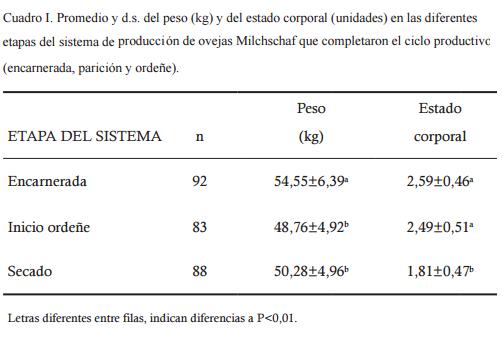
<body><![CDATA[<p class="MsoNormal" style="text-align: justify; line-height: 200%;"><b><span style="font-size: 14pt; line-height: 200%; font-family: &quot;Verdana&quot;,&quot;sans-serif&quot;;">Resultados<o:p></o:p></span></b></p>          <p class="MsoNormal" style="text-align: justify; line-height: 200%;"><span style="font-size: 10pt; line-height: 200%; font-family: &quot;Verdana&quot;,&quot;sans-serif&quot;;">A la encarnerada se comenz&oacute; con 148 ovejas, de las cuales 34 no parieron o perdieron el cordero, 114 comenzaron el orde&ntilde;e, posteriormente 8 fueron eliminadas en los distintos controles lecheros cuando su producci&oacute;n era inferior a 0,200 L/d y 14 fueron eliminadas por mastitis cl&iacute;nica, culminando el proceso completo 92 ovejas. <o:p></o:p></span></p>          <p class="MsoNormal" style="text-align: justify; line-height: 200%;"><span style="font-size: 10pt; line-height: 200%; font-family: &quot;Verdana&quot;,&quot;sans-serif&quot;;">El peso promedio a la encarnerada de las 148 ovejas fue de 54,14<u>+</u>7,19 kg y el estado corporal fue de 2,55<u>+</u>0,44 unidades. La edad tuvo un efecto significativo (P&lt;0,01), aunque solamente el peso de las borregas 2 dientes (41,31<u>+</u>3,66 kg) fue diferente del resto de las ovejas (55,62<u>+</u>5,43 kg). El resultado reproductivo al momento del parto fue de 94,6 % de ovejas paridas/ovejas encarneradas, 115,0% de corderos nacidos/ovejas paridas y 108,8 % de corderos nacidos/ovejas encarneradas. No hubo diferencias significativas en los indicadores reproductivos entre los grupos de edades (Pearson Chi<sup>2</sup>= 6,431; P=0,377).<o:p></o:p></span></p>          <p class="MsoNormal" style="text-align: justify; line-height: 200%;"><span style="font-size: 10pt; line-height: 200%; font-family: &quot;Verdana&quot;,&quot;sans-serif&quot;;">La evoluci&oacute;n de pesos y estado corporal de las ovejas que completaron el ciclo productivo se presenta en el </span><span style="font-size: 10pt; line-height: 200%; font-family: &quot;Verdana&quot;,&quot;sans-serif&quot;;" lang="EN-US"><a href="#tab_1"><span style="" lang="ES">Cuadro I</span></a></span><span style="font-size: 10pt; line-height: 200%; font-family: &quot;Verdana&quot;,&quot;sans-serif&quot;;">.<o:p></o:p></span></p>          <p class="MsoNormal" style="text-align: justify; line-height: 200%;"><span style=""><o:p>&nbsp;</o:p></span></p>          <p class="MsoNormal" style="text-align: justify; line-height: 200%;"><span style=""></span><span lang="EN-US"><img alt="" src="/img/revistas/vet/v51n199/199a02t1.JPG"><a name="tab_1"></a></span></p>          <p class="MsoNormal" style="text-align: justify; line-height: 200%;"><span style="">&nbsp;<o:p></o:p></span></p>          <p class="MsoNormal" style="text-align: justify; line-height: 200%;"><span style="font-size: 10pt; line-height: 200%; font-family: &quot;Verdana&quot;,&quot;sans-serif&quot;;">Al destete de los corderos e ingreso al orde&ntilde;e hubo un descenso del peso (P&lt;0,01) el cual se mantuvo hasta el momento del secado, este peso fue a lo largo del per&iacute;odo menor en borregas 2 dientes (42,97<u>+</u>4,22) que en el resto de las categor&iacute;as (51,93<u>+</u>5,30 kg), P&lt;0,01. El estado corporal de las ovejas se mantuvo entre la encarnerada y el inicio del orde&ntilde;e, posteriormente descendi&oacute; y en el momento del secado fue de 1,81<u>+</u>0,47 (P&lt;0,01); no hubo diferencias estad&iacute;sticamente significativas entre los ovinos de las distintas edades (P&lt;0,01).<o:p></o:p></span></p>          <p class="MsoNormal" style="text-align: justify; line-height: 200%;"><span style="font-size: 10pt; line-height: 200%; font-family: &quot;Verdana&quot;,&quot;sans-serif&quot;;">La producci&oacute;n de leche (L) corregida a 100d&iacute;asde orde&ntilde;e y la composici&oacute;n de la leche se muestra en el </span><span style="font-size: 10pt; line-height: 200%; font-family: &quot;Verdana&quot;,&quot;sans-serif&quot;;" lang="EN-US"><a href="#tab_2"><span style="" lang="ES">Cuadro II</span></a></span><span style="font-size: 10pt; line-height: 200%; font-family: &quot;Verdana&quot;,&quot;sans-serif&quot;;">.<o:p></o:p></span></p>          <p class="MsoNormal" style="line-height: 200%;"><span style=""><o:p>&nbsp;</o:p></span></p>          ]]></body>
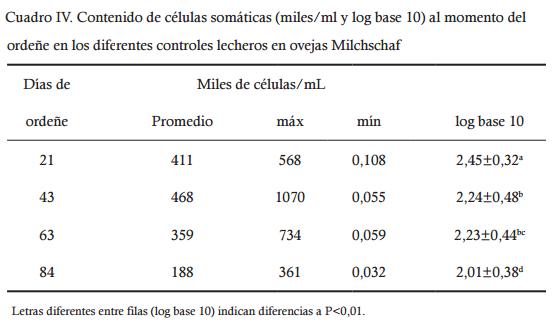
<body><![CDATA[<p class="MsoNormal" style="line-height: 200%;"><span style=""></span><span lang="EN-US"><img alt="" src="/img/revistas/vet/v51n199/199a02t2.JPG"><a name="tab_2"></a></span></p>          <p class="MsoNormal" style="line-height: 200%;"><span lang="EN-US"><o:p>&nbsp;</o:p></span></p>          <p class="MsoNormal" style="text-align: justify; line-height: 200%;"><span style="font-size: 10pt; line-height: 200%; font-family: &quot;Verdana&quot;,&quot;sans-serif&quot;;">La edad influy&oacute; significativamente en la producci&oacute;n de leche (P&lt;0,01), las borregas de primer orde&ntilde;e produjeron un 30,5% menos que las ovejas de segundo o m&aacute;s orde&ntilde;es, 49,00<u>+</u>14,35 y 63,95<u>+</u>14,94, L/100d&iacute;asrespectivamente (P&lt;0,01). Las ovejas que destetaron 2 corderos al orde&ntilde;e produjeron un 33,4% m&aacute;s de leche que las que destetaron 1 cordero, 82,62<u>+</u>13,28 vs 61,91<u>+</u>14,93 L/100d&iacute;asrespectivamente (P&lt;0,01). No fueron significativas la interacciones testeadas (P&gt;0,01).<o:p></o:p></span></p>          <p class="MsoNormal" style="text-align: justify; line-height: 200%;"><span style="font-size: 10pt; line-height: 200%; font-family: &quot;Verdana&quot;,&quot;sans-serif&quot;;">En referencia a la composici&oacute;n promedio de la leche producida, se encontr&oacute; que el contenido en grasa (%) fue mayor en ovejas que destetaron un cordero que las que destetaron 2 corderos (P&lt;0,01), este efecto no fue significativo para prote&iacute;na ni lactosa. La edad tuvo efecto en el contenido de grasa en leche, con una menor concentraci&oacute;n en borregas 2 dientes (P&lt;0,01), sin variaciones en prote&iacute;na y lactosa.<o:p></o:p></span></p>          <p class="MsoNormal" style="text-align: justify; line-height: 200%;"><span style="font-size: 10pt; line-height: 200%; font-family: &quot;Verdana&quot;,&quot;sans-serif&quot;;">La producci&oacute;n promedio de leche en cada control lechero y la composici&oacute;n de la misma se muestra en el </span><span style="font-size: 10pt; line-height: 200%; font-family: &quot;Verdana&quot;,&quot;sans-serif&quot;;" lang="EN-US"><a href="#tab_3"><span style="" lang="ES">Cuadro III</span></a></span><span style="font-size: 10pt; line-height: 200%; font-family: &quot;Verdana&quot;,&quot;sans-serif&quot;;">.<o:p></o:p></span></p>          <p class="MsoNormal" style="text-align: justify; line-height: 200%;"><span style=""><o:p>&nbsp;</o:p></span></p>          <p class="MsoNormal" style="text-align: justify; line-height: 200%;"><span style=""><img style="border: 0px solid ;" alt="" id="_x0000_i1028" src="/img/revistas/vet/v51n199/199a02t3.JPG"></span><span lang="EN-US"><a name="tab_3"></a></span></p>          <p class="MsoNormal" style="line-height: 200%;"><span lang="EN-US"><o:p>&nbsp;</o:p></span></p>          <p class="MsoNormal" style="text-align: justify; line-height: 200%;"><span style="font-size: 10pt; line-height: 200%; font-family: &quot;Verdana&quot;,&quot;sans-serif&quot;;">La producci&oacute;n de leche al inicio del orde&ntilde;e fue de 0,847 L/d el que desciende en cada control lechero (P&gt;0,01). El porcentaje de grasa se mantuvo hasta la mitad del per&iacute;odo de orde&ntilde;o y luego se increment&oacute; (P&lt;0,01), la prote&iacute;na disminuy&oacute; en los dos &uacute;ltimos controles (P&gt;0,01) mientras que la lactosa fue en descenso en los sucesivos controles (P&gt;0,01). <o:p></o:p></span></p>          <p class="MsoNormal" style="text-align: justify; line-height: 200%;"><span style="font-size: 10pt; line-height: 200%; font-family: &quot;Verdana&quot;,&quot;sans-serif&quot;;">El RCS (</span><span style="font-size: 10pt; line-height: 200%; font-family: &quot;Verdana&quot;,&quot;sans-serif&quot;;" lang="EN-US"><a href="#tab_4"><span style="" lang="ES">Cuadro IV</span></a></span><span style="font-size: 10pt; line-height: 200%; font-family: &quot;Verdana&quot;,&quot;sans-serif&quot;;">), se inici&oacute; con un promedio de 411.000/mL a los 23 d&iacute;as de orde&ntilde;o, increment&aacute;ndose a los 43 y 63 d&iacute;as y posteriormente descendi&oacute; a los 84 d&iacute;as (P&lt;0,01). No hubo efecto estad&iacute;sticamente significativo del n&uacute;mero de corderos destetados ni de la edad de la oveja sobre este par&aacute;metro, el promedio general de todas las ovejas en todos los controles fue de 360.000/mL.<o:p></o:p></span></p>          ]]></body>
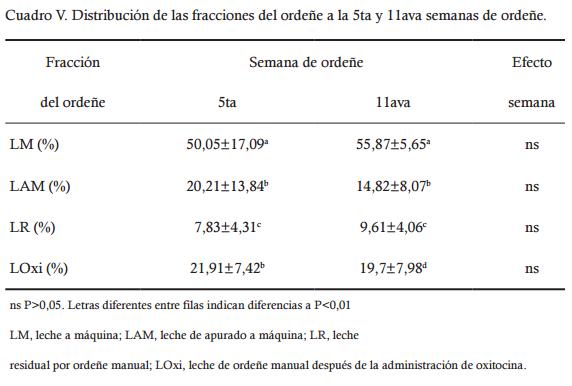
<body><![CDATA[<p class="MsoNormal" style="line-height: 200%;"><span style=""><o:p>&nbsp;</o:p></span></p>          <p class="MsoNormal" style="line-height: 200%;"><span style=""><img style="border: 0px solid ;" alt="" id="_x0000_i1027" src="/img/revistas/vet/v51n199/199a02t4.JPG"></span><span lang="EN-US"><a name="tab_4"></a></span></p>          <p class="MsoNormal" style="line-height: 200%;"><span lang="EN-US"><o:p>&nbsp;</o:p></span></p>          <p class="MsoNormal" style="text-align: justify; line-height: 200%;"><span style="font-size: 10pt; line-height: 200%; font-family: &quot;Verdana&quot;,&quot;sans-serif&quot;;">El n&uacute;mero total de ovejas eliminadas por mastitis fue de 14 (13,3%), de las cuales 8 presentaban mastitis unilateral y 6 bilaterales, el 78,6% apareci&oacute; dentro de los primeros 2 controles lecheros (43 d).<o:p></o:p></span></p>          <p class="MsoNormal" style="text-align: justify; line-height: 200%;"><span style="font-size: 10pt; line-height: 200%; font-family: &quot;Verdana&quot;,&quot;sans-serif&quot;;">En la evaluaci&oacute;n de la aptitud al orde&ntilde;e mec&aacute;nico, realizado en las 5ta y 11ava semanas de orde&ntilde;e, se obtuvo un volumen total de leche (L) en el d&iacute;a de 0,726&plusmn;0,198 y 0,522&plusmn;0,113, respectivamente, una disminuci&oacute;n (P&lt;0,01) que se corresponde con la evoluci&oacute;n general de la producci&oacute;n lechera de las ovejas. La distribuci&oacute;n porcentual de las fracciones de orde&ntilde;o se muestran en el </span><span style="font-size: 10pt; line-height: 200%; font-family: &quot;Verdana&quot;,&quot;sans-serif&quot;;" lang="EN-US"><a href="#tab_5"><span style="" lang="ES">Cuadro V</span></a></span><span style="font-size: 10pt; line-height: 200%; font-family: &quot;Verdana&quot;,&quot;sans-serif&quot;;">, los cuales no fueron diferentes entre la 5ta y 11ava semanas de orde&ntilde;e (P&lt;0,01), tampoco fue significativa la interacci&oacute;n entre los efectos (P&lt;0,01).<o:p></o:p></span></p>          <p class="MsoNormal" style="line-height: 200%;"><span style=""><o:p>&nbsp;</o:p></span></p>          <p class="MsoNormal" style="line-height: 200%;"><span style=""><img style="border: 0px solid ;" alt="" id="_x0000_i1026" src="/img/revistas/vet/v51n199/199a02t5.JPG"></span><span lang="EN-US"><a name="tab_5"></a></span></p>          <p class="MsoNormal" style="line-height: 200%;"><span lang="EN-US"><o:p>&nbsp;</o:p></span></p>          <p class="MsoNormal" style="text-align: justify; line-height: 200%;"><span style="font-size: 10pt; line-height: 200%; font-family: &quot;Verdana&quot;,&quot;sans-serif&quot;;">Promediando los datos de las dos semanas, se extrajo 53% con la m&aacute;quina de orde&ntilde;e sin intervenci&oacute;n del orde&ntilde;ador, 18 % con el apurado a m&aacute;quina, 9% con repaso a mano y 21% con el orde&ntilde;e posterior a la inyecci&oacute;n de oxitocina. En la extracci&oacute;n con la m&aacute;quina de orde&ntilde;ar (LM y LAM), el apurado (LAM) represent&oacute; un 25% de lo orde&ntilde;ado. La composici&oacute;n de las fracciones de orde&ntilde;o se presenta en el </span><span style="font-size: 10pt; line-height: 200%; font-family: &quot;Verdana&quot;,&quot;sans-serif&quot;;" lang="EN-US"><a href="#tab_6"><span style="" lang="ES">Cuadro VI</span></a></span><span style="font-size: 10pt; line-height: 200%; font-family: &quot;Verdana&quot;,&quot;sans-serif&quot;;">.<o:p></o:p></span></p>          <p class="MsoNormal" style="text-align: justify; line-height: 200%;"><span style=""><o:p>&nbsp;</o:p></span></p>          ]]></body>
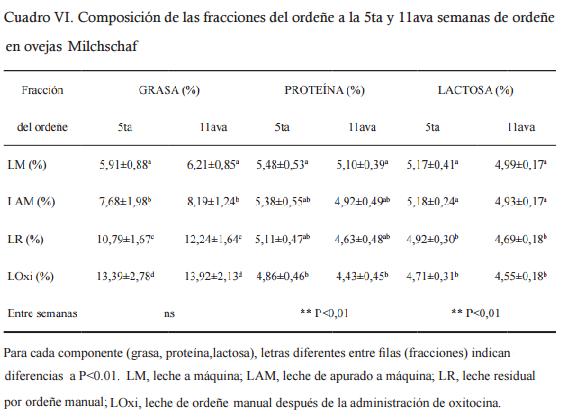
<body><![CDATA[<p class="MsoNormal" style="text-align: justify; line-height: 200%;"><span style=""><img style="border: 0px solid ;" alt="" id="_x0000_i1025" src="/img/revistas/vet/v51n199/199a02t6.JPG"></span><span lang="EN-US"><a name="tab_6"></a></span></p>          <p class="MsoNormal" style="line-height: 200%;"><span lang="EN-US"><o:p>&nbsp;</o:p></span></p>          <p class="MsoNormal" style="text-align: justify; line-height: 200%;"><span style="font-size: 10pt; line-height: 200%; font-family: &quot;Verdana&quot;,&quot;sans-serif&quot;;">En general se encuentran diferencias significativas para cada componente (grasa, prote&iacute;na y lactosa) entre las distintas fracciones y entre semanas, estas &uacute;ltimas coinciden con lo descrito para la evoluci&oacute;n de la composici&oacute;n de la leche a lo largo del per&iacute;odo de orde&ntilde;o, con un aumento en el contenido en grasa (P&lt;0,01), disminuci&oacute;n de prote&iacute;na (P&lt;0,01) y de lactosa (P&lt;0,01). La variaci&oacute;n m&aacute;s importante se da en el componente graso, donde entre las dos fracciones obtenidas a m&aacute;quina (LM y LAM) y las residuales (LRM y LR) hay en promedio una diferencia de 5,58 puntos a favor de las &uacute;ltimas (P&lt;0,01).<o:p></o:p></span></p>          <p class="MsoNormal" style="text-align: justify; line-height: 200%;"><span style="font-size: 10pt; line-height: 200%; font-family: &quot;Verdana&quot;,&quot;sans-serif&quot;;"><o:p>&nbsp;</o:p></span></p>          <p class="MsoNormal" style="text-align: justify; line-height: 200%;"><b><span style="font-size: 14pt; line-height: 200%; font-family: &quot;Verdana&quot;,&quot;sans-serif&quot;;">Discusi&oacute;n<o:p></o:p></span></b></p>          <p class="MsoNormal" style="text-align: justify; line-height: 200%;"><span style="font-size: 10pt; line-height: 200%; font-family: &quot;Verdana&quot;,&quot;sans-serif&quot;;">El sistema productivo analizado en este estudio es utilizado por los productores lecheros en nuestro pa&iacute;s (</span><span style="font-size: 10pt; line-height: 200%; font-family: &quot;Verdana&quot;,&quot;sans-serif&quot;;" lang="EN-US"><a href="#Kremer_y_Barbato_1999"><span style="" lang="ES">Kremer</span></a></span><span style="font-size: 10pt; line-height: 200%; font-family: &quot;Verdana&quot;,&quot;sans-serif&quot;;"> y Barbato, 1999), con una producci&oacute;n estacional de leche a partir de setiembre, orde&ntilde;e mec&aacute;nico y un nivel alimenticio con mejoras estrat&eacute;gicas a partir del &uacute;ltimo tercio de gestaci&oacute;n. Este manejo no optimiza el potencial gen&eacute;tico en todo el proceso productivo, tal como surge de la evoluci&oacute;n de los estados corporales. A la encarnerada, el estado corporal de las ovejas era inferior al recomendado por </span><a name="-Cannas_2004"></a><span style="font-size: 10pt; line-height: 200%; font-family: &quot;Verdana&quot;,&quot;sans-serif&quot;;" lang="EN-US"><a href="#Cannas_2004"><span style="" lang="ES">Cannas</span></a></span><span style="" lang="EN-US"> </span><span style="font-size: 10pt; line-height: 200%; font-family: &quot;Verdana&quot;,&quot;sans-serif&quot;;">(2004) para ovinos lecheros (3,5 unidades), sin embargo al inicio del orde&ntilde;e coincide con la recomendaci&oacute;n de este autor (2 unidades). El estado corporal como indicador de los dep&oacute;sitos grasos var&iacute;a entre razas y en general el Milchschaf ha dado valores de grasa subcut&aacute;nea menor que otras razas (</span><span style="font-size: 10pt; line-height: 200%;" lang="EN-US"><a href="#Bianchi_y_Garibotto_2006"><span style="font-family: &quot;Verdana&quot;,&quot;sans-serif&quot;;" lang="ES">Bianchi</span></a></span><span style="font-size: 10pt; line-height: 200%; font-family: &quot;Verdana&quot;,&quot;sans-serif&quot;;"> y Garibotto, 2006; Kremer y col., 2004), esta estimaci&oacute;n puede subvalorar el nivel de dep&oacute;sitos grasos totales en esta raza ya que se ha reportado que presenta mayores dep&oacute;sitos cavitarios (</span><span style="font-size: 10pt; line-height: 200%;" lang="EN-US"><a href="#Kremer_y_col_2004"><span style="font-family: &quot;Verdana&quot;,&quot;sans-serif&quot;;" lang="ES">Kremer</span></a></span><span style="font-size: 10pt; line-height: 200%; font-family: &quot;Verdana&quot;,&quot;sans-serif&quot;;"> y col., 2004).</span><u><span style=""><o:p></o:p></span></u></p>          <p class="MsoNormal" style="text-align: justify; line-height: 200%;"><span style="font-size: 10pt; line-height: 200%; font-family: &quot;Verdana&quot;,&quot;sans-serif&quot;;">En la revisi&oacute;n de </span><span style="font-size: 10pt; line-height: 200%; font-family: &quot;Verdana&quot;,&quot;sans-serif&quot;;" lang="EN-US"><a href="#Farid_y_Fahmy_1996"><span style="" lang="ES">Farid</span></a></span><span style="font-size: 10pt; line-height: 200%; font-family: &quot;Verdana&quot;,&quot;sans-serif&quot;;"> y Fahmy, 1996, se indica que la oveja Milchschaf tiene un rango de peso de 57 a 75 kg, superiores a los resultados obtenidos en este trabajo (54,6 kg a la encarnerada). Otros resultados de Milchschaf y sus cruzas en Uruguay, son coincidentes con los encontrados en este ensayo, tales como los de </span><span style="font-size: 10pt; line-height: 200%; font-family: &quot;Verdana&quot;,&quot;sans-serif&quot;;" lang="EN-US"><a href="#Ganz%E1bal_y_col_2012"><span style="" lang="ES">Ganz&aacute;bal</span></a></span><span style="font-size: 10pt; line-height: 200%; font-family: &quot;Verdana&quot;,&quot;sans-serif&quot;;"> y col., (2012), de 54,5 kg, los de </span><a name="-Kremer_y_col_2010"></a><span style="font-size: 10pt; line-height: 200%; font-family: &quot;Verdana&quot;,&quot;sans-serif&quot;;" lang="EN-US"><a href="#Kremer_y_col_2010"><span style="" lang="ES">Kremer</span></a></span><span style="font-size: 10pt; line-height: 200%; font-family: &quot;Verdana&quot;,&quot;sans-serif&quot;;"> y col.,(2010) de 57,8 kg en cruzas Milchschaf x Corriedale y los de </span><span style="font-size: 10pt; line-height: 200%; font-family: &quot;Verdana&quot;,&quot;sans-serif&quot;;" lang="EN-US"><a href="#Bianchi_y_Garibotto_2006"><span style="" lang="ES">Bianchi</span></a></span><span style="font-size: 10pt; line-height: 200%; font-family: &quot;Verdana&quot;,&quot;sans-serif&quot;;" lang="EN-US"> </span><span style="font-size: 10pt; line-height: 200%; font-family: &quot;Verdana&quot;,&quot;sans-serif&quot;;">y Garibotto, 2006, de 56 kg a los dos a&ntilde;os, lo que sugerir&iacute;a que el genotipo predominante en el pa&iacute;s se encuentra en el rango inferior de peso. <o:p></o:p></span></p>          <p class="MsoNormal" style="text-align: justify; line-height: 200%;"><span style="font-size: 10pt; line-height: 200%; font-family: &quot;Verdana&quot;,&quot;sans-serif&quot;;">La raza Milchschaf es considerada como prol&iacute;fica, con tasas de nacimiento de 210 a 230%, aunque tambi&eacute;n hay resultados en condiciones comerciales y estaciones experimentales que van de 106% a 195% (</span><span style="font-size: 10pt; line-height: 200%; font-family: &quot;Verdana&quot;,&quot;sans-serif&quot;;" lang="EN-US"><a href="#Farid_y_Fahmy_1996"><span style="" lang="ES">Farid</span></a></span><span style="font-size: 10pt; line-height: 200%; font-family: &quot;Verdana&quot;,&quot;sans-serif&quot;;"> y Fahmy, 1996). El resultado obtenido en esta poblaci&oacute;n y en ese a&ntilde;o en particular fue de 108%, de parici&oacute;n y una prolificidad de 1,15. Su uso en cruzamientos con otras raza en el pa&iacute;s dieron resultados de 104,3% de parici&oacute;n y 1,25 de prolificidad en F1 X Corriedale, (promedio de 5 a&ntilde;os) en un sistema lechero (</span><span style="font-size: 10pt; line-height: 200%; font-family: &quot;Verdana&quot;,&quot;sans-serif&quot;;" lang="EN-US"><a href="#Kremer_y_col_2010"><span style="" lang="ES">Kremer</span></a></span><span style="font-size: 10pt; line-height: 200%; font-family: &quot;Verdana&quot;,&quot;sans-serif&quot;;"> y col., 2010), 100,1% de parici&oacute;n y 1,43 de prolificidad (promedio de 4 a&ntilde;os) en un sistema carnicero (</span><span style="font-size: 10pt; line-height: 200%; font-family: &quot;Verdana&quot;,&quot;sans-serif&quot;;" lang="EN-US"><a href="#Barbato_y_col_2011"><span style="" lang="ES">Barbato</span></a></span><span style="font-size: 10pt; line-height: 200%; font-family: &quot;Verdana&quot;,&quot;sans-serif&quot;;"> y col., 2011), 121,5% y 1,33% y 134,8% y 1,55 de parici&oacute;n y prolificidad en borregas y ovejas cruzas, respectivamente (</span><span style="font-size: 10pt; line-height: 200%; font-family: &quot;Verdana&quot;,&quot;sans-serif&quot;;" lang="EN-US"><a href="#Bianchi_y_Garibotto_2006"><span style="" lang="ES">Bianchi</span></a></span><span style="font-size: 10pt; line-height: 200%; font-family: &quot;Verdana&quot;,&quot;sans-serif&quot;;"> y Garibotto, 2006); 130% de parici&oacute;n y 1,30 de prolificidad, tambi&eacute;n en cruza con Corriedale (</span><span style="font-size: 10pt; line-height: 200%; font-family: &quot;Verdana&quot;,&quot;sans-serif&quot;;" lang="EN-US"><a href="#Ganz%E1bal_y_col_2012"><span style="" lang="ES">Ganz&aacute;bal</span></a></span><span style="font-size: 10pt; line-height: 200%; font-family: &quot;Verdana&quot;,&quot;sans-serif&quot;;"> y col., 2012). El conjunto de resultados obtenidos por los distintos autores en Uruguay indicar&iacute;an que el genotipo disponible no podr&iacute;a considerarse como prol&iacute;fico.<o:p></o:p></span></p>          <p class="MsoNormal" style="text-align: justify; line-height: 200%;"><span style="font-size: 10pt; line-height: 200%; font-family: &quot;Verdana&quot;,&quot;sans-serif&quot;;">En Alemania, pa&iacute;s de origen, la producci&oacute;n lechera es elevada y de una persistencia prolongada de la lactancia, con resultados de 466 L en 200 d&iacute;as de orde&ntilde;o en 103 reba&ntilde;os (</span><a name="-Haman_y_col_2004"></a><span style="font-size: 10pt; line-height: 200%; font-family: &quot;Verdana&quot;,&quot;sans-serif&quot;;" lang="EN-US"><a href="#Haman_y_col_2004"><span style="" lang="ES">Haman</span></a></span><span style="" lang="EN-US"> </span><span style="font-size: 10pt; line-height: 200%; font-family: &quot;Verdana&quot;,&quot;sans-serif&quot;;">y col, 2004). Sin llegar a estos niveles en general ha mejorado la producci&oacute;n lechera en razas lecheras locales (</span><span style="font-size: 10pt; line-height: 200%;" lang="EN-US"><a href="#Boyazoglu_1980"><span style="font-family: &quot;Verdana&quot;,&quot;sans-serif&quot;;" lang="ES">Boyazoglu</span></a></span><span style="font-size: 10pt; line-height: 200%; font-family: &quot;Verdana&quot;,&quot;sans-serif&quot;;">, 1980; </span><span style="font-size: 10pt; line-height: 200%;" lang="EN-US"><a href="#Ugarte_y_col_2001"><span style="font-family: &quot;Verdana&quot;,&quot;sans-serif&quot;;" lang="ES">Ugarte</span></a></span><span style="font-size: 10pt; line-height: 200%; font-family: &quot;Verdana&quot;,&quot;sans-serif&quot;;"> y col., 2001).</span><span style=""><o:p></o:p></span></p>          <p class="MsoNormal" style="text-align: justify; line-height: 200%;"><span style="font-size: 10pt; line-height: 200%; font-family: &quot;Verdana&quot;,&quot;sans-serif&quot;;">En Uruguay, se report&oacute; a nivel comercial (</span><a name="-Kugler_y_col_1995"></a><span style="font-size: 10pt; line-height: 200%; font-family: &quot;Verdana&quot;,&quot;sans-serif&quot;;" lang="EN-US"><a href="#Kugler_y_col_1995"><span style="" lang="ES">Kugler</span></a></span><span style="font-size: 10pt; line-height: 200%; font-family: &quot;Verdana&quot;,&quot;sans-serif&quot;;"> y col., 1995) en un a&ntilde;o en 102 ovejas Milchschaf puras, una producci&oacute;n de 196 L en 236d&iacute;asde orde&ntilde;o con un promedio diario de 0,834 L, otros resultados en el pa&iacute;s son de cruzas Milchschaf F1 y F2, a nivel de productores (63,58 L/100 d,</span><span style=""> </span><a name="-Kremer_y_col_2003"></a><span style="font-size: 10pt; line-height: 200%;" lang="EN-US"><a href="#Kremer_y_col_2003"><span style="font-family: &quot;Verdana&quot;,&quot;sans-serif&quot;;" lang="ES">Kremer</span></a></span><span style="font-size: 10pt; line-height: 200%; font-family: &quot;Verdana&quot;,&quot;sans-serif&quot;;"> y col., 2003) y en estaci&oacute;n experimental (73,0 L/100 d, </span><span style="font-size: 10pt; line-height: 200%;" lang="EN-US"><a href="#Kremer_y_col_2010"><span style="font-family: &quot;Verdana&quot;,&quot;sans-serif&quot;;" lang="ES">Kremer</span></a></span><span style="font-size: 10pt; line-height: 200%; font-family: &quot;Verdana&quot;,&quot;sans-serif&quot;;"> y col., 2010). Estos resultados son inferiores a los reportados en Europa, lo que parece ser una combinaci&oacute;n de causas, tales como el sistema productivo estacional con una producci&oacute;n acotada en el tiempo (100 d) en la mayor&iacute;a de los casos, un nivel alimenticio que no optimiza la producci&oacute;n lechera y del potencial productivo de los ejemplares introducidos en el pa&iacute;s, los cuales requieren un proceso de selecci&oacute;n como el que se realiza actualmente (</span><span style="font-size: 10pt; line-height: 200%;" lang="EN-US"><a href="#Ciappesoni_y_col_2007"><span style="font-family: &quot;Verdana&quot;,&quot;sans-serif&quot;;" lang="ES">Ciappesoni</span></a></span><span style="font-size: 10pt; line-height: 200%; font-family: &quot;Verdana&quot;,&quot;sans-serif&quot;;"> y col., 2007). La mayor producci&oacute;n lechera de ovejas que parieron mellizos fue tambi&eacute;n reportado en Milchschaf (</span><a name="-Fuerst-Waltl_y_col_2005"></a><span style="font-size: 10pt; line-height: 200%;" lang="EN-US"><a href="#Fuerst-Waltl_y_col_2005"><span style="font-family: &quot;Verdana&quot;,&quot;sans-serif&quot;;" lang="ES">Fuerst</span></a></span><span style="font-size: 10pt; line-height: 200%; font-family: &quot;Verdana&quot;,&quot;sans-serif&quot;;">-Waltl y col., 2005) y est&aacute; vinculado al mayor desarrollo de las ubres en el per&iacute;odo de lactancia.</span><span style=""><o:p></o:p></span></p>          ]]></body>
<body><![CDATA[<p class="MsoNormal" style="text-align: justify; line-height: 200%;"><span style="font-size: 10pt; line-height: 200%; font-family: &quot;Verdana&quot;,&quot;sans-serif&quot;;">El porcentaje de grasa y de prote&iacute;na de la leche observada fue de 5,43% y 4,67%, respectivamente, estos resultados se encuentran por debajo de las razas lecheras europeas (</span><a name="-Pulina_y_Nuda_2004"></a><span style="font-size: 10pt; line-height: 200%; font-family: &quot;Verdana&quot;,&quot;sans-serif&quot;;" lang="EN-US"><a href="#Pulina_y_Nuda_2004"><span style="" lang="ES">Pulina</span></a></span><span style="font-size: 10pt; line-height: 200%; font-family: &quot;Verdana&quot;,&quot;sans-serif&quot;;"> y Nuda, 2004). Sin embargo son similares a los reportados en ovejas Milchschaf (</span><span style="font-size: 10pt; line-height: 200%;" lang="EN-US"><a href="#Haman_y_col_2004"><span style="font-family: &quot;Verdana&quot;,&quot;sans-serif&quot;;" lang="ES">Haman</span></a></span><span style="font-size: 10pt; line-height: 200%; font-family: &quot;Verdana&quot;,&quot;sans-serif&quot;;"> y col., 2004; </span><a name="-McKusick_y_col_2002"></a><span style="font-size: 10pt; line-height: 200%;" lang="EN-US"><a href="#McKusick_y_col_2002"><span style="font-family: &quot;Verdana&quot;,&quot;sans-serif&quot;;" lang="ES">McKusick</span></a></span><span style="font-size: 10pt; line-height: 200%; font-family: &quot;Verdana&quot;,&quot;sans-serif&quot;;"> y col., 2002;</span><span style=""> </span><a name="-Mioc_y_col_2004"></a><span style="font-size: 10pt; line-height: 200%;" lang="EN-US"><a href="#Mioc_y_col_2004"><span style="font-family: &quot;Verdana&quot;,&quot;sans-serif&quot;;" lang="ES">Mioc</span></a></span><span style="font-size: 10pt; line-height: 200%; font-family: &quot;Verdana&quot;,&quot;sans-serif&quot;;"> y col., 2004), confirmando que el contenido en grasa y prote&iacute;na es inferior a la de otras razas lecheras (</span><span style="font-size: 10pt; line-height: 200%;" lang="EN-US"><a href="#Farid_y_Fahmy_1996"><span style="font-family: &quot;Verdana&quot;,&quot;sans-serif&quot;;" lang="ES">Farid</span></a></span><span style="font-size: 10pt; line-height: 200%; font-family: &quot;Verdana&quot;,&quot;sans-serif&quot;;"> y Fahmy, 1996). El incremento de la concentraci&oacute;n de grasa y disminuci&oacute;n de los otros componentes hacia el final del per&iacute;odo de orde&ntilde;o, es un proceso ampliamente descrito en la bibliograf&iacute;a (</span><span style="font-size: 10pt; line-height: 200%;" lang="EN-US"><a href="#Pulina_y_Nuda_2004"><span style="font-family: &quot;Verdana&quot;,&quot;sans-serif&quot;;" lang="ES">Pulina</span></a></span><span style="font-size: 10pt; line-height: 200%; font-family: &quot;Verdana&quot;,&quot;sans-serif&quot;;"> y Nuda, 2004) y que tendr&aacute; incidencia para la elaboraci&oacute;n de los productos en tambos estacionales.</span><span style=""><o:p></o:p></span></p>          <p class="MsoNormal" style="text-align: justify; line-height: 200%;"><span style="font-size: 10pt; line-height: 200%; font-family: &quot;Verdana&quot;,&quot;sans-serif&quot;;">Los reportes sobre la prevalencia de mastitis cl&iacute;nica en ovinos lecheros es amplio, con valores de un 5% hasta un 30 % (</span><a name="-Bergonier_y_col_2003"></a><span style="font-size: 10pt; line-height: 200%; font-family: &quot;Verdana&quot;,&quot;sans-serif&quot;;" lang="EN-US"><a href="#Bergonier_y_col_2003"><span style="" lang="ES">Bergonier</span></a></span><span style="" lang="EN-US"> </span><span style="font-size: 10pt; line-height: 200%; font-family: &quot;Verdana&quot;,&quot;sans-serif&quot;;">y col., 2003), los valores encontrado en este trabajo (13,3 %) est&aacute;n dentro de este rango con una predominancia al inicio del per&iacute;odo de orde&ntilde;e y dentro del primer tercio del mismo, lo que coincidi&oacute; con los RCS m&aacute;s altos observados en esta etapa. Un estudio realizado en Uruguay en ovejas en orde&ntilde;e, arroj&oacute; una prevalencia de mastitis subcl&iacute;nicas de un 8% a un 13% (</span><a name="-Apolo_y_col_1998"></a><span style="font-size: 10pt; line-height: 200%;" lang="EN-US"><a href="#Apolo_y_col_1998"><span style="font-family: &quot;Verdana&quot;,&quot;sans-serif&quot;;" lang="ES">Apolo</span></a></span><span style="font-size: 10pt; line-height: 200%; font-family: &quot;Verdana&quot;,&quot;sans-serif&quot;;"> y col., 1998), las ovejas orde&ntilde;adas eran principalmente Corriedale. El RCS es un procedimiento ampliamente utilizado para evaluar el estado inflamatorio de la gl&aacute;ndula mamaria y la calidad de la leche; no hay acuerdo a nivel internacional acerca del l&iacute;mite de RCS para leche de ovejas sanas.</span><span style=""> </span><a name="-Leitner_y_col_2007"></a><span style="font-size: 10pt; line-height: 200%;" lang="EN-US"><a href="#Leitner_y_col_2007"><span style="font-family: &quot;Verdana&quot;,&quot;sans-serif&quot;;" lang="ES">Leitner</span></a></span><span style="font-size: 10pt; line-height: 200%; font-family: &quot;Verdana&quot;,&quot;sans-serif&quot;;"> y col., (2007) plantean un nivel m&aacute;ximo de 800.000 c&eacute;lulas/ ml,</span><span style=""> </span><a name="-Molina_y_col_2010"></a><span style="font-size: 10pt; line-height: 200%;" lang="EN-US"><a href="#Molina_y_col_2010"><span style="font-family: &quot;Verdana&quot;,&quot;sans-serif&quot;;" lang="ES">Molina</span></a></span><span style="font-size: 10pt; line-height: 200%; font-family: &quot;Verdana&quot;,&quot;sans-serif&quot;;"> y col, (2010) de 500.000, </span><span style="font-size: 10pt; line-height: 200%;" lang="EN-US"><a href="#Bergonier_y_col_2003"><span style="font-family: &quot;Verdana&quot;,&quot;sans-serif&quot;;" lang="ES">Bergonier</span></a></span><span style="font-size: 10pt; line-height: 200%; font-family: &quot;Verdana&quot;,&quot;sans-serif&quot;;"> y col., (2003) de 340.000 y</span><span style=""> </span><a name="-Marguet_y_col_2000"></a><span style="font-size: 10pt; line-height: 200%;" lang="EN-US"><a href="#Marguet_y_col_2000"><span style="font-family: &quot;Verdana&quot;,&quot;sans-serif&quot;;" lang="ES">Marguet</span></a></span><span style="font-size: 10pt; line-height: 200%; font-family: &quot;Verdana&quot;,&quot;sans-serif&quot;;"> y col., (2000), de 200.000 c&eacute;lulas/mL. No ha sido el objetivo de este ensayo dilucidar este aspecto, aunque considerando un promedio general de todas las ovejas y controles lecheros de 360.000/mL y una prevalencia de 13,3% de mastitis, se sugiere que deber&iacute;an utilizarse los niveles m&aacute;s bajos propuestos como indicativos de ubres sanas.</span><span style=""><o:p></o:p></span></p>          <p class="MsoNormal" style="text-align: justify; line-height: 200%;"><span style="font-size: 10pt; line-height: 200%; font-family: &quot;Verdana&quot;,&quot;sans-serif&quot;;">En el total de leche presente en la ubre, la extracci&oacute;n a m&aacute;quina, incluyendo el apurado, fue del 70,5 %, el repaso manual represent&oacute; un 8,7 % y la leche residual, extra&iacute;da luego de la inyecci&oacute;n con oxitocina fue del 20,8 %. Este &uacute;ltimo resultado es mayor a la reportada por </span><a name="-Caja_y_col_2002"></a><span style="font-size: 10pt; line-height: 200%; font-family: &quot;Verdana&quot;,&quot;sans-serif&quot;;" lang="EN-US"><a href="#Caja_y_col_2002"><span style="" lang="ES">Caja</span></a></span><span style="font-size: 10pt; line-height: 200%; font-family: &quot;Verdana&quot;,&quot;sans-serif&quot;;"> y col., (2002) de 10%-15%, y por </span><span style="font-size: 10pt; line-height: 200%; font-family: &quot;Verdana&quot;,&quot;sans-serif&quot;;" lang="EN-US"><a href="#Labussi%E8re_1984"><span style="" lang="ES">Labussi&egrave;re</span></a></span><span style="font-size: 10pt; line-height: 200%; font-family: &quot;Verdana&quot;,&quot;sans-serif&quot;;"> (1984) de 11%-20% en otras razas lecheras, lo que indica que es un aspecto a mejorar para una m&aacute;s completa extracci&oacute;n de leche. El apurado a m&aacute;quina es una pr&aacute;ctica habitual en lecher&iacute;as ovinas, no as&iacute; en bovinas, agregando de un 10 a un 30 % en la producci&oacute;n diaria (</span><span style="font-size: 10pt; line-height: 200%; font-family: &quot;Verdana&quot;,&quot;sans-serif&quot;;" lang="EN-US"><a href="#Labussi%E8re_1984"><span style="" lang="ES">Labussi&egrave;re</span></a></span><span style="font-size: 10pt; line-height: 200%; font-family: &quot;Verdana&quot;,&quot;sans-serif&quot;;">, 1984) y hasta un 60% (</span><a name="-Sagi_y_Morag_1974"></a><span style="font-size: 10pt; line-height: 200%; font-family: &quot;Verdana&quot;,&quot;sans-serif&quot;;" lang="EN-US"><a href="#Sagi_y_Morag_1974"><span style="" lang="ES">Sagi</span></a></span><span style="font-size: 10pt; line-height: 200%; font-family: &quot;Verdana&quot;,&quot;sans-serif&quot;;"> y Morag, 1974). El incremento obtenido en este trabajo (24,8%) est&aacute; dentro de estos rangos y es similar a los resultados publicados por otros autores para la misma raza ( </span><span style="font-size: 10pt; line-height: 200%; font-family: &quot;Verdana&quot;,&quot;sans-serif&quot;;" lang="EN-US"><a href="#Bruckmaier_y_col_1997"><span style="" lang="ES">Bruckmaier</span></a></span><span style="font-size: 10pt; line-height: 200%; font-family: &quot;Verdana&quot;,&quot;sans-serif&quot;;"> y col,1997: 24,9%; </span><a name="-McKusick_y_col_2003"></a><span style="font-size: 10pt; line-height: 200%; font-family: &quot;Verdana&quot;,&quot;sans-serif&quot;;" lang="EN-US"><a href="#McKusick_y_col_2003"><span style="" lang="ES">McKusick</span></a></span><span style="font-size: 10pt; line-height: 200%; font-family: &quot;Verdana&quot;,&quot;sans-serif&quot;;"> y col, 2003: 19,8%) y para la raza Pampinta, una raza desarrollada en Argentina con &frac34; Milchschaf &frac14; Corriedale (<a name="-Busetti_y_col_2003"></a>Busetti</span><span style=""> y col., 2003: 19,5% a 24,2%).<o:p></o:p></span></p>          <p class="MsoNormal" style="text-align: justify; line-height: 200%;"><span style="font-size: 10pt; line-height: 200%; font-family: &quot;Verdana&quot;,&quot;sans-serif&quot;;">&nbsp;<o:p></o:p></span></p>          <p class="MsoNormal" style="text-align: justify; line-height: 200%;"><b><span style="font-size: 14pt; line-height: 200%; font-family: &quot;Verdana&quot;,&quot;sans-serif&quot;;">Conclusiones<o:p></o:p></span></b></p>          <p class="MsoNormal" style="text-align: justify; line-height: 200%;"><span style="font-size: 10pt; line-height: 200%; font-family: &quot;Verdana&quot;,&quot;sans-serif&quot;;">El Milchschaf disponible en el Uruguay se presenta como una raza adaptada al r&eacute;gimen de pastoreo, su tama&ntilde;o corporal (peso) es mediano, los indicadores reproductivos son superiores al promedio del pa&iacute;s pero no se ha constatado que sea prol&iacute;fica. Se requerir&aacute;n ensayos con niveles alimenticios superiores en cantidad y calidad en el per&iacute;odo de encarnerada para evaluar el potencial gen&eacute;tico de los indicadores reproductivos. <o:p></o:p></span></p>          <p class="MsoNormal" style="text-align: justify; line-height: 200%;"><span style="font-size: 10pt; line-height: 200%; font-family: &quot;Verdana&quot;,&quot;sans-serif&quot;;">La producci&oacute;n de leche obtenida en este ensayo es inferior a los reportados en su pa&iacute;s de origen requiriendo un proceso de selecci&oacute;n nacional. A los efectos de determinar el potencial gen&eacute;tico en la producci&oacute;n lechera, se deber&aacute; evaluar un r&eacute;gimen con orde&ntilde;o de m&aacute;s de 100 d, lo que implica un cambio hacia un sistema productivo continuo.<o:p></o:p></span></p>          <p class="MsoNormal" style="text-align: justify; line-height: 200%;"><span style="font-size: 10pt; line-height: 200%; font-family: &quot;Verdana&quot;,&quot;sans-serif&quot;;">La composici&oacute;n de la leche obtenida por orde&ntilde;e muestra valores de sus principales componentes s&oacute;lidos inferiores a los de otras razas lecheras europeas, por lo que es de esperar un menor rendimiento quesero. La magnitud de la variaci&oacute;n de los componentes, especialmente el porcentaje de grasa, puede resultar que el producto (especialmente queso) tenga una composici&oacute;n diferente al inicio o fin del per&iacute;odo en los tambos estacionales.<o:p></o:p></span></p>          <p class="MsoNormal" style="text-align: justify; line-height: 200%;"><span style="font-size: 10pt; line-height: 200%; font-family: &quot;Verdana&quot;,&quot;sans-serif&quot;;">La raza Milchschaf presenta indicadores de aptitud al orde&ntilde;e mec&aacute;nico adecuados para el sistema lechero, el apurado a m&aacute;quina aumenta significativamente la extracci&oacute;n de leche por lo que esta maniobra debe incluirse en la rutina de orde&ntilde;e.<o:p></o:p></span></p>          <p class="MsoNormal" style="text-align: justify; line-height: 200%;"><span style="font-size: 10pt; line-height: 200%; font-family: &quot;Verdana&quot;,&quot;sans-serif&quot;;">La prevalencia de mastitis cl&iacute;nica se encuentra dentro de los par&aacute;metros internacionales y en relaci&oacute;n al RCS durante el ensayo, se deber&aacute; estudiar con m&aacute;s profundidad los niveles aceptables para ser asociados a la incidencia de mastitis y la producci&oacute;n de leche de calidad.<o:p></o:p></span></p>          ]]></body>
<body><![CDATA[<p class="MsoNormal" style="text-align: justify; line-height: 200%;"><span style="font-size: 10pt; line-height: 200%; font-family: &quot;Verdana&quot;,&quot;sans-serif&quot;;"><o:p>&nbsp;</o:p></span></p>          <p class="MsoNormal" style="text-align: justify; line-height: 200%;"><b><span style="font-size: 14pt; line-height: 200%; font-family: &quot;Verdana&quot;,&quot;sans-serif&quot;;">Agradecimientos<o:p></o:p></span></b></p>          <p class="MsoNormal" style="text-align: justify; line-height: 200%;"><span style="font-size: 10pt; line-height: 200%; font-family: &quot;Verdana&quot;,&quot;sans-serif&quot;;">A la Direcci&oacute;n y personal del Campo Experimental N&ordm; 1, Migues de la Facultad de Veterinaria-UDELAR por permitir y colaborar con el ensayo de campo. A las Bach. Mar&iacute;a Cecilia W&uuml;nsch y Helena Cristi por colaborar en los controles lecheros. Al Departamento de Bioestad&iacute;stica por el asesoramiento del an&aacute;lisis estad&iacute;stico.<o:p></o:p></span></p>          <p class="MsoNormal" style="line-height: 200%;"><span style="font-size: 10pt; line-height: 200%; font-family: &quot;Verdana&quot;,&quot;sans-serif&quot;;"><o:p>&nbsp;</o:p></span></p>          <p class="MsoNormal" style="line-height: 200%;"><b><span style="font-size: 14pt; line-height: 200%; font-family: &quot;Verdana&quot;,&quot;sans-serif&quot;;">Bibliograf&iacute;a<o:p></o:p></span></b></p>          <p class="MsoNormal" style="text-align: justify; line-height: 200%;"><a name="Apolo_y_col_1998"></a><span style="font-size: 10pt; line-height: 200%; font-family: &quot;Verdana&quot;,&quot;sans-serif&quot;;">1. </span><span style="font-size: 10pt; line-height: 200%; font-family: &quot;Verdana&quot;,&quot;sans-serif&quot;;" lang="EN-US"><a href="#-Apolo_y_col_1998"><span style="" lang="ES">Apolo</span></a></span><span style="font-size: 10pt; line-height: 200%; font-family: &quot;Verdana&quot;,&quot;sans-serif&quot;;"> A, Bellizi T, de Lima D, Burgue&ntilde;o M. (1998). </span><span class="GramE"><span style="font-size: 10pt; line-height: 200%; font-family: &quot;Verdana&quot;,&quot;sans-serif&quot;;" lang="EN-US">Subclinical mastitis in dairy sheep in Uruguay.</span></span><span style="font-size: 10pt; line-height: 200%; font-family: &quot;Verdana&quot;,&quot;sans-serif&quot;;" lang="EN-US"> <span class="GramE">Proc. Sixth International Symposium of Milking and milk production of dairy sheep and goats.</span> Athens, Greece, pp. 168-170.<o:p></o:p></span></p>          <!-- ref --><p class="MsoNormal" style="text-align: justify; line-height: 200%;"><a name="Barbato_y_col_2011"></a><span style="font-size: 10pt; line-height: 200%; font-family: &quot;Verdana&quot;,&quot;sans-serif&quot;;" lang="EN-US">2. <a href="#-Barbato_y_col_2011">Barbato</a> G, Kremer R, Ros&eacute;s L, Rista L. (2011). </span><span style="font-size: 10pt; line-height: 200%; font-family: &quot;Verdana&quot;,&quot;sans-serif&quot;;">Producci&oacute;n de ovejas Corriedale y cruzas F1 con Milchschaf y Texel en condiciones de pastoreo. </span><span style="font-size: 10pt; line-height: 200%; font-family: &quot;Verdana&quot;,&quot;sans-serif&quot;;" lang="EN-US">Veterinaria (Montevideo) 181:9-14.    <o:p></o:p></span></p>          <p class="MsoNormal" style="text-align: justify; line-height: 200%;"><a name="Bergonier_y_col_2003"></a><span style="font-size: 10pt; line-height: 200%; font-family: &quot;Verdana&quot;,&quot;sans-serif&quot;;" lang="EN-US">3. <a href="#-Bergonier_y_col_2003">Bergonier</a> D, De Cr&eacute;moux R, Rupp R, Lagriffoul G, Berthelot X. (2003). <span class="GramE">Mastitis of dairy small ruminants.</span> </span><span style="font-size: 10pt; line-height: 200%; font-family: &quot;Verdana&quot;,&quot;sans-serif&quot;;">Vet Res 34:689&ndash;716.<o:p></o:p></span></p>          <!-- ref --><p class="MsoNormal" style="text-align: justify; line-height: 200%;"><a name="Bianchi_y_Garibotto_2006"></a><span style="font-size: 10pt; line-height: 200%; font-family: &quot;Verdana&quot;,&quot;sans-serif&quot;;" lang="EN-US">4. <a href="#-Bianchi_y_Garibotto_2006"><span style="" lang="ES">Bianchi</span></a></span><span style="font-size: 10pt; line-height: 200%; font-family: &quot;Verdana&quot;,&quot;sans-serif&quot;;"> G, Garibotto G. (2006). Alternativas gen&eacute;ticas para producir carne ovina en sistemas pastoriles. Revista Argentina de Producci&oacute;n Animal 26:131-153.    <o:p></o:p></span></p>          <p class="MsoNormal" style="text-align: justify; line-height: 200%;"><a name="Boyazoglu_1980"></a><span style="font-size: 10pt; line-height: 200%; font-family: &quot;Verdana&quot;,&quot;sans-serif&quot;;" lang="EN-US">5. <a href="#-Boyazoglu_1980"><span style="" lang="ES">Boyazoglu</span></a></span><span style="font-size: 10pt; line-height: 200%; font-family: &quot;Verdana&quot;,&quot;sans-serif&quot;;"> JG. (1980). Note sur l&rsquo;adaptation de la brebis de Frise oriental et de ses croisements en M&eacute;diterran&eacute;e. </span><span class="GramE"><span style="font-size: 10pt; line-height: 200%; font-family: &quot;Verdana&quot;,&quot;sans-serif&quot;;" lang="EN-US">Bulletin de l&rsquo;Academie Veterinaire de France.</span></span><span style="font-size: 10pt; line-height: 200%; font-family: &quot;Verdana&quot;,&quot;sans-serif&quot;;" lang="EN-US"> 53:259-264.<o:p></o:p></span></p>          <!-- ref --><p class="MsoNormal" style="text-align: justify; line-height: 200%;"><a name="Bruckmaier_y_col_1997"></a><span class="GramE"><span style="font-size: 10pt; line-height: 200%; font-family: &quot;Verdana&quot;,&quot;sans-serif&quot;;" lang="EN-US">6. <a href="#-Bruckmaier_y_col_1997">Bruckmaier</a> RM, Paul G, Mayer H, Schams D. (1997).</span></span><span style="font-size: 10pt; line-height: 200%; font-family: &quot;Verdana&quot;,&quot;sans-serif&quot;;" lang="EN-US"> Machine milking of Ostfriesian and Lacaune dairy sheep: udder anatomy, milk ejection and milking characteristics. J Dairy Res 64:163-172.    <o:p></o:p></span></p>          <!-- ref --><p class="MsoNormal" style="text-align: justify; line-height: 200%;"><a name="Busetti_y_col_2003"></a><span style="font-size: 10pt; line-height: 200%; font-family: &quot;Verdana&quot;,&quot;sans-serif&quot;;" lang="EN-US">7. <a href="#-Busetti_y_col_2003">Busetti</a> MR, Su&aacute;rez VH, Real Ortellador MR. </span><span style="font-size: 10pt; line-height: 200%; font-family: &quot;Verdana&quot;,&quot;sans-serif&quot;;">(2003). Fraccionamiento de la leche y tiempos de orde&ntilde;o en ovejas de raza Pampinta. Vet Arg 198:581-589.    <o:p></o:p></span></p>          <!-- ref --><p class="MsoNormal" style="text-align: justify; line-height: 200%;"><a name="Caja_y_col_2002"></a><span style="font-size: 10pt; line-height: 200%; font-family: &quot;Verdana&quot;,&quot;sans-serif&quot;;" lang="EN-US">8. <a href="#-Caja_y_col_2002"><span style="" lang="ES">Caja</span></a></span><span style="font-size: 10pt; line-height: 200%; font-family: &quot;Verdana&quot;,&quot;sans-serif&quot;;"> G, Such X, Rovai M, Molina MP, Fern&aacute;ndez N, Torres A, Gallego L. (2002). Aptitud al orde&ntilde;o mec&aacute;nico y morfolog&iacute;a mamaria en ovino lechero. XXVII Jornadas Cient&iacute;ficas y VI Jornadas Internacionales de la Sociedad Espa&ntilde;ola de Ovinotecnia y Caprinotecnia (SEOC). </span><span style="font-size: 10pt; line-height: 200%; font-family: &quot;Verdana&quot;,&quot;sans-serif&quot;;" lang="EN-US">Valencia, Espa&ntilde;a, pp. 19-48.    <o:p></o:p></span></p>          <p class="MsoNormal" style="text-align: justify; line-height: 200%;"><a name="Caja_y_col_2000"></a><span style="font-size: 10pt; line-height: 200%; font-family: &quot;Verdana&quot;,&quot;sans-serif&quot;;" lang="EN-US">9. <a href="#-Caja_y_col_2000">Caja</a> G, Such X, Rovai M. (2000). <span class="GramE">Udder Morphology and machine milking ability in dairy sheep.</span> <span class="GramE">In 6th Great Lakes Dairy Sheep Symposium, Ontario, Canada, pp.17-40.</span><o:p></o:p></span></p>          <!-- ref --><p class="MsoNormal" style="text-align: justify; line-height: 200%;"><a name="Cannas_2004"></a><span style="font-size: 10pt; line-height: 200%; font-family: &quot;Verdana&quot;,&quot;sans-serif&quot;;" lang="EN-US">10. <a href="#-Cannas_2004">Cannas</a> A. (2004). <span class="GramE">Feeding of lactating ewes.</span> En: Dairy Sheep Nutrition. Ed. Pulina G, Bencini R. CABI Pub. Wallington, UK, pp. 79-108.    <o:p></o:p></span></p>          <!-- ref --><p class="MsoNormal" style="text-align: justify; line-height: 200%;"><a name="Ciappesoni_y_col_2007"></a><span style="font-size: 10pt; line-height: 200%; font-family: &quot;Verdana&quot;,&quot;sans-serif&quot;;" lang="EN-US">11. <a href="#-Ciappesoni_y_col_2007"><span style="" lang="ES">Ciappesoni</span></a></span><span style="font-size: 10pt; line-height: 200%; font-family: &quot;Verdana&quot;,&quot;sans-serif&quot;;"> G, Ganz&aacute;bal A, Montossi F. (2007). Tendencias gen&eacute;ticas para producci&oacute;n de leche evaluada mediante el modelo de d&iacute;as de control en ovejas de la raza Frisona Milchschaf. XII Jornadas de la Sociedad Uruguaya de Biociencias, Minas, Uruguay, pp. 99.    <o:p></o:p></span></p>          <p class="MsoNormal" style="text-align: justify; line-height: 200%;"><a name="Farid_y_Fahmy_1996"></a><span style="font-size: 10pt; line-height: 200%; font-family: &quot;Verdana&quot;,&quot;sans-serif&quot;;" lang="EN-US">12. <a href="#-Farid_y_Fahmy_1996">Farid</a> AH, Fahmy MH. (1996) The East Friesian and other European breeds. En: Prolific Sheep. <span class="GramE">Ed. CABI International Publishing, New Delhi pp. 93&ndash;108.</span><o:p></o:p></span></p>          <!-- ref --><p class="MsoNormal" style="text-align: justify; line-height: 200%;"><a name="FAO_2013"></a><span style="font-size: 10pt; line-height: 200%; font-family: &quot;Verdana&quot;,&quot;sans-serif&quot;;" lang="EN-US">13. <a href="#-FAO_2013"><span style="" lang="ES">FAO</span></a></span><span style="font-size: 10pt; line-height: 200%; font-family: &quot;Verdana&quot;,&quot;sans-serif&quot;;"> (2013). FAOSTAT: Divisi&oacute;n de Estad&iacute;stica de la Organizaci&oacute;n de las Naciones Unidas para la Alimentaci&oacute;n (FAO) Disponible en: http://faostat.fao.org/site/339/default.aspx. Fecha de consulta 25 de febrero de 2014.    <o:p></o:p></span></p>          <!-- ref --><p class="MsoNormal" style="text-align: justify; line-height: 200%;"><a name="Fuerst-Waltl_y_col_2005"></a><span style="font-size: 10pt; line-height: 200%; font-family: &quot;Verdana&quot;,&quot;sans-serif&quot;;" lang="EN-US">14. <a href="#-Fuerst-Waltl_y_col_2005">Fuerst-Waltl</a> B<span class="GramE">,Baumung</span> R, S&ouml;lkner J. (2005). <span class="GramE">Effect of birth type on milk production traits in East Friesian ewes.</span> 56th Annual Meeting of the European Association for Animal Production (EAAP), Uppsala. </span><span style="font-size: 10pt; line-height: 200%; font-family: &quot;Verdana&quot;,&quot;sans-serif&quot;;">S4.5.    <o:p></o:p></span></p>          <!-- ref --><p class="MsoNormal" style="text-align: justify; line-height: 200%;"><a name="Ganz&aacute;bal_y_col_2012"></a><span style="font-size: 10pt; line-height: 200%; font-family: &quot;Verdana&quot;,&quot;sans-serif&quot;;" lang="EN-US">15. <a href="#-Ganz%E1bal_y_col_2012"><span style="" lang="ES">Ganz&aacute;bal</span></a></span><span style="font-size: 10pt; line-height: 200%; font-family: &quot;Verdana&quot;,&quot;sans-serif&quot;;"> A, Ciappesoni G, Banchero G, V&aacute;zquez A, Ravagnolo O, Montossi F. (2012). Biotipos maternales y terminales para enfrentar los nuevos desaf&iacute;os de la producci&oacute;n ovina moderna. </span><span style="font-size: 10pt; line-height: 200%; font-family: &quot;Verdana&quot;,&quot;sans-serif&quot;;" lang="EN-US">Revista INIA 29:14-18.    <o:p></o:p></span></p>          ]]></body>
<body><![CDATA[<!-- ref --><p class="MsoNormal" style="text-align: justify; line-height: 200%;"><a name="Haman_y_col_2004"></a><span style="font-size: 10pt; line-height: 200%; font-family: &quot;Verdana&quot;,&quot;sans-serif&quot;;" lang="EN-US">16. <a href="#-Haman_y_col_2004">Hamann</a> H, Horstick A, Wessels A, Distl O. (2004). <span class="GramE">Estimation of genetic parameters for test day milk production, somatic cell score and litter size at birth in East Friesian ewes.</span> Livest Prod Sci 87:153-160.    <o:p></o:p></span></p>          <!-- ref --><p class="MsoNormal" style="text-align: justify; line-height: 200%;"><a name="ICAR_2007"></a><span style="font-size: 10pt; line-height: 200%; font-family: &quot;Verdana&quot;,&quot;sans-serif&quot;;" lang="EN-US">17. <a href="#-ICAR_2007">International</a> Committee for Animal Recording (ICAR). <span class="GramE">(2007). International agreement of recording practices.</span> Guidelines approved by the General Assembly held in Kuopio, Finland on 9 June 2006. </span><span style="font-size: 10pt; line-height: 200%; font-family: &quot;Verdana&quot;,&quot;sans-serif&quot;;">475p.    <o:p></o:p></span></p>          <p class="MsoNormal" style="text-align: justify; line-height: 200%;"><a name="Kremer_y_col_2010"></a><span style="font-size: 10pt; line-height: 200%; font-family: &quot;Verdana&quot;,&quot;sans-serif&quot;;" lang="EN-US">18. <a href="#-Kremer_y_col_2010"><span style="" lang="ES">Kremer</span></a></span><span style="font-size: 10pt; line-height: 200%; font-family: &quot;Verdana&quot;,&quot;sans-serif&quot;;"> R, Barbato G, Rista L, Ros&eacute;s L, Perdig&oacute;n F. (2010). </span><span class="GramE"><span style="font-size: 10pt; line-height: 200%; font-family: &quot;Verdana&quot;,&quot;sans-serif&quot;;" lang="EN-US">Reproduction rate, milk and wool production of Corriedale and East Friesian x Corriedale F1 ewes grazing on natural pastures.</span></span><span style="font-size: 10pt; line-height: 200%; font-family: &quot;Verdana&quot;,&quot;sans-serif&quot;;" lang="EN-US"> Small Rumin Res 90:27&ndash;33.<o:p></o:p></span></p>          <!-- ref --><p class="MsoNormal" style="text-align: justify; line-height: 200%;"><a name="Kremer_y_col_2004"></a><span style="font-size: 10pt; line-height: 200%; font-family: &quot;Verdana&quot;,&quot;sans-serif&quot;;" lang="EN-US">19. <a href="#-Kremer_y_col_2004">Kremer</a> R, Barbato G, Castro L, Rista L, Ros&eacute;s L, HerreraV, Neirotti V. (2004) Effect of sire breed (Corriedale, Southdown, Hampshire, Suffolk, Texel and East Friesian), year, sex and weight on carcass composition of lambs. Small Rumin Res 53:117-124.     <o:p></o:p></span></p>          <!-- ref --><p class="MsoNormal" style="text-align: justify; line-height: 200%;"><a name="Kremer_y_col_2003"></a><span style="font-size: 10pt; line-height: 200%; font-family: &quot;Verdana&quot;,&quot;sans-serif&quot;;" lang="EN-US">20. <a href="#-Kremer_y_col_2003">Kremer</a> R, Barbato G, Ros&eacute;s L, Rista L. (2003). <span class="GramE">Dairy milk yield of East Friesian and Corriedale sheep.</span> <span class="GramE">IX World Conference of Animal Production.</span> </span><span style="font-size: 10pt; line-height: 200%; font-family: &quot;Verdana&quot;,&quot;sans-serif&quot;;">Porto Alegre, Brasil, pp. 91.    <o:p></o:p></span></p>          <!-- ref --><p class="MsoNormal" style="text-align: justify; line-height: 200%;"><a name="Kremer_y_Barbato_1999"></a><span style="font-size: 10pt; line-height: 200%; font-family: &quot;Verdana&quot;,&quot;sans-serif&quot;;" lang="EN-US">21. <a href="#-Kremer_y_Barbato_1999"><span style="" lang="ES">Kremer</span></a></span><span style="font-size: 10pt; line-height: 200%; font-family: &quot;Verdana&quot;,&quot;sans-serif&quot;;"> R, Barbato G. (1999). Situaci&oacute;n actual y perspectivas de la producci&oacute;n de leche con rumiantes menores en Uruguay. En: Producci&oacute;n de leche y elaboraci&oacute;n de quesos de rumiantes menores. Ed. Catalano, Tandil, Argentina, pp. 77-85.    <o:p></o:p></span></p>          <!-- ref --><p class="MsoNormal" style="text-align: justify; line-height: 200%;"><a name="Kugler_y_col_1995"></a><span style="font-size: 10pt; line-height: 200%; font-family: &quot;Verdana&quot;,&quot;sans-serif&quot;;" lang="EN-US">22. <a href="#-Kugler_y_col_1995"><span style="" lang="ES">Kugler</span></a></span><span style="font-size: 10pt; line-height: 200%; font-family: &quot;Verdana&quot;,&quot;sans-serif&quot;;"> WG, De Negris F, De Souza J, Perrach&oacute;n J, Sommer M. (1995). </span><span class="GramE"><span style="font-size: 10pt; line-height: 200%; font-family: &quot;Verdana&quot;,&quot;sans-serif&quot;;" lang="EN-US">Milk yields of East Friesland and Corriedale ewes and their crossbreeds (Ef x Co) under an intensive outdoor grazing system.</span></span><span style="font-size: 10pt; line-height: 200%; font-family: &quot;Verdana&quot;,&quot;sans-serif&quot;;" lang="EN-US"> Sheep Dairy News 12:57-58.    <o:p></o:p></span></p>          <!-- ref --><p class="MsoNormal" style="text-align: justify; line-height: 200%;"><a name="Labussiere_1988"></a><span style="font-size: 10pt; line-height: 200%; font-family: &quot;Verdana&quot;,&quot;sans-serif&quot;;" lang="EN-US">23. <a href="#-Labussiere_1988">Labussi&egrave;re</a> J. (1988). Review of physiological and anatomical factors influencing the milking ability of ewes and the organization of milking. </span><span style="font-size: 10pt; line-height: 200%; font-family: &quot;Verdana&quot;,&quot;sans-serif&quot;;">Liv Prod Sci 18: 253-274.    <o:p></o:p></span></p>          <!-- ref --><p class="MsoNormal" style="text-align: justify; line-height: 200%;"><a name="Labussi&egrave;re_1984"></a><span style="font-size: 10pt; line-height: 200%; font-family: &quot;Verdana&quot;,&quot;sans-serif&quot;;" lang="EN-US">24. <a href="#-Labussi%E8re_1984"><span style="" lang="ES">Labussi&egrave;re</span></a></span><span style="font-size: 10pt; line-height: 200%; font-family: &quot;Verdana&quot;,&quot;sans-serif&quot;;"> J. (1984). Etude des aptitudes laitieres et de la facilit&eacute; de traite de quelques races de brebis du Bassin Mediterran&eacute;en. III Simposio Internacional de Orde&ntilde;o Mec&aacute;nico de Peque&ntilde;os Rumiantes. Valladolid, Espa&ntilde;a, pp. 730-803.    <o:p></o:p></span></p>          <!-- ref --><p class="MsoNormal" style="text-align: justify; line-height: 200%;"><a name="Larrosa-Borean_1990"></a><span style="font-size: 10pt; line-height: 200%; font-family: &quot;Verdana&quot;,&quot;sans-serif&quot;;">25. </span><span style="font-size: 10pt; line-height: 200%; font-family: &quot;Verdana&quot;,&quot;sans-serif&quot;;" lang="EN-US"><a href="#-Larrosa-Borean_1990"><span style="" lang="ES">Larrosa-Borean</span></a></span><span style="font-size: 10pt; line-height: 200%; font-family: &quot;Verdana&quot;,&quot;sans-serif&quot;;"> JR<span class="GramE">.(</span>1990). Las razas ovinas y su producci&oacute;n de leche. En: Leche ovina y caprina. Una nueva alternativa agroindustrial. Ed. Larrosa JR, Kremer R. Hemisferio Sur. Montevideo pp. 29-41.    <o:p></o:p></span></p>          <p class="MsoNormal" style="text-align: justify; line-height: 200%;"><a name="Lescano_1991"></a><span style="font-size: 10pt; line-height: 200%; font-family: &quot;Verdana&quot;,&quot;sans-serif&quot;;">26. </span><span style="font-size: 10pt; line-height: 200%; font-family: &quot;Verdana&quot;,&quot;sans-serif&quot;;" lang="EN-US"><a href="#-Lescano_1991"><span style="" lang="ES">Lescano</span></a></span><span style="font-size: 10pt; line-height: 200%; font-family: &quot;Verdana&quot;,&quot;sans-serif&quot;;"> H<span class="GramE">.(</span>1991). Evaluaci&oacute;n del potencial productivo en leche de seis grupos de ovejas de diferentes razas. Ed. ANEP, Escuela Agraria de Durazno. Mim, 25p.<o:p></o:p></span></p>          ]]></body>
<body><![CDATA[<!-- ref --><p class="MsoNormal" style="text-align: justify; line-height: 200%;"><a name="Leitner_y_col_2007"></a><span style="font-size: 10pt; line-height: 200%; font-family: &quot;Verdana&quot;,&quot;sans-serif&quot;;">27. </span><span style="font-size: 10pt; line-height: 200%; font-family: &quot;Verdana&quot;,&quot;sans-serif&quot;;" lang="EN-US"><a href="#-Leitner_y_col_2007">Leitner</a> G, Nissim S, Uzi M. (2007). Estimate of milk and curd yield loss of sheep and goats with intrammamary infection and its relation to somatic cell count. </span><span style="font-size: 10pt; line-height: 200%; font-family: &quot;Verdana&quot;,&quot;sans-serif&quot;;">Small Rumin Res 74:221-225.    <o:p></o:p></span></p>          <!-- ref --><p class="MsoNormal" style="text-align: justify; line-height: 200%;"><a name="Mackinnon_1990"></a><span style="font-size: 10pt; line-height: 200%; font-family: &quot;Verdana&quot;,&quot;sans-serif&quot;;" lang="EN-US">28. <a href="#-Mackinnon_1990"><span style="" lang="ES">Mackinnon</span></a></span><span style="font-size: 10pt; line-height: 200%; font-family: &quot;Verdana&quot;,&quot;sans-serif&quot;;"> JE. (1990). Experiencias sobre orde&ntilde;e de ovejas en Uruguay. En: Leche ovina y caprina. Una nueva alternativa agroindustrial. Ed. Larrosa JR, Kremer R. Hemisferio Sur. Montevideo pp. 20-27.    <o:p></o:p></span></p>          <!-- ref --><p class="MsoNormal" style="text-align: justify; line-height: 200%;"><a name="Marguet_y_col_2000"></a><span style="font-size: 10pt; line-height: 200%; font-family: &quot;Verdana&quot;,&quot;sans-serif&quot;;">29. </span><span style="font-size: 10pt; line-height: 200%; font-family: &quot;Verdana&quot;,&quot;sans-serif&quot;;" lang="EN-US"><a href="#-Marguet_y_col_2000"><span style="" lang="ES">Marguet</span></a></span><span style="font-size: 10pt; line-height: 200%; font-family: &quot;Verdana&quot;,&quot;sans-serif&quot;;"> ER, Vilanova CP, Salgado E. (2000). Estudio de mastitis subcl&iacute;nicas en un rodeo ovino lechero. Vet Arg 163:190-197.    <o:p></o:p></span></p>          <!-- ref --><p class="MsoNormal" style="text-align: justify; line-height: 200%;"><a name="McKusick_y_col_2003"></a><span style="font-size: 10pt; line-height: 200%; font-family: &quot;Verdana&quot;,&quot;sans-serif&quot;;">30. </span><span style="font-size: 10pt; line-height: 200%; font-family: &quot;Verdana&quot;,&quot;sans-serif&quot;;" lang="EN-US"><a href="#-McKusick_y_col_2003">McKusick</a> BC, Thomas DL, Berger YM. (2003). Effect of omission of machine stripping on milk production and parlor throughput in East Friesian dairy ewes J. Dairy Sci 86:680-687.    <o:p></o:p></span></p>          <!-- ref --><p class="MsoNormal" style="text-align: justify; line-height: 200%;"><a name="McKusick_y_col_2002"></a><span style="font-size: 10pt; line-height: 200%; font-family: &quot;Verdana&quot;,&quot;sans-serif&quot;;" lang="EN-US">31. <a href="#McKusick_y_col_2002">Mckusick</a> BC, Thomas DL, Berger YM, Marne P<span class="GramE">,G</span>. (2002). <span class="GramE">Effect of milking interval on alveolar versus cisternal milk accumulation and milk production and composition in dairy ewes.</span> J. Dairy Sci 85:2197-2206.    <o:p></o:p></span></p>          ]]></body>
<body><![CDATA[<!-- ref --><p class="MsoNormal" style="text-align: justify; line-height: 200%;"><a name="Mioc_y_col_2004"></a><span style="font-size: 10pt; line-height: 200%; font-family: &quot;Verdana&quot;,&quot;sans-serif&quot;;" lang="EN-US">32. <a href="#-Mioc_y_col_2004"><span style="" lang="ES">Mioc</span></a></span><span style="font-size: 10pt; line-height: 200%; font-family: &quot;Verdana&quot;,&quot;sans-serif&quot;;"> B, Antunac N, Cicko M, Pavic V, Barac Z, Susie V. (2004). </span><span class="GramE"><span style="font-size: 10pt; line-height: 200%; font-family: &quot;Verdana&quot;,&quot;sans-serif&quot;;" lang="EN-US">Productivity and chemical composition of milk of East Friesian ewes.</span></span><span style="font-size: 10pt; line-height: 200%; font-family: &quot;Verdana&quot;,&quot;sans-serif&quot;;" lang="EN-US"> </span><span style="font-size: 10pt; line-height: 200%; font-family: &quot;Verdana&quot;,&quot;sans-serif&quot;;">Mljekarstvo 54: 19-26.    <o:p></o:p></span></p>          <!-- ref --><p class="MsoNormal" style="text-align: justify; line-height: 200%;"><a name="Molina_y_col_2010"></a><span style="font-size: 10pt; line-height: 200%; font-family: &quot;Verdana&quot;,&quot;sans-serif&quot;;">33. </span><span style="font-size: 10pt; line-height: 200%; font-family: &quot;Verdana&quot;,&quot;sans-serif&quot;;" lang="EN-US"><a href="#-Molina_y_col_2010"><span style="" lang="ES">Molina</span></a></span><span style="font-size: 10pt; line-height: 200%; font-family: &quot;Verdana&quot;,&quot;sans-serif&quot;;"> A, Yamaki M, Berruga MI, Althaus RL, Molina MP. </span><span class="GramE"><span style="font-size: 10pt; line-height: 200%; font-family: &quot;Verdana&quot;,&quot;sans-serif&quot;;" lang="EN-US">(2010). Management and sanitary practices in ewe dairy farms and bulk milk somatic cell count.</span></span><span style="font-size: 10pt; line-height: 200%; font-family: &quot;Verdana&quot;,&quot;sans-serif&quot;;" lang="EN-US"> Spanish J Agric Res 8:334-341.    <o:p></o:p></span></p>          <!-- ref --><p class="MsoNormal" style="text-align: justify; line-height: 200%;"><a name="Norma_2000"></a><span style="font-size: 10pt; line-height: 200%; font-family: &quot;Verdana&quot;,&quot;sans-serif&quot;;" lang="EN-US">34. <a href="#-Norma_2000">Norma</a> FIL/IDF 141C. <span class="GramE">(2000). Whole milk determination of milk fat, protein and lactose content.</span> En: Guide for the operation of mid-infra red instruments. 12pp.    <o:p></o:p></span></p>          <!-- ref --><p class="MsoNormal" style="text-align: justify; line-height: 200%;"><a name="Pulina_y_Nuda_2004"></a><span style="font-size: 10pt; line-height: 200%; font-family: &quot;Verdana&quot;,&quot;sans-serif&quot;;" lang="EN-US">35. <a href="#-Pulina_y_Nuda_2004">Pulina</a> G, Nudda A. (2004). <span class="GramE">Milk Production.</span> En: Dairy Sheep Nutrition. Ed. Pulina G, Bencini R. CABI Pub. <span class="GramE">Wallington, UK pp. 1-12.    </span><o:p></o:p></span></p>          <!-- ref --><p class="MsoNormal" style="text-align: justify; line-height: 200%;"><a name="Russel_y_col_1969"></a><span style="font-size: 10pt; line-height: 200%; font-family: &quot;Verdana&quot;,&quot;sans-serif&quot;;" lang="EN-US">36. <a href="#-Russel_y_col_1969">Russel</a> AJF, Doney JM, Gunn RG. <span class="GramE">(1969). Subjective assessment of body fat level in sheep.</span> J Agric Sci Camb 72:451-454.    <o:p></o:p></span></p>          ]]></body>
<body><![CDATA[<!-- ref --><p class="MsoNormal" style="text-align: justify; line-height: 200%;"><a name="Sagi_y_Morag_1974"></a><span style="font-size: 10pt; line-height: 200%; font-family: &quot;Verdana&quot;,&quot;sans-serif&quot;;" lang="EN-US">37. <a href="#-Sagi_y_Morag_1974">Sagi</a> R, Morag M. (1974). Udder conformation, milk yield and milk fractionation in the dairy ewe. Ann Zootech 23:185-192.    <o:p></o:p></span></p>          <!-- ref --><p class="MsoNormal" style="text-align: justify; line-height: 200%;"><a name="STATA_2011"></a><span style="font-size: 10pt; line-height: 200%; font-family: &quot;Verdana&quot;,&quot;sans-serif&quot;;" lang="EN-US">38. <a href="#-STATA_2011">StataCorp</a><a href="#-STATA_2011">.</a> (2010). Stata Statistical Software: Release 11. College Station, TX: StataCorp LP.    <o:p></o:p></span></p>          <!-- ref --><p class="MsoNormal" style="text-align: justify; line-height: 200%;"><a name="Such_y_col_1995"></a><span style="font-size: 10pt; line-height: 200%; font-family: &quot;Verdana&quot;,&quot;sans-serif&quot;;" lang="EN-US">39. <a href="#-Such_y_col_1995">Such</a> X, Caja G, Perez L, Peris S. (1995). </span><span style="font-size: 10pt; line-height: 200%; font-family: &quot;Verdana&quot;,&quot;sans-serif&quot;;">Primeros resultados de la comparaci&oacute;n de la aptitud al orde&ntilde;o mec&aacute;nico de ovejas Lacaune y Manchega: 2 <span class="GramE">cin&eacute;tica</span> de emisi&oacute;n de leche. VI Jornada sobre producci&oacute;n animal. Asociaci&oacute;n interprofesional para el desarrollo agrario. ITEA. 2 (16):711-713.    <o:p></o:p></span></p>          <!-- ref --><p class="MsoNormal" style="text-align: justify; line-height: 200%;"><a name="Ugarte_y_col_2001"></a><span style="font-size: 10pt; line-height: 200%; font-family: &quot;Verdana&quot;,&quot;sans-serif&quot;;">40. </span><span style="font-size: 10pt; line-height: 200%; font-family: &quot;Verdana&quot;,&quot;sans-serif&quot;;" lang="EN-US"><a href="#-Ugarte_y_col_2001"><span style="" lang="ES">Ugarte</span></a></span><span style="font-size: 10pt; line-height: 200%; font-family: &quot;Verdana&quot;,&quot;sans-serif&quot;;"> E, Ruiz R, Gabi&ntilde;a D, Beltr&aacute;n de Heredia I. (2001). </span><span style="font-size: 10pt; line-height: 200%; font-family: &quot;Verdana&quot;,&quot;sans-serif&quot;;" lang="EN-US">Impact of high yielding foreign breeds on the Spanish dairy sheep industry. Livest Prod Sci 71:3-10.    <o:p></o:p></span></p>          <p class="MsoNormal" style="line-height: 200%;"><span style="font-size: 10pt; line-height: 200%; font-family: &quot;Verdana&quot;,&quot;sans-serif&quot;;" lang="EN-US"><o:p>&nbsp;</o:p></span></p>      </div>           ]]></body><back>
<ref-list>
<ref id="B1">
<nlm-citation citation-type="confpro">
<person-group person-group-type="author">
<name>
<surname><![CDATA[Apolo]]></surname>
<given-names><![CDATA[A]]></given-names>
</name>
<name>
<surname><![CDATA[Bellizi]]></surname>
<given-names><![CDATA[T]]></given-names>
</name>
<name>
<surname><![CDATA[de Lima]]></surname>
<given-names><![CDATA[D]]></given-names>
</name>
<name>
<surname><![CDATA[Burgueño]]></surname>
<given-names><![CDATA[M]]></given-names>
</name>
</person-group>
<source><![CDATA[Subclinical mastitis in dairy sheep in Uruguay]]></source>
<year>1998</year>
<conf-name><![CDATA[Sixth International Symposium of Milking and milk production of dairy sheep and goats]]></conf-name>
<conf-loc>Athens </conf-loc>
<page-range>168-170</page-range></nlm-citation>
</ref>
<ref id="B2">
<nlm-citation citation-type="journal">
<person-group person-group-type="author">
<name>
<surname><![CDATA[Barbato]]></surname>
<given-names><![CDATA[G]]></given-names>
</name>
<name>
<surname><![CDATA[Kremer]]></surname>
<given-names><![CDATA[R]]></given-names>
</name>
<name>
<surname><![CDATA[Rosés]]></surname>
<given-names><![CDATA[L]]></given-names>
</name>
<name>
<surname><![CDATA[Rista]]></surname>
<given-names><![CDATA[L]]></given-names>
</name>
</person-group>
<article-title xml:lang="es"><![CDATA[Producción de ovejas Corriedale y cruzas F1 con Milchschaf y Texel en condiciones de pastoreo]]></article-title>
<source><![CDATA[Veterinaria (Montevideo)]]></source>
<year>2011</year>
<volume>181</volume>
<page-range>9-14</page-range></nlm-citation>
</ref>
<ref id="B3">
<nlm-citation citation-type="journal">
<person-group person-group-type="author">
<name>
<surname><![CDATA[Bergonier]]></surname>
<given-names><![CDATA[D]]></given-names>
</name>
<name>
<surname><![CDATA[De Crémoux]]></surname>
<given-names><![CDATA[R]]></given-names>
</name>
<name>
<surname><![CDATA[Rupp]]></surname>
<given-names><![CDATA[R]]></given-names>
</name>
<name>
<surname><![CDATA[Lagriffoul]]></surname>
<given-names><![CDATA[G]]></given-names>
</name>
<name>
<surname><![CDATA[Berthelot]]></surname>
<given-names><![CDATA[X]]></given-names>
</name>
</person-group>
<article-title xml:lang="en"><![CDATA[Mastitis of dairy small ruminants]]></article-title>
<source><![CDATA[Vet Res]]></source>
<year>2003</year>
<volume>34</volume>
<page-range>689-716</page-range></nlm-citation>
</ref>
<ref id="B4">
<nlm-citation citation-type="journal">
<person-group person-group-type="author">
<name>
<surname><![CDATA[Bianchi]]></surname>
<given-names><![CDATA[G]]></given-names>
</name>
<name>
<surname><![CDATA[Garibotto]]></surname>
<given-names><![CDATA[G]]></given-names>
</name>
</person-group>
<article-title xml:lang="es"><![CDATA[Alternativas genéticas para producir carne ovina en sistemas pastoriles]]></article-title>
<source><![CDATA[Revista Argentina de Producción Animal]]></source>
<year>2006</year>
<volume>26</volume>
<page-range>131-153</page-range></nlm-citation>
</ref>
<ref id="B5">
<nlm-citation citation-type="journal">
<person-group person-group-type="author">
<name>
<surname><![CDATA[Boyazoglu]]></surname>
<given-names><![CDATA[JG]]></given-names>
</name>
</person-group>
<article-title xml:lang="fr"><![CDATA[Note sur l’adaptation de la brebis de Frise oriental et de ses croisements en Méditerranée]]></article-title>
<source><![CDATA[Bulletin de l’Academie Veterinaire de France]]></source>
<year>1980</year>
<volume>53</volume>
<page-range>259-264</page-range></nlm-citation>
</ref>
<ref id="B6">
<nlm-citation citation-type="journal">
<person-group person-group-type="author">
<name>
<surname><![CDATA[Bruckmaier]]></surname>
<given-names><![CDATA[RM]]></given-names>
</name>
<name>
<surname><![CDATA[Paul]]></surname>
<given-names><![CDATA[G]]></given-names>
</name>
<name>
<surname><![CDATA[Mayer]]></surname>
<given-names><![CDATA[H]]></given-names>
</name>
<name>
<surname><![CDATA[Schams]]></surname>
<given-names><![CDATA[D]]></given-names>
</name>
</person-group>
<article-title xml:lang="en"><![CDATA[Machine milking of Ostfriesian and Lacaune dairy sheep: udder anatomy, milk ejection and milking characteristics]]></article-title>
<source><![CDATA[J Dairy Res]]></source>
<year>1997</year>
<volume>64</volume>
<page-range>163-172</page-range></nlm-citation>
</ref>
<ref id="B7">
<nlm-citation citation-type="journal">
<person-group person-group-type="author">
<name>
<surname><![CDATA[Busetti]]></surname>
<given-names><![CDATA[MR]]></given-names>
</name>
<name>
<surname><![CDATA[Suárez]]></surname>
<given-names><![CDATA[VH]]></given-names>
</name>
<name>
<surname><![CDATA[Real Ortellador]]></surname>
<given-names><![CDATA[MR]]></given-names>
</name>
</person-group>
<article-title xml:lang="es"><![CDATA[Fraccionamiento de la leche y tiempos de ordeño en ovejas de raza Pampinta]]></article-title>
<source><![CDATA[Vet Arg]]></source>
<year>2003</year>
<volume>198</volume>
<page-range>581-589</page-range></nlm-citation>
</ref>
<ref id="B8">
<nlm-citation citation-type="confpro">
<person-group person-group-type="author">
<name>
<surname><![CDATA[Caja]]></surname>
<given-names><![CDATA[G]]></given-names>
</name>
<name>
<surname><![CDATA[Such]]></surname>
<given-names><![CDATA[X]]></given-names>
</name>
<name>
<surname><![CDATA[Rovai]]></surname>
<given-names><![CDATA[M]]></given-names>
</name>
<name>
<surname><![CDATA[Molina]]></surname>
<given-names><![CDATA[MP]]></given-names>
</name>
<name>
<surname><![CDATA[Fernández]]></surname>
<given-names><![CDATA[N]]></given-names>
</name>
<name>
<surname><![CDATA[Torres]]></surname>
<given-names><![CDATA[A]]></given-names>
</name>
<name>
<surname><![CDATA[Gallego]]></surname>
<given-names><![CDATA[L]]></given-names>
</name>
</person-group>
<source><![CDATA[Aptitud al ordeño mecánico y morfología mamaria en ovino lechero]]></source>
<year>2002</year>
<conf-name><![CDATA[XXVII Jornadas Científicas]]></conf-name>
<conf-loc>Valencia </conf-loc>
<page-range>19-48</page-range></nlm-citation>
</ref>
<ref id="B9">
<nlm-citation citation-type="confpro">
<person-group person-group-type="author">
<name>
<surname><![CDATA[Caja]]></surname>
<given-names><![CDATA[G]]></given-names>
</name>
<name>
<surname><![CDATA[Such]]></surname>
<given-names><![CDATA[X]]></given-names>
</name>
<name>
<surname><![CDATA[Rovai]]></surname>
<given-names><![CDATA[M]]></given-names>
</name>
</person-group>
<source><![CDATA[Udder Morphology and machine milking ability in dairy sheep]]></source>
<year>2000</year>
<conf-name><![CDATA[6 Great Lakes Dairy Sheep Symposium]]></conf-name>
<conf-loc>Ontario </conf-loc>
<page-range>17-40</page-range></nlm-citation>
</ref>
<ref id="B10">
<nlm-citation citation-type="book">
<person-group person-group-type="author">
<name>
<surname><![CDATA[Cannas]]></surname>
<given-names><![CDATA[A]]></given-names>
</name>
</person-group>
<article-title xml:lang="en"><![CDATA[Feeding of lactating ewes]]></article-title>
<person-group person-group-type="editor">
<name>
<surname><![CDATA[Pulina]]></surname>
<given-names><![CDATA[G]]></given-names>
</name>
<name>
<surname><![CDATA[Bencini]]></surname>
<given-names><![CDATA[R]]></given-names>
</name>
</person-group>
<source><![CDATA[Dairy Sheep Nutrition]]></source>
<year>2004</year>
<page-range>79-108</page-range><publisher-loc><![CDATA[Wallington ]]></publisher-loc>
<publisher-name><![CDATA[CABI Pub]]></publisher-name>
</nlm-citation>
</ref>
<ref id="B11">
<nlm-citation citation-type="confpro">
<person-group person-group-type="author">
<name>
<surname><![CDATA[Ciappesoni]]></surname>
<given-names><![CDATA[G]]></given-names>
</name>
<name>
<surname><![CDATA[Ganzábal]]></surname>
<given-names><![CDATA[A]]></given-names>
</name>
<name>
<surname><![CDATA[Montossi]]></surname>
<given-names><![CDATA[F]]></given-names>
</name>
</person-group>
<source><![CDATA[Tendencias genéticas para producción de leche evaluada mediante el modelo de días de control en ovejas de la raza Frisona Milchschaf]]></source>
<year>2007</year>
<conf-name><![CDATA[XII Jornadas de la Sociedad Uruguaya de Biociencias]]></conf-name>
<conf-loc>Minas </conf-loc>
<page-range>99</page-range></nlm-citation>
</ref>
<ref id="B12">
<nlm-citation citation-type="book">
<person-group person-group-type="author">
<name>
<surname><![CDATA[Farid]]></surname>
<given-names><![CDATA[AH]]></given-names>
</name>
<name>
<surname><![CDATA[Fahmy]]></surname>
<given-names><![CDATA[MH]]></given-names>
</name>
</person-group>
<article-title xml:lang="en"><![CDATA[The East Friesian and other European breeds]]></article-title>
<source><![CDATA[Prolific Sheep]]></source>
<year>1996</year>
<page-range>93-108</page-range><publisher-loc><![CDATA[New Delhi ]]></publisher-loc>
<publisher-name><![CDATA[CABI International Publishing]]></publisher-name>
</nlm-citation>
</ref>
<ref id="B13">
<nlm-citation citation-type="">
<collab>FAO</collab>
<source><![CDATA[FAOSTAT: División de Estadística de la Organización de las Naciones Unidas para la Alimentación (FAO)]]></source>
<year>2013</year>
</nlm-citation>
</ref>
<ref id="B14">
<nlm-citation citation-type="confpro">
<person-group person-group-type="author">
<name>
<surname><![CDATA[Fuerst-Waltl]]></surname>
<given-names><![CDATA[B]]></given-names>
</name>
<name>
<surname><![CDATA[Baumung]]></surname>
<given-names><![CDATA[R]]></given-names>
</name>
<name>
<surname><![CDATA[Sölkner]]></surname>
<given-names><![CDATA[J]]></given-names>
</name>
</person-group>
<source><![CDATA[Effect of birth type on milk production traits in East Friesian ewes]]></source>
<year>2005</year>
<conf-name><![CDATA[56 Annual Meeting of the European Association for Animal Production (EAAP)]]></conf-name>
<conf-loc>Uppsala </conf-loc>
<page-range>4.5</page-range></nlm-citation>
</ref>
<ref id="B15">
<nlm-citation citation-type="journal">
<person-group person-group-type="author">
<name>
<surname><![CDATA[Ganzábal]]></surname>
<given-names><![CDATA[A]]></given-names>
</name>
<name>
<surname><![CDATA[Ciappesoni]]></surname>
<given-names><![CDATA[G]]></given-names>
</name>
<name>
<surname><![CDATA[Banchero]]></surname>
<given-names><![CDATA[G]]></given-names>
</name>
<name>
<surname><![CDATA[Vázquez]]></surname>
<given-names><![CDATA[A]]></given-names>
</name>
<name>
<surname><![CDATA[Ravagnolo]]></surname>
<given-names><![CDATA[O]]></given-names>
</name>
<name>
<surname><![CDATA[Montossi]]></surname>
<given-names><![CDATA[F]]></given-names>
</name>
</person-group>
<article-title xml:lang="es"><![CDATA[Biotipos maternales y terminales para enfrentar los nuevos desafíos de la producción ovina moderna]]></article-title>
<source><![CDATA[Revista INIA]]></source>
<year>2012</year>
<volume>29</volume>
<page-range>14-18</page-range></nlm-citation>
</ref>
<ref id="B16">
<nlm-citation citation-type="journal">
<person-group person-group-type="author">
<name>
<surname><![CDATA[Hamann]]></surname>
<given-names><![CDATA[H]]></given-names>
</name>
<name>
<surname><![CDATA[Horstick]]></surname>
<given-names><![CDATA[A]]></given-names>
</name>
<name>
<surname><![CDATA[Wessels]]></surname>
<given-names><![CDATA[A]]></given-names>
</name>
<name>
<surname><![CDATA[Distl]]></surname>
<given-names><![CDATA[O]]></given-names>
</name>
</person-group>
<article-title xml:lang="en"><![CDATA[Estimation of genetic parameters for test day milk production, somatic cell score and litter size at birth in East Friesian ewes]]></article-title>
<source><![CDATA[Livest Prod Sci]]></source>
<year>2004</year>
<volume>87</volume>
<page-range>153-160</page-range></nlm-citation>
</ref>
<ref id="B17">
<nlm-citation citation-type="">
<collab>International Committee for Animal Recording</collab>
<source><![CDATA[International agreement of recording practices: Guidelines approved by the General Assembly held in Kuopio]]></source>
<year>2007</year>
<page-range>475</page-range></nlm-citation>
</ref>
<ref id="B18">
<nlm-citation citation-type="journal">
<person-group person-group-type="author">
<name>
<surname><![CDATA[Kremer]]></surname>
<given-names><![CDATA[R]]></given-names>
</name>
<name>
<surname><![CDATA[Barbato]]></surname>
<given-names><![CDATA[G]]></given-names>
</name>
<name>
<surname><![CDATA[Rista]]></surname>
<given-names><![CDATA[L]]></given-names>
</name>
<name>
<surname><![CDATA[Rosés]]></surname>
<given-names><![CDATA[L]]></given-names>
</name>
<name>
<surname><![CDATA[Perdigón]]></surname>
<given-names><![CDATA[F]]></given-names>
</name>
</person-group>
<article-title xml:lang="en"><![CDATA[Reproduction rate, milk and wool production of Corriedale and East Friesian x Corriedale F1 ewes grazing on natural pastures]]></article-title>
<source><![CDATA[Small Rumin Res]]></source>
<year>2010</year>
<volume>90</volume>
<page-range>27-33</page-range></nlm-citation>
</ref>
<ref id="B19">
<nlm-citation citation-type="journal">
<person-group person-group-type="author">
<name>
<surname><![CDATA[Kremer]]></surname>
<given-names><![CDATA[R]]></given-names>
</name>
<name>
<surname><![CDATA[Barbato]]></surname>
<given-names><![CDATA[G]]></given-names>
</name>
<name>
<surname><![CDATA[Castro]]></surname>
<given-names><![CDATA[L]]></given-names>
</name>
<name>
<surname><![CDATA[Rista]]></surname>
<given-names><![CDATA[L]]></given-names>
</name>
<name>
<surname><![CDATA[Rosés]]></surname>
<given-names><![CDATA[L]]></given-names>
</name>
<name>
<surname><![CDATA[Herrera]]></surname>
<given-names><![CDATA[V]]></given-names>
</name>
<name>
<surname><![CDATA[Neirotti]]></surname>
<given-names><![CDATA[V]]></given-names>
</name>
</person-group>
<article-title xml:lang="en"><![CDATA[Effect of sire breed (Corriedale, Southdown, Hampshire, Suffolk, Texel and East Friesian), year, sex and weight on carcass composition of lambs]]></article-title>
<source><![CDATA[Small Rumin Res]]></source>
<year>2004</year>
<volume>53</volume>
<page-range>117-124</page-range></nlm-citation>
</ref>
<ref id="B20">
<nlm-citation citation-type="confpro">
<person-group person-group-type="author">
<name>
<surname><![CDATA[Kremer]]></surname>
<given-names><![CDATA[R]]></given-names>
</name>
<name>
<surname><![CDATA[Barbato]]></surname>
<given-names><![CDATA[G]]></given-names>
</name>
<name>
<surname><![CDATA[Rosés]]></surname>
<given-names><![CDATA[L]]></given-names>
</name>
<name>
<surname><![CDATA[Rista]]></surname>
<given-names><![CDATA[L]]></given-names>
</name>
</person-group>
<source><![CDATA[Dairy milk yield of East Friesian and Corriedale sheep]]></source>
<year>2003</year>
<conf-name><![CDATA[IX World Conference of Animal Production]]></conf-name>
<conf-loc>Porto Alegre </conf-loc>
<page-range>91</page-range></nlm-citation>
</ref>
<ref id="B21">
<nlm-citation citation-type="book">
<person-group person-group-type="author">
<name>
<surname><![CDATA[Kremer]]></surname>
<given-names><![CDATA[R]]></given-names>
</name>
<name>
<surname><![CDATA[Barbato]]></surname>
<given-names><![CDATA[G]]></given-names>
</name>
</person-group>
<article-title xml:lang="es"><![CDATA[Situación actual y perspectivas de la producción de leche con rumiantes menores en Uruguay]]></article-title>
<source><![CDATA[Producción de leche y elaboración de quesos de rumiantes menores]]></source>
<year>1999</year>
<page-range>77-85</page-range><publisher-loc><![CDATA[Tandil ]]></publisher-loc>
<publisher-name><![CDATA[Catalano]]></publisher-name>
</nlm-citation>
</ref>
<ref id="B22">
<nlm-citation citation-type="journal">
<person-group person-group-type="author">
<name>
<surname><![CDATA[Kugler]]></surname>
<given-names><![CDATA[WG]]></given-names>
</name>
<name>
<surname><![CDATA[De Negris]]></surname>
<given-names><![CDATA[F]]></given-names>
</name>
<name>
<surname><![CDATA[De Souza]]></surname>
<given-names><![CDATA[J]]></given-names>
</name>
<name>
<surname><![CDATA[Perrachón]]></surname>
<given-names><![CDATA[J]]></given-names>
</name>
<name>
<surname><![CDATA[Sommer]]></surname>
<given-names><![CDATA[M]]></given-names>
</name>
</person-group>
<article-title xml:lang="en"><![CDATA[Milk yields of East Friesland and Corriedale ewes and their crossbreeds (Ef x Co) under an intensive outdoor grazing system]]></article-title>
<source><![CDATA[Sheep Dairy News]]></source>
<year>1995</year>
<volume>12</volume>
<page-range>57-58</page-range></nlm-citation>
</ref>
<ref id="B23">
<nlm-citation citation-type="journal">
<person-group person-group-type="author">
<name>
<surname><![CDATA[Labussière]]></surname>
<given-names><![CDATA[J]]></given-names>
</name>
</person-group>
<article-title xml:lang="en"><![CDATA[Review of physiological and anatomical factors influencing the milking ability of ewes and the organization of milking]]></article-title>
<source><![CDATA[Liv Prod Sci]]></source>
<year>1988</year>
<volume>18</volume>
<page-range>253-274</page-range></nlm-citation>
</ref>
<ref id="B24">
<nlm-citation citation-type="confpro">
<person-group person-group-type="author">
<name>
<surname><![CDATA[Labussière]]></surname>
<given-names><![CDATA[J]]></given-names>
</name>
</person-group>
<source><![CDATA[Etude des aptitudes laitieres et de la facilité de traite de quelques races de brebis du Bassin Mediterranéen]]></source>
<year>1984</year>
<conf-name><![CDATA[III Simposio Internacional de Ordeño Mecánico de Pequeños Rumiantes]]></conf-name>
<conf-loc>Valladolid </conf-loc>
<page-range>730-803</page-range></nlm-citation>
</ref>
<ref id="B25">
<nlm-citation citation-type="book">
<person-group person-group-type="author">
<name>
<surname><![CDATA[Larrosa-Borean]]></surname>
<given-names><![CDATA[JR]]></given-names>
</name>
</person-group>
<article-title xml:lang="es"><![CDATA[Las razas ovinas y su producción de leche]]></article-title>
<person-group person-group-type="editor">
<name>
<surname><![CDATA[Larrosa]]></surname>
<given-names><![CDATA[JR]]></given-names>
</name>
<name>
<surname><![CDATA[Kremer]]></surname>
<given-names><![CDATA[R]]></given-names>
</name>
</person-group>
<source><![CDATA[Leche ovina y caprina: Una nueva alternativa agroindustrial]]></source>
<year>1990</year>
<page-range>29-41</page-range><publisher-loc><![CDATA[Montevideo ]]></publisher-loc>
<publisher-name><![CDATA[Hemisferio Sur]]></publisher-name>
</nlm-citation>
</ref>
<ref id="B26">
<nlm-citation citation-type="book">
<person-group person-group-type="author">
<name>
<surname><![CDATA[Lescano]]></surname>
<given-names><![CDATA[H]]></given-names>
</name>
</person-group>
<source><![CDATA[Evaluación del potencial productivo en leche de seis grupos de ovejas de diferentes razas]]></source>
<year>1991</year>
<page-range>25</page-range><publisher-name><![CDATA[ANEP]]></publisher-name>
</nlm-citation>
</ref>
<ref id="B27">
<nlm-citation citation-type="journal">
<person-group person-group-type="author">
<name>
<surname><![CDATA[Leitner]]></surname>
<given-names><![CDATA[G]]></given-names>
</name>
<name>
<surname><![CDATA[Nissim]]></surname>
<given-names><![CDATA[S]]></given-names>
</name>
<name>
<surname><![CDATA[Uzi]]></surname>
<given-names><![CDATA[M]]></given-names>
</name>
</person-group>
<article-title xml:lang="en"><![CDATA[Estimate of milk and curd yield loss of sheep and goats with intrammamary infection and its relation to somatic cell count]]></article-title>
<source><![CDATA[Small Rumin Res]]></source>
<year>2007</year>
<volume>74</volume>
<page-range>221-225</page-range></nlm-citation>
</ref>
<ref id="B28">
<nlm-citation citation-type="book">
<person-group person-group-type="author">
<name>
<surname><![CDATA[Mackinnon]]></surname>
<given-names><![CDATA[JE]]></given-names>
</name>
</person-group>
<article-title xml:lang="es"><![CDATA[Experiencias sobre ordeñe de ovejas en Uruguay]]></article-title>
<person-group person-group-type="editor">
<name>
<surname><![CDATA[Larrosa]]></surname>
<given-names><![CDATA[JR]]></given-names>
</name>
<name>
<surname><![CDATA[Kremer]]></surname>
<given-names><![CDATA[R]]></given-names>
</name>
</person-group>
<source><![CDATA[Leche ovina y caprina: Una nueva alternativa agroindustrial]]></source>
<year>1990</year>
<page-range>20-27</page-range><publisher-loc><![CDATA[Montevideo ]]></publisher-loc>
<publisher-name><![CDATA[Hemisferio Sur]]></publisher-name>
</nlm-citation>
</ref>
<ref id="B29">
<nlm-citation citation-type="journal">
<person-group person-group-type="author">
<name>
<surname><![CDATA[Marguet]]></surname>
<given-names><![CDATA[ER]]></given-names>
</name>
<name>
<surname><![CDATA[Vilanova]]></surname>
<given-names><![CDATA[CP]]></given-names>
</name>
<name>
<surname><![CDATA[Salgado]]></surname>
<given-names><![CDATA[E]]></given-names>
</name>
</person-group>
<article-title xml:lang="es"><![CDATA[Estudio de mastitis subclínicas en un rodeo ovino lechero]]></article-title>
<source><![CDATA[Vet Arg]]></source>
<year>2000</year>
<volume>163</volume>
<page-range>190-197</page-range></nlm-citation>
</ref>
<ref id="B30">
<nlm-citation citation-type="journal">
<person-group person-group-type="author">
<name>
<surname><![CDATA[McKusick]]></surname>
<given-names><![CDATA[BC]]></given-names>
</name>
<name>
<surname><![CDATA[Thomas]]></surname>
<given-names><![CDATA[DL]]></given-names>
</name>
<name>
<surname><![CDATA[Berger]]></surname>
<given-names><![CDATA[YM]]></given-names>
</name>
</person-group>
<article-title xml:lang="en"><![CDATA[Effect of omission of machine stripping on milk production and parlor throughput in East Friesian dairy ewes]]></article-title>
<source><![CDATA[J. Dairy Sci]]></source>
<year>2003</year>
<volume>86</volume>
<page-range>680-687</page-range></nlm-citation>
</ref>
<ref id="B31">
<nlm-citation citation-type="journal">
<person-group person-group-type="author">
<name>
<surname><![CDATA[Mckusick]]></surname>
<given-names><![CDATA[BC]]></given-names>
</name>
<name>
<surname><![CDATA[Thomas]]></surname>
<given-names><![CDATA[DL]]></given-names>
</name>
<name>
<surname><![CDATA[Berger]]></surname>
<given-names><![CDATA[YM]]></given-names>
</name>
<name>
<surname><![CDATA[Marne]]></surname>
<given-names><![CDATA[P,G]]></given-names>
</name>
</person-group>
<article-title xml:lang="en"><![CDATA[Effect of milking interval on alveolar versus cisternal milk accumulation and milk production and composition in dairy ewes]]></article-title>
<source><![CDATA[J. Dairy Sci]]></source>
<year>2002</year>
<volume>85</volume>
<page-range>2197-2206</page-range></nlm-citation>
</ref>
<ref id="B32">
<nlm-citation citation-type="journal">
<person-group person-group-type="author">
<name>
<surname><![CDATA[Mioc]]></surname>
<given-names><![CDATA[B]]></given-names>
</name>
<name>
<surname><![CDATA[Antunac]]></surname>
<given-names><![CDATA[N]]></given-names>
</name>
<name>
<surname><![CDATA[Cicko]]></surname>
<given-names><![CDATA[M]]></given-names>
</name>
<name>
<surname><![CDATA[Pavic]]></surname>
<given-names><![CDATA[V]]></given-names>
</name>
<name>
<surname><![CDATA[Barac]]></surname>
<given-names><![CDATA[Z]]></given-names>
</name>
<name>
<surname><![CDATA[Susie]]></surname>
<given-names><![CDATA[V]]></given-names>
</name>
</person-group>
<article-title xml:lang="en"><![CDATA[Productivity and chemical composition of milk of East Friesian ewes]]></article-title>
<source><![CDATA[Mljekarstvo]]></source>
<year>2004</year>
<volume>54</volume>
<page-range>19-26</page-range></nlm-citation>
</ref>
<ref id="B33">
<nlm-citation citation-type="journal">
<person-group person-group-type="author">
<name>
<surname><![CDATA[Molina]]></surname>
<given-names><![CDATA[A]]></given-names>
</name>
<name>
<surname><![CDATA[Yamaki]]></surname>
<given-names><![CDATA[M]]></given-names>
</name>
<name>
<surname><![CDATA[Berruga]]></surname>
<given-names><![CDATA[MI]]></given-names>
</name>
<name>
<surname><![CDATA[Althaus]]></surname>
<given-names><![CDATA[RL]]></given-names>
</name>
<name>
<surname><![CDATA[Molina]]></surname>
<given-names><![CDATA[MP]]></given-names>
</name>
</person-group>
<article-title xml:lang="en"><![CDATA[Management and sanitary practices in ewe dairy farms and bulk milk somatic cell count]]></article-title>
<source><![CDATA[Spanish J Agric Res]]></source>
<year>2010</year>
<volume>8</volume>
<page-range>334-341</page-range></nlm-citation>
</ref>
<ref id="B34">
<nlm-citation citation-type="">
<collab>Norma^dFIL/IDF</collab>
<article-title xml:lang="en"><![CDATA[Whole milk determination of milk fat, protein and lactose content]]></article-title>
<source><![CDATA[Guide for the operation of mid-infra red instruments]]></source>
<year>2000</year>
<page-range>12</page-range></nlm-citation>
</ref>
<ref id="B35">
<nlm-citation citation-type="book">
<person-group person-group-type="author">
<name>
<surname><![CDATA[Pulina]]></surname>
<given-names><![CDATA[G]]></given-names>
</name>
<name>
<surname><![CDATA[Nudda]]></surname>
<given-names><![CDATA[A]]></given-names>
</name>
</person-group>
<article-title xml:lang="en"><![CDATA[Milk Production]]></article-title>
<person-group person-group-type="editor">
<name>
<surname><![CDATA[Pulina]]></surname>
<given-names><![CDATA[G]]></given-names>
</name>
<name>
<surname><![CDATA[Bencini]]></surname>
<given-names><![CDATA[R]]></given-names>
</name>
</person-group>
<source><![CDATA[Dairy Sheep Nutrition]]></source>
<year>2004</year>
<page-range>1-12</page-range><publisher-loc><![CDATA[Wallington ]]></publisher-loc>
<publisher-name><![CDATA[CABI Pub]]></publisher-name>
</nlm-citation>
</ref>
<ref id="B36">
<nlm-citation citation-type="journal">
<person-group person-group-type="author">
<name>
<surname><![CDATA[Russel]]></surname>
<given-names><![CDATA[AJF]]></given-names>
</name>
<name>
<surname><![CDATA[Doney]]></surname>
<given-names><![CDATA[JM]]></given-names>
</name>
<name>
<surname><![CDATA[Gunn]]></surname>
<given-names><![CDATA[RG]]></given-names>
</name>
</person-group>
<article-title xml:lang="en"><![CDATA[Subjective assessment of body fat level in sheep]]></article-title>
<source><![CDATA[J Agric Sci Camb]]></source>
<year>1969</year>
<volume>72</volume>
<page-range>451-454</page-range></nlm-citation>
</ref>
<ref id="B37">
<nlm-citation citation-type="journal">
<person-group person-group-type="author">
<name>
<surname><![CDATA[Sagi]]></surname>
<given-names><![CDATA[R]]></given-names>
</name>
<name>
<surname><![CDATA[Morag]]></surname>
<given-names><![CDATA[M]]></given-names>
</name>
</person-group>
<article-title xml:lang="en"><![CDATA[Udder conformation, milk yield and milk fractionation in the dairy ewe]]></article-title>
<source><![CDATA[Ann Zootech]]></source>
<year>1974</year>
<volume>23</volume>
<page-range>185-192</page-range></nlm-citation>
</ref>
<ref id="B38">
<nlm-citation citation-type="book">
<collab>StataCorp</collab>
<source><![CDATA[Stata Statistical Software: Release 11]]></source>
<year>2010</year>
<publisher-name><![CDATA[StataCorp LP]]></publisher-name>
</nlm-citation>
</ref>
<ref id="B39">
<nlm-citation citation-type="confpro">
<person-group person-group-type="author">
<name>
<surname><![CDATA[Such]]></surname>
<given-names><![CDATA[X]]></given-names>
</name>
<name>
<surname><![CDATA[Caja]]></surname>
<given-names><![CDATA[G]]></given-names>
</name>
<name>
<surname><![CDATA[Perez]]></surname>
<given-names><![CDATA[L]]></given-names>
</name>
<name>
<surname><![CDATA[Peris]]></surname>
<given-names><![CDATA[S]]></given-names>
</name>
</person-group>
<source><![CDATA[Primeros resultados de la comparación de la aptitud al ordeño mecánico de ovejas Lacaune y Manchega: 2 cinética de emisión de leche]]></source>
<year>1995</year>
<conf-name><![CDATA[VI Jornada sobre producción animal]]></conf-name>
<conf-loc> </conf-loc>
<page-range>711-713</page-range><publisher-name><![CDATA[Asociación interprofesional para el desarrollo agrario]]></publisher-name>
</nlm-citation>
</ref>
<ref id="B40">
<nlm-citation citation-type="journal">
<person-group person-group-type="author">
<name>
<surname><![CDATA[Ugarte]]></surname>
<given-names><![CDATA[E]]></given-names>
</name>
<name>
<surname><![CDATA[Ruiz]]></surname>
<given-names><![CDATA[R]]></given-names>
</name>
<name>
<surname><![CDATA[Gabiña]]></surname>
<given-names><![CDATA[D]]></given-names>
</name>
<name>
<surname><![CDATA[Beltrán de Heredia]]></surname>
<given-names><![CDATA[I]]></given-names>
</name>
</person-group>
<article-title xml:lang="en"><![CDATA[Impact of high yielding foreign breeds on the Spanish dairy sheep industry]]></article-title>
<source><![CDATA[Livest Prod Sci]]></source>
<year>2001</year>
<volume>71</volume>
<page-range>3-10</page-range></nlm-citation>
</ref>
</ref-list>
</back>
</article>