<?xml version="1.0" encoding="ISO-8859-1"?><article xmlns:mml="http://www.w3.org/1998/Math/MathML" xmlns:xlink="http://www.w3.org/1999/xlink" xmlns:xsi="http://www.w3.org/2001/XMLSchema-instance">
<front>
<journal-meta>
<journal-id>1688-4809</journal-id>
<journal-title><![CDATA[Veterinaria (Montevideo)]]></journal-title>
<abbrev-journal-title><![CDATA[Veterinaria (Montev.)]]></abbrev-journal-title>
<issn>1688-4809</issn>
<publisher>
<publisher-name><![CDATA[Sociedad de Medicina Veterinaria del Uruguay]]></publisher-name>
</publisher>
</journal-meta>
<article-meta>
<article-id>S1688-48092015000200003</article-id>
<title-group>
<article-title xml:lang="es"><![CDATA[Neumonía en gato causada por Enterobacter (Pantoea) agglomerans, reporte de un caso clínico]]></article-title>
<article-title xml:lang="en"><![CDATA[Pneumonia in cat caused by Enterobacter (Pantoea) agglomerans, a case report]]></article-title>
</title-group>
<contrib-group>
<contrib contrib-type="author">
<name>
<surname><![CDATA[Decuadro]]></surname>
<given-names><![CDATA[A]]></given-names>
</name>
<xref ref-type="aff" rid="A01"/>
</contrib>
<contrib contrib-type="author">
<name>
<surname><![CDATA[Ruiz]]></surname>
<given-names><![CDATA[N]]></given-names>
</name>
<xref ref-type="aff" rid="A01"/>
</contrib>
<contrib contrib-type="author">
<name>
<surname><![CDATA[Martino]]></surname>
<given-names><![CDATA[P]]></given-names>
</name>
<xref ref-type="aff" rid="A02"/>
</contrib>
<contrib contrib-type="author">
<name>
<surname><![CDATA[Sala]]></surname>
<given-names><![CDATA[T]]></given-names>
</name>
<xref ref-type="aff" rid="A01"/>
</contrib>
<contrib contrib-type="author">
<name>
<surname><![CDATA[Benech]]></surname>
<given-names><![CDATA[A]]></given-names>
</name>
<xref ref-type="aff" rid="A01"/>
</contrib>
</contrib-group>
<aff id="A01">
<institution><![CDATA[,Universidad de la República Facultad de Veterinaria Departamento de Pequeños Animales]]></institution>
<addr-line><![CDATA[Montevideo ]]></addr-line>
</aff>
<aff id="A02">
<institution><![CDATA[,Universidad de la República Facultad de Veterinaria Laboratorio de Análisis Clínicos]]></institution>
<addr-line><![CDATA[ ]]></addr-line>
</aff>
<pub-date pub-type="pub">
<day>06</day>
<month>11</month>
<year>2015</year>
</pub-date>
<pub-date pub-type="epub">
<day>06</day>
<month>11</month>
<year>2015</year>
</pub-date>
<volume>51</volume>
<numero>198</numero>
<fpage>3</fpage>
<lpage>3</lpage>
<copyright-statement/>
<copyright-year/>
<self-uri xlink:href="http://www.scielo.edu.uy/scielo.php?script=sci_arttext&amp;pid=S1688-48092015000200003&amp;lng=en&amp;nrm=iso"></self-uri><self-uri xlink:href="http://www.scielo.edu.uy/scielo.php?script=sci_abstract&amp;pid=S1688-48092015000200003&amp;lng=en&amp;nrm=iso"></self-uri><self-uri xlink:href="http://www.scielo.edu.uy/scielo.php?script=sci_pdf&amp;pid=S1688-48092015000200003&amp;lng=en&amp;nrm=iso"></self-uri><abstract abstract-type="short" xml:lang="es"><p><![CDATA[Resumen Anteriormente llamada Enterobacter agglomerans, hoy conocida como Pantoea agglomerans es un bacilo gram negativo, sin cápsula, aerobio facultativo, perteneciente a la familia Enterobacteriacea. Habita plantas, suelo, agua, piel humana, heces animales y humanas. Es responsable de la mayor parte de las enfermedades intrahospitalarias en medicina humana, produciendo infecciones fundamentalmente relacionadas con infusiones intravenosas, así como meningitis neonatal y artritis séptica a consecuencia de punciones accidentales con espinas de plantas (Kratz y col., 2003; Sauvezie y Sirot, 2000). En el presente artículo se describe un caso clínico perteneciente a un felino (Felis catus), macho de 7 años con cuadro respiratorio crónico que no respondió al tratamiento con antibióticos de primera elección, por lo que se realizó una punción pulmonar, aislándose Pantoea agglomerans, microorganismo nunca antes comunicado como causante de esta patología en felinos, la cual resultó ser multiresistente a los antibióticos de uso frecuente.]]></p></abstract>
<abstract abstract-type="short" xml:lang="en"><p><![CDATA[Summary Previously called Enterobacter agglomerans, known today as Pantoea agglomerans is a gram negative bacillus, without capsule, facultative aerobic, that belongs to Enterobacteriacea family. It lives in plants, ground, water, human skin, animal and human feces. It is responsible for the majority of the nosocomial infections in human medicine, causing infections related to intravenous infusions, neonatal meningitis and septic arthritis as a result of pricking with thorn plants (Kratz y Greenberg, 2003; Sauvezie y Sirot, 2000). In this article we report a case of a male cat (Felis catus), 7 years old, with chronic respiratory disease, which didn´t response to a treatment with common use antibiotics, so we made a lung puncture, where was isolate Pantoea agglomerans. This microorganism was never communicated as a cause of this pathology in cats and resulted to be resistant to common use antibiotics.]]></p></abstract>
<kwd-group>
<kwd lng="es"><![CDATA[Neumonía]]></kwd>
<kwd lng="es"><![CDATA[gato]]></kwd>
<kwd lng="es"><![CDATA[Pantoea agglomerans]]></kwd>
<kwd lng="en"><![CDATA[pneumonia]]></kwd>
<kwd lng="en"><![CDATA[cat]]></kwd>
<kwd lng="en"><![CDATA[Pantoea agglomerans]]></kwd>
</kwd-group>
</article-meta>
</front><body><![CDATA[ <div class="WordSection1">      <p class="MsoNormal" style="text-align: center; line-height: 200%;" align="center"><b><span style="font-size: 14pt; line-height: 200%; font-family: &quot;Verdana&quot;,&quot;sans-serif&quot;;" lang="ES-UY">Neumon&iacute;a en gato causada por <span class="SpellE"><i>Enterobacter</i></span><i> (<span class="SpellE">Pantoea</span>) <span class="SpellE">agglomerans</span></i>, reporte de un caso cl&iacute;nico<o:p></o:p></span></b></p>       <p class="MsoNormal" style="line-height: 200%;"><span style="font-size: 10pt; line-height: 200%; font-family: &quot;Verdana&quot;,&quot;sans-serif&quot;;" lang="ES-UY"><o:p>&nbsp;</o:p></span></p>       <p class="MsoNormal" style="text-align: center; line-height: 200%;" align="center"><b><span style="font-family: &quot;Verdana&quot;,&quot;sans-serif&quot;;" lang="EN-US">Pneumonia in cat caused by <span class="SpellE"><i>Enterobacter</i></span><i> (<span class="SpellE">Pantoea</span>) <span class="SpellE">agglomerans</span>, </i>a case report<o:p></o:p></span></b></p>       <p class="MsoNormal" style="line-height: 200%;"><span style="font-size: 10pt; line-height: 200%; font-family: &quot;Verdana&quot;,&quot;sans-serif&quot;;" lang="EN-US"><o:p>&nbsp;</o:p></span></p>       <p class="MsoNormal" style="text-align: center; line-height: 200%;" align="center"><span class="SpellE"><span style="font-size: 10pt; line-height: 200%; font-family: &quot;Verdana&quot;,&quot;sans-serif&quot;;" lang="ES-UY">Decuadro</span></span><span style="font-size: 10pt; line-height: 200%; font-family: &quot;Verdana&quot;,&quot;sans-serif&quot;;" lang="ES-UY"> A<sup><a href="#1">1</a><a name="-1"></a><a href="#1a">*</a></sup><a name="-1a"></a>, Ruiz N<a href="#1"><sup>1</sup></a>, Martino P<a href="#2"><sup>2</sup></a><a name="-2"></a>, Sala T<a href="#1"><sup>1</sup></a>, <span class="SpellE">Benech</span> A<a href="#1"><sup>1</sup></a>.<o:p></o:p></span></p>       <p class="MsoNormal" style="text-align: center; line-height: 200%;" align="center"><span style="font-size: 10pt; line-height: 200%; font-family: &quot;Verdana&quot;,&quot;sans-serif&quot;;" lang="ES-UY"><o:p>&nbsp;</o:p></span></p>       <p class="MsoNormal" style="margin-top: 6pt; line-height: 150%;"><a name="1"></a><sup><span style="font-size: 10pt; line-height: 150%; font-family: &quot;Verdana&quot;,&quot;sans-serif&quot;;" lang="ES-UY"><a href="#-1">1</a></span></sup><span style="font-size: 10pt; line-height: 150%; font-family: &quot;Verdana&quot;,&quot;sans-serif&quot;;" lang="ES-UY">Departamento de Peque&ntilde;os Animales, Facultad de Veterinaria, Universidad de la Rep&uacute;blica. Lasplaces 1620, Montevideo. CP 11600<o:p></o:p></span></p>       <p class="MsoNormal" style="line-height: 150%;"><a name="1a"></a><span style="font-size: 10pt; line-height: 150%; font-family: &quot;Verdana&quot;,&quot;sans-serif&quot;;" lang="ES-UY"><a href="#-1a">*</a> Autor para correspondencia: katu57@hotmail.com<o:p></o:p></span></p>       <p class="MsoNormal" style="line-height: 150%;"><a name="2"></a><sup><span style="font-size: 10pt; line-height: 150%; font-family: &quot;Verdana&quot;,&quot;sans-serif&quot;;" lang="ES-UY"><a href="#-2">2</a> </span></sup><span style="font-size: 10pt; line-height: 150%; font-family: &quot;Verdana&quot;,&quot;sans-serif&quot;;" lang="ES-UY">Laboratorio de An&aacute;lisis Cl&iacute;nicos, Facultad de Veterinaria, UdelaR<o:p></o:p></span></p>       ]]></body>
<body><![CDATA[<p class="MsoNormal" style="line-height: 200%;"><span style="font-size: 10pt; line-height: 200%; font-family: &quot;Verdana&quot;,&quot;sans-serif&quot;;" lang="ES-UY"><o:p>&nbsp;</o:p></span></p>       <p class="pa4"><span class="a6"><span style="font-size: 10pt; font-family: &quot;Verdana&quot;,&quot;sans-serif&quot;; color: red;">Recibido: 1/10/2014 &nbsp;&nbsp;&nbsp;&nbsp;&nbsp;&nbsp;&nbsp;&nbsp;&nbsp;&nbsp;&nbsp;&nbsp;&nbsp;&nbsp;&nbsp;&nbsp;&nbsp;&nbsp; Aceptado: 3/3/2015</span></span><span style="font-size: 10pt; font-family: &quot;Verdana&quot;,&quot;sans-serif&quot;; color: red;"><o:p></o:p></span></p>       <p class="MsoNormal"><span style="font-size: 10pt; font-family: &quot;Verdana&quot;,&quot;sans-serif&quot;;"><o:p>&nbsp;</o:p></span></p>       <p class="MsoNormal" style="line-height: 200%;"><span style="font-size: 10pt; line-height: 200%; font-family: &quot;Verdana&quot;,&quot;sans-serif&quot;;" lang="ES-UY"><o:p>&nbsp;</o:p></span></p>       <p class="MsoNormal" style="line-height: 200%;"><b><span style="font-size: 14pt; line-height: 200%; font-family: &quot;Verdana&quot;,&quot;sans-serif&quot;;" lang="ES-UY">Resumen<o:p></o:p></span></b></p>       <p class="MsoNormal" style="text-align: justify; line-height: 200%;"><span style="font-size: 10pt; line-height: 200%; font-family: &quot;Verdana&quot;,&quot;sans-serif&quot;;" lang="ES-UY">Anteriormente llamada <span class="SpellE"><i>Enterobacter</i></span><i> <span class="SpellE">agglomerans</span>, </i>hoy conocida como<i> <span class="SpellE">Pantoea</span> <span class="SpellE">agglomerans</span> </i>es un bacilo <span class="SpellE">gram</span> negativo, sin c&aacute;psula, aerobio facultativo, perteneciente a la familia <span class="SpellE">Enterobacteriacea</span>.<i> </i>Habita plantas, suelo, agua, piel humana, heces animales y<i> </i>humanas. Es responsable de la mayor parte de las enfermedades intrahospitalarias en medicina humana, produciendo infecciones fundamentalmente relacionadas con infusiones intravenosas, as&iacute; como meningitis neonatal y artritis s&eacute;ptica a consecuencia de punciones accidentales con espinas de plantas (</span><a name="-Kratz_y_col_2003"></a><span style="font-size: 10pt; line-height: 200%;" lang="ES-UY"><a href="#Kratz_y_col_2003"><span style="font-family: &quot;Verdana&quot;,&quot;sans-serif&quot;;">Kratz</span></a></span><span style="font-size: 10pt; line-height: 200%; font-family: &quot;Verdana&quot;,&quot;sans-serif&quot;;" lang="ES-UY"> y col., <span class="slug-pub-date3">2003; </span></span><a name="-Sauvezie_y_Sirot_2000"></a><span lang="ES-UY"><a href="#Sauvezie_y_Sirot_2000"><span class="SpellE"><span style="font-size: 10pt; line-height: 200%; font-family: &quot;Verdana&quot;,&quot;sans-serif&quot;;">Sauvezie</span></span></a></span><span style="font-size: 10pt; line-height: 200%; font-family: &quot;Verdana&quot;,&quot;sans-serif&quot;;" lang="ES-UY"> y <span class="SpellE">Sirot</span>, 2000). En el presente art&iacute;culo se describe un caso cl&iacute;nico perteneciente a un felino (<span class="SpellE"><i>Felis</i></span><i> <span class="SpellE">catus</span></i>), macho de 7 a&ntilde;os con cuadro respiratorio cr&oacute;nico que no respondi&oacute; al tratamiento con antibi&oacute;ticos de primera elecci&oacute;n, por lo que se realiz&oacute; una punci&oacute;n pulmonar, aisl&aacute;ndose <span class="SpellE"><i>Pantoea</i></span><i> <span class="SpellE">agglomerans</span></i>, microorganismo nunca antes comunicado como causante de esta patolog&iacute;a en felinos, la cual result&oacute; ser <span class="SpellE">multiresistente</span> a los antibi&oacute;ticos de uso frecuente. <o:p></o:p></span></p>       <p class="MsoNormal" style="text-align: justify; line-height: 200%;"><span style="font-size: 10pt; line-height: 200%; font-family: &quot;Verdana&quot;,&quot;sans-serif&quot;;" lang="ES-UY"><o:p>&nbsp;</o:p></span></p>       <p class="MsoNormal" style="line-height: 200%;"><b><span style="font-size: 10pt; line-height: 200%; font-family: &quot;Verdana&quot;,&quot;sans-serif&quot;;" lang="ES-UY">Palabras claves:</span></b><span style="font-size: 10pt; line-height: 200%; font-family: &quot;Verdana&quot;,&quot;sans-serif&quot;;" lang="ES-UY"> Neumon&iacute;a, gato, <span class="SpellE"><i>Pantoea</i></span><i> <span class="SpellE">agglomerans</span><o:p></o:p></i></span></p>       <p class="MsoNormal" style="line-height: 200%;"><i><span style="font-size: 10pt; line-height: 200%; font-family: &quot;Verdana&quot;,&quot;sans-serif&quot;;" lang="ES-UY"><o:p>&nbsp;</o:p></span></i></p>       <p class="MsoNormal" style="text-align: justify; line-height: 200%;"><b><span style="font-family: &quot;Verdana&quot;,&quot;sans-serif&quot;;" lang="EN-US">Summary<o:p></o:p></span></b></p>       ]]></body>
<body><![CDATA[<p class="MsoNormal" style="text-align: justify; line-height: 200%;"><span style="font-size: 10pt; line-height: 200%; font-family: &quot;Verdana&quot;,&quot;sans-serif&quot;;" lang="EN-GB">Previously called <span class="SpellE">Enterobacter</span> <span class="SpellE">agglomerans</span>, known today as <span class="SpellE">Pantoea</span> <span class="SpellE">agglomerans</span> is a gram negative bacillus, without capsule, facultative aerobic, that belongs to <span class="SpellE">Enterobacteriacea</span> family. It lives in plants, ground, water, human skin, animal and human <span class="SpellE">feces</span>. It is responsible for the majority of the nosocomial infections in human medicine, causing infections related to intravenous infusions, neonatal meningitis and septic arthritis as a result of pricking with thorn plants </span><span style="font-size: 10pt; line-height: 200%; font-family: &quot;Verdana&quot;,&quot;sans-serif&quot;;" lang="EN-US">(</span><span lang="ES-UY"><a href="#Kratz_y_col_2003"><span class="SpellE"><span class="name"><span style="font-size: 10pt; line-height: 200%; font-family: &quot;Verdana&quot;,&quot;sans-serif&quot;; color: rgb(51, 51, 255); text-decoration: none;" lang="EN-US">Kratz</span></span></span></a></span><span style="font-size: 10pt; line-height: 200%; font-family: &quot;Verdana&quot;,&quot;sans-serif&quot;;" lang="EN-US"> y <span class="name">Greenberg</span>,<em><span style="font-family: &quot;Verdana&quot;,&quot;sans-serif&quot;;"> </span></em><span class="slug-pub-date3">2003; </span><a href="#Sauvezie_y_Sirot_2000"><span class="SpellE">Sauvezie</span></a> y <span class="SpellE">Sirot</span>, 2000). </span><span style="font-size: 10pt; line-height: 200%; font-family: &quot;Verdana&quot;,&quot;sans-serif&quot;;" lang="EN-GB">In this article we report a case of a male cat </span><span style="font-size: 10pt; line-height: 200%; font-family: &quot;Verdana&quot;,&quot;sans-serif&quot;;" lang="EN-US">(<span class="SpellE"><i>Felis</i></span><i> <span class="SpellE">catus</span></i>),</span><span style="font-size: 10pt; line-height: 200%; font-family: &quot;Verdana&quot;,&quot;sans-serif&quot;;" lang="EN-GB"> 7 years old, with chronic respiratory disease, which didn&acute;t response to a treatment with common use antibiotics, so we made a lung puncture, where was isolate <span class="SpellE">Pantoea</span> <span class="SpellE">agglomerans</span>. This microorganism was never communicated as a cause of this pathology in cats and resulted to be resistant to common use antibiotics. <o:p></o:p></span></p>       <p class="MsoNormal" style="text-align: justify; line-height: 200%;"><span style="font-size: 10pt; line-height: 200%; font-family: &quot;Verdana&quot;,&quot;sans-serif&quot;;" lang="EN-GB"><o:p>&nbsp;</o:p></span></p>       <p class="MsoNormal" style="line-height: 200%;"><b><span style="font-size: 10pt; line-height: 200%; font-family: &quot;Verdana&quot;,&quot;sans-serif&quot;;" lang="EN-GB">Key words:</span></b><span style="font-size: 10pt; line-height: 200%; font-family: &quot;Verdana&quot;,&quot;sans-serif&quot;;" lang="EN-GB"> pneumonia, cat, </span><span class="SpellE"><i><span style="font-size: 10pt; line-height: 200%; font-family: &quot;Verdana&quot;,&quot;sans-serif&quot;;" lang="EN-US">Pantoea</span></i></span><i><span style="font-size: 10pt; line-height: 200%; font-family: &quot;Verdana&quot;,&quot;sans-serif&quot;;" lang="EN-US"> <span class="SpellE">agglomerans</span>.</span></i><span style="font-size: 10pt; line-height: 200%; font-family: &quot;Verdana&quot;,&quot;sans-serif&quot;;" lang="EN-US"><o:p></o:p></span></p>       <p class="MsoNormal" style="line-height: 200%;"><span style="font-size: 10pt; line-height: 200%; font-family: &quot;Verdana&quot;,&quot;sans-serif&quot;;" lang="EN-US"><o:p>&nbsp;</o:p></span></p>       <p class="MsoNormal" style="line-height: 200%;"><b><span style="font-size: 14pt; line-height: 200%; font-family: &quot;Verdana&quot;,&quot;sans-serif&quot;;" lang="ES-UY">Introducci&oacute;n<o:p></o:p></span></b></p>       <p class="MsoNormal" style="text-align: justify; line-height: 200%;"><span class="SpellE"><i><span style="font-size: 10pt; line-height: 200%; font-family: &quot;Verdana&quot;,&quot;sans-serif&quot;;" lang="ES-UY">Pantoea</span></i></span><i><span style="font-size: 10pt; line-height: 200%; font-family: &quot;Verdana&quot;,&quot;sans-serif&quot;;" lang="ES-UY"> <span class="SpellE">agglomerans</span></span></i><span style="font-size: 10pt; line-height: 200%; font-family: &quot;Verdana&quot;,&quot;sans-serif&quot;;" lang="ES-UY"> es una bacteria Gram negativa, perteneciente a la familia <span class="SpellE">Enterobacteriacea</span>. Se a&iacute;sla frecuentemente a partir de muestras de plantas, frutas y vegetales, pero tambi&eacute;n se ha encontrado en heces humanas y de animales (<a name="-Segado_y_col_2012"></a><a href="#Segado_y_col_2012">Segado</a> y col., 2012). &Uacute;ltimamente ha tenido un cierto inter&eacute;s comercial <span class="hps">como agente de control</span> <span class="hps">biol&oacute;gico de</span> <span class="hps">la principal</span> enfermedad de granos y <span class="hps">c&iacute;tricos</span>, conocida como &ldquo;fuego bacteriano&rdquo;, causada por otra <span class="SpellE">enterobacteria</span>, <span class="SpellE"><i>Erwinia</i></span><i> <span class="SpellE">amylovora</span></i> (<a name="-Costa_y_col_2002"></a><a href="#Costa_y_col_2002">Costa</a> y col., 2002). Raramente causa enfermedad en el hombre y los animales (<a name="-Liberto_y_col_2009"></a><a href="#Liberto_y_col_2009">Liberto</a> y col., 2009), sin embargo se han descrito en pacientes humanos distintas patolog&iacute;as causadas por esta bacteria. La m&aacute;s com&uacute;n es la artritis s&eacute;ptica producida por punciones accidentales con espinas de palmeras y otras plantas como rosales y cactus (<a href="#Kratz_y_col_2003"><span class="SpellE">Kratz</span></a> y col., 2003). Aunque es diagnosticada con mayor frecuencia en ni&ntilde;os y j&oacute;venes, tambi&eacute;n es conocida como pat&oacute;geno oportunista en pacientes inmunodeprimidos (<a name="-Flores_y_Miranda_2012"></a><a href="#Flores_y_Miranda_2012">Flores</a> y Miranda, 2012). <o:p></o:p></span></p>       <p class="MsoNormal" style="text-align: justify; line-height: 200%;"><span style="font-size: 10pt; line-height: 200%; font-family: &quot;Verdana&quot;,&quot;sans-serif&quot;;" lang="ES-UY">En animales hay pocos casos publicados de enfermedad causada por este microorganismo. Se report&oacute; en un estudio de enfermedades del aparato urinario en caninos, donde, entre otros microorganismos m&aacute;s frecuentes, se aisl&oacute; <i>P. <span class="SpellE">agglomerans</span></i> (<a name="-Cengiz_y_Sezgin_2003"></a><a href="#Cengiz_y_Sezgin_2003">Cengiz</a>, y <span class="SpellE">Sezgin</span>,</span><span lang="ES-UY"> </span><span style="font-size: 10pt; line-height: 200%; font-family: &quot;Verdana&quot;,&quot;sans-serif&quot;;" lang="ES-UY">2003). En yeguas, se ha encontrado como causante de aborto por <span class="SpellE">placentitis</span> en un porcentaje del 2,11 % (</span><a name="-Hong_y_col_1993"></a><span style="font-size: 10pt; line-height: 200%;" lang="ES-UY"><a href="#Hong_y_col_1993"><span style="font-family: &quot;Verdana&quot;,&quot;sans-serif&quot;;">Hong</span></a></span><span lang="ES-UY"> </span><span style="font-size: 10pt; line-height: 200%; font-family: &quot;Verdana&quot;,&quot;sans-serif&quot;;" lang="ES-UY">y col., 1993). En gatos se aisl&oacute; <i>P. <span class="SpellE">agglomerans</span></i> en un solo animal, en un estudio para identificar las bacterias asociadas con <span class="SpellE">gingivoestomatitis</span> cr&oacute;nica (</span><a name="-Sanne_y_Dolieslager_2011"></a><span style="font-size: 10pt; line-height: 200%;" lang="ES-UY"><a href="#Sanne_y_Dolieslager_2011"><span class="SpellE"><span style="font-family: &quot;Verdana&quot;,&quot;sans-serif&quot;;">Sanne</span></span></a></span><span lang="ES-UY"> </span><span style="font-size: 10pt; line-height: 200%; font-family: &quot;Verdana&quot;,&quot;sans-serif&quot;;" lang="ES-UY">y <span class="SpellE">Dolieslager</span>, 2011)</span><span lang="ES-UY">.</span></p>       <p class="MsoNormal" style="text-align: justify; line-height: 200%;"><span style="font-size: 10pt; line-height: 200%; font-family: &quot;Verdana&quot;,&quot;sans-serif&quot;;" lang="ES-UY">El objetivo del presente trabajo es describir un caso con cuadro respiratorio cr&oacute;nico en un gato (<span class="SpellE"><i>Felis</i></span><i> <span class="SpellE">catus</span></i>) posiblemente causado por <span class="SpellE">Pantoea</span> <span class="SpellE">agglomerans</span>.<o:p></o:p></span></p>       <p class="MsoNormal" style="line-height: 200%;"><span style="font-size: 10pt; line-height: 200%; font-family: &quot;Verdana&quot;,&quot;sans-serif&quot;;" lang="ES-UY"><o:p>&nbsp;</o:p></span></p>       <p class="MsoNormal" style="margin: 6pt 0cm; line-height: 200%;"><b><span style="font-size: 14pt; line-height: 200%; font-family: &quot;Verdana&quot;,&quot;sans-serif&quot;;" lang="ES-UY">Materiales y m&eacute;todos<o:p></o:p></span></b></p>       ]]></body>
<body><![CDATA[<p class="MsoNormal" style="text-align: justify; line-height: 200%;"><span style="font-size: 10pt; line-height: 200%; font-family: &quot;Verdana&quot;,&quot;sans-serif&quot;;" lang="ES-UY">Debido a que se trata de la presentaci&oacute;n de un caso cl&iacute;nico, este trabajo no se present&oacute; para su evaluaci&oacute;n a la Comisi&oacute;n de Bio&eacute;tica de la Facultad de Veterinaria.<o:p></o:p></span></p>       <p class="MsoNormal" style="margin-top: 6pt; line-height: 200%;"><i><span style="font-size: 10pt; line-height: 200%; font-family: &quot;Verdana&quot;,&quot;sans-serif&quot;;" lang="ES-UY">a) Descripci&oacute;n del caso<o:p></o:p></span></i></p>       <p class="MsoNormal" style="text-align: justify; line-height: 200%;"><span style="font-size: 10pt; line-height: 200%; font-family: &quot;Verdana&quot;,&quot;sans-serif&quot;;" lang="ES-UY">Se presenta a la consulta en el Hospital de la Facultad de Veterinaria de la Universidad de la Rep&uacute;blica un paciente felino, macho, de 7 a&ntilde;os de edad, de nombre &ldquo;Azul&rdquo;, con disnea y tos cr&oacute;nica. En la historia cl&iacute;nica se constata que a los cinco meses comenz&oacute; a desarrollar sintomatolog&iacute;a respiratoria que consist&iacute;a en <span class="SpellE">rinorrea</span> <span class="SpellE">mucopurulenta</span>, temperatura de 40 &ordm;C, ganglios linf&aacute;ticos <span class="SpellE">submandibulares</span> aumentados y tos. Al examen objetivo general el animal se encontraba en buen estado f&iacute;sico, castrado desde los 8 meses, con un manejo sanitario correcto (se desparasitaba peri&oacute;dicamente y se vacunaba cada 2 a&ntilde;os) y com&iacute;a alimento balanceado Premium (<span class="SpellE">Hill&rsquo;s</span> y Royal <span class="SpellE">Canine</span>). Conviv&iacute;a con tres gatos y tres perros, los cuales se encontraban bajo el mismo r&eacute;gimen sanitario y cl&iacute;nicamente sanos. Los animales conviv&iacute;an en una casa con terreno y los gatos ten&iacute;an acceso al exterior, con zonas arboladas.<o:p></o:p></span></p>       <p class="MsoNormal" style="text-align: justify; line-height: 200%;"><span style="font-size: 10pt; line-height: 200%; font-family: &quot;Verdana&quot;,&quot;sans-serif&quot;;" lang="ES-UY">El animal mostraba una notoria mejor&iacute;a luego de la antibioticoterapia, pero con recidivas recurrentes en los meses m&aacute;s fr&iacute;os del a&ntilde;o. En cada oportunidad se repiti&oacute; la antibioticoterapia, rotando el principio activo entre amoxicilina (20 mg/kg cada 12 h, v&iacute;a oral.), <span class="SpellE">lincomicina</span> (15 mg/kg cada 12 h, v&iacute;a oral) y <span class="SpellE">enrofloxacina</span> (5 mg/kg cada 24 h, v&iacute;a oral), siempre con mejor&iacute;as del cuadro cl&iacute;nico, pero con las recidivas mencionadas anteriormente. Cuando los episodios de disnea se agravaron, se comenz&oacute; con terapia esteroidea (dexametasona a dosis de 0,1 mg/Kg <span class="SpellE">s.c</span> cada 24 h o <span class="SpellE">prednisolona</span> a dosis de 1 mg/kg cada 24 h, v&iacute;a oral), not&aacute;ndose una notoria mejor&iacute;a de los signos cl&iacute;nicos.<o:p></o:p></span></p>       <p class="MsoNormal" style="margin-top: 6pt; text-align: justify; line-height: 200%;"><i><span style="font-size: 10pt; line-height: 200%; font-family: &quot;Verdana&quot;,&quot;sans-serif&quot;;" lang="ES-UY">b) Estudios paracl&iacute;nicos<o:p></o:p></span></i></p>       <p class="MsoNormal" style="text-align: justify; line-height: 200%;"><span style="font-size: 10pt; line-height: 200%; font-family: &quot;Verdana&quot;,&quot;sans-serif&quot;;" lang="ES-UY">Durante la evoluci&oacute;n del cuadro cl&iacute;nico se obtuvieron varias radiograf&iacute;as de t&oacute;rax con proyecci&oacute;n <span class="SpellE">laterolateral</span> y <span class="SpellE">ventrodorsal</span> (aparato <span class="SpellE">Vetter</span>-Rems 100, con distancia de foco de 1 m, 150 <span class="SpellE">mAp</span>, 105 Kv, con colimador y cono localizador). Otros estudios paracl&iacute;nicos realizados durante la evoluci&oacute;n del cuadro incluyeron una ecograf&iacute;a abdominal (aparato <span class="SpellE">Mindray</span>, modelo <span class="SpellE">Dp</span> 50, con sonda 6,5 MHz), test de virus de inmunodeficiencia felina y virus de leucemia felina (VIF y VILEF), hemograma y an&aacute;lisis de orina. <o:p></o:p></span></p>       <p class="MsoNormal" style="text-align: justify; line-height: 200%;"><span style="font-size: 10pt; line-height: 200%; font-family: &quot;Verdana&quot;,&quot;sans-serif&quot;;" lang="ES-UY">Entre las alternativas diagn&oacute;sticas, en la &uacute;ltima consulta se resolvi&oacute; realizar una punci&oacute;n aspiraci&oacute;n con aguja fina (PAAF) de tejido pulmonar. La misma se realiz&oacute; mediante gu&iacute;a ecogr&aacute;fica (aparato <span class="SpellE">Mindray</span>, modelo <span class="SpellE">Dp</span> 50, con sonda 6,5 MHz), en el octavo espacio intercostal derecho en el tercio superior del t&oacute;rax, con dos jeringas de 5 mL y aguja 23 G. Con el material extra&iacute;do en una de las jeringas, se realiz&oacute; un estudio citol&oacute;gico, con tinci&oacute;n Mann <span class="SpellE">Gr&uuml;nwald</span> <span class="SpellE">Giemnsa</span>, mientras que con lo obtenido en la otra jeringa se realiz&oacute; cultivo en medio agar sangre a 37 &ordm;C por 48 horas. Las colonias se identificaron mediante tinci&oacute;n Gram y estudio bioqu&iacute;mico mediante Entero <span class="SpellE">Pluri</span> Test&reg; (<span class="SpellE">Liofilchem</span> SRL, Italia). <o:p></o:p></span></p>       <p class="MsoNormal" style="text-align: justify; line-height: 200%;"><span style="font-size: 10pt; line-height: 200%; font-family: &quot;Verdana&quot;,&quot;sans-serif&quot;;" lang="ES-UY">De ambos tipos de colonias obtenidas a partir del cultivo se realiz&oacute; un antibiograma con <span class="SpellE">Ciprofloxacina</span>, <span class="SpellE">Enrofloxacina</span>, <span class="SpellE">Trimetroprim-sulfa</span>, Amoxicilina + <span class="SpellE">&aacute;c</span>. <span class="SpellE">Clavul&aacute;nico</span>, <span class="SpellE">Florfenicol</span>, <span class="SpellE">Cefalexina</span>, Ampicilina, Gentamicina y <span class="SpellE">Oxitetraciclina</span>. <span style="color: red;"><o:p></o:p></span></span></p>       <p class="MsoNormal" style="line-height: 200%;"><span style="font-size: 10pt; line-height: 200%; font-family: &quot;Verdana&quot;,&quot;sans-serif&quot;;" lang="ES-UY"><o:p>&nbsp;</o:p></span></p>       <p class="MsoNormal" style="line-height: 200%;"><b><span style="font-size: 14pt; line-height: 200%; font-family: &quot;Verdana&quot;,&quot;sans-serif&quot;;" lang="ES-UY">Resultados<o:p></o:p></span></b></p>       ]]></body>
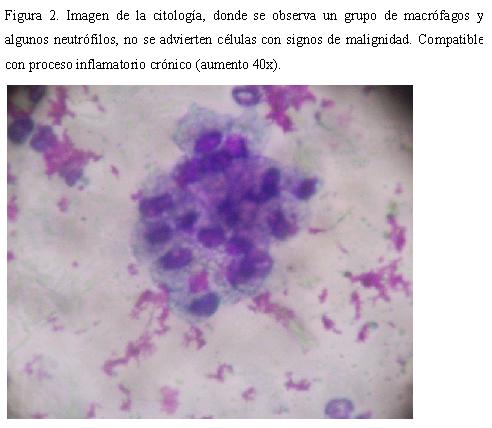
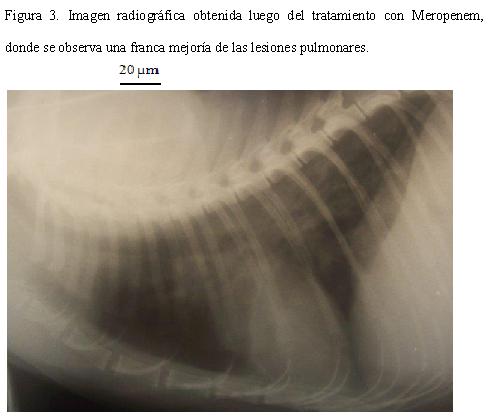
<body><![CDATA[<p class="MsoNormal" style="text-align: justify; line-height: 200%;"><span style="font-size: 10pt; line-height: 200%; font-family: &quot;Verdana&quot;,&quot;sans-serif&quot;;" lang="ES-UY">Los estudios radiogr&aacute;ficos inicialmente no mostraron alteraciones de los campos pulmonares, sin embargo luego de varias recidivas se observ&oacute; aumento generalizado de la <span class="SpellE">radiodensidad</span> con zonas de consolidaci&oacute;n e infiltraci&oacute;n <span class="SpellE">peribronquial</span>, compatible con neumon&iacute;a o neoplasia. En el &uacute;ltimo estudio radiogr&aacute;fico, una semana antes de la consulta en el Hospital, y luego de una reagudizaci&oacute;n del cuadro respiratorio, la radiograf&iacute;a mostr&oacute; focos activos de consolidaci&oacute;n pulmonar (<a href="#fig_1">Figura 1</a>).<o:p></o:p></span></p>       <p class="MsoNormal" style="text-align: justify; line-height: 200%;"><span style="font-size: 10pt; line-height: 200%; font-family: &quot;Verdana&quot;,&quot;sans-serif&quot;;" lang="ES-UY"><o:p>&nbsp;</o:p></span></p>       <p class="MsoNormal" style="text-align: justify; line-height: 200%;"><span style="font-size: 10pt; line-height: 200%; font-family: &quot;Verdana&quot;,&quot;sans-serif&quot;;"><img style="border: 0px solid ;" alt="" id="_x0000_i1027" src="/img/revistas/vet/v51n198/198a03f1.JPG"></span><a name="fig_1"></a><span style="font-size: 10pt; line-height: 200%; font-family: &quot;Verdana&quot;,&quot;sans-serif&quot;;" lang="ES-UY"><o:p></o:p></span></p>       <p class="MsoNormal" style="text-align: justify; line-height: 200%;"><span style="font-size: 10pt; line-height: 200%; font-family: &quot;Verdana&quot;,&quot;sans-serif&quot;;" lang="ES-UY"><o:p>&nbsp;</o:p></span></p>       <p class="MsoNormal" style="text-align: justify; line-height: 200%;"><span style="font-size: 10pt; line-height: 200%; font-family: &quot;Verdana&quot;,&quot;sans-serif&quot;;" lang="ES-UY">La ecograf&iacute;a abdominal de rutina no mostr&oacute; alteraciones visibles, la serolog&iacute;a de VIF y VILEF fue negativa, el hemograma no present&oacute; alteraciones significativas y en el an&aacute;lisis de orina se observ&oacute; la presencia de <span class="SpellE">microcristales</span> de oxalato de calcio, que no se relacionaron con el cuadro cl&iacute;nico. <o:p></o:p></span></p>       <p class="MsoNormal" style="text-align: justify; line-height: 200%;"><span style="font-size: 10pt; line-height: 200%; font-family: &quot;Verdana&quot;,&quot;sans-serif&quot;;" lang="ES-UY">El estudio citol&oacute;gico revel&oacute; abundantes neutr&oacute;filos y macr&oacute;fagos, no se advirtieron c&eacute;lulas con signos de malignidad, por lo que se diagnostic&oacute; un cuadro compatible con proceso inflamatorio cr&oacute;nico (<a href="#fig_2">Figura 2</a>). <o:p></o:p></span></p>       <p class="MsoNormal" style="text-align: justify; line-height: 200%;"><span style="font-size: 10pt; line-height: 200%; font-family: &quot;Verdana&quot;,&quot;sans-serif&quot;;" lang="ES-UY"><o:p>&nbsp;</o:p></span></p>       <p class="MsoNormal" style="text-align: justify; line-height: 200%;"><span style="font-size: 10pt; line-height: 200%; font-family: &quot;Verdana&quot;,&quot;sans-serif&quot;;"><img style="border: 0px solid ;" alt="" id="_x0000_i1026" src="/img/revistas/vet/v51n198/198a03f2.JPG"></span><a name="fig_2"></a><span style="font-size: 10pt; line-height: 200%; font-family: &quot;Verdana&quot;,&quot;sans-serif&quot;;" lang="ES-UY"><o:p></o:p></span></p>       <p class="MsoNormal" style="text-align: justify; line-height: 200%;"><span style="font-size: 10pt; line-height: 200%; font-family: &quot;Verdana&quot;,&quot;sans-serif&quot;;" lang="ES-UY"><o:p>&nbsp;</o:p></span></p>       <p class="MsoNormal" style="text-align: justify; line-height: 200%;"><span style="font-size: 10pt; line-height: 200%; font-family: &quot;Verdana&quot;,&quot;sans-serif&quot;;" lang="ES-UY">En el estudio bacteriol&oacute;gico se aislaron colonias de <i>Estafilococo <span class="SpellE">aureus</span></i> beta hemol&iacute;tico, acompa&ntilde;adas de otras colonias amarillo fuerte, <span class="SpellE">mucoides</span>, no hemol&iacute;ticas que a la tinci&oacute;n con Gram se observaron bacilos Gram -, sin c&aacute;psula. El estudio bioqu&iacute;mico demostr&oacute; la presencia de una <span class="SpellE">enterobacteria</span> catalasa+, oxidasa-. glucosa y gas +, lisina-, <span class="SpellE">ornitina</span>-, <span class="SpellE">indol</span>+, urea-, citrato+(d&eacute;bil), lactosa+(d&eacute;bil), H2-, <span class="SpellE">adonitol</span>+, sorbitol-, dulcitol-.<i> </i>En base a la observaci&oacute;n microsc&oacute;pica y a los resultados bioqu&iacute;micos se determin&oacute; que las colonias pertenec&iacute;an a<i> <span class="SpellE">Enterobacter</span> <span class="SpellE">aglomerans</span> (<span class="SpellE">Pantoea</span> <span class="SpellE">agglomerans</span></i>), El antibiograma dio como resultado que las colonias de <i>E. <span class="SpellE">aureus</span></i> mostraron sensibilidad a <span class="SpellE">Ciprofloxacina</span>, <span class="SpellE">Enrofloxacina</span>, <span class="SpellE">Trimetroprim-sulfa</span> y Amoxicilina + Acido <span class="SpellE">Clavul&aacute;nico</span>), y resistencia a <span class="SpellE">Florfenicol</span>, <span class="SpellE">Cefalexina</span>, Ampicilina, Gentamicina, <span class="SpellE">Oxitetraciclina</span>. El antibiograma correspondiente al <i>E. <span class="SpellE">agglomerans</span> </i>present&oacute; <span class="SpellE">multirresistencia</span> a los mismos antibi&oacute;ticos. <o:p></o:p></span></p>       ]]></body>
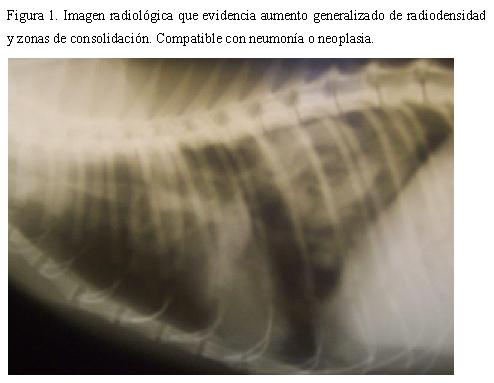
<body><![CDATA[<p class="MsoNormal" style="text-align: justify; line-height: 200%;"><span style="font-size: 10pt; line-height: 200%; font-family: &quot;Verdana&quot;,&quot;sans-serif&quot;;" lang="ES-UY">Frente a esta situaci&oacute;n se busc&oacute; una droga bactericida y de amplio espectro, que pertenezca al grupo de antibi&oacute;ticos citados por la bibliograf&iacute;a opt&aacute;ndose por <span class="SpellE">meropenem</span> (<span class="SpellE">Meronem</span> IV 500 mg) inyectable subcut&aacute;neo, 12 mg/kg cada 8 horas, por 15 d&iacute;as, que es un antibi&oacute;tico &beta; <span class="SpellE">lact&aacute;mico</span> del grupo de las <span class="SpellE">carbapenemas</span> (<a name="-Greene_2008"></a><a href="#Greene_2008"><span class="SpellE">Greene</span></a>, 2008; <a name="-Matsaniotis_y_Syriopoulou_1984"></a><a href="#Matsaniotis_y_Syriopoulou_1984"><span class="SpellE">Matsaniotis</span></a> y <span class="SpellE">Syriopoulou</span>, 1984). Junto con esta nueva terapia antibi&oacute;tica se continu&oacute; con la administraci&oacute;n de dexametasona inyectable (0,1mg/kg. cada 24 h), ya que si se suspend&iacute;a empeoraba la disnea. A los 15 d&iacute;as de tratamiento se realiz&oacute; una radiograf&iacute;a de control constat&aacute;ndose mejor&iacute;a de las lesiones pulmonares (<a href="#fig_3">Figura 3</a>) con &aacute;reas de consolidaci&oacute;n pulmonar reducidas en comparaci&oacute;n de los estudios anteriores.<o:p></o:p></span></p>       <p class="MsoNormal" style="line-height: 200%;"><span style="font-size: 10pt; line-height: 200%; font-family: &quot;Verdana&quot;,&quot;sans-serif&quot;;" lang="ES-UY"><o:p>&nbsp;</o:p></span></p>       <p class="MsoNormal" style="line-height: 200%;"><span style="font-size: 10pt; line-height: 200%; font-family: &quot;Verdana&quot;,&quot;sans-serif&quot;;"><img style="border: 0px solid ;" alt="" id="_x0000_i1025" src="/img/revistas/vet/v51n198/198a03f3.JPG"></span><a name="fig_3"></a><span style="font-size: 10pt; line-height: 200%; font-family: &quot;Verdana&quot;,&quot;sans-serif&quot;;" lang="ES-UY"><o:p></o:p></span></p>       <p class="MsoNormal" style="line-height: 200%;"><span style="font-size: 10pt; line-height: 200%; font-family: &quot;Verdana&quot;,&quot;sans-serif&quot;;" lang="ES-UY"><o:p>&nbsp;</o:p></span></p>       <p class="MsoNormal" style="text-align: justify; line-height: 200%;"><span style="font-size: 10pt; line-height: 200%; font-family: &quot;Verdana&quot;,&quot;sans-serif&quot;;" lang="ES-UY">Actualmente el animal se encuentra cl&iacute;nicamente estable pero con una terapia cr&oacute;nica de dexametasona por v&iacute;a oral, 0.1 mg/kg, cada 24 hs.<o:p></o:p></span></p>       <p class="MsoNormal" style="text-align: justify; line-height: 200%;"><span style="font-size: 10pt; line-height: 200%; font-family: &quot;Verdana&quot;,&quot;sans-serif&quot;; color: red;" lang="ES-UY"><o:p>&nbsp;</o:p></span></p>       <p class="MsoNormal" style="line-height: 200%;"><b><span style="font-size: 14pt; line-height: 200%; font-family: &quot;Verdana&quot;,&quot;sans-serif&quot;;" lang="ES-UY">Discusi&oacute;n<o:p></o:p></span></b></p>       <p class="MsoNormal" style="text-align: justify; line-height: 200%;"><span class="SpellE"><i><span style="font-size: 10pt; line-height: 200%; font-family: &quot;Verdana&quot;,&quot;sans-serif&quot;;" lang="ES-UY">Pantoea</span></i></span><i><span style="font-size: 10pt; line-height: 200%; font-family: &quot;Verdana&quot;,&quot;sans-serif&quot;;" lang="ES-UY"> <span class="SpellE">agglomerans</span></span></i><span style="font-size: 10pt; line-height: 200%; font-family: &quot;Verdana&quot;,&quot;sans-serif&quot;;" lang="ES-UY"> es una bacteria Gram negativa, perteneciente a la familia <span class="SpellE">Enterobacteriacea</span>. Raramente causa enfermedad en el hombre y los animales (<a href="#Liberto_y_col_2009">Liberto</a> y col., 2009), sin embargo en pacientes humanos se han descrito distintas patolog&iacute;as causadas por esta bacteria. La m&aacute;s com&uacute;n es la artritis s&eacute;ptica producida por punci&oacute;n accidental con espinas de palmeras y otras plantas como rosales y cactus. Se diagnostica con mayor frecuencia en ni&ntilde;os y j&oacute;venes. El primer aislamiento data de la d&eacute;cada del 70 y si bien no se han reportado muchos casos de artritis s&eacute;ptica por cuerpos extra&ntilde;os vegetales desde esa &eacute;poca, <i>P. <span class="SpellE">agglomerans</span></i> es el microorganismo m&aacute;s aislado (</span><span lang="ES-UY"><a href="#Kratz_y_col_2003"><span class="SpellE"><span class="name"><span style="font-size: 10pt; line-height: 200%; font-family: &quot;Verdana&quot;,&quot;sans-serif&quot;; color: rgb(51, 51, 255); text-decoration: none;" lang="ES">Kratz</span></span></span></a></span><span style="font-size: 10pt; line-height: 200%; font-family: &quot;Verdana&quot;,&quot;sans-serif&quot;;" lang="ES-UY"> y col., <span class="slug-pub-date3">2003; </span></span><span lang="ES-UY"><a href="#Sauvezie_y_Sirot_2000"><span class="SpellE"><span style="font-size: 10pt; line-height: 200%; font-family: &quot;Verdana&quot;,&quot;sans-serif&quot;;">Sauvezie</span></span></a></span><span style="font-size: 10pt; line-height: 200%; font-family: &quot;Verdana&quot;,&quot;sans-serif&quot;;" lang="ES-UY"> y <span class="SpellE">Sirot</span>, 2000). Tambi&eacute;n es conocida como pat&oacute;geno oportunista en pacientes <span class="SpellE">inmunosuprimidos</span>, causando infecciones respiratorias en pacientes VIH positivo o con otras enfermedades inmunosupresoras (<a href="#Flores_y_Miranda_2012">Flores</a> y Miranda, 2012). En pacientes oncol&oacute;gicos con tratamiento <span class="SpellE">quimioter&aacute;pico</span>, en pacientes hospitalizados en unidades de cuidados intensivos y en pediatr&iacute;a, se conoce como causa poco com&uacute;n de bacteriemia, a menudo asociada a otros pat&oacute;genos convencionales, por contaminantes de cat&eacute;teres intravenosos, alimentaci&oacute;n parenteral, anest&eacute;sicos como <span class="SpellE">propofol</span> y <span class="SpellE">hemoderivados</span> (<a name="-Bennet_y_col_1995"></a><a href="#Bennet_y_col_1995">Bennet</a></span><span lang="ES-UY"> </span><span style="font-size: 10pt; line-height: 200%; font-family: &quot;Verdana&quot;,&quot;sans-serif&quot;;" lang="ES-UY">y col., 1995;</span><span lang="ES-UY"> </span><a name="-Cruz_y_Cazacu_2007"></a><span style="font-size: 10pt; line-height: 200%;" lang="ES-UY"><a href="#Cruz_y_Cazacu_2007"><span style="font-family: &quot;Verdana&quot;,&quot;sans-serif&quot;;">Cruz</span></a></span><span style="font-size: 10pt; line-height: 200%; font-family: &quot;Verdana&quot;,&quot;sans-serif&quot;;" lang="ES-UY"> <span class="SpellE">Cazacu</span>, 2007;</span><span lang="ES-UY"> y </span><span style="font-size: 10pt; line-height: 200%;" lang="ES-UY"><a href="#Liberto_y_col_2009"><span style="font-family: &quot;Verdana&quot;,&quot;sans-serif&quot;;">Liberto</span></a></span><span style="font-size: 10pt; line-height: 200%; font-family: &quot;Verdana&quot;,&quot;sans-serif&quot;;" lang="ES-UY"> y col., 2009). Se constat&oacute; su participaci&oacute;n en epidemias de septicemia debido a productos intravenosos contaminados (</span><span style="font-size: 10pt; line-height: 200%;" lang="ES-UY"><a href="#Liberto_y_col_2009"><span style="font-family: &quot;Verdana&quot;,&quot;sans-serif&quot;;">Liberto</span></a></span><span lang="ES-UY"> </span><span style="font-size: 10pt; line-height: 200%; font-family: &quot;Verdana&quot;,&quot;sans-serif&quot;;" lang="ES-UY">y col., 2009).</span></p>       <p class="MsoNormal" style="text-align: justify; line-height: 200%;"><span style="font-size: 10pt; line-height: 200%; font-family: &quot;Verdana&quot;,&quot;sans-serif&quot;;" lang="ES-UY">Las infecciones por <i>P. <span class="SpellE">agglomerans</span></i> est&aacute;n asociadas usualmente a fuentes ex&oacute;genas identificables (<a href="#Matsaniotis_y_Syriopoulou_1984"><span class="SpellE">Matsaniotis</span></a> y <span class="SpellE">Syriopoulou</span> 1984; <a name="-Ferguson_y_col_1993"></a><a href="#Ferguson_y_col_1993">Ferguson</a></span><span lang="ES-UY"> </span><span style="font-size: 10pt; line-height: 200%; font-family: &quot;Verdana&quot;,&quot;sans-serif&quot;;" lang="ES-UY">y col., 1993;</span><span lang="ES-UY"> </span><a name="-Wagner_y_col_1994"></a><span style="font-size: 10pt; line-height: 200%;" lang="ES-UY"><a href="#Wagner_y_col_1994"><span style="font-family: &quot;Verdana&quot;,&quot;sans-serif&quot;;">Wagner</span></a></span><span lang="ES-UY"> </span><span style="font-size: 10pt; line-height: 200%; font-family: &quot;Verdana&quot;,&quot;sans-serif&quot;;" lang="ES-UY">y col., 1994;</span><span lang="ES-UY"> </span><span style="font-size: 10pt; line-height: 200%;" lang="ES-UY"><a href="#Bennet_y_col_1995"><span class="SpellE"><span style="font-family: &quot;Verdana&quot;,&quot;sans-serif&quot;;">Bennet</span></span></a></span><span lang="ES-UY"> </span><span style="font-size: 10pt; line-height: 200%; font-family: &quot;Verdana&quot;,&quot;sans-serif&quot;;" lang="ES-UY">y col., 1995).</span></p>       <p class="MsoNormal" style="text-align: justify; line-height: 200%;"><span style="font-size: 10pt; line-height: 200%; font-family: &quot;Verdana&quot;,&quot;sans-serif&quot;;" lang="ES-UY">En animales hay pocos casos publicados de enfermedad causada por este microorganismo. Se report&oacute; en un estudio de enfermedades del aparato urinario en caninos, donde se realizaron cultivos de orina de 44 animales, aisl&aacute;ndose en 2 pacientes, demostr&aacute;ndose una incidencia muy baja (<a href="#Cengiz_y_Sezgin_2003"><span class="SpellE">Cengiz</span></a>, y <span class="SpellE">Sezgin</span>, 2003). En un estudio realizado por <a href="#Hong_y_col_1993">Hong</a> y col. (1993) en yeguas con metritis como causa de aborto, <i>P <span class="SpellE">agglomerans</span></i> fue aislada en 2,11% de los casos.<o:p></o:p></span></p>       ]]></body>
<body><![CDATA[<p class="MsoNormal" style="text-align: justify; line-height: 200%;"><span style="font-size: 10pt; line-height: 200%; font-family: &quot;Verdana&quot;,&quot;sans-serif&quot;;" lang="ES-UY">En gatos se aisl&oacute; <i>P. <span class="SpellE">agglomerans</span></i> en un estudio para identificar las bacterias asociadas con <span class="SpellE">gingivoestomatitis</span> cr&oacute;nica, encontr&aacute;ndose en un solo gato perteneciente a un muestreo de 29 animales sanos (3,4 %), que se comparaba con un grupo de 59 animales con enfermedad gingival (<a href="#Sanne_y_Dolieslager_2011"><span class="SpellE">Sanne</span></a> y <span class="SpellE">Dolieslager</span>, 2011).<o:p></o:p></span></p>       <p class="MsoNormal" style="text-align: justify; line-height: 200%;"><span style="font-size: 10pt; line-height: 200%; font-family: &quot;Verdana&quot;,&quot;sans-serif&quot;;" lang="ES-UY">En el presente caso, la infecci&oacute;n pulmonar por <i>P. <span class="SpellE">agglomerans</span> </i>podr&iacute;a ser secundaria a otra infecci&oacute;n de origen viral o bacteriana, sin embargo en el antibiograma realizado fue el &uacute;nico microorganismo que mostr&oacute; resistencia a todos los antibi&oacute;ticos utilizados en la prueba de antibiograma.<o:p></o:p></span></p>       <p class="MsoNormal" style="margin-top: 6pt; text-align: justify; line-height: 200%;"><span style="font-size: 10pt; line-height: 200%; font-family: &quot;Verdana&quot;,&quot;sans-serif&quot;;" lang="ES-UY">El <span class="SpellE">meropenem</span> es un antibi&oacute;tico &beta; <span class="SpellE">lact&aacute;mico</span> del grupo de las <span class="SpellE">carbapenemas</span>. Tiene acci&oacute;n bactericida ya que interfiere con la s&iacute;ntesis de la pared celular, es un antibacteriano de amplio espectro y est&aacute; indicado para el tratamiento de microorganismos resistentes a otros antibi&oacute;ticos y en infecciones mixtas. Se recomienda el uso restringido en animales para evitar el desarrollo de resistencia bacteriana. Est&aacute; disponible solo para uso en humanos (<a href="#Greene_2008"><span class="SpellE">Greene</span></a>, 2008). Las dosis recomendadas para uso humano son de <st1:metricconverter productid="20 a" w:st="on">20 a</st1:metricconverter> 40 mg/kg cada 8 o 12 horas seg&uacute;n la gravedad del caso. Seg&uacute;n un trabajo experimental realizado en gatos tratados con <span class="SpellE">Imipenem</span>, antibi&oacute;tico perteneciente a los <span class="SpellE">carbapenemas</span>, la dosis utilizada fue de 5 mg/kg, pudiendo administrarse v&iacute;a intravenosa o intramuscular (cada 6 horas) o subcut&aacute;nea (cada 10 &ndash; 12 horas) (<a name="-Albarellos_y_Denamiel_2011"></a><a href="#Albarellos_y_Denamiel_2011"><span style="color: rgb(51, 51, 255);">Albarellos</span></a></span><span style="color: black;" lang="ES-UY"> </span><span style="font-size: 10pt; line-height: 200%; font-family: &quot;Verdana&quot;,&quot;sans-serif&quot;; color: black;" lang="ES-UY">y <span class="SpellE">Denamiel</span>, 2011)</span><span style="font-size: 10pt; line-height: 200%; font-family: &quot;Verdana&quot;,&quot;sans-serif&quot;;" lang="ES-UY">.</span></p>       <p class="MsoNormal" style="margin-top: 6pt; text-align: justify; line-height: 200%;"><span style="font-size: 10pt; line-height: 200%; font-family: &quot;Verdana&quot;,&quot;sans-serif&quot;;" lang="ES-UY">Luego de recibir el tratamiento indicado, el paciente present&oacute; una evoluci&oacute;n favorable, sin embargo no mejor&oacute; completamente, posiblemente por las lesiones pulmonares cr&oacute;nicas causadas por las recidivas de varios a&ntilde;os. Por otro lado, la duraci&oacute;n de la terapia antibi&oacute;tica por 15 d&iacute;as en un animal con infecciones pulmonares cr&oacute;nicas, parece no haber sido suficiente.<o:p></o:p></span></p>       <p class="MsoNormal" style="margin-top: 6pt; text-align: justify; line-height: 200%;"><span style="font-size: 10pt; line-height: 200%; font-family: &quot;Verdana&quot;,&quot;sans-serif&quot;;" lang="ES-UY">Si bien no fue posible determinar la v&iacute;a de entrada de este pat&oacute;geno, dado que es un microorganismo oportunista que no generar&iacute;a enfermedad en pacientes sanos, suponemos que este caso se manifest&oacute; por tratarse de un animal <span class="SpellE">inmunosuprimido</span> por largas terapias con corticoides e infecciones pulmonares persistentes (<a href="#Matsaniotis_y_Syriopoulou_1984"><span class="SpellE">Matsaniotis</span></a> y <span class="SpellE">Syriopoulou</span>, 1984).<o:p></o:p></span></p>       <p class="MsoNormal" style="text-align: justify; line-height: 200%;"><span style="font-size: 10pt; line-height: 200%; font-family: &quot;Verdana&quot;,&quot;sans-serif&quot;;" lang="ES-UY"><o:p>&nbsp;</o:p></span></p>       <p class="MsoNormal" style="text-align: justify; line-height: 200%;"><b><span style="font-size: 14pt; line-height: 200%; font-family: &quot;Verdana&quot;,&quot;sans-serif&quot;;" lang="ES-UY">Conclusiones<o:p></o:p></span></b></p>       <p class="MsoNormal" style="text-align: justify; line-height: 200%;"><span style="font-size: 10pt; line-height: 200%; font-family: &quot;Verdana&quot;,&quot;sans-serif&quot;;" lang="ES-UY">Aunque la <span class="SpellE"><i>Pantoea</i></span><i> <span class="SpellE">agglomerans</span></i> no es un microorganismo aislado frecuentemente de infecciones pulmonares en felinos, se presenta como oportunista en animales inmunodeprimidos, por lo que destacamos la importancia de realizar un diagn&oacute;stico etiol&oacute;gico definitivo en pacientes con enfermedades respiratorias cr&oacute;nicas que no responden a tratamientos convencionales. <o:p></o:p></span></p>       <p class="MsoNormal" style="text-align: justify; line-height: 200%;"><span style="font-size: 10pt; line-height: 200%; font-family: &quot;Verdana&quot;,&quot;sans-serif&quot;;" lang="ES-UY">El antibi&oacute;tico utilizado no es de uso com&uacute;n en medicina veterinaria, adem&aacute;s es de dif&iacute;cil acceso por su alto costo, pero en este caso su uso fue determinante en la mejor&iacute;a del paciente ya que el pat&oacute;geno responsable era <span class="SpellE">multirresistente</span> a los antibi&oacute;ticos de uso frecuente en medicina veterinaria. Recurrimos al uso de <span class="SpellE">Meropenem</span> ya que pertenece al grupo de antimicrobianos bactericida y de amplio espectro, recomendado por la bibliograf&iacute;a en casos de <span class="SpellE">multiresistencia</span>. Al d&iacute;a de hoy el paciente se encuentra estable, con buena calidad de vida a pesar de la cronicidad del cuadro, bajo controles peri&oacute;dicos por la posibilidad de sufrir reca&iacute;das.<o:p></o:p></span></p>       <p class="MsoNormal" style="line-height: 200%;"><span style="font-size: 10pt; line-height: 200%; font-family: &quot;Verdana&quot;,&quot;sans-serif&quot;;" lang="ES-UY"><o:p>&nbsp;</o:p></span></p>       ]]></body>
<body><![CDATA[<p class="MsoNormal" style="text-align: justify; line-height: 200%;"><span class="name"><b><span style="font-size: 14pt; line-height: 200%; font-family: &quot;Verdana&quot;,&quot;sans-serif&quot;; color: rgb(51, 51, 51);" lang="ES-UY">Bibliograf&iacute;a</span></b></span><b><span style="font-size: 14pt; line-height: 200%; font-family: &quot;Verdana&quot;,&quot;sans-serif&quot;; color: rgb(51, 51, 51);" lang="ES-UY"><o:p></o:p></span></b></p>       <!-- ref --><p class="MsoNormal" style="text-align: justify; line-height: 200%;"><a name="Albarellos_y_Denamiel_2011"></a><span style="font-size: 10pt; line-height: 200%; font-family: &quot;Verdana&quot;,&quot;sans-serif&quot;; color: black;" lang="ES-UY">1. </span><span lang="ES-UY"><a href="#-Albarellos_y_Denamiel_2011"><span class="SpellE"><span style="font-size: 10pt; line-height: 200%; font-family: &quot;Verdana&quot;,&quot;sans-serif&quot;; color: rgb(51, 51, 255);">Albarellos</span></span></a></span><span style="font-size: 10pt; line-height: 200%; font-family: &quot;Verdana&quot;,&quot;sans-serif&quot;; color: black;" lang="ES-UY"> G, <span class="SpellE">Denamiel</span> G. (2011). </span><span class="SpellE"><span style="font-size: 10pt; line-height: 200%; font-family: &quot;Verdana&quot;,&quot;sans-serif&quot;;" lang="ES-UY">Imipenem</span></span><span style="font-size: 10pt; line-height: 200%; font-family: &quot;Verdana&quot;,&quot;sans-serif&quot;;" lang="ES-UY">: farmacocin&eacute;tica en gatos y susceptibilidad de pat&oacute;genos <span class="SpellE">multirresistentes</span>. Congreso Nacional de AVEACA, XI, Bs. As., Argentina, 135p.    <span style="color: rgb(51, 51, 51);"><o:p></o:p></span></span></p>       <!-- ref --><p class="MsoNormal" style="text-align: justify; line-height: 200%;"><a name="Bennet_y_col_1995"></a><span style="font-size: 10pt; line-height: 200%; font-family: &quot;Verdana&quot;,&quot;sans-serif&quot;; color: black;" lang="ES-UY">2. </span><span lang="ES-UY"><a href="#-Bennet_y_col_1995"><span class="SpellE"><span style="font-size: 10pt; line-height: 200%; font-family: &quot;Verdana&quot;,&quot;sans-serif&quot;;" lang="EN-US">Bennet</span></span></a></span><span style="font-size: 10pt; line-height: 200%; font-family: &quot;Verdana&quot;,&quot;sans-serif&quot;;" lang="EN-US"> S, Mc Neil M, Bland L, <span class="SpellE">Arduino</span> MJ, <span class="SpellE">Villarino</span> M, <span class="SpellE">Perrotta</span> D, <span class="SpellE">Burwen</span> D, <span class="SpellE">Welbel</span> S, <span class="SpellE">Pegues</span> D, Stroud L, <span class="SpellE">Zeitz</span> P, <span class="SpellE">JarviswR</span>.</span><span style="font-size: 10pt; line-height: 200%; font-family: &quot;Verdana&quot;,&quot;sans-serif&quot;;" lang="EN"> (1995). </span><span style="font-size: 10pt; line-height: 200%; font-family: &quot;Verdana&quot;,&quot;sans-serif&quot;;" lang="EN-US">Postoperative infections traced to contamination of an intravenous anesthetic, <span class="SpellE">propofol</span>. N <span class="SpellE">Engl</span> J Med 333:147-154<span style="color: rgb(51,     51, 51);">.<o:p></o:p></span></span></p>       <!-- ref --><p class="MsoNormal" style="text-align: justify; line-height: 200%;"><a name="Cengiz_y_Sezgin_2003"></a><span style="font-size: 10pt; line-height: 200%; font-family: &quot;Verdana&quot;,&quot;sans-serif&quot;; color: black;" lang="EN-US">3. </span><span lang="ES-UY"><a href="#-Cengiz_y_Sezgin_2003"><span class="SpellE"><span style="font-size: 10pt; line-height: 200%; font-family: &quot;Verdana&quot;,&quot;sans-serif&quot;;" lang="EN-US">Cengiz</span></span></a></span><span style="font-size: 10pt; line-height: 200%; font-family: &quot;Verdana&quot;,&quot;sans-serif&quot;;" lang="EN-US"> C, <span class="SpellE">Sezgin</span> S. (2003). Bacteriological Examination of Urine Samples from Dogs with Symptoms of Urinary Tract Infection. </span><span class="SpellE"><span style="font-size: 10pt; line-height: 200%; font-family: &quot;Verdana&quot;,&quot;sans-serif&quot;;" lang="ES-UY">Turk</span></span><span style="font-size: 10pt; line-height: 200%; font-family: &quot;Verdana&quot;,&quot;sans-serif&quot;;" lang="ES-UY"> J <span class="SpellE">Vet</span> <span class="SpellE">Anim</span> <span class="SpellE">Sci</span> 27:1225-1229.    <span style="color: rgb(51, 51, 51);"><o:p></o:p></span></span></p>       <p class="MsoNormal" style="text-align: justify; line-height: 200%;"><a name="Costa_y_col_2002"></a><span style="font-size: 10pt; line-height: 200%; font-family: &quot;Verdana&quot;,&quot;sans-serif&quot;; color: black;" lang="ES-UY">4. </span><span style="font-size: 10pt; line-height: 200%; font-family: &quot;Verdana&quot;,&quot;sans-serif&quot;; color: rgb(27, 28, 32);" lang="ES-UY"><a href="#-Costa_y_col_2002">Costa</a> E, <span class="SpellE">Usall</span> J, <span class="SpellE">Teixido</span> N, Delgado J, Vinas I. (2002). </span><span style="font-size: 10pt; line-height: 200%; font-family: &quot;Verdana&quot;,&quot;sans-serif&quot;; color: rgb(27, 28, 32);" lang="EN-US">Water activity, temperature, and pH effects on growth of the biocontrol agent <span class="SpellE"><i>Pantoea</i></span><i> <span class="SpellE">agglomerans</span> </i>CPA-2, Can J <span class="SpellE">Microbiol</span> 4:1082&ndash;1088.</span><span style="font-size: 10pt; line-height: 200%; font-family: &quot;Verdana&quot;,&quot;sans-serif&quot;; color: rgb(51, 51, 51);" lang="EN-US"><o:p></o:p></span></p>       <p class="MsoNormal" style="text-align: justify; line-height: 200%;"><a name="Cruz_y_Cazacu_2007"></a><span class="cit"><span style="font-size: 10pt; line-height: 200%; font-family: &quot;Verdana&quot;,&quot;sans-serif&quot;; color: black;" lang="EN-US">5. </span></span><span style="font-size: 10pt; line-height: 200%; font-family: &quot;Verdana&quot;,&quot;sans-serif&quot;;" lang="EN-US"><a href="#-Cruz_y_Cazacu_2007">Cruz</a> A, <span class="SpellE">Cazacu</span> A. (2007).<span style="color: rgb(0, 204, 255);"> </span><span class="SpellE"><i>Pantoea</i></span><i> <span class="SpellE">agglomerans</span></i>, a Plant Pathogen Causing Human Disease. </span><span class="cit"><span style="font-size: 10pt; line-height: 200%; font-family: &quot;Verdana&quot;,&quot;sans-serif&quot;;" lang="EN">J <span class="SpellE">Clin</span> <span class="SpellE">Microbiol</span> 45:1989&ndash;1992.</span></span><span class="cit"><span style="" lang="EN-US"><o:p></o:p></span></span></p>       <!-- ref --><p class="MsoNormal" style="text-align: justify; line-height: 200%;"><a name="Ferguson_y_col_1993"></a><span style="font-size: 10pt; line-height: 200%; font-family: &quot;Verdana&quot;,&quot;sans-serif&quot;; color: black;" lang="EN-US">6. </span><span style="font-size: 10pt; line-height: 200%; font-family: &quot;Verdana&quot;,&quot;sans-serif&quot;;" lang="EN-US"><a href="#-Ferguson_y_col_1993">Ferguson</a> R, Feeney C, <span class="SpellE">Chirurgi</span> V. (1993). <span class="SpellE">Enterobacter</span> <span class="SpellE">agglomerans</span> - associated cotton fever. Arch Intern Med 153:2381-2382.    </span><span style="" lang="EN-US"><o:p></o:p></span></p>       <!-- ref --><p class="MsoNormal" style="text-align: justify; line-height: 200%;"><a name="Flores_y_Miranda_2012"></a><span style="font-size: 10pt; line-height: 200%; font-family: &quot;Verdana&quot;,&quot;sans-serif&quot;; color: black;" lang="EN-US">7. </span><span style="font-size: 10pt; line-height: 200%; font-family: &quot;Verdana&quot;,&quot;sans-serif&quot;;" lang="EN-US"><a href="#-Flores_y_Miranda_2012">Flores</a> E, Miranda M. (2012). <span class="SpellE">P<i>antoea</i></span><i> <span class="SpellE">agglomerans</span></i> in <span class="SpellE">Immunodeficient</span> Patients with Different Respiratory Symptoms. </span><span class="SpellE"><span style="font-size: 10pt; line-height: 200%; font-family: &quot;Verdana&quot;,&quot;sans-serif&quot;;" lang="ES-UY">The</span></span><span style="font-size: 10pt; line-height: 200%; font-family: &quot;Verdana&quot;,&quot;sans-serif&quot;;" lang="ES-UY"> <span class="SpellE">Scientific</span> <span class="SpellE">World</span> <span class="SpellE">Journal</span> <span class="SpellE">article</span> 156827.     <span style="color: rgb(51, 51, 51);"><o:p></o:p></span></span></p>       <!-- ref --><p class="MsoNormal" style="text-align: justify; line-height: 200%;"><a name="Greene_2008"></a><span style="font-size: 10pt; line-height: 200%; font-family: &quot;Verdana&quot;,&quot;sans-serif&quot;; color: black;" lang="ES-UY">8. </span><span lang="ES-UY"><a href="#-Greene_2008"><span class="SpellE"><span style="font-size: 10pt; line-height: 200%; font-family: &quot;Verdana&quot;,&quot;sans-serif&quot;;">Greene</span></span></a></span><span style="font-size: 10pt; line-height: 200%; font-family: &quot;Verdana&quot;,&quot;sans-serif&quot;;" lang="ES-UY"> C. (2008). Enfermedades infecciosas del perro y el gato. 3ra ed. vol. 2. Bs. As. <span class="SpellE">Interm&eacute;dica</span>, 1500 p.    <span style="color: rgb(51, 51, 51);"><o:p></o:p></span></span></p>       <!-- ref --><p class="MsoNormal" style="text-align: justify; line-height: 200%;"><a name="Hong_y_col_1993"></a><span style="font-size: 10pt; line-height: 200%; font-family: &quot;Verdana&quot;,&quot;sans-serif&quot;; color: black;" lang="ES-UY">9. </span><span style="font-size: 10pt; line-height: 200%; font-family: &quot;Verdana&quot;,&quot;sans-serif&quot;;" lang="ES-UY"><a href="#-Hong_y_col_1993">Hong</a> CB, <span class="SpellE">Donahue</span> JM, Giles RC, <span class="SpellE">Petrites</span>-Murphy MB, <span class="SpellE">Poonacha</span> KB, Roberts AW, Smith BJ, <span class="SpellE">Tramontin</span> RR, <span class="SpellE">Tutlle</span> PA, <span class="SpellE">Swerczek</span> <span class="SpellE">Tw.</span> </span><span style="font-size: 10pt; line-height: 200%; font-family: &quot;Verdana&quot;,&quot;sans-serif&quot;;" lang="EN-US">(1993). Etiology and pathology of equine <span class="SpellE">placentitis</span>. J Vet <span class="SpellE">Diagn</span> Invest 5:56-63.    <span style="color: rgb(51, 51, 51);"><o:p></o:p></span></span></p>       <!-- ref --><p class="MsoNormal" style="text-align: justify; line-height: 200%;"><a name="Kratz_y_col_2003"></a><em><span style="font-size: 10pt; line-height: 200%; font-family: &quot;Verdana&quot;,&quot;sans-serif&quot;; color: black; font-style: normal;" lang="EN-US">10. </span></em><span lang="ES-UY"><a href="#-Kratz_y_col_2003"><span class="SpellE"><span class="name"><span style="font-size: 10pt; line-height: 200%; font-family: &quot;Verdana&quot;,&quot;sans-serif&quot;; color: rgb(51, 51, 255); text-decoration: none;" lang="EN">Kratz</span></span></span></a></span><span style="font-size: 10pt; line-height: 200%; font-family: &quot;Verdana&quot;,&quot;sans-serif&quot;;" lang="EN"> A, <span class="name">Greenberg</span> <span class="name">D, <span class="SpellE">Barki</span> Y, Cohen A, <span class="SpellE">Lifshitz</span> M.</span><em><span style="font-family: &quot;Verdana&quot;,&quot;sans-serif&quot;;"> (</span></em><span class="slug-pub-date3">2003). </span><span class="SpellE"><em><span style="font-family: &quot;Verdana&quot;,&quot;sans-serif&quot;;">Pantoea</span></em></span><em><span style="font-family: &quot;Verdana&quot;,&quot;sans-serif&quot;;"> <span class="SpellE">agglomerans</span></span></em> as a cause of septic arthritis after palm tree thorn injury; case report and literature review. Arch Dis Child <span class="slug-vol"><span style="font-weight: normal;">88</span></span><span class="cit-sepcit-sep-after-article-vol">:</span><span class="slug-pages3">542-544.    </span><em><span style="font-family: &quot;Verdana&quot;,&quot;sans-serif&quot;;"> </span></em></span><em><span style="font-style: normal;" lang="EN-US"><o:p></o:p></span></em></p>       <!-- ref --><p class="MsoNormal" style="text-align: justify; line-height: 200%;"><a name="Liberto_y_col_2009"></a><span style="font-size: 10pt; line-height: 200%; font-family: &quot;Verdana&quot;,&quot;sans-serif&quot;; color: black;" lang="EN-US">11. </span><span style="font-size: 10pt; line-height: 200%; font-family: &quot;Verdana&quot;,&quot;sans-serif&quot;;" lang="ES-UY"><a href="#-Liberto_y_col_2009"><span style="" lang="ES">Liberto</span></a></span><span style="font-size: 10pt; line-height: 200%; font-family: &quot;Verdana&quot;,&quot;sans-serif&quot;;"> M; Matera G; <span class="SpellE">Puccio</span> R. (2009). </span><span style="font-size: 10pt; line-height: 200%; font-family: &quot;Verdana&quot;,&quot;sans-serif&quot;;" lang="EN-US">Six cases of sepsis caused by <span class="SpellE"><i>Pantoea</i></span><i> <span class="SpellE">agglomerans</span> </i>in a teaching hospital. New <span class="SpellE">Microbiol</span> 32:119-232.     </span><span style="" lang="EN-US"><o:p></o:p></span></p>       <!-- ref --><p class="MsoNormal" style="text-align: justify; line-height: 200%;"><a name="Matsaniotis_y_Syriopoulou_1984"></a><span style="font-size: 10pt; line-height: 200%; font-family: &quot;Verdana&quot;,&quot;sans-serif&quot;; color: black;" lang="EN-US">12. </span><span lang="ES-UY"><a href="#-Matsaniotis_y_Syriopoulou_1984"><span class="SpellE"><span style="font-size: 10pt; line-height: 200%; font-family: &quot;Verdana&quot;,&quot;sans-serif&quot;;" lang="EN-US">Matsaniotis</span></span></a></span><span style="font-size: 10pt; line-height: 200%; font-family: &quot;Verdana&quot;,&quot;sans-serif&quot;;" lang="EN-US"> N, <span class="SpellE">Syriopoulou</span> V. (1984). <span class="SpellE">Enterobacter</span> sepsis in infants and children due to contaminated intravenous fluids. Infect Control 5:471-477.    <span style="color: rgb(51, 51, 51);"><o:p></o:p></span></span></p>       <!-- ref --><p class="MsoNormal" style="text-align: justify; line-height: 200%;"><a name="Sanne_y_Dolieslager_2011"></a><span style="font-size: 10pt; line-height: 200%; font-family: &quot;Verdana&quot;,&quot;sans-serif&quot;; color: black;" lang="EN-US">13. </span><span lang="ES-UY"><a href="#-Sanne_y_Dolieslager_2011"><span class="SpellE"><span style="font-size: 10pt; line-height: 200%; font-family: &quot;Verdana&quot;,&quot;sans-serif&quot;;" lang="EN-US">Sanne</span></span></a></span><span style="font-size: 10pt; line-height: 200%; font-family: &quot;Verdana&quot;,&quot;sans-serif&quot;;" lang="EN-US"> M, <span class="SpellE">Dolieslager</span> M. (2011). Identification of bacteria associated with feline chronic <span class="SpellE">gigivoestomatitis</span> using culture dependent and culture independent methods. Vet <span class="SpellE">Microbiol</span> 148:93-98.    <span style="color: rgb(51, 51, 51);"><o:p></o:p></span></span></p>       <!-- ref --><p class="MsoNormal" style="text-align: justify; line-height: 200%;"><a name="Sauvezie_y_Sirot_2000"></a><span style="font-size: 10pt; line-height: 200%; font-family: &quot;Verdana&quot;,&quot;sans-serif&quot;; color: black;" lang="EN-US">14. </span><span style="font-size: 10pt; line-height: 200%; font-family: &quot;Verdana&quot;,&quot;sans-serif&quot;;" lang="EN-US"><a href="#-Sauvezie_y_Sirot_2000"><span class="SpellE">Sauvezie</span></a> N, <span class="SpellE">Sirot</span> J. (2000). Isolation of <span class="SpellE"><i>Pantoea</i></span><i> <span class="SpellE">agglomerans</span> </i>in Two Thorn and Wood Sliver Injuries Cases of Septic <span class="SpellE">Monoarthritis</span> after Plant. </span><span style="font-size: 10pt; line-height: 200%; font-family: &quot;Verdana&quot;,&quot;sans-serif&quot;;" lang="ES-UY">J <span class="SpellE">Clin</span> <span class="SpellE">Microbiol</span> 38:460-461.     <span style="color: rgb(51, 51, 51);"><o:p></o:p></span></span></p>       <!-- ref --><p class="MsoNormal" style="text-align: justify; line-height: 200%;"><a name="Segado_y_col_2012"></a><span style="font-size: 10pt; line-height: 200%; font-family: &quot;Verdana&quot;,&quot;sans-serif&quot;; color: black;" lang="ES-UY">15. </span><span style="font-size: 10pt; line-height: 200%; font-family: &quot;Verdana&quot;,&quot;sans-serif&quot;;" lang="ES-UY"><a href="#-Segado_y_col_2012">Segado</a> A, Alonso A, <span class="SpellE">Lubi&aacute;n</span> SP, Garc&iacute;a AM. (2012). <span class="SpellE">Pantoea</span> <span class="SpellE">agglomerans</span>: &iquest;un nuevo pat&oacute;geno en la unidad de cuidados intensivos neonatales? </span><span style="font-size: 10pt; line-height: 200%; font-family: &quot;Verdana&quot;,&quot;sans-serif&quot;;" lang="EN-US">Arch Argent <span class="SpellE">Pediatr</span> 110:e77-e79.    <span style="color: rgb(51, 51, 51);"><o:p></o:p></span></span></p>       <!-- ref --><p class="MsoNormal" style="text-align: justify; line-height: 200%;"><a name="Wagner_y_col_1994"></a><span style="font-size: 10pt; line-height: 200%; font-family: &quot;Verdana&quot;,&quot;sans-serif&quot;; color: black;" lang="EN-US">16. </span><span style="font-size: 10pt; line-height: 200%; font-family: &quot;Verdana&quot;,&quot;sans-serif&quot;;" lang="EN-US"><a href="#-Wagner_y_col_1994">Wagner</a> S, Friedman L, Dodd R. (1994). Transfusion-associated bacterial sepsis. <span class="SpellE">Clin</span> <span class="SpellE">Microbiol</span> Rev 7:290-302.    <span style="color: rgb(51, 51, 51);"><o:p></o:p></span></span></p>       <p class="MsoNormal" style="margin: 11.25pt 0cm 1.5pt; text-align: justify; line-height: 200%;"><span style="font-size: 10pt; line-height: 200%; font-family: &quot;Verdana&quot;,&quot;sans-serif&quot;;" lang="EN-US"><o:p>&nbsp;</o:p></span></p>   </div>        ]]></body><back>
<ref-list>
<ref id="B1">
<nlm-citation citation-type="confpro">
<person-group person-group-type="author">
<name>
<surname><![CDATA[Albarellos]]></surname>
<given-names><![CDATA[G]]></given-names>
</name>
<name>
<surname><![CDATA[Denamiel]]></surname>
<given-names><![CDATA[G]]></given-names>
</name>
</person-group>
<source><![CDATA[Imipenem: farmacocinética en gatos y susceptibilidad de patógenos multirresistentes]]></source>
<year>2011</year>
<conf-name><![CDATA[XI Congreso Nacional de AVEACA]]></conf-name>
<conf-loc>Bs. As. </conf-loc>
<page-range>135</page-range></nlm-citation>
</ref>
<ref id="B2">
<nlm-citation citation-type="journal">
<person-group person-group-type="author">
<name>
<surname><![CDATA[Bennet]]></surname>
<given-names><![CDATA[S]]></given-names>
</name>
<name>
<surname><![CDATA[Mc Neil]]></surname>
<given-names><![CDATA[M]]></given-names>
</name>
<name>
<surname><![CDATA[Bland]]></surname>
<given-names><![CDATA[L]]></given-names>
</name>
<name>
<surname><![CDATA[Arduino]]></surname>
<given-names><![CDATA[MJ]]></given-names>
</name>
<name>
<surname><![CDATA[Villarino]]></surname>
<given-names><![CDATA[M]]></given-names>
</name>
<name>
<surname><![CDATA[Perrotta]]></surname>
<given-names><![CDATA[D]]></given-names>
</name>
<name>
<surname><![CDATA[Burwen]]></surname>
<given-names><![CDATA[D]]></given-names>
</name>
<name>
<surname><![CDATA[Welbel]]></surname>
<given-names><![CDATA[S]]></given-names>
</name>
<name>
<surname><![CDATA[Pegues]]></surname>
<given-names><![CDATA[D]]></given-names>
</name>
<name>
<surname><![CDATA[Stroud]]></surname>
<given-names><![CDATA[L]]></given-names>
</name>
<name>
<surname><![CDATA[Zeitz]]></surname>
<given-names><![CDATA[P]]></given-names>
</name>
<name>
<surname><![CDATA[Jarvisw]]></surname>
<given-names><![CDATA[R]]></given-names>
</name>
</person-group>
<article-title xml:lang="en"><![CDATA[Postoperative infections traced to contamination of an intravenous anesthetic, propofol]]></article-title>
<source><![CDATA[N Engl J Med]]></source>
<year>1995</year>
<volume>333</volume>
<page-range>147-154</page-range></nlm-citation>
</ref>
<ref id="B3">
<nlm-citation citation-type="journal">
<person-group person-group-type="author">
<name>
<surname><![CDATA[Cengiz]]></surname>
<given-names><![CDATA[C]]></given-names>
</name>
<name>
<surname><![CDATA[Sezgin]]></surname>
<given-names><![CDATA[S]]></given-names>
</name>
</person-group>
<article-title xml:lang="en"><![CDATA[Bacteriological Examination of Urine Samples from Dogs with Symptoms of Urinary Tract Infection]]></article-title>
<source><![CDATA[Turk J Vet Anim Sci]]></source>
<year>2003</year>
<volume>27</volume>
<page-range>1225-1229</page-range></nlm-citation>
</ref>
<ref id="B4">
<nlm-citation citation-type="journal">
<person-group person-group-type="author">
<name>
<surname><![CDATA[Costa]]></surname>
<given-names><![CDATA[E]]></given-names>
</name>
<name>
<surname><![CDATA[Usall]]></surname>
<given-names><![CDATA[J]]></given-names>
</name>
<name>
<surname><![CDATA[Teixido]]></surname>
<given-names><![CDATA[N]]></given-names>
</name>
<name>
<surname><![CDATA[Delgado]]></surname>
<given-names><![CDATA[J]]></given-names>
</name>
<name>
<surname><![CDATA[Vinas]]></surname>
<given-names><![CDATA[I]]></given-names>
</name>
</person-group>
<article-title xml:lang="en"><![CDATA[Water activity, temperature, and pH effects on growth of the biocontrol agent Pantoea agglomerans CPA-2]]></article-title>
<source><![CDATA[Can J Microbiol]]></source>
<year>2002</year>
<volume>4</volume>
<page-range>1082-1088</page-range></nlm-citation>
</ref>
<ref id="B5">
<nlm-citation citation-type="journal">
<person-group person-group-type="author">
<name>
<surname><![CDATA[Cruz]]></surname>
<given-names><![CDATA[A]]></given-names>
</name>
<name>
<surname><![CDATA[Cazacu]]></surname>
<given-names><![CDATA[A]]></given-names>
</name>
</person-group>
<article-title xml:lang="en"><![CDATA[Pantoea agglomerans, a Plant Pathogen Causing Human Disease]]></article-title>
<source><![CDATA[J Clin Microbiol]]></source>
<year>2007</year>
<volume>45</volume>
<page-range>1989-1992</page-range></nlm-citation>
</ref>
<ref id="B6">
<nlm-citation citation-type="journal">
<person-group person-group-type="author">
<name>
<surname><![CDATA[Ferguson]]></surname>
<given-names><![CDATA[R]]></given-names>
</name>
<name>
<surname><![CDATA[Feeney]]></surname>
<given-names><![CDATA[C]]></given-names>
</name>
<name>
<surname><![CDATA[Chirurgi]]></surname>
<given-names><![CDATA[V]]></given-names>
</name>
</person-group>
<article-title xml:lang="en"><![CDATA[Enterobacter agglomerans - associated cotton fever]]></article-title>
<source><![CDATA[Arch Intern Med]]></source>
<year>1993</year>
<volume>153</volume>
<page-range>2381-2382</page-range></nlm-citation>
</ref>
<ref id="B7">
<nlm-citation citation-type="journal">
<person-group person-group-type="author">
<name>
<surname><![CDATA[Flores]]></surname>
<given-names><![CDATA[E]]></given-names>
</name>
<name>
<surname><![CDATA[Miranda]]></surname>
<given-names><![CDATA[M]]></given-names>
</name>
</person-group>
<article-title xml:lang="en"><![CDATA[Pantoea agglomerans in Immunodeficient Patients with Different Respiratory Symptoms]]></article-title>
<source><![CDATA[The Scientific World Journal]]></source>
<year>2012</year>
</nlm-citation>
</ref>
<ref id="B8">
<nlm-citation citation-type="book">
<person-group person-group-type="author">
<name>
<surname><![CDATA[Greene]]></surname>
<given-names><![CDATA[C]]></given-names>
</name>
</person-group>
<source><![CDATA[Enfermedades infecciosas del perro y el gato]]></source>
<year>2008</year>
<volume>2</volume>
<edition>3</edition>
<page-range>1500</page-range><publisher-loc><![CDATA[Bs. As ]]></publisher-loc>
<publisher-name><![CDATA[Intermédica]]></publisher-name>
</nlm-citation>
</ref>
<ref id="B9">
<nlm-citation citation-type="journal">
<person-group person-group-type="author">
<name>
<surname><![CDATA[Hong]]></surname>
<given-names><![CDATA[CB]]></given-names>
</name>
<name>
<surname><![CDATA[Donahue]]></surname>
<given-names><![CDATA[JM]]></given-names>
</name>
<name>
<surname><![CDATA[Giles]]></surname>
<given-names><![CDATA[RC]]></given-names>
</name>
<name>
<surname><![CDATA[Petrites-Murphy]]></surname>
<given-names><![CDATA[MB]]></given-names>
</name>
<name>
<surname><![CDATA[Poonacha]]></surname>
<given-names><![CDATA[KB]]></given-names>
</name>
<name>
<surname><![CDATA[Roberts]]></surname>
<given-names><![CDATA[AW]]></given-names>
</name>
<name>
<surname><![CDATA[Smith]]></surname>
<given-names><![CDATA[BJ]]></given-names>
</name>
<name>
<surname><![CDATA[Tramontin]]></surname>
<given-names><![CDATA[RR]]></given-names>
</name>
<name>
<surname><![CDATA[Tutlle]]></surname>
<given-names><![CDATA[PA]]></given-names>
</name>
<name>
<surname><![CDATA[Swerczek]]></surname>
<given-names><![CDATA[Tw]]></given-names>
</name>
</person-group>
<article-title xml:lang="en"><![CDATA[Etiology and pathology of equine placentitis]]></article-title>
<source><![CDATA[J Vet Diagn Invest]]></source>
<year>1993</year>
<volume>5</volume>
<page-range>56-63</page-range></nlm-citation>
</ref>
<ref id="B10">
<nlm-citation citation-type="journal">
<person-group person-group-type="author">
<name>
<surname><![CDATA[Kratz]]></surname>
<given-names><![CDATA[A]]></given-names>
</name>
<name>
<surname><![CDATA[Greenberg]]></surname>
<given-names><![CDATA[D]]></given-names>
</name>
<name>
<surname><![CDATA[Barki]]></surname>
<given-names><![CDATA[Y]]></given-names>
</name>
<name>
<surname><![CDATA[Cohen]]></surname>
<given-names><![CDATA[A]]></given-names>
</name>
<name>
<surname><![CDATA[Lifshitz]]></surname>
<given-names><![CDATA[M]]></given-names>
</name>
</person-group>
<article-title xml:lang="en"><![CDATA[Pantoea agglomerans as a cause of septic arthritis after palm tree thorn injury: case report and literature review]]></article-title>
<source><![CDATA[Arch Dis Child]]></source>
<year>2003</year>
<volume>88</volume>
<page-range>542-544</page-range></nlm-citation>
</ref>
<ref id="B11">
<nlm-citation citation-type="journal">
<person-group person-group-type="author">
<name>
<surname><![CDATA[Liberto]]></surname>
<given-names><![CDATA[M]]></given-names>
</name>
<name>
<surname><![CDATA[Matera]]></surname>
<given-names><![CDATA[G]]></given-names>
</name>
<name>
<surname><![CDATA[Puccio]]></surname>
<given-names><![CDATA[R]]></given-names>
</name>
</person-group>
<article-title xml:lang="en"><![CDATA[Six cases of sepsis caused by Pantoea agglomerans in a teaching hospital]]></article-title>
<source><![CDATA[New Microbiol]]></source>
<year>2009</year>
<volume>32</volume>
<page-range>119-232</page-range></nlm-citation>
</ref>
<ref id="B12">
<nlm-citation citation-type="journal">
<person-group person-group-type="author">
<name>
<surname><![CDATA[Matsaniotis]]></surname>
<given-names><![CDATA[N]]></given-names>
</name>
<name>
<surname><![CDATA[Syriopoulou]]></surname>
<given-names><![CDATA[V]]></given-names>
</name>
</person-group>
<article-title xml:lang="en"><![CDATA[Enterobacter sepsis in infants and children due to contaminated intravenous fluids]]></article-title>
<source><![CDATA[Infect Control]]></source>
<year>1984</year>
<volume>5</volume>
<page-range>471-477</page-range></nlm-citation>
</ref>
<ref id="B13">
<nlm-citation citation-type="journal">
<person-group person-group-type="author">
<name>
<surname><![CDATA[Sanne]]></surname>
<given-names><![CDATA[M]]></given-names>
</name>
<name>
<surname><![CDATA[Dolieslager]]></surname>
<given-names><![CDATA[M]]></given-names>
</name>
</person-group>
<article-title xml:lang="en"><![CDATA[Identification of bacteria associated with feline chronic gigivoestomatitis using culture dependent and culture independent methods]]></article-title>
<source><![CDATA[Vet Microbiol]]></source>
<year>2011</year>
<volume>148</volume>
<page-range>93-98</page-range></nlm-citation>
</ref>
<ref id="B14">
<nlm-citation citation-type="journal">
<person-group person-group-type="author">
<name>
<surname><![CDATA[Sauvezie]]></surname>
<given-names><![CDATA[N]]></given-names>
</name>
<name>
<surname><![CDATA[Sirot]]></surname>
<given-names><![CDATA[J]]></given-names>
</name>
</person-group>
<article-title xml:lang="en"><![CDATA[Isolation of Pantoea agglomerans in Two Thorn and Wood Sliver Injuries Cases of Septic Monoarthritis after Plant]]></article-title>
<source><![CDATA[J Clin Microbiol]]></source>
<year>2000</year>
<volume>38</volume>
<page-range>460-461</page-range></nlm-citation>
</ref>
<ref id="B15">
<nlm-citation citation-type="journal">
<person-group person-group-type="author">
<name>
<surname><![CDATA[Segado]]></surname>
<given-names><![CDATA[A]]></given-names>
</name>
<name>
<surname><![CDATA[Alonso]]></surname>
<given-names><![CDATA[A]]></given-names>
</name>
<name>
<surname><![CDATA[Lubián]]></surname>
<given-names><![CDATA[SP]]></given-names>
</name>
<name>
<surname><![CDATA[García]]></surname>
<given-names><![CDATA[AM]]></given-names>
</name>
</person-group>
<article-title xml:lang="es"><![CDATA[Pantoea agglomerans: ¿un nuevo patógeno en la unidad de cuidados intensivos neonatales?]]></article-title>
<source><![CDATA[Arch Argent Pediatr]]></source>
<year>2012</year>
<volume>110</volume>
<page-range>e77-e79</page-range></nlm-citation>
</ref>
<ref id="B16">
<nlm-citation citation-type="journal">
<person-group person-group-type="author">
<name>
<surname><![CDATA[Wagner]]></surname>
<given-names><![CDATA[S]]></given-names>
</name>
<name>
<surname><![CDATA[Friedman]]></surname>
<given-names><![CDATA[L]]></given-names>
</name>
<name>
<surname><![CDATA[Dodd]]></surname>
<given-names><![CDATA[R]]></given-names>
</name>
</person-group>
<article-title xml:lang="en"><![CDATA[Transfusion-associated bacterial sepsis]]></article-title>
<source><![CDATA[Clin Microbiol Rev]]></source>
<year>1994</year>
<volume>7</volume>
<page-range>290-302</page-range></nlm-citation>
</ref>
</ref-list>
</back>
</article>