<?xml version="1.0" encoding="ISO-8859-1"?><article xmlns:mml="http://www.w3.org/1998/Math/MathML" xmlns:xlink="http://www.w3.org/1999/xlink" xmlns:xsi="http://www.w3.org/2001/XMLSchema-instance">
<front>
<journal-meta>
<journal-id>1688-4809</journal-id>
<journal-title><![CDATA[Veterinaria (Montevideo)]]></journal-title>
<abbrev-journal-title><![CDATA[Veterinaria (Montev.)]]></abbrev-journal-title>
<issn>1688-4809</issn>
<publisher>
<publisher-name><![CDATA[Sociedad de Medicina Veterinaria del Uruguay]]></publisher-name>
</publisher>
</journal-meta>
<article-meta>
<article-id>S1688-48092015000200001</article-id>
<title-group>
<article-title xml:lang="es"><![CDATA[Producción y características de la lana en ovejas Milchschaf productoras de leche]]></article-title>
<article-title xml:lang="en"><![CDATA[Fleece production and wool characteristics in dairy Milchschaf sheep]]></article-title>
</title-group>
<contrib-group>
<contrib contrib-type="author">
<name>
<surname><![CDATA[Sienra]]></surname>
<given-names><![CDATA[I]]></given-names>
</name>
<xref ref-type="aff" rid="A01"/>
</contrib>
<contrib contrib-type="author">
<name>
<surname><![CDATA[Neimaur]]></surname>
<given-names><![CDATA[K]]></given-names>
</name>
<xref ref-type="aff" rid="A01"/>
</contrib>
<contrib contrib-type="author">
<name>
<surname><![CDATA[Robledo]]></surname>
<given-names><![CDATA[A]]></given-names>
</name>
<xref ref-type="aff" rid="A02"/>
</contrib>
<contrib contrib-type="author">
<name>
<surname><![CDATA[Infante]]></surname>
<given-names><![CDATA[G]]></given-names>
</name>
<xref ref-type="aff" rid="A02"/>
</contrib>
<contrib contrib-type="author">
<name>
<surname><![CDATA[Pereira]]></surname>
<given-names><![CDATA[C]]></given-names>
</name>
<xref ref-type="aff" rid="A03"/>
</contrib>
</contrib-group>
<aff id="A01">
<institution><![CDATA[,Universidad de la República Facultad de Veterinaria Departamento de Ovinos, Lanas y Caprinos]]></institution>
<addr-line><![CDATA[Montevideo ]]></addr-line>
<country>Uruguay</country>
</aff>
<aff id="A02">
<institution><![CDATA[,Médico Veterinario  ]]></institution>
<addr-line><![CDATA[ ]]></addr-line>
<country>Uruguay</country>
</aff>
<aff id="A03">
<institution><![CDATA[,Facultad de Veterinaria  ]]></institution>
<addr-line><![CDATA[ ]]></addr-line>
</aff>
<pub-date pub-type="pub">
<day>06</day>
<month>11</month>
<year>2015</year>
</pub-date>
<pub-date pub-type="epub">
<day>06</day>
<month>11</month>
<year>2015</year>
</pub-date>
<volume>51</volume>
<numero>198</numero>
<fpage>1</fpage>
<lpage>1</lpage>
<copyright-statement/>
<copyright-year/>
<self-uri xlink:href="http://www.scielo.edu.uy/scielo.php?script=sci_arttext&amp;pid=S1688-48092015000200001&amp;lng=en&amp;nrm=iso"></self-uri><self-uri xlink:href="http://www.scielo.edu.uy/scielo.php?script=sci_abstract&amp;pid=S1688-48092015000200001&amp;lng=en&amp;nrm=iso"></self-uri><self-uri xlink:href="http://www.scielo.edu.uy/scielo.php?script=sci_pdf&amp;pid=S1688-48092015000200001&amp;lng=en&amp;nrm=iso"></self-uri><abstract abstract-type="short" xml:lang="es"><p><![CDATA[Resumen Se evaluaron la producción y la calidad de la lana en 139 ovejas de raza Milchschaf, del tambo ovino del Campo Experimental Nº 1 (Migues) de Facultad de Veterinaria. Los animales fueron esquilados en el preparto en el mes de julio de 2009, se registró el peso del vellón y se extrajeron muestras de lana de la zona del costillar para evaluar las características de medición objetiva y subjetiva. En 61 animales se extrajo además una muestra del cuarto para comparar la calidad de la lana y contenido de fibras meduladas con la muestra extraída del costillar. El peso del vellón fue de 3,3±0,7kg, el rendimiento 79,7±4,3%, el peso vellón limpio 2,6±0,6kg y el diámetro promedio 36,0±2,8µm. Las borregas 2 dientes tuvieron menores pesos de vellón, largo de mecha y diámetro promedio que las adultas (P&#706;0,01). Hubo diferencias entre costillar y cuarto en casi todas las características analizadas (P<0,01). La lana de cuarto presentó mayor diámetro (37,5±3,1µm), fue más áspera, con mayor grado de entrecruzamiento y menor definición del rizo. El contenido de fibras meduladas en 10g de lana lavada de la zona de cuarto fue significativamente mayor (P<0,01) que el registrado en costillar (18,3±62,0 y 4,2±20,8, respectivamente). Se constató una mayor proporción de fibras MED (96%) que de fibras Kemp y variaciones entre zonas del tipo de médula. Se concluye que el diámetro promedio correspondió al rango de lanas gruesas y que a la apreciación subjetiva las mechas presentaron características acordes al mismo. Se constató una alta variabilidad entre animales en el contenido de fibras meduladas.]]></p></abstract>
<abstract abstract-type="short" xml:lang="en"><p><![CDATA[Summary Production and wool quality in 139 dairy Milchschaf ewes from the Experimental Farm No. 1 of the Veterinary Faculty were evaluated. Animals were shorn prepartum in July 2009, greasy fleece weight was recorded and samples from mid side area were extracted to assess wool objective and subjective characteristics. A sample from hindquarter was also extracted on 61 ewes to compare the quality of wool and medullated fibre content with midside sample. Greasy Fleece weight was 3.3 ± 0.7 kg, yield 79.7 ± 4.3%, clean fleece weight 2.6 ± 0.6 kg and mean diameter 36.0 ± 2.8 &#956;m. Hogget ewes had lower fleece weights, staple length and mean diameter than adults (P<0.01). There were differences between mid side and hindquarter samples in almost all characteristics analyzed (P<0.01). Wool from hindquarter showed higher wool diameter (37.5 ± 3.1&#956;m), was harsher, with a higher degree of staple entanglement and lower crimp definition. Medullated fibre content per 10g of clean wool from hindquarter area was significantly higher (P<0.01) than that recorded in mid side (18.3 ± 62.0 and 20.8 ± 4.2, respectively). A higher proportion of MED fibres (96%) than K was found and variations in medulla type between areas. It was concluded that mean diameter corresponded to the range of coarse wool and the subjective assessment showed characteristics consistent with it. High variability between animal in medullated fibre content was found.]]></p></abstract>
<kwd-group>
<kwd lng="es"><![CDATA[Milchschaf]]></kwd>
<kwd lng="es"><![CDATA[lana]]></kwd>
<kwd lng="es"><![CDATA[fibras meduladas]]></kwd>
<kwd lng="es"><![CDATA[kemps]]></kwd>
<kwd lng="en"><![CDATA[Milchschaf]]></kwd>
<kwd lng="en"><![CDATA[wool]]></kwd>
<kwd lng="en"><![CDATA[medullated fibres]]></kwd>
<kwd lng="en"><![CDATA[kemp]]></kwd>
</kwd-group>
</article-meta>
</front><body><![CDATA[ <div class="WordSection1">      <p class="MsoNoSpacing" style="text-align: center; line-height: 200%;" align="center"><b><span style="font-size: 14pt; line-height: 200%; font-family: &quot;Verdana&quot;,&quot;sans-serif&quot;;">Producci&oacute;n y caracter&iacute;sticas de la lana en ovejas Milchschaf productoras de leche<o:p></o:p></span></b></p>       <p class="MsoNoSpacing" style="line-height: 200%;"><span style="font-size: 10pt; line-height: 200%; font-family: &quot;Verdana&quot;,&quot;sans-serif&quot;;"><o:p>&nbsp;</o:p></span></p>       <p class="MsoNoSpacing" style="text-align: center; line-height: 200%;" align="center"><b><span style="font-family: &quot;Verdana&quot;,&quot;sans-serif&quot;;" lang="EN-US">Fleece production and wool characteristics in dairy Milchschaf sheep<o:p></o:p></span></b></p>       <p class="MsoNoSpacing" style="text-align: center; line-height: 200%;" align="center"><b><span style="font-size: 10pt; line-height: 200%; font-family: &quot;Verdana&quot;,&quot;sans-serif&quot;;" lang="EN-US"><o:p>&nbsp;</o:p></span></b></p>       <p class="MsoNoSpacing" style="text-align: center; line-height: 200%;" align="center"><span style="font-size: 10pt; line-height: 200%; font-family: &quot;Verdana&quot;,&quot;sans-serif&quot;;" lang="PT">Sienra<span style="font-family: Verdana;"> I</span><a style="font-family: Verdana;" name="-1"></a><a style="font-family: Verdana;" href="#1"><sup>1</sup></a></span><a style="font-family: Verdana;" name="-a1"></a><span style="font-family: Verdana;"><a href="#a1">*</a></span><span style="font-size: 10pt; line-height: 200%; font-family: &quot;Verdana&quot;,&quot;sans-serif&quot;;" lang="PT"><span style="font-family: Verdana;">, Neimaur K</span><sup style="font-family: Verdana;"> <a href="#1">1</a></sup><span style="font-family: Verdana;">, Robledo A</span><a style="font-family: Verdana;" name="-2"></a><a style="font-family: Verdana;" href="#2"><sup><span style="">2</span></sup></a><span style="font-family: Verdana;">, Infante G</span><a style="font-family: Verdana;" href="#2"><sup><span style="">2</span></sup></a><span style="font-family: Verdana;">, Pereira C.</span><a style="font-family: Verdana;" name="-3"></a><sup><a style="font-family: Verdana;" href="#3"><span style="">3</span></a><o:p></o:p></sup></span></p>       <p class="MsoNoSpacing" style="line-height: 200%;"><sup><span style="font-size: 10pt; line-height: 200%; font-family: &quot;Verdana&quot;,&quot;sans-serif&quot;;" lang="PT"><o:p>&nbsp;</o:p></span></sup></p>       <p class="MsoNormal" style="line-height: 150%; font-family: Verdana;"><a name="1"></a><sup style="font-family: Verdana;"><span style="font-size: 10pt; line-height: 150%;" lang="ES-UY"><a href="#-1">1</a></span></sup><span style="font-size: 10pt; line-height: 150%;" lang="ES-UY">Departamento de Ovinos, Lanas y Caprinos. Facultad de Veterinaria, Universidad de la Rep&uacute;blica. Lasplaces 1620 Montevideo, Uruguay <o:p></o:p></span></p>       <p class="MsoNormal" style="line-height: 150%; font-family: Verdana;"><a name="a1"></a><span style="font-size: 10pt; line-height: 150%;" lang="ES-UY"><a href="#-a1">*</a>Autor para correspondencia: isienra@hotmail.com</span><span style="font-size: 10pt; line-height: 150%;"><o:p></o:p></span></p>       <p class="MsoNormal" style="line-height: 150%; font-family: Verdana;"><a name="2"></a><sup><span style="font-size: 10pt; line-height: 150%;" lang="ES-UY"><a href="#-2">2</a> </span></sup><span style="font-size: 10pt; line-height: 150%;" lang="ES-UY">M&eacute;dico Veterinario, Ejercicio Liberal, Uruguay<o:p></o:p></span></p>       ]]></body>
<body><![CDATA[<p class="MsoNormal" style="line-height: 150%;"><a style="font-family: Verdana;" name="3"></a><sup style="font-family: Verdana;"><span style="font-size: 10pt; line-height: 150%;" lang="ES-UY"><a href="#-3">3</a> </span></sup><span style="font-size: 10pt; line-height: 150%; font-family: &quot;Verdana&quot;,&quot;sans-serif&quot;;" lang="ES-UY"><span style="font-family: Verdana;">Estudiante de Facultad d</span>e Veterinaria<o:p></o:p></span></p>       <p class="MsoNoSpacing" style="line-height: 200%;"><span style="font-size: 10pt; line-height: 200%; font-family: &quot;Verdana&quot;,&quot;sans-serif&quot;;" lang="PT"><o:p>&nbsp;</o:p></span></p>       <p class="MsoNoSpacing" style="line-height: 200%;"><span class="a7"><span style="font-size: 10pt; line-height: 200%; font-family: &quot;Verdana&quot;,&quot;sans-serif&quot;; color: red;">Recibido: 23/10/2014 &nbsp;&nbsp;&nbsp;&nbsp;&nbsp;&nbsp;&nbsp; Aceptado: 10/02/2015</span></span><span style="font-size: 10pt; line-height: 200%; font-family: &quot;Verdana&quot;,&quot;sans-serif&quot;;" lang="PT"><o:p></o:p></span></p>       <p class="MsoNoSpacing" style="line-height: 200%;"><span style="font-size: 10pt; line-height: 200%; font-family: &quot;Verdana&quot;,&quot;sans-serif&quot;;" lang="PT"><o:p>&nbsp;</o:p></span></p>       <p class="MsoNormal" style="text-align: justify; line-height: 200%;"><b><span style="font-size: 14pt; line-height: 200%; font-family: &quot;Verdana&quot;,&quot;sans-serif&quot;;">Resumen <o:p></o:p></span></b></p>       <p class="MsoNormal" style="text-align: justify; line-height: 200%;"><span style="font-size: 10pt; line-height: 200%; font-family: &quot;Verdana&quot;,&quot;sans-serif&quot;;">Se evaluaron la producci&oacute;n y la calidad de la lana en 139 ovejas de raza Milchschaf, del tambo ovino del Campo Experimental N&ordm; 1 (Migues) de Facultad de Veterinaria. Los animales fueron esquilados en el preparto en el mes de julio de 2009, se registr&oacute; el peso del vell&oacute;n y se extrajeron muestras de lana de la zona del costillar para evaluar las caracter&iacute;sticas de medici&oacute;n objetiva y subjetiva. En 61 animales se extrajo adem&aacute;s una muestra del cuarto para comparar la calidad de la lana y contenido de fibras meduladas con la muestra extra&iacute;da del costillar.<span style="color: red;"> </span>El peso del vell&oacute;n fue de 3,3&plusmn;0,7kg, el rendimiento 79,7&plusmn;4,3%, el peso vell&oacute;n limpio 2,6&plusmn;0,6kg y el di&aacute;metro promedio 36,0&plusmn;2,8&micro;m. Las borregas 2 dientes tuvieron menores pesos de vell&oacute;n, largo de mecha y di&aacute;metro promedio que las adultas (P</span><span style="font-size: 10pt; line-height: 200%;">&#706;</span><span style="font-size: 10pt; line-height: 200%; font-family: &quot;Verdana&quot;,&quot;sans-serif&quot;;">0,01). Hubo diferencias entre costillar y cuarto en casi todas las caracter&iacute;sticas analizadas (P&lt;0,01). La lana de cuarto present&oacute; mayor di&aacute;metro (37,5&plusmn;3,1&micro;m), fue m&aacute;s &aacute;spera, con mayor grado de entrecruzamiento y menor definici&oacute;n del rizo. El contenido de fibras meduladas en<span style="color: red;"> </span>10g de lana lavada de la zona de cuarto fue significativamente mayor (P&lt;0,01) que el registrado en costillar (18,3&plusmn;62,0 y 4,2&plusmn;20,8, respectivamente). Se constat&oacute; una mayor proporci&oacute;n de fibras MED (96%) que de fibras <span class="SpellE">Kemp</span> y variaciones entre zonas del tipo de m&eacute;dula. Se concluye que el di&aacute;metro promedio correspondi&oacute; al rango de lanas gruesas y que a la apreciaci&oacute;n subjetiva las mechas presentaron caracter&iacute;sticas acordes al mismo. Se constat&oacute; una alta variabilidad entre animales en el contenido de fibras meduladas. <b><o:p></o:p></b></span></p>       <p class="MsoNoSpacing" style="text-align: justify; line-height: 200%;"><b><span style="font-size: 10pt; line-height: 200%; font-family: &quot;Verdana&quot;,&quot;sans-serif&quot;;"><o:p>&nbsp;</o:p></span></b></p>       <p class="MsoNoSpacing" style="text-align: justify; line-height: 200%;"><b><span style="font-size: 10pt; line-height: 200%; font-family: &quot;Verdana&quot;,&quot;sans-serif&quot;;">Palabras clave:</span></b><span style="font-size: 10pt; line-height: 200%; font-family: &quot;Verdana&quot;,&quot;sans-serif&quot;;"> Milchschaf, lana, fibras meduladas, <span class="SpellE">kemps</span>.<o:p></o:p></span></p>       <p class="MsoNormal" style="line-height: 200%;"><span style="font-size: 10pt; line-height: 200%; font-family: &quot;Verdana&quot;,&quot;sans-serif&quot;;" lang="ES-UY"><o:p>&nbsp;</o:p></span></p>       <p class="MsoNormal" style="line-height: 200%;"><b><span style="font-family: &quot;Verdana&quot;,&quot;sans-serif&quot;;" lang="EN-US">Summary<o:p></o:p></span></b></p>       ]]></body>
<body><![CDATA[<p class="MsoNormal" style="text-align: justify; line-height: 200%;"><span style="font-size: 10pt; line-height: 200%; font-family: &quot;Verdana&quot;,&quot;sans-serif&quot;;" lang="EN-GB">Production and wool quality in 139 dairy Milchschaf ewes from the Experimental Farm No. 1 of the Veterinary Faculty were evaluated. Animals were shorn <span class="SpellE">prepartum</span> in July 2009, greasy fleece weight was recorded and samples from mid side area were extracted to assess wool objective and subjective characteristics. A sample from hindquarter was also extracted on 61 ewes to compare the quality of wool and medullated fibre content with <span class="SpellE">midside</span> sample. Greasy Fleece weight was 3.3 &plusmn; 0.7 kg, yield 79.7 &plusmn; 4.3%, clean fleece weight 2.6 &plusmn; 0.6 kg and mean diameter 36.0 &plusmn; 2.8 <span class="SpellE">&mu;m</span>. Hogget ewes had lower fleece weights, staple length and mean diameter than adults (P&lt;0.01). There were differences between mid side and hindquarter samples in almost all characteristics analyzed (P&lt;0.01). Wool from hindquarter showed higher wool diameter (37.5 &plusmn; 3.1&mu;m), was harsher, with a higher degree of staple entanglement<span style="color: red;"> </span>and lower crimp definition. Medullated fibre content per 10g of clean wool from hindquarter area was significantly higher (P&lt;0.01) than that recorded in mid side (18.3 &plusmn; 62.0 and 20.8 &plusmn; 4.2, respectively). A higher proportion of MED fibres (96%) than K was found and variations in medulla type between areas. It was concluded that mean diameter corresponded to the range of coarse wool and the subjective assessment showed characteristics consistent with it. High variability between animal in medullated fibre content was found.<o:p></o:p></span></p>       <p class="MsoNormal" style="text-align: justify; line-height: 200%;"><span style="font-size: 10pt; line-height: 200%; font-family: &quot;Verdana&quot;,&quot;sans-serif&quot;;" lang="EN-GB"><o:p>&nbsp;</o:p></span></p>       <p class="MsoNormal" style="line-height: 200%;"><b><span style="font-size: 10pt; line-height: 200%; font-family: &quot;Verdana&quot;,&quot;sans-serif&quot;;" lang="EN-US">Keywords:</span></b><span style="font-size: 10pt; line-height: 200%; font-family: &quot;Verdana&quot;,&quot;sans-serif&quot;;" lang="EN-US"> Milchschaf, wool,</span><span style="font-size: 10pt; line-height: 200%; font-family: &quot;Verdana&quot;,&quot;sans-serif&quot;;" lang="EN-GB"> medullated fibres, <span class="SpellE">kemp</span><o:p></o:p></span></p>       <p class="MsoNormal" style="line-height: 200%;"><span style="font-size: 10pt; line-height: 200%; font-family: &quot;Verdana&quot;,&quot;sans-serif&quot;;" lang="EN-US"><o:p>&nbsp;</o:p></span></p>       <p class="MsoBodyText2" style="line-height: 200%;"><b><span style="font-size: 14pt; line-height: 200%; font-family: &quot;Verdana&quot;,&quot;sans-serif&quot;;" lang="ES-UY">Introducci&oacute;n<u><o:p></o:p></u></span></b></p>       <p class="MsoNormal" style="text-align: justify; line-height: 200%;"><span style="font-size: 10pt; line-height: 200%; font-family: &quot;Verdana&quot;,&quot;sans-serif&quot;;">El mercado mundial de lana sufri&oacute; en la d&eacute;cada del 90 una importante crisis y a partir de la misma el stock ovino comenz&oacute; a descender a nivel mundial y nacional. En Uruguay el n&uacute;mero de ovinos ha disminuido a la tercera parte, principalmente por la fuerte competencia por la tierra de otros rubros alternativos, existiendo actualmente 8,19 millones de cabezas (<a name="-MGAP_2014"></a><a style="font-family: Verdana;" href="#MGAP_2014"><span style="">MAGP</span></a><span style="font-family: Verdana;">, 2014). A pesar de ello el rubro ovino contin&uacute;a siendo una importante fuente de ingresos al pa&iacute;s y la lana peinada el principal producto de exportaci&oacute;n (</span><a style="font-family: Verdana;" name="-SUL_2014"></a><a style="font-family: Verdana;" href="#SUL_2014"><span style="">SUL</span></a><span style="font-family: Verdana;">, 2014). El sistema de producci&oacute;n tradicionalmente lanero, se ha ido modificando en los &uacute;ltimos a&ntilde;os y la producci&oacute;n de corderos ha surgido como una opci&oacute;n muy rentable. Como consecuencia de este cambio en la orientaci&oacute;n de algunos sistemas productivos, se han importado razas carniceras y doble prop&oacute;sito</span></span><span style="font-size: 10pt; line-height: 200%; font-family: Verdana;" lang="ES-UY"> que son utilizados para cruzamientos con las razas locales. <span style="color: red;"><o:p></o:p></span></span></p>       <p class="MsoNormal" style="text-align: justify; line-height: 200%;"><span style="font-size: 10pt; line-height: 200%; font-family: Verdana;" lang="ES-UY">La raza ovina Milchschaf, tambi&eacute;n llamada East <span class="SpellE">Friesian</span> o Frisona fue introducida a Uruguay por el Instituto Nacional de Investigaci&oacute;n Agropecuaria (INIA) desde Argentina en el a&ntilde;o 1990 (<span class="SpellE">Ciappesoni</span> y col., 2007). </span><span style="font-size: 10pt; line-height: 200%; font-family: &quot;Verdana&quot;,&quot;sans-serif&quot;;"><span style="font-family: Verdana;">Es originaria de Frisia (Alemania) donde fue seleccionada por m&aacute;s de 500 a&ntilde;os por su aptitud lechera y es considerada una de las razas mejores lecheras del mundo. Presenta tambi&eacute;n caracter&iacute;sticas deseables para la producci&oacute;n de carne, tales como elevada prolificidad, buena habilidad materna, alta velocidad de crecimiento de sus corderos y bajo nivel de engrasamiento. Produce adem&aacute;s un vell&oacute;n de buen largo de mecha y de color blanco (</span><a style="font-family: Verdana;" name="-Farid_y_Fahmy_1996"></a><a style="font-family: Verdana;" href="#Farid_y_Fahmy_1996"><span class="SpellE"><span style="">Farid</span></span></a><span style="font-family: Verdana;"> y </span><span style="font-family: Verdana;" class="SpellE">Fahmy</span><span style="font-family: Verdana;">, 1996).</span> </span><span style="font-size: 10pt; line-height: 200%; font-family: &quot;Verdana&quot;,&quot;sans-serif&quot;; color: red;" lang="ES-UY"><o:p></o:p></span></p>       <p class="MsoNormal" style="text-align: justify; line-height: 200%;"><span style="font-size: 10pt; line-height: 200%; font-family: &quot;Verdana&quot;,&quot;sans-serif&quot;;" lang="ES-UY">Los datos de producci&oacute;n y de calidad de la lana Milchschaf son escasos. S</span><span style="font-size: 10pt; line-height: 200%; font-family: &quot;Verdana&quot;,&quot;sans-serif&quot;;">e registran variaciones entre 3,6 a 6,2 kg en la producci&oacute;n de lana de ovejas </span><span style="font-size: 10pt; line-height: 200%; font-family: &quot;Verdana&quot;,&quot;sans-serif&quot;;" lang="ES-UY">Milchschaf de acuerdo a su procedencia (<a style="font-family: Verdana;" href="#Farid_y_Fahmy_1996"><span class="SpellE"><span style="">Farid</span></span></a><span style="font-family: Verdana;"> y </span><span style="font-family: Verdana;" class="SpellE">Fahmy</span><span style="font-family: Verdana;">, 1996). En nuestro pa&iacute;s, </span></span><a style="font-family: Verdana;" name="-Ganz&aacute;bal_y_col_2012"></a><span style="font-size: 10pt; line-height: 200%; font-family: Verdana;"><a style="font-family: Verdana;" href="#Ganz%E1bal_y_col_2012"><span style="">Ganz&aacute;bal</span></a> y col. (2012) constataron menores pesos de vell&oacute;n en ovejas Milchschaf que en Corriedale (2,9 y 4,3 kg, respectivamente). En relaci&oacute;n al di&aacute;metro promedio (DM), caracter&iacute;stica de mayor importancia de la lana de vestimenta, se citan valores que var&iacute;an desde 31,9&micro;m (<a name="-Reid_y_Booker_2001"></a><a style="font-family: Verdana;" href="#Reid_y_Booker_2001"><span style="">Reid</span></a><span style="font-family: Verdana;"> y </span><span style="font-family: Verdana;" class="SpellE">Booker</span><span style="font-family: Verdana;">, 2001) a 40 &micro;m (</span><span style="font-family: Verdana;" class="SpellE">Peters</span><span style="font-family: Verdana;">, 1991 citado por </span><a style="font-family: Verdana;" href="#Farid_y_Fahmy_1996"><span class="SpellE"><span style="">Farid</span></span></a> y <span class="SpellE">Fahmy</span>, 1996). <a style="font-family: Verdana;" href="#Ganz%E1bal_y_col_2012"><span class="SpellE"><span style="">Ganz&aacute;bal</span></span></a> y col. (2012), en la evaluaci&oacute;n de diferentes genotipos, constataron un mayor di&aacute;metro promedio de las ovejas Milchschaf que las Corriedale puras (33,9 y 30,1 &micro;m, respectivamente). Mayores diferencias en el di&aacute;metro registraron </span><a style="font-family: Verdana;" name="-Kremer_y_col_2010"></a><span style="font-size: 10pt; line-height: 200%; font-family: Verdana;" lang="ES-UY"><a style="font-family: Verdana;" href="#Kremer_y_col_2010"><span style="">Kremer</span></a> y col. (2010) entre ovejas cruzas F1 Milchschaf x Corriedale y Corriedale productoras de leche (34,2 &micro;m y 29,7 &micro;m respectivamente). <o:p></o:p></span></p>       <p class="MsoNormal" style="text-align: justify; line-height: 200%;"><a style="font-family: Verdana;" name="-Henderson_1968"></a><span style="font-size: 10pt; line-height: 200%; font-family: Verdana;" lang="ES-UY"><a style="font-family: Verdana;" href="#Henderson_1968"><span style="">Henderson</span></a> (1968) reporta que a medida que aumenta el grosor de las fibras hay una mayor tendencia a presentar fibras meduladas (FM)</span><span style="font-size: 10pt; line-height: 200%; font-family: &quot;Verdana&quot;,&quot;sans-serif&quot;;"><span style="font-family: Verdana;">. Este tipo de fibras se caracterizan por tener un color blanco tiza y un canal central (m&eacute;dula), continuo o discontinuo a lo largo de la fibra, que contiene remanentes celulares y aire. Seg&uacute;n la American </span><span style="font-family: Verdana;" class="SpellE">Society</span><span style="font-family: Verdana;"> of </span><span style="font-family: Verdana;" class="SpellE">Testing</span><span style="font-family: Verdana;"> </span><span style="font-family: Verdana;" class="SpellE">Materials</span><span style="font-family: Verdana;"> (ASTM), se clasifican en </span><span style="font-family: Verdana;" class="SpellE">Kemps</span><span style="font-family: Verdana;"> (K) y fibras MED, considerando su origen, largo, tipo de m&eacute;dula y di&aacute;metro</span><span style="background-attachment: scroll; font-family: Verdana;"><span style="background: white none repeat scroll 0%; -moz-background-clip: initial; -moz-background-origin: initial; -moz-background-inline-policy: initial;"><span style="background-attachment: scroll;"><span style="background-attachment: scroll;"><span style="background-attachment: scroll;"><span style="background-attachment: scroll;"><span style="background-attachment: scroll;"><span style="background-attachment: scroll;"><span style="background-attachment: scroll;"><span style="background-attachment: scroll;"> (<a name="-ASTM_1998"></a><a style="font-family: Verdana;" href="#ASTM_1998"><span style="">ASTM</span></a><span style="font-family: Verdana;">, 1998). </span></span></span></span></span></span></span></span></span></span></span><span style="font-family: Verdana;">La presencia de fibras meduladas es una caracter&iacute;stica indeseable para la industria textil por las dificultades que presentan en el te&ntilde;ido, resaltando especialmente en las telas de color oscuro (</span><span style="font-family: Verdana;" class="SpellE">Balasingam</span><span style="font-family: Verdana;">, 2005).</span><span style="color: red; font-family: Verdana;"> </span><span style="font-family: Verdana;">En lanas para alfombras las fibras meduladas pueden proporcionar una mayor resistencia a la compresi&oacute;n, pero la </span><span style="font-family: Verdana;" class="SpellE">medulaci&oacute;n</span><span style="font-family: Verdana;"> excesiva adem&aacute;s de afectar el te&ntilde;ido le da una apariencia enredada (</span><a style="font-family: Verdana;" name="-Cottle_2010"></a><font size="-1"><a style="font-family: Verdana;" href="#Cottle_2010"><span class="SpellE"><span style="">Cottle</span></span></a><span style="font-family: Verdana;">, 2010) </span><span style="background-attachment: scroll; font-family: Verdana;"><span style="background: white none repeat scroll 0%; -moz-background-clip: initial; -moz-background-origin: initial; -moz-background-inline-policy: initial;"><span style="background-attachment: scroll;"><o:p></o:p></span></span></span></font></span></p>       <p class="MsoNormal" style="line-height: 200%;"><font size="-1"><span style="font-size: 10pt; line-height: 200%; font-family: Verdana;"></span><span style="font-family: Verdana;">Existen muy pocos datos de contenido de fibras meduladas en vellones y menos a&uacute;n en la raza Milchschaf. Tampoco est&aacute;n definidos los l&iacute;mites m&aacute;ximos aceptables para los distintos di&aacute;metros, pero considerando que las fibras coloreadas producen problemas similares en el te&ntilde;ido, se ha sugerido aplicar las mismas restricciones (</span><a style="font-family: Verdana;" name="-Hansford_y_Swan_2005"></a><a style="font-family: Verdana;" href="#Hansford_y_Swan_2005"><span style="">Hansford</span></a><span style="font-family: Verdana;"> y Swan, 2005). Para lanas de di&aacute;metros medios como Corriedale, los l&iacute;mites m&aacute;ximos aceptados en los mercados de calidad son de hasta 300 fibras por kg de tops (</span><a style="font-family: Verdana;" name="-Raquet_1997"></a><a style="font-family: Verdana;" href="#Raquet_1997"><span style="">Raquet</span></a><span style="font-family: Verdana;">, 1997).</span></font> <o:p></o:p></p>       ]]></body>
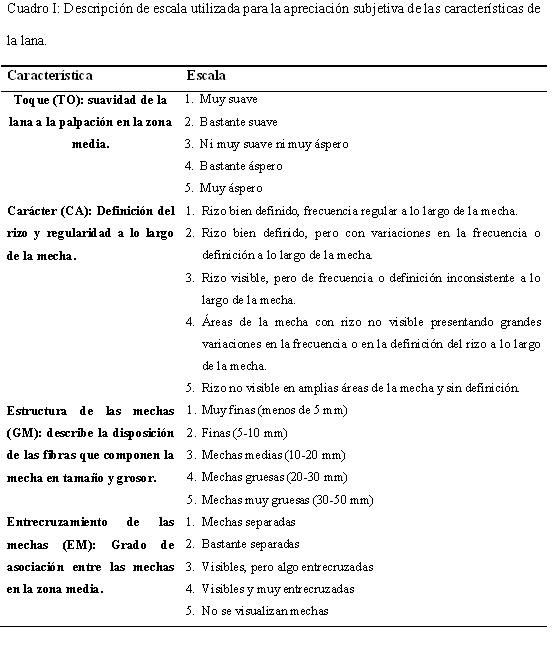
<body><![CDATA[<p class="MsoNormal" style="text-align: justify; line-height: 200%;"><span style="font-size: 10pt; line-height: 200%; font-family: &quot;Verdana&quot;,&quot;sans-serif&quot;;">En el a&ntilde;o 1992 se instal&oacute; en el Campo Experimental de Migues de la Facultad de Veterinaria un </span><span style="font-size: 10pt; line-height: 200%; font-family: &quot;Verdana&quot;,&quot;sans-serif&quot;;" lang="ES-UY">tambo ovino. En sus comienzos se orde&ntilde;aron ovejas Corriedale y posteriormente se fueron cruzando con carneros Milchschaf, logrando luego de m&aacute;s de 8 generaciones la absorci&oacute;n total de la raza. Los objetivos de este trabajo fueron evaluar la producci&oacute;n y caracter&iacute;sticas de la lana en ovejas lecheras de una majada Milchschaf, as&iacute; como el contenido y tipo de fibras meduladas. Teniendo en cuenta que la lana de cuarto es m&aacute;s gruesa y puede tener una mayor concentraci&oacute;n de ese tipo de fibras, se analiz&oacute; tambi&eacute;n la lana de esa zona.<o:p></o:p></span></p>       <p class="MsoBodyText2" style="line-height: 200%;"><b><span style="font-size: 10pt; line-height: 200%; font-family: &quot;Verdana&quot;,&quot;sans-serif&quot;;" lang="ES-UY"><o:p>&nbsp;</o:p></span></b></p>       <p class="MsoBodyText2" style="line-height: 200%;"><b><span style="font-size: 14pt; line-height: 200%; font-family: &quot;Verdana&quot;,&quot;sans-serif&quot;;" lang="X-NONE">Materiales y m&eacute;todos<span style="text-transform: uppercase;"><o:p></o:p></span></span></b></p>       <p class="MsoNormal" style="text-align: justify; line-height: 200%;"><span style="font-size: 10pt; line-height: 200%; font-family: &quot;Verdana&quot;,&quot;sans-serif&quot;; color: black;">Los animales utilizados fueron 139</span><span style="font-size: 10pt; line-height: 200%; font-family: &quot;Verdana&quot;,&quot;sans-serif&quot;; color: rgb(192, 0, 0);"> </span><span style="font-size: 10pt; line-height: 200%; font-family: &quot;Verdana&quot;,&quot;sans-serif&quot;; color: black;">ovejas </span><span style="font-size: 10pt; line-height: 200%; font-family: &quot;Verdana&quot;,&quot;sans-serif&quot;;">Milchschaf productoras de leche pertenecientes al tambo ovino, <span style="color: black;">en el a&ntilde;o 2009. </span>El manejo alimenticio que se realiz&oacute; fue sobre pasturas naturales hasta el mes de Julio que se esquilaron pre-parto y luego se llevaron a praderas convencionales hasta fines del mes de diciembre cuando finaliza el orde&ntilde;e. La encarnerada se efect&uacute;o en Marzo y Abril y al inicio de la misma se determin&oacute; el peso y se estim&oacute; la condici&oacute;n corporal con una escala de 1 a 5 (<a name="-Russel_y_col_1969"></a><a style="font-family: Verdana;" href="#Russel_y_col_1969"><span style="">Russel</span></a><span style="font-family: Verdana;"> y co</span>l., 1969). A los 90 d&iacute;as de la introducci&oacute;n de los carneros se realiz&oacute; diagn&oacute;stico de gestaci&oacute;n por ecograf&iacute;a. En la esquila se registr&oacute; <span style="color: black;">el peso del vell&oacute;n sucio (PVS) y se </span>extrajeron muestras de lana de la zona media de costilla de todos los animales. En 61 ovejas de edades diferentes seleccionadas al azar por categor&iacute;a (16 borregas de 2 a&ntilde;os, 15 de 3a&ntilde;os, 15 de 4 a&ntilde;os y 15 de 5 a&ntilde;os), se extrajeron dos muestras de lana, una de la zona de costilla y otra de la zona de cuarto. Las muestras de lana fueron procesadas en el Laboratorio de Lanas de la Facultad de Veterinaria. </span><span style="font-size: 10pt; line-height: 200%; font-family: &quot;Verdana&quot;,&quot;sans-serif&quot;;" lang="ES-UY">El protocolo experimental fue aprobado por la Comisi&oacute;n Honoraria de Experimentaci&oacute;n Animal (CHEA) de la Facultad de Veterinaria, Universidad de la Rep&uacute;blica, Uruguay.<o:p></o:p></span></p>   <h1 style="margin-top: 6pt; line-height: 200%;"><i><span style="font-size: 10pt; line-height: 200%; font-family: &quot;Verdana&quot;,&quot;sans-serif&quot;; font-weight: normal;" lang="ES-UY">Mediciones realizadas en las muestras de lana</span></i><span style="font-size: 10pt; line-height: 200%; font-family: &quot;Verdana&quot;,&quot;sans-serif&quot;; font-weight: normal;" lang="ES-UY"> <o:p></o:p></span></h1>   <h1 style="margin-left: 36pt; text-indent: -18pt; line-height: 200%;"><span style="font-size: 10pt; line-height: 200%; font-family: &quot;Verdana&quot;,&quot;sans-serif&quot;; font-weight: normal;" lang="ES-UY">-&nbsp;&nbsp;&nbsp;&nbsp;&nbsp;&nbsp;Largo de Mecha: <span style="color: black;">Se midi&oacute; con regla milimetrada el promedio del largo de 5 mechas tomadas al azar </span>en las muestras extra&iacute;das de la zona de costilla y de cuarto.<span style="color: black;"> Los resultados se expresaron en c</span>m.<o:p></o:p></span></h1>   <h1 style="margin-left: 36pt; text-indent: -18pt; line-height: 200%;"><span style="font-size: 10pt; line-height: 200%; font-family: &quot;Verdana&quot;,&quot;sans-serif&quot;; font-weight: normal;" lang="ES-UY">-&nbsp;&nbsp;&nbsp;&nbsp;&nbsp;&nbsp;Rendimiento al lavado (RL): se determin&oacute; en la lana de costilla, mediante el lavado de 100g de lana en un tren de lavado semiautom&aacute;tico de 4 piletas. Luego del lavado las muestras se secaron en estufa a 105&ordm;C y se acondicionaron durante 12 horas a 20&ordm;C&plusmn;2 de temperatura y 65%&plusmn;2 de humedad, para posteriormente registrar el peso acondicionado y calcular el rendimiento. El resultado se expres&oacute; en porcentaje y con este dato y el PVS, se calcul&oacute; el peso del vell&oacute;n limpio (PVL).<o:p></o:p></span></h1>   <h1 style="margin-left: 36pt; text-indent: -18pt; line-height: 200%;"><span style="font-size: 10pt; line-height: 200%; font-family: &quot;Verdana&quot;,&quot;sans-serif&quot;; font-weight: normal;" lang="ES-UY">-&nbsp;&nbsp;&nbsp;&nbsp;&nbsp;&nbsp;Di&aacute;metro medio (DM): se determin&oacute; en lana lavada y acondicionada, con el equipo Air <span class="SpellE">Flow</span> seg&uacute;n el procedimiento descrito en la Norma <a name="-IWTO-28_2009"></a><a style="font-family: Verdana;" href="#IWTO-28_2009"><span style="">IWTO-28</span></a><span style="font-family: Verdana;"> (20</span>09).<o:p></o:p></span></h1>   <h1 style="margin-left: 36pt; text-indent: -18pt; line-height: 200%;"><span style="font-size: 10pt; line-height: 200%; font-family: &quot;Verdana&quot;,&quot;sans-serif&quot;; font-weight: normal;" lang="ES-UY">-&nbsp;&nbsp;&nbsp;&nbsp;&nbsp;&nbsp;Contenido y tipo de fibras meduladas: La detecci&oacute;n de fibras meduladas se efectu&oacute; con una lupa con iluminaci&oacute;n balanceada y el tipo de medula con un microscopio con 40x de aumento, seg&uacute;n el procedimiento descrito en la norma <a name="-IWTO_DTF-13_2009"></a><a style="font-family: Verdana;" href="#IWTO_DTF-13_2009"><span style="">IWTO</span></a><span style="font-family: Verdana;"> D</span>TF-13 (2009). De cada muestra se analizaron 25,00 g de lana lavada, cardada y acondicionada. La observaci&oacute;n en la lupa se realiz&oacute; en <span class="SpellE">submuestras</span> de 0,2 a 0,25 g colocadas entre 2 placas de vidrio de 20x20 cm. Los resultados se expresaron en n&ordm; de fibras meduladas por 10 g de lana lavada. Esta medici&oacute;n se realiz&oacute; en las muestras de costilla y de cuarto de 61 ovejas.<o:p></o:p></span></h1>   <h1 style="margin-left: 36pt; text-indent: -18pt; line-height: 200%;"><span style="font-size: 10pt; line-height: 200%; font-family: &quot;Verdana&quot;,&quot;sans-serif&quot;; font-weight: normal;" lang="ES-UY">-&nbsp;&nbsp;&nbsp;&nbsp;&nbsp;&nbsp;Apreciaci&oacute;n subjetiva de las caracter&iacute;sticas de la lana<span class="GramE">::</span> se evaluaron mediante un escore de 1 a 5; siendo 1 el valor m&aacute;ximo y 5 el m&iacute;nimo. Los escores se basaron en los desarrollados por AWTA (2007) y el utilizado por <a name="-Crook_y_col_1994"></a><a style="font-family: Verdana;" href="#Crook_y_col_1994"><span style="">Crook</span></a><span style="font-family: Verdana;"> y col. (1994). En el </span><a style="font-family: Verdana;" href="#tab_1"><span style="">Cuadro I</span></a><span style="font-family: Verdana;"> se deta</span>llan las caracter&iacute;sticas evaluadas y se describe la escala utilizada. <o:p></o:p></span></h1>       <p class="MsoNormal" style="text-align: justify; line-height: 200%;"><span style="font-size: 10pt; line-height: 200%; font-family: &quot;Verdana&quot;,&quot;sans-serif&quot;;" lang="ES-UY">&nbsp;<o:p></o:p></span></p>       <p class="MsoNormal" style="line-height: 200%;"><span style="font-size: 10pt; line-height: 200%; font-family: &quot;Verdana&quot;,&quot;sans-serif&quot;;"><img style="border: 0px solid ;" alt="" id="_x0000_i1030" src="/img/revistas/vet/v51n198/198a01t1.JPG"></span><a name="tab_1"></a><span style="font-size: 10pt; line-height: 200%; font-family: &quot;Verdana&quot;,&quot;sans-serif&quot;;"><o:p></o:p></span></p>       <p class="MsoNormal" style="margin-top: 6pt; text-align: justify; line-height: 200%;"><i><span style="font-size: 10pt; line-height: 200%; font-family: &quot;Verdana&quot;,&quot;sans-serif&quot;;">An&aacute;lisis estad&iacute;stico<o:p></o:p></span></i></p>       <p class="MsoNormal" style="text-align: justify; line-height: 200%;"><span style="font-size: 10pt; line-height: 200%; font-family: &quot;Verdana&quot;,&quot;sans-serif&quot;;">El an&aacute;lisis de los datos fue efectuado mediante el paquete estad&iacute;stico STATA (<a name="-StataCorp_2010"></a><a style="font-family: Verdana;" href="#StataCorp_2010"><span class="SpellE"><span style="">StataCorp</span></span></a><span style="font-family: Verdana;">, 20</span>10). Para determinar los efectos de la edad y la gestaci&oacute;n sobre la producci&oacute;n y caracter&iacute;sticas de la lana se realiz&oacute; an&aacute;lisis de varianza. Para normalizar las distribuciones del contenido de fibras meduladas se realiz&oacute; una transformaci&oacute;n logar&iacute;tmica base 10. Para la determinaci&oacute;n de diferencias de las caracter&iacute;sticas entre lana de costilla y de cuarto se emple&oacute; el test de t de <span class="SpellE">Student</span>, con un nivel de confianza del 5%, luego de confirmados los principios de normalidad y <span class="SpellE">homogenicidad</span>.<o:p></o:p></span></p>       <p class="MsoBodyText2" style="line-height: 200%;"><b><span style="font-size: 10pt; line-height: 200%; font-family: &quot;Verdana&quot;,&quot;sans-serif&quot;; color: black;" lang="X-NONE"><o:p>&nbsp;</o:p></span></b></p>       <p class="MsoBodyText2" style="line-height: 200%;"><b><span style="font-size: 14pt; line-height: 200%; font-family: &quot;Verdana&quot;,&quot;sans-serif&quot;; color: black;" lang="X-NONE">Resultados<o:p></o:p></span></b></p>       ]]></body>
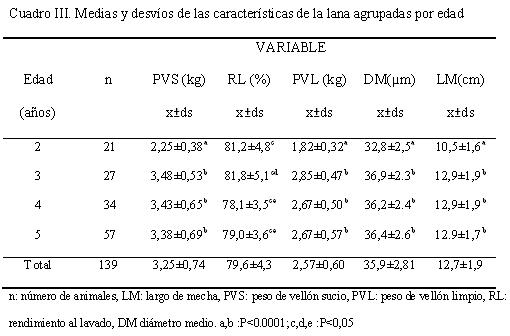
<body><![CDATA[<p class="MsoBodyText2" style="text-align: justify; line-height: 200%;"><span style="font-size: 10pt; line-height: 200%; font-family: &quot;Verdana&quot;,&quot;sans-serif&quot;;" lang="ES-UY">En e<span style="font-family: Verdana;">l </span><a style="font-family: Verdana;" href="#tab_2"><span style="">Cuadro II</span></a><span style="font-family: Verdana;"> se presen</span>tan el peso y la condici&oacute;n corporal a la encarnerada y los resultados del diagn&oacute;stico de gestaci&oacute;n de las ovejas. El peso promedio fue de 54,13&plusmn;7,12 kg, constat&aacute;ndose diferencias significativas en los pesos de las borregas 2 dientes respecto a las ovejas adultas (P&lt;0,0001). La condici&oacute;n corporal promedio fue de </span><span style="font-size: 10pt; line-height: 200%; font-family: &quot;Verdana&quot;,&quot;sans-serif&quot;;" lang="X-NONE">2,54&plusmn;0,43, con diferencias significativas entre las borregas y las ovejas 6 dientes </span><span style="font-size: 10pt; line-height: 200%; font-family: &quot;Verdana&quot;,&quot;sans-serif&quot;;" lang="ES-UY">(P&lt;0,05). <o:p></o:p></span></p>       <p class="MsoNormal" style="text-align: justify; line-height: 200%;"><span style="font-size: 10pt; line-height: 200%; font-family: &quot;Verdana&quot;,&quot;sans-serif&quot;;" lang="ES-UY"><o:p>&nbsp;</o:p></span></p>       <p class="MsoNormal" style="line-height: 200%;"><b style=""><span style="font-family: &quot;Verdana&quot;,&quot;sans-serif&quot;;"><img style="border: 0px solid ;" alt="" id="_x0000_i1029" src="/img/revistas/vet/v51n198/198a01t2.JPG"></span></b><a name="tab_2"></a><span style="font-family: &quot;Verdana&quot;,&quot;sans-serif&quot;;"><o:p></o:p></span></p>       <p class="MsoBodyText2" style="text-align: justify; line-height: 200%;"><span style="font-size: 10pt; line-height: 200%; font-family: &quot;Verdana&quot;,&quot;sans-serif&quot;; color: black;" lang="X-NONE">Las caracter&iacute;sticas de la lana fueron afectadas por la edad, sin constarse diferencias significativas por el estado reproductivo de las ovejas. </span><span style="font-size: 10pt; line-height: 200%; font-family: &quot;Verdana&quot;,&quot;sans-serif&quot;;" lang="ES-UY">En <a href="#tab_3"><span style="">Cuadro III</span></a> se presentan las medias y desv&iacute;os correspondientes a las caracter&iacute;sticas de la lana de las muestras de la zona de costilla. </span><span style="font-size: 10pt; line-height: 200%; font-family: &quot;Verdana&quot;,&quot;sans-serif&quot;;" lang="X-NONE">La categor&iacute;a de 2 dientes registr&oacute; menores pesos de vell&oacute;n sucio y limpio, largo de mecha y di&aacute;metro promedio, mostrando diferencias significativas con las dem&aacute;s categor&iacute;as (P&lt;0,0001). </span><span style="font-size: 10pt; line-height: 200%; font-family: &quot;Verdana&quot;,&quot;sans-serif&quot;;" lang="ES-UY">El DM de las fibras fue de </span><span style="font-size: 10pt; line-height: 200%; font-family: &quot;Verdana&quot;,&quot;sans-serif&quot;;" lang="X-NONE">36,0&plusmn;2,8 &micro;m, valor que se encuentra dentro del rango de lanas gruesas. El rendimiento al lavado fue alto (79,6&plusmn;4,3 %) existiendo diferencias entre los animales de 4 dientes con los 6 dientes y boca llena (P&lt;0.05). <o:p></o:p></span></p>       <p class="MsoNormal" style="text-align: justify; line-height: 200%;"><span style="font-size: 10pt; line-height: 200%; font-family: &quot;Verdana&quot;,&quot;sans-serif&quot;;"><o:p>&nbsp;</o:p></span></p>       <p class="MsoBodyText2" style="line-height: 200%;"><b style=""><span style="font-size: 10pt; line-height: 200%; font-family: &quot;Verdana&quot;,&quot;sans-serif&quot;; color: black;"><img style="border: 0px solid ;" alt="" id="_x0000_i1028" src="/img/revistas/vet/v51n198/198a01t3.JPG"></span></b><a name="tab_3"></a><b><span style="font-size: 10pt; line-height: 200%; font-family: &quot;Verdana&quot;,&quot;sans-serif&quot;; color: black;" lang="X-NONE"><o:p></o:p></span></b></p>       <p class="MsoBodyText2" style="line-height: 200%;"><b><span style="font-size: 10pt; line-height: 200%; font-family: &quot;Verdana&quot;,&quot;sans-serif&quot;; color: black;" lang="X-NONE"><o:p>&nbsp;</o:p></span></b></p>       <p class="MsoNormal" style="text-align: justify; line-height: 200%;"><span style="font-size: 10pt; line-height: 200%; font-family: &quot;Verdana&quot;,&quot;sans-serif&quot;;">En relaci&oacute;n a las caracter&iacute;sticas evaluadas subjetivamente mediante escores de 1 a 5, los valores para el toque y el car&aacute;cter fueron 3,2&plusmn;0,8 y 3,6&plusmn;1,0 respectivamente, indicando una</span><span style="font-size: 10pt; line-height: 200%; font-family: &quot;Verdana&quot;,&quot;sans-serif&quot;;" lang="ES-UY"> lana <span style="font-family: Verdana;">bastante &aacute;spera y con pobre definici&oacute;n del rizo a lo largo de las fibras. Las mechas fueron gruesas (3,8&plusmn;0,8) y con cierto grado de entrecruzamiento entre ellas (2,7&plusmn;1,0), como se observa en el </span><a style="font-family: Verdana;" href="#tab_4"><span style="">Cuadro IV</span></a><span style="font-family: Verdana;">.</span><o:p></o:p></span></p>       <p class="MsoNormal" style="text-align: justify; line-height: 200%;"><span style="font-size: 10pt; line-height: 200%; font-family: &quot;Verdana&quot;,&quot;sans-serif&quot;;" lang="ES-UY"><o:p>&nbsp;</o:p></span></p>       <p class="MsoNormal" style="text-align: justify; line-height: 200%;"><span style="font-size: 10pt; line-height: 200%; font-family: &quot;Verdana&quot;,&quot;sans-serif&quot;;"><img style="border: 0px solid ;" alt="" id="_x0000_i1027" src="/img/revistas/vet/v51n198/198a01t4.JPG"></span><a name="tab_4"></a><span style="font-size: 10pt; line-height: 200%; font-family: &quot;Verdana&quot;,&quot;sans-serif&quot;;" lang="ES-UY"><o:p></o:p></span></p>       ]]></body>
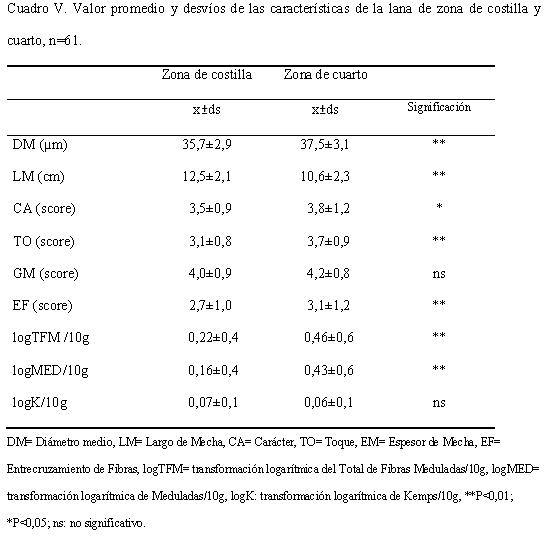
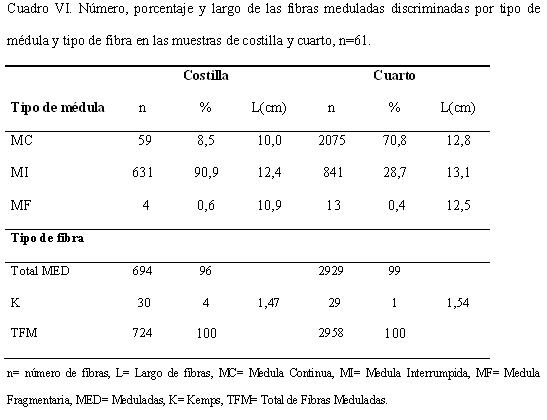
<body><![CDATA[<p class="MsoNormal" style="line-height: 200%;"><span style="font-size: 10pt; line-height: 200%; font-family: &quot;Verdana&quot;,&quot;sans-serif&quot;;"><o:p>&nbsp;</o:p></span></p>       <p class="MsoNormal" style="line-height: 200%;"><span style="font-size: 10pt; line-height: 200%; font-family: &quot;Verdana&quot;,&quot;sans-serif&quot;;">En las 61 ovejas de las que fueron extra&iacute;das muestras de costilla y cuarto </span><span style="font-size: 10pt; line-height: 200%; font-family: &quot;Verdana&quot;,&quot;sans-serif&quot;;" lang="ES-UY">se constataron</span><span style="font-size: 10pt; line-height: 200%; font-family: &quot;Verdana&quot;,&quot;sans-serif&quot;;"> diferencias significativas en todas las caracter&iacute;sticas medidas objetivamente o evaluadas subjetivamente, excepto en el grado de entrecruzamiento de fibras, como se muestra en el<span style="font-family: Verdana;"> </span><a style="font-family: Verdana;" href="#tab_5"><span style="">Cuadro 5</span></a><span style="font-family: Verdana;">.</span><span style="color: rgb(192, 0, 0); font-family: Verdana;"> </span><span style="font-family: Verdana;">La lana correspondiente a la zona de cuarto present&oacute; mayor DM que la de zona de costilla (37,5&plusmn;3,1 &micro;m y 35,7&plusmn;2,9 &micro;m, respectivamente), fue m&aacute;s corta, m&aacute;s &aacute;spera y tuvo un mayor grado </span>de entrecruzamiento de fibras entre las mechas (P&lt;0,01). El car&aacute;cter tambi&eacute;n present&oacute; diferencias entre zonas mostrado una mayor definici&oacute;n y regularidad del rizo la muestra procedente de costilla (P&lt;0,05). <o:p></o:p></span></p>       <p class="MsoNormal" style="text-align: justify; line-height: 200%;"><span style="font-size: 10pt; line-height: 200%; font-family: &quot;Verdana&quot;,&quot;sans-serif&quot;;">En referencia al contenido de fibras meduladas, la lana de costilla registr&oacute; un promedio de 4,2&plusmn;20,8 fibras cada 10 g de lana lavada, mientras que la zona de cuarto el valor fue superior (18,3&plusmn;62,0/10 g). Se constat&oacute; una gran variabilidad entre animales, con un alto n&uacute;mero de muestras con bajos niveles de <span class="SpellE">medulaci&oacute;n</span> y unas pocas con alto contenido de fibras <span class="SpellE">meduladas</span>, tanto en la lana proveniente de la zona de costilla como la de cuarto. La lana de la zona de cuarto present&oacute; no solamente mayor contenido de fibras meduladas sino tambi&eacute;n una mayor proporci&oacute;n de muestras con fibras meduladas. El 68,8 % de las muestras de cuarto ten&iacute;an al menos una fibra <span class="SpellE">medulada</span>, mientras que en costilla la proporci&oacute;n fue del 54%. <o:p></o:p></span></p>       <p class="MsoNormal" style="text-align: justify; line-height: 200%;"><span style="font-size: 10pt; line-height: 200%; font-family: &quot;Verdana&quot;,&quot;sans-serif&quot;;" lang="ES-UY"><o:p>&nbsp;</o:p></span></p>       <p class="MsoNormal" style="text-align: justify; line-height: 200%;"><span style="font-size: 10pt; line-height: 200%; font-family: &quot;Verdana&quot;,&quot;sans-serif&quot;;"><img style="border: 0px solid ;" alt="" id="_x0000_i1026" src="/img/revistas/vet/v51n198/198a01t5.JPG"></span><a name="tab_5"></a><span style="font-size: 10pt; line-height: 200%; font-family: &quot;Verdana&quot;,&quot;sans-serif&quot;;" lang="ES-UY"><o:p></o:p></span></p>       <p class="MsoNormal" style="line-height: 200%;"><span style="font-size: 10pt; line-height: 200%; font-family: &quot;Verdana&quot;,&quot;sans-serif&quot;;"><o:p>&nbsp;</o:p></span></p>       <p class="MsoNormal" style="text-align: justify; line-height: 200%;"><span style="font-size: 10pt; line-height: 200%; font-family: &quot;Verdana&quot;,&quot;sans-serif&quot;;">En relaci&oacute;n al tipo de fibra <span class="SpellE">medulada</span>, el mayor porcentaje registrado correspondi&oacute; a fibras MED, tanto en zona de costilla como en zona de cuarto (96% y 99%, respectivamente), mientras que el porcentaje de K fue bajo en ambas zonas (4% y 1%, respectivamente). En <span style="font-family: Verdana;">el </span><a style="font-family: Verdana;" href="#tab_6"><span style="">Cuadro VI</span></a><span style="font-family: Verdana;"> se</span> puede observar que en las fibras MED el tipo de m&eacute;dula continua fue la que se present&oacute; con mayor proporci&oacute;n en la lana de cuarto (70,8 %). En las muestras de costilla el 90,9 % de las fibras MED correspondi&oacute; a medula interrumpida y solamente el 8,5% tuvo medula continua. La proporci&oacute;n de fibras con m&eacute;dula fragmentaria fue baja en ambas zonas.<o:p></o:p></span></p>       <p class="MsoNormal" style="text-align: justify; line-height: 200%;"><span style="font-size: 10pt; line-height: 200%; font-family: &quot;Verdana&quot;,&quot;sans-serif&quot;;"><o:p>&nbsp;</o:p></span></p>       <p class="MsoNormal" style="text-align: justify; line-height: 200%;"><span style="font-size: 10pt; line-height: 200%; font-family: &quot;Verdana&quot;,&quot;sans-serif&quot;;"><img style="border: 0px solid ;" alt="" id="_x0000_i1025" src="/img/revistas/vet/v51n198/198a01t6.JPG"></span><a name="tab_6"></a><span style="font-size: 10pt; line-height: 200%; font-family: &quot;Verdana&quot;,&quot;sans-serif&quot;;"><o:p></o:p></span></p>       <p class="MsoNormal" style="text-align: justify; line-height: 200%;"><b><span style="font-size: 10pt; line-height: 200%; font-family: &quot;Verdana&quot;,&quot;sans-serif&quot;;"><o:p>&nbsp;</o:p></span></b></p>       ]]></body>
<body><![CDATA[<p class="MsoNoSpacing" style="text-align: justify; line-height: 200%;"><b><span style="font-size: 14pt; line-height: 200%; font-family: &quot;Verdana&quot;,&quot;sans-serif&quot;;">Discusi&oacute;n<o:p></o:p></span></b></p>       <p class="MsoBodyText2" style="text-align: justify; line-height: 200%;"><span style="font-size: 10pt; line-height: 200%; font-family: &quot;Verdana&quot;,&quot;sans-serif&quot;;" lang="X-NONE">En el presente trabajo el valor promedio para el PVS fue de 3,25 &plusmn; 0,74 kg, similar a los datos encontrados en nuestro pa&iacute;s <span style="font-family: Verdana;">por </span><a style="font-family: Verdana;" href="#Ganz%E1bal_y_col_2012"><span class="SpellE"><span style="">Ganz&aacute;bal</span></span></a><span style="font-family: Verdana;"> y col. (2012) evaluando diferentes biotipos maternos, en los que constaron que las ovejas Milchschaf puras registraron valores de PVS 2,9 kg. Estos resultados son inferiores a los reportados en ovejas Milchschaf de Alemania, Polonia y Bulgaria, donde los valores de pesos de vell&oacute;n sucio de borregas y ovejas se situaron entre 3,6 a 6,2 kg (</span><span style="font-family: Verdana;" class="SpellE">Niznikowski</span><span style="font-family: Verdana;"> y Rant, 1992; </span><span style="font-family: Verdana;" class="SpellE">Fotsch</span><span style="font-family: Verdana;">, 1994 citado por </span><a style="font-family: Verdana;" href="#Farid_y_Fahmy_1996"><span class="SpellE"><span style="">Farid</span></span></a><span style="font-family: Verdana;"> y </span><span style="font-family: Verdana;" class="SpellE">Fahmy</span><span style="font-family: Verdana;">, 1996). </span><o:p style="font-family: Verdana;"></o:p></span></p>       <p class="MsoBodyText2" style="text-align: justify; line-height: 200%;"><span style="font-size: 10pt; line-height: 200%; font-family: &quot;Verdana&quot;,&quot;sans-serif&quot;;" lang="X-NONE"><span style="font-family: Verdana;">Existen en nuestro pa&iacute;s algunos datos de producci&oacute;n de lana de cruzas de Corriedale x Milchschaf. En el Campo Experimental N&ordm; 1 de la Facultad de Veterinaria en Migues, </span><a style="font-family: Verdana;" href="#Kremer_y_col_2010"><span style="">Kremer</span></a><span style="font-family: Verdana;"> y col. (2010) </span><span style="font-family: Verdana;" class="SpellE">obtuv<span style="" lang="ES">ier</span>o<span style="" lang="ES">n</span></span><span style="font-family: Verdana;"> en ovejas cruzas F1 Milchschaf x Corriedale PVS y PVL menores (2,49 y 2,20 kg respectivamente) que en las Corriedale puras (3,16 kg y 2,76 kg, respectivamente</span>). En cruzas Milchschaf x Corriedale de la Facultad de Agronom&iacute;a de Paysand&uacute;,<span style="color: red;"> </span><a name="-Bianchi_y_col_2001"></a><a style="font-family: Verdana;" href="#Bianchi_y_col_2001"><span style="">Bianchi</span></a><span style="font-family: Verdana;"> y</span> col. (2001), registraron valores algo superiores de PVL de (3,1&plusmn;0,1 kg) en ovejas y borregas alimentadas en base a verdeos y praderas. Valores similares a estos obtuvieron <a name="-Sienra_y_col_2003"></a><a style="font-family: Verdana;" href="#Sienra_y_col_2003"><span style="">Sienra</span></a><span style="font-family: Verdana;"> y col. (2003) en ovejas F1 Milchschaf x Corriedale utilizadas para cruzamientos terminales y alimentadas en base a pasturas naturales y praderas de </span><span style="font-family: Verdana;" class="SpellE">festuca</span><span style="font-family: Verdana;"> y tr&eacute;bol blanco (4,14 &plusmn; 0,05 kg para PVS y 3,03 &plusmn; 0,04 kg para PVL, respectivamente).</span><span style="color: red; font-family: Verdana;"><o:p></o:p></span></span></p>       <p class="MsoBodyText2" style="text-align: justify; line-height: 200%; font-family: Verdana;"><span style="font-size: 10pt; line-height: 200%;" lang="X-NONE">El rendimiento al lavado en este estudio fue 79,7 &plusmn; 4,3%, <a style="font-family: Verdana;" href="#Reid_y_Booker_2001"><span class="SpellE"><span style="">Reid</span></span></a> y <span class="SpellE">Booker</span> (2001) obtuvieron un valor promedio de rendimiento al lavado inferior (73,3 &plusmn; 1,9%) en muestras de lana de ovejas Milchschaf proveniente de siete granjas de Nueva Zelanda. El rendimiento al lavado de las lanas de nuestro pa&iacute;s es considerado muy bueno a nivel internacional. El valor promedio obtenido por <a name="-Capurro_1996"></a><a style="font-family: Verdana;" href="#Capurro_1996"><span style="">Capurro</span></a> (1996) en la caracterizaci&oacute;n de la raza Corriedale del Uruguay fue de 78,4%, con variaciones entre a&ntilde;os por efectos clim&aacute;ticos. <o:p></o:p></span></p>       <p class="MsoNormal" style="text-align: justify; line-height: 200%;"><span style="font-size: 10pt; line-height: 200%; font-family: &quot;Verdana&quot;,&quot;sans-serif&quot;;"><span style="font-family: Verdana;">El di&aacute;metro promedio de la lana en las 139 muestras extra&iacute;das de la zona de costilla fue de 36,0&plusmn;2,8 &micro;m, mayor al registrado por </span><a style="font-family: Verdana;" href="#Ganz%E1bal_y_col_2012"><span class="SpellE"><span style="">Ganz&aacute;bal</span></span></a><span style="font-family: Verdana;"> y col., (2012) en la majada de INIA Las Brujas (33,9&micro;m). En el presente ensayo el DM es intermedio entre los valores de 31,9&plusmn;0,9&micro;m reportados por </span><a style="font-family: Verdana;" href="#Reid_y_Booker_2001"><span class="SpellE"><span style="">Reid</span></span></a><span style="font-family: Verdana;"> y </span><span style="font-family: Verdana;" class="SpellE">Booker</span><span style="font-family: Verdana;"> (2001) y los de </span><span style="font-family: Verdana;" class="SpellE">Peters</span><span style="font-family: Verdana;"> (1991, citado por </span><a style="font-family: Verdana;" href="#Farid_y_Fahmy_1996"><span class="SpellE"><span style="">Farid</span></span></a><span style="font-family: Verdana;"> y </span><span style="font-family: Verdana;" class="SpellE">Fahmy</span><span style="font-family: Verdana;">, 1996) de 41,8&micro;m, en ovinos de la raza Milchschaf.</span> <o:p></o:p></span></p>       <p class="MsoBodyText2" style="text-align: justify; line-height: 200%;"><span style="font-size: 10pt; line-height: 200%; font-family: &quot;Verdana&quot;,&quot;sans-serif&quot;;" lang="X-NONE">Con respecto a las caracter&iacute;sticas de apreciaci&oacute;n subjetiva, las 139 muestras de costilla mostraron que la lana fue bastante &aacute;spera, con pobre definici&oacute;n a lo largo de las fibras, mechas gruesas y con cierto nivel de entrecruzamiento. En ovejas cruza F1 Milchschaf x Corriedale<span style="font-family: Verdana;">, </span><a style="font-family: Verdana;" href="#Sienra_y_col_2003"><span class="SpellE"><span style="">Sienra</span></span></a><span style="font-family: Verdana;"> </span></span><span style="font-size: 10pt; line-height: 200%; font-family: Verdana;" lang="ES-UY">y col. (2003), reportaron valores similares a los encontrados en este ensayo, constatando adem&aacute;s, que la lana de ovejas Corriedale puras tuvo una mejor definici&oacute;n del rizo, mayor suavidad, menor espesor de mecha y menor grado de entrecruzamiento. En general hay una relaci&oacute;n entre el di&aacute;metro promedio y la frecuencia del rizo, tendiendo a tener un di&aacute;metro menor las lanas con mayor n&uacute;mero de rizos por unidad de longitud (<span class="SpellE">Teasdale</span> y <span class="SpellE">Cottle</span>, 1991, citado por <a style="font-family: Verdana;" href="#Cotlle_2010"><span class="SpellE"><span style="">Cotlle</span></span></a>, 2010).<o:p></o:p></span></p>       <p class="MsoNoSpacing" style="text-align: justify; line-height: 200%;"><span style="font-size: 10pt; line-height: 200%; font-family: &quot;Verdana&quot;,&quot;sans-serif&quot;;"><span style="font-family: Verdana;">La lana procedente de diferentes regiones del cuerpo de los ovinos presenta variaciones en el di&aacute;metro, increment&aacute;ndose desde la paleta hacia el cuarto. Se considera que la zona de costilla es la m&aacute;s representativa para todas las caracter&iacute;sticas del vell&oacute;n y la indicada para la extracci&oacute;n de muestras (</span><a style="font-family: Verdana;" href="#Cottle_2010"><span class="SpellE">Cottle</span></a><span style="font-family: Verdana;">, 201</span>0). La lana procedente del cuarto puede presentar en algunas razas el denominado &ldquo;cuarto peludo&rdquo;. Esta lana sobresale del resto del vell&oacute;n por tener un menor rizado y se relaciona con la presencia de lana gruesa y con alta proporci&oacute;n de fibras meduladas (<a name="-Larrosa_y_Sienra_1999"></a><a style="font-family: Verdana;" href="#Larrosa_y_Sienra_1999"><span style="">Larrosa</span></a><span style="font-family: Verdana;"> y </span><span style="font-family: Verdana;" class="SpellE">Sienra</span><span style="font-family: Verdana;">, 1999). En este ensayo el contenido promedio de FM fue superior en la lana de la zona de cuarto respecto a la proveniente de la zona de costilla (18,3 &plusmn; 62,08/10 g y </span></span><span style="font-size: 10pt; line-height: 200%; font-family: &quot;Verdana&quot;,&quot;sans-serif&quot;;" lang="ES-UY"><span style="font-family: Verdana;">4,2 &plusmn; 20,8/10 </span>g, respectivamente), coincidiendo con un mayor DM de las fibras. </span><a name="-Scobie_y_col_1998"></a><span style="font-size: 10pt; line-height: 200%; font-family: &quot;Verdana&quot;,&quot;sans-serif&quot;;"><a style="font-family: Verdana;" href="#Scobie_y_col_1998"><span style="">Scobie</span></a><span style="font-family: Verdana;"> y col. (1998) encontraron en lana de ovejas </span><span style="font-family: Verdana;" class="SpellE">Romney</span><span style="font-family: Verdana;"> que el &aacute;rea de secci&oacute;n transversal ocupada por la m&eacute;dula aumenta exponencialmente con el aumento del di&aacute;metro de la fibra y que en la mayor&iacute;a de los casos el aumento o disminuci&oacute;n de </span><span style="font-family: Verdana;" class="SpellE">medulaci&oacute;n</span><span style="font-family: Verdana;"> acompa&ntilde;&oacute; la variaci&oacute;n del di&aacute;metro.</span><span style="color: red; font-family: Verdana;"> </span><span style="font-family: Verdana;">Sin embargo, </span><a style="font-family: Verdana;" href="#Reid_y_Booker_2001"><span class="SpellE"><span style="">Reid</span></span></a><span style="font-family: Verdana;"> y </span><span style="font-family: Verdana;" class="SpellE">Booker</span><span style="font-family: Verdana;"> (2001), en un estudio sobre el efecto de la incorporaci&oacute;n de genes </span><span style="font-family: Verdana;" class="SpellE">Milschschaf</span><span style="font-family: Verdana;"> sobre Corriedale, constaron un incremento del di&aacute;metro sin que afectara el porcentaje de </span><span class="SpellE"><span style="font-family: Verdana;">medula</span>ci&oacute;n</span>, aunque debe considerarse que el valor de este fue bajo (0,7 &plusmn; 0,5 % de FM). El DM para la raza Milchschaf pura fue de 31,7 &micro;m, mientras que en presente ensayo fue superior (35,7 &plusmn; 2.9 &micro;m). En muestras extra&iacute;das de todo el vell&oacute;n de borregos Corriedale, <a name="-Sienra_y_col_2011"></a><a style="font-family: Verdana;" href="#Sienra_y_col_2011"><span style="">Sienra</span></a><span style="font-family: Verdana;"> y </span>col. (2011) registraron un valor promedio alto y una alta variabilidad individual (4,2 &plusmn; 11,2 fibras <span class="SpellE">meduladas</span>/10g de lana), resultado similar al obtenido en este ensayo en la zona de costilla. <span style="color: red;"><o:p></o:p></span></span></p>       <p class="MsoNoSpacing" style="text-align: justify; line-height: 200%;"><span style="font-size: 10pt; line-height: 200%; font-family: &quot;Verdana&quot;,&quot;sans-serif&quot;;">En referencia al tipo de fibra <span class="SpellE">medulada</span>, el mayor porcentaje correspondi&oacute; a fibras MED, (96 y 99%) mientras que Neimaur y <span class="SpellE">Sienra</span> (2009) encontraron un porcentaje mayor de K (73,5%) que de fibras MED borregos de raza Corriedale. El tipo de medula de las fibras MED que observaron con mayor frecuencia fueron interrumpida y fragmentaria, mientras que en este ensayo el tipo de medula que predomin&oacute; fue la medula interrumpida en la zona de costilla y medula continua en la zona de cuarto. <o:p></o:p></span></p>       <p class="MsoNoSpacing" style="text-align: justify; line-height: 200%;"><span style="font-size: 10pt; line-height: 200%; font-family: &quot;Verdana&quot;,&quot;sans-serif&quot;;"><o:p>&nbsp;</o:p></span></p>       <p class="MsoNoSpacing" style="text-align: justify; line-height: 200%;"><b><span style="font-size: 14pt; line-height: 200%; font-family: &quot;Verdana&quot;,&quot;sans-serif&quot;;">Conclusiones<o:p></o:p></span></b></p>       ]]></body>
<body><![CDATA[<p class="MsoNormal" style="text-align: justify; line-height: 200%;"><span style="font-size: 10pt; line-height: 200%; font-family: &quot;Verdana&quot;,&quot;sans-serif&quot;;">Se concluye que la lana producida se encuentra dentro del rango de lanas gruesas, con un alto rendimiento al lavado y buen largo de mecha. A la apreciaci&oacute;n subjetiva se constataron valores bajos en las caracter&iacute;sticas que integran el estilo, presentando mechas con poco car&aacute;cter o pobre definici&oacute;n y regularidad del rizo, con alto grado de entrecruzamiento y con un toque bastante &aacute;spero. El contenido de fibras meduladas fue menor al esperado teniendo en cuenta el di&aacute;metro de las fibras, presentando alta variabilidad entre animales. En la lana del cuarto se constat&oacute; una mayor proporci&oacute;n de fibras meduladas, aunque no excesiva. </span><span style="font-size: 10pt; line-height: 200%; font-family: &quot;Verdana&quot;,&quot;sans-serif&quot;;" lang="ES-UY"><o:p></o:p></span></p>       <p class="MsoNoSpacing" style="text-align: justify; line-height: 200%;"><span style="font-size: 10pt; line-height: 200%; font-family: &quot;Verdana&quot;,&quot;sans-serif&quot;;" lang="ES-UY"><o:p>&nbsp;</o:p></span></p>       <p class="MsoNormal" style="line-height: 200%;"><b><span style="font-size: 14pt; line-height: 200%; font-family: &quot;Verdana&quot;,&quot;sans-serif&quot;;" lang="ES-UY">Agradecimientos<o:p></o:p></span></b></p>       <p class="MsoNormal" style="text-align: justify; line-height: 200%;"><span style="font-size: 10pt; line-height: 200%; font-family: &quot;Verdana&quot;,&quot;sans-serif&quot;;" lang="ES-UY">A la Direcci&oacute;n y personal del Campo Experimental N&ordm; 1, Migues de la Facultad de Veterinaria-UDELAR por permitir y colaborar con el ensayo de campo. Al Dr. Roberto Kremer por el asesoramiento del an&aacute;lisis estad&iacute;stico.<o:p></o:p></span></p>       <p class="MsoNoSpacing" style="text-align: justify; line-height: 200%;"><span style="font-size: 10pt; line-height: 200%; font-family: &quot;Verdana&quot;,&quot;sans-serif&quot;;" lang="ES-UY"><o:p>&nbsp;</o:p></span></p>       <p class="MsoNormal" style="text-align: justify; line-height: 200%;"><span class="SpellE"><b><span style="font-size: 14pt; line-height: 200%; font-family: &quot;Verdana&quot;,&quot;sans-serif&quot;;" lang="EN-US">Bibliografia</span></b></span><b><span style="font-size: 14pt; line-height: 200%; font-family: &quot;Verdana&quot;,&quot;sans-serif&quot;;" lang="EN-US"><o:p></o:p></span></b></p>       <p class="MsoNormal" style="text-align: justify; line-height: 200%;"><a name="ASTM_1998"></a><span class="GramE"><span style="font-size: 10pt; line-height: 200%; font-family: &quot;Verdana&quot;,&quot;sans-serif&quot;;" lang="EN-US">1.<span style="font-family: Verdana;"> </span><a style="font-family: Verdana;" href="#-ASTM_1998"><span style="">ASMT</span></a><span style="font-family: Verdana;"> D2968</span> &ndash; 95 (1998).</span></span><span style="font-size: 10pt; line-height: 200%; font-family: &quot;Verdana&quot;,&quot;sans-serif&quot;;" lang="EN-US"> Standard Test Method for Med and Kemp Fibers in Wool and Other Animal Fibers by <span class="SpellE">Microprojection</span>. <span class="SpellE">Disponible</span> en: </span><a href="http://www.astm.org/Standards/D2968.htm"><span style="font-size: 10pt; line-height: 200%; font-family: &quot;Verdana&quot;,&quot;sans-serif&quot;;" lang="EN-US">http://www.astm.org/Standards/D2968.htm</span></a><span style="font-size: 10pt; line-height: 200%; font-family: &quot;Verdana&quot;,&quot;sans-serif&quot;;"> <span style="color: red;" lang="EN-US"><o:p></o:p></span></span></p>       <!-- ref --><p class="MsoNormal" style="text-align: justify; line-height: 200%;"><span style="font-size: 10pt; line-height: 200%; font-family: &quot;Verdana&quot;,&quot;sans-serif&quot;;" lang="EN-US">2. Australian Wool Innovation Limited. AWI. (2014) Visual Sheep Scores. </span><span style="font-size: 10pt; line-height: 200%; font-family: &quot;Verdana&quot;,&quot;sans-serif&quot;;" lang="ES-UY">Disponible en: </span><span style="font-size: 10pt; line-height: 200%;"><a href="http://www.wool.com/"><span style="font-family: &quot;Verdana&quot;,&quot;sans-serif&quot;;">http://www.wool.com/Content/en-GB/Visual_Sheep_Scores_Researcher_Version_LR.pdf</span></a></span><span style="font-size: 10pt;     line-height: 200%; font-family: &quot;Verdana&quot;,&quot;sans-serif&quot;;" lang="ES-UY"><o:p></o:p></span></p>       <!-- ref --><p class="MsoNormal" style="text-align: justify; line-height: 200%;"><a name="Bianchi_y_col_2001"></a><span style="font-size: 10pt; line-height: 200%; font-family: &quot;Verdana&quot;,&quot;sans-serif&quot;;" lang="ES-UY">3<span style="font-family: Verdana;">. </span></span><span style="font-size: 10pt; line-height: 200%; font-family: &quot;Verdana&quot;,&quot;sans-serif&quot;;"><a style="font-family: Verdana;" href="#-Bianchi_y_col_2001"><span style="">Bianchi</span></a><span style="font-family: Verdana;"> G, </span><span style="font-family: Verdana;" class="SpellE">Garibotto</span> G, <span class="SpellE">Bentancur</span> O, Pe&ntilde;agaricano O, <span class="SpellE">Risso</span> A, Fonseca, R. (2001). </span><span style="font-size: 10pt; line-height: 200%; font-family: &quot;Verdana&quot;,&quot;sans-serif&quot;;" lang="ES-UY">Desempe&ntilde;o de borregas y ovejas Corriedale puras y F1 (<span class="SpellE">Texel</span>, <span class="SpellE">Ile</span> de France y Milchschaf) servidas con carneros <span class="SpellE">Southdown</span>. 1. Eficiencia reproductiva y producci&oacute;n de lana. 26&ordm; Congreso Argentino de Producci&oacute;n Animal, 22-24 Octubre. </span><span style="font-size: 10pt; line-height: 200%; font-family: &quot;Verdana&quot;,&quot;sans-serif&quot;;">Mendoza, Argentina. </span><a href="http://www.aapa.org.ar/"><span style="font-size: 10pt; line-height: 200%; font-family: &quot;Verdana&quot;,&quot;sans-serif&quot;;">http://www.aapa.org.ar/congresos/2003/SpPdf/Sp4.PDF</span></a><span style="font-size: 10pt;     line-height: 200%; font-family: &quot;Verdana&quot;,&quot;sans-serif&quot;;"> <o:p></o:p></span></p>       <!-- ref --><p class="MsoNormal" style="text-align: justify; line-height: 200%;"><a name="Capurro_1996"></a><span style="font-size: 10pt; line-height: 200%; font-family: &quot;Verdana&quot;,&quot;sans-serif&quot;;" lang="ES-UY">4. </span><span style="font-size: 10pt; line-height: 200%; font-family: Verdana;"><a style="font-family: Verdana;" href="#-Capurro_1996"><span style="">Capurro</span></a> G. (1996) Caracterizaci&oacute;n de la lana producida por la raza Corriedale en el Uruguay. </span><span style="font-family: Verdana;" class="SpellE"><span style="font-size: 10pt; line-height: 200%;" lang="EN-US">Lananoticias</span></span><span style="font-size: 10pt; line-height: 200%; font-family: Verdana;" lang="EN-US">, 22-26.    <o:p></o:p></span></p>       <!-- ref --><p class="MsoNormal" style="text-align: justify; line-height: 200%; font-family: Verdana;"><a name="Cottle_2010"></a><span style="font-size: 10pt; line-height: 200%;" lang="EN-US">5. <a style="font-family: Verdana;" href="#-Cottle_2010"><span class="SpellE"><span style="">Cottle</span></span><span style=""> </span></a>DJ. (2010). Testing and Marketing. Wool Preparation. En: International Sheep and Wool Handbook. Nottingham University Press, pp. 581-618.    <o:p></o:p></span></p>       <!-- ref --><p class="MsoNormal" style="text-align: justify; line-height: 200%;"><a style="font-family: Verdana;" name="Crook_y_col_1994"></a><span style="font-size: 10pt; line-height: 200%; font-family: &quot;Verdana&quot;,&quot;sans-serif&quot;;" lang="EN-US"><span style="font-family: Verdana;">6. </span><a style="font-family: Verdana;" href="#-Crook_y_col_1994"><span style="">Crook</span></a><span style="font-family: Verdana;"> BJ, Piper LR, Mayo O. (1994). Phenotypic Associations Between </span><span style="font-family: Verdana;" class="SpellE">Fibre</span><span style="font-family: Verdana;"> Diameter Variability and Greasy Wool Staple Characteristics Within </span><span style="font-family: Verdana;" class="SpellE">Peppin</span><span style="font-family: Verdana;"> Merino Stud Flocks. Wool Tech Sheep Breed 42:304-</span>318.    <o:p></o:p></span></p>       <!-- ref --><p class="MsoNormal" style="text-align: justify; line-height: 200%;"><a name="Farid_y_Fahmy_1996"></a><span style="font-size: 10pt; line-height: 200%; font-family: &quot;Verdana&quot;,&quot;sans-serif&quot;;" lang="EN-US">7. </span><span style="font-size: 10pt; line-height: 200%;"><a href="#-Farid_y_Fahmy_1996"><span class="SpellE"><span style="font-family: &quot;Verdana&quot;,&quot;sans-serif&quot;;" lang="EN-US">Farid</span></span></a></span><span style="font-size: 10pt; line-height: 200%; font-family: &quot;Verdana&quot;,&quot;sans-serif&quot;;" lang="EN-US"> AH, <span class="SpellE">Fahmy</span> MH. (1996). The East Friesian and other European breeds. </span><span style="font-size: 10pt; line-height: 200%; font-family: &quot;Verdana&quot;,&quot;sans-serif&quot;;">En: <span class="SpellE">Fahmy</span>, M.H. <span class="SpellE">Prolific</span> <span class="SpellE">Sheep</span>. Quebec, CAB. <span class="SpellE">pp</span> 93-108.    <o:p></o:p></span></p>       <!-- ref --><p class="MsoNormal" style="text-align: justify; line-height: 200%;"><a name="Ganz&aacute;bal_y_col_2012"></a><span style="font-size: 10pt; line-height: 200%; font-family: &quot;Verdana&quot;,&quot;sans-serif&quot;;">8.<span style="font-family: Verdana;"> </span><a style="font-family: Verdana;" href="#-Ganz%E1bal_y_col_2012"><span class="SpellE"><span style="">Ganz&aacute;bal</span></span></a><span style="font-family: Verdana;"> A, </span><span style="font-family: Verdana;" class="SpellE">Ciappesoni</span><span style="font-family: Verdana;">, G, </span><span style="font-family: Verdana;" class="SpellE">Banchero</span><span style="font-family: Verdana;"> G, </span><span style="font-family: Verdana;" class="SpellE">Vazquez</span><span style="font-family: Verdana;"> A, </span><span style="font-family: Verdana;" class="SpellE">Ravagnolo</span><span style="font-family: Verdana;"> O, </span><span style="font-family: Verdana;" class="SpellE">Montossi</span><span style="font-family: Verdana;"> F. (2012). Biotipos maternales y terminales para enfrentar los nuevos desaf&iacute;os de la producci&oacute;n ovina moderna. </span></span><span style="font-family: Verdana;" class="SpellE"><span style="font-size: 10pt; line-height: 200%;" lang="EN-US">Revista</span></span><span style="font-size: 10pt; line-height: 200%; font-family: Verdana;" lang="EN-US"> INIA 29:14-18.    <o:p></o:p></span></p>       <!-- ref --><p class="MsoNormal" style="text-align: justify; line-height: 200%; font-family: Verdana;"><a name="Hansford_y_Swan_2005"></a><span style="font-size: 10pt; line-height: 200%;" lang="EN-US">9.<font size="-1"> <a style="font-family: Verdana;" href="#-Hansford_y_Swan_2005"><span style="">Hansford</span></a></font></span><font size="-1"><span style="font-family: Verdana;" lang="EN-US"> KA, Swan PG. (2005). <span class="GramE">Australian Wool Innovation 2004 Global Survey of Dark and Medullated Fibres.</span> <span class="GramE">International Wool Textile Organisation-Technology and Standards Committee.</span> <span class="GramE">Commercial Technology Forum.</span> Report CTF 02. <span class="GramE">Biella Meeting, November 2005.</span> Disponible en: </span><span style="font-size: 10pt; line-height: 200%; font-family: Verdana;"><a href="http://www.awta.com.au/index.php/en/">http://www.awta.com.au/en/Home/Publications/Research-Papers1/Wool-Contamination</a><a href="http://www.    awta.com.au/index.php/en/">.</a></span></font><span style="font-size: 10pt; line-height: 200%;"> <span lang="EN-US"><o:p></o:p></span></span></p>       <!-- ref --><p class="MsoNormal" style="text-align: justify; line-height: 200%; font-family: Verdana;"><a name="IWTO_DTF-13_2009"></a><span class="GramE"><span style="font-size: 10pt; line-height: 200%;" lang="EN-US">10. </span><span style="font-size: 10pt; line-height: 200%;" lang="PT"><a style="font-family: Verdana;" href="#-IWTO_DTF-13_2009"><span style="">IWTO</span></a> DTM-13 (2009).</span></span><span style="font-size: 10pt; line-height: 200%;" lang="PT"> Counting of coloured fibres in tops by the balanced illumination method. Red Book, International Wool Textile Organisation, Draft Test Method.     </span><span style="font-size: 10pt; line-height: 200%;" lang="EN-US"><o:p></o:p></span></p>       <!-- ref --><p class="MsoNormal" style="text-align: justify; line-height: 200%; font-family: Verdana;"><a name="IWTO-28_2009"></a><span style="font-size: 10pt; line-height: 200%;" lang="PT">11. <a style="font-family: Verdana;" href="#-IWTO-28_2009"><span style="">IWTO-28</span></a> (2009). Determination by the Airflow Method of the Mean Fibre Diameter of Core Samples of Raw Wool. Red Book, International Wool Textile Organization.     <o:p></o:p></span></p>       <!-- ref --><p class="MsoNormal" style="text-align: justify; line-height: 200%; font-family: Verdana;"><a name="Henderson_1968"></a><span style="font-size: 10pt; line-height: 200%;" lang="EN-US">12.<font size="-1"> <a style="font-family: Verdana;" href="#-Henderson_1968"><span style="">Henderson</span></a></font></span><span style="" lang="EN-US"><font size="-1"><span style="font-family: Verdana;"> AE. </span><span style="font-family: Verdana;" class="GramE">(1968). Inherited deficiencies in the fibre.</span><span style="font-family: Verdana;"> En: Growing better wool. Wellington, Reed, pp. 20-36.    </span></font><o:p></o:p></span></p>       <!-- ref --><p class="MsoNormal" style="text-align: justify; line-height: 200%; font-family: Verdana;"><a name="Kremer_y_col_2010"></a><span style="font-size: 10pt; line-height: 200%;" lang="EN-US">13. </span><span style="font-size: 10pt; line-height: 200%; font-family: Verdana;"><a href="#-Kremer_y_col_2010"><span style="" lang="EN-US">Kremer</span></a></span><span style="font-size: 10pt; line-height: 200%;" lang="EN-US"> R, Barbato G, Rista L, Ros&eacute;s L, Perdig&oacute;n F. (2010). Reproduction rate, milk and wool production of Corriedale and East Friesian x Corriedale F1 ewes grazing on natural pastures. </span><span style="font-size: 10pt; line-height: 200%;">Small <span class="SpellE">Rum</span> Res 90:27-33.    <o:p></o:p></span></p>       <!-- ref --><p class="MsoNormal" style="text-align: justify; line-height: 200%;"><span style="font-size: 10pt; line-height: 200%; font-family: &quot;Verdana&quot;,&quot;sans-serif&quot;;"><span style="font-family: Verdana;">14. </span><a style="font-family: Verdana;" href="#-Larrosa_y_Sienra_1999"><span style="">Larrosa</span></a><span style="font-family: Verdana;"> JR, </span><span style="font-family: Verdana;" class="SpellE">Sienra</span> I. (1999). Clasificaci&oacute;n de lanas por finura y calidad. Editorial Hemisferio Sur. 29p.    <o:p></o:p></span></p>       <!-- ref --><p class="MsoNormal" style="text-align: justify; line-height: 200%;"><a name="MGAP_2014"></a><span style="font-size: 10pt; line-height: 200%; font-family: &quot;Verdana&quot;,&quot;sans-serif&quot;;">15. <font size="-1"><a style="font-family: Verdana;" href="#-MGAP_2014"><span style="">MGAP</span></a></font></span><font size="-1"><span style="font-family: Verdana;"> (2014). DICOSE, Total Nacional de ovinos. Disponible en: </span><a style="font-family: Verdana;" href="http://www.mgap.gub.uy">http://www.mgap.gub.uy</a></font> <p class="MsoNormal" style="text-align: justify; line-height: 200%;"><a name="Raquet_1997"></a><span style="font-size: 10pt; line-height: 200%; font-family: &quot;Verdana&quot;,&quot;sans-serif&quot;;">16. <span class="SpellE">Raquet</span> F. (1997). Encuentro de productores Laneros e industriales &ldquo;topistas&rdquo; con investigadores universitarios. Unidad de relaciones y cooperaci&oacute;n con el Sector productivo. Universidad de la Rep&uacute;blica. </span><span class="GramE"><span style="font-size: 10pt; line-height: 200%; font-family: &quot;Verdana&quot;,&quot;sans-serif&quot;;" lang="EN-US">Montevideo, Uruguay p. 22-25.</span></span><span style="font-size: 10pt; line-height: 200%; font-family: &quot;Verdana&quot;,&quot;sans-serif&quot;;" lang="EN-US"><o:p></o:p></span></p>       <!-- ref --><p class="MsoNormal" style="text-align: justify; line-height: 200%;"><span style="font-size: 10pt; line-height: 200%; font-family: &quot;Verdana&quot;,&quot;sans-serif&quot;;" lang="EN-US"><a name="Reid_y_Booker_2001"></a>17. <a style="font-family: Verdana;" href="#-Reid_y_Booker_2001"><span style="">Reid</span></a><span style="font-family: Verdana;"> T</span>C, Booker J. (2001). <span class="GramE">Effect of incorporating East Friesian genes on wool characteristics.</span> Proc New Zealand Soc Animal Prod 61:109-111.    <o:p></o:p></span></p>       <!-- ref --><p class="MsoNormal" style="text-align: justify; line-height: 200%;"><a name="Russel_y_col_1969"></a><span style="font-size: 10pt; line-height: 200%; font-family: &quot;Verdana&quot;,&quot;sans-serif&quot;;" lang="EN-US">18.<span style="font-family: Verdana;"> </span><a style="font-family: Verdana;" href="#-Russel_y_col_1969"><span class="SpellE"><span style="">Russel</span></span></a><span style="font-family: Verdana;"> </span>AJF, <span class="SpellE">Doney</span> JM, Gunn RG. <span class="GramE">(1969). Subjective assessment of body fat level in sheep.</span> J. Agric Sci <span class="SpellE">Camb</span> 72: 451-454.    <o:p></o:p></span></p>       <!-- ref --><p class="MsoNormal" style="text-align: justify; line-height: 200%;"><a name="Scobie_y_col_1998"></a><span style="font-size: 10pt; line-height: 200%; font-family: &quot;Verdana&quot;,&quot;sans-serif&quot;;" lang="EN-US">19. <a style="font-family: Verdana;" href="#-Scobie_y_col_1998"><span class="SpellE"><span style="">Scobie</span></span></a><span style="font-family: Verdana;"> </span>DR, Bray AR, Merrick NC. (1998). <span class="SpellE">Medullation</span> and average fibre diameter vary independently in the wool of Romney sheep. New Zeal J Agr Res 41:101-110.    <o:p></o:p></span></p>       <!-- ref --><p class="MsoNormal" style="text-align: justify; line-height: 200%;"><a name="Sienra_y_col_2003"></a><span style="font-size: 10pt; line-height: 200%; font-family: &quot;Verdana&quot;,&quot;sans-serif&quot;;" lang="EN-US">20. <a style="font-family: Verdana;" href="#-Sienra_y_col_2003"><span class="SpellE"><span style="">Sienra</span></span></a><span style="font-family: Verdana;"> I</span>, <span class="SpellE">Neimaur</span> K, <span class="SpellE">Neirotti</span> V, <span class="SpellE">Barbato</span> G, Ros&eacute;s L. (2003). </span><span style="font-size: 10pt; line-height: 200%; font-family: &quot;Verdana&quot;,&quot;sans-serif&quot;;">Diferencias raciales en la producci&oacute;n y caracter&iacute;sticas de lana en <span class="SpellE">Corriedale</span> y cruzas con <span class="SpellE">Milchschaf</span> y <span class="SpellE">Texel</span> utilizadas en cruzamientos terminales. IV Jornadas T&eacute;cnicas de Facultad de Veterinaria. Montevideo, Uruguay. 12-14 Noviembre. </span><span class="GramE"><span style="font-size: 10pt; line-height: 200%; font-family: &quot;Verdana&quot;,&quot;sans-serif&quot;;" lang="EN-US">CD ROM.    </span></span><span style="font-size: 10pt; line-height: 200%; font-family: &quot;Verdana&quot;,&quot;sans-serif&quot;;" lang="EN-US"><o:p></o:p></span></p>       <!-- ref --><p class="MsoNormal" style="text-align: justify; line-height: 200%;"><a name="Sienra_y_col_2011"></a><span style="font-size: 10pt; line-height: 200%; font-family: &quot;Verdana&quot;,&quot;sans-serif&quot;;" lang="EN-US">21. </span><span style="font-size: 10pt; line-height: 200%;"><a href="#-Sienra_y_col_2011"><span class="SpellE"><span style="font-family: &quot;Verdana&quot;,&quot;sans-serif&quot;;" lang="EN-US">Sienra</span></span></a></span><span style="font-size: 10pt; line-height: 200%; font-family: &quot;Verdana&quot;,&quot;sans-serif&quot;;" lang="EN-US"> I, <span class="SpellE">Neimaur</span> K, Kremer R, Urioste J. (2011). Medullated fibres and fleece characteristics in Corriedale <span class="SpellE">hoggets</span> from two flocks in Uruguay. <span class="SpellE">Anim</span> Prod <span class="SpellE">Sci</span> 51:1034-1038.    <o:p></o:p></span></p>       <!-- ref --><p class="MsoNormal" style="text-align: justify; line-height: 200%;"><a name="StataCorp_2010"></a><span style="font-size: 10pt; line-height: 200%; font-family: &quot;Verdana&quot;,&quot;sans-serif&quot;;" lang="EN-US">22. </span><span style="font-size: 10pt; line-height: 200%;"><a href="#-StataCorp_2010"><span class="SpellE"><span style="font-family: &quot;Verdana&quot;,&quot;sans-serif&quot;;" lang="EN-US">StataCorp</span></span></a></span><span style="font-size: 10pt; line-height: 200%; font-family: &quot;Verdana&quot;,&quot;sans-serif&quot;;" lang="EN-US"> (2010) <span class="SpellE">Stata</span> Statistical Software: Release 7.0. College Station, TX, Stata Corporation.    <o:p></o:p></span></p>       <!-- ref --><p class="MsoNormal" style="text-align: justify; line-height: 200%;"><a name="SUL_2014"></a><span style="font-size: 10pt; line-height: 200%; font-family: &quot;Verdana&quot;,&quot;sans-serif&quot;;">23.<span style="font-family: Verdana;"> </span><a style="font-family: Verdana;" href="#-SUL_2014"><span style="">SUL</span></a> (2014). Uruguay: Exportaciones del Rubro Ovino. Disponible en: </span><span style="font-size: 10pt; line-height: 200%;"><a href="http://www.sul.org.uy/mercados_boletin_exportaciones.asp"><span style="font-family: &quot;Verdana&quot;,&quot;sans-serif&quot;;">http://www.sul.org.uy/mercados_boletin_exportaciones.asp</span></a></span><span style="font-size: 10pt;     line-height: 200%; font-family: &quot;Verdana&quot;,&quot;sans-serif&quot;;"> <o:p></o:p></span></p>   </div>        ]]></body><back>
<ref-list>
<ref id="B1">
<nlm-citation citation-type="">
<source><![CDATA[Standard Test Method for Med and Kemp Fibers in Wool and Other Animal Fibers by Microprojection]]></source>
<year>1998</year>
</nlm-citation>
</ref>
<ref id="B2">
<nlm-citation citation-type="">
<source><![CDATA[Visual Sheep Scores]]></source>
<year>2014</year>
</nlm-citation>
</ref>
<ref id="B3">
<nlm-citation citation-type="confpro">
<person-group person-group-type="author">
<name>
<surname><![CDATA[Bianchi]]></surname>
<given-names><![CDATA[G]]></given-names>
</name>
<name>
<surname><![CDATA[Garibotto]]></surname>
<given-names><![CDATA[G]]></given-names>
</name>
<name>
<surname><![CDATA[Bentancur]]></surname>
<given-names><![CDATA[O]]></given-names>
</name>
<name>
<surname><![CDATA[Peñagaricano]]></surname>
<given-names><![CDATA[O]]></given-names>
</name>
<name>
<surname><![CDATA[Risso]]></surname>
<given-names><![CDATA[A]]></given-names>
</name>
<name>
<surname><![CDATA[Fonseca]]></surname>
<given-names><![CDATA[R]]></given-names>
</name>
</person-group>
<source><![CDATA[Desempeño de borregas y ovejas Corriedale puras y F1 (Texel, Ile de France y Milchschaf) servidas con carneros Southdown: Eficiencia reproductiva y producción de lana]]></source>
<year>2001</year>
<conf-name><![CDATA[26 Congreso Argentino de Producción Animal]]></conf-name>
<conf-loc>Mendoza </conf-loc>
</nlm-citation>
</ref>
<ref id="B4">
<nlm-citation citation-type="journal">
<person-group person-group-type="author">
<name>
<surname><![CDATA[Capurro]]></surname>
<given-names><![CDATA[G]]></given-names>
</name>
</person-group>
<article-title xml:lang="es"><![CDATA[Caracterización de la lana producida por la raza Corriedale en el Uruguay]]></article-title>
<source><![CDATA[Lananoticias]]></source>
<year>1996</year>
<page-range>22-26</page-range></nlm-citation>
</ref>
<ref id="B5">
<nlm-citation citation-type="book">
<person-group person-group-type="author">
<name>
<surname><![CDATA[Cottle]]></surname>
<given-names><![CDATA[DJ]]></given-names>
</name>
</person-group>
<article-title xml:lang="en"><![CDATA[Testing and Marketing: Wool Preparation]]></article-title>
<source><![CDATA[International Sheep and Wool Handbook]]></source>
<year>2010</year>
<page-range>581-618</page-range><publisher-name><![CDATA[Nottingham University Press]]></publisher-name>
</nlm-citation>
</ref>
<ref id="B6">
<nlm-citation citation-type="journal">
<person-group person-group-type="author">
<name>
<surname><![CDATA[Crook]]></surname>
<given-names><![CDATA[BJ]]></given-names>
</name>
<name>
<surname><![CDATA[Piper]]></surname>
<given-names><![CDATA[LR]]></given-names>
</name>
<name>
<surname><![CDATA[Mayo]]></surname>
<given-names><![CDATA[O]]></given-names>
</name>
</person-group>
<article-title xml:lang="en"><![CDATA[Phenotypic Associations Between Fibre Diameter Variability and Greasy Wool Staple Characteristics Within Peppin Merino Stud Flocks]]></article-title>
<source><![CDATA[Wool Tech Sheep Breed]]></source>
<year>1994</year>
<volume>42</volume>
<page-range>304-318</page-range></nlm-citation>
</ref>
<ref id="B7">
<nlm-citation citation-type="book">
<person-group person-group-type="author">
<name>
<surname><![CDATA[Farid]]></surname>
<given-names><![CDATA[AH]]></given-names>
</name>
<name>
<surname><![CDATA[Fahmy]]></surname>
<given-names><![CDATA[MH]]></given-names>
</name>
</person-group>
<article-title xml:lang="en"><![CDATA[The East Friesian and other European breeds]]></article-title>
<source><![CDATA[Prolific Sheep]]></source>
<year>1996</year>
<page-range>93-108</page-range><publisher-loc><![CDATA[^eQuebec Quebec]]></publisher-loc>
<publisher-name><![CDATA[Fahmy, M.H.]]></publisher-name>
</nlm-citation>
</ref>
<ref id="B8">
<nlm-citation citation-type="journal">
<person-group person-group-type="author">
<name>
<surname><![CDATA[Ganzábal]]></surname>
<given-names><![CDATA[A]]></given-names>
</name>
<name>
<surname><![CDATA[Ciappesoni]]></surname>
<given-names><![CDATA[G]]></given-names>
</name>
<name>
<surname><![CDATA[Banchero]]></surname>
<given-names><![CDATA[G]]></given-names>
</name>
<name>
<surname><![CDATA[Vazquez]]></surname>
<given-names><![CDATA[A]]></given-names>
</name>
<name>
<surname><![CDATA[Ravagnolo]]></surname>
<given-names><![CDATA[O]]></given-names>
</name>
<name>
<surname><![CDATA[Montossi]]></surname>
<given-names><![CDATA[F]]></given-names>
</name>
</person-group>
<article-title xml:lang="es"><![CDATA[Biotipos maternales y terminales para enfrentar los nuevos desafíos de la producción ovina moderna]]></article-title>
<source><![CDATA[Revista INIA]]></source>
<year>2012</year>
<volume>29</volume>
<page-range>14-18</page-range></nlm-citation>
</ref>
<ref id="B9">
<nlm-citation citation-type="book">
<person-group person-group-type="author">
<name>
<surname><![CDATA[Hansford]]></surname>
<given-names><![CDATA[KA]]></given-names>
</name>
<name>
<surname><![CDATA[Swan]]></surname>
<given-names><![CDATA[PG]]></given-names>
</name>
</person-group>
<source><![CDATA[Australian Wool Innovation 2004 Global Survey of Dark and Medullated Fibres]]></source>
<year>2005</year>
<publisher-loc><![CDATA[Biella Meeting ]]></publisher-loc>
<publisher-name><![CDATA[International Wool Textile Organisation]]></publisher-name>
</nlm-citation>
</ref>
<ref id="B10">
<nlm-citation citation-type="book">
<collab>IWTO</collab>
<source><![CDATA[Counting of coloured fibres in tops by the balanced illumination method]]></source>
<year>2009</year>
<publisher-name><![CDATA[International Wool Textile Organisation]]></publisher-name>
</nlm-citation>
</ref>
<ref id="B11">
<nlm-citation citation-type="book">
<collab>IWTO</collab>
<source><![CDATA[Determination by the Airflow Method of the Mean Fibre Diameter of Core Samples of Raw Wool]]></source>
<year>2009</year>
<publisher-name><![CDATA[International Wool Textile Organization]]></publisher-name>
</nlm-citation>
</ref>
<ref id="B12">
<nlm-citation citation-type="book">
<person-group person-group-type="author">
<name>
<surname><![CDATA[Henderson]]></surname>
<given-names><![CDATA[AE]]></given-names>
</name>
</person-group>
<article-title xml:lang="en"><![CDATA[Inherited deficiencies in the fibre]]></article-title>
<source><![CDATA[Growing better wool]]></source>
<year>1968</year>
<page-range>20-36</page-range><publisher-loc><![CDATA[Wellington ]]></publisher-loc>
<publisher-name><![CDATA[Reed]]></publisher-name>
</nlm-citation>
</ref>
<ref id="B13">
<nlm-citation citation-type="journal">
<person-group person-group-type="author">
<name>
<surname><![CDATA[Kremer]]></surname>
<given-names><![CDATA[R]]></given-names>
</name>
<name>
<surname><![CDATA[Barbato]]></surname>
<given-names><![CDATA[G]]></given-names>
</name>
<name>
<surname><![CDATA[Rista]]></surname>
<given-names><![CDATA[L]]></given-names>
</name>
<name>
<surname><![CDATA[Rosés]]></surname>
<given-names><![CDATA[L]]></given-names>
</name>
<name>
<surname><![CDATA[Perdigón]]></surname>
<given-names><![CDATA[F]]></given-names>
</name>
</person-group>
<article-title xml:lang="en"><![CDATA[Reproduction rate, milk and wool production of Corriedale and East Friesian x Corriedale F1 ewes grazing on natural pastures]]></article-title>
<source><![CDATA[Small Rum Res]]></source>
<year>2010</year>
<volume>90</volume>
<page-range>27-33</page-range></nlm-citation>
</ref>
<ref id="B14">
<nlm-citation citation-type="book">
<person-group person-group-type="author">
<name>
<surname><![CDATA[Larrosa]]></surname>
<given-names><![CDATA[JR]]></given-names>
</name>
<name>
<surname><![CDATA[Sienra]]></surname>
<given-names><![CDATA[I]]></given-names>
</name>
</person-group>
<source><![CDATA[Clasificación de lanas por finura y calidad]]></source>
<year>1999</year>
<page-range>29</page-range><publisher-name><![CDATA[Editorial Hemisferio Sur]]></publisher-name>
</nlm-citation>
</ref>
<ref id="B15">
<nlm-citation citation-type="">
<collab>MGAP</collab>
<source><![CDATA[DICOSE, Total Nacional de ovinos]]></source>
<year>2014</year>
</nlm-citation>
</ref>
<ref id="B16">
<nlm-citation citation-type="book">
<person-group person-group-type="author">
<name>
<surname><![CDATA[Raquet]]></surname>
<given-names><![CDATA[F]]></given-names>
</name>
</person-group>
<source><![CDATA[Encuentro de productores Laneros e industriales “topistas” con investigadores universitarios]]></source>
<year>1997</year>
<page-range>22-25</page-range><publisher-loc><![CDATA[Montevideo ]]></publisher-loc>
<publisher-name><![CDATA[Universidad de la República]]></publisher-name>
</nlm-citation>
</ref>
<ref id="B17">
<nlm-citation citation-type="journal">
<person-group person-group-type="author">
<name>
<surname><![CDATA[Reid]]></surname>
<given-names><![CDATA[TC]]></given-names>
</name>
<name>
<surname><![CDATA[Booker]]></surname>
<given-names><![CDATA[J]]></given-names>
</name>
</person-group>
<article-title xml:lang="en"><![CDATA[Effect of incorporating East Friesian genes on wool characteristics]]></article-title>
<source><![CDATA[Proc New Zealand Soc Animal Prod]]></source>
<year>2001</year>
<volume>61</volume>
<page-range>109-111</page-range></nlm-citation>
</ref>
<ref id="B18">
<nlm-citation citation-type="journal">
<person-group person-group-type="author">
<name>
<surname><![CDATA[Russel]]></surname>
<given-names><![CDATA[AJF]]></given-names>
</name>
<name>
<surname><![CDATA[Doney]]></surname>
<given-names><![CDATA[JM]]></given-names>
</name>
<name>
<surname><![CDATA[Gunn]]></surname>
<given-names><![CDATA[RG]]></given-names>
</name>
</person-group>
<article-title xml:lang="en"><![CDATA[Subjective assessment of body fat level in sheep]]></article-title>
<source><![CDATA[J. Agric Sci Camb]]></source>
<year>1969</year>
<volume>72</volume>
<page-range>451-454</page-range></nlm-citation>
</ref>
<ref id="B19">
<nlm-citation citation-type="journal">
<person-group person-group-type="author">
<name>
<surname><![CDATA[Scobie]]></surname>
<given-names><![CDATA[DR]]></given-names>
</name>
<name>
<surname><![CDATA[Bray]]></surname>
<given-names><![CDATA[AR]]></given-names>
</name>
<name>
<surname><![CDATA[Merrick]]></surname>
<given-names><![CDATA[NC]]></given-names>
</name>
</person-group>
<article-title xml:lang="en"><![CDATA[Medullation and average fibre diameter vary independently in the wool of Romney sheep]]></article-title>
<source><![CDATA[New Zeal J Agr Res]]></source>
<year>1998</year>
<volume>41</volume>
<page-range>101-110</page-range></nlm-citation>
</ref>
<ref id="B20">
<nlm-citation citation-type="confpro">
<person-group person-group-type="author">
<name>
<surname><![CDATA[Sienra]]></surname>
<given-names><![CDATA[I]]></given-names>
</name>
<name>
<surname><![CDATA[Neimaur]]></surname>
<given-names><![CDATA[K]]></given-names>
</name>
<name>
<surname><![CDATA[Neirotti]]></surname>
<given-names><![CDATA[V]]></given-names>
</name>
<name>
<surname><![CDATA[Barbato]]></surname>
<given-names><![CDATA[G]]></given-names>
</name>
<name>
<surname><![CDATA[Rosés]]></surname>
<given-names><![CDATA[L]]></given-names>
</name>
</person-group>
<source><![CDATA[Diferencias raciales en la producción y características de lana en Corriedale y cruzas con Milchschaf y Texel utilizadas en cruzamientos terminales]]></source>
<year>2003</year>
<conf-name><![CDATA[IV Jornadas Técnicas de Facultad de Veterinaria]]></conf-name>
<conf-loc>Montevideo </conf-loc>
</nlm-citation>
</ref>
<ref id="B21">
<nlm-citation citation-type="journal">
<person-group person-group-type="author">
<name>
<surname><![CDATA[Sienra]]></surname>
<given-names><![CDATA[I]]></given-names>
</name>
<name>
<surname><![CDATA[Neimaur]]></surname>
<given-names><![CDATA[K]]></given-names>
</name>
<name>
<surname><![CDATA[Kremer]]></surname>
<given-names><![CDATA[R]]></given-names>
</name>
<name>
<surname><![CDATA[Urioste]]></surname>
<given-names><![CDATA[J]]></given-names>
</name>
</person-group>
<article-title xml:lang="en"><![CDATA[Medullated fibres and fleece characteristics in Corriedale hoggets from two flocks in Uruguay]]></article-title>
<source><![CDATA[Anim Prod Sci]]></source>
<year>2011</year>
<volume>51</volume>
<page-range>1034-1038</page-range></nlm-citation>
</ref>
<ref id="B22">
<nlm-citation citation-type="book">
<collab>StataCorp</collab>
<source><![CDATA[Stata Statistical Software: Release 7.0.]]></source>
<year>2010</year>
<publisher-loc><![CDATA[College Station^eTX TX]]></publisher-loc>
<publisher-name><![CDATA[Stata Corporation]]></publisher-name>
</nlm-citation>
</ref>
<ref id="B23">
<nlm-citation citation-type="">
<person-group person-group-type="author">
<name>
<given-names><![CDATA[SUL]]></given-names>
</name>
</person-group>
<source><![CDATA[Exportaciones del Rubro Ovino]]></source>
<year>2014</year>
</nlm-citation>
</ref>
</ref-list>
</back>
</article>