<?xml version="1.0" encoding="ISO-8859-1"?><article xmlns:mml="http://www.w3.org/1998/Math/MathML" xmlns:xlink="http://www.w3.org/1999/xlink" xmlns:xsi="http://www.w3.org/2001/XMLSchema-instance">
<front>
<journal-meta>
<journal-id>1688-423X</journal-id>
<journal-title><![CDATA[Archivos de Medicina Interna]]></journal-title>
<abbrev-journal-title><![CDATA[Arch Med Int]]></abbrev-journal-title>
<issn>1688-423X</issn>
<publisher>
<publisher-name><![CDATA[Sociedad de Medicina Interna del Uruguay]]></publisher-name>
</publisher>
</journal-meta>
<article-meta>
<article-id>S1688-423X2015000200009</article-id>
<title-group>
<article-title xml:lang="es"><![CDATA[Topiramato en el tratamiento preventivo de la migraña: experiencia en una policlínica neuropediátrica]]></article-title>
<article-title xml:lang="en"><![CDATA[Topiramate for the prevention of migraine: Experience at a Child Neurology Clinic]]></article-title>
</title-group>
<contrib-group>
<contrib contrib-type="author">
<name>
<surname><![CDATA[Medici]]></surname>
<given-names><![CDATA[Conrado]]></given-names>
</name>
<xref ref-type="aff" rid="A01"/>
</contrib>
<contrib contrib-type="author">
<name>
<surname><![CDATA[Fraga]]></surname>
<given-names><![CDATA[Valeria]]></given-names>
</name>
<xref ref-type="aff" rid="A01"/>
</contrib>
<contrib contrib-type="author">
<name>
<surname><![CDATA[Rey]]></surname>
<given-names><![CDATA[Andrea]]></given-names>
</name>
<xref ref-type="aff" rid="A01"/>
</contrib>
<contrib contrib-type="author">
<name>
<surname><![CDATA[Chaibún]]></surname>
<given-names><![CDATA[Eugenia]]></given-names>
</name>
<xref ref-type="aff" rid="A01"/>
</contrib>
<contrib contrib-type="author">
<name>
<surname><![CDATA[Taranto]]></surname>
<given-names><![CDATA[Andrea]]></given-names>
</name>
<xref ref-type="aff" rid="A01"/>
</contrib>
<contrib contrib-type="author">
<name>
<surname><![CDATA[Costales]]></surname>
<given-names><![CDATA[Diego]]></given-names>
</name>
<xref ref-type="aff" rid="A01"/>
</contrib>
<contrib contrib-type="author">
<name>
<surname><![CDATA[Pedemonte]]></surname>
<given-names><![CDATA[Virginia]]></given-names>
</name>
<xref ref-type="aff" rid="A01"/>
</contrib>
<contrib contrib-type="author">
<name>
<surname><![CDATA[González]]></surname>
<given-names><![CDATA[Gabriel]]></given-names>
</name>
<xref ref-type="aff" rid="A01"/>
</contrib>
</contrib-group>
<aff id="A01">
<institution><![CDATA[,Centro Hospitalario Pereira Rossell (CHPR) Cátedra de Neuropediatría ]]></institution>
<addr-line><![CDATA[Montevideo ]]></addr-line>
<country>Uruguay</country>
</aff>
<pub-date pub-type="pub">
<day>00</day>
<month>07</month>
<year>2015</year>
</pub-date>
<pub-date pub-type="epub">
<day>00</day>
<month>07</month>
<year>2015</year>
</pub-date>
<volume>37</volume>
<numero>2</numero>
<fpage>94</fpage>
<lpage>97</lpage>
<copyright-statement/>
<copyright-year/>
<self-uri xlink:href="http://www.scielo.edu.uy/scielo.php?script=sci_arttext&amp;pid=S1688-423X2015000200009&amp;lng=en&amp;nrm=iso"></self-uri><self-uri xlink:href="http://www.scielo.edu.uy/scielo.php?script=sci_abstract&amp;pid=S1688-423X2015000200009&amp;lng=en&amp;nrm=iso"></self-uri><self-uri xlink:href="http://www.scielo.edu.uy/scielo.php?script=sci_pdf&amp;pid=S1688-423X2015000200009&amp;lng=en&amp;nrm=iso"></self-uri><abstract abstract-type="short" xml:lang="es"><p><![CDATA[La migraña es la cefalea primaria más frecuente en la infancia y su incidencia aumenta con la edad. Su tratamiento incluye conocer los factores desencadenantes, ajustes en el estilo de vida, manejo de los episodios de cefalea y en algunos casos medicación preventiva. El Topiramato ha mostrado ser eficaz como tratamiento preventivo. El objetivo de este trabajo fue evaluar la respuesta y la seguridad al tratamiento preventivo con Topiramato en pacientes pediátricos. Estudio prospectivo, realizado entre el 01/04/2008 y el 31/10/2013. Se confeccionó un protocolo de estudio, diagnóstico y seguimiento. Se utilizó Topiramato en pacientes con más de 3 episodios de migraña al mes, considerando buena respuesta la reducción mayor al 50% de los mismos. 190 pacientes consultaron por cefaleas. Un 63.9% presentaban migraña. Un 48% fue tratado con Topiramato, siendo eficaz en un 89.6%. En 2 pacientes no hubo respuesta y en 4 se discontinuó por empeoramiento o efectos secundarios que desaparecieron al discontinuarlo. En conclusión el Topiramato es eficaz y seguro en el tratamiento de la migraña en pediatría]]></p></abstract>
<abstract abstract-type="short" xml:lang="en"><p><![CDATA[Migraine is the most frequent primary headache in pediatric population, and incidence increases with age. Treatment includes know precipitating factors, changes in life style, acute headaches treatment and in some cases preventive medications. Topiramate has proven efficacy in preventive treatment. The objective of this work was to assess response and safety of Topiramate for migraine in a pediatric population. We made a prospective study, between 04/01/2008 to 10/31/2013. Topiramate was started in patients with 3 or more headache episodes per month and effectiveness was considered when a 50% or more reduction in episodes occurred. 190 patients consulted in this period. 63.9% had migraine. 48% were treated with Topiramate, being effective in 89.6% of patients. In 2 patients there was no response to treatment and in 4 patients treatment was discontinued due to worsening of headaches or secondary effects that disappeared after treatment discontinuation. In conclusion Topiramate is effective and secure for migraine preventive treatment in pediatric population]]></p></abstract>
<kwd-group>
<kwd lng="es"><![CDATA[Cefalea]]></kwd>
<kwd lng="es"><![CDATA[Migraña]]></kwd>
<kwd lng="es"><![CDATA[Topiramato]]></kwd>
<kwd lng="en"><![CDATA[Headaches]]></kwd>
<kwd lng="en"><![CDATA[Migraine]]></kwd>
<kwd lng="en"><![CDATA[Topiramate]]></kwd>
</kwd-group>
</article-meta>
</front><body><![CDATA[ <div class="Section1">      <p class="Seccin" style="text-align: left; line-height: normal;" align="left"><span style="font-size: 10pt; font-family: Verdana;" lang="ES-TRAD">ARCHIVOS DEL INSTITUTO DE NEUROLOG&Iacute;A<o:p></o:p></span></p>             <p class="Seccin" style="text-align: left; line-height: normal;" align="left"><span style="font-size: 10pt; font-family: Verdana;" lang="ES-TRAD"><o:p>&nbsp;</o:p></span></p>             <p class="Seccin" style="text-align: left; line-height: normal;" align="left"><span style="font-size: 10pt; font-family: Verdana;" lang="ES-TRAD"><o:p>&nbsp;</o:p></span></p>             <p class="Titarial18" style="text-align: left; line-height: normal;" align="left">  </p>         <p class="Titarial18" style="text-align: left; line-height: normal;" align="left"><span style="font-size: 14pt; font-family: Verdana; font-style: normal;" lang="ES-TRAD">Topiramato en el tratamiento preventivo de la migra&ntilde;a: experiencia en una policl&iacute;nica neuropedi&aacute;trica<o:p></o:p></span></p>           <p class="Titarial18" style="text-align: left; line-height: normal;" align="left"><span style="font-size: 10pt; font-family: Verdana; font-weight: normal; font-style: normal;" lang="ES-TRAD"><o:p>&nbsp;</o:p></span></p>           <p class="Titarial14" style="margin-top: 0cm; text-align: left; line-height: normal;" align="left"><span style="font-size: 12pt; font-family: Verdana;" lang="EN-US">Topiramate for the prevention of migraine</span>  </p>         <p class="Titarial14" style="margin-top: 0cm; text-align: left; line-height: normal;" align="left"><span style="font-size: 12pt; font-family: Verdana;" lang="EN-US">Experience at a Child Neurology Clinic</span><span style="font-size: 10pt; font-family: Verdana; font-weight: normal;" lang="EN-US"><o:p></o:p></span></p>          <p class="Titarial14" style="margin-top: 0cm; text-align: left; line-height: normal;" align="left"><span style="font-size: 12pt; font-family: Verdana;" lang="EN-US"> <o:p></o:p></span></p>           ]]></body>
<body><![CDATA[<p class="autor" style="text-align: left; line-height: normal;" align="left"><span style="font-size: 10pt; font-family: Verdana; font-weight: normal;" lang="ES-TRAD">Dr. Conrado Medici<o:p></o:p></span></p>             <p class="autor" style="text-align: left; line-height: normal;" align="left"><span style="font-size: 10pt; font-family: Verdana; font-weight: normal;" lang="ES-TRAD">Profesor Adjunto de <span class="SpellE">Neuropediatr&iacute;a</span>. C&aacute;tedra de <span class="SpellE">Neuropediatr&iacute;a</span>. Centro Hospitalario Pereira <span class="SpellE">Rossell</span>, Montevideo, Uruguay<o:p></o:p></span></p>             <p class="autor" style="text-align: left; line-height: normal;" align="left"><span style="font-size: 10pt; font-family: Verdana; font-weight: normal;" lang="ES-TRAD"><o:p>&nbsp;</o:p></span></p>             <p class="autor" style="text-align: left; line-height: normal;" align="left"><span style="font-size: 10pt; font-family: Verdana; font-weight: normal;" lang="ES-TRAD">Dra. Valeria Fraga<o:p></o:p></span></p>             <p class="autor" style="text-align: left; line-height: normal;" align="left"><span style="font-size: 10pt; font-family: Verdana; font-weight: normal;" lang="ES-TRAD">Profesora Adjunta de <span class="SpellE">Neuropediatr&iacute;a</span>. C&aacute;tedra de <span class="SpellE">Neuropediatr&iacute;a</span>. Centro Hospitalario Pereira <span class="SpellE">Rossell</span>, Montevideo, Uruguay<o:p></o:p></span></p>             <p class="autor" style="text-align: left; line-height: normal;" align="left"><span style="font-size: 10pt; font-family: Verdana; font-weight: normal;" lang="ES-TRAD"><o:p>&nbsp;</o:p></span></p>             <p class="autor" style="text-align: left; line-height: normal;" align="left"><span style="font-size: 10pt; font-family: Verdana; font-weight: normal;" lang="ES-TRAD">Dra. Andrea Rey<o:p></o:p></span></p>             <p class="autor" style="text-align: left; line-height: normal;" align="left"><span style="font-size: 10pt; font-family: Verdana; font-weight: normal;" lang="ES-TRAD">Profesora Agregada de <span class="SpellE">Neuropediatr&iacute;a</span>. C&aacute;tedra de <span class="SpellE">Neuropediatr&iacute;a</span>. Centro Hospitalario Pereira <span class="SpellE">Rossell</span>, Montevideo, Uruguay<o:p></o:p></span></p>             <p class="autor" style="text-align: left; line-height: normal;" align="left"><span style="font-size: 10pt; font-family: Verdana; font-weight: normal;" lang="ES-TRAD"><o:p>&nbsp;</o:p></span></p>             <p class="autor" style="text-align: left; line-height: normal;" align="left"><span style="font-size: 10pt; font-family: Verdana; font-weight: normal;" lang="ES-TRAD">Dra. Eugenia <span class="SpellE">Chaib&uacute;n</span><o:p></o:p></span></p>             ]]></body>
<body><![CDATA[<p class="autor" style="text-align: left; line-height: normal;" align="left"><span style="font-size: 10pt; font-family: Verdana; font-weight: normal;" lang="ES-TRAD">Residente de <span class="SpellE">Neuropediatr&iacute;a</span>. C&aacute;tedra de <span class="SpellE">Neuropediatr&iacute;a</span>. Centro Hospitalario Pereira <span class="SpellE">Rossell</span>, Montevideo, Uruguay<o:p></o:p></span></p>             <p class="autor" style="text-align: left; line-height: normal;" align="left"><span style="font-size: 10pt; font-family: Verdana; font-weight: normal;" lang="ES-TRAD"><o:p>&nbsp;</o:p></span></p>             <p class="autor" style="text-align: left; line-height: normal;" align="left"><span style="font-size: 10pt; font-family: Verdana; font-weight: normal;" lang="ES-TRAD">Dra. Andrea Taranto<o:p></o:p></span></p>             <p class="autor" style="text-align: left; line-height: normal;" align="left"><span style="font-size: 10pt; font-family: Verdana; font-weight: normal;" lang="ES-TRAD">Postgrado de <span class="SpellE">Neuropediatr&iacute;a</span>. C&aacute;tedra de <span class="SpellE">Neuropediatr&iacute;a</span>. Centro Hospitalario Pereira <span class="SpellE">Rossell</span>, Montevideo, Uruguay<o:p></o:p></span></p>             <p class="autor" style="text-align: left; line-height: normal;" align="left"><span style="font-size: 10pt; font-family: Verdana; font-weight: normal;" lang="ES-TRAD"><o:p>&nbsp;</o:p></span></p>             <p class="autor" style="text-align: left; line-height: normal;" align="left"><span style="font-size: 10pt; font-family: Verdana; font-weight: normal;" lang="ES-TRAD">Dr. Diego Costales<o:p></o:p></span></p>             <p class="autor" style="text-align: left; line-height: normal;" align="left"><span style="font-size: 10pt; font-family: Verdana; font-weight: normal;" lang="ES-TRAD">Residente de <span class="SpellE">Neuropediatr&iacute;a</span>. C&aacute;tedra de <span class="SpellE">Neuropediatr&iacute;a</span>. Centro Hospitalario Pereira <span class="SpellE">Rossell</span>, Montevideo, Uruguay<o:p></o:p></span></p>             <p class="autor" style="text-align: left; line-height: normal;" align="left"><span style="font-size: 10pt; font-family: Verdana; font-weight: normal;" lang="ES-TRAD"><o:p>&nbsp;</o:p></span></p>             <p class="autor" style="text-align: left; line-height: normal;" align="left"><span style="font-size: 10pt; font-family: Verdana; font-weight: normal;" lang="ES-TRAD">Dra. Virginia <span class="SpellE">Pedemonte</span><o:p></o:p></span></p>             <p class="autor" style="text-align: left; line-height: normal;" align="left"><span style="font-size: 10pt; font-family: Verdana; font-weight: normal;" lang="ES-TRAD">Asistente de <span class="SpellE">Neuropediatr&iacute;a</span>. C&aacute;tedra de <span class="SpellE">Neuropediatr&iacute;a</span>. Centro Hospitalario Pereira <span class="SpellE">Rossell</span>, Montevideo, Uruguay<o:p></o:p></span></p>             ]]></body>
<body><![CDATA[<p class="autor" style="text-align: left; line-height: normal;" align="left"><span style="font-size: 10pt; font-family: Verdana; font-weight: normal;" lang="ES-TRAD"><o:p>&nbsp;</o:p></span></p>             <p class="autor" style="text-align: left; line-height: normal;" align="left"><span style="font-size: 10pt; font-family: Verdana; font-weight: normal;" lang="ES-TRAD">Dr. Gabriel Gonz&aacute;lez<o:p></o:p></span></p>             <p class="autor" style="text-align: left; line-height: normal;" align="left"><span style="font-size: 10pt; font-family: Verdana; font-weight: normal;" lang="ES-TRAD">Profesor de <span class="SpellE">Neuropediatr&iacute;a</span>. C&aacute;tedra de <span class="SpellE">Neuropediatr&iacute;a</span>. Centro Hospitalario Pereira <span class="SpellE">Rossell</span>, Montevideo, Uruguay<o:p></o:p></span></p>             <p class="autor" style="text-align: left; line-height: normal;" align="left"><span style="font-size: 10pt; font-family: Verdana; font-weight: normal;" lang="ES-TRAD"><o:p>&nbsp;</o:p></span></p>             <p class="Helve7" style="text-align: left; line-height: normal;" align="left"><span style="font-size: 10pt; font-family: Verdana;" lang="ES-TRAD">Recibido: 19/06/15 - Aceptado: 05/07/15<o:p></o:p></span></p>             <p class="Helve7" style="text-align: left; line-height: normal;" align="left"><span style="font-size: 10pt; font-family: Verdana;" lang="ES-TRAD"><o:p>&nbsp;</o:p></span></p>             <p class="Helve7" style="text-align: left; line-height: normal;" align="left"><span style="font-size: 10pt; font-family: Verdana;" lang="ES-TRAD">Correspondencia: Dr. Conrado Medici, Bulevar Artigas 1550, 27093597, 270. Correo electr&oacute;nico: <a href="mailto:conrado.medici@gmail.com">conrado.medici@gmail.com</a><o:p></o:p></span></p>             <p class="Helve7" style="text-align: left; line-height: normal;" align="left"><span style="font-size: 10pt; font-family: Verdana;" lang="ES-TRAD"><o:p>&nbsp;</o:p></span></p>             <p class="MsoNormal" style="margin-bottom: 0.0001pt;"><span style="font-size: 10pt; font-family: Verdana;" lang="ES-TRAD">Resumen: <span class="SpellE">Arch</span> <span class="SpellE">Med</span> Interna 37(2): 94-97 <o:p></o:p></span></p>             <p class="copete" style="text-align: left; line-height: normal;" align="left"><span style="font-size: 10pt; font-family: Verdana; font-weight: normal;" lang="ES-TRAD">La migra&ntilde;a es la cefalea primaria m&aacute;s frecuente en la infancia y su incidencia aumenta con la edad. Su tratamiento incluye conocer los factores desencadenantes, ajustes en el estilo de vida, manejo de los episodios de cefalea y en algunos casos medicaci&oacute;n preventiva. El <span class="SpellE">Topiramato</span> ha mostrado ser eficaz como tratamiento preventivo. El objetivo de este trabajo fue evaluar la respuesta y la seguridad al tratamiento preventivo con <span class="SpellE">Topiramato</span> en pacientes pedi&aacute;tricos. Estudio prospectivo, realizado entre el 01/04/2008 y el 31/10/2013. Se confeccion&oacute; un protocolo de estudio, diagn&oacute;stico y seguimiento. Se utiliz&oacute; <span class="SpellE">Topiramato</span> en pacientes con m&aacute;s de 3 episodios de migra&ntilde;a al mes, considerando buena respuesta la reducci&oacute;n mayor al 50% de los mismos. 190 pacientes consultaron por cefaleas. Un 63.9% presentaban migra&ntilde;a. Un 48% fue tratado con <span class="SpellE">Topiramato</span>, siendo eficaz en un 89.6%. En 2 pacientes no hubo respuesta y en 4 se discontinu&oacute; por empeoramiento o efectos secundarios que desaparecieron al discontinuarlo. En conclusi&oacute;n el <span class="SpellE">Topiramato</span> es eficaz y seguro en el tratamiento de la migra&ntilde;a en pediatr&iacute;a. <o:p></o:p></span></p>             ]]></body>
<body><![CDATA[<p class="copete" style="text-align: left; line-height: normal;" align="left"><span style="font-size: 10pt; font-family: Verdana; font-weight: normal;" lang="ES-TRAD">Palabras clave: Cefalea, Migra&ntilde;a, <span class="SpellE">Topiramato</span>.<o:p></o:p></span></p>             <p class="txt" style="text-align: left; line-height: normal;" align="left"><span style="font-size: 10pt; font-family: Verdana;" lang="ES-TRAD"><o:p>&nbsp;</o:p></span></p>             <p class="MsoNormal" style="margin-bottom: 0.0001pt;"><span style="font-size: 10pt; font-family: Verdana;" lang="EN-US">Abstract: Arch Med <span class="SpellE">Interna</span> 37(2): 94-97<o:p></o:p></span></p>             <p class="copete" style="text-align: left; line-height: normal;" align="left"><span style="font-size: 10pt; font-family: Verdana; font-weight: normal;" lang="EN-US">Migraine is the most frequent primary headache in pediatric population, and incidence increases with age. Treatment includes know precipitating factors, changes in life style, acute headaches treatment and in some cases preventive medications. <span class="SpellE">Topiramate</span> has proven efficacy in preventive treatment. The objective of this work was to assess response and safety of <span class="SpellE">Topiramate</span> for migraine in a pediatric population. We made a prospective study, between 04/01/2008 to 10/31/2013. <span class="SpellE">Topiramate</span> was started in patients with 3 or more headache episodes per month and effectiveness was considered when a 50% or more reduction in episodes occurred. 190 patients consulted in this period. 63.9% had migraine. 48% were treated with <span class="SpellE">Topiramate</span>, being effective in 89.6% of patients. In 2 patients there was no response to treatment and in 4 patients treatment was discontinued due to worsening of headaches or secondary effects that disappeared after treatment discontinuation. In conclusion <span class="SpellE">Topiramate</span> is effective and secure for migraine preventive treatment in pediatric population.<o:p></o:p></span></p>             <p class="copete" style="text-align: left; line-height: normal;" align="left"><span class="SpellE"><span style="font-size: 10pt; font-family: Verdana; font-weight: normal;">Keywords</span></span><span style="font-size: 10pt; font-family: Verdana; font-weight: normal;">: <span class="SpellE">Headaches</span>, <span class="SpellE">Migraine</span>, <span class="SpellE">Topiramate</span><o:p></o:p></span></p>             <p class="copete" style="text-align: left; line-height: normal;" align="left"><span style="font-size: 10pt; font-family: Verdana; font-weight: normal;"><o:p>&nbsp;</o:p></span></p>             <p class="copete" style="text-align: left; line-height: normal;" align="left"><span style="font-size: 10pt; font-family: Verdana; font-weight: normal;"><o:p>&nbsp;</o:p></span></p>             <p class="Subt1" style="line-height: normal;"><span style="font-size: 10pt; font-family: Verdana; font-weight: normal;" lang="ES-TRAD">Introducci&oacute;n<o:p></o:p></span></p>             <p class="Subt1" style="line-height: normal;"><span style="font-size: 10pt; font-family: Verdana; font-weight: normal;" lang="ES-TRAD"><o:p>&nbsp;</o:p></span></p>             <p class="txt" style="text-align: left; text-indent: 0cm; line-height: normal;" align="left"><span style="font-size: 10pt; font-family: Verdana;" lang="ES-TRAD">Las cefaleas constituyen un s&iacute;ntoma de consulta frecuente en pediatr&iacute;a y provocan ansiedad en el paciente y en el grupo familiar, determinando consultas tanto en emergencia como en policl&iacute;nica. Es el s&iacute;ntoma neurol&oacute;gico m&aacute;s frecuente <a name="-1"></a><sup>(<a href="#1">1</a>)</sup>. La prevalencia de las cefaleas es de hasta un 50% en ni&ntilde;os y aumenta gradualmente hasta un 80% en <span class="GramE">adolescentes<a name="-2"></a><a name="-3"></a><sup>(</sup></span><sup><a href="#2">2</a>,<a href="#3">3</a>)</sup>. Las cefaleas pueden ser una patolog&iacute;a invalidante, impactando en la calidad de vida de los pacientes, determinando problemas atencionales y ausentismo escolar, lo que puede reducir el rendimiento <span class="GramE">acad&eacute;mico<sup><a name="-4"></a><a name="-5"></a>(</sup></span><sup><a href="#1">1</a>,<a href="#4">4</a>,<a href="#5">5</a>)</sup>.<o:p></o:p></span></p>             ]]></body>
<body><![CDATA[<p class="txt" style="text-align: left; text-indent: 0cm; line-height: normal;" align="left"><span style="font-size: 10pt; font-family: Verdana;" lang="ES-TRAD">El </span><span class="SpellE"><span style="font-size: 10pt; font-family: Verdana;" lang="ES-TRAD">gold</span></span><span style="font-size: 10pt; font-family: Verdana;" lang="ES-TRAD"> <span class="SpellE">standard</span> </span><span style="font-size: 10pt; font-family: Verdana;" lang="ES-TRAD">para el diagn&oacute;stico del tipo de cefaleas es la historia cl&iacute;nica con una anamnesis exhaustiva que determine sus caracter&iacute;sticas principales. Las cefaleas se clasifican seg&uacute;n la Clasificaci&oacute;n Internacional de las Cefaleas (ICHD) de la International <span class="SpellE">Headache</span> <span class="SpellE">Society</span> (IHS<span class="GramE">)<sup>(</sup></span><sup><a href="#3">3</a>)</sup>, cuya &uacute;ltima versi&oacute;n es la tercera edici&oacute;n<sup><a name="-6"></a>(<a href="#6">6</a>)</sup>. <o:p></o:p></span></p>             <p class="txt" style="text-align: left; text-indent: 0cm; line-height: normal;" align="left"><span style="font-size: 10pt; font-family: Verdana;" lang="ES-TRAD">La migra&ntilde;a es el tipo m&aacute;s frecuente de cefalea primaria en la infancia, su incidencia aumenta con la edad ocurriendo en un 1 a 3% de los preescolares, 11% entre los 5 y 15 a&ntilde;os y 28% entre 15 y 19 a&ntilde;os<sup><a name="-7"></a><a name="-8"></a>(<a href="#3">3</a>,<a href="#4">4</a>,<a href="#7">7</a>,<a href="#8">8</a>)</sup>. El diagn&oacute;stico y tratamiento adecuado de la migra&ntilde;a es esencial. Hasta un 25% de los pacientes <span class="SpellE">migra&ntilde;osos</span> son candidatos a tratamiento preventivo, el cual esta indicado frente a la elevada frecuencia de los episodios, a la severidad de los mismos, a la falta de respuesta a los tratamientos abortivos y frente a episodios de inicio <span class="GramE">s&uacute;bito<a name="-9"></a><sup>(</sup></span><sup><a href="#9">9</a>)</sup>. Su objetivo es reducir la frecuencia, severidad y los disturbios producidos por las <span class="GramE">cefaleas<sup>(</sup></span><sup><a href="#8">8</a>)</sup>. El efecto puede durar meses en aparecer y se considera eficaz si se reducen por lo menos un 50% de la frecuencia mensual de <span class="GramE">cefaleas<sup>(</sup></span><sup><a href="#9">9</a>)</sup>. El tratamiento preventivo incluye determinar los factores desencadenantes, ajustes en el estilo de vida, manejo apropiado de los episodios de cefalea y en caso necesario el uso de medicaci&oacute;n <span class="GramE">preventiva<a name="-10"></a><sup>(</sup></span><sup><a href="#10">10</a>)</sup>. Los ni&ntilde;os se benefician de los tratamientos no farmacol&oacute;gicos como ejercicio f&iacute;sico aer&oacute;bico regular, dormir en forma adecuada, modificaciones de la dieta tanto en calidad como en cantidad evitando ayunos prolongados, limitaci&oacute;n en la ingesta de cafe&iacute;na y analg&eacute;sicos y manejo del <span class="GramE">estr&eacute;s<sup>(</sup></span><sup><a href="#8">8</a>)</sup>. Dentro del tratamiento farmacol&oacute;gico se pueden utilizar los Beta bloqueantes como el <span class="SpellE">Propranolol</span> o el <span class="SpellE">Metoprolol</span>, calcio antagonistas como la <span class="SpellE">Flunarizina</span> o el <span class="SpellE">Verapamil</span>, antiepil&eacute;pticos como el &Aacute;cido <span class="SpellE">Valproico</span> y el <span class="SpellE">Topiramato</span> (TPM) o <span class="GramE">antidepresivos<sup><a name="-11"></a>(</sup></span><sup><a href="#3">3</a>,<a href="#8">8-11</a>)</sup>. Otros tratamientos como la acupuntura, la riboflavina y la coenzima Q10 han sido descritos con resultados <span class="GramE">diversos<sup><a name="-12"></a>(</sup></span><sup><a href="#3">3</a>,<a href="#8">8</a>,<a href="#9">9</a>,<a href="#12">12</a>)</sup>. <o:p></o:p></span></p>             <p class="txt" style="text-align: left; text-indent: 0cm; line-height: normal;" align="left"><span style="font-size: 10pt; font-family: Verdana;" lang="ES-TRAD">El objetivo de este trabajo fue evaluar la respuesta y el perfil de seguridad al tratamiento preventivo con TPM en pacientes con migra&ntilde;a que consultan en la policl&iacute;nica de cefaleas de la C&aacute;tedra de <span class="SpellE">Neuropediatr&iacute;a</span> del Centro Hospitalario Pereira <span class="SpellE">Rossell</span>.<o:p></o:p></span></p>             <p class="txt" style="text-align: left; text-indent: 0cm; line-height: normal;" align="left"><span style="font-size: 10pt; font-family: Verdana;" lang="ES-TRAD"><o:p>&nbsp;</o:p></span></p>             <p class="Subt1" style="line-height: normal;"><span style="font-size: 10pt; font-family: Verdana; font-weight: normal;" lang="ES-TRAD">Material y m&eacute;todos<o:p></o:p></span></p>             <p class="Subt1" style="line-height: normal;"><span style="font-size: 10pt; font-family: Verdana; font-weight: normal;" lang="ES-TRAD"><o:p>&nbsp;</o:p></span></p>             <p class="txt" style="text-align: left; text-indent: 0cm; line-height: normal;" align="left"><span style="font-size: 10pt; font-family: Verdana;" lang="ES-TRAD">Estudio prospectivo, descriptivo, realizado en la policl&iacute;nica especializada de cefaleas del Servicio de <span class="SpellE">Neuropediatr&iacute;a</span> de la Facultad de Medicina, Universidad de la Rep&uacute;blica (<span class="SpellE">UdelaR</span>), Centro Hospitalario Pereira <span class="SpellE">Rossell</span> (CHPR), Montevideo, Uruguay, realizado entre el 1&ordm; de abril del 2008 al 31 de octubre del 2013. <o:p></o:p></span></p>             <p class="txt" style="text-align: left; text-indent: 0cm; line-height: normal;" align="left"><span style="font-size: 10pt; font-family: Verdana;" lang="ES-TRAD">Se incluyeron los pacientes de hasta 15 a&ntilde;os con migra&ntilde;a con y sin aura diagnosticados en base a la ICHD, segunda <span class="GramE">edici&oacute;n<sup><a name="-13"></a>(</sup></span><sup><a href="#13">13</a>)</sup>. Se confeccion&oacute; un Protocolo de estudio, diagn&oacute;stico y seguimiento. Se utiliz&oacute; un diario de cefaleas para determinar la evoluci&oacute;n de las mismas y la respuesta al tratamiento. <o:p></o:p></span></p>             <p class="txt" style="text-align: left; text-indent: 0cm; line-height: normal;" align="left"><span style="font-size: 10pt; font-family: Verdana;" lang="ES-TRAD">Se realiz&oacute; tratamiento preventivo con TPM a los pacientes con migra&ntilde;a con m&aacute;s de 3 episodios por mes. El tratamiento se comenz&oacute; con 0,5 mg/kg/d&iacute;a en 2 dosis diarias aumentando lentamente hasta llegar a 1 mg/kg/d&iacute;a, frente a una respuesta insuficiente se aument&oacute;<span style="">&nbsp; </span>hasta un m&aacute;ximo de 2 mg/kg/d&iacute;a, no pasando en ning&uacute;n caso los 100 mg/d&iacute;a. Se consider&oacute; buena respuesta al tratamiento la reducci&oacute;n mayor a un 50% en el n&uacute;mero de episodios. Se interrog&oacute; al paciente y a la familia sobre la presencia de efectos adversos. <o:p></o:p></span></p>             <p class="txt" style="text-align: left; text-indent: 0cm; line-height: normal;" align="left"><span style="font-size: 10pt; font-family: Verdana;" lang="ES-TRAD">Los datos fueron analizados utilizando el programa estad&iacute;stico SPSS 19. Para definir si existe una diferencia estad&iacute;sticamente significativa en la respuesta al tratamiento con TPM se us&oacute; el test de <span class="SpellE">chi</span>-cuadrado, se consider&oacute; estad&iacute;sticamente significativa una </span><span style="font-size: 10pt; font-family: Verdana;" lang="ES-TRAD">p</span><span style="font-size: 10pt; font-family: Verdana;" lang="ES-TRAD"> menor a 0,05.</span></p>           ]]></body>
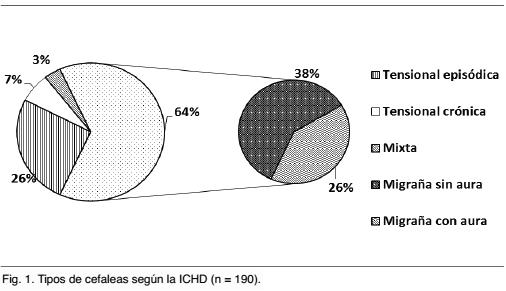
<body><![CDATA[<p class="txt" style="text-align: left; text-indent: 0cm; line-height: normal;" align="left"><span style="font-size: 10pt; font-family: Verdana;" lang="ES-TRAD"><o:p>&nbsp;</o:p></span></p>             <p class="Subt1" style="line-height: normal;"><span style="font-size: 10pt; font-family: Verdana; font-weight: normal;" lang="ES-TRAD">Resultados<o:p></o:p></span></p>             <p class="Subt1" style="line-height: normal;"><span style="font-size: 10pt; font-family: Verdana; font-weight: normal;" lang="ES-TRAD"><o:p>&nbsp;</o:p></span></p>             <p class="txt" style="text-align: left; text-indent: 0cm; line-height: normal;" align="left"><span style="font-size: 10pt; font-family: Verdana;" lang="ES-TRAD">En este per&iacute;odo 190 pacientes consultaron por cefaleas primarias, de los cuales un 63,9% (n = 121) cumpl&iacute;an criterio de migra&ntilde;a. La <a href="#graf_1">Gr&aacute;fica 1</a> muestra la distribuci&oacute;n del tipo de cefaleas clasificadas seg&uacute;n la ICHD. &nbsp;</span></p>          <p class="txt" style="text-align: left; text-indent: 0cm; line-height: normal;" align="left"><span style="font-size: 10pt; font-family: Verdana;" lang="ES-TRAD"></span></p>          <p class="txt" style="text-align: left; text-indent: 0cm; line-height: normal;" align="left"><span style="font-size: 10pt; font-family: Verdana;" lang="ES-TRAD"> &nbsp; &nbsp; &nbsp; &nbsp; &nbsp; &nbsp; &nbsp; &nbsp; &nbsp; &nbsp; &nbsp; &nbsp; &nbsp; &nbsp; &nbsp; &nbsp; &nbsp; &nbsp; &nbsp; &nbsp; &nbsp; &nbsp; &nbsp; &nbsp; &nbsp; &nbsp; &nbsp; &nbsp; &nbsp; &nbsp; &nbsp; &nbsp; &nbsp; &nbsp; &nbsp; &nbsp; &nbsp; &nbsp; &nbsp; &nbsp; &nbsp; &nbsp; &nbsp; &nbsp; &nbsp; &nbsp; &nbsp; &nbsp;&nbsp;</span></p>          <p class="txt" style="text-align: left; text-indent: 0cm; line-height: normal;" align="left"><span style="font-size: 10pt; font-family: Verdana;" lang="ES-TRAD"></span></p>           <p class="txt" style="text-align: left; text-indent: 0cm; line-height: normal;" align="left"><a name="graf_1"></a><img style="width: 506px; height: 291px;" alt="" src="/img/revistas/ami/v37n2/2a09g1.jpg">    <br>  </p>          <p class="txt" style="text-align: left; text-indent: 0cm; line-height: normal;" align="left"></p>           ]]></body>
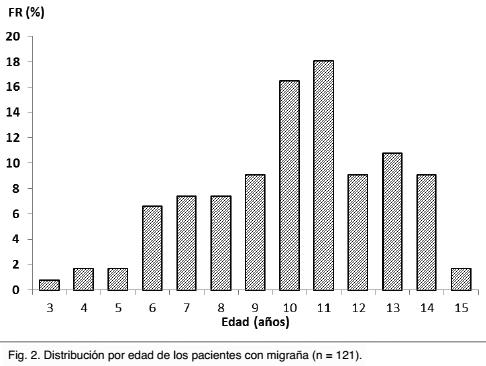
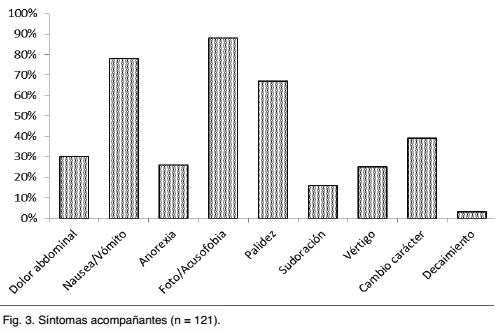
<body><![CDATA[<p class="txt" style="text-align: left; text-indent: 0cm; line-height: normal;" align="left"><span style="font-size: 10pt; font-family: Verdana;" lang="ES-TRAD"> <o:p></o:p></span></p>             <p class="txt" style="text-align: left; text-indent: 0cm; line-height: normal;" align="left"><span style="font-size: 10pt; font-family: Verdana;" lang="ES-TRAD">La migra&ntilde;a fue m&aacute;s frecuente en el sexo femenino (60%, n = 73), siendo esta diferencia estad&iacute;sticamente significativa (Chi-cuadrado </span><span style="font-size: 10pt; font-family: Verdana;" lang="ES-TRAD">p </span><span style="font-size: 10pt; font-family: Verdana;" lang="ES-TRAD">0,023). La media de edad de los ni&ntilde;os con migra&ntilde;a fue de 9,63 &plusmn; 2,78 a&ntilde;os (rango 3 a 15 a&ntilde;os), siendo para los varones de 9,5 &plusmn; 2,6 a&ntilde;os y para las ni&ntilde;as de 9,78 &plusmn; 2,9 a&ntilde;os. La <a href="#graf_2">Gr&aacute;fica 2</a> muestra la distribuci&oacute;n por edad de los pacientes. &nbsp; &nbsp;&nbsp;</span></p>          <p class="txt" style="text-align: left; text-indent: 0cm; line-height: normal;" align="left"><span style="font-size: 10pt; font-family: Verdana;" lang="ES-TRAD"></span></p>          <p class="txt" style="text-align: left; text-indent: 0cm; line-height: normal;" align="left"><span style="font-size: 10pt; font-family: Verdana;" lang="ES-TRAD">&nbsp; &nbsp; &nbsp; &nbsp; &nbsp; &nbsp; &nbsp; &nbsp; &nbsp; &nbsp; &nbsp; &nbsp; &nbsp; &nbsp; &nbsp; &nbsp; &nbsp; &nbsp; &nbsp; &nbsp; &nbsp; &nbsp; &nbsp; &nbsp; &nbsp; &nbsp; &nbsp; &nbsp; &nbsp; &nbsp; &nbsp; &nbsp; &nbsp; &nbsp; &nbsp;</span></p>           <p class="txt" style="text-align: left; text-indent: 0cm; line-height: normal;" align="left"><a name="graf_2"></a><img style="width: 486px; height: 366px;" alt="" src="/img/revistas/ami/v37n2/2a09g2.jpg"> &nbsp; &nbsp; &nbsp; &nbsp; &nbsp; &nbsp; &nbsp; &nbsp; &nbsp; &nbsp; &nbsp; &nbsp; &nbsp; &nbsp; &nbsp; &nbsp; &nbsp; &nbsp; &nbsp; &nbsp; &nbsp; &nbsp; &nbsp; &nbsp; &nbsp; &nbsp; &nbsp; &nbsp; &nbsp; &nbsp; &nbsp; &nbsp; &nbsp; &nbsp; &nbsp; &nbsp; &nbsp; &nbsp; &nbsp; &nbsp; &nbsp; &nbsp; &nbsp; &nbsp; &nbsp; &nbsp; &nbsp; &nbsp; &nbsp; &nbsp; &nbsp; &nbsp; &nbsp; &nbsp; &nbsp; &nbsp; &nbsp; &nbsp; &nbsp; &nbsp; &nbsp; &nbsp; &nbsp; &nbsp; &nbsp; &nbsp; &nbsp; &nbsp; &nbsp; &nbsp; &nbsp; &nbsp; &nbsp; &nbsp; &nbsp;&nbsp;</p>           <p class="txt" style="text-align: left; text-indent: 0cm; line-height: normal;" align="left"><span style="font-size: 10pt; font-family: Verdana;" lang="ES-TRAD"> <o:p></o:p></span></p>             <p class="txt" style="text-align: left; text-indent: 0cm; line-height: normal;" align="left"><span style="font-size: 10pt; font-family: Verdana;" lang="ES-TRAD">Un 66% de los ni&ntilde;os con migra&ntilde;a ten&iacute;an antecedente familiar de migra&ntilde;a. En un 80% se encontraron factores desencadenantes de las cefaleas, siendo los mismos: estr&eacute;s (47%), ejercicio f&iacute;sico (34%), alimentos (20%), exposici&oacute;n solar (38%), falta de sue&ntilde;o (8%) y en un 9% de las ni&ntilde;as se vincul&oacute; con el ciclo menstrual. Las cefaleas fueron predominantemente puls&aacute;tiles (60%), intensas (76%), localizadas m&aacute;s frecuentemente a nivel frontal (53%) tanto unilateral como bilateral, <span class="SpellE">retroocular</span> (12%) y <span class="SpellE">holocraneana</span> (11%), y de horas de duraci&oacute;n (88%). Todos los pacientes presentaron s&iacute;ntomas acompa&ntilde;antes, siendo los m&aacute;s frecuentes la foto y/o <span class="SpellE">acusofobia</span> (88%), las n&aacute;useas y/o v&oacute;mitos (78%) y la palidez (67%). La <a href="#graf_3">gr&aacute;fica 3</a> muestra la distribuci&oacute;n de los mismos. &nbsp;&nbsp;</span></p>          <p class="txt" style="text-align: left; text-indent: 0cm; line-height: normal;" align="left"><span style="font-size: 10pt; font-family: Verdana;" lang="ES-TRAD"></span></p>          <p class="txt" style="text-align: left; text-indent: 0cm; line-height: normal;" align="left"><span style="font-size: 10pt; font-family: Verdana;" lang="ES-TRAD">&nbsp; &nbsp; &nbsp; &nbsp; &nbsp; &nbsp; &nbsp; &nbsp; &nbsp; &nbsp; &nbsp; &nbsp; &nbsp; &nbsp; &nbsp; &nbsp; &nbsp; &nbsp; &nbsp; &nbsp; &nbsp; &nbsp; &nbsp; &nbsp; &nbsp; &nbsp; &nbsp; &nbsp; &nbsp; &nbsp; &nbsp; &nbsp; &nbsp; &nbsp; &nbsp; &nbsp; &nbsp; &nbsp; &nbsp; &nbsp; &nbsp; &nbsp; &nbsp; &nbsp; &nbsp; &nbsp; &nbsp; &nbsp; &nbsp; &nbsp; &nbsp; &nbsp; &nbsp; &nbsp; &nbsp; &nbsp;&nbsp;</span></p>           <p class="txt" style="text-align: left; text-indent: 0cm; line-height: normal;" align="left"><a name="graf_3"></a><img style="width: 497px; height: 334px;" alt="" src="/img/revistas/ami/v37n2/2a09g3.jpg">    ]]></body>
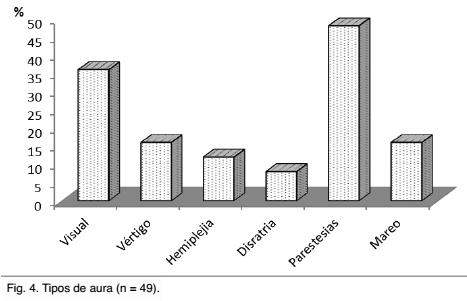
<body><![CDATA[<br>  &nbsp;&nbsp; &nbsp; &nbsp; &nbsp; &nbsp; &nbsp; &nbsp; &nbsp; &nbsp; &nbsp; &nbsp; &nbsp; &nbsp; &nbsp; &nbsp; &nbsp; &nbsp; &nbsp; &nbsp; &nbsp; &nbsp; &nbsp; &nbsp; &nbsp; &nbsp; &nbsp; &nbsp; &nbsp; &nbsp; &nbsp; &nbsp; &nbsp; &nbsp; &nbsp; &nbsp; &nbsp; &nbsp; &nbsp; &nbsp; &nbsp; &nbsp; &nbsp; &nbsp; &nbsp; &nbsp; &nbsp; &nbsp; &nbsp; &nbsp; &nbsp; &nbsp; &nbsp; &nbsp; &nbsp; &nbsp; &nbsp; &nbsp; &nbsp; &nbsp; &nbsp; &nbsp; &nbsp; &nbsp; &nbsp; &nbsp; &nbsp; &nbsp; &nbsp; &nbsp; &nbsp; &nbsp; &nbsp; &nbsp;&nbsp;</p>           <p class="txt" style="text-align: left; text-indent: 0cm; line-height: normal;" align="left"><span style="font-size: 10pt; font-family: Verdana;" lang="ES-TRAD"> <o:p></o:p></span></p>             <p class="txt" style="text-align: left; text-indent: 0cm; line-height: normal;" align="left"><span style="font-size: 10pt; font-family: Verdana;" lang="ES-TRAD">Un 40% (n = 49) de los pacientes con migra&ntilde;a presentaban migra&ntilde;a con aura. La <a href="#graf_4">Gr&aacute;fica 4</a> muestra la incidencia de los diferentes tipos de aura referidos por los pacientes.    <br>      &nbsp; &nbsp; &nbsp; &nbsp; &nbsp; &nbsp; &nbsp; &nbsp; &nbsp; &nbsp; &nbsp; &nbsp; &nbsp; &nbsp; &nbsp; &nbsp; &nbsp; &nbsp; &nbsp; &nbsp; &nbsp; &nbsp; &nbsp; &nbsp; &nbsp; &nbsp; &nbsp; &nbsp; &nbsp; &nbsp; &nbsp; &nbsp; &nbsp; &nbsp; &nbsp; &nbsp; &nbsp; &nbsp; &nbsp; &nbsp; &nbsp; &nbsp; &nbsp; &nbsp; &nbsp; &nbsp; &nbsp; &nbsp; &nbsp; &nbsp; &nbsp; &nbsp; &nbsp; &nbsp; &nbsp; &nbsp; &nbsp; &nbsp; &nbsp; &nbsp; &nbsp; &nbsp; &nbsp; &nbsp; &nbsp; &nbsp; &nbsp; &nbsp; &nbsp; &nbsp; &nbsp; &nbsp; &nbsp; &nbsp; &nbsp; &nbsp; &nbsp;</span></p>           <p class="txt" style="text-align: left; text-indent: 0cm; line-height: normal;" align="left"><a name="graf_4"></a><img style="width: 467px; height: 301px;" alt="" src="/img/revistas/ami/v37n2/2a09g4.jpg"> &nbsp; &nbsp; &nbsp; &nbsp; &nbsp; &nbsp; &nbsp; &nbsp; &nbsp; &nbsp; &nbsp; &nbsp; &nbsp; &nbsp; &nbsp; &nbsp; &nbsp; &nbsp; &nbsp; &nbsp; &nbsp; &nbsp; &nbsp; &nbsp; &nbsp; &nbsp; &nbsp; &nbsp; &nbsp; &nbsp; &nbsp; &nbsp; &nbsp; &nbsp; &nbsp; &nbsp; &nbsp; &nbsp; &nbsp; &nbsp; &nbsp; &nbsp; &nbsp; &nbsp; &nbsp; &nbsp; &nbsp; &nbsp; &nbsp; &nbsp; &nbsp; &nbsp; &nbsp; &nbsp; &nbsp; &nbsp; &nbsp; &nbsp; &nbsp; &nbsp; &nbsp; &nbsp; &nbsp; &nbsp; &nbsp; &nbsp; &nbsp; &nbsp; &nbsp; &nbsp; &nbsp; &nbsp; &nbsp; &nbsp; &nbsp; &nbsp; &nbsp; &nbsp;&nbsp;</p>              <p class="txt" style="text-align: left; text-indent: 0cm; line-height: normal;" align="left"><span style="font-size: 10pt; font-family: Verdana;" lang="ES-TRAD">Un 48% de los pacientes con migra&ntilde;a (n = 58) fueron tratados con TPM. En un peque&ntilde;o grupo de pacientes se opt&oacute; por usar tratamiento preventivo con Di <span class="SpellE">valproato</span> de sodio (n&nbsp;= 3) o con <span class="SpellE">Amitriptilina</span> (n = 4) dado la presencia de comorbilidad psiqui&aacute;trica o por asociar epilepsia. El TPM fue eficaz en un 89,6% (n = 52) de los pacientes, lo que fue estad&iacute;sticamente significativo (Chi-cuadrado </span><span style="font-size: 10pt; font-family: Verdana;" lang="ES-TRAD">p </span><span style="font-size: 10pt; font-family: Verdana;" lang="ES-TRAD">&lt; 0,001). En 2 pacientes no hubo respuesta al tratamiento y en 4 se debi&oacute; suspender por efectos secundarios (gastrointestinales, fatiga, debilidad muscular, trastornos <span class="SpellE">mn&eacute;sicos</span>, dificultad en la evocaci&oacute;n de palabras). Los efectos adversos revirtieron con la suspensi&oacute;n del tratamiento. Si bien los pacientes no fueron pesados sistem&aacute;ticamente, un 10% refiri&oacute; un discreto descenso de peso, pero que no requiri&oacute; suspensi&oacute;n del tratamiento. Destacamos que en los casos en que el tratamiento fue eficaz el mismo se prolong&oacute; durante 6 a 12 meses, siendo luego suspendido, con buena evoluci&oacute;n.<o:p></o:p></span></p>             <p class="txt" style="text-align: left; text-indent: 0cm; line-height: normal;" align="left"><span style="font-size: 10pt; font-family: Verdana;" lang="ES-TRAD"><o:p>&nbsp;</o:p></span></p>             <p class="Subt1" style="line-height: normal;"><span style="font-size: 10pt; font-family: Verdana; font-weight: normal;" lang="ES-TRAD">Discusi&oacute;n y comentarios<o:p></o:p></span></p>             <p class="txt" style="text-align: left; text-indent: 0cm; line-height: normal;" align="left"><span style="font-size: 10pt; font-family: Verdana;" lang="ES-TRAD"><o:p>&nbsp;</o:p></span></p>             <p class="txt" style="text-align: left; text-indent: 0cm; line-height: normal;" align="left"><span style="font-size: 10pt; font-family: Verdana;" lang="ES-TRAD">La migra&ntilde;a sin aura fue el tipo de cefalea m&aacute;s frecuente, lo que coincide con los datos de la <span class="GramE">literatura<sup><a name="-14"></a>(</sup></span><sup><a href="#4">4</a>,<a href="#14">14</a>)</sup>. La migra&ntilde;a fue m&aacute;s frecuente en las mujeres que en los varones, no existiendo diferencias en el promedio de edad entre ambos sexos. Estudios epidemiol&oacute;gicos muestran que la migra&ntilde;a predomina en varones antes de los 12 a&ntilde;os y en mujeres a partir de esa <span class="GramE">edad<sup>(</sup></span><sup><a href="#3">3</a>,<a href="#4">4</a>,<a href="#7">7</a>,<a href="#8">8</a>)</sup>.<o:p></o:p></span></p>             ]]></body>
<body><![CDATA[<p class="txt" style="text-align: left; text-indent: 0cm; line-height: normal;" align="left"><span style="font-size: 10pt; font-family: Verdana;" lang="ES-TRAD">Los pacientes con migra&ntilde;a presentaron en un 66% antecedente familiar de migra&ntilde;a, al igual que en la bibliograf&iacute;a, donde el antecedente familiar se presenta en un 26-90%<sup><a name="-15"></a><a name="-16"></a>(<a href="#14">14-16</a>)</sup>. Como ya ha sido <span class="SpellE">descripto</span> previamente, los pacientes con migra&ntilde;a presentaron m&aacute;s frecuentemente cefaleas unilaterales, <span class="SpellE">retroorbitarias</span>, <span class="SpellE">puls&aacute;tiles</span> e intensas, acompa&ntilde;adas de n&aacute;useas / v&oacute;mitos y fotofobia / <span class="SpellE">acusofobia</span> y <span class="GramE">palidez<sup>(</sup></span><sup><a href="#14">14</a>)</sup>. El estr&eacute;s fue el principal factor desencadenante, al igual que en otras <span class="GramE">series<sup><a name="-17"></a>(</sup></span><sup><a href="#17">17</a>)</sup>. En los pacientes con migra&ntilde;a el ejercicio, la exposici&oacute;n solar y los alimentos fueron otros factores desencadenantes frecuentemente <span class="GramE">encontrados<sup>(</sup></span><sup><a href="#14">14</a>)</sup>. En 20% de los pacientes con migra&ntilde;a no se encontraron factores desencadenantes. En la literatura los desencadenantes m&aacute;s frecuentes son el estr&eacute;s, la <span class="SpellE">deprivaci&oacute;n</span> de sue&ntilde;o, el uso de videojuegos, la exposici&oacute;n solar, las luces y los sonidos, el ejercicio, el ayuno y alimentos como bebidas cola y chocolate<sup>(<a href="#8">8</a>,<a href="#14">14</a>,<a href="#17">17</a>)</sup>. <o:p></o:p></span></p>             <p class="txt" style="text-align: left; text-indent: 0cm; line-height: normal;" align="left"><span style="font-size: 10pt; font-family: Verdana;" lang="ES-TRAD">El tratamiento preventivo con TPM result&oacute; eficaz en un 89.6% de los ni&ntilde;os, no fue eficaz en 2 ni&ntilde;os y en 4 se debi&oacute; suspender por efectos secundarios que revirtieron con la suspensi&oacute;n. Se observ&oacute; un discreto descenso de peso en un 10% de los ni&ntilde;os que no requiri&oacute; suspensi&oacute;n del tratamiento. El TPM es un f&aacute;rmaco antiepil&eacute;ptico que ha demostrado, tanto en adultos como en ni&ntilde;os, ser eficaz para el tratamiento de las migra&ntilde;as, determinando una reducci&oacute;n de la frecuencia, severidad y duraci&oacute;n de las cefaleas, y mejor&iacute;a en los escores de <span class="GramE">discapacidad<sup><a name="-18"></a><a name="-19"></a><a name="-20"></a>(</sup></span><sup><a href="#7">7</a>,<a href="#18">18-20</a>)</sup>. En adultos los <span class="SpellE">metaan&aacute;lisis</span> <span class="SpellE">Cochrane</span> mostraron que es eficaz y seguro como tratamiento profil&aacute;ctico de la<span style="">&nbsp; </span>migra&ntilde;a <span class="GramE">epis&oacute;dica<sup><a name="-21"></a>(</sup></span><sup><a href="#21">21</a>)</sup>. La FDA aprob&oacute; su uso para la migra&ntilde;a en adolescentes de 12 a 17 a&ntilde;os<sup><a name="-22"></a>(<a href="#22">22</a>)</sup>. Se plantea que juega un rol en la regulaci&oacute;n auton&oacute;mica <span class="SpellE"><span class="GramE">cerebrovascular<a name="-23"></a></span></span><span class="GramE"><sup>(</sup></span><sup><a href="#23">23</a>)</sup>. Los trabajos muestran que es seguro y bien tolerado, sin evidenciar efectos adversos severos y no se ha demostrado una reducci&oacute;n de peso <span class="GramE">significativa<sup>(</sup></span><sup><a href="#7">7</a>,<a href="#18">18</a>)</sup>. Su eficacia y seguridad es similar a la de la <span class="SpellE">flunarizina</span> y el <span class="SpellE">propanolol</span>, otros dos f&aacute;rmacos que se usan de primera l&iacute;nea en el tratamiento de la <span class="GramE">migra&ntilde;a<sup><a name="-24"></a><a name="-25"></a>(</sup></span><sup><a href="#24">24</a>,<a href="#25">25</a>)</sup>. La dosis de TPM que ha mostrado ser eficaz como tratamiento preventivo tanto en ni&ntilde;os como en adultos, con escasos efectos adversos es hasta 100mg al d&iacute;a, ya que dosis superiores no han mostrado mejor&iacute;a en la respuesta existiendo mayor riesgo de efectos adversos y abandono del <span class="GramE">tratamiento<sup><a name="-26"></a><a name="-27"></a><a name="-28"></a><a name="-29"></a>(</sup></span><sup><a href="#7">7</a>,<a href="#25">25-29</a>)</sup>. Dentro de los efectos adversos del TPM los m&aacute;s frecuentes son las infecciones respiratorias altas, dolor abdominal, mareos y parestesias que se observan hasta en un 51% de los <span class="GramE">pacientes<sup>(</sup></span><sup><a href="#7">7</a>,<a href="#29">29</a>)</sup>. La mayor&iacute;a de los efectos adversos se observan en los 2 primeros meses de inicio del tratamiento y para evitar su aparici&oacute;n se debe realizar su titulaci&oacute;n en forma <span class="GramE">lenta<sup>(</sup></span><sup><a href="#9">9</a>,<a href="#29">29</a>)</sup>. Si bien ha sido demostrado en pacientes epil&eacute;pticos que el TPM a 400&nbsp;<span class="SpellE">mg</span> al d&iacute;a produce un <span class="SpellE">enlentecimiento</span> en la velocidad de procesamiento mental y de la fluencia verbal, esto no ha sido encontrado en los pacientes con tratamiento profil&aacute;ctico para la cefalea, probablemente debido a que las dosis son m&aacute;s bajas y que la titulaci&oacute;n es m&aacute;s <span class="GramE">lenta<sup>(</sup></span><sup><a href="#29">29</a>)</sup>. En algunos trabajos han sido descriptos dificultad en la atenci&oacute;n, en la memoria y en el pensamiento, pero sin haberse realizado evaluaciones <span class="SpellE">neuropsicol&oacute;gicas</span> <span class="GramE">formales<sup>(</sup></span><sup><a href="#18">18</a>)</sup>. Respecto de los posibles efectos secundarios urinarios, se ha visto que la frecuencia de c&aacute;lculos urinarios en los pacientes con migra&ntilde;a es mayor que en la poblaci&oacute;n general, independiente del tratamiento con <span class="GramE">TPM<sup><a name="-30"></a>(</sup></span><sup><a href="#30">30</a>)</sup>. En nuestros pacientes el tratamiento preventivo se continu&oacute; durante 6 a 12 meses. En la literatura no est&aacute; claro cu&aacute;nto tiempo se deber&iacute;a continuar ya que se ha visto que la suspensi&oacute;n luego de 6 meses de tratamiento puede determinar un aumento en el n&uacute;mero de d&iacute;as con migra&ntilde;a, en el uso de medicamentos abortivos y una disminuci&oacute;n en la calidad de vida de los <span class="GramE">paciente<sup><a name="-31"></a>(</sup></span><sup><a href="#31">31</a>)</sup>.<o:p></o:p></span></p>             <p class="txt" style="text-align: left; text-indent: 0cm; line-height: normal;" align="left"><span style="font-size: 10pt; font-family: Verdana;" lang="ES-TRAD">En conclusi&oacute;n el TPM es un f&aacute;rmaco seguro y eficaz en el tratamiento de la migra&ntilde;a en ni&ntilde;os. <o:p></o:p></span></p>             <p class="txt" style="text-align: left; text-indent: 0cm; line-height: normal;" align="left"><span style="font-size: 10pt; font-family: Verdana;" lang="ES-TRAD"><o:p>&nbsp;</o:p></span></p>             <p class="txt" style="text-align: left; line-height: normal;" align="left"><span style="font-size: 10pt; font-family: Verdana;" lang="ES-TRAD"><o:p>&nbsp;</o:p></span></p>             <p class="Subt1" style="line-height: normal;"><span style="font-size: 10pt; font-family: Verdana; font-weight: normal;" lang="EN-US">Bibliograf&iacute;a<o:p></o:p></span></p>             <p class="txt" style="text-align: left; line-height: normal;" align="left"><span style="font-size: 10pt; font-family: Verdana;" lang="EN-US"><o:p>&nbsp;</o:p></span></p>             <!-- ref --><p class="Bibliog" style="margin-left: 36pt; text-align: left; text-indent: -36pt; line-height: normal;" align="left"><span style="font-size: 10pt; font-family: Verdana;" lang="EN-US"><a name="1"></a><a href="#-1">1</a>. <span style="">&nbsp;&nbsp;&nbsp;&nbsp;&nbsp; </span><span class="SpellE">Kernick</span> D, Reinhold D, Campbell J L. Impact of headache on young people in a school population. Br J Gen <span class="SpellE">Pract</span> 2009<span class="GramE">;59:678</span>-81.    <o:p></o:p></span></p>             <!-- ref --><p class="Bibliog" style="margin-left: 36pt; text-align: left; text-indent: -36pt; line-height: normal;" align="left"><span style="font-size: 10pt; font-family: Verdana;" lang="EN-US"><a name="2"></a><a href="#-2">2</a>. <span style="">&nbsp;&nbsp;&nbsp;&nbsp;&nbsp; </span>Lewis D W. Pediatric migraine. <span class="SpellE">Neurol</span> <span class="SpellE">Clin</span> 2009<span class="GramE">;27:481</span>-501.    <o:p></o:p></span></p>             <!-- ref --><p class="Bibliog" style="margin-left: 36pt; text-align: left; text-indent: -36pt; line-height: normal;" align="left"><span class="GramE"><span style="font-size: 10pt; font-family: Verdana;" lang="EN-US"><a name="3"></a><a href="#-3">3</a>. <span style="">&nbsp;&nbsp;&nbsp;&nbsp;&nbsp; </span>Hershey A D</span></span><span style="font-size: 10pt; font-family: Verdana;" lang="EN-US">, Winner P K. Pediatric migraine: recognition and treatment. J Am Osteopath Assoc 2005<span class="GramE">;105:2S</span>-8S.    <o:p></o:p></span></p>             <!-- ref --><p class="Bibliog" style="margin-left: 36pt; text-align: left; text-indent: -36pt; line-height: normal;" align="left"><span style="font-size: 10pt; font-family: Verdana;" lang="EN-US"><a name="4"></a><a href="#-4">4</a>. <span style="">&nbsp;&nbsp;&nbsp;&nbsp;&nbsp; </span>Abu-<span class="SpellE">Arefeh</span> I, Russell G. Prevalence of headache and migraine in schoolchildren. BMJ 1994<span class="GramE">;309:765</span>-9.    <o:p></o:p></span></p>             <!-- ref --><p class="Bibliog" style="margin-left: 36pt; text-align: left; text-indent: -36pt; line-height: normal;" align="left"><span style="font-size: 10pt; font-family: Verdana;" lang="EN-US"><a name="5"></a><a href="#-5">5</a>. <span style="">&nbsp;&nbsp;&nbsp;&nbsp;&nbsp; </span>Powers SW, Patton SR, <span class="SpellE">Hommel</span> KA, Hershey AD. Quality of life in childhood migraines: clinical impact and comparison to other chronic illnesses. Pediatrics 2003<span class="GramE">;112:e1</span>-5.     <o:p></o:p></span></p>             <!-- ref --><p class="Bibliog" style="margin-left: 36pt; text-align: left; text-indent: -36pt; line-height: normal;" align="left"><span style="font-size: 10pt; font-family: Verdana;" lang="EN-US"><a name="6"></a><a href="#-6">6</a>. <span style="">&nbsp;&nbsp;&nbsp;&nbsp;&nbsp; </span>Headache Classification Committee of the International Headache Society (IHS). The International Classification of Headaches Disorders, 3rd edition (beta version). <span class="SpellE">Cephalalgia</span> 2013<span class="GramE">;33:629</span>-808<o:p></o:p></span><!-- ref --><p class="Bibliog" style="margin-left: 36pt; text-align: left; text-indent: -36pt; line-height: normal;" align="left"><span style="font-size: 10pt; font-family: Verdana;" lang="EN-US"><a name="7"></a><a href="#-7">7</a>. <span style="">&nbsp;&nbsp;&nbsp;&nbsp;&nbsp; </span>Lewis D, Winner P, <span class="SpellE">Saper</span> J, Ness S, <span class="SpellE">Polverejan</span> E, Wang S, et al. Randomized, double-blind, placebo-controlled study to evaluate the efficacy and safety of <span class="SpellE">topiramate</span> for migraine prevention in pediatric subjects 12 to 17 years of age. Pediatrics 2009<span class="GramE">;123:924</span>-34.    <o:p></o:p></span></p>             ]]></body>
<body><![CDATA[<!-- ref --><p class="Bibliog" style="margin-left: 36pt; text-align: left; text-indent: -36pt; line-height: normal;" align="left"><span style="font-size: 10pt; font-family: Verdana;" lang="EN-US"><a name="8"></a><a href="#-8">8</a>. <span style="">&nbsp;&nbsp;&nbsp;&nbsp;&nbsp; </span>Lewis D W, <span class="SpellE">Yonker</span> M, Winner P, Sowell M. <span class="GramE">The treatment of pediatric migraine.</span> <span class="SpellE">Pediatr</span> Ann 2005<span class="GramE">;34:448</span>-60.    <o:p></o:p></span></p>             <!-- ref --><p class="Bibliog" style="margin-left: 36pt; text-align: left; text-indent: -36pt; line-height: normal;" align="left"><span style="font-size: 10pt; font-family: Verdana;" lang="EN-US"><a name="9"></a><a href="#-9">9</a>. <span style="">&nbsp;&nbsp;&nbsp;&nbsp;&nbsp; </span><span class="SpellE">Schurks</span> M, <span class="SpellE">Diener</span> H C, <span class="SpellE">Goadsby</span> P. Update on the prophylaxis of migraine. <span class="SpellE">Curr</span> Treat Options <span class="SpellE">Neurol</span> 2008<span class="GramE">;10:20</span>-9.    <o:p></o:p></span></p>             <!-- ref --><p class="Bibliog" style="margin-left: 36pt; text-align: left; text-indent: -36pt; line-height: normal;" align="left"><span style="font-size: 10pt; font-family: Verdana;" lang="EN-US"><a name="10"></a><a href="#-10">10</a>.<span style="">&nbsp;&nbsp;&nbsp;&nbsp; </span><span class="SpellE">Wasiewski</span> W <span class="SpellE">W</span>. Preventive therapy in pediatric migraine. J Child <span class="SpellE">Neurol</span> 2001<span class="GramE">;16:71</span>-8.    <o:p></o:p></span></p>             <!-- ref --><p class="Bibliog" style="margin-left: 36pt; text-align: left; text-indent: -36pt; line-height: normal;" align="left"><span style="font-size: 10pt; font-family: Verdana;" lang="EN-US"><a name="11"></a><a href="#-11">11</a>.<span style="">&nbsp;&nbsp;&nbsp;&nbsp; </span>Lewis D W, Winner P. The pharmacological treatment options for pediatric migraine: an evidence-based appraisal. <span class="SpellE">Neuro</span> Rx 2006<span class="GramE">;3:181</span>-91.    <o:p></o:p></span></p>             <!-- ref --><p class="Bibliog" style="margin-left: 36pt; text-align: left; text-indent: -36pt; line-height: normal;" align="left"><span style="font-size: 10pt; font-family: Verdana;" lang="EN-US"><a name="12"></a><a href="#-12">12</a>.<span style="">&nbsp;&nbsp;&nbsp;&nbsp; </span><span class="SpellE">Schiapparelli</span> P, <span class="SpellE">Allais</span> G, <span class="SpellE">Castagnoli</span> <span class="SpellE">Gabellari</span> I, Rolando S, <span class="SpellE">Terzi</span> M G, <span class="SpellE">Benedetto</span> C. Non-pharmacological approach to migraine prophylaxis: part II. <span class="SpellE">Neurol</span> <span class="SpellE">Sci</span> 2010<span class="GramE">;31</span> <span class="SpellE">Suppl</span> 1:S137-9.    <o:p></o:p></span></p>             ]]></body>
<body><![CDATA[<!-- ref --><p class="Bibliog" style="margin-left: 36pt; text-align: left; text-indent: -36pt; line-height: normal;" align="left"><span style="font-size: 10pt; font-family: Verdana;" lang="EN-US"><a name="13"></a><a href="#-13">13</a>.<span style="">&nbsp;&nbsp;&nbsp;&nbsp; </span>Headache Classification Subcommittee of the International Headache Society. The International Classification of Headache Disorders: 2nd edition. <span class="SpellE">Cephalalgia</span> 2004<span class="GramE">;24</span> <span class="SpellE">Suppl</span> 1:9-160.    <o:p></o:p></span></p>             <!-- ref --><p class="Bibliog" style="margin-left: 36pt; text-align: left; text-indent: -36pt; line-height: normal;" align="left"><span style="font-size: 10pt; font-family: Verdana;" lang="EN-US"><a name="14"></a><a href="#-14">14</a>.<span style="">&nbsp;&nbsp;&nbsp;&nbsp; </span><span class="SpellE">Unalp</span> A, <span class="SpellE">Dirik</span> E, <span class="SpellE">Kurul</span> S. Prevalence and clinical findings of migraine and tension-type headache in adolescents. <span class="SpellE">Pediatr</span> <span class="SpellE">Int</span> 2007<span class="GramE">;49:943</span>-9.    <o:p></o:p></span></p>             <!-- ref --><p class="Bibliog" style="margin-left: 36pt; text-align: left; text-indent: -36pt; line-height: normal;" align="left"><span style="font-size: 10pt; font-family: Verdana;" lang="EN-US"><a name="15"></a><a href="#-15">15</a>.<span style="">&nbsp;&nbsp;&nbsp;&nbsp; </span>Gupta R, Bhatia M S. Comparison of clinical characteristics of migraine and tension type headache. </span><span class="SpellE"><span style="font-size: 10pt; font-family: Verdana;">Indian</span></span><span style="font-size: 10pt; font-family: Verdana;"> J <span class="SpellE">Psychiatry</span> 2011<span class="GramE">;53:134</span>-9.    <o:p></o:p></span></p>             <!-- ref --><p class="Bibliog" style="margin-left: 36pt; text-align: left; text-indent: -36pt; line-height: normal;" align="left"><span style="font-size: 10pt; font-family: Verdana;"><a name="16"></a><a href="#-16">16</a>.<span style="">&nbsp;&nbsp;&nbsp;&nbsp; </span>Di <span class="SpellE">Blasi</span> A, Arroyo H, <span class="SpellE">Fejerman</span> N. Cefaleas y migra&ntilde;as. En: <span class="SpellE">Fejerman</span> <span class="SpellE">N.Fern&aacute;ndez</span> <span class="SpellE">Alvarez</span> E, editores. </span><span class="SpellE"><span style="font-size: 10pt; font-family: Verdana;" lang="EN-US">Neurolog&iacute;a</span></span><span style="font-size: 10pt; font-family: Verdana;" lang="EN-US"> <span class="SpellE">Pedi&aacute;trica</span>, <st1:city w:st="on"><st1:place w:st="on">Buenos Aires</st1:place></st1:city>: <span class="SpellE">M&eacute;dica</span> <span class="SpellE">Panamericana</span>; 2007. p. 675-90.    <o:p></o:p></span></p>             <!-- ref --><p class="Bibliog" style="margin-left: 36pt; text-align: left; text-indent: -36pt; line-height: normal;" align="left"><span style="font-size: 10pt; font-family: Verdana;" lang="EN-US"><a name="17"></a><a href="#-17">17</a>.<span style="">&nbsp;&nbsp;&nbsp;&nbsp; </span><span class="SpellE">Neut</span> D, <span class="SpellE">Fily</span> A, <span class="SpellE">Cuvellier</span> J C, <span class="SpellE">Vallee</span> L. The prevalence of triggers in <span class="SpellE">paediatric</span> migraine: a questionnaire study in 102 children and adolescents. J Headache Pain 2012<span class="GramE">;13:61</span>-5.    <o:p></o:p></span></p>             ]]></body>
<body><![CDATA[<!-- ref --><p class="Bibliog" style="margin-left: 36pt; text-align: left; text-indent: -36pt; line-height: normal;" align="left"><span style="font-size: 10pt; font-family: Verdana;" lang="EN-US"><a name="18"></a><a href="#-18">18</a>.<span style="">&nbsp;&nbsp;&nbsp;&nbsp; </span>Hershey A D, Powers S W, <span class="SpellE">Vockell</span> A L, <span class="SpellE">LeCates</span> S, <span class="SpellE">Kabbouche</span> M. Effectiveness of <span class="SpellE">topiramate</span> in the prevention of childhood headaches. Headache 2002<span class="GramE">;42:810</span>-8.    <o:p></o:p></span></p>             <!-- ref --><p class="Bibliog" style="margin-left: 36pt; text-align: left; text-indent: -36pt; line-height: normal;" align="left"><span style="font-size: 10pt; font-family: Verdana;" lang="EN-US"><a name="19"></a><a href="#-19">19</a>.<span style="">&nbsp;&nbsp;&nbsp;&nbsp; </span>Deaton TL, Mauro LS. <span class="SpellE"><span class="GramE">Topiramate</span></span><span class="GramE"> for migraine prophylaxis in pediatric patients.</span> Ann <span class="SpellE">Pharmacother</span>&nbsp;2014<span class="GramE">;48:638</span>-43.    <span style="">&nbsp;&nbsp; </span><o:p></o:p></span></p>             <!-- ref --><p class="Bibliog" style="margin-left: 36pt; text-align: left; text-indent: -36pt; line-height: normal;" align="left"><span style="font-size: 10pt; font-family: Verdana;" lang="EN-US"><a name="20"></a><a href="#-20">20</a>.<span style="">&nbsp;&nbsp;&nbsp;&nbsp; </span><span class="SpellE">Fallah</span> R, <span class="SpellE">Akhavan</span> <span class="SpellE">Karbasi</span> S, <span class="SpellE">Shajari</span> A, <span class="SpellE">Fromandi</span> M. <span class="GramE">The efficacy and safety of <span class="SpellE">topiramate</span> for prophylaxis of migraine in children.</span> <st1:country-region w:st="on"><st1:place w:st="on">Iran</st1:place></st1:country-region> J Child <span class="SpellE">Neurol</span> 2013<span class="GramE">;7</span>(4):7-11.     <o:p></o:p></span></p>             <!-- ref --><p class="Bibliog" style="margin-left: 36pt; text-align: left; text-indent: -36pt; line-height: normal;" align="left"><span style="font-size: 10pt; font-family: Verdana;" lang="EN-US"><a name="21"></a><a href="#-21">21</a>.<span style="">&nbsp;&nbsp;&nbsp;&nbsp; </span><span class="SpellE">Mulleners</span> WM, <st1:place w:st="on"><st1:city w:st="on"><span class="SpellE">McCrory</span></st1:city> <st1:state w:st="on">DC</st1:state></st1:place>, <span class="SpellE">Linde</span> M. <span class="SpellE">Antiepileptics</span> in migraine prophylaxis: an updated Cochrane review. <span class="SpellE">Cephalalgia</span> 2015<span class="GramE">;35:51</span>-62 <o:p></o:p></span><!-- ref --><p class="Bibliog" style="margin-left: 36pt; text-align: left; text-indent: -36pt; line-height: normal;" align="left"><span style="font-size: 10pt; font-family: Verdana;" lang="EN-US"><a name="22"></a><a href="#-22">22</a>.<span style="">&nbsp;&nbsp;&nbsp;&nbsp; </span>FDA News release [en <span class="SpellE">l&iacute;nea</span>]. Silver Spring: <st1:country-region w:st="on"><st1:place w:st="on">U.S.</st1:place></st1:country-region> Food and Drug Administration, 2014 [<span class="SpellE">acceso</span> 31 <span class="SpellE">Enero</span> 2015]. Walsh S. FDA approves <span class="SpellE">Topamax</span> for migraine prevention in adolescents. </span><span style="font-size: 10pt; font-family: Verdana;">Disponible en: http://www.fda.gov/newsevents/newsroom/pressannouncements/ucm391026.htm <o:p></o:p></span><!-- ref --><p class="Bibliog" style="margin-left: 36pt; text-align: left; text-indent: -36pt; line-height: normal;" align="left"><span style="font-size: 10pt; font-family: Verdana;" lang="EN-US"><a name="23"></a><a href="#-23">23</a>.<span style="">&nbsp;&nbsp;&nbsp;&nbsp; </span> <span class="SpellE">Karadas</span> O,&nbsp;<span class="SpellE">Gul</span> HL,&nbsp;<span class="SpellE">Ozturk</span> B,&nbsp;<span class="SpellE">Eroglu</span> E,&nbsp;<span class="SpellE">Demirkaya</span> S. <span class="GramE">The effects of <span class="SpellE">topiramate</span> therapy on cerebral metabolism in migraine with aura patients.</span> Turk <span class="SpellE">Neurosurg</span> 2014<span class="GramE">;24:704</span>-9 <o:p></o:p></span><!-- ref --><p class="Bibliog" style="margin-left: 36pt; text-align: left; text-indent: -36pt; line-height: normal;" align="left"><span style="font-size: 10pt; font-family: Verdana;" lang="EN-US"><a name="24"></a><a href="#-24">24</a>.<span style="">&nbsp;&nbsp;&nbsp;&nbsp; </span>Kim H, <span class="SpellE">Byun</span> SH, Kim JS, Lim BC, <span class="SpellE">Chae</span> JH, <span class="SpellE">Choi</span> J, et al. Comparison of <span class="SpellE">flunarizine</span> and <span class="SpellE">topiramate</span> for the prophylaxis of pediatric migraine. <span class="SpellE">Eur</span> J <span class="SpellE">Pediatr</span> <span class="SpellE">Neurol</span> 2013<span class="GramE">;17:45</span>-9 <o:p></o:p></span><!-- ref --><p class="Bibliog" style="margin-left: 36pt; text-align: left; text-indent: -36pt; line-height: normal;" align="left"><span style="font-size: 10pt; font-family: Verdana;" lang="EN-US"><a name="25"></a><a href="#-25">25</a>.<span style="">&nbsp;&nbsp;&nbsp;&nbsp; </span><span class="SpellE">Diener</span> H C, <span class="SpellE">Tfelt</span>-Hansen P, <span class="SpellE">Dahlof</span> C, <span class="SpellE">Lainez</span> M J, <span class="SpellE">Sandrini</span> G, Wang S J, et al. <span class="SpellE">Topiramate</span> in migraine prophylaxis--results from a placebo-controlled trial with <span class="SpellE">propranolol</span> as an active control.</span><span style="font-size: 10pt; font-family: Verdana;" lang="EN-US"> </span><span style="font-size: 10pt; font-family: Verdana;" lang="EN-US">J <span class="SpellE">Neurol</span> 2004<span class="GramE">;251:943</span>-50.    <o:p></o:p></span></p>             <!-- ref --><p class="Bibliog" style="margin-left: 36pt; text-align: left; text-indent: -36pt; line-height: normal;" align="left"><span style="font-size: 10pt; font-family: Verdana;" lang="EN-US"><a name="26"></a><a href="#-26">26</a>.<span style="">&nbsp;&nbsp;&nbsp;&nbsp; </span><span class="SpellE">Bussone</span> G, <span class="SpellE">Diener</span> H C, <span class="SpellE"><span class="GramE">Pfeil</span></span> J, <span class="SpellE">Schwalen</span> S. <span class="SpellE">Topiramate</span> 100 mg/day in migraine prevention: a pooled analysis of double-blind <span class="SpellE">randomised</span> controlled trials. <span class="SpellE">Int</span> J <span class="SpellE">Clin</span> <span class="SpellE">Pract</span> 2005<span class="GramE">;59:961</span>-8.    <o:p></o:p></span></p>             <!-- ref --><p class="Bibliog" style="margin-left: 36pt; text-align: left; text-indent: -36pt; line-height: normal;" align="left"><span style="font-size: 10pt; font-family: Verdana;" lang="EN-US"><a name="27"></a><a href="#-27">27</a>.<span style="">&nbsp;&nbsp;&nbsp;&nbsp;&nbsp; </span><span class="SpellE">Brandes</span> J L, <span class="SpellE">Saper</span> J R, Diamond M, Couch J R, Lewis D W, Schmitt J, et al. <span class="SpellE">Topiramate</span> for migraine prevention: a randomized controlled trial. JAMA 2004<span class="GramE">;291:965</span>-73.    <o:p></o:p></span></p>             <!-- ref --><p class="Bibliog" style="margin-left: 36pt; text-align: left; text-indent: -36pt; line-height: normal;" align="left"><span style="font-size: 10pt; font-family: Verdana;" lang="EN-US"><a name="28"></a><a href="#-28">28</a>.<span style="">&nbsp;&nbsp;&nbsp;&nbsp; </span>Winner P, Pearlman E M, Linder S L, Jordan D M, Fisher A C, <span class="SpellE">Hulihan</span> J. <span class="SpellE">Topiramate</span> for migraine prevention in children: a randomized, double-blind, placebo-controlled trial. Headache 2005<span class="GramE">;45:1304</span>-12.    <o:p></o:p></span></p>             <!-- ref --><p class="Bibliog" style="margin-left: 36pt; text-align: left; text-indent: -36pt; line-height: normal;" align="left"><span class="GramE"><span style="font-size: 10pt; font-family: Verdana;" lang="EN-US"><a name="29"></a><a href="#-29">29</a>.<span style="">&nbsp;&nbsp;&nbsp;&nbsp; </span>Silberstein S D. <span class="SpellE">Topiramate</span> in migraine prevention.</span></span><span style="font-size: 10pt; font-family: Verdana;" lang="EN-US"> Headache 2005<span class="GramE">;45</span> <span class="SpellE">Suppl</span> 1:S57-65.    <o:p></o:p></span></p>             ]]></body>
<body><![CDATA[<!-- ref --><p class="Bibliog" style="margin-left: 36pt; text-align: left; text-indent: -36pt; line-height: normal;" align="left"><span style="font-size: 10pt; font-family: Verdana;" lang="EN-US"><a name="30"></a><a href="#-30">30</a>.<span style="">&nbsp;&nbsp;&nbsp;&nbsp; </span>Tsai MJ, <st1:place w:st="on"><st1:city w:st="on">Chen</st1:city> <st1:state w:st="on">YT</st1:state></st1:place>, <span class="SpellE">Ou</span> SM, Shin CJ, Pen KP, Tang CH, et al. Increased risk of urinary calculi in <span class="SpellE">patiemts</span> with migraine: A nationwide cohort study. <span class="SpellE">Cephalalgia</span> 2014<span class="GramE">;35:652</span>-61<o:p></o:p></span><!-- ref --><p class="MsoNormal" style="margin-left: 36pt; text-indent: -36pt;"><span style="font-size: 10pt; font-family: Verdana;" lang="EN-US"><a name="31"></a><a href="#-31">31</a>.<span style="">&nbsp;&nbsp;&nbsp;&nbsp; </span><span class="SpellE">Diener</span> H C, <span class="SpellE">Agosti</span> R, <span class="SpellE">Allais</span> G, <span class="SpellE">Bergmans</span> P, <span class="SpellE">Bussone</span> G, Davies B, et al. Cessation versus continuation of 6-month migraine preventive therapy with <span class="SpellE">topiramate</span> (PROMPT): a <span class="SpellE">randomised</span>, double-blind, placebo-controlled trial. </span><span class="SpellE"><span style="font-size: 10pt; font-family: Verdana;" lang="ES-TRAD">Lancet</span></span><span style="font-size: 10pt; font-family: Verdana;" lang="ES-TRAD"> <span class="SpellE">Neurol</span> 2007<span class="GramE">;6:1054</span>-62.    <o:p></o:p></span></p>         </div>              ]]></body><back>
<ref-list>
<ref id="B1">
<label>1</label><nlm-citation citation-type="journal">
<person-group person-group-type="author">
<name>
<surname><![CDATA[Kernick]]></surname>
<given-names><![CDATA[D]]></given-names>
</name>
<name>
<surname><![CDATA[Reinhold]]></surname>
<given-names><![CDATA[D]]></given-names>
</name>
<name>
<surname><![CDATA[Campbell]]></surname>
<given-names><![CDATA[J L]]></given-names>
</name>
</person-group>
<article-title xml:lang="en"><![CDATA[Impact of headache on young people in a school population]]></article-title>
<source><![CDATA[Br J Gen Pract]]></source>
<year>2009</year>
<volume>59</volume>
<page-range>678-81</page-range></nlm-citation>
</ref>
<ref id="B2">
<label>2</label><nlm-citation citation-type="journal">
<person-group person-group-type="author">
<name>
<surname><![CDATA[Lewis]]></surname>
<given-names><![CDATA[D W]]></given-names>
</name>
</person-group>
<article-title xml:lang="en"><![CDATA[Pediatric migraine]]></article-title>
<source><![CDATA[Neurol Clin]]></source>
<year>2009</year>
<volume>27</volume>
<page-range>481-501</page-range></nlm-citation>
</ref>
<ref id="B3">
<label>3</label><nlm-citation citation-type="journal">
<person-group person-group-type="author">
<name>
<surname><![CDATA[Hershey]]></surname>
<given-names><![CDATA[A D]]></given-names>
</name>
<name>
<surname><![CDATA[Winner]]></surname>
<given-names><![CDATA[P K]]></given-names>
</name>
</person-group>
<article-title xml:lang="en"><![CDATA[Pediatric migraine: recognition and treatment]]></article-title>
<source><![CDATA[J Am Osteopath Assoc]]></source>
<year>2005</year>
<volume>105</volume>
<page-range>2S-8S</page-range></nlm-citation>
</ref>
<ref id="B4">
<label>4</label><nlm-citation citation-type="journal">
<person-group person-group-type="author">
<name>
<surname><![CDATA[Abu-Arefeh]]></surname>
<given-names><![CDATA[I]]></given-names>
</name>
<name>
<surname><![CDATA[Russell]]></surname>
<given-names><![CDATA[G]]></given-names>
</name>
</person-group>
<article-title xml:lang="en"><![CDATA[Prevalence of headache and migraine in schoolchildren]]></article-title>
<source><![CDATA[BMJ]]></source>
<year>1994</year>
<volume>309</volume>
<page-range>765-9.</page-range></nlm-citation>
</ref>
<ref id="B5">
<label>5</label><nlm-citation citation-type="journal">
<person-group person-group-type="author">
<name>
<surname><![CDATA[Powers]]></surname>
<given-names><![CDATA[SW]]></given-names>
</name>
<name>
<surname><![CDATA[Patton]]></surname>
<given-names><![CDATA[SR]]></given-names>
</name>
<name>
<surname><![CDATA[Hommel]]></surname>
<given-names><![CDATA[KA]]></given-names>
</name>
<name>
<surname><![CDATA[Hershey]]></surname>
<given-names><![CDATA[AD]]></given-names>
</name>
</person-group>
<article-title xml:lang="en"><![CDATA[Quality of life in childhood migraines: clinical impact and comparison to other chronic illnesses]]></article-title>
<source><![CDATA[Pediatrics]]></source>
<year>2003</year>
<volume>112</volume>
<page-range>e1-5</page-range></nlm-citation>
</ref>
<ref id="B6">
<label>6</label><nlm-citation citation-type="journal">
<collab>Headache Classification Committee of the International Headache Society (IHS)</collab>
<article-title xml:lang="en"><![CDATA[The International Classification of Headaches Disorders]]></article-title>
<source><![CDATA[Cephalalgia]]></source>
<year>2013</year>
<volume>33</volume>
<page-range>629-808</page-range></nlm-citation>
</ref>
<ref id="B7">
<label>7</label><nlm-citation citation-type="journal">
<person-group person-group-type="author">
<name>
<surname><![CDATA[Lewis]]></surname>
<given-names><![CDATA[D]]></given-names>
</name>
<name>
<surname><![CDATA[Winner]]></surname>
<given-names><![CDATA[P]]></given-names>
</name>
<name>
<surname><![CDATA[Saper]]></surname>
<given-names><![CDATA[J]]></given-names>
</name>
<name>
<surname><![CDATA[Ness]]></surname>
<given-names><![CDATA[S]]></given-names>
</name>
<name>
<surname><![CDATA[Polverejan]]></surname>
<given-names><![CDATA[E]]></given-names>
</name>
<name>
<surname><![CDATA[Wang]]></surname>
<given-names><![CDATA[S]]></given-names>
</name>
</person-group>
<article-title xml:lang="en"><![CDATA[Randomized, double-blind, placebo-controlled study to evaluate the efficacy and safety of topiramate for migraine prevention in pediatric subjects 12 to 17 years of age]]></article-title>
<source><![CDATA[Pediatrics]]></source>
<year>2009</year>
<volume>123</volume>
<page-range>924-34</page-range></nlm-citation>
</ref>
<ref id="B8">
<label>8</label><nlm-citation citation-type="journal">
<person-group person-group-type="author">
<name>
<surname><![CDATA[Lewis]]></surname>
<given-names><![CDATA[D W]]></given-names>
</name>
<name>
<surname><![CDATA[Yonker]]></surname>
<given-names><![CDATA[M]]></given-names>
</name>
<name>
<surname><![CDATA[Winner]]></surname>
<given-names><![CDATA[P]]></given-names>
</name>
<name>
<surname><![CDATA[Sowell]]></surname>
<given-names><![CDATA[M]]></given-names>
</name>
</person-group>
<article-title xml:lang="en"><![CDATA[The treatment of pediatric migraine]]></article-title>
<source><![CDATA[Pediatr Ann]]></source>
<year>2005</year>
<volume>34</volume>
<page-range>448-60</page-range></nlm-citation>
</ref>
<ref id="B9">
<label>9</label><nlm-citation citation-type="journal">
<person-group person-group-type="author">
<name>
<surname><![CDATA[Schurks]]></surname>
</name>
<name>
<surname><![CDATA[Diener]]></surname>
<given-names><![CDATA[H C]]></given-names>
</name>
<name>
<surname><![CDATA[Goadsby]]></surname>
<given-names><![CDATA[P]]></given-names>
</name>
</person-group>
<article-title xml:lang="en"><![CDATA[Update on the prophylaxis of migraine]]></article-title>
<source><![CDATA[Curr Treat Options Neurol]]></source>
<year>2008</year>
<volume>10</volume>
<page-range>20-9</page-range></nlm-citation>
</ref>
<ref id="B10">
<label>10</label><nlm-citation citation-type="journal">
<person-group person-group-type="author">
<name>
<surname><![CDATA[Wasiewski]]></surname>
<given-names><![CDATA[W W]]></given-names>
</name>
</person-group>
<article-title xml:lang="en"><![CDATA[Preventive therapy in pediatric migraine]]></article-title>
<source><![CDATA[J Child Neurol]]></source>
<year>2001</year>
<volume>16</volume>
<page-range>71-8</page-range></nlm-citation>
</ref>
<ref id="B11">
<label>11</label><nlm-citation citation-type="journal">
<person-group person-group-type="author">
<name>
<surname><![CDATA[Lewis]]></surname>
<given-names><![CDATA[D W]]></given-names>
</name>
<name>
<surname><![CDATA[Winner]]></surname>
<given-names><![CDATA[P]]></given-names>
</name>
</person-group>
<article-title xml:lang="en"><![CDATA[The pharmacological treatment options for pediatric migraine: an evidence-based appraisal]]></article-title>
<source><![CDATA[Neuro Rx]]></source>
<year>2006</year>
<volume>3</volume>
<page-range>181-91</page-range></nlm-citation>
</ref>
<ref id="B12">
<label>12</label><nlm-citation citation-type="journal">
<person-group person-group-type="author">
<name>
<surname><![CDATA[Schiapparelli]]></surname>
<given-names><![CDATA[P]]></given-names>
</name>
<name>
<surname><![CDATA[Allais]]></surname>
<given-names><![CDATA[G]]></given-names>
</name>
<name>
<surname><![CDATA[Castagnoli Gabellari]]></surname>
<given-names><![CDATA[I]]></given-names>
</name>
<name>
<surname><![CDATA[Rolando]]></surname>
<given-names><![CDATA[S]]></given-names>
</name>
<name>
<surname><![CDATA[Terzi]]></surname>
<given-names><![CDATA[M G]]></given-names>
</name>
<name>
<surname><![CDATA[Benedetto]]></surname>
<given-names><![CDATA[C]]></given-names>
</name>
</person-group>
<article-title xml:lang="en"><![CDATA[Non-pharmacological approach to migraine prophylaxis: part II]]></article-title>
<source><![CDATA[Neurol Sci]]></source>
<year>2010</year>
<volume>31</volume>
<numero>^s1</numero>
<issue>^s1</issue>
<supplement>1</supplement>
<page-range>S137-9</page-range></nlm-citation>
</ref>
<ref id="B13">
<label>13</label><nlm-citation citation-type="journal">
<collab>Headache Classification Subcommittee of the International Headache Society</collab>
<article-title xml:lang="en"><![CDATA[The International Classification of Headache Disorders: 2nd edition]]></article-title>
<source><![CDATA[Cephalalgia]]></source>
<year>2004</year>
<volume>24</volume>
<numero>^s1</numero>
<issue>^s1</issue>
<supplement>1</supplement>
<page-range>9-160</page-range></nlm-citation>
</ref>
<ref id="B14">
<label>14</label><nlm-citation citation-type="journal">
<person-group person-group-type="author">
<name>
<surname><![CDATA[Unalp]]></surname>
<given-names><![CDATA[A]]></given-names>
</name>
<name>
<surname><![CDATA[Dirik]]></surname>
<given-names><![CDATA[E]]></given-names>
</name>
<name>
<surname><![CDATA[Kurul]]></surname>
<given-names><![CDATA[S]]></given-names>
</name>
</person-group>
<article-title xml:lang="en"><![CDATA[Prevalence and clinical findings of migraine and tension-type headache in adolescents]]></article-title>
<source><![CDATA[Pediatr Int]]></source>
<year>2007</year>
<volume>49</volume>
<page-range>943-9</page-range></nlm-citation>
</ref>
<ref id="B15">
<label>15</label><nlm-citation citation-type="journal">
<person-group person-group-type="author">
<name>
<surname><![CDATA[Gupta]]></surname>
<given-names><![CDATA[R]]></given-names>
</name>
<name>
<surname><![CDATA[Bhatia]]></surname>
<given-names><![CDATA[M S]]></given-names>
</name>
</person-group>
<article-title xml:lang="en"><![CDATA[Comparison of clinical characteristics of migraine and tension type headache]]></article-title>
<source><![CDATA[Indian J Psychiatry]]></source>
<year>2011</year>
<volume>53</volume>
<page-range>134-9</page-range></nlm-citation>
</ref>
<ref id="B16">
<label>16</label><nlm-citation citation-type="book">
<person-group person-group-type="author">
<name>
<surname><![CDATA[Di Blasi]]></surname>
<given-names><![CDATA[A]]></given-names>
</name>
<name>
<surname><![CDATA[Arroyo]]></surname>
<given-names><![CDATA[H]]></given-names>
</name>
<name>
<surname><![CDATA[Fejerman]]></surname>
<given-names><![CDATA[N]]></given-names>
</name>
</person-group>
<article-title xml:lang="es"><![CDATA[Cefaleas y migrañas]]></article-title>
<person-group person-group-type="editor">
<name>
<surname><![CDATA[Fejerman]]></surname>
<given-names><![CDATA[N]]></given-names>
</name>
<name>
<surname><![CDATA[Fernández Alvarez]]></surname>
<given-names><![CDATA[E]]></given-names>
</name>
</person-group>
<source><![CDATA[Neurología Pediátrica]]></source>
<year>2007</year>
<page-range>675-90</page-range><publisher-loc><![CDATA[Buenos Aires ]]></publisher-loc>
<publisher-name><![CDATA[Médica Panamericana]]></publisher-name>
</nlm-citation>
</ref>
<ref id="B17">
<label>17</label><nlm-citation citation-type="journal">
<person-group person-group-type="author">
<name>
<surname><![CDATA[Neut]]></surname>
<given-names><![CDATA[D]]></given-names>
</name>
<name>
<surname><![CDATA[Fily]]></surname>
<given-names><![CDATA[A]]></given-names>
</name>
<name>
<surname><![CDATA[Cuvellier]]></surname>
<given-names><![CDATA[J C]]></given-names>
</name>
<name>
<surname><![CDATA[Vallee]]></surname>
<given-names><![CDATA[L]]></given-names>
</name>
</person-group>
<article-title xml:lang="en"><![CDATA[The prevalence of triggers in paediatric migraine: a questionnaire study in 102 children and adolescents]]></article-title>
<source><![CDATA[J Headache Pain]]></source>
<year>2012</year>
<volume>13</volume>
<page-range>61-5</page-range></nlm-citation>
</ref>
<ref id="B18">
<label>18</label><nlm-citation citation-type="journal">
<person-group person-group-type="author">
<name>
<surname><![CDATA[Hershey]]></surname>
<given-names><![CDATA[A D]]></given-names>
</name>
<name>
<surname><![CDATA[Powers]]></surname>
<given-names><![CDATA[S W]]></given-names>
</name>
<name>
<surname><![CDATA[Vockell]]></surname>
<given-names><![CDATA[A L]]></given-names>
</name>
<name>
<surname><![CDATA[Le Cates]]></surname>
<given-names><![CDATA[S]]></given-names>
</name>
<name>
<surname><![CDATA[Kabbouche]]></surname>
<given-names><![CDATA[M]]></given-names>
</name>
</person-group>
<article-title xml:lang="en"><![CDATA[Effectiveness of topiramate in the prevention of childhood headaches]]></article-title>
<source><![CDATA[Headache]]></source>
<year>2002</year>
<volume>42</volume>
<page-range>810-8</page-range></nlm-citation>
</ref>
<ref id="B19">
<label>19</label><nlm-citation citation-type="journal">
<person-group person-group-type="author">
<name>
<surname><![CDATA[Deaton]]></surname>
<given-names><![CDATA[TL]]></given-names>
</name>
<name>
<surname><![CDATA[Mauro]]></surname>
<given-names><![CDATA[LS]]></given-names>
</name>
</person-group>
<article-title xml:lang="en"><![CDATA[Topiramate for migraine prophylaxis in pediatric patients]]></article-title>
<source><![CDATA[Ann Pharmacother]]></source>
<year>2014</year>
<volume>48</volume>
<page-range>638-43</page-range></nlm-citation>
</ref>
<ref id="B20">
<label>20</label><nlm-citation citation-type="journal">
<person-group person-group-type="author">
<name>
<surname><![CDATA[Fallah]]></surname>
<given-names><![CDATA[R]]></given-names>
</name>
<name>
<surname><![CDATA[Akhavan Karbasi]]></surname>
<given-names><![CDATA[S]]></given-names>
</name>
<name>
<surname><![CDATA[Shajari]]></surname>
<given-names><![CDATA[A]]></given-names>
</name>
<name>
<surname><![CDATA[Fromandi]]></surname>
<given-names><![CDATA[M]]></given-names>
</name>
</person-group>
<article-title xml:lang="en"><![CDATA[The efficacy and safety of topiramate for prophylaxis of migraine in children]]></article-title>
<source><![CDATA[Iran J Child Neurol]]></source>
<year>2013</year>
<volume>7</volume>
<numero>4</numero>
<issue>4</issue>
<page-range>7-11</page-range></nlm-citation>
</ref>
<ref id="B21">
<label>21</label><nlm-citation citation-type="journal">
<person-group person-group-type="author">
<name>
<surname><![CDATA[Mulleners]]></surname>
<given-names><![CDATA[WM]]></given-names>
</name>
<name>
<surname><![CDATA[McCrory]]></surname>
<given-names><![CDATA[DC]]></given-names>
</name>
<name>
<surname><![CDATA[Linde]]></surname>
<given-names><![CDATA[M]]></given-names>
</name>
</person-group>
<article-title xml:lang="en"><![CDATA[Antiepileptics in migraine prophylaxis: an updated Cochrane review]]></article-title>
<source><![CDATA[Cephalalgia]]></source>
<year>2015</year>
<volume>35</volume>
<page-range>51-62</page-range></nlm-citation>
</ref>
<ref id="B22">
<label>22</label><nlm-citation citation-type="book">
<collab>FDA News release</collab>
<source><![CDATA[Food and Drug Administration]]></source>
<year>2014</year>
<publisher-name><![CDATA[Silver Spring]]></publisher-name>
</nlm-citation>
</ref>
<ref id="B23">
<label>23</label><nlm-citation citation-type="journal">
<person-group person-group-type="author">
<name>
<surname><![CDATA[Karadas]]></surname>
<given-names><![CDATA[O]]></given-names>
</name>
<name>
<surname><![CDATA[Gul]]></surname>
<given-names><![CDATA[HL]]></given-names>
</name>
<name>
<surname><![CDATA[Ozturk]]></surname>
<given-names><![CDATA[B]]></given-names>
</name>
<name>
<surname><![CDATA[Eroglu]]></surname>
<given-names><![CDATA[E]]></given-names>
</name>
<name>
<surname><![CDATA[Demirkaya]]></surname>
<given-names><![CDATA[S]]></given-names>
</name>
</person-group>
<article-title xml:lang="en"><![CDATA[The effects of topiramate therapy on cerebral metabolism in migraine with aura patients]]></article-title>
<source><![CDATA[Turk Neurosurg]]></source>
<year>2014</year>
<volume>24</volume>
<page-range>704-9</page-range></nlm-citation>
</ref>
<ref id="B24">
<label>24</label><nlm-citation citation-type="journal">
<person-group person-group-type="author">
<name>
<surname><![CDATA[Kim]]></surname>
<given-names><![CDATA[H]]></given-names>
</name>
<name>
<surname><![CDATA[Byun]]></surname>
<given-names><![CDATA[SH]]></given-names>
</name>
<name>
<surname><![CDATA[Kim]]></surname>
<given-names><![CDATA[JS]]></given-names>
</name>
<name>
<surname><![CDATA[Lim]]></surname>
<given-names><![CDATA[BC]]></given-names>
</name>
<name>
<surname><![CDATA[Chae]]></surname>
<given-names><![CDATA[JH]]></given-names>
</name>
<name>
<surname><![CDATA[Choi]]></surname>
<given-names><![CDATA[J]]></given-names>
</name>
</person-group>
<article-title xml:lang="en"><![CDATA[Comparison of flunarizine and topiramate for the prophylaxis of pediatric migraine]]></article-title>
<source><![CDATA[Eur J Pediatr Neurol]]></source>
<year>2013</year>
<volume>17</volume>
<page-range>45-9</page-range></nlm-citation>
</ref>
<ref id="B25">
<label>25</label><nlm-citation citation-type="journal">
<person-group person-group-type="author">
<name>
<surname><![CDATA[Diener]]></surname>
<given-names><![CDATA[H C]]></given-names>
</name>
<name>
<surname><![CDATA[Tfelt-Hansen]]></surname>
<given-names><![CDATA[P]]></given-names>
</name>
<name>
<surname><![CDATA[Dahlof]]></surname>
<given-names><![CDATA[C]]></given-names>
</name>
<name>
<surname><![CDATA[Lainez]]></surname>
<given-names><![CDATA[M J]]></given-names>
</name>
<name>
<surname><![CDATA[Sandrini]]></surname>
<given-names><![CDATA[G]]></given-names>
</name>
<name>
<surname><![CDATA[Wang]]></surname>
<given-names><![CDATA[S J]]></given-names>
</name>
</person-group>
<article-title xml:lang="en"><![CDATA[Topiramate in migraine prophylaxis--results from a placebo-controlled trial with propranolol as an active control]]></article-title>
<source><![CDATA[J Neurol]]></source>
<year>2004</year>
<volume>251</volume>
<page-range>943-50</page-range></nlm-citation>
</ref>
<ref id="B26">
<label>26</label><nlm-citation citation-type="journal">
<person-group person-group-type="author">
<name>
<surname><![CDATA[Bussone]]></surname>
<given-names><![CDATA[G]]></given-names>
</name>
<name>
<surname><![CDATA[Diener]]></surname>
<given-names><![CDATA[H C]]></given-names>
</name>
<name>
<surname><![CDATA[Pfeil]]></surname>
<given-names><![CDATA[J]]></given-names>
</name>
<name>
<surname><![CDATA[Schwalen]]></surname>
<given-names><![CDATA[S]]></given-names>
</name>
</person-group>
<article-title xml:lang="en"><![CDATA[Topiramate 100 mg/day in migraine prevention: a pooled analysis of double-blind randomised controlled trials]]></article-title>
<source><![CDATA[Int J Clin Pract]]></source>
<year>2005</year>
<volume>59</volume>
<page-range>961-8</page-range></nlm-citation>
</ref>
<ref id="B27">
<label>27</label><nlm-citation citation-type="journal">
<person-group person-group-type="author">
<name>
<surname><![CDATA[Brandes]]></surname>
<given-names><![CDATA[J L]]></given-names>
</name>
<name>
<surname><![CDATA[Saper]]></surname>
<given-names><![CDATA[J R]]></given-names>
</name>
<name>
<surname><![CDATA[Diamond]]></surname>
<given-names><![CDATA[M]]></given-names>
</name>
<name>
<surname><![CDATA[Couch]]></surname>
<given-names><![CDATA[J R]]></given-names>
</name>
<name>
<surname><![CDATA[Lewis]]></surname>
<given-names><![CDATA[D]]></given-names>
</name>
<name>
<surname><![CDATA[Schmitt]]></surname>
<given-names><![CDATA[J]]></given-names>
</name>
</person-group>
<article-title xml:lang="en"><![CDATA[Topiramate for migraine prevention: a randomized controlled trial]]></article-title>
<source><![CDATA[JAMA]]></source>
<year>2004</year>
<volume>291</volume>
<page-range>965-73</page-range></nlm-citation>
</ref>
<ref id="B28">
<label>28</label><nlm-citation citation-type="journal">
<person-group person-group-type="author">
<name>
<surname><![CDATA[Winner]]></surname>
<given-names><![CDATA[P]]></given-names>
</name>
<name>
<surname><![CDATA[Pearlman]]></surname>
<given-names><![CDATA[E M]]></given-names>
</name>
<name>
<surname><![CDATA[Linder]]></surname>
<given-names><![CDATA[S L]]></given-names>
</name>
<name>
<surname><![CDATA[Jordan]]></surname>
<given-names><![CDATA[D M]]></given-names>
</name>
<name>
<surname><![CDATA[Fisher]]></surname>
<given-names><![CDATA[C]]></given-names>
</name>
<name>
<surname><![CDATA[Hulihan]]></surname>
<given-names><![CDATA[J]]></given-names>
</name>
</person-group>
<article-title xml:lang="en"><![CDATA[Topiramate for migraine prevention in children: a randomized, double-blind, placebo-controlled trial]]></article-title>
<source><![CDATA[Headache]]></source>
<year>2005</year>
<volume>45</volume>
<page-range>1304-12</page-range></nlm-citation>
</ref>
<ref id="B29">
<label>29</label><nlm-citation citation-type="journal">
<person-group person-group-type="author">
<name>
<surname><![CDATA[Silberstein]]></surname>
<given-names><![CDATA[S D]]></given-names>
</name>
</person-group>
<article-title xml:lang="en"><![CDATA[Topiramate in migraine prevention]]></article-title>
<source><![CDATA[Headache]]></source>
<year>2005</year>
<volume>45</volume>
<numero>^s1</numero>
<issue>^s1</issue>
<supplement>1</supplement>
<page-range>S57-65</page-range></nlm-citation>
</ref>
<ref id="B30">
<label>30</label><nlm-citation citation-type="journal">
<person-group person-group-type="author">
<name>
<surname><![CDATA[Tsai]]></surname>
<given-names><![CDATA[MJ]]></given-names>
</name>
<name>
<surname><![CDATA[Chen]]></surname>
<given-names><![CDATA[YT]]></given-names>
</name>
<name>
<surname><![CDATA[Ou]]></surname>
<given-names><![CDATA[SM]]></given-names>
</name>
<name>
<surname><![CDATA[Shin]]></surname>
<given-names><![CDATA[CJ]]></given-names>
</name>
<name>
<surname><![CDATA[Pen]]></surname>
<given-names><![CDATA[KP]]></given-names>
</name>
<name>
<surname><![CDATA[Tang]]></surname>
<given-names><![CDATA[CH]]></given-names>
</name>
</person-group>
<article-title xml:lang="en"><![CDATA[Increased risk of urinary calculi in patiemts with migraine: A nationwide cohort study]]></article-title>
<source><![CDATA[Cephalalgia]]></source>
<year>2014</year>
<volume>35</volume>
<page-range>652-61</page-range></nlm-citation>
</ref>
<ref id="B31">
<label>31</label><nlm-citation citation-type="journal">
<person-group person-group-type="author">
<name>
<surname><![CDATA[Diener]]></surname>
<given-names><![CDATA[H C]]></given-names>
</name>
<name>
<surname><![CDATA[Agosti]]></surname>
<given-names><![CDATA[R]]></given-names>
</name>
<name>
<surname><![CDATA[Allais]]></surname>
<given-names><![CDATA[G]]></given-names>
</name>
<name>
<surname><![CDATA[Bergmans]]></surname>
<given-names><![CDATA[P]]></given-names>
</name>
<name>
<surname><![CDATA[Bussone]]></surname>
<given-names><![CDATA[G]]></given-names>
</name>
<name>
<surname><![CDATA[Davies]]></surname>
<given-names><![CDATA[B]]></given-names>
</name>
</person-group>
<article-title xml:lang="en"><![CDATA[Cessation versus continuation of 6-month migraine preventive therapy with topiramate (PROMPT): a randomised, double-blind, placebo-controlled trial]]></article-title>
<source><![CDATA[Lancet Neurol]]></source>
<year>2007</year>
<volume>6</volume>
<page-range>1054-62</page-range></nlm-citation>
</ref>
</ref-list>
</back>
</article>