<?xml version="1.0" encoding="ISO-8859-1"?><article xmlns:mml="http://www.w3.org/1998/Math/MathML" xmlns:xlink="http://www.w3.org/1999/xlink" xmlns:xsi="http://www.w3.org/2001/XMLSchema-instance">
<front>
<journal-meta>
<journal-id>1688-423X</journal-id>
<journal-title><![CDATA[Archivos de Medicina Interna]]></journal-title>
<abbrev-journal-title><![CDATA[Arch Med Int]]></abbrev-journal-title>
<issn>1688-423X</issn>
<publisher>
<publisher-name><![CDATA[Sociedad de Medicina Interna del Uruguay]]></publisher-name>
</publisher>
</journal-meta>
<article-meta>
<article-id>S1688-423X2015000200001</article-id>
<title-group>
<article-title xml:lang="es"><![CDATA[Aceptabilidad de Incentivos y reemplazo nicotínico entre embarazadas]]></article-title>
<article-title xml:lang="en"><![CDATA[Acceptability of incentives and nicotinic replacement in pregnant smokers]]></article-title>
</title-group>
<contrib-group>
<contrib contrib-type="author">
<name>
<surname><![CDATA[Colomar]]></surname>
<given-names><![CDATA[Mercedes]]></given-names>
</name>
<xref ref-type="aff" rid="A01"/>
</contrib>
<contrib contrib-type="author">
<name>
<surname><![CDATA[Aleman]]></surname>
<given-names><![CDATA[Alicia]]></given-names>
</name>
<xref ref-type="aff" rid="A02"/>
</contrib>
<contrib contrib-type="author">
<name>
<surname><![CDATA[Llambí]]></surname>
<given-names><![CDATA[Laura]]></given-names>
</name>
<xref ref-type="aff" rid="A03"/>
</contrib>
<contrib contrib-type="author">
<name>
<surname><![CDATA[Bittar]]></surname>
<given-names><![CDATA[Griselda]]></given-names>
</name>
<xref ref-type="aff" rid="A02"/>
</contrib>
</contrib-group>
<aff id="A01">
<institution><![CDATA[,Unidad de Investigación Clínica y Epidemiológica (UNICEM)  ]]></institution>
<addr-line><![CDATA[ ]]></addr-line>
</aff>
<aff id="A02">
<institution><![CDATA[,Universidad de la República (UDELAR) Facultad de Medicina Departamento de Medicina Preventiva y Social]]></institution>
<addr-line><![CDATA[ ]]></addr-line>
</aff>
<aff id="A03">
<institution><![CDATA[,Universidad de la República (UDELAR) Hospital de Clìnicas Unidad de Tabaquismo]]></institution>
<addr-line><![CDATA[ ]]></addr-line>
</aff>
<pub-date pub-type="pub">
<day>00</day>
<month>07</month>
<year>2015</year>
</pub-date>
<pub-date pub-type="epub">
<day>00</day>
<month>07</month>
<year>2015</year>
</pub-date>
<volume>37</volume>
<numero>2</numero>
<fpage>53</fpage>
<lpage>56</lpage>
<copyright-statement/>
<copyright-year/>
<self-uri xlink:href="http://www.scielo.edu.uy/scielo.php?script=sci_arttext&amp;pid=S1688-423X2015000200001&amp;lng=en&amp;nrm=iso"></self-uri><self-uri xlink:href="http://www.scielo.edu.uy/scielo.php?script=sci_abstract&amp;pid=S1688-423X2015000200001&amp;lng=en&amp;nrm=iso"></self-uri><self-uri xlink:href="http://www.scielo.edu.uy/scielo.php?script=sci_pdf&amp;pid=S1688-423X2015000200001&amp;lng=en&amp;nrm=iso"></self-uri><abstract abstract-type="short" xml:lang="es"><p><![CDATA[El objetivo de este estudio exploratorio fue obtener información sobre la aceptabilidad en el uso de incentivos y de terapia de reemplazo nicotínico (TRN) como estrategia para apoyar la cesación tabáquica en mujeres que continúan fumando durante el embarazo. Se implementó un estudio descriptivo de corte transversal basado en un cuestionario administrado durante la internación hospitalaria en el posparto por encuestadoras entrenadas. Tres cuartos de las mujeres respondió que participarían en un estudio para probar la efectividad de los parches o chicles para dejar de fumar durante el embarazo y casi la mitad manifestó que sería de utilidad recibir una recompensa como incentivo para dejar de fumar durante el embazo.]]></p></abstract>
<abstract abstract-type="short" xml:lang="en"><p><![CDATA[The purpose of this exploratory study was to obtain information regarding acceptably to use incentives and Nicotine replacement therapy (NRT) as a smoking cessation strategy for women who continue smoking during pregnancy. A descriptive cross sectional study was implemented based on a questionnaire during hospital stay after delivering which was administered by trained data collector. Three quarter of women declared that they would participate in a study designed to test the effectiveness of the patches and gum to quit smoking, and almost half of the women declared that receiving a reward as an incentive to quit smoking, would be useful]]></p></abstract>
<kwd-group>
<kwd lng="es"><![CDATA[tabaquismo]]></kwd>
<kwd lng="es"><![CDATA[embarazo]]></kwd>
<kwd lng="es"><![CDATA[terapia de reemplazo nicotínico]]></kwd>
<kwd lng="es"><![CDATA[incentivos]]></kwd>
<kwd lng="en"><![CDATA[smoking]]></kwd>
<kwd lng="en"><![CDATA[pregnancy]]></kwd>
<kwd lng="en"><![CDATA[nicotine replacement therapy]]></kwd>
<kwd lng="en"><![CDATA[incentives]]></kwd>
</kwd-group>
</article-meta>
</front><body><![CDATA[ <div class="Section1">      <p class="Seccin" style="text-align: left; line-height: normal;" align="left"><span style="font-size: 10pt; font-family: Verdana;" lang="ES-TRAD">Art&iacute;culo original<o:p></o:p></span></p>         <p class="Seccin" style="text-align: left; line-height: normal;" align="left"><span style="font-size: 10pt; font-family: Verdana;" lang="ES-TRAD"><o:p>&nbsp;</o:p></span></p>         <p class="Seccin" style="text-align: left; line-height: normal;" align="left"><span style="font-size: 10pt; font-family: Verdana;" lang="ES-TRAD"><o:p>&nbsp;</o:p></span></p>         <p class="Titarial18" style="text-align: left; line-height: normal;" align="left"><span style="font-size: 14pt; font-family: Verdana; font-style: normal;" lang="ES-TRAD">Aceptabilidad de Incentivos y reemplazo nicot&iacute;nico entre embarazadas fumadoras<o:p></o:p></span></p>         <p class="Titarial14" style="margin-top: 0cm; text-align: left; line-height: normal;" align="left"><span style="font-size: 10pt; font-family: Verdana; font-weight: normal;" lang="EN-US"><o:p>&nbsp;</o:p></span></p>         <p class="Titarial14" style="margin-top: 0cm; text-align: left; line-height: normal;" align="left"><span style="font-size: 12pt; font-family: Verdana;" lang="EN-US">Acceptability of incentives and nicotinic replacement in pregnant smokers<o:p></o:p></span></p>         <p class="Titarial14" style="margin-top: 0cm; text-align: left; line-height: normal;" align="left"><span style="font-size: 10pt; font-family: Verdana; font-weight: normal;" lang="EN-US"><o:p>&nbsp;</o:p></span></p>         <p class="autor" style="text-align: left; line-height: normal;" align="left"><span class="SpellE"><span class="GramE"><span style="font-size: 10pt; font-family: Verdana; font-weight: normal;" lang="EN-US">Dra</span></span></span><span class="GramE"><span style="font-size: 10pt; font-family: Verdana; font-weight: normal;" lang="EN-US">.</span></span><span style="font-size: 10pt; font-family: Verdana; font-weight: normal;" lang="EN-US"> Mercedes <span class="SpellE">Colomar</span><o:p></o:p></span></p>         <p class="autor" style="text-align: left; line-height: normal;" align="left"><span style="font-size: 10pt; font-family: Verdana; font-weight: normal;" lang="ES-TRAD">Investigadora <span class="SpellE">Senior</span>, Unidad de Investigaci&oacute;n Cl&iacute;nica y Epidemiol&oacute;gica Montevideo (UNICEM).</span><span style="font-size: 10pt; font-family: Verdana; font-weight: normal;" lang="ES-TRAD"><o:p></o:p></span></p>         ]]></body>
<body><![CDATA[<p class="autor" style="text-align: left; line-height: normal;" align="left"><span style="font-size: 10pt; font-family: Verdana; font-weight: normal;" lang="ES-TRAD"><o:p>&nbsp;</o:p></span></p>         <p class="autor" style="text-align: left; line-height: normal;" align="left"><span style="font-size: 10pt; font-family: Verdana; font-weight: normal;" lang="ES-TRAD">Dra. Alicia <span class="SpellE">Aleman</span><o:p></o:p></span></p>         <p class="autor" style="text-align: left; line-height: normal;" align="left"><span style="font-size: 10pt; font-family: Verdana; font-weight: normal;" lang="ES-TRAD">Profesora Adjunta del Departamento de Medicina Preventiva y Social. Facultad de Medicina. <span class="SpellE">UdelaR</span>. Montevideo. Investigadora <span class="SpellE">senior</span> UNICEM.</span><span style="font-size: 10pt; font-family: Verdana; font-weight: normal;" lang="ES-TRAD"><o:p></o:p></span></p>         <p class="autor" style="text-align: left; line-height: normal;" align="left"><span style="font-size: 10pt; font-family: Verdana; font-weight: normal;" lang="ES-TRAD"><o:p>&nbsp;</o:p></span></p>         <p class="autor" style="text-align: left; line-height: normal;" align="left"><span style="font-size: 10pt; font-family: Verdana; font-weight: normal;" lang="ES-TRAD">Dra. Laura <span class="SpellE">Llamb&iacute;</span><o:p></o:p></span></p>         <p class="autor" style="text-align: left; line-height: normal;" align="left"><span style="font-size: 10pt; font-family: Verdana; font-weight: normal;" lang="ES-TRAD">Profesora Agregada de Cl&iacute;nica M&eacute;dica &ldquo;A&rdquo;. Responsable de la Unidad de Tabaquismo del Hospital de Cl&iacute;nicas. Facultad de Medicina. <span class="SpellE">UdelaR</span>. Montevideo.</span><span style="font-size: 10pt; font-family: Verdana; font-weight: normal;" lang="ES-TRAD"><o:p></o:p></span></p>         <p class="autor" style="text-align: left; line-height: normal;" align="left"><span style="font-size: 10pt; font-family: Verdana; font-weight: normal;" lang="ES-TRAD"><o:p>&nbsp;</o:p></span></p>         <p class="autor" style="text-align: left; line-height: normal;" align="left"><span style="font-size: 10pt; font-family: Verdana; font-weight: normal;" lang="ES-TRAD">Dra. Griselda <span class="SpellE">Bittar</span><o:p></o:p></span></p>         <p class="autor" style="text-align: left; line-height: normal;" align="left"><span style="font-size: 10pt; font-family: Verdana; font-weight: normal;" lang="ES-TRAD">Asistente del Departamento de Medicina Preventiva y Social, Facultad de Medicina, <span class="SpellE">UdelaR</span>. Montevideo.<o:p></o:p></span></p>         <p class="txt" style="text-align: left; line-height: normal;" align="left"><u><span style="font-size: 10pt; font-family: Verdana;" lang="ES-TRAD"><o:p><span style="text-decoration: none;"></span></o:p></span></u></p>         ]]></body>
<body><![CDATA[<p class="Helve7" style="text-align: left; line-height: normal;" align="left"><span style="font-size: 10pt; font-family: Verdana;" lang="ES-TRAD"></span></p>      <p class="Helve7" style="text-align: left; line-height: normal;" align="left"><span style="font-size: 10pt; font-family: Verdana;" lang="ES-TRAD">Recibido: 16/04/15- Aceptado: 03/07/15<o:p></o:p></span></p>         <p class="Helve7" style="text-align: left; line-height: normal;" align="left"><span style="font-size: 10pt; font-family: Verdana;" lang="ES-TRAD"><span style="">&nbsp;</span><o:p></o:p></span></p>         <p class="Helve7" style="text-align: left; line-height: normal;" align="left"><span style="font-size: 10pt; font-family: Verdana;" lang="ES-TRAD">Correspondencia: Mercedes <span class="SpellE">Colomar</span>. UNICEM, Hospital de <span class="SpellE">Clinicas</span>, Avda. Italia s/n. 4&ordm; piso. Montevideo, 11600, Uruguay - (+ 598 2) 486 4175&nbsp; E-mail: <a href="mailto:mcolomar@unicem-web.org">mcolomar@unicem-web.org</a><o:p></o:p></span></p>         <p class="Helve7" style="text-align: left; line-height: normal;" align="left"><span style="font-size: 10pt; font-family: Verdana;" lang="ES-TRAD"><o:p>&nbsp;</o:p></span></p>         <p class="MsoNormal" style="margin-bottom: 0.0001pt;"><span style="font-size: 10pt; font-family: Verdana;" lang="ES-TRAD">Resumen: <span class="SpellE">Arch</span> <span class="SpellE">Med</span> Interna 37(2): 53-56<o:p></o:p></span></p>         <p class="copete" style="text-align: left; line-height: normal;" align="left"><span style="font-size: 10pt; font-family: Verdana; font-weight: normal;" lang="ES-TRAD">El objetivo de este estudio exploratorio fue obtener informaci&oacute;n sobre la aceptabilidad en el uso de incentivos y de terapia de reemplazo nicot&iacute;nico (TRN) como estrategia para apoyar la cesaci&oacute;n tab&aacute;quica en mujeres que contin&uacute;an fumando durante el embarazo. Se implement&oacute; un estudio descriptivo de corte transversal basado en un cuestionario administrado durante la internaci&oacute;n hospitalaria en el posparto por encuestadoras entrenadas. Tres cuartos de las mujeres respondi&oacute; que participar&iacute;an en un estudio para probar la efectividad de los parches o chicles para dejar de fumar durante el embarazo y casi la mitad manifest&oacute; que ser&iacute;a de utilidad recibir una recompensa como incentivo para dejar de fumar durante el embazo.<o:p></o:p></span></p>         <p class="copete" style="text-align: left; line-height: normal;" align="left"><span style="font-size: 10pt; font-family: Verdana; font-weight: normal;" lang="ES-TRAD">Palabras clave: tabaquismo, embarazo, terapia de reemplazo nicot&iacute;nico, incentivos.<o:p></o:p></span></p>         <p class="txt" style="text-align: left; line-height: normal;" align="left"><span style="font-size: 10pt; font-family: Verdana;" lang="ES-TRAD"><o:p>&nbsp;</o:p></span></p>         <p class="MsoNormal" style="margin-bottom: 0.0001pt;"><span style="font-size: 10pt; font-family: Verdana;" lang="EN-US">Abstract: Arch Med <span class="SpellE">Interna</span> 37(2): 53-56<o:p></o:p></span></p>         ]]></body>
<body><![CDATA[<p class="copete" style="text-align: left; line-height: normal;" align="left"><span style="font-size: 10pt; font-family: Verdana; font-weight: normal;" lang="EN-US">The purpose of this exploratory study was to obtain information regarding acceptably to use incentives and Nicotine replacement therapy (NRT) as a smoking cessation strategy for women who continue smoking during pregnancy. A descriptive cross sectional study was implemented based on a questionnaire during hospital stay after delivering which was administered by trained data collector. Three quarter of women declared that they would participate in a study designed to test the effectiveness of the patches and gum to quit smoking, and almost half of the women declared that receiving a reward as an incentive to quit smoking, would be useful.<o:p></o:p></span></p>         <p class="copete" style="text-align: left; line-height: normal;" align="left"><span style="font-size: 10pt; font-family: Verdana; font-weight: normal;" lang="EN-US">Keywords: smoking, pregnancy, nicotine replacement therapy, incentives.<o:p></o:p></span></p>         <p class="copete" style="text-align: left; line-height: normal;" align="left"><span style="font-size: 10pt; font-family: Verdana; font-weight: normal;" lang="EN-US"><o:p>&nbsp;</o:p></span></p>         <p class="Subt1" style="line-height: normal;"><span style="font-size: 10pt; font-family: Verdana; font-weight: normal;" lang="EN-US"><o:p>&nbsp;</o:p></span></p>         <p class="Subt1" style="line-height: normal;"><span style="font-size: 10pt; font-family: Verdana; font-weight: normal;" lang="ES-TRAD">Introducci&oacute;n <o:p></o:p></span></p>         <p class="txt" style="text-align: left; line-height: normal;" align="left"><span style="font-size: 10pt; font-family: Verdana;" lang="ES-TRAD"><o:p>&nbsp;</o:p></span></p>         <p class="txt" style="text-indent: 0cm; line-height: normal;"><span style="font-size: 10pt; font-family: Verdana;" lang="ES-TRAD">Los riesgos que el fumar tiene sobre la salud de los adultos est&aacute;n bien establecidos e incluyen el c&aacute;ncer de pulm&oacute;n y de otros &oacute;rganos, la enfermedad coronaria, los accidentes vasculares y la enfermedad pulmonar obstructiva cr&oacute;nica entre otros<sup><a name="-1"></a>(<a href="#1">1</a>)</sup>. Asimismo, los riesgos sobre la salud perinatal incluyen el bajo peso al nacer, el parto <span class="SpellE">pret&eacute;rmino</span> y la muerte s&uacute;bita en la <span class="GramE">infancia<sup><a name="-2"></a>(</sup></span><sup><a href="#2">2</a>)</sup>. Considerando los potenciales da&ntilde;os perinatales producto de la exposici&oacute;n al tabaco, el embarazo es un momento particular en el que una proporci&oacute;n de fumadoras abandona este consumo espont&aacute;neamente y en el que es importante intervenir para aumentar la frecuencia de cesaci&oacute;n, as&iacute; como para prevenir reca&iacute;da luego del parto.<o:p></o:p></span></p>         <p class="txt" style="text-indent: 0cm; line-height: normal;"><span style="font-size: 10pt; font-family: Verdana;" lang="ES-TRAD">Uruguay es uno de los pa&iacute;ses con mayor proporci&oacute;n de mujeres fumadoras durante el embarazo. Seg&uacute;n datos del a&ntilde;o 2008, 18% de las embarazadas <span class="GramE">fuman<a name="-3"></a><sup>(</sup></span><sup><a href="#3">3</a>)</sup>. Si bien este porcentaje presumiblemente haya descendido levemente como lo ha hecho en la poblaci&oacute;n <span class="GramE">general<sup><a name="-4"></a><a name="-5"></a><a name="-6"></a>(</sup></span><sup><a href="#4">4-6</a>)</sup> a ra&iacute;z de las fuertes pol&iacute;ticas de control, Uruguay sigue siendo uno de los pa&iacute;ses donde continua siendo un importante tema de salud p&uacute;blica. Seg&uacute;n la revisi&oacute;n Cochrane realizada por Chamberlain et al. (2014)<sup><a name="-7"></a>(<a href="#7">7</a>)</sup> las estrategias psicosociales m&aacute;s promisorias para dejar de fumar entre mujeres embarazadas son las basadas en consejer&iacute;a para la cesaci&oacute;n, el apoyo psicol&oacute;gico con abordaje cognitivo conductual, y entrevista motivacional, ya sea presencial o telef&oacute;nica. El efecto de &eacute;stas es significativamente m&aacute;s importante cuando se provee conjuntamente con otro tipo de intervenciones. Las intervenciones basadas en retroalimentaci&oacute;n demostraron tener un efecto significativamente beneficioso solamente cuando fueron comparadas con la atenci&oacute;n habitual y si eran proporcionadas conjuntamente con otras estrategias, como el asesoramiento. El efecto de la educaci&oacute;n sanitaria fue incierto en comparaci&oacute;n con la atenci&oacute;n habitual. Las intervenciones sociales de apoyo parecieron ser efectivas cuando se proporcionaron por pares. La provisi&oacute;n de recompensas o incentivos para dejar de fumar fue de las estrategias m&aacute;s eficaces para la cesaci&oacute;n durante el embarazo. Una Investigaci&oacute;n cl&iacute;nica <span class="SpellE">aletorizada</span> realizada en Inglaterra entre mujeres embarazadas fumadoras, demostr&oacute; que las mujeres que recib&iacute;an un incentivo econ&oacute;mico ten&iacute;an m&aacute;s chances de dejar de fumar (26%) contra la consejer&iacute;a de cesaci&oacute;n habitual (9%). El estudio mostr&oacute; un n&uacute;mero necesario a tratar (NNT) de 7,2 (IC 95% 5,1 - 12,2). Sin embargo este estudio tuvo como debilidad una importante p&eacute;rdida en el seguimiento (superior al 30%) lo que plantea la necesidad de replicar los resultados en futuros estudios y otros escenarios <sup><a name="-8"></a>(<a href="#8">8</a>)</sup>. <o:p></o:p></span></p>         <p class="txt" style="text-indent: 0cm; line-height: normal;"><span style="font-size: 10pt; font-family: Verdana;" lang="ES-TRAD">Por otra parte, dentro de las estrategias farmacol&oacute;gicas, s&oacute;lo la terapia de reemplazo nicot&iacute;nico (TRN) fue estudiada en ensayos cl&iacute;nicos aleatorizados en embarazadas, ya que <span class="SpellE">Bupropion</span> y <span class="SpellE">Vareniclina</span> se encuentran contraindicados en <span class="GramE">gestantes<sup><a name="-9"></a>(</sup></span><sup><a href="#9">9</a>)</sup>. En la revisi&oacute;n sistem&aacute;tica realizada por <span class="SpellE">Lumley</span> y cols., que incluy&oacute; 6 estudios que involucraron en total 1.745 embarazadas, se concluye que no existe evidencia a favor de la eficacia de la TRN en las gestantes, no demostrando aumento significativo de eventos adversos. El <span class="SpellE">metaan&aacute;lisis</span> mostr&oacute; resultados favorables a TRN en algunos subgrupos y los autores destacan las bajas dosis y poca adherencia encontrada en los <span class="GramE">ensayos<sup><a name="-10"></a>(</sup></span><sup><a href="#10">10</a>)</sup>.<o:p></o:p></span></p>         <p class="txt" style="text-indent: 0cm; line-height: normal;"><span style="font-size: 10pt; font-family: Verdana;" lang="ES-TRAD">Ni en nuestro pa&iacute;s, ni en ning&uacute;n pa&iacute;s de Am&eacute;rica Latina, se cuenta con estudios de efectividad que eval&uacute;en el impacto del uso de incentivos-recompensas, o del uso de TRN en la poblaci&oacute;n de embarazadas fumadoras. Antes de dise&ntilde;ar una investigaci&oacute;n para evaluar la efectividad de estas intervenciones en nuestra poblaci&oacute;n, es necesario contar con informaci&oacute;n sobre la aceptabilidad de las mujeres en relaci&oacute;n con ellas. El objetivo de este estudio exploratorio fue obtener informaci&oacute;n sobre la aceptabilidad del uso de incentivos y/o remplazo nicot&iacute;nico como estrategia para apoyar la cesaci&oacute;n tab&aacute;quica en mujeres que contin&uacute;an fumando durante el embarazo.<o:p></o:p></span></p>         ]]></body>
<body><![CDATA[<p class="txt" style="text-indent: 0cm; line-height: normal;"><span style="font-size: 10pt; font-family: Verdana;" lang="ES-TRAD"><o:p>&nbsp;</o:p></span></p>         <p class="Subt1" style="text-align: justify; line-height: normal;"><span style="font-size: 10pt; font-family: Verdana; font-weight: normal;" lang="ES-TRAD">Materiales y m&eacute;todos<o:p></o:p></span></p>         <p class="txt" style="text-indent: 0cm; line-height: normal;"><span style="font-size: 10pt; font-family: Verdana;" lang="ES-TRAD"><o:p>&nbsp;</o:p></span></p>         <p class="txt" style="text-indent: 0cm; line-height: normal;"><span style="font-size: 10pt; font-family: Verdana;" lang="ES-TRAD">Se implement&oacute; un estudio descriptivo de corte transversal de base hospitalaria. Se desarroll&oacute; un breve cuestionario exploratorio para ser administrado durante la internaci&oacute;n hospitalaria en el posparto por encuestadoras entrenadas. En este formulario se recogi&oacute; informaci&oacute;n sobre variables demogr&aacute;ficas, epidemiol&oacute;gicas, status en relaci&oacute;n con el consumo de tabaco, conocimiento de la terapia de reemplazo nicot&iacute;nica, experiencia de uso de las terapias de reemplazo nicot&iacute;nica, y aceptabilidad en el uso de incentivos y terapia de reemplazo nicot&iacute;nico.<o:p></o:p></span></p>         <p class="txt" style="text-indent: 0cm; line-height: normal;"><span style="font-size: 10pt; font-family: Verdana;" lang="ES-TRAD">El cuestionario fue administrado en el contexto de la recolecci&oacute;n de datos post intervenci&oacute;n de una investigaci&oacute;n cl&iacute;nica aleatorizada realizada con el fin de probar una intervenci&oacute;n dirigida a los profesionales de la salud, basada en un consejo breve brindado a embarazadas fumadoras para promover la cesaci&oacute;n tab&aacute;quica<sup><a name="-11"></a>(<a href="#11">11</a>)</sup>. Las mujeres elegibles para participar de este estudio eran mujeres que se hab&iacute;an asistido en centros de salud seleccionados de la red asistencial de ASSE (Centro Jardines del Hip&oacute;dromo, Piedras Blancas, Sayago, Cerro, <span class="SpellE">Misurraco</span>, Badano <span class="SpellE">Repetto</span>, Uni&oacute;n) y de centros del Banco de Previsi&oacute;n Social (centros <span class="SpellE">maternoinfantiles</span> 1, 2, 4 y 6) que tuvieron sus partos en el Centro Hospitalario Pereira <span class="SpellE">Rossell</span> y en el hospital <span class="SpellE">Canzani</span>.<o:p></o:p></span></p>         <p class="txt" style="text-indent: 0cm; line-height: normal;"><span style="font-size: 10pt; font-family: Verdana;" lang="ES-TRAD">Las recolectoras de datos eran parteras entrenadas que, para la selecci&oacute;n de la poblaci&oacute;n elegible, revisaban diariamente el libro de partos de los hospitales y luego realizaban la encuesta a la mujer para determinar el centro de salud donde se hab&iacute;a asistido. Se invit&oacute; a participar del estudio a todas las mujeres que cumpl&iacute;an con los criterios de inclusi&oacute;n y que declararon haber continuado fumando durante el embarazo o haber dejado en alg&uacute;n momento pero luego haber vuelto a fumar. El estudio se llev&oacute; adelante durante los meses de abril a octubre de 2013.<o:p></o:p></span></p>         <p class="txt" style="text-indent: 0cm; line-height: normal;"><span style="font-size: 10pt; font-family: Verdana;" lang="ES-TRAD">Los cuestionarios se ingresaron en una base inform&aacute;tica de datos. La unidad de an&aacute;lisis fueron las mujeres.<o:p></o:p></span></p>         <p class="txt" style="text-indent: 0cm; line-height: normal;"><span style="font-size: 10pt; font-family: Verdana;" lang="ES-TRAD">El estudio fue aprobado por el Comit&eacute; de &Eacute;tica de la Facultad de Medicina de la Universidad de la Rep&uacute;blica. A las mujeres invitadas a participar se les pidi&oacute; la firma de un consentimiento informado donde se explicaba el objetivo del estudio y se les ped&iacute;a autorizaci&oacute;n para ser entrevistadas.<o:p></o:p></span></p>         <p class="txt" style="text-indent: 0cm; line-height: normal;"><span style="font-size: 10pt; font-family: Verdana;" lang="ES-TRAD"><o:p>&nbsp;</o:p></span></p>         <p class="Subt1" style="text-align: justify; line-height: normal;"><span style="font-size: 10pt; font-family: Verdana; font-weight: normal;" lang="ES-TRAD">Resultados<o:p></o:p></span></p>         ]]></body>
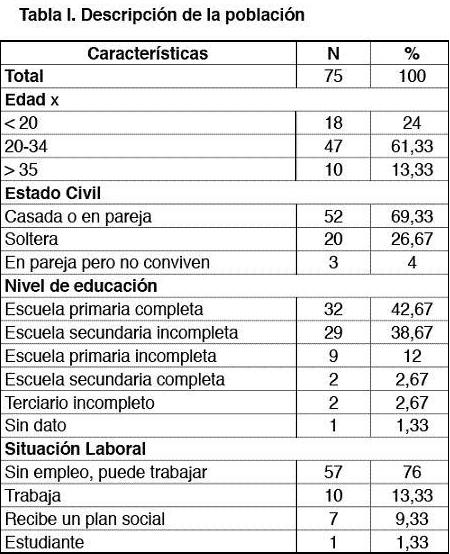
<body><![CDATA[<p class="Subt1" style="text-align: justify; line-height: normal;"><span style="font-size: 10pt; font-family: Verdana; font-weight: normal;" lang="ES-TRAD"><o:p>&nbsp;</o:p></span></p>         <p class="txt" style="text-indent: 0cm; line-height: normal;"><span style="font-size: 10pt; font-family: Verdana;" lang="ES-TRAD">Se encuest&oacute; a 75 mujeres fumadoras durante el posparto inmediato que cumplieron con los criterios de inclusi&oacute;n, entre 1.527 mujeres que participaron del estudio. En la <a href="#tab_1">Tabla&nbsp;I</a> se reportan las caracter&iacute;sticas de la poblaci&oacute;n participante.</span></p>      <p class="txt" style="text-indent: 0cm; line-height: normal;"><span style="font-size: 10pt; font-family: Verdana;" lang="ES-TRAD"> &nbsp; &nbsp; &nbsp; &nbsp; &nbsp; &nbsp; &nbsp; &nbsp; &nbsp; &nbsp; &nbsp; &nbsp; &nbsp; &nbsp; &nbsp; &nbsp; &nbsp; &nbsp; &nbsp; &nbsp; &nbsp; &nbsp; &nbsp; &nbsp; &nbsp; &nbsp; &nbsp; &nbsp; &nbsp; &nbsp; &nbsp;</span></p>      <p class="txt" style="text-indent: 0cm; line-height: normal;"><span style="font-size: 10pt; font-family: Verdana;" lang="ES-TRAD"></span></p>       <p class="txt" style="text-indent: 0cm; line-height: normal;"><a name="tab_1"></a><img style="width: 450px; height: 554px;" alt="" src="/img/revistas/ami/v37n2/2a01t1.JPG"></p>      <p class="txt" style="text-indent: 0cm; line-height: normal;"> &nbsp; &nbsp; &nbsp; &nbsp; &nbsp; &nbsp; &nbsp; &nbsp; &nbsp; &nbsp; &nbsp; &nbsp; &nbsp; &nbsp; &nbsp; &nbsp; &nbsp; &nbsp; &nbsp; &nbsp; &nbsp; &nbsp; &nbsp; &nbsp; &nbsp; &nbsp; &nbsp; &nbsp; &nbsp; &nbsp; &nbsp; &nbsp; &nbsp; &nbsp; &nbsp; &nbsp; &nbsp; &nbsp; &nbsp; &nbsp; &nbsp; &nbsp; &nbsp; &nbsp; &nbsp; &nbsp; &nbsp; &nbsp; &nbsp; &nbsp; &nbsp; &nbsp; &nbsp; &nbsp; &nbsp; &nbsp; &nbsp; &nbsp; &nbsp; &nbsp; &nbsp; &nbsp; &nbsp; &nbsp; &nbsp; &nbsp; &nbsp; &nbsp; &nbsp; &nbsp; &nbsp; &nbsp; &nbsp; &nbsp; &nbsp; &nbsp; &nbsp; &nbsp; &nbsp; &nbsp; &nbsp;</p>      <p class="txt" style="text-indent: 0cm; line-height: normal;"></p>         <p class="txt" style="text-indent: 0cm; line-height: normal;"><span style="font-size: 10pt; font-family: Verdana;" lang="ES-TRAD">La mayor&iacute;a de las mujeres (42) hab&iacute;a intentado dejar de fumar por 24 <span class="SpellE">hs</span>. al menos una vez durante el embarazo; 0,33 (25) declar&oacute; que el motivo para haber intentado o haber dejado de fumar fue la preocupaci&oacute;n por la salud de su beb&eacute;; 0,16 (12) porque le daba asco el tabaco en ese momento del embarazo; y 0,05 (4) no aport&oacute; motivo.<o:p></o:p></span></p>         <p class="txt" style="text-indent: 0cm; line-height: normal;"><span style="font-size: 10pt; font-family: Verdana;" lang="ES-TRAD">Entre las estrategias que cre&iacute;an m&aacute;s les hab&iacute;an ayudado para intentar dejar de fumar, 0,19 (14) dijo que hab&iacute;a utilizado chicle, 0,08 (6) hab&iacute;a pensado en su beb&eacute;, 0,04 (3) busc&oacute; apoyo en profesionales de la salud o amigos, y defini&oacute; un d&iacute;a espec&iacute;fico para dejar el consumo y 0,43 (32) no report&oacute; estrategias &uacute;tiles. Al preguntarle a estas mujeres fumadoras qu&eacute; pensaban hacer en relaci&oacute;n al consumo de tabaco ahora que hab&iacute;a nacido el beb&eacute;, 0,37 (28) respondi&oacute; que no estaba segura qu&eacute; iba a hacer, 0,33 (25) cre&iacute;a que iba a fumar menos que antes, 0,19 (14) declar&oacute; que iba a fumar lo mismo que antes, y 0,03 (2) mujeres estaban seguras de que no iban a fumar.<o:p></o:p></span></p>         <p class="txt" style="text-indent: 0cm; line-height: normal;"><span style="font-size: 10pt; font-family: Verdana;" lang="ES-TRAD">M&aacute;s de la mitad de las mujeres (41) declar&oacute; conocer los parches o los chicles con nicotina indicados para dejar de fumar, y 0,12 (5) dijo haberlos usado en alguna oportunidad.<o:p></o:p></span></p>         ]]></body>
<body><![CDATA[<p class="txt" style="text-indent: 0cm; line-height: normal;"><span style="font-size: 10pt; font-family: Verdana;" lang="ES-TRAD">Al indagar si participar&iacute;an en un estudio para probar la efectividad de los parches o chicles para dejar de fumar durante el embarazo, 3/4 de las mujeres (0,78) respondi&oacute; que s&iacute; lo har&iacute;a y 0,46 de las mujeres (33) manifest&oacute; que cre&iacute;a que recibir una recompensa como incentivo para dejar de fumar durante el embazo ser&iacute;a de utilidad. Sobre los tipos de recompensa que preferir&iacute;an recibir, de las 18 mujeres que respondieron a esta pregunta, 0,44 (8) refiri&oacute; preferir dinero en efectivo como primera opci&oacute;n y la misma proporci&oacute;n alg&uacute;n regalo para el reci&eacute;n nacido, y s&oacute;lo una mujer dijo que preferir&iacute;a recibir un vale obsequio como incentivo.<o:p></o:p></span></p>         <p class="txt" style="text-indent: 0cm; line-height: normal;"><span style="font-size: 10pt; font-family: Verdana;" lang="ES-TRAD"><o:p>&nbsp;</o:p></span></p>         <p class="Subt1" style="text-align: justify; line-height: normal;"><span style="font-size: 10pt; font-family: Verdana; font-weight: normal;" lang="ES-TRAD">Discusi&oacute;n<o:p></o:p></span></p>         <p class="Subt1" style="text-align: justify; line-height: normal;"><span style="font-size: 10pt; font-family: Verdana; font-weight: normal;" lang="ES-TRAD"><o:p>&nbsp;</o:p></span></p>         <p class="txt" style="text-indent: 0cm; line-height: normal;"><span style="font-size: 10pt; font-family: Verdana;" lang="ES-TRAD">Los resultados de estudios internacionales que evaluaron la aceptabilidad del uso de incentivos parecieran acordar en que los pacientes aceptan recibir dinero o recompensas para motivar el cambio de <span class="GramE">comportamiento<sup><a name="-12"></a><a name="-13"></a><a name="-14"></a><a name="-15"></a>(</sup></span><sup><a href="#12">12-15</a>)</sup>. En este estudio piloto encontramos que casi la mitad de las mujeres que contin&uacute;a fumando durante el embarazo cree que los incentivos podr&iacute;an ser de ayuda para motivarlas a dejar. Es importante subrayar que estas mujeres constituyen el n&uacute;cleo m&aacute;s dif&iacute;cil dentro de la poblaci&oacute;n tabaquista. Son mujeres de bajo nivel socioecon&oacute;mico, que muchas veces no son alcanzadas por todas las pol&iacute;ticas p&uacute;blicas, ya sea porque compran cigarrillos sueltos o de contrabando, no llegando a ver los pictogramas de las cajillas, y no vi&eacute;ndose afectadas en gran medida por el aumento de los impuestos al consumo de tabaco. Por otro lado, si bien los programas de cesaci&oacute;n tab&aacute;quica est&aacute;n ampliamente distribuidos en nuestro pa&iacute;s, la mayor&iacute;a funciona en tratamientos grupales, no cont&aacute;ndose con espacios espec&iacute;ficos para embarazadas en los que estas fumadoras puedan tratar su adicci&oacute;n sin ser estigmatizadas. Es decir, que pareciera justificarse una intervenci&oacute;n m&aacute;s intensa.<o:p></o:p></span></p>         <p class="txt" style="text-indent: 0cm; line-height: normal;"><span style="font-size: 10pt; font-family: Verdana;" lang="ES-TRAD">Si bien la muestra pareciera ser peque&ntilde;a, considerando que se invit&oacute; s&oacute;lo a las fumadoras, y que la tasa de tabaquismo para Uruguay es del 18% en esta <span class="GramE">poblaci&oacute;n<sup>(</sup></span><sup><a href="#3">3</a>)</sup>, se pudo haber reclutado alrededor de 275 mujeres, pero, por un lado, el cuestionario se implement&oacute; tard&iacute;amente durante la fase post intervenci&oacute;n del estudio cl&iacute;nico aleatorizado y, por otro, la tasa de 18% podr&iacute;a haber disminuido en los &uacute;ltimos a&ntilde;os. Por estos motivos se considera que no existir&iacute;an </span><span style="font-size: 10pt; font-family: Verdana;" lang="ES-TRAD">a priori</span><span style="font-size: 10pt; font-family: Verdana;" lang="ES-TRAD"> sesgos de selecci&oacute;n.<o:p></o:p></span></p>         <p class="txt" style="text-indent: 0cm; line-height: normal;"><span style="font-size: 10pt; font-family: Verdana;" lang="ES-TRAD">Este estudio exploratorio es concordante con estudios realizados en otros lugares en los que se verifica aceptabilidad por parte de las mujeres embarazadas en el uso de TRN durante el embarazo como adyuvante a la promoci&oacute;n del cese de consumo <span class="GramE">nicot&iacute;nico<sup>(</sup></span><sup><a href="#9">9</a>,<a href="#15">15</a>)</sup>. En relaci&oacute;n a los incentivos, hay algunas experiencias previas en el pa&iacute;s, pero no vinculadas a mujeres embarazadas. Este sondeo realizado nos orienta a considerar como potencialmente efectiva una intervenci&oacute;n con TRN e incentivos en este tipo de poblaci&oacute;n. Una investigaci&oacute;n de corte cualitativo podr&iacute;a contribuir a alcanzar un entendimiento m&aacute;s profundo sobre un esquema de incentivos y de TRN aceptable para mujeres fumadoras durante el embarazo y a dise&ntilde;ar una futura investigaci&oacute;n que pruebe estas intervenciones.<o:p></o:p></span></p>         <p class="txt" style="text-indent: 0cm; line-height: normal;"><span style="font-size: 10pt; font-family: Verdana;" lang="ES-TRAD"><o:p>&nbsp;</o:p></span></p>         <p class="Subt1" style="text-align: justify; line-height: normal;"><span style="font-size: 10pt; font-family: Verdana; font-weight: normal;" lang="ES-TRAD">Conclusiones<o:p></o:p></span></p>         <p class="txt" style="text-indent: 0cm; line-height: normal;"><span style="font-size: 10pt; font-family: Verdana;" lang="ES-TRAD"><o:p>&nbsp;</o:p></span></p>         ]]></body>
<body><![CDATA[<p class="txt" style="text-indent: 0cm; line-height: normal;"><span style="font-size: 10pt; font-family: Verdana;" lang="ES-TRAD">La mayor&iacute;a de las mujeres embarazadas que fum&oacute; durante el embarazo declar&oacute; haber intentado dejar de fumar sin lograrlo, por lo que pareciera justificarse una intervenci&oacute;n m&aacute;s intensa. La mitad de las participantes en este estudio consider&oacute; que recibir incentivos para dejar de fumar podr&iacute;a ser una intervenci&oacute;n efectiva y 3/4 participar&iacute;a en un estudio para probar la efectividad de TRN durante el embarazo. Se justificar&iacute;a investigar m&aacute;s profundamente c&oacute;mo implementar un esquema de incentivos y de TRN aceptable para mujeres fumadoras durante el embarazo, con el fin de dise&ntilde;ar una futura investigaci&oacute;n que pruebe estas intervenciones.<o:p></o:p></span></p>         <p class="txt" style="text-indent: 0cm; line-height: normal;"><span style="font-size: 10pt; font-family: Verdana;" lang="ES-TRAD"><o:p>&nbsp;</o:p></span></p>         <p class="Subt1" style="text-align: justify; line-height: normal;"><span style="font-size: 10pt; font-family: Verdana; font-weight: normal;" lang="ES-TRAD">Declaraci&oacute;n conflicto de inter&eacute;s<o:p></o:p></span></p>         <p class="txt" style="text-indent: 0cm; line-height: normal;"><span style="font-size: 10pt; font-family: Verdana;" lang="ES-TRAD">No existen conflictos de intereses para declarar.<o:p></o:p></span></p>         <p class="txt" style="text-indent: 0cm; line-height: normal;"><span style="font-size: 10pt; font-family: Verdana;" lang="ES-TRAD"><o:p>&nbsp;</o:p></span></p>         <p class="txt" style="text-align: left; line-height: normal;" align="left"><span style="font-size: 10pt; font-family: Verdana;" lang="ES-TRAD"><o:p>&nbsp;</o:p></span></p>         <p class="Subt1" style="line-height: normal;"><span style="font-size: 10pt; font-family: Verdana; font-weight: normal;" lang="ES-TRAD">BIBliOgraf&iacute;a<o:p></o:p></span></p>         <p class="txt" style="text-align: left; line-height: normal;" align="left"><span style="font-size: 10pt; font-family: Verdana;" lang="ES-TRAD"><o:p>&nbsp;</o:p></span></p>         <!-- ref --><p class="Bibliog" style="text-align: left; line-height: normal;" align="left"><span style="font-size: 10pt; font-family: Verdana;" lang="EN-US"><a name="1"></a><a href="#-1">1</a>.<span style="">&nbsp; </span><span class="SpellE">Samet</span> J. <span class="GramE">The risk of active and passive smoking.</span> En: <span class="SpellE">Slovic</span> P. Smoking: Risk, perception and policy. <span class="SpellE">Califonia</span>: Sage Publications; 2001. pp. 3-28.    <o:p></o:p></span></p>         ]]></body>
<body><![CDATA[<!-- ref --><p class="Bibliog" style="text-align: left; line-height: normal;" align="left"><span style="font-size: 10pt; font-family: Verdana;" lang="EN-US"><a name="2"></a><a href="#-2">2</a>.<span style="">&nbsp; </span>United State. <span class="GramE">Office on Smoking and Health.</span> <span class="GramE">Women and Smoking, a report of the Surgeon General.</span> Office of the Surgeon General, Department of Health and Human Services, Public Health Service, <st1:city w:st="on"><st1:place w:st="on">Atlanta</st1:place></st1:city> (GA): Centers for Disease Control and Prevention; 2001.    <o:p></o:p></span></p>         <!-- ref --><p class="Bibliog" style="text-align: left; line-height: normal;" align="left"><span style="font-size: 10pt; font-family: Verdana;"><a name="3"></a><a href="#-3">3</a>.<span style="">&nbsp; </span><span class="SpellE">Althabe</span> F, <span class="SpellE">Colomar</span> M, <span class="SpellE">Gibbons</span> L, <span class="SpellE">Beliz&aacute;n</span> JM, <span class="SpellE">Buekens</span> P</span><span style="font-size: 10pt; font-family: Verdana;" lang="ES-TRAD">. Tabaquismo durante el embarazo en Argentina y Uruguay. Medicina (<span class="SpellE">B.Aires</span>). 2008; 68(48-54).    <o:p></o:p></span></p>         <!-- ref --><p class="Bibliog" style="text-align: left; line-height: normal;" align="left"><span style="font-size: 10pt; font-family: Verdana;"><a name="4"></a><a href="#-4">4</a>.<span style="">&nbsp; </span>Abascal W, <span class="SpellE">Esteves</span> E, <span class="SpellE">Goja</span> B, Gonz&aacute;lez Mora F, Lorenzo A, <span class="SpellE">Sica</span> A, et al. </span><span style="font-size: 10pt; font-family: Verdana;" lang="EN-US">Tobacco control campaign in <st1:country-region w:st="on"><st1:place w:st="on">Uruguay</st1:place></st1:country-region>: a population-based trend analysis. <span class="GramE">Lancet.</span> 2012<span class="GramE">;380</span>(9853):1575-82.     <o:p></o:p></span></p>         <!-- ref --><p class="Bibliog" style="text-align: left; line-height: normal;" align="left"><span style="font-size: 10pt; font-family: Verdana;" lang="EN-US"><a name="5"></a><a href="#-5">5</a>.<span style="">&nbsp; </span>Pan American <span class="SpellE">Helth</span> <span class="SpellE">Asociation</span>. Global Adult Tobacco Survey: GATS <st1:country-region w:st="on"><st1:place w:st="on">Uruguay</st1:place></st1:country-region> [en <span class="SpellE">linea</span>] 2009 [<span class="SpellE">acceso</span> <span class="SpellE">junio</span> 2015]. <st1:city w:st="on"><st1:place w:st="on">Montevideo</st1:place></st1:city>: MSP, 2009. <span class="SpellE">Disponible</span> en: <a href="http://www2.msp.gub.uy/documentos/gats2009.pdf">http://www2.msp.gub.uy/documentos/gats2009.pdf</a><o:p></o:p></span><!-- ref --><p class="Bibliog" style="text-align: left; line-height: normal;" align="left"><span style="font-size: 10pt; font-family: Verdana;"><a name="6"></a><a href="#-6">6</a>.<span style="">&nbsp; </span>Uruguay. Ministerio de Salud P&uacute;blica Uruguay. Divisi&oacute;n Epidemiolog&iacute;a. Primer Encuesta Nacional de Factores de Riesgo de <span class="SpellE">enfermadades</span> cr&oacute;nicas no transmisibles. </span><st1:city w:st="on"><st1:place w:st="on"><span style="font-size: 10pt; font-family: Verdana;" lang="EN-US">Montevideo</span></st1:place></st1:city><span style="font-size: 10pt; font-family: Verdana;" lang="EN-US">: MSP, 2006.     <o:p></o:p></span></p>         <p class="Bibliog" style="text-align: left; line-height: normal;" align="left"><span style="font-size: 10pt; font-family: Verdana;" lang="EN-US"><a name="7"></a><a href="#-7">7</a>.<span style="">&nbsp; </span>Chamberlain C, O&rsquo;Mara-Eves A, Oliver S, <span class="SpellE">Caird</span> J, <span class="SpellE">Perlen</span> S, <span class="SpellE">Eades</span> S, et al. Psychosocial interventions for supporting women to stop smoking in pregnancy. Cochrane Database <span class="SpellE">Syst</span> Rev. <span class="GramE">2014;</span>(6).<o:p></o:p></span></p>         ]]></body>
<body><![CDATA[<!-- ref --><p class="Bibliog" style="text-align: left; line-height: normal;" align="left"><span style="font-size: 10pt; font-family: Verdana;" lang="EN-US"><a name="8"></a><a href="#-8">8</a>.<span style="">&nbsp; </span>Coleman T, Chamberlain C, Davey M-A, Cooper S, <span class="SpellE">Leonardi</span>-Bee J. Pharmacological interventions for promoting smoking cessation during pregnancy. <span class="SpellE">Cochr</span> Database <span class="SpellE">Syst</span> Rev Issue 6, <span class="GramE">2014;</span>(6).    <o:p></o:p></span></p>         <!-- ref --><p class="Bibliog" style="text-align: left; line-height: normal;" align="left"><span style="font-size: 10pt; font-family: Verdana;" lang="EN-US"><a name="9"></a><a href="#-9">9</a>.<span style="">&nbsp; </span>Lumley J, Chamberlain C, <span class="SpellE">Dowswell</span> T, Oliver S, Oakley L, Watson L. Interventions for promoting smoking cessation during pregnancy. </span><span class="SpellE"><span style="font-size: 10pt; font-family: Verdana;">Cochrane</span></span><span style="font-size: 10pt; font-family: Verdana;"> <span class="SpellE">Database</span> <span class="SpellE">Syst</span> Rev. 2009 Jul; 8(3).    <o:p></o:p></span></p>         <!-- ref --><p class="Bibliog" style="text-align: left; line-height: normal;" align="left"><span style="font-size: 10pt; font-family: Verdana;"><a name="10"></a><a href="#-10">10</a>.<span style=""> </span><span class="SpellE">Althabe</span> F <span class="SpellE">Althabe</span> F, Alem&aacute;n A, <span class="SpellE">Mazzoni</span> A, <span class="SpellE">Berrueta</span> M, <span class="SpellE">Morello</span> P, <span class="SpellE">Colomar</span> M., et al. </span><span style="font-size: 10pt; font-family: Verdana;" lang="EN-US">Tobacco cessation intervention for pregnant women in <st1:country-region w:st="on">Argentina</st1:country-region> and <st1:country-region w:st="on"><st1:place w:st="on">Uruguay</st1:place></st1:country-region>: study protocol. <span class="SpellE">Reprod</span>. <span class="GramE">Health.</span> <span class="GramE">2013; 10:44.    </span> <o:p></o:p></span></p>         <!-- ref --><p class="Bibliog" style="text-align: left; line-height: normal;" align="left"><span style="font-size: 10pt; font-family: Verdana;" lang="EN-US"><a name="11"></a><a href="#-11">11</a>.<span style=""> </span>Farber S, Tate J, Frank C, <span class="SpellE">Ardito</span> D, <span class="SpellE">Kozal</span> M, Justice AC, Scott Braithwaite R. <span class="GramE">A study of financial incentives to reduce plasma HIV RNA among patients in care.</span> AIDS <span class="SpellE">Behav</span>. 2013 Sep; 17(1): 2293-2300.    <o:p></o:p></span></p>         <p class="Bibliog" style="text-align: left; line-height: normal;" align="left"><span style="font-size: 10pt; font-family: Verdana;" lang="EN-US"><a name="12"></a><a href="#-12">12</a>.<span style=""> </span><span class="SpellE">Bonevski</span> B, Bryant J, <span class="SpellE">Lynagh</span> M, <span class="GramE">Paul</span> C. Money as motivation to quit: a survey of a non- random Australian sample of socially disadvantaged smokers&rsquo; views of the acceptability of cash incentives. <span class="SpellE"><span class="GramE">Prev</span></span><span class="GramE"> Med. 2012; 55:122-126.</span><o:p></o:p></span></p>         <!-- ref --><p class="Bibliog" style="text-align: left; line-height: normal;" align="left"><span style="font-size: 10pt; font-family: Verdana;" lang="EN-US"><a name="13"></a><a href="#-13">13</a>.<span style=""> </span><span class="SpellE">Lynagh</span> M <span class="SpellE">Bonevski</span> B, Symonds I, <span class="SpellE">Sanson</span>-Fisher RW. <span class="GramE">Paying women to quit smoking during pregnancy?</span> <span class="GramE">Acceptability among pregnant women.</span> <span class="GramE">Nicotine <span class="SpellE">Tob</span> Res. 2011; 13: 1029-1036.    </span><o:p></o:p></span></p>         <p class="Bibliog" style="text-align: left; line-height: normal;" align="left"><span style="font-size: 10pt; font-family: Verdana;" lang="EN-US"><a name="14"></a><a href="#-14">14</a>.<span style=""> </span>Mitchell MS, Goodman JM, Alter DA, Oh PI, Faulkner GE. <span class="GramE">&lsquo;Will walk for groceries&rsquo;: Acceptability of financial health incentives among Canadian cardiac rehabilitation patients.</span> <span class="SpellE">Psychol</span> Health. <span class="GramE">2014; 14: 1032-1043.</span><o:p></o:p></span></p>         <!-- ref --><p class="MsoNormal" style="margin: 0cm 0cm 0.0001pt 18pt; text-indent: -18pt;"><span style="font-size: 10pt; font-family: Verdana;" lang="EN-US"><a name="15"></a><a href="#-15">15</a>.<span style=""> </span><span class="SpellE">Bonevski</span> B, Bryant J, Paul C. Encouraging smoking cessation among disadvantaged groups: a qualitative study of the financial aspects of cessation. </span><span style="font-size: 10pt; font-family: Verdana;" lang="ES-TRAD">Drug Alcohol Rev. 2011; 30: 411-418.    <o:p></o:p></span></p>     </div>          ]]></body><back>
<ref-list>
<ref id="B1">
<label>1</label><nlm-citation citation-type="book">
<person-group person-group-type="author">
<name>
<surname><![CDATA[Samet]]></surname>
<given-names><![CDATA[J]]></given-names>
</name>
</person-group>
<article-title xml:lang="en"><![CDATA[The risk of active and passive smoking]]></article-title>
<person-group person-group-type="editor">
<name>
<surname><![CDATA[Slovic]]></surname>
</name>
</person-group>
<source><![CDATA[Smoking: Risk, perception and policy]]></source>
<year>2001</year>
<page-range>3-28</page-range><publisher-loc><![CDATA[Califonia ]]></publisher-loc>
<publisher-name><![CDATA[Sage Publications]]></publisher-name>
</nlm-citation>
</ref>
<ref id="B2">
<label>2</label><nlm-citation citation-type="">
<source><![CDATA[United State. Office on Smoking and Health. Women and Smoking, a report of the Surgeon General. Office of the Surgeon General, Department of Health and Human Services, Public Health Service, Atlanta (GA): Centers for Disease Control and Prevention]]></source>
<year>2001</year>
</nlm-citation>
</ref>
<ref id="B3">
<label>3</label><nlm-citation citation-type="journal">
<person-group person-group-type="author">
<name>
<surname><![CDATA[Althabe]]></surname>
<given-names><![CDATA[F]]></given-names>
</name>
<name>
<surname><![CDATA[Colomar]]></surname>
<given-names><![CDATA[M]]></given-names>
</name>
<name>
<surname><![CDATA[Gibbons]]></surname>
<given-names><![CDATA[L]]></given-names>
</name>
<name>
<surname><![CDATA[Belizán]]></surname>
<given-names><![CDATA[JM]]></given-names>
</name>
<name>
<surname><![CDATA[Buekens]]></surname>
<given-names><![CDATA[P]]></given-names>
</name>
</person-group>
<article-title xml:lang="es"><![CDATA[Tabaquismo durante el embarazo en Argentina y Uruguay]]></article-title>
<source><![CDATA[Medicina (B.Aires)]]></source>
<year>2008</year>
<volume>68</volume>
<page-range>48-54</page-range></nlm-citation>
</ref>
<ref id="B4">
<label>4</label><nlm-citation citation-type="journal">
<person-group person-group-type="author">
<name>
<surname><![CDATA[Abascal]]></surname>
<given-names><![CDATA[W]]></given-names>
</name>
<name>
<surname><![CDATA[Esteves]]></surname>
<given-names><![CDATA[E]]></given-names>
</name>
<name>
<surname><![CDATA[Goja]]></surname>
<given-names><![CDATA[B]]></given-names>
</name>
<name>
<surname><![CDATA[González Mora]]></surname>
<given-names><![CDATA[F]]></given-names>
</name>
<name>
<surname><![CDATA[Lorenzo]]></surname>
<given-names><![CDATA[A]]></given-names>
</name>
<name>
<surname><![CDATA[Sica]]></surname>
<given-names><![CDATA[A]]></given-names>
</name>
</person-group>
<article-title xml:lang="en"><![CDATA[Tobacco control campaign in Uruguay: a population-based trend analysis]]></article-title>
<source><![CDATA[Lancet]]></source>
<year>2012</year>
<volume>380</volume>
<numero>9853</numero>
<issue>9853</issue>
<page-range>1575-82</page-range></nlm-citation>
</ref>
<ref id="B5">
<label>5</label><nlm-citation citation-type="book">
<collab>Pan American Helth Asociation</collab>
<source><![CDATA[Global Adult Tobacco Survey: GATS Uruguay]]></source>
<year>2009</year>
<month>20</month>
<day>09</day>
<publisher-loc><![CDATA[Montevideo ]]></publisher-loc>
<publisher-name><![CDATA[MSP]]></publisher-name>
</nlm-citation>
</ref>
<ref id="B6">
<label>6</label><nlm-citation citation-type="book">
<collab>Uruguay. Ministerio de Salud Pública Uruguay.^dDivisión Epidemiología</collab>
<source><![CDATA[Primer Encuesta Nacional de Factores de Riesgo de enfermadades crónicas no transmisibles]]></source>
<year>2006</year>
<publisher-loc><![CDATA[Montevideo ]]></publisher-loc>
<publisher-name><![CDATA[MSP]]></publisher-name>
</nlm-citation>
</ref>
<ref id="B7">
<label>7</label><nlm-citation citation-type="journal">
<person-group person-group-type="author">
<name>
<surname><![CDATA[Chamberlain]]></surname>
<given-names><![CDATA[C]]></given-names>
</name>
<name>
<surname><![CDATA[O&rsquo;Mara-Eves]]></surname>
<given-names><![CDATA[A]]></given-names>
</name>
<name>
<surname><![CDATA[Oliver]]></surname>
<given-names><![CDATA[S]]></given-names>
</name>
<name>
<surname><![CDATA[Caird]]></surname>
<given-names><![CDATA[J]]></given-names>
</name>
<name>
<surname><![CDATA[Perlen]]></surname>
<given-names><![CDATA[S]]></given-names>
</name>
<name>
<surname><![CDATA[Eades]]></surname>
<given-names><![CDATA[S]]></given-names>
</name>
</person-group>
<article-title xml:lang="en"><![CDATA[Psychosocial interventions for supporting women to stop smoking in pregnancy]]></article-title>
<source><![CDATA[Cochrane Database Syst Rev]]></source>
<year>2014</year>
<numero>6</numero>
<issue>6</issue>
</nlm-citation>
</ref>
<ref id="B8">
<label>8</label><nlm-citation citation-type="journal">
<person-group person-group-type="author">
<name>
<surname><![CDATA[Coleman]]></surname>
<given-names><![CDATA[T]]></given-names>
</name>
<name>
<surname><![CDATA[Chamberlain]]></surname>
<given-names><![CDATA[C]]></given-names>
</name>
<name>
<surname><![CDATA[Davey]]></surname>
<given-names><![CDATA[M-A]]></given-names>
</name>
<name>
<surname><![CDATA[Cooper]]></surname>
<given-names><![CDATA[S]]></given-names>
</name>
<name>
<surname><![CDATA[Leonardi-Bee]]></surname>
<given-names><![CDATA[J]]></given-names>
</name>
</person-group>
<article-title xml:lang="en"><![CDATA[Pharmacological interventions for promoting smoking cessation during pregnancy]]></article-title>
<source><![CDATA[Cochr Database Syst Rev]]></source>
<year>2014</year>
<numero>6</numero>
<issue>6</issue>
</nlm-citation>
</ref>
<ref id="B9">
<label>9</label><nlm-citation citation-type="journal">
<person-group person-group-type="author">
<name>
<surname><![CDATA[Lumley]]></surname>
<given-names><![CDATA[J]]></given-names>
</name>
<name>
<surname><![CDATA[Chamberlain]]></surname>
<given-names><![CDATA[C]]></given-names>
</name>
<name>
<surname><![CDATA[Dowswell]]></surname>
<given-names><![CDATA[T]]></given-names>
</name>
<name>
<surname><![CDATA[Oliver]]></surname>
<given-names><![CDATA[S]]></given-names>
</name>
<name>
<surname><![CDATA[Oakley]]></surname>
<given-names><![CDATA[L]]></given-names>
</name>
<name>
<surname><![CDATA[Watson]]></surname>
<given-names><![CDATA[L]]></given-names>
</name>
</person-group>
<article-title xml:lang="en"><![CDATA[Interventions for promoting smoking cessation during pregnancy]]></article-title>
<source><![CDATA[Cochrane Database Syst Rev]]></source>
<year>2009</year>
<month> J</month>
<day>ul</day>
<volume>8</volume>
<numero>3</numero>
<issue>3</issue>
</nlm-citation>
</ref>
<ref id="B10">
<label>10</label><nlm-citation citation-type="journal">
<person-group person-group-type="author">
<name>
<surname><![CDATA[Althabe]]></surname>
<given-names><![CDATA[F]]></given-names>
</name>
<name>
<surname><![CDATA[Althabe]]></surname>
<given-names><![CDATA[F]]></given-names>
</name>
<name>
<surname><![CDATA[Alemán]]></surname>
<given-names><![CDATA[A]]></given-names>
</name>
<name>
<surname><![CDATA[Mazzoni]]></surname>
<given-names><![CDATA[A]]></given-names>
</name>
<name>
<surname><![CDATA[Berrueta]]></surname>
<given-names><![CDATA[M]]></given-names>
</name>
<name>
<surname><![CDATA[Morello]]></surname>
<given-names><![CDATA[P]]></given-names>
</name>
<name>
<surname><![CDATA[Colomar]]></surname>
<given-names><![CDATA[M]]></given-names>
</name>
</person-group>
<article-title xml:lang="en"><![CDATA[Tobacco cessation intervention for pregnant women in Argentina and Uruguay: study protocol]]></article-title>
<source><![CDATA[Reprod. Health]]></source>
<year>2013</year>
<volume>10</volume>
<page-range>44</page-range></nlm-citation>
</ref>
<ref id="B11">
<label>11</label><nlm-citation citation-type="journal">
<person-group person-group-type="author">
<name>
<surname><![CDATA[Farber]]></surname>
<given-names><![CDATA[S]]></given-names>
</name>
<name>
<surname><![CDATA[Tate]]></surname>
<given-names><![CDATA[J]]></given-names>
</name>
<name>
<surname><![CDATA[Frank]]></surname>
<given-names><![CDATA[C]]></given-names>
</name>
<name>
<surname><![CDATA[Ardito]]></surname>
<given-names><![CDATA[D]]></given-names>
</name>
<name>
<surname><![CDATA[Kozal]]></surname>
<given-names><![CDATA[M]]></given-names>
</name>
<name>
<surname><![CDATA[Justice]]></surname>
<given-names><![CDATA[AC]]></given-names>
</name>
<name>
<surname><![CDATA[Scott Braithwaite]]></surname>
<given-names><![CDATA[R]]></given-names>
</name>
</person-group>
<article-title xml:lang="en"><![CDATA[A study of financial incentives to reduce plasma HIV RNA among patients in care]]></article-title>
<source><![CDATA[AIDS Behav]]></source>
<year>2013</year>
<month> S</month>
<day>ep</day>
<volume>17</volume>
<numero>1</numero>
<issue>1</issue>
<page-range>2293-2300</page-range></nlm-citation>
</ref>
<ref id="B12">
<label>12</label><nlm-citation citation-type="journal">
<person-group person-group-type="author">
<name>
<surname><![CDATA[Bonevski]]></surname>
<given-names><![CDATA[B]]></given-names>
</name>
<name>
<surname><![CDATA[Bryant]]></surname>
<given-names><![CDATA[J]]></given-names>
</name>
<name>
<surname><![CDATA[Lynagh]]></surname>
<given-names><![CDATA[M]]></given-names>
</name>
<name>
<surname><![CDATA[Paul]]></surname>
<given-names><![CDATA[C]]></given-names>
</name>
</person-group>
<article-title xml:lang="en"><![CDATA[Money as motivation to quit: a survey of a non- random Australian sample of socially disadvantaged smokers&rsquo; views of the acceptability of cash incentives]]></article-title>
<source><![CDATA[Prev Med.]]></source>
<year>2012</year>
<volume>55</volume>
<page-range>122-126</page-range></nlm-citation>
</ref>
<ref id="B13">
<label>13</label><nlm-citation citation-type="journal">
<person-group person-group-type="author">
<name>
<surname><![CDATA[Lynagh]]></surname>
<given-names><![CDATA[M]]></given-names>
</name>
<name>
<surname><![CDATA[Bonevski]]></surname>
<given-names><![CDATA[B]]></given-names>
</name>
<name>
<surname><![CDATA[Symonds]]></surname>
</name>
<name>
<surname><![CDATA[Sanson-Fisher]]></surname>
<given-names><![CDATA[RW]]></given-names>
</name>
</person-group>
<article-title xml:lang="en"><![CDATA[Paying women to quit smoking during pregnancy?: Acceptability among pregnant women]]></article-title>
<source><![CDATA[Nicotine Tob Res]]></source>
<year>2011</year>
<volume>13</volume>
<page-range>1029-1036</page-range></nlm-citation>
</ref>
<ref id="B14">
<label>14</label><nlm-citation citation-type="journal">
<person-group person-group-type="author">
<name>
<surname><![CDATA[Mitchell]]></surname>
<given-names><![CDATA[MS]]></given-names>
</name>
<name>
<surname><![CDATA[Goodman]]></surname>
<given-names><![CDATA[JM]]></given-names>
</name>
<name>
<surname><![CDATA[Alter]]></surname>
<given-names><![CDATA[DA]]></given-names>
</name>
<name>
<surname><![CDATA[Oh]]></surname>
<given-names><![CDATA[PI]]></given-names>
</name>
<name>
<surname><![CDATA[Faulkner]]></surname>
<given-names><![CDATA[GE]]></given-names>
</name>
</person-group>
<article-title xml:lang="en"><![CDATA[&lsquo;Will walk for groceries: Acceptability of financial health incentives among Canadian cardiac rehabilitation patients]]></article-title>
<source><![CDATA[Psychol Health]]></source>
<year>2014</year>
<volume>14</volume>
<page-range>1032-1043</page-range></nlm-citation>
</ref>
<ref id="B15">
<label>15</label><nlm-citation citation-type="journal">
<person-group person-group-type="author">
<name>
<surname><![CDATA[Bonevski]]></surname>
<given-names><![CDATA[B]]></given-names>
</name>
<name>
<surname><![CDATA[Bryant]]></surname>
<given-names><![CDATA[J]]></given-names>
</name>
<name>
<surname><![CDATA[Paul]]></surname>
<given-names><![CDATA[C]]></given-names>
</name>
</person-group>
<article-title xml:lang="en"><![CDATA[Encouraging smoking cessation among disadvantaged groups: a qualitative study of the financial aspects of cessation]]></article-title>
<source><![CDATA[Drug Alcohol Rev]]></source>
<year>2011</year>
<volume>30</volume>
<page-range>411-418</page-range></nlm-citation>
</ref>
</ref-list>
</back>
</article>
