<?xml version="1.0" encoding="ISO-8859-1"?><article xmlns:mml="http://www.w3.org/1998/Math/MathML" xmlns:xlink="http://www.w3.org/1999/xlink" xmlns:xsi="http://www.w3.org/2001/XMLSchema-instance">
<front>
<journal-meta>
<journal-id>1688-423X</journal-id>
<journal-title><![CDATA[Archivos de Medicina Interna]]></journal-title>
<abbrev-journal-title><![CDATA[Arch Med Int]]></abbrev-journal-title>
<issn>1688-423X</issn>
<publisher>
<publisher-name><![CDATA[Sociedad de Medicina Interna del Uruguay]]></publisher-name>
</publisher>
</journal-meta>
<article-meta>
<article-id>S1688-423X2015000100006</article-id>
<title-group>
<article-title xml:lang="es"><![CDATA[Unidad de ACV en el Hospital de Clínicas: comportamiento clínico-epidemiológico de los pacientes con ACV (2007-2012)]]></article-title>
<article-title xml:lang="en"><![CDATA[Stroke Unit at the Hospital de Clínicas: clinical-epidemiological behavior in patients with stroke (2007-2012)]]></article-title>
</title-group>
<contrib-group>
<contrib contrib-type="author">
<name>
<surname><![CDATA[Camejo]]></surname>
<given-names><![CDATA[Claudia]]></given-names>
</name>
<xref ref-type="aff" rid="A01"/>
</contrib>
<contrib contrib-type="author">
<name>
<surname><![CDATA[Legnani]]></surname>
<given-names><![CDATA[Cecilia]]></given-names>
</name>
<xref ref-type="aff" rid="A01"/>
</contrib>
<contrib contrib-type="author">
<name>
<surname><![CDATA[Gaye]]></surname>
<given-names><![CDATA[Andrés]]></given-names>
</name>
<xref ref-type="aff" rid="A01"/>
</contrib>
<contrib contrib-type="author">
<name>
<surname><![CDATA[Arcieri]]></surname>
<given-names><![CDATA[Beatriz]]></given-names>
</name>
<xref ref-type="aff" rid="A01"/>
</contrib>
<contrib contrib-type="author">
<name>
<surname><![CDATA[Brumett]]></surname>
<given-names><![CDATA[Florencia]]></given-names>
</name>
<xref ref-type="aff" rid="A01"/>
</contrib>
<contrib contrib-type="author">
<name>
<surname><![CDATA[Castro]]></surname>
<given-names><![CDATA[Lorena]]></given-names>
</name>
<xref ref-type="aff" rid="A01"/>
</contrib>
<contrib contrib-type="author">
<name>
<surname><![CDATA[Peña]]></surname>
<given-names><![CDATA[Alfredo]]></given-names>
</name>
<xref ref-type="aff" rid="A01"/>
</contrib>
<contrib contrib-type="author">
<name>
<surname><![CDATA[Gómez]]></surname>
<given-names><![CDATA[Fabián]]></given-names>
</name>
<xref ref-type="aff" rid="A01"/>
</contrib>
<contrib contrib-type="author">
<name>
<surname><![CDATA[Higgie]]></surname>
<given-names><![CDATA[Juan R]]></given-names>
</name>
<xref ref-type="aff" rid="A01"/>
</contrib>
<contrib contrib-type="author">
<name>
<surname><![CDATA[Preve]]></surname>
<given-names><![CDATA[Federico]]></given-names>
</name>
<xref ref-type="aff" rid="A01"/>
</contrib>
<contrib contrib-type="author">
<name>
<surname><![CDATA[Salamano]]></surname>
<given-names><![CDATA[Ronald]]></given-names>
</name>
<xref ref-type="aff" rid="A01"/>
</contrib>
</contrib-group>
<aff id="A01">
<institution><![CDATA[,Universidad de la República (UdelaR) Facultad de Medicina ]]></institution>
<addr-line><![CDATA[Montevideo ]]></addr-line>
</aff>
<pub-date pub-type="pub">
<day>00</day>
<month>03</month>
<year>2015</year>
</pub-date>
<pub-date pub-type="epub">
<day>00</day>
<month>03</month>
<year>2015</year>
</pub-date>
<volume>37</volume>
<numero>1</numero>
<fpage>30</fpage>
<lpage>35</lpage>
<copyright-statement/>
<copyright-year/>
<self-uri xlink:href="http://www.scielo.edu.uy/scielo.php?script=sci_arttext&amp;pid=S1688-423X2015000100006&amp;lng=en&amp;nrm=iso"></self-uri><self-uri xlink:href="http://www.scielo.edu.uy/scielo.php?script=sci_abstract&amp;pid=S1688-423X2015000100006&amp;lng=en&amp;nrm=iso"></self-uri><self-uri xlink:href="http://www.scielo.edu.uy/scielo.php?script=sci_pdf&amp;pid=S1688-423X2015000100006&amp;lng=en&amp;nrm=iso"></self-uri><abstract abstract-type="short" xml:lang="es"><p><![CDATA[Introducción: El ataque cerebrovascular (ACV) es una importante causa de mortalidad, discapacidad y demencia en el mundo y en nuestro país. Provoca un gran impacto económico ya sea por gastos directos o indirectos. Objetivos: Describir aspectos clínicos, factores de riesgo e indicadores que permiten un adecuado manejo del ACV en su tratamiento agudo. Material y Métodos: Se realizó un estudio descriptivo y prospectivo de los ACV ingresados en el Hospital de Clínicas, entre 2007 y 2012 aplicando un protocolo con escalas clínicas, etiopatogénicas y funcionales, con test estadísticos adecuados. Resultados: Se protocolizaron 784 pacientes: 75% infartos, 16% hemorragias y 9% AIT. La HTA fue el factor de riesgo más frecuente. Un tercio llegó a puerta antes de las 4,5 h. En infartos y AIT se disminuyeron los días de internación y se mejoró la funcionalidad a 6 meses. Conclusiones: La formación de equipos entrenados en el diagnóstico y tratamiento del ACV disminuyeron el tiempo de internación y mejoraron la funcionalidad de estos pacientes.]]></p></abstract>
<abstract abstract-type="short" xml:lang="en"><p><![CDATA[Introduction: stroke is a major cause of mortality, disability and dementia all over the world as well as in our country. It has a significant economic impact due to direct or indirect costs. Objectives: to describe clinical aspects, risk factors and indicators allowing an adequate management of stroke in the acute phase. Material and Methods: we performed a prospective descriptive study of all stroke patients admitted into the Hospital de Clínicas from 2007 to 2012 using a protocol with clinical, etiopathogenic and functional scales and adequate statistical tests. Results: The protocol was used on 784 patients: 75% with brain infarcts, 16% with hemorrhages and 9% with TIA. High blood pressure was the most frequent risk factor. One third of the patients arrived at the ER before 4 ½ hours. Hospital stay days were reduced in strokes infarctions and TIAs and functionality was improved to 6 months. Conclusions: the setting up of teams trained in the diagnosis and treatment of stroke reduced the number of days of stay at hospital as well as the outcome of these patients.]]></p></abstract>
<kwd-group>
<kwd lng="es"><![CDATA[Ataque Cerebrovascular (ACV)]]></kwd>
<kwd lng="es"><![CDATA[Infarto Cerebral (IC)]]></kwd>
<kwd lng="es"><![CDATA[Hemorragia Cerebral (HC)]]></kwd>
<kwd lng="es"><![CDATA[Accidente Isquémico Transitorio (AIT)]]></kwd>
<kwd lng="es"><![CDATA[Unidad de ACV]]></kwd>
<kwd lng="en"><![CDATA[Stroke infarction]]></kwd>
<kwd lng="en"><![CDATA[TIA]]></kwd>
<kwd lng="en"><![CDATA[Stroke Unit]]></kwd>
<kwd lng="en"><![CDATA[Cerebral infarction]]></kwd>
<kwd lng="en"><![CDATA[Cerebral hemorrhage]]></kwd>
</kwd-group>
</article-meta>
</front><body><![CDATA[ <div class="Section1">      <p class="Seccin" style="text-align: left; line-height: normal;" align="left"><span style="font-size: 10pt; font-family: Verdana;" lang="ES-TRAD">ARCHIVOS DEL INSTITUTO DE NEUROLOG&Iacute;A<o:p></o:p></span></p>           <p class="Seccin" style="text-align: left; line-height: normal;" align="left"><span style="font-size: 10pt; font-family: Verdana;" lang="ES-TRAD"><o:p>&nbsp;</o:p></span></p>           <p class="Titarial18" style="text-align: left; line-height: normal;" align="left"><span style="font-size: 14pt; font-family: Verdana; font-style: normal;" lang="ES-TRAD">Unidad de ACV en el Hospital de Cl&iacute;nicas: comportamiento cl&iacute;nico-epidemiol&oacute;gico de los pacientes con ACV (2007-2012)<o:p></o:p></span></p>           <p class="Titarial18" style="text-align: left; line-height: normal;" align="left"><u style=""><span style="font-size: 10pt; font-family: Verdana; font-weight: normal; font-style: normal;" lang="ES-TRAD"><o:p><span style="text-decoration: none;"></span></o:p></span></u></p>           <p class="Titarial14" style="margin-top: 0cm; text-align: left; line-height: normal;" align="left"><span style="font-size: 12pt; font-family: Verdana;" lang="EN-US">Stroke Unit at the Hospital de Cl&iacute;nicas: clinical-epidemiological behavior in patients with stroke (2007-2012)<o:p></o:p></span></p>           <p class="Titarial14" style="margin-top: 0cm; text-align: left; line-height: normal;" align="left"><u style=""><span style="font-size: 10pt; font-family: Verdana; font-weight: normal;" lang="EN-GB"><o:p><span style="text-decoration: none;"></span></o:p></span></u></p>           <p class="autor" style="text-align: left; line-height: normal;" align="left"><span style="font-size: 10pt; font-family: Verdana; font-weight: normal;" lang="ES-TRAD">Dra. Claudia Camejo<o:p></o:p></span></p>           <p class="autor" style="text-align: left; line-height: normal;" align="left"><span style="font-size: 10pt; font-family: Verdana; font-weight: normal;" lang="ES-TRAD">Ex Profesora Adjunta de Neurolog&iacute;a. Facultad de Medicina. UdelaR. Montevideo.</span><span style="font-size: 10pt; font-family: Verdana; font-weight: normal;" lang="ES-TRAD"><o:p></o:p></span></p>           <p class="autor" style="text-align: left; line-height: normal;" align="left"><span style="font-size: 10pt; font-family: Verdana; font-weight: normal;" lang="ES-TRAD">Dra. Cecilia Legnani<o:p></o:p></span></p>           ]]></body>
<body><![CDATA[<p class="autor" style="text-align: left; line-height: normal;" align="left"><span style="font-size: 10pt; font-family: Verdana; font-weight: normal;" lang="ES-TRAD">Ex Profesora Adjunta de Neurolog&iacute;a. Facultad de Medicina. UdelaR. Montevideo.</span><span style="font-size: 10pt; font-family: Verdana; font-weight: normal;" lang="ES-TRAD"><o:p></o:p></span></p>           <p class="autor" style="text-align: left; line-height: normal;" align="left"><span style="font-size: 10pt; font-family: Verdana; font-weight: normal;" lang="ES-TRAD">Dr. Andr&eacute;s Gaye<o:p></o:p></span></p>           <p class="autor" style="text-align: left; line-height: normal;" align="left"><span style="font-size: 10pt; font-family: Verdana; font-weight: normal;" lang="ES-TRAD">Profesor Adjunto de Neurolog&iacute;a. Facultad de Medicina. UdelaR. Montevideo.</span><span style="font-size: 10pt; font-family: Verdana; font-weight: normal;" lang="ES-TRAD"><o:p></o:p></span></p>           <p class="autor" style="text-align: left; line-height: normal;" align="left"><span style="font-size: 10pt; font-family: Verdana; font-weight: normal;" lang="ES-TRAD">Dra. Beatriz Arcieri<o:p></o:p></span></p>           <p class="autor" style="text-align: left; line-height: normal;" align="left"><span style="font-size: 10pt; font-family: Verdana; font-weight: normal;" lang="ES-TRAD">Ex Asistente de Neurolog&iacute;a. Facultad de Medicina. UdelaR. Montevideo.</span><span style="font-size: 10pt; font-family: Verdana; font-weight: normal;" lang="ES-TRAD"><o:p></o:p></span></p>           <p class="autor" style="text-align: left; line-height: normal;" align="left"><span style="font-size: 10pt; font-family: Verdana; font-weight: normal;" lang="ES-TRAD">Dra. Florencia Brumett<o:p></o:p></span></p>           <p class="autor" style="text-align: left; line-height: normal;" align="left"><span style="font-size: 10pt; font-family: Verdana; font-weight: normal;" lang="ES-TRAD">Asistente de Neurolog&iacute;a. Facultad de Medicina. UdelaR. Montevideo.</span><span style="font-size: 10pt; font-family: Verdana; font-weight: normal;" lang="ES-TRAD"><o:p></o:p></span></p>           <p class="autor" style="text-align: left; line-height: normal;" align="left"><span style="font-size: 10pt; font-family: Verdana; font-weight: normal;" lang="ES-TRAD">Dra. Lorena Castro<o:p></o:p></span></p>           <p class="autor" style="text-align: left; line-height: normal;" align="left"><span style="font-size: 10pt; font-family: Verdana; font-weight: normal;" lang="ES-TRAD">Ex Asistente de Neurolog&iacute;a. Facultad de Medicina. UdelaR. Montevideo.</span><span style="font-size: 10pt; font-family: Verdana; font-weight: normal;" lang="ES-TRAD"><o:p></o:p></span></p>           <p class="autor" style="text-align: left; line-height: normal;" align="left"><span style="font-size: 10pt; font-family: Verdana; font-weight: normal;" lang="ES-TRAD">Dr. Alfredo Pe&ntilde;a<o:p></o:p></span></p>           ]]></body>
<body><![CDATA[<p class="autor" style="text-align: left; line-height: normal;" align="left"><span style="font-size: 10pt; font-family: Verdana; font-weight: normal;" lang="ES-TRAD">Ex Residente de Neurolog&iacute;a. Facultad de Medicina. UdelaR. Montevideo.</span><span style="font-size: 10pt; font-family: Verdana; font-weight: normal;" lang="ES-TRAD"><o:p></o:p></span></p>           <p class="autor" style="text-align: left; line-height: normal;" align="left"><span style="font-size: 10pt; font-family: Verdana; font-weight: normal;" lang="ES-TRAD">Dr. Fabi&aacute;n G&oacute;mez<o:p></o:p></span></p>           <p class="autor" style="text-align: left; line-height: normal;" align="left"><span style="font-size: 10pt; font-family: Verdana; font-weight: normal;" lang="ES-TRAD">Residente de Neurolog&iacute;a. Facultad de Medicina. UdelaR. Montevideo.</span><span style="font-size: 10pt; font-family: Verdana; font-weight: normal;" lang="ES-TRAD"><o:p></o:p></span></p>           <p class="autor" style="text-align: left; line-height: normal;" align="left"><span style="font-size: 10pt; font-family: Verdana; font-weight: normal;" lang="ES-TRAD">Dr. Juan R Higgie<o:p></o:p></span></p>           <p class="autor" style="text-align: left; line-height: normal;" align="left"><span style="font-size: 10pt; font-family: Verdana; font-weight: normal;" lang="ES-TRAD">Asistente de Neurolog&iacute;a. Facultad de Medicina. UdelaR. Montevideo.</span><span style="font-size: 10pt; font-family: Verdana; font-weight: normal;" lang="ES-TRAD"><o:p></o:p></span></p>           <p class="autor" style="text-align: left; line-height: normal;" align="left"><span style="font-size: 10pt; font-family: Verdana; font-weight: normal;" lang="ES-TRAD">Dr. Federico Preve<o:p></o:p></span></p>           <p class="autor" style="text-align: left; line-height: normal;" align="left"><span style="font-size: 10pt; font-family: Verdana; font-weight: normal;" lang="ES-TRAD">Asistente de Neurolog&iacute;a. Facultad de Medicina. UdelaR. Montevideo.</span><span style="font-size: 10pt; font-family: Verdana; font-weight: normal;" lang="ES-TRAD"><o:p></o:p></span></p>           <p class="autor" style="text-align: left; line-height: normal;" align="left"><span style="font-size: 10pt; font-family: Verdana; font-weight: normal;" lang="ES-TRAD">Dr. Ronald Salamano <o:p></o:p></span></p>           <p class="autor" style="text-align: left; line-height: normal;" align="left"><span style="font-size: 10pt; font-family: Verdana; font-weight: normal;" lang="ES-TRAD">Profesor de Neurolog&iacute;a. Facultad de Medicina. UdelaR. Montevideo.<o:p></o:p></span></p>           <p class="autor" style="text-align: left; line-height: normal;" align="left"><span style="font-size: 10pt; font-family: Verdana; font-weight: normal;" lang="ES-TRAD"><o:p>&nbsp;</o:p></span></p>           ]]></body>
<body><![CDATA[<p class="autor" style="text-align: left; line-height: normal;" align="left"><span style="font-size: 10pt; font-family: Verdana; font-weight: normal;" lang="ES-TRAD"><o:p>&nbsp;</o:p></span></p>           <p class="copete" style="text-align: left; line-height: normal;" align="left"><span style="font-size: 10pt; font-family: Verdana; text-transform: uppercase; font-weight: normal;" lang="ES-TRAD">Resumen</span><span style="font-size: 10pt; font-family: Verdana; font-weight: normal;" lang="ES-TRAD">: Arch Med Interna 37(1): 30-35<o:p></o:p></span></p>       <span style="font-size: 10pt; font-family: Verdana; font-weight: normal;" lang="ES-TRAD">Introducci&oacute;n: El ataque cerebrovascular (ACV) es una importante causa de mortalidad, discapacidad y demencia en el mundo y en nuestro pa&iacute;s. Provoca un gran impacto econ&oacute;mico ya sea por gastos directos o indirectos. Objetivos: Describir aspectos cl&iacute;nicos, factores de riesgo e indicadores que permiten un adecuado manejo del ACV en su tratamiento agudo. Material y M&eacute;todos: Se realiz&oacute; un estudio descriptivo y prospectivo de los ACV ingresados en el Hospital de Cl&iacute;nicas, entre 2007 y 2012 aplicando un protocolo con escalas cl&iacute;nicas, etiopatog&eacute;nicas y funcionales, con test estad&iacute;sticos adecuados. Resultados: Se protocolizaron 784 pacientes: 75% infartos, 16% hemorragias y 9% AIT. La HTA fue el factor de riesgo m&aacute;s frecuente. Un tercio lleg&oacute; a puerta antes de <span class="GramE">las 4,5 h.</span> En infartos y AIT se disminuyeron los d&iacute;as de internaci&oacute;n y se mejor&oacute; la funcionalidad a 6 meses. Conclusiones: La formaci&oacute;n de equipos entrenados en el diagn&oacute;stico y tratamiento del ACV <span class="GramE">disminuyeron</span> el tiempo de internaci&oacute;n y mejoraron la funcionalidad de estos pacientes.<o:p></o:p></span>    <br>           <span style="font-size: 10pt; font-family: Verdana; font-weight: normal;" lang="ES-TRAD">Palabras clave: Ataque Cerebrovascular (ACV), Infarto Cerebral (IC), Hemorragia Cerebral (HC), Accidente Isqu&eacute;mico Transitorio (AIT), Unidad de ACV.<o:p></o:p></span>          <p class="copete" style="text-align: left; line-height: normal;" align="left"><span style="font-size: 10pt; font-family: Verdana; font-weight: normal;" lang="ES-TRAD"><o:p>&nbsp;</o:p></span></p>           <p class="copete" style="text-align: left; line-height: normal;" align="left"><span style="font-size: 10pt; font-family: Verdana; font-weight: normal;" lang="ES-TRAD">ABSTRACT: Arch Med Interna 37(1): 30-35</span></p>        <p class="MsoNormal" style="margin-bottom: 0.0001pt;"><span style="font-size: 10pt; font-family: Verdana;" lang="EN-US">Introduction: stroke is a major cause of mortality, disability and dementia all over the world as well as in our country. It has a significant economic impact due to direct or indirect costs. Objectives: to describe clinical aspects, risk factors and indicators allowing an adequate management of stroke in the acute phase. Material and Methods: we performed a prospective descriptive study of all stroke patients admitted into the Hospital de Cl&iacute;nicas from 2007 to 2012 using a protocol with clinical, etiopathogenic and functional scales and adequate statistical tests. Results: The protocol was used on 784 patients: 75% with brain infarcts, 16% with hemorrhages and 9% with TIA. High blood pressure was the most frequent risk factor. One third of the patients arrived at the ER before 4 &frac12; hours. Hospital stay days were reduced in strokes infarctions and TIAs and functionality was improved to 6 months. Conclusions: the setting up of teams trained in the diagnosis and treatment of stroke reduced the number of days of stay at hospital as well as the outcome of these patients. <o:p></o:p></span></p>    <span style="font-size: 10pt; font-family: Verdana;" lang="EN-US">Keywords: Stroke infarction, TIA, Stroke Unit, Cerebral infarction, Cerebral hemorrhage</span>    <br>        <br>    <u style=""><span style="font-size: 10pt; font-family: Verdana;" lang="EN-GB"><o:p><span style="text-decoration: none;"></span></o:p></span></u>   <span style="font-size: 10pt; font-family: Verdana; font-weight: normal;" lang="ES-TRAD"><span style="font-weight: bold;">INTRODUCCI&Oacute;N</span><u style=""><o:p></o:p></u></span>    <br>        <br>       <u style=""><span style="font-size: 10pt; font-family: Verdana;" lang="ES-TRAD"><o:p><span style="text-decoration: none;"></span></o:p></span></u><span style="font-size: 10pt; font-family: Verdana;" lang="ES-TRAD">El Ataque Cerebrovascular (ACV) es una patolog&iacute;a frecuente, con alta tasa de mortalidad a nivel mundial y <span class="GramE">nacional<sup><a name="-1"></a><a name="-2"></a>(</sup></span><sup><a href="#1">1</a>,<a href="#2">2</a>)</sup>. Se trata de una patolog&iacute;a devastadora que constituye la causa m&aacute;s frecuente de discapacidad en nuestro pa&iacute;s. Es una afecci&oacute;n con impacto econ&oacute;mico significativo, responsable de altos gastos directos e indirectos vinculados a la atenci&oacute;n, tratamiento y rehabilitaci&oacute;n de los <span class="GramE">pacientes<sup><a name="-3"></a><a name="-5"></a>(</sup></span><sup><a href="#3">3-5</a>)</sup>.<o:p></o:p></span>      ]]></body>
<body><![CDATA[<p class="txt" style="text-align: left; text-indent: 0cm; line-height: normal;" align="left"><span style="font-size: 10pt; font-family: Verdana;" lang="ES-TRAD">La tasa de incidencia en Uruguay es de 181 casos/100.000 hab/a&ntilde;o y su prevalencia de 8,6 casos/1000 <span class="GramE">hab<sup><a name="-6"></a><a name="-7"></a>(</sup></span><sup><a href="#6">6</a>,<a href="#7">7</a>)</sup>.<o:p></o:p></span></p>           <p class="txt" style="text-align: left; text-indent: 0cm; line-height: normal;" align="left"><span style="font-size: 10pt; font-family: Verdana;" lang="ES-TRAD">En la &uacute;ltima d&eacute;cada del siglo XX el cuidado y tratamiento en agudo de pacientes con ACV en Unidades de ACV (UACV) ha demostrado disminuir la mortalidad, la dependencia funcional a corto y largo plazo, y la estad&iacute;a <span class="GramE">hospitalaria<sup><a name="-4"></a><a name="-8"></a><a name="-9"></a>(</sup></span><sup><a href="#3">3</a>,<a href="#4">4</a>,<a href="#8">8</a>,<a href="#9">9</a>)</sup>.<o:p></o:p></span></p>           <p class="txt" style="text-align: left; text-indent: 0cm; line-height: normal;" align="left"><span style="font-size: 10pt; font-family: Verdana;" lang="ES-TRAD">En pacientes seleccionados (entre el 10% y el &shy;20%), el tratamiento con trombolisis intravenosa (TL<span class="GramE">)<sup><a name="-10"></a><a name="-11"></a>(</sup></span><sup><a href="#10">10</a>,<a href="#11">11</a>) </sup>ha demostrado disminuir la morbi-mortalidad a corto y largo plazo<sup><a name="-12"></a><a name="-13"></a><a name="-14"></a><a name="-15"></a>(<a href="#12">12-15</a>)</sup>. La aplicaci&oacute;n de esta estrategia terap&eacute;utica est&aacute; limitada a pacientes con infarto cerebral agudo (hasta 3-4,5 horas) y sujeta a criterios de inclusi&oacute;n-exclusi&oacute;n rigurosos.<o:p></o:p></span></p>           <p class="txt" style="text-align: left; text-indent: 0cm; line-height: normal;" align="left"><span style="font-size: 10pt; font-family: Verdana;" lang="ES-TRAD">Desde junio del 2007 el Grupo de Trabajo en Patolog&iacute;a Cerebrovascular del Instituto de Neurolog&iacute;a del Hospital de Clinicas ha trabajado en el Proyecto de Unidad de Ataque Cerebrovascular (UACV) que ha recorrido diferentes etapas en la formaci&oacute;n, consolidaci&oacute;n y entrenamiento de un equipo multidisciplinario y especializado (neur&oacute;logos, internistas, cardi&oacute;logos, fisiatras, enfermeras, imagen&oacute;logos) en la atenci&oacute;n de pacientes con ACV; y en la protocolizaci&oacute;n de pautas de diagn&oacute;stico y tratamiento de dichos pacientes basadas en evidencia y adaptadas a la realidad nacional<sup><a name="-16"></a>(<a href="#16">16</a>)</sup>.<o:p></o:p></span></p>           <p class="txt" style="text-align: left; text-indent: 0cm; line-height: normal;" align="left"><span style="font-size: 10pt; font-family: Verdana;" lang="ES-TRAD">Comenz&oacute; como una UACV m&oacute;vil que recorr&iacute;a la emergencia y los pisos del Hospital de Cl&iacute;nicas. En el a&ntilde;o 2009 se habilit&oacute; la UACV piloto, en el piso 2 del Instituto de Neurolog&iacute;a en el marco del posicionamiento del Hospital como Centro de referencia en ACV. En el a&ntilde;o 2010 el Hospital de Cl&iacute;nicas incluy&oacute; en su arsenal terap&eacute;utico el rTPA. Finalizado el quinto a&ntilde;o de trabajo, el Grupo ha analizado diferentes datos que avalan la evidencia en cuanto a los beneficios para el paciente, el Hospital y del Sistema de salud, as&iacute; como la realizaci&oacute;n de terapias de rescate agudo. En diciembre del 2011 se inagur&oacute; la UACV f&iacute;sica definitiva con 4 camas en el Centro Cardiovascular y en marzo de 2014 se comenz&oacute; con guardias internas de Neurolog&iacute;a los 365 d&iacute;as del a&ntilde;o</span><span style="font-size: 10pt; font-family: Verdana;" lang="ES-TRAD">. </span><span style="font-size: 10pt; font-family: Verdana;" lang="ES-TRAD"><o:p></o:p></span></p>       <span style="font-size: 10pt; font-family: Verdana;" lang="ES-TRAD">Del an&aacute;lisis de estos datos, surgen conclusiones de valor estad&iacute;stico, relevantes en la atenci&oacute;n y tratamiento de los pacientes con ACV.<u style=""><o:p></o:p></u></span>      <br>        <br>     <u style=""><span style="font-size: 10pt; font-family: Verdana;" lang="ES-TRAD"><o:p><span style="text-decoration: none;"></span></o:p></span></u>  <span style="font-size: 10pt; font-family: Verdana; font-weight: bold;" lang="ES-TRAD">OBJETIVOS<u style=""><o:p></o:p></u></span>      <br>        <br>     <u style=""><span style="font-size: 10pt; font-family: Verdana;" lang="ES-TRAD"><o:p><span style="text-decoration: none;"></span></o:p></span></u>  <span style="font-size: 10pt; font-family: Verdana;" lang="ES-TRAD">1.<span style="">&nbsp;&nbsp;&nbsp;&nbsp;&nbsp;&nbsp; </span>Describir el comportamiento epidemiol&oacute;gico de la poblaci&oacute;n de ACV del Hospital, entre 2007-2012 con respecto a edad, sexo, factores de riesgo, naturaleza y subtipo de ACV.<o:p></o:p></span>      <p class="SangNeg" style="margin-left: 0cm; text-align: left; text-indent: 0cm; line-height: normal;" align="left"><span style="font-size: 10pt; font-family: Verdana;" lang="ES-TRAD">2.<span style="">&nbsp;&nbsp;&nbsp;&nbsp;&nbsp;&nbsp; </span>Comparar d&iacute;as de estad&iacute;a hospitalaria durante un a&ntilde;o de la UACV (2010) con los datos de 2 a&ntilde;os previos (1998 y 2005).<o:p></o:p></span></p>           ]]></body>
<body><![CDATA[<p class="SangNeg" style="margin-left: 0cm; text-align: left; text-indent: 0cm; line-height: normal;" align="left"><span style="font-size: 10pt; font-family: Verdana;" lang="ES-TRAD">3.<span style="">&nbsp;&nbsp;&nbsp;&nbsp;&nbsp;&nbsp; </span>Comparar el grado de dependencia funcional a los 6 meses de pacientes ingresados en la UACV con pacientes internados en otras salas del Hospital de Cl&iacute;nicas.<o:p></o:p></span></p>           <p class="SangNeg" style="margin-left: 0cm; text-align: left; text-indent: 0cm; line-height: normal;" align="left"><span style="font-size: 10pt; font-family: Verdana;" lang="ES-TRAD">4.<span style="">&nbsp;&nbsp;&nbsp;&nbsp;&nbsp;&nbsp; </span>Analizar el tiempo de demora de consulta en emergencia de los pacientes con ACV.<o:p></o:p></span></p>           <p class="SangNeg" style="margin-left: 0cm; text-align: left; text-indent: 0cm; line-height: normal;" align="left"><span style="font-size: 10pt; font-family: Verdana;" lang="ES-TRAD">5.<span style="">&nbsp;&nbsp;&nbsp;&nbsp;&nbsp;&nbsp; </span>Identificar criterios de exclusi&oacute;n para uso de TL en pacientes con Infarto Cerebral (IC).<o:p></o:p></span></p>           <p class="SangNeg" style="margin-left: 0cm; text-align: left; text-indent: 0cm; line-height: normal;" align="left"><span style="font-size: 10pt; font-family: Verdana;" lang="ES-TRAD">6.<span style="">&nbsp;&nbsp;&nbsp;&nbsp;&nbsp;&nbsp; </span>Cuantificar el n&uacute;mero de pacientes candidatos a TL.<o:p></o:p></span></p>           <p class="txt" style="text-align: left; text-indent: 0cm; line-height: normal;" align="left"><span style="font-size: 10pt; font-family: Verdana;" lang="ES-TRAD"><o:p>&nbsp;</o:p></span></p>       <span style="font-size: 10pt; font-family: Verdana; font-weight: normal;" lang="ES-TRAD"><span style="font-weight: bold;">MATERIAL Y M&Eacute;TODOS</span><u><o:p></o:p></u></span>    <br>        <br>       <u style=""><span style="font-size: 10pt; font-family: Verdana;" lang="ES-TRAD"><o:p><span style="text-decoration: none;"></span></o:p></span></u>  <span style="font-size: 10pt; font-family: Verdana;" lang="ES-TRAD">Se estudiaron prospectivamente todos los pacientes que consultaron en la Emergencia del Hospital de Cl&iacute;nicas con diagn&oacute;stico cl&iacute;nico-imagenol&oacute;gico de ACV: Infarto Cerebral (IC), Hemorragia Cerebral (HC) y Ataque Isqu&eacute;mico Transitorio (AIT) entre los a&ntilde;os 2007 y 2012. Se excluyeron las Hemorragias Subaracnoideas.<o:p></o:p></span>      <p class="txt" style="text-align: left; text-indent: 0cm; line-height: normal;" align="left"><span style="font-size: 10pt; font-family: Verdana;" lang="ES-TRAD">Los pacientes fueron evaluados por integrantes del equipo de UACV, se aplic&oacute; el protocolo diagn&oacute;stico-terap&eacute;utico preestablecido<sup>(<a href="#16">16</a>)</sup> que incluye escalas cl&iacute;nicas y etiopatog&eacute;nicas (Oxfordshire Community Stroke Proyect- OCSP<sup><a name="-17"></a>(<a href="#17">17</a>)</sup>, TOAST<sup><a name="-18"></a>(<a href="#18">18</a>)</sup>), pron&oacute;sticas (Escala unificada de estratificaci&oacute;n de riego precoz de AIT- ABCD<sup><a name="-19"></a>(<a href="#19">19</a>)</sup>, Score de Hemorragia Cerebral<sup><a name="-20"></a>(<a href="#20">20</a>)</sup>), as&iacute; como la Escala de Glasgow<sup>(<a href="#16">16</a>)</sup>, test de degluci&oacute;n<sup>(<a href="#16">16</a>)</sup>, escala National Institue of Health Stroke Scale (NIHSS)<sup><a name="-21"></a>(<a href="#21">21</a>)</sup>, y escala de Ashworth<sup>(<a href="#16">16</a>)</sup>.<o:p></o:p></span></p>           <p class="txt" style="text-align: left; text-indent: 0cm; line-height: normal;" align="left"><span style="font-size: 10pt; font-family: Verdana;" lang="ES-TRAD">Se recolectaron datos tales como el tiempo de inicio de los s&iacute;ntomas y de llegada a la Emergencia, factores de riesgo, antecedentes personales y familiares, medicaci&oacute;n habitual, estudios paraclinicos realizados, evoluci&oacute;n y grado de dependencia funcional aplicando el &Iacute;ndice de Barthel (BI)&nbsp;<sup><a name="-22"></a>(<a href="#22">22</a>)</sup> y la escala de Rankin <span class="GramE">modificada<sup>(</sup></span><sup><a href="#22">22</a>)</sup>, cuantificaci&oacute;n de los d&iacute;as de estad&iacute;a hospitalaria y lugar de estad&iacute;a y criterios de inclusi&oacute;n-exclusi&oacute;n para el uso de TL. Los pacientes fueron controlados por el equipo, no solo en laUACV sino visitando los restantes pisos del Hospital.<o:p></o:p></span></p>           <p class="txt" style="text-align: left; text-indent: 0cm; line-height: normal;" align="left"><span style="font-size: 10pt; font-family: Verdana;" lang="ES-TRAD">Se compararon estad&iacute;sticamente (Test de ANOVA p&nbsp;&lt;&nbsp;0,0001) los d&iacute;as de estad&iacute;a hospitalaria del a&ntilde;o 2010, con el a&ntilde;o 1998 (Dra. P. Braga<span class="GramE">)<sup><a name="-23"></a>(</sup></span><sup><a href="#23">23</a>)</sup> y con los datos del a&ntilde;o 2005 (Departamento de Estad&iacute;stica del Hospital).<o:p></o:p></span></p>       <span style="font-size: 10pt; font-family: Verdana;" lang="ES-TRAD">Con el objetivo de cuantificar y comparar el grado de dependencia funcional de pacientes ingresados en la UACV con pacientes internados en Salas de Medicina del Hospital de Cl&iacute;nicas, se aplic&oacute; el &Iacute;ndice de Barthel (BI), consider&aacute;ndose dependencia total o severa a BI menor o igual (<u style="">&lt;</u>) 60, e independencia en actividades de vida diaria (AVD) a BI mayor o igual (<u style="">&gt;</u>) a 61. El BI fue realizado al ingreso y a los 6 meses; se compar&oacute; el BI de pacientes ingresados en UACV con respecto a los ingresados en Salas de Medicina. Se aplicaron diferentes test de an&aacute;lisis estad&iacute;stico de acuerdo a los datos analizados (Mc. Nemar y regresi&oacute;n log&iacute;stica).<o:p></o:p></span>      ]]></body>
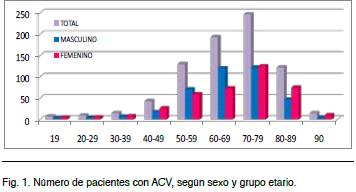
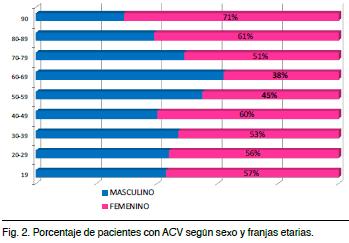
<body><![CDATA[<br>     <span style="font-size: 10pt; font-family: Verdana;" lang="ES-TRAD"><o:p>&nbsp;</o:p></span>      <br>     <span style="font-size: 10pt; font-family: Verdana; font-weight: normal;" lang="ES-TRAD"><span style="font-weight: bold;">RESULTADOS</span><u style=""><o:p></o:p></u></span>      <br>        <br>     <u style=""><span style="font-size: 10pt; font-family: Verdana;" lang="ES-TRAD"><o:p><span style="text-decoration: none;"></span></o:p></span></u>  <span style="font-size: 10pt; font-family: Verdana; font-weight: normal;" lang="ES-TRAD">Poblaci&oacute;n</span><span style="font-size: 10pt; font-family: Verdana; font-weight: normal;" lang="ES-TRAD"><o:p></o:p></span>      <br>     <span style="font-size: 10pt; font-family: Verdana;" lang="ES-TRAD">En los 66 meses (5,5 a&ntilde;os) desde julio del 2007 a diciembre del 2012, consultaron 784 pacientes con ACV, 388 eran de sexo femenino (49,5%) con una media de edad de 68 a&ntilde;os (16-96) y 396 de sexo masculino (50,5%) con edades entre 17 y 91 a&ntilde;os (media: 66 a&ntilde;os). El ACV predomin&oacute; entre los 60 y 79 a&ntilde;os, con mayor frecuencia en el sexo masculino entre los 50 y 69 a&ntilde;os. (<a href="#graf_1">Figuras 1</a> <a href="#graf_2">y 2</a>).</span>     <br>         <br>     <a name="graf_1"></a><img style="width: 356px; height: 192px;" alt="" src="/img/revistas/ami/v37n1/1a06g1.jpg">    <br>         <br>     <a name="graf_2"></a><img style="width: 349px; height: 243px;" alt="" src="/img/revistas/ami/v37n1/1a06g2.jpg">    <br>     <span style="font-size: 10pt; font-family: Verdana;" lang="ES-TRAD"><o:p></o:p></span>      ]]></body>
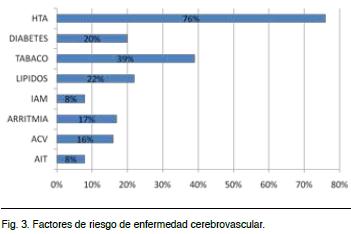
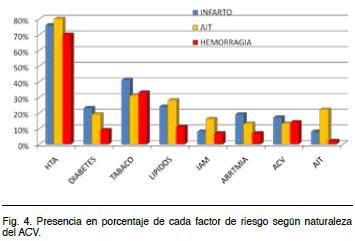
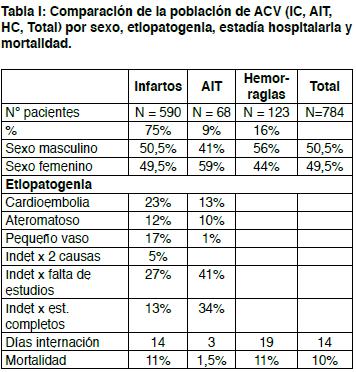
<body><![CDATA[<br>     <span style="font-size: 10pt; font-family: Verdana; font-weight: normal;" lang="ES-TRAD">Factores de riesgo</span><span style="font-size: 10pt; font-family: Verdana; font-weight: normal;" lang="ES-TRAD"><o:p></o:p></span>      <br>    <span style="font-size: 10pt; font-family: Verdana;" lang="ES-TRAD">Los factores de riesgo m&aacute;s frecuentes fueron: HTA (76%), tabaquismo (39%), diabetes (20%), dislipemia (22%). El 16% de los pacientes hab&iacute;a presentado un ACV previo y el 8% un AIT previo. El 17% de los pacientes ten&iacute;a arritmia card&iacute;aca; el 7,5% estaba previamente anticoagulado y el 17% antiagregado (<a href="#graf_3">Figura 3</a>). Se destaca que el 8% de los ACV no presentaron ninguno de los factores de riesgo antes mencionados, 28% presentaron 1 de ellos, 32% presentaron 2 factores y 32% entre 3 y 6 factores de riesgo. &nbsp;</span>    <br>    <span style="font-size: 10pt; font-family: Verdana;" lang="ES-TRAD"></span>     <br>    <a name="graf_3"></a><img style="width: 351px; height: 234px;" alt="" src="/img/revistas/ami/v37n1/1a06g3.jpg">       <p class="txt" style="text-align: left; text-indent: 0cm; line-height: normal;" align="left"><span style="font-size: 10pt; font-family: Verdana;" lang="ES-TRAD"><o:p>&nbsp;</o:p></span></p>           <p class="Subt2" style="line-height: normal;"><span style="font-size: 10pt; font-family: Verdana; font-weight: normal;" lang="ES-TRAD">Naturaleza<o:p></o:p></span></p>           <p class="txt" style="text-align: left; text-indent: 0cm; line-height: normal;" align="left"><span style="font-size: 10pt; font-family: Verdana;" lang="ES-TRAD">El 75% (590) de los pacientes present&oacute; IC, 9% (68) presentaron AIT y 123 (16%) HC. La media de edad de presentaci&oacute;n fue de 68 a&ntilde;os para los IC y AIT, y de 62 a&ntilde;os para las HC. Tanto los IC como las HC predominaron en el sexo masculino (50,5%-49,5% y 56%-44%), mientras que los AIT en el sexo femenino (41%-59%) (<a href="#graf_4">Figura 4</a>).</span></p>         <br>     <a name="graf_4"></a><img style="width: 355px; height: 241px;" alt="" src="/img/revistas/ami/v37n1/1a06g4.jpg">     <p class="txt" style="text-align: left; text-indent: 0cm; line-height: normal;" align="left"><span style="font-size: 10pt; font-family: Verdana;" lang="ES-TRAD"><o:p>&nbsp;</o:p></span></p>           <p class="Subt2" style="line-height: normal;"><span style="font-size: 10pt; font-family: Verdana; font-weight: normal;" lang="ES-TRAD">Infarto Cerebral</span><span style="font-size: 10pt; font-family: Verdana; font-weight: normal;" lang="ES-TRAD"><o:p></o:p></span></p>           ]]></body>
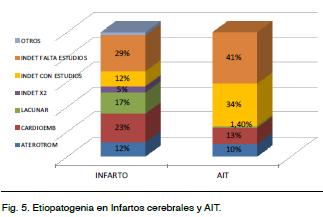
<body><![CDATA[<p class="txt" style="text-align: left; text-indent: 0cm; line-height: normal;" align="left"><span style="font-size: 10pt; font-family: Verdana;" lang="ES-TRAD">Con un promedio de edad de 68 a&ntilde;os, 50,5% eran del sexo masculino. Clinicamente se presentaron 29% como infarto lacunar (LACI), 30% como infarto parcial de la circulaci&oacute;n anterior (PACI), 20% como infarto de la circulaci&oacute;n posterior (POCI) y 18% como infarto total de la circulaci&oacute;n anterior (TACI). El promedio de NIHSS fue de 7,6 puntos. La etiolog&iacute;a se confirm&oacute; como cardioembolia en el 23%, enfermedad de peque&ntilde;o vaso en el 17%, aterotromb&oacute;ticos en <span class="GramE">el 11,5%, indeterminados</span> por estudios negativos 12%, por 2 causas posibles 5%, otras causas 2,5% y el 29% quedaron indeterminados por estudios incompletos. Permanecieron internados un promedio total de 14 d&iacute;as y en la UACV 4 d&iacute;as. El 9% de los pacientes con IC (52) se estudiaron en la emergencia con alta desde la misma. Fallecieron el 11% de los IC (64), en un promedio de 30 d&iacute;as, la mitad de ellos antes de los 10 d&iacute;as (<a href="#graf_5">Figura 5</a> y <a href="#tab_1">Tabla I</a>).</span></p>         <br>     <a name="graf_5"></a><img style="width: 323px; height: 217px;" alt="" src="/img/revistas/ami/v37n1/1a06g5.jpg">    <br>         <br>     <a name="tab_1"></a><img style="width: 356px; height: 372px;" alt="" src="/img/revistas/ami/v37n1/1a06t1.jpg">     <p class="txt" style="text-align: left; text-indent: 0cm; line-height: normal;" align="left"><span style="font-size: 10pt; font-family: Verdana;" lang="ES-TRAD"><o:p>&nbsp;</o:p></span></p>           <p class="Subt2" style="line-height: normal;"><span style="font-size: 10pt; font-family: Verdana; font-weight: normal;" lang="ES-TRAD">AIT<o:p></o:p></span></p>           <p class="txt" style="text-align: left; text-indent: 0cm; line-height: normal;" align="left"><span style="font-size: 10pt; font-family: Verdana;" lang="ES-TRAD">Con un promedio de edad de 68 a&ntilde;os. El 59% eran de sexo femenino. Con respecto a la topograf&iacute;a: 7% fueron retinianos, 63% del territorio carot&iacute;deo y 4% del territorio v&eacute;rtebro-basilar. En un alto porcentaje no se pudo determinar la topograf&iacute;a. Etiopatogenia: se confirmaron 10% aterotromb&oacute;ticos, 13% cardioemb&oacute;licos, 34% indeterminados por estudios negativos y 41% indeterminado por estudios incompletos. Seg&uacute;n score ABCD 2, (escala predictora de riesgo de infarto precoz) se presentaron como AIT leve (1 a 3) el 34%, moderado (4 y 5) el 44% y severo (6 y 7) el 17%. La media al ingreso fue de 4 puntos. El 53% de los pacientes (36) se estudiaron en la emergencia. 28 de ellos se fueron de alta desde la emergencia. El resto permaneci&oacute; internado un promedio de 3 d&iacute;as. Falleci&oacute; 1 paciente (1,5%) (<a href="#graf_5">Figura 5</a> y <a href="#tab_1">Tabla I</a>).<o:p></o:p></span></p>           <p class="txt" style="text-align: left; text-indent: 0cm; line-height: normal;" align="left"><span style="font-size: 10pt; font-family: Verdana;" lang="ES-TRAD"><o:p>&nbsp;</o:p></span></p>           <p class="Subt2" style="line-height: normal;"><span style="font-size: 10pt; font-family: Verdana; font-weight: normal;" lang="ES-TRAD">HC</span><span style="font-size: 10pt; font-family: Verdana; font-weight: normal;" lang="ES-TRAD"><o:p></o:p></span></p>           <p class="txt" style="text-align: left; text-indent: 0cm; line-height: normal;" align="left"><span style="font-size: 10pt; font-family: Verdana;" lang="ES-TRAD">Con un promedio de 62 a&ntilde;os, 56% eran del sexo masculinos. El 67% de topograf&iacute;a supratentorial (31% lobares y 35% ganglio basales), el 20% infratentorial (cerebelo y tronco). Con respecto a la etiolog&iacute;a 65% fueron secundarios a la HTA, 14% vinculados al alcohol, 9% a malformaciones (MAV o cavernomas), 4% angiopat&iacute;a amiloide.<o:p></o:p></span></p>       <span style="font-size: 10pt; font-family: Verdana;" lang="ES-TRAD">Promedio de d&iacute;as de internaci&oacute;n 19 d&iacute;as. Fallecieron el 11% en un promedio de 21 d&iacute;as, un tercio antes de 10 d&iacute;as. (<a href="#tab_1">Tabla I</a>).</span><u style=""><span style="font-size: 10pt; font-family: Verdana;" lang="ES-TRAD"><o:p></o:p></span></u>       ]]></body>
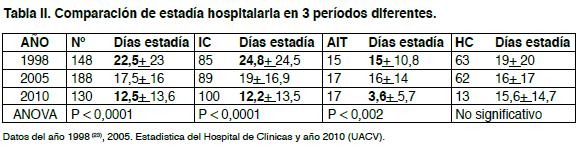
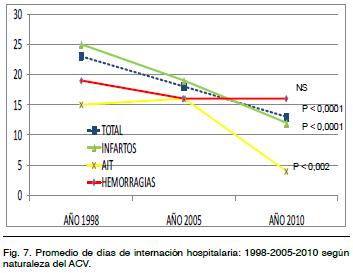
<body><![CDATA[<br>        <br>       <span style="font-size: 10pt; font-family: Verdana; font-weight: normal;" lang="ES-TRAD">Demora en la consulta</span><span style="font-size: 10pt; font-family: Verdana; font-weight: normal;" lang="ES-TRAD"> (o tiempo s&iacute;ntoma-puerta)<o:p></o:p></span>       <br>    <span style="font-size: 10pt; font-family: Verdana;" lang="ES-TRAD">De 590 pacientes con IC, 190 pacientes (32%) consultaron antes de las 4,5 horas. Por la forma de presentaci&oacute;n 13% de los pacientes (80), notaron los s&iacute;ntomas al despertar y 125 pacientes no pudieron determinar la hora de inicio (<a href="#graf_6">Figura 6</a>). &nbsp;</span>    <br>    <span style="font-size: 10pt; font-family: Verdana;" lang="ES-TRAD"></span>     <br>    <a name="graf_6"></a><img style="width: 353px; height: 249px;" alt="" src="/img/revistas/ami/v37n1/1a06g6.jpg">       <p class="txt" style="text-align: left; text-indent: 0cm; line-height: normal;" align="left"><span style="font-size: 10pt; font-family: Verdana;" lang="ES-TRAD"><o:p>&nbsp;</o:p></span></p>           <p class="Subt2" style="line-height: normal;"><span style="font-size: 10pt; font-family: Verdana; font-weight: normal;" lang="ES-TRAD">Destino<o:p></o:p></span></p>           <p class="txt" style="text-align: left; text-indent: 0cm; line-height: normal;" align="left"><span style="font-size: 10pt; font-family: Verdana;" lang="ES-TRAD">El 13% (87) de los pacientes fueron dados de alta desde la Emergencia, siendo la mayor&iacute;a AIT. 37 pacientes (5,5%) ingresaron a CTI o CI desde la emergencia o desde la sala, y 72% de los pacientes ingresaron al Hospital. La mortalidad del total de pacientes que no ingresaron al CTI fue del 10% (79 pacientes: 64 IC, 14 HC, 1 AIT); el 38% falleci&oacute; antes de los 7 d&iacute;as de internaci&oacute;n (<a href="#tab_1">Tabla I</a>).<o:p></o:p></span></p>           <p class="txt" style="text-align: left; text-indent: 0cm; line-height: normal;" align="left"><span style="font-size: 10pt; font-family: Verdana;" lang="ES-TRAD"><o:p>&nbsp;</o:p></span></p>           <p class="Subt2" style="line-height: normal;"><span style="font-size: 10pt; font-family: Verdana; font-weight: normal;" lang="ES-TRAD">Estad&iacute;a hospitalaria</span><span style="font-size: 10pt; font-family: Verdana; font-weight: normal;" lang="ES-TRAD"><o:p></o:p></span></p>       <span style="font-size: 10pt; font-family: Verdana;" lang="ES-TRAD">El promedio total de internaci&oacute;n fue de 14 d&iacute;as, y en la UACV los pacientes permanecieron un promedio de 4 d&iacute;as. Durante el a&ntilde;o 1998 los d&iacute;as promedio de estad&iacute;a hospitalaria de los ACV fue de 22,5, en el 2005 de 17,5 y con la formaci&oacute;n de la UACV en el 2010 de 12,5 d&iacute;as, descenso estad&iacute;sticamente significativo (p &lt; 0,0001). (<a href="#graf_7">Figura 7</a> y <a href="#tab_2">Tabla II</a>). Los IC estuvieron 24,8 d&iacute;as en 1998, 19 d&iacute;as en el 2005 y 12,2 en el 2010 (p &lt; 0,0001). Los AIT permanec&iacute;an 15 d&iacute;as en 1998, 16 en el 2005 y 3.6 d&iacute;as actualmente (p &lt; 0,0001). Las HC ten&iacute;an una estad&iacute;a de 19 d&iacute;as en 1998, 16 en el 2005 y 15,6 en el 2010, descenso no significativo.</span>     ]]></body>
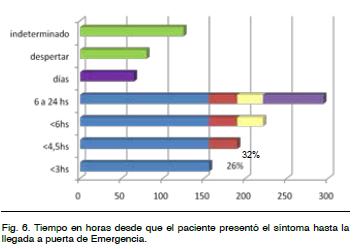
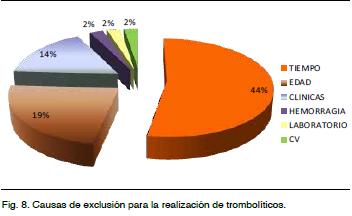
<body><![CDATA[<br>        <br>    <span style="font-size: 10pt; font-family: Verdana;" lang="ES-TRAD"><o:p></o:p></span>   <span style="font-size: 10pt; font-family: Verdana;" lang="ES-TRAD"><o:p><a name="graf_7"></a><img style="width: 353px; height: 273px;" alt="" src="/img/revistas/ami/v37n1/1a06g7.jpg"></o:p></span>     <p class="txt" style="text-align: left; text-indent: 0cm; line-height: normal;" align="left"></p>        <p class="txt" style="text-align: left; text-indent: 0cm; line-height: normal;" align="left"></p>    <span style="font-family: Helvetica;"></span>     <p class="txt" style="text-align: left; text-indent: 0cm; line-height: normal;" align="left"><span style="font-size: 10pt; font-family: Verdana;" lang="ES-TRAD"><o:p></o:p></span></p>         <p class="txt" style="text-align: left; text-indent: 0cm; line-height: normal;" align="left"><span style="font-size: 10pt; font-family: Verdana;" lang="ES-TRAD"><o:p><a name="tab_2"></a><img style="width: 579px; height: 149px;" alt="" src="/img/revistas/ami/v37n1/1a06t2.jpg"></o:p></span></p>         <p class="txt" style="text-align: left; text-indent: 0cm; line-height: normal;" align="left"><span style="font-size: 10pt; font-family: Verdana;" lang="ES-TRAD"><o:p>&nbsp;</o:p></span></p>           <p class="Subt2" style="line-height: normal;"><span style="font-size: 10pt; font-family: Verdana; font-weight: normal;" lang="ES-TRAD">Trombol&iacute;ticos (TL)</span><span style="font-size: 10pt; font-family: Verdana; font-weight: normal;" lang="ES-TRAD"><o:p></o:p></span></p>           <p class="txt" style="text-align: left; text-indent: 0cm; line-height: normal;" align="left"><span style="font-size: 10pt; font-family: Verdana;" lang="ES-TRAD">Cumplieron con criterios de TL 14,5% (86) de los IC (1,3 pacientes por mes). Analizados los criterios de exclusi&oacute;n se destaca que los IC que no llegaron en ventana terap&eacute;utica, o sus s&iacute;ntomas se iniciaron al despertar, o en horario indeterminado fueron el 44% (260). Otros criterios de exclusi&oacute;n fueron: edad mayor de 80 a&ntilde;os (19%), causas cl&iacute;nicas (14%), y cardiovasculares (2%), por hemorragia sist&eacute;mica (2%), y de laboratorio (2%) (<a href="#graf_8">Figura 8</a>). &nbsp;</span></p>        <p class="txt" style="text-align: left; text-indent: 0cm; line-height: normal;" align="left"><span style="font-size: 10pt; font-family: Verdana;" lang="ES-TRAD"></span></p>        ]]></body>
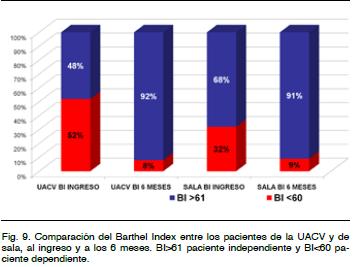
<body><![CDATA[<p class="txt" style="text-align: left; text-indent: 0cm; line-height: normal;" align="left"><span style="font-size: 10pt; font-family: Verdana;" lang="ES-TRAD"></span></p>         <p class="txt" style="text-align: left; text-indent: 0cm; line-height: normal;" align="left"><a name="graf_8"></a><img style="width: 352px; height: 216px;" alt="" src="/img/revistas/ami/v37n1/1a06g8.jpg"></p>     <span style="font-size: 10pt; font-family: Verdana;" lang="ES-TRAD"><o:p>&nbsp;</o:p></span>      <p class="Subt2" style="line-height: normal;"><span style="font-size: 10pt; font-family: Verdana; font-weight: normal;" lang="ES-TRAD">Funcionalidad a los 6 meses</span><span style="font-size: 10pt; font-family: Verdana; font-weight: normal;" lang="ES-TRAD"><o:p></o:p></span></p>           <p class="txt" style="text-align: left; text-indent: 0cm; line-height: normal;" align="left"><span style="font-size: 10pt; font-family: Verdana;" lang="ES-TRAD">En una subpoblaci&oacute;n de 47 pacientes se compararon funcionalmente los ingresados y tratados en la UACV (53%) con los ingresados y tratados fuera de la misma (sala de neurolog&iacute;a general o sala de medicina).<o:p></o:p></span></p>           <p class="txt" style="text-align: left; text-indent: 0cm; line-height: normal;" align="left"><span style="font-size: 10pt; font-family: Verdana;" lang="ES-TRAD">Los 2 subgrupos de pacientes presentaron mejor&iacute;a funcional significativa del BI a 6 meses. En la UACV del 48 al 92% y en sala del 68 al 91%. Hay que remarcar que la poblaci&oacute;n de pacientes de la UACV estaba funcionalmente peor al ingreso (<a href="#graf_9">Figura 9</a>).<o:p></o:p></span></p>       <span style="font-size: 10pt; font-family: Verdana;" lang="ES-TRAD">La internaci&oacute;n en la UACV se asoci&oacute; a una probabilidad mayor de mejorar funcionalmente y cambiar de categor&iacute;a en el BI, o sea de pasar a ser dependientes a independientes (de <u style="">&lt;</u> 60 a <u style="">&gt;</u> 61) (OR 4, IC 95% 1,2-17) (an&aacute;lisis multivariado por regresi&oacute;n log&iacute;stica).    <br>         <br>     </span><span style="font-size: 10pt; font-family: Verdana;" lang="ES-TRAD"><a name="graf_9"></a><img style="width: 354px; height: 267px;" alt="" src="/img/revistas/ami/v37n1/1a06g9.jpg">&nbsp;<u style=""><o:p></o:p></u></span>      <br>     <u style=""><span style="font-size: 10pt; font-family: Verdana;" lang="ES-TRAD"><o:p><span style="text-decoration: none;"></span></o:p></span></u>  <span style="font-size: 10pt; font-family: Verdana; font-weight: normal;" lang="ES-TRAD"><span style="font-weight: bold;">DISCUSI&Oacute;N</span><o:p></o:p></span>      <br>     <span style="font-size: 10pt; font-family: Verdana;" lang="ES-TRAD"><o:p>&nbsp;</o:p></span>      <br>     <span style="font-size: 10pt; font-family: Verdana;" lang="ES-TRAD">El an&aacute;lisis epidemiol&oacute;gico de una poblaci&oacute;n de ACV estudiada y tratada por un equipo multidisciplinario especializado en ACV demuestra las ventajas internacionalmente descriptas.<o:p></o:p></span>      ]]></body>
<body><![CDATA[<p class="txt" style="text-align: left; text-indent: 0cm; line-height: normal;" align="left"><span style="font-size: 10pt; font-family: Verdana;" lang="ES-TRAD">La poblaci&oacute;n de ACV del Hospital de Cl&iacute;nicas se comport&oacute; en forma similar a otras en Latinoam&eacute;rica desde el punto de vista epidemiol&oacute;gico (naturaleza del ACV, distribuci&oacute;n en edad y sexo, factores de riesgo, mortalidad)<span class="GramE">.<sup><a name="-24"></a><a name="-25"></a>(</sup></span><sup><a href="#24">24</a>-<a href="#25">25</a>)</sup><o:p></o:p></span></p>           <p class="txt" style="text-align: left; text-indent: 0cm; line-height: normal;" align="left"><span style="font-size: 10pt; font-family: Verdana;" lang="ES-TRAD">Sobresale la HTA como factor de riesgo modificable presente en esta poblaci&oacute;n en el 76%, predominando tanto en el IC (75,5%), AIT (80%) como en la HC (70%). M&aacute;s de la mitad de esta poblaci&oacute;n ten&iacute;a 2 o m&aacute;s factores de riesgo.<o:p></o:p></span></p>           <p class="txt" style="text-align: left; text-indent: 0cm; line-height: normal;" align="left"><span style="font-size: 10pt; font-family: Verdana;" lang="ES-TRAD">La incidencia de ACV fue m&aacute;s frecuente entre los 60 y 79 a&ntilde;os. Predominando siempre en el sexo femenino excepto entre los 50 y 69 a&ntilde;os.<o:p></o:p></span></p>           <p class="txt" style="text-align: left; text-indent: 0cm; line-height: normal;" align="left"><span style="font-size: 10pt; font-family: Verdana;" lang="ES-TRAD">En todos los grupos etarios predomin&oacute; el IC, excepto en menores de 19 a&ntilde;os en que predomin&oacute; la HC. La estad&iacute;a hospitalaria disminuy&oacute; claramente para IC y AIT. La mayor&iacute;a de los AIT se resolvieron desde la emergencia (36 pacientes: 53%), disminuyendo as&iacute; los costos de internaci&oacute;n y racionalizando la solicitud de estudios paracl&iacute;nicos. La estad&iacute;a de las HC permaneci&oacute; estable en el tiempo, probablemente porque el tratamiento de las mismas sigue incambiado con los a&ntilde;os.<o:p></o:p></span></p>           <p class="txt" style="text-align: left; text-indent: 0cm; line-height: normal;" align="left"><span style="font-size: 10pt; font-family: Verdana;" lang="ES-TRAD">La mortalidad total o por subgrupo impresiona disminuida con respecto a datos internacionales, creemos que se debe a que los pacientes con ACV graves (IC o HC) son derivados directamente a CTI, lo que impone un sesgo.<o:p></o:p></span></p>           <p class="txt" style="text-align: left; text-indent: 0cm; line-height: normal;" align="left"><span style="font-size: 10pt; font-family: Verdana;" lang="ES-TRAD">La UACV mejor&oacute; el pron&oacute;stico funcional a 6 meses, con un mayor n&uacute;mero de pacientes independientes en AVD a mediano plazo; planteamos que ello fue debido a la sistematizaci&oacute;n en la atenci&oacute;n de los pacientes, con un abordaje diagn&oacute;stico y terap&eacute;utico multidisciplinario, especializado, y tambi&eacute;n al inicio de la rehabilitaci&oacute;n de forma precoz. <o:p></o:p></span></p>           <p class="txt" style="text-align: left; text-indent: 0cm; line-height: normal;" align="left"><span style="font-size: 10pt; font-family: Verdana;" lang="ES-TRAD">En esta poblaci&oacute;n, 1,3 pacientes/mes ser&iacute;an potenciales candidatos para TL, cifra similar a otros centros de referencia, a&uacute;n sin difusi&oacute;n del tema a la poblaci&oacute;n.<o:p></o:p></span></p>           <p class="txt" style="text-align: left; text-indent: 0cm; line-height: normal;" align="left"><span style="font-size: 10pt; font-family: Verdana;" lang="ES-TRAD">El tratamiento TL es subutilizado a nivel mundial (20% de los ACV isqu&eacute;micos) por la demora en el acceso de los pacientes a los servicios especializados en el tratamiento agudo de esta patolog&iacute;a, y/o las demoras que se producen dentro del servicio en la recepci&oacute;n y estudio de estos pacientes.<sup><a name="-26"></a><a name="-27"></a>(<a href="#26">26</a>-<a href="#27">27</a>) </sup><o:p></o:p></span></p>           <p class="txt" style="text-align: left; text-indent: 0cm; line-height: normal;" align="left"><span style="font-size: 10pt; font-family: Verdana;" lang="ES-TRAD">La causa de exclusi&oacute;n m&aacute;s frecuente en esta poblaci&oacute;n fue el tiempo de llegada de los pacientes a Emergencia. <o:p></o:p></span></p>       <span style="font-size: 10pt; font-family: Verdana;" lang="ES-TRAD">La instrumentaci&oacute;n de campa&ntilde;as de educaci&oacute;n p&uacute;blica, la coordinaci&oacute;n y activaci&oacute;n de protocolos diagn&oacute;stico-terap&eacute;uticos (C&oacute;digo ACV) permitir&aacute;n que se incluyan m&aacute;s candidatos en la ventana terap&eacute;utica del uso de TL.<o:p></o:p></span>      <br>     <span style="font-size: 10pt; font-family: Verdana;" lang="ES-TRAD"><o:p>&nbsp;</o:p></span>      ]]></body>
<body><![CDATA[<br>     <span style="font-size: 10pt; font-family: Verdana; font-weight: normal;" lang="ES-TRAD"><span style="font-weight: bold;">CONCLUSIONES</span><o:p></o:p></span>      <br>     <span style="font-size: 10pt; font-family: Verdana;" lang="ES-TRAD"><o:p>&nbsp;</o:p></span>    <br>       <span style="font-size: 10pt; font-family: Verdana;" lang="ES-TRAD">La formaci&oacute;n de equipos multidisciplinarios y entrenados en el diagn&oacute;stico y tratamiento del ACV han demostrado internacionalmente, y ahora en el Hospital de Cl&iacute;nicas, la disminuci&oacute;n en el tiempo de internaci&oacute;n y la independencia funcional. Esto incidir&iacute;a en al impacto econ&oacute;mico generado por esta patolog&iacute;a, permitiendo disminuir costos institucionales y de rehabilitaci&oacute;n a mediano y largo plazo, y precoz reintegro social y laboral de la poblaci&oacute;n econ&oacute;micamente activa. Nuestro centro demuestra que las UACV son posibles y efectivas<span class="GramE">.<sup>(</sup></span><sup><a href="#3">3-26</a>)</sup><o:p></o:p></span>      <br>     <span style="font-size: 10pt; font-family: Verdana;" lang="ES-TRAD"><o:p>&nbsp;</o:p></span><span style="font-size: 10pt; font-family: Verdana;" lang="ES-TRAD"><o:p></o:p></span>&nbsp;    <br>     <span style="font-size: 10pt; font-family: Verdana; font-weight: normal;" lang="ES-TRAD"><span style="font-weight: bold;">REFERENCIAS</span><o:p></o:p></span>      <br>     <span style="font-size: 10pt; font-family: Verdana; font-weight: normal;" lang="ES-TRAD"><o:p>&nbsp;</o:p></span>      <!-- ref --><br>     <span style="font-size: 10pt; font-family: Verdana;" lang="EN-US"><a name="1"></a><a href="#-1">1</a>.<span style="">&nbsp;&nbsp;&nbsp;&nbsp;&nbsp;&nbsp; </span>Malmgren R, Warlow C, Bamford J, Sandercock P. Geographical and secular trends in stroke incidence. Lancet 1987<span class="GramE">;2:1196</span>-2000.    <o:p></o:p></span>      <!-- ref --><p class="Bibliog" style="margin-left: 0cm; text-align: left; text-indent: 0cm; line-height: normal;" align="left"><span style="font-size: 10pt; font-family: Verdana;" lang="EN-US"><a name="2"></a><a href="#-2">2</a>.<span style="">&nbsp;&nbsp;&nbsp;&nbsp;&nbsp;&nbsp; </span>Bamford J, Sandercock P, Dennis M. A prospective study of acute cerebrovascular disease in the community: the Oxfordshire Community Stroke Project 1981-86, 1: methodology, demography and incident cases of first-ever stroke. <span class="GramE">J Neurol Neurosurg Psychiatry.</span> 1988<span class="GramE">;51:1373</span>-1380.    <o:p></o:p></span></p>           ]]></body>
<body><![CDATA[<!-- ref --><p class="Bibliog" style="margin-left: 0cm; text-align: left; text-indent: 0cm; line-height: normal;" align="left"><span style="font-size: 10pt; font-family: Verdana;" lang="EN-US"><a name="3"></a><a href="#-3">3</a>.<span style="">&nbsp;&nbsp;&nbsp;&nbsp;&nbsp;&nbsp; </span>O&uml;mer Saka, MD, MSc; Victoria Serra, MSc; Yevgeniy Samyshkin, MSc. Cost-Effectiveness of Stroke Unit Care Followed by Early Supported Discharge. Stroke 2009<span class="GramE">;40:24</span>-29.    <o:p></o:p></span></p>           <!-- ref --><p class="Bibliog" style="margin-left: 0cm; text-align: left; text-indent: 0cm; line-height: normal;" align="left"><span style="font-size: 10pt; font-family: Verdana;" lang="EN-US"><a name="4"></a><a href="#-4">4</a>.<span style="">&nbsp;&nbsp;&nbsp;&nbsp;&nbsp;&nbsp; </span>Launois RGM, Megnigbeto AC, Le Lay K. Estimating the cost-effectiveness of stroke units in <st1:country-region w:st="on"><st1:place w:st="on">France</st1:place></st1:country-region> compared with conventional care. Stroke 2004<span class="GramE">;35:770</span>-775.    <o:p></o:p></span></p>           <p class="Bibliog" style="margin-left: 0cm; text-align: left; text-indent: 0cm; line-height: normal;" align="left"><span style="font-size: 10pt; font-family: Verdana;" lang="EN-US"><a name="5"></a><a href="#-5">5</a>.<span style="">&nbsp;&nbsp;&nbsp;&nbsp;&nbsp;&nbsp; </span>Feng Zhu H, Newcommon NN, Cooper ME.Impact of a stroke unit on length of stay and in-hospital case fatality. </span><span style="font-size: 10pt; font-family: Verdana;">Stroke 2009<span class="GramE">;40:18</span>-23.<o:p></o:p></span></p>           <!-- ref --><p class="Bibliog" style="margin-left: 0cm; text-align: left; text-indent: 0cm; line-height: normal;" align="left"><span style="font-size: 10pt; font-family: Verdana;"><a name="6"></a><a href="#-6">6</a>.<span style="">&nbsp;&nbsp;&nbsp;&nbsp;&nbsp;&nbsp; </span>Hochmann B, Coelho J, Segura J, Galli M, Ketzoian C, Pebet M. Incidencia del accidente cerbrovascular en la ciudad de Rivera, Uruguay. Rev Neurol 2006; 43 (2):78-83.    <o:p></o:p></span></p>           <!-- ref --><p class="Bibliog" style="margin-left: 0cm; text-align: left; text-indent: 0cm; line-height: normal;" align="left"><span style="font-size: 10pt; font-family: Verdana;"><a name="7"></a><a href="#-7">7</a>.<span style="">&nbsp;&nbsp;&nbsp;&nbsp;&nbsp;&nbsp; </span>Ketzoian C, Rega I, Caseres R. Estudio de prevalencia de las principales enfermedades neurol&oacute;gicas en una poblaci&oacute;n del Uruguay. La Prensa M&eacute;dica Uruguaya. 1997<span class="GramE">;17:9</span>-26.    <o:p></o:p></span></p>           <!-- ref --><p class="Bibliog" style="margin-left: 0cm; text-align: left; text-indent: 0cm; line-height: normal;" align="left"><span style="font-size: 10pt; font-family: Verdana;"><a name="8"></a><a href="#-8">8</a>.<span style="">&nbsp;&nbsp;&nbsp;&nbsp;&nbsp;&nbsp; </span>Adams R, Alberts G, Alberts M, et al. </span><span class="GramE"><span style="font-size: 10pt; font-family: Verdana;" lang="EN-US">Update to the AHA/ASA Recommendations for the Prevention of Stroke and TIA.</span></span><span style="font-size: 10pt; font-family: Verdana;" lang="EN-US"> Stroke 2008; 39:1674-1652.    <o:p></o:p></span></p>           <p class="Bibliog" style="margin-left: 0cm; text-align: left; text-indent: 0cm; line-height: normal;" align="left"><span style="font-size: 10pt; font-family: Verdana;" lang="EN-US"><a name="9"></a><a href="#-9">9</a>.<span style="">&nbsp;&nbsp;&nbsp;&nbsp;&nbsp;&nbsp; </span>Langhorne P, Pollock A, on behalf of The Stroke Unit Trialists&rsquo; Collaboration. What are the components of effective stroke unit <span class="GramE">care.</span> Age Ageing 2002<span class="GramE">;31:365</span>-371.<o:p></o:p></span></p>           <!-- ref --><p class="Bibliog" style="margin-left: 0cm; text-align: left; text-indent: 0cm; line-height: normal;" align="left"><span style="font-size: 10pt; font-family: Verdana;" lang="EN-US"><a name="10"></a><a href="#-10">10</a>.<span style="">&nbsp;&nbsp;&nbsp;&nbsp; </span>The National Institute of Neurological Disorders and Stroke rt-PA Stroke Study Group. <span class="GramE">Tissue plasminogen activator for acute ischemic stroke.</span> N Engl J Med 1995<span class="GramE">;333:1581</span>-7.    <o:p></o:p></span></p>           <!-- ref --><p class="Bibliog" style="margin-left: 0cm; text-align: left; text-indent: 0cm; line-height: normal;" align="left"><span style="font-size: 10pt; font-family: Verdana;" lang="EN-US"><a name="11"></a><a href="#-11">11</a>.<span style="">&nbsp;&nbsp;&nbsp;&nbsp; </span>Sacco R, Adams R, Albers G, et al. Guidelines for prevention of stroke in patients with Ischemic Stroke or TIA, AHA/ASA Guidelines. Stroke 2006<span class="GramE">;37</span>(2);577-617.    <o:p></o:p></span></p>           <!-- ref --><p class="Bibliog" style="margin-left: 0cm; text-align: left; text-indent: 0cm; line-height: normal;" align="left"><span style="font-size: 10pt; font-family: Verdana;" lang="EN-US"><a name="12"></a><a href="#-12">12</a>.<span style="">&nbsp;&nbsp;&nbsp;&nbsp; </span>Wahlgren N, Ahmed N, Davalos A. Thrombolysis with Alteplase for acute ischemic stroke in Safe Implementation of Thrombolysis in Stroke-Monitoring Study (SITS-MOST): An observational study. Lancet 2007<span class="GramE">;368:275</span>-82.    <o:p></o:p></span></p>           <!-- ref --><p class="Bibliog" style="margin-left: 0cm; text-align: left; text-indent: 0cm; line-height: normal;" align="left"><span style="font-size: 10pt; font-family: Verdana;" lang="EN-US"><a name="13"></a><a href="#-13">13</a>.<span style="">&nbsp;&nbsp;&nbsp;&nbsp; </span>Wardlaw JM, <st1:city w:st="on"><st1:place w:st="on">Murray</st1:place></st1:city> v, Berge E and <span class="GramE">del</span> Zoppo GJ. <span class="GramE">Thrombolysis for Acute Ischemic Stroke.</span> Stroke 2010<span class="GramE">;41</span>;e445-e446.    <o:p></o:p></span></p>           ]]></body>
<body><![CDATA[<p class="Bibliog" style="margin-left: 0cm; text-align: left; text-indent: 0cm; line-height: normal;" align="left"><span style="font-size: 10pt; font-family: Verdana;" lang="EN-US"><a name="14"></a><a href="#-14">14</a>.<span style="">&nbsp;&nbsp;&nbsp;&nbsp; </span>Fagan S, Morgenstern L, Pettita A. Cost-effectiveness of tissue plasminogen activator for acute ischemic stroke. Neurology 1998<span class="GramE">;50:883</span>&ndash;890.<o:p></o:p></span></p>           <!-- ref --><p class="Bibliog" style="margin-left: 0cm; text-align: left; text-indent: 0cm; line-height: normal;" align="left"><span style="font-size: 10pt; font-family: Verdana;" lang="EN-US"><a name="15"></a><a href="#-15">15</a>.<span style="">&nbsp;&nbsp;&nbsp;&nbsp; </span>Solomon NA, Glick HA, Russo CJ. <span class="GramE">Patient preferences for stroke outcomes.</span> </span><span style="font-size: 10pt; font-family: Verdana;">Stroke 1994<span class="GramE">;25:1721</span>-1725.    <o:p></o:p></span></p>           <!-- ref --><p class="Bibliog" style="margin-left: 0cm; text-align: left; text-indent: 0cm; line-height: normal;" align="left"><span style="font-size: 10pt; font-family: Verdana;"><a name="16"></a><a href="#-16">16</a>.<span style="">&nbsp;&nbsp;&nbsp;&nbsp; </span>Arciere B, Legnani C, Camejo C et al. Manual diagn&oacute;stico y terap&eacute;utico de la Unidad de ACV. Instituto de Neurolog&iacute;a. Hospital de cl&iacute;nicas. </span><span class="GramE"><span style="font-size: 10pt; font-family: Verdana;" lang="EN-US">Edici&oacute;n 2010.    </span></span><span style="font-size: 10pt; font-family: Verdana;" lang="EN-US"><o:p></o:p></span></p>           <!-- ref --><p class="Bibliog" style="margin-left: 0cm; text-align: left; text-indent: 0cm; line-height: normal;" align="left"><span style="font-size: 10pt; font-family: Verdana;" lang="EN-US"><a name="17"></a><a href="#-17">17</a>.<span style="">&nbsp;&nbsp;&nbsp;&nbsp; </span>Bamford J, Sandercock P, Dennis M, Burn J, Warlow Ch. Classification and natural history of clinically identifiable subtypes of cerebral infarction. Lancet 1991<span class="GramE">;337:1521</span>-26).    <o:p></o:p></span></p>           <!-- ref --><p class="Bibliog" style="margin-left: 0cm; text-align: left; text-indent: 0cm; line-height: normal;" align="left"><span style="font-size: 10pt; font-family: Verdana;" lang="EN-US"><a name="18"></a><a href="#-18">18</a>.<span style="">&nbsp;&nbsp;&nbsp;&nbsp; </span>Adams et al. Classification of Subtype of Acute Ischemic Stroke. <span class="GramE">Definitions for Use in a Multicenter Clinical Trial.</span> Stroke 1993<span class="GramE">;24:35</span>-41.    <o:p></o:p></span></p>           <p class="Bibliog" style="margin-left: 0cm; text-align: left; text-indent: 0cm; line-height: normal;" align="left"><span style="font-size: 10pt; font-family: Verdana;" lang="EN-US"><a name="19"></a><a href="#-19">19</a> &nbsp; &nbsp; &nbsp;Rothwell PM, Giles MF, Flossmann E. Asimple score (ABCD) to identify individuals at high early risk of stroke after transient ischaemic attack. <span class="GramE">Lancet 2995; 366:29-36.</span><o:p></o:p></span></p>           ]]></body>
<body><![CDATA[<!-- ref --><p class="Bibliog" style="margin-left: 0cm; text-align: left; text-indent: 0cm; line-height: normal;" align="left"><span class="GramE"><span style="font-size: 10pt; font-family: Verdana;" lang="EN-US"><a name="20"></a><a href="#-20">20</a>.<span style="">&nbsp;&nbsp;&nbsp;&nbsp; </span>Hemphill III JC, <st1:place w:st="on"><st1:city w:st="on">Bonovich</st1:city> <st1:state w:st="on">DC</st1:state></st1:place>, Besmertis L.</span></span><span style="font-size: 10pt; font-family: Verdana;" lang="EN-US"> <span class="GramE">The ICH Score.</span> <span class="GramE">A simple, reliable grading scale for intracerebral Hemorrhage.</span> Stroke 2001; 32: 891-897.    <o:p></o:p></span></p>           <!-- ref --><p class="Bibliog" style="margin-left: 0cm; text-align: left; text-indent: 0cm; line-height: normal;" align="left"><span style="font-size: 10pt; font-family: Verdana;" lang="EN-US"><a name="21"></a><a href="#-21">21</a>.<span style="">&nbsp;&nbsp;&nbsp;&nbsp; </span>Goldstein LB, Bertels C, <st1:city w:st="on"><st1:place w:st="on">Davis</st1:place></st1:city> JN. <span class="GramE">Interrater reliability of the NIH stroke scale.</span> <span class="GramE">Arch Neurol 1989; 46:660-662.    </span><o:p></o:p></span></p>           <!-- ref --><p class="Bibliog" style="margin-left: 0cm; text-align: left; text-indent: 0cm; line-height: normal;" align="left"><span style="font-size: 10pt; font-family: Verdana;" lang="EN-US"><a name="22"></a><a href="#-22">22</a>.<span style="">&nbsp;&nbsp;&nbsp;&nbsp; </span>Sulter G, Steen C, De Kayser J. Use of the Bartex Index and modified Rankin Scale in acute stroke trials. </span><span style="font-size: 10pt; font-family: Verdana;">Stroke 1999; 30: 1538-1541.    <o:p></o:p></span></p>           <!-- ref --><p class="Bibliog" style="margin-left: 0cm; text-align: left; text-indent: 0cm; line-height: normal;" align="left"><span style="font-size: 10pt; font-family: Verdana;"><a name="23"></a><a href="#-23">23</a>.<span style="">&nbsp;&nbsp;&nbsp;&nbsp; </span>Braga P, Ibarra A, Rega I, Servente L, Benzano D, Ketzoian C, Pebet M. Ataque cerebrovascular: Un estudio epidemiol&oacute;gico prospectivo en el Hospital de Cl&iacute;nicas de Montevideo. </span><span style="font-size: 10pt; font-family: Verdana;" lang="EN-US">Rev Med Uruguay 2001; 17: 42-54<o:p></o:p></span><!-- ref --><p class="Bibliog" style="margin-left: 0cm; text-align: left; text-indent: 0cm; line-height: normal;" align="left"><span style="font-size: 10pt; font-family: Verdana;" lang="EN-US"><a name="24"></a><a href="#-24">24</a>.<span style="">&nbsp;&nbsp;&nbsp;&nbsp; </span>Lavados PM, Sacks C, Prina L. Incidence, 30-day case-fatality rate, and prognosis of&nbsp;stroke&nbsp;in <st1:place w:st="on"><st1:city w:st="on">Iquique</st1:city>,  <st1:country-region w:st="on">Chile</st1:country-region></st1:place>: a 2-year community-based prospective study (PISCIS project).&nbsp;<span class="GramE">Lancet<span style="">.</span></span></span><span style="font-size: 10pt; font-family: Verdana;" lang="EN-US">&nbsp;</span><span class="GramE"><span style="font-size: 10pt; font-family: Verdana;" lang="EN-US">2005; 365: 2206-2215.    </span></span><span style="font-size: 10pt; font-family: Verdana;" lang="EN-US"><o:p></o:p></span></p>           <!-- ref --><p class="Bibliog" style="margin-left: 0cm; text-align: left; text-indent: 0cm; line-height: normal;" align="left"><span style="font-size: 10pt; font-family: Verdana;" lang="EN-US"><a name="25"></a><a href="#-25">25</a>.<span style="">&nbsp;&nbsp;&nbsp;&nbsp; </span>Uchino K, Risser JM, Smith MA. Ischemic&nbsp;stroke&nbsp;subtypes among Mexican Americans and non-Hispanic whites: the BASIC Project.&nbsp;Neurology&nbsp;2004; 63: 574-576.    <o:p></o:p></span></p>           <!-- ref --><p class="Bibliog" style="margin-left: 0cm; text-align: left; text-indent: 0cm; line-height: normal;" align="left"><span style="font-size: 10pt; font-family: Verdana;" lang="EN-US"><a name="26"></a><a href="#-26">26</a>.<span style="">&nbsp;&nbsp;&nbsp;&nbsp; </span>Govan L, Weir CJ, Langhorne P. Organized Inpatient (Stroke Unit) Care for Stroke. Stroke 2008<span class="GramE">;39</span>;2402-2403.    <o:p></o:p></span></p>           <!-- ref --><p class="MsoNormal" style="margin-bottom: 0.0001pt;"><span style="font-size: 10pt; font-family: Verdana;" lang="EN-GB"><a name="27"></a><a href="#-27">27</a>.<span style="">&nbsp;&nbsp;&nbsp;&nbsp; </span>Phillip A. Scott; Chris J. Temovsky; Kate Lawrence. Analysis of Canadian Population <span class="GramE">With</span> Potential Geographic Access to Intravenous Thrombolysis for Acute Ischemic Stroke. </span><span style="font-size: 10pt; font-family: Verdana;" lang="ES-TRAD">Stroke 1998<span class="GramE">;29:2304</span>-2310.    <o:p></o:p></span></p>       </div>            ]]></body><back>
<ref-list>
<ref id="B1">
<label>1</label><nlm-citation citation-type="journal">
<person-group person-group-type="author">
<name>
<surname><![CDATA[Malmgren]]></surname>
<given-names><![CDATA[R]]></given-names>
</name>
<name>
<surname><![CDATA[Warlow]]></surname>
<given-names><![CDATA[C]]></given-names>
</name>
<name>
<surname><![CDATA[Bamford]]></surname>
<given-names><![CDATA[J]]></given-names>
</name>
<name>
<surname><![CDATA[Sandercock]]></surname>
<given-names><![CDATA[P]]></given-names>
</name>
</person-group>
<source><![CDATA[Lancet]]></source>
<year></year>
<volume>1987</volume>
<numero>2</numero>
<issue>2</issue>
<page-range>1196-2000</page-range></nlm-citation>
</ref>
<ref id="B2">
<label>2</label><nlm-citation citation-type="journal">
<person-group person-group-type="author">
<name>
<surname><![CDATA[Bamford]]></surname>
<given-names><![CDATA[J]]></given-names>
</name>
<name>
<surname><![CDATA[Sandercock]]></surname>
<given-names><![CDATA[P]]></given-names>
</name>
<name>
<surname><![CDATA[Dennis]]></surname>
<given-names><![CDATA[M]]></given-names>
</name>
</person-group>
<article-title xml:lang="en"><![CDATA[A prospective study of acute cerebrovascular disease in the community: the Oxfordshire Community Stroke Project 1981-86, 1: methodology, demography and incident cases of first-ever stroke]]></article-title>
<source><![CDATA[J Neurol Neurosurg Psychiatry]]></source>
<year>1988</year>
<volume>51</volume>
<page-range>1373-1380</page-range></nlm-citation>
</ref>
<ref id="B3">
<label>3</label><nlm-citation citation-type="journal">
<person-group person-group-type="author">
<name>
<surname><![CDATA[Saka]]></surname>
<given-names><![CDATA[O¨mer]]></given-names>
</name>
<name>
<surname><![CDATA[Serra]]></surname>
<given-names><![CDATA[Victoria]]></given-names>
</name>
<name>
<surname><![CDATA[Samyshkin]]></surname>
<given-names><![CDATA[Yevgeniy]]></given-names>
</name>
</person-group>
<article-title xml:lang="en"><![CDATA[Cost-Effectiveness of Stroke Unit Care Followed by Early Supported Discharge]]></article-title>
<source><![CDATA[Stroke]]></source>
<year>2009</year>
<volume>40</volume>
<page-range>24-29</page-range></nlm-citation>
</ref>
<ref id="B4">
<label>4</label><nlm-citation citation-type="journal">
<person-group person-group-type="author">
<name>
<surname><![CDATA[Launois]]></surname>
<given-names><![CDATA[RGM]]></given-names>
</name>
<name>
<surname><![CDATA[Megnigbeto]]></surname>
<given-names><![CDATA[AC]]></given-names>
</name>
<name>
<surname><![CDATA[Le Lay]]></surname>
<given-names><![CDATA[K]]></given-names>
</name>
</person-group>
<article-title xml:lang="en"><![CDATA[Estimating the cost-effectiveness of stroke units in France compared with conventional care]]></article-title>
<source><![CDATA[Stroke]]></source>
<year>2004</year>
<volume>35</volume>
<page-range>770-775</page-range></nlm-citation>
</ref>
<ref id="B5">
<label>5</label><nlm-citation citation-type="journal">
<person-group person-group-type="author">
<name>
<surname><![CDATA[H Feng]]></surname>
<given-names><![CDATA[Zhu]]></given-names>
</name>
<name>
<surname><![CDATA[Newcommon]]></surname>
<given-names><![CDATA[NN]]></given-names>
</name>
<name>
<surname><![CDATA[Cooper]]></surname>
<given-names><![CDATA[ME]]></given-names>
</name>
</person-group>
<article-title xml:lang="en"><![CDATA[Impact of a stroke unit on length of stay and in-hospital case fatality]]></article-title>
<source><![CDATA[Stroke]]></source>
<year>2009</year>
<volume>40</volume>
<page-range>18-23</page-range></nlm-citation>
</ref>
<ref id="B6">
<label>6</label><nlm-citation citation-type="journal">
<person-group person-group-type="author">
<name>
<surname><![CDATA[Hochmann]]></surname>
<given-names><![CDATA[B]]></given-names>
</name>
<name>
<surname><![CDATA[Coelho]]></surname>
<given-names><![CDATA[J]]></given-names>
</name>
<name>
<surname><![CDATA[Segura]]></surname>
<given-names><![CDATA[J]]></given-names>
</name>
<name>
<surname><![CDATA[Galli]]></surname>
<given-names><![CDATA[M]]></given-names>
</name>
<name>
<surname><![CDATA[Ketzoian]]></surname>
<given-names><![CDATA[C]]></given-names>
</name>
<name>
<surname><![CDATA[Pebet]]></surname>
<given-names><![CDATA[M]]></given-names>
</name>
</person-group>
<article-title xml:lang="es"><![CDATA[Incidencia del accidente cerbrovascular en la ciudad de Rivera, Uruguay]]></article-title>
<source><![CDATA[Rev Neurol]]></source>
<year>2006</year>
<volume>43</volume>
<numero>2</numero>
<issue>2</issue>
<page-range>78-83</page-range></nlm-citation>
</ref>
<ref id="B7">
<label>7</label><nlm-citation citation-type="journal">
<person-group person-group-type="author">
<name>
<surname><![CDATA[Ketzoian]]></surname>
<given-names><![CDATA[C]]></given-names>
</name>
<name>
<surname><![CDATA[Rega]]></surname>
<given-names><![CDATA[I]]></given-names>
</name>
<name>
<surname><![CDATA[Caseres]]></surname>
<given-names><![CDATA[R]]></given-names>
</name>
</person-group>
<article-title xml:lang="es"><![CDATA[Estudio de prevalencia de las principales enfermedades neurológicas en una población del Uruguay]]></article-title>
<source><![CDATA[La Prensa Médica Uruguaya]]></source>
<year>1997</year>
<volume>17</volume>
<page-range>9-26</page-range></nlm-citation>
</ref>
<ref id="B8">
<label>8</label><nlm-citation citation-type="journal">
<person-group person-group-type="author">
<name>
<surname><![CDATA[Adams]]></surname>
<given-names><![CDATA[R]]></given-names>
</name>
<name>
<surname><![CDATA[Alberts]]></surname>
<given-names><![CDATA[G]]></given-names>
</name>
<name>
<surname><![CDATA[Alberts]]></surname>
<given-names><![CDATA[M]]></given-names>
</name>
</person-group>
<article-title xml:lang="en"><![CDATA[Update to the AHA/ASA Recommendations for the Prevention of Strokeand TIA]]></article-title>
<source><![CDATA[Stroke]]></source>
<year>2008</year>
<volume>39</volume>
<page-range>1674-1652</page-range></nlm-citation>
</ref>
<ref id="B9">
<label>9</label><nlm-citation citation-type="journal">
<person-group person-group-type="author">
<name>
<surname><![CDATA[Langhorne]]></surname>
<given-names><![CDATA[P]]></given-names>
</name>
<name>
<surname><![CDATA[Pollock]]></surname>
<given-names><![CDATA[A]]></given-names>
</name>
</person-group>
<article-title xml:lang="en"><![CDATA[What are the components of effective stroke unit care]]></article-title>
<source><![CDATA[Age Ageing]]></source>
<year>2002</year>
<volume>31</volume>
<page-range>365-371</page-range></nlm-citation>
</ref>
<ref id="B10">
<label>10</label><nlm-citation citation-type="journal">
<collab>The National Institute of Neurological Disorders</collab>
<article-title xml:lang="en"><![CDATA[Tissue plasminogen activator for acute ischemic stroke]]></article-title>
<source><![CDATA[N Engl J Med]]></source>
<year>1995</year>
<volume>333</volume>
<page-range>1581-7</page-range></nlm-citation>
</ref>
<ref id="B11">
<label>11</label><nlm-citation citation-type="journal">
<person-group person-group-type="author">
<name>
<surname><![CDATA[Sacco]]></surname>
<given-names><![CDATA[R]]></given-names>
</name>
<name>
<surname><![CDATA[Adams]]></surname>
<given-names><![CDATA[R]]></given-names>
</name>
<name>
<surname><![CDATA[Albers]]></surname>
<given-names><![CDATA[G]]></given-names>
</name>
</person-group>
<article-title xml:lang="en"><![CDATA[Guidelines for prevention of stroke in patients with Ischemic Strokeor TIA, AHA/ASA Guidelines]]></article-title>
<source><![CDATA[Stroke]]></source>
<year>2006</year>
<volume>37</volume>
<numero>2</numero>
<issue>2</issue>
<page-range>577-617</page-range></nlm-citation>
</ref>
<ref id="B12">
<label>12</label><nlm-citation citation-type="journal">
<person-group person-group-type="author">
<name>
<surname><![CDATA[Wahlgren]]></surname>
<given-names><![CDATA[N]]></given-names>
</name>
<name>
<surname><![CDATA[Ahmed]]></surname>
<given-names><![CDATA[N]]></given-names>
</name>
<name>
<surname><![CDATA[Davalos]]></surname>
<given-names><![CDATA[A]]></given-names>
</name>
</person-group>
<article-title xml:lang="en"><![CDATA[Thrombolysis with Alteplase for acute ischemic stroke in Safe Implementation of Thrombolysis in Stroke-Monitoring Study (SITS-MOST): An observational study]]></article-title>
<source><![CDATA[Lancet]]></source>
<year>2007</year>
<volume>368</volume>
<page-range>275-82</page-range></nlm-citation>
</ref>
<ref id="B13">
<label>13</label><nlm-citation citation-type="journal">
<person-group person-group-type="author">
<name>
<surname><![CDATA[Wardlaw]]></surname>
<given-names><![CDATA[JM]]></given-names>
</name>
<name>
<surname><![CDATA[v]]></surname>
<given-names><![CDATA[Murray]]></given-names>
</name>
<name>
<surname><![CDATA[Berge]]></surname>
<given-names><![CDATA[E]]></given-names>
</name>
<name>
<surname><![CDATA[del Zoppo]]></surname>
<given-names><![CDATA[GJ]]></given-names>
</name>
</person-group>
<article-title xml:lang="en"><![CDATA[Thrombolysis for Acute Ischemic Stroke]]></article-title>
<source><![CDATA[Stroke]]></source>
<year>2010</year>
<volume>41</volume>
<page-range>e445-e446</page-range></nlm-citation>
</ref>
<ref id="B14">
<label>14</label><nlm-citation citation-type="journal">
<person-group person-group-type="author">
<name>
<surname><![CDATA[Fagan]]></surname>
<given-names><![CDATA[S]]></given-names>
</name>
<name>
<surname><![CDATA[Morgenstern]]></surname>
<given-names><![CDATA[L]]></given-names>
</name>
<name>
<surname><![CDATA[Pettita]]></surname>
<given-names><![CDATA[A]]></given-names>
</name>
</person-group>
<article-title xml:lang="en"><![CDATA[Cost-effectiveness of tissue plasminogen activator for acute ischemic stroke]]></article-title>
<source><![CDATA[Neurology]]></source>
<year>1998</year>
<volume>50</volume>
<page-range>883-890</page-range></nlm-citation>
</ref>
<ref id="B15">
<label>15</label><nlm-citation citation-type="journal">
<person-group person-group-type="author">
<name>
<surname><![CDATA[Solomon]]></surname>
<given-names><![CDATA[NA]]></given-names>
</name>
<name>
<surname><![CDATA[Glick]]></surname>
<given-names><![CDATA[HA]]></given-names>
</name>
<name>
<surname><![CDATA[Russo]]></surname>
<given-names><![CDATA[CJ]]></given-names>
</name>
</person-group>
<article-title xml:lang="en"><![CDATA[Patient preferences for stroke outcomes]]></article-title>
<source><![CDATA[Stroke]]></source>
<year>1994</year>
<volume>25</volume>
<page-range>1721-1725</page-range></nlm-citation>
</ref>
<ref id="B16">
<label>16</label><nlm-citation citation-type="book">
<person-group person-group-type="author">
<name>
<surname><![CDATA[Arciere]]></surname>
<given-names><![CDATA[B]]></given-names>
</name>
<name>
<surname><![CDATA[Legnani]]></surname>
<given-names><![CDATA[C]]></given-names>
</name>
<name>
<surname><![CDATA[Camejo]]></surname>
<given-names><![CDATA[C]]></given-names>
</name>
</person-group>
<source><![CDATA[Manual diagnóstico y terapéutico de la Unidad de ACV]]></source>
<year>2010</year>
<publisher-name><![CDATA[Instituto de Neurología. Hospital de clínicas]]></publisher-name>
</nlm-citation>
</ref>
<ref id="B17">
<label>17</label><nlm-citation citation-type="journal">
<person-group person-group-type="author">
<name>
<surname><![CDATA[Bamford]]></surname>
<given-names><![CDATA[J]]></given-names>
</name>
<name>
<surname><![CDATA[Sandercock]]></surname>
<given-names><![CDATA[P]]></given-names>
</name>
<name>
<surname><![CDATA[Dennis]]></surname>
<given-names><![CDATA[M]]></given-names>
</name>
<name>
<surname><![CDATA[Burn]]></surname>
<given-names><![CDATA[J]]></given-names>
</name>
<name>
<surname><![CDATA[Ch]]></surname>
<given-names><![CDATA[Warlow]]></given-names>
</name>
</person-group>
<article-title xml:lang="en"><![CDATA[Classification and natural history of clinically identifiable subtypes of cerebral infarction]]></article-title>
<source><![CDATA[Lancet]]></source>
<year>1991</year>
<volume>337</volume>
<page-range>1521-26</page-range></nlm-citation>
</ref>
<ref id="B18">
<label>18</label><nlm-citation citation-type="journal">
<person-group person-group-type="author">
<name>
<surname><![CDATA[Adams]]></surname>
</name>
</person-group>
<article-title xml:lang="en"><![CDATA[Classification of Subtype of Acute Ischemic Stroke: Definitions for Use in a Multicenter Clinical Trial]]></article-title>
<source><![CDATA[Stroke]]></source>
<year>1993</year>
<volume>24</volume>
<page-range>35-41</page-range></nlm-citation>
</ref>
<ref id="B19">
<label>19</label><nlm-citation citation-type="journal">
<person-group person-group-type="author">
<name>
<surname><![CDATA[Rothwell]]></surname>
<given-names><![CDATA[PM]]></given-names>
</name>
<name>
<surname><![CDATA[Giles]]></surname>
<given-names><![CDATA[MF]]></given-names>
</name>
<name>
<surname><![CDATA[Flossmann]]></surname>
<given-names><![CDATA[E]]></given-names>
</name>
</person-group>
<article-title xml:lang="en"><![CDATA[A simple score (ABCD) to identify individuals at high early risk of stroke after transient ischaemic attack]]></article-title>
<source><![CDATA[Lancet]]></source>
<year>2005</year>
<volume>366</volume>
<page-range>29-36</page-range></nlm-citation>
</ref>
<ref id="B20">
<label>20</label><nlm-citation citation-type="journal">
<person-group person-group-type="author">
<name>
<surname><![CDATA[Hemphill III]]></surname>
<given-names><![CDATA[JC]]></given-names>
</name>
<name>
<surname><![CDATA[Bonovich]]></surname>
<given-names><![CDATA[DC]]></given-names>
</name>
<name>
<surname><![CDATA[Besmertis]]></surname>
<given-names><![CDATA[L]]></given-names>
</name>
</person-group>
<article-title xml:lang="en"><![CDATA[The ICH Score: A simple, reliable grading scale for intracerebral Hemorrhage]]></article-title>
<source><![CDATA[Stroke]]></source>
<year>2001</year>
<volume>32</volume>
<page-range>891-897</page-range></nlm-citation>
</ref>
<ref id="B21">
<label>21</label><nlm-citation citation-type="journal">
<person-group person-group-type="author">
<name>
<surname><![CDATA[Goldstein]]></surname>
<given-names><![CDATA[LB]]></given-names>
</name>
<name>
<surname><![CDATA[Bertels]]></surname>
<given-names><![CDATA[C]]></given-names>
</name>
<name>
<surname><![CDATA[Davis]]></surname>
<given-names><![CDATA[JN]]></given-names>
</name>
</person-group>
<article-title xml:lang="en"><![CDATA[Interrater reliability of the NIH stroke scale]]></article-title>
<source><![CDATA[Arch Neurol]]></source>
<year>1989</year>
<volume>46</volume>
<page-range>660-662</page-range></nlm-citation>
</ref>
<ref id="B22">
<label>22</label><nlm-citation citation-type="journal">
<person-group person-group-type="author">
<name>
<surname><![CDATA[Sulter]]></surname>
<given-names><![CDATA[G]]></given-names>
</name>
<name>
<surname><![CDATA[Steen]]></surname>
<given-names><![CDATA[C]]></given-names>
</name>
<name>
<surname><![CDATA[De Kayser]]></surname>
<given-names><![CDATA[J]]></given-names>
</name>
</person-group>
<article-title xml:lang="en"><![CDATA[Use of the Bartex Index and modified Rankin Scale in acute stroke trials]]></article-title>
<source><![CDATA[Stroke]]></source>
<year>1999</year>
<volume>30</volume>
<page-range>1538-1541</page-range></nlm-citation>
</ref>
<ref id="B23">
<label>23</label><nlm-citation citation-type="journal">
<person-group person-group-type="author">
<name>
<surname><![CDATA[Braga]]></surname>
<given-names><![CDATA[P]]></given-names>
</name>
<name>
<surname><![CDATA[Ibarra]]></surname>
<given-names><![CDATA[A]]></given-names>
</name>
<name>
<surname><![CDATA[Rega]]></surname>
<given-names><![CDATA[I]]></given-names>
</name>
<name>
<surname><![CDATA[Servente]]></surname>
<given-names><![CDATA[L]]></given-names>
</name>
<name>
<surname><![CDATA[Benzano]]></surname>
<given-names><![CDATA[D]]></given-names>
</name>
<name>
<surname><![CDATA[Ketzoian]]></surname>
<given-names><![CDATA[C]]></given-names>
</name>
<name>
<surname><![CDATA[Pebet]]></surname>
<given-names><![CDATA[M]]></given-names>
</name>
</person-group>
<article-title xml:lang="es"><![CDATA[Ataque cerebrovascular: Un estudio epidemiológico prospectivo en el Hospital de Clínicas de Montevideo]]></article-title>
<source><![CDATA[Rev Med Uruguay]]></source>
<year>2001</year>
<volume>17</volume>
<page-range>42-54</page-range></nlm-citation>
</ref>
<ref id="B24">
<label>24</label><nlm-citation citation-type="journal">
<person-group person-group-type="author">
<name>
<surname><![CDATA[Lavados]]></surname>
<given-names><![CDATA[PM]]></given-names>
</name>
<name>
<surname><![CDATA[Sacks]]></surname>
<given-names><![CDATA[C]]></given-names>
</name>
<name>
<surname><![CDATA[Prina]]></surname>
<given-names><![CDATA[L]]></given-names>
</name>
</person-group>
<article-title xml:lang="en"><![CDATA[Incidence, 30-day case-fatality rate, and prognosis of stroke in Iquique, Chile: a 2-year community-based prospective study (PISCIS project)]]></article-title>
<source><![CDATA[Lancet]]></source>
<year>2005</year>
<volume>365</volume>
<page-range>2206-2215</page-range></nlm-citation>
</ref>
<ref id="B25">
<label>25</label><nlm-citation citation-type="journal">
<person-group person-group-type="author">
<name>
<surname><![CDATA[Uchino]]></surname>
<given-names><![CDATA[K]]></given-names>
</name>
<name>
<surname><![CDATA[Risser]]></surname>
<given-names><![CDATA[JM]]></given-names>
</name>
<name>
<surname><![CDATA[Smith]]></surname>
<given-names><![CDATA[MA]]></given-names>
</name>
</person-group>
<article-title xml:lang="en"><![CDATA[Ischemic stroke subtypes among Mexican Americans and non-Hispanic whites: the BASIC Project]]></article-title>
<source><![CDATA[Neurology]]></source>
<year>2004</year>
<volume>63</volume>
<page-range>574-576</page-range></nlm-citation>
</ref>
<ref id="B26">
<label>26</label><nlm-citation citation-type="journal">
<person-group person-group-type="author">
<name>
<surname><![CDATA[Govan]]></surname>
<given-names><![CDATA[L]]></given-names>
</name>
<name>
<surname><![CDATA[Weir]]></surname>
<given-names><![CDATA[CJ]]></given-names>
</name>
<name>
<surname><![CDATA[Langhorne]]></surname>
<given-names><![CDATA[P]]></given-names>
</name>
</person-group>
<article-title xml:lang="en"><![CDATA[Organized Inpatient (Stroke Unit) Care for Stroke]]></article-title>
<source><![CDATA[Stroke]]></source>
<year>2008</year>
<volume>39</volume>
<page-range>2402-2403</page-range></nlm-citation>
</ref>
<ref id="B27">
<label>27</label><nlm-citation citation-type="journal">
<person-group person-group-type="author">
<name>
<surname><![CDATA[Scott]]></surname>
<given-names><![CDATA[Phillip A.]]></given-names>
</name>
<name>
<surname><![CDATA[Temovsky]]></surname>
<given-names><![CDATA[Chris J.]]></given-names>
</name>
<name>
<surname><![CDATA[Lawrence]]></surname>
<given-names><![CDATA[Kate]]></given-names>
</name>
</person-group>
<article-title xml:lang="en"><![CDATA[Analysis of Canadian Population With Potential Geographic Access to Intravenous Thrombolysis for Acute Ischemic Stroke]]></article-title>
<source><![CDATA[Stroke]]></source>
<year>1998</year>
<volume>29</volume>
<page-range>2304-2310</page-range></nlm-citation>
</ref>
</ref-list>
</back>
</article>