<?xml version="1.0" encoding="ISO-8859-1"?><article xmlns:mml="http://www.w3.org/1998/Math/MathML" xmlns:xlink="http://www.w3.org/1999/xlink" xmlns:xsi="http://www.w3.org/2001/XMLSchema-instance">
<front>
<journal-meta>
<journal-id>1688-423X</journal-id>
<journal-title><![CDATA[Archivos de Medicina Interna]]></journal-title>
<abbrev-journal-title><![CDATA[Arch Med Int]]></abbrev-journal-title>
<issn>1688-423X</issn>
<publisher>
<publisher-name><![CDATA[Sociedad de Medicina Interna del Uruguay]]></publisher-name>
</publisher>
</journal-meta>
<article-meta>
<article-id>S1688-423X2014000300008</article-id>
<title-group>
<article-title xml:lang="es"><![CDATA[Estudio de una cohorte uruguaya de pacientes portadores de Glioblastoma tratados con radioterapia y Temozolamida]]></article-title>
<article-title xml:lang="en"><![CDATA[Analysis of a Uruguayan cohort of patients with Glioblastoma treated with radiotherapy and Temozalamide]]></article-title>
</title-group>
<contrib-group>
<contrib contrib-type="author">
<name>
<surname><![CDATA[Piñeiro]]></surname>
<given-names><![CDATA[Natalia]]></given-names>
</name>
<xref ref-type="aff" rid="A01"/>
</contrib>
<contrib contrib-type="author">
<name>
<surname><![CDATA[Perna]]></surname>
<given-names><![CDATA[Abayubá]]></given-names>
</name>
<xref ref-type="aff" rid="A01"/>
</contrib>
<contrib contrib-type="author">
<name>
<surname><![CDATA[Baldizzoni]]></surname>
<given-names><![CDATA[Marcela]]></given-names>
</name>
<xref ref-type="aff" rid="A01"/>
</contrib>
<contrib contrib-type="author">
<name>
<surname><![CDATA[Correa]]></surname>
<given-names><![CDATA[Fernando]]></given-names>
</name>
<xref ref-type="aff" rid="A02"/>
</contrib>
</contrib-group>
<aff id="A01">
<institution><![CDATA[,Fondo Nacional de Recursos  ]]></institution>
<addr-line><![CDATA[Montevideo ]]></addr-line>
</aff>
<aff id="A02">
<institution><![CDATA[,UdelaR Facultad de Medicina Clínica Médica]]></institution>
<addr-line><![CDATA[ ]]></addr-line>
</aff>
<pub-date pub-type="pub">
<day>00</day>
<month>11</month>
<year>2014</year>
</pub-date>
<pub-date pub-type="epub">
<day>00</day>
<month>11</month>
<year>2014</year>
</pub-date>
<volume>36</volume>
<numero>3</numero>
<fpage>133</fpage>
<lpage>136</lpage>
<copyright-statement/>
<copyright-year/>
<self-uri xlink:href="http://www.scielo.edu.uy/scielo.php?script=sci_arttext&amp;pid=S1688-423X2014000300008&amp;lng=en&amp;nrm=iso"></self-uri><self-uri xlink:href="http://www.scielo.edu.uy/scielo.php?script=sci_abstract&amp;pid=S1688-423X2014000300008&amp;lng=en&amp;nrm=iso"></self-uri><self-uri xlink:href="http://www.scielo.edu.uy/scielo.php?script=sci_pdf&amp;pid=S1688-423X2014000300008&amp;lng=en&amp;nrm=iso"></self-uri><abstract abstract-type="short" xml:lang="es"><p><![CDATA[Objetivos: conocer la sobrevida a dos años de pacientes con diagnóstico de Glioblastoma multiforme (GBM) tratados con Temozolamida con cobertura del Fondo Nacional de Recursos (FNR), evaluar la seguridad del tratamiento y los factores pronósticos. Metodología: cohorte de pacientes portadores de GBM, tratados con Temozolamida entre mayo de 2009 y diciembre 2011. Fuente de información: base de datos del FNR. Resultados: Se incluyeron 81 pacientes. La mediana de sobrevida global fue de 18 meses. Vivos a dos años: 33 de los pacientes. El análisis multivariado encontró a la edad y al peor estado funcional del paciente como los factores de riesgo para mortalidad. 8 pacientes tuvieron efectos adversos severos. Discusión: Se presentan los primeros resultados nacionales vinculados al tratamiento combinado de los GBM. La sobrevida fue similar a la reportada en los estudios de referencia internacionales y mayor que la descripta para el tratamiento radiante exclusivo. El beneficio es mayor en aquellos pacientes jóvenes con buena capacidad funcional previa al inicio del tratamiento. Su seguridad fue considerada como aceptable.]]></p></abstract>
<abstract abstract-type="short" xml:lang="en"><p><![CDATA[Objectives: find out the two-year survival of patients diagnosed with Multiform Glioblastoma (MGB) treated with Temozolamide funded by the National Resource Fund (FNR), and evaluate the safety of therapy and prognostic factors. Methodology: cohort of patients with MGB, treated with Temozolamide between May 2009 and December 2011. Data source: database of the FNR. Results: the 81 patients included had a median overall survival of 18 months; 33 of them were still alive at two years. The multivariate analysis found that the patient&rsquo;s age and functional status were the risk factors for mortality. Eight patients had severe adverse effects. Discussion: Presentation of the first national results related to the combined therapy of MGB. Survival was similar to that reported in the international reference studies and greater than that described for radiation therapy alone. Benefits were greater in young patients presenting with a good functional capacity before starting therapy. The safety of therapy was deemed acceptable.]]></p></abstract>
<kwd-group>
<kwd lng="es"><![CDATA[Glioblastoma multiforme]]></kwd>
<kwd lng="es"><![CDATA[Temozolamida]]></kwd>
<kwd lng="en"><![CDATA[Multiform glioblastoma]]></kwd>
<kwd lng="en"><![CDATA[Temozolamide]]></kwd>
</kwd-group>
</article-meta>
</front><body><![CDATA[ <div class="Section1">      <p><font face="Verdana" size="2"><i><span style="font-family: Helvetica-Oblique;" lang="ES-TRAD">ARCHIVOS DEL INSTITUTO DE NEUROLOG&Iacute;A</span></i></font><b><span style="font-family: LucidaGrande-Bold;" lang="ES-TRAD"><o:p></o:p></span></b></p>          <p><font face="Verdana" size="2"><span lang="ES-TRAD"><o:p>&nbsp;</o:p></span></font></p>          <p> <span style="font-family: Verdana; font-style: normal; font-weight: bold;" lang="ES-TRAD"> <font size="4">Estudio de una cohorte uruguaya de pacientes portadores de Glioblastoma tratados con radioterapia y Temozolamida</font></span><o:p></o:p></p>          <p><span style="font-family: Verdana; font-weight: bold;" lang="EN-GB">Analysis of a Uruguayan cohort of patients with Glioblastoma treated with radiotherapy and Temozalamide</span><o:p></o:p></p>          <p><span style="font-family: Verdana;" lang="EN-GB"><o:p><font size="2">&nbsp;</font></o:p></span></p>          <p><span style="font-size: 10pt; line-height: 120%; font-family: Verdana;" lang="ES-TRAD">Dra. Natalia Pi&ntilde;eiro<o:p></o:p></span></p>          <p><span style="font-size: 10pt; line-height: 120%; font-family: Verdana; font-weight: normal;" lang="ES-TRAD">M&eacute;dico especialista en Medicina Interna.<o:p></o:p></span></p>          <p><span style="font-size: 10pt; line-height: 120%; font-family: Verdana; font-weight: normal;" lang="ES-TRAD">Ex Asistente de Cl&iacute;nica Medica 2.<o:p></o:p></span></p>          <p><span style="font-size: 10pt; line-height: 120%; font-family: Verdana; font-weight: normal;" lang="ES-TRAD">M&eacute;dico Asistente del Fondo Nacional de Recursos. Montevideo.</span><span style="font-size: 10pt; line-height: 120%; font-family: Verdana;" lang="ES-TRAD"><o:p></o:p></span></p>          ]]></body>
<body><![CDATA[<p><span style="font-size: 10pt; line-height: 120%; font-family: Verdana;" lang="ES-TRAD"><o:p>&nbsp;</o:p></span></p>          <p><span style="font-size: 10pt; line-height: 120%; font-family: Verdana;" lang="ES-TRAD">Dr. Abayub&aacute; Perna<o:p></o:p></span></p>          <p><span style="font-size: 10pt; line-height: 120%; font-family: Verdana; font-weight: normal;" lang="ES-TRAD">Profesor Adjunto de Neurolog&iacute;a. Instituto de Neurolog&iacute;a<o:p></o:p></span></p>          <p><span style="font-size: 10pt; line-height: 120%; font-family: Verdana; font-weight: normal;" lang="ES-TRAD">Asesor Bioestad&iacute;stico del Fondo Nacional de Recursos. Montevideo.</span><span style="font-size: 10pt; line-height: 120%; font-family: Verdana;" lang="ES-TRAD"><o:p></o:p></span></p>          <p><span style="font-size: 10pt; line-height: 120%; font-family: Verdana;" lang="ES-TRAD"><o:p>&nbsp;</o:p></span></p>          <p><span style="font-size: 10pt; line-height: 120%; font-family: Verdana;" lang="ES-TRAD">Lic. Marcela Baldizzoni <o:p></o:p></span></p>          <p><span style="font-size: 10pt; line-height: 120%; font-family: Verdana; font-weight: normal;" lang="ES-TRAD">Especialista en Gesti&oacute;n de Servicios de Salud. <o:p></o:p></span></p>          <p><span style="font-size: 10pt; line-height: 120%; font-family: Verdana; font-weight: normal;" lang="ES-TRAD">Especialista en Gesti&oacute;n de Calidad UNIT. Especialista en Cuidados Intensivos e Intermedios.<o:p></o:p></span></p>          <p><span style="font-size: 10pt; line-height: 120%; font-family: Verdana; font-weight: normal;" lang="ES-TRAD">Especialista en Control de Infecciones Intrahospitalarias. Lic. en Enfermer&iacute;a del Fondo Nacional de Recursos. Montevideo.</span><span style="font-size: 10pt; line-height: 120%; font-family: Verdana;" lang="ES-TRAD"><o:p></o:p></span></p>          <p><span style="font-size: 10pt; line-height: 120%; font-family: Verdana;" lang="ES-TRAD"><o:p>&nbsp;</o:p></span></p>          ]]></body>
<body><![CDATA[<p><span style="font-size: 10pt; line-height: 120%; font-family: Verdana;" lang="ES-TRAD">Dr. Fernando Correa<o:p></o:p></span></p>          <p><span style="font-size: 10pt; line-height: 120%; font-family: Verdana; font-weight: normal;" lang="ES-TRAD">M&eacute;dico Especialista en Medicina Interna y Hematolog&iacute;a. Profesor<o:p></o:p></span></p>          <p><span style="font-size: 10pt; line-height: 120%; font-family: Verdana; font-weight: normal;" lang="ES-TRAD">Agregado de Cl&iacute;nica M&eacute;dica. Facultad de Medicina UdelaR. M&eacute;dico<span style="">&nbsp;&nbsp; </span>Asistente del Fondo Nacional de Recursos. Montevideo.<o:p></o:p></span></p>          <p><span style="font-size: 10pt; line-height: 120%; font-family: Verdana;" lang="ES-TRAD"><o:p>&nbsp;</o:p></span></p>          <p><span style="font-size: 10pt; font-family: Verdana; text-transform: uppercase;">Resumen</span><span style="font-size: 10pt; font-family: Verdana;">:&nbsp;</span></p>          <p><span style="font-size: 10pt; line-height: 120%; font-family: Verdana; font-weight: normal;" lang="ES-TRAD">Objetivos: conocer la sobrevida a dos a&ntilde;os de pacientes con diagn&oacute;stico de Glioblastoma multiforme (GBM) tratados con Temozolamida con cobertura del Fondo Nacional de Recursos (FNR), evaluar la seguridad del tratamiento y los factores pron&oacute;sticos. Metodolog&iacute;a: cohorte de pacientes portadores de GBM, tratados con Temozolamida entre mayo de 2009 y diciembre 2011. Fuente de informaci&oacute;n: base de datos del FNR. Resultados: Se incluyeron 81 pacientes. La mediana de sobrevida global fue de 18 meses. Vivos a dos a&ntilde;os: 33% de los pacientes. El an&aacute;lisis multivariado encontr&oacute; a la edad y al peor estado funcional del paciente como los factores de riesgo para mortalidad. 8 pacientes tuvieron efectos adversos severos. Discusi&oacute;n: Se presentan los primeros resultados nacionales vinculados al tratamiento combinado de los GBM. La sobrevida fue similar a la reportada en los estudios de referencia internacionales y mayor que la descripta para el tratamiento radiante exclusivo. El beneficio es mayor en aquellos pacientes j&oacute;venes con buena capacidad funcional previa al inicio del tratamiento. Su seguridad fue considerada como aceptable.<o:p></o:p></span></p>          <p><span style="font-size: 10pt; line-height: 120%; font-family: Verdana; font-weight: normal;" lang="ES-TRAD"><o:p>&nbsp;</o:p></span></p>          <p><span style="font-size: 10pt; line-height: 120%; font-family: Verdana; font-weight: normal;" lang="ES-TRAD">Palabras clave: Glioblastoma multiforme, Temozolamida</span><span style="font-size: 10pt; line-height: 120%; font-family: Verdana;" lang="ES-TRAD">.<o:p></o:p></span></p>          <p><span style="font-size: 10pt; line-height: 120%; font-family: Verdana;" lang="ES-TRAD"><o:p>&nbsp;</o:p></span></p>          <p><span style="font-size: 10pt; font-family: Verdana; text-transform: uppercase;" lang="EN-GB">Abstract</span><span style="font-size: 10pt; font-family: Verdana;" lang="EN-GB">:&nbsp;<o:p></o:p></span></p>          ]]></body>
<body><![CDATA[<p><span style="font-size: 10pt; line-height: 120%; font-family: Verdana; font-weight: normal;" lang="EN-US">Objectives: find out the two-year survival of patients diagnosed with Multiform Glioblastoma (MGB) treated with Temozolamide funded by the National Resource Fund (FNR), and evaluate the safety of therapy and prognostic factors. Methodology: cohort of patients with MGB, treated with Temozolamide between May 2009 and December 2011. Data source: database of the FNR. Results: the 81 patients included had a median overall survival of 18 months; 33% of them were still alive at two years. The multivariate analysis found that the patient&rsquo;s age and functional status were the risk factors for mortality. Eight patients had severe adverse effects. Discussion: Presentation of the first national results related to the combined therapy of MGB. Survival was similar to that reported in the international reference studies and greater than that described for radiation therapy alone. Benefits were greater in young patients presenting with a good functional capacity before starting therapy. The safety of therapy was deemed acceptable.</span><span style="font-size: 10pt; line-height: 120%; font-family: Verdana; font-weight: normal;" lang="EN-GB"><o:p></o:p></span></p>          <p><span style="font-size: 10pt; line-height: 120%; font-family: Verdana; font-weight: normal;" lang="EN-GB"><o:p>&nbsp;</o:p></span></p>          <p><span style="font-size: 10pt; line-height: 120%; font-family: Verdana; font-weight: normal;" lang="EN-GB">Keywords: Multiform glioblastoma, Temozolamide.<o:p></o:p></span></p>          <p><span style="font-size: 10pt; line-height: 120%; font-family: Verdana; font-weight: normal;" lang="ES-TRAD"><o:p>&nbsp;</o:p></span></p>          <p><span style="font-size: 10pt; line-height: 120%; font-family: Verdana; font-weight: normal;" lang="ES-TRAD">Introducci&oacute;n<o:p></o:p></span></p>          <p><b><span style="font-size: 10pt; line-height: 120%; font-family: Verdana;" lang="ES-TRAD"><o:p>&nbsp;</o:p></span></b></p>          <p><span style="font-size: 10pt; line-height: 120%; font-family: Verdana;" lang="ES-TRAD">Los tumores malignos primarios del sistema nervioso central (SNC) constituyen un grupo heterog&eacute;neo de tumores, de los cuales el glioblastoma multiforme (GBM), (Grado IV de la clasificaci&oacute;n de la OMS), es el m&aacute;s frecuente y tambi&eacute;n el m&aacute;s agresivo en la poblaci&oacute;n adulta.<o:p></o:p></span></p>          <p><span style="font-size: 10pt; line-height: 120%; font-family: Verdana;" lang="ES-TRAD">La incidencia de los tumores primarios del SNC se ha incrementado en nuestro pa&iacute;s en las &uacute;ltimas tres d&eacute;cadas; seg&uacute;n datos aportados por la Comisi&oacute;n Honoraria de Lucha Contra el C&aacute;ncer, anualmente se diagnostican aproximadamente 200 casos nuevos y fallecen aproximadamente 160. De acuerdo a estad&iacute;sticas internacionales entre un 10 y 20% corresponden a GBM no existiendo en nuestro pa&iacute;s datos vinculados a &eacute;l. <o:p></o:p></span></p>          <p><span style="font-size: 10pt; line-height: 120%; font-family: Verdana;" lang="ES-TRAD">El tratamiento actual no es curativo y la estrategia terap&eacute;utica consiste en su m&aacute;xima resecci&oacute;n continuando con radioterapia m&aacute;s quimioterapia con criterio paliativo.<sup>(<a href="#1">1</a>,<a href="#2">2</a>,<a href="#3">3</a>)<a name="1."></a><a name="2."></a><a name="3."></a><o:p></o:p></sup></span></p>          <p><span style="font-size: 10pt; line-height: 120%; font-family: Verdana;" lang="ES-TRAD">El pron&oacute;stico es pobre, siendo la sobrevida mediana, con cirug&iacute;a exclusiva de aproximadamente cuatro meses; la radioterapia postoperatoria permite prolongar significativamente la sobrevida a un a&ntilde;o.<sup> (<a href="#4">4</a>,<a href="#5">5</a>)<a name="4."></a><a name="5."></a> <o:p></o:p></sup></span></p>          ]]></body>
<body><![CDATA[<p><span style="font-size: 10pt; line-height: 120%; font-family: Verdana;" lang="ES-TRAD">En el a&ntilde;o 2005 fue publicado el primer estudio fase III (EORTC-NCIC trial<b>)</b> que evidenci&oacute; un beneficio adicional en la sobrevida a dos a&ntilde;os, utilizando como tratamiento Temozolamida adem&aacute;s de la radioterapia y la cirug&iacute;a.<sup>(<a href="#6">6</a>,<a href="#7">7</a>)<a name="6."></a><a name="7."></a><o:p></o:p></sup></span></p>          <p><span style="font-size: 10pt; line-height: 120%; font-family: Verdana;" lang="ES-TRAD">En los &uacute;ltimos a&ntilde;os, el FNR ha incorporado a su cobertura financiera medicamentos de alto costo como la Temozolamida para el tratamiento de tumores del SNC.<sup>(<a href="#8">8</a>)<a name="8."></a><o:p></o:p></sup></span></p>          <p><span style="font-size: 10pt; line-height: 120%; font-family: Verdana;" lang="ES-TRAD">La Temozolamida es un agente alquilante, antineopl&aacute;sico, derivado de la dacarbazina; aprobado<span style="">&nbsp; </span>por la FDA (Food and Drug Administration)<sup>(<a href="#9">9</a>)</sup><a name="9."></a> y la<span style="">&nbsp; </span>EMEA<sup>(<a href="#10">10</a>)<a name="10."></a></sup> (Agencia Europea de Medicamentos) para<span style="">&nbsp; </span>el tratamiento de pacientes con glioblastoma multiforme de nuevo diagn&oacute;stico concomitante con radioterapia (RT) y posteriormente como tratamiento en monoterapia.<o:p></o:p></span></p>          <p><span style="font-size: 10pt; line-height: 120%; font-family: Verdana;" lang="ES-TRAD">El protocolo de tratamiento consiste, en una primera etapa de 42 d&iacute;as de Temozolamida (a una dosis de 75 mg/m<sup>2) </sup>concurrente con radioterapia (60 Gy administradas en 30 fracciones). Durante esta etapa se requiere profilaxis para neumon&iacute;a por Neumocystis Jiroveci. La<span style="">&nbsp; </span>etapa de mantenimiento se inicia cuatro semanas luego de completado el tratamiento concurrente y consiste en 6 ciclos de tratamiento con temozolamida administrados cada 28 d&iacute;as. En el primer ciclo se utiliza una dosis de 150 mg/m<sup>2</sup>/d&iacute;a durante cinco d&iacute;as. Si esta dosis se tolera bien desde el 2&deg; al 6&deg; ciclo se utiliza una dosis de 200 mg/m<sup>2</sup>/d&iacute;a durante cinco d&iacute;as. <o:p></o:p></span></p>          <p><span style="font-size: 10pt; line-height: 120%; font-family: Verdana;" lang="ES-TRAD">Los eventos adversos m&aacute;s frecuentes son digestivos e incluyen anorexia, constipaci&oacute;n, n&aacute;useas, v&oacute;mitos, y hematol&oacute;gicos como linfopenia, neutropenia, trombocitopenia. <o:p></o:p></span></p>          <p><b><span style="font-size: 10pt; line-height: 120%; font-family: Verdana;" lang="ES-TRAD"><o:p>&nbsp;</o:p></span></b></p>          <p><span style="font-size: 10pt; line-height: 120%; font-family: Verdana;" lang="ES-TRAD">Objetivos</span></p>          <p><span style="font-size: 10pt; line-height: 120%; font-family: Verdana;" lang="ES-TRAD">Conocer la sobrevida a dos a&ntilde;os de los pacientes con diagn&oacute;stico de GBM con cobertura del FNR tratados con temozolamida, evaluar la seguridad del tratamiento y analizar posibles factores pron&oacute;sticos vinculados a este tipo de tumor.<o:p></o:p></span></p>          <p><b><span style="font-size: 10pt; line-height: 120%; font-family: Verdana;" lang="ES-TRAD"><o:p>&nbsp;</o:p></span></b></p>          <p><span style="font-size: 10pt; line-height: 120%; font-family: Verdana;" lang="ES-TRAD">Material y m&eacute;todos</span></p>          ]]></body>
<body><![CDATA[<p><span style="font-size: 10pt; line-height: 120%; font-family: Verdana;" lang="ES-TRAD">Se realiz&oacute; un estudio observacional, retrospectivo, descriptivo, de una cohorte hist&oacute;rica de pacientes, tratados con temozolamida con cobertura por el FNR.<o:p></o:p></span></p>          <p><span style="font-size: 10pt; line-height: 120%; font-family: Verdana;" lang="ES-TRAD">Se incluyeron todos los pacientes que iniciaron el tratamiento con quimioterapia con Temozolamida y radioterapia entre mayo de 2009<span style="">&nbsp; </span>y diciembre de 2011. <o:p></o:p></span></p>          <p><span style="font-size: 10pt; line-height: 120%; font-family: Verdana;" lang="ES-TRAD">Los criterios de inclusi&oacute;n fueron contar con diagn&oacute;stico histopatol&oacute;gico de glioblastoma multiforme, con ex&eacute;resis quir&uacute;rgica o biopsia previa e indicaci&oacute;n de radioterapia m&aacute;s quimioterapia postoperatoria.<o:p></o:p></span></p>          <p><span style="font-size: 10pt; line-height: 120%; font-family: Verdana;" lang="ES-TRAD">Los criterios de exclusi&oacute;n fueron pobre expectativa de vida por otras situaciones com&oacute;rbidas, enfermedades psiqui&aacute;tricas severas, hepatopat&iacute;a, leucopenia y/o plaquetopenia previo al inicio del tratamiento, creatinina mayor a 1,5 veces el valor normal, embarazo y lactancia.<o:p></o:p></span></p>          <p><span style="font-size: 10pt; line-height: 120%; font-family: Verdana;" lang="ES-TRAD">Se analiz&oacute; la sobrevida utilizando como fecha de corte junio de 2012.<o:p></o:p></span></p>          <p><span style="font-size: 10pt; line-height: 120%; font-family: Verdana;" lang="ES-TRAD">Las variables utilizadas para describir a la poblaci&oacute;n fueron la edad, el g&eacute;nero, el performance status ECOG, (The Eastern Europen Oncology Group) al inicio del tratamiento concurrente, presencia de comorbilidades (hipertensi&oacute;n, diabetes, tabaquismo, hipotiroidismo, obesidad), procedimiento quir&uacute;rgico (ex&eacute;resis total o parcial).<span style="">&nbsp; </span><o:p></o:p></span></p>          <p><span style="font-size: 10pt; line-height: 120%; font-family: Verdana;" lang="ES-TRAD">El ECOG es una escala que eval&uacute;a la capacidad funcional del paciente con un rango de 0 a 5 correspondiendo 0 a una actividad normal y 5 a la muerte.<o:p></o:p></span></p>          <p><span style="font-size: 10pt; line-height: 120%; font-family: Verdana;" lang="ES-TRAD">Se estratific&oacute; a la poblaci&oacute;n en dos grupos acorde a su performance status ECOG entre 0 y 2, y entre 3 y 4 y seg&uacute;n la extensi&oacute;n de la cirug&iacute;a (resecci&oacute;n total o parcial); se analiz&oacute; la sobrevida en los diferentes estratos.<o:p></o:p></span></p>          <p><span style="font-size: 10pt; line-height: 120%; font-family: Verdana;" lang="ES-TRAD">Las variables analizadas en relaci&oacute;n al tratamiento fueron la mediana de ciclos de temozolamida recibidos, la sobrevida y la seguridad del mismo.<o:p></o:p></span></p>          <p><span style="font-size: 10pt; line-height: 120%; font-family: Verdana;" lang="ES-TRAD">La seguridad del tratamiento se evalu&oacute; mediante el reporte de eventos adversos realizado durante el seguimiento utiliz&aacute;ndose<span style="">&nbsp; </span>las definiciones del CTCAE (Common Terminology Criteria for Adverse Events).<o:p></o:p></span></p>          ]]></body>
<body><![CDATA[<p><span style="font-size: 10pt; line-height: 120%; font-family: Verdana;" lang="ES-TRAD">Se utiliz&oacute; como fuentes de informaci&oacute;n la base de datos del FNR la cual incluye los<span style="">&nbsp; </span>formularios de solicitudes con datos aportados por los m&eacute;dicos tratantes y formularios de seguimiento con datos obtenidos de los reportes de los pacientes y familiares durante el seguimiento telef&oacute;nico y presencial. <o:p></o:p></span></p>          <p><span style="font-size: 10pt; line-height: 120%; font-family: Verdana;" lang="ES-TRAD">Los datos de las muertes se obtuvieron de la informaci&oacute;n del registro de fallecimientos del Ministerio de Salud P&uacute;blica, del registro de fallecimientos del sistema de seguridad social,<span style="">&nbsp; </span>de la informaci&oacute;n reportada por los onc&oacute;logos tratantes y del seguimiento telef&oacute;nico.<o:p></o:p></span></p>          <p><i><span style="font-size: 10pt; line-height: 120%; font-family: Verdana;" lang="ES-TRAD"><o:p>&nbsp;</o:p></span></i></p>          <p><span style="font-size: 10pt; line-height: 120%; font-family: Verdana;" lang="ES-TRAD">An&aacute;lisis Estad&iacute;stico<o:p></o:p></span></p>          <p><span style="font-size: 10pt; line-height: 120%; font-family: Verdana;" lang="ES-TRAD">Para la descripci&oacute;n de la poblaci&oacute;n se utilizaron proporciones, media, desv&iacute;o est&aacute;ndar, mediana (con sus intervalos de confianza al 95%) y rango.<o:p></o:p></span></p>          <p><span style="font-size: 10pt; line-height: 120%; font-family: Verdana;" lang="ES-TRAD">Para el an&aacute;lisis de sobrevida, se realiz&oacute; en primera instancia<span style="">&nbsp; </span>un an&aacute;lisis bivariado por el m&eacute;todo de Kaplan Meier, compar&aacute;ndose las curvas de sobrevida por el m&eacute;todo de Log Rank.<o:p></o:p></span></p>          <p><span style="font-size: 10pt; line-height: 120%; font-family: Verdana;" lang="ES-TRAD">Posteriormente se realiz&oacute; un an&aacute;lisis multivariado mediante una Regresi&oacute;n de Cox por el m&eacute;todo de Wald, y se utiliz&oacute; como criterio de selecci&oacute;n de variables para incluir en el modelo multivariado, un valor p menor a 0,10 en el an&aacute;lisis bivariado. <o:p></o:p></span></p>          <p><span style="font-size: 10pt; line-height: 120%; font-family: Verdana;" lang="ES-TRAD">Todas las pruebas estad&iacute;sticas se efectuaron estableciendo un umbral para el error tipo I de alfa = 0,05.<o:p></o:p></span></p>          <p><span style="font-size: 10pt; line-height: 120%; font-family: Verdana;" lang="ES-TRAD">Se utiliz&oacute; el paquete estad&iacute;stico SPSS 11.1.<o:p></o:p></span></p>          <p><b><span style="font-size: 10pt; line-height: 120%; font-family: Verdana;" lang="ES-TRAD"><o:p>&nbsp;</o:p></span></b></p>          ]]></body>
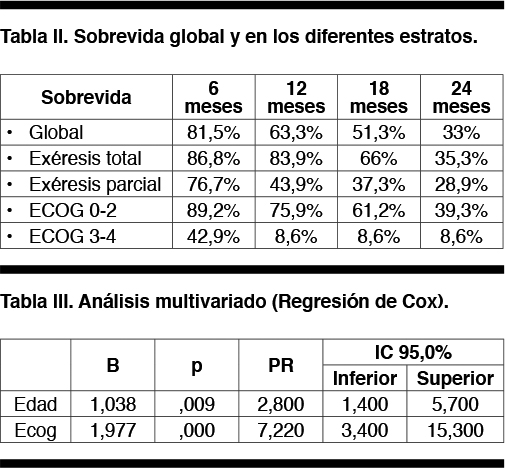
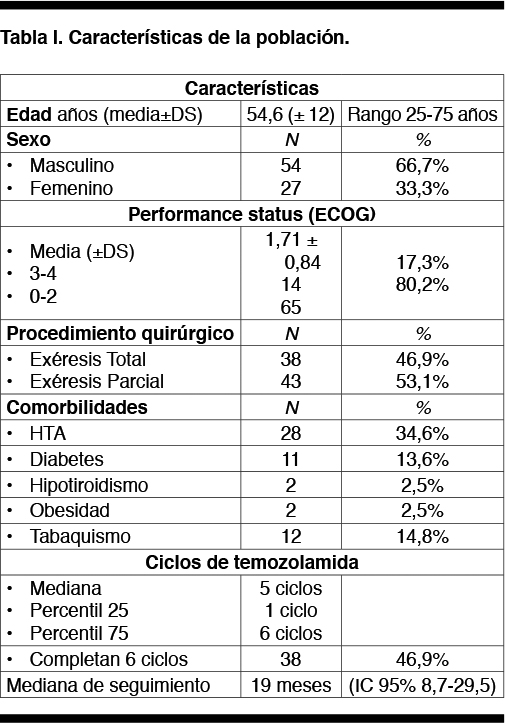
<body><![CDATA[<p><span style="font-size: 10pt; line-height: 120%; font-family: Verdana;" lang="ES-TRAD">Resultados<o:p></o:p></span></p>          <p><span style="font-size: 10pt; line-height: 120%; font-family: Verdana;" lang="ES-TRAD"><o:p>&nbsp;</o:p></span></p>          <p><span style="font-size: 10pt; line-height: 120%; font-family: Verdana;" lang="ES-TRAD">Entre mayo de 2009 y diciembre de 2011 iniciaron<b> </b>tratamiento con quimiorradioterapia un total de 81 pacientes. <o:p></o:p></span></p>          <p><span style="font-size: 10pt; line-height: 120%; font-family: Verdana;" lang="ES-TRAD">Las caracter&iacute;sticas de la poblaci&oacute;n se describen en la <a href="#tabla_1">Tabla I</a>.</span></p>       <p></p>       <p><font face="Verdana" size="2"><a name="tabla_1"></a><img style="width: 505px; height: 723px;" alt="" src="/img/revistas/ami/v36n3/3a08t1.jpg"></font></p>   <font face="Verdana" size="2">      <br>       <br>   <a name="tabla_2-3"></a><img style="width: 505px; height: 468px;" alt="" src="/img/revistas/ami/v36n3/3a08t2-3.jpg"> </font>     <p></p>       <p><span style="font-size: 10pt; line-height: 120%; font-family: Verdana;" lang="ES-TRAD"> <o:p></o:p></span></p>          ]]></body>
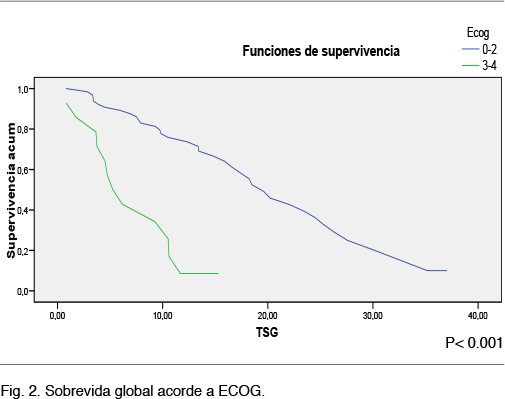
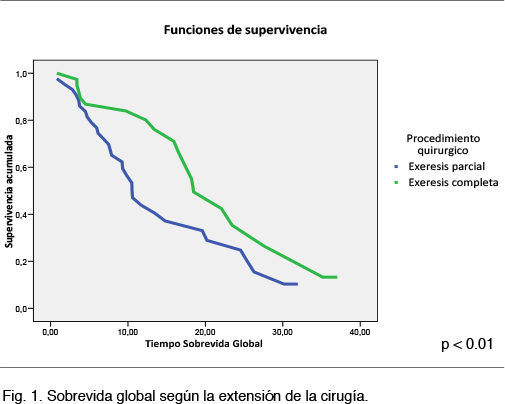
<body><![CDATA[<p><span style="font-size: 10pt; line-height: 120%; font-family: Verdana;" lang="ES-TRAD">En la <a href="#tabla_2-3">Tabla II</a> se detallan funciones de supervivencia.<o:p></o:p></span></p>          <p><span style="font-size: 10pt; line-height: 120%; font-family: Verdana;" lang="ES-TRAD">La mediana de sobrevida global fue de 18 meses (IC 95% 14.1-22.2); a los dos a&ntilde;os se encontraban vivos un 33% de los pacientes.<o:p></o:p></span></p>          <p><span style="font-size: 10pt; line-height: 120%; font-family: Verdana;" lang="ES-TRAD">La mediana de sobrevida para el grupo con ex&eacute;resis total fue de 18.5 meses (IC 95% 13.5-23.4), y para el grupo con ex&eacute;resis parcial mediana de 10.6 meses (IC 95% 8.2-12.9) (p 0.01), <a href="#grafico_1">Figura 1</a>.</span></p>       <p><font face="Verdana" size="2"><a name="grafico_1"></a><img style="width: 505px; height: 404px;" alt="" src="/img/revistas/ami/v36n3/3a08g1.jpg"></font></p>       <p></p>       <p><span style="font-size: 10pt; line-height: 120%; font-family: Verdana;" lang="ES-TRAD"><o:p></o:p></span></p>          <p><span style="font-size: 10pt; line-height: 120%; font-family: Verdana;" lang="ES-TRAD">La mediana de sobrevida global para el grupo dentro de la estatificaci&oacute;n de<span style="">&nbsp; </span>ECOG 0-2 fue de 19 meses (IC 95% 15-24,2), y para el grupo ECOG 3-4 de 5.7 meses (IC 95% 2,6-7,8) (p 0,001), <a href="#grafico_2">Figura 2</a>.</span></p>       <p></p>   <font face="Verdana" size="2">  <a name="grafico_2"></a><img style="width: 505px; height: 399px;" alt="" src="/img/revistas/ami/v36n3/3a08g2.jpg"> </font>     <p></p>       <p></p>       ]]></body>
<body><![CDATA[<p><span style="font-size: 10pt; line-height: 120%; font-family: Verdana;" lang="ES-TRAD"><o:p></o:p></span></p>          <p><span style="font-size: 10pt; line-height: 120%; font-family: Verdana;" lang="ES-TRAD">En la <a href="#tabla_2-3">Tabla III </a>se muestran los resultados del an&aacute;lisis multivariado por Regresi&oacute;n de Cox, en dicha tabla s&oacute;lo se muestran las variables significativas, se incluyeron adem&aacute;s las variables Sexo y Procedimiento Quir&uacute;rgico que no fueron retenidas por el modelo. <o:p></o:p></span></p>          <p><span style="font-size: 10pt; line-height: 120%; font-family: Verdana;" lang="ES-TRAD">Se reportaron eventos adversos en 40 pacientes (49,3%); en 32 de ellos estos fueron grado 1 o 2 y en 8 pacientes grado 3.<o:p></o:p></span></p>          <p><span style="font-size: 10pt; line-height: 120%; font-family: Verdana;" lang="ES-TRAD">Los m&aacute;s frecuentes fueron los gastrointestinales y hematol&oacute;gicos (leucopenia, y plaquetopenia).<o:p></o:p></span></p>          <p><span style="font-size: 10pt; line-height: 120%; font-family: Verdana;" lang="ES-TRAD"><o:p>&nbsp;</o:p></span></p>          <p><span style="font-size: 10pt; line-height: 120%; font-family: Verdana;" lang="ES-TRAD">Discusi&oacute;n</span></p>          <p><span style="font-size: 10pt; line-height: 120%; font-family: Verdana;" lang="ES-TRAD">Este trabajo permiti&oacute; obtener los primeros resultados nacionales vinculados al tratamiento combinado de los Glioblastomas en el Uruguay.<o:p></o:p></span></p>          <p><span style="font-size: 10pt; line-height: 120%; font-family: Verdana;" lang="ES-TRAD">El GBM constituye el tipo m&aacute;s frecuente y agresivo de los mismos, con una expectativa de vida de 1 a&ntilde;o luego del diagn&oacute;stico.<sup>(<a href="#11">11</a>)<a name="11."></a><o:p></o:p></sup></span></p>          <p><span style="font-size: 10pt; line-height: 120%; font-family: Verdana;" lang="ES-TRAD">El tratamiento combinado de temozolamida con radioterapia en el postoperatorio de los pacientes constituye actualmente la mejor estrategia terap&eacute;utica. El estudio fase III EORTC-NCIC, a dos a&ntilde;os<span style="">&nbsp; </span>de seguimiento evidenci&oacute; un incremento en la sobrevida global en comparaci&oacute;n con radioterapia exclusiva, 2,5 veces mayor para el grupo con tratamiento combinado (27% grupo radioterapia + temozolamida<span style="">&nbsp; </span>versus 10 % en el grupo radioterapia sola). <o:p></o:p></span></p>          <p><span style="font-size: 10pt; line-height: 120%; font-family: Verdana;" lang="ES-TRAD">Identificar los factores vinculados a una mejor respuesta contin&uacute;a siendo hoy en d&iacute;a un reto; se describen como factores pron&oacute;sticos independientes la edad, performance status, localizaci&oacute;n del tumor <sup>(<a href="#11">11</a>, <a href="#12">12</a>,<a href="#13">13</a>)</sup><a name="12."></a><a name="13."></a> ,extensi&oacute;n de la cirug&iacute;a <sup>(<a href="#14">14</a>, <a href="#15">15</a>,<a href="#16">16</a>)</sup><a name="14."></a><a name="15."></a><a name="16."></a> y el tratamiento con radioterapia y quimioterapia. <sup>(<a href="#17">17</a>, <a href="#18">18</a>,<a href="#19">19</a>)<a name="17."></a><a name="18."></a><a name="19."></a><o:p></o:p></sup></span></p>          ]]></body>
<body><![CDATA[<p><span style="font-size: 10pt; line-height: 120%; font-family: Verdana;" lang="ES-TRAD">La evaluaci&oacute;n del tratamiento evidenci&oacute; una mediana de sobrevida global<span style="">&nbsp; </span>de 18 meses, encontr&aacute;ndose vivos a dos a&ntilde;os un 33%, mientras que los estudios que demostraron el beneficio de la terapia combinada mostraron una mediana de sobrevida global de 14,6 meses. <sup>(<a href="#3">3</a>,<a href="#4">4</a>)</sup> <o:p></o:p></span></p>          <p><span style="font-size: 10pt; line-height: 120%; font-family: Verdana;" lang="ES-TRAD">Este trabajo encontr&oacute; al buen estado funcional del paciente y a la edad como los dos factores predictores independientes para mortalidad. El procedimiento quir&uacute;rgico no se asoci&oacute; finalmente a la mortalidad. <o:p></o:p></span></p>          <p><span style="font-size: 10pt; line-height: 120%; font-family: Verdana;" lang="ES-TRAD">En relaci&oacute;n a la seguridad del tratamiento casi la mitad de los pacientes presentaron alg&uacute;n evento adverso; la mayor&iacute;a fueron de grado 1 o 2 resolvi&eacute;ndose los mismos con tratamiento sintom&aacute;tico. Los eventos adversos grado 3 fueron poco frecuentes y requirieron disminuci&oacute;n de dosis e incluso suspensi&oacute;n del tratamiento. <o:p></o:p></span></p>          <p><span style="font-size: 10pt; line-height: 120%; font-family: Verdana;" lang="ES-TRAD">Como conclusiones encontramos que la sobrevida de los pacientes tratados con temozolamida y radioterapia para el tratamiento del GBM es similar a la reportada en los estudios de referencia internacionales y mayor que la descrita para el tratamiento radiante exclusivo.<o:p></o:p></span></p>          <p><span style="font-size: 10pt; line-height: 120%; font-family: Verdana;" lang="ES-TRAD">El beneficio es mayor en aquellos pacientes j&oacute;venes con buena capacidad funcional previa al inicio del tratamiento.<o:p></o:p></span></p>          <p><span style="font-size: 10pt; line-height: 120%; font-family: Verdana;" lang="ES-TRAD">La seguridad del mismo fue considerada como aceptable.<o:p></o:p></span></p>          <p><span style="font-size: 10pt; line-height: 120%; font-family: Verdana;" lang="ES-TRAD"><o:p>&nbsp;</o:p></span></p>          <p><span style="font-size: 10pt; line-height: 120%; font-family: Verdana;" lang="EN-GB">Bibliograf&iacute;a<o:p></o:p></span></p>          <p><span style="font-size: 10pt; line-height: 120%; font-family: Verdana;" lang="EN-GB"><o:p>&nbsp;</o:p></span></p>          <!-- ref --><p><span style="font-size: 10pt; line-height: 120%; font-family: Verdana;" lang="EN-US"><a name="1"></a><a href="#1.">1</a>.<span style="">&nbsp; </span>Winger M J, Macdonald D R, Cairncross J G. Supratentorial anaplastic gliomas in adults. The prognostic importance of extent of resection and prior low-grade glioma. J Neurosurg. Oct 1989;71(4):487-93.    <o:p></o:p></span></p>          <!-- ref --><p><span style="font-size: 10pt; line-height: 120%; font-family: Verdana;" lang="EN-US"><a name="2"></a><a href="#2.">2</a>.<span style="">&nbsp; </span>Black PM. Brain tumor. Part 1. N Engl J Med. May 23 1991;324 (21):1471-6.    <o:p></o:p></span></p>          <!-- ref --><p><span style="font-size: 10pt; line-height: 120%; font-family: Verdana;" lang="EN-US"><a name="3"></a><a href="#3.">3</a>.<span style="">&nbsp; </span>Black PM. Brain tumor. Part 2. N Engl J Med. May 30 1991;324 (22):1555-64.    <o:p></o:p></span></p>          <!-- ref --><p><span style="font-size: 10pt; line-height: 120%; font-family: Verdana;" lang="EN-US"><a name="4"></a><a href="#4.">4</a>.<span style="">&nbsp; </span>Walker MD,Green SB, Byar DP,et al. Randomized comparisons of radiotherapy and nitrosoureas for the treatment of malignant glioma after surgery. N Engl J Med 1980;303:1323-29.    <o:p></o:p></span></p>          <!-- ref --><p><span style="font-size: 10pt; line-height: 120%; font-family: Verdana;" lang="EN-US"><a name="5"></a><a href="#5.">5</a>.<span style="">&nbsp; </span>Laperriere N, Zuraw L,Cairncross G. Radiotherapy for newly diagnosed malignant glioma in adults: a systematic review. Radiother Oncol 2002;64:259-73.    <o:p></o:p></span></p>          <!-- ref --><p><span style="font-size: 10pt; line-height: 120%; font-family: Verdana;" lang="EN-US"><a name="6"></a><a href="#6.">6</a>.<span style="">&nbsp; </span>Roger Stupp, Warren P. Mason, Martin J. van den Bent, et al. Radiotherapy plus Concomitant and Adjuvant Temozolomide for Glioblastoma. N Engl J Med 2005;352:987-96.    <o:p></o:p></span></p>          <p><span style="font-size: 10pt; line-height: 120%; font-family: Verdana;" lang="EN-US"><a name="7"></a><a href="#7.">7</a>.<span style="">&nbsp; </span>Roger Stupp, Warren P. Mason, Martin J. van den Bent, et al. Effects of radiotherapy with concomitant and adjuvant temozolomide versus radiotherapy alone in glioblastoma in randomized phase III study: 5 &ndash; year analysis of de EORTC &ndash; NCIC trial. <a href="http://www.thelancet.com/journals/lanonc/article/PIIS1470-2045%2809%2970025-7/fulltext">www.thelancet.com/oncology</a> Published online March 9, 2009.<o:p></o:p></span></p>          <p><span style="font-size: 10pt; line-height: 120%; font-family: Verdana;"><a name="8"></a><a href="#8.">8</a>.<span style="">&nbsp; </span>Fondo Nacional de Recursos. Pol&iacute;tica y gesti&oacute;n de la cobertura de medicamentos de alto costo. Relevamiento de la experiencia internacional y respuesta del Fondo Nacional de Recursos. Publicaci&oacute;n T&eacute;cnica N&ordm; 13. Montevideo: FNR, 2010. Disponible en: <a href="http://www.fnr.gub.uy/sites/default/files/publicaciones/FNR_publicacion_tecnica_13.pdf">http://www.fnr.gub.uy/sites/default/files/Publicaciones/FNR_publicacion_tecnica_13_PDF</a>.<o:p></o:p></span></p>          <!-- ref --><p><span style="font-size: 10pt; line-height: 120%; font-family: Verdana;" lang="EN-US"><a name="9"></a><a href="#9.">9</a>.<span style="">&nbsp; </span>Martin H. Cohen, John R. Johnson, and Richard Pazdur. Food and Drug Administration Drug Approval Summary: Temozolomide Plus RadiationTherapy for theTreatment of Newly Diagnosed Glioblastoma Multiforme<span style="">&nbsp; </span>Clin Cancer Res 2005;11(19) October 1, 2005.    <o:p></o:p></span></p>          <!-- ref --><p><span style="font-size: 10pt; line-height: 120%; font-family: Verdana;"><a name="10"></a><a href="#10.">10</a>.<span style=""> </span>Disponible en la pagina web de la Agencia Europea del Medicamento (EMEA) <a href="http://www.ema.europa.eu/ema/">http://www.emea.europa.eu/</a><o:p></o:p></span><!-- ref --><p><span style="font-size: 10pt; line-height: 120%; font-family: Verdana;"><a name="11"></a><a href="#11.">11</a>.<span style=""> </span>De Angelis L M. Brain tumors. </span><span style="font-size: 10pt; line-height: 120%; font-family: Verdana;" lang="EN-US">N Engl J Med 2001;344 :114-23.    <o:p></o:p></span></p>          <!-- ref --><p><span style="font-size: 10pt; line-height: 120%; font-family: Verdana;" lang="EN-US"><a name="12"></a><a href="#12.">12</a>.<span style=""> </span>Stark A M, Nabavi A, Mehdorn H M, et al. Glioblastoma multiforme: report of 267 cases treated at a single institution. Surg Neurol 2005;63 :162-9.    <o:p></o:p></span></p>          ]]></body>
<body><![CDATA[<!-- ref --><p><span style="font-size: 10pt; line-height: 120%; font-family: Verdana;" lang="EN-US"><a name="13"></a><a href="#13.">13</a>.<span style=""> </span>Xiangyu Ma, Yafeng Lv, Jia Liu, Donghai Wang, Qibing Huang, Xinyu Wang. Survival analysis of 205 patients with glioblastoma multiforme: Clinical characteristics,treatment and prognosis in China. Journal of Clinical Neuroscience 16 (2009)1595-598.    <o:p></o:p></span></p>          <!-- ref --><p><span style="font-size: 10pt; line-height: 120%; font-family: Verdana;" lang="EN-US"><a name="14"></a><a href="#14.">14</a>.<span style=""> </span>Stark AM, Nabavi A, Mehdorn H M, et al. Glioblastoma multiforme: report of 267 cases treated at a single institution.Surg Neurol 2005;63 :162 -9.    <o:p></o:p></span></p>          <!-- ref --><p><span style="font-size: 10pt; line-height: 120%; font-family: Verdana;" lang="EN-US"><a name="15"></a><a href="#15.">15</a>.<span style=""> </span>Lacroix M, Abi-Said D, Fourney D R,et al. A multivariate analysis of 416 patients with glioblastoma multiforme: prognosis, extent of resection and survival. J Neurosurg 2001;95:190-8.    <o:p></o:p></span></p>          <!-- ref --><p><span style="font-size: 10pt; line-height: 120%; font-family: Verdana;" lang="EN-US"><a name="16"></a><a href="#16.">16</a>.<span style=""> </span>Stummer W, Pichlmeier U, Meinel T, Wiestler O D, Zanella F, Reulen H J. Fluorescence-guided surgery with 5-aminolevulinic acid for resection of malignant glioma: a randomised controlled multicentre phase III trial. Lancet Oncol 2006;7:392 401.    <o:p></o:p></span></p>          <!-- ref --><p><span style="font-size: 10pt; line-height: 120%; font-family: Verdana;" lang="EN-US"><a name="17"></a><a href="#17.">17</a>.<span style=""> </span>Kreth, F W, Warnke, P C, Scheremet, R, Ostertag, CB. Surgical resection and radiation therapy versus biopsy and radiation therapy in the treatment of glioblastoma multiforme. </span><span style="font-size: 10pt; line-height: 120%; font-family: Verdana;">J Neurosurg 1993; 78:762.    <o:p></o:p></span></p>          ]]></body>
<body><![CDATA[<!-- ref --><p><span style="font-size: 10pt; line-height: 120%; font-family: Verdana;"><a name="18"></a><a href="#18.">18</a>.<span style=""> </span>Mineo J F, Bordron A, Baroncini M,et al. </span><span style="font-size: 10pt; line-height: 120%; font-family: Verdana;" lang="EN-US">Prognosis factors of survival time in patients with glioblastoma multiforme: a multivariate analysis of 340 patients. Acta Neurochir (Wien) 2007; 149:245-53.    <o:p></o:p></span></p>          <!-- ref --><p><span style="font-size: 10pt; line-height: 120%; font-family: Verdana;" lang="EN-US"><a name="19"></a><a href="#19.">19</a>.<span style=""> </span>Medical Research Council Brain Tumors Working Party. Randomized trial of procarbazine, lomustine, and vincristine in the adjuvant treatment of high-grade astrocytoma: A Medical Research Council trial. J Clin Oncol 2001;19 509 -518.    </span></p>      </div>           ]]></body><back>
<ref-list>
<ref id="B1">
<label>1</label><nlm-citation citation-type="journal">
<person-group person-group-type="author">
<name>
<surname><![CDATA[Winger]]></surname>
<given-names><![CDATA[MJ]]></given-names>
</name>
<name>
<surname><![CDATA[Macdonald]]></surname>
<given-names><![CDATA[DR]]></given-names>
</name>
<name>
<surname><![CDATA[Cairncross]]></surname>
<given-names><![CDATA[JG]]></given-names>
</name>
</person-group>
<article-title xml:lang="en"><![CDATA[Supratentorial anaplastic gliomas in adults: The prognostic importance of extent of resection and prior low-grade glioma]]></article-title>
<source><![CDATA[J Neurosurg]]></source>
<year>Oct </year>
<month>19</month>
<day>89</day>
<volume>71</volume>
<numero>4</numero>
<issue>4</issue>
<page-range>487-93</page-range></nlm-citation>
</ref>
<ref id="B2">
<label>2</label><nlm-citation citation-type="journal">
<person-group person-group-type="author">
<name>
<surname><![CDATA[Black]]></surname>
<given-names><![CDATA[PM]]></given-names>
</name>
</person-group>
<article-title xml:lang="en"><![CDATA[Brain tumor: Part 1]]></article-title>
<source><![CDATA[N Engl J Med]]></source>
<year>May </year>
<month>23</month>
<day> 1</day>
<volume>324</volume>
<numero>21</numero>
<issue>21</issue>
<page-range>1471-6</page-range></nlm-citation>
</ref>
<ref id="B3">
<label>3</label><nlm-citation citation-type="journal">
<person-group person-group-type="author">
<name>
<surname><![CDATA[Black]]></surname>
<given-names><![CDATA[PM]]></given-names>
</name>
</person-group>
<article-title xml:lang="en"><![CDATA[Brain tumor: Part 2]]></article-title>
<source><![CDATA[N Engl J Med]]></source>
<year>May </year>
<month>30</month>
<day> 1</day>
<volume>324</volume>
<numero>22</numero>
<issue>22</issue>
<page-range>1555-64</page-range></nlm-citation>
</ref>
<ref id="B4">
<label>4</label><nlm-citation citation-type="journal">
<person-group person-group-type="author">
<name>
<surname><![CDATA[Walker]]></surname>
<given-names><![CDATA[MD]]></given-names>
</name>
<name>
<surname><![CDATA[Green]]></surname>
<given-names><![CDATA[SB]]></given-names>
</name>
<name>
<surname><![CDATA[Byar]]></surname>
<given-names><![CDATA[DP]]></given-names>
</name>
</person-group>
<article-title xml:lang="en"><![CDATA[Randomized comparisons of radiotherapy and nitrosoureas for the treatment of malignant glioma after surgery]]></article-title>
<source><![CDATA[N Engl J Med]]></source>
<year>1980</year>
<volume>303</volume>
<page-range>1323-29</page-range></nlm-citation>
</ref>
<ref id="B5">
<label>5</label><nlm-citation citation-type="journal">
<person-group person-group-type="author">
<name>
<surname><![CDATA[Laperriere]]></surname>
<given-names><![CDATA[N]]></given-names>
</name>
<name>
<surname><![CDATA[Zuraw]]></surname>
<given-names><![CDATA[L]]></given-names>
</name>
<name>
<surname><![CDATA[Cairncross]]></surname>
<given-names><![CDATA[G]]></given-names>
</name>
</person-group>
<article-title xml:lang="en"><![CDATA[Radiotherapy for newly diagnosed malignant glioma in adults: a systematic review]]></article-title>
<source><![CDATA[Radiother Oncol]]></source>
<year>2002</year>
<volume>64</volume>
<page-range>259-73</page-range></nlm-citation>
</ref>
<ref id="B6">
<label>6</label><nlm-citation citation-type="journal">
<person-group person-group-type="author">
<name>
<surname><![CDATA[Stupp]]></surname>
<given-names><![CDATA[Roger]]></given-names>
</name>
<name>
<surname><![CDATA[Mason]]></surname>
<given-names><![CDATA[Warren P.]]></given-names>
</name>
<name>
<surname><![CDATA[van den Bent]]></surname>
<given-names><![CDATA[Martin J.]]></given-names>
</name>
</person-group>
<article-title xml:lang="en"><![CDATA[Radiotherapy plus Concomitant and Adjuvant Temozolomide for Glioblastoma]]></article-title>
<source><![CDATA[N Engl J Med]]></source>
<year>2005</year>
<volume>352</volume>
<page-range>987-96</page-range></nlm-citation>
</ref>
<ref id="B7">
<label>7</label><nlm-citation citation-type="">
<person-group person-group-type="author">
<name>
<surname><![CDATA[Stupp]]></surname>
<given-names><![CDATA[Roger]]></given-names>
</name>
<name>
<surname><![CDATA[Mason]]></surname>
<given-names><![CDATA[Warren P]]></given-names>
</name>
<name>
<surname><![CDATA[van den Bent]]></surname>
<given-names><![CDATA[Martin J]]></given-names>
</name>
</person-group>
<source><![CDATA[Effects of radiotherapy with concomitant and adjuvant temozolomide versus radiotherapy alone in glioblastoma in randomized phase III study: 5 - year analysis of de EORTC - NCIC trial]]></source>
<year>Marc</year>
<month>h </month>
<day>9,</day>
</nlm-citation>
</ref>
<ref id="B8">
<label>8</label><nlm-citation citation-type="book">
<collab>Fondo Nacional de Recursos</collab>
<source><![CDATA[Política y gestión de la cobertura de medicamentos de alto costo: Relevamiento de la experiencia internacional y respuesta del Fondo Nacional de Recursos]]></source>
<year>2010</year>
<publisher-loc><![CDATA[Montevideo ]]></publisher-loc>
<publisher-name><![CDATA[FNR]]></publisher-name>
</nlm-citation>
</ref>
<ref id="B9">
<label>9</label><nlm-citation citation-type="journal">
<person-group person-group-type="author">
<name>
<surname><![CDATA[Cohen]]></surname>
<given-names><![CDATA[Martin H]]></given-names>
</name>
<name>
<surname><![CDATA[Johnson]]></surname>
<given-names><![CDATA[John R]]></given-names>
</name>
<name>
<surname><![CDATA[Pazdur]]></surname>
<given-names><![CDATA[Richard]]></given-names>
</name>
</person-group>
<article-title xml:lang="en"><![CDATA[Food and Drug Administration Drug Approval Summary: Temozolomide Plus RadiationTherapy for theTreatment of Newly Diagnosed Glioblastoma Multiforme]]></article-title>
<source><![CDATA[Clin Cancer Res]]></source>
<year>2005</year>
<volume>11</volume>
<numero>19</numero>
<issue>19</issue>
</nlm-citation>
</ref>
<ref id="B10">
<label>10</label><nlm-citation citation-type="">
<collab>Agencia Europea del Medicamento</collab>
<source><![CDATA[]]></source>
<year></year>
</nlm-citation>
</ref>
<ref id="B11">
<label>11</label><nlm-citation citation-type="journal">
<person-group person-group-type="author">
<name>
<surname><![CDATA[De Angelis]]></surname>
<given-names><![CDATA[LM]]></given-names>
</name>
</person-group>
<article-title xml:lang="en"><![CDATA[Brain tumors]]></article-title>
<source><![CDATA[N Engl J Med]]></source>
<year>2001</year>
<volume>344</volume>
<page-range>114-23</page-range></nlm-citation>
</ref>
<ref id="B12">
<label>12</label><nlm-citation citation-type="journal">
<person-group person-group-type="author">
<name>
<surname><![CDATA[Stark]]></surname>
<given-names><![CDATA[AM]]></given-names>
</name>
<name>
<surname><![CDATA[Nabavi]]></surname>
<given-names><![CDATA[A]]></given-names>
</name>
<name>
<surname><![CDATA[Mehdorn]]></surname>
<given-names><![CDATA[HM]]></given-names>
</name>
</person-group>
<article-title xml:lang="en"><![CDATA[Glioblastoma multiforme: report of 267 cases treated at a single institution]]></article-title>
<source><![CDATA[Surg Neurol]]></source>
<year>2005</year>
<volume>63</volume>
<page-range>162-9</page-range></nlm-citation>
</ref>
<ref id="B13">
<label>13</label><nlm-citation citation-type="journal">
<person-group person-group-type="author">
<name>
<surname><![CDATA[Xiangyu]]></surname>
<given-names><![CDATA[Ma]]></given-names>
</name>
<name>
<surname><![CDATA[Yafeng]]></surname>
<given-names><![CDATA[Lv]]></given-names>
</name>
<name>
<surname><![CDATA[Jia]]></surname>
<given-names><![CDATA[Liu]]></given-names>
</name>
<name>
<surname><![CDATA[Donghai]]></surname>
<given-names><![CDATA[Wang]]></given-names>
</name>
<name>
<surname><![CDATA[Qibing]]></surname>
<given-names><![CDATA[Huang]]></given-names>
</name>
<name>
<surname><![CDATA[Xinyu]]></surname>
<given-names><![CDATA[Wang]]></given-names>
</name>
</person-group>
<article-title xml:lang="en"><![CDATA[Survival analysis of 205 patients with glioblastoma multiforme: Clinical characteristics,treatment and prognosis in China]]></article-title>
<source><![CDATA[Journal of Clinical Neuroscience]]></source>
<year>2009</year>
<volume>16</volume>
<page-range>1595-598</page-range></nlm-citation>
</ref>
<ref id="B14">
<label>14</label><nlm-citation citation-type="journal">
<person-group person-group-type="author">
<name>
<surname><![CDATA[Stark]]></surname>
<given-names><![CDATA[AM]]></given-names>
</name>
<name>
<surname><![CDATA[Nabavi]]></surname>
<given-names><![CDATA[A]]></given-names>
</name>
<name>
<surname><![CDATA[Mehdorn]]></surname>
<given-names><![CDATA[HM]]></given-names>
</name>
</person-group>
<article-title xml:lang="en"><![CDATA[Glioblastoma multiforme: report of 267 cases treated at a single institution]]></article-title>
<source><![CDATA[Surg Neurol]]></source>
<year>2005</year>
<volume>63</volume>
<page-range>162 -9</page-range></nlm-citation>
</ref>
<ref id="B15">
<label>15</label><nlm-citation citation-type="journal">
<person-group person-group-type="author">
<name>
<surname><![CDATA[Lacroix]]></surname>
<given-names><![CDATA[M]]></given-names>
</name>
<name>
<surname><![CDATA[Abi-Said]]></surname>
<given-names><![CDATA[D]]></given-names>
</name>
<name>
<surname><![CDATA[Fourney]]></surname>
<given-names><![CDATA[DR]]></given-names>
</name>
</person-group>
<article-title xml:lang="en"><![CDATA[A multivariate analysis of 416 patients with glioblastoma multiforme: prognosis, extent of resection and survival]]></article-title>
<source><![CDATA[J Neurosurg]]></source>
<year>2001</year>
<volume>95</volume>
<page-range>190-8</page-range></nlm-citation>
</ref>
<ref id="B16">
<label>16</label><nlm-citation citation-type="journal">
<person-group person-group-type="author">
<name>
<surname><![CDATA[Stummer]]></surname>
<given-names><![CDATA[W]]></given-names>
</name>
<name>
<surname><![CDATA[Pichlmeier]]></surname>
<given-names><![CDATA[U]]></given-names>
</name>
<name>
<surname><![CDATA[Meinel]]></surname>
<given-names><![CDATA[T]]></given-names>
</name>
<name>
<surname><![CDATA[Wiestler]]></surname>
<given-names><![CDATA[OD]]></given-names>
</name>
<name>
<surname><![CDATA[Zanella]]></surname>
<given-names><![CDATA[F]]></given-names>
</name>
<name>
<surname><![CDATA[Reulen]]></surname>
<given-names><![CDATA[HJ]]></given-names>
</name>
</person-group>
<article-title xml:lang="en"><![CDATA[Fluorescence-guided surgery with 5-aminolevulinic acid for resection of malignant glioma: a randomised controlled multicentre phase III trial]]></article-title>
<source><![CDATA[Lancet Oncol]]></source>
<year>2006</year>
<volume>7</volume>
<page-range>392- 401</page-range></nlm-citation>
</ref>
<ref id="B17">
<label>17</label><nlm-citation citation-type="journal">
<person-group person-group-type="author">
<name>
<surname><![CDATA[Kreth]]></surname>
<given-names><![CDATA[FW]]></given-names>
</name>
<name>
<surname><![CDATA[Warnke]]></surname>
<given-names><![CDATA[PC]]></given-names>
</name>
<name>
<surname><![CDATA[Scheremet]]></surname>
<given-names><![CDATA[R]]></given-names>
</name>
<name>
<surname><![CDATA[Ostertag]]></surname>
<given-names><![CDATA[CB]]></given-names>
</name>
</person-group>
<article-title xml:lang="en"><![CDATA[Surgical resection and radiation therapy versus biopsy and radiation therapy in the treatment of glioblastoma multiforme]]></article-title>
<source><![CDATA[J Neurosurg]]></source>
<year>1993</year>
<volume>78</volume>
<page-range>762</page-range></nlm-citation>
</ref>
<ref id="B18">
<label>18</label><nlm-citation citation-type="journal">
<person-group person-group-type="author">
<name>
<surname><![CDATA[Mineo]]></surname>
<given-names><![CDATA[J F]]></given-names>
</name>
<name>
<surname><![CDATA[Bordron]]></surname>
<given-names><![CDATA[A]]></given-names>
</name>
<name>
<surname><![CDATA[Baroncini]]></surname>
<given-names><![CDATA[M]]></given-names>
</name>
</person-group>
<article-title xml:lang="en"><![CDATA[Prognosis factors of survival time in patients with glioblastoma multiforme: a multivariate analysis of 340 patients]]></article-title>
<source><![CDATA[Acta Neurochir (Wien)]]></source>
<year>2007</year>
<volume>149</volume>
<page-range>245-53</page-range></nlm-citation>
</ref>
<ref id="B19">
<label>19</label><nlm-citation citation-type="journal">
<collab>Medical Research Council Brain Tumors Working Party</collab>
<article-title xml:lang="en"><![CDATA[Randomized trial of procarbazine, lomustine, and vincristine in the adjuvant treatment of high-grade astrocytoma: A Medical Research Council trial]]></article-title>
<source><![CDATA[J Clin Oncol]]></source>
<year>2001</year>
<volume>19</volume>
<page-range>509 -518</page-range></nlm-citation>
</ref>
</ref-list>
</back>
</article>