<?xml version="1.0" encoding="ISO-8859-1"?><article xmlns:mml="http://www.w3.org/1998/Math/MathML" xmlns:xlink="http://www.w3.org/1999/xlink" xmlns:xsi="http://www.w3.org/2001/XMLSchema-instance">
<front>
<journal-meta>
<journal-id>1688-423X</journal-id>
<journal-title><![CDATA[Archivos de Medicina Interna]]></journal-title>
<abbrev-journal-title><![CDATA[Arch Med Int]]></abbrev-journal-title>
<issn>1688-423X</issn>
<publisher>
<publisher-name><![CDATA[Sociedad de Medicina Interna del Uruguay]]></publisher-name>
</publisher>
</journal-meta>
<article-meta>
<article-id>S1688-423X2014000300007</article-id>
<title-group>
<article-title xml:lang="es"><![CDATA[Análisis molecular de familias uruguayas con Enfermedad de Huntington]]></article-title>
<article-title xml:lang="en"><![CDATA[Molecular analysis of the Uruguayan families with Huntington&rsquo;s Disease]]></article-title>
</title-group>
<contrib-group>
<contrib contrib-type="author">
<name>
<surname><![CDATA[Raggio]]></surname>
<given-names><![CDATA[Víctor]]></given-names>
</name>
<xref ref-type="aff" rid="A01"/>
</contrib>
<contrib contrib-type="author">
<name>
<surname><![CDATA[Bidegain]]></surname>
<given-names><![CDATA[Estela]]></given-names>
</name>
<xref ref-type="aff" rid="A02"/>
</contrib>
<contrib contrib-type="author">
<name>
<surname><![CDATA[Vita]]></surname>
<given-names><![CDATA[Marcelo]]></given-names>
</name>
<xref ref-type="aff" rid="A02"/>
</contrib>
<contrib contrib-type="author">
<name>
<surname><![CDATA[Buzó]]></surname>
<given-names><![CDATA[Ricardo]]></given-names>
</name>
<xref ref-type="aff" rid="A03"/>
</contrib>
<contrib contrib-type="author">
<name>
<surname><![CDATA[Lescano]]></surname>
<given-names><![CDATA[Andrés]]></given-names>
</name>
<xref ref-type="aff" rid="A04"/>
</contrib>
<contrib contrib-type="author">
<name>
<surname><![CDATA[Medina]]></surname>
<given-names><![CDATA[Ofrenda de]]></given-names>
</name>
<xref ref-type="aff" rid="A03"/>
</contrib>
<contrib contrib-type="author">
<name>
<surname><![CDATA[Amorín]]></surname>
<given-names><![CDATA[Ignacio]]></given-names>
</name>
<xref ref-type="aff" rid="A03"/>
</contrib>
<contrib contrib-type="author">
<name>
<surname><![CDATA[Dieguez]]></surname>
<given-names><![CDATA[Elena]]></given-names>
</name>
<xref ref-type="aff" rid="A05"/>
</contrib>
<contrib contrib-type="author">
<name>
<surname><![CDATA[Ventura]]></surname>
<given-names><![CDATA[Roberto]]></given-names>
</name>
<xref ref-type="aff" rid="A04"/>
</contrib>
<contrib contrib-type="author">
<name>
<surname><![CDATA[Rodríguez]]></surname>
<given-names><![CDATA[María Mirta]]></given-names>
</name>
<xref ref-type="aff" rid="A01"/>
</contrib>
<contrib contrib-type="author">
<name>
<surname><![CDATA[Esperón]]></surname>
<given-names><![CDATA[Patricia]]></given-names>
</name>
<xref ref-type="aff" rid="A02"/>
</contrib>
</contrib-group>
<aff id="A02">
<institution><![CDATA[,UdelaR Facultad de Química ]]></institution>
<addr-line><![CDATA[Montevideo ]]></addr-line>
</aff>
<aff id="A03">
<institution><![CDATA[,UdelaR Facultad de Medicina Instituto de Neurología]]></institution>
<addr-line><![CDATA[ ]]></addr-line>
</aff>
<aff id="A04">
<institution><![CDATA[,UdelaR Facultad de Medicina Instituto de Neurología]]></institution>
<addr-line><![CDATA[Montevideo ]]></addr-line>
</aff>
<aff id="A05">
<institution><![CDATA[,UdelaR Facultad de Medicina Instituto de Neurología]]></institution>
<addr-line><![CDATA[ ]]></addr-line>
</aff>
<aff id="A01">
<institution><![CDATA[,UdelaR Facultad de Medicina Departamento de Genética]]></institution>
<addr-line><![CDATA[Montevideo ]]></addr-line>
<country>Uruguay</country>
</aff>
<pub-date pub-type="pub">
<day>00</day>
<month>11</month>
<year>2014</year>
</pub-date>
<pub-date pub-type="epub">
<day>00</day>
<month>11</month>
<year>2014</year>
</pub-date>
<volume>36</volume>
<numero>3</numero>
<fpage>127</fpage>
<lpage>131</lpage>
<copyright-statement/>
<copyright-year/>
<self-uri xlink:href="http://www.scielo.edu.uy/scielo.php?script=sci_arttext&amp;pid=S1688-423X2014000300007&amp;lng=en&amp;nrm=iso"></self-uri><self-uri xlink:href="http://www.scielo.edu.uy/scielo.php?script=sci_abstract&amp;pid=S1688-423X2014000300007&amp;lng=en&amp;nrm=iso"></self-uri><self-uri xlink:href="http://www.scielo.edu.uy/scielo.php?script=sci_pdf&amp;pid=S1688-423X2014000300007&amp;lng=en&amp;nrm=iso"></self-uri><abstract abstract-type="short" xml:lang="es"><p><![CDATA[Introducción: La Enfermedad de Huntington (EH) es un trastorno neurodegenerativo; autosómico dominante, con expresividad variable y penetrancia completa. La prevalencia estimada es entre 1-4 cada 100.000 habitantes. Es causada por expansión de tripletes CAG en el exón 1 del gen IT-15 que conduce a la síntesis de una proteína con una región de poliglutaminas expandidas que forman agregados en el núcleo celular induciendo a la apoptosis. Los alelos normales presentan un número menor a 26 tripletes CAG, y aquellos con más de 40 conducirán siempre a la enfermedad. Alelos de entre 26 a 36 repetidos se consideran normales &ldquo;mutables&rdquo; y de 36 a 39 repetidos generan un riesgo aumentado de desarrollar la enfermedad. Objetivo: Poner a punto el diagnóstico molecular en una población uruguaya, mediante la determinación del tamaño exacto de la mutación en personas afectadas o con sospecha clínica de EH, mediante el uso de técnicas de biología molecular. Métodos: Pacientes de la Policlínica de Enfermedad de Parkinson y Movimientos Anormales del Hospital de Clínicas. La determinación del número de repetidos se realizó mediante técnicas de amplificación del ADN por PCR y posterior análisis en geles de poliacrilamida y secuenciación. Resultados: Realizamos el diagnóstico molecular de 16 pacientes, 15 con un diagnóstico clínico previo, y uno asintomático. Se descartó el diagnóstico de EH en otros dos individuos analizados. Conclusiones: Hemos logrado la puesta a punto del estudio molecular para la enfermedad de EH por primera vez en nuestro país. Esta prueba es de gran utilidad como diagnóstico confirmatorio, etiológico o diferencial de EH.]]></p></abstract>
<abstract abstract-type="short" xml:lang="en"><p><![CDATA[Introduction: Huntington disease (HD) is a neurodegenerative disorder with an autosomal dominant inheritance mode, complete penetrance and variable clinical expressivity. The estimated prevalence is 1 to 4 per 100.000 individuals. It is caused by a CAG triplet expansion in exon 1 of the IT-15 gene which codes for a protein with an enlarged polyglutamine region. This leads to the formation of protein aggregates in the cell nucleus and induces apoptosis. Normal alleles show less than 26 CAG repeats, and those over 40 always lead to the disease. Alleles with 26 to 36 repeats are considered normal &ldquo;mutable&rdquo; alleles and those between 36 to 39, are considered in a gray zone with increased risk of developing the disease. Aims: To develop a diagnosis of HD in a uruguayan population and determine the exact size of the mutation in clinically affected subjects using molecular biology techniques. Methods: Patients were derived from Neurology Clinic of the &ldquo;Hospital de Clínicas&rdquo;. The determination of the CAG repeat number was done using polymerase chain reaction (PCR) technique, subsequent analysis on polyacrilamide gels and sequencing. Results: We performed the molecular diagnosis in 18 patients with clinical suspicion of HD. Fifteen of them had a previous clinical diagnosis and one had no symptoms. Besides, in two additional individuals this test allowed us to discard HD. Conclusions: A molecular diagnostic for HD disease was developed for the first time in our country. This test is of great clinical utility as a confirmatory, etiological, or differential diagnosis.]]></p></abstract>
<kwd-group>
<kwd lng="es"><![CDATA[Enfermedad de Huntington]]></kwd>
<kwd lng="es"><![CDATA[Neurogenética]]></kwd>
<kwd lng="es"><![CDATA[Genética Clínica]]></kwd>
<kwd lng="es"><![CDATA[Genética Molecular]]></kwd>
<kwd lng="es"><![CDATA[Mutaciones dinámicas]]></kwd>
<kwd lng="en"><![CDATA[Huntington&rsquo;s disease]]></kwd>
<kwd lng="en"><![CDATA[Neurogenetics]]></kwd>
<kwd lng="en"><![CDATA[Clinical Genetics]]></kwd>
<kwd lng="en"><![CDATA[Molecular genetics]]></kwd>
<kwd lng="en"><![CDATA[Dynamic mutations]]></kwd>
</kwd-group>
</article-meta>
</front><body><![CDATA[ <div class="Section1">      <p><i><span style="font-family: Helvetica-Oblique;" lang="ES-TRAD"> <font face="Verdana" size="2">ARCHIVOS DEL INSTITUTO DE NEUROLOG&Iacute;A</font><o:p></o:p></span></i></p>             <p><font face="Verdana" size="2"><span lang="ES-TRAD"><o:p>&nbsp;</o:p></span></font></p>             <p> <span style="font-family: Verdana; font-style: normal; font-weight: bold;" lang="ES-TRAD"> <font size="4">An&aacute;lisis molecular de familias uruguayas con Enfermedad de Huntington</font></span><o:p></o:p></p>             <p><span style="font-family: Verdana; font-weight: bold;">Molecular analysis of the Uruguayan families with Huntington&rsquo;s Disease</span><o:p></o:p></p>             <p><span style="font-size: 10pt; line-height: 120%; font-family: Verdana;" lang="ES-TRAD">Dr. V&iacute;ctor Raggio<sup><o:p></o:p></sup></span></p>             <p><span style="font-size: 10pt; line-height: 120%; font-family: Verdana; font-weight: normal;" lang="ES-TRAD">Profesor Agregado del Departamento de Gen&eacute;tica, Facultad de Medicina. UdelaR. Montevideo.</span><span style="font-size: 10pt; line-height: 120%; font-family: Verdana;" lang="ES-TRAD"><o:p></o:p></span></p>             <p><span style="font-size: 10pt; line-height: 120%; font-family: Verdana;" lang="ES-TRAD"><o:p>&nbsp;</o:p></span></p>             <p><span style="font-size: 10pt; line-height: 120%; font-family: Verdana;" lang="ES-TRAD">Dra. Bioq. Estela Bidegain<sup><o:p></o:p></sup></span></p>             <p><span style="font-size: 10pt; line-height: 120%; font-family: Verdana; font-weight: normal;" lang="ES-TRAD">Ayudante de An&aacute;lisis Cl&iacute;nicos, Facultad de Qu&iacute;mica. UdelaR. Montevideo.</span><span style="font-size: 10pt; line-height: 120%; font-family: Verdana;" lang="ES-TRAD"><o:p></o:p></span></p>             ]]></body>
<body><![CDATA[<p><span style="font-size: 10pt; line-height: 120%; font-family: Verdana;" lang="ES-TRAD"><o:p>&nbsp;</o:p></span></p>             <p><span style="font-size: 10pt; line-height: 120%; font-family: Verdana;" lang="ES-TRAD">Mag.Quim. Marcelo Vita<o:p></o:p></span></p>             <p><span style="font-size: 10pt; line-height: 120%; font-family: Verdana; font-weight: normal;" lang="ES-TRAD">Asistente de Biolog&iacute;a Molecular, Facultad de Qu&iacute;mica. UdelaR. Montevideo.</span><span style="font-size: 10pt; line-height: 120%; font-family: Verdana;" lang="ES-TRAD"><o:p></o:p></span></p>             <p><span style="font-size: 10pt; line-height: 120%; font-family: Verdana;" lang="ES-TRAD"><o:p>&nbsp;</o:p></span></p>             <p><span style="font-size: 10pt; line-height: 120%; font-family: Verdana;" lang="ES-TRAD">Dr. Ricardo Buz&oacute;<sup><o:p></o:p></sup></span></p>             <p><span style="font-size: 10pt; line-height: 120%; font-family: Verdana; font-weight: normal;" lang="ES-TRAD">Profesor Agregado de la C&aacute;tedra de Neurolog&iacute;a, Instituto de Neurolog&iacute;a, Facultad de Medicina. UdelaR. Montevideo.</span><span style="font-size: 10pt; line-height: 120%; font-family: Verdana;" lang="ES-TRAD"><o:p></o:p></span></p>             <p><span style="font-size: 10pt; line-height: 120%; font-family: Verdana;" lang="ES-TRAD"><o:p>&nbsp;</o:p></span></p>             <p><span style="font-size: 10pt; line-height: 120%; font-family: Verdana;" lang="ES-TRAD">Dr. Andr&eacute;s Lescano<sup><o:p></o:p></sup></span></p>             <p><span style="font-size: 10pt; line-height: 120%; font-family: Verdana; font-weight: normal;" lang="ES-TRAD">Posgrado de Neurolog&iacute;a, Asistente del Departamento de Neuropsicolog&iacute;a, Instituto de Neurolog&iacute;a, Facultad de Medicina, UdelaR. Montevideo.</span><span style="font-size: 10pt; line-height: 120%; font-family: Verdana;" lang="ES-TRAD"><o:p></o:p></span></p>             <p><span style="font-size: 10pt; line-height: 120%; font-family: Verdana;" lang="ES-TRAD"><o:p>&nbsp;</o:p></span></p>             ]]></body>
<body><![CDATA[<p><span style="font-size: 10pt; line-height: 120%; font-family: Verdana;" lang="ES-TRAD">Dra. Ofrenda de Medina<sup><o:p></o:p></sup></span></p>             <p><span style="font-size: 10pt; line-height: 120%; font-family: Verdana; font-weight: normal;" lang="ES-TRAD">Ex Profesora Adjunta de la C&aacute;tedra de Neurolog&iacute;a, Instituto de Neurolog&iacute;a, Facultad de Medicina. UdelaR. Montevideo.</span><span style="font-size: 10pt; line-height: 120%; font-family: Verdana;" lang="ES-TRAD"><o:p></o:p></span></p>             <p><span style="font-size: 10pt; line-height: 120%; font-family: Verdana;" lang="ES-TRAD"><o:p>&nbsp;</o:p></span></p>             <p><span style="font-size: 10pt; line-height: 120%; font-family: Verdana;" lang="ES-TRAD">Dr. Ignacio Amor&iacute;n<sup><o:p></o:p></sup></span></p>             <p><span style="font-size: 10pt; line-height: 120%; font-family: Verdana; font-weight: normal;" lang="ES-TRAD">Ex Asistente de la C&aacute;tedra de Neurolog&iacute;a, Instituto de Neurolog&iacute;a, Facultad de Medicina. UdelaR. Montevideo.<o:p></o:p></span></p>             <p><span style="font-size: 10pt; line-height: 120%; font-family: Verdana;" lang="ES-TRAD"><o:p>&nbsp;</o:p></span></p>             <p><span style="font-size: 10pt; line-height: 120%; font-family: Verdana;" lang="ES-TRAD">Dra. Elena Dieguez<sup><o:p></o:p></sup></span></p>             <p><span style="font-size: 10pt; line-height: 120%; font-family: Verdana; font-weight: normal;" lang="ES-TRAD">Integrante del Grupo de Trabajo en Enfermedad de Parkinson, Instituto de Neurolog&iacute;a, Facultad de Medicina. UdelaR. Montevideo.</span><span style="font-size: 10pt; line-height: 120%; font-family: Verdana;" lang="ES-TRAD"><o:p></o:p></span></p>             <p><span style="font-size: 10pt; line-height: 120%; font-family: Verdana;" lang="ES-TRAD"><o:p>&nbsp;</o:p></span></p>             <p><span style="font-size: 10pt; line-height: 120%; font-family: Verdana;" lang="ES-TRAD">Dr. Roberto Ventura<sup><o:p></o:p></sup></span></p>             ]]></body>
<body><![CDATA[<p><span style="font-size: 10pt; line-height: 120%; font-family: Verdana; font-weight: normal;" lang="ES-TRAD">Ex Profesor Adjunto del Departamento de Neuropsicolog&iacute;a, Instituto de Neurolog&iacute;a, Facultad de Medicina. UdelaR. Montevideo.</span><span style="font-size: 10pt; line-height: 120%; font-family: Verdana;" lang="ES-TRAD"><o:p></o:p></span></p>             <p><span style="font-size: 10pt; line-height: 120%; font-family: Verdana;" lang="ES-TRAD"><o:p>&nbsp;</o:p></span></p>             <p><span style="font-size: 10pt; line-height: 120%; font-family: Verdana;" lang="ES-TRAD">Dra. Mar&iacute;a Mirta Rodr&iacute;guez<sup><o:p></o:p></sup></span></p>             <p><span style="font-size: 10pt; line-height: 120%; font-family: Verdana; font-weight: normal;" lang="ES-TRAD">Profesora del Departamento de Gen&eacute;tica, Facultad de Medicina. UdelaR. Montevideo.</span><span style="font-size: 10pt; line-height: 120%; font-family: Verdana;" lang="ES-TRAD"><o:p></o:p></span></p>             <p><span style="font-size: 10pt; line-height: 120%; font-family: Verdana;" lang="ES-TRAD"><o:p>&nbsp;</o:p></span></p>             <p><span style="font-size: 10pt; line-height: 120%; font-family: Verdana;" lang="ES-TRAD">Dra. Patricia Esper&oacute;n<sup><o:p></o:p></sup></span></p>             <p><span style="font-size: 10pt; line-height: 120%; font-family: Verdana; font-weight: normal;" lang="ES-TRAD">Doctora en Qu&iacute;mica, Profesora Agregada de Biolog&iacute;a Molecular, Facultad de Qu&iacute;mica. UdelaR. Montevideo.<o:p></o:p></span></p>             <p><span style="font-size: 10pt; font-family: Verdana;" lang="ES-TRAD"><o:p></o:p></span></p>             <p><span style="font-size: 10pt; font-family: Verdana;" lang="ES-TRAD">Centro de Tratamiento de Parkinson y Movimientos Anormales y Departamento de Gen&eacute;tica, Facultad de Medicina. UdelaR. Montevideo.</span></p>             <p><span style="font-size: 10pt; font-family: Verdana;" lang="ES-TRAD">Correspondencia: Dr. V&iacute;ctor Raggio. Secci&oacute;n Cl&iacute;nica, Departamento de Gen&eacute;tica, Facultad de Medicina. </span><span style="font-size: 10pt; font-family: Verdana;" lang="EN-GB">Gral. Flores 2125,&nbsp;</span></p>           ]]></body>
<body><![CDATA[<p><span style="font-size: 10pt; font-family: Verdana;" lang="EN-GB">C.P.: 11800, Montevideo, Uruguay. Tel.: 29243414 / 3469, Fax: 29249563 - vraggio@fmed.edu.uy</span></p>       <span style="font-size: 10pt; font-family: Verdana;" lang="ES-TRAD">    <br>       Recibido: 25/7/2013. Aceptado: 28/11/2013</span><font face="Verdana" size="2">    <br>       </font>          <p><span style="font-size: 10pt; font-family: Verdana;" lang="EN-GB"><b><o:p></o:p></b></span></p>           <span style="font-size: 10pt; line-height: 120%; font-family: Verdana; text-transform: uppercase; font-weight: bold;" lang="EN-GB">Resumen</span><font face="Verdana" size="2"> </font>     <p style="font-weight: normal;"><span style="font-size: 10pt; line-height: 120%; font-family: Verdana;" lang="ES-TRAD">Introducci&oacute;n: La Enfermedad de Huntington (EH) es un trastorno neurodegenerativo; autos&oacute;mico dominante, con expresividad variable y penetrancia completa. La prevalencia estimada es entre 1-4 cada 100.000 habitantes. Es causada por expansi&oacute;n de tripletes CAG en el ex&oacute;n 1 del gen IT-15 que conduce a la s&iacute;ntesis de una prote&iacute;na con una regi&oacute;n de poliglutaminas expandidas que forman agregados en el n&uacute;cleo celular induciendo a la apoptosis. Los alelos normales presentan un n&uacute;mero menor a 26 tripletes CAG, y aquellos con m&aacute;s de 40 conducir&aacute;n siempre a la enfermedad. Alelos de entre 26 a 36 repetidos se consideran normales &ldquo;mutables&rdquo; y de 36 a 39 repetidos generan un riesgo aumentado de desarrollar la enfermedad. Objetivo: Poner a punto el diagn&oacute;stico molecular en una poblaci&oacute;n uruguaya, mediante la determinaci&oacute;n del tama&ntilde;o exacto de la mutaci&oacute;n en personas afectadas o con sospecha cl&iacute;nica de EH, mediante el uso de t&eacute;cnicas de biolog&iacute;a molecular. M&eacute;todos: Pacientes de la Policl&iacute;nica de Enfermedad de Parkinson y Movimientos Anormales del Hospital de Cl&iacute;nicas. La determinaci&oacute;n del n&uacute;mero de repetidos se realiz&oacute; mediante t&eacute;cnicas de amplificaci&oacute;n del ADN por PCR y posterior an&aacute;lisis en geles de poliacrilamida y secuenciaci&oacute;n. Resultados: Realizamos el diagn&oacute;stico molecular de 16 pacientes, 15 con un diagn&oacute;stico cl&iacute;nico previo, y uno asintom&aacute;tico. Se descart&oacute; el diagn&oacute;stico de EH en otros dos individuos analizados. Conclusiones: Hemos logrado la puesta a punto del estudio molecular para la enfermedad de EH por primera vez en nuestro pa&iacute;s. Esta prueba es de gran utilidad como diagn&oacute;stico confirmatorio, etiol&oacute;gico o diferencial de EH. <o:p></o:p></span></p>             <p style="font-weight: normal;"><span style="font-size: 10pt; line-height: 120%; font-family: Verdana;" lang="ES-TRAD"><o:p>&nbsp;</o:p></span></p>             <p><span style="font-size: 10pt; line-height: 120%; font-family: Verdana;" lang="ES-TRAD"><span style="font-weight: normal;"><span style="font-weight: bold;">Palabras clave</span>: Enfermedad de Huntington, Neurogen&eacute;tica, Gen&eacute;tica Cl&iacute;nica, Gen&eacute;tica Molecular, Mutaciones din&aacute;micas.</span><o:p></o:p></span></p>       <span style="font-weight: bold; font-family: Verdana;"><font size="2">    <br>       </font>      </span><span style="font-size: 10pt; line-height: 120%; font-family: Verdana; text-transform: uppercase; font-weight: bold;" lang="EN-GB">Abstract</span><font face="Verdana" size="2"> </font>     <p style="font-weight: normal;"><span style="font-size: 10pt; line-height: 120%; font-family: Verdana;" lang="EN-US">Introduction: Huntington disease (HD) is a neurodegenerative disorder with an autosomal dominant inheritance mode, complete penetrance and variable clinical expressivity. The estimated prevalence is 1 to 4 per 100.000 individuals. It is caused by a CAG triplet expansion in exon 1 of the IT-15 gene which codes for a protein with an enlarged polyglutamine region. This leads to the formation of protein aggregates in the cell nucleus and induces apoptosis. Normal alleles show less than 26 CAG repeats, and those over 40 always lead to the disease. Alleles with 26 to 36 repeats are considered normal &ldquo;mutable&rdquo; alleles and those between 36 to 39, are considered in a gray zone with increased risk of developing the disease. Aims: To develop a diagnosis of HD in a uruguayan population and determine the exact size of the mutation in clinically affected subjects using molecular biology techniques. Methods: Patients were derived from Neurology Clinic of the &ldquo;Hospital de Cl&iacute;nicas&rdquo;. The determination of the CAG repeat number was done using polymerase chain reaction (PCR) technique, subsequent analysis on polyacrilamide gels and sequencing. Results: We performed the molecular diagnosis in 18 patients with clinical suspicion of HD. Fifteen of them had a previous clinical diagnosis and one had no symptoms. Besides, in two additional individuals this test allowed us to discard HD. Conclusions: A molecular diagnostic for HD disease was developed for the first time in our country. This test is of great clinical utility as a confirmatory, etiological, or differential diagnosis.</span><span style="font-size: 10pt; line-height: 120%; font-family: Verdana;" lang="EN-GB"><o:p></o:p></span></p>             <p style="font-weight: normal;"><span style="font-size: 10pt; line-height: 120%; font-family: Verdana;" lang="EN-GB"><o:p>&nbsp;</o:p></span></p>               ]]></body>
<body><![CDATA[<p style="font-weight: normal;"><span style="font-size: 10pt; line-height: 120%; font-family: Verdana;" lang="EN-GB"><span style="font-weight: bold;">Keywords</span>: </span><span style="font-size: 10pt; line-height: 120%; font-family: Verdana;" lang="EN-US">Huntington&rsquo;s disease, Neurogenetics, Clinical Genetics,&nbsp;</span><span style="font-size: 10pt; line-height: 120%; font-family: Verdana; font-weight: normal;">Molecular genetics, Dynamic mutations.</span><span style="font-size: 10pt; line-height: 120%; font-family: Verdana;" lang="EN-US"> &nbsp;<o:p></o:p></span></p>           <p><span style="font-size: 10pt; line-height: 120%; font-family: Verdana;" lang="ES-TRAD"><o:p></o:p></span></p>             <p><b><span style="font-size: 10pt; line-height: 120%; font-family: Verdana;" lang="ES-TRAD"><o:p>&nbsp;</o:p></span></b></p>             <p><span style="font-size: 10pt; line-height: 120%; font-family: Verdana;" lang="ES-TRAD">Introducci&oacute;n<o:p></o:p></span></p>             <p><span style="font-size: 10pt; line-height: 120%; font-family: Verdana;" lang="ES-TRAD"><o:p>&nbsp;</o:p></span></p>             <p><span style="font-size: 10pt; line-height: 120%; font-family: Verdana;" lang="ES-TRAD">La enfermedad de Huntington (EH), es un trastorno neurodegenerativo progresivo del sistema nervioso central, que afecta espec&iacute;ficamente a estructuras cerebrales como la corteza cerebral y el cuerpo estriado (caudado y putamen). <o:p></o:p></span></p>             <p><span style="font-size: 10pt; line-height: 120%; font-family: Verdana;" lang="ES-TRAD">De etiolog&iacute;a gen&eacute;tica, presenta un patr&oacute;n de herencia autos&oacute;mico dominante con expresividad variable y penetrancia completa: es decir, los individuos que heredan el alelo mutado, eventualmente desarrollar&aacute;n la enfermedad, a menos que mueran de otras causas antes del inicio de los s&iacute;ntomas. En poblaciones de origen cauc&aacute;sico tiene una prevalencia estimada de entre 5 y 10 afectados por cada 100.000 habitantes<sup>(<a href="#1">1</a>)<a name="1."></a></sup>.<o:p></o:p></span></p>             <p><span style="font-size: 10pt; line-height: 120%; font-family: Verdana;" lang="ES-TRAD">Su forma de presentaci&oacute;n caracter&iacute;stica es a trav&eacute;s de una tr&iacute;ada de s&iacute;ntomas; movimientos involuntarios (coreicos), trastornos psiqui&aacute;tricos y deterioro cognitivo. Todo esto conduce a la muerte 15 a 20 a&ntilde;os despu&eacute;s del inicio de los s&iacute;ntomas. La mayor&iacute;a de los pacientes inicia la enfermedad en la cuarta d&eacute;cada de la vida, aunque en un reducido n&uacute;mero de pacientes se presenta antes de los 20 (EH juvenil) o despu&eacute;s de los 50 a&ntilde;os de edad (EH de inicio tard&iacute;o)<sup>(<a href="#2">2</a>)<a name="2."></a></sup>. El per&iacute;odo presintom&aacute;tico (o m&aacute;s correctamente, premotor) se caracteriza por cambios sutiles en la personalidad, en la cognici&oacute;n y en el control motor. Posteriormente aparece la fase sintom&aacute;tica o diagn&oacute;stica, en la que las caracter&iacute;sticas cl&iacute;nicas se hacen muy evidentes. Se manifiesta entonces la tr&iacute;ada de s&iacute;ntomas motores, cognitivos y conductuales. Son t&iacute;picos los distintos trastornos del movimiento, siendo el m&aacute;s caracter&iacute;stico la corea, (movimientos involuntarios, fluentes e impredecibles, que afectan a los miembros, lengua, boca, o musculatura axial) y puede aparecer diston&iacute;a, falta de persistencia motora, incoordinaci&oacute;n y alteraci&oacute;n visual. Son caracter&iacute;sticos s&iacute;ntomas cognitivos: la p&eacute;rdida de memoria, trastornos perceptivos y espaciales. Entre los cambios conductuales se destacan cambios de personalidad y neurosis como los m&aacute;s frecuentes, aunque se encuentran otros como obsesi&oacute;n, bulimia, depresi&oacute;n, ideas suicidas, man&iacute;as y psicosis.<o:p></o:p></span></p>             <p><span style="font-size: 10pt; line-height: 120%; font-family: Verdana;" lang="ES-TRAD">La EH se debe a una mutaci&oacute;n din&aacute;mica&shy;<sup>(<a href="#3">3</a>)<a name="3."></a></sup>, en una regi&oacute;n inestable del genoma, en este caso un triplete CAG, en el ex&oacute;n 1 del gen IT15, localizado en la regi&oacute;n 4p16.3. El producto del gen mutado es una prote&iacute;na (huntingtina) con residuos poliglutam&iacute;nicos adicionales, que son causantes de agregados intranucleares en neuronas espec&iacute;ficas. Esa expansi&oacute;n de trinucle&oacute;tidos CAG se observa en otras enfermedades<span style="">&nbsp; </span>&ldquo;poliglutam&iacute;nicas&rdquo;, que constituyen un creciente grupo de s&iacute;ndromes neurodegenerativos humanos<sup>(<a href="#4">4</a>)</sup><a name="4."></a>.<o:p></o:p></span></p>             <p><span style="font-size: 10pt; line-height: 120%; font-family: Verdana;" lang="ES-TRAD">Se ha establecido como alelo normal aquel que presenta un n&uacute;mero de repetidos CAG menor a 26, y aquellos con 40 o m&aacute;s repetidos se consideran mutaciones patog&eacute;nicas que conducir&aacute;n siempre a la enfermedad. Los alelos que presentan entre 26 y 36 repetidos CAG se consideran normales<span style="">&nbsp; </span>&ldquo;mutables&rdquo; y de 36 a 39 repeticiones, en una zona gris con riesgo incrementado de desarrollar la enfermedad, pero sin una penetrancia completa. Algunos individuos sin s&iacute;ntomas y que muestran &ldquo;un tama&ntilde;o intermedio&rdquo; con repeticiones de CAG entre 27 a 35 est&aacute;n en riesgo de transmitir la enfermedad a sus descendientes<sup>(<a href="#5">5</a>)<a name="5."></a></sup>. Aproximadamente un 1 a 2% de la poblaci&oacute;n general tiene alelos de este tama&ntilde;o. La probabilidad de que la transmisi&oacute;n de un alelo en este rango se ampl&iacute;e a un alelo con mayor n&uacute;mero de repetidos depende de varios factores, incluyendo el tama&ntilde;o del alelo, la configuraci&oacute;n molecular de la regi&oacute;n que rodea la repetici&oacute;n de CAG y el sexo del parental que lo transmite<sup>(<a href="#6">6</a>)<a name="6."></a></sup>. El riesgo de expansi&oacute;n aumenta de un 6 a 10%, cuando la mutaci&oacute;n se trasmite por v&iacute;a paterna.<o:p></o:p></span></p>             ]]></body>
<body><![CDATA[<p><span style="font-size: 10pt; line-height: 120%; font-family: Verdana;" lang="ES-TRAD">Una caracter&iacute;stica de estas enfermedades es el fen&oacute;meno de anticipaci&oacute;n<sup>(<a href="#7">7</a>)<a name="7."></a></sup>. Este fen&oacute;meno se explica por el hecho de que las repeticiones expandidas de tripletes de nucle&oacute;tidos no son estables y tienden a aumentar de generaci&oacute;n en generaci&oacute;n. Durante la meiosis el riesgo de la expansi&oacute;n es m&aacute;s frecuente en la espermatog&eacute;nesis, probablemente causado por el &ldquo;patinaje&rdquo; de la replicaci&oacute;n frente a lo que ocurre en la ovog&eacute;nesis<sup>(<a href="#8">8</a>,<a href="#9">9</a>)<a name="8."></a><a name="9."></a></sup>. En consecuencia, para el caso de la EH, aquellos individuos que heredan de sus padres el alelo &ldquo;premutado&rdquo; pueden tener un repetido de CAG m&aacute;s largo y tienden a desarrollar s&iacute;ntomas a una edad m&aacute;s temprana<sup>(<a href="#10">10</a>-<a href="#12">12</a>)<a name="10."></a><a name="11."></a><a name="12."></a></sup>. En ese sentido, un n&uacute;mero de repeticiones de tripletes CAG de m&aacute;s de 60, a menudo se asocia con una aparici&oacute;n de la enfermedad durante la ni&ntilde;ez o la adolescencia (EH juvenil). Sin embargo, esta correlaci&oacute;n es menos evidente en los individuos con un rango menor de repeticiones de CAG. En estos casos el n&uacute;mero de repeticiones s&oacute;lo explica un 40-50% de la variaci&oacute;n en la edad de inicio y el resto se ve influenciado por otros factores gen&eacute;ticos y ambientales<sup>(<a href="#13">13</a>)</sup><a name="13."></a>. <o:p></o:p></span></p>             <p><span style="font-size: 10pt; line-height: 120%; font-family: Verdana;" lang="ES-TRAD">Las t&eacute;cnicas de Biolog&iacute;a Molecular hacen posible la detecci&oacute;n de los portadores de la enfermedad en fases presintom&aacute;ticas lo que permite una detecci&oacute;n temprana, una estimaci&oacute;n de riesgos reproductivos, as&iacute; como el diagn&oacute;stico prenatal o preconcepcional<sup>(<a href="#14">14</a>)<a name="14."></a></sup>. <o:p></o:p></span></p>             <p><span style="font-size: 10pt; line-height: 120%; font-family: Verdana;" lang="ES-TRAD">Hemos puesto a punto el diagn&oacute;stico molecular para esta afecci&oacute;n y lo comenzamos aplicar en pacientes con sospecha cl&iacute;nica de EH como diagn&oacute;stico confirmatorio, etiol&oacute;gico, diferencial y en algunos casos predictivos. Adicionalmente, hemos estudiado la frecuencia de repetidos CAG en la poblaci&oacute;n general de nuestro medio. El principal objetivo de este trabajo ha sido determinar el tama&ntilde;o exacto de la mutaci&oacute;n en personas afectadas con la EH y a sus familiares mediante el uso de t&eacute;cnicas de biolog&iacute;a molecular. <o:p></o:p></span></p>             <p><span style="font-size: 10pt; line-height: 120%; font-family: Verdana;" lang="ES-TRAD"><o:p>&nbsp;</o:p></span></p>             <p><span style="font-size: 10pt; line-height: 120%; font-family: Verdana;" lang="ES-TRAD">Pacientes y m&eacute;todos<o:p></o:p></span></p>             <p><span style="font-size: 10pt; line-height: 120%; font-family: Verdana;" lang="ES-TRAD"><o:p>&nbsp;</o:p></span></p>             <p><span style="font-size: 10pt; line-height: 120%; font-family: Verdana;" lang="ES-TRAD">Pacientes<o:p></o:p></span></p>             <p><span style="font-size: 10pt; line-height: 120%; font-family: Verdana;" lang="ES-TRAD">Los pacientes provinieron de la Policl&iacute;nica de Enfermedad de Parkinson y Movimientos Anormales del Instituto de Neurolog&iacute;a (Hospital de Cl&iacute;nicas, Facultad de Medicina, UdelaR), en su mayor&iacute;a, y el resto de instituciones mutuales. Quince de estos pacientes ten&iacute;an un diagn&oacute;stico cl&iacute;nico de EH realizado por neur&oacute;logo y genetista. Un paciente estaba asintom&aacute;tico, pero se consideraba en riesgo por ser familiar de primer grado de un afectado. En otros dos casos se realiz&oacute; como diagn&oacute;stico diferencial para descartar la enfermedad. <o:p></o:p></span></p>             <p><span style="font-size: 10pt; line-height: 120%; font-family: Verdana;" lang="ES-TRAD"><o:p>&nbsp;</o:p></span></p>             <p><span style="font-size: 10pt; line-height: 120%; font-family: Verdana;" lang="ES-TRAD">Diagn&oacute;stico molecular<o:p></o:p></span></p>             ]]></body>
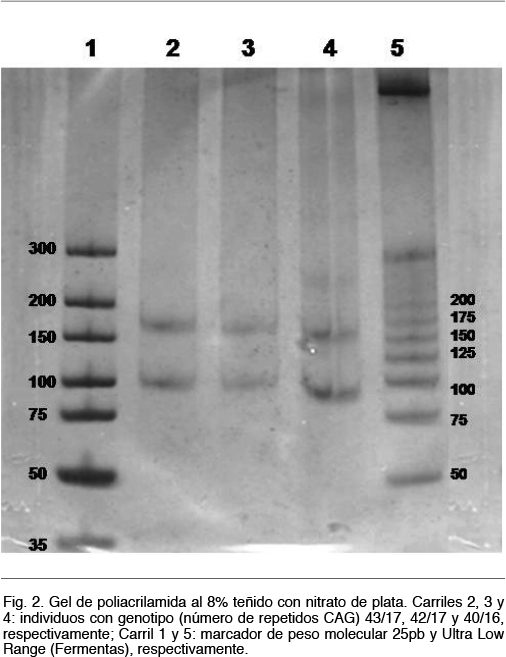
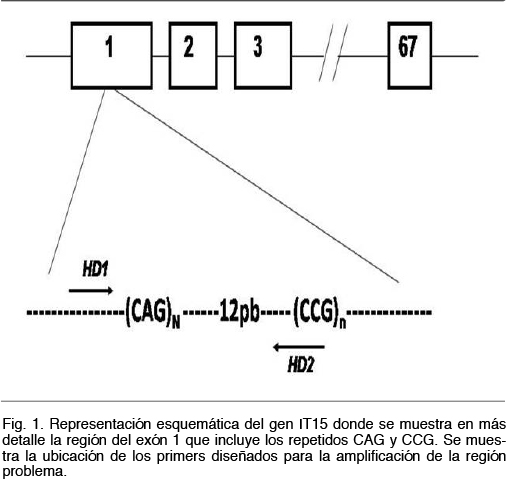
<body><![CDATA[<p><span style="font-size: 10pt; line-height: 120%; font-family: Verdana;" lang="ES-TRAD">Se determin&oacute; el n&uacute;mero de repetidos CAG mediante amplificaci&oacute;n por reacci&oacute;n en cadena de la polimerasa (PCR) y posterior an&aacute;lisis de fragmentos por electroforesis. <o:p></o:p></span></p>             <p><span style="font-size: 10pt; line-height: 120%; font-family: Verdana;" lang="ES-TRAD">El ADN fue extra&iacute;do a partir de 3 mL de sangre perif&eacute;rica utilizando el kit comercial QIAamp DSP DNA Blood Mini Kit, Qiagen, siguiendo las instrucciones del fabricante. <o:p></o:p></span></p>             <p><span style="font-size: 10pt; line-height: 120%; font-family: Verdana;" lang="ES-TRAD">La amplificaci&oacute;n se llev&oacute; a cabo en un volumen de reacci&oacute;n de 20 &micro;L en presencia de 0,8 mM de MgCl<sub>2</sub>, 0,8 nM de dNTPs, 0,5-1 mg de ADN, 0,2 mM de cada primer, 5% DMSO, buffer de reacci&oacute;n 1X y 0,75 U de enzima polimerasa Hot Start (Fermentas). Las condiciones de ciclado consistieron en una desnaturalizaci&oacute;n inicial de 5 min. a 95&deg;C, seguido de 30 ciclos de 30 seg. a 95&ordm;C, 30 seg. a 58&deg;C y 30 seg. a 72&deg;C, finalizando con una extensi&oacute;n final de 5 min. a 72&deg;C. <o:p></o:p></span></p>             <p><span style="font-size: 10pt; line-height: 120%; font-family: Verdana;" lang="ES-TRAD">Los primeros fueron dise&ntilde;ados a partir de la secuencia del gen IT15 publicada en las diferentes bases de datos (Ensembl Genome Browser, www.ensembl.org). La estrategia consisti&oacute; en dise&ntilde;ar un juego de primers que no amplificara la zona de repetidos CCG ubicada unos 12 pb en direcci&oacute;n 3&acute; de la regi&oacute;n de los repetidos CAG. Los repetidos CCG, al igual que los CAG, son polim&oacute;rficos por lo que los primers fueron dise&ntilde;ados para no amplificar la regi&oacute;n que los contiene (<a href="#figura_1">Figura 1</a>).<o:p></o:p></span></p>             <p><span style="font-size: 10pt; line-height: 120%; font-family: Verdana;" lang="ES-TRAD">Estos fragmentos se resolvieron mediante electroforesis en gel de poliacrilamida al 8%, durante 2 horas a 80V. Se realiz&oacute; la migraci&oacute;n conjuntamente con controles que conten&iacute;an un n&uacute;mero de repetidos conocidos, un control negativo y marcadores de peso molecular. Los resultados se visualizaron mediante revelado con nitrato de plata. Los productos obtenidos ser&aacute;n de por ejemplo 107 pb, 128 pb y 170 pb si presentaban 19, 26 o 40 repetidos CAG, respectivamente (<a href="#figura_2">Figura 2</a>). En los casos en que el n&uacute;mero de repeticiones era cercano o superior a 40, se realiz&oacute; una confirmaci&oacute;n por secuenciaci&oacute;n Sanger.</span></p>             <p><span style="font-size: 10pt; line-height: 120%; font-family: Verdana;" lang="ES-TRAD"><o:p></o:p></span></p>         <p><span style="font-size: 10pt; line-height: 120%; font-family: Verdana;" lang="ES-TRAD"><o:p><a name="figura_1"></a><img style="width: 506px; height: 479px;" alt="" src="/img/revistas/ami/v36n3/3a07f1.jpg"></o:p></span></p>         <p><span style="font-size: 10pt; line-height: 120%; font-family: Verdana;" lang="ES-TRAD"><o:p></o:p></span></p>         <p><font face="Verdana" size="2"><a name="figura_2"></a><img style="width: 506px; height: 657px;" alt="" src="/img/revistas/ami/v36n3/3a07f2.jpg"></font><span style="font-size: 10pt; line-height: 120%; font-family: Verdana;" lang="ES-TRAD"><o:p></o:p></span></p>         <p><span style="font-size: 10pt; line-height: 120%; font-family: Verdana;" lang="ES-TRAD"><o:p></o:p></span></p>             ]]></body>
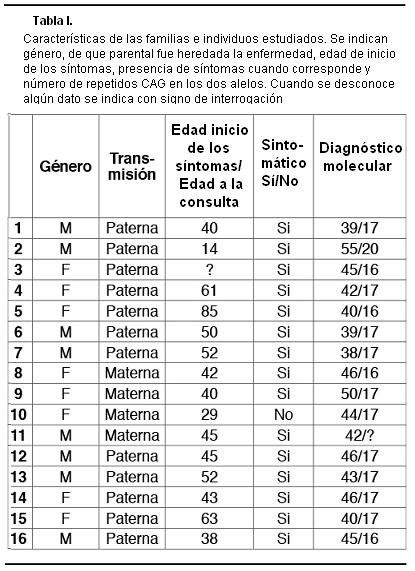
<body><![CDATA[<p><span style="font-size: 10pt; line-height: 120%; font-family: Verdana;" lang="ES-TRAD"><o:p>&nbsp;</o:p></span></p>             <p><span style="font-size: 10pt; line-height: 120%; font-family: Verdana;" lang="ES-TRAD">Resultados<o:p></o:p></span></p>             <p><span style="font-size: 10pt; line-height: 120%; font-family: Verdana;" lang="ES-TRAD"><o:p>&nbsp;</o:p></span></p>             <p><span style="font-size: 10pt; line-height: 120%; font-family: Verdana;" lang="ES-TRAD">Familias diagnosticadas<o:p></o:p></span></p>             <p><span style="font-size: 10pt; line-height: 120%; font-family: Verdana;" lang="ES-TRAD">Se lleg&oacute; al diagn&oacute;stico molecular de 16 pacientes pertenecientes a 8 familias diferentes, de los cuales 15 ya ten&iacute;an un diagn&oacute;stico cl&iacute;nico, y un individuo estaba asintom&aacute;tico (<a href="#tabla_1">Tabla I)</a>.</span></p>         <p></p>     <font face="Verdana" size="2">    <a name="tabla_1"></a><img style="width: 415px; height: 571px;" alt="" src="/img/revistas/ami/v36n3/3a07t1.jpg"> </font>     <p></p>         <p></p>         <p><span style="font-size: 10pt; line-height: 120%; font-family: Verdana;" lang="ES-TRAD"> <o:p></o:p></span></p>             <p><span style="font-size: 10pt; line-height: 120%; font-family: Verdana;" lang="ES-TRAD">Se analizaron tambi&eacute;n dos pacientes con sospecha cl&iacute;nica de EH, pero en los que no se detect&oacute; un aumento del n&uacute;mero de repeticiones CAG, por lo que se descart&oacute; la EH. En estos casos puede tratarse de fenocopias de la enfermedad de Huntington tipo 1<sup>(<a href="#15">15</a>)<a name="15."></a></sup> o tipo 2<sup>(<a href="#16">16</a>)<a name="16."></a></sup>, u otras enfermedades neurogen&eacute;ticas que se pueden plantear como diagn&oacute;stico diferencial de la EH. <o:p></o:p></span></p>             ]]></body>
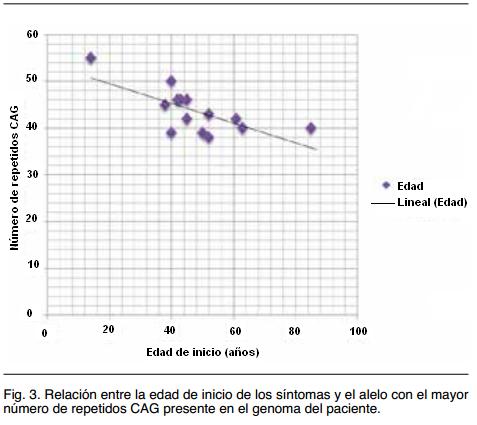
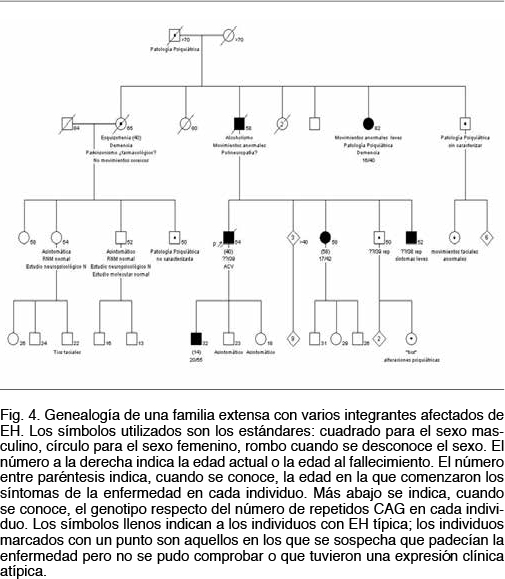
<body><![CDATA[<p><span style="font-size: 10pt; line-height: 120%; font-family: Verdana;" lang="ES-TRAD">Todos los pacientes afectados resultaron ser heterocigotas con un alelo normal y otro expandido. En los pacientes afectados de EH, el n&uacute;mero de repeticiones CAG en los alelos mutados vari&oacute; desde 40 a 55; mientras que para los alelos normales, la variaci&oacute;n fue entre 16 y 20 repetidos CAG. <o:p></o:p></span></p>             <p><span style="font-size: 10pt; line-height: 120%; font-family: Verdana;" lang="ES-TRAD">Si bien los casos estudiados son pocos y varios de ellos pertenecientes a la misma familia (por lo que comparten otros factores modificadores), se encontr&oacute; una correlaci&oacute;n inversa muy evidente entre el n&uacute;mero de repetidos CAG y la edad de inicio de los s&iacute;ntomas de EH (<a href="#figura_3">Figura 3)</a>, como se espera de acuerdo a la fisiopatolog&iacute;a molecular de esta afecci&oacute;n<sup>(<a href="#17">17</a>)<a name="17."></a></sup>.</span></p>         <p><font face="Verdana" size="2"><a name="fiigura_3"></a><img style="width: 477px; height: 425px;" alt="" src="/img/revistas/ami/v36n3/3a07f3.JPG"></font><u style=""><span style="font-size: 10pt; line-height: 120%; font-family: Verdana;" lang="ES-TRAD"><o:p></o:p></span></u></p>         <p><span style="font-size: 10pt; line-height: 120%; font-family: Verdana;" lang="ES-TRAD">An&aacute;lisis cualitativo de una familia extensa<o:p></o:p></span></p>             <p><span style="font-size: 10pt; line-height: 120%; font-family: Verdana;" lang="ES-TRAD">A modo de ejemplo se presenta esta familia (<a href="#figura_4">Figura 4</a>) donde se pueden apreciar todas las caracter&iacute;sticas cl&iacute;nicas de la afecci&oacute;n: 1. un patr&oacute;n de herencia autos&oacute;mico dominante con afectados en todas las generaciones y transmisi&oacute;n de padre a hijo var&oacute;n; 2. fen&oacute;meno de anticipaci&oacute;n, comprobado tanto a nivel cl&iacute;nico con una edad de comienzo de los s&iacute;ntomas menor y un curso con una progresividad mayor, as&iacute; como a nivel molecular donde se verifica una pasaje de 39 a 55 repetidos CAG en una transmisi&oacute;n padre a hijo (individuos III5 y IV6); 3. una expresividad cl&iacute;nica y edad de comienzo variable, a&uacute;n entre individuos que portan el mismo n&uacute;mero de repetidos CAG (v&eacute;ase individuos: II6, III5, III9 y III10); 4. una gran variedad de expresiones cl&iacute;nicas, con individuos que presentan desde el inicio una corea t&iacute;pica y otros que comienzan con s&iacute;ntomas de la esfera psiqui&aacute;trica, con trastornos de personalidad y otros s&iacute;ntomas premotores.</span></p>             <p><span style="font-size: 10pt; line-height: 120%; font-family: Verdana;" lang="ES-TRAD"><o:p></o:p></span></p>         <p><span style="font-size: 10pt; line-height: 120%; font-family: Verdana;" lang="ES-TRAD"><o:p><a name="figura_4"></a><img style="width: 505px; height: 579px;" alt="" src="/img/revistas/ami/v36n3/3a07f4.jpg"></o:p></span></p>         <p><span style="font-size: 10pt; line-height: 120%; font-family: Verdana;" lang="ES-TRAD"><o:p>&nbsp;</o:p></span></p>             <p><span style="font-size: 10pt; line-height: 120%; font-family: Verdana;" lang="ES-TRAD">Discusi&oacute;n<o:p></o:p></span></p>             <p><span style="font-size: 10pt; line-height: 120%; font-family: Verdana;" lang="ES-TRAD"><o:p>&nbsp;</o:p></span></p>             ]]></body>
<body><![CDATA[<p><span style="font-size: 10pt; line-height: 120%; font-family: Verdana;" lang="ES-TRAD">El diagn&oacute;stico molecular puede realizarse tanto: 1. en pacientes sintom&aacute;ticos, como confirmaci&oacute;n de un diagn&oacute;stico cl&iacute;nico y para descartar diagn&oacute;sticos diferenciales; 2. en individuos asintom&aacute;ticos pero en riesgo de haber heredado la mutaci&oacute;n, como test predictivo; 3. como diagn&oacute;stico prenatal. <o:p></o:p></span></p>             <p><span style="font-size: 10pt; line-height: 120%; font-family: Verdana;" lang="ES-TRAD">El diagn&oacute;stico molecular consiste en determinar el tama&ntilde;o exacto de la repetici&oacute;n CAG presente en el ex&oacute;n 1 del gen IT-15. Los alelos normales, m&aacute;s com&uacute;nmente reportados en la bibliograf&iacute;a se encuentran entre 17 y 20 repetidos, siendo la repetici&oacute;n de 17-19 la m&aacute;s frecuente en la poblaci&oacute;n estudiada as&iacute; como en 57 controles sanos de nuestra poblaci&oacute;n. Respecto al n&uacute;mero expandido de repeticiones la mayor frecuencia la presentan los alelos con 40 a 50 repetidos, lo que coincide con nuestros datos<sup>(<a href="#18">18</a>-<a href="#21">21</a>)</sup><a name="18."></a><a name="19."></a><a name="20."></a><a name="21."></a>.<o:p></o:p></span></p>             <p><span style="font-size: 10pt; line-height: 120%; font-family: Verdana;" lang="ES-TRAD">El tama&ntilde;o de la expansi&oacute;n y la edad de inicio de los s&iacute;ntomas presentan una correlaci&oacute;n ampliamente demostrada<a href="#22"><sup>22</sup></a><a name="22."></a>, si bien no es el &uacute;nico factor determinante en la edad de inicio<sup>(<a href="#23">23</a>,<a href="#24">24</a>)</sup><a name="23."></a><a name="24."></a>. En nuestra serie la tendencia a una edad de inicio m&aacute;s temprana cuanto mayor el n&uacute;mero de repetidos CAG es clara (ver <a href="#figura_3">Figura 3)</a>.</span></p>             <p><span style="font-size: 10pt; line-height: 120%; font-family: Verdana;" lang="ES-TRAD">En la mayor&iacute;a de los casos en que se registra una expansi&oacute;n de repetidos el alelo patog&eacute;nico ha sido heredado del padre. Este efecto del sexo en la transmisi&oacute;n de esta mutaci&oacute;n din&aacute;mica es conocido desde hace m&aacute;s de 20 a&ntilde;os<sup>(<a href="#25">25)</a></sup><a name="25."></a>. No contamos con estudios familiares suficientes como para comprobar esto, pero en algunos de nuestros casos este fen&oacute;meno se evidencia claramente. De hecho el &uacute;nico caso de EH juvenil<sup>(<a href="#26">26</a>)</sup><a name="26."></a> que encontramos se da por una gran expansi&oacute;n transmitida por v&iacute;a paterna (ver <a href="#figura_4">Figura 4</a>).<o:p></o:p></span></p>             <p><span style="font-size: 10pt; line-height: 120%; font-family: Verdana;" lang="ES-TRAD">El problema del asesoramiento gen&eacute;tico y la posibilidad usar test gen&eacute;ticos predictivos sobre la enfermedad viene siendo estudiado desde hace tiempo&shy;<sup>(<a href="#27">27</a>)</sup><a name="27."></a>. Como se trata de una enfermedad dominante con una penetrancia de 100%, el encontrar un alelo expandido es sin&oacute;nimo de que se desarrollar&aacute; la enfermedad (si bien no se puede predecir con exactitud la edad de inicio y la severidad). Por otra parte en esta afecci&oacute;n grave, de inicio habitualmente m&aacute;s all&aacute; de los 40 a&ntilde;os y sin tratamiento, el tema del diagn&oacute;stico gen&eacute;tico en individuos asintom&aacute;ticos es extremadamente complejo y la realizaci&oacute;n de este tipo de estudio pron&oacute;stico en general se desaconseja<sup>(<a href="#28">28</a>,<a href="#29">29</a>)</sup><a name="28."></a><a name="29."></a>. Se han desarrollado pautas sobre la aplicaci&oacute;n y alcances de los test predictivos<sup>(<a href="#30">30</a>,<a href="#31">31</a>)</sup><a name="30."></a><a name="31."></a>. De todos modos algunos individuos en alto riesgo de haber heredado la mutaci&oacute;n (en general hijos o hermanos menores de un afectado) desean realizar el test molecular o al menos consultan con esa intenci&oacute;n. Los motivos pueden ser por deseo de conocer los riesgos reales, para tomar decisiones de vida y, m&aacute;s frecuentemente, para tomar decisiones reproductivas.<o:p></o:p></span></p>             <p><span style="font-size: 10pt; line-height: 120%; font-family: Verdana;" lang="ES-TRAD">En estos casos, durante una primera consulta de asesoramiento gen&eacute;tico, se proporciona una informaci&oacute;n completa sobre la enfermedad. Se realiza una explicaci&oacute;n del posible curso cl&iacute;nico de la misma, y se analizan posibilidades diagn&oacute;sticas y otros aspectos relevantes para la toma de decisiones. Si una persona asintom&aacute;tica se somete al estudio, porque ha demostrado su voluntad expresa de conocer el diagn&oacute;stico, debe dar su consentimiento para realizarlo. El resultado de la prueba debe ser siempre entregado en el transcurso de una consulta de asesoramiento y con la colaboraci&oacute;n de psic&oacute;logos. De ser posible, se debe involucrar a los familiares para realizar estos estudios, dado que las consecuencias pueden afectarlos. <o:p></o:p></span></p>             <p><span style="font-size: 10pt; line-height: 120%; font-family: Verdana;" lang="ES-TRAD">El desarrollo de diagn&oacute;sticos moleculares confirmatorios, que permiten descartar diagn&oacute;sticos diferenciales y que se pueden usar de forma predictiva, preconcepcional o prenatal, son esenciales para el manejo de esta compleja y grave enfermedad, de enorme impacto en las familias afectadas y que significa uno de los mayores desaf&iacute;os en Asesoramiento Gen&eacute;tico<sup>(<a href="#32">32</a>)<a name="32."></a></sup>.<o:p></o:p></span></p>             <p><span style="font-size: 10pt; line-height: 120%; font-family: Verdana;" lang="ES-TRAD"><o:p>&nbsp;</o:p></span></p>             <p><span style="font-size: 10pt; line-height: 120%; font-family: Verdana;" lang="ES-TRAD">Conclusiones</span></p>             <p><span style="font-size: 10pt; line-height: 120%; font-family: Verdana;" lang="ES-TRAD">Hemos puesto a punto el diagn&oacute;stico molecular de la Enfermedad de Huntington, en el laboratorio de Biolog&iacute;a Molecular de la Facultad de Qu&iacute;mica y lo comenzamos aplicar en pacientes con sospecha cl&iacute;nica de EH como diagn&oacute;stico confirmatorio, etiol&oacute;gico, diferencial y en algunos casos predictivo. Este diagn&oacute;stico no se realizaba en nuestro pa&iacute;s, resultando por tanto novedoso y de utilidad para completar un diagn&oacute;stico cl&iacute;nico presuntivo de EH. <o:p></o:p></span></p>             ]]></body>
<body><![CDATA[<p><span style="font-size: 10pt; line-height: 120%; font-family: Verdana;" lang="ES-TRAD"><o:p>&nbsp;</o:p></span></p>             <p><span style="font-size: 10pt; line-height: 120%; font-family: Verdana;" lang="ES-TRAD">Bibliograf&iacute;a<o:p></o:p></span></p>             <p style="margin-top: 2.85pt;"><span style="font-size: 10pt; line-height: 120%; font-family: Verdana;"><a name="1"></a><a href="#1.">1</a><span style="">&nbsp;&nbsp; </span>Driver-Dunckley E, Caviness JN. </span><span style="font-size: 10pt; line-height: 120%; font-family: Verdana;" lang="EN-US">Huntington&rsquo;s disease. In Schapira AHV. Neurology and Clinical Neuroscience. Mosby Elsevier. 2007; pp. 879&ndash;85.<o:p></o:p></span></p>             <p><span style="font-size: 10pt; line-height: 120%; font-family: Verdana;" lang="EN-US"><a name="2"></a><a href="#2.">2</a><span style="">&nbsp;&nbsp; </span>Zuccato C, Valenza M, Cattaneo E. Molecular Mechanisms and Potential Therapeutical Targets in Huntington&rsquo;s Disease. Physiol Rev 2010; 90: 905-81.<o:p></o:p></span></p>             <!-- ref --><p><span style="font-size: 10pt; line-height: 120%; font-family: Verdana;" lang="EN-US"><a name="3"></a><a href="#3.">3</a><span style="">&nbsp;&nbsp; </span>Usdin K, Grabezyk E. DNA repeat expansions and human disease. Cell Mol Life Sci 2000; 57: 914-31.     <o:p></o:p></span></p>             <!-- ref --><p><span style="font-size: 10pt; line-height: 120%; font-family: Verdana;" lang="EN-US"><a name="4"></a><a href="#4.">4</a><span style="">&nbsp;&nbsp; </span>Paulson H, Bonini N, and Roth K. Polyglutamine disease and neuronal cell death. PNAS 2000; 97(24): 12957-58.    <o:p></o:p></span></p>             <p><span style="font-size: 10pt; line-height: 120%; font-family: Verdana;" lang="EN-US"><a name="5"></a><a href="#5.">5</a><span style="">&nbsp;&nbsp; </span>Semaka A, Collins J, Hayden M. Unstable familial transmissions of Huntington disease alleles with 27&ndash;35 CAG repeats (intermediate alleles). Am J Med Genet B Neuropsychiatr Genet 153: 314&ndash;320, 2010.<o:p></o:p></span></p>             <p><span style="font-size: 10pt; line-height: 120%; font-family: Verdana;" lang="EN-US"><a name="6"></a><a href="#6.">6</a><span style="">&nbsp;&nbsp; </span>Wells R, Dere R, Hebert M, Napierala M, Son L. Advances in mechanisms of genetic instability related to hereditary neurological diseases. Nucleic Acids Res 2005; 33(12): 3785&ndash;98.<o:p></o:p></span></p>             ]]></body>
<body><![CDATA[<p><span style="font-size: 10pt; line-height: 120%; font-family: Verdana;" lang="EN-US"><a name="7"></a><a href="#7.">7</a><span style="">&nbsp;&nbsp; </span>Ranen N, Stine O, Abbott M, Sherr M, Codori A, Franz M, et al. Anticipation and instability of IT-15 (CAG)n repeats in parent-offspring pairs with Huntington disease. Am J Hum Genet 1995; 57: 593&ndash;602.<o:p></o:p></span></p>             <p><span style="font-size: 10pt; line-height: 120%; font-family: Verdana;" lang="EN-US"><a name="8"></a><a href="#8.">8</a><span style="">&nbsp;&nbsp; </span>Pearson CE. Slipping while sleeping? Trinucleotide repeat expansions in germ cells. Trends Mol Med 2003; 9: 490&ndash;95.<o:p></o:p></span></p>             <!-- ref --><p><span style="font-size: 10pt; line-height: 120%; font-family: Verdana;" lang="EN-US"><a name="9"></a><a href="#9.">9</a><span style="">&nbsp;&nbsp; </span>Bates G. The molecular genetics of Huntington disease-a history. Nat Rev Genet. 2005; 6: 766-73.     <o:p></o:p></span></p>             <!-- ref --><p><span style="font-size: 10pt; line-height: 120%; font-family: Verdana;" lang="EN-US"><a name="10"></a><a href="#10.">10</a><span style=""> </span>Kremer B, Almqvist E, Theilmann J, Spence N, Telenius H, Goldberg P, Hayden R. Sex-Dependent Mechanisms For Expansions and Contractions of the CAG Repeat on Affected Huntington Disease Chromosomes. Am J Hum Genet 1995; 57: 343-50.    <o:p></o:p></span></p>             <!-- ref --><p><span style="font-size: 10pt; line-height: 120%; font-family: Verdana;" lang="EN-US"><a name="11"></a><a href="#11.">11</a><span style=""> </span>Potter N, Spector E, Prior T. Technical Standards and Guidelines for Huntington Disease Testing. Genet Med 2004; 6: 61-5.    <o:p></o:p></span></p>             <!-- ref --><p><span style="font-size: 10pt; line-height: 120%; font-family: Verdana;" lang="EN-US"><a name="12"></a><a href="#12.">12</a><span style=""> </span>Duyao M, Ambrose C, Myers R, Novelletto A, Persichetti F, Frontali M, et al. Trinucleotide repeat length instability and age of onset in Huntington&acute;s disease. Nat Genet 1993; 4: 387-92.    <o:p></o:p></span></p>             ]]></body>
<body><![CDATA[<p><span style="font-size: 10pt; line-height: 120%; font-family: Verdana;" lang="EN-US"><a name="13"></a><a href="#13.">13</a><span style=""> </span>Brinkman R, Mezei M, Theilmann J, Almqvist E, Hayden M. The likelihood of being affected with Huntington disease by a particular age, for a specific CAG size. Am J Hum Genet 1997; 60: 1202&ndash;10.<o:p></o:p></span></p>             <p><span style="font-size: 10pt; line-height: 120%; font-family: Verdana;" lang="EN-US"><a name="14"></a><a href="#14.">14</a><span style=""> </span>Van Rij M, De Rademaeker M, Moutou C, Dreesen J, De Rycke M, Liebaers I. Preimplantation genetic diagnosis (PGD) for Huntington&rsquo;s disease: the experience of three European centres. Eur J Hum Genet 2012; 20(4): 368-75.<o:p></o:p></span></p>             <p><span style="font-size: 10pt; line-height: 120%; font-family: Verdana;" lang="EN-US"><a name="15"></a><a href="#15.">15</a><span style=""> </span>Moore R, Xiang F, Monaghan J, Han D, Zhang Z, Edstrom L, et al. Huntington disease phenocopy is a familial prion disease. Am J Hum Genet 2001; 69: 1385&ndash;8.<o:p></o:p></span></p>             <p><span style="font-size: 10pt; line-height: 120%; font-family: Verdana;" lang="EN-US"><a name="16"></a><a href="#16.">16</a><span style=""> </span>Margolis R, O&rsquo;Hearn E, Rosenblatt A, Willour V, Holmes S, Franz M, et al. A disorder similar to Huntington&rsquo;s disease is associated with a novel CAG repeat expansion. Ann Neurol 2001; 50: 373&ndash;80.<o:p></o:p></span></p>             <p><span style="font-size: 10pt; line-height: 120%; font-family: Verdana;" lang="EN-US"><a name="17"></a><a href="#17.">17</a><span style=""> </span>Wexler N. Huntington&rsquo;s disease: advocacy driving science. Annu Rev Med. 2012; 63: 1-22.<o:p></o:p></span></p>             <!-- ref --><p><span style="font-size: 10pt; line-height: 120%; font-family: Verdana;" lang="EN-US"><a name="18"></a><a href="#18.">18</a><span style=""> </span>Andrew S, Goldberg Y, Kremer B, Telenius H, Theilmann J, Adam S, et al. The relationship between trinucleotide (CAG) repeat length and clinical features of Huntington&acute;s disease. Nat Genet 1993; 4: 398-403.    <o:p></o:p></span></p>             <!-- ref --><p><span style="font-size: 10pt; line-height: 120%; font-family: Verdana;" lang="EN-US"><a name="19"></a><a href="#19.">19</a><span style=""> </span>S&aacute;nchez A, Castellvi-Bel S, Mila M, Genis D, Calopa M, Jim&eacute;nez D,et al. Huntington&acute;s disease: confirmation of diagnosis and presymptomatic testing in spanish families by genetic analysis. </span><span style="font-size: 10pt; line-height: 120%; font-family: Verdana;">J Neurol Neurosurg Psychiatry 1996; 61: 625-7.    <o:p></o:p></span></p>             <!-- ref --><p><span style="font-size: 10pt; line-height: 120%; font-family: Verdana;"><a name="20"></a><a href="#20.">20</a><span style=""> </span>Alonso M, Yescas P, Cisneros B, Mart&iacute;nez C, Silva G, Ochoa A, et al. </span><span style="font-size: 10pt; line-height: 120%; font-family: Verdana;" lang="EN-US">Analysis of the (CAG)n repeat causing Huntington&acute;s disease in a Mexican population. Clin Genet 1997; 51: 225-30.    <o:p></o:p></span></p>             <!-- ref --><p><span style="font-size: 10pt; line-height: 120%; font-family: Verdana;" lang="EN-US"><a name="21"></a><a href="#21.">21</a><span style=""> </span>Lima e Silva T, Guerra H, Bertuzzo C, Lopes I. Molecular diagnosis of Huntington disease in Brazilian patients. Arq Neuropsiquiatr 2000; 58: 11-7.    <o:p></o:p></span></p>             <!-- ref --><p><span style="font-size: 10pt; line-height: 120%; font-family: Verdana;" lang="EN-US"><a name="22"></a><a href="#22.">22</a><span style=""> </span>Landles C, Bates G. Huntingtin and the molecular pathogenesis of Huntington disease. EMBO Rep 2004; 5(10): 958-63.     <o:p></o:p></span></p>             <p><span style="font-size: 10pt; line-height: 120%; font-family: Verdana;" lang="EN-US"><a name="23"></a><a href="#23.">23</a><span style=""> </span>Wexler N, Lorimer J, Porter J, G&oacute;mez F, Moskowitz C, Shackell E, et al. Venezuelan kindreds reveal that genetic and environmental factors modulate Huntington&rsquo;s disease age of onset. P Natl Acad Sci USA 2004; 101(10): 3498-503.<o:p></o:p></span></p>             <p><span style="font-size: 10pt; line-height: 120%; font-family: Verdana;" lang="EN-US"><a name="24"></a><a href="#24.">24</a><span style=""> </span>Gusella J, MacDonald M. Huntington&rsquo;s disease: the case for genetic modifiers, Genome Medicine 2009, 1:80.<o:p></o:p></span></p>             <!-- ref --><p><span style="font-size: 10pt; line-height: 120%; font-family: Verdana;" lang="EN-US"><a name="25"></a><a href="#25.">25</a><span style=""> </span>Kremer B, Almqvist E, Theilmann J, Spence N, Telenius H, Goldberg P, et al. Sex-Dependent Mechanisms For Expansions and Contractions of the CAG Repeat on Affected Huntington Disease Chromosomes. Am J Hum Genet 1995; 57: 343-50.    <o:p></o:p></span></p>             <!-- ref --><p><span style="font-size: 10pt; line-height: 120%; font-family: Verdana;" lang="EN-US"><a name="26"></a><a href="#26.">26</a><span style=""> </span>Gonzalez-Alegre P, Afifi A. Clinical characteristics of childhood-onset (juvenile) Huntington disease: report of 12 patients and review of the literature. J Child Neurol 2006; 21: 223-9.    <o:p></o:p></span></p>             <p><span style="font-size: 10pt; line-height: 120%; font-family: Verdana;" lang="EN-US"><a name="27"></a><a href="#27.">27</a><span style=""> </span>Stern R, Eldridge R. Attitudes of patients and their relatives to Huntington&rsquo;s disease. <u style="">J</u> Med Genet 1975; 2(3): 217-23.<o:p></o:p></span></p>             <p><span style="font-size: 10pt; line-height: 120%; font-family: Verdana;" lang="EN-US"><a name="28"></a><a href="#28.">28</a><span style=""> </span>Di Maio L, Squitieri F, Napolitano G, Campanella G, Trofatter J, Conneally P. Suicide risk in Huntington&rsquo;s disease. J Med Genet 1993; 30: 293&ndash;295.<o:p></o:p></span></p>             <p><span style="font-size: 10pt; line-height: 120%; font-family: Verdana;" lang="EN-US"><a name="29"></a><a href="#29.">29</a><span style=""> </span>Paulsen J,<i> </i>Ferneyhough Hoth K, Nehl C, Stierman L. The Huntington Study Group. Critical Periods of Suicide Risk in Huntington&rsquo;s disease. Am J Psychiatry 2005; 162: 725&ndash;31.<o:p></o:p></span></p>             <p><span style="font-size: 10pt; line-height: 120%; font-family: Verdana;" lang="EN-US"><a name="30"></a><a href="#30.">30</a><span style=""> </span>Clinical practice in medical genetics. Guidelines for the molecular genetics predictive test in Huntington&rsquo;s disease. J Med Genet 1994;31:555-9.<o:p></o:p></span></p>             <p><span style="font-size: 10pt; line-height: 120%; font-family: Verdana;" lang="EN-US"><a name="31"></a><a href="#31.">31</a><span style=""> </span>Bernhardt C, Schwan A, Kraus P, Epplen J, Kunstmann E. Decreasing uptake of predictive testing for Huntington&rsquo;s disease in a German centre: 12 years&rsquo; experience (1993-2004). Eur J Hum Genet 2009; 17: 295&ndash;300.<o:p></o:p></span></p>             <!-- ref --><p><span style="font-size: 10pt; line-height: 120%; font-family: Verdana;" lang="EN-US"><a name="32"></a><a href="#32.">32</a><span style=""> </span>Harper P. Practical Genetic Counseling, 7th Ed., Oxford, Oxford University Press, 2010.    </span></p>         </div>              ]]></body><back>
<ref-list>
<ref id="B1">
<label>1</label><nlm-citation citation-type="book">
<person-group person-group-type="author">
<name>
<surname><![CDATA[Driver-Dunckley]]></surname>
<given-names><![CDATA[E]]></given-names>
</name>
<name>
<surname><![CDATA[Caviness]]></surname>
<given-names><![CDATA[JN]]></given-names>
</name>
</person-group>
<article-title xml:lang="en"><![CDATA[Huntington&rsquo;s disease]]></article-title>
<person-group person-group-type="editor">
<name>
<surname><![CDATA[Schapira]]></surname>
<given-names><![CDATA[AHV]]></given-names>
</name>
</person-group>
<source><![CDATA[Neurology and Clinical Neuroscience]]></source>
<year>2007</year>
<page-range>879-85</page-range><publisher-name><![CDATA[Mosby Elsevier]]></publisher-name>
</nlm-citation>
</ref>
<ref id="B2">
<label>2</label><nlm-citation citation-type="journal">
<person-group person-group-type="author">
<name>
<surname><![CDATA[Zuccato]]></surname>
<given-names><![CDATA[C]]></given-names>
</name>
<name>
<surname><![CDATA[Valenza]]></surname>
<given-names><![CDATA[M]]></given-names>
</name>
<name>
<surname><![CDATA[Cattaneo]]></surname>
<given-names><![CDATA[E]]></given-names>
</name>
</person-group>
<article-title xml:lang="en"><![CDATA[Molecular Mechanisms and Potential Therapeutical Targets in Huntington&rsquo;s Disease]]></article-title>
<source><![CDATA[Physiol Rev]]></source>
<year>2010</year>
<volume>90</volume>
<page-range>905-81</page-range></nlm-citation>
</ref>
<ref id="B3">
<label>3</label><nlm-citation citation-type="journal">
<person-group person-group-type="author">
<name>
<surname><![CDATA[Usdin]]></surname>
<given-names><![CDATA[K]]></given-names>
</name>
<name>
<surname><![CDATA[Grabezyk]]></surname>
<given-names><![CDATA[E]]></given-names>
</name>
</person-group>
<article-title xml:lang="en"><![CDATA[DNA repeat expansions and human disease]]></article-title>
<source><![CDATA[Cell Mol Life Sci]]></source>
<year>2000</year>
<volume>57</volume>
<page-range>914-31</page-range></nlm-citation>
</ref>
<ref id="B4">
<label>4</label><nlm-citation citation-type="journal">
<person-group person-group-type="author">
<name>
<surname><![CDATA[Paulson]]></surname>
<given-names><![CDATA[H]]></given-names>
</name>
<name>
<surname><![CDATA[Bonini]]></surname>
<given-names><![CDATA[N]]></given-names>
</name>
<name>
<surname><![CDATA[Roth]]></surname>
<given-names><![CDATA[K]]></given-names>
</name>
</person-group>
<article-title xml:lang="en"><![CDATA[Polyglutamine disease and neuronal cell death]]></article-title>
<source><![CDATA[PNAS]]></source>
<year>2000</year>
<volume>97</volume>
<numero>24</numero>
<issue>24</issue>
<page-range>12957-58</page-range></nlm-citation>
</ref>
<ref id="B5">
<label>5</label><nlm-citation citation-type="journal">
<person-group person-group-type="author">
<name>
<surname><![CDATA[Semaka]]></surname>
<given-names><![CDATA[A]]></given-names>
</name>
<name>
<surname><![CDATA[Collins]]></surname>
<given-names><![CDATA[J]]></given-names>
</name>
<name>
<surname><![CDATA[Hayden]]></surname>
<given-names><![CDATA[M]]></given-names>
</name>
</person-group>
<article-title xml:lang="en"><![CDATA[Unstable familial transmissions of Huntington disease alleles with 27-35 CAG repeats (intermediate alleles)]]></article-title>
<source><![CDATA[Am J Med Genet B Neuropsychiatr Genet]]></source>
<year>2010</year>
<volume>153</volume>
<page-range>314-320</page-range></nlm-citation>
</ref>
<ref id="B6">
<label>6</label><nlm-citation citation-type="journal">
<person-group person-group-type="author">
<name>
<surname><![CDATA[Wells]]></surname>
<given-names><![CDATA[R]]></given-names>
</name>
<name>
<surname><![CDATA[Dere]]></surname>
<given-names><![CDATA[R]]></given-names>
</name>
<name>
<surname><![CDATA[Hebert]]></surname>
<given-names><![CDATA[M]]></given-names>
</name>
<name>
<surname><![CDATA[Napierala]]></surname>
<given-names><![CDATA[M]]></given-names>
</name>
<name>
<surname><![CDATA[Son]]></surname>
<given-names><![CDATA[L]]></given-names>
</name>
</person-group>
<article-title xml:lang="en"><![CDATA[Advances in mechanisms of genetic instability related to hereditary neurological diseases]]></article-title>
<source><![CDATA[Nucleic Acids Res]]></source>
<year>2005</year>
<volume>33</volume>
<numero>12</numero>
<issue>12</issue>
<page-range>3785-98</page-range></nlm-citation>
</ref>
<ref id="B7">
<label>7</label><nlm-citation citation-type="journal">
<person-group person-group-type="author">
<name>
<surname><![CDATA[Ranen]]></surname>
<given-names><![CDATA[N]]></given-names>
</name>
<name>
<surname><![CDATA[Stine]]></surname>
<given-names><![CDATA[O]]></given-names>
</name>
<name>
<surname><![CDATA[Abbott]]></surname>
<given-names><![CDATA[M]]></given-names>
</name>
<name>
<surname><![CDATA[Sherr]]></surname>
<given-names><![CDATA[M]]></given-names>
</name>
<name>
<surname><![CDATA[Codori]]></surname>
<given-names><![CDATA[A]]></given-names>
</name>
<name>
<surname><![CDATA[Franz]]></surname>
<given-names><![CDATA[M]]></given-names>
</name>
</person-group>
<article-title xml:lang="en"><![CDATA[Anticipation and instability of IT-15 (CAG)n repeats in parent-offspring pairs with Huntington disease.]]></article-title>
<source><![CDATA[Am J Hum Genet]]></source>
<year>1995</year>
<volume>57</volume>
<page-range>593-602</page-range></nlm-citation>
</ref>
<ref id="B8">
<label>8</label><nlm-citation citation-type="journal">
<person-group person-group-type="author">
<name>
<surname><![CDATA[Pearson]]></surname>
<given-names><![CDATA[CE]]></given-names>
</name>
</person-group>
<article-title xml:lang="en"><![CDATA[Slipping while sleeping?: Trinucleotide repeat expansions in germ cells]]></article-title>
<source><![CDATA[Trends Mol Med]]></source>
<year>2003</year>
<volume>9</volume>
<page-range>490-95</page-range></nlm-citation>
</ref>
<ref id="B9">
<label>9</label><nlm-citation citation-type="journal">
<person-group person-group-type="author">
<name>
<surname><![CDATA[Bates]]></surname>
<given-names><![CDATA[G]]></given-names>
</name>
</person-group>
<article-title xml:lang="en"><![CDATA[The molecular genetics of Huntington disease-a history]]></article-title>
<source><![CDATA[Nat Rev Genet]]></source>
<year>2005</year>
<volume>6</volume>
<page-range>766-73</page-range></nlm-citation>
</ref>
<ref id="B10">
<label>10</label><nlm-citation citation-type="journal">
<person-group person-group-type="author">
<name>
<surname><![CDATA[Kremer]]></surname>
<given-names><![CDATA[B]]></given-names>
</name>
<name>
<surname><![CDATA[Almqvist]]></surname>
<given-names><![CDATA[E]]></given-names>
</name>
<name>
<surname><![CDATA[Theilmann]]></surname>
<given-names><![CDATA[J]]></given-names>
</name>
<name>
<surname><![CDATA[Spence]]></surname>
<given-names><![CDATA[N]]></given-names>
</name>
<name>
<surname><![CDATA[Telenius]]></surname>
<given-names><![CDATA[H]]></given-names>
</name>
<name>
<surname><![CDATA[Goldberg]]></surname>
<given-names><![CDATA[P]]></given-names>
</name>
<name>
<surname><![CDATA[Hayden]]></surname>
<given-names><![CDATA[R]]></given-names>
</name>
</person-group>
<article-title xml:lang="en"><![CDATA[Sex-Dependent Mechanisms For Expansions and Contractions of the CAG Repeat on Affected Huntington Disease Chromosomes]]></article-title>
<source><![CDATA[Am J Hum Genet]]></source>
<year>1995</year>
<volume>57</volume>
<page-range>343-50</page-range></nlm-citation>
</ref>
<ref id="B11">
<label>11</label><nlm-citation citation-type="journal">
<person-group person-group-type="author">
<name>
<surname><![CDATA[Potter]]></surname>
<given-names><![CDATA[N]]></given-names>
</name>
<name>
<surname><![CDATA[Spector]]></surname>
<given-names><![CDATA[E]]></given-names>
</name>
<name>
<surname><![CDATA[Prior]]></surname>
<given-names><![CDATA[T]]></given-names>
</name>
</person-group>
<article-title xml:lang="en"><![CDATA[Technical Standards and Guidelines for Huntington Disease Testing]]></article-title>
<source><![CDATA[Genet Med]]></source>
<year>2004</year>
<volume>6</volume>
<page-range>61-5</page-range></nlm-citation>
</ref>
<ref id="B12">
<label>12</label><nlm-citation citation-type="journal">
<person-group person-group-type="author">
<name>
<surname><![CDATA[Duyao]]></surname>
<given-names><![CDATA[M]]></given-names>
</name>
<name>
<surname><![CDATA[Ambrose]]></surname>
<given-names><![CDATA[C]]></given-names>
</name>
<name>
<surname><![CDATA[Myers]]></surname>
<given-names><![CDATA[R]]></given-names>
</name>
<name>
<surname><![CDATA[Novelletto]]></surname>
<given-names><![CDATA[A]]></given-names>
</name>
<name>
<surname><![CDATA[Persichetti]]></surname>
<given-names><![CDATA[F]]></given-names>
</name>
<name>
<surname><![CDATA[Frontali]]></surname>
<given-names><![CDATA[M]]></given-names>
</name>
</person-group>
<source><![CDATA[Nat Genet]]></source>
<year>1993</year>
<volume>4</volume>
<page-range>387-92</page-range></nlm-citation>
</ref>
<ref id="B13">
<label>13</label><nlm-citation citation-type="journal">
<person-group person-group-type="author">
<name>
<surname><![CDATA[Brinkman]]></surname>
<given-names><![CDATA[R]]></given-names>
</name>
<name>
<surname><![CDATA[Mezei]]></surname>
<given-names><![CDATA[M]]></given-names>
</name>
<name>
<surname><![CDATA[Theilmann]]></surname>
<given-names><![CDATA[J]]></given-names>
</name>
<name>
<surname><![CDATA[Almqvist]]></surname>
<given-names><![CDATA[E]]></given-names>
</name>
<name>
<surname><![CDATA[Hayden]]></surname>
<given-names><![CDATA[M]]></given-names>
</name>
</person-group>
<article-title xml:lang="en"><![CDATA[The likelihood of being affected with Huntington disease by a particular age, for a specific CAG size]]></article-title>
<source><![CDATA[Am J Hum Genet]]></source>
<year>1997</year>
<volume>60</volume>
<page-range>1202-10</page-range></nlm-citation>
</ref>
<ref id="B14">
<label>14</label><nlm-citation citation-type="journal">
<person-group person-group-type="author">
<name>
<surname><![CDATA[Van Rij]]></surname>
<given-names><![CDATA[M]]></given-names>
</name>
<name>
<surname><![CDATA[De Rademaeker]]></surname>
<given-names><![CDATA[M]]></given-names>
</name>
<name>
<surname><![CDATA[Moutou]]></surname>
<given-names><![CDATA[C]]></given-names>
</name>
<name>
<surname><![CDATA[Dreesen]]></surname>
<given-names><![CDATA[J]]></given-names>
</name>
<name>
<surname><![CDATA[De Rycke]]></surname>
<given-names><![CDATA[M]]></given-names>
</name>
<name>
<surname><![CDATA[Liebaers]]></surname>
<given-names><![CDATA[I]]></given-names>
</name>
</person-group>
<article-title xml:lang="en"><![CDATA[Preimplantation genetic diagnosis (PGD) for Huntington&rsquo;s disease: the experience of three European centres]]></article-title>
<source><![CDATA[Eur J Hum Genet]]></source>
<year>2012</year>
<volume>20</volume>
<numero>4</numero>
<issue>4</issue>
<page-range>368-75</page-range></nlm-citation>
</ref>
<ref id="B15">
<label>15</label><nlm-citation citation-type="journal">
<person-group person-group-type="author">
<name>
<surname><![CDATA[Moore]]></surname>
<given-names><![CDATA[R]]></given-names>
</name>
<name>
<surname><![CDATA[Xiang]]></surname>
<given-names><![CDATA[F]]></given-names>
</name>
<name>
<surname><![CDATA[Monaghan]]></surname>
<given-names><![CDATA[J]]></given-names>
</name>
<name>
<surname><![CDATA[Han]]></surname>
<given-names><![CDATA[D]]></given-names>
</name>
<name>
<surname><![CDATA[Zhang]]></surname>
<given-names><![CDATA[Z]]></given-names>
</name>
<name>
<surname><![CDATA[Edstrom]]></surname>
<given-names><![CDATA[L]]></given-names>
</name>
</person-group>
<article-title xml:lang="en"><![CDATA[Huntington disease phenocopy is a familial prion disease]]></article-title>
<source><![CDATA[Am J Hum Genet]]></source>
<year>2001</year>
<volume>69</volume>
<page-range>1385-8</page-range></nlm-citation>
</ref>
<ref id="B16">
<label>16</label><nlm-citation citation-type="journal">
<person-group person-group-type="author">
<name>
<surname><![CDATA[Margolis]]></surname>
<given-names><![CDATA[R]]></given-names>
</name>
<name>
<surname><![CDATA[O&rsquo;Hearn]]></surname>
<given-names><![CDATA[E]]></given-names>
</name>
<name>
<surname><![CDATA[Rosenblatt]]></surname>
<given-names><![CDATA[A]]></given-names>
</name>
<name>
<surname><![CDATA[Willour]]></surname>
<given-names><![CDATA[V]]></given-names>
</name>
<name>
<surname><![CDATA[Holmes]]></surname>
<given-names><![CDATA[S]]></given-names>
</name>
<name>
<surname><![CDATA[Franz]]></surname>
<given-names><![CDATA[M]]></given-names>
</name>
</person-group>
<article-title xml:lang="en"><![CDATA[A disorder similar to Huntington&rsquo;s disease is associated with a novel CAG repeat expansion]]></article-title>
<source><![CDATA[Ann Neurol]]></source>
<year>2001</year>
<volume>50</volume>
<page-range>373-80</page-range></nlm-citation>
</ref>
<ref id="B17">
<label>17</label><nlm-citation citation-type="journal">
<person-group person-group-type="author">
<name>
<surname><![CDATA[Wexler]]></surname>
<given-names><![CDATA[N]]></given-names>
</name>
</person-group>
<article-title xml:lang="en"><![CDATA[Huntington&rsquo;s disease: advocacy driving science]]></article-title>
<source><![CDATA[Annu Rev Med]]></source>
<year>2012</year>
<volume>63</volume>
<page-range>1-22</page-range></nlm-citation>
</ref>
<ref id="B18">
<label>18</label><nlm-citation citation-type="journal">
<person-group person-group-type="author">
<name>
<surname><![CDATA[Andrew]]></surname>
<given-names><![CDATA[S]]></given-names>
</name>
<name>
<surname><![CDATA[Goldberg]]></surname>
<given-names><![CDATA[Y]]></given-names>
</name>
<name>
<surname><![CDATA[Kremer]]></surname>
<given-names><![CDATA[B]]></given-names>
</name>
<name>
<surname><![CDATA[Telenius]]></surname>
<given-names><![CDATA[H]]></given-names>
</name>
<name>
<surname><![CDATA[Theilmann]]></surname>
<given-names><![CDATA[J]]></given-names>
</name>
<name>
<surname><![CDATA[Adam]]></surname>
<given-names><![CDATA[S]]></given-names>
</name>
</person-group>
<article-title xml:lang="en"><![CDATA[The relationship between trinucleotide (CAG) repeat length and clinical features of Huntington´s disease]]></article-title>
<source><![CDATA[Nat Genet]]></source>
<year>1993</year>
<volume>4</volume>
<page-range>398-403</page-range></nlm-citation>
</ref>
<ref id="B19">
<label>19</label><nlm-citation citation-type="journal">
<person-group person-group-type="author">
<name>
<surname><![CDATA[Sánchez]]></surname>
<given-names><![CDATA[A]]></given-names>
</name>
<name>
<surname><![CDATA[Castellvi-Bel]]></surname>
<given-names><![CDATA[S]]></given-names>
</name>
<name>
<surname><![CDATA[Mila]]></surname>
<given-names><![CDATA[M]]></given-names>
</name>
<name>
<surname><![CDATA[Genis]]></surname>
<given-names><![CDATA[D]]></given-names>
</name>
<name>
<surname><![CDATA[Calopa]]></surname>
<given-names><![CDATA[M]]></given-names>
</name>
<name>
<surname><![CDATA[Jiménez]]></surname>
<given-names><![CDATA[D]]></given-names>
</name>
</person-group>
<article-title xml:lang="en"><![CDATA[Huntington´s disease: confirmation of diagnosis and presymptomatic testing in spanish families by genetic analysis]]></article-title>
<source><![CDATA[J Neurol Neurosurg Psychiatry]]></source>
<year>1996</year>
<volume>61</volume>
<page-range>625-7</page-range></nlm-citation>
</ref>
<ref id="B20">
<label>20</label><nlm-citation citation-type="journal">
<person-group person-group-type="author">
<name>
<surname><![CDATA[Alonso]]></surname>
<given-names><![CDATA[M]]></given-names>
</name>
<name>
<surname><![CDATA[Yescas]]></surname>
<given-names><![CDATA[P]]></given-names>
</name>
<name>
<surname><![CDATA[Cisneros]]></surname>
<given-names><![CDATA[B]]></given-names>
</name>
<name>
<surname><![CDATA[Martínez]]></surname>
<given-names><![CDATA[C]]></given-names>
</name>
<name>
<surname><![CDATA[Silva]]></surname>
<given-names><![CDATA[G]]></given-names>
</name>
<name>
<surname><![CDATA[Ochoa]]></surname>
<given-names><![CDATA[A]]></given-names>
</name>
</person-group>
<article-title xml:lang="en"><![CDATA[Analysis of the (CAG)n repeat causing Huntington´s disease in a Mexican population]]></article-title>
<source><![CDATA[Clin Genet]]></source>
<year>1997</year>
<volume>51</volume>
<page-range>225-30</page-range></nlm-citation>
</ref>
<ref id="B21">
<label>21</label><nlm-citation citation-type="journal">
<person-group person-group-type="author">
<name>
<surname><![CDATA[Lima e Silva]]></surname>
<given-names><![CDATA[T]]></given-names>
</name>
<name>
<surname><![CDATA[Guerra]]></surname>
<given-names><![CDATA[H]]></given-names>
</name>
<name>
<surname><![CDATA[Bertuzzo]]></surname>
<given-names><![CDATA[C]]></given-names>
</name>
<name>
<surname><![CDATA[Lopes]]></surname>
<given-names><![CDATA[I]]></given-names>
</name>
</person-group>
<article-title xml:lang="en"><![CDATA[Molecular diagnosis of Huntington disease in Brazilian patients]]></article-title>
<source><![CDATA[Arq Neuropsiquiatr]]></source>
<year>2000</year>
<volume>58</volume>
<page-range>11-7</page-range></nlm-citation>
</ref>
<ref id="B22">
<label>22</label><nlm-citation citation-type="journal">
<person-group person-group-type="author">
<name>
<surname><![CDATA[Landles]]></surname>
<given-names><![CDATA[C]]></given-names>
</name>
<name>
<surname><![CDATA[Bates]]></surname>
<given-names><![CDATA[G]]></given-names>
</name>
</person-group>
<article-title xml:lang="en"><![CDATA[Huntingtin and the molecular pathogenesis of Huntington disease]]></article-title>
<source><![CDATA[EMBO Rep]]></source>
<year>2004</year>
<volume>5</volume>
<numero>10</numero>
<issue>10</issue>
<page-range>958-63</page-range></nlm-citation>
</ref>
<ref id="B23">
<label>23</label><nlm-citation citation-type="journal">
<person-group person-group-type="author">
<name>
<surname><![CDATA[Wexler]]></surname>
<given-names><![CDATA[N]]></given-names>
</name>
<name>
<surname><![CDATA[Lorimer]]></surname>
<given-names><![CDATA[J]]></given-names>
</name>
<name>
<surname><![CDATA[Porter]]></surname>
<given-names><![CDATA[J]]></given-names>
</name>
<name>
<surname><![CDATA[Gómez]]></surname>
<given-names><![CDATA[F]]></given-names>
</name>
<name>
<surname><![CDATA[Moskowitz]]></surname>
<given-names><![CDATA[C]]></given-names>
</name>
<name>
<surname><![CDATA[Shackell]]></surname>
<given-names><![CDATA[E]]></given-names>
</name>
</person-group>
<article-title xml:lang="en"><![CDATA[Venezuelan kindreds reveal that genetic and environmental factors modulate Huntington&rsquo;s disease age of onset]]></article-title>
<source><![CDATA[P Natl Acad Sci USA]]></source>
<year>2004</year>
<volume>101</volume>
<numero>10</numero>
<issue>10</issue>
<page-range>3498-503</page-range></nlm-citation>
</ref>
<ref id="B24">
<label>24</label><nlm-citation citation-type="journal">
<person-group person-group-type="author">
<name>
<surname><![CDATA[Gusella]]></surname>
<given-names><![CDATA[J]]></given-names>
</name>
<name>
<surname><![CDATA[MacDonald]]></surname>
<given-names><![CDATA[M]]></given-names>
</name>
</person-group>
<article-title xml:lang="en"><![CDATA[Huntington&rsquo;s disease: the case for genetic modifiers]]></article-title>
<source><![CDATA[Genome Medicine]]></source>
<year>2009</year>
<volume>1</volume>
<page-range>80</page-range></nlm-citation>
</ref>
<ref id="B25">
<label>25</label><nlm-citation citation-type="journal">
<person-group person-group-type="author">
<name>
<surname><![CDATA[Kremer]]></surname>
<given-names><![CDATA[B]]></given-names>
</name>
<name>
<surname><![CDATA[Almqvist]]></surname>
<given-names><![CDATA[E]]></given-names>
</name>
<name>
<surname><![CDATA[Theilmann]]></surname>
<given-names><![CDATA[J]]></given-names>
</name>
<name>
<surname><![CDATA[Spence]]></surname>
<given-names><![CDATA[N]]></given-names>
</name>
<name>
<surname><![CDATA[Telenius]]></surname>
<given-names><![CDATA[H]]></given-names>
</name>
<name>
<surname><![CDATA[Goldberg]]></surname>
<given-names><![CDATA[P]]></given-names>
</name>
</person-group>
<article-title xml:lang="en"><![CDATA[Sex-Dependent Mechanisms For Expansions and Contractions of the CAG Repeat on Affected Huntington Disease Chromosomes]]></article-title>
<source><![CDATA[Am J Hum Genet]]></source>
<year>1995</year>
<volume>57</volume>
<page-range>343-50</page-range></nlm-citation>
</ref>
<ref id="B26">
<label>26</label><nlm-citation citation-type="journal">
<person-group person-group-type="author">
<name>
<surname><![CDATA[Gonzalez-Alegre]]></surname>
<given-names><![CDATA[P]]></given-names>
</name>
<name>
<surname><![CDATA[Afifi]]></surname>
<given-names><![CDATA[A]]></given-names>
</name>
</person-group>
<article-title xml:lang="en"><![CDATA[Clinical characteristics of childhood-onset (juvenile) Huntington disease: report of 12 patients and review of the literature]]></article-title>
<source><![CDATA[J Child Neurol]]></source>
<year>2006</year>
<volume>21</volume>
<page-range>223-9</page-range></nlm-citation>
</ref>
<ref id="B27">
<label>27</label><nlm-citation citation-type="journal">
<person-group person-group-type="author">
<name>
<surname><![CDATA[Stern]]></surname>
<given-names><![CDATA[R]]></given-names>
</name>
<name>
<surname><![CDATA[Eldridge]]></surname>
<given-names><![CDATA[R]]></given-names>
</name>
</person-group>
<article-title xml:lang="en"><![CDATA[Attitudes of patients and their relatives to Huntington&rsquo;s disease]]></article-title>
<source><![CDATA[J Med Genet]]></source>
<year>1975</year>
<volume>2</volume>
<numero>3</numero>
<issue>3</issue>
<page-range>217-23</page-range></nlm-citation>
</ref>
<ref id="B28">
<label>28</label><nlm-citation citation-type="journal">
<person-group person-group-type="author">
<name>
<surname><![CDATA[Di Maio]]></surname>
<given-names><![CDATA[L]]></given-names>
</name>
<name>
<surname><![CDATA[Squitieri]]></surname>
<given-names><![CDATA[F]]></given-names>
</name>
<name>
<surname><![CDATA[Napolitano]]></surname>
<given-names><![CDATA[G]]></given-names>
</name>
<name>
<surname><![CDATA[Campanella]]></surname>
<given-names><![CDATA[G]]></given-names>
</name>
<name>
<surname><![CDATA[Trofatter]]></surname>
<given-names><![CDATA[J]]></given-names>
</name>
<name>
<surname><![CDATA[Conneally]]></surname>
<given-names><![CDATA[P]]></given-names>
</name>
</person-group>
<article-title xml:lang="en"><![CDATA[Suicide risk in Huntington&rsquo;s disease]]></article-title>
<source><![CDATA[J Med Genet]]></source>
<year>1993</year>
<volume>30</volume>
<page-range>293-295</page-range></nlm-citation>
</ref>
<ref id="B29">
<label>29</label><nlm-citation citation-type="journal">
<person-group person-group-type="author">
<name>
<surname><![CDATA[Paulsen]]></surname>
<given-names><![CDATA[J]]></given-names>
</name>
<name>
<surname><![CDATA[Ferneyhough Hoth]]></surname>
<given-names><![CDATA[K]]></given-names>
</name>
<name>
<surname><![CDATA[Nehl]]></surname>
<given-names><![CDATA[C]]></given-names>
</name>
<name>
<surname><![CDATA[Stierman]]></surname>
<given-names><![CDATA[L]]></given-names>
</name>
</person-group>
<article-title xml:lang="en"><![CDATA[The Huntington Study Group. Critical Periods of Suicide Risk in Huntington&rsquo;s disease]]></article-title>
<source><![CDATA[Am J Psychiatry]]></source>
<year>2005</year>
<volume>162</volume>
<numero>725-31</numero>
<issue>725-31</issue>
</nlm-citation>
</ref>
<ref id="B30">
<label>30</label><nlm-citation citation-type="journal">
<article-title xml:lang="en"><![CDATA[Clinical practice in medical genetics: Guidelines for the molecular genetics predictive test in Huntington&rsquo;s disease]]></article-title>
<source><![CDATA[J Med Genet]]></source>
<year>1994</year>
<volume>31</volume>
<page-range>555-9</page-range></nlm-citation>
</ref>
<ref id="B31">
<label>31</label><nlm-citation citation-type="journal">
<person-group person-group-type="author">
<name>
<surname><![CDATA[Bernhardt]]></surname>
<given-names><![CDATA[C]]></given-names>
</name>
<name>
<surname><![CDATA[Schwan]]></surname>
<given-names><![CDATA[A]]></given-names>
</name>
<name>
<surname><![CDATA[Kraus]]></surname>
<given-names><![CDATA[P]]></given-names>
</name>
<name>
<surname><![CDATA[Epplen]]></surname>
<given-names><![CDATA[J]]></given-names>
</name>
<name>
<surname><![CDATA[Kunstmann]]></surname>
<given-names><![CDATA[E]]></given-names>
</name>
</person-group>
<article-title xml:lang="en"><![CDATA[Decreasing uptake of predictive testing for Huntington&rsquo;s disease in a German centre: 12 years&rsquo; experience (1993-2004)]]></article-title>
<source><![CDATA[Eur J Hum Genet]]></source>
<year>2009</year>
<volume>17</volume>
<page-range>295-300</page-range></nlm-citation>
</ref>
<ref id="B32">
<label>32</label><nlm-citation citation-type="book">
<person-group person-group-type="author">
<name>
<surname><![CDATA[Harper]]></surname>
<given-names><![CDATA[P]]></given-names>
</name>
</person-group>
<source><![CDATA[Practical Genetic Counseling]]></source>
<year>2010</year>
<edition>7</edition>
<publisher-loc><![CDATA[Oxford ]]></publisher-loc>
<publisher-name><![CDATA[Oxford University Press]]></publisher-name>
</nlm-citation>
</ref>
</ref-list>
</back>
</article>