<?xml version="1.0" encoding="ISO-8859-1"?><article xmlns:mml="http://www.w3.org/1998/Math/MathML" xmlns:xlink="http://www.w3.org/1999/xlink" xmlns:xsi="http://www.w3.org/2001/XMLSchema-instance">
<front>
<journal-meta>
<journal-id>1688-423X</journal-id>
<journal-title><![CDATA[Archivos de Medicina Interna]]></journal-title>
<abbrev-journal-title><![CDATA[Arch Med Int]]></abbrev-journal-title>
<issn>1688-423X</issn>
<publisher>
<publisher-name><![CDATA[Sociedad de Medicina Interna del Uruguay]]></publisher-name>
</publisher>
</journal-meta>
<article-meta>
<article-id>S1688-423X2013000300006</article-id>
<title-group>
<article-title xml:lang="es"><![CDATA[Psoriasis Vulgar moderada y severa: opciones terapéuticas (tratamientos convencionales)]]></article-title>
<article-title xml:lang="en"><![CDATA[Moderate and Severe Psoriasis Vulgaris: therapy options(conventional therapies)]]></article-title>
</title-group>
<contrib-group>
<contrib contrib-type="author">
<name>
<surname><![CDATA[Martínez]]></surname>
<given-names><![CDATA[Miguel]]></given-names>
</name>
<xref ref-type="aff" rid="A01"/>
</contrib>
<contrib contrib-type="author">
<name>
<surname><![CDATA[Levrero]]></surname>
<given-names><![CDATA[Patricia]]></given-names>
</name>
<xref ref-type="aff" rid="A01"/>
</contrib>
<contrib contrib-type="author">
<name>
<surname><![CDATA[Carusso]]></surname>
<given-names><![CDATA[Rosanna]]></given-names>
</name>
<xref ref-type="aff" rid="A01"/>
</contrib>
<contrib contrib-type="author">
<name>
<surname><![CDATA[Morales]]></surname>
<given-names><![CDATA[Cristian]]></given-names>
</name>
<xref ref-type="aff" rid="A01"/>
</contrib>
<contrib contrib-type="author">
<name>
<surname><![CDATA[Arretche]]></surname>
<given-names><![CDATA[Valeria]]></given-names>
</name>
<xref ref-type="aff" rid="A01"/>
</contrib>
<contrib contrib-type="author">
<name>
<surname><![CDATA[Nicola]]></surname>
<given-names><![CDATA[Andrea]]></given-names>
</name>
<xref ref-type="aff" rid="A01"/>
</contrib>
<contrib contrib-type="author">
<name>
<surname><![CDATA[Fossati]]></surname>
<given-names><![CDATA[Mercedes]]></given-names>
</name>
<xref ref-type="aff" rid="A01"/>
</contrib>
<contrib contrib-type="author">
<name>
<surname><![CDATA[Cueto]]></surname>
<given-names><![CDATA[Mariela]]></given-names>
</name>
<xref ref-type="aff" rid="A01"/>
</contrib>
<contrib contrib-type="author">
<name>
<surname><![CDATA[Dorado]]></surname>
<given-names><![CDATA[Natalia]]></given-names>
</name>
<xref ref-type="aff" rid="A01"/>
</contrib>
<contrib contrib-type="author">
<name>
<surname><![CDATA[García]]></surname>
<given-names><![CDATA[Cecilia]]></given-names>
</name>
<xref ref-type="aff" rid="A01"/>
</contrib>
<contrib contrib-type="author">
<name>
<surname><![CDATA[Guebenlian]]></surname>
<given-names><![CDATA[Claudia]]></given-names>
</name>
<xref ref-type="aff" rid="A01"/>
</contrib>
<contrib contrib-type="author">
<name>
<surname><![CDATA[Restano]]></surname>
<given-names><![CDATA[Macarena]]></given-names>
</name>
<xref ref-type="aff" rid="A01"/>
</contrib>
</contrib-group>
<aff id="A01">
<institution><![CDATA[,UdelaR Facultad de Medicina ]]></institution>
<addr-line><![CDATA[ ]]></addr-line>
</aff>
<pub-date pub-type="pub">
<day>00</day>
<month>12</month>
<year>2013</year>
</pub-date>
<pub-date pub-type="epub">
<day>00</day>
<month>12</month>
<year>2013</year>
</pub-date>
<volume>35</volume>
<numero>3</numero>
<fpage>93</fpage>
<lpage>100</lpage>
<copyright-statement/>
<copyright-year/>
<self-uri xlink:href="http://www.scielo.edu.uy/scielo.php?script=sci_arttext&amp;pid=S1688-423X2013000300006&amp;lng=en&amp;nrm=iso"></self-uri><self-uri xlink:href="http://www.scielo.edu.uy/scielo.php?script=sci_abstract&amp;pid=S1688-423X2013000300006&amp;lng=en&amp;nrm=iso"></self-uri><self-uri xlink:href="http://www.scielo.edu.uy/scielo.php?script=sci_pdf&amp;pid=S1688-423X2013000300006&amp;lng=en&amp;nrm=iso"></self-uri><abstract abstract-type="short" xml:lang="es"><p><![CDATA[La psoriasis es una enfermedad de filiación inmunológica, frecuente a nivel mundial. En población europea y en EE.UU. reporta una prevalencia del 0,6 al 4%. No hay reportes en Uruguay. La forma clásica de presentación es la vulgar en placas. Si bien en la mayoría de los casos es paucisintomática y las terapias tópicas permiten su control (psoriasis leve), en una proporción importante de casos es capaz de afectar severamente la calidad de vida al generalizarse o asociar afectación de otros órganos, o en casos extremos inclusive llevar a la muerte. El objetivo principal de este artículo es brindar recomendaciones unificadas sobre el tratamiento de la psoriasis vulgar en placas moderada y severa. En esta parte se discuten tratamientos sistémicos &lsquo;convencionales&rsquo;, priorizando la fototerapia, metotrexato, ciclosporina A y retinoides. Aquí no se incluirán las terapias dirigidas contra blancos moleculares (llamadas &lsquo;terapias biológicas&rsquo;) que ya constituyen alternativas convencionales en los países desarrollados.]]></p></abstract>
<abstract abstract-type="short" xml:lang="en"><p><![CDATA[Psoriasis is a common worldwide disease and is considered of immune affiliation. In Europe and the U.S. population reported a prevalence of 0.6 to 4%. There are no reports of Uruguay prevalence. The classic presentation is vulgar plates. Although in most cases the disease is paucisymptomatic and topical therapies allows control (mild psoriasis), in a significant proportion can severely affect quality of life associated with generalized psoriasis or involvement of other organs. Even lead to death. The main objective of this article is to provide unified guidelines on the treatment of chronic plaque psoriasis with moderate to severe presentation. This part discusses systemic &lsquo;conventional&rsquo; treatments, giving priority to phototherapy, methotrexate, cyclosporin A and retinoids. The so called &lsquo;Biologic Therapies&rsquo; wich are already conventional alternatives in developed countries, will be the subject of Part II of these recommendations.]]></p></abstract>
<kwd-group>
<kwd lng="es"><![CDATA[Psoriasis vulgar moderada y severa]]></kwd>
<kwd lng="es"><![CDATA[Tratamiento psoriasis]]></kwd>
<kwd lng="es"><![CDATA[fototerapia]]></kwd>
<kwd lng="es"><![CDATA[Metotrexato]]></kwd>
<kwd lng="es"><![CDATA[Ciclosporina A]]></kwd>
<kwd lng="es"><![CDATA[Acitretín]]></kwd>
<kwd lng="en"><![CDATA[Moderate and severe psoriasis vulgaris]]></kwd>
<kwd lng="en"><![CDATA[Psoriasis treatment]]></kwd>
<kwd lng="en"><![CDATA[Phototherapy]]></kwd>
<kwd lng="en"><![CDATA[Methotrexate]]></kwd>
<kwd lng="en"><![CDATA[Cyclosporine A]]></kwd>
<kwd lng="en"><![CDATA[Acitretin]]></kwd>
</kwd-group>
</article-meta>
</front><body><![CDATA[ <div class="Section1">      <p style="margin-right: 42.25pt; text-align: justify; line-height: 14pt;"> <font face="Verdana" size="2">Revisi&oacute;n</font><o:p></o:p></p>       <p style="margin-right: 42.25pt; text-align: center; line-height: 18pt;" align="center"><b><i> <span style="font-size: 13pt; font-family: Verdana;">Psoriasis Vulgar moderada y severa: opciones terap&eacute;uticas (tratamientos convencionales)</span></i><span style="font-size: 18pt; font-family: Helvetica;"><o:p></o:p></span></b></p>       <p style="margin: 5.65pt 42.25pt 0.0001pt 0cm; text-align: center; line-height: 14pt;" align="center"> <span style="font-family: Verdana;">Moderate and Severe Psoriasis Vulgaris: &#8232;</span><font face="Verdana">therapy options(conventional therapies)</font></p>       <p style="margin: 5.65pt 42.25pt 0.0001pt 0cm; text-align: center; line-height: 14pt;" align="center">&nbsp;</p>       <p style="margin: 5.65pt 42.25pt 0.0001pt 0cm; text-align: center; line-height: 14pt;" align="center">&nbsp;</p>       <p style="margin-right: 42.25pt; text-align: center; line-height: 120%;" align="center"><b> <span style="font-size: 10pt; line-height: 120%; font-family: Verdana;">Dr. Miguel Mart&iacute;nez</span></b><span style="font-size: 8.5pt; line-height: 120%; font-family: Helvetica;"><o:p></o:p></span></p>       <p style="margin-right: 42.25pt; text-align: center; line-height: 120%;" align="center"> <span style="font-size: 10pt; line-height: 120%; "><font face="Verdana">Profesor Director de la C&aacute;tedra de Dermatolog&iacute;a. Facultad de Medicina. UdelaR. Montevideo.</font></span><o:p></o:p></p>       <p style="margin-right: 42.25pt; text-align: center; line-height: 120%;" align="center"> <span style="font-size: 10pt; line-height: 120%; font-family: Verdana;"><o:p>&nbsp;</o:p></span></p>       <p style="margin-right: 42.25pt; text-align: center; line-height: 120%;" align="center"><b> <span style="font-size: 10pt; line-height: 120%; font-family: Verdana;">Dra. Patricia Levrero</span></b><span style="font-size: 8.5pt; line-height: 120%; font-family: Helvetica;"><o:p></o:p></span></p>       ]]></body>
<body><![CDATA[<p style="margin-right: 42.25pt; text-align: center; line-height: 120%;" align="center"> <span style="font-size: 10pt; line-height: 120%; "><font face="Verdana">Asistente de la C&aacute;tedra de Dermatolog&iacute;a. Facultad de Medicina. UdelaR. Montevideo.</font></span><o:p></o:p></p>       <p style="margin-right: 42.25pt; text-align: center; line-height: 120%;" align="center"><b> <span style="font-size: 10pt; line-height: 120%; font-family: Verdana;">Dra. Rosanna Carusso</span></b><span style="font-size: 8.5pt; line-height: 120%; font-family: Helvetica;"><o:p></o:p></span></p>       <p style="margin-right: 42.25pt; text-align: center; line-height: 120%;" align="center"> <span style="font-size: 10pt; line-height: 120%; "><font face="Verdana">Drmat&oacute;loga. Ex Residente de la C&aacute;tedra de Dermatolog&iacute;a. Facultad de Medicina. UdelaR. Montevideo.</font></span><o:p></o:p></p>       <p style="margin-right: 42.25pt; text-align: center; line-height: 120%;" align="center"> <span style="font-size: 10pt; line-height: 120%; font-family: Verdana;"><o:p>&nbsp;</o:p></span></p>       <p style="margin-right: 42.25pt; text-align: center; line-height: 120%;" align="center"><b> <span style="font-size: 10pt; line-height: 120%; font-family: Verdana;">Dr. Cristian Morales</span></b><span style="font-size: 8.5pt; line-height: 120%; font-family: Helvetica;"><o:p></o:p></span></p>       <p style="margin-right: 42.25pt; text-align: center; line-height: 120%;" align="center"> <span style="font-size: 10pt; line-height: 120%; "><font face="Verdana">Residente de la C&aacute;tedra de Dermatolog&iacute;a. Facultad de Medicina. UdelaR. Montevideo.</font></span><o:p></o:p></p>       <p style="margin-right: 42.25pt; text-align: center; line-height: 120%;" align="center"> <span style="font-size: 10pt; line-height: 120%; font-family: Verdana;"><o:p>&nbsp;</o:p></span></p>       <p style="margin-right: 42.25pt; text-align: center; line-height: 120%;" align="center"><b> <span style="font-size: 10pt; line-height: 120%; font-family: Verdana;">Dra. Valeria Arretche</span></b><span style="font-size: 8.5pt; line-height: 120%; font-family: Helvetica;"><o:p></o:p></span></p>       <p style="margin-right: 42.25pt; text-align: center; line-height: 120%;" align="center"> <span style="font-size: 10pt; line-height: 120%; "><font face="Verdana">Residente de la C&aacute;tedra de Dermatolog&iacute;a. Facultad de Medicina. UdelaR. Montevideo.</font></span><o:p></o:p></p>       <p style="margin-right: 42.25pt; text-align: center; line-height: 120%;" align="center"> <span style="font-size: 10pt; line-height: 120%; font-family: Verdana;"><o:p>&nbsp;</o:p></span></p>       ]]></body>
<body><![CDATA[<p style="margin-right: 42.25pt; text-align: center; line-height: 120%;" align="center"><b> <span style="font-size: 10pt; line-height: 120%; font-family: Verdana;">Dra. Andrea Nicola</span></b><span style="font-size: 8.5pt; line-height: 120%; font-family: Helvetica;"><o:p></o:p></span></p>       <p style="margin-right: 42.25pt; text-align: center; line-height: 120%;" align="center"> <span style="font-size: 10pt; line-height: 120%; "><font face="Verdana">Residente de la C&aacute;tedra de Dermatolog&iacute;a. Facultad de Medicina. UdelaR. Montevideo.</font></span><o:p></o:p></p>       <p style="margin-right: 42.25pt; text-align: center; line-height: 120%;" align="center"> <span style="font-size: 10pt; line-height: 120%; font-family: Verdana;"><o:p>&nbsp;</o:p></span></p>       <p style="margin-right: 42.25pt; text-align: center; line-height: 120%;" align="center"><b> <span style="font-size: 10pt; line-height: 120%; font-family: Verdana;">Dra. Mercedes Fossati</span></b><span style="font-size: 8.5pt; line-height: 120%; font-family: Helvetica;"><o:p></o:p></span></p>       <p style="margin-right: 42.25pt; text-align: center; line-height: 120%;" align="center"> <span style="font-size: 10pt; line-height: 120%; "><font face="Verdana">Residente de la C&aacute;tedra de Dermatolog&iacute;a. Facultad de Medicina. UdelaR. Montevideo.</font></span><o:p></o:p></p>       <p style="margin-right: 42.25pt; text-align: center; line-height: 120%;" align="center"> <span style="font-size: 10pt; line-height: 120%; font-family: Verdana;"><o:p>&nbsp;</o:p></span></p>       <p style="margin-right: 42.25pt; text-align: center; line-height: 120%;" align="center"><b> <span style="font-size: 10pt; line-height: 120%; font-family: Verdana;">Dra. Mariela Cueto</span></b><span style="font-size: 8.5pt; line-height: 120%; font-family: Helvetica;"><o:p></o:p></span></p>       <p style="margin-right: 42.25pt; text-align: center; line-height: 120%;" align="center"> <span style="font-size: 10pt; line-height: 120%; "><font face="Verdana">Residente de la C&aacute;tedra de Dermatolog&iacute;a. Facultad de Medicina. UdelaR. Montevideo.</font></span><o:p></o:p></p>       <p style="margin-right: 42.25pt; text-align: center; line-height: 120%;" align="center"> <span style="font-size: 10pt; line-height: 120%; font-family: Verdana;"><o:p>&nbsp;</o:p></span></p>       <p style="margin-right: 42.25pt; text-align: center; line-height: 120%;" align="center"><b> <span style="font-size: 10pt; line-height: 120%; font-family: Verdana;">Dra. Natalia Dorado</span></b><span style="font-size: 8.5pt; line-height: 120%; font-family: Helvetica;"><o:p></o:p></span></p>       ]]></body>
<body><![CDATA[<p style="margin-right: 42.25pt; text-align: center; line-height: 120%;" align="center"> <span style="font-size: 10pt; line-height: 120%; "><font face="Verdana">Residente de la C&aacute;tedra de Dermatolog&iacute;a. Facultad de Medicina. UdelaR. Montevideo.</font></span><o:p></o:p></p>       <p style="margin-right: 42.25pt; text-align: center; line-height: 120%;" align="center"> <span style="font-size: 10pt; line-height: 120%; font-family: Verdana;"><o:p>&nbsp;</o:p></span></p>       <p style="margin-right: 42.25pt; text-align: center; line-height: 120%;" align="center"><b> <span style="font-size: 10pt; line-height: 120%; font-family: Verdana;">Dra. Cecilia Garc&iacute;a</span></b><span style="font-size: 8.5pt; line-height: 120%; font-family: Helvetica;"><o:p></o:p></span></p>       <p style="margin-right: 42.25pt; text-align: center; line-height: 120%;" align="center"> <span style="font-size: 10pt; line-height: 120%; "><font face="Verdana">Residente de la C&aacute;tedra de Dermatolog&iacute;a. Facultad de Medicina. UdelaR. Montevideo.</font></span><o:p></o:p></p>       <p style="margin-right: 42.25pt; text-align: center; line-height: 120%;" align="center"> <span style="font-size: 10pt; line-height: 120%; font-family: Verdana;"><o:p>&nbsp;</o:p></span></p>       <p style="margin-right: 42.25pt; text-align: center; line-height: 120%;" align="center"><b> <span style="font-size: 10pt; line-height: 120%; font-family: Verdana;">Dra. Claudia Guebenlian</span></b><span style="font-size: 8.5pt; line-height: 120%; font-family: Helvetica;"><o:p></o:p></span></p>       <p style="margin-right: 42.25pt; text-align: center; line-height: 120%;" align="center"> <span style="font-size: 10pt; line-height: 120%; "><font face="Verdana">Residente de la C&aacute;tedra de Dermatolog&iacute;a. Facultad de Medicina. UdelaR. Montevideo.</font></span><o:p></o:p></p>       <p style="margin-right: 42.25pt; text-align: center; line-height: 120%;" align="center"> <span style="font-size: 10pt; line-height: 120%; font-family: Verdana;"><o:p>&nbsp;</o:p></span></p>       <p style="margin-right: 42.25pt; text-align: center; line-height: 120%;" align="center"><b> <span style="font-size: 10pt; line-height: 120%; font-family: Verdana;">Dra. Macarena Restano</span></b><span style="font-size: 8.5pt; line-height: 120%; font-family: Helvetica;"><o:p></o:p></span></p>       <p style="margin-right: 42.25pt; text-align: center; line-height: 120%;" align="center"> <span style="font-size: 10pt; line-height: 120%; font-family: Verdana;">Residente de la C&aacute;tedra de Dermatolog&iacute;a. Facultad de Medicina. UdelaR. Montevideo.</span><span style="font-size: 9pt; line-height: 120%; font-family: Helvetica;"><o:p></o:p></span></p>       ]]></body>
<body><![CDATA[<p style="line-height: 120%; margin-right: 42.25pt" align="center">&nbsp;</p>     <p style="line-height: 120%; margin-right: 42.25pt" align="center">&nbsp;</p>       <p style="margin: 0cm 42.25pt 0.0001pt 5.65pt; text-align: justify; line-height: 120%;"><b> <span style="font-size: 10pt; line-height: 120%; "><font face="Verdana">RESUMEN: Arch Med Interna 2013 - 35(3):93-100</font></span><o:p></o:p></b></p>       <p style="margin-right: 42.25pt; text-align: justify; line-height: 120%;"> <font face="Verdana"><span style="font-size: 10pt; line-height: 120%; ">La psoriasis es una enfermedad de filiaci&oacute;n inmunol&oacute;gica, frecuente a nivel mundial. En poblaci&oacute;n europea y en EE.UU. reporta una prevalencia del 0,6 al 4%. No hay reportes en Uruguay. La forma cl&aacute;sica de presentaci&oacute;n es la vulgar en placas. Si bien en la mayor&iacute;a de los casos es paucisintom&aacute;tica y las terapias t&oacute;picas permiten su control (psoriasis leve), en una proporci&oacute;n importante de casos es capaz de afectar severamente la calidad de vida al generalizarse o asociar afectaci&oacute;n de otros &oacute;rganos, o en casos extremos inclusive llevar a la muerte. El objetivo principal de este art&iacute;culo es brindar recomendaciones unificadas sobre el tratamiento de la psoriasis vulgar en placas moderada y severa. En esta parte se discuten tratamientos sist&eacute;micos &ldquo;convencionales&rdquo;, priorizando la fototerapia, metotrexato, ciclosporina A y retinoides. Aqu&iacute; no se incluir&aacute;n las terapias dirigidas contra blancos moleculares (llamadas &ldquo;terapias biol&oacute;gicas&rdquo;) que ya constituyen alternativas convencionales en los pa&iacute;ses desarrollados.</span></font><o:p></o:p></p>       <p style="margin-right: 42.25pt; text-align: justify; line-height: 120%;"><b> <span style="font-size: 10pt; line-height: 120%; font-family: Verdana;"><o:p>&nbsp;</o:p></span></b></p>       <p style="margin-right: 42.25pt; text-align: justify; line-height: 120%;"><b> <span style="font-size: 10pt; line-height: 120%; "><font face="Verdana">Palabras clave: Psoriasis vulgar moderada y severa, Tratamiento psoriasis, fototerapia, Metotrexato, Ciclosporina A, Acitret&iacute;n.</font></span><o:p></o:p></b></p>       <p style="margin-right: 42.25pt; text-align: justify; text-indent: 17pt; line-height: 120%;"> <span style="font-size: 10pt; line-height: 120%; font-family: Verdana;"><o:p>&nbsp;</o:p></span></p>       <p style="margin: 0cm 42.25pt 0.0001pt 5.65pt; text-align: justify; line-height: 120%;"><b> <font face="Verdana"><span style="font-size: 10pt; line-height: 120%; ">ABSTRACT: Arch Med Interna 2013 - 35(3):93-100</span></font><o:p></o:p></b></p>       <p style="margin-right: 42.25pt; text-align: justify; line-height: 120%;"> <font face="Verdana"><span style="font-size: 10pt; line-height: 120%; ">Psoriasis is a common worldwide disease and is considered of immune affiliation. In Europe and the U.S. population reported a prevalence of 0.6 to 4%. There are no reports of Uruguay prevalence. The classic presentation is vulgar plates. Although in most cases the disease is paucisymptomatic and topical therapies allows control (mild psoriasis), in a significant proportion can severely affect quality of life associated with generalized psoriasis or involvement of other organs. Even lead to death. The main objective of this article is to provide unified guidelines on the treatment of chronic plaque psoriasis with moderate to severe presentation. This part discusses systemic &ldquo;conventional&rdquo; treatments, giving priority to phototherapy, methotrexate, cyclosporin A and retinoids. The so called &ldquo;Biologic Therapies&rdquo; wich are already conventional alternatives in developed countries, will be the subject of Part II of these recommendations. </span> </font> <o:p></o:p></p>       <p style="margin-right: 42.25pt; text-align: justify; line-height: 120%;"><b> <span style="font-size: 10pt; line-height: 120%; font-family: Verdana;"><o:p>&nbsp;</o:p></span></b></p>       ]]></body>
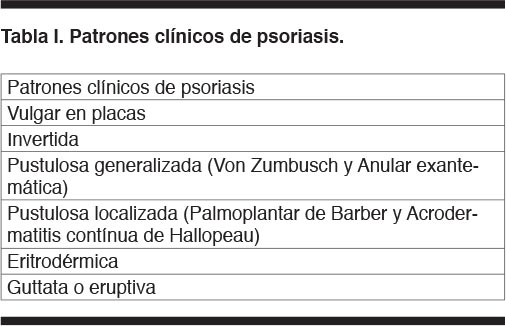
<body><![CDATA[<p style="margin-right: 42.25pt; text-align: justify; line-height: 120%;"><b> <font face="Verdana"><span style="font-size: 10pt; line-height: 120%; ">Keywords: Moderate and severe psoriasis vulgaris, Psoriasis treatment, Phototherapy, Methotrexate, Cyclosporine A, Acitretin. </span></font> <o:p></o:p></b></p>       <p style="margin-right: 42.25pt; line-height: 120%;"><b> <span style="font-size: 10pt; line-height: 120%; font-family: Verdana;"><o:p>&nbsp;</o:p></span></b></p>       <p style="margin-right: 42.25pt; line-height: 120%;"><b> <span style="font-size: 10pt; line-height: 120%; font-family: Verdana;"><o:p>&nbsp;</o:p></span></b></p>       <p style="margin-right: 42.25pt; line-height: 120%;"><b> <span style="font-size: 10pt; line-height: 120%; "><font face="Verdana">INTRODUCCI&Oacute;N</font></span><o:p></o:p></b></p>       <p style="margin-right: 42.25pt; line-height: 120%;"><b> <span style="font-size: 10pt; line-height: 120%; font-family: Verdana;"><o:p>&nbsp;</o:p></span></b></p>       <p style="margin-right: 42.25pt; text-align: justify; text-indent: 17pt; line-height: 120%;"> <span style="font-size: 10pt; line-height: 120%; font-family: Verdana;">La psoriasis es una dermatosis cr&oacute;nica que afecta fundamentalmente piel y faneras, caracterizada por una respuesta inmunol&oacute;gica que determina proliferaci&oacute;n de los queratinocitos con cambios arquitecturales en dermis y epidermis, presenta una predisposici&oacute;n gen&eacute;tica de tipo polig&eacute;nica, sobre la que act&uacute;an factores desencadenantes como traumatismos, medicamentos, infecciones y estr&eacute;s. En sus formas moderada y severa puede determinar importante compromiso con gran afectaci&oacute;n de la calidad de vida, al punto que muchos autores la comparan por la repercusi&oacute;n que ocasionan, a la que determina la diabetes y ciertas enfermedades neopl&aacute;sicas<sup> (<a href="#1">1</a>)</sup><a name="-1"></a>. Cl&iacute;nicamente, tiene diferentes patrones de presentaci&oacute;n. La psoriasis vulgar o en placas es la forma m&aacute;s com&uacute;n (llegando a ser el 90% de todas las formas de psoriasis) y se manifiesta como placas eritematosas bien delimitadas, de distribuci&oacute;n sim&eacute;trica, predominando en cuero cabelludo, codos, ombligo, regi&oacute;n sacra y rodillas, est&aacute;n cubiertas por una escama blanca o plateada fina llamada mic&aacute;cea. Otras formas de presentaci&oacute;n cl&iacute;nica cut&aacute;nea de psoriasis se describen en <a name="-tab1"></a><a href="#tab1">Tabla I</a>.</span></p>     <p style="margin-right: 42.25pt; text-align: justify; text-indent: 17pt; line-height: 120%;">&nbsp;</p>     <p style="margin-right: 42.25pt; text-align: justify; text-indent: 17pt; line-height: 120%;"> <font face="Verdana" size="2"><a name="tab1"></a><a href="#-tab1"><img style="border: 0px solid ; width: 506px; height: 326px;" alt="" src="/img/revistas/ami/v35n3/3a06t1.jpg"></a></font><span style="font-size: 9pt; line-height: 120%; font-family: Helvetica;"><o:p></o:p></span></p>       <p style="margin-right: 42.25pt; text-align: justify; text-indent: 17pt; line-height: 120%;"> <font face="Verdana"><span style="font-size: 10pt; line-height: 120%; ">La psoriasis es una enfermedad de distribuci&oacute;n universal, tiene similar incidencia en ambos sexos y es m&aacute;s frecuente en la raza blanca. En Europa y Estados Unidos alcanza una prevalencia de 0,8 a 4.8%.<sup> (<a href="#2">2</a>,<a href="#3">3</a>)</sup><a name="-2"></a><a name="-3"></a>. Se ha reportado prevalencia algo inferior en la poblaci&oacute;n asi&aacute;tica <sup>(<a href="#4">4</a>)</sup>.<a name="-4"></a> En Latinoam&eacute;rica en general existen muy pocos reportes y en Uruguay en particular desconocemos su prevalencia.</span></font><o:p></o:p></p>       <p style="margin-right: 42.25pt; text-align: justify; text-indent: 17pt; line-height: 120%;"> <font face="Verdana"><span style="font-size: 10pt; line-height: 120%; ">Los antecedentes familiares de psoriasis se observan en cerca de un tercio de los casos. Gudjonsson y Elder demostraron que si ambos padres padecen la enfermedad, el 41% de sus descendientes tambi&eacute;n la padecer&aacute;. Si solo un progenitor est&aacute; afectado, el 14% de sus hijos la padecer&aacute; y apenas el 6% en el caso de un hermano afectado<sup> (<a href="#5">5</a>)</sup><a name="-5"></a>.</span></font><o:p></o:p></p>       ]]></body>
<body><![CDATA[<p style="margin-right: 42.25pt; text-align: justify; text-indent: 17pt; line-height: 120%;"> <span style="font-size: 10pt; line-height: 120%; "><font face="Verdana">Entre el 20 y 30% de los pacientes con psoriasis asocian una artritis psori&aacute;sica, la cual puede preceder, ser concomitante o posterior a las manifestaciones cut&aacute;neas de la psoriasis. Es una artritis inflamatoria asociada a la psoriasis, clasificada dentro de las espondiloartropat&iacute;as seronegativas (factor reumatoideo negativo o ausente), asociadas a HLA-B27. La psoriasis y la artritis psori&aacute;sica comparten caracter&iacute;sticas histol&oacute;gicas e inmunol&oacute;gicas, lo que sugiere mecanismos patog&eacute;nicos similares<sup> (<a href="#6">6</a>)</sup><a name="-6"></a>. En estas enfermedades no se detecta la presencia de auto-anticuerpos. Hay un incremento selectivo de linfocitos T CD4 en la membrana sinovial y de CD8 en el l&iacute;quido sinovial y hueso subcondral debajo de las entesis. Igual que ocurre en la piel, los linfocitos T CD8 muestran una expansi&oacute;n clonal posiblemente en respuesta a un est&iacute;mulo hasta hoy desconocido. Los linfocitos T CD4 son policlonales y est&aacute;n polarizados fundamentalmente a Th1 y, en menor medida, a Th17. En consonancia con una respuesta Th1 y Th17, existe un incremento en la sinovial tanto de macr&oacute;fagos activados que secretan TNF-&alpha; como de neutr&oacute;filos. Se sugiere que, tanto la respuesta inmunitaria citot&oacute;xica como la respuesta Th1 y Th17, pueden participar en el desencadenamiento y/o la perpetuaci&oacute;n de la artritis psori&aacute;sica<sup> (<a href="#6">6</a>)</sup>. Cl&iacute;nicamente se presenta como una oligoartritis asim&eacute;trica de peque&ntilde;as articulaciones de manos y pies. La inflamaci&oacute;n simult&aacute;nea de las articulaciones digitales y la de sus vainas tendinosas ocasionan los &ldquo;dedos en salchicha&rdquo; o dactilitis, hecho frecuente en el curso de esta enfermedad. Estudios con Resonancia Magn&eacute;tica Nuclear (RMN), sugieren que la tenosinovitis aislada sin compromiso capsular, es suficiente causa de dactilitis. Las entesitis de la inserci&oacute;n del tend&oacute;n de Aquiles o de la fascia plantar se observan frecuentemente. La espondilitis ocurre en general acompa&ntilde;ando una artritis perif&eacute;rica. Estos pacientes presentan dolor lumbar y reducci&oacute;n de la movilidad de la columna. El compromiso prolongado de la columna cervical puede provocar subluxaci&oacute;n atlantoaxoidea. </font></span> <o:p></o:p></p>       <p style="margin-right: 42.25pt; text-align: justify; text-indent: 17pt; line-height: 120%;"> <font face="Verdana"><span style="font-size: 10pt; line-height: 120%; ">La afectaci&oacute;n ungular acompa&ntilde;a muy frecuentemente a todas las formas cl&iacute;nicas de psoriasis y en ciertas presentaciones y ocupaciones lleva a una gran afectaci&oacute;n en la calidad de vida y constituye un elemento de sospecha de la existencia de artritis psori&aacute;sica.</span></font><o:p></o:p></p>       <p style="margin-right: 42.25pt; text-align: justify; text-indent: 17pt; line-height: 120%;"> <font face="Verdana"><span style="font-size: 10pt; line-height: 120%; ">Las diferentes presentaciones de psoriasis y la eventual afectaci&oacute;n de otros &oacute;rganos determinan distintas opciones terap&eacute;uticas. Estudios epidemiol&oacute;gicos han demostrado que los pacientes con psoriasis asocian con mayor frecuencia que la poblaci&oacute;n general enfermedad de Crohn y signos de s&iacute;ndrome metab&oacute;lico que llevan a ateroesclerosis con enfermedad coronaria. </span> </font> <o:p></o:p></p>       <p style="margin-right: 42.25pt; text-align: justify; text-indent: 17pt; line-height: 120%;"> <span style="font-size: 10pt; line-height: 120%; "><font face="Verdana">Respecto a la severidad, la mayor&iacute;a de los autores coinciden en que al menos en poblaciones europeas y de EE.UU., cerca del 80% de los pacientes presentan una psoriasis leve. La psoriasis moderada oscila entre el 13 y el 15% y la forma severa es del 9%<sup> (<a href="#7">7</a>)</sup>.<a name="-7"></a> </font></span> <o:p></o:p></p>       <p style="margin-right: 42.25pt; text-align: justify; text-indent: 17pt; line-height: 120%;"> <span style="font-size: 10pt; line-height: 120%; "><font face="Verdana">Existen &iacute;ndices de medici&oacute;n de la misma basados en la extensi&oacute;n y caracter&iacute;sticas cl&iacute;nicas de la enfermedad y en el deterioro de la calidad de vida. Estos par&aacute;metros permiten una valoraci&oacute;n integral del paciente. </font></span> <o:p></o:p></p>       <p style="margin-right: 42.25pt; text-align: justify; text-indent: 17pt; line-height: 120%;"> <font face="Verdana"><span style="font-size: 10pt; line-height: 120%; ">El &iacute;ndice m&aacute;s utilizado es el PASI (Psoriatic Area Severity Index), que permite evaluar la severidad seg&uacute;n el grado de eritema, infiltraci&oacute;n y descamaci&oacute;n de la lesiones con relaci&oacute;n al porcentaje de &aacute;rea topogr&aacute;fica comprometida, dando una puntuaci&oacute;n de 0 a 72<sup> (<a href="#8">8</a>)</sup><a name="-8"></a>. Si bien no hay acuerdo entre los diversos autores respecto a los puntos de corte, los m&aacute;s utilizados son: leve de 0 a 7, moderado de 7 a 10 y severo mayor a 10. Este &iacute;ndice es de gran ayuda en la decisi&oacute;n y valoraci&oacute;n terap&eacute;utica, controles posteriores y realizaci&oacute;n de estudios cl&iacute;nicos. Se considera que un tratamiento es efectivo si logra una disminuci&oacute;n del 50 a 75% con respecto al PASI inicial<sup> (<a href="#9">9</a>,<a href="#10">10</a>)</sup>.<a name="-9"></a><a name="-10"></a></span></font><o:p></o:p></p>       <p style="margin-right: 42.25pt; text-align: justify; text-indent: 17pt; line-height: 120%;"> <span style="font-size: 10pt; line-height: 120%; "><font face="Verdana">Otro &iacute;ndice utilizado en la pr&aacute;ctica cl&iacute;nica es la determinaci&oacute;n del &aacute;rea de superficie corporal (Body Surface Area, BSA), el cual consiste en el c&aacute;lculo directo de la superficie corporal afectada, constituyendo una primera aproximaci&oacute;n a la cuantificaci&oacute;n de la gravedad. Para esto se utiliza la regla de los 9% (usada en evaluaci&oacute;n de quemaduras) o tambi&eacute;n empleando la palma de mano (incluyendo los dedos) correspondiendo al 1% de la superficie corporal. Se considera psoriasis leve cuando el BSA es menor o igual a 3%, moderada de 3 a 10% y severa mayor a 10%<sup> (<a href="#8">8</a>)</sup>.</font></span><o:p></o:p></p>       <p style="margin-right: 42.25pt; text-align: justify; text-indent: 17pt; line-height: 120%;"> <font face="Verdana"><span style="font-size: 10pt; line-height: 120%; ">Para valorar la calidad de vida, un &iacute;ndice empleado habitualmente es el Dermatology Life Quality Index (DLQI). Se puede utilizar en cualquier afectaci&oacute;n cut&aacute;nea. El mismo consiste en 10 preguntas sobre la repercusi&oacute;n de su dermatosis en la vida cotidiana, la semana previa a la consulta<sup> (<a href="#11">11</a>)</sup>.<a name="-11"></a></span></font><o:p></o:p></p>       <p style="margin-right: 42.25pt; text-align: justify; text-indent: 17pt; line-height: 120%;"> <span style="font-size: 10pt; line-height: 120%; font-family: Verdana;"><o:p>&nbsp;</o:p></span></p>       <p style="margin-right: 42.25pt; line-height: 120%;"><b> <span style="font-size: 10pt; line-height: 120%; "><font face="Verdana">METODOLOG&Iacute;A</font></span><o:p></o:p></b></p>       ]]></body>
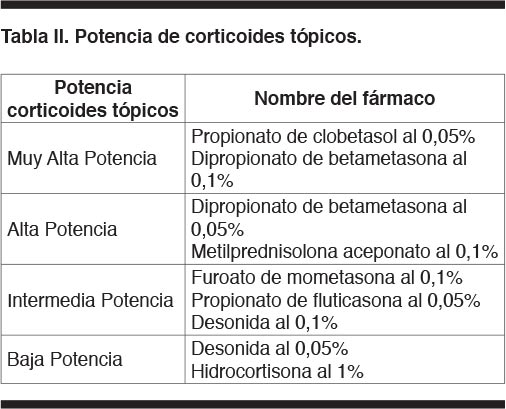
<body><![CDATA[<p style="margin-right: 42.25pt; text-align: justify; text-indent: 17pt; line-height: 120%;"> <span style="font-size: 10pt; line-height: 120%; font-family: Verdana;"><o:p>&nbsp;</o:p></span></p>       <p style="margin-right: 42.25pt; text-align: justify; text-indent: 17pt; line-height: 120%;"> <font face="Verdana"><span style="font-size: 10pt; line-height: 120%; ">Para la elaboraci&oacute;n de estas recomendaciones para el tratamiento llamado &ldquo;convencional&rdquo; de psoriasis moderada y severa, los integrantes de la Unidad de Psoriasis del Hospital de Cl&iacute;nicas, Facultad de Medicina, realizaron una revisi&oacute;n exhaustiva de las bases de datos de PubMed (NCI, USA) y SciELO (BIREME-FAPSESP). Dicha revisi&oacute;n incluy&oacute; fundamentalmente trabajos originales y en menor medida revisiones o gu&iacute;as terap&eacute;uticas, descart&aacute;ndose aquellas publicaciones claramente financiadas por la Industria Farmac&eacute;utica. Tambi&eacute;n se tuvo en cuenta la experiencia de dicha unidad en m&aacute;s de 5 a&ntilde;os de labor ininterrumpida en la asistencia de pacientes portadores de psoriasis de dif&iacute;cil manejo. Para la confecci&oacute;n de la bibliograf&iacute;a se seleccionaron cuidadosamente art&iacute;culos originales en cada uno de los t&oacute;picos tratados, incluy&eacute;ndose solamente aquellas gu&iacute;as terap&eacute;uticas que aportaban informaci&oacute;n nueva y/o relevante. </span> </font> <o:p></o:p></p>       <p style="margin-right: 42.25pt; text-align: justify; text-indent: 17pt; line-height: 120%;"> <span style="font-size: 10pt; line-height: 120%; font-family: Verdana;"><o:p>&nbsp;</o:p></span></p>       <p style="margin-right: 42.25pt; line-height: 120%;"><b> <span style="font-size: 10pt; line-height: 120%; "><font face="Verdana">TRATAMIENTO T&Oacute;PICO COMPLEMENTARIO</font></span><o:p></o:p></b></p>       <p style="margin-right: 42.25pt; text-align: justify; text-indent: 17pt; line-height: 120%;"> <span style="font-size: 10pt; line-height: 120%; font-family: Verdana;"><o:p>&nbsp;</o:p></span></p>       <p style="margin-right: 42.25pt; text-align: justify; text-indent: 17pt; line-height: 120%;"> <font face="Verdana"><span style="font-size: 10pt; line-height: 120%; ">El tratamiento t&oacute;pico que se detalla, se utiliza como tratamiento complementario, sabiendo que en la psoriasis leve, es el pilar del tratamiento.</span></font><o:p></o:p></p>       <p style="margin-right: 42.25pt; text-align: justify; text-indent: 17pt; line-height: 120%;"> <span style="font-size: 10pt; line-height: 120%; "><font face="Verdana">Emoliencia. La emoliencia cumple un papel muy importante ya que permite la reparaci&oacute;n de la barrera cut&aacute;nea da&ntilde;ada. Se indica en todos los pacientes. Se utiliza vaselina s&oacute;lida o cremas o emulsiones sin perfumes ni colorantes que contengan &aacute;cidos grasos libres, colesterol y ceramidas. Se recomienda su aplicaci&oacute;n diaria, luego del ba&ntilde;o y a demanda<sup>&nbsp;(<a href="#1">1</a>,<a href="#8">8</a>)</sup>. </font></span> <o:p></o:p></p>       <p style="margin-right: 42.25pt; text-align: justify; text-indent: 17pt; line-height: 120%;"> <span style="font-size: 10pt; line-height: 120%; font-family: Verdana;">Corticoides t&oacute;picos. Son la piedra angular del tratamiento t&oacute;pico de la psoriasis. Su eficacia depende de la potencia y de la capacidad de penetraci&oacute;n de la piel<sup> (<a href="#12">12</a>)</sup><a name="-12"></a>. Se agrupan seg&uacute;n la potencia la cual guarda relaci&oacute;n con su concentraci&oacute;n y veh&iacute;culo. La <a name="-tab2"></a><a href="#tab2">Tabla II</a> se&ntilde;ala los grupos m&aacute;s utilizados en Uruguay y para su elecci&oacute;n se debe considerar el sitio de la piel donde se aplicar&aacute; (potencia baja o mediana en pliegues o rostro, alta potencia en palmas y plantas).</span></p>     <p style="margin-right: 42.25pt; text-align: justify; text-indent: 17pt; line-height: 120%;">&nbsp;</p>     <p style="margin-right: 42.25pt; text-align: justify; text-indent: 17pt; line-height: 120%;"> <font face="Verdana"><a href="#-tab2"> <font size="2"><img style="border: 0px solid ; width: 506px; height: 409px;" alt="" src="/img/revistas/ami/v35n3/3a06t2.jpg"></font></a><span style="font-size: 10pt; line-height: 120%; "> </span> </font> <o:p></o:p></p>       ]]></body>
<body><![CDATA[<p style="margin-right: 42.25pt; text-align: justify; text-indent: 17pt; line-height: 120%;"> <font face="Verdana"><span style="font-size: 10pt; line-height: 120%; ">Su acci&oacute;n es antiinflamatoria por inhibici&oacute;n de la fosfolipasa A2 que impide la s&iacute;ntesis de eicosanoides, antiproliferativa por inhibir la s&iacute;ntesis de ADN e inmunosupresora al suprimir la s&iacute;ntesis de mol&eacute;culas proinflamatorias<sup> (<a href="#1">1</a>,<a href="#7">7</a>)</sup>. Adem&aacute;s act&uacute;a como vasoconstrictor a nivel de la dermis<sup> (<a href="#12">12</a>)</sup>. Como efectos adversos genera a nivel local atrofia cut&aacute;nea, telangiectasias, estr&iacute;as d&eacute;rmicas, foliculitis, ros&aacute;cea y acn&eacute; esteroideo, hipertricosis y dermatitis perioral<sup> (<a href="#13">13</a>)</sup>.<a name="-13"></a> Para prevenir la taquifilaxia en el uso prolongado de corticoides, se recomienda la combinaci&oacute;n con &aacute;cido salic&iacute;lico, calcipotriol, tazaroteno o alquitr&aacute;n seg&uacute;n corresponda, o la realizaci&oacute;n de pulsos intermitentes<sup> (<a href="#8">8</a>)</sup>. Se debe utilizar con precauci&oacute;n en ni&ntilde;os menores de 12 a&ntilde;os o frente a la sospecha de eccema microbiano sobreinfectado, micosis cut&aacute;nea y acn&eacute;. Son categor&iacute;a C en el embarazo y est&aacute;n contraindicados en el herpes cut&aacute;neo y la ros&aacute;cea<sup> (<a href="#13">13</a>)</sup>.</span></font><o:p></o:p></p>       <p style="margin-right: 42.25pt; text-align: justify; text-indent: 17pt; line-height: 120%;"> <span style="font-size: 10pt; line-height: 120%; "><font face="Verdana">An&aacute;logos de la vitamina D3. El calcipotriol act&uacute;a disminuyendo la proliferaci&oacute;n celular, e in vitro se ha comprobado que aumenta la diferenciaci&oacute;n de cultivos de queratinocitos humanos (en parte, al regular la respuesta epid&eacute;rmica al calcio). No produce atrofia cut&aacute;nea ni efecto rebote. La utilizaci&oacute;n concomitante con corticoides ha demostrado ser superior a la monoterapia y evita algunos efectos secundarios de ambos<sup> (<a href="#8">8</a>)</sup>. Considerada por la FDA como categor&iacute;a C en embarazo y est&aacute; desaconsejada en la lactancia. Se debe valorar riesgo/beneficio frente a alteraciones del metabolismo fosfo-c&aacute;lcico, insuficiencia renal y/o insuficiencia hep&aacute;tica moderada (en formas severas est&aacute; formalmente contraindicado)<sup> (<a href="#14">14</a>)</sup>.<a name="-14"></a></font></span><o:p></o:p></p>       <p style="margin-right: 42.25pt; text-align: justify; text-indent: 17pt; line-height: 120%;"> <span style="font-size: 10pt; line-height: 120%; "><font face="Verdana">Retinoides t&oacute;picos. El tazaroteno es un retinoide de tercera generaci&oacute;n. Modula la diferenciaci&oacute;n epid&eacute;rmica, con potente efecto antiproliferativo, por lo que es de elecci&oacute;n en placas de psoriasis con marcada hiperqueratosis<sup> (<a href="#15">15</a>)</sup>.<a name="-15"></a> Si bien se acepta su uso como monoterapia, su combinaci&oacute;n con corticoides t&oacute;picos es de elecci&oacute;n, logrando as&iacute; la disminuci&oacute;n de los efectos adversos de ambos f&aacute;rmacos<sup> (<a href="#16">16</a>)</sup><a name="-16"></a>. Tambi&eacute;n se ha demostrado aumento de eficacia al combinarse con fototerapia. Su efecto se observa a las 2 semanas de iniciada la terapia y al discontinuar su uso no hay efecto rebote<sup>(<a href="#17">17</a>)</sup><a name="-17"></a>. Est&aacute; contraindicado en el embarazo (categor&iacute;a C) y en la lactancia<sup> (<a href="#18">18</a>)</sup>.<a name="-18"></a></font></span><o:p></o:p></p>       <p style="margin-right: 42.25pt; text-align: justify; text-indent: 17pt; line-height: 120%;"> <span style="font-size: 10pt; line-height: 120%; "><font face="Verdana">Queratol&iacute;ticos. Son de utilidad en psoriasis donde las placas presentan gran componente escamoso. Disminuyendo la uni&oacute;n intercorneocitaria aumentan la velocidad de eliminaci&oacute;n de la escama. Adem&aacute;s presentan acci&oacute;n bacteriost&aacute;tica, fungicida y fotoprotectora. El &aacute;cido salic&iacute;lico (del 3 al 5%) es el m&aacute;s utilizado en nuestro medio y su combinaci&oacute;n con vaselina s&oacute;lida en particular, conocida como vaselina salicilada. En grandes cantidades puede causar intoxicaci&oacute;n con sintomatolog&iacute;a neurol&oacute;gica y/o digestiva<sup> (<a href="#8">8</a>)</sup>.</font></span><o:p></o:p></p>       <p style="margin-right: 42.25pt; text-align: justify; text-indent: 17pt; line-height: 120%;"> <span style="font-size: 10pt; line-height: 120%; "><font face="Verdana">Alquitr&aacute;n. El alquitr&aacute;n de hulla se utiliza hace m&aacute;s de un siglo. Su eficacia es dif&iacute;cil de evaluar debido a la falta de estudios. Su mecanismo de acci&oacute;n no se conoce, si bien se describen efectos antiinflamatorios y antiproliferativos. Ya no se utiliza como monoterapia pero es frecuente que se encuentre como componente de lociones o champ&uacute;s para cuero cabelludo. En ocasiones, la brea tambi&eacute;n se utiliza en combinaci&oacute;n con la radiaci&oacute;n ultravioleta B en el tratamiento de la psoriasis resistente al tratamiento. Presenta mal olor, mancha la ropa y puede producir dermatitis de contacto y/o foliculitis. Est&aacute; contraindicado en la psoriasis pustulosa generalizada y en la eritrodermia. Las contraindicaciones relativas son la foliculitis preexistente o el acn&eacute;<sup> (<a href="#1">1</a>)</sup>. </font></span> <o:p></o:p></p>       <p style="margin-right: 42.25pt; text-align: justify; text-indent: 17pt; line-height: 120%;"> <span style="font-size: 10pt; line-height: 120%; "><font face="Verdana">Otros tratamientos t&oacute;picos de uso muy limitado, incluyen la antralina y la urea al 5 a 20%.</font></span><o:p></o:p></p>       <p style="margin-right: 42.25pt; text-align: justify; text-indent: 17pt; line-height: 120%;"> <span style="font-size: 10pt; line-height: 120%; font-family: Verdana;"><o:p>&nbsp;</o:p></span></p>       <p style="margin-right: 42.25pt; line-height: 120%;"><b> <span style="font-size: 10pt; line-height: 120%; "><font face="Verdana">TRATAMIENTO SIST&Eacute;MICO CONVENCIONAL </font></span> <o:p></o:p></b></p>       <p style="margin-right: 42.25pt; text-align: justify; text-indent: 17pt; line-height: 120%;"> <span style="font-size: 10pt; line-height: 120%; font-family: Verdana;"><o:p>&nbsp;</o:p></span></p>       <p style="margin-right: 42.25pt; text-align: justify; text-indent: 17pt; line-height: 120%;"> <span style="font-size: 10pt; line-height: 120%; "><font face="Verdana">Debe ser individualizado, din&aacute;mico, rotatorio, combinado, secuencial, intermitente y de mantenimiento, para evitar la resistencia y minimizar los efectos secundarios<sup> (<a href="#19">19</a>)</sup>.<a name="-19"></a></font></span><o:p></o:p></p>       ]]></body>
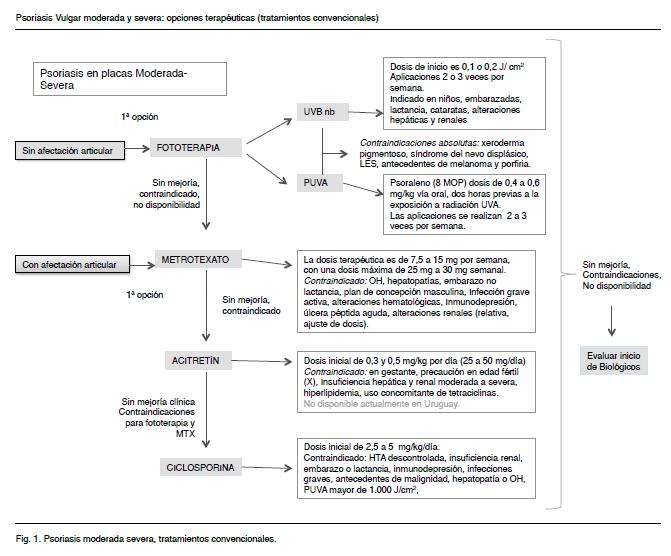
<body><![CDATA[<p style="margin-right: 42.25pt; text-align: justify; text-indent: 17pt; line-height: 120%;"> <span style="font-size: 10pt; line-height: 120%; font-family: Verdana;"><o:p>&nbsp;</o:p></span></p>       <p style="margin-right: 42.25pt; line-height: 120%;"><b> <span style="font-size: 10pt; line-height: 120%; "><font face="Verdana">Fototerapia</font></span><o:p></o:p></b></p>       <p style="margin-right: 42.25pt; text-align: justify; text-indent: 17pt; line-height: 120%;"> <font face="Verdana"><span style="font-size: 10pt; line-height: 120%; ">La fototerapia consiste en la exposici&oacute;n del paciente a irradiaci&oacute;n ultravioleta en cabinas o sobre l&aacute;mparas en el caso de fototerapia localizada. Se basa en el uso de radiaci&oacute;n electromagn&eacute;tica no ionizante para generar efectos fotot&oacute;xicos y/o fotodin&aacute;micos en la piel con objetivos terap&eacute;uticos. Es la primera opci&oacute;n de tratamiento sist&eacute;mico (de estar disponible, tener acceso y no estar contraindicado). Se debe tener en cuenta la posibilidad del paciente de realizar un tratamiento que implique desplazamiento hacia el lugar donde se lleva a cabo, 2 o 3 veces por semana. La fototerapia con radiaci&oacute;n ultravioleta B (UVB), con longitud de onda de 311 a 313 nm, narrow band (UVB nb), es considerada como primera elecci&oacute;n a la hora de prescribir tratamiento con fototerapia en la psoriasis por su eficacia y seguridad<sup> (<a href="#1">1</a>)</sup>. La fotoquimioterapia con psoralenos (PUVA) combina el uso de psoralenos (P) y de radiaci&oacute;n UV de longitud de onda larga (UVA). Al comparar ambas modalidades, una revisi&oacute;n reciente muestra que si bien ambos resultan efectivos en el tratamiento de la psoriasis, el PUVA presenta mayor efectividad (80% llega al PASI 75 al cabo de 6 meses, frente al 70% de los tratados con UVBnb) y mayor rapidez de acci&oacute;n (se logran respuestas parciales en 17 sesiones vs 25 del UVBnb)<sup> (<a href="#20">20</a>)</sup>.<a name="-20"></a> Los efectos adversos inmediatos (cefaleas, nauseas) como a mediano y largo plazo (oculares, cut&aacute;neos, hep&aacute;ticos y digestivos) provocados por el efecto combinado del psoraleno y el UVA determinan la preferencia por el UVBnb.</span></font><o:p></o:p></p>       <p style="margin-right: 42.25pt; text-align: justify; text-indent: 17pt; line-height: 120%;"> <font face="Verdana"><span style="font-size: 10pt; line-height: 120%; ">La fototerapia en general est&aacute; contraindicada en pacientes que cursen con trastornos graves en los mecanismos de reparaci&oacute;n del ADN (xeroderma pigmentoso), en aquellos con elevado riesgo para desarrollar neoplasias cut&aacute;neas malignas agresivas como el s&iacute;ndrome de nevo displ&aacute;sico familiar, antecedente de melanoma en familiar directo o con melanoma previo o cuando la exposici&oacute;n a la radiaci&oacute;n ultravioleta sea un conocido agravante de otra enfermedad de base, como el lupus.<sup> (<a href="#21">21</a>,<a href="#22">22</a>)<a name="-21"></a><a name="-22"></a></sup>.</span></font><o:p></o:p></p>       <p style="margin-right: 42.25pt; text-align: justify; text-indent: 17pt; line-height: 120%;"> <span style="font-size: 10pt; line-height: 120%; "><font face="Verdana">Radiaci&oacute;n ultravioleta &ldquo;B&rdquo; narrow band (UVBnb): la terap&eacute;utica con UVBnb no requiere fotosensibilizante y se realiza mediante la exposici&oacute;n directa a la luz. La dosis de cada aplicaci&oacute;n se determina mediante protocolo basado en la dosis eritemat&oacute;gena m&iacute;nima (DEM) o en el fototipo del paciente<sup> (<a href="#23">23</a>)</sup><a name="-23"></a>. Las dosis administradas son bajas: iniciales de 0,1 o 0,2 J/cm<sup>2</sup> seg&uacute;n el fototipo y dosis m&aacute;ximas de 1.4 J/cm<sup>2</sup>. La dosis acumulativa es cercana a 20 J/cm<sup>2</sup>. Con 15 a 20 sesiones se consigue buenos resultados en el 50% de los pacientes <sup>(<a href="#8">8</a>,<a href="#21">21</a>)</sup>. Si bien es de preferencia en todos los casos, es de elecci&oacute;n en j&oacute;venes, embarazadas, durante la lactancia, en pacientes con antecedentes de patolog&iacute;a oftalmol&oacute;gica, con insuficiencia hep&aacute;tica o renal severa, o cuando existe intolerancia a psoralenos. No se requiere ex&aacute;menes paracl&iacute;nicos previos<sup> (<a href="#8">8</a>)</sup>.Los efectos secundarios agudos consisten en prurito, eritema, quemaduras, xerosis, aumento en la incidencia de herpes simple, y a largo plazo, fotoda&ntilde;o cr&oacute;nico, as&iacute; como c&aacute;ncer cut&aacute;neo<sup> (<a href="#8">8</a>)</sup>. Sin embargo, una reciente revisi&oacute;n en pacientes tratados con UVBnb, no mostr&oacute; asociaci&oacute;n significativa con carcinoma basocelular, carcinoma espinocelular o melanoma, con una mediana de seguimiento de 5,5 a&ntilde;os<sup>&nbsp;(<a href="#21">21</a>,<a href="#25">25</a>)</sup>.<a name="-25"></a> Las contraindicaciones ya fueron se&ntilde;aladas. </font></span> <o:p></o:p></p>       <p style="margin-right: 42.25pt; text-align: justify; text-indent: 17pt; line-height: 120%;"> <span style="font-size: 10pt; line-height: 120%; "><font face="Verdana">Radiaci&oacute;n ultravioleta &ldquo;A&rdquo; (UVA): utiliza longitud de onda comprendida entre 320 y 400 nm, correspondiente a la radiaci&oacute;n UVA. Generalmente se utiliza previa sensibilizaci&oacute;n del paciente con psolarenos, que son furocumarinas lineales que se encuentran en plantas y en forma de compuestos de origen sint&eacute;tico. La fotoquimioterapia PUVA, se fundamenta en la interacci&oacute;n entre la radiaci&oacute;n ultravioleta A y psolareno, lo que condiciona reacciones fotot&oacute;xicas repetidas y controladas. Los psolarenos m&aacute;s utilizados son el 8 metoxipsoraleno (8 MOP), y el 5 metoxipsoraleno (5 MOP), por v&iacute;a oral o t&oacute;pica. En nuestro pa&iacute;s solo se encuentra disponible el 8 MOP. El 8 MOP se administra a una dosis de 0,4 a 0,6 mg/kg v&iacute;a oral, dos horas previas a la exposici&oacute;n a radiaci&oacute;n UVA<sup>&nbsp;(<a href="#8">8</a>)</sup>. Las aplicaciones se realizan 2 a 3 veces por semana (no en d&iacute;as consecutivos). En los d&iacute;as en que se realiza, los pacientes deben mantener prevenci&oacute;n ocular con cristales de fotoprotecci&oacute;n para UVA. Los efectos adversos agudos que se asocian tanto con el psoraleno como con la UVA son la intolerancia gastrointestinal, cefaleas, mareos, prurito, fotofobia, eritema o quemadura, xerosis y aumento en la incidencia de herpes simple<sup> (<a href="#8">8</a>,<a href="#21">21</a>)</sup>. En forma mediata, la dosis de PUVA acumulada en esquemas prolongados (m&aacute;s de 250 sesiones o 1000-1500 J/cm<sup>2</sup>) se puede asociar a fotoda&ntilde;o cr&oacute;nico y a un aumento en la incidencia de carcinoma espinocelular, especialmente en fototipos I y II<sup> (<a href="#8">8</a>,<a href="#21">21</a>,<a href="#26">26</a>-<a href="#29">29</a>)</sup>.<a name="-26"></a><a name="-27"></a><a name="-28"></a><a name="-29"></a> La asociaci&oacute;n con melanoma maligno es controversial<sup> (<a href="#21">21</a>)</sup>. El da&ntilde;o ocular se previene con el uso de lentes apropiados pero es recomendable un control oftalmol&oacute;gico previo<sup> (<a href="#8">8</a>,<a href="#21">21</a>)</sup>. Es conveniente contar con un perfil hep&aacute;tico previo y controles peri&oacute;dicos en funci&oacute;n de los antecedentes y de la extensi&oacute;n de la enfermedad<sup> (<a href="#22">22</a>)</sup>.Son contraindicaciones relativas la presencia de cataratas, disfunci&oacute;n hep&aacute;tica, fotoda&ntilde;o cr&oacute;nico severo, antecedente de c&aacute;ncer de piel no melanoma, inmunosupresi&oacute;n, y tratamientos concomitantes con agentes fotot&oacute;xicos. El psoraleno es categor&iacute;a C del embarazo<sup> (<a href="#21">21</a>)</sup>. No se recomienda en menores de 12 a&ntilde;os. Las contraindicaciones absolutas ya fueron se&ntilde;aladas. </font></span> <o:p></o:p></p>       <p style="margin-right: 42.25pt; text-align: justify; text-indent: 17pt; line-height: 120%;"> <font face="Verdana"><span style="font-size: 10pt; line-height: 120%; ">La fotoquimioterapia PUVA produce un beneficioso efecto terap&eacute;utico, que no se produce con ambos componentes por separado. Es muy efectivo, con r&aacute;pida respuesta y largos per&iacute;odos de remisi&oacute;n, pero a largo plazo tiene riesgo de producir efectos secundarios.</span></font><o:p></o:p></p>       <p style="margin-right: 42.25pt; text-align: justify; text-indent: 17pt; line-height: 120%;"> <span style="font-size: 10pt; line-height: 120%; font-family: Verdana;"><o:p>&nbsp;</o:p></span></p>       <p style="margin-right: 42.25pt; line-height: 120%;"><b> <span style="font-size: 10pt; line-height: 120%; "><font face="Verdana">Metotrexato</font></span><o:p></o:p></b></p>       <p style="margin-right: 42.25pt; text-align: justify; text-indent: 17pt; line-height: 120%;"> <font face="Verdana"><span style="font-size: 10pt; line-height: 120%; ">El metotrexato (MTX) es un antimetabolito an&aacute;logo del &aacute;cido f&oacute;lico, que interfiere impidiendo la s&iacute;ntesis del &aacute;cido desoxitimid&iacute;lico (dTMP), indispensable para la s&iacute;ntesis de ADN, presentando una acci&oacute;n antiinflamatoria, antiproliferativa e inmunosupresora.</span></font><o:p></o:p></p>       ]]></body>
<body><![CDATA[<p style="margin-right: 42.25pt; text-align: justify; text-indent: 17pt; line-height: 120%;"> <font face="Verdana"><span style="font-size: 10pt; line-height: 120%; ">Es la primera opci&oacute;n terap&eacute;utica si existe contraindicaci&oacute;n para recibir tratamiento con fototerapia o en caso de inaccesibilidad o frente a ausencia de respuesta. Es la primera opci&oacute;n terap&eacute;utica cuando se asocia con artritis psori&aacute;sica. </span></font> <o:p></o:p></p>       <p style="margin-right: 42.25pt; text-align: justify; text-indent: 17pt; line-height: 120%;"> <span style="font-size: 10pt; line-height: 120%; "><font face="Verdana">Previo al tratamiento varias gu&iacute;as aconsejan solicitar: hemograma, funcional y enzimograma hep&aacute;tico, azoemia, creatininemia, radiograf&iacute;a de t&oacute;rax, PPD, &beta;HCG en caso de paciente de sexo femenino en edad reproductiva y serolog&iacute;a para VHB, VHC<sup> (<a href="#30">30</a>)<a name="-30"></a></sup>. En cuanto a la realizaci&oacute;n de radiograf&iacute;a de t&oacute;rax y PPD para descartar la posibilidad de tuberculosis, si bien no es una recomendaci&oacute;n universalmente aceptada, algunos autores lo recomiendan como parte de la valoraci&oacute;n general en pacientes candidatos a recibir MTX. El screening de tuberculosis tambi&eacute;n servir&iacute;a como referencia en caso de complicaci&oacute;n pulmonar como efecto adverso del f&aacute;rmaco<sup>&nbsp;(<a href="#19">19</a>,<a href="#30">30</a>)</sup>. Tambi&eacute;n existe controversia sobre la recomendaci&oacute;n de la vacunaci&oacute;n antineumococcica, antigripal y contra el virus de la hepatitis B previo al inicio del tratamiento<sup> (<a href="#31">31</a>)</sup>.<a name="-31"></a> En Uruguay se ha documentado la utilidad de la vacunaci&oacute;n antigripal y antineumoc&oacute;ccica en ciertos grupos de riesgo<sup> (<a href="#32">32</a>)</sup><a name="-32"></a> si bien el estudio no incluy&oacute; este grupo de pacientes.</font></span><o:p></o:p></p>       <p style="margin-right: 42.25pt; text-align: justify; text-indent: 17pt; line-height: 120%;"> <font face="Verdana"><span style="font-size: 10pt; line-height: 120%; ">La v&iacute;a de administraci&oacute;n m&aacute;s utilizada MTX es la oral. La v&iacute;a parenteral, si bien ha demostrado ser algo m&aacute;s efectiva &ndash;en particular la subcut&aacute;nea&ndash; se ha asociado con afectaci&oacute;n neurol&oacute;gica y pulmonar, y se han reportado casos de linfoma B<sup> (<a href="#33">33</a>-<a href="#35">35</a>)<a name="-33"></a><a name="-34"></a><a name="-35"></a></sup>.</span></font><o:p></o:p></p>       <p style="margin-right: 42.25pt; text-align: justify; text-indent: 17pt; line-height: 120%;"> <font face="Verdana"><span style="font-size: 10pt; line-height: 120%; ">Dado el potencial t&oacute;xico y la posible aparici&oacute;n de reacciones idiosincr&aacute;ticas graves (hematol&oacute;gicas) o leves pero de consideraci&oacute;n (mucositis, transaminasemia), se recomienda comenzar con una dosis prueba de 5 mg por una semana, realizando hemograma y funcional y enzimograma hep&aacute;tico a la semana de la primera dosis<sup> (<a href="#30">30</a>)</sup>.</span></font><o:p></o:p></p>       <p style="margin-right: 42.25pt; text-align: justify; text-indent: 17pt; line-height: 120%;"> <font face="Verdana"><span style="font-size: 10pt; line-height: 120%; ">La dosis terap&eacute;utica recomendada es entre 7.5 a 15 mg por semana, con una dosis m&aacute;xima oral de 25 mg a 30 mg semanales<sup> (<a href="#8">8</a>)</sup>. A partir de 1971 se populariz&oacute; el fraccionamiento oral en tres dosis a intervalos de 12 horas, una vez a la semana o esquema de Weinstein en la suposici&oacute;n no demostrada, que se evitan o reducen los efectos adversos gastrointestinales<sup> (<a href="#36">36</a>)</sup><a name="-36"></a>. Estudios recientes relativizan estas ventajas si bien se&ntilde;alan que la eficacia cl&iacute;nica fue superior y los efectos adversos hep&aacute;ticos inferiores en pacientes que recibieron dosis semanales repartidas en 3 tomas cada 8 horas<sup> (<a href="#37">37</a>)</sup><a name="-37"></a>. </span></font> <o:p></o:p></p>       <p style="margin-right: 42.25pt; text-align: justify; text-indent: 17pt; line-height: 120%;"> <span style="font-size: 10pt; line-height: 120%; "><font face="Verdana">Independientemente del esquema terap&eacute;utico empleado, se aconseja esperar entre 4 y 12 semanas para evaluar eficacia y una vez obtenida la mejor&iacute;a cl&iacute;nica, disminuir 2,5&nbsp;mg por semana. Si no se ha logrado respuesta adecuada a las 12 semanas con una dosis de 20 mg/semana, se aconseja cambiar por otra opci&oacute;n terap&eacute;utica ya que el aumento de dosis no lograr&aacute; el control de la enfermedad<sup> (<a href="#8">8</a>)</sup>. La suspensi&oacute;n brusca de MTX no suele asociarse a un efecto rebote de las lesiones. Se aconseja el aporte de 5 mg de &aacute;cido f&oacute;lico a las 24 a 48 horas de la administraci&oacute;n del MTX, ya que un reciente meta an&aacute;lisis indica que esto tiende a reducir la toxicidad hematol&oacute;gica, mucocut&aacute;nea, gastrointestinal y reduce de forma significativa la hepatotoxicidad, aunque no previene ni reduce la toxicidad pulmonar<sup> (<a href="#30">30</a>)</sup>.</font></span><o:p></o:p></p>       <p style="margin-right: 42.25pt; text-align: justify; text-indent: 17pt; line-height: 120%;"> <font face="Verdana"><span style="font-size: 10pt; line-height: 120%; ">Se debe evitar el uso concomitante con antiinflamatorios no esteorideos (AINEs), ciertos antibi&oacute;ticos (sulfas, tetraciclinas, ciprofloxacina) y otros medicamentos como furosemide, fenito&iacute;na, ciclosporina A, dado que aumentan la toxicidad del MTX al interferir con su v&iacute;a de excreci&oacute;n<sup> (<a href="#30">30</a>)</sup>. Por esa misma raz&oacute;n, en pacientes con insuficiencia renal se debe reducir la dosis a la mitad cuando el clearence de creatinina se encuentre entre 20 y 50 ml/min y est&aacute; contraindicado si es menor de 20 ml/min<sup> (<a href="#38">38</a>)</sup>.<a name="-38"></a></span></font><o:p></o:p></p>       <p style="margin-right: 42.25pt; text-align: justify; text-indent: 17pt; line-height: 120%;"> <span style="font-size: 10pt; line-height: 120%; "><font face="Verdana">Durante el tratamiento es aconsejable la realizaci&oacute;n de hemograma completo cada 15 d&iacute;as por un mes y luego cada 4 semanas seg&uacute;n leucocitosis. Tambi&eacute;n se aconseja realizar un funcional y enzimograma hep&aacute;tico cada 8 semanas. La elevaci&oacute;n de las transaminasas tres veces su nivel normal es indicaci&oacute;n de disminuci&oacute;n de dosis al 50% y de persistir suspender el f&aacute;rmaco. Si dicha elevaci&oacute;n se mantuviera luego de la suspensi&oacute;n, se sugiere evaluar la realizaci&oacute;n de una biopsia hep&aacute;tica, ya que la ecograf&iacute;a es poco sensible en la detecci&oacute;n del da&ntilde;o hep&aacute;tico<sup> (<a href="#30">30</a>)</sup>.</font></span><o:p></o:p></p>   <font face="Verdana">   <span style="font-size: 10pt; line-height: 120%; ">En los pacientes con factores de riesgo de hepatotoxicidad (alcoholismo, antecedentes de hepatopat&iacute;a, alteraciones persistentes de las transaminasas, obesos y diab&eacute;ticos), la American Academy of Dermatology recomienda la biopsia hep&aacute;tica con dosis acumulativas mayores de 1,5 g de MTX. En los pacientes que no presentan estos factores de riesgo se puede llegar a 3,5 a 4,0 g<sup> (<a href="#39">39</a>)</sup><a name="-39"></a>. Una medida indirecta del da&ntilde;o hep&aacute;tico es la determinaci&oacute;n seriada del p&eacute;ptido aminoterminal de protocol&aacute;geno III (PIIINP), test que no est&aacute; disponible en nuestro pa&iacute;s. La biopsia hep&aacute;tica no ser&iacute;a necesaria en pacientes con dosis acumuladas de MTX inferiores a 3,0 - 4,0 g y niveles normales de PIIINP<sup> (<a href="#8">8</a>)</sup>.</span></font><o:p></o:p><font face="Verdana" size="2"> </font>      <p style="margin-right: 42.25pt; text-align: justify; text-indent: 17pt; line-height: 120%;"> <span style="font-size: 10pt; line-height: 120%; "><font face="Verdana">Precauciones: alteraciones renales, evitar concepci&oacute;n en hombres y mujeres en tratamiento con MTX. Luego de su suspensi&oacute;n, se debe esperar un ciclo ovulatorio (1 mes) en la mujer y un ciclo de espermatog&eacute;nesis en el hombre (3 meses)<sup> (<a href="#30">30</a>)</sup>. Durante el tratamiento con MTX deben evitarse la vacunaci&oacute;n con vacunas vivas (polio oral, sarampi&oacute;n, parotiditis, rubeola, varicela y fiebre amarilla)<sup> (<a href="#30">30</a>)</sup>.</font></span><o:p></o:p></p>       <p style="margin-right: 42.25pt; text-align: justify; text-indent: 17pt; line-height: 120%;"> <span style="font-size: 10pt; line-height: 120%; "><font face="Verdana">Contraindicaciones: alcoholismo, hepatopat&iacute;as, embarazo, lactancia, infecci&oacute;n grave activa, alteraciones hematol&oacute;gicas, inmunodepresi&oacute;n, &uacute;lcera p&eacute;ptica aguda<sup> (<a href="#19">19</a>,<a href="#30">30</a>)</sup>.</font></span><o:p></o:p></p>       ]]></body>
<body><![CDATA[<p style="margin-right: 42.25pt; text-align: justify; text-indent: 17pt; line-height: 120%;"> <span style="font-size: 10pt; line-height: 120%; font-family: Verdana;"><o:p>&nbsp;</o:p></span></p>       <p style="margin-right: 42.25pt; line-height: 120%;"><b> <span style="font-size: 10pt; line-height: 120%; "><font face="Verdana">Retinoides</font></span><o:p></o:p></b></p>       <p style="margin-right: 42.25pt; text-align: justify; text-indent: 17pt; line-height: 120%;"> <font face="Verdana"><span style="font-size: 10pt; line-height: 120%; ">El acitret&iacute;n es un retinoide sint&eacute;tico de segunda generaci&oacute;n, por ser metabolito del etretinato. No se conoce exactamente el mecanismo de acci&oacute;n, sin embargo, se sabe que modula la diferenciaci&oacute;n celular de la epidermis con disminuci&oacute;n del espesor del estrato c&oacute;rneo, de la inflamaci&oacute;n de dermis y epidermis. Si bien el acitret&iacute;n no se encuentra disponible en Uruguay, es una opci&oacute;n terap&eacute;utica en pacientes que presentan contraindicaciones o que no respondieron a la fototerapia ni al MTX, y tambi&eacute;n en otras formas de psoriasis como la pustulosa. </span></font> <o:p></o:p></p>       <p style="margin-right: 42.25pt; text-align: justify; text-indent: 17pt; line-height: 120%;"> <font face="Verdana"><span style="font-size: 10pt; line-height: 120%; ">La v&iacute;a de administraci&oacute;n disponible es la oral. Se aconseja comenzar con una dosis inicial de entre 0,3 a 0,5 mg/kg/d&iacute;a (25 a 50 mg/d&iacute;a) por un per&iacute;odo de 3 a 4 semanas y se incrementa hasta encontrar el equilibrio entre la eficacia y la tolerancia de los efectos colaterales. La ingesta junto con alimentos grasos aumenta su biodisponibilidad<sup> (<a href="#8">8</a>,<a href="#40">40</a>)</sup>.<a name="-40"></a></span></font><o:p></o:p></p>       <p style="margin-right: 42.25pt; text-align: justify; text-indent: 17pt; line-height: 120%;"> <font face="Verdana"><span style="font-size: 10pt; line-height: 120%; ">La respuesta es gradual y normalmente requiere de 3 a 6 meses en llegar a su punto m&aacute;ximo. Se puede ver un empeoramiento de la psoriasis en el inicio del tratamiento<sup> (<a href="#40">40</a>,<a href="#41">41</a>)</sup><a name="-41"></a>.Puede ser necesario en algunos casos, aumentar la dosis hasta un m&aacute;ximo de 75 mg al d&iacute;a<sup> (<a href="#40">40</a>)</sup>.</span></font><o:p></o:p></p>       <p style="margin-right: 42.25pt; text-align: justify; text-indent: 17pt; line-height: 120%;"> <font face="Verdana"><span style="font-size: 10pt; line-height: 120%; ">Se debe solicitar &beta;HCG en caso de mujer en edad reproductiva, hemograma, funcional y enzimograma hep&aacute;tico, perfil lip&iacute;dico y funci&oacute;n renal, previo al inicio del tratamiento.</span></font><o:p></o:p></p>       <p style="margin-right: 42.25pt; text-align: justify; text-indent: 17pt; line-height: 120%;"> <span style="font-size: 10pt; line-height: 120%; "><font face="Verdana">Durante el tratamiento se aconseja realizar pruebas de funci&oacute;n hep&aacute;tica, colesterol y triglic&eacute;ridos cada 4 semanas por 4 a 6 meses, y luego cada 3 meses. Tambi&eacute;n se recomienda solicitar hemograma completo y funci&oacute;n renal mensualmente por 2 meses, y luego cada 3 meses<sup> (<a href="#40">40</a>)</sup>. Si los valores de enzimas hep&aacute;ticas triplican su valor se sugiere suspender el tratamiento. Dado que se han reportado casos de hiperostosis esquel&eacute;tica y calcificaci&oacute;n extra&oacute;sea en el hombre tras tratamientos prolongados con etretinato, de presentar dolores o limitaci&oacute;n al movimiento vertebral se sugiere solicitar una radiograf&iacute;a simple que puede mostrar im&aacute;genes caracter&iacute;sticas<sup> (<a href="#40">40</a>)</sup>.</font></span><o:p></o:p></p>       <p style="margin-right: 42.25pt; text-align: justify; text-indent: 17pt; line-height: 120%;"> <span style="font-size: 10pt; line-height: 120%; "><font face="Verdana">Precauciones: insuficiencia hep&aacute;tica y/o renal leve, hiperlipidemia leve. Mujer en edad f&eacute;rtil, ya que se desaconseja el embarazo hasta 3 a&ntilde;os despu&eacute;s de la suspensi&oacute;n del tratamiento<sup> (<a href="#40">40</a>)</sup>.</font></span><o:p></o:p></p>       <p style="margin-right: 42.25pt; text-align: justify; text-indent: 17pt; line-height: 120%;"> <span style="font-size: 10pt; line-height: 120%; "><font face="Verdana">Contraindicaciones: insuficiencia hep&aacute;tica severa (se debe evitar su uso cuando las enzimas hep&aacute;ticas se eleven m&aacute;s de 2 veces el valor basal), insuficiencia renal moderada a severa, hiperlipidemia, uso concomitante de tetraciclinas o MTX y consumo de alcohol<sup> (<a href="#40">40</a>)</sup>. El acitretin es categor&iacute;a C de la FDA en el embarazo<sup> (<a href="#19">19</a>)</sup>.</font></span><o:p></o:p></p>       <p style="margin-right: 42.25pt; text-align: justify; text-indent: 17pt; line-height: 120%;"> <span style="font-size: 10pt; line-height: 120%; font-family: Verdana;"><o:p>&nbsp;</o:p></span></p>       ]]></body>
<body><![CDATA[<p style="margin-right: 42.25pt; line-height: 120%;"><b> <span style="font-size: 10pt; line-height: 120%; "><font face="Verdana">Ciclosporina A</font></span><o:p></o:p></b></p>       <p style="margin-right: 42.25pt; text-align: justify; text-indent: 17pt; line-height: 120%;"> <font face="Verdana"><span style="font-size: 10pt; line-height: 120%; ">La ciclosporina es un f&aacute;rmaco inmunosupresor que act&uacute;a selectivamente sobre las c&eacute;lulas T. Forma un complejo con la ciclofilina, e inhibe la actividad de la calcineurina fosfatasa. Como resultado, la calcineurina fosfatasa es incapaz de fosforilar el factor nuclear de las c&eacute;lulas T activadas, factor de transcripci&oacute;n de genes que codifican la interleucina-2 (necesaria para activaci&oacute;n de la v&iacute;a de las c&eacute;lulas T), el interfer&oacute;n gamma, y el factor de estimulaci&oacute;n de granulocitos y macr&oacute;fagos. La ciclosporina tambi&eacute;n inhibe la hiperproliferaci&oacute;n de queratinocitos, la liberaci&oacute;n de histamina de los mastocitos, y regula en menos la expresi&oacute;n de mol&eacute;culas de adhesi&oacute;n celular en el endotelio capilar d&eacute;rmico.</span></font><o:p></o:p></p>       <p style="margin-right: 42.25pt; text-align: justify; text-indent: 17pt; line-height: 120%;"> <font face="Verdana"><span style="font-size: 10pt; line-height: 120%; ">Es uno de los tratamientos m&aacute;s eficaces para la psoriasis, debido a su r&aacute;pido inicio de acci&oacute;n. En pacientes con empujes severos induce una remisi&oacute;n r&aacute;pida por lo que puede ser utilizado como puente hacia otras terapias. Tambi&eacute;n se usa en pacientes con psoriasis severa que no responden o tienen contraindicaci&oacute;n para los otros tratamientos sist&eacute;micos<sup> (<a href="#8">8</a>,<a href="#19">19</a>)</sup>.</span></font><o:p></o:p></p>       <p style="margin-right: 42.25pt; text-align: justify; text-indent: 17pt; line-height: 120%;"> <span style="font-size: 10pt; line-height: 120%; "><font face="Verdana">Posolog&iacute;a: las gu&iacute;as de consenso actuales recomiendan una dosis inicial de 2,5 mg/kg/d&iacute;a, a menos que sea necesario una r&aacute;pida mejor&iacute;a, en donde se puede utilizar hasta 5 mg/kg/d&iacute;a<sup> (<a href="#42">42</a>)</sup><a name="-42"></a>. En general se utiliza el peso corporal ideal. De no existir una respuesta adecuada con dosis bajas de ciclosporina luego de 4 semanas de tratamiento, se recomienda un incremento gradual de 0,5 a 1,0 mg/kg/d&iacute;a en intervalos de 2 a 4 semanas, hasta un m&aacute;ximo de 5 mg/kg/d&iacute;a. Obtenida la respuesta &oacute;ptima, la dosis se puede reducir gradualmente de 0,5 a 1,0 mg/kg/d&iacute;a a intervalos de 2 semanas hasta la dosis m&aacute;s baja posible que mantenga el control de la enfermedad. La dosis de 5 mg/kg/d&iacute;a se puede utilizar hasta un m&aacute;ximo de 1 a&ntilde;o. Si no se ha alcanzado una respuesta adecuada despu&eacute;s de 3 meses de tratamiento con la dosis m&aacute;xima, debe buscarse otra opci&oacute;n terap&eacute;utica<sup> (<a href="#42">42</a>)</sup>. La dosis diaria de ciclosporina se fracciona en dos dosis y se ingiere a la misma hora del d&iacute;a para minimizar la variaci&oacute;n en la concentraci&oacute;n s&eacute;rica intraindividual. Existe una mayor concentraci&oacute;n plasm&aacute;tica cuando la droga es administrada antes de las comidas. El jugo de pomelo se debe evitar durante el tratamiento ya que impide la metabolizaci&oacute;n de la ciclosporina al inhibir a la enzima CYP34A por su contenido en furanocumarinas. Hay que tener en cuenta que si bien no se han reportado casos, el jugo de lima tambi&eacute;n posee furanocumarinas. En nuestro pa&iacute;s, seg&uacute;n el decreto N&ordm; 12/2007 del MSP, las diferentes marcas comerciales no son intercambiables hasta tanto no se demuestre la bioequivalencia mediante ensayos in vivo e in vitro<sup> (<a href="#43">43</a>)</sup>.<a name="-43"></a></font></span><o:p></o:p></p>       <p style="margin-right: 42.25pt; text-align: justify; text-indent: 17pt; line-height: 120%;"> <span style="font-size: 10pt; line-height: 120%; "><font face="Verdana">Interacciones medicamentosas: la toma concomitante de f&aacute;rmacos nefrot&oacute;xicos, como los AINEs, aminogluc&oacute;sidos, ciprofloxacina, clotrimazol, y los fibratos, pueden potenciar su nefrotoxicidad y &eacute;sta a su vez puede retrasar el metabolismo de la digoxina, simvastatina, prednisolona, &#8203;&#8203;diclofenac, y metotrexate, lo que conduce a una mayor concentraci&oacute;n y toxicidad de estos f&aacute;rmacos<sup> (<a href="#44">44</a>)</sup><a name="-44"></a>. Los efectos secundarios de la ciclosporina (HTA, nefrotoxicidad, temblor, gastrointestinales, hipertricosis, hipertrofia gingival, dision&iacute;as y parestesias) han limitado en gran medida su uso en dermatolog&iacute;a. En su mayor parte son dosis dependientes y reversibles al suprimir el f&aacute;rmaco, aunque las anormalidades estructurales renales pueden ser persistentes y est&aacute;n relacionadas con el tratamiento prolongado (2 a&ntilde;os o m&aacute;s) y con dosis mantenidas de m&aacute;s de 5 mg/kg/d&iacute;a<sup> (<a href="#44">44</a>)</sup>.</font></span><o:p></o:p></p>       <p style="margin-right: 42.25pt; text-align: justify; text-indent: 17pt; line-height: 120%;"> <font face="Verdana"><span style="font-size: 10pt; line-height: 120%; ">Un instrumento para el control de la toxicidad renal, es la valoraci&oacute;n de los cambios de la creatinina plasm&aacute;tica. Frente a incrementos superiores al 60% del nivel basal debe interrumpirse. Entre 60 y 30% (dos lecturas consecutivas con un intervalo de 2 semanas) se aconseja disminuir la dosis administrada a 1 mg/kg/d&iacute;a por 4 semanas, incluso si se han logrado valores normales. Si la creatinina s&eacute;rica no mejora despu&eacute;s de 4 semanas, debe reducirse o interrumpirse<sup> (<a href="#44">44</a>)</sup>.</span></font><o:p></o:p></p>       <p style="margin-right: 42.25pt; text-align: justify; text-indent: 17pt; line-height: 120%;"> <font face="Verdana"><span style="font-size: 10pt; line-height: 120%; ">La asociaci&oacute;n con c&aacute;ncer no cut&aacute;neo, particularmente linfomas, ha sido reportada en tratamientos intensos y prolongados, pero si la dosis no supera los 5 mg/kg/d&iacute;a y el tratamiento no es mayor a 2 a&ntilde;os, el riesgo es similar al de la poblaci&oacute;n general<sup> (<a href="#44">44</a>)</sup>.</span></font><o:p></o:p></p>       <p style="margin-right: 42.25pt; text-align: justify; text-indent: 17pt; line-height: 120%;"> <font face="Verdana"><span style="font-size: 10pt; line-height: 120%; ">Se aconseja solicitar previo al inicio del tratamiento: control de presi&oacute;n arterial, funci&oacute;n renal, ionograma con magnesio, examen de orina, uricemia, funcional y enzimograma hep&aacute;tico, perfil lip&iacute;dico, PPD y &beta;HCG si corresponde<sup> (<a href="#19">19</a>)</sup>. Durante el tratamiento se aconseja controlar los valores de presi&oacute;n arterial regularmente y la valoraci&oacute;n de la funci&oacute;n renal en la segunda, cuarta y octava semana y luego mensual. Solicitar en la evoluci&oacute;n, una vez al mes hemograma, ionograma con magnesio, funcional y enzimograma hep&aacute;tico, perfil lip&iacute;dico, &aacute;cido &uacute;rico, examen de orina y despu&eacute;s de 1 a&ntilde;o de tratamiento continuo, valorar el filtrado glomerular<sup> (<a href="#6">6</a>)</sup>.</span></font><o:p></o:p></p>       <p style="margin-right: 42.25pt; text-align: justify; text-indent: 17pt; line-height: 120%;"> <span style="font-size: 10pt; line-height: 120%; "><font face="Verdana">Debe indicarse realizar higiene dental cuidadosa y control con odont&oacute;logo cada 6 meses para controlar la hipertrofia gingival. Tambi&eacute;n se recomienda administrar vacunas antineumoc&oacute;ccica y antigripal anualmente y control dermatol&oacute;gico peri&oacute;dico valorando lesiones premalignas y malignas cut&aacute;neas<sup> (<a href="#44">44</a>)</sup>.</font></span><o:p></o:p></p>       <p style="margin-right: 42.25pt; text-align: justify; text-indent: 17pt; line-height: 120%;"> <span style="font-size: 10pt; line-height: 120%; "><font face="Verdana">Precauciones: consumo excesivo de alcohol (puede aumentar los valores de ciclosporina), en pacientes con antecedentes de neoplasia (a excepci&oacute;n de carcinoma basocelular), o que hayan recibido fototerapia con PUVA con dosis mayores a 1.000 J/cm<sup>2 (<a href="#44">44</a>)</sup>.</font></span><o:p></o:p></p>       ]]></body>
<body><![CDATA[<p style="margin-right: 42.25pt; text-align: justify; text-indent: 17pt; line-height: 120%;"> <span style="font-size: 10pt; line-height: 120%; "><font face="Verdana">Contraindicaciones relativas: embarazo (si bien no es teratog&eacute;nico, se considera categor&iacute;a C)<sup> (<a href="#18">18</a>)</sup>, lactancia, pacientes con antecedente de epilepsia, disfunci&oacute;n hep&aacute;tica, diabetes, obesidad, condiciones premalignas, edad avanzada mayor de 65 a&ntilde;os, consumo de drogas o alcohol y tratamiento previo y prolongado con PUVA.<sup> (<a href="#44">44</a>)</sup>.</font></span><o:p></o:p></p>       <p style="margin-right: 42.25pt; text-align: justify; text-indent: 17pt; line-height: 120%;"> <span style="font-size: 10pt; line-height: 120%; "><font face="Verdana">Contraindicaciones absolutas: HTA descontrolada, insuficiencia renal severa, inmunodepresi&oacute;n e infecciones graves<sup>&nbsp;(<a href="#44">44</a>)</sup>.</font></span><o:p></o:p></p>       <p style="margin-right: 42.25pt; text-align: justify; text-indent: 17pt; line-height: 120%;"> <span style="font-size: 10pt; line-height: 120%; font-family: Verdana;"><o:p>&nbsp;</o:p></span></p>       <p style="margin-right: 42.25pt; line-height: 120%;"><b> <font face="Verdana"><span style="font-size: 10pt; line-height: 120%; ">A MODO DE CONCLUSI&Oacute;N</span></font><o:p></o:p></b></p>       <p style="margin-right: 42.25pt; text-align: justify; text-indent: 17pt; line-height: 120%;"> <span style="font-size: 10pt; line-height: 120%; font-family: Verdana;"><o:p>&nbsp;</o:p></span></p>       <p style="margin-right: 42.25pt; text-align: justify; text-indent: 17pt; line-height: 120%;"> <font face="Verdana"><span style="font-size: 10pt; line-height: 120%; ">La psoriasis es una enfermedad multifactorial en la que tanto factores gen&eacute;ticos como ambientales contribuyen a la disregulaci&oacute;n de los mecanismos celulares de control de la inflamaci&oacute;n. As&iacute;, las placas de psoriasis pueden ser disparadas o exacerbadas por condiciones externas que incluyen infecci&oacute;n y estr&eacute;s f&iacute;sico o ps&iacute;quico, fr&iacute;o y diversos medicamentos. La formaci&oacute;n de placas de psoriasis involucra un interjuego de c&eacute;lulas dendr&iacute;ticas, linfocitos T, c&eacute;lulas presentadoras de ant&iacute;genos, citoquinas y receptores de vasos sangu&iacute;neos. La presencia de linfocitos T activados en las placas de psoriasis y la respuesta a terapias dirigidas a dichos linfocitos sugirieron la naturaleza inmunol&oacute;gica de la enfermedad. Hoy se conoce buena parte de los mecanismos patog&eacute;nicos en juego.</span></font><o:p></o:p></p>       <p style="margin-right: 42.25pt; text-align: justify; text-indent: 17pt; line-height: 120%;"> <span style="font-size: 10pt; line-height: 120%; "><font face="Verdana">Cuando la enfermedad est&aacute; limitada a &aacute;reas t&iacute;picas (cuero cabelludo, codos y rodillas, ombligo, pliegue intergl&uacute;teo, conducto auditivo externo) puede ser manejada con &eacute;xito mediante agentes t&oacute;picos (emolientes, corticoides (nivel de evidencia I)<sup> (<a href="#45">45</a>)</sup><a name="-45"></a>, an&aacute;logos de la vitamina D (nivel de evidencia I)<sup> (<a href="#46">46</a>)</sup><a name="-46"></a>, tazaroteno (nivel de evidencia I)<sup> (<a href="#47">47</a>)</sup><a name="-47"></a>, pero en un porcentaje no despreciable de casos, ya sea por la extensi&oacute;n, el compromiso articular o el detrimento de la calidad de vida del paciente, se hace necesaria la introducci&oacute;n de terapias sist&eacute;micas. </font></span> <o:p></o:p></p>       <p style="margin-right: 42.25pt; text-align: justify; text-indent: 17pt; line-height: 120%;"> <font face="Verdana"><span style="font-size: 10pt; line-height: 120%; ">Las llamadas terapias &ldquo;convencionales&rdquo; (<a style="font-weight: bold;" href="/img/revistas/ami/v35n3/3a06f1.jpg">Figura 1</a>), que fueron analizadas en esta revisi&oacute;n pueden ser muy efectivas y su costo es moderado. Sin embargo se asocian, tanto a corto como a largo plazo, a importantes efectos adversos (hepato y nefrotoxicidad, HTA, dislipidemia, desarrollo de neoplasias y teratogenicidad). </span></font> <o:p></o:p></p>       <p style="margin-right: 42.25pt; text-align: justify; text-indent: 17pt; line-height: 120%;"> <font face="Verdana"><span style="font-size: 10pt; line-height: 120%; ">La fototerapia es considerada la primera opci&oacute;n terap&eacute;utica (nivel de evidencia I)<sup> (<a href="#20">20</a>)</sup>., trat&aacute;ndose de la opci&oacute;n menos agresiva, que posee claras contraindicaciones y requiere una importante adherencia al tratamiento, pudiendo determinar fotocarcinog&eacute;nesis a largo plazo. </span> </font> <o:p></o:p></p>       <p style="margin-right: 42.25pt; text-align: justify; text-indent: 17pt; line-height: 120%;"> <font face="Verdana"><span style="font-size: 10pt; line-height: 120%; ">El metrotexate por su parte es una de los f&aacute;rmacos &ldquo;patr&oacute;n&rdquo; en el tratamiento de formas severas, si bien posee un menor nivel de evidencia (nivel de evidencia II)<sup> (<a href="#48">48</a>)</sup><a name="-48"></a>. En efecto pese a la generalizaci&oacute;n de su uso y su inclusi&oacute;n como terapia sist&eacute;mica en todas las gu&iacute;as, pautas y recomendaciones, la revisi&oacute;n sistem&aacute;tica realizada por Naldi y Griffiths no encontr&oacute; estudios con un nivel aceptable de dise&ntilde;o acerca del uso de metrotexate en psoriasis<sup> (<a href="#49">49</a>)</sup>.<a name="-49"></a></span></font><o:p></o:p></p>       ]]></body>
<body><![CDATA[<p style="margin-right: 42.25pt; text-align: justify; text-indent: 17pt; line-height: 120%;"> <font face="Verdana"><span style="font-size: 10pt; line-height: 120%; ">La Ciclosporina A constituye un importante recurso terap&eacute;utico sobre todo en los casos graves donde se requiere un tratamiento de r&aacute;pida acci&oacute;n (nivel de evidencia I)<sup> (<a href="#50">50</a>)</sup>.<a name="-50"></a></span></font><o:p></o:p></p>       <p style="margin-right: 42.25pt; text-align: justify; text-indent: 17pt; line-height: 120%;"> <font face="Verdana"><span style="font-size: 10pt; line-height: 120%; ">El Acitretin posee una eficacia demostrada en los casos donde se requiere un tratamiento sist&eacute;mico (nivel de evidencia I)<sup> (<a href="#51">51</a>)</sup>.<a name="-51"></a></span></font><o:p></o:p></p>       <p style="margin-right: 42.25pt; text-align: justify; text-indent: 17pt; line-height: 120%;"> <font face="Verdana"><span style="font-size: 10pt; line-height: 120%; ">En general a mediano plazo se hace necesaria la rotaci&oacute;n de tratamientos debido a la resistencia adquirida, que junto a la refractariedad en muchos casos llevan a escasos resultados con altos niveles de insatisfacci&oacute;n. </span> </font> <o:p></o:p></p>       <p style="margin-right: 42.25pt; text-align: justify; text-indent: 17pt; line-height: 120%;"> <span style="font-size: 10pt; line-height: 120%; "><font face="Verdana">Desde hace algunos a&ntilde;os la introducci&oacute;n de las terapias llamadas &ldquo;biol&oacute;gicas&rdquo; brindan nuevas alternativas terap&eacute;uticas.</font></span><o:p></o:p></p>       <p style="margin-right: 42.25pt; text-align: justify; text-indent: 17pt; line-height: 120%;"> <span style="font-size: 10pt; line-height: 120%; font-family: Verdana;"><o:p>&nbsp;</o:p></span></p>       <p style="margin-right: 42.25pt; line-height: 120%;"><b> <span style="font-size: 10pt; line-height: 120%; "><font face="Verdana">BIBLIOGRAF&Iacute;A</font></span><o:p></o:p></b></p>       <p style="margin-right: 42.25pt; text-align: justify; text-indent: 17pt; line-height: 120%;"> <span style="font-size: 10pt; line-height: 120%; font-family: Verdana;"><o:p>&nbsp;</o:p></span></p>       <p style="margin: 0cm 42.25pt 0.0001pt 17pt; text-align: justify; text-indent: -17pt; line-height: 120%;"> <span style="font-size: 10pt; line-height: 120%; "><font face="Verdana"><a href="#-1">1</a>.<span style="">&nbsp;&nbsp;&nbsp;&nbsp; </span>Griffiths C, Barker J. Psoriasis en Rook&rsquo;s Textbook of Dermatology, Eighth Edition. Wiley-Blackwell. Oxford, UK. 2010. Vol 1. pp. 20.1-20.60.</font></span><o:p></o:p></p>       <!-- ref --><p style="margin: 0cm 42.25pt 0.0001pt 17pt; text-align: justify; text-indent: -17pt; line-height: 120%;"> <span style="font-size: 10pt; line-height: 120%; "><font face="Verdana"><a href="#-2">2</a>.<span style="">&nbsp;&nbsp;&nbsp;&nbsp; </span>Samarasekera E, Sawyer L, Parnham J, Smith CH; Guideline Development Group. Assessment and management of psoriasis: summary of NICE guidance. BMJ 2012;345:e6712.     </font></span> <o:p></o:p></p>       ]]></body>
<body><![CDATA[<p style="margin: 0cm 42.25pt 0.0001pt 17pt; text-align: justify; text-indent: -17pt; line-height: 120%;"> <span style="font-size: 10pt; line-height: 120%; "><font face="Verdana"><a href="#-3">3</a>.<span style="">&nbsp;&nbsp;&nbsp;&nbsp; </span>Langley RG, Krueger GG, Griffiths CE. Psoriasis: Epidemiology, clinical features, and quality of life. Ann Rheum Dis 2005;64 Supl. 2:18&ndash;23; discussion 24-5.</font></span><o:p></o:p></p>       <!-- ref --><p style="margin: 0cm 42.25pt 0.0001pt 17pt; text-align: justify; text-indent: -17pt; line-height: 120%;"> <span style="font-size: 10pt; line-height: 120%; "><font face="Verdana"><a href="#-4">4</a>.<span style="">&nbsp;&nbsp;&nbsp;&nbsp; </span>Yip Y. The prevalence of psoriasis in the Mongoloid race. J Am Acad Dermatol 1984;10:965-68.    </font></span><o:p></o:p></p>       <!-- ref --><p style="margin: 0cm 42.25pt 0.0001pt 17pt; text-align: justify; text-indent: -17pt; line-height: 120%;"> <span style="font-size: 10pt; line-height: 120%; "><font face="Verdana"><a href="#-5">5</a>.<span style="">&nbsp;&nbsp;&nbsp;&nbsp; </span>Gudjonsson J E, Elder J T. Psoriasis: epidemiology. Clin Dermatol 2007;25:535-46.    </font></span><o:p></o:p></p>       <p style="margin: 0cm 42.25pt 0.0001pt 17pt; text-align: justify; text-indent: -17pt; line-height: 120%;"> <span style="font-size: 10pt; line-height: 120%; "><font face="Verdana"><a href="#-6">6</a>.<span style="">&nbsp;&nbsp;&nbsp;&nbsp; </span>Gonz&aacute;lez S, Querio R, Ballina J. Actualizaci&oacute;n en la patogenia de la artritis psori&aacute;sica. Reumatol Clin 2012;8 Supl.1:1&ndash;6.</font></span><o:p></o:p></p>       <!-- ref --><p style="margin: 0cm 42.25pt 0.0001pt 17pt; text-align: justify; text-indent: -17pt; line-height: 120%;"> <span style="font-size: 10pt; line-height: 120%; "><font face="Verdana"><a href="#-7">7</a>.<span style="">&nbsp;&nbsp;&nbsp;&nbsp; </span>Lebwohl M. Psoriasis. Lancet 2003;361(9364):1197- 1204.    </font></span><o:p></o:p></p>       <!-- ref --><p style="margin: 0cm 42.25pt 0.0001pt 17pt; text-align: justify; text-indent: -17pt; line-height: 120%;"> <span style="font-size: 10pt; line-height: 120%; "><font face="Verdana"><a href="#-8">8</a>.<span style="">&nbsp;&nbsp;&nbsp;&nbsp; </span>Chalela J, Gonz&aacute;lez C, Castro L. Gu&iacute;as de manejo de psoriasis. Consenso colombiano. Asociaci&oacute;n Colombiana de Dermatolog&iacute;a y Cirug&iacute;a Dermatol&oacute;gica (ASOCOLDERMA). Bogot&aacute;, 2008.     </font></span> <o:p></o:p></p>       ]]></body>
<body><![CDATA[<!-- ref --><p style="margin: 0cm 42.25pt 0.0001pt 17pt; text-align: justify; text-indent: -17pt; line-height: 120%;"> <span style="font-size: 10pt; line-height: 120%; "><font face="Verdana"><a href="#-9">9</a>.<span style="">&nbsp;&nbsp;&nbsp;&nbsp; </span>Naldi L. Scoring and monitoring the severity of psoriasis. What is the preferred method? What is the ideal method? Is PASI pass&eacute;? facts and controversies. Clin Dermatol 2010;28(1):67-72.    </font></span><o:p></o:p></p>       <!-- ref --><p style="margin: 0cm 42.25pt 0.0001pt 17pt; text-align: justify; text-indent: -17pt; line-height: 120%;"> <span style="font-size: 10pt; line-height: 120%; "><font face="Verdana"><a href="#-10">10</a>.<span style="">&nbsp;&nbsp; </span>Carlin CS, Feldman SR, Krueger JG, Menter A, Krueger CG. A 50% reduction in the Psoriasis Area and Severity Index (PASI50) is a clinically significant endpoint in the assessment of psoriasis. J Am Acad Dermatol 2004;50(6):859-66.    </font></span><o:p></o:p></p>       <!-- ref --><p style="margin: 0cm 42.25pt 0.0001pt 17pt; text-align: justify; text-indent: -17pt; line-height: 120%;"> <span style="font-size: 10pt; line-height: 120%; "><font face="Verdana"><a href="#-11">11</a>.<span style="">&nbsp;&nbsp; </span>Puig L. &iquest;Es realmente &uacute;til el PASI como par&aacute;metro de medida de severidad en la psoriasis?. Servicio de Dermatolog&iacute;a. Hospital de la Santa Creu i Sant Pau, Barcelona. 2008. Disponible en <a href="http://aedv.es/grupo_psoriasis/archivo/utilidad%20PASI.pdf">http://aedv.es/grupo_psoriasis/archivo/utilidad%20PASI.pdf</a>.    </font></span><o:p></o:p></p>       <!-- ref --><p style="margin: 0cm 42.25pt 0.0001pt 17pt; text-align: justify; text-indent: -17pt; line-height: 120%;"> <span style="font-size: 10pt; line-height: 120%; "><font face="Verdana"><a href="#-12">12</a>.<span style="">&nbsp;&nbsp; </span>Feldman S.R. Treatment of psoriasis. And UpToDate, Ofori A.O (Ed), UpToDate 2013.    </font></span><o:p></o:p></p>       <!-- ref --><p style="margin: 0cm 42.25pt 0.0001pt 17pt; text-align: justify; text-indent: -17pt; line-height: 120%;"> <span style="font-size: 10pt; line-height: 120%; "><font face="Verdana"><a href="#-13">13</a>.<span style="">&nbsp;&nbsp; </span>Menter A, Korman NJ, Elmets CA, Feldman SR, Gelfand JM, Gordon KB, et al. Guidelines of care for the management of psoriasis and psoriatic arthritis: Section 3. Guidelines of care for the management and treatment of psoriasis with topical therapies. J Am Acad Dermatol 2009;60:643-59.    </font></span><o:p></o:p></p>       ]]></body>
<body><![CDATA[<!-- ref --><p style="margin: 0cm 42.25pt 0.0001pt 17pt; text-align: justify; text-indent: -17pt; line-height: 120%;"> <span style="font-size: 10pt; line-height: 120%; "><font face="Verdana"><a href="#-14">14</a>.<span style="">&nbsp;&nbsp; </span>Murdoch D, Clissold SP. Calcipotriol. A review of its pharmacological properties and therapeutic use in psoriasis vulgaris. Drugs 1992;43(3):415-29.    </font></span><o:p></o:p></p>       <!-- ref --><p style="margin: 0cm 42.25pt 0.0001pt 17pt; text-align: justify; text-indent: -17pt; line-height: 120%;"> <span style="font-size: 10pt; line-height: 120%; "><font face="Verdana"><a href="#-15">15</a>.<span style="">&nbsp;&nbsp; </span>Guerra A. Tazaroteno: un nuevo retinoide de uso t&oacute;pico. Actas Dermosifiliogr 1999;90:71-78.    </font></span><o:p></o:p></p>       <!-- ref --><p style="margin: 0cm 42.25pt 0.0001pt 17pt; text-align: justify; text-indent: -17pt; line-height: 120%;"> <span style="font-size: 10pt; line-height: 120%; "><font face="Verdana"><a href="#-16">16</a>.<span style="">&nbsp;&nbsp; </span>Lebwohl M. Strategies to optimize efficacy, duration of remission, and safety in the treatment of plaquepsoriasis by using tazarotene in combination with a corticosteroid. J Am Acad Dermatol 2000;43(2 Pt 3):S43-6.    </font></span><o:p></o:p></p>       <!-- ref --><p style="margin: 0cm 42.25pt 0.0001pt 17pt; text-align: justify; text-indent: -17pt; line-height: 120%;"> <span style="font-size: 10pt; line-height: 120%; "><font face="Verdana"><a href="#-17">17</a>.<span style="">&nbsp;&nbsp; </span>Lebwohl M, Ali S. Treatment of psoriasis. Part 1. Topical therapy and phototherapy. J Am Acad Dermatol 2001;45(4):487-98; quiz 499-502.    </font></span><o:p></o:p></p>       <!-- ref --><p style="margin: 0cm 42.25pt 0.0001pt 17pt; text-align: justify; text-indent: -17pt; line-height: 120%;"> <span style="font-size: 10pt; line-height: 120%; "><font face="Verdana"><a href="#-18">18</a>.<span style="">&nbsp;&nbsp; </span>Tyler KH, Zirwas MJ. Pregnancy and dermatologic therapy. J Am Acad Dermatol 2012;19.pii: S0190-9622(12)01039-0.    </font></span><o:p></o:p></p>       ]]></body>
<body><![CDATA[<!-- ref --><p style="margin: 0cm 42.25pt 0.0001pt 17pt; text-align: justify; text-indent: -17pt; line-height: 120%;"> <span style="font-size: 10pt; line-height: 120%; "><font face="Verdana"><a href="#-19">19</a>.<span style="">&nbsp;&nbsp; </span>Menter A, Korman NJ, Elmets CA, Feldman SR, Gelfand JM, Gordon KB, et al. Guidelines of care for the management of psoriasis and psoriatic arthritis: Section 4. Guidelines of care for the management and treatment of psoriasis with traditional systemic agents. J Am Acad Dermatol 10.1016/j.jaad.2009.03.027.    </font></span><o:p></o:p></p>       <!-- ref --><p style="margin: 0cm 42.25pt 0.0001pt 17pt; text-align: justify; text-indent: -17pt; line-height: 120%;"> <span style="font-size: 10pt; line-height: 120%; "><font face="Verdana"><a href="#-20">20</a>.<span style="">&nbsp;&nbsp; </span>Archier E, Devaux S, Castela E, Gallini A, Aubin F, Le Ma&icirc;tre M et al. Efficacy of psoralen UV-A therapy vs. narrowband UV-B therapy in chronic plaque psoriasis: a systematic literature review. J Eur Acad Dermatol Venerol 2012;26 Supl 3:11-21.    </font></span><o:p></o:p></p>       <!-- ref --><p style="margin: 0cm 42.25pt 0.0001pt 17pt; text-align: justify; text-indent: -17pt; line-height: 120%;"> <span style="font-size: 10pt; line-height: 120%; "><font face="Verdana"><a href="#-21">21</a>.<span style="">&nbsp;&nbsp; </span>Menter A, Korman NJ, Elmets CA, Feldman SR, Gelfand JM, Gordon KB, et al. Guidelines of care for the management of psoriasis and psoriatic arthritis: Section 5. Guidelines of care for the treatment of psoriasis with phototherapy and photochemotherapy. J Am Acad Dermatol 2010;62:114-35.    </font></span><o:p></o:p></p>       <!-- ref --><p style="margin: 0cm 42.25pt 0.0001pt 17pt; text-align: justify; text-indent: -17pt; line-height: 120%;"> <span style="font-size: 10pt; line-height: 120%; "><font face="Verdana"><a href="#-22">22</a>.<span style="">&nbsp;&nbsp; </span>Ubogui J, Saposnik M. Ultraviolet phototherapy in Dermatology. Dermatol Argent 2008;14(4):267-275.    </font></span><o:p></o:p></p>       <!-- ref --><p style="margin: 0cm 42.25pt 0.0001pt 17pt; text-align: justify; text-indent: -17pt; line-height: 120%;"> <span style="font-size: 10pt; line-height: 120%; "><font face="Verdana"><a href="#-23">23</a>.<span style="">&nbsp;&nbsp; </span>Wolff K, Gschnait F, Honigsmann H, Konrad K, Parrish JA, Fitzpatrick TB. Phototesting and dosimetry for photochemotherapy. Br J Dermatol 1977;96:1-10.    </font></span><o:p></o:p></p>       ]]></body>
<body><![CDATA[<!-- ref --><p style="margin: 0cm 42.25pt 0.0001pt 17pt; text-align: justify; text-indent: -17pt; line-height: 120%;"> <span style="font-size: 10pt; line-height: 120%; "><font face="Verdana">24.<span style="">&nbsp;&nbsp; </span>Dawes RS, Wainwrhigt NJ, Cameron H, Ferguson J. Narrowband ultraviolet B phototherapy for chronic plaque psoriasis: three times or five times weekly treatment?. Br J Dermatol. 1998;138:833-9.    </font></span><o:p></o:p></p>       <!-- ref --><p style="margin: 0cm 42.25pt 0.0001pt 17pt; text-align: justify; text-indent: -17pt; line-height: 120%;"> <span style="font-size: 10pt; line-height: 120%; "><font face="Verdana"><a href="#-25">25</a>.<span style="">&nbsp;&nbsp; </span>Hearn RM, Kerr AC, Rahim KF, Ferguson J, Dawe RS. Incidence of skin cancers in 3867 patients treated with narrow-band ultraviolet B phototherapy. Br J Dermatol 2008;159:931-5.    </font></span><o:p></o:p></p>       <!-- ref --><p style="margin: 0cm 42.25pt 0.0001pt 17pt; text-align: justify; text-indent: -17pt; line-height: 120%;"> <span style="font-size: 10pt; line-height: 120%; "><font face="Verdana"><a href="#-26">26</a>.<span style="">&nbsp;&nbsp; </span>Stern RS, Thibodeau LA, Kleinerman RA, Parrish JA, Fitzpatrick TB. Risk of cutaneous carcinoma in patients treated with oral methoxsalen photochemotherapy for psoriasis. N Engl J Med 1979;300:809-13.    </font></span><o:p></o:p></p>       <!-- ref --><p style="margin: 0cm 42.25pt 0.0001pt 17pt; text-align: justify; text-indent: -17pt; line-height: 120%;"> <span style="font-size: 10pt; line-height: 120%; "><font face="Verdana"><a href="#-27">27</a>.<span style="">&nbsp;&nbsp; </span>Stern RS, Laird N, Melski J, Parrish JA, Fitzpatrick TB, Bleich HL. Cutaneous squamous-cell carcinoma in patients treated with PUVA. N Engl J Med 1984;310:1156-61.    </font></span><o:p></o:p></p>       <!-- ref --><p style="margin: 0cm 42.25pt 0.0001pt 17pt; text-align: justify; text-indent: -17pt; line-height: 120%;"> <span style="font-size: 10pt; line-height: 120%; "><font face="Verdana"><a href="#-28">28</a>.<span style="">&nbsp;&nbsp; </span>Nijsten TE, Stern RS. The increased risk of skin cancer is persistent after discontinuation of psoralen 1 ultraviolet A: a cohort study. J Invest Dermatol 2003;121:252-8.    </font></span><o:p></o:p></p>       ]]></body>
<body><![CDATA[<!-- ref --><p style="margin: 0cm 42.25pt 0.0001pt 17pt; text-align: justify; text-indent: -17pt; line-height: 120%;"> <span style="font-size: 10pt; line-height: 120%; "><font face="Verdana"><a href="#-29">29</a>.<span style="">&nbsp;&nbsp; </span>Murase JE, Lee EE, Koo J. Effect of ethnicity on the risk of developing nonmelanoma skin cancer following long-term PUVA therapy. Int J Dermatol 2005;44:1016-21.    </font></span><o:p></o:p></p>       <p style="margin: 0cm 42.25pt 0.0001pt 17pt; text-align: justify; text-indent: -17pt; line-height: 120%;"> <span style="font-size: 10pt; line-height: 120%; "><font face="Verdana"><a href="#-30">30</a>.<span style="">&nbsp;&nbsp; </span>Carretero G, Puig L, Dehesa L, Carrascosa JM, Ribera M, S&aacute;nchez-Rega&ntilde;a M, et al. Metotrexato: gu&iacute;a de uso en psoriasis. Actas Dermosifiliogr 2010;101(7):600&ndash;613.</font></span><o:p></o:p></p>       <!-- ref --><p style="margin: 0cm 42.25pt 0.0001pt 17pt; text-align: justify; text-indent: -17pt; line-height: 120%;"> <span style="font-size: 10pt; line-height: 120%; "><font face="Verdana"><a href="#-31">31</a>.<span style="">&nbsp;&nbsp; </span>Kroger AT, Atkinson WL, Marcuse EK, Pickering LK. General recommendations on immunization: recommendations of the Advisory Committee on Immunization Practices (ACIP). MMWR Recomm Rep. 2006;55(RR-15):1-48.    </font></span><o:p></o:p></p>       <p style="margin: 0cm 42.25pt 0.0001pt 17pt; text-align: justify; text-indent: -17pt; line-height: 120%;"> <span style="font-size: 10pt; line-height: 120%; "><font face="Verdana"><a href="#-32">32</a>.<span style="">&nbsp;&nbsp; </span>Bagnulo H, Vel&aacute;zquez A, Dibarboure H, Opertti A, Fernandez G, Sosa B, Gambogi R, Haretche A. Programa de vacunaci&oacute;n de grupos de riesgo. Fondo Nacional de Recursos. Uruguay &ndash; 2004. Rev Panam Infectol 2005;7(3):15-21</font></span><o:p></o:p></p>       <!-- ref --><p style="margin: 0cm 42.25pt 0.0001pt 17pt; text-align: justify; text-indent: -17pt; line-height: 120%;"> <span style="font-size: 10pt; line-height: 120%; "><font face="Verdana"><a href="#-33">33</a>.<span style="">&nbsp;&nbsp; </span>Braun J. Methotrexate: optimizing the efficacy in rheumatoid arthritis. Ther Adv Musculoskelet Dis 2011;3:151-8.    </font></span><o:p></o:p></p>       <!-- ref --><p style="margin: 0cm 42.25pt 0.0001pt 17pt; text-align: justify; text-indent: -17pt; line-height: 120%;"> <span style="font-size: 10pt; line-height: 120%; "><font face="Verdana"><a href="#-34">34</a>.<span style="">&nbsp;&nbsp; </span>Sommer WH, Ganiere V, Gachoud D, Keta A, Abou-Hajar A, Dudler J, et al. Neurological and pulmonary adverse effects of subcutaneous methotrexate therapy. Scand J Rheumatol 2008;37:306-9.    </font></span><o:p></o:p></p>       ]]></body>
<body><![CDATA[<!-- ref --><p style="margin: 0cm 42.25pt 0.0001pt 17pt; text-align: justify; text-indent: -17pt; line-height: 120%;"> <span style="font-size: 10pt; line-height: 120%; "><font face="Verdana"><a href="#-35">35</a>.<span style="">&nbsp;&nbsp; </span>Giard C, Avenel-Audran M, Crou&eacute; A, Verret JL, Martin L. Primary cutaneous Epstein-Barr virus-associated B-cell lymphoma arising at the site of subcutaneous injections of methotrexate. J Clin Oncol 2010;28:e717-8.     </font></span> <o:p></o:p></p>       <!-- ref --><p style="margin: 0cm 42.25pt 0.0001pt 17pt; text-align: justify; text-indent: -17pt; line-height: 120%;"> <span style="font-size: 10pt; line-height: 120%; "><font face="Verdana"><a href="#-36">36</a>.<span style="">&nbsp;&nbsp; </span>Weinstein GD, Frost P. Methotrexate for Psoriasis. A New Therapeutic Schedule. Arch Dermatol 1971;103:33-8.    </font></span><o:p></o:p></p>       <!-- ref --><p style="margin: 0cm 42.25pt 0.0001pt 17pt; text-align: justify; text-indent: -17pt; line-height: 120%;"> <span style="font-size: 10pt; line-height: 120%; "><font face="Verdana"><a href="#-37">37</a>.<span style="">&nbsp;&nbsp; </span>Radmanesh M, Rafiei B, Moosavi ZB, Sina N. Weekly vs. daily administration of oral methotrexate (MTX) for generalized plaque psoriasis: a randomized controlled clinical trial. Int J Dermatol 2011;50:1291-3.    </font></span><o:p></o:p></p>       <!-- ref --><p style="margin: 0cm 42.25pt 0.0001pt 17pt; text-align: justify; text-indent: -17pt; line-height: 120%;"> <span style="font-size: 10pt; line-height: 120%; "><font face="Verdana"><a href="#-38">38</a>.<span style="">&nbsp;&nbsp; </span>Bonafont X, Bonal J. Dosificaci&oacute;n de medicamentos en la insuficiencia renal. Semin Fund Esp Reumatol 2009;10(1):24-28.    </font></span><o:p></o:p></p>       <!-- ref --><p style="margin: 0cm 42.25pt 0.0001pt 17pt; text-align: justify; text-indent: -17pt; line-height: 120%;"> <span style="font-size: 10pt; line-height: 120%; "><font face="Verdana"><a href="#-39">39</a>.<span style="">&nbsp;&nbsp; </span>Kalb R, Stober B, Weinstein G, Lebwohl M. Methotrexate and psoriasis: Consensus conference. J Am Acad Dermatol 2011;64(6):1179-97.    </font></span><o:p></o:p></p>       ]]></body>
<body><![CDATA[<p style="margin: 0cm 42.25pt 0.0001pt 17pt; text-align: justify; text-indent: -17pt; line-height: 120%;"> <span style="font-size: 10pt; line-height: 120%; "><font face="Verdana"><a href="#-40">40</a>.<span style="">&nbsp;&nbsp; </span>Ormerod AD, Campalani E, Goodfield MJD. British Association of Dermatologists guidelines on the efficacy and use of acitretin in dermatology. Br J Dermatol 2010;162(5):952&ndash;63.</font></span><o:p></o:p></p>       <!-- ref --><p style="margin: 0cm 42.25pt 0.0001pt 17pt; text-align: justify; text-indent: -17pt; line-height: 120%;"> <span style="font-size: 10pt; line-height: 120%; "><font face="Verdana"><a href="#-41">41</a>.<span style="">&nbsp;&nbsp; </span>Dogra S, Jain A, Kanwar AJ. Efficacy and safety of acitretin in three fixed doses of 25, 35 and 50mg in adult patients with severe plaque type psoriasis: a randomized, double blind, parallel group, dose ranging study. J Eur Acad Dermatol Venereol 2012;27:e305-31.    </font></span><o:p></o:p></p>       <!-- ref --><p style="margin: 0cm 42.25pt 0.0001pt 17pt; text-align: justify; text-indent: -17pt; line-height: 120%;"> <span style="font-size: 10pt; line-height: 120%; "><font face="Verdana"><a href="#-42">42</a>.<span style="">&nbsp;&nbsp; </span>Amor KT, Ryan C, Menter A. The use of cyclosporine in dermatology: Part I. J Am Acad Dermatol 2010;63(6):925-946.     </font></span> <o:p></o:p></p>       <!-- ref --><p style="margin: 0cm 42.25pt 0.0001pt 17pt; text-align: justify; text-indent: -17pt; line-height: 120%;"> <span style="font-size: 10pt; line-height: 120%; "><font face="Verdana"><a href="#-43">43</a>.<span style="">&nbsp;&nbsp; </span>Uruguay. Decreto N&deg; 12/007. Recomendaciones t&eacute;cnicas para la realizaci&oacute;n de estudios de bioequivalencia. MSP. Montevideo, Uruguay. 12 de enero de 2007.    </font></span><o:p></o:p></p>       <!-- ref --><p style="margin: 0cm 42.25pt 0.0001pt 17pt; text-align: justify; text-indent: -17pt; line-height: 120%;"> <span style="font-size: 10pt; line-height: 120%; "><font face="Verdana"><a href="#-44">44</a>.<span style="">&nbsp;&nbsp; </span>Ryan C, Amor KT, Menter A. The use of cyclosporine in dermatology: Part II. J Am Acad Dermatol 2010;63(6):949-972.    </font></span><o:p></o:p></p>       <p style="margin: 0cm 42.25pt 0.0001pt 17pt; text-align: justify; text-indent: -17pt; line-height: 120%;"> <span style="font-size: 10pt; line-height: 120%; "><font face="Verdana"><a href="#-45">45</a>.<span style="">&nbsp;&nbsp; </span>Mason J, Mason AR, Cork MJ. Topical preparations for the treatment of psoriasis: a systematic review, BJD 2002, 142(3), 351&ndash;364.</font></span><o:p></o:p></p>       ]]></body>
<body><![CDATA[<p style="margin: 0cm 42.25pt 0.0001pt 17pt; text-align: justify; text-indent: -17pt; line-height: 120%;"> <span style="font-size: 10pt; line-height: 120%; "><font face="Verdana"><a href="#-46">46</a>.<span style="">&nbsp;&nbsp; </span>Darren M Ashcroft, Alain Li Wan Po, Hywel C Williams, Christopher E M Griffiths, Systematic review of comparative efficacy and tolerability of calcipotriol in treating chronic plaque psoriasis, BMJ 2000;320:963. </font></span> <o:p></o:p></p>       <p style="margin: 0cm 42.25pt 0.0001pt 17pt; text-align: justify; text-indent: -17pt; line-height: 120%;"> <span style="font-size: 10pt; line-height: 120%; "><font face="Verdana"><a href="#-47">47</a>.<span style="">&nbsp;&nbsp; </span>Gerald D. Weinstein, Gerald G. Krueger, Nicholas J. Lowe. Tazarotene gel, a new retinoid, for topical therapy of psoriasis: Vehicle-controlled study of safety, efficacy, and duration of therapeutic effect. JAAD, 1997, 37(1), 85-92.</font></span><o:p></o:p></p>       <!-- ref --><p style="margin: 0cm 42.25pt 0.0001pt 17pt; text-align: justify; text-indent: -17pt; line-height: 120%;"> <span style="font-size: 10pt; line-height: 120%; "><font face="Verdana"><a href="#-48">48</a>.<span style="">&nbsp;&nbsp; </span>Michael Bigby. A Randomized Controlled Trial of Methotrexate and Cyclosporine in the Treatment of Psoriasis, Arch Dermatol. 2004;140(3):347-348.     </font></span> <o:p></o:p></p>       <!-- ref --><p style="margin: 0cm 42.25pt 0.0001pt 17pt; text-align: justify; text-indent: -17pt; line-height: 120%;"> <span style="font-size: 10pt; line-height: 120%; "><font face="Verdana"><a href="#-49">49</a>.<span style="">&nbsp;&nbsp; </span>L. Naldi, C.E.M. Griffiths. Traditional Therapies in the Management of Moderate to Severe Chronic Plaque Psoriasis: An Assessment of the Benefits and Risks. BJD 2005;152(4):597-615.    </font></span><o:p></o:p></p>       <!-- ref --><p style="margin: 0cm 42.25pt 0.0001pt 17pt; text-align: justify; text-indent: -17pt; line-height: 120%;"> <span style="font-size: 10pt; line-height: 120%; "><font face="Verdana"><a href="#-50">50</a>.<span style="">&nbsp;&nbsp; </span>Colombo. D, Cassano .N, Altomare .G.Psorisis relapse evaluation with week-end Cyclosporine A: Results of a randomized, double-blind, multicentre study. International Journal of immunopathology and pharmacology.2010; 23 (3)999-1008.    </font></span><o:p></o:p></p>       <!-- ref --><p style="margin: 0cm 42.25pt 0.0001pt 17pt; text-align: justify; text-indent: -17pt; line-height: 120%;"> <span style="font-size: 10pt; line-height: 120%; font-family: Verdana;"><a name="51"></a><a href="#-51">51</a>.<span style="">&nbsp;&nbsp; </span>Sbidian E, Maza A, Montaudi&eacute; H, Gallini A, Aractingi S, Aubin F, Cribier B, Joly P, Jullien D, Efficacy and safety of oral retinoids in different psoriasis subtypes: a systematic literature review. J Eur Acad Dermatol Venereol. 2011; 25 (2):28-33.    </span></p>   </div>       ]]></body>
<body><![CDATA[ ]]></body><back>
<ref-list>
<ref id="B1">
<label>1</label><nlm-citation citation-type="book">
<person-group person-group-type="author">
<name>
<surname><![CDATA[Griffiths]]></surname>
<given-names><![CDATA[C]]></given-names>
</name>
<name>
<surname><![CDATA[Barker]]></surname>
<given-names><![CDATA[J]]></given-names>
</name>
</person-group>
<source><![CDATA[Psoriasis en Rook&rsquo;s Textbook of Dermatology]]></source>
<year>2010</year>
<volume>1</volume>
<page-range>20.1-20.60</page-range><publisher-loc><![CDATA[Oxford ]]></publisher-loc>
<publisher-name><![CDATA[Eighth EditionWiley-Blackwell]]></publisher-name>
</nlm-citation>
</ref>
<ref id="B2">
<label>2</label><nlm-citation citation-type="journal">
<person-group person-group-type="author">
<name>
<surname><![CDATA[Samarasekera]]></surname>
<given-names><![CDATA[E]]></given-names>
</name>
<name>
<surname><![CDATA[Sawyer]]></surname>
<given-names><![CDATA[L]]></given-names>
</name>
<name>
<surname><![CDATA[Parnham]]></surname>
<given-names><![CDATA[J]]></given-names>
</name>
<name>
<surname><![CDATA[Smith]]></surname>
<given-names><![CDATA[CH]]></given-names>
</name>
</person-group>
<article-title xml:lang="en"><![CDATA[Assessment and management of psoriasis: summary of NICE guidance]]></article-title>
<source><![CDATA[BMJ]]></source>
<year>2012</year>
<volume>345</volume>
<page-range>e6712</page-range></nlm-citation>
</ref>
<ref id="B3">
<label>3</label><nlm-citation citation-type="journal">
<person-group person-group-type="author">
<name>
<surname><![CDATA[Langley]]></surname>
<given-names><![CDATA[RG]]></given-names>
</name>
<name>
<surname><![CDATA[Krueger]]></surname>
<given-names><![CDATA[GG]]></given-names>
</name>
<name>
<surname><![CDATA[Griffiths]]></surname>
<given-names><![CDATA[CE]]></given-names>
</name>
</person-group>
<article-title xml:lang="en"><![CDATA[Psoriasis: Epidemiology, clinical features, and quality of life]]></article-title>
<source><![CDATA[Ann Rheum Dis]]></source>
<year>2005</year>
<volume>64</volume>
<numero>^s2</numero>
<issue>^s2</issue>
<supplement>2</supplement>
<page-range>18-23</page-range></nlm-citation>
</ref>
<ref id="B4">
<label>4</label><nlm-citation citation-type="journal">
<person-group person-group-type="author">
<name>
<surname><![CDATA[Yip]]></surname>
<given-names><![CDATA[Y]]></given-names>
</name>
</person-group>
<article-title xml:lang="en"><![CDATA[The prevalence of psoriasis in the Mongoloid race]]></article-title>
<source><![CDATA[J Am Acad Dermatol]]></source>
<year>1984</year>
<volume>10</volume>
<page-range>965-68</page-range></nlm-citation>
</ref>
<ref id="B5">
<label>5</label><nlm-citation citation-type="journal">
<person-group person-group-type="author">
<name>
<surname><![CDATA[Gudjonsson]]></surname>
<given-names><![CDATA[J E]]></given-names>
</name>
<name>
<surname><![CDATA[Elder]]></surname>
<given-names><![CDATA[J T]]></given-names>
</name>
</person-group>
<article-title xml:lang="en"><![CDATA[Psoriasis: epidemiology]]></article-title>
<source><![CDATA[Clin Dermatol]]></source>
<year>2007</year>
<volume>25</volume>
<page-range>535-46</page-range></nlm-citation>
</ref>
<ref id="B6">
<label>6</label><nlm-citation citation-type="journal">
<person-group person-group-type="author">
<name>
<surname><![CDATA[González]]></surname>
<given-names><![CDATA[S]]></given-names>
</name>
<name>
<surname><![CDATA[Querio]]></surname>
<given-names><![CDATA[R]]></given-names>
</name>
<name>
<surname><![CDATA[Ballina]]></surname>
<given-names><![CDATA[J]]></given-names>
</name>
</person-group>
<article-title xml:lang="es"><![CDATA[Actualización en la patogenia de la artritis psoriásica]]></article-title>
<source><![CDATA[Reumatol Clin]]></source>
<year>2012</year>
<volume>8</volume>
<numero>^s1</numero>
<issue>^s1</issue>
<supplement>1</supplement>
<page-range>1-6</page-range></nlm-citation>
</ref>
<ref id="B7">
<label>7</label><nlm-citation citation-type="journal">
<person-group person-group-type="author">
<name>
<surname><![CDATA[Lebwohl]]></surname>
<given-names><![CDATA[M]]></given-names>
</name>
</person-group>
<article-title xml:lang="en"><![CDATA[Psoriasis]]></article-title>
<source><![CDATA[Lancet]]></source>
<year>2003</year>
<volume>361</volume>
<numero>9364</numero>
<issue>9364</issue>
<page-range>1197- 1204</page-range></nlm-citation>
</ref>
<ref id="B8">
<label>8</label><nlm-citation citation-type="book">
<person-group person-group-type="author">
<name>
<surname><![CDATA[Chalela]]></surname>
<given-names><![CDATA[J]]></given-names>
</name>
<name>
<surname><![CDATA[González]]></surname>
<given-names><![CDATA[C]]></given-names>
</name>
<name>
<surname><![CDATA[Castro]]></surname>
<given-names><![CDATA[L]]></given-names>
</name>
</person-group>
<source><![CDATA[Guías de manejo de psoriasis: Consenso colombiano]]></source>
<year>2008</year>
<publisher-loc><![CDATA[Bogotá ]]></publisher-loc>
<publisher-name><![CDATA[Asociación Colombiana de Dermatología y Cirugía Dermatológica]]></publisher-name>
</nlm-citation>
</ref>
<ref id="B9">
<label>9</label><nlm-citation citation-type="journal">
<person-group person-group-type="author">
<name>
<surname><![CDATA[Naldi]]></surname>
<given-names><![CDATA[L]]></given-names>
</name>
</person-group>
<article-title xml:lang="en"><![CDATA[Scoring and monitoring the severity of psoriasis: What is the preferred method? What is the ideal method? Is PASI passé? facts and controversies]]></article-title>
<source><![CDATA[Clin Dermatol]]></source>
<year>2010</year>
<volume>28</volume>
<numero>1</numero>
<issue>1</issue>
<page-range>67-72</page-range></nlm-citation>
</ref>
<ref id="B10">
<label>10</label><nlm-citation citation-type="journal">
<person-group person-group-type="author">
<name>
<surname><![CDATA[Carlin]]></surname>
<given-names><![CDATA[CS]]></given-names>
</name>
<name>
<surname><![CDATA[Feldman]]></surname>
<given-names><![CDATA[SR]]></given-names>
</name>
<name>
<surname><![CDATA[Krueger]]></surname>
<given-names><![CDATA[JG]]></given-names>
</name>
<name>
<surname><![CDATA[Menter]]></surname>
<given-names><![CDATA[A]]></given-names>
</name>
<name>
<surname><![CDATA[Krueger]]></surname>
<given-names><![CDATA[CG]]></given-names>
</name>
</person-group>
<article-title xml:lang="en"><![CDATA[A 50% reduction in the Psoriasis Area and Severity Index (PASI50) is a clinically significant endpoint in the assessment of psoriasis]]></article-title>
<source><![CDATA[J Am Acad Dermatol]]></source>
<year>2004</year>
<volume>50</volume>
<numero>6</numero>
<issue>6</issue>
<page-range>859-66</page-range></nlm-citation>
</ref>
<ref id="B11">
<label>11</label><nlm-citation citation-type="book">
<person-group person-group-type="author">
<name>
<surname><![CDATA[Puig]]></surname>
<given-names><![CDATA[L]]></given-names>
</name>
</person-group>
<source><![CDATA[¿Es realmente útil el PASI como parámetro de medida de severidad en la psoriasis?: Servicio de Dermatología]]></source>
<year>2008</year>
<publisher-loc><![CDATA[Barcelona ]]></publisher-loc>
<publisher-name><![CDATA[Hospital de la Santa Creu i Sant Pau]]></publisher-name>
</nlm-citation>
</ref>
<ref id="B12">
<label>12</label><nlm-citation citation-type="book">
<person-group person-group-type="author">
<name>
<surname><![CDATA[Feldman]]></surname>
<given-names><![CDATA[S.R]]></given-names>
</name>
<name>
<surname><![CDATA[Ofori]]></surname>
<given-names><![CDATA[A.O]]></given-names>
</name>
</person-group>
<source><![CDATA[Treatment of psoriasis]]></source>
<year>2013</year>
<publisher-name><![CDATA[UpToDate]]></publisher-name>
</nlm-citation>
</ref>
<ref id="B13">
<label>13</label><nlm-citation citation-type="journal">
<person-group person-group-type="author">
<name>
<surname><![CDATA[Menter]]></surname>
<given-names><![CDATA[A]]></given-names>
</name>
<name>
<surname><![CDATA[Korman]]></surname>
<given-names><![CDATA[NJ]]></given-names>
</name>
<name>
<surname><![CDATA[Elmets]]></surname>
<given-names><![CDATA[CA]]></given-names>
</name>
<name>
<surname><![CDATA[Feldman]]></surname>
<given-names><![CDATA[SR]]></given-names>
</name>
<name>
<surname><![CDATA[Gelfand]]></surname>
<given-names><![CDATA[JM]]></given-names>
</name>
<name>
<surname><![CDATA[Gordon]]></surname>
<given-names><![CDATA[KB]]></given-names>
</name>
</person-group>
<article-title xml:lang="en"><![CDATA[Guidelines of care for the management of psoriasis and psoriatic arthritis: Section 3. Guidelines of care for the management and treatment of psoriasis with topical therapies]]></article-title>
<source><![CDATA[J Am Acad Dermatol]]></source>
<year>2009</year>
<volume>60</volume>
<page-range>643-59</page-range></nlm-citation>
</ref>
<ref id="B14">
<label>14</label><nlm-citation citation-type="journal">
<person-group person-group-type="author">
<name>
<surname><![CDATA[Murdoch]]></surname>
<given-names><![CDATA[D]]></given-names>
</name>
<name>
<surname><![CDATA[Clissold]]></surname>
<given-names><![CDATA[SP]]></given-names>
</name>
</person-group>
<article-title xml:lang="en"><![CDATA[Calcipotriol: A review of its pharmacological properties and therapeutic use in psoriasis vulgaris]]></article-title>
<source><![CDATA[Drugs]]></source>
<year>1992</year>
<volume>43</volume>
<numero>3</numero>
<issue>3</issue>
<page-range>415-29</page-range></nlm-citation>
</ref>
<ref id="B15">
<label>15</label><nlm-citation citation-type="journal">
<person-group person-group-type="author">
<name>
<surname><![CDATA[Guerra]]></surname>
<given-names><![CDATA[A]]></given-names>
</name>
</person-group>
<article-title xml:lang="es"><![CDATA[Tazaroteno: un nuevo retinoide de uso tópico]]></article-title>
<source><![CDATA[Actas Dermosifiliogr]]></source>
<year>1999</year>
<volume>90</volume>
<page-range>71-78</page-range></nlm-citation>
</ref>
<ref id="B16">
<label>16</label><nlm-citation citation-type="">
<person-group person-group-type="author">
<name>
<surname><![CDATA[Lebwohl]]></surname>
<given-names><![CDATA[M]]></given-names>
</name>
</person-group>
<article-title xml:lang="en"><![CDATA[Strategies to optimize efficacy, duration of remission, and safety in the treatment of plaquepsoriasis by using tazarotene in combination with a corticosteroid]]></article-title>
<source><![CDATA[]]></source>
<year>2000</year>
<volume>43</volume>
<numero>2 Pt 3</numero>
<issue>2 Pt 3</issue>
<page-range>S43-6</page-range></nlm-citation>
</ref>
<ref id="B17">
<label>17</label><nlm-citation citation-type="journal">
<person-group person-group-type="author">
<name>
<surname><![CDATA[Lebwohl]]></surname>
<given-names><![CDATA[M]]></given-names>
</name>
<name>
<surname><![CDATA[Ali]]></surname>
<given-names><![CDATA[S]]></given-names>
</name>
</person-group>
<article-title xml:lang="en"><![CDATA[Treatment of psoriasis: Part 1. Topical therapy and phototherapy]]></article-title>
<source><![CDATA[J Am Acad Dermatol]]></source>
<year>2001</year>
<volume>45</volume>
<numero>4</numero>
<issue>4</issue>
<page-range>487-98; quiz 499-502</page-range></nlm-citation>
</ref>
<ref id="B18">
<label>18</label><nlm-citation citation-type="journal">
<person-group person-group-type="author">
<name>
<surname><![CDATA[Tyler]]></surname>
<given-names><![CDATA[KH]]></given-names>
</name>
<name>
<surname><![CDATA[Zirwas]]></surname>
<given-names><![CDATA[MJ]]></given-names>
</name>
</person-group>
<article-title xml:lang="en"><![CDATA[Pregnancy and dermatologic therapy]]></article-title>
<source><![CDATA[J Am Acad Dermatol]]></source>
<year>2012</year>
</nlm-citation>
</ref>
<ref id="B19">
<label>19</label><nlm-citation citation-type="journal">
<person-group person-group-type="author">
<name>
<surname><![CDATA[Menter]]></surname>
<given-names><![CDATA[A]]></given-names>
</name>
<name>
<surname><![CDATA[Korman]]></surname>
<given-names><![CDATA[NJ]]></given-names>
</name>
<name>
<surname><![CDATA[Elmets]]></surname>
<given-names><![CDATA[CA]]></given-names>
</name>
<name>
<surname><![CDATA[Feldman]]></surname>
<given-names><![CDATA[SR]]></given-names>
</name>
<name>
<surname><![CDATA[Gelfand]]></surname>
<given-names><![CDATA[JM]]></given-names>
</name>
<name>
<surname><![CDATA[Gordon]]></surname>
<given-names><![CDATA[KB]]></given-names>
</name>
</person-group>
<article-title xml:lang="en"><![CDATA[Guidelines of care for the management of psoriasis and psoriatic arthritis: Section 4. Guidelines of care for the management and treatment of psoriasis with traditional systemic agents]]></article-title>
<source><![CDATA[J Am Acad Dermatol]]></source>
<year></year>
</nlm-citation>
</ref>
<ref id="B20">
<label>20</label><nlm-citation citation-type="journal">
<person-group person-group-type="author">
<name>
<surname><![CDATA[Archier]]></surname>
<given-names><![CDATA[E]]></given-names>
</name>
<name>
<surname><![CDATA[Devaux]]></surname>
<given-names><![CDATA[S]]></given-names>
</name>
<name>
<surname><![CDATA[Castela]]></surname>
<given-names><![CDATA[E]]></given-names>
</name>
<name>
<surname><![CDATA[Gallini]]></surname>
<given-names><![CDATA[A]]></given-names>
</name>
<name>
<surname><![CDATA[Aubin]]></surname>
<given-names><![CDATA[F]]></given-names>
</name>
<name>
<surname><![CDATA[Le Maître]]></surname>
<given-names><![CDATA[M]]></given-names>
</name>
</person-group>
<article-title xml:lang="en"><![CDATA[Efficacy of psoralen UV-A therapy vs. narrowband UV-B therapy in chronic plaque psoriasis: a systematic literature review]]></article-title>
<source><![CDATA[J Eur Acad Dermatol Venerol]]></source>
<year>2012</year>
<volume>26</volume>
<numero>^s3</numero>
<issue>^s3</issue>
<supplement>3</supplement>
<page-range>11-21</page-range></nlm-citation>
</ref>
<ref id="B21">
<label>21</label><nlm-citation citation-type="journal">
<person-group person-group-type="author">
<name>
<surname><![CDATA[Menter]]></surname>
<given-names><![CDATA[A]]></given-names>
</name>
<name>
<surname><![CDATA[Korman]]></surname>
<given-names><![CDATA[NJ]]></given-names>
</name>
<name>
<surname><![CDATA[Elmets]]></surname>
<given-names><![CDATA[CA]]></given-names>
</name>
<name>
<surname><![CDATA[Feldman]]></surname>
<given-names><![CDATA[SR]]></given-names>
</name>
<name>
<surname><![CDATA[Gelfand]]></surname>
<given-names><![CDATA[JM]]></given-names>
</name>
<name>
<surname><![CDATA[Gordon]]></surname>
<given-names><![CDATA[KB]]></given-names>
</name>
</person-group>
<article-title xml:lang="en"><![CDATA[Guidelines of care for the management of psoriasis and psoriatic arthritis: Section 5. Guidelines of care for the treatment of psoriasis with phototherapy and photochemotherapy]]></article-title>
<source><![CDATA[J Am Acad Dermatol]]></source>
<year>2010</year>
<volume>62</volume>
<page-range>114-35</page-range></nlm-citation>
</ref>
<ref id="B22">
<label>22</label><nlm-citation citation-type="journal">
<person-group person-group-type="author">
<name>
<surname><![CDATA[Ubogui]]></surname>
<given-names><![CDATA[J]]></given-names>
</name>
<name>
<surname><![CDATA[Saposnik]]></surname>
<given-names><![CDATA[M]]></given-names>
</name>
</person-group>
<article-title xml:lang="en"><![CDATA[Ultraviolet phototherapy in Dermatology]]></article-title>
<source><![CDATA[Dermatol Argent]]></source>
<year>2008</year>
<volume>14</volume>
<numero>4</numero>
<issue>4</issue>
<page-range>267-275</page-range></nlm-citation>
</ref>
<ref id="B23">
<label>23</label><nlm-citation citation-type="journal">
<person-group person-group-type="author">
<name>
<surname><![CDATA[Wolff]]></surname>
<given-names><![CDATA[K]]></given-names>
</name>
<name>
<surname><![CDATA[Gschnait]]></surname>
<given-names><![CDATA[F]]></given-names>
</name>
<name>
<surname><![CDATA[Honigsmann]]></surname>
<given-names><![CDATA[H]]></given-names>
</name>
<name>
<surname><![CDATA[Konrad]]></surname>
<given-names><![CDATA[K]]></given-names>
</name>
<name>
<surname><![CDATA[Parrish]]></surname>
<given-names><![CDATA[JA]]></given-names>
</name>
<name>
<surname><![CDATA[Fitzpatrick]]></surname>
<given-names><![CDATA[TB]]></given-names>
</name>
</person-group>
<article-title xml:lang="en"><![CDATA[Phototesting and dosimetry for photochemotherapy]]></article-title>
<source><![CDATA[Br J Dermatol]]></source>
<year>1977</year>
<volume>96</volume>
<page-range>1-10</page-range></nlm-citation>
</ref>
<ref id="B24">
<label>24</label><nlm-citation citation-type="journal">
<person-group person-group-type="author">
<name>
<surname><![CDATA[Dawes]]></surname>
<given-names><![CDATA[RS]]></given-names>
</name>
<name>
<surname><![CDATA[Wainwrhigt]]></surname>
<given-names><![CDATA[NJ]]></given-names>
</name>
<name>
<surname><![CDATA[Cameron]]></surname>
<given-names><![CDATA[H]]></given-names>
</name>
<name>
<surname><![CDATA[Ferguson]]></surname>
<given-names><![CDATA[J]]></given-names>
</name>
</person-group>
<article-title xml:lang="en"><![CDATA[Narrowband ultraviolet B phototherapy for chronic plaque psoriasis: three times or five times weekly treatment?]]></article-title>
<source><![CDATA[Br J Dermatol]]></source>
<year>1998</year>
<volume>138</volume>
<page-range>833-9</page-range></nlm-citation>
</ref>
<ref id="B25">
<label>25</label><nlm-citation citation-type="journal">
<person-group person-group-type="author">
<name>
<surname><![CDATA[Hearn]]></surname>
<given-names><![CDATA[RM]]></given-names>
</name>
<name>
<surname><![CDATA[Kerr]]></surname>
<given-names><![CDATA[AC]]></given-names>
</name>
<name>
<surname><![CDATA[Rahim]]></surname>
<given-names><![CDATA[KF]]></given-names>
</name>
<name>
<surname><![CDATA[Ferguson]]></surname>
<given-names><![CDATA[J]]></given-names>
</name>
<name>
<surname><![CDATA[Dawe]]></surname>
<given-names><![CDATA[RS]]></given-names>
</name>
</person-group>
<article-title xml:lang="en"><![CDATA[Incidence of skin cancers in 3867 patients treated with narrow-band ultraviolet B phototherapy]]></article-title>
<source><![CDATA[Br J Dermatol]]></source>
<year>2008</year>
<volume>159</volume>
<page-range>931-5</page-range></nlm-citation>
</ref>
<ref id="B26">
<label>26</label><nlm-citation citation-type="journal">
<person-group person-group-type="author">
<name>
<surname><![CDATA[Stern]]></surname>
<given-names><![CDATA[RS]]></given-names>
</name>
<name>
<surname><![CDATA[Thibodeau]]></surname>
<given-names><![CDATA[LA]]></given-names>
</name>
<name>
<surname><![CDATA[Kleinerman]]></surname>
<given-names><![CDATA[RA]]></given-names>
</name>
<name>
<surname><![CDATA[Parrish]]></surname>
<given-names><![CDATA[JA]]></given-names>
</name>
<name>
<surname><![CDATA[Fitzpatrick]]></surname>
<given-names><![CDATA[TB]]></given-names>
</name>
</person-group>
<article-title xml:lang="en"><![CDATA[Risk of cutaneous carcinoma in patients treated with oral methoxsalen photochemotherapy for psoriasis]]></article-title>
<source><![CDATA[N Engl J Med]]></source>
<year>1979</year>
<volume>300</volume>
<page-range>809-13</page-range></nlm-citation>
</ref>
<ref id="B27">
<label>27</label><nlm-citation citation-type="journal">
<person-group person-group-type="author">
<name>
<surname><![CDATA[Stern]]></surname>
<given-names><![CDATA[RS]]></given-names>
</name>
<name>
<surname><![CDATA[Laird]]></surname>
<given-names><![CDATA[N]]></given-names>
</name>
<name>
<surname><![CDATA[Melski]]></surname>
<given-names><![CDATA[J]]></given-names>
</name>
<name>
<surname><![CDATA[Parrish]]></surname>
<given-names><![CDATA[JA]]></given-names>
</name>
<name>
<surname><![CDATA[Fitzpatrick]]></surname>
<given-names><![CDATA[TB]]></given-names>
</name>
<name>
<surname><![CDATA[Bleich]]></surname>
<given-names><![CDATA[HL]]></given-names>
</name>
</person-group>
<article-title xml:lang="en"><![CDATA[Cutaneous squamous-cell carcinoma in patients treated with PUVA]]></article-title>
<source><![CDATA[N Engl J Med]]></source>
<year>1984</year>
<volume>310</volume>
<page-range>1156-61</page-range></nlm-citation>
</ref>
<ref id="B28">
<label>28</label><nlm-citation citation-type="journal">
<person-group person-group-type="author">
<name>
<surname><![CDATA[Nijsten]]></surname>
<given-names><![CDATA[TE]]></given-names>
</name>
<name>
<surname><![CDATA[Stern]]></surname>
<given-names><![CDATA[RS]]></given-names>
</name>
</person-group>
<article-title xml:lang="en"><![CDATA[The increased risk of skin cancer is persistent after discontinuation of psoralen 1 ultraviolet A: a cohort study]]></article-title>
<source><![CDATA[J Invest Dermatol]]></source>
<year>2003</year>
<volume>121</volume>
<page-range>252-8</page-range></nlm-citation>
</ref>
<ref id="B29">
<label>29</label><nlm-citation citation-type="journal">
<person-group person-group-type="author">
<name>
<surname><![CDATA[Murase]]></surname>
<given-names><![CDATA[JE]]></given-names>
</name>
<name>
<surname><![CDATA[Lee]]></surname>
<given-names><![CDATA[EE]]></given-names>
</name>
<name>
<surname><![CDATA[Koo]]></surname>
<given-names><![CDATA[J]]></given-names>
</name>
</person-group>
<article-title xml:lang="en"><![CDATA[Effect of ethnicity on the risk of developing nonmelanoma skin cancer following long-term PUVA therapy]]></article-title>
<source><![CDATA[Int J Dermatol]]></source>
<year>2005</year>
<volume>44</volume>
<page-range>1016-21</page-range></nlm-citation>
</ref>
<ref id="B30">
<label>30</label><nlm-citation citation-type="journal">
<person-group person-group-type="author">
<name>
<surname><![CDATA[Carretero]]></surname>
<given-names><![CDATA[G]]></given-names>
</name>
<name>
<surname><![CDATA[Puig]]></surname>
<given-names><![CDATA[L]]></given-names>
</name>
<name>
<surname><![CDATA[Dehesa]]></surname>
<given-names><![CDATA[L]]></given-names>
</name>
<name>
<surname><![CDATA[Carrascosa]]></surname>
<given-names><![CDATA[JM]]></given-names>
</name>
<name>
<surname><![CDATA[Ribera]]></surname>
<given-names><![CDATA[M]]></given-names>
</name>
<name>
<surname><![CDATA[Sánchez-Regaña]]></surname>
<given-names><![CDATA[M]]></given-names>
</name>
</person-group>
<article-title xml:lang="es"><![CDATA[Metotrexato: guía de uso en psoriasis]]></article-title>
<source><![CDATA[Actas Dermosifiliogr]]></source>
<year>2010</year>
<volume>101</volume>
<numero>7</numero>
<issue>7</issue>
<page-range>600-613</page-range></nlm-citation>
</ref>
<ref id="B31">
<label>31</label><nlm-citation citation-type="journal">
<person-group person-group-type="author">
<name>
<surname><![CDATA[Kroger]]></surname>
<given-names><![CDATA[AT]]></given-names>
</name>
<name>
<surname><![CDATA[Atkinson]]></surname>
<given-names><![CDATA[WL]]></given-names>
</name>
<name>
<surname><![CDATA[Marcuse]]></surname>
<given-names><![CDATA[EK]]></given-names>
</name>
<name>
<surname><![CDATA[Pickering]]></surname>
<given-names><![CDATA[LK]]></given-names>
</name>
</person-group>
<article-title xml:lang="en"><![CDATA[General recommendations on immunization: recommendations of the Advisory Committee on Immunization Practices (ACIP]]></article-title>
<source><![CDATA[MMWR Recomm Rep]]></source>
<year>2006</year>
<volume>55</volume>
<numero>RR-15</numero>
<issue>RR-15</issue>
<page-range>1-48</page-range></nlm-citation>
</ref>
<ref id="B32">
<label>32</label><nlm-citation citation-type="journal">
<person-group person-group-type="author">
<name>
<surname><![CDATA[Bagnulo]]></surname>
<given-names><![CDATA[H]]></given-names>
</name>
<name>
<surname><![CDATA[Velázquez]]></surname>
<given-names><![CDATA[A]]></given-names>
</name>
<name>
<surname><![CDATA[Dibarboure]]></surname>
<given-names><![CDATA[H]]></given-names>
</name>
<name>
<surname><![CDATA[Opertti]]></surname>
<given-names><![CDATA[A]]></given-names>
</name>
<name>
<surname><![CDATA[Fernandez]]></surname>
<given-names><![CDATA[G]]></given-names>
</name>
<name>
<surname><![CDATA[Sosa]]></surname>
<given-names><![CDATA[B]]></given-names>
</name>
<name>
<surname><![CDATA[Gambogi]]></surname>
<given-names><![CDATA[R]]></given-names>
</name>
<name>
<surname><![CDATA[Haretche]]></surname>
<given-names><![CDATA[A]]></given-names>
</name>
</person-group>
<article-title xml:lang="es"><![CDATA[Programa de vacunación de grupos de riesgo]]></article-title>
<source><![CDATA[Rev Panam Infectol]]></source>
<year>2005</year>
<volume>7</volume>
<numero>3</numero>
<issue>3</issue>
<page-range>15-21</page-range></nlm-citation>
</ref>
<ref id="B33">
<label>33</label><nlm-citation citation-type="journal">
<person-group person-group-type="author">
<name>
<surname><![CDATA[Braun]]></surname>
<given-names><![CDATA[J]]></given-names>
</name>
</person-group>
<article-title xml:lang="en"><![CDATA[Methotrexate: optimizing the efficacy in rheumatoid arthritis]]></article-title>
<source><![CDATA[Ther Adv Musculoskelet Dis]]></source>
<year>2011</year>
<volume>3</volume><volume>151-8</volume>
</nlm-citation>
</ref>
<ref id="B34">
<label>34</label><nlm-citation citation-type="journal">
<person-group person-group-type="author">
<name>
<surname><![CDATA[Sommer]]></surname>
<given-names><![CDATA[WH]]></given-names>
</name>
<name>
<surname><![CDATA[Ganiere]]></surname>
<given-names><![CDATA[V]]></given-names>
</name>
<name>
<surname><![CDATA[Gachoud]]></surname>
<given-names><![CDATA[D]]></given-names>
</name>
<name>
<surname><![CDATA[Keta]]></surname>
<given-names><![CDATA[A]]></given-names>
</name>
<name>
<surname><![CDATA[Abou-Hajar]]></surname>
<given-names><![CDATA[A]]></given-names>
</name>
<name>
<surname><![CDATA[Dudler]]></surname>
<given-names><![CDATA[J]]></given-names>
</name>
</person-group>
<article-title xml:lang="en"><![CDATA[Neurological and pulmonary adverse effects of subcutaneous methotrexate therapy]]></article-title>
<source><![CDATA[Scand J Rheumatol]]></source>
<year>2008</year>
<volume>37</volume>
<page-range>306-9</page-range></nlm-citation>
</ref>
<ref id="B35">
<label>35</label><nlm-citation citation-type="journal">
<person-group person-group-type="author">
<name>
<surname><![CDATA[Giard]]></surname>
<given-names><![CDATA[C]]></given-names>
</name>
<name>
<surname><![CDATA[Avenel-Audran]]></surname>
<given-names><![CDATA[M]]></given-names>
</name>
<name>
<surname><![CDATA[Croué]]></surname>
<given-names><![CDATA[A]]></given-names>
</name>
<name>
<surname><![CDATA[Verret]]></surname>
<given-names><![CDATA[JL]]></given-names>
</name>
<name>
<surname><![CDATA[Martin]]></surname>
<given-names><![CDATA[L]]></given-names>
</name>
</person-group>
<article-title xml:lang="en"><![CDATA[Primary cutaneous Epstein-Barr virus-associated B-cell lymphoma arising at the site of subcutaneous injections of methotrexate]]></article-title>
<source><![CDATA[J Clin Oncol]]></source>
<year>2010</year>
<volume>28</volume>
<page-range>e717-8</page-range></nlm-citation>
</ref>
<ref id="B36">
<label>36</label><nlm-citation citation-type="journal">
<person-group person-group-type="author">
<name>
<surname><![CDATA[Weinstein]]></surname>
<given-names><![CDATA[GD]]></given-names>
</name>
<name>
<surname><![CDATA[Frost]]></surname>
<given-names><![CDATA[P]]></given-names>
</name>
</person-group>
<article-title xml:lang="en"><![CDATA[Methotrexate for Psoriasis: A New Therapeutic Schedule]]></article-title>
<source><![CDATA[Arch Dermatol]]></source>
<year>1971</year>
<volume>103</volume>
<page-range>33-8</page-range></nlm-citation>
</ref>
<ref id="B37">
<label>37</label><nlm-citation citation-type="journal">
<person-group person-group-type="author">
<name>
<surname><![CDATA[Radmanesh]]></surname>
<given-names><![CDATA[M]]></given-names>
</name>
<name>
<surname><![CDATA[Rafiei]]></surname>
<given-names><![CDATA[B]]></given-names>
</name>
<name>
<surname><![CDATA[Moosavi]]></surname>
<given-names><![CDATA[ZB]]></given-names>
</name>
<name>
<surname><![CDATA[Sina]]></surname>
<given-names><![CDATA[N]]></given-names>
</name>
</person-group>
<article-title xml:lang="en"><![CDATA[Weekly vs. daily administration of oral methotrexate (MTX) for generalized plaque psoriasis: a randomized controlled clinical trial]]></article-title>
<source><![CDATA[Int J Dermatol]]></source>
<year>2011</year>
<volume>50</volume>
<page-range>1291-3</page-range></nlm-citation>
</ref>
<ref id="B38">
<label>38</label><nlm-citation citation-type="journal">
<person-group person-group-type="author">
<name>
<surname><![CDATA[Bonafont]]></surname>
<given-names><![CDATA[X]]></given-names>
</name>
<name>
<surname><![CDATA[Bonal]]></surname>
<given-names><![CDATA[J]]></given-names>
</name>
</person-group>
<article-title xml:lang="es"><![CDATA[Dosificación de medicamentos en la insuficiencia renal]]></article-title>
<source><![CDATA[Semin Fund Esp Reumatol]]></source>
<year>2009</year>
<volume>10</volume>
<numero>1</numero>
<issue>1</issue>
<page-range>24-28</page-range></nlm-citation>
</ref>
<ref id="B39">
<label>39</label><nlm-citation citation-type="journal">
<person-group person-group-type="author">
<name>
<surname><![CDATA[Kalb]]></surname>
<given-names><![CDATA[R]]></given-names>
</name>
<name>
<surname><![CDATA[Stober]]></surname>
<given-names><![CDATA[B]]></given-names>
</name>
<name>
<surname><![CDATA[Weinstein]]></surname>
<given-names><![CDATA[G]]></given-names>
</name>
<name>
<surname><![CDATA[Lebwohl]]></surname>
<given-names><![CDATA[M]]></given-names>
</name>
</person-group>
<article-title xml:lang="en"><![CDATA[Methotrexate and psoriasis: Consensus conference]]></article-title>
<source><![CDATA[J Am Acad Dermatol]]></source>
<year>2011</year>
<volume>64</volume>
<numero>6</numero>
<issue>6</issue>
<page-range>1179-97</page-range></nlm-citation>
</ref>
<ref id="B40">
<label>40</label><nlm-citation citation-type="journal">
<person-group person-group-type="author">
<name>
<surname><![CDATA[Ormerod]]></surname>
<given-names><![CDATA[AD]]></given-names>
</name>
<name>
<surname><![CDATA[Campalani]]></surname>
<given-names><![CDATA[E]]></given-names>
</name>
<name>
<surname><![CDATA[Goodfield]]></surname>
<given-names><![CDATA[MJD]]></given-names>
</name>
</person-group>
<article-title xml:lang="en"><![CDATA[British Association of Dermatologists guidelines on the efficacy and use of acitretin in dermatology]]></article-title>
<source><![CDATA[Br J Dermatol]]></source>
<year>2010</year>
</nlm-citation>
</ref>
<ref id="B41">
<label>41</label><nlm-citation citation-type="journal">
<person-group person-group-type="author">
<name>
<surname><![CDATA[Dogra]]></surname>
<given-names><![CDATA[S]]></given-names>
</name>
<name>
<surname><![CDATA[Jain]]></surname>
<given-names><![CDATA[A]]></given-names>
</name>
<name>
<surname><![CDATA[Kanwar]]></surname>
<given-names><![CDATA[AJ]]></given-names>
</name>
</person-group>
<article-title xml:lang="en"><![CDATA[Efficacy and safety of acitretin in three fixed doses of 25, 35 and 50mg in adult patients with severe plaque type psoriasis: a randomized, double blind, parallel group, dose ranging study]]></article-title>
<source><![CDATA[J Eur Acad Dermatol Venereol]]></source>
<year>2012</year>
<volume>27</volume>
<page-range>e305-31</page-range></nlm-citation>
</ref>
<ref id="B42">
<label>42</label><nlm-citation citation-type="journal">
<person-group person-group-type="author">
<name>
<surname><![CDATA[Amor]]></surname>
<given-names><![CDATA[KT]]></given-names>
</name>
<name>
<surname><![CDATA[Ryan]]></surname>
<given-names><![CDATA[C]]></given-names>
</name>
<name>
<surname><![CDATA[Menter]]></surname>
<given-names><![CDATA[A]]></given-names>
</name>
</person-group>
<article-title xml:lang="en"><![CDATA[The use of cyclosporine in dermatology: Part I]]></article-title>
<source><![CDATA[J Am Acad Dermatol]]></source>
<year>2010</year>
<volume>63</volume>
<numero>6</numero>
<issue>6</issue>
<page-range>925-946</page-range></nlm-citation>
</ref>
<ref id="B43">
<label>43</label><nlm-citation citation-type="book">
<source><![CDATA[Decreto N° 12/007: Recomendaciones técnicas para la realización de estudios de bioequivalencia]]></source>
<year>12 d</year>
<month>e </month>
<day>en</day>
<publisher-loc><![CDATA[Montevideo ]]></publisher-loc>
<publisher-name><![CDATA[MSP]]></publisher-name>
</nlm-citation>
</ref>
<ref id="B44">
<label>44</label><nlm-citation citation-type="journal">
<person-group person-group-type="author">
<name>
<surname><![CDATA[Ryan]]></surname>
<given-names><![CDATA[C]]></given-names>
</name>
<name>
<surname><![CDATA[Amor]]></surname>
<given-names><![CDATA[KT]]></given-names>
</name>
<name>
<surname><![CDATA[Menter]]></surname>
<given-names><![CDATA[A]]></given-names>
</name>
</person-group>
<article-title xml:lang="en"><![CDATA[The use of cyclosporine in dermatology: Part II]]></article-title>
<source><![CDATA[J Am Acad Dermatol]]></source>
<year>2010</year>
<volume>63</volume>
<numero>6</numero>
<issue>6</issue>
<page-range>949-972</page-range></nlm-citation>
</ref>
<ref id="B45">
<label>45</label><nlm-citation citation-type="journal">
<person-group person-group-type="author">
<name>
<surname><![CDATA[Mason]]></surname>
<given-names><![CDATA[J]]></given-names>
</name>
<name>
<surname><![CDATA[Mason]]></surname>
<given-names><![CDATA[AR]]></given-names>
</name>
<name>
<surname><![CDATA[Cork]]></surname>
<given-names><![CDATA[MJ]]></given-names>
</name>
</person-group>
<article-title xml:lang="en"><![CDATA[Topical preparations for the treatment of psoriasis: a systematic review]]></article-title>
<source><![CDATA[BJD]]></source>
<year>2002</year>
<volume>142</volume>
<numero>3</numero>
<issue>3</issue>
<page-range>351-364</page-range></nlm-citation>
</ref>
<ref id="B46">
<label>46</label><nlm-citation citation-type="journal">
<person-group person-group-type="author">
<name>
<surname><![CDATA[Darren]]></surname>
<given-names><![CDATA[M]]></given-names>
</name>
<name>
<surname><![CDATA[Alain Li]]></surname>
<given-names><![CDATA[Wan Po]]></given-names>
</name>
<name>
<surname><![CDATA[Hywel C]]></surname>
<given-names><![CDATA[Williams]]></given-names>
</name>
<name>
<surname><![CDATA[Griffiths]]></surname>
<given-names><![CDATA[Christopher E M]]></given-names>
</name>
</person-group>
<article-title xml:lang="en"><![CDATA[Systematic review of comparative efficacy and tolerability of calcipotriol in treating chronic plaque psoriasis]]></article-title>
<source><![CDATA[BMJ]]></source>
<year>2000</year>
<volume>320</volume>
<page-range>963</page-range></nlm-citation>
</ref>
<ref id="B47">
<label>47</label><nlm-citation citation-type="journal">
<person-group person-group-type="author">
<name>
<surname><![CDATA[Gerald]]></surname>
<given-names><![CDATA[D]]></given-names>
</name>
<name>
<surname><![CDATA[Weinstein]]></surname>
<given-names><![CDATA[R]]></given-names>
</name>
<name>
<surname><![CDATA[Gerald]]></surname>
<given-names><![CDATA[G]]></given-names>
</name>
<name>
<surname><![CDATA[Krueger]]></surname>
<given-names><![CDATA[A]]></given-names>
</name>
<name>
<surname><![CDATA[Lowe]]></surname>
<given-names><![CDATA[Nicholas J]]></given-names>
</name>
</person-group>
<article-title xml:lang="en"><![CDATA[Tazarotene gel, a new retinoid, for topical therapy of psoriasis: Vehicle-controlled study of safety, efficacy, and duration of therapeutic effect.]]></article-title>
<source><![CDATA[JAAD]]></source>
<year>1997</year>
<volume>37</volume>
<numero>1</numero>
<issue>1</issue>
<page-range>85-92</page-range></nlm-citation>
</ref>
<ref id="B48">
<label>48</label><nlm-citation citation-type="journal">
<person-group person-group-type="author">
<name>
<surname><![CDATA[Bigby]]></surname>
<given-names><![CDATA[Michael]]></given-names>
</name>
</person-group>
<article-title xml:lang="en"><![CDATA[A Randomized Controlled Trial of Methotrexate and Cyclosporine in the Treatment of Psoriasis]]></article-title>
<source><![CDATA[Arch Dermatol]]></source>
<year>2004</year>
<volume>140</volume>
<numero>3</numero>
<issue>3</issue>
<page-range>347-348</page-range></nlm-citation>
</ref>
<ref id="B49">
<label>49</label><nlm-citation citation-type="journal">
<person-group person-group-type="author">
<name>
<surname><![CDATA[Naldi]]></surname>
<given-names><![CDATA[L]]></given-names>
</name>
<name>
<surname><![CDATA[Griffiths]]></surname>
<given-names><![CDATA[C.E.M]]></given-names>
</name>
</person-group>
<article-title xml:lang="en"><![CDATA[Traditional Therapies in the Management of Moderate to Severe Chronic Plaque Psoriasis: An Assessment of the Benefits and Risks]]></article-title>
<source><![CDATA[BJD]]></source>
<year>2005</year>
<volume>152</volume>
<numero>4</numero>
<issue>4</issue>
<page-range>597-615</page-range></nlm-citation>
</ref>
<ref id="B50">
<label>50</label><nlm-citation citation-type="journal">
<person-group person-group-type="author">
<name>
<surname><![CDATA[Colombo]]></surname>
<given-names><![CDATA[D]]></given-names>
</name>
<name>
<surname><![CDATA[Cassano]]></surname>
<given-names><![CDATA[N]]></given-names>
</name>
<name>
<surname><![CDATA[Altomare]]></surname>
<given-names><![CDATA[G]]></given-names>
</name>
</person-group>
<article-title xml:lang="en"><![CDATA[Psorisis relapse evaluation with week-end Cyclosporine A: Results of a randomized, double-blind, multicentre study]]></article-title>
<source><![CDATA[International Journal of immunopathology and pharmacology]]></source>
<year>2010</year>
<volume>23</volume>
<numero>3</numero>
<issue>3</issue>
<page-range>999-1008</page-range></nlm-citation>
</ref>
<ref id="B51">
<label>51</label><nlm-citation citation-type="journal">
<person-group person-group-type="author">
<name>
<surname><![CDATA[Sbidian]]></surname>
<given-names><![CDATA[E]]></given-names>
</name>
<name>
<surname><![CDATA[Maza]]></surname>
<given-names><![CDATA[A]]></given-names>
</name>
<name>
<surname><![CDATA[Montaudié]]></surname>
<given-names><![CDATA[H]]></given-names>
</name>
<name>
<surname><![CDATA[Gallini]]></surname>
<given-names><![CDATA[A]]></given-names>
</name>
<name>
<surname><![CDATA[Aractingi]]></surname>
<given-names><![CDATA[S]]></given-names>
</name>
<name>
<surname><![CDATA[Aubin]]></surname>
<given-names><![CDATA[F]]></given-names>
</name>
<name>
<surname><![CDATA[Cribier]]></surname>
<given-names><![CDATA[B]]></given-names>
</name>
<name>
<surname><![CDATA[Joly]]></surname>
<given-names><![CDATA[P]]></given-names>
</name>
<name>
<surname><![CDATA[Jullien]]></surname>
<given-names><![CDATA[D]]></given-names>
</name>
</person-group>
<article-title xml:lang="en"><![CDATA[Efficacy and safety of oral retinoids in different psoriasis subtypes: a systematic literature review]]></article-title>
<source><![CDATA[J Eur Acad Dermatol Venereol]]></source>
<year>2011</year>
<volume>25</volume>
<numero>2</numero>
<issue>2</issue>
<page-range>28-33</page-range></nlm-citation>
</ref>
</ref-list>
</back>
</article>