<?xml version="1.0" encoding="ISO-8859-1"?><article xmlns:mml="http://www.w3.org/1998/Math/MathML" xmlns:xlink="http://www.w3.org/1999/xlink" xmlns:xsi="http://www.w3.org/2001/XMLSchema-instance">
<front>
<journal-meta>
<journal-id>1688-4221</journal-id>
<journal-title><![CDATA[Ciencias Psicológicas]]></journal-title>
<abbrev-journal-title><![CDATA[Cienc. Psicol.]]></abbrev-journal-title>
<issn>1688-4221</issn>
<publisher>
<publisher-name><![CDATA[Universidad Católica del Uruguay.]]></publisher-name>
</publisher>
</journal-meta>
<article-meta>
<article-id>S1688-42212016000200003</article-id>
<title-group>
<article-title xml:lang="es"><![CDATA[ESTRÉS POST-TRAUMÁTICO Y ESTRÉS SUBJETIVO EN ESTUDIANTES UNIVERSITARIOS TRAS ALUVIÓN DE BARRO]]></article-title>
<article-title xml:lang="en"><![CDATA[POST- TRAUMATIC STRESS AND SUBJECTIVE STRESS IN COLLEGE STUDENTS AFTER MUDSLIDE]]></article-title>
</title-group>
<contrib-group>
<contrib contrib-type="author">
<name>
<surname><![CDATA[Lería Dul&#269;i&#263;]]></surname>
<given-names><![CDATA[Francisco]]></given-names>
</name>
<xref ref-type="aff" rid="A01"/>
</contrib>
<contrib contrib-type="author">
<name>
<surname><![CDATA[Salgado Roa]]></surname>
<given-names><![CDATA[Jorge]]></given-names>
</name>
</contrib>
</contrib-group>
<aff id="A01">
<institution><![CDATA[,Universidad de Atacama. Chile Departamento de Psicología ]]></institution>
<addr-line><![CDATA[ ]]></addr-line>
</aff>
<pub-date pub-type="pub">
<day>00</day>
<month>11</month>
<year>2016</year>
</pub-date>
<pub-date pub-type="epub">
<day>00</day>
<month>11</month>
<year>2016</year>
</pub-date>
<volume>10</volume>
<numero>2</numero>
<fpage>129</fpage>
<lpage>141</lpage>
<copyright-statement/>
<copyright-year/>
<self-uri xlink:href="http://www.scielo.edu.uy/scielo.php?script=sci_arttext&amp;pid=S1688-42212016000200003&amp;lng=en&amp;nrm=iso"></self-uri><self-uri xlink:href="http://www.scielo.edu.uy/scielo.php?script=sci_abstract&amp;pid=S1688-42212016000200003&amp;lng=en&amp;nrm=iso"></self-uri><self-uri xlink:href="http://www.scielo.edu.uy/scielo.php?script=sci_pdf&amp;pid=S1688-42212016000200003&amp;lng=en&amp;nrm=iso"></self-uri><abstract abstract-type="short" xml:lang="es"><p><![CDATA[El estudio es de carácter preliminar y tiene como objetivo describir los niveles de sintomatología de estrés post-traumático y estrés subjetivo en una muestra de 149 estudiantes universitarios de Copiapó, Chile Se utilizó una estrategia asociativa de tipo comparativa transversal y un diseño de grupos naturales. Se aplicó una encuesta sociodemográfica breve y los instrumentos: Escala de Gravedad de Síntomas del Trastorno de Estrés Postraumático (TEPT) y Escala de Impacto al Evento Revisada (EIE-R). Se observó que del total de la muestra el 2% presenta síntomas de estrés postraumático; el 85% presenta síntomas de mediana intensidad de impacto al evento y el 13.4% síntomas severos de estrés subjetivo. Se encontraron diferencias significativas en los puntajes de las escalas en función de la variable grado de impacto emocional, TEPT, F(4, 144) = 17.81, p < .001 y EIE-R F(4, 144) = 17.96; p < .001 y grado de pérdida material, TEPT, F(5, 143) = 3.20, p < .01 y EIE-R, F(5, 43) = 3.26; p < .01. No se encontraron diferencias en las puntuaciones en función del sexo. Los resultados sugieren la existencia de baja prevalencia de estrés postraumático]]></p></abstract>
<abstract abstract-type="short" xml:lang="en"><p><![CDATA[The preliminary study in nature aims to describe the levels of post-traumatic stress symptoms and subjective stress in a sample of 149 college students from Copiapó, Chile. A cross-comparative associate strategy with natural groups was used. A brief sociodemographic survey and two instruments were applied: Severity Scale Symptoms of Post-Traumatic Stress Disorder (PTSD) and Impact Event Scale Revised (EIE-R). Outof the total sample, reslts show that 2% have symptoms of post-traumatic stress; 85% have symptoms of medium impact intensity to the event and 13.4% have severe symptoms of subjective stress. Significant differences were found in the scores of the scales depending on the varying degree of emotional impact: PTSD, F(4, 144) = 17.81, p < .001 and IES-R, F(4, 144) = 17.96; p < .001; and grade of material loss: PTSD, F(5.143) = 3.20, p < .01 and IES-R, F(5.143) = 3.26; p < .01. No differences in scores were found according to gender. These results suggest low prevalence of PTSD]]></p></abstract>
<kwd-group>
<kwd lng="es"><![CDATA[desastres naturales]]></kwd>
<kwd lng="es"><![CDATA[eventos ambientales traumáticos]]></kwd>
<kwd lng="es"><![CDATA[estrés post-traumático]]></kwd>
<kwd lng="es"><![CDATA[malestar emocional]]></kwd>
<kwd lng="en"><![CDATA[natural disaster]]></kwd>
<kwd lng="en"><![CDATA[environmental traumatic event]]></kwd>
<kwd lng="en"><![CDATA[post-traumatic stress]]></kwd>
<kwd lng="en"><![CDATA[emotional distress]]></kwd>
</kwd-group>
</article-meta>
</front><body><![CDATA[ <p class="auto-style49"><strong><span class="auto-style55">ESTR&Eacute;S POST-TRAUM&Aacute;TICO Y ESTR&Eacute;S SUBJETIVO EN ESTUDIANTES UNIVERSITARIOS TRAS ALUVI&Oacute;N DE BARRO</span></strong></p>             <p class="western" style="line-height: 150%; font-family: Verdana,Geneva,Tahoma,sans-serif; text-align: justify; font-size: x-small;" lang="es-ES">     <br>         </p>             <p class="western" style="line-height: 150%; font-family: Verdana,Geneva,Tahoma,sans-serif; text-align: justify; font-size: small;" lang="en-US"> <strong>POST- TRAUMATIC STRESS AND SUBJECTIVE STRESS IN COLLEGE STUDENTS AFTER MUDSLIDE</strong></p>             <p class="western" style="line-height: 150%; font-family: Verdana,Geneva,Tahoma,sans-serif; text-align: justify; font-size: x-small;" lang="en-US">     <br>         </p>             <p class="western" style="line-height: 150%; font-family: Verdana,Geneva,Tahoma,sans-serif; text-align: justify; font-size: x-small;" lang="es-ES"> Francisco Ler&iacute;a Dul&#269;i&#263;</p>             <p class="western" style="line-height: 150%; font-family: Verdana,Geneva,Tahoma,sans-serif; text-align: justify; font-size: x-small;" lang="es-ES"> Jorge Salgado Roa</p>             <p class="western" style="line-height: 150%; text-align: justify; font-size: x-small; font-family: Verdana,Geneva,Tahoma,sans-serif;" lang="es-UY"> <span lang="es-ES">Departamento de Psicolog&iacute;a, Universidad de Atacama. Chile</span></p>             <p class="western" style="line-height: 150%; font-family: Verdana,Geneva,Tahoma,sans-serif; text-align: justify; font-size: x-small;" lang="es-ES">     ]]></body>
<body><![CDATA[<br>         </p>             <p class="auto-style50" lang="es-ES"> <span class="auto-style27" lang="es-UY">Resumen: </span><span class="auto-style27">El estudio es de car&aacute;cter preliminar y tiene como objetivo describir los niveles de sintomatolog&iacute;a de estr&eacute;s post-traum&aacute;tico y estr&eacute;s subjetivo en una muestra de 149 estudiantes universitarios de Copiap&oacute;, Chile Se utiliz&oacute; una estrategia asociativa de tipo comparativa transversal y un dise&ntilde;o de grupos naturales. Se aplic&oacute; una encuesta sociodemogr&aacute;fica breve y los instrumentos: Escala de Gravedad de S&iacute;ntomas del Trastorno de Estr&eacute;s Postraum&aacute;tico (TEPT) y Escala de Impacto al Evento Revisada (EIE-R). Se observ&oacute; que del total de la muestra el 2% presenta s&iacute;ntomas de estr&eacute;s postraum&aacute;tico; el 85% presenta s&iacute;ntomas de mediana intensidad de impacto al evento y el 13.4% s&iacute;ntomas severos de estr&eacute;s subjetivo. Se encontraron diferencias significativas en los puntajes de las escalas en funci&oacute;n de la variable grado de impacto emocional, TEPT,  F(4, 144) = 17.81,  p &lt;  .001 y EIE-R  F(4, 144) = 17.96; p &lt; .001 y grado de p&eacute;rdida material, TEPT, F(5, 143) = 3.20, p  &lt;  .01 y EIE-R,  F(5, 43) = 3.26; p &lt; .01. No se encontraron diferencias en las puntuaciones en funci&oacute;n del sexo. Los resultados sugieren la existencia de baja prevalencia de estr&eacute;s postraum&aacute;tico.</span></p>             <p class="auto-style50" lang="es-UY"> <br class="auto-style27">         </p>             <p class="auto-style50" lang="es-ES"> <span class="auto-style27" lang="es-UY">Palabras Clave: desastres naturales; eventos ambientales traum&aacute;ticos; estr&eacute;s post-traum&aacute;tico; malestar emocional</span></p>             <p class="auto-style50" lang="es-UY"> <br class="auto-style27">         </p>             <p class="auto-style50" lang="es-ES"> <span class="auto-style27" lang="en-US">Abstract: The preliminary study in nature aims to describe the levels of post-traumatic stress symptoms and subjective stress in a sample of 149 college students from Copiap&oacute;, Chile. A cross-comparative associate strategy with natural groups was used. A brief sociodemographic survey and two instruments were applied: Severity Scale Symptoms of Post-Traumatic Stress Disorder (PTSD) and Impact Event Scale Revised (EIE-R). Outof the total sample, reslts show that 2% have symptoms of post-traumatic stress; 85% have symptoms of medium impact intensity to the event and 13.4% have severe symptoms of subjective stress. Significant differences were found in the scores of the scales depending on the varying degree of emotional impact: PTSD, F(4, 144) = 17.81,  p &lt; .001 and IES-R, F(4, 144) = 17.96; p &lt; .001; and grade of material loss: PTSD, F(5.143) = 3.20, p  &lt; .01 and IES-R, F(5.143) = 3.26; p &lt; .01. No differences in scores were found according to gender. These results suggest low prevalence of PTSD.</span></p>             <p class="auto-style50" lang="en-US"> <br class="auto-style27">         </p>             <p class="auto-style50" lang="es-ES"> <span class="auto-style27" lang="en-US">Key Words: natural disaster; environmental traumatic event; post-traumatic stress; emotional distress</span></p>             <p class="auto-style50" lang="en-US"> <br class="auto-style27">         </p>             <p class="auto-style50" lang="en-US"> <br class="auto-style27">         </p>             ]]></body>
<body><![CDATA[<p class="auto-style49" lang="es-ES"> Recibido: 01/2016                      Revisado: 04/2016                                            Aceptado: 07/2016</p>             <p class="auto-style50" lang="es-ES"> <br class="auto-style27">         </p>             <p class="auto-style50" lang="es-ES"> <br class="auto-style27">         </p>             <p class="western" style="line-height: 150%; font-family: Verdana,Geneva,Tahoma,sans-serif; text-align: justify; font-size: x-small;" lang="es-ES"> Correspondencia: Francisco Ler&iacute;a D., Departamento de Psicolog&iacute;a, Universidad de Atacama. Chile.</p>             <p class="western" style="line-height: 150%; text-align: justify; font-family: Verdana,Geneva,Tahoma,sans-serif; font-size: x-small;" lang="es-UY"> <span lang="es-ES">Correo Electr&oacute;nico: </span><a href="mailto:francisco.leria@uda.cl"> <span lang="es-ES">francisco.leria@uda.cl</span></a><span lang="es-ES"> </span> </p>             <p class="western" style="line-height: 150%; font-family: Verdana,Geneva,Tahoma,sans-serif; text-align: justify; font-size: x-small;" lang="es-ES">     <br>         </p>             <p class="western" style="line-height: 150%; font-family: Verdana,Geneva,Tahoma,sans-serif; text-align: justify; font-size: x-small;" lang="es-ES">     <br>         </p>             <p class="western" style="line-height: 150%; font-family: Verdana,Geneva,Tahoma,sans-serif; text-align: justify; font-size: x-small;" lang="es-ES">     ]]></body>
<body><![CDATA[<br>         </p>             <p class="western" style="line-height: 150%; font-family: Verdana,Geneva,Tahoma,sans-serif; text-align: justify; font-size: x-small;" lang="es-ES"> Introducci&oacute;n</p>             <p class="western" style="line-height: 150%; font-family: Verdana,Geneva,Tahoma,sans-serif; font-size: x-small; text-align: justify;" lang="es-ES">     <br>         </p>             <p class="western" style="text-indent: 0pt; line-height: 150%; font-family: Verdana,Geneva,Tahoma,sans-serif; font-size: x-small; text-align: justify;" lang="es-ES"> Cada vez con m&aacute;s frecuencia es posible constatar el impacto que los cambios clim&aacute;ticos tienen en la poblaci&oacute;n y sus infraestructuras, los cuales muchas veces por su car&aacute;cter impredecible agravan sus efectos constituy&eacute;ndose en un desaf&iacute;o para las autoridades. Tales cambios se originan debido a diversas causas y comprenden variados par&aacute;metros clim&aacute;ticos (temperatura, heladas, presi&oacute;n, vientos, lluvias, entre otros). En los &uacute;ltimos a&ntilde;os se ha venido acu&ntilde;ando la expresi&oacute;n cambio clim&aacute;tico antropog&eacute;nico y/o peligro antr&oacute;pico para se&ntilde;alar la influencia de la variable humana en su gestaci&oacute;n (Oreskes, 2004;&nbsp;<a name="Rojas1_"></a><a href="#Rojas">Rojas Vilches, &amp; Mart&iacute;nez Reyes</a>, 2011); y la denominaci&oacute;n desastre socionatural para relevar el impacto que estos tienen en las personas (<a name="Villalba1_"></a><a href="#Villalba">Villalba</a>, 2012). La Organizaci&oacute;n Mundial de la Salud (OMS) en su declaraci&oacute;n constituida el a&ntilde;o 2008, trat&oacute; el tema del cambio clim&aacute;tico global destacando la consideraci&oacute;n de la amenaza directa que este representa para la salud (Chang, 2008 como se cit&oacute; en&nbsp;<a name="Ochoa1_"></a><a href="#Ochoa">Ochoa Zald&iacute;var</a> et al., 2015). Desde entonces se ha venido reconociendo la importancia de la investigaci&oacute;n en desastres, existiendo una gran proliferaci&oacute;n de estudios respecto de sus efectos en la salud mental (<a name="de_la_Barra1_"></a><a href="#de_la_Barra">de la Barra, &amp; Silva</a>, 2010;&nbsp;<a name="Salcedo1_"></a><a href="#Salcedo">Salcedo</a>, 2014) y algunos de sus conceptos asociados como lo son la vulnerabilidad, la resiliencia y la gesti&oacute;n del riesgo (<a name="Aledi1__"></a><a href="#Aledi">Aledi, &amp; Sulaiman</a>, 2014).</p>             <p class="western" style="text-indent: 0pt; line-height: 150%; font-family: Verdana,Geneva,Tahoma,sans-serif; font-size: x-small; text-align: justify;" lang="es-ES"> Una de las respuestas a eventos desastrosos que han sido objeto de amplio estudio han sido las reacciones de estr&eacute;s, las cuales se sabe tienen un alto impacto en la salud mental. Sus efectos tienden a persistir en el tiempo adquiriendo muchas veces un car&aacute;cter de cronicidad, t&eacute;cnicamente denominado estr&eacute;s postraum&aacute;tico. La literatura especializada muestra c&oacute;mo estas respuestas, junto a ser un fen&oacute;meno variable y dependiente del tipo de evento traum&aacute;tico, aumentan significativamente en casos de v&iacute;ctimas de cat&aacute;strofes, desastres, emergencias naturales y/o socialmente inducidas (<a name="Leiva1_"></a><a href="#Leiva">Leiva-Bianchi</a>, 2011). Se ha afirmado que la naturaleza de estos eventos y su car&aacute;cter repentino e intenso est&aacute; asociada a una serie de respuestas sintomatol&oacute;gicas de estr&eacute;s y finalmente a trastornos mentales, en los cuales la capacidad de funcionamiento diario del sujeto se ve altamente comprometida. El impacto psicol&oacute;gico a un evento catastr&oacute;fico y su consecuente respuesta de estr&eacute;s postraum&aacute;tico tiende a perdurar en el tiempo tanto en v&iacute;ctimas directas como indirectas (<a name="Samper1_"></a><a href="#Samper">Samper</a>, 2015); siendo su prevalencia estimada en la poblaci&oacute;n mundial altamente variable entre un 4% hasta un 70%; espec&iacute;ficamente en Chile desde un 4.4% a un 36% (<a href="#Leiva">Leiva-Bianchi</a>, 2011;&nbsp;<a name="Perez1_"></a><a href="#Perez">P&eacute;rez</a> et al., 2009).  </p>             <p class="western" style="text-indent: 0pt; line-height: 150%; font-family: Verdana,Geneva,Tahoma,sans-serif; font-size: x-small; text-align: justify;" lang="es-ES"> El Trastorno por Estr&eacute;s Post-traum&aacute;tico (TEPT) es un tipo de trastorno de ansiedad caracterizado por la aparici&oacute;n de s&iacute;ntomas que siguen a la exposici&oacute;n a un evento estresante y que aparecen selectivamente cuando el sujeto se enfrenta a est&iacute;mulos que recuerdan un aspecto del acontecimiento traum&aacute;tico, siendo tal la activaci&oacute;n auton&oacute;mica que produce una serie de dificultades tales como problemas del sue&ntilde;o, irritabilidad, dificultades para concentrarse, hipervigilancia, deterioro social y/o laboral, entre otras (<a name="APA1_"></a><a href="#APA">American Psychiatric Association</a>, 2002).  </p>             <p class="western" style="text-indent: 0pt; line-height: 150%; font-family: Verdana,Geneva,Tahoma,sans-serif; font-size: x-small; text-align: justify;" lang="es-ES"> La investigaci&oacute;n psicosocial en desastres ha estado inicialmente centrada en el impacto en la salud f&iacute;sica y mental de las v&iacute;ctimas, para luego centrarse en el estudio del comportamiento de los grupos frente a eventos desastrosos en los cuales sus miembros se ven desbordados en los mecanismos habituales de afrontamiento (<a name="Lopez051_"></a><a href="#Lopez05">L&oacute;pez-Ibor, Christodoulou, Maj, Sartorius, &amp; Okasha</a>, 2005). Estudios meta-anal&iacute;ticos cl&aacute;sicos como el de&nbsp;<a name="Rubonis1_"></a><a href="#Rubonis">Rubonis y Bickman</a> (1991), constataron que los s&iacute;ntomas ansioso-depresivos (e.g. consumo excesivo de bebidas alcoh&oacute;licas), son de aparici&oacute;n m&aacute;s frecuente y mayor prevalencia. Estudios contempor&aacute;neos han enfatizado otras reacciones propias de la experiencia postraum&aacute;tica ante el desastre, como la falta de control y p&eacute;rdida de confianza (<a name="Pineda1_"></a><a href="#Pineda">Pineda Mar&iacute;n, &amp; L&oacute;pez-L&oacute;pez</a>, 2010). La caracter&iacute;stica de la respuesta postraum&aacute;tica var&iacute;a y presenta elementos en com&uacute;n respecto del tipo de cat&aacute;strofe. Por ejemplo, la exposici&oacute;n a terremotos est&aacute; asociada a altos niveles de trastorno de estr&eacute;s post-traum&aacute;tico (TEPT) como en el caso del ocurrido el 12 de mayo de 2008 en China, provincia de Sichuan, donde la prevalencia de TEPT a 18 meses fue de un 12.2% y 40.8% para s&iacute;ntomas depresivos (<a name="Zhiyong1_"></a><a href="#Zhiyong">Zhiyong</a> et al., 2012). En el terremoto de Hait&iacute; ocurrido el 12 de enero del 2010, a 30 meses se observ&oacute; una prevalencia de 36.75% para TEPT; 25.98% para s&iacute;ntomas depresivos en poblaci&oacute;n de v&iacute;ctimas adultas (<a name="Cenat141_"></a><a href="#Cenat14">C&eacute;nat, &amp; Derivois</a>, 2014); y de 22.25% de TEPT en v&iacute;ctimas menores de edad (<a name="Cenat151_"></a><a href="#Cenat15">C&eacute;nat, &amp; Derivois</a>, 2015); destacando adem&aacute;s c&oacute;mo profesionales con experiencias previas en este tipo de situaciones (voluntarios y/o personal militar) obtienen puntajes superiores en la medici&oacute;n sintomatol&oacute;gica de TEPT (<a name="Guimaro1_"></a><a href="#Guimaro">Guimaro, Santesso Caiuby, Pav&atilde;o dos Santos, Lacerda, &amp; Baxter Andreoli</a>, 2013); hallazgo con antecedentes en la literatura cient&iacute;fica (<a name="Soto1_"></a><a href="#Soto">Soto</a>, 2013). En una muestra de j&oacute;venes a 9 meses de ocurrido el terremoto y explosi&oacute;n de la planta nuclear en Fukushima, Jap&oacute;n, el 11 de marzo del 2011, se observaron altos niveles de TEPT y comorbilidad con dolor menstrual y dismenorrea (<a name="Matsuoka1_"></a><a href="#Matsuoka">Matsuoka</a> et al., 2012;&nbsp;<a name="Takeda1_"></a><a href="#Takeda">Takeda, Tadakawa, Koga, Nagase, &amp; Yaegashi</a>, 2013). En el continente europeo, luego del terremoto ocurrido en este caso en la ciudad de L&rsquo; Aquila en Abruzzo, Italia, el 6 de abril del 2009; se detect&oacute; sintomatolog&iacute;a de TEPT y dificultades neuropsicol&oacute;gicas asociadas a la memoria retr&oacute;grada a 6 meses del evento, principalmente a causa del miedo persistente por las r&eacute;plicas (<a name="Roncone1_"></a><a href="#Roncone">Roncone</a> et al., 2013).  </p>             <p class="western" style="text-indent: 0pt; line-height: 150%; font-family: Verdana,Geneva,Tahoma,sans-serif; font-size: x-small; text-align: justify;" lang="es-ES"> En el caso de exposici&oacute;n a Tsunamis, como el ocurrido en el oc&eacute;ano &iacute;ndico el a&ntilde;o 2004, se ha encontrado una prevalencia de TEPT a 6 meses de entre 20 y 30%, destacando el miedo peritraum&aacute;tico, neuroticismo y bajos niveles de apoyo social como factores inductores de la respuesta de estr&eacute;s postraum&aacute;tico (<a name="Hussain1_"></a><a href="#Hussain">Hussain, Weis&aelig;th, &amp; Heir</a>, 2013).  </p>             <p class="western" style="text-indent: 0pt; line-height: 150%; font-family: Verdana,Geneva,Tahoma,sans-serif; font-size: x-small; text-align: justify;" lang="es-ES"> Cat&aacute;strofes por tormentas de nieve han sido tambi&eacute;n objeto de investigaci&oacute;n, como la acaecida en China -provincia de Hunan- entre el 25 de enero y el 6 de febrero del 2008, con una prevalencia en j&oacute;venes v&iacute;ctimas de un 14.5% para TEPT, concluyendo que los factores de riesgos m&aacute;s prominentes para el desarrollo del trastorno son: la distancia hogar-escuela, bajas estrategias de afrontamiento al estr&eacute;s, neuroticismo y la presencia de apoyo emocional de su profesor (<a name="Daxing1_"></a><a href="#Daxing">Daxing, Huifang, Shujing, &amp; Ying</a>, 2011).  </p>             ]]></body>
<body><![CDATA[<p class="western" style="text-indent: 0pt; line-height: 150%; font-family: Verdana,Geneva,Tahoma,sans-serif; font-size: x-small; text-align: justify;" lang="es-ES"> En el caso de desastres por aluviones y avalanchas de agua y barro, como la causada por la erupci&oacute;n volc&aacute;nica ocurrida el 12 y 13 de agosto de 1985 en Armero, Colombia, la depresi&oacute;n, ansiedad generalizada y TEPT fueron los 3 diagn&oacute;sticos m&aacute;s frecuentes a 8 meses del desastre (<a name="Lima1_"></a><a href="#Lima">Lima, Santacruz, Lozano, Luna, &amp; Pai</a>, 1988). Ante este tipo de cat&aacute;strofe se ha visualizado a la hiperactivaci&oacute;n auton&oacute;mica como el s&iacute;ntoma de mayor prevalencia (<a name="Craparo1_"></a><a href="#Craparo">Craparo, Faraci, Rotondo, &amp; Gori</a>, 2013). En otro estudio, en Taiw&aacute;n, luego del tif&oacute;n y aluvi&oacute;n Morakot -8 de agosto del 2009- se encontr&oacute; un 25.8% de TEPT, particularmente representado por pensamientos intrusivos, hiperactivaci&oacute;n fisiol&oacute;gica y psicol&oacute;gica y evitaci&oacute;n (<a name="Cheng1_"></a><a href="#Cheng">Cheng-Sheng</a> et al., 2011). Un dato de especial preocupaci&oacute;n es la alta prevalencia de TEPT (25.8%) encontrada ante este tipo de desastre, en j&oacute;venes v&iacute;ctimas a 3 meses de un aluvi&oacute;n por el efecto de la sintomatolog&iacute;a ansiosa de tipo irruptiva e intrusiva en el desarrollo cognitivo (<a name="Pinchen1_"></a><a href="#Pinchen">Pinchen</a> et al., 2011).  </p>             <p class="western" style="text-indent: 0pt; line-height: 150%; font-family: Verdana,Geneva,Tahoma,sans-serif; font-size: x-small; text-align: justify;" lang="es-ES"> Tambi&eacute;n se han desarrollado investigaciones en sobrevivientes de tornados, como el caso de Katrina -20 de agosto de 2005- en Estados Unidos, encontr&aacute;ndose una relaci&oacute;n positiva entre la exposici&oacute;n directa a la cat&aacute;strofe, la sintomatolog&iacute;a de TEPT y la ocurrencia de episodios asm&aacute;ticos (<a name="Arcaya1_"></a><a href="#Arcaya">Arcaya, Lowe, Rhodes, Waters, &amp; Subramanian</a>, 2014).</p>             <p class="western" style="text-indent: 0pt; line-height: 150%; font-family: Verdana,Geneva,Tahoma,sans-serif; font-size: x-small; text-align: justify;" lang="es-UY"> <span lang="es-ES">No obstante, han sido los efectos traum&aacute;ticos de post-guerra los m&aacute;s estudiados, existiendo solamente en la base PubMed 3961 resultados a enero del 2016. Estudios actuales se centran en 6 factores sintomatol&oacute;gicos frecuentes ante este tipo de experiencia traum&aacute;tica: la intrusi&oacute;n de pensamientos, la evitaci&oacute;n, el afecto negativo, la anhedonia, la disforia y la excitaci&oacute;n ansiosa (Konecky, Meyer, Kimbrel,&amp; Morissette, 2015). Existen otras &aacute;reas interesantes de investigaci&oacute;n al respecto, por ejemplo, los efectos en la poblaci&oacute;n civil v&iacute;ctima de desastre por guerra y su visi&oacute;n y sentido relativo de la vida durante los procesos de reconstrucci&oacute;n social (<a name="Corkalo1_"></a><a href="#Corkalo">&#268;orkalo, Ajdukovic, &amp; Low</a>, 2014). </span> </p>             <p class="western" style="text-indent: 0pt; line-height: 150%; font-family: Verdana,Geneva,Tahoma,sans-serif; font-size: x-small; text-align: justify;" lang="es-UY"> <span lang="es-ES">A pesar de la unicidad de estos resultados y en relaci&oacute;n a la alta prevalencia de TEPT en v&iacute;ctimas de cat&aacute;strofes, &eacute;sta se ha mostrado altamente dependiente de la naturaleza y caracter&iacute;sticas del evento traum&aacute;tico, as&iacute; como de las v&iacute;ctimas que lo experimentan. Por ejemplo, los efectos postraum&aacute;ticos particulares de una cat&aacute;strofe compleja como el terremoto y tsunami ocurrido en Chile -27 de febrero de 2010-, evidenciaron una prevalencia de TEPT muy superior a la esperada, entre 20% y 36% (<a href="#Leiva">Leiva-Bianchi</a>, 2011). Finalmente, entre los factores de riesgo para la aparici&oacute;n de TEPT luego de la exposici&oacute;n a desastres se destacan: el bajo nivel educacional, el sexo de la v&iacute;ctima, la presencia prem&oacute;rbida de rasgos obsesivo-compulsivos, la presencia de emociones de aflicci&oacute;n y desespero, la posesi&oacute;n de hijos(as) bajo los 6 a&ntilde;os de edad, el desplazamiento social a causa de las p&eacute;rdidas materiales, la carencia de apoyo social posterior al evento, la ausencia de medidas precautorias frente a la posibilidad de un evento desastroso y los antecedentes prem&oacute;rbidos para el desarrollo de TEPT (<a name="Chen1_"></a><a href="#Chen">Chen</a> et al., 2014;&nbsp;<a name="Pollice1_"></a><a href="#Pollice">Pollice, Bianchini, Roncone, &amp; Casacchia</a>, 2012). Otras variables moduladoras de la aparici&oacute;n y efecto postraum&aacute;tico son: sexo, g&eacute;nero, nivel educativo, lesiones y/o mortandad en el tiempo de ocurrencia del evento desastroso (<a name="Grimm1_"></a><a href="#Grimm">Grimm, Hulse, Preiss, &amp; Schmidt</a>, 2012). Por el contrario, existen factores comunes protectores dentro de los cuales se cuentan: la independencia social, iniciativa interpersonal, responsabilidad social y apertura social (<a name="Ling1_"></a><a href="#Ling">Ling-Xiang, &amp; Cody</a>, 2011); la estabilidad emocional percibida (<a href="#Hussain">Hussain, Weis&aelig;th, &amp; Heir</a>, 2013) y la condici&oacute;n f&iacute;sica (<a name="Momma1_"></a><a href="#Momma">Momma</a> et al., 2014). </span> </p>             <p class="western" style="text-indent: 0pt; line-height: 150%; font-family: Verdana,Geneva,Tahoma,sans-serif; font-size: x-small; text-align: justify;" lang="es-ES"> De acuerdo a&nbsp;<a name="McFarlane1_"></a><a href="#McFarlane">McFarlane y&nbsp;Norris</a> (2006), los desastres pueden ser calificados de naturales (huracanes, terremotos, inundaciones) en oposici&oacute;n a desastres &ldquo;humanos&rdquo;, que a su vez pueden incluir desde accidentes no intencionales a acciones deliberadas (e.g. terrorismo). En la literatura especializada se ha enfatizado, sin embargo, que la exclusiva denominaci&oacute;n desastre natural posee el riesgo de enmascarar el verdadero impacto de los factores sociales por sobre la acci&oacute;n de la naturaleza, siendo los primeros moduladores de la experiencia de estr&eacute;s vivida por los sujetos v&iacute;ctimas. Seg&uacute;n&nbsp;<a name="Cova1_"></a><a href="#Cova">Cova y Rinc&oacute;n</a> (2010), estas distinciones han sido cuestionadas, se&ntilde;alando que si bien en algunos desastres el factor gatillador central es un evento natural en gran medida incontrolable, sus implicaciones y efectos son derivados de la acci&oacute;n humana. Un ejemplo de ello son los estudios meta-anal&iacute;ticos, que han mostrado la variabilidad del impacto en la salud mental en los miembros de las comunidades v&iacute;ctimas de una cat&aacute;strofe, provenientes de pa&iacute;ses de menor desarrollo econ&oacute;mico (<a name="Norris1_"></a><a href="#Norris">Norris, &amp; Elrod</a>, 2006).  </p>             <p class="western" style="text-indent: 0pt; line-height: 150%; font-family: Verdana,Geneva,Tahoma,sans-serif; font-size: x-small; text-align: justify;" lang="es-ES"> Actualmente se utiliza el concepto desastre socionatural para integrar las variables que intervienen en la producci&oacute;n de eventos desastrosos, junto a los aspectos moduladores de la experiencia traum&aacute;tica de la v&iacute;ctima. Adem&aacute;s, se busca precisar &ldquo;las responsabilidades de los distintos actores y lograr que gobiernos, organismos multilaterales y organizaciones no gubernamentales contribuyan a reducir riesgos, a evitar eventos, disminuir impactos&rdquo; (<a href="#Villalba">Villalba</a>, 2012). Por otra parte, el estudio de los modelos de intervenci&oacute;n en desastres y emergencias descubren que el impacto psicosocial de un evento desastroso est&aacute; vinculado en gran medida a la deficiente preparaci&oacute;n que las comunidades y los gobiernos tienen (<a name="Osorio1_"></a><a href="#Osorio">Osorio Yepes, &amp; D&iacute;az Facio Lince</a>, 2012). Considerando lo anterior, la delimitaci&oacute;n de un factor sociocultural es esencial a la hora de evaluar los reales efectos de una cat&aacute;strofe y pueden ser medidos por el impacto que estos tienen en la sociedad que lo experimenta, Seg&uacute;n&nbsp;<a name="Arnold1_"></a><a href="#Arnold">Arnold-Cathalifaud</a> (2010), en el caso de Chile y el desastre ocurrido el 27 de febrero de 2010 (27 F), con su &ldquo;movimiento s&iacute;smico y con todas sus r&eacute;plicas juntas, es menor que el terremoto social ocurrido en el pa&iacute;s&rdquo; (p. 41). El autor agrega: &ldquo;nadie puede ser culpable del terremoto o del maremoto en tanto fen&oacute;menos naturales, pero s&iacute; pueden imputarse responsabilidades por una mala preparaci&oacute;n para afrontarlos, por malas construcciones, malos dise&ntilde;os de hospitales o aeropuertos&rdquo;. Otros estudios han enfatizado que el impacto de una cat&aacute;strofe pasa de ser inicialmente un evento natural a uno socio-natural, mostrando c&oacute;mo el accionar del Estado incurre en una serie de intervenciones que son percibidas por la poblaci&oacute;n como agravantes al desastre natural mismo (<a name="Ugarte1_"></a><a href="#Ugarte">Ugarte, &amp; Salgado</a>, 2014). Un ejemplo de ello es c&oacute;mo el factor humano se puede constituir en un elemento agravante frente a eventos fortuitos y/o inesperados, por ejemplo, en el caso del desastre ocurrido en Estonia -28 de septiembre de 1994- cuando un ferry de pasajeros se hundi&oacute; dejando a 852 personas fallecidas y solamente 137 rescatadas, luego de varias horas de flotaci&oacute;n en condiciones meteorol&oacute;gicas adversas. En este estudio se evalu&oacute; a los sobrevivientes luego de tres meses, uno, tres y catorce a&ntilde;os despu&eacute;s de la cat&aacute;strofe, encontrando un 27% de prevalencia de estr&eacute;s postraum&aacute;tico (<a name="Arnberg1_"></a><a href="#Arnberg">Arnberg, Eriksson, Hultman, &amp; Lundin</a>, 2011). En el caso de Chile, existen estudios que han caracterizado la prevalencia y gravedad de s&iacute;ntomas del TEPT en personas afectadas por la dictadura militar ocurrida entre los a&ntilde;os 1973 y 1990, revelando una mayor presencia de sintomatolog&iacute;a ansiosa en mujeres y personas que no ten&iacute;an una participaci&oacute;n pol&iacute;tica al momento de la represi&oacute;n, registrando m&aacute;s s&iacute;ntomas de tipo evitativo (<a name="Moscoso1_"></a><a href="#Moscoso">Moscoso</a>, 2013).  </p>             <p class="western" style="text-indent: 0pt; line-height: 150%; font-family: Verdana,Geneva,Tahoma,sans-serif; font-size: x-small; text-align: justify;" lang="es-ES"> El impacto de un desastre no depende solo de la exposici&oacute;n directa al evento estresante (terremoto, alud, incendio, etc.), sino tambi&eacute;n de las p&eacute;rdidas, da&ntilde;os y sentimientos de amenaza que se generan sobre las personas y su entorno inmediato, as&iacute; como las consecuencias de mediano y largo alcance (<a name="Felix1_"></a><a href="#Felix">F&eacute;lix, &amp; Rinc&oacute;n</a>, 2010). Estas consecuencias tienden a manifestarse particularmente en cada sujeto y/o grupo v&iacute;ctima, gener&aacute;ndose un efecto particular y selectivo en contraposici&oacute;n a una reacci&oacute;n global de estr&eacute;s indiferenciada. Por ejemplo, el citado terremoto y tsunami ocurrido en el sur de Chile (27 F) gener&oacute;, en un grupo de trabajadores, altos niveles de estr&eacute;s sin una disminuci&oacute;n de su satisfacci&oacute;n laboral (<a name="Jimenez1_"></a><a href="#Jimenez">Jim&eacute;nez, &amp; Cubillos</a>, 2010). Finalmente, existe evidencia acerca del impacto del tratamiento individual con v&iacute;ctimas de cat&aacute;strofes (<a name="Figueroa1_"></a><a href="#Figueroa">Figueroa, Mar&iacute;n, &amp; Gonz&aacute;lez</a>, 2010;&nbsp;<a name="Zhang1_"></a><a href="#Zhang">Zhang, Feng, Xie, Xu, &amp; Chen</a>, 2011), as&iacute; como la efectividad de programas de orientaci&oacute;n psicosocial en el mejoramiento de las estrategias de afrontamiento al estr&eacute;s (<a name="Bianchinia1_"></a><a href="#Bianchinia">Bianchinia</a>, et al., 2013). <a href="#Osorio">Osorio Yepes y D&iacute;az Facio Lince</a> (2012) citan 30 modelos y experiencias documentadas de intervenci&oacute;n psicosocial en situaciones de desastre en Espa&ntilde;a y Latinoam&eacute;rica. Estas investigaciones han mostrado que la latencia de la intervenci&oacute;n (e. g. rescate o abastecimiento de primera necesidad), la presencia de abundante ayuda material, los espacios de ayuda psicosocial post-evento y la especial atenci&oacute;n a grupos de alto riesgo, juegan un papel central en la rehabilitaci&oacute;n de las v&iacute;ctimas de desastres y emergencias (<a href="#Chen">Chen</a> et al., 2014).  </p>             <p class="western" style="text-indent: 0pt; line-height: 150%; font-family: Verdana,Geneva,Tahoma,sans-serif; font-size: x-small; text-align: justify;" lang="es-UY"> <span lang="es-ES">El 25 de marzo del 2015 se precipit&oacute; en las regiones chilenas de Antofagasta, Atacama y Coquimbo el mayor desastre pluviom&eacute;trico en 80 a&ntilde;os. El evento provoc&oacute; fuertes precipitaciones en un corto per&iacute;odo de tiempo con el consecuente desborde de los r&iacute;os Copiap&oacute; y El Salado y el deslizamiento de tierras, en gran parte provenientes de los relaves de la miner&iacute;a situados alrededor de la ciudad (27&deg;&nbsp;21&prime;&nbsp;59&Prime;&nbsp;S, 70&deg;&nbsp;19&prime;&nbsp;59&Prime;&nbsp;W). Como consecuencia fueron cortadas o aisladas varias rutas, viviendas destruidas, cortes de energ&iacute;a el&eacute;ctrica y fibra &oacute;ptica, entre otros estragos. El gobierno decret&oacute; zona de cat&aacute;strofe y luego zona de excepci&oacute;n constitucional, raz&oacute;n por la cual unos mil militares se hicieron cargo del resguardo del orden p&uacute;blico y de las tareas de ayuda de las &aacute;reas damnificadas (&ldquo;<a name="Mil1_"></a><a href="#Mil_militares">Mil militares resguardan Atacama</a>&rdquo;, 2015).</span></p>             <p class="western" style="text-indent: 0pt; line-height: 150%; font-family: Verdana,Geneva,Tahoma,sans-serif; font-size: x-small; text-align: justify;" lang="es-ES"> La poblaci&oacute;n fue expuesta a una serie de eventos estresantes durante al menos 10 d&iacute;as luego de ocurrida la cat&aacute;strofe, principalmente por cortes de luz y agua; detenci&oacute;n total del tr&aacute;nsito en muchos de los sectores de la ciudad y el no funcionamiento de los servicios b&aacute;sicos. Adem&aacute;s, se observ&oacute; una importante alza de precios en bienes de primera necesidad e intentos de saqueos (<a name="Gutierrez1_"></a><a href="#Gutierrez">Guti&eacute;rrez</a>, 2015). Los datos oficiales cuentan m&aacute;s de 28.000 v&iacute;ctimas, 31 personas fallecidas, 16 desaparecidas y 16.588 daminficados (Ministerio de Interior y Seguridad P&uacute;blica, 2015). Adem&aacute;s, se estableci&oacute; la existencia de un 43% de viviendas con da&ntilde;os reparables, un 23% da&ntilde;os leves, un 13% moderados, un 7% mayores y un 6% no reparables (<a name="MVU1_"></a><a href="#MVU">Ministerio de Vivienda y Urbanismo</a>, 2015). La ciudad se vio adem&aacute;s altamente sectorizada, por ejemplo, los callejones de la ciudad fueron inundados casi por completo, a diferencia de los sectores altos. Adem&aacute;s, luego de transcurrido alg&uacute;n tiempo, la ciudad se vio afectada por contaminaci&oacute;n del aire, da&ntilde;os en la v&iacute;a p&uacute;blica y peatonales, basura y montones de barro apilados en distintos sectores de la ciudad, entre otros efectos y residuos del aluvi&oacute;n, situaci&oacute;n que plantea la permanencia de factores de estr&eacute;s que prolongan el impacto de la cat&aacute;strofe en el tiempo.</p>             <p class="western" style="text-indent: 0pt; line-height: 150%; font-family: Verdana,Geneva,Tahoma,sans-serif; font-size: x-small; text-align: justify;" lang="es-ES"> Considerando los antecedentes expuestos, las preguntas que gu&iacute;an el presente estudio son las siguientes; 1) &iquest;Cu&aacute;les son los niveles de sintomatolog&iacute;a de estr&eacute;s post-traum&aacute;tico y de estr&eacute;s subjetivo posterior al aluvi&oacute;n?;  </p>             ]]></body>
<body><![CDATA[<p class="western" style="text-indent: 0pt; line-height: 150%; font-family: Verdana,Geneva,Tahoma,sans-serif; font-size: x-small; text-align: justify;" lang="es-ES"> 2) &iquest;Qu&eacute; factores sociodemogr&aacute;ficos determinan la variabilidad de las escalas TEPT y EIE-R?; 3) &iquest;El grado de impacto emocional y la p&eacute;rdida material determinan la variabilidad de los resultados en las escalas TEPT y EIE-R?</p>             <p class="western" style="text-indent: 0pt; line-height: 150%; font-family: Verdana,Geneva,Tahoma,sans-serif; font-size: x-small; text-align: justify;" lang="es-ES"> El objetivo ha sido identificar los niveles de sintomatolog&iacute;a de estr&eacute;s post-traum&aacute;tico y de estr&eacute;s subjetivo en estudiantes universitarios posteriores al aluvi&oacute;n y determinar los factores que establecen su variabilidad.  </p>             <p class="western" style="line-height: 150%; font-family: Verdana,Geneva,Tahoma,sans-serif; text-align: justify; font-size: x-small;" lang="es-ES">     <br>         </p>             <p class="western" style="line-height: 150%; font-family: Verdana,Geneva,Tahoma,sans-serif; text-align: justify; font-size: x-small;" lang="es-ES"> Materiales y m&eacute;todo</p>             <p class="western" style="line-height: 150%; font-family: Verdana,Geneva,Tahoma,sans-serif; font-size: x-small; text-align: justify;" lang="es-ES">     <br>         </p>             <p class="western" style="line-height: 150%; font-family: Verdana,Geneva,Tahoma,sans-serif; font-size: x-small; text-align: justify;" lang="es-ES"> Dise&ntilde;o de investigaci&oacute;n</p>             <p class="western" style="line-height: 150%; font-family: Verdana,Geneva,Tahoma,sans-serif; font-size: x-small; text-align: justify;" lang="es-ES">     <br>         </p>             ]]></body>
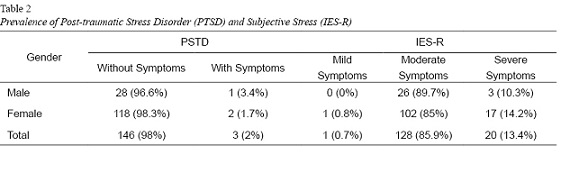
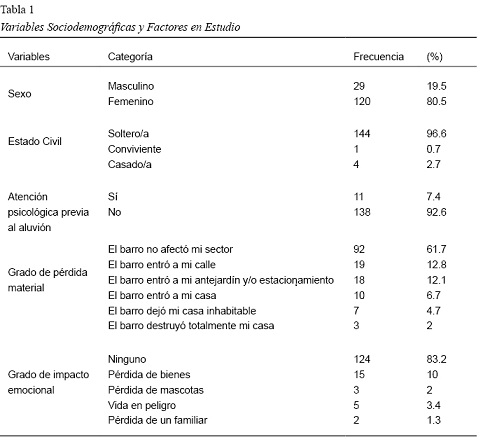
<body><![CDATA[<p class="western" style="text-indent: 0pt; line-height: 150%; font-family: Verdana,Geneva,Tahoma,sans-serif; font-size: x-small; text-align: justify;" lang="es-ES"> El estudio corresponde a una investigaci&oacute;n emp&iacute;rica, se utiliz&oacute; una estrategia asociativa de tipo comparativa transversal y un dise&ntilde;o de grupos naturales, no se manipulan variables y se analizan las relaciones de estas indagando las diferencias entre dos o m&aacute;s grupos de individuos a partir de los contrastes generados por la naturaleza y la sociedad (<a name="Ato1_"></a><a href="#Ato">Ato, L&oacute;pez, &amp; Benavente</a>, 2013).</p>             <p class="western" style="line-height: 150%; font-family: Verdana,Geneva,Tahoma,sans-serif; font-size: x-small; text-align: justify;" lang="es-ES">     <br>         </p>             <p class="western" style="line-height: 150%; font-family: Verdana,Geneva,Tahoma,sans-serif; font-size: x-small; text-align: justify;" lang="es-ES"> Participantes</p>             <p class="western" style="line-height: 150%; font-family: Verdana,Geneva,Tahoma,sans-serif; font-size: x-small; text-align: justify;" lang="es-ES">     <br>         </p>             <p class="western" style="line-height: 150%; font-family: Verdana,Geneva,Tahoma,sans-serif; font-size: x-small; text-align: justify;" lang="es-ES"> Se utiliz&oacute; un muestreo no probabil&iacute;stico intencional o por conveniencia. Participaron 149 estudiantes universitarios de la comuna de Copiap&oacute;, quienes fueron seleccionados por cursar carreras que se dictaban en un Campus universitario afectado severamente por el aluvi&oacute;n y que presentaba dificultades de acceso y de normal funcionamiento durante los meses posteriores al desastre. En cuanto a las caracter&iacute;sticas de la muestra, el 19.5% de los encuestados, corresponde al g&eacute;nero masculino y el 80.5% al g&eacute;nero femenino; con edades entre 17 y 25 a&ntilde;os (M = 19.71 y DE = 3.22), en su mayor&iacute;a (96.6%) solteros/as. Adem&aacute;s, el 38.3% informa de haber sido afectado por el barro en distintos niveles de severidad y el 16.7% informa de impacto emocional con distintos niveles de intensidad (ver <a href="#t1">tabla 1</a>).</p>             <p class="western" style="line-height: 150%; font-family: Verdana,Geneva,Tahoma,sans-serif; font-size: x-small; text-align: justify;" lang="es-ES">     <br>         </p>             <p class="western" style="line-height: 150%; font-family: Verdana,Geneva,Tahoma,sans-serif; font-size: x-small; text-align: justify;" lang="es-ES"> <a name="t1"></a><img style="width: 504px; height: 444px;" alt="" src="/img/revistas/cp/v10n2/2a03t1.jpg">    ]]></body>
<body><![CDATA[<br>        </p>             <p class="western" style="line-height: 150%; font-family: Verdana,Geneva,Tahoma,sans-serif; font-size: x-small; text-align: justify;" lang="es-ES">     <br>         </p>             <p class="western" style="line-height: 150%; font-family: Verdana,Geneva,Tahoma,sans-serif; font-size: x-small; text-align: justify;" lang="es-ES"> Instrumentos</p>             <p class="western" style="line-height: 150%; font-family: Verdana,Geneva,Tahoma,sans-serif; font-size: x-small; text-align: justify;" lang="es-ES">     <br>         </p>             <p class="western" style="text-indent: 0pt; line-height: 150%; font-family: Verdana,Geneva,Tahoma,sans-serif; font-size: x-small; text-align: justify;" lang="es-UY"> - Escala de Gravedad de S&iacute;ntomas del Trastorno de Estr&eacute;s Postraum&aacute;tico (<a name="Echeburua97a1_"></a><a href="#Echeburua97a">Echebur&uacute;a, Corral, Amor, Zubizarreta, &amp; Sarasua</a>, 1997a). Corresponde a una escala de evaluaci&oacute;n de s&iacute;ntomas de TEPT seg&uacute;n los criterios del Manual Diagn&oacute;stico y Estad&iacute;stico de los Trastornos Mentales (DSM-IV, 2002). Se presenta en formato tipo Likert (0 = Nada hasta 3 = 5 o m&aacute;s veces por semana) que incluye 17 reactivos agrupados en tres dimensiones (Reexperimentaci&oacute;n intrusiva, Evitaci&oacute;n y Activaci&oacute;n). Cuenta adem&aacute;s con una subescala complementaria de Manifestaciones Som&aacute;ticas. Ha sido validada en Espa&ntilde;a con v&iacute;ctimas de agresi&oacute;n sexual y violencia intrafamiliar, presentando altos niveles de fiabilidad a trav&eacute;s  de su estabilidad temporal y consistencia interna (Alfa de 0.89 y 0.92 respectivamente), lo cual demuestra ser un instrumento que sobrepasa las exigencias m&iacute;nimas para ser utilizado en contextos de investigaci&oacute;n, cl&iacute;nicos y/o jur&iacute;dico-forenses, ha sido usado en diversas investigaciones en el &aacute;rea (<a name="Blasco1_"></a><a href="#Blasco">Blasco-Ros, S&aacute;nchez-Lorente, &amp; Mart&iacute;nez</a>, 2010;&nbsp;<a name="Echeburua97b1_"></a><a href="#Echeburua97b">Echebur&uacute;a, Corral, Amor, Sarasua, &amp; Zubizarreta</a>, 1997b;&nbsp;<a name="Echeburua031_"></a><a href="#Echeburua03">Echebur&uacute;a, Corral, &amp; Amor</a>, 2003). Fue aplicada en Chile por <a href="#Moscoso">Moscoso</a> (2013) a personas afectadas por terrorismo de Estado, obteniendo coeficientes Alfa satisfactorios en todas las dimensiones (entre .86 y .94) y un Alfa de .96 para el resultado global, lo que indica alta consistencia interna y un nivel de fiabilidad satisfactorio. El cuestionario present&oacute; una adecuada validez discriminante de los criterios diagn&oacute;sticos de estr&eacute;s post-traum&aacute;tico, a diferencia de otros cuadros ansiosos.  </p>             <p class="western" style="text-indent: 0pt; line-height: 150%; font-family: Verdana,Geneva,Tahoma,sans-serif; font-size: x-small; text-align: justify;" lang="es-UY"> - Escala de Impacto al Evento Revisada (IES - Impact of Event Scale de&nbsp;<a name="Weiss1_"></a><a href="#Weiss">Weiss, &amp; Marmar</a>, 1997) validada en Espa&ntilde;a por Baguena et al. (2001). Este es un instrumento que posee 22 &iacute;tems y 3 subescalas (Intrusi&oacute;n, Evitaci&oacute;n e Hiperactivaci&oacute;n) con formato tipo Likert para la evaluaci&oacute;n de la intensidad de la sintomatolog&iacute;a (desde 0 = Nada hasta 4 = Extremadamente). Permite obtener a partir de la puntuaci&oacute;n global la severidad del malestar emocional o estr&eacute;s subjetivo (<a name="Costa1_"></a><a href="#Costa">Costa Requena, &amp; Gil Moncayo</a>, 2012). El instrumento se ha utilizado en diversas investigaciones respecto del impacto a desastres y emergencias (<a href="#Arcaya">Arcaya</a> et al., 2014;&nbsp;<a name="Brunet1_"></a><a href="#Brunet">Brunet, St-Hilaire, Jehel, &amp; King</a>, 2003;&nbsp;<a name="Caamano1_"></a><a href="#Caamano">Caama&ntilde;o, Gonz&aacute;lez, &amp; Sep&uacute;lveda</a>, 2011;&nbsp;<a name="Creamer1_"></a><a href="#Creamer">Creamer, Bell, &amp; Failla</a>, 2003;&nbsp;<a name="Giorgi1_"></a><a href="#Giorgi">Giorgi</a> et al., 2015;&nbsp;<a name="Morina1_"></a><a href="#Morina">Morina, Ehring, &amp; Priebe</a>, 2014;&nbsp;<a name="Warsini1_"></a><a href="#Warsini">Warsini, Buettner, Mills, West, &amp; Usher</a>, 2015). incluyendo aluviones de barro (<a href="#Cheng">Cheng-Sheng</a>, et al., 2011; <a href="#Craparo">Craparo</a> et al., 2013); sus propiedades psicom&eacute;tricas han sido evaluadas en  China arrojando valores adecuados (<a name="Wu1_"></a><a href="#Wu">Wu,  &amp; Chan</a>, 2004). Adem&aacute;s presenta un 72% de sensibilidad para la detecci&oacute;n de TEPT en relaci&oacute;n a otros instrumentos psicom&eacute;tricos similares (<a name="Mouthaan1_"></a><a href="#Mouthaan">Mouthaan, Sijbrandij, Reitsma, Gersons, &amp; Olff</a>, 2014). La EIE-R fue adaptada y validada para poblaci&oacute;n chilena por <a href="#Caamano">Caama&ntilde;o</a> et al., (2011) concluyendo que es una medida confiable de autoreporte y adecuada validez.</p>             <p class="western" style="text-indent: 0pt; line-height: 150%; font-family: Verdana,Geneva,Tahoma,sans-serif; font-size: x-small; text-align: justify;" lang="es-UY"> - Encuesta sociodemogr&aacute;fica: constru&iacute;da por los autores para recolectar  informaci&oacute;n referente a edad, sexo, carrera universitaria, estado civil, lugar de residencia, lugar donde se encontraba el d&iacute;a del aluvi&oacute;n, grado de p&eacute;rdida material (consta de 6 niveles, 1 = El barro no afecto mi sector; 6 = El barro destruy&oacute; totalmente mi casa) y grado de impacto emocional informado (5 niveles, 0 = Ninguno; 4 = Perdida/muerte de un familiar), siendo estas de car&aacute;cter nominal y ordinal a excepci&oacute;n de la edad del sujeto.</p>             <p class="western" style="line-height: 150%; font-family: Verdana,Geneva,Tahoma,sans-serif; font-size: x-small; text-align: justify;" lang="es-UY">     ]]></body>
<body><![CDATA[<br>         </p>             <p class="western" style="line-height: 150%; font-family: Verdana,Geneva,Tahoma,sans-serif; font-size: x-small; text-align: justify;" lang="es-UY"> Procedimiento</p>             <p class="western" style="line-height: 150%; font-family: Verdana,Geneva,Tahoma,sans-serif; font-size: x-small; text-align: justify;" lang="es-UY">     <br>         </p>             <p class="western" style="text-indent: 0pt; line-height: 150%; font-family: Verdana,Geneva,Tahoma,sans-serif; font-size: x-small; text-align: justify;" lang="es-UY"> Los instrumentos fueron aplicados en los tres meses posteriores al aluvi&oacute;n de barro, previa aprobaci&oacute;n por un comit&eacute; de idoneidad cient&iacute;fica de la instituci&oacute;n de los autores que acredito los aspectos &eacute;ticos del estudio. Una vez comunicados a los participantes los objetivos, se procedi&oacute; a entregar un protocolo con las dos escalas, el cuestionario sociodemogr&aacute;fico y un consentimiento informado, que deb&iacute;a ser devuelto en sobre sellado para garantizar la confidencialidad de los datos.</p>             <p class="western" style="text-indent: 0pt; line-height: 150%; font-family: Verdana,Geneva,Tahoma,sans-serif; font-size: x-small; text-align: justify;" lang="es-UY"> Las diferencias se estimaron utilizando el an&aacute;lisis de varianza (ANOVA) de un factor en funci&oacute;n de las variables sociodemogr&aacute;ficas y las categor&iacute;as de grado de p&eacute;rdida material e impacto emocional. Para el sexo se utiliz&oacute; la prueba t de Student, para muestras independientes. Se determin&oacute; la homogeneidad de varianzas con la prueba de Levene, en el caso de no existir se aplic&oacute; el test de Welch (Armitaje, Berry, &amp; Matthews, 1994). Las comparaciones post-hoc se realizaron aplicando la prueba de Tukey. Se utiliz&oacute; como medida del tama&ntilde;o del efecto la d de Cohen y Eta parcial al cuadrado (&eta;p2) (<a name="Cohen1_"></a><a href="#Cohen">Cohen</a>, 1988). Se realizaron regresiones lineales utilizando el m&eacute;todo por pasos.</p>             <p class="western" style="line-height: 150%; font-family: Verdana,Geneva,Tahoma,sans-serif; font-size: x-small; text-align: justify;" lang="es-UY">     <br>         </p>             <p class="western" style="line-height: 150%; font-family: Verdana,Geneva,Tahoma,sans-serif; text-align: justify; font-size: x-small;" lang="es-ES"> Resultados</p>             <p class="western" style="line-height: 150%; font-family: Verdana,Geneva,Tahoma,sans-serif; font-size: x-small; text-align: justify;" lang="es-ES">     ]]></body>
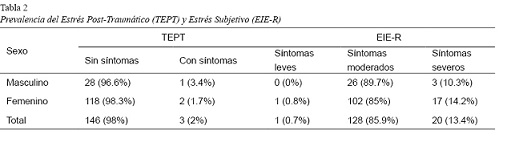
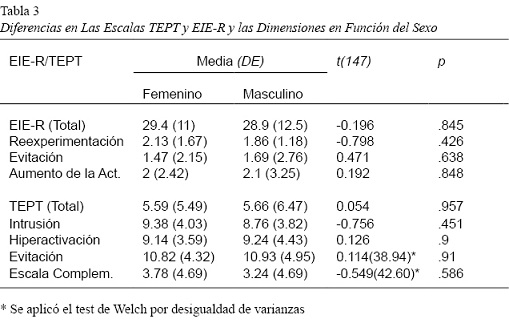
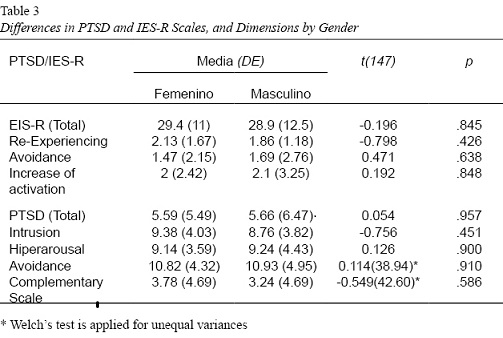
<body><![CDATA[<br>         </p>             <p class="western" style="text-indent: 0pt; line-height: 150%; font-family: Verdana,Geneva,Tahoma,sans-serif; font-size: x-small; text-align: justify;" lang="es-ES"> A continuaci&oacute;n, se presentan los principales resultados obtenidos en el estudio, siendo estos de car&aacute;cter preliminar.  </p>             <p class="western" style="text-indent: 0pt; line-height: 150%; font-family: Verdana,Geneva,Tahoma,sans-serif; font-size: x-small; text-align: justify;" lang="es-UY"> <span lang="es-ES">El an&aacute;lisis respecto de la prevalencia de s&iacute;ntomas de estr&eacute;s postraum&aacute;tico muestra que 146 participantes (98%) no presentan s&iacute;ntomas de estr&eacute;s postraum&aacute;tico y 3 sujetos (2%) presentan la sintomatolog&iacute;a arrojada por la Escala de Gravedad de S&iacute;ntomas del Trastorno de Estr&eacute;s Postraum&aacute;tico (TEPT). Seg&uacute;n la EIE-R, 20 estudiantes (13.4%) presentan s&iacute;ntomas severos de estr&eacute;s subjetivo o malestar emocional (ver <a href="#t2">tabla 2</a>). </span> </p>             <p class="western" style="line-height: 150%; font-family: Verdana,Geneva,Tahoma,sans-serif; font-size: x-small; text-align: justify;" lang="es-ES">     <br>         </p>             <p class="western" style="line-height: 150%; font-family: Verdana,Geneva,Tahoma,sans-serif; font-size: x-small; text-align: justify;" lang="es-ES">     <br>        </p>             <p class="western" style="line-height: 150%; font-family: Verdana,Geneva,Tahoma,sans-serif; font-size: x-small; text-align: justify;" lang="es-ES">     <br>         </p>             <p class="western" style="text-indent: 0pt; line-height: 150%; font-family: Verdana,Geneva,Tahoma,sans-serif; font-size: x-small; text-align: justify;" lang="es-ES"> Profundizando en el an&aacute;lisis y siguiendo las preguntas de investigaci&oacute;n, no se encontraron diferencias significativas de medias entre hombres y mujeres respecto de la sintomatolog&iacute;a de estr&eacute;s postraum&aacute;tico y estr&eacute;s subjetivo (ver <a href="#t3">tabla 3</a>).  </p>             ]]></body>
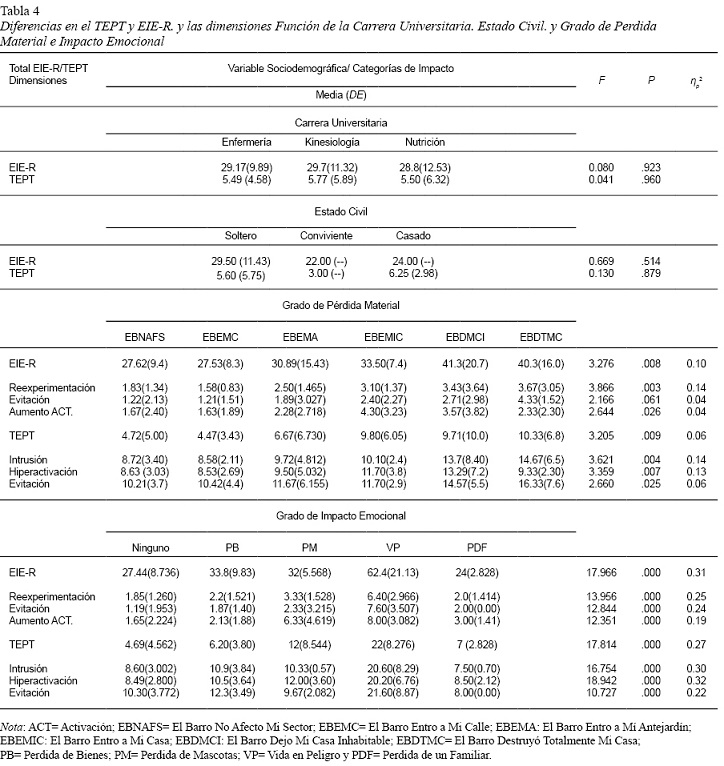
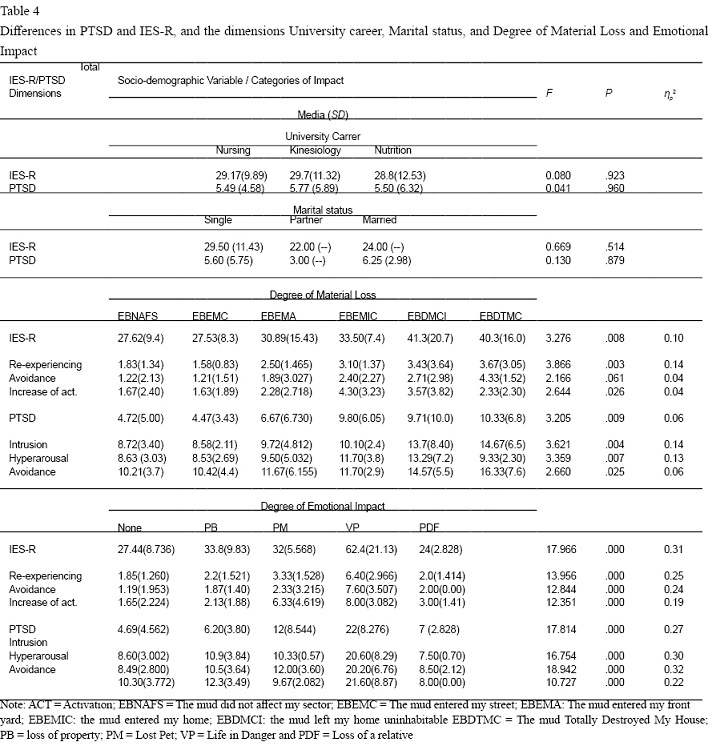
<body><![CDATA[<p class="western" style="line-height: 150%; font-family: Verdana,Geneva,Tahoma,sans-serif; font-size: x-small; text-align: justify;" lang="es-ES">     <br>         </p>             <p class="western" style="line-height: 150%; font-family: Verdana,Geneva,Tahoma,sans-serif; font-size: x-small; text-align: justify;" lang="es-ES">     <br>        </p>             <p class="western" style="line-height: 150%; font-family: Verdana,Geneva,Tahoma,sans-serif; font-size: x-small; text-align: justify;" lang="es-ES">     <br>         </p>             <p class="western" style="text-indent: 0pt; line-height: 150%; font-family: Verdana,Geneva,Tahoma,sans-serif; font-size: x-small; text-align: justify;" lang="es-UY"> <span lang="es-ES">En relaci&oacute;n a la variabilidad de la sintomatolog&iacute;a de estr&eacute;s postraum&aacute;tico y el estr&eacute;s subjetivo, se procedi&oacute; a comparar los resultados de las escalas totales y las dimensiones del EIE-R y TEPT en funci&oacute;n de las variables sociodemogr&aacute;ficas estado civil y carrera universitaria y las categor&iacute;as de gradaci&oacute;n del &ldquo;grado de impacto emocional&rdquo; y &ldquo;grado de p&eacute;rdida material&rdquo;.</span></p>          <p class="western" style="text-indent: 0pt; line-height: 150%; font-family: Verdana,Geneva,Tahoma,sans-serif; font-size: x-small; text-align: justify;" lang="es-UY"><span lang="es-ES"><a name="t2"></a><img style="width: 515px; height: 154px;" alt="" src="/img/revistas/cp/v10n2/2a03t2.jpg"></span></p>          <p class="western" style="margin-bottom: 0cm; line-height: 150%; text-align: justify;" lang="es-UY"> <span lang="es-ES"> <a name="t3"></a><img style="width: 509px; height: 327px;" alt="" src="/img/revistas/cp/v10n2/2a03t3.jpg" class="auto-style27"><span class="auto-style27"> </span> </span> </p>             <p class="western" style="text-indent: 0pt; line-height: 150%; font-family: Verdana,Geneva,Tahoma,sans-serif; font-size: x-small; text-align: justify;" lang="es-ES"> Como se muestra en la <a href="/img/revistas/cp/v10n2/2a03t4.jpg">tabla 4</a>, no se encontraron diferencias significativas en la sintomatolog&iacute;a de estr&eacute;s postraum&aacute;tico y estr&eacute;s subjetivo en funci&oacute;n del estado civil y la carrera universitaria.  </p>             ]]></body>
<body><![CDATA[<p class="western" style="line-height: 150%; font-family: Verdana,Geneva,Tahoma,sans-serif; font-size: x-small; text-align: justify;" lang="es-ES">     <br>         </p>             <p class="western" style="text-indent: 0pt; line-height: 150%; font-family: Verdana,Geneva,Tahoma,sans-serif; font-size: x-small; text-align: justify;" lang="es-UY"> <span lang="es-ES">Se encontr&oacute; homogeneidad de varianzas en las categor&iacute;as de &ldquo;grado de p&eacute;rdida material&rdquo; respecto del estr&eacute;s subjetivo (EIE-R) y la sintomatolog&iacute;a de estr&eacute;s postraum&aacute;tico (TEPT) arrojando el estad&iacute;stico de Levene valores de 1.70 (p = .137) y 1.41 (p = .221) respectivamente. Se hallaron diferencias significativas de medias en la EIE-R y sus dimensiones (Reexperimentaci&oacute;n y Aumento de la Activaci&oacute;n) en funci&oacute;n del grado de perdida material a excepci&oacute;n de Evitaci&oacute;n, F(5. 143) = 2.166 , p &gt; .05. Adem&aacute;s, se observa que el tama&ntilde;o del efecto de las diferencias en el EIE-R y la dimensi&oacute;n de Reexperimentaci&oacute;n es moderado/alto (valores de &eta;p2 entre 0.10 y 0.14) (<a href="#Cohen">Cohen</a>, 1988). Tambi&eacute;n se encontraron diferencias significativas en el TEPT y todas sus dimensiones (Intrusi&oacute;n, Hiperactivaci&oacute;n y Evitaci&oacute;n) en funci&oacute;n del grado de perdida material y el tama&ntilde;o del efecto es de moderado/alto (valores de &eta;p2  entre 0.06 y 0.14). La prueba post hoc HDS Tukey no logr&oacute; diferenciar los grupos. </span> </p>             <p class="western" style="text-indent: 0pt; line-height: 150%; font-family: Verdana,Geneva,Tahoma,sans-serif; font-size: x-small; text-align: justify;" lang="es-UY"> <span lang="es-ES">Para la variable &ldquo;grado de impacto emocional&rdquo; existe homogeneidad de varianzas respecto del estr&eacute;s subjetivo (EIE-R) y la sintomatolog&iacute;a de estr&eacute;s postraum&aacute;tico (TEPT), arrojando el estad&iacute;stico de Levene valores de 2.202 (p = .06) y 1.372 (p = .06) respectivamente. Se encontraron diferencias significativas en las puntuaciones del EIE-R y todas sus dimensiones en funci&oacute;n del grado de impacto emocional. Se observa que el tama&ntilde;o del efecto es alto (valores de &eta;p2 entre 0.19 y 0.31) (<a href="#Cohen">Cohen</a>, 1988). Tambi&eacute;n se presentan diferencias significativas en el TEPT y todas sus dimensiones en funci&oacute;n del grado de impacto emocional y el tama&ntilde;o del efecto de las diferencias igual es significativo (valores de &eta;p2 entre 0.22 y 0.32).</span></p>             <p class="western" style="text-indent: 0pt; line-height: 150%; font-size: x-small; font-family: Verdana,Geneva,Tahoma,sans-serif; text-align: justify;" lang="es-UY"> <span lang="es-ES">La prueba post hoc HDS Tukey revel&oacute; que las diferencias se producen entre la categor&iacute;a &ldquo;vida en peligro&rdquo; y los otros cuatro grupos respecto a los s&iacute;ntomas de estr&eacute;s postraum&aacute;tico (p &lt; .05) y de estr&eacute;s subjetivo (p &lt; .001).</span></p>             <p class="western" style="text-indent: 0pt; line-height: 150%; font-family: Verdana,Geneva,Tahoma,sans-serif; font-size: x-small; text-align: justify;" lang="es-ES"> Se realiz&oacute; un an&aacute;lisis de regresi&oacute;n lineal m&uacute;ltiple con los puntajes obtenidos en las escalas TEPT y EIE-R considerando la edad, el grado de p&eacute;rdida material y el grado de impacto emocional. La variable que entr&oacute; en el modelo fue el grado de impacto emocional que predice el 21.3% de la varianza de los puntajes obtenidos en el TEPT (R2 = .213). siendo significativo, F(1.147) = 39.90, p = .000,  </p>             <p class="western" style="text-indent: 0pt; line-height: 150%; text-align: justify; font-size: x-small; font-family: Verdana,Geneva,Tahoma,sans-serif;" lang="es-UY"> <span lang="es-ES">&beta; = 0.462, p = .000, 95% IC[.374, .549]. Tambi&eacute;n predice el 16.8% de la varianza de los puntajes obtenidos en el EIE-R (R2 = .168), siendo igualmente significativo, F(1.147) = 29.731, p = .000, &beta; = 0.410, p = .000, 95% [0.376, 0.805]. En los dos casos el aporte de la variable grado de perdida material fue menor.</span></p>             <p class="western" style="line-height: 150%; font-family: Verdana,Geneva,Tahoma,sans-serif; font-size: x-small; text-align: justify;" lang="es-ES">     <br>         </p>             <p class="western" style="text-indent: 0pt; line-height: 150%; font-family: Verdana,Geneva,Tahoma,sans-serif; text-align: justify; font-size: x-small;" lang="es-ES"> Discusi&oacute;n y conclusiones</p>             ]]></body>
<body><![CDATA[<p class="western" style="line-height: 150%; font-family: Verdana,Geneva,Tahoma,sans-serif; font-size: x-small; text-align: justify;" lang="es-ES">     <br>         </p>             <p class="western" style="text-indent: 0pt; line-height: 150%; font-family: Verdana,Geneva,Tahoma,sans-serif; font-size: x-small; text-align: justify;" lang="es-ES"> El estudio tuvo como objetivo identificar los niveles de sintomatolog&iacute;a de estr&eacute;s post-traum&aacute;tico y de estr&eacute;s subjetivo en estudiantes universitarios posteriores al aluvi&oacute;n y determinar los factores que establecen su variabilidad. Los factores evaluados fueron de tipo sociodemogr&aacute;fico y las categor&iacute;as de impacto emocional y p&eacute;rdida material.</p>          <p class="western" style="text-indent: 0pt; line-height: 150%; font-family: Verdana,Geneva,Tahoma,sans-serif; font-size: x-small; text-align: justify;" lang="es-ES"> </p>             <p class="western" style="text-indent: 0pt; line-height: 150%; font-family: Verdana,Geneva,Tahoma,sans-serif; font-size: x-small; text-align: justify;" lang="es-ES"> Seg&uacute;n los resultados preliminares, no se encontraron porcentajes significativos de presencia de sintomatolog&iacute;a de estr&eacute;s postraum&aacute;tico (2%), ni de estr&eacute;s subjetivo (13.4%), lo que se relaciona con los datos registrados en Chile que van desde un 4.4% a un 36% (<a href="#Leiva">Leiva-Bianchi</a>, 2011; <a href="#Perez">P&eacute;rez</a> et al., 2009). Por otra parte, se presenta un porcentaje mayor en los s&iacute;ntomas moderados de estr&eacute;s subjetivo (85.9%), lo que sugiere la presencia perdurable del impacto psicol&oacute;gico tanto en v&iacute;ctimas directas como indirectas (<a href="#Samper">Samper Lucerna</a>, 2015). As&iacute; tambi&eacute;n, se confirma lo acotado por <a href="#Arnold">Arnold-Cathalifaud</a> (2010) quien afirma que el impacto psicol&oacute;gico a un desastre no se encuentra limitado a los sujetos que se ven directamente afectados.</p>             <p class="western" style="text-indent: 0pt; line-height: 150%; font-family: Verdana,Geneva,Tahoma,sans-serif; font-size: x-small; text-align: justify;" lang="es-ES"> Con respecto a las variables sociodemogr&aacute;ficas como sexo, estado civil y carrera cursada, no se presentan diferencias en las escalas de estr&eacute;s postraum&aacute;tico y el estr&eacute;s subjetivo, siendo posible asociar que la mayor&iacute;a de los estudiantes universitarios eran solteros (96.6%) y que podr&iacute;a relacionarse con independencia social (<a href="#Ling">Ling-Xiang, &amp; Cody</a>, 2011) y estabilidad emocional percibida (<a href="#Hussain">Hussain, Weis&aelig;th, &amp; Heir</a>, 2013). As&iacute; tambi&eacute;n, el nivel educativo de los participantes se constituir&iacute;a en un factor protector en la aparici&oacute;n y efecto del estr&eacute;s (<a href="#Grimm">Grimm, Hulse, Preiss, &amp; Schmidt</a>, 2012).</p>             <p class="western" style="text-indent: 0pt; line-height: 150%; font-family: Verdana,Geneva,Tahoma,sans-serif; font-size: x-small; text-align: justify;" lang="es-ES">La variabilidad en los resultados obtenidos con las escalas de sintomatolog&iacute;a de estr&eacute;s postraum&aacute;tico y estr&eacute;s subjetivo se presentan en funci&oacute;n de las variables &ldquo;grado de impacto emocional&rdquo; y &ldquo;grado de p&eacute;rdida material&rdquo;, siendo la primera la que provoca mayor variabilidad. Respecto de lo se&ntilde;alado por el <a href="#MVU">Ministerio de Vivienda y Urbanismo</a> (2015) un 6% de las viviendas presentan da&ntilde;os no reparables que requieren ser reconstruidas posterior al aluvi&oacute;n, y la informaci&oacute;n entregada por el&nbsp;<a name="MISP1_"></a><a href="#MISP">Ministerio del Interior y Seguridad P&uacute;blica</a> (2015) da cuenta de un total de 31 personas fallecidas y 16 desaparecidas, lo que se relaciona con las categor&iacute;as de &ldquo;vida en peligro&rdquo; y &ldquo;el barro destruy&oacute; completamente mi casa&rdquo;, que figuran con la gradaci&oacute;n de mayor severidad del grado de impacto emocional y de perdida material respectivamente. Cerca del 25.5% de los participantes fue afectado por el ingreso del barro al antejard&iacute;n y/o estacionamiento mientras que el 13.4% fue da&ntilde;ado por el ingreso del barro a sus casas. El 6.7% informa de un mayor impacto emocional, sin embargo, no atribuye gran intensidad a la perdida de bienes. De esta forma, se sostiene lo planteado por <a href="#Arnold">Arnold-Cathalifaud</a> (2010) respecto del impacto psicol&oacute;gico y la vivencia directa del evento, siendo esta &uacute;ltima la que generar&iacute;a TEPT altas y explicar&iacute;a las diferencias encontradas en el presente estudio con la literatura que plantea niveles significativos de TEPT en personas expuestas a terremotos (<a href="#Cenat14">C&eacute;nat &amp; Derivois</a>, 2014; <a href="#Guimaro">Guimaro</a> et al., 2013; <a href="#Leiva">Leiva-Bianchi</a>, 2011; <a href="#Matsuoka">Matsuoka</a> et al., 2012; <a href="#Roncone">Roncone</a> et al., 2013; <a href="#Takeda">Takeda</a> et al., 2013; <a href="#Zhiyong">Zhiyong</a> et al., 2012;); tsunamis (<a href="#Hussain">Hussain</a> et al., 2013); tormentas de nieve (<a href="#Daxing">Daxing</a> et al., 2011); tif&oacute;n y aluvi&oacute;n (<a href="#Cheng">Cheng-Sheng</a> et al., 2011) y tornados (<a href="#Arcaya">Arcaya</a> et al., 2014).  </p>             <p class="western" style="text-indent: 0pt; line-height: 150%; font-family: Verdana,Geneva,Tahoma,sans-serif; font-size: x-small; text-align: justify;" lang="es-ES"> Con relaci&oacute;n a lo anterior, la severidad en la sintomatolog&iacute;a de estr&eacute;s postraum&aacute;tico y estr&eacute;s subjetivo est&aacute; determinada por el tipo de desastre, siendo el TEPT mayor en los afectados por terremotos (sobre el 12.2%) que, por aluviones, donde la Hiperactivaci&oacute;n auton&oacute;mica es el s&iacute;ntoma de mayor prevalencia (<a href="#Craparo">Craparo</a> et al., 2013).</p>             <p class="western" style="text-indent: 0pt; line-height: 150%; font-family: Verdana,Geneva,Tahoma,sans-serif; font-size: x-small; text-align: justify;" lang="es-UY"> <span lang="es-ES">Los datos proporcionados por el&nbsp;<a name="INE151_"></a><a href="#INE">Instituto Nacional de Estad&iacute;sticas</a> (2015) se&ntilde;alan que la ciudad ha mostrado en el tiempo altos &iacute;ndices en la percepci&oacute;n de problemas sociales y ambientales en relaci&oacute;n a la contaminaci&oacute;n, higiene y falta de infraestructura comunitaria; todos factores que afectan la calidad de vida de los habitantes. Por &uacute;ltimo, considerando que las variables emocionales, tales como la felicidad subjetiva, estr&eacute;s percibido, gesti&oacute;n de las emociones, entre otras, tienen un impacto en el desempe&ntilde;o acad&eacute;mico (<a name="Ferragut1_"></a><a href="#Ferragut">Ferragut, &amp; Fierro</a>, 2012;&nbsp;<a name="Pena1_"></a><a href="#Pena">Pe&ntilde;a-Sarrionandia, Mikolajczak, &amp; Gross</a>, 2015), ser&iacute;a interesante conocer si la presencia de sintomatolog&iacute;a de estr&eacute;s subjetivo de mediana intensidad encontrada en los participantes afect&oacute; su desempe&ntilde;o acad&eacute;mico. Por &uacute;ltimo, es conveniente se&ntilde;alar que, al tratarse de un estudio de prevalencia de tipo preliminar, queda pendiente la realizaci&oacute;n de otros an&aacute;lisis estad&iacute;sticos, como por ejemplo pruebas de residuos, chi cuadrado y regresi&oacute;n log&iacute;stica multivariada, entre otras. Adem&aacute;s, incorporar a la muestra otros sectores de la poblaci&oacute;n que fueron afectados directa e indirectamente por el aluvi&oacute;n, para lograr precisar y extender los alcances de este estudio. Actualmente se est&aacute;n desarrollando los an&aacute;lisis mencionados bajo el proyecto &ldquo;Impacto en el bienestar subjetivo, calidad de vida y visi&oacute;n de mundo a un a&ntilde;o de la exposici&oacute;n a una cat&aacute;strofe socionatural&rdquo;, financiado por la Universidad de Atacama, Chile.</span></p>             <p class="western" style="line-height: 150%; font-family: Verdana,Geneva,Tahoma,sans-serif; font-size: x-small; text-align: justify;" lang="es-ES">     ]]></body>
<body><![CDATA[<br>         </p>             <p class="western" style="line-height: 150%; font-family: Verdana,Geneva,Tahoma,sans-serif; text-align: justify; font-size: x-small;" lang="es-ES"> Referencias</p>             <p class="western" style="line-height: 150%; font-family: Verdana,Geneva,Tahoma,sans-serif; font-size: x-small; text-align: justify;" lang="es-ES">     <br>         </p>             <!-- ref --><p class="western" style="text-indent: 0pt; font-family: Verdana,Geneva,Tahoma,sans-serif; font-size: x-small; text-align: justify; line-height: 150%;" lang="es-UY"> <a name="Aledi"></a><a href="#Aledi1__">Aledi</a>, Antonio, &amp; Sulaiman, Samia. (2014). La incuestionabilidad del riesgo.&nbsp;Ambiente &amp; Sociedade,&nbsp;17(4), 9-16.&nbsp;<a href="10.1590/1809-4422ASOCEx01V1742014">doi:10.1590/1809-4422ASOCEx01V1742014</a><!-- ref --><p class="western" style="text-indent: 0pt; font-family: Verdana,Geneva,Tahoma,sans-serif; font-size: x-small; text-align: justify; line-height: 150%;" lang="es-UY"> <a name="APA"></a><a href="#APA1_">American</a> Psychiatric Association. (2002). Manual diagn&oacute;stico y estad&iacute;stico de los trastornos mentales, DSM-IV-TR. <span lang="en-US">Barcelona: Masson.    </span></p>             <p class="auto-style51" lang="es-UY"> <a name="Arcaya"></a><span lang="en-US"><span class="auto-style27"><a href="#Arcaya1_">Arcaya</a>, M.C., Lowe, S. R., Rhodes, J. E., Waters, M. C., &amp; Subramanian, S. (2014). Association of PTSD Symptoms with Asthma Attacks among Hurricane Katrina Survivors. Journal of Traumatic Stress, 27, 725&ndash;729. <a href="10.1002/jts.21976">doi:10.1002/jts.21976</a></span></span></p>             <p class="auto-style51" lang="es-UY"> <a name="Arnberg"></a><span lang="en-US"><span class="auto-style27"><a href="#Arnberg1_">Arnberg</a>, F.K., Eriksson, N.G., Hultman, C.M., &amp; Lundin, T. (2011). Traumatic Bereavement, Acute Dissociation, and Posttraumatic Stress: 14 Years after the MS Estonia Disaster. Journal of Traumatic Stress, 24(2) 183&ndash;190. <a href="10.1002/jts.20629">doi:10.1002/jts.20629</a></span></span></p>             <!-- ref --><p class="auto-style51" lang="es-UY"> <a name="Arnold"></a><span lang="en-US"><span class="auto-style27"><a href="#Arnold1_">Arnold</a>-Cathalifaud, M. (2010). Cat&aacute;strofes naturales y sociedad. </span> </span> <span class="auto-style27">Revista Chilena de Salud P&uacute;blica, 14(1), 40-42.    </span></p>             <!-- ref --><p class="western" style="text-indent: 0pt; font-family: Verdana,Geneva,Tahoma,sans-serif; font-size: x-small; text-align: justify; line-height: 150%;" lang="es-UY"> <a name="Ato"></a><a href="#Ato1_">Ato</a>, M., L&oacute;pez, J., &amp; Benavente, A. (2013). Un sistema de clasificaci&oacute;n de los dise&ntilde;os de investigaci&oacute;n en psicolog&iacute;a. Anales de Psicolog&iacute;a, 29(3),1038-1059. <a href="10.6018/analesps.29.3.178511">doi:10.6018/analesps.29.3.178511</a><p class="auto-style51" lang="es-UY"> <a name="Bianchinia"></a><span class="auto-style27"><a href="#Bianchinia1_">Bianchinia</a>, V., Ronconea, R., Tomassinia, A., Necozione, S., Cifone, M., Casacchiaa, M., &amp; Pollicea, R. (2013). </span><span lang="en-US"> <span class="auto-style27">Cognitive Behavioral Therapy for Young People after L&rsquo;Aquila Earthquake. Clinical Practice &amp; Epidemiology in Mental Health, 9, 238-242. &nbsp;<a href="10.2174/1745017901309010238">doi:10.2174/1745017901309010238</a></span></span></p>             <!-- ref --><p class="western" style="text-indent: 0pt; text-align: justify; line-height: 150%;" lang="es-UY"> <a name="Blasco"></a><span lang="en-US"><span class="auto-style27"><a href="#Blasco1_">Blasco</a>-Ros, C., S&aacute;nchez-Lorente, S., &amp; Mart&iacute;nez, M. (2010). Recovery from depressive symptoms, state anxiety and post-traumatic stress disorder in women exposed to physical and psychological, but not to psychological intimate partner violence alone: A longitudinal study. BMC Psychiatry, 10, 98. <a href="doi:%2010.1186/1471-244X-10-98">doi:</a></span></span><span class="auto-style27"><a href="2010.1186/1471-244X-10-98"><span lang="en-US">&nbsp;10.1186/1471-244X-10-98</span></a></span><!-- ref --><p class="auto-style51" lang="es-UY"> <span lang="en-US"><span class="auto-style27"> <a name="Brunet"></a><a href="#Brunet1_">Brunet</a>, A., St-Hilaire, A., Jehel, L., &amp; King, S. (2003). Validation of a French version of the impact of event scale-revised.  </span></span><span class="auto-style27">Canadian Jourmal of Psychiatry, 48(1), 56-61.    </span></p>             <!-- ref --><p class="western" style="text-indent: 0pt; font-family: Verdana,Geneva,Tahoma,sans-serif; font-size: x-small; text-align: justify; line-height: 150%;" lang="es-UY"> <a name="Caamano"></a><a href="#Caamano1_">Caama&ntilde;o</a>, L., Gonz&aacute;lez, L., &amp; Sep&uacute;lveda, M. (2011). Adaptaci&oacute;n y validaci&oacute;n de la versi&oacute;n chilena de la escala de impacto de evento-revisada (EIE-R). Revista M&eacute;dica de Chile 139, 1163-1168. <span lang="hr-HR"><a href="10.4067/S0034-98872011000900008"> doi:10.4067/S0034-98872011000900008</a>&nbsp;    </span></p>             <!-- ref --><p class="western" style="text-indent: 0pt; font-family: Verdana,Geneva,Tahoma,sans-serif; font-size: x-small; text-align: justify; line-height: 150%;" lang="es-UY"><a name="Cenat15"></a><a href="#Cenat151_">C&eacute;nat</a>, J. M., &amp; Derivois, D. (2015). <span lang="en-US">Long-term outcomes among child and adolescent survivors of the 2010 Haitian earthquake. </span><span lang="en-GB">Depression and anxiety, 32(1), 57-63. <a href="10.1002/da.22275">doi:10.1002/da.22275</a></span><!-- ref --><p class="auto-style51" lang="es-UY"> <span lang="en-US"><span class="auto-style27"> <a name="Cenat14"></a><a href="#Cenat141_">C&eacute;nat</a>, J. M., &amp; Derivois, D. (2014). Assessment of prevalence and determinants of posttraumatic stress disorder and depression symptoms in adults survivors of earthquake in Haiti after 30 months. Journal of Affective Disorders, 159, 111-117. <a href="10.1016/j.jad.2014.02.025">doi:10.1016/j.jad.2014.02.025</a></span></span><p class="western" style="text-indent: 0pt; text-align: justify; line-height: 150%;" lang="es-UY"> <a name="Chen"></a><span lang="en-US"><span class="auto-style27"><a href="#Chen1_">Chen</a>, H., Chen, Y., Au, M., Feng, L., Chen, Q., Guo, H., Li, Y., &amp; Yang, X. (2014). The presence of post-traumatic stress disorder symptoms in earthquake survivors one month after a mudslide in southwest China. Nursing and Health Sciences, 16, 39&ndash;45. <a href="10.1111/nhs.12127">doi:10.1111/nhs.12127</a></span></span></p>             <p class="auto-style51" lang="es-UY"> <span lang="en-US"><span class="auto-style27"> <a name="Cheng"></a><a href="#Cheng1_">Cheng</a>-Sheng, C., Chung-Ping, C., Cheng-Fang, Y., Tze-Chun, T., <a href="#Pinchen">Pinchen</a>, Y., Rei-Cheng,&hellip;Hsin-Su, Y. (2011). Validation of the Impact of Event Scale-Revised for adolescents experiencing the floods and mudslides. Kaohsiung Journal of Medical Sciences, 27, 560-565. <a href="10.1016/j.kjms.2011.06.033">doi:10.1016/j.kjms.2011.06.033</a></span></span></p>             <!-- ref --><p class="western" style="text-indent: 0pt; text-align: justify; line-height: 150%;" lang="es-UY"> <span lang="en-US"><span class="auto-style27"> <a name="Cohen"></a><a href="#Chen1_">Cohen</a>, J. (1988). Statistical power analysis for the behavioral sciences (2nd ed.). Hillsdale, NJ: Lawrence Earlbaum Associates.    </span></span></p>             <!-- ref --><p class="western" style="text-indent: 0pt; font-family: Verdana,Geneva,Tahoma,sans-serif; font-size: x-small; text-align: justify; line-height: 150%;" lang="es-UY"><span lang="en-US"><a name="Corkalo"></a><a href="#Corkalo1_">&#268;orkalo</a>, D.B., Ajdukovi&#263;, D., &amp; L&ouml;w Stanic, A. (2014). When the world collapses: changed worldview and social reconstruction in a traumatized community. </span>European Journal of Psychotraumatology, 5, 1-6. &nbsp;<a href="10.3402/ejpt.v5.24098">doi:10.3402/ejpt.v5.24098</a><!-- ref --><p class="western" style="text-indent: 0pt; font-family: Verdana,Geneva,Tahoma,sans-serif; font-size: x-small; text-align: justify; line-height: 150%;" lang="es-UY"> <a name="Costa"></a><a href="#Costa1_">Costa</a> Requena, G., &amp; Gil Moncayo, F. (2012). Propiedades psicom&eacute;tricas de la escala revisada del impacto del evento estresante (IES-R) en una muestra espa&ntilde;ola de pacientes con c&aacute;ncer. An&aacute;lisis y Modificaci&oacute;n De Conducta, 33(149). Recuperado de <a href="http://www.uhu.es/publicaciones/ojs/index.php/amc/article/view/1218"> http://www.uhu.es/publicaciones/ojs/index.php/amc/article/view/1218</a><!-- ref --><p class="western" style="text-indent: 0pt; font-family: Verdana,Geneva,Tahoma,sans-serif; font-size: x-small; text-align: justify; line-height: 150%;" lang="es-UY"> <a name="Cova"></a><a href="#Cova1_">Cova</a>, F., &amp; Rinc&oacute;n, P. (2010). El Terremoto y Tsunami del 27-F y sus Efectos en la Salud Mental. Terapia psicol&oacute;gica, 28(2), 179-185. <span lang="hr-HR"><a href="10.4067/S0718-48082010000200006"> doi:10.4067/S0718-48082010000200006</a>&nbsp;    </span></p>             <p class="auto-style51" lang="es-UY"> <a name="Craparo"></a><span class="auto-style27"><a href="#Craparo1_">Craparo</a>, G., Faraci, P., Rotondo, G., &amp; Gori, A. (2013). </span> <span class="auto-style27" lang="en-US">The Impact of Event Scale &ndash; Revised: psychometric properties of the Italian version in a sample of flood victims. Neuropsychiatric Disease and Treatment, 9, 1427&ndash;1432. &nbsp;</span><a href="10.2147/NDT.S51793"><span class="auto-style27" lang="en-US">doi:10.2147/NDT.S51793</span></a></p>             <p class="auto-style51" lang="es-UY"> <span lang="en-US"><span class="auto-style27"> <a name="Creamer"></a><a href="#Creamer1_">Creamer</a>, M., Bell, R., &amp; Failla, S. (2003). Psychometric properties of the Impact of Event Scale Revised. Behaviour Research and Therapy, 41, 1489&ndash;1496.</span></span><span class="auto-style27" lang="hr-HR"> </span><a href="10.1016/j.brat.2003.07.010"> <span class="auto-style27" lang="hr-HR">doi:10.1016/j.brat.2003.07.010</span></a></p>             ]]></body>
<body><![CDATA[<!-- ref --><p class="auto-style51" lang="es-UY"> <span lang="en-US"><span class="auto-style27"> <a name="Daxing"></a><a href="#Daxing1_">Daxing</a>, W., Huifang, Y., Shujing, X., &amp; Ying, Z. (2011). Risk factors for posttraumatic stress reactions among Chinese students following exposure to a snowstorm disaster. </span> </span> <span class="auto-style27">BMC Public Health, 11(96), 1-7. <a href="doi:10.1186/1471-2458-11-96"> doi:10.1186/1471-2458-11-96</a></span><!-- ref --><p class="western" style="text-indent: 0pt; font-family: Verdana,Geneva,Tahoma,sans-serif; font-size: x-small; text-align: justify; line-height: 150%;" lang="es-UY"> <a name="de_la_Barra"></a><a href="#de_la_Barra1_">de la Barra</a>, Flora, &amp; Silva, Hern&aacute;n. (2010). Desastres y salud mental.&nbsp;Revista chilena de neuro-psiquiatr&iacute;a,48(1), 7-10.&nbsp;<a href="10.4067/S0717-92272010000200001">doi:10.4067/S0717-92272010000200001</a><!-- ref --><p class="western" style="text-indent: 0pt; font-family: Verdana,Geneva,Tahoma,sans-serif; font-size: x-small; text-align: justify; line-height: 150%;" lang="es-UY"> <a name="Echeburua97a"></a><a href="#Echeburua97a1_">Echebur&uacute;a</a>, E., Corral, P. D., Amor, P. J., Zubizarreta, I., &amp; Sarasua, B. (1997a). Escala de gravedad de s&iacute;ntomas del trastorno de estr&eacute;s postraum&aacute;tico: propiedades psicom&eacute;tricas. An&aacute;lisis y modificaci&oacute;n de conducta, 23(90), 503-526.    </p>             <!-- ref --><p class="western" style="text-indent: 0pt; text-align: justify; line-height: 150%;" lang="es-UY"> <span lang="hr-HR"><span class="auto-style27"> <a name="Echeburua97b"></a><a href="#Echeburua97b1_">Echebur&uacute;a</a>, E., Corral, P. Amor, P.J., Sarasua, B., &amp; Zubizarreta, I. (1997b). Repercusiones psicopatol&oacute;gicas de la violencia dom&eacute;stica en la mujer: un estudio descriptivo. Revista de Psicopatolog&iacute;a y Psicolog&iacute;a Cl&iacute;nica, 2, 7-19.    </span></span></p>             <!-- ref --><p class="western" style="text-indent: 0pt; text-align: justify; line-height: 150%;" lang="es-UY"> <span lang="hr-HR"><span class="auto-style27"> <a name="Echeburua03"></a><a href="#Echeburua031_">Echebur&uacute;a</a>, E. Corral, P., &amp; Amor, P.J. (2003). </span></span> <span class="auto-style27"> <span lang="en-US">Evaluation of psychological harm in the victims of violent crime.  </span>Psychology in Spain, 7, 10-18.    </span></p>             <!-- ref --><p class="western" style="text-indent: 0pt; font-family: Verdana,Geneva,Tahoma,sans-serif; font-size: x-small; text-align: justify; line-height: 150%;" lang="es-UY"> <a name="Ferragut"></a><a href="#Ferragut1_">Ferragut</a>, M.&amp; Fierro, A. (2012). Inteligencia emocional, bienestar personal y rendimiento acad&eacute;mico en preadolescentes.  Revista Latinoamericana de Psicolog&iacute;a, 44(3), 95-104<!-- ref --><p class="auto-style51" lang="es-UY"> <a name="Felix"></a><span class="auto-style27"><a href="#Felix1_">F&eacute;lix</a>, C., &amp; Rinc&oacute;n, P. (2010). El Terremoto y Tsunami del 27-F y sus Efectos en la Salud Mental. Terapia Psicol&oacute;gica, 28(2), 179-185. </span><span lang="hr-HR"><span class="auto-style27"><a href="10.4067/S0718-48082010000200006"> doi:10.4067/S0718-48082010000200006</a>&nbsp;    </span></span></p>             <!-- ref --><p class="western" style="text-indent: 0pt; font-family: Verdana,Geneva,Tahoma,sans-serif; font-size: x-small; text-align: justify; line-height: 150%;" lang="es-UY"> <a name="Figueroa"></a><a href="#Figueroa1_">Figueroa</a>, R.A., Mar&iacute;n, H., &amp; Gonz&aacute;lez, M. (2010). Apoyo psicol&oacute;gico en desastres: Propuesta de un modelo de atenci&oacute;n basado en revi&shy;siones sistem&aacute;ticas y metaan&aacute;lisis.  Revista m&eacute;dica de  Chile, 138, 143-151.    </p>             <p class="auto-style51" lang="es-UY"> <a name="Giorgi"></a><span class="auto-style27"><a href="#Giorgi1_">Giorgi</a>, G., Fiz P&eacute;rez, F.S., Castiello, A., D&rsquo;Antonio, A.C., Mucci, N., Ferrero, C. ... </span><span class="auto-style27" lang="en-US">Arcangeli, G. (2015). Psychometric properties of the Impact of Event Scale-6 in a sample of victims of bank robbery. Psychology Research and Behavior Management, 8, 99-104.</span><span class="auto-style27" lang="en-GB">&nbsp;</span><a href="10.2147/PRBM.S73901"><span class="auto-style27" lang="en-GB">doi:10.2147/PRBM.S73901</span></a></p>             <!-- ref --><p class="auto-style51" lang="es-UY"> <span lang="en-US"><span class="auto-style27"> <a name="Grimm"></a><a href="#Grimm1_">Grimm</a>, A., Hulse, L., Preiss, M., &amp; Schmidt, S. (2012). Post- and peritraumatic stress in disaster survivors: an explorative study about the influence of individual and event characteristics across different types of disasters. European Journal of Psychotraumatology, 3(7382) 1-9. &nbsp;</span></span><a href="10.3402/ejpt.v3i0.7382"><span class="auto-style27" lang="en-US">doi:10.3402/ejpt.v3i0.7382</span></a><!-- ref --><p class="auto-style51" lang="es-UY"> <span lang="en-US"><span class="auto-style27"> <a name="Guimaro"></a><a href="#Guimaro1_">Guimaro</a>, M., Santesso Caiuby, A., Pav&atilde;o dos Santos, O., Lacerda, S., &amp; Baxter Andreoli, S. (2013). </span> </span> <span class="auto-style27">Sintomas de estresse p&oacute;s-traum&aacute;tico em profissionais durante ajuda humanit&aacute;ria no Haiti, ap&oacute;s o terremoto de 2010. Ci&ecirc;ncia &amp; Sa&uacute;de Coletiva, 18(11), 3175-3181. <a href="10.1590/S1413-81232013001100008"> doi:10.1590/S1413-81232013001100008</a></span><!-- ref --><p class="auto-style52" lang="es-UY"> <a name="Gutierrez"></a><a href="#Gutierrez1_">Guti&eacute;rrez</a>, P. (26 de marzo de 2015). Cat&aacute;strofe en el norte. La naci&oacute;n. Recuperado de <a href="http://www.lanacion.cl/noticias/regiones/catastrofe-en-el-norte/denuncian-que-bidones-de-agua-se-venden-a-15-mil-en%20copiapo/2015-03-26/123315.html"> http://www.lanacion.cl/noticias/regiones/catastrofe-en-el-norte/denuncian-que-bidones-de-agua-se-venden-a-15-mil-en copiapo/2015-03-26/123315.html</a><p class="auto-style51" lang="es-UY"> <span lang="en-US"><span class="auto-style27"> <a name="Hussain"></a><a href="#Hussain1_">Hussain</a>, A., Weis&aelig;th, L., &amp; Heir, T. (2013). Posttraumatic stress and symptom improvement in Norwegian tourists exposed to the 2004 tsunami &ndash; a longitudinal study. </span> </span> <span class="auto-style27">BMC Psychiatry, 13(232), 1-11. <a href="10.1186/1471-244X-13-232"> doi:10.1186/1471-244X-13-232</a></span></p>             <!-- ref --><p class="western" style="text-indent: 0pt; font-family: Verdana,Geneva,Tahoma,sans-serif; font-size: x-small; text-align: justify; line-height: 150%;" lang="es-UY"> <a name="INE"></a><a href="#INE151_">Instituto</a> Nacional de Estad&iacute;sticas  (2015). Encuesta nacional de calidad de vida y salud. Recuperado de &nbsp;<a href="http://www.ine.cl/canales/chile_estadistico/calidad_de_vida_y_salud/calidadvida/final3region.pdf">http://www.ine.cl/canales/chile_estadistico/calidad_de_vida_y_salud/calidadvida/final3region.    pdf</a></p>             ]]></body>
<body><![CDATA[<!-- ref --><p class="western" style="text-indent: 0pt; font-family: Verdana,Geneva,Tahoma,sans-serif; font-size: x-small; text-align: justify; line-height: 150%;" lang="es-UY"> <a name="Jimenez"></a><a href="#Jimenez1_">Jim&eacute;nez</a>, A.E., &amp; Cubillos, R.A. (2010). Estr&eacute;s percibido y satisfacci&oacute;n laboral despu&eacute;s del terremoto ocurrido el 27 de febrero de 2010 en la zona centro-sur de Chile. Terapia Psicol&oacute;gica, 28, 191-196. <a href="10.4067/S0718-48082010000200007"> <span lang="hr-HR">doi:10.4067/S0718-48082010000200007</span></a><!-- ref --><p class="western" style="text-indent: 0pt; text-align: justify; line-height: 150%;" lang="es-UY"> <span lang="hr-HR"><span class="auto-style27"> <a name="Meyer"></a>Meyer, E.C., Kimbrel, N.A., &amp; Morissette, S.B. </span></span><span class="auto-style27">(2015). <span lang="en-US">The structure of DSM-5 posttraumatic stress disorder symptoms in war veterans. </span>Anxiety Stress Coping 16, 1-10. &nbsp;<a href="10.1080/10615806.2015.1081178">doi:10.1080/10615806.2015.1081178</a></span><!-- ref --><p class="auto-style52" lang="es-UY"> <a name="Leiva"></a><a href="#Leiva1_">Leiva</a>-Bianchi, M. (2011). Relevancia y prevalencia del estr&eacute;s post-traum&aacute;tico post-terremoto como problema de salud p&uacute;blica en Constituci&oacute;n, Chile. Revista Salud p&uacute;blica 13(4), 551-559.    </p>             <!-- ref --><p class="western" style="text-indent: 0pt; font-family: Verdana,Geneva,Tahoma,sans-serif; font-size: x-small; text-align: justify; line-height: 150%;" lang="es-UY"> <a name="Lima"></a><a href="#Lima1_">Lima</a>, B.R.,  Santacruz, H., Lozano, J., Luna, J., &amp; Pai S. (1988). <span lang="en-US">Primary mental health care for the victims of the disaster in Armero, Colombia. </span> Acta Psiqui&aacute;trica y Psicol&oacute;gica de Am&eacute;rica Latina, 34(1),13-32.    </p>             <p class="auto-style51" lang="es-UY"> <a name="Ling"></a><span class="auto-style27"><a href="#Ling1_">Ling</a>-Xiang, X., &amp; Cody, D. (2011). </span><span class="auto-style27" lang="en-US">The Relationship between Interpersonal Traits and Posttraumatic Stress Disorder Symptoms: Analyses from Wenchuan Earthquake Adolescent Survivors in China. </span><span class="auto-style27">Journal of Traumatic Stress, 24(4), 487&ndash;490. <a href="2010.1002/jts.20655">doi:&nbsp;10.1002/jts.20655</a></span></p>             <!-- ref --><p class="auto-style51" lang="es-UY"> <a name="Lopez04"></a><span class="auto-style27">L&oacute;pez-Ibor, J. (2004). &iquest;Qu&eacute; son desastres y cat&aacute;strofes? Actas Espa&ntilde;olas de Psiquiatr&iacute;a 32(2), 1-16.    </span></p>             <!-- ref --><p class="auto-style51" lang="es-UY"> <a name="Lopez05"></a><span lang="en-US"><span class="auto-style27"><a href="#Lopez051_">Lopez</a>-Ibor, J., Christodoulou, G., Maj, M., Sartorius, N., &amp; Okasha, A. (2005). Disasters and Mental Health.  The Atrium, Southern Gate, Chichester, West Sussex PO19 8SQ, England: Wiley.    </span></span></p>             <p class="western" style="text-indent: 0pt; text-align: justify; line-height: 150%;" lang="es-UY"> <span lang="en-US"><span class="auto-style27"><a name="McFarlane"></a><a href="#McFarlane1_">McFarlane</a>, A., &amp; Norris, F. (2006). Definitions and concepts in disaster research. In F. Norris, S. Galea, M. Friedman, &amp; P. Watson (Eds.), Methods for disaster mental health research (pp. 3&ndash;19). New York: Guilford Press.</span></span></p>             <!-- ref --><p class="auto-style51" lang="es-UY"> <span lang="en-US"><span class="auto-style27"> <a name="Matsuoka"></a><a href="#Matsuoka1_">Matsuoka</a>, Y., Nishi, D., Nakaya, N., Sone, T., Noguchi, H., Hamazak, K., ...Koido, Y. (2012). Concern over radiation exposure and psychological distress among rescue workers following the Great East Japan Earthquake. </span></span><span class="auto-style27">Public Health 12(249), 1-5. <a href="10.1186/1471-2458-12-249">doi:10.1186/1471-2458-12-249</a></span><!-- ref --><p class="western" style="text-indent: 0pt; font-family: Verdana,Geneva,Tahoma,sans-serif; font-size: x-small; text-align: justify; line-height: 150%;" lang="es-UY"> <a name="Mil_militares"></a><a href="#Mil1_">Mil</a> militares resguardan Atacama: Hay 1.727 albergados y 800 damnificados.  (25 de marzo de 2015). Diarioatacama. Recuperado de <a href="http://www.soychile.cl/Copiapo/Sociedad/2015/03/25/312324/Rio-se-desborda-y-deja-inundado-a-Copiapo.aspx">http://www.soychile.cl/Copiapo/Sociedad/2015/03/25/312324/Rio-se-desborda-y-deja-inundado-a-Copiapo.aspx</a><!-- ref --><p class="auto-style52" lang="es-UY"> <a name="MVU"></a><a href="#MVU1_">Ministerio</a> de Vivienda y Urbanismo (2015).  MINVU presenta estrategia para reconstrucci&oacute;n de la regi&oacute;n de Atacama. Recuperado de  <a href="http://www.minvu.cl/opensite_det_20150422130517.aspx">http://www.minvu.cl/opensite_det_20150422130517.aspx</a><p class="auto-style51" lang="es-UY"> <a name="Momma"></a><span class="auto-style27"><a href="#Momma1_">Momma</a>, H., Niu, K., Kobayashi, Y., Huang, C., Otomo, A., Chujo, M.,&hellip;Nagatomi, R. (2014). </span><span class="auto-style27" lang="en-US">Leg Extension Power Is a Pre-Disaster Modifiable Risk Factor for Post-Traumatic Stress Disorder among Survivors of the Great East Japan Earthquake: A Retrospective Cohort Study. PLOS ONE, 9(4), 1-10. </span> <a href="10.1371/journal.pone.0096131"> <span class="auto-style27" lang="en-US"> doi:10.1371/journal.pone.0096131</span></a></p>             <p class="western" style="text-indent: 0pt; text-align: justify; line-height: 150%;" lang="es-UY"> <span lang="en-US"><span class="auto-style27"><a name="Morina"></a><a href="#Morina1_">Morina</a>, N., Ehring, T., &amp; Priebe, S. (2014). Diagnostic Utility of the Impact of Event Scale&ndash;Revised in Two Samples of Survivors of War.&nbsp;</span></span><span class="auto-style27">PLOS ONE,&nbsp;&nbsp;8(12), 1-8.<a href="10.1371/journal.pone.0083916">doi:10.1371/journal.pone.0083916</a></span></p>             <!-- ref --><p class="auto-style52" lang="es-ES">  <a name="Moscoso"></a><a href="#Moscoso1_">Moscoso</a>, V. (2013). Caracterizaci&oacute;n de la escala de gravedad de s&iacute;ntomas del trastorno de estr&eacute;s post-traum&aacute;tico en personas afectadas por terrorismo de Estado en Chile: un acercamiento a la evaluaci&oacute;n del da&ntilde;o. PRAXIS Revista de Psicolog&iacute;a, 15(24), 89-114.    </p>             <!-- ref --><p class="western" style="text-indent: 0pt; font-family: Verdana,Geneva,Tahoma,sans-serif; font-size: x-small; text-align: justify; line-height: 150%;" lang="es-UY"> <a name="Mouthaan"></a><a href="#Mouthaan1_">Mouthaan</a>, J., Sijbrandij, M., Reitsma, J. B., Gersons, B. P. &amp; Olff, M. (2014). <span lang="en-US">Comparing Screening Instruments to Predict Posttraumatic Stress Disorder.&nbsp;PLOS ONE, 9(5), 1-8. </span><a href="10.1371/journal.pone.0097183"> <span lang="en-US"> doi:10.1371/journal.pone.0097183</span></a><!-- ref --><p class="auto-style51" lang="es-ES"> <a name="Norris"></a><span lang="en-US"><span class="auto-style27"><a href="#Norris1_">Norris</a>, F.H. &amp; Elrod, C.L. (2006).&nbsp;Psychological consequences of disaster: a review of past literature.&nbsp;F.H., Norris, S. Galea, M.J., Friedman, P.J., Watson (eds).&nbsp;Methods for Disaster Mental Health Research. New York: The Guilford Press.    </span></span></p>             <!-- ref --><p class="auto-style51" lang="es-ES"><a name="MISP"></a><span lang="es-UY"><span class="auto-style27"><a href="#MISP1_">Ministerio</a> del Interior y Seguridad P&uacute;blica.&nbsp;ONEMI (2015). Monitoreo por Evento Hidrometeorol&oacute;gico.&nbsp;Recuperado de&nbsp;<a href="http://www.onemi.cl/alerta/monitoreo-por-evento-hidrometeorologico/">http://www.onemi.cl/alerta/monitoreo-por-evento-hidrometeorologico/</a></span></span><!-- ref --><p class="western" style="text-indent: 0pt; font-family: Verdana,Geneva,Tahoma,sans-serif; font-size: x-small; text-align: justify; line-height: 150%;" lang="es-UY"> <a name="Ochoa"></a><a href="#Ochoa1_">Ochoa</a> Zaldivar, M., Castellanos Mart&iacute;nez, R., Ochoa Padierna, Z., &amp; Oliveros Monz&oacute;n, J. L. (2015). Variabilidad y cambio clim&aacute;ticos: su repercusi&oacute;n en la salud.&nbsp;MEDISAN,&nbsp;19(7), 873-885. Recuperado de&nbsp;<a href="http://scielo.sld.cu/scielo.php?script=sci_arttext&amp;pid=S1029-30192015000700008&amp;lng=es&amp;tlng=es">http://scielo.sld.cu/scielo.php?script=sci_arttext&amp;pid=S1029-30192015000700008&amp;lng=es&amp;tlng=es.    </a></p>             <!-- ref --><p class="western" style="text-indent: 0pt; font-family: Verdana,Geneva,Tahoma,sans-serif; font-size: x-small; text-align: justify; line-height: 150%;" lang="es-UY"> <a name="Osorio"></a><a href="#Osorio1_">Osorio</a> Yepes, C. D., &amp; D&iacute;az Facio Lince, V. E. (2012). Modelos de intervenci&oacute;n psicosocial en situaciones de desastre por fen&oacute;meno natural.&nbsp;Revista de Psicolog&iacute;a Universidad de Antioquia,4(2), 65-84. Recuperado de&nbsp;<a href="http://pepsic.bvsalud.org/scielo.php?script=sci_arttext&amp;pid=S2145-48922012000200005&amp;lng=pt&amp;tlng=es">http://pepsic.bvsalud.org/scielo.php?script=sci_arttext&amp;pid=S2145-48922012000200005&amp;lng=pt&amp;tlng=es.    </a></p>             <!-- ref --><p class="western" style="text-indent: 0pt; font-family: Verdana,Geneva,Tahoma,sans-serif; font-size: x-small; text-align: justify; line-height: 150%;" lang="es-UY"> <a name="Pena"></a><a href="#Pena1_">Pe&ntilde;a</a>-Sarrionandia, A.,&nbsp;Mikolajczak, M., &amp;&nbsp;Gross, J.&nbsp;(2015).&nbsp;<span lang="en-US">Integrating emotion regulation and emotional intelligence traditions: a meta-analysis.&nbsp;Frontiers in Psychology, 6(160),&nbsp;&nbsp;1-27.&nbsp;</span><a href="10.3389/fpsyg.2015.00160"><span lang="en-US">doi:10.3389/fpsyg.2015.00160</span></a><p class="western" style="text-indent: 0pt; font-family: Verdana,Geneva,Tahoma,sans-serif; font-size: x-small; text-align: justify; line-height: 150%;" lang="es-UY"> <a name="Perez"></a><span lang="en-US"><a href="#Perez1_">P&eacute;rez</a> Ben&iacute;tez, C. I., Vicente, B., Zlotnick, C., Kohn, R., Johnson, J., Valdivia, S., &amp; Rioseco, P. (2009).&nbsp;</span>Estudio epidemiol&oacute;gico de sucesos traum&aacute;ticos, trastorno de estr&eacute;s post-traum&aacute;tico y otros trastornos psiqui&aacute;tricos en una muestra representativa de Chile.&nbsp;<span lang="en-US">Salud Mental,&nbsp;32(2), 145&ndash;153.</span></p>             <p class="western" style="text-indent: 0pt; font-family: Verdana,Geneva,Tahoma,sans-serif; font-size: x-small; text-align: justify; line-height: 150%;" lang="es-UY"> <a name="Pinchen"></a><span lang="en-US"><a href="#Pinchen1_">Pinchen</a>, Y., Cheng-Fang, Y., Tze-Chun, T., Cheng-Sheng, C., Rei-Cheng, Y., Ming-Shyan, H.,&hellip;Hsin-Su, Y. (2011). Posttraumatic stress disorder in adolescents after Typhoon Morakot-associated mudslides.&nbsp;Journal of Anxiety Disorders, 25, 362&ndash;368.&nbsp;</span><a href="10.1016/j.janxdis.2010.10.010"><span lang="en-GB">doi:10.1016/j.janxdis.2010.10.010</span></a></p>             ]]></body>
<body><![CDATA[<p class="auto-style51" lang="es-ES"><span lang="es-UY"><span class="auto-style27"><a name="Pineda"></a><a href="#Pineda1_">Pineda</a> Mar&iacute;n, C., &amp; L&oacute;pez-L&oacute;pez, W. (2010). Atenci&oacute;n Psicol&oacute;gica Postdesastres: M&aacute;s que un &ldquo;Guarde la Calma&rdquo;. Una Revisi&oacute;n de los Modelos de las Estrategias de Intervenci&oacute;n.&nbsp;Terapia psicol&oacute;gica,&nbsp;28(2), 155-160. <a href="10.4067/S0718-48082010000200003">doi:10.4067/S0718-48082010000200003</a></span></span></p>             <p class="auto-style51" lang="es-ES"> <a name="Pollice"></a><span lang="es-UY"><span class="auto-style27"><a href="#Pollice1_">Pollice</a>, R.; Bianchini, V., Roncone, R. &amp; Casacchia, M. (2012). Distress psicol&oacute;gico e disturbo post-traum&aacute;tico da stress (DPTS) in una popolazione di giovani sopravvissuti al terremoto dell&rsquo;Aquila.&nbsp;Rivista di psichiatria, 47(1), 59-64.</span></span></p>             <!-- ref --><p class="western" style="text-indent: 0pt; font-family: Verdana,Geneva,Tahoma,sans-serif; font-size: x-small; text-align: justify; line-height: 150%;" lang="es-UY"> <a name="Rojas"></a><a href="#Rojas1_">Rojas</a> Vilches, O., &amp; Mart&iacute;nez Reyes, C. (2011). Riesgos naturales: evoluci&oacute;n y modelos conceptuales.&nbsp;Revista Universitaria de Geograf&iacute;a,&nbsp;20(1), 83-116. Recuperado de <a href="http://www.scielo.org.ar/scielo.php?script=sci_arttext&amp;pid=S1852-42652011000100005&amp;lng=es&amp;tlng=es">http://www.scielo.org.ar/scielo.php?script=sci_arttext&amp;pid=S1852-42652011000100005&amp;lng=es&amp;tlng=es</a>.    </p>             <p class="auto-style51" lang="es-ES"> <a name="Roncone"></a><span class="auto-style27"><a href="#Roncone1_">Roncone</a>, R., Giusti, L., Mazza, M., Bianchini, V., Ussorio, D., Pollice, R., &amp; Casacchia, M. (2013).&nbsp;</span><span class="auto-style27" lang="en-US">Persistent fear of aftershocks, impairment of working memory, and acute stress disorder predict post-traumatic stress disorder: 6-month follow-up of help seekers following the L&rsquo;Aquila earthquake.&nbsp;SpringerPlus, 2(636), 1-11.&nbsp;</span><a href="10.1186/2193-1801-2-636."><span class="auto-style27" lang="en-US">doi:10.1186/2193-1801-2-636.</span></a></p>             <p class="auto-style51" lang="es-ES"> <a name="Rubonis"></a><span lang="en-US"><span class="auto-style27"><a href="#Rubonis1_">Rubonis</a>, A., &amp; Bickman, L. (1991). Psychological impairment in the wake of disaster: The disaster&ndash;psychopathology relationship.&nbsp;</span></span><span class="auto-style27" lang="es-UY">Psychological Bulletin, 109(3), 384-399.</span></p>             <!-- ref --><p class="western" style="text-indent: 0pt; font-family: Verdana,Geneva,Tahoma,sans-serif; font-size: x-small; text-align: justify; line-height: 150%;" lang="es-UY"> <a name="Salcedo"></a><a href="#Salcedo1_">Salcedo</a>, V. (2014). La salud mental ante los desastres naturales.&nbsp;Salud Mental 37(5), 363-364.    </p>             <!-- ref --><p class="auto-style51" lang="es-ES"> <a name="Samper"></a><span class="auto-style27"><a href="#Samper1_">Samper</a> Lucerna, E. (2015).&nbsp;Factores de riesgo psicol&oacute;gico en el personal militar que trabaja en emergencias y cat&aacute;strofes. (Tesis doctoral). Universidad Complutense de Madrid.&nbsp;Espa&ntilde;a.    </span></p>             ]]></body>
<body><![CDATA[<!-- ref --><p class="western" style="text-indent: 0pt; font-family: Verdana,Geneva,Tahoma,sans-serif; font-size: x-small; text-align: justify; line-height: 150%;" lang="es-UY"> <a name="Soto"></a><a href="#Soto1_">Soto</a>, F.L. (2013).&nbsp;Impacto de los desastres en la salud mental del personal sanitario de ayuda de emergencia. Revisi&oacute;n bibliogr&aacute;fica.&nbsp;(Tesis de Maestr&iacute;a). Universidad de Oviedo. Espa&ntilde;a.    </p>             <!-- ref --><p class="auto-style51" lang="es-ES"> <span class="auto-style27"><a name="Takeda"></a><a href="#Takeda1_">Takeda</a>, T., Tadakawa, M., Koga, S., Nagase, S., &amp; Yaegashi, N. (2013).&nbsp;</span><span lang="en-US"><span class="auto-style27">Relationship between Dysmenorrhea and Posttraumatic Stress Disorder in Japanese High School Students 9 Months after the Great East Japan Earthquake.&nbsp;Journal of Pediatric and Adolescent Gynecology, 355-357. <a href="10.1016/j.jpag.2013.06.020.">doi:10.1016/j.jpag.2013.06.020.    </a></span></span></p>             <!-- ref --><p class="western" style="text-indent: 0pt; font-family: Verdana,Geneva,Tahoma,sans-serif; font-size: x-small; text-align: justify; line-height: 150%;" lang="es-UY"> <a name="Ugarte"></a><span lang="en-US"><a href="#Ugarte1_">Ugarte</a>, A.M., &amp; Salgado, M. (2014). </span>Sujetos en emergencia: Acciones colectivas de resistencia y enfrentamiento del riesgo ante desastres; el caso de&nbsp;Chait&eacute;n, Chile.&nbsp;&nbsp;Revista INVI&nbsp;80(29), 143-168.    </p>             <!-- ref --><p class="western" style="text-indent: 0pt; font-family: Verdana,Geneva,Tahoma,sans-serif; font-size: x-small; text-align: justify; line-height: 150%;" lang="es-UY"> <a name="Villalba"></a><a href="#Villalba1_">Villalba</a>, C. A. (20 de setiembre de 2012). Plataforma Regional para la Reducci&oacute;n del Riesgo de Desastres en las Am&eacute;ricas.&nbsp;Recuperado de <a href="http://eird.org/pr14/nota-igninte-stage-todo-desastre-es-socionatural.html"> &nbsp;http://eird.org/pr14/nota-igninte-stage-todo-desastre-es-socionatural.    html</a></p>             <p class="auto-style51" lang="es-ES"> <a name="Warsini"></a><span lang="en-US"><span class="auto-style27"><a href="#Warsini1_">Warsini</a>, S., Buettner, P., Milles, J., West, C. &amp; Usher, K. (2015). Psychometric evaluation of the Indonesian version of the Impact of Event Scale-Revised.&nbsp;Journal of Psychiatric and Mental Health Nursing, 22,&nbsp;251&ndash;259. </span></span><a href="10.1111/jpm.12194"> <span class="auto-style27" lang="en-GB">doi:10.1111/jpm.12194</span></a></p>             <!-- ref --><p class="western" style="text-indent: 0pt; font-family: Verdana,Geneva,Tahoma,sans-serif; font-size: x-small; text-align: justify; line-height: 150%;" lang="en-US"> <a name="Weiss"></a><a href="#Weiss1_">Weiss</a>, D.S., &amp; Marmar, C.R. (1997). The Impact of Event Scale-Revised. En Wilson JP &amp; Keane TM (eds.), Assesing psychological trauma and PTSD: A Handbook for practioners. New York: Guilford Press.    </p>             <!-- ref --><p class="western" style="text-indent: 0pt; text-align: justify; line-height: 150%;" lang="es-UY"> &nbsp;<a name="Wu"></a><span class="auto-style27"><span lang="en-GB"><a href="#Wu1_">Wu</a>, K.K., &amp; Chan, S.K. (2004). Psychometric Properties of the Chinese Version of the Impact of Event Scale-Revised.&nbsp;Hong Kong J Psychiatry, 14(4), 2-8.    </span></span></p>             <!-- ref --><p class="western" style="text-indent: 0pt; font-family: Verdana,Geneva,Tahoma,sans-serif; font-size: x-small; text-align: justify; line-height: 150%;" lang="es-UY"> <a name="Zhang"></a><span lang="en-GB"><a href="#Zhang1_">Zhang</a>, Y., Feng, B., Xie, J., Xu, F., &amp; Chen, J. (2011). Clinical Study on Treatment of the Earthquake-caused Post-traumatic Stress Disorder by Cognitive-behavior Therapy and Acupoint Stimulation.&nbsp;Journal of Traditional Chinese Medicine,&nbsp;31(1): 60-63.    </span></p>             <p class="western" style="text-indent: 0pt; text-align: justify; line-height: 150%;" lang="es-UY"> &nbsp;<a name="Zhiyong"></a><span class="auto-style27"><span lang="en-GB"><a href="#Zhiyong1_">Zhiyong</a>, Q., Donghua, T., Qin, Z., Xiaohua, W., Huan, H., Xiulan, Z., . . .&nbsp;</span><span lang="en-US">Fan, X. (2012). The Impact of the catastrophic earthquake in Chine&rsquo;s Sichuan province on the mental health of pregnant women.&nbsp;Journal of Affective Disorders, 136, 117&ndash;123.&nbsp;</span><a href="10.1016/j.jad.2011.08.021"><span lang="en-US">doi:10.1016/j.jad.2011.08.021</span></a></span></p>             <p class="western" style="text-indent: 0pt; font-family: Verdana,Geneva,Tahoma,sans-serif; font-size: x-small; text-align: justify; line-height: 150%;" lang="en-US"> &nbsp;</p>             <p class="western" style="line-height: 150%; font-family: Verdana,Geneva,Tahoma,sans-serif; font-size: x-small; text-align: justify;" lang="es-ES"> Para citar este art&iacute;culo:  </p>             <p class="western" style="line-height: 150%; font-family: Verdana,Geneva,Tahoma,sans-serif; font-size: x-small; text-align: justify;" lang="es-UY"> <span lang="es-ES">Ler&iacute;a Dul&#269;i&#263;, F., &amp; Salgado Roa, J. (2016). Estr&eacute;s post-traum&aacute;tico y estr&eacute;s subjetivo en estudiantes universitarios tras aluvi&oacute;n de barro. Ciencias Psicol&oacute;gicas, 10(2), 129 - 141.</span></p>             <p class="western" style="text-indent: 0pt; line-height: 150%; font-family: Verdana,Geneva,Tahoma,sans-serif; font-size: x-small; text-align: justify;" lang="en-US"> &nbsp;</p>            ]]></body>
<body><![CDATA[<p class="western" style="margin-bottom: 0cm; line-height: 120%; font-family: Verdana,Geneva,Tahoma,sans-serif; font-size: medium; text-align: justify; margin-right: 10px;" lang="en-US"> <strong>POST- TRAUMATIC STRESS AND SUBJECTIVE STRESS IN COLLEGE STUDENTS AFTER  MUDSLIDE</strong></p>           <p class="western" style="margin-bottom: 0cm; line-height: 120%; font-family: Verdana,Geneva,Tahoma,sans-serif; font-size: medium; text-align: justify; margin-right: 10px;" lang="es-ES"> <strong>     <br>       </strong>     </p>           <p class="western" style="margin-bottom: 0cm; line-height: 120%; font-family: Verdana,Geneva,Tahoma,sans-serif; font-size: medium; text-align: justify; margin-right: 10px;" lang="es-ES"> <strong><span class="auto-style11">ESTR&Eacute;S POST-TRAUM&Aacute;TICO Y ESTR&Eacute;S SUBJETIVO EN  ESTUDIANTES UNIVERSITARIOS TRAS ALUVI&Oacute;N DE BARRO</span></strong></p>           <p class="western" style="margin-bottom: 0cm; line-height: 120%; font-family: Verdana,Geneva,Tahoma,sans-serif; font-size: x-small; text-align: justify; margin-right: 10px;" lang="es-UY">     <br>       </p>           <p class="western" style="margin-bottom: 0cm; line-height: 120%; font-family: Verdana,Geneva,Tahoma,sans-serif; font-size: x-small; text-align: justify; margin-right: 10px;" lang="es-ES"> Francisco Ler&iacute;a Dul&#269;i&#263;</p>           <p class="western" style="margin-bottom: 0cm; line-height: 120%; font-family: Verdana,Geneva,Tahoma,sans-serif; font-size: x-small; text-align: justify; margin-right: 10px;" lang="es-ES"> Jorge Salgado Roa</p>           <p class="western" style="margin-bottom: 0cm; line-height: 120%; text-align: justify; margin-right: 10px;" lang="es-UY"> <font color="#000000"><span class="auto-style10" lang="es-ES">Departamento de  Psicolog&iacute;a, Universidad de Atacama. Chile</span></font></p>           <p class="western" style="margin-bottom: 0cm; line-height: 120%; font-family: Verdana,Geneva,Tahoma,sans-serif; font-size: x-small; text-align: justify; margin-right: 10px;" lang="es-ES">     ]]></body>
<body><![CDATA[<br>       </p>           <p style="margin-left: 0.7cm; margin-bottom: 0cm; line-height: 120%;" class="auto-style11" align="justify" lang="es-ES"> <font class="auto-style6" face="Times New Roman, serif" size="2"> <span class="auto-style1" lang="en-US">Abstract: The study is preliminary in  nature and aims to describe the levels of symptoms of post-traumatic stress and  subjective stress in a sample of 149 college students from Copiap&oacute;, Chile. A  cross comparative&rsquo;s associate strategy with natural groups was used. A brief  sociodemographic survey and two instruments were applied: Severity Scale  Symptoms of Post-Traumatic Stress Disorder (PTSD) and Impact Event Scale Revised  (EIE-R). It was observed that from the total sample the 2% have symptoms of  post-traumatic stress; 85% have symptoms of medium intensity impact the event  and 13.4% severe symptoms of subjective stress. Significate differences were  found in the scores of the scales depending on the varying degree of emotional  impact, PTSD, F(4,144) = 17.81, p &lt; .001 and IES-R, F(4,144) = 17.96; p &lt; .001,  and grade of material loss, PTSD, F(5,143) = 3.20, p &lt; .01 and IES-R, F (5,143)  = 3,26; p &lt; .01. No differences in scores by gender were found. The results  suggest low prevalence of PTSD.</span></font></p>           <p style="margin-left: 0.7cm; margin-bottom: 0cm; line-height: 120%;" class="auto-style11" align="justify" lang="en-US"> <br class="auto-style9">       </p>           <p style="margin-left: 0.7cm; margin-bottom: 0cm; line-height: 120%;" class="auto-style11" align="justify" lang="es-ES"> <font class="auto-style6" face="Times New Roman, serif" size="2"> <span class="auto-style1" lang="en-US">Key Words: natural disaster;  environmental traumatic event; post-traumatic stress; emotional distress</span></font></p>           <p style="margin-left: 0.7cm; margin-bottom: 0cm; line-height: 120%;" class="auto-style11" align="justify" lang="es-UY"> <br class="auto-style9">       </p>           <p style="margin-left: 0.7cm; margin-bottom: 0cm; line-height: 120%;" class="auto-style11" align="justify" lang="es-ES"> <font class="auto-style6" face="Times New Roman, serif" size="2"> <span class="auto-style1" lang="es-UY">Resumen: El estudio es de car&aacute;cter  preliminar y tiene como objetivo describir los niveles de sintomatolog&iacute;a de  estr&eacute;s post-traum&aacute;tico y estr&eacute;s subjetivo en una muestra de 149 estudiantes  universitarios de Copiap&oacute;, Chile Se utiliz&oacute; una estrategia asociativa de tipo  comparativa transversal y un dise&ntilde;o de grupos naturales. Se aplic&oacute; una encuesta  sociodemogr&aacute;fica breve y los instrumentos: Escala de Gravedad de S&iacute;ntomas del  Trastorno de Estr&eacute;s Postraum&aacute;tico (TEPT) y Escala de Impacto al Evento Revisada  (EIE-R). Se observ&oacute; que del total de la muestra el 2% presenta s&iacute;ntomas de  estr&eacute;s postraum&aacute;tico; el 85% presenta s&iacute;ntomas de mediana intensidad de impacto  al evento y el 13,4% s&iacute;ntomas severos de estr&eacute;s subjetivo. Se presentaron  diferencias significativas en los puntajes de las escalas en funci&oacute;n de la  variable grado de impacto emocional, TEPT, F(4,144) = 17.81, p &lt; .001 y EIE-R,  F(4,144) = 17.96; p &lt; .001, y grado de p&eacute;rdida material, TEPT, F(5,143) = 3.20,  p &lt; .01 y EIE-R, F(5,143) =3.26; p &lt; .01. No se presentan diferencias en las  puntuaciones en funci&oacute;n del sexo. Los resultados sugieren la existencia de baja  prevalencia de estr&eacute;s postraum&aacute;tico.</span></font></p>           <p style="margin-left: 0.7cm; margin-bottom: 0cm; line-height: 120%;" class="auto-style11" align="justify" lang="es-UY"> <br class="auto-style9">       </p>           <p style="margin-left: 0.7cm; margin-bottom: 0cm; line-height: 120%;" class="auto-style11" align="justify" lang="es-ES"> <font class="auto-style6" face="Times New Roman, serif" size="2"> <span class="auto-style1" lang="es-UY">Palabras Clave: desastres naturales;  eventos ambientales traum&aacute;ticos; estr&eacute;s post-traum&aacute;tico; malestar emocional</span></font></p>           <p style="margin-left: 0.7cm; margin-bottom: 0cm; line-height: 120%;" class="auto-style11" align="justify" lang="es-UY"> <br class="auto-style9">       </p>           <p style="margin-left: 0.7cm; margin-bottom: 0cm; line-height: 120%;" class="auto-style11" align="justify" lang="es-UY"> <br class="auto-style9">       </p>           ]]></body>
<body><![CDATA[<p style="margin-bottom: 0cm; line-height: 120%;" class="auto-style11" align="justify" lang="es-ES"> <font face="Times New Roman, serif"><span class="auto-style10">Received: 01/2016  Reviewed: 04/2016 Accepted: 07/2016</span></font></p>           <p style="margin-bottom: 0cm; line-height: 120%;" class="auto-style11" align="justify" lang="es-ES"> <br class="auto-style9">       </p>           <p class="western" style="margin-bottom: 0cm; line-height: 120%; text-align: justify; margin-right: 10px;" lang="es-UY"> <font color="#000000"><span class="auto-style10" lang="es-ES">Correspondencia:  Francisco Ler&iacute;a D., Departamento de Psicolog&iacute;a, Universidad de Atacama. </span><span class="auto-style10" lang="en-US"> Chile.</span></font></p>           <p class="western" style="margin-bottom: 0cm; line-height: 120%; text-align: justify; margin-right: 10px;" lang="es-UY"> <font color="#000000"><span class="auto-style10" lang="en-US">Correo  Electr&oacute;nico: </span></font><font color="#0000ff"><u><a href="mailto:francisco.leria@uda.cl"> <span class="auto-style10" lang="en-US">francisco.leria@uda.cl</span></a></u></font><font color="#000000"><span class="auto-style10" lang="en-US"> </span></font> </p>           <p class="western" style="margin-bottom: 0cm; line-height: 120%; font-family: Verdana,Geneva,Tahoma,sans-serif; font-size: x-small; text-align: justify; margin-right: 10px;" lang="en-US">     <br>       </p>           <p class="western" style="margin-bottom: 0cm; line-height: 120%; font-family: Verdana,Geneva,Tahoma,sans-serif; font-size: x-small; text-align: justify; margin-right: 10px;" lang="en-US">     <br>       </p>           <p class="western" style="margin-bottom: 0cm; line-height: 150%; text-align: justify; margin-right: 10px;" lang="es-UY"> <font color="#000000"><span class="auto-style10" lang="en-US">Introduction</span></font></p>           <p class="western" style="text-indent: 0.7cm; margin-bottom: 0cm; line-height: 150%; font-family: Verdana,Geneva,Tahoma,sans-serif; font-size: x-small; margin-right: 10px;" align="justify" lang="en-US">     ]]></body>
<body><![CDATA[<br>       </p>           <p class="western" style="text-indent: 0.5cm; margin-bottom: 0cm; line-height: 150%; font-family: Verdana,Geneva,Tahoma,sans-serif; font-size: x-small; margin-right: 10px;" align="justify" lang="en-US"> The impact of climate change on population and infrastructure and its effects  are more frequently possible to be seen, and this impact, due its  unpredictability, becomes a challenge for authorities. This change is caused by  different elements and include various climatic parameters (temperature, frost,  pressure, wind, rain, etc.). In the latter years, the term anthropogenic climate  change and/or anthropic danger has been coined to point out the influence of the  human variable in its origin (Oreskes, 2004; <a name="Rojas_0"></a><a href="#Rojas"> Rojas Vilches, &amp; Mart&iacute;nez Reyes</a>, 2011) and the name of socio-natural  disaster given to relieve the impact these changes have on people (<a name="Villalba_0"></a><a href="#Villalba">Villalba</a>,  2012). The World Health Organization (WHO), in its 2008 declaration, addressed  the issue of global climate change, highlighting the consideration of direct  health threat (Chang, 2008, as quoted in <a name="Ochoa_0"></a><a href="#Ochoa"> Ochoa Zaldivar</a> et al., 2015). Since then, the importance of disaster  research has been recognized and a considerable amount of studies concerning its  effects on mental health has proliferated (<a name="de_la_Barra_0"></a><a href="#de_la_Barra">de  la Barra, &amp; Silva</a>, 2010; <a name="Salcedo_0"></a><a href="#Salcedo">Salcedo</a>,  2014), together with some of its related concepts such as vulnerability,  resilience and risk management (<a name="Aledi_0"></a><a href="#Aledi">Aledi, &amp;  Sulaiman</a>, 2014).</p>           <p class="western" style="text-indent: 0.5cm; margin-bottom: 0cm; line-height: 150%; font-family: Verdana,Geneva,Tahoma,sans-serif; font-size: x-small; margin-right: 10px;" align="justify" lang="en-US"> Stress reactions are some of the responses to disastrous events have been the  subject of extensive study and it is known they have a high impact on mental  health. Their effects tend to persist over time and become, most of the times,  chronic, technically called post-traumatic stress. The specialized literature  shows how these responses, which are a variable phenomenon and dependent on the  type of traumatic event, increase significantly in cases of disaster victims,  disasters and natural and/or socially induced emergencies (<a name="Leiva_"></a><a href="#Leiva">Leiva-Bianchi</a>,  2011). It has been stated that the nature of these events and their sudden and  intense character is associated with a number of symptomatologic stress  responses and finally to mental disorders, in which the ability of daily  functioning of the person is highly compromised. The psychological impact of a  catastrophic event and its consequent post-traumatic stress response, tends to  last over time in both direct and indirect victims (<a name="Samper_0"></a><a href="#Samper">Samper</a>,  2015); with an estimated prevalence in the world population highly variable  between 4% to 70%; specifically in Chile from 4.4% to 36% (<a href="#Leiva">Leiva-Bianchi</a>,  2011;.  <a name="Perez_0"></a><a href="#Perez">P&eacute;rez</a> et al., 2009).</p>           <p class="western" style="text-indent: 0.5cm; margin-bottom: 0cm; line-height: 150%; font-family: Verdana,Geneva,Tahoma,sans-serif; font-size: x-small; margin-right: 10px;" align="justify" lang="en-US"> The post-traumatic stress disorder is a type of anxiety disorder characterized  by the appearance of symptoms after being exposed to a stressful event and  selectively displayed when the person is exposed to stimuli that resemble an  aspect of the traumatic event. This autonomic arousal produces a series of  difficulties such as sleep problems, irritability, concentration difficulty,  hypervigilance, social and/or labor deterioration, among others (<a name="American_"></a><a href="#American">American  Psychiatric Association</a>, 2002).</p>           <p class="western" style="text-indent: 0.5cm; margin-bottom: 0cm; line-height: 150%; font-family: Verdana,Geneva,Tahoma,sans-serif; font-size: x-small; width: 1235px; margin-right: 10px;" align="justify" lang="en-US"> Psychosocial research in disasters has been initially focused on the impact on  the physical and mental health of the victims, later on the behavior of groups  of people who have experienced disastrous events, in which its members find  themselves overwhelmed with their habitual mechanism of dealing with or coping  with (<a name="Lopez-Ibor2005_0"></a><a href="#Lopez2005">Lopez-Ibor,  Christodoulou, Maj, Sartorius, &amp; Okasha</a>, 2005). Classic meta-analytic  studies such as <a name="Rubonis_0"></a><a href="#Rubonis">Rubonis and Bickman</a>  (1991), noticed that the anxious-depressive symptoms (eg. excessive consumption  of alcohol) were more frequent and had a higher prevalence. Contemporary studies  have emphasized other post-traumatic reactions to disaster, such as lack of  control and loss of confidence (<a name="Pineda_0"></a><a href="#Pineda">Pineda  Mar&iacute;n, &amp; L&oacute;pez-L&oacute;pez</a>, 2010). The character of the post-traumatic response  varies and has elements in common with respect to the type of disaster. For  example, exposure to earthquakes is associated with high levels of  post-traumatic stress disorder (PTSD), as in the earthquake of May 12, 2008 in  China, Sichuan Province, where the prevalence of PTSD after 18 months was 12.2%  and 40.8% for depressive symptoms (<a name="Zhiyong_0"></a><a href="#Zhiyong">Zhiyong</a>  et al., 2012). In the Haiti earthquake of January 12, 2010, a prevalence of  36.75% was observed for PTSD; 25.98% for depressive symptoms in adult population  victims (<a name="Cenat2014_0"></a><a href="#Cenat2014">C&eacute;nat, &amp; Derivois</a>,  2014); and 22.25% of PTSD in minor victims (<a name="Cenat2015_0"></a><a href="#Cenat2015">C&eacute;nat,  &amp; Derivois</a>, 2015) after 30 months; also highlighting how professionals with  previous experience in this type of situations, e.g.: volunteers and/or military  personnel, get higher scores on the measurement of PTSD symptomatology (<a name="Guimaro_0"></a><a href="#Guimaro">Guimaro,  Santesso Caiuby, Pav&atilde;o dos Santos, Lacerda, &amp; Baxter Andreoli</a>, 2013); a  finding already present in previous scientific literature (<a name="Soto_0"></a><a href="#Soto">Soto</a>,  2013). In a sample of youngsters after 9 months the earthquake and explosion of  the nuclear plant in Fukushima, Japan, on March 11, 2011, high levels of PTSD  and comorbidity were observed with menstrual pain and dysmenorrhea (<a name="Matsuoka_0"></a><a href="#Matsuoka">Matsuoka</a>  et al., 2012;  <a name="Takeda_0"></a><a href="#Takeda">Takeda, Tadakawa, Koga, Nagase, &amp;  Yaegashi</a>, 2013). On the European continent, after the earthquake in the city  of L&rsquo;Aquila in Abruzzo Italy on April 6, 2009; PTSD symptoms and  neuropsychological difficulties associated with retrograde memory were detected  after 6 months of the event, mainly caused by the persistent fear for  aftershocks (<a name="Roncone_0"></a><a href="#Roncone">Roncone</a> et al.,  2013).<span lang="es-uy"> </span></p>       <p class="western" style="text-indent: 0.5cm; margin-bottom: 0cm; line-height: 150%; font-family: Verdana,Geneva,Tahoma,sans-serif; font-size: x-small; width: 1233px; margin-right: 10px;" align="justify" lang="en-US"> In the case of exposure to Tsunamis, such as the one in the Indian Ocean in  2004, a prevalence of PTSD between 20 and 30% was found after 6 months,  highlighting the peritraumatic fear, neuroticism and low levels of social  support as inducer factors of post-traumatic stress response (<a name="Hussain_0"></a><a href="#Hussain">Hussain,  Weis&aelig;th, &amp; Heir</a>, 2013).Snowstorm catastrophes have also been investigated,  such as the one occurred in China, Hunan Province, between January 25 and  February 6, 2008, with a prevalence in young victims of 14.5% for PTSD,  concluding that most prominent factors for the development of the disorder risks  are: home-school distance, low stress coping strategies, neuroticism and the  presence of emotional support from their teacher (<a name="Daxing_0"></a><a href="#Daxing">Daxing,  Huifang, Shujing, &amp; Ying</a>, 2011).</p>       <p class="western" style="text-indent: 0.5cm; margin-bottom: 0cm; line-height: 150%; font-family: Verdana,Geneva,Tahoma,sans-serif; font-size: x-small; width: 1228px; margin-right: 10px;" align="justify" lang="en-US"> In the case of landslides and avalanches of mud and water disasters, such as the  one caused by the volcanic eruption on August 12 and 13, 1985 in Armero,  Colombia, depression, generalized anxiety and PTSD were the 3 most frequent  diagnoses 8 months after the disaster (<a name="Lima_0"></a><a href="#Lima">Lima,  Santacruz, Lozano, Luna, &amp; Pai</a>, 1988). Autonomic hyperarousal has been  recognized as the most prevalent symptom in this kind of catastrophe (<a name="Craparo_0"></a><a href="#Craparo">Craparo,  Faraci, Rotondo, &amp; Gori</a>, 2013). In another study in Taiwan after Typhoon and  flood Morakot occurred on August 8, 2009; 25.8% of PTSD, particularly intrusive  thoughts, physiological and psychological hyperarousal, and avoidance was found  (<a name="Cheng2011_"></a><a href="#Cheng2011">Cheng-Sheng</a> et al., 2011).  One important concern is the high prevalence of PTSD (25.8%) found in this type  of disaster in young victims after 3 months of a flood, caused by anxiety  symptoms and intrusive type of irruptive in cognitive development (<a name="Pinchen_0"></a><a href="#Pinchen">Pinchen</a>  et al., 2011).</p>       <p class="western" style="text-indent: 0.5cm; margin-bottom: 0cm; line-height: 150%; font-family: Verdana,Geneva,Tahoma,sans-serif; font-size: x-small; width: 1219px; margin-right: 10px;" align="justify" lang="en-US"> Research has also been conducted on survivors of tornadoes, as in the case of  Katrina occurred on August 20, 2005 in the United States, finding a positive  relationship between direct exposure to catastrophe, symptoms of PTSD and the  occurrence of asthmatic episodes (<a name="Arcaya_0"></a><a href="#Arcaya">Arcaya,  Lowe, Rhodes, Waters, &amp; Subramanian</a>, 2014).</p>       <p class="western" style="text-indent: 0.5cm; margin-bottom: 0cm; line-height: 150%; font-family: Verdana,Geneva,Tahoma,sans-serif; font-size: x-small; width: 1222px; margin-right: 10px;" align="justify" lang="en-US"> <font color="#000000"><span class="auto-style1" lang="en-US">However, post-war  traumatic effects have been more than any other studied event. There are 3961  studies only on the database PunMed to January 2016. Current studies emphasize  six common symptomatological factors in this type of traumatic experience:  intrusive thoughts, avoidance, negative affect, anhedonia, dysphoria and anxious  arousal (Konecky, Meyer, Kimbrel, &amp; Morissette, 2015). There are other  interesting areas of research in this regard, for example, the effects on  civilian victims by war disaster and their vision and sense of life during the  process of social reconstruction (<a name="Corkalo_0"></a><a href="#Corkalo">&#268;orkalo,  Ajdukovic, &amp; Low</a>, 2014).</span></font></p>       <p class="western" style="text-indent: 0.5cm; margin-bottom: 0cm; line-height: 150%; font-family: Verdana,Geneva,Tahoma,sans-serif; font-size: x-small; width: 1220px; margin-right: 10px;" align="justify" lang="en-US"> <font color="#000000"><span class="auto-style1" lang="en-US">Despite the  uniqueness of these results in relation to the high prevalence of PTSD in  victims of disasters, it has been shown to be highly dependent on the nature and  characteristics of the traumatic event, as well as the victims who experience  it. For example, the particular post-traumatic effects after a complex  catastrophe like the earthquake and tsunami in Chile on February 27, 2010,  showed a prevalence of PTSD much higher than expected, between 20% and 36% (<a href="#Leiva">Leiva-Bianchi</a>,  2011). Finally, among the factors of risk for the appearance of PTSD after  exposure to disasters are: the low educational level, sex of the victim, the  premorbid presence of obsessive-compulsive traits, the presence of emotions of  grief and despair, having children under 6 years old, social displacement  because of material losses, lack of social support after the event, the absence  of precautionary measures against the possibility of a disastrous event, and  premorbid background for the development of PTSD (<a name="Chen2014_"></a><a href="#Chen2014">Chen</a>  et al., 2014;  <a name="Pollice_0"></a><a href="#Pollice">Pollice, Bianchini, Roncone, &amp;  Casacchia</a>, 2012). Other modulating variables of post-traumatic appearance  and effect are: sex, gender, education level, injury and/or death in the time of  occurrence of the disastrous event (<a name="Grimm_0"></a><a href="#Grimm">Grimm,  Hulse, Preiss, &amp; Schmidt</a>, 2012). On the other side, there are protective  common factors such as: social independence, interpersonal initiative, social  responsibility and social openness (<a name="Ling-Xiang_0"></a><a href="#Ling">Ling-Xiang,  &amp; Cody</a>, 2011); perceived emotional stability (<a href="#Hussain">Hussain,  Weis&aelig;th, &amp; Heir</a>, 2013); and fitness (<a name="Momma_0"></a><a href="#Momma">Momma</a>  et al., 2014).</span></font></p>       ]]></body>
<body><![CDATA[<p class="western" style="text-indent: 0.5cm; margin-bottom: 0cm; line-height: 150%; font-family: Verdana,Geneva,Tahoma,sans-serif; font-size: x-small; width: 1215px; margin-right: 10px;" align="justify" lang="en-US"> According to <a name="McFarlane_0"></a><a href="#McFarlane">McFarlane and Norris</a>  (2006), disasters can be classified as natural (hurricanes, earthquakes,  floods), as opposed to &ldquo;human&rdquo; disasters which in turn can range from  unintentional accidents to deliberate actions (eg. terrorism). The specialized  literature has emphasized, however, that the exclusive designation natural  disaster has the risk of masking the true impact of social factors on the action  of nature. These factors are the first modulators of stressful experience lived  by victims. According to <a name="Cova_0"></a><a href="#Cova">Cova and Rinc&oacute;n</a> (2010), quoting several authors, these distinctions have been questioned,  pointing out that although in some disasters the triggering factor is a natural  event, greatly uncontrollable, its implications and effects are derived from  human action. As an example of this, the meta-analytical studies have shown that  the impact on mental health in members of the victim communities of a  catastrophe from less developed countries is variable (<a name="Norris_0"></a><a href="#Norris">Norris,  &amp; Elrod</a>, 2006).</p>       <p class="western" style="text-indent: 0.5cm; margin-bottom: 0cm; line-height: 150%; font-family: Verdana,Geneva,Tahoma,sans-serif; font-size: x-small; width: 1215px; margin-right: 10px;" align="justify" lang="en-US"> The concept socio-natural disaster is currently used to integrate the variables  involved in the origin of disastrous events, along with changing aspects of the  traumatic experience of the victim. In addition, it seeks to clarify &ldquo;the  responsibilities of the different actors and to ensure that governments,  multilateral agencies and non-governmental organizations contribute to reduce  risks, to avoid events, reduce impacts&rdquo; (<a href="#Villalba">Villalba</a>,  2012). Moreover, the study of models of intervention in disasters and  emergencies reveals that the psychosocial impact of a disastrous event is linked  to a large extent to the poor preparation that communities and governments have  (<a name="Osorio_0"></a><a href="#Osorio">Osorio Yepes, &amp; D&iacute;az Facio Lince</a>,  2012). Hence, the definition of a sociocultural factor is essential in order to  evaluate the actual effects of a disaster which can be measured by the impact  they have on the society that experiences it. According to <a name="Arnold_"></a><a href="#Arnold">Arnold-Cathalifaud</a> (2010), in the  case of Chile and the disaster occurred of February 27, 2010, with its  &ldquo;earthquake and all its aftershocks together, is less than the social earthquake  in the country&rdquo; (p. 41), the author adds: &ldquo;No one can be guilty of an earthquake  or a tsunami, as they are natural phenomena, however, responsibility for a bad  preparedness, by poor construction, poor design of hospitals or airports can be  imputed&rdquo; (p. 41). Other studies have emphasized that the impact of a catastrophe  is, at first, a natural event, and then it becomes a socio-natural occurrence  which shows how the State makes a series of interventions that are perceived by  the population as aggravating the same natural disaster (<a name="Ugarte_0"></a><a href="#Ugarte">Ugarte,  &amp; Salgado</a>, 2014). Research on this matter confirms these claims. An example  of how the human factor can be aggravating against fortuitous and/or unexpected  events, is the case of the disaster which occurred in Estonia on September 28,  1994, when a passenger boat sank leaving 852 dead persons and only 137 rescued  after several hours floating in adverse weather conditions. In this study,  survivors were evaluated three months, one year, three years, and fourteen years  after the catastrophe, and the prevalence of PTSD was 27% (<a name="Arnberg_0"></a><a href="#Arnberg">Arnberg,  Eriksson, Hultman, &amp; Lundin</a>, 2011). In the case of Chile, studies have  described the prevalence and severity of PTSD symptoms in people affected by the  military dictatorship that took place between 1973 and 1990, revealing a greater  presence of anxiety symptoms in women and people who did not politically  participate at the time of political repression, recording more symptoms of  avoidant type (<a name="Moscoso_0"></a><a href="#Moscoso">Moscoso</a>, 2013).</p>       <p class="western" style="text-indent: 0.5cm; margin-bottom: 0cm; line-height: 150%; font-family: Verdana,Geneva,Tahoma,sans-serif; font-size: x-small; width: 1217px; margin-right: 10px;" align="justify" lang="en-US"> The impact of a disaster depends not only on direct exposure to the stressful  event (earthquake, landslide, fire, etc.), but also on loss, damage and feelings  of threat felt by people and their immediate milieu, as well as medium and long  range consequences (<a name="Felix_0"></a><a href="#Felix">Felix, &amp; Rinc&oacute;n</a>,  2010). These effects tend to affect particularly at each individual and/or  victims group, giving way to a special and selective effect and not to a global  reaction of undifferentiated stress. For example, the aforementioned earthquake  and tsunami in southern Chile (February 27) caused high stress levels in a group  of workers without a decrease in job satisfaction (<a name="Jimenez_0"></a><a href="#Jimenez">Jimenez,  &amp; Cubillos</a>, 2010). Finally, there are records regarding the impact of  individual treatment to disaster victims (<a name="Figueroa_0"></a><a href="#Figueroa">Figueroa,  Mar&iacute;n, &amp; Gonz&aacute;lez</a>, 2010; <a name="Zhang_0"></a><a href="#Zhang">Zhang Feng,  Xie, Xu, &amp; Chen</a>, 2011), as well as the effectiveness of psychosocial  oriented programs aiming at the improvement of stress coping strategies (<a name="Bianchinia_0"></a><a href="#Bianchinia">Bianchinia</a>  et al., 2013). <a href="#Osorio">Osorio and D&iacute;az</a> (2012) mention 30 models  and documented experiences of psychosocial intervention in disasters in Spain  and Latin America. These investigations have shown that the latency of the  intervention (e. g. rescue or essential supplies), the presence of abundant  material support, post-event psychosocial support spaces and special attention  to high-risk groups, all play a central role in the rehabilitation of victims of  disasters and emergencies (<a href="#Chen2014">Chen</a> et al., 2014).</p>       <p class="western" style="text-indent: 0.5cm; margin-bottom: 0cm; line-height: 150%; font-family: Verdana,Geneva,Tahoma,sans-serif; font-size: x-small; width: 1220px; margin-right: 10px;" align="justify" lang="en-US"> On March 25, 2015 the largest rainfall disaster in 80 years in the Chilean  regions of Antofagasta, Atacama and Coquimbo occurred. The event brought heavy  rainfall in a short period of time followed by the overflowing of Copiap&oacute; and El  Salado rivers, and landslides coming mainly from mine tailings located around  the city (27 &deg; 21 &lsquo;59 &ldquo;S 70 &deg; 19 &lsquo;59 &ldquo;W). As a result, there were several  interrupted or isolated routes, destroyed homes, power and fiber optics outages,  among other impacts. The Government decreed a catastrophe zone and then a state  of emergency, and a thousand soldiers were sent to safeguard public order and  provide aid to the affected areas (&ldquo;Thousand Soldiers Guard Atacama&rdquo;, 2015)<span lang="es-uy">.</span></p>       <p class="western" style="text-indent: 0.5cm; margin-bottom: 0cm; line-height: 150%; font-family: Verdana,Geneva,Tahoma,sans-serif; font-size: x-small; width: 1223px; margin-right: 10px;" align="justify" lang="en-US"> The population was exposed to a series of stressful events for at least 10 days  after the disaster, mainly by power outages and water shortage, full stop  traffic in many areas of the city and the non-functioning of basic services. In  addition, a significant rise in prices of basic goods, and attempted looting (<a name="Gutierrez_0"></a><a href="#Gutierrez">Guti&eacute;rrez</a>,  2015) were observed. Official data estimates more than 28.000 victims and 31  dead people, 16 missing (according to denunciation for presumed misfortune); and  16.588 damaged (Interior Ministry&rsquo;s National Emergency Office, 2015). Moreover,  the existence of 43% of homes with repairable damage; 23% of slight damage; 13%  of moderate damage; 7% of severe damage; and 6% of non-repairable damage  requiring replacement or complete housing rebuilding was detected (Ministry of  Housing and Urban Development , 2015). The city found itself highly sectorized.  For example, the alleys of the city, were flooded almost completely, unlike the  high sectors, which suffered no damage. In addition, after some time, the city  was affected by air pollution, damage to public and pedestrian routes, trash and  piles of mud piled up in different parts of the city, among other effects and  residues of the alluvial situation, which posed the presence of permanent stress  factors that prolong the impact of the disaster in time.</p>       <p class="western" style="text-indent: 0.5cm; margin-bottom: 0cm; line-height: 150%; font-family: Verdana,Geneva,Tahoma,sans-serif; font-size: x-small; width: 1226px; margin-right: 10px;" align="justify" lang="en-US"> Considering the above background, the questions that guide the present study are  as follows; 1) What are the levels of symptoms of post-traumatic stress and  subjective stress after the flood?; 2) What socio-demographic factors determine  the variability of PTSD and IES-R scales?; 3) Does the degree of emotional  impact and material loss determine the variability of results in PTSD and IES-R  scales?</p>       <p class="western" style="text-indent: 0.5cm; margin-bottom: 0cm; line-height: 150%; font-family: Verdana,Geneva,Tahoma,sans-serif; font-size: x-small; width: 1228px; margin-right: 10px;" align="justify" lang="en-US"> The objective was to identify post-traumatic stress symptom levels and  subjective stress in university students after the mudslides an determine  factors of their variability.</p>           <p class="western" style="margin-bottom: 0cm; line-height: 150%; font-family: Verdana,Geneva,Tahoma,sans-serif; font-size: x-small; text-align: justify; margin-right: 10px;" lang="en-US"> &nbsp;</p>       <p class="western" style="margin-bottom: 0cm; line-height: 150%; font-family: Verdana,Geneva,Tahoma,sans-serif; font-size: x-small; text-align: justify; margin-right: 10px;" lang="en-US"> Materials and Methodology</p>           <p class="western" style="text-indent: 0.7cm; margin-bottom: 0cm; line-height: 150%; font-family: Verdana,Geneva,Tahoma,sans-serif; font-size: x-small; margin-right: 10px;" align="justify" lang="es-ES">     ]]></body>
<body><![CDATA[<br>       </p>           <p class="western" style="margin-bottom: 0cm; line-height: 150%; font-family: Verdana,Geneva,Tahoma,sans-serif; font-size: x-small; margin-right: 10px;" align="justify" lang="es-ES"> Research Design</p>           <p class="western" style="text-indent: 0.7cm; margin-bottom: 0cm; line-height: 150%; font-family: Verdana,Geneva,Tahoma,sans-serif; font-size: x-small; margin-right: 10px;" align="justify" lang="es-ES">     <br>       </p>       <p class="western" style="text-indent: 0.7cm; margin-bottom: 0cm; line-height: 150%; font-family: Verdana,Geneva,Tahoma,sans-serif; font-size: x-small; margin-right: 10px;" align="justify" lang="es-ES"> This study is an empirical research. A partnership strategy of cross-comparative  type and design of natural groups were used. Variables are not manipulated and  the relationships among them are analyzed by investigating the differences  between two or more groups of individuals from the contrasts generated by nature  and society (<a name="Ato_0"></a><a href="#Ato">Ato, L&oacute;pez, &amp; Benavente</a>,  2013).</p>           <p class="western" style="text-indent: 0.5cm; margin-bottom: 0cm; line-height: 150%; font-family: Verdana,Geneva,Tahoma,sans-serif; font-size: x-small; margin-right: 10px;" align="justify" lang="en-US">     <br>       </p>           <p class="western" style="margin-bottom: 0cm; line-height: 150%; font-size: x-small; margin-right: 10px;" align="justify" lang="es-UY"> <font color="#000000"><span class="auto-style1" lang="en-US">Participants</span></font></p>           <p class="western" style="margin-bottom: 0cm; line-height: 150%; font-family: Verdana,Geneva,Tahoma,sans-serif; font-size: x-small; margin-right: 10px;" align="justify" lang="en-US">     <br>       </p>           ]]></body>
<body><![CDATA[<p class="western" style="text-indent: 0.5cm; margin-bottom: 0.35cm; line-height: 150%; font-size: x-small; margin-right: 10px;" align="justify" lang="es-UY"> <font color="#000000"><span class="auto-style5" lang="en-US">An intentional  non-probability or convenience sampling was used. 149 college students  participated in the city of Copiap&oacute;, who were selected because they were  pursuing careers that are dictated in a university campus severely affected by  the flood, and that had access and normal operation problems during several  months after the disaster. As for the characteristics of the sample, 19.5% were  male, and 80.5% female gender; ages range was between 17 and 25 years (M = 19.71  and SD = 3.22), of which 96.6% were single. In addition, 38.3% reported being  affected by the mud at different levels of severity and 16.7% reported emotional  impact with different levels of intensity (see <a href="#t1">table 1</a>).</span></font></p>           <p class="western" style="margin-bottom: 0cm; line-height: 150%; font-family: Verdana,Geneva,Tahoma,sans-serif; font-size: x-small; margin-right: 10px;" align="justify" lang="en-US">     <br>       </p>           <p class="western" style="margin-bottom: 0cm; line-height: 150%; font-family: Verdana,Geneva,Tahoma,sans-serif; font-size: x-small; margin-right: 10px;" align="justify" lang="en-US"> <a name="t5"></a> <img style="width: 579px; height: 515px;" alt="" src="/img/revistas/cp/v10n2/2a03t5.jpg">    <br>      </p>           <p class="western" style="margin-bottom: 0cm; line-height: 150%; font-family: Verdana,Geneva,Tahoma,sans-serif; font-size: x-small; margin-right: 10px;" align="justify" lang="en-US">     <br>       </p>           <p class="western" style="margin-bottom: 0cm; line-height: 150%; font-family: Verdana,Geneva,Tahoma,sans-serif; font-size: x-small; margin-right: 10px;" align="justify" lang="es-ES"> Instrumentos</p>           <p class="western" style="margin-bottom: 0cm; line-height: 150%; font-family: Verdana,Geneva,Tahoma,sans-serif; font-size: x-small; margin-right: 10px;" align="justify" lang="es-ES">     <br>       </p>           ]]></body>
<body><![CDATA[<p class="western" style="text-indent: 0.5cm; margin-bottom: 0cm; line-height: 150%; margin-right: 10px;" align="justify" lang="es-UY"> <font color="#000000"><span class="auto-style10" lang="en-US">The following was  used: The Scale Severity of Symptoms of Post-Traumatic Stress Disorder</span><span class="auto-style9" lang="en-US"> (PTSD; <a name="Echeburua1997a_0"></a><a href="#Echeburua1997a">Echebur&uacute;a,  Corral, Love, Zubizarreta, &amp; Sarasua</a>, 1997a), which corresponds to a scale  of assessment of PTSD symptoms according to criteria found in the Diagnostic and  Statistical Manual of Mental Disorders (DSM-IV). It comes in Likert-type format  (0 = Nothing to 3 = 5 or more times per week), which includes 17 questions  grouped in three dimensions (intrusive re-experience, avoidance, and  activation). It also has a complementary somatic manifestations subscale. It has  been validated in Spain with victims of sexual assault and domestic violence,  presenting high levels of reliability through its temporal stability and  internal consistency (alpha of 0.89 and 0.92 respectively), which proves to be  an instrument that exceeds the minimum requirements for being used in research  settings, clinical and/or legal forensics included <a name="Blasco_"></a><a href="#Blasco"> (Blasco-Ros, S&aacute;nchez-Lorente, &amp; Mart&iacute;nez</a>, 2010;  <a name="Echeburua1997b_0"></a><a href="#Echeburua1997b">Echebur&uacute;a, Corral,  Amor, Sarasua, &amp; Zubizarreta</a>, 1997b; <a name="Echeburua2003_0"></a><a href="#Echeburua2003"> Echebur&uacute;a, Corral, &amp; Amor</a>, 2003). It was applied in Chile by <a href="#Moscoso"> Moscoso</a> (2013) to people affected by State terrorism obtaining satisfactory  Alpha coefficients in all dimensions (between 0.86 and 0.94), and an Alpha of  0.96 for the overall result, which indicates high internal consistency and a  satisfactory level of reliability. The questionnaire provided an adequate  discriminant validity of the diagnostic criteria for post-traumatic stress  unlike other anxiety disorders. </span></font> </p>           <p class="western" style="text-indent: 0.5cm; margin-bottom: 0cm; line-height: 150%; margin-right: 10px;" align="justify" lang="es-UY"> <font color="#000000"><span class="auto-style10" lang="en-US">The Impact Scale  Event Revised</span><span class="auto-style9" lang="en-US"> (IES - Impact of Event Scale <a name="Weiss_0"></a><a href="#Weiss">Weiss &amp;  Marmar</a>, 1997); validated in Spain by Baguena et al. (2001). This is an  instrument that has 22 items and 3 subscales (Intrusion, Avoidance and  Hyperarousal) of Likert type to evaluate the intensity of symptoms (from 0 =  None to 4 = Extremely). It allows to measure, form the global score, the  severity of emotional distress or subjective stress (<a name="Costa_"></a><a href="#Costa">Costa  Requena, &amp; Gil Moncayo</a>, 2012). This instrument has been used in various  research regarding the impact of disasters and emergencies (<a href="#Arcaya">Arcaya</a>  et al., 2014; <a name="Brunet_0"></a><a href="#Brunet">Brunet, St-Hilaire,  Jehel, &amp; King</a>, 2003;  <a name="Caamano_0"></a><a href="#Caamano">Caama&ntilde;o, Gonz&aacute;lez, &amp; Sep&uacute;lveda</a>,  2011; <a name="Creamer_0"></a><a href="#Creamer">Creamer, Bell, &amp; Failla</a>,  2003;, <a name="Giorgi_0"></a><a href="#Giorgi">Giorgi</a> et al., 2015;  <a name="Morina_0"></a><a href="#Morina">Morina, Ehring, &amp; Priebe</a>, 2014; <a name="Warsini_0"></a><a href="#Warsini"> Warsini, Buettner, Mills, West, &amp; Usher</a>, 2015), including mudslides (<a href="#Cheng2011">Cheng-Sheng</a>  et al., 2011; <a href="#Craparo">Craparo</a> et al., 2013); and its psychometric  properties have been evaluated in China showing appropriate values &#8203;&#8203;(<a name="Wu_0"></a><a href="#Wu">Wu,  &amp; Chan</a>, 2004). It also presents 72% sensitivity for the detection of PTSD in  relation to other similar psychometric instruments (<a name="Mouthaan_0"></a><a href="#Mouthaan">Mouthaan,  Sijbrandij, Reitsma, Gersons, &amp; Olff</a>, 2014). The IES-R was adapted and  validated for Chilean population by <a href="#Caamano">Caama&ntilde;o</a> et al. (2011), concluding that it is a reliable  measure of self-reporting and of adequate validity.</span></font></p>           <p class="western" style="text-indent: 0.5cm; margin-bottom: 0cm; line-height: 150%; margin-right: 10px;" align="justify" lang="es-UY"> <font color="#000000"><span class="auto-style10" lang="en-US">Sociodemographic  Survey.</span><span class="auto-style9" lang="en-US"> This survey was devised by the authors to collect information such as age, sex,  college career, marital status, place of residence, place where the person was  during the day of the flood, degree of material loss (consisting of 6 levels, 1  = Mud did not affect my sector; 6 = the mud completely destroyed my house), and  degree of emotional impact reported (5 levels, 0 = None; 4 = loss / death of a  relative), all of this being of nominal and ordinal character, except the age of  the individual.</span></font></p>           <p class="western" style="text-indent: 0.5cm; margin-bottom: 0cm; line-height: 150%; font-family: Verdana,Geneva,Tahoma,sans-serif; font-size: x-small; margin-right: 10px;" align="justify" lang="en-US">     <br>       </p>           <p class="western" style="margin-bottom: 0cm; line-height: 150%; font-family: Verdana,Geneva,Tahoma,sans-serif; font-size: x-small; margin-right: 10px;" align="justify" lang="es-UY"> Procedure</p>           <p class="western" style="margin-bottom: 0cm; line-height: 150%; font-family: Verdana,Geneva,Tahoma,sans-serif; font-size: x-small; margin-right: 10px;" align="justify" lang="es-UY">     <br>       </p>           <p class="western" style="text-indent: 0.5cm; margin-bottom: 0cm; line-height: 150%; font-size: x-small; margin-right: 10px;" align="justify" lang="es-UY"> <font color="#000000"><span class="auto-style5" lang="en-US">The instruments  were applied three months after the mudslide, previously approved by a  scientific qualified committee of the institution of the authors which approved  the ethical aspects of the study. The Chairs of the different Departments of the  institution granted formal permission to access the classrooms of participating  students. The research collaborators presented the objectives of the study and  stated the anonymous and confidential nature of the obtained data. Once this was  communicated to the participants, a package containing the two scales, the  socio-demographic questionnaire, and an informed consent to be returned in a  sealed envelope to ensure confidentiality of the data, was handed in. The  differences were estimated using the analysis of variance (ANOVA) of a factor  depending on sociodemographic variables and categories of degree of material  loss and emotional impact. For the gender category, the Student t-test was used  for independent samples. Homogeneity of variance was determined by the Levene&rsquo;s  test, in the absence of it, the Welch test was applied (Armitaje, Berry, &amp;  Matthews, 1994). The post-hoc comparisons were made using the Tukey&rsquo;s test.  Cohen&rsquo;s d and partial Eta squared (&eta;p2) were used to measure the effect size (<a name="Cohen_0"></a><a href="#Cohen">Cohen</a>,  1988). Linear regressions were performed using the stepwise method. </span></font> </p>           <p class="western" style="margin-bottom: 0cm; line-height: 150%; font-family: Verdana,Geneva,Tahoma,sans-serif; font-size: x-small; text-align: justify; margin-right: 10px;" lang="en-US">     ]]></body>
<body><![CDATA[<br>       </p>           <p class="western" style="margin-bottom: 0cm; line-height: 150%; font-family: Verdana,Geneva,Tahoma,sans-serif; font-size: x-small; text-align: justify; margin-right: 10px;" lang="es-ES">     <br>       </p>           <p class="western" style="margin-bottom: 0cm; line-height: 150%; text-align: justify; margin-right: 10px;" lang="es-UY"> <font color="#000000"><span class="auto-style10" lang="en-US">Results</span></font></p>           <p class="western" style="margin-bottom: 0cm; line-height: 150%; font-family: Verdana,Geneva,Tahoma,sans-serif; font-size: x-small; margin-right: 10px;" align="justify" lang="en-US">     <br>       </p>           <p class="western" style="text-indent: 0.7cm; margin-bottom: 0cm; line-height: 150%; font-size: x-small; margin-right: 10px;" align="justify" lang="es-UY"> <font color="#000000"><span class="auto-style5" lang="en-US">The main results of  the study, which are of preliminary nature, are presented below. </span></font> </p>           <p class="western" style="text-indent: 0.7cm; margin-bottom: 0cm; line-height: 150%; font-family: Verdana,Geneva,Tahoma,sans-serif; font-size: x-small; margin-right: 10px;" align="justify" lang="en-US"> The analysis of the prevalence of post-traumatic stress symptoms shows that 146  participants (98%) present no symptoms of PTSD, and 3 individuals (2%) show  symptoms generated by Severity Scale Symptoms of Post-Traumatic Stress Disorder  (PTSD). According to the IES-R, 20 students (13.4%) have severe symptoms of  subjective stress or emotional distress (see <a href="#t2">table 2</a>).</p>           <p class="western" style="text-indent: 0.7cm; margin-bottom: 0cm; line-height: 150%; font-family: Verdana,Geneva,Tahoma,sans-serif; font-size: x-small; margin-right: 10px;" align="justify" lang="en-US">     <br>       </p>           ]]></body>
<body><![CDATA[<p class="western" style="text-indent: 0.7cm; margin-bottom: 0cm; line-height: 150%; font-family: Verdana,Geneva,Tahoma,sans-serif; font-size: x-small; margin-right: 10px;" align="justify" lang="en-US"> <a name="t6"></a> <img style="width: 515px; height: 154px;" alt="" src="/img/revistas/cp/v10n2/2a03t6.jpg"> </p>          <p class="western" style="text-indent: 0.7cm; margin-bottom: 0cm; line-height: 150%; font-family: Verdana,Geneva,Tahoma,sans-serif; font-size: x-small; margin-right: 10px;" align="justify" lang="en-US">    <br>      </p>           <p class="western" style="text-indent: 0.7cm; margin-bottom: 0cm; line-height: 150%; font-family: Verdana,Geneva,Tahoma,sans-serif; font-size: x-small; margin-right: 10px;" align="justify" lang="en-US">     <br>       </p>           <p class="western" style="text-indent: 0.7cm; margin-bottom: 0cm; line-height: 150%; font-family: Verdana,Geneva,Tahoma,sans-serif; font-size: x-small; margin-right: 10px;" align="justify" lang="en-US"> At a deeper level of analysis, and following the research questions, no  significant differences in mean between men (PTSD: M = 5.66, SD = 6.47; EIE-R: M  = 28.9, SD = 12.5) and women (PTSD: M = 5.59,  </p>           <p class="western" style="text-indent: 0.7cm; margin-bottom: 0cm; line-height: 150%; font-family: Verdana,Geneva,Tahoma,sans-serif; font-size: x-small; margin-right: 10px;" align="justify" lang="en-US"> SD = 5.49; ERV-R: M = 29.4, SD = 11) were found regarding the symptoms of  post-traumatic stress and subjective stress (see <a href="#t3">table 3</a>).</p>           <p class="western" style="text-indent: 0.7cm; margin-bottom: 0cm; line-height: 150%; font-family: Verdana,Geneva,Tahoma,sans-serif; font-size: x-small; margin-right: 10px;" align="justify" lang="en-US">     <br>       </p>           <p class="western" style="text-indent: 0.7cm; margin-bottom: 0cm; line-height: 150%; font-family: Verdana,Geneva,Tahoma,sans-serif; font-size: x-small; margin-right: 10px;" align="justify" lang="en-US"> <a name="t7"></a> <img style="width: 503px; height: 338px;" alt="" src="/img/revistas/cp/v10n2/2a03t7.jpg"> </p>          ]]></body>
<body><![CDATA[<p class="western" style="text-indent: 0.7cm; margin-bottom: 0cm; line-height: 150%; font-family: Verdana,Geneva,Tahoma,sans-serif; font-size: x-small; margin-right: 10px;" align="justify" lang="en-US">    <br>      </p>           <p class="western" style="text-indent: 0.7cm; margin-bottom: 0cm; line-height: 150%; font-family: Verdana,Geneva,Tahoma,sans-serif; font-size: x-small; margin-right: 10px;" align="justify" lang="en-US">     <br>       </p>           <p class="western" style="text-indent: 0.7cm; margin-bottom: 0cm; line-height: 150%; font-family: Verdana,Geneva,Tahoma,sans-serif; font-size: x-small; margin-right: 10px;" align="justify" lang="en-US"> Concerning the variability of symptoms of post-traumatic stress and subjective  stress, the results of total scale and dimensions of the IES-R and PTSD were  compared in terms of sociodemographic variables, marital status and college  career, and the gradation categories of the &ldquo;degree of emotional impact&rdquo; and  &ldquo;degree of material loss.&rdquo;</p>           <p class="western" style="text-indent: 0.7cm; margin-bottom: 0cm; line-height: 150%; font-family: Verdana,Geneva,Tahoma,sans-serif; font-size: x-small; margin-right: 10px;" align="justify" lang="en-US"> As shown in <a href="../../../../img/revistas/cp/v10n2/2a03t8.jpg">table 4</a>,  no significant differences were presented in post-traumatic stress symptoms and  subjective stress depending on marital status and university degree.</p>           <p class="western" style="text-indent: 0.7cm; margin-bottom: 0cm; line-height: 150%; font-family: Verdana,Geneva,Tahoma,sans-serif; font-size: x-small; margin-right: 10px;" align="justify" lang="en-US">     <br>       </p>           <p class="auto-style56">     <br class="auto-style10">       </p>           <p class="western" style="text-indent: 0.7cm; margin-bottom: 0cm; line-height: 150%; font-size: x-small; margin-right: 10px;" align="justify" lang="es-UY"> <font color="#000000"><span class="auto-style5" lang="en-US">Homogeneity of  variances is found in the categories of &ldquo;degree of material loss&rdquo; with respect  to subjective stress (IES-R), and post-traumatic stress symptoms (PTSD) with  Levene&rsquo;s values &#8203;&#8203;of 1.70 (p = .137) and 1.41 (p = .221) respectively.  Significant differences in mean IES-R and its dimensions (Re-Experiencing and  Increase of activation) depending on the degree of material loss, except  Avoidance, F (5, 143) = 2.166, p &gt; .05 are presented. Moreover, it is observed  that the size effect of the differences in the IES-R, and the dimension of  Re-Experiencing is moderate/high (values &#8203;&#8203;between .10 and .14 </span><span class="auto-style5" lang="es-ES"> &eta;</span><span class="auto-style5" lang="en-US">p2) (<a href="#Cohen">Cohen</a>,  1988). Significant differences in PTSD and all its dimensions (Intrusion,  Hyperarousal and Avoidance) depending on the degree of material loss are also  present, and the size effect is moderate/high (</span><span class="auto-style5" lang="es-ES">&eta;</span><span class="auto-style5" lang="en-US">p2  values &#8203;&#8203;between .06 and .14). The post hoc Tukey HSD test failed to  differentiate the groups.</span></font></p>           ]]></body>
<body><![CDATA[<p class="western" style="text-indent: 0.7cm; margin-bottom: 0cm; line-height: 150%; font-size: x-small; margin-right: 10px;" align="justify" lang="es-UY"> <font color="#000000"><span class="auto-style5" lang="en-US">For the variable  &ldquo;degree of emotional impact,&rdquo; there is homogeneity of variance with respect to  subjective stress (IES-R), and post-traumatic stress symptoms (PTSD), with  Levene&rsquo;s values &#8203;&#8203;of 2.202 (p = .06) and 1.372  </span></font> </p>           <p class="western" style="text-indent: 0.7cm; margin-bottom: 0cm; line-height: 150%; font-size: x-small; margin-right: 10px;" align="justify" lang="es-UY"> <font color="#000000"><span class="auto-style5" lang="en-US">(p = .06)  respectively. Significant differences in IES-R scores and all its dimensions  depending on the degree of emotional impact are present. It is noted that the  size of the effect is high (values &#8203;&#8203;between .19 and .31  </span><span class="auto-style5" lang="es-ES">&eta;</span><span class="auto-style5" lang="en-US">p2)  (<a href="#Cohen">Cohen</a>, 1988). Significant differences in PTSD and all its  dimensions depending on the degree of emotional impact are also present, and the  size effect of the differences is significant as well (</span><span class="auto-style5" lang="es-ES">&eta;</span><span class="auto-style5" lang="en-US">p2  values &#8203;&#8203;between .22 and .32).</span></font></p>           <p class="western" style="text-indent: 0.7cm; margin-bottom: 0cm; line-height: 150%; font-size: x-small; margin-right: 10px;" align="justify" lang="es-UY"> <font color="#000000"><span class="auto-style1" lang="en-US">The post hoc Tukey  HSD test revealed that differences occur between the category &ldquo;life-threatening&rdquo;  and the other four groups regarding post-traumatic stress symptoms (p &lt; .05) and  subjective stress (p &lt; .001).</span></font></p>           <p class="western" style="text-indent: 0.7cm; margin-bottom: 0cm; line-height: 150%; font-size: x-small; margin-right: 10px;" align="justify" lang="es-UY"> <font color="#000000"><span class="auto-style5" lang="en-US">A multivariable  linear regression analysis with scores on the PTSD and IES-R scales, considering  age, degree of material loss and emotional impact, was performed. The variable  that entered the model was the degree of emotional impact that predicts 21.3% of  the variance in PTSD scores (R2 = 0.213), being significant, F (1,147) = 39.90,  p = .000, </span><span class="auto-style5" lang="es-ES">&beta;</span><span class="auto-style5" lang="en-US"> = .462, p = .000, 95% CI [.374, .549]. It also predicts 16.8% of the variance of  the scores obtained in the IES-R (R2 = .168), being also significant, F(1.147) =  29.731, p = .000, </span> <span class="auto-style5" lang="es-ES">&beta;</span><span class="auto-style5" lang="en-US"> = .410, p = .000, 95% IC [0.376, 0.805]. In both cases the contribution of the  variable degree of material loss was smaller.</span></font></p>           <p class="western" style="text-indent: 0.7cm; margin-bottom: 0cm; line-height: 150%; font-family: Verdana,Geneva,Tahoma,sans-serif; font-size: x-small; margin-right: 10px;" align="justify" lang="en-US">     <br>       </p>           <p class="western" style="text-indent: 0.7cm; margin-bottom: 0cm; line-height: 150%; font-family: Verdana,Geneva,Tahoma,sans-serif; font-size: x-small; text-align: justify; margin-right: 10px;" lang="es-ES"> Discussion and Conclusions</p>           <p class="western" style="text-indent: 0.5cm; margin-bottom: 0cm; line-height: 150%; font-family: Verdana,Geneva,Tahoma,sans-serif; font-size: x-small; margin-right: 10px;" align="justify" lang="es-ES">     <br>       </p>           <p class="western" style="text-indent: 0.5cm; margin-bottom: 0cm; line-height: 150%; font-family: Verdana,Geneva,Tahoma,sans-serif; font-size: x-small; margin-right: 10px;" align="justify" lang="en-US"> The goal of this study was to identify levels of symptoms of post-traumatic  stress and subjective stress in college students after the flood, and to  determine the factors that establish their variability. The evaluated factors  were of the sociodemographic and categories of emotional impact and material  loss.</p>           ]]></body>
<body><![CDATA[<p class="western" style="text-indent: 0.5cm; margin-bottom: 0cm; line-height: 150%; font-family: Verdana,Geneva,Tahoma,sans-serif; font-size: x-small; margin-right: 10px;" align="justify" lang="en-US"> According to preliminary results, no significant percentages of the presence of  symptoms of post-traumatic stress disorder (2%), or subjective stress (13.4%)  were found, which relates to the data recorded in Chile with ranges from 4.4 %  to 36% (<a href="#Perez">P&eacute;rez</a> et al., 2009; <a href="#Leiva">Leiva-Bianchi</a>,  2011). Moreover, a higher percentage occurs in moderate symptoms of subjective  stress (85.9%), suggesting the enduring presence of the psychological impact on  both direct and indirect victims (<a href="#Samper">Samper Lucerna</a>, 2015).  Also, the results confirm what <a href="#Arnold">Arnold-Cathalifaud</a> (2010) said, that the psychological impact of a disaster is not limited to  individuals who are directly affected.  </p>           <p class="western" style="text-indent: 0.5cm; margin-bottom: 0cm; line-height: 150%; font-family: Verdana,Geneva,Tahoma,sans-serif; font-size: x-small; margin-right: 10px;" align="justify" lang="en-US"> Regarding the sociodemographic variables such as gender, marital status and  university career, no differences occur on scales of post-traumatic stress and  subjective stress, which makes possible to infer that most college students were  single (96.6%), and that it could be related to social independence (<a href="#Ling">Ling-Xiang  &amp; Cody</a>, 2011), and perceived emotional stability (<a href="#Hussain">Hussain,  Weisaeth, &amp; Heir</a>, 2013). It can also be inferred that the educational level  of the participants would act as a protective factor regarding the origin and  effect of stress (<a href="#Grimm">Grimm, Hulse, Preiss, &amp; Schmidt</a>, 2012).</p>           <p class="western" style="text-indent: 0.5cm; margin-bottom: 0cm; line-height: 150%; font-family: Verdana,Geneva,Tahoma,sans-serif; font-size: x-small; margin-right: 10px;" align="justify" lang="en-US"> The variability of the results obtained with the scales of post-traumatic stress  symptoms and subjective stress are presented in terms of the variables &ldquo;degree  of emotional impact&rdquo; and &ldquo;degree of material loss&rdquo;, the first being the one that  causes more variability. According to <a name="MINVU_"></a><a href="#Ministerio_de_Vivienda">MINVU</a> (2015), 6% of  homes present not repairable damages and need to be rebuilt after the flood.  Information provided by <a name="ONEMI_"></a><a href="#Ministerio_del_Interior"> ONEMI</a> (2015) reports a total of 31 people dead and 16 missing, facts that  are related to the categories of &ldquo;life-threatening&rdquo; and &ldquo;the mud completely  destroyed my house,&rdquo; and that appear with greater severity in the scale of  emotional impact and material loss respectively. Around 25.5% of participants  were affected by the mud that entered their front yard and/or garage, while  13.4% were damaged by the mud that entered their house. 6.7% of participants  reported greater emotional impact, however, they did not attribute great  intensity to the loss of property. Thus, what <a href="#Arnold"> Arnold-Cathalifaud</a> (2010) said regarding the psychological impact and the direct experience of the  event is sustained, being the latter the one that would generate high levels of  PTSD and would explain the differences found in this study with the literature  that contemplates significant levels of PTSD in people exposed to earthquakes (<a href="#Leiva">Leiva-Bianchi</a>,  2011; <a href="#Zhiyong">Zhiyong</a> et al., 2012; <a href="#Cenat2014">C&eacute;natn &amp;  Derivois</a>, 2014; <a href="#Guimaro">Guimaro</a> et al., 2013; <a href="#Matsuoka"> Matsuoka</a> et al., 2012; <a href="#Takeda">Takeda</a> et al., 2013; <a href="#Roncone"> Roncone</a> et al., 2013); tsunamis (<a href="#Hussain">Hussain</a> et al.,  2013); snowstorms (<a href="#Daxing">Daxing</a> et al., 2011); typhoon and flood  (<a href="#Cheng2011">Cheng-Sheng</a> et al., 2011); and tornadoes (<a href="#Arcaya">Arcaya</a>  et al., 2014).</p>           <p class="western" style="text-indent: 0.5cm; margin-bottom: 0cm; line-height: 150%; font-family: Verdana,Geneva,Tahoma,sans-serif; font-size: x-small; margin-right: 10px;" align="justify" lang="en-US"> Regarding the above, the severity of symptoms of post-traumatic stress and  subjective stress is determined by the type of disaster. PTSD levels are greater  in those affected by earthquakes (about 12.2%) in relation to those affected by  the flood, where the autonomic hyperarousal is the most prevalent symptom (<a href="#Craparo">Craparo</a>  et al., 2013).</p>           <p class="western" style="text-indent: 0.5cm; margin-bottom: 0cm; line-height: 150%; font-family: Verdana,Geneva,Tahoma,sans-serif; font-size: x-small; margin-right: 10px;" align="justify" lang="en-US"> Data provided by the National Institute of Statistics (INE, by its initials in  Spanish) point out that the city has shown, over time high rates in the  perception of social and environmental problems related to pollution, hygiene  and lack of community infrastructure (<a name="Instituto_"></a><a href="#Instituto">INE</a>,  2015); all factors that affect the quality of life of the inhabitants.  Considering that emotional variables, such as subjective happiness, perceived  stress, managing emotions, among others, have an impact on academic performance  (<a name="Ferragut_0"></a><a href="#Ferragut">Ferragut, &amp; Fierro</a>, 2012;  <a name="Pena_0"></a><a href="#Pena">Pe&ntilde;a-Sarrionandia, Mikolajczak, &amp; Gross</a>,  2015); it would be interesting to know whether or not the presence of symptoms  of subjective stress of medium intensity found in participants affected their  academic performance. Finally, it is important to note that the prevalence of  this study is of a preliminary type, therefore and there are other statistical  analyzes such as residue testing, Chi-squared test and multivariate logistic  regression, among others, pending. In addition, other sectors of the population  who were affected directly and indirectly by the flood can be incorporated to  the sample, in order to clarify and extend the scope of this study, which is  currently under implementation by the authors under the project &ldquo;Impact on  subjective well-being, quality of life and worldview after one year of exposure  to a socio-natural disaster (16/14 22310 code, funded by the Directorate  Research at the University of Atacama).</p>           <p class="western" style="margin-bottom: 0cm; line-height: 120%; text-align: justify; margin-right: 10px;" lang="es-UY"> <font color="#000000"><span class="auto-style10" lang="es-ES">References</span></font></p>           <p class="western" style="margin-bottom: 0cm; line-height: 150%; font-family: Verdana,Geneva,Tahoma,sans-serif; font-size: x-small; margin-right: 10px;" align="justify" lang="es-ES">     <br>       </p>           <p class="western" style="margin-left: 0.75cm; text-indent: -0.75cm; margin-bottom: 0cm; margin-right: 10px;" align="justify" lang="es-UY"> <a name="Aledi0"></a><font class="auto-style6" size="2"><span class="auto-style1"><a href="#Aledi_">Aledi</a>, Antonio, &amp; Sulaiman, Samia. (2014). La incuestionabilidad del  riesgo.&nbsp;Ambiente &amp; Sociedade,&nbsp;17(4), 9-16.&nbsp;<a href="10.1590/1809-4422ASOCEx01V1742014">doi:10.1590/1809-4422ASOCEx01V1742014</a></span></font></p>           <p class="western" style="margin-left: 0.75cm; text-indent: -0.75cm; margin-bottom: 0cm; margin-right: 10px;" align="justify" lang="es-UY"> <a name="American"></a><font class="auto-style6" size="2"><span class="auto-style1"><a href="#American_">American</a> Psychiatric Association. (2002). Manual diagn&oacute;stico y estad&iacute;stico  de los trastornos mentales, DSM-IV-TR. </span><span class="auto-style1" lang="en-US">Barcelona: Masson.</span></font></p>           ]]></body>
<body><![CDATA[<p style="margin-left: 0.75cm; text-indent: -0.75cm; margin-bottom: 0cm;" class="auto-style11" align="justify" lang="es-UY"> <a name="Arcaya0"></a><font class="auto-style6" size="2"><span class="auto-style1" lang="en-US"><a href="#Arcaya_">Arcaya</a>, M.C., Lowe, S. R., Rhodes, J. E., Waters, M. C., &amp; Subramanian, S.  (2014). Association of PTSD Symptoms with Asthma Attacks among Hurricane Katrina  Survivors. Journal of Traumatic Stress, 27, 725&ndash;729. <a href="10.1002/jts.21976"> doi:10.1002/jts.21976</a></span></font></p>           <p style="margin-left: 0.75cm; text-indent: -0.75cm; margin-bottom: 0cm;" class="auto-style11" align="justify" lang="es-UY"> <a name="Arnberg0"></a><font class="auto-style6" size="2"><span class="auto-style1" lang="en-US"><a href="#Arnberg_">Arnberg</a>, F.K., Eriksson, N.G., Hultman, C.M., &amp; Lundin, T. (2011). Traumatic  Bereavement, Acute Dissociation, and Posttraumatic Stress: 14 Years after the MS  Estonia Disaster. Journal of Traumatic Stress, 24(2) 183&ndash;190. <a href="10.1002/jts.20629"> doi:10.1002/jts.20629</a></span></font></p>           <p style="margin-left: 0.75cm; text-indent: -0.75cm; margin-bottom: 0cm;" class="auto-style11" align="justify" lang="es-UY"> <a name="Arnold0"></a><font class="auto-style6" size="2"><span class="auto-style1" lang="en-US"><a href="#Arnold_">Arnold</a>-Cathalifaud, M. (2010). Cat&aacute;strofes naturales y sociedad. </span> <span class="auto-style1">Revista Chilena de Salud P&uacute;blica, 14(1), 40-42.</span></font></p>           <p class="western" style="margin-left: 0.75cm; text-indent: -0.75cm; margin-bottom: 0cm; margin-right: 10px;" align="justify" lang="es-UY"> <a name="Ato0"></a><font class="auto-style6" size="2"><span class="auto-style1"><a href="#Ato_">Ato</a>, M., L&oacute;pez, J., &amp; Benavente, A. (2013). Un sistema de clasificaci&oacute;n de  los dise&ntilde;os de investigaci&oacute;n en psicolog&iacute;a. Anales de Psicolog&iacute;a,  29(3),1038-1059. <a href="10.6018/analesps.29.3.178511"> doi:10.6018/analesps.29.3.178511</a>.</span></font></p>           <p style="margin-left: 0.75cm; text-indent: -0.75cm; margin-bottom: 0cm;" class="auto-style11" align="justify" lang="es-UY"> <a name="Bianchinia0"></a><font class="auto-style6" size="2"><span class="auto-style1"><a href="#Bianchinia_">Bianchinia</a>, V., Ronconea, R., Tomassinia, A., Necozione, S., Cifone, M.,  Casacchiaa, M., &amp; Pollicea, R. (2013). </span><span class="auto-style1" lang="en-US"> Cognitive Behavioral Therapy for Young People after L&rsquo;Aquila Earthquake.  Clinical Practice &amp; Epidemiology in Mental Health, 9, 238-242.</span></font><font face="Courier New, monospace"><span class="auto-style9" lang="en-US"> </span></font><font class="auto-style6" size="2"><span lang="en-US"> <span class="auto-style1">&nbsp;</span><a href="10.2174/1745017901309010238"><font face="Verdana, sans-serif"><span class="auto-style1">doi:10.2174/1745017901309010238</span></font></a></span></font></p>           <p class="western" style="margin-left: 0.75cm; text-indent: -0.75cm; margin-bottom: 0cm; margin-right: 10px;" align="justify" lang="es-UY"> <a name="Blasco0"></a><font class="auto-style6" size="2"><span class="auto-style1" lang="en-US"><a href="#Blasco_">Blasco</a>-Ros, C., S&aacute;nchez-Lorente, S., &amp; Mart&iacute;nez, M. (2010). Recovery from  depressive symptoms, state anxiety and post-traumatic stress disorder in women  exposed to physical and psychological, but not to psychological intimate partner  violence alone: A longitudinal study. BMC Psychiatry, 10, 98. <a href="doi:%2010.1186/1471-244X-10-98"> doi:</a></span></font><a href="2010.1186/1471-244X-10-98"><font face="Calibri, sans-serif"><span class="auto-style9" lang="en-US">&nbsp;</span></font><font color="#000000"><span lang="en-US"><span style="text-decoration: none;" class="auto-style9">10.1186/1471-244X-10-98</span></span></font></a></p>           <p style="margin-left: 0.75cm; text-indent: -0.75cm; margin-bottom: 0cm;" class="auto-style11" align="justify" lang="es-UY"> <font color="#000000"><span lang="en-US"> <a name="Brunet0"></a><span style="text-decoration: none;" class="auto-style5"><a href="#Brunet_"><span class="auto-style6">Brunet</span></a><span class="auto-style6">, A</span></span></span></font><span class="auto-style9" lang="en-US">., </span><font color="#000000"><span lang="en-US"> <span style="text-decoration: none;" class="auto-style9">St-Hilaire, A</span></span></font><span class="auto-style9" lang="en-US">., </span><font color="#000000"><span lang="en-US"> <span style="text-decoration: none;" class="auto-style9">Jehel, L</span></span></font><span class="auto-style9" lang="en-US">.,  &amp; </span><font color="#000000"><span lang="en-US"> <span style="text-decoration: none;" class="auto-style9">King, S</span></span></font><span class="auto-style9" lang="en-US">.  (2003). Validation of a French version of the impact of event scale-revised.  </span><font color="#000000"> <span style="text-decoration: none;" class="auto-style10">Canadian Jourmal of  Psychiatry</span><span style="text-decoration: none;" class="auto-style9">,</span></font><font class="auto-style6" size="2"><span class="auto-style1"> 48(1), 56-61.</span></font></p>           <p class="western" style="margin-left: 0.75cm; text-indent: -0.75cm; margin-bottom: 0cm; margin-right: 10px;" align="justify" lang="es-UY"> <a name="Caamano0"></a><font class="auto-style6" size="2"><span class="auto-style1"><a href="#Caamano_">Caama&ntilde;o</a>, L., Gonz&aacute;lez, L., &amp; Sep&uacute;lveda, M. (2011). Adaptaci&oacute;n y validaci&oacute;n  de la versi&oacute;n chilena de la escala de impacto de evento-revisada (EIE-R).  Revista M&eacute;dica de Chile 139, 1163-1168. </span><span class="auto-style1" lang="hr-HR"><a href="10.4067/S0034-98872011000900008"> doi:10.4067/S0034-98872011000900008</a>&nbsp;</span></font></p>           <p class="western" style="margin-left: 0.75cm; text-indent: -0.75cm; margin-bottom: 0cm; margin-right: 10px;" align="justify" lang="es-UY"> <a name="Cenat2016"></a><font class="auto-style6" size="2"><span class="auto-style1"><a href="#Cenat2015_">C&eacute;nat</a>, J. M., &amp; Derivois, D. (2015). </span><span class="auto-style1" lang="en-US"> Long-term outcomes among child and adolescent survivors of the 2010 Haitian  earthquake. </span><span class="auto-style1" lang="en-GB">Depression and  anxiety, 32(1), 57-63. <a href="10.1002/da.22275">doi:10.1002/da.22275</a></span></font></p>           <p style="margin-left: 0.75cm; text-indent: -0.75cm; margin-bottom: 0cm;" class="auto-style11" align="justify" lang="es-UY"> <a name="Cenat2017"></a><font class="auto-style6" size="2"><span class="auto-style1" lang="en-US"><a href="#Cenat2014_">C&eacute;nat</a>, J. M., &amp; Derivois, D. (2014). Assessment of prevalence and  determinants of posttraumatic stress disorder and depression symptoms in adults  survivors of earthquake in Haiti after 30 months. Journal of Affective  Disorders, 159, 111-117. <a href="10.1016/j.jad.2014.02.025"> doi:10.1016/j.jad.2014.02.025</a></span></font></p>           ]]></body>
<body><![CDATA[<p class="western" style="margin-left: 0.75cm; text-indent: -0.75cm; margin-bottom: 0cm; margin-right: 10px;" align="justify" lang="es-UY"> <a name="Chen2014"></a><font class="auto-style6" size="2"><span class="auto-style1" lang="en-US"><a href="#Chen2014_">Chen</a>, H., Chen, Y., Au, M., Feng, L., Chen, Q., Guo, H., Li, Y., &amp; Yang, X.  (2014). The presence of post-traumatic stress disorder symptoms in earthquake  survivors one month after a mudslide in southwest China. Nursing and Health  Sciences, 16, 39&ndash;45. <a href="10.1111/nhs.12127">doi:10.1111/nhs.12127</a></span></font></p>           <p style="margin-left: 0.75cm; text-indent: -0.75cm; margin-bottom: 0cm;" class="auto-style11" align="justify" lang="es-UY"> <a name="Cheng2011"></a><font class="auto-style6" size="2"><span class="auto-style1" lang="en-US"><a href="#Cheng2011_">Cheng</a>-Sheng, C., Chung-Ping, C., Cheng-Fang, Y., Tze-Chun, T., Pinchen, Y.,  Rei-Cheng,&hellip;Hsin-Su, Y. (2011). Validation of the Impact of Event Scale-Revised  for adolescents experiencing the floods and mudslides. Kaohsiung Journal of  Medical Sciences, 27, 560-565. <a href="10.1016/j.kjms.2011.06.033"> doi:10.1016/j.kjms.2011.06.033</a></span></font></p>           <p class="western" style="margin-left: 0.75cm; text-indent: -0.75cm; margin-bottom: 0cm; font-size: x-small; margin-right: 10px;" align="justify" lang="es-UY"> <a name="Cohen0"></a><span class="auto-style5" lang="en-US"><a href="#Cohen_">Cohen</a>, J. (1988). </span><em class="western" style="font-style: normal;"><span class="auto-style5" lang="en-US"> Statistical power analysis for the behavioral sciences</span></em><span class="auto-style5" lang="en-US"> (2nd ed.). Hillsdale, NJ: Lawrence Earlbaum Associates.</span></p>           <p class="western" style="margin-left: 0.75cm; text-indent: -0.75cm; margin-bottom: 0cm; margin-right: 10px;" align="justify" lang="es-UY"> <a name="Corkalo0"><span class="auto-style6"></span></a><span class="auto-style5" lang="en-US"><span class="auto-style6"><a href="#Corkalo_">&#268;orkalo</a>, D.B., Ajdukovi&#263;, D., &amp; L&ouml;w Stanic, A. (2014). When the world  collapses: changed worldview and social reconstruction in a traumatized  community. </span> </span><font face="Calibri, sans-serif"> <span class="auto-style10">European Journal of Psychotraumatology, 5</span><span class="auto-style5"><span class="auto-style6">,  1-6. &nbsp;<a href="doi:10.3402/ejpt.v5.24098">doi:</a></span></span></font><a href="10.3402/ejpt.v5.24098"><font color="#000000"><span style="text-decoration: none;" class="auto-style5"><span class="auto-style6">10.3402/ejpt.v5.24098</span></span></font></a></p>           <p class="western" style="margin-left: 0.75cm; text-indent: -0.75cm; margin-bottom: 0cm; margin-right: 10px;" align="justify" lang="es-UY"> <a name="Costa0"><span class="auto-style6"></span></a><span class="auto-style6"><span class="auto-style5"><a href="#Costa_">Costa</a> Requena, G., &amp; Gil Moncayo, F. (2012). Propiedades psicom&eacute;tricas de la  escala revisada del impacto del evento estresante (IES-R) en una muestra  espa&ntilde;ola de pacientes con c&aacute;ncer. </span> <em class="western" style="font-style: normal;"> <span class="auto-style5">An&aacute;lisis y Modificaci&oacute;n De Conducta, 33</span></em><span class="auto-style5">(149).  Recuperado de </span></span><font color="#000000"><a href="http://www.uhu.es/publicaciones/ojs/index.php/amc/article/view/1218"><span style="text-decoration: none;" class="auto-style5"> <span class="auto-style6"> http://www.uhu.es/publicaciones/ojs/index.php/amc/article/view/1218</span></span></a></font></p>           <p class="western" style="margin-left: 0.75cm; text-indent: -0.75cm; margin-bottom: 0cm; margin-right: 10px;" align="justify" lang="es-UY"> <a name="Cova0"></a><font class="auto-style6" size="2"><span class="auto-style1"><a href="#Cova_">Cova</a>, F., &amp; Rinc&oacute;n, P. (2010). El Terremoto y Tsunami del 27-F y sus Efectos  en la Salud Mental. Terapia psicol&oacute;gica, 28(2), 179-185. </span><span class="auto-style1" lang="hr-HR"><a href="10.4067/S0718-48082010000200006"> doi:10.4067/S0718-48082010000200006</a>&nbsp;</span></font></p>           <p style="margin-left: 0.75cm; text-indent: -0.75cm; margin-bottom: 0cm;" class="auto-style11" align="justify" lang="es-UY"> <a name="Craparo0"></a><font class="auto-style6" size="2"><span class="auto-style1"><a href="#Craparo_">Craparo</a>, G., Faraci, P., Rotondo, G., &amp; Gori, A. (2013). </span> <span class="auto-style1" lang="en-US">The Impact of Event Scale &ndash; Revised:  psychometric properties of the Italian version in a sample of flood victims.  Neuropsychiatric Disease and Treatment, 9, 1427&ndash;1432. </span> </font><font face="Calibri, sans-serif"> <span class="auto-style5" lang="en-US"><span class="auto-style6">&nbsp;</span><a href="doi:10.2147/NDT.S51793"><span class="auto-style6">doi:</span></a></span></font><a href="10.2147/NDT.S51793"><font color="#000000"><span lang="en-US"><span style="text-decoration: none;" class="auto-style9">10.2147/NDT.S51793</span></span></font></a></p>           <p style="margin-left: 0.75cm; text-indent: -0.75cm; margin-bottom: 0cm;" class="auto-style11" align="justify" lang="es-UY"> <a name="Creamer0"></a><font class="auto-style6" size="2"><span class="auto-style1" lang="en-US"><a href="#Creamer_">Creamer</a>, M., Bell, R., &amp; Failla, S. (2003). Psychometric properties of the  Impact of Event Scale Revised. Behaviour Research and Therapy, 41, 1489&ndash;1496.</span><span class="auto-style1" lang="hr-HR"> <a href="10.1016/j.brat.2003.07.010"> doi:10.1016/j.brat.2003.07.010</a></span></font></p>           <p style="margin-left: 0.75cm; text-indent: -0.75cm; margin-bottom: 0cm;" class="auto-style11" align="justify" lang="es-UY"> <a name="Daxing0"></a><font class="auto-style6" size="2"><span class="auto-style1" lang="en-US"><a href="#Daxing_">Daxing</a>, W., Huifang, Y., Shujing, X., &amp; Ying, Z. (2011). Risk factors for  posttraumatic stress reactions among Chinese students following exposure to a  snowstorm disaster. </span><span class="auto-style1">BMC Public Health, 11(96),  1-7.</span></font><font face="Courier New, monospace"><span class="auto-style9"> </span> </font><a href="10.1186/1471-2458-11-96"><span class="auto-style9"> doi:10.1186/1471-2458-11-96</span></a></p>           <p class="western" style="margin-left: 0.75cm; text-indent: -0.75cm; margin-bottom: 0cm; margin-right: 10px;" align="justify" lang="es-UY"> <font class="auto-style6" size="2"><span class="auto-style1"> <a name="de_la_Barra0"></a><a href="#de_la_Barra_">de la Barra</a>, Flora, &amp;  Silva, Hern&aacute;n. (2010). Desastres y salud mental.&nbsp;Revista chilena de  neuro-psiquiatr&iacute;a,48(1), 7-10.&nbsp;<a href="10.4067/S0717-92272010000200001">doi:10.4067/S0717-92272010000200001</a></span></font></p>           ]]></body>
<body><![CDATA[<p class="western" style="margin-left: 0.75cm; text-indent: -0.75cm; margin-bottom: 0cm; margin-right: 10px;" align="justify" lang="es-UY"> <a name="Echeburua1997a0"></a><font class="auto-style6" size="2"><span class="auto-style1"><a href="#Echeburua1997a_">Echebur&uacute;a</a>, E., Corral, P. D., Amor, P. J., Zubizarreta, I., &amp; Sarasua, B.  (1997a). Escala de gravedad de s&iacute;ntomas del trastorno de estr&eacute;s postraum&aacute;tico:  propiedades psicom&eacute;tricas. An&aacute;lisis y modificaci&oacute;n de conducta, 23(90), 503-526.</span></font></p>           <p class="western" style="margin-left: 0.75cm; text-indent: -0.75cm; margin-bottom: 0cm; margin-right: 10px;" align="justify" lang="es-UY"> <a name="Echeburua1997b0"></a><font class="auto-style6" size="2"><span class="auto-style1" lang="hr-HR"><a href="#Echeburua1997b_">Echebur&uacute;a</a>, E., Corral, P. Amor, P.J., Sarasua, B., &amp; Zubizarreta, I.  (1997b). Repercusiones psicopatol&oacute;gicas de la violencia dom&eacute;stica en la mujer:  un estudio descriptivo. Revista de Psicopatolog&iacute;a y Psicolog&iacute;a Cl&iacute;nica, 2, 7-19.</span></font></p>           <p class="western" style="margin-left: 0.75cm; text-indent: -0.75cm; margin-bottom: 0cm; margin-right: 10px;" align="justify" lang="es-UY"> <span class="auto-style6" lang="hr-HR"> <a name="Echeburua2004"></a><strong class="western"><span style="font-weight: normal;" class="auto-style5"><a href="#Echeburua2003_">Echebur&uacute;a</a>, E. Corral, P., &amp; Amor, P.J. (2003). </span></strong> </span> <font class="auto-style6" size="2"><span class="auto-style1" lang="en-US"> Evaluation of psychological harm in the victims of violent crime.  </span><span class="auto-style1">Psychology in Spain, 7, 10-18.</span></font></p>           <p class="western" style="margin-left: 0.75cm; text-indent: -0.75cm; margin-bottom: 0cm; margin-right: 10px;" align="justify" lang="es-UY"> <a name="Ferragut0"></a><font class="auto-style6" size="2"><span class="auto-style1"><a href="#Ferragut_">Ferragut</a>, M.&amp; Fierro, A. (2012). Inteligencia emocional, bienestar personal  y rendimiento acad&eacute;mico en preadolescentes. Revista Latinoamericana de  Psicolog&iacute;a, 44(3), 95-104</span></font></p>           <p style="margin-left: 0.75cm; text-indent: -0.75cm; margin-bottom: 0cm;" class="auto-style11" align="justify" lang="es-UY"> <a name="Felix0"></a><font class="auto-style6" size="2"><span class="auto-style1"><a href="#Felix_">F&eacute;lix</a>, C., &amp; Rinc&oacute;n, P. (2010). El Terremoto y Tsunami del 27-F y sus  Efectos en la Salud Mental. Terapia Psicol&oacute;gica, 28(2), 179-185. </span><a href="10.4067/S0718-48082010000200006"><span class="auto-style1" lang="hr-HR"> doi:10.4067/S0718-48082010000200006&nbsp;</span></a></font></p>           <p class="western" style="margin-left: 0.75cm; text-indent: -0.75cm; margin-bottom: 0cm; margin-right: 10px;" align="justify" lang="es-UY"> <a name="Figueroa0"></a><font class="auto-style6" size="2"><span class="auto-style1"><a href="#Figueroa_">Figueroa</a>, R.A., Mar&iacute;n, H., &amp; Gonz&aacute;lez, M. (2010). Apoyo psicol&oacute;gico en  desastres: Propuesta de un modelo de atenci&oacute;n basado en revi&shy;siones sistem&aacute;ticas  y metaan&aacute;lisis. Revista m&eacute;dica de Chile, 138, 143-151.</span></font></p>           <p style="margin-left: 0.75cm; text-indent: -0.75cm; margin-bottom: 0cm;" class="auto-style11" align="justify" lang="es-UY"> <a name="Giorgi0"></a><font class="auto-style6" size="2"><span class="auto-style1"><a href="#Giorgi_">Giorgi</a>, G., Fiz P&eacute;rez, F.S., Castiello, A., D&rsquo;Antonio, A.C., Mucci, N.,  Ferrero, C. ... </span><span class="auto-style1" lang="en-US">Arcangeli, G.  (2015). Psychometric properties of the Impact of Event Scale-6 in a sample of  victims of bank robbery. Psychology Research and Behavior Management, 8, 99-104.</span></font><font face="Calibri, sans-serif"><span class="auto-style9" lang="en-GB">&nbsp;</span></font><a href="10.2147/PRBM.S73901"><font color="#000000"><span lang="en-GB"><span style="text-decoration: none;" class="auto-style9">doi:10.2147/PRBM.S73901</span></span></font></a></p>           <p style="margin-left: 0.75cm; text-indent: -0.75cm; margin-bottom: 0cm;" class="auto-style11" align="justify" lang="es-UY"> <a name="Grimm0"></a><font class="auto-style6" size="2"><span class="auto-style1" lang="en-US"><a href="#Grimm_">Grimm</a>, A., Hulse, L., Preiss, M., &amp; Schmidt, S. (2012). Post- and  peritraumatic stress in disaster survivors: an explorative study about the  influence of individual and event characteristics across different types of  disasters. European Journal of Psychotraumatology, 3(7382) 1-9. </span></font><font face="Calibri, sans-serif"><a href="doi:10.3402/ejpt.v3i0.7382"> <span class="auto-style9" lang="en-US">&nbsp;doi:</span></a></font><a href="10.3402/ejpt.v3i0.7382"><font color="#000000"><span lang="en-US"><span style="text-decoration: none;" class="auto-style9">10.3402/ejpt.v3i0.7382</span></span></font></a></p>           <p style="margin-left: 0.75cm; text-indent: -0.75cm; margin-bottom: 0cm;" class="auto-style11" align="justify" lang="es-UY"> <a name="Guimaro0"></a><font class="auto-style6" size="2"><span class="auto-style1" lang="en-US"><a href="#Guimaro_">Guimaro</a>, M., Santesso Caiuby, A., Pav&atilde;o dos Santos, O., Lacerda, S., &amp;  Baxter Andreoli, S. (2013). </span><span class="auto-style1">Sintomas de  estresse p&oacute;s-traum&aacute;tico em profissionais durante ajuda humanit&aacute;ria no Haiti,  ap&oacute;s o terremoto de 2010. Ci&ecirc;ncia &amp; Sa&uacute;de Coletiva, 18(11), 3175-3181.  </span></font><font color="#000000"><a href="10.1590/S1413-81232013001100008"> <span style="text-decoration: none;" class="auto-style9"> doi:10.1590/S1413-81232013001100008</span></a></font></p>           <p style="margin-left: 0.75cm; text-indent: -0.75cm; margin-bottom: 0cm;" class="auto-style11" align="justify" lang="es-UY"> <a name="Gutierrez0"></a><font class="auto-style6" size="2"><span class="auto-style1"><a href="#Gutierrez_">Guti&eacute;rrez</a>, P. (26 de marzo de 2015). Cat&aacute;strofe en el norte. La naci&oacute;n.  Recuperado de </span> </font><font color="#000000"><a href="http://www.lanacion.cl/noticias/regiones/catastrofe-en-el-norte/denuncian-que-bidones-de-agua-se-venden-a-15-mil-en%20copiapo/2015-03-26/123315.html"> <span style="text-decoration: none;" class="auto-style9"> http://www.lanacion.cl/noticias/regiones/catastrofe-en-el-norte/denuncian-que-bidones-de-agua-se-venden-a-15-mil-en  copiapo/2015-03-26/123315.html</span></a></font></p>           ]]></body>
<body><![CDATA[<p style="margin-left: 0.75cm; text-indent: -0.75cm; margin-bottom: 0cm;" class="auto-style11" align="justify" lang="es-UY"> <a name="Hussain0"></a><font class="auto-style6" size="2"><span class="auto-style1" lang="en-US"><a href="#Hussain_">Hussain</a>, A., Weis&aelig;th, L., &amp; Heir, T. (2013). Posttraumatic stress and  symptom improvement in Norwegian tourists exposed to the 2004 tsunami &ndash; a  longitudinal study. </span><span class="auto-style1">BMC Psychiatry, 13(232),  1-11.</span></font><font face="Courier New, monospace"><span class="auto-style9"> </span> </font><a href="10.1186/1471-244X-13-232"><font class="auto-style6" size="2"><span class="auto-style1"> doi:10.1186/1471-244X-13-232</span></font></a></p>           <p class="western" style="margin-left: 0.75cm; text-indent: -0.75cm; margin-bottom: 0cm; margin-right: 10px;" align="justify" lang="es-UY"> <a name="Instituto"></a><font class="auto-style6" size="2"><span class="auto-style1"><a href="#Instituto_">Instituto </a>Nacional de Estad&iacute;sticas (2015). Encuesta nacional de calidad de  vida y salud. Recuperado de <a href="http://www.ine.cl/canales/chile_estadistico/calidad_de_vida_y_salud/calidadvida/final3region.pdf"> &nbsp;</a></span></font><a href="http://www.ine.cl/canales/chile_estadistico/calidad_de_vida_y_salud/calidadvida/final3region.pdf"><font color="#000000"><span style="text-decoration: none;" class="auto-style9">http://www.ine.cl/canales/chile_estadistico/calidad_de_vida_y_salud/calidadvida/final3region.pdf</span></font></a></p>           <p class="western" style="margin-left: 0.75cm; text-indent: -0.75cm; margin-bottom: 0cm; margin-right: 10px;" align="justify" lang="es-UY"> <a name="Jimenez0"></a><font class="auto-style6" size="2"><span class="auto-style1"><a href="#Jimenez_">Jim&eacute;nez</a>, A.E., &amp; Cubillos, R.A. (2010). Estr&eacute;s percibido y satisfacci&oacute;n  laboral despu&eacute;s del terremoto ocurrido el 27 de febrero de 2010 en la zona  centro-sur de Chile. Terapia Psicol&oacute;gica, 28, 191-196.  </span><a href="10.4067/S0718-48082010000200007"><span class="auto-style1" lang="hr-HR"> doi:10.4067/S0718-48082010000200007</span></a></font></p>           <p class="western" style="margin-left: 0.75cm; text-indent: -0.75cm; margin-bottom: 0cm; margin-right: 10px;" align="justify" lang="es-UY"> <a name="Meyer0"><span class="auto-style6"></span></a><span class="auto-style6"><font face="Calibri, sans-serif"><span class="auto-style5" lang="hr-HR">Meyer,</span></font><font color="#000000"><span lang="hr-HR"><span style="text-decoration: none;" class="auto-style5"> E.C.</span></span></font><span class="auto-style5" lang="hr-HR">, </span><font face="Calibri, sans-serif"><span class="auto-style5" lang="hr-HR"> Kimbrel, </span></font><font color="#000000"><span lang="hr-HR"> <span style="text-decoration: none;" class="auto-style5">N.A.,</span></span></font><span class="auto-style5" lang="hr-HR"> &amp; </span><font face="Calibri, sans-serif"> <span class="auto-style5" lang="hr-HR">Morissette,</span></font></span><font color="#000000"><span lang="hr-HR"><span style="text-decoration: none;" class="auto-style5"><span class="auto-style6"> S.B</span></span></span></font><font class="auto-style6" size="2"><span class="auto-style1" lang="hr-HR">. </span><span class="auto-style1">(2015). </span><span class="auto-style1" lang="en-US">The structure of DSM-5  posttraumatic stress disorder symptoms in war veterans. </span></font><font color="#000000"> <span style="text-decoration: none;" class="auto-style10">Anxiety Stress Coping</span></font><span class="auto-style9"> 16, 1-10. &nbsp;<a href="10.1080/10615806.2015.1081178">doi:10.1080/10615806.2015.1081178</a></span></p>           <p style="margin-left: 0.75cm; text-indent: -0.75cm; margin-bottom: 0cm;" class="auto-style11" align="justify" lang="es-UY"> <a name="Leiva0"></a><font class="auto-style6" size="2"><span class="auto-style1"><a href="#Leiva_">Leiva</a>-Bianchi, M. (2011). Relevancia y prevalencia del estr&eacute;s  post-traum&aacute;tico post-terremoto como problema de salud p&uacute;blica en Constituci&oacute;n,  Chile. Revista Salud p&uacute;blica 13(4), 551-559.</span></font></p>           <p class="western" style="margin-left: 0.75cm; text-indent: -0.75cm; margin-bottom: 0cm; margin-right: 10px;" align="justify" lang="es-UY"> <a name="Lima0"><span class="auto-style6"></span></a><span class="auto-style6"><span class="auto-style5"><a href="#Lima_">Lima</a>, B.R., </span><font color="#000000"> <span style="text-decoration: none;" class="auto-style5">Santacruz, H</span></font><span class="auto-style5">., </span><font color="#000000"> <span style="text-decoration: none;" class="auto-style5">Lozano, J</span></font><span class="auto-style5">., </span><font color="#000000"> <span style="text-decoration: none;" class="auto-style5">Luna, J</span></font><span class="auto-style5">.,  &amp; </span></span><font color="#000000"> <span style="text-decoration: none;" class="auto-style5"> <span class="auto-style6">Pai S</span></span></font><font class="auto-style6" size="2"><span class="auto-style1">.  (1988). </span><span class="auto-style1" lang="en-US">Primary mental health care  for the victims of the disaster in Armero, Colombia.  </span> </font><font color="#000000"> <span style="text-decoration: none;" class="auto-style10">Acta Psiqui&aacute;trica y  Psicol&oacute;gica de Am&eacute;rica Latina</span></font><font class="auto-style6" size="2"><span class="auto-style1">,,  34(1),13-32.</span></font></p>           <p style="margin-left: 0.75cm; text-indent: -0.75cm; margin-bottom: 0cm;" class="auto-style11" align="justify" lang="es-UY"> <a name="Ling0"></a><font class="auto-style6" size="2"><span class="auto-style1"><a href="#Ling-Xiang_">Ling</a>-Xiang, X., &amp; Cody, D. (2011). </span><span class="auto-style1" lang="en-US"> The Relationship between Interpersonal Traits and Posttraumatic Stress Disorder  Symptoms: Analyses from Wenchuan Earthquake Adolescent Survivors in China. </span><span class="auto-style1"> Journal of Traumatic Stress, 24(4), 487&ndash;490. <a href="10.1002/jts.20655">doi:&nbsp;10.1002/jts.20655</a></span></font></p>           <p style="margin-left: 0.75cm; text-indent: -0.75cm; margin-bottom: 0cm;" class="auto-style11" align="justify" lang="es-UY"> <a name="Lopez2004"></a><font class="auto-style6" size="2"><span class="auto-style1">L&oacute;pez-Ibor, J. (2004). &iquest;Qu&eacute; son desastres y cat&aacute;strofes? Actas Espa&ntilde;olas de  Psiquiatr&iacute;a, 32(2), 1-16.</span></font></p>           <p style="margin-left: 0.75cm; text-indent: -0.75cm; margin-bottom: 0cm;" class="auto-style11" align="justify" lang="es-UY"> <a name="Lopez2005"></a><font class="auto-style6" size="2"><span class="auto-style1" lang="en-US"><a href="#Lopez-Ibor2005_">Lopez</a>-Ibor, J., Christodoulou, G., Maj, M., Sartorius, N., &amp; Okasha, A.  (2005). Disasters and Mental Health. The Atrium, Southern Gate, Chichester, West  Sussex PO19 8SQ, England: Wiley.</span></font></p>           <p class="western" style="margin-left: 0.75cm; text-indent: -0.75cm; margin-bottom: 0cm; margin-right: 10px;" align="justify" lang="es-UY"> <a name="McFarlane0"></a><font class="auto-style6" size="2"><span class="auto-style1" lang="en-US"><a href="#McFarlane_">McFarlane</a>, A., &amp; Norris, F. (2006). Definitions and concepts in disaster  research. In F. Norris, S. Galea, M. Friedman, &amp; P. Watson (Eds.), Methods for  disaster mental health research (pp. 3&ndash;19). New York: Guilford Press.</span></font></p>           ]]></body>
<body><![CDATA[<p style="margin-left: 0.75cm; text-indent: -0.75cm; margin-bottom: 0cm;" class="auto-style11" align="justify" lang="es-UY"> <a name="Matsuoka0"></a><font class="auto-style6" size="2"><span class="auto-style1" lang="en-US"><a href="#Matsuoka_">Matsuoka</a>, Y., Nishi, D., Nakaya, N., Sone, T., Noguchi, H., Hamazak, K.,  ...Koido, Y. (2012). Concern over radiation exposure and psychological distress  among rescue workers following the Great East Japan Earthquake. </span><span class="auto-style1">Public Health 12(249), 1-5. <a href="10.1186/1471-2458-12-249"> doi:10.1186/1471-2458-12-249</a></span></font></p>           <p class="western" style="margin-left: 0.75cm; text-indent: -0.75cm; margin-bottom: 0cm; margin-right: 10px;" align="justify" lang="es-UY"><a name="Mil"> <span class="auto-style6"></span></a><font color="#000000"><span class="auto-style5"><span class="auto-style6">Mil militares resguardan  Atacama: Hay 1.727 albergados y 800 damnificados. (25 de marzo de 2015). </span> </span><span class="auto-style10"> Diarioatacama.</span><span style="font-style: normal;" class="auto-style9"> Recuperado de <a href="http://www.soychile.cl/Copiapo/Sociedad/2015/03/25/312324/Rio-se-desborda-y-deja-inundado-a-Copiapo.aspx"> http://www.soychile.cl/Copiapo/Sociedad/2015/03/25/312324/Rio-se-desborda-y-deja-inundado-a-Copiapo.aspx</a></span></font></p>           <p style="margin-left: 0.75cm; text-indent: -0.75cm; margin-bottom: 0cm;" class="auto-style11" align="justify" lang="es-UY"> <font face="Calibri, sans-serif"><span class="auto-style5"><a name="Ministerio_de_Vivienda"></a><a href="#MINVU_"><span class="auto-style6">Ministerio</span></a><span class="auto-style6"> de Vivienda y Urbanismo (2015). </span> </span><span class="auto-style10">MINVU  presenta estrategia para reconstrucci&oacute;n de la regi&oacute;n de Atacama. </span><span class="auto-style5"><span class="auto-style6"> Recuperado de  </span>  <a href="http://www.minvu.cl/opensite_det_20150422130517.aspx"> <span class="auto-style6">http://www.minvu.cl/opensite_det_20150422130517.aspx</span></a></span></font></p>           <p style="margin-left: 0.75cm; text-indent: -0.75cm; margin-bottom: 0cm;" class="auto-style11" align="justify" lang="es-UY"> <a name="Momma0"></a><font class="auto-style6" size="2"><span class="auto-style1"><a href="#Momma_">Momma</a>, H., Niu, K., Kobayashi, Y., Huang, C., Otomo, A., Chujo,  M.,&hellip;Nagatomi, R. (2014). </span><span class="auto-style1" lang="en-US">Leg  Extension Power Is a Pre-Disaster Modifiable Risk Factor for Post-Traumatic  Stress Disorder among Survivors of the Great East Japan Earthquake: A  Retrospective Cohort Study. PLOS ONE, 9(4), 1-10. </span> </font><font color="#000000"><a href="10.1371/journal.pone.0096131"> <span style="text-decoration: none;" class="auto-style9"> doi:10.1371/journal.pone.0096131</span></a></font></p>           <p class="western" style="margin-left: 0.75cm; text-indent: -0.75cm; margin-bottom: 0cm; margin-right: 10px;" align="justify" lang="es-UY"> <a name="Morina0"><span class="auto-style6"></span></a><span class="auto-style6"><span class="auto-style5" lang="en-US"><a href="#Morina_">Morina</a>, N., Ehring, T., &amp; Priebe, S. (2014). Diagnostic Utility of the  Impact of Event Scale&ndash;Revised in Two Samples of Survivors of War.</span></span><font face="Calibri, sans-serif"><span class="auto-style5" lang="en-US"><span class="auto-style6">&nbsp;</span></span></font><span class="auto-style10">PLOS  ONE,</span><font face="Calibri, sans-serif"><span class="auto-style10">&nbsp;</span></font><font class="auto-style6" size="2"><span class="auto-style1">&nbsp;8(12),  1-8.</span></font><a href="10.1371/journal.pone.0083916"><font color="#000000"><span style="text-decoration: none;" class="auto-style9">doi:10.1371/journal.pone.0083916</span></font></a></p>           <p style="margin-left: 0.75cm; text-indent: -0.75cm; margin-bottom: 0cm; line-height: 120%;" class="auto-style11" align="justify" lang="es-ES"> <font class="auto-style6" face="Times New Roman, serif" size="2"> <a name="Moscoso0"></a><span class="auto-style1"><a href="#Moscoso_">Moscoso</a>,  V. (2013). Caracterizaci&oacute;n de la escala de gravedad de s&iacute;ntomas del trastorno de  estr&eacute;s post-traum&aacute;tico en personas afectadas por terrorismo de Estado en Chile:  un acercamiento a la evaluaci&oacute;n del da&ntilde;o. PRAXIS Revista de Psicolog&iacute;a, 15(24),  89-114.</span></font></p>           <p class="western" style="margin-left: 0.75cm; text-indent: -0.75cm; margin-bottom: 0cm; margin-right: 10px;" align="justify" lang="es-UY"> <a name="Mouthaan0"></a><font class="auto-style6" size="2"><span class="auto-style1"><a href="#Mouthaan_">Mouthaan</a>, J., Sijbrandij, M., Reitsma, J. B., Gersons, B. P. &amp; Olff, M.  (2014). </span><span class="auto-style1" lang="en-US">Comparing Screening Instruments to  Predict Posttraumatic Stress Disorder.</span></font><font face="Calibri, sans-serif"><span class="auto-style10" lang="en-US">&nbsp;</span></font><font class="auto-style6" size="2"><span class="auto-style1" lang="en-US">PLOS  ONE, 9(5), 1-8. </span></font><a href="10.1371/journal.pone.0097183"> <span style="text-decoration: none;" class="auto-style9"> doi:10.1371/journal.pone.0097183</span></a></p>           <p style="margin-left: 0.75cm; text-indent: -0.75cm; margin-bottom: 0cm; line-height: 120%;" class="auto-style11" align="justify" lang="es-ES"> <a name="Norris0"></a><font face="Times New Roman, serif" size="3"><span class="auto-style5" lang="en-US"><a href="#Norris_"><span class="auto-style6">Norris</span></a><span class="auto-style6">, F.H. &amp; Elrod, C.L. (2006).</span></span><span class="auto-style6"><font face="Calibri, sans-serif"><span class="auto-style5" lang="en-US">&nbsp;</span></font><span class="auto-style5" lang="en-US">Psychological  consequences of disaster: a review of past literature.</span><font face="Calibri, sans-serif"><span class="auto-style5" lang="en-US">&nbsp;</span></font><span class="auto-style5" lang="en-US">F.H.,  Norris, S. Galea, M.J., Friedman, P.J., Watson (eds).</span></span><font face="Calibri, sans-serif"><span class="auto-style5" lang="en-US"><span class="auto-style6">&nbsp;</span></span></font><font class="auto-style6" size="2"><span class="auto-style1" lang="en-US">Methods  for Disaster Mental Health Research. New York: The Guilford Press.</span></font></font></p>           <p style="margin-left: 0.75cm; text-indent: -0.75cm; margin-bottom: 0cm; line-height: 120%;" class="auto-style11" align="justify" lang="es-ES"> <font face="Times New Roman, serif" size="3"> <span class="auto-style5" lang="es-UY"><a name="Ministerio_del_Interior"> <span class="auto-style6"></span></a><a href="#ONEMI_"><span class="auto-style6">Ministerio</span></a><span class="auto-style6"> del Interior y Seguridad P&uacute;blica.</span></span><font face="Calibri, sans-serif"><span class="auto-style5" lang="es-UY"><span class="auto-style6">&nbsp;</span></span></font><font class="auto-style6" size="2"><span class="auto-style1" lang="es-UY">ONEMI  (2015). Monitoreo por Evento Hidrometeorol&oacute;gico.</span></font><font face="Calibri, sans-serif"><span class="auto-style5" lang="es-UY"><span class="auto-style6">&nbsp;</span></span></font><span class="auto-style6"><span class="auto-style5" lang="es-UY">Recuperado  de</span><font face="Calibri, sans-serif"><span class="auto-style5" lang="es-UY">&nbsp;</span></font></span><a href="http://www.onemi.cl/alerta/monitoreo-por-evento-hidrometeorologico/"><font style="color: rgb(0, 0, 6);" color="#0000ff"><span lang="es-UY"><span style="text-decoration: none;" class="auto-style5"><span class="auto-style6">http://www.onemi.cl/alerta/monitoreo-por-evento-hidrometeorologico/</span></span></span></font></a></font></p>           <p class="western" style="margin-left: 0.75cm; text-indent: -0.75cm; margin-bottom: 0cm; margin-right: 10px;" align="justify" lang="es-UY"> <a name="Ochoa0"></a><font class="auto-style6" size="2"><span class="auto-style1"><a href="#Ochoa_">Ochoa</a> Zaldivar, M., Castellanos Mart&iacute;nez, R., Ochoa Padierna, Z., &amp; Oliveros  Monz&oacute;n, J. L. (2015). Variabilidad y cambio clim&aacute;ticos: su repercusi&oacute;n en la  salud.&nbsp;MEDISAN,&nbsp;19(7), 873-885. Recuperado de</span></font><font face="Calibri, sans-serif"><span class="auto-style5"><span class="auto-style6">&nbsp;</span></span></font><span class="auto-style6"><a href="http://scielo.sld.cu/scielo.php?script=sci_arttext&amp;pid=S1029-30192015000700008&amp;lng=es&amp;tlng=es"><font color="#000000"><span style="text-decoration: none;" class="auto-style5">http://scielo.sld.cu/scielo.php?script=sci_arttext&amp;pid=S1029-30192015000700008&amp;lng=es&amp;tlng=es</span></font></a></span><span class="auto-style5"><span class="auto-style6">.</span></span></p>           ]]></body>
<body><![CDATA[<p class="western" style="margin-left: 0.75cm; text-indent: -0.75cm; margin-bottom: 0cm; margin-right: 10px;" align="justify" lang="es-UY"> <a name="Osorio0"><span class="auto-style6"></span></a><span class="auto-style6"><span class="auto-style5"><a href="#Osorio_">Osorio</a> Yepes, C. D., &amp; D&iacute;az Facio Lince, V. E. (2012). Modelos de  intervenci&oacute;n psicosocial en situaciones de desastre por fen&oacute;meno natural.</span></span><font face="Calibri, sans-serif"><span class="auto-style5"><span class="auto-style6">&nbsp;</span></span></font><font class="auto-style6" size="2"><span class="auto-style1">Revista  de Psicolog&iacute;a Universidad de Antioquia,4(2), 65-84. Recuperado de</span></font><font face="Calibri, sans-serif"><span class="auto-style5"><span class="auto-style6">&nbsp;</span></span></font><span class="auto-style6"><a href="http://pepsic.bvsalud.org/scielo.php?script=sci_arttext&amp;pid=S2145-48922012000200005&amp;lng=pt&amp;tlng=es"><font color="#000000"><span style="text-decoration: none;" class="auto-style5">http://pepsic.bvsalud.org/scielo.php?script=sci_arttext&amp;pid=S2145-48922012000200005&amp;lng=pt&amp;tlng=es</span></font></a></span><span class="auto-style5"><span class="auto-style6">.</span></span></p>           <p class="western" style="margin-left: 0.75cm; text-indent: -0.75cm; margin-bottom: 0cm; margin-right: 10px;" align="justify" lang="es-UY"> <a name="Pena0"><span class="auto-style6"></span></a><span class="auto-style6"><font color="#000000"><span style="text-decoration: none;" class="auto-style5"><a href="#Pena_">Pe&ntilde;a</a>-Sarrionandia</span></font><span class="auto-style5">, A.,</span><font face="Calibri, sans-serif"><span class="auto-style5">&nbsp;</span></font><font color="#000000"><span style="text-decoration: none;" class="auto-style5">Mikolajczak</span></font><span class="auto-style5">,  M., &amp;</span><font face="Calibri, sans-serif"><span class="auto-style5">&nbsp;</span></font><font color="#000000"><span style="text-decoration: none;" class="auto-style5">Gross</span></font><span class="auto-style5">,  J.</span><font face="Calibri, sans-serif"><sup><span class="auto-style5">&nbsp;</span></sup></font><span class="auto-style5">(2015).</span></span><font face="Calibri, sans-serif"><span class="auto-style5"><span class="auto-style6">&nbsp;</span></span></font><font class="auto-style6" size="2"><span class="auto-style1" lang="en-US">Integrating  emotion regulation and emotional intelligence traditions: a meta-analysis.</span></font><font face="Calibri, sans-serif"><span class="auto-style10" lang="en-US">&nbsp;</span></font><font class="auto-style6" size="2"><span class="auto-style1" lang="en-US">Frontiers  in Psychology, 6(160),&nbsp;</span></font><font face="Calibri, sans-serif"><span class="auto-style5" lang="en-US"><span class="auto-style6">&nbsp;</span></span></font><span class="auto-style6"><span class="auto-style5" lang="en-US">1-27.</span><font face="Calibri, sans-serif"><span class="auto-style5" lang="en-US">&nbsp;</span></font></span><a href="10.3389/fpsyg.2015.00160"><span class="auto-style5" lang="en-US"><span class="auto-style6">doi:10.3389/fpsyg.2015.00160</span></span></a></p>           <p class="western" style="margin-left: 0.75cm; text-indent: -0.75cm; margin-bottom: 0cm; margin-right: 10px;" align="justify" lang="es-UY"> <a name="Perez0"><span class="auto-style6"></span></a><span class="auto-style6"><span class="auto-style5" lang="en-US"><a href="#Perez_">P&eacute;rez</a> Ben&iacute;tez, C. I., Vicente, B., Zlotnick, C., Kohn, R., Johnson, J., Valdivia, S.,  &amp; Rioseco, P. (2009).</span></span><font face="Calibri, sans-serif"><span class="auto-style5" lang="en-US"><span class="auto-style6">&nbsp;</span></span></font><font class="auto-style6" size="2"><span class="auto-style1">Estudio  epidemiol&oacute;gico de sucesos traum&aacute;ticos, trastorno de estr&eacute;s post-traum&aacute;tico y  otros trastornos psiqui&aacute;tricos en una muestra representativa de Chile.</span></font><font face="Calibri, sans-serif"><span class="auto-style10">&nbsp;</span></font><span class="auto-style10" lang="en-US">Salud  Mental,</span><font face="Calibri, sans-serif"><span class="auto-style10" lang="en-US">&nbsp;</span></font><font class="auto-style6" size="2"><span class="auto-style1" lang="en-US">32(2),  145&ndash;153.</span></font></p>           <p class="western" style="margin-left: 0.75cm; text-indent: -0.75cm; margin-bottom: 0cm; margin-right: 10px;" align="justify" lang="es-UY"> <a name="Pinchen0"><span class="auto-style6"></span></a><span class="auto-style6"><span class="auto-style5" lang="en-US"><a href="#Pinchen_">Pinchen</a>, Y., Cheng-Fang, Y., Tze-Chun, T., Cheng-Sheng, C., Rei-Cheng, Y.,  Ming-Shyan, H.,&hellip;Hsin-Su, Y. (2011). Posttraumatic stress disorder in adolescents  after Typhoon Morakot-associated mudslides.</span></span><font face="Calibri, sans-serif"><span class="auto-style5" lang="en-US"><span class="auto-style6">&nbsp;</span></span></font><font class="auto-style6" size="2"><span class="auto-style1" lang="en-US">Journal  of Anxiety Disorders, 25, 362&ndash;368.</span></font><font face="Calibri, sans-serif"><span class="auto-style5" lang="en-US"><span class="auto-style6">&nbsp;</span></span></font><a href="10.1016/j.janxdis.2010.10.010"><font color="#000000"><span lang="en-GB"><span style="text-decoration: none;" class="auto-style5"><span class="auto-style6">doi:10.1016/j.janxdis.2010.10.010</span></span></span></font></a></p>           <p style="margin-left: 0.75cm; text-indent: -0.75cm; margin-bottom: 0cm; line-height: 120%;" class="auto-style11" align="justify" lang="es-ES"> <a name="Pineda0"></a><font face="Times New Roman, serif" size="3"><font class="auto-style6" size="2"><span class="auto-style1" lang="en-US"><a href="#Pineda_">Pineda</a> Mar&iacute;n, C., &amp; L&oacute;pez-L&oacute;pez, W. (2010). </span><span class="auto-style1" lang="es-UY">Atenci&oacute;n Psicol&oacute;gica  Postdesastres: M&aacute;s que un &ldquo;Guarde la Calma&rdquo;. Una Revisi&oacute;n de los Modelos de las  Estrategias de Intervenci&oacute;n.</span></font><font face="Calibri, sans-serif"><span class="auto-style9" lang="es-UY">&nbsp;</span></font><span class="auto-style10" lang="es-UY">Terapia  psicol&oacute;gica,</span><font face="Calibri, sans-serif"><span class="auto-style10" lang="es-UY">&nbsp;</span></font><font class="auto-style6" size="2"><span class="auto-style1" lang="es-UY">28(2),  155-160.</span></font><font color="#0000ff"><span lang="es-UY"><span style="text-decoration: none;" class="auto-style5"> <a href="10.4067/S0718-48082010000200003"><span class="auto-style6"> doi:10.4067/S0718-48082010000200003</span></a></span></span></font></font></p>           <p style="margin-left: 0.75cm; text-indent: -0.75cm; margin-bottom: 0cm; line-height: 120%;" class="auto-style11" align="justify" lang="es-ES"> <font face="Times New Roman, serif" size="3"> <a name="Pollice0"><span class="auto-style6"></span></a><span class="auto-style6"><span class="auto-style5" lang="es-UY"><a href="#Pollice_">Pollice</a>, R.; Bianchini, V., Roncone, R. &amp; Casacchia, M. (2012). Distress  psicol&oacute;gico e disturbo post-traum&aacute;tico da stress (DPTS) in una popolazione di  giovani sopravvissuti al terremoto dell&rsquo;Aquila.</span></span><font face="Calibri, sans-serif"><span class="auto-style5" lang="es-UY"><span class="auto-style6">&nbsp;</span></span></font><font class="auto-style6" size="2"><span class="auto-style1" lang="es-UY">Rivista  di psichiatria, 47(1), 59-64.</span></font></font></p>           <p class="western" style="margin-left: 0.75cm; text-indent: -0.75cm; margin-bottom: 0cm; margin-right: 10px;" align="justify" lang="es-UY"> <a name="Rojas0"></a><font class="auto-style6" size="2"><span class="auto-style1"><a href="#Rojas_">Rojas</a> Vilches, O., &amp; Mart&iacute;nez Reyes, C. (2011). Riesgos naturales: evoluci&oacute;n  y modelos conceptuales.&nbsp;Revista Universitaria de Geograf&iacute;a,&nbsp;20(1), 83-116.  Recuperado de </span></font><font color="#000000"><a href="http://www.scielo.org.ar/scielo.php?script=sci_arttext&amp;pid=S1852-42652011000100005&amp;lng=es&amp;tlng=es"><span style="text-decoration: none;" class="auto-style5"> <span class="auto-style6"> http://www.scielo.org.ar/scielo.php?script=sci_arttext&amp;pid=S1852-42652011000100005&amp;lng=es&amp;tlng=es</span></span></a></font><span class="auto-style5"><span class="auto-style6">.</span></span></p>           <p style="margin-left: 0.75cm; text-indent: -0.75cm; margin-bottom: 0cm; line-height: 120%;" class="auto-style11" align="justify" lang="es-ES"> <a name="Roncone0"></a><font face="Times New Roman, serif" size="3"><span class="auto-style5"><a href="#Roncone_"><span class="auto-style6">Roncone</span></a><span class="auto-style6">, R., Giusti, L., Mazza, M.,  Bianchini, V., Ussorio, D., Pollice, R., &amp; Casacchia, M. (2013).</span></span><span class="auto-style6"><font face="Calibri, sans-serif"><span class="auto-style5">&nbsp;</span></font><span class="auto-style5" lang="en-US">Persistent  fear of aftershocks, impairment of working memory, and acute stress disorder  predict post-traumatic stress disorder: 6-month follow-up of help seekers  following the L&rsquo;Aquila earthquake.</span></span><font face="Calibri, sans-serif"><span class="auto-style5" lang="en-US"><span class="auto-style6">&nbsp;</span></span></font><font class="auto-style6" size="2"><span class="auto-style1" lang="en-US">SpringerPlus,  2(636), 1-11.</span></font><font face="Calibri, sans-serif"><span class="auto-style5" lang="en-US"><span class="auto-style6">&nbsp;</span></span></font><span class="auto-style5" lang="en-US"><span class="auto-style6"><a href="10.1186/2193-1801-2-636">doi:10.1186/2193-1801-2-636</a>.</span></span></font></p>                     <p style="margin-bottom: 0cm; line-height: 120%; margin-left: 0px; width: 1222px;" class="auto-style11" align="justify" lang="es-ES"><font face="Times New Roman, serif" size="3"><a name="Rubonis0"><span class="auto-style6"></span></a><span class="auto-style6"><span class="auto-style5" lang="en-US"><a href="#Rubonis_">Rubonis</a>, A., &amp; Bickman, L. (1991). Psychological impairment in the wake of  disaster: The disaster&ndash;psychopathology relationship.</span></span><font face="Calibri, sans-serif"><span class="auto-style5" lang="en-US"><span class="auto-style6">&nbsp;</span></span></font><font class="auto-style6" size="2"><span class="auto-style1" lang="es-UY">Psychological  Bulletin, 109(3), 384-399.</span></font></font></p>      <p style="margin-bottom: 0cm; line-height: 120%; margin-left: 0px; width: 1222px;" class="auto-style11" align="justify" lang="es-ES"><font face="Times New Roman, serif" size="3"><font class="auto-style6" size="2"><span class="auto-style1" lang="es-UY"></span></font></font><a name="Salcedo0"><span class="auto-style6"></span></a><span class="auto-style6"><span class="auto-style5"><a href="#Salcedo_">Salcedo</a>, V. (2014). La salud mental ante los desastres naturales.</span></span><font face="Calibri, sans-serif"><span class="auto-style5"><span class="auto-style6">&nbsp;</span></span></font><font class="auto-style6" size="2"><span class="auto-style1">Salud  Mental 37(5), 363-364.</span></font></p>      ]]></body>
<body><![CDATA[<p style="margin-bottom: 0cm; line-height: 120%; margin-left: 0px; width: 1222px;" class="auto-style11" align="justify" lang="es-ES"><font class="auto-style6" size="2"><span class="auto-style1"></span></font><a name="Samper0"></a><font face="Times New Roman, serif" size="3"><span class="auto-style5"><a href="#Samper_"><span class="auto-style6">Samper</span></a><span class="auto-style6"> Lucerna, E. (2015).</span></span><font face="Calibri, sans-serif"><span class="auto-style5"><span class="auto-style6">&nbsp;</span></span></font><font class="auto-style6" size="2"><span class="auto-style1">Factores  de riesgo psicol&oacute;gico en el personal militar que trabaja en emergencias y  cat&aacute;strofes. (Tesis doctoral). Universidad Complutense de Madrid.</span></font><font face="Calibri, sans-serif"><span class="auto-style5"><span class="auto-style6">&nbsp;</span></span></font><span class="auto-style5"><span class="auto-style6">Espa&ntilde;a.</span></span></font></p>           <p class="western" style="margin-left: 0.75cm; text-indent: -0.75cm; margin-bottom: 0cm; margin-right: 10px;" align="justify" lang="es-UY"> <a name="Soto0"><span class="auto-style6"></span></a><span class="auto-style6"><span class="auto-style5"><a href="#Soto_">Soto</a>, F.L. (2013).</span></span><font face="Calibri, sans-serif"><span class="auto-style5"><span class="auto-style6">&nbsp;</span></span></font><span class="auto-style10">Impacto  de los desastres en la salud mental del personal sanitario de ayuda de  emergencia. Revisi&oacute;n bibliogr&aacute;fica.</span><font face="Calibri, sans-serif"><span class="auto-style5"><span class="auto-style6">&nbsp;</span></span></font><span class="auto-style5"><span class="auto-style6">(Tesis  de Maestr&iacute;a). Universidad de Oviedo. Espa&ntilde;a.</span></span></p>           <p style="margin-left: 0.75cm; text-indent: -0.75cm; margin-bottom: 0cm; line-height: 120%;" class="auto-style11" align="justify" lang="es-ES"> <a name="Takeda0"></a><font face="Times New Roman, serif" size="3"><span class="auto-style5"><a href="#Takeda_"><span class="auto-style6">Takeda</span></a><span class="auto-style6">, T., Tadakawa, M., Koga, S., Nagase,  S., &amp; Yaegashi, N. (2013).</span></span><span class="auto-style6"><font face="Calibri, sans-serif"><span class="auto-style5">&nbsp;</span></font><span class="auto-style5" lang="en-US">Relationship  between Dysmenorrhea and Posttraumatic Stress Disorder in Japanese High School  Students 9 Months after the Great East Japan Earthquake.</span></span><font face="Calibri, sans-serif"><span class="auto-style5" lang="en-US"><span class="auto-style6">&nbsp;</span></span></font><font class="auto-style6" size="2"><span class="auto-style1" lang="en-US">Journal  of Pediatric and Adolescent Gynecology, 355-357. <a href="10.1016/j.jpag.2013.06.020">doi:10.1016/j.jpag.2013.06.020</a>.</span></font></font></p>           <p class="western" style="margin-left: 0.75cm; text-indent: -0.75cm; margin-bottom: 0cm; margin-right: 10px;" align="justify" lang="es-UY"> <a name="Ugarte0"></a><font class="auto-style6" size="2"><span class="auto-style1" lang="en-US"><a href="#Ugarte_">Ugarte</a>, A.M., &amp; Salgado, M. (2014). </span><span class="auto-style1">Sujetos  en emergencia: Acciones colectivas de resistencia y enfrentamiento del riesgo  ante desastres; el caso de</span></font><font face="Calibri, sans-serif"><span class="auto-style5"><span class="auto-style6">&nbsp;</span></span></font><span class="auto-style6"><em class="western" style="font-style: normal;"><span class="auto-style5">Chait&eacute;n</span></em><span class="auto-style5">,  Chile.</span></span><font face="Calibri, sans-serif"><span class="auto-style5"><span class="auto-style6">&nbsp;</span></span></font><font class="auto-style6" size="2"><span class="auto-style1">&nbsp;Revista  INVI</span></font><font face="Calibri, sans-serif"><span class="auto-style10">&nbsp;</span></font><font class="auto-style6" size="2"><span class="auto-style1">80(29),  143-168.</span></font></p>        <p class="western" style="margin-left: 0.75cm; text-indent: -0.75cm; margin-bottom: 0cm; margin-right: 10px;" align="justify" lang="es-UY"> <a name="Villalba0"><span class="auto-style6"></span></a><span class="auto-style6"><span class="auto-style5"><a href="#Villalba_">Villalba</a>, C. A. (20 de setiembre de 2012). Plataforma Regional para la  Reducci&oacute;n del Riesgo de Desastres en las Am&eacute;ricas.</span><font face="Calibri, sans-serif"><span class="auto-style5">&nbsp;</span></font><span class="auto-style5">Recuperado  de </span><font face="Calibri, sans-serif"><span class="auto-style5">&nbsp;</span></font></span><a href="http://eird.org/pr14/nota-igninte-stage-todo-desastre-es-socionatural.html"><font color="#000000"><span style="text-decoration: none;" class="auto-style5"><span class="auto-style6">http://eird.org/pr14/nota-igninte-stage-todo-desastre-es-socionatural.html</span></span></font></a></p>           <p style="margin-left: 0.75cm; text-indent: -0.75cm; margin-bottom: 0cm; line-height: 120%;" class="auto-style11" align="justify" lang="es-ES"> <font face="Times New Roman, serif" size="3"> <a name="Warsini0"><span class="auto-style6"></span></a><span class="auto-style6"><span class="auto-style5" lang="en-US"><a href="#Warsini_">Warsini</a>, S., Buettner, P., Milles, J., West, C. &amp; Usher, K. (2015).  Psychometric evaluation of the Indonesian version of the Impact of Event  Scale-Revised.</span></span><font face="Calibri, sans-serif"><span class="auto-style5" lang="en-US"><span class="auto-style6">&nbsp;</span></span></font><span class="auto-style10" lang="en-US">Journal  of Psychiatric and Mental Health Nursing, 22,</span><font face="Calibri, sans-serif"><span class="auto-style9" lang="en-US">&nbsp;</span></font><font class="auto-style6" size="2"><span class="auto-style1" lang="en-US">251&ndash;259. </span><a href="10.1111/jpm.12194"><span class="auto-style1" lang="en-GB"> doi:10.1111/jpm.12194</span></a></font></font></p>           <p class="western" style="margin-left: 0.75cm; text-indent: -0.75cm; margin-bottom: 0cm; margin-right: 10px;" align="justify" lang="es-UY"> <a name="Weiss0"></a><font class="auto-style6" size="2"><span class="auto-style1" lang="en-US"><a href="#Weiss_">Weiss</a>, D.S., &amp; Marmar, C.R. (1997). The Impact of Event Scale-Revised. En  Wilson JP &amp; Keane TM (eds.), Assesing psychological trauma and PTSD: A Handbook  for practioners. New York: Guilford Press.</span></font></p>           <p class="western" style="margin-left: 0.75cm; text-indent: -0.75cm; margin-bottom: 0cm; margin-right: 10px;" align="justify" lang="es-UY"><a name="Wu0"><span class="auto-style6"></span></a><span class="auto-style6"><span class="auto-style5" lang="en-GB"><a href="#Wu_">Wu</a>,  K.K., &amp; Chan, S.K. (2004). Psychometric Properties of the Chinese Version of the  Impact of Event Scale-Revised.</span></span><font face="Calibri, sans-serif"><span class="auto-style5" lang="en-GB"><span class="auto-style6">&nbsp;</span></span></font><font class="auto-style6" size="2"><span class="auto-style1" lang="en-GB">Hong  Kong J Psychiatry, 14(4), 2-8.</span></font></p>           <p class="western" style="margin-left: 0.75cm; text-indent: -0.75cm; margin-bottom: 0cm; margin-right: 10px;" align="justify" lang="es-UY"> <a name="Zhang0"><span class="auto-style6"></span></a><span class="auto-style6"><span class="auto-style5" lang="en-GB"><a href="#Zhang_">Zhang</a>, Y., Feng, B., Xie, J., Xu, F., &amp; Chen, J. (2011). Clinical Study on  Treatment of the Earthquake-caused Post-traumatic Stress Disorder by  Cognitive-behavior Therapy and Acupoint Stimulation.</span></span><font face="Calibri, sans-serif"><span class="auto-style5" lang="en-GB"><span class="auto-style6">&nbsp;</span></span></font><font class="auto-style6" size="2"><span class="auto-style1" lang="en-GB">Journal  of Traditional Chinese Medicine,</span></font><font face="Calibri, sans-serif"><span class="auto-style9" lang="en-GB">&nbsp;</span></font><font class="auto-style6" size="2"><span class="auto-style1" lang="en-GB">31(1):  60-63.</span></font></p>                       <p class="western" style="margin-left: 1cm; text-indent: -1cm; margin-bottom: 0cm; line-height: 150%; font-family: Verdana,Geneva,Tahoma,sans-serif; font-size: x-small; margin-right: 10px;" align="justify" lang="es-UY"> <a name="Zhiyong0"><span class="auto-style6"></span></a><span class="auto-style6"><span class="auto-style5" lang="en-GB"><a href="#Zhiyong_">Zhiyong</a>,  Q., Donghua, T., Qin, Z., Xiaohua, W., Huan, H., Xiulan, Z., . . .</span><font face="Calibri, sans-serif"><span class="auto-style5" lang="en-GB">&nbsp;</span></font><span class="auto-style5" lang="en-US">Fan,  X. (2012). The Impact of the catastrophic earthquake in Chine&rsquo;s Sichuan province  on the mental health of pregnant women.</span></span><font face="Calibri, sans-serif"><span class="auto-style5" lang="en-US"><span class="auto-style6">&nbsp;</span></span></font><font class="auto-style6" size="2"><span class="auto-style1" lang="en-US">Journal  of Affective Disorders, 136, 117&ndash;123.</span></font><font face="Calibri, sans-serif"><span class="auto-style5" lang="en-US"><span class="auto-style6">&nbsp;</span></span></font><a href="10.1016/j.jad.2011.08.021"><span class="auto-style5" lang="en-US"><span class="auto-style6">doi:10.1016/j.jad.2011.08.021</span></span></a>        </p>             ]]></body>
<body><![CDATA[<p class="western" style="line-height: 150%; font-family: Verdana,Geneva,Tahoma,sans-serif; font-size: x-small; text-align: justify;" lang="en-US"> &nbsp;</p>              ]]></body><back>
<ref-list>
<ref id="B1">
<nlm-citation citation-type="journal">
<person-group person-group-type="author">
<name>
<surname><![CDATA[Aledi]]></surname>
<given-names><![CDATA[Antonio]]></given-names>
</name>
<name>
<surname><![CDATA[Sulaiman]]></surname>
<given-names><![CDATA[Samia]]></given-names>
</name>
</person-group>
<article-title xml:lang="es"><![CDATA[La incuestionabilidad del riesgo]]></article-title>
<source><![CDATA[Ambiente & Sociedade]]></source>
<year>2014</year>
<volume>17</volume>
<numero>4</numero>
<issue>4</issue>
<page-range>9-16</page-range></nlm-citation>
</ref>
<ref id="B2">
<nlm-citation citation-type="book">
<collab>American Psychiatric Association</collab>
<source><![CDATA[Manual diagnóstico y estadístico de los trastornos mentales, DSM-IV-TR]]></source>
<year>2002</year>
<publisher-loc><![CDATA[Barcelona ]]></publisher-loc>
<publisher-name><![CDATA[Masson]]></publisher-name>
</nlm-citation>
</ref>
<ref id="B3">
<nlm-citation citation-type="journal">
<person-group person-group-type="author">
<name>
<surname><![CDATA[Arcaya]]></surname>
<given-names><![CDATA[M.C.]]></given-names>
</name>
<name>
<surname><![CDATA[Lowe]]></surname>
<given-names><![CDATA[S. R.]]></given-names>
</name>
<name>
<surname><![CDATA[Rhodes]]></surname>
<given-names><![CDATA[J. E.]]></given-names>
</name>
<name>
<surname><![CDATA[Waters]]></surname>
<given-names><![CDATA[M. C.]]></given-names>
</name>
<name>
<surname><![CDATA[Subramanian]]></surname>
<given-names><![CDATA[S]]></given-names>
</name>
</person-group>
<article-title xml:lang="en"><![CDATA[Association of PTSD Symptoms with Asthma Attacks among Hurricane Katrina Survivors]]></article-title>
<source><![CDATA[Journal of Traumatic Stress]]></source>
<year>2014</year>
<volume>27</volume>
<page-range>725-729</page-range></nlm-citation>
</ref>
<ref id="B4">
<nlm-citation citation-type="journal">
<person-group person-group-type="author">
<name>
<surname><![CDATA[Arnberg]]></surname>
<given-names><![CDATA[F.K.]]></given-names>
</name>
<name>
<surname><![CDATA[Eriksson]]></surname>
<given-names><![CDATA[N.G.]]></given-names>
</name>
<name>
<surname><![CDATA[Hultman]]></surname>
<given-names><![CDATA[C.M.]]></given-names>
</name>
<name>
<surname><![CDATA[Lundin]]></surname>
<given-names><![CDATA[T]]></given-names>
</name>
</person-group>
<article-title xml:lang="en"><![CDATA[Traumatic Bereavement, Acute Dissociation, and Posttraumatic Stress: 14 Years after the MS Estonia Disaster]]></article-title>
<source><![CDATA[Journal of Traumatic Stress]]></source>
<year>2011</year>
<volume>24</volume>
<numero>2</numero>
<issue>2</issue>
<page-range>183-190</page-range></nlm-citation>
</ref>
<ref id="B5">
<nlm-citation citation-type="journal">
<person-group person-group-type="author">
<name>
<surname><![CDATA[Arnold-Cathalifaud]]></surname>
<given-names><![CDATA[M]]></given-names>
</name>
</person-group>
<article-title xml:lang="es"><![CDATA[Catástrofes naturales y sociedad]]></article-title>
<source><![CDATA[Revista Chilena de Salud Pública]]></source>
<year>2010</year>
<volume>14</volume>
<numero>1</numero>
<issue>1</issue>
<page-range>40-42</page-range></nlm-citation>
</ref>
<ref id="B6">
<nlm-citation citation-type="journal">
<person-group person-group-type="author">
<name>
<surname><![CDATA[Ato]]></surname>
<given-names><![CDATA[M]]></given-names>
</name>
<name>
<surname><![CDATA[López]]></surname>
<given-names><![CDATA[J]]></given-names>
</name>
<name>
<surname><![CDATA[Benavente]]></surname>
<given-names><![CDATA[A]]></given-names>
</name>
</person-group>
<article-title xml:lang="es"><![CDATA[Un sistema de clasificación de los diseños de investigación en psicología]]></article-title>
<source><![CDATA[Anales de Psicología]]></source>
<year>2013</year>
<volume>29</volume>
<numero>3</numero>
<issue>3</issue>
<page-range>1038-1059</page-range></nlm-citation>
</ref>
<ref id="B7">
<nlm-citation citation-type="journal">
<person-group person-group-type="author">
<name>
<surname><![CDATA[Bianchinia]]></surname>
<given-names><![CDATA[V]]></given-names>
</name>
<name>
<surname><![CDATA[Ronconea]]></surname>
<given-names><![CDATA[R]]></given-names>
</name>
<name>
<surname><![CDATA[Tomassinia]]></surname>
<given-names><![CDATA[A]]></given-names>
</name>
<name>
<surname><![CDATA[Necozione]]></surname>
<given-names><![CDATA[S]]></given-names>
</name>
<name>
<surname><![CDATA[Cifone]]></surname>
<given-names><![CDATA[M]]></given-names>
</name>
<name>
<surname><![CDATA[Casacchiaa]]></surname>
<given-names><![CDATA[M]]></given-names>
</name>
<name>
<surname><![CDATA[Pollicea]]></surname>
<given-names><![CDATA[R]]></given-names>
</name>
</person-group>
<article-title xml:lang="en"><![CDATA[Cognitive Behavioral Therapy for Young People after L’Aquila Earthquake]]></article-title>
<source><![CDATA[Clinical Practice & Epidemiology in Mental Health]]></source>
<year>2013</year>
<volume>9</volume>
<page-range>238-242</page-range></nlm-citation>
</ref>
<ref id="B8">
<nlm-citation citation-type="journal">
<person-group person-group-type="author">
<name>
<surname><![CDATA[Blasco-Ros]]></surname>
<given-names><![CDATA[C]]></given-names>
</name>
<name>
<surname><![CDATA[Sánchez-Lorente]]></surname>
<given-names><![CDATA[S]]></given-names>
</name>
<name>
<surname><![CDATA[Martínez]]></surname>
<given-names><![CDATA[M]]></given-names>
</name>
</person-group>
<article-title xml:lang="en"><![CDATA[Recovery from depressive symptoms, state anxiety and post-traumatic stress disorder in women exposed to physical and psychological, but not to psychological intimate partner violence alone: A longitudinal study]]></article-title>
<source><![CDATA[BMC Psychiatry]]></source>
<year>2010</year>
<volume>10</volume>
<page-range>98</page-range></nlm-citation>
</ref>
<ref id="B9">
<nlm-citation citation-type="journal">
<person-group person-group-type="author">
<name>
<surname><![CDATA[Brunet]]></surname>
<given-names><![CDATA[A]]></given-names>
</name>
<name>
<surname><![CDATA[St-Hilaire]]></surname>
<given-names><![CDATA[A]]></given-names>
</name>
<name>
<surname><![CDATA[Jehel]]></surname>
<given-names><![CDATA[L]]></given-names>
</name>
<name>
<surname><![CDATA[King]]></surname>
<given-names><![CDATA[S]]></given-names>
</name>
</person-group>
<article-title xml:lang="en"><![CDATA[Validation of a French version of the impact of event scale-revised]]></article-title>
<source><![CDATA[Canadian Jourmal of Psychiatry]]></source>
<year>2003</year>
<volume>48</volume>
<numero>1</numero>
<issue>1</issue>
<page-range>56-61</page-range></nlm-citation>
</ref>
<ref id="B10">
<nlm-citation citation-type="journal">
<person-group person-group-type="author">
<name>
<surname><![CDATA[Caamaño]]></surname>
<given-names><![CDATA[L]]></given-names>
</name>
<name>
<surname><![CDATA[González]]></surname>
<given-names><![CDATA[L]]></given-names>
</name>
<name>
<surname><![CDATA[Sepúlveda]]></surname>
<given-names><![CDATA[M]]></given-names>
</name>
</person-group>
<article-title xml:lang="es"><![CDATA[Adaptación y validación de la versión chilena de la escala de impacto de evento-revisada (EIE-R)]]></article-title>
<source><![CDATA[Revista Médica de Chile]]></source>
<year>2011</year>
<volume>139</volume>
<page-range>1163-1168</page-range></nlm-citation>
</ref>
<ref id="B11">
<nlm-citation citation-type="journal">
<person-group person-group-type="author">
<name>
<surname><![CDATA[Cénat]]></surname>
<given-names><![CDATA[J. M.]]></given-names>
</name>
<name>
<surname><![CDATA[Derivois]]></surname>
<given-names><![CDATA[D]]></given-names>
</name>
</person-group>
<article-title xml:lang="en"><![CDATA[Long-term outcomes among child and adolescent survivors of the 2010 Haitian earthquake]]></article-title>
<source><![CDATA[Depression and anxiety]]></source>
<year>2015</year>
<volume>32</volume>
<numero>1</numero>
<issue>1</issue>
<page-range>57-63</page-range></nlm-citation>
</ref>
<ref id="B12">
<nlm-citation citation-type="journal">
<person-group person-group-type="author">
<name>
<surname><![CDATA[Cénat]]></surname>
<given-names><![CDATA[J. M.]]></given-names>
</name>
<name>
<surname><![CDATA[Derivois]]></surname>
<given-names><![CDATA[D]]></given-names>
</name>
</person-group>
<article-title xml:lang="en"><![CDATA[Assessment of prevalence and determinants of posttraumatic stress disorder and depression symptoms in adults survivors of earthquake in Haiti after 30 months]]></article-title>
<source><![CDATA[Journal of Affective Disorders]]></source>
<year>2014</year>
<volume>159</volume>
<page-range>111-117</page-range></nlm-citation>
</ref>
<ref id="B13">
<nlm-citation citation-type="journal">
<person-group person-group-type="author">
<name>
<surname><![CDATA[Chen]]></surname>
<given-names><![CDATA[H]]></given-names>
</name>
<name>
<surname><![CDATA[Chen]]></surname>
<given-names><![CDATA[Y]]></given-names>
</name>
<name>
<surname><![CDATA[Au]]></surname>
<given-names><![CDATA[M]]></given-names>
</name>
<name>
<surname><![CDATA[Feng]]></surname>
<given-names><![CDATA[L]]></given-names>
</name>
<name>
<surname><![CDATA[Chen]]></surname>
<given-names><![CDATA[Q]]></given-names>
</name>
<name>
<surname><![CDATA[Guo]]></surname>
<given-names><![CDATA[H]]></given-names>
</name>
<name>
<surname><![CDATA[Li]]></surname>
<given-names><![CDATA[Y]]></given-names>
</name>
<name>
<surname><![CDATA[Yang]]></surname>
<given-names><![CDATA[X]]></given-names>
</name>
</person-group>
<article-title xml:lang="en"><![CDATA[The presence of post-traumatic stress disorder symptoms in earthquake survivors one month after a mudslide in southwest China]]></article-title>
<source><![CDATA[Nursing and Health Sciences]]></source>
<year>2014</year>
<volume>16</volume>
<page-range>39-45</page-range></nlm-citation>
</ref>
<ref id="B14">
<nlm-citation citation-type="journal">
<person-group person-group-type="author">
<name>
<surname><![CDATA[Cheng-Sheng]]></surname>
<given-names><![CDATA[C]]></given-names>
</name>
<name>
<surname><![CDATA[Chung-Ping]]></surname>
<given-names><![CDATA[C]]></given-names>
</name>
<name>
<surname><![CDATA[Cheng-Fang]]></surname>
<given-names><![CDATA[Y]]></given-names>
</name>
<name>
<surname><![CDATA[Tze-Chun]]></surname>
<given-names><![CDATA[T]]></given-names>
</name>
<name>
<surname><![CDATA[Pinchen]]></surname>
<given-names><![CDATA[Y]]></given-names>
</name>
<name>
<surname><![CDATA[Rei-Cheng]]></surname>
</name>
<name>
<surname><![CDATA[Hsin-Su]]></surname>
<given-names><![CDATA[Y]]></given-names>
</name>
</person-group>
<article-title xml:lang="en"><![CDATA[Validation of the Impact of Event Scale-Revised for adolescents experiencing the floods and mudslides]]></article-title>
<source><![CDATA[Kaohsiung Journal of Medical Sciences]]></source>
<year>2011</year>
<volume>27</volume>
<page-range>560-565</page-range></nlm-citation>
</ref>
<ref id="B15">
<nlm-citation citation-type="book">
<person-group person-group-type="author">
<name>
<surname><![CDATA[Cohen]]></surname>
<given-names><![CDATA[J]]></given-names>
</name>
</person-group>
<source><![CDATA[Statistical power analysis for the behavioral sciences]]></source>
<year>1988</year>
<edition>2nd ed.</edition>
<publisher-loc><![CDATA[Hillsdale, NJ ]]></publisher-loc>
<publisher-name><![CDATA[Lawrence Earlbaum Associates]]></publisher-name>
</nlm-citation>
</ref>
<ref id="B16">
<nlm-citation citation-type="journal">
<person-group person-group-type="author">
<name>
<surname><![CDATA[&#268;orkalo]]></surname>
<given-names><![CDATA[D.B.]]></given-names>
</name>
<name>
<surname><![CDATA[Ajdukovi&#263;]]></surname>
<given-names><![CDATA[D]]></given-names>
</name>
<name>
<surname><![CDATA[Löw Stanic]]></surname>
<given-names><![CDATA[A]]></given-names>
</name>
</person-group>
<article-title xml:lang="en"><![CDATA[When the world collapses: changed worldview and social reconstruction in a traumatized community]]></article-title>
<source><![CDATA[European Journal of Psychotraumatology]]></source>
<year>2014</year>
<volume>5</volume>
<page-range>1-6</page-range></nlm-citation>
</ref>
<ref id="B17">
<nlm-citation citation-type="journal">
<person-group person-group-type="author">
<name>
<surname><![CDATA[Costa Requena]]></surname>
<given-names><![CDATA[G]]></given-names>
</name>
<name>
<surname><![CDATA[Gil Moncayo]]></surname>
<given-names><![CDATA[F]]></given-names>
</name>
</person-group>
<article-title xml:lang="es"><![CDATA[Propiedades psicométricas de la escala revisada del impacto del evento estresante (IES-R) en una muestra española de pacientes con cáncer]]></article-title>
<source><![CDATA[Análisis y Modificación De Conducta]]></source>
<year>2012</year>
<volume>33</volume>
<numero>149</numero>
<issue>149</issue>
</nlm-citation>
</ref>
<ref id="B18">
<nlm-citation citation-type="journal">
<person-group person-group-type="author">
<name>
<surname><![CDATA[Cova]]></surname>
<given-names><![CDATA[F]]></given-names>
</name>
<name>
<surname><![CDATA[Rincón]]></surname>
<given-names><![CDATA[P]]></given-names>
</name>
</person-group>
<article-title xml:lang="es"><![CDATA[El Terremoto y Tsunami del 27-F y sus Efectos en la Salud Mental]]></article-title>
<source><![CDATA[Terapia psicológica]]></source>
<year>2010</year>
<volume>28</volume>
<numero>2</numero>
<issue>2</issue>
<page-range>179-185</page-range></nlm-citation>
</ref>
<ref id="B19">
<nlm-citation citation-type="journal">
<person-group person-group-type="author">
<name>
<surname><![CDATA[Craparo]]></surname>
<given-names><![CDATA[G]]></given-names>
</name>
<name>
<surname><![CDATA[Faraci]]></surname>
<given-names><![CDATA[P]]></given-names>
</name>
<name>
<surname><![CDATA[Rotondo]]></surname>
<given-names><![CDATA[G]]></given-names>
</name>
<name>
<surname><![CDATA[Gori]]></surname>
<given-names><![CDATA[A]]></given-names>
</name>
</person-group>
<article-title xml:lang="en"><![CDATA[The Impact of Event Scale - Revised: psychometric properties of the Italian version in a sample of flood victims]]></article-title>
<source><![CDATA[Neuropsychiatric Disease and Treatment]]></source>
<year>2013</year>
<volume>9</volume>
<page-range>1427-1432</page-range></nlm-citation>
</ref>
<ref id="B20">
<nlm-citation citation-type="journal">
<person-group person-group-type="author">
<name>
<surname><![CDATA[Creamer]]></surname>
<given-names><![CDATA[M]]></given-names>
</name>
<name>
<surname><![CDATA[Bell]]></surname>
<given-names><![CDATA[R]]></given-names>
</name>
<name>
<surname><![CDATA[Failla]]></surname>
<given-names><![CDATA[S]]></given-names>
</name>
</person-group>
<article-title xml:lang="en"><![CDATA[Psychometric properties of the Impact of Event Scale Revised]]></article-title>
<source><![CDATA[Behaviour Research and Therapy]]></source>
<year>2003</year>
<volume>41</volume>
<page-range>1489-1496</page-range></nlm-citation>
</ref>
<ref id="B21">
<nlm-citation citation-type="journal">
<person-group person-group-type="author">
<name>
<surname><![CDATA[Daxing]]></surname>
<given-names><![CDATA[W]]></given-names>
</name>
<name>
<surname><![CDATA[Huifang]]></surname>
<given-names><![CDATA[Y]]></given-names>
</name>
<name>
<surname><![CDATA[Shujing]]></surname>
<given-names><![CDATA[X]]></given-names>
</name>
<name>
<surname><![CDATA[Ying]]></surname>
<given-names><![CDATA[Z]]></given-names>
</name>
</person-group>
<article-title xml:lang="en"><![CDATA[Risk factors for posttraumatic stress reactions among Chinese students following exposure to a snowstorm disaster]]></article-title>
<source><![CDATA[BMC Public Health]]></source>
<year>2011</year>
<volume>11</volume>
<numero>96</numero>
<issue>96</issue>
<page-range>1-7</page-range></nlm-citation>
</ref>
<ref id="B22">
<nlm-citation citation-type="journal">
<person-group person-group-type="author">
<name>
<surname><![CDATA[de la Barra]]></surname>
<given-names><![CDATA[Flora]]></given-names>
</name>
<name>
<surname><![CDATA[Silva]]></surname>
<given-names><![CDATA[Hernán]]></given-names>
</name>
</person-group>
<article-title xml:lang="es"><![CDATA[Desastres y salud mental]]></article-title>
<source><![CDATA[Revista chilena de neuro-psiquiatría]]></source>
<year>2010</year>
<volume>48</volume>
<numero>1</numero>
<issue>1</issue>
<page-range>7-10</page-range></nlm-citation>
</ref>
<ref id="B23">
<nlm-citation citation-type="journal">
<person-group person-group-type="author">
<name>
<surname><![CDATA[Echeburúa]]></surname>
<given-names><![CDATA[E]]></given-names>
</name>
<name>
<surname><![CDATA[Corral]]></surname>
<given-names><![CDATA[P. D.]]></given-names>
</name>
<name>
<surname><![CDATA[Amor]]></surname>
<given-names><![CDATA[P. J.]]></given-names>
</name>
<name>
<surname><![CDATA[Zubizarreta]]></surname>
<given-names><![CDATA[I]]></given-names>
</name>
<name>
<surname><![CDATA[Sarasua]]></surname>
<given-names><![CDATA[B]]></given-names>
</name>
</person-group>
<article-title xml:lang="es"><![CDATA[Escala de gravedad de síntomas del trastorno de estrés postraumático: propiedades psicométricas]]></article-title>
<source><![CDATA[Análisis y modificación de conducta]]></source>
<year>1997</year>
<volume>23</volume>
<numero>90</numero>
<issue>90</issue>
<page-range>503-526</page-range></nlm-citation>
</ref>
<ref id="B24">
<nlm-citation citation-type="journal">
<person-group person-group-type="author">
<name>
<surname><![CDATA[Echeburúa]]></surname>
<given-names><![CDATA[E]]></given-names>
</name>
<name>
<surname><![CDATA[Corral]]></surname>
<given-names><![CDATA[P]]></given-names>
</name>
<name>
<surname><![CDATA[Amor]]></surname>
<given-names><![CDATA[P.J.]]></given-names>
</name>
<name>
<surname><![CDATA[Sarasua]]></surname>
<given-names><![CDATA[B]]></given-names>
</name>
<name>
<surname><![CDATA[Zubizarreta]]></surname>
<given-names><![CDATA[I]]></given-names>
</name>
</person-group>
<article-title xml:lang="es"><![CDATA[Repercusiones psicopatológicas de la violencia doméstica en la mujer: un estudio descriptivo]]></article-title>
<source><![CDATA[Revista de Psicopatología y Psicología Clínica]]></source>
<year>1997</year>
<volume>2</volume>
<page-range>7-19</page-range></nlm-citation>
</ref>
<ref id="B25">
<nlm-citation citation-type="journal">
<person-group person-group-type="author">
<name>
<surname><![CDATA[Echeburúa]]></surname>
<given-names><![CDATA[E]]></given-names>
</name>
<name>
<surname><![CDATA[Corral]]></surname>
<given-names><![CDATA[P]]></given-names>
</name>
<name>
<surname><![CDATA[Amor]]></surname>
<given-names><![CDATA[P.J.]]></given-names>
</name>
</person-group>
<article-title xml:lang="en"><![CDATA[Evaluation of psychological harm in the victims of violent crime]]></article-title>
<source><![CDATA[Psychology in Spain]]></source>
<year>2003</year>
<volume>7</volume>
<page-range>10-18</page-range></nlm-citation>
</ref>
<ref id="B26">
<nlm-citation citation-type="journal">
<person-group person-group-type="author">
<name>
<surname><![CDATA[Ferragut]]></surname>
<given-names><![CDATA[M]]></given-names>
</name>
<name>
<surname><![CDATA[Fierro]]></surname>
<given-names><![CDATA[A]]></given-names>
</name>
</person-group>
<article-title xml:lang="es"><![CDATA[Inteligencia emocional, bienestar personal y rendimiento académico en preadolescentes]]></article-title>
<source><![CDATA[Revista Latinoamericana de Psicología]]></source>
<year>2012</year>
<volume>44</volume>
<numero>3</numero>
<issue>3</issue>
<page-range>95-104</page-range></nlm-citation>
</ref>
<ref id="B27">
<nlm-citation citation-type="journal">
<person-group person-group-type="author">
<name>
<surname><![CDATA[Félix]]></surname>
<given-names><![CDATA[C]]></given-names>
</name>
<name>
<surname><![CDATA[Rincón]]></surname>
<given-names><![CDATA[P]]></given-names>
</name>
</person-group>
<article-title xml:lang="es"><![CDATA[El Terremoto y Tsunami del 27-F y sus Efectos en la Salud Mental]]></article-title>
<source><![CDATA[Terapia Psicológica]]></source>
<year>2010</year>
<volume>28</volume>
<numero>2</numero>
<issue>2</issue>
<page-range>179-185</page-range></nlm-citation>
</ref>
<ref id="B28">
<nlm-citation citation-type="journal">
<person-group person-group-type="author">
<name>
<surname><![CDATA[Figueroa]]></surname>
<given-names><![CDATA[R.A.]]></given-names>
</name>
<name>
<surname><![CDATA[Marín]]></surname>
<given-names><![CDATA[H]]></given-names>
</name>
<name>
<surname><![CDATA[González]]></surname>
<given-names><![CDATA[M]]></given-names>
</name>
</person-group>
<article-title xml:lang="es"><![CDATA[Apoyo psicológico en desastres: Propuesta de un modelo de atención basado en revi­siones sistemáticas y metaanálisis]]></article-title>
<source><![CDATA[Revista médica de Chile]]></source>
<year>2010</year>
<volume>138</volume>
<page-range>143-151</page-range></nlm-citation>
</ref>
<ref id="B29">
<nlm-citation citation-type="journal">
<person-group person-group-type="author">
<name>
<surname><![CDATA[Giorgi]]></surname>
<given-names><![CDATA[G]]></given-names>
</name>
<name>
<surname><![CDATA[Fiz Pérez]]></surname>
<given-names><![CDATA[F.S.]]></given-names>
</name>
<name>
<surname><![CDATA[Castiello]]></surname>
<given-names><![CDATA[A]]></given-names>
</name>
<name>
<surname><![CDATA[D’Antonio]]></surname>
<given-names><![CDATA[A.C.]]></given-names>
</name>
<name>
<surname><![CDATA[Mucci]]></surname>
<given-names><![CDATA[N]]></given-names>
</name>
<name>
<surname><![CDATA[Ferrero]]></surname>
<given-names><![CDATA[C]]></given-names>
</name>
<name>
<surname><![CDATA[Arcangeli]]></surname>
<given-names><![CDATA[G]]></given-names>
</name>
</person-group>
<article-title xml:lang="en"><![CDATA[Psychometric properties of the Impact of Event Scale-6 in a sample of victims of bank robbery]]></article-title>
<source><![CDATA[Psychology Research and Behavior Management]]></source>
<year>2015</year>
<volume>8</volume>
<page-range>99-104</page-range></nlm-citation>
</ref>
<ref id="B30">
<nlm-citation citation-type="journal">
<person-group person-group-type="author">
<name>
<surname><![CDATA[Grimm]]></surname>
<given-names><![CDATA[A]]></given-names>
</name>
<name>
<surname><![CDATA[Hulse]]></surname>
<given-names><![CDATA[L]]></given-names>
</name>
<name>
<surname><![CDATA[Preiss]]></surname>
<given-names><![CDATA[M]]></given-names>
</name>
<name>
<surname><![CDATA[Schmidt]]></surname>
<given-names><![CDATA[S]]></given-names>
</name>
</person-group>
<article-title xml:lang="en"><![CDATA[Post- and peritraumatic stress in disaster survivors: an explorative study about the influence of individual and event characteristics across different types of disasters]]></article-title>
<source><![CDATA[European Journal of Psychotraumatology]]></source>
<year>2012</year>
<volume>3</volume>
<numero>7382</numero>
<issue>7382</issue>
<page-range>1-9</page-range></nlm-citation>
</ref>
<ref id="B31">
<nlm-citation citation-type="journal">
<person-group person-group-type="author">
<name>
<surname><![CDATA[Guimaro]]></surname>
<given-names><![CDATA[M]]></given-names>
</name>
<name>
<surname><![CDATA[Santesso Caiuby]]></surname>
<given-names><![CDATA[A]]></given-names>
</name>
<name>
<surname><![CDATA[Pavão dos Santos]]></surname>
<given-names><![CDATA[O]]></given-names>
</name>
<name>
<surname><![CDATA[Lacerda]]></surname>
<given-names><![CDATA[S]]></given-names>
</name>
<name>
<surname><![CDATA[Baxter Andreoli]]></surname>
<given-names><![CDATA[S]]></given-names>
</name>
</person-group>
<article-title xml:lang="pt"><![CDATA[Sintomas de estresse pós-traumático em profissionais durante ajuda humanitária no Haiti, após o terremoto de 2010]]></article-title>
<source><![CDATA[Ciência & Saúde Coletiva]]></source>
<year>2013</year>
<volume>18</volume>
<numero>11</numero>
<issue>11</issue>
<page-range>3175-3181</page-range></nlm-citation>
</ref>
<ref id="B32">
<nlm-citation citation-type="journal">
<person-group person-group-type="author">
<name>
<surname><![CDATA[Gutiérrez]]></surname>
<given-names><![CDATA[P]]></given-names>
</name>
</person-group>
<article-title xml:lang="es"><![CDATA[Catástrofe en el norte]]></article-title>
<source><![CDATA[La nación]]></source>
<year>26 d</year>
<month>e </month>
<day>ma</day>
</nlm-citation>
</ref>
<ref id="B33">
<nlm-citation citation-type="journal">
<person-group person-group-type="author">
<name>
<surname><![CDATA[Hussain]]></surname>
<given-names><![CDATA[A]]></given-names>
</name>
<name>
<surname><![CDATA[Weisæth]]></surname>
<given-names><![CDATA[L]]></given-names>
</name>
<name>
<surname><![CDATA[Heir]]></surname>
<given-names><![CDATA[T]]></given-names>
</name>
</person-group>
<article-title xml:lang="en"><![CDATA[Posttraumatic stress and symptom improvement in Norwegian tourists exposed to the 2004 tsunami - a longitudinal study]]></article-title>
<source><![CDATA[BMC Psychiatry]]></source>
<year>2013</year>
<volume>13</volume>
<numero>232</numero>
<issue>232</issue>
<page-range>1-11</page-range></nlm-citation>
</ref>
<ref id="B34">
<nlm-citation citation-type="">
<collab>Instituto Nacional de Estadísticas</collab>
<source><![CDATA[Encuesta nacional de calidad de vida y salud]]></source>
<year>2015</year>
</nlm-citation>
</ref>
<ref id="B35">
<nlm-citation citation-type="journal">
<person-group person-group-type="author">
<name>
<surname><![CDATA[Jiménez]]></surname>
<given-names><![CDATA[A.E.]]></given-names>
</name>
<name>
<surname><![CDATA[Cubillos]]></surname>
<given-names><![CDATA[R.A.]]></given-names>
</name>
</person-group>
<article-title xml:lang="es"><![CDATA[Estrés percibido y satisfacción laboral después del terremoto ocurrido el 27 de febrero de 2010 en la zona centro-sur de Chile]]></article-title>
<source><![CDATA[Terapia Psicológica]]></source>
<year>2010</year>
<volume>28</volume>
<page-range>191-196</page-range></nlm-citation>
</ref>
<ref id="B36">
<nlm-citation citation-type="journal">
<person-group person-group-type="author">
<name>
<surname><![CDATA[Meyer]]></surname>
<given-names><![CDATA[E.C.]]></given-names>
</name>
<name>
<surname><![CDATA[Kimbrel]]></surname>
<given-names><![CDATA[N.A.]]></given-names>
</name>
<name>
<surname><![CDATA[Morissette]]></surname>
<given-names><![CDATA[S.B.]]></given-names>
</name>
</person-group>
<article-title xml:lang="en"><![CDATA[The structure of DSM-5 posttraumatic stress disorder symptoms in war veterans]]></article-title>
<source><![CDATA[Anxiety Stress Coping]]></source>
<year>2015</year>
<volume>16</volume>
<page-range>1-10</page-range></nlm-citation>
</ref>
<ref id="B37">
<nlm-citation citation-type="journal">
<person-group person-group-type="author">
<name>
<surname><![CDATA[Leiva-Bianchi]]></surname>
<given-names><![CDATA[M]]></given-names>
</name>
</person-group>
<article-title xml:lang="es"><![CDATA[Relevancia y prevalencia del estrés post-traumático post-terremoto como problema de salud pública en Constitución, Chile]]></article-title>
<source><![CDATA[Revista Salud pública]]></source>
<year>2011</year>
<volume>13</volume>
<numero>4</numero>
<issue>4</issue>
<page-range>551-559</page-range></nlm-citation>
</ref>
<ref id="B38">
<nlm-citation citation-type="journal">
<person-group person-group-type="author">
<name>
<surname><![CDATA[Lima]]></surname>
<given-names><![CDATA[B.R.]]></given-names>
</name>
<name>
<surname><![CDATA[Santacruz]]></surname>
<given-names><![CDATA[H]]></given-names>
</name>
<name>
<surname><![CDATA[Lozano]]></surname>
<given-names><![CDATA[J]]></given-names>
</name>
<name>
<surname><![CDATA[Luna]]></surname>
<given-names><![CDATA[J]]></given-names>
</name>
<name>
<surname><![CDATA[Pai]]></surname>
</name>
</person-group>
<article-title xml:lang="en"><![CDATA[Primary mental health care for the victims of the disaster in Armero, Colombia]]></article-title>
<source><![CDATA[Acta Psiquiátrica y Psicológica de América Latina]]></source>
<year>1988</year>
<volume>34</volume>
<numero>1</numero>
<issue>1</issue>
<page-range>13-32</page-range></nlm-citation>
</ref>
<ref id="B39">
<nlm-citation citation-type="journal">
<person-group person-group-type="author">
<name>
<surname><![CDATA[Ling-Xiang]]></surname>
<given-names><![CDATA[X]]></given-names>
</name>
<name>
<surname><![CDATA[Cody]]></surname>
<given-names><![CDATA[D]]></given-names>
</name>
</person-group>
<article-title xml:lang="en"><![CDATA[The Relationship between Interpersonal Traits and Posttraumatic Stress Disorder Symptoms: Analyses from Wenchuan Earthquake Adolescent Survivors in China]]></article-title>
<source><![CDATA[Journal of Traumatic Stress]]></source>
<year>2011</year>
<volume>24</volume>
<numero>4</numero>
<issue>4</issue>
<page-range>487-490</page-range></nlm-citation>
</ref>
<ref id="B40">
<nlm-citation citation-type="journal">
<person-group person-group-type="author">
<name>
<surname><![CDATA[López-Ibor]]></surname>
<given-names><![CDATA[J]]></given-names>
</name>
</person-group>
<article-title xml:lang="es"><![CDATA[¿Qué son desastres y catástrofes?]]></article-title>
<source><![CDATA[Actas Españolas de Psiquiatría]]></source>
<year>2004</year>
<volume>32</volume>
<numero>2</numero>
<issue>2</issue>
<page-range>1-16</page-range></nlm-citation>
</ref>
<ref id="B41">
<nlm-citation citation-type="book">
<person-group person-group-type="author">
<name>
<surname><![CDATA[Lopez-Ibor]]></surname>
<given-names><![CDATA[J]]></given-names>
</name>
<name>
<surname><![CDATA[Christodoulou]]></surname>
<given-names><![CDATA[G]]></given-names>
</name>
<name>
<surname><![CDATA[Maj]]></surname>
<given-names><![CDATA[M]]></given-names>
</name>
<name>
<surname><![CDATA[Sartorius]]></surname>
<given-names><![CDATA[N]]></given-names>
</name>
<name>
<surname><![CDATA[Okasha]]></surname>
<given-names><![CDATA[A]]></given-names>
</name>
</person-group>
<source><![CDATA[Disasters and Mental Health: The Atrium, Southern Gate, Chichester, West Sussex PO19 8SQ]]></source>
<year>2005</year>
<publisher-name><![CDATA[Wiley]]></publisher-name>
</nlm-citation>
</ref>
<ref id="B42">
<nlm-citation citation-type="book">
<person-group person-group-type="author">
<name>
<surname><![CDATA[McFarlane]]></surname>
<given-names><![CDATA[A]]></given-names>
</name>
<name>
<surname><![CDATA[Norris]]></surname>
<given-names><![CDATA[F]]></given-names>
</name>
</person-group>
<article-title xml:lang="en"><![CDATA[Definitions and concepts in disaster research]]></article-title>
<person-group person-group-type="editor">
<name>
<surname><![CDATA[Norris]]></surname>
<given-names><![CDATA[F]]></given-names>
</name>
<name>
<surname><![CDATA[Galea]]></surname>
<given-names><![CDATA[S]]></given-names>
</name>
<name>
<surname><![CDATA[Friedman]]></surname>
<given-names><![CDATA[M]]></given-names>
</name>
<name>
<surname><![CDATA[Watson]]></surname>
<given-names><![CDATA[P]]></given-names>
</name>
</person-group>
<source><![CDATA[Methods for disaster mental health research]]></source>
<year>2006</year>
<page-range>pp. 3-19</page-range><publisher-loc><![CDATA[New York ]]></publisher-loc>
<publisher-name><![CDATA[Guilford Press]]></publisher-name>
</nlm-citation>
</ref>
<ref id="B43">
<nlm-citation citation-type="journal">
<person-group person-group-type="author">
<name>
<surname><![CDATA[Matsuoka]]></surname>
<given-names><![CDATA[Y]]></given-names>
</name>
<name>
<surname><![CDATA[Nishi]]></surname>
<given-names><![CDATA[D]]></given-names>
</name>
<name>
<surname><![CDATA[Nakaya]]></surname>
<given-names><![CDATA[N]]></given-names>
</name>
<name>
<surname><![CDATA[Sone]]></surname>
<given-names><![CDATA[T]]></given-names>
</name>
<name>
<surname><![CDATA[Noguchi]]></surname>
<given-names><![CDATA[H]]></given-names>
</name>
<name>
<surname><![CDATA[Hamazak]]></surname>
<given-names><![CDATA[K]]></given-names>
</name>
<name>
<surname><![CDATA[Koido]]></surname>
<given-names><![CDATA[Y]]></given-names>
</name>
</person-group>
<article-title xml:lang="en"><![CDATA[Concern over radiation exposure and psychological distress among rescue workers following the Great East Japan Earthquake]]></article-title>
<source><![CDATA[Public Health]]></source>
<year>2012</year>
<volume>12</volume>
<numero>249</numero>
<issue>249</issue>
<page-range>1-5</page-range></nlm-citation>
</ref>
<ref id="B44">
<nlm-citation citation-type="journal">
<article-title xml:lang="es"><![CDATA[Mil militares resguardan Atacama: Hay 1.727 albergados y 800 damnificados]]></article-title>
<source><![CDATA[Diarioatacama]]></source>
<year>25 d</year>
<month>e </month>
<day>ma</day>
</nlm-citation>
</ref>
<ref id="B45">
<nlm-citation citation-type="">
<collab>Ministerio de Vivienda y Urbanismo</collab>
<source><![CDATA[MINVU presenta estrategia para reconstrucción de la región de Atacama]]></source>
<year>2015</year>
</nlm-citation>
</ref>
<ref id="B46">
<nlm-citation citation-type="journal">
<person-group person-group-type="author">
<name>
<surname><![CDATA[Momma]]></surname>
<given-names><![CDATA[H]]></given-names>
</name>
<name>
<surname><![CDATA[Niu]]></surname>
<given-names><![CDATA[K]]></given-names>
</name>
<name>
<surname><![CDATA[Kobayashi]]></surname>
<given-names><![CDATA[Y]]></given-names>
</name>
<name>
<surname><![CDATA[Huang]]></surname>
<given-names><![CDATA[C]]></given-names>
</name>
<name>
<surname><![CDATA[Otomo]]></surname>
<given-names><![CDATA[A]]></given-names>
</name>
<name>
<surname><![CDATA[Chujo]]></surname>
<given-names><![CDATA[M]]></given-names>
</name>
<name>
<surname><![CDATA[Nagatomi]]></surname>
<given-names><![CDATA[R]]></given-names>
</name>
</person-group>
<article-title xml:lang="en"><![CDATA[Leg Extension Power Is a Pre-Disaster Modifiable Risk Factor for Post-Traumatic Stress Disorder among Survivors of the Great East Japan Earthquake: A Retrospective Cohort Study]]></article-title>
<source><![CDATA[PLOS ONE]]></source>
<year>2014</year>
<volume>9</volume>
<numero>4</numero>
<issue>4</issue>
<page-range>1-10</page-range></nlm-citation>
</ref>
<ref id="B47">
<nlm-citation citation-type="journal">
<person-group person-group-type="author">
<name>
<surname><![CDATA[Morina]]></surname>
<given-names><![CDATA[N]]></given-names>
</name>
<name>
<surname><![CDATA[Ehring]]></surname>
<given-names><![CDATA[T]]></given-names>
</name>
<name>
<surname><![CDATA[Priebe]]></surname>
<given-names><![CDATA[S]]></given-names>
</name>
</person-group>
<article-title xml:lang="en"><![CDATA[Diagnostic Utility of the Impact of Event Scale-Revised in Two Samples of Survivors of War]]></article-title>
<source><![CDATA[PLOS ONE]]></source>
<year>2014</year>
<volume>8</volume>
<numero>12</numero>
<issue>12</issue>
<page-range>1-8</page-range></nlm-citation>
</ref>
<ref id="B48">
<nlm-citation citation-type="journal">
<person-group person-group-type="author">
<name>
<surname><![CDATA[Moscoso]]></surname>
<given-names><![CDATA[V]]></given-names>
</name>
</person-group>
<article-title xml:lang="es"><![CDATA[Caracterización de la escala de gravedad de síntomas del trastorno de estrés post-traumático en personas afectadas por terrorismo de Estado en Chile: un acercamiento a la evaluación del daño]]></article-title>
<source><![CDATA[PRAXIS Revista de Psicología]]></source>
<year>2013</year>
<volume>15</volume>
<numero>24</numero>
<issue>24</issue>
<page-range>89-114</page-range></nlm-citation>
</ref>
<ref id="B49">
<nlm-citation citation-type="journal">
<person-group person-group-type="author">
<name>
<surname><![CDATA[Mouthaan]]></surname>
<given-names><![CDATA[J]]></given-names>
</name>
<name>
<surname><![CDATA[Sijbrandij]]></surname>
<given-names><![CDATA[M]]></given-names>
</name>
<name>
<surname><![CDATA[Reitsma]]></surname>
<given-names><![CDATA[J. B.]]></given-names>
</name>
<name>
<surname><![CDATA[Gersons]]></surname>
<given-names><![CDATA[B. P]]></given-names>
</name>
<name>
<surname><![CDATA[Olff]]></surname>
<given-names><![CDATA[M]]></given-names>
</name>
</person-group>
<article-title xml:lang="en"><![CDATA[Comparing Screening Instruments to Predict Posttraumatic Stress Disorder]]></article-title>
<source><![CDATA[PLOS ONE]]></source>
<year>2014</year>
<volume>9</volume>
<numero>5</numero>
<issue>5</issue>
<page-range>1-8</page-range></nlm-citation>
</ref>
<ref id="B50">
<nlm-citation citation-type="book">
<person-group person-group-type="author">
<name>
<surname><![CDATA[Norris]]></surname>
<given-names><![CDATA[F.H.]]></given-names>
</name>
<name>
<surname><![CDATA[Elrod]]></surname>
<given-names><![CDATA[C.L.]]></given-names>
</name>
</person-group>
<article-title xml:lang="en"><![CDATA[Psychological consequences of disaster: a review of past literature]]></article-title>
<person-group person-group-type="editor">
<name>
<surname><![CDATA[Norris]]></surname>
<given-names><![CDATA[F.H.]]></given-names>
</name>
<name>
<surname><![CDATA[Galea]]></surname>
<given-names><![CDATA[S]]></given-names>
</name>
<name>
<surname><![CDATA[Friedman]]></surname>
<given-names><![CDATA[M.J.]]></given-names>
</name>
<name>
<surname><![CDATA[Watson]]></surname>
<given-names><![CDATA[P.J.]]></given-names>
</name>
</person-group>
<source><![CDATA[Methods for Disaster Mental Health Research]]></source>
<year>2006</year>
<publisher-loc><![CDATA[New York ]]></publisher-loc>
<publisher-name><![CDATA[The Guilford Press]]></publisher-name>
</nlm-citation>
</ref>
<ref id="B51">
<nlm-citation citation-type="">
<collab>Ministerio del Interior y Seguridad Pública</collab>
<source><![CDATA[Monitoreo por Evento Hidrometeorológico]]></source>
<year>2015</year>
</nlm-citation>
</ref>
<ref id="B52">
<nlm-citation citation-type="journal">
<person-group person-group-type="author">
<name>
<surname><![CDATA[Ochoa Zaldivar]]></surname>
<given-names><![CDATA[M]]></given-names>
</name>
<name>
<surname><![CDATA[Castellanos Martínez]]></surname>
<given-names><![CDATA[R]]></given-names>
</name>
<name>
<surname><![CDATA[Ochoa Padierna]]></surname>
<given-names><![CDATA[Z]]></given-names>
</name>
<name>
<surname><![CDATA[Oliveros Monzón]]></surname>
<given-names><![CDATA[J. L.]]></given-names>
</name>
</person-group>
<article-title xml:lang="es"><![CDATA[Variabilidad y cambio climáticos: su repercusión en la salud]]></article-title>
<source><![CDATA[MEDISAN]]></source>
<year>2015</year>
<volume>19</volume>
<numero>7</numero>
<issue>7</issue>
<page-range>873-885</page-range></nlm-citation>
</ref>
<ref id="B53">
<nlm-citation citation-type="journal">
<person-group person-group-type="author">
<name>
<surname><![CDATA[Osorio Yepes]]></surname>
<given-names><![CDATA[C. D.]]></given-names>
</name>
<name>
<surname><![CDATA[Díaz Facio Lince]]></surname>
<given-names><![CDATA[V. E.]]></given-names>
</name>
</person-group>
<article-title xml:lang="es"><![CDATA[Modelos de intervención psicosocial en situaciones de desastre por fenómeno natural]]></article-title>
<source><![CDATA[Revista de Psicología Universidad de Antioquia]]></source>
<year>2012</year>
<volume>4</volume>
<numero>2</numero>
<issue>2</issue>
<page-range>65-84</page-range></nlm-citation>
</ref>
<ref id="B54">
<nlm-citation citation-type="journal">
<person-group person-group-type="author">
<name>
<surname><![CDATA[Peña-Sarrionandia]]></surname>
<given-names><![CDATA[A]]></given-names>
</name>
<name>
<surname><![CDATA[Mikolajczak]]></surname>
<given-names><![CDATA[M]]></given-names>
</name>
<name>
<surname><![CDATA[Gross]]></surname>
<given-names><![CDATA[J]]></given-names>
</name>
</person-group>
<article-title xml:lang="en"><![CDATA[Integrating emotion regulation and emotional intelligence traditions: a meta-analysis]]></article-title>
<source><![CDATA[Frontiers in Psychology]]></source>
<year>2015</year>
<volume>6</volume>
<numero>160</numero>
<issue>160</issue>
<page-range>1-27</page-range></nlm-citation>
</ref>
<ref id="B55">
<nlm-citation citation-type="journal">
<person-group person-group-type="author">
<name>
<surname><![CDATA[Pérez Benítez]]></surname>
<given-names><![CDATA[C. I.]]></given-names>
</name>
<name>
<surname><![CDATA[Vicente]]></surname>
<given-names><![CDATA[B]]></given-names>
</name>
<name>
<surname><![CDATA[Zlotnick]]></surname>
<given-names><![CDATA[C]]></given-names>
</name>
<name>
<surname><![CDATA[Kohn]]></surname>
<given-names><![CDATA[R]]></given-names>
</name>
<name>
<surname><![CDATA[Johnson]]></surname>
<given-names><![CDATA[J]]></given-names>
</name>
<name>
<surname><![CDATA[Valdivia]]></surname>
<given-names><![CDATA[S]]></given-names>
</name>
<name>
<surname><![CDATA[Rioseco]]></surname>
<given-names><![CDATA[P]]></given-names>
</name>
</person-group>
<article-title xml:lang="es"><![CDATA[Estudio epidemiológico de sucesos traumáticos, trastorno de estrés post-traumático y otros trastornos psiquiátricos en una muestra representativa de Chile]]></article-title>
<source><![CDATA[Salud Mental]]></source>
<year>2009</year>
<volume>32</volume>
<numero>2</numero>
<issue>2</issue>
<page-range>145-153</page-range></nlm-citation>
</ref>
<ref id="B56">
<nlm-citation citation-type="journal">
<person-group person-group-type="author">
<name>
<surname><![CDATA[Pinchen]]></surname>
<given-names><![CDATA[Y]]></given-names>
</name>
<name>
<surname><![CDATA[Cheng-Fang]]></surname>
<given-names><![CDATA[Y]]></given-names>
</name>
<name>
<surname><![CDATA[Tze-Chun]]></surname>
<given-names><![CDATA[T]]></given-names>
</name>
<name>
<surname><![CDATA[Cheng-Sheng]]></surname>
<given-names><![CDATA[C]]></given-names>
</name>
<name>
<surname><![CDATA[Rei-Cheng]]></surname>
<given-names><![CDATA[Y]]></given-names>
</name>
<name>
<surname><![CDATA[Ming-Shyan]]></surname>
<given-names><![CDATA[H]]></given-names>
</name>
<name>
<surname><![CDATA[Hsin-Su]]></surname>
<given-names><![CDATA[Y]]></given-names>
</name>
</person-group>
<article-title xml:lang="en"><![CDATA[Posttraumatic stress disorder in adolescents after Typhoon Morakot-associated mudslides]]></article-title>
<source><![CDATA[Journal of Anxiety Disorders]]></source>
<year>2011</year>
<volume>25</volume>
<page-range>362-368</page-range></nlm-citation>
</ref>
<ref id="B57">
<nlm-citation citation-type="journal">
<person-group person-group-type="author">
<name>
<surname><![CDATA[Pineda Marín]]></surname>
<given-names><![CDATA[C]]></given-names>
</name>
<name>
<surname><![CDATA[López-López]]></surname>
<given-names><![CDATA[W]]></given-names>
</name>
</person-group>
<article-title xml:lang="es"><![CDATA[Atención Psicológica Postdesastres: Más que un “Guarde la Calma”. Una Revisión de los Modelos de las Estrategias de Intervención]]></article-title>
<source><![CDATA[Terapia psicológica]]></source>
<year>2010</year>
<volume>28</volume>
<numero>2</numero>
<issue>2</issue>
<page-range>155-160</page-range></nlm-citation>
</ref>
<ref id="B58">
<nlm-citation citation-type="journal">
<person-group person-group-type="author">
<name>
<surname><![CDATA[Pollice]]></surname>
<given-names><![CDATA[R]]></given-names>
</name>
<name>
<surname><![CDATA[Bianchini]]></surname>
<given-names><![CDATA[V]]></given-names>
</name>
<name>
<surname><![CDATA[Roncone]]></surname>
<given-names><![CDATA[R]]></given-names>
</name>
<name>
<surname><![CDATA[Casacchia]]></surname>
<given-names><![CDATA[M]]></given-names>
</name>
</person-group>
<article-title xml:lang="it"><![CDATA[Distress psicológico e disturbo post-traumático da stress (DPTS) in una popolazione di giovani sopravvissuti al terremoto dell’Aquila]]></article-title>
<source><![CDATA[Rivista di psichiatria]]></source>
<year>2012</year>
<volume>47</volume>
<numero>1</numero>
<issue>1</issue>
<page-range>59-64</page-range></nlm-citation>
</ref>
<ref id="B59">
<nlm-citation citation-type="journal">
<person-group person-group-type="author">
<name>
<surname><![CDATA[Rojas Vilches,]]></surname>
<given-names><![CDATA[O]]></given-names>
</name>
<name>
<surname><![CDATA[Martínez Reyes]]></surname>
<given-names><![CDATA[C]]></given-names>
</name>
</person-group>
<article-title xml:lang="es"><![CDATA[Riesgos naturales: evolución y modelos conceptuales]]></article-title>
<source><![CDATA[Revista Universitaria de Geografía]]></source>
<year>2011</year>
<volume>20</volume>
<numero>1</numero>
<issue>1</issue>
<page-range>83-116</page-range></nlm-citation>
</ref>
<ref id="B60">
<nlm-citation citation-type="journal">
<person-group person-group-type="author">
<name>
<surname><![CDATA[Roncone]]></surname>
<given-names><![CDATA[R]]></given-names>
</name>
<name>
<surname><![CDATA[Giusti]]></surname>
<given-names><![CDATA[L]]></given-names>
</name>
<name>
<surname><![CDATA[Mazza]]></surname>
<given-names><![CDATA[M]]></given-names>
</name>
<name>
<surname><![CDATA[Bianchini]]></surname>
<given-names><![CDATA[V]]></given-names>
</name>
<name>
<surname><![CDATA[Ussorio]]></surname>
<given-names><![CDATA[D]]></given-names>
</name>
<name>
<surname><![CDATA[Pollice]]></surname>
<given-names><![CDATA[R]]></given-names>
</name>
<name>
<surname><![CDATA[Casacchia]]></surname>
<given-names><![CDATA[M]]></given-names>
</name>
</person-group>
<article-title xml:lang="en"><![CDATA[Persistent fear of aftershocks, impairment of working memory, and acute stress disorder predict post-traumatic stress disorder: 6-month follow-up of help seekers following the L’Aquila earthquake]]></article-title>
<source><![CDATA[SpringerPlus]]></source>
<year>2013</year>
<volume>2</volume>
<numero>636</numero>
<issue>636</issue>
<page-range>1-11</page-range></nlm-citation>
</ref>
<ref id="B61">
<nlm-citation citation-type="journal">
<person-group person-group-type="author">
<name>
<surname><![CDATA[Rubonis]]></surname>
<given-names><![CDATA[A]]></given-names>
</name>
<name>
<surname><![CDATA[Bickman]]></surname>
<given-names><![CDATA[L]]></given-names>
</name>
</person-group>
<article-title xml:lang="en"><![CDATA[Psychological impairment in the wake of disaster: The disaster-psychopathology relationship]]></article-title>
<source><![CDATA[Psychological Bulletin]]></source>
<year>1991</year>
<volume>109</volume>
<numero>3</numero>
<issue>3</issue>
<page-range>384-399</page-range></nlm-citation>
</ref>
<ref id="B62">
<nlm-citation citation-type="journal">
<person-group person-group-type="author">
<name>
<surname><![CDATA[Salcedo]]></surname>
<given-names><![CDATA[V]]></given-names>
</name>
</person-group>
<article-title xml:lang="es"><![CDATA[La salud mental ante los desastres naturales]]></article-title>
<source><![CDATA[Salud Mental]]></source>
<year>2014</year>
<volume>37</volume>
<numero>5</numero>
<issue>5</issue>
<page-range>363-364</page-range></nlm-citation>
</ref>
<ref id="B63">
<nlm-citation citation-type="book">
<person-group person-group-type="author">
<name>
<surname><![CDATA[Samper Lucerna]]></surname>
<given-names><![CDATA[E]]></given-names>
</name>
</person-group>
<source><![CDATA[Factores de riesgo psicológico en el personal militar que trabaja en emergencias y catástrofes]]></source>
<year>2015</year>
<publisher-name><![CDATA[Universidad Complutense de Madrid]]></publisher-name>
</nlm-citation>
</ref>
<ref id="B64">
<nlm-citation citation-type="book">
<person-group person-group-type="author">
<name>
<surname><![CDATA[Soto]]></surname>
<given-names><![CDATA[F.L.]]></given-names>
</name>
</person-group>
<source><![CDATA[Impacto de los desastres en la salud mental del personal sanitario de ayuda de emergencia]]></source>
<year>2013</year>
<publisher-name><![CDATA[Universidad de Oviedo]]></publisher-name>
</nlm-citation>
</ref>
<ref id="B65">
<nlm-citation citation-type="journal">
<person-group person-group-type="author">
<name>
<surname><![CDATA[Takeda]]></surname>
<given-names><![CDATA[T]]></given-names>
</name>
<name>
<surname><![CDATA[Tadakawa]]></surname>
<given-names><![CDATA[M]]></given-names>
</name>
<name>
<surname><![CDATA[Koga]]></surname>
<given-names><![CDATA[S]]></given-names>
</name>
<name>
<surname><![CDATA[Nagase]]></surname>
<given-names><![CDATA[S]]></given-names>
</name>
<name>
<surname><![CDATA[Yaegashi]]></surname>
<given-names><![CDATA[N]]></given-names>
</name>
</person-group>
<article-title xml:lang="en"><![CDATA[Relationship between Dysmenorrhea and Posttraumatic Stress Disorder in Japanese High School Students 9 Months after the Great East Japan Earthquake]]></article-title>
<source><![CDATA[Journal of Pediatric and Adolescent Gynecology]]></source>
<year>2013</year>
<page-range>355-357</page-range></nlm-citation>
</ref>
<ref id="B66">
<nlm-citation citation-type="journal">
<person-group person-group-type="author">
<name>
<surname><![CDATA[Ugarte]]></surname>
<given-names><![CDATA[A.M.]]></given-names>
</name>
<name>
<surname><![CDATA[Salgado]]></surname>
<given-names><![CDATA[M]]></given-names>
</name>
</person-group>
<article-title xml:lang="es"><![CDATA[Sujetos en emergencia: Acciones colectivas de resistencia y enfrentamiento del riesgo ante desastres; el caso de Chaitén, Chile]]></article-title>
<source><![CDATA[Revista INVI]]></source>
<year>2014</year>
<volume>80</volume>
<numero>29</numero>
<issue>29</issue>
<page-range>143-168</page-range></nlm-citation>
</ref>
<ref id="B67">
<nlm-citation citation-type="">
<person-group person-group-type="author">
<name>
<surname><![CDATA[Villalba]]></surname>
<given-names><![CDATA[C. A.]]></given-names>
</name>
</person-group>
<source><![CDATA[Plataforma Regional para la Reducción del Riesgo de Desastres en las Américas]]></source>
<year>20 d</year>
<month>e </month>
<day>se</day>
</nlm-citation>
</ref>
<ref id="B68">
<nlm-citation citation-type="journal">
<person-group person-group-type="author">
<name>
<surname><![CDATA[Warsini]]></surname>
<given-names><![CDATA[S]]></given-names>
</name>
<name>
<surname><![CDATA[Buettner]]></surname>
<given-names><![CDATA[P]]></given-names>
</name>
<name>
<surname><![CDATA[Milles]]></surname>
<given-names><![CDATA[J]]></given-names>
</name>
<name>
<surname><![CDATA[West]]></surname>
<given-names><![CDATA[C]]></given-names>
</name>
<name>
<surname><![CDATA[Usher]]></surname>
<given-names><![CDATA[K]]></given-names>
</name>
</person-group>
<article-title xml:lang="en"><![CDATA[Psychometric evaluation of the Indonesian version of the Impact of Event Scale-Revised]]></article-title>
<source><![CDATA[Journal of Psychiatric and Mental Health Nursing]]></source>
<year>2015</year>
<volume>22</volume>
<page-range>251-259</page-range></nlm-citation>
</ref>
<ref id="B69">
<nlm-citation citation-type="book">
<person-group person-group-type="author">
<name>
<surname><![CDATA[Weiss]]></surname>
<given-names><![CDATA[D.S.]]></given-names>
</name>
<name>
<surname><![CDATA[Marmar]]></surname>
<given-names><![CDATA[C.R.]]></given-names>
</name>
</person-group>
<article-title xml:lang="en"><![CDATA[The Impact of Event Scale-Revised]]></article-title>
<person-group person-group-type="editor">
<name>
<surname><![CDATA[Wilson]]></surname>
<given-names><![CDATA[JP]]></given-names>
</name>
<name>
<surname><![CDATA[Keane]]></surname>
<given-names><![CDATA[TM]]></given-names>
</name>
</person-group>
<source><![CDATA[Assesing psychological trauma and PTSD: A Handbook for practioners]]></source>
<year>1997</year>
<publisher-loc><![CDATA[New York ]]></publisher-loc>
<publisher-name><![CDATA[Guilford Press]]></publisher-name>
</nlm-citation>
</ref>
<ref id="B70">
<nlm-citation citation-type="journal">
<person-group person-group-type="author">
<name>
<surname><![CDATA[Wu]]></surname>
<given-names><![CDATA[K.K.]]></given-names>
</name>
<name>
<surname><![CDATA[Chan]]></surname>
<given-names><![CDATA[S.K.]]></given-names>
</name>
</person-group>
<article-title xml:lang="en"><![CDATA[Psychometric Properties of the Chinese Version of the Impact of Event Scale-Revised]]></article-title>
<source><![CDATA[Hong Kong J Psychiatry]]></source>
<year>2004</year>
<volume>14</volume>
<numero>4</numero>
<issue>4</issue>
<page-range>2-8</page-range></nlm-citation>
</ref>
<ref id="B71">
<nlm-citation citation-type="journal">
<person-group person-group-type="author">
<name>
<surname><![CDATA[Zhang]]></surname>
<given-names><![CDATA[Y]]></given-names>
</name>
<name>
<surname><![CDATA[Feng]]></surname>
<given-names><![CDATA[B]]></given-names>
</name>
<name>
<surname><![CDATA[Xie]]></surname>
<given-names><![CDATA[J]]></given-names>
</name>
<name>
<surname><![CDATA[Xu]]></surname>
<given-names><![CDATA[F]]></given-names>
</name>
<name>
<surname><![CDATA[Chen]]></surname>
<given-names><![CDATA[J]]></given-names>
</name>
</person-group>
<article-title xml:lang="en"><![CDATA[Clinical Study on Treatment of the Earthquake-caused Post-traumatic Stress Disorder by Cognitive-behavior Therapy and Acupoint Stimulation]]></article-title>
<source><![CDATA[Journal of Traditional Chinese Medicine]]></source>
<year>2011</year>
<volume>31</volume>
<numero>1</numero>
<issue>1</issue>
<page-range>60-63</page-range></nlm-citation>
</ref>
<ref id="B72">
<nlm-citation citation-type="journal">
<person-group person-group-type="author">
<name>
<surname><![CDATA[Zhiyong]]></surname>
<given-names><![CDATA[Q]]></given-names>
</name>
<name>
<surname><![CDATA[Donghua]]></surname>
<given-names><![CDATA[T]]></given-names>
</name>
<name>
<surname><![CDATA[Qin]]></surname>
<given-names><![CDATA[Z]]></given-names>
</name>
<name>
<surname><![CDATA[Xiaohua]]></surname>
<given-names><![CDATA[W]]></given-names>
</name>
<name>
<surname><![CDATA[Huan]]></surname>
<given-names><![CDATA[H]]></given-names>
</name>
<name>
<surname><![CDATA[Xiulan]]></surname>
<given-names><![CDATA[Z]]></given-names>
</name>
<name>
<surname><![CDATA[Fan]]></surname>
<given-names><![CDATA[X]]></given-names>
</name>
</person-group>
<article-title xml:lang="en"><![CDATA[The Impact of the catastrophic earthquake in Chine’s Sichuan province on the mental health of pregnant women]]></article-title>
<source><![CDATA[Journal of Affective Disorders]]></source>
<year>2012</year>
<volume>136</volume>
<page-range>117-123</page-range></nlm-citation>
</ref>
</ref-list>
</back>
</article>