<?xml version="1.0" encoding="ISO-8859-1"?><article xmlns:mml="http://www.w3.org/1998/Math/MathML" xmlns:xlink="http://www.w3.org/1999/xlink" xmlns:xsi="http://www.w3.org/2001/XMLSchema-instance">
<front>
<journal-meta>
<journal-id>1688-4221</journal-id>
<journal-title><![CDATA[Ciencias Psicológicas]]></journal-title>
<abbrev-journal-title><![CDATA[Cienc. Psicol.]]></abbrev-journal-title>
<issn>1688-4221</issn>
<publisher>
<publisher-name><![CDATA[Universidad Católica del Uruguay.]]></publisher-name>
</publisher>
</journal-meta>
<article-meta>
<article-id>S1688-42212016000100007</article-id>
<title-group>
<article-title xml:lang="en"><![CDATA[EVIDENCE OF VALIDITY OF THE LSB-50: CROSS-VALIDATION, FACTORIAL INVARIANCE AND EXTERNAL CRITERION ANALYSIS]]></article-title>
<article-title xml:lang="es"><![CDATA[EVIDENCIAS DE VALIDEZ DEL LSB-50: VALIDACIÓN CRUZADA, INVARIANZA FACTORIAL Y VALIDEZ DE CRITERIO EXTERNO]]></article-title>
</title-group>
<contrib-group>
<contrib contrib-type="author">
<name>
<surname><![CDATA[de la Iglesia]]></surname>
<given-names><![CDATA[Guadalupe]]></given-names>
</name>
<xref ref-type="aff" rid="A01"/>
</contrib>
<contrib contrib-type="author">
<name>
<surname><![CDATA[Castro Solano]]></surname>
<given-names><![CDATA[Alejandro]]></given-names>
</name>
<xref ref-type="aff" rid="A02"/>
</contrib>
<contrib contrib-type="author">
<name>
<surname><![CDATA[Fernández Liporace]]></surname>
<given-names><![CDATA[Mercedes]]></given-names>
</name>
<xref ref-type="aff" rid="A03"/>
</contrib>
</contrib-group>
<aff id="A01">
<institution><![CDATA[,Universidad de Palermo. Argentina  ]]></institution>
<addr-line><![CDATA[ ]]></addr-line>
</aff>
<aff id="A02">
<institution><![CDATA[,Universidad de Buenos Aires. Argentina  ]]></institution>
<addr-line><![CDATA[ ]]></addr-line>
</aff>
<aff id="A03">
<institution><![CDATA[,CONICET. Argentina  ]]></institution>
<addr-line><![CDATA[ ]]></addr-line>
</aff>
<pub-date pub-type="pub">
<day>30</day>
<month>05</month>
<year>2016</year>
</pub-date>
<pub-date pub-type="epub">
<day>30</day>
<month>05</month>
<year>2016</year>
</pub-date>
<volume>10</volume>
<numero>1</numero>
<fpage>63</fpage>
<lpage>73</lpage>
<copyright-statement/>
<copyright-year/>
<self-uri xlink:href="http://www.scielo.edu.uy/scielo.php?script=sci_arttext&amp;pid=S1688-42212016000100007&amp;lng=en&amp;nrm=iso"></self-uri><self-uri xlink:href="http://www.scielo.edu.uy/scielo.php?script=sci_abstract&amp;pid=S1688-42212016000100007&amp;lng=en&amp;nrm=iso"></self-uri><self-uri xlink:href="http://www.scielo.edu.uy/scielo.php?script=sci_pdf&amp;pid=S1688-42212016000100007&amp;lng=en&amp;nrm=iso"></self-uri><abstract abstract-type="short" xml:lang="es"><p><![CDATA[Este trabajo tuvo como objetivo obtener evidencias de validez del LSB-50 (de Rivera & Abuín, 2012), un instrumento psicométrico de screening (despistaje) para medir psicopatología, en una muestra de adolescentes argentinos. Los participantes fueron 1002 individuos (49.7% hombres; 50.3% mujeres) de edades entre 12 y 18 años (M = 14.98; DE = 1.99). Se llevaron a cabo estudios de validación cruzada e invarianza factorial para probar la adecuación de un modelo de siete factores correspondientes a las siete escalas clínicas del LSB-50 (Hipersensibilidad, Obsesiones-Compulsiones, Ansiedad, Hostilidad, Somatización, Depresión, y Alteraciones del sueño) en muestras divididas de acuerdo al sexo y edad de los evaluados. La estructura de siete factores demostró tener un buen ajuste en las cuatro submuestras. Luego, el ajuste del modelo se estudió simultáneamente en las muestras mencionadas a través de modelos jerárquicos en los que se impusieron distintas restricciones de igualdad. Los resultados indicaron la invarianza de las siete dimensiones del LSB-50. El cálculo de alfas ordinales indicó que todas las escalas tenían un buen nivel de consistencia interna. Finalmente, las correlaciones con una medida externa de diagnóstico de psicopatología (PAI-A) indicaron, tal como era esperado, una convergencia moderada. Se concluye que los análisis realizados proveen de contundente evidencias de validez del LSB-50]]></p></abstract>
<abstract abstract-type="short" xml:lang="en"><p><![CDATA[The aim of this paper was to obtain evidence of the validity of the LSB-50 (de Rivera & Abuín, 2012), a screening measure of psychopathology, in Argentinean adolescents. The sample consisted of 1002 individuals (49.7% male; 50.3% female) between 12 and 18 years-old (M = 14.98; SD = 1.99). A cross-validation study and factorial invariance studies were performed in samples divided by sex and age to test if a seven-factor structure that corresponds to seven clinical scales (Hypersensitivity, Obsessive-Compulsive, Anxiety, Hostility, Somatization, Depression, and Sleep disturbance) was adequate for the LSB-50. The seven-factor structure proved to be suitable for all the subsamples. Next, the fit of the seven-factor structure was studied simultaneously? in the aforementioned subsamples through hierarchical models that imposed different constrains of equivalency?. Results indicated the invariance of the seven clinical dimensions of the LSB-50. Ordinal alphas showed good internal consistency for all the scales. Finally, the correlations with a diagnostic measure of psychopathology (PAI-A) indicated moderate convergence. It is concluded that the analyses performed provide robust evidence of construct validity for the LSB-50]]></p></abstract>
<kwd-group>
<kwd lng="es"><![CDATA[LSB-50]]></kwd>
<kwd lng="es"><![CDATA[cribado en psicopatología]]></kwd>
<kwd lng="es"><![CDATA[validez de constructo]]></kwd>
<kwd lng="es"><![CDATA[invarianza factorial]]></kwd>
<kwd lng="es"><![CDATA[validación cruzada]]></kwd>
<kwd lng="en"><![CDATA[LSB-50]]></kwd>
<kwd lng="en"><![CDATA[psychopathological screening]]></kwd>
<kwd lng="en"><![CDATA[construct validity]]></kwd>
<kwd lng="en"><![CDATA[factorial invariance]]></kwd>
<kwd lng="en"><![CDATA[cross-validation]]></kwd>
</kwd-group>
</article-meta>
</front><body><![CDATA[ <p class="western" style="margin-bottom: 0cm; line-height: 120%;" lang="en-US"> <font face="Verdana, sans-serif"><font size="4"><b>EVIDENCE OF VALIDITY OF THE LSB-50: CROSS-VALIDATION, FACTORIAL INVARIANCE AND EXTERNAL CRITERION ANALYSIS</b></font></font></p>       <p class="western" style="margin-bottom: 0cm; line-height: 120%;" lang="en-US">     <br>   </p>       <p class="western" style="margin-bottom: 0cm; line-height: 120%;"><font face="Verdana, sans-serif"><font size="3"><b>EVIDENCIAS DE VALIDEZ DEL LSB-50: VALIDACI&Oacute;N CRUZADA, INVARIANZA FACTORIAL Y VALIDEZ DE CRITERIO EXTERNO</b></font></font></p>       <p class="western" style="margin-bottom: 0cm; line-height: 120%;">    <br>   </p>       <p class="western" style="margin-bottom: 0cm; line-height: 120%;"><font color="#000000"><font face="Verdana, sans-serif"><font size="2"><span lang="es-ES"><i><b>Guadalupe de la Iglesia</b></i></span></font></font></font><font color="#000000"><font face="Verdana, sans-serif"><font size="2"><span lang="es-ES"><i><b><a name="x_"></a><a href="#x">*</a> </b></i></span></font></font></font><a href="#xxx"><font color="#000000"><font face="Verdana, sans-serif"><font size="2"><span lang="es-ES"></span></font></font></font></a><font color="#000000"><font face="Verdana, sans-serif"><font size="2"><i><b><a name="xxx_"></a><a href="#xxx">***</a></b></i></font></font></font></p>       <p class="western" style="margin-bottom: 0cm; line-height: 120%;"><font color="#000000"><font face="Verdana, sans-serif"><font size="2"><span lang="es-ES"><i><b>Alejandro Castro Solano<a href="#x">*</a> </b></i></span></font></font></font><a href="#xxx"><font color="#000000"><font face="Verdana, sans-serif"><font size="2"><span lang="es-ES"><i><b>***</b></i></span></font></font></font></a></p>       <p class="western" style="margin-bottom: 0cm; line-height: 120%;"><font color="#000000"><font face="Verdana, sans-serif"><font size="2"><span lang="es-ES"><i><b>Mercedes Fern&aacute;ndez Liporace<a name="xx_"></a><a href="#xx">**</a> </b></i></span></font></font></font><a href="#xxx"><font color="#000000"><font face="Verdana, sans-serif"><font size="2"><span lang="es-ES"><i><b>***</b></i></span></font></font></font></a></p>       <p class="western" style="margin-bottom: 0cm; line-height: 120%;" lang="es-ES"> <font face="Verdana, sans-serif"><font size="2"><i><a name="x"></a><a href="#x_">*</a>Universidad de Palermo. Argentina </i></font></font> </p>       ]]></body>
<body><![CDATA[<p class="western" style="margin-bottom: 0cm; line-height: 120%;" lang="es-ES"> <font face="Verdana, sans-serif"><font size="2"><i><a name="xx"></a><a href="#xx_">**</a>Universidad de Buenos Aires. Argentina</i></font></font></p>       <p class="western" style="margin-bottom: 0cm; line-height: 120%;" lang="es-ES"> <font face="Verdana, sans-serif"><font size="2"><i><a name="xxx"></a><a href="#xxx_">***</a>CONICET. Argentina</i></font></font></p>       <p class="western" style="margin-bottom: 0cm; line-height: 120%;" lang="es-ES">     <br>   </p>       <p style="margin-left: 0.7cm; margin-right: 0.2cm; margin-bottom: 0cm; line-height: 120%;" align="justify" lang="es-ES"> <font face="Times New Roman, serif"><font size="3"><font face="Verdana, sans-serif"><font size="2"><span lang="es-UY"><i><b>Resumen: </b></i></span></font></font><font face="Verdana, sans-serif"><font size="2">Este trabajo tuvo como objetivo obtener evidencias de validez del LSB-50 (<a href="#deRivera">de Rivera &amp; Abu&iacute;n</a>, 2012), un instrumento psicom&eacute;trico de screening (despistaje) para medir psicopatolog&iacute;a, en una muestra de adolescentes argentinos. Los participantes fueron 1002 individuos (49.7% hombres; 50.3% mujeres) de edades entre 12 y 18 a&ntilde;os  (</font></font><font face="Verdana, sans-serif"><font size="2"><i>M</i></font></font><font face="Verdana, sans-serif"><font size="2"> = 14.98; </font></font><font face="Verdana, sans-serif"><font size="2"><i>DE</i></font></font><font face="Verdana, sans-serif"><font size="2"> = 1.99). Se llevaron a cabo estudios de validaci&oacute;n cruzada e invarianza factorial para probar la adecuaci&oacute;n de un modelo de siete factores correspondientes a las siete escalas cl&iacute;nicas del LSB-50 (Hipersensibilidad, Obsesiones-Compulsiones, Ansiedad, Hostilidad, Somatizaci&oacute;n, Depresi&oacute;n, y Alteraciones del sue&ntilde;o) en muestras divididas de acuerdo al sexo y edad de los evaluados. La estructura de siete factores demostr&oacute; tener un buen ajuste en las cuatro submuestras. Luego, el ajuste del modelo se estudi&oacute; simult&aacute;neamente en las muestras mencionadas a trav&eacute;s de modelos jer&aacute;rquicos en los que se impusieron distintas restricciones de igualdad. Los resultados indicaron la invarianza de las siete dimensiones del LSB-50. El c&aacute;lculo de alfas ordinales indic&oacute; que todas las escalas ten&iacute;an un buen nivel de consistencia interna. Finalmente, las correlaciones con una medida externa de diagn&oacute;stico de psicopatolog&iacute;a (PAI-A) indicaron, tal como era esperado, una convergencia moderada. Se concluye que los an&aacute;lisis realizados proveen de contundente evidencias de validez del LSB-50.</font></font></font></font></p>       <p style="margin-left: 0.7cm; margin-right: 0.2cm; margin-bottom: 0cm; line-height: 120%;" align="justify">     <br>   </p>       <p style="margin-left: 0.7cm; margin-right: 0.2cm; margin-bottom: 0cm; line-height: 120%;" align="justify" lang="es-ES"> <font face="Times New Roman, serif"><font size="3"><font face="Verdana, sans-serif"><font size="2"><span lang="es-UY"><i><b>Palabras Clave: </b></i></span></font></font><font face="Verdana, sans-serif"><font size="2"><span lang="es-UY"><i>LSB-50; cribado en psicopatolog&iacute;a; validez de constructo; invarianza factorial; validaci&oacute;n cruzada</i></span></font></font></font></font></p>       <p style="margin-left: 0.7cm; margin-right: 0.2cm; margin-bottom: 0cm; line-height: 120%;" align="justify">     <br>   </p>       ]]></body>
<body><![CDATA[<p style="margin-left: 0.7cm; margin-right: 0.2cm; margin-bottom: 0cm; line-height: 120%;" align="justify" lang="es-ES"> <font face="Times New Roman, serif"><font size="3"><font face="Verdana, sans-serif"><font size="2"><span lang="en-US"><i><b>Abstract: </b></i></span></font></font><font face="Verdana, sans-serif"><font size="2"><span lang="en-US">The aim of this paper was to obtain evidence of the validity of the LSB-50 (<a href="#deRivera">de Rivera &amp; Abu&iacute;n</a>, 2012), a screening measure of psychopathology, in Argentinean adolescents. The sample consisted of 1002 individuals (49.7% male; 50.3% female) between 12 and 18 years-old (</span></font></font><font face="Verdana, sans-serif"><font size="2"><span lang="en-US"><i>M</i></span></font></font><font face="Verdana, sans-serif"><font size="2"><span lang="en-US"> = 14.98; </span></font></font><font face="Verdana, sans-serif"><font size="2"><span lang="en-US"><i>SD</i></span></font></font><font face="Verdana, sans-serif"><font size="2"><span lang="en-US"> = 1.99). A cross-validation study and factorial invariance studies were performed in samples divided by sex and age to test if a seven-factor structure that corresponds to seven clinical scales (Hypersensitivity, Obsessive-Compulsive, Anxiety, Hostility, Somatization, Depression, and Sleep disturbance) was adequate for the LSB-50. The seven-factor structure proved to be suitable for all the subsamples. Next, the fit of the seven-factor structure was studied simultaneously? in the aforementioned subsamples through hierarchical models that imposed different constrains of equivalency?. Results indicated the invariance of the seven clinical dimensions of the LSB-50. Ordinal alphas showed good internal consistency for all the scales. Finally, the correlations with a diagnostic measure of psychopathology (PAI-A) indicated moderate convergence. It is concluded that the analyses performed provide robust evidence of construct validity for the LSB-50.</span></font></font></font></font></p>       <p style="margin-left: 0.7cm; margin-right: 0.2cm; margin-bottom: 0cm; line-height: 120%;" align="justify" lang="en-US">     <br>   </p>       <p style="margin-left: 0.7cm; margin-right: 0.2cm; margin-bottom: 0cm; line-height: 120%;" align="justify" lang="es-ES"> <font face="Times New Roman, serif"><font size="3"><font face="Verdana, sans-serif"><font size="2"><span lang="en-US"><i><b>Key Words: </b></i></span></font></font><font face="Verdana, sans-serif"><font size="2"><span lang="en-US"><i>LSB-50; psychopathological screening; construct validity; factorial invariance; cross-validation</i></span></font></font></font></font></p>       <p style="margin-left: 0.7cm; margin-right: 0.2cm; margin-bottom: 0cm; line-height: 120%;" align="justify" lang="en-US">     <br>   </p>       <p style="margin-right: 0.2cm; margin-bottom: 0cm; line-height: 150%;" align="justify" lang="en-US">     <br>   </p>       <p style="margin-right: 0.2cm; margin-bottom: 0cm; line-height: 150%;" align="justify" lang="en-US"> <font face="Verdana, sans-serif"><font size="2"><i>Acknowledgement: This work was supported by the National Council for Scientific and Technical Research (CONICET) under Grant PIP 11220110100504/2012-2014, Res. 2043/14.</i></font></font></p>       <p style="margin-left: 0.7cm; margin-right: 0.2cm; margin-bottom: 0cm; line-height: 120%;" align="justify" lang="en-US">     ]]></body>
<body><![CDATA[<br>   </p>       <p style="margin-bottom: 0cm; line-height: 120%;" align="justify" lang="es-ES"> <font face="Verdana, sans-serif"><font size="2"><i>Correspondencia: Guadalupe de la Iglesia, Universidad de Palermo.</i></font></font></p>       <p style="margin-bottom: 0cm; line-height: 120%;" align="justify" lang="es-ES"> <font face="Times New Roman, serif"><font size="3"><font face="Verdana, sans-serif"><font size="2"><span lang="en-US"><i>Correo Electr&oacute;nico: </i></span></font></font><font color="#0000ff"><u><a href="mailto:gdelaiglesia@gmail.com"><span lang="en-US">gdelaiglesia@gmail.com</span></a></u></font><span lang="en-US"> </span></font></font> </p>       <p class="western" style="margin-bottom: 0cm; line-height: 120%;" lang="en-US">     <br>   </p>       <p class="western" style="margin-bottom: 0cm; line-height: 120%;" align="justify"> <font color="#000000" face="Verdana, sans-serif" size="2"><span lang="es-ES"><i>Recibido:   01</i></span></font><font color="#000000" face="Verdana, sans-serif" size="2"><span lang="es-ES"><i>/2016</i></span></font></p>       <p class="western" style="margin-bottom: 0cm; line-height: 120%;" align="justify" lang="es-ES"> <font face="Verdana, sans-serif" size="2"><i>Revisado:  03/2016</i></font></p>       <p class="western" style="margin-bottom: 0.35cm;" lang="es-ES"> <font face="Verdana, sans-serif" size="2"><i>Aceptado: 04/2016</i></font></p>       <p class="western" style="margin-bottom: 0.35cm;">&nbsp;</p>       <p class="western" style="margin-bottom: 0cm; line-height: 150%;" align="justify" lang="en-US"> <font face="Verdana, sans-serif"><font size="2"><b>Psychopathology in adolescence</b></font></font></p>       ]]></body>
<body><![CDATA[<p class="western" style="text-indent: 0.7cm; margin-bottom: 0cm; line-height: 150%;" align="justify" lang="en-US">     <br>   </p>       <p class="western" style="text-indent: 0.7cm; margin-bottom: 0cm; line-height: 150%;" align="justify" lang="en-US"> <font face="Verdana, sans-serif"><font size="2">Although the risk of psychopathology exists during the complete cycle of life, adolescence is a stage when the chances of developing psychological symptoms are intensified (<a name="Jessor91_"></a><a href="#Jessor91">Jessor</a>, 1991). One of the reasons is the predisposition of young people to engage in risk-taking behaviors. Though some risk behaviors are considered desirable, expected, or even beneficial (Ellis et al., 2012), their association with psychological symptoms should not be overlooked (e.g., <a name="Vrouva_"></a><a href="#Vrouva">Vrouva, Fonagy, Fearon, &amp; Roussow</a>, 2010). <a name="Jessor87_"></a><a href="#Jessor87">Jessor</a>&rsquo;s (1987) Problem Behavior Theory (PBT) posits that engagement in risk-taking behaviors may be related to adolescents&rsquo; need to oppose society norms. It is believed, that this conduct is temporary and will decline in adulthood (<a name="Briggs_"></a><a href="#Briggs">Briggs</a>, 2009; <a name="Graham_"></a><a href="#Graham">Graham</a>, 2004). However, in the meantime, they favor adolescents&rsquo; vulnerability to psychopathology.</font></font></p>       <p class="western" style="text-indent: 0.7cm; margin-bottom: 0cm; line-height: 150%;" align="justify" lang="en-US"> <font face="Verdana, sans-serif"><font size="2">The presence of psychopathology does not only entail a personal discomfort but it is also related to other unwanted consequences. Research has shown that psychological symptoms in adolescence are related, for example, to defective social functioning, low academic achievements, family stress (e.g., <a name="Angold_"></a><a href="#Angold">Angold, Costello, &amp; Worthman</a>, 1998; <a name="Kofler_"></a><a href="#Kofler">Kofler</a> et al., 2011; <a name="Quiroga_"></a><a href="#Quiroga">Quiroga, Janosz, Bisset, &amp; Morin</a>, 2013) or even psychological symptoms in adulthood (e.g., <a name="Helgeland_"></a><a href="#Helgeland">Helgeland, Kjelsberg, &amp; Torgersen</a>, 2005; <a name="Stepp_"></a><a href="#Stepp">Stepp, Olino, Klein, Seely, &amp; Lewinsohn</a>, 2013). In consequence, identifying those adolescents at risk of developing some kind of psychopathology constitutes an important goal. </font></font> </p>       <p class="western" style="text-indent: 0.7cm; margin-bottom: 0cm; line-height: 150%;" align="justify"> <font color="#000000"><font face="Verdana, sans-serif"><font size="2"><span lang="en-US">It is estimated that nearly 20% of the Argentinean population suffers from some type of psychological symptom (<a name="Ministerio_"></a><a href="#Ministerio">Ministerio de Salud</a>, 2010). However, these statistics are just estimations based on data from other Latin-American countries as there is a lack of epidemiological information from Argentina. One of the reasons for the nonexistence of local statistics relies on the absence of valid and reliable screening tools for assessing psychopathology in Argentina. </span></font></font></font> </p>       <p class="western" style="text-indent: 0.7cm; margin-bottom: 0cm; line-height: 150%;" align="justify"> <font color="#000000"><font face="Verdana, sans-serif"><font size="2"><span lang="en-US">Screening psychometric tests constitute appropriate tools when the objective is to rapidly assess certain psychological characteristics in a population (<a href="#Hernaandez">Herna&#769;ndez-Aguado, Gil de Miguel, Delgado Rodriguez, Bolu&#769;mar Montrull, Benavides, Porta Serra, &Aacute;lvarez-Dardet D&iacute;az, Vioque L&oacute;pez, &amp; Lumbrera Lacarra</a>, 2011; <a href="#Lewis">Lewis, Sheringham, Kalim, &amp; Crayford</a>, 2008). For instance, its use becomes fundamental for a pivotal concern of public health: the study of psychopathology prevalence in the community (<a name="Kohn_"></a><a href="#Kohn">Kohn</a> et al., 2005). Therefore, the development of this type of instruments constitutes a prerequisite for pursuing public health issues such as: establishing the prevalence of psychopathology, studying possible factors associated with it, and detecting subjects at risk of developing a mental disorder in order to implement early interventions.</span></font></font></font></p>       <p class="western" style="margin-bottom: 0cm; line-height: 150%;" align="justify" lang="en-US">     <br>   </p>       <p class="western" style="margin-bottom: 0cm; line-height: 150%;" align="justify" lang="en-US"> <font face="Verdana, sans-serif"><font size="2"><b>Common features of screening measures of psychopathology</b></font></font></p>       <p class="western" style="text-indent: 0.7cm; margin-bottom: 0cm; line-height: 150%;" align="justify" lang="en-US">     ]]></body>
<body><![CDATA[<br>   </p>       <p class="western" style="text-indent: 0.7cm; margin-bottom: 0cm; line-height: 150%;" align="justify" lang="en-US"> <font face="Verdana, sans-serif"><font size="2">Screening measures of psychopathology are usually self-report Likert scales that ask respondents about a diverse range of psychological symptoms. There is a debate regarding the accuracy of the use of self-reports. However, it has been established that self-reports not only result adequate for screening purposes but also allow individuals to freely and sincerely communicate their symptoms (<a name="Corcoran_"></a><a href="#Corcoran">Corcoran &amp; Fischer</a>, 2000; <a href="#deRivera">de Rivera &amp; Abu&iacute;n</a>, 2012).</font></font></p>       <p class="western" style="text-indent: 0.7cm; margin-bottom: 0cm; line-height: 150%;" align="justify" lang="en-US"> <font face="Verdana, sans-serif"><font size="2">The most frequently used screening measure of psychopathology is the revised version of the Symptom Checklist 90 (SCL-90-R; <a name="Derogatis83_"></a><a href="#Derogatis83">Derogatis</a>, 1983). As its length was unsuitable for screening purposes, a briefer version was developed: the Brief Symptom Inventory (BSI; <a name="Derogatis75_"></a><a href="#Derogatis75">Derogatis</a> 1975; <a name="Derogatis82_"></a><a href="#Derogatis82">Derogatis, &amp; Spencer</a>, 1982). Then, an even shorter version of the scale was proposed: the BSI-18 (<a name="Derogatis01_"></a><a href="#Derogatis01">Derogatis</a>, 2001). Although, the SCL-90-R is commonly applied, the three versions of the scale are frequently employed both in research and applied fields (e.g. <a name="Aroian_"></a><a href="#Aroian">Aroian, Patsdaughter, Levin, &amp; Gianan</a>, 1995; <a href="#Torres">Torres, Miller, &amp; Moore</a>, 2013; <a name="Zhang_"></a><a href="#Zhang">Zhang &amp; Zhang</a>, 2013). </font></font> </p>       <p class="western" style="text-indent: 0.7cm; margin-bottom: 0cm; line-height: 150%;" align="justify" lang="en-US"> <font face="Verdana, sans-serif"><font size="2">The SCL-90-R has been heavily criticized. Some of the denoted flaws are: inadequate wording, type of symptoms assessed, length, and most importantly, lack of factorial evidence, among others (e.g. <a href="#Bados">Bados, Balaguer, &amp; Coronas</a>, 2005; <a href="#deRivera">de Rivera &amp; Abu&iacute;n</a>, 2012; <a href="#Sandin">Sand&iacute;n, Valiente, Chorot, Santed, &amp; Lostao</a>, 2008). <a name="Holi_"></a><a href="#Holi">Holi</a> (2003), for example, pointed out that the SCL-90-R has some evidence of discriminant validity as it usually differentiates normal or control samples from patients. However, researchers have had difficulties replicateing the original nine-dimension structure in factor analyses. </font></font> </p>       <p class="western" style="text-indent: 0.7cm; margin-bottom: 0cm; line-height: 150%;" align="justify"> <font color="#000000"><font face="Verdana, sans-serif"><font size="2"><span lang="en-US">Due to the SCL-90 shortfalls, newer versions of the instrument have been developed. <a name="Davison_"></a><a href="#Davison">Davison</a> et al. (1997), for example, designed another shorter version named Symptom Assessment-45 Questionnaire (SA-45). Despite the intention of introducing improvements, some of the flaws of the original instrument remained in the newer version as well as in its adaptations (<a href="#Alvarado">Alvarado, Sandi&#769;n, Valdez-Medina, Gonza&#769;lez-Arratia &amp; Rivera</a>, 2012; <a href="#Sandin">Sand&iacute;n</a> et al., 2008).</span></font></font></font></p>       <p class="western" style="text-indent: 0.7cm; margin-bottom: 0cm; line-height: 150%;" align="justify"> <font color="#000000"><font face="Verdana, sans-serif"><font size="2"><span lang="en-US">Considering the aforementioned scenario, <a href="#deRivera">de Rivera and Abu&iacute;n</a> (2012) recently developed the </span></font></font></font><font color="#000000"><font face="Verdana, sans-serif"><font size="2"><span lang="en-US"><i>Listado de S&iacute;ntomas Breve</i></span></font></font></font><font color="#000000"><font face="Verdana, sans-serif"><font size="2"><span lang="en-US"> (LSB-50) &ndash;Short Checklist of Symptoms&ndash;. This psychometric test tends to overcome some of the SCL-90 alleged flaws. The improvements made were, for example, the exclusion of both </span></font></font></font><font color="#000000"><font face="Verdana, sans-serif"><font size="2"><span lang="en-US"><i>Psychoticism </i></span></font></font></font><font color="#000000"><font face="Verdana, sans-serif"><font size="2"><span lang="en-US">and </span></font></font></font><font color="#000000"><font face="Verdana, sans-serif"><font size="2"><span lang="en-US"><i>Paranoid Ideation</i></span></font></font></font><font color="#000000"><font face="Verdana, sans-serif"><font size="2"><span lang="en-US"> scales, as respondents find its symptoms unclear and difficult to understand, and because those symptoms could be easily detected in clinical interviews. Moreover, <a name="Eaton_"></a><a href="#Eaton">Eaton, Neufeld, Chen, and Cai</a> (2000) indicated that psychotic disorders should not be addressed by self-report measures. Additionally, psychometric studies have shown that both scales do not emerge as singular factors in factor analyses (<a href="#Prunas">Prunas, Sarno, Preti, Madeddu, &amp; Perugini</a>, 2012). Other improvements of the LSB-50 were the language adjustment in order to obtain a more accurate equivalence of terms, and the addition of a new scale to assess sleep disorders. </span></font></font></font> </p>       <p class="western" style="text-indent: 0.7cm; margin-bottom: 0cm; line-height: 150%;" align="justify" lang="en-US"> <font face="Verdana, sans-serif"><font size="2">The resulting 50-item measurement of psychopathology was designed to enable users to calculate different measures. The severity of symptoms may be addressed in four indexes: (a) Global Severity index, (b) Number of Symptoms, (c) Intensity of Symptoms index, and (d) Risk of Psychopathology index. Then, seven main clinical scales can be evaluated: Hypersensitivity, Obsessive-Compulsive, Anxiety, Hostility, Somatization, Depression, and Sleep disturbance. Additionally, two clinical scales: Psychoreactivity, which addresses both Obsessive-Compulsive and Hypersensitivity symptoms; and, Sleep disturbance extended, that combines the assessment of Anxiety and Depression symptoms related to sleep. Distortions in responses may be analysed by the Magnification and Minimization scales.</font></font></p>       <p class="western" style="text-indent: 0.7cm; margin-bottom: 0cm; line-height: 150%;" align="justify" lang="en-US"> <font face="Verdana, sans-serif"><font size="2">Since the LSB-50 is a relatively new measure, there is not yet much evidence of its psychometric properties in different populations. Until now, this instrument has been studied in Spanish, Colombian and Argentinean populations (<a href="#Abuin">Abu&iacute;n &amp; de Rivera</a>, 2014; <a href="#delaIglesiaFernandez">de la Iglesia, Fern&aacute;ndez Liporace, &amp; Castro Solano</a>, 2015; <a href="#Rojas">Rojas Gualdr&oacute;n</a>, 2012). The analyses conducted with the scale include: internal consistency by Cronbach&rsquo;s alpha coefficients, exploratory and confirmatory factor analyses, and discriminant analysis. Although the test was originally developed to be used in adults, the psychometric study performed in Argentina showed excellent results within adolescents. In detail, the LSB-50 has shown to have adequate internal consistency by Cronbach&rsquo;s alphas and confirmatory factor analysis of a second order factorial structure resulted in a excellent fit of a model were the seven aforementioned clinical scales loaded in a higher psychopathology dimension.</font></font></p>       <p class="western" style="text-indent: 0.7cm; margin-bottom: 0cm; line-height: 150%;" align="justify" lang="en-US">     <br>   </p>       ]]></body>
<body><![CDATA[<p class="western" style="margin-bottom: 0cm; line-height: 150%;" align="justify" lang="en-US"> <font face="Verdana, sans-serif"><font size="2"><b>Factorial analyses</b></font></font></p>       <p class="western" style="text-indent: 0.7cm; margin-bottom: 0cm; line-height: 150%;" align="justify" lang="en-US">     <br>   </p>       <p class="western" style="text-indent: 0.7cm; margin-bottom: 0cm; line-height: 150%;" align="justify" lang="en-US"> <font face="Verdana, sans-serif"><font size="2">Factorial analyses of psychopathology screening instruments tend to be intricate and inconstant. In the case of the tests mentioned &ndash;SCL-90-R, BSI, BSI-18, SA-54&ndash;, for example, items showed complex loadings and models presented different amount of factors (<a href="#Cyr">Cyr, McKenna-Foley, &amp; Peacock</a>, 1985; <a href="#Martinez">Mart&iacute;nez Azumendi, Fern&aacute;ndez G&oacute;mez, &amp; Beit&iacute;a Fern&aacute;ndez</a>, 2001). Factorial structures range from a one-factor model to two, five, six and even eight dimensions (e. g. <a href="#Abuin">Abu&iacute;n &amp; de Rivera</a>, 2014; <a href="#Daoud">Daoud &amp; Abojedi</a>, 2010; <a name="DeLasCuevas_"></a><a href="#DeLasCuevas">De Las Cuevas</a> et al., 1991; <a name="Hoffmann_"></a><a href="#Hoffmann">Hoffmann &amp; Overall</a>, 1978; <a href="#Urban">Urb&aacute;n</a> et al., 2014). According to <a href="#deRivera">de Rivera and Abu&iacute;n</a> (2012), one reason for these inconsistencies in factorial structures might be clinical comorbidity of disorders.</font></font></p>       <p class="western" style="text-indent: 0.7cm; margin-bottom: 0cm; line-height: 150%;" align="justify"> <font color="#000000"><font face="Verdana, sans-serif"><font size="2"><span lang="en-US">A recurrent finding in </span></font></font></font><font color="#000000"><font face="Verdana, sans-serif"><font size="2"><span lang="en-US"><i>exploratory factor analyses</i></span></font></font></font><font color="#000000"><font face="Verdana, sans-serif"><font size="2"><span lang="en-US"> (EFA) is a unique higher-order dimension usually conceived as a measure of general psychiatric discomfort (<a href="#Benishek">Benishek, Hayes, Bieschke, &amp; Stoffelmayr</a>, 1998; <a name="Bonynge_"></a><a href="#Bonynge">Bonynge</a>, 1993; <a name="Boulet_"></a><a href="#Boulet">Boulet &amp; Boss</a>, 1991; <a name="Cyr_"></a><a href="#Cyr">Cyr</a> et al., 1985; <a href="#Daoud">Daoud &amp; Abojedi</a>, 2010; <a name="Grande_"></a><a href="#Grande">Grande</a>, 2014; <a name="Loutsiou_"></a><a href="#Loutsiou">Loutsiou-Ladd, Panayiotou, &amp; Kokkinos</a>, 2008; <a href="#Martinez">Mart&iacute;nez Azumendi</a> et al., 2001; <a href="#Piersma">Piersma, Boes, &amp; Reaume</a>, 1994; <a name="Prunas_"></a><a href="#Prunas">Prunas</a> et al., 2012; <a href="#Torres">Torres</a> et al., 2013; <a name="Zack_"></a><a href="#Zack">Zack, Toneatto, &amp; Streiner</a>, 1998). Particularly, in the case of the SCL-90-R, the constant failure to replicate the postulated structure of nine scales derived in questioning the suitability of such dimensional structure. The lack of factorial evidence makes it almost impossible to justify the use of the proposed nine scores. In fact, <a name="Bados_"></a><a href="#Bados">Bados</a> et al. (2005) stated that the use of a unique measure of psychological discomfort might be the better option. Thus, although appropriate and informative, a general measure of psychopathology does not meet all the needs of researchers and clinicians.</span></font></font></font></p>       <p class="western" style="text-indent: 0.7cm; margin-bottom: 0cm; line-height: 150%;" align="justify"> <font color="#000000"><font face="Verdana, sans-serif"><font size="2"><span lang="en-US">Results of </span></font></font></font><font color="#000000"><font face="Verdana, sans-serif"><font size="2"><span lang="en-US"><i>confirmatory factor analysis </i></span></font></font></font><font color="#000000"><font face="Verdana, sans-serif"><font size="2"><span lang="en-US">(CFA), also display the same difficulty in replicating the multidimensionality of the psychopathology screening measures. Again, the SCL-90-R has shown inadequate fit indexes for the proposed nine-factor structure (<a href="#Hardt">Hardt, Gerbershagen, &amp; Franke</a>, 2000; <a href="#Ming">Ming-zhi, Heng-fen, &amp; Huei-fang</a>, 2004; <a href="#Rauter">Rauter, Leonard, &amp; Swett</a>, 1996; <a href="#Schmitz">Schmitz</a> et al., 2000; <a href="#Vassend">Vassend &amp; Skrondal</a>, 1999), or just merely acceptable ones (<a name="Urban_"></a><a href="#Urban">Urb&aacute;n</a> et al., 2014). CFA of the BSI showed results just below the required value (<a href="#Liu">Liu, Chen, Cao, &amp; Jiao</a>, 2013) or simply inadequate values (<a href="#Benishek">Benishek</a> et al., 1998). In the case of the SA-54, indexes of fit do not meet the expected results either (<a name="Alvarado_"></a><a href="#Alvarado">Alvarado</a> et al., 2012; <a href="#Sandin">Sand&iacute;n</a> et al., 2008). While the LSB-50 showed good fit in a CFA conducted in Colombian population (<a name="Rojas_"></a><a href="#Rojas">Rojas Gualdr&oacute;n</a>, 2012); the dimensions found differed from those proposed by <a href="#deRivera">de Rivera and Abu&iacute;n</a> (2012).</span></font></font></font></p>       <p class="western" style="text-indent: 0.7cm; margin-bottom: 0cm; line-height: 150%;" align="justify" lang="en-US">     <br>   </p>       <p class="western" style="margin-bottom: 0cm; line-height: 150%;" align="justify" lang="en-US"> <font face="Verdana, sans-serif"><font size="2"><b>Cross validation and factorial invariance</b></font></font></p>       <p class="western" style="text-indent: 0.7cm; margin-bottom: 0cm; line-height: 150%;" align="justify" lang="en-US">     ]]></body>
<body><![CDATA[<br>   </p>       <p class="western" style="text-indent: 0.7cm; margin-bottom: 0cm; line-height: 150%;" align="justify"> <font color="#000000"><font face="Verdana, sans-serif"><font size="2"><span lang="en-US"><i>Cross validation </i></span></font></font></font><font color="#000000"><font face="Verdana, sans-serif"><font size="2"><span lang="en-US">studies also provide important evidence of validity for psychometric tests. That is, the search of evidence that indicates if a factorial structure shows to be valid across different groups divided by a certain characteristic (e.g. sex, age). In the case of the SCL-90-R, <a name="Martinez_"></a><a href="#Martinez">Mart&iacute;nez Asumendi</a> et al. (2001) did not obtain any satisfactory results when conducting cross validation of different factorial models. However, <a href="#Torres">Torres</a> et al. (2013) analysed the cross validation of a one-factor and a three factor structure of the BSI-18 across a sample divided by nationality, sex and language with acceptable results.</span></font></font></font></p>       <p class="western" style="text-indent: 0.7cm; margin-bottom: 0cm; line-height: 150%;" align="justify"> <font color="#000000"><font face="Verdana, sans-serif"><font size="2"><span lang="en-US">An even more demanding test of validity is the study of </span></font></font></font><font color="#000000"><font face="Verdana, sans-serif"><font size="2"><span lang="en-US"><i>factorial invariance</i></span></font></font></font><font color="#000000"><font face="Verdana, sans-serif"><font size="2"><span lang="en-US">. In this analysis, the equivalence in the fit of the factorial structure and the equivalence in the function are examined simultaneously across different groups. For instance, one particular study found that the variability of nine-factor structure of the SCL-90-R did not remain the same when the sample was divided by sex (<a href="#Vassend">Vassend &amp; Skrondal</a>, 1999). In the case of the BSI, when analysing just a one-factor model, the factorial invariance was satisfactory across clinical and general population samples (<a name="Daoud_"></a><a href="#Daoud">Daoud &amp; Abojedi</a>, 2010), but it was not adequate between adolescent and adult samples (<a name="Piersma_"></a><a href="#Piersma">Piersma</a> et al., 1994). In the same line, <a name="Torres_"></a><a href="#Torres">Torres</a> et al. (2013) tested the factorial invariance of a one-factor and a three-factor model of the BSI-18 across sex, language and nationality. Results only showed invariance across sex. </span></font></font></font> </p>       <p class="western" style="text-indent: 0.7cm; margin-bottom: 0cm; line-height: 150%;" align="justify" lang="en-US"> <font face="Verdana, sans-serif"><font size="2">Studying the invariance of the explored and the confirmed factorial structures results crucial for guaranteeing the quality of the measure. A positive result would not only suggest that the structure shows a good fit statistically speaking, but also that its results remain constant throughout different groups. </font></font> </p>       <p class="western" style="text-indent: 0.7cm; margin-bottom: 0cm; line-height: 150%;" align="justify" lang="en-US">     <br>   </p>       <p class="western" style="margin-bottom: 0cm; line-height: 150%;" align="justify" lang="en-US"> <font face="Verdana, sans-serif"><font size="2"><b>Internal consistency assessment</b></font></font></p>       <p class="western" style="text-indent: 0.7cm; margin-bottom: 0cm; line-height: 150%;" align="justify" lang="en-US">     <br>   </p>       <p class="western" style="text-indent: 0.7cm; margin-bottom: 0cm; line-height: 150%;" align="justify"> <font color="#000000"><font face="Verdana, sans-serif"><font size="2"><span lang="en-US">Most screening measures are formed by items answered in a Likert scale and scholars commonly use Cronbach&rsquo;s alphas to assess internal consistency. However, <a href="#Elosua">Elos&uacute;a and Zumbo</a> (2008) posit that this procedure is not completely accurate and, instead, they proposed to use a method that takes into account the ordinal nature of the elements, such as the </span></font></font></font><font color="#000000"><font face="Verdana, sans-serif"><font size="2"><span lang="en-US"><i>ordinal alpha</i></span></font></font></font><font color="#000000"><font face="Verdana, sans-serif"><font size="2"><span lang="en-US">. This statistic is based on the correlations obtained by a polychoric matrix, which is a more appropriate calculation for semi-quantitative data. That is, psychopathology screening measures that use Likert scales to gather data should include the assessment of internal consistency by ordinal alphas. In the aforementioned psychometric instruments, the internal consistency was performed by the estimation of Cronbach&rsquo;s alpha and, predominantly, results show a good internal consistency (e.g. <a href="#Abuin">Abu&iacute;n, &amp; de Rivera</a>, 2014; <a href="#Caparros">Caparr&oacute;s Caparr&oacute;s</a> et al. 2007; <a href="#Carrasco">Carrasco Ort&iacute;z, Sa&#769;nchez Moral, Ciccotelli, &amp; del Barrio</a>, 2003; <a href="#Casullo">Casullo &amp; Castro Solano</a>, 1999; <a href="#Ruiperez">Ruip&eacute;rez, Ib&aacute;&ntilde;ez, Lorente, Moro, &amp; Ortet</a>, 2001).</span></font></font></font></p>       ]]></body>
<body><![CDATA[<p class="western" style="text-indent: 0.7cm; margin-bottom: 0cm; line-height: 150%;" align="justify" lang="en-US">     <br>   </p>       <p class="western" style="margin-bottom: 0cm; line-height: 150%;" align="justify" lang="en-US"> <font face="Verdana, sans-serif"><font size="2"><b>External criterion validity: Diagnostic tests or gold standards</b></font></font></p>       <p class="western" style="margin-bottom: 0cm; line-height: 150%;" align="justify" lang="en-US">     <br>   </p>       <p class="western" style="text-indent: 0.7cm; margin-bottom: 0cm; line-height: 150%;" align="justify"> <font color="#000000"><font face="Verdana, sans-serif"><font size="2"><span lang="en-US">Psychometric instruments m</span></font></font></font><font color="#000000"><font face="Verdana, sans-serif"><font size="2"><span lang="en-US">ay be classified into two main groups: </span></font></font></font><font color="#000000"><font face="Verdana, sans-serif"><font size="2"><span lang="en-US"><i>diagnostic tests</i></span></font></font></font><font color="#000000"><font face="Verdana, sans-serif"><font size="2"><span lang="en-US"> and </span></font></font></font><font color="#000000"><font face="Verdana, sans-serif"><font size="2"><span lang="en-US"><i>screening tests</i></span></font></font></font><font color="#000000"><font face="Verdana, sans-serif"><font size="2"><span lang="en-US">. Diagnostic tests are characterized by a thorough, specific and extensive evaluation. Screening measures, on the other hand, aim to detect risk cases by a brief and simple assessment (<a name="Hernandez_"></a><a href="#Hernaandez">Herna&#769;ndez Aguado</a> et al., 2011; <a name="Lewis_"></a><a href="#Lewis">Lewis, Sheringham, Kalim, &amp; Crayford</a>, 2008). However, when studying the psychometric properties of a screening measure, diagnostic tests are helpful to analyse the appropriateness of the screening instrument. Correlations between these measures should be positive and moderate, indicating that although both instruments assess the same construct in a considerable degree, the measures are not interchangeable. Usually, individuals identified as &lsquo;at risk&rsquo; need to continue with a proper diagnostic procedure. The initial selection of cases allows a better use of resources. Therefore, studying if the LSB-50 correlates with an external diagnostic criterion of psychopathology such as the Personality Assessment Inventory for Adolescents (PAI-A; <a href="#Morey">Morey</a>, 2008) would allow to analyse the validity of the LSB-50. Consequently, the objectives of the present study were: (1) to cross validate the LSB-50&rsquo;s seven-factor structure in four subsamples (males, females, adolescents of 12-15 years old, adolescents of 16-18 years old); (2) to test the LSB-50&rsquo;s factorial invariance across sex and age; (3) to study the LSB-50&rsquo;s internal consistency of each scale using ordinal&rsquo;s alphas; and, (4) to study the associations of the LSB-50&rsquo;s clinical scales scores with an external criterion of psychopathology (PAI-A).</span></font></font></font></p>       <p class="western" style="margin-bottom: 0cm; line-height: 120%;" align="center" lang="en-US">     <br>   </p>       <p class="western" style="margin-bottom: 0cm; line-height: 150%;" align="justify" lang="en-US"> <font face="Verdana, sans-serif"><font size="2"><b>Method</b></font></font></p>       <p class="western" style="margin-bottom: 0cm; line-height: 150%;" align="justify" lang="en-US">     ]]></body>
<body><![CDATA[<br>   </p>       <p class="western" style="margin-bottom: 0cm; line-height: 150%;" align="justify" lang="en-US"> <font face="Verdana, sans-serif"><font size="2"><i><b>Participants</b></i></font></font></p>       <p class="western" style="text-indent: 0.7cm; margin-bottom: 0cm; line-height: 150%;" align="justify" lang="en-US">     <br>   </p>       <p class="western" style="text-indent: 0.7cm; margin-bottom: 0cm; line-height: 150%;" align="justify"> <font color="#000000"><font face="Verdana, sans-serif"><font size="2"><span lang="en-US">The sample consisted of 1002 Argentinean adolescents between 12 to 18 years old (</span></font></font></font><font color="#000000"><font face="Verdana, sans-serif"><font size="2"><span lang="en-US"><i>M</i></span></font></font></font><font color="#000000"><font face="Verdana, sans-serif"><font size="2"><span lang="en-US"> = 14.98; </span></font></font></font><font color="#000000"><font face="Verdana, sans-serif"><font size="2"><span lang="en-US"><i>SD</i></span></font></font></font><font color="#000000"><font face="Verdana, sans-serif"><font size="2"><span lang="en-US"> = 1.99). Sex distribution was proportional (49.7% male; 50.3% female). Regarding family&rsquo;s characteristics, 64% of the participants were raised by both parents, 29.2% was resided by one of their parents, and a small percentage had their father (2.9%) or their mother (0.7%) passed away. Finally, 65.1% of the sample reported having one or two siblings, 22.3% three or more brothers or sisters, and 11.3% was an only child.</span></font></font></font></p>       <p class="western" style="text-indent: 0.7cm; margin-bottom: 0cm; line-height: 150%;" align="justify"> <font color="#000000"><font face="Verdana, sans-serif"><font size="2"><span lang="en-US">For the cross-validation and invariance testing analysis, the main sample was divided into female and male subsamples. The mean age was 15.00 years (</span></font></font></font><font color="#000000"><font face="Verdana, sans-serif"><font size="2"><span lang="en-US"><i>SD</i></span></font></font></font><font color="#000000"><font face="Verdana, sans-serif"><font size="2"><span lang="en-US"> = 1.99) for the female subsample (</span></font></font></font><font color="#000000"><font face="Verdana, sans-serif"><font size="2"><span lang="en-US"><i>n</i></span></font></font></font><font color="#000000"><font face="Verdana, sans-serif"><font size="2"><span lang="en-US"> = 504) and 14.96 (</span></font></font></font><font color="#000000"><font face="Verdana, sans-serif"><font size="2"><span lang="en-US"><i>SD</i></span></font></font></font><font color="#000000"><font face="Verdana, sans-serif"><font size="2"><span lang="en-US"> = 1.98) for the male subsample (</span></font></font></font><font color="#000000"><font face="Verdana, sans-serif"><font size="2"><span lang="en-US"><i>n</i></span></font></font></font><font color="#000000"><font face="Verdana, sans-serif"><font size="2"><span lang="en-US"> = 498). Additionally, the main sample was divided into age groups: 12 to 15 years old (</span></font></font></font><font color="#000000"><font face="Verdana, sans-serif"><font size="2"><span lang="en-US"><i>n </i></span></font></font></font><font color="#000000"><font face="Verdana, sans-serif"><font size="2"><span lang="en-US">= 577) and 16 to 18 years old (</span></font></font></font><font color="#000000"><font face="Verdana, sans-serif"><font size="2"><span lang="en-US"><i>n</i></span></font></font></font><font color="#000000"><font face="Verdana, sans-serif"><font size="2"><span lang="en-US"> = 425). As in Argentina, adolescents acquire different civil rights - as the option to vote and to drive vehicles - at the age of 16, this age was used as the rationale to split the sample.</span></font></font></font></p>       <p class="western" style="text-indent: 0.7cm; margin-bottom: 0cm; line-height: 150%;" align="justify" lang="en-US">     <br>   </p>       <p class="western" style="margin-bottom: 0cm; line-height: 150%;" align="justify" lang="es-ES"> <font face="Verdana, sans-serif"><font size="2"><i><b>Materials</b></i></font></font></p>       <p class="western" style="text-indent: 0.7cm; margin-bottom: 0cm; line-height: 150%;" align="justify" lang="es-ES">     ]]></body>
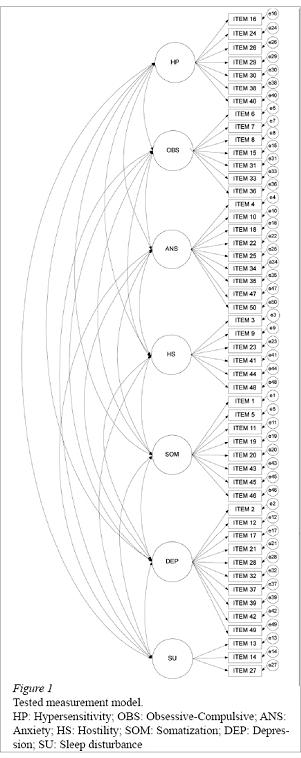
<body><![CDATA[<br>   </p>       <p class="western" style="text-indent: 0.7cm; margin-bottom: 0cm; line-height: 150%;" align="justify"> <font color="#000000"><font face="Verdana, sans-serif"><font size="2"><span lang="es-ES"><i>- Listado de S&iacute;ntomas Breve</i></span></font></font></font><font color="#000000"><font face="Verdana, sans-serif"><font size="2"><span lang="es-ES"> - Short Checklist of Symptoms - (LSB-50; <a href="#deRivera">de Rivera &amp; Abui&#769;n</a>, 2012; <a name="delaIglesiaFernandez_"></a><a href="#delaIglesiaFernandez">de la Iglesia, Fern&aacute;ndez Liporace, &amp; Castro Solano</a>, 2015). </span></font></font></font><font color="#000000"><font face="Verdana, sans-serif"><font size="2"><span lang="en-US">This is a 50-item scale that assesses different psychological symptoms in seven main clinical scales: (a) </span></font></font></font><font color="#000000"><font face="Verdana, sans-serif"><font size="2"><span lang="en-US"><i>Hypersensitivity</i></span></font></font></font><font color="#000000"><font face="Verdana, sans-serif"><font size="2"><span lang="en-US"> (seven items), that refers to intra and interpersonal sensitivity (e.g. &ldquo;I think other people look at me or talk about me&rdquo;); (b) </span></font></font></font><font color="#000000"><font face="Verdana, sans-serif"><font size="2"><span lang="en-US"><i>Obsessive-Compulsive</i></span></font></font></font><font color="#000000"><font face="Verdana, sans-serif"><font size="2"><span lang="en-US"> (seven items), which attempts to cover the presence of doubts, rituals, and compulsions (e.g. &ldquo;I have to do things very slowly in order to be sure that I am doing them properly&rdquo;); (c) </span></font></font></font><font color="#000000"><font face="Verdana, sans-serif"><font size="2"><span lang="en-US"><i>Anxiety</i></span></font></font></font><font color="#000000"><font face="Verdana, sans-serif"><font size="2"><span lang="en-US"> (nine items), that enquires about symptoms of panic, general anxiety disorder and phobic disorders (e.g. &ldquo;I feel fearful in the street or in open spaces&rdquo;); (d) </span></font></font></font><font color="#000000"><font face="Verdana, sans-serif"><font size="2"><span lang="en-US"><i>Hostility</i></span></font></font></font><font color="#000000"><font face="Verdana, sans-serif"><font size="2"><span lang="en-US"> (six items), which asks about behaviours of rage, anger and resentment (e.g. &ldquo;I want to break or destroy something&rdquo;); (e) </span></font></font></font><font color="#000000"><font face="Verdana, sans-serif"><font size="2"><span lang="en-US"><i>Somatization</i></span></font></font></font><font color="#000000"><font face="Verdana, sans-serif"><font size="2"><span lang="en-US"> (eight items), that assesses somatic symptoms that have basis on psychological or medical problems (e.g. &ldquo;My heart beats really fast&rdquo;); (f) </span></font></font></font><font color="#000000"><font face="Verdana, sans-serif"><font size="2"><span lang="en-US"><i>Depression</i></span></font></font></font><font color="#000000"><font face="Verdana, sans-serif"><font size="2"><span lang="en-US"> (ten items), which examines lack of energy, and feelings of guilt, sadness, and hopelessness (e.g. &ldquo;I feel sad&rdquo;); and (g) </span></font></font></font><font color="#000000"><font face="Verdana, sans-serif"><font size="2"><span lang="en-US"><i>Sleep disturbance </i></span></font></font></font><font color="#000000"><font face="Verdana, sans-serif"><font size="2"><span lang="en-US">(three items), that inquires possible sleeping difficulties from a wellbeing perspective (e.g. &ldquo;I wake up at dawn&rdquo;). Items are answered by a 5-point likert scale which ranges from 0 = nothing to 4 = a lot.</span></font></font></font></p>       <p class="western" style="text-indent: 0.7cm; margin-bottom: 0cm; line-height: 150%;" align="justify"> <font color="#000000"><font face="Verdana, sans-serif"><font size="2"><i>- Personality Assessment Inventory-Adolescents </i></font></font></font><font color="#000000"><font face="Verdana, sans-serif"><font size="2">(PAI-A; <a name="Cardenal_"></a><a href="#Cardenal">Cardenal, Ortiz Tallo, &amp; Santamar&iacute;a</a>, 2012; <a href="#Stover">Stover, de la Iglesia, Castro Solano, &amp; Fern&aacute;ndez Liporace</a>, 2015; <a name="Morey_"></a><a href="#Morey">Morey</a>, 2008). </font></font></font><font color="#000000"><font face="Verdana, sans-serif"><font size="2"><span lang="en-US">This instrument was designed to assess psychopathology in adolescents aged between 12 and 18. It is composed by 264 items that allow calculating several scales. For the purpose of this research, only some scales and subscales will be used: </span></font></font></font><font color="#000000"><font face="Verdana, sans-serif"><font size="2"><span lang="en-US"><i>Paranoia, Obsessive-Compulsive </i></span></font></font></font><font color="#000000"><font face="Verdana, sans-serif"><font size="2"><span lang="en-US">(subscale of Anxiety Related Disorders), </span></font></font></font><font color="#000000"><font face="Verdana, sans-serif"><font size="2"><span lang="en-US"><i>Anxiety, Aggression, Somatic Complaints, Depression </i></span></font></font></font><font color="#000000"><font face="Verdana, sans-serif"><font size="2"><span lang="en-US">and </span></font></font></font><font color="#000000"><font face="Verdana, sans-serif"><font size="2"><span lang="en-US"><i>Stress</i></span></font></font></font><font color="#000000"><font face="Verdana, sans-serif"><font size="2"><span lang="en-US">. Local adaptation included the analysis of internal consistency by Cronbach&rsquo;s alphas, and principal component analysis to study its dimensionality (<a name="Stover_"></a><a href="#Stover">Stover, de la Iglesia, Castro Solano, &amp; Fern&aacute;ndez Liporace</a>, 2015).</span></font></font></font></p>       <p class="western" style="margin-bottom: 0cm; line-height: 150%;" align="justify" lang="en-US">     <br>   </p>       <p class="western" style="margin-bottom: 0cm; line-height: 150%;" align="justify" lang="en-US"> <font face="Verdana, sans-serif"><font size="2"><i><b>Procedure</b></i></font></font></p>       <p class="western" style="text-indent: 0.7cm; margin-bottom: 0cm; line-height: 150%;" align="justify" lang="en-US">     <br>   </p>       <p class="western" style="text-indent: 0.7cm; margin-bottom: 0cm; line-height: 150%;" align="justify" lang="en-US"> <font face="Verdana, sans-serif"><font size="2">It was a non-randomized sample. All participants were volunteers and their parents had to sign an informed consent as a requirement. Data was gathered by trained psychology students from a university in Buenos Aires with senior researchers supervising their work. </font></font> </p>       <p class="western" style="text-indent: 0.7cm; margin-bottom: 0cm; line-height: 150%;" align="justify" lang="en-US"> <font face="Verdana, sans-serif"><font size="2">The tested model proposed a first-order factorial structure where 50 observed elements (psychopathology symptoms) were loaded in seven clinical scales (see <a href="#Figure1">Figure 1</a>). For the cross-validation analyses and invariance testing the software EQS 6.2 was used. Due to the categorical nature of the items (Likert scaled), the estimation method ran for both analyses was robust maximum likelihood, using the polychoric correlation matrix. This type of method and matrix are more appropriate when variables are ordinal and when there is evidence of high values of skewness and kurtosis (<a name="Freiberg_"></a><a href="#Freiberg">Freiberg Hoffmann, Stover, de la Iglesia, &amp; Fern&aacute;ndez Liporace</a>, 2013; <a name="Muthen_"></a><a href="#Muthen">Muth&eacute;n &amp; Kaplan</a>, 1985). </font></font> </p>       ]]></body>
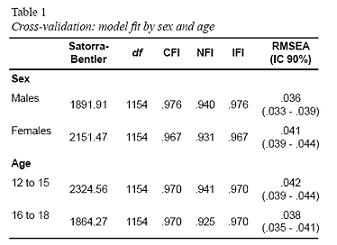
<body><![CDATA[<p class="western" style="text-indent: 0.7cm; margin-bottom: 0cm; line-height: 150%;" align="justify" lang="en-US"> <font face="Verdana, sans-serif"><font size="2">To test for model fit in the cross validation study, different indexes obtained by the robust method were examined: CFI (Comparative Fit Index), NFI (Normed Fit Index), IFI (Incremental Fit Index) and RMSEA (Root Mean Square Error of Approximation). CFI, NFI and IFI values are considered to be appropriate when they are above .90. RMSEA, on the other hand, should be below .05 (<a href="#Byrne">Byrne</a>, 2006; <a name="Kline_"></a><a href="#Kline">Kline</a>, 1998). </font></font> </p>       <p class="western" style="text-indent: 0.7cm; margin-bottom: 0cm; line-height: 150%;" align="justify"> <font color="#000000"><font face="Verdana, sans-serif"><font size="2"><span lang="en-US">In order to analyze factorial invariance, hierarchical models with constrains were studied. MODEL 1 had no constraints, MODEL 2 constrained loadings, and MODEL 3 constrained loadings and covariances. This analysis was done twice: first, to test invariance between the female and male subsamples; and secondly, to test invariance between younger and older groups of adolescents (12-15 year olds vs. 16-18 year</span></font></font></font><font color="#000000"><font face="Verdana, sans-serif"><font size="2"><span lang="en-US"> olds). Fit was assessed by the Satorra Bentler scaled statistic (S-B), CFI and RMSEA. Invariance was tested by the </span></font></font></font><font color="#000000"><font face="Verdana, sans-serif"><font size="2"><span lang="es-ES">&Delta;</span></font></font></font><font color="#000000"><font face="Verdana, sans-serif"><font size="2"><span lang="en-US">S-B and the </span></font></font></font><font color="#000000"><font face="Verdana, sans-serif"><font size="2"><span lang="es-ES">&Delta;</span></font></font></font><font color="#000000"><font face="Verdana, sans-serif"><font size="2"><span lang="en-US">CFI. The former was expected to be statistically no significant at a .05 alpha level, while the latter was expected to be lower than .01 (<a href="#Byrne">Byrne</a>, 2006).</span></font></font></font></p>       <p class="western" style="text-indent: 0.7cm; margin-bottom: 0cm; line-height: 150%;" align="justify" lang="en-US"> <font face="Verdana, sans-serif"><font size="2">Finally, external criterion correlations were calculated with SPSS 18.0 and ordinal alphas were calculated with Excel following the procedure suggested by <a href="#Elosua">Elos&uacute;a and Zumbo</a> (2008).</font></font></p>       <p class="western" style="text-indent: 0.7cm; margin-bottom: 0cm; line-height: 150%;" align="justify" lang="en-US"><a name="Figure1"></a><a href="/img/revistas/cp/v10n1/1a07f1.jpg"> Figure 1</a>    <br>   </p>       <p class="western" style="margin-bottom: 0cm; line-height: 150%;" align="justify" lang="en-US">     <br>   </p>       <p class="western" style="text-indent: 0.7cm; margin-bottom: 0cm; line-height: 150%;" align="justify" lang="en-US">     <br>   </p>       <p class="western" style="margin-bottom: 0cm; line-height: 150%;" align="justify" lang="en-US"> <font face="Verdana, sans-serif"><font size="2"><b>Results</b></font></font></p>       ]]></body>
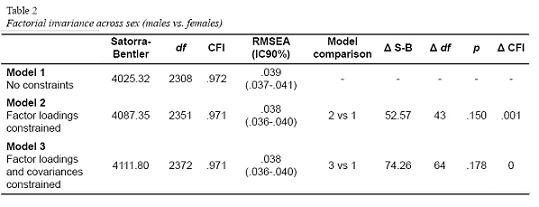
<body><![CDATA[<p class="western" style="text-indent: 0.7cm; margin-bottom: 0cm; line-height: 150%;" align="justify" lang="en-US">     <br>   </p>       <p class="western" style="text-indent: 0.7cm; margin-bottom: 0cm; line-height: 150%;" align="justify" lang="en-US"> <font face="Verdana, sans-serif"><font size="2">First, cross-validation analyses were conducted to test if the fit of the model prevailed in samples differentiated by sex and age. Thus, the male and the female subsamples were tested separately. As seen in Table 1, fit indexes showed to be an excellent fit for both groups. Model fit was also tested in two age samples: adolescents aged 12-15 years and 16-18 years. Again, fit indexes showed the appropriateness of the model (<a href="#t1">Table 1</a>).</font></font></p>       <p class="western" style="text-indent: 0.7cm; margin-bottom: 0cm; line-height: 150%;" align="justify" lang="en-US"><a name="t1"></a><img style="width: 337px; height: 245px;" alt="" src="/img/revistas/cp/v10n1/1a07t1.jpg">    <br>   </p>       <p class="western" style="text-indent: 0.7cm; margin-bottom: 0cm; line-height: 150%;" align="justify" lang="en-US"> <font face="Verdana, sans-serif"><font size="2">Additionally, hierarchical models with constrains were studied in order to analyse factorial invariance. To study invariance between the samples differentiated by sex, the fit was firstly tested in a model without constraints (MODEL 1). Both CFI and RMSEA values were adequate (see Table 2). A second model (MODEL 2) imposed constraints in all factor loadings. Again, model fit showed the expected values. The third and last model tested (MODEL 3) also imposed constraints in covariances. In this case, model fit was also correct. </font></font> </p>       <p class="western" style="text-indent: 0.7cm; margin-bottom: 0cm; line-height: 150%;" align="justify"> <font color="#000000"><font face="Verdana, sans-serif"><font size="2"><span lang="en-US">Furthermore, <a href="#t2">Table 2</a> shows values for model comparison. The difference in the Satorra-Bentler scaled statistic (</span></font></font></font><font color="#000000"><font face="Verdana, sans-serif"><font size="2"><span lang="es-ES">&Delta;</span></font></font></font><font color="#000000"><font face="Verdana, sans-serif"><font size="2"><span lang="en-US">S-B) corresponding to the comparison of MODEL 1 versus MODEL 2 was not significant at an alpha level of .05. Change in CFI was minimum (.001). In the case of the more constrained (MODEL 3), there was no significant change in the S-B scaled statistic (</span></font></font></font><font color="#000000"><font face="Verdana, sans-serif"><font size="2"><span lang="en-US"><i>p</i></span></font></font></font><font color="#000000"><font face="Verdana, sans-serif"><font size="2"><span lang="en-US"> &gt; .05). Moreover, in this case, CFI showed no change in fit (invariance).</span></font></font></font></p>       <p class="western" style="text-indent: 0.7cm; margin-bottom: 0cm; line-height: 150%;" align="justify" lang="en-US"><a name="t2"></a><img style="width: 539px; height: 207px;" alt="" src="/img/revistas/cp/v10n1/1a07t2.jpg">    <br>   </p>       <p class="western" style="text-indent: 0.7cm; margin-bottom: 0cm; line-height: 150%;" align="justify" lang="en-US"> &nbsp;</p>       ]]></body>
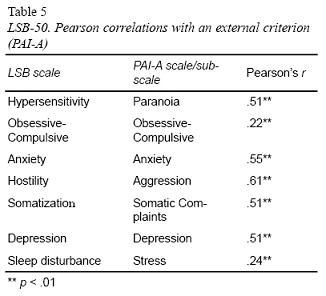
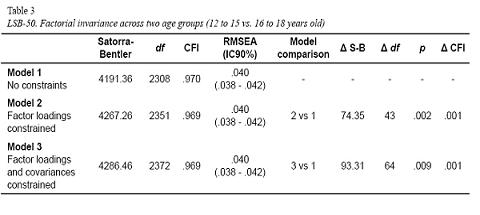
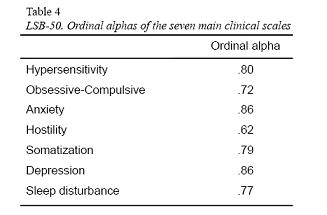
<body><![CDATA[<p class="western" style="text-indent: 0.7cm; margin-bottom: 0cm; line-height: 150%;" align="justify" lang="en-US"> <font face="Verdana, sans-serif"><font size="2">When testing for factorial invariance in groups compared by age, the same procedures were performed. That is, a model with no constraints was firstly tested (MODEL 1); then, factor loadings were imposed (MODEL 2); and finally, covariances were constrained (MODEL 3). CFI and RMSEA values were adequate in all cases (<a href="#t3">Table 3</a>). Model comparison showed a significant statistical difference in the Satorra-Bentler scaled statistic between MODEL 1 and 2, and also between MODEL 1 and MODEL 3. In both cases, a change of .001 was found in the CFI.</font></font></p>       <p class="western" style="text-indent: 0.7cm; margin-bottom: 0cm; line-height: 150%;" align="justify" lang="en-US"><a name="t3"></a><img style="width: 480px; height: 215px;" alt="" src="/img/revistas/cp/v10n1/1a07t3.jpg">    <br>   </p>       <p class="western" style="text-indent: 0.7cm; margin-bottom: 0cm; line-height: 150%;" align="justify" lang="en-US"> &nbsp;</p>       <p class="western" style="text-indent: 0.7cm; margin-bottom: 0cm; line-height: 150%;" align="justify"> <font color="#000000"><font face="Verdana, sans-serif"><font size="2"><span lang="en-US">Then, considering that all items are responded in a Likert-type scale, ordinal alphas were calculated to study internal consistency.</span></font></font></font><font color="#000000"><font face="Verdana, sans-serif"><font size="2"><span lang="en-US"> As seen in Table 4, all ordinal alphas indicate excellent internal consistency.</span></font></font></font></p>       <p class="western" style="text-indent: 0.7cm; margin-bottom: 0cm; line-height: 150%;" align="justify"><a name="t4"></a><img style="width: 327px; height: 215px;" alt="" src="/img/revistas/cp/v10n1/1a07t4.jpg">    <br>  </p>       <p class="western" style="text-indent: 0.7cm; margin-bottom: 0cm; line-height: 150%;"> <font color="#000000"><font face="Verdana, sans-serif"><font size="2"><span lang="en-US">Finally, in order to obtain evidences of validity by external criterion, Pearson correlations were calculated between the clinical scales of the LSB-50 and their paires of the PAI-A. The association between the LSB-50&rsquo;s Hypersensitivity scale and Paranoia was positive and moderate (</span></font></font></font><font color="#000000"><font face="Verdana, sans-serif"><font size="2"><span lang="en-US"><i>r</i></span></font></font></font><font color="#000000"><font face="Verdana, sans-serif"><font size="2"><span lang="en-US"> = .51; p &lt; .001). The Obsession-Compulsion scale showed a positive but low correlation    <br>  (</span></font></font></font><font color="#000000"><font face="Verdana, sans-serif"><font size="2"><span lang="en-US"><i>r</i></span></font></font></font><font color="#000000"><font face="Verdana, sans-serif"><font size="2"><span lang="en-US"> = .22; p &lt; .001) with the Obsessive-Compulsive subscale of the Anxiety Related Disorders (ARD) scale. The association between the Anxiety scales was positive and moderate     <br>  (</span></font></font></font><font color="#000000"><font face="Verdana, sans-serif"><font size="2"><span lang="en-US"><i>r</i></span></font></font></font><font color="#000000"><font face="Verdana, sans-serif"><font size="2"><span lang="en-US"> = .55; p &lt; .001). Hostility had a positive and strong correlation with PAI-A&rsquo;s Aggression scale (</span></font></font></font><font color="#000000"><font face="Verdana, sans-serif"><font size="2"><span lang="en-US"><i>r</i></span></font></font></font><font color="#000000"><font face="Verdana, sans-serif"><font size="2"><span lang="en-US"> = .61; p &lt; .001). The correlation between Somatization and Somatic Complaints was also positive and moderate (</span></font></font></font><font color="#000000"><font face="Verdana, sans-serif"><font size="2"><span lang="en-US"><i>r</i></span></font></font></font><font color="#000000"><font face="Verdana, sans-serif"><font size="2"><span lang="en-US"> = .51; p &lt; .001). The relation between the Depression scales was positive and moderate (</span></font></font></font><font color="#000000"><font face="Verdana, sans-serif"><font size="2"><span lang="en-US"><i>r</i></span></font></font></font><font color="#000000"><font face="Verdana, sans-serif"><font size="2"><span lang="en-US"> = .57; p &lt; .001). And finally, Stress was chosen as the external criterion for Sleep disturbance. The result indicated that their association was positive and low (</span></font></font></font><font color="#000000"><font face="Verdana, sans-serif"><font size="2"><span lang="en-US"><i>r</i></span></font></font></font><font color="#000000"><font face="Verdana, sans-serif"><font size="2"><span lang="en-US"> = .24; p &lt; .001) (<a href="#t5">Table 5</a>).</span></font></font></font></p>       ]]></body>
<body><![CDATA[<p class="western" style="text-indent: 0.7cm; margin-bottom: 0cm; line-height: 150%;" align="justify" lang="en-US"><a name="t5"></a><img style="width: 326px; height: 296px;" alt="" src="/img/revistas/cp/v10n1/1a07t5.jpg">    <br>   </p>       <p class="western" style="margin-bottom: 0cm; line-height: 150%;" align="justify" lang="en-US">     <br>   </p>       <p class="western" style="margin-bottom: 0cm; line-height: 150%;" align="justify" lang="en-US"> <font face="Verdana, sans-serif"><font size="2"><b>Discussion</b></font></font></p>       <p class="western" style="text-indent: 0.7cm; margin-bottom: 0cm; line-height: 150%;" align="justify" lang="en-US">     <br>   </p>       <p class="western" style="text-indent: 0.7cm; margin-bottom: 0cm; line-height: 150%;" align="justify"> <font color="#000000"><font face="Verdana, sans-serif"><font size="2"><span lang="en-US">The purpose of this research was to study the psychometric properties of the LSB-50 (<a name="deRivera_"></a><a href="#deRivera">de Rivera &amp; Abu&iacute;n</a>, 2012) in a sample of Argentinean adolescents. The results of the present study found support for the seven-factor structure in the cross-validation and factorial invariance. In the former, the model exhibited good fit in female and male samples as well as in the younger and older groups. Factorial invariance was found in all the proposed models, which entailed different restrictions of equivalency. However, the </span></font></font></font><font color="#000000"><font face="Verdana, sans-serif"><font size="2"><span lang="es-ES">&Delta;</span></font></font></font><font color="#000000"><font face="Verdana, sans-serif"><font size="2"><span lang="en-US">S-B was statistically significant when studying invariance across the age, while the </span></font></font></font><font color="#000000"><font face="Verdana, sans-serif"><font size="2"><span lang="es-ES">&Delta;</span></font></font></font><font color="#000000"><font face="Verdana, sans-serif"><font size="2"><span lang="en-US">CFI was minimal, indicating a good overall fit of all models (<a name="Byrne_"></a><a href="#Byrne">Byrne</a>, 2006). Moreover, the goodness of fit was also reach at the level of the item, providing a more strict proof of construct validity than when the sum of scores are used as input values for factorization.</span></font></font></font></p>       <p class="western" style="text-indent: 0.7cm; margin-bottom: 0cm; line-height: 150%;" align="justify" lang="en-US"> <font face="Verdana, sans-serif"><font size="2">It is possible that the positive results of this study may rely on two issues. Firstly, as mentioned, the LSB-50 was carefully designed to overcome the alleged flaws of the SCL-90-R. The thorough examination of that instrument - considering results from globally conducted studies - may have had a positive impact in content validity and consequently positively affected the result of factorial analyses. Secondly, the analyses conducted in the present research contemplated the ordinal nature of the elements under study, using polychoric matrixes and robust methods in all cases. It is possible that this statistic decision also favoured the results obtained.</font></font></p>       <p class="western" style="text-indent: 0.7cm; margin-bottom: 0cm; line-height: 150%;" align="justify" lang="en-US"> <font face="Verdana, sans-serif"><font size="2">Finally, in regards to internal consistency, as stated, previous studies commonly used Cronbach&rsquo;s alphas for its assessment. In general, psychopathology screening measures showed good results when using this procedure (e.g. <a name="Abuin_"></a><a href="#Abuin">Abu&iacute;n &amp; de Rivera</a>, 2014; <a name="Caparros_"></a><a href="#Caparros">Caparr&oacute;s Caparr&oacute;s</a> et al., 2007; <a name="Carrasco_"></a><a href="#Carrasco">Carrasco Ort&iacute;z</a> et al., 2003; <a name="Casullo_"></a><a href="#Casullo">Casullo &amp; Castro Solano</a>, 1999; <a name="Ruiperez_"></a><a href="#Ruiperez">Ruip&eacute;rez</a> et al., 2001). However, <a name="Elosua_"></a><a href="#Elosua">Elos&uacute;a and Zumbo</a> (2008) proposed the use of ordinal alphas as a more appropriate choice when scores are obtained in Likert scales. In this study, the ordinal alphas for the seven scales of the LSB-50 indicated good internal consistency.</font></font></p>       ]]></body>
<body><![CDATA[<p class="western" style="text-indent: 0.7cm; margin-bottom: 0cm; line-height: 150%;" align="justify" lang="en-US"> <font face="Verdana, sans-serif"><font size="2">Also, it was important to determine if the LSB-50&rsquo;s clinical scales were correlated with a diagnostic measure as the PAI-A. As expected, mostly positive and moderate associations were found. The were some exceptions such as the Obsession-Compulsion and Sleep disturbance scales that showed positive but low correlations with the Obsessive-Compulsive subscale of ARD and the Stress scale, respectively. </font></font> </p>       <p class="western" style="text-indent: 0.7cm; margin-bottom: 0cm; line-height: 150%;" align="justify" lang="en-US"> <font face="Verdana, sans-serif"><font size="2">In the case of Obsession-Compulsion, the weak association with the Obssessive-Compulsive subscale of ARD may be due to differences in the content of the items that form the scale. Despite having the same name, the LSB-50&rsquo;s Obsession-Compulsion score refers to the presence of doubts and rituals or compulsions, while the PAI-A&rsquo;s Obsessive-Compulsive subscale mostly refers to indecision, rigidity and perfectionism. Although both scales share the measurement of doubts/indecision, the remaining items cover different content, which certainly explains the weak but positive association between them.</font></font></p>       <p class="western" style="text-indent: 0.7cm; margin-bottom: 0cm; line-height: 150%;" align="justify" lang="en-US"> <font face="Verdana, sans-serif"><font size="2">As Sleep disturbance did not have an exact correlate in the PAI-A, the Stress scale was chosen as its external criterion. However, both scales do not measure the same construct. Notwithstanding, a positive correlation was expected between them as stressed individuals tend to also experience some sleep disturbance. The results obtained provide support to this assumption.</font></font></p>       <p class="western" style="text-indent: 0.7cm; margin-bottom: 0cm; line-height: 150%;" align="justify" lang="en-US"> <font face="Verdana, sans-serif"><font size="2">Regarding the limitations of the study, they are centred on two issues. Firstly, the sample was nonrandomized. Although this is a common practice within psychology researches, it might entail restrictions for the generalization of the results obtained. Secondly, the LSB-50 does not yet count with external validity evidence. Consequently, further studies should test this aspect and provide information about sensitivity, specificity, negative and positive predictive values, as well as Receiving Operating Characteristic curves to establish adequate cut-off values.</font></font></p>       <p class="western" style="text-indent: 0.7cm; margin-bottom: 0cm; line-height: 150%;" align="justify"> <font color="#000000"><font face="Verdana, sans-serif"><font size="2"><span lang="en-US">Previous research on the psychometric properties of other screening measures of psychopathology - such as the SCL-90, the SCL-90-R, the BSI, the BSI-18, and the SA-54 - provided little evidence of validity of a multidimensional model. Since those psychometric measures for screening psychopathology tend to show serious difficulties to demonstrate evidence of construct validity as well as separated scores for the proposed clinical scales (e.g. <a name="Benishek_"></a><a href="#Benishek">Benishek</a> et al., 1998; <a name="Hardt_"></a><a href="#Hardt">Hardt</a> et al., 2000; <a name="Liu_"></a><a href="#Liu">Liu</a> et al., 2013; <a name="Ming_"></a><a href="#Ming">Ming-zhi</a> et al. 2004; <a name="Rauter_"></a><a href="#Rauter">Rauter</a> et al., 1996; <a name="Sandin_"></a><a href="#Sandin">Sand&iacute;n</a> et al., 2008; <a name="Schmitz_"></a><a href="#Schmitz">Schmitz</a> et al., 2000; <a name="Vassend_"></a><a href="#Vassend">Vassend &amp; Skrondal</a>, 1999), rigorous factorial analyses result imperative for any new instrument that alleges to constitute an improvement of the former instruments. Cross-validation studies and the test of factorial invariance are among the strictest calculations for testing construct validity and proving the multidimensionality of a psychometric instrument. The Argentinean adaptation of the LSB-50 has shown evidence of construct validity and reliability. It should be highlighted that the robust statistics obtained support the calculation of seven separated clinical scales: </span></font></font></font><font color="#000000"><font face="Verdana, sans-serif"><font size="2"><span lang="en-US"><i>Hypersensitivity, Obsession-Compulsion, Anxiety, Hostility, Somatization, Depression, </i></span></font></font></font><font color="#000000"><font face="Verdana, sans-serif"><font size="2"><span lang="en-US">and </span></font></font></font><font color="#000000"><font face="Verdana, sans-serif"><font size="2"><span lang="en-US"><i>Sleep disturbance</i></span></font></font></font><font color="#000000"><font face="Verdana, sans-serif"><font size="2"><span lang="en-US">. Therefore, this scale is recommended for its use in research and applied psychological fields with Argentinean adolescents. </span></font></font></font> </p>       <p class="western" style="text-indent: 1.25cm; margin-bottom: 0cm; line-height: 150%;" align="justify" lang="en-US">     <br>   </p>       <p class="western" style="margin-bottom: 0cm; line-height: 120%;" align="justify" lang="es-ES"> <font face="Verdana, sans-serif"><font size="2"><b>References  </b></font></font> </p>       <p class="western" style="margin-bottom: 0cm; line-height: 150%;" align="justify" lang="es-ES">     <br>   </p>       ]]></body>
<body><![CDATA[<!-- ref --><p class="western" style="margin-left: 1cm; text-indent: -1cm; margin-bottom: 0cm; line-height: 150%;" align="justify"> <a name="Abuin"></a><font color="#000000"><font face="Verdana, sans-serif"><font size="2"><span lang="es-ES"><a href="#Abuin_">Abu&iacute;n</a>, M. R., &amp; de Rivera, L. (2014). La medicio&#769;n de si&#769;ntomas psicolo&#769;gicos y psicosoma&#769;ticos: El Listado de Si&#769;ntomas Br</span></font></font></font><font color="#000000"><font face="Verdana, sans-serif"><font size="2"><span lang="es-ES">eve (LSB-50). </span></font></font></font><font color="#000000"><font face="Verdana, sans-serif"><font size="2"><span lang="en-US"><i>Cl&iacute;nica y Salud, 25</i></span></font></font></font><font color="#000000"><font face="Verdana, sans-serif"><font size="2"><span lang="en-US">, 131-141. doi: 10.1016/j.clysa.2014.06.001</span></font></font></font><p class="western" style="margin-left: 1cm; text-indent: -1cm; margin-bottom: 0cm; line-height: 150%;" align="justify"> <a name="Aroian"></a><font color="#000000"><font face="Verdana, sans-serif"><font size="2"><span lang="en-US"><a href="#Aroian_">Aroian</a>, K. J., Patsdaughter, C. A., Levin, A., &amp; Gianan, M. E. (1995). Use of the Brief Symptom Inventory to assess psychological distress in three immigrants groups. </span></font></font></font><font color="#000000"><font face="Verdana, sans-serif"><font size="2"><span lang="en-US"><i>International Journal of Social Psychiatry, 41</i></span></font></font></font><font color="#000000"><font face="Verdana, sans-serif"><font size="2"><span lang="en-US">(1), 31&ndash;46.</span></font></font></font></p>       <!-- ref --><p class="western" style="margin-left: 1cm; text-indent: -1cm; margin-bottom: 0cm; line-height: 150%;" align="justify"> <a name="Alvarado"></a><font color="#000000"><font face="Verdana, sans-serif"><font size="2"><span lang="en-US"><a href="#Alvarado_">Alvarado</a>, B. G., Sandi&#769;n, B., Valdez-Medina, J. L., Gonza&#769;lez-Arratia, N., &amp; Rivera, S. (2012). Confirmatory Factor Analysis of the SA-45 Questionnaire in a Mexican simple. </span></font></font></font><font color="#000000"><sup><font face="Verdana, sans-serif"><font size="2"><span lang="es-ES"><i>Anales de </i></span></font></font></sup></font><sup><font face="Verdana, sans-serif"><font size="2"><span lang="es-ES"><i>Psicolog&iacute;a,</i></span></font></font></sup><sup><font face="Verdana, sans-serif"><font size="2"><span lang="es-ES"> 28(2), 426-433. doi: </span></font></font></sup><font face="Verdana, sans-serif"><font size="2"><span lang="es-ES">10.6018/analesps.28.2.148851</span></font></font><!-- ref --><p class="western" style="margin-left: 1cm; text-indent: -1cm; margin-bottom: 0cm; line-height: 150%;" align="justify"> <a name="Angold"></a><font face="Verdana, sans-serif"><font size="2"><span lang="es-ES"><a href="#Angold_">Angold</a>, A., Costello, E.J., &amp; Worthman, C.M. (1998). </span></font></font><font face="Verdana, sans-serif"><font size="2"><span lang="en-US">Puberty and depression: the roles of age, pubertal status and pubertal timing. </span></font></font><font face="Verdana, sans-serif"><font size="2"><span lang="es-ES"><i>Psychological Medicine, 28</i></span></font></font><font face="Verdana, sans-serif"><font size="2"><span lang="es-ES">(1), 51-61.    </span></font></font></p>       <!-- ref --><p class="western" style="margin-left: 1cm; text-indent: -1cm; margin-bottom: 0cm; line-height: 150%;" align="justify"> <a name="Bados"></a><font face="Verdana, sans-serif"><font size="2"><span lang="es-ES"><a href="#Bados_">Bados</a> L&oacute;pez, A., Balaguer, G., &amp; Coronas, M. (2005). Qu&eacute; mide realmente el SCL 90 R?: Estructura factorial en una muestra mixta de universitarios y pacientes. </span></font></font><font face="Verdana, sans-serif"><font size="2"><span lang="es-ES"><i>Psicolog&iacute;a Conductual Revista Internacional de Psicolog&iacute;a Cl&iacute;nica de la Salud, 13</i></span></font></font><font face="Verdana, sans-serif"><font size="2"><span lang="es-ES">(2), 181-196.    </span></font></font></p>       <p class="western" style="margin-left: 1cm; text-indent: -1cm; margin-bottom: 0cm; line-height: 150%;" align="justify"> <a name="Benishek"></a><font face="Verdana, sans-serif"><font size="2"><span lang="en-US"><a href="#Benishek_">Benishek</a>, L. A., Hayes, C. M., Bieschke, K. J., &amp; Stoffelmayr, B. E. (1998). Exploratory and confirmatory analyses of the Brief Symptom Inventory among substance abusers. </span></font></font><font face="Verdana, sans-serif"><font size="2"><span lang="en-US"><i>Journal of Substance Abuse, 10</i></span></font></font><font face="Verdana, sans-serif"><font size="2"><span lang="en-US">(2),</span></font></font><font face="Verdana, sans-serif"><font size="2"><span lang="en-US"><i> </i></span></font></font><font face="Verdana, sans-serif"><font size="2"><span lang="en-US">103&ndash;114. doi: 10.1016/S0899-3289(99)80127-8</span></font></font></p>       <p class="western" style="margin-left: 1cm; text-indent: -1cm; margin-bottom: 0cm; line-height: 150%;" align="justify"> <a name="Bonynge"></a><font face="Verdana, sans-serif"><font size="2"><span lang="en-US"><a href="#Bonynge_">Bonynge</a>, E. R. (1993). Unidimensionality of SCL-90-R scales in adult and adolescent crisis samples. </span></font></font><font face="Verdana, sans-serif"><font size="2"><span lang="en-US"><i>Journal of Clinical Psychology, 49</i></span></font></font><font face="Verdana, sans-serif"><font size="2"><span lang="en-US">(2), 212&ndash;215. Doi:  10.1002/1097-4679(199303)49:2&lt;212::AID-JCLP2270490213&gt;3.0.CO;2-V</span></font></font></p>       <p class="western" style="margin-left: 1cm; text-indent: -1cm; margin-bottom: 0cm; line-height: 150%;" align="justify"> <a name="Boulet"></a><font face="Verdana, sans-serif"><font size="2"><span lang="en-US"><a href="#Boulet_">Boulet</a>, J., &amp; Boss, M. W. (1991). Reliability and validity of the Brief Symptom Inventory. </span></font></font><font face="Verdana, sans-serif"><font size="2"><span lang="en-US"><i>Psychological Assessment: A Journal of Consulting and Clinical Psychology, 3</i></span></font></font><font face="Verdana, sans-serif"><font size="2"><span lang="en-US">(3), 433&ndash;437. doi: 10.1037/1040-3590.3.3.433</span></font></font></p>       ]]></body>
<body><![CDATA[<!-- ref --><p class="western" style="margin-left: 1cm; text-indent: -1cm; margin-bottom: 0cm; line-height: 150%;" align="justify"> <a name="Briggs"></a><font face="Verdana, sans-serif"><font size="2"><span lang="en-US"><a href="#Briggs_">Briggs</a>, S. (2009). Risks and opportunities in adolescence: understanding adolescent mental health difficulties. </span></font></font><font face="Verdana, sans-serif"><font size="2"><span lang="en-US"><i>Journal of Social Work Practice: Psychotherapeutic Approaches in Health, Welfare and the Community, 23</i></span></font></font><font face="Verdana, sans-serif"><font size="2"><span lang="en-US">(1), 49-64. doi: 10.1080/02650530902723316</span></font></font><!-- ref --><p class="western" style="margin-left: 1cm; text-indent: -1cm; margin-bottom: 0cm; line-height: 150%;" align="justify"> <a name="Byrne"></a><font color="#000000"><font face="Verdana, sans-serif"><font size="2"><span lang="en-US"><a href="#Byrne_">Byrne</a>, B. M. (2006). </span></font></font></font><font color="#000000"><font face="Verdana, sans-serif"><font size="2"><span lang="en-US"><i>Structural Equation Modeling with EQS. Basic concepts, applications and programming</i></span></font></font></font><font color="#000000"><font face="Verdana, sans-serif"><font size="2"><span lang="en-US"> (2</span></font></font></font><font color="#000000"><sup><font face="Verdana, sans-serif"><font size="2"><span lang="en-US">nd</span></font></font></sup></font><font color="#000000"><font face="Verdana, sans-serif"><font size="2"><span lang="en-US"> ed.). New York: Routledge.    </span></font></font></font></p>       <!-- ref --><p class="western" style="margin-left: 1cm; text-indent: -1cm; margin-bottom: 0cm; line-height: 150%;" align="justify"> <a name="Caparros"></a><font color="#000000"><font face="Verdana, sans-serif"><font size="2"><span lang="en-US"><a href="#Caparros_">Caparr&oacute;s</a> Caparr&oacute;s, B., Villar-Hoz, E., Juan Ferrer, J., &amp; Vi&ntilde;as-Poch, F. (2007). </span></font></font></font><font color="#000000"><font face="Verdana, sans-serif"><font size="2"><span lang="es-ES">Symptom Check-List-90-R: Fiabilidad, datos normativos y estructura factorial en estudiantes universitarios. </span></font></font></font><font color="#000000"><font face="Verdana, sans-serif"><font size="2"><span lang="en-US"><i>International Journal of Clinical and Health Psychology, 7</i></span></font></font></font><font color="#000000"><font face="Verdana, sans-serif"><font size="2"><span lang="en-US">(3), 781-794.    </span></font></font></font></p>       <!-- ref --><p class="western" style="margin-left: 1cm; text-indent: -1cm; margin-bottom: 0cm; line-height: 150%;" align="justify"> <a name="Cardenal"></a><font color="#000000"><font face="Verdana, sans-serif"><font size="2"><span lang="en-US"><a href="#Cardenal_">Cardenal</a>, V., Ortiz Tallo, M., &amp; Santamar&iacute;a, P. (2012). </span></font></font></font><font color="#000000"><font face="Verdana, sans-serif"><font size="2"><span lang="es-ES"><i>PAI-A. Inventario de evaluaci&oacute;n de la personalidad para adolescentes. Manual de aplicaci&oacute;n -Versi&oacute;n experimental.</i></span></font></font></font><font color="#000000"><font face="Verdana, sans-serif"><font size="2"><span lang="es-ES"> Madrid: TEA Ediciones.    </span></font></font></font></p>       <!-- ref --><p class="western" style="margin-left: 1cm; text-indent: -1cm; margin-bottom: 0cm; line-height: 150%;" align="justify"> <a name="Carrasco"></a><font color="#000000"><font face="Verdana, sans-serif"><font size="2"><span lang="es-ES"><a href="#Carrasco_">Carrasco</a> Ortiz, M. A., Sa&#769;nchez Moral, V., Ciccotelli, H., &amp; del Barrio, V. (2003). Listado De Si&#769;ntomas SCL-90-R: Ana&#769;lisis de su Comportamiento en una Muestra Cli&#769;nica. </span></font></font></font><font color="#000000"><font face="Verdana, sans-serif"><font size="2"><span lang="es-ES"><i>Acci&oacute;n Psicol&oacute;gica, 2</i></span></font></font></font><font color="#000000"><font face="Verdana, sans-serif"><font size="2"><span lang="es-ES">(2), 149-161.    </span></font></font></font></p>       <!-- ref --><p class="western" style="margin-left: 1cm; text-indent: -1cm; margin-bottom: 0cm; line-height: 150%;" align="justify"> <a name="Casullo"></a><font color="#000000"><font face="Verdana, sans-serif"><font size="2"><span lang="es-ES"><a href="#Casullo_">Casullo</a>, M. M., &amp; Castro Solano, A. (1999). S&iacute;ntomas psicopatol&oacute;gicos en estudiantes adolescentes argentinos. Aportaciones del SCL-90. </span></font></font></font><font color="#000000"><font face="Verdana, sans-serif"><font size="2"><span lang="es-ES"><i>Anuario de Investigaciones, 7</i></span></font></font></font><font color="#000000"><font face="Verdana, sans-serif"><font size="2"><span lang="es-ES">, 147-157.    </span></font></font></font></p>       <!-- ref --><p class="western" style="margin-left: 1cm; text-indent: -1cm; margin-bottom: 0cm; line-height: 150%;" align="justify"> <a name="Corcoran"></a><font color="#000000"><font face="Verdana, sans-serif"><font size="2"><span lang="es-ES"><a href="#Corcoran_">Corcoran</a>, K., &amp; Fischer, J. (2000). </span></font></font></font><font color="#000000"><font face="Verdana, sans-serif"><font size="2"><span lang="en-US"><i>Measures for Clinical Practice. A sourcebook.</i></span></font></font></font><font color="#000000"><font face="Verdana, sans-serif"><font size="2"><span lang="en-US"> New York: The Free Press.    </span></font></font></font></p>       <!-- ref --><p class="western" style="margin-left: 1cm; text-indent: -1cm; margin-bottom: 0cm; line-height: 150%;" align="justify"> <a name="Cyr"></a><font color="#000000"><font face="Verdana, sans-serif"><font size="2"><span lang="en-US"><a href="#Cyr_">Cyr</a>, J. J., McKenna-Foley, J. M., &amp; Peacock, E. (1985). Factor structure of the SCL-90-R: Is there one? </span></font></font></font><font color="#000000"><font face="Verdana, sans-serif"><font size="2"><span lang="en-US"><i>Journal of Personality Assessment, 49</i></span></font></font></font><font color="#000000"><font face="Verdana, sans-serif"><font size="2"><span lang="en-US">(6), 571-578. doi:10.1207/s15327752jpa4906_2</span></font></font></font><!-- ref --><p class="western" style="margin-left: 1cm; text-indent: -1cm; margin-bottom: 0cm; line-height: 150%;" align="justify"> <a name="Daoud"></a><font color="#000000"><font face="Verdana, sans-serif"><font size="2"><span lang="en-US"><a href="#Daoud_">Daoud</a>, F. S., &amp; Abojedi, A. A. (2010). Equivalent factorial structure of the Brief Symptom Inventory (BSI) in clinical and nonclinical Jordanian populations. </span></font></font></font><font color="#000000"><font face="Verdana, sans-serif"><font size="2"><span lang="en-US"><i>European Journal of Psychological Assessment, 26</i></span></font></font></font><font color="#000000"><font face="Verdana, sans-serif"><font size="2"><span lang="en-US">(2), 116-121. doi: 10.1027/1015-5759/a000016)</span></font></font></font><!-- ref --><p class="western" style="margin-left: 1cm; text-indent: -1cm; margin-bottom: 0cm; line-height: 150%;" align="justify"> <a name="Davison"></a><font color="#000000"><font face="Verdana, sans-serif"><font size="2"><span lang="en-US"><a href="#Davison_">Davison</a>, M. L., Bershadsky, B., Bieber, J., Silversmith, D., Maruish, M. E., &amp; Kane, R. L. (1997). Development of a brief, multidimensional, self-report instrument for treatment outcomes assessment in psychiatric settings: Preliminary findings. </span></font></font></font><font color="#000000"><font face="Verdana, sans-serif"><font size="2"><span lang="es-ES"><i>Assessment, 4</i></span></font></font></font><font color="#000000"><font face="Verdana, sans-serif"><font size="2"><span lang="es-ES">(3),</span></font></font></font><font color="#000000"><font face="Verdana, sans-serif"><font size="2"><span lang="es-ES"><i> </i></span></font></font></font><font color="#000000"><font face="Verdana, sans-serif"><font size="2"><span lang="es-ES">259-276.    </span></font></font></font></p>       <!-- ref --><p class="western" style="margin-left: 1cm; text-indent: -1cm; margin-bottom: 0cm; line-height: 150%;" align="justify"> <font color="#000000"><font face="Verdana, sans-serif"><font size="2"><span lang="es-ES"><a name="delaIglesiaFernandez"></a><a href="#delaIglesiaFernandez_">de la Iglesia</a>, G., Fern&aacute;ndez Liporace, M., &amp; Castro Solano, A. (2015). </span></font></font></font><font color="#000000"><font face="Verdana, sans-serif"><font size="2"><span lang="en-US"><i>Psychometric study of the main clinical scales of the Listado de S&iacute;ntomas Breve (LSB-50) -Short Checklist of Symptoms- in Argentinean adolescents. </i></span></font></font></font><font color="#000000"><font face="Verdana, sans-serif"><font size="2"><span lang="es-ES">Manuscript submitted for publication.    </span></font></font></font></p>       <!-- ref --><p class="western" style="margin-left: 1cm; text-indent: -1cm; margin-bottom: 0cm; line-height: 150%;" align="justify"> <font color="#000000"><font face="Verdana, sans-serif"><font size="2"><span lang="es-ES"><a name="delaIglesiaCastro"></a>de la Iglesia, G., Castro Solano, A., &amp; Fern&aacute;ndez Liporace, M. (2015, in press). Adaptaci&oacute;n del PAI-A en poblaci&oacute;n de adolescentes argentinos. En Santamar&iacute;a Fern&aacute;ndez, P. (Ed.), </span></font></font></font><font color="#000000"><font face="Verdana, sans-serif"><font size="2"><span lang="es-ES"><i>Adaptaci&oacute;n del Inventario de Evaluaci&oacute;n de la Personalidad (PAI-A) en poblaci&oacute;n Argentina</i></span></font></font></font><font color="#000000"><font face="Verdana, sans-serif"><font size="2"><span lang="es-ES">. Madrid: TEA.    </span></font></font></font></p>       <!-- ref --><p class="western" style="margin-left: 1cm; text-indent: -1cm; margin-bottom: 0cm; line-height: 150%;" align="justify"> <font color="#000000"><font face="Verdana, sans-serif"><font size="2"><span lang="es-ES"><a name="DeLasCuevas"></a><a href="#DeLasCuevas_">De Las Cuevas</a>, C., Gonzalez De Rivera, J. L., Henry Benitez, M., Monterrey, A. L., Rodriguez-Pulido, F., &amp; Gracia Marco, R. (1991). Ana&#769;lisis factorial de la versio&#769;n espan&#771;ola del SCL-90-R en la poblacio&#769;n general </span></font></font></font><font color="#000000"><font face="Verdana, sans-serif"><font size="2"><span lang="es-ES"><i>Anales de psiquiatr&iacute;a, 7</i></span></font></font></font><font color="#000000"><font face="Verdana, sans-serif"><font size="2"><span lang="es-ES">(3), 93-96.    </span></font></font></font></p>       <!-- ref --><p class="western" style="margin-left: 1cm; text-indent: -1cm; margin-bottom: 0cm; line-height: 150%;" align="justify"> <font color="#000000"><font face="Verdana, sans-serif"><font size="2"><span lang="es-ES"><a name="deRivera"></a><a href="#deRivera_">de Rivera</a>, L., &amp; Abui&#769;n, M. L. (2012). </span></font></font></font><font color="#000000"><font face="Verdana, sans-serif"><font size="2"><span lang="es-ES"><i>LSB-50 Listado de Si&#769;ntomas Breve: Manual</i></span></font></font></font><font color="#000000"><font face="Verdana, sans-serif"><font size="2"><span lang="es-ES">. </span></font></font></font><font color="#000000"><font face="Verdana, sans-serif"><font size="2"><span lang="en-US">Espan&#771;a: TEA Ediciones.    </span></font></font></font></p>       <!-- ref --><p class="western" style="margin-left: 1cm; text-indent: -1cm; margin-bottom: 0cm; line-height: 150%;" align="justify"> <a name="Derogatis75"></a><font color="#000000"><font face="Verdana, sans-serif"><font size="2"><span lang="en-US"><a href="#Derogatis75_">Derogatis</a>, L. R. (1975). </span></font></font></font><font color="#000000"><font face="Verdana, sans-serif"><font size="2"><span lang="en-US"><i>Brief Symptom Inventory.</i></span></font></font></font><font color="#000000"><font face="Verdana, sans-serif"><font size="2"><span lang="en-US"> Baltimore: Clinical Psychometric Research.    </span></font></font></font></p>       <p class="western" style="margin-left: 1cm; text-indent: -1cm; margin-bottom: 0cm; line-height: 150%;" align="justify"> <a name="Derogatis83"></a><font color="#000000"><font face="Verdana, sans-serif"><font size="2"><span lang="en-US"><a href="#Derogatis83_">Derogatis</a>, L. R. (1983). </span></font></font></font><font color="#000000"><font face="Verdana, sans-serif"><font size="2"><span lang="en-US"><i>SCL&ndash;90&ndash;R: Administration, scoring, and procedures manual II.</i></span></font></font></font><font color="#000000"><font face="Verdana, sans-serif"><font size="2"><span lang="en-US"> Baltimore: Clinical Psychometric Research.</span></font></font></font></p>       <!-- ref --><p class="western" style="margin-left: 1cm; text-indent: -1cm; margin-bottom: 0cm; line-height: 150%;" align="justify"> <a name="Derogatis01"></a><font color="#000000"><font face="Verdana, sans-serif"><font size="2"><span lang="en-US"><a href="#Derogatis01_">Derogatis</a>, L. R. (2001). </span></font></font></font><font color="#000000"><font face="Verdana, sans-serif"><font size="2"><span lang="en-US"><i>The Brief Symptom Inventory 18 (BSI 18). Administration, scoring and procedures manual.</i></span></font></font></font><font color="#000000"><font face="Verdana, sans-serif"><font size="2"><span lang="en-US"> Minneapolis: NCS Pearson, Inc.    </span></font></font></font></p>       ]]></body>
<body><![CDATA[<!-- ref --><p class="western" style="margin-left: 1cm; text-indent: -1cm; margin-bottom: 0cm; line-height: 150%;" align="justify"> <a name="Derogatis82"></a><font color="#000000"><font face="Verdana, sans-serif"><font size="2"><span lang="en-US"><a href="#Derogatis82_">Derogatis</a>, L. R., &amp; Spencer, M. S. (1982). </span></font></font></font><font color="#000000"><font face="Verdana, sans-serif"><font size="2"><span lang="en-US"><i>The Brief Symptom Inventory (BSI): Administration, scoring, and procedures manual.</i></span></font></font></font><font color="#000000"><font face="Verdana, sans-serif"><font size="2"><span lang="en-US"> Baltimore: Johns Hopkins University School of Medicine, Clinical Psychometrics Research Unit.    </span></font></font></font></p>       <!-- ref --><p class="western" style="margin-left: 1cm; text-indent: -1cm; margin-bottom: 0cm; line-height: 150%;" align="justify"> <a name="Eaton"></a><font color="#000000"><font face="Verdana, sans-serif"><font size="2"><span lang="en-US"><a href="#Eaton_">Eaton</a>, W. W., Neufeld, K., Chen, L., &amp; Cai, G. (2000). A comparison of self-report and clinical diagnostic interviews for depression: Diagnostic Interview Schedule and Schedules for Clinical assessment in Neuropsychiatry in the Baltimore Epidemiologic Catchment area follow-up. </span></font></font></font><font color="#000000"><font face="Verdana, sans-serif"><font size="2"><span lang="en-US"><i>Archives of General Psychiatry, 57</i></span></font></font></font><font color="#000000"><font face="Verdana, sans-serif"><font size="2"><span lang="en-US">(3), 217-222. doi: 10.1001/archpsyc.57.3.217</span></font></font></font><!-- ref --><p class="western" style="margin-left: 1cm; text-indent: -1cm; margin-bottom: 0cm; line-height: 150%;" align="justify"> <a name="Elosua"></a><font color="#000000"><font face="Verdana, sans-serif"><font size="2"><span lang="en-US"><a href="#Elosua_">Elosu&#769;a</a>, P., &amp; Zumbo, B. D. (2008). </span></font></font></font><font color="#000000"><font face="Verdana, sans-serif"><font size="2"><span lang="es-ES">Coeficientes de fiabilidad para escalas de respuesta catego&#769;rica ordenada </span></font></font></font><font color="#000000"><font face="Verdana, sans-serif"><font size="2"><span lang="es-ES"><i>Psicothema, 20</i></span></font></font></font><font color="#000000"><font face="Verdana, sans-serif"><font size="2"><span lang="es-ES">(4), 896-901.    </span></font></font></font></p>       <!-- ref --><p class="western" style="margin-left: 1cm; text-indent: -1cm; margin-bottom: 0cm; line-height: 150%;" align="justify"> <a name="Freiberg"></a><font color="#000000"><font face="Verdana, sans-serif"><font size="2"><span lang="es-ES"><a href="#Freiberg_">Freiberg</a> Hoffmann, A., Stover, J. B., de la Iglesia, G., &amp; Fern&aacute;ndez Liporace, M. (2013). Correlaciones </span></font></font></font><font face="Verdana, sans-serif"><font size="2"><span lang="es-ES">Polic&oacute;ricas y Tetrac&oacute;ricas en Estudios Exploratorios y Confirmatorios. </span></font></font><font face="Verdana, sans-serif"><font size="2"><span lang="es-ES"><i>Ciencias Psicol&oacute;gicas, 7</i></span></font></font><font face="Verdana, sans-serif"><font size="2"><span lang="es-ES">(2), 151-164.    </span></font></font></p>       <!-- ref --><p class="western" style="margin-left: 1cm; text-indent: -1cm; margin-bottom: 0cm; line-height: 150%;" align="justify"> <a name="Graham"></a><font face="Verdana, sans-serif"><font size="2"><span lang="en-US"><a href="#Graham_">Graham</a>, P. (2004). EOA: </span></font></font><font face="Verdana, sans-serif"><font size="2"><span lang="en-US"><i>The End of Adolescence</i></span></font></font><font face="Verdana, sans-serif"><font size="2"><span lang="en-US">. New York: Oxford University Press.    </span></font></font></p>       <!-- ref --><p class="western" style="margin-left: 1cm; text-indent: -1cm; margin-bottom: 0cm; line-height: 150%;" align="justify"> <a name="Grande"></a><font face="Verdana, sans-serif"><font size="2"><span lang="en-US"><a href="#Grande_">Grande</a>, T. L. (2014). Path analysis of the SCL-90-R: Exploring use in outpatient assessment. </span></font></font><font face="Verdana, sans-serif"><font size="2"><span lang="en-US"><i>Measurement and Evaluation in Counseling and Development. </i></span></font></font><font face="Verdana, sans-serif"><font size="2"><span lang="en-US">Advance online publication. doi: 10.1177/0748175614538061.    </span></font></font></p>       <!-- ref --><p class="western" style="margin-left: 1cm; text-indent: -1cm; margin-bottom: 0cm; line-height: 150%;" align="justify"> <a name="Hardt"></a><font face="Verdana, sans-serif"><font size="2"><span lang="en-US"><a href="#Hardt_">Hardt</a>, J., Gerbershagen, H. U., &amp; Franke, P. (2000). The symptom checklist, SCL-90-R: Its use and characteristics in chronic pain patients. </span></font></font><font face="Verdana, sans-serif"><font size="2"><span lang="en-US"><i>European Journal of Pain</i></span></font></font><font face="Verdana, sans-serif"><font size="2"><span lang="en-US">, </span></font></font><font face="Verdana, sans-serif"><font size="2"><span lang="en-US"><i>4</i></span></font></font><font face="Verdana, sans-serif"><font size="2"><span lang="en-US">(2), 137-148. doi: 10.1053/eujp.2000.0162</span></font></font><p class="western" style="margin-left: 1cm; text-indent: -1cm; margin-bottom: 0cm; line-height: 150%;" align="justify"> <a name="Helgeland"></a><font face="Verdana, sans-serif"><font size="2"><span lang="en-US"><a href="#Helgeland_">Helgeland</a>, M.I., Kjelsberg, E., &amp; Torgersen, S. (2005). Continuities between emotional and disruptive behavior disorders in adolescence and personality disorders in adulthood. </span></font></font><font face="Verdana, sans-serif"><font size="2"><span lang="es-ES"><i>American Journal of Psychiatry, 162, </i></span></font></font><font face="Verdana, sans-serif"><font size="2"><span lang="es-ES">1941&ndash;1947.</span></font></font></p>       <!-- ref --><p class="western" style="margin-left: 1cm; text-indent: -1cm; margin-bottom: 0cm; line-height: 150%;" align="justify"> <a name="Hernaandez"></a><font color="#000000"><font face="Verdana, sans-serif"><font size="2"><span lang="pt-PT"><a href="#Hernandez_">Herna&#769;ndez</a>-Aguado, I., Gil de Miguel, A., Delgado Rodriguez, M., Bolu&#769;mar Montrull, F., Benavides, F. G., Porta Serra, M., &Aacute;lvarez-Dardet D&iacute;az, C., Vioque L&oacute;pez, J. ... Lumbrera Lacarra, B. (2011). </span></font></font></font><font color="#000000"><font face="Verdana, sans-serif"><font size="2"><span lang="pt-PT"><i>Manual de Epidemiologi&#769;a y Salud Pu&#769;blica para grados en Ciencias de la Salud </i></span></font></font></font><font color="#000000"><font face="Verdana, sans-serif"><font size="2"><span lang="pt-PT">(2&ordf; ed.)</span></font></font></font><font color="#000000"><font face="Verdana, sans-serif"><font size="2"><span lang="pt-PT"><i>.</i></span></font></font></font><font color="#000000"><font face="Verdana, sans-serif"><font size="2"><span lang="pt-PT"> </span></font></font></font><font color="#000000"><font face="Verdana, sans-serif"><font size="2"><span lang="en-US">Madrid: Me&#769;dica Panamericana.    </span></font></font></font></p>       <!-- ref --><p class="western" style="margin-left: 1cm; text-indent: -1cm; margin-bottom: 0cm; line-height: 150%;" align="justify"> <a name="Hoffmann"></a><font color="#000000"><font face="Verdana, sans-serif"><font size="2"><span lang="en-US"><a href="#Hoffmann_">Hoffmann</a>, N. G., &amp; Overall, P. B. (1978). Factor Structure of the SCL-90 in a Psychiatric Population. </span></font></font></font><font color="#000000"><font face="Verdana, sans-serif"><font size="2"><span lang="en-US"><i>Journal of Consulting and Clinical Psychology, 46</i></span></font></font></font><font color="#000000"><font face="Verdana, sans-serif"><font size="2"><span lang="en-US">(6), 1187-1191. doi: 10.1037/0022-</span></font></font></font><font face="Verdana, sans-serif"><font size="2"><span lang="en-US">006X.46.6.1187</span></font></font><!-- ref --><p class="western" style="margin-left: 1cm; text-indent: -1cm; margin-bottom: 0cm; line-height: 150%;" align="justify"> <a name="Holi"></a><font face="Verdana, sans-serif"><font size="2"><span lang="en-US"><a href="#Holi_">Holi</a>, M. (2003). </span></font></font><font face="Verdana, sans-serif"><font size="2"><span lang="en-US"><i>Assessment of psychiatric symptoms using the SCL-90</i></span></font></font><font face="Verdana, sans-serif"><font size="2"><span lang="en-US"> (Doctoral dissertation, Department of Psychiatry, University of Helsinki, Helsinki, Finland). Retrieved from <a href="http://ethesis.helsinki.fi/julkaisut/laa/kliin/vk/holi/assessme.pdf">http://ethesis.helsinki.fi/julkaisut/laa/kliin/vk/holi/assessme.pdf</a></span></font></font><!-- ref --><p class="western" style="margin-left: 1cm; text-indent: -1cm; margin-bottom: 0cm; line-height: 150%;" align="justify"> <a name="Jessor87"></a><font face="Verdana, sans-serif"><font size="2"><span lang="en-US"><a href="#Jessor87_">Jessor</a>, R. (1987). Problem-behavior theory, psychosocial development, and adolescent problem drinking. </span></font></font><font face="Verdana, sans-serif"><font size="2"><span lang="en-US"><i>British Journal of Addiction, 82</i></span></font></font><font face="Verdana, sans-serif"><font size="2"><span lang="en-US">(4), 331-342. doi: 10.1111/j.1360-0443.1987.tb01490.x</span></font></font><!-- ref --><p class="western" style="margin-left: 1cm; text-indent: -1cm; margin-bottom: 0cm; line-height: 150%;" align="justify"> <a name="Jessor91"></a><font face="Verdana, sans-serif"><font size="2"><span lang="en-US"><a href="#Jessor91_">Jessor</a>, R. (1991). Risk behavior in adolescence: a psychosocial framework for understanding and action. </span></font></font><font face="Verdana, sans-serif"><font size="2"><span lang="en-US"><i>Journal of Adolescent Health, 12</i></span></font></font><font face="Verdana, sans-serif"><font size="2"><span lang="en-US">(8), 597-605.     </span></font></font> </p>       ]]></body>
<body><![CDATA[<!-- ref --><p class="western" style="margin-left: 1cm; text-indent: -1cm; margin-bottom: 0cm; line-height: 150%;" align="justify"> <a name="Kline"></a><font face="Verdana, sans-serif"><font size="2"><span lang="en-US"><a href="#Kline_">Kline</a>, R. B. (1998). </span></font></font><font face="Verdana, sans-serif"><font size="2"><span lang="en-US"><i>Principles and practice of structural equation modelling.</i></span></font></font><font face="Verdana, sans-serif"><font size="2"><span lang="en-US"> New York: The Guilford Press.    </span></font></font></p>       <!-- ref --><p class="western" style="margin-left: 1cm; text-indent: -1cm; margin-bottom: 0cm; line-height: 150%;" align="justify"> <a name="Kofler"></a><font face="Verdana, sans-serif"><font size="2"><span lang="en-US"><a href="#Kofler_">Kofler</a>, M.J., Rapport, M.D., Bolden, J., Sarver, D.E., Raiker, J.S., &amp; Alderson, R.M. (2011). Working memory deficits and social problems in children with ADHD. </span></font></font><font face="Verdana, sans-serif"><font size="2"><span lang="en-US"><i>Journal of Abnormal Child Psychology, 39</i></span></font></font><font face="Verdana, sans-serif"><font size="2"><span lang="en-US">(6), 805-817.     </span></font></font> </p>       <!-- ref --><p class="western" style="margin-left: 1cm; text-indent: -1cm; margin-bottom: 0cm; line-height: 150%;" align="justify"> <a name="Kohn"></a><font face="Verdana, sans-serif"><font size="2"><span lang="pt-PT"><a href="#Kohn_">Kohn</a>, R., Levav, I., Caldas de Almeida, J. M., Vicente, B., Andrade, L., Caraveo-Anduaga, J. J., Saxena, S., </span></font></font><font face="Verdana, sans-serif"><font size="2"><span lang="pt-PT">&amp; Saraceno, B. (2005). </span></font></font><font face="Verdana, sans-serif"><font size="2"><span lang="es-ES">Los trastornos mentales en Ame&#769;rica Latina y el Caribe: Asunto prioritario para la salud pu&#769;blica </span></font></font><font face="Verdana, sans-serif"><font size="2"><span lang="es-ES"><i>Revista Panamericana de Salud P&uacute;blica, 18</i></span></font></font><font face="Verdana, sans-serif"><font size="2"><span lang="es-ES"> (4/5), 229-240.    </span></font></font></p>       <!-- ref --><p class="western" style="margin-left: 1cm; text-indent: -1cm; margin-bottom: 0cm; line-height: 150%;" align="justify"> <a name="Lewis"></a><font color="#000000"><font face="Verdana, sans-serif"><font size="2"><span lang="en-US"><a href="#Lewis_">Lewis</a>, G., Sheringham, J., Kalim, K., &amp; Crayford, T. (2008). </span></font></font></font><font color="#000000"><font face="Verdana, sans-serif"><font size="2"><span lang="en-US"><i>Mastering Public Health: A postgraduate guide to examinations and revalidation: A Guide to Examinations and Revalidation.</i></span></font></font></font><font color="#000000"><font face="Verdana, sans-serif"><font size="2"><span lang="en-US"> Londres: Royal Society of Medicine Press.    </span></font></font></font></p>       <!-- ref --><p class="western" style="margin-left: 1cm; text-indent: -1cm; margin-bottom: 0cm; line-height: 150%;" align="justify"> <a name="Liu"></a><font color="#000000"><font face="Verdana, sans-serif"><font size="2"><span lang="en-US"><a href="#Liu_">Liu</a>, Z., Chen, H., Cao, B., &amp; Jiao, F. (2013). Reliability and validity of Chinese version of Brief Symptom Inventory in high school students. </span></font></font></font><font color="#000000"><font face="Verdana, sans-serif"><font size="2"><span lang="en-US"><i>Chinese Journal of Clinical Psychology, 21</i></span></font></font></font><font color="#000000"><font face="Verdana, sans-serif"><font size="2"><span lang="en-US">(1), 32-34.    </span></font></font></font></p>       ]]></body>
<body><![CDATA[<!-- ref --><p class="western" style="margin-left: 1cm; text-indent: -1cm; margin-bottom: 0cm; line-height: 150%;" align="justify"> <a name="Loutsiou"></a><font color="#000000"><font face="Verdana, sans-serif"><font size="2"><span lang="en-US"><a href="#Loutsiou_">Loutsiou</a>-Ladd, A., Panayiotou, G., &amp; Kokkinos, C. M. (2008). A review of the factorial structure of the Brief Symptom Inventory (BSI): Greek evidence. </span></font></font></font><font color="#000000"><font face="Verdana, sans-serif"><font size="2"><span lang="es-ES"><i>International Journal of Testing, 8</i></span></font></font></font><font color="#000000"><font face="Verdana, sans-serif"><font size="2"><span lang="es-ES">(1), 90-110. doi:10.1080/15305050701808680</span></font></font></font><!-- ref --><p class="western" style="margin-left: 1cm; text-indent: -1cm; margin-bottom: 0cm; line-height: 150%;" align="justify"> <a name="Martinez"></a><font color="#000000"><font face="Verdana, sans-serif"><font size="2"><span lang="es-ES"><a href="#Martinez_">Mart&iacute;nez</a> Azumendi, O., Fern&aacute;ndez G&oacute;mez, C., &amp; Beit&iacute;a Fern&aacute;ndez, M. (2001). Variabilidad factorial del SCL-90-R en una muestra psiquia&#769;trica ambulatoria. </span></font></font></font><font color="#000000"><font face="Verdana, sans-serif"><font size="2"><span lang="es-ES"><i>Actas Espa&ntilde;olas de Psiquiatr&iacute;a, 29</i></span></font></font></font><font color="#000000"><font face="Verdana, sans-serif"><font size="2"><span lang="es-ES">(2), 95-102.    </span></font></font></font></p>       <p class="western" style="margin-left: 1cm; text-indent: -1cm; margin-bottom: 0cm; line-height: 150%;" align="justify"> <a name="Ministerio"></a><font color="#000000"><font face="Verdana, sans-serif"><font size="2"><span lang="es-ES"><a href="#Ministerio_">Ministerio</a> de Salud (2010). </span></font></font></font><font color="#000000"><font face="Verdana, sans-serif"><font size="2"><span lang="es-ES"><i>Estimacio&#769;n de la poblacio&#769;n afectada de 15 an&#771;os y ma&#769;s por trastornos mentales y adicciones. </i></span></font></font></font><font color="#000000"><font face="Verdana, sans-serif"><font size="2"><span lang="en-US">Retrieved from <a href="http://www.inclusionmental.com.ar/contents/biblioteca/1329413814_%96estimacion%96de%96la%96poblacion%96afectada%96por%96salud%96mental%96arg.pdf">http://www.inclusionmental.com.ar/contents/biblioteca/1329413814_&ndash;estimacion&ndash;de&ndash;la&ndash;poblacion&ndash;afectada&ndash;por&ndash;salud&ndash;mental&ndash;arg.pdf</a></span></font></font></font></p>       <!-- ref --><p class="western" style="margin-left: 1cm; text-indent: -1cm; margin-bottom: 0cm; line-height: 150%;" align="justify"> <a name="Ming"></a><font color="#000000"><font face="Verdana, sans-serif"><font size="2"><span lang="en-US"><a href="#Ming_">Ming-zhi</a>, X.,&nbsp;Heng-fen, L., &amp;&nbsp;Huei-fang, Z. (2004). Factorial Structure of the Symptom Checklist 90 (SCL-90) in College Students. </span></font></font></font><font color="#000000"><font face="Verdana, sans-serif"><font size="2"><span lang="en-US"><i>Chinese Journal of Clinical Psychology, 12</i></span></font></font></font><font color="#000000"><font face="Verdana, sans-serif"><font size="2"><span lang="en-US">(4), 2004, 348-351.    </span></font></font></font></p>       <!-- ref --><p class="western" style="margin-left: 1cm; text-indent: -1cm; margin-bottom: 0cm; line-height: 150%;" align="justify"> <a name="Morey"></a><font color="#000000"><font face="Verdana, sans-serif"><font size="2"><span lang="en-US"><a href="#Morey_">Morey</a>, L. C. (2008). </span></font></font></font><font color="#000000"><font face="Verdana, sans-serif"><font size="2"><span lang="en-US"><i>Personality Assessment Inventory - Adolescent (PAI-A).</i></span></font></font></font><font color="#000000"><font face="Verdana, sans-serif"><font size="2"><span lang="en-US"> Florida: Psychological Assessment Resources Inc.    </span></font></font></font></p>       <!-- ref --><p class="western" style="margin-left: 1cm; text-indent: -1cm; margin-bottom: 0cm; line-height: 150%;" align="justify"> <a name="Muthen"></a><font color="#000000"><font face="Verdana, sans-serif"><font size="2"><span lang="en-US"><a href="#Muthen_">Muthen</a>, B., &amp; Kaplan, D. (1985). A comparison of some methodologies for the factor analysis of non-normal Likert variables. </span></font></font></font><font color="#000000"><font face="Verdana, sans-serif"><font size="2"><span lang="en-US"><i>British Journal of Mathematical and Statistical Psychology, 38</i></span></font></font></font><font color="#000000"><font face="Verdana, sans-serif"><font size="2"><span lang="en-US">, 171-189.     </span></font></font></font> </p>       ]]></body>
<body><![CDATA[<!-- ref --><p class="western" style="margin-left: 1cm; text-indent: -1cm; margin-bottom: 0cm; line-height: 150%;" align="justify"> <a name="Piersma"></a><font color="#000000"><font face="Verdana, sans-serif"><font size="2"><span lang="en-US"><a href="#Piersma_">Piersma</a>, H. L., Boes, J. L., &amp; Reaume, W. M. (1994). Unidimensionality of the Brief Symptom Inventory (BSI) in adult and adolescent inpatients. </span></font></font></font><font color="#000000"><font face="Verdana, sans-serif"><font size="2"><span lang="en-US"><i>Journal of Personality Assessment, 63</i></span></font></font></font><font color="#000000"><font face="Verdana, sans-serif"><font size="2"><span lang="en-US">(2), 33</span></font></font></font><font face="Verdana, sans-serif"><font size="2"><span lang="en-US">8-344. doi: 10.1207/s15327752jpa6302_12 </span></font></font> <!-- ref --><p class="western" style="margin-left: 1cm; text-indent: -1cm; margin-bottom: 0cm; line-height: 150%;" align="justify"> <a name="Prunas"></a><font face="Verdana, sans-serif"><font size="2"><span lang="pt-PT"><a href="#Prunas_">Prunas</a>, A., Sarno, I., Preti, E., Madeddu, F., &amp; Perugini, M. (2012). </span></font></font><font face="Verdana, sans-serif"><font size="2"><span lang="en-US">Psychometric properties of the Italian version of the SCL-90-R: A study on a large community sample. </span></font></font><font face="Verdana, sans-serif"><font size="2"><span lang="en-US"><i>European Psychiatry, 27</i></span></font></font><font face="Verdana, sans-serif"><font size="2"><span lang="en-US">(8), 591-597. doi: 10.1016/j.eurpsy.2010.12.006</span></font></font><!-- ref --><p class="western" style="margin-left: 1cm; text-indent: -1cm; margin-bottom: 0cm; line-height: 150%;" align="justify"> <a name="Quiroga"></a><font face="Verdana, sans-serif"><font size="2"><span lang="en-US"><a href="#Quiroga_">Quiroga</a>, C.V., Janosz, M., Bisset, S., Morin, A.J.S. (2013). Early Adolescent Depression Symptoms and School Dropout: Mediating Processes Involving Self-Reported Academic Competence and Achievement. </span></font></font><font face="Verdana, sans-serif"><font size="2"><span lang="en-US"><i>Journal of Educational Psychology, 105</i></span></font></font><font face="Verdana, sans-serif"><font size="2"><span lang="en-US">(2), 552-560.    </span></font></font></p>       <!-- ref --><p class="western" style="margin-left: 1cm; text-indent: -1cm; margin-bottom: 0cm; line-height: 150%;" align="justify"> <a name="Rauter"></a><font face="Verdana, sans-serif"><font size="2"><span lang="en-US"><a href="#Rauter_">Rauter</a>, U. K.,&nbsp;Leonard, C. E., &amp;&nbsp;Swett, C. P. (1996). SCL-90-R factor structure in an acute, involuntary, adult psychiatric inpatient sample. </span></font></font><font face="Verdana, sans-serif"><font size="2"><span lang="en-US"><i>Journal of Clinical Psychology</i></span></font></font><font face="Verdana, sans-serif"><font size="2"><span lang="en-US">, </span></font></font><font face="Verdana, sans-serif"><font size="2"><span lang="en-US"><i>52</i></span></font></font><font face="Verdana, sans-serif"><font size="2"><span lang="en-US">(6), 625-629. doi: 10.1002/(SICI)1097-4679(199611)52:6&lt;625::AID-JCLP4&gt;3.0.CO;2-J</span></font></font><!-- ref --><p class="western" style="margin-left: 1cm; text-indent: -1cm; margin-bottom: 0cm; line-height: 150%;" align="justify"> <a name="Rojas"></a><font face="Verdana, sans-serif"><font size="2"><span lang="en-US"><a href="#Rojas_">Rojas</a> Gualdr&oacute;n, D. F. (2012). </span></font></font><font face="Verdana, sans-serif"><font size="2"><span lang="es-ES"><i>Capacidad Explicativa de los Si&#769;ntomas del LSB-50 sobre un &Uacute;nico Factor de Psicopatologi&#769;a General</i></span></font></font><font face="Verdana, sans-serif"><font size="2"><span lang="es-ES"> Presented at the I Congreso Internacional de Psicolog&iacute;a: Investigaci&oacute;n y Responsabilidad Social, Bucaramanga, Colombia.    </span></font></font></p>       <p class="western" style="margin-left: 1cm; text-indent: -1cm; margin-bottom: 0cm; line-height: 150%;" align="justify"> <a name="Ruiperez"></a><font face="Verdana, sans-serif"><font size="2"><span lang="es-ES"><a href="#Ruiperez_">Ruip&eacute;rez</a>, M. A., Ib&aacute;&ntilde;ez, M. I., Lorente, E., Moro, M., &amp; Ortet, G. (2001). </span></font></font><font face="Verdana, sans-serif"><font size="2"><span lang="en-US">Psychometric Properties of the Spanish Version of the BSI: Contributions to the Relationship Between Personality and Psychopathology. </span></font></font><font face="Verdana, sans-serif"><font size="2"><span lang="en-US"><i>European Journal of Psychological Assessment, 17</i></span></font></font><font face="Verdana, sans-serif"><font size="2"><span lang="en-US">(3), 241&ndash;250. doi: 10.1027//1015-5759.17.3.241</span></font></font></p>       <!-- ref --><p class="western" style="margin-left: 1cm; text-indent: -1cm; margin-bottom: 0cm; line-height: 150%;" align="justify"> <a name="Sandin"></a><font face="Verdana, sans-serif"><font size="2"><span lang="en-US"><a href="#Sandin_">Sand&iacute;n</a>, B., Valiente, R. M., Chorot, P., Santed M. A., &amp; Lostao, L. (2008). </span></font></font><font face="Verdana, sans-serif"><font size="2"><span lang="es-ES">SA-45: forma abreviada del SCL-90 </span></font></font><font face="Verdana, sans-serif"><font size="2"><span lang="es-ES"><i>Psicothema</i></span></font></font><font face="Verdana, sans-serif"><font size="2"><span lang="es-ES">,</span></font></font><font face="Verdana, sans-serif"><font size="2"><span lang="es-ES"><i> 20</i></span></font></font><font face="Verdana, sans-serif"><font size="2"><span lang="es-ES">(2), 290-296.    </span></font></font></p>       ]]></body>
<body><![CDATA[<!-- ref --><p class="western" style="margin-left: 1cm; text-indent: -1cm; margin-bottom: 0cm; line-height: 150%;" align="justify"> <a name="Schmitz"></a><font face="Verdana, sans-serif"><font size="2"><span lang="es-ES"><a href="#Schmitz_">Schmitz</a>, N.,&nbsp;Hartkamp, N.,&nbsp;Kiuse, J.,&nbsp;Franke, G. H.,&nbsp;Reister, G., &amp;&nbsp;Tress, W. (2000). </span></font></font><font face="Verdana, sans-serif"><font size="2"><span lang="en-US">The Symptom Check-List-90-R (SCL-90-R): A German validation study. </span></font></font><font face="Verdana, sans-serif"><font size="2"><span lang="en-US"><i>Quality of Life Research: An International Journal of Quality of Life Aspects of Treatment, Care &amp; Rehabilitation, 9</i></span></font></font><font face="Verdana, sans-serif"><font size="2"><span lang="en-US">(2), 185-193.&nbsp;doi: 10.1023/A:1008931926181</span></font></font><!-- ref --><p class="western" style="margin-left: 1cm; text-indent: -1cm; margin-bottom: 0cm; line-height: 150%;" align="justify"> <a name="Stepp"></a><font face="Verdana, sans-serif"><font size="2"><span lang="en-US"><a href="#Stepp_">Stepp</a>, S.D., Olino, T.M., Klein, D.N., Seeley, J.R., &amp; Lewinsohn, P.M. (2013). Unique influences of adolescent antecedents on adult borderline personality disorder features. </span></font></font><font face="Verdana, sans-serif"><font size="2"><span lang="es-ES"><i>Personality Disorders, 4</i></span></font></font><font face="Verdana, sans-serif"><font size="2"><span lang="es-ES">(3), 223-229. doi: 10.1037/per0000015</span></font></font><!-- ref --><p class="western" style="margin-left: 1cm; text-indent: -1cm; margin-bottom: 0cm; line-height: 150%;" align="justify"> <a name="Stover"></a><font color="#000000"><font face="Verdana, sans-serif"><font size="2"><span lang="es-ES"><a href="#Stover_">Stover</a>, J. B., de la Iglesia, G., Castro Solano, A., &amp; Fern&aacute;ndez Liporace, M. (2015). </span></font></font></font><font color="#000000"><font face="Verdana, sans-serif"><font size="2"><span lang="es-ES"><i>Inventario de Evaluaci&oacute;n de la Personalidad para adolescentes: Consistencia interna y dimensionalidad en adolescentes de Buenos Aires.</i></span></font></font></font><font color="#ff00ff"><font face="Verdana, sans-serif"><font size="2"><span lang="es-ES"><i> </i></span></font></font></font><font color="#000000"><font face="Verdana, sans-serif"><font size="2"><span lang="en-US">Manuscript submitted for publication.    </span></font></font></font></p>       <p class="western" style="margin-left: 1cm; text-indent: -1cm; margin-bottom: 0cm; line-height: 150%;" align="justify"> <a name="Torres"></a><font color="#000000"><font face="Verdana, sans-serif"><font size="2"><span lang="en-US"><a href="#Torres_">Torres</a>, L., Miller, M. J., &amp; Moore, K. M. (2013). Factorial Invariance of the Brief Symptom Inventory-18 (BSI-18) for Adults of Mexican Descent Across Nativity Status, Language Format, and Gender. </span></font></font></font><font color="#000000"><font face="Verdana, sans-serif"><font size="2"><span lang="en-US"><i>Psychological Assessment, 25</i></span></font></font></font><font color="#000000"><font face="Verdana, sans-serif"><font size="2"><span lang="en-US">(1), 300&ndash;305. doi: 10.1037/a0030436</span></font></font></font></p>       <!-- ref --><p class="western" style="margin-left: 1cm; text-indent: -1cm; margin-bottom: 0cm; line-height: 150%;" align="justify"> <a name="Urban"></a><font color="#000000"><font face="Verdana, sans-serif"><font size="2"><span lang="en-US"><a href="#Urban_">Urb&aacute;n</a>, R., Kun, B., Farkas, J., Paksi, B., K&ouml;k&ouml;nyei, G., Unoka, Z., Felvinczi, K., Ol&aacute;h, A., &amp; Demetrovics, Z. (2014). Bifactor structural model of symptom checklists: SCL-90-R and Brief Symptom Inventory (BSI) in a non-clinical community sample. </span></font></font></font><font color="#000000"><font face="Verdana, sans-serif"><font size="2"><span lang="en-US"><i>Psychiatry Research, 216</i></span></font></font></font><font color="#000000"><font face="Verdana, sans-serif"><font size="2"><span lang="en-US">(1), 146-154. doi: 10.1016/j.psychres.2014.01.027</span></font></font></font><!-- ref --><p class="western" style="margin-left: 1cm; text-indent: -1cm; margin-bottom: 0cm; line-height: 150%;" align="justify"> <a name="Vassend"></a><font color="#000000"><font face="Verdana, sans-serif"><font size="2"><span lang="en-US"><a href="#Vassend_">Vassend</a>, O., &amp; Skrondal, A. (1999). The problem of structural indeterminacy in multidimensional symptom report instruments. The case of SCL-90-R. </span></font></font></font><font color="#000000"><font face="Verdana, sans-serif"><font size="2"><span lang="en-US"><i>Behaviour Research and Therapy, 37</i></span></font></font></font><font color="#000000"><font face="Verdana, sans-serif"><font size="2"><span lang="en-US">(7), 685-701. doi: 10.1016/S0005-7967(98)00182-X</span></font></font></font><!-- ref --><p class="western" style="margin-left: 1cm; text-indent: -1cm; margin-bottom: 0cm; line-height: 150%;" align="justify"> <a name="Vrouva"></a><font color="#000000"><font face="Verdana, sans-serif"><font size="2"><span lang="en-US"><a href="#Vrouva_">Vrouva</a>, I., Fonagy, P., Fearon, P.R., &amp; Roussow, T. (2010). The risk-taking and self-harm inventory for adolescents: development and psychometric evaluation. </span></font></font></font><font color="#000000"><font face="Verdana, sans-serif"><font size="2"><span lang="en-US"><i>Psychological Assessment, 22</i></span></font></font></font><font color="#000000"><font face="Verdana, sans-serif"><font size="2"><span lang="en-US">(4), 852-865. doi: 10.1037/a0020583</span></font></font></font><font color="#000000"><font face="Verdana,     sans-serif"><font size="2"><span lang="en-US"><i> </i></span></font></font></font> </p>       <!-- ref --><p class="western" style="margin-left: 1cm; text-indent: -1cm; margin-bottom: 0cm; line-height: 150%;" align="justify"> <a name="Zack"></a><font color="#000000"><font face="Verdana, sans-serif"><font size="2"><span lang="en-US"><a href="#Zack_">Zack</a>, M., Toneatto, T., &amp; Streiner, D. L. (1998). The SCL-90 factor structure in comorbid substance abusers. </span></font></font></font><font color="#000000"><font face="Verdana, sans-serif"><font size="2"><span lang="en-US"><i>Journal of Substance Abuse, 10</i></span></font></font></font><font color="#000000"><font face="Verdana, sans-serif"><font size="2"><span lang="en-US">(1), 1998, 85-101. doi: 10.1016/S0899-3289(99)80143-6</span></font></font></font><p class="western" style="margin-left: 1cm; text-indent: -1cm; margin-bottom: 0cm; line-height: 150%;" align="justify"> <a name="Zhang"></a><font color="#000000"><font face="Verdana, sans-serif"><font size="2"><span lang="en-US"><a href="#Zhang_">Zhang</a>, J., &amp; Zhang, X. (2013). Chinese college students&rsquo; SCL-90 scores and their relations to the college performance. </span></font></font></font><font color="#000000"><font face="Verdana, sans-serif"><font size="2"><i>Asian Journal of Psychiatry, 6</i></font></font></font><font color="#000000"><font face="Verdana, sans-serif"><font size="2">(2), 134-140. doi: 10.1016/j.ajp.2012.09.009</font></font></font></p>       <p class="western" style="margin-bottom: 0.35cm; line-height: 150%;" align="justify">     <br>   </p>       <p style="margin-bottom: 0cm; line-height: 150%;" align="justify" lang="es-ES"> <font face="Verdana, sans-serif"><font size="2">Para citar este art&iacute;culo: </font></font> </p>       <p class="western" style="margin-bottom: 0cm; line-height: 150%;" align="justify"> <font color="#000000"><font face="Verdana, sans-serif"><font size="2"><span lang="es-ES">de la Iglesia, G., Castro Solano, A., &amp; Fern&aacute;ndez Liporace, M. (2016). </span></font></font></font><font color="#000000"><font face="Verdana, sans-serif"><font size="2"><span lang="en-US">Evidence of validity of the LSB-50: cross-validation, factorial invariance and external criterion analysis. </span></font></font></font><font color="#000000"><font face="Verdana, sans-serif"><font size="2"><span lang="es-ES"><i>Ciencias Psicol&oacute;gicas, 10</i></span></font></font></font><font color="#000000"><font face="Verdana, sans-serif"><font size="2"><span lang="es-ES">(1), 63-73.</span></font></font></font></p>      <p class="western" style="margin-bottom: 0cm; line-height: 150%;" align="justify"> &nbsp;</p>       <p style="margin-bottom: 0cm; line-height: 150%;" align="justify" lang="es-ES">     <br>   </p>        ]]></body><back>
<ref-list>
<ref id="B1">
<nlm-citation citation-type="journal">
<person-group person-group-type="author">
<name>
<surname><![CDATA[Abuín]]></surname>
<given-names><![CDATA[M. R.]]></given-names>
</name>
<name>
<surname><![CDATA[de Rivera]]></surname>
<given-names><![CDATA[L.]]></given-names>
</name>
</person-group>
<article-title xml:lang="es"><![CDATA[La medicio&#769;n de si&#769;ntomas psicolo&#769;gicos y psicosoma&#769;ticos: El Listado de Si&#769;ntomas Breve (LSB-50)]]></article-title>
<source><![CDATA[Clínica y Salud]]></source>
<year>2014</year>
<volume>25</volume>
<page-range>131-141</page-range></nlm-citation>
</ref>
<ref id="B2">
<nlm-citation citation-type="journal">
<person-group person-group-type="author">
<name>
<surname><![CDATA[Aroian]]></surname>
<given-names><![CDATA[K. J.]]></given-names>
</name>
<name>
<surname><![CDATA[Patsdaughter]]></surname>
<given-names><![CDATA[C. A.]]></given-names>
</name>
<name>
<surname><![CDATA[Levin]]></surname>
<given-names><![CDATA[A.]]></given-names>
</name>
<name>
<surname><![CDATA[Gianan]]></surname>
<given-names><![CDATA[M. E.]]></given-names>
</name>
</person-group>
<article-title xml:lang="en"><![CDATA[Use of the Brief Symptom Inventory to assess psychological distress in three immigrants groups]]></article-title>
<source><![CDATA[International Journal of Social Psychiatry]]></source>
<year>1995</year>
<volume>41</volume>
<numero>1</numero>
<issue>1</issue>
<page-range>31-46</page-range></nlm-citation>
</ref>
<ref id="B3">
<nlm-citation citation-type="journal">
<person-group person-group-type="author">
<name>
<surname><![CDATA[Alvarado]]></surname>
<given-names><![CDATA[B. G.]]></given-names>
</name>
<name>
<surname><![CDATA[Sandi&#769;n]]></surname>
<given-names><![CDATA[B.]]></given-names>
</name>
<name>
<surname><![CDATA[Valdez-Medina]]></surname>
<given-names><![CDATA[J. L.]]></given-names>
</name>
<name>
<surname><![CDATA[Gonza&#769;lez-Arratia]]></surname>
<given-names><![CDATA[N.]]></given-names>
</name>
<name>
<surname><![CDATA[Rivera]]></surname>
<given-names><![CDATA[S.]]></given-names>
</name>
</person-group>
<article-title xml:lang="en"><![CDATA[Confirmatory Factor Analysis of the SA-45 Questionnaire in a Mexican simple]]></article-title>
<source><![CDATA[Anales de Psicología]]></source>
<year>2012</year>
<volume>28</volume>
<numero>2</numero>
<issue>2</issue>
<page-range>426-433</page-range></nlm-citation>
</ref>
<ref id="B4">
<nlm-citation citation-type="journal">
<person-group person-group-type="author">
<name>
<surname><![CDATA[Angold]]></surname>
<given-names><![CDATA[A.]]></given-names>
</name>
<name>
<surname><![CDATA[Costello]]></surname>
<given-names><![CDATA[E.J.]]></given-names>
</name>
<name>
<surname><![CDATA[Worthman]]></surname>
<given-names><![CDATA[C.M.]]></given-names>
</name>
</person-group>
<article-title xml:lang="en"><![CDATA[Puberty and depression: the roles of age, pubertal status and pubertal timing]]></article-title>
<source><![CDATA[Psychological Medicine]]></source>
<year>1998</year>
<volume>28</volume>
<numero>1</numero>
<issue>1</issue>
<page-range>51-61</page-range></nlm-citation>
</ref>
<ref id="B5">
<nlm-citation citation-type="journal">
<person-group person-group-type="author">
<name>
<surname><![CDATA[Bados López]]></surname>
<given-names><![CDATA[A]]></given-names>
</name>
<name>
<surname><![CDATA[Balaguer]]></surname>
<given-names><![CDATA[G.]]></given-names>
</name>
<name>
<surname><![CDATA[Coronas]]></surname>
<given-names><![CDATA[M.]]></given-names>
</name>
</person-group>
<article-title xml:lang="es"><![CDATA[Qué mide realmente el SCL 90 R?: Estructura factorial en una muestra mixta de universitarios y pacientes]]></article-title>
<source><![CDATA[Psicología Conductual Revista Internacional de Psicología Clínica de la Salud]]></source>
<year>2005</year>
<volume>13</volume>
<numero>2</numero>
<issue>2</issue>
<page-range>181-196</page-range></nlm-citation>
</ref>
<ref id="B6">
<nlm-citation citation-type="journal">
<person-group person-group-type="author">
<name>
<surname><![CDATA[Benishek]]></surname>
<given-names><![CDATA[L. A.]]></given-names>
</name>
<name>
<surname><![CDATA[Hayes]]></surname>
<given-names><![CDATA[C. M.]]></given-names>
</name>
<name>
<surname><![CDATA[Bieschke]]></surname>
<given-names><![CDATA[K. J.]]></given-names>
</name>
<name>
<surname><![CDATA[Stoffelmayr]]></surname>
<given-names><![CDATA[B. E.]]></given-names>
</name>
</person-group>
<article-title xml:lang="en"><![CDATA[Exploratory and confirmatory analyses of the Brief Symptom Inventory among substance abusers]]></article-title>
<source><![CDATA[Journal of Substance Abuse]]></source>
<year>1998</year>
<volume>10</volume>
<numero>2</numero>
<issue>2</issue>
<page-range>103-114</page-range></nlm-citation>
</ref>
<ref id="B7">
<nlm-citation citation-type="journal">
<person-group person-group-type="author">
<name>
<surname><![CDATA[Bonynge]]></surname>
<given-names><![CDATA[E. R.]]></given-names>
</name>
</person-group>
<article-title xml:lang="en"><![CDATA[Unidimensionality of SCL-90-R scales in adult and adolescent crisis samples]]></article-title>
<source><![CDATA[Journal of Clinical Psychology]]></source>
<year>1993</year>
<volume>49</volume>
<numero>2</numero>
<issue>2</issue>
<page-range>212-215</page-range></nlm-citation>
</ref>
<ref id="B8">
<nlm-citation citation-type="journal">
<person-group person-group-type="author">
<name>
<surname><![CDATA[Boulet]]></surname>
<given-names><![CDATA[J.]]></given-names>
</name>
<name>
<surname><![CDATA[Boss]]></surname>
<given-names><![CDATA[M. W.]]></given-names>
</name>
</person-group>
<article-title xml:lang="en"><![CDATA[Reliability and validity of the Brief Symptom Inventory]]></article-title>
<source><![CDATA[Psychological Assessment: A Journal of Consulting and Clinical Psychology]]></source>
<year>1991</year>
<volume>3</volume>
<numero>3</numero>
<issue>3</issue>
<page-range>433-437</page-range></nlm-citation>
</ref>
<ref id="B9">
<nlm-citation citation-type="journal">
<person-group person-group-type="author">
<name>
<surname><![CDATA[Briggs]]></surname>
<given-names><![CDATA[S.]]></given-names>
</name>
</person-group>
<article-title xml:lang="en"><![CDATA[Risks and opportunities in adolescence: understanding adolescent mental health difficulties]]></article-title>
<source><![CDATA[Journal of Social Work Practice: Psychotherapeutic Approaches in Health, Welfare and the Community]]></source>
<year>2009</year>
<volume>23</volume>
<numero>1</numero>
<issue>1</issue>
<page-range>49-64</page-range></nlm-citation>
</ref>
<ref id="B10">
<nlm-citation citation-type="book">
<person-group person-group-type="author">
<name>
<surname><![CDATA[Byrne]]></surname>
<given-names><![CDATA[B. M.]]></given-names>
</name>
</person-group>
<source><![CDATA[Structural Equation Modeling with EQS: Basic concepts, applications and programming]]></source>
<year>2006</year>
<edition>2nd ed.</edition>
<publisher-loc><![CDATA[New York ]]></publisher-loc>
<publisher-name><![CDATA[Routledge]]></publisher-name>
</nlm-citation>
</ref>
<ref id="B11">
<nlm-citation citation-type="journal">
<person-group person-group-type="author">
<name>
<surname><![CDATA[Caparrós Caparrós]]></surname>
<given-names><![CDATA[B.]]></given-names>
</name>
<name>
<surname><![CDATA[Villar-Hoz]]></surname>
<given-names><![CDATA[E.]]></given-names>
</name>
<name>
<surname><![CDATA[Juan Ferrer]]></surname>
<given-names><![CDATA[J.]]></given-names>
</name>
<name>
<surname><![CDATA[Viñas-Poch]]></surname>
<given-names><![CDATA[F.]]></given-names>
</name>
</person-group>
<article-title xml:lang="en"><![CDATA[Symptom Check-List-90-R: Fiabilidad, datos normativos y estructura factorial en estudiantes universitarios]]></article-title>
<source><![CDATA[International Journal of Clinical and Health Psychology]]></source>
<year>2007</year>
<volume>7</volume>
<numero>3</numero>
<issue>3</issue>
<page-range>781-794</page-range></nlm-citation>
</ref>
<ref id="B12">
<nlm-citation citation-type="book">
<person-group person-group-type="author">
<name>
<surname><![CDATA[Cardenal]]></surname>
<given-names><![CDATA[V.]]></given-names>
</name>
<name>
<surname><![CDATA[Ortiz Tallo]]></surname>
<given-names><![CDATA[M.]]></given-names>
</name>
<name>
<surname><![CDATA[Santamaría]]></surname>
<given-names><![CDATA[P.]]></given-names>
</name>
</person-group>
<source><![CDATA[PAI-A. Inventario de evaluación de la personalidad para adolescentes: Manual de aplicación -Versión experimental]]></source>
<year>2012</year>
<publisher-loc><![CDATA[Madrid ]]></publisher-loc>
<publisher-name><![CDATA[TEA Ediciones]]></publisher-name>
</nlm-citation>
</ref>
<ref id="B13">
<nlm-citation citation-type="journal">
<person-group person-group-type="author">
<name>
<surname><![CDATA[Carrasco Ortiz]]></surname>
<given-names><![CDATA[M. A.]]></given-names>
</name>
<name>
<surname><![CDATA[Sa&#769;nchez Moral]]></surname>
<given-names><![CDATA[V.]]></given-names>
</name>
<name>
<surname><![CDATA[Ciccotelli]]></surname>
<given-names><![CDATA[H.]]></given-names>
</name>
<name>
<surname><![CDATA[del Barrio]]></surname>
<given-names><![CDATA[V.]]></given-names>
</name>
</person-group>
<article-title xml:lang="es"><![CDATA[Listado De Si&#769;ntomas SCL-90-R: Ana&#769;lisis de su Comportamiento en una Muestra Cli&#769;nica]]></article-title>
<source><![CDATA[Acción Psicológica]]></source>
<year>2003</year>
<volume>2</volume>
<numero>2</numero>
<issue>2</issue>
<page-range>149-161</page-range></nlm-citation>
</ref>
<ref id="B14">
<nlm-citation citation-type="journal">
<person-group person-group-type="author">
<name>
<surname><![CDATA[Casullo]]></surname>
<given-names><![CDATA[M. M.]]></given-names>
</name>
<name>
<surname><![CDATA[Castro Solano]]></surname>
<given-names><![CDATA[A.]]></given-names>
</name>
</person-group>
<article-title xml:lang="es"><![CDATA[Síntomas psicopatológicos en estudiantes adolescentes argentinos: Aportaciones del SCL-90]]></article-title>
<source><![CDATA[Anuario de Investigaciones]]></source>
<year>1999</year>
<volume>7</volume>
<page-range>147-157</page-range></nlm-citation>
</ref>
<ref id="B15">
<nlm-citation citation-type="book">
<person-group person-group-type="author">
<name>
<surname><![CDATA[Corcoran]]></surname>
<given-names><![CDATA[K.]]></given-names>
</name>
<name>
<surname><![CDATA[Fischer]]></surname>
<given-names><![CDATA[J.]]></given-names>
</name>
</person-group>
<source><![CDATA[Measures for Clinical Practice: A sourcebook]]></source>
<year>2000</year>
<publisher-loc><![CDATA[New York ]]></publisher-loc>
<publisher-name><![CDATA[The Free Press]]></publisher-name>
</nlm-citation>
</ref>
<ref id="B16">
<nlm-citation citation-type="journal">
<person-group person-group-type="author">
<name>
<surname><![CDATA[Cyr]]></surname>
<given-names><![CDATA[J. J.]]></given-names>
</name>
<name>
<surname><![CDATA[McKenna-Foley]]></surname>
<given-names><![CDATA[J. M.]]></given-names>
</name>
<name>
<surname><![CDATA[Peacock]]></surname>
<given-names><![CDATA[E.]]></given-names>
</name>
</person-group>
<article-title xml:lang="en"><![CDATA[Factor structure of the SCL-90-R: Is there one?]]></article-title>
<source><![CDATA[Journal of Personality Assessment]]></source>
<year>1985</year>
<volume>49</volume>
<numero>6</numero>
<issue>6</issue>
<page-range>571-578</page-range></nlm-citation>
</ref>
<ref id="B17">
<nlm-citation citation-type="journal">
<person-group person-group-type="author">
<name>
<surname><![CDATA[Daoud]]></surname>
<given-names><![CDATA[F. S.]]></given-names>
</name>
<name>
<surname><![CDATA[Abojedi]]></surname>
<given-names><![CDATA[A. A.]]></given-names>
</name>
</person-group>
<article-title xml:lang="en"><![CDATA[Equivalent factorial structure of the Brief Symptom Inventory (BSI) in clinical and nonclinical Jordanian populations]]></article-title>
<source><![CDATA[European Journal of Psychological Assessment]]></source>
<year>2010</year>
<volume>26</volume>
<numero>2</numero>
<issue>2</issue>
<page-range>116-121</page-range></nlm-citation>
</ref>
<ref id="B18">
<nlm-citation citation-type="journal">
<person-group person-group-type="author">
<name>
<surname><![CDATA[Davison]]></surname>
<given-names><![CDATA[M. L.]]></given-names>
</name>
<name>
<surname><![CDATA[Bershadsky]]></surname>
<given-names><![CDATA[B.]]></given-names>
</name>
<name>
<surname><![CDATA[Bieber]]></surname>
<given-names><![CDATA[J.]]></given-names>
</name>
<name>
<surname><![CDATA[Silversmith]]></surname>
<given-names><![CDATA[D.]]></given-names>
</name>
<name>
<surname><![CDATA[Maruish]]></surname>
<given-names><![CDATA[M. E.]]></given-names>
</name>
<name>
<surname><![CDATA[Kane]]></surname>
<given-names><![CDATA[R. L.]]></given-names>
</name>
</person-group>
<article-title xml:lang="en"><![CDATA[Development of a brief, multidimensional, self-report instrument for treatment outcomes assessment in psychiatric settings: Preliminary findings]]></article-title>
<source><![CDATA[Assessment]]></source>
<year>1997</year>
<volume>4</volume>
<numero>3</numero>
<issue>3</issue>
<page-range>259-276</page-range></nlm-citation>
</ref>
<ref id="B19">
<nlm-citation citation-type="">
<person-group person-group-type="author">
<name>
<surname><![CDATA[de la Iglesia]]></surname>
<given-names><![CDATA[G.]]></given-names>
</name>
<name>
<surname><![CDATA[Fernández Liporace]]></surname>
<given-names><![CDATA[M.]]></given-names>
</name>
<name>
<surname><![CDATA[Castro Solano]]></surname>
<given-names><![CDATA[A.]]></given-names>
</name>
</person-group>
<source><![CDATA[Psychometric study of the main clinical scales of the Listado de Síntomas Breve (LSB-50) -Short Checklist of Symptoms- in Argentinean adolescents: Manuscript submitted for publication]]></source>
<year>2015</year>
</nlm-citation>
</ref>
<ref id="B20">
<nlm-citation citation-type="book">
<person-group person-group-type="author">
<name>
<surname><![CDATA[de la Iglesia]]></surname>
<given-names><![CDATA[G.]]></given-names>
</name>
<name>
<surname><![CDATA[Castro Solano]]></surname>
<given-names><![CDATA[A.]]></given-names>
</name>
<name>
<surname><![CDATA[Fernández Liporace]]></surname>
<given-names><![CDATA[M.]]></given-names>
</name>
</person-group>
<article-title xml:lang="es"><![CDATA[Adaptación del PAI-A en población de adolescentes argentinos]]></article-title>
<person-group person-group-type="editor">
<name>
<surname><![CDATA[Santamaría Fernández]]></surname>
<given-names><![CDATA[P.]]></given-names>
</name>
</person-group>
<source><![CDATA[Adaptación del Inventario de Evaluación de la Personalidad (PAI-A) en población Argentina]]></source>
<year>2015</year>
<publisher-loc><![CDATA[Madrid ]]></publisher-loc>
<publisher-name><![CDATA[TEA]]></publisher-name>
</nlm-citation>
</ref>
<ref id="B21">
<nlm-citation citation-type="journal">
<person-group person-group-type="author">
<name>
<surname><![CDATA[De Las Cuevas]]></surname>
<given-names><![CDATA[C.]]></given-names>
</name>
<name>
<surname><![CDATA[Gonzalez De Rivera]]></surname>
<given-names><![CDATA[J. L.]]></given-names>
</name>
<name>
<surname><![CDATA[Henry Benitez]]></surname>
<given-names><![CDATA[M.]]></given-names>
</name>
<name>
<surname><![CDATA[Monterrey]]></surname>
<given-names><![CDATA[A. L.]]></given-names>
</name>
<name>
<surname><![CDATA[Rodriguez-Pulido]]></surname>
<given-names><![CDATA[F.]]></given-names>
</name>
<name>
<surname><![CDATA[Gracia Marco]]></surname>
<given-names><![CDATA[R.]]></given-names>
</name>
</person-group>
<article-title xml:lang="es"><![CDATA[Ana&#769;lisis factorial de la versio&#769;n espan&#771;ola del SCL-90-R en la poblacio&#769;n general]]></article-title>
<source><![CDATA[Anales de psiquiatría]]></source>
<year>1991</year>
<volume>7</volume>
<numero>3</numero>
<issue>3</issue>
<page-range>93-96</page-range></nlm-citation>
</ref>
<ref id="B22">
<nlm-citation citation-type="book">
<person-group person-group-type="author">
<name>
<surname><![CDATA[de Rivera]]></surname>
<given-names><![CDATA[L.]]></given-names>
</name>
<name>
<surname><![CDATA[Abui&#769;n]]></surname>
<given-names><![CDATA[M. L.]]></given-names>
</name>
</person-group>
<source><![CDATA[LSB-50 Listado de Si&#769;ntomas Breve: Manual]]></source>
<year>2012</year>
<publisher-name><![CDATA[TEA Ediciones]]></publisher-name>
</nlm-citation>
</ref>
<ref id="B23">
<nlm-citation citation-type="book">
<person-group person-group-type="author">
<name>
<surname><![CDATA[Derogatis]]></surname>
<given-names><![CDATA[L. R.]]></given-names>
</name>
</person-group>
<source><![CDATA[Brief Symptom Inventory]]></source>
<year>1975</year>
<publisher-loc><![CDATA[Baltimore ]]></publisher-loc>
<publisher-name><![CDATA[Clinical Psychometric Research]]></publisher-name>
</nlm-citation>
</ref>
<ref id="B24">
<nlm-citation citation-type="book">
<person-group person-group-type="author">
<name>
<surname><![CDATA[Derogatis]]></surname>
<given-names><![CDATA[L. R.]]></given-names>
</name>
</person-group>
<source><![CDATA[SCL-90-R: Administration, scoring, and procedures manual II]]></source>
<year>1983</year>
<publisher-loc><![CDATA[Baltimore ]]></publisher-loc>
<publisher-name><![CDATA[Clinical Psychometric Research]]></publisher-name>
</nlm-citation>
</ref>
<ref id="B25">
<nlm-citation citation-type="book">
<person-group person-group-type="author">
<name>
<surname><![CDATA[Derogatis]]></surname>
<given-names><![CDATA[L. R.]]></given-names>
</name>
</person-group>
<source><![CDATA[The Brief Symptom Inventory 18 (BSI 18): Administration, scoring and procedures manual]]></source>
<year>2001</year>
<publisher-loc><![CDATA[Minneapolis ]]></publisher-loc>
<publisher-name><![CDATA[NCS Pearson, Inc]]></publisher-name>
</nlm-citation>
</ref>
<ref id="B26">
<nlm-citation citation-type="book">
<person-group person-group-type="author">
<name>
<surname><![CDATA[Derogatis]]></surname>
<given-names><![CDATA[L. R.]]></given-names>
</name>
<name>
<surname><![CDATA[Spencer]]></surname>
<given-names><![CDATA[M. S.]]></given-names>
</name>
</person-group>
<source><![CDATA[The Brief Symptom Inventory (BSI): Administration, scoring, and procedures manual]]></source>
<year>1982</year>
<publisher-loc><![CDATA[Baltimore ]]></publisher-loc>
<publisher-name><![CDATA[Johns Hopkins University School of Medicine, Clinical Psychometrics Research Unit]]></publisher-name>
</nlm-citation>
</ref>
<ref id="B27">
<nlm-citation citation-type="journal">
<person-group person-group-type="author">
<name>
<surname><![CDATA[Eaton]]></surname>
<given-names><![CDATA[W. W.]]></given-names>
</name>
<name>
<surname><![CDATA[Neufeld]]></surname>
<given-names><![CDATA[K.]]></given-names>
</name>
<name>
<surname><![CDATA[Chen]]></surname>
<given-names><![CDATA[L.]]></given-names>
</name>
<name>
<surname><![CDATA[Cai]]></surname>
<given-names><![CDATA[G.]]></given-names>
</name>
</person-group>
<article-title xml:lang="en"><![CDATA[A comparison of self-report and clinical diagnostic interviews for depression: Diagnostic Interview Schedule and Schedules for Clinical assessment in Neuropsychiatry in the Baltimore Epidemiologic Catchment area follow-up]]></article-title>
<source><![CDATA[of General Psychiatry]]></source>
<year>2000</year>
<volume>57</volume>
<numero>3</numero>
<issue>3</issue>
<page-range>217-222</page-range></nlm-citation>
</ref>
<ref id="B28">
<nlm-citation citation-type="journal">
<person-group person-group-type="author">
<name>
<surname><![CDATA[Elosu&#769;a]]></surname>
<given-names><![CDATA[P.]]></given-names>
</name>
<name>
<surname><![CDATA[Zumbo]]></surname>
<given-names><![CDATA[B. D.]]></given-names>
</name>
</person-group>
<article-title xml:lang="es"><![CDATA[Coeficientes de fiabilidad para escalas de respuesta catego&#769;rica ordenada]]></article-title>
<source><![CDATA[Psicothema]]></source>
<year>2008</year>
<volume>20</volume>
<numero>4</numero>
<issue>4</issue>
<page-range>896-901</page-range></nlm-citation>
</ref>
<ref id="B29">
<nlm-citation citation-type="journal">
<person-group person-group-type="author">
<name>
<surname><![CDATA[Freiberg Hoffmann]]></surname>
<given-names><![CDATA[A.]]></given-names>
</name>
<name>
<surname><![CDATA[Stover]]></surname>
<given-names><![CDATA[J. B.]]></given-names>
</name>
<name>
<surname><![CDATA[de la Iglesia]]></surname>
<given-names><![CDATA[G.]]></given-names>
</name>
<name>
<surname><![CDATA[Fernández Liporace]]></surname>
<given-names><![CDATA[M.]]></given-names>
</name>
</person-group>
<article-title xml:lang="es"><![CDATA[Correlaciones Policóricas y Tetracóricas en Estudios Exploratorios y Confirmatorios]]></article-title>
<source><![CDATA[Ciencias Psicológicas]]></source>
<year>2013</year>
<volume>7</volume>
<numero>2</numero>
<issue>2</issue>
<page-range>151-164</page-range></nlm-citation>
</ref>
<ref id="B30">
<nlm-citation citation-type="book">
<person-group person-group-type="author">
<name>
<surname><![CDATA[Graham]]></surname>
<given-names><![CDATA[P.]]></given-names>
</name>
</person-group>
<source><![CDATA[EOA: The End of Adolescence]]></source>
<year>2004</year>
<publisher-loc><![CDATA[New York ]]></publisher-loc>
<publisher-name><![CDATA[Oxford University Press]]></publisher-name>
</nlm-citation>
</ref>
<ref id="B31">
<nlm-citation citation-type="">
<person-group person-group-type="author">
<name>
<surname><![CDATA[Grande]]></surname>
<given-names><![CDATA[T. L.]]></given-names>
</name>
</person-group>
<source><![CDATA[Path analysis of the SCL-90-R: Exploring use in outpatient assessment. Measurement and Evaluation in Counseling and Development]]></source>
<year>2014</year>
</nlm-citation>
</ref>
<ref id="B32">
<nlm-citation citation-type="journal">
<person-group person-group-type="author">
<name>
<surname><![CDATA[Hardt]]></surname>
<given-names><![CDATA[J.]]></given-names>
</name>
<name>
<surname><![CDATA[Gerbershagen]]></surname>
<given-names><![CDATA[H. U.]]></given-names>
</name>
<name>
<surname><![CDATA[Franke]]></surname>
<given-names><![CDATA[P.]]></given-names>
</name>
</person-group>
<article-title xml:lang="en"><![CDATA[The symptom checklist, SCL-90-R: Its use and characteristics in chronic pain patients]]></article-title>
<source><![CDATA[European Journal of Pain]]></source>
<year>2000</year>
<volume>4</volume>
<numero>2</numero>
<issue>2</issue>
<page-range>137-148</page-range></nlm-citation>
</ref>
<ref id="B33">
<nlm-citation citation-type="journal">
<person-group person-group-type="author">
<name>
<surname><![CDATA[Helgeland]]></surname>
<given-names><![CDATA[M.I.]]></given-names>
</name>
<name>
<surname><![CDATA[Kjelsberg]]></surname>
<given-names><![CDATA[E.]]></given-names>
</name>
<name>
<surname><![CDATA[Torgersen]]></surname>
<given-names><![CDATA[S.]]></given-names>
</name>
</person-group>
<article-title xml:lang="en"><![CDATA[Continuities between emotional and disruptive behavior disorders in adolescence and personality disorders in adulthood]]></article-title>
<source><![CDATA[American Journal of Psychiatry]]></source>
<year>2005</year>
<volume>162</volume>
<page-range>1941-1947</page-range></nlm-citation>
</ref>
<ref id="B34">
<nlm-citation citation-type="book">
<person-group person-group-type="author">
<name>
<surname><![CDATA[Herna&#769;ndez-Aguado]]></surname>
<given-names><![CDATA[I.]]></given-names>
</name>
<name>
<surname><![CDATA[Gil de Miguel]]></surname>
<given-names><![CDATA[A.]]></given-names>
</name>
<name>
<surname><![CDATA[Delgado Rodriguez]]></surname>
<given-names><![CDATA[M.]]></given-names>
</name>
<name>
<surname><![CDATA[Bolu&#769;mar Montrull]]></surname>
<given-names><![CDATA[F.]]></given-names>
</name>
<name>
<surname><![CDATA[Benavides]]></surname>
<given-names><![CDATA[F. G.]]></given-names>
</name>
<name>
<surname><![CDATA[Porta Serra]]></surname>
<given-names><![CDATA[M.]]></given-names>
</name>
<name>
<surname><![CDATA[Álvarez-Dardet Díaz]]></surname>
<given-names><![CDATA[C.]]></given-names>
</name>
<name>
<surname><![CDATA[Vioque López]]></surname>
<given-names><![CDATA[J.]]></given-names>
</name>
<name>
<surname><![CDATA[Lumbrera Lacarra]]></surname>
<given-names><![CDATA[B.]]></given-names>
</name>
</person-group>
<source><![CDATA[Manual de Epidemiologi&#769;a y Salud Pu&#769;blica para grados en Ciencias de la Salud]]></source>
<year>2011</year>
<edition>2ª ed.</edition>
<publisher-loc><![CDATA[Madrid ]]></publisher-loc>
<publisher-name><![CDATA[Me&#769;dica Panamericana]]></publisher-name>
</nlm-citation>
</ref>
<ref id="B35">
<nlm-citation citation-type="journal">
<person-group person-group-type="author">
<name>
<surname><![CDATA[Hoffmann]]></surname>
<given-names><![CDATA[N. G.]]></given-names>
</name>
<name>
<surname><![CDATA[Overall]]></surname>
<given-names><![CDATA[P. B.]]></given-names>
</name>
</person-group>
<article-title xml:lang="en"><![CDATA[Factor Structure of the SCL-90 in a Psychiatric Population]]></article-title>
<source><![CDATA[Journal of Consulting and Clinical Psychology]]></source>
<year>1978</year>
<volume>46</volume>
<numero>6</numero>
<issue>6</issue>
<page-range>1187-1191</page-range></nlm-citation>
</ref>
<ref id="B36">
<nlm-citation citation-type="">
<person-group person-group-type="author">
<name>
<surname><![CDATA[Holi]]></surname>
<given-names><![CDATA[M.]]></given-names>
</name>
</person-group>
<source><![CDATA[Assessment of psychiatric symptoms using the SCL-90 (Doctoral dissertation, Department of Psychiatry, University of Helsinki, Helsinki, Finland)]]></source>
<year>2003</year>
</nlm-citation>
</ref>
<ref id="B37">
<nlm-citation citation-type="journal">
<person-group person-group-type="author">
<name>
<surname><![CDATA[Jessor]]></surname>
<given-names><![CDATA[R.]]></given-names>
</name>
</person-group>
<article-title xml:lang="en"><![CDATA[Problem-behavior theory, psychosocial development, and adolescent problem drinking]]></article-title>
<source><![CDATA[British Journal of Addiction]]></source>
<year>1987</year>
<volume>82</volume>
<numero>4</numero>
<issue>4</issue>
<page-range>331-342</page-range></nlm-citation>
</ref>
<ref id="B38">
<nlm-citation citation-type="journal">
<person-group person-group-type="author">
<name>
<surname><![CDATA[Jessor]]></surname>
<given-names><![CDATA[R.]]></given-names>
</name>
</person-group>
<article-title xml:lang="en"><![CDATA[Risk behavior in adolescence: a psychosocial framework for understanding and action]]></article-title>
<source><![CDATA[Journal of Adolescent Health]]></source>
<year>1991</year>
<volume>12</volume>
<numero>8</numero>
<issue>8</issue>
<page-range>597-605</page-range></nlm-citation>
</ref>
<ref id="B39">
<nlm-citation citation-type="book">
<person-group person-group-type="author">
<name>
<surname><![CDATA[Kline]]></surname>
<given-names><![CDATA[R. B.]]></given-names>
</name>
</person-group>
<source><![CDATA[Principles and practice of structural equation modelling]]></source>
<year>1998</year>
<publisher-loc><![CDATA[New York ]]></publisher-loc>
<publisher-name><![CDATA[The Guilford Press]]></publisher-name>
</nlm-citation>
</ref>
<ref id="B40">
<nlm-citation citation-type="journal">
<person-group person-group-type="author">
<name>
<surname><![CDATA[Kofler]]></surname>
<given-names><![CDATA[M.J.]]></given-names>
</name>
<name>
<surname><![CDATA[Rapport]]></surname>
<given-names><![CDATA[M.D.]]></given-names>
</name>
<name>
<surname><![CDATA[Bolden]]></surname>
<given-names><![CDATA[J.]]></given-names>
</name>
<name>
<surname><![CDATA[Sarver]]></surname>
<given-names><![CDATA[D.E.]]></given-names>
</name>
<name>
<surname><![CDATA[Raiker]]></surname>
<given-names><![CDATA[J.S.]]></given-names>
</name>
<name>
<surname><![CDATA[Alderson]]></surname>
<given-names><![CDATA[R.M.]]></given-names>
</name>
</person-group>
<article-title xml:lang="en"><![CDATA[Working memory deficits and social problems in children with ADHD]]></article-title>
<source><![CDATA[Journal of Abnormal Child Psychology]]></source>
<year>2011</year>
<volume>39</volume>
<numero>6</numero>
<issue>6</issue>
<page-range>805-817</page-range></nlm-citation>
</ref>
<ref id="B41">
<nlm-citation citation-type="journal">
<person-group person-group-type="author">
<name>
<surname><![CDATA[Kohn]]></surname>
<given-names><![CDATA[R.]]></given-names>
</name>
<name>
<surname><![CDATA[Levav]]></surname>
<given-names><![CDATA[I.]]></given-names>
</name>
<name>
<surname><![CDATA[Caldas de Almeida]]></surname>
<given-names><![CDATA[J. M.]]></given-names>
</name>
<name>
<surname><![CDATA[Vicente]]></surname>
<given-names><![CDATA[B.]]></given-names>
</name>
<name>
<surname><![CDATA[Andrade]]></surname>
<given-names><![CDATA[L.]]></given-names>
</name>
<name>
<surname><![CDATA[Caraveo-Anduaga]]></surname>
<given-names><![CDATA[J. J.]]></given-names>
</name>
<name>
<surname><![CDATA[Saxena]]></surname>
<given-names><![CDATA[S.]]></given-names>
</name>
<name>
<surname><![CDATA[Saraceno]]></surname>
<given-names><![CDATA[B.]]></given-names>
</name>
</person-group>
<article-title xml:lang="es"><![CDATA[Los trastornos mentales en Ame&#769;rica Latina y el Caribe: Asunto prioritario para la salud pu&#769;blica]]></article-title>
<source><![CDATA[Revista Panamericana de Salud Pública]]></source>
<year>2005</year>
<volume>18</volume>
<numero>4/5</numero>
<issue>4/5</issue>
<page-range>229-240</page-range></nlm-citation>
</ref>
<ref id="B42">
<nlm-citation citation-type="book">
<person-group person-group-type="author">
<name>
<surname><![CDATA[Lewis]]></surname>
<given-names><![CDATA[G.]]></given-names>
</name>
<name>
<surname><![CDATA[Sheringham]]></surname>
<given-names><![CDATA[J.]]></given-names>
</name>
<name>
<surname><![CDATA[Kalim]]></surname>
<given-names><![CDATA[K.]]></given-names>
</name>
<name>
<surname><![CDATA[Crayford]]></surname>
<given-names><![CDATA[T.]]></given-names>
</name>
</person-group>
<source><![CDATA[Mastering Public Heal: A postgraduate guide to examinations and revalidation: A Guide to Examinations and Revalidation]]></source>
<year>2008</year>
<publisher-loc><![CDATA[Londres ]]></publisher-loc>
<publisher-name><![CDATA[Royal Society of Medicine Press]]></publisher-name>
</nlm-citation>
</ref>
<ref id="B43">
<nlm-citation citation-type="journal">
<person-group person-group-type="author">
<name>
<surname><![CDATA[Liu]]></surname>
<given-names><![CDATA[Z.]]></given-names>
</name>
<name>
<surname><![CDATA[Chen]]></surname>
<given-names><![CDATA[H.]]></given-names>
</name>
<name>
<surname><![CDATA[Cao]]></surname>
<given-names><![CDATA[B.]]></given-names>
</name>
<name>
<surname><![CDATA[Jiao]]></surname>
<given-names><![CDATA[F.]]></given-names>
</name>
</person-group>
<article-title xml:lang="en"><![CDATA[Reliability and validity of Chinese version of Brief Symptom Inventory in high school students]]></article-title>
<source><![CDATA[Chinese Journal of Clinical Psychology]]></source>
<year>2013</year>
<volume>21</volume>
<numero>1</numero>
<issue>1</issue>
<page-range>32-34</page-range></nlm-citation>
</ref>
<ref id="B44">
<nlm-citation citation-type="journal">
<person-group person-group-type="author">
<name>
<surname><![CDATA[Loutsiou-Ladd]]></surname>
<given-names><![CDATA[A.]]></given-names>
</name>
<name>
<surname><![CDATA[Panayiotou]]></surname>
<given-names><![CDATA[G.]]></given-names>
</name>
<name>
<surname><![CDATA[Kokkinos]]></surname>
<given-names><![CDATA[C. M.]]></given-names>
</name>
</person-group>
<article-title xml:lang="en"><![CDATA[A review of the factorial structure of the Brief Symptom Inventory (BSI): Greek evidence]]></article-title>
<source><![CDATA[International Journal of Testing]]></source>
<year>2008</year>
<volume>8</volume>
<numero>1</numero>
<issue>1</issue>
<page-range>90-110</page-range></nlm-citation>
</ref>
<ref id="B45">
<nlm-citation citation-type="journal">
<person-group person-group-type="author">
<name>
<surname><![CDATA[Martínez Azumendi]]></surname>
<given-names><![CDATA[O.]]></given-names>
</name>
<name>
<surname><![CDATA[Fernández Gómez]]></surname>
<given-names><![CDATA[C.]]></given-names>
</name>
<name>
<surname><![CDATA[Beitía Fernández]]></surname>
<given-names><![CDATA[M.]]></given-names>
</name>
</person-group>
<article-title xml:lang="es"><![CDATA[Variabilidad factorial del SCL-90-R en una muestra psiquia&#769;trica ambulatoria]]></article-title>
<source><![CDATA[Actas Españolas de Psiquiatría]]></source>
<year>2001</year>
<volume>29</volume>
<numero>2</numero>
<issue>2</issue>
<page-range>95-102</page-range></nlm-citation>
</ref>
<ref id="B46">
<nlm-citation citation-type="">
<collab>Ministerio de Salud</collab>
<source><![CDATA[Estimacio&#769;n de la poblacio&#769;n afectada de 15 an&#771;os y ma&#769;s por trastornos mentales y adicciones]]></source>
<year>2010</year>
</nlm-citation>
</ref>
<ref id="B47">
<nlm-citation citation-type="journal">
<person-group person-group-type="author">
<name>
<surname><![CDATA[Ming-zhi]]></surname>
<given-names><![CDATA[X.]]></given-names>
</name>
<name>
<surname><![CDATA[Heng-fen]]></surname>
<given-names><![CDATA[L.]]></given-names>
</name>
<name>
<surname><![CDATA[Huei-fang]]></surname>
<given-names><![CDATA[Z.]]></given-names>
</name>
</person-group>
<article-title xml:lang="en"><![CDATA[Factorial Structure of the Symptom Checklist 90 (SCL-90) in College Students]]></article-title>
<source><![CDATA[Chinese Journal of Clinical Psychology]]></source>
<year>2004</year>
<month>20</month>
<day>04</day>
<volume>12</volume>
<numero>4</numero>
<issue>4</issue>
<page-range>348-351</page-range></nlm-citation>
</ref>
<ref id="B48">
<nlm-citation citation-type="book">
<person-group person-group-type="author">
<name>
<surname><![CDATA[Morey]]></surname>
<given-names><![CDATA[L. C.]]></given-names>
</name>
</person-group>
<source><![CDATA[Personality Assessment Inventory - Adolescent (PAI-A)]]></source>
<year>2008</year>
<publisher-loc><![CDATA[Florida ]]></publisher-loc>
<publisher-name><![CDATA[Psychological Assessment Resources Inc]]></publisher-name>
</nlm-citation>
</ref>
<ref id="B49">
<nlm-citation citation-type="journal">
<person-group person-group-type="author">
<name>
<surname><![CDATA[Muthen]]></surname>
<given-names><![CDATA[B.]]></given-names>
</name>
<name>
<surname><![CDATA[Kaplan]]></surname>
<given-names><![CDATA[D.]]></given-names>
</name>
</person-group>
<article-title xml:lang="en"><![CDATA[A comparison of some methodologies for the factor analysis of non-normal Likert variables]]></article-title>
<source><![CDATA[British Journal of Mathematical and Statistical Psychology]]></source>
<year>1985</year>
<volume>38</volume>
<page-range>171-189</page-range></nlm-citation>
</ref>
<ref id="B50">
<nlm-citation citation-type="journal">
<person-group person-group-type="author">
<name>
<surname><![CDATA[Piersma]]></surname>
<given-names><![CDATA[H. L.]]></given-names>
</name>
<name>
<surname><![CDATA[Boes]]></surname>
<given-names><![CDATA[J. L.]]></given-names>
</name>
<name>
<surname><![CDATA[Reaume]]></surname>
<given-names><![CDATA[W. M.]]></given-names>
</name>
</person-group>
<article-title xml:lang="en"><![CDATA[Unidimensionality of the Brief Symptom Inventory (BSI) in adult and adolescent inpatients]]></article-title>
<source><![CDATA[Journal of Personality Assessment]]></source>
<year>1994</year>
<volume>63</volume>
<numero>2</numero>
<issue>2</issue>
<page-range>338-344</page-range></nlm-citation>
</ref>
<ref id="B51">
<nlm-citation citation-type="journal">
<person-group person-group-type="author">
<name>
<surname><![CDATA[Prunas]]></surname>
<given-names><![CDATA[A.]]></given-names>
</name>
<name>
<surname><![CDATA[Sarno]]></surname>
<given-names><![CDATA[I.]]></given-names>
</name>
<name>
<surname><![CDATA[Preti]]></surname>
<given-names><![CDATA[E.]]></given-names>
</name>
<name>
<surname><![CDATA[Madeddu]]></surname>
<given-names><![CDATA[F.]]></given-names>
</name>
<name>
<surname><![CDATA[Perugini]]></surname>
<given-names><![CDATA[M.]]></given-names>
</name>
</person-group>
<article-title xml:lang="en"><![CDATA[Psychometric properties of the Italian version of the SCL-90-R: A study on a large community sample]]></article-title>
<source><![CDATA[European Psychiatry]]></source>
<year>2012</year>
<volume>27</volume>
<numero>8</numero>
<issue>8</issue>
<page-range>591-597</page-range></nlm-citation>
</ref>
<ref id="B52">
<nlm-citation citation-type="journal">
<person-group person-group-type="author">
<name>
<surname><![CDATA[Quiroga]]></surname>
<given-names><![CDATA[C.V.]]></given-names>
</name>
<name>
<surname><![CDATA[Janosz]]></surname>
<given-names><![CDATA[M.]]></given-names>
</name>
<name>
<surname><![CDATA[Bisset]]></surname>
<given-names><![CDATA[S.]]></given-names>
</name>
<name>
<surname><![CDATA[Morin]]></surname>
<given-names><![CDATA[A.J.S.]]></given-names>
</name>
</person-group>
<article-title xml:lang="en"><![CDATA[Early Adolescent Depression Symptoms and School Dropout: Mediating Processes Involving Self-Reported Academic Competence and Achievement]]></article-title>
<source><![CDATA[Journal of Educational Psychology]]></source>
<year>2013</year>
<volume>105</volume>
<numero>2</numero>
<issue>2</issue>
<page-range>552-560</page-range></nlm-citation>
</ref>
<ref id="B53">
<nlm-citation citation-type="journal">
<person-group person-group-type="author">
<name>
<surname><![CDATA[Rauter]]></surname>
<given-names><![CDATA[U. K.]]></given-names>
</name>
<name>
<surname><![CDATA[Leonard]]></surname>
<given-names><![CDATA[C. E.]]></given-names>
</name>
<name>
<surname><![CDATA[Swett]]></surname>
<given-names><![CDATA[C. P.]]></given-names>
</name>
</person-group>
<article-title xml:lang="en"><![CDATA[SCL-90-R factor structure in an acute, involuntary, adult psychiatric inpatient sample]]></article-title>
<source><![CDATA[Journal of Clinical Psychology]]></source>
<year>1996</year>
<volume>52</volume>
<numero>6</numero>
<issue>6</issue>
<page-range>625-629</page-range></nlm-citation>
</ref>
<ref id="B54">
<nlm-citation citation-type="">
<person-group person-group-type="author">
<name>
<surname><![CDATA[Rojas Gualdrón]]></surname>
<given-names><![CDATA[D. F.]]></given-names>
</name>
</person-group>
<source><![CDATA[Capacidad Explicativa de los Si&#769;ntomas del LSB-50 sobre un Único Factor de Psicopatologi&#769;a General Presented at the I Congreso Internacional de Psicología: Investigación y Responsabilidad Social]]></source>
<year>2012</year>
<publisher-loc><![CDATA[Bucaramanga ]]></publisher-loc>
</nlm-citation>
</ref>
<ref id="B55">
<nlm-citation citation-type="journal">
<person-group person-group-type="author">
<name>
<surname><![CDATA[Ruipérez]]></surname>
<given-names><![CDATA[M. A.]]></given-names>
</name>
<name>
<surname><![CDATA[Ibáñez]]></surname>
<given-names><![CDATA[M. I.]]></given-names>
</name>
<name>
<surname><![CDATA[Lorente]]></surname>
<given-names><![CDATA[E.]]></given-names>
</name>
<name>
<surname><![CDATA[Moro]]></surname>
<given-names><![CDATA[M.]]></given-names>
</name>
<name>
<surname><![CDATA[Ortet]]></surname>
<given-names><![CDATA[G.]]></given-names>
</name>
</person-group>
<article-title xml:lang="en"><![CDATA[Psychometric Properties of the Spanish Version of the BSI: Contributions to the Relationship Between Personality and Psychopathology]]></article-title>
<source><![CDATA[European Journal of Psychological Assessment]]></source>
<year>2001</year>
<volume>17</volume>
<numero>3</numero>
<issue>3</issue>
<page-range>241-250</page-range></nlm-citation>
</ref>
<ref id="B56">
<nlm-citation citation-type="journal">
<person-group person-group-type="author">
<name>
<surname><![CDATA[Sandín]]></surname>
<given-names><![CDATA[B.]]></given-names>
</name>
<name>
<surname><![CDATA[Valiente]]></surname>
<given-names><![CDATA[R. M.]]></given-names>
</name>
<name>
<surname><![CDATA[Chorot]]></surname>
<given-names><![CDATA[P.]]></given-names>
</name>
<name>
<surname><![CDATA[Santed]]></surname>
<given-names><![CDATA[M. A.]]></given-names>
</name>
<name>
<surname><![CDATA[Lostao]]></surname>
<given-names><![CDATA[L.]]></given-names>
</name>
</person-group>
<article-title xml:lang="es"><![CDATA[SA-45: forma abreviada del SCL-90]]></article-title>
<source><![CDATA[Psicothema]]></source>
<year>2008</year>
<volume>20</volume>
<numero>2</numero>
<issue>2</issue>
<page-range>290-296</page-range></nlm-citation>
</ref>
<ref id="B57">
<nlm-citation citation-type="journal">
<person-group person-group-type="author">
<name>
<surname><![CDATA[Schmitz]]></surname>
<given-names><![CDATA[N.]]></given-names>
</name>
<name>
<surname><![CDATA[Hartkamp]]></surname>
<given-names><![CDATA[N.]]></given-names>
</name>
<name>
<surname><![CDATA[Kiuse]]></surname>
<given-names><![CDATA[J.]]></given-names>
</name>
<name>
<surname><![CDATA[Franke]]></surname>
<given-names><![CDATA[G. H.]]></given-names>
</name>
<name>
<surname><![CDATA[Reister]]></surname>
<given-names><![CDATA[G.]]></given-names>
</name>
<name>
<surname><![CDATA[Tress]]></surname>
<given-names><![CDATA[W.]]></given-names>
</name>
</person-group>
<article-title xml:lang="en"><![CDATA[The Symptom Check-List-90-R (SCL-90-R): A German validation study]]></article-title>
<source><![CDATA[Quality of Life Research: An International Journal of Quality of Life Aspects of Treatment, Care & Rehabilitation]]></source>
<year>2000</year>
<volume>9</volume>
<numero>2</numero>
<issue>2</issue>
<page-range>185-193</page-range></nlm-citation>
</ref>
<ref id="B58">
<nlm-citation citation-type="journal">
<person-group person-group-type="author">
<name>
<surname><![CDATA[Stepp]]></surname>
<given-names><![CDATA[S.D.]]></given-names>
</name>
<name>
<surname><![CDATA[Olino]]></surname>
<given-names><![CDATA[T.M.]]></given-names>
</name>
<name>
<surname><![CDATA[Klein]]></surname>
<given-names><![CDATA[D.N.]]></given-names>
</name>
<name>
<surname><![CDATA[Seeley]]></surname>
<given-names><![CDATA[J.R.]]></given-names>
</name>
<name>
<surname><![CDATA[Lewinsohn]]></surname>
<given-names><![CDATA[P.M.]]></given-names>
</name>
</person-group>
<article-title xml:lang="en"><![CDATA[Unique influences of adolescent antecedents on adult borderline personality disorder features]]></article-title>
<source><![CDATA[Personality Disorders]]></source>
<year>2013</year>
<volume>4</volume>
<numero>3</numero>
<issue>3</issue>
<page-range>223-229</page-range></nlm-citation>
</ref>
<ref id="B59">
<nlm-citation citation-type="">
<person-group person-group-type="author">
<name>
<surname><![CDATA[Stover]]></surname>
<given-names><![CDATA[J. B.]]></given-names>
</name>
<name>
<surname><![CDATA[de la Iglesia]]></surname>
<given-names><![CDATA[G.]]></given-names>
</name>
<name>
<surname><![CDATA[Castro Solano]]></surname>
<given-names><![CDATA[A.]]></given-names>
</name>
<name>
<surname><![CDATA[Fernández Liporace]]></surname>
<given-names><![CDATA[M.]]></given-names>
</name>
</person-group>
<source><![CDATA[Inventario de Evaluación de la Personalidad para adolescentes: Consistencia interna y dimensionalidad en adolescentes de Buenos Aires]]></source>
<year>2015</year>
</nlm-citation>
</ref>
<ref id="B60">
<nlm-citation citation-type="journal">
<person-group person-group-type="author">
<name>
<surname><![CDATA[Torres]]></surname>
<given-names><![CDATA[L.]]></given-names>
</name>
<name>
<surname><![CDATA[Miller]]></surname>
<given-names><![CDATA[M. J.]]></given-names>
</name>
<name>
<surname><![CDATA[Moore]]></surname>
<given-names><![CDATA[K. M.]]></given-names>
</name>
</person-group>
<article-title xml:lang="en"><![CDATA[Factorial Invariance of the Brief Symptom Inventory-18 (BSI-18) for Adults of Mexican Descent Across Nativity Status, Language Format, and Gender]]></article-title>
<source><![CDATA[Psychological Assessment]]></source>
<year>2013</year>
<volume>25</volume>
<numero>1</numero>
<issue>1</issue>
<page-range>300-305</page-range></nlm-citation>
</ref>
<ref id="B61">
<nlm-citation citation-type="journal">
<person-group person-group-type="author">
<name>
<surname><![CDATA[Urbán]]></surname>
<given-names><![CDATA[R.]]></given-names>
</name>
<name>
<surname><![CDATA[Kun]]></surname>
<given-names><![CDATA[B.]]></given-names>
</name>
<name>
<surname><![CDATA[Farkas]]></surname>
<given-names><![CDATA[J.]]></given-names>
</name>
<name>
<surname><![CDATA[Paksi]]></surname>
<given-names><![CDATA[B.]]></given-names>
</name>
<name>
<surname><![CDATA[Kökönyei]]></surname>
<given-names><![CDATA[G.]]></given-names>
</name>
<name>
<surname><![CDATA[Unoka]]></surname>
<given-names><![CDATA[Z.]]></given-names>
</name>
<name>
<surname><![CDATA[Felvinczi]]></surname>
<given-names><![CDATA[K.]]></given-names>
</name>
<name>
<surname><![CDATA[Oláh]]></surname>
<given-names><![CDATA[A.]]></given-names>
</name>
<name>
<surname><![CDATA[Demetrovics]]></surname>
<given-names><![CDATA[Z.]]></given-names>
</name>
</person-group>
<article-title xml:lang="en"><![CDATA[Bifactor structural model of symptom checklists: SCL-90-R and Brief Symptom Inventory (BSI) in a non-clinical community sample]]></article-title>
<source><![CDATA[Psychiatry Research]]></source>
<year>2014</year>
<volume>216</volume>
<numero>1</numero>
<issue>1</issue>
<page-range>146-154</page-range></nlm-citation>
</ref>
<ref id="B62">
<nlm-citation citation-type="journal">
<person-group person-group-type="author">
<name>
<surname><![CDATA[Vassend]]></surname>
<given-names><![CDATA[O.]]></given-names>
</name>
<name>
<surname><![CDATA[Skrondal]]></surname>
<given-names><![CDATA[A.]]></given-names>
</name>
</person-group>
<article-title xml:lang="en"><![CDATA[The problem of structural indeterminacy in multidimensional symptom report instruments: The case of SCL-90-R]]></article-title>
<source><![CDATA[Research and Therapy]]></source>
<year>1999</year>
<volume>37</volume>
<numero>7</numero>
<issue>7</issue>
<page-range>685-701</page-range></nlm-citation>
</ref>
<ref id="B63">
<nlm-citation citation-type="journal">
<person-group person-group-type="author">
<name>
<surname><![CDATA[Vrouva]]></surname>
<given-names><![CDATA[I.]]></given-names>
</name>
<name>
<surname><![CDATA[Fonagy]]></surname>
<given-names><![CDATA[P.]]></given-names>
</name>
<name>
<surname><![CDATA[Fearon]]></surname>
<given-names><![CDATA[P.R.]]></given-names>
</name>
<name>
<surname><![CDATA[Roussow]]></surname>
<given-names><![CDATA[T.]]></given-names>
</name>
</person-group>
<article-title xml:lang="en"><![CDATA[The risk-taking and self-harm inventory for adolescents: development and psychometric evaluation]]></article-title>
<source><![CDATA[Psychological Assessment]]></source>
<year>2010</year>
<volume>22</volume>
<numero>4</numero>
<issue>4</issue>
<page-range>852-865</page-range></nlm-citation>
</ref>
<ref id="B64">
<nlm-citation citation-type="journal">
<person-group person-group-type="author">
<name>
<surname><![CDATA[Zack]]></surname>
<given-names><![CDATA[M.]]></given-names>
</name>
<name>
<surname><![CDATA[Toneatto]]></surname>
<given-names><![CDATA[T.]]></given-names>
</name>
<name>
<surname><![CDATA[Streiner]]></surname>
<given-names><![CDATA[D. L.]]></given-names>
</name>
</person-group>
<article-title xml:lang="en"><![CDATA[The SCL-90 factor structure in comorbid substance abusers]]></article-title>
<source><![CDATA[Journal of Substance Abuse]]></source>
<year>1998</year>
<month>19</month>
<day>98</day>
<volume>10</volume>
<numero>1</numero>
<issue>1</issue>
<page-range>85-101</page-range></nlm-citation>
</ref>
<ref id="B65">
<nlm-citation citation-type="journal">
<person-group person-group-type="author">
<name>
<surname><![CDATA[Zhang]]></surname>
<given-names><![CDATA[J.]]></given-names>
</name>
<name>
<surname><![CDATA[Zhang]]></surname>
<given-names><![CDATA[X.]]></given-names>
</name>
</person-group>
<article-title xml:lang="en"><![CDATA[Chinese college students&rsquo; SCL-90 scores and their relations to the college performance]]></article-title>
<source><![CDATA[Asian Journal of Psychiatry]]></source>
<year>2013</year>
<volume>6</volume>
<numero>2</numero>
<issue>2</issue>
<page-range>134-140</page-range></nlm-citation>
</ref>
</ref-list>
</back>
</article>