<?xml version="1.0" encoding="ISO-8859-1"?><article xmlns:mml="http://www.w3.org/1998/Math/MathML" xmlns:xlink="http://www.w3.org/1999/xlink" xmlns:xsi="http://www.w3.org/2001/XMLSchema-instance">
<front>
<journal-meta>
<journal-id>1688-4221</journal-id>
<journal-title><![CDATA[Ciencias Psicológicas]]></journal-title>
<abbrev-journal-title><![CDATA[Cienc. Psicol.]]></abbrev-journal-title>
<issn>1688-4221</issn>
<publisher>
<publisher-name><![CDATA[Universidad Católica del Uruguay.]]></publisher-name>
</publisher>
</journal-meta>
<article-meta>
<article-id>S1688-42212014000100007</article-id>
<title-group>
<article-title xml:lang="es"><![CDATA[INFLUENCIA DE LA PROFESIÓN DE LOS PADRES EN LA ANSIEDAD HACIA LA MATEMÁTICA Y SU RELACIÓN CON EL RENDIMIENTO ACADÉMICO EN ALUMNOS DE SECUNDARIA]]></article-title>
<article-title xml:lang="en"><![CDATA[INFLUENCE OF THE PROFESSION OF THE PARENTS IN THE ANXIETY TOWARDS THE MATHEMATICS AND ITS RELATION WITH ACADEMIC PERFORMANCE IN PUPILS OF SECONDARY]]></article-title>
</title-group>
<contrib-group>
<contrib contrib-type="author">
<name>
<surname><![CDATA[Mato Vázquez]]></surname>
<given-names><![CDATA[María Dorinda]]></given-names>
</name>
<xref ref-type="aff" rid="A01"/>
</contrib>
<contrib contrib-type="author">
<name>
<surname><![CDATA[Muñoz Cantero]]></surname>
<given-names><![CDATA[Jesús Miguel]]></given-names>
</name>
<xref ref-type="aff" rid="A02"/>
</contrib>
<contrib contrib-type="author">
<name>
<surname><![CDATA[Chao Fernández]]></surname>
<given-names><![CDATA[Rocío]]></given-names>
</name>
<xref ref-type="aff" rid="A03"/>
</contrib>
</contrib-group>
<aff id="A01">
<institution><![CDATA[,Universidad de A Coruña  ]]></institution>
<addr-line><![CDATA[ ]]></addr-line>
<country>España</country>
</aff>
<aff id="A02">
<institution><![CDATA[,Universidad de A Coruña  ]]></institution>
<addr-line><![CDATA[ ]]></addr-line>
</aff>
<aff id="A03">
<institution><![CDATA[,Universidad de A Coruña  ]]></institution>
<addr-line><![CDATA[ ]]></addr-line>
</aff>
<pub-date pub-type="pub">
<day>00</day>
<month>05</month>
<year>2014</year>
</pub-date>
<pub-date pub-type="epub">
<day>00</day>
<month>05</month>
<year>2014</year>
</pub-date>
<volume>8</volume>
<numero>1</numero>
<fpage>69</fpage>
<lpage>77</lpage>
<copyright-statement/>
<copyright-year/>
<self-uri xlink:href="http://www.scielo.edu.uy/scielo.php?script=sci_arttext&amp;pid=S1688-42212014000100007&amp;lng=en&amp;nrm=iso"></self-uri><self-uri xlink:href="http://www.scielo.edu.uy/scielo.php?script=sci_abstract&amp;pid=S1688-42212014000100007&amp;lng=en&amp;nrm=iso"></self-uri><self-uri xlink:href="http://www.scielo.edu.uy/scielo.php?script=sci_pdf&amp;pid=S1688-42212014000100007&amp;lng=en&amp;nrm=iso"></self-uri><abstract abstract-type="short" xml:lang="es"><p><![CDATA[En la presente investigación se planteó como objetivo principal abordar la influencia familiar en la ansiedad hacia la matemática y su relación con el rendimiento académico en alumnos de Educación Secundaria Obligatoria. Uno de los argumentos que se presenta es el hecho de que la ansiedad forma parte del conocimiento subjetivo de las personas, depende del ambiente donde se desarrolla y es determinante cuando se trata de describir, comprender o explicar el éxito o el fracaso de los estudiantes. Una de las variables que adquiere más importancia es el contexto familiar en el que se desenvuelve el individuo. Conocer esas diferentes formas, comprender el significado de la dimensión emocional cuando trabajan las matemáticas, y los sentimientos de frustración, júbilo o ansiedad, pueden ayudar a mejorar la enseñanza, lo que ejercerá una notable influencia en su rendimiento. El instrumento utilizado fue el cuestionario de ansiedad diseñado por Mato (2006) que proporciona información sobre la ansiedad ante la evaluación, la comprensión de problemas, realizar operaciones y el tener que enfrentarse a situaciones de la vida real relacionadas con la matemática. Los resultados obtenidos revelan que las profesiones de los padres y de las madres marcan diferencias significativas en la ansiedad de sus hijos y existe una correlación negativa entre la ansiedad y las calificaciones obtenidas por los alumnos en la asignatura durante el curso anterior]]></p></abstract>
<abstract abstract-type="short" xml:lang="en"><p><![CDATA[In the present investigation the familiar influence had be as principal aim approach in the anxiety towards the mathematics and its relation with Academic Performance in pupils of Secondary Obligatory Education. One of the arguments that one presents is the fact that the anxiety forms a part of the subjective knowledge of the persons, depends on the environment where it develops and is determinant when it is a question of describing, to understanding or making clear the success or the failure of the students. One of the variables that acquires more importance is the familiar context of the individual. To know those different forms, to understand the meaning of emotional dimension when they work on mathematics, and the feelings of frustration, happiness or anxiety, can help to improve teaching, which will have a notable influence on their performance. The used instrument was the questionnaire of anxiety designed by Mato (2006) that provides information about the anxiety before the evaluation, the comprehension of problems, to realize operations and to have to face real-life situations related to the mathematics. The obtained results emphasize that the professions of the parents and of the mothers mark significant differences in how much to the anxiety of his children and a negative correlation exists between the anxiety and the qualifications obtained by the pupils in the subject during the previous course]]></p></abstract>
<kwd-group>
<kwd lng="es"><![CDATA[ansiedad hacia las matemáticas]]></kwd>
<kwd lng="es"><![CDATA[medición]]></kwd>
<kwd lng="es"><![CDATA[fiabilidad]]></kwd>
<kwd lng="es"><![CDATA[rendimiento académico]]></kwd>
<kwd lng="en"><![CDATA[anxiety towards the mathematics]]></kwd>
<kwd lng="en"><![CDATA[measurement]]></kwd>
<kwd lng="en"><![CDATA[reliability]]></kwd>
<kwd lng="en"><![CDATA[academic achievement]]></kwd>
</kwd-group>
</article-meta>
</front><body><![CDATA[ <div class="Section1">      <p class="western" style="margin: 5pt 51.15pt 0.0001pt 1cm; text-align: center; line-height: 120%;" align="center"><b><span style="font-family: &quot;Arial&quot;,&quot;sans-serif&quot;;">INFLUENCIA DE LA PROFESI&Oacute;N DE LOS PADRES EN LA ANSIEDAD HACIA LA MATEM&Aacute;TICA Y SU RELACI&Oacute;N CON EL RENDIMIENTO ACAD&Eacute;MICO EN ALUMNOS DE SECUNDARIA</span></b></p>       <p class="western" style="margin: 5pt 51.15pt 0.0001pt 1cm; text-align: center; line-height: 120%;" align="center"><o:p>&nbsp;</o:p></p>       <p class="western" style="margin: 5pt 51.15pt 0.0001pt 1cm; text-align: center; line-height: 120%;" align="center"><b><span style="font-size: 10pt; line-height: 120%; font-family: &quot;Arial&quot;,&quot;sans-serif&quot;;" lang="EN-US">INFLUENCE OF THE PROFESSION OF THE PARENTS IN THE ANXIETY TOWARDS THE MATHEMATICS AND ITS RELATION WITH ACADEMIC PERFORMANCE IN PUPILS OF SECONDARY</span></b><span style="" lang="EN-US"><o:p></o:p></span></p>       <p class="western" style="margin: 5pt 51.15pt 0.0001pt 1cm; text-align: justify; line-height: 120%;"><span style="" lang="EN-US"><o:p>&nbsp;</o:p></span></p>       <p class="western" style="margin: 5pt 51.15pt 0.0001pt 1cm; text-align: center; line-height: 120%;" align="center"><b><i><span style="font-size: 10pt; line-height: 120%; font-family: &quot;Arial&quot;,&quot;sans-serif&quot;;">Mar&iacute;a Dorinda Mato V&aacute;zquez</span></i></b></p>       <p class="western" style="margin: 5pt 51.15pt 0.0001pt 1cm; text-align: center; line-height: 120%;" align="center"><i><span style="font-size: 9pt; line-height: 120%; font-family: &quot;Arial&quot;,&quot;sans-serif&quot;;">Universidad de A Coru&ntilde;a, Espa&ntilde;a</span></i></p>       <p class="western" style="margin: 5.65pt 51.15pt 0.0001pt 1cm; text-align: center; line-height: 120%;" align="center"><b><i><span style="font-size: 10pt; line-height: 120%; font-family: &quot;Arial&quot;,&quot;sans-serif&quot;;">Jes&uacute;s Miguel Mu&ntilde;oz Cantero</span></i></b></p>       <p class="western" style="margin: 5pt 51.15pt 0.0001pt 1cm; text-align: center; line-height: 120%;" align="center"><i><span style="font-size: 9pt; line-height: 120%; font-family: &quot;Arial&quot;,&quot;sans-serif&quot;;">Universidad de A Coru&ntilde;a, Espa&ntilde;a</span></i></p>       <p class="western" style="margin: 5.65pt 51.15pt 0.0001pt 1cm; text-align: center; line-height: 120%;" align="center"><b><i><span style="font-size: 10pt; line-height: 120%; font-family: &quot;Arial&quot;,&quot;sans-serif&quot;;">Roc&iacute;o Chao Fern&aacute;ndez</span></i></b></p>       ]]></body>
<body><![CDATA[<p class="western" style="margin: 5pt 51.15pt 0.0001pt 1cm; text-align: center; line-height: 120%;" align="center"><i><span style="font-size: 9pt; line-height: 120%; font-family: &quot;Arial&quot;,&quot;sans-serif&quot;;">Universidad de A Coru&ntilde;a, Espa&ntilde;a</span></i></p>       <p class="western" style="margin: 5pt 51.15pt 12pt 1cm; text-align: justify;"><o:p>&nbsp;</o:p></p>       <p style="margin: 5pt 51.15pt 0.0001pt 1cm; text-align: justify; line-height: 120%;"><b><i><span style="font-size: 9pt; line-height: 120%;" lang="ES-UY">Resumen: </span></i></b><span style="font-size: 9pt; line-height: 120%;" lang="ES-UY">En la presente investigaci&oacute;n se plante&oacute; como objetivo principal abordar la influencia familiar en la ansiedad hacia la matem&aacute;tica y su relaci&oacute;n con el rendimiento acad&eacute;mico en alumnos de Educaci&oacute;n Secundaria Obligatoria. Uno de los argumentos que se presenta es el hecho de que la ansiedad forma parte del conocimiento subjetivo de las personas, depende del ambiente donde se desarrolla y es determinante cuando se trata de describir, comprender o explicar el &eacute;xito o el fracaso de los estudiantes. Una de las variables que adquiere m&aacute;s importancia es el contexto familiar en el que se desenvuelve el individuo. Conocer esas diferentes formas, comprender el significado de la dimensi&oacute;n emocional cuando trabajan las matem&aacute;ticas, y los sentimientos de frustraci&oacute;n, j&uacute;bilo o ansiedad, pueden ayudar a mejorar la ense&ntilde;anza, lo que ejercer&aacute; una notable influencia en su rendimiento. El instrumento utilizado fue el cuestionario de ansiedad dise&ntilde;ado por <a name="Mato_06"></a><a href="#Mato06">Mato</a> (2006) que proporciona informaci&oacute;n sobre la ansiedad ante la evaluaci&oacute;n, la comprensi&oacute;n de problemas, realizar operaciones y el tener que enfrentarse a situaciones de la vida real relacionadas con la matem&aacute;tica.</span></p>       <p style="margin: 5pt 51.15pt 0.0001pt 1cm; text-align: justify; line-height: 120%;"><span style="font-size: 9pt; line-height: 120%;" lang="ES-UY">Los resultados obtenidos revelan que las profesiones de los padres y de las madres marcan diferencias significativas en la ansiedad de sus hijos y existe una correlaci&oacute;n negativa entre la ansiedad y las calificaciones obtenidas por los alumnos en la asignatura durante el curso anterior. </span><span style="" lang="ES-UY"><o:p></o:p></span></p>       <p style="margin: 5pt 51.15pt 0.0001pt 1cm; text-align: justify; line-height: 120%;"><b><i><span style="font-size: 9pt; line-height: 120%;" lang="ES-UY">Palabras Clave: </span></i></b><i><span style="font-size: 9pt; line-height: 120%;" lang="ES-UY">ansiedad hacia las matem&aacute;ticas, medici&oacute;n, fiabilidad, rendimiento acad&eacute;mico</span></i></p>       <p style="margin: 5pt 51.15pt 0.0001pt 1cm; text-align: justify; line-height: 120%;"><span style="" lang="ES-UY"><o:p>&nbsp;</o:p></span></p>       <p style="margin: 5pt 51.15pt 0.0001pt 1cm; text-align: justify; line-height: 120%;"><b><i><span style="font-size: 9pt; line-height: 120%;" lang="EN-US">Abstract: </span></i></b><span style="font-size: 9pt; line-height: 120%;" lang="EN-US">In the present investigation the familiar influence had be as principal aim approach in the anxiety towards the mathematics and its relation with Academic Performance in pupils of Secondary Obligatory Education. One of the arguments that one presents is the fact that the anxiety forms a part of the subjective knowledge of the persons, depends on the environment where it develops and is determinant when it is a question of describing, to understanding or making clear the success or the failure of the students. One of the variables that acquires more importance is the familiar context of the individual. To know those different forms, to understand the meaning of emotional dimension when they work on mathematics, and the feelings of frustration, happiness or anxiety, can help to improve teaching, which will have a notable influence on their performance. The used instrument was the questionnaire of anxiety designed by <a href="#Mato06">Mato</a> (2006) that provides information about the anxiety before the evaluation, the comprehension of problems, to realize operations and to have to face real-life situations related to the mathematics. </span><span style="" lang="EN-US"><o:p></o:p></span></p>       <p style="margin: 5pt 51.15pt 0.0001pt 1cm; text-align: justify; line-height: 120%;"><span style="font-size: 9pt; line-height: 120%;" lang="EN-US">The obtained results emphasize that the professions of the parents and of the mothers mark significant differences in how much to the anxiety of his children and a negative correlation exists between the anxiety and the qualifications obtained by the pupils in the subject during the previous course. </span><span style="" lang="EN-US"><o:p></o:p></span></p>       <p class="western" style="margin: 5pt 51.15pt 9.9pt 1cm; text-align: justify;"><b><i><span style="font-size: 9pt; line-height: 115%; font-family: &quot;Times New Roman&quot;,&quot;serif&quot;;" lang="EN-US">Keywords: </span></i></b><i><span style="font-size: 9pt; line-height: 115%; font-family: &quot;Times New Roman&quot;,&quot;serif&quot;;" lang="EN-US">anxiety towards the mathematics, measurement, reliability, academic achievement</span></i><span style="" lang="EN-US"><o:p></o:p></span></p>       <p style="margin: 5pt 51.15pt 0.0001pt 1cm; text-align: justify; line-height: 120%;"><span style="" lang="EN-US"><o:p>&nbsp;</o:p></span></p>       ]]></body>
<body><![CDATA[<p style="margin: 5pt 51.15pt 0.0001pt 1cm; text-align: justify; line-height: 120%;"><i><span style="font-size: 8pt; line-height: 120%;">Correspondencia: Mar&iacute;a Dorinda Mato V&aacute;zquez. Facultad de Ciencias de la Educaci&oacute;n, Universidad de A Coru&ntilde;a. Correo Electr&oacute;nico: </span></i><u><span style="color: blue;"><a href="mailto:m.matov@udc.es"><i><span style="font-size: 8pt; line-height: 120%;">m.matov@udc.es</span></i></a></span></u></p>       <p style="margin: 5pt 51.15pt 0.0001pt 1cm; text-align: justify; line-height: 120%;"><i><span style="font-size: 8pt; line-height: 120%; font-family: &quot;Arial&quot;,&quot;sans-serif&quot;;">Recibido: 09/2013</span></i></p>       <p style="margin: 5pt 51.15pt 0.0001pt 1cm; text-align: justify; line-height: 120%;"><i><span style="font-size: 8pt; line-height: 120%; font-family: &quot;Arial&quot;,&quot;sans-serif&quot;;">Revisado: 03/2014</span></i></p>       <p class="western" style="margin: 5pt 51.15pt 9.9pt 1cm; text-align: justify;"><i><span style="font-size: 8pt; line-height: 115%; font-family: &quot;Arial&quot;,&quot;sans-serif&quot;;" lang="ES-UY">Aceptado: 04/2014</span></i><span style="" lang="ES-UY"><o:p></o:p></span></p>       <p style="margin: 5pt 51.15pt 0.0001pt 1cm; text-align: justify; line-height: 120%;"><o:p>&nbsp;</o:p></p>       <p style="margin: 5pt 51.15pt 0.0001pt 1cm; text-align: justify; line-height: 120%;"><o:p>&nbsp;</o:p></p>       <p class="western" style="margin: 5pt 51.15pt 0.0001pt 1cm; text-align: justify; line-height: 150%;"><b><span style="font-size: 10pt; line-height: 150%; font-family: &quot;Arial&quot;,&quot;sans-serif&quot;;" lang="ES-UY">Introducci&oacute;n</span></b><span style="" lang="ES-UY"><o:p></o:p></span></p>       <p class="western" style="margin: 5pt 51.15pt 0.0001pt 1cm; text-align: justify; text-indent: 19.85pt; line-height: 150%;"><o:p>&nbsp;</o:p></p>       <p class="western" style="margin: 5pt 51.15pt 0.0001pt 1cm; text-align: justify; text-indent: 19.85pt; line-height: 150%;"><span style="font-size: 10pt; line-height: 150%; font-family: &quot;Arial&quot;,&quot;sans-serif&quot;;">Analizar el papel que desempe&ntilde;an los padres en la dimensi&oacute;n afectiva de los hijos respecto a la matem&aacute;tica, se fundamenta en varias investigaciones que afirman que el contexto sociofamiliar es determinante en el proceso de ense&ntilde;anza-aprendizaje de las matem&aacute;ticas (<a name="Besharat_"></a><a href="#Besharat">Besharat</a>, 2003; <a name="Peleg_02"></a><a href="#Peleg02">Peleg</a>-Popko, 2002; <a name="Gonzalez_03"></a><a href="#Gonzalez03">Gonz&aacute;lez</a>-Pienda et al. 2003; <a name="Magalhaes_07"></a><a href="#Magalhaes07">Magalh&atilde;es</a>, 2007; <a name="Torio_08"></a><a href="#Torio08">Tor&iacute;o</a>, Pe&ntilde;a-Calvo e Inda-Caro, 2008). </span></p>       <p class="western" style="margin: 5pt 51.15pt 0.0001pt 1cm; text-align: justify; text-indent: 21.25pt; line-height: 150%;"><span style="font-size: 10pt; line-height: 150%; font-family: &quot;Arial&quot;,&quot;sans-serif&quot;;">Adem&aacute;s, investigar la ansiedad hacia la matem&aacute;tica tiene dos justificaciones dignas de ser consideradas: la aversi&oacute;n que existe hacia esta materia y la necesidad de entender y hacer uso de ellas en la vida cotidiana. En el primer caso, son muchos los escolares que perciben las matem&aacute;ticas como un conocimiento intr&iacute;nsecamente complejo que genera sentimientos de ansiedad e intranquilidad, constituyendo una de las causas m&aacute;s frecuentes de frustraciones y actitudes negativas hacia la escuela (<a name="Nunez_05"></a><a href="#Nunez05">N&uacute;&ntilde;ez</a> et al., 2005). En el segundo caso, la Sociedad Andaluza de Educaci&oacute;n Matem&aacute;tica </span><span style="font-size: 10pt; line-height: 150%; font-family: &quot;Arial&quot;,&quot;sans-serif&quot;;" lang="ES-UY">Thales </span><span style="font-size: 10pt; line-height: 150%; font-family: &quot;Arial&quot;,&quot;sans-serif&quot;;">(<a name="SAEM_Thales_03"></a><a href="#Sociedad03">SAEM Thales</a>, 2003) augura que la necesidad de saber matem&aacute;ticas seguir&aacute; aumentando, ya que son esenciales para la vida, son parte de la herencia cultural y son inevitables, ya que todas las profesiones requieren una base de conocimientos matem&aacute;ticos.</span><span style="" lang="ES-UY"><o:p></o:p></span></p>       ]]></body>
<body><![CDATA[<p class="western" style="margin: 5pt 51.15pt 0.0001pt 1cm; text-align: justify; text-indent: 19.85pt; line-height: 150%;"><span style="font-size: 10pt; line-height: 150%; font-family: &quot;Arial&quot;,&quot;sans-serif&quot;;">Es preciso, por lo tanto, considerar a la matem&aacute;tica eje fundamental en el sistema educativo y, el afecto uno de los factores que, m&aacute;s intensamente, contribuye a considerarla dif&iacute;cil, aburrida y compleja; a encontrar dificultades al enfrentarse a su aprendizaje, al des&aacute;nimo y la angustia. </span></p>       <p class="western" style="margin: 5pt 51.15pt 0.0001pt 1cm; text-align: justify; text-indent: 19.85pt; line-height: 150%;"><span style="font-size: 10pt; line-height: 150%; font-family: &quot;Arial&quot;,&quot;sans-serif&quot;;">Creemos que los agentes familiares son de suma importancia al abordar aspectos espec&iacute;ficos de la ansiedad, ya que son parte del constructo de perturbaciones en el aprendizaje (<a name="Gresham_04"></a><a href="#Gresham04">Gresham</a>, 2004). Dichas perturbaciones se ven reflejadas en el desempe&ntilde;o escolar: los estudiantes reciben continuos mensajes sobre qu&eacute; significa conocer matem&aacute;ticas, las interacciones cotidianas, perspectivas, creencias y experiencias condicionadas por las circunstancias de sus padres. Claro que estas experiencias son, a veces, de manera inconsciente, ense&ntilde;adas en la relaci&oacute;n diaria con sus progenitores. </span></p>       <p class="western" style="margin: 5pt 51.15pt 0.0001pt 1cm; text-align: justify; text-indent: 19.85pt; line-height: 150%;"><span style="font-size: 10pt; line-height: 150%; font-family: &quot;Arial&quot;,&quot;sans-serif&quot;;">Seg&uacute;n <a name="Leedy_03"></a><a href="#Leedy03">Leedy</a>, LaLonde y Runk (2003) existen indicadores como el contexto socioecon&oacute;mico y cultural de la familia causantes de fracaso escolar; los alumnos con menores oportunidades de desarrollarse con &eacute;xito en la escuela son los que pertenecen a un nivel sociocultural bajo, debido a que sus padres atienden otras prioridades como el trabajo y la alimentaci&oacute;n; lo cual deja de lado la revisi&oacute;n de las tareas escolares y el avance acad&eacute;mico de los hijos. </span></p>       <p class="western" style="margin: 5pt 51.15pt 0.0001pt 1cm; text-align: justify; text-indent: 19.85pt; line-height: 150%;"><span style="font-size: 10pt; line-height: 150%; font-family: &quot;Arial&quot;,&quot;sans-serif&quot;;">En la misma l&iacute;nea, <a name="Evans_"></a><a href="#Evans">Evans</a> y Wedge (2004) apuntan que los padres de familia con niveles educativos m&aacute;s altos ejercen un efecto positivo en sus hijos a trav&eacute;s de su participaci&oacute;n en el proceso escolar: s&oacute;lo el 4% de los hijos de padres con nivel universitario obtuvieron notas escolares por debajo del promedio esperado, mientras que estos bajos resultados se obtuvieron en el 22% de los casos de alumnos con padres que estudiaron secundaria y en el 41% de los alumnos, cuyos padres contaban con escolaridad primaria. En concreto, <a name="Edel_"></a><a href="#Edel">Edel</a> (2000) argumenta que la educaci&oacute;n de la madre tiene una correlaci&oacute;n m&aacute;s alta con el rendimiento que el nivel educativo del padre. Sin embargo, no puede suponerse que todo individuo bajo estas condiciones ser&aacute; un caso de fracaso escolar, pero ah&iacute; est&aacute;n los datos. Incluso el Informe del Programa para la Evaluaci&oacute;n Internacional de los Alumnos (<a name="PISA_12"></a><a href="#Programa12">PISA</a>, 2012) corrobora que el contexto socioecon&oacute;mico del alumnado es el causante de las diferencias en los resultados obtenidos en las evaluaciones.</span></p>       <p class="western" style="margin: 5pt 51.15pt 0.0001pt 1cm; text-align: justify; text-indent: 19.85pt; line-height: 150%;"><span style="font-size: 10pt; line-height: 150%; font-family: &quot;Arial&quot;,&quot;sans-serif&quot;;">La presente investigaci&oacute;n completa otras ya desarrolladas por esta misma autora (<a href="#Mato06">Mato</a>, 2006; <a name="Mato_10"></a><a href="#Mato10">Mato</a> y Mu&ntilde;oz, 2010) donde se detallan una serie de aspectos te&oacute;rico-referenciales relacionados con el dominio afectivo en la Educaci&oacute;n Matem&aacute;tica, el proceso de adquisici&oacute;n de conocimientos en que se produce, el contexto de interacci&oacute;n, la percepci&oacute;n que tienen los alumnos, la utilidad, motivaci&oacute;n y la confianza en s&iacute; mismos. Una gran proporci&oacute;n de estudiantes de Educaci&oacute;n Secundaria Obligatoria (ESO) manifiestan sentimientos de inseguridad y estr&eacute;s emocional cuando se enfrentan a las matem&aacute;ticas, nada sorprendente si tenemos en cuenta que Espa&ntilde;a se encuentra entre los siete pa&iacute;ses que presentan mayor ansiedad matem&aacute;tica. </span></p>       <p class="western" style="margin: 5pt 51.15pt 0.0001pt 1cm; text-align: justify; text-indent: 19.85pt; line-height: 150%;"><span style="font-size: 10pt; line-height: 150%; font-family: &quot;Arial&quot;,&quot;sans-serif&quot;;">Podemos decir que la ansiedad matem&aacute;tica es un miedo irracional que dificulta la realizaci&oacute;n de c&aacute;lculos num&eacute;ricos y la resoluci&oacute;n de problemas de matem&aacute;ticas en diversas situaciones de la vida acad&eacute;mica y cotidiana del sujeto (<a name="Gresham_10"></a><a href="#Gresham10">Gresham</a>, 2010) o un patr&oacute;n de respuestas que engloba aspectos cognitivos displacenteros, fisiol&oacute;gicos y emocionales caracterizados por un alto nivel del sistema nervioso-aut&oacute;nomo y aspectos motores que suelen implicar comportamientos poco adaptativos (<a name="Guerrero_04"></a><a href="#Guerrero04">Guerrero</a>, Blanco y Vicente, 2004). </span></p>       <p class="western" style="margin: 5pt 51.15pt 0.0001pt 1cm; text-align: justify; text-indent: 19.85pt; line-height: 150%;"><span style="font-size: 10pt; line-height: 150%; font-family: &quot;Arial&quot;,&quot;sans-serif&quot;;">Por su parte, <a name="Bursal_"></a><a href="#Bursal">Bursal</a> y Paznokas (2006) definen la ansiedad como la impotencia y el p&aacute;nico que experimenta el sujeto cuando se le plantea alguna tarea de matem&aacute;ticas y para <a name="Rosario_08"></a><a href="#Rosario08">Ros&aacute;rio</a> et al. (2008), es una respuesta emocional en cierto modo at&iacute;pica, que se encuentra relacionada e incluso indiferenciada con otros conceptos como el de miedo, angustia o estr&eacute;s. </span></p>       <p class="western" style="margin: 5pt 51.15pt 0.0001pt 1cm; text-align: justify; text-indent: 19.85pt; line-height: 150%;"><span style="font-size: 10pt; line-height: 150%; font-family: &quot;Arial&quot;,&quot;sans-serif&quot;;">Asimismo, puede ser la causa de una experiencia negativa o humillante con las matem&aacute;ticas por la falta de conocimiento o la aplicaci&oacute;n inadecuada de los conceptos matem&aacute;ticos (<a name="Furner_"></a><a href="#Furner">Furner</a> y Berman, 2003). </span></p>       <p class="western" style="margin: 5pt 51.15pt 0.0001pt 1cm; text-align: justify; text-indent: 19.85pt; line-height: 150%;"><span style="font-size: 10pt; line-height: 150%; font-family: &quot;Arial&quot;,&quot;sans-serif&quot;;">Cuando una persona est&aacute; ansiosa est&aacute; interpretando los sucesos como amenazantes y peligrosos, cre&aacute;ndose un circuito de retroalimentaci&oacute;n negativa entre sus pensamientos y la actividad psicofisiol&oacute;gica. Como resultado, aparecen valoraciones y pensamientos derrotistas y catastrofistas: me voy a bloquear, perder&eacute; los papeles, es muy dif&iacute;cil, har&eacute; el rid&iacute;culo, es un rollo,... (<a href="#Guerrero04">Guerrero</a> et al., 2004). La percepci&oacute;n que tiene, el juicio de valor, basado en la creencia de que la matem&aacute;tica es dif&iacute;cil, crea un componente cognitivo que ocasiona el que no le guste la asignatura. Este sentimiento de rechazo, formar&aacute; parte del componente afectivo de la actitud y si se da en repetidas ocasiones siente ansiedad. Los alumnos que sienten ansiedad tienden a no interesarse por el estudio de la matem&aacute;tica (<a name="Hancock_01"></a><a href="#Hancock01">Hancock</a>, 2001), lo que incide negativamente en su aprendizaje (<a name="Valle_"></a><a href="#Valle">Valle</a> et al., 2003; <a name="Barbero_"></a><a href="#Barbero">Barbero</a>, Olgado, Vila y Chac&oacute;n, 2007). </span></p>       <p class="western" style="margin: 5pt 51.15pt 0.0001pt 1cm; text-align: justify; text-indent: 19.85pt; line-height: 150%;"><span style="font-size: 10pt; line-height: 150%; font-family: &quot;Arial&quot;,&quot;sans-serif&quot;;">Aparte de estos efectos emocionales debilitadores, tambi&eacute;n puede causar incapacidad para responder al profesor, malos resultados en los ex&aacute;menes o que el sujeto evite futuros cursos de matem&aacute;ticas. En el nivel cognitivo, puede bloquear el razonamiento l&oacute;gico, afectar a la realizaci&oacute;n de tareas, provocar el fracaso a pesar de la capacidad intelectual y suponer serias consecuencias para las opciones educativas o relacionadas con la carrera profesional (<a href="#Edel">Edel</a>, 2000). La ansiedad hacia las matem&aacute;ticas puede, por lo tanto, impedir que el individuo sea consciente del potencial que tiene, ya que el miedo, normalmente, controla los procesos de pensamiento conceptual.</span></p>       ]]></body>
<body><![CDATA[<p class="western" style="margin: 5pt 51.15pt 0.0001pt 1cm; text-align: justify; text-indent: 19.85pt; line-height: 150%;"><span style="font-size: 10pt; line-height: 150%; font-family: &quot;Arial&quot;,&quot;sans-serif&quot;;">Tambi&eacute;n interfiere con la memoria y esto se confunde con el hecho de que los disc&iacute;pulos bajo presi&oacute;n tienden a memorizar en lugar de entender (<a name="Puteh_02"></a><a href="#Puteh02">Puteh</a>, 2002) y aunque algunos pueden ser capaces de incrementar su esfuerzo, al no haber entendido, pueden bloquearse y disminuir la efectividad.</span></p>       <p class="western" style="margin: 5pt 51.15pt 0.0001pt 1cm; text-align: justify; text-indent: 19.85pt; line-height: 150%;"><span style="font-size: 10pt; line-height: 150%; font-family: &quot;Arial&quot;,&quot;sans-serif&quot;;">Todo esto supone que la ansiedad pueda llevar a un c&iacute;rculo vicioso de causa y efecto. El asumir el fracaso puede provocar que el alumno llegue a acostumbrarse, reafirmando las convicciones, al tiempo que el miedo irracional paraliza su pensamiento (<a href="#Gresham04">Gresham</a>, 2004). </span></p>       <p class="western" style="margin: 5pt 51.15pt 0.0001pt 1cm; text-align: justify; text-indent: 19.85pt; line-height: 150%;"><span style="font-size: 10pt; line-height: 150%; font-family: &quot;Arial&quot;,&quot;sans-serif&quot;;">Sustentados en la investigaciones de <a name="Vieira_"></a><a href="#Vieira">Vieira</a> y Ruy (2006) y <a href="#Torio08">Tor&iacute;o</a> et al. (2008) podemos agregar que existe una relaci&oacute;n negativa entre la ansiedad y el &eacute;xito en matem&aacute;ticas y dentro de este &aacute;mbito, determinados patrones de interacci&oacute;n padres-hijos. </span></p>       <p class="western" style="margin: 5pt 51.15pt 0.0001pt 1cm; text-align: justify; text-indent: 19.85pt; line-height: 150%;"><span style="font-size: 10pt; line-height: 150%; font-family: &quot;Arial&quot;,&quot;sans-serif&quot;;">Seg&uacute;n <a name="Klinger_11"></a><a href="#Klinger11">Klinger</a> (2011), la Educaci&oacute;n Primaria es una etapa cr&iacute;tica para el desarrollo de la ansiedad hacia las matem&aacute;ticas. Los estudiantes pueden empezar el colegio con gran entusiasmo y con curiosidad, pero alrededor de los 12 a&ntilde;os, la p&eacute;rdida de confianza en la resoluci&oacute;n de problemas y ejercicios puede causar des&aacute;nimo, miedos y fobias ante la asignatura. Posiblemente, una vez formadas las actitudes, especialmente las negativas, son persistentes y muy dif&iacute;ciles de cambiar, permaneciendo a menudo en la vida de los adultos y afectando a la elecci&oacute;n de un trabajo y al modo en el que cada uno se enfrenta a la Educaci&oacute;n Secundaria (<a name="Gomez_"></a><a href="#Gomez">G&oacute;mez</a> Chac&oacute;n, 2009).</span></p>       <p class="western" style="margin: 5pt 51.15pt 0.0001pt 1cm; text-align: justify; text-indent: 19.85pt; line-height: 150%;"><span style="font-size: 10pt; line-height: 150%; font-family: &quot;Arial&quot;,&quot;sans-serif&quot;;">Como indican <a name="Zakaria_"></a><a href="#Zakaria">Zakaria</a> y Nordin, (2008), el predominio de la ansiedad se da en Secundaria; un 68% experimentan altos niveles de ansiedad; un porcentaje alto si consideramos que esta asignatura es obligatoria para todos los alumnos de la escuela Secundaria y estudiar una materia que produce tal desasosiego es, como poco, un malestar para el que la padece y una preocupaci&oacute;n para los que la ense&ntilde;an.</span></p>       <p class="western" style="margin: 5pt 51.15pt 0.0001pt 1cm; text-align: justify; text-indent: 19.85pt; line-height: 150%;"><a name="Henson_06"></a><span style="font-size: 10pt; line-height: 150%; font-family: &quot;Arial&quot;,&quot;sans-serif&quot;;"><a href="#Henson06">Henson</a> y Roberts (2006) han comprobado que las destrezas de c&aacute;lculo, el razonamiento y la competencia matem&aacute;tica correlacionan negativa y significativamente con la ansiedad matem&aacute;tica. </span></p>       <p class="western" style="margin: 5pt 51.15pt 0.0001pt 1cm; text-align: justify; text-indent: 19.85pt; line-height: 150%;"><span style="font-size: 10pt; line-height: 150%; font-family: &quot;Arial&quot;,&quot;sans-serif&quot;;">Al hilo de lo que venimos diciendo, <a name="Gonzalez_05"></a><a href="#Gonzalez05">Gonz&aacute;lez</a>-Pienda y N&uacute;&ntilde;ez (2005) indican que la ansiedad de los padres y los compa&ntilde;eros, as&iacute; como su actitud hacia la materia, suponen una importante fuente para las actitudes, ansiedad y rendimiento de los adolescentes. </span></p>       <p class="western" style="margin: 5pt 51.15pt 0.0001pt 1cm; text-align: justify; text-indent: 19.85pt; line-height: 150%;"><span style="font-size: 10pt; line-height: 150%; font-family: &quot;Arial&quot;,&quot;sans-serif&quot;;">En la misma l&iacute;nea est&aacute;n los estudios de <a name="Vigil_"></a><a href="#Vigil">Vigil</a>-Colet, Lorenzo-Seva y Condon (2008) quienes afirman que hay correlaci&oacute;n entre autoconfianza en matem&aacute;ticas y rendimiento, <a name="Hidalgo_04"></a><a href="#Hidalgo04">Hidalgo</a>, Maroto, y Palacios (2004) entre la utilidad otorgada a las matem&aacute;ticas y la motivaci&oacute;n de los estudiantes. </span></p>       <p class="western" style="margin: 5pt 51.15pt 0.0001pt 1cm; text-align: justify; text-indent: 19.85pt; line-height: 150%;"><span style="font-size: 10pt; line-height: 150%; font-family: &quot;Arial&quot;,&quot;sans-serif&quot;;">Desde peque&ntilde;os, los discentes construyen actitudes hacia la matem&aacute;tica; algunas le pueden conducir a la motivaci&oacute;n, aprecio, y reconocimiento, otras a la ausencia de inter&eacute;s, rechazo e incluso ansiedad y, no es posible que un sujeto pueda construir y reconstruir competencias matem&aacute;ticas, si a la par y de manera imbricada, no construye y reconstruye sus actitudes positivas y apropiadas.</span></p>       <p class="western" style="margin: 5pt 51.15pt 0.0001pt 1cm; text-align: justify; text-indent: 19.85pt; line-height: 150%;"><span style="font-size: 10pt; line-height: 150%; font-family: &quot;Arial&quot;,&quot;sans-serif&quot;;">Adem&aacute;s, el ansia de algunos padres para que los estudiantes realicen las tareas, la preocupaci&oacute;n excesiva por los resultados, podr&iacute;an explicar, al menos en parte, por qu&eacute; la ansiedad en el aprendizaje de las matem&aacute;ticas tiende a debilitar la seguridad del alumno, perjudicando en vez de facilitar la ilusi&oacute;n por aprenderlas (<a href="#Peleg02">Peleg</a>-Popko, 2002). </span></p>       ]]></body>
<body><![CDATA[<p class="western" style="margin: 5pt 51.15pt 0.0001pt 1cm; text-align: justify; text-indent: 19.85pt; line-height: 150%;"><span style="font-size: 10pt; line-height: 150%; font-family: &quot;Arial&quot;,&quot;sans-serif&quot;;">Tambi&eacute;n las experiencias pasadas de los padres o el carecer de conocimientos para ense&ntilde;ar a los hijos, la falta de expectativas, la desvalorizaci&oacute;n desde el punto de vista personal son razones que pueden llevar inevitablemente al fracaso y a la ansiedad en determinado momento. </span></p>       <p class="western" style="margin: 5pt 51.15pt 0.0001pt 1cm; text-align: justify; text-indent: 19.85pt; line-height: 150%;"><span style="font-size: 10pt; line-height: 150%; font-family: &quot;Arial&quot;,&quot;sans-serif&quot;;">En consecuencia, parece razonable prestarles la atenci&oacute;n debida y, aunque algunos resultados discrepen, la mayor&iacute;a de los investigadores defienden que existe dependencia entre las variables sociales y la ansiedad. Conocer las causas que influyen en el miedo y la tensi&oacute;n hacia la materia es condici&oacute;n necesaria para poder organizar estrategias preventivas adecuadas. En este sentido, el estudio nos puede ayudar a clarificar las razones por las que vivir con cierta ansiedad es un destino com&uacute;n al cual, de alguna manera, todos estamos vinculados (<a name="Zubeidat_"></a><a href="#Zubeidat">Zubeidat</a>, Fern&aacute;ndez-Parra, Sierra y Salinas, 2007).</span></p>       <p class="western" style="margin: 5pt 51.15pt 0.0001pt 1cm; text-align: justify; line-height: 150%;"><o:p>&nbsp;</o:p></p>       <p class="western" style="margin: 5pt 51.15pt 0.0001pt 1cm; text-align: justify; line-height: 150%;"><b><span style="font-size: 10pt; line-height: 150%; font-family: &quot;Arial&quot;,&quot;sans-serif&quot;;">Metodolog&iacute;a</span></b></p>       <p class="western" style="margin: 5pt 51.15pt 0.0001pt 1cm; text-align: justify; line-height: 150%;"><o:p>&nbsp;</o:p></p>       <p class="western" style="margin: 5pt 51.15pt 0.0001pt 1cm; text-align: justify; text-indent: 19.85pt; line-height: 150%;"><span style="font-size: 10pt; line-height: 150%; font-family: &quot;Arial&quot;,&quot;sans-serif&quot;;">Hemos considerado pertinente la utilizaci&oacute;n de la encuesta como t&eacute;cnica de recogida de datos. En este sentido, debemos indicar que se trata de un estudio de tipo exploratorio-descriptivo en el que hemos aplicado un cuestionario de auto-registro que presenta 24 enunciados con alternativas de respuesta tipo Lickert con distintos grados de acuerdo y desacuerdo. La finalidad es abordar la influencia del padre y de la madre en la ansiedad hacia la matem&aacute;tica de los hijos, y la relaci&oacute;n de la ansiedad con el rendimiento acad&eacute;mico.</span></p>       <p class="western" style="margin: 5pt 51.15pt 0.0001pt 1cm; text-align: justify; text-indent: 19.85pt; line-height: 150%;"><span style="font-size: 10pt; line-height: 150%; font-family: &quot;Arial&quot;,&quot;sans-serif&quot;;">Las caracter&iacute;sticas del instrumento se detallan en los puntos siguientes.</span></p>       <p class="western" style="margin: 5pt 51.15pt 0.0001pt 1cm; text-align: justify; text-indent: 19.85pt; line-height: 150%;"><o:p>&nbsp;</o:p></p>       <p class="western" style="margin: 5pt 51.15pt 0.0001pt 1cm; text-align: justify; line-height: 150%;"><b><i><span style="font-size: 10pt; line-height: 150%; font-family: &quot;Arial&quot;,&quot;sans-serif&quot;;">Objetivos</span></i></b></p>       <p class="western" style="margin: 5pt 51.15pt 0.0001pt 1cm; text-align: justify; text-indent: 19.85pt; line-height: 150%;"><o:p>&nbsp;</o:p></p>       ]]></body>
<body><![CDATA[<p class="western" style="margin: 5pt 51.15pt 0.0001pt 1cm; text-align: justify; text-indent: 19.85pt; line-height: 150%;"><span style="font-size: 10pt; line-height: 150%; font-family: &quot;Arial&quot;,&quot;sans-serif&quot;;">Nuestra intenci&oacute;n es conocer el mayor n&uacute;mero posible de causas que provocan la ansiedad hacia las matem&aacute;ticas, y hacer una reflexi&oacute;n exhaustiva de cara a una posible modificaci&oacute;n y replanteamiento de las actuaciones de los padres para la prevenci&oacute;n de la ansiedad y la mejora en el rendimiento de las matem&aacute;ticas.</span></p>       <p class="western" style="margin: 5pt 51.15pt 0.0001pt 1cm; text-align: justify; text-indent: 19.85pt; line-height: 150%;"><span style="font-size: 10pt; line-height: 150%; font-family: &quot;Arial&quot;,&quot;sans-serif&quot;;">El objetivo principal que se persigue con esta investigaci&oacute;n es analizar la ansiedad que presentan los estudiantes de Educaci&oacute;n Secundaria Obligatoria en relaci&oacute;n a la matem&aacute;tica.</span></p>       <p class="western" style="margin: 5pt 51.15pt 0.0001pt 1cm; text-align: justify; text-indent: 19.85pt; line-height: 150%;"><span style="font-size: 10pt; line-height: 150%; font-family: &quot;Arial&quot;,&quot;sans-serif&quot;;">Este objetivo general se desdobla en los siguientes objetivos espec&iacute;ficos:</span></p>       <p class="western" style="margin: 5pt 51.15pt 0.0001pt 1cm; text-align: justify; line-height: 150%;"><span style="font-size: 10pt; line-height: 150%; font-family: &quot;Arial&quot;,&quot;sans-serif&quot;;">1&ordm;.- Averiguar si existen diferencias en la ansiedad hacia las matem&aacute;ticas en relaci&oacute;n a las profesiones del padre y de la madre.</span></p>       <p class="western" style="margin: 5pt 51.15pt 0.0001pt 1cm; text-align: justify; line-height: 150%;"><span style="font-size: 10pt; line-height: 150%; font-family: &quot;Arial&quot;,&quot;sans-serif&quot;;">2&ordm;.- Analizar las correlaciones entre la ansiedad y el rendimiento acad&eacute;mico.</span></p>       <p class="western" style="margin: 5pt 51.15pt 0.0001pt 1cm; text-align: justify; text-indent: 19.85pt; line-height: 150%;"><span style="font-size: 10pt; line-height: 150%; font-family: &quot;Arial&quot;,&quot;sans-serif&quot;;">Existen numerosas clasificaciones profesionales y quisimos tener en cuenta este aspecto. Despu&eacute;s de manejar diferentes categorizaciones de muy diversa procedencia, optamos por la que se suele utilizar habitualmente en los estudios sociol&oacute;gicos, adapt&aacute;ndola a la edad de los escolares.</span></p>       <p class="western" style="margin: 5pt 51.15pt 0.0001pt 1cm; text-align: justify; text-indent: 19.85pt; line-height: 150%;"><span style="font-size: 10pt; line-height: 150%; font-family: &quot;Arial&quot;,&quot;sans-serif&quot;;">Las diversas profesiones las hemos distribuido en los cuatro grupos que presentamos a continuaci&oacute;n: </span></p>       <p class="western" style="margin: 5pt 51.15pt 0.0001pt 1cm; text-align: justify; text-indent: 19.85pt; line-height: 150%;"><span style="font-size: 10pt; line-height: 150%; font-family: &quot;Arial&quot;,&quot;sans-serif&quot;;">C1 Empresarios y directores de grandes y medianas empresas. Profesiones liberales (m&eacute;dicos, abogados, notarios, arquitectos, etc.)Militares o fuerzas armadas desde Comandante a General inclusive.</span></p>       <p class="western" style="margin: 5pt 51.15pt 0.0001pt 1cm; text-align: justify; text-indent: 19.85pt; line-height: 150%;"><span style="font-size: 10pt; line-height: 150%; font-family: &quot;Arial&quot;,&quot;sans-serif&quot;;">C2 Empresarios de peque&ntilde;as empresas.T&eacute;cnicos medios (con estudios o t&iacute;tulos tipo medio). Agentes comerciales, representantes y viajantes.</span></p>       <p class="western" style="margin: 5pt 51.15pt 0.0001pt 1cm; text-align: justify; text-indent: 19.85pt; line-height: 150%;"><span style="font-size: 10pt; line-height: 150%; font-family: &quot;Arial&quot;,&quot;sans-serif&quot;;">C3 Empleados de oficina. Dependientes de comercio. Fuerzas armadas sin graduaci&oacute;n (guardias civiles, polic&iacute;a urbana,...).</span></p>       ]]></body>
<body><![CDATA[<p class="western" style="margin: 5pt 51.15pt 0.0001pt 1cm; text-align: justify; text-indent: 19.85pt; line-height: 150%;"><span style="font-size: 10pt; line-height: 150%; font-family: &quot;Arial&quot;,&quot;sans-serif&quot;;">C4 Subalternos de oficina. Peones y obreros no cualificados de la industria. Personal de servicios dom&eacute;sticos (amas de casa, porteros, carteros...).</span></p>       <p class="western" style="margin: 5pt 51.15pt 0.0001pt 1cm; text-align: justify; text-indent: 19.85pt; line-height: 150%;"><span style="font-size: 10pt; line-height: 150%; font-family: &quot;Arial&quot;,&quot;sans-serif&quot;;">Para medir el rendimiento elegimos la calificaci&oacute;n que obtuvieron los alumnos en matem&aacute;ticas en el curso anterior: </span></p>       <p class="western" style="margin: 5pt 51.15pt 0.0001pt 1cm; text-align: justify; text-indent: 19.85pt; line-height: 150%;"><span style="font-size: 10pt; line-height: 150%; font-family: &quot;Arial&quot;,&quot;sans-serif&quot;;">3 Suspenso</span></p>       <p class="western" style="margin: 5pt 51.15pt 0.0001pt 1cm; text-align: justify; text-indent: 19.85pt; line-height: 150%;"><span style="font-size: 10pt; line-height: 150%; font-family: &quot;Arial&quot;,&quot;sans-serif&quot;;">5 Aprobado</span></p>       <p class="western" style="margin: 5pt 51.15pt 0.0001pt 1cm; text-align: justify; text-indent: 19.85pt; line-height: 150%;"><span style="font-size: 10pt; line-height: 150%; font-family: &quot;Arial&quot;,&quot;sans-serif&quot;;">6 Bien</span></p>       <p class="western" style="margin: 5pt 51.15pt 0.0001pt 1cm; text-align: justify; text-indent: 19.85pt; line-height: 150%;"><span style="font-size: 10pt; line-height: 150%; font-family: &quot;Arial&quot;,&quot;sans-serif&quot;;">8 Notable</span></p>       <p class="western" style="margin: 5pt 51.15pt 0.0001pt 1cm; text-align: justify; text-indent: 19.85pt; line-height: 150%;"><span style="font-size: 10pt; line-height: 150%; font-family: &quot;Arial&quot;,&quot;sans-serif&quot;;">9 Sobresaliente</span></p>       <p class="western" style="margin: 5pt 51.15pt 0.0001pt 1cm; text-align: justify; line-height: 150%;"><o:p>&nbsp;</o:p></p>       <p class="western" style="margin: 5pt 51.15pt 0.0001pt 1cm; text-align: justify; line-height: 150%;"><b><i><span style="font-size: 10pt; line-height: 150%; font-family: &quot;Arial&quot;,&quot;sans-serif&quot;;">Muestra</span></i></b></p>       <p class="western" style="margin: 5pt 51.15pt 0.0001pt 1cm; text-align: justify; line-height: 150%;"><o:p>&nbsp;</o:p></p>       ]]></body>
<body><![CDATA[<p class="western" style="margin: 5pt 51.15pt 0.0001pt 1cm; text-align: justify; text-indent: 19.85pt; line-height: 150%;"><span style="font-size: 10pt; line-height: 150%; font-family: &quot;Arial&quot;,&quot;sans-serif&quot;;">Para la consecuci&oacute;n de nuestro objetivo hemos trabajado con 1220 alumnos (586 chicos y 634 chicas), de siete centros educativos (p&uacute;blicos de la periferia y del centro, privados y concertados) matriculados en el nivel de Educaci&oacute;n Secundaria Obligatoria. </span></p>       <p class="western" style="margin: 5pt 51.15pt 0.0001pt 1cm; text-align: justify; line-height: 150%;"><o:p>&nbsp;</o:p></p>       <p class="western" style="margin: 5pt 51.15pt 0.0001pt 1cm; text-align: justify; line-height: 150%;"><b><i><span style="font-size: 10pt; line-height: 150%; font-family: &quot;Arial&quot;,&quot;sans-serif&quot;;">Instrumento de medida</span></i></b></p>       <p class="western" style="margin: 5pt 51.15pt 0.0001pt 1cm; text-align: justify; text-indent: 19.85pt; line-height: 150%;"><o:p>&nbsp;</o:p></p>       <p class="western" style="margin: 5pt 51.15pt 0.0001pt 1cm; text-align: justify; text-indent: 19.85pt; line-height: 150%;"><span style="font-size: 10pt; line-height: 150%; font-family: &quot;Arial&quot;,&quot;sans-serif&quot;;">Utilizamos el cuestionario de ansiedad elaborado por <a href="#Mato06">Mato</a> (2006) con una fiabilidad Alpha de Cronbach de .9504 y 24 &iacute;tems distribuidos en 5 factores (<a name="Munoz_07"></a><a href="#Munoz07">Mu&ntilde;oz</a> y Mato, 2007): </span></p>       <p class="western" style="margin: 5pt 51.15pt 0.0001pt 1cm; text-align: justify; text-indent: 19.85pt; line-height: 150%;"><span style="font-size: 10pt; line-height: 150%; font-family: &quot;Arial&quot;,&quot;sans-serif&quot;;">-Ansiedad ante la evaluaci&oacute;n: Sentimientos de ansiedad al ser evaluado; miedo tanto ante los ex&aacute;menes como al tener que hacer matem&aacute;ticas en p&uacute;blico. </span></p>       <p class="western" style="margin: 5pt 51.15pt 0.0001pt 1cm; text-align: justify; text-indent: 19.85pt; line-height: 150%;"><span style="font-size: 10pt; line-height: 150%; font-family: &quot;Arial&quot;,&quot;sans-serif&quot;;">-Ansiedad ante la temporalidad: Relacionado con el tiempo que le queda para hacer un examen o para llevar los ejercicios hechos para clase. </span></p>       <p class="western" style="margin: 5pt 51.15pt 0.0001pt 1cm; text-align: justify; text-indent: 19.85pt; line-height: 150%;"><span style="font-size: 10pt; line-height: 150%; font-family: &quot;Arial&quot;,&quot;sans-serif&quot;;">- Ansiedad ante la comprensi&oacute;n de problemas matem&aacute;ticos: El temor que siente el alumno ante la comprensi&oacute;n de los problemas de matem&aacute;ticas.</span></p>       <p class="western" style="margin: 5pt 51.15pt 0.0001pt 1cm; text-align: justify; text-indent: 19.85pt; line-height: 150%;"><span style="font-size: 10pt; line-height: 150%; font-family: &quot;Arial&quot;,&quot;sans-serif&quot;;">-Ansiedad frente a los n&uacute;meros y las operaciones matem&aacute;ticas: La ansiedad que manifiesta el alumno al hacer ejercicios, operaciones y en general al trabajar con n&uacute;meros. </span></p>       <p class="western" style="margin: 5pt 51.15pt 0.0001pt 1cm; text-align: justify; text-indent: 19.85pt; line-height: 150%;"><span style="font-size: 10pt; line-height: 150%; font-family: &quot;Arial&quot;,&quot;sans-serif&quot;;">-Ansiedad ante situaciones matem&aacute;ticas de la vida real: El tener que enfrentarse a las matem&aacute;ticas en su vida cotidiana.</span></p>       ]]></body>
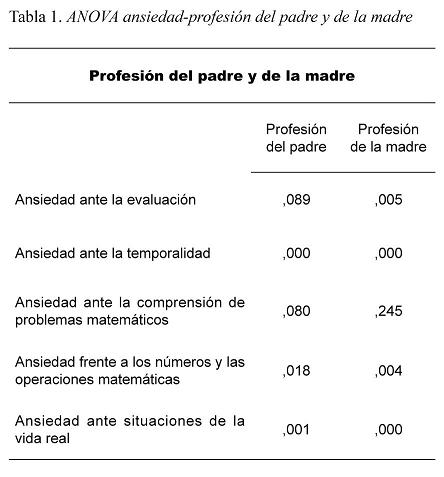
<body><![CDATA[<p class="western" style="margin: 5pt 51.15pt 0.0001pt 1cm; text-align: justify; text-indent: 19.85pt; line-height: 150%;"><span style="font-size: 10pt; line-height: 150%; font-family: &quot;Arial&quot;,&quot;sans-serif&quot;;">El cuestionario que se entreg&oacute; a los alumnos fue dise&ntilde;ado para una recogida de datos m&aacute;s amplia de la aqu&iacute; desarrollada. En este trabajo se presenta s&oacute;lo el an&aacute;lisis de los &iacute;tems del campo del dominio afectivo relativo a la ansiedad hacia las matem&aacute;ticas en relaci&oacute;n con los progenitores.</span></p>       <p class="western" style="margin: 5pt 51.15pt 0.0001pt 1cm; text-align: justify; line-height: 150%;"><b><i><span style="font-size: 10pt; line-height: 150%; font-family: &quot;Arial&quot;,&quot;sans-serif&quot;;"><o:p>&nbsp;</o:p></span></i></b></p>       <p class="western" style="margin: 5pt 51.15pt 0.0001pt 1cm; text-align: justify; line-height: 150%;"><b><i><span style="font-size: 10pt; line-height: 150%; font-family: &quot;Arial&quot;,&quot;sans-serif&quot;;">An&aacute;lisis de datos y resultados</span></i></b></p>       <p class="western" style="margin: 5pt 51.15pt 0.0001pt 1cm; text-align: justify; line-height: 150%;"><o:p>&nbsp;</o:p></p>       <p class="western" style="margin: 5pt 51.15pt 0.0001pt 1cm; text-align: justify; text-indent: 19.85pt; line-height: 150%;"><span style="font-size: 10pt; line-height: 150%; font-family: &quot;Arial&quot;,&quot;sans-serif&quot;;">Para el an&aacute;lisis de los datos se han realizado un an&aacute;lisis de varianza (ANOVA) y la prueba de Kruskal-Wallis (no param&eacute;trica) para contrastar los resultados obtenidos a trav&eacute;s de las anovas convencionales.</span></p>       <p class="western" style="margin: 5pt 51.15pt 0.0001pt 1cm; text-align: justify; text-indent: 19.85pt; line-height: 150%;"><span style="font-size: 10pt; line-height: 150%; font-family: &quot;Arial&quot;,&quot;sans-serif&quot;;">Para el c&aacute;lculo de la correlaci&oacute;n entre la ansiedad y el rendimiento se ha optado por el &iacute;ndice de Correlaci&oacute;n de Pearson.</span></p>       <p class="western" style="margin: 5pt 51.15pt 0.0001pt 1cm; text-align: justify; text-indent: 19.85pt; line-height: 150%;"><o:p>&nbsp;</o:p></p>       <p class="western" style="margin: 5pt 51.15pt 0.0001pt 1cm; text-align: justify; text-indent: 19.85pt; line-height: 150%;"><i><span style="font-size: 10pt; line-height: 150%; font-family: &quot;Arial&quot;,&quot;sans-serif&quot;;">An&aacute;lisis de la ansiedad y profesi&oacute;n del padre y de la madre </span></i></p>       <p class="western" style="margin: 5pt 51.15pt 0.0001pt 1cm; text-align: justify; text-indent: 19.85pt; line-height: 150%;"><o:p>&nbsp;</o:p></p>       <p class="western" style="margin: 5pt 51.15pt 0.0001pt 1cm; text-align: justify; text-indent: 19.85pt; line-height: 150%;"><span style="font-size: 10pt; line-height: 150%; font-family: &quot;Arial&quot;,&quot;sans-serif&quot;;">Los resultados del an&aacute;lisis de varianza que se presenta en la <a href="#t1">Tabla 1</a> coinciden con los adquiridos en la prueba no param&eacute;trica para ambas variables. Se reflejan los resultados a continuaci&oacute;n.</span></p>       ]]></body>
<body><![CDATA[<p class="western" style="margin: 5pt 51.15pt 0.0001pt 1cm; text-align: justify; text-indent: 19.85pt; line-height: 150%;"><o:p>&nbsp;</o:p></p>       <p class="western" style="margin: 5pt 51.15pt 0.0001pt 1cm; text-align: justify; text-indent: 19.85pt; line-height: 150%;"><a name="t1"></a><img style="width: 444px; height: 477px;" alt="" src="/img/revistas/cp/v8n1/1a07t1.jpg"><span style=""></span></p>       <p class="western" style="margin: 5pt 51.15pt 0.0001pt 1cm; text-align: justify; line-height: 150%;"><o:p>&nbsp;</o:p></p>       <p class="western" style="margin: 5pt 51.15pt 0.0001pt 1cm; text-align: justify; text-indent: 19.85pt; line-height: 150%;"><o:p>&nbsp;</o:p></p>       <p class="western" style="margin: 5pt 51.15pt 0.0001pt 1cm; text-align: justify; text-indent: 19.85pt; line-height: 150%;"><span style="font-size: 10pt; line-height: 150%; font-family: &quot;Arial&quot;,&quot;sans-serif&quot;;">-Profesi&oacute;n del padre y ansiedad: Las diferencias son significativas respecto a todos los factores, excepto el factor &ldquo;ansiedad ante la evaluaci&oacute;n&rdquo; y el factor &ldquo;ansiedad ante la compresi&oacute;n de problemas&rdquo;. </span></p>       <p class="western" style="margin: 5pt 51.15pt 0.0001pt 1cm; text-align: justify; text-indent: 19.85pt; line-height: 150%;"><span style="font-size: 10pt; line-height: 150%; font-family: &quot;Arial&quot;,&quot;sans-serif&quot;;">La prueba de Comparaciones m&uacute;ltiples indica los siguientes resultados: las diferencias en el factor &ldquo;ansiedad ante la temporalidad&rdquo; se dan entre las categor&iacute;as C2 con C3 y C2 con C4. En los factores &ldquo;ansiedad frente a los n&uacute;meros y las operaciones matem&aacute;ticas&rdquo; y &ldquo;ansiedad ante situaciones de la vida real&rdquo; las diferencias est&aacute;n entre las categor&iacute;as C3 y C4.</span></p>       <p class="western" style="margin: 5pt 51.15pt 0.0001pt 1cm; text-align: justify; text-indent: 19.85pt; line-height: 150%;"><span style="font-size: 10pt; line-height: 150%; font-family: &quot;Arial&quot;,&quot;sans-serif&quot;;">Tambi&eacute;n se realizan las medias para conjuntos homog&eacute;neos y se presentan los factores &ldquo;ansiedad total&rdquo;, &ldquo;ansiedad ante la evaluaci&oacute;n&rdquo;, &ldquo;ansiedad ante la compresi&oacute;n de problemas&rdquo; y &ldquo;ansiedad frente a los n&uacute;meros y las operaciones matem&aacute;ticas&rdquo; como grupos homog&eacute;neos. No sucede as&iacute; con la media referida al factor &ldquo;ansiedad ante la temporalidad&rdquo;, que presenta diferencias significativas, agrup&aacute;ndose las categor&iacute;as en dos grupos; en donde, la categor&iacute;a C3 presenta una media inferior a las dem&aacute;s categor&iacute;as y la C4 tiene la m&aacute;xima. Esta misma circunstancia se produce en el factor &ldquo;ansiedad ante situaciones de la vida real&rdquo;. Las categor&iacute;as C1 y C2 forman grupo con la categor&iacute;a C3 por un lado, no existiendo diferencias entre ellas.</span></p>       <p class="western" style="margin: 5pt 51.15pt 0.0001pt 1cm; text-align: justify; text-indent: 19.85pt; line-height: 150%;"><span style="font-size: 10pt; line-height: 150%; font-family: &quot;Arial&quot;,&quot;sans-serif&quot;;">-Profesi&oacute;n de la madre y ansiedad: El an&aacute;lisis de varianza y el an&aacute;lisis no param&eacute;trico (Kruskal-Wallis), reflejan la existencia de diferencias significativas respecto a la variable profesi&oacute;n de la madre y la ansiedad. Estas diferencias se reflejan en todos los factores de la ansiedad, excepto el factor &ldquo;ansiedad ante la compresi&oacute;n de problemas&rdquo;. </span></p>       <p class="western" style="margin: 5pt 51.15pt 0.0001pt 1cm; text-align: justify; text-indent: 19.85pt; line-height: 150%;"><span style="font-size: 10pt; line-height: 150%; font-family: &quot;Arial&quot;,&quot;sans-serif&quot;;">Mediante la prueba de comparaciones m&uacute;ltiples (prueba de Scheff&eacute;), comprobamos que en la &ldquo;ansiedad total&rdquo; y los factores &ldquo;ansiedad ante la temporalidad&rdquo; y &ldquo;ansiedad ante situaciones de la vida real&rdquo;, existen diferencias entre las categor&iacute;as C2 y C3 con C4. En cuanto a la &ldquo;ansiedad frente a los n&uacute;meros y las operaciones matem&aacute;ticas&rdquo; encontramos diferencias entre las categor&iacute;as C3 y C4.</span></p>       <p class="western" style="margin: 5pt 51.15pt 0.0001pt 1cm; text-align: justify; text-indent: 19.85pt; line-height: 150%;"><span style="font-size: 10pt; line-height: 150%; font-family: &quot;Arial&quot;,&quot;sans-serif&quot;;">En relaci&oacute;n a las medias para conjuntos homog&eacute;neos, las tablas referidas a los factores &ldquo;ansiedad total&rdquo;, &ldquo;ansiedad ante la evaluaci&oacute;n&rdquo;, &ldquo;ansiedad ante la compresi&oacute;n de problemas&rdquo; y &ldquo;ansiedad frente a los n&uacute;meros y las operaciones matem&aacute;ticas&rdquo;, se presentan como grupos homog&eacute;neos. No as&iacute; la referida al factor &ldquo;ansiedad ante la temporalidad&rdquo;, que presenta diferencias significativas agrup&aacute;ndose las categor&iacute;as en dos grupos en donde la categor&iacute;a C3 presenta una media inferior y la C4 mayor a las dem&aacute;s categor&iacute;as. Esta misma circunstancia se produce en el factor &ldquo;ansiedad ante situaciones de la vida real&rdquo;. Las categor&iacute;as C1 y C2 forman grupo con la categor&iacute;a C3 por un lado, no existiendo diferencias entre ellas y, por otro, con C4 con el que tampoco mantienen diferencias.</span></p>       ]]></body>
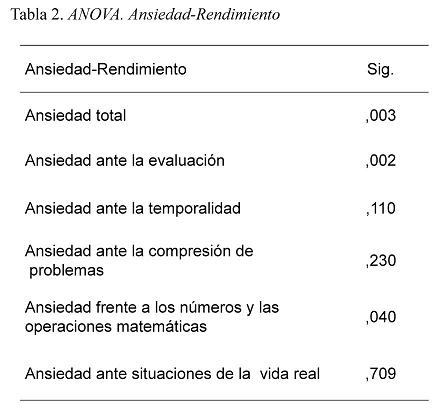
<body><![CDATA[<p class="western" style="margin: 5pt 51.15pt 0.0001pt 1cm; text-align: justify; text-indent: 19.85pt; line-height: 150%;"><o:p>&nbsp;</o:p></p>       <p class="western" style="margin: 5pt 51.15pt 0.0001pt 1cm; text-align: justify; text-indent: 19.85pt; line-height: 150%;"><b><i><span style="font-size: 10pt; line-height: 150%; font-family: &quot;Arial&quot;,&quot;sans-serif&quot;;">An&aacute;lisis de la relaci&oacute;n entre ansiedad y rendimiento en matem&aacute;ticas</span></i><o:p></o:p></b></p>       <p class="western" style="margin: 5pt 51.15pt 0.0001pt 1cm; text-align: justify; text-indent: 19.85pt; line-height: 150%;"><o:p>&nbsp;</o:p></p>       <p class="western" style="margin: 5pt 51.15pt 0.0001pt 1cm; text-align: justify; text-indent: 19.85pt; line-height: 150%;"><span style="font-size: 10pt; line-height: 150%; font-family: &quot;Arial&quot;,&quot;sans-serif&quot;;">Como podemos observar (<a href="#t2">Tabla 2</a>), en cuanto a las puntuaciones obtenidas mediante el an&aacute;lisis de varianza, encontramos que las diferencias son significativas con valores de ,003 en los valores de ansiedad total. Estas diferencias no se encuentran tomando los factores por separado. Es decir, no existen diferencias en los factores de &ldquo;ansiedad ante la temporalidad&rdquo;, &ldquo;ansiedad ante la comprensi&oacute;n de problemas&rdquo; y &ldquo;ansiedad ante situaciones de la vida real&rdquo; en funci&oacute;n de las calificaciones de los estudiantes. Estas diferencias s&iacute; que se dan en los factores &ldquo;ansiedad ante la evaluaci&oacute;n&rdquo; y &ldquo;ansiedad frente a los n&uacute;meros y las operaciones matem&aacute;ticas&rdquo;. Obtenemos los mismos resultados si la prueba utilizada para el contraste es la de Kruskal-Wallis.</span><span style="" lang="ES-UY"><o:p></o:p></span></p>       <p class="western" style="margin: 5pt 51.15pt 0.0001pt 1cm; text-align: justify; text-indent: 19.85pt; line-height: 150%;"><span style="font-size: 10pt; line-height: 150%; font-family: &quot;Arial&quot;,&quot;sans-serif&quot;;">De las comparaciones entre los grupos, a fin de detectar a cu&aacute;l de ellos se deben las diferencias, observamos diferencias de ansiedad entre aquellos sujetos con un rendimiento de suspenso y notable respecto a la &ldquo;ansiedad total&rdquo; y, concretamente, ante el factor &ldquo;ansiedad ante la evaluaci&oacute;n&rdquo;, no existiendo diferencias entre las otras categor&iacute;as del rendimiento.</span></p>       <p class="western" style="margin: 5pt 51.15pt 0.0001pt 1cm; text-align: justify; line-height: 150%;"><o:p>&nbsp;</o:p></p>       <p class="western" style="margin: 5pt 51.15pt 0.0001pt 1cm; text-align: justify; line-height: 150%;"><a name="t2"></a><img style="width: 444px; height: 411px;" alt="" src="/img/revistas/cp/v8n1/1a07t2.jpg"><span style=""></span></p>       <p class="western" style="margin: 5pt 51.15pt 0.0001pt 1cm; text-align: justify; text-indent: 19.85pt; line-height: 150%;"><o:p>&nbsp;</o:p></p>       <p class="western" style="margin: 5pt 51.15pt 0.0001pt 1cm; text-align: justify; text-indent: 19.85pt; line-height: 150%;"><o:p>&nbsp;</o:p></p>       <p class="western" style="margin: 5pt 51.15pt 0.0001pt 1cm; text-align: justify; text-indent: 19.85pt; line-height: 150%;"><b><i><span style="font-size: 10pt; line-height: 150%; font-family: &quot;Arial&quot;,&quot;sans-serif&quot;;">Efectos generales de la variable ansiedad sobre el rendimiento</span></i><o:p></o:p></b></p>       ]]></body>
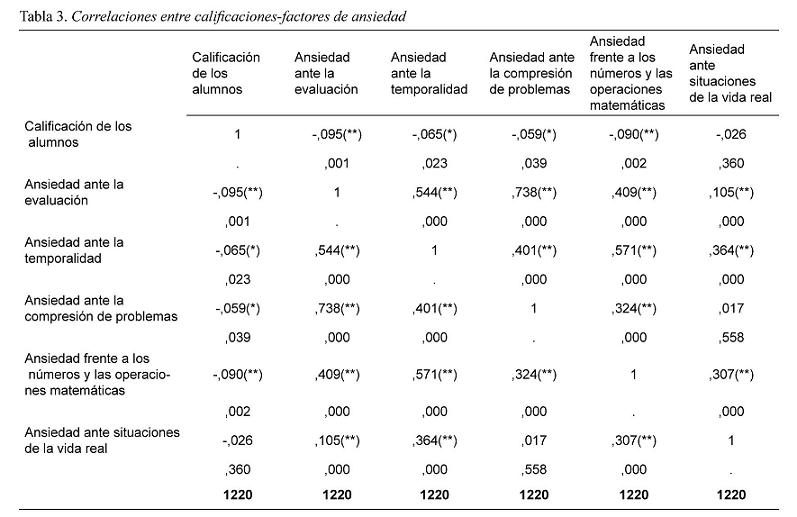
<body><![CDATA[<p class="western" style="margin: 5pt 51.15pt 0.0001pt 1cm; text-align: justify; text-indent: 19.85pt; line-height: 150%;"><o:p>&nbsp;</o:p></p>       <p class="western" style="margin: 5pt 51.15pt 0.0001pt 1cm; text-align: justify; text-indent: 19.85pt; line-height: 150%;"><span style="font-size: 10pt; line-height: 150%; font-family: &quot;Arial&quot;,&quot;sans-serif&quot;;">Para analizar las asociaciones e influencias entre las variables utilizadas hemos optado por realizar la correlaci&oacute;n de Pearson entre las dos variables y los factores en que se descomponen. Los resultados que se exponen en la <a href="/img/revistas/cp/v8n1/1a07t3.jpg">Tabla 3</a> muestran la existencia de correlaciones significativas e inversas entre ellas, es decir, a medida que la ansiedad aumenta, el rendimiento disminuye.</span></p>       <p class="western" style="margin: 5pt 51.15pt 0.0001pt 1cm; text-align: justify; line-height: 150%;">&nbsp;</p>       <p class="western" style="margin: 5pt 51.15pt 0.0001pt 1cm; text-align: justify; text-indent: 19.85pt; line-height: 150%;"><span style="font-size: 10pt; line-height: 150%; font-family: &quot;Arial&quot;,&quot;sans-serif&quot;;">Como podemos apreciar existe una correlaci&oacute;n negativa entre ellos y significativa al 0,01 para la &ldquo;ansiedad ante la evaluaci&oacute;n&rdquo; y &ldquo;ansiedad frente a los n&uacute;meros y las operaciones matem&aacute;ticas&rdquo; y al 0,05 en los factores referidos a &ldquo;ansiedad ante la temporalidad&rdquo; y &ldquo;ansiedad ante la comprensi&oacute;n de problemas&rdquo;.     <br>  El &uacute;nico valor cuya correlaci&oacute;n no es significativa es ante el factor &ldquo;ansiedad ante situaciones de la vida real (-,026). </span></p>       <p class="western" style="margin: 5pt 51.15pt 0.0001pt 1cm; text-align: justify; text-indent: 19.85pt; line-height: 150%;"><o:p>&nbsp;</o:p></p>       <p class="western" style="margin: 5pt 51.15pt 0.0001pt 1cm; text-align: justify; line-height: 150%;"><b><span style="font-size: 10pt; line-height: 150%; font-family: &quot;Arial&quot;,&quot;sans-serif&quot;;">Conclusiones</span></b></p>       <p class="western" style="margin: 5pt 51.15pt 0.0001pt 1cm; text-align: justify; line-height: 150%;"><o:p>&nbsp;</o:p></p>       <p class="western" style="margin: 5pt 51.15pt 0.0001pt 1cm; text-align: justify; text-indent: 19.85pt; line-height: 150%;"><span style="font-size: 10pt; line-height: 150%; font-family: &quot;Arial&quot;,&quot;sans-serif&quot;;">Los resultados de este estudio permiten establecer algunas diferencias en funci&oacute;n de las variables establecidas que pueden influir en los estudiantes a la hora de trabajar las matem&aacute;ticas. </span></p>       <p class="western" style="margin: 5pt 51.15pt 0.0001pt 1cm; text-align: justify; text-indent: 19.85pt; line-height: 150%;"><span style="font-size: 10pt; line-height: 150%; font-family: &quot;Arial&quot;,&quot;sans-serif&quot;;">En este sentido, y en relaci&oacute;n a los objetivos marcados extraemos las siguientes conclusiones:</span></p>       ]]></body>
<body><![CDATA[<p class="western" style="margin: 5pt 51.15pt 0.0001pt 1cm; text-align: justify; text-indent: 19.85pt; line-height: 150%;"><span style="font-size: 10pt; line-height: 150%; font-family: &quot;Arial&quot;,&quot;sans-serif&quot;;">Respecto a la profesi&oacute;n del padre se muestran diferencias en todos los factores de la ansiedad, excepto en &ldquo;ansiedad ante la evaluaci&oacute;n&rdquo; y &ldquo;ansiedad ante la comprensi&oacute;n de problemas matem&aacute;ticos&rdquo; teniendo en cuenta que estas diferencias est&aacute;n principalmente marcadas por las categor&iacute;as profesionales m&aacute;s altas. Es decir, no hay diferencias entre los estudiantes ante los ex&aacute;menes, al tener que hacer matem&aacute;ticas en p&uacute;blico y ante la comprensi&oacute;n de los problemas de matem&aacute;ticas en funci&oacute;n de los padres. Sin embargo, aquellos cuyos progenitores pertenecen a los grupos C1 y C2 sufren menos ansiedad hacia las matem&aacute;ticas que los concernientes a la categor&iacute;a C3 y C4, en relaci&oacute;n al tiempo que les queda para hacer un examen o para llevar los ejercicios hechos a clase, al hacer ejercicios, operaciones y en general al trabajar con n&uacute;meros y al enfrentarse a las matem&aacute;ticas en su vida cotidiana. </span></p>       <p class="western" style="margin: 5pt 51.15pt 0.0001pt 1cm; text-align: justify; text-indent: 19.85pt; line-height: 150%;"><span style="font-size: 10pt; line-height: 150%; font-family: &quot;Arial&quot;,&quot;sans-serif&quot;;">En cuanto al an&aacute;lisis de la ansiedad por profesi&oacute;n de la madre, se reflejan diferencias significativas en todos los factores excepto en &ldquo;ansiedad ante la compresi&oacute;n de problemas matem&aacute;ticos&rdquo;. En el caso de las madres la influencia es mayor, ya que los hijos pertenecientes a madres de las categor&iacute;as C3 y C4 muestran sentimientos de ansiedad ante los ex&aacute;menes, al tener que hacer matem&aacute;ticas en p&uacute;blico, ante el tiempo que le queda para hacer un examen o para llevar los ejercicios hechos para clase, al hacer ejercicios, operaciones y en general al trabajar con n&uacute;meros y al tener que enfrentarse a las matem&aacute;ticas en su vida cotidiana en grado mayor que las de C1 y C2.</span></p>       <p class="western" style="margin: 5pt 51.15pt 0.0001pt 1cm; text-align: justify; text-indent: 19.85pt; line-height: 150%;"><span style="font-size: 10pt; line-height: 150%; font-family: &quot;Arial&quot;,&quot;sans-serif&quot;;">Por lo que se refiere a la relaci&oacute;n entre el rendimiento y la variable ansiedad, aqu&eacute;l no se ve afectado por la &ldquo;ansiedad ante la temporalidad&rdquo;, ni la &ldquo;ansiedad ante la comprensi&oacute;n de problemas&rdquo; ni la &ldquo;ansiedad ante problemas de vida real&rdquo;, al no haberse encontrado diferencias estad&iacute;sticamente significativas. Observamos diferencias de ansiedad entre aquellos sujetos con un rendimiento de suspenso y notable respecto a la ansiedad total y, concretamente, ante el factor &ldquo;ansiedad ante los ex&aacute;menes&rdquo;. Como consecuencia del an&aacute;lisis de correlaci&oacute;n ansiedad-rendimiento constatamos que a medida que aumenta la ansiedad, el rendimiento disminuye. Por lo tanto, una reducci&oacute;n de la ansiedad debe ir acompa&ntilde;ada de un aumento en el rendimiento en matem&aacute;ticas.</span></p>       <p class="western" style="margin: 5pt 51.15pt 0.0001pt 1cm; text-align: justify; text-indent: 19.85pt; line-height: 150%;"><span style="font-size: 10pt; line-height: 150%; font-family: &quot;Arial&quot;,&quot;sans-serif&quot;;">Los datos obtenidos mantienen relaci&oacute;n con la fundamentaci&oacute;n te&oacute;rica, ya que la conformaci&oacute;n de la familia es una base importante para el rendimiento acad&eacute;mico; recordemos que la familia interviene en el desarrollo cognitivo, psicol&oacute;gico y social de sus hijos (<a href="#Vieira">Vieira</a> y Ruy, 2006). Tambi&eacute;n <a name="Gonzalez_02"></a><a href="#Gonzalez02">Gonz&aacute;lez</a>-Pienda, N&uacute;&ntilde;ez, Gonz&aacute;lez-Pumariega, &Aacute;lvarez, Roces y Garc&iacute;a (2002), <a href="#Gonzalez05">Gonz&aacute;lez</a>-Pienda y N&uacute;&ntilde;ez (2005) y <a href="#Torio08">Tor&iacute;o</a>, Pe&ntilde;a e Inda-Caro (2008) ponen de manifiesto la relativa importancia de determinadas variables de la familia sobre el nivel de ansiedad de los hijos al encontrar diferencias respecto a la profesi&oacute;n de los padres en algunos factores. Por &uacute;ltimo, se&ntilde;alar que nuestra intenci&oacute;n es aportar datos hacia la consideraci&oacute;n de los fen&oacute;menos afectivos y la matem&aacute;tica, adem&aacute;sde reflexionar sobre la relevancia que pueda tener de cara a evitar el fracaso escolar en esta materia. </span></p>       <p class="western" style="margin: 5pt 51.15pt 0.0001pt 1cm; text-align: justify; line-height: 150%;"><o:p>&nbsp;</o:p></p>       <p class="western" style="margin: 5pt 51.15pt 0.0001pt 1cm; text-align: justify; line-height: 150%;"><b><span style="font-size: 10pt; line-height: 150%; font-family: &quot;Arial&quot;,&quot;sans-serif&quot;;">Referencias </span></b></p>       <p class="western" style="margin: 5pt 51.15pt 0.0001pt 1cm; text-align: justify; line-height: 150%;"><o:p>&nbsp;</o:p></p>       <!-- ref --><p class="western" style="margin: 5pt 51.15pt 0.0001pt 1cm; text-align: justify; line-height: 150%;"><a name="Barbero"></a><span style="font-size: 8pt; line-height: 150%; font-family: &quot;Arial&quot;,&quot;sans-serif&quot;;" lang="ES-UY"><a href="#Barbero_">Barbero</a>, M., Olgado, F., Vila, E. y Chac&oacute;n, S. (2007). Actitudes, h&aacute;bitos de estudio y rendimiento en matem&aacute;ticas: diferencias por g&eacute;nero. </span><i><span style="font-size: 8pt; line-height: 150%; font-family: &quot;Arial&quot;,&quot;sans-serif&quot;;" lang="EN-US">Psicothema 19:</span></i><span style="font-size: 8pt; line-height: 150%; font-family: &quot;Arial&quot;,&quot;sans-serif&quot;;" lang="EN-US"> 413-421.    </span><span style="" lang="EN-US"><o:p></o:p></span></p>       <p class="western" style="margin: 5pt 51.15pt 0.0001pt 1cm; text-align: justify; line-height: 150%;"><a name="Besharat"></a><span style="font-size: 8pt; line-height: 150%; font-family: &quot;Arial&quot;,&quot;sans-serif&quot;;" lang="EN-US"><a href="#Besharat_">Besharat</a>, M. (2003). Parental perfectionism and children&rsquo;s test anxiety. <i>Psychological reports, 93</i>(3): 1049-1055.</span><span style="" lang="EN-US"><o:p></o:p></span></p>       ]]></body>
<body><![CDATA[<p class="western" style="margin: 5pt 51.15pt 0.0001pt 1cm; text-align: justify; line-height: 150%;"><a name="Bursal"></a><span style="font-size: 8pt; line-height: 150%; font-family: &quot;Arial&quot;,&quot;sans-serif&quot;;" lang="ES-UY"><a href="#Bursal_">Bursal</a>, M. y Paznokas, L. (2006). </span><span style="font-size: 8pt; line-height: 150%; font-family: &quot;Arial&quot;,&quot;sans-serif&quot;;" lang="EN-US">Mathematics anxiety and preservice elementary teachers&rsquo; confidence to teach mathematics and science. S<i>chool Science and Mathematics106</i>(4): 173-179.</span><span style="" lang="EN-US"><o:p></o:p></span></p>       <!-- ref --><p class="western" style="margin: 5pt 51.15pt 0.0001pt 1cm; text-align: justify; line-height: 150%;"><a name="Evans"></a><span style="font-size: 8pt; line-height: 150%; font-family: &quot;Arial&quot;,&quot;sans-serif&quot;;" lang="EN-US"><a href="#Evans_">Evans</a>, J. &amp; Wedge, T. (2004). Motivation and resistance to learning mathematics in a lifelong perspective. </span><i><span style="font-size: 8pt; line-height: 150%; font-family: &quot;Arial&quot;,&quot;sans-serif&quot;;" lang="ES-UY">Topic Study Group, Vol. 6. </span></i><span style="font-size: 8pt; line-height: 150%; font-family: &quot;Arial&quot;,&quot;sans-serif&quot;;" lang="ES-UY">Recuperado de <a href="http://www.icme-10.dk/">http://www.icme-10.dk/</a></span><span style="" lang="ES-UY"><o:p></o:p></span><!-- ref --><p class="western" style="margin: 5pt 51.15pt 0.0001pt 1cm; text-align: justify; line-height: 150%;"><a name="Edel"></a><span style="font-size: 8pt; line-height: 150%; font-family: &quot;Arial&quot;,&quot;sans-serif&quot;;" lang="ES-UY"><a href="#Edel_">Edel</a>, R. (2000). Factores asociados al rendimiento acad&eacute;mico. </span><i><span style="font-size: 8pt; line-height: 150%; font-family: &quot;Arial&quot;,&quot;sans-serif&quot;;" lang="EN-US">Revista Iberoamericana de Educaci&oacute;n, 1-18.    </span></i><span style="font-size: 8pt; line-height: 150%; font-family: &quot;Arial&quot;,&quot;sans-serif&quot;;" lang="EN-US"> </span><span style="" lang="EN-US"><o:p></o:p></span></p>       <!-- ref --><p class="western" style="margin: 5pt 51.15pt 0.0001pt 1cm; text-align: justify; line-height: 150%;"><a name="Furner"></a><span style="font-size: 8pt; line-height: 150%; font-family: &quot;Arial&quot;,&quot;sans-serif&quot;;" lang="ES-UY"><a href="#Furner_"><span style="" lang="EN-US">Furner</span></a></span><span style="font-size: 8pt; line-height: 150%; font-family: &quot;Arial&quot;,&quot;sans-serif&quot;;" lang="EN-US">, J. y Berman, B. (2003). Math Anxiety: Overcoming a major obstacle to the improvement of students math performance. </span><i><span style="font-size: 8pt; line-height: 150%; font-family: &quot;Arial&quot;,&quot;sans-serif&quot;;" lang="ES-UY">Childhood Education, 79(3), 170-174.    </span></i><i><span style="font-size: 8pt; line-height: 150%; font-family: &quot;Arial&quot;,&quot;sans-serif&quot;; color: fuchsia;" lang="ES-UY"> </span></i><span style="" lang="ES-UY"><o:p></o:p></span></p>       <!-- ref --><p class="western" style="margin: 5pt 51.15pt 0.0001pt 1cm; text-align: justify; line-height: 150%;"><a name="Gomez"></a><span style="font-size: 8pt; line-height: 150%; font-family: &quot;Arial&quot;,&quot;sans-serif&quot;;" lang="ES-UY"><a href="#Gomez_">G&oacute;mez</a>-Chac&oacute;n, I. M. (2009). Actitudes matem&aacute;ticas: propuestas para la transici&oacute;n del bachillerato a la universidad.<i> Educaci&oacute;n matem&aacute;tica, 21</i>(3):5-32.    </span><span style="" lang="ES-UY"><o:p></o:p></span></p>       <!-- ref --><p class="western" style="margin: 5pt 51.15pt 0.0001pt 1cm; text-align: justify; line-height: 150%;"><a name="Gonzalez05"></a><span style="font-size: 8pt; line-height: 150%; font-family: &quot;Arial&quot;,&quot;sans-serif&quot;;" lang="ES-UY"><a href="#Gonzalez_05">Gonz&aacute;lez</a>-Pienda, J.A., y N&uacute;&ntilde;ez, J.C. (2005). La implicaci&oacute;n de los padres y su incidencia en el rendimiento de los hijos. <i>Revista de Psicolog&iacute;a y Educaci&oacute;n 1</i>(1): 115-134.    </span><span style="" lang="ES-UY"><o:p></o:p></span></p>       ]]></body>
<body><![CDATA[<!-- ref --><p class="western" style="margin: 5pt 51.15pt 0.0001pt 1cm; text-align: justify; line-height: 150%;"><a name="Gonzalez03"></a><span style="font-size: 8pt; line-height: 150%; font-family: &quot;Arial&quot;,&quot;sans-serif&quot;;" lang="ES-UY"><a href="#Gonzalez_03">Gonz&aacute;lez</a>-Pienda, J.A., N&uacute;&ntilde;ez, J.C., &Aacute;lvarez, L., Roces, C., Gonz&aacute;lez-Pumariega, S., Gonz&aacute;lez, P., Mu&ntilde;iz, R., Valle, A., Gonz&aacute;lez-Cabanach, R., Rodr&iacute;guez, S. y Bernardo, A. (2003). Adaptabilidad y cohesi&oacute;n familiar, implicaci&oacute;n parental en conductas autorregulatorias, autoconcepto del estudiante y rendimiento acad&eacute;mico. <i>Psicothema 15</i>: 471-477.    </span><span style="" lang="ES-UY"><o:p></o:p></span></p>       <!-- ref --><p class="western" style="margin: 5pt 51.15pt 0.0001pt 1cm; text-align: justify; line-height: 150%;"><a name="Gonzalez02"></a><span style="font-size: 8pt; line-height: 150%; font-family: &quot;Arial&quot;,&quot;sans-serif&quot;;" lang="ES-UY"><a href="#Gonzalez_02">Gonz&aacute;lez</a>-Pienda. J.A., N&uacute;&ntilde;ez, J.C., Gonz&aacute;lez-Pumariega, S., &Aacute;lvarez, L., Roces, C. y Garc&iacute;a, M. (2002). </span><span style="font-size: 8pt; line-height: 150%; font-family: &quot;Arial&quot;,&quot;sans-serif&quot;;" lang="EN-US">A structural equation model of parental involvement, motivational and aptitudinal characteristics, and academic achievement. <i>The Journal of Experimental Education, 70 </i>(3): 257-287.    </span><span style="" lang="EN-US"><o:p></o:p></span></p>       <!-- ref --><p class="western" style="margin: 5pt 51.15pt 0.0001pt 1cm; text-align: justify; line-height: 150%;"><a name="Gresham04"></a><span style="font-size: 8pt; line-height: 150%; font-family: &quot;Arial&quot;,&quot;sans-serif&quot;;" lang="EN-US"><a href="#Gresham_04">Gresham</a>, G. (2004). Mathematics Anxiety in elementary students, CMC. <i>ComMuniCator 29</i>(2): 28-29.    </span><span style="" lang="EN-US"><o:p></o:p></span></p>       <!-- ref --><p class="western" style="margin: 5pt 51.15pt 0.0001pt 1cm; text-align: justify; line-height: 150%;"><a name="Gresham10"></a><span style="font-size: 8pt; line-height: 150%; font-family: &quot;Arial&quot;,&quot;sans-serif&quot;;" lang="EN-US"><a href="#Gresham_10">Gresham</a>, G. (2010). A study exploring excepcional education preservice teacher mathematics anxiety. </span><i><span style="font-size: 8pt; line-height: 150%; font-family: &quot;Arial&quot;,&quot;sans-serif&quot;;" lang="ES-UY">IUMPST: The Journal 4 (Curriculum).    </span></i><span style="" lang="ES-UY"><o:p></o:p></span></p>       <!-- ref --><p class="western" style="margin: 5pt 51.15pt 0.0001pt 1cm; text-align: justify; line-height: 150%;"><a name="Guerrero04"></a><span style="font-size: 8pt; line-height: 150%; font-family: &quot;Arial&quot;,&quot;sans-serif&quot;;" lang="ES-UY"><a href="#Guerrero_04">Guerrero</a>, E., Blanco, L. y Vicente, F. (2004). Trastornos emocionales ante la educaci&oacute;n matem&aacute;tica. En J.N. Garc&iacute;a (Coord.)<i> Aplicaciones a la Intervenci&oacute;n Psicopedag&oacute;gica (pp. </i>242-260). </span><span style="font-size: 8pt; line-height: 150%; font-family: &quot;Arial&quot;,&quot;sans-serif&quot;;" lang="EN-US">Espa&ntilde;a: Pir&aacute;mide.    </span><span style="" lang="EN-US"><o:p></o:p></span></p>       ]]></body>
<body><![CDATA[<p class="western" style="margin: 5pt 51.15pt 0.0001pt 1cm; text-align: justify; line-height: 150%;"><a name="Hancock01"></a><span style="font-size: 8pt; line-height: 150%; font-family: &quot;Arial&quot;,&quot;sans-serif&quot;;" lang="EN-US"><a href="#Hancock_01">Hancock</a>, D. (2001). Effects of Test Anxiety and Evaluative Threat on Stu- dents&rsquo; Achievement and Motivation. <i>Journal of Educational Research 94</i>(5): 284-90. </span><span style="" lang="EN-US"><o:p></o:p></span></p>       <!-- ref --><p class="western" style="margin: 5pt 51.15pt 0.0001pt 1cm; text-align: justify; line-height: 150%;"><a name="Henson06"></a><span style="font-size: 8pt; line-height: 150%; font-family: &quot;Arial&quot;,&quot;sans-serif&quot;;" lang="EN-US"><a href="#Henson_06">Henson</a>, K. y Roberts, J. (2006). Use of Exploratory Factor Analysis in Published Research: Common Error and Some Comment on Improved Practice.<i> Educational and Psychological Measurement 66</i>: 393-416.    </span><span style="" lang="EN-US"><o:p></o:p></span></p>       <!-- ref --><p class="western" style="margin: 5pt 51.15pt 0.0001pt 1cm; text-align: justify; line-height: 150%;"><a name="Hidalgo04"></a><span style="font-size: 8pt; line-height: 150%; font-family: &quot;Arial&quot;,&quot;sans-serif&quot;;" lang="EN-US"><a href="#Hidalgo_04">Hidalgo</a>, S. Maroto, A. y Palacios, A. (2004). </span><span style="font-size: 8pt; line-height: 150%; font-family: &quot;Arial&quot;,&quot;sans-serif&quot;;" lang="ES-UY">&iquest;Por qu&eacute; se rechazan las matem&aacute;ticas. An&aacute;lisis evolutivo y multivariante de actitudes relevantes hacia las matem&aacute;ticas. </span><i><span style="font-size: 8pt; line-height: 150%; font-family: &quot;Arial&quot;,&quot;sans-serif&quot;;" lang="EN-US">Revista de Educaci&oacute;n 334</span></i><span style="font-size: 8pt; line-height: 150%; font-family: &quot;Arial&quot;,&quot;sans-serif&quot;;" lang="EN-US">: 75-95</span><span style="" lang="EN-US"><o:p></o:p></span><!-- ref --><p class="western" style="margin: 5pt 51.15pt 0.0001pt 1cm; text-align: justify; line-height: 150%;"><a name="Klinger11"></a><span style="font-size: 8pt; line-height: 150%; font-family: &quot;Arial&quot;,&quot;sans-serif&quot;;" lang="EN-US"><a href="#Klinger_11">Klinger</a>, C. (2011). Conectivism. A new paradigm for the mathematics anxiety challenge? <i>Adults Learning Mathematics: An International Journal 6</i>(1): 7-19.    </span><span style="" lang="EN-US"><o:p></o:p></span></p>       <!-- ref --><p class="western" style="margin: 5pt 51.15pt 0.0001pt 1cm; text-align: justify; line-height: 150%;"><a name="Leedy03"></a><span style="font-size: 8pt; line-height: 150%; font-family: &quot;Arial&quot;,&quot;sans-serif&quot;;" lang="EN-US"><a href="#Leedy_03">Leedy</a>, M.G., LaLonde, D. y Runk, K. (2003). Gender equity in mathematics: beliefs of student, parents and teacher. </span><i><span style="font-size: 8pt; line-height: 150%; font-family: &quot;Arial&quot;,&quot;sans-serif&quot;;" lang="ES-UY">School Science and Mathematics103</span></i><span style="font-size: 8pt; line-height: 150%; font-family: &quot;Arial&quot;,&quot;sans-serif&quot;;" lang="ES-UY">(6): 285-292.    </span><span style="" lang="ES-UY"><o:p></o:p></span></p>       <!-- ref --><p class="western" style="margin: 5pt 51.15pt 0.0001pt 1cm; text-align: justify; line-height: 150%;"><a name="Magalhaes07"></a><span style="font-size: 8pt; line-height: 150%; font-family: &quot;Arial&quot;,&quot;sans-serif&quot;;" lang="ES-UY"><a href="#Magalhaes_07">Magalh&atilde;es</a>, A. (2007). <i>Ansiedade face aos Testes, G&eacute;nero e Rendimento Acad&eacute;mico: um estudo no Ensino B&aacute;sico. </i>(Tese de mestrado) Universidade do Minho, Portugal.    </span><span style="" lang="ES-UY"><o:p></o:p></span></p>       ]]></body>
<body><![CDATA[<!-- ref --><p class="western" style="margin: 5pt 51.15pt 0.0001pt 1cm; text-align: justify; line-height: 150%;"><a name="Mato06"></a><span style="font-size: 8pt; line-height: 150%; font-family: &quot;Arial&quot;,&quot;sans-serif&quot;;" lang="ES-UY"><a href="#Mato_06">Mato</a>, M. D. (2006). <i>Dise&ntilde;o y validaci&oacute;n de dos cuestionarios para evaluar las actitudes y la ansiedad hacia las matem&aacute;ticas en alumnos de Educaci&oacute;n Secundaria Obligatoria. </i>(Tesis no publicada). Universidad de A Coru&ntilde;a, Espa&ntilde;a.    </span><span style="" lang="ES-UY"><o:p></o:p></span></p>       <!-- ref --><p class="western" style="margin: 5pt 51.15pt 0.0001pt 1cm; text-align: justify; line-height: 150%;"><a name="Mato10"></a><span style="font-size: 8pt; line-height: 150%; font-family: &quot;Arial&quot;,&quot;sans-serif&quot;;" lang="ES-UY"><a href="#Mato_10">Mato</a>, M. D. y Mu&ntilde;oz, J. M. (2010). Efectos generales de las variables actitud y ansiedad sobre el rendimiento en matem&aacute;ticas en alumnos de ESO. Implicaciones para la pr&aacute;ctica educativa. <i>Ciencias psicol&oacute;gicas IV</i>(1): 27-40.     </span><span style="" lang="ES-UY"><o:p></o:p></span></p>       <!-- ref --><p class="western" style="margin: 5pt 51.15pt 0.0001pt 1cm; text-align: justify; line-height: 150%;"><a name="Munoz07"></a><span style="font-size: 8pt; line-height: 150%; font-family: &quot;Arial&quot;,&quot;sans-serif&quot;;" lang="ES-UY"><a href="#Munoz_07">Mu&ntilde;oz</a>, J. M. y Mato, M. D. (2007). Elaboraci&oacute;n y estructura factorial de un cuestionario para medir la ansiedad hacia las matem&aacute;ticas en alumnos de ESO. <i>Revista galego-Portuguesa de Psicolox&iacute;a e Educaci&oacute;n 12 </i>(1): 221-231.    </span><span style="" lang="ES-UY"><o:p></o:p></span></p>       <!-- ref --><p class="western" style="margin: 5pt 51.15pt 0.0001pt 1cm; text-align: justify; line-height: 150%;"><a name="Nunez05"></a><span style="font-size: 8pt; line-height: 150%; font-family: &quot;Arial&quot;,&quot;sans-serif&quot;;" lang="ES-UY"><a href="#Nunez_05">N&uacute;&ntilde;ez</a>, J. C., Gonz&aacute;lez-Pienda, J. A., Alvarez, L., Gonz&aacute;lez, P., Gonz&aacute;lez-Pumariega, S., Roces, C., Castej&oacute;n, L., Solano, P., Bernardo, A., Garc&iacute;a, D., da Silva, E. H., Rosario, P. y Rodr&iacute;guez Feio, L. (2005). Las actitudes hacia las Matem&aacute;ticas: perspectiva evolutiva. Actas do VIII Congresso Galaico-Portugu&ecirc;s de Psicopedagogia. </span><span style="font-size: 8pt; line-height: 150%; font-family: &quot;Arial&quot;,&quot;sans-serif&quot;;" lang="EN-US">Instituto Educa&ccedil;&atilde;o e Psicologia Universidade Minho.    </span><span style="" lang="EN-US"><o:p></o:p></span></p>       <p class="western" style="margin: 5pt 51.15pt 0.0001pt 1cm; text-align: justify; line-height: 150%;"><a name="Peleg02"></a><span style="font-size: 8pt; line-height: 150%; font-family: &quot;Arial&quot;,&quot;sans-serif&quot;;" lang="EN-US"><a href="#Peleg_02">Peleg</a>-Popko, O. (2002). Children&rsquo;s Test Anxiety and Family Interaction Patterns. </span><i><span style="font-size: 8pt; line-height: 150%; font-family: &quot;Arial&quot;,&quot;sans-serif&quot;;" lang="ES-UY">Anxiety, Stress &amp; Coping 15</span></i><span style="font-size: 8pt; line-height: 150%; font-family: &quot;Arial&quot;,&quot;sans-serif&quot;;" lang="ES-UY">(1): 45-59.</span><span style="" lang="ES-UY"><o:p></o:p></span></p>       <!-- ref --><p class="western" style="margin: 5pt 51.15pt 0.0001pt 1cm; text-align: justify; line-height: 150%;"><a name="Programa12"></a><span style="font-size: 8pt; line-height: 150%; font-family: &quot;Arial&quot;,&quot;sans-serif&quot;;" lang="ES-UY"><a href="#PISA_12">Programa</a> para la Evaluaci&oacute;n Internacional de los Alumnos. (2012)<i> Informe espa&ntilde;ol. Volumen I. Resultados y contexto.</i> Recuperado de <a href="http://www.mecd.gob.es/inee/estudios/pisa.html">http://www.mecd.gob.es/inee/estudios/pisa.html</a></span><span style="" lang="ES-UY"><o:p></o:p></span><!-- ref --><p class="western" style="margin: 5pt 51.15pt 0.0001pt 1cm; text-align: justify; line-height: 150%;"><a name="Puteh02"></a><span style="font-size: 8pt; line-height: 150%; font-family: &quot;Arial&quot;,&quot;sans-serif&quot;;" lang="EN-US"><a href="#Puteh_02">Puteh</a>, M. (2002). Qualitative research approach to fators associated with Mathematics Anxiety. The 3&ordm; international conference of Mathematicas Education and Society. Helsingor. </span><span style="font-size: 8pt; line-height: 150%; font-family: &quot;Arial&quot;,&quot;sans-serif&quot;;" lang="ES-UY">Denmark.    </span><span style="" lang="ES-UY"><o:p></o:p></span></p>       <!-- ref --><p class="western" style="margin: 5pt 51.15pt 0.0001pt 1cm; text-align: justify; line-height: 150%;"><a name="Rosario08"></a><span style="font-size: 8pt; line-height: 150%; font-family: &quot;Arial&quot;,&quot;sans-serif&quot;;" lang="ES-UY"><a href="#Rosario_08">Ros&aacute;rio</a>, P., N&uacute;&ntilde;ez, J. C., Salgado, A., Gonz&aacute;lez-Pienda, J. A., Valle, A., Joly, C. y Bernardo, A. (2008). Ansiedad ante los ex&aacute;menes: relaci&oacute;n con variables personales y familiares.<i> Psicothema 20</i>(4): 563-570</span><span style="" lang="ES-UY"><o:p></o:p></span><!-- ref --><p class="western" style="margin: 5pt 51.15pt 0.0001pt 1cm; text-align: justify; line-height: 150%;"><a name="Sociedad03"></a><span style="font-size: 8pt; line-height: 150%; font-family: &quot;Arial&quot;,&quot;sans-serif&quot;;" lang="ES-UY"><a href="#SAEM_Thales_03">Sociedad</a> Andaluza de Educaci&oacute;n Matem&aacute;tica Thales (2003). Principios y Est&aacute;ndares para la Educaci&oacute;n Matem&aacute;tica. Sevilla: Autor.    </span><span style="" lang="ES-UY"><o:p></o:p></span></p>       <!-- ref --><p class="western" style="margin: 5pt 51.15pt 0.0001pt 1cm; text-align: justify; line-height: 150%;"><a name="Torio08"></a><span style="font-size: 8pt; line-height: 150%; font-family: &quot;Arial&quot;,&quot;sans-serif&quot;;" lang="ES-UY"><a href="#Torio_08">Tor&iacute;o</a>, S., Pe&ntilde;a, J.V. e Inda, M. (2008). Estilos de educaci&oacute;n familiar. <i>Psicothema, 20</i>(1): 62-70.    </span><span style="" lang="ES-UY"><o:p></o:p></span></p>       <!-- ref --><p class="western" style="margin: 5pt 51.15pt 0.0001pt 1cm; text-align: justify; line-height: 150%;"><a name="Valle"></a><span style="font-size: 8pt; line-height: 150%; font-family: &quot;Arial&quot;,&quot;sans-serif&quot;;" lang="ES-UY"><a href="#Valle_">Valle</a>, A., Cabanach, R., Nu&ntilde;ez, J., Gonzalez-Pienda, J. y Rodriguez, S. Pi&ntilde;eiro, I. (2003). </span><span style="font-size: 8pt; line-height: 150%; font-family: &quot;Arial&quot;,&quot;sans-serif&quot;;" lang="EN-US">Cognitive, motivational, and volitional dimensions of learning. <i>Research in Higher Education 44</i>(5): 557-580.    </span><span style="" lang="EN-US"><o:p></o:p></span></p>       <!-- ref --><p class="western" style="margin: 5pt 51.15pt 0.0001pt 1cm; text-align: justify; line-height: 150%;"><a name="Vieira"></a><span style="font-size: 8pt; line-height: 150%; font-family: &quot;Arial&quot;,&quot;sans-serif&quot;;" lang="ES-UY"><a href="#Vieira_">Vieira</a>, M., y Ruy, J. (2006). <i>Educa&ccedil;&atilde;o Familiar. Estrat&eacute;gias para a promo&ccedil;&atilde;o da igualdade de g&eacute;nero.</i> Lisboa: CIDM.    </span><span style="" lang="ES-UY"><o:p></o:p></span></p>       <!-- ref --><p class="western" style="margin: 5pt 51.15pt 0.0001pt 1cm; text-align: justify; line-height: 150%;"><a name="Vigil"></a><span style="font-size: 8pt; line-height: 150%; font-family: &quot;Arial&quot;,&quot;sans-serif&quot;;" lang="ES-UY"><a href="#Vigil_">Vigil</a>-Colet, A., Lorenzo-Seva, U. y Condon, L. (2008). </span><span style="font-size: 8pt; line-height: 150%; font-family: &quot;Arial&quot;,&quot;sans-serif&quot;;" lang="EN-US">Development and validation of the statistical anxiety scale. <i>Psicothema, 20</i>(1): 174-186.    </span><span style="" lang="EN-US"><o:p></o:p></span></p>       <!-- ref --><p class="western" style="margin: 5pt 51.15pt 0.0001pt 1cm; text-align: justify; line-height: 150%;"><a name="Zakaria"></a><span style="font-size: 8pt; line-height: 150%; font-family: &quot;Arial&quot;,&quot;sans-serif&quot;;" lang="EN-US"><a href="#Zakaria_">Zakaria</a>, E. y Nordin, N.M. (2008) The Effects of Mathematics Anxiety on Matriculation Students as Related to Motivation and Achievement. Eurasia Journal of Mathematics, <i>Science &amp; Technology Education, 4</i>(1): 27-30.    </span><span style="" lang="EN-US"><o:p></o:p></span></p>       <!-- ref --><p class="western" style="margin: 5pt 51.15pt 0.0001pt 1cm; text-align: justify; line-height: 150%;"><a name="Zubeidat"></a><span style="font-size: 8pt; line-height: 150%; font-family: &quot;Arial&quot;,&quot;sans-serif&quot;;" lang="EN-US"><a href="#Zubeidat_">Zubeidat</a>, I., Fern&aacute;ndez-Parra, A., Sierra, J.C. y Salinas, J.M. (2007). </span><span style="font-size: 8pt; line-height: 150%; font-family: &quot;Arial&quot;,&quot;sans-serif&quot;;" lang="ES-UY">Comorbilidad de la ansiedad social espec&iacute;fica y generalizada en adolescentes espa&ntilde;oles. <i>Psicothema, 19</i>(4): 654-660.    </span><span style="" lang="ES-UY"><o:p></o:p></span></p>       <p style="margin: 5pt 51.15pt 0.0001pt 1cm; text-align: justify; line-height: 120%;"><span style="font-size: 9pt; line-height: 120%; font-family: &quot;Arial&quot;,&quot;sans-serif&quot;;"><o:p>&nbsp;</o:p></span></p>       <p style="margin: 5pt 51.15pt 0.0001pt 1cm; text-align: justify; line-height: 120%;"><span style="font-size: 9pt; line-height: 120%; font-family: &quot;Arial&quot;,&quot;sans-serif&quot;;">Para citar este art&iacute;culo: </span></p>       <p style="margin: 5pt 51.15pt 0.0001pt 1cm; text-align: justify; line-height: 120%;"><span style="font-size: 9pt; line-height: 120%; font-family: &quot;Arial&quot;,&quot;sans-serif&quot;;">Mato, M. D., Mu&ntilde;oz, J. M. &amp; Chao, R. (2014). Influencia de la profesi&oacute;n de los padres en la ansiedad hacia la matem&aacute;tica y su relaci&oacute;n con el rendimiento acad&eacute;mico en alumnos de secundaria. <i>Ciencias Psicol&oacute;gicas VIII </i>(1):</span><span style="font-size: 9pt; line-height: 120%; font-family: &quot;Arial&quot;,&quot;sans-serif&quot;; color: fuchsia;"> </span><span style="font-size: 9pt; line-height: 120%; font-family: &quot;Arial&quot;,&quot;sans-serif&quot;;">69 - 77.</span></p>   </div>       ]]></body>
<body><![CDATA[ ]]></body><back>
<ref-list>
<ref id="B1">
<nlm-citation citation-type="journal">
<person-group person-group-type="author">
<name>
<surname><![CDATA[Barbero]]></surname>
<given-names><![CDATA[M.]]></given-names>
</name>
<name>
<surname><![CDATA[Olgado]]></surname>
<given-names><![CDATA[F.]]></given-names>
</name>
<name>
<surname><![CDATA[Vila]]></surname>
<given-names><![CDATA[E.]]></given-names>
</name>
<name>
<surname><![CDATA[Chacón]]></surname>
<given-names><![CDATA[S.]]></given-names>
</name>
</person-group>
<article-title xml:lang="es"><![CDATA[Actitudes, hábitos de estudio y rendimiento en matemáticas: diferencias por género]]></article-title>
<source><![CDATA[Psicothema]]></source>
<year>2007</year>
<volume>19</volume>
<page-range>413-421</page-range></nlm-citation>
</ref>
<ref id="B2">
<nlm-citation citation-type="journal">
<person-group person-group-type="author">
<name>
<surname><![CDATA[Besharat]]></surname>
<given-names><![CDATA[M.]]></given-names>
</name>
</person-group>
<article-title xml:lang="en"><![CDATA[Parental perfectionism and children&rsquo;s test anxiety]]></article-title>
<source><![CDATA[Psychological reports]]></source>
<year>2003</year>
<volume>93</volume>
<numero>3</numero>
<issue>3</issue>
<page-range>1049-1055</page-range></nlm-citation>
</ref>
<ref id="B3">
<nlm-citation citation-type="journal">
<person-group person-group-type="author">
<name>
<surname><![CDATA[Bursal]]></surname>
<given-names><![CDATA[M.]]></given-names>
</name>
<name>
<surname><![CDATA[Paznokas]]></surname>
<given-names><![CDATA[L.]]></given-names>
</name>
</person-group>
<article-title xml:lang="en"><![CDATA[Mathematics anxiety and preservice elementary teachers&rsquo; confidence to teach mathematics and science]]></article-title>
<source><![CDATA[School Science and Mathematics]]></source>
<year>2006</year>
<volume>106</volume>
<numero>4</numero>
<issue>4</issue>
<page-range>173-179</page-range></nlm-citation>
</ref>
<ref id="B4">
<nlm-citation citation-type="">
<person-group person-group-type="author">
<name>
<surname><![CDATA[Evans]]></surname>
<given-names><![CDATA[J.]]></given-names>
</name>
<name>
<surname><![CDATA[Wedge]]></surname>
<given-names><![CDATA[T.]]></given-names>
</name>
</person-group>
<source><![CDATA[Motivation and resistance to learning mathematics in a lifelong perspective: Topic Study Group]]></source>
<year>2004</year>
<volume>Vol. 6</volume>
</nlm-citation>
</ref>
<ref id="B5">
<nlm-citation citation-type="journal">
<person-group person-group-type="author">
<name>
<surname><![CDATA[Edel]]></surname>
<given-names><![CDATA[R.]]></given-names>
</name>
</person-group>
<article-title xml:lang="es"><![CDATA[Factores asociados al rendimiento académico]]></article-title>
<source><![CDATA[Revista Iberoamericana de Educación]]></source>
<year>2000</year>
<page-range>1-18</page-range></nlm-citation>
</ref>
<ref id="B6">
<nlm-citation citation-type="journal">
<person-group person-group-type="author">
<name>
<surname><![CDATA[Furner]]></surname>
<given-names><![CDATA[J.]]></given-names>
</name>
<name>
<surname><![CDATA[Berman]]></surname>
<given-names><![CDATA[B.]]></given-names>
</name>
</person-group>
<article-title xml:lang="en"><![CDATA[Math Anxiety: Overcoming a major obstacle to the improvement of students math performance]]></article-title>
<source><![CDATA[Childhood Education]]></source>
<year>2003</year>
<volume>79</volume>
<numero>3</numero>
<issue>3</issue>
<page-range>170-174</page-range></nlm-citation>
</ref>
<ref id="B7">
<nlm-citation citation-type="journal">
<person-group person-group-type="author">
<name>
<surname><![CDATA[Gómez-Chacón]]></surname>
<given-names><![CDATA[I. M.]]></given-names>
</name>
</person-group>
<article-title xml:lang="es"><![CDATA[Actitudes matemáticas: propuestas para la transición del bachillerato a la universidad]]></article-title>
<source><![CDATA[Educación matemática]]></source>
<year>2009</year>
<volume>21</volume>
<numero>3</numero>
<issue>3</issue>
<page-range>5-32</page-range></nlm-citation>
</ref>
<ref id="B8">
<nlm-citation citation-type="journal">
<person-group person-group-type="author">
<name>
<surname><![CDATA[González-Pienda]]></surname>
<given-names><![CDATA[J.A.]]></given-names>
</name>
<name>
<surname><![CDATA[Núñez]]></surname>
<given-names><![CDATA[J.C.]]></given-names>
</name>
</person-group>
<article-title xml:lang="es"><![CDATA[La implicación de los padres y su incidencia en el rendimiento de los hijos]]></article-title>
<source><![CDATA[Revista de Psicología y Educación]]></source>
<year>2005</year>
<volume>1</volume>
<numero>1</numero>
<issue>1</issue>
<page-range>115-134</page-range></nlm-citation>
</ref>
<ref id="B9">
<nlm-citation citation-type="journal">
<person-group person-group-type="author">
<name>
<surname><![CDATA[González-Pienda]]></surname>
<given-names><![CDATA[J.A.]]></given-names>
</name>
<name>
<surname><![CDATA[Núñez]]></surname>
<given-names><![CDATA[J.C.]]></given-names>
</name>
<name>
<surname><![CDATA[Álvarez]]></surname>
<given-names><![CDATA[L.]]></given-names>
</name>
<name>
<surname><![CDATA[Roces]]></surname>
<given-names><![CDATA[C.]]></given-names>
</name>
<name>
<surname><![CDATA[González-Pumariega]]></surname>
<given-names><![CDATA[S.]]></given-names>
</name>
<name>
<surname><![CDATA[González]]></surname>
<given-names><![CDATA[P.]]></given-names>
</name>
<name>
<surname><![CDATA[Muñiz]]></surname>
<given-names><![CDATA[R.]]></given-names>
</name>
<name>
<surname><![CDATA[Valle]]></surname>
<given-names><![CDATA[A.]]></given-names>
</name>
<name>
<surname><![CDATA[González-Cabanach]]></surname>
<given-names><![CDATA[R.]]></given-names>
</name>
<name>
<surname><![CDATA[Rodríguez]]></surname>
<given-names><![CDATA[S.]]></given-names>
</name>
<name>
<surname><![CDATA[Bernardo]]></surname>
<given-names><![CDATA[A.]]></given-names>
</name>
</person-group>
<article-title xml:lang="es"><![CDATA[Adaptabilidad y cohesión familiar, implicación parental en conductas autorregulatorias, autoconcepto del estudiante y rendimiento académico]]></article-title>
<source><![CDATA[Psicothema]]></source>
<year>2003</year>
<volume>15</volume>
<page-range>471-477</page-range></nlm-citation>
</ref>
<ref id="B10">
<nlm-citation citation-type="journal">
<person-group person-group-type="author">
<name>
<surname><![CDATA[González-Pienda]]></surname>
<given-names><![CDATA[J.A.]]></given-names>
</name>
<name>
<surname><![CDATA[Núñez]]></surname>
<given-names><![CDATA[J.C.]]></given-names>
</name>
<name>
<surname><![CDATA[González-Pumariega]]></surname>
<given-names><![CDATA[S.]]></given-names>
</name>
<name>
<surname><![CDATA[Álvarez]]></surname>
<given-names><![CDATA[L.]]></given-names>
</name>
<name>
<surname><![CDATA[Roces]]></surname>
<given-names><![CDATA[C.]]></given-names>
</name>
<name>
<surname><![CDATA[García]]></surname>
<given-names><![CDATA[M.]]></given-names>
</name>
</person-group>
<article-title xml:lang="es"><![CDATA[A structural equation model of parental involvement, motivational and aptitudinal characteristics, and academic achievement]]></article-title>
<source><![CDATA[The Journal of Experimental Education]]></source>
<year>2002</year>
<volume>70</volume>
<numero>3</numero>
<issue>3</issue>
<page-range>257-287</page-range></nlm-citation>
</ref>
<ref id="B11">
<nlm-citation citation-type="journal">
<person-group person-group-type="author">
<name>
<surname><![CDATA[Gresham]]></surname>
<given-names><![CDATA[G.]]></given-names>
</name>
</person-group>
<article-title xml:lang="en"><![CDATA[Mathematics Anxiety in elementary students]]></article-title>
<source><![CDATA[CMC. ComMuniCator]]></source>
<year>2004</year>
<volume>29</volume>
<numero>2</numero>
<issue>2</issue>
<page-range>28-29</page-range></nlm-citation>
</ref>
<ref id="B12">
<nlm-citation citation-type="journal">
<person-group person-group-type="author">
<name>
<surname><![CDATA[Gresham]]></surname>
<given-names><![CDATA[G.]]></given-names>
</name>
</person-group>
<article-title xml:lang="en"><![CDATA[A study exploring excepcional education preservice teacher mathematics anxiety]]></article-title>
<source><![CDATA[IUMPST: The Journal]]></source>
<year>2010</year>
<volume>4</volume>
</nlm-citation>
</ref>
<ref id="B13">
<nlm-citation citation-type="book">
<person-group person-group-type="author">
<name>
<surname><![CDATA[Guerrero]]></surname>
<given-names><![CDATA[E.]]></given-names>
</name>
<name>
<surname><![CDATA[Blanco]]></surname>
<given-names><![CDATA[L.]]></given-names>
</name>
<name>
<surname><![CDATA[Vicente]]></surname>
<given-names><![CDATA[F.]]></given-names>
</name>
</person-group>
<article-title xml:lang="es"><![CDATA[Trastornos emocionales ante la educación matemática]]></article-title>
<person-group person-group-type="editor">
<name>
<surname><![CDATA[García]]></surname>
<given-names><![CDATA[J.N.]]></given-names>
</name>
</person-group>
<source><![CDATA[Aplicaciones a la Intervención Psicopedagógica]]></source>
<year>2004</year>
<page-range>242-260</page-range><publisher-name><![CDATA[Pirámide]]></publisher-name>
</nlm-citation>
</ref>
<ref id="B14">
<nlm-citation citation-type="journal">
<person-group person-group-type="author">
<name>
<surname><![CDATA[Hancock]]></surname>
<given-names><![CDATA[D.]]></given-names>
</name>
</person-group>
<article-title xml:lang="en"><![CDATA[Effects of Test Anxiety and Evaluative Threat on Stu- dents&rsquo; Achievement and Motivation]]></article-title>
<source><![CDATA[Journal of Educational Research]]></source>
<year>2001</year>
<volume>94</volume>
<numero>5</numero>
<issue>5</issue>
<page-range>284-90</page-range></nlm-citation>
</ref>
<ref id="B15">
<nlm-citation citation-type="journal">
<person-group person-group-type="author">
<name>
<surname><![CDATA[Henson]]></surname>
<given-names><![CDATA[K.]]></given-names>
</name>
<name>
<surname><![CDATA[Roberts]]></surname>
<given-names><![CDATA[J.]]></given-names>
</name>
</person-group>
<article-title xml:lang="en"><![CDATA[Use of Exploratory Factor Analysis in Published Research: Common Error and Some Comment on Improved Practice]]></article-title>
<source><![CDATA[Educational and Psychological Measurement]]></source>
<year>2006</year>
<volume>66</volume>
<page-range>393-416</page-range></nlm-citation>
</ref>
<ref id="B16">
<nlm-citation citation-type="journal">
<person-group person-group-type="author">
<name>
<surname><![CDATA[Hidalgo]]></surname>
<given-names><![CDATA[S.]]></given-names>
</name>
<name>
<surname><![CDATA[Maroto]]></surname>
<given-names><![CDATA[A.]]></given-names>
</name>
<name>
<surname><![CDATA[Palacios]]></surname>
<given-names><![CDATA[A.]]></given-names>
</name>
</person-group>
<source><![CDATA[Revista de Educación]]></source>
<year>2004</year>
<volume>334</volume>
<page-range>75-95</page-range></nlm-citation>
</ref>
<ref id="B17">
<nlm-citation citation-type="journal">
<person-group person-group-type="author">
<name>
<surname><![CDATA[Klinger]]></surname>
<given-names><![CDATA[C.]]></given-names>
</name>
</person-group>
<article-title xml:lang="en"><![CDATA[Conectivism: A new paradigm for the mathematics anxiety challenge?]]></article-title>
<source><![CDATA[Adults Learning Mathematics: An International Journal]]></source>
<year>2011</year>
<volume>6</volume>
<numero>1</numero>
<issue>1</issue>
<page-range>7-19</page-range></nlm-citation>
</ref>
<ref id="B18">
<nlm-citation citation-type="journal">
<person-group person-group-type="author">
<name>
<surname><![CDATA[Leedy]]></surname>
<given-names><![CDATA[M.G.]]></given-names>
</name>
<name>
<surname><![CDATA[LaLonde]]></surname>
<given-names><![CDATA[D.]]></given-names>
</name>
<name>
<surname><![CDATA[Runk]]></surname>
<given-names><![CDATA[K.]]></given-names>
</name>
</person-group>
<article-title xml:lang="en"><![CDATA[Gender equity in mathematics: beliefs of student, parents and teacher]]></article-title>
<source><![CDATA[School Science and Mathematics]]></source>
<year>2003</year>
<volume>103</volume>
<numero>6</numero>
<issue>6</issue>
<page-range>285-292</page-range></nlm-citation>
</ref>
<ref id="B19">
<nlm-citation citation-type="book">
<person-group person-group-type="author">
<name>
<surname><![CDATA[Magalhães]]></surname>
<given-names><![CDATA[A.]]></given-names>
</name>
</person-group>
<source><![CDATA[Ansiedade face aos Testes, Género e Rendimento Académico: um estudo no Ensino Básico]]></source>
<year>2007</year>
<publisher-name><![CDATA[Universidade do Minho]]></publisher-name>
</nlm-citation>
</ref>
<ref id="B20">
<nlm-citation citation-type="book">
<person-group person-group-type="author">
<name>
<surname><![CDATA[Mato]]></surname>
<given-names><![CDATA[M. D.]]></given-names>
</name>
</person-group>
<source><![CDATA[Diseño y validación de dos cuestionarios para evaluar las actitudes y la ansiedad hacia las matemáticas en alumnos de Educación Secundaria Obligatoria]]></source>
<year>2006</year>
<publisher-name><![CDATA[Universidad de A Coruña]]></publisher-name>
</nlm-citation>
</ref>
<ref id="B21">
<nlm-citation citation-type="journal">
<person-group person-group-type="author">
<name>
<surname><![CDATA[Mato]]></surname>
<given-names><![CDATA[M. D.]]></given-names>
</name>
<name>
<surname><![CDATA[Muñoz]]></surname>
<given-names><![CDATA[J. M.]]></given-names>
</name>
</person-group>
<article-title xml:lang="es"><![CDATA[Efectos generales de las variables actitud y ansiedad sobre el rendimiento en matemáticas en alumnos de ESO.: Implicaciones para la práctica educativa]]></article-title>
<source><![CDATA[Ciencias psicológicas]]></source>
<year>2010</year>
<volume>IV</volume>
<numero>1</numero>
<issue>1</issue>
<page-range>27-40</page-range></nlm-citation>
</ref>
<ref id="B22">
<nlm-citation citation-type="journal">
<person-group person-group-type="author">
<name>
<surname><![CDATA[Muñoz]]></surname>
<given-names><![CDATA[J. M.]]></given-names>
</name>
<name>
<surname><![CDATA[Mato]]></surname>
<given-names><![CDATA[M. D.]]></given-names>
</name>
</person-group>
<article-title xml:lang="es"><![CDATA[Elaboración y estructura factorial de un cuestionario para medir la ansiedad hacia las matemáticas en alumnos de ESO]]></article-title>
<source><![CDATA[Revista galego-Portuguesa de Psicoloxía e Educación]]></source>
<year>2007</year>
<volume>12</volume>
<numero>1</numero>
<issue>1</issue>
<page-range>221-231</page-range></nlm-citation>
</ref>
<ref id="B23">
<nlm-citation citation-type="confpro">
<person-group person-group-type="author">
<name>
<surname><![CDATA[Núñez]]></surname>
<given-names><![CDATA[J. C]]></given-names>
</name>
<name>
<surname><![CDATA[González-Pienda]]></surname>
<given-names><![CDATA[J. A.]]></given-names>
</name>
<name>
<surname><![CDATA[Alvarez]]></surname>
<given-names><![CDATA[L.]]></given-names>
</name>
<name>
<surname><![CDATA[González]]></surname>
<given-names><![CDATA[P.]]></given-names>
</name>
<name>
<surname><![CDATA[González-Pumariega]]></surname>
<given-names><![CDATA[S.]]></given-names>
</name>
<name>
<surname><![CDATA[Roces]]></surname>
<given-names><![CDATA[C.]]></given-names>
</name>
<name>
<surname><![CDATA[Castejón]]></surname>
<given-names><![CDATA[L.]]></given-names>
</name>
<name>
<surname><![CDATA[Solano]]></surname>
<given-names><![CDATA[P.]]></given-names>
</name>
<name>
<surname><![CDATA[Bernardo]]></surname>
<given-names><![CDATA[A.]]></given-names>
</name>
<name>
<surname><![CDATA[García]]></surname>
<given-names><![CDATA[D]]></given-names>
</name>
<name>
<surname><![CDATA[da Silva]]></surname>
<given-names><![CDATA[E. H.]]></given-names>
</name>
<name>
<surname><![CDATA[Rosario]]></surname>
<given-names><![CDATA[P.]]></given-names>
</name>
<name>
<surname><![CDATA[Rodríguez Feio]]></surname>
<given-names><![CDATA[L.]]></given-names>
</name>
</person-group>
<source><![CDATA[Las actitudes hacia las Matemáticas: perspectiva evolutiva]]></source>
<year>2005</year>
<conf-name><![CDATA[VIII Congresso Galaico-Português de Psicopedagogia]]></conf-name>
<conf-loc> </conf-loc>
<publisher-name><![CDATA[Instituto Educação e Psicologia Universidade Minho]]></publisher-name>
</nlm-citation>
</ref>
<ref id="B24">
<nlm-citation citation-type="journal">
<person-group person-group-type="author">
<name>
<surname><![CDATA[Peleg-Popko]]></surname>
<given-names><![CDATA[O.]]></given-names>
</name>
</person-group>
<article-title xml:lang="en"><![CDATA[Children&rsquo;s Test Anxiety and Family Interaction Patterns]]></article-title>
<source><![CDATA[Anxiety, Stress & Coping]]></source>
<year>2002</year>
<volume>15</volume>
<numero>1</numero>
<issue>1</issue>
<page-range>45-59</page-range></nlm-citation>
</ref>
<ref id="B25">
<nlm-citation citation-type="">
<collab>^dPrograma para la Evaluación Internacional de los Alumnos</collab>
<source><![CDATA[Informe español]]></source>
<year>2012</year>
<volume>Volumen I</volume>
</nlm-citation>
</ref>
<ref id="B26">
<nlm-citation citation-type="">
<person-group person-group-type="author">
<name>
<surname><![CDATA[Puteh]]></surname>
<given-names><![CDATA[M.]]></given-names>
</name>
</person-group>
<source><![CDATA[Qualitative research approach to fators associated with Mathematics Anxiety: The 3º international conference of Mathematicas Education and Society]]></source>
<year></year>
<publisher-loc><![CDATA[Helsingor ]]></publisher-loc>
</nlm-citation>
</ref>
<ref id="B27">
<nlm-citation citation-type="journal">
<person-group person-group-type="author">
<name>
<surname><![CDATA[Rosário]]></surname>
<given-names><![CDATA[P.]]></given-names>
</name>
<name>
<surname><![CDATA[Núñez]]></surname>
<given-names><![CDATA[J. C.]]></given-names>
</name>
<name>
<surname><![CDATA[Salgado]]></surname>
<given-names><![CDATA[A.]]></given-names>
</name>
<name>
<surname><![CDATA[González-Pienda]]></surname>
<given-names><![CDATA[J. A.]]></given-names>
</name>
<name>
<surname><![CDATA[Valle]]></surname>
<given-names><![CDATA[A.]]></given-names>
</name>
<name>
<surname><![CDATA[Joly]]></surname>
<given-names><![CDATA[C.]]></given-names>
</name>
<name>
<surname><![CDATA[Bernardo]]></surname>
<given-names><![CDATA[A.]]></given-names>
</name>
</person-group>
<article-title xml:lang="es"><![CDATA[Ansiedad ante los exámenes: relación con variables personales y familiares]]></article-title>
<source><![CDATA[Psicothema]]></source>
<year>2008</year>
<volume>20</volume>
<numero>4</numero>
<issue>4</issue>
<page-range>563-570</page-range></nlm-citation>
</ref>
<ref id="B28">
<nlm-citation citation-type="book">
<collab>Sociedad Andaluza de Educación Matemática Thales</collab>
<source><![CDATA[Principios y Estándares para la Educación Matemática]]></source>
<year>2003</year>
<publisher-loc><![CDATA[Sevilla ]]></publisher-loc>
<publisher-name><![CDATA[Autor]]></publisher-name>
</nlm-citation>
</ref>
<ref id="B29">
<nlm-citation citation-type="journal">
<person-group person-group-type="author">
<name>
<surname><![CDATA[Torío]]></surname>
<given-names><![CDATA[S.]]></given-names>
</name>
<name>
<surname><![CDATA[Peña]]></surname>
<given-names><![CDATA[J.V.]]></given-names>
</name>
<name>
<surname><![CDATA[Inda]]></surname>
<given-names><![CDATA[M.]]></given-names>
</name>
</person-group>
<article-title xml:lang="es"><![CDATA[Estilos de educación familiar]]></article-title>
<source><![CDATA[Psicothema]]></source>
<year>2008</year>
<volume>20</volume>
<numero>1</numero>
<issue>1</issue>
<page-range>62-70</page-range></nlm-citation>
</ref>
<ref id="B30">
<nlm-citation citation-type="journal">
<person-group person-group-type="author">
<name>
<surname><![CDATA[Valle]]></surname>
<given-names><![CDATA[A.]]></given-names>
</name>
<name>
<surname><![CDATA[Cabanach]]></surname>
<given-names><![CDATA[R.]]></given-names>
</name>
<name>
<surname><![CDATA[Nuñez]]></surname>
<given-names><![CDATA[J.]]></given-names>
</name>
<name>
<surname><![CDATA[Gonzalez-Pienda]]></surname>
<given-names><![CDATA[J.]]></given-names>
</name>
<name>
<surname><![CDATA[Rodriguez]]></surname>
<given-names><![CDATA[S.]]></given-names>
</name>
<name>
<surname><![CDATA[Piñeiro]]></surname>
<given-names><![CDATA[I.]]></given-names>
</name>
</person-group>
<article-title xml:lang="en"><![CDATA[Cognitive, motivational, and volitional dimensions of learning]]></article-title>
<source><![CDATA[Research in Higher Education]]></source>
<year>2003</year>
<volume>44</volume>
<numero>5</numero>
<issue>5</issue>
<page-range>557-580</page-range></nlm-citation>
</ref>
<ref id="B31">
<nlm-citation citation-type="book">
<person-group person-group-type="author">
<name>
<surname><![CDATA[Vieira]]></surname>
<given-names><![CDATA[M.]]></given-names>
</name>
<name>
<surname><![CDATA[Ruy]]></surname>
<given-names><![CDATA[J.]]></given-names>
</name>
</person-group>
<source><![CDATA[Educação Familiar: Estratégias para a promoção da igualdade de género]]></source>
<year>2006</year>
<publisher-loc><![CDATA[Lisboa ]]></publisher-loc>
<publisher-name><![CDATA[CIDM]]></publisher-name>
</nlm-citation>
</ref>
<ref id="B32">
<nlm-citation citation-type="journal">
<person-group person-group-type="author">
<name>
<surname><![CDATA[Vigil-Colet]]></surname>
<given-names><![CDATA[A.]]></given-names>
</name>
<name>
<surname><![CDATA[Lorenzo-Seva]]></surname>
<given-names><![CDATA[U.]]></given-names>
</name>
<name>
<surname><![CDATA[Condon]]></surname>
<given-names><![CDATA[L.]]></given-names>
</name>
</person-group>
<article-title xml:lang="en"><![CDATA[Development and validation of the statistical anxiety scale]]></article-title>
<source><![CDATA[Psicothema]]></source>
<year>2008</year>
<volume>20</volume>
<numero>1</numero>
<issue>1</issue>
<page-range>174-186</page-range></nlm-citation>
</ref>
<ref id="B33">
<nlm-citation citation-type="journal">
<person-group person-group-type="author">
<name>
<surname><![CDATA[Zakaria]]></surname>
<given-names><![CDATA[E.]]></given-names>
</name>
<name>
<surname><![CDATA[Nordin]]></surname>
<given-names><![CDATA[N.M.]]></given-names>
</name>
</person-group>
<article-title xml:lang="en"><![CDATA[The Effects of Mathematics Anxiety on Matriculation Students as Related to Motivation and Achievement]]></article-title>
<source><![CDATA[Eurasia Journal of Mathematics, Science & Technology Education]]></source>
<year>2008</year>
<volume>4</volume>
<numero>1</numero>
<issue>1</issue>
<page-range>27-30</page-range></nlm-citation>
</ref>
<ref id="B34">
<nlm-citation citation-type="journal">
<person-group person-group-type="author">
<name>
<surname><![CDATA[Zubeidat]]></surname>
<given-names><![CDATA[I.]]></given-names>
</name>
<name>
<surname><![CDATA[Fernández-Parra]]></surname>
<given-names><![CDATA[A.]]></given-names>
</name>
<name>
<surname><![CDATA[Sierra]]></surname>
<given-names><![CDATA[J.C.]]></given-names>
</name>
<name>
<surname><![CDATA[Salinas]]></surname>
<given-names><![CDATA[J.M.]]></given-names>
</name>
</person-group>
<article-title xml:lang="es"><![CDATA[Comorbilidad de la ansiedad social específica y generalizada en adolescentes españoles]]></article-title>
<source><![CDATA[Psicothema]]></source>
<year>2007</year>
<volume>19</volume>
<numero>4</numero>
<issue>4</issue>
<page-range>654-660</page-range></nlm-citation>
</ref>
</ref-list>
</back>
</article>