<?xml version="1.0" encoding="ISO-8859-1"?><article xmlns:mml="http://www.w3.org/1998/Math/MathML" xmlns:xlink="http://www.w3.org/1999/xlink" xmlns:xsi="http://www.w3.org/2001/XMLSchema-instance">
<front>
<journal-meta>
<journal-id>1688-4221</journal-id>
<journal-title><![CDATA[Ciencias Psicológicas]]></journal-title>
<abbrev-journal-title><![CDATA[Cienc. Psicol.]]></abbrev-journal-title>
<issn>1688-4221</issn>
<publisher>
<publisher-name><![CDATA[Universidad Católica del Uruguay.]]></publisher-name>
</publisher>
</journal-meta>
<article-meta>
<article-id>S1688-42212013000200004</article-id>
<title-group>
<article-title xml:lang="es"><![CDATA[La relación 2D:4D muestra una leve correlación positiva con la dominancia agresiva, pero no con la dominancia social, en jugadores de fútbol de categorías formativas de un equipo de Primera División en Uruguay]]></article-title>
<article-title xml:lang="en"><![CDATA[Mild positive correlation of the 2D:4D ratio and aggressive dominance, but not sociable dominance, in junior soccer players from an Uruguayan First Division team]]></article-title>
</title-group>
<contrib-group>
<contrib contrib-type="author">
<name>
<surname><![CDATA[Mailhos]]></surname>
<given-names><![CDATA[Álvaro]]></given-names>
</name>
<xref ref-type="aff" rid="A01"/>
</contrib>
<contrib contrib-type="author">
<name>
<surname><![CDATA[Buunk]]></surname>
<given-names><![CDATA[Abraham P.]]></given-names>
</name>
<xref ref-type="aff" rid="A02"/>
</contrib>
<contrib contrib-type="author">
<name>
<surname><![CDATA[del Arca]]></surname>
<given-names><![CDATA[Denise]]></given-names>
</name>
<xref ref-type="aff" rid="A03"/>
</contrib>
</contrib-group>
<aff id="A01">
<institution><![CDATA[,Universidad Católica del Uruguay  ]]></institution>
<addr-line><![CDATA[ ]]></addr-line>
</aff>
<aff id="A02">
<institution><![CDATA[,Universidad de Groningen  ]]></institution>
<addr-line><![CDATA[ ]]></addr-line>
<country>Holanda</country>
</aff>
<aff id="A03">
<institution><![CDATA[,Universidad Católica del Uruguay  ]]></institution>
<addr-line><![CDATA[ ]]></addr-line>
</aff>
<pub-date pub-type="pub">
<day>00</day>
<month>11</month>
<year>2013</year>
</pub-date>
<pub-date pub-type="epub">
<day>00</day>
<month>11</month>
<year>2013</year>
</pub-date>
<volume>7</volume>
<numero>2</numero>
<fpage>143</fpage>
<lpage>150</lpage>
<copyright-statement/>
<copyright-year/>
<self-uri xlink:href="http://www.scielo.edu.uy/scielo.php?script=sci_arttext&amp;pid=S1688-42212013000200004&amp;lng=en&amp;nrm=iso"></self-uri><self-uri xlink:href="http://www.scielo.edu.uy/scielo.php?script=sci_abstract&amp;pid=S1688-42212013000200004&amp;lng=en&amp;nrm=iso"></self-uri><self-uri xlink:href="http://www.scielo.edu.uy/scielo.php?script=sci_pdf&amp;pid=S1688-42212013000200004&amp;lng=en&amp;nrm=iso"></self-uri><abstract abstract-type="short" xml:lang="es"><p><![CDATA[Existe considerable evidencia que apoya la existencia de una diferencia en los niveles de agresividad entre hombres y mujeres. Se ha propuesto además que los niveles de testosterona (T) estarían relacionados con las conductas agresivas. En este estudio se explora la eventual correlación entre dos formas de dominancia -la dominancia social y la dominancia agresiva- y una medida indirecta de los niveles de T fetal, la relación 2D:4D, en un grupo de jugadores de fútbol de las categorías formativas de un equipo de Primera División del Uruguay. Los resultados obtenidos muestran una leve correlación positiva de la relación 2D:4D y la dominancia agresiva, pero no con la dominancia social. En este trabajo se discuten los resultados a la luz de observaciones dispares observadas en otras poblaciones y se presentan algunas propiedades psicométricas de las escalas de dominancia social y agresiva empleadas]]></p></abstract>
<abstract abstract-type="short" xml:lang="en"><p><![CDATA[Abstract: There is considerable evidence supporting the existence of a difference in levels of aggression between men and women. It has also been proposed that testosterone levels could be related to aggressive behavior. This study explores the possible correlation of two different forms of dominance -sociable and aggressive dominance- and an indirect measure of fetal testosterone levels, the 2D:4D ratio, in a group of soccer players from the formative categories of a First Division team in Uruguay. The results obtained show a mild positive correlation of the 2D:4D ratio and aggressive dominance, but not sociable dominance. This paper discusses the results in the light of conflicting observations made in other populations. Additionally, basic psychometric properties of the sociable- and aggressive dominance scales applied in this study are presented]]></p></abstract>
<kwd-group>
<kwd lng="es"><![CDATA[2D:4D]]></kwd>
<kwd lng="es"><![CDATA[dominancia social]]></kwd>
<kwd lng="es"><![CDATA[dominancia agresiva]]></kwd>
<kwd lng="es"><![CDATA[personalidad]]></kwd>
<kwd lng="es"><![CDATA[testosterona prenatal]]></kwd>
<kwd lng="en"><![CDATA[2D:4D]]></kwd>
<kwd lng="en"><![CDATA[aggressive dominance]]></kwd>
<kwd lng="en"><![CDATA[sociable dominance]]></kwd>
<kwd lng="en"><![CDATA[personality]]></kwd>
<kwd lng="en"><![CDATA[prenatal testosterone]]></kwd>
</kwd-group>
</article-meta>
</front><body><![CDATA[ <div class="Section1">      <p class="western" style="margin: 5pt 13.4pt 0.0001pt 1cm; text-align: justify; line-height: 120%;"><b><span style="font-size: 12pt; line-height: 120%; font-family: &quot;Arial&quot;,&quot;sans-serif&quot;;">La relaci&oacute;n 2D:4D muestra una leve correlaci&oacute;n positiva con la dominancia agresiva, pero no con la dominancia social,</span></b><span style="font-size: 12pt; line-height: 120%;"><o:p></o:p></span></p>         <p class="western" style="margin: 5pt 13.4pt 0.0001pt 1cm; text-align: justify; line-height: 120%;"><b><span style="font-size: 12pt; line-height: 120%; font-family: &quot;Arial&quot;,&quot;sans-serif&quot;;">en jugadores de f&uacute;tbol de categor&iacute;as formativas de un equipo de Primera Divisi&oacute;n en Uruguay</span></b><span style="font-size: 12pt; line-height: 120%;"><o:p></o:p></span></p>         <p class="western" style="margin: 5pt 13.4pt 0.0001pt 1cm; text-align: justify; line-height: 120%;"><span style="font-size: 12pt; line-height: 120%;"><o:p>&nbsp;</o:p></span></p>         <p class="western" style="margin: 5pt 13.4pt 12pt 1cm; text-align: justify; line-height: 120%;"><b><span style="font-size: 12pt; line-height: 120%; font-family: &quot;Arial&quot;,&quot;sans-serif&quot;;" lang="EN-US">Mild positive correlation of the 2D:4D ratio and aggressive dominance, but not sociable dominance, in junior soccer players from an Uruguayan First Division team<o:p></o:p></span></b></p>         <p class="western" style="margin: 5pt 13.4pt 12pt 1cm; text-align: justify; line-height: 120%;"><span style="font-size: 12pt; line-height: 120%;" lang="EN-US"><o:p>&nbsp;</o:p></span></p>         <p class="western" style="margin: 5pt 13.4pt 0.0001pt 1cm; text-align: justify; line-height: 120%;"><b><i><span style="font-size: 12pt; line-height: 120%; font-family: &quot;Arial&quot;,&quot;sans-serif&quot;;">&Aacute;lvaro Mailhos</span></i></b><span style="font-size: 12pt; line-height: 120%;"><o:p></o:p></span></p>         <p class="western" style="margin: 5pt 13.4pt 0.0001pt 1cm; text-align: justify; line-height: 120%;"><i><span style="font-size: 12pt; line-height: 120%; font-family: &quot;Arial&quot;,&quot;sans-serif&quot;;">Universidad Cat&oacute;lica del Uruguay</span></i><span style="font-size: 12pt; line-height: 120%;"><o:p></o:p></span></p>         <p class="western" style="margin: 5.65pt 13.4pt 0.0001pt 1cm; text-align: justify; line-height: 120%;"><b><i><span style="font-size: 12pt; line-height: 120%; font-family: &quot;Arial&quot;,&quot;sans-serif&quot;;">Abraham P. Buunk</span></i></b><span style="font-size: 12pt; line-height: 120%;"><o:p></o:p></span></p>         <p class="western" style="margin: 5pt 13.4pt 0.0001pt 1cm; text-align: justify; line-height: 120%;"><i><span style="font-size: 12pt; line-height: 120%; font-family: &quot;Arial&quot;,&quot;sans-serif&quot;;">Universidad de Groningen, Holanda</span></i><span style="font-size: 12pt; line-height: 120%;"><o:p></o:p></span></p>         ]]></body>
<body><![CDATA[<p class="western" style="margin: 5.65pt 13.4pt 0.0001pt 1cm; text-align: justify; line-height: 120%;"><b><i><span style="font-size: 12pt; line-height: 120%; font-family: &quot;Arial&quot;,&quot;sans-serif&quot;;">Denise del Arca</span></i></b><span style="font-size: 12pt; line-height: 120%;"><o:p></o:p></span></p>         <p class="western" style="margin: 5pt 13.4pt 0.0001pt 1cm; text-align: justify; line-height: 120%;"><i><span style="font-size: 12pt; line-height: 120%; font-family: &quot;Arial&quot;,&quot;sans-serif&quot;;">Universidad Cat&oacute;lica del Uruguay</span></i><span style="font-size: 12pt; line-height: 120%;"><o:p></o:p></span></p>         <p style="margin: 5pt 13.4pt 0.0001pt 1cm; text-align: justify; line-height: 120%;"><span style="" lang="ES-UY"><o:p>&nbsp;</o:p></span></p>         <p style="margin: 5pt 13.4pt 0.0001pt 1cm; text-align: justify; line-height: 120%;"><b><i><span style="" lang="ES-UY">Resumen: </span></i></b>Existe considerable evidencia que apoya la existencia de una diferencia en los niveles de agresividad entre hombres y mujeres. Se ha propuesto adem&aacute;s que los niveles de testosterona (T) estar&iacute;an relacionados con las conductas agresivas. En este estudio se explora la eventual correlaci&oacute;n entre dos formas de dominancia -la dominancia social y la dominancia agresiva- y una medida indirecta de los niveles de T fetal, la relaci&oacute;n 2D:4D, en un grupo de jugadores de f&uacute;tbol de las categor&iacute;as formativas de un equipo de Primera Divisi&oacute;n del Uruguay. Los resultados obtenidos muestran una leve correlaci&oacute;n positiva de la relaci&oacute;n 2D:4D y la dominancia agresiva, pero no con la dominancia social. En este trabajo se discuten los resultados a la luz de observaciones dispares observadas en otras poblaciones y se presentan algunas propiedades psicom&eacute;tricas de las escalas de dominancia social y agresiva empleadas.</p>         <p style="margin: 5pt 13.4pt 0.0001pt 1cm; text-align: justify; line-height: 120%;"><span style="" lang="ES-UY"><o:p>&nbsp;</o:p></span></p>         <p style="margin: 5pt 13.4pt 0.0001pt 1cm; text-align: justify; line-height: 120%;"><b><i><span style="" lang="ES-UY">Palabras Clave: </span></i></b><i><span style="" lang="ES-UY">2D:4D, dominancia social, dominancia agresiva, personalidad, testosterona prenatal</span></i></p>         <p style="margin: 5pt 13.4pt 0.0001pt 1cm; text-align: justify; line-height: 120%;"><span style="" lang="ES-UY"><o:p>&nbsp;</o:p></span></p>         <p style="margin: 5pt 13.4pt 0.0001pt 1cm; text-align: justify; line-height: 120%;"><b><i><span style="" lang="EN-US">Abstract: </span></i></b><span style="" lang="EN-US">There is considerable evidence supporting the existence of a difference in levels of aggression between men and women. It has also been proposed that testosterone levels could be related to aggressive behavior. This study explores the possible correlation of two different forms of dominance -sociable and aggressive dominance- and an indirect measure of fetal testosterone levels, the 2D:4D ratio, in a group of soccer players from the formative categories of a First Division team in Uruguay. The results obtained show a mild positive correlation of the 2D:4D ratio and aggressive dominance, but not sociable dominance. This paper discusses the results in the light of conflicting observations made in other populations. Additionally, basic psychometric properties of the sociable- and aggressive dominance scales applied in this study are presented.<o:p></o:p></span></p>         <p style="margin: 5pt 13.4pt 0.0001pt 1cm; text-align: justify; line-height: 120%;"><span style="" lang="EN-US"><o:p>&nbsp;</o:p></span></p>         <p class="western" style="margin: 5pt 13.4pt 9.9pt 1cm; text-align: justify;"><b><i><span style="font-size: 12pt; line-height: 115%; font-family: &quot;Times New Roman&quot;,&quot;serif&quot;;" lang="EN-US">Keywords: </span></i></b><i><span style="font-size: 12pt; line-height: 115%; font-family: &quot;Times New Roman&quot;,&quot;serif&quot;;" lang="EN-US">2D:4D, aggressive dominance, sociable dominance, personality, prenatal testosterone</span></i><span style="font-size: 12pt; line-height: 115%;" lang="EN-US"><o:p></o:p></span></p>         ]]></body>
<body><![CDATA[<p style="margin: 5pt 13.4pt 0.0001pt 1cm; text-align: justify; line-height: 120%;"><i><o:p>&nbsp;</o:p></i></p>         <p style="margin: 5pt 13.4pt 0.0001pt 1cm; text-align: justify; line-height: 120%;"><i><span style="font-size: 10pt; line-height: 120%;">Correspondencia:</span></i><i><span style="font-size: 10pt; line-height: 120%; color: rgb(216, 0, 0);"> </span></i><i><span style="font-size: 10pt; line-height: 120%;">&Aacute;lvaro Mailhos. Facultad de Psicolog&iacute;a, Universidad Cat&oacute;lica del Uruguay    <br>    Correo Electr&oacute;nico: </span></i><u><span style="font-size: 10pt; line-height: 120%; color: blue;"><a href="mailto:amailhos@ucu.edu.uy"><i>amailhos@ucu.edu.uy</i></a></span></u><span style="font-size: 10pt; line-height: 120%;"><o:p></o:p></span></p>         <p style="margin: 5pt 13.4pt 0.0001pt 1cm; text-align: justify; line-height: 120%;"><o:p>&nbsp;</o:p></p>         <p class="western" style="margin: 5pt 13.4pt 0.0001pt 1cm; text-align: justify;"><span style="font-size: 12pt; line-height: 115%;" lang="ES-UY"><o:p>&nbsp;</o:p></span></p>         <p class="western" style="margin: 5pt 13.4pt 0.0001pt 1cm; text-align: justify;"><b><span style="font-size: 12pt; line-height: 115%; font-family: &quot;Arial&quot;,&quot;sans-serif&quot;;" lang="ES-UY">Antecedentes</span></b><span style="font-size: 12pt; line-height: 115%;" lang="ES-UY"><o:p></o:p></span></p>         <p class="western" style="margin: 5pt 13.4pt 0.0001pt 1cm; text-align: justify; line-height: 150%;"><span style="font-size: 12pt; line-height: 150%;" lang="ES-UY"><o:p>&nbsp;</o:p></span></p>         <p class="western" style="margin: 5pt 13.4pt 0.0001pt 1cm; text-align: justify; text-indent: 19.85pt; line-height: 150%;"><span style="font-size: 12pt; line-height: 150%; font-family: &quot;Arial&quot;,&quot;sans-serif&quot;;">Diversos estudios muestran que la agresi&oacute;n f&iacute;sica presenta diferencias entre los sexos, observ&aacute;ndose en los varones mayores niveles de agresividad f&iacute;sica que en las mujeres (<a name="Campbell_ref"></a><a href="#Campbell">Campbell</a>, 2006). </span><span style="font-size: 12pt; line-height: 150%;"><o:p></o:p></span></p>         <p class="western" style="margin: 5pt 13.4pt 0.0001pt 1cm; text-align: justify; text-indent: 19.85pt; line-height: 150%;"><span style="font-size: 12pt; line-height: 150%; font-family: &quot;Arial&quot;,&quot;sans-serif&quot;;">Si bien la caracterizaci&oacute;n de las conductas agresivas es muy compleja, se ha propuesto que la selecci&oacute;n sexual constituir&iacute;a una mejor explicaci&oacute;n a las diferencias en los niveles de agresi&oacute;n intersexual, as&iacute; como sus causas y variabilidad frente a explicaciones biosociales alternativas (<a name="Archer_ref"></a><a href="#Archer">Archer</a>, 2009). Se ha sugerido que las diferencias en los niveles de agresi&oacute;n entre machos y hembras, en mam&iacute;feros, podr&iacute;an resultar de una menor proporci&oacute;n de hembras receptivas en relaci&oacute;n a los machos f&eacute;rtiles (<a name="Clutton-Brock_ref"></a><a href="#Clutton-Brock">Clutton-Brock</a> &amp; Vincent, 1991). </span><span style="font-size: 12pt; line-height: 150%;"><o:p></o:p></span></p>         <p class="western" style="margin: 5pt 13.4pt 0.0001pt 1cm; text-align: justify; text-indent: 19.85pt; line-height: 150%;"><span style="font-size: 12pt; line-height: 150%; font-family: &quot;Arial&quot;,&quot;sans-serif&quot;;">Adicionalmente, se ha propuesto que la T desempe&ntilde;ar&iacute;a un rol importante en la agresi&oacute;n. El dimorfismo sexual observado en los niveles de agresi&oacute;n surgir&iacute;a tempranamente como resultado de los efectos organizadores de la T en las etapas tempranas del desarrollo y se fortalecer&iacute;a al comienzo de la vida adulta, probablemente como resultado de las variaciones en los niveles de esta hormona durante la pubertad (<a href="#Archer">Archer</a>, 2009; <a name="Simpson_ref"></a><a href="#Simpson">Simpson</a>, 2001). </span><span style="font-size: 12pt; line-height: 150%;"><o:p></o:p></span></p>         ]]></body>
<body><![CDATA[<p class="western" style="margin: 5pt 13.4pt 0.0001pt 1cm; text-align: justify; text-indent: 19.85pt; line-height: 150%;"><span style="font-size: 12pt; line-height: 150%; font-family: &quot;Arial&quot;,&quot;sans-serif&quot;;">Los conceptos de agresi&oacute;n y dominancia est&aacute;n estrechamente relacionados. Sin embargo, es importante hacer algunas distinciones. <a name="Mazur_ref"></a><a href="#Mazur_1">Mazur</a> y Booth (1998) proponen que las conductas agresivas son aquellas que est&aacute;n orientadas a infligir un da&ntilde;o f&iacute;sico a otro miembro de la misma especie, en tanto que la dominancia estar&iacute;a orientada a alcanzar o mantener un estatus elevado. En este sentido, <a name="Mazur_ref1"></a><a href="#Mazur">Mazur</a> (1973) plantea que, mientras que los roedores tratan de dominar a otros individuos a trav&eacute;s de la agresi&oacute;n, este no ser&iacute;a el principal mecanismo de establecimento de la dominancia entre los primates superiores.</span><span style="font-size: 12pt; line-height: 150%;"><o:p></o:p></span></p>         <p class="western" style="margin: 5pt 13.4pt 0.0001pt 1cm; text-align: justify; text-indent: 19.85pt; line-height: 150%;"><span style="font-size: 12pt; line-height: 150%; font-family: &quot;Arial&quot;,&quot;sans-serif&quot;;">La T estar&iacute;a relacionada con la competencia y la lucha por alcanzar un estatus dominante, conductas vinculadas con el conflicto y la agresi&oacute;n. Los niveles hormonales podr&iacute;an predecir la agresi&oacute;n y las conductas asociadas cuando las condiciones favorecen los conflictos interpersonales y la provocaci&oacute;n (<a name="Geen_ref"></a><a href="#Geen">Geen</a>, 2001).</span><span style="font-size: 12pt; line-height: 150%;"><o:p></o:p></span></p>         <p class="western" style="margin: 5pt 13.4pt 0.0001pt 1cm; text-align: justify; text-indent: 19.85pt; line-height: 150%;"><span style="font-size: 12pt; line-height: 150%; font-family: &quot;Arial&quot;,&quot;sans-serif&quot;;">En los &uacute;ltimos tiempos se han ido acumulando evidencias que apoyan la hip&oacute;tesis de que la T intrauterina tiene un rol organizador, durante el desarrollo embrionario, de diferentes estructuras anat&oacute;micas, incluyendo el sistema nervioso (<a name="Bao_ref"></a><a href="#Bao">Bao</a> &amp; Swaab, 2011; <a name="Hines_ref"></a><a href="#Hines">Hines</a>, 2006; <a name="Knickmeyer_ref"></a><a href="#Knickmeyer">Knickmeyer</a> &amp; Baron-Cohen, 2006). Esta acci&oacute;n organizadora de la T, o de sus metabolitos, puede afectar la supervivencia y la conectividad neuronal y de esa forma provocar consecuencias duraderas. As&iacute; la exposici&oacute;n a la T en per&iacute;odos cr&iacute;ticos durante el desarrollo embrionario podr&iacute;a afectar de forma permanente la conducta (<a name="Morris_ref"></a><a href="#Morris">Morris</a>, Jordan, &amp; Breedlove, 2004). En esta misma direcci&oacute;n, <a name="Phoenix_ref"></a><a href="#Phoenix">Phoenix</a>, Goy, Gerall y Young (1959), en un experimento cl&aacute;sico, expusieron fetos hembra de cobayo a la T y observaron que las conductas copulatorias de estos animales, al alcanzar la madurez sexual, se parec&iacute;an m&aacute;s a las conductas copulatorias masculinas que a las femeninas. </span><span style="font-size: 12pt; line-height: 150%;"><o:p></o:p></span></p>         <p class="western" style="margin: 5pt 13.4pt 0.0001pt 1cm; text-align: justify; text-indent: 19.85pt; line-height: 150%;"><span style="font-size: 12pt; line-height: 150%; font-family: &quot;Arial&quot;,&quot;sans-serif&quot;;">Por otra parte, se ha propuesto que la relaci&oacute;n entre la longitud de los dedos &iacute;ndice y anular (2D:4D) ser&iacute;a un indicador de los niveles de T intrauterina a los que estuvo expuesto un individuo durante su desarrollo temprano (<a name="Manning_ref"></a><a href="#Manning">Manning</a> et al., 2000). En tal sentido, se ha observado que relaciones 2D:4D bajas est&aacute;n asociados a altos niveles de T intrauterina (<a name="Lutchmaya_ref"></a><a href="#Lutchmaya">Lutchmaya</a>, Baron-Cohen, Raggatt, Knickmeyer, &amp; Manning, 2004). Esta relaci&oacute;n entre los niveles de T durante el desarrollo fetal y el cociente 2D:4D es tambi&eacute;n puesta en evidencia por la observaci&oacute;n de que la manipulaci&oacute;n experimental de los niveles de T fetal resulta en una alteraci&oacute;n de las relaciones entre los diferentes d&iacute;gitos en el fais&aacute;n com&uacute;n (<a name="Romano_ref"></a><a href="#Romano">Romano</a>, Rubolini, Martinelli, Bonisoli Alquati &amp; Saino, 2005). Si bien esta especie animal se encuentra filogen&eacute;ticamente lejana al hombre, los mecanismos moleculares de se&ntilde;alizaci&oacute;n que controlan el desarrollo de los miembros est&aacute;n altamente conservados en vertebrados (<a name="Tickle_ref"></a><a href="#Tickle">Tickle</a> &amp; Eichele, 1994; <a name="Zakany_ref"></a><a href="#Zakany">Zakany</a> &amp; Duboule, 2007).</span><span style="font-size: 12pt; line-height: 150%;"><o:p></o:p></span></p>         <p class="western" style="margin: 5pt 13.4pt 0.0001pt 1cm; text-align: justify; text-indent: 19.85pt; line-height: 150%;"><span style="font-size: 12pt; line-height: 150%; font-family: &quot;Arial&quot;,&quot;sans-serif&quot;;">Se ha observado que individuos que sufren de hiperplasia adrenal cong&eacute;nita (HAC) -y por lo tanto est&aacute;n expuestos a niveles elevados de andr&oacute;genos adrenales- presentan manos relativamente m&aacute;s masculinizadas. Las mujeres que sufren de HAC presentan cocientes 2D:4D en la mano izquierda menores que las mujeres que no presentan esta condici&oacute;n, observ&aacute;ndose tambi&eacute;n que los varones con HAC presentan una relaci&oacute;n 2D:4D menor que familiares masculinos sanos (<a name="Brown_ref"></a><a href="#Brown">Brown</a>, Hines, Fane, &amp; Breedlove, 2002). <a name="Zheng_ref"></a><a href="#Zheng">Zheng</a> y Cohn (2011) han mostrado que la relaci&oacute;n 2D:4D est&aacute; controlada por el balance entre andr&oacute;genos y estr&oacute;genos durante una estrecha ventana temporal del desarrollo embrionario, presentando la actividad de los receptores para andr&oacute;genos y estr&oacute;genos diferencias importantes en los diferentes d&iacute;gitos.</span><span style="font-size: 12pt; line-height: 150%;"><o:p></o:p></span></p>         <p class="western" style="margin: 5pt 13.4pt 0.0001pt 1cm; text-align: justify; text-indent: 19.85pt; line-height: 150%;"><span style="font-size: 12pt; line-height: 150%; font-family: &quot;Arial&quot;,&quot;sans-serif&quot;;">La relaci&oacute;n 2D:4D &ndash;y por lo tanto los niveles de T durante el desarrollo embrionario-- ha sido correlacionada con variables fisiol&oacute;gicas, psicol&oacute;gicas y caracter&iacute;sticas de la personalidad. Por ejemplo, <a name="Manning_ref2"></a><a href="#Manning_">Manning</a>, Scutt, Wilson y Lewis-Jones, (1998) observaron una correlaci&oacute;n positiva entre relaciones 2D:4D altas y bajos conteos esperm&aacute;ticos y niveles reducidos de testosterona en hombres adultos; <a name="Bailey_ref"></a><a href="#Bailey">Bailey</a> y Hurd (2005) observaron que en los hombres la relaci&oacute;n 2D:4D correlacionaban positivamente con niveles relativamente elevados de depresi&oacute;n rasgo, mientras que <a href="#Manning_1">Mannng</a>, Baron-Cohen, Wheelwright y Sanders (2001) determinaron que las familias con hijos que presentaban trastornos del espectro autista exhib&iacute;an relaciones 2D:4D menores que la poblaci&oacute;n general. Por su parte, <a name="Luxen_ref"></a><a href="#Luxen">Luxen</a> y Buunk (2005) reportan que la relaci&oacute;n 2D:4D de la mano derecha correlaciona positivamente con la amabilidad (agreableness) tanto en hombres como en mujeres; en tanto que estos cocientes correlacionan positivamente con la habilidad verbal y negativamente con la habilidad matem&aacute;tica tanto en hombres como en mujeres. La relaci&oacute;n 2D:4D ha sido tambi&eacute;n correlacionada con la rentabilidad a largo plazo de operadores burs&aacute;tiles y el tiempo que los mismos permanecen en actividad (<a name="Coates_ref"></a><a href="#Coates">Coates</a>, Gurnell, &amp; Rustichini, 2009). <a name="Grimbos_ref"></a><a href="#Grimbos">Grimbos</a>, Dawood, Burriss, Zucker y Puts (2010), a trav&eacute;s de un meta-an&aacute;lisis, observaron que en las mujeres, la orientaci&oacute;n homosexual estaba correlacionada con relaciones 2D:4D m&aacute;s bajas. <a name="Manning_ref1"></a><a name="Manning_ref5"></a><a href="#Manning_3">Manning</a> y Taylor (2001) reportan que hombres con cocientes 2D:4D menores reportan un mejor desempe&ntilde;o en diferentes deportes, y que los jugadores de f&uacute;tbol profesionales presentan un coeficiente 2D:4D menor que los individuos del grupo control. Estos autores proponen que los niveles de T prenatales y adultos promueven el desarrollo y mantenimiento de caracter&iacute;sticas que son &uacute;tiles en los deportes y en la competencia intrasexual en los hombres. </span><span style="font-size: 12pt; line-height: 150%;"><o:p></o:p></span></p>         <p class="western" style="margin: 5pt 13.4pt 0.0001pt 1cm; text-align: justify; text-indent: 19.85pt; line-height: 150%;"><span style="font-size: 12pt; line-height: 150%; font-family: &quot;Arial&quot;,&quot;sans-serif&quot;;">Diversos estudios han buscado correlacionar los efectos potenciales de los niveles de T prenatal -reflejada en la relaci&oacute;n 2D:4D- y los niveles de agresi&oacute;n en diferentes etapas vitales. Un meta an&aacute;lisis de los distintos estudios muestra que la correlaci&oacute;n entre el cociente 2D:4D y la agresi&oacute;n no es concluyente en el caso de las mujeres, siendo esta correlaci&oacute;n modesta en el caso de los varones (<a name="Honekopp_ref"></a><a href="#Honekopp">H&ouml;nekopp</a> &amp; Watson, 2011). Sin embargo, las correlaciones pueden estar oscurecidas por haberse utilizado diferentes operacionalizaciones de la agresividad en los distintos estudios. En este sentido, <a href="#Simpson">Simpson</a> (2001) sugiere que la T desempe&ntilde;ar&iacute;a un rol facilitador s&oacute;lo sobre algunas formas de agresi&oacute;n. Seg&uacute;n los autores, se ha sugerido tambi&eacute;n que la T podr&iacute;a estar relacionada con la motivaci&oacute;n de la agresi&oacute;n m&aacute;s que con la violencia propiamente dicha.</span><span style="font-size: 12pt; line-height: 150%;"><o:p></o:p></span></p>         <p class="western" style="margin: 5pt 13.4pt 0.0001pt 1cm; text-align: justify; text-indent: 19.85pt; line-height: 150%;"><a name="Golby_ref"></a><span style="font-size: 12pt; line-height: 150%; font-family: &quot;Arial&quot;,&quot;sans-serif&quot;;"><a href="#Golby">Golby</a> y Meggs (2011) analizaron diferentes caracter&iacute;sticas psicol&oacute;gicas y su relaci&oacute;n con el cociente 2D:4D en una poblaci&oacute;n que inclu&iacute;a deportistas pertenecientes a diferentes disciplinas. Sorprendentemente, estos autores observaron que la relaci&oacute;n 2D:4D correlacionaba positivamente con los niveles de hostilidad y negativamente con el nivel de desempe&ntilde;o deportivo alcanzado. </span><span style="font-size: 12pt; line-height: 150%;"><o:p></o:p></span></p>         <p class="western" style="margin: 5pt 13.4pt 0.0001pt 1cm; text-align: justify; text-indent: 19.85pt; line-height: 150%;"><span style="font-size: 12pt; line-height: 150%; font-family: &quot;Arial&quot;,&quot;sans-serif&quot;;">En este estudio exploramos la relaci&oacute;n entre los niveles de T fetal -operacionalizados como la relaci&oacute;n 2D:4D- la dominancia social y la dominancia agresiva. Estudios similares fueron llevados a cabo por <a name="van_der_Meij_ref"></a><a href="#van_der_Meij">van der Meij</a>, Almela, Buunk, Dubbs y Salvador (2012) utilizando una poblaci&oacute;n de estudiantes universitarios. Este estudio apunta a contribuir al estudio de las variables mencionadas en una muestra por oportunidad conformada por jugadores de f&uacute;tbol pertenecientes a las categor&iacute;as formativas de un equipo de Primera Divisi&oacute;n en Uruguay.</span><span style="font-size: 12pt; line-height: 150%;"><o:p></o:p></span></p>         <p class="western" style="margin: 5pt 13.4pt 0.0001pt 1cm; text-align: justify; line-height: 150%;"><span style="font-size: 12pt; line-height: 150%;"><o:p>&nbsp;</o:p></span></p>         ]]></body>
<body><![CDATA[<p class="western" style="margin: 5pt 13.4pt 0.0001pt 1cm; text-align: justify; line-height: 150%;"><b><span style="font-size: 12pt; line-height: 150%; font-family: &quot;Arial&quot;,&quot;sans-serif&quot;;">M&eacute;todo</span></b><span style="font-size: 12pt; line-height: 150%;"><o:p></o:p></span></p>         <p class="western" style="margin: 5pt 13.4pt 0.0001pt 1cm; text-align: justify; line-height: 150%;"><span style="font-size: 12pt; line-height: 150%;"><o:p>&nbsp;</o:p></span></p>         <p class="western" style="margin: 5pt 13.4pt 0.0001pt 1cm; text-align: justify; line-height: 150%;"><b><i><span style="font-size: 12pt; line-height: 150%; font-family: &quot;Arial&quot;,&quot;sans-serif&quot;;">Participantes</span></i></b><span style="font-size: 12pt; line-height: 150%;"><o:p></o:p></span></p>         <p class="western" style="margin: 5pt 13.4pt 0.0001pt 1cm; text-align: justify; text-indent: 19.85pt; line-height: 150%;"><span style="font-size: 12pt; line-height: 150%;"><o:p>&nbsp;</o:p></span></p>         <p class="western" style="margin: 5pt 13.4pt 0.0001pt 1cm; text-align: justify; text-indent: 19.85pt; line-height: 150%;"><span style="font-size: 12pt; line-height: 150%; font-family: &quot;Arial&quot;,&quot;sans-serif&quot;;">Participaron libremente de este estudio 112 jugadores, varones cauc&aacute;sicos, de las categor&iacute;as formativas de un club de f&uacute;tbol de Primera Divisi&oacute;n del Uruguay, con edades comprendidas entre los 13 y los 19 a&ntilde;os (M = 15,81, DS = 1,55). De acuerdo a lo informado por las autoridades del club, ninguno de los jugadores presentaba problemas m&eacute;dicos, psicol&oacute;gicos serios o de abuso de drogas.</span><span style="font-size: 12pt; line-height: 150%;"><o:p></o:p></span></p>         <p class="western" style="margin: 5pt 13.4pt 0.0001pt 1cm; text-align: justify; text-indent: 19.85pt; line-height: 150%;"><span style="font-size: 12pt; line-height: 150%;"><o:p>&nbsp;</o:p></span></p>         <p class="western" style="margin: 5pt 13.4pt 0.0001pt 1cm; text-align: justify; text-indent: 17pt; line-height: 150%;"><i><span style="font-size: 12pt; line-height: 150%; font-family: &quot;Arial&quot;,&quot;sans-serif&quot;;">Dominancia Social y Dominancia Agresiva</span></i><span style="font-size: 12pt; line-height: 150%;"><o:p></o:p></span></p>         <p class="western" style="margin: 5pt 13.4pt 0.0001pt 1cm; text-align: justify; text-indent: 19.85pt; line-height: 150%;"><span style="font-size: 12pt; line-height: 150%; font-family: &quot;Arial&quot;,&quot;sans-serif&quot;;">Los participantes completaron dos cuestionarios para evaluar los niveles de dominancia social y dominancia agresiva (<a name="Kalma_ref"></a><a href="#Kalma">Kalma</a>, Visser, &amp; Peeters, 1993). Seg&uacute;n reportan estos autores, ambas escalas son fiables y fueron validadas a trav&eacute;s de la observaci&oacute;n de comportamientos no verbales. De acuerdo a la descripci&oacute;n original, la escala de dominancia social y de dominancia agresiva presentaban un Alfa de Cronbach de 0,79 y 0,68 respectivamente. Estos cuestionarios constan de 8 &iacute;tems y 7 &iacute;tems respectivamente. Esta escala fue traducida al castellano y caracterizada psicom&eacute;tricamente por <a href="#van_der_Meij">van der Meij</a> et al. (2012), sin embargo esta traducci&oacute;n presentaba modismos que no se adaptaban a los usos locales de este idioma en el Uruguay. Para su administraci&oacute;n, se tradujeron los diferentes &iacute;tems a partir de la versi&oacute;n publicada por <a href="#Kalma">Kalma</a> et al. (1993). Las traducciones fueron evaluadas y corregidas por dos investigadores con s&oacute;lida formaci&oacute;n en psicolog&iacute;a, profundo conocimiento del ingl&eacute;s y hablantes nativos de castellano. Los participantes debieron contestar en qu&eacute; medida estaban de acuerdo o en desacuerdo con las diferentes afirmaciones seg&uacute;n una escala iba desde el 1 (totalmente en desacuerdo) hasta el 5 (totalmente de acuerdo). En cuanto a su fiabilidad, para la muestra analizada en este estudio, las escalas de dominancia social y de dominancia agresiva presentan un Alfa de Cronbach de 0,76 y de 0,77 respectivamente.</span><span style="font-size: 12pt; line-height: 150%;"><o:p></o:p></span></p>         <p class="western" style="margin: 5pt 13.4pt 0.0001pt 1cm; text-align: justify; text-indent: 19.85pt; line-height: 150%;"><span style="font-size: 12pt; line-height: 150%; font-family: &quot;Arial&quot;,&quot;sans-serif&quot;;">Los cuestionarios fueron administrados colectivamente en las instalaciones del club de f&uacute;tbol al que pertenecen los participantes.</span><span style="font-size: 12pt; line-height: 150%;"><o:p></o:p></span></p>         <p class="western" style="margin: 5pt 13.4pt 0.0001pt 1cm; text-align: justify; text-indent: 19.85pt; line-height: 150%;"><span style="font-size: 12pt; line-height: 150%;"><o:p>&nbsp;</o:p></span></p>         ]]></body>
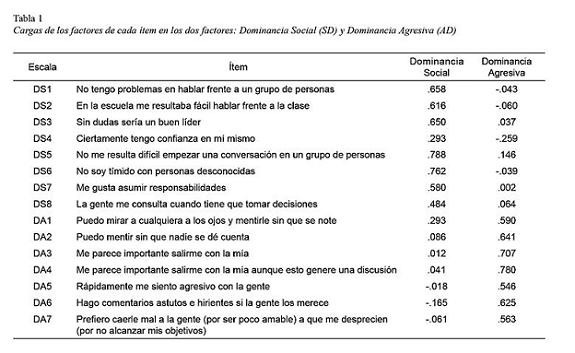
<body><![CDATA[<p class="western" style="margin: 5pt 13.4pt 0.0001pt 1cm; text-align: justify; text-indent: 19.85pt; line-height: 150%;"><i><span style="font-size: 12pt; line-height: 150%; font-family: &quot;Arial&quot;,&quot;sans-serif&quot;;">Relaci&oacute;n 2D:4D</span></i><span style="font-size: 12pt; line-height: 150%;"><o:p></o:p></span></p>         <p class="western" style="margin: 5pt 13.4pt 0.0001pt 1cm; text-align: justify; text-indent: 19.85pt; line-height: 150%;"><span style="font-size: 12pt; line-height: 150%; font-family: &quot;Arial&quot;,&quot;sans-serif&quot;;">Las caras ventrales de las manos derechas e izquierdas de los participantes fueron escaneadas usando un esc&aacute;ner CanoScan LiDE 110 Canon. Las im&aacute;genes fueron guardadas en formato JPG con un tama&ntilde;o de 1275 x 1250 p&iacute;xeles, una resoluci&oacute;n de 150 dpi y una profundidad de color de 24 bits por p&iacute;xel. La luminosidad y contraste de las im&aacute;genes fueron ajustados de forma de permitir una mejor visualizaci&oacute;n de los pliegues de la mano. Las medidas de los dedos &iacute;ndice (2D) y anular (4D) de ambas manos fueron tomadas por dos investigadores independientes con ayuda de la herramienta de medida del software de edici&oacute;n de im&aacute;genes GIMP (Versi&oacute;n 2.8). Las medidas de los dedos fueron tomadas desde el punto medio del pliegue m&aacute;s proximal en la base de los dedos, hasta el extremo distal de los mismos. Cuando las medidas tomadas por ambos investigadores difer&iacute;an en m&aacute;s de tres desv&iacute;os t&iacute;picos, las medidas de estos dedos fueron tomadas nuevamente. S&oacute;lo pudieron ser escaneadas las manos de 94 jugadores. Las im&aacute;genes correspondientes a las dos manos de un jugador y una de las manos de otros dos jugadores quedaron fuera de foco y por lo tanto fueron eliminadas de este estudio; los datos pertenecientes a otros dos jugadores no fueron considerados en el presente an&aacute;lisis ya que reportaron lesiones en los dedos 2 y 4. Se calcul&oacute; la relaci&oacute;n 2D:4D para cada mano, de cada participante, realizando el cociente entre longitud del dedo &iacute;ndice y la longitud del dedo anular. </span><span style="font-size: 12pt; line-height: 150%;"><o:p></o:p></span></p>         <p class="western" style="margin: 5pt 13.4pt 0.0001pt 1cm; text-align: justify; text-indent: 19.85pt; line-height: 150%;"><span style="font-size: 12pt; line-height: 150%; font-family: &quot;Arial&quot;,&quot;sans-serif&quot;;">Siguiendo a <a name="Weinberg_ref"></a><a href="#Weinberg">Weinberg</a>, Scott, Neiswanger y Marazita (2005), se calcularon el error t&eacute;cnico de medida (TEM) y el error t&eacute;cnico de medida relativo (rTEM) para todas las medidas de dedos y coeficientes &ndash;menores valores de TEM y rTEM indican mayor precisi&oacute;n en las medidas. En cuanto a las diferencias entre las medidas de los dedos, se encontraron valores de TEM entre 0,48 y 0,61 y de rTEM entre 0,62 y 0,82. El cociente 2D:4D correspondiente a la mano izquierda mostr&oacute; un valor de TEM de 0,01 y de rTEM de 0,67; mientras que para la mano derecha la relaci&oacute;n 2D:4D arroj&oacute; un TEM de 0,01 y un rTEM de 0,59. </span><span style="font-size: 12pt; line-height: 150%;"><o:p></o:p></span></p>         <p class="western" style="margin: 5pt 13.4pt 0.0001pt 1cm; text-align: justify; text-indent: 19.85pt; line-height: 150%;"><span style="font-size: 12pt; line-height: 150%; font-family: &quot;Arial&quot;,&quot;sans-serif&quot;;">Por otro lado, con el fin de obtener la fiabilidad entre observadores, se calcularon los coeficientes de correlaci&oacute;n intraclase (CCI), modelo de efectos mixtos de dos factores, utilizando una definici&oacute;n de acuerdo absoluto. Para todos los dedos y coeficientes se alcanzaron CCI de entre 0,95 y 0,99.</span><span style="font-size: 12pt; line-height: 150%;"><o:p></o:p></span></p>         <p class="western" style="margin: 5pt 13.4pt 0.0001pt 1cm; text-align: justify; text-indent: 19.85pt; line-height: 150%;"><span style="font-size: 12pt; line-height: 150%;"><o:p>&nbsp;</o:p></span></p>         <p class="western" style="margin: 5pt 13.4pt 0.0001pt 1cm; text-align: justify; line-height: 150%;"><b><span style="font-size: 12pt; line-height: 150%; font-family: &quot;Arial&quot;,&quot;sans-serif&quot;;">Resultados</span></b><span style="font-size: 12pt; line-height: 150%;"><o:p></o:p></span></p>         <p class="western" style="margin: 5pt 13.4pt 0.0001pt 1cm; text-align: justify; text-indent: 19.85pt; line-height: 150%;"><span style="font-size: 12pt; line-height: 150%;"><o:p>&nbsp;</o:p></span></p>         <p class="western" style="margin: 5pt 13.4pt 0.0001pt 1cm; text-align: justify; text-indent: 19.85pt; line-height: 150%;"><span style="font-size: 12pt; line-height: 150%; font-family: &quot;Arial&quot;,&quot;sans-serif&quot;;">En cuanto a las caracter&iacute;sticas psicom&eacute;tricas preliminares de las escalas de dominancia social y dominancia agresiva, la medida de adecuaci&oacute;n de muestras de Kaiser-Meyer-Olkin (KMO=.639) y la prueba de esfericidad de Bartlett (Chi-cuadrado=474.609; gl=105; p=.000) indican que es posible realizar el An&aacute;lisis Factorial Exploratorio (AFE). Este se realiz&oacute; mediante el m&eacute;todo de extracci&oacute;n de Componentes Principales, con rotaci&oacute;n Varimax y una soluci&oacute;n a dos factores rotados. Los factores detectados fueron dominancia social, que explica el 21,79% de la varianza, y dominancia agresiva, que explica un 19,49% adicional de la varianza total. Como puede verse en la <a href="#T1">Tabla 1</a>, el &iacute;tem 4 de dominancia social presenta una carga inferior a 0.40 en ambos factores. </span><span style="font-size: 12pt; line-height: 150%;" lang="ES-UY"><o:p></o:p></span></p>         <p class="western" style="margin: 5pt 13.4pt 0.0001pt 1cm; text-align: justify; text-indent: 19.85pt; line-height: 150%;"><span style="font-size: 12pt; line-height: 150%;"><o:p>&nbsp;</o:p></span></p>         <p class="western" style="margin: 5pt 13.4pt 0.0001pt 1cm; text-align: justify; line-height: 150%;"><a name="T1"></a><img style="width: 575px; height: 353px;" alt="" src="/img/revistas/cp/v7n2/2a04t1.jpg"><span style="font-size: 12pt; line-height: 150%;"></span><span style="font-size: 12pt; line-height: 150%;" lang="ES-UY"><o:p></o:p></span></p>         ]]></body>
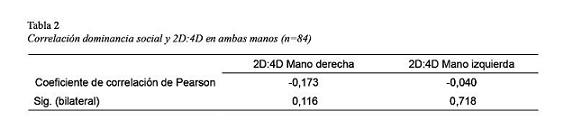
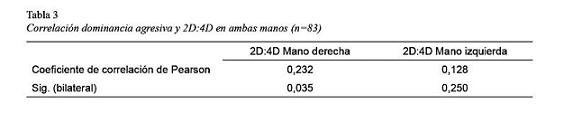
<body><![CDATA[<p class="western" style="margin: 5pt 13.4pt 0.0001pt 1cm; text-align: justify; line-height: 150%;"><span style="font-size: 12pt; line-height: 150%;"><o:p>&nbsp;</o:p></span></p>         <p class="western" style="margin: 5pt 13.4pt 0.0001pt 1cm; text-align: justify; text-indent: 19.85pt; line-height: 150%;"><span style="font-size: 12pt; line-height: 150%; font-family: &quot;Arial&quot;,&quot;sans-serif&quot;;">Con el fin de determinar si las escalas dominancia social y dominancia agresiva se encontraban relacionadas con el cociente 2D:4D de ambas manos, calculamos el coeficiente de correlaci&oacute;n r de Pearson. </span><span style="font-size: 12pt; line-height: 150%;"><o:p></o:p></span></p>         <p class="western" style="margin: 5pt 13.4pt 0.0001pt 1cm; text-align: justify; text-indent: 19.85pt; line-height: 150%;"><span style="font-size: 12pt; line-height: 150%; font-family: &quot;Arial&quot;,&quot;sans-serif&quot;;">En cuanto a la escala dominancia social, no se observan correlaciones estad&iacute;sticamente significativas con los cocientes 2D:4D de ambas manos (p &ge; .050) (ver <a href="#T2">Tabla 2</a>).</span></p>     <p class="western" style="margin: 5pt 13.4pt 0.0001pt 1cm; text-align: justify; text-indent: 19.85pt; line-height: 150%;"><span style="font-size: 12pt; line-height: 150%; font-family: &quot;Arial&quot;,&quot;sans-serif&quot;;"></span></p>       <p class="western" style="margin: 5pt 13.4pt 0.0001pt 1cm; text-align: justify; text-indent: 19.85pt; line-height: 150%;"><span style="font-size: 12pt; line-height: 150%; font-family: &quot;Arial&quot;,&quot;sans-serif&quot;;"> </span><span style="font-size: 12pt; line-height: 150%;"><o:p></o:p></span></p>         <p class="western" style="margin: 5pt 13.4pt 0.0001pt 1cm; text-align: justify; line-height: 150%;"><a name="T2"></a><img style="width: 573px; height: 130px;" alt="" src="/img/revistas/cp/v7n2/2a04t2.jpg"></p>       <p class="western" style="margin: 5pt 13.4pt 0.0001pt 1cm; text-align: justify; line-height: 150%;"><span style="font-size: 12pt; line-height: 150%;"></span><span style="font-size: 12pt; line-height: 150%;" lang="ES-UY"><o:p></o:p></span></p>         <p class="western" style="margin: 5pt 13.4pt 0.0001pt 1cm; text-align: justify; text-indent: 19.85pt; line-height: 150%;"><span style="font-size: 12pt; line-height: 150%; font-family: &quot;Arial&quot;,&quot;sans-serif&quot;;">Como puede verse en la <a href="#T3">Tabla 3</a>, se observa una correlaci&oacute;n positiva entre la escala dominancia agresiva y el cociente 2D:4D de la mano derecha (p &lt; .050), no observ&aacute;ndose una correlaci&oacute;n estad&iacute;sticamente significativa con el cociente 2D4D de la mano izquierda (p &ge; .050). </span><span style="font-size: 12pt; line-height: 150%;" lang="ES-UY"><o:p></o:p></span></p>         <p class="western" style="margin: 5pt 13.4pt 0.0001pt 1cm; text-align: justify; text-indent: 19.85pt; line-height: 150%;"><span style="font-size: 12pt; line-height: 150%;"><o:p>&nbsp;</o:p></span></p>         <p class="western" style="margin: 5pt 13.4pt 0.0001pt 1cm; text-align: justify; line-height: 150%;"><a name="T3"></a><img style="width: 573px; height: 122px;" alt="" src="/img/revistas/cp/v7n2/2a04t3.jpg"><span style="font-size: 12pt; line-height: 150%;"></span><span style="font-size: 12pt; line-height: 150%;"></span><span style="font-size: 12pt; line-height: 150%;" lang="ES-UY"><o:p></o:p></span></p>         ]]></body>
<body><![CDATA[<p class="western" style="margin: 5pt 13.4pt 0.0001pt 1cm; text-align: justify; line-height: 150%;"><b><span style="font-size: 12pt; line-height: 150%; font-family: &quot;Arial&quot;,&quot;sans-serif&quot;;"></span></b></p>       <p class="western" style="margin: 5pt 13.4pt 0.0001pt 1cm; text-align: justify; line-height: 150%;"><b><span style="font-size: 12pt; line-height: 150%; font-family: &quot;Arial&quot;,&quot;sans-serif&quot;;">Discusi&oacute;n</span></b><span style="font-size: 12pt; line-height: 150%;"><o:p></o:p></span></p>         <p class="western" style="margin: 5pt 13.4pt 0.0001pt 1cm; text-align: justify; line-height: 150%;"><span style="font-size: 12pt; line-height: 150%;"><o:p>&nbsp;</o:p></span></p>         <p class="western" style="margin: 5pt 13.4pt 0.0001pt 1cm; text-align: justify; text-indent: 19.85pt; line-height: 150%;"><span style="font-size: 12pt; line-height: 150%; font-family: &quot;Arial&quot;,&quot;sans-serif&quot;;">En un estudio reciente, <a href="#van_der_Meij">van der Meij</a> et al. (2012) reportan haber observado una correlaci&oacute;n negativa significativa entre la relaci&oacute;n 2D:4D y la dominancia agresiva. Los resultados presentados en este estudio difieren de los reportados  por estos autores. Existen algunas diferencias metodol&oacute;gicas y particularidades relativas a la muestra que pueden estar dando cuenta de estas discrepancias.</span><span style="font-size: 12pt; line-height: 150%;" lang="ES-UY"><o:p></o:p></span></p>         <p class="western" style="margin: 5pt 13.4pt 0.0001pt 1cm; text-align: justify; text-indent: 19.85pt; line-height: 150%;"><span style="font-size: 12pt; line-height: 150%; font-family: &quot;Arial&quot;,&quot;sans-serif&quot;;">Si bien en la evaluaci&oacute;n de la dominancia social y de la dominancia agresiva en ambos estudios se emplearon traducciones al castellano de las escalas desarrolladas por <a href="#Kalma">Kalma</a> et al. (1993), <a href="#van_der_Meij">van der Meij</a> et al. (2012) utilizan escalas de 9 y 11 &iacute;tems respectivamente, mientras que en este estudio se utilizan traducciones de las escalas originales de 8 y 7 &iacute;tems respectivamente. Adicionalmente, en este estudio se utilizaron nuevas traducciones de las escalas, adaptadas a las variantes locales del castellano.</span><span style="font-size: 12pt; line-height: 150%;"><o:p></o:p></span></p>         <p class="western" style="margin: 5pt 13.4pt 0.0001pt 1cm; text-align: justify; text-indent: 19.85pt; line-height: 150%;"><span style="font-size: 12pt; line-height: 150%; font-family: &quot;Arial&quot;,&quot;sans-serif&quot;;">El an&aacute;lisis factorial de componentes principales reportado en el presente trabajo muestra que la mayor&iacute;a de los &iacute;tems de las escalas se ajustan bien a la soluci&oacute;n de dos factores propuesta originalmente por <a href="#Kalma">Kalma</a> et al. (1993), excepto para el &iacute;tem 4 de la escala de dominancia social. S&oacute;lo el &iacute;tem DS4 de la escala de dominancia social (Ciertamente tengo confianza en m&iacute; mismo) presenta cargas menores a 0,40 en ambos factores, no ajust&aacute;ndose al modelo propuesto. Estudios adicionales confirmar&aacute;n si este &iacute;tem aporta informaci&oacute;n de valor o puede ser eliminado. Los resultados de este an&aacute;lisis factorial difieren de los presentados por <a href="#van_der_Meij">van der Meij</a> et al. (2012); estos autores proponen la eliminaci&oacute;n de cuatro &iacute;tems, que de acuerdo a nuestro an&aacute;lisis se ajustan bien al modelo de dos factores planteado por los autores originales de las escalas (<a href="#Kalma">Kalma</a> et al., 1993).</span><span style="font-size: 12pt; line-height: 150%;"><o:p></o:p></span></p>         <p class="western" style="margin: 5pt 13.4pt 0.0001pt 1cm; text-align: justify; text-indent: 19.85pt; line-height: 150%;"><span style="font-size: 12pt; line-height: 150%; font-family: &quot;Arial&quot;,&quot;sans-serif&quot;;">En el presente estudio no pudimos confirmar la correlaci&oacute;n negativa entre la dominancia agresiva y la relaci&oacute;n 2D:4D reportada por <a href="#van_der_Meij">van der Meij</a> et al. (2012). M&aacute;s a&uacute;n, los an&aacute;lisis ponen de relieve una leve correlaci&oacute;n positiva entre la relaci&oacute;n 2D:4D, contradiciendo los resultados presentados por estos autores. Diferencias en la traducci&oacute;n y puntajes de las escalas utilizados en los estudios de van der Meij y colaboradores y en el presente estudio, as&iacute; como las caracter&iacute;sticas particulares de los grupos estudiados podr&iacute;an estar dando cuenta de las diferencias observadas. </span><span style="font-size: 12pt; line-height: 150%;"><o:p></o:p></span></p>         <p class="western" style="margin: 5pt 13.4pt 0.0001pt 1cm; text-align: justify; text-indent: 19.85pt; line-height: 150%;"><span style="font-size: 12pt; line-height: 150%; font-family: &quot;Arial&quot;,&quot;sans-serif&quot;;">En primer lugar, las escalas utilizadas en ambos estudios se basan en traducciones diferentes que dan cuenta de las diferentes variantes del castellano empleadas en Espa&ntilde;a y el R&iacute;o de la Plata. Adicionalmente, <a href="#van_der_Meij">van der Meij</a> et al. (2012) utilizaron una escala de 6 puntos que fuerza las decisiones, en tanto que en este trabajo se us&oacute; una escala basada en 5 puntos que permite una opci&oacute;n &lsquo;neutral&rsquo;.</span><span style="font-size: 12pt; line-height: 150%;"><o:p></o:p></span></p>         <p class="western" style="margin: 5pt 13.4pt 0.0001pt 1cm; text-align: justify; text-indent: 19.85pt; line-height: 150%;"><span style="font-size: 12pt; line-height: 150%; font-family: &quot;Arial&quot;,&quot;sans-serif&quot;;">Por otra parte, podr&iacute;an existir diferencias culturales en las poblaciones estudiadas. Posiblemente, las caracter&iacute;sticas de las poblaciones de los sujetos que participaron en ambos estudios podr&iacute;an estar contribuyendo tambi&eacute;n a las diferencias observadas. Adem&aacute;s de eventuales diferencias culturales, la poblaci&oacute;n considerada en nuestro estudio presenta algunas caracter&iacute;sticas particulares. El f&uacute;tbol es un deporte de equipo en el que las conductas agresivas pueden tener consecuencias negativas de gran impacto. Si estas conductas se dirigen a miembros del propio equipo pueden provocar una disminuci&oacute;n del rendimiento deportivo, mientras que si est&aacute;n dirigidas hacia jugadores de equipos rivales puede incrementarse el riesgo de sanciones. Los mecanismos de selecci&oacute;n y evaluaci&oacute;n de los jugadores podr&iacute;an estar generando una presi&oacute;n selectiva negativa contra aquellos jugadores con altos niveles de conductas agresivas. En este sentido, <a href="#Golby">Golby</a> y Meggs (2011) observaron una correlaci&oacute;n positiva entre la relaci&oacute;n 2D:4D y niveles de hostilidad en un estudio llevado a cabo con deportistas de diferentes disciplinas, es decir que aquellos individuos que presentaban manos m&aacute;s masculinizadas presentaban menores niveles de hostilidad. En relaci&oacute;n a los resultados publicados por <a href="#van_der_Meij">van der Meij</a> et al. (2012), <a name="Voracek_ref"></a><a href="#Voracek">Voracek</a> (2013) se&ntilde;ala algunos cuestionamientos metodol&oacute;gicos. Seg&uacute;n este autor, la correlaci&oacute;n negativa significativa entre la relaci&oacute;n 2D:4D y la dominancia agresiva observadas por <a href="#van_der_Meij">van der Meij</a> et al. (2012) no difiere significativamente de la relaci&oacute;n no significativa entre la relaci&oacute;n 2D:4D y la dominancia social reportada. De hecho, <a href="#Honekopp">H&ouml;nekopp</a> y Watson (2011) en un estudio meta-anal&iacute;tico, plantean que los reportes publicados en el campo de las relaciones 2D:4D y las conductas vinculadas a la agresi&oacute;n evidenciar&iacute;an una muy d&eacute;bil relaci&oacute;n entre el cociente 2D:4D y los caracteres vinculados a la agresi&oacute;n en los varones, siendo esta correlaci&oacute;n inexistente para las mujeres. Estos autores plantean que asumiendo una d&eacute;bil correlaci&oacute;n entre la relaci&oacute;n 2D:4D y agresi&oacute;n de r = -0,10, muestras mayores de 600 participantes deber&iacute;an emplearse para alcanzar una potencia estad&iacute;stica de 0,80 (<a href="#Honekopp">H&ouml;nekopp</a> y Watson, 2011). En este escenario, los datos que reportamos deber&iacute;an ser considerados como un estudio preliminar.</span><span style="font-size: 12pt; line-height: 150%;"><o:p></o:p></span></p>         <p class="western" style="margin: 5pt 13.4pt 0.0001pt 1cm; text-align: justify; text-indent: 19.85pt; line-height: 150%;"><span style="font-size: 12pt; line-height: 150%; font-family: &quot;Arial&quot;,&quot;sans-serif&quot;;">El presente estudio presenta algunas limitaciones. Como se mencionara anteriormente, se centra en la exploraci&oacute;n de eventuales correlaciones entre los niveles de T fetal --reflejada en la relaci&oacute;n 2D:4D-- y sus efectos perdurables sobre los niveles de dominancia social y dominancia agresiva. Este estudio fue llevado a cabo con una muestra por oportunidad conformada por 112 varones pertenecientes a las categor&iacute;as formativas de un club de f&uacute;tbol del Uruguay. Si bien las particularidades de la muestra hacen dif&iacute;cil la generalizaci&oacute;n de los resultados a otras poblaciones, consideramos que estas mismas particularidades otorgan inter&eacute;s al presente estudio. En este sentido, los participantes constituyen una muestra altamente competitiva, donde las dimensiones de liderazgo y agresividad tienen un alto impacto. En el futuro ser&aacute; interesante ampliar estos estudios a otros grupos conformados por atletas de ambos sexos y a la poblaci&oacute;n general. Asimismo, planteamos tomar en consideraci&oacute;n la heterogeneidad que algunos autores plantean dentro de la adolescencia en cuanto a las variables estudiadas (e.g., <a name="Brame_ref"></a><a href="#Brame">Brame</a>, Nagin, &amp; Tremblay, 2001; <a name="Munoz-Reyes_ref"></a><a href="#Munoz-Reyes">Mu&ntilde;oz-Reyes</a>, Gil-Burmann, Fink, &amp; Turiegano, 2012) profundizando adem&aacute;s en la relaci&oacute;n de las dimensiones social y agresiva de la dominancia con otras operacionalizaciones de las conductas agresivas.</span><span style="font-size: 12pt; line-height: 150%;"><o:p></o:p></span></p>         ]]></body>
<body><![CDATA[<p class="western" style="margin: 5pt 13.4pt 0.0001pt 1cm; text-align: justify; line-height: 150%;"><span style="font-size: 12pt; line-height: 150%;"><o:p>&nbsp;</o:p></span></p>         <p class="western" style="margin: 5pt 13.4pt 0.0001pt 1cm; text-align: justify; line-height: 150%;"><b><span style="font-size: 12pt; line-height: 150%; font-family: &quot;Arial&quot;,&quot;sans-serif&quot;;" lang="EN-US">Referencias</span></b><span style="font-size: 12pt; line-height: 150%;" lang="EN-US"><o:p></o:p></span></p>         <p class="western" style="margin: 5pt 13.4pt 0.0001pt 1cm; text-align: justify;"><span style="font-size: 12pt; line-height: 115%;" lang="EN-US"><o:p>&nbsp;</o:p></span></p>         <p class="western" style="margin: 5pt 13.4pt 0.0001pt 1cm; text-align: justify; line-height: 120%;"><a name="Archer"></a><span style="font-size: 12pt; line-height: 120%; font-family: &quot;Arial&quot;,&quot;sans-serif&quot;;" lang="EN-US"><a href="#Archer_ref">Archer</a>, J. (2009). Does sexual selection explain human sex differences in aggression? <i>Behavioral and Brain Sciences,</i> <i>32</i>(3/4), 249&ndash;311. doi:10.1017/S0140525X09990951</span><span style="font-size: 12pt; line-height: 120%;" lang="EN-US"><o:p></o:p></span></p>         <p class="western" style="margin: 5pt 13.4pt 0.0001pt 1cm; text-align: justify; line-height: 120%;"><a name="Bailey"></a><span style="font-size: 12pt; line-height: 120%; font-family: &quot;Arial&quot;,&quot;sans-serif&quot;;" lang="EN-US"><a href="#Bailey_ref">Bailey</a>, A. A., &amp; Hurd, P. L. (2005). Depression in men is associated with more feminine finger length ratios. <i>Personality and Individual Differences, 39</i>(4), 829&ndash;836. doi:10.1016/j.paid.2004.12.017</span><span style="font-size: 12pt; line-height: 120%;" lang="EN-US"><o:p></o:p></span></p>         <p class="western" style="margin: 5pt 13.4pt 0.0001pt 1cm; text-align: justify; line-height: 120%;"><a name="Bao"></a><span style="font-size: 12pt; line-height: 120%; font-family: &quot;Arial&quot;,&quot;sans-serif&quot;;" lang="EN-US"><a href="#Bao_ref">Bao</a>, A.-M., &amp; Swaab, D. F. (2011). Sexual differentiation of the human brain: relation to gender identity, sexual orientation and neuropsychiatric disorders. <i>Frontiers in Neuroendocrinology, 32</i>(2), 214&ndash;26. doi:10.1016/j.yfrne.2011.02.007</span><span style="font-size: 12pt; line-height: 120%;" lang="EN-US"><o:p></o:p></span></p>         <p class="western" style="margin: 5pt 13.4pt 0.0001pt 1cm; text-align: justify; line-height: 120%;"><a name="Brame"></a><span style="font-size: 12pt; line-height: 120%; font-family: &quot;Arial&quot;,&quot;sans-serif&quot;;" lang="EN-US"><a href="#Brame_ref">Brame</a>, B., Nagin, D. S., &amp; Tremblay, R. E. (2001). Developmental trajectories of physical aggression from school entry to late adolescence. <i>Journal of child psychology and psychiatry, and allied disciplines, 42</i>(4), 503&ndash;512. Recuperado de <a href="http://www.ncbi.nlm.nih.gov/pubmed/11383966">http://www.ncbi.nlm.nih.gov/pubmed/11383966</a></span><span style="font-size: 12pt; line-height: 120%;" lang="EN-US"><o:p></o:p></span></p>         <p class="western" style="margin: 5pt 13.4pt 0.0001pt 1cm; text-align: justify; line-height: 120%;"><a name="Brown"></a><span style="font-size: 12pt; line-height: 120%; font-family: &quot;Arial&quot;,&quot;sans-serif&quot;;" lang="EN-US"><a href="#Brown_ref">Brown</a>, W. M., Hines, M., Fane, B. A., &amp; Breedlove, S. M. (2002). Masculinized Finger Length Patterns in Human Males and Females with Congenital Adrenal Hyperplasia. <i>Hormones and Behavior, 42</i>(4), 380&ndash;386. doi:10.1006/hbeh.2002.1830</span><span style="font-size: 12pt; line-height: 120%;" lang="EN-US"><o:p></o:p></span></p>         <p class="western" style="margin: 5pt 13.4pt 0.0001pt 1cm; text-align: justify; line-height: 120%;"><a name="Campbell"></a><span style="font-size: 12pt; line-height: 120%; font-family: &quot;Arial&quot;,&quot;sans-serif&quot;;" lang="EN-US"><a href="#Campbell_ref">Campbell</a>, A. (2006). Sex differences in direct aggression: What are the psychological mediators? <i>Aggression and Violent Behavior, 11(</i>3), 237&ndash;264.</span><span style="font-size: 12pt; line-height: 120%;" lang="EN-US"><o:p></o:p></span></p>         <p class="western" style="margin: 5pt 13.4pt 0.0001pt 1cm; text-align: justify; line-height: 120%;"><a name="Clutton-Brock"></a><span style="font-size: 12pt; line-height: 120%; font-family: &quot;Arial&quot;,&quot;sans-serif&quot;;" lang="EN-US"><a href="#Clutton-Brock_ref">Clutton-Brock</a>, T. H., &amp; Vincent, A. C. J. (1991). Sexual selection and the potential reproductive rates of males and females. <i>Nature, 351</i>, 58&ndash;60.</span><span style="font-size: 12pt; line-height: 120%;" lang="EN-US"><o:p></o:p></span></p>         ]]></body>
<body><![CDATA[<p class="western" style="margin: 5pt 13.4pt 0.0001pt 1cm; text-align: justify; line-height: 120%;"><a name="Coates"></a><span style="font-size: 12pt; line-height: 120%; font-family: &quot;Arial&quot;,&quot;sans-serif&quot;;" lang="EN-US"><a href="#Coates_ref">Coates</a>, J. M., Gurnell, M., &amp; Rustichini, A. (2009). Second-to-fourth digit ratio predicts success among high-frequency financial traders.<i> Proceedings of the National Academy of Sciences of the United States of America, 106</i>(2), 623&ndash;8. doi:10.1073/pnas.0810907106</span><span style="font-size: 12pt; line-height: 120%;" lang="EN-US"><o:p></o:p></span></p>         <!-- ref --><p class="western" style="margin: 5pt 13.4pt 0.0001pt 1cm; text-align: justify; line-height: 120%;"><a name="Geen"></a><span style="font-size: 12pt; line-height: 120%; font-family: &quot;Arial&quot;,&quot;sans-serif&quot;;" lang="EN-US"><a href="#Geen_ref">Geen</a>, R. G. (2001). <i>Human Aggression</i> (2<sup>nd</sup> ed.) Buckingham, Philadelphia: Open University Press</span><span style="font-size: 12pt;     line-height: 120%;" lang="EN-US"><o:p></o:p></span></p>         <p class="western" style="margin: 5pt 13.4pt 0.0001pt 1cm; text-align: justify; line-height: 120%;"><a name="Golby"></a><span style="font-size: 12pt; line-height: 120%; font-family: &quot;Arial&quot;,&quot;sans-serif&quot;;" lang="EN-US"><a href="#Golby_ref">Golby</a>, J., &amp; Meggs, J. (2011). Exploring the organizational effect of prenatal testosterone upon the sporting brain. <i>Journal of Sports Science and Medicine, 10, </i>445&ndash;451.</span><span style="font-size: 12pt; line-height: 120%;" lang="EN-US"><o:p></o:p></span></p>         <p class="western" style="margin: 5pt 13.4pt 0.0001pt 1cm; text-align: justify; line-height: 120%;"><a name="Grimbos"></a><span style="font-size: 12pt; line-height: 120%; font-family: &quot;Arial&quot;,&quot;sans-serif&quot;;" lang="EN-US"><a href="#Grimbos_ref">Grimbos</a>, T., Dawood, K., Burriss, R. P., Zucker, K. J., &amp; Puts, D. a. (2010). Sexual orientation and the second to fourth finger length ratio: A meta-analysis in men and women. <i>Behavioral Neuroscience, 124</i>(2), 278&ndash;87. doi:10.1037/a0018764</span><span style="font-size: 12pt; line-height: 120%;" lang="EN-US"><o:p></o:p></span></p>         <p class="western" style="margin: 5pt 13.4pt 0.0001pt 1cm; text-align: justify; line-height: 120%;"><a name="Hines"></a><span style="font-size: 12pt; line-height: 120%; font-family: &quot;Arial&quot;,&quot;sans-serif&quot;;" lang="EN-US"><a href="#Hines_ref">Hines</a>, M. (2006). Prenatal testosterone and gender-related behaviour. <i>European Journal of Endocrinology, 155 </i>Suppl, S115&ndash;21. doi:10.1530/eje.1.02236</span><span style="font-size: 12pt; line-height: 120%;" lang="EN-US"><o:p></o:p></span></p>         <p class="western" style="margin: 5pt 13.4pt 0.0001pt 1cm; text-align: justify; line-height: 120%;"><a name="Honekopp"></a><span style="font-size: 12pt; line-height: 120%; font-family: &quot;Arial&quot;,&quot;sans-serif&quot;;" lang="EN-US"><a href="#Honekopp_ref">H&ouml;nekopp</a>, J., &amp; Watson, S. (2011). Meta-analysis of the relationship between digit-ratio 2D:4D and aggression. <i>Personality and Individual Differences, 51</i>(4), 381&ndash;386. doi:10.1016/j.paid.2010.05.003</span><span style="font-size: 12pt; line-height: 120%;" lang="EN-US"><o:p></o:p></span></p>         <p class="western" style="margin: 5pt 13.4pt 0.0001pt 1cm; text-align: justify; line-height: 120%;"><a name="Kalma"></a><span style="font-size: 12pt; line-height: 120%; font-family: &quot;Arial&quot;,&quot;sans-serif&quot;;" lang="EN-US"><a href="#Kalma_ref">Kalma</a>, A. P., Visser, L., &amp; Peeters, A. (1993). Sociable and aggressive dominance: Personality differences in leadership style? <i>The Leadership Quarterly, 4</i>(l), 45&ndash;64.</span><span style="font-size: 12pt; line-height: 120%;" lang="EN-US"><o:p></o:p></span></p>         <p class="western" style="margin: 5pt 13.4pt 0.0001pt 1cm; text-align: justify; line-height: 120%;"><a name="Knickmeyer"></a><span style="font-size: 12pt; line-height: 120%; font-family: &quot;Arial&quot;,&quot;sans-serif&quot;;" lang="EN-US"><a href="#Knickmeyer_ref">Knickmeyer</a>, C. R., &amp; Baron-Cohen, S. (2006). Fetal testosterone and sex differences. <i>Early Human Development, 82</i>(12), 755&ndash;60. doi:10.1016/j.earlhumdev.2006.09.014</span><span style="font-size: 12pt; line-height: 120%;" lang="EN-US"><o:p></o:p></span></p>         <p class="western" style="margin: 5pt 13.4pt 0.0001pt 1cm; text-align: justify; line-height: 120%;"><a name="Lutchmaya"></a><span style="font-size: 12pt; line-height: 120%; font-family: &quot;Arial&quot;,&quot;sans-serif&quot;;" lang="EN-US"><a href="#Lutchmaya_ref">Lutchmaya</a>, S., Baron-Cohen, S., Raggatt, P., Knickmeyer, R., &amp; Manning, J. T. (2004). 2nd to 4th digit ratios, fetal testosterone and estradiol. <i>Early Human Development, 77(</i>1-2), 23&ndash;8. doi:10.1016/j.earlhumdev.2003.12.002</span><span style="font-size: 12pt; line-height: 120%;" lang="EN-US"><o:p></o:p></span></p>         ]]></body>
<body><![CDATA[<p class="western" style="margin: 5pt 13.4pt 0.0001pt 1cm; text-align: justify; line-height: 120%;"><a name="Luxen"></a><span style="font-size: 12pt; line-height: 120%; font-family: &quot;Arial&quot;,&quot;sans-serif&quot;;"><a href="#Luxen_ref">Luxen</a>, M. F., &amp; Buunk, B. P. (2005). </span><span style="font-size: 12pt; line-height: 120%; font-family: &quot;Arial&quot;,&quot;sans-serif&quot;;" lang="EN-US">Second-to-fourth digit ratio related to Verbal and Numerical Intelligence and the Big Five. <i>Personality and Individual Differences, 39</i>(5), 959&ndash;966. doi:10.1016/j.paid.2005.03.016</span><span style="font-size: 12pt; line-height: 120%;" lang="EN-US"><o:p></o:p></span></p>         <p class="western" style="margin: 5pt 13.4pt 0.0001pt 1cm; text-align: justify; line-height: 120%;"><a name="Manning"></a><span style="font-size: 12pt; line-height: 120%; font-family: &quot;Arial&quot;,&quot;sans-serif&quot;;" lang="EN-US"><a href="#Manning_ref">Manning</a>, J., Barley, L., Walton, J., Lewis-Jones, D., Trivers, R., Singh, D., &hellip; Szwed, A. (2000). The 2nd:4th digit ratio, sexual dimorphism, population differences, and reproductive success. evidence for sexually antagonistic genes? <i>Evolution and Human Behavior, 21</i>(3), 163&ndash;183. </span><span style="font-size: 12pt; line-height: 120%;" lang="EN-US"><o:p></o:p></span></p>         <p class="western" style="margin: 5pt 13.4pt 0.0001pt 1cm; text-align: justify; line-height: 120%;"><a name="Manning_1"></a><span style="font-size: 12pt; line-height: 120%; font-family: &quot;Arial&quot;,&quot;sans-serif&quot;;" lang="EN-US"><a href="#Manning_ref1">Manning</a>, J. T., Baron-Cohen, S., Wheelwright, S., &amp; Sanders, G. (2001). The 2nd to 4th digit ratio and autism. <i>Developmental Medicine and Child Neurology, 43</i>(3), 160&ndash;4. </span><span style="font-size: 12pt; line-height: 120%;" lang="EN-US"><o:p></o:p></span></p>         <p class="western" style="margin: 5pt 13.4pt 0.0001pt 1cm; text-align: justify; line-height: 120%;"><a name="Manning_"></a><span style="font-size: 12pt; line-height: 120%; font-family: &quot;Arial&quot;,&quot;sans-serif&quot;;" lang="EN-US"><a href="#Manning_ref2">Manning</a>, J. T., Scutt, D., Wilson, J., &amp; Lewis-Jones, D. I. (1998). The ratio of 2nd to 4th digit length: a predictor of sperm numbers and concentrations of testosterone, luteinizing hormone and oestrogen. <i>Human Reproduction, 13</i>(11), 3000&ndash;4. </span><span style="font-size: 12pt; line-height: 120%;" lang="EN-US"><o:p></o:p></span></p>         <p class="western" style="margin: 5pt 13.4pt 0.0001pt 1cm; text-align: justify; line-height: 120%;"><a name="Manning_3"></a><span style="font-size: 12pt; line-height: 120%; font-family: &quot;Arial&quot;,&quot;sans-serif&quot;;" lang="EN-US"><a href="#Manning_ref5">Manning</a>, J. T., &amp; Taylor, R. P. (2001). Second to fourth digit ratio and male ability in sport: implications for sexual selection in humans. <i>Evolution and Human Behavior, 22</i>(1), 61&ndash;69.</span><span style="font-size: 12pt; line-height: 120%;" lang="EN-US"><o:p></o:p></span></p>         <p class="western" style="margin: 5pt 13.4pt 0.0001pt 1cm; text-align: justify; line-height: 120%;"><a name="Mazur"></a><span style="font-size: 12pt; line-height: 120%; font-family: &quot;Arial&quot;,&quot;sans-serif&quot;;" lang="EN-US"><a href="#Mazur_ref1">Mazur</a>, A. (1973). A Cross-Species Comparison of Status in Small Established Groups. <i>American Sociological Review, 38</i>(5), 513&ndash;530.</span><span style="font-size: 12pt; line-height: 120%;" lang="EN-US"><o:p></o:p></span></p>         <p class="western" style="margin: 5pt 13.4pt 0.0001pt 1cm; text-align: justify; line-height: 120%;"><a name="Mazur_1"></a><span style="font-size: 12pt; line-height: 120%; font-family: &quot;Arial&quot;,&quot;sans-serif&quot;;" lang="EN-US"><a href="#Mazur_ref">Mazur</a>, A., &amp; Booth, A. (1998). Testosterone and dominance in men. <i>Behavioral and Brain Sciences, 21</i>(3), 353&ndash;97. </span><span style="font-size: 12pt; line-height: 120%;" lang="EN-US"><o:p></o:p></span></p>         <p class="western" style="margin: 5pt 13.4pt 0.0001pt 1cm; text-align: justify; line-height: 120%;"><a name="Morris"></a><span style="font-size: 12pt; line-height: 120%; font-family: &quot;Arial&quot;,&quot;sans-serif&quot;;" lang="EN-US"><a href="#Morris_ref">Morris</a>, J. A., Jordan, C. L., &amp; Breedlove, S. M. (2004). Sexual differentiation of the vertebrate nervous system. <i>Nature Neuroscience, 7</i>(10), 1034&ndash;9. doi:10.1038/nn1325</span><span style="font-size: 12pt; line-height: 120%;" lang="EN-US"><o:p></o:p></span></p>         <p class="western" style="margin: 5pt 13.4pt 0.0001pt 1cm; text-align: justify; line-height: 120%;"><a name="Munoz-Reyes"></a><span style="font-size: 12pt; line-height: 120%; font-family: &quot;Arial&quot;,&quot;sans-serif&quot;;" lang="EN-US"><a href="#Munoz-Reyes_ref">Mu&ntilde;oz-Reyes</a>, J. A., Gil-Burmann, C., Fink, B., &amp; Turiegano, E. (2012). Physical strength, fighting ability, and aggressiveness in adolescents. <i>American Journal of Human Biology, 24</i>(5), 611&ndash;617. doi:10.1002/ajhb.22281</span><span style="font-size: 12pt; line-height: 120%;" lang="EN-US"><o:p></o:p></span></p>         <p class="western" style="margin: 5pt 13.4pt 0.0001pt 1cm; text-align: justify; line-height: 120%;"><a name="Phoenix"></a><span style="font-size: 12pt; line-height: 120%; font-family: &quot;Arial&quot;,&quot;sans-serif&quot;;" lang="EN-US"><a href="#Phoenix_ref">Phoenix</a>, C., Goy, R., Gerall, A., &amp; Young, W. (1959). Organizing action of prenatally administered testosterone propionate on the tissues mediating mating behavior in the female guinea pig. <i>Endocrinology, 65,</i> 369&ndash;82.</span><span style="font-size: 12pt; line-height: 120%;" lang="EN-US"><o:p></o:p></span></p>         ]]></body>
<body><![CDATA[<p class="western" style="margin: 5pt 13.4pt 0.0001pt 1cm; text-align: justify; line-height: 120%;"><a name="Romano"></a><span style="font-size: 12pt; line-height: 120%; font-family: &quot;Arial&quot;,&quot;sans-serif&quot;;" lang="EN-US"><a href="#Romano_ref">Romano</a>, M., Rubolini, D., Martinelli, R., Bonisoli Alquati, A., &amp; Saino, N. (2005). Experimental manipulation of yolk testosterone affects digit length ratios in the ring-necked pheasant (Phasianus colchicus). <i>Hormones and Behavior, 48</i>(3), 342&ndash;6. doi:10.1016/j.yhbeh.2005.03.007</span><span style="font-size: 12pt; line-height: 120%;" lang="EN-US"><o:p></o:p></span></p>         <p class="western" style="margin: 5pt 13.4pt 0.0001pt 1cm; text-align: justify; line-height: 120%;"><a name="Simpson"></a><span style="font-size: 12pt; line-height: 120%; font-family: &quot;Arial&quot;,&quot;sans-serif&quot;;" lang="EN-US"><a href="#Simpson_ref">Simpson</a>, K. (2001). The Role of Testosterone in Aggression. <i>McGill Journal of Medicine, </i>6(1), 32&ndash;40.</span><span style="font-size: 12pt; line-height: 120%;" lang="EN-US"><o:p></o:p></span></p>         <p class="western" style="margin: 5pt 13.4pt 0.0001pt 1cm; text-align: justify; line-height: 120%;"><a name="Tickle"></a><span style="font-size: 12pt; line-height: 120%; font-family: &quot;Arial&quot;,&quot;sans-serif&quot;;" lang="EN-US"><a href="#Tickle_ref">Tickle</a>, C., &amp; Eichele, G. (1994). Vertebrate limb development. A<i>nnual Review of Cell Biology, 10,</i> 121&ndash;52. doi:10.1146/annurev.cb.10.110194.001005</span><span style="font-size: 12pt; line-height: 120%;" lang="EN-US"><o:p></o:p></span></p>         <p class="western" style="margin: 5pt 13.4pt 0.0001pt 1cm; text-align: justify; line-height: 120%;"><a name="van_der_Meij"></a><span style="font-size: 12pt; line-height: 120%; font-family: &quot;Arial&quot;,&quot;sans-serif&quot;;"><a href="#van_der_Meij_ref"><span style="" lang="EN-US">van der Meij</span></a></span><span style="font-size: 12pt; line-height: 120%; font-family: &quot;Arial&quot;,&quot;sans-serif&quot;;" lang="EN-US">, L., Almela, M., Buunk, A. P., Dubbs, S., &amp; Salvador, A. (2012). 2D:4D in men is related to aggressive dominance but not to sociable dominance. <i>Aggressive Behavior, 38</i>(3), 208&ndash;12. doi:10.1002/ab.21422</span><span style="font-size: 12pt; line-height: 120%;" lang="EN-US"><o:p></o:p></span></p>         <p class="western" style="margin: 5pt 13.4pt 0.0001pt 1cm; text-align: justify; line-height: 120%;"><a name="Voracek"></a><span style="font-size: 12pt; line-height: 120%; font-family: &quot;Arial&quot;,&quot;sans-serif&quot;;" lang="EN-US"><a href="#Voracek_ref">Voracek</a>, M. (2013). Differential Correlations of Digit Ratio (2D:4D) with Aggressive Dominance and Sociable Dominance Are Not Demonstrated: Commentary on van der Meij, Almela, Buunk, Dubbs, and Salvador (2012, Aggressive Behavior, 38(3), 208-212). <i>Aggressive Behavior, 39(2), 85&ndash;7</i>. doi:10.1002/ab.21463</span><span style="font-size: 12pt; line-height: 120%;" lang="EN-US"><o:p></o:p></span></p>         <p class="western" style="margin: 5pt 13.4pt 0.0001pt 1cm; text-align: justify; line-height: 120%;"><a name="Weinberg"></a><span style="font-size: 12pt; line-height: 120%; font-family: &quot;Arial&quot;,&quot;sans-serif&quot;;" lang="EN-US"><a href="#Weinberg_ref">Weinberg</a>, S. M., Scott, N. M., Neiswanger, K., &amp; Marazita, M. L. (2005). Intraobserver error associated with measurements of the hand. <i>American Journal of Human Biology, 17</i>(3), 368&ndash;371. doi:10.1002/ajhb.20129</span><span style="font-size: 12pt; line-height: 120%;" lang="EN-US"><o:p></o:p></span></p>         <p class="western" style="margin: 5pt 13.4pt 0.0001pt 1cm; text-align: justify; line-height: 120%;"><a name="Zakany"></a><span style="font-size: 12pt; line-height: 120%; font-family: &quot;Arial&quot;,&quot;sans-serif&quot;;" lang="EN-US"><a href="#Zakany_ref">Zakany</a>, J., &amp; Duboule, D. (2007). The role of Hox genes during vertebrate limb development. <i>Current Opinion in Genetics &amp; Development, 17</i>(4), 359&ndash;66. doi:10.1016/j.gde.2007.05.011</span><span style="font-size: 12pt; line-height: 120%;" lang="EN-US"><o:p></o:p></span></p>         <p class="western" style="margin: 5pt 13.4pt 0.0001pt 1cm; text-align: justify; line-height: 120%;"><a name="Zheng"></a><span style="font-size: 12pt; line-height: 120%; font-family: &quot;Arial&quot;,&quot;sans-serif&quot;;" lang="EN-US"><a href="#Zheng_ref">Zheng</a>, Z., &amp; Cohn, M. J. (2011). Developmental basis of sexually dimorphic digit ratios. <i>Proceedings of the National Academy of Sciences of the United States of America, 108</i>(39), 16289&ndash;16294. doi:10.1073/pnas.1108312108</span><span style="font-size: 12pt; line-height: 120%;" lang="EN-US"><o:p></o:p></span></p>         <p style="margin: 5pt 13.4pt 0.0001pt 1cm; text-align: justify; line-height: 120%;"><span style="" lang="EN-US"><o:p>&nbsp;</o:p></span></p>         <p style="margin: 5pt 13.4pt 0.0001pt 1cm; text-align: justify; line-height: 120%;"><span style="font-family: &quot;Arial&quot;,&quot;sans-serif&quot;;">Para citar este art&iacute;culo: </span></p>         ]]></body>
<body><![CDATA[<p style="margin: 5pt 13.4pt 0.0001pt 1cm; text-align: justify; line-height: 120%;"><span style="font-family: &quot;Arial&quot;,&quot;sans-serif&quot;;">Mailhos, A., Buunk., A., y del Arca, D. (2013). La relaci&oacute;n 2D:4D muestra una leve correlaci&oacute;n positiva con la dominancia agresiva, pero no con la dominacia social, en jugadores de f&uacute;tbol de categor&iacute;as formativas de un equipo de Primera Divisi&oacute;n en Uruguay. <i>Ciencias Psicol&oacute;gicas VII </i>(2): 143</span><span style="font-family: &quot;Arial&quot;,&quot;sans-serif&quot;; color: fuchsia;"> </span><span style="font-family: &quot;Arial&quot;,&quot;sans-serif&quot;;">- 150.</span></p>         <p class="western" style="margin: 5pt 13.4pt 12pt 1cm; text-align: justify;"><span style="font-size: 12pt; line-height: 115%;" lang="EN-US"><o:p>&nbsp;</o:p></span></p>         <p class="MsoNormal" style="margin: 0cm 13.4pt 0.0001pt 1cm;"><span style="color: windowtext;"><o:p>&nbsp;</o:p></span></p>         <p class="western" style="margin: 5pt 13.4pt 9.9pt 1cm; text-align: justify;"><span style="font-size: 12pt; line-height: 115%;" lang="ES-UY"><o:p>&nbsp;</o:p></span></p>     </div>          ]]></body><back>
<ref-list>
<ref id="B1">
<nlm-citation citation-type="journal">
<person-group person-group-type="author">
<name>
<surname><![CDATA[Archer]]></surname>
<given-names><![CDATA[J.]]></given-names>
</name>
</person-group>
<article-title xml:lang="en"><![CDATA[Does sexual selection explain human sex differences in aggression?]]></article-title>
<source><![CDATA[Behavioral and Brain Sciences]]></source>
<year>2009</year>
<volume>32</volume>
<numero>3/4</numero>
<issue>3/4</issue>
<page-range>249-311</page-range></nlm-citation>
</ref>
<ref id="B2">
<nlm-citation citation-type="journal">
<person-group person-group-type="author">
<name>
<surname><![CDATA[Bailey]]></surname>
<given-names><![CDATA[A. A.]]></given-names>
</name>
<name>
<surname><![CDATA[Hurd]]></surname>
<given-names><![CDATA[P. L.]]></given-names>
</name>
</person-group>
<article-title xml:lang="en"><![CDATA[Depression in men is associated with more feminine finger length ratios]]></article-title>
<source><![CDATA[Personality and Individual Differences]]></source>
<year>2005</year>
<volume>39</volume>
<numero>4</numero>
<issue>4</issue>
<page-range>829-836</page-range></nlm-citation>
</ref>
<ref id="B3">
<nlm-citation citation-type="journal">
<person-group person-group-type="author">
<name>
<surname><![CDATA[Bao]]></surname>
<given-names><![CDATA[A.-M.]]></given-names>
</name>
<name>
<surname><![CDATA[Swaab]]></surname>
<given-names><![CDATA[D. F.]]></given-names>
</name>
</person-group>
<article-title xml:lang="en"><![CDATA[Sexual differentiation of the human brain: relation to gender identity, sexual orientation and neuropsychiatric disorders]]></article-title>
<source><![CDATA[Frontiers in Neuroendocrinology]]></source>
<year>2011</year>
<volume>32</volume>
<numero>2</numero>
<issue>2</issue>
<page-range>214-26</page-range></nlm-citation>
</ref>
<ref id="B4">
<nlm-citation citation-type="journal">
<person-group person-group-type="author">
<name>
<surname><![CDATA[Brame]]></surname>
<given-names><![CDATA[B.]]></given-names>
</name>
<name>
<surname><![CDATA[Nagin]]></surname>
<given-names><![CDATA[D. S.]]></given-names>
</name>
<name>
<surname><![CDATA[Tremblay]]></surname>
<given-names><![CDATA[R. E.]]></given-names>
</name>
</person-group>
<article-title xml:lang="en"><![CDATA[Developmental trajectories of physical aggression from school entry to late adolescence]]></article-title>
<source><![CDATA[Journal of child psychology and psychiatry, and allied disciplines]]></source>
<year>2001</year>
<volume>42</volume>
<numero>4</numero>
<issue>4</issue>
<page-range>503-512</page-range></nlm-citation>
</ref>
<ref id="B5">
<nlm-citation citation-type="journal">
<person-group person-group-type="author">
<name>
<surname><![CDATA[Brown]]></surname>
<given-names><![CDATA[W. M.]]></given-names>
</name>
<name>
<surname><![CDATA[Hines]]></surname>
<given-names><![CDATA[M.]]></given-names>
</name>
<name>
<surname><![CDATA[Fane]]></surname>
<given-names><![CDATA[B. A.]]></given-names>
</name>
<name>
<surname><![CDATA[Breedlove]]></surname>
<given-names><![CDATA[S. M.]]></given-names>
</name>
</person-group>
<article-title xml:lang="en"><![CDATA[Masculinized Finger Length Patterns in Human Males and Females with Congenital Adrenal Hyperplasia]]></article-title>
<source><![CDATA[Hormones and Behavior]]></source>
<year>2002</year>
<volume>42</volume>
<numero>4</numero>
<issue>4</issue>
<page-range>380-386</page-range></nlm-citation>
</ref>
<ref id="B6">
<nlm-citation citation-type="journal">
<person-group person-group-type="author">
<name>
<surname><![CDATA[Campbell]]></surname>
<given-names><![CDATA[A.]]></given-names>
</name>
</person-group>
<article-title xml:lang="en"><![CDATA[Sex differences in direct aggression: What are the psychological mediators?]]></article-title>
<source><![CDATA[Aggression and Violent Behavior]]></source>
<year>2006</year>
<volume>11</volume>
<numero>3</numero>
<issue>3</issue>
<page-range>237-264</page-range></nlm-citation>
</ref>
<ref id="B7">
<nlm-citation citation-type="journal">
<person-group person-group-type="author">
<name>
<surname><![CDATA[Clutton-Brock]]></surname>
<given-names><![CDATA[T. H.]]></given-names>
</name>
<name>
<surname><![CDATA[Vincent]]></surname>
<given-names><![CDATA[A. C. J.]]></given-names>
</name>
</person-group>
<article-title xml:lang="en"><![CDATA[Sexual selection and the potential reproductive rates of males and females]]></article-title>
<source><![CDATA[Nature]]></source>
<year>1991</year>
<volume>351</volume>
<page-range>58-60</page-range></nlm-citation>
</ref>
<ref id="B8">
<nlm-citation citation-type="journal">
<person-group person-group-type="author">
<name>
<surname><![CDATA[Coates]]></surname>
<given-names><![CDATA[J. M.]]></given-names>
</name>
<name>
<surname><![CDATA[Gurnell]]></surname>
<given-names><![CDATA[M.]]></given-names>
</name>
<name>
<surname><![CDATA[Rustichini]]></surname>
<given-names><![CDATA[A.]]></given-names>
</name>
</person-group>
<article-title xml:lang="en"><![CDATA[Second-to-fourth digit ratio predicts success among high-frequency financial traders]]></article-title>
<source><![CDATA[Proceedings of the National Academy of Sciences of the United States of America]]></source>
<year>2009</year>
<volume>106</volume>
<numero>2</numero>
<issue>2</issue>
<page-range>623-8</page-range></nlm-citation>
</ref>
<ref id="B9">
<nlm-citation citation-type="book">
<person-group person-group-type="author">
<name>
<surname><![CDATA[Geen]]></surname>
<given-names><![CDATA[R. G.]]></given-names>
</name>
</person-group>
<source><![CDATA[Human Aggression]]></source>
<year>2001</year>
<edition>2nd ed.)</edition>
<publisher-loc><![CDATA[Buckingham^ePhiladelphia Philadelphia]]></publisher-loc>
<publisher-name><![CDATA[Open University Press]]></publisher-name>
</nlm-citation>
</ref>
<ref id="B10">
<nlm-citation citation-type="journal">
<person-group person-group-type="author">
<name>
<surname><![CDATA[Golby]]></surname>
<given-names><![CDATA[J.]]></given-names>
</name>
<name>
<surname><![CDATA[Meggs]]></surname>
<given-names><![CDATA[J.]]></given-names>
</name>
</person-group>
<article-title xml:lang="en"><![CDATA[Exploring the organizational effect of prenatal testosterone upon the sporting brain]]></article-title>
<source><![CDATA[Journal of Sports Science and Medicine]]></source>
<year>2011</year>
<volume>10</volume>
<page-range>445-451</page-range></nlm-citation>
</ref>
<ref id="B11">
<nlm-citation citation-type="journal">
<person-group person-group-type="author">
<name>
<surname><![CDATA[Grimbos]]></surname>
<given-names><![CDATA[T.]]></given-names>
</name>
<name>
<surname><![CDATA[Dawood]]></surname>
<given-names><![CDATA[K.]]></given-names>
</name>
<name>
<surname><![CDATA[Burriss]]></surname>
<given-names><![CDATA[R. P.]]></given-names>
</name>
<name>
<surname><![CDATA[Zucker]]></surname>
<given-names><![CDATA[K. J.]]></given-names>
</name>
<name>
<surname><![CDATA[Puts]]></surname>
<given-names><![CDATA[D. a.]]></given-names>
</name>
</person-group>
<article-title xml:lang="en"><![CDATA[Sexual orientation and the second to fourth finger length ratio: A meta-analysis in men and women]]></article-title>
<source><![CDATA[Behavioral Neuroscience]]></source>
<year>2010</year>
<volume>124</volume>
<numero>2</numero>
<issue>2</issue>
<page-range>278-87</page-range></nlm-citation>
</ref>
<ref id="B12">
<nlm-citation citation-type="journal">
<person-group person-group-type="author">
<name>
<surname><![CDATA[Hines]]></surname>
<given-names><![CDATA[M.]]></given-names>
</name>
</person-group>
<article-title xml:lang="en"><![CDATA[Prenatal testosterone and gender-related behaviour]]></article-title>
<source><![CDATA[European Journal of Endocrinology]]></source>
<year>2006</year>
<numero>^s155 Suppl</numero>
<issue>^s155 Suppl</issue>
<supplement>155 Suppl</supplement>
<page-range>S115-21</page-range></nlm-citation>
</ref>
<ref id="B13">
<nlm-citation citation-type="journal">
<person-group person-group-type="author">
<name>
<surname><![CDATA[Hönekopp]]></surname>
<given-names><![CDATA[J.]]></given-names>
</name>
<name>
<surname><![CDATA[Watson]]></surname>
<given-names><![CDATA[S.]]></given-names>
</name>
</person-group>
<article-title xml:lang="en"><![CDATA[Meta-analysis of the relationship between digit-ratio 2D:4D and aggression]]></article-title>
<source><![CDATA[Personality and Individual Differences]]></source>
<year>2011</year>
<volume>51</volume>
<numero>4</numero>
<issue>4</issue>
<page-range>381-386</page-range></nlm-citation>
</ref>
<ref id="B14">
<nlm-citation citation-type="journal">
<person-group person-group-type="author">
<name>
<surname><![CDATA[Kalma]]></surname>
<given-names><![CDATA[A. P.]]></given-names>
</name>
<name>
<surname><![CDATA[Visser]]></surname>
<given-names><![CDATA[L.]]></given-names>
</name>
<name>
<surname><![CDATA[Peeters]]></surname>
<given-names><![CDATA[A.]]></given-names>
</name>
</person-group>
<article-title xml:lang="en"><![CDATA[Sociable and aggressive dominance: Personality differences in leadership style?]]></article-title>
<source><![CDATA[The Leadership Quarterly]]></source>
<year>1993</year>
<volume>4</volume>
<numero>l</numero>
<issue>l</issue>
<page-range>45-64</page-range></nlm-citation>
</ref>
<ref id="B15">
<nlm-citation citation-type="journal">
<person-group person-group-type="author">
<name>
<surname><![CDATA[Knickmeyer]]></surname>
<given-names><![CDATA[C. R.]]></given-names>
</name>
<name>
<surname><![CDATA[Baron-Cohen]]></surname>
<given-names><![CDATA[S.]]></given-names>
</name>
</person-group>
<article-title xml:lang="en"><![CDATA[Fetal testosterone and sex differences]]></article-title>
<source><![CDATA[Early Human Development]]></source>
<year>2006</year>
<volume>82</volume>
<numero>12</numero>
<issue>12</issue>
<page-range>755-60</page-range></nlm-citation>
</ref>
<ref id="B16">
<nlm-citation citation-type="journal">
<person-group person-group-type="author">
<name>
<surname><![CDATA[Lutchmaya]]></surname>
<given-names><![CDATA[S.]]></given-names>
</name>
<name>
<surname><![CDATA[Baron-Cohen]]></surname>
<given-names><![CDATA[S.]]></given-names>
</name>
<name>
<surname><![CDATA[Raggatt]]></surname>
<given-names><![CDATA[P.]]></given-names>
</name>
<name>
<surname><![CDATA[Knickmeyer]]></surname>
<given-names><![CDATA[R.]]></given-names>
</name>
<name>
<surname><![CDATA[Manning]]></surname>
<given-names><![CDATA[J. T.]]></given-names>
</name>
</person-group>
<article-title xml:lang="en"><![CDATA[2nd to 4th digit ratios, fetal testosterone and estradiol]]></article-title>
<source><![CDATA[Early Human Development]]></source>
<year>2004</year>
<volume>77</volume>
<numero>1-2</numero>
<issue>1-2</issue>
<page-range>23-8</page-range></nlm-citation>
</ref>
<ref id="B17">
<nlm-citation citation-type="journal">
<person-group person-group-type="author">
<name>
<surname><![CDATA[Luxen]]></surname>
<given-names><![CDATA[M. F.]]></given-names>
</name>
<name>
<surname><![CDATA[Buunk]]></surname>
<given-names><![CDATA[B. P.]]></given-names>
</name>
</person-group>
<article-title xml:lang="en"><![CDATA[Second-to-fourth digit ratio related to Verbal and Numerical Intelligence and the Big Five]]></article-title>
<source><![CDATA[Personality and Individual Differences]]></source>
<year>2005</year>
<volume>39</volume>
<numero>5</numero>
<issue>5</issue>
<page-range>959-966</page-range></nlm-citation>
</ref>
<ref id="B18">
<nlm-citation citation-type="journal">
<person-group person-group-type="author">
<name>
<surname><![CDATA[Manning]]></surname>
<given-names><![CDATA[J.]]></given-names>
</name>
<name>
<surname><![CDATA[Barley]]></surname>
<given-names><![CDATA[L.]]></given-names>
</name>
<name>
<surname><![CDATA[Walton]]></surname>
<given-names><![CDATA[J.]]></given-names>
</name>
<name>
<surname><![CDATA[Lewis-Jones]]></surname>
<given-names><![CDATA[D.]]></given-names>
</name>
<name>
<surname><![CDATA[Trivers]]></surname>
<given-names><![CDATA[R.]]></given-names>
</name>
<name>
<surname><![CDATA[Singh]]></surname>
<given-names><![CDATA[D.]]></given-names>
</name>
<name>
<surname><![CDATA[Szwed]]></surname>
<given-names><![CDATA[A.]]></given-names>
</name>
</person-group>
<article-title xml:lang="en"><![CDATA[The 2nd:4th digit ratio, sexual dimorphism, population differences, and reproductive success. evidence for sexually antagonistic genes?]]></article-title>
<source><![CDATA[Evolution and Human Behavior]]></source>
<year>2000</year>
<volume>21</volume>
<numero>3</numero>
<issue>3</issue>
<page-range>163-183</page-range></nlm-citation>
</ref>
<ref id="B19">
<nlm-citation citation-type="journal">
<person-group person-group-type="author">
<name>
<surname><![CDATA[Manning]]></surname>
<given-names><![CDATA[J. T.]]></given-names>
</name>
<name>
<surname><![CDATA[Baron-Cohen]]></surname>
<given-names><![CDATA[S.]]></given-names>
</name>
<name>
<surname><![CDATA[Wheelwright]]></surname>
<given-names><![CDATA[S.]]></given-names>
</name>
<name>
<surname><![CDATA[Sanders]]></surname>
<given-names><![CDATA[G.]]></given-names>
</name>
</person-group>
<article-title xml:lang="en"><![CDATA[The 2nd to 4th digit ratio and autism]]></article-title>
<source><![CDATA[Developmental Medicine and Child Neurology]]></source>
<year>2001</year>
<volume>43</volume>
<numero>3</numero>
<issue>3</issue>
<page-range>160-4</page-range></nlm-citation>
</ref>
<ref id="B20">
<nlm-citation citation-type="journal">
<person-group person-group-type="author">
<name>
<surname><![CDATA[Manning]]></surname>
<given-names><![CDATA[J. T.]]></given-names>
</name>
<name>
<surname><![CDATA[Scutt]]></surname>
<given-names><![CDATA[D.]]></given-names>
</name>
<name>
<surname><![CDATA[Wilson]]></surname>
<given-names><![CDATA[J.]]></given-names>
</name>
<name>
<surname><![CDATA[Lewis-Jones]]></surname>
<given-names><![CDATA[D. I.]]></given-names>
</name>
</person-group>
<article-title xml:lang="en"><![CDATA[The ratio of 2nd to 4th digit length: a predictor of sperm numbers and concentrations of testosterone, luteinizing hormone and oestrogen]]></article-title>
<source><![CDATA[Human Reproduction]]></source>
<year>1998</year>
<volume>13</volume>
<numero>11</numero>
<issue>11</issue>
<page-range>3000-4</page-range></nlm-citation>
</ref>
<ref id="B21">
<nlm-citation citation-type="journal">
<person-group person-group-type="author">
<name>
<surname><![CDATA[Manning]]></surname>
<given-names><![CDATA[J. T.]]></given-names>
</name>
<name>
<surname><![CDATA[Taylor]]></surname>
<given-names><![CDATA[R. P.]]></given-names>
</name>
</person-group>
<article-title xml:lang="en"><![CDATA[Second to fourth digit ratio and male ability in sport: implications for sexual selection in humans]]></article-title>
<source><![CDATA[Evolution and Human Behavior]]></source>
<year>2001</year>
<volume>22</volume>
<numero>1</numero>
<issue>1</issue>
<page-range>61-69</page-range></nlm-citation>
</ref>
<ref id="B22">
<nlm-citation citation-type="journal">
<person-group person-group-type="author">
<name>
<surname><![CDATA[Mazur]]></surname>
<given-names><![CDATA[A.]]></given-names>
</name>
</person-group>
<article-title xml:lang="en"><![CDATA[A Cross-Species Comparison of Status in Small Established Groups]]></article-title>
<source><![CDATA[American Sociological Review]]></source>
<year>1973</year>
<volume>38</volume>
<numero>5</numero>
<issue>5</issue>
<page-range>513-530</page-range></nlm-citation>
</ref>
<ref id="B23">
<nlm-citation citation-type="journal">
<person-group person-group-type="author">
<name>
<surname><![CDATA[Mazur]]></surname>
<given-names><![CDATA[A.]]></given-names>
</name>
<name>
<surname><![CDATA[Booth]]></surname>
<given-names><![CDATA[A.]]></given-names>
</name>
</person-group>
<article-title xml:lang="en"><![CDATA[Testosterone and dominance in men]]></article-title>
<source><![CDATA[Behavioral and Brain Sciences]]></source>
<year>1998</year>
<volume>21</volume>
<numero>3</numero>
<issue>3</issue>
<page-range>353-97</page-range></nlm-citation>
</ref>
<ref id="B24">
<nlm-citation citation-type="journal">
<person-group person-group-type="author">
<name>
<surname><![CDATA[Morris]]></surname>
<given-names><![CDATA[J. A.]]></given-names>
</name>
<name>
<surname><![CDATA[Jordan]]></surname>
<given-names><![CDATA[C. L.]]></given-names>
</name>
<name>
<surname><![CDATA[Breedlove]]></surname>
<given-names><![CDATA[S. M.]]></given-names>
</name>
</person-group>
<article-title xml:lang="en"><![CDATA[Sexual differentiation of the vertebrate nervous system]]></article-title>
<source><![CDATA[Nature Neuroscience]]></source>
<year>2004</year>
<volume>7</volume>
<numero>10</numero>
<issue>10</issue>
<page-range>1034-9</page-range></nlm-citation>
</ref>
<ref id="B25">
<nlm-citation citation-type="journal">
<person-group person-group-type="author">
<name>
<surname><![CDATA[Muñoz-Reyes]]></surname>
<given-names><![CDATA[J. A.]]></given-names>
</name>
<name>
<surname><![CDATA[Gil-Burmann]]></surname>
<given-names><![CDATA[C.]]></given-names>
</name>
<name>
<surname><![CDATA[Fink]]></surname>
<given-names><![CDATA[B.]]></given-names>
</name>
<name>
<surname><![CDATA[Turiegano]]></surname>
<given-names><![CDATA[E.]]></given-names>
</name>
</person-group>
<article-title xml:lang="en"><![CDATA[Physical strength, fighting ability, and aggressiveness in adolescents]]></article-title>
<source><![CDATA[American Journal of Human Biology]]></source>
<year>2012</year>
<volume>24</volume>
<numero>5</numero>
<issue>5</issue>
<page-range>611-617</page-range></nlm-citation>
</ref>
<ref id="B26">
<nlm-citation citation-type="journal">
<person-group person-group-type="author">
<name>
<surname><![CDATA[Phoenix]]></surname>
<given-names><![CDATA[C.]]></given-names>
</name>
<name>
<surname><![CDATA[Goy]]></surname>
<given-names><![CDATA[R.]]></given-names>
</name>
<name>
<surname><![CDATA[Gerall]]></surname>
<given-names><![CDATA[A.]]></given-names>
</name>
<name>
<surname><![CDATA[Young]]></surname>
<given-names><![CDATA[W.]]></given-names>
</name>
</person-group>
<article-title xml:lang="en"><![CDATA[Organizing action of prenatally administered testosterone propionate on the tissues mediating mating behavior in the female guinea pig]]></article-title>
<source><![CDATA[Endocrinology]]></source>
<year>1959</year>
<volume>65</volume>
<page-range>369-82</page-range></nlm-citation>
</ref>
<ref id="B27">
<nlm-citation citation-type="journal">
<person-group person-group-type="author">
<name>
<surname><![CDATA[Romano]]></surname>
<given-names><![CDATA[M.]]></given-names>
</name>
<name>
<surname><![CDATA[Rubolini]]></surname>
<given-names><![CDATA[D.]]></given-names>
</name>
<name>
<surname><![CDATA[Martinelli]]></surname>
<given-names><![CDATA[R.]]></given-names>
</name>
<name>
<surname><![CDATA[Bonisoli Alquati]]></surname>
<given-names><![CDATA[A.]]></given-names>
</name>
<name>
<surname><![CDATA[Saino]]></surname>
<given-names><![CDATA[N.]]></given-names>
</name>
</person-group>
<article-title xml:lang="en"><![CDATA[Experimental manipulation of yolk testosterone affects digit length ratios in the ring-necked pheasant (Phasianus colchicus)]]></article-title>
<source><![CDATA[Hormones and Behavior]]></source>
<year>2005</year>
<volume>48</volume>
<numero>3</numero>
<issue>3</issue>
<page-range>342-6</page-range></nlm-citation>
</ref>
<ref id="B28">
<nlm-citation citation-type="journal">
<person-group person-group-type="author">
<name>
<surname><![CDATA[Simpson]]></surname>
<given-names><![CDATA[K.]]></given-names>
</name>
</person-group>
<article-title xml:lang="en"><![CDATA[The Role of Testosterone in Aggression]]></article-title>
<source><![CDATA[McGill Journal of Medicine]]></source>
<year>2001</year>
<volume>6</volume>
<numero>1</numero>
<issue>1</issue>
<page-range>32-40</page-range></nlm-citation>
</ref>
<ref id="B29">
<nlm-citation citation-type="journal">
<person-group person-group-type="author">
<name>
<surname><![CDATA[Tickle]]></surname>
<given-names><![CDATA[C.]]></given-names>
</name>
<name>
<surname><![CDATA[Eichele]]></surname>
<given-names><![CDATA[G]]></given-names>
</name>
</person-group>
<article-title xml:lang="en"><![CDATA[Vertebrate limb development]]></article-title>
<source><![CDATA[Annual Review of Cell Biology]]></source>
<year>(199</year>
<month>4)</month>
<volume>10,</volume>
<page-range>121-52</page-range></nlm-citation>
</ref>
<ref id="B30">
<nlm-citation citation-type="journal">
<person-group person-group-type="author">
<name>
<surname><![CDATA[Van der Meij]]></surname>
<given-names><![CDATA[L.]]></given-names>
</name>
<name>
<surname><![CDATA[Almela]]></surname>
<given-names><![CDATA[M.,]]></given-names>
</name>
<name>
<surname><![CDATA[Buunk,]]></surname>
<given-names><![CDATA[A. P]]></given-names>
</name>
<name>
<surname><![CDATA[Dubbs,]]></surname>
<given-names><![CDATA[S]]></given-names>
</name>
<name>
<surname><![CDATA[Salvador]]></surname>
<given-names><![CDATA[A]]></given-names>
</name>
</person-group>
<article-title xml:lang="en"><![CDATA[2D:4D in men is related to aggressive dominance but not to sociable dominance]]></article-title>
<source><![CDATA[Aggressive Behavior]]></source>
<year>(201</year>
<month>2)</month>
<day>.</day>
<volume>38</volume>
<numero>3)</numero>
<issue>3)</issue>
<page-range>208-12</page-range></nlm-citation>
</ref>
<ref id="B31">
<nlm-citation citation-type="journal">
<person-group person-group-type="author">
<name>
<surname><![CDATA[Voracek]]></surname>
<given-names><![CDATA[M.]]></given-names>
</name>
</person-group>
<article-title xml:lang="en"><![CDATA[Differential Correlations of Digit Ratio (2D:4D) with Aggressive Dominance and Sociable Dominance Are Not Demonstrated: Commentary on van der Meij, Almela, Buunk, Dubbs, and Salvador (2012)]]></article-title>
<source><![CDATA[Aggressive Behavior]]></source>
<year>2013</year>
<volume>38</volume>
<numero>3</numero>
<issue>3</issue>
<page-range>208-212</page-range></nlm-citation>
</ref>
<ref id="B32">
<nlm-citation citation-type="journal">
<person-group person-group-type="author">
<name>
<surname><![CDATA[Weinberg,]]></surname>
<given-names><![CDATA[S. M]]></given-names>
</name>
<name>
<surname><![CDATA[Scott,]]></surname>
<given-names><![CDATA[N. M]]></given-names>
</name>
<name>
<surname><![CDATA[Neiswanger]]></surname>
<given-names><![CDATA[K.]]></given-names>
</name>
<name>
<surname><![CDATA[Marazita,]]></surname>
<given-names><![CDATA[M. L]]></given-names>
</name>
</person-group>
<article-title xml:lang="en"><![CDATA[Intraobserver error associated with measurements of the hand.]]></article-title>
<source><![CDATA[American Journal of Human Biology]]></source>
<year>2005</year>
<volume>17</volume>
<numero>3</numero>
<issue>3</issue>
<page-range>368-371</page-range></nlm-citation>
</ref>
<ref id="B33">
<nlm-citation citation-type="journal">
<person-group person-group-type="author">
<name>
<surname><![CDATA[Zakany]]></surname>
<given-names><![CDATA[J.]]></given-names>
</name>
<name>
<surname><![CDATA[Duboule,]]></surname>
<given-names><![CDATA[D]]></given-names>
</name>
</person-group>
<article-title xml:lang="en"><![CDATA[The role of Hox genes during vertebrate limb development.]]></article-title>
<source><![CDATA[Current Opinion in Genetics & Development,]]></source>
<year>2007</year>
<month>)</month>
<volume>17(</volume>
<numero>4</numero>
<issue>4</issue>
<page-range>359-66</page-range></nlm-citation>
</ref>
<ref id="B34">
<nlm-citation citation-type="journal">
<person-group person-group-type="author">
<name>
<surname><![CDATA[Zheng]]></surname>
<given-names><![CDATA[Z]]></given-names>
</name>
<name>
<surname><![CDATA[Cohn]]></surname>
<given-names><![CDATA[M. J]]></given-names>
</name>
</person-group>
<article-title xml:lang="en"><![CDATA[Developmental basis of sexually dimorphic digit ratios]]></article-title>
<source><![CDATA[Proceedings of the National Academy of Sciences of the United States of America]]></source>
<year>2011</year>
<volume>108</volume>
<numero>39</numero>
<issue>39</issue>
<page-range>16289-16294</page-range></nlm-citation>
</ref>
</ref-list>
</back>
</article>