<?xml version="1.0" encoding="ISO-8859-1"?><article xmlns:mml="http://www.w3.org/1998/Math/MathML" xmlns:xlink="http://www.w3.org/1999/xlink" xmlns:xsi="http://www.w3.org/2001/XMLSchema-instance">
<front>
<journal-meta>
<journal-id>1688-4221</journal-id>
<journal-title><![CDATA[Ciencias Psicológicas]]></journal-title>
<abbrev-journal-title><![CDATA[Cienc. Psicol.]]></abbrev-journal-title>
<issn>1688-4221</issn>
<publisher>
<publisher-name><![CDATA[Universidad Católica del Uruguay.]]></publisher-name>
</publisher>
</journal-meta>
<article-meta>
<article-id>S1688-42212011000200003</article-id>
<title-group>
<article-title xml:lang="es"><![CDATA[OPTIMISMO Y PERCEPCIÓN DE LA ACTIVIDAD FÍSICA EN USUARIOS DE UNA PLAZA URBANA DE MONTEVIDEO]]></article-title>
<article-title xml:lang="en"><![CDATA[Optimism and physical activity perception IN urban park users of Montevideo]]></article-title>
</title-group>
<contrib-group>
<contrib contrib-type="author">
<name>
<surname><![CDATA[Tutte Vallarino]]></surname>
<given-names><![CDATA[Verónica]]></given-names>
</name>
<xref ref-type="aff" rid="A01"/>
</contrib>
<contrib contrib-type="author">
<name>
<surname><![CDATA[del Campo Vega]]></surname>
<given-names><![CDATA[Cecilia]]></given-names>
</name>
<xref ref-type="aff" rid="A02"/>
</contrib>
</contrib-group>
<aff id="A01">
<institution><![CDATA[,Universidad Católica del Uruguay  ]]></institution>
<addr-line><![CDATA[ ]]></addr-line>
</aff>
<aff id="A02">
<institution><![CDATA[,Instituto Universitario Asociación Cristiana de Jóvenes  ]]></institution>
<addr-line><![CDATA[ ]]></addr-line>
</aff>
<pub-date pub-type="pub">
<day>00</day>
<month>11</month>
<year>2011</year>
</pub-date>
<pub-date pub-type="epub">
<day>00</day>
<month>11</month>
<year>2011</year>
</pub-date>
<volume>5</volume>
<numero>2</numero>
<fpage>151</fpage>
<lpage>157</lpage>
<copyright-statement/>
<copyright-year/>
<self-uri xlink:href="http://www.scielo.edu.uy/scielo.php?script=sci_arttext&amp;pid=S1688-42212011000200003&amp;lng=en&amp;nrm=iso"></self-uri><self-uri xlink:href="http://www.scielo.edu.uy/scielo.php?script=sci_abstract&amp;pid=S1688-42212011000200003&amp;lng=en&amp;nrm=iso"></self-uri><self-uri xlink:href="http://www.scielo.edu.uy/scielo.php?script=sci_pdf&amp;pid=S1688-42212011000200003&amp;lng=en&amp;nrm=iso"></self-uri><abstract abstract-type="short" xml:lang="es"><p><![CDATA[Este trabajo se centra en el estudio de los perfiles optimista-pesimista en ejercitantes de una plaza urbana comunitaria, así como la percepción de actividad que tienen de sí mismos. Dentro de los objetivos planteados en esta investigación, está presente el interés profundizar y comparar las diferencias que se pudieran presentar entre estas variables y el género. Se administró el Life Orientation Test (LOT-R) elaborado por Scheier y Carver (1985), en su versión española de Otero-López, Luengo, Romero, Triñanes, Gómez y Castro (1998) para valorar el perfil optimista-pesimista, mientras que para evaluar la percepción de actividad se realizó una pregunta, con un tipo de respuesta dicotómica, a 45 usuarios de edades comprendidas entre los 17 y 53 años. En relación a los resultados encontrados, se pudo observar una diferencia estadísticamente significativa entre los factores optimismo-pesimismo, siendo el perfil optimista, el que presenta un amplio predominio, representando un 82 % de la muestra total. No encontramos aquí, diferencias estadísticamente significativas entre el género y los factores. Asimismo, la variable percepción de actividad, sí presenta diferencias estadísticamente significativas en relación al género, cuyo resultado evidencia un amplio margen en favor de los hombres. Por último, los resultados alcanzados nos permiten establecer que hay un predominio de personas optimistas que se perciben como activas, sin existir diferencias estadísticamente significativas entre los factores disposicionales: optimismo-pesimismo y la percepción de actividad: activo-pasivo]]></p></abstract>
<abstract abstract-type="short" xml:lang="en"><p><![CDATA[This paper focuses on the study of the pessimistic-optimistic profiles in users of a community park, and the perception of their own physical activity. One of our major interests is to compare and further the understanding of these variables, as well as to analyze how they relate to gender. Pessimistic-optimistic profiles were evaluated using the Life Orientation Test (LOT-R) developed by Scheier and Carver (1985), and its Spanish version by Otero-López, Luengo, Romero, Triñanes, Gómez and Castro (1998), while perception of physical activity was evaluated by a single question with a dichotomous response. 45 park users, between 17 and 53 years old, took part in this study. The results show a statistically significant bias in the optimism-pessimism factor; with the optimistic profile representing 82% of the sample. We did not find any statistically significant gender related bias in the optimism- pessimism factor. We have found a statistically significant gender related bias in the perception of own physical activity in relation to gender, with men showing higher scores. Finally, the result allows us to establish that there is a predominance of optimistic people who see themselves as active persons. However no statistically significant differences were observed when optimism and active self perception, or pessimism and passive self perception, were analyzed]]></p></abstract>
<kwd-group>
<kwd lng="es"><![CDATA[optimismo]]></kwd>
<kwd lng="es"><![CDATA[percepción de actividad]]></kwd>
<kwd lng="es"><![CDATA[usuario de plaza]]></kwd>
<kwd lng="en"><![CDATA[optimism]]></kwd>
<kwd lng="en"><![CDATA[physical activity perceptions]]></kwd>
<kwd lng="en"><![CDATA[park users]]></kwd>
</kwd-group>
</article-meta>
</front><body><![CDATA[ <div class="Section1">      <p class="western" style="margin: 5pt 242.25pt 0.0001pt 0cm; text-align: center; line-height: 150%;" align="center"><b><span style="font-size: 14pt; line-height: 150%; font-family: Arial;" lang="ES-UY">OPTIMISMO Y PERCEPCI&Oacute;N DE LA ACTIVIDAD F&Iacute;SICA EN USUARIOS DE UNA PLAZA URBANA DE MONTEVIDEO</span></b><span style="font-size: 14pt; line-height: 150%; font-family: Arial;" lang="ES-UY"><o:p></o:p></span></p>       <p class="western" style="margin: 5pt 242.25pt 0.0001pt 0cm; text-align: center; line-height: 150%;" align="center"><span style="font-size: 14pt; line-height: 150%; font-family: Arial;" lang="ES-UY"><o:p>&nbsp;</o:p></span></p>       <p class="western" style="margin: 5.65pt 242.25pt 0.0001pt 0cm; text-align: center; line-height: 120%;" align="center"><b><span style="font-size: 14pt; line-height: 120%; font-family: Arial;" lang="EN-US">Optimism and physical activity perception IN urban park users of</span></b><span style="font-size: 14pt; line-height: 120%; font-family: Arial;" lang="EN-US"><o:p></o:p></span></p>       <p class="western" style="margin: 5pt 242.25pt 0.0001pt 0cm; text-align: center; line-height: 120%;" align="center"><b><span style="font-size: 14pt; line-height: 120%; font-family: Arial;" lang="ES-UY">Montevideo</span></b><span style="font-size: 14pt; line-height: 120%; font-family: Arial;" lang="ES-UY"><o:p></o:p></span></p>       <p class="western" style="margin: 5pt 242.25pt 0.0001pt 0cm; text-align: center; line-height: 120%;" align="center"><span style="font-size: 12pt; line-height: 120%; font-family: Arial;" lang="ES-UY"><o:p>&nbsp;</o:p></span></p>       <p class="western" style="margin: 5pt 242.25pt 0.0001pt 0cm; text-align: center; line-height: 120%;" align="center"><b><span style="font-size: 12pt; line-height: 120%; font-family: Arial;" lang="ES-UY">Ver&oacute;nica Tutte Vallarino</span></b><span style="font-size: 12pt; line-height: 120%; font-family: Arial;" lang="ES-UY"><o:p></o:p></span></p>       <p class="western" style="margin: 5pt 242.25pt 0.0001pt 0cm; text-align: center; line-height: 120%;" align="center"><span style="font-size: 12pt; line-height: 120%; font-family: Arial;" lang="ES-UY">Universidad Cat&oacute;lica del Uruguay, Uruguay<o:p></o:p></span></p>       <p class="western" style="margin: 5pt 242.25pt 0.0001pt 0cm; text-align: center; line-height: 120%;" align="center"><span style="font-size: 12pt; line-height: 120%; font-family: Arial;" lang="ES-UY"><o:p>&nbsp;</o:p></span></p>       <p class="western" style="margin: 5pt 242.25pt 0.0001pt 0cm; text-align: center; line-height: 120%;" align="center"><b><span style="font-size: 12pt; line-height: 120%; font-family: Arial;" lang="ES-UY">Cecilia del Campo Vega</span></b><span style="font-size: 12pt; line-height: 120%; font-family: Arial;" lang="ES-UY"><o:p></o:p></span></p>       ]]></body>
<body><![CDATA[<p class="western" style="margin: 5pt 242.25pt 0.0001pt 0cm; text-align: center; line-height: 120%;" align="center"><span style="font-size: 12pt; line-height: 120%; font-family: Arial;" lang="ES-UY">Instituto Universitario Asociaci&oacute;n Cristiana de J&oacute;venes, Uruguay<o:p></o:p></span></p>       <p class="western" style="margin: 5pt 242.25pt 0.0001pt 0cm; line-height: 120%;"><span style="font-size: 12pt; line-height: 120%; font-family: Arial;" lang="ES-UY"><o:p>&nbsp;</o:p></span></p>       <p style="margin: 5pt 242.25pt 0.0001pt 19.85pt; text-align: justify; line-height: 120%;"><b><span style="font-family: Arial;" lang="ES-UY">Resumen: </span></b><span style="font-family: Arial;" lang="ES-UY">Este trabajo se centra en el estudio de los perfiles optimista-pesimista en ejercitantes de una plaza urbana comunitaria, as&iacute; como la percepci&oacute;n de actividad que tienen de s&iacute; mismos. Dentro de los objetivos planteados en esta investigaci&oacute;n, est&aacute; presente el inter&eacute;s profundizar y comparar las diferencias que se pudieran presentar entre estas variables y el g&eacute;nero.<o:p></o:p></span></p>       <p style="margin: 5pt 242.25pt 0.0001pt 19.85pt; text-align: justify; line-height: 120%;"><span style="font-family: Arial;" lang="ES-UY">Se administr&oacute; el Life Orientation Test (LOT-R) elaborado por <a href="#Scheier3">Scheier y Carver</a> (1985), en su versi&oacute;n espa&ntilde;ola de <a href="#Otero">Otero-L&oacute;pez, Luengo, Romero, Tri&ntilde;anes, G&oacute;mez y Castro</a> (1998) para valorar el perfil optimista-pesimista, mientras que para evaluar la percepci&oacute;n de actividad se realiz&oacute; una pregunta, con un tipo de respuesta dicot&oacute;mica, a 45 usuarios de edades comprendidas entre los 17 y 53 a&ntilde;os.<o:p></o:p></span></p>       <p style="margin: 5pt 242.25pt 0.0001pt 19.85pt; text-align: justify; line-height: 120%;"><span style="font-family: Arial;" lang="ES-UY">En relaci&oacute;n a los resultados encontrados, se pudo observar una diferencia estad&iacute;sticamente significativa entre los factores optimismo-pesimismo, siendo el perfil optimista, el que presenta un amplio predominio, representando un 82 % de la muestra total. No encontramos aqu&iacute;, diferencias estad&iacute;sticamente significativas entre el g&eacute;nero y los factores. Asimismo, la variable percepci&oacute;n de actividad, s&iacute; presenta diferencias estad&iacute;sticamente significativas en relaci&oacute;n al g&eacute;nero, cuyo resultado evidencia un amplio margen en favor de los hombres.<o:p></o:p></span></p>       <p style="margin: 5pt 242.25pt 0.0001pt 19.85pt; text-align: justify; line-height: 120%;"><span style="font-family: Arial;" lang="ES-UY">Por &uacute;ltimo, los resultados alcanzados nos permiten establecer que hay un predominio de personas optimistas que se perciben como activas, sin existir diferencias estad&iacute;sticamente significativas entre los factores disposicionales: optimismo-pesimismo y la percepci&oacute;n de actividad: activo-pasivo.<o:p></o:p></span></p>       <p style="margin: 5pt 242.25pt 0.0001pt 19.85pt; text-align: justify; line-height: 120%;"><b><span style="font-family: Arial;" lang="ES-UY">Palabras clave</span></b><span style="font-family: Arial;" lang="ES-UY">: optimismo, percepci&oacute;n de actividad, usuario de plaza.<o:p></o:p></span></p>       <p style="margin: 5pt 242.25pt 0.0001pt 19.85pt; text-align: justify; line-height: 120%;"><span style="font-family: Arial;" lang="ES-UY"><o:p>&nbsp;</o:p></span></p>       <p style="margin: 5pt 242.25pt 0.0001pt 19.85pt; text-align: justify; line-height: 120%;"><b><span style="font-family: Arial;" lang="EN-US">Abstract: </span></b><span style="font-family: Arial;" lang="EN-US">This paper focuses on the study of the pessimistic-optimistic profiles in users of a community park, and the perception of their own physical activity.</span><span style="font-family: Arial;" lang="EN-GB"><o:p></o:p></span></p>       <p style="margin: 5pt 242.25pt 0.0001pt 19.85pt; text-align: justify; line-height: 120%;"><span style="font-family: Arial;" lang="EN-US">One of our major interests is to compare and further the understanding of these variables, as well as to analyze how they relate to gender. <o:p></o:p></span></p>       ]]></body>
<body><![CDATA[<p style="margin: 5pt 242.25pt 0.0001pt 19.85pt; text-align: justify; line-height: 120%;"><span style="font-family: Arial;" lang="EN-US">Pessimistic-optimistic profiles were evaluated using the Life Orientation Test (LOT-R) developed by <a href="#Scheier3"><span class="SpellE">Scheier</span> and Carver</a> (1985), and its Spanish version by <a href="#Otero">Otero-<span class="SpellE">L&oacute;pez</span>, <span class="SpellE">Luengo</span>, Romero, <span class="SpellE">Tri&ntilde;anes</span>, <span class="SpellE">G&oacute;mez</span> and Castro</a> (1998), while perception of physical activity was evaluated by a single question with a dichotomous response. 45 park users, between 17 and 53 years old, took part in this study.</span><span style="font-family: Arial;" lang="EN-GB"><o:p></o:p></span></p>       <p style="margin: 5pt 242.25pt 0.0001pt 19.85pt; text-align: justify; line-height: 120%;"><span style="font-family: Arial;" lang="EN-US">The results show a statistically significant bias in the optimism-pessimism factor; with the optimistic profile representing 82% of the sample. We did not find any statistically significant gender related bias in the optimism- pessimism factor. We have found a statistically significant gender related bias in the perception of own physical activity in relation to gender, with men showing higher scores.<o:p></o:p></span></p>       <p style="margin: 5pt 242.25pt 0.0001pt 19.85pt; text-align: justify; line-height: 120%;"><span style="font-family: Arial;" lang="EN-US">Finally, the result allows us to establish that there is a predominance of optimistic people who see themselves as active persons. However no statistically significant differences were observed when optimism and active self perception, or pessimism and passive self perception, were analyzed.<o:p></o:p></span></p>       <p class="western" style="margin: 5pt 242.25pt 9.9pt 0cm; text-align: justify; text-indent: 19.85pt;"><b><span style="font-size: 12pt; line-height: 115%; font-family: Arial;" lang="EN-US">Keywords:</span></b><span style="font-size: 12pt; line-height: 115%; font-family: Arial;" lang="EN-US"> optimism, physical activity perceptions, park users.</span><span style="font-size: 12pt; line-height: 115%; font-family: Arial;" lang="EN-GB"><o:p></o:p></span></p>       <p class="western" style="margin: 5pt 242.25pt 12pt 18pt;"><span style="font-size: 12pt; line-height: 115%; font-family: Arial;" lang="EN-US"><o:p>&nbsp;</o:p></span></p>       <p style="margin: 5pt 242.25pt 0.0001pt 18pt; line-height: 120%;"><span style="font-size: 10pt; line-height: 120%; font-family: Arial;" lang="ES-UY">Recibido: 09/2011<o:p></o:p></span></p>       <p style="margin: 5pt 242.25pt 0.0001pt 18pt; line-height: 120%;"><span style="font-size: 10pt; line-height: 120%; font-family: Arial;" lang="ES-UY">Revisado: 10/2011<o:p></o:p></span></p>       <p style="margin: 5pt 242.25pt 0.0001pt 18pt; line-height: 120%;"><span style="font-size: 10pt; line-height: 120%; font-family: Arial;" lang="ES-UY">Aceptado: 11/2011<o:p></o:p></span></p>       <p class="western" style="margin: 5pt 242.25pt 12pt 18pt;"><span style="font-size: 12pt; line-height: 115%; font-family: Arial;"><o:p>&nbsp;</o:p></span></p>       <p style="margin: 5pt 242.25pt 0.0001pt 18pt; line-height: 120%;"><span style="font-size: 10pt; line-height: 120%; font-family: Arial;" lang="ES-UY">Correspondencia: Ver&oacute;nica Tutte. Departamento de Ciencias Cognitivas y de la Salud. Facultad de Psicolog&iacute;a. Universidad Cat&oacute;lica del Uruguay.<o:p></o:p></span></p>       ]]></body>
<body><![CDATA[<p style="margin: 5pt 242.25pt 0.0001pt 18pt; line-height: 120%;"><span style="font-size: 10pt; line-height: 120%; font-family: Arial;" lang="ES-UY">Correo Electr&oacute;nico: </span><a href="mailto:vtutte@ucu.edu.uy"><span style="font-size: 10pt; line-height: 120%; font-family: Arial;" lang="ES-UY">vtutte@ucu.edu.uy</span></a><span style="font-size: 10pt; line-height: 120%; font-family: Arial;" lang="ES-UY">.<o:p></o:p></span></p>       <p style="margin: 5pt 242.25pt 0.0001pt 0cm; line-height: 120%;"><span style="font-family: Arial;" lang="ES-UY"><o:p>&nbsp;</o:p></span></p>       <p class="western" style="margin: 5pt 242.25pt 0.0001pt 0cm; text-align: center; line-height: 150%;" align="center"><b><span style="font-size: 12pt; line-height: 150%; font-family: Arial;" lang="ES-UY">Introducci&oacute;n</span></b></p>       <p class="western" style="margin: 5pt 242.25pt 0.0001pt 0cm; text-align: center; line-height: 150%;" align="center"><span style="font-size: 12pt; line-height: 150%; font-family: Arial;" lang="ES-UY"><o:p>&nbsp;</o:p></span></p>       <p class="western" style="margin: 5pt 242.25pt 0.0001pt 18pt; text-align: justify; text-indent: 9pt; line-height: 150%;"><span style="font-size: 12pt; line-height: 150%; font-family: Arial;" lang="ES-UY">La depresi&oacute;n ha sido una presencia recurrente de estos &uacute;ltimos tiempos y el </span><span style="font-size: 12pt; line-height: 150%; font-family: Arial; color: rgb(35, 31, 32);" lang="ES-UY">papel jugado por el pesimismo en la depresi&oacute;n (<a href="#Beck">Beck</a>, 1967) ha sido un factor determinante muy negativo. En contraposici&oacute;n a esto surge</span><span style="font-size: 12pt; line-height: 150%; font-family: Arial;" lang="ES-UY"> el inter&eacute;s por ahondar en nuevas tem&aacute;ticas y l&iacute;neas de investigaci&oacute;n que procuren el bienestar psicol&oacute;gico y que apunten a la prevenci&oacute;n de patolog&iacute;as y al afrontamiento de situaciones adversas.<o:p></o:p></span></p>       <p class="western" style="margin: 5pt 242.25pt 0.0001pt 18pt; text-align: justify; text-indent: 9pt; line-height: 150%;"><span style="font-size: 12pt; line-height: 150%; font-family: Arial;" lang="ES-UY">En los &uacute;ltimos a&ntilde;os, las investigaciones sobre optimismo han abarcado diferentes contextos entre los que se encuentran el educativo y la actividad f&iacute;sica. Ambos contextos comparten de hecho la necesidad de afrontar retos y superar adversidades, y sobre todo la necesidad de superar evaluaciones, num&eacute;ricas y en ocasiones sociales (<a href="#Ortin2">Ort&iacute;n, Ortega, L&oacute;pez, y Olmedilla</a>, 2011). <o:p></o:p></span></p>       <p class="western" style="margin: 5pt 242.25pt 0.0001pt 18pt; text-align: justify; text-indent: 9pt; line-height: 150%;"><span style="font-size: 12pt; line-height: 150%; font-family: Arial;" lang="ES-UY">La revisi&oacute;n de la literatura en Psicolog&iacute;a (<a href="#Romero">Romero, Garc&iacute;a-Mas &amp; Brustadl</a>, 2009), indica que el optimismo parece jugar un importante papel en el uso de conductas de afrontamiento adaptativas, as&iacute; como en el bienestar psicol&oacute;gico y f&iacute;sico y parece ser un importante predictor de la enfermedad, tanto psicol&oacute;gica como f&iacute;sica.<o:p></o:p></span></p>       <p class="western" style="margin: 5pt 242.25pt 0.0001pt 18pt; text-align: justify; text-indent: 9pt; line-height: 150%;"><span style="font-size: 12pt; line-height: 150%; font-family: Arial;" lang="ES-UY">En el &aacute;mbito del deporte y el ejercicio f&iacute;sico, el optimismo parece tener relaci&oacute;n con variables que determinan de forma directa o indirecta el rendimiento deportivo y la participaci&oacute;n en programas de actividad f&iacute;sica.<o:p></o:p></span></p>       <p class="western" style="margin: 5pt 242.25pt 0.0001pt 18pt; text-align: justify; text-indent: 9pt; line-height: 150%;"><span style="font-size: 12pt; line-height: 150%; font-family: Arial;" lang="ES-UY">El optimismo es un constructo de la personalidad que act&uacute;a como factor determinante cuando el deportista se encuentra en situaciones de presi&oacute;n (<a href="#Seligman1">Seligman</a>, 2004), marcando en numerosas ocasiones la diferencia entre como los deportistas gestionan las situaciones adversas y afrontan las dificultades en situaciones similares (<a href="#Martin">Martin-Krumm, Sarrazin, Peterson y Famose</a>, 2003; <a href="#Seligman2">Seligman, Nolen-Hoeksema, Thornton y Thornton</a>,1990).<o:p></o:p></span></p>       <p class="western" style="margin: 5pt 242.25pt 0.0001pt 18pt; text-align: justify; text-indent: 9pt; line-height: 150%;"><span style="font-size: 12pt; line-height: 150%; font-family: Arial;" lang="ES-UY">De las diferentes aproximaciones al concepto de optimismo, encontramos dos, que nos permiten adentrarnos a este t&eacute;rmino. El primer enfoque, se basa en los trabajos de <a href="#Scheier3">Scheier y Carver</a> (1985) que toman como punto de partida un modelo de autorregulaci&oacute;n de conducta. Este modelo parte de la idea de que cuando surgen dificultades, las expectativas favorables incrementan los esfuerzos de las personas para alcanzar objetivos, en tanto que las expectativas desfavorables reducen tales esfuerzos, a veces hasta el punto de desentenderse totalmente de la tarea. Dentro de este modelo, el optimismo y el pesimismo ser&iacute;an considerados como expectativas generalizadas (favorables y desfavorables respectivamente) acerca de las cosas que le suceden a uno en la vida. Tales expectativas se consideran adem&aacute;s como disposiciones estables y de all&iacute; la concepci&oacute;n que estos autores plantean de optimismo disposicional (<a href="#Scheier3">Scheier</a> et al., 1985). Ha sido <a href="#Seligman3">Seligman</a> (2000) quien ha dado inicio a un nuevo campo de la psicolog&iacute;a, denominado &ldquo;Psicolog&iacute;a Positiva&rdquo;, en esta nueva &aacute;rea se comienzan a aglutinar e integrar todos aquellos conceptos relativos al bienestar, la felicidad y los enfoques m&aacute;s positivos y optimistas de la salud mental dejando el foco m&aacute;s tradicionalista en la enfermedad o los estados negativos de salud mentaL (<a href="#Romero">Romero</a>, et al., 2009).<o:p></o:p></span></p>       ]]></body>
<body><![CDATA[<p class="western" style="margin: 5pt 242.25pt 0.0001pt 18pt; text-align: justify; text-indent: 9pt; line-height: 150%;"><span style="font-size: 12pt; line-height: 150%; font-family: Arial;" lang="ES-UY">Por otro lado, el optimismo se ha estudiado desde la teor&iacute;a de las pautas explicativas, (<a href="#Abramson">Abramson, Seligman y Teasdale</a>, 1978), y que tiene su origen en las teor&iacute;as de las atribuciones m&aacute;s cl&aacute;sicas (<a href="#Weiner">Weiner</a> et al., 1971). Los estilos explicativos se refieren a la forma que las personas dan explicaci&oacute;n a los sucesos que le ocurren (<a href="#Isaacowitz">Isaacowitz</a>, 2005; <a href="#Shapcott">Shapcott, Bloom, Johnston, Loughead y Delaney</a>, 2007). <o:p></o:p></span></p>       <p class="western" style="margin: 5pt 242.25pt 0.0001pt 18pt; text-align: justify; text-indent: 9pt; line-height: 150%;"><span style="font-size: 12pt; line-height: 150%; font-family: Arial;" lang="ES-UY">En relaci&oacute;n a la otra variable de nuestro estudio, la percepci&oacute;n de actividad, no hay una definici&oacute;n espec&iacute;fica del t&eacute;rmino, por ello nos basaremos en la psicolog&iacute;a del control para poder comprender su significado, alcance e importancia. La Psicolog&iacute;a del Control es entendida como el conjunto de implicaciones derivadas del control conductual, es decir, de la existencia de contingencias entre la conducta del sujeto o de otros individuos y la obtenci&oacute;n de determinados resultados (<a href="#Fernandez">Fern&aacute;ndez, &Aacute;lvarez, Blasco, Doval, Sanz</a>, 1998). Por tanto, se podr&iacute;a decir que la percepci&oacute;n de control se asocia a saber lo que se quiere, ser capaz de identificar los modos para conseguirlo, cambiar los objetivos cuando los iniciales no son factibles, ser capaz de reconocer las propias habilidades, saber incrementarlas si son necesarias y decidir cu&aacute;ndo merece la pena ejercer control y cu&aacute;ndo no (<a href="#Barez">B&aacute;rez</a>, 2002). En este caso, la conducta a controlar es la de, realizar o no, ejercicio f&iacute;sico de forma regular.<o:p></o:p></span></p>       <p class="western" style="margin: 5pt 242.25pt 0.0001pt 18pt; text-align: justify; text-indent: 9pt; line-height: 150%;"><span style="font-size: 12pt; line-height: 150%; font-family: Arial;" lang="ES-UY">Consideramos importante hacer referencia tambi&eacute;n a uno de sus componentes: la autoeficacia, que indica que el sujeto valora que el agente (&eacute;l mismo), es capaz de desarrollar unos medios, que se presupone que permiten conseguir unos determinados resultados deseados por el individuo. La autoeficacia es una valoraci&oacute;n de capacidades de ejecuci&oacute;n, es decir una predicci&oacute;n del &eacute;xito conductual, (<a href="#Bandura">Bandura</a>, 1982). De all&iacute; que cuando indagamos por la percepci&oacute;n de actividad, de alguna forma el individuo se cuestiona las habilidades con las que cuenta para poder realizar ejercicio f&iacute;sico.<o:p></o:p></span></p>       <p class="western" style="margin: 5pt 242.25pt 0.0001pt 18pt; text-align: justify; text-indent: 9pt; line-height: 150%;"><span style="font-size: 12pt; line-height: 150%; font-family: Arial;" lang="ES-UY">La consecuencia de este razonamiento determinar&aacute; lo que realmente haga el sujeto ante una situaci&oacute;n en concreto y la reacci&oacute;n emocional que expresar&aacute;. En general se relaciona la percepci&oacute;n de control de la actividad con la manera de afrontar (<a href="#Carver">Carver</a> et al., 2000). As&iacute; pues, se mantiene la hip&oacute;tesis de que en situaciones percibidas como controlables, como lo es el poder realizar ejercicio f&iacute;sico, se pondr&aacute;n en marcha estrategias de afrontamiento activas, que se centrar&aacute;n en la soluci&oacute;n de la misma. <o:p></o:p></span></p>       <p class="western" style="margin: 5pt 242.25pt 0.0001pt 18pt; text-align: justify; text-indent: 9pt; line-height: 150%;"><span style="font-size: 12pt; line-height: 150%; font-family: Arial;" lang="ES-UY">Al referirnos al concepto de ejercicio f&iacute;sico, entendemos al mismo como toda actividad f&iacute;sica que se realiza de &ldquo;forma planificada, ordenada, repetida y deliberada, dirigida a la mejora de la condici&oacute;n f&iacute;sica&rdquo; (<a href="#Caspersen">Caspersen, Powell y Christenson</a>, 1985, p. 126). Los individuos que realicen esta actividad de forma regular, podr&aacute;n encontrar en esta conducta un h&aacute;bito saludable, que podr&iacute;a actuar como un factor protector de la salud integral y por ende del bienestar psicol&oacute;gico.<o:p></o:p></span></p>       <p class="western" style="margin: 5pt 242.25pt 0.0001pt 18pt; text-align: justify; text-indent: 9pt; line-height: 150%;"><span style="font-size: 12pt; line-height: 150%; font-family: Arial;" lang="ES-UY">La percepci&oacute;n de control de la actividad y el optimismo disposicional: optimismo-pesimismo, podr&iacute;an direccionarse de forma similar, pues ambos modelos conciben que cuando hay percepci&oacute;n de control y hay optimismo, los individuos ponen en funcionamiento estrategias de afrontamiento m&aacute;s adaptativas, que les permitir&aacute;n llevar adelante la conducta que el individuo debe desarrollar.<o:p></o:p></span></p>       <p class="western" style="margin: 5pt 242.25pt 0.0001pt 18pt; text-align: justify; text-indent: 9pt; line-height: 150%;"><span style="font-size: 12pt; line-height: 150%; font-family: Arial;" lang="ES-UY">De ah&iacute; que los objetivos planteados para este trabajo de investigaci&oacute;n, presenten el inter&eacute;s de profundizar y comparar las diferencias que se pudieran presentar entre estas variables y el g&eacute;nero.<o:p></o:p></span></p>       <p class="western" style="margin: 5pt 242.25pt 0.0001pt 18pt; text-indent: 9pt; line-height: 150%;"><span style="font-size: 12pt; line-height: 150%; font-family: Arial;" lang="ES-UY"><o:p>&nbsp;</o:p></span></p>       <p class="western" style="margin: 5pt 242.25pt 0.0001pt 18pt; text-align: center; text-indent: 9pt; line-height: 150%;" align="center"><b><span style="font-size: 12pt; line-height: 150%; font-family: Arial;" lang="ES-UY">1. M&eacute;todo</span></b></p>       <p class="western" style="margin: 5pt 242.25pt 0.0001pt 18pt; text-indent: 9pt; line-height: 150%;"><span style="font-size: 12pt; line-height: 150%; font-family: Arial;" lang="ES-UY"><o:p>&nbsp;</o:p></span></p>       ]]></body>
<body><![CDATA[<p class="western" style="margin: 5pt 242.25pt 0.0001pt 18pt; text-indent: 9pt; line-height: 150%;"><b><span style="font-size: 12pt; line-height: 150%; font-family: Arial;" lang="ES-UY">1.1. Participantes</span></b></p>       <p class="western" style="margin: 5pt 242.25pt 0.0001pt 18pt; text-indent: 9pt; line-height: 150%;"><span style="font-size: 12pt; line-height: 150%; font-family: Arial;" lang="ES-UY"><o:p>&nbsp;</o:p></span></p>       <p class="western" style="margin: 5pt 242.25pt 0.0001pt 18pt; text-align: justify; text-indent: 9pt; line-height: 150%;"><span style="font-size: 12pt; line-height: 150%; font-family: Arial;" lang="ES-UY">Este estudio cuenta con 45 personas que realizan ejercicio en una plaza comunitaria en el centro de la ciudad de Montevideo, Uruguay. Las mediciones se realizaron entrando en la primavera, en la Plaza Liber Seregni, considerada la primera plaza urbana del Uruguay. Las edades de los participantes se encuentran entre los 17 y 53 a&ntilde;os con una media de edad de 23.5 (M = 23.49; DS = 7.71).<o:p></o:p></span></p>       <p class="western" style="margin: 5pt 242.25pt 0.0001pt 18pt; text-align: justify; text-indent: 9pt; line-height: 150%;"><span style="font-size: 12pt; line-height: 150%; font-family: Arial;" lang="ES-UY"><o:p>&nbsp;</o:p></span></p>       <p class="western" style="margin: 5pt 242.25pt 0.0001pt 18pt; text-indent: 9pt; line-height: 150%;"><b><span style="font-size: 12pt; line-height: 150%; font-family: Arial;" lang="ES-UY">1.2. Instrumentos</span></b></p>       <p class="western" style="margin: 5pt 242.25pt 0.0001pt 18pt; text-indent: 9pt; line-height: 150%;"><span style="font-size: 12pt; line-height: 150%; font-family: Arial;" lang="ES-UY"><o:p>&nbsp;</o:p></span></p>       <p class="western" style="margin: 5pt 242.25pt 0.0001pt 18pt; text-align: justify; text-indent: 9pt; line-height: 150%;"><span style="font-size: 12pt; line-height: 150%; font-family: Arial;" lang="ES-UY">El constructo optimismo fue evaluado con el cuestionario LOT-R, en su versi&oacute;n espa&ntilde;ola de <a href="#Otero">Otero-L&oacute;pez, Luengo, Romero, Tri&ntilde;anes, G&oacute;mez y Castro</a> (1998). El LOT-R es una revisi&oacute;n del Life Orientation Test (<a href="#Scheier3">Scheier y Carver</a>, 1985), llevada a cabo por <a href="#Scheier2">Scheier, Carver y Bridges</a>, (1994). <a href="#Ferrando">Ferrando, Chico y Tous</a> (2002), realizan un an&aacute;lisis psicom&eacute;trico de la prueba revisada, obteniendo propiedades muy similares a las de la versi&oacute;n original. Est&aacute; compuesto por 10 &iacute;tems, en los que los sujetos indican el grado de acuerdo o desacuerdo, con afirmaciones como &ldquo;en tiempos dif&iacute;ciles, generalmente espero lo mejor&rdquo;, usando una escala de 5 puntos, donde 0 (muy en desacuerdo) y 4 (muy de acuerdo). De los 10 &iacute;tems, 3 se muestran en sentido positivo y 3 en sentido negativo. Los 4 &iacute;tems restantes son de control o relleno. Respecto a la correcci&oacute;n e interpretaci&oacute;n de la prueba, aparecen dos opciones (<a href="#Ferrando">Ferrando</a> et al. 2002). Por un lado la medici&oacute;n de cada disposici&oacute;n por separado y por otro la medici&oacute;n del optimismo total al revertir los &iacute;tems redactados en sentido negativo. Los diferentes trabajos factoriales apoyan la obtenci&oacute;n de los dos factores (<a href="#Mroczek">Mroczek, Spiro, Aldwin, Ozer y Bosse</a>, 1993; <a href="#Myers">Myers y Steed</a>, 1999). En este trabajo, con el objetivo de conocer la tendencia optimista-pesimista, a los valores obtenidos por el participante en el optimismo se le rest&oacute; los obtenidos por el pesimismo. Se consider&oacute; que la tendencia de un participante era optimista si obten&iacute;a valores positivos, y pesimista, si obten&iacute;a valores negativos. En relaci&oacute;n a la fiabilidad de los dos factores, en estudios recientes (<a href="#Ortin1">Ort&iacute;n, Garc&eacute;s de los Fayos, Gosalvez, Ortega y Olmedilla</a>, 2011) han obtenido una valor de alfa de Cronbach de .711 para la subescala optimismo y .706 para la subescala de pesimismo.<o:p></o:p></span></p>       <p class="western" style="margin: 5pt 242.25pt 0.0001pt 18pt; text-align: justify; text-indent: 9pt; line-height: 150%;"><span style="font-size: 12pt; line-height: 150%; font-family: Arial;" lang="ES-UY">Para evaluar la percepci&oacute;n de actividad se realizaron dos preguntas. La primera indagaba la frecuencia de concurrencia a la plaza para hacer ejercicio f&iacute;sico &ldquo;&iquest;Cada cu&aacute;nto viene a la plaza?&rdquo;, de tipo abierta aceptando respuestas que luego se categorizaron; y la otra hace referencia a la percepci&oacute;n de actividad &ldquo;&iquest;Soy f&iacute;sicamente activo?&rdquo;, siendo dos las posibilidades de respuestas: 1- s&iacute;; y 2-no.<o:p></o:p></span></p>       <p class="western" style="margin: 5pt 242.25pt 0.0001pt 18pt; text-indent: 9pt; line-height: 150%;"><span style="font-size: 12pt; line-height: 150%; font-family: Arial;" lang="ES-UY"><o:p>&nbsp;</o:p></span></p>       <p class="western" style="margin: 5pt 242.25pt 0.0001pt 18pt; text-indent: 9pt; line-height: 150%;"><b><span style="font-size: 12pt; line-height: 150%; font-family: Arial;" lang="ES-UY">1.3. Procedimiento</span></b></p>       ]]></body>
<body><![CDATA[<p class="western" style="margin: 5pt 242.25pt 0.0001pt 18pt; text-indent: 9pt; line-height: 150%;"><span style="font-size: 12pt; line-height: 150%; font-family: Arial;" lang="ES-UY"><o:p>&nbsp;</o:p></span></p>       <p class="western" style="margin: 5pt 242.25pt 0.0001pt 18pt; text-align: justify; text-indent: 9pt; line-height: 150%;"><span style="font-size: 12pt; line-height: 150%; font-family: Arial;" lang="ES-UY">Esta investigaci&oacute;n se desarroll&oacute; en el transcurso de dos meses del presente a&ntilde;o.<o:p></o:p></span></p>       <p class="western" style="margin: 5pt 242.25pt 0.0001pt 18pt; text-align: justify; text-indent: 9pt; line-height: 150%;"><span style="font-size: 12pt; line-height: 150%; font-family: Arial;" lang="ES-UY">Los ejercitantes decidieron colaborar firmando un consentimiento informado, en donde aceptaban participar de esta investigaci&oacute;n y se les explicaba los objetivos y la duraci&oacute;n de la misma. Se administr&oacute; el cuestionario y las preguntas de forma individual, con una duraci&oacute;n aproximada de 10 minutos. <o:p></o:p></span></p>       <p class="western" style="margin: 5pt 242.25pt 0.0001pt 18pt; text-align: justify; text-indent: 9pt; line-height: 150%;"><span style="font-size: 12pt; line-height: 150%; font-family: Arial;" lang="ES-UY">Una vez obtenida la informaci&oacute;n a partir de las t&eacute;cnicas empleadas es que procedimos a la correcci&oacute;n y al an&aacute;lisis de los datos. <o:p></o:p></span></p>       <p class="western" style="margin: 5pt 242.25pt 0.0001pt 18pt; text-align: justify; text-indent: 9pt; line-height: 150%;"><span style="font-size: 12pt; line-height: 150%; font-family: Arial;" lang="ES-UY"><o:p>&nbsp;</o:p></span></p>       <p class="western" style="margin: 5pt 242.25pt 0.0001pt 18pt; text-indent: 9pt; line-height: 150%;"><b><span style="font-size: 12pt; line-height: 150%; font-family: Arial;" lang="ES-UY">1.4 An&aacute;lisis de Resultados</span></b></p>       <p class="western" style="margin: 5pt 242.25pt 0.0001pt 18pt; text-indent: 9pt; line-height: 150%;"><span style="font-size: 12pt; line-height: 150%; font-family: Arial;" lang="ES-UY"><o:p>&nbsp;</o:p></span></p>       <p class="western" style="margin: 5pt 242.25pt 0.0001pt 18pt; text-align: justify; text-indent: 9pt; line-height: 150%;"><span style="font-size: 12pt; line-height: 150%; font-family: Arial;" lang="ES-UY">Para el an&aacute;lisis de las subescalas de pesimismo y optimismo del cuestionario LOT-R, se han realizado diversos an&aacute;lisis, de acuerdo con las posibles maneras en que este cuestionario puede ser interpretado. Cuando analizamos por separado cada subescala estamos frente a variables continuas que pueden obtener valores del 1 al 12. En este caso, para corroborar la posible existencia de diferencias estad&iacute;sticas significativas entre los sujetos optimistas y pesimistas, se emple&oacute; la prueba param&eacute;trica (pues el an&aacute;lisis de asimetr&iacute;a nos determinaba que estamos frente a una variable que presenta una distribuci&oacute;n normal) T para muestras relacionadas. A su vez, cuando analizamos los factores del LOT-R, desde el perfil disposicional, que interpreta un &uacute;nico resultado a partir de la diferencia de los valores obtenidos de la subescala optimismo, menos los valores de la subescala pesimismo, nos encontramos con una variable categ&oacute;rica que cuenta con dos posibilidades de respuesta: perfil optimista (valores positivos de entre 0 a 12), o un perfil pesimista (valores negativos de entre -12 a 0). Para el an&aacute;lisis de este perfil y de todas las variables categorizadas se utiliz&oacute; la prueba de Chi-cuadrado.<o:p></o:p></span></p>       <p class="western" style="margin: 5pt 242.25pt 0.0001pt 18pt; text-align: justify; text-indent: 9pt; line-height: 150%;"><span style="font-size: 12pt; line-height: 150%; font-family: Arial;" lang="ES-UY">Todos los an&aacute;lisis estad&iacute;sticos se han realizado con un nivel de significaci&oacute;n de p &le; .05 (<a href="#Ntoumanis">Ntoumanis</a>, 2001), a trav&eacute;s del paquete estad&iacute;stico SPSS 18.0<o:p></o:p></span></p>       <p class="western" style="margin: 5pt 242.25pt 0.0001pt 18pt; text-indent: 9pt; line-height: 150%;"><span style="font-size: 12pt; line-height: 150%; font-family: Arial;" lang="ES-UY"><o:p>&nbsp;</o:p></span></p>       ]]></body>
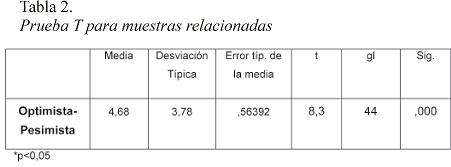
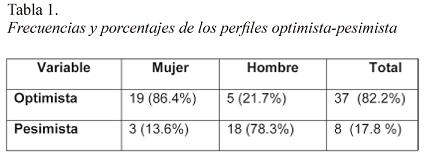
<body><![CDATA[<p class="western" style="margin: 5pt 242.25pt 0.0001pt 18pt; text-align: center; text-indent: 9pt; line-height: 150%;" align="center"><b><span style="font-size: 12pt; line-height: 150%; font-family: Arial;" lang="ES-UY">2. Resultados</span></b></p>       <p class="western" style="margin: 5pt 242.25pt 0.0001pt 18pt; text-indent: 9pt; line-height: 150%;"><span style="font-size: 12pt; line-height: 150%; font-family: Arial;" lang="ES-UY"><o:p>&nbsp;</o:p></span></p>       <p class="western" style="margin: 5pt 242.25pt 0.0001pt 18pt; text-align: justify; text-indent: 9pt; line-height: 150%;"><span style="font-size: 12pt; line-height: 150%; font-family: Arial;" lang="ES-UY">A continuaci&oacute;n presentaremos el an&aacute;lisis descriptivo de cada una de las variables: Perfil optimista-pesimista y la percepci&oacute;n de autoeficacia, tanto en el total de la muestra (N = 45), y tambi&eacute;n de acuerdo al g&eacute;nero.<o:p></o:p></span></p>       <p class="western" style="margin: 5pt 242.25pt 0.0001pt 18pt; text-align: justify; text-indent: 9pt; line-height: 150%;"><span style="font-size: 12pt; line-height: 150%; font-family: Arial;" lang="ES-UY">En la <a href="#t1">Tabla 1</a>, expondremos la frecuencia y porcentajes de los perfiles optimistas vs los pesimistas en la muestra total y por g&eacute;nero.<o:p></o:p></span></p>       <p class="western" style="margin: 5pt 242.25pt 0.0001pt 18pt; text-indent: 9pt; line-height: 150%;"><span style="font-size: 12pt; line-height: 150%; font-family: Arial;" lang="ES-UY"><o:p>&nbsp;</o:p></span></p>       <p class="western" style="margin: 5pt 242.25pt 0.0001pt 18pt; text-indent: 9pt; line-height: 150%;"><a name="t1"></a><span style="font-size: 12pt; line-height: 150%; font-family: Arial;" lang="ES-UY"><img id="_x0000_i1025" src="../../../../../img/revistas/cp/v5n2/2a03t1.jpg" style="height: 156px; width: 432px;" border="0" height="32" width="32"><o:p></o:p></span></p>       <p class="western" style="margin: 5pt 242.25pt 0.0001pt 18pt; text-align: justify; text-indent: 9pt; line-height: 150%;"><span style="font-size: 12pt; line-height: 150%; font-family: Arial;" lang="ES-UY">Los resultados encontrados, evidencian que tanto en el total de la muestra, como en los hombres y mujeres existe un amplio predominio del perfil optimista, representando un 82 % de la muestra total. A partir del an&aacute;lisis de Chi&ndash;cuadrado, observamos que no existen diferencias estad&iacute;sticamente significativas entre el g&eacute;nero y estos dos perfiles disposicionales (X<sup>2</sup> = ,505<sup>a</sup>; p = ,477). <o:p></o:p></span></p>       <p class="western" style="margin: 5pt 242.25pt 0.0001pt 18pt; text-align: justify; text-indent: 9pt; line-height: 150%;"><span style="font-size: 12pt; line-height: 150%; font-family: Arial;" lang="ES-UY">En lo que respecta a los dos factores analizados por el Life Orientation Test, que hacen referencia al optimismo y pesimismo y que se interpretan de forma independiente, nos propusimos analizar si existen diferencias estad&iacute;sticas entre ambos. Al tratarse de una variable continua (se eval&uacute;a en una puntuaci&oacute;n directa de 1 a 12, permitiendo jerarquizar entre los resultados) y que presenta una distribuci&oacute;n normal en este caso, es que procedimos a realizar la prueba T para muestras relacionadas.<o:p></o:p></span></p>       <p class="western" style="margin: 5pt 242.25pt 0.0001pt 18pt; text-align: justify; text-indent: 9pt; line-height: 150%;"><span style="font-size: 12pt; line-height: 150%; font-family: Arial;" lang="ES-UY">A partir de los resultados observados en la <a href="#t2">Tabla 2</a>, podemos establecer que existen diferencias estad&iacute;sticamente significativas entre los factores optimismo y pesimismo de nuestra muestra (p = .000).<o:p></o:p></span></p>       <p class="western" style="margin: 5pt 242.25pt 0.0001pt 18pt; text-indent: 9pt; line-height: 150%;"><span style="font-size: 12pt; line-height: 150%; font-family: Arial;" lang="ES-UY"><o:p>&nbsp;</o:p></span></p>       ]]></body>
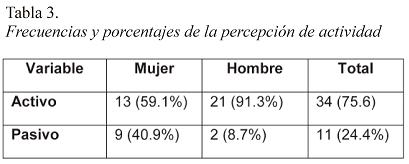
<body><![CDATA[<p class="western" style="margin: 5pt 242.25pt 0.0001pt 18pt; text-indent: 9pt; line-height: 150%;"><a name="t2"></a><img id="_x0000_i1026" src="../../../../../img/revistas/cp/v5n2/2a03t2.jpg" style="height: 167px; width: 451px;" border="0" height="32" width="32"><span style="font-size: 12pt; line-height: 150%; font-family: Arial;" lang="ES-UY"><o:p></o:p></span></p>       <p class="western" style="margin: 5pt 242.25pt 0.0001pt 18pt; text-indent: 9pt; line-height: 150%;"><span style="font-size: 12pt; line-height: 150%; font-family: Arial;" lang="ES-UY"><o:p>&nbsp;</o:p></span></p>       <p class="western" style="margin: 5pt 242.25pt 0.0001pt 18pt; text-align: justify; text-indent: 9pt; line-height: 150%;"><span style="font-size: 12pt; line-height: 150%; font-family: Arial;" lang="ES-UY">En lo que refiere a la variable percepci&oacute;n de actividad, en la <a href="#t3">Tabla 3</a>, presentaremos los datos relacionados al porcentaje y frecuencia de personas que se consideran activas vs pasivas, tanto en el total de la muestra, as&iacute; como por g&eacute;nero.<o:p></o:p></span></p>       <p class="western" style="margin: 5pt 242.25pt 0.0001pt 18pt; text-indent: 9pt; line-height: 150%;"><span style="font-size: 12pt; line-height: 150%; font-family: Arial;" lang="ES-UY"><o:p>&nbsp;</o:p></span></p>       <p class="western" style="margin: 5pt 242.25pt 0.0001pt 18pt; text-indent: 9pt; line-height: 150%;"><a name="t3"></a><img id="_x0000_i1027" src="../../../../../img/revistas/cp/v5n2/2a03t3.jpg" style="height: 164px; width: 409px;" border="0" height="32" width="32"><span style="font-size: 12pt; line-height: 150%; font-family: Arial;" lang="ES-UY"><o:p></o:p></span></p>       <p class="western" style="margin: 5pt 242.25pt 0.0001pt 18pt; text-indent: 9pt; line-height: 150%;"><span style="font-size: 12pt; line-height: 150%; font-family: Arial;" lang="ES-UY"><o:p>&nbsp;</o:p></span></p>       <p class="western" style="margin: 5pt 242.25pt 0.0001pt 18pt; text-align: justify; text-indent: 9pt; line-height: 150%;"><span style="font-size: 12pt; line-height: 150%; font-family: Arial;" lang="ES-UY">De los datos expuestos en la Tabla 3, podemos observar que los porcentajes var&iacute;an de acuerdo al g&eacute;nero, existiendo una clara predominancia en los hombres de percibirse como potencialmente activos (92%), frente a una percepci&oacute;n m&aacute;s moderada en las mujeres, siendo el 59% de las mismas las que se perciben como activas.<o:p></o:p></span></p>       <p class="western" style="margin: 5pt 242.25pt 0.0001pt 18pt; text-align: justify; text-indent: 9pt; line-height: 150%;"><span style="font-size: 12pt; line-height: 150%; font-family: Arial;" lang="ES-UY">Frente a esta amplia diferencia en la percepci&oacute;n de actividad por parte de hombres y mujeres, es que realizamos el an&aacute;lisis de Chi-cuadrado para analizar la posible existencia de diferencias estad&iacute;sticamente significativas entre el g&eacute;nero y la percepci&oacute;n de actividad.<o:p></o:p></span></p>       <p class="western" style="margin: 5pt 242.25pt 0.0001pt 18pt; text-align: justify; text-indent: 9pt; line-height: 150%;"><span style="font-size: 12pt; line-height: 150%; font-family: Arial;" lang="ES-UY">A continuaci&oacute;n presentamos la <a href="#t4">Tabla 4</a>.</span></p>       <p class="western" style="margin: 5pt 242.25pt 0.0001pt 18pt; text-align: justify; text-indent: 9pt; line-height: 150%;"><span style="font-size: 12pt; line-height: 150%; font-family: Arial;" lang="ES-UY"><o:p>&nbsp;</o:p></span></p>       ]]></body>
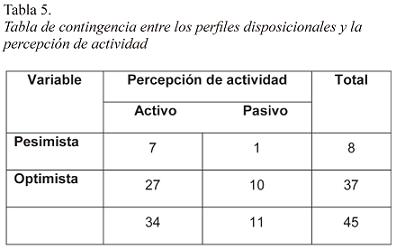
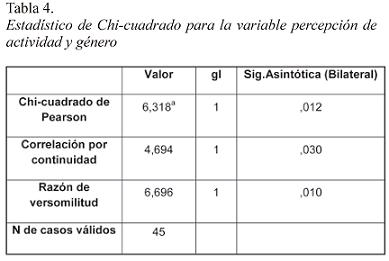
<body><![CDATA[<p class="western" style="margin: 5pt 242.25pt 0.0001pt 18pt; text-indent: 9pt; line-height: 150%;"><span style="font-size: 12pt; line-height: 150%; font-family: Arial;" lang="ES-UY"><o:p>&nbsp;</o:p></span></p>       <p class="western" style="margin: 5pt 242.25pt 0.0001pt 18pt; text-indent: 9pt; line-height: 150%;"><a name="t4"></a><span style="font-size: 12pt; line-height: 150%; font-family: Arial;" lang="ES-UY"><img id="_x0000_i1028" src="../../../../../img/revistas/cp/v5n2/2a03t4.jpg" style="height: 261px; width: 389px;" border="0" height="32" width="32"><o:p></o:p></span></p>       <p class="western" style="margin: 5pt 242.25pt 0.0001pt 18pt; text-align: justify; text-indent: 9pt; line-height: 150%;"><span style="font-size: 12pt; line-height: 150%; font-family: Arial;" lang="ES-UY">Los resultados nos permiten establecer la existencia de diferencias estad&iacute;sticamente significativas entre hombres y mujeres en relaci&oacute;n a la percepci&oacute;n de actividad (X<sup>2</sup> = 6,318<sup>a</sup>; p = ,012) siendo los hombres los que se perciben, casi en su totalidad (92%), como m&aacute;s activos. <o:p></o:p></span></p>       <p class="western" style="margin: 5pt 242.25pt 0.0001pt 18pt; text-align: justify; text-indent: 9pt; line-height: 150%;"><span style="font-size: 12pt; line-height: 150%; font-family: Arial;" lang="ES-UY">Por &uacute;ltimo, pretendemos relacionar las variables optimismo-pesimismo y la percepci&oacute;n de actividad, intentando establecer las posibles diferencias de los perfiles disposicionales y percibirse o no como un ejercitante activo. Para ellos realizaremos nuevamente el an&aacute;lisis de Chi-cuadrado.<o:p></o:p></span></p>       <p class="western" style="margin: 5pt 242.25pt 0.0001pt 18pt; text-indent: 9pt; line-height: 150%;"><span style="font-size: 12pt; line-height: 150%; font-family: Arial;" lang="ES-UY"><o:p>&nbsp;</o:p></span></p>       <p class="western" style="margin: 5pt 242.25pt 0.0001pt 18pt; text-indent: 9pt; line-height: 150%;"><span style="font-size: 12pt; line-height: 150%; font-family: Arial;" lang="ES-UY"><img id="_x0000_i1029" src="../../../../../img/revistas/cp/v5n2/2a03t5.jpg" style="height: 249px; width: 396px;" border="0" height="32" width="32"></span></p>       <p class="western" style="margin: 5pt 242.25pt 0.0001pt 18pt; text-indent: 9pt; line-height: 150%;"><span style="font-size: 12pt; line-height: 150%; font-family: Arial;" lang="ES-UY"><o:p>&nbsp;</o:p></span></p>       <p class="western" style="margin: 5pt 242.25pt 0.0001pt 18pt; text-align: justify; text-indent: 9pt; line-height: 150%;"><span style="font-size: 12pt; line-height: 150%; font-family: Arial;" lang="ES-UY">Los resultados nos permiten observar que hay un predominio de personas optimistas que se perciben como activas (27 de 45), mientras que hay 10, que son optimistas pero pasivos. En relaci&oacute;n al an&aacute;lisis de Chi-cuadrado, encontramos que no existen diferencias estad&iacute;sticamente significativas entre el optimismo-pesimismo y la percepci&oacute;n de actividad ((X<sup>2</sup> = ,752<sup>a</sup>; p = ,386). <o:p></o:p></span></p>       <p class="western" style="margin: 5pt 242.25pt 0.0001pt 18pt; text-indent: 9pt; line-height: 150%;"><span style="font-size: 12pt; line-height: 150%; font-family: Arial;" lang="ES-UY"><o:p>&nbsp;</o:p></span></p>       <p class="western" style="margin: 5pt 242.25pt 0.0001pt 18pt; text-align: center; text-indent: 9pt; line-height: 150%;" align="center"><b><span style="font-size: 12pt; line-height: 150%; font-family: Arial;" lang="ES-UY">3. Discusi&oacute;n y Conclusiones<o:p></o:p></span></b></p>       ]]></body>
<body><![CDATA[<p class="western" style="margin: 5pt 242.25pt 0.0001pt 18pt; text-align: center; text-indent: 9pt; line-height: 150%;" align="center"><span style="font-size: 12pt; line-height: 150%; font-family: Arial;" lang="ES-UY"><o:p>&nbsp;</o:p></span></p>       <p class="western" style="margin: 5pt 242.25pt 0.0001pt 18pt; text-align: justify; text-indent: 9pt; line-height: 150%;"><span style="font-size: 12pt; line-height: 150%; font-family: Arial;" lang="ES-UY">El objetivo de este trabajo se centra en el estudio de los perfiles optimista-pesimista en ejercitantes de una plaza urbana comunitaria, as&iacute; como la percepci&oacute;n de actividad que tienen de s&iacute; mismos. Los resultados muestran diferencias estad&iacute;sticamente significativas entre el factor optimismo y pesimismo de nuestra muestra, siendo el factor optimista el que obtiene puntuaciones m&aacute;s elevadas y est&aacute; presente en una amplia mayor&iacute;a de los participantes. Esto podr&iacute;a hacer referencia a lo planteado por Sheier et al., (1985) indicando que los optimistas son personas que tienen expectativas y percepciones positivas sobre su vida, teniendo un mayor control de situaciones estresantes, regulando y reduciendo sus efectos negativos (<a href="#Scheier1">Scheier &amp; Carver</a>, 2006). Un ejemplo de situaci&oacute;n estresante podr&iacute;a ser la realizaci&oacute;n de ejercicio f&iacute;sico (ya sea recreativo y/o competitivo) existiendo diferencias en el uso de estrategias de afrontamiento para lidiar con dicho estr&eacute;s entre </span><span style="font-size: 12pt; line-height: 150%; font-family: Arial; color: rgb(51, 51, 51);" lang="ES-UY">optimistas y pesimistas.</span><span style="font-size: 12pt; line-height: 150%; font-family: Arial;" lang="ES-UY"><o:p></o:p></span></p>       <p class="western" style="margin: 5pt 242.25pt 0.0001pt 18pt; text-align: justify; text-indent: 9pt; line-height: 150%;"><span style="font-size: 12pt; line-height: 150%; font-family: Arial;" lang="ES-UY">As&iacute; mismo, la percepci&oacute;n de control, podr&iacute;a ser entendida como una evaluaci&oacute;n objetiva de la actividad f&iacute;sica que realiza cada ejercitante (<a href="#Ortin1">Ort&iacute;n</a> et al, 2011), siendo los hombres los que presentan una mayor percepci&oacute;n de actividad en relaci&oacute;n a las mujeres, hecho que no se corrobor&oacute; con la ejecuci&oacute;n real de actividad, sino meramente con la percepci&oacute;n de la conducta de cada participante.<o:p></o:p></span></p>       <p class="western" style="margin: 5pt 242.25pt 0.0001pt 18pt; text-align: justify; text-indent: 9pt; line-height: 150%;"><span style="font-size: 12pt; line-height: 150%; font-family: Arial;" lang="ES-UY">En cuanto a la relaci&oacute;n percepci&oacute;n de actividad y el perfil disposicional, sea optimista o pesimista, los resultados nos permiten observar que hay un predominio de personas optimistas que se perciben como activas. El optimismo disposicional, alude a estrategias de afrontamiento positivas (planificaci&oacute;n, reinterpretaci&oacute;n positiva y crecimiento personal, afrontamiento focalizado al problema), es decir a conductas m&aacute;s adaptativas, (<a href="#Murphy">Murphy &amp; Tammen</a>, 1998). No obstante, no se encontraron diferencias estad&iacute;sticamente significativas entre el perfil disposicional y la percepci&oacute;n de actividad, por lo que a&uacute;n no podremos corroborar la hip&oacute;tesis de que el optimismo podr&iacute;a generar una mayor percepci&oacute;n de actividad. En futuras investigaciones, se podr&iacute;a proponer, la comparaci&oacute;n de una muestra de personas activas y no activas f&iacute;sicamente, para poder as&iacute;, obtener una mayor explicaci&oacute;n de los resultados encontrados.<o:p></o:p></span></p>       <p class="western" style="margin: 5pt 242.25pt 0.0001pt 18pt; text-align: justify; text-indent: 9pt; line-height: 150%;"><span style="font-size: 12pt; line-height: 150%; font-family: Arial;" lang="ES-UY">La importancia de este trabajo radica, en evidenciar la necesidad de generar h&aacute;bitos de conducta activos en relaci&oacute;n a la salud y calidad de vida en todas las etapas de la vida. Realizar actividad f&iacute;sica de forma adecuada y saludable est&aacute; relacionada con el aumento de la calidad de vida, incrementando en salud f&iacute;sica, mental y social y disminuyendo factores de riesgo como el sedentarismo y sus consecuencias negativas para la salud integral de las personas (<a href="#Weinberg">Weinberg y Gould</a>, 2011). Lamentablemente, realizar actividad f&iacute;sica regularmente es uno de los h&aacute;bitos menos instaurados en la poblaci&oacute;n en general. Por esta raz&oacute;n, los que realizan dicha actividad son un grupo minoritario, que seguramente cuenten con la fortaleza de la perseverancia muy desarrollada, aspecto que los podr&iacute;a ayudar a ser optimistas y en general a auto-percibirse como individuos activos. <o:p></o:p></span></p>       <p class="western" style="margin: 5pt 242.25pt 0.0001pt 18pt; text-align: justify; text-indent: 9pt; line-height: 150%;"><span style="font-size: 12pt; line-height: 150%; font-family: Arial;" lang="ES-UY">En relaci&oacute;n a las limitaciones encontradas en este estudio, nos encontramos primeramente con una muestra reducida, pero que de alguna manera expresa las caracter&iacute;sticas del lugar donde se ubica la &uacute;nica plaza urbana de Montevideo. El tama&ntilde;o de la muestra no nos permite realizar determinados an&aacute;lisis estad&iacute;sticos que nos posibilitar&iacute;an a adaptar y baremar el instrumento utilizado a nuestra cultura, resultando esto una limitaci&oacute;n importante, pues estamos analizando el perfil optimista-pesimista con un instrumento que no creado para nuestro medio. Por &uacute;ltimo hacer referencia a la falta de cuestionarios para valorar la percepci&oacute;n de actividad, reduciendo su uso, &uacute;nicamente a posibles preguntas que puedan resultar de inter&eacute;s y/o de aproximaci&oacute;n a esta tem&aacute;tica.<o:p></o:p></span></p>       <p class="western" style="margin: 5pt 242.25pt 0.0001pt 18pt; text-align: justify; text-indent: 9pt; line-height: 150%;"><span style="font-size: 12pt; line-height: 150%; font-family: Arial;" lang="ES-UY">Para finalizar, consideramos que al analizar el perfil de usuarios de los parques, se podr&iacute;an implementar m&aacute;s actividades que respondan tanto al perfil optimista, de manera que &eacute;stas se adapten a su estilo y preferencias, as&iacute; c&oacute;mo incluir otras actividades, que puedan resultar de inter&eacute;s y que hasta ahora no han sido contempladas por personas con perfil pesimista.<o:p></o:p></span></p>       <p class="western" style="margin: 5pt 242.25pt 0.0001pt 18pt; text-align: justify; text-indent: 9pt; line-height: 150%;"><span style="font-size: 12pt; line-height: 150%; font-family: Arial;" lang="ES-UY">Asimismo, ser&iacute;a muy interesante estudiar a la poblaci&oacute;n en general en sus perfiles optimistas y pesimistas, ya que pareciera que las personas que realizan actividades f&iacute;sicas tienen altos grados de optimismo. De este modo, pensando en una relaci&oacute;n rec&iacute;proca entre las variables optimismo-actividad f&iacute;sica, se podr&iacute;a promover en la poblaci&oacute;n en general el desarrollo de la actividad f&iacute;sica como medio para mejorar sus niveles de optimismo, o trabajar en mejorar su optimismo para poder iniciar conductas de autoeficacia y autocuidado como lo ser&iacute;a la actividad f&iacute;sica.<o:p></o:p></span></p>       <p class="western" style="margin: 5pt 242.25pt 0.0001pt 18pt; text-indent: 9pt; line-height: 150%;"><span style="font-size: 12pt; line-height: 150%; font-family: Arial;" lang="ES-UY"><o:p>&nbsp;</o:p></span></p>       <p class="western" style="margin: 5pt 242.25pt 0.0001pt 18pt; text-align: center; text-indent: 9pt; line-height: 150%;" align="center"><b><span style="font-size: 12pt; line-height: 150%; font-family: Arial;" lang="ES-UY">4. Referencias</span></b></p>       ]]></body>
<body><![CDATA[<p class="western" style="margin: 5pt 242.25pt 0.0001pt 18pt; text-indent: 9pt; line-height: 150%;"><span style="font-size: 12pt; line-height: 150%; font-family: Arial;" lang="ES-UY"><o:p>&nbsp;</o:p></span></p>       <!-- ref --><p class="western" style="margin: 5pt 242.25pt 0.0001pt 18pt; text-align: justify; text-indent: 9pt; line-height: 120%;"><a name="Abramson"></a><span style="font-size: 12pt; line-height: 120%; font-family: Arial;" lang="ES-UY">Abramson L. Y., Seligman M. E. P. y Teasdale J.(1978). </span><span class="GramE"><span style="font-size: 12pt; line-height: 120%; font-family: Arial;" lang="EN-US">Learned helplessness in humans: Critique and reformulation, Journal of Abnormal Psychology, 87, 32-48.    </span></span><span style="font-size: 12pt; line-height: 120%; font-family: Arial;" lang="EN-US"> </span><span style="font-size: 12pt; line-height: 120%; font-family: Arial;" lang="EN-GB"><o:p></o:p></span></p>       <p class="western" style="margin: 5pt 242.25pt 0.0001pt 18pt; text-align: justify; text-indent: 9pt; line-height: 120%;"><a name="Bandura"></a><span class="SpellE"><span style="font-size: 12pt; line-height: 120%; font-family: Arial;" lang="EN-US">Bandura</span></span><span style="font-size: 12pt; line-height: 120%; font-family: Arial;" lang="EN-US">, A. (1982). Self &ndash; efficacy mechanism in human agency. </span><span style="font-size: 12pt; line-height: 120%; font-family: Arial;" lang="ES-UY">American Psychologist, 37 (2), 122-147.<o:p></o:p></span></p>       <!-- ref --><p class="western" style="margin: 5pt 242.25pt 0.0001pt 18pt; text-align: justify; text-indent: 9pt; line-height: 120%;"><a name="Barez"></a><span style="font-size: 12pt; line-height: 120%; font-family: Arial;" lang="ES-UY">B&aacute;rez, M. (2002). Relaci&oacute;n entre la percepci&oacute;n de control y adaptaci&oacute;n a la enfermedad en pacientes con c&aacute;ncer de mama. Tesis Doctoral no publicada. Universitat Aut&oacute;noma de Barcelona. Bellaterra: Barcelona.    <o:p></o:p></span></p>       <!-- ref --><p class="western" style="margin: 5pt 242.25pt 0.0001pt 18pt; text-align: justify; text-indent: 9pt; line-height: 120%;"><a name="Beck"></a><span class="GramE"><span style="font-size: 12pt; line-height: 120%; font-family: Arial;" lang="EN-US">Beck, A. T. (1967).</span></span><span style="font-size: 12pt; line-height: 120%; font-family: Arial;" lang="EN-US"> Depression: Clinical experimental and theoretical aspects. </span><st1:state><st1:place><span style="font-size: 12pt; line-height: 120%; font-family: Arial;" lang="EN-US">New York</span></st1:place></st1:state><span style="font-size: 12pt; line-height: 120%; font-family: Arial;" lang="EN-US">: Harper &amp; Row </span><span style="font-size: 12pt;     line-height: 120%; font-family: Arial;" lang="EN-GB"><o:p></o:p></span></p>       <!-- ref --><p class="western" style="margin: 5pt 242.25pt 0.0001pt 18pt; text-align: justify; text-indent: 9pt; line-height: 120%;"><a name="Carver"></a><span class="GramE"><span style="font-size: 12pt; line-height: 120%; font-family: Arial;" lang="EN-US">Carver, C., Harris, S., Lehman, J. M., <span class="SpellE">Durel</span>, L. A., <span class="SpellE">Antoni</span>, M. N., Spencer, S. M. y <span class="SpellE">Pozo</span>, C. (2000).</span></span><span style="font-size: 12pt; line-height: 120%; font-family: Arial;" lang="EN-US"> How important is the perception of personal control? Studies of early stage breast cancer patient. Personality and Social Psychology Bulletin, 26, 139-149.    </span><span style="font-size: 12pt; line-height: 120%; font-family: Arial;" lang="EN-GB"><o:p></o:p></span></p>       ]]></body>
<body><![CDATA[<!-- ref --><p class="western" style="margin: 5pt 242.25pt 0.0001pt 18pt; text-align: justify; text-indent: 9pt; line-height: 120%;"><a name="Caspersen"></a><span class="SpellE"><span class="GramE"><span style="font-size: 12pt; line-height: 120%; font-family: Arial;" lang="EN-US">Caspersen</span></span></span><span class="GramE"><span style="font-size: 12pt; line-height: 120%; font-family: Arial;" lang="EN-US">, C.; Powell, K. &amp; Christenson, G. (1985).</span></span><span style="font-size: 12pt; line-height: 120%; font-family: Arial;" lang="EN-US"> Physical Activity, Exercise, and Physical Fitness: Definitions and Distinctions for Health-Related Research. </span><span style="font-size: 12pt; line-height: 120%; font-family: Arial;" lang="ES-UY">Public Health Report Mar-Apr, 100 (2), 126-131.     <o:p></o:p></span></p>       <!-- ref --><p class="western" style="margin: 5pt 242.25pt 0.0001pt 18pt; text-align: justify; text-indent: 9pt; line-height: 120%;"><a name="Chico"></a><span style="font-size: 12pt; line-height: 120%; font-family: Arial;" lang="ES-UY">Chico, Libr&aacute;n, E. (2002). Optimismo como predictor de estrategias de afrontamiento. Revista Psicothema, V. 14 (3), pp. 544-550.    <o:p></o:p></span></p>       <p class="western" style="margin: 5pt 242.25pt 0.0001pt 18pt; text-align: justify; text-indent: 9pt; line-height: 120%;"><a name="Fernandez"></a><span style="font-size: 12pt; line-height: 120%; font-family: Arial;" lang="ES-UY">Fern&aacute;ndez &ndash; Castro, J., &Aacute;lvarez, M., Blasco, T., Doval, E y Sanz, A. (1998). Validaci&oacute;n de la Escala de Competencia Personal de Wallston: Implicaciones en el estudio del estr&eacute;s. Ansiedad y estr&eacute;s, 4, 31-41.<o:p></o:p></span></p>       <!-- ref --><p class="western" style="margin: 5pt 242.25pt 0.0001pt 18pt; text-align: justify; text-indent: 9pt; line-height: 120%;"><a name="Ferrando"></a><span style="font-size: 12pt; line-height: 120%; font-family: Arial;" lang="ES-UY">Ferrando, P.J., Chico, E., y Tous, J.M. (2002). Propiedades psicom&eacute;tricas del test de optimismo Life Orientation Test. </span><span class="SpellE"><span style="font-size: 12pt; line-height: 120%; font-family: Arial;" lang="EN-US">Psicothema</span></span><span style="font-size: 12pt; line-height: 120%; font-family: Arial;" lang="EN-US">, 14 (3), 673-680.    </span><span style="font-size: 12pt; line-height: 120%; font-family: Arial;" lang="EN-GB"><o:p></o:p></span></p>       <p class="western" style="margin: 5pt 242.25pt 0.0001pt 18pt; text-align: justify; text-indent: 9pt; line-height: 120%;"><a name="Isaacowitz"></a><span class="SpellE"><span style="font-size: 12pt; line-height: 120%; font-family: Arial;" lang="EN-US">Isaacowitz</span></span><span style="font-size: 12pt; line-height: 120%; font-family: Arial;" lang="EN-US">, D.M. (2005). <span class="GramE">Correlates of well-being in adulthood and old age: A tale of two optimisms, Journal of Research in Personality 39, 224&ndash;244.</span></span><span style="font-size: 12pt; line-height: 120%; font-family: Arial;" lang="EN-GB"><o:p></o:p></span></p>       <!-- ref --><p class="western" style="margin: 5pt 242.25pt 0.0001pt 18pt; text-align: justify; text-indent: 9pt; line-height: 120%;"><a name="Martin"></a><span class="GramE"><span style="font-size: 12pt; line-height: 120%; font-family: Arial;" lang="EN-US">Martin-<span class="SpellE">Krumm</span>, C. P., <span class="SpellE">Sarrazin</span>, P. G., Peterson, C. y <span class="SpellE">Famose</span>, J. P. (2003).</span></span><span style="font-size: 12pt; line-height: 120%; font-family: Arial;" lang="EN-US"> Explanatory style and <span class="SpellE">resilence</span> after sport failure. <span class="GramE">Personality and Individual Differences, 35, 1685- 1695.    </span></span><span style="font-size: 12pt; line-height: 120%; font-family: Arial;" lang="EN-GB"><o:p></o:p></span></p>       ]]></body>
<body><![CDATA[<!-- ref --><p class="western" style="margin: 5pt 242.25pt 0.0001pt 18pt; text-align: justify; text-indent: 9pt; line-height: 120%;"><a name="Myers"></a><span class="GramE"><span style="font-size: 12pt; line-height: 120%; font-family: Arial;" lang="EN-US">Myers, L.B. y Steed, L. (1999).</span></span><span style="font-size: 12pt; line-height: 120%; font-family: Arial;" lang="EN-US"> <span class="GramE">The relationship between dispositional optimism, dispositional pessimism, repressive coping and trait anxiety.</span> <span class="GramE">Personality and Individual Differences, 27(6), 1.261-1.272.    </span></span><span style="font-size: 12pt; line-height: 120%; font-family: Arial;" lang="EN-GB"><o:p></o:p></span></p>       <!-- ref --><p class="western" style="margin: 5pt 242.25pt 0.0001pt 18pt; text-align: justify; text-indent: 9pt; line-height: 120%;"><a name="Mroczek"></a><span class="SpellE"><span class="GramE"><span style="font-size: 12pt; line-height: 120%; font-family: Arial;" lang="EN-US">Mroczek</span></span></span><span class="GramE"><span style="font-size: 12pt; line-height: 120%; font-family: Arial;" lang="EN-US">, D. K., Spiro III, A., <span class="SpellE">Aldwin</span>, C. M., <span class="SpellE">Ozer</span>, D. J. y <span class="SpellE">Bosse</span>, R. (1993).</span></span><span style="font-size: 12pt; line-height: 120%; font-family: Arial;" lang="EN-US"> Construct validation of optimism and pessimism in older men: Findings from the normative aging study. Health Psychology, 12, 406-409.    </span><span style="font-size: 12pt; line-height: 120%; font-family: Arial;" lang="EN-GB"><o:p></o:p></span></p>       <!-- ref --><p class="western" style="margin: 5pt 242.25pt 0.0001pt 18pt; text-align: justify; text-indent: 9pt; line-height: 120%;"><a name="Murphy"></a><span class="GramE"><span style="font-size: 12pt; line-height: 120%; font-family: Arial;" lang="EN-US">Murphy, S. &amp; <span class="SpellE">Tammen</span>, V. (1998).</span></span><span style="font-size: 12pt; line-height: 120%; font-family: Arial;" lang="EN-US"> <span class="GramE">In search of psychological skills.</span> En J.L. <span class="SpellE">Duda</span> (ed.) (1998). <span class="GramE">Advances in sport and exercise psychology measurement.</span> (pp 195-209). </span><st1:place><st1:city><span style="font-size: 12pt; line-height: 120%; font-family: Arial;" lang="EN-US">Morgantown</span></st1:city><span style="font-size: 12pt; line-height: 120%; font-family: Arial;" lang="EN-US">, </span><st1:state><span style="font-size: 12pt; line-height: 120%; font-family: Arial;" lang="EN-US">WV</span></st1:state></st1:place><span style="font-size: 12pt; line-height: 120%; font-family: Arial;" lang="EN-US">: Fitness Information Technology.    </span><span style="font-size: 12pt; line-height: 120%; font-family: Arial;" lang="EN-GB"><o:p></o:p></span></p>       <!-- ref --><p class="western" style="margin: 5pt 242.25pt 0.0001pt 18pt; text-align: justify; text-indent: 9pt; line-height: 120%;"><a name="Ntoumanis"></a><span class="SpellE"><span style="font-size: 12pt; line-height: 120%; font-family: Arial;" lang="EN-US">Ntoumanis</span></span><span style="font-size: 12pt; line-height: 120%; font-family: Arial;" lang="EN-US">, N. (2001). <span class="GramE">A step-by-step Guide to SPSS for Sport and Exercise Studies.</span> </span><span style="font-size: 12pt; line-height: 120%; font-family: Arial;" lang="ES-UY">Londres: Routledge.    <o:p></o:p></span></p>       <!-- ref --><p class="western" style="margin: 5pt 242.25pt 0.0001pt 18pt; text-align: justify; text-indent: 9pt; line-height: 120%;"><a name="Ortin1"></a><span style="font-size: 12pt; line-height: 120%; font-family: Arial;" lang="ES-UY">Ort&iacute;n, F.J., Garc&eacute;s de los Fayos, E.J., Gos&aacute;lvez, J., Ortega, E. y Olmedilla, A. (2011). Optimismo y ejecuci&oacute;n en el deporte en situaciones adversas. Replicando a Seligman 1990. Revista de Psicolog&iacute;a del Deporte, 20 (2), 1-11.     <o:p></o:p></span></p>       ]]></body>
<body><![CDATA[<!-- ref --><p class="western" style="margin: 5pt 242.25pt 0.0001pt 18pt; text-align: justify; text-indent: 9pt; line-height: 120%;"><a name="Ortin2"></a><span style="font-size: 12pt; line-height: 120%; font-family: Arial;" lang="ES-UY">Ort&iacute;n, F.J., Ortega, E., L&oacute;pez, E. y Olmedilla, A. (2011). Estilos explicativos de los entrenadores de f&uacute;tbol profesional en el an&aacute;lisis de la competici&oacute;n deportiva. Anales de Psicolog&iacute;a (art&iacute;culo aceptado no publicado).     <o:p></o:p></span></p>       <!-- ref --><p class="western" style="margin: 5pt 242.25pt 0.0001pt 18pt; text-align: justify; text-indent: 9pt; line-height: 120%;"><a name="Otero"></a><span style="font-size: 12pt; line-height: 120%; font-family: Arial;" lang="ES-UY">Otero, J. M., Luengo, A., Romero, F., G&oacute;mez, J. A. y Catro, C. (1998). Psicolog&iacute;a de la personalidad. Manual de pr&aacute;cticas. Barcelona: Ariel Practicum.    <o:p></o:p></span></p>       <!-- ref --><p class="western" style="margin: 5pt 242.25pt 0.0001pt 18pt; text-align: justify; text-indent: 9pt; line-height: 120%;"><a name="Romero"></a><span style="font-size: 12pt; line-height: 120%; font-family: Arial;" lang="ES-UY">Romero Carrasco, A.; Garc&iacute;a-Mas, A. &amp; Robert J. (2009). Estado del arte, y perspectiva actual del concepto de bienestar psicol&oacute;gico en Psicolog&iacute;a del Deporte. </span><span class="SpellE"><span style="font-size: 12pt; line-height: 120%; font-family: Arial;" lang="EN-US">Revista</span></span><span style="font-size: 12pt; line-height: 120%; font-family: Arial;" lang="EN-US"> <span class="SpellE">Latinoamericana</span> de <span class="SpellE">Psicolog&iacute;a</span>, 41(2), 335-347.    </span><span style="font-size: 12pt; line-height: 120%; font-family: Arial;" lang="EN-GB"><o:p></o:p></span></p>       <p class="western" style="margin: 5pt 242.25pt 0.0001pt 18pt; text-align: justify; text-indent: 9pt; line-height: 120%;"><a name="Scheier1"></a><span class="SpellE"><span style="font-size: 12pt; line-height: 120%; font-family: Arial;" lang="EN-US">Scheier</span></span><span style="font-size: 12pt; line-height: 120%; font-family: Arial;" lang="EN-US">, M. &amp; Carver, C. (2006) Dispositional Optimism and Physical Well-Being: The Influence of Generalized Outcome Expectancies on Health. Journal of Personality, 55 (2), 169&ndash;210, DOI: 10.1111/j.1467-6494.1987.tb00434.x</span><span style="font-size: 12pt; line-height: 120%; font-family: Arial;" lang="EN-GB"><o:p></o:p></span></p>       <!-- ref --><p class="western" style="margin: 5pt 242.25pt 0.0001pt 18pt; text-align: justify; text-indent: 9pt; line-height: 120%;"><a name="Scheier2"></a><span class="SpellE"><span style="font-size: 12pt; line-height: 120%; font-family: Arial;" lang="EN-US">Scheier</span></span><span style="font-size: 12pt; line-height: 120%; font-family: Arial;" lang="EN-US">, M. F., Carver, C. S. y Bridges, M. W. (1994). <span class="SpellE">Distinguising</span> optimism from neuroticism (and trait anxiety, self mastery and self esteem): A reevaluation of the Life Orientation Test. Journal of Personality and Social Psychology, 67, 1.063-1.078.    </span><span style="font-size: 12pt; line-height: 120%; font-family: Arial;" lang="EN-GB"><o:p></o:p></span></p>       <!-- ref --><p class="western" style="margin: 5pt 242.25pt 0.0001pt 18pt; text-align: justify; text-indent: 9pt; line-height: 120%;"><a name="Scheier3"></a><span class="SpellE"><span class="GramE"><span style="font-size: 12pt; line-height: 120%; font-family: Arial;" lang="EN-US">Scheier</span></span></span><span class="GramE"><span style="font-size: 12pt; line-height: 120%; font-family: Arial;" lang="EN-US">, M. y Carver, C.S. (1985).</span></span><span style="font-size: 12pt; line-height: 120%; font-family: Arial;" lang="EN-US"> Optimism, Coping, and Health: Assessment and Implication of Generalized Outcome Expectancies. </span><span style="font-size: 12pt; line-height: 120%; font-family: Arial;" lang="ES-UY">Health Psychology, 4, 219-247.    <o:p></o:p></span></p>       <!-- ref --><p class="western" style="margin: 5pt 242.25pt 0.0001pt 18pt; text-align: justify; text-indent: 9pt; line-height: 120%;"><a name="Seligman1"></a><span style="font-size: 12pt; line-height: 120%; font-family: Arial;" lang="ES-UY">Seligman, M. E. P. (2004). Aprenda optimismo. Madrid: Debolsillo.    <o:p></o:p></span></p>       <!-- ref --><p class="western" style="margin: 5pt 242.25pt 0.0001pt 18pt; text-align: justify; text-indent: 9pt; line-height: 120%;"><a name="Seligman2"></a><span style="font-size: 12pt; line-height: 120%; font-family: Arial;" lang="EN-US">Seligman, M. E. P., Nolen-<span class="SpellE">Hoeksema</span>, S., Thornton, N., y Thornton, K. M. (1990). <span class="GramE">Explanatory style as a mechanism of disappointing athletic performance.</span> Psychological Science, 1, 143-146.    </span><span style="font-size: 12pt; line-height: 120%; font-family: Arial;" lang="EN-GB"><o:p></o:p></span></p>       <!-- ref --><p class="western" style="margin: 5pt 242.25pt 0.0001pt 18pt; text-align: justify; text-indent: 9pt; line-height: 120%;"><a name="Seligman3"></a><st1:place><st1:city><span class="GramE"><span style="font-size: 12pt; line-height: 120%; font-family: Arial;" lang="EN-US">Seligman</span></span></st1:city><span class="GramE"><span style="font-size: 12pt; line-height: 120%; font-family: Arial;" lang="EN-US">, </span></span><st1:state><span class="GramE"><span style="font-size: 12pt; line-height: 120%; font-family: Arial;" lang="EN-US">M.E.</span></span></st1:state></st1:place><span class="GramE"><span style="font-size: 12pt; line-height: 120%; font-family: Arial;" lang="EN-US"> &amp; <span class="SpellE">Csikszentmihalyi</span>, M. (2000).</span></span><span style="font-size: 12pt; line-height: 120%; font-family: Arial;" lang="EN-US"> Positive Psychology: An introduction. American Psychologist, 55, 5-14.    </span><span style="font-size: 12pt; line-height: 120%; font-family: Arial;" lang="EN-GB"><o:p></o:p></span></p>       <p class="western" style="margin: 5pt 242.25pt 0.0001pt 18pt; text-align: justify; text-indent: 9pt; line-height: 120%;"><a name="Shapcott"></a><span class="SpellE"><span style="font-size: 12pt; line-height: 120%; font-family: Arial;" lang="EN-US">Shapcott</span></span><span style="font-size: 12pt; line-height: 120%; font-family: Arial;" lang="EN-US">, J.B., Bloom, G.A., </span><st1:city><st1:place><span style="font-size: 12pt; line-height: 120%; font-family: Arial;" lang="EN-US">Johnston</span></st1:place></st1:city><span style="font-size: 12pt; line-height: 120%; font-family: Arial;" lang="EN-US">, K.M., <span class="SpellE">Loughead</span>, T.M. y Delaney, J.S. (2007). <span class="GramE">The effects of explanatory style on concussion outcomes in sport.</span> <span class="SpellE"><span class="GramE">NeuroRehabilitation</span></span><span class="GramE">, 22.</span> <span class="GramE">161&ndash;167.</span></span><span style="font-size: 12pt; line-height: 120%; font-family: Arial;" lang="EN-GB"><o:p></o:p></span></p>       <!-- ref --><p class="western" style="margin: 5pt 242.25pt 0.0001pt 18pt; text-align: justify; text-indent: 9pt; line-height: 120%;"><a name="Weinberg"></a><span class="GramE"><span style="font-size: 12pt; line-height: 120%; font-family: Arial;" lang="EN-US">Weinberg, R. &amp; Gould, D. (2011).</span></span><span style="font-size: 12pt; line-height: 120%; font-family: Arial;" lang="EN-US"> <span class="GramE">Foundations of sport and exercise psychology.</span> </span><st1:country-region><st1:place><span style="font-size: 12pt; line-height: 120%; font-family: Arial;" lang="EN-US">United States of America</span></st1:place></st1:country-region><span style="font-size: 12pt; line-height: 120%; font-family: Arial;" lang="EN-US">: Human Kinetics. <span class="GramE">Url</span>: www.humankinetics.com</span><span style="font-size: 12pt;     line-height: 120%; font-family: Arial;" lang="EN-GB"><o:p></o:p></span></p>       ]]></body>
<body><![CDATA[<!-- ref --><p class="western" style="margin: 5pt 242.25pt 0.0001pt 18pt; text-align: justify; text-indent: 9pt; line-height: 120%;"><a name="Weiner"></a><span style="font-size: 12pt; line-height: 120%; font-family: Arial;" lang="EN-US">Weiner, B., Frieze, </span><st1:place><span style="font-size: 12pt; line-height: 120%; font-family: Arial;" lang="EN-US">I.</span></st1:place><span style="font-size: 12pt; line-height: 120%; font-family: Arial;" lang="EN-US"> H., <span class="SpellE">Kukla</span>, A., Reed, L., Rest, S. y Rosenbaum, R. M. (1971). <span class="SpellE"><span class="GramE">Perveiving</span></span><span class="GramE"> the causes of success and failure.</span> </span><st1:place><st1:city><span style="font-size: 12pt; line-height: 120%; font-family: Arial;" lang="EN-US">Morristown</span></st1:city><span style="font-size: 12pt; line-height: 120%; font-family: Arial;" lang="EN-US">, </span><st1:state><span style="font-size: 12pt; line-height: 120%; font-family: Arial;" lang="EN-US">NJ</span></st1:state></st1:place><span style="font-size: 12pt; line-height: 120%; font-family: Arial;" lang="EN-US">: General Learning Press.    </span><span style="font-size: 12pt; line-height: 120%; font-family: Arial;" lang="EN-GB"><o:p></o:p></span></p>       <p style="margin: 5pt 242.25pt 0.0001pt 18pt; text-align: justify; text-indent: 9pt; line-height: 120%;"><span style="font-family: Arial;" lang="EN-US"><o:p>&nbsp;</o:p></span></p>       <p style="margin: 5pt 242.25pt 0.0001pt 18pt; text-align: justify; text-indent: 9pt; line-height: 120%;"><span style="font-family: Arial;" lang="EN-US"><o:p>&nbsp;</o:p></span></p>       <p style="margin: 5pt 242.25pt 0.0001pt 18pt; text-align: justify; text-indent: 9pt; line-height: 120%;"><span style="font-size: 10pt; line-height: 120%; font-family: Arial;" lang="ES-UY">Para citar este art&iacute;culo: <o:p></o:p></span></p>       <p style="margin: 5pt 242.25pt 0.0001pt 18pt; text-align: justify; text-indent: 9pt; line-height: 120%;"><span style="font-size: 10pt; line-height: 120%; font-family: Arial;" lang="ES-UY">Tutte Vallarino, V. &amp; Del Campo Vega, C. (2011). Optimismo y percepci&oacute;n de la actividad f&iacute;sica en usuarios de una plaza urbana de Montevideo. Ciencias Psicol&oacute;gicas V (2): 151-157.<o:p></o:p></span></p>       <p style="margin: 5pt 242.25pt 0.0001pt 0cm; text-align: justify; line-height: 120%;"><span style="font-family: Arial;" lang="EN-US"><o:p>&nbsp;</o:p></span></p>       <p style="margin: 5pt 242.25pt 0.0001pt 0cm; text-align: justify; line-height: 120%;"><span style="font-family: Arial;" lang="EN-US"><o:p>&nbsp;</o:p></span></p>       <p style="margin: 5pt 242.25pt 0.0001pt 0cm; line-height: 120%;"><span style="font-family: Arial;" lang="EN-US"><o:p>&nbsp;</o:p></span></p>       <p style="margin: 5pt 242.25pt 0.0001pt 0cm; line-height: 120%;"><span style="font-family: Arial;" lang="EN-US"><o:p>&nbsp;</o:p></span></p>   </div>       ]]></body>
<body><![CDATA[ ]]></body><back>
<ref-list>
<ref id="B1">
<nlm-citation citation-type="journal">
<person-group person-group-type="author">
<name>
<surname><![CDATA[Abramson]]></surname>
<given-names><![CDATA[L. Y.]]></given-names>
</name>
<name>
<surname><![CDATA[Seligman]]></surname>
<given-names><![CDATA[M. E. P.]]></given-names>
</name>
<name>
<surname><![CDATA[Teasdale]]></surname>
<given-names><![CDATA[J.]]></given-names>
</name>
</person-group>
<article-title xml:lang="en"><![CDATA[Learned helplessness in humans: Critique and reformulation]]></article-title>
<source><![CDATA[Journal of Abnormal Psychology]]></source>
<year>1978</year>
<volume>87</volume>
<page-range>32-48</page-range></nlm-citation>
</ref>
<ref id="B2">
<nlm-citation citation-type="journal">
<person-group person-group-type="author">
<name>
<surname><![CDATA[Bandura]]></surname>
<given-names><![CDATA[A]]></given-names>
</name>
</person-group>
<article-title xml:lang="en"><![CDATA[Self - efficacy mechanism in human agency]]></article-title>
<source><![CDATA[American Psychologist]]></source>
<year>1982</year>
<volume>37</volume>
<numero>2</numero>
<issue>2</issue>
<page-range>122-147</page-range></nlm-citation>
</ref>
<ref id="B3">
<nlm-citation citation-type="">
<person-group person-group-type="author">
<name>
<surname><![CDATA[Bárez]]></surname>
<given-names><![CDATA[M]]></given-names>
</name>
</person-group>
<source><![CDATA[Relación entre la percepción de control y adaptación a la enfermedad en pacientes con cáncer de mama]]></source>
<year>2002</year>
</nlm-citation>
</ref>
<ref id="B4">
<nlm-citation citation-type="book">
<person-group person-group-type="author">
<name>
<surname><![CDATA[Beck]]></surname>
<given-names><![CDATA[A. T.]]></given-names>
</name>
</person-group>
<source><![CDATA[Depression: Clinical experimental and theoretical aspects]]></source>
<year>1967</year>
<publisher-loc><![CDATA[New York ]]></publisher-loc>
<publisher-name><![CDATA[Harper & Row]]></publisher-name>
</nlm-citation>
</ref>
<ref id="B5">
<nlm-citation citation-type="journal">
<person-group person-group-type="author">
<name>
<surname><![CDATA[Carver]]></surname>
<given-names><![CDATA[C]]></given-names>
</name>
<name>
<surname><![CDATA[Harris]]></surname>
<given-names><![CDATA[S]]></given-names>
</name>
<name>
<surname><![CDATA[Lehman]]></surname>
<given-names><![CDATA[J. M.]]></given-names>
</name>
<name>
<surname><![CDATA[Durel]]></surname>
<given-names><![CDATA[L. A]]></given-names>
</name>
<name>
<surname><![CDATA[Antoni]]></surname>
<given-names><![CDATA[M. N]]></given-names>
</name>
<name>
<surname><![CDATA[Spencer]]></surname>
<given-names><![CDATA[S. M.]]></given-names>
</name>
<name>
<surname><![CDATA[Pozo]]></surname>
<given-names><![CDATA[C]]></given-names>
</name>
</person-group>
<article-title xml:lang="en"><![CDATA[How important is the perception of personal control?: Studies of early stage breast cancer patien]]></article-title>
<source><![CDATA[Personality and Social Psychology Bulletin]]></source>
<year>2000</year>
<volume>26</volume>
<page-range>139-149</page-range></nlm-citation>
</ref>
<ref id="B6">
<nlm-citation citation-type="journal">
<person-group person-group-type="author">
<name>
<surname><![CDATA[Caspersen]]></surname>
<given-names><![CDATA[C]]></given-names>
</name>
<name>
<surname><![CDATA[Powell]]></surname>
<given-names><![CDATA[K]]></given-names>
</name>
<name>
<surname><![CDATA[Christenson]]></surname>
<given-names><![CDATA[G]]></given-names>
</name>
</person-group>
<article-title xml:lang="en"><![CDATA[Physical Activity, Exercise, and Physical Fitness: Definitions and Distinctions for Health-Related Research]]></article-title>
<source><![CDATA[Public Health Report Mar-Apr]]></source>
<year>1985</year>
<volume>100</volume>
<numero>2</numero>
<issue>2</issue>
<page-range>126-131</page-range></nlm-citation>
</ref>
<ref id="B7">
<nlm-citation citation-type="journal">
<person-group person-group-type="author">
<name>
<surname><![CDATA[Chico Librán]]></surname>
<given-names><![CDATA[E]]></given-names>
</name>
</person-group>
<article-title xml:lang="es"><![CDATA[Optimismo como predictor de estrategias de afrontamiento]]></article-title>
<source><![CDATA[Revista Psicothema]]></source>
<year>2002</year>
<volume>14</volume>
<numero>3</numero>
<issue>3</issue>
<page-range>544-550</page-range></nlm-citation>
</ref>
<ref id="B8">
<nlm-citation citation-type="journal">
<person-group person-group-type="author">
<name>
<surname><![CDATA[Fernández - Castro]]></surname>
<given-names><![CDATA[J]]></given-names>
</name>
<name>
<surname><![CDATA[Álvarez]]></surname>
<given-names><![CDATA[M]]></given-names>
</name>
<name>
<surname><![CDATA[Blasco]]></surname>
<given-names><![CDATA[T]]></given-names>
</name>
<name>
<surname><![CDATA[Doval]]></surname>
<given-names><![CDATA[E]]></given-names>
</name>
<name>
<surname><![CDATA[Sanz]]></surname>
<given-names><![CDATA[A]]></given-names>
</name>
</person-group>
<article-title xml:lang="es"><![CDATA[Validación de la Escala de Competencia Personal de Wallston: Implicaciones en el estudio del estrés]]></article-title>
<source><![CDATA[Ansiedad y estrés]]></source>
<year>1998</year>
<volume>4</volume>
<page-range>31-41</page-range></nlm-citation>
</ref>
<ref id="B9">
<nlm-citation citation-type="journal">
<person-group person-group-type="author">
<name>
<surname><![CDATA[Ferrando]]></surname>
<given-names><![CDATA[P.J]]></given-names>
</name>
<name>
<surname><![CDATA[Chico]]></surname>
<given-names><![CDATA[E]]></given-names>
</name>
<name>
<surname><![CDATA[Tous]]></surname>
<given-names><![CDATA[J.M]]></given-names>
</name>
</person-group>
<article-title xml:lang="es"><![CDATA[Propiedades psicométricas del test de optimismo Life Orientation Test]]></article-title>
<source><![CDATA[Psicothema]]></source>
<year>2002</year>
<volume>14</volume>
<numero>3</numero>
<issue>3</issue>
<page-range>673-680</page-range></nlm-citation>
</ref>
<ref id="B10">
<nlm-citation citation-type="journal">
<person-group person-group-type="author">
<name>
<surname><![CDATA[Isaacowitz]]></surname>
<given-names><![CDATA[D.M.]]></given-names>
</name>
</person-group>
<article-title xml:lang="en"><![CDATA[Correlates of well-being in adulthood and old age: A tale of two optimisms]]></article-title>
<source><![CDATA[Journal of Research in Personality]]></source>
<year>2005</year>
<volume>39</volume>
<page-range>224-244</page-range></nlm-citation>
</ref>
<ref id="B11">
<nlm-citation citation-type="journal">
<person-group person-group-type="author">
<name>
<surname><![CDATA[Martin-Krumm]]></surname>
<given-names><![CDATA[C. P]]></given-names>
</name>
<name>
<surname><![CDATA[Sarrazin]]></surname>
<given-names><![CDATA[P. G.]]></given-names>
</name>
<name>
<surname><![CDATA[Peterson]]></surname>
<given-names><![CDATA[C]]></given-names>
</name>
<name>
<surname><![CDATA[Famose]]></surname>
<given-names><![CDATA[J. P]]></given-names>
</name>
</person-group>
<article-title xml:lang="en"><![CDATA[Explanatory style and resilence after sport failure]]></article-title>
<source><![CDATA[Personality and Individual Differences]]></source>
<year>2003</year>
<volume>35</volume>
<page-range>1685- 1695</page-range></nlm-citation>
</ref>
<ref id="B12">
<nlm-citation citation-type="journal">
<person-group person-group-type="author">
<name>
<surname><![CDATA[Myers]]></surname>
<given-names><![CDATA[L.B.]]></given-names>
</name>
<name>
<surname><![CDATA[Steed]]></surname>
<given-names><![CDATA[L]]></given-names>
</name>
</person-group>
<article-title xml:lang="en"><![CDATA[The relationship between dispositional optimism, dispositional pessimism, repressive coping and trait anxiety]]></article-title>
<source><![CDATA[Personality and Individual Differences]]></source>
<year>1999</year>
<volume>27</volume>
<numero>6</numero>
<issue>6</issue>
<page-range>1.261-1.272</page-range></nlm-citation>
</ref>
<ref id="B13">
<nlm-citation citation-type="journal">
<person-group person-group-type="author">
<name>
<surname><![CDATA[Mroczek]]></surname>
<given-names><![CDATA[D. K.]]></given-names>
</name>
<name>
<surname><![CDATA[Spiro III]]></surname>
<given-names><![CDATA[A]]></given-names>
</name>
<name>
<surname><![CDATA[Aldwin]]></surname>
<given-names><![CDATA[C. M]]></given-names>
</name>
<name>
<surname><![CDATA[Ozer]]></surname>
<given-names><![CDATA[D. J]]></given-names>
</name>
<name>
<surname><![CDATA[Bosse]]></surname>
<given-names><![CDATA[R]]></given-names>
</name>
</person-group>
<article-title xml:lang="en"><![CDATA[Construct validation of optimism and pessimism in older men: Findings from the normative aging study]]></article-title>
<source><![CDATA[Health Psychology]]></source>
<year>1993</year>
<volume>12</volume>
<page-range>406-409</page-range></nlm-citation>
</ref>
<ref id="B14">
<nlm-citation citation-type="book">
<person-group person-group-type="author">
<name>
<surname><![CDATA[Murphy]]></surname>
<given-names><![CDATA[S]]></given-names>
</name>
<name>
<surname><![CDATA[Tammen]]></surname>
<given-names><![CDATA[V]]></given-names>
</name>
</person-group>
<article-title xml:lang="en"><![CDATA[In search of psychological skills]]></article-title>
<person-group person-group-type="editor">
<name>
<surname><![CDATA[Duda]]></surname>
<given-names><![CDATA[J.L.]]></given-names>
</name>
</person-group>
<source><![CDATA[Advances in sport and exercise psychology measurement]]></source>
<year>1998</year>
<month>19</month>
<day>98</day>
<page-range>195-209</page-range><publisher-loc><![CDATA[Morgantown, WV ]]></publisher-loc>
<publisher-name><![CDATA[Fitness Information Technology]]></publisher-name>
</nlm-citation>
</ref>
<ref id="B15">
<nlm-citation citation-type="book">
<person-group person-group-type="author">
<name>
<surname><![CDATA[Ntoumanis]]></surname>
<given-names><![CDATA[N]]></given-names>
</name>
</person-group>
<source><![CDATA[A step-by-step Guide to SPSS for Sport and Exercise Studies]]></source>
<year>2001</year>
<publisher-loc><![CDATA[Londres ]]></publisher-loc>
<publisher-name><![CDATA[Routledge]]></publisher-name>
</nlm-citation>
</ref>
<ref id="B16">
<nlm-citation citation-type="journal">
<person-group person-group-type="author">
<name>
<surname><![CDATA[Ortín]]></surname>
<given-names><![CDATA[F.J.]]></given-names>
</name>
<name>
<surname><![CDATA[Garcés de los Fayos]]></surname>
<given-names><![CDATA[E.J]]></given-names>
</name>
<name>
<surname><![CDATA[Gosálvez]]></surname>
<given-names><![CDATA[J]]></given-names>
</name>
<name>
<surname><![CDATA[Ortega]]></surname>
<given-names><![CDATA[E]]></given-names>
</name>
<name>
<surname><![CDATA[Olmedilla]]></surname>
<given-names><![CDATA[A]]></given-names>
</name>
</person-group>
<article-title xml:lang="es"><![CDATA[Optimismo y ejecución en el deporte en situaciones adversas: Replicando a Seligman 1990]]></article-title>
<source><![CDATA[Revista de Psicología del Deporte]]></source>
<year>2011</year>
<volume>20</volume>
<numero>2</numero>
<issue>2</issue>
<page-range>1-11</page-range></nlm-citation>
</ref>
<ref id="B17">
<nlm-citation citation-type="">
<person-group person-group-type="author">
<name>
<surname><![CDATA[Ortín]]></surname>
<given-names><![CDATA[F.J.]]></given-names>
</name>
<name>
<surname><![CDATA[Ortega]]></surname>
<given-names><![CDATA[E]]></given-names>
</name>
<name>
<surname><![CDATA[López]]></surname>
<given-names><![CDATA[E]]></given-names>
</name>
<name>
<surname><![CDATA[Olmedilla]]></surname>
<given-names><![CDATA[A]]></given-names>
</name>
</person-group>
<article-title xml:lang="es"><![CDATA[Estilos explicativos de los entrenadores de fútbol profesional en el análisis de la competición deportiva]]></article-title>
<source><![CDATA[Anales de Psicología]]></source>
<year>2011</year>
</nlm-citation>
</ref>
<ref id="B18">
<nlm-citation citation-type="book">
<person-group person-group-type="author">
<name>
<surname><![CDATA[Otero]]></surname>
<given-names><![CDATA[J. M]]></given-names>
</name>
<name>
<surname><![CDATA[Luengo]]></surname>
<given-names><![CDATA[A]]></given-names>
</name>
<name>
<surname><![CDATA[Romero]]></surname>
<given-names><![CDATA[F]]></given-names>
</name>
<name>
<surname><![CDATA[Gómez]]></surname>
<given-names><![CDATA[J. A.]]></given-names>
</name>
<name>
<surname><![CDATA[Catro]]></surname>
<given-names><![CDATA[C]]></given-names>
</name>
</person-group>
<source><![CDATA[Psicología de la personalidad: Manual de prácticas]]></source>
<year>1998</year>
<publisher-loc><![CDATA[Barcelona ]]></publisher-loc>
<publisher-name><![CDATA[Ariel Practicum]]></publisher-name>
</nlm-citation>
</ref>
<ref id="B19">
<nlm-citation citation-type="journal">
<person-group person-group-type="author">
<name>
<surname><![CDATA[Romero Carrasco]]></surname>
<given-names><![CDATA[A]]></given-names>
</name>
<name>
<surname><![CDATA[García-Mas]]></surname>
<given-names><![CDATA[A]]></given-names>
</name>
<name>
<surname><![CDATA[Robert]]></surname>
<given-names><![CDATA[J]]></given-names>
</name>
</person-group>
<article-title xml:lang="es"><![CDATA[Estado del arte, y perspectiva actual del concepto de bienestar psicológico en Psicología del Deporte]]></article-title>
<source><![CDATA[Revista Latinoamericana de Psicología]]></source>
<year>2009</year>
<volume>41</volume>
<numero>2</numero>
<issue>2</issue>
<page-range>335-347</page-range></nlm-citation>
</ref>
<ref id="B20">
<nlm-citation citation-type="journal">
<person-group person-group-type="author">
<name>
<surname><![CDATA[Scheier]]></surname>
<given-names><![CDATA[M]]></given-names>
</name>
<name>
<surname><![CDATA[Carver]]></surname>
<given-names><![CDATA[C]]></given-names>
</name>
</person-group>
<article-title xml:lang="en"><![CDATA[Dispositional Optimism and Physical Well-Being: The Influence of Generalized Outcome Expectancies on Health]]></article-title>
<source><![CDATA[Journal of Personality]]></source>
<year>2006</year>
<volume>55</volume>
<numero>2</numero>
<issue>2</issue>
<page-range>169-210</page-range></nlm-citation>
</ref>
<ref id="B21">
<nlm-citation citation-type="journal">
<person-group person-group-type="author">
<name>
<surname><![CDATA[Scheier]]></surname>
<given-names><![CDATA[M. F.]]></given-names>
</name>
<name>
<surname><![CDATA[Carver]]></surname>
<given-names><![CDATA[C. S.]]></given-names>
</name>
<name>
<surname><![CDATA[Bridges]]></surname>
<given-names><![CDATA[M. W.]]></given-names>
</name>
</person-group>
<article-title xml:lang="en"><![CDATA[Distinguising optimism from neuroticism (and trait anxiety, self mastery and self esteem): A reevaluation of the Life Orientation Test]]></article-title>
<source><![CDATA[Journal of Personality and Social Psychology]]></source>
<year>1994</year>
<volume>67</volume>
<page-range>1.063-1.078</page-range></nlm-citation>
</ref>
<ref id="B22">
<nlm-citation citation-type="journal">
<person-group person-group-type="author">
<name>
<surname><![CDATA[Scheier]]></surname>
<given-names><![CDATA[M]]></given-names>
</name>
<name>
<surname><![CDATA[Carver]]></surname>
<given-names><![CDATA[C.S]]></given-names>
</name>
</person-group>
<article-title xml:lang="en"><![CDATA[Optimism, Coping, and Health: Assessment and Implication of Generalized Outcome Expectancies]]></article-title>
<source><![CDATA[Health Psychology]]></source>
<year>1985</year>
<volume>4</volume>
<page-range>219-247</page-range></nlm-citation>
</ref>
<ref id="B23">
<nlm-citation citation-type="book">
<person-group person-group-type="author">
<name>
<surname><![CDATA[Seligman]]></surname>
<given-names><![CDATA[M. E. P.]]></given-names>
</name>
</person-group>
<source><![CDATA[Aprenda optimismo]]></source>
<year>2004</year>
<publisher-loc><![CDATA[Madrid ]]></publisher-loc>
<publisher-name><![CDATA[Debolsillo]]></publisher-name>
</nlm-citation>
</ref>
<ref id="B24">
<nlm-citation citation-type="journal">
<person-group person-group-type="author">
<name>
<surname><![CDATA[Seligman]]></surname>
<given-names><![CDATA[M. E. P]]></given-names>
</name>
<name>
<surname><![CDATA[Nolen-Hoeksema]]></surname>
<given-names><![CDATA[S]]></given-names>
</name>
<name>
<surname><![CDATA[Thornton]]></surname>
<given-names><![CDATA[N]]></given-names>
</name>
<name>
<surname><![CDATA[Thornton]]></surname>
<given-names><![CDATA[K. M]]></given-names>
</name>
</person-group>
<article-title xml:lang="en"><![CDATA[Explanatory style as a mechanism of disappointing athletic performance]]></article-title>
<source><![CDATA[Psychological Science]]></source>
<year>1990</year>
<volume>1</volume>
<page-range>143-146</page-range></nlm-citation>
</ref>
<ref id="B25">
<nlm-citation citation-type="journal">
<person-group person-group-type="author">
<name>
<surname><![CDATA[Seligman]]></surname>
<given-names><![CDATA[M.E.]]></given-names>
</name>
<name>
<surname><![CDATA[Csikszentmihalyi]]></surname>
<given-names><![CDATA[M]]></given-names>
</name>
</person-group>
<article-title xml:lang="en"><![CDATA[Positive Psychology: An introduction]]></article-title>
<source><![CDATA[American Psychologist]]></source>
<year>2000</year>
<volume>55</volume>
<page-range>5-14</page-range></nlm-citation>
</ref>
<ref id="B26">
<nlm-citation citation-type="journal">
<person-group person-group-type="author">
<name>
<surname><![CDATA[Shapcott]]></surname>
<given-names><![CDATA[J.B]]></given-names>
</name>
<name>
<surname><![CDATA[Bloom]]></surname>
<given-names><![CDATA[G.A]]></given-names>
</name>
<name>
<surname><![CDATA[Johnston]]></surname>
<given-names><![CDATA[K.M]]></given-names>
</name>
<name>
<surname><![CDATA[Loughead]]></surname>
<given-names><![CDATA[T.M]]></given-names>
</name>
<name>
<surname><![CDATA[Delaney]]></surname>
<given-names><![CDATA[J.S]]></given-names>
</name>
</person-group>
<article-title xml:lang="en"><![CDATA[The effects of explanatory style on concussion outcomes in sport]]></article-title>
<source><![CDATA[NeuroRehabilitation]]></source>
<year>2007</year>
<volume>22</volume>
<page-range>161-167</page-range></nlm-citation>
</ref>
<ref id="B27">
<nlm-citation citation-type="book">
<person-group person-group-type="author">
<name>
<surname><![CDATA[Weinberg]]></surname>
<given-names><![CDATA[R]]></given-names>
</name>
<name>
<surname><![CDATA[Gould]]></surname>
<given-names><![CDATA[D]]></given-names>
</name>
</person-group>
<source><![CDATA[Foundations of sport and exercise psychology]]></source>
<year>2011</year>
<publisher-name><![CDATA[Human Kinetics]]></publisher-name>
</nlm-citation>
</ref>
<ref id="B28">
<nlm-citation citation-type="book">
<person-group person-group-type="author">
<name>
<surname><![CDATA[Weiner]]></surname>
<given-names><![CDATA[B]]></given-names>
</name>
<name>
<surname><![CDATA[Frieze]]></surname>
<given-names><![CDATA[I. H]]></given-names>
</name>
<name>
<surname><![CDATA[Kukla]]></surname>
<given-names><![CDATA[A]]></given-names>
</name>
<name>
<surname><![CDATA[Reed]]></surname>
<given-names><![CDATA[L]]></given-names>
</name>
<name>
<surname><![CDATA[Rest]]></surname>
<given-names><![CDATA[S]]></given-names>
</name>
<name>
<surname><![CDATA[Rosenbaum]]></surname>
<given-names><![CDATA[R. M]]></given-names>
</name>
</person-group>
<source><![CDATA[Perveiving the causes of success and failure]]></source>
<year>1971</year>
<publisher-loc><![CDATA[Morristown^eNJ NJ]]></publisher-loc>
<publisher-name><![CDATA[General Learning Press]]></publisher-name>
</nlm-citation>
</ref>
</ref-list>
</back>
</article>