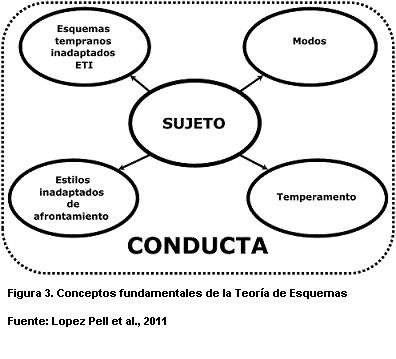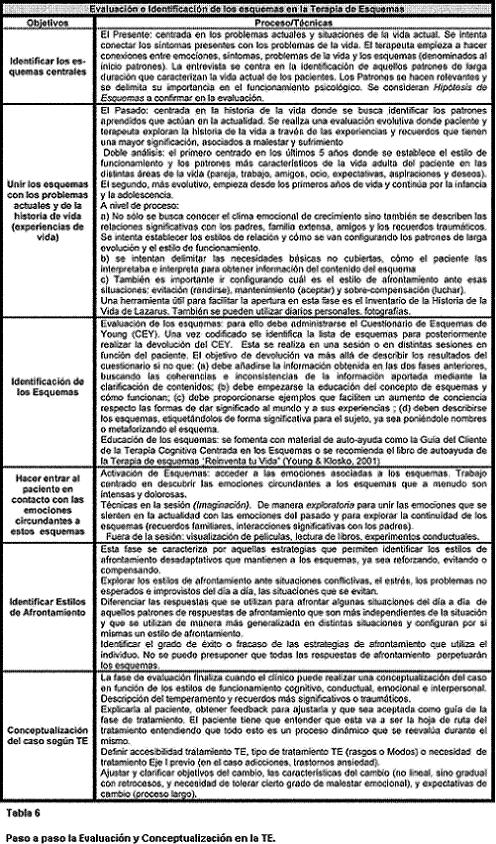
<?xml version="1.0" encoding="ISO-8859-1"?><article xmlns:mml="http://www.w3.org/1998/Math/MathML" xmlns:xlink="http://www.w3.org/1999/xlink" xmlns:xsi="http://www.w3.org/2001/XMLSchema-instance">
<front>
<journal-meta>
<journal-id>1688-4221</journal-id>
<journal-title><![CDATA[Ciencias Psicológicas]]></journal-title>
<abbrev-journal-title><![CDATA[Cienc. Psicol.]]></abbrev-journal-title>
<issn>1688-4221</issn>
<publisher>
<publisher-name><![CDATA[Universidad Católica del Uruguay.]]></publisher-name>
</publisher>
</journal-meta>
<article-meta>
<article-id>S1688-42212011000100008</article-id>
<title-group>
<article-title xml:lang="es"><![CDATA[GUÍAS ESQUEMATIZADAS DE TRATAMIENTO DE LOS TRASTORNOS DE LA PERSONALIDAD PARA PROFESIONALES, DESDE EL MODELO DE YOUNG, KLOSKO Y WHEISHAR (2003)]]></article-title>
<article-title xml:lang="en"><![CDATA[SCHEMATIC-GUIDES FOR PROFESSIONALS TO TREAT PERSONALITY DISORDERS, FROM THE MODEL OF YOUNG, KLOSKO AND WHEISHAR (2003)]]></article-title>
</title-group>
<contrib-group>
<contrib contrib-type="author">
<name>
<surname><![CDATA[López Pell]]></surname>
<given-names><![CDATA[Andrés Fernando]]></given-names>
</name>
<xref ref-type="aff" rid="A01"/>
</contrib>
<contrib contrib-type="author">
<name>
<surname><![CDATA[Cid Colom]]></surname>
<given-names><![CDATA[Jordi]]></given-names>
</name>
<xref ref-type="aff" rid="A02"/>
</contrib>
<contrib contrib-type="author">
<name>
<surname><![CDATA[Obst Camerini]]></surname>
<given-names><![CDATA[Julio]]></given-names>
</name>
<xref ref-type="aff" rid="A03"/>
</contrib>
<contrib contrib-type="author">
<name>
<surname><![CDATA[Rondón]]></surname>
<given-names><![CDATA[Juan M.]]></given-names>
</name>
<xref ref-type="aff" rid="A04"/>
</contrib>
<contrib contrib-type="author">
<name>
<surname><![CDATA[Alfano]]></surname>
<given-names><![CDATA[Silvina M.]]></given-names>
</name>
<xref ref-type="aff" rid="A05"/>
</contrib>
<contrib contrib-type="author">
<name>
<surname><![CDATA[Cellerino]]></surname>
<given-names><![CDATA[Cecilia]]></given-names>
</name>
<xref ref-type="aff" rid="A06"/>
</contrib>
</contrib-group>
<aff id="A01">
<institution><![CDATA[,Universidad Católica de Santa Fe y FUNSALED  ]]></institution>
<addr-line><![CDATA[ ]]></addr-line>
<country>Argentina</country>
</aff>
<aff id="A02">
<institution><![CDATA[,International Society of Schema Therapy  ]]></institution>
<addr-line><![CDATA[ ]]></addr-line>
</aff>
<aff id="A03">
<institution><![CDATA[,UAI y C.A.T.R.E.C.  ]]></institution>
<addr-line><![CDATA[ ]]></addr-line>
</aff>
<aff id="A04">
<institution><![CDATA[,Universidad Católica de Santa Fe  ]]></institution>
<addr-line><![CDATA[ ]]></addr-line>
<country>Argentina</country>
</aff>
<aff id="A05">
<institution><![CDATA[,Universidad Católica de Santa Fe  ]]></institution>
<addr-line><![CDATA[ ]]></addr-line>
<country>Argentina</country>
</aff>
<aff id="A06">
<institution><![CDATA[,Universidad Católica de Santa Fe  ]]></institution>
<addr-line><![CDATA[ ]]></addr-line>
<country>Argentina</country>
</aff>
<pub-date pub-type="pub">
<day>00</day>
<month>05</month>
<year>2011</year>
</pub-date>
<pub-date pub-type="epub">
<day>00</day>
<month>05</month>
<year>2011</year>
</pub-date>
<volume>5</volume>
<numero>1</numero>
<fpage>83</fpage>
<lpage>115</lpage>
<copyright-statement/>
<copyright-year/>
<self-uri xlink:href="http://www.scielo.edu.uy/scielo.php?script=sci_arttext&amp;pid=S1688-42212011000100008&amp;lng=en&amp;nrm=iso"></self-uri><self-uri xlink:href="http://www.scielo.edu.uy/scielo.php?script=sci_abstract&amp;pid=S1688-42212011000100008&amp;lng=en&amp;nrm=iso"></self-uri><self-uri xlink:href="http://www.scielo.edu.uy/scielo.php?script=sci_pdf&amp;pid=S1688-42212011000100008&amp;lng=en&amp;nrm=iso"></self-uri><abstract abstract-type="short" xml:lang="es"><p><![CDATA[Los tratamientos psicológicos para Trastornos de la personalidad todavía no alcanzan un grado de protocololarización específico como para describir las intervenciones para cada sesión. Esto podría deberse, entre otras cuestiones, a la heterogeneidad de los casos que dificultaría la posibilidad de diseñar un protocolo. Los tratamientos entonces se basan en conceptualizaciones de caso sustentadas teóricamente que después determinan los objetivos y las intervenciones a realizar. La dificultad para conceptualizar desde determinado modelo puede que sea una razón por la que a los psicoterapeutas les costaría realizar el tratamiento más adecuado. Para afrontar este problema hemos construido &lsquo;Guías esquematizadas para profesionales&rsquo; para mejorar la práctica clínica. Estas guías son de una carilla para tenerlas a la vista durante las sesiones a fin conceptualizar los casos y guiar más fácilmente las intervenciones desde el modelo de Young, Klosko y Wheishar (2003). Este artículo describe el proceso de construcción de las guías]]></p></abstract>
<abstract abstract-type="short" xml:lang="en"><p><![CDATA[Psychological treatments for personality disorders have not yet reached a level of protocol as specific as to describe interventions for each session. This could be due, among other factors, to the heterogeneity of cases that make it difficult to design a protocol. Treatments are then based on case conceptualizations supported by theories that determine the objectives and interventions performed. The difficulty to conceptualize from a particular model may be a reason why psychotherapists find problems to make the most appropriate treatment. Addressing this problem, we have designed a set of &lsquo;Professional schematic-guides&rsquo; to improve the clinical practice. These one-page-guides were created to have them in front of you during the sessions, and help to conceptualize cases and easily guide the interventions from the model of Young, Klosko y Wheishar (2003). This article describes the process of building guidelines]]></p></abstract>
<kwd-group>
<kwd lng="es"><![CDATA[personalidad]]></kwd>
<kwd lng="es"><![CDATA[trastornos]]></kwd>
<kwd lng="es"><![CDATA[tratamiento]]></kwd>
<kwd lng="es"><![CDATA[terapia de esquemas]]></kwd>
<kwd lng="en"><![CDATA[personality]]></kwd>
<kwd lng="en"><![CDATA[disorders]]></kwd>
<kwd lng="en"><![CDATA[treatment]]></kwd>
<kwd lng="en"><![CDATA[schema therapy]]></kwd>
</kwd-group>
</article-meta>
</front><body><![CDATA[ <div class="Section1">     <p class="western" style="margin-bottom: 0.0001pt; text-align: center;"  align="center"><b><span style="font-family: Arial;" lang="ES-UY">GU&Iacute;AS ESQUEMATIZADAS DE TRATAMIENTO DE LOS TRASTORNOS DE LA PERSONALIDAD PARA PROFESIONALES, DESDE EL MODELO DE YOUNG, KLOSKO Y WHEISHAR (2003)</span></b><span  style="" lang="ES-UY"><o:p></o:p></span></p>     <p class="western"  style="margin-bottom: 0.0001pt; text-align: center; line-height: 150%;"  align="center"><b><span style="font-family: Arial;"><o:p>&nbsp;</o:p></span></b></p>     <p class="western"  style="margin-bottom: 0.0001pt; text-align: center; line-height: 150%;"  align="center"><b><span style="font-family: Arial;" lang="EN-US">SCHEMATIC-GUIDES FOR PROFESSIONALS TO TREAT PERSONALITY DISORDERS, FROM THE MODEL OF YOUNG, KLOSKO AND WHEISHAR (2003)</span></b><span  style="" lang="EN-US"><o:p></o:p></span></p>     <p class="western" style="margin-bottom: 0.0001pt; line-height: 150%;"><span  style="" lang="EN-US"><o:p>&nbsp;</o:p></span></p>     <p class="western" style="margin-bottom: 0.0001pt; text-align: center;"  align="center"><b><span  style="font-size: 10pt; line-height: 120%; font-family: Arial;"  lang="ES-UY">Andr&eacute;s Fernando L&oacute;pez Pell</span></b><span  style="font-size: 10pt; line-height: 120%; font-family: Arial;"  lang="ES-UY"><o:p></o:p></span></p>     <p class="western" style="margin-bottom: 0.0001pt; text-align: center;"  align="center"><span  style="font-size: 10pt; line-height: 120%; font-family: Arial;"  lang="ES-UY">Universidad Cat&oacute;lica de Santa Fe y FUNSALED, Argentina<o:p></o:p></span></p>     <p class="western"  style="margin: 5.65pt 0cm 0.0001pt; text-align: center;" align="center"><b><span  style="font-size: 10pt; line-height: 120%; font-family: Arial;"><o:p>&nbsp;</o:p></span></b></p>     <p class="western"  style="margin: 5.65pt 0cm 0.0001pt; text-align: center;" align="center"><b><span  style="font-size: 10pt; line-height: 120%; font-family: Arial;"  lang="EN-US">Jordi Cid Colom</span></b><span  style="font-size: 10pt; line-height: 120%; font-family: Arial;"  lang="EN-US"><o:p></o:p></span></p>     <p class="western" style="margin-bottom: 0.0001pt; text-align: center;"  align="center"><span  style="font-size: 10pt; line-height: 120%; font-family: Arial;"  lang="EN-US">International Society of Schema Therapy<o:p></o:p></span></p>     ]]></body>
<body><![CDATA[<p class="western"  style="margin: 5.65pt 0cm 0.0001pt; text-align: center;" align="center"><b><span  style="font-size: 10pt; line-height: 120%; font-family: Arial;"  lang="EN-GB"><o:p>&nbsp;</o:p></span></b></p>     <p class="western"  style="margin: 5.65pt 0cm 0.0001pt; text-align: center;" align="center"><b><span  style="font-size: 10pt; line-height: 120%; font-family: Arial;"  lang="ES-UY">Julio Obst Camerini</span></b><span  style="font-size: 10pt; line-height: 120%; font-family: Arial;"  lang="ES-UY"><o:p></o:p></span></p>     <p class="western" style="margin-bottom: 0.0001pt; text-align: center;"  align="center"><span  style="font-size: 10pt; line-height: 120%; font-family: Arial;"  lang="ES-UY">UAI y C.A.T.R.E.C.<o:p></o:p></span></p>     <p class="western"  style="margin: 5.65pt 0cm 0.0001pt; text-align: center;" align="center"><b><span  style="font-size: 10pt; line-height: 120%; font-family: Arial;"  lang="ES-UY"><o:p>&nbsp;</o:p></span></b></p>     <p class="western"  style="margin: 5.65pt 0cm 0.0001pt; text-align: center;" align="center"><b><span  style="font-size: 10pt; line-height: 120%; font-family: Arial;"  lang="ES-UY">Juan M. Rond&oacute;n</span></b><span  style="font-size: 10pt; line-height: 120%; font-family: Arial;"  lang="ES-UY"><o:p></o:p></span></p>     <p class="western" style="margin-bottom: 0.0001pt; text-align: center;"  align="center"><span  style="font-size: 10pt; line-height: 120%; font-family: Arial;"  lang="ES-UY">Universidad Cat&oacute;lica de Santa Fe, Argentina<o:p></o:p></span></p>     <p class="western"  style="margin: 5.65pt 0cm 0.0001pt; text-align: center;" align="center"><b><span  style="font-size: 10pt; line-height: 120%; font-family: Arial;"  lang="ES-UY"><o:p>&nbsp;</o:p></span></b></p>     <p class="western"  style="margin: 5.65pt 0cm 0.0001pt; text-align: center;" align="center"><b><span  style="font-size: 10pt; line-height: 120%; font-family: Arial;"  lang="ES-UY">Silvina M. Alfano</span></b><span  style="font-size: 10pt; line-height: 120%; font-family: Arial;"  lang="ES-UY"><o:p></o:p></span></p>     <p class="western" style="margin-bottom: 0.0001pt; text-align: center;"  align="center"><span  style="font-size: 10pt; line-height: 120%; font-family: Arial;"  lang="ES-UY">Universidad Cat&oacute;lica de Santa Fe, Argentina<o:p></o:p></span></p>     <p class="western"  style="margin: 5.65pt 0cm 0.0001pt; text-align: center;" align="center"><b><span  style="font-size: 10pt; line-height: 120%; font-family: Arial;"  lang="ES-UY"><o:p>&nbsp;</o:p></span></b></p>     ]]></body>
<body><![CDATA[<p class="western"  style="margin: 5.65pt 0cm 0.0001pt; text-align: center;" align="center"><b><span  style="font-size: 10pt; line-height: 120%; font-family: Arial;"  lang="ES-UY">Cecilia Cellerino</span></b><span  style="font-size: 10pt; line-height: 120%; font-family: Arial;"  lang="ES-UY"><o:p></o:p></span></p>     <p class="western" style="margin-bottom: 0.0001pt; text-align: center;"  align="center"><span  style="font-size: 10pt; line-height: 120%; font-family: Arial;"  lang="ES-UY">Universidad Cat&oacute;lica de Santa Fe, Argentina<o:p></o:p></span></p>     <p class="western" style="margin-bottom: 0.0001pt;"><span  style="font-size: 10pt; line-height: 120%; font-family: Arial;"  lang="ES-UY"><o:p>&nbsp;</o:p></span></p>     <p class="western" style="margin-bottom: 0.0001pt;"><span  style="font-size: 10pt; line-height: 120%; font-family: Arial;"  lang="ES-UY"><o:p>&nbsp;</o:p></span></p>     <p  style="margin: 5pt 17pt 0.0001pt 19.85pt; line-height: 150%; text-align: justify;"><b><span  style="font-size: 10pt; line-height: 150%; font-family: Arial;"  lang="ES-UY">Resumen: </span></b><span  style="font-size: 10pt; line-height: 150%; font-family: Arial;"  lang="ES-UY">Los tratamientos psicol&oacute;gicos para Trastornos de la personalidad todav&iacute;a no alcanzan un grado de protocololarizaci&oacute;n espec&iacute;fico como para describir las intervenciones para cada sesi&oacute;n. Esto podr&iacute;a deberse, entre otras cuestiones, a la heterogeneidad de los casos que dificultar&iacute;a la posibilidad de dise&ntilde;ar un protocolo. Los tratamientos entonces se basan en conceptualizaciones de caso sustentadas te&oacute;ricamente que despu&eacute;s determinan los objetivos y las intervenciones a realizar. La dificultad para conceptualizar desde determinado modelo puede que sea una raz&oacute;n por la que a los psicoterapeutas les costar&iacute;a realizar el tratamiento m&aacute;s adecuado. Para afrontar este problema hemos construido &lsquo;Gu&iacute;as esquematizadas para profesionales&rsquo; para mejorar la pr&aacute;ctica cl&iacute;nica. Estas gu&iacute;as son de una carilla para tenerlas a la vista durante las sesiones a fin conceptualizar los casos y guiar m&aacute;s f&aacute;cilmente las intervenciones desde el modelo de <a href="#Young10">Young, Klosko y Wheishar</a> (2003). Este art&iacute;culo describe el proceso de construcci&oacute;n de las gu&iacute;as. <o:p></o:p></span></p>     <div style="text-align: justify;"> </div>     <p  style="margin: 5pt 17pt 0.0001pt 19.85pt; line-height: 150%; text-align: justify;"><b><span  style="font-size: 10pt; line-height: 150%; font-family: Arial;"  lang="ES-UY">Palabras clave</span></b><span  style="font-size: 10pt; line-height: 150%; font-family: Arial;"  lang="ES-UY">: personalidad, trastornos, tratamiento, terapia de esquemas.<o:p></o:p></span></p>     <p  style="margin: 5pt 17pt 0.0001pt 19.85pt; text-align: justify; line-height: 150%;"><span  style="font-size: 10pt; line-height: 150%; font-family: Arial;"  lang="ES-UY"><o:p>&nbsp;</o:p></span></p>     <p  style="margin: 5pt 17pt 0.0001pt 19.85pt; text-align: justify; line-height: 150%;"><b><span  style="font-size: 10pt; line-height: 150%; font-family: Arial;"  lang="EN-US">Abstract: </span></b><span  style="font-size: 10pt; line-height: 150%; font-family: Arial;"  lang="EN-US">Psychological treatments for personality disorders have not yet reached a level of protocol as specific as to describe interventions for each session. This could be due, among other factors, to the heterogeneity of cases that make it difficult to design a protocol. Treatments are then based on case conceptualizations supported by theories that determine the objectives and interventions performed. The difficulty to conceptualize from a particular model may be a reason why psychotherapists find problems to make the most appropriate treatment. Addressing this problem, we have designed a set of &lsquo;Professional schematic-guides&rsquo; to improve the clinical practice. These one-page-guides were created to have them in front of you during the sessions, and help to conceptualize cases and easily guide the interventions from the model of <a href="#Young10">Young, Klosko y Wheishar</a> (2003). This article describes the process of building guidelines.</span><span  style="font-size: 10pt; line-height: 150%; font-family: Arial;"  lang="EN-GB"><o:p></o:p></span></p>     <p  style="margin: 5pt 17pt 0.0001pt 19.85pt; text-align: justify; line-height: 150%;"><b><span  style="font-size: 10pt; line-height: 150%; font-family: Arial;"  lang="EN-US">Keywords:</span></b><span  style="font-size: 10pt; line-height: 150%; font-family: Arial;"  lang="EN-US"> personality, disorders, treatment, schema therapy.</span><span  style="font-size: 10pt; line-height: 150%; font-family: Arial;"  lang="EN-GB"><o:p></o:p></span></p>     ]]></body>
<body><![CDATA[<p class="western" style="margin-bottom: 0.0001pt; text-indent: 14.2pt;"><span  style="font-size: 10pt; line-height: 120%; font-family: Arial;"  lang="EN-GB"><o:p>&nbsp;</o:p></span></p>     <p style="margin-bottom: 0.0001pt;"><span  style="font-size: 9pt; line-height: 120%; font-family: Arial;"  lang="ES-UY">Recibido: 02/2011</span><span  style="font-size: 9pt; line-height: 120%;" lang="ES-UY"><o:p></o:p></span></p>     <p style="margin-bottom: 0.0001pt;"><span  style="font-size: 9pt; line-height: 120%; font-family: Arial;"  lang="ES-UY">Revisado: 04/2011</span><span  style="font-size: 9pt; line-height: 120%;" lang="ES-UY"><o:p></o:p></span></p>     <p class="western" style="margin-bottom: 9.9pt; line-height: 115%;"><span  style="font-size: 9pt; line-height: 115%; font-family: Arial;"  lang="ES-UY">Aceptado: 05/2011</span><span  style="font-size: 9pt; line-height: 115%;" lang="ES-UY"><o:p></o:p></span></p>     <p class="western" style="margin-bottom: 0.0001pt; text-indent: 14.2pt;"><span  style="font-size: 10pt; line-height: 120%; font-family: Arial;"><o:p>&nbsp;</o:p></span></p>     <p class="western" style="margin-bottom: 0.0001pt;"><span  style="font-size: 10pt; line-height: 120%; font-family: Arial;"><o:p>&nbsp;</o:p></span></p>     <p class="western" style="margin-bottom: 0.0001pt; text-align: justify;"><span  style="font-size: 9pt; line-height: 120%; font-family: Arial;"  lang="ES-UY">Correspondencia: Andr&eacute;s L&oacute;pez Pell. Universidad Cat&oacute;lica de Santa Fe (UCSF) y FUNSALED, Argentina. Correo Electr&oacute;nico: <a href="mailto:alopezpell@funsaled.org.ar">alopezpell@funsaled.org.ar</a>.<o:p></o:p></span></p>     <div style="text-align: justify;"> </div>     <p style="margin-bottom: 0.0001pt; text-align: justify;"><span  style="font-size: 10pt; line-height: 120%; font-family: Arial;"  lang="ES-UY"><o:p>&nbsp;</o:p></span></p>     <p class="western" style="margin-bottom: 0.0001pt; text-indent: 14.2pt;"><span  style="font-size: 10pt; line-height: 120%; font-family: Arial;"  lang="ES-UY"><o:p>&nbsp;</o:p></span></p>     ]]></body>
<body><![CDATA[<p class="western"  style="margin-bottom: 0.0001pt; text-align: center; text-indent: 14.2pt;"  align="center"><b><span style="font-family: Arial;" lang="ES-UY">INTRODUCCI&Oacute;N</span></b><span  style="font-family: Arial;" lang="ES-UY"><o:p></o:p></span></p>     <p class="western"  style="margin-bottom: 0.0001pt; text-indent: 14.2pt; line-height: 150%; text-align: justify;"><span  style="font-size: 10pt; line-height: 150%; font-family: Arial;"  lang="ES-UY">Nada ha demostrado ser m&aacute;s eficaz que la aplicaci&oacute;n de un protocolo psicoterap&eacute;utico cient&iacute;ficamente validado. Sin embargo &iquest;qu&eacute; hacer cuando el paciente tiene varios trastornos?, o &iquest;cu&aacute;ndo no hay un protocolo validado para tratar el trastorno que sufre? En tales circunstancias, una opci&oacute;n es basar el tratamiento en una conceptualizaci&oacute;n de sus problemas guiada por un marco te&oacute;rico. La dificultad para conceptualizar desde determinado modelo puede que sea una la las tantas razones del por qu&eacute; a los psicoterapeutas les cueste m&aacute;s seguir las pautas descriptas para el abordaje de estas alteraciones. Otra cuesti&oacute;n de suma importancia es que son pacientes muy dif&iacute;ciles de mantener en tratamiento por lo cual se requiere de mucha flexibilidad por parte del terapeuta. Esto, sumado a la heterogeneidad de los casos, dificulta la posibilidad de dise&ntilde;ar un protocolo de tratamiento de alta especificidad delineado para cada sesi&oacute;n como existe para otros trastornos (e.g., depresivo mayor, de angustia, ansiedad generalizada, etc.) ya que cada tratamiento, si bien es guiado por la misma base te&oacute;rica, termina adquiriendo una forma particular.<o:p></o:p></span></p>     <div style="text-align: justify;"> </div>     <p class="western"  style="margin-bottom: 0.0001pt; text-indent: 14.2pt; line-height: 150%; text-align: justify;"><span  style="font-size: 10pt; line-height: 150%; font-family: Arial;"  lang="ES-UY">En busca de enfrentar la problem&aacute;tica planteada, en art&iacute;culos anteriormente publicados en esta revista, propusieron el concepto de Gu&iacute;as esquematizadas para profesionales (<a href="#Lopez1">L&oacute;pez Pell, Rond&oacute;n, Alfano, &amp; Cellerino</a>, 2010; <a href="#Lopez2">L&oacute;pez Pell, Rond&oacute;n, Cellerino &amp; Alfano</a>, 2010). En aquella ocasi&oacute;n, las gu&iacute;as se hicieron para los modelos de Theodore Millon y de <a href="#Beck2">Beck, Freeman, Davis y otros</a> (2005). En esta oportunidad, utilizando el mismo concepto, se realizar&aacute;n para el modelo que vienen desarrollando <a href="#Young10">Young, Klosko y Wheishar</a> (2003).<o:p></o:p></span></p>     <div style="text-align: justify;"> </div>     <p class="western"  style="margin-bottom: 0.0001pt; text-indent: 14.2pt; line-height: 150%; text-align: justify;"><span  style="font-size: 10pt; line-height: 150%; font-family: Arial;"  lang="ES-UY">Las Gu&iacute;as esquematizadas para profesionales est&aacute;n dise&ntilde;adas para mejorar la pr&aacute;ctica de la psicoterapia para los trastornos y alteraciones de la personalidad. Fueron realizadas en una carilla cada una con la idea que los psicoterapeutas las tengan a la vista durante las sesiones y que de esta manera puedan conceptualizar sus casos y guiar m&aacute;s f&aacute;cilmente sus intervenciones. Atento a estas cuestiones, en este art&iacute;culo se presentan los conceptos centrales que deben guiar la praxis desde el modelo de <a href="#Young10">Young, Klosko y Wheishar</a> (2003) de una manera simple y comprensible a fin de facilitar la transferencia del conocimiento al set psicoterap&eacute;utico.<o:p></o:p></span></p>     <p class="western" style="margin-bottom: 0.0001pt; text-indent: 14.2pt;"><span  style="font-size: 10pt; line-height: 120%; font-family: Arial;"  lang="ES-UY"><o:p>&nbsp;</o:p></span></p>     <p class="western"  style="margin-bottom: 0.0001pt; text-align: center; page-break-after: avoid;"  align="center"><b><span style="font-family: Arial;" lang="ES-UY">TEOR&Iacute;A DE LA PERSONALIDAD</span></b><span style="font-family: Arial;"  lang="ES-UY"><o:p></o:p></span></p>     <p class="western"  style="margin-bottom: 0.0001pt; text-indent: 14.2pt; line-height: 150%; text-align: justify;"><span  style="font-size: 10pt; line-height: 150%; font-family: Arial;"  lang="ES-UY">Se ha desarrollado en los &uacute;ltimos a&ntilde;os dentro del paradigma cognitivo conductual un modelo de abordaje terap&eacute;utico denominado Terapia de Esquemas (TE). &Eacute;sta es una forma de psicoterapia integrativa, que combina elementos cognitivos, conductuales, psicodin&aacute;micos, de las relaciones objetales y humanistas/existenciales (<a href="#Young10">Young, Klosko &amp; Wheishar</a>, 2003). Surge a partir de los conceptos te&oacute;ricos desarrollados por Beck, especialmente en el &aacute;rea de los trastornos de personalidad, los esquemas, las estrategias y los modos (<a href="#Alford">Alford &amp; Beck</a>, 1997; <a href="#Beck1">Beck</a>, 1996; <a href="#Beck2">Beck, Freeman, Davis y otros</a>, 2005). La TE ha sido desarrollada por Jeffrey Young (<a href="#Young4">1990</a>; <a  href="#Young5">1993</a>) para tratar a pacientes que reciben un diagn&oacute;stico de trastornos de la personalidad o aquellos con problemas psicol&oacute;gicos que se consideran dif&iacute;ciles de tratar, porque suponen un reto desde la perspectiva del terapeuta. La TE se desarrolla para tratar problemas psicol&oacute;gicos graves, arraigados, de larga duraci&oacute;n, y que presentan dificultades por generar y mantener la estabilidad sintom&aacute;tica, reca&iacute;das constantes, problemas interpersonales o rigidez de patrones conductuales (<a href="#Young5">Young</a>, 1993). Si bien inicialmente fue conceptualizada como una terapia para los Trastornos de la personalidad, en la actualidad se la utiliza y con eficacia para lo que en el DSM-IV TR ser&iacute;an los trastornos del Eje I (<a href="#American">American Psychiatric Association</a>, 2002), dentro de los cuales esta ansiedad, depresi&oacute;n, trastornos alimentarios. <o:p></o:p></span></p>     <div style="text-align: justify;"> </div>     ]]></body>
<body><![CDATA[<p class="western"  style="margin-bottom: 0.0001pt; text-indent: 14.2pt; line-height: 150%; text-align: justify;"><span  style="font-size: 10pt; line-height: 150%; font-family: Arial;"  lang="ES-UY">Cuando present&oacute; sus fundamentos Jeffrey Young consider&oacute; que el abordaje tradicional de la terapia cognitiva en ese momento no ten&iacute;a un desarrollo suficientemente amplio y espec&iacute;fico para los pacientes con trastornos de personalidad. Su argumento era que estos pacientes no cumplen con ciertos requisitos o supuestos del modelo cl&aacute;sico, debido a las siguientes cuestiones:<o:p></o:p></span></p>     <div style="text-align: justify;"> </div>     <p  style="margin: 5pt 0cm 0.0001pt 36pt; text-indent: -18pt; line-height: 150%; text-align: justify;"><span  style="font-size: 10pt; line-height: 150%; font-family: Arial;"  lang="ES-UY">1.<span  style="font-size-adjust: none; font-stretch: normal;"></span><span  style="font-size: 7pt; line-height: 150%;" lang="ES-UY">&nbsp;&nbsp;&nbsp;&nbsp;&nbsp;&nbsp;&nbsp;</span></span><span  style="font-size: 10pt; line-height: 150%; font-family: Arial;"  lang="ES-UY">Dificultades en la identificaci&oacute;n de sentimientos y cogniciones. Es bien conocido que las personas con problemas de personalidad bloquean sus emociones y pensamientos. Muchos tienen una tendencia afectiva de evitar las emociones.<o:p></o:p></span></p>     <div style="text-align: justify;"> </div>     <p  style="margin: 5pt 0cm 0.0001pt 36pt; text-indent: -18pt; line-height: 150%; text-align: justify;"><span  style="font-size: 10pt; line-height: 150%; font-family: Arial;"  lang="ES-UY">2.<span  style="font-size-adjust: none; font-stretch: normal;"></span><span  style="font-size: 7pt; line-height: 150%;" lang="ES-UY">&nbsp;&nbsp;&nbsp;&nbsp;&nbsp;&nbsp;&nbsp;</span></span><span  style="font-size: 10pt; line-height: 150%; font-family: Arial;"  lang="ES-UY">Problemas para el cumplimiento de las tareas para casa. La colaboraci&oacute;n y la motivaci&oacute;n para trabajar entre sesi&oacute;n y sesi&oacute;n es dif&iacute;cil de obtener en los TP. Las tareas y/o deberes que se asignan habitualmente en la terapia se tornan de dif&iacute;cil seguimiento.<o:p></o:p></span></p>     <div style="text-align: justify;"> </div>     <p  style="margin: 5pt 0cm 0.0001pt 36pt; text-indent: -18pt; line-height: 150%; text-align: justify;"><span  style="font-size: 10pt; line-height: 150%; font-family: Arial;"  lang="ES-UY">3.<span  style="font-size-adjust: none; font-stretch: normal;"></span><span  style="font-size: 7pt; line-height: 150%;" lang="ES-UY">&nbsp;&nbsp;&nbsp;&nbsp;&nbsp;&nbsp;</span></span><span  style="font-size: 10pt; line-height: 150%; font-family: Arial;"  lang="ES-UY">Imposibilidad de definir y clarificar los problemas de la vida. Presentan problemas difusos, vagos que no saben definir como objetivos del tratamiento.<o:p></o:p></span></p>     <div style="text-align: justify;"> </div>     <p  style="margin: 5pt 0cm 0.0001pt 36pt; text-indent: -18pt; line-height: 150%; text-align: justify;"><span  style="font-size: 10pt; line-height: 150%; font-family: Arial;"  lang="ES-UY">4.<span  style="font-size-adjust: none; font-stretch: normal;"></span><span  style="font-size: 7pt; line-height: 150%;" lang="ES-UY">&nbsp;&nbsp;&nbsp;&nbsp; &nbsp;</span></span><span  style="font-size: 10pt; line-height: 150%; font-family: Arial;"  lang="ES-UY">Resistencias a una relaci&oacute;n terap&eacute;utica colaboradora. No es tarea f&aacute;cil aplicar ni encontrar el empirismo colaborador en el que se fundamenta la terapia cognitiva. Muestran dificultades en sus relaciones interpersonales, tienen problemas para tener una buena alianza terap&eacute;utica. En el tratamiento se va a necesitar manejar estas dificultades de manera activa.<o:p></o:p></span></p>     <div style="text-align: justify;"> </div>     ]]></body>
<body><![CDATA[<p  style="margin: 5pt 0cm 0.0001pt 36pt; text-indent: -18pt; line-height: 150%; text-align: justify;"><span  style="font-size: 10pt; line-height: 150%; font-family: Arial;"  lang="ES-UY">5.<span  style="font-size-adjust: none; font-stretch: normal;"></span><span  style="font-size: 7pt; line-height: 150%;" lang="ES-UY">&nbsp;&nbsp;&nbsp;&nbsp;&nbsp;&nbsp;&nbsp;</span></span><span  style="font-size: 10pt; line-height: 150%; font-family: Arial;"  lang="ES-UY">Dificultades para modificar sus creencias r&iacute;gidas. Las t&eacute;cnicas utilizadas en la terapia cognitiva, en muchos casos no son suficientes para cambiar los patrones autodestructivos y la rigidez de pensamientos. Las creencias y los patrones autodestructivos forman parte de la definici&oacute;n de la identidad de los pacientes con TP, muchas veces el cambio s&oacute;lo es parcial.<o:p></o:p></span></p>     <div style="text-align: justify;"> </div>     <p class="western" style="margin-bottom: 0.0001pt; text-align: justify;"><span  style="font-size: 10pt; line-height: 120%; font-family: Arial;"  lang="ES-UY"><o:p>&nbsp;</o:p></span></p>     <p class="western"  style="margin-bottom: 0.0001pt; page-break-after: avoid;"><b><span  style="font-family: Arial;" lang="ES-UY">Conceptos b&aacute;sicos</span></b><span style="font-family: Arial;" lang="ES-UY"><o:p></o:p></span></p>     <p class="western"  style="margin-bottom: 0.0001pt; text-indent: 14.2pt; line-height: 150%; text-align: justify;"><span  style="font-size: 10pt; line-height: 150%; font-family: Arial;"  lang="ES-UY">Para este modelo de abordaje, <a href="#Young2">Young y Klosko</a> (2007) definen una subcategor&iacute;a de esquemas: los Esquemas Tempranos Inadaptados (ETI). Estos son patrones disfuncionales -auto-saboteadores- de pensamiento y emoci&oacute;n que se iniciaron en temprana edad y se reiteran a lo largo de la vida. Seg&uacute;n esta definici&oacute;n, las conductas inadaptadas no son componentes de los esquemas, sino que son las respuestas a estos. Las conductas son causadas por los esquemas, pero no son parte de los mismos. Sin embargo, <a href="#Cid2">Cid</a> (2009) prefiere denominarlos &lsquo;Esquemas Precoces Desadaptativos&rsquo;, defini&eacute;ndolos como temas amplios y persistentes formados por recuerdos, emociones, pensamientos y sensaciones corporales que hacen referencia al an&aacute;lisis de uno mismo y de las relaciones con los dem&aacute;s. Estas se originan durante la infancia y se van elaborando a lo largo de la vida del individuo, siendo disfuncionales en grado significativo. <o:p></o:p></span></p>     <div style="text-align: justify;"> </div>     <p class="western"  style="margin-bottom: 0.0001pt; text-indent: 14.2pt; line-height: 150%; text-align: justify;"><span  style="font-size: 10pt; line-height: 150%; font-family: Arial;"  lang="ES-UY">Los ETI se originan en representaciones basadas en la realidad y en su comienzo pueden generar respuestas adaptadas a &eacute;stas. Su disfuncionalidad se muestra m&aacute;s tarde en la vida, cuando esas percepciones o apreciaciones ya nos son ajustadas a la realidad. Los mecanismos humanos de supervivencia, en particular el impulso a la consistencia cognitiva -o a evitar la disonancia cognitiva-, generan la poderosa energ&iacute;a que los defiende ante todo intento de modificarlos, forzando a las otras percepciones a ajustarse a ellos (<a href="#Young2">Young &amp; Klosko</a>, 2007).<o:p></o:p></span></p>     <div style="text-align: justify;"> </div>     <p class="western"  style="margin-bottom: 0.0001pt; text-indent: 14.2pt; line-height: 150%; text-align: justify;"><span  style="font-size: 10pt; line-height: 150%; font-family: Arial;"  lang="ES-UY">Pero estos esquemas pueden tener distintos grados de gravedad y de rigidez o resistencia al cambio. La gravedad puede definirse por la cantidad de situaciones que los activan. La mayor o menor severidad y resistencia al cambio depender&aacute;n de lo temprano -o tard&iacute;o- de la edad en que se generaron, de la cantidad de figuras significativas que lo generaron y de la cantidad -o duraci&oacute;n- de las situaciones que lo generaron. Por ejemplo, ser&aacute; m&aacute;s severo y r&iacute;gido un esquema generado por ambos progenitores, desde la edad de 4 o 5 a&ntilde;os y durante toda la infancia, que uno generado por un solo progenitor, o solamente por un maestro, en un episodio &uacute;nico, cuando ten&iacute;a 12 a&ntilde;os de edad (<a href="#Young2">Young &amp; Klosko</a>, 2007).<o:p></o:p></span></p>     <div style="text-align: justify;"> </div>     ]]></body>
<body><![CDATA[<p class="western"  style="margin-bottom: 0.0001pt; text-indent: 14.2pt; line-height: 150%; text-align: justify;"><span  style="font-size: 10pt; line-height: 150%; font-family: Arial;"  lang="ES-UY">Podemos decir que hay esquemas positivos (i.e., adaptados) y negativos (i.e., inadaptados), as&iacute; como tempranos y tard&iacute;os (<a  href="#Young10">Young, Klosko &amp; Wheishar</a>, 2003). Pero al hablar de esquemas en este trabajo estaremos refiri&eacute;ndonos espec&iacute;ficamente a los esquemas tempranos e inadaptados -negativos- (ETI) por su relaci&oacute;n causal con los trastornos de personalidad que queremos abordar.<o:p></o:p></span></p>     <div style="text-align: justify;"> </div>     <p class="western"  style="margin-bottom: 0.0001pt; text-indent: 14.2pt; line-height: 150%; text-align: justify;"><span  style="font-size: 10pt; line-height: 150%; font-family: Arial;"  lang="ES-UY">En resumen, las caracter&iacute;sticas m&aacute;s relevantes de los ETI son las siguientes: <o:p></o:p></span></p>     <div style="text-align: justify;"> </div>     <p  style="margin: 5pt 0cm 0.0001pt 36pt; text-indent: -18pt; line-height: 150%; text-align: justify;"><span  style="font-size: 10pt; line-height: 150%; font-family: Arial;"  lang="ES-UY">1.<span  style="font-size-adjust: none; font-stretch: normal;"></span><span  style="font-size: 7pt; line-height: 150%;" lang="ES-UY">&nbsp;&nbsp;&nbsp;&nbsp;&nbsp;&nbsp;&nbsp;</span></span><span  style="font-size: 10pt; line-height: 150%; font-family: Arial;"  lang="ES-UY">Son verdades a priori acerca de uno mismo y del ambiente, estructuras centrales del auto-concepto. <o:p></o:p></span></p>     <div style="text-align: justify;"> </div>     <p  style="margin: 5pt 0cm 0.0001pt 36pt; text-indent: -18pt; line-height: 150%; text-align: justify;"><span  style="font-size: 10pt; line-height: 150%; font-family: Arial;"  lang="ES-UY">2.<span  style="font-size-adjust: none; font-stretch: normal;"></span><span  style="font-size: 7pt; line-height: 150%;" lang="ES-UY">&nbsp;&nbsp;&nbsp;&nbsp;&nbsp;&nbsp;&nbsp;</span></span><span  style="font-size: 10pt; line-height: 150%; font-family: Arial;"  lang="ES-UY">Se auto-perpet&uacute;an y son resistentes al cambio; es decir, no se modifican y se mantienen a lo largo del tiempo.<o:p></o:p></span></p>     <div style="text-align: justify;"> </div>     <p  style="margin: 5pt 0cm 0.0001pt 35.25pt; text-indent: -18pt; line-height: 150%; text-align: justify;"><span  style="font-size: 10pt; line-height: 150%; font-family: Arial;"  lang="ES-UY">3.<span  style="font-size-adjust: none; font-stretch: normal;"></span><span  style="font-size: 7pt; line-height: 150%;" lang="ES-UY">&nbsp;&nbsp;&nbsp;</span></span><span  style="font-size: 10pt; line-height: 150%; font-family: Arial;"  lang="ES-UY">Son disfuncionales o desadaptativos: con consecuencias auto-destructivas y/o da&ntilde;o significativo para los dem&aacute;s. Interfieren de forma significativa en la satisfacci&oacute;n de las necesidades nucleares de autonom&iacute;a, uni&oacute;n con los dem&aacute;s, auto-expresi&oacute;n, l&iacute;mites, gratificaciones y autoestima necesarias para una calidad de vida saludable.<o:p></o:p></span></p>     <div style="text-align: justify;"> </div>     ]]></body>
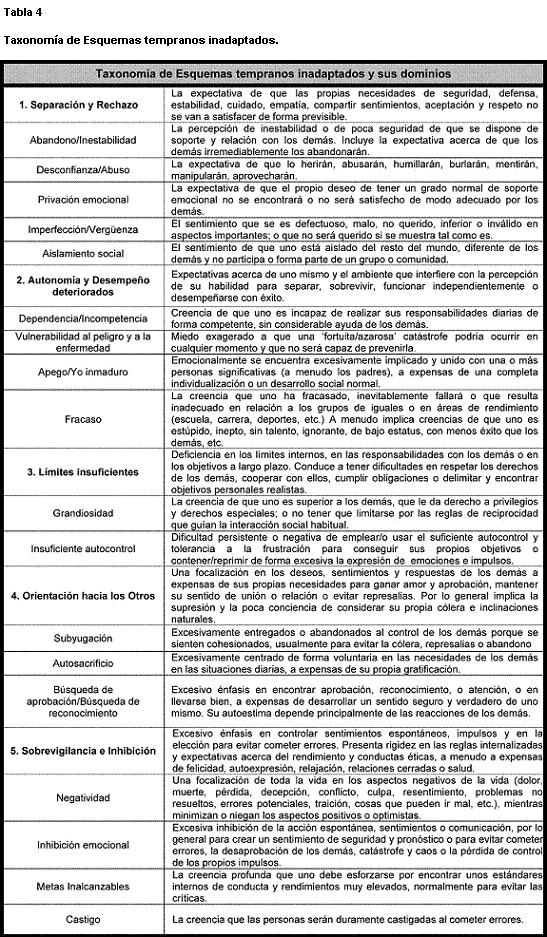
<body><![CDATA[<p  style="margin: 5pt 0cm 0.0001pt 36pt; text-indent: -18pt; line-height: 150%; text-align: justify;"><span  style="font-size: 10pt; line-height: 150%; font-family: Arial;"  lang="ES-UY">4.<span  style="font-size-adjust: none; font-stretch: normal;"></span><span  style="font-size: 7pt; line-height: 150%;" lang="ES-UY">&nbsp;&nbsp;&nbsp;</span></span><span  style="font-size: 10pt; line-height: 150%; font-family: Arial;"  lang="ES-UY">Son activados por cambios ambientales relevantes al esquema o por estados de &aacute;nimo o estados biol&oacute;gicos. No siempre est&aacute;n en nuestra conciencia. Cuando se activan se acompa&ntilde;an de altos niveles de afecto o emociones.<o:p></o:p></span></p>     <div style="text-align: justify;"> </div>     <p  style="margin: 5pt 0cm 0.0001pt 36pt; text-indent: -18pt; line-height: 150%; text-align: justify;"><span  style="font-size: 10pt; line-height: 150%; font-family: Arial;"  lang="ES-UY">5.<span  style="font-size-adjust: none; font-stretch: normal;"></span><span  style="font-size: 7pt; line-height: 150%;" lang="ES-UY">&nbsp;&nbsp;</span></span><span  style="font-size: 10pt; line-height: 150%; font-family: Arial;"  lang="ES-UY">Son el resultado de la interacci&oacute;n del temperamento con las experiencias nocivas o interacciones dolorosas y disfuncionales con los miembros de la familia o cuidadores en la infancia.<o:p></o:p></span></p>     <p class="western"  style="margin-bottom: 0.0001pt; text-indent: 14.2pt; line-height: 150%; text-align: justify;"><span  style="font-size: 10pt; line-height: 150%; font-family: Arial;"  lang="ES-UY"><o:p></o:p></span></p>     <div style="text-align: justify;"> </div>     <p class="western"  style="margin-bottom: 0.0001pt; text-indent: 14.2pt; line-height: 150%; text-align: justify;"><span  style="font-size: 10pt; line-height: 150%; font-family: Arial;"  lang="ES-UY">Finalmente, se nombrar&aacute;n y describir&aacute;n brevemente los 18 esquemas tempranos inadaptados propuestos por <a href="#Young2">Young y Klosko</a> (2007) que se relacionan con las necesidades b&aacute;sicas que se exponen m&aacute;s adelante, cuando estas no han sido satisfechas adecuadamente. Estos esquemas a su vez se agrupan, en cinco dimensiones o dominios (v&eacute;ase <a href="/img/revistas/cp/v5n1/1a08t4.jpg">Tabla 4</a>):<o:p></o:p></span></p>     <div style="text-align: justify;"> </div>     <p class="western"  style="margin-bottom: 0.0001pt; text-indent: 14.2pt; text-align: justify;"><span  style="font-size: 10pt; line-height: 120%; font-family: Arial;"  lang="ES-UY"><o:p>&nbsp;</o:p></span></p>     <p class="western" style="margin-bottom: 0.0001pt;"><b><span  style="font-size: 11pt; line-height: 120%; font-family: Arial;"  lang="ES-UY">1) Desconexi&oacute;n y rechazo</span></b><span  style="font-size: 11pt; line-height: 120%; font-family: Arial;"  lang="ES-UY"><o:p></o:p></span></p>     <p class="western" style="margin-bottom: 0.0001pt; text-align: justify;"><b><span  style="font-size: 10pt; line-height: 120%; font-family: Arial;"  lang="ES-UY">1. Abandono/Inestabilidad. </span></b><span  style="font-size: 10pt; line-height: 120%; font-family: Arial;"  lang="ES-UY">La percepci&oacute;n de inestabilidad o de poca seguridad, de que se dispone de soporte y relaci&oacute;n con los dem&aacute;s. <o:p></o:p></span></p>     ]]></body>
<body><![CDATA[<p class="western" style="margin-bottom: 0.0001pt; text-align: justify;"><b><span  style="font-size: 10pt; line-height: 120%; font-family: Arial;"  lang="ES-UY">2. Desconfianza/Abuso. </span></b><span  style="font-size: 10pt; line-height: 120%; font-family: Arial;"  lang="ES-UY">La expectativa de que los otros lo herir&aacute;n, abusar&aacute;n, humillar&aacute;n, burlar&aacute;n, mentir&aacute;n, manipular&aacute;n, aprovechar&aacute;n. <o:p></o:p></span></p>     <p class="western" style="margin-bottom: 0.0001pt; text-align: justify;"><b><span  style="font-size: 10pt; line-height: 120%; font-family: Arial;"  lang="ES-UY">3. Privaci&oacute;n emocional. </span></b><span  style="font-size: 10pt; line-height: 120%; font-family: Arial;"  lang="ES-UY">La expectativa de que sus deseos propios de tener un grado normal de soporte emocional (i.e., cuidado, empat&iacute;a o protecci&oacute;n) no se satisfacer&aacute;n adecuadamente con los otros. <o:p></o:p></span></p>     <p class="western" style="margin-bottom: 0.0001pt; text-align: justify;"><b><span  style="font-size: 10pt; line-height: 120%; font-family: Arial;"  lang="ES-UY">4. Defectuosidad/Verg&uuml;enza. </span></b><span  style="font-size: 10pt; line-height: 120%; font-family: Arial;"  lang="ES-UY">El sentimiento que uno es defectuoso, malo, no querido, inferior o inv&aacute;lido en aspectos importantes; o de que uno ser&iacute;a no querido de forma significativa por los dem&aacute;s si se muestra tal como es. <o:p></o:p></span></p>     <p class="western" style="margin-bottom: 0.0001pt; text-align: justify;"><b><span  style="font-size: 10pt; line-height: 120%; font-family: Arial;"  lang="ES-UY">5. Aislamiento social/Alienaci&oacute;n. </span></b><span  style="font-size: 10pt; line-height: 120%; font-family: Arial;"  lang="ES-UY">La sensaci&oacute;n de que uno est&aacute; aislado del resto del mundo, diferente de los dem&aacute;s y no participa o forma parte de un grupo o comunidad.<o:p></o:p></span></p>     <p class="western"  style="margin-bottom: 0.0001pt; text-indent: 14.2pt; text-align: justify;"><span  style="font-size: 10pt; line-height: 120%; font-family: Arial;"  lang="ES-UY"><o:p>&nbsp;</o:p></span></p>     <p class="western" style="margin-bottom: 0.0001pt; text-align: justify;"><b><span  style="font-size: 11pt; line-height: 120%; font-family: Arial;"  lang="ES-UY">2)</span></b><span  style="font-size: 11pt; line-height: 120%; font-family: Arial;"  lang="ES-UY"> <b>Trastornos de autonom&iacute;a y rendimiento</b><o:p></o:p></span></p>     <p class="western"  style="margin-bottom: 0.0001pt; line-height: 150%; text-align: justify;"><b><span  style="font-size: 10pt; line-height: 150%; font-family: Arial;"  lang="ES-UY">6. Dependencia/Incompetencia. </span></b><span  style="font-size: 10pt; line-height: 150%; font-family: Arial;"  lang="ES-UY">Creencia de que uno es incapaz de realizar sus responsabilidades diarias de forma competente, sin considerable ayuda de los dem&aacute;s. <o:p></o:p></span></p>     <p class="western"  style="margin-bottom: 0.0001pt; line-height: 150%; text-align: justify;"><b><span  style="font-size: 10pt; line-height: 150%; font-family: Arial;"  lang="ES-UY">7. Vulnerabilidad al peligro. </span></b><span  style="font-size: 10pt; line-height: 150%; font-family: Arial;"  lang="ES-UY">Miedo exagerado a que una &lsquo;fortuita/azarosa&rsquo; cat&aacute;strofe podr&iacute;a ocurrir en cualquier momento y que no ser&aacute; capaz de prevenirla. Los miedos son m&eacute;dicos, emocionales, naturales/fobia.<o:p></o:p></span></p>     <p class="western"  style="margin-bottom: 0.0001pt; line-height: 150%; text-align: justify;"><b><span  style="font-size: 10pt; line-height: 150%; font-family: Arial;"  lang="ES-UY">8. Apego inmaduro independiente. </span></b><span  style="font-size: 10pt; line-height: 150%; font-family: Arial;"  lang="ES-UY">Emocionalmente se encuentra excesivamente implicado y unido con una o m&aacute;s personas significativas -a menudo los padres-, a expensas de una completa individualizaci&oacute;n o un desarrollo social normal. <o:p></o:p></span></p>     <p class="western"  style="margin-bottom: 0.0001pt; line-height: 150%; text-align: justify;"><b><span  style="font-size: 10pt; line-height: 150%; font-family: Arial;"  lang="ES-UY">9. Fracaso. </span></b><span  style="font-size: 10pt; line-height: 150%; font-family: Arial;"  lang="ES-UY">La creencia de que uno ha fracasado, inevitablemente fallar&aacute; o que fundamentalmente resulta inadecuado en relaci&oacute;n a los grupos de iguales, en &aacute;reas de rendimiento (e.g., escuela, carrera, deportes, etc.). <o:p></o:p></span></p>     ]]></body>
<body><![CDATA[<p class="western"  style="margin-bottom: 0.0001pt; line-height: 150%; text-align: justify;"><span  style="font-size: 10pt; line-height: 150%; font-family: Arial;"  lang="ES-UY"><o:p>&nbsp;</o:p></span></p>     <p class="western" style="margin-bottom: 0.0001pt; text-align: justify;"><b><span  style="font-size: 11pt; line-height: 120%; font-family: Arial;"  lang="ES-UY">3)</span></b><span  style="font-size: 11pt; line-height: 120%; font-family: Arial;"  lang="ES-UY"> <b>L&iacute;mites insuficientes</b><o:p></o:p></span></p>     <p class="western"  style="margin-bottom: 0.0001pt; line-height: 150%; text-align: justify;"><b><span  style="font-size: 10pt; line-height: 150%; font-family: Arial;"  lang="ES-UY">10. Grandiosidad. </span></b><span  style="font-size: 10pt; line-height: 150%; font-family: Arial;"  lang="ES-UY">La creencia de que uno es superior a los dem&aacute;s, que le da derecho a privilegios y derechos especiales; o no tener que limitarse por las reglas de reciprocidad que gu&iacute;an la interacci&oacute;n social habitual. <o:p></o:p></span></p>     <p class="western"  style="margin-bottom: 0.0001pt; line-height: 150%; text-align: justify;"><b><span  style="font-size: 10pt; line-height: 150%; font-family: Arial;"  lang="ES-UY">11. Insuficiente autocontrol. </span></b><span  style="font-size: 10pt; line-height: 150%; font-family: Arial;"  lang="ES-UY">Dificultad persistente o negativa de emplear o usar el suficiente autocontrol y tolerancia a la frustraci&oacute;n para conseguir sus propios objetivos, o contener/reprimir de forma excesiva la expresi&oacute;n de sus emociones e impulsos. <o:p></o:p></span></p>     <p class="western"  style="margin-bottom: 0.0001pt; text-indent: 14.2pt; text-align: justify;"><span  style="font-size: 10pt; line-height: 120%; font-family: Arial;"  lang="ES-UY"><o:p>&nbsp;</o:p></span></p>     <p class="western" style="margin-bottom: 0.0001pt; text-align: justify;"><b><span  style="font-size: 11pt; line-height: 120%; font-family: Arial;"  lang="ES-UY">4) Focalizaci&oacute;n en los otros </span></b><span  style="font-size: 11pt; line-height: 120%; font-family: Arial;"  lang="ES-UY"><o:p></o:p></span></p>     <p class="western"  style="margin-bottom: 0.0001pt; line-height: 150%; text-align: justify;"><b><span  style="font-size: 10pt; line-height: 150%; font-family: Arial;"  lang="ES-UY">12. Subyugaci&oacute;n. </span></b><span  style="font-size: 10pt; line-height: 150%; font-family: Arial;"  lang="ES-UY">Excesivamente entregados/abandonados al control de los dem&aacute;s porque uno se siente cohesionado: usualmente para evitar la c&oacute;lera, represalias o el abandono. Las dos formas m&aacute;s importantes son la subyugaci&oacute;n de necesidades y de emociones. <o:p></o:p></span></p>     <p class="western"  style="margin-bottom: 0.0001pt; line-height: 150%; text-align: justify;"><b><span  style="font-size: 10pt; line-height: 150%; font-family: Arial;"  lang="ES-UY">13. Autosacrificio. </span></b><span  style="font-size: 10pt; line-height: 150%; font-family: Arial;"  lang="ES-UY">Excesivamente centrado de forma voluntaria en las necesidades de los dem&aacute;s en las situaciones diarias, a expensas de su propia gratificaci&oacute;n. <o:p></o:p></span></p>     <p class="western"  style="margin-bottom: 0.0001pt; line-height: 150%; text-align: justify;"><b><span  style="font-size: 10pt; line-height: 150%; font-family: Arial;"  lang="ES-UY">14. B&uacute;squeda de aprobaci&oacute;n/B&uacute;squeda de reconocimiento. </span></b><span  style="font-size: 10pt; line-height: 150%; font-family: Arial;"  lang="ES-UY">Excesivo &eacute;nfasis en encontrar aprobaci&oacute;n, reconocimiento, o atenci&oacute;n en los dem&aacute;s, o en llevarse bien, a expensas de desarrollar un sentido seguro y verdadero de uno mismo. Su autoestima depende principalmente de las reacciones de los dem&aacute;s m&aacute;s que de sus propias inclinaciones naturales. <o:p></o:p></span></p>     <p class="western"  style="margin-bottom: 0.0001pt; text-indent: 14.2pt; text-align: justify;"><span  style="font-size: 10pt; line-height: 120%; font-family: Arial;"  lang="ES-UY"><o:p>&nbsp;</o:p></span></p>     ]]></body>
<body><![CDATA[<p class="western" style="margin-bottom: 0.0001pt; text-align: justify;"><b><span  style="font-size: 11pt; line-height: 120%; font-family: Arial;"  lang="ES-UY">5) Hipervigilancia e inhibici&oacute;n</span></b><span  style="font-size: 11pt; line-height: 120%; font-family: Arial;"  lang="ES-UY"><o:p></o:p></span></p>     <p class="western"  style="margin-bottom: 0.0001pt; line-height: 150%; text-align: justify;"><b><span  style="font-size: 10pt; line-height: 150%; font-family: Arial;"  lang="ES-UY">15. Negatividad </span></b><span  style="font-size: 10pt; line-height: 150%; font-family: Arial;"  lang="ES-UY">-eventos controlables-. Una penetrante focalizaci&oacute;n de toda la vida en los aspectos negativos de la cotidianeidad, mientras minimizan o niegan los aspectos positivos u optimistas, o una exagerada expectativa de que las cosas saldr&aacute;n seriamente mal.<o:p></o:p></span></p>     <p class="western"  style="margin-bottom: 0.0001pt; line-height: 150%; text-align: justify;"><b><span  style="font-size: 10pt; line-height: 150%; font-family: Arial;"  lang="ES-UY">16. Inhibici&oacute;n emocional. </span></b><span  style="font-size: 10pt; line-height: 150%; font-family: Arial;"  lang="ES-UY">Excesiva inhibici&oacute;n de la acci&oacute;n espont&aacute;nea, sentimientos o comunicaci&oacute;n, por lo general para crear un sentimiento de seguridad y pron&oacute;stico; o para evitar cometer errores, la desaprobaci&oacute;n de los dem&aacute;s, cat&aacute;strofe y caos, o la p&eacute;rdida de control de los propios impulsos. <o:p></o:p></span></p>     <p class="western"  style="margin-bottom: 0.0001pt; line-height: 150%; text-align: justify;"><b><span  style="font-size: 10pt; line-height: 150%; font-family: Arial;"  lang="ES-UY">17. Metas inalcanzables. </span></b><span  style="font-size: 10pt; line-height: 150%; font-family: Arial;"  lang="ES-UY">La creencia profunda que uno debe esforzarse por encontrar unos est&aacute;ndares internos de conducta y rendimientos muy elevados, normalmente para evitar las cr&iacute;ticas. <o:p></o:p></span></p>     <p class="western"  style="margin-bottom: 0.0001pt; line-height: 150%; text-align: justify;"><b><span  style="font-size: 10pt; line-height: 150%; font-family: Arial;"  lang="ES-UY">18. Castigo. </span></b><span  style="font-size: 10pt; line-height: 150%; font-family: Arial;"  lang="ES-UY">La creencia que las personas deben ser duramente castigadas al cometer errores, incluso &eacute;l mismo. <o:p></o:p></span></p>     <p class="western" style="margin-bottom: 0.0001pt; text-align: justify;"><span  style="font-size: 10pt; line-height: 120%; font-family: Arial;"  lang="ES-UY"><o:p>&nbsp;</o:p></span></p>     <p class="western"  style="margin: 11.9pt 0cm 3.1pt; page-break-after: avoid;"><b><span  style="font-size: 11pt; line-height: 120%; font-family: Arial;"  lang="ES-UY">Or&iacute;genes y clasificaci&oacute;n de los esquemas</span></b><span  style="font-size: 11pt; line-height: 120%; font-family: Arial;"  lang="ES-UY"><o:p></o:p></span></p>     <p class="western"  style="margin-bottom: 0.0001pt; text-indent: 14.2pt; line-height: 150%; text-align: justify;"><span  style="font-size: 10pt; line-height: 150%; font-family: Arial;"  lang="ES-UY">Seg&uacute;n este modelo, los ETI se originan en necesidades emocionales insatisfechas en la infancia. &Eacute;stas son necesidades b&aacute;sicas que todo ni&ntilde;o tiene que tener cubiertas y debe aprender a compensarlas con sus padres, familia y el grupo de pares, con el fin de conseguir un &oacute;ptimo desarrollo y funcionamiento adaptativo a lo largo de la vida. Estas cinco necesidades universales seg&uacute;n <a  href="#Young2">Young y Klosko</a> (2007) se enuncian como:<o:p></o:p></span></p>     <div style="text-align: justify;"> </div>     <p class="western"  style="margin-bottom: 0.0001pt; text-indent: 14.2pt; line-height: 150%; text-align: justify;"><span  style="font-size: 10pt; line-height: 150%; font-family: Arial;"  lang="ES-UY"><o:p>&nbsp;</o:p></span></p>     ]]></body>
<body><![CDATA[<div style="text-align: justify;"> </div>     <p  style="margin: 5pt 0cm 0.0001pt 36pt; text-indent: -18pt; line-height: 150%; text-align: justify;"><span  style="font-size: 10pt; line-height: 150%; font-family: Symbol;"  lang="ES-UY">&middot;<span  style="font-size-adjust: none; font-stretch: normal;"></span><span  style="font-size: 7pt; line-height: 150%;" lang="ES-UY">&nbsp;</span></span><span  style="font-size: 10pt; line-height: 150%; font-family: Arial;"  lang="ES-UY">Pertenencia. Integrada por: Seguridad, Estabilidad, Afecto, cari&ntilde;o, Aceptaci&oacute;n<o:p></o:p></span></p>     <div style="text-align: justify;"> </div>     <p  style="margin: 5pt 0cm 0.0001pt 36pt; text-indent: -18pt; line-height: 150%; text-align: justify;"><span  style="font-size: 10pt; line-height: 150%; font-family: Symbol;"  lang="ES-UY">&middot;<span  style="font-size-adjust: none; font-stretch: normal;"></span><span  style="font-size: 7pt; line-height: 150%;" lang="ES-UY">&nbsp;</span></span><span  style="font-size: 10pt; line-height: 150%; font-family: Arial;"  lang="ES-UY">Autonom&iacute;a,<b> </b>competencia y sentido de identidad.<o:p></o:p></span></p>     <div style="text-align: justify;"> </div>     <p  style="margin: 5pt 0cm 0.0001pt 36pt; text-indent: -18pt; line-height: 150%; text-align: justify;"><span  style="font-size: 10pt; line-height: 150%; font-family: Symbol;"  lang="ES-UY">&middot;<span  style="font-size-adjust: none; font-stretch: normal;"></span><span  style="font-size: 7pt; line-height: 150%;" lang="ES-UY">&nbsp;</span></span><span  style="font-size: 10pt; line-height: 150%; font-family: Arial;"  lang="ES-UY">Libertad<b> </b>para expresar emociones y deseos v&aacute;lidos. <o:p></o:p></span></p>     <div style="text-align: justify;"> </div>     <p  style="margin: 5pt 0cm 0.0001pt 36pt; text-indent: -18pt; line-height: 150%; text-align: justify;"><span  style="font-size: 10pt; line-height: 150%; font-family: Symbol;"  lang="ES-UY">&middot;<span  style="font-size-adjust: none; font-stretch: normal;"></span><span  style="font-size: 7pt; line-height: 150%;" lang="ES-UY">&nbsp;</span></span><span  style="font-size: 10pt; line-height: 150%; font-family: Arial;"  lang="ES-UY">Espontaneidad<b> </b>y juego. <o:p></o:p></span></p>     <div style="text-align: justify;"> </div>     <p  style="margin: 5pt 0cm 0.0001pt 36pt; text-indent: -18pt; line-height: 150%; text-align: justify;"><span  style="font-size: 10pt; line-height: 150%; font-family: Symbol;"  lang="ES-UY">&middot;<span  style="font-size-adjust: none; font-stretch: normal;"></span><span  style="font-size: 7pt; line-height: 150%;" lang="ES-UY">&nbsp;</span></span><span  style="font-size: 10pt; line-height: 150%; font-family: Arial;"  lang="ES-UY">L&iacute;mites<b> </b>realistas y autocontrol.<o:p></o:p></span></p>     ]]></body>
<body><![CDATA[<div style="text-align: justify;"> </div>     <p class="western"  style="margin-bottom: 0.0001pt; text-indent: 14.2pt; text-align: justify;"><span  style="font-size: 10pt; line-height: 120%; font-family: Arial;"  lang="ES-UY"><o:p>&nbsp;</o:p></span></p>     <div style="text-align: justify;"> </div>     <p class="western"  style="margin-bottom: 0.0001pt; text-indent: 14.2pt; line-height: 150%; text-align: justify;"><span  style="font-size: 10pt; line-height: 150%; font-family: Arial;"  lang="ES-UY">Finalmente, es importante se&ntilde;alar que <a href="#Young2">Young y Klosko</a>, (2007) han observado que existen cuatro tipos de experiencias vitales que promueven la aparici&oacute;n de los esquemas. La primera es la que denominan frustraci&oacute;n t&oacute;xica de las necesidades que se produce cuando el ni&ntilde;o recibe &lsquo;muy poco de algo bueno&rsquo; y adquiere esquemas tales como la Privaci&oacute;n emocional o Abandono/Inestabilidad, debido a ciertas deficiencias en su ambiente temprano. De esta manera, el ambiente del ni&ntilde;o est&aacute; perdiendo estabilidad, comprensi&oacute;n o amor. El segundo tipo de experiencia t&oacute;xica temprana hace referencia a la traumatizaci&oacute;n; en este sentido, el ni&ntilde;o es da&ntilde;ado, criticado, controlado o victimizado. Estas experiencias llevan a que desarrolle esquemas tales como Abuso/Desconfianza, o Vulnerabilidad al peligro. Con respecto al tercer tipo de experiencia t&oacute;xica, el ni&ntilde;o recibe demasiado de algo bueno, es decir, los padres brindan al ni&ntilde;o demasiado de algo que, en moderaci&oacute;n, es saludable para &eacute;l mismo, lo que a su vez contribuye a generar esquemas tales como Dependencia funcional o Grandiosidad. Por &uacute;ltimo, el cuarto tipo de experiencia t&oacute;xica consiste en la interiorizaci&oacute;n selectiva o identificaci&oacute;n con otros significativos. Con respecto a este tipo de experiencia, el ni&ntilde;o se identifica de manera selectiva e interioriza los pensamientos, las sensaciones y las experiencias de sus padres, en otras palabras, el ni&ntilde;o lo que hace es interiorizar los esquemas de sus padres, lo que da lugar a que se origine, por ejemplo, el esquema de Vulnerabilidad.<o:p></o:p></span></p>     <p class="western" style="margin-bottom: 0.0001pt; text-indent: 14.2pt;"><span  style="font-size: 10pt; line-height: 120%; font-family: Arial;"  lang="ES-UY"><o:p>&nbsp;</o:p></span></p>     <p class="western"  style="margin-bottom: 0.0001pt; page-break-after: avoid;"><b><span  style="font-size: 11pt; line-height: 120%; font-family: Arial;"  lang="ES-UY">Los estilos y respuestas de afrontamiento</span></b><span  style="font-size: 11pt; line-height: 120%; font-family: Arial;"  lang="ES-UY"><o:p></o:p></span></p>     <p class="western"  style="margin-bottom: 0.0001pt; text-indent: 14.2pt; line-height: 150%; text-align: justify;"><span  style="font-size: 10pt; line-height: 150%; font-family: Arial;"  lang="ES-UY">Existen tres estilos desadaptativos de afrontamiento ante la frustraci&oacute;n de las necesidades emocionales que mencionamos anteriormente. Se los puede definir como formas de hacer frente a las necesidades b&aacute;sicas, a los conflictos y a las situaciones estresantes, que refuerzan y mantienen a los ETI, y que empiezan de manera temprana para permitir una adaptaci&oacute;n a los esquemas, para no experimentar las intensas y arrolladoras emociones que estos engendran (<a href="#Young2">Young &amp; Klosko</a>, 2007). Los tres estilos de afrontamiento desadaptativos hacen referencia a las tres respuestas b&aacute;sicas ante la amenaza: la lucha, la hu&iacute;da y el quedarse inm&oacute;vil; espec&iacute;ficamente lucha es sobrecompensaci&oacute;n, huida es evitaci&oacute;n y quedarse inm&oacute;vil es rendici&oacute;n. Es importante tener en cuenta que si bien estos estilos de respuesta fueron posiblemente funcionales y &uacute;tiles en la infancia, en la edad adulta podr&iacute;an resultar disfuncionales porque no permiten adaptarse de una manera saludable y, por lo tanto, impiden la satisfacci&oacute;n de las necesidades b&aacute;sicas de todos los seres humanos (<a href="#Young2">Young &amp; Klosko</a>, 2007). Los pacientes suelen referirse a estas cosas como &lsquo;lo que nos hacen tropezar una y otra vez, con la misma piedra&rsquo;. Los tres estilos de afrontamiento descritos por <a href="#Young2">Young y Klosko</a> (2007) son: <o:p></o:p></span></p>     <p class="western" style="margin-bottom: 0.0001pt; text-indent: 14.2pt;"><span  style="font-size: 10pt; line-height: 120%; font-family: Arial;"  lang="ES-UY"><o:p>&nbsp;</o:p></span></p>     <p  style="margin: 5pt 0cm 0.0001pt 35.7pt; text-indent: -17.85pt; line-height: 150%; text-align: justify;"><span  style="font-size: 10pt; line-height: 150%; font-family: Arial;"  lang="ES-UY">1.<span  style="font-size-adjust: none; font-stretch: normal;"></span><span  style="font-size: 7pt; line-height: 150%;" lang="ES-UY">&nbsp;&nbsp;&nbsp;&nbsp;&nbsp;&nbsp;&nbsp;</span></span><span  style="font-size: 10pt; line-height: 150%; font-family: Arial;"  lang="ES-UY">Sobre-compensaci&oacute;n. Hace referencia a conductas, pensamientos y sentimientos con los que el sujeto intenta superar y hacer frente a un esquema. Muchas veces se pueden manifestar como conductas o estilos de funcionamiento totalmente contrarios a los que esperamos seg&uacute;n el esquema en cuesti&oacute;n o el esquema predominante. Son intentos parciales de hacerle frente al mismo y a las emociones que generar&iacute;a su activaci&oacute;n, aunque como son excesivos o exagerados, habitualmente terminan en la activaci&oacute;n del esquema. Entonces, si una persona fue sometida en la infancia, ahora es desafiante; si fueron controlados, desaf&iacute;an toda forma de influencia sobre ellos; tener un estilo de vida completamente autosuficiente y aparentando que nunca necesita nada, puede ser un intento de compensar sentimientos y creencias de incompetencia.<o:p></o:p></span></p>     <div style="text-align: justify;"> </div>     ]]></body>
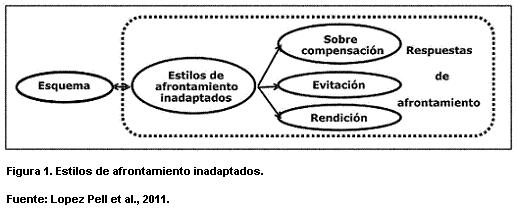
<body><![CDATA[<p  style="margin: 5pt 0cm 0.0001pt 35.7pt; text-indent: -17.85pt; line-height: 150%; text-align: justify;"><span  style="font-size: 10pt; line-height: 150%; font-family: Arial;"  lang="ES-UY">2.<span  style="font-size-adjust: none; font-stretch: normal;"></span><span  style="font-size: 7pt; line-height: 150%;" lang="ES-UY">&nbsp;&nbsp;&nbsp;&nbsp;&nbsp;&nbsp;&nbsp;</span></span><span  style="font-size: 10pt; line-height: 150%; font-family: Arial;"  lang="ES-UY">Evitaci&oacute;n. Consiste en estrategias cognitivas, emocionales o conductuales con las cuales el sujeto intenta eludir los pensamientos o las situaciones que pudieran activar el esquema y la experimentaci&oacute;n de la intensa emoci&oacute;n o tono emocional que le acompa&ntilde;a. Su instauraci&oacute;n se realizar&iacute;a por condicionamiento aversivo. Estos procesos pueden ser autom&aacute;ticos o intencionales, y se van desarrollando a lo largo de la vida del individuo. Explicar&iacute;an por ejemplo la falta de expresi&oacute;n emocional ante eventos traum&aacute;ticos, o el olvido de elementos autobiogr&aacute;ficos significativos, como por ejemplo, malos tratos, abusos sexuales, etc.<o:p></o:p></span></p>     <div style="text-align: justify;"> </div>     <p  style="margin: 5pt 0cm 0.0001pt 35.7pt; text-indent: -17.85pt; line-height: 150%; text-align: justify;"><span  style="font-size: 10pt; line-height: 150%; font-family: Arial;"  lang="ES-UY">3.<span  style="font-size-adjust: none; font-stretch: normal;"></span><span  style="font-size: 7pt; line-height: 150%;" lang="ES-UY">&nbsp;&nbsp;&nbsp;&nbsp;&nbsp;&nbsp;&nbsp;</span></span><span  style="font-size: 10pt; line-height: 150%; font-family: Arial;"  lang="ES-UY">Rendici&oacute;n. Consiste en aceptar plenamente y favorecer el cumplimiento o confirmaci&oacute;n del esquema. Los pacientes buscan las relaciones que reiterar&aacute;n las situaciones generadoras del esquema o reaccionan con excesiva intensidad emotiva ante disparadores del esquema. Por ejemplo, reiteran parejas abusivas o descalificadoras o generan reacciones negativas en otros y responden con exacerbado resentimiento o depresi&oacute;n ante esas reacciones.<o:p></o:p></span></p>     <div style="text-align: justify;"> </div>     <p class="western"  style="margin-bottom: 0.0001pt; text-indent: 14.2pt; text-align: justify;"><span  style="font-size: 10pt; line-height: 120%; font-family: Arial;"  lang="ES-UY"><o:p>&nbsp;</o:p></span></p>     <p class="western"  style="margin-bottom: 0.0001pt; text-indent: 14.2pt; line-height: 150%; text-align: justify;"><span  style="font-size: 10pt; line-height: 150%; font-family: Arial;"  lang="ES-UY">Finalmente, se denomina respuestas de afrontamiento a las conductas concretas que se desarrollan de acuerdo a los esquemas y a los estilos de afrontamiento de cada paciente (<a href="#Young2">Young &amp; Klosko</a>, 2007). Para una mejor comprensi&oacute;n de los conceptos antes descriptos, en la <a href="#figura1">Figura 1</a> se los esquematiza.<o:p></o:p></span></p>     <p class="western"  style="margin-bottom: 0.0001pt; text-align: center; text-indent: 14.2pt;"  align="center"><span  style="font-size: 10pt; line-height: 120%; font-family: Arial;"  lang="ES-UY"><o:p>&nbsp;</o:p></span></p>     <p class="western" style="margin-bottom: 0.0001pt;"><span  style="font-size: 10pt; line-height: 120%; font-family: Arial;"  lang="ES-UY"><o:p>&nbsp;</o:p></span></p>     <p class="western" style="margin-bottom: 0.0001pt;"><span  style="font-size: 10pt; line-height: 120%; font-family: Arial;"  lang="ES-UY"><a name="figura1"></a><img alt="" id="_x0000_i1025"  src="/img/revistas/cp/v5n1/1a08f1.jpg"  style="border: 0px solid ; width: 517px; height: 220px;"><o:p></o:p></span></p>     <p class="western" style="margin-bottom: 0.0001pt;"><span  style="font-size: 10pt; line-height: 120%; font-family: Arial;"  lang="ES-UY"><o:p>&nbsp;</o:p></span></p>     ]]></body>
<body><![CDATA[<p class="MsoNormal"><span  style="font-size: 10pt; font-family: Arial; color: windowtext;"  lang="ES-UY"><o:p>&nbsp;</o:p></span></p>     <p class="western" style="margin-bottom: 0.0001pt;"><span  style="font-size: 10pt; line-height: 120%; font-family: Arial;"  lang="ES-UY"><o:p>&nbsp;</o:p></span></p>     <p class="western"  style="margin-bottom: 0.0001pt; page-break-after: avoid;"><b><span  style="font-size: 11pt; line-height: 120%; font-family: Arial;"  lang="ES-UY">Operaciones de los esquemas</span></b><span  style="font-size: 11pt; line-height: 120%; font-family: Arial;"  lang="ES-UY"><o:p></o:p></span></p>     <p class="western"  style="margin-bottom: 0.0001pt; text-indent: 14.2pt; line-height: 150%; text-align: justify;"><span  style="font-size: 10pt; line-height: 150%; font-family: Arial;"  lang="ES-UY"><a href="#Young2">Young y Klosko</a> (2007) reagruparon los estilos de afrontamiento desadaptativos en dos operaciones b&aacute;sicas de los esquemas: <o:p></o:p></span></p>     <div style="text-align: justify;"> </div>     <p class="western"  style="margin-bottom: 0.0001pt; text-indent: 14.2pt; line-height: 150%; text-align: justify;"><span  style="font-size: 10pt; line-height: 150%; font-family: Arial;"  lang="ES-UY"><o:p>&nbsp;</o:p></span></p>     <p  style="margin: 5pt 0cm 0.0001pt 36pt; text-indent: -18pt; line-height: 150%; text-align: justify;"><span  style="font-size: 10pt; line-height: 150%; font-family: Arial;"  lang="ES-UY">1.<span  style="font-size-adjust: none; font-stretch: normal;"></span><span  style="font-size: 7pt; line-height: 150%;" lang="ES-UY">&nbsp;&nbsp;&nbsp;&nbsp;&nbsp;</span></span><span  style="font-size: 10pt; line-height: 150%; font-family: Arial;"  lang="ES-UY">La perpetuaci&oacute;n. Incluye todo lo que hace el paciente (i.e., pensamientos, emociones o conductas) que sostiene y perpet&uacute;a al esquema. <o:p></o:p></span></p>     <div style="text-align: justify;"> </div>     <p  style="margin: 5pt 0cm 0.0001pt 36pt; text-indent: -18pt; line-height: 150%; text-align: justify;"><span  style="font-size: 10pt; line-height: 150%; font-family: Arial;"  lang="ES-UY">2.<span  style="font-size-adjust: none; font-stretch: normal;"></span><span  style="font-size: 7pt; line-height: 150%;" lang="ES-UY">&nbsp;&nbsp;&nbsp;&nbsp;&nbsp;&nbsp;&nbsp;</span></span><span  style="font-size: 10pt; line-height: 150%; font-family: Arial;"  lang="ES-UY">La sanaci&oacute;n. Incluye todo lo que haga el paciente que produzca la disminuci&oacute;n de cualquiera de los componentes del esquema. Este ser&iacute;a el objetivo de la terapia, que implica disminuir la intensidad de los recuerdos conectados con el esquema, la carga emocional, la intensidad de las sensaciones corporales y las cogniciones desadaptativas. Esto tambi&eacute;n conlleva un cambio de la conducta, donde el paciente reemplaza los estilos de afrontamiento desadaptativos por patrones conductuales adaptativos. <o:p></o:p></span></p>     <p class="western" style="margin-bottom: 0.0001pt; text-indent: 14.2pt;"><span  style="font-size: 10pt; line-height: 120%; font-family: Arial;"  lang="ES-UY"><o:p>&nbsp;</o:p></span></p>     ]]></body>
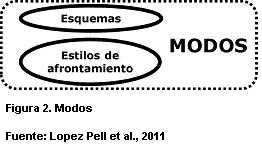
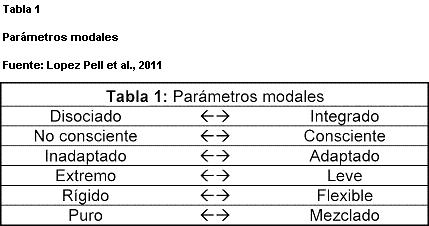
<body><![CDATA[<p class="western"  style="margin-bottom: 0.0001pt; page-break-after: avoid;"><b><span  style="font-size: 11pt; line-height: 120%; font-family: Arial;"  lang="ES-UY">Los modos</span></b><span  style="font-size: 11pt; line-height: 120%; font-family: Arial;"  lang="ES-UY"><o:p></o:p></span></p>     <p class="western"  style="margin-bottom: 0.0001pt; text-indent: 14.2pt; line-height: 150%; text-align: justify;"><span  style="font-size: 10pt; line-height: 150%; font-family: Arial;"  lang="ES-UY">Las personas no tienen sus esquemas permanentemente activos, sino que &eacute;stos se activan en determinados momentos. A su vez, las personas disponen de diversos estilos de afrontamiento, pero no siempre los est&aacute;n utilizando. Frente a determinados disparadores la persona activa alguno(s) de sus esquemas. A su vez los esquemas activos despliegan alguno de los varios estilos de afrontamiento caracter&iacute;sticos de la persona, concretado en cada caso en una de las conductas posibles dentro de ese estilo. Sin embargo, podemos observar que ciertos esquemas y estilos de afrontamiento se disparan juntos. A estos esquemas y/o estilos de afrontamiento agrupados se les ha denominado modos (v&eacute;ase <a href="#figura2">Figura 2</a>). Los Modos hacen referencia a partes del s&iacute; mismo que contienen ETI y sus respectivos estilos de afrontamiento, los cuales no han sido integrados en una personalidad consistente. Los Modos consisten as&iacute; en pensamientos, emociones y conductas relacionadas que forman parte de un patr&oacute;n recurrente en la vida del sujeto. Los Modos son temporales y se activan ante determinados estresares (<a  href="#Young10">Young, Klosko &amp; Wheishar</a>, 2003).<o:p></o:p></span></p>     <div style="text-align: justify;"> </div>     <p class="western"  style="margin-bottom: 0.0001pt; text-indent: 14.2pt; line-height: 150%; text-align: justify;"><span  style="font-size: 10pt; line-height: 150%; font-family: Arial;"  lang="ES-UY">Las personas cambian sus modos en diversos momentos y ante diversas circunstancias. Asimismo, el concepto de modos en cierta forma se relaciona con un grado de disociaci&oacute;n, siendo sus ejemplos m&aacute;s extremos el trastorno de personalidad m&uacute;ltiple y el trastorno de personalidad l&iacute;mite. Por su parte, las personas saludables, aunque exhiben diferentes modos, estos no son muy diferentes entre s&iacute;, generalmente son la combinaci&oacute;n de varios, y en ellas el sentido de una &uacute;nica identidad permanece intacto.<o:p></o:p></span></p>     <p class="western"  style="margin-bottom: 0.0001pt; text-align: center; text-indent: 14.2pt;"  align="center"><span  style="font-size: 10pt; line-height: 120%; font-family: Arial;"  lang="ES-UY"><o:p>&nbsp;</o:p></span></p>     <p class="western" style="margin-bottom: 0.0001pt;"><span  style="font-size: 10pt; line-height: 120%; font-family: Arial;"  lang="ES-UY"><a name="figura2"></a><img alt="" id="_x0000_i1026"  src="/img/revistas/cp/v5n1/1a08f2.jpg"  style="border: 0px solid ; width: 262px; height: 152px;"><o:p></o:p></span></p>     <p class="western" style="margin-bottom: 0.0001pt;">&nbsp;<span  style="font-size: 10pt; line-height: 120%; font-family: Arial;"  lang="ES-UY"><o:p></o:p></span></p>     <p class="western"  style="margin-bottom: 0.0001pt; line-height: 150%; text-align: justify;"><span  style="font-size: 10pt; line-height: 150%; font-family: Arial;"  lang="ES-UY">En general podemos decir que los modos en cada persona pueden variar en sus caracter&iacute;sticas dentro de los siguientes par&aacute;metros (<a href="#Young2">Young &amp; Klosko</a>, 2007) que se presentan en la <a href="#tabla1">Tabla 1</a>.<o:p></o:p></span></p>     <p class="western" style="margin-bottom: 0.0001pt; text-indent: 14.2pt;"><span  style="font-size: 10pt; line-height: 120%; font-family: Arial;"  lang="ES-UY"><o:p>&nbsp;</o:p></span></p>     <p class="western" style="margin-bottom: 0.0001pt;"><a name="tabla1"></a><img  alt="" id="_x0000_i1027" src="/img/revistas/cp/v5n1/1a08t1.jpg"  style="border: 0px solid ; width: 429px; height: 226px;"><span  style="font-size: 10pt; line-height: 120%; font-family: Arial;"  lang="ES-UY"><o:p></o:p></span></p>     ]]></body>
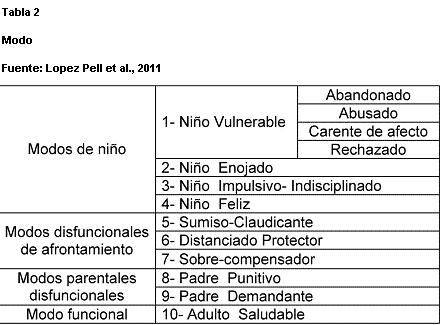
<body><![CDATA[<p class="western" style="margin-bottom: 0.0001pt;"><span  style="font-size: 10pt; line-height: 120%; font-family: Arial;"  lang="ES-UY"><o:p>&nbsp;</o:p></span></p>     <p class="MsoNormal"><span  style="font-size: 10pt; font-family: Arial; color: windowtext;"  lang="ES-UY"><o:p>&nbsp;</o:p></span></p>     <p class="western" style="margin-bottom: 0.0001pt; text-align: justify;"><span  style="font-size: 10pt; line-height: 120%; font-family: Arial;"  lang="ES-UY">Los 10 modos descriptos por <a href="#Young2">Young y Klosko</a> (2007) se muestran en la <a href="#tabla2">0 2</a>.<o:p></o:p></span></p>     <p class="western" style="margin-bottom: 0.0001pt; text-indent: 14.2pt;"><span  style="font-size: 10pt; line-height: 120%; font-family: Arial;"  lang="ES-UY"><o:p>&nbsp;</o:p></span></p>     <p class="MsoNormal"><span  style="font-size: 10pt; font-family: Arial; color: windowtext;"  lang="ES-UY"><o:p>&nbsp;</o:p></span></p>     <p class="western" style="margin-bottom: 0.0001pt;"><span  style="font-size: 10pt; line-height: 120%; font-family: Arial;"  lang="ES-UY"><a name="tabla2"></a><img alt="" id="_x0000_i1028"  src="/img/revistas/cp/v5n1/1a08t2.jpg"  style="border: 0px solid ; width: 442px; height: 325px;"><o:p></o:p></span></p>     <p class="western" style="margin-bottom: 0.0001pt;"><span  style="font-size: 10pt; line-height: 120%; font-family: Arial;"  lang="ES-UY"><o:p>&nbsp;</o:p></span></p>     <p class="western"  style="margin-bottom: 0.0001pt; text-indent: 14.2pt; line-height: 150%; text-align: justify;"><span  style="font-size: 10pt; line-height: 120%; font-family: Arial;"  lang="ES-UY"><o:p>&nbsp;</o:p></span>    <br> <span style="font-size: 10pt; line-height: 150%; font-family: Arial;"  lang="ES-UY">Seg&uacute;n este modelo, podemos pensar que los Modos de ni&ntilde;o son innatos y representan el campo emotivo de los seres humanos (<a href="#Young2">Young &amp; Klosko</a>, 2007). Describir&iacute;an el estilo emocional del paciente, y se le presupone influencia de variables temperamentales. Si bien los acontecimientos o circunstancias de la infancia pueden reducir, anular o incrementar los modos de ni&ntilde;o, todas las personas nacen con la capacidad de manifestarlos.<o:p></o:p></span></p>     <div style="text-align: justify;"> </div>     ]]></body>
<body><![CDATA[<p class="western"  style="margin-bottom: 0.0001pt; text-indent: 14.2pt; line-height: 150%; text-align: justify;"><span  style="font-size: 10pt; line-height: 150%; font-family: Arial;"  lang="ES-UY">- El modo Ni&ntilde;o Vulnerable es considerado nuclear para el abordaje de los modos y el m&aacute;s importante para sanar. Este modo se puede ver como la conducta de un ni&ntilde;o asustado, triste o incapaz, necesitado del cuidado, que no tiene, de los adultos. El esquema y la causa de este modo puede ser alguno de los siguientes: &lsquo;Abandonado&rsquo; (i.e., haber sido dejado solo), &lsquo;abusado&rsquo; (i.e., haber sido muy castigado o maltratado), &lsquo;carente de afecto&rsquo; (i.e., no haber recibido cari&ntilde;o) o &lsquo;defectuoso&rsquo; (i.e., haber sido muy criticado o descalificado). Tambi&eacute;n puede relacionarse con otros esquemas como: &lsquo;vulnerable&rsquo; (i.e., en riesgo de sufrir un da&ntilde;o o de enfermarse), &lsquo;dependiente&rsquo; (i.e., incapaz de desenvolverse sin ayuda) o &lsquo;fracasado&rsquo; (i.e., incapaz de &eacute;xito, nunca exitoso). Es decir, el modo Ni&ntilde;o Vulnerable puede contener esquemas del dominio I (i.e., desconexi&oacute;n temprana y rechazo), generalmente originados en entornos familiares fr&iacute;os, lejanos, explosivos, abusivos o impredecibles, o en esquemas del grupo II (i.e., trastornos de autonom&iacute;a y rendimiento) generalmente originados en entornos familiares sobre-protectores o que desalientan el desempe&ntilde;o independiente o la auto-confianza. <o:p></o:p></span></p>     <div style="text-align: justify;"> </div>     <p class="western"  style="margin-bottom: 0.0001pt; text-indent: 14.2pt; line-height: 150%; text-align: justify;"><span  style="font-size: 10pt; line-height: 150%; font-family: Arial;"  lang="ES-UY">- El modo Ni&ntilde;o Enojado surge como respuesta a la necesidad de un tratamiento justo no obtenido o a situaciones que activan esquemas de abandono, abuso, sometimiento o falta de afecto. En este modo el paciente se enfurece, grita o reacciona violentamente (e.g., el ni&ntilde;o que tiene una &lsquo;rabieta&rsquo; al no obtener algo).<o:p></o:p></span></p>     <div style="text-align: justify;"> </div>     <p class="western"  style="margin-bottom: 0.0001pt; text-indent: 14.2pt; line-height: 150%; text-align: justify;"><span  style="font-size: 10pt; line-height: 150%; font-family: Arial;"  lang="ES-UY">- El modo Ni&ntilde;o Impulsivo o Indisciplinado exhibe poca tolerancia a la frustraci&oacute;n o poca capacidad de postergaci&oacute;n, realizando cualquier deseo o &lsquo;necesidad&rsquo; sin previsi&oacute;n de consecuencias, sin l&iacute;mites ni consideraci&oacute;n hacia los dem&aacute;s. Este modo suele aparecer junto con esquemas del dominio III, como el de &lsquo;Derechos/Grandiosidad&rsquo; o el de &lsquo;Insuficiente Auto-control o Autodisciplina&rsquo;.<o:p></o:p></span></p>     <div style="text-align: justify;"> </div>     <p class="western"  style="margin-bottom: 0.0001pt; text-indent: 14.2pt; line-height: 150%; text-align: justify;"><span  style="font-size: 10pt; line-height: 150%; font-family: Arial;"  lang="ES-UY">- El Ni&ntilde;o Feliz es el modo propio de una saludable ausencia de activaci&oacute;n de esquemas inadaptados. <o:p></o:p></span></p>     <div style="text-align: justify;"> </div>     <p class="western"  style="margin-bottom: 0.0001pt; text-indent: 14.2pt; line-height: 150%; text-align: justify;"><span  style="font-size: 10pt; line-height: 150%; font-family: Arial;"  lang="ES-UY"><o:p>&nbsp;</o:p></span></p>     <p class="western"  style="margin-bottom: 0.0001pt; text-indent: 14.2pt; line-height: 150%; text-align: justify;"><span  style="font-size: 10pt; line-height: 150%; font-family: Arial;"  lang="ES-UY">os Modos de Estilos de Afrontamiento Desadaptativos se entienden como los estilos de afrontamiento que se van aprendiendo para hacer frente a los Modos de ni&ntilde;o, y hacen referencia a c&oacute;mo las personas resuelven las situaciones conflictivas y manejan las emociones asociadas (<a href="#Young2">Young &amp; Klosko</a>, 2007). Asimismo se corresponden con los tres estilos inadaptados de afrontamientos descriptos con anterioridad:<o:p></o:p></span></p>     ]]></body>
<body><![CDATA[<div style="text-align: justify;"> </div>     <p class="western"  style="margin-bottom: 0.0001pt; text-indent: 14.2pt; line-height: 150%; text-align: justify;"><span  style="font-size: 10pt; line-height: 150%; font-family: Arial;"  lang="ES-UY">- El modo Sumiso corresponde al estilo &lsquo;rendici&oacute;n&rsquo;. La persona se muestra pasiva, hace todo lo que otras personas desean que haga y puede ser obediente hasta el grado de permitir el abuso o la descalificaci&oacute;n, para conservar la relaci&oacute;n o evitar reacciones negativas o venganzas. <o:p></o:p></span></p>     <div style="text-align: justify;"> </div>     <p class="western"  style="margin-bottom: 0.0001pt; text-indent: 14.2pt; line-height: 150%; text-align: justify;"><span  style="font-size: 10pt; line-height: 150%; font-family: Arial;"  lang="ES-UY">- El modo Distanciado corresponde al estilo &lsquo;evitaci&oacute;n&rsquo;. La persona adopta conductas de retraimiento, evitaci&oacute;n de situaciones, desconexi&oacute;n de emociones, aislamiento, etc. <o:p></o:p></span></p>     <div style="text-align: justify;"> </div>     <p class="western"  style="margin-bottom: 0.0001pt; text-indent: 14.2pt; line-height: 150%; text-align: justify;"><span  style="font-size: 10pt; line-height: 150%; font-family: Arial;"  lang="ES-UY">- El modo Sobre-compensador corresponde al estilo de &lsquo;sobre-compensaci&oacute;n&rsquo;. En este modo las personas obran como si fuera verdad todo lo opuesto a su esquema inadaptado. Si se creen defectuosos, act&uacute;an como perfectos o superiores a otros; si se creen culpables, acusan a los otros. <o:p></o:p></span></p>     <div style="text-align: justify;"> </div>     <p class="western"  style="margin-bottom: 0.0001pt; text-indent: 14.2pt; line-height: 150%; text-align: justify;"><span  style="font-size: 10pt; line-height: 150%; font-family: Arial;"  lang="ES-UY"><o:p>&nbsp;</o:p></span></p>     <p class="western"  style="margin-bottom: 0.0001pt; text-indent: 14.2pt; line-height: 150%; text-align: justify;"><span  style="font-size: 10pt; line-height: 150%; font-family: Arial;"  lang="ES-UY">Los &lsquo;Modos disfuncionales parentales&rsquo; surgen cuando el paciente incorpora las conductas disfuncionales de sus padres. Ser&iacute;a la voz internalizada de los padres, que corresponder&iacute;a a ense&ntilde;anzas o mandatos de los padres que en la vida adulta no permiten una adecuada adaptaci&oacute;n. Las dos formas m&aacute;s comunes son:<o:p></o:p></span></p>     <div style="text-align: justify;"> </div>     ]]></body>
<body><![CDATA[<p class="western"  style="margin-bottom: 0.0001pt; text-indent: 14.2pt; line-height: 150%; text-align: justify;"><span  style="font-size: 10pt; line-height: 150%; font-family: Arial;"  lang="ES-UY">- El padre castigador, que critica y sanciona los errores o reprime la expresi&oacute;n de las necesidades del ni&ntilde;o. <o:p></o:p></span></p>     <div style="text-align: justify;"> </div>     <p class="western"  style="margin-bottom: 0.0001pt; text-indent: 14.2pt; line-height: 150%; text-align: justify;"><span  style="font-size: 10pt; line-height: 150%; font-family: Arial;"  lang="ES-UY">- El padre demandante, que no castiga sino que pretende la perfecci&oacute;n, los m&aacute;ximos niveles de realizaci&oacute;n, y se desilusiona o se muestra defraudado cuando no se cumplen, generando culpa o verg&uuml;enza en el ni&ntilde;o. <o:p></o:p></span></p>     <div style="text-align: justify;"> </div>     <p class="western"  style="margin-bottom: 0.0001pt; text-indent: 14.2pt; line-height: 150%; text-align: justify;"><span  style="font-size: 10pt; line-height: 150%; font-family: Arial;"  lang="ES-UY">Estos modos parentales disfuncionales suelen encontrarse en casos de severa depresi&oacute;n y en trastornos obsesivo-compulsivos.<o:p></o:p></span></p>     <p class="western"  style="margin-bottom: 0.0001pt; text-indent: 14.2pt; line-height: 150%; text-align: justify;"><span  style="font-size: 10pt; line-height: 150%; font-family: Arial;"  lang="ES-UY"><o:p></o:p></span></p>     <div style="text-align: justify;"> </div>     <p class="western"  style="margin-bottom: 0.0001pt; text-indent: 14.2pt; line-height: 150%; text-align: justify;"><span  style="font-size: 10pt; line-height: 150%; font-family: Arial;"  lang="ES-UY">Por &uacute;ltimo, dentro del &lsquo;Modo funcional&rsquo;: <o:p></o:p></span></p>     <div style="text-align: justify;"> </div>     <p class="western"  style="margin-bottom: 0.0001pt; text-indent: 14.2pt; line-height: 150%; text-align: justify;"><span  style="font-size: 10pt; line-height: 150%; font-family: Arial;"  lang="ES-UY">- El modo Adulto saludable corresponder&iacute;a a todas las cosas buenas del autoconcepto del paciente, que permite generar una sensaci&oacute;n de autoeficacia en las propias habilidades, autoestima para poder avanzar y compasi&oacute;n para poder aceptar las experiencias vitales negativas. En las personas saludables, este modo se activa con mayor frecuencia, est&aacute; casi siempre presente y tiene fuerza suficiente para moderar a los otros modos cuando aparecen.<o:p></o:p></span></p>     ]]></body>
<body><![CDATA[<p class="western"  style="margin-bottom: 0.0001pt; text-indent: 14.2pt; line-height: 150%; text-align: justify;"><span  style="font-size: 10pt; line-height: 150%; font-family: Arial;"  lang="ES-UY">La finalidad de la terapia es desarrollar y aumentar la presencia y fuerza del modo adulto saludable ense&ntilde;&aacute;ndole al paciente a moderar, suavizar o &lsquo;sanar&rsquo; a los otros modos (<a href="#Young2">Young &amp; Klosko</a>, 2007).<o:p></o:p></span></p>     <div style="text-align: justify;"> </div>     <p class="western"  style="margin-bottom: 0.0001pt; text-indent: 14.2pt; text-align: justify;"><span  style="font-size: 10pt; line-height: 120%; font-family: Arial;"  lang="ES-UY"><o:p>&nbsp;</o:p></span></p>     <p class="western"  style="margin-bottom: 0.0001pt; page-break-after: avoid;"><b><span  style="font-size: 11pt; line-height: 120%; font-family: Arial;"  lang="ES-UY">El temperamento</span></b><span  style="font-size: 11pt; line-height: 120%; font-family: Arial;"  lang="ES-UY"><o:p></o:p></span></p>     <p class="western"  style="text-indent: 14.2pt; line-height: 150%; text-align: justify;"><span  style="font-size: 10pt; line-height: 150%; font-family: Arial;"  lang="ES-UY">Como ya se hizo referencia, los modos de ni&ntilde;o est&aacute;n influenciados por variables temperamentales. En este sentido, cada ni&ntilde;o desde su nacimiento tiene un temperamento distinto, una forma innata de reaccionar emotivamente, de origen biol&oacute;gico y muy estable a trav&eacute;s de toda la vida o muy dif&iacute;cil de modificar. Este temperamento interacciona con los acontecimientos de la vida, tanto en la determinaci&oacute;n de la respuesta ante determinadas situaciones, favoreciendo ciertas emociones y conductas, como en la generaci&oacute;n de las mismas situaciones. Asimismo, el temperamento de cada persona puede definirse de acuerdo a siete par&aacute;metros en puntos intermedios entre los dos extremos de cada uno.</span></p>     <p class="western"  style="text-align: justify; text-indent: 14.2pt; line-height: 150%;"><span  style="font-size: 10pt; line-height: 150%; font-family: Arial;"  lang="ES-UY"><o:p>&nbsp;</o:p></span></p>     <p class="western" style="margin-bottom: 12pt; text-indent: 14.2pt;"><span  style="font-size: 10pt; line-height: 120%; font-family: Arial;"  lang="ES-UY"><a name="tabla3"></a><img alt="" id="_x0000_i1029"  src="/img/revistas/cp/v5n1/1a08t3.jpg"  style="border: 0px solid ; width: 292px; height: 200px;"><o:p></o:p></span></p>     <p class="western" style="margin-bottom: 12pt; text-indent: 14.2pt;"><span  style="font-size: 10pt; line-height: 120%; font-family: Arial;"  lang="ES-UY"><o:p>&nbsp;</o:p></span></p>     <p style="text-align: justify;" class="MsoNormal"><span  style="font-size: 10pt; font-family: Arial; color: windowtext;"  lang="ES-UY">A su vez, el temperamento influye en el estilo de afrontamiento que cada persona desarrolla ante sus esquemas y es un componente importante en la determinaci&oacute;n de la forma en que una persona responder&aacute; a su entorno. Un estilo de temperamento no es ni bueno ni malo cada estilo tiene tanto ventajas como desventajas. El temperamento es muy resistente al cambio. Sin embargo, el paciente puede aprender a moderar sus respuestas emotivas y a modificar o hasta suprimir algunas conductas disfuncionales favorecidas por su temperamento (<a href="#Young2">Young &amp; Klosko</a>, 2007).</span><span style="color: windowtext;" lang="ES-UY"> </span><span  style="font-size: 10pt; font-family: Arial; color: windowtext;"  lang="ES-UY"><o:p></o:p></span></p>     <div style="text-align: justify;"> </div>     ]]></body>
<body><![CDATA[<p class="western"  style="margin-bottom: 0.0001pt; text-indent: 14.2pt; line-height: 150%; text-align: justify;"><span  style="font-size: 10pt; line-height: 150%; font-family: Arial;"  lang="ES-UY">Finalmente y a modo de s&iacute;ntesis en la <a href="#figura3">figura 3</a> ilustramos los conceptos fundamentales de la Teor&iacute;a de Esquemas desarrollados a lo largo de este trabajo.<o:p></o:p></span></p>     <p class="western" style="margin-bottom: 0.0001pt;"><span  style="font-size: 10pt; line-height: 120%; font-family: Arial;"  lang="ES-UY"><a name="figura3"></a><img alt="" id="_x0000_i1030"  src="/img/revistas/cp/v5n1/1a08f3.jpg"  style="border: 0px solid ; width: 396px; height: 359px;"><o:p></o:p></span></p>     <p class="western" style="margin-bottom: 0.0001pt;"><span  style="font-size: 10pt; line-height: 120%; font-family: Arial;"  lang="ES-UY"><o:p>&nbsp;</o:p></span></p>     <p class="MsoNormal"><span  style="font-size: 10pt; font-family: Arial; color: windowtext;"  lang="ES-UY"><o:p>&nbsp;</o:p></span></p>     <p class="western"  style="margin-bottom: 0.0001pt; text-align: center; text-indent: 14.2pt;"  align="center"><span  style="font-size: 10pt; line-height: 120%; font-family: Arial;"  lang="ES-UY"><o:p>&nbsp;</o:p></span></p>     <p class="western" style="margin-bottom: 0.0001pt;"><b><span  style="font-family: Arial;" lang="ES-UY">ESTRATEGIAS DIAGN&Oacute;STICAS</span></b><span style="font-family: Arial;"  lang="ES-UY"><o:p></o:p></span></p>     <p class="western"  style="margin-bottom: 0.0001pt; text-align: center; text-indent: 14.2pt;"  align="center"><span  style="font-size: 10pt; line-height: 120%; font-family: Arial;"  lang="ES-UY"><o:p>&nbsp;</o:p></span></p>     <p class="western"  style="margin-bottom: 0.0001pt; text-indent: 14.2pt; line-height: 150%; text-align: justify;"><span  style="font-size: 10pt; line-height: 150%; font-family: Arial;"  lang="ES-UY">Dentro del tratamiento de los trastornos de personalidad, la primera etapa es la de evaluaci&oacute;n, cuyos objetivos seg&uacute;n <a href="#Young11">Young</a> (1996) son: <o:p></o:p></span></p>     <div style="text-align: justify;"> </div>     <p class="western"  style="margin: 5pt 0cm 0.0001pt 36pt; text-indent: -18pt; line-height: 150%; text-align: justify;"><span  style="font-size: 10pt; line-height: 150%; font-family: Arial;"  lang="ES-UY">1.<span  style="font-size-adjust: none; font-stretch: normal;"></span><span  style="font-size: 7pt; line-height: 150%;" lang="ES-UY">&nbsp;&nbsp;&nbsp;</span></span><span  style="font-size: 10pt; line-height: 150%; font-family: Arial;"  lang="ES-UY">Identificar los esquemas centrales de la vida del paciente, hacerlos relevantes en la conciencia, y delimitar su importancia en el funcionamiento psicol&oacute;gico. <o:p></o:p></span></p>     ]]></body>
<body><![CDATA[<div style="text-align: justify;"> </div>     <p class="western"  style="margin: 5pt 0cm 0.0001pt 36pt; text-indent: -18pt; line-height: 150%; text-align: justify;"><span  style="font-size: 10pt; line-height: 150%; font-family: Arial;"  lang="ES-UY">2.<span  style="font-size-adjust: none; font-stretch: normal;"></span><span  style="font-size: 7pt; line-height: 150%;" lang="ES-UY">&nbsp;&nbsp;&nbsp;&nbsp;&nbsp;&nbsp;&nbsp;</span></span><span  style="font-size: 10pt; line-height: 150%; font-family: Arial;"  lang="ES-UY">Unir los esquemas con los problemas actuales y de la historia de vida o experiencial. <o:p></o:p></span></p>     <div style="text-align: justify;"> </div>     <p class="western"  style="margin: 5pt 0cm 0.0001pt 36pt; text-indent: -18pt; line-height: 150%; text-align: justify;"><span  style="font-size: 10pt; line-height: 150%; font-family: Arial;"  lang="ES-UY">3.<span  style="font-size-adjust: none; font-stretch: normal;"></span><span  style="font-size: 7pt; line-height: 150%;" lang="ES-UY">&nbsp;&nbsp;&nbsp;&nbsp;&nbsp;&nbsp;&nbsp;</span></span><span  style="font-size: 10pt; line-height: 150%; font-family: Arial;"  lang="ES-UY">Hacer entrar al paciente en contacto con las emociones circundantes a estos esquemas. <o:p></o:p></span></p>     <div style="text-align: justify;"> </div>     <p class="western"  style="margin: 5pt 0cm 0.0001pt 36pt; text-indent: -18pt; line-height: 150%; text-align: justify;"><span  style="font-size: 10pt; line-height: 150%; font-family: Arial;"  lang="ES-UY">4.<span  style="font-size-adjust: none; font-stretch: normal;"></span><span  style="font-size: 7pt; line-height: 150%;" lang="ES-UY">&nbsp;&nbsp;&nbsp;&nbsp;&nbsp;&nbsp;&nbsp;</span></span><span  style="font-size: 10pt; line-height: 150%; font-family: Arial;"  lang="ES-UY">Identificar los estilos de afrontamiento disfuncionales que refuerzan los esquemas.<o:p></o:p></span></p>     <div style="text-align: justify;"> </div>     <p class="western"  style="margin-bottom: 0.0001pt; text-indent: 14.2pt; line-height: 150%; text-align: justify;"><span  style="font-size: 10pt; line-height: 150%; font-family: Arial;"  lang="ES-UY">La evaluaci&oacute;n es un proceso de concientizaci&oacute;n, que implica una construcci&oacute;n conjunta donde terapeuta y paciente identifican cuales son los temas que definen la experiencia -que es dolorosa y que causa sufrimiento emocional-, se acceden a los recuerdos que van configurando las maneras de dar significado al s&iacute; mismo -la continuidad y persistencia del sufrimiento-, y se explicitan los estilos de afrontamiento que se utilizan para funcionar en la vida     <br> -consecuencias y refuerzo del sufrimiento-. Para lograr esto, muchos son los recursos con los que se cuenta. Entre ellos, los m&aacute;s frecuentes son:<o:p></o:p></span></p>     <p class="western"  style="margin-bottom: 0.0001pt; text-align: justify; line-height: 150%; page-break-after: avoid;"><b><span  style="font-size: 10pt; line-height: 150%; font-family: Arial;"  lang="ES-UY">Los cuestionarios</span></b><span  style="font-size: 10pt; line-height: 150%; font-family: Arial;"  lang="ES-UY"><o:p></o:p></span></p>     ]]></body>
<body><![CDATA[<p class="western"  style="margin-bottom: 0.0001pt; text-indent: 14.2pt; line-height: 150%; text-align: justify;"><span  style="font-size: 10pt; line-height: 150%; font-family: Arial;"  lang="ES-UY">Entre ellos se destacan: <o:p></o:p></span></p>     <div style="text-align: justify;"> </div>     <p class="western"  style="margin-bottom: 0.0001pt; line-height: 150%; text-align: justify;"><span  style="font-size: 10pt; line-height: 150%; font-family: Arial;"  lang="ES-UY">- Cuestionario de Esquemas de Young (<a href="#Young1">Young Schema Questionnaire</a>, 2001): Es el instrumento m&aacute;s conocido y consiste en un inventario auto-administrado que eval&uacute;a qu&eacute; Esquemas Tempranos Inadaptados tiene probablemente un paciente. Este cuestionario tiene una versi&oacute;n larga -compuesta por 205 &iacute;tems- y una versi&oacute;n corta -de 75 &iacute;tems- y sus diferentes versiones han sido adaptadas a numerosas lenguas, tales como holand&eacute;s (<a href="#Rijkeboer">Rijkeboer &amp; van den Bergh</a>, 2004), castellano (<a href="#Cid3">Cid, Tejero &amp; Torrubia</a>, 1997; <a href="#Cid1">Cid &amp; Torrubia</a>, 2003), coreana (<a href="#Baranoff">Baranoff, Oei, Seong &amp; Seok-Man</a>, 2006), Portugu&eacute;s (<a href="#Gouveia">Gouveia, Chaves, Oliveira, Dias, Gouveia &amp; Andrade</a>, 2003), etc. <o:p></o:p></span></p>     <div style="text-align: justify;"> </div>     <p class="western"  style="margin-bottom: 0.0001pt; line-height: 150%; text-align: justify;"><span  style="font-size: 10pt; line-height: 150%; font-family: Arial;"  lang="ES-UY">- Inventario de Estilos Parentales de Young (<a href="#Young7">Young Parenting Inventory</a>, 1994b): Inventario auto-administrado de 72 &iacute;tems que identifica el origen probable de cada esquema para un paciente en particular. <o:p></o:p></span></p>     <div style="text-align: justify;"> </div>     <p class="western"  style="margin-bottom: 0.0001pt; line-height: 150%; text-align: justify;"><span  style="font-size: 10pt; line-height: 150%; font-family: Arial;"  lang="ES-UY">- Inventario de Evitaci&oacute;n de Young y Ryght (<a href="#Young3">Young-Ryght Avoidance Inventory</a>, 1994): Inventario auto-administrado de 40 &iacute;tems que mide el grado en que el paciente utiliza diversas formas de evitaci&oacute;n del o los esquemas.<o:p></o:p></span></p>     <div style="text-align: justify;"> </div>     <p class="western"  style="margin-bottom: 0.0001pt; line-height: 150%; text-align: justify;"><span  style="font-size: 10pt; line-height: 150%; font-family: Arial;"  lang="ES-UY">- El Inventario de Compensaci&oacute;n de Young (<a href="#Young8">Young Compensation Inventory</a>, 1995): Inventario auto-administrado de 48 &iacute;tems que mide las formas m&aacute;s comunes que un paciente utiliza para sobrecompensar sus esquemas.<o:p></o:p></span></p>     <div style="text-align: justify;"> </div>     ]]></body>
<body><![CDATA[<p class="western"  style="margin-bottom: 0.0001pt; line-height: 150%; text-align: justify;"><span  style="font-size: 10pt; line-height: 150%; font-family: Arial;"  lang="ES-UY">- El Inventario de modos de esquema (The Schema Mode Inventory, <a href="#Young2">Young</a>, et al, 2007). Inventario auto-administrado de 124 &iacute;tems que mide los modos de esquemas.<o:p></o:p></span></p>     <div style="text-align: justify;"> </div>     <p class="western"  style="margin-bottom: 0.0001pt; line-height: 150%; text-align: justify;"><span  style="font-size: 10pt; line-height: 150%; font-family: Arial;"  lang="ES-UY">- Historia Multimodal de vida (Lazarus, 2000). Cuestionario auto-administrado que tiene por objetivo la construcci&oacute;n detallada de la historia cl&iacute;nica del sujeto. Se le solicita a la persona que describa conflictos familiares y caracter&iacute;sticas vinculares, entre otros hechos de su infancia y adolescencia.<o:p></o:p></span></p>     <p class="western" style="margin-bottom: 0.0001pt; text-indent: 14.2pt;"><span  style="font-size: 10pt; line-height: 120%; font-family: Arial;"  lang="ES-UY"><o:p>&nbsp;</o:p></span></p>     <p class="western"  style="margin-bottom: 0.0001pt; page-break-after: avoid;"><b><span  style="font-size: 11pt; line-height: 120%; font-family: Arial;"  lang="ES-UY">Los ejercicios de imaginaci&oacute;n</span></b><span  style="font-size: 11pt; line-height: 120%; font-family: Arial;"  lang="ES-UY"><o:p></o:p></span></p>     <p class="western"  style="margin-bottom: 0.0001pt; text-indent: 14.2pt; line-height: 150%; text-align: justify;"><span  style="font-size: 10pt; line-height: 150%; font-family: Arial;"  lang="ES-UY">Los ejercicios en que el paciente revive emotivamente situaciones perturbadoras han demostrado gran utilidad. El generar nuevamente las emociones propias de las situaciones originales, es el recurso m&aacute;s s&oacute;lido que disponemos para acceder a los pensamientos que las generan (<a href="#Young2">Young &amp; Klosko</a>, 2007). Aunque en el ejercicio la situaci&oacute;n no est&eacute; sucediendo realmente, las emociones son reales, y si las emociones son reales es porque est&aacute;n presentes las cogniciones que las generan. Dicho en pocas palabras: el ejercicio de imaginaci&oacute;n dispara el esquema en el consultorio. Imaginar la situaci&oacute;n permite tener la emoci&oacute;n y la cognici&oacute;n correspondientes en la misma sesi&oacute;n y disponibles en ese momento para la observaci&oacute;n del terapeuta y el paciente. <o:p></o:p></span></p>     <div style="text-align: justify;"> </div>     <p class="western"  style="margin-bottom: 0.0001pt; text-indent: 14.2pt; line-height: 150%; text-align: justify;"><span  style="font-size: 10pt; line-height: 150%; font-family: Arial;"  lang="ES-UY">En la pr&aacute;ctica, esto se puede instrumentar de muchas formas. Por ejemplo, una forma de frecuente utilidad consiste en hacer que el paciente primero reviva en imaginaci&oacute;n la situaci&oacute;n que le gener&oacute; la respuesta disfuncional o la emoci&oacute;n disfuncional actual. Luego, se le pide recordar situaciones anteriores, hasta llegar a una experiencia de su infancia en que sinti&oacute; lo mismo. Esto suele conectar al paciente con la situaci&oacute;n traum&aacute;tica que dio origen al esquema temprano inadaptado. El reconocimiento de esa situaci&oacute;n, la comparaci&oacute;n y diferenciaci&oacute;n de la actual, la resignificaci&oacute;n de la situaci&oacute;n primitiva y otros ejercicios de fuerte contenido emotivo, caracter&iacute;sticos del psicodrama, suelen superar en eficacia a los simplemente cognitivos tradicionales.<o:p></o:p></span></p>     <div style="text-align: justify;"> </div>     <p class="western"  style="margin-bottom: 0.0001pt; text-indent: 14.2pt; line-height: 150%; text-align: justify;"><span  style="font-size: 10pt; line-height: 150%; font-family: Arial;"  lang="ES-UY">El obst&aacute;culo m&aacute;s frecuente a este recurso parece ser el estilo evitativo, que se manifiesta cuando el paciente presenta dificultades, se resiste o &lsquo;no puede&rsquo; hacer estos ejercicios (<a href="#Young2">Young &amp; Klosko</a>, 2007). En primer lugar, esta dificultad es &uacute;til para conocer su estilo y tambi&eacute;n puede superarse, lentamente, con la discusi&oacute;n del problema y/o con ejercicios menos comprometidos al comienzo.<o:p></o:p></span></p>     ]]></body>
<body><![CDATA[<div style="text-align: justify;"> </div>     <p class="western"  style="margin-bottom: 0.0001pt; page-break-after: avoid; text-align: justify;"><span  style="font-size: 10pt; line-height: 120%; font-family: Arial;"  lang="ES-UY"><o:p>&nbsp;</o:p></span></p>     <p class="western"  style="margin-bottom: 0.0001pt; page-break-after: avoid;"><b><span  style="font-size: 11pt; line-height: 120%; font-family: Arial;"  lang="ES-UY">Las preguntas y los reportes</span></b><span  style="font-size: 11pt; line-height: 120%; font-family: Arial;"  lang="ES-UY"><o:p></o:p></span></p>     <p class="western"  style="margin-bottom: 0.0001pt; text-indent: 14.2pt; line-height: 150%; text-align: justify;"><span  style="font-size: 10pt; line-height: 150%; font-family: Arial;"  lang="ES-UY">Las preguntas directas al paciente y los informes del paciente solicitados y presentados de diversas maneras, son tambi&eacute;n un recurso v&aacute;lido para conocer su temperamento, sus esquemas, sus modos, estilos de afrontamiento, etc.<o:p></o:p></span></p>     <div style="text-align: justify;"> </div>     <p class="western"  style="margin-bottom: 12pt; page-break-after: avoid; text-align: justify;"><span  style="font-size: 10pt; line-height: 120%; font-family: Arial;"  lang="ES-UY"><o:p>&nbsp;</o:p></span></p>     <p class="western"  style="margin-bottom: 2.85pt; page-break-after: avoid;"><b><span  style="font-size: 11pt; line-height: 120%; font-family: Arial;"  lang="ES-UY">La conducta en la terapia</span></b><span  style="font-size: 11pt; line-height: 120%; font-family: Arial;"  lang="ES-UY"><o:p></o:p></span></p>     <p class="western"  style="margin-bottom: 0.0001pt; text-indent: 14.2pt; line-height: 150%; text-align: justify;"><span  style="font-size: 10pt; line-height: 150%; font-family: Arial;"  lang="ES-UY">La observaci&oacute;n de la conducta del paciente en la terapia, en su relaci&oacute;n con el terapeuta, en las tareas asignadas, etc. es otra forma natural y v&aacute;lida de conocer su temperamento, sus esquemas, sus modos, estilos de afrontamiento, etc. Su relaci&oacute;n con el terapeuta muestra sus modos, de la misma manera que puede mostrar los modos del terapeuta.<o:p></o:p></span></p>     <div style="text-align: justify;"> </div>     <p class="western"  style="margin-bottom: 0.0001pt; text-indent: 14.2pt; text-align: justify;"><span  style="font-size: 10pt; line-height: 120%; font-family: Arial;"  lang="ES-UY"><o:p>&nbsp;</o:p></span></p>     ]]></body>
<body><![CDATA[<p class="western"  style="margin-bottom: 0.0001pt; page-break-after: avoid;"><b><span  style="font-size: 11pt; line-height: 120%; font-family: Arial;"  lang="ES-UY">Relato de su historia</span></b><span  style="font-size: 11pt; line-height: 120%; font-family: Arial;"  lang="ES-UY"><o:p></o:p></span></p>     <p class="western"  style="margin-bottom: 0.0001pt; text-indent: 14.2pt; line-height: 150%; text-align: justify;"><span  style="font-size: 10pt; line-height: 150%; font-family: Arial;"  lang="ES-UY">La historia del paciente, los hechos que le sucedieron, la forma en que reaccion&oacute;, c&oacute;mo reaccionaron los otros, incluyendo los principales acontecimientos de su infancia, y especialmente los traum&aacute;ticos, son otra forma posible de acceder a sus esquemas, modos, etc. Por eso, esta es una informaci&oacute;n importante en esta etapa.<o:p></o:p></span></p>     <div style="text-align: justify;"> </div>     <p class="western"  style="margin-bottom: 0.0001pt; text-indent: 14.2pt; text-align: justify;"><span  style="font-size: 10pt; line-height: 120%; font-family: Arial;"  lang="ES-UY"><o:p>&nbsp;</o:p></span></p>     <p class="western"  style="margin-bottom: 0.0001pt; page-break-after: avoid;"><b><span  style="font-size: 11pt; line-height: 120%; font-family: Arial;"  lang="ES-UY">Otros recursos</span></b><span  style="font-size: 11pt; line-height: 120%; font-family: Arial;"  lang="ES-UY"><o:p></o:p></span></p>     <p class="western"  style="margin-bottom: 0.0001pt; text-indent: 9pt; line-height: 150%; text-align: justify;"><span  style="font-size: 10pt; line-height: 150%; font-family: Arial;"  lang="ES-UY">Existen muchos recursos posibles, ya que el modelo no descarta ninguno. Entre otros posibles, se encuentra el relato -o representaci&oacute;n- de los sue&ntilde;os, especialmente los reiterados y/o con mucho contenido emotivo. El contenido de la <a  href="/img/revistas/cp/v5n1/1a08t6.jpg">Tabla 6</a> servir&aacute; para poder integra estos recursos a la conceptualizaci&oacute;n del caso.<o:p></o:p></span></p>     <div style="text-align: justify;"> </div>     <p class="western"  style="margin-bottom: 0.0001pt; page-break-after: avoid; text-align: justify;"><span  style="font-size: 10pt; line-height: 120%; font-family: Arial;"  lang="ES-UY"><o:p>&nbsp;</o:p></span></p>     <p class="western"  style="margin-bottom: 0.0001pt; page-break-after: avoid;"><span  style="font-size: 10pt; line-height: 120%; font-family: Arial;"  lang="ES-UY"><o:p>&nbsp;</o:p></span></p>     <p class="western"  style="margin-bottom: 0.0001pt; page-break-after: avoid;"><b><span  style="font-family: Arial;" lang="ES-UY">S&Iacute;NTESIS DEL TRATAMIENTO PROPUESTO POR YOUNG, KLOSKO Y WHEISHAR (2003)</span></b><span  style="font-family: Arial;" lang="ES-UY"><o:p></o:p></span></p>     ]]></body>
<body><![CDATA[<p class="western" style="margin-bottom: 0.0001pt;"><span  style="font-size: 10pt; line-height: 120%; font-family: Arial;"  lang="ES-UY"><o:p>&nbsp;</o:p></span></p>     <p class="western"  style="margin-bottom: 0.0001pt; text-indent: 14.2pt; line-height: 150%; text-align: justify;"><span  style="font-size: 10pt; line-height: 150%; font-family: Arial;"  lang="ES-UY">Luego de haber llevado a cabo, junto con el paciente, una adecuada evaluaci&oacute;n de los aspectos centrales antes planteados, tendr&aacute; lugar una segunda fase denominada proceso de cambio (<a href="#Young2">Young &amp; Klosko</a>, 2007). Esta etapa tiene como objetivo principal de tratamiento un cambio en los esquemas y estilos de afrontamiento identificados, lo que significar&iacute;a en mayor o menor grado: (a) un cambio en la forma de verse a s&iacute; mismo; (b) una consecuci&oacute;n de unos patrones de vida m&aacute;s flexibles -modificaci&oacute;n de estilos de afrontamiento-; (c) una adaptaci&oacute;n m&aacute;s &oacute;ptima a su medio y (d) una disminuci&oacute;n del malestar psicol&oacute;gico. Esto implica, por lo general, utilizar diferentes estrategias seg&uacute;n los diferentes componentes de los esquemas. Para ello, el terapeuta despliega una amplia gama de t&eacute;cnicas y recursos que debe intentar mezclar de una forma flexible y creativa, de acuerdo a cada caso y paciente en particular.</span><span  style="font-size: 10pt; line-height: 150%; font-family: Arial; color: rgb(102, 102, 102);"  lang="ES-UY"> </span><span  style="font-size: 10pt; line-height: 150%; font-family: Arial;"  lang="ES-UY">Estas t&eacute;cnicas y recursos, hacen referencia a estrategias cognitivas, experienciales, conductuales, e interpersonales que se describen a continuaci&oacute;n:<o:p></o:p></span></p>     <p class="western" style="margin-bottom: 0.0001pt; text-indent: 14.2pt;"><span  style="font-size: 10pt; line-height: 120%; font-family: Arial;"  lang="ES-UY"><o:p>&nbsp;</o:p></span></p>     <p class="western"  style="margin-bottom: 0.0001pt; page-break-after: avoid;"><b><span  style="font-size: 11pt; line-height: 120%; font-family: Arial;"  lang="ES-UY">Las Estrategias Cognitivas </span></b><span  style="font-size: 11pt; line-height: 120%; font-family: Arial;"  lang="ES-UY"><o:p></o:p></span></p>     <p class="western"  style="margin-bottom: 0.0001pt; text-indent: 14.2pt; line-height: 150%; text-align: justify;"><span  style="font-size: 10pt; line-height: 150%; font-family: Arial;"  lang="ES-UY">Seg&uacute;n lo expuesto por <a href="#Young2">Young y Klosko</a> (2007)</span><span  style="font-size: 10pt; line-height: 150%; font-family: Arial; color: red;"  lang="ES-UY"> </span><span  style="font-size: 10pt; line-height: 150%; font-family: Arial;"  lang="ES-UY">el objetivo de la utilizaci&oacute;n de estrategias cognitivas es desarrollar una voz saludable<b> </b>para crear una distancia. Es decir, se trata de poner a prueba lo inadecuado del esquema desde la distancia cognitiva. Para ello es necesario conocer qu&eacute; experiencias est&aacute;n asociadas al esquema aportando evidencias que mantienen al mismo. Las t&eacute;cnicas que se utilizan mayoritariamente provienen de la terapia cognitiva, siendo las m&aacute;s utilizadas:<o:p></o:p></span></p>     <div style="text-align: justify;"> </div>     <p class="western"  style="margin: 5pt 0cm 0.0001pt 18.15pt; text-indent: -18.15pt; line-height: 150%; text-align: justify;"><span  style="font-size: 10pt; line-height: 150%; font-family: Arial;"  lang="ES-UY">Revisar las evidencias o argumentos a favor y en contra del esquema. Hacer las listas de ellas y discutirlas. <o:p></o:p></span></p>     <div style="text-align: justify;"> </div>     <p class="western"  style="margin: 5pt 0cm 0.0001pt 18.15pt; text-indent: -18.15pt; line-height: 150%; text-align: justify;"><span  style="font-size: 10pt; line-height: 150%; font-family: Arial;"  lang="ES-UY">Discutir y evaluar nuevas interpretaciones posibles de las evidencias presentadas a favor del esquema, de acuerdo a puntos de vista m&aacute;s maduros y amplios. <o:p></o:p></span></p>     <div style="text-align: justify;"> </div>     ]]></body>
<body><![CDATA[<p class="western"  style="margin: 5pt 0cm 0.0001pt 18.15pt; text-indent: -18.15pt; line-height: 150%; text-align: justify;"><span  style="font-size: 10pt; line-height: 150%; font-family: Arial;"  lang="ES-UY">Evaluar beneficios vs. desventajas de los estilos de afrontamiento del paciente. <o:p></o:p></span></p>     <div style="text-align: justify;"> </div>     <p class="western"  style="margin: 5pt 0cm 0.0001pt 18.15pt; text-indent: -18.15pt; line-height: 150%; text-align: justify;"><span  style="font-size: 10pt; line-height: 150%; font-family: Arial;"  lang="ES-UY">Role-play de di&aacute;logos entre el &lsquo;lado del esquema&rsquo; y el &lsquo;lado sano&rsquo;, cambiando roles con el terapeuta. <o:p></o:p></span></p>     <div style="text-align: justify;"> </div>     <p class="western"  style="margin: 5pt 0cm 0.0001pt 18.15pt; text-indent: -18.15pt; line-height: 150%; text-align: justify;"><span  style="font-size: 10pt; line-height: 150%; font-family: Arial;"  lang="ES-UY">Escribir y disponer de tarjetas de afrontamiento (i.e., flashcards) donde se pueden leer los argumentos y pensamientos apropiados para enfrentar el esquema cuando se activa. <o:p></o:p></span></p>     <div style="text-align: justify;"> </div>     <p class="western"  style="margin: 5pt 0cm 0.0001pt 18.15pt; text-indent: -18.15pt; line-height: 150%; text-align: justify;"><span  style="font-size: 10pt; line-height: 150%; font-family: Arial;"  lang="ES-UY">Utilizar el Registro Diario de Esquemas (<a href="#Young5">Young</a>, 1993) donde el paciente registra los siguientes datos: disparador, emoci&oacute;n, pensamiento, conducta real, esquemas, punto de vista saludable, consideraciones realistas, sobre-reacciones, conducta saludable.<o:p></o:p></span></p>     <div style="text-align: justify;"> </div>     <p class="western"  style="margin-bottom: 0.0001pt; page-break-after: avoid; text-align: justify;"><span  style="font-size: 10pt; line-height: 120%; font-family: Arial;"  lang="ES-UY"><o:p>&nbsp;</o:p></span></p>     <p class="western"  style="margin-bottom: 0.0001pt; page-break-after: avoid;"><b><span  style="font-size: 11pt; line-height: 120%; font-family: Arial;"  lang="ES-UY">Las Estrategias Experienciales</span></b><span  style="font-size: 11pt; line-height: 120%; font-family: Arial;"  lang="ES-UY"><o:p></o:p></span></p>     ]]></body>
<body><![CDATA[<p class="western"  style="margin-bottom: 0.0001pt; text-indent: 14.2pt; line-height: 150%; text-align: justify;"><span  style="font-size: 10pt; line-height: 150%; font-family: Arial;"  lang="ES-UY">Pueden tambi&eacute;n denominarse &lsquo;t&eacute;cnicas emotivas&rsquo; por la importancia del compromiso emotivo que incluyen (<a href="#Cid2">Cid</a>, 2009). Tienen como objetivo activar las emociones conectadas con los esquemas y habilitar al paciente mediante la descarga del dolor temprano, para as&iacute; satisfacer de manera parcial las necesidades emocionales no cubiertas. Esto permite al paciente no s&oacute;lo creer que los esquemas son falsos, sino tambi&eacute;n sentir que emocionalmente lo son. <a  href="#Young10">Young</a> et al (2003) propone las siguientes t&eacute;cnicas:<o:p></o:p></span></p>     <div style="text-align: justify;"> </div>     <p class="western" style="margin-bottom: 0.0001pt; text-align: justify;"><span  style="font-size: 10pt; line-height: 120%; font-family: Arial;"  lang="ES-UY">T&eacute;cnicas de imaginaci&oacute;n -o dramatizaciones-: <o:p></o:p></span></p>     <div style="text-align: justify;"> </div>     <p class="western"  style="margin-bottom: 0.0001pt; line-height: 150%; text-align: justify;"><span  style="font-size: 10pt; line-height: 150%; font-family: Arial;"  lang="ES-UY">Las actuaciones, usando los recursos del psicodrama (Moreno, 1975) (<a href="#Blatner2">Blatner</a>, 1996) (<a href="#Blatner1">Blatner &amp; Blatner</a>, 1988) permiten la implicaci&oacute;n emotiva necesaria para actuar sobre los esquemas.<o:p></o:p></span></p>     <div style="text-align: justify;"> </div>     <p class="western"  style="margin-bottom: 0.0001pt; line-height: 150%; text-align: justify;"><b><span  style="font-size: 10pt; line-height: 150%; font-family: Arial;"  lang="ES-UY">- </span></b><span  style="font-size: 10pt; line-height: 150%; font-family: Arial;"  lang="ES-UY">Di&aacute;logos. Pueden ser con las personas que originaron sus esquemas disfuncionales. Adem&aacute;s, puede ser &uacute;til para expresar sentimientos, por ejemplo, la ira puede servir para confirmar sus derechos, pero en un segundo paso se recomienda seguir con este recurso para lograr la integraci&oacute;n, la comprensi&oacute;n de la situaci&oacute;n, la liberaci&oacute;n de la culpa y mejorar el nivel de auto estima del paciente. <o:p></o:p></span></p>     <div style="text-align: justify;"> </div>     <p class="western"  style="margin-bottom: 0.0001pt; line-height: 150%; text-align: justify;"><span  style="font-size: 10pt; line-height: 150%; font-family: Arial;"  lang="ES-UY">- Re-actuaci&oacute;n parental. En esta estrategia, el terapeuta solicita entrar en la escena imaginada y as&iacute; brinda la contenci&oacute;n o reparaci&oacute;n desde el lugar del padre o simplemente desde el &lsquo;adulto saludable&rsquo;. Luego lo har&aacute; el mismo cliente, intercambiando roles, inicialmente con la ayuda del terapeuta. Estos di&aacute;logos del paciente &lsquo;ni&ntilde;o&rsquo; con el paciente &lsquo;adulto&rsquo;, o del paciente con &lsquo;el anciano sabio&rsquo; han sido largamente utilizados por el psicodrama y por otras escuelas como la gestalt, durante m&aacute;s de 50 a&ntilde;os con excelentes resultados. <o:p></o:p></span></p>     <div style="text-align: justify;"> </div>     ]]></body>
<body><![CDATA[<p class="western"  style="margin-bottom: 0.0001pt; line-height: 150%; text-align: justify;"><span  style="font-size: 10pt; line-height: 150%; font-family: Arial;"  lang="ES-UY">- Recuerdos traum&aacute;ticos. Este ejercicio brinda en primer lugar la liberaci&oacute;n de los sentimientos hasta ahora bloqueados para lograr su lenta aceptaci&oacute;n e integraci&oacute;n, a veces en sucesivos pasos con reiteradas experiencias. En segundo lugar brinda la posibilidad de integrar la acci&oacute;n reparadora del &lsquo;adulto saludable&rsquo; como se explic&oacute; en el ejercicio anterior. <o:p></o:p></span></p>     <div style="text-align: justify;"> </div>     <p class="western"  style="margin-bottom: 0.0001pt; line-height: 150%; text-align: justify;"><span  style="font-size: 10pt; line-height: 150%; font-family: Arial;"  lang="ES-UY">- Modificaci&oacute;n de patrones. Imaginarse actuando en formas alternativas, diferentes a sus pautas disfuncionales es una preparaci&oacute;n, un ensayo de menor riesgo, para poder hacerlo luego con mayor nivel de riesgo en la vida real. Primero la imaginaci&oacute;n, luego la dramatizaci&oacute;n y finalmente la vida real, son grados crecientes de &lsquo;riesgo&rsquo; para lograr vencer progresivamente el miedo a las nuevas conductas. <o:p></o:p></span></p>     <div style="text-align: justify;"> </div>     <p class="western" style="margin-bottom: 0.0001pt; text-align: justify;"><span  style="font-size: 10pt; line-height: 120%; font-family: Arial;"  lang="ES-UY"><o:p>&nbsp;</o:p></span></p>     <p class="western" style="margin-bottom: 0.0001pt;"><b><span  style="font-size: 11pt; line-height: 120%; font-family: Arial;"  lang="ES-UY">Otras tareas y t&eacute;cnicas</span></b><span  style="font-size: 11pt; line-height: 120%; font-family: Arial;"  lang="ES-UY"><o:p></o:p></span></p>     <p class="western" style="margin-bottom: 0.0001pt;"><span  style="font-size: 10pt; line-height: 120%; font-family: Arial;"  lang="ES-UY"><o:p>&nbsp;</o:p></span></p>     <p  style="margin-bottom: 0.0001pt; line-height: 150%; text-align: justify;"><span  style="font-size: 10pt; line-height: 150%; font-family: Arial;">- Escribir una carta. Una t&eacute;cnica experiencial frecuentemente &uacute;til es escribir una carta -o varias- a uno de los padres o a la persona que haya generado la situaci&oacute;n traum&aacute;tica o el esquema temprano inadaptado. La carta podr&iacute;a incluirc&oacute;mo se sinti&oacute; el cliente ante esas situaciones y lo que no pudo decir. Es un ejercicio menos dif&iacute;cil que la fantas&iacute;a de estar enfrente a la persona y suele brindar similares beneficios. Esto no incluye, y en general no se recomienda, enviar la carta realmente a la persona, a menos que se hayan evaluado bien las posibles consecuencias y asegurado de que ser&aacute;n positivas -lo cual es poco probable en la mayor&iacute;a de los casos-, y porque el objetivo se logra sin necesidad de esto. <o:p></o:p></span></p>     <div style="text-align: justify;"> </div>     <p class="western"  style="margin-bottom: 0.0001pt; line-height: 150%; text-align: justify;"><span  style="font-size: 10pt; line-height: 150%; font-family: Arial;"  lang="ES-UY">M&aacute;s opciones: Medicaci&oacute;n, trabajo corporal, etc.<b> </b><o:p></o:p></span></p>     ]]></body>
<body><![CDATA[<div style="text-align: justify;"> </div>     <p class="western"  style="margin-bottom: 0.0001pt; line-height: 150%; text-align: justify;"><span  style="font-size: 10pt; line-height: 150%; font-family: Arial;"  lang="ES-UY">Cuando se encuentran dificultades, se puede recurrir a recursos adicionales, como la medicaci&oacute;n para disminuir     <br> -pero nunca suprimir- la ansiedad ante las nuevas tareas. Tambi&eacute;n hay muchos recursos como las t&eacute;cnicas de relajaci&oacute;n y otros propios de las t&eacute;cnicas corporales, desarrollados por la terapia gestalt (<a href="#Kepner">Kepner</a>, 1987), por el an&aacute;lisis de la relaci&oacute;n (<a href="#Lapierre">Lapierre &amp; Aucouturier</a>, 1990), y por otras escuelas, que pueden ser &uacute;tiles con ciertos pacientes para ayudar al proceso de cambio requerido en esta etapa.<o:p></o:p></span></p>     <div style="text-align: justify;"> </div>     <p class="western"  style="margin-bottom: 0.0001pt; text-indent: 14.2pt; page-break-after: avoid; text-align: justify;"><span  style="font-size: 10pt; line-height: 120%; font-family: Arial;"  lang="ES-UY"><o:p>&nbsp;</o:p></span></p>     <p class="western"  style="margin-bottom: 0.0001pt; page-break-after: avoid;"><b><span  style="font-size: 11pt; line-height: 120%; font-family: Arial;"  lang="ES-UY">Las estrategias conductuales</span></b><span  style="font-size: 11pt; line-height: 120%; font-family: Arial;"  lang="ES-UY"><o:p></o:p></span></p>     <p class="western"  style="margin-bottom: 0.0001pt; text-indent: 14.2pt; line-height: 150%; text-align: justify;"><span  style="font-size: 10pt; line-height: 150%; font-family: Arial;"  lang="ES-UY">Luego de realizados los pasos anteriores, el terapeuta se avoca a modificar los patrones de conducta o estilos de afrontamiento inadaptados que perturban al cliente. En esta etapa se trabajar&aacute; para modificar las conductas disfuncionales pertenecientes a los estilos de rendici&oacute;n, evitaci&oacute;n o sobre-compensaci&oacute;n del paciente, para que puedan ser reemplazados por estilos de afrontamiento m&aacute;s saludables.<o:p></o:p></span></p>     <div style="text-align: justify;"> </div>     <p class="western"  style="margin-bottom: 0.0001pt; text-indent: 14.2pt; line-height: 150%; text-align: justify;"><span  style="font-size: 10pt; line-height: 150%; font-family: Arial;"  lang="ES-UY">Cuando el terapeuta considera que su cliente ha aprendido a reconocer sus esquemas inadaptados cuando son disparados, a entender sus or&iacute;genes y a entablar con ellos las discusiones para vencerlos, racional y emotivamente, puede entonces encarar esta etapa final de modificaci&oacute;n de sus respuestas inadaptadas, la cual se lleva a cabo de la siguiente manera:<o:p></o:p></span></p>     <div style="text-align: justify;"> </div>     ]]></body>
<body><![CDATA[<p class="western"  style="margin-bottom: 0.0001pt; line-height: 150%; text-align: justify;"><span  style="font-size: 10pt; line-height: 150%; font-family: Arial;"  lang="ES-UY">- Hacer la lista de conductas. Se elabora de com&uacute;n acuerdo una lista de todas las conductas que merecen ser objeto de cambio. Para ello se trata de analizar distintas &aacute;reas de la vida, como el trabajo, las actividades sociales, las relaciones &iacute;ntimas, etc. ya que cada una puede desarrollar distintos esquemas y/o distintos estilos de afrontamiento. Esto requiere una descripci&oacute;n detallada de cada situaci&oacute;n y conducta, para lo cual a veces puede no ser suficiente la que haga espont&aacute;neamente el paciente, que puede estar distorsionando u omitiendo cosas. La observaci&oacute;n de sus conductas con el terapeuta, lo que surja de ejercicios de imaginaci&oacute;n -o dramatizaciones- de situaciones disparadoras y lo que otros allegados al paciente informen, son recursos posibles para asegurar una correcta y completa descripci&oacute;n de las conductas disfuncionales a encarar. <o:p></o:p></span></p>     <div style="text-align: justify;"> </div>     <p class="western"  style="margin-bottom: 0.0001pt; line-height: 150%; text-align: justify;"><span  style="font-size: 10pt; line-height: 150%; font-family: Arial;"  lang="ES-UY">- Elegir la conducta a modificar. Ordenadamente se decidir&aacute; cu&aacute;l ser&aacute; la primera conducta a abordar en primer lugar. Como gu&iacute;a general se recomienda elegir primero una conducta claramente determinada, en vez de plantear &lsquo;cambios generales de vida&rsquo;. Tambi&eacute;n es aconsejable comenzar con la que mayores problemas cause al cliente, la que m&aacute;s interfiere con sus metas o deseos, la que mayores deseos o motivos tenga para cambiar. Esto siempre que no resulte demasiado dif&iacute;cil o extenuante para este cliente el trabajo de modificarla. <o:p></o:p></span></p>     <div style="text-align: justify;"> </div>     <p class="western"  style="margin-bottom: 0.0001pt; line-height: 150%; text-align: justify;"><b><span  style="font-size: 10pt; line-height: 150%; font-family: Arial;"  lang="ES-UY">-</span></b><span  style="font-size: 10pt; line-height: 150%; font-family: Arial;"  lang="ES-UY"> Generar la motivaci&oacute;n necesaria. Sin la motivaci&oacute;n necesaria el paciente no realizar&aacute; el esfuerzo. Para lograrla paciente y terapeuta pueden trabajar en realizar una lista de ventajas y desventajas de seguir con la misma conducta y de cambiar la conducta. <o:p></o:p></span></p>     <div style="text-align: justify;"> </div>     <p class="western"  style="margin-bottom: 0.0001pt; line-height: 150%; text-align: justify;"><span  style="font-size: 10pt; line-height: 150%; font-family: Arial;"  lang="ES-UY">- Implementar los recursos de cambio m&aacute;s eficaces. Para este proceso existen todos los recursos conocidos y habituales de las terapias cognitivas conductuales. Algunos de los m&aacute;s eficaces suelen ser: las tarjetas de afrontamiento (i.e., flash cards), el ensayo de la nueva conducta en ejercicios de imaginaci&oacute;n -o en dramatizaciones-, la asignaci&oacute;n permanente al final de cada sesi&oacute;n de tareas a realizar y la revisi&oacute;n de la realizaci&oacute;n de esas tareas al comienzo de la siguiente sesi&oacute;n. <o:p></o:p></span></p>     <div style="text-align: justify;"> </div>     <p class="western"  style="margin-bottom: 0.0001pt; line-height: 150%; text-align: justify;"><span  style="font-size: 10pt; line-height: 150%; font-family: Arial;"  lang="ES-UY">- Trabajar con los obst&aacute;culos. Cuando el paciente no hace las tareas, lo fundamental es investigar los motivos para vencerlos. Puede haber causas externas, como acontecimientos imprevistos, una planificaci&oacute;n poco clara o precisa, tareas excesivamente dif&iacute;ciles, etc. Pero tambi&eacute;n puede haber causas internas, como pensamientos, supuestos, esquemas, etc. del paciente referentes a la tarea, a la terapia o a s&iacute; mismo que fueron subestimadas o no tenidas en cuenta. <o:p></o:p></span></p>     <div style="text-align: justify;"> </div>     ]]></body>
<body><![CDATA[<p class="western"  style="margin-bottom: 0.0001pt; text-indent: 14.2pt; line-height: 150%; text-align: justify;"><span  style="font-size: 10pt; line-height: 150%; font-family: Arial;"  lang="ES-UY">Si la causa es interna se debe discutir con el paciente, como todo pensamiento o esquema disfuncional, hasta lograr superarla. <o:p></o:p></span></p>     <div style="text-align: justify;"> </div>     <p class="western"  style="margin-bottom: 0.0001pt; text-indent: 14.2pt; line-height: 150%; text-align: justify;"><span  style="font-size: 10pt; line-height: 150%; font-family: Arial;"  lang="ES-UY">Si la causa es externa, corresponde modificar la tarea, hacerla menos dif&iacute;cil para ir paso a paso, o bien reemplazarla por otra. En algunos casos, si la modificaci&oacute;n de la conducta elegida resulta demasiado dif&iacute;cil en esta etapa, o si no se puede lograr suficiente motivaci&oacute;n para el esfuerzo de cambiarla, puede elegirse comenzar por otra conducta, dejando la anterior para m&aacute;s adelante.<o:p></o:p></span></p>     <div style="text-align: justify;"> </div>     <p class="western"  style="margin-bottom: 0.0001pt; text-indent: 14.2pt; line-height: 150%; text-align: justify;"><span  style="font-size: 10pt; line-height: 150%; font-family: Arial;"  lang="ES-UY">Finalmente, cabe mencionar que para modificar las conductas disfuncionales, se utilizar&aacute;n estrategias que provienen de las t&eacute;cnicas de la terapia de conducta tales como: entrenamiento en relajaci&oacute;n, entrenamiento en asertividad, estrategias de autocontrol, exposici&oacute;n graduada a las situaciones temidas, etc.<o:p></o:p></span></p>     <p class="western" style="margin-bottom: 0.0001pt; text-indent: 14.2pt;"><span  style="font-size: 10pt; line-height: 120%; font-family: Arial;"  lang="ES-UY"><o:p>&nbsp;</o:p></span></p>     <p class="western"  style="margin-bottom: 0.0001pt; page-break-after: avoid;"><b><span  style="font-size: 11pt; line-height: 120%; font-family: Arial;"  lang="ES-UY">Las estrategias interpersonales </span></b><span  style="font-size: 11pt; line-height: 120%; font-family: Arial;"  lang="ES-UY"><o:p></o:p></span></p>     <p class="western"  style="margin-bottom: 0.0001pt; line-height: 150%; text-align: justify;"><span  style="font-size: 10pt; line-height: 150%; font-family: Arial;"  lang="ES-UY">La relaci&oacute;n terap&eacute;utica es un elemento de gran importancia en este tipo de trastornos. <a  href="#Young10">Young</a> et al (2003) consideran que en la relaci&oacute;n terapeuta-paciente de la Terapia de los Esquemas hay dos elementos caracter&iacute;sticos: <o:p></o:p></span></p>     <div style="text-align: justify;"> </div>     <p class="western"  style="margin-bottom: 0.0001pt; line-height: 150%; text-align: justify;"><span  style="font-size: 10pt; line-height: 150%; font-family: Arial;"  lang="ES-UY">- La confrontaci&oacute;n emp&aacute;tica. Debatir los conceptos y puntos de vista del paciente desde un punto de vista emp&aacute;tico, entendiendo sus motivos, sintiendo lo que &eacute;l siente, &lsquo;poni&eacute;ndonos en su lugar&rsquo;. Es decir, la confrontaci&oacute;n emp&aacute;tica implica expresar la comprensi&oacute;n de las razones por las que mantienen el esquema los pacientes, mientras que simult&aacute;neamente se les confronta la necesidad de cambio.<o:p></o:p></span></p>     ]]></body>
<body><![CDATA[<div style="text-align: justify;"> </div>     <p class="western"  style="margin-bottom: 0.0001pt; line-height: 150%; text-align: justify;"><span  style="font-size: 10pt; line-height: 150%; font-family: Arial;"  lang="ES-UY">- La re-actuaci&oacute;n parental limitada. Actuar en la forma que hubiera necesitado ese paciente que act&uacute;en sus padres y cuya falta consideramos que es la causa de sus esquemas disfuncionales. En otras palabras, brindarle al paciente dentro de la relaci&oacute;n terap&eacute;utica las necesidades emotivas insatisfechas de la infancia causantes de sus esquemas tempranos inadaptados. En este sentido, puede decirse que el terapeuta se convierte en una figura parental transitoria, pero distinta a la original con respecto a las caracter&iacute;sticas causantes del trauma. El terapeuta tratar&aacute; de actuar de manera claramente diferente a la causante del esquema., tratando as&iacute; de desarrollar ant&iacute;dotos ante la activaci&oacute;n de los esquemas. Finalmente cabe aclarar que hay que estar preparado para la hostilidad del paciente, el criticismo, los enfados, la desgana, la inhibici&oacute;n, etc.<o:p></o:p></span></p>     <div style="text-align: justify;"> </div>     <p class="western"  style="margin-bottom: 0.0001pt; text-indent: 14.2pt; line-height: 150%; text-align: justify;"><span  style="font-size: 10pt; line-height: 150%; font-family: Arial;"  lang="ES-UY">En s&iacute;ntesis, la fase de cambio es un proceso centrado en la relaci&oacute;n terap&eacute;utica, en el cual se intenta crear una cierta distancia, primero cognitiva y despu&eacute;s emocional, que permita realizar una re-valoraci&oacute;n del s&iacute; mismo o autoconcepto, y a su vez, d&eacute; lugar al aprendizaje y uso de estrategias que posibiliten un manejo emocional y conductual de las necesidades de la persona que le permitir&aacute; una mejor adaptaci&oacute;n interpersonal, familiar y social.<o:p></o:p></span></p>     <p class="western" style="margin-bottom: 0.0001pt; text-indent: 14.2pt;"><span  style="font-size: 10pt; line-height: 120%; font-family: Arial;"  lang="ES-UY"><o:p>&nbsp;</o:p></span></p>     <p class="western"  style="margin-bottom: 2.85pt; page-break-after: avoid;"><b><span  style="font-family: Arial;" lang="ES-UY">GU&Iacute;AS ESQUEMATIZADAS PARA PROFESIONALES PARA LOS TRASTORNOS DE PERSONALIDAD DESDE LA TERAPIA DE ESQUEMAS</span></b><span style="font-family: Arial;"  lang="ES-UY"><o:p></o:p></span></p>     <p class="western"  style="margin-bottom: 0.0001pt; text-indent: 14.2pt; line-height: 150%; text-align: justify;"><span  style="font-size: 10pt; line-height: 150%; font-family: Arial;"  lang="ES-UY">Los tratamientos psicol&oacute;gicos para los Trastornos de la personalidad todav&iacute;a no alcanzan un grado de protocololarizaci&oacute;n tan espec&iacute;fico como para describir las intervenciones para cada sesi&oacute;n. Esto podr&iacute;a deberse, entre otras cosas, a la heterogeneidad de los casos que dificultar&iacute;a la posibilidad de dise&ntilde;ar un protocolo. Los tratamientos entonces se basan en conceptualizaciones de caso sustentadas te&oacute;ricamente que despu&eacute;s determinan los objetivos y las intervenciones a realizar. La dificultad para conceptualizar desde determinado modelo puede que sea una raz&oacute;n por la que a los psicoterapeutas les costar&iacute;a realizar el tratamiento m&aacute;s adecuado. Para afrontar este problema hemos dise&ntilde;ado unas &lsquo;Gu&iacute;as esquematizadas para profesionales&rsquo; para mejorar la pr&aacute;ctica de la psicoterapia para los trastornos y alteraciones de la personalidad. Estas gu&iacute;as son de una carilla para tenerlas a la vista durante las sesiones a fin conceptualizar los casos y guiar m&aacute;s f&aacute;cilmente las intervenciones desde este modelo.<o:p></o:p></span></p>     <div style="text-align: justify;"> </div>     <p class="western"  style="margin-bottom: 0.0001pt; text-indent: 14.2pt; line-height: 150%; text-align: justify;"><span  style="font-size: 10pt; line-height: 150%; font-family: Arial;"  lang="ES-UY">La Terapia de Esquemas define las intervenciones terap&eacute;uticas en los Trastornos de la Personalidad (TP) en base a una conceptualizaci&oacute;n del caso idiosincr&aacute;sica para cada paciente, que se basa en la identificaci&oacute;n de los esquemas precoces desadaptativos y los estilos de afrontamiento desadaptativos. El objetivo de las intervenciones en la TE es la curaci&oacute;n de los esquemas, esto implica por un lado, disminuir la intensidad de los recuerdos conectados con el esquema, la carga emocional, la intensidad de las sensaciones corporales, y las cogniciones que llevan a sesgos cognitivos; y por otro lado, un cambio de la conducta, donde el paciente reemplaza aquellos estilos de afrontamiento disfuncionales por patrones conductuales m&aacute;s adaptativos.<o:p></o:p></span></p>     <div style="text-align: justify;"> </div>     ]]></body>
<body><![CDATA[<p class="western"  style="margin-bottom: 0.0001pt; text-indent: 14.2pt; line-height: 150%; text-align: justify;"><span  style="font-size: 10pt; line-height: 150%; font-family: Arial;"  lang="ES-UY">Cabe aclarar que este trabajo constituye un intento de facilitar la pr&aacute;ctica de la TE desarrollada por <a href="#Young10">Young</a> et al (2003). La forma en que se han sistematizado sus principales conceptos, aportes, m&eacute;todos y t&eacute;cnicas de intervenci&oacute;n es un aporte de los autores de este trabajo. En s&iacute; se propone una estructura organizativa para facilitar la aplicaci&oacute;n cl&iacute;nica del modelo de TE desarrollado por Young y sus colaboradores.<o:p></o:p></span></p>     <p class="western"  style="margin-bottom: 0.0001pt; text-indent: 14.2pt; line-height: 150%; text-align: justify;"><span  style="font-size: 10pt; line-height: 150%; font-family: Arial;"  lang="ES-UY"><o:p></o:p></span></p>     <div style="text-align: justify;"> </div>     <p class="western"  style="margin-bottom: 0.0001pt; text-indent: 14.2pt; line-height: 150%; text-align: justify;"><span  style="font-size: 10pt; line-height: 150%; font-family: Arial;"  lang="ES-UY">La estructura del de este apartado se basa, en primer lugar, en la identificaci&oacute;n de las estrategias de intervenci&oacute;n paso a paso de la TE en los TP en el modelo original o donde los esquemas se trabajar&iacute;an seg&uacute;n un modelo de rasgos de personalidad (Young, <a href="#Young4">1990</a>; <a href="#Young6">1994a</a>; <a  href="#Young10">2003</a>) y que es aplicable a los TP, que en el DSM-IV TR (APA, 2002) est&aacute;n organizados en el Cluster A y C, y al TP Histri&oacute;nico y Antisocial (i.e., trabajar sobre ciertos patrones predominantes en cada personalidad). En segundo lugar, se intentar&aacute; definir los aspectos clave de la evaluaci&oacute;n y la intervenci&oacute;n de la TE para cada trastorno. Antes de continuar, es importante se&ntilde;alar que este aspecto se opone a la propuesta de la TE ya que lo interesante del modelo de esquemas es que realiza una aproximaci&oacute;n basada en los elementos internos y subjetivos de la personalidad y reh&uacute;ye del diagn&oacute;stico de TP. Es sabido que el diagn&oacute;stico de TP est&aacute; fundamentalmente basado en el repertorio conductual que muestra la persona a lo largo de la vida, que presenta problemas de fiabilidad y que dif&iacute;cilmente gu&iacute;a a la intervenci&oacute;n psicol&oacute;gica. Por lo tanto, este punto debe considerarse de manera pragm&aacute;tica, como una herramienta tentativa en formato de gu&iacute;a esquematizada para profesionales. La excepci&oacute;n ser&aacute; con respecto al TP L&iacute;mite (<a href="#Arntz1">Arntz &amp; van Genderen</a>, 2009) y Narcisista (<a href="#Behary">Behary</a>, 2008) donde se realizar&aacute; la gu&iacute;a en base a los modos o estados de &aacute;nimo de Esquemas y donde la propuesta de intervenci&oacute;n ser&aacute; m&aacute;s consistente al haber estudios emp&iacute;ricos (<a  href="#Giesen1">Giesen-Bloo, van Dyck, Spinhoven, van Tilburg, Dirksen, van Asselt, Kremers, Nadort &amp; Arntz</a>, 2006; <a href="#Nadort2">Nadort, Arntz, Smit, Giesen-Bloo, Eikelenboom, Spinhoven, van Asselt, Wensing &amp; van Dyck</a>, 2009; <a href="#Nadort2">Nadort, van Dyck, Smit, Giesen-Bloo, Eikelenboom, Wensing, Spinhoven, Dirksen, Bleecke, van Milligenese, van Vreeswijk &amp; Arntz</a>, 2009) y de casos cl&iacute;nicos que avalan la intervenci&oacute;n en los modos esquemas.</span></p>     <p class="western"  style="margin-bottom: 0.0001pt; text-indent: 14.2pt; line-height: 150%; text-align: justify;"><span  style="font-size: 10pt; line-height: 150%; font-family: Arial;"  lang="ES-UY"><o:p></o:p></span></p>     <p class="western"  style="margin-bottom: 0.0001pt; page-break-after: avoid;"><b><span  style="font-family: Arial;" lang="ES-UY">Estructura y las estrategias de interveci&oacute;n Estructura y las estrategias de intervenci&oacute;n generales de la TE en los TP </span></b><span  style="font-family: Arial;" lang="ES-UY"><o:p></o:p></span></p>     <p class="western"  style="margin-bottom: 0.0001pt; text-indent: 14.2pt; line-height: 200%; page-break-after: avoid; text-align: justify;"><span  style="font-size: 10pt; line-height: 200%; font-family: Arial;"  lang="ES-UY">El modus operandi de la TE en la evaluaci&oacute;n e identificaci&oacute;n de los esquemas (ver Tablas <a href="#tabla1">1</a>, <a href="/img/revistas/cp/v5n1/1a08t2.jpg">2</a> y <a  href="/img/revistas/cp/v5n1/1a08t3.jpg">3</a>) es un proceso de concientizaci&oacute;n que implica una construcci&oacute;n conjunta donde terapeuta y paciente identifican cu&aacute;les son los temas que definen la experiencia (i.e., que es dolorosa y que causa sufrimiento emocional), se acceden a los recuerdos que van configurando las maneras de dar significado del s&iacute; mismo (i.e., la continuidad y persistencia del sufrimiento) y se explicitan los estilos de afrontamiento que se utilizan para funcionar en la vida (i.e., consecuencias y refuerzo del sufrimiento). La evaluaci&oacute;n termina con la conceptualizaci&oacute;n del caso que se comparte con el paciente y se identifica la idoneidad de una intervenci&oacute;n basada en esquemas y del tipo de intervenci&oacute;n: modelo original de rasgos o modos de esquemas. En el caso de los TP del Cluster A y C del DSM-IV TR (2002), utilizaremos los modos de esquemas cuando hay un estilo r&iacute;gido de afrontamiento evitativo o compensatorio, criticismo y autolesiones, confusi&oacute;n como consecuencia de los conflictos internos y fluctuaci&oacute;n muy r&aacute;pida de estados de &aacute;nimo y estilos de afrontamiento (<a href="#Young11">Young</a>, 1996). El trabajo de identificaci&oacute;n de los modos de Esquemas es m&aacute;s emocional y la intervenci&oacute;n tiene que ver con el proceso de manejo de las emociones y de atribuci&oacute;n de significados idiosincr&aacute;sicos desadaptativos en el aqu&iacute; y ahora (Cid, 2008). <o:p></o:p></span></p>     <div style="text-align: justify;"> </div>     <p class="western"  style="margin-bottom: 0.0001pt; text-indent: 14.2pt; line-height: 200%; page-break-after: avoid; text-align: justify;"><span  style="font-size: 10pt; line-height: 200%; font-family: Arial;"  lang="ES-UY">La fase de cambio (ver <a  href="/img/revistas/cp/v5n1/1a08t4.jpg">Tabla 4</a>) es un proceso donde, centr&aacute;ndose en la relaci&oacute;n terap&eacute;utica, se intenta crear cierta distancia, primero cognitiva y despu&eacute;s emocional que permita realizar una revaloraci&oacute;n del s&iacute; mismo o autoconcepto que permita el aprendizaje y el uso de estrategias para lograr un manejo emocional y conductual de las necesidades de la persona que permitir&aacute;n una mejor adaptaci&oacute;n interpersonal, familiar y social. En el caso del modelo de rasgos, el orden de estrategias de intervenci&oacute;n va a ser primero estrategias de cambio cognitivas, despu&eacute;s experienciales y conductuales. Las estrategias de relaci&oacute;n terap&eacute;utica estar&aacute;n presentes desde el inicio y se utilizar&aacute;n en la activaci&oacute;n de los esquemas, para poder trabajar en la sesi&oacute;n el impacto de &eacute;stos en el paciente y el terapeuta. Conviene resaltar el buen uso de la confrontaci&oacute;n emp&aacute;tica y la re-actuaci&oacute;n parental limitada, como se ha explicado en los apartados introductorios. <o:p></o:p></span></p>     <p class="western" style="margin-bottom: 0.0001pt; text-indent: 14.2pt;"><span  style="font-size: 10pt; line-height: 120%; font-family: Arial;"  lang="ES-UY"><o:p>&nbsp;</o:p></span></p>     ]]></body>
<body><![CDATA[<p style="margin-bottom: 0.0001pt;"><span  style="font-size: 10pt; line-height: 120%; font-family: Arial;"  lang="ES-UY"><a href="/img/revistas/cp/v5n1/1a08t5.jpg">Tabla 5</a><o:p></o:p></span></p>     <p style="margin-bottom: 0.0001pt;"><span  style="font-size: 10pt; line-height: 120%; font-family: Arial;"  lang="ES-UY"><o:p>&nbsp;</o:p></span></p>     <p class="MsoNormal"><span  style="font-size: 10pt; font-family: Arial; color: windowtext;"  lang="ES-UY"><o:p>&nbsp;</o:p></span></p>     <p style="margin: 5pt 0cm 0.0001pt 2.25pt;"><span  style="font-size: 10pt; line-height: 120%; font-family: Arial;"  lang="ES-UY"><a href="/img/revistas/cp/v5n1/1a08t6.jpg">Tabla 6</a><o:p></o:p></span></p>     <p class="western" style="margin-bottom: 0.0001pt;"><span  style="font-size: 10pt; line-height: 120%; font-family: Arial;"  lang="ES-UY"><o:p>&nbsp;</o:p></span></p>     <p class="MsoNormal"><b><span  style="font-size: 11pt; font-family: Arial; color: windowtext;"  lang="ES-UY">Terapia de esquemas para los trastornos de personalidad y el intento de protocolarizarla mediante las gu&iacute;as esquematizadas para profesionales</span></b><span  style="color: windowtext;" lang="ES-UY"> </span><span  style="font-size: 10pt; font-family: Arial; color: windowtext;"  lang="ES-UY"><o:p></o:p></span></p>     <p class="western"  style="margin-bottom: 0.0001pt; text-indent: 14.2pt; line-height: 150%; page-break-after: avoid; text-align: justify;"><span  style="font-size: 10pt; line-height: 150%; font-family: Arial;"  lang="ES-UY">Tal como hemos especificado en la introducci&oacute;n, es un ejercicio arriesgado realizar una aproximaci&oacute;n de la TE trastorno por trastorno. Ya que &eacute;sta reh&uacute;ye del diagn&oacute;stico de TP (i.e., categorial o dimensional) e intenta operacionalizarlos en funci&oacute;n de esquemas, estilos de afrontamiento desadaptativos y modos de esquemas, en base a la experiencia subjetiva de la persona y del proceso de atribuci&oacute;n de significados cognitivo-emocionales que presenta. El modelo de trabajo que se ha propuesto para los TP permite flexibilizar y adaptar las intervenciones a cada trastorno y sobretodo al hecho de que es frecuente encontrar en la cl&iacute;nica cotidiana diagn&oacute;sticos com&oacute;rbidos de Trastornos de la Personalidad o diagn&oacute;sticos mixtos. No obstante, la TE a diferencia de otros modelos de psicoterapia ha desarrollado una serie de cuestionarios como el Cuestionario de Esquemas que permite no s&oacute;lo evaluar cl&iacute;nicamente los constructos que propone el modelo y realizar una evaluaci&oacute;n de resultados de la intervenci&oacute;n, sino que permite la realizaci&oacute;n de investigaciones para poner a prueba las propuestas te&oacute;ricas que van surgiendo de la asociaci&oacute;n de esquemas, estilos de afrontamiento y modos de esquemas para cada TP. <o:p></o:p></span></p>     <div style="text-align: justify;"> </div>     <p class="western"  style="margin-bottom: 0.0001pt; text-indent: 14.2pt; line-height: 150%; page-break-after: avoid; text-align: justify;"><span  style="font-size: 10pt; line-height: 150%; font-family: Arial;"  lang="ES-UY">Para dise&ntilde;ar las gu&iacute;as esquematizadas para profesionales se ha seguido el procedimiento que se explica a continuaci&oacute;n. Para cada TP se han analizado los resultados de las investigaciones realizadas con los Cuestionarios de Esquemas (i.e., en su versiones original y la reducida). As&iacute;, en funci&oacute;n de los resultados, se describir&aacute;n los esquemas encontrados en base a resultados de investigaci&oacute;n. En los casos en que no se han encontrado resultados emp&iacute;ricos, se describen las propuestas te&oacute;ricas realizadas por diferentes autores que tambi&eacute;n se dedicaron al tema de los esquemas en cada Trastorno de la Personalidad. Puede consultarse para m&aacute;s detalles los trabajos de <a href="#Bernstein">Bernsteisn</a> (2002), <a  href="#Sperry">Sperry</a> (2006) y <a href="#Arntz1">Arntz y Van Genderen</a> (2009). Respecto a los Modos de Esquema cabe realizar una aclaraci&oacute;n, la investigaci&oacute;n en este campo est&aacute; en sus fases iniciales, la mayor&iacute;a de los resultados son producto de an&aacute;lisis de correlaci&oacute;n entre los Modos de Esquemas y los Trastornos de la Personalidad, evaluados mediante entrevistas estructurada para los TP (<a href="#Lobbestael2">Lobbestael, Van Vreeswijk &amp; Arntz</a>, 2007; <a href="#Lobbestael1">Lobbestael, Van Vreeswijk &amp; Arntz</a>, 2008). Se incluyen los resultados encontrados en las primeras investigaciones debido a que pueden ser de mucha utilidad en el manejo de los casos. <o:p></o:p></span></p>     <div style="text-align: justify;"> </div>     ]]></body>
<body><![CDATA[<p class="western"  style="margin-bottom: 0.0001pt; text-indent: 14.2pt; line-height: 150%; page-break-after: avoid; text-align: justify;"><span  style="font-size: 10pt; line-height: 150%; font-family: Arial;"  lang="ES-UY">Por &uacute;ltimo, bas&aacute;ndose en los resultados de las investigaciones, en la literatura de la TE y la experiencia cl&iacute;nica de la aplicaci&oacute;n de la TE, se realizar&aacute; una aproximaci&oacute;n a las dos fases de la intervenci&oacute;n de la TE (i.e., evaluaci&oacute;n e intervenci&oacute;n). En la evaluaci&oacute;n se describir&aacute;n las estrategias m&aacute;s adecuadas para realizar una correcta conceptualizaci&oacute;n del caso. En la intervenci&oacute;n se describir&aacute;n el cambio cognitivo, emocional, relaci&oacute;n terap&eacute;utica y conductual que se debe realizar de los principales esquemas encontrados en la investigaci&oacute;n. Esta aproximaci&oacute;n debe considerarse como tentativa y te&oacute;rica. Cuando se utilice en la pr&aacute;ctica cl&iacute;nica debe de entenderse como una aproximaci&oacute;n posible, como una prueba de hip&oacute;tesis a contrastar, y no como una manualizaci&oacute;n paso a paso. Por ello, es posible que los esquemas que se plantean para los TP no se encuentren en las personas que reciban tal diagn&oacute;stico. El objetivo que se pretende es acercar al lector cu&aacute;les son las estrategias de cambio cognitivo, emocional, interpersonal, y conductual para la mayor parte de esquemas que propone el modelo, y que las pueda adaptar en funci&oacute;n de las caracter&iacute;sticas de los pacientes. Por este motivo, y una vez descriptos los esquemas m&aacute;s importantes y la estrategia de conceptualizaci&oacute;n, en la fase de cambio no se describir&aacute;n todos los esquemas de manera exhaustiva en cada Trastorno de Personalidad. A continuaci&oacute;n se definir&aacute;n qu&eacute; esquemas predominar&iacute;an en cada trastorno de personalidad. <o:p></o:p></span></p>     <div style="text-align: justify;"> </div>     <p  style="margin-bottom: 0.0001pt; text-indent: 14.2pt; line-height: 150%; page-break-after: avoid; text-align: justify;"><span  style="font-size: 10pt; line-height: 150%; font-family: Arial;"  lang="ES-UY">A partir de lo recopilado por los distintos autores citados en cada una de las gu&iacute;as esquematizadas que se presentan seguidamente, se decidi&oacute; describir, dentro del Cluster A, el Esquema de Desconfianza/Abuso para el Trastorno de Personalidad Paranoide, el Esquema de Aislamiento Social para el TP Esquizoide, y los Esquemas de Desconfianza/Abuso y Vulnerabilidad al Peligro para el TP Esquizot&iacute;pico. Dentro del Cluster B, para el TP Histri&oacute;nico, los esquemas de Privaci&oacute;n Emocional y Grandiosidad. En el TP Antisocial, los esquemas de Privaci&oacute;n Emocional y Insuficiente Autocontrol. En el TP L&iacute;mite y TP Narcisista describiremos la fase de cambio basada en los Modos de Esquemas. En el Cluster C, describiremos en el TP Evitativo, los Esquemas de Imperfecci&oacute;n, Fracaso y Subyugaci&oacute;n. En el TP Dependiente el esquema de Abandono y Dependencia. </span><span  style="font-size: 10pt; line-height: 150%; font-family: Arial;"><o:p></o:p></span></p>     <div style="text-align: justify;"> </div>     <p  style="margin-bottom: 0.0001pt; text-indent: 14.2pt; line-height: 150%; page-break-after: avoid; text-align: justify;"><span  style="font-size: 10pt; line-height: 150%; font-family: Arial;"  lang="ES-UY">En el TP Obsesivo Compulsivo describimos el cambio en los esquemas de Inhibici&oacute;n Emocional y Metas Inalcanzables. En el TP Pasivo-Agresivo describimos el cambio de Desconfianza y Fracaso.<o:p></o:p></span></p>     <p class="western" style="margin-bottom: 12pt; line-height: 115%;"><span  style="font-size: 10pt; line-height: 115%; font-family: Arial;"  lang="ES-UY"><o:p>&nbsp;</o:p></span></p> <span style="font-size: 10pt; line-height: 120%; font-family: Arial;"  lang="ES-UY"><a href="/img/revistas/cp/v5n1/1a08t7.jpg">Tabla 7</a></span>    <br> <span style="font-size: 10pt; line-height: 120%; font-family: Arial;"  lang="ES-UY">    <br> <a href="/img/revistas/cp/v5n1/1a08t8.jpg">Tabla 8</a></span>     <br> <span style="font-size: 10pt; line-height: 120%; font-family: Arial;"  lang="ES-UY">    <br> <a href="/img/revistas/cp/v5n1/1a08t9.jpg">Tabla 9</a></span>     ]]></body>
<body><![CDATA[<br> <span style="font-size: 10pt; line-height: 120%; font-family: Arial;"  lang="ES-UY">    <br> <a href="/img/revistas/cp/v5n1/1a08t10.jpg">Tabla 10</a></span>     <br> <span style="font-size: 10pt; font-family: Arial; color: windowtext;"  lang="ES-UY"><o:p></o:p></span><span  style="font-size: 10pt; line-height: 115%; font-family: Arial;"  lang="ES-UY">    <br> <a href="/img/revistas/cp/v5n1/1a08t11.jpg">Tabla 11</a><o:p></o:p></span>     <br> <span style="font-size: 10pt; line-height: 120%; font-family: Arial;"  lang="ES-UY">    <br> <a href="/img/revistas/cp/v5n1/1a08t12.jpg">Tabla 12</a></span>&nbsp;     <br> <span style="font-size: 10pt; line-height: 120%; font-family: Arial;"  lang="ES-UY">    <br> <a href="/img/revistas/cp/v5n1/1a08t13.jpg">Tabla 13</a><o:p></o:p></span>     <br> <span style="color: windowtext;">    <br> <a href="/img/revistas/cp/v5n1/1a08t14.jpg"><span  style="font-size: 10pt; font-family: Arial;" lang="ES-UY">Tabla 14 </span></a></span><span  class="MsoHyperlink"><o:p></o:p></span>     ]]></body>
<body><![CDATA[<br> <span style="font-size: 10pt; line-height: 120%; font-family: Arial;"  lang="ES-UY">    <br> <a href="/img/revistas/cp/v5n1/1a08t15.jpg">Tabla 15</a></span>     <br> <span style="font-size: 10pt; font-family: Arial; color: windowtext;"  lang="ES-UY">    <br> <a href="/img/revistas/cp/v5n1/1a08t16.jpg">Tabla 16</a></span><span  style="color: windowtext;" lang="ES-UY">&nbsp;</span>     <br> <span style="font-size: 10pt; line-height: 120%; font-family: Arial;"  lang="ES-UY">    <br> <a href="/img/revistas/cp/v5n1/1a08t17.jpg">Tabla 17</a> <o:p></o:p></span>     <br> <span style="font-size: 10pt; font-family: Arial; color: windowtext;"  lang="ES-UY">    <br> <a href="/img/revistas/cp/v5n1/1a08t18.jpg">Tabla 18</a><o:p></o:p></span>     <br> <span style="font-size: 10pt; font-family: Arial; color: windowtext;"  lang="ES-UY">    <br> <a href="/img/revistas/cp/v5n1/1a08t19.jpg">Tabla 19</a></span><span  style="color: windowtext;" lang="ES-UY"> </span><span  style="font-size: 10pt; font-family: Arial; color: windowtext;"  lang="ES-UY"><o:p></o:p></span>     ]]></body>
<body><![CDATA[<p class="western" style="margin-bottom: 0.0001pt;"><span  style="font-size: 10pt; line-height: 120%; font-family: Arial;"  lang="ES-UY"><o:p>&nbsp;</o:p></span></p>     <p class="western" style="margin-bottom: 0.0001pt;"><span  style="font-size: 10pt; line-height: 120%; font-family: Arial;"  lang="ES-UY"><o:p>&nbsp;</o:p></span></p>     <p class="western"  style="margin-bottom: 0.0001pt; text-align: center; page-break-after: avoid;"  align="center"><b><span style="font-family: Arial;" lang="ES-UY">CONCLUSIONES</span></b><span  style="font-family: Arial;" lang="ES-UY"><o:p></o:p></span></p>     <p class="western" style="margin-bottom: 0.0001pt;"><span  style="font-size: 10pt; line-height: 120%; font-family: Arial;"  lang="ES-UY"><o:p>&nbsp;</o:p></span></p>     <p class="western"  style="margin-bottom: 0.0001pt; text-indent: 14.2pt; line-height: 150%; page-break-after: avoid; text-align: justify;"><span  style="font-size: 10pt; line-height: 150%; font-family: Arial;"  lang="ES-UY">En s&iacute;ntesis, son muchas las razones por las que son dificultosos los abordajes psicol&oacute;gicos para los Trastornos de la personalidad. La dificultad de protocololarizaci&oacute;n es s&oacute;lo una de ellas. Los aportes de Young, Klosko y Wheishar constituyen sin duda una propuesta te&oacute;rica, con desarrollo de tecnolog&iacute;a -tanto para la evaluaci&oacute;n como para la intervenci&oacute;n- para la praxis cl&iacute;nica con este tipo de pacientes.<o:p></o:p></span></p>     <div style="text-align: justify;"> </div>     <p class="western"  style="margin-bottom: 0.0001pt; text-indent: 14.2pt; line-height: 150%; page-break-after: avoid; text-align: justify;"><span  style="font-size: 10pt; line-height: 150%; font-family: Arial;"  lang="ES-UY">La Terapia de esquemas es un tratamiento que partiendo de una conceptualizaci&oacute;n de caso brinda el sustento para determinar objetivos realistas y dispone de un bagaje de intervenciones para alcanzarlos. En este sentido las &lsquo;Gu&iacute;as esquematizadas para profesionales&rsquo; est&aacute;n dise&ntilde;adas para facilitar la tarea de terapeuta y constituyen un humilde aporte para facilitar la aplicaci&oacute;n de la misma.<o:p></o:p></span></p>     <div style="text-align: justify;"> </div>     <p class="western"  style="margin-bottom: 0.0001pt; text-indent: 14.2pt; line-height: 150%; page-break-after: avoid; text-align: justify;"><span  style="font-size: 10pt; line-height: 150%; font-family: Arial;"  lang="ES-UY">Es importante aclarar que tanto los trabajos de Tineo y Young (2006) y Tineo, Al&eacute;n, Chaj&eacute;t, Chaj&eacute;t y S&aacute; (2006); como los de <a href="#Cid1">Cid y Torrubia</a> (2003), <a href="#Cid2">Cid</a> (2009) y <a href="#Cid3">Cid, Tejero y Torrubia</a> (1997) son un gran aporte a la difusi&oacute;n y desarrollo de la Terapia de esquemas en lengua hispana y nos apoyamos en ellos para la realizaci&oacute;n de esta propuesta. <o:p></o:p></span></p>     <p class="western" style="margin-bottom: 12pt; line-height: 115%;"><span  style="font-size: 10pt; line-height: 115%; font-family: Arial;"  lang="ES-UY"><o:p>&nbsp;</o:p></span></p>     ]]></body>
<body><![CDATA[<p class="western"  style="margin: 5pt 0cm 0.0001pt 14.2pt; text-align: center; text-indent: -14.2pt; line-height: 200%;"  align="center"><b><span style="font-family: Arial;" lang="EN-US">REFERENCIAS</span></b></p>     <p class="western"  style="margin: 5pt 0cm 0.0001pt 14.2pt; text-indent: -14.2pt; line-height: 200%; text-align: justify;"><b><span  style="font-family: Arial;" lang="EN-US"></span></b></p>     <div style="text-align: justify;"> </div>     <p class="western"  style="margin: 5pt 0cm 0.0001pt 14.2pt; text-indent: -14.2pt; line-height: 200%; text-align: justify;"><b><span  style="font-family: Arial;" lang="EN-US"></span></b></p>     <div style="text-align: justify;"> </div>     <p class="western"  style="margin: 5pt 0cm 0.0001pt 14.2pt; text-indent: -14.2pt; line-height: 200%; text-align: justify;"><b><span  style="font-family: Arial;" lang="EN-US"></span></b><span  style="font-size: 10pt; line-height: 200%; font-family: Arial;"  lang="EN-US"><o:p></o:p></span></p>     <div style="text-align: justify;"> </div>     <!-- ref --><p class="western"  style="margin: 5pt 0cm 0.0001pt 14.2pt; text-indent: -14.2pt; line-height: 150%; text-align: justify;"><span  style="font-size: 10pt; line-height: 150%; font-family: Arial;"  lang="EN-US"><a name="Addington"></a>Addington, J. &amp; Tran, L. (2009). Using the Brief Core Schema Scales with Individuals at Clinical High Risk of Psychosis. Behavioral and Cognitive Therapy. 37 (2),227-231.    </span><span  style="font-size: 10pt; line-height: 150%; font-family: Arial;"  lang="EN-GB"><o:p></o:p></span></p>     <div style="text-align: justify;"> </div>     ]]></body>
<body><![CDATA[<!-- ref --><p class="western"  style="margin: 5pt 0cm 0.0001pt 14.2pt; text-indent: -14.2pt; line-height: 150%; text-align: justify;"><span  style="font-size: 10pt; line-height: 150%; font-family: Arial;"  lang="EN-US"><a name="Alford"></a>Alford, B. &amp; Beck, A.T. (1997). The Inte</span><span  style="font-size: 10pt; line-height: 150%; font-family: Arial;"  lang="EN-GB">grative Power of Cognitive Therapy. </span><span  style="font-size: 10pt; line-height: 150%; font-family: Arial;"  lang="ES-UY">New York: Guilford Press.    <o:p></o:p></span></p>     <div style="text-align: justify;"> </div>     <!-- ref --><p class="western"  style="margin: 5pt 0cm 0.0001pt 14.2pt; text-indent: -14.2pt; line-height: 150%; text-align: justify;"><span  style="font-size: 10pt; line-height: 150%; font-family: Arial;"  lang="ES-UY"><a name="American"></a>American Psychiatric Association (2002). DSM-IV-TR: Manual diagn&oacute;stico y estad&iacute;stico de los trastornos mentales (Texto revisado). </span><span  style="font-size: 10pt; line-height: 150%; font-family: Arial;"  lang="EN-US">Barcelona: Masson.    </span><span  style="font-size: 10pt; line-height: 150%; font-family: Arial;"  lang="EN-GB"><o:p></o:p></span></p>     <div style="text-align: justify;"> </div>     <!-- ref --><p class="western"  style="margin: 5pt 0cm 0.0001pt 14.2pt; text-indent: -14.2pt; line-height: 150%; text-align: justify;"><span  style="font-size: 10pt; line-height: 150%; font-family: Arial;"  lang="EN-US"><a name="Arntz1"></a>Arntz, A. &amp; van Genderen, H. (2009). </span><span  style="font-size: 10pt; line-height: 150%; font-family: Arial;"  lang="EN-GB">Schema Therapy of Borderline Personality Disorder. Chichester: Wiley.    <o:p></o:p></span></p>     <div style="text-align: justify;"> </div>     <!-- ref --><p class="western"  style="margin: 5pt 0cm 0.0001pt 14.2pt; text-indent: -14.2pt; line-height: 150%; text-align: justify;"><span  style="font-size: 10pt; line-height: 150%; font-family: Arial;"  lang="EN-GB"><a name="Arntz2"></a>Arntz, A. (2008). Schema-focused therapy for borderline personality disorder: effectiveness and cost-effectiveness, evidence from a multicenter trial. European Psychiatry, 23 (2),65-66.    <o:p></o:p></span></p>     <div style="text-align: justify;"> </div>     <!-- ref --><p class="western"  style="margin: 5pt 0cm 0.0001pt 14.2pt; text-indent: -14.2pt; line-height: 150%; text-align: justify;"><span  style="font-size: 10pt; line-height: 150%; font-family: Arial;"  lang="EN-GB"><a name="Ball"></a>Ball, S.A. &amp; Cecero, J.J. (2001). Addicted patients with personality disorders: Traits, schemas, and presenting problems. Journal of Personality Disorders, 15 (1),72-83.    <o:p></o:p></span></p>     <div style="text-align: justify;"> </div>     <!-- ref --><p class="western"  style="margin: 5pt 0cm 0.0001pt 14.2pt; text-indent: -14.2pt; line-height: 150%; text-align: justify;"><span  style="font-size: 10pt; line-height: 150%; font-family: Arial;"  lang="EN-GB"><a name="Baranoff"></a>Baranoff, J., Oei, T., Seong, H.C. &amp; Seok-Man, K. (2006). Factor structura and internal consistency of the Young Schema Questionnaire (Short Form) in Korean and Ausltralian samples. </span><span  style="font-size: 10pt; line-height: 150%; font-family: Arial;"  lang="EN-US">ISAD, 93 (1),133-140.    </span><span  style="font-size: 10pt; line-height: 150%; font-family: Arial;"  lang="EN-GB"><o:p></o:p></span></p>     <div style="text-align: justify;"> </div>     <!-- ref --><p class="western"  style="margin: 5pt 0cm 0.0001pt 14.2pt; text-indent: -14.2pt; line-height: 150%; text-align: justify;"><span  style="font-size: 10pt; line-height: 150%; font-family: Arial;"  lang="EN-GB"><a name="Beck1"></a>Beck, A.T. (1996)<b>. </b>Beyond belief: A theory of modes<b>, </b>personality, and psychopathology<b>. </b>En P.<b> </b>Salkovskis<b> </b>(Ed),<b> </b>Frontiers of Cognitive Therapy<b> </b>(pp. 1-25).<b> </b>New York<b>: </b>Guilford<b> </b>Press.    <o:p></o:p></span></p>     ]]></body>
<body><![CDATA[<div style="text-align: justify;"> </div>     <!-- ref --><p class="western"  style="margin: 5pt 0cm 0.0001pt 14.2pt; text-indent: -14.2pt; line-height: 150%; text-align: justify;"><span  style="font-size: 10pt; line-height: 150%; font-family: Arial;"  lang="EN-GB"><a name="Beck2"></a>Beck, A.T., Freeman, A., Davis, D.D. y otros (2005). </span><span  style="font-size: 10pt; line-height: 150%; font-family: Arial;"  lang="ES-UY">Terapia cognitiva de los trastornos de personalidad. </span><span  style="font-size: 10pt; line-height: 150%; font-family: Arial;"  lang="EN-US">Buenos Aires: Paid&oacute;s Ib&eacute;rica.    </span><span  style="font-size: 10pt; line-height: 150%; font-family: Arial;"  lang="EN-GB"><o:p></o:p></span></p>     <div style="text-align: justify;"> </div>     <!-- ref --><p class="western"  style="margin: 5pt 0cm 0.0001pt 14.2pt; text-indent: -14.2pt; line-height: 150%; text-align: justify;"><span  style="font-size: 10pt; line-height: 150%; font-family: Arial;"  lang="EN-GB"><a name="Behary"></a>Behary, W.T. (2008). Disarming the narcissist: surviving &amp; thriving with the self-absorbed. Oakland, CA: New Harbinger Publications.    <o:p></o:p></span></p>     <div style="text-align: justify;"> </div>     <!-- ref --><p class="western"  style="margin: 5pt 0cm 0.0001pt 14.2pt; text-indent: -14.2pt; line-height: 150%; text-align: justify;"><span  style="font-size: 10pt; line-height: 150%; font-family: Arial;"  lang="EN-GB"><a name="Bernstein"></a>Bernstein, D.P. (2002). Cognitive therapy of Personality Disorders in Patients with histories of Emocional Abuse or Neglect. Psychiatric Annals, 32 (10),618-628.    <o:p></o:p></span></p>     <div style="text-align: justify;"> </div>     ]]></body>
<body><![CDATA[<!-- ref --><p class="western"  style="margin: 5pt 0cm 0.0001pt 14.2pt; text-indent: -14.2pt; line-height: 150%; text-align: justify;"><span  style="font-size: 10pt; line-height: 150%; font-family: Arial;"  lang="EN-GB"><a name="Blatner1"></a>Blatner, A. &amp; Blatner, A. (1988). Foundations of Psychodrama. History, Theory, &amp; Practice. (3&deg; edici&oacute;n). New York: Springer Publishing Company.    <o:p></o:p></span></p>     <div style="text-align: justify;"> </div>     <!-- ref --><p class="western"  style="margin: 5pt 0cm 0.0001pt 14.2pt; text-indent: -14.2pt; line-height: 150%; text-align: justify;"><span  style="font-size: 10pt; line-height: 150%; font-family: Arial;"  lang="EN-GB"><a name="Blatner2"></a>Blatner, A. (1996). Acting-in. Practical Applications of Psychodramatic Methods. (3&deg; edici&oacute;n). </span><span  style="font-size: 10pt; line-height: 150%; font-family: Arial;"  lang="EN-US">New York: Springer Publishig Company.    </span><span  style="font-size: 10pt; line-height: 150%; font-family: Arial;"  lang="EN-GB"><o:p></o:p></span></p>     <div style="text-align: justify;"> </div>     <!-- ref --><p class="western"  style="margin: 5pt 0cm 0.0001pt 14.2pt; text-indent: -14.2pt; line-height: 150%; text-align: justify;"><span  style="font-size: 10pt; line-height: 150%; font-family: Arial;"  lang="EN-GB"><a name="Cid1"></a>Cid J. &amp; Torrubia R. (2003). What are the clinical meaning and implications for treatment of the schemas assessment using the Schema Questionnaire?.&nbsp;</span><span  style="font-size: 10pt; line-height: 150%; font-family: Arial;"  lang="FR">Revue Francophone de clinique comportementale et cognitive, 8 (1),15-25.    <o:p></o:p></span></p>     <div style="text-align: justify;"> </div>     <p class="western"  style="margin: 5pt 0cm 0.0001pt 14.2pt; text-indent: -14.2pt; line-height: 150%; text-align: justify;"><span  style="font-size: 10pt; line-height: 150%; font-family: Arial;"  lang="FR"><a name="Cid2"></a>Cid, J. (2009). La Terapia de Esquemas. </span><span  style="font-size: 10pt; line-height: 150%; font-family: Arial;"  lang="ES-UY">En: L. Fern&aacute;ndez de la Cruz L, M.A. Fullana &amp; O. Andi&oacute;n. Actualizaciones de la Societat Catalana de Recerca i Ter&agrave;pia del Comportament.<o:p></o:p></span></p>     ]]></body>
<body><![CDATA[<div style="text-align: justify;"> </div>     <!-- ref --><p class="western"  style="margin: 5pt 0cm 0.0001pt 14.2pt; text-indent: -14.2pt; line-height: 150%; text-align: justify;"><span  style="font-size: 10pt; line-height: 150%; font-family: Arial;"  lang="ES-UY"><a name="Cid3"></a>Cid, J., Tejero, A., &amp; Torrubia, R. (1997). Adaptaci&oacute;n espa&ntilde;ola del Cuestionario de Esquemas de Young (Spanish version of the Young Schema Questionnaire). </span><span  style="font-size: 10pt; line-height: 150%; font-family: Arial;"  lang="EN-GB">Manuscrito no publicado.    <o:p></o:p></span></p>     <div style="text-align: justify;"> </div>     <!-- ref --><p class="western"  style="margin: 5pt 0cm 0.0001pt 14.2pt; text-indent: -14.2pt; line-height: 150%; text-align: justify;"><span  style="font-size: 10pt; line-height: 150%; font-family: Arial;"  lang="EN-GB"><a name="French"></a>French, P. &amp; Morrison, A.P. (2004). Early Detection and Cognitive Therapy for People at High Risk of Developing Psychosis: A Treatment approach. New York: John Wiley.    <o:p></o:p></span></p>     <div style="text-align: justify;"> </div>     <!-- ref --><p class="western"  style="margin: 5pt 0cm 0.0001pt 14.2pt; text-indent: -14.2pt; line-height: 150%; text-align: justify;"><span  style="font-size: 10pt; line-height: 150%; font-family: Arial;"  lang="EN-GB"><a name="Giesen1"></a>Giesen-Bloo J., van Dyck R., Spinhoven P., van Tilburg W., Dirksen C., van Asselt T., Kremers I., Nadort M., &amp; Arntz A. (2006). One-Year Follow-up of Schema focused therapy and Transference focused psychotherapy for BPD, and the influence of drop-out status, treatment status and medication. Crossing Borders: Theory, Assessment and Treatment in Borderline Personality Disorder, 127-142.    <o:p></o:p></span></p>     <div style="text-align: justify;"> </div>     ]]></body>
<body><![CDATA[<!-- ref --><p class="western"  style="margin: 5pt 0cm 0.0001pt 14.2pt; text-indent: -14.2pt; line-height: 150%; text-align: justify;"><span  style="font-size: 10pt; line-height: 150%; font-family: Arial;"><a  name="Giesen2"></a>Giesen-Bloo J., van Dyck R., Spinhoven P., van Tilburg W., Dirksen C., van Asselt T., Kremers I., Nadort M. &amp; Arntz A. (2006). </span><span  style="font-size: 10pt; line-height: 150%; font-family: Arial;"  lang="EN-GB">Outpatient psychotherapy for borderline personality disorder: randomized trial of schema-focused therapy vs transference-focused psychotherapy. Arch Gen Psychiatry, 63 (9),649-658.    <o:p></o:p></span></p>     <div style="text-align: justify;"> </div>     <!-- ref --><p class="western"  style="margin: 5pt 0cm 0.0001pt 14.2pt; text-indent: -14.2pt; line-height: 150%; text-align: justify;"><span  style="font-size: 10pt; line-height: 150%; font-family: Arial;"  lang="EN-GB"><a name="Gouveia"></a>Gouveia, V.V., Chaves, S.S.S., Oliveira, I P., Dias, M.R., Gouveia, R.S.V., &amp; Andrade, P.R. (2003). </span><span  style="font-size: 10pt; line-height: 150%; font-family: Arial;"  lang="ES-UY">A utiliza&ccedil;&atilde;o do QSG-12 na popula&ccedil;&atilde;o geral: Estudo de sua validade de construto. Psicologia: Teoria e Pesquisa, 19 (13),241-248.    <o:p></o:p></span></p>     <div style="text-align: justify;"> </div>     <p class="western"  style="margin: 5pt 0cm 0.0001pt 14.2pt; text-indent: -14.2pt; line-height: 150%; text-align: justify;"><span  style="font-size: 10pt; line-height: 150%; font-family: Arial;"  lang="ES-UY"><a name="Gude"></a>Gude, T., Hoffart, A., Hedley, L., &amp; R&oslash;, &Oslash;. (2004). </span><span  style="font-size: 10pt; line-height: 150%; font-family: Arial;"  lang="EN-US">The dimensionality of dependent personality disorder. </span><span  style="font-size: 10pt; line-height: 150%; font-family: Arial;">Journal of Personality Disorders, 18,(6),604-610.<o:p></o:p></span></p>     <div style="text-align: justify;"> </div>     <!-- ref --><p class="western"  style="margin-bottom: 0.0001pt; line-height: 150%; text-align: justify;"><span  style="font-size: 10pt; line-height: 150%; font-family: Arial;"  lang="ES-UY"><a name="Kepner"></a>Kepner, J. (1987). Proceso corporal: Un enfoque Gestalt para el trabajo corporal en psicoterapia. M&eacute;xico: El Manual Moderno.    <o:p></o:p></span></p>     ]]></body>
<body><![CDATA[<div style="text-align: justify;"> </div>     <!-- ref --><p class="western"  style="margin: 5pt 0cm 0.0001pt 14.2pt; text-indent: -14.2pt; line-height: 150%; text-align: justify;"><span  style="font-size: 10pt; line-height: 150%; font-family: Arial;"  lang="ES-UY"><a name="Lapierre"></a>Lapierre, A. &amp; Aucouturier, B. (1990) El cuerpo y el Incosnciente en Educaci&oacute;n y Terapia. M&eacute;xico: Cient&iacute;fico-M&eacute;dica.    <o:p></o:p></span></p>     <div style="text-align: justify;"> </div>     <!-- ref --><p class="western"  style="margin: 5pt 0cm 0.0001pt 14.2pt; text-indent: -14.2pt; line-height: 150%; text-align: justify;"><span  style="font-size: 10pt; line-height: 150%; font-family: Arial;"  lang="ES-UY"><a name="Lobbestael1"></a>Lobbestael, J., Vreeswijk, &nbsp;M.F. van, &amp; Arntz, A. (2008). </span><span  style="font-size: 10pt; line-height: 150%; font-family: Arial;"  lang="EN-US">An empirical test of schema mode conceptualisations in personality disorders. Behaviour Research and Therapy, 46 (7),854-860.    </span><span  style="font-size: 10pt; line-height: 150%; font-family: Arial;"  lang="EN-GB"><o:p></o:p></span></p>     <div style="text-align: justify;"> </div>     <!-- ref --><p class="western"  style="margin: 5pt 0cm 0.0001pt 14.2pt; text-indent: -14.2pt; line-height: 150%; text-align: justify;"><span  style="font-size: 10pt; line-height: 150%; font-family: Arial;"  lang="EN-US"><a name="Lobbestael2"></a>Lobbestael, J., Vreeswijk, M.F. van, &amp; Arntz, A. (2007). Shedding light on schema modes: a clarification of the mode concept and its current research status. Netherlands Journal of Psychology, 63 (3),69-78.    </span><span  style="font-size: 10pt; line-height: 150%; font-family: Arial;"  lang="EN-GB"><o:p></o:p></span></p>     <div style="text-align: justify;"> </div>     ]]></body>
<body><![CDATA[<!-- ref --><p class="western"  style="margin: 5pt 0cm 0.0001pt 14.2pt; text-indent: -14.2pt; line-height: 150%; text-align: justify;"><span  style="font-size: 10pt; line-height: 150%; font-family: Arial;"  lang="EN-US"><a name="Loper"></a>Loper, A.B. (2003). The relationship of maladaptive beliefs to personality and behavioral adjustment among incarcerated women. Journal of Cognitive Psychotherapy, 17 (3),253-266.    <o:p></o:p></span></p>     <div style="text-align: justify;"> </div>     <!-- ref --><p class="western"  style="margin: 5pt 0cm 0.0001pt 14.2pt; text-indent: -14.2pt; line-height: 150%; text-align: justify;"><span  style="font-size: 10pt; line-height: 150%; font-family: Arial;"  lang="EN-US"><a name="Lopez1"></a>L&oacute;pez Pell, A.F., Rond&oacute;n, J.M., Cellerino, C. &amp; Alfano, S.M. (2010). </span><span  style="font-size: 10pt; line-height: 150%; font-family: Arial;"  lang="ES-UY">Gu&iacute;as esquematizadas de tratamiento de los Trastornos de la personalidad para profesionales, desde el modelo de Beck, Freeman, Davis y otros (2005). Revista Ciencias Psicol&oacute;gicas, 4 (1),97-124.    <o:p></o:p></span></p>     <div style="text-align: justify;"> </div>     <!-- ref --><p class="western"  style="margin: 5pt 0cm 0.0001pt 14.2pt; text-indent: -14.2pt; line-height: 150%; text-align: justify;"><span  style="font-size: 10pt; line-height: 150%; font-family: Arial;"  lang="ES-UY"><a name="Lopez2"></a>L&oacute;pez Pell, A.F., Rond&oacute;n, J.M., Alfano, S.M. &amp; Cellerino, C. (2010). Gu&iacute;as esquematizadas de tratamiento de los Trastornos de la personalidad para profesionales, desde el modelo de Theodore Millon. Revista Ciencias Psicol&oacute;gicas, 4 (2),239-271.    <o:p></o:p></span></p>     <div style="text-align: justify;"> </div>     <!-- ref --><p class="western"  style="margin: 5pt 0cm 0.0001pt 14.2pt; text-indent: -14.2pt; line-height: 150%; text-align: justify;"><span  style="font-size: 10pt; line-height: 150%; font-family: Arial;"  lang="ES-UY"><a name="Nadort1"></a>Nadort, M., Arntz, A., Smit, J.H., Giesen-Bloo, J., Eikelenboom, M., Spinhoven, P., van Asselt, T., Wending, M. &amp; van Dyck, R. (2009). </span><span  style="font-size: 10pt; line-height: 150%; font-family: Arial;"  lang="EN-US">Implementation of outpatient schema therapy for borderline personality disorder with versus without crisis support by the therapist outside office hours: A randomized trial. Behaviour Research and Therapy, 47 (11),961-973.    <o:p></o:p></span></p>     <div style="text-align: justify;"> </div>     <!-- ref --><p class="western"  style="margin: 5pt 0cm 0.0001pt 14.2pt; text-indent: -14.2pt; line-height: 150%; text-align: justify;"><span  style="font-size: 10pt; line-height: 150%; font-family: Arial;"  lang="EN-US"><a name="Nadort2"></a>Nadort, M., van Dyck, R., Smit, J.H., Giesen-Bloo, J., Eikelenboom, M., Wensing, M., Spinhoven, P., Dirksen, C., Bleecke, J., van Milligen, B., van Vreeswijk, M. &amp; Arntz, A. (2009). Three preparatory studies for promoting implementation of outpatient schema therapy for borderline personality disorder in general mental health care. Behaviour Research and Therapy, 47 (11), 938-945.    <o:p></o:p></span></p>     <div style="text-align: justify;"> </div>     <!-- ref --><p class="western"  style="margin: 5pt 0cm 0.0001pt 14.2pt; text-indent: -14.2pt; line-height: 150%; text-align: justify;"><span  style="font-size: 10pt; line-height: 150%; font-family: Arial;"  lang="EN-US"><a name="Obst1"></a>Obst Camerini, J. (2000). El Psicodrama Cognitivo Conductual. Bs. As.: CATREC.    <o:p></o:p></span></p>     <div style="text-align: justify;"> </div>     <!-- ref --><p class="western"  style="margin: 5pt 0cm 0.0001pt 14.2pt; text-indent: -14.2pt; line-height: 150%; text-align: justify;"><span  style="font-size: 10pt; line-height: 150%; font-family: Arial;"  lang="EN-US"><a name="Obst2"></a>Obst Camerini, J. (2008). La Terapia Cognitiva. </span><span  style="font-size: 10pt; line-height: 150%; font-family: Arial;"  lang="ES-UY">Integrada y actualizada. Buenos Aires: CATREC.    <o:p></o:p></span></p>     ]]></body>
<body><![CDATA[<div style="text-align: justify;"> </div>     <!-- ref --><p class="western"  style="margin: 5pt 0cm 0.0001pt 14.2pt; text-indent: -14.2pt; line-height: 150%; text-align: justify;"><span  style="font-size: 10pt; line-height: 150%; font-family: Arial;"  lang="ES-UY"><a name="Rijkeboer"></a>Rijkeboer, M. M., van den Bergh, H. &amp; van den Bout, J. (2005). </span><span  style="font-size: 10pt; line-height: 150%; font-family: Arial;"  lang="EN-US">Stability and discriminative power of the Young Schema-Questionnaire in a Dutch clinical versus non-clinical population. Journal of Behavior Therapy and Experimental Psychiatry, 36 (2),129-144.    </span><span  style="font-size: 10pt; line-height: 150%; font-family: Arial;"  lang="EN-GB"><o:p></o:p></span></p>     <div style="text-align: justify;"> </div>     <!-- ref --><p class="western"  style="margin: 5pt 0cm 0.0001pt 14.2pt; text-indent: -14.2pt; line-height: 150%; text-align: justify;"><span  style="font-size: 10pt; line-height: 150%; font-family: Arial;"  lang="EN-GB"><a name="Simos"></a>Simos, G. (2002). Cognitive Behavior Therapy: A Guide for the Practicing Clinician, East Sussex: Brunner-Routledge. Philadelphia, PA: Taylor &amp; Francis.    <o:p></o:p></span></p>     <div style="text-align: justify;"> </div>     <!-- ref --><p class="western"  style="margin: 5pt 0cm 0.0001pt 14.2pt; text-indent: -14.2pt; line-height: 150%; text-align: justify;"><span  style="font-size: 10pt; line-height: 150%; font-family: Arial;"  lang="EN-US"><a name="Sperry"></a>Sperry, L. (2006). Cognitive behavior therapy of DSM-IV-TR personality disorders: Highly effective interventions for the most common personality disorders (Second edition). </span><span  style="font-size: 10pt; line-height: 150%; font-family: Arial;"  lang="ES-UY">New York: Routledge.    <o:p></o:p></span></p>     <div style="text-align: justify;"> </div>     ]]></body>
<body><![CDATA[<!-- ref --><p class="western"  style="margin: 5pt 0cm 0.0001pt 14.2pt; text-indent: -14.2pt; line-height: 150%; text-align: justify;"><span  style="font-size: 10pt; line-height: 150%; font-family: Arial;"  lang="ES-UY"><a name="Tineo1"></a>Tineo, Lydia (1997). El proceso terap&eacute;utico en la terapia centrada en esquemas. En Caro, Isabel (1997). Manual de Psicoterapias Cognitivas. Barcelona: Paid&oacute;s.    <o:p></o:p></span></p>     <div style="text-align: justify;"> </div>     <!-- ref --><p class="western"  style="margin: 5pt 0cm 0.0001pt 14.2pt; text-indent: -14.2pt; line-height: 150%; text-align: justify;"><span  style="font-size: 10pt; line-height: 150%; font-family: Arial;"  lang="ES-UY"><a name="Tineo2"></a>Tineo, Lydia (2008). Trastorno Borderline. Revista de la Asociaci&oacute;n de Psicoterapia de la Rep&uacute;blica Argentina, A&ntilde;o 1 (2).    <o:p></o:p></span></p>     <div style="text-align: justify;"> </div>     <!-- ref --><p class="western"  style="margin-bottom: 9.9pt; line-height: 150%; text-align: justify;"><span  style="font-size: 10pt; line-height: 150%; font-family: Arial;"  lang="EN-GB"><a name="Young1"></a>Young, J. &amp; Brown, G. (2001). Young Schema Questionnaire. New York: Schema Therapy Institute.    <o:p></o:p></span></p>     <div style="text-align: justify;"> </div>     <!-- ref --><p class="western"  style="margin-bottom: 9.9pt; line-height: 150%; text-align: justify;"><span  style="font-size: 10pt; line-height: 150%; font-family: Arial;"  lang="ES-UY"><a name="Young2"></a>Young, J. &amp; Klosko, J. (2007). Terapia de esquemas. En J.M. Oldham, A.E. Skodol &amp; D.S. Bender (Eds), Tratado de los trastornos de la personalidad (pp. 289-308). </span><span  style="font-size: 10pt; line-height: 150%; font-family: Arial;"  lang="EN-US">Barcelona: Elsevier Masson.    </span><span  style="font-size: 10pt; line-height: 150%; font-family: Arial;"  lang="EN-GB"><o:p></o:p></span></p>     <div style="text-align: justify;"> </div>     <!-- ref --><p class="western"  style="margin-bottom: 9.9pt; line-height: 150%; text-align: justify;"><span  style="font-size: 10pt; line-height: 150%; font-family: Arial;"  lang="EN-GB"><a name="Young3"></a>Young, J. &amp; Ryght, J. (1994). Young-Ryght Avoidance Inventory. New York: Cognitive Therapy Center of New York.    <o:p></o:p></span></p>     <div style="text-align: justify;"> </div>     <!-- ref --><p class="western"  style="margin: 5pt 0cm 0.0001pt 14.2pt; text-indent: -14.2pt; line-height: 150%; text-align: justify;"><span  style="font-size: 10pt; line-height: 150%; font-family: Arial;"  lang="EN-GB"><a name="Young4"></a>Young, J. (1990). Cognitive therapy for personality disorders: a schema -focused approach. Sarasota-. Fl.: Professional Resource Exchange, Inc.    <o:p></o:p></span></p>     <div style="text-align: justify;"> </div>     <!-- ref --><p class="western"  style="margin: 5pt 0cm 0.0001pt 14.2pt; text-indent: -14.2pt; line-height: 150%; text-align: justify;"><span  style="font-size: 10pt; line-height: 150%; font-family: Arial;"  lang="EN-GB"><a name="Young5"></a>Young, J. (1993). The Schema Diary. New York: Cognitive Therapy Center of New York.    <o:p></o:p></span></p>     ]]></body>
<body><![CDATA[<div style="text-align: justify;"> </div>     <!-- ref --><p class="western"  style="margin: 5pt 0cm 0.0001pt 14.2pt; text-indent: -14.2pt; line-height: 150%; text-align: justify;"><span  style="font-size: 10pt; line-height: 150%; font-family: Arial;"  lang="EN-GB"><a name="Young6"></a>Young, J. (1994a). Cognitive Therapy for Personality Disorders: A Schema Focused Approach (Revised Edition). Sarasota, FL: Professional Resource Exchange.    <o:p></o:p></span></p>     <div style="text-align: justify;"> </div>     <!-- ref --><p class="western"  style="margin: 5pt 0cm 0.0001pt 14.2pt; text-indent: -14.2pt; line-height: 150%; text-align: justify;"><span  style="font-size: 10pt; line-height: 150%; font-family: Arial;"  lang="EN-GB"><a name="Young7"></a>Young, J. (1994b). Young Parenting Inventory. New York: Schema Therapy Institute.    <o:p></o:p></span></p>     <div style="text-align: justify;"> </div>     <!-- ref --><p class="western"  style="margin: 5pt 0cm 0.0001pt 14.2pt; text-indent: -14.2pt; line-height: 150%; text-align: justify;"><span  style="font-size: 10pt; line-height: 150%; font-family: Arial;"  lang="EN-GB"><a name="Young8"></a>Young, J. (1995). Young Compensation Inventory. New York: Cognitive Therapy Center of New York.    <o:p></o:p></span></p>     <div style="text-align: justify;"> </div>     ]]></body>
<body><![CDATA[<!-- ref --><p class="western"  style="margin: 5pt 0cm 0.0001pt 14.2pt; text-indent: -14.2pt; line-height: 150%; text-align: justify;"><span  style="font-size: 10pt; line-height: 150%; font-family: Arial;"  lang="EN-GB"><a name="Young9"></a>Young, J. (1999). Cognitive therapy for personality disorders: A schema focused approach (3 ed.). Sarasota, FL: Professional Resource Press.    <o:p></o:p></span></p>     <div style="text-align: justify;"> </div>     <p class="western"  style="margin: 5pt 0cm 0.0001pt 14.2pt; text-indent: -14.2pt; line-height: 150%; text-align: justify;"><span  style="font-size: 10pt; line-height: 150%; font-family: Arial;"  lang="EN-GB"><a name="Young10"></a>Young, J., Klosko, J. &amp; Weishaar, M. (2003). Schema Therapy. A Practitioner&rsquo;s Guide. </span><span  style="font-size: 10pt; line-height: 150%; font-family: Arial;"  lang="EN-US">New York: Guilford Press.</span><span  style="font-size: 10pt; line-height: 150%; font-family: Arial;"  lang="EN-GB"><o:p></o:p></span></p>     <div style="text-align: justify;"> </div>     <!-- ref --><p class="western"  style="margin-bottom: 9.9pt; line-height: 150%; text-align: justify;"><span  style="font-size: 10pt; line-height: 150%; font-family: Arial;"  lang="EN-GB"><a name="Young11"></a>Young, J., Wattenmaker, D. &amp; Wattenmaker, R. (1996). Schema Therapy Flashcard. New York: Cognitive Therapy Center of New York.    <o:p></o:p></span></p>     <div style="text-align: justify;"> </div>     <p class="western"  style="margin-bottom: 0.0001pt; line-height: normal; text-align: justify;"><span  style="font-size: 10pt; line-height: 115%; font-family: Arial;"  lang="EN-GB"><o:p>&nbsp;</o:p></span>    <br> <span style="font-size: 9pt; font-family: Arial;" lang="ES-UY">Para citar este articulo: L&oacute;pez Pell, A.F., Cid Colom, J., Obst Camerini, J., Rondon, J. M., Alfano, S. M. &amp; Cellerino, C. (2011).<o:p></o:p></span></p>     ]]></body>
<body><![CDATA[<div style="text-align: justify;"> </div>     <p class="western"  style="margin-bottom: 0.0001pt; line-height: normal; text-align: justify;"><span  style="font-size: 9pt; font-family: Arial;" lang="ES-UY">Gu&iacute;as esquematizadas de tratamiento de los trastornos de personalidad para profesionales, desde el modelo de Young, Klosko y Wheishar (2003). Ciencias Psicol&oacute;gicas V (1): 83-115.</span><span  style="font-size: 9pt;" lang="ES-UY"><o:p></o:p></span></p>     <div style="text-align: justify;"> </div>     <p class="western"  style="margin-bottom: 12pt; line-height: 115%; text-align: justify;"><span  style="font-size: 9pt; line-height: 115%;" lang="EN-GB"><o:p>&nbsp;</o:p></span></p>     <div style="text-align: justify;"> </div>     <p class="western"  style="margin-bottom: 12pt; line-height: 115%; text-align: justify;"><span  style="" lang="EN-GB"><o:p>&nbsp;</o:p></span></p>     <p class="western" style="margin-bottom: 12pt; line-height: 115%;"><span  style="" lang="EN-US"><o:p>&nbsp;</o:p></span></p> </div>      ]]></body><back>
<ref-list>
<ref id="B1">
<nlm-citation citation-type="journal">
<person-group person-group-type="author">
<name>
<surname><![CDATA[Addington]]></surname>
<given-names><![CDATA[J.]]></given-names>
</name>
<name>
<surname><![CDATA[Tran]]></surname>
<given-names><![CDATA[L.]]></given-names>
</name>
</person-group>
<article-title xml:lang="en"><![CDATA[Using the Brief Core Schema Scales with Individuals at Clinical High Risk of Psychosis]]></article-title>
<source><![CDATA[Behavioral and Cognitive Therapy]]></source>
<year>2009</year>
<volume>37</volume>
<numero>2</numero>
<issue>2</issue>
<page-range>227-231</page-range></nlm-citation>
</ref>
<ref id="B2">
<nlm-citation citation-type="book">
<person-group person-group-type="author">
<name>
<surname><![CDATA[Alford]]></surname>
<given-names><![CDATA[B.]]></given-names>
</name>
<name>
<surname><![CDATA[Beck]]></surname>
<given-names><![CDATA[A.T.]]></given-names>
</name>
</person-group>
<source><![CDATA[The Integrative Power of Cognitive Therapy]]></source>
<year>1997</year>
<publisher-loc><![CDATA[New York ]]></publisher-loc>
<publisher-name><![CDATA[Guilford Press]]></publisher-name>
</nlm-citation>
</ref>
<ref id="B3">
<nlm-citation citation-type="book">
<collab>American Psychiatric Association</collab>
<source><![CDATA[DSM-IV-TR: Manual diagnóstico y estadístico de los trastornos mentales (Texto revisado)]]></source>
<year>2002</year>
<publisher-loc><![CDATA[Barcelona ]]></publisher-loc>
<publisher-name><![CDATA[Masson]]></publisher-name>
</nlm-citation>
</ref>
<ref id="B4">
<nlm-citation citation-type="book">
<person-group person-group-type="author">
<name>
<surname><![CDATA[Arntz]]></surname>
<given-names><![CDATA[A.]]></given-names>
</name>
<name>
<surname><![CDATA[van Genderen]]></surname>
<given-names><![CDATA[H.]]></given-names>
</name>
</person-group>
<source><![CDATA[Schema Therapy of Borderline Personality Disorder]]></source>
<year>2009</year>
<publisher-loc><![CDATA[Chichester ]]></publisher-loc>
<publisher-name><![CDATA[Wiley]]></publisher-name>
</nlm-citation>
</ref>
<ref id="B5">
<nlm-citation citation-type="journal">
<person-group person-group-type="author">
<name>
<surname><![CDATA[Arntz]]></surname>
<given-names><![CDATA[A.]]></given-names>
</name>
</person-group>
<article-title xml:lang="en"><![CDATA[Schema-focused therapy for borderline personality disorder: effectiveness and cost-effectiveness, evidence from a multicenter trial]]></article-title>
<source><![CDATA[European Psychiatry]]></source>
<year>2008</year>
<volume>23</volume>
<numero>2</numero>
<issue>2</issue>
<page-range>65-66</page-range></nlm-citation>
</ref>
<ref id="B6">
<nlm-citation citation-type="journal">
<person-group person-group-type="author">
<name>
<surname><![CDATA[Ball]]></surname>
<given-names><![CDATA[S.A.]]></given-names>
</name>
<name>
<surname><![CDATA[Cecero]]></surname>
<given-names><![CDATA[J.J.]]></given-names>
</name>
</person-group>
<article-title xml:lang="en"><![CDATA[Addicted patients with personality disorders: Traits, schemas, and presenting problems]]></article-title>
<source><![CDATA[Journal of Personality Disorders]]></source>
<year>2001</year>
<volume>15</volume>
<numero>1</numero>
<issue>1</issue>
<page-range>72-83</page-range></nlm-citation>
</ref>
<ref id="B7">
<nlm-citation citation-type="journal">
<person-group person-group-type="author">
<name>
<surname><![CDATA[Baranoff]]></surname>
<given-names><![CDATA[J.]]></given-names>
</name>
<name>
<surname><![CDATA[Oei]]></surname>
<given-names><![CDATA[T.]]></given-names>
</name>
<name>
<surname><![CDATA[Seong]]></surname>
<given-names><![CDATA[H.C.]]></given-names>
</name>
<name>
<surname><![CDATA[Seok-Man]]></surname>
<given-names><![CDATA[K.]]></given-names>
</name>
</person-group>
<article-title xml:lang="en"><![CDATA[Factor structura and internal consistency of the Young Schema Questionnaire (Short Form) in Korean and Ausltralian samples]]></article-title>
<source><![CDATA[ISAD]]></source>
<year>2006</year>
<volume>93</volume>
<numero>1</numero>
<issue>1</issue>
<page-range>133-140</page-range></nlm-citation>
</ref>
<ref id="B8">
<nlm-citation citation-type="book">
<person-group person-group-type="author">
<name>
<surname><![CDATA[Beck]]></surname>
<given-names><![CDATA[A.T.]]></given-names>
</name>
</person-group>
<article-title xml:lang="en"><![CDATA[Beyond belief: A theory of modes, personality, and psychopathology]]></article-title>
<person-group person-group-type="editor">
<name>
<surname><![CDATA[Salkovskis]]></surname>
<given-names><![CDATA[P.]]></given-names>
</name>
</person-group>
<source><![CDATA[Frontiers of Cognitive Therapy]]></source>
<year>1996</year>
<page-range>pp. 1-25</page-range><publisher-loc><![CDATA[New York ]]></publisher-loc>
<publisher-name><![CDATA[Guilford Press]]></publisher-name>
</nlm-citation>
</ref>
<ref id="B9">
<nlm-citation citation-type="book">
<person-group person-group-type="author">
<name>
<surname><![CDATA[Beck]]></surname>
<given-names><![CDATA[A.T.]]></given-names>
</name>
<name>
<surname><![CDATA[Freeman]]></surname>
<given-names><![CDATA[A.]]></given-names>
</name>
<name>
<surname><![CDATA[Davis]]></surname>
<given-names><![CDATA[D.D.]]></given-names>
</name>
</person-group>
<source><![CDATA[Terapia cognitiva de los trastornos de personalidad]]></source>
<year>2005</year>
<publisher-loc><![CDATA[Buenos Aires ]]></publisher-loc>
<publisher-name><![CDATA[Paidós Ibérica]]></publisher-name>
</nlm-citation>
</ref>
<ref id="B10">
<nlm-citation citation-type="book">
<person-group person-group-type="author">
<name>
<surname><![CDATA[Behary]]></surname>
<given-names><![CDATA[W.T.]]></given-names>
</name>
</person-group>
<source><![CDATA[Disarming the narcissist: surviving & thriving with the self-absorbed]]></source>
<year>2008</year>
<publisher-loc><![CDATA[Oakland, CA ]]></publisher-loc>
<publisher-name><![CDATA[New Harbinger Publications]]></publisher-name>
</nlm-citation>
</ref>
<ref id="B11">
<nlm-citation citation-type="journal">
<person-group person-group-type="author">
<name>
<surname><![CDATA[Bernstein]]></surname>
<given-names><![CDATA[D.P.]]></given-names>
</name>
</person-group>
<article-title xml:lang="en"><![CDATA[Cognitive therapy of Personality Disorders in Patients with histories of Emocional Abuse or Neglect]]></article-title>
<source><![CDATA[Psychiatric Annals]]></source>
<year>2002</year>
<volume>32</volume>
<numero>10</numero>
<issue>10</issue>
<page-range>618-628</page-range></nlm-citation>
</ref>
<ref id="B12">
<nlm-citation citation-type="book">
<person-group person-group-type="author">
<name>
<surname><![CDATA[Blatner]]></surname>
<given-names><![CDATA[A.]]></given-names>
</name>
<name>
<surname><![CDATA[Blatner]]></surname>
<given-names><![CDATA[A.]]></given-names>
</name>
</person-group>
<source><![CDATA[Foundations of Psychodrama: History, Theory, & Practice]]></source>
<year>1988</year>
<edition>3° edición</edition>
<publisher-loc><![CDATA[New York ]]></publisher-loc>
<publisher-name><![CDATA[Springer Publishing Company]]></publisher-name>
</nlm-citation>
</ref>
<ref id="B13">
<nlm-citation citation-type="book">
<person-group person-group-type="author">
<name>
<surname><![CDATA[Blatner]]></surname>
<given-names><![CDATA[A.]]></given-names>
</name>
</person-group>
<source><![CDATA[Acting-in. Practical Applications of Psychodramatic Methods]]></source>
<year>1996</year>
<edition>3° edición</edition>
<publisher-loc><![CDATA[New York ]]></publisher-loc>
<publisher-name><![CDATA[Springer Publishig Company]]></publisher-name>
</nlm-citation>
</ref>
<ref id="B14">
<nlm-citation citation-type="journal">
<person-group person-group-type="author">
<name>
<surname><![CDATA[Cid]]></surname>
<given-names><![CDATA[J.]]></given-names>
</name>
<name>
<surname><![CDATA[Torrubia]]></surname>
<given-names><![CDATA[R.]]></given-names>
</name>
</person-group>
<article-title xml:lang="en"><![CDATA[What are the clinical meaning and implications for treatment of the schemas assessment using the Schema Questionnaire?]]></article-title>
<source><![CDATA[Revue Francophone de clinique comportementale et cognitive]]></source>
<year>2003</year>
<volume>8</volume>
<numero>1</numero>
<issue>1</issue>
<page-range>15-25</page-range></nlm-citation>
</ref>
<ref id="B15">
<nlm-citation citation-type="">
<person-group person-group-type="author">
<name>
<surname><![CDATA[Cid]]></surname>
<given-names><![CDATA[J.]]></given-names>
</name>
</person-group>
<article-title xml:lang="es"><![CDATA[La Terapia de Esquemas]]></article-title>
<person-group person-group-type="editor">
<name>
<surname><![CDATA[Fernández de la Cruz]]></surname>
<given-names><![CDATA[L.]]></given-names>
</name>
<name>
<surname><![CDATA[Fullana]]></surname>
<given-names><![CDATA[M.A.]]></given-names>
</name>
<name>
<surname><![CDATA[Andión]]></surname>
<given-names><![CDATA[O.]]></given-names>
</name>
</person-group>
<source><![CDATA[Actualizaciones de la Societat Catalana de Recerca i Teràpia del Comportament]]></source>
<year>2009</year>
</nlm-citation>
</ref>
<ref id="B16">
<nlm-citation citation-type="">
<person-group person-group-type="author">
<name>
<surname><![CDATA[Cid]]></surname>
<given-names><![CDATA[J.]]></given-names>
</name>
<name>
<surname><![CDATA[Tejero]]></surname>
<given-names><![CDATA[A.]]></given-names>
</name>
<name>
<surname><![CDATA[Torrubia]]></surname>
<given-names><![CDATA[R.]]></given-names>
</name>
</person-group>
<source><![CDATA[Adaptación española del Cuestionario de Esquemas de Young: Spanish version of the Young Schema Questionnaire)]]></source>
<year>1997</year>
</nlm-citation>
</ref>
<ref id="B17">
<nlm-citation citation-type="book">
<person-group person-group-type="author">
<name>
<surname><![CDATA[French]]></surname>
<given-names><![CDATA[P.]]></given-names>
</name>
<name>
<surname><![CDATA[Morrison]]></surname>
<given-names><![CDATA[A.P.]]></given-names>
</name>
</person-group>
<source><![CDATA[Early Detection and Cognitive Therapy for People at High Risk of Developing Psychosis: A Treatment approach]]></source>
<year>2004</year>
<publisher-loc><![CDATA[New York ]]></publisher-loc>
<publisher-name><![CDATA[John Wiley]]></publisher-name>
</nlm-citation>
</ref>
<ref id="B18">
<nlm-citation citation-type="">
<person-group person-group-type="author">
<name>
<surname><![CDATA[Giesen-Bloo]]></surname>
<given-names><![CDATA[J.]]></given-names>
</name>
<name>
<surname><![CDATA[van Dyck]]></surname>
<given-names><![CDATA[R.]]></given-names>
</name>
<name>
<surname><![CDATA[Spinhoven]]></surname>
<given-names><![CDATA[P.]]></given-names>
</name>
<name>
<surname><![CDATA[van Tilburg]]></surname>
<given-names><![CDATA[W.]]></given-names>
</name>
<name>
<surname><![CDATA[Dirksen]]></surname>
<given-names><![CDATA[C.]]></given-names>
</name>
<name>
<surname><![CDATA[van Asselt]]></surname>
<given-names><![CDATA[T.]]></given-names>
</name>
<name>
<surname><![CDATA[Kremers]]></surname>
<given-names><![CDATA[I.]]></given-names>
</name>
<name>
<surname><![CDATA[Nadort]]></surname>
<given-names><![CDATA[M.]]></given-names>
</name>
<name>
<surname><![CDATA[Arntz]]></surname>
<given-names><![CDATA[A.]]></given-names>
</name>
</person-group>
<article-title xml:lang="en"><![CDATA[One-Year Follow-up of Schema focused therapy and Transference focused psychotherapy for BPD, and the influence of drop-out status, treatment status and medication]]></article-title>
<source><![CDATA[Crossing Borders: Theory, Assessment and Treatment in Borderline Personality Disorder]]></source>
<year>2006</year>
<page-range>127-142</page-range></nlm-citation>
</ref>
<ref id="B19">
<nlm-citation citation-type="journal">
<person-group person-group-type="author">
<name>
<surname><![CDATA[Giesen-Bloo]]></surname>
<given-names><![CDATA[J.]]></given-names>
</name>
<name>
<surname><![CDATA[van Dyck]]></surname>
<given-names><![CDATA[R.]]></given-names>
</name>
<name>
<surname><![CDATA[Spinhoven]]></surname>
<given-names><![CDATA[P.]]></given-names>
</name>
<name>
<surname><![CDATA[van Tilburg]]></surname>
<given-names><![CDATA[W.]]></given-names>
</name>
<name>
<surname><![CDATA[Dirksen]]></surname>
<given-names><![CDATA[C.]]></given-names>
</name>
<name>
<surname><![CDATA[van Asselt]]></surname>
<given-names><![CDATA[T.]]></given-names>
</name>
<name>
<surname><![CDATA[Kremers]]></surname>
<given-names><![CDATA[I.]]></given-names>
</name>
<name>
<surname><![CDATA[Nadort]]></surname>
<given-names><![CDATA[M.]]></given-names>
</name>
<name>
<surname><![CDATA[Arntz]]></surname>
<given-names><![CDATA[A.]]></given-names>
</name>
</person-group>
<article-title xml:lang="en"><![CDATA[Outpatient psychotherapy for borderline personality disorder: randomized trial of schema-focused therapy vs transference-focused psychotherapy]]></article-title>
<source><![CDATA[Arch Gen Psychiatry]]></source>
<year>2006</year>
<volume>63</volume>
<numero>9</numero>
<issue>9</issue>
<page-range>649-658</page-range></nlm-citation>
</ref>
<ref id="B20">
<nlm-citation citation-type="journal">
<person-group person-group-type="author">
<name>
<surname><![CDATA[Gouveia]]></surname>
<given-names><![CDATA[V.V.]]></given-names>
</name>
<name>
<surname><![CDATA[Chaves]]></surname>
<given-names><![CDATA[S.S.S.]]></given-names>
</name>
<name>
<surname><![CDATA[Oliveira]]></surname>
<given-names><![CDATA[I P.]]></given-names>
</name>
<name>
<surname><![CDATA[Dias]]></surname>
<given-names><![CDATA[M.R.]]></given-names>
</name>
<name>
<surname><![CDATA[Gouveia]]></surname>
<given-names><![CDATA[R.S.V.]]></given-names>
</name>
<name>
<surname><![CDATA[Andrade]]></surname>
<given-names><![CDATA[P.R.]]></given-names>
</name>
</person-group>
<article-title xml:lang="pt"><![CDATA[A utilização do QSG-12 na população geral: Estudo de sua validade de construto]]></article-title>
<source><![CDATA[Psicologia: Teoria e Pesquisa]]></source>
<year>2003</year>
<volume>19</volume>
<numero>13</numero>
<issue>13</issue>
<page-range>241-248</page-range></nlm-citation>
</ref>
<ref id="B21">
<nlm-citation citation-type="journal">
<person-group person-group-type="author">
<name>
<surname><![CDATA[Gude]]></surname>
<given-names><![CDATA[T.]]></given-names>
</name>
<name>
<surname><![CDATA[Hoffart]]></surname>
<given-names><![CDATA[A.]]></given-names>
</name>
<name>
<surname><![CDATA[Hedley]]></surname>
<given-names><![CDATA[L.]]></given-names>
</name>
</person-group>
<article-title xml:lang="en"><![CDATA[The dimensionality of dependent personality disorder]]></article-title>
<source><![CDATA[Journal of Personality Disorders]]></source>
<year>2004</year>
<volume>18</volume>
<numero>6</numero>
<issue>6</issue>
<page-range>604-610</page-range></nlm-citation>
</ref>
<ref id="B22">
<nlm-citation citation-type="book">
<person-group person-group-type="author">
<name>
<surname><![CDATA[Kepner]]></surname>
<given-names><![CDATA[J.]]></given-names>
</name>
</person-group>
<source><![CDATA[Proceso corporal: Un enfoque Gestalt para el trabajo corporal en psicoterapia]]></source>
<year>1987</year>
<publisher-loc><![CDATA[México ]]></publisher-loc>
<publisher-name><![CDATA[El Manual Moderno]]></publisher-name>
</nlm-citation>
</ref>
<ref id="B23">
<nlm-citation citation-type="book">
<person-group person-group-type="author">
<name>
<surname><![CDATA[Lapierre]]></surname>
<given-names><![CDATA[A.]]></given-names>
</name>
<name>
<surname><![CDATA[Aucouturier]]></surname>
<given-names><![CDATA[B.]]></given-names>
</name>
</person-group>
<source><![CDATA[El cuerpo y el Incosnciente en Educación y Terapia]]></source>
<year>1990</year>
<publisher-loc><![CDATA[México ]]></publisher-loc>
<publisher-name><![CDATA[Científico-Médica]]></publisher-name>
</nlm-citation>
</ref>
<ref id="B24">
<nlm-citation citation-type="journal">
<person-group person-group-type="author">
<name>
<surname><![CDATA[Lobbestael]]></surname>
<given-names><![CDATA[J.]]></given-names>
</name>
<name>
<surname><![CDATA[Vreeswijk]]></surname>
<given-names><![CDATA[M. F. van]]></given-names>
</name>
<name>
<surname><![CDATA[Arntz]]></surname>
<given-names><![CDATA[A.]]></given-names>
</name>
</person-group>
<article-title xml:lang="en"><![CDATA[An empirical test of schema mode conceptualisations in personality disorders]]></article-title>
<source><![CDATA[Behaviour Research and Therapy]]></source>
<year>2008</year>
<volume>46</volume>
<numero>7</numero>
<issue>7</issue>
<page-range>854-860</page-range></nlm-citation>
</ref>
<ref id="B25">
<nlm-citation citation-type="journal">
<person-group person-group-type="author">
<name>
<surname><![CDATA[Lobbestael]]></surname>
<given-names><![CDATA[J.]]></given-names>
</name>
<name>
<surname><![CDATA[Vreeswijk]]></surname>
<given-names><![CDATA[M.F. van]]></given-names>
</name>
<name>
<surname><![CDATA[Arntz]]></surname>
<given-names><![CDATA[A.]]></given-names>
</name>
</person-group>
<article-title xml:lang="en"><![CDATA[Shedding light on schema modes: a clarification of the mode concept and its current research status]]></article-title>
<source><![CDATA[Netherlands Journal of Psychology]]></source>
<year>2007</year>
<volume>63</volume>
<numero>3</numero>
<issue>3</issue>
<page-range>69-78</page-range></nlm-citation>
</ref>
<ref id="B26">
<nlm-citation citation-type="journal">
<person-group person-group-type="author">
<name>
<surname><![CDATA[Loper]]></surname>
<given-names><![CDATA[A.B.]]></given-names>
</name>
</person-group>
<article-title xml:lang="en"><![CDATA[The relationship of maladaptive beliefs to personality and behavioral adjustment among incarcerated women]]></article-title>
<source><![CDATA[Journal of Cognitive Psychotherapy]]></source>
<year>2003</year>
<volume>17</volume>
<numero>3</numero>
<issue>3</issue>
<page-range>253-266</page-range></nlm-citation>
</ref>
<ref id="B27">
<nlm-citation citation-type="journal">
<person-group person-group-type="author">
<name>
<surname><![CDATA[López Pell]]></surname>
<given-names><![CDATA[A.F.]]></given-names>
</name>
<name>
<surname><![CDATA[Rondón]]></surname>
<given-names><![CDATA[J.M.]]></given-names>
</name>
<name>
<surname><![CDATA[Cellerino]]></surname>
<given-names><![CDATA[C.]]></given-names>
</name>
<name>
<surname><![CDATA[Alfano]]></surname>
<given-names><![CDATA[S.M.]]></given-names>
</name>
</person-group>
<article-title xml:lang="es"><![CDATA[Guías esquematizadas de tratamiento de los Trastornos de la personalidad para profesionales, desde el modelo de Beck, Freeman, Davis y otros (2005)]]></article-title>
<source><![CDATA[Revista Ciencias Psicológicas]]></source>
<year>2010</year>
<volume>4</volume>
<numero>1</numero>
<issue>1</issue>
<page-range>97-124</page-range></nlm-citation>
</ref>
<ref id="B28">
<nlm-citation citation-type="journal">
<person-group person-group-type="author">
<name>
<surname><![CDATA[López Pell]]></surname>
<given-names><![CDATA[A.F.]]></given-names>
</name>
<name>
<surname><![CDATA[Rondón]]></surname>
<given-names><![CDATA[J.M.]]></given-names>
</name>
<name>
<surname><![CDATA[Alfano]]></surname>
<given-names><![CDATA[S.M.]]></given-names>
</name>
<name>
<surname><![CDATA[Cellerino]]></surname>
<given-names><![CDATA[C.]]></given-names>
</name>
</person-group>
<article-title xml:lang="es"><![CDATA[Guías esquematizadas de tratamiento de los Trastornos de la personalidad para profesionales, desde el modelo de Theodore Millon]]></article-title>
<source><![CDATA[Revista Ciencias Psicológicas]]></source>
<year>2010</year>
<volume>4</volume>
<numero>2</numero>
<issue>2</issue>
<page-range>239-271</page-range></nlm-citation>
</ref>
<ref id="B29">
<nlm-citation citation-type="journal">
<person-group person-group-type="author">
<name>
<surname><![CDATA[Nadort]]></surname>
<given-names><![CDATA[M.]]></given-names>
</name>
<name>
<surname><![CDATA[Arntz]]></surname>
<given-names><![CDATA[A.]]></given-names>
</name>
<name>
<surname><![CDATA[Smit]]></surname>
<given-names><![CDATA[J.H.]]></given-names>
</name>
<name>
<surname><![CDATA[Giesen-Bloo]]></surname>
<given-names><![CDATA[J.]]></given-names>
</name>
<name>
<surname><![CDATA[Eikelenboom]]></surname>
<given-names><![CDATA[M.]]></given-names>
</name>
<name>
<surname><![CDATA[Spinhoven]]></surname>
<given-names><![CDATA[P.]]></given-names>
</name>
<name>
<surname><![CDATA[van Asselt]]></surname>
<given-names><![CDATA[T.]]></given-names>
</name>
<name>
<surname><![CDATA[Wending]]></surname>
<given-names><![CDATA[M.]]></given-names>
</name>
<name>
<surname><![CDATA[van Dyck]]></surname>
<given-names><![CDATA[R.]]></given-names>
</name>
</person-group>
<article-title xml:lang="en"><![CDATA[Implementation of outpatient schema therapy for borderline personality disorder with versus without crisis support by the therapist outside office hours: A randomized trial]]></article-title>
<source><![CDATA[Behaviour Research and Therapy]]></source>
<year>2009</year>
<volume>47</volume>
<numero>11</numero>
<issue>11</issue>
<page-range>961-973</page-range></nlm-citation>
</ref>
<ref id="B30">
<nlm-citation citation-type="journal">
<person-group person-group-type="author">
<name>
<surname><![CDATA[Nadort]]></surname>
<given-names><![CDATA[M.]]></given-names>
</name>
<name>
<surname><![CDATA[van Dyck]]></surname>
<given-names><![CDATA[R.]]></given-names>
</name>
<name>
<surname><![CDATA[Smit]]></surname>
<given-names><![CDATA[J.H.]]></given-names>
</name>
<name>
<surname><![CDATA[Giesen-Bloo]]></surname>
<given-names><![CDATA[J.]]></given-names>
</name>
<name>
<surname><![CDATA[Eikelenboom]]></surname>
<given-names><![CDATA[M.]]></given-names>
</name>
<name>
<surname><![CDATA[Wensing]]></surname>
<given-names><![CDATA[M.]]></given-names>
</name>
<name>
<surname><![CDATA[Spinhoven]]></surname>
<given-names><![CDATA[P.]]></given-names>
</name>
<name>
<surname><![CDATA[Dirksen]]></surname>
<given-names><![CDATA[C.]]></given-names>
</name>
<name>
<surname><![CDATA[Bleecke]]></surname>
<given-names><![CDATA[J.]]></given-names>
</name>
<name>
<surname><![CDATA[van Milligen]]></surname>
<given-names><![CDATA[B.]]></given-names>
</name>
<name>
<surname><![CDATA[van Vreeswijk]]></surname>
<given-names><![CDATA[M.]]></given-names>
</name>
<name>
<surname><![CDATA[Arntz]]></surname>
<given-names><![CDATA[A.]]></given-names>
</name>
</person-group>
<article-title xml:lang="en"><![CDATA[Three preparatory studies for promoting implementation of outpatient schema therapy for borderline personality disorder in general mental health care]]></article-title>
<source><![CDATA[Behaviour Research and Therapy]]></source>
<year>2009</year>
<volume>47</volume>
<numero>11</numero>
<issue>11</issue>
<page-range>938-945</page-range></nlm-citation>
</ref>
<ref id="B31">
<nlm-citation citation-type="book">
<person-group person-group-type="author">
<name>
<surname><![CDATA[Obst Camerini]]></surname>
<given-names><![CDATA[J.]]></given-names>
</name>
</person-group>
<source><![CDATA[El Psicodrama Cognitivo Conductual]]></source>
<year>2000</year>
<publisher-loc><![CDATA[Bs. As. ]]></publisher-loc>
<publisher-name><![CDATA[CATREC]]></publisher-name>
</nlm-citation>
</ref>
<ref id="B32">
<nlm-citation citation-type="book">
<person-group person-group-type="author">
<name>
<surname><![CDATA[Obst Camerini]]></surname>
<given-names><![CDATA[J.]]></given-names>
</name>
</person-group>
<source><![CDATA[La Terapia Cognitiva: Integrada y actualizada]]></source>
<year>2008</year>
<publisher-loc><![CDATA[Buenos Aires ]]></publisher-loc>
<publisher-name><![CDATA[CATREC]]></publisher-name>
</nlm-citation>
</ref>
<ref id="B33">
<nlm-citation citation-type="journal">
<person-group person-group-type="author">
<name>
<surname><![CDATA[Rijkeboer]]></surname>
<given-names><![CDATA[M. M.]]></given-names>
</name>
<name>
<surname><![CDATA[van den Bergh]]></surname>
<given-names><![CDATA[H.]]></given-names>
</name>
<name>
<surname><![CDATA[van den Bout]]></surname>
<given-names><![CDATA[J.]]></given-names>
</name>
</person-group>
<article-title xml:lang="en"><![CDATA[Stability and discriminative power of the Young Schema-Questionnaire in a Dutch clinical versus non-clinical population]]></article-title>
<source><![CDATA[Journal of Behavior Therapy and Experimental Psychiatry]]></source>
<year>2005</year>
<volume>36</volume>
<numero>2</numero>
<issue>2</issue>
<page-range>129-144</page-range></nlm-citation>
</ref>
<ref id="B34">
<nlm-citation citation-type="book">
<person-group person-group-type="author">
<name>
<surname><![CDATA[Simos]]></surname>
<given-names><![CDATA[G.]]></given-names>
</name>
</person-group>
<source><![CDATA[Cognitive Behavior Therapy: A Guide for the Practicing Clinician, East Sussex: Brunner-Routledge]]></source>
<year>2002</year>
<publisher-loc><![CDATA[Philadelphia, PA ]]></publisher-loc>
<publisher-name><![CDATA[Taylor & Francis]]></publisher-name>
</nlm-citation>
</ref>
<ref id="B35">
<nlm-citation citation-type="book">
<person-group person-group-type="author">
<name>
<surname><![CDATA[Sperry]]></surname>
<given-names><![CDATA[L.]]></given-names>
</name>
</person-group>
<source><![CDATA[Cognitive behavior therapy of DSM-IV-TR personality disorders: Highly effective interventions for the most common personality disorders]]></source>
<year>2006</year>
<edition>Second edition</edition>
<publisher-loc><![CDATA[New York ]]></publisher-loc>
<publisher-name><![CDATA[Routledge]]></publisher-name>
</nlm-citation>
</ref>
<ref id="B36">
<nlm-citation citation-type="book">
<person-group person-group-type="author">
<name>
<surname><![CDATA[Tineo]]></surname>
<given-names><![CDATA[Lydia]]></given-names>
</name>
</person-group>
<article-title xml:lang="es"><![CDATA[El proceso terapéutico en la terapia centrada en esquemas]]></article-title>
<person-group person-group-type="editor">
<name>
<surname><![CDATA[Caro]]></surname>
<given-names><![CDATA[Isabel]]></given-names>
</name>
</person-group>
<source><![CDATA[Manual de Psicoterapias Cognitivas]]></source>
<year>1997</year>
<month>19</month>
<day>97</day>
<publisher-loc><![CDATA[Barcelona ]]></publisher-loc>
<publisher-name><![CDATA[Paidós]]></publisher-name>
</nlm-citation>
</ref>
<ref id="B37">
<nlm-citation citation-type="journal">
<person-group person-group-type="author">
<name>
<surname><![CDATA[Tineo]]></surname>
<given-names><![CDATA[Lydia]]></given-names>
</name>
</person-group>
<article-title xml:lang="es"><![CDATA[Trastorno Borderline]]></article-title>
<source><![CDATA[Revista de la Asociación de Psicoterapia de la República Argentina]]></source>
<year>2008</year>
<numero>2</numero>
<issue>2</issue>
</nlm-citation>
</ref>
<ref id="B38">
<nlm-citation citation-type="book">
<person-group person-group-type="author">
<name>
<surname><![CDATA[Young]]></surname>
<given-names><![CDATA[J.]]></given-names>
</name>
<name>
<surname><![CDATA[Brown]]></surname>
<given-names><![CDATA[G.]]></given-names>
</name>
</person-group>
<source><![CDATA[Young Schema Questionnaire]]></source>
<year>2001</year>
<publisher-loc><![CDATA[New York ]]></publisher-loc>
<publisher-name><![CDATA[Schema Therapy Institute]]></publisher-name>
</nlm-citation>
</ref>
<ref id="B39">
<nlm-citation citation-type="book">
<person-group person-group-type="author">
<name>
<surname><![CDATA[Young]]></surname>
<given-names><![CDATA[J.]]></given-names>
</name>
<name>
<surname><![CDATA[Klosko]]></surname>
<given-names><![CDATA[J.]]></given-names>
</name>
</person-group>
<article-title xml:lang="es"><![CDATA[Terapia de esquemas]]></article-title>
<person-group person-group-type="editor">
<name>
<surname><![CDATA[Oldham]]></surname>
<given-names><![CDATA[J.M.]]></given-names>
</name>
<name>
<surname><![CDATA[Skodol]]></surname>
<given-names><![CDATA[A.E.]]></given-names>
</name>
<name>
<surname><![CDATA[Bender]]></surname>
<given-names><![CDATA[D.S.]]></given-names>
</name>
</person-group>
<source><![CDATA[Tratado de los trastornos de la personalidad]]></source>
<year>2007</year>
<page-range>pp. 289-308</page-range><publisher-loc><![CDATA[Barcelona ]]></publisher-loc>
<publisher-name><![CDATA[Elsevier Masson]]></publisher-name>
</nlm-citation>
</ref>
<ref id="B40">
<nlm-citation citation-type="book">
<person-group person-group-type="author">
<name>
<surname><![CDATA[Young]]></surname>
<given-names><![CDATA[J.]]></given-names>
</name>
<name>
<surname><![CDATA[Ryght]]></surname>
<given-names><![CDATA[J.]]></given-names>
</name>
</person-group>
<source><![CDATA[Young-Ryght Avoidance Inventory]]></source>
<year>1994</year>
<publisher-loc><![CDATA[New York ]]></publisher-loc>
<publisher-name><![CDATA[Cognitive Therapy Center of New York]]></publisher-name>
</nlm-citation>
</ref>
<ref id="B41">
<nlm-citation citation-type="book">
<person-group person-group-type="author">
<name>
<surname><![CDATA[Young]]></surname>
<given-names><![CDATA[J.]]></given-names>
</name>
</person-group>
<source><![CDATA[Cognitive therapy for personality disorders: a schema -focused approach]]></source>
<year>1990</year>
<publisher-loc><![CDATA[Sarasota-. Fl. ]]></publisher-loc>
<publisher-name><![CDATA[Professional Resource Exchange, Inc]]></publisher-name>
</nlm-citation>
</ref>
<ref id="B42">
<nlm-citation citation-type="book">
<person-group person-group-type="author">
<name>
<surname><![CDATA[Young]]></surname>
<given-names><![CDATA[J.]]></given-names>
</name>
</person-group>
<source><![CDATA[The Schema Diary]]></source>
<year>1993</year>
<publisher-loc><![CDATA[New York ]]></publisher-loc>
<publisher-name><![CDATA[Cognitive Therapy Center of New York]]></publisher-name>
</nlm-citation>
</ref>
<ref id="B43">
<nlm-citation citation-type="book">
<person-group person-group-type="author">
<name>
<surname><![CDATA[Young]]></surname>
<given-names><![CDATA[J.]]></given-names>
</name>
</person-group>
<source><![CDATA[Cognitive Therapy for Personality Disorders: A Schema Focused Approach]]></source>
<year>1994</year>
<edition>Revised Edition</edition>
<publisher-loc><![CDATA[Sarasota, FL ]]></publisher-loc>
<publisher-name><![CDATA[Professional Resource Exchange]]></publisher-name>
</nlm-citation>
</ref>
<ref id="B44">
<nlm-citation citation-type="book">
<person-group person-group-type="author">
<name>
<surname><![CDATA[Young]]></surname>
<given-names><![CDATA[J.]]></given-names>
</name>
</person-group>
<source><![CDATA[Young Parenting Inventory]]></source>
<year>1994</year>
<publisher-loc><![CDATA[New York ]]></publisher-loc>
<publisher-name><![CDATA[Schema Therapy Institute]]></publisher-name>
</nlm-citation>
</ref>
<ref id="B45">
<nlm-citation citation-type="book">
<person-group person-group-type="author">
<name>
<surname><![CDATA[Young]]></surname>
<given-names><![CDATA[J.]]></given-names>
</name>
</person-group>
<source><![CDATA[Young Compensation Inventory]]></source>
<year>1995</year>
<publisher-loc><![CDATA[New York ]]></publisher-loc>
<publisher-name><![CDATA[Cognitive Therapy Center of New York]]></publisher-name>
</nlm-citation>
</ref>
<ref id="B46">
<nlm-citation citation-type="book">
<person-group person-group-type="author">
<name>
<surname><![CDATA[Young]]></surname>
<given-names><![CDATA[J.]]></given-names>
</name>
</person-group>
<source><![CDATA[Cognitive therapy for personality disorders: A schema focused approach]]></source>
<year>1999</year>
<edition>3 ed.</edition>
<publisher-loc><![CDATA[Sarasota, FL ]]></publisher-loc>
<publisher-name><![CDATA[Professional Resource Press]]></publisher-name>
</nlm-citation>
</ref>
<ref id="B47">
<nlm-citation citation-type="book">
<person-group person-group-type="author">
<name>
<surname><![CDATA[Young]]></surname>
<given-names><![CDATA[J.]]></given-names>
</name>
<name>
<surname><![CDATA[Klosko]]></surname>
<given-names><![CDATA[J.]]></given-names>
</name>
<name>
<surname><![CDATA[Weishaar]]></surname>
<given-names><![CDATA[M.]]></given-names>
</name>
</person-group>
<source><![CDATA[Schema Therapy: A Practitioner&rsquo;s Guide]]></source>
<year>2003</year>
<publisher-loc><![CDATA[New York ]]></publisher-loc>
<publisher-name><![CDATA[Guilford Press]]></publisher-name>
</nlm-citation>
</ref>
<ref id="B48">
<nlm-citation citation-type="book">
<person-group person-group-type="author">
<name>
<surname><![CDATA[Young]]></surname>
<given-names><![CDATA[J.]]></given-names>
</name>
<name>
<surname><![CDATA[Wattenmaker]]></surname>
<given-names><![CDATA[D.]]></given-names>
</name>
<name>
<surname><![CDATA[Wattenmaker]]></surname>
<given-names><![CDATA[R.]]></given-names>
</name>
</person-group>
<source><![CDATA[Schema Therapy Flashcard]]></source>
<year>1996</year>
<publisher-loc><![CDATA[New York ]]></publisher-loc>
<publisher-name><![CDATA[Cognitive Therapy Center of New York]]></publisher-name>
</nlm-citation>
</ref>
</ref-list>
</back>
</article>