<?xml version="1.0" encoding="ISO-8859-1"?><article xmlns:mml="http://www.w3.org/1998/Math/MathML" xmlns:xlink="http://www.w3.org/1999/xlink" xmlns:xsi="http://www.w3.org/2001/XMLSchema-instance">
<front>
<journal-meta>
<journal-id>1688-4221</journal-id>
<journal-title><![CDATA[Ciencias Psicológicas]]></journal-title>
<abbrev-journal-title><![CDATA[Cienc. Psicol.]]></abbrev-journal-title>
<issn>1688-4221</issn>
<publisher>
<publisher-name><![CDATA[Universidad Católica del Uruguay.]]></publisher-name>
</publisher>
</journal-meta>
<article-meta>
<article-id>S1688-42212010000100003</article-id>
<title-group>
<article-title xml:lang="es"><![CDATA[ATENCIÓN DIVIDIDA E INTELIGENCIA EN EL CONTEXTO DEL TRÁNSITO]]></article-title>
<article-title xml:lang="en"><![CDATA[DIVIDED ATTENTION AND INTELLIGENCE IN TRAFFIC CONTEXT]]></article-title>
</title-group>
<contrib-group>
<contrib contrib-type="author">
<name>
<surname><![CDATA[Marín Rueda]]></surname>
<given-names><![CDATA[Fabián Javier]]></given-names>
</name>
<xref ref-type="aff" rid="A01"/>
</contrib>
<contrib contrib-type="author">
<name>
<surname><![CDATA[Ribeiro de Castro]]></surname>
<given-names><![CDATA[Nelimar]]></given-names>
</name>
<xref ref-type="aff" rid="A02"/>
</contrib>
</contrib-group>
<aff id="A01">
<institution><![CDATA[,Universidad de São Francisco  ]]></institution>
<addr-line><![CDATA[ ]]></addr-line>
<country>Brasil</country>
</aff>
<aff id="A02">
<institution><![CDATA[,Universidad de São Francisco  ]]></institution>
<addr-line><![CDATA[ ]]></addr-line>
<country>Brasil</country>
</aff>
<pub-date pub-type="pub">
<day>00</day>
<month>05</month>
<year>2010</year>
</pub-date>
<pub-date pub-type="epub">
<day>00</day>
<month>05</month>
<year>2010</year>
</pub-date>
<volume>4</volume>
<numero>1</numero>
<fpage>17</fpage>
<lpage>26</lpage>
<copyright-statement/>
<copyright-year/>
<self-uri xlink:href="http://www.scielo.edu.uy/scielo.php?script=sci_arttext&amp;pid=S1688-42212010000100003&amp;lng=en&amp;nrm=iso"></self-uri><self-uri xlink:href="http://www.scielo.edu.uy/scielo.php?script=sci_abstract&amp;pid=S1688-42212010000100003&amp;lng=en&amp;nrm=iso"></self-uri><self-uri xlink:href="http://www.scielo.edu.uy/scielo.php?script=sci_pdf&amp;pid=S1688-42212010000100003&amp;lng=en&amp;nrm=iso"></self-uri><abstract abstract-type="short" xml:lang="es"><p><![CDATA[La literatura científica muestra que existe una relación entre los constructos atención e inteligencia, siendo los mismos estudiados en diferentes ámbitos. En este estudio se optó por investigar esa relación en el contexto del tránsito. De esa forma, el objetivo fue verificar la relación entre atención dividida, evaluada por el Test de Atención Dividida (TEADI), e inteligencia, medida por el Test de Inteligencia no Verbal - R-1, en individuos que pretendían obtener la libreta de conductor. Participaron 116 personas del estado de Bahia, Brasil, de ambos sexos, y con un promedio de edad de 27,78 años (SD=8,21). Los instrumentos fueron aplicados en clínicas de evaluación psicológica certificadas por el DETRAN-BA, siendo recogidos primero los datos referentes al TEADI y posteriormente los referentes al R-1. En los resultados fueron verificadas correlaciones positivas y significativas entre los tests, mostrando que al aumentar la atención dividida aumentó también la inteligencia. Además, los grupos de edad establecidos por el TEADI fueron diferenciados en el R-1, indicando que las personas de más edad tienen un peor desempeño en inteligencia. Finalmente, las categorías de interpretación del R-1, diferenciaron a las personas con niveles bajos de atención dividida]]></p></abstract>
<abstract abstract-type="short" xml:lang="en"><p><![CDATA[The scientific literature suggests a relationship between attention and intelligence constructs, being both studied in different contexts. In this study, we chose to investigate this relationship in the traffic context. Thus, the objective was to determine the relationship between divided attention- assessed by the Divided Attention Test (TEADI)-, and intelligence - measured by the non-verbal Intelligence Test - R-1-, in individuals intended to apply for a driver&rsquo;s license. 116 inhabitants of the state of Bahia, Brazil, of both genders, and with an average age of 27, 78 years (SD=8, 21) participated in the research. The measures were administered in DETRAN-BA accredited clinics of psychological evaluation, collecting firstly the TEADI data, and secondly, those obtained by the R-1. Positive and significant correlations were found between both instruments, showing that as divided attention levels increased, so did intelligence. Moreover, the age groups established by the TEADI were differentiated in the R-1, indicating that the older participants had a poorer performance in intelligence. Finally, the categories of interpretation of the R-1 differentiated the participants with low levels of divided attention]]></p></abstract>
<abstract abstract-type="short" xml:lang="pt"><p><![CDATA[A literatura científica aponta para a existência de uma relação entre os construtos atenção e inteligência, sendo os mesmos pesquisados em diferentes contextos. Em este estudo optou-se por investigar essa relação no contexto do trânsito. Dessa forma, o objetivo foi verificar a relação entre atenção dividida, avaliada pelo Teste de Atenção Dividida (TEADI) e inteligência, mensurada pelo Teste de Inteligência não verbal - R-1, em indivíduos que pretendiam obter a Carteira Nacional de Habilitação. Participaram 116 sujeitos do estado da Bahia, Brasil, de ambos os sexos e com uma media de idade de 27,78 anos (SD=8,21). Os instrumentos foram aplicados em clínicas de avaliação psicológica para motoristas credenciados pelo DETRAN/BA, sendo primeiro coletados os dados referentes ao TEADI e posteriormente os do R-1. Nos resultados foram verificadas correlações positivas e significativas entre os instrumentos, mostrando que ao aumento da atenção dividida lhe correspondeu um aumento da inteligência. Ainda, as faixas etárias estabelecidas pelo TEADI foram diferenciadas no R-1, indicando que pessoas mais velhas tiveram um desempenho pior em inteligência. Por fim, as categorias de interpretação do R-1 diferenciaram as pessoas com menores níveis de atenção dividida]]></p></abstract>
<kwd-group>
<kwd lng="es"><![CDATA[Atención]]></kwd>
<kwd lng="es"><![CDATA[inteligencia]]></kwd>
<kwd lng="es"><![CDATA[tránsito]]></kwd>
<kwd lng="es"><![CDATA[tests psicológicos]]></kwd>
<kwd lng="en"><![CDATA[Attention]]></kwd>
<kwd lng="en"><![CDATA[intelligence]]></kwd>
<kwd lng="en"><![CDATA[traffic]]></kwd>
<kwd lng="en"><![CDATA[psychological tests]]></kwd>
<kwd lng="pt"><![CDATA[Atenção]]></kwd>
<kwd lng="pt"><![CDATA[Inteligência]]></kwd>
<kwd lng="pt"><![CDATA[Trânsito]]></kwd>
<kwd lng="pt"><![CDATA[Testes psicológicos]]></kwd>
</kwd-group>
</article-meta>
</front><body><![CDATA[ <div class="Section1">     <p style="margin: 5pt 179.25pt 0.0001pt 0cm; text-align: center; line-height: 120%;" align="center"><b><span style="font-size: 14pt; line-height: 120%; font-family: Arial;" lang="ES-UY">ATENCI&Oacute;N DIVIDIDA E INTELIGENCIA EN EL CONTEXTO DEL TR&Aacute;NSITO</span></b><span style="font-size: 14pt; line-height: 120%; font-family: Arial;" lang="ES-UY"><o:p></o:p></span></p>       <p style="margin: 5pt 179.25pt 0.0001pt 0cm; text-align: center; line-height: 120%;" align="center"><span style="font-size: 14pt; line-height: 120%; font-family: Arial;" lang="ES-UY"><o:p>&nbsp;</o:p></span></p>       <p style="margin: 5pt 179.25pt 0.0001pt 0cm; text-align: center; line-height: 120%;" align="center"><b><span style="font-size: 14pt; line-height: 120%; font-family: Arial;" lang="EN-US">DIVIDED ATTENTION AND INTELLIGENCE IN TRAFFIC CONTEXT</span></b><span style="font-size: 14pt; line-height: 120%; font-family: Arial;" lang="EN-GB"><o:p></o:p></span></p>       <p style="margin: 5pt 179.25pt 0.0001pt 0cm; text-align: center; line-height: 120%;" align="center"><span style="font-family: Arial;" lang="EN-US"><o:p></o:p></span></p>       <p style="margin: 5pt 179.25pt 0.0001pt 0cm; text-align: center; line-height: 120%;" align="center"><span style="font-family: Arial;" lang="EN-US"><o:p>&nbsp;</o:p></span></p>       <p style="margin: 5pt 179.25pt 0.0001pt 0cm; text-align: center; line-height: 120%;" align="center"><b><span style="font-family: Arial;" lang="ES-UY">Fabi&aacute;n Javier Mar&iacute;n Rueda</span></b><span style="font-family: Arial;" lang="ES-UY"><o:p></o:p></span></p>       <p style="margin: 5pt 179.25pt 0.0001pt 0cm; text-align: center; line-height: 120%;" align="center"><span style="font-family: Arial;" lang="ES-UY">Universidad de S&atilde;o Francisco, Brasil</span><span style="font-family: Arial;" lang="ES-UY"><o:p></o:p></span></p>       <p style="margin: 5.65pt 179.25pt 0.0001pt 0cm; text-align: center; line-height: 120%;" align="center"><b><span style="font-family: Arial;" lang="ES-UY">Nelimar Ribeiro de Castro</span></b><span style="font-family: Arial;" lang="ES-UY"><o:p></o:p></span></p>       <p style="margin: 5pt 179.25pt 0.0001pt 0cm; text-align: center; line-height: 120%;" align="center"><span style="font-family: Arial;" lang="ES-UY">Universidad de S&atilde;o Francisco, Brasil</span><span style="font-family: Arial;" lang="ES-UY"><o:p></o:p></span></p>       ]]></body>
<body><![CDATA[<p style="margin: 5pt 179.25pt 0.0001pt 0cm; text-align: justify;"><span style="font-family: Arial;" lang="ES-UY"><o:p>&nbsp;</o:p></span></p>       <p style="margin: 5pt 179.25pt 0.0001pt 0cm; text-align: justify;"><span style="font-family: Arial;" lang="ES-UY"><o:p></o:p></span></p>       <p style="margin: 5pt 179.25pt 0.0001pt 1cm; text-align: justify; line-height: 120%;"><b><span style="font-family: Arial;" lang="ES-UY">Resumen: </span></b><span style="font-family: Arial;" lang="ES-UY">La literatura cient&iacute;fica muestra que existe una relaci&oacute;n entre los constructos atenci&oacute;n e inteligencia, siendo los mismos estudiados en diferentes &aacute;mbitos. En este estudio se opt&oacute; por investigar esa relaci&oacute;n en el contexto del tr&aacute;nsito. De esa forma, el objetivo fue verificar la relaci&oacute;n entre atenci&oacute;n dividida, evaluada por el Test de Atenci&oacute;n Dividida (TEADI), e inteligencia, medida por el Test de Inteligencia no Verbal &ndash; R-1, en individuos que pretend&iacute;an obtener la libreta de conductor. Participaron 116 personas del estado de Bahia, Brasil, de ambos sexos, y con un promedio de edad de 27,78 a&ntilde;os (<span style="">SD</span>=8,21). Los instrumentos fueron aplicados en cl&iacute;nicas de evaluaci&oacute;n psicol&oacute;gica certificadas por el DETRAN-BA, siendo recogidos primero los datos referentes al TEADI y posteriormente los referentes al R-1. En los resultados fueron verificadas correlaciones positivas y significativas entre los tests, mostrando que al aumentar la atenci&oacute;n dividida aument&oacute; tambi&eacute;n la inteligencia. Adem&aacute;s, los grupos de edad establecidos por el TEADI fueron diferenciados en el R-1, indicando que las personas de m&aacute;s edad tienen un peor desempe&ntilde;o en inteligencia. Finalmente, las categor&iacute;as de interpretaci&oacute;n del R-1, diferenciaron a las personas con niveles bajos de atenci&oacute;n dividida.<o:p></o:p></span></p>       <p style="margin: 5pt 179.25pt 0.0001pt 1cm; text-align: justify; line-height: 120%;"><span style="font-family: Arial;" lang="ES-UY"><o:p>&nbsp;</o:p></span><b><span style="font-family: Arial;" lang="ES-UY">Palabras clave</span></b><span style="font-family: Arial;" lang="ES-UY">: Atenci&oacute;n, inteligencia, tr&aacute;nsito, tests psicol&oacute;gicos.</span><span style="font-family: Arial;" lang="ES-UY"><o:p></o:p></span></p>       <p style="margin: 5pt 179.25pt 0.0001pt 1cm; text-align: justify; line-height: 120%;"><span style="font-family: Arial;" lang="ES-UY"><o:p>&nbsp;</o:p></span></p>       <p style="margin: 5pt 179.25pt 0.0001pt 1cm; text-align: justify; line-height: 120%;"><b><span style="font-family: Arial;" lang="EN-US">Abstract:</span></b><b><span style="font-family: Arial;" lang="EN-US"> </span></b><span style="font-family: Arial;" lang="EN-US">The scientific literature suggests a relationship between attention and intelligence constructs, being both studied in different contexts. In this study, we chose to investigate this relationship in the traffic context. Thus, the objective was to determine the relationship between divided attention- assessed by the Divided Attention Test (TEADI)-, and intelligence - measured by the non-verbal Intelligence Test - R-1-, in individuals intended to apply for a driver&rsquo;s license. 116 inhabitants of the state of </span><st1:place><st1:city><span class="SpellE"><span style="font-family: Arial;" lang="EN-US">Bahia</span></span></st1:city><span style="font-family: Arial;" lang="EN-US">, </span><st1:country-region><span style="font-family: Arial;" lang="EN-US">Brazil</span></st1:country-region></st1:place><span style="font-family: Arial;" lang="EN-US">, of both genders, and with an average age of 27, 78 years (<span style="">SD</span>=8, 21) participated in the research. The measures were administered in DETRAN-BA accredited clinics of psychological evaluation, collecting firstly the TEADI data, and secondly, those obtained by the R-1. Positive and significant correlations were found between both instruments, showing that as divided attention levels increased, so did intelligence. Moreover, the age groups established by the TEADI were differentiated in the R-1, indicating that the older participants had a poorer performance in intelligence. Finally, the categories of interpretation of the R-1 differentiated the participants with low levels of divided attention.</span><span style="font-family: Arial;" lang="EN-GB"><o:p></o:p></span></p>       <p style="margin: 5pt 179.25pt 0.0001pt 1cm; text-align: justify; line-height: 120%;"><b><span style="font-family: Arial;" lang="EN-US">Keywords:</span></b><span style="font-family: Arial;" lang="EN-US"> Attention, intelligence, traffic, psychological tests.</span><span style="font-family: Arial;" lang="EN-GB"><o:p></o:p></span></p>       <p style="margin: 5pt 179.25pt 0.0001pt 1cm; text-align: justify; line-height: 120%;"><span style="font-family: Arial;" lang="EN-GB"><o:p>&nbsp;</o:p></span></p>       <p style="margin: 5pt 179.25pt 0.0001pt 1cm; text-align: justify; line-height: 120%;"><b><span style="font-family: Arial;" lang="ES-UY">Resumo:</span></b><span style="font-family: Arial;" lang="ES-UY"> </span><span style="font-family: Arial;" lang="ES-UY">A literatura cient&iacute;fica aponta para a exist&ecirc;ncia de uma rela&ccedil;&atilde;o entre os construtos aten&ccedil;&atilde;o e intelig&ecirc;ncia, sendo os mesmos pesquisados em diferentes contextos. Em este estudo optou-se por investigar essa rela&ccedil;&atilde;o no contexto do tr&acirc;nsito. Dessa forma, o objetivo foi verificar a rela&ccedil;&atilde;o entre aten&ccedil;&atilde;o dividida, avaliada pelo Teste de Aten&ccedil;&atilde;o Dividida (TEADI) e intelig&ecirc;ncia, mensurada pelo Teste de Intelig&ecirc;ncia n&atilde;o verbal &ndash; R-1, em indiv&iacute;duos que pretendiam obter a Carteira Nacional de Habilita&ccedil;&atilde;o. Participaram 116 sujeitos do estado da Bahia, Brasil, de ambos os sexos e com uma media de idade de 27,78 anos (<span style="">SD</span>=8,21). Os instrumentos foram aplicados em cl&iacute;nicas de avalia&ccedil;&atilde;o psicol&oacute;gica para motoristas credenciados pelo DETRAN/BA, sendo primeiro coletados os dados referentes ao TEADI e posteriormente os do R-1. Nos resultados foram verificadas correla&ccedil;&otilde;es positivas e significativas entre os instrumentos, mostrando que ao aumento da aten&ccedil;&atilde;o dividida lhe correspondeu um aumento da intelig&ecirc;ncia. Ainda, as faixas et&aacute;rias estabelecidas pelo TEADI foram diferenciadas no R-1, indicando que pessoas mais velhas tiveram um desempenho pior em intelig&ecirc;ncia. Por fim, as categorias de interpreta&ccedil;&atilde;o do R-1 diferenciaram as pessoas com menores n&iacute;veis de aten&ccedil;&atilde;o dividida.<o:p></o:p></span></p>       <p style="margin: 5pt 179.25pt 0.0001pt 27pt; text-align: justify;"><b><span style="font-family: Arial;" lang="ES-UY">Palavras-chave:</span></b><span style="font-family: Arial;" lang="ES-UY"> Aten&ccedil;&atilde;o, Intelig&ecirc;ncia, Tr&acirc;nsito, Testes psicol&oacute;gicos.</span><span style="font-family: Arial;" lang="ES-UY"><o:p></o:p></span></p>       ]]></body>
<body><![CDATA[<p style="margin: 5pt 179.25pt 0.0001pt 0cm; text-align: justify; line-height: 150%;"><span style="font-family: Arial;" lang="ES-UY"><o:p>&nbsp;</o:p></span></p>       <p style="margin: 5pt 179.25pt 0.0001pt 0cm; text-align: center; line-height: 150%;" align="center"><b><span style="font-family: Arial;" lang="ES-UY"><o:p>&nbsp;</o:p></span></b></p>       <p style="margin: 5pt 179.25pt 0.0001pt 0cm; text-align: center; line-height: 150%;" align="center"><b><span style="font-family: Arial;" lang="ES-UY">INTRODUCCI&Oacute;N</span></b><span style="font-family: Arial;" lang="ES-UY"><o:p></o:p></span></p>       <p style="margin: 5pt 179.25pt 0.0001pt 0cm; text-align: justify; text-indent: 14.2pt; line-height: 150%;"><span style="font-family: Arial;" lang="ES-UY"><o:p>&nbsp;</o:p></span></p>       <p style="margin: 5pt 179.25pt 0.0001pt 0cm; text-align: justify; text-indent: 14.2pt; line-height: 150%;"><span style="font-family: Arial;" lang="ES-UY">Las premisas que orientan el estudio sobre la atenci&oacute;n, todav&iacute;a hoy, fueron definidas por Willian James en el final del siglo XIX. Ellas se refieren al control voluntario de la atenci&oacute;n, a la capacidad limitada del procesamiento de la informaci&oacute;n y, finalmente, a la falta de habilidad en concentrarse en diversos est&iacute;mulos al mismo tiempo, o sea, el car&aacute;cter selectivo y la capacidad de focalizar (<a name="Gazzaniga2005."></a><a href="#Gazzaniga">Gazzaniga, Ivry &amp; Mangun</a>, 2006; <a name="Lima2005."></a><a href="#Lima">Lima</a>, 2005). <o:p></o:p></span></p>       <p style="margin: 5pt 179.25pt 0.0001pt 0cm; text-align: justify; text-indent: 14.2pt; line-height: 150%;"><span style="font-family: Arial;" lang="ES-UY"><o:p>&nbsp;</o:p></span></p>       <p style="margin: 5pt 179.25pt 0.0001pt 0cm; text-align: justify; text-indent: 14.2pt; line-height: 150%;"><span style="font-family: Arial;" lang="ES-UY">El principio de la selectividad se encuentra presente en cualquier modalidad de atenci&oacute;n, inclusive cuando se observa la naturaleza autom&aacute;tica o voluntaria del direccionamiento de la atenci&oacute;n y las diversas funciones ejercidas por ella, como ser el caso de la concentraci&oacute;n, la alternancia y la divisi&oacute;n entre est&iacute;mulos. La capacidad limitada de procesamiento de la informaci&oacute;n ha sido mantenida como premisa en los diferentes modelos de atenci&oacute;n desde los que adoptaron la met&aacute;fora del filtro atencional (<a name="Lachter2004.."></a><a href="#Lachter">Lachter &amp; Forster</a>, 2004; <a name="Treisman1980."></a><a href="#Treisman">Treisman &amp; Gelade</a>, 1980), hasta aquellos que adoptaron modelos m&aacute;s recientes como la teor&iacute;a de la atenci&oacute;n selectiva visual de Posner (<a name="Posner1992."></a><a href="#Posner1">Posner</a>, 1992; <a name="Posner1990."></a><a href="#Posner2">Posner &amp; Petersen</a>, 1990). De hecho, todos ellos afirmaron que el aumento de la demanda de atenci&oacute;n provocar&iacute;a una disminuci&oacute;n en el desempe&ntilde;o de la tarea. <o:p></o:p></span></p>       <p style="margin: 5pt 179.25pt 0.0001pt 0cm; text-align: justify; text-indent: 14.2pt; line-height: 150%;"><span style="font-family: Arial;" lang="ES-UY"><o:p>&nbsp;</o:p></span></p>       <p style="margin: 5pt 179.25pt 0.0001pt 0cm; text-align: justify; text-indent: 14.2pt; line-height: 150%;"><span style="font-family: Arial;" lang="ES-UY">De cierta forma, la capacidad limitada del procesamiento de la informaci&oacute;n, como fue propuesto por James (<a name="Gazzaniga2006."></a><a href="#Gazzaniga">Gazzaniga</a> et al, 2006; <a href="#Lima">Lima</a>, 2005) se encuentra relacionada con la poca habilidad para atender a m&aacute;s de un est&iacute;mulo. Pese a eso, investigaciones modernas sobre la atenci&oacute;n se interesaron por situaciones en las cuales el foco de la atenci&oacute;n es dividido entre dos est&iacute;mulos. En diversos momentos son ejecutadas tareas de esa naturaleza, como por ejemplo, cuando un conductor maneja y al mismo tiempo tambi&eacute;n conversa con el pasajero. Ese tipo de funcionamiento de la atenci&oacute;n es conocido como atenci&oacute;n dividida. As&iacute;, de una forma m&aacute;s formal, atenci&oacute;n dividida es la capacidad de focalizar la atenci&oacute;n en dos o m&aacute;s est&iacute;mulos simult&aacute;neamente (<a name="Dalgalarrondo2000."></a><a href="#Dalgalarrondo">Dalgalarrondo</a>, 2000). <o:p></o:p></span></p>       <p style="margin: 5pt 179.25pt 0.0001pt 0cm; text-align: justify; text-indent: 14.2pt; line-height: 150%;"><span style="font-family: Arial;" lang="ES-UY"><o:p>&nbsp;</o:p></span></p>       ]]></body>
<body><![CDATA[<p style="margin: 5pt 179.25pt 0.0001pt 0cm; text-align: justify; text-indent: 14.2pt; line-height: 150%;"><span style="font-family: Arial;" lang="ES-UY">El efecto de la divisi&oacute;n del foco de atenci&oacute;n sobre la capacidad del procesamiento de la informaci&oacute;n, fue uno de los primeros intereses en relaci&oacute;n a la atenci&oacute;n dividida. De manera general, el desempe&ntilde;o en dos tareas ejecutadas de forma separada, es superior cuando se compara al desempe&ntilde;o en esas mismas tareas realizadas simult&aacute;neamente. Todav&iacute;a, la interferencia es menor cuando una de las tareas es ejecutada autom&aacute;ticamente, siendo que el entrenamiento puede mejorar el desempe&ntilde;o (<a name="Sternberg2000."></a><a href="#Sternberg">Sternberg</a>, 2000). Uno de esos casos ser&iacute;a, por ejemplo, conductores con experiencia que consiguen mantener una conversaci&oacute;n mientras ejecutan la actividad de conducir veh&iacute;culos. La tarea secundaria, en este caso, la conversaci&oacute;n con un pasajero, no impide la ejecuci&oacute;n de la tarea primaria, la conducci&oacute;n del veh&iacute;culo. Posiblemente, ese aspecto de la atenci&oacute;n dividida debe ser el que permite que los conductores con m&aacute;s experiencia tengan mejores desempe&ntilde;os en tareas de esa naturaleza en comparaci&oacute;n a conductores con menos experiencia, lo que ha sido relatado por diversos autores (<a name="Ball2003."></a><a href="#Ball">Ball &amp; Owsley</a>, 2003; <a name="B&eacute;rdard2006."></a><a href="#Berdard">B&eacute;rdard, Leonard, McAuliffe, Gibbons &amp; Dubois</a>, 2006; <a name="Underwood2007."></a><a href="#Underwood">Underwood</a>, 2007).<o:p></o:p></span></p>       <p style="margin: 5pt 179.25pt 0.0001pt 0cm; text-align: justify; text-indent: 14.2pt; line-height: 150%;"><span style="font-family: Arial;" lang="ES-UY"><o:p>&nbsp;</o:p></span></p>       <p style="margin: 5pt 179.25pt 0.0001pt 0cm; text-align: justify; text-indent: 14.2pt; line-height: 150%;"><span style="font-family: Arial;" lang="ES-UY">De hecho, la atenci&oacute;n dividida se presenta como un elemento importante para la conducci&oacute;n de veh&iacute;culos, y por eso ha sido investigada la interferencia real de tareas dobles en el desempe&ntilde;o de conductores. Interesados por ese tema, <a name="Hunton2005."></a><a href="#Hunton">Hunton y Rose</a> (2005) compararon el desempe&ntilde;o de 56 pilotos de la aeron&aacute;utica y 55 que no eran pilotos, todos con libreta para conducir, en tres situaciones de conducci&oacute;n de veh&iacute;culos autom&oacute;viles, siendo ellas, sin conversaci&oacute;n, conversaci&oacute;n con el pasajero y conversaci&oacute;n por el celular del tipo <span style="">hands-free </span>(manos libres). Los pilotos fueron elegidos por haber recibido entrenamiento para mantener conversaciones mientras pilotaban. Los datos indicaron que las conversaciones telef&oacute;nicas por el celular demandaron m&aacute;s atenci&oacute;n e interfirieron m&aacute;s en la conducci&oacute;n del veh&iacute;culo autom&oacute;vil que las conversaciones con el pasajero, y que el desempe&ntilde;o en esas condiciones fue peor que en la condici&oacute;n sin conversaci&oacute;n. Los autores concluyeron que la tarea secundaria interfiri&oacute; en la ejecuci&oacute;n de la tarea primaria, pero que el entrenamiento para comunicarse podr&iacute;a disminuir los peligrosos efectos de las conversaciones telef&oacute;nicas.<o:p></o:p></span></p>       <p style="margin: 5pt 179.25pt 0.0001pt 0cm; text-align: justify; text-indent: 14.2pt; line-height: 150%;"><span style="font-family: Arial;" lang="ES-UY"><o:p>&nbsp;</o:p></span></p>       <p style="margin: 5pt 179.25pt 0.0001pt 0cm; text-align: justify; text-indent: 14.2pt; line-height: 150%;"><span style="font-family: Arial;" lang="ES-UY">Resultados semejantes fueron encontrados por <a name="Shinar2005."></a><a href="#Shinar">Shinar, Tractinsky y Compton</a> (2005). Ellos sometieron conductores, mientras conduc&iacute;an veh&iacute;culos autom&oacute;viles, a tres condiciones experimentales: c&aacute;lculos matem&aacute;ticos, conversaciones con contenido emocional utilizando el celular <span style="">hands-free</span> y sin conversaci&oacute;n. El experimento tuvo cinco sesiones. Las tareas secundarias, conversaci&oacute;n por celular y c&aacute;lculo matem&aacute;tico, interfirieron en la tarea de conducci&oacute;n de veh&iacute;culos, en esa orden. Pese a eso, hubo un efecto de aprendizaje, pues la interferencia disminuy&oacute; a lo largo de las sesiones. Por su vez, <a name="Wikman1998."></a><a href="#Wikman">Wikman, Nieminen y Summala</a> (1998) compararon tres grupos, en la realizaci&oacute;n de c&aacute;lculos matem&aacute;ticos, en el uso del celular, y en la manipulaci&oacute;n de la radio mientras conduc&iacute;an. Los autores verificaron que las tres tareas disminuyeron el desempe&ntilde;o de los conductores, independientemente de la edad o del sexo. Pese a eso, el efecto fue mayor para la radio, seguido del celular y del c&aacute;lculo matem&aacute;tico. <o:p></o:p></span></p>       <p style="margin: 5pt 179.25pt 0.0001pt 0cm; text-align: justify; text-indent: 14.2pt; line-height: 150%;"><span style="font-family: Arial;" lang="ES-UY"><o:p>&nbsp;</o:p></span></p>       <p style="margin: 5pt 179.25pt 0.0001pt 0cm; text-align: justify; text-indent: 14.2pt; line-height: 150%;"><span style="font-family: Arial;" lang="ES-UY">Esos autores concluyeron sobre la existencia de un efecto negativo de tareas secundarias, especialmente la utilizaci&oacute;n del celular, durante la conducci&oacute;n de veh&iacute;culos, lo que el entrenamiento podr&iacute;a disminuir, sobre todo, para los conductores m&aacute;s j&oacute;venes (<a href="#Hunton">Hunton &amp; Rose</a>, 2005; <a href="#Shinar">Shinar</a>, et al, 2005; <a href="#Wikman">Wikman</a>, et al, 1998). Tales resultados est&aacute;n de acuerdo con la idea de que actividades autom&aacute;ticas interfieren menos en la ejecuci&oacute;n de una segunda tarea y que el entrenamiento podr&iacute;a mejorar el desempe&ntilde;o en tareas dobles (<a href="#Sternberg">Sternberg</a>, 2000).<o:p></o:p></span></p>       <p style="margin: 5pt 179.25pt 0.0001pt 0cm; text-align: justify; text-indent: 14.2pt; line-height: 150%;"><span style="font-family: Arial;" lang="ES-UY"><o:p>&nbsp;</o:p></span></p>       <p style="margin: 5pt 179.25pt 0.0001pt 0cm; text-align: justify; text-indent: 14.2pt; line-height: 150%;"><span style="font-family: Arial;" lang="ES-UY">Debe destacarse que no solamente las tareas secundarias con est&iacute;mulos auditivos han sido de inter&eacute;s de la psicolog&iacute;a del tr&aacute;nsito. <a name="Young2007."></a><a href="#Young">Young y Stantion</a> (2007) evaluaron la interferencia de dos tareas secundarias de diferente naturaleza, verbal y espacial, en la conducci&oacute;n de veh&iacute;culos autom&oacute;viles. La tarea espacial consisti&oacute; en la rotaci&oacute;n de una figura, y la tarea verbal en pensar si la conclusi&oacute;n propuesta para una premisa era verdadera o falsa. Los participantes fueron 16 conductores, con un promedio de edad de 2,47 a&ntilde;os de experiencia. En el experimento ambas tareas interfirieron en el desempe&ntilde;o de los conductores, perjudic&aacute;ndolo. Adem&aacute;s de eso, la realizaci&oacute;n de las tareas secundarias tambi&eacute;n fue evaluada de forma separada con mejores &iacute;ndices de acierto en comparaci&oacute;n a la condici&oacute;n de tarea doble. Se resalta que varios criterios de evaluaci&oacute;n del desempe&ntilde;o fueron utilizados y la naturaleza de la tarea ejerci&oacute; influencia diferente en cada uno de ellos. El efecto de la tarea verbal fue mayor para la falta de estabilidad del veh&iacute;culo, mientras que el efecto de la tarea espacial fue mayor para el tiempo que los conductores pasaron fuera del camino. Por otro lado, para el n&uacute;mero de incursiones en el camino las dos ejercieron el mismo efecto.<o:p></o:p></span></p>       <p style="margin: 5pt 179.25pt 0.0001pt 0cm; text-align: justify; text-indent: 14.2pt; line-height: 150%;"><span style="font-family: Arial;" lang="ES-UY"><o:p>&nbsp;</o:p></span></p>       ]]></body>
<body><![CDATA[<p style="margin: 5pt 179.25pt 0.0001pt 0cm; text-align: justify; text-indent: 14.2pt; line-height: 150%;"><span style="font-family: Arial;" lang="ES-UY">El estudio de <a href="#Young">Young y Stantion</a> (2007) corrobor&oacute;, en parte, la suposici&oacute;n de que el c&oacute;digo de procesamiento (verbal vs. espacial), junto al nivel de procesamiento (anterior vs. posterior) y la modalidad sensorial (visual vs. auditiva), podr&iacute;a influir en la cantidad de recursos de atenci&oacute;n empleados en tareas dobles (Wickens, 1984 citado por <a name="Matthews1996."></a><a href="#Matthews">Matthews, Sparkes &amp; Bygrave</a>, 1996). En ese sentido, <a name="Rumar1990."></a><a href="#Rumar">Rumar</a> (1990) afirm&oacute; que la modalidad de procesamiento tendr&iacute;a un papel importante en la tarea de conducir autom&oacute;viles, por el hecho de ser predominantemente visual.<o:p></o:p></span></p>       <p style="margin: 5pt 179.25pt 0.0001pt 0cm; text-align: justify; text-indent: 14.2pt; line-height: 150%;"><span style="font-family: Arial;" lang="ES-UY"><o:p>&nbsp;</o:p></span></p>       <p style="margin: 5pt 179.25pt 0.0001pt 0cm; text-align: justify; text-indent: 14.2pt; line-height: 150%;"><span style="font-family: Arial;" lang="ES-UY">El estudio de <a name="Sparrow2006."></a><a href="#Sparrow">Sparrow, Begg y Parker</a> (2006), utiliz&oacute; tareas visuales dobles. Ellos compararon el desempe&ntilde;o de conductores en dos condiciones experimentales, siendo ellas, tarea simple, que consisti&oacute; en localizar una letra R en un monitor, dentro de un veh&iacute;culo parado, y tarea doble, en la cual el mismo est&iacute;mulo deber&iacute;a ser localizado durante la conducci&oacute;n del veh&iacute;culo. El tiempo de reacci&oacute;n para la tarea doble fue significativamente m&aacute;s lento que para la tarea simple, indicando que la capacidad de detectar una se&ntilde;al visual se encontrar&iacute;a reducida durante la tarea de conducci&oacute;n de veh&iacute;culos. <o:p></o:p></span></p>       <p style="margin: 5pt 179.25pt 0.0001pt 0cm; text-align: justify; text-indent: 14.2pt; line-height: 150%;"><span style="font-family: Arial;" lang="ES-UY"><o:p>&nbsp;</o:p></span></p>       <p style="margin: 5pt 179.25pt 0.0001pt 0cm; text-align: justify; text-indent: 14.2pt; line-height: 150%;"><span style="font-family: Arial;" lang="ES-UY">Utilizando tambi&eacute;n tareas visuales, <a name="Lengenfelder2002."></a><a href="#Lengenfelder">Lengenfelder, Schultheis, Al-Shihabi, Mourant y DeLuca</a> (2002) comprobaron que pacientes con d&eacute;ficits espec&iacute;ficos en atenci&oacute;n dividida, al ser comparados con sujetos de un grupo de control, presentaban peores desempe&ntilde;os en conducci&oacute;n simulada asociada a la detecci&oacute;n de una se&ntilde;al visual en el monitor del simulador. Pese a eso, esa diferencia no fue encontrada durante la tarea simple, o sea, la simulaci&oacute;n de conducci&oacute;n. Resultados semejantes fueron encontrados por <a name="Brouwer2002."></a><a href="#Brouwer">Brouwer, Witbaar, Tant y van Zomeren</a> (2002). En ese caso, se compar&oacute; el desempe&ntilde;o durante la tarea simple y durante la tarea doble, siendo verificada una disminuci&oacute;n significativa entre una y otra. <o:p></o:p></span></p>       <p style="margin: 5pt 179.25pt 0.0001pt 0cm; text-align: justify; text-indent: 14.2pt; line-height: 150%;"><span style="font-family: Arial;" lang="ES-UY">La relaci&oacute;n entre la atenci&oacute;n y otros procesos cognitivos, como la memoria y la inteligencia, se presenta como otro importante campo de estudio (<a name="Pascualvaca1997."></a><a href="#Pascualvaca">Pascualvaca</a>, et al, 1997; <a name="Savage2006."></a><a href="#Savage">Savage, Cronish, Manly &amp; Hollis</a>, 2006; <a name="Weyandt2002."></a><a href="#Weyandt">Weyandt, Mitzlaff &amp; Thomas</a>, 2002). Adem&aacute;s de establecer algunas de las premisas b&aacute;sicas que orientaron el estudio de la atenci&oacute;n, James tambi&eacute;n fue uno de los primeros investigadores a establecer una relaci&oacute;n entre inteligencia y el grado de atenci&oacute;n que los sujetos empleaban en sus procesos mentales (<a name="Carrizales2005."></a><a href="#Carrizales">Carrizales</a>, 2005). En ese sentido, diversos autores han buscado relacionar la atenci&oacute;n con la inteligencia. <o:p></o:p></span></p>       <p style="margin: 5pt 179.25pt 0.0001pt 0cm; text-align: justify; text-indent: 14.2pt; line-height: 150%;"><span style="font-family: Arial;" lang="ES-UY"><o:p>&nbsp;</o:p></span></p>       <p style="margin: 5pt 179.25pt 0.0001pt 0cm; text-align: justify; text-indent: 14.2pt; line-height: 150%;"><span style="font-family: Arial;" lang="ES-UY"><a href="#Weyandt">Weyandt</a> , et al, (2002) aplicaron la <span style="">Wescheler Intelligence Scale for Adult</span> (WAIS), y el <span style="">Test of Variables of Attention</span> (TOVA) en 79 adultos con y sin trastorno de d&eacute;ficit de atenci&oacute;n e hiperactividad. Las correlaciones encontradas entre esos tests fueron nulas y sin significancia estad&iacute;stica. Por su vez, resultados diferentes fueron encontrados por&nbsp;<a href="#Pascualvaca"></a>, et.al. (1997) al trabajar con la escala verbal de la <span style="">Weschler Intelligence Scale for Children-Revised</span> (WISC-R), y el <span style="">Wisconsin Card Sorting Test, </span>para evaluar la atenci&oacute;n alternada, y el <span style="">Continuous Perfonrmance Test </span>(CPT) para evaluar la atenci&oacute;n sostenida. La muestra fue compuesta por 435 ni&ntilde;os de ambos sexos. En ese estudio la inteligencia verbal y la atenci&oacute;n alternada y sostenida presentaron fuerte correlaci&oacute;n, sobre todo cuando el nivel de inteligencia se encontraba fuera del promedio. Adem&aacute;s de eso, hubo diferencias en funci&oacute;n del sexo, favoreciendo a las ni&ntilde;as.<o:p></o:p></span></p>       <p style="margin: 5pt 179.25pt 0.0001pt 0cm; text-align: justify; text-indent: 14.2pt; line-height: 150%;"><span style="font-family: Arial;" lang="ES-UY"><o:p>&nbsp;</o:p></span></p>       <p style="margin: 5pt 179.25pt 0.0001pt 0cm; text-align: justify; text-indent: 14.2pt; line-height: 150%;"><span style="font-family: Arial;" lang="ES-UY">La relaci&oacute;n entre memoria de trabajo, atenci&oacute;n, inteligencia y adquisici&oacute;n de lectura fue estudiada por <a href="#Savage">Savage</a> ,et al (2006) en 123 ni&ntilde;os con y sin problemas de atenci&oacute;n. Como medida de inteligencia fue utilizada la <span style="">Weschler Abbreviated Scale Intelligence</span> (WASI), y como medida de atenci&oacute;n dividida y control inhibitorio la TEA-CH. Las correlaciones entre la WASI y las medidas de atenci&oacute;n fueron, respectivamente, 0,39 y 0,62, siendo las dos estad&iacute;sticamente significativas. Entre otras conclusiones, los autores apuntaron que la memoria visual y el desempe&ntilde;o en la tarea doble serian las mejores formas de predecir si el ni&ntilde;o pertenec&iacute;a o no al grupo con d&eacute;ficit de atenci&oacute;n. Adem&aacute;s de eso, esas medidas fueron los mejores indicadores de dificultades cognitivas en ni&ntilde;os con problemas de atenci&oacute;n.<o:p></o:p></span></p>       ]]></body>
<body><![CDATA[<p style="margin: 5pt 179.25pt 0.0001pt 0cm; text-align: justify; text-indent: 14.2pt; line-height: 150%;"><span style="font-family: Arial;" lang="ES-UY"><o:p>&nbsp;</o:p></span></p>       <p style="margin: 5pt 179.25pt 0.0001pt 0cm; text-align: justify; text-indent: 14.2pt; line-height: 150%;"><span style="font-family: Arial;" lang="ES-UY"><a name="Cec&iacute;lio2007."></a><a href="#Cecilio">Cec&iacute;lio-Fern&aacute;ndes y Rueda</a> (2007) asociaron el desempe&ntilde;o de 78 universitarios en el Test de Atenci&oacute;n Concentrada (TEACO-FF) y en el Test Conciso de Raciocinio (TCR). El TCR fue construido seg&uacute;n el modelo bifactorial de Spearman. La correlaci&oacute;n entre los dos tests fue de magnitud baja (<span style="">r </span>=0,27, <span style="">p </span>=0,018), valor muy semejante al obtenido cuando fue controlado el efecto de la edad (<span style="">r </span>=0,25, <span style="">p </span>=0,049). Por fin, no fueron encontradas diferencias por sexo en ninguna de las medidas. <o:p></o:p></span></p>       <p style="margin: 5pt 179.25pt 0.0001pt 0cm; text-align: justify; text-indent: 14.2pt; line-height: 150%;"><span style="font-family: Arial;" lang="ES-UY"><o:p>&nbsp;</o:p></span></p>       <p style="margin: 5pt 179.25pt 0.0001pt 0cm; text-align: justify; text-indent: 14.2pt; line-height: 150%;"><span style="font-family: Arial;" lang="ES-UY">La relaci&oacute;n entre inteligencia, evaluada por el TCR, y la atenci&oacute;n concentrada, tambi&eacute;n fue investigada por <a name="Sisto2006."></a><a href="#Sisto2">Sisto</a> (2006). Pese a eso, en ese estudio fue utilizado el Test de Atenci&oacute;n Concentrada (AC). Participaron de la investigaci&oacute;n 118 personas, de ambos sexos. <o:p></o:p></span></p>       <p style="margin: 5pt 179.25pt 0.0001pt 0cm; text-align: justify; line-height: 150%;"><span style="font-family: Arial;" lang="ES-UY">Los resultados indicaron una correlaci&oacute;n mayor (<span style="">r</span> =0,45, <span style="">p </span>&lt;0,001) que la encontrada por <a href="#Cecilio">Cec&iacute;lio-Fern&aacute;ndes y Rueda</a> (2007).<o:p></o:p></span></p>       <p style="margin: 5pt 179.25pt 0.0001pt 0cm; text-align: justify; text-indent: 14.2pt; line-height: 150%;"><span style="font-family: Arial;" lang="ES-UY"><o:p>&nbsp;</o:p></span></p>       <p style="margin: 5pt 179.25pt 0.0001pt 0cm; text-align: justify; text-indent: 14.2pt; line-height: 150%;"><span style="font-family: Arial;" lang="ES-UY">Valores semejantes a los de <a href="#Sisto2">Sisto</a> (2006) fueron encontrados por <a name="Rueda2006."></a><a href="#Rueda3">Rueda, Lamounier, Sisto, Bartholomeu y Noronha</a> (2006) al relacionar el TCR y el Test de Atenci&oacute;n Sostenida (AS) en un estudio con 217 participantes de ambos sexos. Ninguna diferencia entre los sexos fue encontrada, pero las correlaciones fueron significativas y variaron entre 0,40 y 0,42.<o:p></o:p></span></p>       <p style="margin: 5pt 179.25pt 0.0001pt 0cm; text-align: justify; text-indent: 14.2pt; line-height: 150%;"><span style="font-family: Arial;" lang="ES-UY"><o:p>&nbsp;</o:p></span></p>       <p style="margin: 5pt 179.25pt 0.0001pt 0cm; text-align: justify; text-indent: 14.2pt; line-height: 150%;"><span style="font-family: Arial;" lang="ES-UY">En lo que se refiere espec&iacute;ficamente a la atenci&oacute;n dividida en el contexto del tr&aacute;nsito y su relaci&oacute;n con la inteligencia, fue investigada por <a name="Sisto2007."></a><a href="#Sisto2">Sisto, Rueda, Noronha y Bartholomeu</a> (2007). Participaron de la investigaci&oacute;n 178 candidatos a la obtenci&oacute;n de la libreta de conductor en Brasil, entre 18 y 73 a&ntilde;os. Fueron utilizados el Test de Atenci&oacute;n Dividida (AD) y el TCR. Los &iacute;ndices de correlaci&oacute;n variaron de 0,33 a 0,65, siendo casi todos significativos. Adem&aacute;s de eso, las mujeres obtuvieron mayores &iacute;ndices en comparaci&oacute;n con los hombres y las correlaciones conjuntas con ambos sexos. Los resultados en la correlaci&oacute;n fueron muy semejantes cuando fue controlado el efecto de la edad.<o:p></o:p></span></p>       <p style="margin: 5pt 179.25pt 0.0001pt 0cm; text-align: justify; text-indent: 14.2pt; line-height: 150%;"><span style="font-family: Arial;" lang="ES-UY"><o:p>&nbsp;</o:p></span></p>       ]]></body>
<body><![CDATA[<p style="margin: 5pt 179.25pt 0.0001pt 0cm; text-align: justify; line-height: 150%;"><span style="font-family: Arial;" lang="ES-UY">Debe ser resaltado que a pesar de la amplia documentaci&oacute;n sobre el peor desempe&ntilde;o de conductores en la condici&oacute;n de tareas dobles (<a href="#Brouwer">Brouwer</a>, et al, 2002; <a href="#Hunton">Hunton &amp; Rose</a>, 2005; <a href="#Lengenfelder">Lengenfelder</a> et al, 2002; <a href="#Shinar">Shinar</a> et al,2005; <a href="#Wikman">Wikman</a> et al,1998; <a href="#Young">Young, Stantion</a>, 2007), y de la asociaci&oacute;n entre atenci&oacute;n e inteligencia demostrada en diversos estudios (<a href="#Cecilio">Cec&iacute;lio-Fern&aacute;ndes &amp; Rueda</a>, 2007; <a href="#Rueda3">Rueda</a> et al, 2006; <a href="#Sisto1">Sisto</a>, 2006; Sisto et al, 2005; <a href="#Pascualvaca">Pascualvaca</a>,&nbsp;et al, 1997), investigaciones relacionando estos dos constructos en el contexto del tr&aacute;nsito todav&iacute;a son escasas. La mayor&iacute;a ha concentrado su inter&eacute;s en el desempe&ntilde;o de los sujetos en un determinado test, o la interferencia de un constructo espec&iacute;fico en la tarea de conducci&oacute;n. <o:p></o:p></span></p>       <p style="margin: 5pt 179.25pt 0.0001pt 0cm; text-align: justify; text-indent: 14.2pt; line-height: 150%;"><span style="font-family: Arial;" lang="ES-UY"><o:p>&nbsp;</o:p></span></p>       <p style="margin: 5pt 179.25pt 0.0001pt 0cm; text-align: justify; text-indent: 14.2pt; line-height: 150%;"><span style="font-family: Arial;" lang="ES-UY">De hecho, tanto la atenci&oacute;n como la inteligencia parecen estar relacionadas a un comportamiento m&aacute;s seguro en el tr&aacute;nsito. <a name="Silva2008."></a><a href="#Silva1">Silva</a> (2008) encontr&oacute; una relaci&oacute;n entre tests de atenci&oacute;n e inteligencia realizados en candidatos a la libreta de conducir y el envolvimiento en infracciones de tr&aacute;nsito, siendo que, los conductores que cometieron infracciones obtuvieron promedios de puntos menores en ambos tipos de tests. Adem&aacute;s de eso, los &iacute;ndices de correlaci&oacute;n evaluados entre los tests de atenci&oacute;n utilizados (AC, TADIM y TACOM) e inteligencia (R-1) variaron de 0,21 a 0,71.<o:p></o:p></span></p>       <p style="margin: 5pt 179.25pt 0.0001pt 0cm; text-align: justify; text-indent: 14.2pt; line-height: 150%;"><span style="font-family: Arial;" lang="ES-UY"><o:p>&nbsp;</o:p></span></p>       <p style="margin: 5pt 179.25pt 0.0001pt 0cm; text-align: justify; text-indent: 14.2pt; line-height: 150%;"><span style="font-family: Arial;" lang="ES-UY">Todav&iacute;a, <a href="#Silva2">Silva y Alchieri</a> (2008) afirmaron que en Brasil los estudios sobre la evaluaci&oacute;n psicol&oacute;gica en el tr&aacute;nsito avanzaron poco en las &uacute;ltimas d&eacute;cadas. Con base en eso, y teniendo en cuenta la necesidad de investigaciones que relacionen la atenci&oacute;n y la inteligencia en el contexto del tr&aacute;nsito, este estudio tuvo como objetivo investigar la relaci&oacute;n entre atenci&oacute;n dividida, evaluada por el Test de Atenci&oacute;n Dividida &ndash; TEADI (<a name="Rueda2009."></a><a href="#Rueda2">Rueda</a>, 2009) e inteligencia, medida por el Test de Inteligencia no verbal &ndash; R-1 (<a name="Alves2002."></a><a href="#Alves">Alves</a>, 2002), en candidatos a la libreta de conductor en Brasil.<o:p></o:p></span></p>       <p style="margin: 5pt 179.25pt 0.0001pt 0cm; text-align: center; line-height: 150%;" align="center"><b><span style="font-family: Arial;" lang="ES-UY"><o:p></o:p></span></b></p>       <p style="margin: 5pt 179.25pt 0.0001pt 0cm; text-align: center; line-height: 150%;" align="center"><b><span style="font-family: Arial;" lang="ES-UY"><o:p>&nbsp;</o:p></span></b></p>       <p style="margin: 5pt 179.25pt 0.0001pt 0cm; text-align: center; line-height: 150%;" align="center"><b><span style="font-family: Arial;" lang="ES-UY">M&Eacute;TODO</span></b><span style="font-family: Arial;" lang="ES-UY"><o:p></o:p></span></p>       <p style="margin: 5pt 179.25pt 0.0001pt 0cm; text-align: justify; line-height: 150%;"><b><span style="font-family: Arial;" lang="ES-UY"></span></b></p>       <p style="margin: 5pt 179.25pt 0.0001pt 0cm; text-align: justify; line-height: 150%;"><b><span style="font-family: Arial;" lang="ES-UY">Participantes</span></b><span style="font-family: Arial;" lang="ES-UY"><o:p></o:p></span></p>       ]]></body>
<body><![CDATA[<p style="margin: 5pt 179.25pt 0.0001pt 0cm; text-align: justify; text-indent: 14.2pt; line-height: 150%;"><span style="font-family: Arial;" lang="ES-UY"><o:p>&nbsp;</o:p></span></p>       <p style="margin: 5pt 179.25pt 0.0001pt 0cm; text-align: justify; text-indent: 14.2pt; line-height: 150%;"><span style="font-family: Arial;" lang="ES-UY">Participaron de la investigaci&oacute;n 116 personas que quer&iacute;an obtener la libreta de conducir en el estado de Bahia, Brasil. La edad promedio fue 27,78 a&ntilde;os (DT=8,21), siendo la m&iacute;nima 18 y la m&aacute;xima 52 a&ntilde;os. En relaci&oacute;n al sexo, 82 (70,7%) eran hombres y 34 (29,3%) mujeres. Sobre la escolaridad, 30 personas (25,87%) ten&iacute;an educaci&oacute;n primaria completa e incompleta, 70 (60,34%) pose&iacute;an la ense&ntilde;anza secundaria completa o incompleta y 16 (13,79%) estaban estudiando en la universidad, la hab&iacute;an concluido, o ten&iacute;an post-graduaci&oacute;n.<o:p></o:p></span></p>       <p style="margin: 5pt 179.25pt 0.0001pt 0cm; text-align: justify; text-indent: 14.2pt; line-height: 150%;"><span style="font-family: Arial;" lang="ES-UY"><o:p>&nbsp;</o:p></span></p>       <p style="margin: 5pt 179.25pt 0.0001pt 0cm; text-align: justify; line-height: 150%;"><b><span style="font-family: Arial;" lang="ES-UY">Instrumentos</span></b><span style="font-family: Arial;" lang="ES-UY"><o:p></o:p></span></p>       <p style="margin: 5pt 179.25pt 0.0001pt 0cm; text-align: justify; text-indent: 14.2pt; line-height: 150%;"><span style="font-family: Arial;" lang="ES-UY"><o:p>&nbsp;</o:p></span></p>       <p style="margin: 5pt 179.25pt 0.0001pt 0cm; text-align: justify; text-indent: 14.2pt; line-height: 150%;"><span style="font-family: Arial;" lang="ES-UY">a) Test de Atenci&oacute;n Dividida</span><span style="font-family: Arial;" lang="ES-UY"> <span style="">&ndash; TEADI (<a href="#Rueda2">Rueda</a>, 2009): </span>El TEADI ofrece una medida que se refiere a la capacidad que la persona tiene de dividir la atenci&oacute;n. El instrumento posee 450 est&iacute;mulos distribuidos en 30 l&iacute;neas con 15 est&iacute;mulos cada una. El resultado obtenido puede ser calculado con base en los est&iacute;mulos que la persona deber&iacute;a marcar y marc&oacute;, menos la sumatoria de los errores con las omisiones. El tiempo de aplicaci&oacute;n es de 5 minutos.<o:p></o:p></span></p>       <p style="margin: 5pt 179.25pt 0.0001pt 0cm; text-align: justify; text-indent: 14.2pt; line-height: 150%;"><span style="font-family: Arial;" lang="ES-UY"><o:p>&nbsp;</o:p></span></p>       <p style="margin: 5pt 179.25pt 0.0001pt 0cm; text-align: justify; text-indent: 14.2pt; line-height: 150%;"><span style="font-family: Arial;" lang="ES-UY">En relaci&oacute;n a las propiedades psicom&eacute;tricas, un estudio inicial fue realizado por <a href="#Rueda1">Rueda</a> (2009) con el objetivo de verificar el desempe&ntilde;o del test en funci&oacute;n de la edad de las personas. Los resultados mostraron una correlaci&oacute;n negativa y significativa entre la puntuaci&oacute;n del TEADI y la edad de las personas. Posteriormente, el an&aacute;lisis de varianza mostr&oacute; diferencias significativas entre las edades y, con base en eso, fueron formados tres grupos de edades que se diferenciaron por la prueba de <span style="">Tukey</span>. Los grupos de edades fueron, hasta los 25 a&ntilde;os, de 26 a 35 a&ntilde;os y el grupo de edad de 36 a&ntilde;os o m&aacute;s. Por ese resultado, el autor concluy&oacute; por la existencia de evidencia de validez para el TEADI con base en la diferenciaci&oacute;n de las edades. Ya en lo que se refiere a los &iacute;ndices de precisi&oacute;n, ellos fueron calculados por el alfa de <span style="">Cronbach</span> y por el m&eacute;todo de las dos mitades de <span style="">Guttman y Spearman-Brown</span>, para cada uno de los grupos de edades y para la muestra total. Los resultados mostraron una variaci&oacute;n entre 0,83 y 0,89, siendo ellos considerados excelentes. De esa forma, se concluy&oacute; que la cantidad de error de medida presente en el instrumento era baja.<o:p></o:p></span></p>       <p style="margin: 5pt 179.25pt 0.0001pt 0cm; text-align: justify; text-indent: 14.2pt; line-height: 150%;"><span style="font-family: Arial;" lang="ES-UY"><o:p>&nbsp;</o:p></span></p>       <p style="margin: 5pt 179.25pt 0.0001pt 0cm; text-align: justify; line-height: 150%;"><span style="font-family: Arial;" lang="ES-UY">b) Test no Verbal de Inteligencia &ndash; R-1 (<a href="#Alves">Alves</a>, 2002): </span><span style="font-family: Arial;" lang="ES-UY">El R-1 fue creado en 1973 por Rynaldo de Oliveira, con el objetivo de evaluar la inteligencia de adultos, siendo creado para el examen de evaluaci&oacute;n psicol&oacute;gica para conductores de veh&iacute;culos. Se caracteriza por ser una medida no verbal de la inteligencia y fue construido, originalmente, para ser usado principalmente con personas con un nivel de escolaridad bajo, analfabetos y extranjeros. La segunda edici&oacute;n del manual realizada por <a href="#Alves">Alves</a> (2002) presenta tablas de baremos queno incluyen sujetos analfabetos, recomendando que el test sea aplicado apenas en personas alfabetizadas.<o:p></o:p></span></p>       ]]></body>
<body><![CDATA[<p style="margin: 5pt 179.25pt 0.0001pt 0cm; text-align: justify; text-indent: 14.2pt; line-height: 150%;"><span style="font-family: Arial;" lang="ES-UY">El R-1 fue construido con base en las <span style="">Matrizes Progressivas de Raven</span>, siendo los &iacute;tems constituidos por una figura con una parte faltante, que debe ser completada con una de las alternativas presentadas abajo de la misma. El test posee 40 &iacute;tems y el tiempo m&aacute;ximo para su aplicaci&oacute;n es de 30 minutos.<o:p></o:p></span></p>       <p style="margin: 5pt 179.25pt 0.0001pt 0cm; text-align: justify; text-indent: 14.2pt; line-height: 150%;"><span style="font-family: Arial;" lang="ES-UY"><o:p>&nbsp;</o:p></span></p>       <p style="margin: 5pt 179.25pt 0.0001pt 0cm; text-align: justify; text-indent: 14.2pt; line-height: 150%;"><span style="font-family: Arial;" lang="ES-UY">En relaci&oacute;n a sus propiedades psicom&eacute;tricas, el R-1 fue correlacionado con el Test de <span style="">Matrizes Progressivas de Raven &ndash; Escala General</span>, siendo obtenido un resultado igual a r=0,76 (p&lt;0,001), adem&aacute;s de presentar un estudio sobre el an&aacute;lisis de &iacute;tems. En relaci&oacute;n a la precisi&oacute;n, fue calculada por el m&eacute;todo de test-retest, obteni&eacute;ndose como resultado una correlaci&oacute;n de 0,68 (p&lt;0,001). Todav&iacute;a, fue calculada la precisi&oacute;n por la correlaci&oacute;n entre los &iacute;tems pares e impares, verificando un resultado de 0,80, que corregido por la f&oacute;rmula de <span style="">Spearman-Brown</span> fue de 0,89 (<a href="#Alves">Alves</a>, 2002).<o:p></o:p></span></p>       <p style="margin: 5pt 179.25pt 0.0001pt 0cm; text-align: justify; text-indent: 14.2pt; line-height: 150%;"><span style="font-family: Arial;" lang="ES-UY"><o:p>&nbsp;</o:p></span></p>       <p style="margin: 5pt 179.25pt 0.0001pt 0cm; text-align: justify; line-height: 150%;"><b><span style="font-family: Arial;" lang="ES-UY">Procedimientos</span></b><span style="font-family: Arial;" lang="ES-UY"><o:p></o:p></span></p>       <p style="margin: 5pt 179.25pt 0.0001pt 0cm; text-align: justify; text-indent: 14.2pt; line-height: 150%;"><span style="font-family: Arial;" lang="ES-UY"><o:p>&nbsp;</o:p></span></p>       <p style="margin: 5pt 179.25pt 0.0001pt 0cm; text-align: justify; text-indent: 14.2pt; line-height: 150%;"><span style="font-family: Arial;" lang="ES-UY">Las aplicaciones ocurrieron en cl&iacute;nicas de evaluaci&oacute;n psicol&oacute;gica para candidatos a la libreta de conductor certificadas por el Departamento de Tr&aacute;nsito del estado de Bahia, Brasil. Primeramente se aplic&oacute; el TEADI y posteriormente el R-1. Las aplicaciones fueron individuales y tuvieron una duraci&oacute;n aproximada de 40 minutos.<o:p></o:p></span></p>       <p style="margin: 5pt 179.25pt 0.0001pt 0cm; text-align: justify; text-indent: 14.2pt; line-height: 150%;"><span style="font-family: Arial;" lang="ES-UY"><o:p>&nbsp;</o:p></span></p>       <p style="margin: 5pt 179.25pt 0.0001pt 0cm; text-align: center; line-height: 150%;" align="center"><b><span style="font-family: Arial;" lang="ES-UY">RESULTADOS</span></b><span style="font-family: Arial;" lang="ES-UY"><o:p></o:p></span></p>       <p style="margin: 5pt 179.25pt 0.0001pt 0cm; text-align: justify; text-indent: 14.2pt; line-height: 150%;"><span style="font-family: Arial;" lang="ES-UY"><o:p>&nbsp;</o:p></span></p>       ]]></body>
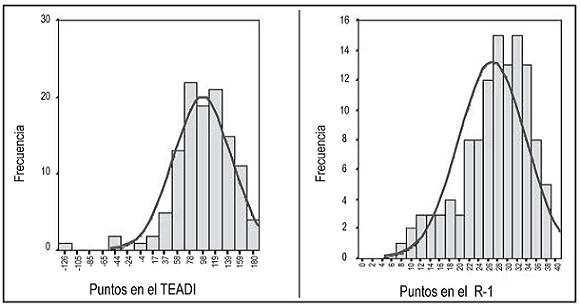
<body><![CDATA[<p style="margin: 5pt 179.25pt 0.0001pt 0cm; text-align: justify; text-indent: 14.2pt; line-height: 150%;"><span style="font-family: Arial;" lang="ES-UY">En los an&aacute;lisis fueron verificadas las estad&iacute;sticas descriptivas. Adem&aacute;s de eso, fueron correlacionadas las puntuaciones entre los tests por medio de la correlaci&oacute;n de <span style="">Pearson</span> y parcial; fueron formados los grupos de edad establecidos en la investigaci&oacute;n de <a href="#Rueda1">Rueda</a> (2009) en relaci&oacute;n al TEADI y comparados en funci&oacute;n de la puntuaci&oacute;n en el R-1 y, finalmente; las puntuaciones en el R-1 fueron categorizadas de acuerdo con los percentiles establecidos por el manual del test y comparados en funci&oacute;n del desempe&ntilde;o en el TEADI.<o:p></o:p></span></p>       <p style="margin: 5pt 179.25pt 0.0001pt 0cm; text-align: justify; text-indent: 14.2pt; line-height: 150%;"><span style="font-family: Arial;" lang="ES-UY"><o:p>&nbsp;</o:p></span></p>       <p style="margin: 5pt 179.25pt 0.0001pt 0cm; text-align: justify; text-indent: 14.2pt; line-height: 150%;"><span style="font-family: Arial;" lang="ES-UY">En relaci&oacute;n a las estad&iacute;sticas descriptivas, se verific&oacute; que la puntuaci&oacute;n en el TEADI vari&oacute; de -126 a 180 (<span style="">P </span>=97,74, <span style="">DT</span>=46,97). Las personas que cometieron m&aacute;s errores y omisiones que aciertos y, por lo tanto, obtuvieron puntuaciones negativas, representaron 2,8% del total de la muestra. Esas informaciones pueden ser verificadas en la <a href="#g1">Figura 1</a>.<o:p></o:p></span></p>       <p style="margin: 5pt 179.25pt 0.0001pt 0cm; text-align: justify; text-indent: 14.2pt; line-height: 150%;"><span style="font-family: Arial;" lang="ES-UY"><o:p>&nbsp;</o:p></span></p>       <p style="margin: 5pt 179.25pt 0.0001pt 0cm; text-align: justify; text-indent: 14.2pt; line-height: 150%;"><span style="font-family: Arial;" lang="ES-UY">En relaci&oacute;n al R-1 fue observado que la puntuaci&oacute;n promedio fue de 26,9 puntos (<span style="">DT</span>=7,01). Ella vari&oacute; de 7 a 37, con una moda de 31 y una mediana de 28. De esa forma, fue evidenciado que ning&uacute;n participante alcanz&oacute; la m&aacute;xima puntuaci&oacute;n posible, o sea, 40 puntos. Frecuencia Puntos en el TEADI, Puntos en el R-1.<o:p></o:p></span></p>       <p style="margin: 5pt 179.25pt 0.0001pt 0cm; text-align: justify; text-indent: 14.2pt; line-height: 150%;"><span style="font-family: Arial;" lang="ES-UY"><o:p>&nbsp;</o:p></span></p>       <p style="margin: 5pt 179.25pt 0.0001pt 0cm; text-align: justify; text-indent: 14.2pt; line-height: 150%;"><span style="font-family: Arial;" lang="ES-UY">Posteriormente la edad de las personas fue agrupada de acuerdo con los grupos de edad apuntados por el estudio de <a href="#Rueda1">Rueda</a> (2009) en relaci&oacute;n al TEADI.</span></p>       <p style="margin: 5pt 179.25pt 0.0001pt 0cm; text-align: justify; text-indent: 14.2pt; line-height: 150%;"><span style="font-family: Arial;" lang="ES-UY"></span></p>       <p style="margin: 5pt 179.25pt 0.0001pt 0cm; text-align: justify; text-indent: 14.2pt; line-height: 150%;"><span style="font-family: Arial;" lang="ES-UY"> <o:p></o:p></span></p>       <p style="margin: 5pt 179.25pt 0.0001pt 0cm; text-align: justify; text-indent: 14.2pt; line-height: 150%;"><span style="font-family: Arial;" lang="ES-UY"><o:p><a name="g1"></a><img style="border: 1px solid ; width: 580px; height: 306px;" alt="" src="/img/revistas/cp/v4n1/1a03g1.jpg">&nbsp;</o:p></span></p>       ]]></body>
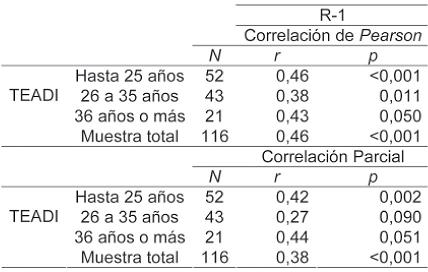
<body><![CDATA[<p style="margin: 5pt 179.25pt 0.0001pt 0cm; text-align: justify; text-indent: 14.2pt; line-height: 150%;"><span style="font-family: Arial;" lang="ES-UY"><o:p></o:p></span></p>       <p style="margin: 5pt 179.25pt 0.0001pt 0cm; text-align: justify; line-height: 120%;"><span style="font-family: Arial;" lang="ES-UY">Figura 1. Frecuencia de puntos de los participantes en el TEADI y en el R-1<o:p></o:p></span></p>       <p style="margin: 5pt 179.25pt 0.0001pt 0cm; text-align: justify; text-indent: 14.2pt; line-height: 150%;"><span style="font-family: Arial;" lang="ES-UY"><o:p>&nbsp;</o:p></span></p>       <p style="margin: 5pt 179.25pt 0.0001pt 0cm; text-align: justify; text-indent: 14.2pt; line-height: 150%;"><span style="font-family: Arial;" lang="ES-UY">Hecho eso, se realiz&oacute; una correlaci&oacute;n de <span style="">Pearson</span> con y sin el control de la edad, para verificar la relaci&oacute;n existente entre ambos tests. Los resultados se encuentran en la <a href="#t1">Tabla 1</a>.<o:p></o:p></span></p>       <p style="margin: 5pt 179.25pt 0.0001pt 0cm; text-align: justify; text-indent: 14.2pt; line-height: 150%;"><span style="font-family: Arial;" lang="ES-UY"><o:p>&nbsp;</o:p></span></p>       <p style="margin: 5pt 179.25pt 0.0001pt 0cm; text-align: justify; text-indent: 14.2pt; line-height: 150%;"><span style="font-family: Arial;" lang="ES-UY">Por la <a href="#t1">Tabla 1</a> fue observado que hasta los 25 a&ntilde;os, 36 a&ntilde;os o m&aacute;s y en la muestra total las correlaciones fueron positivas y estad&iacute;sticamente significativas, de magnitud moderada. Eso indic&oacute; que al aumento de la atenci&oacute;n dividida le correspondi&oacute; un aumento de la inteligencia. En ambos casos la comunalidad entre los instrumentos fue de 21%. Al controlar el efecto de la edad por medio de la correlaci&oacute;n parcial fue verificado que para los grupos de edad hasta 25 a&ntilde;os y 36 a&ntilde;os o m&aacute;s, la magnitud fue moderada, y para el grupo entre 26 y 35 a&ntilde;os y en la muestra total, fue baja. En los grupos de edad en los cuales la correlaci&oacute;n no fue estad&iacute;sticamente significativa se puede pensar que el peque&ntilde;o n&uacute;mero de personas en cada grupo tal vez haya influenciado.<o:p></o:p></span></p>       <p style="margin: 5pt 179.25pt 0.0001pt 0cm; text-align: justify; line-height: 120%;"><span style="font-family: Arial;" lang="ES-UY"><o:p>&nbsp;</o:p></span></p>       <p style="margin: 5pt 179.25pt 0.0001pt 0cm; text-align: justify; line-height: 120%;"><span style="font-family: Arial;" lang="ES-UY">Tabla 1. Coeficientes de Correlaci&oacute;n de <span style="">Pearson</span> y Parciales entre el TEADI y el R-1 para el total y por grupo de edad<o:p></o:p></span></p>       <p style="margin: 5pt 179.25pt 12pt 0cm; text-align: justify; text-indent: 14.2pt; line-height: 150%;"><span style="font-family: Arial;" lang="ES-UY"><o:p>&nbsp;</o:p></span><a name="t1"></a><img style="border: 1px solid ; width: 428px; height: 272px;" alt="" src="/img/revistas/cp/v4n1/1a03t1.jpg"></p>       <p style="margin: 5pt 179.25pt 0.0001pt 0cm; text-align: justify; text-indent: 14.2pt; line-height: 150%;"><span style="font-family: Arial;" lang="ES-UY"><o:p>&nbsp;</o:p></span></p>       ]]></body>
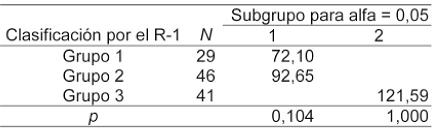
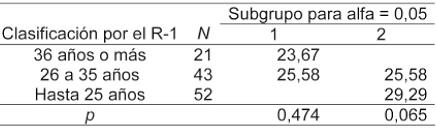
<body><![CDATA[<p style="margin: 5pt 179.25pt 0.0001pt 0cm; text-align: justify; text-indent: 14.2pt; line-height: 150%;"><span style="font-family: Arial;" lang="ES-UY">Todav&iacute;a con base en los grupos de edad del TEADI, fue realizado un an&aacute;lisis de varianza en funci&oacute;n de la puntuaci&oacute;n en el R-1. El resultado mostr&oacute; diferencias estad&iacute;sticamente significativas [<span style="">F</span> (2,115)=6,61, <span style="">p </span>=0,002]. El resultado de la prueba de<span style=""> Tukey </span>se encuentra en la <a href="#t2">Tabla 2</a>.<o:p></o:p></span></p>       <p style="margin: 5pt 179.25pt 0.0001pt 0cm; text-align: justify; text-indent: 14.2pt; line-height: 150%;"><span style="font-family: Arial;" lang="ES-UY"><o:p>&nbsp;</o:p></span></p>       <p style="margin: 5pt 179.25pt 0.0001pt 0cm; text-align: justify; text-indent: 14.2pt; line-height: 150%;"><span style="font-family: Arial;" lang="ES-UY">Fue verificado que no hubo diferencia entre los tres grupos de edad en funci&oacute;n de la puntuaci&oacute;n en el R-1. El grupo de edad de personas m&aacute;s j&oacute;venes fue diferenciado del grupo de edad de personas mayores, siendo que los individuos entre 26 y 35 a&ntilde;os no se diferenciaron de ninguno de los otros grupos. <o:p></o:p></span></p>       <p style="margin: 5pt 179.25pt 0.0001pt 0cm; text-align: justify; text-indent: 14.2pt; line-height: 150%;"><span style="font-family: Arial;" lang="ES-UY">Eso parecer&iacute;a mostrar que la diferenciaci&oacute;n de los grupos de edad en la atenci&oacute;n dividida evaluada por el TEADI no se mantendr&iacute;a al estudiar la inteligencia evaluada por el R-1, pese a eso, deja clara la diferencia existente entre el desempe&ntilde;o de adultos j&oacute;venes y de personas con m&aacute;s de 35 a&ntilde;os.<o:p></o:p></span></p>       <p style="margin: 5pt 179.25pt 0.0001pt 0cm; text-align: justify; text-indent: 14.2pt; line-height: 150%;"><span style="font-family: Arial;" lang="ES-UY"><o:p>&nbsp;</o:p></span></p>       <p style="margin: 5pt 179.25pt 0.0001pt 0cm; text-align: justify; line-height: 120%;"><span style="font-family: Arial;" lang="ES-UY">Tabla 2. Subgrupos de grupos de edad del TEADI formados por la prueba de <span style="">Tukey</span> para el R-1<o:p></o:p></span></p>       <p style="margin: 5pt 179.25pt 0.0001pt 0cm; text-align: justify; text-indent: 14.2pt; line-height: 150%;"><span style="font-family: Arial;" lang="ES-UY"><o:p>&nbsp;</o:p></span><a name="t2"></a><img style="border: 1px solid ; width: 436px; height: 132px;" alt="" src="/img/revistas/cp/v4n1/1a03t2.jpg"></p>       <p style="margin: 5pt 179.25pt 0.0001pt 0cm; text-align: justify; text-indent: 14.2pt; line-height: 150%;"><span style="font-family: Arial;" lang="ES-UY"><o:p>&nbsp;</o:p></span></p>       <p style="margin: 5pt 179.25pt 0.0001pt 0cm; text-align: justify; text-indent: 14.2pt; line-height: 150%;"><span style="font-family: Arial;" lang="ES-UY">A continuaci&oacute;n se procedi&oacute; a realizar una categorizaci&oacute;n de las puntuaciones obtenidas por los individuos en el R-1. De esa forma, fueron creadas seis categor&iacute;as de interpretaci&oacute;n, teniendo como base la Tabla 18 del manual del Test no Verbal de Inteligencia &ndash; R-1 (<a href="#Alves">Alves</a>, 2002), referente a los percentiles de la muestra de la ciudad de Recife. Debe ser destacado que pese al manual del R-1 presentar baremos para diversos estados brasile&ntilde;os, se opt&oacute; por el estado de Pernambuco por ser de la regi&oacute;n Nordeste, una vez que esta investigaci&oacute;n fue realizada en el estado de Bahia.<o:p></o:p></span></p>       <p style="margin: 5pt 179.25pt 0.0001pt 0cm; text-align: justify; text-indent: 14.2pt; line-height: 150%;"><span style="font-family: Arial;" lang="ES-UY"><o:p>&nbsp;</o:p></span></p>       ]]></body>
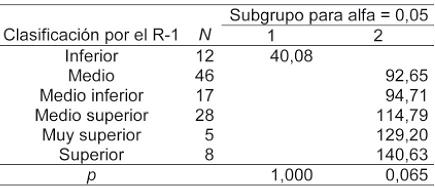
<body><![CDATA[<p style="margin: 5pt 179.25pt 0.0001pt 0cm; text-align: justify; text-indent: 14.2pt; line-height: 150%;"><span style="font-family: Arial;" lang="ES-UY">As&iacute;, fueron agrupadas las personas dentro de la clasificaci&oacute;n &ldquo;inferior&rdquo;, &ldquo;medio inferior&rdquo;, &ldquo;medio&rdquo;, &ldquo;medio superior&rdquo;, &ldquo;superior&rdquo; y &ldquo;muy superior&rdquo;. Con base en esas categor&iacute;as fue realizado un an&aacute;lisis de varianza en funci&oacute;n de la puntuaci&oacute;n en el TEADI, obteniendo como resultado [<span style="">F</span> (5,115)=8,23, <span style="">p </span>&lt;0,001]. Para verificar la puntuaci&oacute;n de cual(es) grupo(s) podr&iacute;a explicar tal diferencia fue realizada la prueba de <span style="">Tukey</span>. El resultado de ese an&aacute;lisis se encuentra en la <a href="#t3">Tabla 3</a>.<o:p></o:p></span></p>       <p style="margin: 5pt 179.25pt 0.0001pt 0cm; text-align: justify; text-indent: 14.2pt; line-height: 150%;"><span style="font-family: Arial;" lang="ES-UY"><o:p>&nbsp;</o:p></span></p>       <p style="margin: 5pt 179.25pt 0.0001pt 0cm; text-align: justify; line-height: 120%;"><span style="font-family: Arial;" lang="ES-UY">Tabla 3. Subgrupos de clasificaciones por el Manual del R-1 formados por la prueba de <span style="">Tukey</span> para el TEADI<o:p></o:p></span></p>       <p style="margin: 5pt 179.25pt 0.0001pt 0cm; text-align: justify; text-indent: 14.2pt; line-height: 150%;"><span style="font-family: Arial;" lang="ES-UY"><o:p>&nbsp;</o:p></span><a name="t3"></a><img style="border: 1px solid ; width: 435px; height: 188px;" alt="" src="/img/revistas/cp/v4n1/1a03t3.jpg"></p>       <p style="margin: 5pt 179.25pt 0.0001pt 0cm; text-align: justify; text-indent: 14.2pt; line-height: 150%;"><span style="font-family: Arial;" lang="ES-UY"><o:p>&nbsp;</o:p></span></p>       <p style="margin: 5pt 179.25pt 0.0001pt 0cm; text-align: justify; text-indent: 14.2pt; line-height: 150%;"><span style="font-family: Arial;" lang="ES-UY">Por la <a href="#t3">Tabla 3</a> se observa que la prueba de Tukey diferenci&oacute; la clasificaci&oacute;n &ldquo;inferior&rdquo; del resto. Por ese resultado se entiende que las personas clasificadas en el percentil inferior en el R-1 tambi&eacute;n presentan las menores puntuaciones en atenci&oacute;n dividida. Todav&iacute;a, las otras clasificaciones formadas parecer&iacute;an no mostrar diferencias en el TEADI.<o:p></o:p></span></p>       <p style="margin: 5pt 179.25pt 0.0001pt 0cm; text-align: justify; text-indent: 14.2pt; line-height: 150%;"><span style="font-family: Arial;" lang="ES-UY"><o:p>&nbsp;</o:p></span></p>       <p style="margin: 5pt 179.25pt 0.0001pt 0cm; text-align: justify; text-indent: 14.2pt; line-height: 150%;"><span style="font-family: Arial;" lang="ES-UY">Con base en ese resultado se opt&oacute; por realizar una nueva clasificaci&oacute;n, agrupando la clasificaci&oacute;n &ldquo;inferior&rdquo; y &ldquo;medio inferior&rdquo; (Grupo 1), la clasificaci&oacute;n &ldquo;medio&rdquo; (Grupo 2) y las clasificaciones &ldquo;medio superior&rdquo;, &ldquo;superior&rdquo; y &ldquo;muy superior&rdquo; (Grupo 3). As&iacute;, nuevamente se realiz&oacute; un an&aacute;lisis de varianza y el resultado verific&oacute; diferencias estad&iacute;sticamente significativas [<span style="">F</span> (2,115)=11,72, <span style="">p </span>&lt;0,001]. Como puede ser constatado, el valor de F present&oacute; un valor mayor que en el primer an&aacute;lisis realizado. Para verificar la puntuaci&oacute;n de cual(es) grupo(s) podr&iacute;a explicar esa diferencia fue nuevamente realizada la prueba de <span style="">Tukey</span>. El resultado puede ser observado en la <a href="#t4">Tabla 4</a>.<o:p></o:p></span></p>       <p style="margin: 5pt 179.25pt 0.0001pt 0cm; text-align: justify; text-indent: 14.2pt; line-height: 150%;"><span style="font-family: Arial;" lang="ES-UY"><o:p>&nbsp;</o:p></span></p>       <p style="margin: 5pt 179.25pt 0.0001pt 0cm; text-align: justify; line-height: 120%;"><span style="font-family: Arial;" lang="ES-UY">Tabla 4. Prueba de <span style="">Tukey</span> para el TEADI de los tres subgrupos de la clasificaci&oacute;n<o:p></o:p></span></p>       ]]></body>
<body><![CDATA[<p style="margin: 5pt 179.25pt 0.0001pt 0cm; text-align: justify; text-indent: 14.2pt; line-height: 150%;"><span style="font-family: Arial;" lang="ES-UY"><o:p>&nbsp;</o:p></span><a name="t4"></a><img style="border: 1px solid ; width: 436px; height: 132px;" alt="" src="/img/revistas/cp/v4n1/1a03t4.jpg"></p>       <p style="margin: 5pt 179.25pt 0.0001pt 0cm; text-align: justify; text-indent: 14.2pt; line-height: 150%;"><span style="font-family: Arial;" lang="ES-UY"><o:p>&nbsp;</o:p></span></p>       <p style="margin: 5pt 179.25pt 0.0001pt 0cm; text-align: justify; text-indent: 14.2pt; line-height: 150%;"><span style="font-family: Arial;" lang="ES-UY">Por el an&aacute;lisis se verific&oacute; que con base en ese nuevo agrupamiento las personas que obtuvieron las mayores puntuaciones en el R-1 fueron diferenciadas del restante tambi&eacute;n en el TEADI. Las personas clasificadas hasta el percentil medio fueron agrupadas, sin presentar de esa forma diferencias significativas entre ellas. As&iacute;, podr&iacute;a interpretarse que las categor&iacute;as de interpretaci&oacute;n establecidas por el R-1 no estar&iacute;an diferenciando totalmente a las personas en relaci&oacute;n a la capacidad de dividir la atenci&oacute;n, pero permitieron diferenciar niveles de atenci&oacute;n altos y bajos.<o:p></o:p></span></p>       <p style="margin: 5pt 179.25pt 0.0001pt 0cm; text-align: justify; text-indent: 14.2pt; line-height: 150%;"><span style="font-family: Arial;" lang="ES-UY"><o:p>&nbsp;</o:p></span></p>       <p style="margin: 5pt 179.25pt 0.0001pt 0cm; text-align: center; line-height: 150%;" align="center"><b><span style="font-family: Arial;" lang="ES-UY">DISCUSI&Oacute;N</span></b><span style="font-family: Arial;" lang="ES-UY"><o:p></o:p></span></p>       <p style="margin: 5pt 179.25pt 0.0001pt 0cm; text-align: justify; text-indent: 14.2pt; line-height: 150%;"><span style="font-family: Arial;" lang="ES-UY"><o:p>&nbsp;</o:p></span></p>       <p style="margin: 5pt 179.25pt 0.0001pt 0cm; text-align: justify; text-indent: 14.2pt; line-height: 150%;"><span style="font-family: Arial;" lang="ES-UY">As&iacute; como varios autores han centrado su inter&eacute;s en verificar la relaci&oacute;n existente entre la atenci&oacute;n y la inteligencia en contextos escolares (<a href="#Cecilio">Cec&iacute;lio-Fern&aacute;ndes &amp; Rueda</a>, 2007; <a href="#Savage">Savage</a>, et al., 2006; y <a href="#Weyandt">Weyandt</a>, et al., 2002), otros han relacionado ambos constructos en el contexto del tr&aacute;nsito (<a href="#Rueda3">Rueda</a>, et.al., 2006; <a href="#Sisto1">Sisto</a>, 2006; <a href="#Sisto2">Sisto</a>, et.al., 2007). De esa forma, esta investigaci&oacute;n tuvo como objetivo verificar la relaci&oacute;n entre ambos constructos, evaluados por el TEADI y por el R-1, siendo este &uacute;ltimo un instrumento muy utilizado en el &aacute;mbito de la evaluaci&oacute;n psicol&oacute;gica en el tr&aacute;nsito en Brasil.<o:p></o:p></span></p>       <p style="margin: 5pt 179.25pt 0.0001pt 0cm; text-align: justify; text-indent: 14.2pt; line-height: 150%;"><span style="font-family: Arial;" lang="ES-UY"><o:p>&nbsp;</o:p></span></p>       <p style="margin: 5pt 179.25pt 0.0001pt 0cm; text-align: justify; text-indent: 14.2pt; line-height: 150%;"><span style="font-family: Arial;" lang="ES-UY">Al ser relacionados los tests, pudo verificarse que hubo una comunalidad de m&aacute;s de 20% entre los constructos, lo que puede ser considerado bastante significativo si se tiene en cuenta que son constructos y tests diferentes. Esa comunalidad indic&oacute; que a pesar de ambos tests evaluar fen&oacute;menos psicol&oacute;gicos diferentes, ellos poseen una parte que es com&uacute;n. Todav&iacute;a, el hecho de la correlaci&oacute;n haber sido positiva, indic&oacute; que al aumentar la capacidad en dividir la atenci&oacute;n, aument&oacute; tambi&eacute;n la inteligencia de las personas. La investigaci&oacute;n de <a href="#Sisto1">Sisto, et al</a>, (2006) tambi&eacute;n encontr&oacute; resultados semejantes al correlacionar la atenci&oacute;n dividida evaluada por el AD y la inteligencia medida por el TCR en candidatos a conductores, as&iacute; como tambi&eacute;n la investigaci&oacute;n de <a href="#Silva1">Silva</a> (2008) al relacionar varios tests midiendo tipos diferentes de atenci&oacute;n y el R-1.<o:p></o:p></span></p>       <p style="margin: 5pt 179.25pt 0.0001pt 0cm; text-align: justify; text-indent: 14.2pt; line-height: 150%;"><span style="font-family: Arial;" lang="ES-UY">Otro hecho observado fue que con el pasar de la edad hubo un desempe&ntilde;o menor en el test R-1, o sea, cuanto m&aacute;s edad menor el desempe&ntilde;o en inteligencia de los individuos. Eso acentu&oacute; todav&iacute;a m&aacute;s la relaci&oacute;n entre ambos constructos, una vez que la disminuci&oacute;n de la atenci&oacute;n con el pasar de la edad ya hab&iacute;a sido observada por <a href="#Rueda2">Rueda</a> (2009).<o:p></o:p></span></p>       ]]></body>
<body><![CDATA[<p style="margin: 5pt 179.25pt 0.0001pt 0cm; text-align: justify; text-indent: 14.2pt; line-height: 150%;"><span style="font-family: Arial;" lang="ES-UY">Al considerarse las categor&iacute;as de interpretaci&oacute;n establecidas por el R-1 se observ&oacute; que las mismas diferenciaron a las personas con niveles bajos en atenci&oacute;n dividida. O sea, las personas que obtuvieron los peores desempe&ntilde;os en el R-1 fueron diferenciadas significativamente de las otras categor&iacute;as de interpretaci&oacute;n en funci&oacute;n del TEADI. Si se tiene en cuenta que el R-1 es un instrumento que posee baremos para candidatos a la libreta de conducir, y que la muestra del manual del test utilizada en esta investigaci&oacute;n fue del estado de Pernambuco (regi&oacute;n Nordeste), el resultado podr&iacute;a ser interpretado e indicar que una puntuaci&oacute;n muy baja en el R-1 servir&iacute;a tambi&eacute;n para clasificar una persona como teniendo una baja capacidad de dividir la atenci&oacute;n.<o:p></o:p></span></p>       <p style="margin: 5pt 179.25pt 0.0001pt 0cm; text-align: justify; text-indent: 14.2pt; line-height: 150%;"><span style="font-family: Arial;" lang="ES-UY"><o:p>&nbsp;</o:p></span></p>       <p style="margin: 5pt 179.25pt 0.0001pt 0cm; text-align: justify; text-indent: 14.2pt; line-height: 150%;"><span style="font-family: Arial;" lang="ES-UY">De forma general, algunas conclusiones pudieron ser realizadas con base en el estudio presentado aqu&iacute;. En primer lugar la existencia de relaci&oacute;n entre atenci&oacute;n (independientemente del tipo evaluado) e inteligencia, ya mencionada por la literatura. Tambi&eacute;n, que ambos constructos confirman su disminuci&oacute;n con el pasar de la edad, lo que merecer&iacute;a m&aacute;s estudios para verificar si el simple hecho de tener puntuaciones bajas en esos fen&oacute;menos psicol&oacute;gicos podr&iacute;a ser considerado un criterio determinante para considerar que una persona puede o no dirigir un autom&oacute;vil, una vez que se sabe que gran parte de los accidentes de tr&aacute;nsito envuelve personas j&oacute;venes en lugar de personas de m&aacute;s edad, mostrando de esa forma que otros factores que estar&iacute;an presentes en el contexto del tr&aacute;nsito deber&iacute;an ser investigados. Finalmente debe ser destacado que con base en los resultados obtenidos se pudo concluir por la obtenci&oacute;n de evidencia de validez para el TEADI en el contexto del tr&aacute;nsito, al ser comparado con el R-1.<o:p></o:p></span></p>       <p style="margin: 2.85pt 179.25pt 0.0001pt 0cm; text-align: justify; text-indent: 2.85pt; line-height: 150%;"><span style="font-family: Arial;" lang="ES-UY"><o:p>&nbsp;</o:p></span></p>       <p style="margin: 2.85pt 179.25pt 0.0001pt 0cm; text-align: justify; text-indent: 2.85pt; line-height: 150%;"><span style="font-family: Arial;" lang="ES-UY"><o:p></o:p></span></p>       <p style="margin: 2.85pt 179.25pt 0.0001pt 0cm; text-align: justify; text-indent: 2.85pt; line-height: 150%;"><span style="font-family: Arial;" lang="ES-UY"><o:p></o:p></span></p>       <p style="margin: 2.85pt 179.25pt 0.0001pt 0cm; text-align: center; text-indent: 2.85pt; line-height: 150%;" align="center"><b><span style="font-family: Arial;" lang="ES-UY">REFERENCIAS</span></b></p>       <p style="margin: 2.85pt 179.25pt 0.0001pt 0cm; text-align: center; text-indent: 2.85pt; line-height: 150%;" align="center"><b><span style="font-family: Arial;" lang="ES-UY"></span></b></p>       <p style="margin: 2.85pt 179.25pt 0.0001pt 0cm; text-align: center; text-indent: 2.85pt; line-height: 150%;" align="center"><b><span style="font-family: Arial;" lang="ES-UY"></span></b><span style="font-family: Arial;" lang="ES-UY"><o:p></o:p></span></p>       <!-- ref --><p style="margin: 5pt 179.25pt 0.0001pt 14.2pt; text-align: justify; text-indent: -14.2pt; line-height: 150%;"><span style="font-family: Arial;" lang="ES-UY"><a name="Alves"></a><a href="#Alves2002.">Alves, I. C. B. (2002)</a>. <span style="">Teste de Intelig&ecirc;ncia N&atilde;o Verbal R-1. </span></span><span class="GramE"><span style="font-family: Arial;" lang="EN-US">Manual.</span></span><span style="font-family: Arial;" lang="EN-US"> </span><st1:city><st1:place><span class="SpellE"><span style="font-family: Arial;" lang="EN-US">S&atilde;o</span></span><span style="font-family: Arial;" lang="EN-US"> Paulo</span></st1:place></st1:city><span style="font-family: Arial;" lang="EN-US">: <span class="SpellE">Vetor</span>.    &nbsp;&nbsp;&nbsp;&nbsp;&nbsp;&nbsp;&nbsp;&nbsp;[&#160;<a href="javascript:void(0);" onclick="javascript: window.open('/scielo.php?script=sci_nlinks&ref=205996&pid=S1688-4221201000010000300001&lng=','','width=640,height=500,resizable=yes,scrollbars=1,menubar=yes,');">Links</a>&#160;]<!-- end-ref --> </span><span style="font-family: Arial;" lang="EN-GB"><o:p></o:p></span></p>       <p style="margin: 5pt 179.25pt 0.0001pt 14.2pt; text-align: justify; text-indent: -14.2pt; line-height: 150%;"><span class="GramE"><span style="font-family: Arial;" lang="EN-US"><a name="Ball"></a><a href="#Ball2003.">Ball, K., &amp; Owsley, C. (2003)</a>.</span></span><span style="font-family: Arial;" lang="EN-US"> Driving competence: It&rsquo;s not a matter of age. <span style="">Journal of American Geriatrics Society, 51</span>, 1499-1501. </span><span style="font-family: Arial;" lang="EN-GB"><o:p></o:p></span></p>       <!-- ref --><p style="margin: 5pt 179.25pt 0.0001pt 14.2pt; text-align: justify; text-indent: -14.2pt; line-height: 150%;"><span class="SpellE"><span class="GramE"><span style="font-family: Arial;" lang="EN-US"><a name="Berdard"></a><a href="#B%E9rdard2006.">B&eacute;rdard</a></span></span></span><span class="GramE"><span style="font-family: Arial;" lang="EN-US"><a href="#B%E9rdard2006.">, M., Leonard, E., McAuliffe, J., Gibbons, B., &amp; Dubois, C. (2006)</a>.</span></span><span style="font-family: Arial;" lang="EN-US"> Visual attention and older drivers: the contribution of inhibition of return to safe driving. <span style="">Experimental Aging Research, 32</span>, 119-135.    &nbsp;&nbsp;&nbsp;&nbsp;&nbsp;&nbsp;&nbsp;&nbsp;[&#160;<a href="javascript:void(0);" onclick="javascript: window.open('/scielo.php?script=sci_nlinks&ref=205999&pid=S1688-4221201000010000300003&lng=','','width=640,height=500,resizable=yes,scrollbars=1,menubar=yes,');">Links</a>&#160;]<!-- end-ref --></span><span style="font-family: Arial;" lang="EN-GB"><o:p></o:p></span></p>       <!-- ref --><p style="margin: 5pt 179.25pt 0.0001pt 14.2pt; text-align: justify; text-indent: -14.2pt; line-height: 150%;"><span class="SpellE"><span class="GramE"><span style="font-family: Arial;" lang="EN-US"><a name="Brouwer"></a><a href="#Brouwer2002.">Brouwer</a></span></span></span><span class="GramE"><span style="font-family: Arial;" lang="EN-US"><a href="#Brouwer2002.">, W. H., <span class="SpellE">Witbaar</span>, F. K., <span class="SpellE">Tant</span>, M. L. M., &amp; van <span class="SpellE">Zomeren</span>, A. H. (2002)</a>.</span></span><span style="font-family: Arial;" lang="EN-US"> Attention and Driving in Traumatic Brain Injury: A Question of Coping with Time-Pressure. </span><span style="font-family: Arial;" lang="ES-UY">Journal of Head Trauma Rehabilitation, 17 </span><span style="font-family: Arial;" lang="ES-UY">(2), 1-15.    &nbsp;&nbsp;&nbsp;&nbsp;&nbsp;&nbsp;&nbsp;&nbsp;[&#160;<a href="javascript:void(0);" onclick="javascript: window.open('/scielo.php?script=sci_nlinks&ref=206001&pid=S1688-4221201000010000300004&lng=','','width=640,height=500,resizable=yes,scrollbars=1,menubar=yes,');">Links</a>&#160;]<!-- end-ref --><o:p></o:p></span></p>       <!-- ref --><p style="margin: 5pt 179.25pt 0.0001pt 14.2pt; text-align: justify; text-indent: -14.2pt; line-height: 150%;"><span style="font-family: Arial;" lang="ES-UY"><a name="Carrizales"></a><a href="#Carrizales2005.">Carrizales, P. V. S. (2005)</a>. Los procesos congnitivos atencionales. Una aproximaci&oacute;n conceptual desde lo social. <span style="">Revista de Antropologia Experimental, 5 </span>(1), 1-4.    &nbsp;&nbsp;&nbsp;&nbsp;&nbsp;&nbsp;&nbsp;&nbsp;[&#160;<a href="javascript:void(0);" onclick="javascript: window.open('/scielo.php?script=sci_nlinks&ref=206003&pid=S1688-4221201000010000300005&lng=','','width=640,height=500,resizable=yes,scrollbars=1,menubar=yes,');">Links</a>&#160;]<!-- end-ref --><o:p></o:p></span></p>       <p style="margin: 5pt 179.25pt 0.0001pt 14.2pt; text-align: justify; text-indent: -14.2pt; line-height: 150%;"><span style="font-family: Arial;" lang="ES-UY"><a name="Cecilio"></a><a href="#Cec%EDlio2007.">Cec&iacute;lio-Fern&aacute;ndes, D., &amp; Rueda, F. J. M. (2007)</a>. Evid&ecirc;ncia de validade concorrente para o Teste de Aten&ccedil;&atilde;o Concentrada &ndash; TEACO-FF. <span style="">PSIC &ndash; Revista de Psicologia da Vetor Editora, 8 </span>(2), 167-174.<o:p></o:p></span></p>       <!-- ref --><p style="margin: 5pt 179.25pt 0.0001pt 14.2pt; text-align: justify; text-indent: -14.2pt; line-height: 150%;"><span style="font-family: Arial;" lang="ES-UY"><a name="Dalgalarrondo"></a><a href="#Dalgalarrondo2000.">Dalgalarrondo, P. (2000)</a>. <span style="">Psicopatologia e Semiologia dos Transtornos Mentais</span>. Porto Alegre: Artmed.    &nbsp;&nbsp;&nbsp;&nbsp;&nbsp;&nbsp;&nbsp;&nbsp;[&#160;<a href="javascript:void(0);" onclick="javascript: window.open('/scielo.php?script=sci_nlinks&ref=206006&pid=S1688-4221201000010000300007&lng=','','width=640,height=500,resizable=yes,scrollbars=1,menubar=yes,');">Links</a>&#160;]<!-- end-ref --><o:p></o:p></span></p>       <!-- ref --><p style="margin: 5pt 179.25pt 0.0001pt 14.2pt; text-align: justify; text-indent: -14.2pt; line-height: 150%;"><span style="font-family: Arial;" lang="ES-UY"><a name="Gazzaniga"></a><a href="#Gazzaniga2006.">Gazzaniga, M. S., Ivry, R. B., &amp; Mangun, G. R. (2006)</a>. <span style="">Neuroci&ecirc;ncia Cognitiva: a Biologia da mente</span>. Porto Alegre: Artmed. Ang&eacute;lica Rosat Consiglio, trad. 2a. Ed.    &nbsp;&nbsp;&nbsp;&nbsp;&nbsp;&nbsp;&nbsp;&nbsp;[&#160;<a href="javascript:void(0);" onclick="javascript: window.open('/scielo.php?script=sci_nlinks&ref=206008&pid=S1688-4221201000010000300008&lng=','','width=640,height=500,resizable=yes,scrollbars=1,menubar=yes,');">Links</a>&#160;]<!-- end-ref --><o:p></o:p></span></p>       <!-- ref --><p style="margin: 5pt 179.25pt 0.0001pt 14.2pt; text-align: justify; text-indent: -14.2pt; line-height: 150%;"><span style="font-family: Arial;" lang="ES-UY"><a name="Hunton"></a><a href="#Hunton2005.">Hunton, J., &amp; Rose, J. M. (2005)</a>. </span><span style="font-family: Arial;" lang="EN-US">Cellular Telephones and Driving Performance: The Effects of <span class="SpellE">Attentional</span> Demands on Motor Vehicle Crash Risk. <span style="">Risk Analysis, 25 </span>(4), 855-866.    &nbsp;&nbsp;&nbsp;&nbsp;&nbsp;&nbsp;&nbsp;&nbsp;[&#160;<a href="javascript:void(0);" onclick="javascript: window.open('/scielo.php?script=sci_nlinks&ref=206010&pid=S1688-4221201000010000300009&lng=','','width=640,height=500,resizable=yes,scrollbars=1,menubar=yes,');">Links</a>&#160;]<!-- end-ref --></span><span style="font-family: Arial;" lang="EN-GB"><o:p></o:p></span></p>       <!-- ref --><p style="margin: 5pt 179.25pt 0.0001pt 14.2pt; text-align: justify; text-indent: -14.2pt; line-height: 150%;"><span class="SpellE"><span class="GramE"><span style="font-family: Arial;" lang="EN-US"><a name="Lachter"></a><a href="#Lachter2004..">Lachter</a></span></span></span><span class="GramE"><span style="font-family: Arial;" lang="EN-US"><a href="#Lachter2004..">, J., &amp; Forster, K. I. (2004)</a>.</span></span><span style="font-family: Arial;" lang="EN-US"> Forty-Five Years <span class="GramE">After</span> Broadbent (1958): Still No Identification Without Attention. <span style="">Psychological Review, 111 </span>(4), 880-913.    &nbsp;&nbsp;&nbsp;&nbsp;&nbsp;&nbsp;&nbsp;&nbsp;[&#160;<a href="javascript:void(0);" onclick="javascript: window.open('/scielo.php?script=sci_nlinks&ref=206012&pid=S1688-4221201000010000300010&lng=','','width=640,height=500,resizable=yes,scrollbars=1,menubar=yes,');">Links</a>&#160;]<!-- end-ref --></span><span style="font-family: Arial;" lang="EN-GB"><o:p></o:p></span></p>       <!-- ref --><p style="margin: 5pt 179.25pt 0.0001pt 14.2pt; text-align: justify; text-indent: -14.2pt; line-height: 150%;"><span class="SpellE"><span class="GramE"><span style="font-family: Arial;" lang="EN-US"><a name="Lengenfelder"></a><a href="#Lengenfelder2002.">Lengenfelder</a></span></span></span><span class="GramE"><span style="font-family: Arial;" lang="EN-US"><a href="#Lengenfelder2002.">, J., <span class="SpellE">Schultheis</span>, M. T., Al-<span class="SpellE">Shihabi</span>, T., <span class="SpellE">Mourant</span>, R., &amp; <span class="SpellE">DeLuca</span>, J. (2002)</a>.</span></span><span style="font-family: Arial;" lang="EN-US"> Divided Attention and Driving: A Pilot Study Using Virtual Reality Technology <span style="">Journal of Head Trauma Rehabilitation, 17 </span>(1), 26-37.    &nbsp;&nbsp;&nbsp;&nbsp;&nbsp;&nbsp;&nbsp;&nbsp;[&#160;<a href="javascript:void(0);" onclick="javascript: window.open('/scielo.php?script=sci_nlinks&ref=206014&pid=S1688-4221201000010000300011&lng=','','width=640,height=500,resizable=yes,scrollbars=1,menubar=yes,');">Links</a>&#160;]<!-- end-ref --></span><span style="font-family: Arial;" lang="EN-GB"><o:p></o:p></span></p>       <!-- ref --><p style="margin: 5pt 179.25pt 0.0001pt 14.2pt; text-align: justify; text-indent: -14.2pt; line-height: 150%;"><span style="font-family: Arial;" lang="ES-UY"><a name="Lima"></a><a href="#Lima2005.">Lima, F. R. (2005)</a>. Compreendendo os mecanismos atencionais. </span><span class="SpellE"><span class="GramE"><span style="font-family: Arial;" lang="EN-US">Ci&ecirc;ncia</span></span></span><span class="GramE"><span style="font-family: Arial;" lang="EN-US"> &amp; <span class="SpellE">Cogni&ccedil;&atilde;o</span>.</span></span><span style="font-family: Arial;" lang="EN-US"> 6</span><span style="font-family: Arial;" lang="EN-US">, 113-122.    &nbsp;&nbsp;&nbsp;&nbsp;&nbsp;&nbsp;&nbsp;&nbsp;[&#160;<a href="javascript:void(0);" onclick="javascript: window.open('/scielo.php?script=sci_nlinks&ref=206016&pid=S1688-4221201000010000300012&lng=','','width=640,height=500,resizable=yes,scrollbars=1,menubar=yes,');">Links</a>&#160;]<!-- end-ref --> </span><span style="font-family: Arial;" lang="EN-GB"><o:p></o:p></span></p>       <!-- ref --><p style="margin: 5pt 179.25pt 0.0001pt 14.2pt; text-align: justify; text-indent: -14.2pt; line-height: 150%;"><span class="GramE"><span style="font-family: Arial;" lang="EN-US"><a name="Matthews"></a><a href="#Matthews1996.">Matthews, G., <span class="SpellE">Sparkes</span>, T. J., &amp; <span class="SpellE">Bygrave</span>, H. M. (1996)</a>.</span></span><span style="font-family: Arial;" lang="EN-US"> <span class="SpellE"><span class="GramE">Attentional</span></span><span class="GramE"> overload, stress, and simulated driving performance.</span> <span style="">Human Performance, 9 </span>(1), 77-101.    &nbsp;&nbsp;&nbsp;&nbsp;&nbsp;&nbsp;&nbsp;&nbsp;[&#160;<a href="javascript:void(0);" onclick="javascript: window.open('/scielo.php?script=sci_nlinks&ref=206018&pid=S1688-4221201000010000300013&lng=','','width=640,height=500,resizable=yes,scrollbars=1,menubar=yes,');">Links</a>&#160;]<!-- end-ref --></span><span style="font-family: Arial;" lang="EN-GB"><o:p></o:p></span></p>       <!-- ref --><p style="margin: 5pt 179.25pt 0.0001pt 14.2pt; text-align: justify; text-indent: -14.2pt; line-height: 150%;"><span class="SpellE"><span style="font-family: Arial;" lang="EN-US"><a name="Pascualvaca"></a><a href="#Pascualvaca1997.">Pascualvaca</a></span></span><span style="font-family: Arial;" lang="EN-US"><a href="#Pascualvaca1997.">, D. M., Anthony, B. J., Arnold, L. E., <span class="SpellE">Rebok</span>, G. W., Ahearn, M. B., <span class="SpellE">Kellam</span>, S. G., &amp; <span class="SpellE">Mirsky</span>, A. F. (1997)</a>. Attention performance in an epidemiological sample of urban children: the role of gender and verbal intelligence. <span style="">Child <span class="SpellE">Neuropsychology</span>, 3 </span>(1), 13-27.    &nbsp;&nbsp;&nbsp;&nbsp;&nbsp;&nbsp;&nbsp;&nbsp;[&#160;<a href="javascript:void(0);" onclick="javascript: window.open('/scielo.php?script=sci_nlinks&ref=206020&pid=S1688-4221201000010000300014&lng=','','width=640,height=500,resizable=yes,scrollbars=1,menubar=yes,');">Links</a>&#160;]<!-- end-ref --></span><span style="font-family: Arial;" lang="EN-GB"><o:p></o:p></span></p>       <!-- ref --><p style="margin: 5pt 179.25pt 0.0001pt 14.2pt; text-align: justify; text-indent: -14.2pt; line-height: 150%;"><span style="font-family: Arial;" lang="EN-US"><a name="Posner1"></a><a href="#Posner1992.">Posner, M. I. (1992)</a>. Attention as a Cognitive and Neural System. <span style="">Current Directions in Psychological Science, 1 </span>(1), 11-14.    &nbsp;&nbsp;&nbsp;&nbsp;&nbsp;&nbsp;&nbsp;&nbsp;[&#160;<a href="javascript:void(0);" onclick="javascript: window.open('/scielo.php?script=sci_nlinks&ref=206022&pid=S1688-4221201000010000300015&lng=','','width=640,height=500,resizable=yes,scrollbars=1,menubar=yes,');">Links</a>&#160;]<!-- end-ref --></span><span style="font-family: Arial;" lang="EN-GB"><o:p></o:p></span></p>       <!-- ref --><p style="margin: 5pt 179.25pt 0.0001pt 14.2pt; text-align: justify; text-indent: -14.2pt; line-height: 150%;"><span class="GramE"><span style="font-family: Arial;" lang="EN-US"><a name="Posner2"></a><a href="#Posner1990.">Posner, M. I., &amp; Petersen, S. E. (1990)</a>.</span></span><span style="font-family: Arial;" lang="EN-US"> The Attention Systems of the human brain. </span><span style="font-family: Arial;" lang="ES-UY">Annual Review of Neuroscience, 13</span><span style="font-family: Arial;" lang="ES-UY">, 25-42.    &nbsp;&nbsp;&nbsp;&nbsp;&nbsp;&nbsp;&nbsp;&nbsp;[&#160;<a href="javascript:void(0);" onclick="javascript: window.open('/scielo.php?script=sci_nlinks&ref=206024&pid=S1688-4221201000010000300016&lng=','','width=640,height=500,resizable=yes,scrollbars=1,menubar=yes,');">Links</a>&#160;]<!-- end-ref --><o:p></o:p></span></p>       <!-- ref --><p style="margin: 5pt 179.25pt 0.0001pt 14.2pt; text-align: justify; text-indent: -14.2pt; line-height: 150%;"><span style="font-family: Arial;" lang="ES-UY"><a name="Rueda1"></a><a href="#Rueda2009.">Rueda, F. J. M. (2009)</a>. Desempenho no Teste de Aten&ccedil;&atilde;o Dividida (TEADI) como resultado da idade das pessoas. <span style="">Manuscrito submetido &agrave; publica&ccedil;&atilde;o.    &nbsp;&nbsp;&nbsp;&nbsp;&nbsp;&nbsp;&nbsp;&nbsp;[&#160;<a href="javascript:void(0);" onclick="javascript: window.open('/scielo.php?script=sci_nlinks&ref=206026&pid=S1688-4221201000010000300017&lng=','','width=640,height=500,resizable=yes,scrollbars=1,menubar=yes,');">Links</a>&#160;]<!-- end-ref --></span><o:p></o:p></span></p>       <!-- ref --><p style="margin: 5pt 179.25pt 0.0001pt 14.2pt; text-align: justify; text-indent: -14.2pt; line-height: 150%;"><span style="font-family: Arial;" lang="ES-UY"><a name="Rueda2"></a><a href="#Rueda2009.">Rueda, F. J. M. (2009)</a>. <span style="">Teste de Aten&ccedil;&atilde;o Dividida (TEADI)</span>. Itatiba: Universidade S&atilde;o Francisco.    &nbsp;&nbsp;&nbsp;&nbsp;&nbsp;&nbsp;&nbsp;&nbsp;[&#160;<a href="javascript:void(0);" onclick="javascript: window.open('/scielo.php?script=sci_nlinks&ref=206028&pid=S1688-4221201000010000300018&lng=','','width=640,height=500,resizable=yes,scrollbars=1,menubar=yes,');">Links</a>&#160;]<!-- end-ref --><o:p></o:p></span></p>       <!-- ref --><p style="margin: 5pt 179.25pt 0.0001pt 14.2pt; text-align: justify; text-indent: -14.2pt; line-height: 150%;"><span style="font-family: Arial;" lang="ES-UY"><a name="Rueda3"></a><a href="#Rueda2006.">Rueda, F. J. M., Lamounier, R., Sisto, F. F., Bartholomeu, D., &amp; Noronha, A. P. P. (2006)</a>. Racioc&iacute;nio inferencial e aten&ccedil;&atilde;o sustentada: construtos convergentes? Em C. Machado, L. Almeida, M. A. Guisande, M. Gon&ccedil;alves &amp; V. Ramalho (Orgs.). <span style="">XI Confer&ecirc;ncia Internacional. Avalia&ccedil;&atilde;o Psicol&oacute;gica: formas e contextos.</span> Braga: Psiquilibrios.    &nbsp;&nbsp;&nbsp;&nbsp;&nbsp;&nbsp;&nbsp;&nbsp;[&#160;<a href="javascript:void(0);" onclick="javascript: window.open('/scielo.php?script=sci_nlinks&ref=206030&pid=S1688-4221201000010000300019&lng=','','width=640,height=500,resizable=yes,scrollbars=1,menubar=yes,');">Links</a>&#160;]<!-- end-ref --><o:p></o:p></span></p>       <!-- ref --><p style="margin: 5pt 179.25pt 0.0001pt 14.2pt; text-align: justify; text-indent: -14.2pt; line-height: 150%;"><span class="SpellE"><span style="font-family: Arial;" lang="EN-US"><a name="Rumar"></a><a href="#Rumar1990.">Rumar</a></span></span><span style="font-family: Arial;" lang="EN-US"><a href="#Rumar1990.">, K. (1990)</a>. The basic driver error: late <span class="SpellE">detecton</span>. <span style="">Ergonomics, 33</span>, 1281-1290.    &nbsp;&nbsp;&nbsp;&nbsp;&nbsp;&nbsp;&nbsp;&nbsp;[&#160;<a href="javascript:void(0);" onclick="javascript: window.open('/scielo.php?script=sci_nlinks&ref=206032&pid=S1688-4221201000010000300020&lng=','','width=640,height=500,resizable=yes,scrollbars=1,menubar=yes,');">Links</a>&#160;]<!-- end-ref --></span><span style="font-family: Arial;" lang="EN-GB"><o:p></o:p></span></p>       <p style="margin: 5pt 179.25pt 0.0001pt 14.2pt; text-align: justify; text-indent: -14.2pt; line-height: 150%;"><span class="GramE"><span style="font-family: Arial;" lang="EN-US"><a name="Savage"></a><a href="#Savage2006.">Savage, R., Cornish, K., Manly, T., &amp; Hollis, C. (2006)</a>.</span></span><span style="font-family: Arial;" lang="EN-US"> Cognitive processes in children&rsquo;s reading and attention: the role of working memory, divided attention, and response inhibition. <span style="">British Journal of Psychology, 97</span>, 365-385.</span><span style="font-family: Arial;" lang="EN-GB"><o:p></o:p></span></p>       <!-- ref --><p style="margin: 5pt 179.25pt 0.0001pt 14.2pt; text-align: justify; text-indent: -14.2pt; line-height: 150%;"><st1:country-region><st1:place><span class="SpellE"><span style="font-family: Arial;" lang="EN-US"><a name="Shinar"></a><a href="#Shinar2005.">Shinar</a></span></span></st1:place></st1:country-region><span style="font-family: Arial;" lang="EN-US"><a href="#Shinar2005.">, D. <span class="SpellE">Tractinsky</span>, N., &amp; Compton, R. (2005)</a>. Effects of practice, age, and task demands, on interference from a phone task while driving. </span><span style="font-family: Arial;" lang="ES-UY">Accident Analysis and Prevention, 37</span><span style="font-family: Arial;" lang="ES-UY">, 315-326.    &nbsp;&nbsp;&nbsp;&nbsp;&nbsp;&nbsp;&nbsp;&nbsp;[&#160;<a href="javascript:void(0);" onclick="javascript: window.open('/scielo.php?script=sci_nlinks&ref=206035&pid=S1688-4221201000010000300022&lng=','','width=640,height=500,resizable=yes,scrollbars=1,menubar=yes,');">Links</a>&#160;]<!-- end-ref --><o:p></o:p></span></p>       ]]></body>
<body><![CDATA[<!-- ref --><p style="margin: 5pt 179.25pt 0.0001pt 14.2pt; text-align: justify; text-indent: -14.2pt; line-height: 150%;"><span style="font-family: Arial;" lang="ES-UY"><a name="Silva1"></a><a href="#Silva2008.">Silva, F. H. V. C. (2008)</a>. <span style="">Medida da preditividade de instrumentos psicol&oacute;gicos nas avalia&ccedil;&otilde;es psicol&oacute;gicas de condutores</span>. Disserta&ccedil;&atilde;o de Mestrado. Universidade Federal do Rio Grande do Norte. Natal.    &nbsp;&nbsp;&nbsp;&nbsp;&nbsp;&nbsp;&nbsp;&nbsp;[&#160;<a href="javascript:void(0);" onclick="javascript: window.open('/scielo.php?script=sci_nlinks&ref=206037&pid=S1688-4221201000010000300023&lng=','','width=640,height=500,resizable=yes,scrollbars=1,menubar=yes,');">Links</a>&#160;]<!-- end-ref --><o:p></o:p></span></p>       <!-- ref --><p style="margin: 5pt 179.25pt 0.0001pt 14.2pt; text-align: justify; text-indent: -14.2pt; line-height: 150%;"><span style="font-family: Arial;" lang="ES-UY"><a name="Silva2"></a><a href="#Silva2008.">Silva, F. H. V. C., &amp; Alchieri, J. C. (2008)</a>. Revis&atilde;o das pesquisas brasileiras em avalia&ccedil;&atilde;o psicol&oacute;gica de habilidades e intelig&ecirc;ncia de condutores. <span style="">Estudos de Psicologia (Natal), 13 </span>(1), 57-64.    &nbsp;&nbsp;&nbsp;&nbsp;&nbsp;&nbsp;&nbsp;&nbsp;[&#160;<a href="javascript:void(0);" onclick="javascript: window.open('/scielo.php?script=sci_nlinks&ref=206039&pid=S1688-4221201000010000300024&lng=','','width=640,height=500,resizable=yes,scrollbars=1,menubar=yes,');">Links</a>&#160;]<!-- end-ref --><o:p></o:p></span></p>       <!-- ref --><p style="margin: 5pt 179.25pt 0.0001pt 14.2pt; text-align: justify; text-indent: -14.2pt; line-height: 150%;"><span style="font-family: Arial;" lang="ES-UY"><a name="Sisto1"></a><a href="#Sisto2006.">Sisto, F. F. (2006)</a>. <span style="">Teste Conciso de Racioc&iacute;nio. Manual. </span>S&atilde;o Paulo: Vetor.    &nbsp;&nbsp;&nbsp;&nbsp;&nbsp;&nbsp;&nbsp;&nbsp;[&#160;<a href="javascript:void(0);" onclick="javascript: window.open('/scielo.php?script=sci_nlinks&ref=206041&pid=S1688-4221201000010000300025&lng=','','width=640,height=500,resizable=yes,scrollbars=1,menubar=yes,');">Links</a>&#160;]<!-- end-ref --><o:p></o:p></span></p>       <!-- ref --><p style="margin: 5pt 179.25pt 0.0001pt 14.2pt; text-align: justify; text-indent: -14.2pt; line-height: 150%;"><span style="font-family: Arial;" lang="ES-UY"><a name="Sisto2"></a><a href="#Sisto2007.">Sisto, F. F., Rueda, F. J. M., Noronha, A. P. P., &amp; Bartholomeu, D. (2007)</a>. Aten&ccedil;&atilde;o dividida e intelig&ecirc;ncia: evid&ecirc;ncias de validade. <span style="">Revista de Psicologia, XI </span>(16), 117-131.    &nbsp;&nbsp;&nbsp;&nbsp;&nbsp;&nbsp;&nbsp;&nbsp;[&#160;<a href="javascript:void(0);" onclick="javascript: window.open('/scielo.php?script=sci_nlinks&ref=206043&pid=S1688-4221201000010000300026&lng=','','width=640,height=500,resizable=yes,scrollbars=1,menubar=yes,');">Links</a>&#160;]<!-- end-ref --><o:p></o:p></span></p>       <!-- ref --><p style="margin: 5pt 179.25pt 0.0001pt 14.2pt; text-align: justify; text-indent: -14.2pt; line-height: 150%;"><span style="font-family: Arial;" lang="EN-US"><a name="Sparrow"></a><a href="#Sparrow2006.">Sparrow, W. A., <span class="SpellE">Begg</span>, R. K., &amp; Parker, S. (2006)</a>. Aging Effects on Visual Reaction Time in a Single Task Condition and When Treadmill Walking. </span><span style="font-family: Arial;" lang="EN-GB">Motor Control, 10</span><span style="font-family: Arial;" lang="EN-GB">, 201-211.    &nbsp;&nbsp;&nbsp;&nbsp;&nbsp;&nbsp;&nbsp;&nbsp;[&#160;<a href="javascript:void(0);" onclick="javascript: window.open('/scielo.php?script=sci_nlinks&ref=206045&pid=S1688-4221201000010000300027&lng=','','width=640,height=500,resizable=yes,scrollbars=1,menubar=yes,');">Links</a>&#160;]<!-- end-ref --><o:p></o:p></span></p>       ]]></body>
<body><![CDATA[<!-- ref --><p style="margin: 5pt 179.25pt 0.0001pt 14.2pt; text-align: justify; text-indent: -14.2pt; line-height: 150%;"><span style="font-family: Arial;" lang="EN-GB"><a name="Sternberg"></a><a href="#Sternberg2000.">Sternberg, R. J. (2000)</a>. <span class="SpellE"><span style="">Psicologia</span></span><span style=""> <span class="SpellE">Cognitiva</span></span>. </span><st1:city><st1:place><span style="font-family: Arial;" lang="EN-GB">Porto <span class="SpellE">Alegre</span></span></st1:place></st1:city><span style="font-family: Arial;" lang="EN-GB">: <span class="SpellE">Artmed</span><o:p></o:p></span>&nbsp;&nbsp;&nbsp;&nbsp;&nbsp;&nbsp;&nbsp;&nbsp;[&#160;<a href="javascript:void(0);" onclick="javascript: window.open('/scielo.php?script=sci_nlinks&ref=206047&pid=S1688-4221201000010000300028&lng=','','width=640,height=500,resizable=yes,scrollbars=1,menubar=yes,');">Links</a>&#160;]<!-- end-ref --><!-- ref --><p style="margin: 5pt 179.25pt 0.0001pt 14.2pt; text-align: justify; text-indent: -14.2pt; line-height: 150%;"><span class="SpellE"><span class="GramE"><span style="font-family: Arial;" lang="EN-US"><a name="Treisman"></a><a href="#Treisman1980.">Treisman</a></span></span></span><span class="GramE"><span style="font-family: Arial;" lang="EN-US"><a href="#Treisman1980.">, A., &amp; <span class="SpellE">Gelade</span>, G. (1980)</a>.</span></span><span style="font-family: Arial;" lang="EN-US"> <span class="GramE">A feature-integration theory of attention.</span> <span style="">Cognitive Psychology, 12</span>, 97-136.    &nbsp;&nbsp;&nbsp;&nbsp;&nbsp;&nbsp;&nbsp;&nbsp;[&#160;<a href="javascript:void(0);" onclick="javascript: window.open('/scielo.php?script=sci_nlinks&ref=206048&pid=S1688-4221201000010000300029&lng=','','width=640,height=500,resizable=yes,scrollbars=1,menubar=yes,');">Links</a>&#160;]<!-- end-ref --></span><span style="font-family: Arial;" lang="EN-GB"><o:p></o:p></span></p>       <!-- ref --><p style="margin: 5pt 179.25pt 0.0001pt 14.2pt; text-align: justify; text-indent: -14.2pt; line-height: 150%;"><span style="font-family: Arial;" lang="EN-US"><a name="Underwood"></a><a href="#Underwood2007.">Underwood, G. (2007)</a>. Visual attention and the transition from novice to advanced driver. <span style="">Ergonomics, 50 </span>(8), 1235-1249.    &nbsp;&nbsp;&nbsp;&nbsp;&nbsp;&nbsp;&nbsp;&nbsp;[&#160;<a href="javascript:void(0);" onclick="javascript: window.open('/scielo.php?script=sci_nlinks&ref=206050&pid=S1688-4221201000010000300030&lng=','','width=640,height=500,resizable=yes,scrollbars=1,menubar=yes,');">Links</a>&#160;]<!-- end-ref --></span><span style="font-family: Arial;" lang="EN-GB"><o:p></o:p></span></p>       <!-- ref --><p style="margin: 5pt 179.25pt 0.0001pt 14.2pt; text-align: justify; text-indent: -14.2pt; line-height: 150%;"><span class="SpellE"><span class="GramE"><span style="font-family: Arial;" lang="EN-US"><a name="Weyandt"></a><a href="#Weyandt2002.">Weyandt</a></span></span></span><span class="GramE"><span style="font-family: Arial;" lang="EN-US"><a href="#Weyandt2002.">, L. L., <span class="SpellE">Mitzlaff</span>, L., &amp; Thomas, L. (2002)</a>.</span></span><span style="font-family: Arial;" lang="EN-US"> <span class="GramE">The relationship between intelligence and performance on the test of variables of attention (TOVA).</span> <span style="">Journal of Learning Disabilities, 35 </span>(2), 114-120.    &nbsp;&nbsp;&nbsp;&nbsp;&nbsp;&nbsp;&nbsp;&nbsp;[&#160;<a href="javascript:void(0);" onclick="javascript: window.open('/scielo.php?script=sci_nlinks&ref=206052&pid=S1688-4221201000010000300031&lng=','','width=640,height=500,resizable=yes,scrollbars=1,menubar=yes,');">Links</a>&#160;]<!-- end-ref --></span><span style="font-family: Arial;" lang="EN-GB"><o:p></o:p></span></p>       <!-- ref --><p style="margin: 5pt 179.25pt 0.0001pt 14.2pt; text-align: justify; text-indent: -14.2pt; line-height: 150%;"><span class="SpellE"><span class="GramE"><span style="font-family: Arial;" lang="EN-GB"><a name="Wikman"></a><a href="#Wikman1998.">Wikman</a></span></span></span><span class="GramE"><span style="font-family: Arial;" lang="EN-GB"><a href="#Wikman1998.">, A, <span class="SpellE">Nieminen</span>, T., &amp; <span class="SpellE">Summala</span>, H. (1998)</a>.</span></span><span style="font-family: Arial;" lang="EN-GB"> </span><span style="font-family: Arial;" lang="EN-US">Driving experience and time-sharing during in-car tasks on roads of different width. <span style="">Ergonomics, 41 </span>(3), 358-372.    &nbsp;&nbsp;&nbsp;&nbsp;&nbsp;&nbsp;&nbsp;&nbsp;[&#160;<a href="javascript:void(0);" onclick="javascript: window.open('/scielo.php?script=sci_nlinks&ref=206054&pid=S1688-4221201000010000300032&lng=','','width=640,height=500,resizable=yes,scrollbars=1,menubar=yes,');">Links</a>&#160;]<!-- end-ref --></span><span style="font-family: Arial;" lang="EN-GB"><o:p></o:p></span></p>       <!-- ref --><p style="margin: 5pt 179.25pt 0.0001pt 14.2pt; text-align: justify; text-indent: -14.2pt; line-height: 150%;"><span class="GramE"><span style="font-family: Arial;" lang="EN-US"><a name="Young"></a><a href="#Young2007.">Young, M. S., &amp; <span class="SpellE">Stantion</span>, N. A. (2007)</a>.</span></span><span style="font-family: Arial;" lang="EN-US"> Miles away: determining the extent of secondary task interference on simulated driving.<span style=""> </span></span><span style="font-family: Arial;" lang="ES-UY">Theoretical Issues in Ergonomics Science, 8 </span><span style="font-family: Arial;" lang="ES-UY">(3), 233-253.    &nbsp;&nbsp;&nbsp;&nbsp;&nbsp;&nbsp;&nbsp;&nbsp;[&#160;<a href="javascript:void(0);" onclick="javascript: window.open('/scielo.php?script=sci_nlinks&ref=206056&pid=S1688-4221201000010000300033&lng=','','width=640,height=500,resizable=yes,scrollbars=1,menubar=yes,');">Links</a>&#160;]<!-- end-ref --><o:p></o:p></span></p>       <p style="margin: 5pt 179.25pt 0.0001pt 14.2pt; text-align: justify; text-indent: -14.2pt; line-height: 150%;"><span style="font-family: Arial;" lang="ES-UY"><o:p>&nbsp;</o:p></span></p>       <p style="margin: 5pt 179.25pt 0.0001pt 0cm; text-align: justify; text-indent: 14.2pt; line-height: 150%;"><span style="font-family: Arial;" lang="ES-UY"><o:p>&nbsp;</o:p></span></p>       <p style="margin: 5pt 179.25pt 0.0001pt 0cm; text-align: justify; text-indent: 14.2pt; line-height: 150%;"><span style="font-family: Arial;" lang="ES-UY"><o:p>&nbsp;</o:p></span></p>       <p style="margin: 5pt 179.25pt 0.0001pt 0cm; text-align: justify; text-indent: 14.2pt; line-height: 150%;"><span style="font-family: Arial;" lang="ES-UY"><o:p>&nbsp;</o:p></span></p>       <p style="margin: 5pt 179.25pt 0.0001pt 0cm; text-align: justify; text-indent: 14.2pt; line-height: 150%;"><span style="font-family: Arial;" lang="ES-UY"><o:p>&nbsp;</o:p></span></p>       <p style="margin: 5pt 179.25pt 0.0001pt 0cm; text-align: justify; text-indent: 14.2pt; line-height: 150%;"><span style="font-family: Arial;" lang="ES-UY"><o:p>&nbsp;</o:p></span></p>       <p style="margin: 5pt 179.25pt 0.0001pt 0cm; text-align: justify; text-indent: 14.2pt; line-height: 150%;"><span style="font-family: Arial;" lang="ES-UY"><o:p>&nbsp;</o:p></span></p>       <p style="margin: 5pt 179.25pt 0.0001pt 0cm; text-align: justify; text-indent: 14.2pt; line-height: 150%;"><span style="font-family: Arial;" lang="ES-UY"><o:p>&nbsp;</o:p></span></p>       <p style="margin: 5pt 179.25pt 0.0001pt 0cm; text-align: justify; line-height: 150%;"><span style="font-family: Arial;" lang="ES-UY"><o:p>&nbsp;</o:p></span></p>   </div>       ]]></body>
<body><![CDATA[ ]]></body>
<back>
<ref-list>
<ref id="B1">
<nlm-citation citation-type="book">
<person-group person-group-type="author">
<name>
<surname><![CDATA[Alves]]></surname>
<given-names><![CDATA[I. C. B.]]></given-names>
</name>
</person-group>
<source><![CDATA[Teste de Inteligência Não Verbal R-1: Manual]]></source>
<year>2002</year>
<publisher-loc><![CDATA[São Paulo ]]></publisher-loc>
<publisher-name><![CDATA[Vetor]]></publisher-name>
</nlm-citation>
</ref>
<ref id="B2">
<nlm-citation citation-type="journal">
<person-group person-group-type="author">
<name>
<surname><![CDATA[Ball]]></surname>
<given-names><![CDATA[K]]></given-names>
</name>
<name>
<surname><![CDATA[Owsley]]></surname>
<given-names><![CDATA[C]]></given-names>
</name>
</person-group>
<article-title xml:lang="en"><![CDATA[Driving competence: It&rsquo;s not a matter of age]]></article-title>
<source><![CDATA[Journal of American Geriatrics Society]]></source>
<year>2003</year>
<volume>51</volume>
<page-range>1499-1501</page-range></nlm-citation>
</ref>
<ref id="B3">
<nlm-citation citation-type="journal">
<person-group person-group-type="author">
<name>
<surname><![CDATA[Bérdard]]></surname>
<given-names><![CDATA[M]]></given-names>
</name>
<name>
<surname><![CDATA[Leonard]]></surname>
<given-names><![CDATA[E]]></given-names>
</name>
<name>
<surname><![CDATA[McAuliffe]]></surname>
<given-names><![CDATA[J]]></given-names>
</name>
<name>
<surname><![CDATA[Gibbons]]></surname>
<given-names><![CDATA[B]]></given-names>
</name>
<name>
<surname><![CDATA[Dubois]]></surname>
<given-names><![CDATA[C]]></given-names>
</name>
</person-group>
<article-title xml:lang="en"><![CDATA[Visual attention and older drivers: the contribution of inhibition of return to safe driving]]></article-title>
<source><![CDATA[Experimental Aging Research]]></source>
<year>2006</year>
<volume>32</volume>
<page-range>119-135</page-range></nlm-citation>
</ref>
<ref id="B4">
<nlm-citation citation-type="journal">
<person-group person-group-type="author">
<name>
<surname><![CDATA[Brouwer]]></surname>
<given-names><![CDATA[W. H.]]></given-names>
</name>
<name>
<surname><![CDATA[Witbaar]]></surname>
<given-names><![CDATA[F. K.]]></given-names>
</name>
<name>
<surname><![CDATA[Tant]]></surname>
<given-names><![CDATA[M. L. M.]]></given-names>
</name>
<name>
<surname><![CDATA[van Zomeren]]></surname>
<given-names><![CDATA[A. H.]]></given-names>
</name>
</person-group>
<article-title xml:lang="en"><![CDATA[Attention and Driving in Traumatic Brain Injury: A Question of Coping with Time-Pressure]]></article-title>
<source><![CDATA[Journal of Head Trauma Rehabilitation]]></source>
<year>2002</year>
<volume>17</volume>
<numero>2</numero>
<issue>2</issue>
<page-range>1-15</page-range></nlm-citation>
</ref>
<ref id="B5">
<nlm-citation citation-type="journal">
<person-group person-group-type="author">
<name>
<surname><![CDATA[Carrizales]]></surname>
<given-names><![CDATA[P. V. S.]]></given-names>
</name>
</person-group>
<article-title xml:lang="es"><![CDATA[Los procesos congnitivos atencionales: Una aproximación conceptual desde lo social]]></article-title>
<source><![CDATA[Revista de Antropologia Experimental]]></source>
<year>2005</year>
<volume>5</volume>
<numero>1</numero>
<issue>1</issue>
<page-range>1-4</page-range></nlm-citation>
</ref>
<ref id="B6">
<nlm-citation citation-type="journal">
<person-group person-group-type="author">
<name>
<surname><![CDATA[Cecílio-Fernándes]]></surname>
<given-names><![CDATA[D]]></given-names>
</name>
<name>
<surname><![CDATA[Rueda]]></surname>
<given-names><![CDATA[F. J. M.]]></given-names>
</name>
</person-group>
<article-title xml:lang="pt"><![CDATA[Evidência de validade concorrente para o Teste de Atenção Concentrada: TEACO-FF. PSIC]]></article-title>
<source><![CDATA[Revista de Psicologia da Vetor Editora]]></source>
<year>2007</year>
<volume>8</volume>
<numero>2</numero>
<issue>2</issue>
<page-range>167-174</page-range></nlm-citation>
</ref>
<ref id="B7">
<nlm-citation citation-type="book">
<person-group person-group-type="author">
<name>
<surname><![CDATA[Dalgalarrondo]]></surname>
<given-names><![CDATA[P]]></given-names>
</name>
</person-group>
<source><![CDATA[Psicopatologia e Semiologia dos Transtornos Mentais]]></source>
<year>2000</year>
<publisher-loc><![CDATA[Porto Alegre ]]></publisher-loc>
<publisher-name><![CDATA[Artmed]]></publisher-name>
</nlm-citation>
</ref>
<ref id="B8">
<nlm-citation citation-type="book">
<person-group person-group-type="author">
<name>
<surname><![CDATA[Gazzaniga]]></surname>
<given-names><![CDATA[M. S.]]></given-names>
</name>
<name>
<surname><![CDATA[Ivry]]></surname>
<given-names><![CDATA[R. B.]]></given-names>
</name>
<name>
<surname><![CDATA[Mangun]]></surname>
<given-names><![CDATA[G. R.]]></given-names>
</name>
</person-group>
<source><![CDATA[Neurociência Cognitiva: a Biologia da mente]]></source>
<year>2006</year>
<edition>2a. Ed</edition>
<publisher-loc><![CDATA[Porto Alegre ]]></publisher-loc>
<publisher-name><![CDATA[Artmed]]></publisher-name>
</nlm-citation>
</ref>
<ref id="B9">
<nlm-citation citation-type="journal">
<person-group person-group-type="author">
<name>
<surname><![CDATA[Hunton]]></surname>
<given-names><![CDATA[J]]></given-names>
</name>
<name>
<surname><![CDATA[Rose]]></surname>
<given-names><![CDATA[J. M.]]></given-names>
</name>
</person-group>
<article-title xml:lang="en"><![CDATA[Cellular Telephones and Driving Performance: The Effects of Attentional Demands on Motor Vehicle Crash Risk]]></article-title>
<source><![CDATA[Risk Analysis]]></source>
<year>2005</year>
<volume>25</volume>
<numero>4</numero>
<issue>4</issue>
<page-range>855-866</page-range></nlm-citation>
</ref>
<ref id="B10">
<nlm-citation citation-type="journal">
<person-group person-group-type="author">
<name>
<surname><![CDATA[Lachter]]></surname>
<given-names><![CDATA[J]]></given-names>
</name>
<name>
<surname><![CDATA[Forster]]></surname>
<given-names><![CDATA[K. I.]]></given-names>
</name>
</person-group>
<article-title xml:lang="en"><![CDATA[Forty-Five Years After Broadbent (1958): Still No Identification Without Attention]]></article-title>
<source><![CDATA[Psychological Review]]></source>
<year>2004</year>
<volume>111</volume>
<numero>4</numero>
<issue>4</issue>
<page-range>880-913</page-range></nlm-citation>
</ref>
<ref id="B11">
<nlm-citation citation-type="journal">
<person-group person-group-type="author">
<name>
<surname><![CDATA[Lengenfelder]]></surname>
<given-names><![CDATA[J]]></given-names>
</name>
<name>
<surname><![CDATA[Schultheis]]></surname>
<given-names><![CDATA[M. T.]]></given-names>
</name>
<name>
<surname><![CDATA[Al-Shihabi]]></surname>
<given-names><![CDATA[T]]></given-names>
</name>
<name>
<surname><![CDATA[Mourant]]></surname>
<given-names><![CDATA[R]]></given-names>
</name>
<name>
<surname><![CDATA[DeLuca]]></surname>
<given-names><![CDATA[J]]></given-names>
</name>
</person-group>
<article-title xml:lang="en"><![CDATA[Divided Attention and Driving: A Pilot Study Using Virtual Reality Technology]]></article-title>
<source><![CDATA[Journal of Head Trauma Rehabilitation]]></source>
<year>2002</year>
<volume>17</volume>
<numero>1</numero>
<issue>1</issue>
<page-range>26-37</page-range></nlm-citation>
</ref>
<ref id="B12">
<nlm-citation citation-type="journal">
<person-group person-group-type="author">
<name>
<surname><![CDATA[Lima]]></surname>
<given-names><![CDATA[F. R.]]></given-names>
</name>
</person-group>
<article-title xml:lang="pt"><![CDATA[Compreendendo os mecanismos atencionais]]></article-title>
<source><![CDATA[Ciência & Cognição]]></source>
<year>2005</year>
<volume>6</volume>
<page-range>113-122</page-range></nlm-citation>
</ref>
<ref id="B13">
<nlm-citation citation-type="journal">
<person-group person-group-type="author">
<name>
<surname><![CDATA[Matthews]]></surname>
<given-names><![CDATA[G]]></given-names>
</name>
<name>
<surname><![CDATA[Sparkes]]></surname>
<given-names><![CDATA[T. J.]]></given-names>
</name>
<name>
<surname><![CDATA[Bygrave]]></surname>
<given-names><![CDATA[H. M.]]></given-names>
</name>
</person-group>
<article-title xml:lang="en"><![CDATA[Attentional overload, stress, and simulated driving performance]]></article-title>
<source><![CDATA[Human Performance]]></source>
<year>1996</year>
<volume>9</volume>
<numero>1</numero>
<issue>1</issue>
<page-range>77-101</page-range></nlm-citation>
</ref>
<ref id="B14">
<nlm-citation citation-type="journal">
<person-group person-group-type="author">
<name>
<surname><![CDATA[Pascualvaca]]></surname>
<given-names><![CDATA[D. M.]]></given-names>
</name>
<name>
<surname><![CDATA[Anthony]]></surname>
<given-names><![CDATA[B. J.]]></given-names>
</name>
<name>
<surname><![CDATA[Arnold]]></surname>
<given-names><![CDATA[L. E.]]></given-names>
</name>
<name>
<surname><![CDATA[Rebok]]></surname>
<given-names><![CDATA[G. W.]]></given-names>
</name>
<name>
<surname><![CDATA[Ahearn]]></surname>
<given-names><![CDATA[M. B.]]></given-names>
</name>
<name>
<surname><![CDATA[Kellam]]></surname>
<given-names><![CDATA[S. G.]]></given-names>
</name>
<name>
<surname><![CDATA[Mirsky]]></surname>
<given-names><![CDATA[A. F.]]></given-names>
</name>
</person-group>
<article-title xml:lang="en"><![CDATA[Attention performance in an epidemiological sample of urban children: the role of gender and verbal intelligence]]></article-title>
<source><![CDATA[Child Neuropsychology]]></source>
<year>1997</year>
<volume>3</volume>
<numero>1</numero>
<issue>1</issue>
<page-range>13-27</page-range></nlm-citation>
</ref>
<ref id="B15">
<nlm-citation citation-type="journal">
<person-group person-group-type="author">
<name>
<surname><![CDATA[Posner]]></surname>
<given-names><![CDATA[M. I.]]></given-names>
</name>
</person-group>
<article-title xml:lang="en"><![CDATA[Attention as a Cognitive and Neural System]]></article-title>
<source><![CDATA[Current Directions in Psychological Science]]></source>
<year>1992</year>
<volume>1</volume>
<numero>1</numero>
<issue>1</issue>
<page-range>11-14</page-range></nlm-citation>
</ref>
<ref id="B16">
<nlm-citation citation-type="journal">
<person-group person-group-type="author">
<name>
<surname><![CDATA[Posner]]></surname>
<given-names><![CDATA[M. I.]]></given-names>
</name>
<name>
<surname><![CDATA[Petersen]]></surname>
<given-names><![CDATA[S. E.]]></given-names>
</name>
</person-group>
<article-title xml:lang="en"><![CDATA[The Attention Systems of the human brain]]></article-title>
<source><![CDATA[Annual Review of Neuroscience]]></source>
<year>1990</year>
<volume>13</volume>
<page-range>25-42</page-range></nlm-citation>
</ref>
<ref id="B17">
<nlm-citation citation-type="">
<person-group person-group-type="author">
<name>
<surname><![CDATA[Rueda]]></surname>
<given-names><![CDATA[F. J. M.]]></given-names>
</name>
</person-group>
<source><![CDATA[Desempenho no Teste de Atenção Dividida (TEADI) como resultado da idade das pessoas: Manuscrito submetido à publicação]]></source>
<year>2009</year>
</nlm-citation>
</ref>
<ref id="B18">
<nlm-citation citation-type="book">
<person-group person-group-type="author">
<name>
<surname><![CDATA[Rueda]]></surname>
<given-names><![CDATA[F. J. M.]]></given-names>
</name>
</person-group>
<source><![CDATA[Teste de Atenção Dividida (TEADI)]]></source>
<year>2009</year>
<publisher-loc><![CDATA[Itatiba ]]></publisher-loc>
<publisher-name><![CDATA[Universidade São Francisco]]></publisher-name>
</nlm-citation>
</ref>
<ref id="B19">
<nlm-citation citation-type="confpro">
<person-group person-group-type="author">
<name>
<surname><![CDATA[Rueda]]></surname>
<given-names><![CDATA[F. J. M.]]></given-names>
</name>
<name>
<surname><![CDATA[Lamounier]]></surname>
<given-names><![CDATA[R]]></given-names>
</name>
<name>
<surname><![CDATA[Sisto]]></surname>
<given-names><![CDATA[F. F.]]></given-names>
</name>
<name>
<surname><![CDATA[Bartholomeu]]></surname>
<given-names><![CDATA[D]]></given-names>
</name>
<name>
<surname><![CDATA[Noronha]]></surname>
<given-names><![CDATA[A. P. P.]]></given-names>
</name>
</person-group>
<article-title xml:lang="pt"><![CDATA[Raciocínio inferencial e atenção sustentada: construtos convergentes?]]></article-title>
<person-group person-group-type="editor">
<name>
<surname><![CDATA[Machado]]></surname>
<given-names><![CDATA[C.]]></given-names>
</name>
<name>
<surname><![CDATA[Almeida]]></surname>
<given-names><![CDATA[L.]]></given-names>
</name>
<name>
<surname><![CDATA[Guisande]]></surname>
<given-names><![CDATA[M. A.]]></given-names>
</name>
<name>
<surname><![CDATA[Gonçalves]]></surname>
<given-names><![CDATA[M]]></given-names>
</name>
<name>
<surname><![CDATA[Ramalho]]></surname>
<given-names><![CDATA[V]]></given-names>
</name>
</person-group>
<source><![CDATA[]]></source>
<year>2006</year>
<conf-name><![CDATA[XI Conferência Internacional. Avaliação Psicológica: formas e contextos]]></conf-name>
<conf-loc> </conf-loc>
<publisher-loc><![CDATA[Braga ]]></publisher-loc>
<publisher-name><![CDATA[Psiquilibrios]]></publisher-name>
</nlm-citation>
</ref>
<ref id="B20">
<nlm-citation citation-type="journal">
<person-group person-group-type="author">
<name>
<surname><![CDATA[Rumar]]></surname>
<given-names><![CDATA[K]]></given-names>
</name>
</person-group>
<article-title xml:lang="en"><![CDATA[The basic driver error: late detecton]]></article-title>
<source><![CDATA[Ergonomics]]></source>
<year>1990</year>
<volume>33</volume>
<page-range>1281-1290</page-range></nlm-citation>
</ref>
<ref id="B21">
<nlm-citation citation-type="journal">
<person-group person-group-type="author">
<name>
<surname><![CDATA[Savage]]></surname>
<given-names><![CDATA[R]]></given-names>
</name>
<name>
<surname><![CDATA[Cornish]]></surname>
<given-names><![CDATA[K]]></given-names>
</name>
<name>
<surname><![CDATA[Manly]]></surname>
<given-names><![CDATA[T]]></given-names>
</name>
<name>
<surname><![CDATA[Hollis]]></surname>
<given-names><![CDATA[C]]></given-names>
</name>
</person-group>
<article-title xml:lang="en"><![CDATA[Cognitive processes in children&rsquo;s reading and attention: the role of working memory, divided attention, and response inhibition]]></article-title>
<source><![CDATA[British Journal of Psychology]]></source>
<year>2006</year>
<volume>97</volume>
<page-range>365-385</page-range></nlm-citation>
</ref>
<ref id="B22">
<nlm-citation citation-type="journal">
<person-group person-group-type="author">
<name>
<surname><![CDATA[Shinar]]></surname>
<given-names><![CDATA[D]]></given-names>
</name>
<name>
<surname><![CDATA[Tractinsky]]></surname>
<given-names><![CDATA[N]]></given-names>
</name>
<name>
<surname><![CDATA[Compton]]></surname>
<given-names><![CDATA[R]]></given-names>
</name>
</person-group>
<article-title xml:lang="en"><![CDATA[Effects of practice, age, and task demands, on interference from a phone task while driving]]></article-title>
<source><![CDATA[Accident Analysis and Prevention]]></source>
<year>2005</year>
<volume>37</volume>
<page-range>315-326</page-range></nlm-citation>
</ref>
<ref id="B23">
<nlm-citation citation-type="">
<person-group person-group-type="author">
<name>
<surname><![CDATA[Silva]]></surname>
<given-names><![CDATA[F. H. V. C.]]></given-names>
</name>
</person-group>
<source><![CDATA[Medida da preditividade de instrumentos psicológicos nas avaliações psicológicas de condutores]]></source>
<year>2008</year>
</nlm-citation>
</ref>
<ref id="B24">
<nlm-citation citation-type="journal">
<person-group person-group-type="author">
<name>
<surname><![CDATA[Silva]]></surname>
<given-names><![CDATA[F. H. V. C.]]></given-names>
</name>
<name>
<surname><![CDATA[Alchieri]]></surname>
<given-names><![CDATA[J. C.]]></given-names>
</name>
</person-group>
<article-title xml:lang="pt"><![CDATA[Revisão das pesquisas brasileiras em avaliação psicológica de habilidades e inteligência de condutores]]></article-title>
<source><![CDATA[Estudos de Psicologia]]></source>
<year>2008</year>
<volume>13</volume>
<numero>1</numero>
<issue>1</issue>
<page-range>57-64</page-range><publisher-loc><![CDATA[Natal ]]></publisher-loc>
</nlm-citation>
</ref>
<ref id="B25">
<nlm-citation citation-type="book">
<person-group person-group-type="author">
<name>
<surname><![CDATA[Sisto]]></surname>
<given-names><![CDATA[F. F.]]></given-names>
</name>
</person-group>
<source><![CDATA[Teste Conciso de Raciocínio: Manual]]></source>
<year>2006</year>
<publisher-loc><![CDATA[São Paulo ]]></publisher-loc>
<publisher-name><![CDATA[Vetor]]></publisher-name>
</nlm-citation>
</ref>
<ref id="B26">
<nlm-citation citation-type="journal">
<person-group person-group-type="author">
<name>
<surname><![CDATA[Sisto]]></surname>
<given-names><![CDATA[F. F.]]></given-names>
</name>
<name>
<surname><![CDATA[Rueda]]></surname>
<given-names><![CDATA[F. J. M.]]></given-names>
</name>
<name>
<surname><![CDATA[Noronha]]></surname>
<given-names><![CDATA[A. P. P.]]></given-names>
</name>
<name>
<surname><![CDATA[Bartholomeu]]></surname>
<given-names><![CDATA[D]]></given-names>
</name>
</person-group>
<article-title xml:lang="pt"><![CDATA[tenção dividida e inteligência: evidências de validade]]></article-title>
<source><![CDATA[Revista de Psicologia]]></source>
<year>2007</year>
<volume>XI</volume>
<numero>16</numero>
<issue>16</issue>
<page-range>117-131</page-range></nlm-citation>
</ref>
<ref id="B27">
<nlm-citation citation-type="journal">
<person-group person-group-type="author">
<name>
<surname><![CDATA[Sparrow]]></surname>
<given-names><![CDATA[W. A.]]></given-names>
</name>
<name>
<surname><![CDATA[Begg]]></surname>
<given-names><![CDATA[R. K.]]></given-names>
</name>
<name>
<surname><![CDATA[Parker]]></surname>
<given-names><![CDATA[S]]></given-names>
</name>
</person-group>
<article-title xml:lang="es"><![CDATA[Aging Effects on Visual Reaction Time in a Single Task Condition and When Treadmill Walking]]></article-title>
<source><![CDATA[Motor Control]]></source>
<year>2006</year>
<volume>10</volume>
<page-range>201-211</page-range></nlm-citation>
</ref>
<ref id="B28">
<nlm-citation citation-type="book">
<person-group person-group-type="author">
<name>
<surname><![CDATA[Sternberg]]></surname>
<given-names><![CDATA[R. J.]]></given-names>
</name>
</person-group>
<source><![CDATA[Psicologia Cognitiva]]></source>
<year>2000</year>
<publisher-loc><![CDATA[Porto Alegre ]]></publisher-loc>
<publisher-name><![CDATA[Artmed]]></publisher-name>
</nlm-citation>
</ref>
<ref id="B29">
<nlm-citation citation-type="journal">
<person-group person-group-type="author">
<name>
<surname><![CDATA[Treisman]]></surname>
<given-names><![CDATA[A]]></given-names>
</name>
<name>
<surname><![CDATA[Gelade]]></surname>
<given-names><![CDATA[G]]></given-names>
</name>
</person-group>
<article-title xml:lang="en"><![CDATA[A feature-integration theory of attention]]></article-title>
<source><![CDATA[Cognitive Psychology]]></source>
<year>1980</year>
<volume>12</volume>
<page-range>97-136</page-range></nlm-citation>
</ref>
<ref id="B30">
<nlm-citation citation-type="journal">
<person-group person-group-type="author">
<name>
<surname><![CDATA[Underwood]]></surname>
<given-names><![CDATA[G]]></given-names>
</name>
</person-group>
<article-title xml:lang="en"><![CDATA[Visual attention and the transition from novice to advanced driver]]></article-title>
<source><![CDATA[Ergonomics]]></source>
<year>2007</year>
<volume>50</volume>
<numero>8</numero>
<issue>8</issue>
<page-range>1235-1249</page-range></nlm-citation>
</ref>
<ref id="B31">
<nlm-citation citation-type="journal">
<person-group person-group-type="author">
<name>
<surname><![CDATA[Weyandt]]></surname>
<given-names><![CDATA[L. L.]]></given-names>
</name>
<name>
<surname><![CDATA[Mitzlaff]]></surname>
<given-names><![CDATA[L.]]></given-names>
</name>
<name>
<surname><![CDATA[Thomas]]></surname>
<given-names><![CDATA[L.]]></given-names>
</name>
</person-group>
<article-title xml:lang="en"><![CDATA[The relationship between intelligence and performance on the test of variables of attention (TOVA)]]></article-title>
<source><![CDATA[Journal of Learning Disabilities]]></source>
<year>2002</year>
<volume>35</volume>
<numero>2</numero>
<issue>2</issue>
<page-range>114-120</page-range></nlm-citation>
</ref>
<ref id="B32">
<nlm-citation citation-type="journal">
<person-group person-group-type="author">
<name>
<surname><![CDATA[Wikman]]></surname>
<given-names><![CDATA[A.]]></given-names>
</name>
<name>
<surname><![CDATA[Nieminen]]></surname>
<given-names><![CDATA[T.]]></given-names>
</name>
<name>
<surname><![CDATA[Summala]]></surname>
<given-names><![CDATA[H.]]></given-names>
</name>
</person-group>
<article-title xml:lang="en"><![CDATA[Driving experience and time-sharing during in-car tasks on roads of different width]]></article-title>
<source><![CDATA[Ergonomics]]></source>
<year>1998</year>
<volume>41</volume>
<numero>3</numero>
<issue>3</issue>
<page-range>358-372</page-range></nlm-citation>
</ref>
<ref id="B33">
<nlm-citation citation-type="journal">
<person-group person-group-type="author">
<name>
<surname><![CDATA[Young]]></surname>
<given-names><![CDATA[M. S.]]></given-names>
</name>
<name>
<surname><![CDATA[Stantion]]></surname>
<given-names><![CDATA[N. A]]></given-names>
</name>
</person-group>
<article-title xml:lang="en"><![CDATA[Miles away: determining the extent of secondary task interference on simulated driving]]></article-title>
<source><![CDATA[Theoretical Issues in Ergonomics Science]]></source>
<year>2007</year>
<volume>8</volume>
<numero>3</numero>
<issue>3</issue>
<page-range>233-253</page-range></nlm-citation>
</ref>
</ref-list>
</back>
</article>