<?xml version="1.0" encoding="ISO-8859-1"?><article xmlns:mml="http://www.w3.org/1998/Math/MathML" xmlns:xlink="http://www.w3.org/1999/xlink" xmlns:xsi="http://www.w3.org/2001/XMLSchema-instance">
<front>
<journal-meta>
<journal-id>1688-4221</journal-id>
<journal-title><![CDATA[Ciencias Psicológicas]]></journal-title>
<abbrev-journal-title><![CDATA[Cienc. Psicol.]]></abbrev-journal-title>
<issn>1688-4221</issn>
<publisher>
<publisher-name><![CDATA[Universidad Católica del Uruguay.]]></publisher-name>
</publisher>
</journal-meta>
<article-meta>
<article-id>S1688-42212010000100002</article-id>
<title-group>
<article-title xml:lang="es"><![CDATA[DIFICULTADES DE APRENDIZAJE DEL CÁLCULO: CONTRIBUCIONES AL DIAGNÓSTICO PSICOPEDAGÓGICO]]></article-title>
<article-title xml:lang="en"><![CDATA[DIFFICULTIES IN LEARNING CALCULATION: CONTRIBUTIONS TO THE PSYCHOPEDAGOGICAL ASSESSMENT]]></article-title>
</title-group>
<contrib-group>
<contrib contrib-type="author">
<name>
<surname><![CDATA[Balbi]]></surname>
<given-names><![CDATA[Alejandra]]></given-names>
</name>
<xref ref-type="aff" rid="A01"/>
</contrib>
<contrib contrib-type="author">
<name>
<surname><![CDATA[Dansilio]]></surname>
<given-names><![CDATA[Sergio]]></given-names>
</name>
<xref ref-type="aff" rid="A02"/>
</contrib>
</contrib-group>
<aff id="A01">
<institution><![CDATA[,Universidad Católica del Uruguay  ]]></institution>
<addr-line><![CDATA[ ]]></addr-line>
<country>Uruguay</country>
</aff>
<aff id="A02">
<institution><![CDATA[,Universidad Católica del Uruguay  ]]></institution>
<addr-line><![CDATA[ ]]></addr-line>
<country>Uruguay</country>
</aff>
<pub-date pub-type="pub">
<day>00</day>
<month>05</month>
<year>2010</year>
</pub-date>
<pub-date pub-type="epub">
<day>00</day>
<month>05</month>
<year>2010</year>
</pub-date>
<volume>4</volume>
<numero>1</numero>
<fpage>7</fpage>
<lpage>15</lpage>
<copyright-statement/>
<copyright-year/>
<self-uri xlink:href="http://www.scielo.edu.uy/scielo.php?script=sci_arttext&amp;pid=S1688-42212010000100002&amp;lng=en&amp;nrm=iso"></self-uri><self-uri xlink:href="http://www.scielo.edu.uy/scielo.php?script=sci_abstract&amp;pid=S1688-42212010000100002&amp;lng=en&amp;nrm=iso"></self-uri><self-uri xlink:href="http://www.scielo.edu.uy/scielo.php?script=sci_pdf&amp;pid=S1688-42212010000100002&amp;lng=en&amp;nrm=iso"></self-uri><abstract abstract-type="short" xml:lang="es"><p><![CDATA[Existe suficiente evidencia científica sobre la Discalculia del Desarrollo (DD) que describe los procesos cognitivos específicos del cálculo y procesos neuropsicológicos relacionados como la memoria de trabajo y percepción visoespacial. Sin embargo es llamativa su baja identificación diagnóstica en la infancia. Este estudio tiene el objetivo de proporcionar evidencia clínica que contribuya a un diagnóstico riguroso. Se presentarán dos estudios de caso (7 y 8 años) que demuestran a través de pruebas normalizadas y de administración individual, déficits en la comprensión del número y la realización de cálculos elementales, en la percepción visoespacial, atención y memoria de trabajo. Se mostrarán los principales signos que permiten identificar el problema al inicio de la escolarización a efectos de realizar precozmente las orientaciones psicopedagógicas necesarias. La inteligencia es normal de acuerdo a pruebas estándar, la instrucción educativa es adecuada, y se descartan alteraciones sensoriales y emocionales. Estos hallazgos contribuyen en la descripción adecuada de la semiología esperada ante una DD para un adecuado diagnóstico. En los casos descritos, se encuentran perturbaciones visuoespaciales posiblemente relacionadas]]></p></abstract>
<abstract abstract-type="short" xml:lang="en"><p><![CDATA[There is enough empirical evidence about developmental calculation disorders (DCD), where specific impairments in basic mathematical operations and related cognitive systems as working memory and perception have been described. This paper aims to provide clinical evidence contributing to establish a rigorous diagnosis in the mentioned domain. A two-case study is presented (7 and 8 years old children). Numerical comprehension and basic operation deficit is shown in individually applied validated batteries, as well as in working memory and perception domains. Main diagnostic indicators of the cognitive disturbance in early schooling are described. Early identification is essential to the opportune pedagogical approach. There is no general intelligence, sensorial or emotional impairments in any of the studied cases. These findings provide additional clinical resources for clinicians facing a DCD. In the present cases, a visuospatial disorder could be related to the deficit]]></p></abstract>
<kwd-group>
<kwd lng="es"><![CDATA[Discalculia del desarrollo]]></kwd>
<kwd lng="es"><![CDATA[memoria de trabajo]]></kwd>
<kwd lng="es"><![CDATA[procesos neuropsicológicos]]></kwd>
<kwd lng="es"><![CDATA[comprensión del número]]></kwd>
<kwd lng="en"><![CDATA[Developmental dyscalculia]]></kwd>
<kwd lng="en"><![CDATA[working memory]]></kwd>
<kwd lng="en"><![CDATA[neuropsychological processes]]></kwd>
<kwd lng="en"><![CDATA[number comprehension]]></kwd>
</kwd-group>
</article-meta>
</front><body><![CDATA[ <div class="Section1">     <p style="margin: 5pt 206.25pt 0.0001pt 0cm; text-align: center; line-height: 120%;" align="center"><b><span style="font-size: 14pt; line-height: 120%; font-family: Arial;" lang="ES-UY">DIFICULTADES DE APRENDIZAJE DEL C&Aacute;LCULO: CONTRIBUCIONES AL DIAGN&Oacute;STICO PSICOPEDAG&Oacute;GICO</span></b><span style="font-size: 14pt; line-height: 120%; font-family: Arial;" lang="ES-UY"><o:p></o:p></span></p>      <p style="margin: 5pt 206.25pt 0.0001pt 0cm; text-align: center; line-height: 120%;" align="center"><span style="font-size: 14pt; line-height: 120%; font-family: Arial;" lang="ES-UY"><o:p>&nbsp;</o:p></span></p>      <p style="margin: 5pt 206.25pt 0.0001pt 0cm; text-align: center; line-height: 120%;" align="center"><b><span style="font-size: 14pt; line-height: 120%; font-family: Arial;" lang="EN-US">DIFFICULTIES IN LEARNING CALCULATION: CONTRIBUTIONS TO THE</span></b><span style="font-size: 14pt; line-height: 120%; font-family: Arial;" lang="EN-GB"><o:p></o:p></span></p>      <p style="margin: 5pt 206.25pt 0.0001pt 0cm; text-align: center; line-height: 120%;" align="center"><b><span style="font-size: 14pt; line-height: 120%; font-family: Arial;" lang="EN-GB">PSYCHOPEDAGOGICAL ASSESSMENT</span></b><span style="font-family: Arial;" lang="EN-GB"><o:p></o:p></span></p>      <p style="margin: 5pt 206.25pt 0.0001pt 0cm; text-align: center; line-height: 120%;" align="center"><span style="font-family: Arial;" lang="EN-GB"><o:p>&nbsp;</o:p></span></p>      <p style="margin: 5pt 206.25pt 0.0001pt 0cm; text-align: center; line-height: 120%;" align="center"><b><span style="font-family: Arial;">Alejandra <span style="">&nbsp;</span>Balbi</span></b><span style="font-family: Arial;"><o:p></o:p></span></p>      <p style="margin: 5pt 206.25pt 0.0001pt 0cm; text-align: center; line-height: 120%;" align="center"><span style="font-family: Arial;" lang="ES-UY">Universidad Cat&oacute;lica del Uruguay, Uruguay<o:p></o:p></span></p>      <p style="margin: 5.65pt 206.25pt 0.0001pt 0cm; text-align: center; line-height: 120%;" align="center"><b><span style="font-family: Arial;">Sergio Dansilio</span></b><span style="font-family: Arial;"><o:p></o:p></span></p>      <p style="margin: 5pt 206.25pt 0.0001pt 0cm; text-align: center; line-height: 120%;" align="center"><span style="font-family: Arial;" lang="ES-UY">Universidad Cat&oacute;lica del Uruguay, Uruguay<o:p></o:p></span></p>      ]]></body>
<body><![CDATA[<p style="margin: 5pt 206.25pt 0.0001pt 0cm; text-align: justify;"><span style="font-family: Arial;" lang="ES-UY"><o:p>&nbsp;</o:p></span></p>      <p style="margin: 5pt 206.25pt 0.0001pt 0cm; text-align: justify;"><span style="font-family: Arial;" lang="ES-UY"><o:p>&nbsp;</o:p></span></p>      <p style="margin: 5pt 206.25pt 0.0001pt 1cm; text-align: justify; line-height: 120%;"><b><span style="font-family: Arial;" lang="ES-UY">Resumen: </span></b><span style="font-family: Arial;" lang="ES-UY">Existe suficiente evidencia cient&iacute;fica sobre la Discalculia del Desarrollo (DD) que describe los procesos cognitivos espec&iacute;ficos del c&aacute;lculo y procesos neuropsicol&oacute;gicos relacionados como la memoria de trabajo y percepci&oacute;n visoespacial. Sin embargo es llamativa su baja identificaci&oacute;n diagn&oacute;stica en la infancia.<o:p></o:p></span></p>      <p style="margin: 5pt 206.25pt 0.0001pt 1cm; text-align: justify; line-height: 120%;"><span style="font-family: Arial;" lang="ES-UY">Este estudio tiene el objetivo de proporcionar evidencia cl&iacute;nica que contribuya a un diagn&oacute;stico riguroso. Se presentar&aacute;n dos estudios de caso (7 y 8 a&ntilde;os) que demuestran a trav&eacute;s de pruebas normalizadas y de administraci&oacute;n individual, d&eacute;ficits en la comprensi&oacute;n del n&uacute;mero y la realizaci&oacute;n de c&aacute;lculos elementales, en la percepci&oacute;n visoespacial, atenci&oacute;n y memoria de trabajo. Se mostrar&aacute;n los principales signos que permiten identificar el problema al inicio de la escolarizaci&oacute;n a efectos de realizar precozmente las orientaciones psicopedag&oacute;gicas necesarias. <o:p></o:p></span></p>      <p style="margin: 5pt 206.25pt 0.0001pt 1cm; text-align: justify; line-height: 120%;"><span style="font-family: Arial;" lang="ES-UY">La inteligencia es normal de acuerdo a pruebas est&aacute;ndar, la instrucci&oacute;n educativa es adecuada, y se descartan alteraciones sensoriales y emocionales. Estos hallazgos contribuyen en la descripci&oacute;n adecuada de la semiolog&iacute;a esperada ante una DD para un adecuado diagn&oacute;stico. En los casos descritos, se encuentran perturbaciones visuoespaciales posiblemente relacionadas.<o:p></o:p></span></p>      <p style="margin: 5pt 206.25pt 0.0001pt 1cm; text-align: justify; line-height: 120%;"><b><span style="font-family: Arial;" lang="ES-UY">Palabras clave</span></b><span style="font-family: Arial;" lang="ES-UY">: Discalculia del desarrollo, memoria de trabajo, procesos neuropsicol&oacute;gicos, comprensi&oacute;n del n&uacute;mero.<o:p></o:p></span></p>      <p style="margin: 5pt 206.25pt 0.0001pt 1cm; text-align: justify; line-height: 120%;"><span style="font-family: Arial;" lang="ES-UY"><o:p>&nbsp;</o:p></span></p>      <p style="margin: 5pt 206.25pt 0.0001pt 1cm; text-align: justify; line-height: 120%;"><span style="font-family: Arial;" lang="ES-UY"><o:p>&nbsp;</o:p></span></p>      <p style="margin: 5pt 206.25pt 0.0001pt 1cm; text-align: justify; line-height: 120%;"><b><span style="font-family: Arial;" lang="EN-US">Abstract: </span></b><span style="font-family: Arial;" lang="EN-US">There is enough empirical evidence about developmental calculation disorders (DCD), where specific impairments in basic mathematical operations and related cognitive systems as working memory and perception have been described. </span><span style="font-family: Arial;" lang="EN-GB"><o:p></o:p></span></p>      <p style="margin: 5pt 206.25pt 0.0001pt 1cm; text-align: justify; line-height: 120%;"><span style="font-family: Arial;" lang="EN-US">This paper aims to provide clinical evidence contributing to establish a rigorous diagnosis in the mentioned domain. A two-case study is presented (7 and 8 years old children). Numerical comprehension and basic operation deficit is shown in individually applied validated batteries, as well as in working memory and perception domains. Main diagnostic indicators of the cognitive disturbance in early schooling are described. Early identification is essential to the opportune pedagogical approach.</span><span style="font-family: Arial;" lang="EN-GB"><o:p></o:p></span></p>      ]]></body>
<body><![CDATA[<p style="margin: 5pt 206.25pt 0.0001pt 1cm; text-align: justify; line-height: 120%;"><span style="font-family: Arial;" lang="EN-US">There is no general intelligence, sensorial or emotional impairments in any of the studied cases. These findings provide additional clinical resources for clinicians facing a DCD. In the present cases, a <span class="SpellE">visuospatial</span> disorder could be related to the deficit.</span><span style="font-family: Arial;" lang="EN-GB"><o:p></o:p></span></p>      <p style="margin: 5pt 206.25pt 0.0001pt 1cm; text-align: justify; line-height: 120%;"><b><span style="font-family: Arial;" lang="EN-US">Keywords:</span></b><span style="font-family: Arial;" lang="EN-US"> Developmental dyscalculia, working memory, neuropsychological processes, number comprehension.</span><span style="font-family: Arial;" lang="EN-GB"><o:p></o:p></span></p>      <p style="margin: 5pt 206.25pt 0.0001pt 0cm; text-align: justify;"><span style="font-family: Arial;" lang="EN-US"><o:p>&nbsp;</o:p></span></p>      <p style="margin: 5pt 206.25pt 0.0001pt 0cm; text-align: center; line-height: 200%;" align="center"><b><span style="font-family: Arial;" lang="EN-GB"><o:p>&nbsp;</o:p></span></b></p>      <p style="margin: 5pt 206.25pt 0.0001pt 0cm; text-align: center; line-height: 200%;" align="center"><b><span style="font-family: Arial;" lang="ES-UY">INTRODUCCI&Oacute;N</span></b><span style="font-family: Arial;" lang="ES-UY"><o:p></o:p></span></p>      <p style="margin: 5pt 206.25pt 0.0001pt 0cm; text-align: justify; line-height: 150%;"><span style="font-family: Arial;" lang="ES-UY"><o:p>&nbsp;</o:p></span></p>      <p style="margin: 5pt 206.25pt 0.0001pt 0cm; text-align: justify; text-indent: 14.2pt; line-height: 150%;"><span style="font-family: Arial;" lang="ES-UY">Existe consenso en considerar la Discalculia del Desarrollo (de ahora en adelante DD) como un disturbio heterog&eacute;neo en la competencia num&eacute;rica y del c&aacute;lculo matem&aacute;tico, en sujetos con escolaridad adecuada, ausencia de retraso intelectual, d&eacute;ficit sensorial o trastornos emocionales. (<a name="Temple1991."></a><a href="#Temple">Temple</a>, 1991; <a name="American1995."></a><a href="#American">American Psychiatric Association</a>, 1995; <a name="Dansilio2008b."></a><a href="#Dansilio2">Dansilio</a>, 2008b) Se informa de una prevalencia de 3 % a 6 %. Puede asociarse a la dislexia pero constituye un trastorno disociable de &eacute;sta. (<a name="Shalev2000."></a><a href="#Shalev">Shalev, Auerbach, Manor, Gross-Tsur</a>, 2000). La DD supone dificultades en la comprensi&oacute;n de conceptos num&eacute;ricos simples, problemas para recuperar c&aacute;lculos y utilizar procedimientos para resolverlos. Incluso si llegaran a responder u utilizar un procedimiento correcto, pueden hacerlo mec&aacute;nicamente y sin confianza (<a href="#Gifford">Gifford</a>, 2005).<o:p></o:p></span></p>      <p style="margin: 5pt 206.25pt 0.0001pt 0cm; text-align: justify; text-indent: 14.2pt; line-height: 150%;"><span style="font-family: Arial;" lang="ES-UY"><o:p>&nbsp;</o:p></span></p>      <p style="margin: 5pt 206.25pt 0.0001pt 0cm; text-align: justify; text-indent: 14.2pt; line-height: 150%;"><span style="font-family: Arial;" lang="ES-UY">Las discalculias no se presentan como una entidad &uacute;nica y simple sino que son heterog&eacute;neas y de gran variablilidad, lo que dificulta su adecuado diagn&oacute;stico (<a href="#Dowker2">Dowker</a>, 1998). Ni&ntilde;os con o sin discalculia pueden tener diferentes &aacute;reas fuertes y d&eacute;biles en diferentes dominios de la matem&aacute;tica: c&aacute;lculo, recuerdo de hechos num&eacute;ricos, conocimientos conceptuales de las operaciones, resoluci&oacute;n de problemas. <a name="Ginsburg1977."></a><a href="#Ginsburg2">Ginsburg</a> (1977), recomienda complementar los datos recogidos en los tests con una entrevista cl&iacute;nica en profundidad para lograr un conocimiento m&aacute;s acabado de la variabilidad en esas &aacute;reas fuertes y d&eacute;biles de cada ni&ntilde;o, sus errores y las estrategias para sortearlos. Es decir, incorporar rigurosamente el an&aacute;lisis cualitativo a las evidencias proporcionadas por los test.<o:p></o:p></span></p>      <p style="margin: 5pt 206.25pt 0.0001pt 0cm; text-align: justify; text-indent: 14.2pt; line-height: 150%;"><span style="font-family: Arial;" lang="ES-UY"><o:p>&nbsp;</o:p></span></p>      ]]></body>
<body><![CDATA[<p style="margin: 5pt 206.25pt 0.0001pt 0cm; text-align: justify; text-indent: 14.2pt; line-height: 150%;"><span style="font-family: Arial;" lang="ES-UY">Un diagn&oacute;stico de Discalculia debe cumplir con los criterios de exclusi&oacute;n propuestos por el DSM IV y demostrar criterios de discrepancia y persistencia utilizando pruebas normalizadas y de administraci&oacute;n individual (1995). Se utilizan diferentes procedimientos para establecer el criterio de discrepancia pero existe consenso en considerar m&aacute;s de dos desv&iacute;os est&aacute;ndar por debajo del desempe&ntilde;o esperado a su edad cronol&oacute;gica. El criterio de persistencia es esencial dada la heterogeneidad y variabilidad de los rendimientos. En un estudio prospectivo longitudinal durante seis a&ntilde;os (Shalev, Manor &amp; Gross-Tsur, 2005) informan que la DD constituye una dificultad de aprendizaje permanente que persiste en la adolescencia tard&iacute;a en casi la mitad de las personas identificadas inicialmente. Andersson (2010) ratifica la persistencia en la adolescencia de la DD, as&iacute; como su efecto desfavorable en dominios cognitivos generales.<o:p></o:p></span></p>      <p style="margin: 5pt 206.25pt 0.0001pt 0cm; text-align: justify; text-indent: 14.2pt; line-height: 150%;"><span style="font-family: Arial;" lang="ES-UY"><o:p>&nbsp;</o:p></span></p>      <p style="margin: 5pt 206.25pt 0.0001pt 0cm; text-align: justify; text-indent: 14.2pt; line-height: 150%;"><span style="font-family: Arial;" lang="ES-UY">Los diagn&oacute;sticos presuntivos posibilitan iniciar intervenciones psicopedag&oacute;gicas de acci&oacute;n temprana e intensiva en los primeros a&ntilde;os de escolaridad discriminando de esta forma al grupo de sujetos con rendimiento d&eacute;bil en c&aacute;lculo, de aquellos con DAC. <a name="Butterworth2007."></a><a href="#Butterworth2">Butterworth, B., Reigosa, V.</a> (2007) proponen utilizar el t&eacute;rmino Dificultades de Aprendizaje de la Aritm&eacute;tica para describir a los ni&ntilde;os con el 30% m&aacute;s bajo y Discalculia del Desarrollo al grupo m&aacute;s severo que las estimaciones de prevalencia sit&uacute;an entre 3,6 % y 6,4 %.<o:p></o:p></span></p>      <p style="margin: 5pt 206.25pt 0.0001pt 0cm; text-align: justify; text-indent: 14.2pt; line-height: 150%;"><span style="font-family: Arial;" lang="ES-UY"><o:p>&nbsp;</o:p></span></p>      <p style="margin: 5pt 206.25pt 0.0001pt 0cm; text-align: justify; text-indent: 14.2pt; line-height: 150%;"><span style="font-family: Arial;" lang="ES-UY">La comorbilidad con otras disfunciones es elevada, <a name="Gross1996."></a><a href="#Gross">Gross-Tsur</a> (1996) realiz&oacute; un estudio de prevalencia de Discalculia, donde adem&aacute;s de ratificar la prevalencia de un 6,2% discrimina en este grupo, un 17% con dificultades lectoras (DAL) y un 26% D&eacute;ficit Atencional. Shalev, Auerbach y Gross Tsur (1995) analizan mediante el Child Behavior Checklist la incidencia de factores emocionales asociados a DAC, identificando relaciones de valor cl&iacute;nico con el d&eacute;ficit atencional, a&uacute;n con valores normales para las escalas de ansiedad y depresi&oacute;n. <o:p></o:p></span></p>      <p style="margin: 5pt 206.25pt 0.0001pt 0cm; text-align: justify; text-indent: 14.2pt; line-height: 150%;"><span style="font-family: Arial;" lang="ES-UY"><o:p>&nbsp;</o:p></span></p>      <p style="margin: 5pt 206.25pt 0.0001pt 0cm; text-align: justify; text-indent: 14.2pt; line-height: 150%;"><span style="font-family: Arial;" lang="ES-UY">Cumplidos los criterios de exclusi&oacute;n, discrepancia y persistencia, el cl&iacute;nico debe estar entrenado en identificar lo que las evidencias se&ntilde;alan como tres aspectos consistentes en los sujetos con DD: (1) la persistencia de estrategias inmaduras de conteo, (2) la dificultad en la recuperaci&oacute;n de hechos num&eacute;ricos (HNB) almacenados en la memoria y (3) la dificultad para resolver problemas que involucran m&uacute;ltiples pasos (Andersson, 2010, <a name="Gifford2005."></a><a href="#Gifford">Gifford</a>, 2005, <a name="Geary2003."></a><a href="#Geary1">Geary, 2003</a>, <a name="Geary2004."></a><a href="#Geary2">2004</a>; Butterworth, Lander et al, 2003; <a name="Ostad1999."></a><a href="#Ostad2">Ostad</a>, 1999, Vukovic &amp; Siegel, 2010). <o:p></o:p></span></p>      <p style="margin: 5pt 206.25pt 0.0001pt 0cm; text-align: justify; text-indent: 14.2pt; line-height: 150%;"><span style="font-family: Arial;" lang="ES-UY"><o:p>&nbsp;</o:p></span></p>      <p style="margin: 5pt 206.25pt 0.0001pt 0cm; text-align: justify; text-indent: 14.2pt; line-height: 150%;"><span style="font-family: Arial;" lang="ES-UY">A medida que el ni&ntilde;o avanza en sus primeros a&ntilde;os de escolaridad, acumula experiencias de conteo y numeraci&oacute;n que posibilitan consolidar lo que <a name="Butterworth2005."></a><a href="#Butterworth1">Butterworth</a> (2005) llama sentido num&eacute;rico. Es as&iacute; que puede estimar y comparar la magnitud de un n&uacute;mero con otro sin necesidad de recitar la serie num&eacute;rica, realiza estrategias de descomposici&oacute;n aditiva para obtener un c&aacute;lculo (para sumar 8+7 puede llegar al 10 y luego sumar lo que le queda...&rdquo;) o sabe que el &ldquo;siete&rdquo; puede formarse de muchas maneras: 6+1, 5+2, etc. El desarrollo normal del sentido num&eacute;rico muestra que hacia los 8 o 9 a&ntilde;os el sujeto prescinde progresivamente del conteo basado en los dedos o el recuento verbal para apelar a la recuperaci&oacute;n de c&aacute;lculos almacenados en su memoria a largo plazo. Son llamados Hechos Num&eacute;ricos B&aacute;sicos, de aqu&iacute; en m&aacute;s HNB (<a name="Baroody1988."></a><a href="#Baroody">Baroody</a>, 1988). Recuperar los c&aacute;lculos de la memoria permite mayor agilidad y una mejor administraci&oacute;n de los recursos cognitivos, al prescindir del conteo cada vez que debe calcular, pudiendo acceder a procesos m&aacute;s complejos de la matem&aacute;tica. <o:p></o:p></span></p>      <p style="margin: 5pt 206.25pt 0.0001pt 0cm; text-align: justify; text-indent: 14.2pt; line-height: 150%;"><span style="font-family: Arial;" lang="ES-UY"><o:p>&nbsp;</o:p></span></p>      ]]></body>
<body><![CDATA[<p style="margin: 5pt 206.25pt 0.0001pt 0cm; text-align: justify; text-indent: 14.2pt; line-height: 150%;"><span style="font-family: Arial;" lang="ES-UY"><a href="#Geary2">Geary</a> (2004) sugiere que los ni&ntilde;os con DD recuperan los HNB con mayor lentitud, cometen errores procedimentales y persisten en el empleo de estrategias inmaduras como volver a contar todo y sobrecontar (<a name="Brissiaud1986."></a><a href="#Brissiaud">Brissiaud</a>, 1986). A pesar de recibir intervenci&oacute;n especializada, contin&uacute;an requiriendo de contar con los dedos, cuando sus pares sin DD recuperan HNB de su memoria a largo plazo (<a name="Landerl2004."></a><a href="#Landerl">Landerl, Butterworth</a>, 2004). Esta dificultad constituye otro de los indicadores diagn&oacute;sticos espec&iacute;ficos, ya que la misma persiste, a pesar de la intervenci&oacute;n (<a name="Ostad1997."></a><a href="#Ostad1">Ostad</a>, 1997). A su vez, en este estudio longitudinal realizado en sujetos noruegos de 1&deg;, 3&deg; y 5&deg; a&ntilde;o escolar se evidenci&oacute; que el procedimiento de los sujetos con DD adem&aacute;s de lento y engorroso, era ineficaz, ya que los errores eran altamente frecuentes. <o:p></o:p></span></p>      <p style="margin: 5pt 206.25pt 0.0001pt 0cm; text-align: justify; text-indent: 14.2pt; line-height: 150%;"><span style="font-family: Arial;" lang="ES-UY"><o:p>&nbsp;</o:p></span></p>      <p style="margin: 5pt 206.25pt 0.0001pt 0cm; text-align: justify; text-indent: 14.2pt; line-height: 150%;"><span style="font-family: Arial;" lang="ES-UY">La relaci&oacute;n entre estos procesos espec&iacute;ficos del c&aacute;lculo y los dominios neuropsicol&oacute;gicos de memoria de trabajo, atenci&oacute;n y organizaci&oacute;n visoespacial es una fuente de profusa investigaci&oacute;n en la actualidad.<o:p></o:p></span></p>      <p style="margin: 5pt 206.25pt 0.0001pt 0cm; text-align: justify; text-indent: 14.2pt; line-height: 150%;"><span style="font-family: Arial;" lang="ES-UY"><o:p>&nbsp;</o:p></span></p>      <p style="margin: 5pt 206.25pt 0.0001pt 0cm; text-align: justify; text-indent: 14.2pt; line-height: 150%;"><span style="font-family: Arial;" lang="ES-UY"><a name="Miranda2006."></a><a href="#Miranda">Miranda</a> et al, (2006) investigaron las relaciones entre memoria de trabajo verbal y visoespacial y Dificultades de Aprendizaje del C&aacute;lculo (DAC) en sujetos entre 6 y 13 a&ntilde;os con y sin TDAH. Diferenciaron cuatro grupos: DAC, DAC+TDAH, TDAH y grupo control indicando que los tres primeros mostraban resultados significativamente m&aacute;s bajos al grupo control en tareas de recuerdo de d&iacute;gitos inverso y de recuerdo visoespacial. Aunque puntualizan que el descenso en memoria de trabajo visoespacial solo se observa en los dos grupos con DAC, por lo que se discute que podr&iacute;a ser uno de los mecanismos subyacentes en los sujetos con DAC con independencia de su condici&oacute;n de TDAH. <o:p></o:p></span></p>      <p style="margin: 5pt 206.25pt 0.0001pt 0cm; text-align: justify; text-indent: 14.2pt; line-height: 150%;"><span style="font-family: Arial;" lang="ES-UY"><o:p>&nbsp;</o:p></span></p>      <p style="margin: 5pt 206.25pt 0.0001pt 0cm; text-align: justify; text-indent: 14.2pt; line-height: 150%;"><span style="font-family: Arial;" lang="ES-UY"><a href="#Gerstmann">Gerstmann</a> (1942) ha relacionado una serie de s&iacute;ntomas que incluyen agnosia digital, agrafia, indiferenciaci&oacute;n derecha e izquierda y acalculia. <a name="Dansilio2008a."></a><a href="#Dansilio1">Dansilio</a> (2008a) presenta evidencia de tres casos que cumplen con los elementos fundamentales del s&iacute;ndrome de Gerstman del desarrollo (agnosia digital, indistinci&oacute;n derecha/izquierda, discalculia), mostrando afectando el dominio visuoconstructivo en uno de ellos. Otros trabajos han relacionado trastornos del c&aacute;lculo con perturbaciones de la coordinaci&oacute;n visomotora y el dominio psicomotriz en general, as&iacute; como disturbios a nivel del per&iacute;odo sensoriomotor piagetiano (<a name="Yeo2003."></a><a href="#Yeo">Yeo</a>, 2003; <a name="Rourke1993."></a><a href="#Rourke1">Rourke</a>, 1993) <a name="Dehaene2001."></a><a href="#Dehaene">Dehaene</a> (2001) propuso que el modo b&aacute;sico para representar n&uacute;meros en el cerebro es por una especie de l&iacute;nea num&eacute;rica mental, que es esencialmente espacial. Esto proporciona las im&aacute;genes de magnitud aproximada, mientras que la aritm&eacute;tica exacta depende de un sistema predominantemente verbal. Kaufman, L. (2008) aporta evidencia que relaciona la gnosia digital con el dominio del c&aacute;lculo en la etapa escolar, sugiriendo implicaciones educativas para estimular el conteo digital en su adquisici&oacute;n. Rotzer, et al (2009) revisan la relaci&oacute;n entre memoria de trabajo espacial y discalculia, apoyando la hip&oacute;tesis de que una pobre capacidad de memoria de trabajo puede dificultar la adquisici&oacute;n de las representaciones espaciales del n&uacute;mero de ni&ntilde;os con DD.<o:p></o:p></span></p>      <p style="margin: 5pt 206.25pt 0.0001pt 0cm; text-align: justify; text-indent: 14.2pt; line-height: 150%;"><span style="font-family: Arial;" lang="ES-UY"><o:p>&nbsp;</o:p></span></p>      <p style="margin: 5pt 206.25pt 0.0001pt 0cm; text-align: justify; text-indent: 14.2pt; line-height: 150%;"><span style="font-family: Arial;" lang="ES-UY">Sin embargo, las relaciones entre las DAC y los diferentes sistemas de memoria de trabajo, es un tema de controversia (<a name="Gevers2003."></a><a href="#Gevers">Gevers, W., Santens, S., Dhooge, E., Chen, Q.</a>, 2010). <a name="Alsina2003."></a><a href="#Alsina2">Alsina y Saiz</a> (2003) y posteriormente <a name="Alsina2007."></a><a href="#Alsina1">Alsina</a> (2007) en un estudio dirigido a analizar el papel del ejecutivo central, el bucle fonol&oacute;gico y la agenda visoespacial en ni&ntilde;os espa&ntilde;oles con DAC, encuentran &uacute;nicamente correlaci&oacute;n entre el ejecutivo central y el bucle fonol&oacute;gico con las DAC, y no con la agenda visoespacial.<o:p></o:p></span></p>      <p style="margin: 5pt 206.25pt 0.0001pt 0cm; text-align: justify; text-indent: 14.2pt; line-height: 150%;"><span style="font-family: Arial;" lang="ES-UY"><o:p>&nbsp;</o:p></span></p>      ]]></body>
<body><![CDATA[<p style="margin: 5pt 206.25pt 0.0001pt 0cm; text-align: justify; text-indent: 14.2pt; line-height: 150%;"><span style="font-family: Arial;" lang="ES-UY">Los diferentes reportes avanzan en la l&iacute;nea de que el ejecutivo central ser&iacute;a el dispositivo de la memoria de trabajo que mejor se relaciona, por sobre el bucle fonol&oacute;gico y la agenda visoespacial. (<a name="McLean1999."></a><a href="#McLean">Mc Lean</a><a href="#McLean"> &amp; Hitch</a>, 1999; <a name="Siegel1989."></a><a href="#Siegel">Siegel &amp; Ryan</a>, 1989; <a name="Bull1999."></a><a href="#Bull">Bull</a>, 1999). El ejecutivo central tendr&iacute;a un papel relevante en sostener y monitorizar los problemas aritm&eacute;ticos que requieren m&uacute;ltiples pasos, inhibiendo informaci&oacute;n mientras se procesa informaci&oacute;n nueva o recuperando el dato almacenado para integrarlo con el nuevo dato obtenido (Russel, Ginsburg, 1984). En esta l&iacute;nea, Miranda (2009) aporta evidencia que indicar&iacute;a que el d&eacute;ficit en funciones ejecutivas agravar&iacute;a el rendimiento en matem&aacute;tica de forma m&aacute;s severa que en lectura. <o:p></o:p></span></p>      <p style="margin: 5pt 206.25pt 0.0001pt 0cm; text-align: justify; text-indent: 14.2pt; line-height: 150%;"><span style="font-family: Arial;" lang="ES-UY"><o:p>&nbsp;</o:p></span></p>      <p style="margin: 5pt 206.25pt 0.0001pt 0cm; text-align: justify; text-indent: 14.2pt; line-height: 150%;"><span style="font-family: Arial;" lang="ES-UY">Algunas investigaciones se&ntilde;alan que los sujetos con DAC suelen obtener puntuaciones normales en tareas de recuerdo verbal pero puntuaciones bajas en tareas de recuerdo num&eacute;rico (<a href="#Siegel">Siegel &amp; Ryan</a>, 1989, Mac Lean &amp; Hitch, 1999). Ello parecer&iacute;a sugerir que el problema se debe a una dificultad espec&iacute;fica para mantener la informaci&oacute;n num&eacute;rica en la memoria de trabajo.<o:p></o:p></span></p>      <p style="margin: 5pt 206.25pt 0.0001pt 0cm; text-align: justify; text-indent: 14.2pt; line-height: 150%;"><span style="font-family: Arial;" lang="ES-UY"><o:p>&nbsp;</o:p></span></p>      <p style="margin: 5pt 206.25pt 0.0001pt 0cm; text-align: justify; text-indent: 14.2pt; line-height: 150%;"><span style="font-family: Arial;" lang="ES-UY">Apoyan esta tesis la disociaci&oacute;n anat&oacute;mica y funcional de estos dos sistemas de memoria en distintas zonas del cerebro (<a name="Thioux1999."></a><a href="#Thioux">Thioux, Seron &amp; Pesenti</a>, 1999), aunque esta hip&oacute;tesis a&uacute;n requiere evidencias m&aacute;s sustantivas.<o:p></o:p></span></p>      <p style="margin: 5pt 206.25pt 0.0001pt 0cm; text-align: justify; line-height: 150%;"><span style="font-family: Arial;" lang="ES-UY"><o:p>&nbsp;</o:p></span></p>      <p style="margin: 5pt 206.25pt 0.0001pt 0cm; text-align: center; line-height: 200%;" align="center"><b><span style="font-family: Arial;" lang="ES-UY">ESTUDIO DE CASOS</span></b></p>      <p style="margin: 5pt 206.25pt 0.0001pt 0cm; text-align: center; line-height: 200%;" align="center"><span style="font-family: Arial;" lang="ES-UY"><o:p>&nbsp;</o:p></span></p>      <p style="margin: 5pt 206.25pt 0.0001pt 0cm; text-align: justify; text-indent: 14.2pt; line-height: 150%;"><span style="font-family: Arial;" lang="ES-UY">Se presentan casos de dos ni&ntilde;os que ser&aacute;n llamados Mart&iacute;n (8,0 a&ntilde;os) y Maia (7,3 a&ntilde;os). Ambos llegan a la consulta psicopedag&oacute;gica y se realiza evaluaci&oacute;n que incluye administraci&oacute;n de pruebas individuales y normalizadas: Wisc-III, Prolec-R, Pro-C&aacute;lculo, Bender, pruebas criteriales en escritura y aritm&eacute;tica, entrevista familiar, historia escolar y m&eacute;dica.<o:p></o:p></span></p>      <p style="margin: 5pt 206.25pt 0.0001pt 0cm; text-align: justify; text-indent: 14.2pt; line-height: 150%;"><span style="font-family: Arial;" lang="ES-UY"><o:p>&nbsp;</o:p></span></p>      ]]></body>
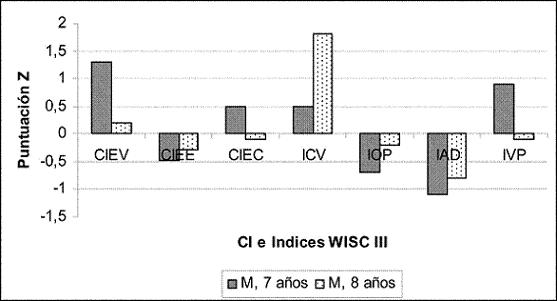
<body><![CDATA[<p style="margin: 5pt 206.25pt 0.0001pt 0cm; text-align: justify; text-indent: 14.2pt; line-height: 150%;"><span style="font-family: Arial;" lang="ES-UY">No hay antecedentes patol&oacute;gicos prenatales ni perinatales. El desarrollo en los primeros a&ntilde;os de vida es normal seg&uacute;n historia m&eacute;dica. Se excluyen problem&aacute;ticas afectivas de entidad y d&eacute;ficits sensoriales. El ambiente familiar y socio educativo es favorable.<o:p></o:p></span></p>      <p style="margin: 5pt 206.25pt 0.0001pt 0cm; text-align: justify; line-height: 150%;"><span style="font-family: Arial;" lang="ES-UY"><o:p>&nbsp;</o:p></span></p>      <p style="margin: 5pt 206.25pt 0.0001pt 0cm; text-align: justify; line-height: 200%;"><span style="font-family: Arial;" lang="ES-UY">Caso 1<o:p></o:p></span></p>      <p style="margin: 5pt 206.25pt 0.0001pt 0cm; text-align: justify; text-indent: 14.2pt; line-height: 150%;"><span style="font-family: Arial;" lang="ES-UY">Mart&iacute;n es derivado desde la instituci&oacute;n educativa a consulta psicomotriz y m&eacute;dica por distractibilidad al cursar la &uacute;ltima etapa de educaci&oacute;n inicial. Se indica estudio psicol&oacute;gico que informa sobre buena capacidad intelectual y ausencia de trastornos emocionales severos. Ante indicadores de disgraf&iacute;a se inicia tratamiento psicomotriz con alta frecuencia durante 2 a&ntilde;os consecutivos. A los 6 a&ntilde;os, ante la persistencia de la distractibilidad, se realiza nueva consulta m&eacute;dica quien realiza diagn&oacute;stico presuntivo de TDAH y solicita estudio psicopedag&oacute;gico. Se inicia tratamiento farmacol&oacute;gico con Metilfenidato. Su historia escolar, el estudio psicopedag&oacute;gico destaca que m&aacute;s all&aacute; de la persistencia de una disgraf&iacute;a resistente a la intervenci&oacute;n Mart&iacute;n aprende idiomas con facilidad y asimila informaci&oacute;n relacionada con ciencias sociales o naturales de forma adecuada. Sin embargo el aprendizaje de la lectura, escritura y aritm&eacute;tica se desarrolla con dificultad. Ambos padres son profesionales. Se reportan dificultades en la concentraci&oacute;n en varios miembros del grupo familiar. <o:p></o:p></span></p>      <p style="margin: 5pt 206.25pt 0.0001pt 0cm; text-align: justify; line-height: 200%;"><span style="font-family: Arial;" lang="ES-UY"><o:p>&nbsp;</o:p></span></p>      <p style="margin: 5pt 206.25pt 0.0001pt 0cm; text-align: justify; line-height: 200%;"><span style="font-family: Arial;" lang="ES-UY">Caso 2<o:p></o:p></span></p>      <p style="margin: 5pt 206.25pt 0.0001pt 0cm; text-align: justify; text-indent: 14.2pt; line-height: 150%;"><span style="font-family: Arial;" lang="ES-UY">Maia es derivada a la consulta psicopedag&oacute;gica por la instituci&oacute;n educativa al comenzar 2&deg; a&ntilde;o escolar (8 a&ntilde;os) para indagar espec&iacute;ficamente sus dificultades en aritm&eacute;tica. En anamnesis con padres se informa de un desarrollo neuropsicol&oacute;gico y afectivo normal, sin dificultades en los aprendizajes relacionados con la lengua oral y escrita. Fue promovida con buena calificaci&oacute;n en su primer a&ntilde;o escolar. Sus padres observan que Maia progresa lentamente en el &aacute;rea de matem&aacute;tica, y optaron por iniciar apoyo extraescolar durante primer a&ntilde;o escolar. En 2&ordm; a&ntilde;o escolar, cambia de instituciones escolar, donde se eval&uacute;a la pronta necesidad de indagar sus dificultades en matem&aacute;tica. Los padres, ambos profesionales no reportan antecedentes de dificultades de aprendizaje. <o:p></o:p></span></p>      <p style="margin: 5pt 206.25pt 0.0001pt 0cm; text-align: justify; text-indent: 14.2pt; line-height: 150%;"><span style="font-family: Arial;" lang="ES-UY"><o:p>&nbsp;</o:p></span></p>      <p style="margin: 5pt 206.25pt 0.0001pt 0cm; text-align: justify; text-indent: 14.2pt; line-height: 150%;"><span style="font-family: Arial;" lang="ES-UY">A continuaci&oacute;n se presentar&aacute; la informaci&oacute;n seleccionada relevante para el diagn&oacute;stico psicopedag&oacute;gico el cual recoge datos sobre: (1) ambiente familiar y escolar (2) desarrollo neuropsicol&oacute;gico, afectivo y cognitivo (3) capacidad intelectual, (4) procesos cognitivos b&aacute;sicos o neuropsicol&oacute;gicos de Lenguaje, Memoria de Trabajo y Organizaci&oacute;n Visoespacial, procesos cognitivos espec&iacute;ficos implicados en (3) Lectura, Escritura y (4) Aritm&eacute;tica, (5) aprendizajes curriculares. <o:p></o:p></span></p>      <p style="margin: 5pt 206.25pt 0.0001pt 0cm; text-align: justify; text-indent: 14.2pt; line-height: 150%;"><span style="font-family: Arial;" lang="ES-UY"><o:p>&nbsp;</o:p></span></p>      ]]></body>
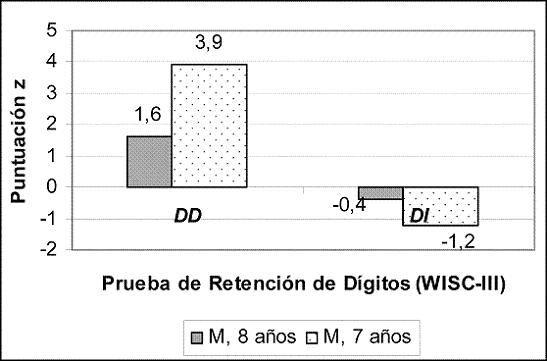
<body><![CDATA[<p style="margin: 5pt 206.25pt 0.0001pt 0cm; text-align: justify; text-indent: 14.2pt; line-height: 150%;"><span style="font-family: Arial;" lang="ES-UY">La <a href="#g1">Figura 1</a> ilustra puntajes tipificados que informan sobre rendimiento en procesos cognitivos neuropsicol&oacute;gicos o b&aacute;sicos tomando como referencia la Escala de Inteligencia para Ni&ntilde;os WISC III. Dicha escala informa sobre ausencia de retraso intelectual, diferencia significativa entre funcionamiento verbal y visoespacial en la l&iacute;nea de los hallazgos mencionados (<a href="#Rourke1">Rourke</a>, 1993; <a href="#Miranda">Miranda</a>, 2006, Rotzer et al, 2009; <a name="Dehane2001."></a><a href="#Dehaene">Dehane</a>, 2001). No se informan resultados de CI total ya que este valor debe desestimarse por la diferencia entre Escala Ejecutiva y Verbal. El Lenguaje evaluado en componentes de conceptualizaci&oacute;n, razonamiento y abstracci&oacute;n verbal a trav&eacute;s del &Iacute;ndice de Comprensi&oacute;n Verbal (WISC III) refleja una fortaleza cognitiva en ambos sujetos, especialmente en el caso de Mart&iacute;n, donde demuestra un desempe&ntilde;o casi 2 DS por encima de la media poblacional. <o:p></o:p></span></p>      <p style="margin: 5pt 206.25pt 0.0001pt 0cm; text-align: justify; text-indent: 14.2pt; line-height: 150%;"><span style="font-family: Arial;" lang="ES-UY"><o:p>&nbsp;</o:p></span></p>      <p style="margin: 5pt 206.25pt 0.0001pt 0cm; text-align: justify; text-indent: 14.2pt; line-height: 150%;"><a name="g1"></a><img id="_x0000_i1025" src="../../../../../img/revistas/cp/v4n1/1a02g1.jpg" style="border-style: solid; border-width: 1px; height: 301px; width: 557px;" border="0" height="32" width="32"><span style="font-family: Arial;" lang="ES-UY"><o:p></o:p></span></p>      <p style="margin: 5pt 206.25pt 0.0001pt 0cm; text-align: justify; line-height: 120%;"><span style="font-family: Arial;" lang="ES-UY"><o:p>&nbsp;</o:p></span></p>      <p style="margin: 5pt 206.25pt 0.0001pt 0cm; text-align: justify; text-indent: 14.2pt; line-height: 120%;"><span style="font-family: Arial;" lang="ES-UY">Figura 1. Nivel Intelectual y procesos cognitivos b&aacute;sicos<o:p></o:p></span></p>      <p style="margin: 5pt 206.25pt 0.0001pt 0cm; text-align: justify; line-height: 150%;"><span style="font-family: Arial;" lang="ES-UY"><o:p>&nbsp;</o:p></span></p>      <p style="margin: 5pt 206.25pt 0.0001pt 0cm; text-align: justify; text-indent: 14.2pt; line-height: 150%;"><span style="font-family: Arial;" lang="ES-UY">El IAD como puede apreciarse en la <a href="#g1">Figura 1</a> muestra un descenso pr&oacute;ximo a 1 DS dado que este &iacute;ndice se compone por el subtest de Aritm&eacute;tica y el de Retenci&oacute;n de D&iacute;gitos (RD). Se profundiza el an&aacute;lisis al poder discriminar el recuerdo de d&iacute;gitos directo del recuerdo de d&iacute;gitos inverso, ya que la literatura relaciona a D&iacute;gitos Directo (DD) con una memoria m&aacute;s pasiva y D&iacute;gitos Inverso (DI) con memoria de trabajo. Los resultados representados en la <a href="#g2">Figura 2</a> son elocuentes de la diferencia en ambos sujetos entre sostener informaci&oacute;n de forma pasiva a sostener y procesar activamente la informaci&oacute;n. El instrumento elegido de evaluaci&oacute;n (retenci&oacute;n de d&iacute;gitos) exige considerar aportes de algunos investigadores (<a href="#Siegel">Siegel &amp; Ryan</a>, 1989, Mac Lean &amp; Hitch, 1999) referentes a la existencia de un almac&eacute;n espec&iacute;fico para la informaci&oacute;n num&eacute;rica. Es decir, resta analizar si la debilidad evidenciada responder&iacute;a a un d&eacute;ficit de memoria de trabajo de forma gen&eacute;rica o a un d&eacute;ficit espec&iacute;fico cuando se procesa informaci&oacute;n num&eacute;rica.<o:p></o:p></span></p>      <p style="margin: 5pt 206.25pt 0.0001pt 0cm; text-align: justify; text-indent: 14.2pt; line-height: 150%;"><span style="font-family: Arial;" lang="ES-UY"><o:p>&nbsp;</o:p></span></p>      <p style="margin: 5pt 206.25pt 0.0001pt 0cm; text-align: justify; text-indent: 14.2pt; line-height: 150%;"><a name="g2"></a><img id="_x0000_i1026" src="../../../../../img/revistas/cp/v4n1/1a02g2.jpg" style="border-style: solid; border-width: 1px; height: 361px; width: 547px;" border="0" height="32" width="32"><span style="font-family: Arial;" lang="ES-UY"><o:p></o:p></span></p>      <p style="margin: 5pt 206.25pt 0.0001pt 0cm; text-align: justify; text-indent: 14.2pt; line-height: 150%;"><span style="font-family: Arial;" lang="ES-UY"><o:p>&nbsp;</o:p></span></p>      ]]></body>
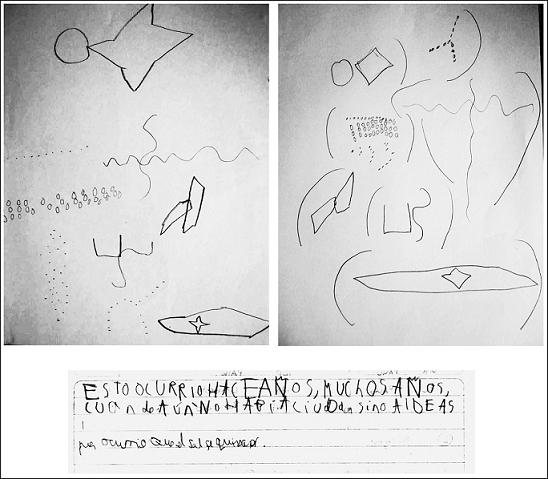
<body><![CDATA[<p style="margin: 5pt 206.25pt 0.0001pt 0cm; text-align: justify; text-indent: 14.2pt; line-height: 150%;"><span style="font-family: Arial;" lang="ES-UY">Figura 2. Tipificaci&oacute;n discriminada entre D&iacute;gitos Directo y D&iacute;gitos Inverso (WISC III).<o:p></o:p></span></p>      <p style="margin: 5pt 206.25pt 0.0001pt 0cm; text-align: justify; line-height: 120%;"><span style="font-family: Arial;" lang="ES-UY"><o:p>&nbsp;</o:p></span></p>      <p style="margin: 5pt 206.25pt 0.0001pt 0cm; text-align: justify; text-indent: 14.2pt; line-height: 150%;"><span style="font-family: Arial;" lang="ES-UY">Se estudia tambi&eacute;n la coordinaci&oacute;n visomotora y la grafomotricidad propia de la escritura. La <a href="#f1">figura 3</a> muestra el desempe&ntilde;o en Bender quien muestran retrasos de valor diagn&oacute;stico. A su vez, lo que en Maia resultan indicadores de una disgraf&iacute;a de leve entidad en Mart&iacute;n constituye una clara disgrafia, a&uacute;n luego de dos a&ntilde;os de tratamiento psicomotriz. Estos hallazgos podr&iacute;an formar parte de la t&eacute;trada de Gertsman as&iacute; como las evidencias de <a href="#Yeo">Yeo</a> (2003) y <a href="#Dansilio2">Dansilio</a> (2008b) en cuanto a la asociaci&oacute;n entre DAC y trastornos de la psicomotricidad. <o:p></o:p></span></p>      <p style="margin: 5pt 206.25pt 0.0001pt 0cm; text-align: justify; line-height: 150%;"><span style="font-family: Arial;" lang="ES-UY"><o:p>&nbsp;</o:p></span></p>      <p style="margin: 5pt 206.25pt 0.0001pt 0cm; text-align: justify; text-indent: 14.2pt; line-height: 150%;"><a name="f1"></a><img id="_x0000_i1027" src="../../../../../img/revistas/cp/v4n1/1a02f1.jpg" style="border-style: solid; border-width: 1px; height: 479px; width: 548px;" border="0" height="32" width="32"><span style="font-family: Arial;" lang="ES-UY"><o:p></o:p></span></p>      <p style="margin: 5pt 206.25pt 0.0001pt 0cm; text-align: justify; line-height: 150%;"><span style="font-family: Arial;" lang="ES-UY"><o:p>&nbsp;</o:p></span></p>      <p style="margin: 5pt 206.25pt 0.0001pt 0cm; text-align: justify; text-indent: 14.2pt; line-height: 120%;"><span style="font-family: Arial;" lang="ES-UY">Figura 3. Coordinaci&oacute;n visomotora y grafomotricidad<o:p></o:p></span></p>      <p style="margin: 5pt 206.25pt 0.0001pt 0cm; text-align: justify; text-indent: 14.2pt; line-height: 150%;"><span style="font-family: Arial;" lang="ES-UY"><o:p>&nbsp;</o:p></span></p>      <p style="margin: 5pt 206.25pt 0.0001pt 0cm; text-align: justify; text-indent: 14.2pt; line-height: 150%;"><span style="font-family: Arial;" lang="ES-UY">La evaluaci&oacute;n de los procesos lectores demuestra en ambos sujetos desempe&ntilde;os con variaciones normales que permiten descartar Dificultades Lectoras. <o:p></o:p></span></p>      <p style="margin: 5pt 206.25pt 0.0001pt 0cm; text-align: justify; text-indent: 14.2pt; line-height: 150%;"><span style="font-family: Arial;" lang="ES-UY"><o:p>&nbsp;</o:p></span></p>      ]]></body>
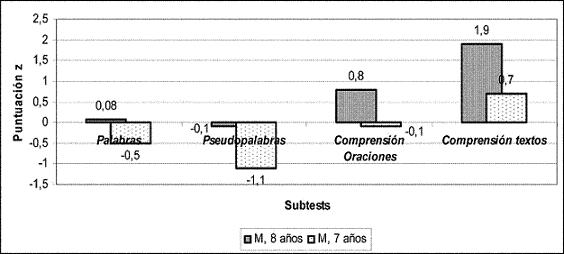
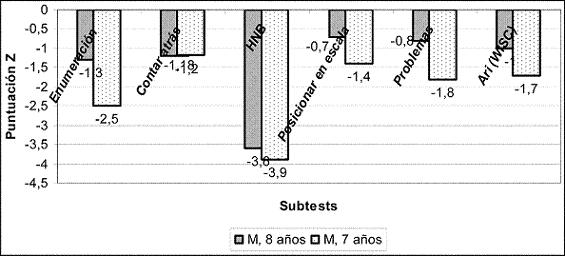
<body><![CDATA[<p style="margin: 5pt 206.25pt 0.0001pt 0cm; text-align: justify; text-indent: 14.2pt; line-height: 150%;"><span style="font-family: Arial;" lang="ES-UY">En la <a href="#g3">Figura 4</a> se muestra el desempe&ntilde;o en Lectura evaluado a trav&eacute;s de Prolec-R (2007). En Lectura de Pseudopalabras Maia muestra bajo rendimiento pero de acuerdo a la valoraci&oacute;n cl&iacute;nica, no reviste significatividad. Se observa una estrategia poco anal&iacute;tica e impulsiva para leer pseudopalabras, aspecto que mejora r&aacute;pidamente con la intervenci&oacute;n. El desempe&ntilde;o en Comprensi&oacute;n Lectora se sit&uacute;a en ambos sujetos por encima del Promedio. Mart&iacute;n evidencia un destacado desempe&ntilde;o en Comprensi&oacute;n Lectora asociado con la capacidad en razonamiento verbal evidenciada a trav&eacute;s del ICV (WISC III). <o:p></o:p></span></p>      <p style="margin: 5pt 206.25pt 0.0001pt 0cm; text-align: justify; text-indent: 14.2pt; line-height: 150%;"><span style="font-family: Arial;" lang="ES-UY"><o:p>&nbsp;</o:p></span></p>      <p style="margin: 5pt 206.25pt 0.0001pt 0cm; text-align: justify; line-height: 150%;"><a name="g3"></a><img id="_x0000_i1028" src="../../../../../img/revistas/cp/v4n1/1a02g3.jpg" style="border-style: solid; border-width: 1px; height: 254px; width: 564px;" border="0" height="32" width="32"><span style="font-family: Arial;" lang="ES-UY"><o:p></o:p></span></p>      <p style="margin: 5pt 206.25pt 0.0001pt 0cm; text-align: justify; line-height: 120%;"><span style="font-family: Arial;" lang="ES-UY">Figura 4. Desempe&ntilde;o en lectura (Prolec-R)</span></p>      <p style="margin: 5pt 206.25pt 0.0001pt 0cm; text-align: justify; line-height: 120%;"><span style="font-family: Arial;" lang="ES-UY"><o:p>&nbsp;</o:p></span></p>      <p style="margin: 5pt 206.25pt 0.0001pt 0cm; text-align: justify; text-indent: 14.2pt; line-height: 150%;"><span style="font-family: Arial;" lang="ES-UY">La perfomance reflejada por ambos sujetos en Comprensi&oacute;n Lectora refleja destrezas desatacadas en habilidades inferenciales. Estas sugieren buena capacidad intelectual y son indicadores de un mejor pron&oacute;stico en lo que respecta a rendimiento acad&eacute;mico.<o:p></o:p></span></p>      <p style="margin: 5pt 206.25pt 0.0001pt 0cm; text-align: justify; text-indent: 14.2pt; line-height: 150%;"><span style="font-family: Arial;" lang="ES-UY"><o:p>&nbsp;</o:p></span></p>      <p style="margin: 5pt 206.25pt 0.0001pt 0cm; text-align: justify; text-indent: 14.2pt; line-height: 150%;"><span style="font-family: Arial;" lang="ES-UY">La evaluaci&oacute;n de Aritm&eacute;tica se basa en t&eacute;cnicas cualitativas de: entrevista docente, an&aacute;lisis de resultados escolares y t&eacute;cnicas cuantitativas: Test Pro-C&aacute;lculo (2006), subtest de Aritm&eacute;tica de la Escala <a href="#Weschler">Weschler</a>. Los resultados tipificados de las t&eacute;cnicas cuantitativas se pueden apreciar en la <a href="#g4">figura 5</a>.<o:p></o:p></span></p>      <p style="margin: 5pt 206.25pt 0.0001pt 0cm; text-align: justify; line-height: 150%;"><span style="font-family: Arial;" lang="ES-UY"><o:p>&nbsp;</o:p></span></p>      <p style="margin: 5pt 206.25pt 0.0001pt 0cm; text-align: justify; line-height: 150%;"><a name="g4"></a><img id="_x0000_i1029" src="../../../../../img/revistas/cp/v4n1/1a02g4.jpg" style="border-style: solid; border-width: 1px; height: 256px; width: 565px;" border="0" height="32" width="32"><span style="font-family: Arial;" lang="ES-UY"><o:p></o:p></span></p>      ]]></body>
<body><![CDATA[<p style="margin: 5pt 206.25pt 0.0001pt 0cm; text-align: justify; line-height: 150%;"><span style="font-family: Arial;" lang="ES-UY"><o:p>&nbsp;</o:p></span></p>      <p style="margin: 5pt 206.25pt 0.0001pt 0cm; text-align: justify; line-height: 120%;"><span style="font-family: Arial;" lang="ES-UY">Figura 5. Desempe&ntilde;o en Matem&aacute;tica (Pro-C&aacute;lculo y WISC-III)<o:p></o:p></span></p>      <p style="margin: 5pt 206.25pt 0.0001pt 0cm; text-align: justify; line-height: 150%;"><span style="font-family: Arial;" lang="ES-UY"><o:p>&nbsp;</o:p></span></p>      <p style="margin: 5pt 206.25pt 0.0001pt 0cm; text-align: justify; text-indent: 14.2pt; line-height: 150%;"><span style="font-family: Arial;" lang="ES-UY">Los dos primeros subtest (Enumeraci&oacute;n y Contar para Atr&aacute;s) evidencian las estrategias inmaduras de conteo. Los sujetos muestran dificultad para cumplir con indicadores de conteo (<a name="Gelman1978."></a><a href="#Gelman">Gelman &amp; Gallistel</a>, 1978) de correspondencia y de cardinalidad. Los errores m&aacute;s frecuentes observados se producen por desorganizaci&oacute;n al reiterar objetos ya contados, o por fallas en la monitorizaci&oacute;n al &ldquo;perder la cuenta&rdquo; cuando la configuraci&oacute;n espacial de los objetos exige detenerse para planificar la secuencia. Ante esto, en ocasiones, se observa la decisi&oacute;n de volver a contar, pero en otras, la fatiga y la falta de confianza en poder realizarlo mejor, limita un nuevo intento.<o:p></o:p></span></p>      <p style="margin: 5pt 206.25pt 0.0001pt 0cm; text-align: justify; text-indent: 14.2pt; line-height: 150%;"><span style="font-family: Arial;" lang="ES-UY"><o:p>&nbsp;</o:p></span></p>      <p style="margin: 5pt 206.25pt 0.0001pt 0cm; text-align: justify; text-indent: 14.2pt; line-height: 150%;"><span style="font-family: Arial;" lang="ES-UY">Los resultados en el subtest de HNB sit&uacute;an a ambos sujetos en un nivel de severidad que exime de mayor explicaci&oacute;n. Desde el an&aacute;lisis de las estrategias empleadas por los sujetos podemos aportar que la ausencia de HNB, remite a la puesta en marcha de estrategias ineficaces, o en casos m&aacute;s extremos, a la ausencia de estrategias. Maia evidencia desconocer un procedimiento a partir del cual una situaci&oacute;n inicial con dos cantidades simples para los que alcanzar&iacute;an los dedos de la mano, pueda transformarse a trav&eacute;s de un operador en otra situaci&oacute;n final. <o:p></o:p></span></p>      <p style="margin: 5pt 206.25pt 0.0001pt 0cm; text-align: justify; text-indent: 14.2pt; line-height: 150%;"><span style="font-family: Arial;" lang="ES-UY"><o:p>&nbsp;</o:p></span></p>      <p style="margin: 5pt 206.25pt 0.0001pt 0cm; text-align: justify; text-indent: 14.2pt; line-height: 150%;"><span style="font-family: Arial;" lang="ES-UY">Es as&iacute; que cuando el entrevistador proporciona ayudas gr&aacute;ficas espec&iacute;ficas para andamiar en la resoluci&oacute;n, las acciones de Maia reflejan &uacute;nicamente conceptualizaciones est&eacute;ticas y visuales de las cifras: las enlaza para formar un nuevo signo, las decora. <o:p></o:p></span></p>      <p style="margin: 5pt 206.25pt 0.0001pt 0cm; text-align: justify; line-height: 150%;"><span style="font-family: Arial;" lang="ES-UY"><o:p>&nbsp;</o:p></span></p>      <p style="margin: 5pt 206.25pt 0.0001pt 0cm; text-align: justify; text-indent: 14.2pt; line-height: 150%;"><span style="font-family: Arial;" lang="ES-UY">En cambio Mart&iacute;n, intenta operar utilizando recursos auxiliares como la recta num&eacute;rica. Se observa que alterna entre estrategias de sobreconteo y otras m&aacute;s primitivas como volver a contar todo (<a href="#Brissiaud">Brissiaud</a>, 1986).<o:p></o:p></span></p>      ]]></body>
<body><![CDATA[<p style="margin: 5pt 206.25pt 0.0001pt 0cm; text-align: justify; line-height: 150%;"><span style="font-family: Arial;" lang="ES-UY"><o:p>&nbsp;</o:p></span></p>      <p style="margin: 5pt 206.25pt 0.0001pt 0cm; text-align: justify; text-indent: 14.2pt; line-height: 150%;"><span style="font-family: Arial;" lang="ES-UY">Con respecto a la Resoluci&oacute;n de Problemas, hay variaciones importantes entre un sujeto y otro. Mart&iacute;n identifica la naturaleza del problema, as&iacute; como las operaciones requeridas para solucionarlo. Sus fallas se producen en la realizaci&oacute;n de los algoritmos, que involucran problemas de m&uacute;ltiples pasos (<a href="#Gifford">Gifford</a>, 2005). Retener un resultado en su memoria de trabajo para asociarlo a un nuevo c&aacute;lculo se constituye en un obst&aacute;culo insalvable. <o:p></o:p></span></p>      <p style="margin: 5pt 206.25pt 0.0001pt 0cm; text-align: justify; line-height: 150%;"><span style="font-family: Arial;" lang="ES-UY"><o:p>&nbsp;</o:p></span></p>      <p style="margin: 5pt 206.25pt 0.0001pt 0cm; text-align: justify; text-indent: 14.2pt; line-height: 150%;"><span style="font-family: Arial;" lang="ES-UY">Maia, a pesar de su adecuado desarrollo ling&uuml;&iacute;stico y buena comprensi&oacute;n de textos, no puede identificar la operaci&oacute;n requerida. Utiliza sus fortalezas verbales explicando la argumentaci&oacute;n del problema, pero no puede proponer una operaci&oacute;n que se vincule con la situaci&oacute;n problema. <o:p></o:p></span></p>      <p style="margin: 5pt 206.25pt 0.0001pt 0cm; text-align: justify; line-height: 150%;"><span style="font-family: Arial;" lang="ES-UY"><o:p>&nbsp;</o:p></span></p>      <p style="margin: 5pt 206.25pt 0.0001pt 0cm; text-align: center; line-height: 150%;" align="center"><b><span style="font-family: Arial;" lang="ES-UY">DISCUSI&Oacute;N Y CONCLUSIONES</span></b><span style="font-family: Arial;" lang="ES-UY"><o:p></o:p></span></p>      <p style="margin: 5pt 206.25pt 0.0001pt 0cm; text-align: justify; line-height: 150%;"><span style="font-family: Arial;" lang="ES-UY"><o:p>&nbsp;</o:p></span></p>      <p style="margin: 5pt 206.25pt 0.0001pt 0cm; text-align: justify; line-height: 150%;"><span style="font-family: Arial;" lang="ES-UY">Esta presentaci&oacute;n tiene por objetivo proporcionar evidencia cl&iacute;nica al diagn&oacute;stico psicopedag&oacute;gico de Discalculia del Desarrollo (DD) que permita la identificaci&oacute;n de necesidades educativas especiales de forma temprana.<o:p></o:p></span></p>      <p style="margin: 5pt 206.25pt 0.0001pt 0cm; text-align: justify; line-height: 150%;"><span style="font-family: Arial;" lang="ES-UY"><o:p>&nbsp;</o:p></span></p>      <p style="margin: 5pt 206.25pt 0.0001pt 0cm; text-align: justify; line-height: 150%;"><span style="font-family: Arial;" lang="ES-UY">Los casos presentados cumplen los criterios exclusi&oacute;n de ausencia de retraso intelectual,<o:p></o:p></span></p>      ]]></body>
<body><![CDATA[<p style="margin: 5pt 206.25pt 0.0001pt 0cm; text-align: justify; line-height: 150%;"><span style="font-family: Arial;" lang="ES-UY">alteraciones sensoriales, emocionales y adecuado ambiente escolar y familiar. Con respecto a los procesos espec&iacute;ficos involucrados en el c&aacute;lculo, ambos sujetos muestran d&eacute;ficits en la comprensi&oacute;n del n&uacute;mero y la realizaci&oacute;n de c&aacute;lculos elementales. Su perfil de rendimiento matem&aacute;tico es heterog&eacute;neo como lo describe la literatura (<a name="Dowker2004."></a><a href="#Dowker1">Dowker</a>, 2004), sujetos con DD pueden presentar diferentes puntos fuertes y d&eacute;biles en su propio perfil de rendimiento matem&aacute;tico. Andersson (2010) describe los cuatro componentes afectados en los sujetos con discalculia: hechos num&eacute;ricos, conceptos, procedimientos, y resoluci&oacute;n de problemas, concluyendo que diferentes sujetos pueden mostrar variabilidad en los mismos. Nuestros casos aportan evidencia en este sentido, Mart&iacute;n muestra afectado &uacute;nicamente el componente de Hechos Num&eacute;ricos (HN) y Procedimiento, con buena capacidad de Resoluci&oacute;n de Problemas y Conceptos. Maia, en cambio, muestra afectados los cuatro componentes.<o:p></o:p></span></p>      <p style="margin: 5pt 206.25pt 0.0001pt 0cm; text-align: justify; line-height: 150%;"><span style="font-family: Arial;" lang="ES-UY"><o:p>&nbsp;</o:p></span></p>      <p style="margin: 5pt 206.25pt 0.0001pt 0cm; text-align: justify; line-height: 150%;"><span style="font-family: Arial;" lang="ES-UY">Si bien la literatura no termina de ser concluyente al documentar la relaci&oacute;n entre funciones visoespaciales y DD (<a name="Gevers2010."></a><a href="#Gevers">Gevers</a> et al. 2010), los dos casos presentados, documentan dicha correlaci&oacute;n te&oacute;rica. Vukovic, R.&amp; Siegel, L. (2010) tampoco identifica relaci&oacute;n entre memoria de trabajo visoespacial y DD, pero ante la profusa evidencia que las asocia, proponen que dicha relaci&oacute;n, puede constituir uno de los subtipos de DD.<o:p></o:p></span></p>      <p style="margin: 5pt 206.25pt 0.0001pt 0cm; text-align: justify; line-height: 150%;"><span style="font-family: Arial;" lang="ES-UY"><o:p>&nbsp;</o:p></span></p>      <p style="margin: 5pt 206.25pt 0.0001pt 0cm; text-align: justify; line-height: 150%;"><span style="font-family: Arial;" lang="ES-UY">Al discutir sobre las razones del subdiagn&oacute;stico, identificamos como una fuente de explicaci&oacute;n la afectaci&oacute;n intensa en las funciones visoespaciales. Una discrepancia significativa verbal-no verbal es com&uacute;nmente atendida y orientada hacia servicios de asistencia psicomotriz. Dado que esta dificultad es severa y persistente, los sujetos contin&uacute;an necesitando asistencia psicomotriz dejando encubierta la semiolog&iacute;a de la DD identificable a trav&eacute;s del diagn&oacute;stico psicopedag&oacute;gico. Subrayamos la importancia del rol docente que seg&uacute;n reportan nuestros casos, fueron agentes claves de la detecci&oacute;n y derivaci&oacute;n temprana. En cambio se observ&oacute; en los servicios de salud procedimientos diagn&oacute;sticos que no incluyeron la hip&oacute;tesis de la DD y por tanto, dilataron su identificaci&oacute;n. <o:p></o:p></span></p>      <p style="margin: 5pt 206.25pt 0.0001pt 0cm; text-align: justify; line-height: 150%;"><span style="font-family: Arial;" lang="ES-UY">En la revisi&oacute;n realizada por <a href="#Dowker1">Dowker</a> (2004) referente a las acciones educativas y psicopedag&oacute;gicas indicadas para las DD, hace menci&oacute;n enf&aacute;tica a las oportunidades de cambio y progreso, con intervenciones tempranas, intensivas e individualizadas. No estaremos en condiciones de ofrecer esta respuesta mientras no realicemos diagn&oacute;sticos apropiados. Compartimos con <a href="#Dowker1">Dowker</a> (2004) como otra explicaci&oacute;n del subdiagn&oacute;stico, su preocupaci&oacute;n referente a la fragmentaci&oacute;n de la abundante evidencia cient&iacute;fica referente a la DD. Las neurociencias, la psicolog&iacute;a educativa y la did&aacute;ctica de las matem&aacute;ticas avanzan en l&iacute;neas de investigaci&oacute;n paralelas, lo cual limita un real aprovechamiento de la misma en &aacute;mbitos educativos. Apostamos a que la psicopedagog&iacute;a en su car&aacute;cter aplicado y transdisciplinar contribuya ante la necesidad de poner la investigaci&oacute;n al servicio de una respuesta educativa temprana, preventiva y por tanto compensadora de las necesidades de los alumnos. </span><span style="font-family: Arial;"><o:p></o:p></span></p>      <p style="margin: 2.85pt 206.25pt 0.0001pt 0cm; text-align: justify; text-indent: 2.85pt; line-height: 150%;"><span style="font-family: Arial;"><o:p>&nbsp;</o:p></span></p>      <p style="margin: 2.85pt 206.25pt 0.0001pt 0cm; text-align: center; text-indent: 2.85pt; line-height: 150%;" align="center"><b><span style="font-family: Arial;"><o:p>&nbsp;</o:p></span></b></p>      <p style="margin: 2.85pt 206.25pt 0.0001pt 0cm; text-align: center; text-indent: 2.85pt; line-height: 150%;" align="center"><b><span style="font-family: Arial;">REFERENCIAS</span></b><o:p></o:p></p>      <p style="margin: 2.85pt 206.25pt 0.0001pt 0cm; text-align: center; text-indent: 2.85pt; line-height: 150%;" align="center"><span style="font-family: Arial;"><o:p>&nbsp;</o:p></span></p>      ]]></body>
<body><![CDATA[<!-- ref --><p style="margin: 5pt 206.25pt 0.0001pt 14.2pt; text-align: justify; text-indent: -14.2pt; line-height: 150%;"><a name="Alsina1"></a><span style="font-family: Arial;"><a href="#Alsina2007.">Alsina, A. (2007)</a>.</span><span style="font-family: Arial;" lang="ES-UY">&iquest;Por qu&eacute; algunos ni&ntilde;os tienen dificultades para calcular? Una aproximaci&oacute;n desde el estudio de la memoria humana. Revista Latinoamericana de Investigaci&oacute;n en Matem&aacute;tica Educativa, 10 ( 3): 315-333.    <o:p></o:p></span></p>      <!-- ref --><p style="margin: 5pt 206.25pt 0.0001pt 14.2pt; text-align: justify; text-indent: -14.2pt; line-height: 150%;"><a name="Alsina2"></a><span style="font-family: Arial;"><a href="#Alsina2003.">Alsina, A., &amp; <span style="">&nbsp;</span>Saiz, D. ( 2003)</a>. </span><span style="font-family: Arial;" lang="ES-UY">Un an&aacute;lisis comparativo del papel del bucle fonol&oacute;gico versus la agenda viso-espacial en el c&aacute;lculo en ni&ntilde;os de 7-8 a&ntilde;os. </span><span class="SpellE"><span style="font-family: Arial;" lang="EN-GB">Psicothema</span></span><span style="font-family: Arial;" lang="EN-GB">, 15 <span class="GramE">( 2</span>): 241-246.    <o:p></o:p></span></p>      <!-- ref --><p style="margin: 5pt 206.25pt 0.0001pt 14.2pt; text-align: justify; text-indent: -14.2pt; line-height: 150%;"><a name="American"></a><span style="font-family: Arial;" lang="EN-US"><a href="#American1995.">American Psychiatric <span class="GramE">Association <span style="">&nbsp;</span>(</span> 1995)</a>. Diagnostic and statistical manual of mental disorders, (4&ordf; <span class="GramE">ed</span>.). </span><span style="font-family: Arial;">Washington DC, EEUU: American Psychiatric Association.    <o:p></o:p></span></p>      <!-- ref --><p style="margin: 5pt 206.25pt 0.0001pt 14.2pt; text-align: justify; text-indent: -14.2pt; line-height: 150%;"><span style="font-family: Arial;" lang="ES-UY">Balbi, A. (2008). Dificultades del C&aacute;lculo en la Cl&iacute;nica Psicopedag&oacute;gica. Poster presentado en Congreso Internacional de Neuropsicolog&iacute;a, Buenos Aires, Argentina.    <o:p></o:p></span></p>      <!-- ref --><p style="margin: 5pt 206.25pt 0.0001pt 14.2pt; text-align: justify; text-indent: -14.2pt; line-height: 150%;"><a name="Baroody"></a><span style="font-family: Arial;" lang="ES-UY"><a href="#Baroody1988.">Baroody, A. (1988)</a>. El pensamiento matem&aacute;tico de los ni&ntilde;os. Un marco evolutivo para maestros de preescolar, ciclo inicial y educaci&oacute;n especial. Madrid: Aprendizaje Visor.     <o:p></o:p></span></p>      ]]></body>
<body><![CDATA[<!-- ref --><p style="margin: 5pt 206.25pt 0.0001pt 14.2pt; text-align: justify; text-indent: -14.2pt; line-height: 150%;"><span style="font-family: Arial;" lang="ES-UY">Bermejo, V. (2004). C&oacute;mo ense&ntilde;ar matem&aacute;ticas para aprender mejor. Madrid: Editorial CCS.     <o:p></o:p></span></p>      <!-- ref --><p style="margin: 5pt 206.25pt 0.0001pt 14.2pt; text-align: justify; text-indent: -14.2pt; line-height: 150%;"><a name="Brissiaud"></a><span style="font-family: Arial;" lang="ES-UY"><a href="#Brissiaud1986.">Brissiaud, R. (1986)</a>. El aprendizaje del c&aacute;lculo en los ni&ntilde;os. </span><st1:state><st1:place><span style="font-family: Arial;" lang="EN-US">Madrid</span></st1:place></st1:state><span style="font-family: Arial;" lang="EN-US">: Visor.     </span><span style="font-family: Arial;" lang="EN-GB"><o:p></o:p></span></p>      <!-- ref --><p style="margin: 5pt 206.25pt 0.0001pt 14.2pt; text-align: justify; text-indent: -14.2pt; line-height: 150%;"><a name="Bull"></a><span style="font-family: Arial;" lang="EN-US"><a href="#Bull1999.">Bull, R.; Johnston, R., &amp; Roy, J. (1999)</a>. Exploring the Roles of the Visual-Spatial Sketch Pan and Central Executive in <span class="SpellE">Childrens</span> Arithmetical Skills: view from cognition and developmental <span class="SpellE">neuropsychology</span>. Developmental <span class="SpellE">Neuropsychology</span>, 15 (3), 421-442.     </span><span style="font-family: Arial;" lang="EN-GB"><o:p></o:p></span></p>      <!-- ref --><p style="margin: 5pt 206.25pt 0.0001pt 14.2pt; text-align: justify; text-indent: -14.2pt; line-height: 150%;"><a name="Butterworth1"></a><span style="font-family: Arial;" lang="EN-US"><a href="#Butterworth2005.">Butterworth, B. (2005)</a>. <span class="GramE">Developmental dyscalculia.</span> En: Jamie ID Campbell (Ed), <span class="GramE">The</span> Handbook of Mathematical Cognition (pp. 455-467). </span><st1:state><st1:place><span style="font-family: Arial;" lang="EN-US">New York</span></st1:place></st1:state><span style="font-family: Arial;" lang="EN-US">: Psychology Press.    </span><span style="font-family: Arial;" lang="EN-GB"><o:p></o:p></span></p>      <!-- ref --><p style="margin: 5pt 206.25pt 0.0001pt 14.2pt; text-align: justify; text-indent: -14.2pt; line-height: 150%;"><a name="Butterworth2"></a><span class="GramE"><span style="font-family: Arial;" lang="EN-US"><a href="#Butterworth2007.">Butterworth, B., &amp; <span class="SpellE">Reigosa</span>, V. (2007)</a>.</span></span><span style="font-family: Arial;" lang="EN-US"> <span class="GramE">Information processing deficits in dyscalculia.</span> In <span class="GramE">Why</span> is math so hard for some children? <span class="GramE">The nature and origins of mathematical learning difficulties and disabilities.</span> </span><span style="font-family: Arial;" lang="ES-UY">(pp. 65-81): Baltimore, MD, US: Paul H Brookes Publishing.    <o:p></o:p></span></p>      ]]></body>
<body><![CDATA[<!-- ref --><p style="margin: 5pt 206.25pt 0.0001pt 14.2pt; text-align: justify; text-indent: -14.2pt; line-height: 150%;"><span style="font-family: Arial;" lang="ES-UY">Cuetos, F., Rodriguez, B. &amp; Ruano, E. (2007). Prolec-R: Bater&iacute;a de Evaluaci&oacute;n de los procesos lectores. Barcelona, Tea Ediciones.    <o:p></o:p></span></p>      <!-- ref --><p style="margin: 5pt 206.25pt 0.0001pt 14.2pt; text-align: justify; text-indent: -14.2pt; line-height: 150%;"><a name="Dansilio1"></a><span style="font-family: Arial;" lang="ES-UY"><a href="#Dansilio2008a.">Dansilio, S. (2008a)</a>. S&iacute;ndrome de Gerstmann del Desarrollo y trastornos en la adquisici&oacute;n de las matem&aacute;ticas. Ciencias Psicol&oacute;gicas, II (1), 55-64.     <o:p></o:p></span></p>      <!-- ref --><p style="margin: 5pt 206.25pt 0.0001pt 14.2pt; text-align: justify; text-indent: -14.2pt; line-height: 150%;"><a name="Dansilio2"></a><span style="font-family: Arial;" lang="ES-UY"><a href="#Dansilio2008b.">Dansilio, S. (2008b)</a>. El procesamiento del n&uacute;mero y el c&aacute;lculo: Las discalculias y las acalculias. </span><span class="SpellE"><span style="font-family: Arial;" lang="EN-US">Prensa</span></span><span style="font-family: Arial;" lang="EN-US"> <span class="SpellE">M&eacute;dica</span> <span class="SpellE">Latinoamericana</span>: </span><st1:city><st1:place><span style="font-family: Arial;" lang="EN-US">Montevideo</span></st1:place></st1:city><span style="font-family: Arial;    " lang="EN-US">. </span><span style="font-family: Arial;" lang="EN-GB"><o:p></o:p></span></p>      <!-- ref --><p style="margin: 5pt 206.25pt 0.0001pt 14.2pt; text-align: justify; text-indent: -14.2pt; line-height: 150%;"><a name="Dehaene"></a><a href="#Dehaene2001."><span class="SpellE"><span class="GramE"><span style="font-family: Arial;" lang="EN-US">Dehaene</span></span></span></a><span class="GramE"><span style="font-family: Arial;" lang="EN-US"><a href="#Dehaene2001.">, S. (2001)</a>.</span></span><span style="font-family: Arial;" lang="EN-US"> <span class="SpellE"><span class="GramE">Precis</span></span><span class="GramE"> of the number sense.</span> <span class="GramE">Mind and language, 16 (1), 16-36.    </span></span><span style="font-family: Arial;" lang="EN-GB"><o:p></o:p></span></p>      <!-- ref --><p style="margin: 5pt 206.25pt 0.0001pt 14.2pt; text-align: justify; text-indent: -14.2pt; line-height: 150%;"><a name="Dowker1"></a><a href="#Dowker2004."><span class="SpellE"><span style="font-family: Arial;" lang="EN-US">Dowker</span></span></a><span style="font-family: Arial;" lang="EN-US"><a href="#Dowker2004.">, A. (2004)</a> <span class="GramE">What</span> works for children with <span class="SpellE">Mathematicals</span> Difficulties? <span class="GramE">(Research Report, n&ordm; 554).</span> </span><st1:place><st1:placetype><span class="GramE"><span style="font-family: Arial;" lang="EN-US">University</span></span></st1:placetype><span class="GramE"><span style="font-family: Arial;" lang="EN-US"> of </span></span><st1:placename><span class="GramE"><span style="font-family: Arial;" lang="EN-US">Oxford</span></span></st1:placename></st1:place><span class="GramE"><span style="font-family: Arial;" lang="EN-US">, Department for Education and Skills.    </span></span><span style="font-family: Arial;" lang="EN-US"> </span><span style="font-family: Arial;" lang="EN-GB"><o:p></o:p></span></p>      ]]></body>
<body><![CDATA[<!-- ref --><p style="margin: 5pt 206.25pt 0.0001pt 14.2pt; text-align: justify; text-indent: -14.2pt; line-height: 150%;"><span class="SpellE"><span style="font-family: Arial;" lang="EN-US">Dowker</span></span><span style="font-family: Arial;" lang="EN-US">, A. (1998). <span class="GramE">Individual differences in normal arithmetical development.</span> <span class="GramE">En </span></span><st1:place><st1:city><span class="SpellE"><span class="GramE"><span style="font-family: Arial;" lang="EN-US">Donlan</span></span></span></st1:city><span class="GramE"><span style="font-family: Arial;" lang="EN-US">, </span></span><st1:country-region><span class="GramE"><span style="font-family: Arial;" lang="EN-US">Ch.</span></span></st1:country-region></st1:place><span style="font-family: Arial;" lang="EN-US"> <span class="GramE">The development of mathematical skills.</span> <span class="GramE">Hove: Psychology Press.    </span> </span><span style="font-family: Arial;" lang="EN-GB"><o:p></o:p></span></p>      <!-- ref --><p style="margin: 5pt 206.25pt 0.0001pt 14.2pt; text-align: justify; text-indent: -14.2pt; line-height: 150%;"><span class="SpellE"><span style="font-family: Arial;" lang="EN-US">Feld</span></span><span style="font-family: Arial;" lang="EN-US"> V., <span class="SpellE">Tausikk</span>, </span><st1:place><span style="font-family: Arial;" lang="EN-US">I.</span></st1:place><span style="font-family: Arial;" lang="EN-US">, <span class="SpellE">Azaretto</span>, C. (2006). </span><span style="font-family: Arial;" lang="ES-UY">Test para la evaluaci&oacute;n del procesamiento del n&uacute;mero y el c&aacute;lculo en ni&ntilde;os. </span><st1:country-region><st1:place><span style="font-family: Arial;" lang="EN-US">Argentina</span></st1:place></st1:country-region><span style="font-family: Arial;" lang="EN-US">: <span class="SpellE">Paid&oacute;s</span>.    </span><span style="font-family: Arial;" lang="EN-GB"><o:p></o:p></span></p>      <p style="margin: 5pt 206.25pt 0.0001pt 14.2pt; text-align: justify; text-indent: -14.2pt; line-height: 150%;"><a name="Gelman"></a><a href="#Gelman1978."><span class="SpellE"><span class="GramE"><span style="font-family: Arial;" lang="EN-US">Gelman</span></span></span></a><span class="GramE"><span style="font-family: Arial;" lang="EN-US"><a href="#Gelman1978.">, R. &amp; <span class="SpellE">Gallistel</span>, CR (1978)</a>.</span></span><span style="font-family: Arial;" lang="EN-US"> The <span class="GramE">child&rsquo;s understanding</span> of number. </span><st1:place><st1:city><span style="font-family: Arial;" lang="EN-US">Cambridge</span></st1:city><span style="font-family: Arial;" lang="EN-US">, </span><st1:state><span style="font-family: Arial;" lang="EN-US">MA</span></st1:state></st1:place><span style="font-family: Arial;" lang="EN-US">: </span><st1:place><st1:placename><span style="font-family: Arial;" lang="EN-US">Harvard</span></st1:placename><span style="font-family: Arial;" lang="EN-US"> </span><st1:placetype><span style="font-family: Arial;" lang="EN-US">University</span></st1:placetype></st1:place><span style="font-family: Arial;" lang="EN-US"> Press.</span><span style="font-family: Arial;" lang="EN-GB"><o:p></o:p></span></p>      <!-- ref --><p style="margin: 5pt 206.25pt 0.0001pt 14.2pt; text-align: justify; text-indent: -14.2pt; line-height: 150%;"><span class="SpellE"><span style="font-family: Arial;" lang="EN-US">Gerstmann</span></span><span style="font-family: Arial;" lang="EN-US">, J. (1940). <span class="SpellE"><span class="GramE">S&iacute;ndrome</span></span><span class="GramE"> of finger <span class="SpellE">agnosia</span>, disorientation for right and left, <span class="SpellE">agraphia</span> and <span class="SpellE">acalculia</span>.</span> Archives of Neurology and Psychiatry, 44, 398-408.    </span><span style="font-family: Arial;" lang="EN-GB"><o:p></o:p></span></p>      <!-- ref --><p style="margin: 5pt 206.25pt 0.0001pt 14.2pt; text-align: justify; text-indent: -14.2pt; line-height: 150%;"><a name="Geary1"></a><span class="GramE"><span style="font-family: Arial;" lang="EN-US"><a href="#Geary2003.">Geary, D. (2003)</a>.</span></span><span style="font-family: Arial;" lang="EN-US"> Learning disabilities in arithmetic: Problem solving differences and cognitive deficits. En Swanson, H. L.; Harris, K. &amp; Graham, S. (Eds.), Handbook of learning disabilities. </span><st1:state><st1:place><span style="font-family: Arial;" lang="EN-US">New York</span></st1:place></st1:state><span style="font-family: Arial;" lang="EN-US">: </span><st1:city><st1:place><span style="font-family: Arial;" lang="EN-US">Guilford</span></st1:place></st1:city><span style="font-family: Arial;" lang="EN-US"> Press.    </span><span style="font-family: Arial;" lang="EN-GB"><o:p></o:p></span></p>      <!-- ref --><p style="margin: 5pt 206.25pt 0.0001pt 14.2pt; text-align: justify; text-indent: -14.2pt; line-height: 150%;"><a name="Geary2"></a><span class="GramE"><span style="font-family: Arial;" lang="EN-US"><a href="#Geary2004.">Geary, D. (2004)</a>.</span></span><span style="font-family: Arial;" lang="EN-US"> <span class="GramE">Mathematics and Learning Disabilities.</span> Journal of Learning Disabilities, 37 <span class="GramE">( 1</span>), 4-15.    </span><span style="font-family: Arial;" lang="EN-GB"><o:p></o:p></span></p>      <p style="margin: 5pt 206.25pt 0.0001pt 14.2pt; text-align: justify; text-indent: -14.2pt; line-height: 150%;"><a name="Gevers"></a><a href="#Gevers2010."><span class="SpellE"><span style="font-family: Arial;" lang="EN-US">Gevers</span></span></a><span style="font-family: Arial;" lang="EN-US"><a href="#Gevers2010."> W., <span class="SpellE">Santens</span> S., <span class="SpellE">D&rsquo;Hooge</span> E., Chen Q., Van den <span class="SpellE">Bossche</span> L., <span class="SpellE">Fias</span> W. and <span class="SpellE">Verguts</span> T. (2010)</a>. <span class="GramE">Verbal-spatial and <span class="SpellE">visuo</span>-spatial coding of number-space interactions.</span> Journal of Experimental Psychology: General, 139(1), 180-190.</span><span style="font-family: Arial;" lang="EN-GB"><o:p></o:p></span></p>      <!-- ref --><p style="margin: 5pt 206.25pt 0.0001pt 14.2pt; text-align: justify; text-indent: -14.2pt; line-height: 150%;"><a name="Gifford"></a><span class="GramE"><span style="font-family: Arial;" lang="EN-US"><a href="#Gifford2005.">Gifford, S. (2005)</a>.</span></span><span style="font-family: Arial;" lang="EN-US"> <span class="GramE">Young <span class="SpellE">childrens</span> difficulties in learning mathematics.</span> Review of research in relation to dyscalculia. (Research Report, n&ordm; 05/1545) <span class="SpellE">Roehampton</span> University of Surrey, Qualifications and curriculum <span class="SpellE">authotity</span>.    </span><span style="font-family: Arial;" lang="EN-GB"><o:p></o:p></span></p>      <p style="margin: 5pt 206.25pt 0.0001pt 14.2pt; text-align: justify; text-indent: -14.2pt; line-height: 150%;"><span style="font-family: Arial;" lang="EN-US">Ginsburg, H.P. (1972). <span class="GramE">Children&rsquo;s knowledge and individualized instruction.</span> Educational Technology, 8-12.</span><span style="font-family: Arial;" lang="EN-GB"><o:p></o:p></span></p>      <p style="margin: 5pt 206.25pt 0.0001pt 14.2pt; text-align: justify; text-indent: -14.2pt; line-height: 150%;"><a name="Ginsburg2"></a><span style="font-family: Arial;" lang="EN-US"><a href="#Ginsburg1977.">Ginsburg, H.P. (1977)</a>. Children&rsquo;s Arithmetic: How They Learn <span class="GramE">It</span> and How You Teach It. </span><st1:state><st1:place><span style="font-family: Arial;" lang="EN-US">New York</span></st1:place></st1:state><span style="font-family: Arial;" lang="EN-US">, N.Y: Teachers&rsquo; College Press. </span><span style="font-family: Arial;" lang="EN-GB"><o:p></o:p></span></p>      <!-- ref --><p style="margin: 5pt 206.25pt 0.0001pt 14.2pt; text-align: justify; text-indent: -14.2pt; line-height: 150%;"><a name="Gross"></a><span class="GramE"><span style="font-family: Arial;" lang="EN-US"><a href="#Gross1996.">Gross-<span class="SpellE">Tsur</span>, V., Manor, O., &amp; <span class="SpellE">Shalev</span>, R. (1996)</a>.</span></span><span style="font-family: Arial;" lang="EN-US"> Developmental dyscalculia: prevalence and demographic features. Developmental Medicine and Child Neurology, 38, 25-33.    </span><span style="font-family: Arial;" lang="EN-GB"><o:p></o:p></span></p>      <!-- ref --><p style="margin: 5pt 206.25pt 0.0001pt 14.2pt; text-align: justify; text-indent: -14.2pt; line-height: 150%;"><st1:country-region><st1:place><span style="font-family: Arial;" lang="EN-US">Jordan</span></st1:place></st1:country-region><span style="font-family: Arial;" lang="EN-US">, N.C., <span class="SpellE">Hanich</span>, L.B.<span class="GramE">,&amp;</span> Kaplan, D. (2003). Arithmetic fact mastery in young children: a longitudinal investigation. Journal of Experimental Child Psychology, 85, 103-119.     </span><span style="font-family: Arial;" lang="EN-GB"><o:p></o:p></span></p>      ]]></body>
<body><![CDATA[<!-- ref --><p style="margin: 5pt 206.25pt 0.0001pt 14.2pt; text-align: justify; text-indent: -14.2pt; line-height: 150%;"><a name="Landerl"></a><a href="#Landerl2004."><span class="SpellE"><span style="font-family: Arial;" lang="EN-US">Landerl</span></span></a><span style="font-family: Arial;" lang="EN-US"><a href="#Landerl2004."> K., <span class="SpellE">Bevan</span>, A., &amp; Butterworth, B. (2004)</a> Developmental dyscalculia and Basic numerical capacities: a study of 8-9 year-old student. Cognition, 93 (2004), 99-125.    </span><span style="font-family: Arial;" lang="EN-GB"><o:p></o:p></span></p>      <!-- ref --><p style="margin: 5pt 206.25pt 0.0001pt 14.2pt; text-align: justify; text-indent: -14.2pt; line-height: 150%;"><a name="McLean"></a><a href="#McLean1999."><st1:place><span class="GramE"><span style="font-family: Arial;" lang="EN-US">McLean</span></span></st1:place></a><span class="GramE"><span style="font-family: Arial;" lang="EN-US"><a href="#McLean1999.">, J.F., &amp; Hitch, G.J. (1999)</a>.</span></span><span style="font-family: Arial;" lang="EN-US"> <span class="GramE">Working memory impairments in children with specific arithmetic learning difficulties.</span> Journal of Experimental Child Psychology, 74 (3), 240-260.     </span><span style="font-family: Arial;" lang="EN-GB"><o:p></o:p></span></p>      <!-- ref --><p style="margin: 5pt 206.25pt 0.0001pt 14.2pt; text-align: justify; text-indent: -14.2pt; line-height: 150%;"><a name="Miranda"></a><span style="font-family: Arial;" lang="EN-GB"><a href="#Miranda2006.">Miranda, A., Melia, A., Marco, R., Rosello, B., &amp; Mulas F. (2006)</a>. </span><span style="font-family: Arial;" lang="ES-UY">Dificultades en el aprendizaje de matem&aacute;ticas en ni&ntilde;os con trastorno por deficit de atenci&oacute;n con hiperactividad, Simposio Sat&eacute;lite de Dificultades de Aprendizaje. </span><span class="SpellE"><span style="font-family: Arial;" lang="EN-US">Revista</span></span><span style="font-family: Arial;" lang="EN-US"> de <span class="SpellE">Neurolog&iacute;a</span>; 42 (2):163-170.     </span><span style="font-family: Arial;" lang="EN-GB"><o:p></o:p></span></p>      <!-- ref --><p style="margin: 5pt 206.25pt 0.0001pt 14.2pt; text-align: justify; text-indent: -14.2pt; line-height: 150%;"><a name="Ostad1"></a><a href="#Ostad1997."><span class="SpellE"><span class="GramE"><span style="font-family: Arial;" lang="EN-US">Ostad</span></span></span></a><span class="GramE"><span style="font-family: Arial;" lang="EN-US"><a href="#Ostad1997.">, S. (1997)</a>.</span></span><span style="font-family: Arial;" lang="EN-US"> Developmental differences in addition strategies: A comparison of mathematically disabled and mathematically normal children. British Journal of Educational Psychology, 67, 345-357.     </span><span style="font-family: Arial;" lang="EN-GB"><o:p></o:p></span></p>      <!-- ref --><p style="margin: 5pt 206.25pt 0.0001pt 14.2pt; text-align: justify; text-indent: -14.2pt; line-height: 150%;"><a name="Ostad2"></a><a href="#Ostad1999."><span class="SpellE"><span class="GramE"><span style="font-family: Arial;" lang="EN-US">Ostad</span></span></span></a><span class="GramE"><span style="font-family: Arial;" lang="EN-US"><a href="#Ostad1999.">, S. (1999)</a>.</span></span><span style="font-family: Arial;" lang="EN-US"> Developmental progression of subtraction studies: a comparison of mathematically normal and mathematically disabled children. European Journal of Special Needs Education, 14 (1), 21-36.    </span><span style="font-family: Arial;" lang="EN-GB"><o:p></o:p></span></p>      ]]></body>
<body><![CDATA[<!-- ref --><p style="margin: 5pt 206.25pt 0.0001pt 14.2pt; text-align: justify; text-indent: -14.2pt; line-height: 150%;"><a name="Rourke1"></a><a href="#Rourke1993."><span class="SpellE"><span style="font-family: Arial;" lang="EN-US">Rourke</span></span></a><span style="font-family: Arial;" lang="EN-US"><a href="#Rourke1993.">, B. P. (1993)</a>. Arithmetic disabilities, specific and otherwise: A neuropsychological perspective. Journal of Learning <span class="SpellE">Disabiilties</span>, 26, 214-226.    </span><span style="font-family: Arial;" lang="EN-GB"><o:p></o:p></span></p>      <!-- ref --><p style="margin: 5pt 206.25pt 0.0001pt 14.2pt; text-align: justify; text-indent: -14.2pt; line-height: 150%;"><span class="SpellE"><span class="GramE"><span style="font-family: Arial;" lang="EN-US">Rourke</span></span></span><span class="GramE"><span style="font-family: Arial;" lang="EN-US">, B. P., &amp; Conway, J. (1997).</span></span><span style="font-family: Arial;" lang="EN-US"> <span class="GramE">Neurological and neuropsychological dimensions of disabilities in arithmetic and mathematics.</span> Journal of Learning Disabilities, 30, 34-46.     </span><span style="font-family: Arial;" lang="EN-GB"><o:p></o:p></span></p>      <p style="margin: 5pt 206.25pt 0.0001pt 14.2pt; text-align: justify; text-indent: -14.2pt; line-height: 150%;"><span class="GramE"><span style="font-family: Arial;" lang="EN-US">Russell, R. L., &amp; Ginsburg, H. P. (1984).</span></span><span style="font-family: Arial;" lang="EN-US"> <span class="GramE">Cognitive analysis of <span class="SpellE">ch&icirc;ldren&rsquo;s</span> mathematics difficulties.</span> <span class="GramE">Cognition and Instruction, 21, 7-2.</span></span><span style="font-family: Arial;" lang="EN-GB"><o:p></o:p></span></p>      <!-- ref --><p style="margin: 5pt 206.25pt 0.0001pt 14.2pt; text-align: justify; text-indent: -14.2pt; line-height: 150%;"><a name="Shalev"></a><a href="#Shalev2000."><span class="SpellE"><span class="GramE"><span style="font-family: Arial;" lang="EN-US">Shalev</span></span></span></a><span class="GramE"><span style="font-family: Arial;" lang="EN-US"><a href="#Shalev2000.">, R., <span class="SpellE">Auerbach</span>, J., Manor, O., &amp; Gross-<span class="SpellE">Tsur</span>, V. (2000)</a>.</span></span><span style="font-family: Arial;" lang="EN-US"> Developmental <span class="SpellE">Discalculia</span>: prevalence and prognosis. <span class="GramE">European Child &amp; Adolescent <span class="SpellE">Psyquiatry</span>.</span> 9<span class="GramE">:II</span>/58-II/64.    </span><span style="font-family: Arial;" lang="EN-GB"><o:p></o:p></span></p>      <!-- ref --><p style="margin: 5pt 206.25pt 0.0001pt 14.2pt; text-align: justify; text-indent: -14.2pt; line-height: 150%;"><a name="Siegel"></a><span style="font-family: Arial;" lang="EN-US"><a href="#Siegel1989.">Siegel <span class="GramE">L.,</span> &amp; Ryan (1989)</a>. The development of working memory in normally achieving and subtypes of learning disabled children. Child Development, 60, 973 - 980.    </span><span style="font-family: Arial;" lang="EN-GB"><o:p></o:p></span></p>      <!-- ref --><p style="margin: 5pt 206.25pt 0.0001pt 14.2pt; text-align: justify; text-indent: -14.2pt; line-height: 150%;"><a name="Temple"></a><a href="#Temple1991."><st1:city><st1:place><span class="GramE"><span style="font-family: Arial;" lang="EN-US">Temple</span></span></st1:place></st1:city></a><span class="GramE"><span style="font-family: Arial;" lang="EN-US"><a href="#Temple1991.">, C. M. (1991)</a>.</span></span><span style="font-family: Arial;" lang="EN-US"> Procedural dyscalculia and number fact dyscalculia: Double dissociation in developmental dyscalculia. Cognitive <span class="SpellE">Neuropsychology</span>, 8, 155-176.    </span><span style="font-family: Arial;" lang="EN-GB"><o:p></o:p></span></p>      <!-- ref --><p style="margin: 5pt 206.25pt 0.0001pt 14.2pt; text-align: justify; text-indent: -14.2pt; line-height: 150%;"><a name="Thioux"></a><a href="#Thioux1999."><span class="SpellE"><span class="GramE"><span style="font-family: Arial;" lang="EN-US">Thioux</span></span></span></a><span class="GramE"><span style="font-family: Arial;" lang="EN-US"><a href="#Thioux1999.">, M., <span class="SpellE">Seron</span>, X., &amp; <span class="SpellE">Pesenti</span>, M. (1999)</a>.</span></span><span style="font-family: Arial;" lang="EN-US"> Functional <span class="SpellE">neuroanatomy</span> of the semantic system: The case for numerals. Brain and Language, 69, 488-490.    </span><span style="font-family: Arial;" lang="EN-GB"><o:p></o:p></span></p>      <!-- ref --><p style="margin: 5pt 206.25pt 0.0001pt 14.2pt; text-align: justify; text-indent: -14.2pt; line-height: 150%;"><a name="Yeo"></a><a href="#Yeo2003."><span class="SpellE"><span style="font-family: Arial;" lang="EN-US">Yeo</span></span></a><span style="font-family: Arial;" lang="EN-US"><a href="#Yeo2003.">, D. (2003)</a>. <span class="GramE">Dyslexia, <span class="SpellE">Dyspraxia</span> and Mathematics.</span> </span><st1:city><st1:place><span style="font-family: Arial;" lang="EN-US">London</span></st1:place></st1:city><span style="font-family: Arial;" lang="EN-US">: <span class="SpellE">Whurr</span>.     </span><span style="font-family: Arial;" lang="EN-GB"><o:p></o:p></span></p>      <!-- ref --><p style="margin: 5pt 206.25pt 0.0001pt 0cm; text-align: justify; line-height: 150%;"><span style="font-family: Arial;" lang="ES-UY">Weschler, D. (2002) Escala de Inteligencia para Ni&ntilde;os WISC III. </span><st1:country-region><st1:place><span style="font-family: Arial;" lang="EN-GB">Argentina</span></st1:place></st1:country-region><span style="font-family: Arial;" lang="EN-GB">: <span class="SpellE">Paid&oacute;s</span>.    <o:p></o:p></span></p>      <p style="margin: 5pt 206.25pt 0.0001pt 0cm; text-align: justify; line-height: 150%;"><span style="font-family: Arial;" lang="EN-GB"><o:p>&nbsp;</o:p></span></p>      <p style="margin: 5pt 206.25pt 0.0001pt 0cm; text-align: justify; line-height: 150%;"><span style="font-family: Arial;" lang="EN-GB"><o:p>&nbsp;</o:p></span></p>      <p style="margin: 5pt 206.25pt 0.0001pt 0cm; text-align: justify; line-height: 150%;"><span style="font-family: Arial;" lang="EN-GB"><o:p>&nbsp;</o:p></span></p>      ]]></body>
<body><![CDATA[<p style="margin: 5pt 206.25pt 0.0001pt 0cm; text-align: justify; line-height: 150%;"><span style="font-family: Arial;" lang="EN-GB"><o:p>&nbsp;</o:p></span></p>      <p style="margin: 5pt 206.25pt 0.0001pt 0cm; text-align: justify;"><span style="font-family: Arial;" lang="EN-GB"><o:p>&nbsp;</o:p></span></p>      <p style="margin: 5pt 206.25pt 0.0001pt 0cm; text-align: justify;"><span style="font-family: Arial;" lang="EN-GB"><o:p>&nbsp;</o:p></span></p>      <p style="margin: 5pt 206.25pt 0.0001pt 0cm; text-align: justify;"><span style="font-family: Arial;" lang="EN-GB"><o:p>&nbsp;</o:p></span></p>      <p style="margin: 5pt 206.25pt 0.0001pt 0cm; text-align: justify; line-height: 150%;"><span style="font-family: Arial;" lang="EN-GB"><o:p>&nbsp;</o:p></span></p>      <p style="margin: 5pt 206.25pt 0.0001pt 0cm; text-align: justify; line-height: 150%;"><span style="font-family: Arial;" lang="EN-GB"><o:p>&nbsp;</o:p></span></p>      <p style="margin: 5pt 206.25pt 0.0001pt 0cm; text-align: justify; line-height: 150%;"><span style="font-family: Arial;" lang="EN-GB"><o:p>&nbsp;</o:p></span></p>      <p style="margin: 5pt 206.25pt 0.0001pt 0cm; text-align: justify; line-height: 150%;"><span style="font-family: Arial;" lang="EN-GB"><o:p>&nbsp;</o:p></span></p>      <p style="margin: 5pt 206.25pt 0.0001pt 0cm; text-align: justify; line-height: 150%;"><span style="font-family: Arial;" lang="EN-GB"><o:p>&nbsp;</o:p></span></p>      <p style="margin: 5pt 206.25pt 0.0001pt 0cm; text-align: justify; line-height: 150%;"><span style="font-family: Arial;" lang="EN-GB"><o:p>&nbsp;</o:p></span></p>      ]]></body>
<body><![CDATA[<p style="margin: 5pt 206.25pt 0.0001pt 0cm; text-align: justify; line-height: 150%;"><span style="font-family: Arial;" lang="EN-GB"><o:p>&nbsp;</o:p></span></p>      <p style="margin: 5pt 206.25pt 0.0001pt 0cm; text-align: justify; line-height: 150%;"><span style="font-family: Arial;" lang="EN-GB"><o:p>&nbsp;</o:p></span></p>      <p style="margin: 5pt 206.25pt 0.0001pt 0cm; text-align: justify; line-height: 150%;"><span style="font-family: Arial;" lang="EN-GB"><o:p>&nbsp;</o:p></span></p>      <p style="margin: 5pt 206.25pt 0.0001pt 0cm; text-align: justify; line-height: 150%;"><span style="font-family: Arial;" lang="EN-GB"><o:p>&nbsp;</o:p></span></p>      <p style="margin: 5pt 206.25pt 0.0001pt 0cm; text-align: justify;"><span style="font-family: Arial;" lang="EN-GB"><o:p>&nbsp;</o:p></span></p>  </div>       ]]></body><back>
<ref-list>
<ref id="B1">
<nlm-citation citation-type="journal">
<person-group person-group-type="author">
<name>
<surname><![CDATA[Alsina]]></surname>
<given-names><![CDATA[A]]></given-names>
</name>
</person-group>
<article-title xml:lang="es"><![CDATA[¿Por qué algunos niños tienen dificultades para calcular?: Una aproximación desde el estudio de la memoria humana]]></article-title>
<source><![CDATA[Revista Latinoamericana de Investigación en Matemática Educativa]]></source>
<year>2007</year>
<volume>10</volume>
<numero>3</numero>
<issue>3</issue>
<page-range>315-333</page-range></nlm-citation>
</ref>
<ref id="B2">
<nlm-citation citation-type="journal">
<person-group person-group-type="author">
<name>
<surname><![CDATA[Alsina]]></surname>
<given-names><![CDATA[A]]></given-names>
</name>
<name>
<surname><![CDATA[Saiz]]></surname>
<given-names><![CDATA[D]]></given-names>
</name>
</person-group>
<article-title xml:lang="es"><![CDATA[Un análisis comparativo del papel del bucle fonológico versus la agenda viso-espacial en el cálculo en niños de 7-8 años]]></article-title>
<source><![CDATA[Psicothema]]></source>
<year>2003</year>
<volume>15</volume>
<numero>2</numero>
<issue>2</issue>
<page-range>241-246</page-range></nlm-citation>
</ref>
<ref id="B3">
<nlm-citation citation-type="book">
<collab>American Psychiatric Association</collab>
<source><![CDATA[Diagnostic and statistical manual of mental disorders]]></source>
<year>1995</year>
<edition>4ª ed</edition>
<publisher-loc><![CDATA[Washington DC ]]></publisher-loc>
<publisher-name><![CDATA[American Psychiatric Association]]></publisher-name>
</nlm-citation>
</ref>
<ref id="B4">
<nlm-citation citation-type="">
<person-group person-group-type="author">
<name>
<surname><![CDATA[Balbi]]></surname>
<given-names><![CDATA[A]]></given-names>
</name>
</person-group>
<source><![CDATA[Dificultades del Cálculo en la Clínica Psicopedagógica]]></source>
<year>2008</year>
<publisher-loc><![CDATA[Buenos Aires ]]></publisher-loc>
</nlm-citation>
</ref>
<ref id="B5">
<nlm-citation citation-type="book">
<person-group person-group-type="author">
<name>
<surname><![CDATA[Baroody]]></surname>
<given-names><![CDATA[A]]></given-names>
</name>
</person-group>
<source><![CDATA[El pensamiento matemático de los niños: Un marco evolutivo para maestros de preescolar, ciclo inicial y educación especial]]></source>
<year>1988</year>
<publisher-loc><![CDATA[Madrid ]]></publisher-loc>
<publisher-name><![CDATA[Aprendizaje Visor]]></publisher-name>
</nlm-citation>
</ref>
<ref id="B6">
<nlm-citation citation-type="book">
<person-group person-group-type="author">
<name>
<surname><![CDATA[Bermejo]]></surname>
<given-names><![CDATA[V]]></given-names>
</name>
</person-group>
<source><![CDATA[Cómo enseñar matemáticas para aprender mejor]]></source>
<year>2004</year>
<publisher-loc><![CDATA[Madrid ]]></publisher-loc>
<publisher-name><![CDATA[Editorial CCS]]></publisher-name>
</nlm-citation>
</ref>
<ref id="B7">
<nlm-citation citation-type="book">
<person-group person-group-type="author">
<name>
<surname><![CDATA[Brissiaud]]></surname>
<given-names><![CDATA[R]]></given-names>
</name>
</person-group>
<source><![CDATA[El aprendizaje del cálculo en los niños]]></source>
<year>1986</year>
<publisher-loc><![CDATA[Madrid ]]></publisher-loc>
<publisher-name><![CDATA[Visor]]></publisher-name>
</nlm-citation>
</ref>
<ref id="B8">
<nlm-citation citation-type="journal">
<person-group person-group-type="author">
<name>
<surname><![CDATA[Bull]]></surname>
<given-names><![CDATA[R]]></given-names>
</name>
<name>
<surname><![CDATA[Johnston]]></surname>
<given-names><![CDATA[R]]></given-names>
</name>
<name>
<surname><![CDATA[Roy]]></surname>
<given-names><![CDATA[J]]></given-names>
</name>
</person-group>
<article-title xml:lang="en"><![CDATA[Exploring the Roles of the Visual-Spatial Sketch Pan and Central Executive in Childrens Arithmetical Skills: view from cognition and developmental neuropsychology]]></article-title>
<source><![CDATA[Developmental Neuropsychology]]></source>
<year>1999</year>
<volume>15</volume>
<numero>3</numero>
<issue>3</issue>
<page-range>421-442</page-range></nlm-citation>
</ref>
<ref id="B9">
<nlm-citation citation-type="book">
<person-group person-group-type="author">
<name>
<surname><![CDATA[Butterworth]]></surname>
<given-names><![CDATA[B]]></given-names>
</name>
</person-group>
<article-title xml:lang="en"><![CDATA[Developmental dyscalculia]]></article-title>
<person-group person-group-type="editor">
<name>
<surname><![CDATA[ID Campbell]]></surname>
<given-names><![CDATA[Jamie]]></given-names>
</name>
</person-group>
<source><![CDATA[The Handbook of Mathematical Cognition]]></source>
<year>2005</year>
<page-range>455-467</page-range><publisher-loc><![CDATA[New York ]]></publisher-loc>
<publisher-name><![CDATA[Psychology Press]]></publisher-name>
</nlm-citation>
</ref>
<ref id="B10">
<nlm-citation citation-type="book">
<person-group person-group-type="author">
<name>
<surname><![CDATA[Butterworth]]></surname>
<given-names><![CDATA[B]]></given-names>
</name>
<name>
<surname><![CDATA[Reigosa]]></surname>
<given-names><![CDATA[V]]></given-names>
</name>
</person-group>
<article-title xml:lang="en"><![CDATA[Information processing deficits in dyscalculia]]></article-title>
<source><![CDATA[Why is math so hard for some children?: The nature and origins of mathematical learning difficulties and disabilities]]></source>
<year>2007</year>
<page-range>65-81</page-range><publisher-loc><![CDATA[Baltimore^eMD MD]]></publisher-loc>
<publisher-name><![CDATA[Paul H Brookes Publishing]]></publisher-name>
</nlm-citation>
</ref>
<ref id="B11">
<nlm-citation citation-type="book">
<person-group person-group-type="author">
<name>
<surname><![CDATA[Cuetos]]></surname>
<given-names><![CDATA[F]]></given-names>
</name>
<name>
<surname><![CDATA[Rodriguez]]></surname>
<given-names><![CDATA[B]]></given-names>
</name>
<name>
<surname><![CDATA[Ruano]]></surname>
<given-names><![CDATA[E]]></given-names>
</name>
</person-group>
<source><![CDATA[Prolec-R: Batería de Evaluación de los procesos lectores]]></source>
<year>2007</year>
<publisher-loc><![CDATA[Barcelona ]]></publisher-loc>
<publisher-name><![CDATA[Tea Ediciones]]></publisher-name>
</nlm-citation>
</ref>
<ref id="B12">
<nlm-citation citation-type="journal">
<person-group person-group-type="author">
<name>
<surname><![CDATA[Dansilio]]></surname>
<given-names><![CDATA[S]]></given-names>
</name>
</person-group>
<article-title xml:lang="es"><![CDATA[Síndrome de Gerstmann del Desarrollo y trastornos en la adquisición de las matemáticas]]></article-title>
<source><![CDATA[Ciencias Psicológicas]]></source>
<year>2008</year>
<volume>II</volume>
<numero>1</numero>
<issue>1</issue>
<page-range>55-64</page-range></nlm-citation>
</ref>
<ref id="B13">
<nlm-citation citation-type="book">
<person-group person-group-type="author">
<name>
<surname><![CDATA[Dansilio]]></surname>
<given-names><![CDATA[S]]></given-names>
</name>
</person-group>
<source><![CDATA[El procesamiento del número y el cálculo: Las discalculias y las acalculias]]></source>
<year>2008</year>
<publisher-loc><![CDATA[Montevideo ]]></publisher-loc>
<publisher-name><![CDATA[Prensa Médica Latinoamericana]]></publisher-name>
</nlm-citation>
</ref>
<ref id="B14">
<nlm-citation citation-type="journal">
<person-group person-group-type="author">
<name>
<surname><![CDATA[Dehaene]]></surname>
<given-names><![CDATA[S]]></given-names>
</name>
</person-group>
<article-title xml:lang="en"><![CDATA[Precis of the number sense]]></article-title>
<source><![CDATA[Mind and language]]></source>
<year>2001</year>
<volume>16</volume>
<numero>1</numero>
<issue>1</issue>
<page-range>16-36</page-range></nlm-citation>
</ref>
<ref id="B15">
<nlm-citation citation-type="">
<person-group person-group-type="author">
<name>
<surname><![CDATA[Dowker]]></surname>
<given-names><![CDATA[A]]></given-names>
</name>
</person-group>
<collab>University of Oxford^dDepartment for Education and Skills</collab>
<source><![CDATA[What works for children with Mathematicals Difficulties?]]></source>
<year>2004</year>
</nlm-citation>
</ref>
<ref id="B16">
<nlm-citation citation-type="book">
<person-group person-group-type="author">
<name>
<surname><![CDATA[Dowker]]></surname>
<given-names><![CDATA[A]]></given-names>
</name>
</person-group>
<article-title xml:lang="en"><![CDATA[Individual differences in normal arithmetical development]]></article-title>
<person-group person-group-type="editor">
<name>
<surname><![CDATA[Donlan]]></surname>
<given-names><![CDATA[Ch]]></given-names>
</name>
</person-group>
<source><![CDATA[The development of mathematical skills]]></source>
<year>1998</year>
<publisher-loc><![CDATA[Hove ]]></publisher-loc>
<publisher-name><![CDATA[Psychology Press]]></publisher-name>
</nlm-citation>
</ref>
<ref id="B17">
<nlm-citation citation-type="book">
<person-group person-group-type="author">
<name>
<surname><![CDATA[Feld]]></surname>
<given-names><![CDATA[V]]></given-names>
</name>
<name>
<surname><![CDATA[Tausikk]]></surname>
<given-names><![CDATA[I]]></given-names>
</name>
<name>
<surname><![CDATA[Azaretto]]></surname>
<given-names><![CDATA[C]]></given-names>
</name>
</person-group>
<source><![CDATA[Test para la evaluación del procesamiento del número y el cálculo en niños]]></source>
<year>2006</year>
<publisher-name><![CDATA[Paidós]]></publisher-name>
</nlm-citation>
</ref>
<ref id="B18">
<nlm-citation citation-type="book">
<person-group person-group-type="author">
<name>
<surname><![CDATA[Gelman]]></surname>
<given-names><![CDATA[R]]></given-names>
</name>
<name>
<surname><![CDATA[Gallistel]]></surname>
<given-names><![CDATA[CR]]></given-names>
</name>
</person-group>
<source><![CDATA[The child&rsquo;s understanding of number]]></source>
<year>1978</year>
<publisher-loc><![CDATA[Cambridge^eMA MA]]></publisher-loc>
<publisher-name><![CDATA[Harvard University Press]]></publisher-name>
</nlm-citation>
</ref>
<ref id="B19">
<nlm-citation citation-type="journal">
<person-group person-group-type="author">
<name>
<surname><![CDATA[Gerstmann]]></surname>
<given-names><![CDATA[J]]></given-names>
</name>
</person-group>
<article-title xml:lang="en"><![CDATA[Síndrome of finger agnosia, disorientation for right and left, agraphia and acalculia]]></article-title>
<source><![CDATA[Archives of Neurology and Psychiatry]]></source>
<year>1940</year>
<volume>44</volume>
<page-range>398-408</page-range></nlm-citation>
</ref>
<ref id="B20">
<nlm-citation citation-type="book">
<person-group person-group-type="author">
<name>
<surname><![CDATA[Geary]]></surname>
<given-names><![CDATA[D]]></given-names>
</name>
</person-group>
<article-title xml:lang="en"><![CDATA[Learning disabilities in arithmetic: Problem solving differences and cognitive deficits]]></article-title>
<person-group person-group-type="editor">
<name>
<surname><![CDATA[Swanson]]></surname>
<given-names><![CDATA[H. L.]]></given-names>
</name>
<name>
<surname><![CDATA[Harris]]></surname>
<given-names><![CDATA[K]]></given-names>
</name>
<name>
<surname><![CDATA[Graham]]></surname>
<given-names><![CDATA[S]]></given-names>
</name>
</person-group>
<source><![CDATA[Handbook of learning disabilities]]></source>
<year>2003</year>
<publisher-loc><![CDATA[New York ]]></publisher-loc>
<publisher-name><![CDATA[Guilford Press]]></publisher-name>
</nlm-citation>
</ref>
<ref id="B21">
<nlm-citation citation-type="journal">
<person-group person-group-type="author">
<name>
<surname><![CDATA[Geary]]></surname>
<given-names><![CDATA[D]]></given-names>
</name>
</person-group>
<article-title xml:lang="en"><![CDATA[Mathematics and Learning Disabilities]]></article-title>
<source><![CDATA[Journal of Learning Disabilities]]></source>
<year>2004</year>
<volume>37</volume>
<numero>1</numero>
<issue>1</issue>
<page-range>4-15</page-range></nlm-citation>
</ref>
<ref id="B22">
<nlm-citation citation-type="journal">
<person-group person-group-type="author">
<name>
<surname><![CDATA[Gevers]]></surname>
<given-names><![CDATA[W]]></given-names>
</name>
<name>
<surname><![CDATA[Santens]]></surname>
<given-names><![CDATA[S]]></given-names>
</name>
<name>
<surname><![CDATA[D&rsquo;Hooge]]></surname>
<given-names><![CDATA[E]]></given-names>
</name>
<name>
<surname><![CDATA[Chen]]></surname>
<given-names><![CDATA[Q]]></given-names>
</name>
<name>
<surname><![CDATA[Van den Bossche]]></surname>
<given-names><![CDATA[L]]></given-names>
</name>
<name>
<surname><![CDATA[Fias]]></surname>
<given-names><![CDATA[W]]></given-names>
</name>
<name>
<surname><![CDATA[Verguts]]></surname>
<given-names><![CDATA[T]]></given-names>
</name>
</person-group>
<article-title xml:lang="en"><![CDATA[Verbal-spatial and visuo-spatial coding of number-space interactions]]></article-title>
<source><![CDATA[Journal of Experimental Psychology]]></source>
<year>2010</year>
<volume>139</volume>
<numero>1</numero>
<issue>1</issue>
<page-range>180-190</page-range></nlm-citation>
</ref>
<ref id="B23">
<nlm-citation citation-type="book">
<person-group person-group-type="author">
<name>
<surname><![CDATA[Gifford]]></surname>
<given-names><![CDATA[S]]></given-names>
</name>
</person-group>
<source><![CDATA[Young childrens difficulties in learning mathematics: Review of research in relation to dyscalculia]]></source>
<year>2005</year>
<publisher-name><![CDATA[Roehampton University of Surrey]]></publisher-name>
</nlm-citation>
</ref>
<ref id="B24">
<nlm-citation citation-type="journal">
<person-group person-group-type="author">
<name>
<surname><![CDATA[Ginsburg]]></surname>
<given-names><![CDATA[H.P.]]></given-names>
</name>
</person-group>
<article-title xml:lang="en"><![CDATA[Children&rsquo;s knowledge and individualized instruction]]></article-title>
<source><![CDATA[Educational Technology]]></source>
<year>1972</year>
<page-range>8-12</page-range></nlm-citation>
</ref>
<ref id="B25">
<nlm-citation citation-type="book">
<person-group person-group-type="author">
<name>
<surname><![CDATA[Ginsburg]]></surname>
<given-names><![CDATA[H.P.]]></given-names>
</name>
</person-group>
<source><![CDATA[Children&rsquo;s Arithmetic: How They Learn It and How You Teach It]]></source>
<year>1977</year>
<publisher-loc><![CDATA[New York, N.Y ]]></publisher-loc>
<publisher-name><![CDATA[Teachers&rsquo; College Press]]></publisher-name>
</nlm-citation>
</ref>
<ref id="B26">
<nlm-citation citation-type="journal">
<person-group person-group-type="author">
<name>
<surname><![CDATA[Gross-Tsur]]></surname>
<given-names><![CDATA[V]]></given-names>
</name>
<name>
<surname><![CDATA[Manor]]></surname>
<given-names><![CDATA[O]]></given-names>
</name>
<name>
<surname><![CDATA[Shalev]]></surname>
<given-names><![CDATA[R]]></given-names>
</name>
</person-group>
<article-title xml:lang="en"><![CDATA[Developmental dyscalculia: prevalence and demographic features]]></article-title>
<source><![CDATA[Developmental Medicine and Child Neurology]]></source>
<year>1996</year>
<volume>38</volume>
<page-range>25-33</page-range></nlm-citation>
</ref>
<ref id="B27">
<nlm-citation citation-type="journal">
<person-group person-group-type="author">
<name>
<surname><![CDATA[Jordan]]></surname>
<given-names><![CDATA[N.C.]]></given-names>
</name>
<name>
<surname><![CDATA[Hanich]]></surname>
<given-names><![CDATA[L.B.]]></given-names>
</name>
<name>
<surname><![CDATA[Kaplan]]></surname>
<given-names><![CDATA[D]]></given-names>
</name>
</person-group>
<article-title xml:lang="en"><![CDATA[Arithmetic fact mastery in young children: a longitudinal investigation]]></article-title>
<source><![CDATA[Journal of Experimental Child Psychology]]></source>
<year>2003</year>
<volume>85</volume>
<page-range>103-119</page-range></nlm-citation>
</ref>
<ref id="B28">
<nlm-citation citation-type="journal">
<person-group person-group-type="author">
<name>
<surname><![CDATA[Landerl]]></surname>
<given-names><![CDATA[K]]></given-names>
</name>
<name>
<surname><![CDATA[Bevan]]></surname>
<given-names><![CDATA[A]]></given-names>
</name>
<name>
<surname><![CDATA[Butterworth]]></surname>
<given-names><![CDATA[B]]></given-names>
</name>
</person-group>
<article-title xml:lang="en"><![CDATA[Developmental dyscalculia and Basic numerical capacities: a study of 8-9 year-old student]]></article-title>
<source><![CDATA[Cognition]]></source>
<year>2004</year>
<month>20</month>
<day>04</day>
<volume>93</volume>
<page-range>99-125</page-range></nlm-citation>
</ref>
<ref id="B29">
<nlm-citation citation-type="journal">
<person-group person-group-type="author">
<name>
<surname><![CDATA[McLean]]></surname>
<given-names><![CDATA[J.F.]]></given-names>
</name>
<name>
<surname><![CDATA[Hitch]]></surname>
<given-names><![CDATA[G.J.]]></given-names>
</name>
</person-group>
<article-title xml:lang="en"><![CDATA[Working memory impairments in children with specific arithmetic learning difficulties]]></article-title>
<source><![CDATA[Journal of Experimental Child Psychology]]></source>
<year>1999</year>
<volume>74</volume>
<numero>3</numero>
<issue>3</issue>
<page-range>240-260</page-range></nlm-citation>
</ref>
<ref id="B30">
<nlm-citation citation-type="journal">
<person-group person-group-type="author">
<name>
<surname><![CDATA[Miranda]]></surname>
<given-names><![CDATA[A]]></given-names>
</name>
<name>
<surname><![CDATA[Melia]]></surname>
<given-names><![CDATA[A]]></given-names>
</name>
<name>
<surname><![CDATA[Marco]]></surname>
<given-names><![CDATA[R]]></given-names>
</name>
<name>
<surname><![CDATA[Rosello]]></surname>
<given-names><![CDATA[B]]></given-names>
</name>
<name>
<surname><![CDATA[Mulas]]></surname>
<given-names><![CDATA[F]]></given-names>
</name>
</person-group>
<article-title xml:lang="es"><![CDATA[Dificultades en el aprendizaje de matemáticas en niños con trastorno por deficit de atención con hiperactividad: Simposio Satélite de Dificultades de Aprendizaje]]></article-title>
<source><![CDATA[Revista de Neurología]]></source>
<year>2006</year>
<volume>42</volume>
<numero>2</numero>
<issue>2</issue>
<page-range>163-170</page-range></nlm-citation>
</ref>
<ref id="B31">
<nlm-citation citation-type="journal">
<person-group person-group-type="author">
<name>
<surname><![CDATA[Ostad]]></surname>
<given-names><![CDATA[S]]></given-names>
</name>
</person-group>
<article-title xml:lang="en"><![CDATA[Developmental differences in addition strategies: A comparison of mathematically disabled and mathematically normal children]]></article-title>
<source><![CDATA[British Journal of Educational Psychology]]></source>
<year>1997</year>
<volume>67</volume>
<page-range>345-357</page-range></nlm-citation>
</ref>
<ref id="B32">
<nlm-citation citation-type="journal">
<person-group person-group-type="author">
<name>
<surname><![CDATA[Ostad]]></surname>
<given-names><![CDATA[S]]></given-names>
</name>
</person-group>
<article-title xml:lang="en"><![CDATA[Developmental progression of subtraction studies: a comparison of mathematically normal and mathematically disabled children]]></article-title>
<source><![CDATA[Journal of Special Needs Education]]></source>
<year>1999</year>
<volume>14</volume>
<numero>1</numero>
<issue>1</issue>
<page-range>21-36</page-range></nlm-citation>
</ref>
<ref id="B33">
<nlm-citation citation-type="journal">
<person-group person-group-type="author">
<name>
<surname><![CDATA[Rourke]]></surname>
<given-names><![CDATA[B.P.]]></given-names>
</name>
</person-group>
<article-title xml:lang="en"><![CDATA[Arithmetic disabilities, specific and otherwise: A neuropsychological perspective]]></article-title>
<source><![CDATA[Journal of Learning Disabiilties]]></source>
<year>1993</year>
<volume>26</volume>
<page-range>214-226</page-range></nlm-citation>
</ref>
<ref id="B34">
<nlm-citation citation-type="journal">
<person-group person-group-type="author">
<name>
<surname><![CDATA[Rourke]]></surname>
<given-names><![CDATA[B. P.]]></given-names>
</name>
<name>
<surname><![CDATA[Conway]]></surname>
<given-names><![CDATA[J.]]></given-names>
</name>
</person-group>
<article-title xml:lang="en"><![CDATA[Neurological and neuropsychological dimensions of disabilities in arithmetic and mathematics]]></article-title>
<source><![CDATA[Journal of Learning Disabilities]]></source>
<year>1997</year>
<volume>30</volume>
<page-range>34-46</page-range></nlm-citation>
</ref>
<ref id="B35">
<nlm-citation citation-type="journal">
<person-group person-group-type="author">
<name>
<surname><![CDATA[Russell]]></surname>
<given-names><![CDATA[R. L.]]></given-names>
</name>
<name>
<surname><![CDATA[Ginsburg]]></surname>
<given-names><![CDATA[H. P.]]></given-names>
</name>
</person-group>
<article-title xml:lang="en"><![CDATA[Cognitive analysis of chîldren&rsquo;s mathematics difficulties]]></article-title>
<source><![CDATA[Cognition and Instruction]]></source>
<year>1984</year>
<volume>21</volume>
<page-range>7-2</page-range></nlm-citation>
</ref>
<ref id="B36">
<nlm-citation citation-type="journal">
<person-group person-group-type="author">
<name>
<surname><![CDATA[Shalev]]></surname>
<given-names><![CDATA[R]]></given-names>
</name>
<name>
<surname><![CDATA[Auerbach]]></surname>
<given-names><![CDATA[J]]></given-names>
</name>
<name>
<surname><![CDATA[Manor]]></surname>
<given-names><![CDATA[O]]></given-names>
</name>
<name>
<surname><![CDATA[Gross-Tsur]]></surname>
<given-names><![CDATA[V]]></given-names>
</name>
</person-group>
<article-title xml:lang="en"><![CDATA[Developmental Discalculia: prevalence and prognosis]]></article-title>
<source><![CDATA[European Child & Adolescent Psyquiatry]]></source>
<year>2000</year>
<volume>9</volume>
<page-range>II/58-II/64</page-range></nlm-citation>
</ref>
<ref id="B37">
<nlm-citation citation-type="journal">
<person-group person-group-type="author">
<name>
<surname><![CDATA[Siegel]]></surname>
<given-names><![CDATA[L]]></given-names>
</name>
<name>
<surname><![CDATA[Ryan]]></surname>
</name>
</person-group>
<article-title xml:lang="en"><![CDATA[The development of working memory in normally achieving and subtypes of learning disabled children]]></article-title>
<source><![CDATA[Child Development]]></source>
<year>1989</year>
<volume>60</volume>
<page-range>973 - 980</page-range></nlm-citation>
</ref>
<ref id="B38">
<nlm-citation citation-type="journal">
<person-group person-group-type="author">
<name>
<surname><![CDATA[Temple]]></surname>
<given-names><![CDATA[C. M.]]></given-names>
</name>
</person-group>
<article-title xml:lang="en"><![CDATA[Procedural dyscalculia and number fact dyscalculia: Double dissociation in developmental dyscalculia]]></article-title>
<source><![CDATA[Cognitive Neuropsychology]]></source>
<year>1991</year>
<volume>8</volume>
<page-range>155-176</page-range></nlm-citation>
</ref>
<ref id="B39">
<nlm-citation citation-type="journal">
<person-group person-group-type="author">
<name>
<surname><![CDATA[Thioux]]></surname>
<given-names><![CDATA[M]]></given-names>
</name>
<name>
<surname><![CDATA[Seron]]></surname>
<given-names><![CDATA[X]]></given-names>
</name>
<name>
<surname><![CDATA[Pesenti]]></surname>
<given-names><![CDATA[M]]></given-names>
</name>
</person-group>
<article-title xml:lang="en"><![CDATA[Functional neuroanatomy of the semantic system: The case for numerals]]></article-title>
<source><![CDATA[Brain and Language]]></source>
<year>1999</year>
<volume>69</volume>
<page-range>488-490</page-range></nlm-citation>
</ref>
<ref id="B40">
<nlm-citation citation-type="book">
<person-group person-group-type="author">
<name>
<surname><![CDATA[Yeo]]></surname>
<given-names><![CDATA[D]]></given-names>
</name>
</person-group>
<source><![CDATA[Dyslexia, Dyspraxia and Mathematics]]></source>
<year>2003</year>
<publisher-loc><![CDATA[London ]]></publisher-loc>
<publisher-name><![CDATA[Whurr]]></publisher-name>
</nlm-citation>
</ref>
<ref id="B41">
<nlm-citation citation-type="book">
<person-group person-group-type="author">
<name>
<surname><![CDATA[Weschler]]></surname>
<given-names><![CDATA[D]]></given-names>
</name>
</person-group>
<source><![CDATA[Escala de Inteligencia para Niños: WISC III]]></source>
<year>2002</year>
<publisher-name><![CDATA[Paidós]]></publisher-name>
</nlm-citation>
</ref>
</ref-list>
</back>
</article>