<?xml version="1.0" encoding="ISO-8859-1"?><article xmlns:mml="http://www.w3.org/1998/Math/MathML" xmlns:xlink="http://www.w3.org/1999/xlink" xmlns:xsi="http://www.w3.org/2001/XMLSchema-instance">
<front>
<journal-meta>
<journal-id>1688-4221</journal-id>
<journal-title><![CDATA[Ciencias Psicológicas]]></journal-title>
<abbrev-journal-title><![CDATA[Cienc. Psicol.]]></abbrev-journal-title>
<issn>1688-4221</issn>
<publisher>
<publisher-name><![CDATA[Universidad Católica del Uruguay.]]></publisher-name>
</publisher>
</journal-meta>
<article-meta>
<article-id>S1688-42212009000200011</article-id>
<title-group>
<article-title xml:lang="es"><![CDATA[CEREBRO Y DISLEXIA: UNA REVISIÓN]]></article-title>
<article-title xml:lang="en"><![CDATA[Brain and Dyslexia: A Revision]]></article-title>
</title-group>
<contrib-group>
<contrib contrib-type="author">
<name>
<surname><![CDATA[Dansilio]]></surname>
<given-names><![CDATA[Sergio]]></given-names>
</name>
<xref ref-type="aff" rid="A01"/>
</contrib>
</contrib-group>
<aff id="A01">
<institution><![CDATA[,Universidad Católica del Uruguay  ]]></institution>
<addr-line><![CDATA[ ]]></addr-line>
<country>Uruguay</country>
</aff>
<pub-date pub-type="pub">
<day>00</day>
<month>11</month>
<year>2009</year>
</pub-date>
<pub-date pub-type="epub">
<day>00</day>
<month>11</month>
<year>2009</year>
</pub-date>
<volume>3</volume>
<numero>2</numero>
<fpage>225</fpage>
<lpage>240</lpage>
<copyright-statement/>
<copyright-year/>
<self-uri xlink:href="http://www.scielo.edu.uy/scielo.php?script=sci_arttext&amp;pid=S1688-42212009000200011&amp;lng=en&amp;nrm=iso"></self-uri><self-uri xlink:href="http://www.scielo.edu.uy/scielo.php?script=sci_abstract&amp;pid=S1688-42212009000200011&amp;lng=en&amp;nrm=iso"></self-uri><self-uri xlink:href="http://www.scielo.edu.uy/scielo.php?script=sci_pdf&amp;pid=S1688-42212009000200011&amp;lng=en&amp;nrm=iso"></self-uri><abstract abstract-type="short" xml:lang="es"><p><![CDATA[No hay un área genéticamente predeterminada para la escritura, la alfabetización impacta sobre regiones cerebrales preadaptadas para otras funciones cognitivas. Las dislexias, que poseen una base genética bien documentada, están condicionadas por anomalías madurativas de la corteza en las regiones necesarias para obtener un adecuado emparejamiento entre representaciones ortográficas y representaciones fonológicas. Habría un circuito hemisférico izquierdo posterior con un componente ventral occípito-temporal vinculado a la discriminación visual rápida de ortógrafos, y un componente dorsal témporo-parietal donde se implementa el emparejamiento más laborioso entre representaciones fonológicas (léxicas y subléxicas) y ortográficas (grafémicas y ortográficas). La alteración en estos circuitos posteriores es específica de la dislexia. El circuito anterior, centrado por la circunvolución frontal inferior izquierda, está asociado al esfuerzo lector, cuando requiere de la recodificación fono-articulatoria. Se han hallado además perturbaciones a nivel magnocelular (dificultades en la discriminación de secuencias temporales rápidas visuales y auditivas), y cerebeloso (capacidad de asociación rápida, de aprendizaje procedural de asociaciones). Sin embargo, constituyen hasta ahora fenómenos inconstantes y de insegura interpretación. Para una adecuada comprensión de los casos con dislexia, sin embargo, debe considerarse la serie de co-morbilidades que con frecuencia se encuentra y que constituyen indicadores de un toque encefálico más extenso]]></p></abstract>
<abstract abstract-type="short" xml:lang="en"><p><![CDATA[There is no genetically determined brain area for writing, alphabetization affects brain regions preadapted for other cognitive functions. Dyslexias, with a well documented genetic basis, are conditioned by cortical developmental anomalies in regions assigned to phonological and orthographic representational matching. There would be a posterior left hemispheric circuit with a ventral component linked to rapid orthographic visual discrimination, and a temporo-parietal dorsal one involved in the more effortful orthography-to-phonology matching between lexical and sublexical representations. Disorders in these posterior circuits are specific to dyslexia. The anterior circuit, centered by the inferior left frontal gyrus, is associated to the reading effort, when it requires phono-articulatory recoding. Disorders in other brain areas have been found. Magnocellular disturbs (rapid visual and auditive sequential discrimination) and cerebellar dysfunction (rapid association capacities, procedural learning) also have been described, although they are an inconstant phenomena and barely interpreted. For an adequate interpretation of multiple dyslexia cases, it must be considered the serie of co-morbidities that are frequently found, and usually are indicators of a more extended brain disorder]]></p></abstract>
<kwd-group>
<kwd lng="es"><![CDATA[dislexia]]></kwd>
<kwd lng="es"><![CDATA[gyrus angularis]]></kwd>
<kwd lng="es"><![CDATA[gyrus fusiforme]]></kwd>
<kwd lng="es"><![CDATA[cerebelo]]></kwd>
<kwd lng="es"><![CDATA[procesamiento fonológico]]></kwd>
<kwd lng="en"><![CDATA[dyslexia]]></kwd>
<kwd lng="en"><![CDATA[gyrus angularis]]></kwd>
<kwd lng="en"><![CDATA[gyrus fusiforme]]></kwd>
<kwd lng="en"><![CDATA[cerebellum]]></kwd>
<kwd lng="en"><![CDATA[phonological processing]]></kwd>
</kwd-group>
</article-meta>
</front><body><![CDATA[ <div class="Section1">      <p class="western" style="margin: 5.1pt 126.7pt 0.0001pt 14.2pt; text-align: center; line-height: 120%;" align="center"><b><span style="font-size: 13.5pt; line-height: 120%; font-family: Arial;" lang="ES-UY">CEREBRO Y DISLEXIA: UNA REVISI&Oacute;N</span></b><span style="" lang="ES-UY"><o:p></o:p></span></p>         <p class="western" style="margin: 5.1pt 126.7pt 0.0001pt 14.2pt; text-align: center; line-height: 120%;" align="center"><span style="" lang="ES-UY">&nbsp;<o:p></o:p></span></p>         <p class="western" style="margin: 5.1pt 126.7pt 0.0001pt 14.2pt; text-align: center; line-height: 120%;" align="center"><span class="SpellE"><b><span style="font-size: 13.5pt; line-height: 120%; font-family: Arial;" lang="ES-UY">Brain</span></b></span><b><span style="font-size: 13.5pt; line-height: 120%; font-family: Arial;" lang="ES-UY"> <span class="SpellE">and</span> <span class="SpellE">Dyslexia</span>: A <span class="SpellE">Revision</span></span></b><span style="" lang="ES-UY"><o:p></o:p></span></p>         <p class="western" style="margin: 5.1pt 126.7pt 0.0001pt 14.2pt; text-align: center; line-height: 120%;" align="center"><span style="" lang="ES-UY">&nbsp;<o:p></o:p></span></p>         <p class="western" style="margin: 5.1pt 126.7pt 0.0001pt 14.2pt; text-align: center; line-height: 120%;" align="center"><b><span style="font-family: Arial;" lang="ES-UY">Sergio <span class="SpellE">Dansilio</span></span></b><span style="" lang="ES-UY"><o:p></o:p></span></p>         <p class="western" style="margin: 2.85pt 126.7pt 0.0001pt 14.2pt; text-align: center; line-height: 120%;" align="center"><span style="font-family: Arial;" lang="ES-UY">Universidad Cat&oacute;lica del Uruguay, Uruguay</span><span style="" lang="ES-UY"><o:p></o:p></span></p>         <p class="western" style="margin: 5.1pt 233.3pt 0.0001pt 14.2pt; line-height: 120%;"><span style="" lang="ES-UY">&nbsp;<o:p></o:p></span></p>         <p class="western" style="margin: 5.1pt 233.3pt 0.0001pt 14.2pt; line-height: 120%;"><span style="" lang="ES-UY">&nbsp;<o:p></o:p></span></p>         <p class="western" style="margin: 5.1pt 44.25pt 0.0001pt 14.2pt; line-height: 120%;"><b><span style="font-family: Arial;" lang="ES-UY">Resumen: </span></b><span style="font-family: Arial;" lang="ES-UY">No hay un &aacute;rea gen&eacute;ticamente predeterminada para la escritura, la alfabetizaci&oacute;n impacta sobre regiones cerebrales preadaptadas para otras funciones cognitivas. Las dislexias, que poseen una base gen&eacute;tica bien documentada, est&aacute;n condicionadas por anomal&iacute;as madurativas de la corteza en las regiones necesarias para obtener un adecuado emparejamiento entre representaciones ortogr&aacute;ficas y representaciones fonol&oacute;gicas. Habr&iacute;a un circuito hemisf&eacute;rico izquierdo posterior con un componente ventral <span class="SpellE">occ&iacute;pito</span>-temporal vinculado a la discriminaci&oacute;n visual r&aacute;pida de ort&oacute;grafos, y un componente dorsal <span class="SpellE">t&eacute;mporo</span>-parietal donde se implementa el emparejamiento m&aacute;s laborioso entre representaciones fonol&oacute;gicas (l&eacute;xicas y <span class="SpellE">subl&eacute;xicas</span>) y ortogr&aacute;ficas (<span class="SpellE">graf&eacute;micas</span> y ortogr&aacute;ficas). La alteraci&oacute;n en estos circuitos posteriores es espec&iacute;fica de la dislexia. El circuito anterior, centrado por la circunvoluci&oacute;n frontal inferior izquierda, est&aacute; asociado al esfuerzo lector, cuando requiere de la <span class="SpellE">recodificaci&oacute;n</span> fono-articulatoria. Se han hallado adem&aacute;s perturbaciones a nivel <span class="SpellE">magnocelular</span> (dificultades en la discriminaci&oacute;n de secuencias temporales r&aacute;pidas visuales y auditivas), y <span class="SpellE">cerebeloso</span> (capacidad de asociaci&oacute;n r&aacute;pida, de aprendizaje <span class="SpellE">procedural</span> de asociaciones). Sin embargo, constituyen hasta ahora fen&oacute;menos inconstantes y de insegura interpretaci&oacute;n. Para una adecuada comprensi&oacute;n de los casos con dislexia, sin embargo, debe considerarse la serie de <span class="SpellE">co</span>-morbilidades que con frecuencia se encuentra y que constituyen indicadores de un toque encef&aacute;lico m&aacute;s extenso.</span><span style="" lang="ES-UY"><o:p></o:p></span></p>         ]]></body>
<body><![CDATA[<p class="western" style="margin: 5.1pt 44.25pt 0.0001pt 14.2pt; line-height: 120%;"><b><span style="font-family: Arial;" lang="ES-UY">Palabras clave:</span></b><span style="" lang="ES-UY"> </span><span style="font-family: Arial;" lang="ES-UY">dislexia, <span class="SpellE">gyrus</span> <span class="SpellE">angularis</span>, <span class="SpellE">gyrus</span> fusiforme, cerebelo, procesamiento fonol&oacute;gico.</span><span style="" lang="ES-UY"><o:p></o:p></span></p>         <p class="western" style="margin: 5.1pt 44.25pt 0.0001pt 14.2pt; line-height: 120%;"><span style="" lang="ES-UY">&nbsp;<o:p></o:p></span></p>         <p class="western" style="margin: 5.1pt 44.25pt 0.0001pt 14.2pt; line-height: 120%;"><b><span style="font-family: Arial;" lang="EN-US">Abstract:</span></b><span style="" lang="EN-US"> </span><span style="font-family: Arial;" lang="EN-US">There is no genetically determined brain area for <span class="GramE">writing,</span> alphabetization affects brain regions <span class="SpellE">preadapted</span> for other cognitive functions. <span class="SpellE">Dyslexias</span>, with a well documented genetic basis, are conditioned by cortical developmental anomalies in regions assigned to phonological and orthographic representational matching. There would be a posterior left hemispheric circuit with a ventral component linked to rapid orthographic visual discrimination, and a <span class="SpellE">temporo</span>-parietal dorsal one involved in the more effortful orthography-to-phonology matching between lexical and <span class="SpellE">sublexical</span> representations. Disorders in these posterior circuits are specific to dyslexia. The anterior circuit, centered by the inferior left frontal <span class="SpellE">gyrus</span>, is associated to the reading effort, when it requires <span class="SpellE">phono-articulatory</span> recoding. Disorders in other brain areas have been found. <span class="SpellE">Magnocellular</span> disturbs (rapid visual and <span class="SpellE">auditive</span> sequential discrimination) and <span class="SpellE">cerebellar</span> dysfunction (rapid association capacities, procedural learning) also have been described, although they are an inconstant phenomena and barely interpreted. For an adequate interpretation of multiple dyslexia cases, it must be considered the <span class="SpellE">serie</span> of co-morbidities that are frequently found, and usually are indicators of a more extended brain disorder. </span><span style="" lang="ES-UY"><o:p></o:p></span></p>         <p class="western" style="margin: 5.1pt 44.25pt 9.9pt 14.2pt; text-indent: 3.7pt; line-height: 115%;"><b><span style="font-family: Arial;" lang="EN-US">Keywords:</span></b><span style="" lang="EN-US"> </span><span style="font-family: Arial;" lang="EN-US">dyslexia, <span class="SpellE">gyrus</span> <span class="SpellE">angularis</span>, <span class="SpellE">gyrus</span> <span class="SpellE">fusiforme</span>, cerebellum, phonological processing</span><span style="" lang="ES-UY"><o:p></o:p></span></p>         <p class="western" style="margin: 5.1pt 233.3pt 11.9pt 14.2pt; line-height: 115%;"><span style="" lang="ES-UY">&nbsp;<o:p></o:p></span></p>         <p class="western" style="margin: 5.1pt 233.3pt 0.0001pt 14.2pt; text-align: center; text-indent: 14.2pt; line-height: 200%;" align="center"><span style="" lang="ES-UY">&nbsp;<o:p></o:p></span></p>         <p class="western" style="margin: 5.1pt 233.3pt 0.0001pt 14.2pt; text-align: center; text-indent: 14.2pt; line-height: 200%;" align="center"><b><span style="font-family: Arial;" lang="ES-UY">INTRODUCCI&Oacute;N</span></b><span style="" lang="ES-UY"><o:p></o:p></span></p>         <p class="western" style="margin: 5.1pt 44.25pt 0.0001pt 18.15pt; line-height: 150%;"><span style="font-family: Arial;" lang="ES-UY">Hace ya pr&aacute;cticamente setenta a&ntilde;os (en 1931), <span class="SpellE">Vygotski</span> destac&oacute; que el cerebro humano es el cerebro de un ser social (1995). Actualmente, y dado el avance del conocimiento sobre el sistema nervioso central, podemos ir m&aacute;s lejos y afirmar que el cerebro es un &oacute;rgano social. </span><span style="" lang="ES-UY"><o:p></o:p></span></p>         <p class="western" style="margin: 5.1pt 44.25pt 0.0001pt 18.15pt; line-height: 150%;"><span style="" lang="ES-UY">&nbsp;<o:p></o:p></span></p>         <p class="western" style="margin: 5.1pt 44.25pt 0.0001pt 18.15pt; line-height: 150%;"><span style="font-family: Arial;" lang="ES-UY">Separados en la ontog&eacute;nesis, el desarrollo biol&oacute;gico y el cultural de la conducta terminan acopl&aacute;ndose. A lo largo de la evoluci&oacute;n hist&oacute;rica y cultural de los seres humanos, y donde lo que el psic&oacute;logo ruso caracterizaba como &ldquo;&oacute;rganos artificiales&rdquo;, las herramientas, constituyen un moj&oacute;n fundamental, el desarrollo de las funciones ps&iacute;quicas superiores se produce sin que haya modificaciones biol&oacute;gicas. </span><span style="" lang="ES-UY"><o:p></o:p></span></p>         ]]></body>
<body><![CDATA[<p class="western" style="margin: 5.1pt 44.25pt 0.0001pt 18.15pt; line-height: 150%;"><span style="font-family: Arial;" lang="ES-UY">M&aacute;s recientemente, y de manera congruente con estas ideas, <span class="SpellE">Bradshaw</span> subraya que, mientras el cerebro estaba ya diferenciado en el sentido del Homo <span class="SpellE">sapiens</span> <span class="SpellE">sapiens</span> hace por lo menos 200.000 a&ntilde;os, la llamada &ldquo;explosi&oacute;n del neol&iacute;tico&rdquo;</span><span style="" lang="ES-UY"><a href="#sdfootnote1sym"><sup><span style="font-family: Arial;">1</span></sup></a></span><span style="font-family: Arial;" lang="ES-UY"> se constata hace apenas 30.000 a&ntilde;os de manera generalizada (1997). Si a todo esto se agrega de <span class="GramE">que</span> la escritura, como c&oacute;digo de representaci&oacute;n gr&aacute;fica del lenguaje comienza a surgir reci&eacute;n hace 3.000 a&ntilde;os con la escritura cuneiforme de la lengua sumeria <span class="SpellE">Uruk</span> (<a name="Calvet2001."></a><a href="#Calvet"><span class="SpellE">Calvet</span></a>, 2001), puede asegurarse que el cerebro ha constituido una condici&oacute;n necesaria aunque no suficiente para la emergencia de complejos dominios cognitivos. </span><span style="" lang="ES-UY"><o:p></o:p></span></p>         <p class="western" style="margin: 5.1pt 44.25pt 0.0001pt 18.15pt; line-height: 150%;"><span style="font-family: Arial;" lang="ES-UY">De acuerdo a <span class="SpellE">Varney</span>, habilidades ancestrales de la especie tales como la comprensi&oacute;n de gestos y el seguimiento de huellas animales se encontrar&iacute;an en las bases <span class="SpellE">neurales</span> de la escritura (2002). El &aacute;rea que se asociar&aacute; al sistema de la forma visual de la palabra (<a name="Cohen2004."></a><a href="#Cohen1">Cohen &amp; <span class="SpellE">Dehaene</span></a>, 2004), proviene de una <span class="SpellE">preadaptaci&oacute;n</span> de redes cerebrales que se especializan para reconocer colores, objetos, herramientas y caras, y que se diferenciar&aacute; (cultura mediante) para reconocer letras y ort&oacute;grafos. Como ya lo ha demostrado <a name="Castro1998."></a><a href="#Castro">Castro-Caldas</a> et al con estudios de Resonancia Magn&eacute;tica Funcional en analfabetos (1998), la adquisici&oacute;n del c&oacute;digo escrito, y en general la escolarizaci&oacute;n literalmente cambia al cerebro. No hay un &aacute;rea espec&iacute;fica entonces destinada a la escritura, por lo cual &eacute;sta impactar&aacute; en zonas donde se implementan otras acciones y tratamientos simb&oacute;licos como la comprensi&oacute;n de gestos, signos gr&aacute;ficos, composiciones <span class="SpellE">visuoconstructivas</span> y <span class="SpellE">pr&aacute;xicas</span> (<span class="SpellE">Ardila</span>, 2004). </span><span style="" lang="ES-UY"><o:p></o:p></span></p>         <p class="western" style="margin: 5.1pt 44.25pt 0.0001pt 18.15pt; line-height: 150%;"><span style="font-family: Arial;" lang="ES-UY">En nuestro trabajo de revisi&oacute;n, partimos de la tesis de que, en la causalidad de los trastornos del c&oacute;digo escrito, existen perturbaciones madurativas en las redes neuronales necesarias para dominar las representaciones ortogr&aacute;ficas, o m&aacute;s precisamente la integraci&oacute;n entre las representaciones fonol&oacute;gicas y las ortogr&aacute;ficas (<a href="#Galaburda3"><span class="SpellE"></span></a><a name="Galaburda2003."></a>Galaburda</span> &amp; <span class="SpellE">Cestnik</span>, 2003; <a href="#Demonet"><span class="SpellE"></span></a><a name="D&eacute;monet2004."></a>D&eacute;monet, Taylor &amp; <span class="SpellE">Chaix</span>, 2004; <a name="Shaywitz2005."></a><a href="#Shaywitz2"><span class="SpellE">Shaywitz</span> &amp; <span class="SpellE">Shaywitz</span></a>, 2005). <span style="" lang="ES-UY"><o:p></o:p></span></p>         <p class="western" style="margin: 5.1pt 44.25pt 0.0001pt 18.15pt; line-height: 150%;"><span style="font-family: Arial;" lang="ES-UY">Definimos la dislexia como un trastorno espec&iacute;fico en el aprendizaje del c&oacute;digo escrito, cuando no responde a un d&eacute;ficit intelectual global, a factores psicopedag&oacute;gicos, socioculturales, o sensoriales, configurando un trastorno que resulta persistente y que tiene bases neurobiol&oacute;gicas y gen&eacute;ticas afectando entre un 5 a un 17.5 % de la poblaci&oacute;n (<a name="Habib2000."></a><a href="#Habib1"><span class="SpellE">Habib</span></a>, 2000; <a href="#Demonet"><span class="SpellE">D&eacute;monet</span>, Taylor &amp; <span class="SpellE">Chaix</span></a>, 2004). Trataremos aqu&iacute; fundamentalmente de analizar las relaciones entre c&oacute;digo escrito y cerebro. Debe hacerse, sin embargo, una aclaraci&oacute;n: no se excluye la necesidad de realizar una l&iacute;nea explicativa de naturaleza cognitiva, sino que al contrario, se considera que dicho abordaje te&oacute;rico y emp&iacute;rico, contribuye a un mejor conocimiento de los niveles neurobiol&oacute;gicos implicados. Las perturbaciones madurativas (sean alteraciones en la organizaci&oacute;n de las capas corticales, sobreabundancia sin&aacute;ptica, <span class="SpellE">ectop&iacute;as</span>, reducci&oacute;n del tejido funcionalmente activo), posiblemente de naturaleza etiol&oacute;gica (en este sentido causales), no se presume tampoco que residan en el propio nivel de la decodificaci&oacute;n <span class="SpellE">visuo</span>-ortogr&aacute;fica aunque terminen afect&aacute;ndolo, sino que pueden remitirse a las conexiones con las redes que permiten la adecuada discriminaci&oacute;n <span class="SpellE">fon&eacute;mica</span>. Finalmente, si se toma en cuenta la participaci&oacute;n del nivel neurobiol&oacute;gico en la causalidad de los trastornos espec&iacute;ficos en el desarrollo del c&oacute;digo escrito, debe analizarse tambi&eacute;n la participaci&oacute;n de factores gen&eacute;ticos, en tanto el desarrollo de las dimensiones estructurales generales del cerebro est&aacute; vinculado a dicha informaci&oacute;n. Las perturbaciones a nivel de la decodificaci&oacute;n fonol&oacute;gica estar&iacute;an pues en la base causal de los trastornos en la adquisici&oacute;n del c&oacute;digo escrito, pero esta l&iacute;nea explicativa comprensiva y que respeta la parsimonia de la explicaci&oacute;n, responde s&oacute;lo parcialmente y con mucha cautela a la otra pregunta: d&oacute;nde reside la <span class="SpellE">etiopatogenia</span> de la dislexia, o cu&aacute;l es el camino que va de los genes al desarrollo cerebral y de aqu&iacute; al comportamiento. El dominio del c&oacute;digo escrito pone en juego la interacci&oacute;n entre el cerebro y la cultura. </span><span style="" lang="ES-UY"><o:p></o:p></span></p>         <p class="western" style="margin: 5.1pt 233.3pt 0.0001pt 18.15pt; line-height: 150%;"><span style="" lang="ES-UY">&nbsp;<o:p></o:p></span></p>         <p class="western" style="margin: 2.85pt 233.3pt 0.0001pt 18.15pt; text-align: center; line-height: 150%;" align="center"><b><span style="font-family: Arial;" lang="ES-UY">GENES Y DISLEXIA</span></b><span style="" lang="ES-UY"><o:p></o:p></span></p>         <p class="western" style="margin: 5.1pt 233.3pt 0.0001pt 18.15pt; line-height: 150%;"><span style="" lang="ES-UY">&nbsp;<o:p></o:p></span></p>         <p class="western" style="margin: 5.1pt 44.25pt 0.0001pt 18.15pt; line-height: 150%;"><span style="font-family: Arial;" lang="ES-UY">El hecho de que el dominio del c&oacute;digo escrito como tal constituya un fen&oacute;meno cultural y psicol&oacute;gico, no excluye <span class="GramE">que</span> las facultades necesarias &ndash;aunque no suficientes &ndash; para adquirirlo, est&eacute;n condicionadas gen&eacute;ticamente. </span><span style="" lang="ES-UY"><o:p></o:p></span></p>         <p class="western" style="margin: 5.1pt 44.25pt 0.0001pt 18.15pt; line-height: 150%;"><span style="font-family: Arial;" lang="ES-UY">Seg&uacute;n fue dicho en una secci&oacute;n previa, la lectura, en cuanto a su sustrato cerebral, requiere de redes preadaptadas para discriminar est&iacute;mulos <span class="SpellE">visuoperceptivos</span> complejos, efectuar asociaciones <span class="SpellE">multimodales</span>, y estar &iacute;ntimamente conectadas con, mismo incluidas en, las &aacute;reas del lenguaje. Mediante estudios de correlaci&oacute;n entre gen&eacute;tica y comportamiento as&iacute; como en gen&eacute;tica molecular de DNA realizados en gemelos, se ha encontrado una significativa relaci&oacute;n entre variaciones gen&eacute;ticas y habilidad lectora as&iacute; como con facultades cognitivas (<span class="SpellE">psicoling&uuml;&iacute;sticas</span>) asociadas (<a href="#Pennington"><span class="SpellE">Pennington</span> &amp; <span class="SpellE"></span></a><a name="Olson2005."></a><a href="#Olson">Olson</a></span><a href="#Olson">, 2005</a>; <a name="Olson2007."></a><a href="#Olson"><span class="SpellE">Olson</span></a>, 2007). Actualmente, el Human Gene <span class="SpellE">Nomenclature</span> <span class="SpellE">Committee</span>, de acuerdo a <a name="Williams2006."></a><a href="#Williams"><span class="SpellE">Williams</span> y D&rsquo;Onovan</a> (2006), ha designado nueve <span class="SpellE">loci</span> en relaci&oacute;n a la dislexia, comprendidos desde el DYX1 al DYX9. M&uacute;ltiples genes se asocian entonces a una susceptibilidad para presentar dislexia con alto grado de consistencia, implicando los cromosomas 1p, 2p, 6p, 15p, y 18p, y con evidencia menos fuerte los 6q, 3p, 11p, y <span class="SpellE">Xq</span>. Estos estudios suelen tomar medidas globales de lectura y codificaci&oacute;n ortogr&aacute;fica, as&iacute; como tambi&eacute;n pruebas de discriminaci&oacute;n fonol&oacute;gica, codificaci&oacute;n fonol&oacute;gica, y denominaci&oacute;n r&aacute;pida (<a href="#McGrath"><span class="SpellE"></span></a><a name="McGrath2006."></a>McGrath, <span class="SpellE">Smith</span>, &amp; <span class="SpellE">Pennington</span>, 2006; <span class="SpellE">Williams</span> &amp; D&rsquo;Onovan, 2007). No es posible a&uacute;n determinar la causalidad entre los distintos genes, sus eventuales mutaciones y el fenotipo, as&iacute; como tampoco la interacci&oacute;n gen-gen y gen-ambiente involucrada para condicionar alteraciones en la maduraci&oacute;n cerebral y luego los trastornos de la lectura. Para <span class="SpellE">McGrath</span> et al, se trata de una condici&oacute;n multifactorial donde las variantes causales est&aacute;n a&uacute;n por descubrirse, aunque es conocido que el mecanismo patog&eacute;nico transcurre por la direcci&oacute;n de procesos madurativos cerebrales tales como la migraci&oacute;n neuronal y la gu&iacute;a <span class="SpellE">axonal</span> (<a href="#McGrath"><span class="SpellE">McGrath</span>, <span class="SpellE">Smith</span>, &amp; <span class="SpellE"><a name="Pennington2006."></a>Pennington</span></a>, 2006; <span class="SpellE">Williams</span> &amp; D&rsquo;Onovan, 2007). <span style="" lang="ES-UY"><o:p></o:p></span></p>         <p class="western" style="margin: 5.1pt 44.25pt 0.0001pt 18.15pt; line-height: 150%;"><span style="" lang="ES-UY">&nbsp;<o:p></o:p></span></p>         ]]></body>
<body><![CDATA[<p class="western" style="margin: 5.1pt 44.25pt 0.0001pt 18.15pt; line-height: 150%;"><span style="font-family: Arial;" lang="ES-UY">Es necesario pues, determinar si los genes y sus mutaciones asociadas a la dislexia est&aacute;n vinculados a la migraci&oacute;n neuronal, es decir, al largo recorrido que deben realizar las neuronas (miles de veces su tama&ntilde;o), desde la zona central originaria hasta el manto cortical en el lugar justo. <span class="SpellE">Galaburda</span> ha planteado una hip&oacute;tesis de trabajo en la cual se vinculan genes espec&iacute;ficos, mutaciones determinadas y perturbaciones en la migraci&oacute;n neuronal focal en zonas del lenguaje con los posteriores trastornos de la fonolog&iacute;a y de la adquisici&oacute;n del c&oacute;digo escrito (2005). Para <span class="SpellE">Galaburda</span> el primer paso en la cadena causal <span class="SpellE">fisiopatol&oacute;gica</span> a partir de la mutaci&oacute;n gen&eacute;tica y las perturbaciones de la migraci&oacute;n, consistir&iacute;a en la generaci&oacute;n de disturbios en el procesamiento temporal auditivo. Estas alteraciones primarias condicionan de manera definitiva la dificultad en la fonolog&iacute;a, aunque aquellas puedan luego compensarse.</span><span style="" lang="ES-UY"><o:p></o:p></span></p>         <p class="western" style="margin: 5.1pt 44.25pt 0.0001pt 18.15pt; line-height: 150%;"><span style="font-family: Arial;" lang="ES-UY">Estudios de <span class="SpellE">linkage</span> y de asociaci&oacute;n regional gen&eacute;tica, confirman la identificaci&oacute;n de las 8 regiones de inter&eacute;s en el genoma humano en relaci&oacute;n a la dislexia, de acuerdo a un meta-an&aacute;lisis de 11 centros de investigaci&oacute;n con diferentes muestras realizado por <a name="Grigorenko2005."></a><a href="#Grigorenko2"><span class="SpellE">Grigorenko</span></a> (2005), regiones incluidas en las nueve se&ntilde;aladas m&aacute;s arriba. En el meta-an&aacute;lisis se incluyen grupos culturales con escrituras transparentes como Italia y Alemania, y opacas como en diversos centros de USA, aunque no aparecen estudios en escrituras <span class="SpellE">logogr&aacute;ficas</span>. Para <span class="SpellE">Grigorenko</span> las dificultades centrales que condicionan la dislexia en su v&iacute;nculo con la informaci&oacute;n gen&eacute;tica y el cerebro dependen de la discriminaci&oacute;n fonol&oacute;gica (escrituras opacas), y la automatizaci&oacute;n de la extracci&oacute;n l&eacute;xica (escrituras transparentes), dominios que no necesariamente se superponen desde el punto de vista funcional (2001). </span><span style="" lang="ES-UY"><o:p></o:p></span></p>         <p class="western" style="margin: 5.1pt 44.25pt 0.0001pt 18.15pt; line-height: 150%;"><span style="" lang="ES-UY">&nbsp;<o:p></o:p></span></p>         <p class="western" style="margin: 5.1pt 44.25pt 9.9pt 18.15pt; line-height: 150%;"><span style="font-family: Arial;" lang="ES-UY">Sosteniendo un modelo <span class="SpellE">conexionista</span> de lectura, propone que las perturbaciones nucleares que causan un trastorno espec&iacute;fico en el dominio del c&oacute;digo escrito son biol&oacute;gicamente universales (en lo gen&eacute;tico y en lo cerebral), aunque luego el fenotipo adquiera diferentes presentaciones al interactuar con factores del ambiente (entre ellos el sistema de escritura, la exposici&oacute;n al c&oacute;digo, etc.). Un modelo modular, de doble ruta, exigir&iacute;a al menos que se correlacionara cada m&oacute;dulo y cada ruta de lectura con vertientes gen&eacute;ticas diferenciadas. Bates et al, sin embargo, han encontrado en un estudio de 1382 gemelos <span class="SpellE">monocig&oacute;ticos</span> y <span class="SpellE">dicig&oacute;ticos</span> (no disl&eacute;xicos), que la influencia de factores gen&eacute;ticos es diferente entre la adquisici&oacute;n de palabras almacenadas en un <span class="SpellE">lexicon</span> y la adquisici&oacute;n de las reglas de correspondencia grafema-a-fonema, por lo cual defienden que la relaci&oacute;n genes-dislexia se condice mejor con un modelo simb&oacute;lico de doble ruta (2007). Que se enfoque la dislexia desde una perspectiva gen&eacute;tica &ndash;con sus implicancias cl&iacute;nicas diagn&oacute;sticas y <span class="SpellE">etiopatog&eacute;nicas</span>&ndash;, o desde una perspectiva cognitiva, no necesariamente termina en una identidad conceptual acerca del propio trastorno y la tipificaci&oacute;n del mismo. Adem&aacute;s, es necesario analizar el v&iacute;nculo con las <span class="SpellE">co</span>-morbilidades cognitivas y afectivas para alcanzar un adecuado conocimiento de las relaciones entre gen&eacute;tica, cerebro y lectura. Finalmente, es necesario destacar que dicho conocimiento, posee una importancia no solamente te&oacute;rica sino pr&aacute;ctica, es decir, para el diagn&oacute;stico y el tratamiento (imaginemos lo que representar&iacute;a para la prevenci&oacute;n y el tratamiento lograr identificar los genes que se vinculan a perturbaciones del aprendizaje y del desarrollo afectivo). </span><span style="" lang="ES-UY"><o:p></o:p></span></p>         <p class="western" style="margin: 5.1pt 128.45pt 0.0001pt 18.15pt; line-height: 150%;"><span style="" lang="ES-UY">&nbsp;<o:p></o:p></span></p>         <p class="western" style="margin: 5.1pt 233.3pt 0.0001pt 18.15pt; text-align: center; line-height: 150%;" align="center"><b><span style="font-family: Arial;" lang="ES-UY">SIMETR&Iacute;A Y ASIMETR&Iacute;A EN LAS &Aacute;REAS DEL LENGUAJE</span></b><span style="" lang="ES-UY"><o:p></o:p></span></p>         <p class="western" style="margin: 5.1pt 233.3pt 0.0001pt 18.15pt; line-height: 150%;"><span style="" lang="ES-UY">&nbsp;<o:p></o:p></span></p>         <p class="western" style="margin: 5.1pt 44.25pt 0.0001pt 18.15pt; line-height: 150%;"><span style="font-family: Arial;" lang="ES-UY">Hace ya tiempo, una serie de tres art&iacute;culos de <span class="SpellE">Geschwind</span> y <span class="SpellE">Galaburda</span>, donde se defiende la llamada tesis &ldquo;<span class="SpellE">Geschwind</span>-<span class="SpellE">Galaburda</span>-<span class="SpellE">Behan</span>&rdquo;, vincul&oacute; lateralizaci&oacute;n hemisf&eacute;rica, alteraciones del sistema inmune y acci&oacute;n de la testosterona a trastornos del aprendizaje, entre ellos la dislexia (<a href="#Geshwind1"><span class="SpellE"></span></a><a name="Geschwind1985."></a>Geschwind</span> &amp; <span class="SpellE">Galaburda</span>, 1985). De manera no detallada lo suficiente, las perturbaciones pod&iacute;an responder a factores gen&eacute;ticos y actuaban sobre el primer trimestre del desarrollo prenatal. Sin embargo, en estudios posteriores, no pudieron ser demostradas dichas asociaciones, salvo cierta relaci&oacute;n entre testosterona y <span class="SpellE">zurder&iacute;a</span> (<a href="#T%F8nnessen2"><span class="SpellE"></span></a><a name="T&oslash;nnessen1993."></a>T&oslash;nnessen, <span class="SpellE">L&oslash;kken</span>, <span class="SpellE">H&oslash;ien</span>, <span class="SpellE">Lundberg</span>, 1993; <a href="#Bryden"><span class="SpellE"></span></a><a name="Bryden1994."></a>Bryden, <span class="SpellE">Mcmanus</span> &amp; <span class="SpellE">Bulmanfleming</span>, 1994; <a name="T&oslash;nnessen1997."></a><a href="#T%F8nnessen1"><span class="SpellE">T&oslash;nnessen</span></a>, 1997). As&iacute; el modelo de diferenciaci&oacute;n hemisf&eacute;rica y de patolog&iacute;as causantes de trastornos del aprendizaje &ldquo;<span class="SpellE">Geschwind</span>-<span class="SpellE">Galaburda</span>-<span class="SpellE">Behan</span>&rdquo; ha perdido validez. Se mantiene sin embargo la hip&oacute;tesis de que los trastornos en la adquisici&oacute;n del c&oacute;digo escrito se corresponden con disturbios en la organizaci&oacute;n y estructura del <span class="SpellE">neocortex</span>. La consideraci&oacute;n de las alteraciones en otras estructuras m&aacute;s all&aacute; de la corteza (cerebelo, n&uacute;cleo <span class="SpellE">magnocelular</span>) se realizar&aacute; en otra secci&oacute;n del presente art&iacute;culo.<span style="" lang="ES-UY"><o:p></o:p></span></p>         <p class="western" style="margin: 5.1pt 44.25pt 0.0001pt 18.15pt; line-height: 150%;"><span style="" lang="ES-UY">&nbsp;<o:p></o:p></span></p>         <p class="western" style="margin: 5.1pt 44.25pt 0.0001pt 18.15pt; line-height: 150%;"><span style="font-family: Arial;" lang="ES-UY">En el cerebro de los disl&eacute;xicos se ha encontrado que las &aacute;reas corticales relacionadas con el lenguaje muestran diferencias significativas en la organizaci&oacute;n de la conectividad <span class="SpellE">intracortical</span> y en la estructura de la capa III de las c&eacute;lulas piramidales (<a name="Hustler1995."></a><a href="#Hustler"><span class="SpellE">Hustler</span> &amp; <span class="SpellE">Gazzaniga</span></a>, 1995). Han sido descritas alteraciones corticales de los procesos de maduraci&oacute;n, migraci&oacute;n neuronal y organizaci&oacute;n laminar tales como <span class="SpellE">ectop&iacute;as</span>, displasias y placas <span class="SpellE">fibromiel&iacute;nicas</span> (<a href="#Galaburda1"><span class="SpellE"></span></a><a name="Galaburda1993."></a>Galaburda</span>, 1993). Habiendo examinado en su equipo 11 cerebros de disl&eacute;xicos, <span class="SpellE">Galaburda</span> destaca como malformaciones frecuentes las <span class="SpellE">microdisgenesias</span> (nidos <span class="SpellE">ect&oacute;picos</span> de neuronas, generalmente acompa&ntilde;ados de alternaciones en las capas subyacentes), <span class="SpellE">microgiria</span> (aumento local de las invaginaciones, capas moleculares fusionadas, reducci&oacute;n de la estratificaci&oacute;n), y malformaciones vasculares variadas, ubicadas en las &aacute;reas anteriores y posteriores del lenguaje aunque no en todos los casos con esta topograf&iacute;a (1993). Aunque no se descarta la causalidad gen&eacute;tica, estas malformaciones, de acuerdo al autor, podr&iacute;an estar asociadas a lesiones vasculares prenatales de naturaleza <span class="SpellE">isqu&eacute;mica</span>, pero tambi&eacute;n a exposici&oacute;n a t&oacute;xicos, traumatismos y hasta infecciones. Dentro de las m&aacute;s <span class="SpellE">recientementes</span> clasificaciones, las malformaciones de tipo II, debidas a una anormal migraci&oacute;n neuronal, tienen una <span class="SpellE">etiopatogenia</span> a&uacute;n desconocida (<a href="#Barkovich"><span class="SpellE"></span></a><a name="Barkovich2005."></a>Barkovich et al, 2005). En cambio las malformaciones debidas a perturbaciones en la migraci&oacute;n neuronal y la organizaci&oacute;n cortical (tipo III), las cuales est&aacute;n vinculadas a la extensi&oacute;n neur&iacute;tica, la <span class="SpellE">sinaptog&eacute;nesis</span> y la maduraci&oacute;n neuronal, son mejores conocidas y responden a factores gen&eacute;ticos (<a href="#Barkovich"><span class="SpellE">Barkovich</span></a> et al, 2005). En todos los casos, representan alguna forma de da&ntilde;o cerebral que ocurrir&iacute;a entre las 16 y las 24 semanas de gestaci&oacute;n (<a href="#Galaburda2"><span class="SpellE"></span></a><a name="Galaburda2005."></a>Galaburda, 2005). Sin embargo, hoy d&iacute;a, el factor gen&eacute;tico en la base neurobiol&oacute;gica de la dislexia ha encontrado un fuerte respaldo tal cual se mencion&oacute; en secci&oacute;n previa. En la revisi&oacute;n de <span class="SpellE">Lambe</span> las anomal&iacute;as corticales var&iacute;an en su distribuci&oacute;n de acuerdo al sexo, siendo m&aacute;s marcadas en la regi&oacute;n <span class="SpellE">perisilviana</span> izquierda, y corteza frontal inferior en los hombres, y m&aacute;s bilaterales en las mujeres con una caracter&iacute;stica presencia de placas <span class="SpellE">fibromiel&iacute;nicas</span> en la corteza orbito-frontal (1993). M&aacute;s recientemente Casanova et al han mostrado anomal&iacute;as <span class="SpellE">minicolumnares</span> en el cerebro de un paciente disl&eacute;xico, particularmente un aumento en el tama&ntilde;o de las mismas, alteraciones que no est&aacute;n confinadas a un hemisferio o al &aacute;rea BA 22 (2002). Alteraciones <span class="SpellE">minicolumnares</span> (que perturban la conectividad cortical mediante un <span class="SpellE">desbalance</span> excitaci&oacute;n-inhibici&oacute;n), han sido descritas en el <span class="SpellE">Sindrome</span> de <span class="SpellE">Down</span> y en el Autismo, aunque con otras caracter&iacute;sticas de acuerdo a los autores mencionados. El significado funcional de estos hallazgos es dif&iacute;cil de determinar, y la realizaci&oacute;n de estudios <span class="SpellE">an&aacute;tomo</span>-patol&oacute;gicos en este campo de la Neuropsicolog&iacute;a es actualmente excepcional lo cual limita el conocimiento. Puede observarse de que los trabajos alcanzan apenas los a&ntilde;os noventa, aunque el adecuado conocimiento <span class="SpellE">an&aacute;tomo</span>-patol&oacute;gico constituye un paso fundamental en la comprensi&oacute;n de la <span class="SpellE">etiopatogenia</span> neurobiol&oacute;gica de la dislexia. <span style="" lang="ES-UY"><o:p></o:p></span></p>         ]]></body>
<body><![CDATA[<p class="western" style="margin: 5.1pt 44.25pt 0.0001pt 18.15pt; line-height: 150%;"><span style="font-family: Arial;" lang="ES-UY">La hip&oacute;tesis de que en los cerebros de los disl&eacute;xicos pueden existir anomal&iacute;as en la asimetr&iacute;a de las &aacute;reas del lenguaje data de los a&ntilde;os sesenta y setenta, donde <span class="SpellE">Geschwind</span> y <span class="SpellE">Galaburda</span> han constituido los investigadores clave (<a href="#Geschwind2"><span class="SpellE"></span></a><a name="Geschwind1968."></a>Geschwind</span> &amp; <span class="SpellE">Levitsky</span>, 1968; <a href="#Galaburda4"><span class="SpellE"></span></a><a name="Galaburda1985."></a>Galaburda et al, 1985; <a href="#Galaburda1"><span class="SpellE">Galaburda</span></a>, 1993). La asimetr&iacute;a del <span class="SpellE">planum</span> temporal (PT) a expensas del hemisferio izquierdo se pierde o inclusive se invierte en los cerebros de los disl&eacute;xicos que han explorado estos autores, hallazgo primero de estudios <span class="SpellE">aut&oacute;psicos</span> y luego de tomograf&iacute;a computada de cr&aacute;neo (<a href="#Galaburda1"><span class="SpellE">Galaburda</span></a>, 1993). Aunque el significado funcional no puede determinarse, la relaci&oacute;n de dichas regiones con el procesamiento de los niveles estructurales del lenguaje (fonolog&iacute;a l&eacute;xica y <span class="SpellE">subl&eacute;xica</span>, fundamentalmente) empieza a ser vindicada con relaci&oacute;n a las perturbaciones en la adquisici&oacute;n del c&oacute;digo escrito. El PT, que abarca el &aacute;rea de <span class="SpellE">Brodman</span> (BA) 22, comprende a la corteza de asociaci&oacute;n auditiva, y la parte superior del &aacute;rea de <span class="SpellE">Wernicke</span> (<a href="#Foundas2"><span class="SpellE"></span></a><a name="Foundas1995."></a>Foundas, <span class="SpellE">Leonard</span> &amp; <span class="SpellE">Heilman</span>, 1995; <a name="Knaus2006."></a><a href="#Knaus"><span class="SpellE">Knaus</span></a> et al, 2006), se ubica caudalmente con respecto al <span class="SpellE">gyrus</span> de <span class="SpellE">Heschl</span> y est&aacute; limitado por el tramo final de la cisura de Silvio (<a name="Schultz1994."></a><a href="#Schultz"><span class="SpellE">Schultz</span></a> et al, 1994). El &aacute;rea temporal auditiva (TA 1), que incluye parte del PT y el <span class="SpellE">gyrus</span> temporal <span class="SpellE">p&oacute;stero</span>-superior ser&iacute;a tambi&eacute;n mayor a izquierda en cerebros de personas no <span class="SpellE">disl&eacute;xicas</span>, inclusive en an&aacute;lisis microsc&oacute;picos, y han estado tambi&eacute;n incluidos en los hallazgos de los cambios en patrones de simetr&iacute;as. (<a href="#Galaburda1"><span class="SpellE">Galaburda</span></a>, 1993; <a href="#Knaus"><span class="SpellE">Knaus</span></a> et al, 2006). <span style="" lang="ES-UY"><o:p></o:p></span></p>         <p class="western" style="margin: 5.1pt 44.25pt 0.0001pt 18.15pt; line-height: 150%;"><span style="font-family: Arial;" lang="ES-UY">Estudiando 19 estudiantes disl&eacute;xicos de 15 a&ntilde;os de edad, <span class="SpellE">Larsen</span> et al observaron un 70 % de casos con simetr&iacute;a del PT, contra 30 % de los sujetos control, y en particular con un d&eacute;ficit en la decodificaci&oacute;n fonol&oacute;gica (1990). Tambi&eacute;n en cerebros de disl&eacute;xicos (9 casos), <span class="SpellE">Leonard</span> et al mediante t&eacute;cnicas <span class="SpellE">morfom&eacute;tricas</span>, encuentran que se mantiene la asimetr&iacute;a izquierda del PT si se toma solamente el segmento temporal (segmento que correlaciona con las habilidades <span class="SpellE">psicoling&uuml;&iacute;sticas</span>), pero que se pierde o se revierte a expensas del segmento parietal como consecuencia de un aumento en el tejido neuronal derecho (<a href="#Leonard"><span class="SpellE"></span></a><a name="Leonard1993."></a><a href="#Leonard">Leonard</a></span><a href="#Leonard">, <span class="SpellE">Voeller</span>, <span class="SpellE">Lomardino</span>, et al, 1993</a>). Los sujetos con dislexia tambi&eacute;n presentan anomal&iacute;as tales como circunvoluciones duplicadas o ausentes de manera bilateral en el PT y el op&eacute;rculo parietal, posiblemente vinculadas a perturbaciones en la migraci&oacute;n neuronal por causas gen&eacute;ticas o del desarrollo. Comparando lectores normales, casos de retraso lector simple y disl&eacute;xicos, <span class="SpellE">Dalby</span>, <span class="SpellE">Ebron</span> y <span class="SpellE">Stodkilde</span>-<span class="SpellE">Jorgensen</span>, replican en gran parte los estudios previos, y obtienen que 72 % de los lectores normales y 24 casos de retraso lector presentaban &aacute;reas temporales y <span class="SpellE">subcorticales</span> izquierdas (sobre la &iacute;nsula) mayores que las <span class="SpellE">controlaterales</span>, mientras que los disl&eacute;xicos (17 casos), presentaban un patr&oacute;n sim&eacute;trico o de asimetr&iacute;a a expensas del hemisferio derecho en un 83 % de los casos (1998). La p&eacute;rdida del patr&oacute;n de asimetr&iacute;a izquierda en los disl&eacute;xicos se acompa&ntilde;a de una degradaci&oacute;n en la capacidad de discriminaci&oacute;n <span class="SpellE">fon&eacute;mica</span>. En el trabajo de <span class="SpellE">Dalby</span>, <span class="SpellE">Ebron</span> y <span class="SpellE">Stodkilde</span>-<span class="SpellE">Jorgensen</span>, se consideran los factores de preferencia manual (todos diestros) y sexo (masculino para su casu&iacute;stica), factores que pueden incidir en la diferenciaci&oacute;n hemisf&eacute;rica (<a href="#Foundas2"><span class="SpellE">Foundas</span>, <span class="SpellE">Leonard</span> &amp; <span class="SpellE">Heilman</span></a>, 1995), pero de manera interesante se informa una diferencia destacable a nivel cerebral entre pobreza lectora y dislexia. <span class="SpellE">Schultz</span>, <span class="SpellE">Cho</span>, <span class="SpellE">Staib</span>, et al, sin embargo, han documentado que, si se consideran par&aacute;metros tales como edad, sexo, preferencia manual y tama&ntilde;o cerebral global, no habr&iacute;a diferencias en el patr&oacute;n de asimetr&iacute;a entre cerebros de disl&eacute;xicos (17) y lectores normales (1994). <span style="" lang="ES-UY"><o:p></o:p></span></p>         <p class="western" style="margin: 5.1pt 44.25pt 0.0001pt 18.15pt; line-height: 150%;"><span style="font-family: Arial;" lang="ES-UY">La superficie <span class="SpellE">infrasilviana</span> caudal, o &ldquo;<span class="SpellE">planum</span> plus&rdquo;, incluye al PT y al <span class="SpellE">planum</span> parietal (superficie del <span class="SpellE">gyrus</span> <span class="SpellE">supramarginal</span> sobre el labio inferior de la cisura <span class="SpellE">silviana</span> posterior y ascendente), podr&iacute;a considerarse como una regi&oacute;n m&aacute;s abarcadora de la corteza de asociaci&oacute;n auditiva asociada al lenguaje. Esta &aacute;rea ha sido informada m&aacute;s extensa en el cerebro de disl&eacute;xicos y de manera sim&eacute;trica, controlando edad y sexo (masculino) (<a href="#Green"><span class="SpellE"></span></a><a name="Green1999."></a><a href="#Green">Green</a></span><a href="#Green">, <span class="SpellE">Hutsler</span>, <span class="SpellE">Loftus</span>, et al., 1999</a>). El aumento de tama&ntilde;o podr&iacute;a corresponder seg&uacute;n <span class="SpellE">Green</span>, <span class="SpellE">Hutsler</span>, <span class="SpellE">Loftus</span>, et al, a un crecimiento m&aacute;s exuberante del <span class="SpellE">neuropilo</span>, la adici&oacute;n de columnas corticales, o una menor intensidad de los fen&oacute;menos involutivos normales en el curso de la <span class="SpellE">corticog&eacute;nesis</span> (1999). En el mismo trabajo los autores sugieren que los hallazgos no ser&iacute;an epifen&oacute;menos de la dificultad lectora. Dos planteos m&aacute;s de <span class="SpellE">Green</span>, <span class="SpellE">Hutsler</span>, <span class="SpellE">Loftus</span>, et al son destacables. Dado el hallazgo en diversas investigaciones de perturbaciones en los cuatro l&oacute;bulos cerebrales y en el cuerpo <span class="SpellE">geniculado</span>, ser&iacute;a adecuado pensar en un trastorno amplio en los procesos de maduraci&oacute;n cerebral que condicionar&iacute;an la dificultad lectora. Por otra parte, es necesario reparar en el hecho de que los disturbios <span class="SpellE">psicoling&uuml;&iacute;sticas</span> est&eacute;n vinculados a anomal&iacute;as microsc&oacute;picas de las &aacute;reas del lenguaje, que en &uacute;ltima instancia pueden o no estar en la base de los patrones macrosc&oacute;picos que obtienen los estudios <span class="SpellE">imagenol&oacute;gicos</span>.<span style="" lang="ES-UY"><o:p></o:p></span></p>         <p class="western" style="margin: 5.1pt 44.25pt 0.0001pt 18.15pt; line-height: 150%;"><span style="font-family: Arial;" lang="ES-UY">Contin&uacute;a existiendo un considerable acuerdo de que, en casos sin trastornos del lenguaje oral o escrito, las personas diestras muestran una asimetr&iacute;a del PT a expensas del hemisferio izquierdo, mientras que los zurdos poseen una mayor incidencia de simetr&iacute;a y asimetr&iacute;a a expensas del hemisferio derecho ya a partir de los cuatro a&ntilde;os de edad por lo menos (<a href="#Vadlamudi"><span class="SpellE"></span></a><a name="Vadlamudi2006."></a><a href="#Vadlamudi">Vadlamudi</a></span><a href="#Vadlamudi">, <span class="SpellE">Hatton</span>, <span class="SpellE">Buth</span>, et al, 2006</a>). <span class="SpellE">Foundas</span>, <span class="SpellE">Leonard</span> y <span class="SpellE">Hanna</span>-<span class="SpellE">Plady</span> observaron, utilizando <span class="SpellE">morfometr&iacute;a</span> basada en RMN, que la asimetr&iacute;a izquierda del PT se encontraba en un 72 % de 67 adultos sanos, observando una asimetr&iacute;a a expensas del hemisferio derecho en el surco <span class="SpellE">silviano</span> posterior ascendente en un 64 % y en ambos casos con efecto significativo de preferencia manual (derecha). La asimetr&iacute;a derecha del surco <span class="SpellE">silviano</span> posterior ascendente derecho predice la preferencia manual, y la asimetr&iacute;a izquierda del PT difiere seg&uacute;n el sexo, elementos diferenciales que estar&iacute;an regulados por el desarrollo y constituir&iacute;an un sustrato cr&iacute;tico en la maduraci&oacute;n del lenguaje (2002). La asociaci&oacute;n entre ambos patrones asim&eacute;tricos se da en un 57 % de los casos. Los disturbios en el desarrollo del lenguaje oral o escrito estar&iacute;an asociados a cambios en estos patrones de simetr&iacute;a. El PT izquierdo es tambi&eacute;n de mayor tama&ntilde;o que el hom&oacute;logo derecho en el 70.8 % de la casu&iacute;stica de <a href="#Knaus"><span class="SpellE">Knaus</span></a> et al, sin efecto de sexo, y sin notorio efecto de preferencia manual (2006). <span style="" lang="ES-UY"><o:p></o:p></span></p>         <p class="western" style="margin: 5.1pt 44.25pt 0.0001pt 18.15pt; line-height: 150%;"><span style="font-family: Arial;" lang="ES-UY">Menos frecuentemente hay una asimetr&iacute;a de la <span class="SpellE">pars</span> <span class="SpellE">triangularis</span> (parte del &aacute;rea de Broca), que ser&iacute;a tambi&eacute;n mayor a izquierda y, tomando diferentes regiones asociadas a las &aacute;reas del lenguaje (<span class="SpellE">gyrus</span> de <span class="SpellE">Heschl</span>, op&eacute;rculo <span class="SpellE">rol&aacute;ndico</span>), no existe un patr&oacute;n caracter&iacute;stico significativamente predominante de asimetr&iacute;as-simetr&iacute;as. </span><span style="" lang="ES-UY"><o:p></o:p></span></p>         <p class="western" style="margin: 5.1pt 44.25pt 0.0001pt 18.15pt; line-height: 150%;"><span style="font-family: Arial;" lang="ES-UY">Seg&uacute;n <span class="SpellE">Kanus</span> et al, una anatom&iacute;a at&iacute;pica en una regi&oacute;n definida no ser&iacute;a patognom&oacute;nica de un trastorno espec&iacute;fico del desarrollo (2006). Es una combinaci&oacute;n de anomal&iacute;as dentro de los circuitos <span class="SpellE">neurales</span> donde se implementan funciones motoras-articulatorias verbales, del habla y del lenguaje, que constituir&iacute;an la condici&oacute;n necesaria para la existencia de trastornos espec&iacute;ficos del lenguaje oral y escrito.</span><span style="" lang="ES-UY"><o:p></o:p></span></p>         <p class="western" style="margin: 5.1pt 44.25pt 0.0001pt 18.15pt; line-height: 150%;"><span style="font-family: Arial;" lang="ES-UY">No est&aacute; acabadamente demostrada para <a href="#Vadlamudi"><span class="SpellE">Vadlamudi</span>, <span class="SpellE">Hatton</span> y <span class="SpellE">Buth</span></a> la relaci&oacute;n entre la asimetr&iacute;a de las &aacute;reas <span class="SpellE">t&eacute;mporo</span>-parietales con el sexo y la preferencia manual, e inclusive con el lenguaje (2006). En efecto, mientras que la lateralizaci&oacute;n del lenguaje a izquierda se observa en m&aacute;s del 95 % de los seres humanos, la asimetr&iacute;a izquierda del PT va de 65 a 83 %. </span><span style="" lang="ES-UY"><o:p></o:p></span></p>         <p class="western" style="margin: 5.1pt 44.25pt 0.0001pt 18.15pt; line-height: 150%;"><span style="font-family: Arial;" lang="ES-UY">En un meta-an&aacute;lisis realizado por <span class="SpellE">Sommer</span>, <span class="SpellE">Aleman</span>, <span class="SpellE">Somers</span> et al, (43 estudios incluidos), no hay efecto de sexo en la asimetr&iacute;a del PT, aunque tampoco en la lateralizaci&oacute;n temporal izquierda con pruebas de escucha <span class="SpellE">dic&oacute;tica</span>, ni en la lateralizaci&oacute;n del lenguaje (2008). Los hombres son zurdos con mayor frecuencia, aunque ello no incide en la incidencia de la lateralizaci&oacute;n del PT y del lenguaje. Este meta-an&aacute;lisis confirma la alta predominancia de la asimetr&iacute;a a expensas hemisf&eacute;rica izquierda del PT ya sea que se mida superficie o volumen. </span><span style="" lang="ES-UY"><o:p></o:p></span></p>         <p class="western" style="margin: 5.1pt 44.25pt 0.0001pt 18.15pt; line-height: 150%;"><span style="font-family: Arial;" lang="ES-UY">En t&eacute;rminos generales, la p&eacute;rdida o reversi&oacute;n de la asimetr&iacute;a izquierda en las &aacute;reas vinculadas al lenguaje puede observarse de manera caracter&iacute;stica en el cerebro de los disl&eacute;xicos, aunque no es patognom&oacute;nica, pudiendo adem&aacute;s influir factores tales como el sexo y la preferencia manual, no as&iacute; la edad o el volumen global del enc&eacute;falo. Estas anomal&iacute;as estar&iacute;an vinculadas posiblemente a la diferenciaci&oacute;n de las capacidades de discriminaci&oacute;n y operaci&oacute;n fonol&oacute;gicas. </span><span style="" lang="ES-UY"><o:p></o:p></span></p>         <p class="western" style="margin: 5.1pt 233.3pt 0.0001pt 18.15pt; line-height: 150%;"><span style="" lang="ES-UY">&nbsp;<o:p></o:p></span></p>         ]]></body>
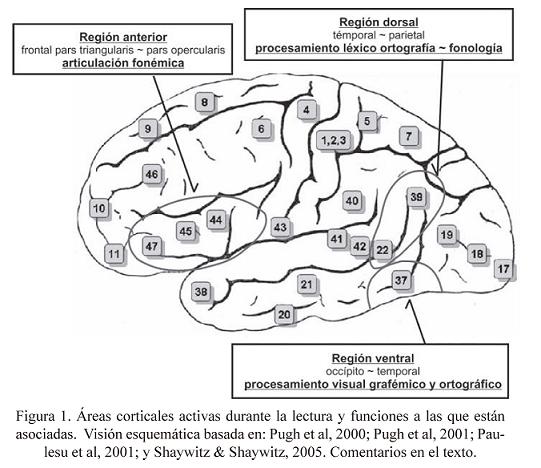
<body><![CDATA[<p class="western" style="margin: 5.1pt 233.3pt 0.0001pt 18.15pt; text-align: center; line-height: 150%;" align="center"><b><span style="font-family: Arial;" lang="ES-UY">ASPECTOS FUNCIONALES</span></b><span style="" lang="ES-UY"><o:p></o:p></span></p>         <p class="western" style="margin: 5.1pt 128.45pt 0.0001pt 18.15pt; line-height: 150%;"><span style="" lang="ES-UY">&nbsp;<o:p></o:p></span></p>         <p class="western" style="margin: 5.1pt 44.25pt 0.0001pt 18.15pt; line-height: 150%;"><span style="font-family: Arial;" lang="ES-UY">El advenimiento de la <span class="SpellE">imagenolog&iacute;a</span> funcional (primero el Tom&oacute;grafo por Emisi&oacute;n de Positrones TEP, luego la Resonancia Magn&eacute;tica Funcional <span class="SpellE">RMf</span>), pero tambi&eacute;n el perfeccionamiento de tecnolog&iacute;as neurofisiol&oacute;gicas (<span class="SpellE">Magnetoencefalograf&iacute;a</span>, Potenciales Evocados vinculados a Eventos PEV), proporcionaron recursos formidables para comprender la din&aacute;mica de las redes neuronales donde se implementan los procesos lectores y por tanto los posibles eslabones &ldquo;<span class="SpellE">disfuncionantes</span>&rdquo; en las dislexias. </span><span style="" lang="ES-UY"><o:p></o:p></span></p>         <p class="western" style="margin: 5.1pt 44.25pt 0.0001pt 18.15pt; line-height: 150%;"><span style="font-family: Arial;" lang="ES-UY">No debe perderse de vista que la <span class="SpellE">imagenolog&iacute;a</span> funcional es esencialmente <span class="SpellE">correlacional</span>, y por tanto no brinda informaci&oacute;n de naturaleza causal. Tambi&eacute;n es necesario tener presente sus limitaciones (cuestionamientos al m&eacute;todo de sustracci&oacute;n, variabilidad en las t&eacute;cnicas, arbitrariedad relativa en la selecci&oacute;n de la llamada &ldquo;regi&oacute;n de inter&eacute;s&rdquo;, diferencias entre sujetos, etc., lo cual no constituye motivo de este trabajo). Una serie de trabajos realizados mayormente desde la mitad de los 90# que muestran hallazgos consistentes, permiten, en el estado actual de las cosas, constatar algunos hechos. Las pruebas de activaci&oacute;n empleadas van, en t&eacute;rminos generales, de la lectura de palabras <span class="SpellE">vs</span> <span class="SpellE">pseudopalabras</span> a pruebas de discriminaci&oacute;n y memoria fonol&oacute;gica, as&iacute; como discriminaci&oacute;n perceptiva de patrones visuales complejos, bas&aacute;ndose en los modelos m&aacute;s extendidamente aceptados en las dislexias (<a href="#Snowling"><span class="SpellE"></span></a><a name="Snowling2000."></a><a href="#Snowling">Snowling</a></span><a href="#Snowling">, 2000</a>).<span style="" lang="ES-UY"><o:p></o:p></span></p>         <p class="western" style="margin: 5.1pt 44.25pt 0.0001pt 18.15pt; line-height: 150%;"><span style="font-family: Arial;" lang="ES-UY">La primera etapa en el reconocimiento de una palabra escrita se realizar&iacute;a por la mediaci&oacute;n de una regi&oacute;n ubicada en la v&iacute;a visual ventral, m&aacute;s espec&iacute;ficamente el <span class="SpellE"><i>gyrus</i></span><i> fusiforme</i> (BA 37), donde Cohen et al han referido lo que llaman el sistema de la forma visual de la palabra (<a name="Cohen2000."></a><a href="#Cohen2">Cohen</a> et al, 2000; <a name="Cohen2002."></a><a href="#Cohen4">Cohen</a> et al, 2002; <a name="McCandliss2003."></a><a href="#McCandliss"><span class="SpellE">McCandliss</span>, Cohen &amp; <span class="SpellE">Dehane</span></a>, 2003; <a href="#Cohen1">Cohen &amp; <span class="SpellE">Dehaene</span></a>, 2004) (ver <a href="#f1">figura 1</a>). </span><span style="" lang="ES-UY"><o:p></o:p></span></p>         <p class="western" style="margin: 5.1pt 128.45pt 0.0001pt 18.15pt; line-height: 150%;"><span style="" lang="ES-UY">&nbsp;<o:p></o:p></span></p>         <p class="western" style="margin: 5.1pt 128.45pt 0.0001pt 18.15pt; line-height: 150%;"><a name="f1"></a><span style="" lang="ES-UY"><img id="_x0000_i1025" src="../../../../../img/revistas/cp/v3n2/2a11f1.jpg" name="gr&aacute;ficos1" align="bottom" border="0" height="468" width="541"><o:p></o:p></span></p>         <p class="western" style="margin: 5.1pt 44.25pt 0.0001pt 18.15pt; line-height: 150%;"><span style="font-family: Arial;" lang="ES-UY">Este nivel de procesamiento cognitivo se extrae del modelo de <a href="#Shallice"><span class="SpellE"></span></a><a name="Shallice1980."></a><a href="#Shallice">Shallice</a></span><a href="#Shallice"> y <span class="SpellE">Warrington</span> (1980)</a>, donde en la forma visual de la palabra se mezcla el reconocimiento de letras y grafemas y el <span class="SpellE">ortograma</span> como un todo, fusion&aacute;ndose as&iacute; las representaciones l&eacute;xicas ortogr&aacute;ficas y el analizador <span class="SpellE">graf&eacute;mico</span> de los modelos habituales de doble ruta. De ah&iacute; la informaci&oacute;n pasa al sistema sem&aacute;ntico o al sistema de la forma verbal de la palabra, nuevamente, una amalgama mal definida de niveles l&eacute;xicos y <span class="SpellE">subl&eacute;xicos</span>. <span style="" lang="ES-UY"><o:p></o:p></span></p>         <p class="western" style="margin: 5.1pt 44.25pt 0.0001pt 18.15pt; line-height: 150%;"><span style="font-family: Arial;" lang="ES-UY">El sistema de la forma visual de la palabra se ubica en el <span class="SpellE"><i>gyrus</i></span><i> fusiforme</i> de manera bilateral, y desde ah&iacute; requieren conectarse con las &aacute;reas del lenguaje lateralizadas a izquierda. El <span class="SpellE">gyrus</span> fusiforme, circunvoluci&oacute;n de uni&oacute;n <span class="SpellE">occ&iacute;pito</span>-temporal en su parte <span class="SpellE">p&oacute;stero</span>-inferior, se activa de manera diferencial ante est&iacute;mulos alfab&eacute;ticos contra posiciones de ajedrez, por ejemplo (<a href="#Cohen4">Cohen</a> et al, 2002; <a href="#Cohen1">Cohen &amp; <span class="SpellE">Dehaene</span></a>, 2004). </span><span style="" lang="ES-UY"><o:p></o:p></span></p>         <p class="western" style="margin: 5.1pt 44.25pt 0.0001pt 18.15pt; line-height: 150%;"><span style="font-family: Arial;" lang="ES-UY">Es menor la activaci&oacute;n si se presenta una cadena de consonantes, no habiendo diferencias en palabras y <span class="SpellE">pseudopalabras</span>, los autores piensan que corresponde al estatuto l&eacute;xico que a&uacute;n poseen las <span class="SpellE">pseudopalabras</span> (pueden buscarse o parecerse a). </span><span style="" lang="ES-UY"><o:p></o:p></span></p>         ]]></body>
<body><![CDATA[<p class="western" style="margin: 5.1pt 44.25pt 0.0001pt 18.15pt; line-height: 150%;"><span style="font-family: Arial;" lang="ES-UY">La activaci&oacute;n es notoriamente menor si en vez de palabras o <span class="SpellE">pseudopalabras</span>, se presentan cadenas de consonantes, posiblemente por el mayor v&iacute;nculo <span class="SpellE">lexical</span> de aquellas seg&uacute;n los autores. </span><span style="" lang="ES-UY"><o:p></o:p></span></p>         <p class="western" style="margin: 5.1pt 44.25pt 0.0001pt 18.15pt; line-height: 150%;"><span style="font-family: Arial;" lang="ES-UY">El &aacute;rea de la forma visual de palabra tambi&eacute;n est&aacute; <span class="SpellE">hipoactivada</span> en disl&eacute;xicos adultos, en comparaci&oacute;n con lectores h&aacute;biles (<span class="SpellE">Candliss</span>, Cohen &amp; <span class="SpellE">Dehaene</span>, 2003; <a name="Cohen2003."></a><a href="#Cohen3">Cohen</a> et al, 2003), y su actividad deficitaria podr&iacute;a vincularse a lo que en el viejo modelo cl&iacute;nico de <span class="SpellE">Boder</span> se conoc&iacute;a como &ldquo;dislexia <span class="SpellE">diseid&eacute;tica</span>&rdquo;, tipificaci&oacute;n que se ha asimilado m&aacute;s recientemente a la dislexia de superficie (<a href="#Ellis"><span class="SpellE"></span></a><a name="Ellis1993."></a>Ellis</span>, 1993).<span style="" lang="ES-UY"><o:p></o:p></span></p>         <p class="western" style="margin: 5.1pt 44.25pt 0.0001pt 18.15pt; line-height: 150%;"><span style="font-family: Arial;" lang="ES-UY">Una serie de &aacute;reas cerebrales se activan en el TEP y la <span class="SpellE">RMf</span> durante la lectura de palabras, desde la corteza occipital y <span class="SpellE">occ&iacute;pito</span>-temporal izquierda como ya fue considerado (circunvoluciones fusiforme y lingual, cerca de las &aacute;reas BA 18 y 37), el op&eacute;rculo frontal izquierdo (pr&oacute;ximas a las regiones <span class="SpellE">BAs</span> 44, 45 y la &iacute;nsula anterior), hasta activaciones bilaterales en la corteza <span class="SpellE">cerebelosa</span>, la corteza motora primaria, la corteza temporal media y superior (cerca de BA 22, &aacute;rea de <span class="SpellE">Wernicke</span> a izquierda), y regiones en el &aacute;rea motora suplementaria y el <span class="SpellE">cortex</span> <span class="SpellE">cingulado</span> (<span class="SpellE">Fiez</span> &amp; <span class="SpellE">Petersen</span>, 1998). Pero m&aacute;s all&aacute; de la localizaci&oacute;n, las correlaciones im&aacute;genes-comportamiento pueden contribuir a entender c&oacute;mo se produce la lectura. Con respecto al fraccionamiento y significado funcional, <span class="SpellE">Fiez</span> y <span class="SpellE">Petersen</span> se&ntilde;alan como posible que una o m&aacute;s regiones de las circunvoluciones temporales superior y media sean necesarias para lograr las representaciones ac&uacute;stico/fonol&oacute;gicas empleadas en la lectura silente, con BA 22 particularmente asociada al an&aacute;lisis fonol&oacute;gico (1998). Mientras que algunas &aacute;reas (como la corteza frontal izquierda), se muestran m&aacute;s activas durante la lectura de palabras de baja frecuencia y de correspondencia <span class="SpellE">ortograma</span>-fonolog&iacute;a inconsistente, no hay diferencias en &aacute;reas posteriores como el <span class="SpellE"><i>gyrus</i></span><i> fusiforme</i>, y BA 22. </span><span style="" lang="ES-UY"><o:p></o:p></span></p>         <p class="western" style="margin: 5.1pt 44.25pt 0.0001pt 18.15pt; line-height: 150%;"><span style="font-family: Arial;" lang="ES-UY">La evidencia tiende a demostrar entonces la existencia de regiones diferenciadas que realizan procesamientos espec&iacute;ficos hacia el interior de la lectura, a&uacute;n para el tratamiento de informaci&oacute;n fonol&oacute;gica. <span class="SpellE">Shaywytz</span> et al no encuentran diferencias sustanciales en comparaci&oacute;n con el estudio previamente mencionado, en t&eacute;rminos de &aacute;reas activadas durante la lectura de palabras (1998). Pero, interesante, hayan que durante la lectura de palabras y <span class="SpellE">pseudopalabras</span> aumenta la activaci&oacute;n en las &aacute;reas de <span class="SpellE">Wernicke</span>, el <span class="SpellE">gyrus</span> <span class="SpellE">angularis</span> (BA 39) y la corteza estriada (BA 17) cuando cambia de una mayor demanda ortogr&aacute;fica a una mayor demanda fonol&oacute;gica, patr&oacute;n que no muestran los casos de dislexia. El &aacute;rea anterior BA 37 tambi&eacute;n acompasa esta diferencia, habiendo una mayor activaci&oacute;n a derecha en los disl&eacute;xicos.</span><span style="" lang="ES-UY"><o:p></o:p></span></p>         <p class="western" style="margin: 5.1pt 44.25pt 0.0001pt 18.15pt; line-height: 150%;"><span style="font-family: Arial;" lang="ES-UY">Tres hechos han sido constatados en el estudio de <span class="SpellE">imagenolog&iacute;a</span> funcional y <span class="SpellE">morfometr&iacute;a</span> en las dislexias (<span class="SpellE">Hoeft</span> et al, 2006):</span><span style="" lang="ES-UY"><o:p></o:p></span></p>         <p class="western" style="margin: 5.1pt 44.25pt 0.0001pt 18.15pt; line-height: 150%;"><span style="font-family: Arial;" lang="ES-UY">(i) La <span class="SpellE">hipoactivaci&oacute;n</span> posterior izquierda durante la lectura de palabras y <span class="SpellE">pseudopalabras</span> en la <span class="SpellE">dyslexia</span> (<span class="SpellE">parieto</span>-temporal o del l&oacute;bulo parietal inferior, y <span class="SpellE">occ&iacute;pito</span>-temporal o de los <span class="SpellE">gyrus</span> lingual y fusiforme) est&aacute; relacionada con la propia dislexia m&aacute;s que con la capacidad para la lectura. En estos circuitos posteriores (ventral y dorsal), ser&iacute;a donde reside el n&uacute;cleo deficitario definitorio del trastorno en la adquisici&oacute;n del c&oacute;digo escrito.</span><span style="" lang="ES-UY"><o:p></o:p></span></p>         <p class="western" style="margin: 5.1pt 44.25pt 0.0001pt 18.15pt; line-height: 150%;"><span style="font-family: Arial;" lang="ES-UY">(<span class="SpellE">ii</span>) La <span class="SpellE">hiperactivaci&oacute;n</span> frontal izquierda en la dislexia est&aacute; relacionada con la habilidad lectora m&aacute;s que con la propia dislexia. La circunvoluci&oacute;n frontal inferior, frontal media, caudado izquierdo y t&aacute;lamo derecho para el <span class="SpellE">test</span> de rima, por ejemplo, muestran un descenso con la edad en lectores normales, no as&iacute; en los disl&eacute;xicos. La <span class="SpellE">hiperactivaci&oacute;n</span> frontal reflejar&iacute;a pues un mecanismo de compensaci&oacute;n mediante <span class="SpellE">recodificaci&oacute;n</span> articulatoria. </span><span style="" lang="ES-UY"><o:p></o:p></span></p>         <p class="western" style="margin: 5.1pt 44.25pt 0.0001pt 18.15pt; line-height: 150%;"><span style="font-family: Arial;" lang="ES-UY">(<span class="SpellE">iii</span>) Las diferencias morfol&oacute;gicas encontradas en estudios de volumetr&iacute;a est&aacute;n relacionadas con las &aacute;reas de <span class="SpellE">hipoactivaci&oacute;n</span> (<a href="#Eckert2"><span class="SpellE"></span></a><a name="Eckert2005."></a><a href="#Eckert2">Eckert</a></span><a href="#Eckert2"> et al, 2005</a>; <a href="#Vickenbosch"><span class="SpellE"></span></a><a name="Vickenbosch2005."></a><a href="#Vickenbosch">Vickenbosch, <span class="SpellE">Robinchon</span> &amp; <span class="SpellE">Eliez</span>, 2005</a>; <a href="#Phinney"><span class="SpellE"></span></a><a name="Phinney2007."></a><a href="#Phinney">Phinney et al, 2007)</a>. La misma regi&oacute;n del l&oacute;bulo parietal inferior que muestra una <span class="SpellE">hipoactivaci&oacute;n</span> funcional en la dislexia, tambi&eacute;n muestra una reducci&oacute;n en el volumen de sustancia gris ya sea en comparaci&oacute;n con controles emparejados por edad o nivel lector. Estos hallazgos tender&iacute;an a establecer una relaci&oacute;n estructura-funci&oacute;n en las bases cerebrales de la dislexia. Las &aacute;reas hom&oacute;logas hemisf&eacute;ricas derechas aparecen m&aacute;s activadas que en los cerebros de los lectores normales, por recursos alternativos o compensaci&oacute;n.<span style="" lang="ES-UY"><o:p></o:p></span></p>         <p class="western" style="margin: 5.1pt 44.25pt 0.0001pt 18.15pt; line-height: 150%;"><span style="font-family: Arial;" lang="ES-UY">El desarrollo t&iacute;pico entre las edades 7 a 16 a&ntilde;os en las habilidades fonol&oacute;gicas, se caracteriza por un decremento en la activaci&oacute;n de la circunvoluci&oacute;n frontal izquierda, y un incremento en la activaci&oacute;n del l&oacute;bulo parietal inferior (<span class="SpellE">Hoeft</span> et al, 2006). Es este salto evolutivo anterior-posterior, el que no ocurre en los ni&ntilde;os disl&eacute;xicos. El l&oacute;bulo parietal inferior es la &uacute;nica regi&oacute;n que presenta tanto disturbios funcionales como estructurales. Estas regiones <span class="SpellE">parieto</span>-temporales y del l&oacute;bulo parietal inferior est&aacute;n vinculadas al almacenamiento de las representaciones fonol&oacute;gicas cuando procesa los sonidos del lenguaje hablado, y en el mapeo de la ortograf&iacute;a a la estructura fonol&oacute;gica del lenguaje (<a name="Vigenau2006."></a><a href="#Vigneau"><span class="SpellE">Vigenau</span></a> et al, 2006; <a href="#Jobard"><span class="SpellE"></span></a><a name="Jobard2007."></a><a href="#Jobard">Jobard</a></span><a href="#Jobard"> et al, 2007</a>). Su <span class="SpellE">hipoactivaci&oacute;n</span> persiste en disl&eacute;xicos comparados con controles de igual nivel lector, aunque la <span class="SpellE">hiperactivaci&oacute;n</span> frontal, <span class="SpellE">tal&aacute;mica</span> y caudada, persiste en controles que tienen edades menores, siendo as&iacute; que la actividad de las &aacute;reas anteriores refleja el esfuerzo lector normal ante las dificultades del aprendizaje o de un disturbio madurativo (<span class="SpellE">Hoeft</span> et al, 2006). <span style="" lang="ES-UY"><o:p></o:p></span></p>         <p class="western" style="margin: 5.1pt 44.25pt 0.0001pt 18.15pt; line-height: 150%;"><span class="SpellE"><span style="font-family: Arial;" lang="ES-UY">Pugh</span></span><span style="font-family: Arial;" lang="ES-UY"> et al han propuesto un modelo neurobiol&oacute;gico y <span class="SpellE">neurocognitivo</span> para dar cuenta del desarrollo lector normal y de las dislexias (<a href="#Pugh1"><span class="SpellE"><a name="Pugh2000."></a>Pugh</span></a> et al, 2000; <a href="#Pugh2"><span class="SpellE"><a name="Pugh2001."></a>Pugh</span></a> et al, 2001), en concordancia con las teor&iacute;as m&aacute;s aceptadas actualmente (<a href="#Snowling"><span class="SpellE">Snowling</span></a>, 2000; <a href="#Galaburda2"><span class="SpellE">Galaburda</span> &amp; <span class="SpellE">Cestnik</span></a>, 2005; <a href="#Shaywitz2"><span class="SpellE">Shaywitz</span> &amp; <span class="SpellE">Shaywitz</span></a>, 2005). Amerita, por su influencia y contenido emp&iacute;rico, detenerse en dicho modelo. La lectura h&aacute;bil est&aacute; vinculada al desarrollo un complejo sistema cortical altamente diferenciado que integra caracter&iacute;sticas ortogr&aacute;ficas, fonol&oacute;gicas y l&eacute;xico-sem&aacute;nticas de las palabras, y se ubica en las zonas posteriores y externas del hemisferio izquierdo. Es as&iacute; que <span class="SpellE">Pugh</span> et al reconocen dos circuitos de esta regi&oacute;n posterior:</span><span style="" lang="ES-UY"><o:p></o:p></span></p>         ]]></body>
<body><![CDATA[<p class="western" style="margin: 5.1pt 44.25pt 0.0001pt 18.15pt; line-height: 150%;"><span style="font-family: Arial;" lang="ES-UY">(i) Un circuito dorsal, <span class="SpellE">t&eacute;mporo</span>-parietal que involucra al <span class="SpellE">gyrus</span> <span class="SpellE">angularis</span>, el <span class="SpellE">gyrus</span> <span class="SpellE">supramarginal</span> y el &aacute;rea de <span class="SpellE">Wernicke</span>. Est&aacute; asignado a la decodificaci&oacute;n activa de las relaciones grafo-<span class="SpellE">fon&eacute;micas</span> y ortogr&aacute;fico-fonol&oacute;gicas.</span><span style="" lang="ES-UY"><o:p></o:p></span></p>         <p class="western" style="margin: 5.1pt 44.25pt 0.0001pt 18.15pt; line-height: 150%;"><span style="font-family: Arial;" lang="ES-UY">(<span class="SpellE">ii</span>) Un circuito ventral, <span class="SpellE">occ&iacute;pito</span>-temporal (<span class="SpellE">gyrus</span> fusiforme), dedicado a la identificaci&oacute;n r&aacute;pida de est&iacute;mulos, que permite el acceso visual directo a las representaciones ortogr&aacute;ficas.</span><span style="" lang="ES-UY"><o:p></o:p></span></p>         <p class="western" style="margin: 5.1pt 44.25pt 0.0001pt 18.15pt; line-height: 150%;"><span style="font-family: Arial;" lang="ES-UY">El primer circuito muestra una superioridad en la lectura de <span class="SpellE">pseudopalabras</span> sobre palabras as&iacute; como una mayor activaci&oacute;n durante el an&aacute;lisis fonol&oacute;gico. De manera hipot&eacute;tica, estar&iacute;a diferenciado para la realizaci&oacute;n del an&aacute;lisis reglado de correspondencias entre fonolog&iacute;a (l&eacute;xica y <span class="SpellE">subl&eacute;xica</span>), y dimensiones sem&aacute;nticas. </span><span style="" lang="ES-UY"><o:p></o:p></span></p>         <p class="western" style="margin: 5.1pt 44.25pt 0.0001pt 18.15pt; line-height: 150%;"><span style="font-family: Arial;" lang="ES-UY">En el circuito ventral hay una superioridad en lectura de palabras sobre <span class="SpellE">pseudopalabras</span>, la respuesta es precoz, la activaci&oacute;n aumenta con la edad y predice la habilidad lectora. Constituir&iacute;a un sistema de memoria ling&uuml;&iacute;sticamente estructurado para la identificaci&oacute;n r&aacute;pida de palabras escritas, es decir, se corresponder&iacute;a con el sistema de la forma visual de la palabra mencionado m&aacute;s atr&aacute;s. Finalmente puede describirse un tercer circuito:</span><span style="" lang="ES-UY"><o:p></o:p></span></p>         <p class="western" style="margin: 5.1pt 44.25pt 0.0001pt 18.15pt; line-height: 150%;"><span style="font-family: Arial;" lang="ES-UY">(<span class="SpellE">iii</span>) Regi&oacute;n anterior, correspondiente a la circunvoluci&oacute;n frontal izquierda. Se activa en las lecturas de palabras de baja frecuencia y en <span class="SpellE">pseudopalabras</span>, generalmente en tareas donde se evidencia una articulaci&oacute;n audible. Hay una superioridad en la lectura de <span class="SpellE">pseudopalabras</span> sobre palabras, es sensible a la regularidad de la correspondencia grafema-fonema, y su activaci&oacute;n es considerablemente mayor en sujetos disl&eacute;xicos comparados con lectores normales de igual edad (aunque no de mismo nivel lector). La hip&oacute;tesis es que se encarga de la <span class="SpellE">recodificaci&oacute;n</span> articulatoria de unidades elementales (fonemas), es decir, de la fonolog&iacute;a de salida (en algunos modelos: ret&eacute;n fon&eacute;tico de salida).</span><span style="" lang="ES-UY"><o:p></o:p></span></p>         <p class="western" style="margin: 5.1pt 44.25pt 0.0001pt 18.15pt; line-height: 150%;"><span style="font-family: Arial;" lang="ES-UY">La integridad funcional de la lectura depende del funcionamiento de los circuitos posteriores. Durante el desarrollo se pasa de una modalidad que recluta b&aacute;sicamente los sistemas de procesamiento del circuito dorsal, m&aacute;s mediado por la fonolog&iacute;a, pas&aacute;ndose por efecto del aprendizaje y pr&aacute;ctica a modalidades basadas en el funcionamiento del circuito ventral que permite el reconocimiento visual fluido de las palabras escritas. Al principio del desarrollo del c&oacute;digo, la predominancia del circuito dorsal est&aacute; vinculada al procesamiento anal&iacute;tico necesario para integrar las representaciones ortogr&aacute;ficas, as&iacute; como l&eacute;xico-sem&aacute;nticas. Posteriormente, se pasa a una predominancia del circuito ventral, m&aacute;s tard&iacute;o en el desarrollo, donde los ort&oacute;grafos son procesados de forma r&aacute;pida y directa. En las dislexias no se producir&iacute;a ese cambio de fase de manera adecuada, seguramente por perturbaciones en la maduraci&oacute;n y organizaci&oacute;n estructural de la corteza en dichas regiones (<a href="#Pugh1"><span class="SpellE">Pugh</span></a> et al, <span class="GramE">2000 ,</span> <a href="#Shaywitz2"><span class="SpellE">Shaywitz</span> &amp; <span class="SpellE">Shaywitz</span></a>, 2005). Finalmente, la <span class="SpellE">hiperactivaci&oacute;n</span> frontal en la lectura, refleja la dificultad y el esfuerzo para abordar palabras en sus dimensiones fonol&oacute;gicas y morfol&oacute;gicas y su relaci&oacute;n con la escritura, fundamentalmente cuando se trata de palabras desconocidas o de excepci&oacute;n y al inicio de la adquisici&oacute;n. Esta dificultad se hace extensiva y persistente en los disl&eacute;xicos, requiri&eacute;ndose en estos casos una mayor dependencia en la <span class="SpellE">recodificaci&oacute;n</span> articulatoria que a veces se manifiesta como lectura <span class="SpellE">subvocal</span>. Que las dislexias se adoptan diferentes patrones o aspectos en diferentes lenguas/sistemas de escritura ya ha sido puesto en evidencia (<a name="Miles2000."></a><a href="#Miles">Miles</a>, 2000; <a href="#Siok"><span class="SpellE"></span></a><a name="Siok2004."></a><a href="#Siok">Siok</a></span><a href="#Siok"> et al, 2004</a>), inclusive poniendo en cuesti&oacute;n la teor&iacute;a fonol&oacute;gica para toda forma del trastorno (<a name="Friedmann2008."></a><a href="#Friedmann"><span class="SpellE">Friedmann</span> &amp; <span class="SpellE">Lukov</span></a>, 2008). Sin embargo ello no afecta necesariamente la posible universalidad en la causa y en las bases neurol&oacute;gicas del <span class="SpellE">sindrome</span>. La reducci&oacute;n en la activaci&oacute;n de la corteza temporal izquierda media y superior y en el &aacute;rea <span class="SpellE">t&eacute;mporo</span>-occipital, hecho que se aprecia en disl&eacute;xicos tanto de escrituras opacas como transparentes, ha llevado a <span class="SpellE">Paulesu</span> et al a afirmar que existe una unicidad biol&oacute;gica en la dislexia (2001). Efectivamente, habr&iacute;a una base <span class="SpellE">neurocognitiva</span> universal en el origen del trastorno en la adquisici&oacute;n del c&oacute;digo escrito, y la diversidad cultural (sistemas de escritura) afecta a las formas de presentaci&oacute;n. Pero la situaci&oacute;n pasa a ser conflictiva cuando miramos hacia sistemas de escritura <span class="SpellE">logogr&aacute;fica</span> como el chino, donde se combina adem&aacute;s una alta opacidad (gran n&uacute;mero, hasta de nueve hom&oacute;fonos <span class="SpellE">heter&oacute;grafos</span>, por ejemplo), con una gruesa <span class="SpellE">granularidad</span> (los caracteres representan unidades fonol&oacute;gicas amplias).<span style="" lang="ES-UY"><o:p></o:p></span></p>         <p class="western" style="margin: 5.1pt 44.25pt 0.0001pt 18.15pt; line-height: 150%;"><span style="font-family: Arial;" lang="ES-UY">Las reglas ortogr&aacute;ficas son particularmente dificultosas en el chino (<span class="GramE">gran n&uacute;mero de caracteres, diferentes grados de regularidad <span class="SpellE">posicional</span>, sem&aacute;nticas y fonol&oacute;gicas</span> para los radicales, etc.). La mayor&iacute;a de las escuelas en China adoptan una metodolog&iacute;a <span class="SpellE">hol&iacute;stica</span> de &ldquo;ver y decir&rdquo;, recurriendo escasamente a estrategias fonol&oacute;gicas (<a name="Ho2007."></a><a href="#Ho1">Ho</a> et al, <a href="#Ho1">2007</a>; <a name="Ho2004."></a><a href="#Ho2">2004</a>). </span><span style="" lang="ES-UY"><o:p></o:p></span></p>         <p class="western" style="margin: 5.1pt 44.25pt 0.0001pt 18.15pt; line-height: 150%;"><span style="font-family: Arial;" lang="ES-UY">La lectura de <span class="SpellE">seudocaracteres</span> en chino tambi&eacute;n se hace mediante estrategias que podr&iacute;an considerarse <span class="SpellE">lexicales</span>, ya que se realizan inferencias en base al contexto <span class="SpellE">morf&eacute;mico</span> de los diferentes componentes y sus posibles referentes f&oacute;nicos: de ah&iacute; la gran importancia ortogr&aacute;fica visual en el aprendizaje de este sistema de escritura. El d&eacute;ficit ortogr&aacute;fico ser&iacute;a el d&eacute;ficit nuclear en la dislexia en chino, los autores ponen en cuesti&oacute;n, no encuentran, dislexias fonol&oacute;gicas <a href="#Ho2">(Ho</a> et al, 2004). </span><span style="" lang="ES-UY"><o:p></o:p></span></p>         <p class="western" style="margin: 5.1pt 44.25pt 0.0001pt 18.15pt; line-height: 150%;"><span style="font-family: Arial;" lang="ES-UY">Los trabajos de Ho et al han puesto en cuesti&oacute;n la validez del modelo de doble ruta para estos sistema de escritura dado, entre otras cosas, la ausencia de un procedimiento anal&iacute;tico por unidades <span class="SpellE">subl&eacute;xicas</span> de fina <span class="SpellE">granularidad</span>. Sin embargo, a&uacute;n en chino, los ni&ntilde;os con dislexia de superficie tienen una reducci&oacute;n en la denominaci&oacute;n r&aacute;pida y en la memoria de trabajo <span class="SpellE">audioverbal</span>, as&iacute; como dificultades en la conciencia fonol&oacute;gica (<a href="#Ho1">Ho</a> et al, 2007). Aunque no est&aacute; dilucidado, se ha planteado por los autores mencionados previamente, que el d&eacute;ficit en la memoria de trabajo perturbar&iacute;a la capacidad de sostener la asociaci&oacute;n forma visual-forma verbal arbitraria para poder aprenderla. </span><span style="" lang="ES-UY"><o:p></o:p></span></p>         <p class="western" style="margin: 5.1pt 44.25pt 0.0001pt 18.15pt; line-height: 150%;"><span style="font-family: Arial;" lang="ES-UY">En este contexto deben comprenderse los trabajos de <a href="#Siok"><span class="SpellE">Siok</span></a> et al (2004). Utilizando <span class="SpellE">RMf</span>, <span class="SpellE">Siok</span> et <span class="SpellE">afl</span> han demostrado c&oacute;mo en un grupo de ocho disl&eacute;xicos chinos durante una tarea de juicio de hom&oacute;fonos, hay una actividad aumentada en la circunvoluci&oacute;n frontal inferior (BA 45), con actividad en la corteza parietal inferior que no se registra en los lectores normales.</span><span style="" lang="ES-UY"><o:p></o:p></span></p>         ]]></body>
<body><![CDATA[<p class="western" style="margin: 5.1pt 44.25pt 0.0001pt 18.15pt; line-height: 150%;"><span style="font-family: Arial;" lang="ES-UY">Para <span class="SpellE">Siok</span> et al, la actividad reducida en la circunvoluci&oacute;n frontal media izquierda (BA 9), constituye el marcador neuroanat&oacute;mico de la dislexia en chino (2004). </span><span style="" lang="ES-UY"><o:p></o:p></span></p>         <p class="western" style="margin: 5.1pt 44.25pt 0.0001pt 18.15pt; line-height: 150%;"><span style="font-family: Arial;" lang="ES-UY">En la circunvoluci&oacute;n frontal media izquierda, de acuerdo a estos autores, se implementa la representaci&oacute;n simult&aacute;nea de informaci&oacute;n <span class="SpellE">audioverbal</span> y <span class="SpellE">visuoperceptiva</span>, coordinando los <span class="SpellE">recursosejecutivos</span>, y el reconocimiento de hom&oacute;fonos requiere de un an&aacute;lisis <span class="SpellE">visuo</span>-espacial detallado, con alta interactividad entre ortograf&iacute;a y fonolog&iacute;a. </span><span style="" lang="ES-UY"><o:p></o:p></span></p>         <p class="western" style="margin: 5.1pt 44.25pt 0.0001pt 18.15pt; line-height: 150%;"><span style="font-family: Arial;" lang="ES-UY">Las estrategias cognitivas en el desarrollo de la lectura, el m&eacute;todo de ense&ntilde;anza y el sistema de escritura, ajustan la corteza durante el desarrollo, por lo cual diferencias que son culturales generan diferencias a nivel cerebral (<a href="#Siok"><span class="SpellE">Siok</span></a> et al, 2004).</span><span style="" lang="ES-UY"><o:p></o:p></span></p>         <p class="western" style="margin: 5.1pt 44.25pt 0.0001pt 18.15pt; line-height: 150%;"><span style="font-family: Arial;" lang="ES-UY">El d&eacute;ficit fonol&oacute;gico evidenciado en lo <span class="SpellE">comportamental</span>, podr&iacute;a ser consecuencia de una conectividad debilitada entre las &aacute;reas anteriores y posteriores del lenguaje, y m&aacute;s precisamente de una perturbaci&oacute;n en el funcionamiento de las estructuras vinculadas a la &iacute;nsula izquierda, que constituye un puente anat&oacute;mico entre los circuitos anteriores y posteriores de la lectura (<a href="#Paulesu2"><span class="SpellE">Paulesu</span></a> et al., 1996). </span><span style="" lang="ES-UY"><o:p></o:p></span></p>         <p class="western" style="margin: 5.1pt 44.25pt 0.0001pt 18.15pt; line-height: 150%;"><span style="font-family: Arial;" lang="ES-UY">Entendiendo que el &aacute;rea de Broca trata la fonolog&iacute;a segmentada, el &aacute;rea de <span class="SpellE">Wernicke</span> la fonolog&iacute;a <span class="SpellE">lexical</span> y el <span class="SpellE">gyrus</span> <span class="SpellE">angularis</span> (BA 40, parte inferior) permite el acceso a la memoria fonol&oacute;gica, la adecuada realizaci&oacute;n de tareas que implican una precisa discriminaci&oacute;n <span class="SpellE">fon&eacute;mica</span> necesita de la interacci&oacute;n entre las tres &aacute;reas. </span><span style="" lang="ES-UY"><o:p></o:p></span></p>         <p class="western" style="margin: 5.1pt 44.25pt 0.0001pt 18.15pt; line-height: 150%;"><span style="font-family: Arial;" lang="ES-UY">Esta interacci&oacute;n se produce en el espacio de la memoria de trabajo. La actividad descendida en la regi&oacute;n de la &iacute;nsula, por donde transcurre el mayor contingente de fibras que comunican los sistemas anteriores y posteriores, permitir&iacute;a entender la dislexia en lo <span class="SpellE">neural</span>, como un <span class="SpellE">sindrome</span> de desconexi&oacute;n (<a href="#Paulesu2"><span class="SpellE"></span></a><a name="Paulesu1996."></a><a href="#Paulesu1">Paulesu</a></span><a href="#Paulesu1"> et al, 1996</a>). Estudiando la conectividad funcional y eficaz mediante el an&aacute;lisis de las fluctuaciones temporales en la RMN se ha demostrado un d&eacute;ficit en las conexiones entre el &aacute;rea BA 39 izquierda (<span class="SpellE">gyrus</span> <span class="SpellE">angularis</span>) y el &aacute;rea de Broca en el cerebro de los disl&eacute;xicos (<a href="#Hampson"><span class="SpellE"><a name="Hampson2006."></a>Hampson</span></a> et al., 2006). <span style="" lang="ES-UY"><o:p></o:p></span></p>         <p class="western" style="margin: 5.1pt 44.25pt 0.0001pt 18.15pt; line-height: 150%;"><span style="font-family: Arial;" lang="ES-UY">La pobreza de conexiones sigue un continuo que va de los malos lectores a las personas propiamente <span class="SpellE">disl&eacute;xicas</span>, y el verdadero significado funcional de la desconexi&oacute;n no queda claro. </span><span style="" lang="ES-UY"><o:p></o:p></span></p>         <p class="western" style="margin: 5.1pt 44.25pt 0.0001pt 18.15pt; line-height: 150%;"><span style="font-family: Arial;" lang="ES-UY">La desconexi&oacute;n ha sido planteada en otros niveles. Recientemente, e inspirados por hallazgos que muestran alteraciones morfol&oacute;gicas en el cuerpo calloso de los disl&eacute;xicos (<a name="Fine2007."></a><a href="#Fine">Fine</a> et al., 2007), <span class="SpellE">Monaghan</span> y <span class="SpellE">Shillcock</span>, empleando un paradigma de simulaci&oacute;n, retoman la teor&iacute;a de que en algunos disl&eacute;xicos los trastornos de la lectura pueden obedecer a perturbaciones en la transferencia de informaci&oacute;n entre ambos hemisferios (2008). Obtienen un modelo de dislexia de superficie, es decir, &ldquo;lesionando&rdquo; la comunicaci&oacute;n entre las redes ocultas que simulan los hemisferios cerebrales, se afecta el procesamiento l&eacute;xico. </span><span style="" lang="ES-UY"><o:p></o:p></span></p>         <p class="western" style="margin: 5.1pt 44.25pt 0.0001pt 18.15pt; line-height: 150%;"><span style="font-family: Arial;" lang="ES-UY">El real significado de las alteraciones y aberraciones del cuerpo calloso en el cerebro de los disl&eacute;xicos &ndash;cuando se encuentra&ndash;, no se conoce a&uacute;n, y menos su relaci&oacute;n con las variantes <span class="SpellE">morfom&eacute;tricas</span> y funcionales de las &aacute;reas del lenguaje, mejor estudiadas. </span><span style="" lang="ES-UY"><o:p></o:p></span></p>         <p class="western" style="margin: 5.1pt 44.25pt 0.0001pt 18.15pt; line-height: 150%;"><span style="font-family: Arial;" lang="ES-UY">Estudios de anisotrop&iacute;a fraccional y <span class="SpellE">tractograf&iacute;a</span> mediante tensor de difusi&oacute;n, han encontrado en disl&eacute;xicos perturbaciones en la <span class="SpellE">microestructura</span> de la sustancia blanca y anomal&iacute;as en la <span class="SpellE">direccionalidad</span>, fundamentalmente sobre las regiones <span class="SpellE">t&eacute;mporo</span>-parietales, y frontales inferiores (<a href="#Klinberg"><span class="SpellE"></span></a><a name="Klingberg2000."></a>Klingberg</span> et al, 2000; <a href="#Rimrodt"><span class="SpellE"></span></a><a name="Rimodt2009."></a>Rimodt et al, 2009). No es posible todav&iacute;a establecer las relaciones funcionales y estructurales de estos hallazgos, con los fen&oacute;menos <span class="SpellE">comportamentales</span>, m&aacute;s all&aacute; de sus correlaciones con las variaciones en el desempe&ntilde;o lector y fonol&oacute;gico.<span style="" lang="ES-UY"><o:p></o:p></span></p>         ]]></body>
<body><![CDATA[<p class="western" style="margin: 5.1pt 44.25pt 0.0001pt 18.15pt; line-height: 150%;"><span style="font-family: Arial;" lang="ES-UY">La teor&iacute;a <span class="SpellE">magnocelular</span> fue originalmente planteada por <a href="#Stein"><span class="SpellE"></span></a><a name="Stein1997."></a><a href="#Stein">Stein</a></span><a href="#Stein"> &amp; <span class="SpellE">Walsh</span> (1997)</a>. La teor&iacute;a <span class="SpellE">magnocelular</span> se basa en que el sistema visual se divide en un tracto <span class="SpellE">magnocelular</span> y otro <span class="SpellE">parvocelular</span>, encontr&aacute;ndose perturbado el tracto <span class="SpellE">magnocelular</span> en las personas <span class="SpellE">disl&eacute;xicas</span>. <span style="" lang="ES-UY"><o:p></o:p></span></p>         <p class="western" style="margin: 5.1pt 44.25pt 0.0001pt 18.15pt; line-height: 150%;"><span style="font-family: Arial;" lang="ES-UY">El disturbio <span class="SpellE">magnocelular</span> perturba ciertos aspectos de la percepci&oacute;n visual y la visi&oacute;n binocular, comprometiendo el reconocimiento adecuado de las letras. No puede descartarse de que la disfunci&oacute;n <span class="SpellE">magnocelular</span> comprometa tambi&eacute;n la v&iacute;a auditiva (en adyacencia microsc&oacute;pica<span class="GramE">!</span>), obstruyendo as&iacute; la adecuada entrada sensorial necesaria para elaborar despu&eacute;s la discriminaci&oacute;n de par&aacute;metros fonol&oacute;gicos, en tanto permite discriminar transiciones temporales r&aacute;pidas de frecuencia, teor&iacute;a que han defendido por ejemplo <a href="#Galaburda2"><span class="SpellE">Galaburda</span> y <span class="SpellE">Cestnik</span></a> (2005). </span><span style="" lang="ES-UY"><o:p></o:p></span></p>         <p class="western" style="margin: 5.1pt 44.25pt 0.0001pt 18.15pt; line-height: 150%;"><span style="font-family: Arial;" lang="ES-UY">El tracto <span class="SpellE">magnocelular</span> visual es m&aacute;s sensible a est&iacute;mulos de bajas frecuencias espaciales, presentados antes poca iluminaci&oacute;n y bajo contraste, y en los disl&eacute;xicos los hallazgos no siguen estas condiciones: responden peor en cualquier frecuencia, o bajo alto contraste lum&iacute;nico, o afectados en bajas frecuencias, por lo cual esta l&iacute;nea de la teor&iacute;a debe revisarse (<a href="#Ramus1"><span class="SpellE"></span></a><a name="Ramus2001."></a>Ramus</span>, 2001). Actualmente, la teor&iacute;a <span class="SpellE">magnocelular</span> se concibe integrando tanto los aspectos visuales como <span class="SpellE">audioverbales</span> en los trastornos de la lectura, e intenta servir de base causal al propio d&eacute;ficit en la decodificaci&oacute;n fonol&oacute;gica, pero se han documentado casos de disl&eacute;xicos donde no hay disturbios del procesamiento sensorial (<a href="#Ramus2"><span class="SpellE"></span></a><a name="Ramus2003."></a><a href="#Ramus2">Ramus et al, 2003</a>). <span style="" lang="ES-UY"><o:p></o:p></span></p>         <p class="western" style="margin: 5.1pt 44.25pt 0.0001pt 18.15pt; line-height: 150%;"><span style="font-family: Arial;" lang="ES-UY">La disfunci&oacute;n <span class="SpellE">cerebelosa</span>, presente en 80 % de los disl&eacute;xicos, as&iacute; como la constancia de encontrar anomal&iacute;as <span class="SpellE">morfom&eacute;tricas</span> en tal estructura, han contribuido al desarrollo de la teor&iacute;a <span class="SpellE">cerebelosa</span> de la dislexia, donde funcionalmente se destaca el compromiso en la capacidad de realizar tareas de manera autom&aacute;tica (<a href="#Nicolson1"><span class="SpellE"></span></a><a name="Nicholson2001."></a>Nicholson</span>, <span class="SpellE">Fawcett</span> &amp; <span class="SpellE">Dean</span>, 2001). <span style="" lang="ES-UY"><o:p></o:p></span></p>         <p class="western" style="margin: 5.1pt 44.25pt 0.0001pt 18.15pt; line-height: 150%;"><span style="font-family: Arial;" lang="ES-UY">La activaci&oacute;n de los hemisferios <span class="SpellE">cerebelosos</span> en la lectura, y en pruebas de juicio ortogr&aacute;fico y fonol&oacute;gico ya hab&iacute;a sido documentada previamente (<a name="Fullbright1999."></a><a href="#Fullbright"><span class="SpellE">Fullbright</span></a> et al, 1999). <span class="SpellE">Nicholson</span> y <span class="SpellE">Fawcett</span> han propuesto una teor&iacute;a que repara en el aspecto <span class="SpellE">ontogen&eacute;tico</span> de los <span class="SpellE">d&eacute;ficits</span>, y donde las perturbaciones <span class="SpellE">cerebelosas</span> presentes al nacimiento, condicionan las dificultades fonol&oacute;gicas, de velocidad nominativa y eficacia <span class="SpellE">lecto</span>-escritora, mediante una obstrucci&oacute;n que se produce en el nivel de la articulaci&oacute;n y la memoria de trabajo (2005). Se intenta as&iacute; explicar las perturbaciones motoras, de velocidad y el d&eacute;ficit fonol&oacute;gico en un solo marco, donde las diferencias en el locus <span class="SpellE">cerebeloso</span> y la interacci&oacute;n con el medio, ocasionan los subtipos de dislexias. </span><span style="" lang="ES-UY"><o:p></o:p></span></p>         <p class="western" style="margin: 5.1pt 44.25pt 0.0001pt 18.15pt; line-height: 150%;"><span style="font-family: Arial;" lang="ES-UY">Los ni&ntilde;os con dislexias tendr&iacute;an adem&aacute;s un d&eacute;ficit en la estimaci&oacute;n del tiempo, o &ldquo;<span class="SpellE">discron&iacute;a</span>&rdquo; que tambi&eacute;n estar&iacute;a asociado a la disfunci&oacute;n <span class="SpellE">cerebelosa</span>, y a la capacidad de lectura y de escritura (<span class="SpellE"><a name="Nicolson1995."></a><a href="#Nicolson1">Nicolson</a></span>, <span class="SpellE">Fawcett</span> &amp; <span class="SpellE">Dean</span>, 1995). La reducci&oacute;n del volumen del l&oacute;bulo anterior del hemisferio derecho adem&aacute;s de la circunvoluci&oacute;n frontal inferior, permitir&iacute;an distinguir disl&eacute;xicos de no-disl&eacute;xicos, y parece ser &eacute;ste uno de los hallazgos m&aacute;s constantes en la <span class="SpellE">imagenolog&iacute;a</span> para la dislexia (<a name="Eckert2003."></a><a href="#Eckert1"><span class="SpellE">Eckert</span></a> et al., 2003). Se tratar&iacute;a entonces de una teor&iacute;a &ldquo;<span class="SpellE">fronto</span>-<span class="SpellE">cerebelosa</span>&rdquo;, donde se agrega la ubicaci&oacute;n central de la regi&oacute;n frontal inferior en el <span class="SpellE">feed</span>-back articulatorio, y la posibilidad de integrarse a la consolidaci&oacute;n de la relaci&oacute;n grafema-fonema. M&aacute;s recientemente, <span class="SpellE">Baillieux</span> et al han propuesto la hip&oacute;tesis de un defecto en la distribuci&oacute;n de informaci&oacute;n a nivel <span class="SpellE">intracerebeloso</span>, lo cual afectar&iacute;a la sincronizaci&oacute;n sensorio-motora y <span class="SpellE">temporalizaci&oacute;n</span> de las acciones (2009). </span><span style="" lang="ES-UY"><o:p></o:p></span></p>         <p class="western" style="margin: 5.1pt 44.25pt 0.0001pt 18.15pt; line-height: 150%;"><span style="font-family: Arial;" lang="ES-UY">Las evidencias del compromiso <span class="SpellE">cerebeloso</span> en el disl&eacute;xico van desde perturbaciones en el balance motor y el control del movimiento ocular hasta del condicionamiento cl&aacute;sico y el aprendizaje <span class="SpellE">procedural</span>, con una reducci&oacute;n de tama&ntilde;o que involucra a la parte posterior del hemisferio <span class="SpellE">cerebeloso</span> derecho &ndash;que conecta con el hemisferio cerebral izquierdo (<span class="SpellE">Stoodley</span> &amp; <span class="SpellE">Sein</span>, en prensa). <span class="SpellE">Stoodley</span> y <span class="SpellE">Sein</span> aseguran que solamente un subgrupo de disl&eacute;xicos presentar&iacute;an estos trastornos, y no se puede sostener que la disfunci&oacute;n <span class="SpellE">cerebelosa</span> constituya la causa principal de la dislexia (en prensa). El hallazgo no es entonces constante y est&aacute; diseminado en diversos trastornos del aprendizaje y el desarrollo, por lo cual adem&aacute;s bien podr&iacute;a ser inespec&iacute;fico.</span><span style="" lang="ES-UY"><o:p></o:p></span></p>         <p class="western" style="margin: 5.1pt 44.25pt 0.0001pt 18.15pt; line-height: 150%;"><span style="font-family: Arial;" lang="ES-UY">La teor&iacute;a <span class="SpellE">cerebelosa</span>, en su contraparte cl&iacute;nica, ha quedado supeditada fundamentalmente al hallazgo de s&iacute;ntomas motores, y de elementos <span class="SpellE">comportamentales</span> poco evaluados como la adquisici&oacute;n de asociaciones automatizadas y fluidas, lo cual hace que la cuesti&oacute;n no est&eacute; enteramente cerrada. <span class="SpellE">Grigorenko</span> ha insistido en el d&eacute;ficit en la automatizaci&oacute;n l&eacute;xica para el trastorno nuclear del disl&eacute;xico en las escrituras transparentes y quiz&aacute; tambi&eacute;n en las <span class="SpellE">logogr&aacute;ficas</span> (2001). Se requieren datos que incluyan facultades <span class="SpellE">comportamentales</span> y cognitivas que muchas veces son muy pobremente exploradas (para la automatizaci&oacute;n, por ejemplo, solamente suelen usarse pruebas de denominaci&oacute;n r&aacute;pida). </span><span style="" lang="ES-UY"><o:p></o:p></span></p>         <p class="western" style="margin: 5.1pt 44.25pt 0.0001pt 18.15pt; line-height: 150%;"><span class="SpellE"><span style="font-family: Arial;" lang="ES-UY">Habib</span></span><span style="font-family: Arial;" lang="ES-UY">, finalmente, ha intentado sistematizar los hallazgos cl&iacute;nicos y <span class="SpellE">neurofuncionales</span>, para acceder a una teor&iacute;a que de cuenta de la neuropsicolog&iacute;a de la persona <span class="SpellE">disl&eacute;xica</span> (2000). En lo que ha llamado la constelaci&oacute;n &ldquo;<span class="SpellE">dis</span>&rdquo;, se comprueban asociaciones o <span class="SpellE">co</span>-morbilidades que, aunque inconstantes, son frecuentes, e incluyen <span class="SpellE">disgrafia</span>, <span class="SpellE">disortografia</span>, <span class="SpellE">dispraxia</span>, disfasia, <span class="SpellE">discalculia</span>, trastorno por d&eacute;ficit de atenci&oacute;n con hiperactividad y trastornos no verbales del aprendizaje, lo que ha llevado a pensar en un gran n&uacute;cleo com&uacute;n que puede generar perturbaciones en diversas &aacute;reas cognitivas (<span class="SpellE">Habib</span>, <a href="#Habib1">2000</a>; <a name="Habib2003."></a><a href="#Habib2">2003</a>). </span><span style="" lang="ES-UY"><o:p></o:p></span></p>         <p class="western" style="margin: 5.1pt 44.25pt 0.0001pt 18.15pt; line-height: 150%;"><span style="font-family: Arial;" lang="ES-UY">Esta postura es comparable a la de <span class="SpellE">Grigorenko</span>, con respecto a su idea de un gran <span class="SpellE">sindrome</span> neuroanat&oacute;mico (2001). Destacando que una dificultad en el procesamiento del tiempo en sus distintas dimensiones (verbal, espacial, motor) ser&iacute;a una caracter&iacute;stica universal de los disl&eacute;xicos, <span class="SpellE">Habib</span> a propuesto como hip&oacute;tesis de trabajo la llamada &ldquo;Teor&iacute;a del d&eacute;ficit en el procesamiento temporal&rdquo; (2000). La dificultad, que en esencia corresponde a la &ldquo;<span class="SpellE">discron&iacute;a</span>&rdquo;, podr&iacute;a dar cuenta de un compromiso en la percepci&oacute;n de est&iacute;mulos auditivos transitorios, un d&eacute;ficit en la generaci&oacute;n o juicio del orden temporal y <span class="SpellE">d&eacute;ficits</span> en diversos niveles de la lectura y escrituras que impliquen procesamientos r&aacute;pidos. Aqu&iacute; <span class="SpellE">Habib</span> incluye las disposiciones <span class="SpellE">visuoespaciales</span> de las letras, percepci&oacute;n de la forma global de la palabra e integraci&oacute;n de las posiciones sucesivas y relativas de las palabras durante el rastreo <span class="SpellE">oculomotor</span>. </span><span style="" lang="ES-UY"><o:p></o:p></span></p>         ]]></body>
<body><![CDATA[<p class="western" style="margin: 5.1pt 44.25pt 0.0001pt 18.15pt; line-height: 150%;"><span style="font-family: Arial;" lang="ES-UY">El aspecto central de la conciencia fonol&oacute;gica podr&iacute;a interpretarse en este marco como una actividad secuencial, donde debe darse un eficaz procesamiento de los constituyentes <span class="SpellE">fon&eacute;micos</span> de la palabra, y mantener esa informaci&oacute;n en el <span class="SpellE">span</span> de la memoria a corto plazo. Seg&uacute;n <span class="SpellE">Habib</span>, el cerebelo es &ldquo;el mejor de los candidatos&rdquo; para hacerse cargo de esta tarea (ver p&aacute;gina 2392). </span><span style="" lang="ES-UY"><o:p></o:p></span></p>         <p class="western" style="margin: 5.1pt 44.25pt 0.0001pt 18.15pt; line-height: 150%;"><span style="font-family: Arial;" lang="ES-UY">El modelo, como el propio autor lo subraya, es altamente especulativo. De todas formas, sigue manteni&eacute;ndose sin rebatir el trabajo de <span class="SpellE">Ramus</span> et al donde, evaluando disfunciones <span class="SpellE">magnocelulares</span>, alteraciones <span class="SpellE">cerebelosas</span> y <span class="SpellE">visuoperceptivas</span>, muestra que, aunque existan algunos solapamiento, solamente los trastornos en la conciencia fonol&oacute;gica aparecen de manera constante en todos los casos (<a href="#Ramus2"><span class="SpellE">Ramus</span></a> et al, 2003). </span><span style="" lang="ES-UY"><o:p></o:p></span></p>         <p class="western" style="margin: 5.1pt 44.25pt 0.0001pt 18.15pt; line-height: 150%;"><span style="font-family: Arial;" lang="ES-UY">No podemos cerrar esta secci&oacute;n sin al menos mencionar la neurofisiolog&iacute;a (PEV vinculados a eventos, <span class="SpellE">Magnetoencefalograf&iacute;a</span>). </span><span style="" lang="ES-UY"><o:p></o:p></span></p>         <p class="western" style="margin: 5.1pt 44.25pt 0.0001pt 18.15pt; line-height: 150%;"><span style="font-family: Arial;" lang="ES-UY">Los estudios neurofisiol&oacute;gicos a los cuales no les hemos podido asignar mucho espacio, son quiz&aacute; los m&aacute;s provisorios en lo cl&iacute;nico. Lo m&aacute;s caracter&iacute;stico es la asimetr&iacute;a de respuestas en PEV vinculados a eventos, donde los chicos con alto riesgo de dislexia (familiares de primer grado con la dificultad), muestran una lateralizaci&oacute;n hemisf&eacute;rica derecha de las respuestas tard&iacute;as ante est&iacute;mulos visuales y sonoros (<a href="#Lyytinen"><span class="SpellE"></span></a><a name="Lyytinen2005."></a><a href="#Lyytinen">Lyytinen</a></span><a href="#Lyytinen"> et al., 2005</a>). <span style="" lang="ES-UY"><o:p></o:p></span></p>         <p class="western" style="margin: 5.1pt 44.25pt 0.0001pt 18.15pt; line-height: 150%;"><span style="font-family: Arial;" lang="ES-UY">Estas <span class="SpellE">deflecciones</span> de alta latencia (entre 100 a 600 <span class="SpellE">ms</span>), involucran las ondas N1, MMN (&ldquo;<span class="SpellE"><i>mismatch</i></span><i> <span class="SpellE">negativity</span></i>&rdquo;) y P3. En el estudio longitudinal de <span class="SpellE">Jyv&auml;skyl&auml;</span>, en Finlandia, comienzan a obtenerse diferencias ya al nacimiento y mejor a los seis meses (<a href="#Lyytinen"><span class="SpellE">Lyytinen</span></a> et al., 2005). La importancia aqu&iacute; reside en la posibilidad cierta de poder sorprender en etapas muy precoces y mediante una metodolog&iacute;a no <span class="SpellE">invasiva</span>, inocua, y fiable, aquellos indicadores que manifiestan un riesgo de presentar en el curso del desarrollo perturbaciones en la adquisici&oacute;n del c&oacute;digo escrito, lo cual permitir&aacute; desarrollar las medidas educativas preventivas necesarias.</span><span style="" lang="ES-UY"><o:p></o:p></span></p>         <p class="western" style="margin: 5.1pt 233.3pt 0.0001pt 18.15pt; line-height: 150%;"><span style="" lang="ES-UY">&nbsp;<o:p></o:p></span></p>         <p class="western" style="margin: 5.1pt 233.3pt 0.0001pt 18.15pt; text-align: center; line-height: 150%;" align="center"><b><span style="font-family: Arial;" lang="ES-UY">CONCLUSIONES</span></b><span style="" lang="ES-UY"><o:p></o:p></span></p>         <p class="western" style="margin: 5.1pt 233.3pt 0.0001pt 18.15pt; line-height: 150%;"><span style="" lang="ES-UY">&nbsp;<o:p></o:p></span></p>         <p class="western" style="margin: 5.1pt 44.25pt 0.0001pt 18.15pt; line-height: 150%;"><span style="font-family: Arial;" lang="ES-UY">El cerebro humano no ha sufrido cambios sustanciales desde hace por lo menos 200.000 a&ntilde;os, y las primeras escrituras aparecen 3.000 AE. La informaci&oacute;n gen&eacute;tica entonces, proporciona &aacute;reas cerebrales preadaptadas para realizar los procesamientos que implican la lectura, tales como reconocimiento de dise&ntilde;os perceptivos visuales complejos y emparejamiento de los mismos con el lenguaje. </span><span style="" lang="ES-UY"><o:p></o:p></span></p>         <p class="western" style="margin: 5.1pt 44.25pt 0.0001pt 18.15pt; line-height: 150%;"><span style="font-family: Arial;" lang="ES-UY">El cerebro es una condici&oacute;n necesaria para el dominio del c&oacute;digo escrito, pero no suficiente, y la comprensi&oacute;n de las relaciones entre su estructura y funcionamiento con el aprendizaje de un c&oacute;digo que es esencialmente cultural, permite obtener un rico conocimiento de los mecanismos cognitivos subyacentes a una pr&aacute;ctica que debe ser dominada actualmente por todo ser humano. Los trastornos espec&iacute;ficos en el dominio del c&oacute;digo, es decir, la dificultad del aprendizaje del mismo que no se debe a un d&eacute;ficit intelectual o a perturbaciones sensoriales (salvo en lo que respecta a las v&iacute;as <span class="SpellE">magnocelulares</span>, quiz&aacute;) constituyen un problema psicopedag&oacute;gico y social de trascendencia, involucrando al 5 a 17.5 % de la poblaci&oacute;n. </span><span style="" lang="ES-UY"><o:p></o:p></span></p>         ]]></body>
<body><![CDATA[<p class="western" style="margin: 5.1pt 44.25pt 0.0001pt 18.15pt; line-height: 150%;"><span style="font-family: Arial;" lang="ES-UY">Estos trastornos estar&iacute;an condicionados gen&eacute;ticamente, probablemente vincul&aacute;ndose a una gama de alteraciones cognitivas que, por razones tanto genot&iacute;picas como fenot&iacute;picas y ambientales, son variadas (<span class="SpellE">disgrafias</span>, <span class="SpellE">disortografias</span>, <span class="SpellE">dispraxias</span>, <span class="SpellE">discalculias</span>, disfasias, etc.). </span><span style="" lang="ES-UY"><o:p></o:p></span></p>         <p class="western" style="margin: 5.1pt 44.25pt 0.0001pt 18.15pt; line-height: 150%;"><span style="font-family: Arial;" lang="ES-UY">La expresi&oacute;n final de la informaci&oacute;n gen&eacute;tica condicionar&iacute;a la existencia de anomal&iacute;as corticales, posiblemente <span class="SpellE">ectop&iacute;as</span> celulares, desorganizaci&oacute;n de las capas en el <span class="SpellE">neocortex</span> o <span class="SpellE">polimicrogiria</span>, anomal&iacute;as que tienden a concentrarse en las &aacute;reas cl&aacute;sicas del lenguaje. La cl&aacute;sica asimetr&iacute;a de las &aacute;reas del lenguaje, a expensas de un mayor tama&ntilde;o en el hemisferio izquierdo, tiende a perderse en el cerebro de los disl&eacute;xicos, aunque otros factores como la preferencia manual deben considerarse y posiblemente tambi&eacute;n el sexo. </span><span style="" lang="ES-UY"><o:p></o:p></span></p>         <p class="western" style="margin: 5.1pt 44.25pt 0.0001pt 18.15pt; line-height: 150%;"><span style="font-family: Arial;" lang="ES-UY">Dos circuitos hemisf&eacute;ricos izquierdos han sido descritos para la lectura. Los circuitos posteriores se dividen en un sistema ventral, <span class="SpellE">occ&iacute;pito</span>-temporal, destinado a la identificaci&oacute;n visual r&aacute;pida de los <span class="SpellE">ortogramas</span>, y un circuito dorsal, <span class="SpellE">t&eacute;mporo</span>-parietal, en el cual se implementar&iacute;an los complejos apareamientos entre informaci&oacute;n <span class="SpellE">graf&eacute;mica</span>, ortogr&aacute;fica, y fonol&oacute;gica, tanto l&eacute;xica como <span class="SpellE">subl&eacute;xica</span>. El circuito anterior incluye a la circunvoluci&oacute;n frontal inferior, abarca la cl&aacute;sica &aacute;rea de Broca, y participar&iacute;a en el sistema lector por su papel en la repetici&oacute;n articulatoria cuando ella es necesaria o mismo imprescindible. </span><span style="" lang="ES-UY"><o:p></o:p></span></p>         <p class="western" style="margin: 5.1pt 44.25pt 0.0001pt 18.15pt; line-height: 150%;"><span style="font-family: Arial;" lang="ES-UY">El d&eacute;ficit caracter&iacute;stico de las dislexias afectar&iacute;a a los circuitos posteriores, que se han evidenciado <span class="SpellE">hipoactivos</span> en el TEP y la <span class="SpellE">RMf</span> cuando se comparan disl&eacute;xicos con lectores normales de igual edad pero tambi&eacute;n de menor edad e igual coeficiente lector. El aumento de la actividad del circuito anterior, por su parte, est&aacute; relacionado con la habilidad lectora y refleja el esfuerzo compensador ante la ineficacia o subdesarrollo por edad, de los circuitos posteriores, asoci&aacute;ndose a la utilizaci&oacute;n de recursos fono-articulatorios para decodificar tanto <span class="SpellE">pseudopalabras</span> como palabras poco conocidas. </span><span style="" lang="ES-UY"><o:p></o:p></span></p>         <p class="western" style="margin: 5.1pt 44.25pt 0.0001pt 18.15pt; line-height: 150%;"><span style="font-family: Arial;" lang="ES-UY">Estos hallazgos son los que mejor se han reproducido y los que han mostrado mayor consistencia, pero que adem&aacute;s considerarse congruentes con la teor&iacute;a fonol&oacute;gica de la dislexia. Un mayor reclutamiento de &aacute;reas hom&oacute;logas hemisf&eacute;ricas derechas tambi&eacute;n ha sido observado en el cerebro de los disl&eacute;xicos, que se presume est&eacute; indicando la existencia de mecanismos compensadores. </span><span style="" lang="ES-UY"><o:p></o:p></span></p>         <p class="western" style="margin: 5.1pt 44.25pt 0.0001pt 18.15pt; line-height: 150%;"><span style="font-family: Arial;" lang="ES-UY">Las diferencias en los resultados de <span class="SpellE">morfometr&iacute;a</span> cerebral, por su lado, tienden a acompasar los resultados de la <span class="SpellE">imagenolog&iacute;a</span> funcional, inclusive en los estudios m&aacute;s recientes que exploran la <span class="SpellE">microestructura</span> de la sustancia </span><span style="" lang="ES-UY"><o:p></o:p></span></p>         <p class="western" style="margin: 5.1pt 44.25pt 0.0001pt 18.15pt; line-height: 150%;"><span class="GramE"><span style="font-family: Arial;" lang="ES-UY">blanca</span></span><span style="font-family: Arial;" lang="ES-UY"> mediante tensor de difusi&oacute;n, aunque no es seguro que en un futuro inmediato puedan darse fen&oacute;menos divergentes. </span><span style="" lang="ES-UY"><o:p></o:p></span></p>         <p class="western" style="margin: 5.1pt 44.25pt 0.0001pt 18.15pt; line-height: 150%;"><span style="font-family: Arial;" lang="ES-UY">Finalmente, componentes <span class="SpellE">cerebelosos</span> y <span class="SpellE">magnocelulares</span> han sido involucrados en la causalidad de los trastornos en la adquisici&oacute;n del c&oacute;digo escrito. </span><span style="" lang="ES-UY"><o:p></o:p></span></p>         <p class="western" style="margin: 5.1pt 44.25pt 0.0001pt 18.15pt; line-height: 150%;"><span style="font-family: Arial;" lang="ES-UY">En el caso de las estructuras y conexiones <span class="SpellE">cerebelosas</span>, las perturbaciones asociadas a la dificultad para adquirir la lectura han estado referidas a un d&eacute;ficit en la automatizaci&oacute;n de tareas, un d&eacute;ficit en los procesos de asociaci&oacute;n r&aacute;pida entre dos est&iacute;mulos, a la capacidad para secuenciar acciones y a la capacidad de realizar y aplicar estimaciones temporales. </span><span style="" lang="ES-UY"><o:p></o:p></span></p>         <p class="western" style="margin: 5.1pt 44.25pt 0.0001pt 18.15pt; line-height: 150%;"><span style="font-family: Arial;" lang="ES-UY">La teor&iacute;a <span class="SpellE">magnocelular</span>, primariamente orientada a una dificultad en la discriminaci&oacute;n de patrones visuales, agrega luego la afectaci&oacute;n en la capacidad de realizar juicios de transiciones temporales r&aacute;pidas en frecuencias sonoras. </span><span style="" lang="ES-UY"><o:p></o:p></span></p>         ]]></body>
<body><![CDATA[<p class="western" style="margin: 5.1pt 44.25pt 0.0001pt 18.15pt; line-height: 150%;"><span style="font-family: Arial;" lang="ES-UY">En todos los casos se ha intentado vincular estos hallazgos a la propia teor&iacute;a fonol&oacute;gica, y particularmente, como mecanismo <span class="SpellE">etiopatog&eacute;nico</span> de base. </span><span style="" lang="ES-UY"><o:p></o:p></span></p>         <p class="western" style="margin: 5.1pt 44.25pt 0.0001pt 18.15pt; line-height: 150%;"><span style="font-family: Arial;" lang="ES-UY">Hasta el momento actual, contin&uacute;an aport&aacute;ndose argumentos para relacionar las perturbaciones de la <span class="SpellE">metafonolog&iacute;a</span> al trastorno de la adquisici&oacute;n del c&oacute;digo escrito de manera consistente, y a&uacute;n en ausencia de perturbaciones visuales, auditivas elementales y <span class="SpellE">cerebelosas</span>. </span><span style="" lang="ES-UY"><o:p></o:p></span></p>         <p class="western" style="margin: 5.1pt 44.25pt 0.0001pt 18.15pt; line-height: 150%;"><span style="font-family: Arial;" lang="ES-UY">No obstante, debe tener presente la existencia muy frecuente de <span class="SpellE">co</span>-morbilidades, que habla de trastornos asociados o quiz&aacute; emparentados funcionalmente, que pueden interactuar, y requieren abordajes diferenciales. </span><span style="" lang="ES-UY"><o:p></o:p></span></p>         <p class="western" style="margin: 5.1pt 44.25pt 0.0001pt 18.15pt; line-height: 150%;"><span style="font-family: Arial;" lang="ES-UY">El mejor conocimiento de las relaciones entre los fen&oacute;menos cognitivos (normales o afectados), y los mecanismos cerebrales subyacentes, contribuir&aacute; a un enriquecimiento no solamente te&oacute;rico sino tambi&eacute;n pr&aacute;ctico, ya que es dable esperar que redunde en una mejor prevenci&oacute;n y tratamiento de estas dificultades. </span><span style="" lang="ES-UY"><o:p></o:p></span></p>         <p class="western" style="margin: 5.1pt 233.3pt 0.0001pt 18.15pt; line-height: 150%;"><span style="" lang="ES-UY">&nbsp;<o:p></o:p></span></p>         <p class="western" style="margin: 5.1pt 233.3pt 0.0001pt 18.15pt; line-height: 150%;"><span style="" lang="ES-UY">&nbsp;<o:p></o:p></span></p>         <p class="western" style="margin: 5.1pt 233.3pt 0.0001pt 18.15pt; text-align: center; line-height: 150%;" align="center"><b><span style="font-family: Arial;" lang="EN-US">REFERENCIAS</span></b><span style="" lang="EN-US"><o:p></o:p></span></p>         <p class="western" style="margin: 5.1pt 233.3pt 0.0001pt 18.15pt;"><span style="" lang="ES-UY">&nbsp;<o:p></o:p></span></p>         <!-- ref --><p class="western" style="margin: 5.1pt 44.25pt 0.0001pt 18.15pt;"><a name="Barkovich"></a><a href="#Barkovich2005."><span class="SpellE"><span class="GramE"><span style="font-family: Arial;" lang="EN-US">Barkovich</span></span></span></a><span class="GramE"><span style="font-family: Arial;" lang="EN-US"><a href="#Barkovich2005.">, A. J., <span class="SpellE">Kuzniecky</span>, R. I., Jackson, G. D., <span class="SpellE">Guerrini</span>, R., &amp; <span class="SpellE">Dobyns</span>, W. B. (2005)</a>.</span></span><span style="" lang="EN-US"> </span><span class="GramE"><span style="font-family: Arial;" lang="EN-US">A developmental and genetic classification for malformations of cortical development.</span></span><span style="font-family: Arial;" lang="EN-US"> Neurology, 65, 1873-1887.    </span><span style="" lang="ES-UY"><o:p></o:p></span></p>         ]]></body>
<body><![CDATA[<!-- ref --><p class="western" style="margin: 5.1pt 44.25pt 0.0001pt 18.15pt;"><span class="GramE"><span style="font-family: Arial;" lang="EN-US">Bates, T. C., Castles, A., <span class="SpellE">Luciano</span>, M., Wright, M. J., <span class="SpellE">Coltheart</span>, M., &amp; Martin, N., G. (2007).</span></span><span style="" lang="EN-US"> </span><span style="font-family: Arial;" lang="EN-US">Genetic and environmental bases of reading and spelling: A unified genetic dual route model. </span><st1:city><st1:place><span style="font-family: Arial;" lang="EN-US">Reading</span></st1:place></st1:city><span style="" lang="EN-US"> </span><span style="font-family: Arial;" lang="EN-US">and Writing, 20, 147-171.    </span><span style="" lang="ES-UY"><o:p></o:p></span></p>         <!-- ref --><p class="western" style="margin: 5.1pt 44.25pt 0.0001pt 18.15pt;"><span class="SpellE"><span class="GramE"><span style="font-family: Arial;" lang="EN-US">Baillieux</span></span></span><span class="GramE"><span style="font-family: Arial;" lang="EN-US">, H., <span class="SpellE">Vandervliet</span>, E. J. M., <span class="SpellE">Manto</span>, M., <span class="SpellE">Parizel</span>, P- M., De <span class="SpellE">Deyn</span>, P. P. &amp; <span class="SpellE">Mari&euml;n</span>, P. (2009).</span></span><span style="" lang="EN-US"> </span><span class="GramE"><span style="font-family: Arial;" lang="EN-US">Developmental dyslexia and widespread activation across the <span class="SpellE">cerebellar</span> hemispheres.</span></span><span style="font-family: Arial;" lang="EN-US"> Brain and Language, 108, 122-132.    </span><span style="" lang="ES-UY"><o:p></o:p></span></p>         <!-- ref --><p class="western" style="margin: 5.1pt 44.25pt 0.0001pt 18.15pt;"><span style="font-family: Arial;" lang="EN-US">Bradshaw, J. L. (1997). Human Evolution: A Neuropsychological Perspective. <span class="GramE">Hove: Psychology Press.    </span></span><span style="" lang="EN-US"><o:p></o:p></span></p>         <!-- ref --><p class="western" style="margin: 5.1pt 44.25pt 0.0001pt 18.15pt;"><a name="Bryden"></a><a href="#Bryden1994."><span class="SpellE"><span class="GramE"><span style="font-family: Arial;" lang="EN-US">Bryden</span></span></span><span class="GramE"><span style="" lang="EN-US"> </span><span style="font-family: Arial;" lang="EN-US">M. P., <span class="SpellE">Mcmanus</span> </span></span><st1:place><span class="GramE"><span style="font-family: Arial;" lang="EN-US">I.</span></span></st1:place></a><span class="GramE"><a href="#Bryden1994."><span style="" lang="EN-US"> </span></a><span style="font-family: Arial;" lang="EN-US"><a href="#Bryden1994.">C. and <span class="SpellE">Bulmanfleming</span> M. B. (1994)</a>.</span></span><span style="" lang="EN-US"> </span><span class="GramE"><span style="font-family: Arial;" lang="EN-US">Evaluating the Empirical Support for the <span class="SpellE">Geschwind-Behan-Galaburda</span> Model of Cerebral Lateralization.</span></span><span style="font-family: Arial;" lang="EN-US"> </span><span class="SpellE"><span style="font-family: Arial;" lang="ES-UY">Brain</span></span><span style="font-family: Arial;" lang="ES-UY"> <span class="SpellE">and</span> <span class="SpellE">Cognition</span>, 2, 103-67.    </span><span style="" lang="ES-UY"><o:p></o:p></span></p>         <!-- ref --><p class="western" style="margin: 5.1pt 44.25pt 0.0001pt 18.15pt;"><a name="Calvet"></a><a href="#Calvet2001."><span class="SpellE"><span style="font-family: Arial;" lang="ES-UY">Calvet</span></span></a><span style="font-family: Arial;" lang="ES-UY"><a href="#Calvet2001.">, L. J. (2001)</a>. Historia de la escritura. Buenos Aires: <span class="SpellE">Paid&oacute;s</span>.    </span><span style="" lang="ES-UY"><o:p></o:p></span></p>         ]]></body>
<body><![CDATA[<!-- ref --><p class="western" style="margin: 5.1pt 44.25pt 0.0001pt 18.15pt;"><span style="font-family: Arial;" lang="ES-UY">Casanova, M. F., <span class="SpellE">Buxhoeveden</span>, D. P., Cohen, M., <span class="SpellE">Switala</span>, A., E. &amp; <span class="SpellE">Roy</span>, E. L. (2002). </span><span class="SpellE"><span class="GramE"><span style="font-family: Arial;" lang="EN-US">Minicolumnar</span></span></span><span class="GramE"><span style="" lang="EN-US"> </span><span style="font-family: Arial;" lang="EN-US">pathology in dyslexia.</span></span><span style="" lang="EN-US"> </span><span style="font-family: Arial;" lang="EN-US">Annals of Neurology 52, 108-110.    </span><span style="" lang="ES-UY"><o:p></o:p></span></p>         <!-- ref --><p class="western" style="margin: 5.1pt 44.25pt 0.0001pt 18.15pt;"><a name="Castro"></a><span class="GramE"><span style="font-family: Arial;" lang="EN-US"><a href="#Castro1998.">Castro- <span class="SpellE">Caldas</span>, A., <span class="SpellE">Petersson</span>, K. M., Reis, A., Stone-<span class="SpellE">Elander</span>, S., &amp; <span class="SpellE">Ingvar</span>, M. (1998)</a>.</span></span><span style="" lang="EN-US"> </span><span class="GramE"><span style="font-family: Arial;" lang="EN-US">The illiterate brain.</span></span><span style="font-family: Arial;" lang="EN-US"> Learning to read and write during childhood influences the functional organization of the adult brain. Brain, 121, 1053-1063.    </span><span style="" lang="ES-UY"><o:p></o:p></span></p>         <p class="western" style="margin: 5.1pt 44.25pt 0.0001pt 18.15pt;"><a name="Cohen1"></a><span class="GramE"><span style="font-family: Arial; color: rgb(35, 31, 32);" lang="EN-US"><a href="#Cohen2004.">Cohen, L., <span class="SpellE">Dehaene</span>, S., (2004)</a>.</span></span><span style="color: rgb(35, 31, 32);" lang="EN-US"> </span><span style="font-family: Arial; color: rgb(35, 31, 32);" lang="EN-US">Specialization within the ventral stream: the case for the visual word form area. <span class="SpellE">NeuroImage</span></span><span style="font-family: Arial; color: rgb(35, 31, 32);" lang="EN-GB">, 22, 466&ndash;476.</span><span style="" lang="ES-UY"><o:p></o:p></span></p>         <!-- ref --><p class="western" style="margin: 5.1pt 44.25pt 0.0001pt 18.15pt;"><a name="Cohen2"></a><a href="#Cohen2000."><span style="font-family: Arial;" lang="EN-GB">Cohen, L., <span class="SpellE">Dehaene</span>, S., <span class="SpellE">Naccache</span>, L., <span class="SpellE">Leh&eacute;recy</span>, S., <span class="SpellE">Dehaene-Lambertz</span>, G., <span class="SpellE">H&eacute;nnaff</span>, M-A. </span></a><span class="GramE"><span style="font-family: Arial;" lang="EN-US"><a href="#Cohen2000.">&amp; Michel, F. (2000)</a>.</span></span><span style="" lang="EN-US"> </span><span style="font-family: Arial;" lang="EN-US">The visual word form area: Spatial and temporal characterization of an initial stage of reading in normal subjects and posterior split-brain patients. Brain, 2, 291-307.    </span><span style="" lang="ES-UY"><o:p></o:p></span></p>         <p class="western" style="margin: 5.1pt 44.25pt 0.0001pt 18.15pt;"><a name="Cohen3"></a><span class="GramE"><span style="font-family: Arial; color: rgb(35, 31, 32);" lang="EN-US"><a href="#Cohen2003.">Cohen, L., <span class="SpellE">Martinaud</span>, O., <span class="SpellE">Lemer</span>, C., <span class="SpellE">Leh&eacute;ricy</span>, S., Samson, Y., <span class="SpellE">Obadia</span>, M., <span class="SpellE">Slachevsky</span>, A., <span class="SpellE">Dehaene</span>, S., (2003)</a>.</span></span><span style="color: rgb(35, 31, 32);" lang="EN-US"> </span><span style="font-family: Arial; color: rgb(35, 31, 32);" lang="EN-US">Visual word recognition in the left and right hemispheres: anatomical and functional correlates of peripheral <span class="SpellE">alexias</span>. </span><span class="SpellE"><span class="GramE"><span style="font-family: Arial; color: rgb(35, 31, 32);" lang="EN-GB">Cereb</span></span></span><span class="GramE"><span style="font-family: Arial; color: rgb(35, 31, 32);" lang="EN-GB">.</span></span><span style="color: rgb(35, 31, 32);" lang="EN-GB"> </span><span style="font-family: Arial; color: rgb(35, 31, 32);" lang="EN-GB">Cortex 13, 1313&ndash;1333.</span><span style="" lang="ES-UY"><o:p></o:p></span></p>         <!-- ref --><p class="western" style="margin: 5.1pt 44.25pt 0.0001pt 18.15pt;"><a name="Cohen4"></a><span style="font-family: Arial;" lang="EN-GB"><a href="#Cohen2002.">Cohen, L., <span class="SpellE">St&eacute;phane</span> <span class="SpellE">Leh&eacute;ricy</span>, S., <span class="SpellE">Chochon</span>, F., <span class="SpellE">Lemer</span>, C., <span class="SpellE">Rivaud</span>, S. &amp; <span class="SpellE">Dehaene</span>, S. (2002)</a>. </span><span class="GramE"><span style="font-family: Arial;" lang="EN-US">Language-specific tuning of visual cortex?</span></span><span style="" lang="EN-US"> </span><span class="GramE"><span style="font-family: Arial;" lang="EN-US">Functional properties of the Visual Word Form Area.</span></span><span style="font-family: Arial;" lang="EN-US"> Brain, 5, 1054-1069.    </span><span style="" lang="ES-UY"><o:p></o:p></span></p>         ]]></body>
<body><![CDATA[<!-- ref --><p class="western" style="margin: 5.1pt 44.25pt 0.0001pt 18.15pt;"><span class="SpellE"><span class="GramE"><span style="font-family: Arial;" lang="EN-US">Dalby</span></span></span><span class="GramE"><span style="font-family: Arial;" lang="EN-US">, M. A., <span class="SpellE">Elbro</span>, C., <span class="SpellE">Stodkilde</span>-Jorgensen, H. (1998).</span></span><span style="" lang="EN-US"> </span><span style="font-family: Arial;" lang="EN-US">Temporal lobe asymmetry and dyslexia: An in vivo study using MRI. <span class="GramE">Brain and Language, 62, 1998.    </span></span><span style="" lang="ES-UY"><o:p></o:p></span></p>         <!-- ref --><p class="western" style="margin: 5.1pt 44.25pt 0.0001pt 18.15pt;"><a name="Demonet"></a><a href="#D%E9monet2004."><span class="SpellE"><span class="GramE"><span style="font-family: Arial;" lang="EN-US">D&eacute;monet</span></span></span><span class="GramE"><span style="font-family: Arial;" lang="EN-US">, J-F., </span></span><st1:city><st1:place><span class="GramE"><span style="font-family: Arial;" lang="EN-US">Taylor</span></span></st1:place></st1:city></a><span class="GramE"><span style="font-family: Arial;" lang="EN-US"><a href="#D%E9monet2004.">, M. J. &amp; <span class="SpellE">Chaix</span>, Y. (2004)</a>.</span></span><span style="" lang="EN-US"> </span><span class="GramE"><span style="font-family: Arial;" lang="EN-US">Developmental dyslexia.</span></span><span style="font-family: Arial;" lang="EN-US"> The Lancet, 363, 1451-1460.    </span><span style="" lang="ES-UY"><o:p></o:p></span></p>         <!-- ref --><p class="western" style="margin: 5.1pt 44.25pt 0.0001pt 18.15pt;"><a name="Eckert1"></a><span class="GramE"><span style="font-family: Arial;" lang="EN-US"><a href="#Eckert2003.">Eckert, M. A., Leonard, C. M., Richards, T. L., <span class="SpellE">Aylward</span>, E. H., Thomson, J., &amp; <span class="SpellE">Berninger</span>, V. W. (2003)</a>.</span></span><span style="" lang="EN-US"> </span><span style="font-family: Arial;" lang="EN-US">Anatomical correlates of dyslexia: frontal and <span class="SpellE">cerebellar</span> findings. Brain, 126, 482-494.    </span><span style="" lang="ES-UY"><o:p></o:p></span></p>         <!-- ref --><p class="western" style="margin: 5.1pt 44.25pt 0.0001pt 18.15pt;"><a name="Eckert2"></a><span class="GramE"><span style="font-family: Arial;" lang="EN-US"><a href="#Eckert2005.">Eckert, M. A., Leonard, C. M., <span class="SpellE">Wilke</span>, M., Eckert, M., Richards, T., Richards, A. &amp; <span class="SpellE">Berninger</span>, V. (2005)</a>.</span></span><span style="" lang="EN-US"> </span><span style="font-family: Arial;" lang="EN-US">Anatomical signatures of dyslexia in children: Unique information from manual and <span class="SpellE">voxel</span> based <span class="SpellE">morphometry</span> brain measures. Cortex, 41, 304-315.    </span><span style="" lang="ES-UY"><o:p></o:p></span></p>         <!-- ref --><p class="western" style="margin: 5.1pt 44.25pt 0.0001pt 18.15pt;"><a name="Ellis"></a><span style="font-family: Arial;" lang="EN-US"><a href="#Ellis1993.">Ellis, E. W. (1993)</a>. </span><st1:city><st1:place><span style="font-family: Arial;" lang="EN-US">Reading</span></st1:place></st1:city><span style="font-family: Arial;" lang="EN-US">, writing and dyslexia: A cognitive analysis.</span><span style="" lang="EN-US"> </span><span class="GramE"><span style="font-family: Arial;" lang="EN-US">Hove: </span></span><st1:city><st1:place><span class="GramE"><span style="font-family: Arial;" lang="EN-US">Lawrence</span></span></st1:place></st1:city><span class="GramE"><span style="" lang="EN-US"> </span><span class="SpellE"><span style="font-family: Arial;" lang="EN-US">Earlbaum</span></span><span style="font-family: Arial;" lang="EN-US"> Associates.    </span></span><span style="" lang="ES-UY"><o:p></o:p></span></p>         ]]></body>
<body><![CDATA[<!-- ref --><p class="western" style="margin: 5.1pt 44.25pt 0.0001pt 18.15pt;"><span class="SpellE"><span class="GramE"><span style="font-family: Arial;" lang="EN-US">Fiez</span></span></span><span class="GramE"><span style="font-family: Arial;" lang="EN-US">, J. A. &amp; Petersen, S. E. (1998).</span></span><span style="" lang="EN-US"> </span><span class="SpellE"><span style="font-family: Arial;" lang="EN-US">Neuroimaging</span></span><span style="font-family: Arial;" lang="EN-US"> studies of word reading. Proceedings of the National </span><st1:place><st1:city><span style="font-family: Arial;" lang="EN-US">Academy of Science</span></st1:city><span style="font-family: Arial;" lang="EN-US">,</span><span style="" lang="EN-US"> </span><st1:country-region><span style="font-family: Arial;" lang="EN-US">USA</span></st1:country-region></st1:place><span style="font-family: Arial;" lang="EN-US">, 95, 914-921.    </span><span style="" lang="ES-UY"><o:p></o:p></span></p>         <!-- ref --><p class="western" style="margin: 5.1pt 44.25pt 0.0001pt 18.15pt;"><a name="Fine"></a><span class="GramE"><span style="font-family: Arial;" lang="EN-US"><a href="#Fine2007.">Fine, J. G., <span class="SpellE">Semrud-Clikeman</span>, M., Keith, T. Z., Stapleton, L. M. &amp; Hind, G. W. (2007)</a>.</span></span><span style="" lang="EN-US"> </span><st1:city><st1:place><span style="font-family: Arial;" lang="EN-US">Reading</span></st1:place></st1:city><span style="" lang="EN-US"> </span><span style="font-family: Arial;" lang="EN-US">and the corpus <span class="SpellE">callosum</span>: An MRI family study of volume and area. <span class="SpellE">Neuropsychology</span>, 21, 235-241.    </span><span style="" lang="ES-UY"><o:p></o:p></span></p>         <!-- ref --><p class="western" style="margin: 5.1pt 44.25pt 0.0001pt 18.15pt;"><span class="SpellE"><span class="GramE"><span style="font-family: Arial;" lang="EN-US">Foundas</span></span></span><span class="GramE"><span style="font-family: Arial;" lang="EN-US">, A. L., Leonard, C. M., &amp; Hanna-<span class="SpellE">Plady</span>, B. (2002).</span></span><span style="" lang="EN-US"> </span><span style="font-family: Arial;" lang="EN-US">Variability in the anatomy of the <span class="SpellE">planum</span> <span class="SpellE">temporale</span> and posterior ascending <span class="SpellE">ramus</span>: Do right- and left <span class="SpellE">handers</span> differ? Brain and Language, 83, 403-424.    </span><span style="" lang="ES-UY"><o:p></o:p></span></p>         <!-- ref --><p class="western" style="margin: 5.1pt 44.25pt 0.0001pt 18.15pt;"><a name="Foundas2"></a><a href="#Foundas1995."><span class="SpellE"><span class="GramE"><span style="font-family: Arial;" lang="EN-US">Foundas</span></span></span></a><span class="GramE"><span style="font-family: Arial;" lang="EN-US"><a href="#Foundas1995.">, A. L., Leonard, C. M., &amp; <span class="SpellE">Heilman</span>, K. (1995)</a>.</span></span><span style="" lang="EN-US"> </span><span class="GramE"><span style="font-family: Arial;" lang="EN-US">Morphologic cerebral asymmetries and handedness of the pars <span class="SpellE">triangularis</span> and <span class="SpellE">planum</span> <span class="SpellE">temporale</span>.</span></span><span style="font-family: Arial;" lang="EN-US"> Archive of Neurology, 52, 501-508.    </span><span style="" lang="ES-UY"><o:p></o:p></span></p>         <!-- ref --><p class="western" style="margin: 5.1pt 44.25pt 0.0001pt 18.15pt;"><a name="Friedmann"></a><a href="#Friedmann2008."><span class="SpellE"><span class="GramE"><span style="font-family: Arial;" lang="EN-US">Friedmann</span></span></span></a><span class="GramE"><span style="font-family: Arial;" lang="EN-US"><a href="#Friedmann2008.">, N. &amp; <span class="SpellE">Lukov</span>, L. (2008)</a>.</span></span><span style="" lang="EN-US"> </span><span class="GramE"><span style="font-family: Arial;" lang="EN-US">Developmental surface <span class="SpellE">dyslexias</span>.</span></span><span style="font-family: Arial;" lang="EN-US"> Cortex, 44, 1146-1160.    </span><span style="" lang="ES-UY"><o:p></o:p></span></p>         ]]></body>
<body><![CDATA[<p class="western" style="margin: 5.1pt 44.25pt 0.0001pt 18.15pt;"><a name="Fullbright"></a><a href="#Fullbright1999."><span class="SpellE"><span style="font-family: Arial;" lang="EN-US">Fullbright</span></span></a><span style="font-family: Arial;" lang="EN-US"><a href="#Fullbright1999.">, R. K., <span class="SpellE">Jenner</span>, A. R., <span class="SpellE">Mencl</span>, W. E., Pugh, K. R., <span class="SpellE">Shaywitz</span>, B. A., <span class="SpellE">Shaywitz</span>, S. E., Frost, S. J., <span class="SpellE">Skudlaski</span>, P., Constable, R. T., <span class="SpellE">Lacadie</span>, C. M., <span class="SpellE">Marchione</span>, K. E., Gore, J. C. (1999)</a>. The cerebellum&rsquo;s role in reading: a functional MR imaging study. American Journal of <span class="SpellE">Neuroradiology</span>, 20 (10), 1925-1930.</span><span style="" lang="ES-UY"><o:p></o:p></span></p>         <!-- ref --><p class="western" style="margin: 5.1pt 44.25pt 0.0001pt 18.15pt;"><a name="Galaburda1"></a><a href="#Galaburda1993."><span class="SpellE"><span style="font-family: Arial;" lang="EN-US">Galaburda</span></span></a><span style="font-family: Arial;" lang="EN-US"><a href="#Galaburda1993.">, A. M. (1993)</a>. <span class="SpellE"><span class="GramE">Neuroanatomical</span></span><span class="GramE"> basis of developmental dyslexia.</span> <span class="SpellE">Neurologic</span> Clinics, 1, 161-171.    </span><span style="" lang="ES-UY"><o:p></o:p></span></p>         <!-- ref --><p class="western" style="margin: 5.1pt 44.25pt 0.0001pt 18.15pt;"><a name="Galaburda2"></a><a href="#Galaburda2005."><span class="SpellE"><span style="font-family: Arial;" lang="EN-US">Galaburda</span></span></a><span style="font-family: Arial;" lang="EN-US"><a href="#Galaburda2005.">, A. M. (2005)</a>. Dyslexia: A Molecular Disorder of Neuronal Migration. </span><span class="SpellE"><span style="font-family: Arial;" lang="ES-UY">Annals</span></span><span style="font-family: Arial;" lang="ES-UY"> <span class="SpellE">of</span> <span class="SpellE">Dyslexia</span>, 2, 151-165.    </span><span style="" lang="ES-UY"><o:p></o:p></span></p>         <!-- ref --><p class="western" style="margin: 5.1pt 44.25pt 0.0001pt 18.15pt;"><a name="Galaburda3"></a><a href="#Galaburda2003."><span class="SpellE"><span style="font-family: Arial;" lang="ES-UY">Galaburda</span></span></a><span style="font-family: Arial;" lang="ES-UY"><a href="#Galaburda2003.">, A. M. &amp; <span class="SpellE">Cestnik</span>, L. (2003)</a>. Dislexia del desarrollo. Revista Espa&ntilde;ola de Neurolog&iacute;a, 36 (<span class="SpellE">Supl</span> 1), S3-S9</span><span style="" lang="ES-UY"><o:p></o:p></span><!-- ref --><p class="western" style="margin: 5.1pt 44.25pt 0.0001pt 18.15pt;"><a name="Galaburda4"></a><a href="#Galaburda1985."><span class="SpellE"><span class="GramE"><span style="font-family: Arial;" lang="EN-US">Galaburda</span></span></span></a><span class="GramE"><span style="font-family: Arial;" lang="EN-US"><a href="#Galaburda1985.">, A. M., Sherman, G. F., Rosen, G. D., <span class="SpellE">Aboitiz</span>, F. &amp; <span class="SpellE">Geschwind</span>, N. (1985)</a>.</span></span><span style="" lang="EN-US"> </span><span style="font-family: Arial;" lang="EN-US">Developmental dyslexia: Four consecutive patients with cortical anomalies. Annals of Neurology, 18, 222-233.    </span><span style="" lang="ES-UY"><o:p></o:p></span></p>         <!-- ref --><p class="western" style="margin: 5.1pt 44.25pt 0.0001pt 18.15pt;"><a name="Geshwind1"></a><a href="#Geschwind1985."><span class="SpellE"><span class="GramE"><span style="font-family: Arial;" lang="EN-GB">Geshwind</span></span></span></a><span class="GramE"><span style="font-family: Arial;" lang="EN-GB"><a href="#Geschwind1985.">, N., &amp; <span class="SpellE">Galaburda</span>, A. M. (1985)</a>.</span></span><span style="" lang="EN-GB"> </span><span class="GramE"><span style="font-family: Arial;" lang="EN-US">Cerebral lateralization.</span></span><span style="" lang="EN-US"> </span><span style="font-family: Arial;" lang="EN-US">Biological mechanisms, associations, and pathology: </span><st1:place><span style="font-family: Arial;" lang="EN-US">I.</span></st1:place><span style="" lang="EN-US"> </span><span style="font-family: Arial;" lang="EN-US">A hypothesis and a program for research. Archives of Neurology, 5, 428-459.    </span><span style="" lang="ES-UY"><o:p></o:p></span></p>         ]]></body>
<body><![CDATA[<!-- ref --><p class="western" style="margin: 5.1pt 44.25pt 0.0001pt 18.15pt;"><a name="Geschwind2"></a><a href="#Geschwind1968."><span class="SpellE"><span class="GramE"><span style="font-family: Arial;" lang="EN-US">Geshwind</span></span></span></a><span class="GramE"><span style="font-family: Arial;" lang="EN-US"><a href="#Geschwind1968.">, N. &amp; <span class="SpellE">Levitsky</span>, W. (1968)</a>.</span></span><span style="" lang="EN-US"> </span><span style="font-family: Arial;" lang="EN-US">Human brain: Left-right asymmetries in temporal speech region. Science, 161, 186-187.    </span><span style="" lang="ES-UY"><o:p></o:p></span></p>         <!-- ref --><p class="western" style="margin: 5.1pt 44.25pt 0.0001pt 18.15pt;"><a name="Green"></a><span style="font-family: Arial;" lang="EN-US"><a href="#Green1999.">Green, R., L., <span class="SpellE">Hutsler</span>, J. J., Loftus, W. C., <span class="SpellE">Tramo</span>, M. J., Thomas, M. A., <span class="SpellE">Silberfarb</span>, A. W., <span class="SpellE">Nordgren</span>, M., D., <span class="SpellE">Nordgren</span>, R. A. &amp; <span class="SpellE">Gazzaniga</span>, M. S. (1999)</a>. <span class="GramE">The caudal <span class="SpellE">infrasylvian</span> surface in dyslexia.</span> Neurology, 53, 974-981.     </span><span style="" lang="EN-US"><o:p></o:p></span></p>         <!-- ref --><p class="western" style="margin: 5.1pt 44.25pt 0.0001pt 18.15pt;"><span class="SpellE"><span style="font-family: Arial;" lang="EN-US">Grigorenko</span></span><span style="font-family: Arial;" lang="EN-US">, E. L. (2001). Developmental dyslexia: An update on genes, brain, and environment. Journal of Child Psychology and Psychiatry, 1, 91-125.    </span><span style="" lang="ES-UY"><o:p></o:p></span></p>         <!-- ref --><p class="western" style="margin: 5.1pt 44.25pt 0.0001pt 18.15pt;"><a name="Grigorenko2"></a><a href="#Grigorenko2005."><span class="SpellE"><span style="font-family: Arial;" lang="EN-US">Grigorenko</span></span></a><span style="font-family: Arial;" lang="EN-US"><a href="#Grigorenko2005.">, E, L. (2005)</a>. A conservative meta-analysis of linkage and linkage-association studies of developmental dyslexia. Scientific Studies of </span><st1:city><st1:place><span style="font-family: Arial;" lang="EN-US">Reading</span></st1:place></st1:city><span style="font-family: Arial;" lang="EN-US">, 3, 285-316.    </span><span style="" lang="ES-UY"><o:p></o:p></span></p>         <!-- ref --><p class="western" style="margin: 5.1pt 44.25pt 0.0001pt 18.15pt;"><a name="Habib1"></a><a href="#Habib2000."><span class="SpellE"><span class="GramE"><span style="font-family: Arial;" lang="EN-US">Habib</span></span></span></a><span class="GramE"><span style="font-family: Arial;" lang="EN-US"><a href="#Habib2000.">, M. (2000)</a>.</span></span><span style="" lang="EN-US"> </span><span class="GramE"><span style="font-family: Arial;" lang="EN-US">The neurological basis of developmental dyslexia.</span></span><span style="font-family: Arial;" lang="EN-US"> <span class="GramE">An overview and working hypothesis.</span> Brain, 123, 2373-2399.    </span><span style="" lang="ES-UY"><o:p></o:p></span></p>         ]]></body>
<body><![CDATA[<!-- ref --><p class="western" style="margin: 5.1pt 44.25pt 0.0001pt 18.15pt;"><a name="Habib2"></a><a href="#Habib2003."><span class="SpellE"><span class="GramE"><span style="font-family: Arial;" lang="EN-US">Habib</span></span></span></a><span class="GramE"><span style="font-family: Arial;" lang="EN-US"><a href="#Habib2003.">, M. (2003)</a>.</span></span><span style="" lang="EN-US"> </span><span style="font-family: Arial;" lang="EN-US">La dyslexia a <span class="SpellE">libro</span> <span class="SpellE">abierto</span>. </span><span style="font-family: Arial;" lang="ES-UY">Montevideo: Prensa M&eacute;dica Latinoamericana.    </span><span style="" lang="ES-UY"><o:p></o:p></span></p>         <p class="western" style="margin: 5.1pt 44.25pt 0.0001pt 18.15pt;"><a name="Hampson"></a><a href="#Hampson2006."><span class="SpellE"><span style="font-family: Arial;" lang="ES-UY">Hampson</span></span></a><span style="font-family: Arial;" lang="ES-UY"><a href="#Hampson2006.">, M., <span class="SpellE">Tokoglu</span>, F., <span class="SpellE">Sun</span>, Z., <span class="SpellE">Scjafer</span>, R. J., <span class="SpellE">Skudlarski</span>, P., <span class="SpellE">Gore</span>, J. C. &amp; <span class="SpellE">Constable</span>, R. J. (2006)</a>. </span><span style="font-family: Arial;" lang="EN-US">Connectivity-behavior analysis reveals that functional connectivity between left BA39 and <span class="SpellE">Broca&rsquo;s</span> area varies with reading ability. <span class="SpellE">NeuroImage</span>, 31, 513-519. </span><span style="" lang="ES-UY"><o:p></o:p></span></p>         <!-- ref --><p class="western" style="margin: 5.1pt 44.25pt 0.0001pt 18.15pt;"><a name="Ho1"></a><span style="font-family: Arial;" lang="EN-US"><a href="#Ho2007.">Ho, C. S.-H., Chan, D. W-O., Chung, K. K. H., Lee, S.-H., Tsang, S.-M. </a><span class="GramE"><a href="#Ho2007.">(2007)</a>. In search of subtypes of Chinese developmental dyslexia.</span> Journal of Experimental Child Psychology, 97, 61-83.     </span><span style="" lang="EN-US"><o:p></o:p></span></p>         <p class="western" style="margin: 5.1pt 44.25pt 0.0001pt 18.15pt;"><a name="Ho2"></a><span style="font-family: Arial;" lang="EN-US"><a href="#Ho2004.">Ho, C. S.-H., Chan, D. W-O., Lee, S.-H., Tsang, S.-M., &amp; Luan, V. H. (2004)</a>. <span class="GramE">Cognitive profiling and preliminary <span class="SpellE">subtyping</span> in Chinese developmental dyslexia.</span> Cognition, 91, 43&ndash;75.</span><span style="" lang="EN-US"><o:p></o:p></span></p>         <!-- ref --><p class="western" style="margin: 5.1pt 44.25pt 0.0001pt 18.15pt;"><a name="Hustler"></a><span class="GramE"><span style="font-family: Arial;" lang="EN-US"><a href="#Hustler1995.">Hustler, J. J., <span class="SpellE">Gazzaniga</span>, M. S. (1995)</a>.</span></span><span style="" lang="EN-US"> </span><span style="font-family: Arial;" lang="EN-US">Hemispheric differences in the density of <span class="SpellE">parvalbumin</span>-containing <span class="SpellE">interneurons</span> are found within language-associated regions of the human cerebral cortex. <span class="GramE">Society for Cognitive Neuroscience, 2, 181 (Abstract).    </span></span><span style="" lang="ES-UY"><o:p></o:p></span></p>         <!-- ref --><p class="western" style="margin: 5.1pt 44.25pt 0.0001pt 18.15pt;"><a name="Klinberg"></a><a href="#Klingberg2000."><span class="SpellE"><span class="GramE"><span style="font-family: Arial;" lang="EN-US">Klinberg</span></span></span><span class="GramE"><span style="font-family: Arial;" lang="EN-US">, T., <span class="SpellE">Hedehus</span>, M., </span></span><st1:city><st1:place><span class="GramE"><span style="font-family: Arial;" lang="EN-US">Temple</span></span></st1:place></st1:city></a><span class="GramE"><span style="font-family: Arial;" lang="EN-US"><a href="#Klingberg2000.">, E., <span class="SpellE">Salz</span>, T., <span class="SpellE">Gabrielli</span>, J. D. E., Moseley, M. E. &amp; <span class="SpellE">Poldrack</span>, R. A. (2000)</a>.</span></span><span style="" lang="EN-US"> </span><span style="font-family: Arial;" lang="EN-US">Microstructure of <span class="SpellE">Temporo</span>-Parietal white matter as a basis for reading ability: Evidence from diffusion tensor magnetic <span class="SpellE">resonancia</span> imaging. Neuron, 25, 493-500.    </span><span style="" lang="ES-UY"><o:p></o:p></span></p>         ]]></body>
<body><![CDATA[<!-- ref --><p class="western" style="margin: 5.1pt 44.25pt 0.0001pt 18.15pt;"><a name="Knaus"></a><a href="#Knaus2006."><span class="SpellE"><span style="font-family: Arial;" lang="EN-US">Knaus</span></span></a><span style="font-family: Arial;" lang="EN-US"><a href="#Knaus2006.">, T. A., <span class="SpellE">Bollich</span>, A. M., Corey, D. M., <span class="SpellE">Lemen</span>, L. C.<span class="GramE">,&amp;</span> <span class="SpellE">Foundas</span>, A. L. (2006)</a>. <span class="GramE">Variability in <span class="SpellE">perysilvian</span> brain anatomy in healthy adults.</span> Brain and Language, 97, 219-232.    <!-- ref --> <span class="SpellE"><span class="GramE">Jobard</span></span><span class="GramE">, G., <span class="SpellE">Vigneau</span>, M., <span class="SpellE">Mazoyer</span>, B., <span class="SpellE">Tzourio-Mazoyer</span>, N. (2007).</span> <span class="GramE">Impact of modality and linguistic complexity during reading and listening tasks.</span> <span class="SpellE">NeuroImage</span></span><span style="font-family: Arial;" lang="EN-GB">, 234, 784-800.    </span><span style="" lang="ES-UY"><o:p></o:p></span></p>         <p class="western" style="margin: 5.1pt 44.25pt 0.0001pt 18.15pt;"><a name="Jobard"></a><a href="#Jobard2007."><span class="SpellE"><span class="GramE"><span style="font-family: Arial;" lang="EN-GB">Jobard</span></span></span></a><span class="GramE"><span style="font-family: Arial;" lang="EN-GB"><a href="#Jobard2007.">, G., <span class="SpellE">Vigneau</span>, M., <span class="SpellE">Mazoyer</span>, B., <span class="SpellE">Tzourio-Mazoyer</span>, N. (2007)</a>.</span></span><span style="" lang="EN-GB"> </span><span class="GramE"><span style="font-family: Arial;" lang="EN-US">Impact of modality and linguistic complexity during reading and listening tasks.</span></span><span style="" lang="EN-US"> </span><span class="SpellE"><span style="font-family: Arial;" lang="EN-US">NeuroImage</span></span><span style="font-family: Arial;" lang="EN-US">, 2, 784-800.</span><span style="" lang="ES-UY"><o:p></o:p></span></p>         <!-- ref --><p class="western" style="margin: 5.1pt 44.25pt 0.0001pt 18.15pt;"><span class="SpellE"><span style="font-family: Arial;" lang="EN-US">Lambe</span></span><span style="font-family: Arial;" lang="EN-US">, E. K. (1993</span><span style="font-family: Arial;" lang="EN-GB">). <span class="GramE">Dyslexia, gender and brain imaging.</span> </span><span class="SpellE"><span style="font-family: Arial;" lang="EN-US">Neuropsychologia</span></span><span style="font-family: Arial;" lang="EN-GB">, 37, 521-536.    </span><span style="" lang="ES-UY"><o:p></o:p></span></p>         <!-- ref --><p class="western" style="margin: 5.1pt 44.25pt 0.0001pt 18.15pt;"><span class="GramE"><span style="font-family: Arial;" lang="EN-GB">Larsen, J. P., <span class="SpellE">Hoien</span>, T., Lundberg, I. &amp; <span class="SpellE">Odegaard</span>, H. (1990).</span></span><span style="" lang="EN-GB"> </span><span style="font-family: Arial;" lang="EN-GB">MRI <span class="SpellE">Ev<span style="" lang="EN-US">aluation</span></span></span><span style="" lang="EN-US"> </span><span style="font-family: Arial;" lang="EN-US">of the size and symmetry of the <span class="SpellE">Planum</span> <span class="SpellE">Temporale</span> in adolescents with developmental dyslexia. Brain and Language, 39, 289-301.    </span><span style="" lang="ES-UY"><o:p></o:p></span></p>         <!-- ref --><p class="western" style="margin: 5.1pt 44.25pt 0.0001pt 18.15pt;"><a name="Leonard"></a><span style="font-family: Arial;" lang="EN-US"><a href="#Leonard1993.">Leonard, C. M., <span class="SpellE">Voeller</span>, K. S., <span class="SpellE">Lombardino</span>, L. J., Morris, M. K., <span class="SpellE">Hynd</span>, G. W., Alexander, A. W., Andersen, H. G., <span class="SpellE">Garofalakis</span>, M., <span class="SpellE">Honeyman</span>, J. C., Mao, J., Agee, O. F. &amp; <span class="SpellE">Staab</span>, E. V. (1993)</a>. Anomalous cerebral structure in dyslexia revealed with magnetic resonance imaging. Archives of Neurology, 50, 461-469.    </span><span style="" lang="EN-US"><o:p></o:p></span></p>         ]]></body>
<body><![CDATA[<!-- ref --><p class="western" style="margin: 5.1pt 44.25pt 0.0001pt 18.15pt;"><a name="Lyytinen"></a><a href="#Lyytinen2005."><span class="SpellE"><span class="GramE"><span style="font-family: Arial;" lang="EN-GB">Lyytinen</span></span></span></a><span class="GramE"><span style="font-family: Arial;" lang="EN-GB"><a href="#Lyytinen2005.">, H., <span class="SpellE">Guttorn</span>, T. K., <span class="SpellE">Huttunen</span>, T., <span class="SpellE">H&auml;m&auml;l&auml;inen</span>, J., <span class="SpellE">Lepp&auml;nen</span>, P., <span class="SpellE">Vesterinen</span>, M. (2005)</a>.</span></span><span style="" lang="EN-GB"> </span><span style="font-family: Arial;" lang="EN-US">Psychophysiology of developmental dyslexia: a review of findings including studies of children at risk for dyslexia. Journal of <span class="SpellE">Neuroling&uuml;istics</span>, 18, 167-195.    </span><span style="" lang="ES-UY"><o:p></o:p></span></p>         <!-- ref --><p class="western" style="margin: 5.1pt 44.25pt 0.0001pt 18.15pt;"><a name="McCandliss"></a><a href="#McCandliss2003."><st1:place><st1:city><span class="SpellE"><span style="font-family: Arial;" lang="EN-US">McCandliss</span></span></st1:city><span style="" lang="EN-US"> </span><st1:state><span style="font-family: Arial;" lang="EN-US">BC</span></st1:state></st1:place></a><span style="font-family: Arial;" lang="EN-US"><a href="#McCandliss2003.">, Cohen L &amp; <span class="SpellE">Dehaene</span> S (2003)</a> visual word form area: expertise for reading in the <span class="SpellE">fusiform</span> <span class="SpellE">gyrus</span>. Trends in Cognitive Sciences, 7, 293-299.    </span><span style="" lang="ES-UY"><o:p></o:p></span></p>         <!-- ref --><p class="western" style="margin: 5.1pt 44.25pt 0.0001pt 18.15pt;"><a name="McGrath"></a><span class="GramE"><span style="font-family: Arial;" lang="EN-US"><a href="#McGrath2006.">McGrath, L. M., Smith, S. D. &amp; Pennington, B. (2006)</a>.</span></span><span style="" lang="EN-US"> </span><span class="GramE"><span style="font-family: Arial;" lang="EN-US">Breakthroughs in the search for <span class="SpellE">fyslexia</span> candidate genes.</span></span><span style="font-family: Arial;" lang="EN-US"> Trends in Molecular Medicine, 7, 333-341.    </span><span style="" lang="ES-UY"><o:p></o:p></span></p>         <p class="western" style="margin: 5.1pt 44.25pt 0.0001pt 18.15pt;"><a name="Miles"></a><span style="font-family: Arial;" lang="EN-US"><a href="#Miles2000.">Miles, E. (2000)</a>. Dyslexia may show a different face in different languages. Dyslexia, 6, 193&ndash;201.</span><span style="" lang="EN-US"><o:p></o:p></span></p>         <!-- ref --><p class="western" style="margin: 5.1pt 44.25pt 0.0001pt 18.15pt;"><span style="font-family: Arial;" lang="EN-US">P. &amp; <span class="SpellE">Shillcock</span>, R. (2008). <span class="GramE">Hemispheric dissociation and dyslexia in a computational model of reading.</span> Brain and Language, 107, 185-193.    </span><span style="" lang="EN-US"><o:p></o:p></span></p>         <p class="western" style="margin: 5.1pt 44.25pt 0.0001pt 18.15pt;"><span class="GramE"><span style="font-family: Arial;" lang="EN-US">Monaghan, P. &amp; <span class="SpellE">Shillcock</span>, R. (2008).</span></span><span style="" lang="EN-US"> </span><span class="GramE"><span style="font-family: Arial;" lang="EN-US">Hemispheric dissociation and dyslexia in a computational model of reading.</span></span><span style="font-family: Arial;" lang="EN-US"> Brain and Language, 107, 185-193.</span><span style="" lang="ES-UY"><o:p></o:p></span></p>         ]]></body>
<body><![CDATA[<!-- ref --><p class="western" style="margin: 5.1pt 44.25pt 0.0001pt 18.15pt;"><a name="Nicolson1"></a><a href="#Nicholson2001."><span class="SpellE"><span class="GramE"><span style="font-family: Arial;" lang="EN-US">Nicolson</span></span></span></a><span class="GramE"><span style="font-family: Arial;" lang="EN-US"><a href="#Nicholson2001.">, R. I., Fawcett, A. J. &amp; Dean, P. (2001)</a>.</span></span><span style="" lang="EN-US"> </span><span style="font-family: Arial;" lang="EN-US">Developmental dyslexia: The <span class="SpellE">cerebellar</span> deficit hypothesis. Trends in Neurosciences, 24 (9), 508-511.    </span><span style="" lang="ES-UY"><o:p></o:p></span></p>         <p class="western" style="margin: 5.1pt 44.25pt 0.0001pt 18.15pt;"><a name="Nicolson2"></a><a href="#Nicholson2001."><span class="SpellE"><span class="GramE"><span style="font-family: Arial;" lang="EN-US">Nicolson</span></span></span></a><span class="GramE"><span style="font-family: Arial;" lang="EN-US"><a href="#Nicholson2001.">, R. I., Fawcett, A. J. &amp; Dean, P. (2001)</a>.</span></span><span style="" lang="EN-US"> </span><span style="font-family: Arial;" lang="EN-US">Developmental dyslexia: The <span class="SpellE">cerebellar</span> deficit hypothesis. Trends in Neurosciences, 24 (9), 508-511.</span><span style="" lang="ES-UY"><o:p></o:p></span></p>         <p class="western" style="margin: 5.1pt 44.25pt 0.0001pt 18.15pt;"><span class="SpellE"><span class="GramE"><span style="font-family: Arial;" lang="EN-US">Nicolson</span></span></span><span class="GramE"><span style="font-family: Arial;" lang="EN-US">, R. I. &amp; Fawcett, A. J. (2005).</span></span><span style="" lang="EN-US"> </span><span style="font-family: Arial;" lang="EN-US">Developmental Trends in Molecular Medicine, 7, 333-341.</span><span style="" lang="ES-UY"><o:p></o:p></span></p>         <p class="western" style="margin-right: 44.25pt;"><span style="" lang="ES-UY">&nbsp;&nbsp; &nbsp;&nbsp; </span><span class="SpellE"><span class="GramE"><span style="font-family: Arial;" lang="EN-US">Nicolson</span></span></span><span class="GramE"><span style="font-family: Arial;" lang="EN-US">, R. I. &amp; Fawcett, A. J. (2005).</span></span><span style="" lang="EN-US"> </span><span class="GramE"><span style="font-family: Arial;" lang="EN-US">Developmental dyslexia, learning and the cerebellum.</span></span><span style="font-family: Arial;" lang="EN-US"> <span class="GramE">Journal of Neural Transmission.</span>     <br>    &nbsp;&nbsp;&nbsp; &nbsp;&nbsp;&nbsp;<span class="SpellE">Supplementum</span>, 69, 19-36</span><span style="" lang="EN-US"> </span><span style="" lang="ES-UY"><o:p></o:p></span></p>         <p class="western" style="margin: 5.1pt 44.25pt 0.0001pt 18.15pt;"><a name="Olson"></a><span style="font-family: Arial;" lang="EN-US"><a href="#Olson2007.">Olson, R. K. (2007)</a>. <span class="GramE">Introduction to the special issue on genes, environment, and reading.</span> </span><st1:city><st1:place><span style="font-family: Arial;" lang="EN-US">Reading</span></st1:place></st1:city><span style="" lang="EN-US"> </span><span style="font-family: Arial;" lang="EN-US">and Writing, 20, 1&ndash;11.</span><span style="" lang="ES-UY"><o:p></o:p></span></p>         <!-- ref --><p class="western" style="margin: 5.1pt 44.25pt 0.0001pt 18.15pt;"><span style="font-family: Arial;" lang="EN-US">P. &amp; <span class="SpellE">Shillcock</span>, R. (2008). <span class="GramE">Hemispheric dissociation and dyslexia in a computational model of reading.</span> Brain and Language, 107, 185-193.    </span><span style="" lang="EN-US"><o:p></o:p></span></p>         <!-- ref --><p class="western" style="margin: 5.1pt 44.25pt 0.0001pt 18.15pt;"><span class="SpellE"><span class="GramE"><span style="font-family: Arial;" lang="EN-US">Paulesu</span></span></span><span class="GramE"><span style="font-family: Arial;" lang="EN-US">, E., <span class="SpellE">D&eacute;monet</span>, J.-F., <span class="SpellE">Fazio</span>, F., <span class="SpellE">McCrory</span>, E., <span class="SpellE">Chanoine</span>, V., </span></span><st1:city><st1:place><span class="GramE"><span style="font-family: Arial;" lang="EN-US">Brunswick</span></span></st1:place></st1:city><span class="GramE"><span style="font-family: Arial;" lang="EN-US">, N., <span class="SpellE">Cappa</span>, S. F., <span class="SpellE">Cossu</span>, G., <span class="SpellE">Habib</span>, M., <span class="SpellE">Frith</span>, C. D. &amp; <span class="SpellE">Frith</span>, U. (2001).</span></span><span style="" lang="EN-US"> </span><span style="font-family: Arial;" lang="EN-US">Dyslexia: Cultural diversity and biological <span class="SpellE">unitiy</span>. Science, 291, 2165-2167.    </span><span style="" lang="ES-UY"><o:p></o:p></span></p>         <!-- ref --><p class="western" style="margin: 5.1pt 44.25pt 0.0001pt 18.15pt;"><a name="Paulesu2"></a><a href="#Paulesu1996."><span class="SpellE"><span class="GramE"><span style="font-family: Arial;" lang="EN-US">Paulesu</span></span></span></a><span class="GramE"><span style="font-family: Arial;" lang="EN-US"><a href="#Paulesu1996.">, E., <span class="SpellE">Frith</span>, U., <span class="SpellE">Snowling</span>, M., Gallagher, A., Morton, J., <span class="SpellE">Frackowiak</span>, R. S. J. &amp; <span class="SpellE">Frith</span>, C. D. (1996)</a>.</span></span><span style="" lang="EN-US"> </span><span style="font-family: Arial;" lang="EN-US">Is developmental dyslexia a disconnection syndrome? <span class="GramE">Evidence from PET scanning.</span> Brain, 119, 143-157.    </span><span style="" lang="ES-UY"><o:p></o:p></span></p>         <!-- ref --><p class="western" style="margin: 5.1pt 44.25pt 0.0001pt 18.15pt;"><span class="SpellE"><span style="font-family: Arial;" lang="ES-UY">Perfetti</span></span><span style="font-family: Arial;" lang="ES-UY">, C. A.<span class="GramE">,Tan</span>, L. H., &amp; <span class="SpellE">Siok</span>, W. T. (2006). </span><span style="font-family: Arial;" lang="EN-US">Brain-behavior relations in reading and dyslexia: Implications of Chinese results. Brain and Language, 98, 344-346.    </span><span style="" lang="ES-UY"><o:p></o:p></span></p>         <p class="western" style="margin: 5.1pt 44.25pt 0.0001pt 18.15pt;"><a name="Pennington"></a><span style="font-family: Arial;" lang="EN-US"><a href="#Pennington2006.">Pennington, B., F. &amp; Olson, R, .K<span class="GramE">.(</span>2006)</a>. <span class="GramE">Genetics of dyslexia.</span> En: M. <span class="SpellE">Snowling</span> &amp; C. <span class="SpellE">Hulme</span> (Eds.), <span class="GramE">The</span> science of reading: A Handbook (pp. 453&ndash;472). </span><st1:city><st1:place><span style="font-family: Arial;" lang="EN-US">Oxford</span></st1:place></st1:city><span style="font-family: Arial;" lang="EN-US">: Blackwell.</span><span style="" lang="ES-UY"><o:p></o:p></span></p>         <p class="western" style="margin: 5.1pt 44.25pt 0.0001pt 18.15pt;"><a name="Phinney"></a><a href="#Phinney2007."><span class="SpellE"><span class="GramE"><span style="font-family: Arial;" lang="EN-US">Phinney</span></span></span></a><span class="GramE"><span style="font-family: Arial;" lang="EN-US"><a href="#Phinney2007.">, E., Pennington, B. F., Olson, R., <span class="SpellE">Filley</span>, C. &amp; <span class="SpellE">Filipek</span>, P. (2007)</a>.</span></span><span style="" lang="EN-US"> </span><span style="font-family: Arial;" lang="EN-US">Brain structure correlates of component reading processes: Implications for reading disability. Cortex, 43, 777-791.</span><span style="" lang="ES-UY"><o:p></o:p></span></p>         <p class="western" style="margin: 5.1pt 44.25pt 0.0001pt 18.15pt;"><a name="Pugh1"></a><span style="font-family: Arial;" lang="EN-US"><a href="#Pugh2000.">Pugh, K. R., <span class="SpellE">Mencl</span>, W. E., <span class="SpellE">Jenner</span>, A. R., Lee, J. R., Katz, L., Frost, S. J., <span class="SpellE">Shaywitz</span>, S. E., <span class="SpellE">Shaywitz</span>, B. A. (2000)</a>. Functional <span class="SpellE">neuroimaging</span> studies of reading and reading disability. Mental Retardation and Developmental Disabilities, 6, 207-213. </span><span style="" lang="EN-US"><o:p></o:p></span></p>         <p class="western" style="margin: 5.1pt 44.25pt 0.0001pt 18.15pt;"><a name="Pugh2"></a><span style="font-family: Arial;" lang="EN-US"><a href="#Pugh2001.">Pugh, K. R., <span class="SpellE">Mencl</span>, W. E., <span class="SpellE">Jenner</span>, A. R., Lee, J. R., Katz, L., Frost, S. J., <span class="SpellE">Shaywitz</span>, S. E., <span class="SpellE">Shaywitz</span>, B. A. (2001)</a>. <span class="SpellE">Neuroimaging</span> studies of reading development and reading disability. Learning Disabilities Research &amp; Practice, 16 (4), 240-249. </span><span style="" lang="EN-US"><o:p></o:p></span></p>         <!-- ref --><p class="western" style="margin: 5.1pt 44.25pt 0.0001pt 18.15pt;"><a name="Ramus1"></a><a href="#Ramus2001."><span class="SpellE"><span class="GramE"><span style="font-family: Arial;" lang="EN-US">Ramus</span></span></span></a><span class="GramE"><span style="font-family: Arial;" lang="EN-US"><a href="#Ramus2001.">, F. (2001)</a>.</span></span><span style="" lang="EN-US"> </span><span style="font-family: Arial;" lang="EN-US">Dyslexia: Talk of two theories. Nature, 412, 393-395.    </span><span style="" lang="ES-UY"><o:p></o:p></span></p>         <!-- ref --><p class="western" style="margin: 5.1pt 44.25pt 0.0001pt 18.15pt;"><a name="Ramus2"></a><a href="#Ramus2003."><span class="SpellE"><span class="GramE"><span style="font-family: Arial;" lang="EN-US">Ramus</span></span></span></a><span class="GramE"><span style="font-family: Arial;" lang="EN-US"><a href="#Ramus2003.">, F., Rosen, S., <span class="SpellE">Dakin</span>, S. C., Day, B. L., <span class="SpellE">Castellote</span>, J. M., White, S. &amp; <span class="SpellE">Frith</span>, U. (2003)</a>.</span></span><span style="" lang="EN-US"> </span><span style="font-family: Arial;" lang="EN-US">Theories of developmental dyslexia: insights from a multiple case study of dyslexic adults. Brain, 126, 841-865.    </span><span style="" lang="ES-UY"><o:p></o:p></span></p>         <!-- ref --><p class="western" style="margin: 5.1pt 44.25pt 0.0001pt 18.15pt;"><a name="Rimrodt"></a><a href="#Rimodt2009."><span class="SpellE"><span class="GramE"><span style="font-family: Arial;" lang="EN-US">Rimrodt</span></span></span></a><span class="GramE"><a href="#Rimodt2009."><span style="" lang="EN-US"> </span><span style="font-family: Arial;" lang="EN-US">S. L., Peterson, D. J., <span class="SpellE">Denckla</span>, M., Kaufmann, W. E. &amp; Cutting, L. E</span></a><span style="font-family: Arial;" lang="EN-GB"><a href="#Rimodt2009.">. (2009)</a>.</span></span><span style="" lang="EN-GB"> </span><span style="font-family: Arial;" lang="EN-US">White matter <span class="SpellE">microstructural</span> differences linked to left <span class="SpellE">perisylvian</span> language network in children with dyslexia. Cortex, <span class="SpellE">doi</span>: 10.1016/j.cortex.2009.07.008.    </span><span style="" lang="ES-UY"><o:p></o:p></span></p>         <!-- ref --><p class="western" style="margin: 5.1pt 44.25pt 0.0001pt 18.15pt;"><a name="Schultz"></a><a href="#Schultz1994."><span class="GramE"><span style="font-family: Arial;" lang="EN-US">Schultz, R., T., <span class="SpellE">Cho</span>, N., K., <span class="SpellE">Staib</span>, L., H., Kier, L., E., Fletcher, J., M., <span class="SpellE">Shaywitz</span>, S., E., <span class="SpellE">Shankweiler</span>, D., P., Katz, L., Gore, J., </span></span><st1:city><st1:place><span class="GramE"><span style="font-family: Arial;" lang="EN-US">Duncan</span></span></st1:place></st1:city></a><span class="GramE"><span style="font-family: Arial;" lang="EN-US"><a href="#Schultz1994.">, J., S. &amp; <span class="SpellE">Shaywitz</span>, B. A. (1994)</a>.</span></span><span style="" lang="EN-US"> </span><span style="font-family: Arial;" lang="EN-US">Brain morphology in normal and dyslexic children: The influence of sex and age. Annals of Neurology, 35, 732-742.    </span><span style="" lang="ES-UY"><o:p></o:p></span></p>         <!-- ref --><p class="western" style="margin: 5.1pt 44.25pt 0.0001pt 18.15pt;"><a name="Shallice"></a><a href="#Shallice1980."><span class="SpellE"><span class="GramE"><span style="font-family: Arial;" lang="EN-US">Shallice</span></span></span></a><span class="GramE"><span style="font-family: Arial;" lang="EN-US"><a href="#Shallice1980.">, T. &amp; Warrington, E. K. (1980)</a> Single and <span class="SpellE">multicomponent</span> central dyslexic syndromes.</span></span><span style="" lang="EN-US"> </span><span style="font-family: Arial;" lang="EN-US">En: M: <span class="SpellE">Coltheart</span>, K. E. Patterson &amp; J. C. Marshall (<span class="SpellE">Eds</span>), Deep Dyslexia (pp. 119-115). </span><st1:city><st1:place><span style="font-family: Arial;" lang="EN-US">London</span></st1:place></st1:city><span style="font-family: Arial;" lang="EN-US">: <span class="SpellE">Routledge</span>.     </span><span style="" lang="ES-UY"><o:p></o:p></span></p>         <!-- ref --><p class="western" style="margin: 5.1pt 44.25pt 0.0001pt 18.15pt;"><span class="SpellE"><span style="font-family: Arial;" lang="EN-US">Shaywitz</span></span><span style="font-family: Arial;" lang="EN-US">, S. E., Bennett A. <span class="SpellE">Shaywitz</span>, B. A. , Kenneth R. Pugh, K. R., Todd Constable, R., <span class="SpellE">Einar</span> <span class="SpellE">Mencl</span> W., <span class="SpellE">Shankweiler</span>, D. P., <span class="SpellE">Liberman</span>, A. M., <span class="SpellE">Skudlarski</span>, P. , Fletcher, J. M., Katz, L., <span class="SpellE">Marchione</span>, K. E., <span class="SpellE">Lacadie</span>, C, <span class="SpellE">Gatenby</span>, C, &amp; Gore, J. C. (1998). <span class="GramE">Functional disruption in the organization of the brain for reading in<span style="font-family: &quot;MS Mincho&quot;;" lang="ES">&#8197;</span>dyslexia.</span> Proceedings of the National </span><st1:place><st1:city><span style="font-family: Arial;" lang="EN-US">Academy of Sciences</span></st1:city><span style="font-family: Arial;" lang="EN-US">, </span><st1:country-region><span style="font-family: Arial;" lang="EN-US">USA</span></st1:country-region></st1:place><span style="font-family: Arial;" lang="EN-US">, 95, 2636-2641.    </span><span style="" lang="ES-UY"><o:p></o:p></span></p>         <!-- ref --><p class="western" style="margin: 5.1pt 44.25pt 0.0001pt 18.15pt;"><a name="Shaywitz2"></a><a href="#Shaywitz2005."><span class="SpellE"><span class="GramE"><span style="font-family: Arial;" lang="EN-US">Shaywitz</span></span></span></a><span class="GramE"><span style="font-family: Arial;" lang="EN-US"><a href="#Shaywitz2005.">, S. E. &amp; <span class="SpellE">Shaywitz</span>, B. A. (2005)</a>.</span></span><span style="" lang="EN-US"> </span><span class="GramE"><span style="font-family: Arial;" lang="EN-US">Dyslexia (Specific </span></span><st1:city><st1:place><span class="GramE"><span style="font-family: Arial;" lang="EN-US">Reading</span></span></st1:place></st1:city><span class="GramE"><span style="" lang="EN-US"> </span><span style="font-family: Arial;" lang="EN-US">Disability).</span></span><span style="" lang="EN-US"> </span><span style="font-family: Arial;" lang="EN-US">Biological Psychiatry 57, 1301-1309.    </span><span style="" lang="ES-UY"><o:p></o:p></span></p>         <p class="western" style="margin: 5.1pt 44.25pt 0.0001pt 18.15pt;"><a name="Stein"></a><span class="GramE"><span style="font-family: Arial;" lang="EN-US"><a href="#Stein1997.">Stein, J. &amp; Walsh, V. (1997)</a>.</span></span><span style="" lang="EN-US"> </span><span style="font-family: Arial;" lang="EN-US">To see but not to read: the <span class="SpellE">magnocellular</span> theory of dyslexia. Trends in Neuroscience, 20, 147-152. </span><span style="" lang="ES-UY"><o:p></o:p></span></p>         <!-- ref --><p class="western" style="margin: 5.1pt 44.25pt 0.0001pt 18.15pt;"><span class="SpellE"><span style="font-family: Arial;" lang="ES-UY">Stoodley</span></span><span style="font-family: Arial;" lang="ES-UY">, C. J. &amp; <span class="SpellE">Stein</span>, J. F. (en prensa). </span><span class="GramE"><span style="font-family: Arial;" lang="EN-US">The cerebellum and dyslexia.</span></span><span style="" lang="EN-US"> </span><span class="GramE"><span style="font-family: Arial;" lang="EN-US">Cortex.    </span></span><span style="font-family: Arial;" lang="EN-US"> </span><span style="" lang="ES-UY"><o:p></o:p></span></p>         <p class="western" style="margin-right: 44.25pt;"><a name="Siok"></a><span style="" lang="ES-UY">&nbsp;&nbsp;&nbsp; &nbsp; </span><a href="#Siok2004."><span class="SpellE"><span style="font-family: Arial;" lang="ES-UY">Siok</span></span></a><span style="font-family: Arial;" lang="ES-UY"><a href="#Siok2004.">, W. T., <span class="SpellE">Perfetti</span>, C. A., <span class="SpellE">Jin</span>, Z., &amp; Tan, L. H. (2004)</a>. </span><span style="font-family: Arial;" lang="EN-US">Biological abnormality of impaired reading is constrained by culture. Nature,    <br>    &nbsp;&nbsp;&nbsp; &nbsp;&nbsp; 431, 71&ndash;76.</span><span style="" lang="EN-US"> </span><span style="" lang="ES-UY"><o:p></o:p></span></p>         <!-- ref --><p class="western" style="margin: 5.1pt 44.25pt 0.0001pt 18.15pt;"><a name="Snowling"></a><a href="#Snowling2000."><span class="SpellE"><span style="font-family: Arial;" lang="EN-US">Snowling</span></span></a><span style="font-family: Arial;" lang="EN-US"><a href="#Snowling2000.">, M. J. (2000)</a> Dyslexia (2a. <span class="SpellE"><span class="GramE">Edici&oacute;n</span></span><span class="GramE">).</span> </span><st1:city><st1:place><span style="font-family: Arial;" lang="EN-US">Oxford</span></st1:place></st1:city><span style="font-family: Arial;" lang="EN-US">: Blackwell.    </span><span style="" lang="ES-UY"><o:p></o:p></span></p>         ]]></body>
<body><![CDATA[<!-- ref --><p class="western" style="margin: 5.1pt 44.25pt 0.0001pt 18.15pt;"><span class="SpellE"><span class="GramE"><span style="font-family: Arial;" lang="EN-US">Sommer</span></span></span><span class="GramE"><span style="font-family: Arial;" lang="EN-US">, </span></span><st1:place><span class="GramE"><span style="font-family: Arial;" lang="EN-US">I.</span></span></st1:place><span class="GramE"><span style="" lang="EN-US"> </span><span style="font-family: Arial;" lang="EN-US">E., <span class="SpellE">Aleman</span>, A., Somers, M., <span class="SpellE">Boks</span>, M. P., &amp; Kahn, R. S. (2008).</span></span><span style="" lang="EN-US"> </span><span class="GramE"><span style="font-family: Arial;" lang="EN-US">Sex differences in handedness, <span class="SpellE">assymetry</span> of the <span class="SpellE">Planum</span> <span class="SpellE">Temporale</span> and <span class="SpellE">functionl</span> language lateralization.</span></span><span style="font-family: Arial;" lang="EN-US"> Brain Research, 1206, 76-88.    </span><span style="" lang="ES-UY"><o:p></o:p></span></p>         <!-- ref --><p class="western" style="margin: 5.1pt 44.25pt 0.0001pt 18.15pt;"><a name="T&oslash;nnessen1"></a><a href="#T%F8nnessen1997."><span class="SpellE"><span class="GramE"><span style="font-family: Arial;" lang="EN-US">T&oslash;nnessen</span></span></span></a><span class="GramE"><span style="font-family: Arial;" lang="EN-US"><a href="#T%F8nnessen1997.">, F., E., (1997)</a>.</span></span><span style="" lang="EN-US"> </span><span class="GramE"><span style="font-family: Arial;" lang="EN-US">Testosterone and dyslexia.</span></span><span style="font-family: Arial;" lang="EN-US"> Pediatric Rehabilitation, 1, 51-57.    </span><span style="" lang="ES-UY"><o:p></o:p></span></p>         <!-- ref --><p class="western" style="margin: 5.1pt 44.25pt 0.0001pt 18.15pt;"><a name="T&oslash;nnessen2"></a><a href="#T%F8nnessen1993."><span class="SpellE"><span class="GramE"><span style="font-family: Arial;" lang="EN-US">T&oslash;nnessen</span></span></span><span class="GramE"><span style="font-family: Arial;" lang="EN-US">, F., E., <span class="SpellE">L&oslash;kken</span>, A., <span class="SpellE">H&oslash;ien</span>, T., Lundberg, </span></span><st1:place><span class="GramE"><span style="font-family: Arial;" lang="EN-US">I.</span></span></st1:place></a><span class="GramE"><a href="#T%F8nnessen1993."><span style="" lang="EN-US"> </span></a><span style="font-family: Arial;" lang="EN-US"><a href="#T%F8nnessen1993.">(1993)</a>.</span></span><span style="" lang="EN-US"> </span><span class="GramE"><span style="font-family: Arial;" lang="EN-US">Dyslexia, left-handedness, and immune disorders.</span></span><span style="font-family: Arial;" lang="EN-US"> Archives of Neurology, 4, 411-416.    </span><span style="" lang="ES-UY"><o:p></o:p></span></p>         <p class="western" style="margin: 5.1pt 44.25pt 0.0001pt 18.15pt;"><a name="Vadlamudi"></a><a href="#Vadlamudi2006."><span class="SpellE"><span class="GramE"><span style="font-family: Arial;" lang="EN-US">Vadlamudi</span></span></span></a><span class="GramE"><span style="font-family: Arial;" lang="EN-US"><a href="#Vadlamudi2006.">, L., Hatton, R., <span class="SpellE">Buth</span>, K., <span class="SpellE">Harasty</span>, J., <span class="SpellE">Vogrin</span>, S., Cook, M. J., &amp; <span class="SpellE">Bleasel</span>, A. F. (2006)</a>.</span></span><span style="" lang="EN-US"> </span><span class="GramE"><span style="font-family: Arial;" lang="EN-US">Volumetric analysis of a specific language region &ndash; the <span class="SpellE">planum</span> <span class="SpellE">temporale</span>.</span></span><span style="font-family: Arial;" lang="EN-US"> Journal of Clinical Neuroscience 13, 206-213.</span><span style="" lang="ES-UY"><o:p></o:p></span></p>         <!-- ref --><p class="western" style="margin: 5.1pt 44.25pt 0.0001pt 18.15pt;"><span style="font-family: Arial;" lang="EN-US">Varney, N. R. (2002). How reading works: Considerations from prehistory to the present. <span class="GramE">Applied <span class="SpellE">Neuropsychology</span>, 1, 3-12.    </span> </span><span style="" lang="EN-US"><o:p></o:p></span></p>         <!-- ref --><p class="western" style="margin: 5.1pt 44.25pt 0.0001pt 18.15pt;"><a name="Vickenbosch"></a><a href="#Vickenbosch2005."><span class="SpellE"><span style="font-family: Arial;" lang="EN-GB">Vickenbosch</span></span></a><span style="font-family: Arial;" lang="EN-GB"><a href="#Vickenbosch2005.">, E., <span class="SpellE">Robichon</span>, F. &amp; <span class="SpellE">Eliez</span>, S. (2005)</a>. </span><span style="font-family: Arial;" lang="EN-US">Gray matter alteration in dyslexia: converging evidence <span class="SpellE">fromn</span> volumetric and <span class="SpellE">voxel-by-voxel</span> MRI analyses. <span class="SpellE">Neuropsychologia</span>,</span><span style="" lang="EN-US"> </span><span style="font-family: Arial;" lang="EN-GB">43, 324-331.    </span><span style="" lang="ES-UY"><o:p></o:p></span></p>         <p class="western" style="margin: 5.1pt 44.25pt 0.0001pt 18.15pt;"><a name="Vigneau"></a><a href="#Vigenau2006."><span class="SpellE"><span class="GramE"><span style="font-family: Arial;" lang="EN-GB">Vigneau</span></span></span></a><span class="GramE"><span style="font-family: Arial;" lang="EN-GB"><a href="#Vigenau2006.">, M., <span class="SpellE">Beaucousin</span>, V., <span class="SpellE">Herve</span>, P. Y., <span class="SpellE">Duffau</span>, H., <span class="SpellE">Crivello</span>, F., <span class="SpellE">Houde</span>, O., <span class="SpellE">Mazoyer</span>, B., <span class="SpellE">Tzourio-Mazoyer</span>, N. (2006)</a>.</span></span><span style="" lang="EN-GB"> </span><span style="font-family: Arial;" lang="EN-US">Meta-analyzing left hemisphere language areas: phonology, semantics, and sentence processing. </span><span class="SpellE"><span style="font-family: Arial;" lang="ES-UY">NeuroImage</span></span><span style="font-family: Arial;" lang="ES-UY">, 30, 1414&ndash;1432.</span><span style="" lang="ES-UY"><o:p></o:p></span></p>         <!-- ref --><p class="western" style="margin: 5.1pt 44.25pt 0.0001pt 18.15pt;"><span style="font-family: Arial;" lang="PT-BR">Vygotski, L. (1993). </span><span style="font-family: Arial;" lang="ES-UY">Obras escogidas, <span class="SpellE">vol.</span> 3</span><span style="font-family: Arial;" lang="PT-BR">. Madrid: Visor.    </span><span style="" lang="ES-UY"><o:p></o:p></span></p>         <p class="western" style="margin: 5.1pt 44.25pt 0.0001pt 18.15pt;"><a name="Williams"></a><span style="font-family: Arial;" lang="PT-BR"><a href="#Williams2006.">Williams, J., &amp; D&rsquo;Onovan, C. (2006)</a>. </span><span class="GramE"><span style="font-family: Arial;" lang="EN-US">The genetics of developmental dyslexia.</span></span><span style="" lang="EN-US"> </span><span class="SpellE"><span style="font-family: Arial;" lang="ES-UY">European</span></span><span style="font-family: Arial;" lang="ES-UY"> <span class="SpellE">Journal</span> <span class="SpellE">of</span> Human <span class="SpellE">Genetics</span>, 14, 681-689.</span><span style="" lang="ES-UY"><o:p></o:p></span></p>         <p class="western" style="margin: 5.1pt 44.25pt 0.0001pt 18.15pt;"><span style="" lang="ES-UY">&nbsp;<o:p></o:p></span></p>         <p class="western" style="margin-right: 44.25pt; line-height: 200%;"><span style="" lang="ES-UY">&nbsp; <o:p></o:p></span></p>         <p class="western" style="margin: 5.1pt 44.25pt 0.0001pt 18.15pt; line-height: 200%;"><span style="" lang="ES-UY">&nbsp;<o:p></o:p></span></p>         <p class="western" style="margin: 5.1pt 44.25pt 11.9pt 18.15pt; line-height: 115%;"><span style="" lang="ES-UY">&nbsp;<o:p></o:p></span></p>         <div id="sdfootnote1">      ]]></body>
<body><![CDATA[<p class="western" style="margin: 5.1pt 44.25pt 0.0001pt 18.15pt; line-height: 120%;"><a name="sdfootnote1sym"></a><span style="" lang="ES-UY"><a href="#sdfootnote1anc"><span style="font-family: Arial;">1</span></a> </span><i><span style="font-family: Arial;" lang="ES-UY">Este concepto hace referencia a la aparici&oacute;n de instrumentos para actuar a distancia, uso de redes, trampas, establecimiento de hogares, &aacute;reas diferenciadas para la vivienda, para dormir, vestimenta sofisticada, preparaci&oacute;n del alimento, arte rupestre y artesan&iacute;a en piedra (componente decorativo)</span></i><i><span style="font-size: 8pt; line-height: 120%; font-family: Arial;" lang="ES-UY">.</span></i><span style="" lang="ES-UY"><o:p></o:p></span></p>         <p class="western" style="margin: 5.1pt 233.3pt 0.0001pt 18.15pt; line-height: 120%;"><span style="" lang="ES-UY">&nbsp;<o:p></o:p></span></p>     </div>     </div>          ]]></body><back>
<ref-list>
<ref id="B1">
<nlm-citation citation-type="journal">
<person-group person-group-type="author">
<name>
<surname><![CDATA[Barkovich]]></surname>
<given-names><![CDATA[A. J.]]></given-names>
</name>
<name>
<surname><![CDATA[Kuzniecky]]></surname>
<given-names><![CDATA[R. I.]]></given-names>
</name>
<name>
<surname><![CDATA[Jackson]]></surname>
<given-names><![CDATA[G. D.]]></given-names>
</name>
<name>
<surname><![CDATA[Guerrini]]></surname>
<given-names><![CDATA[R.]]></given-names>
</name>
<name>
<surname><![CDATA[Dobyns]]></surname>
<given-names><![CDATA[W. B.]]></given-names>
</name>
</person-group>
<article-title xml:lang="en"><![CDATA[A developmental and genetic classification for malformations of cortical development]]></article-title>
<source><![CDATA[Neurology]]></source>
<year>2005</year>
<volume>65</volume>
<page-range>1873-1887</page-range></nlm-citation>
</ref>
<ref id="B2">
<nlm-citation citation-type="journal">
<person-group person-group-type="author">
<name>
<surname><![CDATA[Bates]]></surname>
<given-names><![CDATA[T. C.]]></given-names>
</name>
<name>
<surname><![CDATA[Castles]]></surname>
<given-names><![CDATA[A.]]></given-names>
</name>
<name>
<surname><![CDATA[Luciano]]></surname>
<given-names><![CDATA[M.]]></given-names>
</name>
<name>
<surname><![CDATA[Wright]]></surname>
<given-names><![CDATA[M. J.]]></given-names>
</name>
<name>
<surname><![CDATA[Coltheart]]></surname>
<given-names><![CDATA[M.]]></given-names>
</name>
<name>
<surname><![CDATA[Martin]]></surname>
<given-names><![CDATA[N. G.]]></given-names>
</name>
</person-group>
<article-title xml:lang="en"><![CDATA[Genetic and environmental bases of reading and spelling: A unified genetic dual route model]]></article-title>
<source><![CDATA[Reading and Writing]]></source>
<year>2007</year>
<volume>20</volume>
<page-range>147-171</page-range></nlm-citation>
</ref>
<ref id="B3">
<nlm-citation citation-type="journal">
<person-group person-group-type="author">
<name>
<surname><![CDATA[Baillieux]]></surname>
<given-names><![CDATA[H.]]></given-names>
</name>
<name>
<surname><![CDATA[Vandervliet]]></surname>
<given-names><![CDATA[E. J. M.]]></given-names>
</name>
<name>
<surname><![CDATA[Manto]]></surname>
<given-names><![CDATA[M.]]></given-names>
</name>
<name>
<surname><![CDATA[Parizel]]></surname>
<given-names><![CDATA[P- M.]]></given-names>
</name>
<name>
<surname><![CDATA[De Deyn]]></surname>
<given-names><![CDATA[P. P.]]></given-names>
</name>
<name>
<surname><![CDATA[Mariën]]></surname>
<given-names><![CDATA[P.]]></given-names>
</name>
</person-group>
<article-title xml:lang="en"><![CDATA[Developmental dyslexia and widespread activation across the cerebellar hemispheres]]></article-title>
<source><![CDATA[Brain and Language]]></source>
<year>2009</year>
<volume>108</volume>
<page-range>122-132</page-range></nlm-citation>
</ref>
<ref id="B4">
<nlm-citation citation-type="book">
<person-group person-group-type="author">
<name>
<surname><![CDATA[Bradshaw]]></surname>
<given-names><![CDATA[J. L.]]></given-names>
</name>
</person-group>
<source><![CDATA[Human Evolution: A Neuropsychological Perspective. Hove]]></source>
<year>1997</year>
<publisher-name><![CDATA[Psychology Press]]></publisher-name>
</nlm-citation>
</ref>
<ref id="B5">
<nlm-citation citation-type="journal">
<person-group person-group-type="author">
<name>
<surname><![CDATA[Bryden]]></surname>
<given-names><![CDATA[M. P.]]></given-names>
</name>
<name>
<surname><![CDATA[Mcmanus]]></surname>
<given-names><![CDATA[I. C.]]></given-names>
</name>
<name>
<surname><![CDATA[Bulmanfleming]]></surname>
<given-names><![CDATA[M. B.]]></given-names>
</name>
</person-group>
<article-title xml:lang="en"><![CDATA[Evaluating the Empirical Support for the Geschwind-Behan-Galaburda Model of Cerebral Lateralization]]></article-title>
<source><![CDATA[Brain and Cognition]]></source>
<year>1994</year>
<volume>2</volume>
<page-range>103-67</page-range></nlm-citation>
</ref>
<ref id="B6">
<nlm-citation citation-type="book">
<person-group person-group-type="author">
<name>
<surname><![CDATA[Calvet]]></surname>
<given-names><![CDATA[L. J.]]></given-names>
</name>
</person-group>
<source><![CDATA[Historia de la escritura]]></source>
<year>2001</year>
<publisher-loc><![CDATA[Buenos Aires ]]></publisher-loc>
<publisher-name><![CDATA[Paidós]]></publisher-name>
</nlm-citation>
</ref>
<ref id="B7">
<nlm-citation citation-type="journal">
<person-group person-group-type="author">
<name>
<surname><![CDATA[Casanova]]></surname>
<given-names><![CDATA[M. F.]]></given-names>
</name>
<name>
<surname><![CDATA[Buxhoeveden]]></surname>
<given-names><![CDATA[D. P.]]></given-names>
</name>
<name>
<surname><![CDATA[Cohen]]></surname>
<given-names><![CDATA[M.]]></given-names>
</name>
<name>
<surname><![CDATA[Switala]]></surname>
<given-names><![CDATA[A., E.]]></given-names>
</name>
<name>
<surname><![CDATA[Roy]]></surname>
<given-names><![CDATA[E. L.]]></given-names>
</name>
</person-group>
<article-title xml:lang="en"><![CDATA[Minicolumnar pathology in dyslexia]]></article-title>
<source><![CDATA[Annals of Neurology]]></source>
<year>2002</year>
<volume>52</volume>
<page-range>108-110</page-range></nlm-citation>
</ref>
<ref id="B8">
<nlm-citation citation-type="journal">
<person-group person-group-type="author">
<name>
<surname><![CDATA[Castro- Caldas]]></surname>
<given-names><![CDATA[A.]]></given-names>
</name>
<name>
<surname><![CDATA[Petersson]]></surname>
<given-names><![CDATA[K. M.]]></given-names>
</name>
<name>
<surname><![CDATA[Reis]]></surname>
<given-names><![CDATA[A.]]></given-names>
</name>
<name>
<surname><![CDATA[Stone-Elander]]></surname>
<given-names><![CDATA[S.]]></given-names>
</name>
<name>
<surname><![CDATA[Ingvar]]></surname>
<given-names><![CDATA[M.]]></given-names>
</name>
</person-group>
<article-title xml:lang="en"><![CDATA[The illiterate brain: Learning to read and write during childhood influences the functional organization of the adult brain]]></article-title>
<source><![CDATA[Brain]]></source>
<year>1998</year>
<volume>121</volume>
<page-range>1053-1063</page-range></nlm-citation>
</ref>
<ref id="B9">
<nlm-citation citation-type="journal">
<person-group person-group-type="author">
<name>
<surname><![CDATA[Cohen]]></surname>
<given-names><![CDATA[L.]]></given-names>
</name>
<name>
<surname><![CDATA[Dehaene]]></surname>
<given-names><![CDATA[S.]]></given-names>
</name>
</person-group>
<article-title xml:lang="en"><![CDATA[Specialization within the ventral stream: the case for the visual word form area]]></article-title>
<source><![CDATA[NeuroImage]]></source>
<year>2004</year>
<volume>22</volume>
<page-range>466-476</page-range></nlm-citation>
</ref>
<ref id="B10">
<nlm-citation citation-type="journal">
<person-group person-group-type="author">
<name>
<surname><![CDATA[Cohen]]></surname>
<given-names><![CDATA[L.]]></given-names>
</name>
<name>
<surname><![CDATA[Dehaene]]></surname>
<given-names><![CDATA[S.]]></given-names>
</name>
<name>
<surname><![CDATA[Naccache]]></surname>
<given-names><![CDATA[L.]]></given-names>
</name>
<name>
<surname><![CDATA[Lehérecy]]></surname>
<given-names><![CDATA[S.]]></given-names>
</name>
<name>
<surname><![CDATA[Dehaene-Lambertz]]></surname>
<given-names><![CDATA[G.]]></given-names>
</name>
<name>
<surname><![CDATA[Hénnaff]]></surname>
<given-names><![CDATA[M-A.]]></given-names>
</name>
<name>
<surname><![CDATA[Michel]]></surname>
<given-names><![CDATA[F.]]></given-names>
</name>
</person-group>
<article-title xml:lang="en"><![CDATA[The visual word form area: Spatial and temporal characterization of an initial stage of reading in normal subjects and posterior split-brain patients]]></article-title>
<source><![CDATA[Brain]]></source>
<year>2000</year>
<volume>2</volume>
<page-range>291-307</page-range></nlm-citation>
</ref>
<ref id="B11">
<nlm-citation citation-type="journal">
<person-group person-group-type="author">
<name>
<surname><![CDATA[Cohen]]></surname>
<given-names><![CDATA[L.]]></given-names>
</name>
<name>
<surname><![CDATA[Martinaud]]></surname>
<given-names><![CDATA[O.]]></given-names>
</name>
<name>
<surname><![CDATA[Lemer]]></surname>
<given-names><![CDATA[C.]]></given-names>
</name>
<name>
<surname><![CDATA[Lehéricy]]></surname>
<given-names><![CDATA[S.]]></given-names>
</name>
<name>
<surname><![CDATA[Samson]]></surname>
<given-names><![CDATA[Y.]]></given-names>
</name>
<name>
<surname><![CDATA[Obadia]]></surname>
<given-names><![CDATA[M.]]></given-names>
</name>
<name>
<surname><![CDATA[Slachevsky]]></surname>
<given-names><![CDATA[A.]]></given-names>
</name>
<name>
<surname><![CDATA[Dehaene]]></surname>
<given-names><![CDATA[S.]]></given-names>
</name>
</person-group>
<article-title xml:lang="en"><![CDATA[Visual word recognition in the left and right hemispheres: anatomical and functional correlates of peripheral alexias]]></article-title>
<source><![CDATA[Cereb. Cortex]]></source>
<year>2003</year>
<volume>13</volume>
<page-range>1313-1333</page-range></nlm-citation>
</ref>
<ref id="B12">
<nlm-citation citation-type="journal">
<person-group person-group-type="author">
<name>
<surname><![CDATA[Cohen]]></surname>
<given-names><![CDATA[L.]]></given-names>
</name>
<name>
<surname><![CDATA[Stéphane Lehéricy]]></surname>
<given-names><![CDATA[S.]]></given-names>
</name>
<name>
<surname><![CDATA[Chochon]]></surname>
<given-names><![CDATA[F.]]></given-names>
</name>
<name>
<surname><![CDATA[Lemer]]></surname>
<given-names><![CDATA[C.]]></given-names>
</name>
<name>
<surname><![CDATA[Rivaud]]></surname>
<given-names><![CDATA[S.]]></given-names>
</name>
<name>
<surname><![CDATA[Dehaene]]></surname>
<given-names><![CDATA[S.]]></given-names>
</name>
</person-group>
<article-title xml:lang="en"><![CDATA[Language-specific tuning of visual cortex?: Functional properties of the Visual Word Form Area]]></article-title>
<source><![CDATA[Brain]]></source>
<year>2002</year>
<volume>5</volume>
<page-range>1054-1069</page-range></nlm-citation>
</ref>
<ref id="B13">
<nlm-citation citation-type="journal">
<person-group person-group-type="author">
<name>
<surname><![CDATA[Dalby]]></surname>
<given-names><![CDATA[M. A.]]></given-names>
</name>
<name>
<surname><![CDATA[Elbro]]></surname>
<given-names><![CDATA[C.]]></given-names>
</name>
<name>
<surname><![CDATA[Stodkilde-Jorgensen]]></surname>
<given-names><![CDATA[H.]]></given-names>
</name>
</person-group>
<article-title xml:lang="en"><![CDATA[Temporal lobe asymmetry and dyslexia: An in vivo study using MRI]]></article-title>
<source><![CDATA[Brain and Language]]></source>
<year>1998</year>
<month>19</month>
<day>98</day>
<volume>62</volume>
</nlm-citation>
</ref>
<ref id="B14">
<nlm-citation citation-type="journal">
<person-group person-group-type="author">
<name>
<surname><![CDATA[Démonet]]></surname>
<given-names><![CDATA[J-F.]]></given-names>
</name>
<name>
<surname><![CDATA[Taylor]]></surname>
<given-names><![CDATA[M. J.]]></given-names>
</name>
<name>
<surname><![CDATA[Chaix]]></surname>
<given-names><![CDATA[Y.]]></given-names>
</name>
</person-group>
<article-title xml:lang="en"><![CDATA[Developmental dyslexia]]></article-title>
<source><![CDATA[The Lancet]]></source>
<year>2004</year>
<volume>363</volume>
<page-range>1451-1460</page-range></nlm-citation>
</ref>
<ref id="B15">
<nlm-citation citation-type="journal">
<person-group person-group-type="author">
<name>
<surname><![CDATA[Eckert]]></surname>
<given-names><![CDATA[M. A.]]></given-names>
</name>
<name>
<surname><![CDATA[Leonard]]></surname>
<given-names><![CDATA[C. M.]]></given-names>
</name>
<name>
<surname><![CDATA[Richards]]></surname>
<given-names><![CDATA[T. L.]]></given-names>
</name>
<name>
<surname><![CDATA[Aylward]]></surname>
<given-names><![CDATA[E. H.]]></given-names>
</name>
<name>
<surname><![CDATA[Thomson]]></surname>
<given-names><![CDATA[J.]]></given-names>
</name>
<name>
<surname><![CDATA[Berninger]]></surname>
<given-names><![CDATA[V. W.]]></given-names>
</name>
</person-group>
<article-title xml:lang="en"><![CDATA[Anatomical correlates of dyslexia: frontal and cerebellar findings]]></article-title>
<source><![CDATA[Brain]]></source>
<year>2003</year>
<volume>126</volume>
<page-range>482-494</page-range></nlm-citation>
</ref>
<ref id="B16">
<nlm-citation citation-type="journal">
<person-group person-group-type="author">
<name>
<surname><![CDATA[Eckert]]></surname>
<given-names><![CDATA[M. A.]]></given-names>
</name>
<name>
<surname><![CDATA[Leonard]]></surname>
<given-names><![CDATA[C. M.]]></given-names>
</name>
<name>
<surname><![CDATA[Wilke]]></surname>
<given-names><![CDATA[M.]]></given-names>
</name>
<name>
<surname><![CDATA[Eckert]]></surname>
<given-names><![CDATA[M.]]></given-names>
</name>
<name>
<surname><![CDATA[Richards]]></surname>
<given-names><![CDATA[T.]]></given-names>
</name>
<name>
<surname><![CDATA[Richards]]></surname>
<given-names><![CDATA[A.]]></given-names>
</name>
<name>
<surname><![CDATA[Berninger]]></surname>
<given-names><![CDATA[V.]]></given-names>
</name>
</person-group>
<article-title xml:lang="en"><![CDATA[Anatomical signatures of dyslexia in children: Unique information from manual and voxel based morphometry brain measures]]></article-title>
<source><![CDATA[Cortex]]></source>
<year>2005</year>
<volume>41</volume>
<page-range>304-315</page-range></nlm-citation>
</ref>
<ref id="B17">
<nlm-citation citation-type="book">
<person-group person-group-type="author">
<name>
<surname><![CDATA[Ellis]]></surname>
<given-names><![CDATA[E. W.]]></given-names>
</name>
</person-group>
<source><![CDATA[Reading, writing and dyslexia: A cognitive analysis]]></source>
<year>1993</year>
<publisher-loc><![CDATA[Hove ]]></publisher-loc>
<publisher-name><![CDATA[Lawrence Earlbaum Associates]]></publisher-name>
</nlm-citation>
</ref>
<ref id="B18">
<nlm-citation citation-type="journal">
<person-group person-group-type="author">
<name>
<surname><![CDATA[Fiez]]></surname>
<given-names><![CDATA[J. A.]]></given-names>
</name>
<name>
<surname><![CDATA[Petersen]]></surname>
<given-names><![CDATA[S. E.]]></given-names>
</name>
</person-group>
<article-title xml:lang="en"><![CDATA[Neuroimaging studies of word reading]]></article-title>
<source><![CDATA[Proceedings of the National Academy of Science]]></source>
<year>1998</year>
<volume>95</volume>
<page-range>914-921</page-range></nlm-citation>
</ref>
<ref id="B19">
<nlm-citation citation-type="journal">
<person-group person-group-type="author">
<name>
<surname><![CDATA[Fine]]></surname>
<given-names><![CDATA[J. G.]]></given-names>
</name>
<name>
<surname><![CDATA[Semrud-Clikeman]]></surname>
<given-names><![CDATA[M.]]></given-names>
</name>
<name>
<surname><![CDATA[Keith]]></surname>
<given-names><![CDATA[T. Z.]]></given-names>
</name>
<name>
<surname><![CDATA[Stapleton]]></surname>
<given-names><![CDATA[L. M.]]></given-names>
</name>
<name>
<surname><![CDATA[Hind]]></surname>
<given-names><![CDATA[G. W.]]></given-names>
</name>
</person-group>
<article-title xml:lang="en"><![CDATA[Reading and the corpus callosum: An MRI family study of volume and area]]></article-title>
<source><![CDATA[Neuropsychology]]></source>
<year>2007</year>
<volume>21</volume>
<page-range>235-241</page-range></nlm-citation>
</ref>
<ref id="B20">
<nlm-citation citation-type="journal">
<person-group person-group-type="author">
<name>
<surname><![CDATA[Foundas]]></surname>
<given-names><![CDATA[A. L.]]></given-names>
</name>
<name>
<surname><![CDATA[Leonard]]></surname>
<given-names><![CDATA[C. M.]]></given-names>
</name>
<name>
<surname><![CDATA[Hanna-Plady]]></surname>
<given-names><![CDATA[B.]]></given-names>
</name>
</person-group>
<article-title xml:lang="en"><![CDATA[Variability in the anatomy of the planum temporale and posterior ascending ramus: Do right- and left handers differ?]]></article-title>
<source><![CDATA[Brain and Language]]></source>
<year>2002</year>
<volume>83</volume>
<page-range>403-424</page-range></nlm-citation>
</ref>
<ref id="B21">
<nlm-citation citation-type="journal">
<person-group person-group-type="author">
<name>
<surname><![CDATA[Foundas]]></surname>
<given-names><![CDATA[A. L.]]></given-names>
</name>
<name>
<surname><![CDATA[Leonard]]></surname>
<given-names><![CDATA[C. M.]]></given-names>
</name>
<name>
<surname><![CDATA[Heilman]]></surname>
<given-names><![CDATA[K.]]></given-names>
</name>
</person-group>
<article-title xml:lang="en"><![CDATA[Morphologic cerebral asymmetries and handedness of the pars triangularis and planum temporale]]></article-title>
<source><![CDATA[Archive of Neurology]]></source>
<year>1995</year>
<volume>52</volume>
<page-range>501-508</page-range></nlm-citation>
</ref>
<ref id="B22">
<nlm-citation citation-type="journal">
<person-group person-group-type="author">
<name>
<surname><![CDATA[Friedmann]]></surname>
<given-names><![CDATA[N.]]></given-names>
</name>
<name>
<surname><![CDATA[Lukov]]></surname>
<given-names><![CDATA[L.]]></given-names>
</name>
</person-group>
<article-title xml:lang="en"><![CDATA[Developmental surface dyslexias]]></article-title>
<source><![CDATA[Cortex]]></source>
<year>2008</year>
<volume>44</volume>
<page-range>1146-1160</page-range></nlm-citation>
</ref>
<ref id="B23">
<nlm-citation citation-type="journal">
<person-group person-group-type="author">
<name>
<surname><![CDATA[Fullbright]]></surname>
<given-names><![CDATA[R. K.]]></given-names>
</name>
<name>
<surname><![CDATA[Jenner]]></surname>
<given-names><![CDATA[A. R.]]></given-names>
</name>
<name>
<surname><![CDATA[Mencl]]></surname>
<given-names><![CDATA[W. E.]]></given-names>
</name>
<name>
<surname><![CDATA[Pugh]]></surname>
<given-names><![CDATA[K. R.]]></given-names>
</name>
<name>
<surname><![CDATA[Shaywitz]]></surname>
<given-names><![CDATA[B. A.]]></given-names>
</name>
<name>
<surname><![CDATA[Shaywitz]]></surname>
<given-names><![CDATA[S. E.]]></given-names>
</name>
<name>
<surname><![CDATA[Frost]]></surname>
<given-names><![CDATA[S. J.]]></given-names>
</name>
<name>
<surname><![CDATA[Skudlaski]]></surname>
<given-names><![CDATA[P.]]></given-names>
</name>
<name>
<surname><![CDATA[Constable]]></surname>
<given-names><![CDATA[R. T.]]></given-names>
</name>
<name>
<surname><![CDATA[Lacadie]]></surname>
<given-names><![CDATA[C. M.]]></given-names>
</name>
<name>
<surname><![CDATA[Marchione]]></surname>
<given-names><![CDATA[K. E.]]></given-names>
</name>
<name>
<surname><![CDATA[Gore]]></surname>
<given-names><![CDATA[J. C.]]></given-names>
</name>
</person-group>
<article-title xml:lang="en"><![CDATA[The cerebellum&rsquo;s role in reading: a functional MR imaging study]]></article-title>
<source><![CDATA[American Journal of Neuroradiology]]></source>
<year>1999</year>
<volume>20</volume>
<numero>10</numero>
<issue>10</issue>
<page-range>1925-1930</page-range></nlm-citation>
</ref>
<ref id="B24">
<nlm-citation citation-type="journal">
<person-group person-group-type="author">
<name>
<surname><![CDATA[Galaburda]]></surname>
<given-names><![CDATA[A. M.]]></given-names>
</name>
</person-group>
<article-title xml:lang="en"><![CDATA[Neuroanatomical basis of developmental dyslexia]]></article-title>
<source><![CDATA[Neurologic Clinics]]></source>
<year>1993</year>
<volume>1</volume>
<page-range>161-171</page-range></nlm-citation>
</ref>
<ref id="B25">
<nlm-citation citation-type="journal">
<person-group person-group-type="author">
<name>
<surname><![CDATA[Galaburda]]></surname>
<given-names><![CDATA[A. M.]]></given-names>
</name>
</person-group>
<article-title xml:lang="es"><![CDATA[Dyslexia: A Molecular Disorder of Neuronal Migration]]></article-title>
<source><![CDATA[Annals of Dyslexia]]></source>
<year>2005</year>
<volume>2</volume>
<page-range>151-165</page-range></nlm-citation>
</ref>
<ref id="B26">
<nlm-citation citation-type="journal">
<person-group person-group-type="author">
<name>
<surname><![CDATA[Galaburda]]></surname>
<given-names><![CDATA[A. M.]]></given-names>
</name>
<name>
<surname><![CDATA[Cestnik]]></surname>
<given-names><![CDATA[L.]]></given-names>
</name>
</person-group>
<article-title xml:lang="es"><![CDATA[Dislexia del desarrollo]]></article-title>
<source><![CDATA[Revista Española de Neurología]]></source>
<year>2003</year>
<volume>36</volume>
<numero>1</numero>
<issue>1</issue>
<page-range>S3-S9</page-range></nlm-citation>
</ref>
<ref id="B27">
<nlm-citation citation-type="journal">
<person-group person-group-type="author">
<name>
<surname><![CDATA[Galaburda]]></surname>
<given-names><![CDATA[A. M.]]></given-names>
</name>
<name>
<surname><![CDATA[Sherman]]></surname>
<given-names><![CDATA[G. F.]]></given-names>
</name>
<name>
<surname><![CDATA[Rosen]]></surname>
<given-names><![CDATA[G. D.]]></given-names>
</name>
<name>
<surname><![CDATA[Aboitiz]]></surname>
<given-names><![CDATA[F.]]></given-names>
</name>
<name>
<surname><![CDATA[Geschwind]]></surname>
<given-names><![CDATA[N.]]></given-names>
</name>
</person-group>
<article-title xml:lang="en"><![CDATA[Developmental dyslexia: Four consecutive patients with cortical anomalies]]></article-title>
<source><![CDATA[Annals of Neurology]]></source>
<year>1985</year>
<volume>18</volume>
<page-range>222-233</page-range></nlm-citation>
</ref>
<ref id="B28">
<nlm-citation citation-type="journal">
<person-group person-group-type="author">
<name>
<surname><![CDATA[Geshwind]]></surname>
<given-names><![CDATA[N.]]></given-names>
</name>
<name>
<surname><![CDATA[Galaburda]]></surname>
<given-names><![CDATA[A. M.]]></given-names>
</name>
</person-group>
<article-title xml:lang="en"><![CDATA[Cerebral lateralization. Biological mechanisms, associations, and pathology: I. A hypothesis and a program for research]]></article-title>
<source><![CDATA[Archives of Neurology]]></source>
<year>1985</year>
<volume>5</volume>
<page-range>428-459</page-range></nlm-citation>
</ref>
<ref id="B29">
<nlm-citation citation-type="journal">
<person-group person-group-type="author">
<name>
<surname><![CDATA[Geshwind]]></surname>
<given-names><![CDATA[N.]]></given-names>
</name>
<name>
<surname><![CDATA[Levitsky]]></surname>
<given-names><![CDATA[W.]]></given-names>
</name>
</person-group>
<article-title xml:lang="en"><![CDATA[Human brain: Left-right asymmetries in temporal speech region]]></article-title>
<source><![CDATA[Science]]></source>
<year>1968</year>
<volume>161</volume>
<page-range>186-187</page-range></nlm-citation>
</ref>
<ref id="B30">
<nlm-citation citation-type="journal">
<person-group person-group-type="author">
<name>
<surname><![CDATA[Green]]></surname>
<given-names><![CDATA[R., L.]]></given-names>
</name>
<name>
<surname><![CDATA[Hutsler]]></surname>
<given-names><![CDATA[J. J.]]></given-names>
</name>
<name>
<surname><![CDATA[Loftus]]></surname>
<given-names><![CDATA[W. C.]]></given-names>
</name>
<name>
<surname><![CDATA[Tramo]]></surname>
<given-names><![CDATA[M. J.]]></given-names>
</name>
<name>
<surname><![CDATA[Thomas]]></surname>
<given-names><![CDATA[M. A.]]></given-names>
</name>
<name>
<surname><![CDATA[Silberfarb]]></surname>
<given-names><![CDATA[A. W.]]></given-names>
</name>
<name>
<surname><![CDATA[Nordgren]]></surname>
<given-names><![CDATA[M., D.]]></given-names>
</name>
<name>
<surname><![CDATA[Nordgren]]></surname>
<given-names><![CDATA[R. A.]]></given-names>
</name>
<name>
<surname><![CDATA[Gazzaniga]]></surname>
<given-names><![CDATA[M. S.]]></given-names>
</name>
</person-group>
<article-title xml:lang="en"><![CDATA[The caudal infrasylvian surface in dyslexia]]></article-title>
<source><![CDATA[Neurology]]></source>
<year>1999</year>
<volume>53</volume>
<page-range>974-981</page-range></nlm-citation>
</ref>
<ref id="B31">
<nlm-citation citation-type="journal">
<person-group person-group-type="author">
<name>
<surname><![CDATA[Grigorenko]]></surname>
<given-names><![CDATA[E. L.]]></given-names>
</name>
</person-group>
<article-title xml:lang="en"><![CDATA[Developmental dyslexia: An update on genes, brain, and environment]]></article-title>
<source><![CDATA[Journal of Child Psychology and Psychiatry]]></source>
<year>2001</year>
<volume>1</volume>
<page-range>91-125</page-range></nlm-citation>
</ref>
<ref id="B32">
<nlm-citation citation-type="journal">
<person-group person-group-type="author">
<name>
<surname><![CDATA[Grigorenko]]></surname>
<given-names><![CDATA[E, L.]]></given-names>
</name>
</person-group>
<article-title xml:lang="en"><![CDATA[A conservative meta-analysis of linkage and linkage-association studies of developmental dyslexia]]></article-title>
<source><![CDATA[Scientific Studies of Reading]]></source>
<year>2005</year>
<volume>3</volume>
<page-range>285-316</page-range></nlm-citation>
</ref>
<ref id="B33">
<nlm-citation citation-type="journal">
<person-group person-group-type="author">
<name>
<surname><![CDATA[Habib]]></surname>
<given-names><![CDATA[M.]]></given-names>
</name>
</person-group>
<article-title xml:lang="en"><![CDATA[The neurological basis of developmental dyslexia: An overview and working hypothesis]]></article-title>
<source><![CDATA[Brain]]></source>
<year>2000</year>
<volume>123</volume>
<page-range>2373-2399</page-range></nlm-citation>
</ref>
<ref id="B34">
<nlm-citation citation-type="book">
<person-group person-group-type="author">
<name>
<surname><![CDATA[Habib]]></surname>
<given-names><![CDATA[M.]]></given-names>
</name>
</person-group>
<source><![CDATA[La dyslexia a libro abierto]]></source>
<year>2003</year>
<publisher-loc><![CDATA[Montevideo ]]></publisher-loc>
<publisher-name><![CDATA[Prensa Médica Latinoamericana]]></publisher-name>
</nlm-citation>
</ref>
<ref id="B35">
<nlm-citation citation-type="journal">
<person-group person-group-type="author">
<name>
<surname><![CDATA[Hampson]]></surname>
<given-names><![CDATA[M.]]></given-names>
</name>
<name>
<surname><![CDATA[Tokoglu]]></surname>
<given-names><![CDATA[F.]]></given-names>
</name>
<name>
<surname><![CDATA[Sun]]></surname>
<given-names><![CDATA[Z.]]></given-names>
</name>
<name>
<surname><![CDATA[Scjafer]]></surname>
<given-names><![CDATA[R. J.]]></given-names>
</name>
<name>
<surname><![CDATA[Skudlarski]]></surname>
<given-names><![CDATA[P.]]></given-names>
</name>
<name>
<surname><![CDATA[Gore]]></surname>
<given-names><![CDATA[J. C.]]></given-names>
</name>
<name>
<surname><![CDATA[Constable]]></surname>
<given-names><![CDATA[R. J.]]></given-names>
</name>
</person-group>
<article-title xml:lang="en"><![CDATA[Connectivity-behavior analysis reveals that functional connectivity between left BA39 and Broca&rsquo;s area varies with reading ability]]></article-title>
<source><![CDATA[NeuroImage]]></source>
<year>2006</year>
<volume>31</volume>
<page-range>513-519</page-range></nlm-citation>
</ref>
<ref id="B36">
<nlm-citation citation-type="journal">
<person-group person-group-type="author">
<name>
<surname><![CDATA[Ho]]></surname>
<given-names><![CDATA[C. S.-H.]]></given-names>
</name>
<name>
<surname><![CDATA[Chan]]></surname>
<given-names><![CDATA[D. W-O.]]></given-names>
</name>
<name>
<surname><![CDATA[Chung]]></surname>
<given-names><![CDATA[K. K. H.]]></given-names>
</name>
<name>
<surname><![CDATA[Lee]]></surname>
<given-names><![CDATA[S.-H.]]></given-names>
</name>
<name>
<surname><![CDATA[Tsang]]></surname>
<given-names><![CDATA[S.-M.]]></given-names>
</name>
</person-group>
<article-title xml:lang="en"><![CDATA[In search of subtypes of Chinese developmental dyslexia]]></article-title>
<source><![CDATA[Journal of Experimental Child Psychology]]></source>
<year>2007</year>
<volume>97</volume>
<page-range>61-83</page-range></nlm-citation>
</ref>
<ref id="B37">
<nlm-citation citation-type="journal">
<person-group person-group-type="author">
<name>
<surname><![CDATA[Ho]]></surname>
<given-names><![CDATA[C. S.-H.]]></given-names>
</name>
<name>
<surname><![CDATA[Chan]]></surname>
<given-names><![CDATA[D. W-O.]]></given-names>
</name>
<name>
<surname><![CDATA[Lee]]></surname>
<given-names><![CDATA[S.-H.]]></given-names>
</name>
<name>
<surname><![CDATA[Tsang]]></surname>
<given-names><![CDATA[S.-M.]]></given-names>
</name>
<name>
<surname><![CDATA[Luan]]></surname>
<given-names><![CDATA[V. H.]]></given-names>
</name>
</person-group>
<article-title xml:lang="en"><![CDATA[Cognitive profiling and preliminary subtyping in Chinese developmental dyslexia]]></article-title>
<source><![CDATA[Cognition]]></source>
<year>2004</year>
<volume>91</volume>
<page-range>43-75</page-range></nlm-citation>
</ref>
<ref id="B38">
<nlm-citation citation-type="journal">
<person-group person-group-type="author">
<name>
<surname><![CDATA[Hustler]]></surname>
<given-names><![CDATA[J. J.]]></given-names>
</name>
<name>
<surname><![CDATA[Gazzaniga]]></surname>
<given-names><![CDATA[M. S.]]></given-names>
</name>
</person-group>
<article-title xml:lang="en"><![CDATA[Hemispheric differences in the density of parvalbumin-containing interneurons are found within language-associated regions of the human cerebral cortex]]></article-title>
<source><![CDATA[Society for Cognitive Neuroscience]]></source>
<year>1995</year>
<volume>2</volume>
<page-range>181</page-range></nlm-citation>
</ref>
<ref id="B39">
<nlm-citation citation-type="journal">
<person-group person-group-type="author">
<name>
<surname><![CDATA[Klinberg]]></surname>
<given-names><![CDATA[T.]]></given-names>
</name>
<name>
<surname><![CDATA[Hedehus]]></surname>
<given-names><![CDATA[M.]]></given-names>
</name>
<name>
<surname><![CDATA[Temple]]></surname>
<given-names><![CDATA[E.]]></given-names>
</name>
<name>
<surname><![CDATA[Salz]]></surname>
<given-names><![CDATA[T.]]></given-names>
</name>
<name>
<surname><![CDATA[Gabrielli]]></surname>
<given-names><![CDATA[J. D. E.]]></given-names>
</name>
<name>
<surname><![CDATA[Moseley]]></surname>
<given-names><![CDATA[M. E.]]></given-names>
</name>
<name>
<surname><![CDATA[Poldrack]]></surname>
<given-names><![CDATA[R. A.]]></given-names>
</name>
</person-group>
<article-title xml:lang="en"><![CDATA[Microstructure of Temporo-Parietal white matter as a basis for reading ability: Evidence from diffusion tensor magnetic resonancia imaging]]></article-title>
<source><![CDATA[Neuron]]></source>
<year>2000</year>
<volume>25</volume>
<page-range>493-500</page-range></nlm-citation>
</ref>
<ref id="B40">
<nlm-citation citation-type="journal">
<person-group person-group-type="author">
<name>
<surname><![CDATA[Knaus]]></surname>
<given-names><![CDATA[T. A.]]></given-names>
</name>
<name>
<surname><![CDATA[Bollich]]></surname>
<given-names><![CDATA[A. M.]]></given-names>
</name>
<name>
<surname><![CDATA[Corey]]></surname>
<given-names><![CDATA[D. M.]]></given-names>
</name>
<name>
<surname><![CDATA[Lemen]]></surname>
<given-names><![CDATA[L. C.]]></given-names>
</name>
<name>
<surname><![CDATA[Foundas]]></surname>
<given-names><![CDATA[A. L.]]></given-names>
</name>
</person-group>
<article-title xml:lang="en"><![CDATA[Variability in perysilvian brain anatomy in healthy adults]]></article-title>
<source><![CDATA[Brain and Language]]></source>
<year>2006</year>
<volume>97</volume>
<page-range>219-232</page-range></nlm-citation>
</ref>
<ref id="B41">
<nlm-citation citation-type="journal">
<person-group person-group-type="author">
<name>
<surname><![CDATA[Jobard]]></surname>
<given-names><![CDATA[G.]]></given-names>
</name>
<name>
<surname><![CDATA[Vigneau]]></surname>
<given-names><![CDATA[M.]]></given-names>
</name>
<name>
<surname><![CDATA[Mazoyer]]></surname>
<given-names><![CDATA[B.]]></given-names>
</name>
<name>
<surname><![CDATA[Tzourio-Mazoyer]]></surname>
<given-names><![CDATA[N.]]></given-names>
</name>
</person-group>
<article-title xml:lang="en"><![CDATA[Impact of modality and linguistic complexity during reading and listening tasks]]></article-title>
<source><![CDATA[NeuroImage]]></source>
<year>2007</year>
<volume>234</volume>
<page-range>784-800</page-range></nlm-citation>
</ref>
<ref id="B42">
<nlm-citation citation-type="journal">
<person-group person-group-type="author">
<name>
<surname><![CDATA[Lambe]]></surname>
<given-names><![CDATA[E. K.]]></given-names>
</name>
</person-group>
<article-title xml:lang="en"><![CDATA[Dyslexia, gender and brain imaging]]></article-title>
<source><![CDATA[Neuropsychologia]]></source>
<year>1993</year>
<volume>37</volume>
<page-range>521-536</page-range></nlm-citation>
</ref>
<ref id="B43">
<nlm-citation citation-type="journal">
<person-group person-group-type="author">
<name>
<surname><![CDATA[Larsen]]></surname>
<given-names><![CDATA[J. P.]]></given-names>
</name>
<name>
<surname><![CDATA[Hoien]]></surname>
<given-names><![CDATA[T.]]></given-names>
</name>
<name>
<surname><![CDATA[Lundberg]]></surname>
<given-names><![CDATA[I.]]></given-names>
</name>
<name>
<surname><![CDATA[Odegaard]]></surname>
<given-names><![CDATA[H.]]></given-names>
</name>
</person-group>
<article-title xml:lang="en"><![CDATA[MRI Evaluation of the size and symmetry of the Planum Temporale in adolescents with developmental dyslexia]]></article-title>
<source><![CDATA[Brain and Language]]></source>
<year>1990</year>
<volume>39</volume>
<page-range>289-301</page-range></nlm-citation>
</ref>
<ref id="B44">
<nlm-citation citation-type="journal">
<person-group person-group-type="author">
<name>
<surname><![CDATA[Leonard]]></surname>
<given-names><![CDATA[C. M.]]></given-names>
</name>
<name>
<surname><![CDATA[Voeller]]></surname>
<given-names><![CDATA[K. S.]]></given-names>
</name>
<name>
<surname><![CDATA[Lombardino]]></surname>
<given-names><![CDATA[L. J.]]></given-names>
</name>
<name>
<surname><![CDATA[Morris]]></surname>
<given-names><![CDATA[M. K.]]></given-names>
</name>
<name>
<surname><![CDATA[Hynd]]></surname>
<given-names><![CDATA[G. W.]]></given-names>
</name>
<name>
<surname><![CDATA[Alexander]]></surname>
<given-names><![CDATA[A. W.]]></given-names>
</name>
<name>
<surname><![CDATA[Andersen]]></surname>
<given-names><![CDATA[H. G.]]></given-names>
</name>
<name>
<surname><![CDATA[Garofalakis]]></surname>
<given-names><![CDATA[M.]]></given-names>
</name>
<name>
<surname><![CDATA[Honeyman]]></surname>
<given-names><![CDATA[J. C.]]></given-names>
</name>
<name>
<surname><![CDATA[Mao]]></surname>
<given-names><![CDATA[J.]]></given-names>
</name>
<name>
<surname><![CDATA[Agee]]></surname>
<given-names><![CDATA[O. F.]]></given-names>
</name>
<name>
<surname><![CDATA[Staab]]></surname>
<given-names><![CDATA[E. V.]]></given-names>
</name>
</person-group>
<article-title xml:lang="en"><![CDATA[Anomalous cerebral structure in dyslexia revealed with magnetic resonance imaging]]></article-title>
<source><![CDATA[Archives of Neurology]]></source>
<year>1993</year>
<volume>50</volume>
<page-range>461-469</page-range></nlm-citation>
</ref>
<ref id="B45">
<nlm-citation citation-type="journal">
<person-group person-group-type="author">
<name>
<surname><![CDATA[Lyytinen]]></surname>
<given-names><![CDATA[H.]]></given-names>
</name>
<name>
<surname><![CDATA[Guttorn]]></surname>
<given-names><![CDATA[T. K.]]></given-names>
</name>
<name>
<surname><![CDATA[Huttunen]]></surname>
<given-names><![CDATA[T.]]></given-names>
</name>
<name>
<surname><![CDATA[Hämäläinen]]></surname>
<given-names><![CDATA[J.]]></given-names>
</name>
<name>
<surname><![CDATA[Leppänen]]></surname>
<given-names><![CDATA[P.]]></given-names>
</name>
<name>
<surname><![CDATA[Vesterinen]]></surname>
<given-names><![CDATA[M.]]></given-names>
</name>
</person-group>
<article-title xml:lang="en"><![CDATA[Psychophysiology of developmental dyslexia: a review of findings including studies of children at risk for dyslexia]]></article-title>
<source><![CDATA[Journal of Neurolingüistics]]></source>
<year>2005</year>
<volume>18</volume>
<page-range>167-195</page-range></nlm-citation>
</ref>
<ref id="B46">
<nlm-citation citation-type="journal">
<person-group person-group-type="author">
<name>
<surname><![CDATA[McCandliss]]></surname>
<given-names><![CDATA[BC]]></given-names>
</name>
<name>
<surname><![CDATA[Cohen]]></surname>
<given-names><![CDATA[L]]></given-names>
</name>
<name>
<surname><![CDATA[Dehaene]]></surname>
<given-names><![CDATA[S]]></given-names>
</name>
</person-group>
<article-title xml:lang="en"><![CDATA[visual word form area: expertise for reading in the fusiform gyrus]]></article-title>
<source><![CDATA[Trends in Cognitive Sciences]]></source>
<year>2003</year>
<volume>7</volume>
<page-range>293-299</page-range></nlm-citation>
</ref>
<ref id="B47">
<nlm-citation citation-type="journal">
<person-group person-group-type="author">
<name>
<surname><![CDATA[McGrath]]></surname>
<given-names><![CDATA[L. M.]]></given-names>
</name>
<name>
<surname><![CDATA[Smith]]></surname>
<given-names><![CDATA[S. D.]]></given-names>
</name>
<name>
<surname><![CDATA[Pennington]]></surname>
<given-names><![CDATA[B.]]></given-names>
</name>
</person-group>
<article-title xml:lang="en"><![CDATA[Breakthroughs in the search for fyslexia candidate genes]]></article-title>
<source><![CDATA[Trends in Molecular Medicine]]></source>
<year>2006</year>
<volume>7</volume>
<page-range>333-341</page-range></nlm-citation>
</ref>
<ref id="B48">
<nlm-citation citation-type="journal">
<person-group person-group-type="author">
<name>
<surname><![CDATA[Miles]]></surname>
<given-names><![CDATA[E.]]></given-names>
</name>
</person-group>
<article-title xml:lang="en"><![CDATA[Dyslexia may show a different face in different languages]]></article-title>
<source><![CDATA[Dyslexia]]></source>
<year>2000</year>
<volume>6</volume>
<page-range>193-201</page-range></nlm-citation>
</ref>
<ref id="B49">
<nlm-citation citation-type="journal">
<person-group person-group-type="author">
<name>
<surname><![CDATA[P. & Shillcock]]></surname>
<given-names><![CDATA[R.]]></given-names>
</name>
</person-group>
<article-title xml:lang="en"><![CDATA[Hemispheric dissociation and dyslexia in a computational model of reading]]></article-title>
<source><![CDATA[Brain and Language]]></source>
<year>2008</year>
<volume>107</volume>
<page-range>185-193</page-range></nlm-citation>
</ref>
<ref id="B50">
<nlm-citation citation-type="journal">
<person-group person-group-type="author">
<name>
<surname><![CDATA[Nicolson]]></surname>
<given-names><![CDATA[R. I.]]></given-names>
</name>
<name>
<surname><![CDATA[Fawcett]]></surname>
<given-names><![CDATA[A. J.]]></given-names>
</name>
<name>
<surname><![CDATA[Dean]]></surname>
<given-names><![CDATA[P.]]></given-names>
</name>
</person-group>
<article-title xml:lang="en"><![CDATA[Developmental dyslexia: The cerebellar deficit hypothesis]]></article-title>
<source><![CDATA[Trends in Neurosciences]]></source>
<year>2001</year>
<volume>24</volume>
<numero>9</numero>
<issue>9</issue>
<page-range>508-511</page-range></nlm-citation>
</ref>
<ref id="B51">
<nlm-citation citation-type="journal">
<person-group person-group-type="author">
<name>
<surname><![CDATA[P. & Shillcock]]></surname>
<given-names><![CDATA[R.]]></given-names>
</name>
</person-group>
<article-title xml:lang="en"><![CDATA[Hemispheric dissociation and dyslexia in a computational model of reading]]></article-title>
<source><![CDATA[Brain and Language]]></source>
<year>2008</year>
<volume>107</volume>
<page-range>185-193</page-range></nlm-citation>
</ref>
<ref id="B52">
<nlm-citation citation-type="journal">
<person-group person-group-type="author">
<name>
<surname><![CDATA[Nicolson]]></surname>
<given-names><![CDATA[R. I.]]></given-names>
</name>
<name>
<surname><![CDATA[Fawcett]]></surname>
<given-names><![CDATA[A. J.]]></given-names>
</name>
<name>
<surname><![CDATA[Dean]]></surname>
<given-names><![CDATA[P.]]></given-names>
</name>
</person-group>
<article-title xml:lang="en"><![CDATA[Developmental dyslexia: The cerebellar deficit hypothesis]]></article-title>
<source><![CDATA[Trends in Neurosciences]]></source>
<year>2001</year>
<volume>24</volume>
<numero>9</numero>
<issue>9</issue>
<page-range>508-511</page-range></nlm-citation>
</ref>
<ref id="B53">
<nlm-citation citation-type="journal">
<person-group person-group-type="author">
<name>
<surname><![CDATA[Nicolson]]></surname>
<given-names><![CDATA[R.I.]]></given-names>
</name>
<name>
<surname><![CDATA[Fawcett]]></surname>
<given-names><![CDATA[A.J.]]></given-names>
</name>
</person-group>
<article-title xml:lang="en"><![CDATA[Developmental Trends in Molecular]]></article-title>
<source><![CDATA[Medicine]]></source>
<year>2005</year>
<volume>7</volume>
<page-range>333-341</page-range></nlm-citation>
</ref>
<ref id="B54">
<nlm-citation citation-type="journal">
<person-group person-group-type="author">
<name>
<surname><![CDATA[Miles]]></surname>
<given-names><![CDATA[E.]]></given-names>
</name>
</person-group>
<article-title xml:lang="en"><![CDATA[Dyslexia may show a different face in different languages]]></article-title>
<source><![CDATA[Dyslexia]]></source>
<year>2000</year>
<volume>6</volume>
<page-range>193-201</page-range></nlm-citation>
</ref>
<ref id="B55">
<nlm-citation citation-type="journal">
<person-group person-group-type="author">
<name>
<surname><![CDATA[Monaghan P. & Shillcock]]></surname>
<given-names><![CDATA[R.]]></given-names>
</name>
</person-group>
<article-title xml:lang="en"><![CDATA[Hemispheric dissociation and dyslexia in a computational model of reading]]></article-title>
<source><![CDATA[Brain and Language]]></source>
<year>2008</year>
<volume>107</volume>
<page-range>185-193</page-range></nlm-citation>
</ref>
<ref id="B56">
<nlm-citation citation-type="journal">
<person-group person-group-type="author">
<name>
<surname><![CDATA[Nicolson]]></surname>
<given-names><![CDATA[R. I.]]></given-names>
</name>
<name>
<surname><![CDATA[Fawcett]]></surname>
<given-names><![CDATA[A. J.]]></given-names>
</name>
<name>
<surname><![CDATA[Dean]]></surname>
<given-names><![CDATA[P.]]></given-names>
</name>
</person-group>
<article-title xml:lang="en"><![CDATA[Developmental dyslexia: he cerebellar deficit hypothesis]]></article-title>
<source><![CDATA[Trends in Neurosciences]]></source>
<year>2001</year>
<volume>24</volume>
<numero>9</numero>
<issue>9</issue>
<page-range>508-511</page-range></nlm-citation>
</ref>
<ref id="B57">
<nlm-citation citation-type="journal">
<person-group person-group-type="author">
<name>
<surname><![CDATA[Nicolson]]></surname>
<given-names><![CDATA[R.I.]]></given-names>
</name>
<name>
<surname><![CDATA[Fawcett]]></surname>
<given-names><![CDATA[A.J.]]></given-names>
</name>
</person-group>
<article-title xml:lang="en"><![CDATA[Developmental dyslexia, learning and the cerebellum]]></article-title>
<source><![CDATA[Journal of Neural Transmision]]></source>
<year>2005</year>
<volume>69</volume>
<page-range>19-36</page-range></nlm-citation>
</ref>
<ref id="B58">
<nlm-citation citation-type="journal">
<person-group person-group-type="author">
<name>
<surname><![CDATA[Olson]]></surname>
<given-names><![CDATA[R. K.]]></given-names>
</name>
</person-group>
<article-title xml:lang="en"><![CDATA[Introduction to the special issue on genes, environment, and reading]]></article-title>
<source><![CDATA[Reading and Writing]]></source>
<year>2007</year>
<volume>20</volume>
<page-range>1-11</page-range></nlm-citation>
</ref>
<ref id="B59">
<nlm-citation citation-type="journal">
<person-group person-group-type="author">
<name>
<surname><![CDATA[Paulesu]]></surname>
<given-names><![CDATA[E.]]></given-names>
</name>
<name>
<surname><![CDATA[Démonet]]></surname>
<given-names><![CDATA[J.-F.]]></given-names>
</name>
<name>
<surname><![CDATA[Fazio]]></surname>
<given-names><![CDATA[F.]]></given-names>
</name>
<name>
<surname><![CDATA[McCrory]]></surname>
<given-names><![CDATA[E.]]></given-names>
</name>
<name>
<surname><![CDATA[Chanoine]]></surname>
<given-names><![CDATA[V.]]></given-names>
</name>
<name>
<surname><![CDATA[Brunswick]]></surname>
<given-names><![CDATA[N.]]></given-names>
</name>
<name>
<surname><![CDATA[Cappa]]></surname>
<given-names><![CDATA[S. F.]]></given-names>
</name>
<name>
<surname><![CDATA[Cossu]]></surname>
<given-names><![CDATA[G.]]></given-names>
</name>
<name>
<surname><![CDATA[Habib]]></surname>
<given-names><![CDATA[M.]]></given-names>
</name>
<name>
<surname><![CDATA[Frith]]></surname>
<given-names><![CDATA[C. D.]]></given-names>
</name>
<name>
<surname><![CDATA[Frith]]></surname>
<given-names><![CDATA[U.]]></given-names>
</name>
</person-group>
<article-title xml:lang="en"><![CDATA[Dyslexia: Cultural diversity and biological unitiy]]></article-title>
<source><![CDATA[Science]]></source>
<year>2001</year>
<volume>291</volume>
<page-range>2165-2167</page-range></nlm-citation>
</ref>
<ref id="B60">
<nlm-citation citation-type="journal">
<person-group person-group-type="author">
<name>
<surname><![CDATA[Paulesu]]></surname>
<given-names><![CDATA[E.]]></given-names>
</name>
<name>
<surname><![CDATA[Frith]]></surname>
<given-names><![CDATA[U.]]></given-names>
</name>
<name>
<surname><![CDATA[Snowling]]></surname>
<given-names><![CDATA[M.]]></given-names>
</name>
<name>
<surname><![CDATA[Gallagher]]></surname>
<given-names><![CDATA[A.]]></given-names>
</name>
<name>
<surname><![CDATA[Morton]]></surname>
<given-names><![CDATA[J.]]></given-names>
</name>
<name>
<surname><![CDATA[Frackowiak]]></surname>
<given-names><![CDATA[R. S. J.]]></given-names>
</name>
<name>
<surname><![CDATA[Frith]]></surname>
<given-names><![CDATA[C. D.]]></given-names>
</name>
</person-group>
<article-title xml:lang="en"><![CDATA[Is developmental dyslexia a disconnection syndrome?: Evidence from PET scanning]]></article-title>
<source><![CDATA[Brain]]></source>
<year>1996</year>
<volume>119</volume>
<page-range>143-157</page-range></nlm-citation>
</ref>
<ref id="B61">
<nlm-citation citation-type="journal">
<person-group person-group-type="author">
<name>
<surname><![CDATA[Perfetti]]></surname>
<given-names><![CDATA[C. A.]]></given-names>
</name>
<name>
<surname><![CDATA[Tan]]></surname>
<given-names><![CDATA[L. H.]]></given-names>
</name>
<name>
<surname><![CDATA[Siok]]></surname>
<given-names><![CDATA[W. T.]]></given-names>
</name>
</person-group>
<article-title xml:lang="en"><![CDATA[Brain-behavior relations in reading and dyslexia: Implications of Chinese results]]></article-title>
<source><![CDATA[Brain and Language]]></source>
<year>2006</year>
<volume>98</volume>
<page-range>344-346</page-range></nlm-citation>
</ref>
<ref id="B62">
<nlm-citation citation-type="journal">
<person-group person-group-type="author">
<name>
<surname><![CDATA[Ramus]]></surname>
<given-names><![CDATA[F.]]></given-names>
</name>
</person-group>
<article-title xml:lang="en"><![CDATA[Dyslexia: Talk of two theories]]></article-title>
<source><![CDATA[Nature]]></source>
<year>2001</year>
<volume>412</volume>
<page-range>393-395</page-range></nlm-citation>
</ref>
<ref id="B63">
<nlm-citation citation-type="journal">
<person-group person-group-type="author">
<name>
<surname><![CDATA[Ramus]]></surname>
<given-names><![CDATA[F.]]></given-names>
</name>
<name>
<surname><![CDATA[Rosen]]></surname>
<given-names><![CDATA[S.]]></given-names>
</name>
<name>
<surname><![CDATA[Dakin]]></surname>
<given-names><![CDATA[S. C.]]></given-names>
</name>
<name>
<surname><![CDATA[Day]]></surname>
<given-names><![CDATA[B. L.]]></given-names>
</name>
<name>
<surname><![CDATA[Castellote]]></surname>
<given-names><![CDATA[J. M.]]></given-names>
</name>
<name>
<surname><![CDATA[White]]></surname>
<given-names><![CDATA[S.]]></given-names>
</name>
<name>
<surname><![CDATA[Frith]]></surname>
<given-names><![CDATA[U.]]></given-names>
</name>
</person-group>
<article-title xml:lang="en"><![CDATA[Theories of developmental dyslexia: insights from a multiple case study of dyslexic adults]]></article-title>
<source><![CDATA[Brain]]></source>
<year>2003</year>
<volume>126</volume>
<page-range>841-865</page-range></nlm-citation>
</ref>
<ref id="B64">
<nlm-citation citation-type="journal">
<person-group person-group-type="author">
<name>
<surname><![CDATA[Rimrodt]]></surname>
<given-names><![CDATA[S. L.]]></given-names>
</name>
<name>
<surname><![CDATA[Peterson]]></surname>
<given-names><![CDATA[D. J.]]></given-names>
</name>
<name>
<surname><![CDATA[Denckla]]></surname>
<given-names><![CDATA[M.]]></given-names>
</name>
<name>
<surname><![CDATA[Kaufmann]]></surname>
<given-names><![CDATA[W. E.]]></given-names>
</name>
<name>
<surname><![CDATA[Cutting]]></surname>
<given-names><![CDATA[L. E.]]></given-names>
</name>
</person-group>
<article-title xml:lang="en"><![CDATA[White matter microstructural differences linked to left perisylvian language network in children with dyslexia]]></article-title>
<source><![CDATA[Cortex, doi]]></source>
<year>2009</year>
</nlm-citation>
</ref>
<ref id="B65">
<nlm-citation citation-type="journal">
<person-group person-group-type="author">
<name>
<surname><![CDATA[Schultz]]></surname>
<given-names><![CDATA[R. T.]]></given-names>
</name>
<name>
<surname><![CDATA[Cho]]></surname>
<given-names><![CDATA[N., K.]]></given-names>
</name>
<name>
<surname><![CDATA[Staib]]></surname>
<given-names><![CDATA[L. H.]]></given-names>
</name>
<name>
<surname><![CDATA[Kier]]></surname>
<given-names><![CDATA[L. E.]]></given-names>
</name>
<name>
<surname><![CDATA[Fletcher]]></surname>
<given-names><![CDATA[J. M.]]></given-names>
</name>
<name>
<surname><![CDATA[Shaywitz]]></surname>
<given-names><![CDATA[S., E.]]></given-names>
</name>
<name>
<surname><![CDATA[Shankweiler]]></surname>
<given-names><![CDATA[D. P.]]></given-names>
</name>
<name>
<surname><![CDATA[Katz]]></surname>
<given-names><![CDATA[L.]]></given-names>
</name>
<name>
<surname><![CDATA[Gore]]></surname>
<given-names><![CDATA[J.]]></given-names>
</name>
<name>
<surname><![CDATA[Duncan]]></surname>
<given-names><![CDATA[J. S.]]></given-names>
</name>
<name>
<surname><![CDATA[Shaywitz]]></surname>
<given-names><![CDATA[B. A.]]></given-names>
</name>
</person-group>
<article-title xml:lang="en"><![CDATA[Brain morphology in normal and dyslexic children: The influence of sex and age]]></article-title>
<source><![CDATA[Annals of Neurology]]></source>
<year>1994</year>
<volume>35</volume>
<page-range>732-742</page-range></nlm-citation>
</ref>
<ref id="B66">
<nlm-citation citation-type="book">
<person-group person-group-type="author">
<name>
<surname><![CDATA[Shallice]]></surname>
<given-names><![CDATA[T.]]></given-names>
</name>
<name>
<surname><![CDATA[Warrington]]></surname>
<given-names><![CDATA[E. K.]]></given-names>
</name>
</person-group>
<article-title xml:lang="en"><![CDATA[Single and multicomponent central dyslexic syndromes]]></article-title>
<person-group person-group-type="editor">
<name>
<surname><![CDATA[Coltheart]]></surname>
<given-names><![CDATA[M.]]></given-names>
</name>
<name>
<surname><![CDATA[Patterson]]></surname>
<given-names><![CDATA[K. E.]]></given-names>
</name>
<name>
<surname><![CDATA[Marshall]]></surname>
<given-names><![CDATA[J. C.]]></given-names>
</name>
</person-group>
<source><![CDATA[Deep Dyslexia]]></source>
<year>1980</year>
<page-range>119-115</page-range><publisher-loc><![CDATA[London ]]></publisher-loc>
<publisher-name><![CDATA[Routledge]]></publisher-name>
</nlm-citation>
</ref>
<ref id="B67">
<nlm-citation citation-type="journal">
<person-group person-group-type="author">
<name>
<surname><![CDATA[Shaywitz]]></surname>
<given-names><![CDATA[S. E.]]></given-names>
</name>
<name>
<surname><![CDATA[Bennett]]></surname>
<given-names><![CDATA[A.]]></given-names>
</name>
<name>
<surname><![CDATA[Shaywitz]]></surname>
<given-names><![CDATA[B. A.]]></given-names>
</name>
<name>
<surname><![CDATA[Kenneth R. Pugh]]></surname>
<given-names><![CDATA[K. R.]]></given-names>
</name>
<name>
<surname><![CDATA[Todd Constable]]></surname>
<given-names><![CDATA[R.]]></given-names>
</name>
<name>
<surname><![CDATA[Einar Mencl]]></surname>
<given-names><![CDATA[W.]]></given-names>
</name>
<name>
<surname><![CDATA[Shankweiler]]></surname>
<given-names><![CDATA[D. P.]]></given-names>
</name>
<name>
<surname><![CDATA[Liberman]]></surname>
<given-names><![CDATA[A. M.]]></given-names>
</name>
<name>
<surname><![CDATA[Skudlarski]]></surname>
<given-names><![CDATA[P.]]></given-names>
</name>
<name>
<surname><![CDATA[Fletcher]]></surname>
<given-names><![CDATA[J. M.]]></given-names>
</name>
<name>
<surname><![CDATA[Katz]]></surname>
<given-names><![CDATA[L.]]></given-names>
</name>
<name>
<surname><![CDATA[Marchione]]></surname>
<given-names><![CDATA[K. E.]]></given-names>
</name>
<name>
<surname><![CDATA[Lacadie]]></surname>
<given-names><![CDATA[C]]></given-names>
</name>
<name>
<surname><![CDATA[Gatenby]]></surname>
<given-names><![CDATA[C.]]></given-names>
</name>
<name>
<surname><![CDATA[Gore]]></surname>
<given-names><![CDATA[J. C.]]></given-names>
</name>
</person-group>
<article-title xml:lang="en"><![CDATA[Functional disruption in the organization of the brain for reading in&#8197;dyslexia]]></article-title>
<source><![CDATA[Proceedings of the National Academy of Sciences]]></source>
<year>1998</year>
<volume>95</volume>
<page-range>2636-2641</page-range></nlm-citation>
</ref>
<ref id="B68">
<nlm-citation citation-type="journal">
<person-group person-group-type="author">
<name>
<surname><![CDATA[Shaywitz]]></surname>
<given-names><![CDATA[S. E.]]></given-names>
</name>
<name>
<surname><![CDATA[Shaywitz]]></surname>
<given-names><![CDATA[B. A.]]></given-names>
</name>
</person-group>
<article-title xml:lang="en"><![CDATA[Dyslexia (Specific Reading Disability)]]></article-title>
<source><![CDATA[Biological Psychiatry]]></source>
<year>2005</year>
<volume>57</volume>
<page-range>1301-1309</page-range></nlm-citation>
</ref>
<ref id="B69">
<nlm-citation citation-type="journal">
<person-group person-group-type="author">
<name>
<surname><![CDATA[Stein]]></surname>
<given-names><![CDATA[J.]]></given-names>
</name>
<name>
<surname><![CDATA[Walsh]]></surname>
<given-names><![CDATA[V.]]></given-names>
</name>
</person-group>
<article-title xml:lang="en"><![CDATA[To see but not to read: the magnocellular theory of dyslexia]]></article-title>
<source><![CDATA[Trends in Neuroscience]]></source>
<year>1997</year>
<volume>20</volume>
<page-range>147-52</page-range></nlm-citation>
</ref>
<ref id="B70">
<nlm-citation citation-type="">
<person-group person-group-type="author">
<name>
<surname><![CDATA[Stoodley]]></surname>
<given-names><![CDATA[C. J.]]></given-names>
</name>
<name>
<surname><![CDATA[Stein]]></surname>
<given-names><![CDATA[J. F.]]></given-names>
</name>
</person-group>
<source><![CDATA[The cerebellum and dyslexia. Cortex]]></source>
<year></year>
</nlm-citation>
</ref>
<ref id="B71">
<nlm-citation citation-type="book">
<person-group person-group-type="author">
<name>
<surname><![CDATA[Pennington]]></surname>
<given-names><![CDATA[B., F.]]></given-names>
</name>
<name>
<surname><![CDATA[Olson]]></surname>
<given-names><![CDATA[R..K.]]></given-names>
</name>
</person-group>
<article-title xml:lang="en"><![CDATA[Genetics of dyslexia]]></article-title>
<person-group person-group-type="editor">
<name>
<surname><![CDATA[Snowling]]></surname>
<given-names><![CDATA[M.]]></given-names>
</name>
<name>
<surname><![CDATA[Hulme]]></surname>
<given-names><![CDATA[C.]]></given-names>
</name>
</person-group>
<source><![CDATA[The science of reading: A Handbook]]></source>
<year>2005</year>
<page-range>453-472</page-range><publisher-loc><![CDATA[Oxford ]]></publisher-loc>
<publisher-name><![CDATA[Blackwell]]></publisher-name>
</nlm-citation>
</ref>
<ref id="B72">
<nlm-citation citation-type="journal">
<person-group person-group-type="author">
<name>
<surname><![CDATA[Phinney]]></surname>
<given-names><![CDATA[E.]]></given-names>
</name>
<name>
<surname><![CDATA[Pennington]]></surname>
<given-names><![CDATA[B. F.]]></given-names>
</name>
<name>
<surname><![CDATA[Olson]]></surname>
<given-names><![CDATA[R.]]></given-names>
</name>
<name>
<surname><![CDATA[Filley]]></surname>
<given-names><![CDATA[C.]]></given-names>
</name>
<name>
<surname><![CDATA[Filipek]]></surname>
<given-names><![CDATA[P.]]></given-names>
</name>
</person-group>
<article-title xml:lang="en"><![CDATA[Brain structure correlates of component reading processes: Implications for reading disability]]></article-title>
<source><![CDATA[Cortex]]></source>
<year>2007</year>
<volume>43</volume>
<page-range>777-791</page-range></nlm-citation>
</ref>
<ref id="B73">
<nlm-citation citation-type="journal">
<person-group person-group-type="author">
<name>
<surname><![CDATA[Pugh]]></surname>
<given-names><![CDATA[K. R.]]></given-names>
</name>
<name>
<surname><![CDATA[Mencl]]></surname>
<given-names><![CDATA[W. E.]]></given-names>
</name>
<name>
<surname><![CDATA[Jenner]]></surname>
<given-names><![CDATA[A. R.]]></given-names>
</name>
<name>
<surname><![CDATA[Lee]]></surname>
<given-names><![CDATA[J. R.]]></given-names>
</name>
<name>
<surname><![CDATA[Katz]]></surname>
<given-names><![CDATA[L.]]></given-names>
</name>
<name>
<surname><![CDATA[Frost]]></surname>
<given-names><![CDATA[S. J.]]></given-names>
</name>
<name>
<surname><![CDATA[Shaywitz]]></surname>
<given-names><![CDATA[S. E.]]></given-names>
</name>
<name>
<surname><![CDATA[Shaywitz]]></surname>
<given-names><![CDATA[B. A.]]></given-names>
</name>
</person-group>
<article-title xml:lang="en"><![CDATA[Functional neuroimaging studies of reading and reading disability]]></article-title>
<source><![CDATA[Mental Retardation and Developmental Disabilities]]></source>
<year>2000</year>
<volume>6</volume>
<page-range>207-213</page-range></nlm-citation>
</ref>
<ref id="B74">
<nlm-citation citation-type="journal">
<person-group person-group-type="author">
<name>
<surname><![CDATA[Pugh]]></surname>
<given-names><![CDATA[K. R.]]></given-names>
</name>
<name>
<surname><![CDATA[Mencl]]></surname>
<given-names><![CDATA[W. E.]]></given-names>
</name>
<name>
<surname><![CDATA[Jenner]]></surname>
<given-names><![CDATA[A. R.]]></given-names>
</name>
<name>
<surname><![CDATA[Lee]]></surname>
<given-names><![CDATA[J. R.]]></given-names>
</name>
<name>
<surname><![CDATA[Katz]]></surname>
<given-names><![CDATA[L.]]></given-names>
</name>
<name>
<surname><![CDATA[Frost]]></surname>
<given-names><![CDATA[S. J.]]></given-names>
</name>
<name>
<surname><![CDATA[Shaywitz]]></surname>
<given-names><![CDATA[S. E.]]></given-names>
</name>
<name>
<surname><![CDATA[Shaywitz]]></surname>
<given-names><![CDATA[B. A.]]></given-names>
</name>
</person-group>
<article-title xml:lang="en"><![CDATA[Neuroimaging studies of reading development and reading disability]]></article-title>
<source><![CDATA[Learning Disabilities Research & Practice]]></source>
<year>2001</year>
<volume>16</volume>
<numero>4</numero>
<issue>4</issue>
<page-range>240-249</page-range></nlm-citation>
</ref>
<ref id="B75">
<nlm-citation citation-type="journal">
<person-group person-group-type="author">
<name>
<surname><![CDATA[Ramus]]></surname>
<given-names><![CDATA[F.]]></given-names>
</name>
<name>
<surname><![CDATA[Rosen]]></surname>
<given-names><![CDATA[S.]]></given-names>
</name>
<name>
<surname><![CDATA[Dakin]]></surname>
<given-names><![CDATA[S. C.]]></given-names>
</name>
<name>
<surname><![CDATA[Day]]></surname>
<given-names><![CDATA[B. L.]]></given-names>
</name>
<name>
<surname><![CDATA[Castellote]]></surname>
<given-names><![CDATA[J. M.]]></given-names>
</name>
<name>
<surname><![CDATA[White]]></surname>
<given-names><![CDATA[S.]]></given-names>
</name>
<name>
<surname><![CDATA[Frith]]></surname>
<given-names><![CDATA[U.]]></given-names>
</name>
</person-group>
<article-title xml:lang="en"><![CDATA[Theories of developmental dyslexia: insights from a multiple case study of dyslexic adults]]></article-title>
<source><![CDATA[Brain]]></source>
<year>2003</year>
<volume>126</volume>
<page-range>841-865</page-range></nlm-citation>
</ref>
<ref id="B76">
<nlm-citation citation-type="journal">
<person-group person-group-type="author">
<name>
<surname><![CDATA[Siok]]></surname>
<given-names><![CDATA[W. T.]]></given-names>
</name>
<name>
<surname><![CDATA[Perfetti]]></surname>
<given-names><![CDATA[C. A]]></given-names>
</name>
<name>
<surname><![CDATA[Jin]]></surname>
<given-names><![CDATA[Z.]]></given-names>
</name>
<name>
<surname><![CDATA[Tan]]></surname>
<given-names><![CDATA[L. H.]]></given-names>
</name>
</person-group>
<article-title xml:lang="en"><![CDATA[Biological bnormality of impaired reading is constrained by culture]]></article-title>
<source><![CDATA[Nature]]></source>
<year>2004</year>
<volume>431</volume>
<page-range>71-76</page-range></nlm-citation>
</ref>
<ref id="B77">
<nlm-citation citation-type="book">
<person-group person-group-type="author">
<name>
<surname><![CDATA[Snowling]]></surname>
<given-names><![CDATA[M. J.]]></given-names>
</name>
</person-group>
<source><![CDATA[Dyslexia]]></source>
<year>2000</year>
<edition>2a.</edition>
<publisher-loc><![CDATA[Oxford ]]></publisher-loc>
<publisher-name><![CDATA[Blackwell]]></publisher-name>
</nlm-citation>
</ref>
<ref id="B78">
<nlm-citation citation-type="journal">
<person-group person-group-type="author">
<name>
<surname><![CDATA[Sommer]]></surname>
<given-names><![CDATA[I. E.]]></given-names>
</name>
<name>
<surname><![CDATA[Aleman]]></surname>
<given-names><![CDATA[A.]]></given-names>
</name>
<name>
<surname><![CDATA[Somers]]></surname>
<given-names><![CDATA[M.]]></given-names>
</name>
<name>
<surname><![CDATA[Boks]]></surname>
<given-names><![CDATA[M. P.]]></given-names>
</name>
<name>
<surname><![CDATA[Kahn]]></surname>
<given-names><![CDATA[R. S.]]></given-names>
</name>
</person-group>
<article-title xml:lang="en"><![CDATA[Sex differences in handedness, assymetry of the Planum Temporale and functionl language lateralization]]></article-title>
<source><![CDATA[Brain Research]]></source>
<year>2008</year>
<volume>1206</volume>
<page-range>76-88</page-range></nlm-citation>
</ref>
<ref id="B79">
<nlm-citation citation-type="journal">
<person-group person-group-type="author">
<name>
<surname><![CDATA[Tønnessen]]></surname>
<given-names><![CDATA[F. E.]]></given-names>
</name>
</person-group>
<article-title xml:lang="en"><![CDATA[Testosterone and dyslexia]]></article-title>
<source><![CDATA[Pediatric Rehabilitation]]></source>
<year>1997</year>
<volume>1</volume>
<page-range>51-57</page-range></nlm-citation>
</ref>
<ref id="B80">
<nlm-citation citation-type="journal">
<person-group person-group-type="author">
<name>
<surname><![CDATA[Tønnessen]]></surname>
<given-names><![CDATA[F., E.]]></given-names>
</name>
<name>
<surname><![CDATA[Løkken]]></surname>
<given-names><![CDATA[A.]]></given-names>
</name>
<name>
<surname><![CDATA[Høien]]></surname>
<given-names><![CDATA[T.]]></given-names>
</name>
<name>
<surname><![CDATA[Lundberg]]></surname>
<given-names><![CDATA[I.]]></given-names>
</name>
</person-group>
<article-title xml:lang="en"><![CDATA[Dyslexia, left-handedness, and immune disorders]]></article-title>
<source><![CDATA[Archives of Neurology]]></source>
<year>1993</year>
<volume>4</volume>
<page-range>411-416</page-range></nlm-citation>
</ref>
<ref id="B81">
<nlm-citation citation-type="journal">
<person-group person-group-type="author">
<name>
<surname><![CDATA[Vadlamudi]]></surname>
<given-names><![CDATA[L.]]></given-names>
</name>
<name>
<surname><![CDATA[Hatton]]></surname>
<given-names><![CDATA[R.]]></given-names>
</name>
<name>
<surname><![CDATA[Buth]]></surname>
<given-names><![CDATA[K.]]></given-names>
</name>
<name>
<surname><![CDATA[Harasty]]></surname>
<given-names><![CDATA[J.]]></given-names>
</name>
<name>
<surname><![CDATA[Vogrin]]></surname>
<given-names><![CDATA[S.]]></given-names>
</name>
<name>
<surname><![CDATA[Cook]]></surname>
<given-names><![CDATA[M. J.]]></given-names>
</name>
<name>
<surname><![CDATA[Bleasel]]></surname>
<given-names><![CDATA[A. F.]]></given-names>
</name>
</person-group>
<article-title xml:lang="en"><![CDATA[Volumetric analysis of a specific language region - the planum temporale]]></article-title>
<source><![CDATA[Journal of Clinical Neuroscience]]></source>
<year>2006</year>
<volume>13</volume>
<page-range>206-213</page-range></nlm-citation>
</ref>
<ref id="B82">
<nlm-citation citation-type="journal">
<person-group person-group-type="author">
<name>
<surname><![CDATA[Varney]]></surname>
<given-names><![CDATA[N. R.]]></given-names>
</name>
</person-group>
<article-title xml:lang="en"><![CDATA[How reading works: Considerations from prehistory to the present]]></article-title>
<source><![CDATA[Applied Neuropsychology]]></source>
<year>2002</year>
<volume>1</volume>
<page-range>3-12</page-range></nlm-citation>
</ref>
<ref id="B83">
<nlm-citation citation-type="journal">
<person-group person-group-type="author">
<name>
<surname><![CDATA[Vickenbosch]]></surname>
<given-names><![CDATA[E.]]></given-names>
</name>
<name>
<surname><![CDATA[Robichon]]></surname>
<given-names><![CDATA[F.]]></given-names>
</name>
<name>
<surname><![CDATA[Eliez]]></surname>
<given-names><![CDATA[S.]]></given-names>
</name>
</person-group>
<article-title xml:lang="en"><![CDATA[Gray matter alteration in dyslexia: converging evidence fromn volumetric and voxel-by-voxel MRI analyses]]></article-title>
<source><![CDATA[Neuropsychologia]]></source>
<year>2005</year>
<volume>43</volume>
<page-range>324-331</page-range></nlm-citation>
</ref>
<ref id="B84">
<nlm-citation citation-type="journal">
<person-group person-group-type="author">
<name>
<surname><![CDATA[Vigneau]]></surname>
<given-names><![CDATA[M.]]></given-names>
</name>
<name>
<surname><![CDATA[Beaucousin]]></surname>
<given-names><![CDATA[V.]]></given-names>
</name>
<name>
<surname><![CDATA[Herve]]></surname>
<given-names><![CDATA[P. Y.]]></given-names>
</name>
<name>
<surname><![CDATA[Duffau]]></surname>
<given-names><![CDATA[H.]]></given-names>
</name>
<name>
<surname><![CDATA[Crivello]]></surname>
<given-names><![CDATA[F.]]></given-names>
</name>
<name>
<surname><![CDATA[Houde]]></surname>
<given-names><![CDATA[O.]]></given-names>
</name>
<name>
<surname><![CDATA[Mazoyer]]></surname>
<given-names><![CDATA[B.]]></given-names>
</name>
<name>
<surname><![CDATA[Tzourio-Mazoyer]]></surname>
<given-names><![CDATA[N.]]></given-names>
</name>
</person-group>
<article-title xml:lang="en"><![CDATA[Meta-analyzing left hemisphere language areas: phonology, semantics, and sentence processing]]></article-title>
<source><![CDATA[NeuroImage]]></source>
<year>2006</year>
<volume>30</volume>
<page-range>1414-1432</page-range></nlm-citation>
</ref>
<ref id="B85">
<nlm-citation citation-type="book">
<person-group person-group-type="author">
<name>
<surname><![CDATA[Vygotski]]></surname>
<given-names><![CDATA[L.]]></given-names>
</name>
</person-group>
<source><![CDATA[Obras escogidas]]></source>
<year>1993</year>
<volume>.3</volume>
<publisher-loc><![CDATA[Madrid ]]></publisher-loc>
<publisher-name><![CDATA[Visor]]></publisher-name>
</nlm-citation>
</ref>
<ref id="B86">
<nlm-citation citation-type="journal">
<person-group person-group-type="author">
<name>
<surname><![CDATA[Williams]]></surname>
<given-names><![CDATA[J.]]></given-names>
</name>
<name>
<surname><![CDATA[D&rsquo;Onovan]]></surname>
<given-names><![CDATA[C.]]></given-names>
</name>
</person-group>
<article-title xml:lang="en"><![CDATA[The genetics of developmental dyslexia]]></article-title>
<source><![CDATA[European Journal of Human Genetics]]></source>
<year>2006</year>
<volume>14</volume>
<page-range>681-689</page-range></nlm-citation>
</ref>
</ref-list>
</back>
</article>
