<?xml version="1.0" encoding="ISO-8859-1"?><article xmlns:mml="http://www.w3.org/1998/Math/MathML" xmlns:xlink="http://www.w3.org/1999/xlink" xmlns:xsi="http://www.w3.org/2001/XMLSchema-instance">
<front>
<journal-meta>
<journal-id>1688-4221</journal-id>
<journal-title><![CDATA[Ciencias Psicológicas]]></journal-title>
<abbrev-journal-title><![CDATA[Cienc. Psicol.]]></abbrev-journal-title>
<issn>1688-4221</issn>
<publisher>
<publisher-name><![CDATA[Universidad Católica del Uruguay.]]></publisher-name>
</publisher>
</journal-meta>
<article-meta>
<article-id>S1688-42212009000100002</article-id>
<title-group>
<article-title xml:lang="es"><![CDATA[Autorregulación del aprendizaje y comprensión de textos: estudio de intervención]]></article-title>
<article-title xml:lang="en"><![CDATA[Self-regulated learning and reading comprehension: an intervention study]]></article-title>
</title-group>
<contrib-group>
<contrib contrib-type="author">
<name>
<surname><![CDATA[Trías]]></surname>
<given-names><![CDATA[Daniel]]></given-names>
</name>
<xref ref-type="aff" rid="A01"/>
</contrib>
<contrib contrib-type="author">
<name>
<surname><![CDATA[Huertas]]></surname>
<given-names><![CDATA[Juan Antonio]]></given-names>
</name>
<xref ref-type="aff" rid="A02"/>
</contrib>
</contrib-group>
<aff id="A01">
<institution><![CDATA[,Universidad Católica del Uruguay  ]]></institution>
<addr-line><![CDATA[ ]]></addr-line>
<country>Uruguay</country>
</aff>
<aff id="A02">
<institution><![CDATA[,Universidad Católica del Uruguay  ]]></institution>
<addr-line><![CDATA[ ]]></addr-line>
<country>España</country>
</aff>
<pub-date pub-type="pub">
<day>00</day>
<month>05</month>
<year>2009</year>
</pub-date>
<pub-date pub-type="epub">
<day>00</day>
<month>05</month>
<year>2009</year>
</pub-date>
<volume>3</volume>
<numero>1</numero>
<fpage>7</fpage>
<lpage>16</lpage>
<copyright-statement/>
<copyright-year/>
<self-uri xlink:href="http://www.scielo.edu.uy/scielo.php?script=sci_arttext&amp;pid=S1688-42212009000100002&amp;lng=en&amp;nrm=iso"></self-uri><self-uri xlink:href="http://www.scielo.edu.uy/scielo.php?script=sci_abstract&amp;pid=S1688-42212009000100002&amp;lng=en&amp;nrm=iso"></self-uri><self-uri xlink:href="http://www.scielo.edu.uy/scielo.php?script=sci_pdf&amp;pid=S1688-42212009000100002&amp;lng=en&amp;nrm=iso"></self-uri><abstract abstract-type="short" xml:lang="es"><p><![CDATA[Evaluar el impacto de la enseñanza de la autorregulación del aprendizaje sobre la comprensión de textos y estrategias de autorregulación constituye el propósito del presente estudio de intervención. Participaron 81 estudiantes de bachillerato de Montevideo, Uruguay. En este estudio cuasi-experimental con grupo control, se asignó como condición experimental una metodología dirigida a la enseñanza de la autorregulación en contexto de aula, a cargo del docente y en nueve horas de clase. Se evaluó colectivamente la comprensión de textos, antes y después, utilizando cuestionarios. Finalizada la intervención, se utilizó una tarea de pensamiento en voz alta para evaluar estrategias de autorregulación. Los alumnos del grupo experimental alcanzaron niveles significativamente superiores de comprensión de textos. En ese grupo se beneficiaron especialmente los alumnos de rendimiento menor. Los sujetos del grupo experimental exhiben conductas de autorregulación. Se discuten los alcances de la metodología utilizada y sus posibilidades de utilización en la enseñanza]]></p></abstract>
<abstract abstract-type="short" xml:lang="en"><p><![CDATA[The purpose of this intervention study is to assess the impact of teaching self-regulatory learning on reading comprehension and self-regulatory strategies. Eighty-one high school students from the city of Montevideo participated in the study. A quasi-experimental design was used; the experimental condition involved teaching a self-regulation strategy in the classroom over nine hours of regular classroom time. The control group was taught the same material by the same teacher with no self-regulation training intervention. Reading comprehension was assessed before and after the intervention, using questionnaires. Upon completion of the intervention, a think-aloud procedure was used in order to evaluate students&rsquo; use of self-regulation strategies. Subjects in the experimental group achieved significantly higher levels of reading comprehension. In addition, those students in the experimental group with lower academic performance especially benefited. In the experimental group, subjects exhibited self-regulation behaviors. The scope of the utilized methodology and its potential for use in educational contexts are discussed]]></p></abstract>
<kwd-group>
<kwd lng="es"><![CDATA[autorregulación del aprendizaje]]></kwd>
<kwd lng="es"><![CDATA[comprensión de textos]]></kwd>
<kwd lng="es"><![CDATA[motivación]]></kwd>
<kwd lng="en"><![CDATA[self-regulated learning]]></kwd>
<kwd lng="en"><![CDATA[reading comprehension]]></kwd>
<kwd lng="en"><![CDATA[motivation]]></kwd>
</kwd-group>
</article-meta>
</front><body><![CDATA[ <div class="Section1">      <p style="margin: 2.85pt 134.25pt 0.0001pt 27pt; text-align: center; line-height: 120%;" align="center"><b><span style="font-size: 16pt; line-height: 120%; font-family: Arial;" lang="ES-UY">Autorregulaci&oacute;n del aprendizaje y comprensi&oacute;n de textos: estudio de intervenci&oacute;n</span></b><span style="font-size: 16pt; line-height: 120%; font-family: Arial;" lang="ES-UY"><o:p></o:p></span></p>       <p style="margin: 5pt 134.25pt 0.0001pt 27pt; text-align: center; line-height: 120%;" align="center"><span style="font-size: 16pt; line-height: 120%; font-family: Arial;" lang="ES-UY"><o:p>&nbsp;</o:p></span></p>       <p style="margin: 5pt 134.25pt 0.0001pt 27pt; text-align: center; line-height: 120%;" align="center"><b><span style="font-size: 16pt; line-height: 120%; font-family: Arial;" lang="EN-US">Self-regulated learning and reading comprehension:</span></b><span style="font-size: 16pt; line-height: 120%; font-family: Arial;" lang="EN-US"><o:p></o:p></span></p>       <p style="margin: 5pt 134.25pt 0.0001pt 27pt; text-align: center; line-height: 120%;" align="center"><b><span style="font-size: 16pt; line-height: 120%; font-family: Arial;" lang="ES-UY">an intervention study</span></b><span style="font-size: 16pt; line-height: 120%; font-family: Arial;" lang="ES-UY"><o:p></o:p></span></p>       <p style="margin: 5pt 134.25pt 0.0001pt 27pt; text-align: center; line-height: 120%;" align="center"><span style="font-family: Arial;" lang="ES-UY"><o:p>&nbsp;</o:p></span></p>       <p style="margin: 5pt 134.25pt 0.0001pt 27pt; text-align: center; line-height: 120%;" align="center"><b><span style="font-family: Arial;" lang="ES-UY">Daniel Tr&iacute;as</span></b><span style="font-family: Arial;" lang="ES-UY"><o:p></o:p></span></p>       <p style="margin: 5pt 134.25pt 0.0001pt 27pt; text-align: center; line-height: 120%;" align="center"><span style="font-family: Arial;" lang="ES-UY">Universidad Cat&oacute;lica del Uruguay, Uruguay<o:p></o:p></span></p>       <p style="margin: 2.85pt 134.25pt 0.0001pt 27pt; text-align: center; line-height: 120%;" align="center"><b><span style="font-family: Arial;" lang="ES-UY"><o:p>&nbsp;</o:p></span></b></p>       <p style="margin: 2.85pt 134.25pt 0.0001pt 27pt; text-align: center; line-height: 120%;" align="center"><b><span style="font-family: Arial;" lang="ES-UY">Juan Antonio Huertas</span></b><span style="font-family: Arial;" lang="ES-UY"><o:p></o:p></span></p>       ]]></body>
<body><![CDATA[<p style="margin: 5pt 134.25pt 0.0001pt 27pt; text-align: center; line-height: 120%;" align="center"><span style="font-family: Arial;" lang="ES-UY">Universidad Aut&oacute;noma de Madrid, Espa&ntilde;a<o:p></o:p></span></p>       <p style="margin: 5pt 134.25pt 0.0001pt 27pt; text-align: center; line-height: 120%;" align="center"><span style="font-family: Arial;" lang="ES-UY"><o:p>&nbsp;</o:p></span></p>       <p style="margin: 5pt 134.25pt 0.0001pt 27pt; text-align: center; line-height: 120%;" align="center"><span style="font-family: Arial;" lang="ES-UY"><o:p>&nbsp;</o:p></span></p>       <p style="margin: 5pt 134.25pt 0.0001pt 27pt; text-align: justify; line-height: 120%;"><b><span style="font-family: Arial;" lang="ES-UY">Resumen: </span></b><span style="font-family: Arial;" lang="ES-UY">Evaluar el impacto de la ense&ntilde;anza de la autorregulaci&oacute;n del aprendizaje sobre la comprensi&oacute;n de textos y estrategias de autorregulaci&oacute;n constituye el prop&oacute;sito del presente estudio de intervenci&oacute;n. Participaron 81 estudiantes de bachillerato de Montevideo, Uruguay. En este estudio cuasi-experimental con grupo control, se asign&oacute; como condici&oacute;n experimental una metodolog&iacute;a dirigida a la ense&ntilde;anza de la autorregulaci&oacute;n en contexto de aula, a cargo del docente y en nueve horas de clase. Se evalu&oacute; colectivamente la comprensi&oacute;n de textos, antes y despu&eacute;s, utilizando cuestionarios. Finalizada la intervenci&oacute;n, se utiliz&oacute; una tarea de pensamiento en voz alta para evaluar estrategias de autorregulaci&oacute;n. Los alumnos del grupo experimental alcanzaron niveles significativamente superiores de comprensi&oacute;n de textos. En ese grupo se beneficiaron especialmente los alumnos de rendimiento menor. Los sujetos del grupo experimental exhiben conductas de autorregulaci&oacute;n. Se discuten los alcances de la metodolog&iacute;a utilizada y sus posibilidades de utilizaci&oacute;n en la ense&ntilde;anza.<o:p></o:p></span></p>       <p style="margin: 5pt 134.25pt 0.0001pt 27pt; text-align: justify; line-height: 120%;"><b><span style="font-family: Arial;" lang="ES-UY">Palabras clave:</span></b><span style="font-family: Arial;" lang="ES-UY"> autorregulaci&oacute;n del aprendizaje; comprensi&oacute;n de textos; motivaci&oacute;n.<o:p></o:p></span></p>       <p style="margin: 5pt 134.25pt 0.0001pt 27pt; text-align: justify; line-height: 120%;"><span style="font-family: Arial;" lang="ES-UY"><o:p>&nbsp;</o:p></span></p>       <p style="margin: 5pt 134.25pt 0.0001pt 27pt; text-align: justify; line-height: 120%;"><span style="font-family: Arial;" lang="ES-UY"><o:p>&nbsp;</o:p></span></p>       <p style="margin: 5pt 134.25pt 0.0001pt 27pt; text-align: justify; line-height: 120%;"><b><span style="font-family: Arial;" lang="EN-US">Abstract: </span></b><span style="font-family: Arial;" lang="EN-US">The purpose of this intervention study is to assess the impact of teaching self-regulatory learning on reading comprehension and self-regulatory strategies. Eighty-one high school students from the city of </span><st1:city><st1:place><span style="font-family: Arial;" lang="EN-US">Montevideo</span></st1:place></st1:city><span style="font-family: Arial;" lang="EN-US"> participated in the study. A quasi-experimental design was used; the experimental condition involved teaching a self-regulation strategy in the classroom over nine hours of regular classroom time. The control group was taught the same material by the same teacher with no self-regulation training intervention. </span><st1:city><st1:place><span style="font-family: Arial;" lang="EN-US">Reading</span></st1:place></st1:city><span style="font-family: Arial;" lang="EN-US"> comprehension was assessed before and after the intervention, using questionnaires. Upon completion of the intervention, a think-aloud procedure was used in order to evaluate students&rsquo; use of self-regulation strategies. Subjects in the experimental group achieved significantly higher levels of reading comprehension. In addition, those students in the experimental group with lower academic performance especially benefited. In the experimental group, subjects exhibited self-regulation behaviors. The <span class="GramE">scope of the utilized methodology and its potential for use in educational contexts are</span> discussed. </span><span style="font-family: Arial;" lang="EN-GB"><o:p></o:p></span></p>       <p class="western" style="margin: 5pt 134.25pt 9.9pt 27pt; text-align: justify;"><b><span style="font-size: 12pt; line-height: 115%; font-family: Arial;" lang="EN-US">Keywords:</span></b><span style="font-size: 12pt; line-height: 115%; font-family: Arial;" lang="EN-US"> self-regulated learning; reading comprehension; motivation.</span><span style="font-size: 12pt; line-height: 115%; font-family: Arial;" lang="EN-GB"><o:p></o:p></span></p>       <p style="margin: 2.85pt 134.25pt 0.0001pt 27pt; text-align: justify; line-height: 120%;"><span style="font-family: Arial;" lang="EN-GB"><o:p>&nbsp;</o:p></span></p>       ]]></body>
<body><![CDATA[<p style="margin: 2.85pt 134.25pt 0.0001pt 27pt; text-align: justify; line-height: 120%;"><span style="font-size: 11pt; line-height: 120%; font-family: Arial;" lang="ES-UY">Correspondencia: Daniel Tr&iacute;as, Departamento de Psicolog&iacute;a del Desarrollo y Educaci&oacute;n. Facultad de Psicolog&iacute;a. Universidad Cat&oacute;lica del Uruguay. Correo electr&oacute;nico: <a href="mailto:gtrias@ucu.edu.uy">gtrias@ucu.edu.uy</a>.<o:p></o:p></span></p>       <p class="western" style="margin: 5pt 134.25pt 12pt 27pt; text-align: justify; line-height: 150%;"><span style="font-size: 12pt; line-height: 150%; font-family: Arial;" lang="ES-UY"><o:p>&nbsp;</o:p></span></p>       <p class="western" style="margin: 5pt 134.25pt 0.0001pt 27pt; text-align: justify; text-indent: 14.2pt; line-height: 150%;"><span style="font-size: 12pt; line-height: 150%; font-family: Arial;" lang="ES-UY"><o:p>&nbsp;</o:p></span></p>       <p class="western" style="margin: 5pt 134.25pt 0.0001pt 27pt; text-align: center; text-indent: 14.2pt; line-height: 150%;" align="center"><b><span style="font-size: 12pt; line-height: 150%; font-family: Arial;" lang="ES-UY">INTRODUCCI&Oacute;N</span></b></p>       <p class="western" style="margin: 5pt 134.25pt 0.0001pt 27pt; text-align: center; text-indent: 14.2pt; line-height: 150%;" align="center"><span style="font-size: 12pt; line-height: 150%; font-family: Arial;" lang="ES-UY"><o:p>&nbsp;</o:p></span></p>       <p class="western" style="margin: 5pt 134.25pt 0.0001pt 27pt; text-align: justify; text-indent: 14.2pt; line-height: 150%;"><span style="font-size: 12pt; line-height: 150%; font-family: Arial;" lang="ES-UY">La brecha entre el mejoramiento de la pr&aacute;ctica educativa y los conocimientos te&oacute;ricos que se acumulan, contin&uacute;a desafiando particularmente a la investigaci&oacute;n en psicolog&iacute;a educacional y anima el trabajo que aqu&iacute; se presenta. <o:p></o:p></span></p>       <p class="western" style="margin: 5pt 134.25pt 0.0001pt 27pt; text-align: justify; text-indent: 14.2pt; line-height: 150%;"><span style="font-size: 12pt; line-height: 150%; font-family: Arial;" lang="ES-UY">Vamos a exponer los resultados de un peque&ntilde;o estudio de intervenci&oacute;n realizado en contexto de aula con alumnos de bachillerato. <o:p></o:p></span></p>       <p class="western" style="margin: 5pt 134.25pt 0.0001pt 27pt; text-align: justify; text-indent: 14.2pt; line-height: 150%;"><span style="font-size: 12pt; line-height: 150%; font-family: Arial;" lang="ES-UY">En la asignatura de Filosof&iacute;a se propuso a un docente utilizar una metodolog&iacute;a dirigida a la ense&ntilde;anza de la autorregulaci&oacute;n del aprendizaje y se evalu&oacute; el impacto de dicha intervenci&oacute;n sobre la comprensi&oacute;n de textos y la actividad de autorregulaci&oacute;n que los estudiantes realizan. <o:p></o:p></span></p>       <p class="western" style="margin: 5pt 134.25pt 0.0001pt 27pt; text-align: justify; text-indent: 14.2pt; line-height: 150%;"><span style="font-size: 12pt; line-height: 150%; font-family: Arial;" lang="ES-UY">Este trabajo se alinea junto con aquellos que buscan formas eficaces de favorecer la autorregulaci&oacute;n del aprendizaje en contextos de aula, desde las premisas te&oacute;ricas que la investigaci&oacute;n ha venido aportando y puesto a prueba, fundamentalmente, en contextos de tipo experimental y muy controlados. <o:p></o:p></span></p>       <p class="western" style="margin: 5pt 134.25pt 9.9pt 27pt; text-align: justify; text-indent: 14.2pt; line-height: 150%;"><span style="font-size: 12pt; line-height: 150%; font-family: Arial;" lang="ES-UY">La autorregulaci&oacute;n del aprendizaje ha resultado de sumo inter&eacute;s para la investigaci&oacute;n en las &uacute;ltimas d&eacute;cadas y ha sido abordada desde diferentes paradigmas (Paris y Paris, 2001;&nbsp;<a name="Zimmerman2008."></a><a href="#Zimmerman2">Zimmerman</a>, 2008). Desde la pr&aacute;ctica educativa y de cara a los desaf&iacute;os que una sociedad de cambios tan r&aacute;pidos plantea, ha cobrado relevancia la necesidad de que los estudiantes perfecciones sus competencias relacionadas con el aprendizaje aut&oacute;nomo. Los conceptos de &ldquo;aprender a aprender&rdquo;, &ldquo;estrategias de aprendizaje&rdquo;, &ldquo;habilidades metacognitivas&rdquo; hacen evidente tal necesidad (<a name="Pozo2008."></a><a href="#Pozo">Pozo</a>, 2008) y se vinculan directamente a los estudios sobre aprendizaje autorregulado. <o:p></o:p></span></p>       ]]></body>
<body><![CDATA[<p class="western" style="margin: 5pt 134.25pt 9.9pt 27pt; text-align: justify; text-indent: 14.2pt; line-height: 150%;"><span style="font-size: 12pt; line-height: 150%; font-family: Arial;" lang="ES-UY">El presupuesto b&aacute;sico de estos postulados y de los diversos estudios que se han realizado es considerar que quienes autorregulan su aprendizaje est&aacute;n comprometidos activamente en los procesos de construcci&oacute;n del significado y adaptan sist&eacute;micamente sus pensamientos, emociones y acciones al servicio del logro de sus metas en funci&oacute;n de un contexto dado (<a name="BoekaertsyCorno2005."></a><a href="#Boekaerts">Boekaerts y Corno</a>, 2005;&nbsp;<a name="Zimmerman2000."></a><a href="#Zimmerman1">Zimmerman</a> 2000).<o:p></o:p></span></p>       <p class="western" style="margin: 5pt 134.25pt 9.9pt 27pt; text-align: justify; text-indent: 14.2pt; line-height: 150%;"><span style="font-size: 12pt; line-height: 150%; font-family: Arial;" lang="ES-UY"><a href="#Boekaerts">Boekaerts y Corno</a> (2005) brindan un panorama sobre la investigaci&oacute;n de la autorregulaci&oacute;n en las &uacute;ltimas d&eacute;cadas y las variaciones que ha sufrido este concepto. A su juicio, entre los a&ntilde;os 70 y 80 la autorregulaci&oacute;n del aprendizaje fue concebida como una capacidad general, que las personas pose&iacute;an o no, independientemente del contexto. La investigaci&oacute;n en autorregulaci&oacute;n en la d&eacute;cada del 90 se caracteriz&oacute; por el esfuerzo por atrapar los componentes motivacionales y volitivos, a la vez por la b&uacute;squeda de modelos que den cuenta del papel del contexto en la autorregulaci&oacute;n. La presente d&eacute;cada se caracteriza por la inclusi&oacute;n decidida de los factores sociales y emocionales en los modelos de autorregulaci&oacute;n, a la vez se concibe como un proceso que se desarrolla y se pone en juego en funci&oacute;n de la situaci&oacute;n. <o:p></o:p></span></p>       <p class="western" style="margin: 5pt 134.25pt 0.0001pt 27pt; text-align: justify; text-indent: 14.2pt; line-height: 150%;"><span style="font-size: 12pt; line-height: 150%; font-family: Arial;" lang="ES-UY">La evoluci&oacute;n de las concepciones de autorregulaci&oacute;n ha estado acompa&ntilde;ada de cambios en los instrumentos de evaluaci&oacute;n. Concebida como una capacidad general, se desarrollaron cuestionarios y entrevistas estructuradas que buscaban atrapar las regularidades en la actuaci&oacute;n del estudiante. En un segundo per&iacute;odo se propusieron instrumentos que fueran m&aacute;s sensibles al contexto de dominio espec&iacute;fico. <o:p></o:p></span></p>       <p class="western" style="margin: 5pt 134.25pt 0.0001pt 27pt; text-align: justify; text-indent: 14.2pt; line-height: 150%;"><span style="font-size: 12pt; line-height: 150%; font-family: Arial;" lang="ES-UY">En la actualidad, es marcada la necesidad de triangular instrumentos, y a la vez evaluar la autorregulaci&oacute;n situada, aqu&iacute; y ahora, en acci&oacute;n para aproximarse m&aacute;s al conocimiento del proceso de autorregulaci&oacute;n (<a href="#Boekaerts">Boekaerts y Corno</a>, 2005). La tarea de pensamiento en voz alta constituye un ejemplo vigente de ese tipo de evaluaci&oacute;n (<a name="BratenySamuelstuen2004.."></a><a href="#Braten">Braten y Samuelstuen</a>, 2004; <a href="#Zimmerman2">Zimmerman</a> 2008). <o:p></o:p></span></p>       <p class="western" style="margin: 5pt 134.25pt 0.0001pt 27pt; text-align: justify; text-indent: 14.2pt; line-height: 150%;"><span style="font-size: 12pt; line-height: 150%; font-family: Arial;" lang="ES-UY">No s&oacute;lo han cambiado las maneras de concebir y evaluar la autorregulaci&oacute;n del aprendizaje, tambi&eacute;n lo han hecho las formas de intervenci&oacute;n dirigidas a la ense&ntilde;anza de la autorregulaci&oacute;n. El inter&eacute;s por los experimentos en contexto de laboratorio se ha desplazado a los estudios de intervenci&oacute;n sobre ense&ntilde;anza de la autorregulaci&oacute;n en contextos de aula, con mayor validez ecol&oacute;gica, que pueden aportar al entendimiento de c&oacute;mo el contexto incide en el sistema de autorregulaci&oacute;n. <o:p></o:p></span></p>       <p class="western" style="margin: 5pt 134.25pt 0.0001pt 27pt; text-align: justify; text-indent: 14.2pt; line-height: 150%;"><span style="font-size: 12pt; line-height: 150%; font-family: Arial;" lang="ES-UY">Paris y Paris (2001) enfatizan la necesidad de identificar expl&iacute;citamente en las aulas c&oacute;mo se operativizan las concepciones de aprendizaje autorregulado. Destacan fundamentalmente dos razones para ello: la necesidad de sintetizar la cuantiosa investigaci&oacute;n acumulada y vincularla con la pr&aacute;ctica educativa; la posibilidad de poner a un mayor n&uacute;mero de alumnos en condiciones m&aacute;s ventajosas con m&eacute;todos que los docentes puedan utilizar y ajustar efectivamente en sus clases. <o:p></o:p></span></p>       <p class="western" style="margin: 5pt 134.25pt 0.0001pt 27pt; text-align: justify; text-indent: 14.2pt; line-height: 150%;"><span style="font-size: 12pt; line-height: 150%; font-family: Arial;" lang="ES-UY">Estudios con universitarios (<a name="NietfeldCaoyOsborne2005."></a><a href="#Nietfeld">Nietfeld, Cao y Osborne</a>, 2005; <a name="OnwuegbuzieSlateySchwartz2001."></a><a href="#Onwuegbuzie">Onwuegbuzie, Slate y Schwartz</a>, 2001) evidencian que el desarrollo de la autorregulaci&oacute;n no es consecuencia ni de la edad, ni del nivel educativo. Al tiempo que abonan la premisa que sostiene que sin ense&ntilde;anza dif&iacute;cilmente se desarrollar&aacute;n niveles crecientes de autorregulaci&oacute;n del aprendizaje. Una de las interrogantes que mantienen vigencia en la investigaci&oacute;n es c&oacute;mo los alumnos llegan a autorregular su aprendizaje (Paris y Paris, 2001). <o:p></o:p></span></p>       <p class="western" style="margin: 5pt 134.25pt 0.0001pt 27pt; text-align: justify; text-indent: 14.2pt; line-height: 150%;"><span style="font-size: 12pt; line-height: 150%; font-family: Arial;" lang="ES-UY">Dicho de otro modo, la pregunta que resuena en los contextos de ense&ntilde;anza-aprendizaje es c&oacute;mo transferir saberes, habilidades y poder, para que sea el alumno quien controla su propio aprendizaje (<a href="#Zimmerman2">Zimmerman</a>, 2008).<o:p></o:p></span></p>       <p class="western" style="margin: 5pt 134.25pt 0.0001pt 27pt; text-align: justify; text-indent: 14.2pt; line-height: 150%;"><span style="font-size: 12pt; line-height: 150%; font-family: Arial;" lang="ES-UY">Teniendo en cuenta la especificidad de dominio encontramos estudios de intervenci&oacute;n en &aacute;mbitos muy diferentes como: comprensi&oacute;n de textos (<a name="Mason2004."></a><a href="#Mason">Mason</a>, 2004), producci&oacute;n de textos (<a name="TorranceHidalgoGarc&iacute;a2007."></a><a href="#Torrance">Torrance, Hidalgo, &amp; Garc&iacute;a</a>, 2007; <a name="GuaschCastell&oacute;2002."></a><a href="#Guasch">Guasch, &amp; Castell&oacute;</a>, 2002), resoluci&oacute;n de problemas matem&aacute;ticos (<a name="FuchsFuchsPrenticecols2003."></a><a href="#Fuchs">Fuchs, Fuchs, Prentice &amp; cols</a>., 2003; <a name="ButlerBeckinghamNovak2005."></a><a href="#Butler">Butler, Beckingham, &amp; Novak</a>, 2005) y ciencias naturales (<a name="SungurTakkaya2006."></a><a href="#Sungur">Sungur &amp; Takkaya</a>; 2006).<o:p></o:p></span></p>       <p class="western" style="margin: 5pt 134.25pt 0.0001pt 27pt; text-align: justify; text-indent: 14.2pt; line-height: 150%;"><span style="font-size: 12pt; line-height: 150%; font-family: Arial;" lang="ES-UY">Este trabajo ha hecho foco en la ense&ntilde;anza de la autorregulaci&oacute;n en Filosof&iacute;a, centr&aacute;ndose en los procesos de autorregulaci&oacute;n implicados en la comprensi&oacute;n de textos filos&oacute;ficos. Buena parte de las diferencias individuales en la comprensi&oacute;n de textos son explicadas por la actividad de monitoreo que los lectores realizan (<a name="EmePuustinenCoutelet2006."></a><a href="#Eme">Eme, Puustinen, &amp; Coutelet</a>, 2006). Quienes alcanzan niveles m&aacute;s altos de monitoreo autorregulan su estudio y obtienen mejores resultados en las pruebas acad&eacute;micas (<a name="ThiedeAndersonTherriault2003."></a><a href="#Thiede">Thiede, Anderson, &amp; Therriault</a>, 2003).<o:p></o:p></span></p>       ]]></body>
<body><![CDATA[<p class="western" style="margin: 5pt 134.25pt 0.0001pt 27pt; text-align: justify; text-indent: 14.2pt; line-height: 150%;"><span style="font-size: 12pt; line-height: 150%; font-family: Arial;" lang="ES-UY">Entre los escasos estudios de intervenci&oacute;n en aula y con estudiantes de secundaria, se encuentra la evaluaci&oacute;n de la eficacia de un programa de ense&ntilde;anza de estrategias de lectura (<a name="Alfassi2004."></a><a href="#Alfassi">Alfassi</a>, 2004). El programa combinaba ense&ntilde;anza directa y rec&iacute;proca en el contexto de aula y formaba parte del curr&iacute;culum de los estudiantes. Sus resultados avalan la hip&oacute;tesis que la ense&ntilde;anza de las estrategias de comprensi&oacute;n con la metodolog&iacute;a combinada redunda en un incremento de los resultados en tareas de comprensi&oacute;n de textos. Las mejoras observadas se producen a partir de una intervenci&oacute;n que responde a la heterogeneidad de un sal&oacute;n de clases, sin alterar significativamente los contenidos del curso.<o:p></o:p></span></p>       <p class="western" style="margin: 5pt 134.25pt 0.0001pt 27pt; text-align: justify; text-indent: 14.2pt; line-height: 150%;"><span style="font-size: 12pt; line-height: 150%; font-family: Arial;" lang="ES-UY">Son poco frecuentes los estudios en contexto de aula que eval&uacute;en la eficacia de las intervenciones educativas en el largo plazo y en las habilidades significativas para el &eacute;xito acad&eacute;mico. Esta ausencia de investigaci&oacute;n posiblemente se vincule a las dificultades que impone investigar cient&iacute;ficamente en educaci&oacute;n. Tambi&eacute;n a la distancia que se genera entre la investigaci&oacute;n b&aacute;sica y la intervenci&oacute;n educativa. La relaci&oacute;n entre ambas deber&iacute;a ser complementaria, pues una comprensi&oacute;n cient&iacute;fica m&aacute;s profunda deber&iacute;a aportar pr&aacute;cticas efectivas para mejorar la educaci&oacute;n (<a name="Pintrich2003."></a><a href="#Pintrich">Pintrich</a>, 2003).<o:p></o:p></span></p>       <p class="western" style="margin: 5pt 134.25pt 0.0001pt 27pt; text-align: justify; text-indent: 14.2pt; line-height: 150%;"><span style="font-size: 12pt; line-height: 150%; font-family: Arial;" lang="ES-UY">El prop&oacute;sito de este trabajo es evaluar el impacto de una metodolog&iacute;a para la ense&ntilde;anza de la autorregulaci&oacute;n en contexto de aula en la comprensi&oacute;n de textos y los procesos de autorregulaci&oacute;n implicados en la lectura de un texto.<o:p></o:p></span></p>       <p class="western" style="margin: 5pt 134.25pt 0.0001pt 27pt; text-align: justify; text-indent: 14.2pt; line-height: 150%;"><span style="font-size: 12pt; line-height: 150%; font-family: Arial;" lang="ES-UY">En relaci&oacute;n a la comprensi&oacute;n de textos, las hip&oacute;tesis que se manejan son que: a) los alumnos que reciban ense&ntilde;anza explicita de autorregulaci&oacute;n obtendr&aacute;n mejores resultados en comprensi&oacute;n de textos; b) que los alumnos de peor rendimiento que participen del grupo experimental incrementar&aacute;n sus niveles de comprensi&oacute;n luego de la intervenci&oacute;n. <o:p></o:p></span></p>       <p class="western" style="margin: 5pt 134.25pt 0.0001pt 27pt; text-align: justify; text-indent: 14.2pt; line-height: 150%;"><span style="font-size: 12pt; line-height: 150%; font-family: Arial;" lang="ES-UY">Considerando los procesos de autorregulaci&oacute;n implicados en la lectura de textos, se hipotetiza que: a) los alumnos del grupo experimental evidenciar&aacute;n conductas de autorregulaci&oacute;n al leer un texto de la asignatura; b) a mayor rendimiento acad&eacute;mico los alumnos exhibir&aacute;n mayor proporci&oacute;n de conductas de autorregulaci&oacute;n al leer un texto filos&oacute;fico.<o:p></o:p></span></p>       <p class="western" style="margin: 5pt 134.25pt 0.0001pt 27pt; text-align: justify; text-indent: 2.85pt; line-height: 150%;"><span style="font-size: 12pt; line-height: 150%; font-family: Arial;" lang="ES-UY"><o:p>&nbsp;</o:p></span></p>       <p class="western" style="margin: 5pt 134.25pt 0.0001pt 27pt; text-align: justify; text-indent: 2.85pt; line-height: 150%;"><span style="font-size: 12pt; line-height: 150%; font-family: Arial;" lang="ES-UY"><o:p>&nbsp;</o:p></span></p>       <p class="western" style="margin: 5pt 134.25pt 0.0001pt 27pt; text-align: center; line-height: 150%;" align="center"><b><span style="font-size: 12pt; line-height: 150%; font-family: Arial;" lang="ES-UY">M&Eacute;TODO</span></b><span style="font-size: 12pt; line-height: 150%; font-family: Arial;" lang="ES-UY"><o:p></o:p></span></p>       <p class="western" style="margin: 5pt 134.25pt 0.0001pt 27pt; text-align: center; text-indent: 2.85pt; line-height: 150%;" align="center"><span style="font-size: 12pt; line-height: 150%; font-family: Arial;" lang="ES-UY"><o:p>&nbsp;</o:p></span></p>       <p class="western" style="margin: 5pt 134.25pt 0.0001pt 27pt; line-height: 150%;"><b><span style="font-size: 12pt; line-height: 150%; font-family: Arial;" lang="ES-UY">PARTICIPANTES</span></b></p>       ]]></body>
<body><![CDATA[<p class="western" style="margin: 5pt 134.25pt 0.0001pt 27pt; line-height: 150%;"><span style="font-size: 12pt; line-height: 150%; font-family: Arial;" lang="ES-UY"><o:p>&nbsp;</o:p></span></p>       <p class="western" style="margin: 5pt 134.25pt 0.0001pt 27pt; text-align: justify; text-indent: 14.2pt; line-height: 150%;"><span style="font-size: 12pt; line-height: 150%; font-family: Arial;" lang="ES-UY">La muestra la constituyeron 81 estudiantes que cursaban el pen&uacute;ltimo a&ntilde;o de Bachillerato en Uruguay. Contaban con 16 a&ntilde;os cumplidos, siendo un 54,3% de sexo masculino y un 45,7 % de sexo femenino. Participaron de la intervenci&oacute;n en clase y de todas las evaluaciones 68 alumnos. De los alumnos restantes disponemos de datos parciales, pues no completaron la totalidad de instancias de evaluaci&oacute;n realizadas en horas de clase. <o:p></o:p></span></p>       <p class="western" style="margin: 5pt 134.25pt 0.0001pt 27pt; text-align: justify; text-indent: 14.2pt; line-height: 150%;"><span style="font-size: 12pt; line-height: 150%; font-family: Arial;" lang="ES-UY"><o:p>&nbsp;</o:p></span></p>       <p class="western" style="margin: 5pt 134.25pt 0.0001pt 27pt; text-align: justify; text-indent: 14.2pt; line-height: 150%;"><span style="font-size: 12pt; line-height: 150%; font-family: Arial;" lang="ES-UY">La intervenci&oacute;n se desarroll&oacute; en un colegio de nivel socioecon&oacute;mico medio-alto de Montevideo, Uruguay. Con autorizaci&oacute;n expl&iacute;cita de la Direcci&oacute;n de dicha instituci&oacute;n se seleccionaron intencionalmente dos grupos de clase, en los que el mismo docente dictaba la asignatura de Filosof&iacute;a, con uno se form&oacute; el grupo de control y con otro el experimental. Se inform&oacute; a los alumnos que estaban participando de un programa para el mejoramiento de la ense&ntilde;anza de la asignatura, y las actividades propuestas formaban parte del curso regular.<o:p></o:p></span></p>       <p class="western" style="margin: 5pt 134.25pt 0.0001pt 27pt; text-align: justify; line-height: 150%;"><b><span style="font-size: 12pt; line-height: 150%; font-family: Arial;" lang="ES-UY"><o:p>&nbsp;</o:p></span></b></p>       <p class="western" style="margin: 5pt 134.25pt 0.0001pt 27pt; text-align: justify; line-height: 150%;"><b><span style="font-size: 12pt; line-height: 150%; font-family: Arial;" lang="ES-UY"><o:p>&nbsp;</o:p></span></b></p>       <p class="western" style="margin: 5pt 134.25pt 0.0001pt 27pt; line-height: 150%;"><b><span style="font-size: 12pt; line-height: 150%; font-family: Arial;" lang="ES-UY">INSTRUMENTOS</span></b></p>       <p class="western" style="margin: 5pt 134.25pt 0.0001pt 27pt; line-height: 150%;"><span style="font-size: 12pt; line-height: 150%; font-family: Arial;" lang="ES-UY"><o:p>&nbsp;</o:p></span></p>       <p class="western" style="margin: 5pt 134.25pt 0.0001pt 27pt; text-align: justify; text-indent: 14.2pt; line-height: 150%;"><span style="font-size: 12pt; line-height: 150%; font-family: Arial;" lang="ES-UY">Gui&oacute;n para la ense&ntilde;anza de la autorregulaci&oacute;n en la lectura de textos en Filosof&iacute;a: se ha elaborado siguiendo las sugerencias metodol&oacute;gicas para la instrucci&oacute;n metacognitiva realizadas por <a name="Mateos2001."></a><a href="#Mateos">Mateos</a> (2001). Los aspectos destacados en el gui&oacute;n eran: i) jerarquizar el proceso presentado como el que &eacute;l emplea, pues le resulta &uacute;til; ii) activar conocimientos previos; iii) conformar redes sem&aacute;nticas; iv) sortear dificultades que los textos presentan; v) necesidad que cada alumno asuma un rol activo buscando su propia forma. <o:p></o:p></span></p>       <p class="western" style="margin: 5pt 134.25pt 0.0001pt 27pt; text-align: justify; text-indent: 14.2pt; line-height: 150%;"><span style="font-size: 12pt; line-height: 150%; font-family: Arial;" lang="ES-UY"><o:p>&nbsp;</o:p></span></p>       ]]></body>
<body><![CDATA[<p class="western" style="margin: 1.4pt 134.25pt 0.0001pt 27pt; text-align: justify; text-indent: 14.2pt; line-height: 150%;"><span style="font-size: 12pt; line-height: 150%; font-family: Arial;" lang="ES-UY">Tarea de pensamiento en voz alta: eval&uacute;a la autorregulaci&oacute;n que se lleva a cabo durante la realizaci&oacute;n de la tarea (<a name="Cerd&aacute;n2007."></a><a href="#Cerdan1">Cerd&aacute;n</a> 2007; <a name="Cerd&aacute;nyVidal-Abarca2008."></a><a href="#Cerdan2">Cerd&aacute;n y Vidal-Abarca</a>, 2008; <a href="#Zimmerman2">Zimmerman</a>, 2008). <o:p></o:p></span></p>       <p class="western" style="margin: 1.4pt 134.25pt 0.0001pt 27pt; text-align: justify; text-indent: 14.2pt; line-height: 150%;"><span style="font-size: 12pt; line-height: 150%; font-family: Arial;" lang="ES-UY"><o:p>&nbsp;</o:p></span></p>       <p class="western" style="margin: 2.85pt 134.25pt 0.0001pt 27pt; text-align: justify; text-indent: 14.2pt; line-height: 150%;"><span style="font-size: 12pt; line-height: 150%; font-family: Arial;" lang="ES-UY">Se propuso a cada sujeto la lectura de un texto y que a la vez explicitar&aacute; en voz alta todo aquello que fuera pensadominetras comprend&iacute;a el texto. <o:p></o:p></span></p>       <p class="western" style="margin: 2.85pt 134.25pt 0.0001pt 27pt; text-align: justify; text-indent: 14.2pt; line-height: 150%;"><span style="font-size: 12pt; line-height: 150%; font-family: Arial;" lang="ES-UY"><o:p>&nbsp;</o:p></span></p>       <p class="western" style="margin: 5pt 134.25pt 0.0001pt 27pt; text-align: justify; text-indent: 14.2pt; line-height: 150%;"><span style="font-size: 12pt; line-height: 150%; font-family: Arial;" lang="ES-UY">Luego se realizaron preguntas vinculadas al contenido y a los procedimientos que el alumno sugerir&iacute;a utilizar frente a un pasaje similar. <o:p></o:p></span></p>       <p class="western" style="margin: 5pt 134.25pt 0.0001pt 27pt; text-align: justify; text-indent: 14.2pt; line-height: 150%;"><span style="font-size: 12pt; line-height: 150%; font-family: Arial;" lang="ES-UY">El texto se seleccion&oacute; entre los sugeridos en el programa y a&uacute;n no trabajados en clase. <o:p></o:p></span></p>       <p class="western" style="margin: 5pt 134.25pt 0.0001pt 27pt; text-align: justify; text-indent: 14.2pt; line-height: 150%;"><span style="font-size: 12pt; line-height: 150%; font-family: Arial;" lang="ES-UY">Se decidi&oacute; que fuera el docente quien planteara la entrevista, en vistas a ganar en validez ecol&oacute;gica y educativa al recibir el estudiante retroalimentaci&oacute;n de la persona competente. <o:p></o:p></span></p>       <p class="western" style="margin: 5pt 134.25pt 0.0001pt 27pt; text-align: justify; text-indent: 14.2pt; line-height: 150%;"><span style="font-size: 12pt; line-height: 150%; font-family: Arial;" lang="ES-UY"><o:p>&nbsp;</o:p></span></p>       <p class="western" style="margin: 2.85pt 134.25pt 0.0001pt 27pt; text-align: justify; text-indent: 14.2pt; line-height: 150%;"><span style="font-size: 12pt; line-height: 150%; font-family: Arial;" lang="ES-UY">Pruebas de comprensi&oacute;n de textos: se dise&ntilde;aron dos cuestionarios, siguiendo la propuesta metodol&oacute;gica de <a name="AlonsoTapiayCarriedo2002."></a><a href="#Alonso">Alonso-Tapia y Carriedo</a> (2002). Dos textos distintos se seleccionaron entre los que, a juicio de los docentes de Filosof&iacute;a, los alumnos deber&iacute;an leer en el curso. Cada texto fue utilizado en la evaluaci&oacute;n previamente a ser trabajado en el curso, uno en el pre-test y otro en el post-test. Con el pasaje delante deb&iacute;an responder a dos preguntas abiertas que evaluaban la construcci&oacute;n de la macroestructura. Fueron corregidas por dos jueces, con un nivel de acuerdo de .80. Las discrepancias fueron resueltas por consenso. Ya sin el texto delante, respond&iacute;an a ocho preguntas cerradas sobre el contenido que variaban su puntuaci&oacute;n entre 0, 1, 2, a menor y mayor correcci&oacute;n. Para ambos cuestionarios se realizaron estudios de consistencia interna. <o:p></o:p></span></p>       <p class="western" style="margin: 2.85pt 134.25pt 0.0001pt 27pt; text-align: justify; text-indent: 14.2pt; line-height: 150%;"><span style="font-size: 12pt; line-height: 150%; font-family: Arial;" lang="ES-UY"><o:p>&nbsp;</o:p></span></p>       ]]></body>
<body><![CDATA[<p class="western" style="margin: 2.85pt 134.25pt 0.0001pt 27pt; text-align: justify; text-indent: 14.2pt; line-height: 150%;"><span style="font-size: 12pt; line-height: 150%; font-family: Arial;" lang="ES-UY">Se obtuvo un valor Alpha de Cronbach de .71, para el primer cuestionario. Mientras en el segundo cuestionario se obtuvo un Alpha de .49; si bien el valor es bajo, dado el n&uacute;mero de estudiantes y la validez demostrada de este tipo de pruebas decidimos seguir utilizando. <o:p></o:p></span></p>       <p class="western" style="margin: 2.85pt 134.25pt 0.0001pt 27pt; text-align: justify; text-indent: 14.2pt; line-height: 150%;"><span style="font-size: 12pt; line-height: 150%; font-family: Arial;" lang="ES-UY"><o:p>&nbsp;</o:p></span></p>       <p class="western" style="margin: 2.85pt 134.25pt 0.0001pt 27pt; text-align: justify; text-indent: 14.2pt; line-height: 150%;"><span style="font-size: 12pt; line-height: 150%; font-family: Arial;" lang="ES-UY"><o:p>&nbsp;</o:p></span></p>       <p class="western" style="margin: 5pt 134.25pt 0.0001pt 27pt; line-height: 150%;"><b><span style="font-size: 12pt; line-height: 150%; font-family: Arial;" lang="ES-UY">DISE&Ntilde;O</span></b></p>       <p class="western" style="margin: 5pt 134.25pt 0.0001pt 27pt; line-height: 150%;"><span style="font-size: 12pt; line-height: 150%; font-family: Arial;" lang="ES-UY"><o:p>&nbsp;</o:p></span></p>       <p class="western" style="margin: 5pt 134.25pt 0.0001pt 27pt; text-align: justify; text-indent: 14.2pt; line-height: 150%;"><span style="font-size: 12pt; line-height: 150%; font-family: Arial;" lang="ES-UY">Se trata de un estudio cuasi-experimental de intervenci&oacute;n con grupo control. <o:p></o:p></span></p>       <p class="western" style="margin: 5pt 134.25pt 0.0001pt 27pt; text-align: justify; text-indent: 14.2pt; line-height: 150%;"><span style="font-size: 12pt; line-height: 150%; font-family: Arial;" lang="ES-UY">La variable independiente fue el tipo de ense&ntilde;anza, asignando al grupo experimental una metodolog&iacute;a dirigida a la ense&ntilde;anza de la autorregulaci&oacute;n. Antes y despu&eacute;s se midi&oacute; la variable dependiente: comprensi&oacute;n de textos. Finalizada la intervenci&oacute;n se midi&oacute; la autorregulaci&oacute;n del aprendizaje. <o:p></o:p></span></p>       <p class="western" style="margin: 5pt 134.25pt 0.0001pt 27pt; text-align: justify; text-indent: 14.2pt; line-height: 150%;"><span style="font-size: 12pt; line-height: 150%; font-family: Arial;" lang="ES-UY">El rendimiento acad&eacute;mico (en tres niveles, considerando la calificaci&oacute;n final en la asignatura) fue considerado como variable agrupadora. <o:p></o:p></span></p>       <p class="western" style="margin: 5pt 134.25pt 0.0001pt 27pt; text-align: justify; text-indent: 14.2pt; line-height: 150%;"><span style="font-size: 12pt; line-height: 150%; font-family: Arial;" lang="ES-UY"><o:p>&nbsp;</o:p></span></p>       <p class="western" style="margin: 5pt 134.25pt 0.0001pt 27pt; text-align: justify; text-indent: 14.2pt; line-height: 150%;"><span style="font-size: 12pt; line-height: 150%; font-family: Arial;" lang="ES-UY"><o:p>&nbsp;</o:p></span></p>       ]]></body>
<body><![CDATA[<p class="western" style="margin: 5pt 134.25pt 0.0001pt 27pt; line-height: 150%;"><b><span style="font-size: 12pt; line-height: 150%; font-family: Arial;" lang="ES-UY">PROCEDIMIENTO</span></b></p>       <p class="western" style="margin: 5pt 134.25pt 0.0001pt 27pt; line-height: 150%;"><span style="font-size: 12pt; line-height: 150%; font-family: Arial;" lang="ES-UY"><o:p>&nbsp;</o:p></span></p>       <p class="western" style="margin: 5pt 134.25pt 0.0001pt 27pt; text-align: justify; text-indent: 14.2pt; line-height: 150%;"><span style="font-size: 12pt; line-height: 150%; font-family: Arial;" lang="ES-UY">Obtenida la autorizaci&oacute;n correspondiente de parte de la Direcci&oacute;n de la instituci&oacute;n, se elabor&oacute; el gui&oacute;n para ense&ntilde;ar autorregulaci&oacute;n. Se explicitaron y seleccionaron algunos procedimientos que el docente, como experto en Filosof&iacute;a, utiliza para autorregular su aprendizaje en textos y que ense&ntilde;ar&iacute;a a sus alumnos. El gui&oacute;n fue formulado en palabras del docente. Se utilizaron instancias de modelado y de moldeamiento de acuerdo a una secuencia planificada por el docente.<o:p></o:p></span></p>       <p class="western" style="margin: 5pt 134.25pt 0.0001pt 27pt; text-align: justify; text-indent: 14.2pt; line-height: 150%;"><span style="font-size: 12pt; line-height: 150%; font-family: Arial;" lang="ES-UY">Inicialmente se evalu&oacute; a todos los participantes de forma colectiva, utilizando el primer cuestionario de comprensi&oacute;n de textos. <o:p></o:p></span></p>       <p class="western" style="margin: 5pt 134.25pt 0.0001pt 27pt; text-align: justify; text-indent: 14.2pt; line-height: 150%;"><span style="font-size: 12pt; line-height: 150%; font-family: Arial;" lang="ES-UY">La intervenci&oacute;n en aula, a cargo del docente, transcurri&oacute; durante tres semanas (nueve horas de clase). En el grupo experimental el docente trabajaba en base al gui&oacute;n para la ense&ntilde;anza de la autorregulaci&oacute;n cuando introduc&iacute;a los textos previstos en la disciplina. La secuencia implicaba el pasaje gradual de instancias de ense&ntilde;anza directa al trabajo aut&oacute;nomo de los alumnos. Mientras en el grupo control destacaba los conocimientos previos al presentar un texto. Las clases fueron grabadas magnetof&oacute;nicamente. Paralelamente se manten&iacute;a una reuni&oacute;n semanal con el docente, y se recib&iacute;an sus registros de planificaci&oacute;n. <o:p></o:p></span></p>       <p class="western" style="margin: 5pt 134.25pt 0.0001pt 27pt; text-align: justify; text-indent: 14.2pt; line-height: 150%;"><span style="font-size: 12pt; line-height: 150%; font-family: Arial;" lang="ES-UY">Finalizada la intervenci&oacute;n se seleccionaron seis alumnos del grupo experimental (al azar, en bloques conformados por nivel de rendimiento). El propio docente les propuso la tarea de pensamiento en voz alta. De ese modo dispuso de informaci&oacute;n que le permiti&oacute; ajustar su planificaci&oacute;n. <o:p></o:p></span></p>       <p class="western" style="margin: 5pt 134.25pt 0.0001pt 27pt; text-align: justify; text-indent: 14.2pt; line-height: 150%;"><span style="font-size: 12pt; line-height: 150%; font-family: Arial;" lang="ES-UY">En la semana final del curso se administraron colectivamente nuevos cuestionarios de comprensi&oacute;n de textos y se registraron las calificaciones finales de cada alumno en la asignatura. Se volvi&oacute; a entrevistar al docente una vez finalizado el curso acad&eacute;mico y nuevamente al terminar el a&ntilde;o siguiente, de manera de contar con una medida de transferencia.<o:p></o:p></span></p>       <p class="western" style="margin: 2.85pt 134.25pt 0.0001pt 27pt; text-align: justify; text-indent: 14.2pt; line-height: 150%;"><span style="font-size: 12pt; line-height: 150%; font-family: Arial;" lang="ES-UY"><o:p>&nbsp;</o:p></span></p>       <p class="western" style="margin: 2.85pt 134.25pt 0.0001pt 27pt; text-align: justify; text-indent: 14.2pt; line-height: 150%;"><span style="font-size: 12pt; line-height: 150%; font-family: Arial;" lang="ES-UY"><o:p>&nbsp;</o:p></span></p>       <p class="western" style="margin: 5pt 134.25pt 0.0001pt 27pt; line-height: 150%;"><b><span style="font-size: 12pt; line-height: 150%; font-family: Arial;" lang="ES-UY">RESULTADOS</span></b></p>       ]]></body>
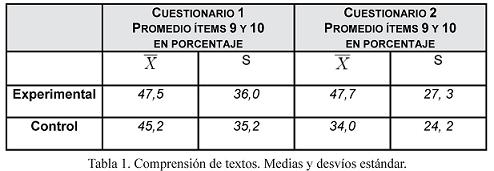
<body><![CDATA[<p class="western" style="margin: 5pt 134.25pt 0.0001pt 27pt; line-height: 150%;"><span style="font-size: 12pt; line-height: 150%; font-family: Arial;" lang="ES-UY"><o:p>&nbsp;</o:p></span></p>       <p class="western" style="margin: 5pt 134.25pt 0.0001pt 27pt; text-align: justify; text-indent: 14.2pt; line-height: 150%;"><span style="font-size: 12pt; line-height: 150%; font-family: Arial;" lang="ES-UY">Se presentar&aacute;n las comparaciones entre el grupo experimental y control, as&iacute; como los tres niveles de rendimiento, en comprensi&oacute;n de textos y procesos de autorregulaci&oacute;n. Se consider&oacute; un nivel de confianza mayor al 95% para todas las pruebas estad&iacute;sticas, realizadas utilizando el programa SPSS.<o:p></o:p></span></p>       <p class="western" style="margin: 5pt 134.25pt 0.0001pt 27pt; text-align: justify; line-height: 150%;"><span style="font-size: 12pt; line-height: 150%; font-family: Arial;" lang="ES-UY"><o:p>&nbsp;</o:p></span></p>       <p class="western" style="margin: 5pt 134.25pt 0.0001pt 27pt; text-align: justify; line-height: 150%;"><span style="font-size: 12pt; line-height: 150%; font-family: Arial;" lang="ES-UY"><o:p>&nbsp;</o:p></span></p>       <p class="western" style="margin: 5pt 134.25pt 0.0001pt 27pt; text-align: justify; line-height: 150%;"><b><span style="font-size: 12pt; line-height: 150%; font-family: Arial;" lang="ES-UY">Comprensi&oacute;n de textos</span></b><span style="font-size: 12pt; line-height: 150%; font-family: Arial;" lang="ES-UY"><o:p></o:p></span></p>       <p class="western" style="margin: 2.85pt 134.25pt 0.0001pt 27pt; text-align: justify; text-indent: 14.2pt; line-height: 150%;"><span style="font-size: 12pt; line-height: 150%; font-family: Arial;" lang="ES-UY"><o:p>&nbsp;</o:p></span></p>       <p class="western" style="margin: 2.85pt 134.25pt 0.0001pt 27pt; text-align: justify; text-indent: 14.2pt; line-height: 150%;"><span style="font-size: 12pt; line-height: 150%; font-family: Arial;" lang="ES-UY">Una primera hip&oacute;tesis consideraba que los alumnos que han recibido ense&ntilde;anza explicita de autorregulaci&oacute;n obtendr&iacute;an mejores resultados en comprensi&oacute;n de textos. A los efectos de las realizar las comparaciones en comprensi&oacute;n se consider&oacute; el promedio expresado en porcentaje de los &iacute;tems 9 (&ldquo;&iquest;C&oacute;mo titular&iacute;as el texto?&rdquo;) y 10 (&ldquo;Intenta explicarle a alguien que no ha le&iacute;do el texto las ideas que presenta. Utilizando tus palabras, escribe un p&aacute;rrafo con ese objetivo&rdquo;). Estos &iacute;tems mostraron ser emp&iacute;ricamente los m&aacute;s representativos y tener la correlaci&oacute;n m&aacute;s alta en los an&aacute;lisis factoriales exploratorios de cada cuestionario (m&eacute;todo de los Componentes Principales y la rotaci&oacute;n Varimax). Ambos constituyen un buen indicador de la construcci&oacute;n del significado global del texto, se respond&iacute;an teniendo el texto delante e interrogaban de la misma forma. <o:p></o:p></span></p>       <p class="western" style="margin: 5pt 134.25pt 0.0001pt 27pt; text-align: justify; text-indent: 14.2pt; line-height: 150%;"><span style="font-size: 12pt; line-height: 150%; font-family: Arial;" lang="ES-UY"><o:p>&nbsp;</o:p></span></p>       <p class="western" style="margin: 5pt 134.25pt 0.0001pt 27pt; text-align: justify; text-indent: 14.2pt; line-height: 150%;"><span style="font-size: 12pt; line-height: 150%; font-family: Arial;" lang="ES-UY">En la <a href="#t1">Tabla 1</a> pueden observarse las medias y desviaciones est&aacute;ndar de cada grupo en ambas evaluaciones. Se presentan expresados en porcentaje, pues se trata de &iacute;tems que ten&iacute;an distinto rango de variaci&oacute;n en cada cuestionario. En el primer cuestionario, tal como era esperable ambos grupos no se diferenciaron significativamente en sus niveles de comprensi&oacute;n de textos, comparados con la prueba de Mann-Whitney. En tanto, en la evaluaci&oacute;n final, existe un rendimiento superior del grupo experimental. Mediante la prueba de Mann-Whitney se obtiene una significaci&oacute;n asint&oacute;tica de .027. En relaci&oacute;n a la primera hip&oacute;tesis, se evidencia un rendimiento sensiblemente superior del grupo experimental al explicitar en forma escrita la comprensi&oacute;n de las ideas principales del texto.</span></p>       <p class="western" style="margin: 5pt 134.25pt 0.0001pt 27pt; text-align: justify; text-indent: 14.2pt; line-height: 150%;"><span style="font-size: 12pt; line-height: 150%; font-family: Arial;" lang="ES-UY"><o:p>&nbsp;</o:p></span></p>       ]]></body>
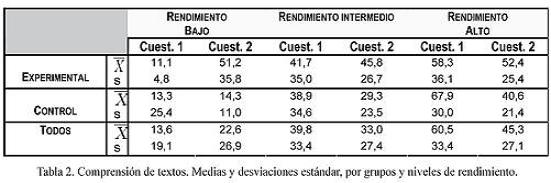
<body><![CDATA[<p class="western" style="margin: 5pt 134.25pt 0.0001pt 27pt; text-align: justify; text-indent: 14.2pt; line-height: 150%;"><span style="font-size: 12pt; line-height: 150%; font-family: Arial;" lang="ES-UY"><o:p>&nbsp;</o:p></span></p>       <p class="western" style="margin: 5pt 134.25pt 0.0001pt 27pt; text-align: justify; text-indent: 14.2pt; line-height: 150%;"><a name="t1"></a><img id="_x0000_i1025" src="../../../../../img/revistas/cp/v3n1/1a02t1.jpg" style="border-style: solid; border-width: 1px; height: 171px; width: 494px;" border="0" height="32" width="32">&nbsp;<span style="font-size: 12pt; line-height: 150%; font-family: Arial;" lang="ES-UY"><o:p></o:p></span></p>       <p class="western" style="margin: 5pt 134.25pt 0.0001pt 27pt; text-align: justify; text-indent: 14.2pt; line-height: 150%;"><span style="font-size: 12pt; line-height: 150%; font-family: Arial;" lang="ES-UY"><o:p>&nbsp;</o:p></span></p>       <p class="western" style="margin: 5pt 134.25pt 0.0001pt 27pt; text-align: justify; text-indent: 14.2pt; line-height: 150%;"><span style="font-size: 12pt; line-height: 150%; font-family: Arial;" lang="ES-UY"><o:p>&nbsp;</o:p></span></p>       <p class="western" style="margin: 5pt 134.25pt 0.0001pt 27pt; text-align: justify; text-indent: 11.35pt; line-height: 150%;"><span style="font-size: 12pt; line-height: 150%; font-family: Arial;" lang="ES-UY">Para calibrar la evoluci&oacute;n de cada grupo en el tiempo se utiliz&oacute; la prueba de rangos con signos de Wilcoxson. En el segundo cuestionario el grupo experimental al explicitar por escrito las ideas principales del texto alcanza resultados similares a los del primer cuestionario. En tanto, el grupo control tiene rendimientos significativamente decrecientes, con un valor de significaci&oacute;n asint&oacute;tica de .027. Ante un texto de mayor dificultad, los alumnos del grupo experimental mantienen su rendimiento y se desempe&ntilde;an mejor que los sujetos del grupo control, quienes reflejan menores posibilidades de explicitar las ideas centrales del texto. Cabe destacar que las evaluaciones se realizaron con textos diferentes y correspond&iacute;an a contenidos de la asignatura. <o:p></o:p></span></p>       <p class="western" style="margin: 5pt 134.25pt 0.0001pt 27pt; text-align: justify; text-indent: 11.35pt; line-height: 150%;"><span style="font-size: 12pt; line-height: 150%; font-family: Arial;" lang="ES-UY"><o:p>&nbsp;</o:p></span></p>       <p class="western" style="margin: 1.7pt 134.25pt 0.0001pt 27pt; text-align: justify; text-indent: 11.35pt; line-height: 150%;"><span style="font-size: 12pt; line-height: 150%; font-family: Arial;" lang="ES-UY">A juicio del docente, el texto propuesto en la segunda evaluaci&oacute;n resulta m&aacute;s dif&iacute;cil. Parece necesario analizar qui&eacute;nes se benefician de la intervenci&oacute;n dirigida a la ense&ntilde;anza de la autorregulaci&oacute;n. Una segunda hip&oacute;tesis es que los alumnos de peor rendimiento que participaron del grupo experimental incrementar&iacute;an sus niveles de comprensi&oacute;n. En la <a href="#t2">Tabla 2</a> se observan las medias y desviaciones est&aacute;ndar en los cuestionarios de comprensi&oacute;n agrupados seg&uacute;n sus calificaciones finales (rendimiento bajo, intermedio y alto). Se utiliz&oacute; la prueba de rangos con signos de Wilcoxon para la comparaci&oacute;n de los resultados en comprensi&oacute;n antes y despu&eacute;s considerando los niveles de rendimiento.<o:p></o:p></span></p>       <p class="western" style="margin: 1.7pt 134.25pt 0.0001pt 27pt; text-align: justify; text-indent: 11.35pt; line-height: 150%;"><span style="font-size: 12pt; line-height: 150%; font-family: Arial;" lang="ES-UY"><o:p>&nbsp;</o:p></span></p>       <p class="western" style="margin: 1.7pt 134.25pt 0.0001pt 27pt; text-align: justify; text-indent: 11.35pt; line-height: 150%;"><o:p>&nbsp;</o:p></p>       <p class="western" style="margin: 1.7pt 134.25pt 0.0001pt 27pt; text-align: justify; text-indent: 11.35pt; line-height: 150%;"><a name="t2"></a><span style="font-size: 12pt; line-height: 150%; font-family: Arial;" lang="ES-UY"><img id="_x0000_i1026" src="../../../../../img/revistas/cp/v3n1/1a02t2.jpg" style="border-style: solid; border-width: 1px; height: 183px; width: 551px;" border="0" height="32" width="32"></span></p>       ]]></body>
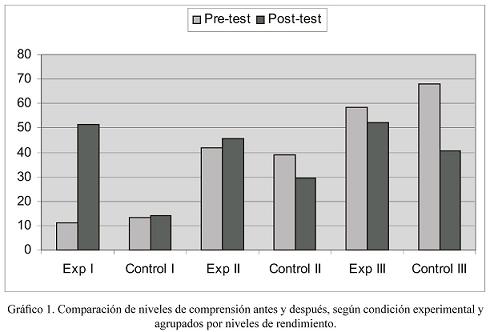
<body><![CDATA[<p class="western" style="margin: 1.7pt 134.25pt 0.0001pt 27pt; text-align: justify; text-indent: 11.35pt; line-height: 150%;"><span style="font-size: 12pt; line-height: 150%; font-family: Arial;" lang="ES-UY"><o:p>&nbsp;</o:p></span></p>       <p class="western" style="margin: 1.7pt 134.25pt 0.0001pt 27pt; text-align: justify; text-indent: 11.35pt; line-height: 150%;"><span style="font-size: 12pt; line-height: 150%; font-family: Arial;" lang="ES-UY"><o:p>&nbsp;</o:p></span></p>       <p style="margin: 5pt 134.25pt 0.0001pt 27pt; text-align: justify; text-indent: 14.2pt; line-height: 150%;"><span style="font-family: Arial;" lang="ES-UY">Parece necesario analizar qui&eacute;nes se benefician de la intervenci&oacute;n dirigida a la ense&ntilde;anza de la autorregulaci&oacute;n. Una segunda hip&oacute;tesis es que los alumnos de peor rendimiento que participaron del grupo experimental incrementar&iacute;an sus niveles de comprensi&oacute;n. En la <a href="#t2">Tabla 2</a> se observan las medias y desviaciones est&aacute;ndar en los cuestionarios de comprensi&oacute;n agrupados seg&uacute;n sus calificaciones finales (rendimiento bajo, intermedio y alto). Se utiliz&oacute; la prueba de rangos con signos de Wilcoxon para la comparaci&oacute;n de los resultados en comprensi&oacute;n antes y despu&eacute;s considerando los niveles de rendimiento. <o:p></o:p></span></p>       <p style="margin: 5pt 134.25pt 0.0001pt 27pt; text-align: justify; text-indent: 14.2pt; line-height: 150%;"><span style="font-family: Arial;" lang="ES-UY">En el post-test, ante un texto m&aacute;s dif&iacute;cil, los alumnos del grupo experimental muestran niveles de comprensi&oacute;n m&aacute;s homog&eacute;neos. Los alumnos de rendimiento bajo (3 sujetos) aumentaron sus niveles de comprensi&oacute;n, benefici&aacute;ndose de la intervenci&oacute;n. Alcanzaron una media similar a la de los alumnos de alto rendimiento. Sin embargo, este incremento no resulta estad&iacute;sticamente significativo, dado el reducido n&uacute;mero de alumnos y la variabilidad de sus resultados. Los alumnos de rendimiento intermedio y alto no var&iacute;an significativamente sus niveles de comprensi&oacute;n (ver <a href="#g1">Gr&aacute;fico 1</a>).<o:p></o:p></span></p>       <p style="margin: 5pt 134.25pt 0.0001pt 27pt; text-align: justify; text-indent: 14.2pt; line-height: 150%;"><span style="font-family: Arial;" lang="ES-UY">A diferencia del grupo experimental, los niveles de comprensi&oacute;n de los alumnos del grupo control son heterog&eacute;neos (ver <a href="#g1">Gr&aacute;fico 1</a>).</span></p>       <p style="margin: 5pt 134.25pt 0.0001pt 27pt; text-align: justify; text-indent: 14.2pt; line-height: 150%;"><span style="font-family: Arial;" lang="ES-UY"><o:p>&nbsp;</o:p></span></p>       <p style="margin: 5pt 134.25pt 0.0001pt 27pt; text-align: justify; text-indent: 14.2pt; line-height: 150%;"><span style="font-family: Arial;" lang="ES-UY"><o:p>&nbsp;</o:p></span></p>       <p style="margin: 5pt 134.25pt 0.0001pt 27pt; text-align: justify; text-indent: 14.2pt; line-height: 150%;"><a name="g1"></a><img id="_x0000_i1027" src="../../../../../img/revistas/cp/v3n1/1a02g1.jpg" style="border-style: solid; border-width: 1px; height: 332px; width: 490px;" border="0" height="32" width="32"><span style="font-family: Arial;" lang="ES-UY"><o:p></o:p></span></p>       <p style="margin: 5pt 134.25pt 0.0001pt 27pt; text-align: justify; text-indent: 14.2pt; line-height: 150%;"><span style="font-family: Arial;" lang="ES-UY"><o:p>&nbsp;</o:p></span></p>       <p style="margin: 5pt 134.25pt 0.0001pt 27pt; text-align: justify; text-indent: 14.2pt; line-height: 150%;"><span style="font-family: Arial;" lang="ES-UY"><o:p>&nbsp;</o:p></span></p>       ]]></body>
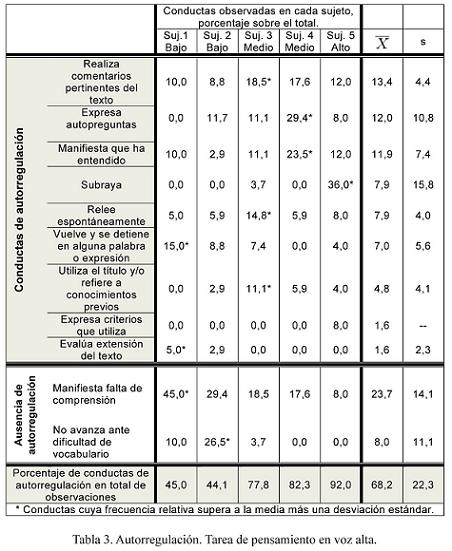
<body><![CDATA[<p style="margin: 5pt 134.25pt 0.0001pt 27pt; text-align: justify; text-indent: 14.2pt; line-height: 150%;"><span style="font-family: Arial;" lang="ES-UY">Los alumnos de bajo rendimiento (5 sujetos) mantienen muy bajos niveles de comprensi&oacute;n en ambas evaluaciones. Tampoco los alumnos de rendimiento intermedio muestran diferencias. <o:p></o:p></span></p>       <p style="margin: 5pt 134.25pt 0.0001pt 27pt; text-align: justify; text-indent: 14.2pt; line-height: 150%;"><span style="font-family: Arial;" lang="ES-UY">En cambio, los alumnos de alto rendimiento en el grupo control muestran un descenso estad&iacute;sticamente significativo al explicitar las ideas principales del texto; con una significaci&oacute;n asint&oacute;tica de 0,019. No logran sortear los obst&aacute;culos que el segundo texto les ofrec&iacute;a. <o:p></o:p></span></p>       <p style="margin: 5pt 134.25pt 0.0001pt 27pt; text-align: justify; line-height: 150%;"><span style="font-family: Arial;" lang="ES-UY"><o:p>&nbsp;</o:p></span></p>       <p style="margin: 5pt 134.25pt 0.0001pt 27pt; text-align: justify; line-height: 150%;"><span style="font-family: Arial;" lang="ES-UY"><o:p>&nbsp;</o:p></span></p>       <p style="margin: 5pt 134.25pt 0.0001pt 27pt; text-align: justify; line-height: 150%;"><b><span style="font-family: Arial;" lang="ES-UY">Autorregulaci&oacute;n del aprendizaje</span></b><span style="font-family: Arial;" lang="ES-UY"><o:p></o:p></span></p>       <p style="margin: 2.85pt 134.25pt 0.0001pt 27pt; text-align: justify; line-height: 150%;"><span style="font-family: Arial;" lang="ES-UY"><o:p>&nbsp;</o:p></span></p>       <p style="margin: 2.85pt 134.25pt 0.0001pt 27pt; text-align: justify; text-indent: 14.2pt; line-height: 150%;"><span style="font-family: Arial;" lang="ES-UY">Nuestras &uacute;ltimas hip&oacute;tesis aventuraban que los alumnos del grupo experimental evidenciar&iacute;an conductas de autorregulaci&oacute;n al leer un texto de la asignatura. Adem&aacute;s, sus estrategias de autorregulaci&oacute;n ser&iacute;an mejores en los estudiantes conforme obtuviesen mejor rendimiento acad&eacute;mico. En general, los indicadores que pudimos obtener van en esta l&iacute;nea.<o:p></o:p></span></p>       <p style="margin: 5pt 134.25pt 0.0001pt 27pt; text-align: justify; text-indent: 14.2pt; line-height: 150%;"><span style="font-family: Arial;" lang="ES-UY">Se evalu&oacute; a seis sujetos del grupo experimental con tareas de pensamiento en voz alta. No fue posible recuperar el registro f&iacute;lmico de uno de los alumnos de alto rendimiento, por lo que se ha excluido del an&aacute;lisis. Los registros de esta tarea fueron analizados por un observador externo, usando categor&iacute;as predeterminadas. Se contabilizaron las frecuencias absolutas de las conductas observadas y se calcularon los porcentajes de cada conducta en relaci&oacute;n al total de las conductas observadas en cada entrevista, tal como puede verse en la <a href="#t3">Tabla 3</a>. <o:p></o:p></span></p>       <p style="margin: 5pt 134.25pt 0.0001pt 27pt; text-align: justify; line-height: 150%;"><span style="font-family: Arial;" lang="ES-UY"><o:p>&nbsp;</o:p></span></p>       <p style="margin: 5pt 134.25pt 0.0001pt 27pt; text-align: justify; line-height: 150%;"><span style="font-family: Arial;" lang="ES-UY"><o:p>&nbsp;</o:p></span></p>       ]]></body>
<body><![CDATA[<p style="margin: 5pt 134.25pt 0.0001pt 27pt; text-align: justify; text-indent: 14.2pt; line-height: 150%;"><a name="t3"></a><img id="_x0000_i1028" src="../../../../../img/revistas/cp/v3n1/1a02t3.jpg" style="border-style: solid; border-width: 1px; height: 551px; width: 452px;" border="0" height="32" width="32">    <br>  &nbsp;</p>       <p style="margin: 5pt 134.25pt 0.0001pt 27pt; text-align: justify; text-indent: 14.2pt; line-height: 150%;"><span style="font-family: Arial;" lang="ES-UY"><o:p>&nbsp;</o:p></span></p>       <p style="margin: 5pt 134.25pt 0.0001pt 27pt; text-align: justify; text-indent: 14.2pt; line-height: 150%;"><span style="font-family: Arial;" lang="ES-UY">Los alumnos evidencian diversas formas de resoluci&oacute;n de la tarea de pensamiento en voz alta y todos exhiben conductas de autorregulaci&oacute;n. Estas conductas comunes a todos los sujetos evaluados son: realizar comentarios pertinentes sobre el texto, manifestaciones de entendimiento y releer espont&aacute;neamente. <o:p></o:p></span></p>       <p style="margin: 5pt 134.25pt 0.0001pt 27pt; text-align: justify; text-indent: 14.2pt; line-height: 150%;"><span style="font-family: Arial;" lang="ES-UY">Evaluar la extensi&oacute;n del texto es visible solo en los alumnos de bajo rendimiento. Mientras que expresar los criterios que utiliza durante la tarea es un comportamiento visible solo en el sujeto de alto rendimiento. <o:p></o:p></span></p>       <p style="margin: 5pt 134.25pt 0.0001pt 27pt; text-align: justify; text-indent: 14.2pt; line-height: 150%;"><span style="font-family: Arial;" lang="ES-UY">En los alumnos de bajo rendimiento se observan los menores niveles de autorregulaci&oacute;n, correspondiendo a un 45,0 y 44,2% de conductas de autorregulaci&oacute;n. Mayoritariamente las conductas observadas en los alumnos de este nivel corresponden a manifestaciones de inseguridad o de dificultad. El porcentaje de conductas de autorregulaci&oacute;n aumenta a 77,8 y 82,3% en los alumnos de rendimiento intermedio. <o:p></o:p></span></p>       <p style="margin: 5pt 134.25pt 0.0001pt 27pt; text-align: justify; text-indent: 14.2pt; line-height: 150%;"><span style="font-family: Arial;" lang="ES-UY">Quien exhibe mayor porcentaje de conductas de autorregulaci&oacute;n, un 92%, es alumno de alto rendimiento. <o:p></o:p></span></p>       <p style="margin: 5pt 134.25pt 0.0001pt 27pt; text-align: justify; text-indent: 14.2pt; line-height: 150%;"><span style="font-family: Arial;" lang="ES-UY">A medida que aumenta el nivel de rendimiento acad&eacute;mico, se observan en mayor porcentaje las conductas de autorregulaci&oacute;n implicadas en la lectura del texto.<o:p></o:p></span></p>       <p style="margin: 5pt 134.25pt 0.0001pt 27pt; text-align: justify; line-height: 150%;"><span style="font-family: Arial;" lang="ES-UY"><o:p>&nbsp;</o:p></span></p>       <p style="margin: 5pt 134.25pt 0.0001pt 27pt; text-align: justify; line-height: 150%;"><span style="font-family: Arial;" lang="ES-UY"><o:p>&nbsp;</o:p></span></p>       ]]></body>
<body><![CDATA[<p style="margin: 5pt 134.25pt 0.0001pt 27pt; text-align: center; line-height: 150%;" align="center"><b><span style="font-family: Arial;" lang="ES-UY">DISCUSI&Oacute;N Y CONCLUSIONES</span></b></p>       <p style="margin: 5pt 134.25pt 0.0001pt 27pt; text-align: center; line-height: 150%;" align="center"><span style="font-family: Arial;" lang="ES-UY"><o:p>&nbsp;</o:p></span></p>       <p style="margin: 5pt 134.25pt 0.0001pt 27pt; text-align: justify; text-indent: 14.2pt; line-height: 150%;"><span style="font-family: Arial;" lang="ES-UY">En relaci&oacute;n a la primera hip&oacute;tesis, se observ&oacute; un efecto positivo de la ense&ntilde;anza de la autorregulaci&oacute;n en la comprensi&oacute;n de textos. En el post-test fue significativamente superior el desempe&ntilde;o del grupo experimental. Aquellos a quienes se ense&ntilde;&oacute; expl&iacute;citamente autorregulaci&oacute;n del aprendizaje, est&aacute;n en mejores condiciones de reflejar el significado global del texto al asignar un t&iacute;tulo y resumir en un p&aacute;rrafo las ideas principales del mismo. <o:p></o:p></span></p>       <p style="margin: 5pt 134.25pt 0.0001pt 27pt; text-align: justify; text-indent: 14.2pt; line-height: 150%;"><span style="font-family: Arial;" lang="ES-UY">Las diferencias a favor del grupo experimental se hacen visibles en las tareas que exigen mayor complejidad cognitiva (dar cuenta de la macro-estructura) y en textos m&aacute;s complejos. Ante un texto de dificultad mayor, el grupo experimental mantiene niveles similares de comprensi&oacute;n a los alcanzados en el primer texto. Por el contrario, el grupo control muestra menores niveles de comprensi&oacute;n. Estas diferencias al reflejar por escrito las ideas principales del texto se vinculan a que los alumnos del grupo experimental alcanzan niveles superiores de monitoreo y han ganado en estrategias de autorregulaci&oacute;n que les permiten sortear las dificultades del texto (<a href="#Eme">Eme, Puustinen, &amp; Coutelet</a>, 2006; <a href="#Thiede">Thiede, Anderson, &amp; Therriault</a>, 2003).<o:p></o:p></span></p>       <p style="margin: 5pt 134.25pt 0.0001pt 27pt; text-align: justify; text-indent: 14.2pt; line-height: 150%;"><span style="font-family: Arial;" lang="ES-UY">Los alumnos de bajo rendimiento del grupo experimental muestran un crecimiento muy importante en su media de comprensi&oacute;n. <o:p></o:p></span></p>       <p style="margin: 5pt 134.25pt 0.0001pt 27pt; text-align: justify; text-indent: 14.2pt; line-height: 150%;"><span style="font-family: Arial;" lang="ES-UY">En la segunda evaluaci&oacute;n alcanzan niveles similares a los alumnos de rendimiento intermedio y alto de su grupo. Mientras los alumnos de bajo rendimiento del grupo control mantienen muy bajos niveles de comprensi&oacute;n. La intervenci&oacute;n dirigida a la ense&ntilde;anza de los procesos de autorregulaci&oacute;n beneficia sobre todo a alumnos de bajo rendimiento. Esto realza la utilidad de la ense&ntilde;anza expl&iacute;cita de estrategias metacognitivas para la comprensi&oacute;n de textos (<a name="Roeschl-HeilsSchneiderKraayenoord."></a><a href="#Roeschl">Roeschl-Heils, Schneider &amp; Kraayenoord</a>, 2003) en aquellos estudiantes que no han podido conseguir todav&iacute;a estrategias de supervisi&oacute;n de la comprensi&oacute;n. <o:p></o:p></span></p>       <p style="margin: 5pt 134.25pt 0.0001pt 27pt; text-align: justify; text-indent: 14.2pt; line-height: 150%;"><span style="font-family: Arial;" lang="ES-UY">Como era l&oacute;gico pensar, se observa que los alumnos a los cuales se ha ense&ntilde;ado expl&iacute;citamente a autorregular el aprendizaje exhiben tambi&eacute;n conductas de autorregulaci&oacute;n en la tarea de pensamiento en voz alta. Este dato nos sirve para validar nuevo el m&eacute;todo de pensamiento en voz alta al converger nuestros resultados en esta tarea con los obtenidos en los cuestionarios que aqu&iacute; pasamos y que evidencian que a mayores niveles de rendimiento, mayor presencia de conductas de autorregulaci&oacute;n (<a name="Kitsantas2002."></a><a href="#Kitsantas">Kitsantas</a>, 2002). <o:p></o:p></span></p>       <p style="margin: 5pt 134.25pt 0.0001pt 27pt; text-align: justify; text-indent: 14.2pt; line-height: 150%;"><span style="font-family: Arial;" lang="ES-UY">A su vez, cada alumno evidencia formas diferentes y propias de autorregulaci&oacute;n. La autorregulaci&oacute;n no necesariamente depende de la edad o el nivel educativo, los niveles de autorregulaci&oacute;n que se observan son resultado de los aprendizajes expl&iacute;citos e impl&iacute;citos de cada persona (<a href="#Nietfeld">Nietfeld, Cao &amp; Osborne</a>, 2005; <a name="OnwuegbuzieSlateSchwartz2001."></a><a href="#Onwuegbuzie">Onwuegbuzie, Slate &amp; Schwartz</a>, 2001). En nuestro caso ha sido la ense&ntilde;anza expl&iacute;cita de los procesos de autorregulaci&oacute;n lo que ha impactado sobre los niveles de comprensi&oacute;n de textos. La literatura especializada (ver Paris y Paris, 2001) ha mostrado recientemente las dificultades que existen para conseguir que lo que parece que funciona en ense&ntilde;anza de la autorregulaci&oacute;n en entornos controlados se pueda transferir a las aulas reales, a la ense&ntilde;anza.<o:p></o:p></span></p>       <p style="margin: 5pt 134.25pt 0.0001pt 27pt; text-align: justify; text-indent: 14.2pt; line-height: 150%;"><span style="font-family: Arial;" lang="ES-UY">En este sentido nuestros datos muestran que los efectos observados en comprensi&oacute;n de textos y autorregulaci&oacute;n del aprendizaje conseguidos, se vinculan a una metodolog&iacute;a de intervenci&oacute;n relativamente sencilla y econ&oacute;mica, que puede desarrollarse en contexto de aula sin modificar de forma grande la ense&ntilde;anza y sin complicar mucho el escenario formativo. El eje central de la misma consisti&oacute; en la explicitaci&oacute;n en clase del gui&oacute;n experto por parte del docente, y su ense&ntilde;anza a trav&eacute;s de un proceso secuenciado. Todo el trabajo constituy&oacute; para el docente un aporte que &eacute;ste valor&oacute; positivamente, y a su juicio no demand&oacute; esfuerzos mayores de planificaci&oacute;n y no lo distrajo de sus tareas centrales en el aula. Lo m&aacute;s importante de todo es que piensa seguir utiliz&aacute;ndolo. Al ser entrevistado al a&ntilde;o siguiente de la intervenci&oacute;n, sostuvo que cree que utiliza espont&aacute;neamente algunos aspectos de la metodolog&iacute;a cuando presenta textos que considera de dificultad para los alumnos. Destac&oacute; especialmente que le result&oacute; una estrategia &uacute;til para que los alumnos pierdan su miedo a la lectura.<o:p></o:p></span></p>       <p style="margin: 5pt 134.25pt 0.0001pt 27pt; text-align: justify; text-indent: 14.2pt; line-height: 150%;"><span style="font-family: Arial;" lang="ES-UY">Los principales l&iacute;mites del presente estudio, se vinculan al control de variables que puede realizarse en situaciones de aula. Las opciones metodol&oacute;gicas se orientaron a ganar en validez ecol&oacute;gica (<a href="#Alfassi">Alfassi</a>, 2004; Paris y Paris, 2001) en detrimento de un control de variables m&aacute;s fuerte. Por ejemplo, ambos grupos trabajaron con el mismo docente, registrando las clases de forma magnetof&oacute;nica. Con el prop&oacute;sito de ganar en control podr&iacute;a utilizarse un segundo grupo de comparaci&oacute;n a cargo de otro docente, realizando las evaluaciones correspondientes. Tambi&eacute;n se podr&iacute;an haber conocido m&aacute;s datos sobre la opini&oacute;n de los estudiantes sobre el docente y haber contado con m&aacute;s informaci&oacute;n sobre las competencias psicol&oacute;gicas de los estudiantes. Pero el haber llevado a cabo estas averiguaciones hubiese supuesto una injerencia mayor en el transcurrir de la docencia y probablemente hubiese supuesto una merma en el efecto de la intervenci&oacute;n al haberse hecho de forma mucho m&aacute;s artificiosa.<o:p></o:p></span></p>       ]]></body>
<body><![CDATA[<p style="margin: 5pt 134.25pt 0.0001pt 27pt; text-align: justify; text-indent: 14.2pt; line-height: 150%;"><span style="font-family: Arial;" lang="ES-UY">En cuanto a los instrumentos de evaluaci&oacute;n, una dificultad que surgi&oacute; fue dise&ntilde;ar cuestionarios de comprensi&oacute;n de textos comparables y ajustados a los contenidos de la asignatura. <o:p></o:p></span></p>       <p style="margin: 5pt 134.25pt 0.0001pt 27pt; text-align: justify; text-indent: 14.2pt; line-height: 150%;"><span style="font-family: Arial;" lang="ES-UY">Fue dif&iacute;cil dise&ntilde;ar cuestionarios totalmente equiparables. Para otros trabajos futuros ser&iacute;a bueno considerar otras medidas de comprensi&oacute;n como la transferencia a textos de otras asignaturas, que nos permitir&iacute;an ver en qu&eacute; medida lo aprendido de autorregulaci&oacute;n se generaliza.<o:p></o:p></span></p>       <p style="margin: 5pt 134.25pt 0.0001pt 27pt; text-align: justify; text-indent: 14.2pt; line-height: 150%;"><span style="font-family: Arial;" lang="ES-UY">La tarea de pensamiento en voz alta result&oacute; muy interesante para evaluar la autorregulaci&oacute;n del aprendizaje, aunque implic&oacute; gran dificultad para los alumnos que debieron realizarla. En estudios futuros, a los efectos de sacar m&aacute;s provecho a&uacute;n de la tarea, podr&iacute;a resultar &uacute;til modelar la presentaci&oacute;n de la consigna y entrenarlos previamente en la misma, tal como se ha realizado en otras investigaciones (<a href="#Cerdan1">Cerd&aacute;n</a>, 2007; Vidal-Abarca &amp; Cerd&aacute;n, 2008). <o:p></o:p></span></p>       <p style="margin: 5pt 134.25pt 0.0001pt 27pt; text-align: justify; text-indent: 14.2pt; line-height: 150%;"><span style="font-family: Arial;" lang="ES-UY">En este caso, no se realizaron evaluaciones individuales de los sujetos del grupo control en la tarea de pensamiento en voz alta, lo cual ser&iacute;a muy interesante a la hora de determinar, a&uacute;n con mayor rigurosidad, los efectos de una ense&ntilde;anza expl&iacute;cita en los procesos de autorregulaci&oacute;n frente a lo que se consigue de forma m&aacute;s impl&iacute;cita en los grupos sin esta intervenci&oacute;n. <o:p></o:p></span></p>       <p style="margin: 2.85pt 134.25pt 0.0001pt 27pt; text-align: justify; text-indent: 14.2pt; line-height: 150%;"><span style="font-family: Arial;" lang="ES-UY"><o:p>&nbsp;</o:p></span></p>       <p style="margin: 2.85pt 134.25pt 0.0001pt 27pt; text-align: justify; text-indent: 14.2pt; line-height: 150%;"><span style="font-family: Arial;" lang="ES-UY">Este trabajo ha tenido unas dimensiones modestas, se ha llevado a cabo con un solo docente y en dos grupos de clase. A partir de nuestros resultados resultar&iacute;a interesante extender la experiencia a m&aacute;s docente y ampliar la base de participantes de la investigaci&oacute;n. Tambi&eacute;n podr&iacute;a extenderse a otras asignaturas en forma coordinada y simult&aacute;nea.<o:p></o:p></span></p>       <p style="margin: 2.85pt 134.25pt 0.0001pt 27pt; text-align: justify; text-indent: 14.2pt; line-height: 150%;"><span style="font-family: Arial;" lang="ES-UY"><o:p>&nbsp;</o:p></span></p>       <p style="margin: 2.85pt 134.25pt 0.0001pt 27pt; text-align: justify; text-indent: 14.2pt; line-height: 150%;"><span style="font-family: Arial;" lang="ES-UY">En definitiva, pretend&iacute;amos evaluar la incidencia de la ense&ntilde;anza de autorregulaci&oacute;n del aprendizaje en un contexto real de aula a trav&eacute;s de una herramienta de sencilla aplicaci&oacute;n, para que pudiese ser incorporada al trabajo de los docentes en el aula. Se han encontrado resultados al respecto satisfactorios en orden a poder generar estrategias docentes para ense&ntilde;ar a pensar y ense&ntilde;ar a comprender. <o:p></o:p></span></p>       <p style="margin: 2.85pt 134.25pt 0.0001pt 27pt; text-align: justify; text-indent: 14.2pt; line-height: 150%;"><span style="font-family: Arial;" lang="ES-UY"><o:p>&nbsp;</o:p></span></p>       <p style="margin: 2.85pt 134.25pt 0.0001pt 27pt; text-align: justify; text-indent: 14.2pt; line-height: 150%;"><span style="font-family: Arial;" lang="ES-UY">Cabe recordar que nuestra metodolog&iacute;a ha beneficiado especialmente a los alumnos en mayor riesgo acad&eacute;mico, que son los que m&aacute;s lo necesitan. <o:p></o:p></span></p>       ]]></body>
<body><![CDATA[<p style="margin: 2.85pt 134.25pt 0.0001pt 27pt; text-align: justify; text-indent: 14.2pt; line-height: 150%;"><span style="font-family: Arial;" lang="ES-UY"><o:p>&nbsp;</o:p></span></p>       <p style="margin: 2.85pt 134.25pt 0.0001pt 27pt; text-align: justify; text-indent: 14.2pt; line-height: 150%;"><span style="font-family: Arial;" lang="ES-UY">Los resultados obtenidos invitan a seguir avanzando en el dise&ntilde;o de herramientas educativas que contribuyan a que los estudiantes se conviertan en aut&eacute;nticos gestores de su propio aprendizaje. <o:p></o:p></span></p>       <p style="margin: 5pt 134.25pt 0.0001pt 27pt; text-align: justify; line-height: 150%;"><span style="font-family: Arial;" lang="ES-UY"><o:p>&nbsp;</o:p></span></p>       <p style="margin: 5pt 134.25pt 0.0001pt 27pt; text-align: justify; line-height: 150%;"><span style="font-family: Arial;" lang="ES-UY"><o:p>&nbsp;</o:p></span></p>       <p style="margin: 5pt 134.25pt 0.0001pt 27pt; text-align: center; line-height: 150%;" align="center"><b><span style="font-family: Arial;" lang="EN-US">REFERENCIAS</span></b><span style="font-family: Arial;" lang="EN-US"><o:p></o:p></span></p>       <p style="margin: 5.65pt 134.25pt 0.0001pt 27pt; text-align: justify; text-indent: 14.2pt; line-height: 120%;"><span style="font-family: Arial;" lang="EN-US"><o:p>&nbsp;</o:p></span></p>       <!-- ref --><p style="margin: 5pt 134.25pt 0.0001pt 27pt; text-align: justify; text-indent: -14.2pt; line-height: 120%;"><a name="Alfassi"></a><a href="#Alfassi2004."><span class="SpellE"><span class="GramE"><span style="font-family: Arial;" lang="EN-US">Alfassi</span></span></span></a><span class="GramE"><span style="font-family: Arial;" lang="EN-US"><a href="#Alfassi2004.">, M. (2004)</a>.</span></span><span style="font-family: Arial;" lang="EN-US"> </span><st1:city><st1:place><span style="font-family: Arial;" lang="EN-US">Reading</span></st1:place></st1:city><span style="font-family: Arial;" lang="EN-US"> to learn: effects of combined strategy instruction on high school students. <span class="GramE">The journal of educational research, 97, 4, 171-184.    </span></span><span style="font-family: Arial;" lang="EN-GB"><o:p></o:p></span></p>       <!-- ref --><p style="margin: 5pt 134.25pt 0.0001pt 27pt; text-align: justify; text-indent: -14.2pt; line-height: 120%;"><a name="Alonso"></a><span class="GramE"><span style="font-family: Arial;" lang="EN-US"><a href="#AlonsoTapiayCarriedo2002.">Alonso-Tapia, J. &amp; <span class="SpellE">Carriedo</span>, N. (2002)</a>.</span></span><span style="font-family: Arial;" lang="EN-US"> </span><span style="font-family: Arial;" lang="ES-UY">El entrenamiento de la comprensi&oacute;n lectora. En Corral, A. (coord.). Psicolog&iacute;a del aprendizaje de textos. Madrid: UNED.    <o:p></o:p></span></p>       ]]></body>
<body><![CDATA[<!-- ref --><p style="margin: 5pt 134.25pt 0.0001pt 27pt; text-align: justify; text-indent: -14.2pt; line-height: 120%;"><a name="Boekaerts"></a><a href="#BoekaertsyCorno2005."><span class="SpellE"><span class="GramE"><span style="font-family: Arial;" lang="EN-US">Boekaerts</span></span></span></a><span class="GramE"><span style="font-family: Arial;" lang="EN-US"><a href="#BoekaertsyCorno2005.">, M., &amp; <span class="SpellE">Corno</span>, L. (2005)</a>.</span></span><span style="font-family: Arial;" lang="EN-US"> Self-Regulation in the Classroom: A Perspective on Assessment and Intervention. <span class="GramE">Applied Psychology: An International Review, 54(2), 199-231.    </span></span><span style="font-family: Arial;" lang="EN-GB"><o:p></o:p></span></p>       <p style="margin: 5pt 134.25pt 0.0001pt 27pt; text-align: justify; text-indent: -14.2pt; line-height: 120%;"><a name="Braten"></a><a href="#BratenySamuelstuen2004.."><span class="SpellE"><span class="GramE"><span style="font-family: Arial;" lang="EN-US">Braten</span></span></span></a><span class="GramE"><span style="font-family: Arial;" lang="EN-US"><a href="#BratenySamuelstuen2004..">, I. &amp; <span class="SpellE">Samuelstuen</span>, M. (2004)</a>.</span></span><span style="font-family: Arial;" lang="EN-US"> Does the influence of reading purpose on reports of strategic text processing depend on students&rsquo; topic knowledge? <span class="GramE">Journal of educational psychology, 96, 2, 324-336.</span></span><span style="font-family: Arial;" lang="EN-GB"><o:p></o:p></span></p>       <!-- ref --><p style="margin: 5pt 134.25pt 0.0001pt 27pt; text-align: justify; text-indent: -14.2pt; line-height: 120%;"><a name="Butler"></a><a href="#ButlerBeckinghamNovak2005."><st1:city><st1:place><span class="GramE"><span style="font-family: Arial;" lang="EN-US">Butler</span></span></st1:place></st1:city></a><span class="GramE"><span style="font-family: Arial;" lang="EN-US"><a href="#ButlerBeckinghamNovak2005.">, D.; <span class="SpellE">Beckingham</span>, B. &amp; Novak, H. (2005)</a>.</span></span><span style="font-family: Arial;" lang="EN-US"> <span class="GramE">Promoting strategic learning by eighth-grade students struggling in mathematics: a report of three case studies.</span> </span><span style="font-family: Arial;" lang="ES-UY">Learning disabilities research &amp; practice, 20, 3, 156-174.    <o:p></o:p></span></p>       <!-- ref --><p style="margin: 5pt 134.25pt 0.0001pt 27pt; text-align: justify; text-indent: -14.2pt; line-height: 120%;"><a name="Cerdan1"></a><span style="font-family: Arial;" lang="ES-UY"><a href="#Cerd%E1n2007.">Cerd&aacute;n, R. (2007)</a>. Estrategias de lectura y contestaci&oacute;n a preguntas con textos m&uacute;ltiples: Un estudio de pensamiento en voz alta. </span><span class="SpellE"><span style="font-family: Arial;" lang="EN-US">Infancia</span></span><span style="font-family: Arial;" lang="EN-US"> y <span class="SpellE">Aprendizaje</span>, 30(1), 55-71.    </span><span style="font-family: Arial;" lang="EN-GB"><o:p></o:p></span></p>       <!-- ref --><p style="margin: 5pt 134.25pt 0.0001pt 27pt; text-align: justify; text-indent: -14.2pt; line-height: 120%;"><a name="Cerdan2"></a><a href="#Cerd%E1nyVidal-Abarca2008."><span style="font-family: Arial;">Cerd&aacute;n, R., &amp; E. Vidal-Abarca. </span></a><span style="font-family: Arial;" lang="EN-US"><a href="#Cerd%E1nyVidal-Abarca2008.">(2008)</a>. <span class="GramE">The</span> effects of tasks on integrating information from multiple documents. Journal of Educational Psychology, 100(1), 209-222.    </span><span style="font-family: Arial;" lang="EN-GB"><o:p></o:p></span></p>       <!-- ref --><p style="margin: 5pt 134.25pt 0.0001pt 27pt; text-align: justify; text-indent: -14.2pt; line-height: 120%;"><a name="Eme"></a><a href="#EmePuustinenCoutelet2006."><span class="SpellE"><span style="font-family: Arial;" lang="EN-US">Eme</span></span></a><span style="font-family: Arial;" lang="EN-US"><a href="#EmePuustinenCoutelet2006.">, E., <span class="SpellE">Puustinen</span>, M., &amp; <span class="SpellE">Coutelet<span class="GramE">,B</span></span>. (2006)</a>. Individual and developmental differences in reading monitoring: when and how do children evaluate their comprehension? European Journal of Psychology of Education, 21, 1, 91-115.    </span><span style="font-family: Arial;" lang="EN-GB"><o:p></o:p></span></p>       <p style="margin: 5pt 134.25pt 0.0001pt 27pt; text-align: justify; text-indent: -14.2pt; line-height: 120%;"><a name="Fuchs"></a><span class="GramE"><span style="font-family: Arial;" lang="EN-US"><a href="#FuchsFuchsPrenticecols2003.">Fuchs, L.; Fuchs, D.; Prentice, K.; Burch, M.; <span class="SpellE">Hamlett</span>, C.; Owen, R. &amp; <span class="SpellE">Schroeter</span>, K. (2003)</a>.</span></span><span style="font-family: Arial;" lang="EN-US"> Enhancing third-grade students&rsquo; mathematical problem solving with self-regulates learning strategies. </span><span style="font-family: Arial;" lang="ES-UY">Journal of educational psychology, 95, 2, 306-315.<o:p></o:p></span></p>       <!-- ref --><p style="margin: 5pt 134.25pt 0.0001pt 27pt; text-align: justify; text-indent: -14.2pt; line-height: 120%;"><a name="Guasch"></a><span style="font-family: Arial;" lang="ES-UY"><a href="#GuaschCastell%F32002.">Guasch, T., &amp; Castell&oacute;, M. (2002)</a>. Aproximaci&oacute;n a la ense&ntilde;anza de la toma de apuntes en la Educaci&oacute;n Secundaria Obligatoria: un estudio descriptivo. </span><span class="SpellE"><span style="font-family: Arial;" lang="EN-US">Infancia</span></span><span style="font-family: Arial;" lang="EN-US"> y <span class="SpellE">Aprendizaje</span>, 25, 2, 169-181.    </span><span style="font-family: Arial;" lang="EN-GB"><o:p></o:p></span></p>       <!-- ref --><p style="margin: 5pt 134.25pt 0.0001pt 27pt; text-align: justify; text-indent: -14.2pt; line-height: 120%;"><a name="Kitsantas"></a><a href="#Kitsantas2002."><span class="SpellE"><span style="font-family: Arial;" lang="EN-US">Kitsantas</span></span></a><span style="font-family: Arial;" lang="EN-US"><a href="#Kitsantas2002.">, A. (2002)</a>. Test preparation and performance: a self-regulatory <span class="SpellE">an&aacute;lisis</span>. <span class="GramE">The journal of experimental education, 70, 2, 101-113.    </span></span><span style="font-family: Arial;" lang="EN-GB"><o:p></o:p></span></p>       <!-- ref --><p style="margin: 5pt 134.25pt 0.0001pt 27pt; text-align: justify; text-indent: -14.2pt; line-height: 120%;"><a name="Mason"></a><span style="font-family: Arial;" lang="EN-US"><a href="#Mason2004.">Mason, L. (2004)</a>. Explicit Self-Regulated strategy development versus reciprocal questioning: effects on expository reading comprehension among struggling readers. Journal of Educational Psychology, 96, 2, 283-296.    </span><span style="font-family: Arial;" lang="EN-GB"><o:p></o:p></span></p>       <!-- ref --><p style="margin: 5pt 134.25pt 0.0001pt 27pt; text-align: justify; text-indent: -14.2pt; line-height: 120%;"><a name="Mateos"></a><span style="font-family: Arial;"><a href="#Mateos2001.">Mateos, M. (2001)</a>. Metacognici&oacute;n y educaci&oacute;n. </span><st1:city><st1:place><span style="font-family: Arial;" lang="EN-US">Buenos Aires</span></st1:place></st1:city><span style="font-family: Arial;" lang="EN-US">: <span class="SpellE">Aique</span>.    </span><span style="font-family: Arial;" lang="EN-GB"><o:p></o:p></span></p>       ]]></body>
<body><![CDATA[<!-- ref --><p style="margin: 5pt 134.25pt 0.0001pt 27pt; text-align: justify; text-indent: -14.2pt; line-height: 120%;"><a name="Nietfeld"></a><a href="#NietfeldCaoyOsborne2005."><span class="SpellE"><span class="GramE"><span style="font-family: Arial;" lang="EN-US">Nietfeld</span></span></span></a><a href="#NietfeldCaoyOsborne2005."><span class="GramE"><span style="font-family: Arial;" lang="EN-US">, J.; L. <span class="SpellE">Cao</span> &amp; J. Osborne.</span></span></a><span style="font-family: Arial;" lang="EN-US"><a href="#NietfeldCaoyOsborne2005."> </a><span class="GramE"><a href="#NietfeldCaoyOsborne2005.">(2005)</a>. <span class="SpellE">Metacognitive</span> monitoring accuracy and student performance in the postsecondary classroom.</span> <span class="GramE">The journal of experimental education, 74, 1, 7-28.    </span></span><span style="font-family: Arial;" lang="EN-GB"><o:p></o:p></span></p>       <!-- ref --><p style="margin: 5pt 134.25pt 0.0001pt 27pt; text-align: justify; text-indent: -14.2pt; line-height: 120%;"><a name="Onwuegbuzie"></a><a href="#OnwuegbuzieSlateySchwartz2001."><span class="SpellE"><span class="GramE"><span style="font-family: Arial;" lang="EN-US">Onwuegbuzie</span></span></span><span class="GramE"><span style="font-family: Arial;" lang="EN-US">, A.; J. Slate &amp; R. Schwartz.</span></span></a><span style="font-family: Arial;" lang="EN-US"><a href="#OnwuegbuzieSlateySchwartz2001."> </a><span class="GramE"><a href="#OnwuegbuzieSlateySchwartz2001.">(2001)</a>. Role of study skills in graduate-level educational research courses.</span> <span class="GramE">The journal of educational research, 94, 4, 238-246.</span> <span class="GramE">Paris, S. G., &amp; Paris, A. H. (2001).    <!-- ref --></span> <span class="GramE">Classroom Applications of Research on Self-Regulated Learning.</span> Educational Psychologist, 36(2), 89-101.    </span><span style="font-family: Arial;" lang="EN-GB"><o:p></o:p></span></p>       <!-- ref --><p style="margin: 5pt 134.25pt 0.0001pt 27pt; text-align: justify; text-indent: -14.2pt; line-height: 120%;"><a name="Pintrich"></a><a href="#Pintrich2003."><span class="SpellE"><span style="font-family: Arial;" lang="EN-US">Pintrich</span></span></a><span style="font-family: Arial;" lang="EN-US"><a href="#Pintrich2003.">, P. (2003)</a>. <span class="GramE">A Motivational Science Perspective on the Role of Student Motivation in Learning and Teaching Contexts.</span> </span><span style="font-family: Arial;" lang="ES-UY">Journal of Educational Psychology, 95(4), 667-686.    <o:p></o:p></span></p>       <!-- ref --><p style="margin: 5pt 134.25pt 0.0001pt 27pt; text-align: justify; text-indent: -14.2pt; line-height: 120%;"><a name="Pozo"></a><span style="font-family: Arial;" lang="ES-UY"><a href="#Pozo2008.">Pozo, J. I. (2008)</a>. Aprendices y maestros. La psicolog&iacute;a cognitiva del aprendizaje. 2da Ed. Madrid: Alianza.    <o:p></o:p></span></p>       <!-- ref --><p style="margin: 5pt 134.25pt 0.0001pt 27pt; text-align: justify; text-indent: -14.2pt; line-height: 120%;"><a name="Roeschl"></a><a href="#Roeschl-HeilsSchneiderKraayenoord."><span class="SpellE"><span style="font-family: Arial;" lang="EN-GB">Roeschl-Heils</span></span></a><span style="font-family: Arial;" lang="EN-GB"><a href="#Roeschl-HeilsSchneiderKraayenoord.">, A.; Schneider, W., &amp; van <span class="SpellE">Kraayenoord</span>, C. (2003)</a>. </span><st1:city><st1:place><span style="font-family: Arial;" lang="EN-US">Reading</span></st1:place></st1:city><span style="font-family: Arial;" lang="EN-US">, <span class="SpellE">metacognition</span> and motivation: a follow-up study of <span class="SpellE">german</span> students in grades 7 and 8. <span class="GramE">European journal of psychology of education, 18, 1, 75-86.    </span></span><span style="font-family: Arial;" lang="EN-GB"><o:p></o:p></span></p>       <!-- ref --><p style="margin: 5pt 134.25pt 0.0001pt 27pt; text-align: justify; text-indent: -14.2pt; line-height: 120%;"><a name="Sungur"></a><a href="#SungurTakkaya2006."><span class="SpellE"><span class="GramE"><span style="font-family: Arial;" lang="EN-US">Sungur</span></span></span></a><span class="GramE"><span style="font-family: Arial;" lang="EN-US"><a href="#SungurTakkaya2006.">, S. &amp; <span class="SpellE">Tekkaya</span>, C. (2006)</a>.</span></span><span style="font-family: Arial;" lang="EN-US"> <span class="GramE">Effects of problem-based learning and <span class="SpellE">tradicional</span> instruction on self-regulated learning.</span> <span class="GramE">The journal of educational research, 99, 5, 307-317.    </span></span><span style="font-family: Arial;" lang="EN-GB"><o:p></o:p></span></p>       <!-- ref --><p style="margin: 5pt 134.25pt 0.0001pt 27pt; text-align: justify; text-indent: -14.2pt; line-height: 120%;"><a name="Thiede"></a><a href="#ThiedeAndersonTherriault2003."><span class="SpellE"><span class="GramE"><span style="font-family: Arial;" lang="EN-US">Thiede</span></span></span><span class="GramE"><span style="font-family: Arial;" lang="EN-US">, K.; </span></span><st1:city><st1:place><span class="GramE"><span style="font-family: Arial;" lang="EN-US">Anderson</span></span></st1:place></st1:city></a><span class="GramE"><span style="font-family: Arial;" lang="EN-US"><a href="#ThiedeAndersonTherriault2003.">, M., &amp; <span class="SpellE">Therriault</span>, D. (2003)</a>.</span></span><span style="font-family: Arial;" lang="EN-US"> Accuracy of <span class="SpellE">metacognitive</span> monitoring affects learning of texts. <span class="GramE">Journal of educational psychology, 2003, 95, 1, 66-73.    </span></span><span style="font-family: Arial;" lang="EN-GB"><o:p></o:p></span></p>       <!-- ref --><p style="margin: 5pt 134.25pt 0.0001pt 27pt; text-align: justify; text-indent: -14.2pt; line-height: 120%;"><a name="Torrance"></a><a href="#TorranceHidalgoGarc%EDa2007."><st1:city><st1:place><span class="GramE"><span style="font-family: Arial;" lang="EN-US">Torrance</span></span></st1:place></st1:city></a><span class="GramE"><span style="font-family: Arial;" lang="EN-US"><a href="#TorranceHidalgoGarc%EDa2007.">, M.; <span class="SpellE">Fidalgo</span>, R., &amp; <span class="SpellE">Garc&iacute;a</span>, J. (2007)</a>.</span></span><span style="font-family: Arial;" lang="EN-US"> <span class="GramE">The <span class="SpellE">teachability</span> and effectiveness of cognitive self-regulation in sixth-grade writers.</span> <span class="GramE">Learning and instruction, 17, 265-285.    </span></span><span style="font-family: Arial;" lang="EN-GB"><o:p></o:p></span></p>       <!-- ref --><p style="margin: 5pt 134.25pt 0.0001pt 27pt; text-align: justify; text-indent: -14.2pt; line-height: 120%;"><a name="Zimmerman1"></a><span style="font-family: Arial;" lang="EN-US"><a href="#Zimmerman2000.">Zimmerman, B. (2000)</a>. <span class="GramE">Attaining self-regulation.</span> <span class="GramE">A social cognitive perspective.</span> <span class="GramE">En <span class="SpellE">Boekaerts</span>, M., P. <span class="SpellE">Pintrich</span> &amp; M. <span class="SpellE">Zeidner</span> (eds.) Handbook of self-regulation.</span> </span><st1:state><st1:place><span style="font-family: Arial;" lang="EN-US">New York</span></st1:place></st1:state><span style="font-family: Arial;" lang="EN-US">: Academic Press.    </span><span style="font-family: Arial;" lang="EN-GB"><o:p></o:p></span></p>       <!-- ref --><p style="margin: 5pt 134.25pt 0.0001pt 27pt; text-align: justify; text-indent: -14.2pt; line-height: 120%;"><a name="Zimmerman2"></a><span style="font-family: Arial;" lang="EN-US"><a href="#Zimmerman2008.">Zimmerman, B. (2008)</a>. <span class="GramE">Investigating self-regulation and motivation: Historical background, methodological developments, and future prospects.</span> </span><span style="font-family: Arial;" lang="ES-UY">American Educational Research Journal, 45(1), 166-183.    <o:p></o:p></span></p>       <p style="margin: 5pt 134.25pt 0.0001pt 27pt; text-align: justify; text-indent: 14.2pt; line-height: 120%;"><span style="font-family: Arial;" lang="ES-UY"><o:p>&nbsp;</o:p></span></p>       <p class="western" style="margin: 5pt 134.25pt 12pt 27pt; text-align: justify;"><span style="font-size: 12pt; line-height: 115%; font-family: Arial;" lang="ES-UY"><o:p>&nbsp;</o:p></span></p>       <p class="MsoNormal" style="margin: 0cm 134.25pt 0.0001pt 27pt;"><span style="font-family: Arial;" lang="ES-UY"><o:p>&nbsp;</o:p></span></p>   </div>        ]]></body><back>
<ref-list>
<ref id="B1">
<nlm-citation citation-type="journal">
<person-group person-group-type="author">
<name>
<surname><![CDATA[Alfassi]]></surname>
<given-names><![CDATA[M.]]></given-names>
</name>
</person-group>
<article-title xml:lang="en"><![CDATA[Reading to learn: effects of combined strategy instruction on high school students]]></article-title>
<source><![CDATA[The journal of educational research]]></source>
<year>2004</year>
<volume>97</volume>
<numero>4</numero>
<issue>4</issue>
<page-range>171-184</page-range></nlm-citation>
</ref>
<ref id="B2">
<nlm-citation citation-type="book">
<person-group person-group-type="author">
<name>
<surname><![CDATA[Alonso-Tapia]]></surname>
<given-names><![CDATA[J.]]></given-names>
</name>
<name>
<surname><![CDATA[Carriedo]]></surname>
</name>
</person-group>
<article-title xml:lang="es"><![CDATA[El entrenamiento de la comprensión lectora]]></article-title>
<person-group person-group-type="editor">
<name>
<surname><![CDATA[Corral]]></surname>
<given-names><![CDATA[A.]]></given-names>
</name>
</person-group>
<source><![CDATA[Psicología del aprendizaje de textos]]></source>
<year>2002</year>
<publisher-loc><![CDATA[Madrid ]]></publisher-loc>
<publisher-name><![CDATA[UNED]]></publisher-name>
</nlm-citation>
</ref>
<ref id="B3">
<nlm-citation citation-type="journal">
<person-group person-group-type="author">
<name>
<surname><![CDATA[Boekaerts]]></surname>
<given-names><![CDATA[M.]]></given-names>
</name>
<name>
<surname><![CDATA[Corno]]></surname>
<given-names><![CDATA[L.]]></given-names>
</name>
</person-group>
<article-title xml:lang="en"><![CDATA[Self-Regulation in the Classroom: A Perspective on Assessment and Intervention]]></article-title>
<source><![CDATA[Applied Psychology: An International Review]]></source>
<year>2005</year>
<volume>54</volume>
<numero>2</numero>
<issue>2</issue>
<page-range>199-231</page-range></nlm-citation>
</ref>
<ref id="B4">
<nlm-citation citation-type="journal">
<person-group person-group-type="author">
<name>
<surname><![CDATA[Braten]]></surname>
<given-names><![CDATA[I.]]></given-names>
</name>
<name>
<surname><![CDATA[Samuelstuen]]></surname>
<given-names><![CDATA[M.]]></given-names>
</name>
</person-group>
<article-title xml:lang="en"><![CDATA[Does the influence of reading purpose on reports of strategic text processing depend on students&rsquo; topic knowledge?]]></article-title>
<source><![CDATA[Journal of educational psychology]]></source>
<year>2004</year>
<volume>96</volume>
<numero>2</numero>
<issue>2</issue>
<page-range>324-336</page-range></nlm-citation>
</ref>
<ref id="B5">
<nlm-citation citation-type="journal">
<person-group person-group-type="author">
<name>
<surname><![CDATA[Butler]]></surname>
<given-names><![CDATA[D.]]></given-names>
</name>
<name>
<surname><![CDATA[Beckingham]]></surname>
<given-names><![CDATA[B.]]></given-names>
</name>
<name>
<surname><![CDATA[Novak]]></surname>
<given-names><![CDATA[H.]]></given-names>
</name>
</person-group>
<article-title xml:lang="en"><![CDATA[Promoting strategic learning by eighth-grade students struggling in mathematics: a report of three case studies]]></article-title>
<source><![CDATA[Learning disabilities research & practice]]></source>
<year>2005</year>
<volume>20</volume>
<numero>3</numero>
<issue>3</issue>
<page-range>156-174</page-range></nlm-citation>
</ref>
<ref id="B6">
<nlm-citation citation-type="journal">
<person-group person-group-type="author">
<name>
<surname><![CDATA[Cerdán]]></surname>
<given-names><![CDATA[R.]]></given-names>
</name>
</person-group>
<article-title xml:lang="es"><![CDATA[Estrategias de lectura y contestación a preguntas con textos múltiples: Un estudio de pensamiento en voz alta]]></article-title>
<source><![CDATA[Infancia y Aprendizaje]]></source>
<year>2007</year>
<volume>30</volume>
<numero>1</numero>
<issue>1</issue>
<page-range>55-71</page-range></nlm-citation>
</ref>
<ref id="B7">
<nlm-citation citation-type="journal">
<person-group person-group-type="author">
<name>
<surname><![CDATA[Cerdán]]></surname>
<given-names><![CDATA[R.]]></given-names>
</name>
<name>
<surname><![CDATA[Vidal-Abarca]]></surname>
<given-names><![CDATA[E.]]></given-names>
</name>
</person-group>
<article-title xml:lang="en"><![CDATA[The effects of tasks on integrating information from multiple documents]]></article-title>
<source><![CDATA[Journal of Educational Psychology]]></source>
<year>2008</year>
<volume>100</volume>
<numero>1</numero>
<issue>1</issue>
<page-range>209-222</page-range></nlm-citation>
</ref>
<ref id="B8">
<nlm-citation citation-type="journal">
<person-group person-group-type="author">
<name>
<surname><![CDATA[Eme]]></surname>
<given-names><![CDATA[E.]]></given-names>
</name>
<name>
<surname><![CDATA[Puustinen]]></surname>
<given-names><![CDATA[M.]]></given-names>
</name>
<name>
<surname><![CDATA[Coutelet]]></surname>
<given-names><![CDATA[B.]]></given-names>
</name>
</person-group>
<article-title xml:lang="en"><![CDATA[Individual and developmental differences in reading monitoring: when and how do children evaluate their comprehension?]]></article-title>
<source><![CDATA[European Journal of Psychology of Education]]></source>
<year>2006</year>
<volume>21</volume>
<numero>1</numero>
<issue>1</issue>
<page-range>91-115</page-range></nlm-citation>
</ref>
<ref id="B9">
<nlm-citation citation-type="journal">
<person-group person-group-type="author">
<name>
<surname><![CDATA[Fuchs]]></surname>
<given-names><![CDATA[L.]]></given-names>
</name>
<name>
<surname><![CDATA[Fuchs]]></surname>
<given-names><![CDATA[D.]]></given-names>
</name>
<name>
<surname><![CDATA[Prentice]]></surname>
<given-names><![CDATA[K.]]></given-names>
</name>
<name>
<surname><![CDATA[Burch]]></surname>
<given-names><![CDATA[M.]]></given-names>
</name>
<name>
<surname><![CDATA[Hamlett]]></surname>
<given-names><![CDATA[C.]]></given-names>
</name>
<name>
<surname><![CDATA[Owen]]></surname>
<given-names><![CDATA[R.]]></given-names>
</name>
<name>
<surname><![CDATA[Schroeter]]></surname>
<given-names><![CDATA[K.]]></given-names>
</name>
</person-group>
<article-title xml:lang="en"><![CDATA[Enhancing third-grade students&rsquo; mathematical problem solving with self-regulates learning strategies]]></article-title>
<source><![CDATA[Journal of educational psychology]]></source>
<year>2003</year>
<volume>95</volume>
<numero>2</numero>
<issue>2</issue>
<page-range>306-315</page-range></nlm-citation>
</ref>
<ref id="B10">
<nlm-citation citation-type="journal">
<person-group person-group-type="author">
<name>
<surname><![CDATA[Guasch]]></surname>
<given-names><![CDATA[T.]]></given-names>
</name>
<name>
<surname><![CDATA[Castelló]]></surname>
<given-names><![CDATA[M.]]></given-names>
</name>
</person-group>
<article-title xml:lang="es"><![CDATA[Aproximación a la enseñanza de la toma de apuntes en la Educación Secundaria Obligatoria: un estudio descriptivo]]></article-title>
<source><![CDATA[Infancia y Aprendizaje]]></source>
<year>2002</year>
<volume>25</volume>
<numero>2</numero>
<issue>2</issue>
<page-range>169-181</page-range></nlm-citation>
</ref>
<ref id="B11">
<nlm-citation citation-type="journal">
<person-group person-group-type="author">
<name>
<surname><![CDATA[Kitsantas]]></surname>
<given-names><![CDATA[A.]]></given-names>
</name>
</person-group>
<article-title xml:lang="en"><![CDATA[Test preparation and performance: a self-regulatory análisis]]></article-title>
<source><![CDATA[The journal of experimental education]]></source>
<year>2002</year>
<volume>70</volume>
<numero>2</numero>
<issue>2</issue>
<page-range>101-113</page-range></nlm-citation>
</ref>
<ref id="B12">
<nlm-citation citation-type="journal">
<person-group person-group-type="author">
<name>
<surname><![CDATA[Mason]]></surname>
<given-names><![CDATA[L.]]></given-names>
</name>
</person-group>
<article-title xml:lang="en"><![CDATA[Explicit Self-Regulated strategy development versus reciprocal questioning: effects on expository reading comprehension among struggling readers]]></article-title>
<source><![CDATA[Journal of Educational Psychology]]></source>
<year>2004</year>
<volume>96</volume>
<numero>2</numero>
<issue>2</issue>
<page-range>283-296</page-range></nlm-citation>
</ref>
<ref id="B13">
<nlm-citation citation-type="book">
<person-group person-group-type="author">
<name>
<surname><![CDATA[Mateos]]></surname>
<given-names><![CDATA[M.]]></given-names>
</name>
</person-group>
<source><![CDATA[Metacognición y educación]]></source>
<year>2001</year>
<publisher-loc><![CDATA[Buenos Aires ]]></publisher-loc>
<publisher-name><![CDATA[Aique]]></publisher-name>
</nlm-citation>
</ref>
<ref id="B14">
<nlm-citation citation-type="journal">
<person-group person-group-type="author">
<name>
<surname><![CDATA[Nietfeld]]></surname>
<given-names><![CDATA[J.]]></given-names>
</name>
<name>
<surname><![CDATA[Cao]]></surname>
<given-names><![CDATA[L.]]></given-names>
</name>
<name>
<surname><![CDATA[Osborne]]></surname>
<given-names><![CDATA[J.]]></given-names>
</name>
</person-group>
<article-title xml:lang="en"><![CDATA[Metacognitive monitoring accuracy and student performance in the postsecondary classroom]]></article-title>
<source><![CDATA[The journal of experimental education]]></source>
<year>2005</year>
<volume>74</volume>
<numero>1</numero>
<issue>1</issue>
<page-range>7-28</page-range></nlm-citation>
</ref>
<ref id="B15">
<nlm-citation citation-type="journal">
<person-group person-group-type="author">
<name>
<surname><![CDATA[Onwuegbuzie]]></surname>
<given-names><![CDATA[A.]]></given-names>
</name>
<name>
<surname><![CDATA[Slate]]></surname>
<given-names><![CDATA[J.]]></given-names>
</name>
<name>
<surname><![CDATA[Schwartz]]></surname>
<given-names><![CDATA[R.]]></given-names>
</name>
</person-group>
<article-title xml:lang="en"><![CDATA[Role of study skills in graduate-level educational research courses]]></article-title>
<source><![CDATA[The journal of educational research]]></source>
<year>2001</year>
<month>20</month>
<day>01</day>
<volume>94</volume>
<numero>4</numero>
<issue>4</issue>
<page-range>238-246</page-range></nlm-citation>
</ref>
<ref id="B16">
<nlm-citation citation-type="journal">
<article-title xml:lang="en"><![CDATA[Classroom Applications of Research on Self-Regulated Learning]]></article-title>
<source><![CDATA[Educational Psychologist]]></source>
<year></year>
<volume>36</volume>
<numero>2</numero>
<issue>2</issue>
<page-range>89-101</page-range></nlm-citation>
</ref>
<ref id="B17">
<nlm-citation citation-type="journal">
<person-group person-group-type="author">
<name>
<surname><![CDATA[Pintrich]]></surname>
<given-names><![CDATA[P.]]></given-names>
</name>
</person-group>
<article-title xml:lang="en"><![CDATA[A Motivational Science Perspective on the Role of Student Motivation in Learning and Teaching Contexts]]></article-title>
<source><![CDATA[Journal of Educational Psychology]]></source>
<year>2003</year>
<volume>95</volume>
<numero>4</numero>
<issue>4</issue>
<page-range>667-686</page-range></nlm-citation>
</ref>
<ref id="B18">
<nlm-citation citation-type="book">
<person-group person-group-type="author">
<name>
<surname><![CDATA[Pozo]]></surname>
<given-names><![CDATA[J. I.]]></given-names>
</name>
</person-group>
<source><![CDATA[Aprendices y maestros: La psicología cognitiva del aprendizaje]]></source>
<year>2008</year>
<edition>2da Ed.</edition>
<publisher-loc><![CDATA[Madrid ]]></publisher-loc>
<publisher-name><![CDATA[Alianza]]></publisher-name>
</nlm-citation>
</ref>
<ref id="B19">
<nlm-citation citation-type="journal">
<person-group person-group-type="author">
<name>
<surname><![CDATA[Roeschl-Heils]]></surname>
<given-names><![CDATA[A.]]></given-names>
</name>
<name>
<surname><![CDATA[Schneider]]></surname>
<given-names><![CDATA[W.]]></given-names>
</name>
<name>
<surname><![CDATA[van Kraayenoord]]></surname>
<given-names><![CDATA[C.]]></given-names>
</name>
</person-group>
<article-title xml:lang="en"><![CDATA[Reading, metacognition and motivation: a follow-up study of german students in grades 7 and 8]]></article-title>
<source><![CDATA[European journal of psychology of education]]></source>
<year>2003</year>
<volume>18</volume>
<numero>1</numero>
<issue>1</issue>
<page-range>75-86</page-range></nlm-citation>
</ref>
<ref id="B20">
<nlm-citation citation-type="journal">
<person-group person-group-type="author">
<name>
<surname><![CDATA[Sungur]]></surname>
<given-names><![CDATA[S.]]></given-names>
</name>
<name>
<surname><![CDATA[Tekkaya]]></surname>
<given-names><![CDATA[C.]]></given-names>
</name>
</person-group>
<article-title xml:lang="en"><![CDATA[Effects of problem-based learning and tradicional instruction on self-regulated learning]]></article-title>
<source><![CDATA[The journal of educational research]]></source>
<year>2006</year>
<volume>99</volume>
<numero>5</numero>
<issue>5</issue>
<page-range>307-317</page-range></nlm-citation>
</ref>
<ref id="B21">
<nlm-citation citation-type="journal">
<person-group person-group-type="author">
<name>
<surname><![CDATA[Thiede]]></surname>
<given-names><![CDATA[K.]]></given-names>
</name>
<name>
<surname><![CDATA[Anderson]]></surname>
<given-names><![CDATA[M.]]></given-names>
</name>
<name>
<surname><![CDATA[Therriault]]></surname>
<given-names><![CDATA[D.]]></given-names>
</name>
</person-group>
<article-title xml:lang="en"><![CDATA[Accuracy of metacognitive monitoring affects learning of texts]]></article-title>
<source><![CDATA[Journal of educational psychology]]></source>
<year>2003</year>
<month>20</month>
<day>03</day>
<volume>95</volume>
<numero>1</numero>
<issue>1</issue>
<page-range>66-73</page-range></nlm-citation>
</ref>
<ref id="B22">
<nlm-citation citation-type="journal">
<person-group person-group-type="author">
<name>
<surname><![CDATA[Torrance]]></surname>
<given-names><![CDATA[M.]]></given-names>
</name>
<name>
<surname><![CDATA[Fidalgo]]></surname>
<given-names><![CDATA[R.]]></given-names>
</name>
<name>
<surname><![CDATA[García]]></surname>
<given-names><![CDATA[J.]]></given-names>
</name>
</person-group>
<article-title xml:lang="en"><![CDATA[The teachability and effectiveness of cognitive self-regulation in sixth-grade writers]]></article-title>
<source><![CDATA[Learning and instruction]]></source>
<year>2007</year>
<volume>17</volume>
<page-range>265-285</page-range></nlm-citation>
</ref>
<ref id="B23">
<nlm-citation citation-type="book">
<person-group person-group-type="author">
<name>
<surname><![CDATA[Zimmerman]]></surname>
<given-names><![CDATA[B.]]></given-names>
</name>
</person-group>
<article-title xml:lang="en"><![CDATA[Attaining self-regulation.: A social cognitive perspective]]></article-title>
<person-group person-group-type="editor">
<name>
<surname><![CDATA[Boekaerts]]></surname>
<given-names><![CDATA[M.]]></given-names>
</name>
<name>
<surname><![CDATA[Pintrich]]></surname>
<given-names><![CDATA[P.]]></given-names>
</name>
<name>
<surname><![CDATA[Zeidner]]></surname>
<given-names><![CDATA[M.]]></given-names>
</name>
</person-group>
<source><![CDATA[Handbook of self-regulation]]></source>
<year>2000</year>
<publisher-loc><![CDATA[New York ]]></publisher-loc>
<publisher-name><![CDATA[Academic Press]]></publisher-name>
</nlm-citation>
</ref>
<ref id="B24">
<nlm-citation citation-type="journal">
<person-group person-group-type="author">
<name>
<surname><![CDATA[Zimmerman]]></surname>
<given-names><![CDATA[B.]]></given-names>
</name>
</person-group>
<article-title xml:lang="en"><![CDATA[Investigating self-regulation and motivation: Historical background, methodological developments, and future prospects]]></article-title>
<source><![CDATA[American Educational Research Journal]]></source>
<year>2008</year>
<volume>45</volume>
<numero>1</numero>
<issue>1</issue>
<page-range>166-183</page-range></nlm-citation>
</ref>
</ref-list>
</back>
</article>