<?xml version="1.0" encoding="ISO-8859-1"?><article xmlns:mml="http://www.w3.org/1998/Math/MathML" xmlns:xlink="http://www.w3.org/1999/xlink" xmlns:xsi="http://www.w3.org/2001/XMLSchema-instance">
<front>
<journal-meta>
<journal-id>1688-1249</journal-id>
<journal-title><![CDATA[Archivos de Pediatría del Uruguay]]></journal-title>
<abbrev-journal-title><![CDATA[Arch. Pediatr. Urug.]]></abbrev-journal-title>
<issn>1688-1249</issn>
<publisher>
<publisher-name><![CDATA[Sociedad Uruguaya de Pediatría]]></publisher-name>
</publisher>
</journal-meta>
<article-meta>
<article-id>S1688-12492014000200002</article-id>
<title-group>
<article-title xml:lang="es"><![CDATA[Invaginación intestinal: Aspectos epidemiológicos y clínicos. Centro Hospitalario Pereira Rossell 2006-2010]]></article-title>
</title-group>
<contrib-group>
<contrib contrib-type="author">
<name>
<surname><![CDATA[Apezteguía]]></surname>
<given-names><![CDATA[Lucía]]></given-names>
</name>
</contrib>
<contrib contrib-type="author">
<name>
<surname><![CDATA[Dall’Orso]]></surname>
<given-names><![CDATA[Patricia]]></given-names>
</name>
<xref ref-type="aff" rid="A01"/>
</contrib>
<contrib contrib-type="author">
<name>
<surname><![CDATA[García]]></surname>
<given-names><![CDATA[Loreley]]></given-names>
</name>
<xref ref-type="aff" rid="A02"/>
</contrib>
<contrib contrib-type="author">
<name>
<surname><![CDATA[Piñeiro]]></surname>
<given-names><![CDATA[Santiago]]></given-names>
</name>
<xref ref-type="aff" rid="A03"/>
</contrib>
<contrib contrib-type="author">
<name>
<surname><![CDATA[Giachetto]]></surname>
<given-names><![CDATA[Gustavo]]></given-names>
</name>
<xref ref-type="aff" rid="A02"/>
</contrib>
</contrib-group>
<aff id="A01">
<institution><![CDATA[,Universidad de la República Udelar Facultad de Medicina Departamento de Emergencia Pediátrica]]></institution>
<addr-line><![CDATA[ ]]></addr-line>
</aff>
<aff id="A02">
<institution><![CDATA[,Universidad de la República Udelar Facultad de Medicina Departamento de Pediatría]]></institution>
<addr-line><![CDATA[ ]]></addr-line>
</aff>
<aff id="A03">
<institution><![CDATA[,Universidad de la República Udelar Facultad de Medicina ]]></institution>
<addr-line><![CDATA[ ]]></addr-line>
</aff>
<pub-date pub-type="pub">
<day>00</day>
<month>06</month>
<year>2014</year>
</pub-date>
<pub-date pub-type="epub">
<day>00</day>
<month>06</month>
<year>2014</year>
</pub-date>
<volume>85</volume>
<numero>2</numero>
<fpage>68</fpage>
<lpage>73</lpage>
<copyright-statement/>
<copyright-year/>
<self-uri xlink:href="http://www.scielo.edu.uy/scielo.php?script=sci_arttext&amp;pid=S1688-12492014000200002&amp;lng=en&amp;nrm=iso"></self-uri><self-uri xlink:href="http://www.scielo.edu.uy/scielo.php?script=sci_abstract&amp;pid=S1688-12492014000200002&amp;lng=en&amp;nrm=iso"></self-uri><self-uri xlink:href="http://www.scielo.edu.uy/scielo.php?script=sci_pdf&amp;pid=S1688-12492014000200002&amp;lng=en&amp;nrm=iso"></self-uri><abstract abstract-type="short" xml:lang="es"><p><![CDATA[Introducción: la invaginación intestinal es la primera causa de oclusión intestinal en niños pequeños. El diagnóstico exige alto grado de sospecha. El tratamiento de elección es la reducción guiada por imagen con un porcentaje de éxito elevado. Objetivo: describir las características clínicas, el tratamiento y la evolución de los niños hospitalizados por invaginación intestinal en el Servicio de Cirugía Pediátrica del Hospital Pereira Rossell en el período 2006-2010. Material y métodos: se incluyeron todos los niños hospitalizados con invaginación intestinal en el período 1/1/2006-31/12/2010. Se analizó: edad, sexo, procedencia, manifestaciones clínicas, métodos diagnósticos, tratamiento y evolución (complicaciones, ingreso cuidados intensivos (CTI), estadía hospitalaria). Para el procesamiento de datos se utilizó Epi Info 2008 versión 3.5.1. Resultados: se incluyeron 64 episodios de invaginación intestinal, 85,9% menores de 2 años. Dolor abdominal, vómitos y enterorragia se presentaron en el 50% de los casos. Se intentó la desinvaginación guiada por imagen en 76%; fue exitosa en 61%. Se realizó cirugía en 34 pacientes (53%), por fracaso de la desinvaginación por imagen en 19. La estadía hospitalaria, la necesidad de ingreso a CTI y la presencia de complicaciones fueron significativamente mayores en los niños sometidos a cirugía. Conclusiones: las características clínicas y epidemiológicas de la invaginación intestinal coinciden con lo comunicado en la literatura. A pesar de los avances logrados en la indicación de la desinvaginación guiada por imagen, es necesario continuar disminuyendo la proporción de intervenciones quirúrgicas. Esto permitirá disminuir aún más la morbilidad asociada con esta patología]]></p></abstract>
<abstract abstract-type="short" xml:lang="en"><p><![CDATA[Introduction: intussusception is the most common cause of bowel obstruction in young children. Its diagnosis requires high level of suspicion. The primary treatment is image guided reduction with a high success rate. Objective: to describe the clinical characteristics, treatment and evolution of all children with intussuception admitted to the Pediatric Surgery Service of the Hospital Pereira Rossell from 2006 to 2010. Methods: all children with intussuception admited between 1/1/2006 and 31/12/2010 were included. The items registered were: age, sex, provenance, clinical manifestations, diagnostic methods, treatment and evolution (complications, admission to intensive care unit, duration of hospitalization). Data was analysed with Epi Info 2008 3.5.1. Results: 64 intussuception cases were registered, 85,9% of them younger than 2 years. Abdominal pain, vomiting and enterorrhagia occured in 50% of the cases. Attempt of image guided reduction was made in 76%; with a success rate of 61%. Surgical reduction was made in 34 pacientes (53%), 19 of them as a result of nonsurgical reduction failure. Duration of hospitalization, admission to intensive care unit and duration of hospitalization were significantly higher in children who receive surgical treatment. Conclusions: in this series, the clinical and epidemiological features of intussusception are consistent with reports in the literature. Despite progress in the indication of image-guided reduction process, it is necessary to continue decreasing the proportion of surgical interventions. This will further reduce the morbidity associated with this disease.]]></p></abstract>
<kwd-group>
<kwd lng="es"><![CDATA[INTUSUSCEPCIÓN]]></kwd>
<kwd lng="en"><![CDATA[INTUSSUSCEPTION]]></kwd>
</kwd-group>
</article-meta>
</front><body><![CDATA[ <div class="Section1">      <p><b><span style="font-family: Verdana; color: black"><font size="2">ARTICULO ORIGINAL&nbsp;</font></span></b><font size="2" face="Verdana">    <br>     </font>     <span style="font-family: Verdana; color: rgb(31, 26, 23)"><font size="2">Arch Pediatr Urug 2014; 85(2)</font></span></p>          <p>&nbsp;</p>          <p><b><span style="font-family: Verdana; color: rgb(31, 26, 23)"><font size="4">Invaginaci&oacute;n intestinal. </font><font size="2">     <br>     </font><font size="3">Aspectos epidemiol&oacute;gicos y cl&iacute;nicos. </font> <font size="2">     <br>     Centro Hospitalario Pereira Rossell 2006-2010&nbsp;</font></span></b><span style="font-family: Verdana; color: rgb(31, 26, 23)"><font size="2"> </font> </span><span style="font-size: 14pt;"><o:p></o:p></span></p>          <p><span style="font-size: 10pt; font-family: Verdana; color: rgb(31, 26, 23);">Luc&iacute;a Apeztegu&iacute;a<a href="#c1"><sup><span style="color: rgb(31, 26, 23);">1</span></sup></a>, Patricia Dall&rsquo;Orso<a href="#c2"><sup><span style="color: rgb(31, 26, 23);">2</span></sup></a>, Loreley Garc&iacute;a<a href="#c3"><sup><span style="color: rgb(31, 26, 23);">3</span></sup></a>, Santiago Pi&ntilde;eiro<a href="#c4"><sup><span style="color: rgb(31, 26, 23);">4</span></sup></a>, Gustavo Giachetto<a href="#c5"><sup><span style="color: rgb(31, 26, 23);">5</span></sup></a>&nbsp; </span><span style="font-size: 10pt;"><o:p></o:p></span></p>          <p><span style="font-size: 10pt; font-family: Verdana; color: rgb(31, 26, 23);"><a name="c1"></a>1. Pediatra. Ex Residente de Pediatr&iacute;a.    <br>     <a name="c2"></a>2. Pediatra. Servicio de Cirug&iacute;a Pedi&aacute;trica. Prof. Agda. Depto. de Emergencia Pedi&aacute;trica. Facultad de Medicina, UDELAR.    ]]></body>
<body><![CDATA[<br>     <a name="c3"></a>3. Pediatra. Prof. Agda del Depto. de Pediatr&iacute;a. Facultad de Medicina, UDELAR.    <br>     <a name="c4"></a>4. Ex asistente Cl&iacute;nica Quir&uacute;rgica Pedi&aacute;trica. Facultad de Medicina, UDELAR.    <br>     <a name="c5"></a>5. Pediatra. Prof. Depto. de Pediatr&iacute;a. Facultad de Medicina, UDELAR.    <br>     Departamento de Pediatr&iacute;a y Especialidades. Facultad de Medicina, UDELAR. Hospital Pedi&aacute;trico. CHPR.    <br>     Fecha recibido: 20 de abril de 2013.    <br>     Fecha aprobado: 23 de junio de 2014.&nbsp; </span><span style="font-size: 10pt;"><o:p></o:p></span></p>          <p class="MsoNormal"><font face="Verdana" size="2"><o:p>&nbsp;</o:p></font></p>          <p><span style="font-family: Verdana; color: rgb(31, 26, 23);"><font size="2">Resumen&nbsp; </font> </span></p>          <p><b><i><span style="font-size: 10pt; font-family: Verdana; color: rgb(31, 26, 23);">Introducci&oacute;n:</span></i></b><i><span style="font-size: 10pt; font-family: Verdana; color: rgb(31, 26, 23);"> la invaginaci&oacute;n intestinal es la primera causa de oclusi&oacute;n intestinal en ni&ntilde;os peque&ntilde;os. El diagn&oacute;stico exige alto grado de sospecha. El tratamiento de elecci&oacute;n es la reducci&oacute;n guiada por imagen con un porcentaje de &eacute;xito elevado.    <br>     <b>Objetivo:</b> describir las caracter&iacute;sticas cl&iacute;nicas, el tratamiento y la evoluci&oacute;n de los ni&ntilde;os hospitalizados por invaginaci&oacute;n intestinal en el Servicio de Cirug&iacute;a Pedi&aacute;trica del Hospital Pereira Rossell en el per&iacute;odo 2006-2010.    ]]></body>
<body><![CDATA[<br>     <b>Material y m&eacute;todos:</b> se incluyeron todos los ni&ntilde;os hospitalizados con invaginaci&oacute;n intestinal en el per&iacute;odo 1/1/2006&ndash;31/12/2010. Se analiz&oacute;: edad, sexo, procedencia, manifestaciones cl&iacute;nicas, m&eacute;todos diagn&oacute;sticos, tratamiento y evoluci&oacute;n (complicaciones, ingreso cuidados intensivos (CTI), estad&iacute;a hospitalaria). Para el procesamiento de datos se utiliz&oacute; Epi Info 2008 versi&oacute;n 3.5.1.    <br>     <b>Resultados:</b> se incluyeron 64 episodios de invaginaci&oacute;n intestinal, 85,9% menores de 2 a&ntilde;os. Dolor abdominal, v&oacute;mitos y enterorragia se presentaron en el 50% de los casos. Se intent&oacute; la desinvaginaci&oacute;n guiada por imagen en 76%; fue exitosa en 61%. Se realiz&oacute; cirug&iacute;a en 34 pacientes (53%), por fracaso de la desinvaginaci&oacute;n por imagen en 19. La estad&iacute;a hospitalaria, la necesidad de ingreso a CTI y la presencia de complicaciones fueron significativamente mayores en los ni&ntilde;os sometidos a cirug&iacute;a.    <br>     <b>Conclusiones:</b> las caracter&iacute;sticas cl&iacute;nicas y epidemiol&oacute;gicas de la invaginaci&oacute;n intestinal coinciden con lo comunicado en la literatura. A pesar de los avances logrados en la indicaci&oacute;n de la desinvaginaci&oacute;n guiada por imagen, es necesario continuar disminuyendo la proporci&oacute;n de intervenciones quir&uacute;rgicas. Esto permitir&aacute; disminuir a&uacute;n m&aacute;s la morbilidad asociada con esta patolog&iacute;a.    <br>     &nbsp;</span></i><span style="font-size: 10pt; font-family: Verdana; color: rgb(31, 26, 23);"> </span></p>          <p>&nbsp;</p>          <p><font face="Verdana"><span style="font-size: 10pt; font-family: &quot;Swis721 Hv BT&quot;; color: rgb(31, 26, 23);" lang="EN-US">Palabras clave:</span></font><span style="font-size: 10pt; font-family: Verdana; color: rgb(31, 26, 23);" lang="EN-US">&nbsp;&nbsp;&nbsp;&nbsp;INTUSUSCEPCI&Oacute;N&nbsp; </span><span style="" lang="EN-US"><o:p></o:p></span></p>          <p class="MsoNormal"><font face="Verdana" size="2"><span style="" lang="EN-US"><o:p>&nbsp;</o:p></span></font></p>          <p><span style="font-family: Verdana; color: rgb(31, 26, 23);" lang="EN-US"> <font size="2">Summary&nbsp; </font> </span><span style="" lang="EN-US"><o:p></o:p></span></p>          <p><b><i><span style="font-size: 10pt; font-family: Verdana; color: rgb(31, 26, 23);" lang="EN-US">Introduction:</span></i></b><i><span style="font-size: 10pt; font-family: Verdana; color: rgb(31, 26, 23);" lang="EN-US"> intussusception is the most common cause of bowel obstruction in young children. Its diagnosis requires high level of suspicion. The primary treatment is image guided reduction with a high success rate.    <br>     <b>Objective:</b> to describe the clinical characteristics, treatment and evolution of all children with intussuception admitted to the Pediatric Surgery Service of the Hospital </span></i><st1:city><st1:place><i><span style="font-size: 10pt; font-family: Verdana; color: rgb(31, 26, 23);" lang="EN-US">Pereira</span></i></st1:place></st1:city><i><span style="font-size: 10pt; font-family: Verdana; color: rgb(31, 26, 23);" lang="EN-US"> Rossell from 2006 to 2010.    ]]></body>
<body><![CDATA[<br>     <b>Methods:</b> all children with intussuception admited between </span></i><st1:date year="2006" day="1" month="1"><i><span style="font-size: 10pt; font-family: Verdana; color: rgb(31, 26, 23);" lang="EN-US">1/1/2006</span></i></st1:date><i><span style="font-size: 10pt; font-family: Verdana; color: rgb(31, 26, 23);" lang="EN-US"> and </span></i><st1:date year="2010" day="31" month="12"><i><span style="font-size: 10pt; font-family: Verdana; color: rgb(31, 26, 23);" lang="EN-US">31/12/2010</span></i></st1:date><i><span style="font-size: 10pt; font-family: Verdana; color: rgb(31, 26, 23);" lang="EN-US"> were included. The items registered were: age, sex, provenance, clinical manifestations, diagnostic methods, treatment and evolution (complications, admission to intensive care unit, duration of hospitalization). Data was analysed with Epi Info 2008 3.5.1.    <br>     <b>Results:</b> 64 intussuception cases were registered, 85,9% of them younger than 2 years. Abdominal pain, vomiting and enterorrhagia occured in 50% of the cases. Attempt of image guided reduction was made in 76%; with a success rate of 61%. Surgical reduction was made in 34 pacientes (53%), 19 of them as a result of nonsurgical reduction failure. Duration of hospitalization, admission to intensive care unit and duration of hospitalization were significantly higher in children who receive surgical treatment.    <br>     <b>Conclusions: </b>in this series, the clinical and epidemiological features of intussusception are consistent with reports in the literature. Despite progress in the indication of image-guided reduction process, it is necessary to continue decreasing the proportion of surgical interventions. This will further reduce the morbidity associated with this disease.&nbsp;</span></i><span style="font-size: 10pt; font-family: Verdana; color: rgb(31, 26, 23);" lang="EN-US"> </span><span style="" lang="EN-US"><o:p></o:p></span></p>          <p><font face="Verdana" size="2"><span style="" lang="EN-US"><o:p>&nbsp;</o:p></span></font></p>          <p><font face="Verdana"><span style="font-size: 10pt; font-family: &quot;Swis721 Hv BT&quot;; color: rgb(31, 26, 23);">Key words:</span></font><span style="font-size: 10pt; font-family: Verdana; color: rgb(31, 26, 23);">&nbsp;&nbsp;&nbsp;&nbsp;INTUSSUSCEPTION&nbsp; </span></p>          <p class="MsoNormal"><font face="Verdana" size="2"><o:p>&nbsp;</o:p></font></p>          <p><span style="font-family: Verdana; color: rgb(31, 26, 23);"><font size="2">Introducci&oacute;n&nbsp; </font> </span></p>          <p><span style="font-size: 10pt; font-family: Verdana; color: rgb(31, 26, 23);">La invaginaci&oacute;n intestinal es la primera causa de cuadro agudo de abdomen y oclusi&oacute;n intestinal en lactantes y ni&ntilde;os peque&ntilde;os<sup>(<a href="#1">1</a>)</sup><a name="1."></a>. El 80% de los casos ocurre en menores de 2 a&ntilde;os, con un pico de incidencia entre los 5 y 9 meses<sup>(<a href="#2">2</a>,<a href="#3">3</a>)<a name="2."></a><a name="3."></a></sup>. Numerosas series describen un predominio en varones, con una relaci&oacute;n 2:1</span><sup><span style="font-family: Verdana; color: rgb(31, 26, 23)"><font size="2">(<a href="#4">4</a>,<a href="#5">5</a>)</font></span></sup><span style="font-size: 10pt; font-family: Verdana; color: rgb(31, 26, 23);"><a name="4."></a><a name="5."></a>&nbsp; </span></p>          <p><span style="font-size: 10pt; font-family: Verdana; color: rgb(31, 26, 23);">El 90% de las invaginaciones intestinales son idiop&aacute;ticas o primarias</span><sup><span style="font-family: Verdana; color: rgb(31, 26, 23)"><font size="2">(</font></span></sup><a href="#2"><span style="font-family: Verdana; color: rgb(31, 26, 23)"><sup><span style="color: rgb(31, 26, 23)"><font size="2">2</font></span></sup></span></a><sup><span style="font-family: Verdana; color: rgb(31, 26, 23)"><font size="2">)</font></span></sup><span style="font-size: 10pt; font-family: Verdana; color: rgb(31, 26, 23);">. Se ha propuesto que la hiperplasia de n&oacute;dulos linf&aacute;ticos intestinales secundaria a gastroenteritis o infecciones respiratorias agudas actuar&iacute;a como cabeza de invaginaci&oacute;n</span><sup><span style="font-family: Verdana; color: rgb(31, 26, 23)"><font size="2">(</font></span></sup><a href="#6"><span style="font-family: Verdana; color: rgb(31, 26, 23)"><sup><span style="color: rgb(31, 26, 23)"><font size="2">6</font></span></sup></span></a><sup><span style="font-family: Verdana; color: rgb(31, 26, 23)"><font size="2">)</font></span></sup><span style="font-size: 10pt; font-family: Verdana; color: rgb(31, 26, 23);"><a name="6."></a>. En los casos secundarios, el divert&iacute;culo de Meckel es el hallazgo m&aacute;s frecuente. Otras etiolog&iacute;as posibles son p&oacute;lipos intestinales y linfoma, especialmente en ni&ntilde;os mayores. Se han descrito casos en ni&ntilde;os con p&uacute;rpura de Sch&ouml;nlein-Hennoch, s&iacute;ndrome ur&eacute;mico hemol&iacute;tico y fibrosis qu&iacute;stica</span><sup><span style="font-family: Verdana; color: rgb(31, 26, 23)"><font size="2">(</font></span></sup><span style="font-family: Verdana; color: rgb(31, 26, 23)"><a href="#2"><sup><span style="color: rgb(31, 26, 23)"><font size="2">2</font></span></sup></a></span><sup><span style="font-family: Verdana; color: rgb(31, 26, 23)"><font size="2">)</font></span></sup><span style="font-size: 10pt; font-family: Verdana; color: rgb(31, 26, 23);">.&nbsp; </span></p>          <p><span style="font-size: 10pt; font-family: Verdana; color: rgb(31, 26, 23);">En m&aacute;s de 90% de los casos la invaginaci&oacute;n es ileoc&oacute;lica, pero puede ocurrir en cualquier segmento del intestino</span><sup><span style="font-family: Verdana; color: rgb(31, 26, 23)"><a href="#1"><font size="2">(1</font></a><font size="2">,<a href="#2">2</a>)</font></span></sup><span style="font-size: 10pt; font-family: Verdana; color: rgb(31, 26, 23);">.&nbsp; </span></p>          ]]></body>
<body><![CDATA[<p><span style="font-size: 10pt; font-family: Verdana; color: rgb(31, 26, 23);">El diagn&oacute;stico de invaginaci&oacute;n intestinal exige alto grado de sospecha</span><sup><span style="font-family: Verdana; color: rgb(31, 26, 23)"><font size="2">(</font></span></sup><a href="#7"><span style="font-family: Verdana; color: rgb(31, 26, 23)"><sup><span style="color: rgb(31, 26, 23)"><font size="2">7</font></span></sup></span></a><sup><span style="font-family: Verdana; color: rgb(31, 26, 23)"><font size="2">)</font></span></sup><span style="font-size: 10pt; font-family: Verdana; color: rgb(31, 26, 23);"><a name="7."></a>. La presentaci&oacute;n cl&iacute;nica puede ser variada. Las manifestaciones cl&aacute;sicas incluyen dolor abdominal, v&oacute;mitos y enterorragia. En ocasiones es posible hallar tumoraci&oacute;n abdominal. Si bien el hallazgo de todas estas manifestaciones tiene elevado valor predictivo positivo, es infrecuente</span><sup><span style="font-family: Verdana; color: rgb(31, 26, 23)"><font size="2">(</font></span></sup><span style="font-family: Verdana; color: rgb(31, 26, 23)"><a href="#1"><sup><span style="color: rgb(31, 26, 23)"><font size="2">1</font></span></sup></a></span><sup><span style="font-family: Verdana; color: rgb(31, 26, 23)"><font size="2">)</font></span></sup><span style="font-size: 10pt; font-family: Verdana; color: rgb(31, 26, 23);">.&nbsp; </span></p>          <p><span style="font-size: 10pt; font-family: Verdana; color: rgb(31, 26, 23);">La ecograf&iacute;a de abdomen es un m&eacute;todo sencillo, accesible, no invasivo y posee una alta sensibilidad (95%-100%) y especificidad (78%-100%) para el diagn&oacute;stico de invaginaci&oacute;n intestinal</span><sup><span style="font-family: Verdana; color: rgb(31, 26, 23)"><font size="2">(<a href="#7">7</a>)</font></span></sup><span style="font-size: 10pt; font-family: Verdana; color: rgb(31, 26, 23);">. Adem&aacute;s puede contribuir a la identificaci&oacute;n del punto o cabeza de la invaginaci&oacute;n y constituye el m&eacute;todo de elecci&oacute;n para asistir a la desinvaginaci&oacute;n hidrost&aacute;tica ya que no irradia al paciente </span><sup> <span style="font-family: Verdana; color: rgb(31, 26, 23)"><font size="2">(<a href="#8">8</a>,<a href="#9">9</a>)</font></span></sup><span style="font-size: 10pt; font-family: Verdana; color: rgb(31, 26, 23);"><a name="8."></a><a name="9."></a>. La radiograf&iacute;a de abdomen puede sugerir el diagn&oacute;stico mediante la visualizaci&oacute;n de un patr&oacute;n de distribuci&oacute;n de gases anormales o la presencia de una masa opaca en el sitio de la invaginaci&oacute;n. Sin embargo puede ser normal en las etapas iniciales de la enfermedad, por lo que su sensibilidad es baja</span><sup><span style="font-family: Verdana; color: rgb(31, 26, 23)"><font size="2">(<a href="#10">10)</a></font><a name="10."><font size="2"></font></a></span></sup><span style="font-size: 10pt; font-family: Verdana; color: rgb(31, 26, 23);">. El estudio contrastado de colon con aire o bario permite el diagn&oacute;stico y puede ser a su vez terap&eacute;utico</span><sup><span style="font-family: Verdana; color: rgb(31, 26, 23)"><font size="2">(</font><a href="#1"><font size="2">1)</font></a></span></sup><span style="font-size: 10pt; font-family: Verdana; color: rgb(31, 26, 23);">. Aunque la tomograf&iacute;a de abdomen tiene alta sensibilidad, no es de elecci&oacute;n por su elevado costo, dif&iacute;cil acceso, alta irradiaci&oacute;n y necesidad de anestesia</span><sup><span style="font-family: Verdana; color: rgb(31, 26, 23)"><font size="2">(<a href="#11">11</a>)</font><a name="11."><font size="2"></font></a></span></sup><span style="font-size: 10pt; font-family: Verdana; color: rgb(31, 26, 23);">.&nbsp; </span></p>          <p><span style="font-size: 10pt; font-family: Verdana; color: rgb(31, 26, 23);">El tratamiento de la invaginaci&oacute;n intestinal ha ido evolucionando desde un tratamiento primariamente quir&uacute;rgico hasta la reducci&oacute;n guiada por imagen</span><sup><span style="font-family: Verdana; color: rgb(31, 26, 23)"><font size="2">(</font></span></sup><span style="font-family: Verdana; color: rgb(31, 26, 23)"><a href="#12"><sup><span style="color: rgb(31, 26, 23)"><font size="2">12</font></span></sup></a></span><sup><span style="font-family: Verdana; color: rgb(31, 26, 23)"><font size="2">)</font></span></sup><span style="font-size: 10pt; font-family: Verdana; color: rgb(31, 26, 23);"><a name="12."></a>. La utilizaci&oacute;n de este m&eacute;todo ha generado una disminuci&oacute;n de la estad&iacute;a hospitalaria y una reducci&oacute;n de las complicaciones asociadas a la cirug&iacute;a</span><sup><span style="font-family: Verdana; color: rgb(31, 26, 23)"><font size="2">(</font></span></sup><a href="#12"><span style="font-family: Verdana; color: rgb(31, 26, 23)"><sup><span style="color: rgb(31, 26, 23)"><font size="2">12</font></span></sup></span></a><sup><span style="font-family: Verdana; color: rgb(31, 26, 23)"><font size="2">)</font></span></sup><span style="font-size: 10pt; font-family: Verdana; color: rgb(31, 26, 23);">. Existen dos m&eacute;todos de reducci&oacute;n guiada por imagen, neum&aacute;tica e hidrost&aacute;tica, pudiendo en este &uacute;ltimo caso utilizarse suero o bario</span><sup><span style="font-family: Verdana; color: rgb(31, 26, 23)"><font size="2">(</font></span></sup><a href="#10."><span style="font-family: Verdana; color: rgb(31, 26, 23)"><sup><span style="color: rgb(31, 26, 23)"><font size="2">1</font></span></sup></span></a><sup><span style="font-family: Verdana; color: rgb(31, 26, 23)"><a href="#10."><font size="2">0</font></a><font size="2">)</font></span></sup><span style="font-size: 10pt; font-family: Verdana; color: rgb(31, 26, 23);">.&nbsp; </span></p>          <p><span style="font-size: 10pt; font-family: Verdana; color: rgb(31, 26, 23);">En los pa&iacute;ses desarrollados, la desinvaginaci&oacute;n guiada por imagen constituye el tratamiento de elecci&oacute;n, con porcentajes de &eacute;xito superiores a 80%</span><sup><span style="font-family: Verdana; color: rgb(31, 26, 23)"><font size="2">(<a href="#13">13</a>,<a href="#14">14</a>)</font></span></sup><span style="font-size: 10pt; font-family: Verdana; color: rgb(31, 26, 23);"><a name="13."></a><a name="14."></a>. El tratamiento quir&uacute;rgico queda reservado para aquellos pacientes en los que existen contraindicaciones para la reducci&oacute;n no quir&uacute;rgica (perforaci&oacute;n intestinal, shock) y cuando fracasa la reducci&oacute;n no quir&uacute;rgica</span><sup><span style="font-family: Verdana; color: rgb(31, 26, 23)"><font size="2">(</font></span></sup><a href="#1"><span style="font-family: Verdana; color: rgb(31, 26, 23)"><sup><span style="color: rgb(31, 26, 23)"><font size="2">1</font></span></sup></span></a><sup><span style="font-family: Verdana; color: rgb(31, 26, 23)"><font size="2">)</font></span></sup><span style="font-size: 10pt; font-family: Verdana; color: rgb(31, 26, 23);">. Esta &uacute;ltima indicaci&oacute;n es discutida, ya que se ha descrito buenos resultados al reiterar desinvaginaci&oacute;n guiada por imagen en las siguientes horas tras el fracaso ante el primer intento en casos seleccionados</span><sup><span style="font-family: Verdana; color: rgb(31, 26, 23)"><font size="2">(<a href="#11">11</a>,</font></span></sup><span style="font-family: Verdana; color: rgb(31, 26, 23)"><a href="#15"><sup><span style="color: rgb(31, 26, 23)"><font size="2">15</font></span></sup></a></span><sup><span style="font-family: Verdana; color: rgb(31, 26, 23)"><font size="2">)</font><a name="15."><font size="2"></font></a></span></sup><span style="font-size: 10pt; font-family: Verdana; color: rgb(31, 26, 23);">.&nbsp; </span></p>          <p><span style="font-size: 10pt; font-family: Verdana; color: rgb(31, 26, 23);">En contraste, en los pa&iacute;ses en v&iacute;as de desarrollo, el tratamiento quir&uacute;rgico contin&uacute;a siendo el m&aacute;s utilizado</span><sup><span style="font-family: Verdana; color: rgb(31, 26, 23)"><font size="2">(<a href="#16">16</a>)</font></span></sup><span style="font-size: 10pt; font-family: Verdana; color: rgb(31, 26, 23);"><a name="16."></a>. En un estudio multic&eacute;ntrico realizado en 11 pa&iacute;ses de Am&eacute;rica latina (no incluye a Uruguay) la invaginaci&oacute;n intestinal fue resuelta con cirug&iacute;a en 84% de los casos</span><sup><span style="font-family: Verdana; color: rgb(31, 26, 23)"><font size="2">(</font></span></sup><a href="#17"><span style="font-family: Verdana; color: rgb(31, 26, 23)"><sup><span style="color: rgb(31, 26, 23)"><font size="2">17</font></span></sup></span><sup><span style="font-family: Verdana; color: rgb(31, 26, 23)"><font size="2">)</font></span></sup></a><span style="font-size: 10pt; font-family: Verdana; color: rgb(31, 26, 23);"><a name="17."></a>. Cifras similares se encuentran en estudios realizados en pa&iacute;ses de la regi&oacute;n, como Argentina</span><sup><span style="font-family: Verdana; color: rgb(31, 26, 23)"><font size="2">(</font></span></sup><span style="font-family: Verdana; color: rgb(31, 26, 23)"><a href="#18"><sup><span style="color: rgb(31, 26, 23)"><font size="2">18</font></span></sup></a></span><sup><span style="font-family: Verdana; color: rgb(31, 26, 23)"><font size="2">)<a name="18."></a> </font> </span></sup><span style="font-size: 10pt; font-family: Verdana; color: rgb(31, 26, 23);">y Chile</span><sup><span style="font-family: Verdana; color: rgb(31, 26, 23)"><font size="2">(</font></span></sup><a href="#6"><span style="font-family: Verdana; color: rgb(31, 26, 23)"><sup><span style="color: rgb(31, 26, 23)"><font size="2">6</font></span></sup></span></a><sup><span style="font-family: Verdana; color: rgb(31, 26, 23)"><font size="2">)</font></span></sup><span style="font-size: 10pt; font-family: Verdana; color: rgb(31, 26, 23);">, donde los porcentajes de cirug&iacute;a fueron 93,5% y 81% respectivamente.&nbsp; </span></p>          <p><span style="font-size: 10pt; font-family: Verdana; color: rgb(31, 26, 23);">En Uruguay los &uacute;ltimos datos publicados en el a&ntilde;o 2004 muestran que 69% de los pacientes con invaginaci&oacute;n intestinal fueron tratados quir&uacute;rgicamente</span><sup><span style="font-family: Verdana; color: rgb(31, 26, 23)"><font size="2">(</font></span></sup><span style="font-family: Verdana; color: rgb(31, 26, 23)"><a href="#19"><sup><span style="color: rgb(31, 26, 23)"><font size="2">19</font></span></sup></a></span><sup><span style="font-family: Verdana; color: rgb(31, 26, 23)"><font size="2">)</font><a name="19."><font size="2"></font></a></span></sup><span style="font-size: 10pt; font-family: Verdana; color: rgb(31, 26, 23);">. Se desconoce los fundamentos de la indicaci&oacute;n de este tipo de tratamiento.&nbsp; </span></p>          <p><span style="font-size: 10pt; font-family: Verdana; color: rgb(31, 26, 23);">La vigilancia de los aspectos epidemiol&oacute;gicos y cl&iacute;nicos de esta patolog&iacute;a y su comparaci&oacute;n con los datos hist&oacute;ricos e internacionales resulta necesaria para evaluar la evoluci&oacute;n de la calidad de la asistencia.&nbsp; </span></p>          <p><span style="font-size: 10pt; font-family: Verdana; color: rgb(31, 26, 23);">El objetivo de este trabajo es describir las caracter&iacute;sticas cl&iacute;nicas, el tratamiento y la evoluci&oacute;n de los ni&ntilde;os hospitalizados por invaginaci&oacute;n intestinal en el Servicio de Cirug&iacute;a Pedi&aacute;trica del Hospital Pereira Rossell en el per&iacute;odo 2006&ndash;2010 y compararlos con datos hist&oacute;ricos e internacionales.&nbsp; </span></p>          <p><span style="font-family: Verdana; color: rgb(31, 26, 23);"><font size="2">Resultados&nbsp; </font> </span></p>          <p><span style="font-size: 10pt; font-family: Verdana; color: rgb(31, 26, 23);">En este per&iacute;odo fueron hospitalizados 63 ni&ntilde;os con diagn&oacute;stico de invaginaci&oacute;n intestinal. Un ni&ntilde;o present&oacute; 2 episodios de invaginaci&oacute;n intestinal (uno a los 10 meses y otro al a&ntilde;o y 6 meses) por lo que se analizaron 64 episodios.&nbsp; </span></p>          ]]></body>
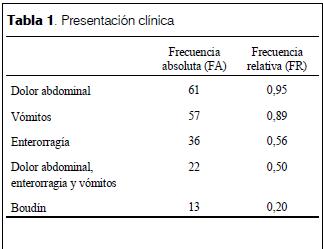
<body><![CDATA[<p><span style="font-size: 10pt; font-family: Verdana; color: rgb(31, 26, 23);">La media de edad fue 5 meses (rango 2&ndash;42 meses). El 85,9% (n=55) de los casos fueron menores de 2 a&ntilde;os.&nbsp; </span></p>          <p><span style="font-size: 10pt; font-family: Verdana; color: rgb(31, 26, 23);">En cuanto a la distribuci&oacute;n por sexo 42 ocurrieron en varones y 22 en mujeres. La relaci&oacute;n entre sexo masculino y femenino fue 1,9:1.&nbsp; </span></p>          <p><span style="font-size: 10pt; font-family: Verdana; color: rgb(31, 26, 23);">Proced&iacute;an de Montevideo 35 ni&ntilde;os y del interior del pa&iacute;s 29: zona centro sur 16 (Canelones 14, Flores 1, Florida 1); zona este 7 (Maldonado 4, Treinta y tres 3); zona oeste 4 (San Jos&eacute; 2, Colonia 1, Soriano 1) y norte 2 (Artigas 1, Rivera 1).&nbsp; </span></p>          <p>&nbsp;</p>          <p><span style="font-size: 10pt; font-family: Verdana; color: rgb(31, 26, 23);">La <a href="#tabla_1">tabla 1</a> muestra la forma de presentaci&oacute;n cl&iacute;nica al momento de la consulta. Dolor, v&oacute;mitos y enterorragia fueron la forma de presentaci&oacute;n en el 50% de los casos. Se hall&oacute; boud&iacute;n en 13 pacientes. Presentaban antecedente de gastroenteritis 9 ni&ntilde;os e infecci&oacute;n respiratoria aguda 15. En los 40 ni&ntilde;os restantes no se registraron antecedentes inmediatos a destacar.&nbsp; </span></p>          <p>&nbsp;</p>    <font face="Verdana" size="2">    <a name="tabla_1"></a><img style="width: 321px; height: 305px;" alt="" src="/img/revistas/adp/v85n2/2a02t1.JPG">    <br>    </font>        <p>&nbsp;</p>          <p><span style="font-size: 10pt; font-family: Verdana; color: rgb(31, 26, 23);">Se realiz&oacute; ecograf&iacute;a abdominal en todos los pacientes. En 63 de los 64 episodios los hallazgos confirmaron el diagn&oacute;stico. En un paciente la ecograf&iacute;a fue normal y el diagn&oacute;stico fue intraoperatorio.&nbsp; </span></p>          <p><span style="font-size: 10pt; font-family: Verdana; color: rgb(31, 26, 23);">La invaginaci&oacute;n intestinal fue ileoc&oacute;lica en 94% e ileoileal en 6%.&nbsp; </span></p>          ]]></body>
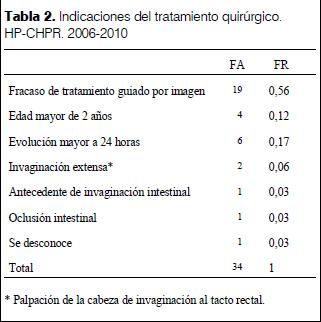
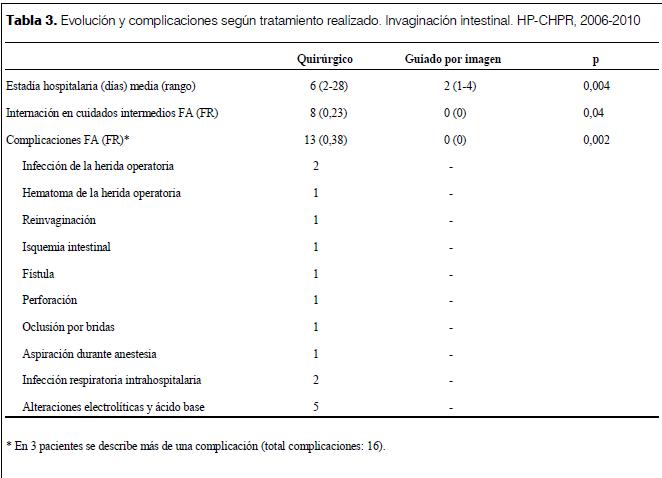
<body><![CDATA[<p><span style="font-size: 10pt; font-family: Verdana; color: rgb(31, 26, 23);">Se intent&oacute; la desinvaginaci&oacute;n guiada por imagen en 49 ni&ntilde;os (76%): por m&eacute;todo hidrost&aacute;tico en 34 y neum&aacute;tico en 15. La desinvaginaci&oacute;n guiada por imagen fue exitosa en 30 de los 49 ni&ntilde;os tratados con este m&eacute;todo (61%). En los casos en que este procedimiento fracas&oacute;, no se realizaron nuevos intentos por el mismo m&eacute;todo.&nbsp; </span></p>          <p><span style="font-size: 10pt; font-family: Verdana; color: rgb(31, 26, 23);">Se realiz&oacute; desinvaginaci&oacute;n quir&uacute;rgica en 34 ni&ntilde;os (53%), por fracaso de la desinvaginaci&oacute;n guiada por imagen en 19. En la <a href="#tabla_2">tabla 2</a> se resumen las indicaciones del tratamiento quir&uacute;rgico seg&uacute;n datos recogidos de las historias cl&iacute;nicas.&nbsp; </span></p>          <p>&nbsp;</p>    <font face="Verdana" size="2">    <a name="tabla_2"></a><img style="width: 321px; height: 322px;" alt="" src="/img/revistas/adp/v85n2/2a02t2.JPG">    <br>        </font>            <p><font face="Verdana" size="2">&nbsp;    <br>    </font>    <span style="font-size: 10pt; font-family: Verdana; color: rgb(31, 26, 23);">En tres de los 34 ni&ntilde;os operados se identific&oacute; la causa de la invaginaci&oacute;n (invaginaci&oacute;n secundaria): divert&iacute;culo de Meckel en 2 y p&oacute;lipo intestinal en uno. En 14 se constat&oacute; adenitis mesent&eacute;rica.&nbsp; </span></p>          <p><span style="font-size: 10pt; font-family: Verdana; color: rgb(31, 26, 23);">Se realiz&oacute; resecci&oacute;n intestinal en los tres ni&ntilde;os con invaginaci&oacute;n secundaria, uno de ellos presentaba intestino desvitalizado. Se reintervinieron 3 pacientes. Los motivos fueron isquemia, perforaci&oacute;n y reinvaginaci&oacute;n en el postoperatorio inmediato.&nbsp; </span></p>          <p><span style="font-size: 10pt; font-family: Verdana; color: rgb(31, 26, 23);">La media de la estad&iacute;a hospitalaria fue significativamente mayor en los ni&ntilde;os intervenidos quir&uacute;rgicamente (6 d&iacute;as) que en aquellos que recibieron tratamiento guiado por imagen (2 d&iacute;as) (p= 0,004). Se observaron complicaciones en 13 de los 34 ni&ntilde;os tratados quir&uacute;rgicamente, tres de ellos presentaron m&aacute;s de una complicaci&oacute;n. Las complicaciones fueron vinculadas a la cirug&iacute;a en ocho pacientes, alteraciones del medio interno en cinco, infecciones intrahospitalarias en dos y vinculadas a la anestesia en uno. En el grupo de desinvaginaci&oacute;n guiada por imagen no se observaron complicaciones. En la <a href="/img/revistas/adp/v85n2/2a02t3.JPG">tabla 3</a> se muestra la evoluci&oacute;n y complicaciones seg&uacute;n tratamiento realizado.&nbsp; </span></p>    <span style="font-size: 10pt; font-family: Verdana; color: rgb(31, 26, 23);">Requirieron ingreso a una unidad de cuidados intensivos 8 de los 34 pacientes operados. Las causas fueron: alteraciones del medio interno (n=5), complicaciones de la cirug&iacute;a (n=2), y anest&eacute;sicas (n=1). En el grupo de desinvaginaci&oacute;n guiada por imagen no hubo ingresos a unidad de cuidados intensivos.&nbsp; </span>      <p><span style="font-size: 10pt; font-family: Verdana; color: rgb(31, 26, 23);">Ning&uacute;n paciente falleci&oacute;.&nbsp; </span></p>          <p><span style="font-family: Verdana; color: rgb(31, 26, 23);"><font size="2">Discusi&oacute;n&nbsp; </font> </span></p>          ]]></body>
<body><![CDATA[<p><span style="font-size: 10pt; font-family: Verdana; color: rgb(31, 26, 23);">En esta serie de casos la edad de presentaci&oacute;n, distribuci&oacute;n por sexo y topograf&iacute;a de la invaginaci&oacute;n intestinal coinciden con lo descrito en la literatura </span><sup> <span style="font-family: Verdana; color: rgb(31, 26, 23)"><font size="2">(</font></span></sup><span style="font-size: 10pt; font-family: Verdana; color: rgb(31, 26, 23);"><sup><a href="#3">3</a>-<a href="#6">6</a></sup></span><sup><span style="font-family: Verdana; color: rgb(31, 26, 23)"><font size="2">,<a href="#18">18</a>,<a href="#20">20</a>)</font></span></sup><span style="font-size: 10pt; font-family: Verdana; color: rgb(31, 26, 23);"><a name="20."></a>.&nbsp; </span></p>          <p><span style="font-size: 10pt; font-family: Verdana; color: rgb(31, 26, 23);">Dolor abdominal, v&oacute;mitos y enterorragia se observaron en una proporci&oacute;n mayor que la descrita en otras series</span><sup><span style="font-family: Verdana; color: rgb(31, 26, 23)"><font size="2">(<a href="#1">1</a>,<a href="#3">3</a>)</font></span></sup><span style="font-size: 10pt; font-family: Verdana; color: rgb(31, 26, 23);">. Este hallazgo podr&iacute;a estar relacionado con una consulta tard&iacute;a. Si bien la mayor&iacute;a de los casos correspondieron a Montevideo y su &aacute;rea metropolitana, se asistieron ni&ntilde;os de todo el pa&iacute;s. El HP-CHPR es el hospital de referencia nacional para los ni&ntilde;os usuarios de la Administraci&oacute;n de los Servicios de Salud del Estado, dispone de ecografista y cirujano pedi&aacute;trico de guardia las 24 horas y en el se centraliza la formaci&oacute;n de recursos humanos en el &aacute;rea. Es posible que la necesidad de traslado de los pacientes desde el interior del pa&iacute;s al HP-CHPR con el tiempo que ello implica condiciona formas m&aacute;s evolucionadas con mayor proporci&oacute;n de presentaciones cl&aacute;sicas, complicaciones y menor &eacute;xito de la desinvaginaci&oacute;n guiada por imagen.&nbsp; </span></p>          <p><span style="font-size: 10pt; font-family: Verdana; color: rgb(31, 26, 23);">Se destaca el valor de la ecograf&iacute;a abdominal como t&eacute;cnica est&aacute;ndar para el diagn&oacute;stico de esta patolog&iacute;a</span><sup><span style="font-family: Verdana; color: rgb(31, 26, 23)"><font size="2">(</font></span></sup><a href="#21"><span style="font-family: Verdana; color: rgb(31, 26, 23)"><sup><span style="color: rgb(31, 26, 23)"><font size="2">21</font></span></sup></span></a><sup><span style="font-family: Verdana; color: rgb(31, 26, 23)"><font size="2">)</font></span></sup><span style="font-size: 10pt; font-family: Verdana; color: rgb(31, 26, 23);"><a name="21."></a>. En esta serie, con excepci&oacute;n de un caso, todos fueron diagnosticados por este m&eacute;todo. Su utilizaci&oacute;n ha sustituido a la radiograf&iacute;a contrastada de abdomen, evitando as&iacute; la exposici&oacute;n a las radiaciones ionizantes.&nbsp; </span></p>          <p><span style="font-size: 10pt; font-family: Verdana; color: rgb(31, 26, 23);">La indicaci&oacute;n de desinvaginaci&oacute;n guiada por im&aacute;genes en pa&iacute;ses desarrollados alcanza cifras del 85% con elevada tasa de &eacute;xito del procedimiento. El porcentaje de intervenciones quir&uacute;rgicas en estos pa&iacute;ses es significativamente menor</span><sup><span style="font-family: Verdana; color: rgb(31, 26, 23)"><font size="2">(<a href="#13">13</a>,<a href="#14">14</a>)</font></span></sup><span style="font-size: 10pt; font-family: Verdana; color: rgb(31, 26, 23);">. Si bien en esta serie la indicaci&oacute;n de desinvaginaci&oacute;n guiada por imagen es inferior, se ubica en cifras pr&oacute;ximas a lo comunicado en la literatura</span><sup><span style="font-family: Verdana; color: rgb(31, 26, 23)"><font size="2">(<a href="#4">4</a>,<a href="#19">19</a>)</font></span></sup><span style="font-size: 10pt; font-family: Verdana; color: rgb(31, 26, 23);">. La proporci&oacute;n de intervenciones quir&uacute;rgicas es inferior a lo comunicada previamente en este mismo centro asistencial, lo que muestra una evoluci&oacute;n favorable en el manejo de estos pacientes</span><sup><span style="font-family: Verdana; color: rgb(31, 26, 23)"><font size="2">(<a href="#19">19</a>,<a href="#22">22</a>,<a href="#23">23</a>)</font></span></sup><span style="font-size: 10pt; font-family: Verdana; color: rgb(31, 26, 23);"><a name="22."></a><a name="23."></a>.&nbsp; </span></p>          <p><span style="font-size: 10pt; font-family: Verdana; color: rgb(31, 26, 23);">El fracaso de la desinvaginaci&oacute;n guiada por imagen es la causa principal de tratamiento quir&uacute;rgico. Esto podr&iacute;a estar relacionado con la experiencia de los equipos en la realizaci&oacute;n del procedimiento o con el posible retraso en la consulta y presentaci&oacute;n de formas m&aacute;s evolucionadas. Se destaca que en ning&uacute;n caso se reintent&oacute; el procedimiento frente al fracaso inicial. Sin embargo, la interpretaci&oacute;n de este hallazgo requiere un an&aacute;lisis m&aacute;s profundo. En este estudio no se registr&oacute; el tiempo mediado entre el inicio de los s&iacute;ntomas y el diagn&oacute;stico, ni la respuesta al procedimiento. Se desconoce si se logr&oacute; una reducci&oacute;n parcial frente al primer intento. Por otra parte, es necesario se&ntilde;alar que si bien existe una relaci&oacute;n inversa entre las horas de evoluci&oacute;n de la enfermedad y el &eacute;xito de la reducci&oacute;n guiada por imagen, la presencia de un cuadro evolucionado no contraindica este tratamiento</span><sup><span style="font-family: Verdana; color: rgb(31, 26, 23)"><font size="2">(<a href="#24">24</a>)</font></span></sup><span style="font-size: 10pt; font-family: Verdana; color: rgb(31, 26, 23);"><a name="24."></a>.&nbsp; </span></p>          <p><span style="font-size: 10pt; font-family: Verdana; color: rgb(31, 26, 23);">En este estudio la edad fue una condicionante de la indicaci&oacute;n de tratamiento quir&uacute;rgico, si bien esto no es referido en la literatura</span><sup><span style="font-family: Verdana; color: rgb(31, 26, 23)"><font size="2">(<a href="#2">2</a>)</font></span></sup><span style="font-size: 10pt; font-family: Verdana; color: rgb(31, 26, 23);">.&nbsp; </span></p>          <p><span style="font-size: 10pt; font-family: Verdana; color: rgb(31, 26, 23);">Los pacientes tratados quir&uacute;rgicamente presentaron estad&iacute;a hospitalaria m&aacute;s prolongada y mayor n&uacute;mero de complicaciones que requirieron ingreso a unidades de cuidados especiales.&nbsp; </span></p>          <p><span style="font-size: 10pt; font-family: Verdana; color: rgb(31, 26, 23);">Resulta necesario avanzar en la indicaci&oacute;n y realizaci&oacute;n del tratamiento guiado por imagen en esta patolog&iacute;a. Este se asocia con menor morbilidad y es m&aacute;s costo efectivo.&nbsp; </span></p>          <p><span style="font-size: 10pt; font-family: Verdana; color: rgb(31, 26, 23);">Futuras investigaciones son necesarias para identificar aspectos a mejorar en la indicaci&oacute;n y realizaci&oacute;n de la desinvaginaci&oacute;n guiada por im&aacute;genes. El fortalecimiento de la capacitaci&oacute;n de los recursos humanos es fundamental.&nbsp; </span></p>          <p><span style="font-family: Verdana; color: rgb(31, 26, 23);"><font size="2">Conclusiones&nbsp; </font> </span></p>          ]]></body>
<body><![CDATA[<p><span style="font-size: 10pt; font-family: Verdana; color: rgb(31, 26, 23);">En esta serie, las caracter&iacute;sticas cl&iacute;nicas y epidemiol&oacute;gicas de la invaginaci&oacute;n intestinal coinciden con lo comunicado en la literatura. A pesar de los avances logrados en la indicaci&oacute;n de la desinvaginaci&oacute;n guiada por imagen, es necesario continuar disminuyendo la proporci&oacute;n de intervenciones quir&uacute;rgicas. Esto permitir&aacute; disminuir a&uacute;n m&aacute;s la morbilidad asociada con esta patolog&iacute;a.&nbsp; </span></p>          <p><span style="font-family: Verdana; color: rgb(31, 26, 23);"><font size="2">Referencias bibliogr&aacute;ficas&nbsp; </font> </span></p>          <!-- ref --><p><font face="Verdana" size="2"><a name="1"></a></font><span style="font-size: 10pt; font-family: Verdana; color: rgb(31, 26, 23);"><a href="#1.">1</a>.&nbsp;&nbsp;&nbsp;&nbsp;<b>Michelena C, Berazategui R.</b> Invaginaci&oacute;n intestinal. En: Bello O, Sehabiague G, Prego J, de Leonardis D. Pediatr&iacute;a: urgencias y emergencias. </span><span style="font-size: 10pt; font-family: Verdana; color: rgb(31, 26, 23);" lang="EN-US">3 ed. </span><st1:city><st1:place><span style="font-size: 10pt; font-family: Verdana; color: rgb(31, 26, 23);" lang="EN-US">Montevideo</span></st1:place></st1:city><span style="font-size: 10pt; font-family: Verdana; color: rgb(31, 26, 23);" lang="EN-US">: Bibliom&eacute;dica, 2009: 1177-84.    &nbsp; </span><span style="" lang="EN-US"><o:p></o:p></span></p>          <!-- ref --><p><font face="Verdana" size="2"><a name="2"></a></font><span style="font-size: 10pt; font-family: Verdana; color: rgb(31, 26, 23);" lang="EN-US"><a href="#2.">2</a>.&nbsp;&nbsp;&nbsp;&nbsp;<b>Waseem M, Rosenberg HK.</b> Intussusception. Pediatr Emerg Care 2008; 24(11):793-800.    &nbsp; </span><span style="" lang="EN-US"><o:p></o:p></span></p>          <!-- ref --><p><font face="Verdana" size="2"><a name="3"></a></font><span style="font-size: 10pt; font-family: Verdana; color: rgb(31, 26, 23);" lang="EN-US"><a href="#3.">3</a>.&nbsp;&nbsp;&nbsp;&nbsp;<b>Herwig K, Brenkert T, Losek JD.</b> Enema-reduced intussusception management: is hospitalization necessary? Pediatr Emerg Care 2009; 25(2):74-7.    &nbsp; </span><span style="" lang="EN-US"><o:p></o:p></span></p>          <!-- ref --><p><font face="Verdana" size="2"><a name="4"></a></font><span style="font-size: 10pt; font-family: Verdana; color: rgb(31, 26, 23);" lang="EN-US"><a href="#4.">4</a>.&nbsp;&nbsp;&nbsp;&nbsp;<b>Jenke AC, Klaassen-Mielke R, Zilbauer M, Heininger U, Trampisch H, Wirth S.</b> Intussusception: incidence and treatment-insights from the nationwide German surveillance. J Pediatr Gastroenterol Nutr 2011; 52(4):446-51.    &nbsp; </span><span style="" lang="EN-US"><o:p></o:p></span></p>          ]]></body>
<body><![CDATA[<!-- ref --><p><font face="Verdana" size="2"><a name="5"></a></font><span style="font-size: 10pt; font-family: Verdana; color: rgb(31, 26, 23);" lang="EN-US"><a href="#5.">5.</a>&nbsp;&nbsp;&nbsp;&nbsp;<b>Blanch AJ, Perel SB, Acworth JP. </b>Paediatric intussusception: epidemiology and outcome. </span><span style="font-size: 10pt; font-family: Verdana; color: rgb(31, 26, 23);">Emerg Med Australas 2007; 19(1):45-50.    &nbsp; </span></p>          <p><font face="Verdana" size="2"><a name="6"></a></font><span style="font-size: 10pt; font-family: Verdana; color: rgb(31, 26, 23);"><a href="#6.">6</a>.&nbsp;&nbsp;&nbsp;&nbsp;<b>Yalda A, Valenzuela MT, O&rsquo;Ryan G. </b>Perfil epidemiol&oacute;gico y cl&iacute;nico de la invaginaci&oacute;n intestinal en lactantes de la regi&oacute;n Metropolitana. </span><span style="font-size: 10pt; font-family: Verdana; color: rgb(31, 26, 23);" lang="EN-US">Rev M&eacute;d Chile 2004; 132(5):565-72.&nbsp; </span><span style="" lang="EN-US"><o:p></o:p></span></p>          <!-- ref --><p><font face="Verdana" size="2"><a name="7"></a></font><span style="font-size: 10pt; font-family: Verdana; color: rgb(31, 26, 23);" lang="EN-US"><a href="#7.">7</a>.&nbsp;&nbsp;&nbsp;&nbsp;<b>Bines JE, Ivanoff B, Justice F, Mulholland K. </b>Clinical case definition for the diagnosis of acute intussusception. J Pediatr Gastroenterol Nutr 2004; 39(5):511-8.    &nbsp; </span><span style="" lang="EN-US"><o:p></o:p></span></p>          <p><font face="Verdana" size="2"><a name="8"></a></font><span style="font-size: 10pt; font-family: Verdana; color: rgb(31, 26, 23);" lang="EN-US"><a href="#8.">8</a>.&nbsp;&nbsp;&nbsp;&nbsp;<b>Krishnakumar, Hameed S, Umamaheshwari.</b> Ultrasound guided hydrostatic reduction in the management of intussusception. </span><span style="font-size: 10pt; font-family: Verdana; color: rgb(31, 26, 23);">Indian J Pediatr 2006;73(3):217-20. Disponible en: <a href="http://www.ipr2011.org/documents/844.pdf.">http://www.ipr2011.org/documents/844.pdf.</a> [Consulta: 11 julio 2012].&nbsp; </span></p>          <!-- ref --><p><font face="Verdana" size="2"><a name="9"></a></font><span style="font-size: 10pt; font-family: Verdana; color: rgb(31, 26, 23);"><a href="#9.">9</a>.&nbsp;&nbsp;&nbsp;&nbsp;<b>San Rom&aacute;n J, Dovasio F, Kreindel T, Kucharczyk M. </b>Preguntas comunes en im&aacute;genes: invaginaci&oacute;n intestinal. </span><span style="font-size: 10pt; font-family: Verdana; color: rgb(31, 26, 23);" lang="EN-US">Arch Argent Pediatr 2006; 104 (5):470-3.    &nbsp; </span><span style="" lang="EN-US"><o:p></o:p></span></p>          <!-- ref --><p><font face="Verdana" size="2"><a name="10"></a></font><span style="font-size: 10pt; font-family: Verdana; color: rgb(31, 26, 23);" lang="EN-US"><a href="#10.">10</a>.&nbsp;&nbsp;&nbsp;&nbsp;<b>Applegate KE.</b> Intussusception in children: evidence-based diagnosis and treatment. </span><span style="font-size: 10pt; font-family: Verdana; color: rgb(31, 26, 23);">Pediatr Radiol 2009; 39(Suppl 2):S140-3.    &nbsp; </span></p>          ]]></body>
<body><![CDATA[<p><font face="Verdana" size="2"><a name="11"></a></font><span style="font-size: 10pt; font-family: Verdana; color: rgb(31, 26, 23);"><a href="#11.">11</a>.&nbsp;&nbsp;&nbsp;&nbsp;<b>Cunha F&aacute;bio Motta da, Figueir&ecirc;do Sizenildo da Silva, N&oacute;brega Bruno Barcelos da, Oliveira Galba Leite, Monteiro Soraya Silveira, Lederman Henrique Manoel.</b> Intussuscep&ccedil;&atilde;o em crian&ccedil;as: avalia&ccedil;&atilde;o por m&eacute;todos de imagem e abordagem terap&ecirc;utica. </span><span style="font-size: 10pt; font-family: Verdana; color: rgb(31, 26, 23);" lang="EN-US">Radiol Bras &nbsp;2005; 38(3):209-18.&nbsp; </span><span style="" lang="EN-US"><o:p></o:p></span></p>          <!-- ref --><p><font face="Verdana" size="2"><a name="12"></a></font><span style="font-size: 10pt; font-family: Verdana; color: rgb(31, 26, 23);" lang="EN-US"><a href="#12.">12</a>.&nbsp;&nbsp;&nbsp;&nbsp;<b>Bruce J, Huh YS, Cooney DR, Karp MP, Allen JE, Jewett TC Jr.</b> Intussusception: evolution of current management. J Pediatr Gastroenterol Nutr 1987; 6(5):663-74.    &nbsp; </span><span style="" lang="EN-US"><o:p></o:p></span></p>          <!-- ref --><p><font face="Verdana" size="2"><a name="13"></a></font><span style="font-size: 10pt; font-family: Verdana; color: rgb(31, 26, 23);" lang="EN-US"><a href="#13.">13</a>.<b>&nbsp;&nbsp;&nbsp;&nbsp;Niramis R, Watanatittan S, Kruatrachue A, Anuntkosol M, Buranakitjaroen V, Rattanasuwan T, et al.</b> Management of recurrent intussusception: nonoperative or operative reduction? J Pediatr Surg 2010; 45(11):2175-80.    &nbsp; </span><span style="" lang="EN-US"><o:p></o:p></span></p>          <!-- ref --><p><font face="Verdana" size="2"><a name="14"></a></font><span style="font-size: 10pt; font-family: Verdana; color: rgb(31, 26, 23);" lang="EN-US"><a href="#14.">14</a>.&nbsp;&nbsp;&nbsp;&nbsp;<b>Shekherdimian S, Lee SL. </b>Management of pediatric intussusception in general hospitals: diagnosis, treatment, and differences based on age. World J Pediatr 2011; 7(1):70-3.    &nbsp; </span><span style="" lang="EN-US"><o:p></o:p></span></p>          <p><font face="Verdana" size="2"><a name="15"></a></font><span style="font-size: 10pt; font-family: Verdana; color: rgb(31, 26, 23);" lang="EN-US"><a href="#15.">15</a>.&nbsp;&nbsp;&nbsp;&nbsp;<b>Curtis JL, Gutierrez IM, Kirk SR, Gollin G.</b> Failure of enema reduction for ileocolic intussusception at a referring hospital does not preclude repeat attempts at a children&rsquo;s hospital. J Pediatr Surg 2010; 45(6):1178-81.&nbsp; </span><span style="" lang="EN-US"><o:p></o:p></span></p>          <!-- ref --><p><font face="Verdana" size="2"><a name="16"></a></font><span style="font-size: 10pt; font-family: Verdana; color: rgb(31, 26, 23);" lang="EN-US"><a href="#16.">16.</a>&nbsp;&nbsp;&nbsp;&nbsp;<b>Ekenze SO, Mgbor SO.</b> Childhood intussusception: the implications of delayed presentation. </span><span style="font-size: 10pt; font-family: Verdana; color: rgb(31, 26, 23);">Afr J Paediatr Surg 2011; 8(1):15-8. Disponible en: <a href="http://www.afrjpaedsurg.org/article.asp?issn=0189-6725;year=2011;volume=8;issue=1;spage=15;epage=18;aulast=Ekenze.">http://www.afrjpaedsurg.org/article.asp?issn=0189-6725;year=2011;volume=8;issue=1;spage=15;epage=18;aulast=Ekenze.</a> [Consulta: 11 julio 2012].    &nbsp; </span></p>          ]]></body>
<body><![CDATA[<!-- ref --><p><font face="Verdana" size="2"><a name="17"></a></font><span style="font-size: 10pt; font-family: Verdana; color: rgb(31, 26, 23);"><a href="#17.">17</a>.&nbsp;&nbsp;&nbsp;&nbsp;<b>Abate H, Linares A, Venegas G, Vergara RF.</b> </span><span style="font-size: 10pt; font-family: Verdana; color: rgb(31, 26, 23);" lang="EN-US">A multicenter study of intussusception in </span><st1:place><span style="font-size: 10pt; font-family: Verdana; color: rgb(31, 26, 23);" lang="EN-US">Latin America</span></st1:place><span style="font-size: 10pt; font-family: Verdana; color: rgb(31, 26, 23);" lang="EN-US">: first year results. </span><span style="font-size: 10pt; font-family: Verdana; color: rgb(31, 26, 23);">En: 24th International Congress of Pediatrics; 15-20 august 2004; Canc&uacute;n, Mexico.    &nbsp; </span></p>          <!-- ref --><p><font face="Verdana" size="2"><a name="18"></a></font><span style="font-size: 10pt; font-family: Verdana; color: rgb(31, 26, 23);"><a href="#18.">18</a>.&nbsp;&nbsp;&nbsp;&nbsp;<b>Abate H, Strugo L, Falaschi A.</b> Aspectos cl&iacute;nicos y epidemiol&oacute;gicos de la invaginaci&oacute;n intestinal en ni&ntilde;os menores de 2 a&ntilde;os, de la provincia de Mendoza, Argentina. Arch Argent Pediatr 2006; 104(6):496-500.    &nbsp; </span></p>          <!-- ref --><p><font face="Verdana" size="2"><a name="19"></a></font><span style="font-size: 10pt; font-family: Verdana; color: rgb(31, 26, 23);"><a href="#19.">19</a>.&nbsp;&nbsp;&nbsp;&nbsp;<b>Quian J, M&aacute;s M, Jurado R.</b> Invaginaci&oacute;n intestinal: estudio de su incidencia durante un a&ntilde;o en Uruguay. </span><span style="font-size: 10pt; font-family: Verdana; color: rgb(31, 26, 23);" lang="EN-US">Arch Pediatr Urug 2005; 76(2):106-10.    &nbsp; </span><span style="" lang="EN-US"><o:p></o:p></span></p>          <!-- ref --><p><font face="Verdana" size="2"><a name="20"></a></font><span style="font-size: 10pt; font-family: Verdana; color: rgb(31, 26, 23);" lang="EN-US"><a href="#20.">20</a>.&nbsp;&nbsp;&nbsp;&nbsp;<b>Shapkina AN, Shapkin VV, Nelubov IV, Pryanishena LT. </b>Intussusception in children: 11-year experience in </span><st1:city><st1:place><span style="font-size: 10pt; font-family: Verdana; color: rgb(31, 26, 23);" lang="EN-US">Vladivostok</span></st1:place></st1:city><span style="font-size: 10pt; font-family: Verdana; color: rgb(31, 26, 23);" lang="EN-US">. Pediatr Surg Int 2006; 22(11):901-4.    &nbsp; </span><span style="" lang="EN-US"><o:p></o:p></span></p>          <!-- ref --><p><font face="Verdana" size="2"><a name="21"></a></font><span style="font-size: 10pt; font-family: Verdana; color: rgb(31, 26, 23);" lang="EN-US"><a href="#21.">21</a>.&nbsp;&nbsp;&nbsp;&nbsp;<b>Buettcher M, Baer G, Bonhoeffer J, Schaad UB, Heininger U.</b> Three-year surveillance of intussusception in children in Switzerland. </span><span style="font-size: 10pt; font-family: Verdana; color: rgb(31, 26, 23);">Pediatrics 2007; 120(3):473-80.    &nbsp; </span></p>          ]]></body>
<body><![CDATA[<p><font face="Verdana" size="2"><a name="22"></a></font><span style="font-size: 10pt; font-family: Verdana; color: rgb(31, 26, 23);"><a href="#22.">22</a>.&nbsp;&nbsp;&nbsp;&nbsp;<b>Lembo, H, Lizaso I.</b> Invaginaci&oacute;n intestinal. Revisi&oacute;n de casos en un per&iacute;odo de 10 a&ntilde;os 1986-1996. En: II Congreso de Cirug&iacute;a Pedi&aacute;trica del cono Sur de Am&eacute;rica; 10-14 de noviembre de 1996; C&oacute;rdoba, Argentina.&nbsp; </span></p>          <!-- ref --><p><font face="Verdana" size="2"><a name="23"></a></font><span style="font-size: 10pt; font-family: Verdana; color: rgb(31, 26, 23);"><a href="#23.">23</a>.&nbsp;&nbsp;&nbsp;&nbsp;<b>Michelena C, Dom&iacute;nguez R, Maggiolini M. </b>Desinvaginaci&oacute;n neum&aacute;tica: experiencia en hospital pedi&aacute;trico, Pereira Rossell. </span><span style="font-size: 10pt; font-family: Verdana; color: rgb(31, 26, 23);" lang="EN-US">[sin publicar].    &nbsp; </span><span style="" lang="EN-US"><o:p></o:p></span></p>          <!-- ref --><p><font face="Verdana" size="2"><a name="24"></a></font><span style="font-size: 10pt; font-family: Verdana; color: rgb(31, 26, 23);" lang="EN-US"><a href="#24.">24</a>.&nbsp;&nbsp;&nbsp;&nbsp;<b>Daneman A, Navarro O. </b>Intussusception. Part 2: An update on the evolution of management. </span><span style="font-size: 10pt; font-family: Verdana; color: rgb(31, 26, 23);">Pediatr Radiol 2004; 34(2):97-108.    <br>     &nbsp; </span></p>          <p><font face="Verdana" size="2"><o:p>&nbsp;</o:p></font></p>          <p><font face="Verdana" size="2"><o:p>&nbsp;</o:p></font></p>          <p class="MsoNormal"><font face="Verdana" size="2"><o:p>&nbsp;</o:p></font></p>          <p><b><span style="font-size: 10pt; font-family: Verdana; color: rgb(31, 26, 23);">Correspondencia:</span></b><span style="font-size: 10pt; font-family: Verdana; color: rgb(31, 26, 23);"> Luc&iacute;a Apeztegu&iacute;a.     <br>     Correo electr&oacute;nico: <a href="luapezteguia@yahoo.com">luapezteguia@yahoo.com</a>&nbsp; </span></p>          ]]></body>
<body><![CDATA[<p class="MsoNormal"><font face="Verdana" size="2"><o:p>&nbsp;</o:p></font></p>      </div>           ]]></body><back>
<ref-list>
<ref id="B1">
<label>1</label><nlm-citation citation-type="book">
<person-group person-group-type="author">
<name>
<surname><![CDATA[Michelena]]></surname>
<given-names><![CDATA[C]]></given-names>
</name>
<name>
<surname><![CDATA[Berazategui]]></surname>
<given-names><![CDATA[R]]></given-names>
</name>
</person-group>
<article-title xml:lang="es"><![CDATA[Invaginación intestinal]]></article-title>
<person-group person-group-type="editor">
<name>
<surname><![CDATA[Bello]]></surname>
<given-names><![CDATA[O]]></given-names>
</name>
<name>
<surname><![CDATA[Sehabiague]]></surname>
<given-names><![CDATA[G]]></given-names>
</name>
<name>
<surname><![CDATA[Prego]]></surname>
<given-names><![CDATA[J]]></given-names>
</name>
<name>
<surname><![CDATA[de Leonardis]]></surname>
<given-names><![CDATA[D]]></given-names>
</name>
</person-group>
<source><![CDATA[Pediatría: urgencias y emergencias]]></source>
<year>2009</year>
<edition>3</edition>
<page-range>1177-84</page-range><publisher-loc><![CDATA[Montevideo ]]></publisher-loc>
<publisher-name><![CDATA[Bibliomédica]]></publisher-name>
</nlm-citation>
</ref>
<ref id="B2">
<label>2</label><nlm-citation citation-type="journal">
<person-group person-group-type="author">
<name>
<surname><![CDATA[Waseem]]></surname>
<given-names><![CDATA[M]]></given-names>
</name>
<name>
<surname><![CDATA[Rosenberg]]></surname>
<given-names><![CDATA[HK]]></given-names>
</name>
</person-group>
<source><![CDATA[Pediatr Emerg Care]]></source>
<year>2008</year>
<volume>24</volume>
<numero>11</numero>
<issue>11</issue>
<page-range>Intussusception</page-range><page-range>793-800</page-range></nlm-citation>
</ref>
<ref id="B3">
<label>3</label><nlm-citation citation-type="journal">
<person-group person-group-type="author">
<name>
<surname><![CDATA[Herwig]]></surname>
<given-names><![CDATA[K]]></given-names>
</name>
<name>
<surname><![CDATA[Brenkert]]></surname>
<given-names><![CDATA[T]]></given-names>
</name>
<name>
<surname><![CDATA[Losek]]></surname>
<given-names><![CDATA[JD]]></given-names>
</name>
</person-group>
<article-title xml:lang="en"><![CDATA[Enema-reduced intussusception management: is hospitalization necessary?]]></article-title>
<source><![CDATA[Pediatr Emerg Care]]></source>
<year>2009</year>
<volume>25</volume>
<numero>2</numero>
<issue>2</issue>
<page-range>74-7</page-range></nlm-citation>
</ref>
<ref id="B4">
<label>4</label><nlm-citation citation-type="journal">
<person-group person-group-type="author">
<name>
<surname><![CDATA[Jenke]]></surname>
<given-names><![CDATA[AC]]></given-names>
</name>
<name>
<surname><![CDATA[Klaassen-Mielke]]></surname>
<given-names><![CDATA[R]]></given-names>
</name>
<name>
<surname><![CDATA[Zilbauer]]></surname>
<given-names><![CDATA[M]]></given-names>
</name>
<name>
<surname><![CDATA[Heininger]]></surname>
<given-names><![CDATA[U]]></given-names>
</name>
<name>
<surname><![CDATA[Trampisch]]></surname>
<given-names><![CDATA[H]]></given-names>
</name>
<name>
<surname><![CDATA[Wirth]]></surname>
<given-names><![CDATA[S]]></given-names>
</name>
</person-group>
<article-title xml:lang="en"><![CDATA[Intussusception: incidence and treatment-insights from the nationwide German surveillance]]></article-title>
<source><![CDATA[J Pediatr Gastroenterol Nutr]]></source>
<year>2011</year>
<volume>52</volume>
<numero>4</numero>
<issue>4</issue>
<page-range>446-51</page-range></nlm-citation>
</ref>
<ref id="B5">
<label>5</label><nlm-citation citation-type="journal">
<person-group person-group-type="author">
<name>
<surname><![CDATA[Blanch]]></surname>
<given-names><![CDATA[AJ]]></given-names>
</name>
<name>
<surname><![CDATA[Perel]]></surname>
<given-names><![CDATA[SB]]></given-names>
</name>
<name>
<surname><![CDATA[Acworth]]></surname>
<given-names><![CDATA[JP]]></given-names>
</name>
</person-group>
<article-title xml:lang="en"><![CDATA[Paediatric intussusception: epidemiology and outcome]]></article-title>
<source><![CDATA[Emerg Med Australas]]></source>
<year>2007</year>
<volume>19</volume>
<numero>1</numero>
<issue>1</issue>
<page-range>45-50</page-range></nlm-citation>
</ref>
<ref id="B6">
<label>6</label><nlm-citation citation-type="journal">
<person-group person-group-type="author">
<name>
<surname><![CDATA[Yalda]]></surname>
<given-names><![CDATA[A]]></given-names>
</name>
<name>
<surname><![CDATA[Valenzuela]]></surname>
<given-names><![CDATA[MT]]></given-names>
</name>
<name>
<surname><![CDATA[O’Ryan]]></surname>
<given-names><![CDATA[G]]></given-names>
</name>
</person-group>
<article-title xml:lang="es"><![CDATA[Perfil epidemiológico y clínico de la invaginación intestinal en lactantes de la región Metropolitana]]></article-title>
<source><![CDATA[Rev Méd Chile]]></source>
<year>2004</year>
<volume>132</volume>
<numero>5</numero>
<issue>5</issue>
<page-range>565-72</page-range></nlm-citation>
</ref>
<ref id="B7">
<label>7</label><nlm-citation citation-type="journal">
<person-group person-group-type="author">
<name>
<surname><![CDATA[Bines]]></surname>
<given-names><![CDATA[JE]]></given-names>
</name>
<name>
<surname><![CDATA[Ivanoff]]></surname>
<given-names><![CDATA[B]]></given-names>
</name>
<name>
<surname><![CDATA[Justice]]></surname>
<given-names><![CDATA[F]]></given-names>
</name>
<name>
<surname><![CDATA[Mulholland]]></surname>
<given-names><![CDATA[K]]></given-names>
</name>
</person-group>
<article-title xml:lang="en"><![CDATA[Clinical case definition for the diagnosis of acute intussusception]]></article-title>
<source><![CDATA[J Pediatr Gastroenterol Nutr]]></source>
<year>2004</year>
<volume>39</volume>
<numero>5</numero>
<issue>5</issue>
<page-range>511-8</page-range></nlm-citation>
</ref>
<ref id="B8">
<label>8</label><nlm-citation citation-type="journal">
<person-group person-group-type="author">
<name>
<surname><![CDATA[Krishnakumar]]></surname>
<given-names><![CDATA[J]]></given-names>
</name>
<name>
<surname><![CDATA[Hameed]]></surname>
<given-names><![CDATA[S]]></given-names>
</name>
<name>
<surname><![CDATA[Umamaheshwari]]></surname>
<given-names><![CDATA[F]]></given-names>
</name>
</person-group>
<source><![CDATA[J Pediatr]]></source>
<year>2006</year>
<volume>73</volume>
<numero>3</numero>
<issue>3</issue>
<page-range>217-20</page-range></nlm-citation>
</ref>
<ref id="B9">
<label>9</label><nlm-citation citation-type="journal">
<person-group person-group-type="author">
<name>
<surname><![CDATA[San Román]]></surname>
<given-names><![CDATA[J]]></given-names>
</name>
<name>
<surname><![CDATA[Dovasio]]></surname>
<given-names><![CDATA[F]]></given-names>
</name>
<name>
<surname><![CDATA[Kreindel]]></surname>
<given-names><![CDATA[T]]></given-names>
</name>
<name>
<surname><![CDATA[Kucharczyk]]></surname>
<given-names><![CDATA[M]]></given-names>
</name>
</person-group>
<article-title xml:lang="es"><![CDATA[Preguntas comunes en imágenes: invaginación intestinal]]></article-title>
<source><![CDATA[Arch Argent Pediatr]]></source>
<year>2006</year>
<volume>104</volume>
<numero>5</numero>
<issue>5</issue>
<page-range>470-3</page-range></nlm-citation>
</ref>
<ref id="B10">
<label>10</label><nlm-citation citation-type="journal">
<person-group person-group-type="author">
<name>
<surname><![CDATA[Applegate]]></surname>
<given-names><![CDATA[KE]]></given-names>
</name>
</person-group>
<article-title xml:lang="en"><![CDATA[Intussusception in children: evidence-based diagnosis and treatment]]></article-title>
<source><![CDATA[Pediatr Radiol]]></source>
<year>2009</year>
<volume>39</volume>
<numero>^s2</numero>
<issue>^s2</issue>
<supplement>2</supplement>
<page-range>S140-3</page-range></nlm-citation>
</ref>
<ref id="B11">
<label>11</label><nlm-citation citation-type="journal">
<person-group person-group-type="author">
<name>
<surname><![CDATA[Cunha]]></surname>
<given-names><![CDATA[Fábio Motta da]]></given-names>
</name>
<name>
<surname><![CDATA[Figueirêdo]]></surname>
<given-names><![CDATA[Sizenildo da Silva]]></given-names>
</name>
<name>
<surname><![CDATA[Nóbrega]]></surname>
<given-names><![CDATA[Bruno Barcelos da]]></given-names>
</name>
<name>
<surname><![CDATA[Oliveira]]></surname>
<given-names><![CDATA[Galba Leite]]></given-names>
</name>
<name>
<surname><![CDATA[Monteiro]]></surname>
<given-names><![CDATA[Soraya Lembo H Silveira]]></given-names>
</name>
<name>
<surname><![CDATA[Lederman Henrique]]></surname>
<given-names><![CDATA[Manoel]]></given-names>
</name>
</person-group>
<article-title xml:lang="pt"><![CDATA[Intussuscepção em crianças: avaliação por métodos de imagem e abordagem terapêutica]]></article-title>
<source><![CDATA[Radiol Bras]]></source>
<year>2005</year>
<volume>38</volume>
<numero>3</numero>
<issue>3</issue>
<page-range>209-18</page-range></nlm-citation>
</ref>
<ref id="B12">
<label>12</label><nlm-citation citation-type="journal">
<person-group person-group-type="author">
<name>
<surname><![CDATA[Bruce]]></surname>
<given-names><![CDATA[J]]></given-names>
</name>
<name>
<surname><![CDATA[Huh]]></surname>
<given-names><![CDATA[YS]]></given-names>
</name>
<name>
<surname><![CDATA[Cooney]]></surname>
<given-names><![CDATA[DR]]></given-names>
</name>
<name>
<surname><![CDATA[Karp]]></surname>
<given-names><![CDATA[MP]]></given-names>
</name>
<name>
<surname><![CDATA[Allen]]></surname>
<given-names><![CDATA[JE]]></given-names>
</name>
<name>
<surname><![CDATA[Jewett]]></surname>
<given-names><![CDATA[TC Jr]]></given-names>
</name>
</person-group>
<article-title xml:lang="en"><![CDATA[Intussusception: evolution of current management]]></article-title>
<source><![CDATA[J Pediatr Gastroenterol Nutr]]></source>
<year>1987</year>
<volume>6</volume>
<numero>5</numero>
<issue>5</issue>
<page-range>663-74</page-range></nlm-citation>
</ref>
<ref id="B13">
<label>13</label><nlm-citation citation-type="journal">
<person-group person-group-type="author">
<name>
<surname><![CDATA[Niramis]]></surname>
<given-names><![CDATA[R]]></given-names>
</name>
<name>
<surname><![CDATA[Watanatittan]]></surname>
<given-names><![CDATA[S]]></given-names>
</name>
<name>
<surname><![CDATA[Kruatrachue]]></surname>
<given-names><![CDATA[A]]></given-names>
</name>
<name>
<surname><![CDATA[Anuntkosol]]></surname>
<given-names><![CDATA[M]]></given-names>
</name>
<name>
<surname><![CDATA[Buranakitjaroen]]></surname>
<given-names><![CDATA[V]]></given-names>
</name>
<name>
<surname><![CDATA[Rattanasuwan]]></surname>
<given-names><![CDATA[T]]></given-names>
</name>
</person-group>
<article-title xml:lang="en"><![CDATA[Management of recurrent intussusception: nonoperative or operative reduction?]]></article-title>
<source><![CDATA[J Pediatr Surg]]></source>
<year>2010</year>
<volume>45</volume>
<numero>11</numero>
<issue>11</issue>
<page-range>2175-80</page-range></nlm-citation>
</ref>
<ref id="B14">
<label>14</label><nlm-citation citation-type="journal">
<person-group person-group-type="author">
<name>
<surname><![CDATA[Shekherdimian]]></surname>
<given-names><![CDATA[S]]></given-names>
</name>
<name>
<surname><![CDATA[Lee]]></surname>
<given-names><![CDATA[SL]]></given-names>
</name>
</person-group>
<article-title xml:lang="en"><![CDATA[Management of pediatric intussusception in general hospitals: diagnosis, treatment, and differences based on age]]></article-title>
<source><![CDATA[World J Pediatr]]></source>
<year>2011</year>
<volume>7</volume>
<numero>1</numero>
<issue>1</issue>
<page-range>70-3</page-range></nlm-citation>
</ref>
<ref id="B15">
<label>15</label><nlm-citation citation-type="journal">
<person-group person-group-type="author">
<name>
<surname><![CDATA[Curtis]]></surname>
<given-names><![CDATA[JL]]></given-names>
</name>
<name>
<surname><![CDATA[Gutierrez]]></surname>
<given-names><![CDATA[IM]]></given-names>
</name>
<name>
<surname><![CDATA[Kirk]]></surname>
<given-names><![CDATA[SR]]></given-names>
</name>
<name>
<surname><![CDATA[Gollin]]></surname>
<given-names><![CDATA[G]]></given-names>
</name>
</person-group>
<article-title xml:lang="en"><![CDATA[Failure of enema reduction for ileocolic intussusception at a referring hospital does not preclude repeat attempts at a children’s hospital]]></article-title>
<source><![CDATA[J Pediatr Surg]]></source>
<year>2010</year>
<volume>45</volume>
<numero>6</numero>
<issue>6</issue>
<page-range>1178-81</page-range></nlm-citation>
</ref>
<ref id="B16">
<label>16</label><nlm-citation citation-type="journal">
<person-group person-group-type="author">
<name>
<surname><![CDATA[Ekenze]]></surname>
<given-names><![CDATA[SO]]></given-names>
</name>
<name>
<surname><![CDATA[Mgbor]]></surname>
<given-names><![CDATA[SO]]></given-names>
</name>
</person-group>
<article-title xml:lang="en"><![CDATA[Childhood intussusception: the implications of delayed presentation]]></article-title>
<source><![CDATA[Afr J Paediatr Surg]]></source>
<year>2011</year>
<volume>8</volume>
<numero>1</numero>
<issue>1</issue>
<page-range>15-8</page-range></nlm-citation>
</ref>
<ref id="B17">
<label>17</label><nlm-citation citation-type="confpro">
<person-group person-group-type="author">
<name>
<surname><![CDATA[Abate]]></surname>
<given-names><![CDATA[H]]></given-names>
</name>
<name>
<surname><![CDATA[Linares]]></surname>
<given-names><![CDATA[A]]></given-names>
</name>
<name>
<surname><![CDATA[Venegas]]></surname>
<given-names><![CDATA[G]]></given-names>
</name>
<name>
<surname><![CDATA[Vergara]]></surname>
<given-names><![CDATA[RF]]></given-names>
</name>
</person-group>
<article-title xml:lang="en"><![CDATA[A multicenter study of intussusception in Latin America: first year results]]></article-title>
<source><![CDATA[]]></source>
<year></year>
<conf-name><![CDATA[ 24th International Congress of Pediatrics]]></conf-name>
<conf-date>15-20 august 2004</conf-date>
<conf-loc>Cancún </conf-loc>
</nlm-citation>
</ref>
<ref id="B18">
<label>18</label><nlm-citation citation-type="journal">
<person-group person-group-type="author">
<name>
<surname><![CDATA[Abate]]></surname>
<given-names><![CDATA[H]]></given-names>
</name>
<name>
<surname><![CDATA[Strugo]]></surname>
<given-names><![CDATA[L]]></given-names>
</name>
<name>
<surname><![CDATA[Falaschi]]></surname>
<given-names><![CDATA[A]]></given-names>
</name>
</person-group>
<article-title xml:lang="es"><![CDATA[Aspectos clínicos y epidemiológicos de la invaginación intestinal en niños menores de 2 años, de la provincia de Mendoza, Argentina]]></article-title>
<source><![CDATA[Arch Argent Pediatr]]></source>
<year>2006</year>
<volume>104</volume>
<numero>6</numero>
<issue>6</issue>
<page-range>496-500</page-range></nlm-citation>
</ref>
<ref id="B19">
<label>19</label><nlm-citation citation-type="journal">
<person-group person-group-type="author">
<name>
<surname><![CDATA[Quian]]></surname>
<given-names><![CDATA[J]]></given-names>
</name>
<name>
<surname><![CDATA[Más]]></surname>
<given-names><![CDATA[M]]></given-names>
</name>
<name>
<surname><![CDATA[Jurado]]></surname>
<given-names><![CDATA[R]]></given-names>
</name>
</person-group>
<article-title xml:lang="es"><![CDATA[Invaginación intestinal: estudio de su incidencia durante un año en Uruguay]]></article-title>
<source><![CDATA[Arch Pediatr Urug]]></source>
<year>2005</year>
<volume>76</volume>
<numero>2</numero>
<issue>2</issue>
<page-range>106-10</page-range></nlm-citation>
</ref>
<ref id="B20">
<label>20</label><nlm-citation citation-type="journal">
<person-group person-group-type="author">
<name>
<surname><![CDATA[Shapkina]]></surname>
<given-names><![CDATA[AN]]></given-names>
</name>
<name>
<surname><![CDATA[Shapkin]]></surname>
<given-names><![CDATA[VV]]></given-names>
</name>
<name>
<surname><![CDATA[Nelubov]]></surname>
<given-names><![CDATA[IV]]></given-names>
</name>
<name>
<surname><![CDATA[Pryanishena]]></surname>
<given-names><![CDATA[LT]]></given-names>
</name>
</person-group>
<article-title xml:lang="en"><![CDATA[Intussusception in children: 11-year experience in Vladivostok]]></article-title>
<source><![CDATA[Pediatr Surg Int 2006]]></source>
<year></year>
<volume>22</volume>
<numero>11</numero>
<issue>11</issue>
<page-range>901-4</page-range></nlm-citation>
</ref>
<ref id="B21">
<label>21</label><nlm-citation citation-type="journal">
<person-group person-group-type="author">
<name>
<surname><![CDATA[Buettcher]]></surname>
<given-names><![CDATA[M]]></given-names>
</name>
<name>
<surname><![CDATA[Baer]]></surname>
<given-names><![CDATA[G]]></given-names>
</name>
<name>
<surname><![CDATA[Bonhoeffer]]></surname>
<given-names><![CDATA[J]]></given-names>
</name>
<name>
<surname><![CDATA[Schaad]]></surname>
<given-names><![CDATA[UB]]></given-names>
</name>
<name>
<surname><![CDATA[Heininger]]></surname>
<given-names><![CDATA[U]]></given-names>
</name>
</person-group>
<source><![CDATA[Pediatrics]]></source>
<year>2007</year>
<volume>120</volume>
<numero>3</numero>
<issue>3</issue>
<page-range>473-80</page-range></nlm-citation>
</ref>
<ref id="B22">
<label>22</label><nlm-citation citation-type="confpro">
<person-group person-group-type="author">
<name>
<surname><![CDATA[Lizaso]]></surname>
<given-names><![CDATA[I]]></given-names>
</name>
</person-group>
<article-title xml:lang="es"><![CDATA[Invaginación intestinal: Revisión de casos en un período de 10 años 1986-1996]]></article-title>
<source><![CDATA[]]></source>
<year></year>
<conf-name><![CDATA[ II Congreso de Cirugía Pediátrica del cono Sur de América]]></conf-name>
<conf-date>10-14 de noviembre de 1996</conf-date>
<conf-loc>Córdoba </conf-loc>
</nlm-citation>
</ref>
<ref id="B23">
<label>23</label><nlm-citation citation-type="">
<person-group person-group-type="author">
<name>
<surname><![CDATA[Michelena]]></surname>
<given-names><![CDATA[C]]></given-names>
</name>
<name>
<surname><![CDATA[Domínguez]]></surname>
<given-names><![CDATA[R]]></given-names>
</name>
<name>
<surname><![CDATA[Maggiolini]]></surname>
<given-names><![CDATA[M]]></given-names>
</name>
</person-group>
<source><![CDATA[Desinvaginación neumática: experiencia en hospital pediátrico]]></source>
<year></year>
</nlm-citation>
</ref>
<ref id="B24">
<label>24</label><nlm-citation citation-type="journal">
<person-group person-group-type="author">
<name>
<surname><![CDATA[Daneman]]></surname>
<given-names><![CDATA[A]]></given-names>
</name>
<name>
<surname><![CDATA[Navarro]]></surname>
<given-names><![CDATA[O]]></given-names>
</name>
</person-group>
<article-title xml:lang="en"><![CDATA[Intussusception. Part 2: An update on the evolution of management]]></article-title>
<source><![CDATA[Pediatr Radiol]]></source>
<year>2004</year>
<volume>34</volume>
<numero>2</numero>
<issue>2</issue>
<page-range>97-108</page-range></nlm-citation>
</ref>
</ref-list>
</back>
</article>