<?xml version="1.0" encoding="ISO-8859-1"?><article xmlns:mml="http://www.w3.org/1998/Math/MathML" xmlns:xlink="http://www.w3.org/1999/xlink" xmlns:xsi="http://www.w3.org/2001/XMLSchema-instance">
<front>
<journal-meta>
<journal-id>1688-0420</journal-id>
<journal-title><![CDATA[Revista Uruguaya de Cardiología]]></journal-title>
<abbrev-journal-title><![CDATA[Rev.Urug.Cardiol.]]></abbrev-journal-title>
<issn>1688-0420</issn>
<publisher>
<publisher-name><![CDATA[Sociedad Uruguaya de Cardiología]]></publisher-name>
</publisher>
</journal-meta>
<article-meta>
<article-id>S1688-04202016000300014</article-id>
<title-group>
<article-title xml:lang="es"><![CDATA[Actualización en medicamentos antidiabéticos y riesgo cardiovascular]]></article-title>
</title-group>
<contrib-group>
<contrib contrib-type="author">
<name>
<surname><![CDATA[Serra Sansone]]></surname>
<given-names><![CDATA[María del Pilar]]></given-names>
</name>
<xref ref-type="aff" rid="A01"/>
</contrib>
</contrib-group>
<aff id="A01">
<institution><![CDATA[,Universidad de la República (UdelaR) Facultad de Medicina Clínica de Endocrinología]]></institution>
<addr-line><![CDATA[ ]]></addr-line>
</aff>
<pub-date pub-type="pub">
<day>00</day>
<month>12</month>
<year>2016</year>
</pub-date>
<pub-date pub-type="epub">
<day>00</day>
<month>12</month>
<year>2016</year>
</pub-date>
<volume>31</volume>
<numero>3</numero>
<fpage>522</fpage>
<lpage>546</lpage>
<copyright-statement/>
<copyright-year/>
<self-uri xlink:href="http://www.scielo.edu.uy/scielo.php?script=sci_arttext&amp;pid=S1688-04202016000300014&amp;lng=en&amp;nrm=iso"></self-uri><self-uri xlink:href="http://www.scielo.edu.uy/scielo.php?script=sci_abstract&amp;pid=S1688-04202016000300014&amp;lng=en&amp;nrm=iso"></self-uri><self-uri xlink:href="http://www.scielo.edu.uy/scielo.php?script=sci_pdf&amp;pid=S1688-04202016000300014&amp;lng=en&amp;nrm=iso"></self-uri><abstract abstract-type="short" xml:lang="es"><p><![CDATA[Diferentes clases de medicamentos con variados mecanismos de acción para el tratamiento de la hiperglicemia han sido investigados y se han desarrollado en las últimas dos décadas. Concomitantemente, algunas instituciones reguladoras, como la Food and Drug Administration (FDA) de Estados Unidos, han impulsado el estudio del impacto de las drogas antidiabéticas sobre el sistema cardiovascular. Las instituciones internacionales que se ocupan de la diabetes mellitus han señalado la necesidad de optimizar el buen control de los pacientes con el fin de disminuir las complicaciones micro y macrovasculares impulsando un uso cada vez mayor de medicamentos, frecuentemente en asociación, para lograr las metas recomendadas. El objetivo de este trabajo es actualizar los conocimientos que han surgido de la investigación y la evidencia actual sobre el tema diabetes mellitus 2 (DM2), drogas antihiperglucémicas y enfermedad cardiovascular (ECV).]]></p></abstract>
<kwd-group>
<kwd lng="es"><![CDATA[DIABETES MELLITUS]]></kwd>
<kwd lng="es"><![CDATA[AGENTES HIPOGLUCEMIANTES]]></kwd>
<kwd lng="es"><![CDATA[ANTIHIPERGLUCEMIANTES]]></kwd>
<kwd lng="es"><![CDATA[CARDIOPATÍA ISQUÉMICA]]></kwd>
<kwd lng="es"><![CDATA[ISQUEMIA ENCEFÁLICA]]></kwd>
<kwd lng="es"><![CDATA[ENFERMEDAD ARTERIAL PERIFÉRICA]]></kwd>
</kwd-group>
</article-meta>
</front><body><![CDATA[ <div class="Section1">      <p class="MsoNormal"><span style="font-size: 10pt; font-family: Verdana;">Especial Diabetes </span><span style="font-size: 10pt; font-family: Verdana;" lang="ES-MX">Revisi&oacute;n<o:p></o:p></span></p>             <p class="TIT" style="margin-top: 0cm; line-height: normal;"><span style="font-size: 10pt; font-family: Verdana;"><o:p>&nbsp;</o:p></span></p>             <p class="TIT" style="margin-top: 0cm; line-height: normal;"><span style="font-size: 14pt; font-family: Verdana; font-weight: bold;">Actualizaci&oacute;n en medicamentos antidiab&eacute;ticos y riesgo cardiovascular</span><span style="font-size: 14pt; font-family: Verdana;"><o:p></o:p></span></p>             <p class="AUTOR" style="margin-top: 0cm; line-height: normal;"><span style="font-size: 10pt; font-family: Verdana;"></span></p>           <p class="AUTOR" style="margin-top: 0cm; line-height: normal;"><span style="font-size: 10pt; font-family: Verdana;"><span style="color: rgb(0, 0, 0);">Dra. Mar&iacute;a del Pilar Serra Sansone<a name="-a"></a></span><a href="#a"><sup style="color: rgb(0, 0, 0);">1</sup></a><o:p></o:p></span></p>             <p class="PRIMER"><span style="font-size: 10pt; font-family: Verdana;" lang="ES-MX"></span></p>           <p class="PRIMER"><span style="font-size: 10pt; font-family: Verdana;" lang="ES-MX"><a name="a"></a><a href="#-a">1</a> Profesora Agregada. Cl&iacute;nica de Endocrinolog&iacute;a, Facultad de Medicina. Universidad de <st1:personname productid="la Rep&uacute;blica.&#65532;Corre" w:st="on">la Rep&uacute;blica.    <br>         Corre</st1:personname>o electr&oacute;nico: <a href="mailto:mserra@hc.edu.uy"><span class="SpellE">mserra@hc.edu.uy</span></a><o:p></o:p></span></p>             <p class="PRIMER"><span style="font-size: 10pt; font-family: Verdana;" lang="ES-MX"><o:p></o:p></span></p>     <span style="font-size: 10pt; line-height: 115%; font-family: &quot;Verdana&quot;,&quot;sans-serif&quot;;">Recibido Set 20, 2016; aceptado Nov 11, 2016.</span>     ]]></body>
<body><![CDATA[<p class="PRIMER"><span style="font-size: 10pt; font-family: Verdana;" lang="ES-MX"><o:p>&nbsp;</o:p></span></p>             <p class="SUB1" style="margin-bottom: 0.0001pt; line-height: normal; page-break-after: auto;"><span style="font-family: Verdana;"><span style="color: rgb(0, 0, 0);">Resumen</span><o:p></o:p></span></p>             <p class="COPETE" style="text-align: left; line-height: normal;" align="left"><span style="font-size: 10pt; font-family: Verdana;">Diferentes clases de medicamentos con variados mecanismos de acci&oacute;n para el tratamiento de la <span class="SpellE">hiperglicemia</span> han sido investigados y se han desarrollado en las &uacute;ltimas dos d&eacute;cadas. Concomitantemente, algunas instituciones reguladoras, como <st1:personname productid="la Food" w:st="on"><st1:metricconverter productid="4, a" w:st="on">la   <span class="SpellE">Food</span></st1:metricconverter></st1:personname> <span class="SpellE">and</span> Drug <span class="SpellE">Administration</span> (FDA) de Estados Unidos, han impulsado el estudio del impacto de las drogas antidiab&eacute;ticas sobre el sistema cardiovascular. Las instituciones internacionales que se ocupan de la diabetes <span class="SpellE">mellitus</span> han se&ntilde;alado la necesidad de optimizar el buen control de los pacientes con el fin de disminuir las complicaciones micro y <span class="SpellE">macrovasculares</span> impulsando un uso cada vez mayor de medicamentos, frecuentemente en asociaci&oacute;n, para lograr las metas recomendadas. El objetivo de este trabajo es actualizar los conocimientos que han surgido de la investigaci&oacute;n y la evidencia actual sobre el tema diabetes <span class="SpellE">mellitus</span> 2 (DM2), drogas <span class="SpellE">antihipergluc&eacute;micas</span> y enfermedad cardiovascular (ECV).<o:p></o:p></span></p>             <p class="PC" style="margin-bottom: 0.0001pt; line-height: normal;"><b style="color: rgb(0, 0, 0);"><span style="font-size: 10pt; font-family: Verdana;">Palabras clave:</span></b><span style="font-size: 10pt; font-family: Verdana;"><span style=""></span></span></p>           <p class="PC" style="margin-bottom: 0.0001pt; line-height: normal;"><span style="font-size: 10pt; font-family: Verdana;"><span style="">&nbsp; &nbsp;&nbsp; &nbsp;&nbsp;&nbsp;&nbsp; </span><span style="text-transform: uppercase;">DIABETES MELLITUS    <br>        <span style="">&nbsp;</span><span style="">&nbsp;&nbsp;&nbsp;&nbsp;&nbsp;&nbsp;&nbsp;&nbsp; </span>AGENTES HIPOGLUCEMIANTES    <br>        <span style="">&nbsp;</span><span style="">&nbsp;&nbsp;&nbsp;&nbsp;&nbsp;&nbsp;&nbsp;&nbsp; </span>ANTIHIPERGLUCEMIANTES    <br>        <span style="">&nbsp;</span><span style="">&nbsp;&nbsp;&nbsp;&nbsp;&nbsp;&nbsp;&nbsp;&nbsp; </span>CARDIOPAT&Iacute;A ISQU&Eacute;MICA    <br>        <span style="">&nbsp;</span><span style="">&nbsp;&nbsp;&nbsp;&nbsp;&nbsp;&nbsp;&nbsp;&nbsp; </span>ISQUEMIA ENCEF&Aacute;LICA    <br>        <span style="">&nbsp;</span><span style="">&nbsp;&nbsp;&nbsp;&nbsp;&nbsp;&nbsp;&nbsp;&nbsp; </span>ENFERMEDAD ARTERIAL PERIF&Eacute;RICA</span><o:p></o:p></span></p>             ]]></body>
<body><![CDATA[<p class="SUB1" style="margin-bottom: 0.0001pt; line-height: normal; page-break-after: auto;"><span style="font-family: Verdana;"></span></p>           <p class="SUB1" style="margin-bottom: 0.0001pt; line-height: normal; page-break-after: auto;"><span style="font-family: Verdana;">Importancia del tema<o:p></o:p></span></p>             <p class="PRIMER" style="text-align: left; line-height: normal;" align="left"><st1:personname productid="La ECV" w:st="on"><st1:metricconverter productid="4, a" w:st="on"><span style="font-size: 10pt; font-family: Verdana;"></span></st1:metricconverter></st1:personname></p>           <p class="PRIMER" style="text-align: left; line-height: normal;" align="left"><st1:personname productid="La ECV" w:st="on"><st1:metricconverter productid="4, a" w:st="on"><span style="font-size: 10pt; font-family: Verdana;">La ECV</span></st1:metricconverter></st1:personname><span style="font-size: 10pt; font-family: Verdana;"> es la causa de muerte m&aacute;s frecuente en los diab&eacute;ticos, siendo la determinante en m&aacute;s del 70% de los <span class="GramE">casos<sup>(</sup></span><sup>1)</sup>. Seg&uacute;n datos de <st1:personname productid="la Federaci&oacute;n Internacional" w:st="on"><st1:metricconverter productid="4, a" w:st="on">la Federaci&oacute;n Internacional</st1:metricconverter></st1:personname> de Diabetes (IDF) de 2015, existen 415 millones de diab&eacute;ticos en el mundo, por lo que m&aacute;s de 290 millones fallecer&aacute;n por causa cardiovascular (CV<span class="GramE">)<sup>(</sup></span><sup>2)</sup>. Estos datos de la epidemiolog&iacute;a mundial ponen en evidencia la importancia de la enfermedad CV en diabetes.<o:p></o:p></span></p>             <p class="MsoBodyText" style="text-align: left; text-indent: 0cm; line-height: normal;" align="left"><span style="font-size: 10pt; font-family: Verdana;">El estudio de Prevenci&oacute;n de Diabetes y Estilo de Vida de Da <span class="SpellE">Qing</span>, con un seguimiento de 23 a&ntilde;os de personas que inicialmente presentaban intolerancia a la glucosa (ITG) &ndash;condici&oacute;n que conlleva aumento del riesgo <span class="SpellE">CV&ndash;</span> evidenci&oacute; que la incidencia de ECV se duplic&oacute; (15 <span class="SpellE">vs</span> 28/1000 personas/a&ntilde;o) en el grupo que evolucion&oacute; hacia la diabetes<sup>(3)</sup>. El desarrollo de diabetes fue el factor de riesgo CV m&aacute;s importante en comparaci&oacute;n con otros factores como edad, sexo, cifras de presi&oacute;n arterial sist&oacute;lica (PAS), cifras de colesterol total (CT), tabaquismo y ante&shy;cedentes de ECV.<o:p></o:p></span></p>             <p class="MsoBodyText" style="text-align: left; text-indent: 0cm; line-height: normal;" align="left"><span style="font-size: 10pt; font-family: Verdana;">El nexo entre diabetes y ECV ha sido reconocido desde hace m&aacute;s de ocho <span class="GramE">d&eacute;cadas<sup>(</sup></span><sup>4,5)</sup>. Ha sido y es motivo de estudio la variabilidad del riesgo CV con el uso de medicamentos para patolog&iacute;as asociadas a la diabetes (por ejemplo, <span class="SpellE">dislipemia</span> e hipertensi&oacute;n arterial) y tambi&eacute;n el que <span class="GramE">pueden</span> determinar los medicamentos para tratar la <span class="SpellE">hiperglucemia</span>.<o:p></o:p></span></p>             <p class="SUB1" style="margin-bottom: 0.0001pt; line-height: normal; page-break-after: auto;"><span style="font-family: Verdana;"></span></p>           <p class="SUB1" style="margin-bottom: 0.0001pt; line-height: normal; page-break-after: auto;"><span style="font-family: Verdana;">Relaci&oacute;n entre grado de <span class="SpellE">hiperglucemia</span> y eventos cardiovasculares<o:p></o:p></span></p>             <p class="PRIMER" style="text-align: left; line-height: normal;" align="left"><st1:personname productid="La DM" w:st="on"><st1:metricconverter productid="4, a" w:st="on"><span style="font-size: 10pt; font-family: Verdana;"></span></st1:metricconverter></st1:personname></p>           <p class="PRIMER" style="text-align: left; line-height: normal;" align="left"><st1:personname productid="La DM" w:st="on"><st1:metricconverter productid="4, a" w:st="on"><span style="font-size: 10pt; font-family: Verdana;">La DM</span></st1:metricconverter></st1:personname><span style="font-size: 10pt; font-family: Verdana;">2 se asocia a un aumento de dos a cuatro veces de riesgo de ECV con mayor tasa de eventos que se correlacionan con el grado de <span class="SpellE"><span class="GramE">hiperglucemia</span></span><span class="GramE"><sup>(</sup></span><sup>6,7)</sup>. Cada 18 <span class="SpellE">mg</span>/<span class="SpellE">dl</span> de aumento de la glucemia de ayuno, aumenta 17% el riesgo de eventos CV futuros o muer&shy;te de causa <span class="GramE">CV<sup>(</sup></span><sup>8)</sup>.<o:p></o:p></span></p>             ]]></body>
<body><![CDATA[<p class="MsoBodyText" style="text-align: left; text-indent: 0cm; line-height: normal;" align="left"><span style="font-size: 10pt; font-family: Verdana;">Un aumento de 1% del valor de la hemoglobina <span class="SpellE">glucosilada</span> (<span class="SpellE">HbA1c</span>), luego de ajustar para otros factores de riesgo, se ha asociado a un incremento estad&iacute;sticamente significativo del riesgo de eventos CV de 18%<sup>(9)</sup> y de 12% a 14% de aumento de mortalidad por cualquier causa<sup>(10,11)</sup>.<o:p></o:p></span></p>             <p class="MsoBodyText" style="text-align: left; text-indent: 0cm; line-height: normal;" align="left"><span style="font-size: 10pt; font-family: Verdana;">La correlaci&oacute;n entre <span class="SpellE">hiperglucemia</span> y enfermedad <span class="SpellE">microvascular</span> es mucho m&aacute;s estrecha que para la enfermedad <span class="SpellE">macrovascular</span>, presentando un aumento de 37% en el riesgo de retinopat&iacute;a o enfermedad renal <span class="SpellE">terminal</span> (ERT) asociada a un aumento similar de <span class="SpellE"><span class="GramE">HbA1c</span></span><span class="GramE"><sup>(</sup></span><sup>12)</sup>.<o:p></o:p></span></p>             <p class="SUB2" style="margin: 0cm 0cm 0.0001pt; line-height: normal; page-break-after: auto;"><span style="font-family: Verdana;"></span></p>           <p class="SUB2" style="margin: 0cm 0cm 0.0001pt; line-height: normal; page-break-after: auto;"><span style="font-family: Verdana;">Descenso de glucosa en sangre y beneficio cardiovascular<o:p></o:p></span></p>              <p class="PRIMER" style="text-align: left; line-height: normal;" align="left"><span style="font-size: 10pt; font-family: Verdana;"></span><span style="font-size: 10pt; font-family: Verdana;">La primera evidencia cient&iacute;fica que brind&oacute; certeza sobre el beneficio del buen control metab&oacute;lico en relaci&oacute;n con el desarrollo de complicaciones micro y <span class="SpellE">macrovasculares</span> fue el Diabetes Control <span class="SpellE">and</span> <span class="SpellE">Complication</span> <span class="SpellE">Trial</span> (DCCT) y su seguimiento posterior, el estudio <span class="SpellE">Epidemiology</span> <span class="SpellE">of</span> Diabetes <span class="SpellE">Interventions</span> <span class="SpellE">and</span> <span class="SpellE">Complications</span> (EDIC<span class="GramE">)<sup>(</sup></span><sup>13,14)</sup>. Estos estudios realizados en poblaci&oacute;n diab&eacute;tica tipo 1 hallaron que una disminuci&oacute;n de 2% en el valor de <st1:personname productid="la HbA" w:st="on"><st1:metricconverter productid="4, a" w:st="on">la <span class="SpellE">HbA</span></st1:metricconverter></st1:personname><span class="SpellE">1c</span> evita el desarrollo de <span class="SpellE">microangiopat&iacute;a</span> del tipo de la retinopat&iacute;a en 66% (IC95%, 62%-85%; p &lt;0,001), y una disminuci&oacute;n de puntos finales compuestos de muerte cardiovascular o infarto agudo de miocardio (IAM) no fatal o <span class="SpellE">Stroke</span> en 57% (IC 95%,12%-79%; p&lt; 0,02) durante el seguimiento de 9 y 21 a&ntilde;os res&shy;pectivamente.<o:p></o:p></span></p>             <p class="MsoBodyText" style="text-align: left; text-indent: 0cm; line-height: normal;" align="left"><span style="font-size: 10pt; font-family: Verdana;">El estudio pionero en DM2 fue el <span class="SpellE">United</span> <span class="SpellE">Kingdom</span> <span class="SpellE">Prospective</span> Diabetes <span class="SpellE">Study</span> (UKPDS<span class="GramE">)<sup>(</sup></span><sup>15)</sup>, en el que pacientes con DM2 de reciente diagn&oacute;stico se dividieron en dos grupos: uno de tratamiento intensivo (objetivo de glucemias &lt;110 <span class="SpellE">mg</span>/<span class="SpellE">dl</span> con tratamiento con <span class="SpellE">sulfonilureas</span> (<span class="SpellE">glibenclamida</span>; <span class="SpellE">clorpropamida</span> y <span class="SpellE">glipizida</span> o insulina) versus un grupo convencional (objetivo de glucemias <st1:metricconverter productid="4, a" w:st="on">110 a</st1:metricconverter> 270 <span class="SpellE">mg</span>/<span class="SpellE">dl</span> y sin s&iacute;ntomas). En el grupo de tratamiento intensivo, espec&iacute;ficamente en el subgrupo de tratamiento con insulina, se observ&oacute; una reducci&oacute;n de 25% (IC95%, 7%-40%; p &lt;0,0099) de complicaciones <span class="SpellE">microvasculares</span> y una disminuci&oacute;n significativa de IAM, mediante una reducci&oacute;n de 0,9% del valor de <st1:personname productid="la HbA" w:st="on"><st1:metricconverter productid="4, a" w:st="on">la   <span class="SpellE">HbA</span></st1:metricconverter></st1:personname><span class="SpellE">1c</span> comparado con el grupo que recibi&oacute; trata&shy;miento convencional.<o:p></o:p></span></p>             <p class="MsoBodyText" style="text-align: left; text-indent: 0cm; line-height: normal;" align="left"><span style="font-size: 10pt; font-family: Verdana;">El tratamiento intenso con <span class="SpellE">metformina</span> tambi&eacute;n redujo el riesgo de IAM. El efecto beneficioso del control metab&oacute;lico <span class="SpellE">gluc&eacute;mico</span> temprano dej&oacute; su impronta a largo plazo, seg&uacute;n lo demostrado en el seguimiento de los pacientes diez a&ntilde;os <span class="GramE">despu&eacute;s<sup>(</sup></span><sup>16)</sup>.<o:p></o:p></span></p>             <p class="MsoBodyText" style="text-align: left; text-indent: 0cm; line-height: normal;" align="left"><span style="font-size: 10pt; font-family: Verdana;">Otro estudio destacado en relaci&oacute;n con el control metab&oacute;lico intenso y riesgo de ECV fue el <span class="SpellE">Prospective</span> <span class="SpellE">Pioglitazone</span> <span class="SpellE">Clinical</span> <span class="SpellE">Trial</span> in <span class="SpellE">Macrovascular</span> <span class="SpellE">Events</span> (PROACTIVE), el cual encontr&oacute; que la <span class="SpellE">pioglitazona</span> redujo uno de los puntos finales secundarios compuestos: muerte e IAM no fatal o <span class="SpellE">stroke</span> ([HR] = 0,84; IC95%, 0,72-0,98); p = 0,027), mientras que una leve reducci&oacute;n de puntos finales primarios, incluyendo amputaciones de miembros inferiores (MMII) y <span class="SpellE">revascularizaciones</span>, no logr&oacute; significaci&oacute;n estad&iacute;stica<sup>(17)</sup>.<o:p></o:p></span></p>             <p class="MsoBodyText" style="text-align: left; text-indent: 0cm; line-height: normal;" align="left"><span style="font-size: 10pt; font-family: Verdana;">Hasta ese momento se pod&iacute;a concluir que exist&iacute;a un impacto positivo en <st1:personname productid="La ECV" w:st="on"><st1:metricconverter productid="4, a" w:st="on">la ECV</st1:metricconverter></st1:personname> mediante el control metab&oacute;lico estrecho. Sin embargo, surgieron dudas a partir de los estudios <span class="SpellE">Action</span> <span class="SpellE">to</span> Control Cardiovascular <span class="SpellE">Risk</span> in Diabetes (ACCORD), <span class="SpellE">Action</span> in Diabetes <span class="SpellE">and</span> Vascular <span class="SpellE">Disease</span>: <span class="SpellE">Preterax</span> <span class="SpellE">and</span> <span class="SpellE">Diamicron</span> MR <span class="SpellE">Controlled</span> <span class="SpellE">Evaluation</span> (ADVANCE), y el <span class="SpellE">Veterans</span> <span class="SpellE">Affairs</span> Diabetes <span class="SpellE">Trial</span> (VADT<span class="GramE">)<sup>(</sup></span><sup>18-20)</sup>. El estudio ACCORD fue suspendido prematuramente debido a un aumento de mortalidad CV en el brazo de manejo intensivo (HR=1,27; IC95%, 0,99-1,63; p=0,07).<o:p></o:p></span></p>             <p class="MsoBodyText" style="text-align: left; text-indent: 0cm; line-height: normal;" align="left"><span style="font-size: 10pt; font-family: Verdana;">A pesar de ello, el <span class="SpellE">metaan&aacute;lisis</span> de <span class="SpellE">Ray</span> y colaboradores, publicado en 2009, analiz&oacute; los cinco estudios mayores disponibles sobre el efecto del control estricto de glucemia en <st1:personname productid="La ECV" w:st="on"><st1:metricconverter productid="4, a" w:st="on">la   ECV</st1:metricconverter></st1:personname>: UKPDS, PROACTIVE, ADVANCE, ACCORD y VADT, encontrando que se redujeron en 17% la mortalidad por cualquier causa y el IAM no <span class="GramE">fatal<sup>(</sup></span><sup>21)</sup>.<o:p></o:p></span></p>             ]]></body>
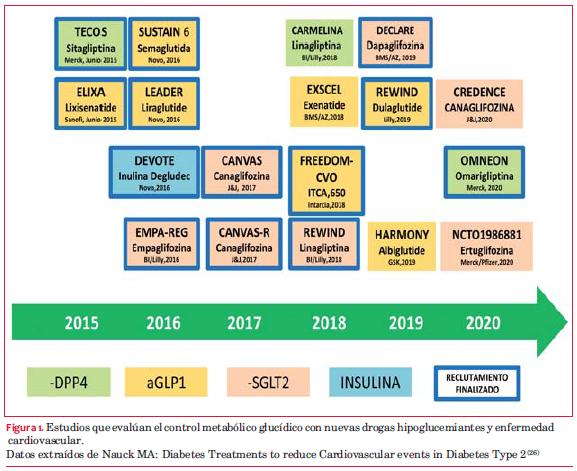
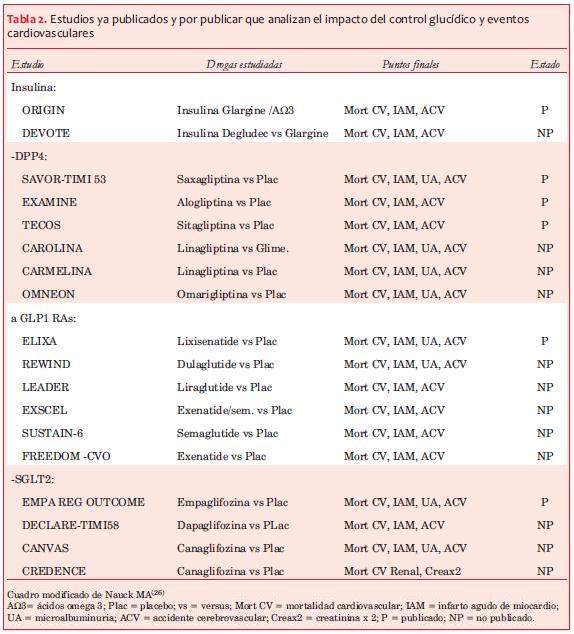
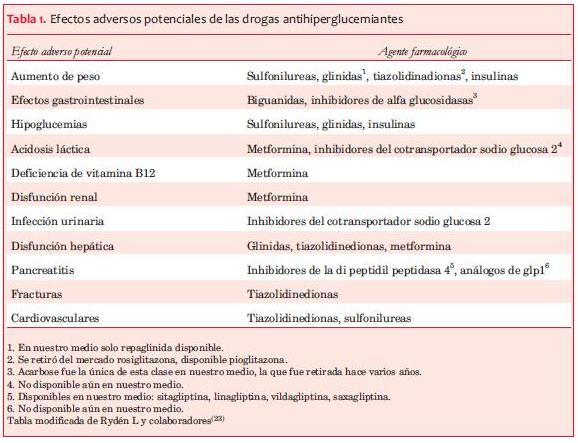
<body><![CDATA[<p class="MsoBodyText" style="text-align: left; text-indent: 0cm; line-height: normal;" align="left"><span style="font-size: 10pt; font-family: Verdana;">Es de resaltar que los beneficios de los primeros estudios se vieron contrapuestos con los hallazgos neutrales y en algunos aspectos negativos de los estudios posteriores, determinando controversias en el ambiente cient&iacute;fico.<o:p></o:p></span></p>             <p class="MsoBodyText" style="text-align: left; text-indent: 0cm; line-height: normal;" align="left"><span style="font-size: 10pt; font-family: Verdana;">Varias han sido las hip&oacute;tesis para dar una explicaci&oacute;n de este hecho. Entre ellas, la observaci&oacute;n de que existi&oacute; una diferencia importante entre el UKPDS y estudios subsiguientes determinada por la falta de disponibilidad de drogas <span class="SpellE">hipolipemiantes</span> y antihipertensivas efectivas en la &eacute;poca en que se realiz&oacute; el estudio. En los estudios siguientes, que analizaron el control de glucemia y su relaci&oacute;n con ECV, se usaron medicamentos eficientes para <span class="SpellE">hiperlipemia</span> e hipertensi&oacute;n arterial, lo que probablemente hizo que los resultados del efecto <span class="SpellE">hipoglucemiante</span> sobre el desarrollo de ECV fueran menos aparentes. Otra de las hip&oacute;tesis planteadas es la relacionada con efectos adversos de las drogas antidiab&eacute;ticas, las que han sido usadas en altas dosis, solas o en combinaciones variadas, u otros factores aislados o asociados tales como: cortos per&iacute;odos de seguimiento; falta de revisi&oacute;n de los puntos finales y poder insuficiente de los marcadores <span class="SpellE">surrogados</span>; estudios de poblaciones que ya presentaban da&ntilde;o CV; pocas comparaciones <span class="SpellE"><i>head</i></span><i> <span class="SpellE">to</span> <span class="SpellE">head</span></i> con drogas disponibles; estudios impulsados por el mercado m&aacute;s que por la investigaci&oacute;n acad&eacute;mica, etc&eacute;tera<sup>(22,23)</sup>.<o:p></o:p></span></p>             <p class="MsoBodyText" style="text-align: left; text-indent: 0cm; line-height: normal;" align="left"><span style="font-size: 10pt; font-family: Verdana;">En la <a href="#t1">tabla 1</a> se pueden observar los potenciales efectos adversos de los medicamentos <span class="SpellE">antihipergluc&eacute;micos</span>.</span></p>      <p class="MsoBodyText" style="text-align: left; text-indent: 0cm; line-height: normal;" align="left"><span style="font-size: 10pt; font-family: Verdana;"><o:p></o:p></span></p>             <p class="SUB1" style="margin-bottom: 0.0001pt; line-height: normal; page-break-after: auto;"><a name="t1"></a><img style="width: 578px; height: 443px;" alt="" src="/img/revistas/ruc/v31n3/3a14t1.JPG"> &nbsp;<sup style="font-weight: normal;"><small><span style="color: rgb(0, 0, 0); font-family: Verdana;">(23)</span></small></sup><span style="font-family: Verdana;"></span></p>      <p class="SUB1" style="margin-bottom: 0.0001pt; line-height: normal; page-break-after: auto;"></p>           <p class="SUB1" style="margin-bottom: 0.0001pt; line-height: normal; page-break-after: auto;"><span style="font-family: Verdana;">Seguridad cardiovascular de las drogas <span class="SpellE">hipoglucemiantes</span><o:p></o:p></span></p>             <p class="PRIMER" style="text-align: left; line-height: normal;" align="left"><span style="font-size: 10pt; font-family: Verdana;"></span></p>           <p class="PRIMER" style="text-align: left; line-height: normal;" align="left"><span style="font-size: 10pt; font-family: Verdana;">El tema de la seguridad de las drogas usadas para el tratamiento de la <span class="SpellE">hiperglucemia</span> surgi&oacute; posteriormente a la publicaci&oacute;n de <span class="SpellE">Nissen</span> y <span class="SpellE">Wolski</span> sobre el <span class="SpellE">metaan&aacute;lisis</span> de <span class="SpellE">rosiglitazona</span> y eventos <span class="GramE">cardiovasculares<sup>(</sup></span><sup>24)</sup>. Este reporte refiri&oacute; un aumento del riesgo de IAM de 43% y de muerte de causa CV de 64% al comparar el uso de <span class="SpellE">rosiglitazona</span> versus otros <span class="SpellE">hipoglucemiantes</span> que inclu&iacute;an: <span class="SpellE">metformina</span>, SU e insulina, generando m&uacute;ltiples debates y preocupaci&oacute;n. En 2008, <st1:personname productid="la FDA" w:st="on"><st1:metricconverter productid="4, a" w:st="on">la FDA</st1:metricconverter></st1:personname> public&oacute; una gu&iacute;a dirigida a la industria farmac&eacute;utica en la que recomend&oacute; la evaluaci&oacute;n del riesgo CV de las drogas antidiab&eacute;ticas que se hab&iacute;an lanzado recientemente al mercado y previo al lanzamiento de nuevas drogas para la diabetes. El criterio para la aceptaci&oacute;n fue que los efectos no fuesen inferiores a las drogas ya existentes. Estas recomendaciones fueron adoptadas por <st1:personname productid="la Agencia Europea" w:st="on"><st1:metricconverter productid="4, a" w:st="on">la Agencia Europea</st1:metricconverter></st1:personname> de <span class="GramE">Medicinas<sup>(</sup></span><sup>25)</sup>, lo que dio lugar a m&uacute;ltiples estudios que incluyeron nuevas drogas: insulinas <span class="SpellE">basales</span> (<span class="SpellE">lantus</span>, <span class="SpellE">levemir</span>, <span class="SpellE">degludec</span>, etc&eacute;tera); inhibidores de la <span class="SpellE">dipeptidil</span> <span class="SpellE">peptidasa</span> 4 (-DPP4); an&aacute;logos del p&eacute;ptido similar a <span class="SpellE">glucag&oacute;n</span> tipo 1 (<span class="SpellE">aGLP1</span>); inhibidores del <span class="SpellE">cotransportador</span> sodio-glucosa tipo 1 (-SGLT2), de los cuales algunos ya han sido finalizados y publicados(26) (<a href="#f1">figura 1</a> y <a href="#t2">tabla 2</a>). El n&uacute;mero de pacientes que han invo&shy;lucrado estos estudios es muy grande, superando los 115.000 en 2016. Los costos para la industria farmac&eacute;utica destinados a la realizaci&oacute;n de los mis&shy;mos tambi&eacute;n han sido considerables. &nbsp;</span></p>  <span style="font-family: &quot;CentSchbook BT&quot;;"></span>     <p class="PRIMER" style="text-align: left; line-height: normal;" align="left"><a name="f1"></a><img style="width: 577px; height: 471px;" alt="" src="/img/revistas/ruc/v31n3/3a14f1.JPG"> &nbsp;<sup><small><span style="font-family: Verdana;">(26)</span></small></sup><span style="font-size: 10pt; font-family: Verdana;"><o:p></o:p></span></p>             ]]></body>
<body><![CDATA[<p class="SUB1" style="margin-bottom: 0.0001pt; line-height: normal; page-break-after: auto;"><span style="font-family: Verdana;"></span></p>           <p class="SUB1" style="margin-bottom: 0.0001pt; line-height: normal; page-break-after: auto;"><span style="font-family: Verdana;"><a name="t2"></a><img style="width: 574px; height: 634px;" alt="" src="/img/revistas/ruc/v31n3/3a14t2.JPG"> </span><small style="font-weight: normal; color: rgb(0, 0, 0);"><span style="font-family: Verdana;">(26)</span></small></p>      <p class="SUB1" style="margin-bottom: 0.0001pt; line-height: normal; page-break-after: auto;"><span style="font-family: Verdana;"></span></p>      <p class="SUB1" style="margin-bottom: 0.0001pt; line-height: normal; page-break-after: auto;"><span style="font-family: Verdana;">Las drogas antidiab&eacute;ticas y riesgo cardiovascular: evidencias y conceptos actuales<o:p></o:p></span></p>             <p class="SUB2" style="margin: 0cm 0cm 0.0001pt; line-height: normal; page-break-after: auto;"><span style="font-family: Verdana;"></span></p>           <p class="SUB2" style="margin: 0cm 0cm 0.0001pt; line-height: normal; page-break-after: auto;"><span style="font-family: Verdana;">1. <span class="SpellE">Metformina</span><o:p></o:p></span></p>             <p class="PRIMER" style="text-align: left; line-height: normal;" align="left"><span style="font-size: 10pt; font-family: Verdana;">La <span class="SpellE">metformina</span> tiene m&aacute;s de 50 a&ntilde;os de uso en el mundo y m&aacute;s de 20 en nuestro pa&iacute;s, algunos a&ntilde;os antes de que se lanzara al mercado en Estados Unidos. Es la droga m&aacute;s prescripta y recomendada como de primera l&iacute;nea de tratamiento por <st1:personname productid="la American Diabetes" w:st="on"><st1:metricconverter productid="4, a" w:st="on">la <span class="SpellE">American</span> Diabetes</st1:metricconverter></st1:personname> <span class="SpellE">Association</span> (ADA<span class="GramE">)<sup>(</sup></span><sup>27)</sup>, <st1:personname productid="la European Association" w:st="on"><st1:metricconverter productid="4, a" w:st="on">la <span class="SpellE">European</span> <span class="SpellE">Association</span></st1:metricconverter></st1:personname> <span class="SpellE">for</span> the <span class="SpellE">Study</span> <span class="SpellE">of</span> Diabetes (EASD) y <st1:personname productid="la IDF" w:st="on"><st1:metricconverter productid="4, a" w:st="on">la IDF</st1:metricconverter></st1:personname><sup>(28,29).</sup><o:p></o:p></span></p>             <p class="MsoBodyText" style="text-align: left; text-indent: 0cm; line-height: normal;" align="left"><span style="font-size: 10pt; font-family: Verdana;">Como ya fue mencionado en el UKPDS, la <span class="SpellE">metformina</span> redujo la incidencia de IAM, muerte coronaria y por cualquier causa en pacientes con DM2 reci&eacute;n diagnosticada con bajo riesgo CV, cuyo peso corporal se encontraba en un promedio de 120% por encima del peso ideal<sup>(30)</sup>. En el an&aacute;lisis que se llev&oacute; a cabo diez a&ntilde;os despu&eacute;s de finalizado este estudio, se mantuvo una reducci&oacute;n de 33% de IAM y muerte por cualquier causa. El n&uacute;mero necesario a tratar (NNT) para prevenir una muerte fue de 14 pacientes por diez <span class="GramE">a&ntilde;os<sup>(</sup></span><sup>16)</sup>.<o:p></o:p></span></p>             <p class="MsoBodyText" style="text-align: left; text-indent: 0cm; line-height: normal;" align="left"><span style="font-size: 10pt; font-family: Verdana;">Hubo un segundo estudio con resultados claramente beneficiosos con el uso de <span class="SpellE">metformina</span>: el estudio SPREAD-DIDMCAD, el cual compar&oacute; el tratamiento por cinco a&ntilde;os de <span class="SpellE">metformina</span> con <span class="SpellE">glipizida</span> en DM2 con ECV, encontrando una reducci&oacute;n de eventos CV del 10,1%<sup>(31)</sup>. En este caso, el NNT para evitar una muerte o IAM no fatal, ACV no fatal o <span class="SpellE">revascularizaci&oacute;n</span> arterial, fue de 10 pacientes por cinco a&ntilde;os, sin demostrar una reducci&oacute;n independiente de mortalidad por cualquier causa como en el UKPDS.<o:p></o:p></span></p>             <p class="MsoBodyText" style="text-align: left; text-indent: 0cm; line-height: normal;" align="left"><span style="font-size: 10pt; font-family: Verdana;">Sin embargo, el <span class="SpellE">metaan&aacute;lisis</span> de estudios controlados y <span class="SpellE">randomizados</span> con <span class="SpellE">metformina</span> versus dieta, placebo o no tratamiento, no encontr&oacute; beneficio CV con el uso de esta <span class="GramE">droga<sup>(</sup></span><sup>32)</sup>. Es de destacar que este <span class="SpellE">metaan&aacute;lisis</span> no incluy&oacute; el estudio SPREAD- DIDMCAD.<o:p></o:p></span></p>             ]]></body>
<body><![CDATA[<p class="MsoBodyText" style="text-align: left; text-indent: 0cm; line-height: normal;" align="left"><span style="font-size: 10pt; font-family: Verdana;">Si bien existen muchos trabajos retrospectivos de grandes bases de datos que concluyeron que la <span class="SpellE">metformina</span> reduce eventos CV, en la mayor&iacute;a de ellos fue comparada con diferentes <span class="SpellE">sulfonilureas</span> (SUs<span class="GramE">)<sup>(</sup></span><sup>33-38)</sup>. Seg&uacute;n el juicio de <span class="SpellE">Ralph</span> de <span class="SpellE">Fronzo</span> y E. <span class="SpellE">Ferranini</span>, no es posible discernir si las SUs aumentan o la <span class="SpellE">metformina</span> desciende el riesgo de eventos <span class="GramE">CV<sup>(</sup></span><sup>39)</sup>.<o:p></o:p></span></p>             <p class="MsoBodyText" style="text-align: left; text-indent: 0cm; line-height: normal;" align="left"><span style="font-size: 10pt; font-family: Verdana;">Existen dos estudios retrospectivos de pacientes con enfermedad arterial coronaria (EAC) con y sin insuficiencia <span class="SpellE">card&iacute;aca</span> que han concluido que la <span class="SpellE">metformina</span> mejora la <span class="SpellE">sobrevida</span>, independientemente del control <span class="SpellE"><span class="GramE">gluc&eacute;mico</span></span><span class="GramE"><sup>(</sup></span><sup>40,41)</sup>.<o:p></o:p></span></p>             <p class="MsoBodyText" style="text-align: left; text-indent: 0cm; line-height: normal;" align="left"><span style="font-size: 10pt; font-family: Verdana;">Varios estudios han sido dise&ntilde;ados para evaluar la asociaci&oacute;n de <span class="SpellE">metformina</span> con injuria mioc&aacute;rdica. El estudio <span class="SpellE">MetCABG</span>, recientemente publicado, ha investigado si su uso en individuos no diab&eacute;ticos, <span class="SpellE">pretratamiento</span> quir&uacute;rgico y por breve tiempo, limita la injuria mioc&aacute;rdica reflejada por las concentraciones de <span class="SpellE">troponina</span> y de puntos finales secundarios como la aparici&oacute;n de arritmias, requerimiento de <span class="SpellE">inotr&oacute;picos</span> y tiempo de <span class="SpellE">desintubaci&oacute;n</span>. No se encontraron diferencias en ninguno de los puntos analizados, concluyendo los autores que aunque el uso de <span class="SpellE">metformina</span> fue seguro, no es una estrategia efectiva para reducir la injuria mioc&aacute;rdica <span class="SpellE">periprocedimiento</span> de <span class="SpellE">revascularizaci&oacute;n</span> <span class="GramE">coronaria<sup>(</sup></span><sup>42)</sup>.<o:p></o:p></span></p>             <p class="MsoBodyText" style="text-align: left; text-indent: 0cm; line-height: normal;" align="left"><span style="font-size: 10pt; font-family: Verdana;">Otro de estos estudios evalu&oacute; el efecto de <span class="SpellE">met&shy;formin</span>a sobre <span class="SpellE">subfracciones</span> de l&iacute;pidos circulantes e injuria <span class="SpellE">isqu&eacute;mica</span> mioc&aacute;rdica en 371 pacientes tratados por cuatro meses posteriores a la elevaci&oacute;n del ST, denominado <span class="SpellE">Glycometabolic</span> <span class="SpellE">Intervention</span> as <span class="SpellE">Adjunct</span> <span class="SpellE">to</span> <span class="SpellE">Primary</span> <span class="SpellE">Percutaneous</span> <span class="SpellE">Intervention</span> in ST <span class="SpellE">Elevation</span> <span class="SpellE">Myocardial</span> <span class="SpellE">Infarction</span> <span class="SpellE">Trial</span>, GIPS-III. Al finalizar el per&iacute;odo de cuatro meses encontraron una disminuci&oacute;n de LDL colesterol y de las part&iacute;culas grandes de LDL, las cuales se vieron afectadas precozmente desde el inicio de la intervenci&oacute;n con <span class="SpellE">metformina</span>. El aumento precoz de HDL colesterol y de part&iacute;culas medianas de VLDL se asoci&oacute; a mejor funci&oacute;n ventricular izquierda y a reducci&oacute;n de la injuria <span class="GramE">mioc&aacute;rdica<sup>(</sup></span><sup>43)</sup>.<o:p></o:p></span></p>             <p class="MsoBodyText" style="text-align: left; text-indent: 0cm; line-height: normal;" align="left"><span style="font-size: 10pt; font-family: Verdana;">Actualmente se est&aacute; llevando a cabo un estudio <span class="SpellE">randomizado</span> y controlado en el Reino Unido (<span class="SpellE">Glucose</span>-<span class="SpellE">Lowering</span> in Non-<span class="SpellE">diabetic</span> <span class="SpellE">Hyperglycaemia</span> <span class="SpellE">trial&ndash;</span> GLINT<span class="GramE">)<sup>(</sup></span><sup>44)</sup> que analizar&aacute; a 12.000 individuos con <span class="SpellE">prediabetes</span> (<span class="SpellE">disglucemia</span> en rangos inferiores a diabetes) tratados por cinco a&ntilde;os con <span class="SpellE">metformina</span> para establecer la efectividad y relaci&oacute;n costo/efectividad de la <span class="SpellE">metformina</span> para prevenir eventos cardiovasculares.<o:p></o:p></span></p>             <p class="MsoBodyText" style="text-align: left; text-indent: 0cm; line-height: normal;" align="left"><span style="font-size: 10pt; font-family: Verdana;">Varios tambi&eacute;n son los estudios ya publicados y otros que proyectan estudiar el efecto de la <span class="SpellE">metformina</span> sobre la &iacute;ntima media <span class="SpellE">carot&iacute;dea</span> (IMC). Tres de ellos encontraron efectos <span class="GramE">positivos<sup>(</sup></span><sup>45-47)</sup> y de <span class="SpellE">significancia</span> estad&iacute;stica, mientras que otro present&oacute; resultados neutros. Sin embargo, este &uacute;ltimo se realiz&oacute; en sujetos que estaban bajo tratamiento con <span class="SpellE">estatinas</span>, por lo que esta podr&iacute;a haber solapado los beneficios de la <span class="SpellE"><span class="GramE">metformina</span></span><span class="GramE"><sup>(</sup></span><sup>48)</sup>.<o:p></o:p></span></p>             <p class="MsoBodyText" style="text-align: left; text-indent: 0cm; line-height: normal;" align="left"><span style="font-size: 10pt; font-family: Verdana;">En este a&ntilde;o se public&oacute; un adelanto del estudio <span class="SpellE">Copenhagen</span> <span class="SpellE">Insulin</span> <span class="SpellE">and</span> <span class="SpellE">Metformin</span> <span class="SpellE">Therapy</span> <span class="SpellE">Trial</span> en m&aacute;s de 400 pacientes con DM2 que fueron asignados en forma aleatoria a insulina m&aacute;s placebo o <span class="SpellE">metformina</span> por 18 <span class="GramE">meses<sup>(</sup></span><sup>49)</sup>. Encontraron que el cambio en el grosor de <st1:personname productid="la IMC" w:st="on"><st1:metricconverter productid="4, a" w:st="on">la IMC</st1:metricconverter></st1:personname> no tuvo diferencias significativas, a pesar de que <st1:personname productid="la HbA" w:st="on"><st1:metricconverter productid="4, a" w:st="on">la   <span class="SpellE">HbA</span></st1:metricconverter></st1:personname><span class="SpellE">1c</span> fue sensiblemente m&aacute;s baja, tuvieron menor ganancia de peso, presentaron menores hipoglucemias severas y usaron menor dosis de insulina que el grupo con placebo. Sin embargo, los autores finalizan el estudio refiriendo que se hab&iacute;a llegado al 46% de la muestra proyectada y que la muestra analizada, al haber sido mucho menor, podr&iacute;a haber quitado poder a los resultados.<o:p></o:p></span></p>             <p class="MsoBodyText" style="text-align: left; text-indent: 0cm; line-height: normal;" align="left"><span style="font-size: 10pt; font-family: Verdana;">El estudio en curso sobre los efectos de la <span class="SpellE">metformina</span> en el grosor de <st1:personname productid="la IMC" w:st="on"><st1:metricconverter productid="4, a" w:st="on">la   IMC</st1:metricconverter></st1:personname> en diab&eacute;ticos tipo 1 es el <span class="SpellE">REducing</span> <span class="SpellE">with</span> <span class="SpellE">MetfOrmin</span> Vascular <span class="SpellE">Adverse</span> <span class="SpellE">Lesions</span> in <span class="SpellE">Type</span> 1 Diabetes (REMOVAL), el cual saldr&aacute; a la luz el pr&oacute;ximo <span class="GramE">a&ntilde;o<sup>(</sup></span><sup>50)</sup>.<o:p></o:p></span></p>             <p class="MsoBodyText" style="text-align: left; text-indent: 0cm; line-height: normal;" align="left"><span style="font-size: 10pt; font-family: Verdana;">Finalmente, en esta revisi&oacute;n de estudios sobre <span class="SpellE">metformina</span>, citamos el <span class="SpellE">metaan&aacute;lisis</span> y revisi&oacute;n sistematizada recientemente publicado de <span class="SpellE">Marathur</span> NM y colaboradores<sup>(51)</sup>, quienes analizaron m&aacute;s de 200 estudios en los que compararon el efecto y la seguridad de <span class="SpellE">metformina</span> en <span class="SpellE">monoterapia</span> o en combinaci&oacute;n con otras drogas para diabetes (SUs; <span class="SpellE">tiazolidinedionas</span> [TZD]; -DPP4; -SGLT2; <span class="SpellE">aGLP1</span>). Concluyeron que la <span class="SpellE">metformina</span> presenta efectos beneficiosos sobre <span class="SpellE">HbA1c</span>, peso, y mortalidad cardiovascular comparada con SUs, lo que avala la indicaci&oacute;n de esta droga como de elecci&oacute;n o primera l&iacute;nea en el tratamiento de <st1:personname productid="La DM" w:st="on"><st1:metricconverter productid="4, a" w:st="on">la DM</st1:metricconverter></st1:personname>2. Aunque menos evidentes, en las terapias combinadas con <span class="SpellE">metformina</span> los resul&shy;tados son similares a los vistos en <span class="SpellE">monoterapia</span>.<o:p></o:p></span></p>             <p class="MsoBodyText" style="text-align: left; text-indent: 0cm; line-height: normal;" align="left"><span style="font-size: 10pt; font-family: Verdana;">Seg&uacute;n los conceptos de la reciente revisi&oacute;n de los <span class="SpellE">Profs</span>. <span class="SpellE">Ferranini</span> y <span class="SpellE">DeFronzo</span>, varios son los mecanismos de acci&oacute;n de la <span class="SpellE">metformina</span> para ejercer sus efectos beneficiosos: mejora el control metab&oacute;lico; reduce los niveles de <span class="SpellE">metilglioxal</span>; disminuye los niveles de VLDL, TG y lipemia <span class="SpellE">posprandial</span>; mejora la disfunci&oacute;n endotelial; reduce el PAI-1; desciende aunque modestamente el peso (por efecto <span class="SpellE">anorex&iacute;geno</span>, diarrea, <span class="SpellE">disconfort</span> abdominal y flatulencia). Los niveles de LDL y HDL colesterol pueden descender de forma m&iacute;nima o tener un efecto <span class="GramE">neutro<sup>(</sup></span><sup>39).</sup><o:p></o:p></span></p>             ]]></body>
<body><![CDATA[<p class="MsoBodyText" style="text-align: left; text-indent: 0cm; line-height: normal;" align="left"><span style="font-size: 10pt; font-family: Verdana;">En cuanto al concepto de que la <span class="SpellE">metformina</span> es un <span class="SpellE">insulino</span> sensibilizador, recientes revisiones sistematizadas de estudios realizados con clamp <span class="SpellE">eugluc&eacute;mico</span> no soportan este <span class="GramE">concepto<sup>(</sup></span><sup>52,53)</sup>. Actualmente se considera que sus efectos se restringen a su acci&oacute;n en el h&iacute;gado y tubo digestivo.<o:p></o:p></span></p>             <p class="MsoBodyText" style="text-align: left; text-indent: 0cm; line-height: normal;" align="left"><span style="font-size: 10pt; font-family: Verdana;"><o:p>&nbsp;</o:p></span></p>             <p class="PRIMER" style="text-align: left; line-height: normal; font-style: italic;" align="left"><span style="font-size: 10pt; font-family: Verdana;">En suma, bas&aacute;ndonos en evidencias cient&iacute;ficas sobre <span class="SpellE">metformina</span> podemos aseverar que:<o:p></o:p></span></p>             <p class="BALA" style="margin-left: 0cm; text-align: left; text-indent: 0cm; line-height: normal; font-style: italic;" align="left"><span style="font-family: Symbol; color: red;"><span style="">&middot;<span style="font-family: &quot;Times New Roman&quot;; font-style: normal; font-variant: normal; font-weight: normal; font-size: 7pt; line-height: normal; font-size-adjust: none; font-stretch: normal;">&nbsp;&nbsp;&nbsp;&nbsp;&nbsp;&nbsp;&nbsp;</span></span></span><span style="font-size: 10pt; font-family: Verdana;">No presenta efectos adversos cardiovasculares en DM2.<o:p></o:p></span></p>             <p class="BALA" style="margin-left: 0cm; text-align: left; text-indent: 0cm; line-height: normal; font-style: italic;" align="left"><span style="font-family: Symbol; color: red;"><span style="">&middot;<span style="font-family: &quot;Times New Roman&quot;; font-style: normal; font-variant: normal; font-weight: normal; font-size: 7pt; line-height: normal; font-size-adjust: none; font-stretch: normal;">&nbsp;&nbsp;&nbsp;&nbsp;&nbsp;&nbsp;&nbsp;</span></span></span><span style="font-size: 10pt; font-family: Verdana;">Determina beneficios de varios factores de riesgo CV: disminuci&oacute;n leve de peso o efecto neutro; disminuci&oacute;n leve de l&iacute;pidos <span class="SpellE">aterog&eacute;nicos</span>; reduce marcadores inflamatorios vinculados con ECV.<o:p></o:p></span></p>             <p class="BALA" style="margin-left: 0cm; text-align: left; text-indent: 0cm; line-height: normal;" align="left"><span style="font-family: Symbol; color: red; font-style: italic;"><span style="">&middot;<span style="font-family: &quot;Times New Roman&quot;; font-style: normal; font-variant: normal; font-weight: normal; font-size: 7pt; line-height: normal; font-size-adjust: none; font-stretch: normal;">&nbsp;&nbsp;&nbsp;&nbsp;&nbsp;&nbsp;&nbsp;</span></span></span><span style="font-size: 10pt; font-family: Verdana;"><span style="font-style: italic;">No produce hipoglucemias usadas en </span><span style="font-style: italic;" class="SpellE">monodroga</span><span style="font-style: italic;">.</span><o:p></o:p></span></p>             <p class="MsoBodyText" style="text-align: left; text-indent: 0cm; line-height: normal;" align="left"><span style="font-size: 10pt; font-family: Verdana;"><span class="SpellE"></span><o:p></o:p></span></p>                <p class="MsoBodyText" style="text-align: left; text-indent: 0cm; line-height: normal;" align="left"><span style="font-size: 10pt; font-family: Verdana;"><o:p></o:p>Finalmente debemos agregar que la <span class="SpellE">metformina</span>, en nuestro medio, es una droga accesible y no cara.<o:p></o:p></span></p>             <p class="SUB2" style="margin: 0cm 0cm 0.0001pt; line-height: normal; page-break-after: auto;"><span style="font-family: Verdana;"></span></p>           <p class="SUB2" style="margin: 0cm 0cm 0.0001pt; line-height: normal; page-break-after: auto;"><span style="font-family: Verdana;">2. <span class="SpellE">Sulfonilureas</span> (SUs)<o:p></o:p></span></p>             ]]></body>
<body><![CDATA[<p class="PRIMER" style="text-align: left; line-height: normal;" align="left"><span style="font-size: 10pt; font-family: Verdana;">Las SUs han sido usadas por m&aacute;s de seis d&eacute;cadas. Son drogas muy baratas comparadas con todo el arsenal terap&eacute;utico disponible hoy d&iacute;a y son accesibles en todos los niveles asistenciales.<o:p></o:p></span></p>             <p class="MsoBodyText" style="text-align: left; text-indent: 0cm; line-height: normal;" align="left"><span style="font-size: 10pt; font-family: Verdana;">El mecanismo de acci&oacute;n principal es aumentar la secreci&oacute;n de insulina por las c&eacute;lulas <span class="GramE">beta pancre&aacute;ticas</span>. La <span class="SpellE">hiperinsulinemia</span> resultante vence, al menos en parte, la <span class="SpellE">insulinorresistencia</span> hep&aacute;tica y muscular disminuyendo la <span class="SpellE">hiperglucemia</span>. Hay estudios que avalan el concepto de que las SUs aceleran la falla de la c&eacute;lula <span class="GramE">beta<sup>(</sup></span><sup>54-56)</sup>; no tienen efecto sobre los factores de riesgo CV; determinan aumento de peso corporal e hipoglucemias, estando estos dos &uacute;ltimos factores asociados a mayor riesgo de ECV<sup>(57-59)</sup>.<o:p></o:p></span></p>             <p class="MsoBodyText" style="text-align: left; text-indent: 0cm; line-height: normal;" align="left"><span style="font-size: 10pt; font-family: Verdana;">Las primeras sospechas sobre la asociaci&oacute;n de SUs y mayor riesgo cardiovascular surgieron en la d&eacute;cada de 1970 con el controvertido estudio <span class="SpellE">University</span> <span class="SpellE">Group</span> Diabetes <span class="SpellE">Program</span> <span class="GramE">UGDP<sup>(</sup></span><sup>60)</sup>, a partir de cuya publicaci&oacute;n <st1:personname productid="la FDA" w:st="on"><st1:metricconverter productid="4, a" w:st="on">la FDA</st1:metricconverter></st1:personname> exigi&oacute; a la industria el agregado de una etiqueta en los prospectos de las drogas, alertando sobre esa situaci&oacute;n. Actualmente disponemos de m&uacute;ltiples estudios, la mayor&iacute;a retrospectivos, de enormes bases de datos que han encontrado mayor mortalidad en DM2 con el uso de <span class="GramE">SUs<sup>(</sup></span><sup>31,37,38,41,43,45,61-66)</sup>.<o:p></o:p></span></p>             <p class="MsoBodyText" style="text-align: left; text-indent: 0cm; line-height: normal;" align="left"><span style="font-size: 10pt; font-family: Verdana;">Dentro de este grupo de drogas la que m&aacute;s se ha encontrado asociada a eventos cardiovasculares ha sido la <span class="SpellE"><span class="GramE">glibenclamida</span></span><span class="GramE"><sup>(</sup></span><sup>63-68)</sup>. Sin embargo, existen otros trabajos que no han encontrado asociaci&oacute;n de este grupo de drogas con mayor <span class="SpellE"><span class="GramE">morbimortalidad</span></span><span class="GramE"><sup>(</sup></span><sup>6,15,68,69)</sup>. <span class="SpellE">Metaan&aacute;lisis</span> recientes, dise&ntilde;ados para evaluar <span class="GramE">mortalidad<sup>(</sup></span><sup>62,70,71)</sup>, dieron resultados conflictivos; mientras que el estudio de <span class="SpellE">Monami</span><sup>(61)</sup> report&oacute; un aumento de mortalidad de causa CV, pero no de otros eventos. La asociaci&oacute;n de <span class="SpellE">metformina</span> con SUs ha sido reportada en varios estudios como determinante de mayor riesgo <span class="GramE">CV<sup>(</sup></span><sup>30,73)</sup>. El estudio en curso Cardiovascular <span class="SpellE">Outcome</span> <span class="SpellE">Study</span> <span class="SpellE">of</span> <span class="SpellE">Linagliptin</span> <span class="SpellE">vs</span> <span class="SpellE">Glimepiride</span> in <span class="SpellE">Patients</span> <span class="SpellE">with</span> <span class="SpellE">Type</span> 2 Diabetes (CAROLINA<span class="GramE">)<sup>(</sup></span><sup>74)</sup>, quiz&aacute; pueda aclarar m&aacute;s estos conceptos.<o:p></o:p></span></p>             <p class="MsoBodyText" style="text-align: left; text-indent: 0cm; line-height: normal;" align="left"><span style="font-size: 10pt; font-family: Verdana;">Los <span class="SpellE">Profs</span>. <span class="SpellE">Ferranini</span> y De <span class="SpellE">Fronzo</span>, en su revisi&oacute;n del tema sobre las SUs, concluyen que dadas las evidencias de que la <span class="SpellE">glibenclamida</span> interfiere con el <span class="SpellE">preacondicionamiento</span> <span class="SpellE">isqu&eacute;mico</span> coronario<sup>(75,76)</sup>, determina m&aacute;s hipoglucemias<sup>(77)</sup> y puede estar asociada a aumento del riesgo CV comparada con otras <span class="SpellE">sulfonilureas</span><sup>(63-69)</sup>, es recomendable elegir otra de su clase<sup>(39)</sup>.<o:p></o:p></span></p>             <p class="MsoBodyText" style="text-align: left; text-indent: 0cm; line-height: normal;" align="left"><span style="font-size: 10pt; font-family: Verdana;">Desde hace varias d&eacute;cadas hay estudios que postulan el nexo entre SUs y riesgo CV, pero no hay unanimidad de resultados en estudios poblacionales. Si nos preguntamos cu&aacute;l es el lugar de las SUs en el algoritmo terap&eacute;utico del paciente diab&eacute;tico, hay gu&iacute;as, como la de <st1:personname productid="la American Diabetes" w:st="on"><st1:metricconverter productid="4, a" w:st="on">la <span class="SpellE">American</span> Diabetes</st1:metricconverter></st1:personname> <span class="SpellE">Association</span> (ADA<span class="GramE">)<sup>(</sup></span><sup>27)</sup>, que recomiendan las SUs como drogas de segunda elecci&oacute;n, mientras que el resto de medicamentos constituir&iacute;an una tercera opci&oacute;n. Otras, como la de <st1:personname productid="la American Association" w:st="on"><st1:metricconverter productid="4, a" w:st="on">la <span class="SpellE">American</span> <span class="SpellE">Association</span></st1:metricconverter></st1:personname> <span class="SpellE">of</span> <span class="SpellE">Clinical</span> <span class="SpellE">Endocrinology</span> (AACE<span class="GramE">)<sup>(</sup></span><sup>78)</sup>, o las de <st1:personname productid="la National Institute" w:st="on"><st1:metricconverter productid="4, a" w:st="on">la <span class="SpellE">National</span> <span class="SpellE">Institute</span></st1:metricconverter></st1:personname> <span class="SpellE">of</span> <span class="SpellE">Clinical</span> <span class="SpellE">Excelence</span> (NICE)(79) o de <st1:personname productid="la Asociaci&oacute;n Latino" w:st="on"><st1:metricconverter productid="4, a" w:st="on">la Asociaci&oacute;n Latino</st1:metricconverter></st1:personname> Americana de Diabetes (ALAD)<sup>(81)</sup>, colocan a la <span class="SpellE">metformina</span> en primer lugar del algoritmo terap&eacute;utico y en segundo: -DPP4, TZD, <span class="SpellE">acarbose</span>, <span class="SpellE">aGLP1</span>, -SGLT2, <span class="SpellE">glinidas</span>, SUs, de manera que se seleccione la m&aacute;s apropiada seg&uacute;n las caracter&iacute;sticas y el terreno del paciente.<o:p></o:p></span></p>             <p class="MsoBodyText" style="text-align: left; text-indent: 0cm; line-height: normal;" align="left"><span style="font-size: 10pt; font-family: Verdana;">Las diferencias en las recomendaciones medicamentosas para el manejo del paciente diab&eacute;tico 2 en las gu&iacute;as de pr&aacute;ctica cl&iacute;nica internacionales demuestran que los criterios que fundamentan el lugar que ocupan este tipo de drogas en el algoritmo terap&eacute;utico no han sido un&aacute;nimes. Por otra parte, existen fundamentos de variada &iacute;ndole: costos de los medicamentos, accesibilidad, experiencia de uso en a&ntilde;os, forma de administraci&oacute;n, efectos adversos, comodidad y adherencia del paciente, etc&eacute;tera, para recomendar una u otra estrategia terap&eacute;utica me&shy;dicamentosa.<o:p></o:p></span></p>             <p class="MsoBodyText" style="text-align: left; text-indent: 0cm; line-height: normal;" align="left"><span style="font-size: 10pt; font-family: Verdana;">Parece razonable que al elaborar gu&iacute;as de pr&aacute;ctica cl&iacute;nica en pa&iacute;ses diferentes del origen de las gu&iacute;as anteriormente mencionadas, y al momento de la toma de decisiones del profesional sobre la estrategia frente a cada paciente en particular, es necesario pensar en los <span class="SpellE">pros</span> y los <span class="SpellE">contras</span> de cada uno de los medicamentos seg&uacute;n el pa&iacute;s, medio y circunstancias en que se encuentre el binomio m&eacute;dico-paciente diab&eacute;tico. Lo que no podemos olvidar en cualquiera de las circunstancias es que los mayores costos en diabetes son los determinados por la apa&shy;rici&oacute;n de las complicaciones parenquimatosas aso&shy;ciadas a esta enfermedad.<o:p></o:p></span></p>             <p class="MsoBodyText" style="text-align: left; text-indent: 0cm; line-height: normal;" align="left"><span style="font-size: 10pt; font-family: Verdana;"><o:p>&nbsp;</o:p></span></p>             <p class="PRIMERABA" style="margin-top: 0cm; text-align: left; line-height: normal; font-style: italic;" align="left"><span style="font-size: 10pt; font-family: Verdana;">Las evidencias demuestran que las SUs tienen las siguientes caracter&iacute;sticas:<o:p></o:p></span></p>             ]]></body>
<body><![CDATA[<p class="BALA" style="margin-left: 0cm; text-align: left; text-indent: 0cm; line-height: normal; font-style: italic;" align="left"><span style="font-family: Symbol; color: red;"><span style="">&middot;<span style="font-family: &quot;Times New Roman&quot;; font-style: normal; font-variant: normal; font-weight: normal; font-size: 7pt; line-height: normal; font-size-adjust: none; font-stretch: normal;">&nbsp;&nbsp;&nbsp;&nbsp;&nbsp;&nbsp;&nbsp;</span></span></span><span style="font-size: 10pt; font-family: Verdana;">Son las drogas orales con m&aacute;s uso en la historia de la diabetes.<o:p></o:p></span></p>             <p class="BALA" style="margin-left: 0cm; text-align: left; text-indent: 0cm; line-height: normal; font-style: italic;" align="left"><span style="font-family: Symbol; color: red;"><span style="">&middot;<span style="font-family: &quot;Times New Roman&quot;; font-style: normal; font-variant: normal; font-weight: normal; font-size: 7pt; line-height: normal; font-size-adjust: none; font-stretch: normal;">&nbsp;&nbsp;&nbsp;&nbsp;&nbsp;&nbsp;&nbsp;</span></span></span><span style="font-size: 10pt; font-family: Verdana;">Son las m&aacute;s baratas.<o:p></o:p></span></p>             <p class="BALA" style="margin-left: 0cm; text-align: left; text-indent: 0cm; line-height: normal; font-style: italic;" align="left"><span style="font-family: Symbol; color: red;"><span style="">&middot;<span style="font-family: &quot;Times New Roman&quot;; font-style: normal; font-variant: normal; font-weight: normal; font-size: 7pt; line-height: normal; font-size-adjust: none; font-stretch: normal;">&nbsp;&nbsp;&nbsp;&nbsp;&nbsp;&nbsp;&nbsp;</span></span></span><span style="font-size: 10pt; font-family: Verdana;">Determinan aumento de peso.<o:p></o:p></span></p>             <p class="BALA" style="margin-left: 0cm; text-align: left; text-indent: 0cm; line-height: normal; font-style: italic;" align="left"><span style="font-family: Symbol; color: red;"><span style="">&middot;<span style="font-family: &quot;Times New Roman&quot;; font-style: normal; font-variant: normal; font-weight: normal; font-size: 7pt; line-height: normal; font-size-adjust: none; font-stretch: normal;">&nbsp;&nbsp;&nbsp;&nbsp;&nbsp;&nbsp;&nbsp;</span></span></span><span style="font-size: 10pt; font-family: Verdana;">No aportan beneficios adicionales sobre los factores de riesgo de ECV aparte de la que determina la disminuci&oacute;n de la <span class="SpellE">hiperglucemia</span>.<o:p></o:p></span></p>             <p class="BALA" style="margin-left: 0cm; text-align: left; text-indent: 0cm; line-height: normal; font-style: italic;" align="left"><span style="font-family: Symbol; color: red;"><span style="">&middot;<span style="font-family: &quot;Times New Roman&quot;; font-style: normal; font-variant: normal; font-weight: normal; font-size: 7pt; line-height: normal; font-size-adjust: none; font-stretch: normal;">&nbsp;&nbsp;&nbsp;&nbsp;&nbsp;&nbsp;&nbsp;</span></span></span><span style="font-size: 10pt; font-family: Verdana;">Pueden inducir la claudicaci&oacute;n anticipada de la masa de c&eacute;lulas <span class="GramE">beta pancre&aacute;ticas</span>.<o:p></o:p></span></p>                   <p class="MsoBodyText" style="text-align: left; text-indent: 0cm; line-height: normal;" align="left"><span style="font-family: Symbol; color: red; font-style: italic;"><span style="">&middot;<span style="font-family: &quot;Times New Roman&quot;; font-style: normal; font-variant: normal; font-weight: normal; font-size: 7pt; line-height: normal; font-size-adjust: none; font-stretch: normal;">&nbsp;&nbsp;&nbsp;&nbsp;&nbsp;&nbsp;&nbsp;</span></span></span><span style="font-size: 10pt; font-family: Verdana;"><span style="font-style: italic;">Determinan como efecto adverso principal mayor riesgo de hipoglucemias, por lo que se pueden asociar a mayor riesgo de ECV.</span><o:p>    <br>       &nbsp;</o:p></span></p>           <p class="SUB2" style="margin: 0cm 0cm 0.0001pt; line-height: normal; page-break-after: auto;"><span style="font-family: Verdana;">3. <span class="SpellE">Glinidas</span><o:p></o:p></span></p>             <p class="PRIMER" style="text-align: left; line-height: normal;" align="left"><span style="font-size: 10pt; font-family: Verdana;">En el mundo se comercializan dos de esta clase de drogas: <span class="SpellE">repaglinida</span> y <span class="SpellE">nateglinida</span>. Esta &uacute;ltima nunca fue comercializada en nuestro pa&iacute;s. Son <span class="SpellE">secretaggos</span> de insulina de corta acci&oacute;n que se unen al receptor de <span class="SpellE">sulfonilurea</span> y adem&aacute;s en otro sector diferente de la c&eacute;lula beta pancre&aacute;tica. Este hecho le confiere un perfil <span class="SpellE">farmacocin&eacute;tico</span> diferente. Deben administrarse antes de las comidas principales.<o:p></o:p></span></p>             <p class="MsoBodyText" style="text-align: left; text-indent: 0cm; line-height: normal;" align="left"><span style="font-size: 10pt; font-family: Verdana;">A diferencia de las SUs, cuyo efecto m&aacute;s importante es descender la glucemia de ayuno, las <span class="SpellE">glinidas</span> disminuyen las excursiones <span class="SpellE">gluc&eacute;micas</span> <span class="SpellE"><span class="GramE">posprandiales</span></span><span class="GramE"><sup>(</sup></span><sup>81)</sup>. Debido a su corta acci&oacute;n, determinan menor riesgo de hipoglucemias y menor aumento de peso <span class="GramE">corporal<sup>(</sup></span><sup>82,83)</sup>.<o:p></o:p></span></p>             ]]></body>
<body><![CDATA[<p class="MsoBodyText" style="text-align: left; text-indent: 0cm; line-height: normal;" align="left"><span style="font-size: 10pt; font-family: Verdana;">No determinan beneficios sobre los FRCV cl&aacute;sicos. Existe un reporte relacionado con disminuci&oacute;n de <span class="SpellE">Lp</span>(a) con <span class="SpellE"><span class="GramE">repaglinida</span></span><span class="GramE"><sup>(</sup></span><sup>84)</sup>.<o:p></o:p></span></p>             <p class="MsoBodyText" style="text-align: left; text-indent: 0cm; line-height: normal;" align="left"><span style="font-size: 10pt; font-family: Verdana;">En cuanto a seguridad CV, se ha publicado un estudio en 740 pacientes DM2 tratados con <span class="SpellE">repaglinida</span> que ingresaron por enfermedad <span class="SpellE">card&iacute;aca</span> <span class="SpellE">isqu&eacute;mica</span> y en un seguimiento a 30 d&iacute;as no se encontr&oacute; mayor mortalidad CV en comparaci&oacute;n con <span class="SpellE">glibenclamida</span> o <span class="SpellE">gliclazida</span><sup>(85)</sup>.<o:p></o:p></span></p>             <p class="MsoBodyText" style="text-align: left; text-indent: 0cm; line-height: normal;" align="left"><span style="font-size: 10pt; font-family: Verdana;"><o:p>&nbsp;</o:p></span></p>             <p class="PRIMERABA" style="margin-top: 0cm; text-align: left; line-height: normal; font-style: italic;" align="left"><span style="font-size: 10pt; font-family: Verdana;">Podemos concluir que la <span class="SpellE">repaglinida</span> determina:<o:p></o:p></span></p>             <p class="BALA" style="margin-left: 0cm; text-align: left; text-indent: 0cm; line-height: normal; font-style: italic;" align="left"><span style="font-family: Symbol; color: red;"><span style="">&middot;<span style="font-family: &quot;Times New Roman&quot;; font-style: normal; font-variant: normal; font-weight: normal; font-size: 7pt; line-height: normal; font-size-adjust: none; font-stretch: normal;">&nbsp;&nbsp;&nbsp;&nbsp;&nbsp;&nbsp;&nbsp;</span></span></span><span style="font-size: 10pt; font-family: Verdana;">Menor aumento de peso que SUs.<o:p></o:p></span></p>             <p class="BALA" style="margin-left: 0cm; text-align: left; text-indent: 0cm; line-height: normal; font-style: italic;" align="left"><span style="font-family: Symbol; color: red;"><span style="">&middot;<span style="font-family: &quot;Times New Roman&quot;; font-style: normal; font-variant: normal; font-weight: normal; font-size: 7pt; line-height: normal; font-size-adjust: none; font-stretch: normal;">&nbsp;&nbsp;&nbsp;&nbsp;&nbsp;&nbsp;&nbsp;</span></span></span><span style="font-size: 10pt; font-family: Verdana;">Menor riesgo de hipoglucemias que SUs.<o:p></o:p></span></p>             <p class="BALA" style="margin-left: 0cm; text-align: left; text-indent: 0cm; line-height: normal;" align="left"><span style="font-family: Symbol; color: red; font-style: italic;"><span style="">&middot;<span style="font-family: &quot;Times New Roman&quot;; font-style: normal; font-variant: normal; font-weight: normal; font-size: 7pt; line-height: normal; font-size-adjust: none; font-stretch: normal;">&nbsp;&nbsp;&nbsp;&nbsp;&nbsp;&nbsp;&nbsp;</span></span></span><span style="font-size: 10pt; font-family: Verdana;"><span style="font-style: italic;">No determina mayor mortalidad en pacientes con isquemia mioc&aacute;rdica que las SUs.</span><o:p></o:p></span></p>             <p class="MsoBodyText" style="text-align: left; text-indent: 0cm; line-height: normal;" align="left"><span style="font-size: 10pt; font-family: Verdana;"><o:p>&nbsp;</o:p></span></p>             <p class="SUB2" style="margin: 0cm 0cm 0.0001pt; line-height: normal; page-break-after: auto;"><span style="font-family: Verdana;">4. <span class="SpellE">Tiazolidinedionas</span> (TZD)<o:p></o:p></span></p>             <p class="PRIMER" style="text-align: left; line-height: normal;" align="left"><span style="font-size: 10pt; font-family: Verdana;">Estas drogas activan los receptores <span class="SpellE">proliferadores</span> de <span class="SpellE">peroxisomas</span> nucleares. Son verdaderos <span class="SpellE">insulino</span> sensibilizadores, actuando sobre el m&uacute;sculo esquel&eacute;tico y mioc&aacute;rdico, h&iacute;gado y tejido adiposo. Act&uacute;an tambi&eacute;n sobre la c&eacute;lula beta aumentando la secreci&oacute;n de insulina y preservando su <span class="GramE">funci&oacute;n<sup>(</sup></span><sup>86-89)</sup>.<o:p></o:p></span></p>             ]]></body>
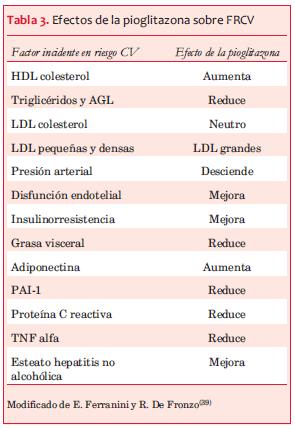
<body><![CDATA[<p class="MsoBodyText" style="text-align: left; text-indent: 0cm; line-height: normal;" align="left"><span style="font-size: 10pt; font-family: Verdana;">En nuestro pa&iacute;s solo se dispone de <span class="SpellE">pioglitazona</span>. <st1:personname productid="la FDA" w:st="on"><st1:metricconverter productid="4, a" w:st="on">La FDA</st1:metricconverter></st1:personname> restringi&oacute; el uso de <span class="SpellE">rosiglitazona</span> y fue retirada en Europa y otros pa&iacute;ses, entre ellos, Uruguay, en el a&ntilde;o 2011. Posteriormente <st1:personname productid="la FDA" w:st="on"><st1:metricconverter productid="4, a" w:st="on">la   FDA</st1:metricconverter></st1:personname> revis&oacute; el estudio <span class="GramE">RECORD<sup>(</sup></span><sup>90)</sup> rectificando su dictamen anterior, y concluyendo que <span class="SpellE">rosiglitazona</span> no determinaba mayor riesgo CV, por lo que levant&oacute; su restricci&oacute;n. A pesar de ello, no se reinici&oacute; su uso en Norteam&eacute;rica ni en Europa. La <span class="SpellE">pioglitazona</span> ejerce efectos beneficiosos sobre m&uacute;ltiples factores de riesgo cardiovascular (FRCV) (tabla 3).<o:p></o:p></span></p>             <p class="MsoBodyText" style="text-align: left; text-indent: 0cm; line-height: normal;" align="left"><span style="font-size: 10pt; font-family: Verdana;">Tanto la <span class="SpellE">rosiglitazona</span> como la <span class="SpellE">pioglitazona</span> aumentan la reabsorci&oacute;n renal de agua y sodio, por lo que pueden determinar insuficiencia <span class="SpellE">card&iacute;aca</span> (IC) &ndash;m&aacute;s frecuente con <span class="SpellE">rosi</span> que con <span class="SpellE">pioglitazona&ndash;</span>, especialmente en individuos con disfunci&oacute;n diast&oacute;lica <span class="GramE">mioc&aacute;rdica<sup>(</sup></span><sup>91)</sup>. Sin embargo, existen evidencias de que la <span class="SpellE">pioglitazona</span> mejora la disfunci&oacute;n diast&oacute;lica; aumenta la sensibilidad <span class="SpellE">insul&iacute;nica</span> mioc&aacute;rdica y ser&iacute;a neutral en la funci&oacute;n del ventr&iacute;culo <span class="GramE">izquierdo<sup>(</sup></span><sup>39,92)</sup>.</span></p>     <p class="MsoBodyText" style="text-align: left; text-indent: 0cm; line-height: normal;" align="left"><span style="font-size: 10pt; font-family: Verdana;"></span></p>      <p class="MsoBodyText" style="text-align: left; text-indent: 0cm; line-height: normal;" align="left"><a name="t3"></a><img style="width: 295px; height: 429px;" alt="" src="/img/revistas/ruc/v31n3/3a14t3.JPG"></p>      <p class="MsoBodyText" style="text-align: left; text-indent: 0cm; line-height: normal;" align="left"><span style="font-size: 10pt; font-family: Verdana;"><o:p></o:p></span></p>             <p class="MsoBodyText" style="text-align: left; text-indent: 0cm; line-height: normal;" align="left"><span style="font-size: 10pt; font-family: Verdana;">Del estudio PROACTIVE, que ya fue mencionado, se destaca que la <span class="SpellE">pioglitazona</span> se asoci&oacute; con un aumento de la incidencia de IC severa, sin aumento de la mortalidad CV por cualquier causa. En un <span class="SpellE">subestudio</span> del PROACTIVE se encontr&oacute; que la <span class="SpellE">pioglitazona</span> redujo la incidencia de IAM <span class="SpellE">subsecuente</span> en 16% y en 47% la recurrencia de <span class="GramE">ACV<sup>(</sup></span><sup>93,94)</sup>.<o:p></o:p></span></p>             <p class="MsoBodyText" style="text-align: left; text-indent: 0cm; line-height: normal;" align="left"><span style="font-size: 10pt; font-family: Verdana;">Existen evidencias de que <span class="SpellE">pioglitazona</span> reduce la aterosclerosis en <st1:personname productid="la ECV. El" w:st="on"><st1:metricconverter productid="4, a" w:st="on">la   ECV. El</st1:metricconverter></st1:personname> estudio PERISCOPE en DM2 se asoci&oacute; con reducci&oacute;n del volumen de la placa de ateroma, mientras que en el grupo tratado con <span class="SpellE">glimepiride</span> <span class="GramE">progres&oacute;<sup>(</sup></span><sup>90)</sup>. Otros trabajos han evidenciado un efecto beneficioso sobre el grosor de <st1:personname productid="la IMC" w:st="on"><st1:metricconverter productid="4, a" w:st="on">la   IMC</st1:metricconverter></st1:personname> asociado con aumento del <span class="GramE">HDL<sup>(</sup></span><sup>95,96) </sup>o con mejor&iacute;a de la sensibilidad a la insulina<sup>(97)</sup>.<o:p></o:p></span></p>             <p class="MsoBodyText" style="text-align: left; text-indent: 0cm; line-height: normal;" align="left"><span style="font-size: 10pt; font-family: Verdana;">Hay publicados dos estudios poblacionales en DM2 con grandes n&uacute;meros: el primero, llamado General <span class="SpellE">Practice</span> <span class="SpellE">Database</span> del Reino Unido, el cual tuvo un seguimiento de siete a&ntilde;os. La <span class="SpellE">pioglitazona</span> comparada con <span class="SpellE">metformina</span> se asoci&oacute; a una reducci&oacute;n del riesgo de mortalidad por cualquier causa del 39% al 31% (p=0,02; p&lt;0,001); mientras que con SUs se constat&oacute; un aumento de la <span class="GramE">mortalidad<sup>(</sup></span><sup>98)</sup>. El otro estudio, de <span class="SpellE">Morgan</span> y colaboradores, encontr&oacute; que el uso de <span class="SpellE">pioglitazona</span> asociada a <span class="SpellE">metformina</span> determin&oacute; un HR de 0,70 para mortalidad por cualquier causa y HR de 0,75 para la asociaci&oacute;n de <span class="SpellE"><i>end</i></span><i> <span class="SpellE">points</span></i> que comprendieron eventos cardiovasculares mayores (MACE<span class="GramE">)<sup>(</sup></span><sup>99)</sup>.<o:p></o:p></span></p>             <p class="MsoBodyText" style="text-align: left; text-indent: 0cm; line-height: normal;" align="left"><span style="font-size: 10pt; font-family: Verdana;"><o:p>&nbsp;</o:p></span></p>             <p class="PRIMERABA" style="margin-top: 0cm; text-align: left; line-height: normal; font-style: italic;" align="left"><span style="font-size: 10pt; font-family: Verdana;">La evidencia demuestra que la <span class="SpellE">piolitazona</span>:<o:p></o:p></span></p>             ]]></body>
<body><![CDATA[<p class="BALA" style="margin-left: 0cm; text-align: left; text-indent: 0cm; line-height: normal; font-style: italic;" align="left"><span style="font-family: Symbol; color: red;"><span style="">&middot;<span style="font-family: &quot;Times New Roman&quot;; font-style: normal; font-variant: normal; font-weight: normal; font-size: 7pt; line-height: normal; font-size-adjust: none; font-stretch: normal;">&nbsp;&nbsp;&nbsp;&nbsp;&nbsp;&nbsp;&nbsp;</span></span></span><span style="font-size: 10pt; font-family: Verdana;">Tiene efectos beneficiosos sobre algunos FRCV: reduce la grasa visceral; efecto beneficioso en las fracciones de l&iacute;pidos, mejor&iacute;a en la funci&oacute;n endotelial, descenso leve de la presi&oacute;n arterial.<o:p></o:p></span></p>             <p class="BALA" style="margin-left: 0cm; text-align: left; text-indent: 0cm; line-height: normal; font-style: italic;" align="left"><span style="font-family: Symbol; color: red;"><span style="">&middot;<span style="font-family: &quot;Times New Roman&quot;; font-style: normal; font-variant: normal; font-weight: normal; font-size: 7pt; line-height: normal; font-size-adjust: none; font-stretch: normal;">&nbsp;&nbsp;&nbsp;&nbsp;&nbsp;&nbsp;&nbsp;</span></span></span><span style="font-size: 10pt; font-family: Verdana;">Reduce marcadores inflamatorios asociados a ECV.<o:p></o:p></span></p>             <p class="BALA" style="margin-left: 0cm; text-align: left; text-indent: 0cm; line-height: normal; font-style: italic;" align="left"><span style="font-family: Symbol; color: red;"><span style="">&middot;<span style="font-family: &quot;Times New Roman&quot;; font-style: normal; font-variant: normal; font-weight: normal; font-size: 7pt; line-height: normal; font-size-adjust: none; font-stretch: normal;">&nbsp;&nbsp;&nbsp;&nbsp;&nbsp;&nbsp;&nbsp;</span></span></span><span style="font-size: 10pt; font-family: Verdana;">Puede disminuir la progresi&oacute;n de la <span class="SpellE">aterog&eacute;nesis</span>.<o:p></o:p></span></p>             <p class="BALA" style="margin-left: 0cm; text-align: left; text-indent: 0cm; line-height: normal; font-style: italic;" align="left"><span style="font-family: Symbol; color: red;"><span style="">&middot;<span style="font-family: &quot;Times New Roman&quot;; font-style: normal; font-variant: normal; font-weight: normal; font-size: 7pt; line-height: normal; font-size-adjust: none; font-stretch: normal;">&nbsp;&nbsp;&nbsp;&nbsp;&nbsp;&nbsp;&nbsp;</span></span></span><span style="font-size: 10pt; font-family: Verdana;">Puede disminuir la incidencia de ECV y mortalidad.<o:p></o:p></span></p>             <p class="BALA" style="margin-left: 0cm; text-align: left; text-indent: 0cm; line-height: normal;" align="left"><span style="font-family: Symbol; color: red; font-style: italic;"><span style="">&middot;<span style="font-family: &quot;Times New Roman&quot;; font-style: normal; font-variant: normal; font-weight: normal; font-size: 7pt; line-height: normal; font-size-adjust: none; font-stretch: normal;">&nbsp;&nbsp;&nbsp;&nbsp;&nbsp;&nbsp;&nbsp;</span></span></span><span style="font-size: 10pt; font-family: Verdana;"><span style="font-style: italic;">Aumenta el riesgo para el desarrollo de IC.</span><o:p></o:p></span></p>             <p class="MsoBodyText" style="text-align: left; text-indent: 0cm; line-height: normal;" align="left"><span style="font-size: 10pt; font-family: Verdana;"><o:p>&nbsp;</o:p></span></p>             <p class="SUB2" style="margin: 0cm 0cm 0.0001pt; line-height: normal; page-break-after: auto;"><span style="font-family: Verdana;">5. Inhibidores de la <span class="SpellE">dipeptidil</span> <span class="SpellE">peptidasa</span> 4 (-DPP4)<o:p></o:p></span></p>             <p class="PRIMER" style="text-align: left; line-height: normal;" align="left"><span style="font-size: 10pt; font-family: Verdana;">Los inhibidores de la enzima <span class="SpellE">dipeptidil</span> <span class="SpellE">peptidasa</span> tipo 4 bloquean la degradaci&oacute;n de <span class="SpellE">incretinas</span>: GLP1 y GIP, y, adem&aacute;s, una variedad de otros <span class="SpellE">p&eacute;ptidos</span> que incluyen el p&eacute;ptido <span class="SpellE">natriur&eacute;tico</span> <span class="GramE">cerebral<sup>(</sup></span><sup>100)</sup>. A trav&eacute;s del efecto <span class="SpellE">incretinas</span> determinan una estimulaci&oacute;n de la secreci&oacute;n de insulina por parte de las c&eacute;lulas <span class="GramE">beta pancre&aacute;ticas</span> y una disminuci&oacute;n de la secreci&oacute;n de <span class="SpellE">glucag&oacute;n</span> (<a href="/img/revistas/ruc/v31n3/3a14t4.JPG">tabla 4</a>).<o:p></o:p></span></p>             <p class="MsoBodyText" style="text-align: left; text-indent: 0cm; line-height: normal;" align="left"><span style="font-size: 10pt; font-family: Verdana;">Los -DPP4 tienen un efecto moderado en la reducci&oacute;n de <st1:personname productid="la HbA" w:st="on"><st1:metricconverter productid="4, a" w:st="on">la <span class="SpellE">HbA</span></st1:metricconverter></st1:personname><span class="SpellE">1c</span> y son neutros en relaci&oacute;n con el <span class="GramE">peso<sup>(</sup></span><sup>101,102)</sup>. No han demostrado efecto <span class="SpellE">hipotensor</span> <span class="GramE">significativo<sup>(</sup></span><sup>102,103)</sup>. Determinan un modesto descenso de 6 <span class="SpellE">mg</span>/<span class="SpellE">dl</span> del colesterol total seg&uacute;n un <span class="SpellE">metaan&aacute;lisis</span> de 17 estudios que involucr&oacute; varios -<span class="GramE">DPP4<sup>(</sup></span><sup>104)</sup>, pero no cambios en LDL, ni HDL, ni TG<sup>(105)</sup>. Sin embargo, descienden la lipemia <span class="SpellE">posprandial</span> (descenso de niveles de TG, <span class="SpellE">Apo</span> B48 y 100) luego de una comida <span class="GramE">mixta<sup>(</sup></span><sup>106,107)</sup>.<o:p></o:p></span></p>             <p class="MsoBodyText" style="text-align: left; text-indent: 0cm; line-height: normal;" align="left"><span style="font-size: 10pt; font-family: Verdana;">Se ha evidenciado que la <span class="SpellE">sitagliptina</span> desciende PCR y mejora la disfunci&oacute;n endotelial al igual que la <span class="SpellE"><span class="GramE">vildagliptina</span></span><span class="GramE"><sup>(</sup></span><sup>108-110)</sup>.<o:p></o:p></span></p>             ]]></body>
<body><![CDATA[<p class="MsoBodyText" style="text-align: left; text-indent: 0cm; line-height: normal;" align="left"><span style="font-size: 10pt; font-family: Verdana;">En estudios animales disminuyen el &aacute;rea de isquemia-<span class="SpellE">reperfusi&oacute;n</span> <span class="GramE">mioc&aacute;rdica<sup>(</sup></span><sup>111)</sup>. En estudios retrospectivos en humanos, que no fueron dise&ntilde;ados para analizar la incidencia de ECV, se encontr&oacute; una reducci&oacute;n significativa de eventos CV y de <span class="GramE">ECV<sup>(</sup></span><sup>112-119).</sup><o:p></o:p></span></p>             <p class="MsoBodyText" style="text-align: left; text-indent: 0cm; line-height: normal;" align="left"><span style="font-size: 10pt; font-family: Verdana;">Recientemente han sido publicados tres estudios prospectivos, <span class="SpellE">randomizados</span>, dise&ntilde;ados para evaluar el impacto de drogas de esta clase sobre ECV: 1. </span><span style="font-size: 10pt; font-family: Verdana;" lang="EN-US">Saxagliptin Assessment of Vascular Outcomes Recorded in patients with diabetes mellitus-Thrombolysys In Miocardial Infarction (SAVOR-TIMI 53<span class="GramE">)<sup>(</sup></span><sup>120)</sup>. 2. EXAMINation of cardiovascular outcomes with alogliptin versus standard of carE (EXAMINE)<sup>(121)</sup>. 3. El Trial Evaluating Cardiovascular Outcomes with Sitagliptin (TECOS)<sup>(122) </sup>(<a href="#t5">tablas 5</a> <a href="#t6">y 6</a>).</span></p>     <p class="MsoBodyText" style="text-align: left; text-indent: 0cm; line-height: normal;" align="left"><span style="font-size: 10pt; font-family: Verdana;" lang="EN-US"></span></p>      <p class="MsoBodyText" style="text-align: left; text-indent: 0cm; line-height: normal;" align="left"><a name="t5"></a><img style="width: 578px; height: 283px;" alt="" src="/img/revistas/ruc/v31n3/3a14t5.JPG"> &nbsp;<sup><span style="font-family: Verdana;">(123-124-125)</span></sup></p>      <p class="MsoBodyText" style="text-align: left; text-indent: 0cm; line-height: normal;" align="left"><span style="font-size: 10pt; font-family: Verdana;" lang="EN-US"><o:p></o:p></span></p>             <p class="MsoBodyText" style="text-align: left; text-indent: 0cm; line-height: normal;" align="left"><span style="font-size: 10pt; font-family: Verdana;"><a name="t6"></a><img style="width: 579px; height: 477px;" alt="" src="/img/revistas/ruc/v31n3/3a14t6.JPG">&nbsp;</span><sup><span style="font-family: Verdana;">(123-124-125)</span></sup><span style="font-size: 10pt; font-family: Verdana;"> </span></p>      <p class="MsoBodyText" style="text-align: left; text-indent: 0cm; line-height: normal;" align="left"><span style="font-size: 10pt; font-family: Verdana;"></span></p>      <p class="MsoBodyText" style="text-align: left; text-indent: 0cm; line-height: normal;" align="left"><span style="font-size: 10pt; font-family: Verdana;">El estudio SAVOR TIMI 53 tuvo como hallazgo inesperado una mayor incidencia de hospitalizaci&oacute;n por IC, hecho que no se asoci&oacute; con aumento de <span class="GramE">mortalidad<sup>(</sup></span><sup>121)</sup>. La causa de este hallazgo no est&aacute; clara. En el estudio EXAMINE tambi&eacute;n se observ&oacute;, aunque en menor incidencia, este <span class="GramE">hecho<sup>(</sup></span><sup>121,123)</sup>, mientras que en el estudio TECOS no se observaron diferencias entre los dos grupos (<span class="SpellE">sitagliptina</span> <span class="SpellE">vs</span> placebo)<sup>(122).</sup><o:p></o:p></span></p>             <p class="MsoBodyText" style="text-align: left; text-indent: 0cm; line-height: normal;" align="left"><span style="font-size: 10pt; font-family: Verdana;">A diferencia de los estudios retrospectivos, en estos no se evidenci&oacute; una disminuci&oacute;n de los ECV. Obs&eacute;rvese, sin embargo, que los tres estudios, a pesar de ser dise&ntilde;ados para evaluar incidencia de ECV, tuvieron un tiempo de seguimiento muy corto, por lo que posiblemente no hubo tiempo sufi&shy;ciente para el desarrollo de ECV.<o:p></o:p></span></p>             <p class="MsoBodyText" style="text-align: left; text-indent: 0cm; line-height: normal;" align="left"><span style="font-size: 10pt; font-family: Verdana;">Otro hecho destacable es que la diferencia entre las <span class="SpellE">incretinas</span> estudiadas <span class="SpellE">vs</span> placebo fue peque&ntilde;a (0,3%-0,4%), y que la mayor&iacute;a de los pacientes estaban bajo tratamiento con <span class="SpellE">estatinas</span>, <span class="SpellE">antiplaquetarios</span> y <span class="SpellE">antihipertensores</span>, lo que puede haber atenuado las diferencias, seg&uacute;n la opini&oacute;n de los <span class="SpellE">Profs</span>. <span class="SpellE">Ferranini</span> y De <span class="SpellE"><span class="GramE">Fronzo</span></span><span class="GramE"><sup>(</sup></span><sup>39)</sup>. Es posible concluir que los tres estudios muestran concluyentemente la no inferioridad frente a placebo de esta clase de medicamentos para determinar eventos cardiovas&shy;culares mayores (mortalidad CV; IAM y ACV no fatales).<o:p></o:p></span></p>             ]]></body>
<body><![CDATA[<p class="MsoBodyText" style="text-align: left; text-indent: 0cm; line-height: normal;" align="left"><span style="font-size: 10pt; font-family: Verdana;">Si bien no existe un aumento del riesgo CV, no se han comprobado resultados un&aacute;nimes sobre beneficios asociados a su uso.<o:p></o:p></span></p>             <p class="MsoBodyText" style="text-align: left; text-indent: 0cm; line-height: normal;" align="left"><span style="font-size: 10pt; font-family: Verdana;">Los estudios <span class="GramE">CAROLINA<sup>(</sup></span><sup>124)</sup>, CARMELINA<sup>(125)</sup> ser&aacute;n finalizados en 2018 y el estudio OMNEON en 2020<sup>(126)</sup>. Habr&aacute; que esperar si los resultados de <span class="SpellE">linagliptina</span> versus SUs en el primero, y con placebo en los siguientes, arrojan luz sobre los potenciales beneficios cardiovasculares de esta droga perteneciente al grupo de las <span class="SpellE">incretinas</span>.<o:p></o:p></span></p>             <p class="MsoBodyText" style="text-align: left; text-indent: 0cm; line-height: normal;" align="left"><span style="font-size: 10pt; font-family: Verdana;"><o:p>&nbsp;</o:p></span></p>             <p class="PRIMERABA" style="margin-top: 0cm; text-align: left; line-height: normal; font-style: italic;" align="left"><span style="font-size: 10pt; font-family: Verdana;">De acuerdo con las evidencias actuales los -DPP4:<o:p></o:p></span></p>             <p class="BALA" style="margin-left: 0cm; text-align: left; text-indent: 0cm; line-height: normal; font-style: italic;" align="left"><span style="font-family: Symbol; color: red;"><span style="">&middot;<span style="font-family: &quot;Times New Roman&quot;; font-style: normal; font-variant: normal; font-weight: normal; font-size: 7pt; line-height: normal; font-size-adjust: none; font-stretch: normal;">&nbsp;&nbsp;&nbsp;&nbsp;&nbsp;&nbsp;&nbsp;</span></span></span><span style="font-size: 10pt; font-family: Verdana;">No aumentan el riesgo de hipoglucemia.<o:p></o:p></span></p>             <p class="BALA" style="margin-left: 0cm; text-align: left; text-indent: 0cm; line-height: normal; font-style: italic;" align="left"><span style="font-family: Symbol; color: red;"><span style="">&middot;<span style="font-family: &quot;Times New Roman&quot;; font-style: normal; font-variant: normal; font-weight: normal; font-size: 7pt; line-height: normal; font-size-adjust: none; font-stretch: normal;">&nbsp;&nbsp;&nbsp;&nbsp;&nbsp;&nbsp;&nbsp;</span></span></span><span style="font-size: 10pt; font-family: Verdana;">Tienen efecto neutro en el peso del paciente.<o:p></o:p></span></p>             <p class="BALA" style="margin-left: 0cm; text-align: left; text-indent: 0cm; line-height: normal; font-style: italic;" align="left"><span style="font-family: Symbol; color: red;"><span style="">&middot;<span style="font-family: &quot;Times New Roman&quot;; font-style: normal; font-variant: normal; font-weight: normal; font-size: 7pt; line-height: normal; font-size-adjust: none; font-stretch: normal;">&nbsp;&nbsp;&nbsp;&nbsp;&nbsp;&nbsp;&nbsp;</span></span></span><span style="font-size: 10pt; font-family: Verdana;">Poseen leve efecto beneficioso sobre FRCV: lipemia <span class="SpellE">posprandial</span>.<o:p></o:p></span></p>             <p class="BALA" style="margin-left: 0cm; text-align: left; text-indent: 0cm; line-height: normal; font-style: italic;" align="left"><span style="font-family: Symbol; color: red;"><span style="">&middot;<span style="font-family: &quot;Times New Roman&quot;; font-style: normal; font-variant: normal; font-weight: normal; font-size: 7pt; line-height: normal; font-size-adjust: none; font-stretch: normal;">&nbsp;&nbsp;&nbsp;&nbsp;&nbsp;&nbsp;&nbsp;</span></span></span><span style="font-size: 10pt; font-family: Verdana;">Mejoran disfunci&oacute;n endotelial.<o:p></o:p></span></p>             <p class="BALA" style="margin-left: 0cm; text-align: left; text-indent: 0cm; line-height: normal;" align="left"><span style="font-family: Symbol; color: red; font-style: italic;"><span style="">&middot;<span style="font-family: &quot;Times New Roman&quot;; font-style: normal; font-variant: normal; font-weight: normal; font-size: 7pt; line-height: normal; font-size-adjust: none; font-stretch: normal;">&nbsp;&nbsp;&nbsp;&nbsp;&nbsp;&nbsp;&nbsp;</span></span></span><span style="font-size: 10pt; font-family: Verdana;"><span style="font-style: italic;">No son inferiores que placebo en relaci&oacute;n a eventos CV y ECV en general.</span><o:p></o:p></span></p>             <p class="MsoBodyText" style="text-align: left; text-indent: 0cm; line-height: normal;" align="left"><span style="font-size: 10pt; font-family: Verdana;"><o:p>&nbsp;</o:p></span></p>             ]]></body>
<body><![CDATA[<p class="SUB2" style="margin: 0cm 0cm 0.0001pt; line-height: normal; page-break-after: auto;"><span style="font-family: Verdana;">6. Inhibidores del <span class="SpellE">cotransportador</span> renal de <span class="SpellE">Na</span>/glucosa tipo 2 (-SGLT2)<o:p></o:p></span></p>             <p class="PRIMER" style="text-align: left; line-height: normal;" align="left"><span style="font-size: 10pt; font-family: Verdana;">Representan la clase m&aacute;s nueva de agentes orales aprobados para el tratamiento de <st1:personname productid="La DM" w:st="on"><st1:metricconverter productid="4, a" w:st="on">la DM</st1:metricconverter></st1:personname>2 en Estados Unidos y en Europa. Son medicamentos considerados de segunda o tercera l&iacute;nea seg&uacute;n las gu&iacute;as de pr&aacute;ctica cl&iacute;nica de la mayor&iacute;a de las instituciones internacionales. <st1:personname productid="la FDA" w:st="on"><st1:metricconverter productid="4, a" w:st="on">La FDA</st1:metricconverter></st1:personname> ha aprobado el uso de tres de ellas: <span class="SpellE">canaglifozina</span>, <span class="SpellE">dapaglifozina</span> y <span class="SpellE">empaglifozina</span>. A&uacute;n no est&aacute;n disponibles en Uruguay. En los pa&iacute;ses en que han ingresado se dispone de presentaciones de la droga aislada y asociada a <span class="SpellE">metformina</span>. Act&uacute;an por inhibici&oacute;n del transportador SGLT2 y reducci&oacute;n del umbral de eliminaci&oacute;n urinaria de glucosa, determinando glucosuria en un rango de <st1:metricconverter productid="4, a" w:st="on">60 a</st1:metricconverter> 100 g/<span class="GramE">d&iacute;a<sup>(</sup></span><sup>127-130)</sup> (<a href="#f2">figura 2</a>).</span></p>     <p class="PRIMER" style="text-align: left; line-height: normal;" align="left"><span style="font-size: 10pt; font-family: Verdana;"></span></p>      <p class="PRIMER" style="text-align: left; line-height: normal;" align="left"><a name="f2"></a><img style="width: 494px; height: 402px;" alt="" src="/img/revistas/ruc/v31n3/3a14f2.JPG"> <sup><span style="font-family: Verdana;">(131)</span></sup></p>      <p class="PRIMER" style="text-align: left; line-height: normal;" align="left"><span style="font-size: 10pt; font-family: Verdana;"><o:p></o:p></span></p>             <p class="MsoBodyText" style="text-align: left; text-indent: 0cm; line-height: normal;" align="left"><span style="font-size: 10pt; font-family: Verdana;">La disminuci&oacute;n de la glucosa circulante disminuye la <span class="SpellE">gluco</span> toxicidad, resultando en mejor&iacute;a de la funci&oacute;n de la c&eacute;lula beta pancre&aacute;tica y disminuci&oacute;n de la <span class="SpellE"><span class="GramE">insulinorresistencia</span></span><span class="GramE"><sup>(</sup></span><sup>131-134)</sup>. Logran una disminuci&oacute;n de <span class="SpellE">HbA1c</span> similar a <span class="SpellE">metformina</span>, que es del rango de 0,8% a 1,0%, si partimos de un valor de 8% durante dos a&ntilde;os de <span class="GramE">tratamiento<sup>(</sup></span><sup>135-138)</sup>. Pueden ser asociados a cualquiera de las drogas orales e insulinas debido a su diferente mecanismo de acci&oacute;n. Los -SGLT2 se asocian a un bajo riesgo de hipoglucemias, similar a <span class="SpellE">metformina</span>, y al igual que con esta, aumenta el riesgo con el uso simult&aacute;neo de <span class="SpellE">secre&shy;tagogo</span>s de <span class="SpellE">insulino</span> secretores o insulina.<o:p></o:p></span></p>             <p class="MsoBodyText" style="text-align: left; text-indent: 0cm; line-height: normal;" align="left"><span style="font-size: 10pt; font-family: Verdana;">Adem&aacute;s de disminuir la <span class="SpellE">insulinorresistencia</span> determinan otros efectos favorables sobre FRCV. Al inhibir la reabsorci&oacute;n de sodio del <span class="SpellE">t&uacute;bulo</span> contorneado proximal (TCP), determinan una leve depleci&oacute;n del volumen <span class="SpellE">intravascular</span>, y por ello, una disminuci&oacute;n de la presi&oacute;n arterial de aproximadamente 4-6/1-2 <span class="SpellE"><span class="GramE">mmHg</span></span><span class="GramE"><sup>(</sup></span><sup>128,129)</sup>. Disminuyen el peso en los seis a doce meses posteriores a su inicio, en el orden de <st1:metricconverter productid="4, a" w:st="on">2,5 a</st1:metricconverter> <st1:metricconverter productid="4, a" w:st="on">3,0 <span class="SpellE">kg</span></st1:metricconverter>, que persiste por m&aacute;s de dos <span class="GramE">a&ntilde;os<sup>(</sup></span><sup>133-138)</sup>. Con <span class="SpellE">dapaglifozina</span>, <span class="SpellE">canaglifozina</span> y <span class="SpellE">empaglifozina</span> se ha visto un leve aumento de LDL y HDL colesterol y una leve disminuci&oacute;n de <span class="SpellE">TGs</span> de significado cl&iacute;nico a&uacute;n no claro. Se asocian todos los de esta clase con un decremento de 0,8% a 1,0% de &aacute;cido &uacute;rico por ser este <span class="SpellE">cotransportado</span> con el sodio en el <span class="GramE">TCP<sup>(</sup></span><sup>139)</sup>.<o:p></o:p></span></p>             <p class="MsoBodyText" style="text-align: left; text-indent: 0cm; line-height: normal;" align="left"><span style="font-size: 10pt; font-family: Verdana;">En el <span class="SpellE">metaan&aacute;lisis</span> de <span class="SpellE">Ptaszynska</span> y colaboradores de estudios cl&iacute;nicos en fase III/IV con <span class="SpellE">dapaglifozina</span>, que incluy&oacute; a m&aacute;s de 5.000 pacientes, y de ellos, m&aacute;s de 3.000 tratados con la droga, el HR de puntos finales compuestos de MACE m&aacute;s hospitalizaci&oacute;n por angina inestable fue de 0,82 favorable a <span class="SpellE"><span class="GramE">dapaglifozina</span></span><span class="GramE"><sup>(</sup></span><sup>140)</sup>.<o:p></o:p></span></p>             <p class="MsoBodyText" style="text-align: left; text-indent: 0cm; line-height: normal;" align="left"><span style="font-size: 10pt; font-family: Verdana;">Recientemente se public&oacute; el estudio EMPA- REG-<span class="GramE">OUTCOME<sup>(</sup></span><sup>141)</sup>, el cual encontr&oacute; resultados cardiovasculares muy beneficiosos, siendo hasta el momento el m&aacute;s destacado en este tema. Fue un estudio doble ciego, controlado y <span class="SpellE">randomizado</span> que analiz&oacute; los efectos de la droga sobre la <span class="SpellE">morbimortalidad</span> en DM2 con alto riesgo de ECV que recib&iacute;an tratamiento est&aacute;ndar. El grupo tratado con <span class="SpellE">empaglifozina</span> redujo el riesgo de muerte de causa CV (HR=0,62 [0,49-0,77] p: &lt; 0,001); de muerte por cualquier causa (HR=0,68 [0,57-0,82] p: &lt; 0,001) y de hospitalizaciones por IC (HR=0,65 [0,50-0,85] p: &lt; 0,002). Para prevenir un evento CV, el NNT fue de 46 pacientes por tres a&ntilde;os. El riesgo de ACV no tuvo diferencias significativas, pero tendi&oacute; a dirigirse en la direcci&oacute;n opuesta. Un hallazgo adicional del estudio fue la importante reducci&oacute;n de la progresi&oacute;n de enfermedad renal. Los efectos CV beneficiosos de esta clase de drogas se deber&iacute;an a sus efectos <span class="SpellE">pleiotr&oacute;picos</span>, como la inducci&oacute;n de diuresis y el descenso de la presi&oacute;n arterial, entre otros <span class="GramE">meca&shy;nismos<sup>(</sup></span><sup>144)</sup>.<o:p></o:p></span></p>             <p class="MsoBodyText" style="text-align: left; text-indent: 0cm; line-height: normal;" align="left"><span style="font-size: 10pt; font-family: Verdana;">El efecto adverso m&aacute;s frecuente con el uso de las <span class="SpellE">glifozinas</span> es el de las infecciones <span class="SpellE">mic&oacute;ticas</span> genitales y urinarias, generalmente de intensidad leve a moderada que revierten con los tratamientos <span class="GramE">habituales<sup>(</sup></span><sup>139,143,144)</sup>.<o:p></o:p></span></p>             ]]></body>
<body><![CDATA[<p class="MsoBodyText" style="text-align: left; text-indent: 0cm; line-height: normal;" align="left"><span style="font-size: 10pt; font-family: Verdana;">En algunos estudios se encontr&oacute; compromiso &oacute;seo asociado al uso de estas <span class="GramE">drogas<sup>(</sup></span><sup>146-149)</sup>, lo que determin&oacute; la publicaci&oacute;n de un alerta por parte de <st1:personname productid="la FDA" w:st="on"><st1:metricconverter productid="4, a" w:st="on">la   FDA</st1:metricconverter></st1:personname> y la recomendaci&oacute;n de evaluar esta posible asociaci&oacute;n en los estudios en curso<sup>(148)</sup>. Sin embargo, en el estudio de EMPA-REG <span class="SpellE">Outcome</span> la incidencia de fracturas en el grupo tratado con <span class="SpellE">empa&shy;glifozin</span>a fue igual a placebo.<o:p></o:p></span></p>             <p class="MsoBodyText" style="text-align: left; text-indent: 0cm; line-height: normal;" align="left"><span style="font-size: 10pt; font-family: Verdana;">Tambi&eacute;n ha sido motivo de alerta por <st1:personname productid="la FDA" w:st="on"><st1:metricconverter productid="4, a" w:st="on">la   FDA</st1:metricconverter></st1:personname> la posible asociaci&oacute;n de <span class="SpellE">cetoacidosis</span> diab&eacute;tica (CAD) de presentaci&oacute;n at&iacute;pica con glucemias m&aacute;s bajas que lo <span class="GramE">habitual<sup>(</sup></span><sup>149-152)</sup>. Posteriormente, un comit&eacute; de expertos de <st1:personname productid="la AACE" w:st="on"><st1:metricconverter productid="4, a" w:st="on">la AACE</st1:metricconverter></st1:personname>/ACE realiz&oacute; una revisi&oacute;n sobre esta asociaci&oacute;n recomendando que dado que la ocurrencia de CAD es poco frecuente y que la relaci&oacute;n riesgo/beneficio favorece su uso, es posible continuar con los estudios en curso y no realizar cambios en las indicaciones <span class="GramE">actuales<sup>(</sup></span><sup>153)</sup>.<o:p></o:p></span></p>             <p class="MsoBodyText" style="text-align: left; text-indent: 0cm; line-height: normal;" align="left"><span style="font-size: 10pt; font-family: Verdana;">En la <a href="#t7">tabla 7</a> se muestran algunas caracter&iacute;sticas espec&iacute;ficas de las tres <span class="SpellE">glifozinas</span>: cana, <span class="SpellE">dapa</span> y <span class="SpellE">empaglifozina</span>.<o:p></o:p></span></p>             <p class="MsoBodyText" style="text-align: left; text-indent: 0cm; line-height: normal;" align="left"><span style="font-size: 10pt; font-family: Verdana;">Los estudios a&uacute;n no finalizados que aportar&aacute;n m&aacute;s datos sobre esta clase de drogas son: DECLARE TIMI58, CANVAS y <span class="GramE">CREDENCE<sup>(</sup></span><sup>154-156)</sup></span><span lang="ES-MX">.</span></p>             <p class="MsoBodyText" style="text-align: left; text-indent: 0cm; line-height: normal;" align="left"><span lang="ES-MX"><o:p></o:p></span></p>      <p class="MsoBodyText" style="text-align: left; text-indent: 0cm; line-height: normal;" align="left"><span lang="ES-MX"><o:p><a name="t7"></a><img style="width: 548px; height: 285px;" alt="" src="/img/revistas/ruc/v31n3/3a14t7.JPG"></o:p></span></p>      <p class="MsoBodyText" style="text-align: left; text-indent: 0cm; line-height: normal;" align="left"><span lang="ES-MX"><o:p>&nbsp;</o:p></span></p>             <p class="PRIMERABA" style="margin-top: 0cm; text-align: left; line-height: normal; font-style: italic;" align="left"><span style="font-size: 10pt; font-family: Verdana;">En relaci&oacute;n al impacto de los FRCV y ECV de estas nuevas drogas, podemos concluir que:<o:p></o:p></span></p>             <p class="BALA" style="margin-left: 0cm; text-align: left; text-indent: 0cm; line-height: normal; font-style: italic;" align="left"><span style="font-family: Symbol; color: red;"><span style="">&middot;<span style="font-family: &quot;Times New Roman&quot;; font-style: normal; font-variant: normal; font-weight: normal; font-size: 7pt; line-height: normal; font-size-adjust: none; font-stretch: normal;">&nbsp;&nbsp;&nbsp;&nbsp;&nbsp;&nbsp;&nbsp;</span></span></span><span style="font-size: 10pt; font-family: Verdana;">Poseen bajo riesgo de producir hipoglucemias.<o:p></o:p></span></p>             <p class="BALA" style="margin-left: 0cm; text-align: left; text-indent: 0cm; line-height: normal; font-style: italic;" align="left"><span style="font-family: Symbol; color: red;"><span style="">&middot;<span style="font-family: &quot;Times New Roman&quot;; font-style: normal; font-variant: normal; font-weight: normal; font-size: 7pt; line-height: normal; font-size-adjust: none; font-stretch: normal;">&nbsp;&nbsp;&nbsp;&nbsp;&nbsp;&nbsp;&nbsp;</span></span></span><span style="font-size: 10pt; font-family: Verdana;">Determinan leve disminuci&oacute;n de peso.<o:p></o:p></span></p>             ]]></body>
<body><![CDATA[<p class="BALA" style="margin-left: 0cm; text-align: left; text-indent: 0cm; line-height: normal; font-style: italic;" align="left"><span style="font-family: Symbol; color: red;"><span style="">&middot;<span style="font-family: &quot;Times New Roman&quot;; font-style: normal; font-variant: normal; font-weight: normal; font-size: 7pt; line-height: normal; font-size-adjust: none; font-stretch: normal;">&nbsp;&nbsp;&nbsp;&nbsp;&nbsp;&nbsp;&nbsp;</span></span></span><span style="font-size: 10pt; font-family: Verdana;">Brindan beneficios leves a moderados sobre FRCV.<o:p></o:p></span></p>             <p class="BALA" style="margin-left: 0cm; text-align: left; text-indent: 0cm; line-height: normal;" align="left"><span style="font-family: Symbol; color: red; font-style: italic;"><span style="">&middot;<span style="font-family: &quot;Times New Roman&quot;; font-style: normal; font-variant: normal; font-weight: normal; font-size: 7pt; line-height: normal; font-size-adjust: none; font-stretch: normal;">&nbsp;&nbsp;&nbsp;&nbsp;&nbsp;&nbsp;&nbsp;</span></span></span><span style="font-size: 10pt; font-family: Verdana;"><span style="font-style: italic;">Determinan disminuci&oacute;n de eventos y ECV (en mayor porcentaje de lo hallado con otras drogas).</span><o:p></o:p></span></p>             <p class="MsoBodyText" style="text-align: left; text-indent: 0cm; line-height: normal;" align="left"><span style="font-size: 10pt; font-family: Verdana;"><o:p>&nbsp;</o:p></span></p>             <p class="SUB2" style="margin: 0cm 0cm 0.0001pt; line-height: normal; page-break-after: auto;"><span style="font-family: Verdana;">7. Inhibidores de las alfa <span class="SpellE">glucosidasas</span><o:p></o:p></span></p>             <p class="PRIMER" style="text-align: left; line-height: normal;" align="left"><span style="font-size: 10pt; font-family: Verdana;">Esta clase de f&aacute;rmacos tiene tres representantes: <span class="SpellE">acarbosa</span>, <span class="SpellE">miglitol</span> y <span class="SpellE">vogliboza</span>, de los cuales solo la primera estuvo disponible en Uruguay, siendo discontinuada hace unos a&ntilde;os atr&aacute;s. En Europa y en Asia son drogas m&aacute;s usadas que en otros continentes. Act&uacute;an disminuyendo la absorci&oacute;n intestinal de hidratos de carbono simples, determinando un retraso en la absorci&oacute;n de los mismos, con la consecuente disminuci&oacute;n de la <span class="SpellE">hiperglucemia</span> <span class="SpellE">posprandial</span>. Aumentan los niveles de GLP1 plasm&aacute;ticos y alteran la <span class="SpellE">microbiota</span> del tubo <span class="GramE">digestivo<sup>(</sup></span><sup>157-159)</sup>.<o:p></o:p></span></p>             <p class="MsoBodyText" style="text-align: left; text-indent: 0cm; line-height: normal;" align="left"><span style="font-size: 10pt; font-family: Verdana;">No existen estudios a largo plazo que eval&uacute;en sus efectos CV. El estudio STOP-NIDDM analiz&oacute; a pacientes con intolerancia a la glucosa (ITG) y luego de un seguimiento de 3,3 a&ntilde;os se redujo en 25% el riesgo de desarrollar DM e hipertensi&oacute;n arterial. En los tratados con la droga se evidenci&oacute; una reducci&oacute;n del riesgo de eventos <span class="SpellE">macrovasculares</span> de 49% comparado con <span class="GramE">placebo<sup>(</sup></span><sup>160)</sup>. Sin embargo, el n&uacute;mero de eventos fue bajo, y, por lo tanto, el estudio careci&oacute; de poder suficiente para aseverar su capacidad <span class="SpellE">cardioprotectora</span>. Actualmente se est&aacute; llevando a cabo un estudio para evaluar prevenci&oacute;n secundaria cuando se agrega esta droga en pacientes con antecedentes de enfermedad coronaria e <span class="GramE">ITG<sup>(</sup></span><sup>161)</sup>.<o:p></o:p></span></p>             <p class="MsoBodyText" style="text-align: left; text-indent: 0cm; line-height: normal;" align="left"><i><span style="font-size: 10pt; font-family: Verdana;">Dada la carencia de estudios a largo plazo de este tipo de medicamentos sobre eventos CV, no podemos arribar a conclusiones sobre el t&oacute;pico que nos ocupa. Por otra parte y como ya fuera mencionado, actualmente no se disponen en nuestro medio.</span></i><span style="font-size: 10pt; font-family: Verdana;"><o:p></o:p></span></p>             <p class="SUB2" style="margin: 0cm 0cm 0.0001pt; line-height: normal; page-break-after: auto;"><span style="font-family: Verdana;"></span></p>          <p class="SUB2" style="margin: 0cm 0cm 0.0001pt; line-height: normal; page-break-after: auto;"><span style="font-family: Verdana;">8. <span class="SpellE">Agonistas</span> del receptor de GLP1<o:p></o:p></span></p>             <p class="PRIMER" style="text-align: left; line-height: normal;" align="left"><span style="font-size: 10pt; font-family: Verdana;">Los an&aacute;logos del receptor del p&eacute;ptido similar a <span class="SpellE">glucag&oacute;n</span> tipo 1 (<span class="SpellE">aGLP1</span>) act&uacute;an de manera similar a GLP1, por lo que integran el grupo de drogas con efecto de <span class="SpellE">incretinas</span>. En la <a href="#t8">tabla 8</a> se pueden observar las drogas que corresponden a este grupo y su clasificaci&oacute;n de acuerdo con la duraci&oacute;n de acci&oacute;n. No est&aacute;n disponibles a&uacute;n en Uruguay.</span></p>     ]]></body>
<body><![CDATA[<p class="PRIMER" style="text-align: left; line-height: normal;" align="left"><span style="font-size: 10pt; font-family: Verdana;"></span></p>      <p class="PRIMER" style="text-align: left; line-height: normal;" align="left"><a name="t8"></a><img style="width: 290px; height: 217px;" alt="" src="/img/revistas/ruc/v31n3/3a14t8.JPG"></p>      <p class="PRIMER" style="text-align: left; line-height: normal;" align="left"><span style="font-size: 10pt; font-family: Verdana;"><o:p></o:p></span></p>             <p class="MsoBodyText" style="text-align: left; text-indent: 0cm; line-height: normal;" align="left"><span style="font-size: 10pt; font-family: Verdana;">Los <span class="SpellE">aGLP1</span> mejoran la homeostasis de la glucosa a trav&eacute;s de m&uacute;ltiples efectos: estimulaci&oacute;n de la secreci&oacute;n de insulina; inhibici&oacute;n de la secreci&oacute;n de <span class="SpellE">glucag&oacute;n</span>; supresi&oacute;n end&oacute;gena de la producci&oacute;n de glucosa por mecanismos directos e indirectos; supresi&oacute;n del apetito; aumento de la sensibilidad de la insulina mediada por la p&eacute;rdida del peso corporal y retraso en el vaciamiento g&aacute;strico resultantes en una disminuci&oacute;n de la <span class="SpellE">hiperglucemia</span> <span class="SpellE"><span class="GramE">posprandial</span></span><span class="GramE"><sup>(</sup></span><sup>160,162)</sup>. El efecto de reducci&oacute;n de <st1:personname productid="la HbA" w:st="on"><st1:metricconverter productid="4, a" w:st="on">la   <span class="SpellE">HbA</span></st1:metricconverter></st1:personname><span class="SpellE">1c</span> excede los tres a&ntilde;os de duraci&oacute;n mantenida debido a su efecto sobre la c&eacute;lula beta pancre&aacute;tica de preservar la secreci&oacute;n de <span class="GramE">insulina<sup>(</sup></span><sup>163)</sup>. Se han encontrado receptores de GLP1 en los <span class="SpellE">cardiomiocitos</span>, ri&ntilde;ones, endotelio vascular y c&eacute;lulas del m&uacute;sculo liso arterial, sugiriendo este hecho que la intervenci&oacute;n sobre ellos puede reducir el riesgo <span class="GramE">CV<sup>(</sup></span><sup>164)</sup>. Esta clase de medicamentos determinan efectos beneficiosos sobre varios FRCV tales como: descenso de peso y disminuci&oacute;n de grasa visceral y <span class="GramE">subcut&aacute;nea<sup>(</sup></span><sup>164-167)</sup>.<o:p></o:p></span></p>             <p class="MsoBodyText" style="text-align: left; text-indent: 0cm; line-height: normal;" align="left"><span style="font-size: 10pt; font-family: Verdana;">En estudios animales se han encontrado beneficios en la contractilidad mioc&aacute;rdica y del gasto card&iacute;aco con reducci&oacute;n de la isquemia mioc&aacute;rdica pos-IAM y mejor&iacute;a de los procesos moleculares involucrados en la <span class="SpellE">apoptosis</span> celular del miocardio <span class="SpellE"><span class="GramE">isqu&eacute;mico</span></span><span class="GramE"><sup>(</sup></span><sup>168-172)</sup>.<o:p></o:p></span></p>             <p class="MsoBodyText" style="text-align: left; text-indent: 0cm; line-height: normal;" align="left"><span style="font-size: 10pt; font-family: Verdana;">En humanos con falla <span class="SpellE">card&iacute;aca</span>, con y sin DM, se han realizado estudios peque&ntilde;os y un gran estudio doble ciego controlado y <span class="SpellE">randomizado</span> en pacientes con IAM en que se les administr&oacute; <span class="SpellE">exenatide</span> previo al inicio de la <span class="SpellE">angioplastia</span>, obteniendo resultados <span class="GramE">favorables<sup>(</sup></span><sup>165,166,173,178)</sup>. Recientemente, <span class="SpellE">liraglutide</span> ha sido aceptado por FDA para el tratamiento de la obesidad en diab&eacute;ticos y no <span class="GramE">diab&eacute;ticos<sup>(</sup></span><sup>179)</sup>. Se ha demostrado un efecto beneficioso sobre la presi&oacute;n <span class="GramE">arterial<sup>(</sup></span><sup>180-182)</sup> y reducci&oacute;n de la lipemia <span class="SpellE">posprandial</span> y en ayunas<sup>(183-184)</sup>. Tambi&eacute;n se ha encontrado que tienen capacidad de reducir marcadores inflamatorios asociados a la enfermedad <span class="SpellE">ateroscler&oacute;tica</span> cardiovascular, fundamentalmente el descenso de la prote&iacute;na C reactiva (PCR), <span class="SpellE">TNFa</span>, PAI-1 y estimu&shy;lan la s&iacute;ntesis de <span class="SpellE"><span class="GramE">adiponectina</span></span><span class="GramE"><sup>(</sup></span><sup>185-190)</sup>.<o:p></o:p></span></p>             <p class="MsoBodyText" style="text-align: left; text-indent: 0cm; line-height: normal;" align="left"><span style="font-size: 10pt; font-family: Verdana;">Un estudio retrospectivo, que merece ser destacado, analiz&oacute; la relaci&oacute;n de <span class="SpellE">exenatide</span> con ECV, obteniendo informaci&oacute;n de <span class="SpellE">LifeLink</span> base de datos, de reclamaciones de seguros m&eacute;dicos y farmac&eacute;uticos, entre 2005 y 2009, de pacientes sin historia de IAM en los nueve meses anteriores. Se encontraron en el per&iacute;odo mencionado 39.275 pacientes con DM2 tratados con <span class="SpellE">exenatide</span> y se compararon con 38.121 diab&eacute;ticos tratados con drogas antidiab&eacute;ticas de otra clase. El grupo tratado con <span class="SpellE">exenatide</span> present&oacute; menos eventos CV (HR = 0,81), menor cantidad de hospitalizaciones de causa CV (HR = 0,88) y por cual&shy;quier otra causa (HR = 0,88<span class="GramE">)<sup>(</sup></span><sup>191)</sup>.<o:p></o:p></span></p>             <p class="MsoBodyText" style="text-align: left; text-indent: 0cm; line-height: normal;" align="left"><span style="font-size: 10pt; font-family: Verdana;">De los estudios prospectivos grandes y dise&ntilde;ados a largo plazo con el fin de evaluar el impacto cardiovascular de estas drogas, se conocen al d&iacute;a de hoy los resultados del estudio ELIXA (<span class="SpellE">lixisenatide</span> <span class="SpellE">vs</span> placebo) y el estudio LEADER (<span class="SpellE">liraglutide</span> <span class="SpellE">vs</span> placebo). El primero mostr&oacute; resultados CV neutros versus placebo y no fue inferior en determinar o empeorar falla <span class="SpellE"><span class="GramE">card&iacute;aca</span></span><span class="GramE"><sup>(</sup></span><sup>192)</sup>. El estudio LEADER, recientemente publicado, con un seguimiento a 3,8 a&ntilde;os, encontr&oacute; en el grupo tratado con <span class="SpellE">liraglutide</span> menor mortalidad CV (HR = 0, 78, IC: 0,66-0,93, p=0,007), y menor mortalidad por cualquier causa (HR = 0,85, IC: 0,74-0,97, p=0,02); mientras que la incidencia de IAM, ACV no fatal y hospitalizaci&oacute;n por IC no alcanz&oacute; valores menores estad&iacute;sticamente <span class="GramE">significativos<sup>(</sup></span><sup>193)</sup>. En ambos estudios los efectos adversos m&aacute;s frecuentes fueron digestivos, pero en ninguno de los dos se observ&oacute; mayor incidencia de pancreatitis con el uso de estos <span class="SpellE">aGLP1</span>.<o:p></o:p></span></p>             <p class="MsoBodyText" style="text-align: left; text-indent: 0cm; line-height: normal;" align="left"><span style="font-size: 10pt; font-family: Verdana;">Ha sido publicado recientemente el <span class="SpellE">metaan&aacute;lisis</span> y revisi&oacute;n sistematizada de <span class="SpellE">Kim</span> JY y colaboradores, cuyo objetivo fue evaluar el impacto de -DPP4 y <span class="SpellE">aGLP1</span> (tratamientos basados en <span class="SpellE">incretinas</span>) sobre ECV en DM2 con bajo riesgo CV. Incluy&oacute; 75 estudios con m&aacute;s de 45.000 pacientes. Encontraron una disminuci&oacute;n de ECV no estad&iacute;sticamente significativa comparado con controles (OR=0,90, IC: 0,80-1,00), concluyendo que el tratamiento basado en <span class="SpellE">incretinas</span> no demostr&oacute; un efecto protector claro sobre prevenci&oacute;n primaria en ECV de DM2 con bajo riesgo <span class="GramE">CV<sup>(</sup></span><sup>192)</sup>.<o:p></o:p></span></p>             <p class="MsoBodyText" style="text-align: left; text-indent: 0cm; line-height: normal;" align="left"><span style="font-size: 10pt; font-family: Verdana;">Si bien los resultados de esta clase de drogas son muy alentadores, se esperan los resultados de varios estudios dise&ntilde;ados para la evaluaci&oacute;n de este t&oacute;pico: SUSTAIN 6, EXSCEL, REWIND, FREEDOM CVO y HARMONY, los cuales ser&aacute;n publicados en los pr&oacute;ximos a&ntilde;os (<a href="#f1">figura 1</a> y <a href="#t2">tabla 2</a>), y que aportar&aacute;n datos seguramente m&aacute;s concluyentes.<o:p></o:p></span></p>             ]]></body>
<body><![CDATA[<p class="PRIMERABA" style="margin-top: 0cm; text-align: left; line-height: normal;" align="left"><span style="font-size: 10pt; font-family: Verdana;"><o:p>&nbsp;</o:p></span></p>             <p class="PRIMERABA" style="margin-top: 0cm; text-align: left; line-height: normal; font-style: italic;" align="left"><span style="font-size: 10pt; font-family: Verdana;">En el grupo de <span class="SpellE">aGLP1</span> se puede concluir desde el punto de vista del impacto CV que:<o:p></o:p></span></p>             <p class="BALA" style="margin-left: 0cm; text-align: left; text-indent: 0cm; line-height: normal; font-style: italic;" align="left"><span style="font-family: Symbol; color: red;"><span style="">&middot;<span style="font-family: &quot;Times New Roman&quot;; font-style: normal; font-variant: normal; font-weight: normal; font-size: 7pt; line-height: normal; font-size-adjust: none; font-stretch: normal;">&nbsp;&nbsp;&nbsp;&nbsp;&nbsp;&nbsp;&nbsp;</span></span></span><span style="font-size: 10pt; font-family: Verdana;">Determinan beneficios sobre FRCV: lipemia <span class="SpellE">posprandial</span> y en ayunas, presi&oacute;n arterial; marcadores inflamatorios asociados a ECV.<o:p></o:p></span></p>             <p class="BALA" style="margin-left: 0cm; text-align: left; text-indent: 0cm; line-height: normal; font-style: italic;" align="left"><span style="font-family: Symbol; color: red;"><span style="">&middot;<span style="font-family: &quot;Times New Roman&quot;; font-style: normal; font-variant: normal; font-weight: normal; font-size: 7pt; line-height: normal; font-size-adjust: none; font-stretch: normal;">&nbsp;&nbsp;&nbsp;&nbsp;&nbsp;&nbsp;&nbsp;</span></span></span><span style="font-size: 10pt; font-family: Verdana;">Descenso de peso corporal.<o:p></o:p></span></p>             <p class="BALA" style="margin-left: 0cm; text-align: left; text-indent: 0cm; line-height: normal; font-style: italic;" align="left"><span style="font-family: Symbol; color: red;"><span style="">&middot;<span style="font-family: &quot;Times New Roman&quot;; font-style: normal; font-variant: normal; font-weight: normal; font-size: 7pt; line-height: normal; font-size-adjust: none; font-stretch: normal;">&nbsp;&nbsp;&nbsp;&nbsp;&nbsp;&nbsp;&nbsp;</span></span></span><span class="SpellE"><span style="font-size: 10pt; font-family: Verdana;">Lixisenatide</span></span><span style="font-size: 10pt; font-family: Verdana;"> no es inferior desde el punto de vista CV a otras drogas.<o:p></o:p></span></p>             <p class="BALA" style="margin-left: 0cm; text-align: left; text-indent: 0cm; line-height: normal;" align="left"><span style="font-family: Symbol; color: red; font-style: italic;"><span style="">&middot;<span style="font-family: &quot;Times New Roman&quot;; font-style: normal; font-variant: normal; font-weight: normal; font-size: 7pt; line-height: normal; font-size-adjust: none; font-stretch: normal;">&nbsp;&nbsp;&nbsp;&nbsp;&nbsp;&nbsp;&nbsp;</span></span></span><span style="font-style: italic;" class="SpellE"><span style="font-size: 10pt; font-family: Verdana;">Liraglutide</span></span><span style="font-size: 10pt; font-family: Verdana;"><span style="font-style: italic;"> disminuye mortalidad CV y por cualquier causa.</span><o:p></o:p></span></p>                <p class="MsoBodyText" style="text-align: left; text-indent: 0cm; line-height: normal;" align="left"><span style="font-size: 10pt; font-family: Verdana;"><o:p>&nbsp;</o:p></span></p>             <p class="SUB2" style="margin: 0cm 0cm 0.0001pt; line-height: normal; page-break-after: auto;"><span style="font-family: Verdana;">9. Insulina<o:p></o:p></span></p>             <p class="PRIMER" style="text-align: left; line-height: normal;" align="left"><span style="font-size: 10pt; font-family: Verdana;">Existen m&uacute;ltiples preparados de insulina de diferentes rangos de inicio y duraci&oacute;n de acci&oacute;n. A nivel internacional se dispone de varias preparaciones que a&uacute;n no han llegado a nuestro pa&iacute;s (<a href="#t9">tablas 9</a> <a href="#t10">y 10</a>).<o:p></o:p></span></p>             <p class="MsoBodyText" style="text-align: left; text-indent: 0cm; line-height: normal;" align="left"><span style="font-size: 10pt; font-family: Verdana;">La insulina es la &uacute;nica droga que tiene la capacidad potencial de normalizar <st1:personname productid="la HbA" w:st="on"><st1:metricconverter productid="4, a" w:st="on">la <span class="SpellE">HbA</span></st1:metricconverter></st1:personname><span class="SpellE">1c</span> en pr&aacute;cticamente todo paciente con DM. La mejor&iacute;a del control <span class="SpellE">gluc&eacute;mico</span> se acompa&ntilde;a generalmente de efectos secundarios, principalmente aumento de peso e <span class="GramE">hipoglucemias<sup>(</sup></span><sup>195,196)</sup>.</span></p>     ]]></body>
<body><![CDATA[<p class="MsoBodyText" style="text-align: left; text-indent: 0cm; line-height: normal;" align="left"><span style="font-size: 10pt; font-family: Verdana;"></span></p>      <p class="MsoBodyText" style="text-align: left; text-indent: 0cm; line-height: normal;" align="left"><a name="t9"></a><img style="width: 579px; height: 580px;" alt="" src="/img/revistas/ruc/v31n3/3a14t9.JPG"> <sup><small><span style="font-family: Verdana;">(158)</span></small></sup></p>      <p class="MsoBodyText" style="text-align: left; text-indent: 0cm; line-height: normal;" align="left"><span style="font-size: 10pt; font-family: Verdana;"><o:p></o:p></span></p>             <p class="MsoBodyText" style="text-align: left; text-indent: 0cm; line-height: normal;" align="left"><span style="font-size: 10pt; font-family: Verdana;"><a name="t10"></a><img style="width: 576px; height: 503px;" alt="" src="/img/revistas/ruc/v31n3/3a14t10.JPG"> </span><small><span style="font-family: Verdana;">(158)</span></small></p>      <p class="MsoBodyText" style="text-align: left; text-indent: 0cm; line-height: normal;" align="left"><span style="font-size: 10pt; font-family: Verdana;"></span></p>      <p class="MsoBodyText" style="text-align: left; text-indent: 0cm; line-height: normal;" align="left"><span style="font-size: 10pt; font-family: Verdana;">El estudio ORIGIN<sup>(197)</sup>, ya publicado, y llevado a cabo con pacientes con DM2 de reciente diagn&oacute;stico, ITG o glucemia de ayuno alterada (GAA) que presentaban el antecedente de un evento CV o alto riesgo de ECV, no report&oacute; reducci&oacute;n de eventos <span class="SpellE">macrovasculares</span> (HR = 1,0). Este resultado se obtuvo a pesar de mantener un excelente control <span class="SpellE">gluc&eacute;mico</span>, con <span class="SpellE">HbA1c</span> promedios de 6,2% a lo largo de los seis a&ntilde;os que dur&oacute; el estudio, usando una dosis media de insulina de 28 U/d&iacute;a.<o:p></o:p></span></p>             <p class="MsoBodyText" style="text-align: left; text-indent: 0cm; line-height: normal;" align="left"><span style="font-size: 10pt; font-family: Verdana;">El estudio inicial del UKPDS y su revisi&oacute;n posterior no presentaron evidencias de que el uso de insulina estuviera asociado a mayor incidencia de <span class="GramE">ECV<sup>(</sup></span><sup>14,15)</sup>. Sin embargo, muchos estudios retrospectivos de casos-controles bajo tratamiento con insulina han encontrado esta <span class="GramE">relaci&oacute;n<sup>(</sup></span><sup>196,198,202)</sup>. Por otra parte, otros estudios epidemiol&oacute;gicos controlados y <span class="SpellE">randomizados</span> no han podido determinar el nexo entre uso de insulina y riesgo de ECV.<o:p></o:p></span></p>             <p class="MsoBodyText" style="text-align: left; text-indent: 0cm; line-height: normal;" align="left"><span style="font-size: 10pt; font-family: Verdana;">Seg&uacute;n la revisi&oacute;n reciente de los <span class="SpellE">Profs</span>. <span class="SpellE">Ferranini</span> y <span class="SpellE">DeFronzo</span>, la biolog&iacute;a de la acci&oacute;n de la insulina es ambivalente, ya que puede originar <span class="SpellE">aterog&eacute;nesis</span> a trav&eacute;s de varios mecanismos tanto en humanos como en <span class="GramE">animales<sup>(</sup></span><sup>39)</sup>. El balance neto de sus efectos <span class="SpellE">anti</span> y pro <span class="SpellE">aterog&eacute;nicos</span> puede depender de circunstancias experimentales espec&iacute;ficas o fisiol&oacute;gicas. La posible asociaci&oacute;n entre insulina y <span class="SpellE">aterog&eacute;nesis</span> se podr&iacute;a explicar por la naturaleza retrospectiva de corte transversal de muchos de los estudios publicados y por el hecho de que la insulina suele usarse fundamentalmente en personas diab&eacute;ticas tipo 2 de larga data y con frecuentes complicaciones <span class="GramE">parenqui&shy;matosas<sup>(</sup></span><sup>195,196,198-202).</sup><o:p></o:p></span></p>             <p class="MsoBodyText" style="text-align: left; text-indent: 0cm; line-height: normal;" align="left"><span style="font-size: 10pt; font-family: Verdana;">Es necesario reconocer que los escasos estudios longitudinales, como el UKPS y el ORIGIN, no demostraron que la insulina, <span class="SpellE">per</span> se, sea <span class="SpellE">aterog&eacute;nica</span>. Este hecho podr&iacute;a explicarse mediante el supuesto de que cualquier acci&oacute;n pro <span class="SpellE">aterog&eacute;nica</span> de la insulina <span class="SpellE">ex&oacute;gena</span> puede ser vencida ante el beneficio <span class="SpellE">antihipergluc&eacute;mico</span> de la droga, disminuyendo a trav&eacute;s de esta acci&oacute;n preponderante la incidencia de ECV y mortalidad, como ha sido visto en estudios en DM1, por ejemplo el DCCT/EDIC, en el grupo que se intervino usando tratamiento <span class="SpellE">insul&iacute;nico</span> <span class="GramE">intensificado<sup>(</sup></span><sup>202,203).</sup><o:p></o:p></span></p>             <p class="MsoBodyText" style="text-align: left; text-indent: 0cm; line-height: normal;" align="left"><span style="font-size: 10pt; font-family: Verdana;">Sin duda que factores como el terreno CV del paciente, grado de <span class="SpellE">insulinorresistencia</span>, dosis de insulina, porcentaje de sobrepeso u obesidad, frecuencia de hipoglucemias y hasta el tipo de formulaci&oacute;n de la estrategia de tratamiento <span class="SpellE">insul&iacute;nico</span>, basal-bolo, f&oacute;rmulas premezcladas, etc&eacute;tera, determinen una variabilidad impredecible sobre la evoluci&oacute;n CV.<o:p></o:p></span></p>             ]]></body>
<body><![CDATA[<p class="MsoBodyText" style="text-align: left; text-indent: 0cm; line-height: normal;" align="left"><span style="font-size: 10pt; font-family: Verdana;"><o:p>&nbsp;</o:p></span></p>             <p class="PRIMERABA" style="margin-top: 0cm; text-align: left; line-height: normal; font-style: italic;" align="left"><span style="font-size: 10pt; font-family: Verdana;">En suma, la insulina tiene los siguientes efectos sobre FRCV y ECV:<o:p></o:p></span></p>             <p class="BALA" style="margin-left: 0cm; text-align: left; text-indent: 0cm; line-height: normal; font-style: italic;" align="left"><span style="font-family: Symbol; color: red;"><span style="">&middot;<span style="font-family: &quot;Times New Roman&quot;; font-style: normal; font-variant: normal; font-weight: normal; font-size: 7pt; line-height: normal; font-size-adjust: none; font-stretch: normal;">&nbsp;&nbsp;&nbsp;&nbsp;&nbsp;&nbsp;&nbsp;</span></span></span><span style="font-size: 10pt; font-family: Verdana;">Determinan aumento de peso.<o:p></o:p></span></p>             <p class="BALA" style="margin-left: 0cm; text-align: left; text-indent: 0cm; line-height: normal; font-style: italic;" align="left"><span style="font-family: Symbol; color: red;"><span style="">&middot;<span style="font-family: &quot;Times New Roman&quot;; font-style: normal; font-variant: normal; font-weight: normal; font-size: 7pt; line-height: normal; font-size-adjust: none; font-stretch: normal;">&nbsp;&nbsp;&nbsp;&nbsp;&nbsp;&nbsp;&nbsp;</span></span></span><span style="font-size: 10pt; font-family: Verdana;">Es la droga que conlleva mayor riesgo de hipoglucemia.<o:p></o:p></span></p>             <p class="BALA" style="margin-left: 0cm; text-align: left; text-indent: 0cm; line-height: normal; font-style: italic;" align="left"><span style="font-family: Symbol; color: red;"><span style="">&middot;<span style="font-family: &quot;Times New Roman&quot;; font-style: normal; font-variant: normal; font-weight: normal; font-size: 7pt; line-height: normal; font-size-adjust: none; font-stretch: normal;">&nbsp;&nbsp;&nbsp;&nbsp;&nbsp;&nbsp;&nbsp;</span></span></span><span style="font-size: 10pt; font-family: Verdana;">Aun logrando un buen y mantenido control <span class="SpellE">gluc&eacute;mico</span> no hay resultados un&aacute;nimes que demuestren efecto favorable de la insulina sobre ECV y tampoco estudios que demuestren inferioridad comparada con otras drogas.<o:p></o:p></span></p>             <p class="BALA" style="margin-left: 0cm; text-align: left; text-indent: 0cm; line-height: normal;" align="left"><span style="font-family: Symbol; color: red; font-style: italic;"><span style="">&middot;<span style="font-family: &quot;Times New Roman&quot;; font-style: normal; font-variant: normal; font-weight: normal; font-size: 7pt; line-height: normal; font-size-adjust: none; font-stretch: normal;">&nbsp;&nbsp;&nbsp;&nbsp;&nbsp;&nbsp;&nbsp;</span></span></span><span style="font-size: 10pt; font-family: Verdana;"><span style="font-style: italic;">Si bien son drogas alentadoras, a&uacute;n no se ha encontrado en estudios de estas drogas una reducci&oacute;n de eventos CV estad&iacute;sticamente significativa.</span><o:p></o:p></span></p>             <p class="MsoBodyText" style="text-align: left; text-indent: 0cm; line-height: normal;" align="left"><span style="font-size: 10pt; font-family: Verdana;"><o:p>&nbsp;</o:p></span></p>             <p class="SUB1" style="margin-bottom: 0.0001pt; line-height: normal; page-break-after: auto;"><span style="font-family: Verdana;">Conclusiones finales<o:p></o:p></span></p>             <p class="PRIMER" style="text-align: left; line-height: normal;" align="left"><span style="font-size: 10pt; font-family: Verdana;"></span></p>          <p class="PRIMER" style="text-align: left; line-height: normal;" align="left"><span style="font-size: 10pt; font-family: Verdana;">Desde el descubrimiento de la insulina en 1921 por <span class="SpellE">Frederick</span> <span class="SpellE">Grant</span> <span class="SpellE">Banting</span> y Charles Best han pasado casi 100 a&ntilde;os, y por primera vez tenemos el mayor arsenal de medicamentos para el tratamiento del paciente diab&eacute;tico que hayamos conocido, con diferentes formas de acci&oacute;n, administraci&oacute;n y combinaciones de drogas hasta ahora no disponibles. Ha sido tambi&eacute;n en las &uacute;ltimas tres d&eacute;cadas a partir del uso de la <span class="SpellE">metformina</span> y las drogas que han aparecido posteriormente, que tenemos la posibilidad de tratar la <span class="SpellE">hiperglucemia</span> y prevenir complicaciones parenquimatosas o su progresi&oacute;n aun en pacientes con alto riesgo CV o con complicaciones parenquima&shy;tosas ya establecidas.<o:p></o:p></span></p>             ]]></body>
<body><![CDATA[<p class="MsoBodyText" style="text-align: left; text-indent: 0cm; line-height: normal;" align="left"><span style="font-size: 10pt; font-family: Verdana;">La variedad a seleccionar exige que antes de prescribir los medicamentos conozcamos con precisi&oacute;n frente a qu&eacute; tipo de paciente estamos y cu&aacute;les son sus complicaciones parenquimatosas y <span class="SpellE">comor&shy;bilidade</span>s.<o:p></o:p></span></p>             <p class="MsoBodyText" style="text-align: left; text-indent: 0cm; line-height: normal;" align="left"><span style="font-size: 10pt; font-family: Verdana;">No es menor el aspecto econ&oacute;mico, ya que muchas de estas drogas tienen un alto costo.<o:p></o:p></span></p>             <p class="MsoBodyText" style="text-align: left; text-indent: 0cm; line-height: normal;" align="left"><span style="font-size: 10pt; font-family: Verdana;">El futuro nos depara muchas novedades en materia de posibilidades para el manejo del paciente diab&eacute;tico. Nuevas drogas, nuevas formas de administraci&oacute;n, sensores de glucosa <span class="SpellE">adheribles</span> a la piel que comunican al gluc&oacute;metro la glucemia del paciente reduciendo de manera sensible el n&uacute;mero de punciones digitales, hasta el p&aacute;ncreas artificial, por mencionar algunos de los adelantos que vendr&aacute;n. M&eacute;dicos y pacientes deseamos poder disponer de lo que seguramente facilitar&aacute; la vida de aquellas personas que desarrollen diabetes en el futuro.<o:p></o:p></span></p>             <p class="MsoBodyText" style="text-align: left; text-indent: 0cm; line-height: normal;" align="left"><span style="font-size: 10pt; font-family: Verdana;">Mientras tanto, no debemos perder de vista que en diab&eacute;ticos que reci&eacute;n comienzan con la enfermedad y se decide el inicio de farmacoterapia, debemos seleccionar la droga con el fin de ayudarlos a llegar en muy buenas condiciones al momento en que se dispongan los adelantos venideros. En los que ya tienen afectaciones o <span class="SpellE">comorbilidades</span> ser&aacute; necesario seleccionar la mejor estrategia terap&eacute;utica para lograr mejorar su calidad de vida y disminuir los riesgos futuros determinados por el paso del tiempo, la enfermedad y sus <span class="SpellE">comorbilidades</span>, y tambi&eacute;n por los medicamentos que indicamos. Este &uacute;ltimo concepto es el que debemos agregar a las consideraciones del quehacer m&eacute;dico actual en el tratamiento del pa&shy;ciente diab&eacute;tico.<o:p></o:p></span></p>             <p class="SUB1" style="margin-bottom: 0.0001pt; line-height: normal; page-break-after: auto;"><span style="font-family: Verdana;" lang="EN-US"></span></p>          <p class="SUB1" style="margin-bottom: 0.0001pt; line-height: normal; page-break-after: auto;"><span style="font-family: Verdana;" lang="EN-US">Bibliograf&iacute;a<o:p></o:p></span></p>             <p class="BIB" style="margin: 0cm 0cm 0.0001pt; text-align: left; text-indent: 0cm; line-height: normal;" align="left"><span style="font-size: 10pt; font-family: Verdana;" lang="EN-US"></span></p>          <!-- ref --><p class="BIB" style="margin: 0cm 0cm 0.0001pt; text-align: left; text-indent: 0cm; line-height: normal;" align="left"><span style="font-size: 10pt; font-family: Verdana;" lang="EN-US">1.<span style="">&nbsp;&nbsp;&nbsp;&nbsp;&nbsp;&nbsp; </span><b>Centers for Disease Control and Prevention. </b></span><span style="font-size: 10pt; font-family: Verdana;">Diabetes <span class="SpellE">Report</span> <span class="SpellE">Card</span> 2014. Atlanta, GA: CDC, 2015. Disponible en: <a href="http://www.cdc.gov/diabetes/pdfs/library/diabetesreportcard2014.pdf">http://www.cdc.gov/diabetes/pdfs/library/diabetesreportcard2014.pdf</a>. [Consulta: 10 julio 2016].    <o:p></o:p></span></p>             <!-- ref --><p class="BIB" style="margin: 0cm 0cm 0.0001pt; text-align: left; text-indent: 0cm; line-height: normal;" align="left"><span style="font-size: 10pt; font-family: Verdana;" lang="PT-BR">2.<span style="">&nbsp;&nbsp;&nbsp;&nbsp;&nbsp;&nbsp; </span><b>International Diabetes Federation. </b>IDF Diabetes Atlas 2015. </span><span style="font-size: 10pt; font-family: Verdana;" lang="FR">7 ed. Brussels, IDF, 2015. Disponible en: <a href="http://www.diabetesatlas.org/resources/2015-atlas.html">http://www.diabetesatlas.org/resources/2015-atlas.html</a>. [Consulta: 10 junio 2016].     <o:p></o:p></span></p>             <p class="BIB" style="margin: 0cm 0cm 0.0001pt; text-align: left; text-indent: 0cm; line-height: normal;" align="left"><span style="font-size: 10pt; font-family: Verdana;" lang="FR">3.<span style="">&nbsp;&nbsp;&nbsp;&nbsp;&nbsp;&nbsp; </span><b>Gong Q, Zhang P, Wang J, An Y, Gregg EW, Yang W, et al. </b></span><span style="font-size: 10pt; font-family: Verdana;" lang="EN-US">Progression to diabetes is associated with an increased incidence of cardiovascular disease among persons with impared glucose tolerance: a 23 year follow up of The Da Qing Diabetes Prevention Trial. Poster 1388-P. En: 76th American Diabetes Association Scientific Sessions. New Orleans, June 12, 2016. </span><span style="font-size: 10pt; font-family: Verdana;">Disponible en: <a href="https://ada.scientificposters.com/epsAbstractADA.cfm?id=1">https://ada.scientificposters.com/epsAbstractADA.cfm?id=1</a>. [Consulta<span class="GramE">:10</span> julio 2016].<o:p></o:p></span></p>             <!-- ref --><p class="BIB" style="margin: 0cm 0cm 0.0001pt; text-align: left; text-indent: 0cm; line-height: normal;" align="left"><span style="font-size: 10pt; font-family: Verdana;" lang="EN-US">4.<span style="">&nbsp;&nbsp;&nbsp;&nbsp;&nbsp;&nbsp; </span><b>James W, Sherrill MD. </b>Cardiovascular disease in diabetes. Cal West Med 1933; 38(2):72-8.    <o:p></o:p></span></p>             <!-- ref --><p class="BIB" style="margin: 0cm 0cm 0.0001pt; text-align: left; text-indent: 0cm; line-height: normal;" align="left"><span style="font-size: 10pt; font-family: Verdana;" lang="EN-US">5.<span style="">&nbsp;&nbsp;&nbsp;&nbsp;&nbsp;&nbsp; </span><b>James W, Sherrill MD.</b> Cardiovascular disease in diabetes. Cal West Med 1933; 39(1):17-20.    <o:p></o:p></span></p>             <!-- ref --><p class="BIB" style="margin: 0cm 0cm 0.0001pt; text-align: left; text-indent: 0cm; line-height: normal;" align="left"><span style="font-size: 10pt; font-family: Verdana;" lang="EN-US">6.<span style="">&nbsp;&nbsp;&nbsp;&nbsp;&nbsp;&nbsp; </span><b>Goff DC Jr, Gerstein HC, Ginsberg HN, Cushman WC, Margolis KL, Byington RP, et al; ACCORD Study Group.</b> Prevention of cardiovascular disease in persons with type 2 diabetes mellitus: current knowledge and rationale for the Action to Control Cardiovascular Risk in Diabetes (ACCORD) trial. Am J Cardiol 2007; 99(12A):4i-20i.    <o:p></o:p></span></p>             <!-- ref --><p class="BIB" style="margin: 0cm 0cm 0.0001pt; text-align: left; text-indent: 0cm; line-height: normal;" align="left"><span style="font-size: 10pt; font-family: Verdana;" lang="EN-US">7.<span style="">&nbsp;&nbsp;&nbsp;&nbsp;&nbsp;&nbsp; </span><b>Emerging Risk Factors Collaboration; Sarwar N, Gao P, Seshasai SR, Gobin R, Kaptoge S, Di Angelantonio E, et al. </b>Diabetes mellitus, fasting blood glucose concentration, and risk of vascular disease: a collaborative meta-analysis of 102 prospective studies. Lancet 2010; 375(9733):2215-22.    <o:p></o:p></span></p>             ]]></body>
<body><![CDATA[<!-- ref --><p class="BIB" style="margin: 0cm 0cm 0.0001pt; text-align: left; text-indent: 0cm; line-height: normal;" align="left"><span style="font-size: 10pt; font-family: Verdana;" lang="EN-US">8.<span style="">&nbsp;&nbsp;&nbsp;&nbsp;&nbsp;&nbsp; </span><b>Anand SS, Dagenais GR, Mohan V, Diaz R, Probstfield J, Freeman R, et al; EpiDREAM Investigators.</b> Glucose levels are associated with cardiovascular disease and death in an international cohort of normal glycaemic and dysglycaemic men and women: the EpiDREAM cohort study. Eur J Prev Cardiol 2012; 19(4):755-64.    <o:p></o:p></span></p>             <!-- ref --><p class="BIB" style="margin: 0cm 0cm 0.0001pt; text-align: left; text-indent: 0cm; line-height: normal;" align="left"><span style="font-size: 10pt; font-family: Verdana;" lang="EN-US">9.<span style="">&nbsp;&nbsp;&nbsp;&nbsp;&nbsp;&nbsp; </span><b>Selvin E, Marinopoulos S, Berkenblit G, Rami T, Brancati FL, Powe NR, et al. </b>Meta-analysis: glycosylated hemoglobin and cardiovascular disease in diabetes mellitus. Ann Intern Med 2004; 141(6):421-31.    <o:p></o:p></span></p>             <!-- ref --><p class="BIB" style="margin: 0cm 0cm 0.0001pt; text-align: left; text-indent: 0cm; line-height: normal;" align="left"><span style="font-size: 10pt; font-family: Verdana;" lang="EN-US">10.<span style="">&nbsp;&nbsp;&nbsp;&nbsp; </span><b>Gerstein HC, Islam S, Anand S, Almahmeed W, Damasceno A, Dans A, et al.</b> Dysglycaemia and the risk of acute myocardial infarction in multiple ethnic groups: an analysis of 15,780 patients from the INTERHEART study. Diabetologia 2010; 53(12):2509-17.    <o:p></o:p></span></p>             <!-- ref --><p class="BIB" style="margin: 0cm 0cm 0.0001pt; text-align: left; text-indent: 0cm; line-height: normal;" align="left"><span style="font-size: 10pt; font-family: Verdana;" lang="EN-US">11.<span style="">&nbsp;&nbsp;&nbsp;&nbsp; </span><b>Gerstein HC, Pogue J, Mann JF, Lonn E, Dagenais GR, McQueen M, et al; HOPE investigators.</b> The relationship between dysglycaemia and cardiovascular and renal risk in diabetic and non-diabetic participants in the HOPE study: a prospective epidemiological analysis. </span><span style="font-size: 10pt; font-family: Verdana;" lang="IT">Diabetologia 2005; 48(9):1749-55.    <o:p></o:p></span></p>             <!-- ref --><p class="BIB" style="margin: 0cm 0cm 0.0001pt; text-align: left; text-indent: 0cm; line-height: normal;" align="left"><span style="font-size: 10pt; font-family: Verdana;" lang="IT">12.<span style="">&nbsp;&nbsp;&nbsp;&nbsp; </span><b>Stratton IM, Adler AI, Neil HA, Matthews DR, Manley SE, Cull CA, et al. </b></span><span style="font-size: 10pt; font-family: Verdana;" lang="EN-US">Association of glycaemia with macrovascular and microvascular complications of type 2 diabetes (UKPDS 35): prospective observational study. BMJ 2000; 321(7258):405-12.     <o:p></o:p></span></p>             ]]></body>
<body><![CDATA[<!-- ref --><p class="BIB" style="margin: 0cm 0cm 0.0001pt; text-align: left; text-indent: 0cm; line-height: normal;" align="left"><span style="font-size: 10pt; font-family: Verdana;" lang="EN-US">13.<span style="">&nbsp;&nbsp;&nbsp;&nbsp; </span><b>The Diabetes Control and Complications Trial Research Group.</b> The effect of intensive treatment of diabetes on the development and progression of long-term complications in insulin-dependent diabetes mellitus. N Engl J Med 1993; 329(14):977-86.    <o:p></o:p></span></p>             <!-- ref --><p class="BIB" style="margin: 0cm 0cm 0.0001pt; text-align: left; text-indent: 0cm; line-height: normal;" align="left"><span style="font-size: 10pt; font-family: Verdana;" lang="EN-US">14.<span style="">&nbsp;&nbsp;&nbsp;&nbsp; </span><b>Nathan DM, Cleary PA, Backlund JY, Genuth SM, Lachin JM, Orchard TJ, et al; Diabetes Control and Complications Trial/Epidemiology of Diabetes Interventions and Complications (DCCT/EDIC) Study Research Group.</b> Intensive diabetes treatment and cardiovascular disease in patients with type 1 diabetes. N Engl J Med 2005; 353(25):2643-53.    <o:p></o:p></span></p>             <!-- ref --><p class="BIB" style="margin: 0cm 0cm 0.0001pt; text-align: left; text-indent: 0cm; line-height: normal;" align="left"><span style="font-size: 10pt; font-family: Verdana;" lang="EN-US">15.<span style="">&nbsp;&nbsp;&nbsp;&nbsp; </span><b>UK Prospective Diabetes Study (UKPDS) Group. </b>Intensive blood-glucose control with sulphonylureas or insulin compared with conventional treatment and risk of complications in patients with type 2 diabetes (UKPDS 33). Lancet 1998; 352(9131):837-53.    <o:p></o:p></span></p>             <!-- ref --><p class="BIB" style="margin: 0cm 0cm 0.0001pt; text-align: left; text-indent: 0cm; line-height: normal;" align="left"><span style="font-size: 10pt; font-family: Verdana;" lang="EN-US">16.<span style="">&nbsp;&nbsp;&nbsp;&nbsp; </span><b>Holman RR, Paul SK, Bethel MA, Matthews DR, Neil HA. </b>10-year follow-up of intensive glucose control in type 2 diabetes. N Engl J Med 2008; 359(15):1577-89.    <o:p></o:p></span></p>             <!-- ref --><p class="BIB" style="margin: 0cm 0cm 0.0001pt; text-align: left; text-indent: 0cm; line-height: normal;" align="left"><span style="font-size: 10pt; font-family: Verdana;" lang="EN-US">17.<span style="">&nbsp;&nbsp;&nbsp;&nbsp; </span><b>Dormandy JA,Charbonnel B,Eckland DJ, Erdmann E, Massi-Benedetti M, Moules IK, et al. </b>Secondary events in patients with type 2 diabetes in the PROactive Study (PROspective pioglitAzone Clinical Trial In macro- Vascular Events): a randomised controlled trial. Lancet 2005; 366(9493):1279-89.    <o:p></o:p></span></p>             ]]></body>
<body><![CDATA[<!-- ref --><p class="BIB" style="margin: 0cm 0cm 0.0001pt; text-align: left; text-indent: 0cm; line-height: normal;" align="left"><span style="font-size: 10pt; font-family: Verdana;" lang="EN-US">18.<span style="">&nbsp;&nbsp;&nbsp;&nbsp; </span><b>ACCORD Study Group; Gerstein HC, Miller ME, Genuth S, Ismail-Beigi F, Buse JB, Goff DC Jr, et al. </b>Long-term effects of intensive glucose lowering on cardiovascular outcomes. N Engl J Med 2011; 364(9):818-28.    <o:p></o:p></span></p>             <!-- ref --><p class="BIB" style="margin: 0cm 0cm 0.0001pt; text-align: left; text-indent: 0cm; line-height: normal;" align="left"><span style="font-size: 10pt; font-family: Verdana;" lang="EN-US">19.<span style="">&nbsp;&nbsp;&nbsp;&nbsp; </span><b>ADVANCE Collaborative Group; Patel A, MacMahon S, Chalmers J, Neal B, Billot L, Woodward M, et al. </b>Intensive blood glucose control and vascular outcomes in patients with type 2 diabetes. N Engl J Med 2008; 358(24):2560-72.    <o:p></o:p></span></p>             <!-- ref --><p class="BIB" style="margin: 0cm 0cm 0.0001pt; text-align: left; text-indent: 0cm; line-height: normal;" align="left"><span style="font-size: 10pt; font-family: Verdana;" lang="EN-US">20.<span style="">&nbsp;&nbsp;&nbsp;&nbsp; </span><b>Duckworth W, Abraira C, Moritz T, Reda D, Emanuele N, Reaven PD, et al; VADT Investigators. </b>Glucose control and vascular complications in veterans with type 2 diabetes. N Engl J Med 2009; 360(2):129-39.    <o:p></o:p></span></p>             <!-- ref --><p class="BIB" style="margin: 0cm 0cm 0.0001pt; text-align: left; text-indent: 0cm; line-height: normal;" align="left"><span style="font-size: 10pt; font-family: Verdana;" lang="EN-US">21.<b><span style="">&nbsp;&nbsp;&nbsp;&nbsp;&nbsp;&nbsp; </span>Ray KK, Seshasai SR, Wijesuriya S, Sivakumaran R, Nethercott S, Preiss D, et al. </b>Effect of intensive control of glucose on cardiovascular outcomes and death in patients with diabetes mellitus: a meta-analysis of randomised controlled trials. Lancet 2009; 373(9677):1765-72.    <o:p></o:p></span></p>             <!-- ref --><p class="BIB" style="margin: 0cm 0cm 0.0001pt; text-align: left; text-indent: 0cm; line-height: normal;" align="left"><span style="font-size: 10pt; font-family: Verdana;" lang="EN-US">22.<span style="">&nbsp;&nbsp;&nbsp;&nbsp; </span><b>Authors/Task Force Members; Ryd&eacute;n L, Grant PJ, Anker SD, Berne C, Cosentino F, Danchin N, et al; ESC Committee for Practice Guidelines(CPG).</b> ESC Guidelines on diabetes, pre-diabetes, and cardiovascular diseases developed in collaboration with the EASD: the Task Force on diabetes, pre-diabetes, and cardiovascular diseases of the European Society of Cardiology (ESC) and developed in collaboration with the European Association for the Study of Diabetes (EASD). Eur Heart J 2013; 34(39):3035-87.    <o:p></o:p></span></p>             ]]></body>
<body><![CDATA[<!-- ref --><p class="BIB" style="margin: 0cm 0cm 0.0001pt; text-align: left; text-indent: 0cm; line-height: normal;" align="left"><span style="font-size: 10pt; font-family: Verdana;" lang="EN-US">23.<span style="">&nbsp;&nbsp;&nbsp;&nbsp; </span><b>Ryd&eacute;n L, Shahim B, Mellbin L. </b>Clinical implications of cardiovascular outcome trials in Type 2 diabetes: from DCCT to EMPA-REG. Clin Ther 2016; 38(6):1279-87.    <o:p></o:p></span></p>             <!-- ref --><p class="BIB" style="margin: 0cm 0cm 0.0001pt; text-align: left; text-indent: 0cm; line-height: normal;" align="left"><span style="font-size: 10pt; font-family: Verdana;" lang="EN-US">24.<span style="">&nbsp;&nbsp;&nbsp;&nbsp; </span><b>Nissen SE, Wolski K.</b> Effect of rosiglitazone on the risk of myocardial infarction and death from cardiovascular causes. N Engl J Med 2007; 356(24): 2457-71.    <o:p></o:p></span></p>             <p class="BIB" style="margin: 0cm 0cm 0.0001pt; text-align: left; text-indent: 0cm; line-height: normal;" align="left"><span style="font-size: 10pt; font-family: Verdana;" lang="EN-US">25.<span style="">&nbsp;&nbsp;&nbsp;&nbsp; </span><b>Food and Drug Administration.</b> FDA news release: FDA Announces new recommendations on evaluating cardiovascular risk in drugs intended to treat Type 2 diabetes.December 17, 2008. </span><span class="SpellE"><span style="font-size: 10pt; font-family: Verdana;">Silver</span></span><span style="font-size: 10pt; font-family: Verdana;"> <span class="SpellE">Spring</span>, MD: FDA, 2008. Disponible en: <a href="http://www.fda.gov/NewsEvents/Newsroom/PressAnnouncements/2008/ucm116994.htm">http://www.fda.gov/NewsEvents/Newsroom/PressAnnouncements/2008/ucm116994.htm</a>. [Consulta: 7 julio 2016].<o:p></o:p></span></p>             <!-- ref --><p class="BIB" style="margin: 0cm 0cm 0.0001pt; text-align: left; text-indent: 0cm; line-height: normal;" align="left"><span style="font-size: 10pt; font-family: Verdana;" lang="IT">26.<span style="">&nbsp;&nbsp;&nbsp;&nbsp; </span><b>Nauck MA, Del Prato S, Gerstein HC, Leiter LA. </b></span><span style="font-size: 10pt; font-family: Verdana;" lang="EN-US">Diabetes treatments to reduce cardiovascular events in diabetes Type 2. Medscape CME released: 2/1/2016. Disponible en:<a href="http://www.medscape.org/">http://www.medscape.org/viewarticle/857854</a>. [Consulta: 7 julio 2016].    <o:p></o:p></span></p>             <!-- ref --><p class="BIB" style="margin: 0cm 0cm 0.0001pt; text-align: left; text-indent: 0cm; line-height: normal;" align="left"><span style="font-size: 10pt; font-family: Verdana;" lang="EN-US">27.<span style="">&nbsp;&nbsp;&nbsp;&nbsp; </span><b>American Diabetes Association.</b> Approaches to glycemic treatment. Diabetes Care 2016; 39(Suppl 1):S52-9.    <o:p></o:p></span></p>             <!-- ref --><p class="BIB" style="margin: 0cm 0cm 0.0001pt; text-align: left; text-indent: 0cm; line-height: normal;" align="left"><span style="font-size: 10pt; font-family: Verdana;" lang="IT">28.<span style="">&nbsp;&nbsp;&nbsp;&nbsp; </span><b>Inzucchi SE, Bergenstal RM, Buse JB, Diamant M, Ferrannini E, Nauck M, et al.</b> </span><span style="font-size: 10pt; font-family: Verdana;" lang="EN-US">Management of hyperglycemia in type 2 diabetes, 2015: a patient-centered approach: update to a position statement of the American Diabetes Association and the European Association for the Study of Diabetes. Diabetes Care 2015; 38(1):140-9.    <o:p></o:p></span></p>             <p class="BIB" style="margin: 0cm 0cm 0.0001pt; text-align: left; text-indent: 0cm; line-height: normal;" align="left"><span style="font-size: 10pt; font-family: Verdana;" lang="EN-US">29.<span style="">&nbsp;&nbsp;&nbsp;&nbsp; </span><b>International Diabetes Federation. </b>Glucose control therapy: recommendations. En: International Diabetes Federation. Clinical Guidelines Task Force: global guideline for Type 2 diabetes.Brussels: IDF, 2012:55-64. Disponible en:</span></p>          <p class="BIB" style="margin: 0cm 0cm 0.0001pt; text-align: left; text-indent: 0cm; line-height: normal;" align="left"><span style="font-size: 10pt; font-family: Verdana;" lang="EN-US"><a href="http://www.idf.org/sites/default/files/IDF-Guideline-for-Type-2-Diabetes.pdf">http://www.idf.org/sites/default/files/IDF-Guideline-for-Type-2-Diabetes.pdf</a>. [Consulta: 13 julio 2016].<o:p></o:p></span></p>             <!-- ref --><p class="BIB" style="margin: 0cm 0cm 0.0001pt; text-align: left; text-indent: 0cm; line-height: normal;" align="left"><span style="font-size: 10pt; font-family: Verdana;" lang="EN-US">30.<span style="">&nbsp;&nbsp;&nbsp;&nbsp; </span><b>United Kingdom Prospective Diabetes Study Group. </b>Effect of intensive blood-glucose control with metformin on complications in overweight patients with type 2 diabetes (UKPDS 34). Lancet 1998; 352(9131):854-65.    <o:p></o:p></span></p>             <!-- ref --><p class="BIB" style="margin: 0cm 0cm 0.0001pt; text-align: left; text-indent: 0cm; line-height: normal;" align="left"><span style="font-size: 10pt; font-family: Verdana;" lang="EN-US">31.<span style="">&nbsp;&nbsp;&nbsp;&nbsp; </span><b>Hong J, Zhang Y, Lai S, Lv A, Su Q, Dong Y, et al; SPREAD-DIMCAD Investigators. </b>Effects of metformin versus glipizide on cardiovascular outcomes in patients with type 2 diabetes and coronary artery disease. Diabetes Care 2013; 36(5):1304-11.    <o:p></o:p></span></p>             <!-- ref --><p class="BIB" style="margin: 0cm 0cm 0.0001pt; text-align: left; text-indent: 0cm; line-height: normal;" align="left"><span style="font-size: 10pt; font-family: Verdana;" lang="EN-US">32.<span style="">&nbsp;&nbsp;&nbsp;&nbsp; </span><b>Boussageon R, Supper I, Bejan-Angoulvant T, Kellou N, Cucherat M, Boissel JP, et al. </b>Reappraisal of metformin efficacy in the treatment of type 2 diabetes: a meta-analysis of randomised controlled trials. PLoS Med 2012; 9(4):e1001204.    <o:p></o:p></span></p>             <!-- ref --><p class="BIB" style="margin: 0cm 0cm 0.0001pt; text-align: left; text-indent: 0cm; line-height: normal;" align="left"><span style="font-size: 10pt; font-family: Verdana;" lang="EN-US">33.<span style="">&nbsp;&nbsp;&nbsp;&nbsp; </span><b>Schramm TK, Gislason GH, Vaag A, Rasmussen JN, Folke F, Hansen ML, et al.</b> Mortality and cardiovascular risk associated with different insulin secretagogues compared with metformin in type 2 diabetes, with or without a previous myocardial infarction: a nationwide study. Eur Heart J 2011; 32(15):1900-8.    <o:p></o:p></span></p>             <!-- ref --><p class="BIB" style="margin: 0cm 0cm 0.0001pt; text-align: left; text-indent: 0cm; line-height: normal;" align="left"><span style="font-size: 10pt; font-family: Verdana;" lang="EN-US">34.<span style="">&nbsp;&nbsp;&nbsp;&nbsp; </span><b>Evans JM, Ogston SA, Emslie-Smith A, Morris AD. </b>Risk of mortality and adverse cardiovascular outcomes in type 2 diabetes: a comparison of patients treated with sulfonylureas and metformin. Diabetologia 2006; 49(5):930-6.    <o:p></o:p></span></p>             <!-- ref --><p class="BIB" style="margin: 0cm 0cm 0.0001pt; text-align: left; text-indent: 0cm; line-height: normal;" align="left"><span style="font-size: 10pt; font-family: Verdana;" lang="EN-US">35.<span style="">&nbsp;&nbsp;&nbsp;&nbsp; </span><b>Johnson JA, Majumdar SR, Simpson SH, Toth EL. </b>Decreased mortality associated with the use of metformin compared with sulfonylurea monotherapy in type 2 diabetes. Diabetes Care 2002; 25(12):2244-8.    <o:p></o:p></span></p>             <!-- ref --><p class="BIB" style="margin: 0cm 0cm 0.0001pt; text-align: left; text-indent: 0cm; line-height: normal;" align="left"><span style="font-size: 10pt; font-family: Verdana;" lang="EN-US">36.<span style="">&nbsp;&nbsp;&nbsp;&nbsp; </span><b>Roumie CL, Hung AM, Greevy RA, Grijalva CG, Liu X, Murff HJ, et al.</b> Comparative effectiveness of sulfonylurea and metformin monotherapy on cardiovascular events in type 2 diabetes mellitus: a cohort study. Ann Intern Med 2012; 157(9):601-10.     <o:p></o:p></span></p>             <!-- ref --><p class="BIB" style="margin: 0cm 0cm 0.0001pt; text-align: left; text-indent: 0cm; line-height: normal;" align="left"><span style="font-size: 10pt; font-family: Verdana;" lang="EN-US">37.<span style="">&nbsp;&nbsp;&nbsp;&nbsp; </span><b>J&oslash;rgensen CH, Gislason GH, Andersson C, Ahlehoff O, Charlot M, Schramm TK, et al</b>. Effects of oral glucose-lowering drugs on long term outcomes in patients with diabetes mellitus following myocardial infarction not treated with emergent percutaneous coronary intervention: a retrospective nationwide cohort study. Cardiovasc Diabetol 2010; 9:54.    <o:p></o:p></span></p>             <!-- ref --><p class="BIB" style="margin: 0cm 0cm 0.0001pt; text-align: left; text-indent: 0cm; line-height: normal;" align="left"><span style="font-size: 10pt; font-family: Verdana;" lang="EN-US">38.<span style="">&nbsp;&nbsp;&nbsp;&nbsp; </span><b>Hung YC, Lin CC, Wang TY, Chang MP, Sung FC, Chen CC. </b>Oral hypoglycaemic agents and the development of non-fatal cardiovascular events in patients with type 2 diabetes mellitus. Diabetes Metab Res Rev 2013; 29(8):673-9.     <o:p></o:p></span></p>             <!-- ref --><p class="BIB" style="margin: 0cm 0cm 0.0001pt; text-align: left; text-indent: 0cm; line-height: normal;" align="left"><span style="font-size: 10pt; font-family: Verdana;" lang="EN-US">39.<span style="">&nbsp;&nbsp;&nbsp;&nbsp; </span><b>Ferrannini E, DeFronzo RA. </b>Impact of glucose-lowering drugs on cardiovascular disease in type 2 diabetes. Eur Heart J 2015; 36(34):2288-96.    <o:p></o:p></span></p>             <!-- ref --><p class="BIB" style="margin: 0cm 0cm 0.0001pt; text-align: left; text-indent: 0cm; line-height: normal;" align="left"><span style="font-size: 10pt; font-family: Verdana;" lang="EN-US">40.<span style="">&nbsp;&nbsp;&nbsp;&nbsp; </span><b>Kao J, Tobis J, McClelland RL, Heaton MR, Davis BR, Holmes DR Jr, et al; Investigators in the Prevention of Restenosis With Tranilast and Its Outcomes Trial.</b> Relation of metformin treatment to clinical events in diabetic patients undergoing percutaneous intervention. Am J Cardiol 2004; 93(11): 1347-50.    <o:p></o:p></span></p>             <!-- ref --><p class="BIB" style="margin: 0cm 0cm 0.0001pt; text-align: left; text-indent: 0cm; line-height: normal;" align="left"><span style="font-size: 10pt; font-family: Verdana;" lang="EN-US">41.<span style="">&nbsp;&nbsp;&nbsp;&nbsp; </span><b>Roussel R, Travert F, Pasquet B, Wilson PW, Smith SC Jr, Goto S, et al; Reduction of Atherothrombosis for Continued Health (REACH) Registry Investigators. </b>Metformin use and mortality among patients with diabetes and atherothrombosis. Arch Intern Med 2010; 170(21):1892-9.    <o:p></o:p></span></p>             <!-- ref --><p class="BIB" style="margin: 0cm 0cm 0.0001pt; text-align: left; text-indent: 0cm; line-height: normal;" align="left"><span style="font-size: 10pt; font-family: Verdana;" lang="EN-US">42.<span style="">&nbsp;&nbsp;&nbsp;&nbsp; </span><b>El Messaoudi S, Nederlof R, Zuurbier CJ, van Swieten HA, Pickkers P, Noyez L, et al. </b>Effect of metformin pretreatment on myocardial injury during coronary artery bypass surgery in patients without diabetes (MetCAB): a double-blind, randomised controlled trial. Lancet Diabetes Endocrinol 2015; 3(8):615-23.    <o:p></o:p></span></p>             <!-- ref --><p class="BIB" style="margin: 0cm 0cm 0.0001pt; text-align: left; text-indent: 0cm; line-height: normal;" align="left"><span style="font-size: 10pt; font-family: Verdana;" lang="EN-US">43.<span style="">&nbsp;&nbsp;&nbsp;&nbsp; </span><b>Eppinga RN, Hartman MH, van Veldhuisen DJ, Lexis CP, Connelly MA, Lipsic E, et al.</b> Effect of metformin treatment on lipoprotein subfractions in non-diabetic patients with acute myocardial infarction: a glycometabolic intervention as adjunct to primary coronary intervention in ST elevation myocardial infarction (GIPS-III) trial. PLoS One 2016; 11(1):e0145719.    <o:p></o:p></span></p>             <!-- ref --><p class="BIB" style="margin: 0cm 0cm 0.0001pt; text-align: left; text-indent: 0cm; line-height: normal;" align="left"><span style="font-size: 10pt; font-family: Verdana;" lang="EN-US">44.<span style="">&nbsp;&nbsp;&nbsp;&nbsp; </span><b>University of Oxford. The Oxford Centre for Diabetes, Endocrinology and Metabolism.</b> Diabetes Trials Unit. Glucose lowering in non diabetic hyperglycaemia trial: GLINT. Oxford, UK: University of Oxford, 2016. Disponible en: <a href="https://www.dtu.ox.ac.uk/GLINT/organisation.php">https://www.dtu.ox.ac.uk/GLINT/organisation.php</a>. [Consulta: 10 julio 2016].    <o:p></o:p></span></p>             <!-- ref --><p class="BIB" style="margin: 0cm 0cm 0.0001pt; text-align: left; text-indent: 0cm; line-height: normal;" align="left"><span style="font-size: 10pt; font-family: Verdana;" lang="EN-US">45.<span style="">&nbsp;&nbsp;&nbsp;&nbsp; </span><b>Katakami N, Yamasaki Y, Hayaishi-Okano R, Ohtoshi K, Kaneto H, Matsuhisa M, et al. </b>Metformin or gliclazide, rather than glibenclamide, attenuate progression of carotid intima-media thickness in subjects with type 2 diabetes. Diabetologia 2004; 47(11):1906-13.    <o:p></o:p></span></p>             <!-- ref --><p class="BIB" style="margin: 0cm 0cm 0.0001pt; text-align: left; text-indent: 0cm; line-height: normal;" align="left"><span style="font-size: 10pt; font-family: Verdana;" lang="EN-US">46.<span style="">&nbsp;&nbsp;&nbsp;&nbsp; </span><b>Meaney E, Vela A, Samaniego V, Meaney A, Asb&uacute;n J, Zempoalteca JC, et al. </b>Metformin, arterial function, intima-media thickness and nitroxidation in metabolic syndrome: the mefisto study. Clin Exp Pharmacol Physiol 2008; 35(8):895-903.    <o:p></o:p></span></p>             <!-- ref --><p class="BIB" style="margin: 0cm 0cm 0.0001pt; text-align: left; text-indent: 0cm; line-height: normal;" align="left"><span style="font-size: 10pt; font-family: Verdana;" lang="EN-US">47.<span style="">&nbsp;&nbsp;&nbsp;&nbsp; </span><b>Matsumoto K, Sera Y, Abe Y, Tominaga T, Yeki Y, Miyake S.</b> Metformin attenuates progression of carotid arterial wall thickness in patients with type 2 diabetes. Diabetes Res Clin Pract 2004; 64(3):225-8.    <o:p></o:p></span></p>             <!-- ref --><p class="BIB" style="margin: 0cm 0cm 0.0001pt; text-align: left; text-indent: 0cm; line-height: normal;" align="left"><span style="font-size: 10pt; font-family: Verdana;" lang="EN-US">48.<span style="">&nbsp;&nbsp;&nbsp;&nbsp; </span><b>Preiss D, Lloyd SM, Ford I, McMurray JJ, Holman RR, Welsh P, et al. </b>Metformin for non-diabetic patients with coronary heart disease (the CAMERA study): a randomised controlled trial. Lancet Diabetes Endocrinol 2014; 2(2):116-24.    <o:p></o:p></span></p>             <!-- ref --><p class="BIB" style="margin: 0cm 0cm 0.0001pt; text-align: left; text-indent: 0cm; line-height: normal;" align="left"><span style="font-size: 10pt; font-family: Verdana;" lang="EN-US">49.<span style="">&nbsp;&nbsp;&nbsp;&nbsp; </span><b>Lundby-Christensen L, Tarnow L, Boesgaard TW, Lund SS, Wiinberg N, Perrild H, et al.</b> Metformin versus placebo in combination with insulin analogues in patients with type 2 diabetes mellitus-the randomised, blinded Copenhagen Insulin and Metformin Therapy (CIMT) trial. BMJ Open 2016; 6(2):e008376.    <o:p></o:p></span></p>             <!-- ref --><p class="BIB" style="margin: 0cm 0cm 0.0001pt; text-align: left; text-indent: 0cm; line-height: normal;" align="left"><span style="font-size: 10pt; font-family: Verdana;" lang="EN-US">50.<span style="">&nbsp;&nbsp;&nbsp;&nbsp; </span><b>United Sates. National Institute of Health.</b> REducing With MetfOrmin Vascular Adverse Lesions in Type 1 Diabetes (REMOVAL). Washington, DC: NIH, 2016. Disponible en: <a href="https://www.clinicaltrials.gov/ct2/show/NCT01483560">https://www.clinicaltrials.gov/ct2/show/NCT01483560</a>. [Consulta: 20 julio 2016].    <o:p></o:p></span></p>             <!-- ref --><p class="BIB" style="margin: 0cm 0cm 0.0001pt; text-align: left; text-indent: 0cm; line-height: normal;" align="left"><span style="font-size: 10pt; font-family: Verdana;" lang="EN-US">51.<span style="">&nbsp;&nbsp;&nbsp;&nbsp; </span><b>Maruthur NM, Tseng E, Hutfless S, Wilson LM, Suarez-Cuervo C, Berger Z, et al.</b> Diabetes medications as monotherapy or metformin-based combination therapy for Type 2 diabetes: a systematic review and meta-analysis. Ann Intern Med 2016; 164(11):740-51.    <o:p></o:p></span></p>             <!-- ref --><p class="BIB" style="margin: 0cm 0cm 0.0001pt; text-align: left; text-indent: 0cm; line-height: normal;" align="left"><span style="font-size: 10pt; font-family: Verdana;" lang="EN-US">52.<span style="">&nbsp;&nbsp;&nbsp;&nbsp; </span><b>Natali A, Ferrannini E. </b>Effects of metformin and thiazolidinediones on suppression of hepatic glucose production and stimulation of glucose uptake in type 2 diabetes: a systematic review. Diabetologia 2006; 49(3):434-41.    <o:p></o:p></span></p>             <!-- ref --><p class="BIB" style="margin: 0cm 0cm 0.0001pt; text-align: left; text-indent: 0cm; line-height: normal;" align="left"><span style="font-size: 10pt; font-family: Verdana;" lang="EN-US">53.<span style="">&nbsp;&nbsp;&nbsp;&nbsp; </span><b>Ferrannini E. </b>The target of metformin in type 2 diabetes. N Engl J Med 2014; 371(16):1547-8.    <o:p></o:p></span></p>             <!-- ref --><p class="BIB" style="margin: 0cm 0cm 0.0001pt; text-align: left; text-indent: 0cm; line-height: normal;" align="left"><span style="font-size: 10pt; font-family: Verdana;" lang="EN-US">54.<span style="">&nbsp;&nbsp;&nbsp;&nbsp; </span><b>Maedler K, Carr RD, Bosco D, Zuellig RA, Berney T, Donath MY.</b> Sulfonylurea induced beta-cell apoptosis in cultured human islets. J Clin Endocrinol Metab 2005; 90(1):501-6.    <o:p></o:p></span></p>             <!-- ref --><p class="BIB" style="margin: 0cm 0cm 0.0001pt; text-align: left; text-indent: 0cm; line-height: normal;" align="left"><span style="font-size: 10pt; font-family: Verdana;" lang="EN-US">55.<span style="">&nbsp;&nbsp;&nbsp;&nbsp; </span><b>Donath MY, Ehses JA, Maedler K, Schumann DM, Ellingsgaard H, Eppler E, et al. </b>Mechanisms of beta-cell death in type 2 diabetes. Diabetes 2005; 54(Suppl 2):S108-13.    <o:p></o:p></span></p>             <!-- ref --><p class="BIB" style="margin: 0cm 0cm 0.0001pt; text-align: left; text-indent: 0cm; line-height: normal;" align="left"><span style="font-size: 10pt; font-family: Verdana;" lang="EN-US">56.<span style="">&nbsp;&nbsp;&nbsp;&nbsp; </span><b>Takahashi A, Nagashima K, Hamasaki A, Kuwamura N, Kawasaki Y, Ikeda H, et al. </b>Sulfonylurea and glinide reduce insulin content, functional expression of K(ATP) channels, and accelerate apoptotic beta-cell death in the chronic phase. Diabetes Res Clin Pract 2007; 77(3):343-50.    <o:p></o:p></span></p>             <!-- ref --><p class="BIB" style="margin: 0cm 0cm 0.0001pt; text-align: left; text-indent: 0cm; line-height: normal;" align="left"><span style="font-size: 10pt; font-family: Verdana;" lang="EN-US">57.<span style="">&nbsp;&nbsp;&nbsp;&nbsp; </span><b>Del Prato S, Pulizzi N. </b>The place of sulfonylureas in the therapy for type 2 diabetes mellitus. Metabolism 2006; 55(5 Suppl 1):S20-7.    <o:p></o:p></span></p>             <!-- ref --><p class="BIB" style="margin: 0cm 0cm 0.0001pt; text-align: left; text-indent: 0cm; line-height: normal;" align="left"><span style="font-size: 10pt; font-family: Verdana;" lang="EN-US">58.<span style="">&nbsp;&nbsp;&nbsp;&nbsp; </span><b>Desouza CV, Bolli GB, Fonseca V. </b>Hypoglycemia, diabetes, and cardiovascular events. Diabetes Care 2010; 33(6):1389-94.     <o:p></o:p></span></p>             <!-- ref --><p class="BIB" style="margin: 0cm 0cm 0.0001pt; text-align: left; text-indent: 0cm; line-height: normal;" align="left"><span style="font-size: 10pt; font-family: Verdana;" lang="EN-US">59.<span style="">&nbsp;&nbsp;&nbsp;&nbsp; </span><b>Calle EE, Thun MJ, Petrelli JM, Rodriguez C, Heath CW Jr.</b> Body-mass index and mortality in a prospective cohort of U.S. adults. N Engl J Med 1999; 341(15):1097-105.    <o:p></o:p></span></p>             <!-- ref --><p class="BIB" style="margin: 0cm 0cm 0.0001pt; text-align: left; text-indent: 0cm; line-height: normal;" align="left"><span style="font-size: 10pt; font-family: Verdana;" lang="EN-US">60.<span style="">&nbsp;&nbsp;&nbsp;&nbsp; </span><b>Meinert CL, Knatterud GL, Prout TE, Klimt CR.</b> A study of the effects of hypoglycemic agents on vascular complications in patients with adult-onset diabetes: mortality results. Diabetes 1970; 19(Suppl):789-830.    <o:p></o:p></span></p>             <!-- ref --><p class="BIB" style="margin: 0cm 0cm 0.0001pt; text-align: left; text-indent: 0cm; line-height: normal;" align="left"><span style="font-size: 10pt; font-family: Verdana;" lang="EN-US">61.<span style="">&nbsp;&nbsp;&nbsp;&nbsp; </span><b>Monami M, Genovese S, Mannucci E.</b> Cardiovascular safety of sulfonylureas: a meta-analysis of randomized clinical trials. Diabetes Obes Metab 2013; 15(10):938-53.    <o:p></o:p></span></p>             <!-- ref --><p class="BIB" style="margin: 0cm 0cm 0.0001pt; text-align: left; text-indent: 0cm; line-height: normal;" align="left"><span style="font-size: 10pt; font-family: Verdana;" lang="EN-US">62.<span style="">&nbsp;&nbsp;&nbsp;&nbsp; </span><b>Morgan CL, Mukherjee J, Jenkins-Jones S, Holden SE, Currie CJ. </b>Association between first-line monotherapy with sulphonylurea versus metformin and risk of all-cause mortality and cardiovascular events: a retrospective, observational study. Diabetes Obes Metab 2014; 16(10):957-62.    <o:p></o:p></span></p>             <!-- ref --><p class="BIB" style="margin: 0cm 0cm 0.0001pt; text-align: left; text-indent: 0cm; line-height: normal;" align="left"><span style="font-size: 10pt; font-family: Verdana;" lang="EN-US">63.<span style="">&nbsp;&nbsp;&nbsp;&nbsp; </span><b>Johnsen SP, Monster TB, Olsen ML, Thisted H, McLaughlin JK, S&oslash;rensen HT, et al.</b> Risk and short-term prognosis of myocardial infarction among users of antidiabetic drugs. Am J Ther 2006; 13(2):134-40.    <o:p></o:p></span></p>             <!-- ref --><p class="BIB" style="margin: 0cm 0cm 0.0001pt; text-align: left; text-indent: 0cm; line-height: normal;" align="left"><span style="font-size: 10pt; font-family: Verdana;" lang="EN-US">64.<span style="">&nbsp;&nbsp;&nbsp;&nbsp; </span><b>Simpson SH, Majumdar SR, Tsuyuki RT, Eurich DT, Johnson JA.</b> Dose-response relation between sulfonylurea drugs and mortality in type 2 diabetes mellitus: a population-based cohort study. CMAJ 2006; 174(2):169-74.    <o:p></o:p></span></p>             <!-- ref --><p class="BIB" style="margin: 0cm 0cm 0.0001pt; text-align: left; text-indent: 0cm; line-height: normal;" align="left"><span style="font-size: 10pt; font-family: Verdana;" lang="EN-US">65.<span style="">&nbsp;&nbsp;&nbsp;&nbsp; </span><b>Pantalone KM, Kattan MW, Yu C, Wells BJ, Arrigain S, Jain A, et al.</b> The risk of overall mortality in patients with type 2 diabetes receiving glipizide, glyburide, or glimepiride monotherapy: a retrospective analysis. </span><span style="font-size: 10pt; font-family: Verdana;" lang="IT">Diabetes Care 2010; 33(6):1224-9.    <o:p></o:p></span></p>             <!-- ref --><p class="BIB" style="margin: 0cm 0cm 0.0001pt; text-align: left; text-indent: 0cm; line-height: normal;" align="left"><span style="font-size: 10pt; font-family: Verdana;" lang="IT">66.<span style="">&nbsp;&nbsp;&nbsp;&nbsp; </span><b>Monami M, Balzi D, Lamanna C, Barchielli A, Masotti G, Buiatti E, et al. </b></span><span style="font-size: 10pt; font-family: Verdana;" lang="EN-US">Are sulphonylureas all the same? a cohort study on cardiovascular and cancer-related mortality. Diabetes Metab Res Rev 2007; 23(6):479-84.    <o:p></o:p></span></p>             <!-- ref --><p class="BIB" style="margin: 0cm 0cm 0.0001pt; text-align: left; text-indent: 0cm; line-height: normal;" align="left"><span style="font-size: 10pt; font-family: Verdana;" lang="EN-US">67.<span style="">&nbsp;&nbsp;&nbsp;&nbsp; </span><b>Khalangot M, Tronko M, Kravchenko V, Kovtun V. </b>Glibenclamide-related excess in total and cardiovascular mortality risks: data from large Ukrainian observational cohort study. Diabetes Res Clin Pract 2009; 86(3):247-53.    <o:p></o:p></span></p>             <!-- ref --><p class="BIB" style="margin: 0cm 0cm 0.0001pt; text-align: left; text-indent: 0cm; line-height: normal;" align="left"><span style="font-size: 10pt; font-family: Verdana;" lang="EN-US">68.<span style="">&nbsp;&nbsp;&nbsp;&nbsp; </span><b>Simpson SH, Lee J, Choi S, Vandermeer B, Abdelmoneim AS, Featherstone TR. </b>Mortality risk among sulfonylureas: a systematic review and network meta-analysis. Lancet Diabetes Endocrinol 2015; 3(1):43-51.    <o:p></o:p></span></p>             <!-- ref --><p class="BIB" style="margin: 0cm 0cm 0.0001pt; text-align: left; text-indent: 0cm; line-height: normal;" align="left"><span style="font-size: 10pt; font-family: Verdana;" lang="EN-US">69.<span style="">&nbsp;&nbsp;&nbsp;&nbsp; </span><b>Action to Control Cardiovascular Risk in Diabetes Study Group; Gerstein HC, Miller ME, Byington RP, Goff DC Jr, Bigger JT, Buse JB, et al.</b> Effects of intensive glucose lowering in type 2 diabetes. N Engl J Med 2008; 358(24):2545-59.    <o:p></o:p></span></p>             <!-- ref --><p class="BIB" style="margin: 0cm 0cm 0.0001pt; text-align: left; text-indent: 0cm; line-height: normal;" align="left"><span style="font-size: 10pt; font-family: Verdana;" lang="EN-US">70.<span style="">&nbsp;&nbsp;&nbsp;&nbsp; </span><b>Lexis CP, van der Horst IC, Lipsic E, van der Harst P, van der Horst-Schrivers AN, Wolffenbuttel BH, et al; GIPS-III Investigators. </b>Metformin in non-diabetic patients presenting with ST elevation myocardial infarction: rationale and design of the glycometabolic intervention as adjunct to primary percutaneous intervention in ST elevation myocardial infarction (GIPS)-III trial. Cardiovasc Drugs Ther 2012; 26(5):417-26.    <o:p></o:p></span></p>             <!-- ref --><p class="BIB" style="margin: 0cm 0cm 0.0001pt; text-align: left; text-indent: 0cm; line-height: normal;" align="left"><span style="font-size: 10pt; font-family: Verdana;" lang="EN-US">71.<span style="">&nbsp;&nbsp;&nbsp;&nbsp; </span><b>Ye Y, Lin Y, Perez-Polo JR, Birnbaum Y.</b> Oral glyburide, but not glimepiride, blocks the infarct-size limiting effects of pioglitazone. Cardiovasc Drugs Ther 2008; 22(6):429-36.    <o:p></o:p></span></p>             <!-- ref --><p class="BIB" style="margin: 0cm 0cm 0.0001pt; text-align: left; text-indent: 0cm; line-height: normal;" align="left"><span style="font-size: 10pt; font-family: Verdana;" lang="EN-US">72.<span style="">&nbsp;&nbsp;&nbsp;&nbsp; </span><b>Sillars B, Davis WA, Hirsch IB, Davis TM. </b>Sulphonylurea-metformin combination therapy, cardiovascular disease and all-cause mortality: the Fremantle Diabetes Study. Diabetes Obes Metab 2010; 12(9):757-65.    <o:p></o:p></span></p>             <!-- ref --><p class="BIB" style="margin: 0cm 0cm 0.0001pt; text-align: left; text-indent: 0cm; line-height: normal;" align="left"><span style="font-size: 10pt; font-family: Verdana;" lang="EN-US">73.<span style="">&nbsp;&nbsp;&nbsp;&nbsp; </span><b>Rao AD, Kuhadiya N, Reynolds K, Fonseca VA.</b> Is the combination of sulfonylureas and metformin associated with an increased risk of cardiovascular disease or all-cause mortality? a meta-analysis of observational studies. Diabetes Care 2008; 31(8):1672-8.     <o:p></o:p></span></p>             <!-- ref --><p class="BIB" style="margin: 0cm 0cm 0.0001pt; text-align: left; text-indent: 0cm; line-height: normal;" align="left"><span style="font-size: 10pt; font-family: Verdana;" lang="EN-US">74.<span style="">&nbsp;&nbsp;&nbsp;&nbsp; </span><b>Rosenstock J, Marx N, Kahn SE, Zinman B, Kastelein JJ, Lachin JM, et al.</b> Cardiovascular outcome trials in type 2 diabetes and the sulphonylurea controversy: rationale for the active-comparator CAROLINA trial. Diab Vasc Dis Res 2013; 10(4):289-301.    <o:p></o:p></span></p>             <!-- ref --><p class="BIB" style="margin: 0cm 0cm 0.0001pt; text-align: left; text-indent: 0cm; line-height: normal;" align="left"><span style="font-size: 10pt; font-family: Verdana;" lang="EN-US">75.<span style="">&nbsp;&nbsp;&nbsp;&nbsp; </span><b>Lee TM, Chou TF. </b>Impairment of myocardial protection in type 2 diabetic patients. J Clin Endocrinol Metab 2003; 88(2):531-7.    <o:p></o:p></span></p>             <!-- ref --><p class="BIB" style="margin: 0cm 0cm 0.0001pt; text-align: left; text-indent: 0cm; line-height: normal;" align="left"><span style="font-size: 10pt; font-family: Verdana;" lang="EN-US">76.<span style="">&nbsp;&nbsp;&nbsp;&nbsp; </span><b>Ye Y, Perez-Polo JR, Aguilar D, Birnbaum Y. </b>The potential effects of anti-diabetic medications on myocardial ischemia-reperfusion injury. Basic Res Cardiol 2011; 106(6):925-52.    <o:p></o:p></span></p>             <!-- ref --><p class="BIB" style="margin: 0cm 0cm 0.0001pt; text-align: left; text-indent: 0cm; line-height: normal;" align="left"><span style="font-size: 10pt; font-family: Verdana;" lang="EN-US">77.<span style="">&nbsp;&nbsp;&nbsp;&nbsp; </span><b>Holstein A, Plaschke A, Egberts EH. </b>Lower incidence of severe hypoglycaemia in patients with type 2 diabetes treated with glimepiride versus glibenclamide. Diabetes Metab Res Rev 2001; 17(6):467-73.    <o:p></o:p></span></p>             <!-- ref --><p class="BIB" style="margin: 0cm 0cm 0.0001pt; text-align: left; text-indent: 0cm; line-height: normal;" align="left"><span style="font-size: 10pt; font-family: Verdana;" lang="EN-US">78.<span style="">&nbsp;&nbsp;&nbsp;&nbsp; </span><b>Garber AJ, Abrahamson MJ, Barzilay JI, Blonde L, Bloomgarden ZT, Bush MA, et al. </b>AACE/ACE comprehensive diabetes management algorithm 2015. Endocr Pract 2015; 21(4):438-47.    <o:p></o:p></span></p>             <!-- ref --><p class="BIB" style="margin: 0cm 0cm 0.0001pt; text-align: left; text-indent: 0cm; line-height: normal;" align="left"><span style="font-size: 10pt; font-family: Verdana;" lang="EN-US">79.<span style="">&nbsp;&nbsp;&nbsp;&nbsp; </span><b>National Institute for Health and Care Excellence. </b>Type 2 diabetes in adults: management.London: NICE, 2016. Disponible en: <a href="http://www.nice.org.uk/ng28">http://www.nice.org.uk/ng28</a>. </span><span style="font-size: 10pt; font-family: Verdana;">[Consulta: 20 julio 2016].    <o:p></o:p></span></p>             <!-- ref --><p class="BIB" style="margin: 0cm 0cm 0.0001pt; text-align: left; text-indent: 0cm; line-height: normal;" align="left"><span style="font-size: 10pt; font-family: Verdana;">80.<b><span style="">&nbsp;&nbsp;&nbsp;&nbsp;&nbsp;&nbsp; </span>Asociaci&oacute;n Latinoamericana de Diabetes. </b>Manejo Farmacol&oacute;gico de <st1:personname productid="la Diabetes" w:st="on"><st1:metricconverter productid="4, a" w:st="on">la   Diabetes</st1:metricconverter></st1:personname> tipo 2: cap&iacute;tulo 9. En: Asociaci&oacute;n Latinoamericana de Diabetes. Gu&iacute;as ALAD sobre el diagn&oacute;stico, control y tratamiento de la diabetes <span class="SpellE">mellitus</span> tipo 2 con medicina basada en la <span class="SpellE">evidencia<span class="GramE">:edici&oacute;n</span></span> 2013. Revista ALAD 2013. Disponible en: <a href="http://www.bvs.hn/Honduras/UICFCM/Diabetes/GUIAS_ALAD_2013.pdf">http://www.bvs.hn/Honduras/UICFCM/Diabetes/GUIAS_ALAD_2013.pdf</a> Consulta: 19 julio 2016].    <o:p></o:p></span></p>             <!-- ref --><p class="BIB" style="margin: 0cm 0cm 0.0001pt; text-align: left; text-indent: 0cm; line-height: normal;" align="left"><span style="font-size: 10pt; font-family: Verdana;" lang="FR">81.<span style="">&nbsp;&nbsp;&nbsp;&nbsp; </span><b>Dornhorst A. </b>Insulinotropic meglitinide analogues. </span><span style="font-size: 10pt; font-family: Verdana;" lang="DA">Lancet 2001;358(9294):1709-16.    <o:p></o:p></span></p>             <!-- ref --><p class="BIB" style="margin: 0cm 0cm 0.0001pt; text-align: left; text-indent: 0cm; line-height: normal;" align="left"><span style="font-size: 10pt; font-family: Verdana;" lang="DA">82.<span style="">&nbsp;&nbsp;&nbsp;&nbsp; </span><b>Plosker GL, Figgitt DP. </b></span><span style="font-size: 10pt; font-family: Verdana;" lang="EN-US">Repaglinide: a pharmacoeconomic review of its use in type 2 diabetes mellitus. Pharmacoeconomics 2004;22(6):389-411.    <o:p></o:p></span></p>             <!-- ref --><p class="BIB" style="margin: 0cm 0cm 0.0001pt; text-align: left; text-indent: 0cm; line-height: normal;" align="left"><span style="font-size: 10pt; font-family: Verdana;" lang="EN-US">83.<span style="">&nbsp;&nbsp;&nbsp;&nbsp; </span><b>Madsbad S, Kilhovd B, Lager I, Mustajoki P, Dejgaard A, Scandinavian Repaglinide . </b>Comparison between repaglinide and glipizide in type 2 diabetes mellitus: a 1-year multicentre study. Diabet Med 2001;18(5):395-401.    <o:p></o:p></span></p>             <!-- ref --><p class="BIB" style="margin: 0cm 0cm 0.0001pt; text-align: left; text-indent: 0cm; line-height: normal;" align="left"><span style="font-size: 10pt; font-family: Verdana;" lang="EN-US">84.<span style="">&nbsp;&nbsp;&nbsp;&nbsp; </span><b>Derosa G, Mugellini A, Ciccarelli L, Crescenzi G, Fogari R.</b> Comparison between repaglinide and glimepiride in patients with type 2 diabetes mellitus: a one-year,randomized, double-blind assessment of metabolic parameters and cardiovascularrisk factors. Clin Ther 2003;25(2):472-84.    <o:p></o:p></span></p>             <p class="BIB" style="margin: 0cm 0cm 0.0001pt; text-align: left; text-indent: 0cm; line-height: normal;" align="left"><span style="font-size: 10pt; font-family: Verdana;" lang="EN-US">85.<span style="">&nbsp;&nbsp;&nbsp;&nbsp; </span><b>Huang Y, Abdelmoneim AS, Light P, QiuW, Simpson SH. </b>Comparative cardiovascular safety of insulin secretagogues following hospitalization for ischemic heart disease among type 2 diabetes patients: a cohort study. J Diabetes Comp 2015; 29:196&ndash;202.<o:p></o:p></span></p>             <!-- ref --><p class="BIB" style="margin: 0cm 0cm 0.0001pt; text-align: left; text-indent: 0cm; line-height: normal;" align="left"><span style="font-size: 10pt; font-family: Verdana;" lang="EN-US">86.<span style="">&nbsp;&nbsp;&nbsp;&nbsp; </span><b>Miyazaki Y, Mahankali A, Matsuda M, Glass L, Mahankali S, Ferrannini E, et al.</b> Improved glycemic control and enhanced insulin sensitivity in type 2 diabetic subjects treated with pioglitazone. Diabetes Care 2001; 24(4):710-9.    <o:p></o:p></span></p>             <!-- ref --><p class="BIB" style="margin: 0cm 0cm 0.0001pt; text-align: left; text-indent: 0cm; line-height: normal;" align="left"><span style="font-size: 10pt; font-family: Verdana;" lang="EN-US">87.<span style="">&nbsp;&nbsp;&nbsp;&nbsp; </span><b>Gastaldelli A, Ferrannini E, Miyazaki Y, Matsuda M, Mari A, DeFronzo RA.</b> Thiazolidinediones improve beta-cell function in type 2 diabetic patients. Am J Physiol Endocrinol Metab 2007; 292(3):E871-83.    <o:p></o:p></span></p>             <!-- ref --><p class="BIB" style="margin: 0cm 0cm 0.0001pt; text-align: left; text-indent: 0cm; line-height: normal;" align="left"><span style="font-size: 10pt; font-family: Verdana;" lang="EN-US">88.<span style="">&nbsp;&nbsp;&nbsp;&nbsp; </span><b>DeFronzo RA, Tripathy D, Abdul-Ghani M, Musi N, Gastaldelli A. </b>The disposition index does not reflect &acirc;-cell function in IGT subjects treated with pioglitazone. J Clin Endocrinol Metab 2014; 99(10):3774-81.    <o:p></o:p></span></p>             ]]></body>
<body><![CDATA[<!-- ref --><p class="BIB" style="margin: 0cm 0cm 0.0001pt; text-align: left; text-indent: 0cm; line-height: normal;" align="left"><span style="font-size: 10pt; font-family: Verdana;" lang="EN-US">89.<span style="">&nbsp;&nbsp;&nbsp;&nbsp; </span><b>Finegood DT, McArthur MD, Kojwang D, Thomas MJ, Topp BG, Leonard T, et al. </b>Beta-cell mass dynamics in Zucker diabetic fatty rats: Rosiglitazone prevents the rise in net cell death. Diabetes 2001; 50(5):1021-9.    <o:p></o:p></span></p>             <!-- ref --><p class="BIB" style="margin: 0cm 0cm 0.0001pt; text-align: left; text-indent: 0cm; line-height: normal;" align="left"><span style="font-size: 10pt; font-family: Verdana;" lang="EN-US">90.<span style="">&nbsp;&nbsp;&nbsp;&nbsp; </span><b>Mahaffey KW, Hafley G, Dickerson S, Burns S, Tourt-Uhlig S, White J, et al. </b>Results of a reevaluation of cardiovascular outcomes in the RECORD trial. Am Heart J 2013; 166(2):240-249.e1.    <o:p></o:p></span></p>             <!-- ref --><p class="BIB" style="margin: 0cm 0cm 0.0001pt; text-align: left; text-indent: 0cm; line-height: normal;" align="left"><span style="font-size: 10pt; font-family: Verdana;" lang="EN-US">91.<span style="">&nbsp;&nbsp;&nbsp;&nbsp; </span><b>Mudaliar S, Chang AR, Henry RR. </b>Thiazolidinediones, peripheral edema, and type 2 diabetes: incidence, pathophysiology, and clinical implications. Endocr Pract 2003; 9(5):406-16.    <o:p></o:p></span></p>             <!-- ref --><p class="BIB" style="margin: 0cm 0cm 0.0001pt; text-align: left; text-indent: 0cm; line-height: normal;" align="left"><span style="font-size: 10pt; font-family: Verdana;" lang="EN-US">92.<span style="">&nbsp;&nbsp;&nbsp;&nbsp; </span><b>Clarke DC, Molina-Wilkins M, Mart&iacute;nez S, Merovci A, Kincade JR, Sol&iacute;s-Herrera C, et al.</b> Improved left ventricular diastolic function (LVDF) following pioglitazone therapy is strongly related to increased myocardial insulin sensitivity. Diabetes 2014;63(Suppl 1):A298.    <o:p></o:p></span></p>             <!-- ref --><p class="BIB" style="margin: 0cm 0cm 0.0001pt; text-align: left; text-indent: 0cm; line-height: normal;" align="left"><span style="font-size: 10pt; font-family: Verdana;" lang="EN-US">93.<span style="">&nbsp;&nbsp;&nbsp;&nbsp; </span><b>Erdmann E, Dormandy JA, Charbonnel B, Massi-Benedetti M, Moules IK, Skene AM; PROactive Investigators. </b>The effect of pioglitazone on recurrent myocardial infarction in 2,445 patients with type 2 diabetes and previous myocardial infarction: results from the PROactive (PROactive 05) Study. J Am Coll Cardiol 2007; 49(17):1772-80.    <o:p></o:p></span></p>             ]]></body>
<body><![CDATA[<!-- ref --><p class="BIB" style="margin: 0cm 0cm 0.0001pt; text-align: left; text-indent: 0cm; line-height: normal;" align="left"><span style="font-size: 10pt; font-family: Verdana;" lang="EN-US">94.<span style="">&nbsp;&nbsp;&nbsp;&nbsp; </span><b>Wilcox R, Bousser MG, Betteridge DJ, Schernthaner G, Pirags V, Kupfer S, et al; PROactive Investigators. </b>Effects of pioglitazone in patients with type 2 diabetes with or without previous stroke: results from PROactive (PROspective pioglitAzone Clinical Trial In macroVascular Events 04). Stroke 2007; 38(3):865-73.    <o:p></o:p></span></p>             <!-- ref --><p class="BIB" style="margin: 0cm 0cm 0.0001pt; text-align: left; text-indent: 0cm; line-height: normal;" align="left"><span style="font-size: 10pt; font-family: Verdana;" lang="EN-US">95.<span style="">&nbsp;&nbsp;&nbsp;&nbsp; </span><b>Nissen SE, Nicholls SJ, Wolski K, Nesto R, Kupfer S, Perez A, et al; PERISCOPE Investigators. </b>Comparison of pioglitazone vs glimepiride on progression of coronary atherosclerosis in patients with type 2 diabetes: the PERISCOPE randomized controlled trial. JAMA 2008; 299(13):1561-73.    <o:p></o:p></span></p>             <p class="BIB" style="margin: 0cm 0cm 0.0001pt; text-align: left; text-indent: 0cm; line-height: normal;" align="left"><span style="font-size: 10pt; font-family: Verdana;" lang="EN-US">96.<span style="">&nbsp;&nbsp;&nbsp;&nbsp; </span><b>Mazzone T, Meyer PM, Feinstein SB, Davidson MH, Kondos GT, D&rsquo;Agostino RB Sr, et al. </b>Effect of pioglitazone compared with glimepiride on carotid intima-media thickness in type 2 diabetes: a randomized trial. </span><span style="font-size: 10pt; font-family: Verdana;" lang="DE">JAMA 2006; 296(21):2572-81.<o:p></o:p></span></p>             <!-- ref --><p class="BIB" style="margin: 0cm 0cm 0.0001pt; text-align: left; text-indent: 0cm; line-height: normal;" align="left"><span style="font-size: 10pt; font-family: Verdana;" lang="DE">97.<span style="">&nbsp;&nbsp;&nbsp;&nbsp; </span><b>Langenfeld MR, Forst T, Hohberg C, Kann P, L&uuml;bben G, Konrad T, et al.</b> </span><span style="font-size: 10pt; font-family: Verdana;" lang="EN-US">Pioglitazone decreases carotid intima-media thickness independently of glycemic control in patients with type 2 diabetes mellitus: results from a controlled randomized study. Circulation 2005; 111(19):2525-31.    <o:p></o:p></span></p>             <!-- ref --><p class="BIB" style="margin: 0cm 0cm 0.0001pt; text-align: left; text-indent: 0cm; line-height: normal;" align="left"><span style="font-size: 10pt; font-family: Verdana;" lang="EN-US">98.<span style="">&nbsp;&nbsp;&nbsp;&nbsp; </span><b>Tzoulaki I, Molokhia M, Curcin V, Little MP, Millett CJ, Ng A, et al.</b> Risk of cardiovascular disease and all cause mortality among patients with type 2 diabetes prescribed oral anti diabetes drugs: retrospective cohort study using UK general practice research database. BMJ 2009; 339:b4731.    <o:p></o:p></span></p>             <!-- ref --><p class="BIB" style="margin: 0cm 0cm 0.0001pt; text-align: left; text-indent: 0cm; line-height: normal;" align="left"><span style="font-size: 10pt; font-family: Verdana;" lang="EN-US">99.<span style="">&nbsp;&nbsp;&nbsp;&nbsp; </span><b>Morgan CL, Poole CD, Evans M, Barnett AH, Jenkins-Jones S, Currie CJ.</b> What next after metformin?: a retrospective evaluation of the outcome of second-line, glucose-lowering therapies in people with type 2 diabetes. J Clin Endocrinol Metab 2012; 97(12):4605-12.    <o:p></o:p></span></p>             <!-- ref --><p class="BIB" style="margin: 0cm 0cm 0.0001pt; text-align: left; text-indent: 0cm; line-height: normal;" align="left"><span style="font-size: 10pt; font-family: Verdana;" lang="EN-US">100.<span style="">&nbsp;&nbsp;&nbsp; </span><b>Deacon CF.</b> Dipeptidyl peptidase-4 inhibitors in the treatment of type 2 diabetes: a comparative review. Diabetes Obes Metab 2011; 13(1):7-18.    <o:p></o:p></span></p>             <!-- ref --><p class="BIB" style="margin: 0cm 0cm 0.0001pt; text-align: left; text-indent: 0cm; line-height: normal;" align="left"><span style="font-size: 10pt; font-family: Verdana;" lang="EN-US">101.<span style="">&nbsp;&nbsp;&nbsp; </span><b>Scheen AJ. </b>DPP-4 inhibitors in the management of type 2 diabetes: a critical review of head-to-head trials. Diabetes Metab 2012; 38(2):89-101.     <o:p></o:p></span></p>             <!-- ref --><p class="BIB" style="margin: 0cm 0cm 0.0001pt; text-align: left; text-indent: 0cm; line-height: normal;" align="left"><span style="font-size: 10pt; font-family: Verdana;" lang="EN-US">102.<span style="">&nbsp;&nbsp;&nbsp; </span><b>Karagiannis T, Paschos P, Paletas K, Matthews DR, Tsapas A.</b> Dipeptidyl peptidase-4 inhibitors for treatment of type 2 diabetes mellitus in the clinical setting: systematic review and meta-analysis. BMJ 2012; 344:e1369.    <o:p></o:p></span></p>             <!-- ref --><p class="BIB" style="margin: 0cm 0cm 0.0001pt; text-align: left; text-indent: 0cm; line-height: normal;" align="left"><span style="font-size: 10pt; font-family: Verdana;" lang="EN-US">103.<span style="">&nbsp;&nbsp;&nbsp; </span><b>Jackson EK. </b>Dipeptidyl peptidase IV inhibition alters the hemodynamic response to angiotensin-converting enzyme inhibition in humans with the metabolic syndrome. Hypertension 2010; 56(4):581-3.     <o:p></o:p></span></p>             <!-- ref --><p class="BIB" style="margin: 0cm 0cm 0.0001pt; text-align: left; text-indent: 0cm; line-height: normal;" align="left"><span style="font-size: 10pt; font-family: Verdana;" lang="EN-US">104.<b><span style="">&nbsp;&nbsp;&nbsp;&nbsp; </span>Monami M, Lamanna C, Desideri CM, Mannucci E. </b>DPP-4 inhibitors and lipids: systematic review and meta-analysis. Adv Ther 2012; 29(1):14-25.    <o:p></o:p></span></p>             <!-- ref --><p class="BIB" style="margin: 0cm 0cm 0.0001pt; text-align: left; text-indent: 0cm; line-height: normal;" align="left"><span style="font-size: 10pt; font-family: Verdana;" lang="EN-US">105.<span style="">&nbsp;&nbsp;&nbsp; </span><b>Monami M, Ahr&eacute;n B, Dicembrini I, Mannucci E. </b>Dipeptidyl peptidase-4 inhibitors and cardiovascular risk: a meta-analysis of randomized clinical trials. Diabetes Obes Metab 2013; 15(2):112-20.    <o:p></o:p></span></p>             <!-- ref --><p class="BIB" style="margin: 0cm 0cm 0.0001pt; text-align: left; text-indent: 0cm; line-height: normal;" align="left"><span style="font-size: 10pt; font-family: Verdana;" lang="EN-US">106.<span style="">&nbsp;&nbsp;&nbsp; </span><b>Tremblay AJ, Lamarche B, Deacon CF, Weisnagel SJ, Couture P. </b>Effect of sitagliptin therapy on postprandial lipoprotein levels in patients with type 2 diabetes. Diabetes Obes Metab 2011; 13(4):366-73.    <o:p></o:p></span></p>             <!-- ref --><p class="BIB" style="margin: 0cm 0cm 0.0001pt; text-align: left; text-indent: 0cm; line-height: normal;" align="left"><span style="font-size: 10pt; font-family: Verdana;" lang="EN-US">107.<span style="">&nbsp;&nbsp;&nbsp; </span><b>Matikainen N, M&auml;ntt&auml;ri S, Schweizer A, Ulvestad A, Mills D, Dunning BE, et al. </b>Vildagliptin therapy reduces postprandial intestinal triglyceride-rich lipoprotein particles in patients with type 2 diabetes. </span><span style="font-size: 10pt; font-family: Verdana;" lang="IT">Diabetologia 2006; 49(9):2049-57.    <o:p></o:p></span></p>             <!-- ref --><p class="BIB" style="margin: 0cm 0cm 0.0001pt; text-align: left; text-indent: 0cm; line-height: normal;" align="left"><span style="font-size: 10pt; font-family: Verdana;" lang="IT">108.<span style="">&nbsp;&nbsp;&nbsp; </span><b>Derosa G, Maffioli P, Salvadeo SA, Ferrari I, Ragonesi PD, Querci F, et al. </b></span><span style="font-size: 10pt; font-family: Verdana;" lang="EN-US">Effects of sitagliptin or metformin added to pioglitazone monotherapy in poorly controlled type 2 diabetes mellitus patients. Metabolism 2010; 59(6):887-95.    <o:p></o:p></span></p>             <!-- ref --><p class="BIB" style="margin: 0cm 0cm 0.0001pt; text-align: left; text-indent: 0cm; line-height: normal;" align="left"><span style="font-size: 10pt; font-family: Verdana;" lang="EN-US">109.<span style="">&nbsp;&nbsp;&nbsp; </span><b>Matsubara J, Sugiyama S, Akiyama E, Iwashita S, Kurokawa H, Ohba K, et al. </b>Dipeptidyl peptidase-4 inhibitor, sitagliptin, improves endothelial dysfunction in association with its anti-inflammatory effects in patients with coronary artery disease and uncontrolled diabetes. Circ J 2013; 77(5):1337- 44.    <o:p></o:p></span></p>             <!-- ref --><p class="BIB" style="margin: 0cm 0cm 0.0001pt; text-align: left; text-indent: 0cm; line-height: normal;" align="left"><span style="font-size: 10pt; font-family: Verdana;" lang="EN-US">110.<span style="">&nbsp;&nbsp;&nbsp; </span><b>van Poppel PC, Netea MG, Smits P, Tack CJ. </b>Vildagliptin improves endothelium-dependent vasodilatation in type 2 diabetes. Diabetes Care 2011; 34(9):2072-7.    <o:p></o:p></span></p>             <!-- ref --><p class="BIB" style="margin: 0cm 0cm 0.0001pt; text-align: left; text-indent: 0cm; line-height: normal;" align="left"><span style="font-size: 10pt; font-family: Verdana;" lang="EN-US">111.<span style="">&nbsp;&nbsp;&nbsp; </span><b>Matheeussen V, Jungraithmayr W, De Meester I. </b>Dipeptidyl peptidase 4 as a therapeutic target in ischemia/reperfusion injury. Pharmacol Ther 2012; 136(3):267-82.     <o:p></o:p></span></p>             <!-- ref --><p class="BIB" style="margin: 0cm 0cm 0.0001pt; text-align: left; text-indent: 0cm; line-height: normal;" align="left"><span style="font-size: 10pt; font-family: Verdana;" lang="EN-US">112.<span style="">&nbsp;&nbsp;&nbsp; </span><b>Williams-Herman D, Engel SS, Round E, Johnson J, Golm GT, Guo H, et al. </b>Safety and tolerability of sitagliptin in clinical studies: a pooled analysis of data from 10,246 patients with type 2 diabetes. BMC Endocr Disord 2010; 10:7.    <o:p></o:p></span></p>             <!-- ref --><p class="BIB" style="margin: 0cm 0cm 0.0001pt; text-align: left; text-indent: 0cm; line-height: normal;" align="left"><span style="font-size: 10pt; font-family: Verdana;" lang="EN-US">113.<span style="">&nbsp;&nbsp;&nbsp; </span><b>Engel SS, Golm GT, Shapiro D, Davies MJ, Kaufman KD, Goldstein BJ.</b> Cardiovascular safety of sitagliptin in patients with type 2 diabetes mellitus: a pooled analysis. Cardiovasc Diabetol 2013; 12:3.    <o:p></o:p></span></p>             <!-- ref --><p class="BIB" style="margin: 0cm 0cm 0.0001pt; text-align: left; text-indent: 0cm; line-height: normal;" align="left"><span style="font-size: 10pt; font-family: Verdana;" lang="EN-US">114.<span style="">&nbsp;&nbsp;&nbsp; </span><b>Schweizer A, Dejager S, Foley JE, Couturier A, Ligueros-Saylan M, Kothny W. </b>Assessing the cardio-cerebrovascular safety of vildagliptin: meta-analysis of adjudicated events from a large Phase III type 2 diabetes population. Diabetes Obes Metab 2010; 12(6):485-94.    <o:p></o:p></span></p>             <!-- ref --><p class="BIB" style="margin: 0cm 0cm 0.0001pt; text-align: left; text-indent: 0cm; line-height: normal;" align="left"><span style="font-size: 10pt; font-family: Verdana;" lang="EN-US">115.<span style="">&nbsp;&nbsp;&nbsp; </span><b>Frederich R, Alexander JH, Fiedorek FT, Donovan M, Berglind N, Harris S, et al. </b>A systematic assessment of cardiovascular outcomes in the saxagliptin drug development program for type 2 diabetes. Postgrad Med 2010; 122(3):16-27.    <o:p></o:p></span></p>             <!-- ref --><p class="BIB" style="margin: 0cm 0cm 0.0001pt; text-align: left; text-indent: 0cm; line-height: normal;" align="left"><span style="font-size: 10pt; font-family: Verdana;" lang="EN-US">116.<span style="">&nbsp;&nbsp;&nbsp; </span><b>Cobble ME, Frederich R. </b>Saxagliptin for the treatment of type 2 diabetes mellitus: assessing cardiovascular data. Cardiovasc Diabetol 2012; 11:6.    <o:p></o:p></span></p>             <!-- ref --><p class="BIB" style="margin: 0cm 0cm 0.0001pt; text-align: left; text-indent: 0cm; line-height: normal;" align="left"><span style="font-size: 10pt; font-family: Verdana;" lang="EN-US">117.<span style="">&nbsp;&nbsp;&nbsp; </span><b>White WB, Pratley R, Fleck P, Munsaka M, Hisada M, Wilson C, et al. </b>Cardiovascular safety of the dipetidyl peptidase-4 inhibitor alogliptin in type 2 diabetes mellitus. Diabetes Obes Metab 2013; 15(7):668-73.    <o:p></o:p></span></p>             <!-- ref --><p class="BIB" style="margin: 0cm 0cm 0.0001pt; text-align: left; text-indent: 0cm; line-height: normal;" align="left"><span style="font-size: 10pt; font-family: Verdana;" lang="EN-US">118.<span style="">&nbsp;&nbsp;&nbsp; </span><b>Johansen OE, Neubacher D, von Eynatten M, Patel S, Woerle HJ.</b> Cardiovascular safety with linagliptin in patients with type 2 diabetes mellitus: a pre-specified, prospective, and adjudicated meta-analysis of a phase 3 programme. Cardiovasc Diabetol 2012; 11:3.    <o:p></o:p></span></p>             <p class="BIB" style="margin: 0cm 0cm 0.0001pt; text-align: left; text-indent: 0cm; line-height: normal;" align="left"><span style="font-size: 10pt; font-family: Verdana;" lang="EN-US">119.<span style="">&nbsp;&nbsp;&nbsp; </span><b>Richter B, Bandeira-Echtler E, Bergerhoff K, Lerch CL. </b>Dipeptidyl peptidase-4 (DPP-4) inhibitors for type 2 diabetes mellitus. Cochrane Database Syst Rev 2008; (2):CD006739.<o:p></o:p></span></p>             ]]></body>
<body><![CDATA[<!-- ref --><p class="BIB" style="margin: 0cm 0cm 0.0001pt; text-align: left; text-indent: 0cm; line-height: normal;" align="left"><span style="font-size: 10pt; font-family: Verdana;" lang="EN-US">120.<span style="">&nbsp;&nbsp;&nbsp; </span><b>Scirica BM, Bhatt DL, Braunwald E, Steg PG, Davidson J, Hirshberg B, et al; SAVOR-TIMI 53 Steering Committee and Investigators.</b> Saxagliptin and cardiovascular outcomes in patients with type 2 diabetes mellitus. N Engl J Med 2013; 369(14):1317-26.    <o:p></o:p></span></p>             <!-- ref --><p class="BIB" style="margin: 0cm 0cm 0.0001pt; text-align: left; text-indent: 0cm; line-height: normal;" align="left"><span style="font-size: 10pt; font-family: Verdana;" lang="EN-US">121.<b><span style="">&nbsp;&nbsp;&nbsp;&nbsp; </span>White WB, Cannon CP, Heller SR, Nissen SE, Bergenstal RM, Bakris GL, et al; EXAMINE Investigators. </b>Alogliptin after acute coronary syndrome in patients with type 2 diabetes. N Engl J Med 2013; 369(14):1327-35.    <o:p></o:p></span></p>             <!-- ref --><p class="BIB" style="margin: 0cm 0cm 0.0001pt; text-align: left; text-indent: 0cm; line-height: normal;" align="left"><span style="font-size: 10pt; font-family: Verdana;" lang="EN-US">122.<span style="">&nbsp;&nbsp;&nbsp; </span><b>Bethel M, Green J, Califf R, Holman RR.</b> Rationale and design of the trial evaluating cardiovascular outcomes with sitagliptin (TECOS). Diabetes 2009;58(Suppl 1):A639.    <o:p></o:p></span></p>             <p class="BIB" style="margin: 0cm 0cm 0.0001pt; text-align: left; text-indent: 0cm; line-height: normal;" align="left"><span style="font-size: 10pt; font-family: Verdana;" lang="EN-US">123.<span style="">&nbsp;&nbsp;&nbsp; </span><b>Zannad F, Cannon CP, Cushman WC, Bakris GL, Menon V, Perez AT, et al.</b> Heart failure and mortality outcomes in patients with type 2 diabetes taking alogliptin versus placebo in EXAMINE: a multicentre, randomised, double-blind trial. Lancet 2015; 385(9982):2067&ndash;76.<o:p></o:p></span></p>             <!-- ref --><p class="BIB" style="margin: 0cm 0cm 0.0001pt; text-align: left; text-indent: 0cm; line-height: normal;" align="left"><span style="font-size: 10pt; font-family: Verdana;" lang="EN-US">124.<span style="">&nbsp;&nbsp;&nbsp; </span><b>Rosenstock J, Marx N, Kahn SE, Zinman B, Kastelein JJ, Lachin JM, et al. </b>Cardiovascular outcome trials in type 2 diabetes and the sulphonylurea controversy: rationale for the active-comparator CAROLINA trial. Diab Vasc Dis Res 2013; 10(4): 289-301.    <o:p></o:p></span></p>             <p class="BIB" style="margin: 0cm 0cm 0.0001pt; text-align: left; text-indent: 0cm; line-height: normal;" align="left"><span style="font-size: 10pt; font-family: Verdana;" lang="EN-US">125.<span style="">&nbsp;&nbsp;&nbsp; </span><b>United States. National Institute of Health. </b>Cardiovascular and renal microvascular outcome study with linagliptin in patients with Type 2 diabetes mellitus (CARMELINA).ClinicalTrial.gov identifier: NCT01897532. Disponible en: <a href="https://clinicaltrials.gov/ct2/show/NCT01897532">https://clinicaltrials.gov/ct2/show/NCT01897532</a>. [Consulta: 7 julio 2016].<o:p></o:p></span></p>             ]]></body>
<body><![CDATA[<!-- ref --><p class="BIB" style="margin: 0cm 0cm 0.0001pt; text-align: left; text-indent: 0cm; line-height: normal;" align="left"><span style="font-size: 10pt; font-family: Verdana;" lang="EN-US">126.<span style="">&nbsp;&nbsp;&nbsp; </span><b>United States. National Institute of Health. </b>A study to assess cardiovascular outcomes following treatment with omarigliptin (MK-3102) in participants with Type 2 diabetes mellitus (MK-3102-018). </span><span style="font-size: 10pt; font-family: Verdana;" lang="FR">ClinicalTrial.gov identifier: NCT173208. Disponible en: <a href="https://clinicaltrials.gov/ct2/show/NCT01703208">https://clinicaltrials.gov/ct2/show/NCT01703208</a>. [Consulta: 7 julio 2016].    <o:p></o:p></span></p>             <!-- ref --><p class="BIB" style="margin: 0cm 0cm 0.0001pt; text-align: left; text-indent: 0cm; line-height: normal;" align="left"><span style="font-size: 10pt; font-family: Verdana;" lang="FR">127.<span style="">&nbsp;&nbsp;&nbsp; </span><b>DeFronzo RA, Hompesch M, Kasichayanula S, Liu X, Hong Y, Pfister M, et al.</b> </span><span style="font-size: 10pt; font-family: Verdana;" lang="EN-US">Characterization of renal glucose reabsorption in response to dapagliflozin in healthy subjects and subjects with type 2 diabetes. Diabetes Care 2013; 36(10):3169-76.    <o:p></o:p></span></p>             <!-- ref --><p class="BIB" style="margin: 0cm 0cm 0.0001pt; text-align: left; text-indent: 0cm; line-height: normal;" align="left"><span style="font-size: 10pt; font-family: Verdana;" lang="EN-US">128.<span style="">&nbsp;&nbsp;&nbsp; </span><b>Abdul-Ghani MA, Norton L, Defronzo RA.</b> Role of sodium-glucose cotransporter 2 (SGLT 2) inhibitors in the treatment of type 2 diabetes. Endocr Rev 2011; 32(4):515-31.    <o:p></o:p></span></p>             <!-- ref --><p class="BIB" style="margin: 0cm 0cm 0.0001pt; text-align: left; text-indent: 0cm; line-height: normal;" align="left"><span style="font-size: 10pt; font-family: Verdana;" lang="EN-US">129.<span style="">&nbsp;&nbsp;&nbsp; </span><b>Ferrannini E, Solini A.</b> SGLT2 inhibition in diabetes mellitus: rationale and clinical prospects. Nat Rev Endocrinol 2012; 8(8):495-502.    <o:p></o:p></span></p>             <!-- ref --><p class="BIB" style="margin: 0cm 0cm 0.0001pt; text-align: left; text-indent: 0cm; line-height: normal;" align="left"><span style="font-size: 10pt; font-family: Verdana;" lang="EN-US">130.<span style="">&nbsp;&nbsp;&nbsp; </span><b>Sanz-Serra P,<span style="">&nbsp; </span>Botet JP, Flores Le Roux JA, Benaiges D, Chillaron JJ. </b></span><span class="SpellE"><span style="font-size: 10pt; font-family: Verdana;">Dapaglifozina</span></span><span style="font-size: 10pt; font-family: Verdana;">: m&aacute;s all&aacute; del control <span class="SpellE">gluc&eacute;mico</span> en el <span class="SpellE">tatamiento</span> de <st1:personname productid="la Diabetes" w:st="on"><st1:metricconverter productid="4, a" w:st="on">la   Diabetes</st1:metricconverter></st1:personname> <span class="SpellE">mellitus</span> 2. <span class="SpellE">Clin</span> <span class="SpellE">Invest</span> <span class="SpellE">Arterioscl</span> 2015<span class="GramE">;27</span>(4):205-11.    <o:p></o:p></span></p>             ]]></body>
<body><![CDATA[<!-- ref --><p class="BIB" style="margin: 0cm 0cm 0.0001pt; text-align: left; text-indent: 0cm; line-height: normal;" align="left"><span style="font-size: 10pt; font-family: Verdana;">131.<span style="">&nbsp;&nbsp;&nbsp; </span><span class="SpellE"><b>Rossetti</b></span><b> L, <span class="SpellE">Smith</span> D, <span class="SpellE">Shulman</span> GI, <span class="SpellE">Papachristou</span> D, <span class="SpellE">DeFronzo</span> RA. </b></span><span style="font-size: 10pt; font-family: Verdana;" lang="EN-US">Correction of hyperglycemia with phlorizin normalizes tissue sensitivity to insulin in diabetic rats. </span><span style="font-size: 10pt; font-family: Verdana;" lang="IT">J Clin Invest 1987; 79(5):1510-5.    <o:p></o:p></span></p>             <!-- ref --><p class="BIB" style="margin: 0cm 0cm 0.0001pt; text-align: left; text-indent: 0cm; line-height: normal;" align="left"><span style="font-size: 10pt; font-family: Verdana;" lang="IT">132.<span style="">&nbsp;&nbsp;&nbsp; </span><b>Ferrannini E, Muscelli E, Frascerra S, Baldi S, Mari A, Heise T, et al. </b></span><span style="font-size: 10pt; font-family: Verdana;" lang="EN-US">Metabolic response to sodium-glucose cotransporter 2 inhibition in type 2 diabetic patients. J Clin Invest 2014; 124(2):499-508.    <o:p></o:p></span></p>             <!-- ref --><p class="BIB" style="margin: 0cm 0cm 0.0001pt; text-align: left; text-indent: 0cm; line-height: normal;" align="left"><span style="font-size: 10pt; font-family: Verdana;" lang="EN-US">133.<span style="">&nbsp;&nbsp;&nbsp; </span><b>Merovci A, Solis-Herrera C, Daniele G, Eldor R, Fiorentino TV, Tripathy D, et al.</b> Dapagliflozin improves muscle insulin sensitivity but enhances endogenous glucose production. J Clin Invest 2014; 124(2):509-14.    <o:p></o:p></span></p>             <!-- ref --><p class="BIB" style="margin: 0cm 0cm 0.0001pt; text-align: left; text-indent: 0cm; line-height: normal;" align="left"><span style="font-size: 10pt; font-family: Verdana;" lang="EN-US">134.<span style="">&nbsp;&nbsp;&nbsp; </span><b>Merovci A, Mari A, Solis C, Xiong J, Daniele G, Chavez-Velazquez A, et al.</b> Dapagliflozin lowers plasma glucose concentration and improves &acirc;-cell function. J Clin Endocrinol Metab 2015; 100(5): 1927-32.    <o:p></o:p></span></p>             <!-- ref --><p class="BIB" style="margin: 0cm 0cm 0.0001pt; text-align: left; text-indent: 0cm; line-height: normal;" align="left"><span style="font-size: 10pt; font-family: Verdana;" lang="EN-US">135.<span style="">&nbsp;&nbsp;&nbsp; </span><b>Bailey CJ, Gross JL, Hennicken D, Iqbal N, Mansfield TA, List JF. </b>Dapagliflozin add-on to metformin in type 2 diabetes inadequately controlled with metformin: a randomized, double-blind, placebo-controlled 102-week trial. BMC Med 2013; 11:43.    <o:p></o:p></span></p>             ]]></body>
<body><![CDATA[<!-- ref --><p class="BIB" style="margin: 0cm 0cm 0.0001pt; text-align: left; text-indent: 0cm; line-height: normal;" align="left"><span style="font-size: 10pt; font-family: Verdana;" lang="EN-US">136.<span style="">&nbsp;&nbsp;&nbsp; </span><b>Clar C, Gill JA, Court R, Waugh N.</b> Systematic review of SGLT2 receptor inhibitors in dual or triple therapy in type 2 diabetes. BMJ Open 2012; 2(5):e001007.    <o:p></o:p></span></p>             <!-- ref --><p class="BIB" style="margin: 0cm 0cm 0.0001pt; text-align: left; text-indent: 0cm; line-height: normal;" align="left"><span style="font-size: 10pt; font-family: Verdana;" lang="EN-US">137.<span style="">&nbsp;&nbsp;&nbsp; </span><b>Washburn WN, Poucher SM. </b>Differentiating sodium-glucose co-transporter-2 inhibitors in development for the treatment of type 2 diabetes mellitus. Expert Opin Investig Drugs 2013; 22(4):463-86.    <o:p></o:p></span></p>             <!-- ref --><p class="BIB" style="margin: 0cm 0cm 0.0001pt; text-align: left; text-indent: 0cm; line-height: normal;" align="left"><span style="font-size: 10pt; font-family: Verdana;" lang="EN-US">138.<span style="">&nbsp;&nbsp;&nbsp; </span><b>Plosker GL. </b>Canagliflozin: a review of its use in patients with type 2 diabetes mellitus. Drugs 2014; 74(7):807-24.     <o:p></o:p></span></p>             <!-- ref --><p class="BIB" style="margin: 0cm 0cm 0.0001pt; text-align: left; text-indent: 0cm; line-height: normal;" align="left"><span style="font-size: 10pt; font-family: Verdana;" lang="EN-US">139.<span style="">&nbsp;&nbsp;&nbsp; </span><b>Handelsman Y.</b> Potential place of SGLT2 inhibitors in treatment paradigms for Type 2 diabetes mellitus. Endocr Pract 2015; 21(9):1054-65.    <o:p></o:p></span></p>             <!-- ref --><p class="BIB" style="margin: 0cm 0cm 0.0001pt; text-align: left; text-indent: 0cm; line-height: normal;" align="left"><span style="font-size: 10pt; font-family: Verdana;" lang="EN-US">140.<span style="">&nbsp;&nbsp;&nbsp; </span><b>Ptaszynska A, Hardy E, Johnsson E, Parikh S, List J. </b>Effects of dapagliflozin on cardiovascular risk factors. Postgrad Med 2013; 125(3):181-9.    <o:p></o:p></span></p>             ]]></body>
<body><![CDATA[<!-- ref --><p class="BIB" style="margin: 0cm 0cm 0.0001pt; text-align: left; text-indent: 0cm; line-height: normal;" align="left"><span style="font-size: 10pt; font-family: Verdana;" lang="EN-US">141.<span style="">&nbsp;&nbsp;&nbsp; </span><b>Zinman B, Wanner C, Lachin JM, Fitchett D, Bluhmki E, Hantel S, et al; EMPA-REG OUTCOME Investigators. </b>Empagliflozin, cardiovascular outcomes, and mortality in Type 2 diabetes. N Engl J Med 2015; 373(22):2117-28.    <o:p></o:p></span></p>             <!-- ref --><p class="BIB" style="margin: 0cm 0cm 0.0001pt; text-align: left; text-indent: 0cm; line-height: normal;" align="left"><span style="font-size: 10pt; font-family: Verdana;" lang="EN-US">142.<span style="">&nbsp;&nbsp;&nbsp; </span><b>Inzucchi SE, Zinman B, Wanner C, Ferrari R, Fitchett D, Hantel S, et al.</b> SGLT-2 inhibitors and cardiovascular risk: proposed pathways and review of ongoing outcome trials. Diab Vasc Dis Res 2015; 12(2):90-100.    <o:p></o:p></span></p>             <!-- ref --><p class="BIB" style="margin: 0cm 0cm 0.0001pt; text-align: left; text-indent: 0cm; line-height: normal;" align="left"><span style="font-size: 10pt; font-family: Verdana;" lang="EN-US">143.<span style="">&nbsp;&nbsp;&nbsp; </span><b>Monami M, Nardini C, Mannucci E.</b> Efficacy and safety of sodium glucose co-transport-2 inhibitors in type 2 diabetes: a meta-analysis of randomized clinical trials. Diabetes Obes Metab 2014; 16(5):457-66.    <o:p></o:p></span></p>             <!-- ref --><p class="BIB" style="margin: 0cm 0cm 0.0001pt; text-align: left; text-indent: 0cm; line-height: normal;" align="left"><span style="font-size: 10pt; font-family: Verdana;" lang="EN-US">144.<span style="">&nbsp;&nbsp;&nbsp; </span><b>Wu JH, Foote C, Blomster J, Toyama T, Perkovic V, Sundstr&ouml;m J, et al.</b> Effects of sodium-glucose cotransporter-2 inhibitors on cardiovascular events, death, and major safety outcomes in adults with type 2 diabetes: a systematic review and meta-analysis. Lancet Diabetes Endocrinol 2016; 4(5):411-9.    <o:p></o:p></span></p>             <!-- ref --><p class="BIB" style="margin: 0cm 0cm 0.0001pt; text-align: left; text-indent: 0cm; line-height: normal;" align="left"><span style="font-size: 10pt; font-family: Verdana;" lang="EN-US">145.<span style="">&nbsp;&nbsp;&nbsp; </span><b>Bader N, Mirza L. </b>Euglycemic Diabetic Ketoacidosis in a 27 year-old female patient with type-1-Diabetes treated with sodium-glucose cotransporter-2 (SGLT2) inhibitor Canagliflozin. Pak J Med Sci 2016; 32(3):786-8.    <o:p></o:p></span></p>             ]]></body>
<body><![CDATA[<!-- ref --><p class="BIB" style="margin: 0cm 0cm 0.0001pt; text-align: left; text-indent: 0cm; line-height: normal;" align="left"><span style="font-size: 10pt; font-family: Verdana;" lang="EN-US">146.<span style="">&nbsp;&nbsp;&nbsp; </span><b>Rashid O, Farooq S, Kiran Z, Islam N. </b>Euglycaemic diabetic ketoacidosis in a patient with type 2 diabetes started on empagliflozin. BMJ Case Rep 2016; 2016:bcr2016215340.    <o:p></o:p></span></p>             <!-- ref --><p class="BIB" style="margin: 0cm 0cm 0.0001pt; text-align: left; text-indent: 0cm; line-height: normal;" align="left"><span style="font-size: 10pt; font-family: Verdana;" lang="EN-US">147.<span style="">&nbsp;&nbsp;&nbsp; </span><b>Kaur A, Winters SJ. </b>Severe hypercalcemia and hypernatremia in a patient treated with canagliflozin. Endocrinol Diabetes Metab Case Rep 2015; 2015:150042.    <o:p></o:p></span></p>             <!-- ref --><p class="BIB" style="margin: 0cm 0cm 0.0001pt; text-align: left; text-indent: 0cm; line-height: normal;" align="left"><span style="font-size: 10pt; font-family: Verdana;" lang="EN-US">148.<span style="">&nbsp;&nbsp;&nbsp; </span><b>Food and Drug Administration.</b> FDA Drug Safety Communication: FDA revises label of diabetes drug canagliflozin to include updates on bone fracture risk and new information on decreased bone mineral density. Silver Spring, MD: FDA, 2015. Disponible en: <a href="http://www.fda.gov/Drugs/DrugSafety/ucm461449.htm">http://www.fda.gov/Drugs/DrugSafety/ucm461449.htm</a>. [Consulta: 5 agosto 2016].    <o:p></o:p></span></p>             <!-- ref --><p class="BIB" style="margin: 0cm 0cm 0.0001pt; text-align: left; text-indent: 0cm; line-height: normal;" align="left"><span style="font-size: 10pt; font-family: Verdana;" lang="EN-US">149.<span style="">&nbsp;&nbsp;&nbsp; </span><b>Bader N, Mirza L.</b> Euglycemic Diabetic Ketoacidosis in a 27 year-old female patient with type-1-Diabetes treated with sodium-glucose cotransporter-2 (SGLT2) inhibitor Canagliflozin. Pak J Med Sci 2016; 32(3):786-8.    <o:p></o:p></span></p>             <!-- ref --><p class="BIB" style="margin: 0cm 0cm 0.0001pt; text-align: left; text-indent: 0cm; line-height: normal;" align="left"><span style="font-size: 10pt; font-family: Verdana;" lang="EN-US">150.<span style="">&nbsp;&nbsp;&nbsp; </span><b>Rashid O, Farooq S, Kiran Z, Islam N.</b> Euglycaemic diabetic ketoacidosis in a patient with type 2 diabetes started on empagliflozin. BMJ Case Rep 2016; 2016:bcr2016215340.    <o:p></o:p></span></p>             ]]></body>
<body><![CDATA[<!-- ref --><p class="BIB" style="margin: 0cm 0cm 0.0001pt; text-align: left; text-indent: 0cm; line-height: normal;" align="left"><span style="font-size: 10pt; font-family: Verdana;" lang="EN-US">151.<span style="">&nbsp;&nbsp;&nbsp; </span><b>Tahir H, Wani A, Daruwalla V, Daboul N, Sagi J. </b>Euglycemic diabetic ketoacidosis and severe acute kidney injury secondary to off label use of sodium glucose cotransporter 2 inhibitor in a type 1 diabetic patient<span style="">&nbsp; </span>J Ayub Med Coll Abbottabad 2015; 27(4):923-4.     <o:p></o:p></span></p>             <!-- ref --><p class="BIB" style="margin: 0cm 0cm 0.0001pt; text-align: left; text-indent: 0cm; line-height: normal;" align="left"><span style="font-size: 10pt; font-family: Verdana;" lang="EN-US">152.<b><span style="">&nbsp;&nbsp;&nbsp;&nbsp; </span>Kaur A, Winters SJ.</b> Severe hypercalcemia and hypernatremia in a patient treated with canagliflozin. Endocrinol Diabetes Metab Case Rep 2015; 2015:150042.    <o:p></o:p></span></p>             <!-- ref --><p class="BIB" style="margin: 0cm 0cm 0.0001pt; text-align: left; text-indent: 0cm; line-height: normal;" align="left"><span style="font-size: 10pt; font-family: Verdana;" lang="EN-US">153.<span style="">&nbsp;&nbsp;&nbsp; </span><b>American Association of Clinical Endocrinologists. American College of Endocrinologists.</b>AACE/ACE scientific and clinical review: association of SGLT2 inhibitors and DKA: October 24-25, 2015.Conclusion summary. Jacksonville, Fla: AACE, 2015. Disponible en: <a href="https://aace.newshq.businesswire.com/sites/aace.newshq.businesswire.com/files/doc_library/file/SGLT2i_FINAL_DKA_Conclusions.pdf">https://aace.newshq.businesswire.com/sites/aace.newshq.businesswire.com/files/doc_library/file/SGLT2i_FINAL_DKA_Conclusions.pdf</a>. [Consulta: 11 agosto 2016].     <o:p></o:p></span></p>             <!-- ref --><p class="BIB" style="margin: 0cm 0cm 0.0001pt; text-align: left; text-indent: 0cm; line-height: normal;" align="left"><span style="font-size: 10pt; font-family: Verdana;" lang="EN-US">154.<span style="">&nbsp;&nbsp;&nbsp; </span><b>United States. National Institute of Health. </b>Multicenter trial to evaluate the effect of dapagliflozin on the incidence of cardiovascular events (DECLARE-TIMI58).ClinicalTrials.gov identifier: NCT0173053. </span><span style="font-size: 10pt; font-family: Verdana;">Disponible en: <a href="https://clinicaltrials.gov/ct2/show/NCT01730534">https://clinicaltrials.gov/ct2/show/NCT01730534</a>. [Consulta 7 agosto 2016].    <o:p></o:p></span></p>             <!-- ref --><p class="BIB" style="margin: 0cm 0cm 0.0001pt; text-align: left; text-indent: 0cm; line-height: normal;" align="left"><span style="font-size: 10pt; font-family: Verdana;" lang="EN-US">155.<span style="">&nbsp;&nbsp;&nbsp; </span><b>United States. National Institute of Health. </b>CANVAS: CANagliflozin cardioVascular Assessment Study. </span><span style="font-size: 10pt; font-family: Verdana;" lang="FR">ClinicalTrials.gov identifier: NCT01032629. Disponible en: <a href="https://clinicaltrials.gov/ct2/show/NCT01032629">https://clinicaltrials.gov/ct2/show/NCT01032629</a>. </span><span style="font-size: 10pt; font-family: Verdana;" lang="EN-US">[Consulta: 7 agosto 2016].    <o:p></o:p></span></p>             ]]></body>
<body><![CDATA[<!-- ref --><p class="BIB" style="margin: 0cm 0cm 0.0001pt; text-align: left; text-indent: 0cm; line-height: normal;" align="left"><span style="font-size: 10pt; font-family: Verdana;" lang="EN-US">156.<span style="">&nbsp;&nbsp;&nbsp; </span><b>United States. National Institute of Health. </b>Evaluation of the effects of canagliflozin on renal and cardiovascular outcomes in participants with diabetic nephropathy (CREDENCE).ClinicalTrial.gov identifier: NCT02065791. </span><span style="font-size: 10pt; font-family: Verdana;">Disponible en: <a href="https://clinicaltrials.gov/ct2/show/NCT02065791">https://clinicaltrials.gov/ct2/show/NCT02065791</a>. [Consulta: 7 agosto 2016].    <o:p></o:p></span></p>             <!-- ref --><p class="BIB" style="margin: 0cm 0cm 0.0001pt; text-align: left; text-indent: 0cm; line-height: normal;" align="left"><span style="font-size: 10pt; font-family: Verdana;" lang="EN-US">157.<span style="">&nbsp;&nbsp;&nbsp; </span><b>Bischoff H.</b> The mechanism of alpha-glucosidase inhibition in the management of diabetes. Clin Invest Med 1995; 18(4):303-11.     <o:p></o:p></span></p>             <!-- ref --><p class="BIB" style="margin: 0cm 0cm 0.0001pt; text-align: left; text-indent: 0cm; line-height: normal;" align="left"><span style="font-size: 10pt; font-family: Verdana;" lang="EN-US">158.<span style="">&nbsp;&nbsp;&nbsp; </span><b>Lee EY, Kaneko S, Jutabha P, Zhang X, Seino S, Jomori T, et al.</b> Distinct action of the &aacute;-glucosidase inhibitor miglitol on SGLT3, enteroendocrine cells, and GLP1 secretion. J Endocrinol 2015; 224(3):205-14.     <o:p></o:p></span></p>             <!-- ref --><p class="BIB" style="margin: 0cm 0cm 0.0001pt; text-align: left; text-indent: 0cm; line-height: normal;" align="left"><span style="font-size: 10pt; font-family: Verdana;" lang="EN-US">159.<span style="">&nbsp;&nbsp;&nbsp; </span><b>Su B, Liu H, Li J, Sunli Y, Liu B, Liu D, et al. </b>Acarbose treatment affects the serum levels of inflammatory cytokines and the gut content of bifidobacteria in Chinese patients with type 2 diabetes mellitus. J Diabetes 2015; 7(5):729-39.    <o:p></o:p></span></p>             <!-- ref --><p class="BIB" style="margin: 0cm 0cm 0.0001pt; text-align: left; text-indent: 0cm; line-height: normal;" align="left"><span style="font-size: 10pt; font-family: Verdana;" lang="EN-US">160.<span style="">&nbsp;&nbsp;&nbsp; </span><b>Holman RR, Bethel MA, Chan JC, Chiasson JL, Doran Z, Ge J, et al; ACE Study Group. </b>Rationale for and design of the Acarbose Cardiovascular Evaluation (ACE) trial. Am Heart J 2014; 168(1):23-9.e2.    <o:p></o:p></span></p>             ]]></body>
<body><![CDATA[<p class="BIB" style="margin: 0cm 0cm 0.0001pt; text-align: left; text-indent: 0cm; line-height: normal;" align="left"><span style="font-size: 10pt; font-family: Verdana;" lang="EN-US">161.<span style="">&nbsp;&nbsp;&nbsp; </span><b>Drucker DJ. </b>The role of gut hormones in glucose homeostasis. J Clin Invest 2007; 117(1):24-32.<o:p></o:p></span></p>             <p class="BIB" style="margin: 0cm 0cm 0.0001pt; text-align: left; text-indent: 0cm; line-height: normal;" align="left"><span style="font-size: 10pt; font-family: Verdana;" lang="EN-US">162.<span style="">&nbsp;&nbsp;&nbsp; </span><b>Holst JJ, Vilsb&oslash;ll T, Deacon CF.</b> The incretin system and its role in type 2 diabetes mellitus. Mol Cell Endocrinol 2009; 297(1-2):127-36.<o:p></o:p></span></p>             <p class="BIB" style="margin: 0cm 0cm 0.0001pt; text-align: left; text-indent: 0cm; line-height: normal;" align="left"><span style="font-size: 10pt; font-family: Verdana;" lang="EN-US">163.<span style="">&nbsp;&nbsp;&nbsp; </span><b>Bunck MC, Corn&eacute;r A, Eliasson B, Heine RJ, Shaginian RM, Taskinen MR, et al.</b> Effects of exenatide on measures of &acirc;-cell function after 3 years in metformin-treated patients with type 2 diabetes. Diabetes Care 2011; 34(9):2041-7.<o:p></o:p></span></p>             <p class="BIB" style="margin: 0cm 0cm 0.0001pt; text-align: left; text-indent: 0cm; line-height: normal;" align="left"><span style="font-size: 10pt; font-family: Verdana;" lang="EN-US">164.<span style="">&nbsp;&nbsp;&nbsp; </span><b>Ban K, Noyan-Ashraf MH, Hoefer J, Bolz SS, Drucker DJ, Husain M.</b> Cardioprotective and vasodilatory actions of glucagon-like peptide 1 receptor are mediated through both glucagon-like peptide 1 receptor-dependent and &ndash;independent pathways. Circulation 2008; 117(18):2340-50.<o:p></o:p></span></p>             <p class="BIB" style="margin: 0cm 0cm 0.0001pt; text-align: left; text-indent: 0cm; line-height: normal;" align="left"><span style="font-size: 10pt; font-family: Verdana;" lang="EN-US">165.<span style="">&nbsp;&nbsp;&nbsp; </span><b>DeFronzo RA, Ratner RE, Han J, Kim DD, Fineman MS, Baron AD.</b> Effects of exenatide (exendin-4) on glycemic control and weight over 30 weeks in metformin-treated patients with type 2 diabetes. Diabetes Care 2005; 28(5):1092-100.<o:p></o:p></span></p>             <p class="BIB" style="margin: 0cm 0cm 0.0001pt; text-align: left; text-indent: 0cm; line-height: normal;" align="left"><span style="font-size: 10pt; font-family: Verdana;" lang="EN-US">166.<span style="">&nbsp;&nbsp;&nbsp; </span><b>Buse JB, Rosenstock J, Sesti G, Schmidt WE, Montanya E, Brett JH, et al; LEAD-6 Study Group.</b> Liraglutide once a day versus exenatide twice a day for type 2 diabetes: a 26-week randomised, parallel-group, multinational, open-label trial (LEAD-6). Lancet 2009; 374(9683):39-47.<o:p></o:p></span></p>             <p class="BIB" style="margin: 0cm 0cm 0.0001pt; text-align: left; text-indent: 0cm; line-height: normal;" align="left"><span style="font-size: 10pt; font-family: Verdana;" lang="EN-US">167.<span style="">&nbsp;&nbsp;&nbsp; </span><b>Chilton R, Wyatt J, Nandish S, Oliveros R, Lujan M. </b>Cardiovascular comorbidities of type 2 diabetes mellitus: defining the potential of glucagonlike peptide-1-based therapies. Am J Med 2011; 124(1 Suppl):S35-53.<o:p></o:p></span></p>             <p class="BIB" style="margin: 0cm 0cm 0.0001pt; text-align: left; text-indent: 0cm; line-height: normal;" align="left"><span style="font-size: 10pt; font-family: Verdana;" lang="EN-US">168.<span style="">&nbsp;&nbsp;&nbsp; </span><b>Kavianipour M, Ehlers MR, Malmberg K, Ronquist G, Ryden L, Wikstr&ouml;m G, et al. </b>Glucagon-like peptide-1 (7-36) amide prevents the accumulation of pyruvate and lactate in the ischemic and non-ischemic porcine myocardium. Peptides 2003; 24(4):569-78<o:p></o:p></span></p>             <p class="BIB" style="margin: 0cm 0cm 0.0001pt; text-align: left; text-indent: 0cm; line-height: normal;" align="left"><span style="font-size: 10pt; font-family: Verdana;" lang="EN-US">169.<span style="">&nbsp;&nbsp;&nbsp; </span><b>Poornima I, Brown SB, Bhashyam S, Parikh P, Bolukoglu H, Shannon RP. </b>Chronic glucagon-like peptide-1 infusion sustains left ventricular systolic function and prolongs survival in the spontaneously hypertensive, heart failure-prone rat. Circ Heart Fail 2008; 1(3):153-60.<o:p></o:p></span></p>             <p class="BIB" style="margin: 0cm 0cm 0.0001pt; text-align: left; text-indent: 0cm; line-height: normal;" align="left"><span style="font-size: 10pt; font-family: Verdana;" lang="EN-US">170.<span style="">&nbsp;&nbsp;&nbsp; </span><b>Nikolaidis LA, Elahi D, Hentosz T, Doverspike A, Huerbin R, Zourelias L, et al.</b> Recombinant glucagon-like peptide-1 increasesmyocardial glucose uptake and improves left ventricular performance in conscious dogs with pacing-induced dilated cardiomyopathy. Circulation 2004;110(8):955-61.<o:p></o:p></span></p>             ]]></body>
<body><![CDATA[<p class="BIB" style="margin: 0cm 0cm 0.0001pt; text-align: left; text-indent: 0cm; line-height: normal;" align="left"><span style="font-size: 10pt; font-family: Verdana;" lang="EN-US">171.<span style="">&nbsp;&nbsp;&nbsp; </span><b>Nathanson D, Ullman B, L&ouml;fstr&ouml;m U, Hedman A, Frick M, Sj&ouml;holm A, et al.</b> Effects of intravenous exenatide in type 2 diabetic patients with congestive heart failure: a double-blind, randomised controlled clinical trial of efficacy and safety. Diabetologia 2012; 55(4):926-35.<o:p></o:p></span></p>             <p class="BIB" style="margin: 0cm 0cm 0.0001pt; text-align: left; text-indent: 0cm; line-height: normal;" align="left"><span style="font-size: 10pt; font-family: Verdana;" lang="EN-US">172.<span style="">&nbsp;&nbsp;&nbsp; </span><b>Timmers L, Henriques JP, de Kleijn DP, Devries JH, Kemperman H, Steendijk P, et al. </b>Exenatide reduces infarct size and improves cardiac function in a porcine model of ischemia and reperfusion injury. J Am Coll Cardiol 2009; 53(6):501-10.<o:p></o:p></span></p>             <p class="BIB" style="margin: 0cm 0cm 0.0001pt; text-align: left; text-indent: 0cm; line-height: normal;" align="left"><span style="font-size: 10pt; font-family: Verdana;" lang="EN-US">173.<span style="">&nbsp;&nbsp;&nbsp; </span><b>Sokos GG, Nikolaidis LA, Mankad S, Elahi D, Shannon RP.</b> Glucagon-like peptide-1 infusion improves left ventricular ejection fraction and functional status in patients with chronic heart failure. J Card Fail 2006; 12(9):694-9.<o:p></o:p></span></p>             <p class="BIB" style="margin: 0cm 0cm 0.0001pt; text-align: left; text-indent: 0cm; line-height: normal;" align="left"><span style="font-size: 10pt; font-family: Verdana;" lang="EN-US">174.<span style="">&nbsp;&nbsp;&nbsp; </span><b>Thrainsdottir I, Malmberg K, Olsson A, Gutniak M, Ryd&eacute;n L. </b>Initial experience with GLP-1 treatment on metabolic control and myocardial function in patients with type 2 diabetes mellitus and heart failure. Diab Vasc Dis Res 2004; 1(1):40-3.<o:p></o:p></span></p>             <p class="BIB" style="margin: 0cm 0cm 0.0001pt; text-align: left; text-indent: 0cm; line-height: normal;" align="left"><span style="font-size: 10pt; font-family: Verdana;" lang="EN-US">175.<span style="">&nbsp;&nbsp;&nbsp; </span><b>Nikolaidis LA, Mankad S, Sokos GG, Miske G, Shah A, Elahi D, et al.</b> Effects of glucagon-like peptide-<st1:metricconverter productid="4, a" w:st="on">1 in</st1:metricconverter> patients with acute myocardial infarction and left ventricular dysfunction after successful reperfusion. Circulation 2004; 109(8):962-5.<o:p></o:p></span></p>             <p class="BIB" style="margin: 0cm 0cm 0.0001pt; text-align: left; text-indent: 0cm; line-height: normal;" align="left"><span style="font-size: 10pt; font-family: Verdana;" lang="EN-US">176.<b><span style="">&nbsp;&nbsp;&nbsp;&nbsp; </span>Read PA, Khan FZ, Dutka DP. </b>Cardioprotection against ischaemia induced by dobutamine stress using glucagon-like peptide-<st1:metricconverter productid="4, a" w:st="on">1 in</st1:metricconverter> patients with coronary artery disease. Heart 2012; 98(5):408-13.<o:p></o:p></span></p>             <p class="BIB" style="margin: 0cm 0cm 0.0001pt; text-align: left; text-indent: 0cm; line-height: normal;" align="left"><span style="font-size: 10pt; font-family: Verdana;" lang="EN-US">177.<span style="">&nbsp;&nbsp;&nbsp; </span><b>Read PA, Hoole SP, White PA, Khan FZ, O&rsquo;Sullivan M, West NE, et al.</b> A pilot study to assess whether glucagon-like peptide-1 protects the heart from ischemic dysfunction and attenuates stunning after coronary balloon occlusion in humans. Circ Cardiovasc Interv 2011; 4(3):266-72.<o:p></o:p></span></p>             <p class="BIB" style="margin: 0cm 0cm 0.0001pt; text-align: left; text-indent: 0cm; line-height: normal;" align="left"><span style="font-size: 10pt; font-family: Verdana;" lang="EN-US">178.<span style="">&nbsp;&nbsp;&nbsp; </span><b>L&oslash;nborg J, Vejlstrup N, Kelb&aelig;k H, B&oslash;tker HE, Kim WY, Mathiasen AB, et al.</b> Exenatide reduces reperfusion injury in patients with ST-segment elevation myocardial infarction. Eur Heart J 2012; 33(12):1491-9.<o:p></o:p></span></p>             <p class="BIB" style="margin: 0cm 0cm 0.0001pt; text-align: left; text-indent: 0cm; line-height: normal;" align="left"><span style="font-size: 10pt; font-family: Verdana;" lang="EN-US">179.<span style="">&nbsp;&nbsp;&nbsp; </span><b>Davies M, Bode BW, Kushner R, Lewin AJ, Skjoth TV, Jensen CB, et al. </b>Liraglutide 3.0 mg for weight management in obese/overweight adults with Type 2 diabetes: results from the SCALETM diabetes 56-week randomized, double-blind, placebo-controlled trial. Diabetes 2014; 63(Suppl 1):A26.<o:p></o:p></span></p>             <p class="BIB" style="margin: 0cm 0cm 0.0001pt; text-align: left; text-indent: 0cm; line-height: normal;" align="left"><span style="font-size: 10pt; font-family: Verdana;" lang="EN-US">180.<span style="">&nbsp;&nbsp;&nbsp; </span><b>Okerson T, Yan P, Stonehouse A, Brodows R.</b> Effects of exenatide on systolic blood pressure in subjects with type 2 diabetes. Am J Hypertens 2010; 23(3):334-9.<o:p></o:p></span></p>             ]]></body>
<body><![CDATA[<p class="BIB" style="margin: 0cm 0cm 0.0001pt; text-align: left; text-indent: 0cm; line-height: normal;" align="left"><span style="font-size: 10pt; font-family: Verdana;" lang="EN-US">181.<span style="">&nbsp;&nbsp;&nbsp; </span><b>Drucker DJ, Buse JB, Taylor K, Kendall DM, Trautmann M, Zhuang D, et al; DURATION-1 Study Group. </b>Exenatide once weekly versus twice daily for the treatment of type 2 diabetes: a randomised, open-label, non-inferiority study. Lancet 2008; 372(9645):1240-50.<o:p></o:p></span></p>             <p class="BIB" style="margin: 0cm 0cm 0.0001pt; text-align: left; text-indent: 0cm; line-height: normal;" align="left"><span style="font-size: 10pt; font-family: Verdana;" lang="EN-US">182.<span style="">&nbsp;&nbsp;&nbsp; </span><b>Fonseca VA, Devries JH, Henry RR, Donsmark M, Thomsen HF, Plutzky J.</b> Reductions in systolic blood pressure with liraglutide in patients with type 2 diabetes: insights from a patient-level pooled analysis of six randomized clinical trials. J Diabetes Complications 2014; 28(3):399-405. <o:p></o:p></span></p>             <p class="BIB" style="margin: 0cm 0cm 0.0001pt; text-align: left; text-indent: 0cm; line-height: normal;" align="left"><span style="font-size: 10pt; font-family: Verdana;" lang="EN-US">183.<span style="">&nbsp;&nbsp;&nbsp; </span><b>Schwartz EA, Koska J, Mullin MP, Syoufi I, Schwenke DC, Reaven PD. </b>Exenatide suppresses postprandial elevations in lipids and lipoproteins in individuals with impaired glucose tolerance and recent onset type 2 diabetes mellitus. Atherosclerosis 2010; 212(1):217-22.<o:p></o:p></span></p>             <p class="BIB" style="margin: 0cm 0cm 0.0001pt; text-align: left; text-indent: 0cm; line-height: normal;" align="left"><span style="font-size: 10pt; font-family: Verdana;" lang="EN-US">184.<span style="">&nbsp;&nbsp;&nbsp; </span><b>Meier JJ, Gethmann A, G&ouml;tze O, Gallwitz B, Holst JJ, Schmidt WE, et al.</b> Glucagon-like peptide 1 abolishes the postprandial rise in triglyceride concentrations and lowers levels of non-esterified fatty acids in humans. Diabetologia 2006; 49(3):452-8.<o:p></o:p></span></p>             <p class="BIB" style="margin: 0cm 0cm 0.0001pt; text-align: left; text-indent: 0cm; line-height: normal;" align="left"><span style="font-size: 10pt; font-family: Verdana;" lang="EN-US">185.<span style="">&nbsp;&nbsp;&nbsp; </span><b>Kendall DM, Bhole D, Guan X, Nielsen L, Trautmann M, Wintle M, et al. </b>Exenatide treatment for 82 weeks reduced C-reactive protein, HbA1c, and body weight in patients with type 2 diabetes mellitus. Diabetologia2006;49(Suppl 1):475.<o:p></o:p></span></p>             <p class="BIB" style="margin: 0cm 0cm 0.0001pt; text-align: left; text-indent: 0cm; line-height: normal;" align="left"><span style="font-size: 10pt; font-family: Verdana;" lang="EN-US">186.<span style="">&nbsp;&nbsp;&nbsp; </span><b>Courr&egrave;ges JP, Vilsb&oslash;ll T, Zdravkovic M, Le-Thi T, Krarup T, Schmitz O, et al.</b> Beneficial effects of once-daily liraglutide, a human glucagon-like peptide-1 analogue, on cardiovascular risk biomarkers in patients with Type 2 diabetes. Diabet Med 2008; 25(9):1129-31.<o:p></o:p></span></p>             <p class="BIB" style="margin: 0cm 0cm 0.0001pt; text-align: left; text-indent: 0cm; line-height: normal;" align="left"><span style="font-size: 10pt; font-family: Verdana;" lang="EN-US">187.<span style="">&nbsp;&nbsp;&nbsp; </span><b>Liu H, Hu Y, Simpson RW, Dear AE. </b>Glucagon-like peptide-1 attenuates tumour necrosis factor-alpha-mediated induction of plasminogen [corrected] activator inhibitor-1 expression. J Endocrinol 2008; 196(1):57-65.<o:p></o:p></span></p>             <p class="BIB" style="margin: 0cm 0cm 0.0001pt; text-align: left; text-indent: 0cm; line-height: normal;" align="left"><span style="font-size: 10pt; font-family: Verdana;" lang="EN-US">188.<span style="">&nbsp;&nbsp;&nbsp; </span><b>Liu H, Dear AE, Knudsen LB, Simpson RW. </b>A long-acting glucagon-like peptide-1 analogue attenuates induction of plasminogen activator inhibitor type-1 and vascular adhesion molecules. J Endocrinol 2009; 201(1):59-66.<o:p></o:p></span></p>             <p class="BIB" style="margin: 0cm 0cm 0.0001pt; text-align: left; text-indent: 0cm; line-height: normal;" align="left"><span style="font-size: 10pt; font-family: Verdana;" lang="EN-US">189.<span style="">&nbsp;&nbsp;&nbsp; </span><b>Kim Chung le T, Hosaka T, Yoshida M, Harada N, Sakaue H, Sakai T, et al. </b>Exendin-<st1:metricconverter productid="4, a" w:st="on">4, a</st1:metricconverter> GLP-1 receptor agonist, directly induces adiponectin expression through protein kinase A pathway and prevents inflammatory adipokine expression. Biochem Biophys Res Commun 2009; 390(3):613-8.<o:p></o:p></span></p>             <p class="BIB" style="margin: 0cm 0cm 0.0001pt; text-align: left; text-indent: 0cm; line-height: normal;" align="left"><span style="font-size: 10pt; font-family: Verdana;" lang="EN-US">190.<span style="">&nbsp;&nbsp;&nbsp; </span><b>Best JH, Hoogwerf BJ, Herman WH, Pelletier EM, Smith DB, Wenten M, et al. </b>Risk of cardiovascular disease events in patients with type 2 diabetes prescribed the glucagon-like peptide 1 (GLP-1) receptor agonist exenatide twice daily or other glucose-lowering therapies: a retrospective analysis of the LifeLink database. Diabetes Care 2011; 34(1):90-5.<o:p></o:p></span></p>             ]]></body>
<body><![CDATA[<p class="BIB" style="margin: 0cm 0cm 0.0001pt; text-align: left; text-indent: 0cm; line-height: normal;" align="left"><span style="font-size: 10pt; font-family: Verdana;" lang="EN-US">191.<span style="">&nbsp;&nbsp;&nbsp; </span><b>Pfeffer MA, Claggett B, Diaz R, Dickstein K, Gerstein HC, K&oslash;ber LV, et al; ELIXA Investigators.</b> Lixisenatide in patients with Type 2 diabetes and acute coronary syndrome. N Engl J Med 2015; 373(23):2247-57.<o:p></o:p></span></p>             <p class="BIB" style="margin: 0cm 0cm 0.0001pt; text-align: left; text-indent: 0cm; line-height: normal;" align="left"><span style="font-size: 10pt; font-family: Verdana;" lang="EN-US">192.<span style="">&nbsp;&nbsp;&nbsp; </span><b>Marso SP, Daniels GH, Brown-Frandsen K, Kristensen P, Mann JF, Nauck MA, et al; LEADER Steering Committee; LEADER Trial Investigators. </b>Liraglutide and Cardiovascular Outcomes in Type 2 Diabetes. N Engl J Med 2016; 375(4):311-22.<o:p></o:p></span></p>             <p class="BIB" style="margin: 0cm 0cm 0.0001pt; text-align: left; text-indent: 0cm; line-height: normal;" align="left"><span style="font-size: 10pt; font-family: Verdana;" lang="EN-US">193.<span style="">&nbsp;&nbsp;&nbsp; </span><b>Kim JY, Yang S, Lee JI, Chang MJ. </b>Cardiovascular effect of incretin-based therapy in patients with Type 2 diabetes mellitus: systematic review and meta-analysis. PLoS One 2016; 11(4):e0153502.<o:p></o:p></span></p>             <p class="BIB" style="margin: 0cm 0cm 0.0001pt; text-align: left; text-indent: 0cm; line-height: normal;" align="left"><span style="font-size: 10pt; font-family: Verdana;" lang="EN-US">194.<span style="">&nbsp;&nbsp;&nbsp; </span><b>Henry RR, Gumbiner B, Ditzler T, Wallace P, Lyon R, Glauber HS. </b>Intensive conventional insulin therapy for type II diabetes. Metabolic effects during a 6-mo outpatient trial. Diabetes Care 1993; 16(1):21-31.<o:p></o:p></span></p>             <p class="BIB" style="margin: 0cm 0cm 0.0001pt; text-align: left; text-indent: 0cm; line-height: normal;" align="left"><span style="font-size: 10pt; font-family: Verdana;" lang="EN-US">195.<span style="">&nbsp;&nbsp;&nbsp; </span><b>Holden SE, Currie CJ. </b>Mortality risk with sulphonylureas compared to metformin. Diabetes Obes Metab 2014; 16(10):885-90.<o:p></o:p></span></p>             <p class="BIB" style="margin: 0cm 0cm 0.0001pt; text-align: left; text-indent: 0cm; line-height: normal;" align="left"><span style="font-size: 10pt; font-family: Verdana;" lang="EN-US">196.<span style="">&nbsp;&nbsp;&nbsp; </span><b>Lonn EM, Bosch J, Diaz R, Lopez-Jaramillo P, Ramachandran A, H&acirc;ncu N, et al; GRACE and ORIGIN Investigators.</b> Effect of insulin glargine and n-3FA on carotid intima-media thickness in people with dysglycemia at high risk for cardiovascular events: the glucose reduction and atherosclerosis continuing evaluation study (ORIGIN-GRACE). Diabetes Care 2013; 36(9):2466-74.<o:p></o:p></span></p>             <p class="BIB" style="margin: 0cm 0cm 0.0001pt; text-align: left; text-indent: 0cm; line-height: normal;" align="left"><span style="font-size: 10pt; font-family: Verdana;" lang="EN-US">197.<span style="">&nbsp;&nbsp;&nbsp; </span><b>Gamble JM, Simpson SH, Eurich DT, Majumdar SR, Johnson JA. </b>Insulin use and increased risk of mortality in type 2 diabetes: a cohort study. Diabetes Obes Metab 2010; 12(1):47-53.<o:p></o:p></span></p>             <p class="BIB" style="margin: 0cm 0cm 0.0001pt; text-align: left; text-indent: 0cm; line-height: normal;" align="left"><span style="font-size: 10pt; font-family: Verdana;" lang="EN-US">198.<span style="">&nbsp;&nbsp;&nbsp; </span><b>Currie CJ, Poole CD, Evans M, Peters JR, Morgan CL. </b>Mortality and other important diabetes-related outcomes with insulin vs other antihyperglycemic therapies in type 2 diabetes. J Clin Endocrinol Metab 2013; 98(2):668-77.<o:p></o:p></span></p>             <p class="BIB" style="margin: 0cm 0cm 0.0001pt; text-align: left; text-indent: 0cm; line-height: normal;" align="left"><span style="font-size: 10pt; font-family: Verdana;" lang="EN-US">199.<span style="">&nbsp;&nbsp;&nbsp; </span><b>Currie CJ, Peters JR, Tynan A, Evans M, Heine RJ, Bracco OL, et al. </b>Survival as a function of HbA(1c) in people with type 2 diabetes: a retrospective cohort study. Lancet 2010; 375(9713):481-9. <o:p></o:p></span></p>             <p class="BIB" style="margin: 0cm 0cm 0.0001pt; text-align: left; text-indent: 0cm; line-height: normal;" align="left"><span style="font-size: 10pt; font-family: Verdana;" lang="EN-US">200.<span style="">&nbsp;&nbsp;&nbsp; </span><b>Colayco DC, Niu F, McCombs JS, Cheetham TC. </b>A1C and cardiovascular outcomes in type 2 diabetes: a nested case-control study. Diabetes Care 2011; 34(1):77-83.<o:p></o:p></span></p>             ]]></body>
<body><![CDATA[<p class="BIB" style="margin: 0cm 0cm 0.0001pt; text-align: left; text-indent: 0cm; line-height: normal;" align="left"><span style="font-size: 10pt; font-family: Verdana;" lang="EN-US">201.<span style="">&nbsp;&nbsp;&nbsp; </span><b>Eurich DT, Simpson S, Senthilselvan A, Asche CV, Sandhu-Minhas JK, McAlister FA. </b>Comparative safety and effectiveness of sitagliptin in patients with type 2 diabetes: retrospective population based cohort study. BMJ 2013; 346:f2267.<o:p></o:p></span></p>             <p class="BIB" style="margin: 0cm 0cm 0.0001pt; text-align: left; text-indent: 0cm; line-height: normal;" align="left"><span style="font-size: 10pt; font-family: Verdana;" lang="EN-US">202.<span style="">&nbsp;&nbsp;&nbsp; </span><b>Lachin JM, Orchard TJ, Nathan DM; DCCT/ EDIC Research Group.</b> Update on cardiovascular outcomes at 30 years of the diabetes control and complications trial/epidemiology of diabetes interventions and complications study. Diabetes Care 2014; 37(1):39-43.<o:p></o:p></span></p>             <p class="BIB" style="margin: 0cm 0cm 0.0001pt; text-align: left; text-indent: 0cm; line-height: normal;" align="left"><span style="font-size: 10pt; font-family: Verdana;" lang="EN-US">203.<span style="">&nbsp;&nbsp;&nbsp; </span><b>Writing Group for the DCCT/EDIC Research Group; Orchard TJ, Nathan DM, Zinman B, Cleary P, Brillon D, Backlund JY, et al.</b> Association between 7 years of intensive treatment of type 1 diabetes and long-term mortality. </span><span style="font-size: 10pt; font-family: Verdana;">JAMA 2015; 313(1):45-53.<o:p></o:p></span></p>         </div>              ]]></body><back>
<ref-list>
<ref id="B1">
<label>1</label><nlm-citation citation-type="">
<collab>Centers for Disease Control and Prevention</collab>
<source><![CDATA[Diabetes Report Card 2014]]></source>
<year>2015</year>
<publisher-loc><![CDATA[Atlanta^eGA GA]]></publisher-loc>
</nlm-citation>
</ref>
<ref id="B2">
<label>2</label><nlm-citation citation-type="">
<collab>International Diabetes Federation</collab>
<source><![CDATA[IDF Diabetes Atlas 2015.]]></source>
<year>2015</year>
<edition>7</edition>
<publisher-loc><![CDATA[Brussels^eIDF IDF]]></publisher-loc>
</nlm-citation>
</ref>
<ref id="B3">
<label>3</label><nlm-citation citation-type="">
<person-group person-group-type="author">
<name>
<surname><![CDATA[Gong]]></surname>
<given-names><![CDATA[Q]]></given-names>
</name>
<name>
<surname><![CDATA[Zhang]]></surname>
<given-names><![CDATA[P]]></given-names>
</name>
<name>
<surname><![CDATA[Wang]]></surname>
<given-names><![CDATA[J]]></given-names>
</name>
<name>
<surname><![CDATA[An]]></surname>
<given-names><![CDATA[Y]]></given-names>
</name>
<name>
<surname><![CDATA[Gregg]]></surname>
<given-names><![CDATA[EW]]></given-names>
</name>
<name>
<surname><![CDATA[Yang]]></surname>
<given-names><![CDATA[W]]></given-names>
</name>
</person-group>
<article-title xml:lang="en"><![CDATA[Progression to diabetes is associated with an increased incidence of cardiovascular disease among persons with impared glucose tolerance: a 23 year follow up of The Da Qing Diabetes Prevention Trial]]></article-title>
<collab>76th American Diabetes Association Scientific Sessions.</collab>
<source><![CDATA[]]></source>
<year>June</year>
<month> 1</month>
<day>2,</day>
<publisher-loc><![CDATA[New Orleans ]]></publisher-loc>
</nlm-citation>
</ref>
<ref id="B4">
<label>4</label><nlm-citation citation-type="journal">
<person-group person-group-type="author">
<name>
<surname><![CDATA[James]]></surname>
<given-names><![CDATA[W,]]></given-names>
</name>
<name>
<surname><![CDATA[Sherrill]]></surname>
<given-names><![CDATA[MD.]]></given-names>
</name>
</person-group>
<article-title xml:lang="en"><![CDATA[Cardiovascular disease in diabetes.]]></article-title>
<source><![CDATA[Cal West Med]]></source>
<year>1933</year>
<volume>38</volume>
<numero>2</numero>
<issue>2</issue>
<page-range>72-8</page-range></nlm-citation>
</ref>
<ref id="B5">
<label>5</label><nlm-citation citation-type="journal">
<person-group person-group-type="author">
<name>
<surname><![CDATA[James]]></surname>
<given-names><![CDATA[W]]></given-names>
</name>
<name>
<surname><![CDATA[Sherrill]]></surname>
<given-names><![CDATA[MD.]]></given-names>
</name>
</person-group>
<article-title xml:lang="en"><![CDATA[Cardiovascular disease in diabetes.]]></article-title>
<source><![CDATA[Cal West Med]]></source>
<year>1933</year>
<volume>39</volume>
<numero>1</numero>
<issue>1</issue>
<page-range>17-20.</page-range></nlm-citation>
</ref>
<ref id="B6">
<label>6</label><nlm-citation citation-type="journal">
<person-group person-group-type="author">
<name>
<surname><![CDATA[Goff]]></surname>
<given-names><![CDATA[DC Jr]]></given-names>
</name>
<name>
<surname><![CDATA[Gerstein]]></surname>
<given-names><![CDATA[HC]]></given-names>
</name>
<name>
<surname><![CDATA[Ginsberg]]></surname>
<given-names><![CDATA[HN]]></given-names>
</name>
<name>
<surname><![CDATA[Cushman]]></surname>
<given-names><![CDATA[WC]]></given-names>
</name>
<name>
<surname><![CDATA[Margolis]]></surname>
<given-names><![CDATA[KL]]></given-names>
</name>
<name>
<surname><![CDATA[Byington]]></surname>
<given-names><![CDATA[RP]]></given-names>
</name>
</person-group>
<article-title xml:lang="en"><![CDATA[Prevention of cardiovascular disease in persons with type 2 diabetes mellitus: current knowledge and rationale for the Action to Control Cardiovascular Risk in Diabetes (ACCORD) trial.]]></article-title>
<source><![CDATA[Am J Cardiol]]></source>
<year>2007</year>
<volume>99</volume>
<numero>12A</numero>
<issue>12A</issue>
<page-range>4i-20i</page-range></nlm-citation>
</ref>
<ref id="B7">
<label>7</label><nlm-citation citation-type="journal">
<person-group person-group-type="author">
<name>
<surname><![CDATA[Sarwar]]></surname>
<given-names><![CDATA[N]]></given-names>
</name>
<name>
<surname><![CDATA[Gao]]></surname>
<given-names><![CDATA[P]]></given-names>
</name>
<name>
<surname><![CDATA[Seshasai]]></surname>
<given-names><![CDATA[SR]]></given-names>
</name>
<name>
<surname><![CDATA[Gobin]]></surname>
<given-names><![CDATA[R]]></given-names>
</name>
<name>
<surname><![CDATA[Kaptoge]]></surname>
<given-names><![CDATA[S]]></given-names>
</name>
<name>
<surname><![CDATA[Di Angelantonio]]></surname>
<given-names><![CDATA[E]]></given-names>
</name>
</person-group>
<collab>Emerging Risk Factors Collaboration</collab>
<article-title xml:lang="en"><![CDATA[Diabetes mellitus, fasting blood glucose concentration, and risk of vascular disease: a collaborative meta-analysis of 102 prospective studies.]]></article-title>
<source><![CDATA[Lancet]]></source>
<year>2010</year>
<volume>375</volume>
<numero>9733</numero>
<issue>9733</issue>
<page-range>2215-22</page-range></nlm-citation>
</ref>
<ref id="B8">
<label>8</label><nlm-citation citation-type="journal">
<person-group person-group-type="author">
<name>
<surname><![CDATA[Anand]]></surname>
<given-names><![CDATA[SS]]></given-names>
</name>
<name>
<surname><![CDATA[Dagenais]]></surname>
<given-names><![CDATA[GR]]></given-names>
</name>
<name>
<surname><![CDATA[Mohan]]></surname>
<given-names><![CDATA[V]]></given-names>
</name>
<name>
<surname><![CDATA[Diaz]]></surname>
<given-names><![CDATA[R]]></given-names>
</name>
<name>
<surname><![CDATA[Probstfield]]></surname>
<given-names><![CDATA[J]]></given-names>
</name>
<name>
<surname><![CDATA[Freeman]]></surname>
<given-names><![CDATA[R]]></given-names>
</name>
</person-group>
<article-title xml:lang="en"><![CDATA[Glucose levels are associated with cardiovascular disease and death in an international cohort of normal glycaemic and dysglycaemic men and women: the EpiDREAM cohort study.]]></article-title>
<source><![CDATA[Eur J Prev Cardiol]]></source>
<year>2012</year>
<volume>19</volume>
<numero>4</numero>
<issue>4</issue>
<page-range>755-64</page-range></nlm-citation>
</ref>
<ref id="B9">
<label>9</label><nlm-citation citation-type="journal">
<person-group person-group-type="author">
<name>
<surname><![CDATA[Selvin]]></surname>
<given-names><![CDATA[E]]></given-names>
</name>
<name>
<surname><![CDATA[Marinopoulos]]></surname>
<given-names><![CDATA[S]]></given-names>
</name>
<name>
<surname><![CDATA[Berkenblit]]></surname>
<given-names><![CDATA[G]]></given-names>
</name>
<name>
<surname><![CDATA[Rami]]></surname>
<given-names><![CDATA[T]]></given-names>
</name>
<name>
<surname><![CDATA[Brancati]]></surname>
<given-names><![CDATA[FL]]></given-names>
</name>
<name>
<surname><![CDATA[Powe]]></surname>
<given-names><![CDATA[NR]]></given-names>
</name>
</person-group>
<article-title xml:lang="en"><![CDATA[Meta-analysis: glycosylated hemoglobin and cardiovascular disease in diabetes mellitus.]]></article-title>
<source><![CDATA[Ann Intern Med]]></source>
<year>2004</year>
<volume>141</volume>
<numero>6</numero>
<issue>6</issue>
<page-range>421-31</page-range></nlm-citation>
</ref>
<ref id="B10">
<label>10</label><nlm-citation citation-type="journal">
<person-group person-group-type="author">
<name>
<surname><![CDATA[Gerstein]]></surname>
<given-names><![CDATA[HC]]></given-names>
</name>
<name>
<surname><![CDATA[Islam]]></surname>
<given-names><![CDATA[S]]></given-names>
</name>
<name>
<surname><![CDATA[Anand]]></surname>
<given-names><![CDATA[S]]></given-names>
</name>
<name>
<surname><![CDATA[Almahmeed]]></surname>
<given-names><![CDATA[W]]></given-names>
</name>
<name>
<surname><![CDATA[Damasceno]]></surname>
<given-names><![CDATA[A]]></given-names>
</name>
<name>
<surname><![CDATA[Dans]]></surname>
<given-names><![CDATA[A]]></given-names>
</name>
</person-group>
<article-title xml:lang="en"><![CDATA[Dysglycaemia and the risk of acute myocardial infarction in multiple ethnic groups: an analysis of 15,780 patients from the INTERHEART study]]></article-title>
<source><![CDATA[Diabetologia]]></source>
<year>2010</year>
<volume>53</volume>
<numero>12</numero>
<issue>12</issue>
<page-range>2509-17</page-range></nlm-citation>
</ref>
<ref id="B11">
<label>11</label><nlm-citation citation-type="journal">
<person-group person-group-type="author">
<name>
<surname><![CDATA[Gerstein]]></surname>
<given-names><![CDATA[HC]]></given-names>
</name>
<name>
<surname><![CDATA[Pogue]]></surname>
<given-names><![CDATA[J]]></given-names>
</name>
<name>
<surname><![CDATA[Mann]]></surname>
<given-names><![CDATA[JF]]></given-names>
</name>
<name>
<surname><![CDATA[Lonn]]></surname>
<given-names><![CDATA[E]]></given-names>
</name>
<name>
<surname><![CDATA[Dagenais]]></surname>
<given-names><![CDATA[GR]]></given-names>
</name>
<name>
<surname><![CDATA[McQueen]]></surname>
<given-names><![CDATA[M]]></given-names>
</name>
</person-group>
<article-title xml:lang="en"><![CDATA[The relationship between dysglycaemia and cardiovascular and renal risk in diabetic and non-diabetic participants in the HOPE study: a prospective epidemiological analysis]]></article-title>
<source><![CDATA[Diabetologia]]></source>
<year>2005</year>
<volume>48</volume>
<numero>9</numero>
<issue>9</issue>
<page-range>1749-55</page-range></nlm-citation>
</ref>
<ref id="B12">
<label>12</label><nlm-citation citation-type="journal">
<person-group person-group-type="author">
<name>
<surname><![CDATA[Stratton]]></surname>
<given-names><![CDATA[IM]]></given-names>
</name>
<name>
<surname><![CDATA[Adler]]></surname>
<given-names><![CDATA[AI]]></given-names>
</name>
<name>
<surname><![CDATA[Neil]]></surname>
<given-names><![CDATA[HA]]></given-names>
</name>
<name>
<surname><![CDATA[Matthews]]></surname>
<given-names><![CDATA[DR]]></given-names>
</name>
<name>
<surname><![CDATA[Manley]]></surname>
<given-names><![CDATA[SE]]></given-names>
</name>
<name>
<surname><![CDATA[Cull]]></surname>
<given-names><![CDATA[CA]]></given-names>
</name>
</person-group>
<article-title xml:lang="en"><![CDATA[Association of glycaemia with macrovascular and microvascular complications of type 2 diabetes (UKPDS 35): prospective observational study]]></article-title>
<source><![CDATA[BMJ]]></source>
<year>2000</year>
<volume>321</volume>
<numero>7258</numero>
<issue>7258</issue>
<page-range>405-12</page-range></nlm-citation>
</ref>
<ref id="B13">
<label>13</label><nlm-citation citation-type="journal">
<collab>The Diabetes Control and Complications Trial Research Group</collab>
<article-title xml:lang="en"><![CDATA[The effect of intensive treatment of diabetes on the development and progression of long-term complications in insulin-dependent diabetes mellitus]]></article-title>
<source><![CDATA[N Engl J Med]]></source>
<year>1993</year>
<volume>329</volume>
<numero>14</numero>
<issue>14</issue>
<page-range>977-86</page-range></nlm-citation>
</ref>
<ref id="B14">
<label>14</label><nlm-citation citation-type="journal">
<person-group person-group-type="author">
<name>
<surname><![CDATA[Nathan]]></surname>
<given-names><![CDATA[DM]]></given-names>
</name>
<name>
<surname><![CDATA[Cleary]]></surname>
<given-names><![CDATA[PA]]></given-names>
</name>
<name>
<surname><![CDATA[Backlund]]></surname>
<given-names><![CDATA[JY]]></given-names>
</name>
<name>
<surname><![CDATA[Genuth]]></surname>
<given-names><![CDATA[SM]]></given-names>
</name>
<name>
<surname><![CDATA[Lachin]]></surname>
<given-names><![CDATA[JM]]></given-names>
</name>
<name>
<surname><![CDATA[Orchard]]></surname>
<given-names><![CDATA[TJ]]></given-names>
</name>
</person-group>
<article-title xml:lang="en"><![CDATA[Intensive diabetes treatment and cardiovascular disease in patients with type 1 diabetes]]></article-title>
<source><![CDATA[N Engl J Med]]></source>
<year>2005</year>
<volume>353</volume>
<numero>25</numero>
<issue>25</issue>
<page-range>2643-53</page-range></nlm-citation>
</ref>
<ref id="B15">
<label>15</label><nlm-citation citation-type="journal">
<collab>UK Prospective Diabetes Study (UKPDS) Group</collab>
<article-title xml:lang="en"><![CDATA[Intensive blood-glucose control with sulphonylureas or insulin compared with conventional treatment and risk of complications in patients with type 2 diabetes (UKPDS 33)]]></article-title>
<source><![CDATA[Lancet]]></source>
<year>1998</year>
<volume>352</volume>
<numero>9131</numero>
<issue>9131</issue>
<page-range>837-53</page-range></nlm-citation>
</ref>
<ref id="B16">
<label>16</label><nlm-citation citation-type="journal">
<person-group person-group-type="author">
<name>
<surname><![CDATA[Holman]]></surname>
<given-names><![CDATA[RR]]></given-names>
</name>
<name>
<surname><![CDATA[Paul]]></surname>
<given-names><![CDATA[SK]]></given-names>
</name>
<name>
<surname><![CDATA[Bethel]]></surname>
<given-names><![CDATA[MA]]></given-names>
</name>
<name>
<surname><![CDATA[Matthews]]></surname>
<given-names><![CDATA[DR]]></given-names>
</name>
<name>
<surname><![CDATA[Neil]]></surname>
<given-names><![CDATA[HA]]></given-names>
</name>
</person-group>
<article-title xml:lang="en"><![CDATA[10-year follow-up of intensive glucose control in type 2 diabetes]]></article-title>
<source><![CDATA[N Engl J Med]]></source>
<year>2008</year>
<volume>359</volume>
<numero>15</numero>
<issue>15</issue>
<page-range>1577-89</page-range></nlm-citation>
</ref>
<ref id="B17">
<label>17</label><nlm-citation citation-type="journal">
<person-group person-group-type="author">
<name>
<surname><![CDATA[Dormandy]]></surname>
<given-names><![CDATA[JA]]></given-names>
</name>
<name>
<surname><![CDATA[Charbonnel]]></surname>
<given-names><![CDATA[B]]></given-names>
</name>
<name>
<surname><![CDATA[Eckland]]></surname>
<given-names><![CDATA[DJ]]></given-names>
</name>
<name>
<surname><![CDATA[Erdmann]]></surname>
<given-names><![CDATA[E]]></given-names>
</name>
<name>
<surname><![CDATA[Massi-Benedetti]]></surname>
<given-names><![CDATA[M]]></given-names>
</name>
<name>
<surname><![CDATA[Moules]]></surname>
<given-names><![CDATA[IK]]></given-names>
</name>
</person-group>
<article-title xml:lang="en"><![CDATA[Secondary events in patients with type 2 diabetes in the PROactive Study (PROspective pioglitAzone Clinical Trial In macro- Vascular Events): a randomised controlled trial]]></article-title>
<source><![CDATA[Lancet]]></source>
<year>2005</year>
<volume>366</volume>
<numero>9493</numero>
<issue>9493</issue>
<page-range>1279-89</page-range></nlm-citation>
</ref>
<ref id="B18">
<label>18</label><nlm-citation citation-type="journal">
<person-group person-group-type="author">
<name>
<surname><![CDATA[Gerstein]]></surname>
<given-names><![CDATA[HC]]></given-names>
</name>
<name>
<surname><![CDATA[Miller]]></surname>
<given-names><![CDATA[ME]]></given-names>
</name>
<name>
<surname><![CDATA[Genuth]]></surname>
<given-names><![CDATA[S]]></given-names>
</name>
<name>
<surname><![CDATA[Ismail-Beigi]]></surname>
<given-names><![CDATA[F]]></given-names>
</name>
<name>
<surname><![CDATA[Buse]]></surname>
<given-names><![CDATA[JB]]></given-names>
</name>
<name>
<surname><![CDATA[Goff]]></surname>
<given-names><![CDATA[DC Jr]]></given-names>
</name>
</person-group>
<collab>ACCORD Study Group</collab>
<article-title xml:lang="en"><![CDATA[Long-term effects of intensive glucose lowering on cardiovascular outcomes]]></article-title>
<source><![CDATA[N Engl J Med]]></source>
<year>2011</year>
<volume>364</volume>
<numero>9</numero>
<issue>9</issue>
<page-range>818-28</page-range></nlm-citation>
</ref>
<ref id="B19">
<label>19</label><nlm-citation citation-type="journal">
<person-group person-group-type="author">
<name>
<surname><![CDATA[Patel]]></surname>
<given-names><![CDATA[A]]></given-names>
</name>
<name>
<surname><![CDATA[MacMahon]]></surname>
<given-names><![CDATA[S]]></given-names>
</name>
<name>
<surname><![CDATA[Chalmers]]></surname>
<given-names><![CDATA[J]]></given-names>
</name>
<name>
<surname><![CDATA[Neal]]></surname>
<given-names><![CDATA[B]]></given-names>
</name>
<name>
<surname><![CDATA[Billot]]></surname>
<given-names><![CDATA[L]]></given-names>
</name>
<name>
<surname><![CDATA[Woodward]]></surname>
<given-names><![CDATA[M]]></given-names>
</name>
</person-group>
<collab>ADVANCE Collaborative Group</collab>
<article-title xml:lang="en"><![CDATA[Intensive blood glucose control and vascular outcomes in patients with type 2 diabetes]]></article-title>
<source><![CDATA[N Engl J Med]]></source>
<year>2008</year>
<volume>358</volume>
<numero>24</numero>
<issue>24</issue>
<page-range>2560-72</page-range></nlm-citation>
</ref>
<ref id="B20">
<label>20</label><nlm-citation citation-type="journal">
<person-group person-group-type="author">
<name>
<surname><![CDATA[Duckworth]]></surname>
<given-names><![CDATA[W]]></given-names>
</name>
<name>
<surname><![CDATA[Abraira]]></surname>
<given-names><![CDATA[C]]></given-names>
</name>
<name>
<surname><![CDATA[Moritz]]></surname>
<given-names><![CDATA[T]]></given-names>
</name>
<name>
<surname><![CDATA[Reda]]></surname>
<given-names><![CDATA[D]]></given-names>
</name>
<name>
<surname><![CDATA[Emanuele]]></surname>
<given-names><![CDATA[N]]></given-names>
</name>
<name>
<surname><![CDATA[Reaven]]></surname>
<given-names><![CDATA[PD]]></given-names>
</name>
</person-group>
<article-title xml:lang="en"><![CDATA[Glucose control and vascular complications in veterans with type 2 diabetes]]></article-title>
<source><![CDATA[N Engl J Med]]></source>
<year>2009</year>
<volume>360</volume>
<numero>2</numero>
<issue>2</issue>
<page-range>129-39</page-range></nlm-citation>
</ref>
<ref id="B21">
<label>21</label><nlm-citation citation-type="journal">
<person-group person-group-type="author">
<name>
<surname><![CDATA[Ray]]></surname>
<given-names><![CDATA[KK]]></given-names>
</name>
<name>
<surname><![CDATA[Seshasai]]></surname>
<given-names><![CDATA[SR]]></given-names>
</name>
<name>
<surname><![CDATA[Wijesuriya]]></surname>
<given-names><![CDATA[S]]></given-names>
</name>
<name>
<surname><![CDATA[Sivakumaran]]></surname>
<given-names><![CDATA[R]]></given-names>
</name>
<name>
<surname><![CDATA[Nethercott]]></surname>
<given-names><![CDATA[S]]></given-names>
</name>
<name>
<surname><![CDATA[Preiss]]></surname>
<given-names><![CDATA[D]]></given-names>
</name>
</person-group>
<article-title xml:lang="en"><![CDATA[Effect of intensive control of glucose on cardiovascular outcomes and death in patients with diabetes mellitus: a meta-analysis of randomised controlled trials]]></article-title>
<source><![CDATA[Lancet]]></source>
<year>2009</year>
<volume>373</volume>
<numero>9677</numero>
<issue>9677</issue>
<page-range>1765-72</page-range></nlm-citation>
</ref>
<ref id="B22">
<label>22</label><nlm-citation citation-type="journal">
<person-group person-group-type="author">
<name>
<surname><![CDATA[Rydén]]></surname>
<given-names><![CDATA[L]]></given-names>
</name>
<name>
<surname><![CDATA[Grant]]></surname>
<given-names><![CDATA[PJ]]></given-names>
</name>
<name>
<surname><![CDATA[Anker]]></surname>
<given-names><![CDATA[SD]]></given-names>
</name>
<name>
<surname><![CDATA[Berne]]></surname>
<given-names><![CDATA[C]]></given-names>
</name>
<name>
<surname><![CDATA[Cosentino]]></surname>
<given-names><![CDATA[F]]></given-names>
</name>
<name>
<surname><![CDATA[Danchin]]></surname>
<given-names><![CDATA[N]]></given-names>
</name>
</person-group>
<collab>Authors/Task Force Members</collab>
<article-title xml:lang="en"><![CDATA[ESC Guidelines on diabetes, pre-diabetes, and cardiovascular diseases developed in collaboration with the EASD: the Task Force on diabetes, pre-diabetes, and cardiovascular diseases of the European Society of Cardiology (ESC) and developed in collaboration with the European Association for the Study of Diabetes (EASD)]]></article-title>
<source><![CDATA[Eur Heart J]]></source>
<year>2013</year>
<volume>34</volume>
<numero>39</numero>
<issue>39</issue>
<page-range>3035-87</page-range></nlm-citation>
</ref>
<ref id="B23">
<label>23</label><nlm-citation citation-type="journal">
<person-group person-group-type="author">
<name>
<surname><![CDATA[Rydén]]></surname>
<given-names><![CDATA[L]]></given-names>
</name>
<name>
<surname><![CDATA[Shahim]]></surname>
<given-names><![CDATA[B]]></given-names>
</name>
<name>
<surname><![CDATA[Mellbin]]></surname>
<given-names><![CDATA[L]]></given-names>
</name>
</person-group>
<article-title xml:lang="en"><![CDATA[Clinical implications of cardiovascular outcome trials in Type 2 diabetes: from DCCT to EMPA-REG]]></article-title>
<source><![CDATA[Clin Ther]]></source>
<year>2016</year>
<volume>38</volume>
<numero>6</numero>
<issue>6</issue>
<page-range>1279-87</page-range></nlm-citation>
</ref>
<ref id="B24">
<label>24</label><nlm-citation citation-type="journal">
<person-group person-group-type="author">
<name>
<surname><![CDATA[Nissen]]></surname>
<given-names><![CDATA[SE]]></given-names>
</name>
<name>
<surname><![CDATA[Wolski]]></surname>
<given-names><![CDATA[K]]></given-names>
</name>
</person-group>
<article-title xml:lang="en"><![CDATA[Effect of rosiglitazone on the risk of myocardial infarction and death from cardiovascular causes]]></article-title>
<source><![CDATA[N Engl J Med]]></source>
<year>2007</year>
<volume>356</volume><volume>24</volume>
<page-range>2457-71</page-range></nlm-citation>
</ref>
<ref id="B25">
<label>25</label><nlm-citation citation-type="book">
<collab>Food and Drug Administration</collab>
<source><![CDATA[FDA news release: FDA Announces new recommendations on evaluating cardiovascular risk in drugs intended to treat Type 2 diabetes.December 17, 2008]]></source>
<year>2008</year>
<publisher-loc><![CDATA[^eMD MD]]></publisher-loc>
<publisher-name><![CDATA[Silver Spring]]></publisher-name>
</nlm-citation>
</ref>
<ref id="B26">
<label>26</label><nlm-citation citation-type="">
<person-group person-group-type="author">
<name>
<surname><![CDATA[Nauck]]></surname>
<given-names><![CDATA[MA]]></given-names>
</name>
<name>
<surname><![CDATA[Del Prato]]></surname>
<given-names><![CDATA[S]]></given-names>
</name>
<name>
<surname><![CDATA[Gerstein]]></surname>
<given-names><![CDATA[HC]]></given-names>
</name>
<name>
<surname><![CDATA[Leiter]]></surname>
<given-names><![CDATA[LA]]></given-names>
</name>
</person-group>
<source><![CDATA[Diabetes treatments to reduce cardiovascular events in diabetes Type 2. Medscape CME released: 2/1/2016]]></source>
<year></year>
</nlm-citation>
</ref>
<ref id="B27">
<label>27</label><nlm-citation citation-type="journal">
<collab>American Diabetes Association</collab>
<article-title xml:lang="en"><![CDATA[Approaches to glycemic treatment]]></article-title>
<source><![CDATA[Diabetes Care]]></source>
<year>2016</year>
<volume>39</volume>
<numero>^s1</numero>
<issue>^s1</issue>
<supplement>1</supplement>
<page-range>S52-9</page-range></nlm-citation>
</ref>
<ref id="B28">
<label>28</label><nlm-citation citation-type="journal">
<person-group person-group-type="author">
<name>
<surname><![CDATA[Inzucchi]]></surname>
<given-names><![CDATA[SE]]></given-names>
</name>
<name>
<surname><![CDATA[Bergenstal]]></surname>
<given-names><![CDATA[RM]]></given-names>
</name>
<name>
<surname><![CDATA[Buse]]></surname>
<given-names><![CDATA[JB]]></given-names>
</name>
<name>
<surname><![CDATA[Diamant]]></surname>
<given-names><![CDATA[M]]></given-names>
</name>
<name>
<surname><![CDATA[Ferrannini]]></surname>
<given-names><![CDATA[E]]></given-names>
</name>
<name>
<surname><![CDATA[Nauck]]></surname>
<given-names><![CDATA[M]]></given-names>
</name>
</person-group>
<article-title xml:lang="en"><![CDATA[Management of hyperglycemia in type 2 diabetes, 2015: a patient-centered approach: update to a position statement of the American Diabetes Association and the European Association for the Study of Diabetes]]></article-title>
<source><![CDATA[Diabetes Care]]></source>
<year>2015</year>
<volume>38</volume>
<numero>1</numero>
<issue>1</issue>
<page-range>140-9</page-range></nlm-citation>
</ref>
<ref id="B29">
<label>29</label><nlm-citation citation-type="">
<collab>International Diabetes Federation</collab>
<article-title xml:lang="en"><![CDATA[Glucose control therapy: recommendations]]></article-title>
<collab>International Diabetes Federation</collab>
<source><![CDATA[Clinical Guidelines Task Force: global guideline for Type 2 diabetes]]></source>
<year>2012</year>
<page-range>55-64</page-range><publisher-loc><![CDATA[Brussels^eIDF IDF]]></publisher-loc>
</nlm-citation>
</ref>
<ref id="B30">
<label>30</label><nlm-citation citation-type="journal">
<collab>United Kingdom Prospective Diabetes Study Group</collab>
<article-title xml:lang="en"><![CDATA[Effect of intensive blood-glucose control with metformin on complications in overweight patients with type 2 diabetes (UKPDS 34)]]></article-title>
<source><![CDATA[Lancet]]></source>
<year>1998</year>
<volume>352</volume>
<numero>9131</numero>
<issue>9131</issue>
<page-range>854-65</page-range></nlm-citation>
</ref>
<ref id="B31">
<label>31</label><nlm-citation citation-type="journal">
<person-group person-group-type="author">
<name>
<surname><![CDATA[Hong]]></surname>
<given-names><![CDATA[J]]></given-names>
</name>
<name>
<surname><![CDATA[Zhang]]></surname>
<given-names><![CDATA[Y]]></given-names>
</name>
<name>
<surname><![CDATA[Lai]]></surname>
<given-names><![CDATA[S]]></given-names>
</name>
<name>
<surname><![CDATA[Lv]]></surname>
<given-names><![CDATA[A]]></given-names>
</name>
<name>
<surname><![CDATA[Su]]></surname>
<given-names><![CDATA[Q]]></given-names>
</name>
<name>
<surname><![CDATA[Dong]]></surname>
<given-names><![CDATA[Y]]></given-names>
</name>
</person-group>
<article-title xml:lang="en"><![CDATA[Effects of metformin versus glipizide on cardiovascular outcomes in patients with type 2 diabetes and coronary artery disease]]></article-title>
<source><![CDATA[Diabetes Care]]></source>
<year>2013</year>
<volume>36</volume>
<numero>5</numero>
<issue>5</issue>
<page-range>1304-11</page-range></nlm-citation>
</ref>
<ref id="B32">
<label>32</label><nlm-citation citation-type="journal">
<person-group person-group-type="author">
<name>
<surname><![CDATA[Boussageon]]></surname>
<given-names><![CDATA[R]]></given-names>
</name>
<name>
<surname><![CDATA[Supper]]></surname>
<given-names><![CDATA[I]]></given-names>
</name>
<name>
<surname><![CDATA[Bejan-Angoulvant]]></surname>
<given-names><![CDATA[T]]></given-names>
</name>
<name>
<surname><![CDATA[Kellou]]></surname>
<given-names><![CDATA[N]]></given-names>
</name>
<name>
<surname><![CDATA[Cucherat]]></surname>
<given-names><![CDATA[M]]></given-names>
</name>
<name>
<surname><![CDATA[Boissel]]></surname>
<given-names><![CDATA[JP]]></given-names>
</name>
</person-group>
<article-title xml:lang="en"><![CDATA[Reappraisal of metformin efficacy in the treatment of type 2 diabetes: a meta-analysis of randomised controlled trials]]></article-title>
<source><![CDATA[PLoS Med]]></source>
<year>2012</year>
<volume>9</volume>
<numero>4</numero>
<issue>4</issue>
<page-range>e1001204</page-range></nlm-citation>
</ref>
<ref id="B33">
<label>33</label><nlm-citation citation-type="journal">
<person-group person-group-type="author">
<name>
<surname><![CDATA[Schramm]]></surname>
<given-names><![CDATA[TK]]></given-names>
</name>
<name>
<surname><![CDATA[Gislason]]></surname>
<given-names><![CDATA[GH]]></given-names>
</name>
<name>
<surname><![CDATA[Vaag]]></surname>
<given-names><![CDATA[A]]></given-names>
</name>
<name>
<surname><![CDATA[Rasmussen]]></surname>
<given-names><![CDATA[JN]]></given-names>
</name>
<name>
<surname><![CDATA[Folke]]></surname>
<given-names><![CDATA[F]]></given-names>
</name>
<name>
<surname><![CDATA[Hansen]]></surname>
<given-names><![CDATA[ML]]></given-names>
</name>
</person-group>
<article-title xml:lang="en"><![CDATA[Mortality and cardiovascular risk associated with different insulin secretagogues compared with metformin in type 2 diabetes, with or without a previous myocardial infarction: a nationwide study]]></article-title>
<source><![CDATA[Eur Heart J]]></source>
<year>2011</year>
<volume>32</volume>
<numero>15</numero>
<issue>15</issue>
<page-range>1900-8</page-range></nlm-citation>
</ref>
<ref id="B34">
<label>34</label><nlm-citation citation-type="journal">
<person-group person-group-type="author">
<name>
<surname><![CDATA[Evans]]></surname>
<given-names><![CDATA[JM]]></given-names>
</name>
<name>
<surname><![CDATA[Ogston]]></surname>
<given-names><![CDATA[SA]]></given-names>
</name>
<name>
<surname><![CDATA[Emslie-Smith]]></surname>
<given-names><![CDATA[A]]></given-names>
</name>
<name>
<surname><![CDATA[Morris]]></surname>
<given-names><![CDATA[AD]]></given-names>
</name>
</person-group>
<article-title xml:lang="en"><![CDATA[Risk of mortality and adverse cardiovascular outcomes in type 2 diabetes: a comparison of patients treated with sulfonylureas and metformin]]></article-title>
<source><![CDATA[Diabetologia]]></source>
<year>2006</year>
<volume>49</volume>
<numero>5</numero>
<issue>5</issue>
<page-range>930-6</page-range></nlm-citation>
</ref>
<ref id="B35">
<label>35</label><nlm-citation citation-type="journal">
<person-group person-group-type="author">
<name>
<surname><![CDATA[Johnson]]></surname>
<given-names><![CDATA[JA]]></given-names>
</name>
<name>
<surname><![CDATA[Majumdar]]></surname>
<given-names><![CDATA[SR]]></given-names>
</name>
<name>
<surname><![CDATA[Simpson]]></surname>
<given-names><![CDATA[SH]]></given-names>
</name>
<name>
<surname><![CDATA[Toth]]></surname>
<given-names><![CDATA[EL]]></given-names>
</name>
</person-group>
<article-title xml:lang="en"><![CDATA[Decreased mortality associated with the use of metformin compared with sulfonylurea monotherapy in type 2 diabetes]]></article-title>
<source><![CDATA[Diabetes Care]]></source>
<year>2002</year>
<volume>25</volume>
<numero>12</numero>
<issue>12</issue>
<page-range>2244-8</page-range></nlm-citation>
</ref>
<ref id="B36">
<label>36</label><nlm-citation citation-type="journal">
<person-group person-group-type="author">
<name>
<surname><![CDATA[Roumie]]></surname>
<given-names><![CDATA[CL]]></given-names>
</name>
<name>
<surname><![CDATA[Hung]]></surname>
<given-names><![CDATA[AM]]></given-names>
</name>
<name>
<surname><![CDATA[Greevy]]></surname>
<given-names><![CDATA[RA]]></given-names>
</name>
<name>
<surname><![CDATA[Grijalva]]></surname>
<given-names><![CDATA[CG]]></given-names>
</name>
<name>
<surname><![CDATA[Liu]]></surname>
<given-names><![CDATA[X]]></given-names>
</name>
<name>
<surname><![CDATA[Murff]]></surname>
<given-names><![CDATA[HJ]]></given-names>
</name>
</person-group>
<article-title xml:lang="en"><![CDATA[Comparative effectiveness of sulfonylurea and metformin monotherapy on cardiovascular events in type 2 diabetes mellitus: a cohort study]]></article-title>
<source><![CDATA[Ann Intern Med]]></source>
<year>2012</year>
<volume>157</volume>
<numero>9</numero>
<issue>9</issue>
<page-range>601-10</page-range></nlm-citation>
</ref>
<ref id="B37">
<label>37</label><nlm-citation citation-type="journal">
<person-group person-group-type="author">
<name>
<surname><![CDATA[Jørgensen]]></surname>
<given-names><![CDATA[CH]]></given-names>
</name>
<name>
<surname><![CDATA[Gislason]]></surname>
<given-names><![CDATA[GH]]></given-names>
</name>
<name>
<surname><![CDATA[Andersson]]></surname>
<given-names><![CDATA[C]]></given-names>
</name>
<name>
<surname><![CDATA[Ahlehoff]]></surname>
<given-names><![CDATA[O]]></given-names>
</name>
<name>
<surname><![CDATA[Charlot]]></surname>
<given-names><![CDATA[M]]></given-names>
</name>
<name>
<surname><![CDATA[Schramm]]></surname>
<given-names><![CDATA[TK]]></given-names>
</name>
</person-group>
<article-title xml:lang="en"><![CDATA[Effects of oral glucose-lowering drugs on long term outcomes in patients with diabetes mellitus following myocardial infarction not treated with emergent percutaneous coronary intervention: a retrospective nationwide cohort study]]></article-title>
<source><![CDATA[Cardiovasc Diabetol]]></source>
<year>2010</year>
<volume>9</volume>
<page-range>54</page-range></nlm-citation>
</ref>
<ref id="B38">
<label>38</label><nlm-citation citation-type="journal">
<person-group person-group-type="author">
<name>
<surname><![CDATA[Hung]]></surname>
<given-names><![CDATA[YC]]></given-names>
</name>
<name>
<surname><![CDATA[Lin]]></surname>
<given-names><![CDATA[CC]]></given-names>
</name>
<name>
<surname><![CDATA[Wang]]></surname>
<given-names><![CDATA[TY]]></given-names>
</name>
<name>
<surname><![CDATA[Chang]]></surname>
<given-names><![CDATA[MP]]></given-names>
</name>
<name>
<surname><![CDATA[Sung]]></surname>
<given-names><![CDATA[FC]]></given-names>
</name>
<name>
<surname><![CDATA[Chen]]></surname>
<given-names><![CDATA[CC]]></given-names>
</name>
</person-group>
<article-title xml:lang="en"><![CDATA[Oral hypoglycaemic agents and the development of non-fatal cardiovascular events in patients with type 2 diabetes mellitus]]></article-title>
<source><![CDATA[Diabetes Metab Res Rev]]></source>
<year>2013</year>
<volume>29</volume>
<numero>8</numero>
<issue>8</issue>
<page-range>673-9</page-range></nlm-citation>
</ref>
<ref id="B39">
<label>39</label><nlm-citation citation-type="journal">
<person-group person-group-type="author">
<name>
<surname><![CDATA[Ferrannini]]></surname>
<given-names><![CDATA[E]]></given-names>
</name>
<name>
<surname><![CDATA[DeFronzo]]></surname>
<given-names><![CDATA[RA]]></given-names>
</name>
</person-group>
<article-title xml:lang="en"><![CDATA[Impact of glucose-lowering drugs on cardiovascular disease in type 2 diabetes]]></article-title>
<source><![CDATA[Eur Heart J]]></source>
<year>2015</year>
<volume>36</volume>
<numero>34</numero>
<issue>34</issue>
<page-range>2288-96</page-range></nlm-citation>
</ref>
<ref id="B40">
<label>40</label><nlm-citation citation-type="journal">
<person-group person-group-type="author">
<name>
<surname><![CDATA[Kao]]></surname>
<given-names><![CDATA[J]]></given-names>
</name>
<name>
<surname><![CDATA[Tobis]]></surname>
<given-names><![CDATA[J]]></given-names>
</name>
<name>
<surname><![CDATA[McClelland]]></surname>
<given-names><![CDATA[RL]]></given-names>
</name>
<name>
<surname><![CDATA[Heaton]]></surname>
<given-names><![CDATA[MR]]></given-names>
</name>
<name>
<surname><![CDATA[Davis]]></surname>
<given-names><![CDATA[BR]]></given-names>
</name>
<name>
<surname><![CDATA[Holmes]]></surname>
<given-names><![CDATA[DR Jr]]></given-names>
</name>
</person-group>
<article-title xml:lang="en"><![CDATA[Relation of metformin treatment to clinical events in diabetic patients undergoing percutaneous intervention]]></article-title>
<source><![CDATA[Am J Cardiol]]></source>
<year>2004</year>
<volume>93</volume>
<numero>11</numero>
<issue>11</issue>
<page-range>1347-50</page-range></nlm-citation>
</ref>
<ref id="B41">
<label>41</label><nlm-citation citation-type="journal">
<person-group person-group-type="author">
<name>
<surname><![CDATA[Roussel]]></surname>
<given-names><![CDATA[R]]></given-names>
</name>
<name>
<surname><![CDATA[Travert]]></surname>
<given-names><![CDATA[F]]></given-names>
</name>
<name>
<surname><![CDATA[Pasquet]]></surname>
<given-names><![CDATA[B]]></given-names>
</name>
<name>
<surname><![CDATA[Wilson]]></surname>
<given-names><![CDATA[PW]]></given-names>
</name>
<name>
<surname><![CDATA[Smith]]></surname>
<given-names><![CDATA[SC Jr]]></given-names>
</name>
<name>
<surname><![CDATA[Goto]]></surname>
<given-names><![CDATA[S]]></given-names>
</name>
</person-group>
<article-title xml:lang="en"><![CDATA[Metformin use and mortality among patients with diabetes and atherothrombosis]]></article-title>
<source><![CDATA[Arch Intern Med]]></source>
<year>2010</year>
<volume>170</volume>
<numero>21</numero>
<issue>21</issue>
<page-range>1892-9</page-range></nlm-citation>
</ref>
<ref id="B42">
<label>42</label><nlm-citation citation-type="journal">
<person-group person-group-type="author">
<name>
<surname><![CDATA[El Messaoudi]]></surname>
<given-names><![CDATA[S]]></given-names>
</name>
<name>
<surname><![CDATA[Nederlof]]></surname>
<given-names><![CDATA[R]]></given-names>
</name>
<name>
<surname><![CDATA[Zuurbier]]></surname>
<given-names><![CDATA[CJ]]></given-names>
</name>
<name>
<surname><![CDATA[van Swieten]]></surname>
<given-names><![CDATA[HA]]></given-names>
</name>
<name>
<surname><![CDATA[Pickkers]]></surname>
<given-names><![CDATA[P]]></given-names>
</name>
<name>
<surname><![CDATA[Noyez]]></surname>
<given-names><![CDATA[L]]></given-names>
</name>
</person-group>
<article-title xml:lang="en"><![CDATA[Effect of metformin pretreatment on myocardial injury during coronary artery bypass surgery in patients without diabetes (MetCAB): a double-blind, randomised controlled trial]]></article-title>
<source><![CDATA[Lancet Diabetes Endocrinol]]></source>
<year>2015</year>
<volume>3</volume>
<numero>8</numero>
<issue>8</issue>
<page-range>615-23</page-range></nlm-citation>
</ref>
<ref id="B43">
<label>43</label><nlm-citation citation-type="journal">
<person-group person-group-type="author">
<name>
<surname><![CDATA[Eppinga]]></surname>
<given-names><![CDATA[RN]]></given-names>
</name>
<name>
<surname><![CDATA[Hartman]]></surname>
<given-names><![CDATA[MH]]></given-names>
</name>
<name>
<surname><![CDATA[van Veldhuisen]]></surname>
<given-names><![CDATA[DJ]]></given-names>
</name>
<name>
<surname><![CDATA[Lexis]]></surname>
<given-names><![CDATA[CP]]></given-names>
</name>
<name>
<surname><![CDATA[Connelly]]></surname>
<given-names><![CDATA[MA]]></given-names>
</name>
<name>
<surname><![CDATA[Lipsic]]></surname>
<given-names><![CDATA[E]]></given-names>
</name>
</person-group>
<article-title xml:lang="en"><![CDATA[Effect of metformin treatment on lipoprotein subfractions in non-diabetic patients with acute myocardial infarction: a glycometabolic intervention as adjunct to primary coronary intervention in ST elevation myocardial infarction (GIPS-III) trial]]></article-title>
<source><![CDATA[PLoS One]]></source>
<year>2016</year>
<volume>11</volume>
<numero>1</numero>
<issue>1</issue>
<page-range>e0145719</page-range></nlm-citation>
</ref>
<ref id="B44">
<label>44</label><nlm-citation citation-type="book">
<collab>University of Oxford</collab>
<source><![CDATA[Diabetes Trials Unit. Glucose lowering in non diabetic hyperglycaemia trial: GLINT]]></source>
<year>2016</year>
<publisher-loc><![CDATA[Oxford^eUK UK]]></publisher-loc>
<publisher-name><![CDATA[University of Oxford]]></publisher-name>
</nlm-citation>
</ref>
<ref id="B45">
<label>45</label><nlm-citation citation-type="journal">
<person-group person-group-type="author">
<name>
<surname><![CDATA[Katakami]]></surname>
<given-names><![CDATA[N]]></given-names>
</name>
<name>
<surname><![CDATA[Yamasaki]]></surname>
<given-names><![CDATA[Y]]></given-names>
</name>
<name>
<surname><![CDATA[Hayaishi-Okano]]></surname>
<given-names><![CDATA[R]]></given-names>
</name>
<name>
<surname><![CDATA[Ohtoshi]]></surname>
<given-names><![CDATA[K]]></given-names>
</name>
<name>
<surname><![CDATA[Kaneto]]></surname>
<given-names><![CDATA[H]]></given-names>
</name>
<name>
<surname><![CDATA[Matsuhisa]]></surname>
<given-names><![CDATA[M]]></given-names>
</name>
</person-group>
<article-title xml:lang="en"><![CDATA[Metformin or gliclazide, rather than glibenclamide, attenuate progression of carotid intima-media thickness in subjects with type 2 diabetes]]></article-title>
<source><![CDATA[Diabetologia]]></source>
<year>2004</year>
<volume>47</volume>
<numero>11</numero>
<issue>11</issue>
<page-range>1906-13</page-range></nlm-citation>
</ref>
<ref id="B46">
<label>46</label><nlm-citation citation-type="journal">
<person-group person-group-type="author">
<name>
<surname><![CDATA[Meaney]]></surname>
<given-names><![CDATA[E]]></given-names>
</name>
<name>
<surname><![CDATA[Vela]]></surname>
<given-names><![CDATA[A]]></given-names>
</name>
<name>
<surname><![CDATA[Samaniego]]></surname>
<given-names><![CDATA[V]]></given-names>
</name>
<name>
<surname><![CDATA[Meaney]]></surname>
<given-names><![CDATA[A]]></given-names>
</name>
<name>
<surname><![CDATA[Asbún]]></surname>
<given-names><![CDATA[J]]></given-names>
</name>
<name>
<surname><![CDATA[Zempoalteca]]></surname>
<given-names><![CDATA[JC]]></given-names>
</name>
</person-group>
<article-title xml:lang="en"><![CDATA[Metformin, arterial function, intima-media thickness and nitroxidation in metabolic syndrome: the mefisto study]]></article-title>
<source><![CDATA[Clin Exp Pharmacol Physiol]]></source>
<year>2008</year>
<volume>35</volume>
<numero>8</numero>
<issue>8</issue>
<page-range>895-903</page-range></nlm-citation>
</ref>
<ref id="B47">
<label>47</label><nlm-citation citation-type="journal">
<person-group person-group-type="author">
<name>
<surname><![CDATA[Matsumoto]]></surname>
<given-names><![CDATA[K]]></given-names>
</name>
<name>
<surname><![CDATA[Sera]]></surname>
<given-names><![CDATA[Y]]></given-names>
</name>
<name>
<surname><![CDATA[Abe]]></surname>
<given-names><![CDATA[Y]]></given-names>
</name>
<name>
<surname><![CDATA[Tominaga]]></surname>
<given-names><![CDATA[T]]></given-names>
</name>
<name>
<surname><![CDATA[Yeki]]></surname>
<given-names><![CDATA[Y]]></given-names>
</name>
<name>
<surname><![CDATA[Miyake]]></surname>
<given-names><![CDATA[S]]></given-names>
</name>
</person-group>
<article-title xml:lang="en"><![CDATA[Metformin attenuates progression of carotid arterial wall thickness in patients with type 2 diabetes]]></article-title>
<source><![CDATA[Diabetes Res Clin Pract]]></source>
<year>2004</year>
<volume>64</volume>
<numero>3</numero>
<issue>3</issue>
<page-range>225-8</page-range></nlm-citation>
</ref>
<ref id="B48">
<label>48</label><nlm-citation citation-type="journal">
<person-group person-group-type="author">
<name>
<surname><![CDATA[Preiss]]></surname>
<given-names><![CDATA[D]]></given-names>
</name>
<name>
<surname><![CDATA[Lloyd]]></surname>
<given-names><![CDATA[SM]]></given-names>
</name>
<name>
<surname><![CDATA[Ford]]></surname>
<given-names><![CDATA[I]]></given-names>
</name>
<name>
<surname><![CDATA[McMurray]]></surname>
<given-names><![CDATA[JJ]]></given-names>
</name>
<name>
<surname><![CDATA[Holman]]></surname>
<given-names><![CDATA[RR]]></given-names>
</name>
<name>
<surname><![CDATA[Welsh]]></surname>
<given-names><![CDATA[P]]></given-names>
</name>
</person-group>
<article-title xml:lang="en"><![CDATA[Metformin for non-diabetic patients with coronary heart disease (the CAMERA study): a randomised controlled trial]]></article-title>
<source><![CDATA[Lancet Diabetes Endocrinol]]></source>
<year>2014</year>
<volume>2</volume>
<numero>2</numero>
<issue>2</issue>
<page-range>116-24</page-range></nlm-citation>
</ref>
<ref id="B49">
<label>49</label><nlm-citation citation-type="journal">
<person-group person-group-type="author">
<name>
<surname><![CDATA[Lundby-Christensen]]></surname>
<given-names><![CDATA[L]]></given-names>
</name>
<name>
<surname><![CDATA[Tarnow]]></surname>
<given-names><![CDATA[L]]></given-names>
</name>
<name>
<surname><![CDATA[Boesgaard]]></surname>
<given-names><![CDATA[TW]]></given-names>
</name>
<name>
<surname><![CDATA[Lund]]></surname>
<given-names><![CDATA[SS]]></given-names>
</name>
<name>
<surname><![CDATA[Wiinberg]]></surname>
<given-names><![CDATA[N]]></given-names>
</name>
<name>
<surname><![CDATA[Perrild]]></surname>
<given-names><![CDATA[H]]></given-names>
</name>
</person-group>
<article-title xml:lang="en"><![CDATA[Metformin versus placebo in combination with insulin analogues in patients with type 2 diabetes mellitus-the randomised, blinded Copenhagen Insulin and Metformin Therapy (CIMT) trial]]></article-title>
<source><![CDATA[BMJ Open]]></source>
<year>2016</year>
<volume>6</volume>
<numero>2</numero>
<issue>2</issue>
<page-range>e008376</page-range></nlm-citation>
</ref>
<ref id="B50">
<label>50</label><nlm-citation citation-type="book">
<collab>United Sates. National Institute of Health</collab>
<source><![CDATA[REducing With MetfOrmin Vascular Adverse Lesions in Type 1 Diabetes (REMOVAL)]]></source>
<year>2016</year>
<publisher-loc><![CDATA[Washington^eDC DC]]></publisher-loc>
<publisher-name><![CDATA[NIH]]></publisher-name>
</nlm-citation>
</ref>
<ref id="B51">
<label>51</label><nlm-citation citation-type="journal">
<person-group person-group-type="author">
<name>
<surname><![CDATA[Maruthur]]></surname>
<given-names><![CDATA[NM]]></given-names>
</name>
<name>
<surname><![CDATA[Tseng]]></surname>
<given-names><![CDATA[E]]></given-names>
</name>
<name>
<surname><![CDATA[Hutfless]]></surname>
<given-names><![CDATA[S]]></given-names>
</name>
<name>
<surname><![CDATA[Wilson]]></surname>
<given-names><![CDATA[LM]]></given-names>
</name>
<name>
<surname><![CDATA[Suarez-Cuervo]]></surname>
<given-names><![CDATA[C]]></given-names>
</name>
<name>
<surname><![CDATA[Berger]]></surname>
<given-names><![CDATA[Z]]></given-names>
</name>
</person-group>
<article-title xml:lang="en"><![CDATA[Diabetes medications as monotherapy or metformin-based combination therapy for Type 2 diabetes: a systematic review and meta-analysis]]></article-title>
<source><![CDATA[Ann Intern Med]]></source>
<year>2016</year>
<volume>164</volume>
<numero>11</numero>
<issue>11</issue>
<page-range>740-51</page-range></nlm-citation>
</ref>
<ref id="B52">
<label>52</label><nlm-citation citation-type="journal">
<person-group person-group-type="author">
<name>
<surname><![CDATA[Natali]]></surname>
<given-names><![CDATA[A]]></given-names>
</name>
<name>
<surname><![CDATA[Ferrannini]]></surname>
<given-names><![CDATA[E]]></given-names>
</name>
</person-group>
<article-title xml:lang="en"><![CDATA[Effects of metformin and thiazolidinediones on suppression of hepatic glucose production and stimulation of glucose uptake in type 2 diabetes: a systematic review]]></article-title>
<source><![CDATA[Diabetologia]]></source>
<year>2006</year>
<volume>49</volume>
<numero>3</numero>
<issue>3</issue>
<page-range>434-41</page-range></nlm-citation>
</ref>
<ref id="B53">
<label>53</label><nlm-citation citation-type="journal">
<person-group person-group-type="author">
<name>
<surname><![CDATA[Ferrannini]]></surname>
<given-names><![CDATA[E]]></given-names>
</name>
</person-group>
<article-title xml:lang="en"><![CDATA[The target of metformin in type 2 diabetes]]></article-title>
<source><![CDATA[N Engl J Med]]></source>
<year>2014</year>
<volume>371</volume>
<numero>16</numero>
<issue>16</issue>
<page-range>1547-8</page-range></nlm-citation>
</ref>
<ref id="B54">
<label>54</label><nlm-citation citation-type="journal">
<person-group person-group-type="author">
<name>
<surname><![CDATA[Maedler]]></surname>
<given-names><![CDATA[K]]></given-names>
</name>
<name>
<surname><![CDATA[Carr]]></surname>
<given-names><![CDATA[RD]]></given-names>
</name>
<name>
<surname><![CDATA[Bosco]]></surname>
<given-names><![CDATA[D]]></given-names>
</name>
<name>
<surname><![CDATA[Zuellig]]></surname>
<given-names><![CDATA[RA]]></given-names>
</name>
<name>
<surname><![CDATA[Berney]]></surname>
<given-names><![CDATA[T]]></given-names>
</name>
<name>
<surname><![CDATA[Donath]]></surname>
<given-names><![CDATA[MY]]></given-names>
</name>
</person-group>
<article-title xml:lang="en"><![CDATA[Sulfonylurea induced beta-cell apoptosis in cultured human islets]]></article-title>
<source><![CDATA[J Clin Endocrinol Metab]]></source>
<year>2005</year>
<volume>90</volume>
<numero>1</numero>
<issue>1</issue>
<page-range>501-6</page-range></nlm-citation>
</ref>
<ref id="B55">
<label>55</label><nlm-citation citation-type="journal">
<person-group person-group-type="author">
<name>
<surname><![CDATA[Donath]]></surname>
<given-names><![CDATA[MY]]></given-names>
</name>
<name>
<surname><![CDATA[Ehses]]></surname>
<given-names><![CDATA[JA]]></given-names>
</name>
<name>
<surname><![CDATA[Maedler]]></surname>
<given-names><![CDATA[K]]></given-names>
</name>
<name>
<surname><![CDATA[Schumann]]></surname>
<given-names><![CDATA[DM]]></given-names>
</name>
<name>
<surname><![CDATA[Ellingsgaard]]></surname>
<given-names><![CDATA[H]]></given-names>
</name>
<name>
<surname><![CDATA[Eppler]]></surname>
<given-names><![CDATA[E]]></given-names>
</name>
</person-group>
<article-title xml:lang="en"><![CDATA[Mechanisms of beta-cell death in type 2 diabetes]]></article-title>
<source><![CDATA[Diabetes]]></source>
<year>2005</year>
<volume>54</volume>
<numero>^s2</numero>
<issue>^s2</issue>
<supplement>2</supplement>
<page-range>S108-13</page-range></nlm-citation>
</ref>
<ref id="B56">
<label>56</label><nlm-citation citation-type="journal">
<person-group person-group-type="author">
<name>
<surname><![CDATA[Takahashi]]></surname>
<given-names><![CDATA[A]]></given-names>
</name>
<name>
<surname><![CDATA[Nagashima]]></surname>
<given-names><![CDATA[K]]></given-names>
</name>
<name>
<surname><![CDATA[Hamasaki]]></surname>
<given-names><![CDATA[A]]></given-names>
</name>
<name>
<surname><![CDATA[Kuwamura]]></surname>
<given-names><![CDATA[N]]></given-names>
</name>
<name>
<surname><![CDATA[Kawasaki]]></surname>
<given-names><![CDATA[Y]]></given-names>
</name>
<name>
<surname><![CDATA[Ikeda]]></surname>
<given-names><![CDATA[H]]></given-names>
</name>
</person-group>
<article-title xml:lang="en"><![CDATA[Sulfonylurea and glinide reduce insulin content, functional expression of K(ATP) channels, and accelerate apoptotic beta-cell death in the chronic phase]]></article-title>
<source><![CDATA[Diabetes Res Clin Pract]]></source>
<year>2007</year>
<volume>77</volume>
<numero>3</numero>
<issue>3</issue>
<page-range>343-50</page-range></nlm-citation>
</ref>
<ref id="B57">
<label>57</label><nlm-citation citation-type="journal">
<person-group person-group-type="author">
<name>
<surname><![CDATA[Del Prato]]></surname>
<given-names><![CDATA[S]]></given-names>
</name>
<name>
<surname><![CDATA[Pulizzi]]></surname>
<given-names><![CDATA[N]]></given-names>
</name>
</person-group>
<article-title xml:lang="en"><![CDATA[The place of sulfonylureas in the therapy for type 2 diabetes mellitus]]></article-title>
<source><![CDATA[Metabolism]]></source>
<year>2006</year>
<volume>55</volume>
<numero>^s1</numero>
<issue>^s1</issue>
<supplement>1</supplement>
<page-range>S20-7</page-range></nlm-citation>
</ref>
<ref id="B58">
<label>58</label><nlm-citation citation-type="journal">
<person-group person-group-type="author">
<name>
<surname><![CDATA[Desouza]]></surname>
<given-names><![CDATA[CV]]></given-names>
</name>
<name>
<surname><![CDATA[Bolli]]></surname>
<given-names><![CDATA[GB]]></given-names>
</name>
<name>
<surname><![CDATA[Fonseca]]></surname>
<given-names><![CDATA[V]]></given-names>
</name>
</person-group>
<article-title xml:lang="en"><![CDATA[Hypoglycemia, diabetes, and cardiovascular events]]></article-title>
<source><![CDATA[Diabetes Care]]></source>
<year>2010</year>
<volume>33</volume>
<numero>6</numero>
<issue>6</issue>
<page-range>1389-94</page-range></nlm-citation>
</ref>
<ref id="B59">
<label>59</label><nlm-citation citation-type="journal">
<person-group person-group-type="author">
<name>
<surname><![CDATA[Calle]]></surname>
<given-names><![CDATA[EE]]></given-names>
</name>
<name>
<surname><![CDATA[Thun]]></surname>
<given-names><![CDATA[MJ]]></given-names>
</name>
<name>
<surname><![CDATA[Petrelli]]></surname>
<given-names><![CDATA[JM]]></given-names>
</name>
<name>
<surname><![CDATA[Rodriguez]]></surname>
<given-names><![CDATA[C]]></given-names>
</name>
<name>
<surname><![CDATA[Heath]]></surname>
<given-names><![CDATA[CW Jr]]></given-names>
</name>
</person-group>
<article-title xml:lang="en"><![CDATA[Body-mass index and mortality in a prospective cohort of U.S. adults]]></article-title>
<source><![CDATA[N Engl J Med]]></source>
<year>1999</year>
<volume>341</volume>
<numero>15</numero>
<issue>15</issue>
<page-range>1097-105</page-range></nlm-citation>
</ref>
<ref id="B60">
<label>60</label><nlm-citation citation-type="journal">
<person-group person-group-type="author">
<name>
<surname><![CDATA[Meinert]]></surname>
<given-names><![CDATA[CL]]></given-names>
</name>
<name>
<surname><![CDATA[Knatterud]]></surname>
<given-names><![CDATA[GL]]></given-names>
</name>
<name>
<surname><![CDATA[Prout]]></surname>
<given-names><![CDATA[TE]]></given-names>
</name>
<name>
<surname><![CDATA[Klimt]]></surname>
<given-names><![CDATA[CR]]></given-names>
</name>
</person-group>
<article-title xml:lang="en"><![CDATA[A study of the effects of hypoglycemic agents on vascular complications in patients with adult-onset diabetes: mortality results]]></article-title>
<source><![CDATA[Diabetes]]></source>
<year>1970</year>
<numero>^s19</numero>
<issue>^s19</issue>
<supplement>19</supplement>
<page-range>789-830</page-range></nlm-citation>
</ref>
<ref id="B61">
<label>61</label><nlm-citation citation-type="journal">
<person-group person-group-type="author">
<name>
<surname><![CDATA[Monami]]></surname>
<given-names><![CDATA[M]]></given-names>
</name>
<name>
<surname><![CDATA[Genovese]]></surname>
<given-names><![CDATA[S]]></given-names>
</name>
<name>
<surname><![CDATA[Mannucci]]></surname>
<given-names><![CDATA[E]]></given-names>
</name>
</person-group>
<article-title xml:lang="en"><![CDATA[Cardiovascular safety of sulfonylureas: a meta-analysis of randomized clinical trials]]></article-title>
<source><![CDATA[Diabetes Obes Metab]]></source>
<year>2013</year>
<volume>15</volume>
<numero>10</numero>
<issue>10</issue>
<page-range>938-53</page-range></nlm-citation>
</ref>
<ref id="B62">
<label>62</label><nlm-citation citation-type="journal">
<person-group person-group-type="author">
<name>
<surname><![CDATA[Morgan]]></surname>
<given-names><![CDATA[CL]]></given-names>
</name>
<name>
<surname><![CDATA[Mukherjee]]></surname>
<given-names><![CDATA[J]]></given-names>
</name>
<name>
<surname><![CDATA[Jenkins-Jones]]></surname>
<given-names><![CDATA[S]]></given-names>
</name>
<name>
<surname><![CDATA[Holden]]></surname>
<given-names><![CDATA[SE]]></given-names>
</name>
<name>
<surname><![CDATA[Currie]]></surname>
<given-names><![CDATA[CJ]]></given-names>
</name>
</person-group>
<article-title xml:lang="en"><![CDATA[Association between first-line monotherapy with sulphonylurea versus metformin and risk of all-cause mortality and cardiovascular events: a retrospective, observational study]]></article-title>
<source><![CDATA[Diabetes Obes Metab]]></source>
<year>2014</year>
<volume>16</volume>
<numero>10</numero>
<issue>10</issue>
<page-range>957-62</page-range></nlm-citation>
</ref>
<ref id="B63">
<label>63</label><nlm-citation citation-type="journal">
<person-group person-group-type="author">
<name>
<surname><![CDATA[Johnsen]]></surname>
<given-names><![CDATA[SP]]></given-names>
</name>
<name>
<surname><![CDATA[Monster]]></surname>
<given-names><![CDATA[TB]]></given-names>
</name>
<name>
<surname><![CDATA[Olsen]]></surname>
<given-names><![CDATA[ML]]></given-names>
</name>
<name>
<surname><![CDATA[Thisted]]></surname>
<given-names><![CDATA[H]]></given-names>
</name>
<name>
<surname><![CDATA[McLaughlin]]></surname>
<given-names><![CDATA[JK]]></given-names>
</name>
<name>
<surname><![CDATA[Sørensen]]></surname>
<given-names><![CDATA[HT]]></given-names>
</name>
</person-group>
<article-title xml:lang="en"><![CDATA[Risk and short-term prognosis of myocardial infarction among users of antidiabetic drugs]]></article-title>
<source><![CDATA[Am J Ther]]></source>
<year>2006</year>
<volume>13</volume>
<numero>2</numero>
<issue>2</issue>
<page-range>134-40</page-range></nlm-citation>
</ref>
<ref id="B64">
<label>64</label><nlm-citation citation-type="journal">
<person-group person-group-type="author">
<name>
<surname><![CDATA[Simpson]]></surname>
<given-names><![CDATA[SH]]></given-names>
</name>
<name>
<surname><![CDATA[Majumdar]]></surname>
<given-names><![CDATA[SR]]></given-names>
</name>
<name>
<surname><![CDATA[Tsuyuki]]></surname>
<given-names><![CDATA[RT]]></given-names>
</name>
<name>
<surname><![CDATA[Eurich]]></surname>
<given-names><![CDATA[DT]]></given-names>
</name>
<name>
<surname><![CDATA[Johnson]]></surname>
<given-names><![CDATA[JA]]></given-names>
</name>
</person-group>
<article-title xml:lang="en"><![CDATA[Dose-response relation between sulfonylurea drugs and mortality in type 2 diabetes mellitus: a population-based cohort study]]></article-title>
<source><![CDATA[CMAJ]]></source>
<year>2006</year>
<volume>174</volume>
<numero>2</numero>
<issue>2</issue>
<page-range>169-74</page-range></nlm-citation>
</ref>
<ref id="B65">
<label>65</label><nlm-citation citation-type="journal">
<person-group person-group-type="author">
<name>
<surname><![CDATA[Pantalone]]></surname>
<given-names><![CDATA[KM]]></given-names>
</name>
<name>
<surname><![CDATA[Kattan]]></surname>
<given-names><![CDATA[MW]]></given-names>
</name>
<name>
<surname><![CDATA[Yu]]></surname>
<given-names><![CDATA[C]]></given-names>
</name>
<name>
<surname><![CDATA[Wells]]></surname>
<given-names><![CDATA[BJ]]></given-names>
</name>
<name>
<surname><![CDATA[Arrigain]]></surname>
<given-names><![CDATA[S]]></given-names>
</name>
<name>
<surname><![CDATA[Jain]]></surname>
<given-names><![CDATA[A]]></given-names>
</name>
</person-group>
<article-title xml:lang="en"><![CDATA[The risk of overall mortality in patients with type 2 diabetes receiving glipizide, glyburide, or glimepiride monotherapy: a retrospective analysis]]></article-title>
<source><![CDATA[Diabetes Care]]></source>
<year>2010</year>
<volume>33</volume>
<numero>6</numero>
<issue>6</issue>
<page-range>1224-9</page-range></nlm-citation>
</ref>
<ref id="B66">
<label>66</label><nlm-citation citation-type="journal">
<person-group person-group-type="author">
<name>
<surname><![CDATA[Monami]]></surname>
<given-names><![CDATA[M]]></given-names>
</name>
<name>
<surname><![CDATA[Balzi]]></surname>
<given-names><![CDATA[D]]></given-names>
</name>
<name>
<surname><![CDATA[Lamanna]]></surname>
<given-names><![CDATA[C]]></given-names>
</name>
<name>
<surname><![CDATA[Barchielli]]></surname>
<given-names><![CDATA[A]]></given-names>
</name>
<name>
<surname><![CDATA[Masotti]]></surname>
<given-names><![CDATA[G]]></given-names>
</name>
<name>
<surname><![CDATA[Buiatti]]></surname>
<given-names><![CDATA[E]]></given-names>
</name>
</person-group>
<article-title xml:lang="en"><![CDATA[Are sulphonylureas all the same? a cohort study on cardiovascular and cancer-related mortality]]></article-title>
<source><![CDATA[Diabetes Metab Res Rev]]></source>
<year>2007</year>
<volume>23</volume>
<numero>6</numero>
<issue>6</issue>
<page-range>479-84</page-range></nlm-citation>
</ref>
<ref id="B67">
<label>67</label><nlm-citation citation-type="journal">
<person-group person-group-type="author">
<name>
<surname><![CDATA[Khalangot]]></surname>
<given-names><![CDATA[M]]></given-names>
</name>
<name>
<surname><![CDATA[Tronko]]></surname>
<given-names><![CDATA[M]]></given-names>
</name>
<name>
<surname><![CDATA[Kravchenko]]></surname>
<given-names><![CDATA[V]]></given-names>
</name>
<name>
<surname><![CDATA[Kovtun]]></surname>
<given-names><![CDATA[V]]></given-names>
</name>
</person-group>
<article-title xml:lang="en"><![CDATA[Glibenclamide-related excess in total and cardiovascular mortality risks: data from large Ukrainian observational cohort study]]></article-title>
<source><![CDATA[Diabetes Res Clin Pract]]></source>
<year>2009</year>
<volume>86</volume>
<numero>3</numero>
<issue>3</issue>
<page-range>247-53</page-range></nlm-citation>
</ref>
<ref id="B68">
<label>68</label><nlm-citation citation-type="journal">
<person-group person-group-type="author">
<name>
<surname><![CDATA[Simpson]]></surname>
<given-names><![CDATA[SH]]></given-names>
</name>
<name>
<surname><![CDATA[Lee]]></surname>
<given-names><![CDATA[J]]></given-names>
</name>
<name>
<surname><![CDATA[Choi]]></surname>
<given-names><![CDATA[S]]></given-names>
</name>
<name>
<surname><![CDATA[Vandermeer]]></surname>
<given-names><![CDATA[B]]></given-names>
</name>
<name>
<surname><![CDATA[Abdelmoneim]]></surname>
<given-names><![CDATA[AS]]></given-names>
</name>
<name>
<surname><![CDATA[Featherstone]]></surname>
<given-names><![CDATA[TR]]></given-names>
</name>
</person-group>
<article-title xml:lang="en"><![CDATA[Mortality risk among sulfonylureas: a systematic review and network meta-analysis]]></article-title>
<source><![CDATA[Lancet Diabetes Endocrinol]]></source>
<year>2015</year>
<volume>3</volume>
<numero>1</numero>
<issue>1</issue>
<page-range>43-51</page-range></nlm-citation>
</ref>
<ref id="B69">
<label>69</label><nlm-citation citation-type="journal">
<person-group person-group-type="author">
<name>
<surname><![CDATA[Gerstein]]></surname>
<given-names><![CDATA[HC]]></given-names>
</name>
<name>
<surname><![CDATA[Miller]]></surname>
<given-names><![CDATA[ME]]></given-names>
</name>
<name>
<surname><![CDATA[Byington]]></surname>
<given-names><![CDATA[RP]]></given-names>
</name>
<name>
<surname><![CDATA[Goff]]></surname>
<given-names><![CDATA[DC Jr]]></given-names>
</name>
<name>
<surname><![CDATA[Bigger]]></surname>
<given-names><![CDATA[JT]]></given-names>
</name>
<name>
<surname><![CDATA[Buse]]></surname>
<given-names><![CDATA[JB]]></given-names>
</name>
</person-group>
<collab>Action to Control Cardiovascular Risk in Diabetes Study Group</collab>
<article-title xml:lang="en"><![CDATA[Effects of intensive glucose lowering in type 2 diabetes]]></article-title>
<source><![CDATA[N Engl J Med]]></source>
<year>2008</year>
<volume>358</volume>
<numero>24</numero>
<issue>24</issue>
<page-range>2545-59</page-range></nlm-citation>
</ref>
<ref id="B70">
<label>70</label><nlm-citation citation-type="journal">
<person-group person-group-type="author">
<name>
<surname><![CDATA[Lexis]]></surname>
<given-names><![CDATA[CP]]></given-names>
</name>
<name>
<surname><![CDATA[van der Horst]]></surname>
<given-names><![CDATA[IC]]></given-names>
</name>
<name>
<surname><![CDATA[Lipsic]]></surname>
<given-names><![CDATA[E]]></given-names>
</name>
<name>
<surname><![CDATA[van der Harst]]></surname>
<given-names><![CDATA[P]]></given-names>
</name>
<name>
<surname><![CDATA[van der Horst-Schrivers]]></surname>
<given-names><![CDATA[AN]]></given-names>
</name>
<name>
<surname><![CDATA[Wolffenbuttel]]></surname>
<given-names><![CDATA[BH]]></given-names>
</name>
</person-group>
<article-title xml:lang="en"><![CDATA[Metformin in non-diabetic patients presenting with ST elevation myocardial infarction: rationale and design of the glycometabolic intervention as adjunct to primary percutaneous intervention in ST elevation myocardial infarction (GIPS)-III trial]]></article-title>
<source><![CDATA[Cardiovasc Drugs Ther]]></source>
<year>2012</year>
<volume>26</volume>
<numero>5</numero>
<issue>5</issue>
<page-range>417-26</page-range></nlm-citation>
</ref>
<ref id="B71">
<label>71</label><nlm-citation citation-type="journal">
<person-group person-group-type="author">
<name>
<surname><![CDATA[Ye]]></surname>
<given-names><![CDATA[Y]]></given-names>
</name>
<name>
<surname><![CDATA[Lin]]></surname>
<given-names><![CDATA[Y]]></given-names>
</name>
<name>
<surname><![CDATA[Perez-Polo]]></surname>
<given-names><![CDATA[JR]]></given-names>
</name>
<name>
<surname><![CDATA[Birnbaum]]></surname>
<given-names><![CDATA[Y]]></given-names>
</name>
</person-group>
<article-title xml:lang="en"><![CDATA[Oral glyburide, but not glimepiride, blocks the infarct-size limiting effects of pioglitazone]]></article-title>
<source><![CDATA[Cardiovasc Drugs Ther]]></source>
<year>2008</year>
<volume>22</volume>
<numero>6</numero>
<issue>6</issue>
<page-range>429-36</page-range></nlm-citation>
</ref>
<ref id="B72">
<label>72</label><nlm-citation citation-type="journal">
<person-group person-group-type="author">
<name>
<surname><![CDATA[Sillars]]></surname>
<given-names><![CDATA[B]]></given-names>
</name>
<name>
<surname><![CDATA[Davis]]></surname>
<given-names><![CDATA[WA]]></given-names>
</name>
<name>
<surname><![CDATA[Hirsch]]></surname>
<given-names><![CDATA[IB]]></given-names>
</name>
<name>
<surname><![CDATA[Davis]]></surname>
<given-names><![CDATA[TM]]></given-names>
</name>
</person-group>
<article-title xml:lang="en"><![CDATA[Sulphonylurea-metformin combination therapy, cardiovascular disease and all-cause mortality: the Fremantle Diabetes Study]]></article-title>
<source><![CDATA[Diabetes Obes Metab]]></source>
<year>2010</year>
<volume>12</volume>
<numero>9</numero>
<issue>9</issue>
<page-range>757-65</page-range></nlm-citation>
</ref>
<ref id="B73">
<label>73</label><nlm-citation citation-type="journal">
<person-group person-group-type="author">
<name>
<surname><![CDATA[Rao]]></surname>
<given-names><![CDATA[AD]]></given-names>
</name>
<name>
<surname><![CDATA[Kuhadiya]]></surname>
<given-names><![CDATA[N]]></given-names>
</name>
<name>
<surname><![CDATA[Reynolds]]></surname>
<given-names><![CDATA[K]]></given-names>
</name>
<name>
<surname><![CDATA[Fonseca]]></surname>
<given-names><![CDATA[VA]]></given-names>
</name>
</person-group>
<article-title xml:lang="en"><![CDATA[Is the combination of sulfonylureas and metformin associated with an increased risk of cardiovascular disease or all-cause mortality?: a meta-analysis of observational studies]]></article-title>
<source><![CDATA[Diabetes Care]]></source>
<year>2008</year>
<volume>31</volume>
<numero>8</numero>
<issue>8</issue>
<page-range>1672-8</page-range></nlm-citation>
</ref>
<ref id="B74">
<label>74</label><nlm-citation citation-type="journal">
<person-group person-group-type="author">
<name>
<surname><![CDATA[Rosenstock]]></surname>
<given-names><![CDATA[J]]></given-names>
</name>
<name>
<surname><![CDATA[Marx]]></surname>
<given-names><![CDATA[N]]></given-names>
</name>
<name>
<surname><![CDATA[Kahn]]></surname>
<given-names><![CDATA[SE]]></given-names>
</name>
<name>
<surname><![CDATA[Zinman]]></surname>
<given-names><![CDATA[B]]></given-names>
</name>
<name>
<surname><![CDATA[Kastelein]]></surname>
<given-names><![CDATA[JJ]]></given-names>
</name>
<name>
<surname><![CDATA[Lachin]]></surname>
<given-names><![CDATA[JM]]></given-names>
</name>
</person-group>
<article-title xml:lang="en"><![CDATA[Cardiovascular outcome trials in type 2 diabetes and the sulphonylurea controversy: rationale for the active-comparator CAROLINA trial]]></article-title>
<source><![CDATA[Diab Vasc Dis Res]]></source>
<year>2013</year>
<volume>10</volume>
<numero>4</numero>
<issue>4</issue>
<page-range>289-301</page-range></nlm-citation>
</ref>
<ref id="B75">
<label>75</label><nlm-citation citation-type="journal">
<person-group person-group-type="author">
<name>
<surname><![CDATA[Lee]]></surname>
<given-names><![CDATA[TM]]></given-names>
</name>
<name>
<surname><![CDATA[Chou]]></surname>
<given-names><![CDATA[TF]]></given-names>
</name>
</person-group>
<article-title xml:lang="en"><![CDATA[Impairment of myocardial protection in type 2 diabetic patients]]></article-title>
<source><![CDATA[J Clin Endocrinol Metab]]></source>
<year>2003</year>
<volume>88</volume>
<numero>2</numero>
<issue>2</issue>
<page-range>531-7</page-range></nlm-citation>
</ref>
<ref id="B76">
<label>76</label><nlm-citation citation-type="journal">
<person-group person-group-type="author">
<name>
<surname><![CDATA[Ye]]></surname>
<given-names><![CDATA[Y]]></given-names>
</name>
<name>
<surname><![CDATA[Perez-Polo]]></surname>
<given-names><![CDATA[JR]]></given-names>
</name>
<name>
<surname><![CDATA[Aguilar]]></surname>
<given-names><![CDATA[D]]></given-names>
</name>
<name>
<surname><![CDATA[Birnbaum]]></surname>
<given-names><![CDATA[Y]]></given-names>
</name>
</person-group>
<article-title xml:lang="en"><![CDATA[The potential effects of anti-diabetic medications on myocardial ischemia-reperfusion injury]]></article-title>
<source><![CDATA[Basic Res Cardiol]]></source>
<year>2011</year>
<volume>106</volume>
<numero>6</numero>
<issue>6</issue>
<page-range>925-52</page-range></nlm-citation>
</ref>
<ref id="B77">
<label>77</label><nlm-citation citation-type="journal">
<person-group person-group-type="author">
<name>
<surname><![CDATA[Holstein]]></surname>
<given-names><![CDATA[A]]></given-names>
</name>
<name>
<surname><![CDATA[Plaschke]]></surname>
<given-names><![CDATA[A]]></given-names>
</name>
<name>
<surname><![CDATA[Egberts]]></surname>
<given-names><![CDATA[EH]]></given-names>
</name>
</person-group>
<article-title xml:lang="en"><![CDATA[Lower incidence of severe hypoglycaemia in patients with type 2 diabetes treated with glimepiride versus glibenclamide]]></article-title>
<source><![CDATA[Diabetes Metab Res Rev]]></source>
<year>2001</year>
<volume>17</volume>
<numero>6</numero>
<issue>6</issue>
<page-range>467-73</page-range></nlm-citation>
</ref>
<ref id="B78">
<label>78</label><nlm-citation citation-type="journal">
<person-group person-group-type="author">
<name>
<surname><![CDATA[Garber]]></surname>
<given-names><![CDATA[AJ]]></given-names>
</name>
<name>
<surname><![CDATA[Abrahamson]]></surname>
<given-names><![CDATA[MJ]]></given-names>
</name>
<name>
<surname><![CDATA[Barzilay]]></surname>
<given-names><![CDATA[JI]]></given-names>
</name>
<name>
<surname><![CDATA[Blonde]]></surname>
<given-names><![CDATA[L]]></given-names>
</name>
<name>
<surname><![CDATA[Bloomgarden]]></surname>
<given-names><![CDATA[ZT]]></given-names>
</name>
<name>
<surname><![CDATA[Bush]]></surname>
<given-names><![CDATA[MA]]></given-names>
</name>
</person-group>
<article-title xml:lang="en"><![CDATA[AACE/ACE comprehensive diabetes management algorithm 2015]]></article-title>
<source><![CDATA[Endocr Pract]]></source>
<year>2015</year>
<volume>21</volume>
<numero>4</numero>
<issue>4</issue>
<page-range>438-47</page-range></nlm-citation>
</ref>
<ref id="B79">
<label>79</label><nlm-citation citation-type="book">
<collab>National Institute for Health and Care Excellence</collab>
<source><![CDATA[Type 2 diabetes in adults: management]]></source>
<year>2016</year>
<publisher-loc><![CDATA[London ]]></publisher-loc>
<publisher-name><![CDATA[NICE]]></publisher-name>
</nlm-citation>
</ref>
<ref id="B80">
<label>80</label><nlm-citation citation-type="">
<collab>Asociación Latinoamericana de Diabetes</collab>
<article-title xml:lang="es"><![CDATA[Manejo Farmacológico de la Diabetes tipo 2: capítulo 9]]></article-title>
<collab>Asociación Latinoamericana de Diabetes</collab>
<source><![CDATA[Guías ALAD sobre el diagnóstico, control y tratamiento de la diabetes mellitus tipo 2 con medicina basada en la evidencia: edición 2013]]></source>
<year></year>
</nlm-citation>
</ref>
<ref id="B81">
<label>81</label><nlm-citation citation-type="journal">
<person-group person-group-type="author">
<name>
<surname><![CDATA[Dornhorst]]></surname>
<given-names><![CDATA[A]]></given-names>
</name>
</person-group>
<article-title xml:lang="en"><![CDATA[Insulinotropic meglitinide analogues]]></article-title>
<source><![CDATA[Lancet]]></source>
<year>2001</year>
<volume>358</volume>
<numero>9294</numero>
<issue>9294</issue>
<page-range>1709-16</page-range></nlm-citation>
</ref>
<ref id="B82">
<label>82</label><nlm-citation citation-type="journal">
<person-group person-group-type="author">
<name>
<surname><![CDATA[Plosker]]></surname>
<given-names><![CDATA[GL]]></given-names>
</name>
<name>
<surname><![CDATA[Figgitt]]></surname>
<given-names><![CDATA[DP]]></given-names>
</name>
</person-group>
<article-title xml:lang="en"><![CDATA[Repaglinide: a pharmacoeconomic review of its use in type 2 diabetes mellitus]]></article-title>
<source><![CDATA[Pharmacoeconomics]]></source>
<year>2004</year>
<volume>22</volume>
<numero>6</numero>
<issue>6</issue>
<page-range>389-411</page-range></nlm-citation>
</ref>
<ref id="B83">
<label>83</label><nlm-citation citation-type="journal">
<person-group person-group-type="author">
<name>
<surname><![CDATA[Madsbad]]></surname>
<given-names><![CDATA[S]]></given-names>
</name>
<name>
<surname><![CDATA[Kilhovd]]></surname>
<given-names><![CDATA[B]]></given-names>
</name>
<name>
<surname><![CDATA[Lager]]></surname>
<given-names><![CDATA[I]]></given-names>
</name>
<name>
<surname><![CDATA[Mustajoki]]></surname>
<given-names><![CDATA[P]]></given-names>
</name>
<name>
<surname><![CDATA[Dejgaard]]></surname>
<given-names><![CDATA[A]]></given-names>
</name>
</person-group>
<article-title xml:lang="en"><![CDATA[Comparison between repaglinide and glipizide in type 2 diabetes mellitus: a 1-year multicentre study]]></article-title>
<source><![CDATA[Diabet Med]]></source>
<year>2001</year>
<volume>18</volume>
<numero>5</numero>
<issue>5</issue>
<page-range>395-401</page-range></nlm-citation>
</ref>
<ref id="B84">
<label>84</label><nlm-citation citation-type="journal">
<person-group person-group-type="author">
<name>
<surname><![CDATA[Derosa]]></surname>
<given-names><![CDATA[G]]></given-names>
</name>
<name>
<surname><![CDATA[Mugellini]]></surname>
<given-names><![CDATA[A]]></given-names>
</name>
<name>
<surname><![CDATA[Ciccarelli]]></surname>
<given-names><![CDATA[L]]></given-names>
</name>
<name>
<surname><![CDATA[Crescenzi]]></surname>
<given-names><![CDATA[G]]></given-names>
</name>
<name>
<surname><![CDATA[Fogari]]></surname>
<given-names><![CDATA[R]]></given-names>
</name>
</person-group>
<article-title xml:lang="en"><![CDATA[Comparison between repaglinide and glimepiride in patients with type 2 diabetes mellitus: a one-year,randomized, double-blind assessment of metabolic parameters and cardiovascularrisk factors]]></article-title>
<source><![CDATA[Clin Ther]]></source>
<year>2003</year>
<volume>25</volume>
<numero>2</numero>
<issue>2</issue>
<page-range>472-84</page-range></nlm-citation>
</ref>
<ref id="B85">
<label>85</label><nlm-citation citation-type="journal">
<person-group person-group-type="author">
<name>
<surname><![CDATA[Huang]]></surname>
<given-names><![CDATA[Y]]></given-names>
</name>
<name>
<surname><![CDATA[Abdelmoneim]]></surname>
<given-names><![CDATA[AS]]></given-names>
</name>
<name>
<surname><![CDATA[Light]]></surname>
<given-names><![CDATA[P]]></given-names>
</name>
<name>
<surname><![CDATA[Qiu]]></surname>
<given-names><![CDATA[W]]></given-names>
</name>
<name>
<surname><![CDATA[Simpson]]></surname>
<given-names><![CDATA[SH]]></given-names>
</name>
</person-group>
<article-title xml:lang="en"><![CDATA[Comparative cardiovascular safety of insulin secretagogues following hospitalization for ischemic heart disease among type 2 diabetes patients: a cohort study]]></article-title>
<source><![CDATA[J Diabetes Comp]]></source>
<year>2015</year>
<volume>29</volume>
<page-range>196-202</page-range></nlm-citation>
</ref>
<ref id="B86">
<label>86</label><nlm-citation citation-type="journal">
<person-group person-group-type="author">
<name>
<surname><![CDATA[Miyazaki]]></surname>
<given-names><![CDATA[Y]]></given-names>
</name>
<name>
<surname><![CDATA[Mahankali]]></surname>
<given-names><![CDATA[A]]></given-names>
</name>
<name>
<surname><![CDATA[Matsuda]]></surname>
<given-names><![CDATA[M]]></given-names>
</name>
<name>
<surname><![CDATA[Glass]]></surname>
<given-names><![CDATA[L]]></given-names>
</name>
<name>
<surname><![CDATA[Mahankali]]></surname>
<given-names><![CDATA[S]]></given-names>
</name>
<name>
<surname><![CDATA[Ferrannini]]></surname>
<given-names><![CDATA[E]]></given-names>
</name>
</person-group>
<article-title xml:lang="en"><![CDATA[Improved glycemic control and enhanced insulin sensitivity in type 2 diabetic subjects treated with pioglitazone]]></article-title>
<source><![CDATA[Diabetes Care]]></source>
<year>2001</year>
<volume>24</volume>
<numero>4</numero>
<issue>4</issue>
<page-range>710-9</page-range></nlm-citation>
</ref>
<ref id="B87">
<label>87</label><nlm-citation citation-type="journal">
<person-group person-group-type="author">
<name>
<surname><![CDATA[Gastaldelli]]></surname>
<given-names><![CDATA[A]]></given-names>
</name>
<name>
<surname><![CDATA[Ferrannini]]></surname>
<given-names><![CDATA[E]]></given-names>
</name>
<name>
<surname><![CDATA[Miyazaki]]></surname>
<given-names><![CDATA[Y]]></given-names>
</name>
<name>
<surname><![CDATA[Matsuda]]></surname>
<given-names><![CDATA[M]]></given-names>
</name>
<name>
<surname><![CDATA[Mari]]></surname>
<given-names><![CDATA[A]]></given-names>
</name>
<name>
<surname><![CDATA[DeFronzo]]></surname>
<given-names><![CDATA[RA]]></given-names>
</name>
</person-group>
<article-title xml:lang="en"><![CDATA[Thiazolidinediones improve beta-cell function in type 2 diabetic patients]]></article-title>
<source><![CDATA[Am J Physiol Endocrinol Metab]]></source>
<year>2007</year>
<volume>292</volume>
<numero>3</numero>
<issue>3</issue>
<page-range>E871-83</page-range></nlm-citation>
</ref>
<ref id="B88">
<label>88</label><nlm-citation citation-type="journal">
<person-group person-group-type="author">
<name>
<surname><![CDATA[DeFronzo]]></surname>
<given-names><![CDATA[RA]]></given-names>
</name>
<name>
<surname><![CDATA[Tripathy]]></surname>
<given-names><![CDATA[D]]></given-names>
</name>
<name>
<surname><![CDATA[Abdul-Ghani]]></surname>
<given-names><![CDATA[M]]></given-names>
</name>
<name>
<surname><![CDATA[Musi]]></surname>
<given-names><![CDATA[N]]></given-names>
</name>
<name>
<surname><![CDATA[Gastaldelli]]></surname>
<given-names><![CDATA[A]]></given-names>
</name>
</person-group>
<article-title xml:lang="en"><![CDATA[The disposition index does not reflect â-cell function in IGT subjects treated with pioglitazone]]></article-title>
<source><![CDATA[J Clin Endocrinol Metab]]></source>
<year>2014</year>
<volume>99</volume>
<numero>10</numero>
<issue>10</issue>
<page-range>3774-81</page-range></nlm-citation>
</ref>
<ref id="B89">
<label>89</label><nlm-citation citation-type="journal">
<person-group person-group-type="author">
<name>
<surname><![CDATA[Finegood]]></surname>
<given-names><![CDATA[DT]]></given-names>
</name>
<name>
<surname><![CDATA[McArthur]]></surname>
<given-names><![CDATA[MD]]></given-names>
</name>
<name>
<surname><![CDATA[Kojwang]]></surname>
<given-names><![CDATA[D]]></given-names>
</name>
<name>
<surname><![CDATA[Thomas]]></surname>
<given-names><![CDATA[MJ]]></given-names>
</name>
<name>
<surname><![CDATA[Topp]]></surname>
<given-names><![CDATA[BG]]></given-names>
</name>
<name>
<surname><![CDATA[Leonard]]></surname>
<given-names><![CDATA[T]]></given-names>
</name>
</person-group>
<article-title xml:lang="en"><![CDATA[Beta-cell mass dynamics in Zucker diabetic fatty rats: Rosiglitazone prevents the rise in net cell death]]></article-title>
<source><![CDATA[Diabetes]]></source>
<year>2001</year>
<volume>50</volume>
<numero>5</numero>
<issue>5</issue>
<page-range>1021-9</page-range></nlm-citation>
</ref>
<ref id="B90">
<label>90</label><nlm-citation citation-type="journal">
<person-group person-group-type="author">
<name>
<surname><![CDATA[Mahaffey]]></surname>
<given-names><![CDATA[KW]]></given-names>
</name>
<name>
<surname><![CDATA[Hafley]]></surname>
<given-names><![CDATA[G]]></given-names>
</name>
<name>
<surname><![CDATA[Dickerson]]></surname>
<given-names><![CDATA[S]]></given-names>
</name>
<name>
<surname><![CDATA[Burns]]></surname>
<given-names><![CDATA[S]]></given-names>
</name>
<name>
<surname><![CDATA[Tourt-Uhlig]]></surname>
<given-names><![CDATA[S]]></given-names>
</name>
<name>
<surname><![CDATA[White]]></surname>
<given-names><![CDATA[J]]></given-names>
</name>
</person-group>
<article-title xml:lang="en"><![CDATA[Results of a reevaluation of cardiovascular outcomes in the RECORD trial]]></article-title>
<source><![CDATA[Am Heart J]]></source>
<year>2013</year>
<volume>166</volume>
<numero>2</numero>
<issue>2</issue>
<page-range>240-249.e1</page-range></nlm-citation>
</ref>
<ref id="B91">
<label>91</label><nlm-citation citation-type="journal">
<person-group person-group-type="author">
<name>
<surname><![CDATA[Mudaliar]]></surname>
<given-names><![CDATA[S]]></given-names>
</name>
<name>
<surname><![CDATA[Chang]]></surname>
<given-names><![CDATA[AR]]></given-names>
</name>
<name>
<surname><![CDATA[Henry]]></surname>
<given-names><![CDATA[RR]]></given-names>
</name>
</person-group>
<article-title xml:lang="en"><![CDATA[Thiazolidinediones, peripheral edema, and type 2 diabetes: incidence, pathophysiology, and clinical implications]]></article-title>
<source><![CDATA[Endocr Pract]]></source>
<year>2003</year>
<volume>9</volume>
<numero>5</numero>
<issue>5</issue>
<page-range>406-16</page-range></nlm-citation>
</ref>
<ref id="B92">
<label>92</label><nlm-citation citation-type="journal">
<person-group person-group-type="author">
<name>
<surname><![CDATA[Clarke]]></surname>
<given-names><![CDATA[DC]]></given-names>
</name>
<name>
<surname><![CDATA[Molina-Wilkins]]></surname>
<given-names><![CDATA[M]]></given-names>
</name>
<name>
<surname><![CDATA[Martínez]]></surname>
<given-names><![CDATA[S]]></given-names>
</name>
<name>
<surname><![CDATA[Merovci]]></surname>
<given-names><![CDATA[A]]></given-names>
</name>
<name>
<surname><![CDATA[Kincade]]></surname>
<given-names><![CDATA[JR]]></given-names>
</name>
<name>
<surname><![CDATA[Solís-Herrera]]></surname>
<given-names><![CDATA[C]]></given-names>
</name>
</person-group>
<article-title xml:lang="en"><![CDATA[Improved left ventricular diastolic function (LVDF) following pioglitazone therapy is strongly related to increased myocardial insulin sensitivity]]></article-title>
<source><![CDATA[Diabetes]]></source>
<year>2014</year>
<volume>63</volume>
<numero>^s1</numero>
<issue>^s1</issue>
<supplement>1</supplement>
<page-range>A298</page-range></nlm-citation>
</ref>
<ref id="B93">
<label>93</label><nlm-citation citation-type="journal">
<person-group person-group-type="author">
<name>
<surname><![CDATA[Erdmann]]></surname>
<given-names><![CDATA[E]]></given-names>
</name>
<name>
<surname><![CDATA[Dormandy]]></surname>
<given-names><![CDATA[JA]]></given-names>
</name>
<name>
<surname><![CDATA[Charbonnel]]></surname>
<given-names><![CDATA[B]]></given-names>
</name>
<name>
<surname><![CDATA[Massi-Benedetti]]></surname>
<given-names><![CDATA[M]]></given-names>
</name>
<name>
<surname><![CDATA[Moules]]></surname>
<given-names><![CDATA[IK]]></given-names>
</name>
<name>
<surname><![CDATA[Skene]]></surname>
<given-names><![CDATA[AM]]></given-names>
</name>
</person-group>
<article-title xml:lang="en"><![CDATA[The effect of pioglitazone on recurrent myocardial infarction in 2,445 patients with type 2 diabetes and previous myocardial infarction: results from the PROactive (PROactive 05) Study]]></article-title>
<source><![CDATA[J Am Coll Cardiol]]></source>
<year>2007</year>
<volume>49</volume>
<numero>17</numero>
<issue>17</issue>
<page-range>1772-80</page-range></nlm-citation>
</ref>
<ref id="B94">
<label>94</label><nlm-citation citation-type="journal">
<person-group person-group-type="author">
<name>
<surname><![CDATA[Wilcox]]></surname>
<given-names><![CDATA[R]]></given-names>
</name>
<name>
<surname><![CDATA[Bousser]]></surname>
<given-names><![CDATA[MG]]></given-names>
</name>
<name>
<surname><![CDATA[Betteridge]]></surname>
<given-names><![CDATA[DJ]]></given-names>
</name>
<name>
<surname><![CDATA[Schernthaner]]></surname>
<given-names><![CDATA[G]]></given-names>
</name>
<name>
<surname><![CDATA[Pirags]]></surname>
<given-names><![CDATA[V]]></given-names>
</name>
<name>
<surname><![CDATA[Kupfer]]></surname>
<given-names><![CDATA[S]]></given-names>
</name>
</person-group>
<article-title xml:lang="en"><![CDATA[Effects of pioglitazone in patients with type 2 diabetes with or without previous stroke: results from PROactive (PROspective pioglitAzone Clinical Trial In macroVascular Events 04]]></article-title>
<source><![CDATA[Stroke]]></source>
<year>2007</year>
<volume>38</volume>
<numero>3</numero>
<issue>3</issue>
<page-range>865-73</page-range></nlm-citation>
</ref>
<ref id="B95">
<label>95</label><nlm-citation citation-type="journal">
<person-group person-group-type="author">
<name>
<surname><![CDATA[Nissen]]></surname>
<given-names><![CDATA[SE]]></given-names>
</name>
<name>
<surname><![CDATA[Nicholls]]></surname>
<given-names><![CDATA[SJ]]></given-names>
</name>
<name>
<surname><![CDATA[Wolski]]></surname>
<given-names><![CDATA[K]]></given-names>
</name>
<name>
<surname><![CDATA[Nesto]]></surname>
<given-names><![CDATA[R]]></given-names>
</name>
<name>
<surname><![CDATA[Kupfer]]></surname>
<given-names><![CDATA[S]]></given-names>
</name>
<name>
<surname><![CDATA[Perez]]></surname>
<given-names><![CDATA[A]]></given-names>
</name>
</person-group>
<article-title xml:lang="en"><![CDATA[Comparison of pioglitazone vs glimepiride on progression of coronary atherosclerosis in patients with type 2 diabetes: the PERISCOPE randomized controlled trial]]></article-title>
<source><![CDATA[JAMA]]></source>
<year>2008</year>
<volume>299</volume>
<numero>13</numero>
<issue>13</issue>
<page-range>1561-73</page-range></nlm-citation>
</ref>
<ref id="B96">
<label>96</label><nlm-citation citation-type="journal">
<person-group person-group-type="author">
<name>
<surname><![CDATA[Mazzone]]></surname>
<given-names><![CDATA[T]]></given-names>
</name>
<name>
<surname><![CDATA[Meyer]]></surname>
<given-names><![CDATA[PM]]></given-names>
</name>
<name>
<surname><![CDATA[Feinstein]]></surname>
<given-names><![CDATA[SB]]></given-names>
</name>
<name>
<surname><![CDATA[Davidson]]></surname>
<given-names><![CDATA[MH]]></given-names>
</name>
<name>
<surname><![CDATA[Kondos]]></surname>
<given-names><![CDATA[GT]]></given-names>
</name>
<name>
<surname><![CDATA[D’Agostino]]></surname>
<given-names><![CDATA[RB Sr]]></given-names>
</name>
</person-group>
<article-title xml:lang="en"><![CDATA[Effect of pioglitazone compared with glimepiride on carotid intima-media thickness in type 2 diabetes: a randomized trial]]></article-title>
<source><![CDATA[JAMA]]></source>
<year>2006</year>
<volume>296</volume>
<numero>21</numero>
<issue>21</issue>
<page-range>2572-81</page-range></nlm-citation>
</ref>
<ref id="B97">
<label>97</label><nlm-citation citation-type="journal">
<person-group person-group-type="author">
<name>
<surname><![CDATA[Langenfeld]]></surname>
<given-names><![CDATA[MR]]></given-names>
</name>
<name>
<surname><![CDATA[Forst]]></surname>
<given-names><![CDATA[T]]></given-names>
</name>
<name>
<surname><![CDATA[Hohberg]]></surname>
<given-names><![CDATA[C]]></given-names>
</name>
<name>
<surname><![CDATA[Kann]]></surname>
<given-names><![CDATA[P]]></given-names>
</name>
<name>
<surname><![CDATA[Lübben]]></surname>
<given-names><![CDATA[G]]></given-names>
</name>
<name>
<surname><![CDATA[Konrad]]></surname>
<given-names><![CDATA[T]]></given-names>
</name>
</person-group>
<article-title xml:lang="en"><![CDATA[Pioglitazone decreases carotid intima-media thickness independently of glycemic control in patients with type 2 diabetes mellitus: results from a controlled randomized study]]></article-title>
<source><![CDATA[Circulation]]></source>
<year>2005</year>
<volume>111</volume>
<numero>19</numero>
<issue>19</issue>
<page-range>2525-31</page-range></nlm-citation>
</ref>
<ref id="B98">
<label>98</label><nlm-citation citation-type="journal">
<person-group person-group-type="author">
<name>
<surname><![CDATA[Tzoulaki]]></surname>
<given-names><![CDATA[I]]></given-names>
</name>
<name>
<surname><![CDATA[Molokhia]]></surname>
<given-names><![CDATA[M]]></given-names>
</name>
<name>
<surname><![CDATA[Curcin]]></surname>
<given-names><![CDATA[V]]></given-names>
</name>
<name>
<surname><![CDATA[Little]]></surname>
<given-names><![CDATA[MP]]></given-names>
</name>
<name>
<surname><![CDATA[Millett]]></surname>
<given-names><![CDATA[CJ]]></given-names>
</name>
<name>
<surname><![CDATA[Ng]]></surname>
<given-names><![CDATA[A]]></given-names>
</name>
</person-group>
<article-title xml:lang="en"><![CDATA[Risk of cardiovascular disease and all cause mortality among patients with type 2 diabetes prescribed oral anti diabetes drugs: retrospective cohort study using UK general practice research database]]></article-title>
<source><![CDATA[BMJ]]></source>
<year>2009</year>
<volume>339</volume>
<page-range>b4731</page-range></nlm-citation>
</ref>
<ref id="B99">
<label>99</label><nlm-citation citation-type="journal">
<person-group person-group-type="author">
<name>
<surname><![CDATA[Morgan]]></surname>
<given-names><![CDATA[CL]]></given-names>
</name>
<name>
<surname><![CDATA[Poole]]></surname>
<given-names><![CDATA[CD]]></given-names>
</name>
<name>
<surname><![CDATA[Evans]]></surname>
<given-names><![CDATA[M]]></given-names>
</name>
<name>
<surname><![CDATA[Barnett]]></surname>
<given-names><![CDATA[AH]]></given-names>
</name>
<name>
<surname><![CDATA[Jenkins-Jones]]></surname>
<given-names><![CDATA[S]]></given-names>
</name>
<name>
<surname><![CDATA[Currie]]></surname>
<given-names><![CDATA[CJ]]></given-names>
</name>
</person-group>
<article-title xml:lang="en"><![CDATA[What next after metformin?: a retrospective evaluation of the outcome of second-line, glucose-lowering therapies in people with type 2 diabetes]]></article-title>
<source><![CDATA[J Clin Endocrinol Metab]]></source>
<year>2012</year>
<volume>97</volume>
<numero>12</numero>
<issue>12</issue>
<page-range>4605-12</page-range></nlm-citation>
</ref>
<ref id="B100">
<label>100</label><nlm-citation citation-type="journal">
<person-group person-group-type="author">
<name>
<surname><![CDATA[Deacon]]></surname>
<given-names><![CDATA[CF]]></given-names>
</name>
</person-group>
<article-title xml:lang="en"><![CDATA[Dipeptidyl peptidase-4 inhibitors in the treatment of type 2 diabetes: a comparative review]]></article-title>
<source><![CDATA[Diabetes Obes Metab]]></source>
<year>2011</year>
<volume>13</volume>
<numero>1</numero>
<issue>1</issue>
<page-range>7-18</page-range></nlm-citation>
</ref>
<ref id="B101">
<label>101</label><nlm-citation citation-type="journal">
<person-group person-group-type="author">
<name>
<surname><![CDATA[Scheen]]></surname>
<given-names><![CDATA[AJ]]></given-names>
</name>
</person-group>
<article-title xml:lang="en"><![CDATA[DPP-4 inhibitors in the management of type 2 diabetes: a critical review of head-to-head trials]]></article-title>
<source><![CDATA[Diabetes Metab]]></source>
<year>2012</year>
<volume>38</volume>
<numero>2</numero>
<issue>2</issue>
<page-range>89-101</page-range></nlm-citation>
</ref>
<ref id="B102">
<label>102</label><nlm-citation citation-type="journal">
<person-group person-group-type="author">
<name>
<surname><![CDATA[Karagiannis]]></surname>
<given-names><![CDATA[T]]></given-names>
</name>
<name>
<surname><![CDATA[Paschos]]></surname>
<given-names><![CDATA[P]]></given-names>
</name>
<name>
<surname><![CDATA[Paletas]]></surname>
<given-names><![CDATA[K]]></given-names>
</name>
<name>
<surname><![CDATA[Matthews]]></surname>
<given-names><![CDATA[DR]]></given-names>
</name>
<name>
<surname><![CDATA[Tsapas]]></surname>
<given-names><![CDATA[A]]></given-names>
</name>
</person-group>
<source><![CDATA[BMJ]]></source>
<year>2012</year>
<volume>344</volume>
<page-range>e1369</page-range></nlm-citation>
</ref>
<ref id="B103">
<label>103</label><nlm-citation citation-type="journal">
<person-group person-group-type="author">
<name>
<surname><![CDATA[Jackson]]></surname>
<given-names><![CDATA[EK]]></given-names>
</name>
</person-group>
<article-title xml:lang="en"><![CDATA[Dipeptidyl peptidase IV inhibition alters the hemodynamic response to angiotensin-converting enzyme inhibition in humans with the metabolic syndrome]]></article-title>
<source><![CDATA[Hypertension]]></source>
<year>2010</year>
<volume>56</volume>
<numero>4</numero>
<issue>4</issue>
<page-range>581-3</page-range></nlm-citation>
</ref>
<ref id="B104">
<label>104</label><nlm-citation citation-type="journal">
<person-group person-group-type="author">
<name>
<surname><![CDATA[Monami]]></surname>
<given-names><![CDATA[M]]></given-names>
</name>
<name>
<surname><![CDATA[Lamanna]]></surname>
<given-names><![CDATA[C]]></given-names>
</name>
<name>
<surname><![CDATA[Desideri]]></surname>
<given-names><![CDATA[CM]]></given-names>
</name>
<name>
<surname><![CDATA[Mannucci]]></surname>
<given-names><![CDATA[E]]></given-names>
</name>
</person-group>
<article-title xml:lang="en"><![CDATA[DPP-4 inhibitors and lipids: systematic review and meta-analysis]]></article-title>
<source><![CDATA[Adv Ther]]></source>
<year>2012</year>
<volume>29</volume>
<numero>1</numero>
<issue>1</issue>
<page-range>14-25</page-range></nlm-citation>
</ref>
<ref id="B105">
<label>105</label><nlm-citation citation-type="journal">
<person-group person-group-type="author">
<name>
<surname><![CDATA[Monami]]></surname>
<given-names><![CDATA[M]]></given-names>
</name>
<name>
<surname><![CDATA[Ahrén]]></surname>
<given-names><![CDATA[B]]></given-names>
</name>
<name>
<surname><![CDATA[Dicembrini]]></surname>
<given-names><![CDATA[I]]></given-names>
</name>
<name>
<surname><![CDATA[Mannucci]]></surname>
<given-names><![CDATA[E]]></given-names>
</name>
</person-group>
<article-title xml:lang="en"><![CDATA[Dipeptidyl peptidase-4 inhibitors and cardiovascular risk: a meta-analysis of randomized clinical trials]]></article-title>
<source><![CDATA[Diabetes Obes Metab]]></source>
<year>2013</year>
<volume>15</volume>
<numero>2</numero>
<issue>2</issue>
<page-range>112-20</page-range></nlm-citation>
</ref>
<ref id="B106">
<label>106</label><nlm-citation citation-type="journal">
<person-group person-group-type="author">
<name>
<surname><![CDATA[Tremblay]]></surname>
<given-names><![CDATA[AJ]]></given-names>
</name>
<name>
<surname><![CDATA[Lamarche]]></surname>
<given-names><![CDATA[B]]></given-names>
</name>
<name>
<surname><![CDATA[Deacon]]></surname>
<given-names><![CDATA[CF]]></given-names>
</name>
<name>
<surname><![CDATA[Weisnagel]]></surname>
<given-names><![CDATA[SJ]]></given-names>
</name>
<name>
<surname><![CDATA[Couture]]></surname>
<given-names><![CDATA[P]]></given-names>
</name>
</person-group>
<article-title xml:lang="en"><![CDATA[Effect of sitagliptin therapy on postprandial lipoprotein levels in patients with type 2 diabetes]]></article-title>
<source><![CDATA[Diabetes Obes Metab]]></source>
<year>2011</year>
<volume>13</volume>
<numero>4</numero>
<issue>4</issue>
<page-range>366-73</page-range></nlm-citation>
</ref>
<ref id="B107">
<label>107</label><nlm-citation citation-type="journal">
<person-group person-group-type="author">
<name>
<surname><![CDATA[Matikainen]]></surname>
<given-names><![CDATA[N]]></given-names>
</name>
<name>
<surname><![CDATA[Mänttäri]]></surname>
<given-names><![CDATA[S]]></given-names>
</name>
<name>
<surname><![CDATA[Schweizer]]></surname>
<given-names><![CDATA[A]]></given-names>
</name>
<name>
<surname><![CDATA[Ulvestad]]></surname>
<given-names><![CDATA[A]]></given-names>
</name>
<name>
<surname><![CDATA[Mills]]></surname>
<given-names><![CDATA[D]]></given-names>
</name>
<name>
<surname><![CDATA[Dunning]]></surname>
<given-names><![CDATA[BE]]></given-names>
</name>
</person-group>
<article-title xml:lang="en"><![CDATA[Vildagliptin therapy reduces postprandial intestinal triglyceride-rich lipoprotein particles in patients with type 2 diabetes]]></article-title>
<source><![CDATA[Diabetologia]]></source>
<year>2006</year>
<volume>49</volume>
<numero>9</numero>
<issue>9</issue>
<page-range>2049-57</page-range></nlm-citation>
</ref>
<ref id="B108">
<label>108</label><nlm-citation citation-type="journal">
<person-group person-group-type="author">
<name>
<surname><![CDATA[Derosa]]></surname>
<given-names><![CDATA[G]]></given-names>
</name>
<name>
<surname><![CDATA[Maffioli]]></surname>
<given-names><![CDATA[P]]></given-names>
</name>
<name>
<surname><![CDATA[Salvadeo]]></surname>
<given-names><![CDATA[SA]]></given-names>
</name>
<name>
<surname><![CDATA[Ferrari]]></surname>
<given-names><![CDATA[I]]></given-names>
</name>
<name>
<surname><![CDATA[Ragonesi]]></surname>
<given-names><![CDATA[PD]]></given-names>
</name>
<name>
<surname><![CDATA[Querci]]></surname>
<given-names><![CDATA[F]]></given-names>
</name>
</person-group>
<article-title xml:lang="en"><![CDATA[Effects of sitagliptin or metformin added to pioglitazone monotherapy in poorly controlled type 2 diabetes mellitus patients]]></article-title>
<source><![CDATA[Metabolism]]></source>
<year>2010</year>
<volume>59</volume>
<numero>6</numero>
<issue>6</issue>
<page-range>887-95</page-range></nlm-citation>
</ref>
<ref id="B109">
<label>109</label><nlm-citation citation-type="journal">
<person-group person-group-type="author">
<name>
<surname><![CDATA[Matsubara]]></surname>
<given-names><![CDATA[J]]></given-names>
</name>
<name>
<surname><![CDATA[Sugiyama]]></surname>
<given-names><![CDATA[S]]></given-names>
</name>
<name>
<surname><![CDATA[Akiyama]]></surname>
<given-names><![CDATA[E]]></given-names>
</name>
<name>
<surname><![CDATA[Iwashita]]></surname>
<given-names><![CDATA[S]]></given-names>
</name>
<name>
<surname><![CDATA[Kurokawa]]></surname>
<given-names><![CDATA[H]]></given-names>
</name>
<name>
<surname><![CDATA[Ohba]]></surname>
<given-names><![CDATA[K]]></given-names>
</name>
</person-group>
<article-title xml:lang="en"><![CDATA[Dipeptidyl peptidase-4 inhibitor, sitagliptin, improves endothelial dysfunction in association with its anti-inflammatory effects in patients with coronary artery disease and uncontrolled diabetes]]></article-title>
<source><![CDATA[Circ J]]></source>
<year>2013</year>
<volume>77</volume>
<numero>5</numero>
<issue>5</issue>
<page-range>1337- 44</page-range></nlm-citation>
</ref>
<ref id="B110">
<label>110</label><nlm-citation citation-type="journal">
<person-group person-group-type="author">
<name>
<surname><![CDATA[van Poppel]]></surname>
<given-names><![CDATA[PC]]></given-names>
</name>
<name>
<surname><![CDATA[Netea]]></surname>
<given-names><![CDATA[MG]]></given-names>
</name>
<name>
<surname><![CDATA[Smits]]></surname>
<given-names><![CDATA[P]]></given-names>
</name>
<name>
<surname><![CDATA[Tack]]></surname>
<given-names><![CDATA[CJ]]></given-names>
</name>
</person-group>
<article-title xml:lang="en"><![CDATA[Vildagliptin improves endothelium-dependent vasodilatation in type 2 diabetes]]></article-title>
<source><![CDATA[Diabetes Care]]></source>
<year>2011</year>
<volume>34</volume>
<numero>9</numero>
<issue>9</issue>
<page-range>2072-7</page-range></nlm-citation>
</ref>
<ref id="B111">
<label>111</label><nlm-citation citation-type="journal">
<person-group person-group-type="author">
<name>
<surname><![CDATA[Matheeussen]]></surname>
<given-names><![CDATA[V]]></given-names>
</name>
<name>
<surname><![CDATA[Jungraithmayr]]></surname>
<given-names><![CDATA[W]]></given-names>
</name>
<name>
<surname><![CDATA[De Meester]]></surname>
<given-names><![CDATA[I]]></given-names>
</name>
</person-group>
<article-title xml:lang="en"><![CDATA[Dipeptidyl peptidase 4 as a therapeutic target in ischemia/reperfusion injury]]></article-title>
<source><![CDATA[Pharmacol Ther]]></source>
<year>2012</year>
<volume>136</volume>
<numero>3</numero>
<issue>3</issue>
<page-range>267-82</page-range></nlm-citation>
</ref>
<ref id="B112">
<label>112</label><nlm-citation citation-type="journal">
<person-group person-group-type="author">
<name>
<surname><![CDATA[Williams-Herman]]></surname>
<given-names><![CDATA[D]]></given-names>
</name>
<name>
<surname><![CDATA[Engel]]></surname>
<given-names><![CDATA[SS]]></given-names>
</name>
<name>
<surname><![CDATA[Round]]></surname>
<given-names><![CDATA[E]]></given-names>
</name>
<name>
<surname><![CDATA[Johnson]]></surname>
<given-names><![CDATA[J]]></given-names>
</name>
<name>
<surname><![CDATA[Golm]]></surname>
<given-names><![CDATA[GT]]></given-names>
</name>
<name>
<surname><![CDATA[Guo]]></surname>
<given-names><![CDATA[H]]></given-names>
</name>
</person-group>
<article-title xml:lang="en"><![CDATA[Safety and tolerability of sitagliptin in clinical studies: a pooled analysis of data from 10,246 patients with type 2 diabetes]]></article-title>
<source><![CDATA[BMC Endocr Disord]]></source>
<year>2010</year>
<volume>10</volume>
<page-range>7</page-range></nlm-citation>
</ref>
<ref id="B113">
<label>113</label><nlm-citation citation-type="journal">
<person-group person-group-type="author">
<name>
<surname><![CDATA[Engel]]></surname>
<given-names><![CDATA[SS]]></given-names>
</name>
<name>
<surname><![CDATA[Golm]]></surname>
<given-names><![CDATA[GT]]></given-names>
</name>
<name>
<surname><![CDATA[Shapiro]]></surname>
<given-names><![CDATA[D]]></given-names>
</name>
<name>
<surname><![CDATA[Davies]]></surname>
<given-names><![CDATA[MJ]]></given-names>
</name>
<name>
<surname><![CDATA[Kaufman]]></surname>
<given-names><![CDATA[KD]]></given-names>
</name>
<name>
<surname><![CDATA[Goldstein]]></surname>
<given-names><![CDATA[BJ]]></given-names>
</name>
</person-group>
<article-title xml:lang="en"><![CDATA[Cardiovascular safety of sitagliptin in patients with type 2 diabetes mellitus: a pooled analysis]]></article-title>
<source><![CDATA[Cardiovasc Diabetol]]></source>
<year>2013</year>
<volume>12</volume>
<page-range>3</page-range></nlm-citation>
</ref>
<ref id="B114">
<label>114</label><nlm-citation citation-type="journal">
<person-group person-group-type="author">
<name>
<surname><![CDATA[Schweizer]]></surname>
<given-names><![CDATA[A]]></given-names>
</name>
<name>
<surname><![CDATA[Dejager]]></surname>
<given-names><![CDATA[S]]></given-names>
</name>
<name>
<surname><![CDATA[Foley]]></surname>
<given-names><![CDATA[JE]]></given-names>
</name>
<name>
<surname><![CDATA[Couturier]]></surname>
<given-names><![CDATA[A]]></given-names>
</name>
<name>
<surname><![CDATA[Ligueros-Saylan]]></surname>
<given-names><![CDATA[M]]></given-names>
</name>
<name>
<surname><![CDATA[Kothny]]></surname>
<given-names><![CDATA[W]]></given-names>
</name>
</person-group>
<article-title xml:lang="en"><![CDATA[Assessing the cardio-cerebrovascular safety of vildagliptin: meta-analysis of adjudicated events from a large Phase III type 2 diabetes population]]></article-title>
<source><![CDATA[Diabetes Obes Metab]]></source>
<year>2010</year>
<volume>12</volume>
<numero>6</numero>
<issue>6</issue>
<page-range>485-94</page-range></nlm-citation>
</ref>
<ref id="B115">
<label>115</label><nlm-citation citation-type="journal">
<person-group person-group-type="author">
<name>
<surname><![CDATA[Frederich]]></surname>
<given-names><![CDATA[R]]></given-names>
</name>
<name>
<surname><![CDATA[Alexander]]></surname>
<given-names><![CDATA[JH]]></given-names>
</name>
<name>
<surname><![CDATA[Fiedorek]]></surname>
<given-names><![CDATA[FT]]></given-names>
</name>
<name>
<surname><![CDATA[Donovan]]></surname>
<given-names><![CDATA[M]]></given-names>
</name>
<name>
<surname><![CDATA[Berglind]]></surname>
<given-names><![CDATA[N]]></given-names>
</name>
<name>
<surname><![CDATA[Harris]]></surname>
<given-names><![CDATA[S]]></given-names>
</name>
</person-group>
<article-title xml:lang="en"><![CDATA[A systematic assessment of cardiovascular outcomes in the saxagliptin drug development program for type 2 diabetes]]></article-title>
<source><![CDATA[Postgrad Med]]></source>
<year>2010</year>
<volume>122</volume>
<numero>3</numero>
<issue>3</issue>
<page-range>16-27</page-range></nlm-citation>
</ref>
<ref id="B116">
<label>116</label><nlm-citation citation-type="journal">
<person-group person-group-type="author">
<name>
<surname><![CDATA[Cobble]]></surname>
<given-names><![CDATA[ME]]></given-names>
</name>
<name>
<surname><![CDATA[Frederich]]></surname>
<given-names><![CDATA[R]]></given-names>
</name>
</person-group>
<article-title xml:lang="en"><![CDATA[Saxagliptin for the treatment of type 2 diabetes mellitus: assessing cardiovascular data]]></article-title>
<source><![CDATA[Cardiovasc Diabetol]]></source>
<year>2012</year>
<volume>11</volume>
<page-range>6</page-range></nlm-citation>
</ref>
<ref id="B117">
<label>117</label><nlm-citation citation-type="journal">
<person-group person-group-type="author">
<name>
<surname><![CDATA[White]]></surname>
<given-names><![CDATA[WB]]></given-names>
</name>
<name>
<surname><![CDATA[Pratley]]></surname>
<given-names><![CDATA[R]]></given-names>
</name>
<name>
<surname><![CDATA[Fleck]]></surname>
<given-names><![CDATA[P]]></given-names>
</name>
<name>
<surname><![CDATA[Munsaka]]></surname>
<given-names><![CDATA[M]]></given-names>
</name>
<name>
<surname><![CDATA[Hisada]]></surname>
<given-names><![CDATA[M]]></given-names>
</name>
<name>
<surname><![CDATA[Wilson]]></surname>
<given-names><![CDATA[C]]></given-names>
</name>
</person-group>
<article-title xml:lang="en"><![CDATA[Cardiovascular safety of the dipetidyl peptidase-4 inhibitor alogliptin in type 2 diabetes mellitus]]></article-title>
<source><![CDATA[Diabetes Obes Metab]]></source>
<year>2013</year>
<volume>15</volume>
<numero>7</numero>
<issue>7</issue>
<page-range>668-73</page-range></nlm-citation>
</ref>
<ref id="B118">
<label>118</label><nlm-citation citation-type="journal">
<person-group person-group-type="author">
<name>
<surname><![CDATA[Johansen]]></surname>
<given-names><![CDATA[OE]]></given-names>
</name>
<name>
<surname><![CDATA[Neubacher]]></surname>
<given-names><![CDATA[D]]></given-names>
</name>
<name>
<surname><![CDATA[von Eynatten]]></surname>
<given-names><![CDATA[M]]></given-names>
</name>
<name>
<surname><![CDATA[Patel]]></surname>
<given-names><![CDATA[S]]></given-names>
</name>
<name>
<surname><![CDATA[Woerle]]></surname>
<given-names><![CDATA[HJ]]></given-names>
</name>
</person-group>
<article-title xml:lang="en"><![CDATA[Cardiovascular safety with linagliptin in patients with type 2 diabetes mellitus: a pre-specified, prospective, and adjudicated meta-analysis of a phase 3 programme]]></article-title>
<source><![CDATA[Cardiovasc Diabetol]]></source>
<year>2012</year>
<volume>11</volume>
<page-range>3</page-range></nlm-citation>
</ref>
<ref id="B119">
<label>119</label><nlm-citation citation-type="journal">
<person-group person-group-type="author">
<name>
<surname><![CDATA[Richter]]></surname>
<given-names><![CDATA[B]]></given-names>
</name>
<name>
<surname><![CDATA[Bandeira-Echtler]]></surname>
<given-names><![CDATA[E]]></given-names>
</name>
<name>
<surname><![CDATA[Bergerhoff]]></surname>
<given-names><![CDATA[K]]></given-names>
</name>
<name>
</name>
</person-group>
<source><![CDATA[Cochrane Database Syst Rev]]></source>
<year>2008</year>
<numero>2</numero>
<issue>2</issue>
</nlm-citation>
</ref>
<ref id="B120">
<label>120</label><nlm-citation citation-type="journal">
<person-group person-group-type="author">
<name>
<surname><![CDATA[Scirica]]></surname>
<given-names><![CDATA[BM]]></given-names>
</name>
<name>
<surname><![CDATA[Bhatt]]></surname>
<given-names><![CDATA[DL]]></given-names>
</name>
<name>
<surname><![CDATA[Braunwald]]></surname>
<given-names><![CDATA[E]]></given-names>
</name>
<name>
<surname><![CDATA[Steg]]></surname>
<given-names><![CDATA[PG]]></given-names>
</name>
<name>
<surname><![CDATA[Davidson]]></surname>
<given-names><![CDATA[J]]></given-names>
</name>
<name>
<surname><![CDATA[Hirshberg]]></surname>
<given-names><![CDATA[B]]></given-names>
</name>
</person-group>
<article-title xml:lang="en"><![CDATA[Saxagliptin and cardiovascular outcomes in patients with type 2 diabetes mellitus]]></article-title>
<source><![CDATA[N Engl J Med]]></source>
<year>2013</year>
<volume>369</volume>
<numero>14</numero>
<issue>14</issue>
<page-range>1317-26</page-range></nlm-citation>
</ref>
<ref id="B121">
<label>121</label><nlm-citation citation-type="journal">
<person-group person-group-type="author">
<name>
<surname><![CDATA[White]]></surname>
<given-names><![CDATA[WB]]></given-names>
</name>
<name>
<surname><![CDATA[Cannon]]></surname>
<given-names><![CDATA[CP]]></given-names>
</name>
<name>
<surname><![CDATA[Heller]]></surname>
<given-names><![CDATA[SR]]></given-names>
</name>
<name>
<surname><![CDATA[Nissen]]></surname>
<given-names><![CDATA[SE]]></given-names>
</name>
<name>
<surname><![CDATA[Bergenstal]]></surname>
<given-names><![CDATA[RM]]></given-names>
</name>
<name>
<surname><![CDATA[Bakris]]></surname>
<given-names><![CDATA[GL]]></given-names>
</name>
</person-group>
<article-title xml:lang="en"><![CDATA[Alogliptin after acute coronary syndrome in patients with type 2 diabetes]]></article-title>
<source><![CDATA[N Engl J Med]]></source>
<year>2013</year>
<volume>369</volume>
<numero>14</numero>
<issue>14</issue>
<page-range>1327-35</page-range></nlm-citation>
</ref>
<ref id="B122">
<label>122</label><nlm-citation citation-type="journal">
<person-group person-group-type="author">
<name>
<surname><![CDATA[Bethel]]></surname>
<given-names><![CDATA[M]]></given-names>
</name>
<name>
<surname><![CDATA[Green]]></surname>
<given-names><![CDATA[J]]></given-names>
</name>
<name>
<surname><![CDATA[Califf]]></surname>
<given-names><![CDATA[R]]></given-names>
</name>
<name>
<surname><![CDATA[Holman]]></surname>
<given-names><![CDATA[RR]]></given-names>
</name>
</person-group>
<article-title xml:lang="en"><![CDATA[Rationale and design of the trial evaluating cardiovascular outcomes with sitagliptin (TECOS)]]></article-title>
<source><![CDATA[Diabetes]]></source>
<year>2009</year>
<volume>58</volume>
<numero>^s1</numero>
<issue>^s1</issue>
<supplement>1</supplement>
<page-range>A639</page-range></nlm-citation>
</ref>
<ref id="B123">
<label>123</label><nlm-citation citation-type="journal">
<person-group person-group-type="author">
<name>
<surname><![CDATA[Zannad]]></surname>
<given-names><![CDATA[F]]></given-names>
</name>
<name>
<surname><![CDATA[Cannon]]></surname>
<given-names><![CDATA[CP]]></given-names>
</name>
<name>
<surname><![CDATA[Cushman]]></surname>
<given-names><![CDATA[WC]]></given-names>
</name>
<name>
<surname><![CDATA[Bakris]]></surname>
<given-names><![CDATA[GL]]></given-names>
</name>
<name>
<surname><![CDATA[Menon]]></surname>
<given-names><![CDATA[V]]></given-names>
</name>
<name>
<surname><![CDATA[Perez]]></surname>
<given-names><![CDATA[AT]]></given-names>
</name>
</person-group>
<article-title xml:lang="en"><![CDATA[Heart failure and mortality outcomes in patients with type 2 diabetes taking alogliptin versus placebo in EXAMINE: a multicentre, randomised, double-blind trial]]></article-title>
<source><![CDATA[Lancet]]></source>
<year>2015</year>
<volume>385</volume>
<numero>9982</numero>
<issue>9982</issue>
<page-range>2067-76</page-range></nlm-citation>
</ref>
<ref id="B124">
<label>124</label><nlm-citation citation-type="journal">
<person-group person-group-type="author">
<name>
<surname><![CDATA[Rosenstock]]></surname>
<given-names><![CDATA[J]]></given-names>
</name>
<name>
<surname><![CDATA[Marx]]></surname>
<given-names><![CDATA[N]]></given-names>
</name>
<name>
<surname><![CDATA[Kahn]]></surname>
<given-names><![CDATA[SE]]></given-names>
</name>
<name>
<surname><![CDATA[Zinman]]></surname>
<given-names><![CDATA[B]]></given-names>
</name>
<name>
<surname><![CDATA[Kastelein]]></surname>
<given-names><![CDATA[JJ]]></given-names>
</name>
<name>
<surname><![CDATA[Lachin]]></surname>
<given-names><![CDATA[JM]]></given-names>
</name>
</person-group>
<article-title xml:lang="en"><![CDATA[Cardiovascular outcome trials in type 2 diabetes and the sulphonylurea controversy: rationale for the active-comparator CAROLINA trial]]></article-title>
<source><![CDATA[Diab Vasc Dis Res]]></source>
<year>2013</year>
<volume>10</volume>
<numero>4</numero>
<issue>4</issue>
<page-range>289-301</page-range></nlm-citation>
</ref>
<ref id="B125">
<label>125</label><nlm-citation citation-type="">
<collab>United States. National Institute of Health</collab>
<source><![CDATA[]]></source>
<year></year>
</nlm-citation>
</ref>
<ref id="B126">
<label>126</label><nlm-citation citation-type="">
<collab>United States. National Institute of Health</collab>
<source><![CDATA[A study to assess cardiovascular outcomes following treatment with omarigliptin (MK-3102) in participants with Type 2 diabetes mellitus (MK-3102-018]]></source>
<year></year>
</nlm-citation>
</ref>
<ref id="B127">
<label>127</label><nlm-citation citation-type="journal">
<person-group person-group-type="author">
<name>
<surname><![CDATA[DeFronzo]]></surname>
<given-names><![CDATA[RA]]></given-names>
</name>
<name>
<surname><![CDATA[Hompesch]]></surname>
<given-names><![CDATA[M]]></given-names>
</name>
<name>
<surname><![CDATA[Kasichayanula]]></surname>
<given-names><![CDATA[S]]></given-names>
</name>
<name>
<surname><![CDATA[Liu]]></surname>
<given-names><![CDATA[X]]></given-names>
</name>
<name>
<surname><![CDATA[Hong]]></surname>
<given-names><![CDATA[Y]]></given-names>
</name>
<name>
<surname><![CDATA[Pfister]]></surname>
<given-names><![CDATA[M]]></given-names>
</name>
</person-group>
<article-title xml:lang="en"><![CDATA[Characterization of renal glucose reabsorption in response to dapagliflozin in healthy subjects and subjects with type 2 diabetes]]></article-title>
<source><![CDATA[Diabetes Care]]></source>
<year>2013</year>
<volume>36</volume>
<numero>10</numero>
<issue>10</issue>
<page-range>3169-76</page-range></nlm-citation>
</ref>
<ref id="B128">
<label>128</label><nlm-citation citation-type="journal">
<person-group person-group-type="author">
<name>
<surname><![CDATA[Abdul-Ghani]]></surname>
<given-names><![CDATA[MA]]></given-names>
</name>
<name>
<surname><![CDATA[Norton]]></surname>
<given-names><![CDATA[L]]></given-names>
</name>
<name>
<surname><![CDATA[Defronzo]]></surname>
<given-names><![CDATA[RA]]></given-names>
</name>
</person-group>
<article-title xml:lang="en"><![CDATA[Role of sodium-glucose cotransporter 2 (SGLT 2) inhibitors in the treatment of type 2 diabetes]]></article-title>
<source><![CDATA[Endocr Rev]]></source>
<year>2011</year>
<volume>32</volume>
<numero>4</numero>
<issue>4</issue>
<page-range>515-31</page-range></nlm-citation>
</ref>
<ref id="B129">
<label>129</label><nlm-citation citation-type="journal">
<person-group person-group-type="author">
<name>
<surname><![CDATA[Ferrannini]]></surname>
<given-names><![CDATA[E]]></given-names>
</name>
<name>
<surname><![CDATA[Solini]]></surname>
<given-names><![CDATA[A]]></given-names>
</name>
</person-group>
<article-title xml:lang="en"><![CDATA[SGLT2 inhibition in diabetes mellitus: rationale and clinical prospects]]></article-title>
<source><![CDATA[Nat Rev Endocrinol]]></source>
<year>2012</year>
<volume>8</volume>
<numero>8</numero>
<issue>8</issue>
<page-range>495-502</page-range></nlm-citation>
</ref>
<ref id="B130">
<label>130</label><nlm-citation citation-type="journal">
<person-group person-group-type="author">
<name>
<surname><![CDATA[Sanz-Serra]]></surname>
<given-names><![CDATA[P]]></given-names>
</name>
<name>
<surname><![CDATA[Botet]]></surname>
<given-names><![CDATA[JP]]></given-names>
</name>
<name>
<surname><![CDATA[Flores Le Roux]]></surname>
<given-names><![CDATA[JA]]></given-names>
</name>
<name>
<surname><![CDATA[Benaiges]]></surname>
<given-names><![CDATA[D]]></given-names>
</name>
<name>
<surname><![CDATA[Chillaron]]></surname>
<given-names><![CDATA[JJ]]></given-names>
</name>
</person-group>
<article-title xml:lang="en"><![CDATA[Dapaglifozina: más allá del control glucémico en el tatamiento de la Diabetes mellitus 2]]></article-title>
<source><![CDATA[Clin Invest Arterioscl]]></source>
<year>2015</year>
<volume>27</volume>
<numero>4</numero>
<issue>4</issue>
<page-range>205-11</page-range></nlm-citation>
</ref>
<ref id="B131">
<label>131</label><nlm-citation citation-type="">
<source><![CDATA[]]></source>
<year></year>
</nlm-citation>
</ref>
<ref id="B132">
<label>132</label><nlm-citation citation-type="">
<source><![CDATA[]]></source>
<year></year>
</nlm-citation>
</ref>
<ref id="B133">
<label>133</label><nlm-citation citation-type="">
<source><![CDATA[]]></source>
<year></year>
</nlm-citation>
</ref>
<ref id="B134">
<label>134</label><nlm-citation citation-type="">
<source><![CDATA[]]></source>
<year></year>
</nlm-citation>
</ref>
<ref id="B135">
<label>135</label><nlm-citation citation-type="">
<source><![CDATA[]]></source>
<year></year>
</nlm-citation>
</ref>
<ref id="B136">
<label>136</label><nlm-citation citation-type="">
<source><![CDATA[]]></source>
<year></year>
</nlm-citation>
</ref>
<ref id="B137">
<label>137</label><nlm-citation citation-type="">
<source><![CDATA[]]></source>
<year></year>
</nlm-citation>
</ref>
<ref id="B138">
<label>138</label><nlm-citation citation-type="">
<source><![CDATA[]]></source>
<year></year>
</nlm-citation>
</ref>
<ref id="B139">
<label>139</label><nlm-citation citation-type="">
<source><![CDATA[]]></source>
<year></year>
</nlm-citation>
</ref>
<ref id="B140">
<label>140</label><nlm-citation citation-type="">
<source><![CDATA[]]></source>
<year></year>
</nlm-citation>
</ref>
<ref id="B141">
<label>141</label><nlm-citation citation-type="">
<source><![CDATA[]]></source>
<year></year>
</nlm-citation>
</ref>
<ref id="B142">
<label>142</label><nlm-citation citation-type="">
<source><![CDATA[]]></source>
<year></year>
</nlm-citation>
</ref>
<ref id="B143">
<label>143</label><nlm-citation citation-type="">
<source><![CDATA[]]></source>
<year></year>
</nlm-citation>
</ref>
<ref id="B144">
<label>144</label><nlm-citation citation-type="">
<source><![CDATA[]]></source>
<year></year>
</nlm-citation>
</ref>
<ref id="B145">
<label>145</label><nlm-citation citation-type="">
<source><![CDATA[]]></source>
<year></year>
</nlm-citation>
</ref>
<ref id="B146">
<label>146</label><nlm-citation citation-type="">
<source><![CDATA[]]></source>
<year></year>
</nlm-citation>
</ref>
<ref id="B147">
<label>147</label><nlm-citation citation-type="">
<source><![CDATA[]]></source>
<year></year>
</nlm-citation>
</ref>
<ref id="B148">
<label>148</label><nlm-citation citation-type="">
<source><![CDATA[]]></source>
<year></year>
</nlm-citation>
</ref>
<ref id="B149">
<label>149</label><nlm-citation citation-type="">
<source><![CDATA[]]></source>
<year></year>
</nlm-citation>
</ref>
<ref id="B150">
<label>150</label><nlm-citation citation-type="">
<source><![CDATA[]]></source>
<year></year>
</nlm-citation>
</ref>
<ref id="B151">
<label>151</label><nlm-citation citation-type="">
<source><![CDATA[]]></source>
<year></year>
</nlm-citation>
</ref>
<ref id="B152">
<label>152</label><nlm-citation citation-type="">
<source><![CDATA[]]></source>
<year></year>
</nlm-citation>
</ref>
<ref id="B153">
<label>153</label><nlm-citation citation-type="">
<source><![CDATA[]]></source>
<year></year>
</nlm-citation>
</ref>
<ref id="B154">
<label>154</label><nlm-citation citation-type="">
<source><![CDATA[]]></source>
<year></year>
</nlm-citation>
</ref>
<ref id="B155">
<label>155</label><nlm-citation citation-type="">
<source><![CDATA[]]></source>
<year></year>
</nlm-citation>
</ref>
<ref id="B156">
<label>156</label><nlm-citation citation-type="">
<source><![CDATA[]]></source>
<year></year>
</nlm-citation>
</ref>
<ref id="B157">
<label>157</label><nlm-citation citation-type="">
<source><![CDATA[]]></source>
<year></year>
</nlm-citation>
</ref>
<ref id="B158">
<label>158</label><nlm-citation citation-type="">
<source><![CDATA[]]></source>
<year></year>
</nlm-citation>
</ref>
<ref id="B159">
<label>159</label><nlm-citation citation-type="">
<source><![CDATA[]]></source>
<year></year>
</nlm-citation>
</ref>
<ref id="B160">
<label>160</label><nlm-citation citation-type="">
<source><![CDATA[]]></source>
<year></year>
</nlm-citation>
</ref>
</ref-list>
</back>
</article>