<?xml version="1.0" encoding="ISO-8859-1"?><article xmlns:mml="http://www.w3.org/1998/Math/MathML" xmlns:xlink="http://www.w3.org/1999/xlink" xmlns:xsi="http://www.w3.org/2001/XMLSchema-instance">
<front>
<journal-meta>
<journal-id>1688-0420</journal-id>
<journal-title><![CDATA[Revista Uruguaya de Cardiología]]></journal-title>
<abbrev-journal-title><![CDATA[Rev.Urug.Cardiol.]]></abbrev-journal-title>
<issn>1688-0420</issn>
<publisher>
<publisher-name><![CDATA[Sociedad Uruguaya de Cardiología]]></publisher-name>
</publisher>
</journal-meta>
<article-meta>
<article-id>S1688-04202016000300004</article-id>
<title-group>
<article-title xml:lang="es"><![CDATA[Utilidad del score SAMe-TT2R2 en el control de la anticoagulación oral con warfarina en pacientes con fibrilación auricular no valvular]]></article-title>
<article-title xml:lang="en"><![CDATA[Usefulness of the SAMe-TT2R2 score in the control of oral anticoagulation with warfarin in patients with non-valvular atrial fibrillation]]></article-title>
</title-group>
<contrib-group>
<contrib contrib-type="author">
<name>
<surname><![CDATA[Gómez]]></surname>
<given-names><![CDATA[Andreina]]></given-names>
</name>
<xref ref-type="aff" rid="A01"/>
</contrib>
<contrib contrib-type="author">
<name>
<surname><![CDATA[Peixoto]]></surname>
<given-names><![CDATA[Stephania]]></given-names>
</name>
<xref ref-type="aff" rid="A01"/>
</contrib>
<contrib contrib-type="author">
<name>
<surname><![CDATA[Azcúnaga]]></surname>
<given-names><![CDATA[María]]></given-names>
</name>
<xref ref-type="aff" rid="A01"/>
</contrib>
<contrib contrib-type="author">
<name>
<surname><![CDATA[Lluberas]]></surname>
<given-names><![CDATA[Natalia]]></given-names>
</name>
<xref ref-type="aff" rid="A01"/>
</contrib>
<contrib contrib-type="author">
<name>
<surname><![CDATA[Silvera]]></surname>
<given-names><![CDATA[Gabriela]]></given-names>
</name>
<xref ref-type="aff" rid="A01"/>
</contrib>
<contrib contrib-type="author">
<name>
<surname><![CDATA[Álvarez]]></surname>
<given-names><![CDATA[Pablo]]></given-names>
</name>
<xref ref-type="aff" rid="A01"/>
</contrib>
<contrib contrib-type="author">
<name>
<surname><![CDATA[Ormaechea]]></surname>
<given-names><![CDATA[Gabriela]]></given-names>
</name>
<xref ref-type="aff" rid="A01"/>
</contrib>
<contrib contrib-type="author">
<name>
<surname><![CDATA[Lluberas]]></surname>
<given-names><![CDATA[Ricardo]]></given-names>
</name>
<xref ref-type="aff" rid="A01"/>
</contrib>
</contrib-group>
<aff id="A01">
<institution><![CDATA[,Hospital de Clínicas Centro Cardiovascular Universitario Unidad Multidisciplinaria de Insuficiencia Cardíaca]]></institution>
<addr-line><![CDATA[Montevideo ]]></addr-line>
<country>Uruguay</country>
</aff>
<pub-date pub-type="pub">
<day>00</day>
<month>12</month>
<year>2016</year>
</pub-date>
<pub-date pub-type="epub">
<day>00</day>
<month>12</month>
<year>2016</year>
</pub-date>
<volume>31</volume>
<numero>3</numero>
<fpage>381</fpage>
<lpage>389</lpage>
<copyright-statement/>
<copyright-year/>
<self-uri xlink:href="http://www.scielo.edu.uy/scielo.php?script=sci_arttext&amp;pid=S1688-04202016000300004&amp;lng=en&amp;nrm=iso"></self-uri><self-uri xlink:href="http://www.scielo.edu.uy/scielo.php?script=sci_abstract&amp;pid=S1688-04202016000300004&amp;lng=en&amp;nrm=iso"></self-uri><self-uri xlink:href="http://www.scielo.edu.uy/scielo.php?script=sci_pdf&amp;pid=S1688-04202016000300004&amp;lng=en&amp;nrm=iso"></self-uri><abstract abstract-type="short" xml:lang="es"><p><![CDATA[Antecedentes: la prevención de eventos tromoboembólicos mediante anticoagulación oral es uno de los principales objetivos en el tratamiento de la fibrilación auricular (FA) no valvular, pudiendo utilizarse tanto fármacos antivitamina K (AVK), como warfarina y anticoagulantes orales directos (ACOD). La warfarina ofrece su mayor eficacia y seguridad cuando el porcentaje de tiempo en rango terapéutico (TTR) es mayor de 65%-70%. El score SAMe-TT2R2 fue desarrollado como herramienta para intentar predecir la respuesta al tratamiento anticoagulante con fármacos AVK. Los pacientes con un puntaje favorable (0-1 punto) tendrían una buena respuesta al tratamiento y por lo tanto un TTR adecuado, mientras que un puntaje desfavorable (&#61619;2 puntos) permitiría predecir un TTR inadecuado, identificando pacientes que requieren intervenciones adicionales para optimizar la calidad de anticoagulación o que serían mejores candidatos a ACOD. Objetivo: evaluar la utilidad del score SAMe-TT2R2 en el control de la anticoagulación oral con warfarina en pacientes portadores de FA no valvular. Método: estudio retrospectivo de 115 pacientes ambulatorios con FA no valvular, anticoagulados con warfarina entre el 1° de junio de 2012 y el 31 de junio de 2014. Las variables analizadas fueron: edad, sexo, fracción de eyección del ventrículo izquierdo (FEVI), comorbilidades, fármacos concomitantes, score CHA2DS2-VASc y HAS-BLED. Se calculó el TTR individual mediante método de Rosendaal y se calculó el score SAMe-TT2R2. Se utilizó el test de t para comparación de medias y el test de chi² para análisis de variables categóricas. Se consideró significativo un valor p<0,05. Resultados: la media de edad fue de 71,0±9,8 años, sexo masculino 52,2%. Comorbilidades asociadas fueron: hipertensión arterial (HTA) 82,6%, cardiopatía isquémica 24,3%, diabetes mellitus 18,3%, ataque cerebrovascular previo 10,4%, tabaquismo 6,1% y ex tabaquista 30,4%, consumo concomitante de tres o más fármacos 87,0%. La media de FEVI fue de 48,3±12,4%, score CHA2DS2-VASc 3,6±1,2 puntos y score HAS-BLED 1,8±0,9 puntos. La media de TTR calculada fue de 54,9±21,6% y solamente 37 pacientes (32,2%) tuvieron un TTR &#61619;65%. El score SAMe-TT2R2 tuvo una media de 1,8±1,0 puntos, 45 pacientes (39,1%) tuvieron un puntaje favorable a warfarina (0-1 punto) y 70 pacientes (60,9%) un puntaje desfavorable (&#61619;2 puntos). No hubo diferencia significativa en la media de TTR según la categoría de SAMe-TT2R2 (53,0±23,7% vs 56,2±20,2%, p=0,447). Tampoco se encontró asociación entre un score SAMe-TT2R2 favorable a warfarina y un TTR &#61619;65% (33,3% vs 31,4%, p=0,831). Conclusión: en la población estudiada no hubo diferencia en la calidad de la anticoagulación oral con warfarina entre las categorías (favorable y desfavorable) del score SAMe-TT2R2.]]></p></abstract>
<abstract abstract-type="short" xml:lang="en"><p><![CDATA[Background: prevention of thromboembolic events is the main objective of oral anticoagulation treatment in non-valvular atrial fibrillation (AF) and either oral anticoagulation with vitamin K antagonists (VKA), like warfarin, or direct oral anticoagulants (ACOD) can be used. When warfarin is used, a time in therapeutic range (TTR) &gt;65- 70% offers the best efficacy and safety. The SAMe-TT2R2 score has been developed as a tool to predict the response to VKA. A favorable SAMe-TT2R2 score (0-1 point) can identify patients that respond adequately to VKA and will have a better TTR, whilst a not favorable SAMe-TT2R2score (&#61619;2 points) associates with poor TTR, needing additional therapies to optimize anticoagulation quality control or would be better candidates to direct oral anticoagulants (ACOD) Objective: assess SAMe-TT2R2 score value in anticoagulation quality control of patients with non-valvular AF treated with warfarin. Method: retrospective study of 115 ambulatory patients with non-valvular AF receiving oral anticoagulation treatment with warfarin, from June 1st 2012 to June 31st 2014. Analyzed variables were age, sex, left ventricle ejection fraction (LVEF), comorbidities, number of concomitant drugs, CHA2DS2-VASc and HAS-BLED scores. Rosendaal method was used to calculate the individual TTR. Student T test was used to compare mean values and X2 test for categorical variables. P < 0.05 was considered statistically significant. Results: mean age was 71.0 ± 9.8 years, 52.2% were male, most frequent comorbidities were: hypertension 82.6%, ischemic heart disease 24.3%, diabetes mellitus 18.3%, cerebrovascular disease 10.4%, smoking 6.1% and former smoking 30.4%, concomitant use of 3 or more drugs 87%. Mean LVEF was 48.3 ± 12.5 %, CHA2DS2-VASc Score 3.6 ± 1.2 points and HAS-BLED Score 1.8 ± 0.9 points. Mean TTR was 54.9 ± 21.6% and only 37 patients (32.2%) had a TTR &#61619; 65%. Mean SAMe-TT2R2 score was 1.8 ± 1.0 points, a warfarin-favorable score (0-1 point) was found in 45 patients (39.1%) and 70 patients (60.9%) had a non-favorable score (&#61619;2 points). No significant mean TTR difference was found among SAMe-TT2R2 categories (53.0 ± 23.7% vs. 56.2 ± 20.2%, p=0.447). No association between a favorable SAMe-TT2R2 Score and a high TTR (&#61619;65%) was found (33.3 vs. 31.4%, p=0.831). Conclusion: no difference in anticoagulation quality control was found among favorable and non-favorable SAMe-TT2R2 score categories.]]></p></abstract>
<kwd-group>
<kwd lng="es"><![CDATA[FIBRILACIÓN ATRIAL]]></kwd>
<kwd lng="es"><![CDATA[WARFARINA]]></kwd>
<kwd lng="es"><![CDATA[ANTICOAGULANTES]]></kwd>
<kwd lng="es"><![CDATA[VITAMINA K]]></kwd>
<kwd lng="es"><![CDATA[uso terapéutico]]></kwd>
<kwd lng="es"><![CDATA[VITAMINA K]]></kwd>
<kwd lng="es"><![CDATA[antagonista & inhibidores]]></kwd>
<kwd lng="es"><![CDATA[SAMe-TT2R2]]></kwd>
<kwd lng="en"><![CDATA[ATRIAL FIBRILLATION]]></kwd>
<kwd lng="en"><![CDATA[WARFARIN]]></kwd>
<kwd lng="en"><![CDATA[ANTICOAGULANTS]]></kwd>
<kwd lng="en"><![CDATA[VITAMIN K]]></kwd>
<kwd lng="en"><![CDATA[therapeutic use]]></kwd>
<kwd lng="en"><![CDATA[VITAMIN K]]></kwd>
<kwd lng="en"><![CDATA[antagonists & inhibitors]]></kwd>
<kwd lng="en"><![CDATA[SAMe-TT2R2]]></kwd>
</kwd-group>
</article-meta>
</front><body><![CDATA[ <div style="margin-left: 0px; width: 966px;" class="Section1">         <p class="TIT" style=""><span style="font-size: 10pt; font-family: Verdana; color: black;" lang="ES-MX">Art&iacute;culo original<o:p>&nbsp;</o:p></span></p>             <p class="TIT" style=""><span style="font-size: 14pt; font-family: Verdana; color: black;" lang="ES-MX"><span style="font-weight: bold;">Utilidad del score SAMe-TT</span><sub style="font-weight: bold;">2</sub><span style="font-weight: bold;">R</span><sub style="font-weight: bold;">2 </sub><span style="font-weight: bold;">&nbsp;en el control de la anticoagulaci&oacute;n oral con warfarina en pacientes con fibrilaci&oacute;n auricular no valvular</span><o:p></o:p></span></p>             <p class="AUTOR" style="margin-top: 0cm; line-height: normal;"><span style="font-size: 10pt; font-family: Verdana;"><span style="color: rgb(0, 0, 0);">Dres. Andreina G&oacute;mez, Stephania Peixoto, Lic. Enf. Mar&iacute;a Azc&uacute;naga, </span><br style="color: rgb(0, 0, 0);">       <span style="color: rgb(0, 0, 0);"> Dres. Natalia Lluberas, Gabriela Silvera, Pablo &Aacute;lvarez, Gabriela Ormaechea, Ricardo Lluberas</span><o:p></o:p></span></p>             <p class="PRIMER"><span style="font-size: 10pt; font-family: Verdana;" lang="ES-MX"><o:p>&nbsp;</o:p></span></p>             <p class="PRIMER"><span style="font-size: 10pt; font-family: Verdana;" lang="ES-MX">Centro Cardiovascular Universitario y Unidad Multidisciplinaria de Insuficiencia Card&iacute;aca. Hospital de Cl&iacute;nicas. Montevideo, Uruguay.</span></p>          <p class="PRIMER"><span style="font-size: 10pt; font-family: Verdana;" lang="ES-MX">Correo electr&oacute;nico: <a href="mailto:andreinagomezeli@gmail.com">andreinagomezeli@gmail.com</a></span></p>          <p class="PRIMER"><span style="font-size: 10pt; font-family: Verdana;" lang="ES-MX"></span></p>          <p class="PRIMER"><span style="font-size: 10pt; font-family: Verdana;" lang="ES-MX">Recibido Mar 1, 2016; aceptado Set 21, 2016<o:p></o:p></span></p>             <p class="AUTOR" style="margin-top: 0cm; line-height: normal;"><span style="font-size: 10pt; font-family: Verdana;" lang="ES-MX"><o:p>&nbsp;</o:p></span></p>             ]]></body>
<body><![CDATA[<p class="SUB1" style="margin-bottom: 0.0001pt; line-height: normal; page-break-after: auto;"><span style="font-family: Verdana;"><span style="color: rgb(0, 0, 0);">Resumen</span><o:p></o:p></span></p>               <p class="PC" style="margin-bottom: 0.0001pt; line-height: normal;"><b><span style="font-size: 10pt; font-family: Verdana;">Antecedentes: </span></b><span style="font-size: 10pt; font-family: Verdana;">la prevenci&oacute;n de eventos tromoboemb&oacute;licos mediante anticoagulaci&oacute;n oral es uno de los principales objetivos en el tratamiento de la fibrilaci&oacute;n auricular (FA) no valvular, pudiendo utilizarse tanto f&aacute;rmacos antivitamina K (AVK), como warfarina y anticoagulantes orales directos (ACOD). La warfarina ofrece su mayor eficacia y seguridad cuando el porcentaje de tiempo en rango terap&eacute;utico (TTR) es mayor de 65%-70%. El score SAMe-TT<sub>2</sub>R<sub>2</sub> fue desarrollado como herramienta para intentar predecir la respuesta al tratamiento anticoagulante con f&aacute;rmacos AVK. Los pacientes con un puntaje favorable (0-1 punto) tendr&iacute;an una buena respuesta al tratamiento y por lo tanto un TTR adecuado, mientras que un puntaje desfavorable (</span><span style="font-size: 10pt; font-family: Verdana;">&#61619;</span><span style="font-size: 10pt; font-family: Verdana;">2 puntos) permitir&iacute;a predecir un TTR inadecuado, identificando pacientes que requieren intervenciones adicionales para optimizar la calidad de anticoagulaci&oacute;n o que ser&iacute;an mejores candidatos a ACOD.    <br>        <b>Objetivo: </b>evaluar la utilidad del score SAMe-TT<sub>2</sub>R<sub>2</sub> en el control de la anticoagulaci&oacute;n oral con warfarina en pacientes portadores de FA no valvular.    <br>        <b>M&eacute;todo:</b> estudio retrospectivo de 115 pacientes ambulatorios con FA no valvular, anticoagulados con warfarina entre el 1&deg; de junio de 2012 y el 31 de junio de 2014. Las variables analizadas fueron: edad, sexo, fracci&oacute;n de eyecci&oacute;n del ventr&iacute;culo izquierdo (FEVI), comorbilidades, f&aacute;rmacos concomitantes, score CHA<sub>2</sub>DS<sub>2</sub>-VASc y HAS-BLED. Se calcul&oacute; el TTR individual mediante m&eacute;todo de Rosendaal y se calcul&oacute; el score SAMe-TT<sub>2</sub>R<sub>2</sub>. Se utiliz&oacute; el test de t para comparaci&oacute;n de medias y el test de chi<sup>2</sup> para an&aacute;lisis de variables categ&oacute;ricas. Se consider&oacute; significativo un valor p&lt;0,05.    <br>        <b>Resultados: </b>la media de edad fue de 71,0&plusmn;9,8 a&ntilde;os, sexo masculino 52,2%. Comorbilidades asociadas fueron: hipertensi&oacute;n arterial (HTA) 82,6%, cardiopat&iacute;a isqu&eacute;mica 24,3%, diabetes mellitus 18,3%, ataque cerebrovascular previo 10,4%, tabaquismo 6,1% y ex tabaquista 30,4%, consumo concomitante de tres o m&aacute;s f&aacute;rmacos 87,0%. La media de FEVI fue de 48,3&plusmn;12,4%, score CHA<sub>2</sub>DS<sub>2</sub>-VASc 3,6&plusmn;1,2 puntos y score HAS-BLED 1,8&plusmn;0,9 puntos. La media de TTR calculada fue de 54,9&plusmn;21,6% y solamente 37 pacientes (32,2%) tuvieron un TTR </span><span style="font-size: 10pt; font-family: Verdana;">&#61619;</span><span style="font-size: 10pt; font-family: Verdana;">65%. El score SAMe-TT<sub>2</sub>R<sub>2</sub> tuvo una media de 1,8&plusmn;1,0 puntos, 45 pacientes (39,1%) tuvieron un puntaje favorable a warfarina (0-1 punto) y 70 pacientes (60,9%) un puntaje desfavorable (</span><span style="font-size: 10pt; font-family: Verdana;">&#61619;</span><span style="font-size: 10pt; font-family: Verdana;">2 puntos). No hubo diferencia significativa en la media de TTR seg&uacute;n la categor&iacute;a de SAMe-TT<sub>2</sub>R<sub>2</sub> (53,0&plusmn;23,7% vs 56,2&plusmn;20,2%, p=0,447). Tampoco se encontr&oacute; asociaci&oacute;n entre un score SAMe-TT<sub>2</sub>R<sub>2</sub> favorable a warfarina y un TTR </span><span style="font-size: 10pt; font-family: Verdana;">&#61619;</span><span style="font-size: 10pt; font-family: Verdana;">65% (33,3% vs 31,4%, p=0,831).    <br>        <b>Conclusi&oacute;n</b>: en la poblaci&oacute;n estudiada no hubo diferencia en la calidad de la anticoagulaci&oacute;n oral con warfarina entre las categor&iacute;as (favorable y desfavorable) del score SAMe-TT<sub>2</sub>R<sub>2</sub>.<br style="">        </span><b style="color: rgb(0, 0, 0);"><span style="font-size: 10pt; font-family: Verdana;">Palabras clave:</span></b><span style="font-size: 10pt; font-family: Verdana;"><span style=""></span></span></p>           <p class="PC" style="margin-bottom: 0.0001pt; line-height: normal;"><span style="font-size: 10pt; font-family: Verdana;"><span style="">&nbsp;&nbsp;&nbsp;&nbsp;&nbsp; &nbsp; &nbsp;&nbsp;</span><span style="text-transform: uppercase;">FIBRILACI&Oacute;N ATRIAL    <br>        <span style="">&nbsp;&nbsp;&nbsp;&nbsp;&nbsp;&nbsp;&nbsp;&nbsp;&nbsp; </span>WARFARINA    <br>        <span style="">&nbsp;&nbsp;&nbsp;&nbsp;&nbsp;&nbsp;&nbsp;&nbsp;&nbsp; </span>ANTICOAGULANTES    <br>        <span style="">&nbsp;&nbsp;&nbsp;&nbsp;&nbsp;&nbsp;&nbsp;&nbsp;&nbsp; </span>VITAMINA K/</span>uso terap&eacute;utico    ]]></body>
<body><![CDATA[<br>        <span style="text-transform: uppercase;"><span style="">&nbsp;&nbsp;&nbsp;&nbsp;&nbsp;&nbsp;&nbsp;&nbsp;&nbsp; </span>VITAMINA K/</span>antagonista &amp; inhibidores<span style="text-transform: uppercase;">    <br>        <span style="">&nbsp;&nbsp;&nbsp;&nbsp;&nbsp;&nbsp;&nbsp;&nbsp;&nbsp; </span>SAMe</span>-<span style="text-transform: uppercase;">TT</span><sub>2</sub><span style="text-transform: uppercase;">R</span><sub>2</sub><o:p></o:p></span></p>             <p class="TIT1" style="margin-top: 0cm; line-height: normal;"><span style="font-size: 10pt; font-family: Verdana;"></span></p>           <p class="TIT1" style="margin-top: 0cm; line-height: normal;"><span style="font-size: 10pt; font-family: Verdana;"><span style="font-weight: bold;">Usefulness of the SAMe-TT</span><sub style="font-weight: bold;">2</sub><span style="font-weight: bold;">R</span><sub style="font-weight: bold;">2 </sub><span style="font-weight: bold;">score in the control of oral anticoagulation with warfarin in patients with non-valvular atrial fibrillation</span><o:p></o:p></span></p>             <p class="SUB1" style="margin-bottom: 0.0001pt; line-height: normal; page-break-after: auto; color: rgb(0, 0, 0);"><span style="font-family: Verdana;" lang="EN-US"></span></p>           <p class="SUB1" style="margin-bottom: 0.0001pt; line-height: normal; page-break-after: auto; color: rgb(0, 0, 0);"><span style="font-family: Verdana;" lang="EN-US">Summary<o:p></o:p></span></p>             <p class="COPETE" style="text-align: left; line-height: normal;" align="left"><b><span style="font-size: 10pt; font-family: Verdana;" lang="EN-US">Background: </span></b><span style="font-size: 10pt; font-family: Verdana;" lang="EN-US">prevention of thromboembolic events is the main objective of oral anticoagulation treatment in non-valvular atrial fibrillation (AF) and either oral anticoagulation with vitamin K antagonists (VKA), like warfarin, or direct oral anticoagulants (ACOD) can be used. When warfarin is used, a time in therapeutic range (TTR) &gt;65- 70% offers the best efficacy and safety. The SAMe-TT<sub>2</sub>R<sub>2</sub> score has been developed as a tool to predict the response to VKA. A favorable SAMe-TT2R2 score (0-1 point) can identify patients that respond adequately to VKA and will have a better TTR, whilst a not favorable SAMe-TT<sub>2</sub>R<sub>2</sub>score (</span><span style="font-size: 10pt; font-family: Verdana;">&#61619;</span><span style="font-size: 10pt; font-family: Verdana;" lang="EN-US">2 points) associates with poor TTR, needing additional therapies to optimize anticoagulation quality control or would be better candidates to direct oral anticoagulants (ACOD)    <br>        <b>Objective:</b> assess SAMe-TT<sub>2</sub>R<sub>2</sub> score value in anticoagulation quality control of patients with non-valvular AF treated with warfarin.    <br>        <b>Method:</b> retrospective study of 115 ambulatory patients with non-valvular AF receiving oral anticoagulation treatment with warfarin, from June 1st 2012 to June 31st 2014. Analyzed variables were age, sex, left ventricle ejection fraction (LVEF), comorbidities, number of concomitant drugs, CHA<sub>2</sub>DS<sub>2</sub>-VASc and HAS-BLED scores. Rosendaal method was used to calculate the individual TTR. Student T test was used to compare mean values and X2 test for categorical variables. P &lt; 0.05 was considered statistically significant.    <br>        <b>Results:</b> mean age was 71.0 &plusmn; 9.8 years, 52.2% were male, most frequent comorbidities were: hypertension 82.6%, ischemic heart disease 24.3%, diabetes mellitus 18.3%, cerebrovascular disease 10.4%, smoking 6.1% and former smoking 30.4%, concomitant use of 3 or more drugs 87%. Mean LVEF was 48.3 &plusmn; 12.5 %, CHA<sub>2</sub>DS<sub>2</sub>-VASc Score 3.6 &plusmn; 1.2 points and HAS-BLED Score 1.8 &plusmn; 0.9 points. Mean TTR was 54.9 &plusmn; 21.6% and only 37 patients (32.2%) had a TTR </span><span style="font-size: 10pt; font-family: Verdana;">&#61619;</span><span style="font-size: 10pt; font-family: Verdana;" lang="EN-US"> 65%. Mean SAMe-TT<sub>2</sub>R<sub>2</sub> score was 1.8 &plusmn; 1.0 points, a warfarin-favorable score (0-1 point) was found in 45 patients (39.1%) and 70 patients (60.9%) had a non-favorable score (</span><span style="font-size: 10pt; font-family: Verdana;">&#61619;</span><span style="font-size: 10pt; font-family: Verdana;" lang="EN-US">2 points). No significant mean TTR difference was found among SAMe-TT<sub>2</sub>R<sub>2</sub> categories (53.0 &plusmn; 23.7% vs. 56.2 &plusmn; 20.2%, p=0.447). No association between a favorable SAMe-TT<sub>2</sub>R<sub>2</sub> Score and a high TTR (</span><span style="font-size: 10pt; font-family: Verdana;">&#61619;</span><span style="font-size: 10pt; font-family: Verdana;" lang="EN-US">65%) was found (33.3 vs. 31.4%, p=0.831).    ]]></body>
<body><![CDATA[<br>        <b>Conclusion: </b>no difference in anticoagulation quality control was found among favorable and non-favorable SAMe-TT<sub>2</sub>R<sub>2</sub> score categories.<o:p></o:p></span></p>             <p class="PC" style="margin-bottom: 0.0001pt; line-height: normal;"><b style="color: rgb(0, 0, 0);"><span style="font-size: 10pt; font-family: Verdana;" lang="EN-US">Key words:</span></b></p>           <p class="PC" style="margin-bottom: 0.0001pt; line-height: normal;"><b style="color: rgb(0, 0, 0);"><span style="font-size: 10pt; font-family: Verdana;" lang="EN-US">&nbsp; &nbsp; &nbsp; &nbsp; &nbsp;</span></b><span style="font-size: 10pt; font-family: Verdana;" lang="EN-US"><span style=""> &nbsp; </span><span style="text-transform: uppercase;">ATRIAL FIBRILLATION    <br>        <span style="">&nbsp;&nbsp;&nbsp;&nbsp;&nbsp;&nbsp;&nbsp;&nbsp;&nbsp; </span>WARFARIN    <br>        <span style="">&nbsp;&nbsp;&nbsp;&nbsp;&nbsp;&nbsp;&nbsp;&nbsp;&nbsp; </span>ANTICOAGULANTS    <br>        <span style="">&nbsp;&nbsp;&nbsp;&nbsp;&nbsp;&nbsp;&nbsp;&nbsp;&nbsp; </span>VITAMIN K/</span>therapeutic use    <br>        <span style="text-transform: uppercase;"><span style="">&nbsp;&nbsp;&nbsp;&nbsp;&nbsp;&nbsp;&nbsp;&nbsp;&nbsp; </span>VITAMIN K/</span>antagonists &amp; inhibitors    <br>        <span style="text-transform: uppercase;"><span style="">&nbsp;</span><span style="">&nbsp;&nbsp;&nbsp;&nbsp;&nbsp;&nbsp;&nbsp;&nbsp; </span>SAMe-TT</span><sub>2</sub><span style="text-transform: uppercase;">R</span><sub>2</sub><o:p></o:p></span></p>             <p class="PC" style="margin-bottom: 0.0001pt; line-height: normal;"><span style="font-size: 10pt; font-family: Verdana;" lang="EN-US"><o:p>&nbsp;</o:p></span></p>             <p class="PC" style="margin-bottom: 0.0001pt; line-height: normal;"><span style="font-size: 10pt; font-family: Verdana;" lang="EN-US"><o:p>&nbsp;</o:p></span></p>             ]]></body>
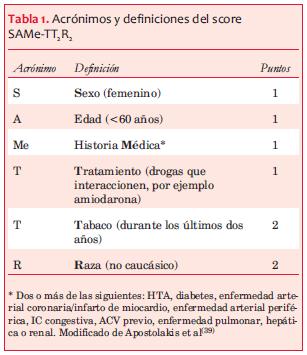
<body><![CDATA[<p class="SUB1" style="margin-bottom: 0.0001pt; line-height: normal; page-break-after: auto;"><span style="font-family: Verdana;">Introducci&oacute;n<o:p></o:p></span></p>             <p class="PRIMER" style="text-align: left; line-height: normal;" align="left"><span style="font-size: 10pt; font-family: Verdana;"></span></p>           <p class="PRIMER" style="text-align: left; line-height: normal;" align="left"><span style="font-size: 10pt; font-family: Verdana;">La fibrilaci&oacute;n auricular (FA) es la arritmia m&aacute;s frecuente, con una prevalencia en la poblaci&oacute;n general de 1%-2%, siendo en torno a 6% en personas </span><span style="font-size: 10pt; font-family: Verdana;">&#61619;</span><span style="font-size: 10pt; font-family: Verdana;">65 a&ntilde;os y de 10% en personas </span><span style="font-size: 10pt; font-family: Verdana;">&#61619;</span><span style="font-size: 10pt; font-family: Verdana;">80 a&ntilde;os<sup><a name="-1"></a><a name="-2"></a><a name="-3"></a>(<a href="#1">1-3</a>)</sup>. Datos similares han sido obtenidos en nuestro pa&iacute;s<sup><a name="-4"></a>(<a href="#4">4</a>)</sup>.<o:p></o:p></span></p>             <p class="MsoBodyText" style="text-align: left; text-indent: 0cm; line-height: normal;" align="left"><span style="font-size: 10pt; font-family: Verdana;">El riesgo de ataque cerebrovascular (ACV) es cinco veces mayor en pacientes portadores de FA y uno de cada cinco ACV son atribuidos a esta arritmia<sup><a name="-5"></a>(<a href="#5">5</a>)</sup>. El riesgo anual de ACV en pacientes portadores de FA no valvular no es homog&eacute;neo y puede estimarse a trav&eacute;s del score CHA<sub>2</sub>DS<sub>2</sub>VASc<sup><a name="-6"></a><a name="-7"></a>(<a href="#6">6</a>,<a href="#7">7</a>)</sup>. La necesidad de terapia antitromb&oacute;tica debe ser reevaluada peri&oacute;dicamente en base a la estimaci&oacute;n del riesgo tromboemb&oacute;lico y riesgo de sangrado individual<sup><a name="-8"></a><a name="-9"></a>(<a href="#8">8</a>,<a href="#9">9</a>)</sup>.<o:p></o:p></span></p>             <p class="MsoBodyText" style="text-align: left; text-indent: 0cm; line-height: normal;" align="left"><span style="font-size: 10pt; font-family: Verdana;">El tratamiento anticoagulante representa la estrategia que genera mayor reducci&oacute;n de los eventos tromboemb&oacute;licos en pacientes con FA. En el metaan&aacute;lisis de Hart y colaboradores<sup><a name="-10"></a>(<a href="#10">10</a>)</sup>, el tratamiento con warfarina estuvo asociado a una reducci&oacute;n del riesgo relativo de ACV de 64%, correspondiendo a una reducci&oacute;n de riesgo absoluto anual de 2,7% en todos los ACV. La reducci&oacute;n de riesgo fue similar tanto para prevenci&oacute;n primaria como secundaria y en ACV invalidante y no invalidante. La prevenci&oacute;n de eventos tromoboemb&oacute;licos puede realizarse utilizando f&aacute;rmacos antivitamina K (AVK), como warfarina y anticoagulantes orales directos (ACOD)<sup><a name="-11"></a><a name="-12"></a><a name="-13"></a><a name="-14"></a><a name="-15"></a><a name="-16"></a>(<a href="#11">11-16</a>)</sup>.<sup> </sup>El principal dilema que se plantea es la selecci&oacute;n del tipo de anticoagulante oral en un escenario de igual accesibilidad para ambos.<o:p></o:p></span></p>             <p class="MsoBodyText" style="text-align: left; text-indent: 0cm; line-height: normal;" align="left"><span style="font-size: 10pt; font-family: Verdana;">La warfarina presenta conocidas limitaciones vinculadas a un estrecho rango terap&eacute;utico, m&uacute;ltiples interacciones farmacol&oacute;gicas y diet&eacute;ticas as&iacute; como tambi&eacute;n a una amplia variabilidad en su respuesta anticoagulante inter e intraindividuo<sup><a name="-17"></a>(<a href="#17">17</a>)</sup>.<sup> </sup>Para disminuir la incidencia de complicaciones tromb&oacute;ticas y hemorr&aacute;gicas se debe mantener el INR (International Normalized<i> </i>Ratio) dentro del rango terap&eacute;utico indicado para cada patolog&iacute;a<sup><a name="-18"></a><a name="-19"></a><a name="-20"></a>(<a href="#18">18-20</a>)</sup>.<sup> </sup>La calidad de la anticoagulaci&oacute;n oral con warfarina ha sido evaluada en m&uacute;ltiples estudios a trav&eacute;s del c&aacute;lculo del porcentaje de tiempo en que<sup> </sup>el INR se encuentra dentro del rango terap&eacute;utico, expresado como la sigla en ingl&eacute;s TTR (Time in Therapeutic Range)<sup><a name="-21"></a><a name="-22"></a><a name="-23"></a>(<a href="#17">17</a>,<a href="#18">18</a>,<a href="#20">20-23</a>) </sup>y calculado mediante interpolaci&oacute;n lineal por el m&eacute;todo de Rosendaal<sup><a name="-24"></a>(<a href="#24">24</a>)</sup>.<sup> </sup>La warfarina ofrece su mayor eficacia y seguridad cuando el TTR es mayor de 65%-70%<sup><a name="-25"></a><a name="-26"></a><a name="-27"></a><a name="-28"></a>(<a href="#25">25-28</a>), </sup>valores inferiores se han asociado a eventos adversos (ACV, hemorragias y mortalidad)<sup><a name="-29"></a><a name="-30"></a>(<a href="#29">29</a>,<a href="#30">30</a>)</sup>.<sup> </sup>El score de riesgo hemorr&aacute;gico HAS- BLED define a los pacientes con un INR l&aacute;bil como aquellos con TTR &lt;60%<sup><a name="-31"></a><a name="-32"></a>(<a href="#31">31</a>,<a href="#32">32</a>)</sup>.<o:p></o:p></span></p>             <p class="MsoBodyText" style="text-align: left; text-indent: 0cm; line-height: normal;" align="left"><span style="font-size: 10pt; font-family: Verdana;">Los ACOD no requieren ajuste de dosis en base a un test de coagulaci&oacute;n espec&iacute;fico, pero la adherencia al tratamiento es crucial, ya que estos f&aacute;rmacos tienen una vida media menor que la warfarina. Sus limitaciones se vinculan a su mayor coste econ&oacute;mico y eliminaci&oacute;n renal en grado variable, desaconsejando su uso en presencia de enfermedad renal severa (clearance de creatinina [ClCr] &lt;30 mL/min/1,73 m<sup>2) </sup>y con necesidad de ajuste de dosis en presencia de enfermedad renal moderada (ClCr 30-49 mL/min/1,73 m2)<sup>(<a href="#8">8</a>,<a href="#9">9</a>). </sup>Tienen metabolismo hep&aacute;tico, estando contraindicada su administraci&oacute;n en pacientes con disfunci&oacute;n hep&aacute;tica severa (Child-Pugh C), requiriendo ajuste de dosis o discontinuaci&oacute;n en presencia de terapia concomitante con inductores o inhibidores moderados y potentes del CYP3A4 (citocromo P450) y P-gp (glicoprote&iacute;na de permeabilidad). Finalmente, el acceso limitado a idaracizumab (ant&iacute;doto de dabigatr&aacute;n) recientemente aprobado por la FDA (Food and Drug Administration)<sup><a name="-33"></a>(<a href="#33">33</a>)</sup>y la EMA (European Medicines Agency)<sup><a name="-34"></a>(<a href="#34">34</a>)</sup>y la ausencia de ant&iacute;doto espec&iacute;fico comercializado hasta la fecha para los inhibidores del factor Xa representan tambi&eacute;n una limitaci&oacute;n<sup><a name="-35"></a><a name="-36"></a><a name="-37"></a><a name="-38"></a>(<a href="#8">8</a>,<a href="#35">35-38</a>)</sup>.<o:p></o:p></span></p>             <p class="MsoBodyText" style="text-align: left; text-indent: 0cm; line-height: normal;" align="left"><span style="font-size: 10pt; font-family: Verdana;">La selecci&oacute;n del mejor anticoagulante oral para cada paciente particular es un desaf&iacute;o. El score SAMe-TT<sub>2R2</sub><sup><a name="-39"></a>(<a href="#39">39</a>) </sup>(sexo femenino, edad menor de 60 a&ntilde;os, historia m&eacute;dica [dos o m&aacute;s comorbilidades], tratamiento [drogas que interaccionen, por ejemplo, amiodarona], tabaco [doble], raza no cauc&aacute;sica [doble]) (<a href="#t1">tabla 1</a>) se ha desarrollado como herramienta para intentar predecir la respuesta al tratamiento anticoagulante con f&aacute;rmacos AVK. Aquellos pacientes con puntaje favorable a warfarina (0-1 punto) tendr&iacute;an una buena respuesta al tratamiento y por lo tanto un TTR adecuado; mientras que un puntaje desfavorable (</span><span style="font-size: 10pt; font-family: Verdana;">&#61619;</span><span style="font-size: 10pt; font-family: Verdana;"> 2 puntos) permitir&iacute;a predecir un TTR inadecuado y en consecuencia mayores posibilidades de eventos adversos, identificando pacientes que requieren intervenciones adicionales para la optimizaci&oacute;n de la calidad de la anticoagulaci&oacute;n con AVK o mejores candidatos a ACOD. Este score fue validado en diversos estudios<sup><a name="-40"></a><a name="-41"></a><a name="-42"></a>(<a href="#40">40-42</a>) </sup>y su utilizaci&oacute;n se recomienda en una publicaci&oacute;n reciente de la Sociedad Europea de Cardiolog&iacute;a<sup>(<a href="#26">26</a>)</sup> y en un documento de consenso del NICE (National Institute for Health and Care Excellence)<sup>(<a href="#28">28</a>)</sup>,<sup> </sup>sin embargo su reproducibilidad no ha sido consistente<sup><a name="-43"></a><a name="-44"></a><a name="-45"></a><a name="-46"></a>(<a href="#43">43-46</a>)</sup>.<o:p></o:p></span></p>             <p class="MsoBodyText" style="text-align: left; text-indent: 0cm; line-height: normal;" align="left"><span style="font-size: 10pt; font-family: Verdana;">El objetivo de este estudio fue evaluar la utilidad del score SAMe-TT<sub>2</sub>R<sub>2</sub> en el control de la anticoagulaci&oacute;n oral con warfarina en pacientes portadores de FA no valvular.</span></p>       <p class="MsoBodyText" style="text-align: left; text-indent: 0cm; line-height: normal;" align="left"><span style="font-size: 10pt; font-family: Verdana;"></span></p>         ]]></body>
<body><![CDATA[<p class="MsoBodyText" style="text-align: left; text-indent: 0cm; line-height: normal;" align="left"><a name="t1"></a><img style="width: 307px; height: 355px;" alt="" src="/img/revistas/ruc/v31n3/3a04t1.JPG"> &nbsp;<sup>(<a href="#39">39</a>)</sup><span style="font-size: 10pt; font-family: Verdana;"><o:p></o:p></span></p>             <p class="SUB1" style="margin-bottom: 0.0001pt; line-height: normal; page-break-after: auto;"><span style="font-family: Verdana;"></span></p>           <p class="SUB1" style="margin-bottom: 0.0001pt; line-height: normal; page-break-after: auto;"><span style="font-family: Verdana;">Material y m&eacute;todo<o:p></o:p></span></p>             <p class="PRIMER" style="text-align: left; line-height: normal;" align="left"><span style="font-size: 10pt; font-family: Verdana;"></span></p>           <p class="PRIMER" style="text-align: left; line-height: normal;" align="left"><span style="font-size: 10pt; font-family: Verdana;">Se realiz&oacute; un estudio retrospectivo de una cohorte de 366 pacientes anticoagulados con warfarina que se asist&iacute;an de forma ambulatoria en la Policl&iacute;nica de Cardiolog&iacute;a (283) y en la Unidad Multidisciplinaria de Insuficiencia Card&iacute;aca (UMIC) (83) del Hospital de Cl&iacute;nicas entre el 1&deg; de junio de 2012 y el 31 de ju&shy;nio de 2014.<o:p></o:p></span></p>             <p class="MsoBodyText" style="text-align: left; text-indent: 0cm; line-height: normal;" align="left"><span style="font-size: 10pt; font-family: Verdana;">Se incluyeron pacientes de ambos sexos mayores de 18 a&ntilde;os que se encontraban bajo tratamiento anticoagulante por diagn&oacute;stico de FA no valvular de acuerdo con las gu&iacute;as de pr&aacute;ctica cl&iacute;nica actuales<sup>(<a href="#11">11</a>)</sup>.<o:p></o:p></span></p>             <p class="MsoBodyText" style="text-align: left; text-indent: 0cm; line-height: normal;" align="left"><span style="font-size: 10pt; font-family: Verdana;">Fueron excluidos aquellos que presentaban al menos uno de los siguientes criterios: (1) indicaci&oacute;n adicional de anticoagulaci&oacute;n por trombosis venosa profunda/tromboembolismo pulmonar (TVP/TEP) o trombo intracard&iacute;aco; (2) anticoagulaci&oacute;n con ACOD; (3) inicio de anticoagulaci&oacute;n menor a tres meses; (4) intervalo mayor a 60 d&iacute;as entre resultados de INR; (5) ausencia de cinco registros conse&shy;cutivos.<o:p></o:p></span></p>             <p class="MsoBodyText" style="text-align: left; text-indent: 0cm; line-height: normal;" align="left"><span style="font-size: 10pt; font-family: Verdana;">Las variables analizadas fueron: edad, sexo, fracci&oacute;n de eyecci&oacute;n del ventr&iacute;culo izquierdo (FEVI), comorbilidades y f&aacute;rmacos concomitantes. Se evalu&oacute; el riesgo de ACV mediante el score CHA<sub>2</sub>DS<sub>2</sub>-VASc y el riesgo inicial de sangrado mediante el score HAS-BLED<sup>(<a href="#31">31</a>,<a href="#32">32</a>)</sup>. Se evalu&oacute; la calidad de anticoagulaci&oacute;n a trav&eacute;s del c&aacute;lculo individual del TTR mediante el m&eacute;todo de Rosendaal (interpolaci&oacute;n lineal)<sup>(<a href="#24">24</a>)</sup> y luego se determin&oacute; el resultado global expresado como la media de TTR. Se defini&oacute; como adecuada calidad de anticoagulaci&oacute;n un valor de TTR </span><span style="font-size: 10pt; font-family: Verdana;">&#61619;</span><span style="font-size: 10pt; font-family: Verdana;">65%.<o:p></o:p></span></p>           <span style="font-size: 10pt; font-family: Verdana;">El score SAMe-TT<sub>2</sub>R<sub>2 </sub>(<a href="#t1">tabla 1</a>) fue calculado como la suma de 1 punto para cada uno de los siguientes elementos: sexo femenino, edad menor de 60 a&ntilde;os, dos o m&aacute;s de las siguientes condiciones (HTA, diabetes, enfermedad arterial coronaria/infarto de miocardio, enfermedad arterial perif&eacute;rica, insuficiencia card&iacute;aca congestiva, ACV previo, enfermedad pulmonar, hep&aacute;tica o renal), tratamiento (drogas que interaccionen, por ejemplo, amiodarona) y 2 puntos para tabaquismo y raza no cauc&aacute;sica. Se defini&oacute; como favorable al tratamiento con warfarina un puntaje de 0-1 punto, mientras que un puntaje desfavorable, </span><span style="font-size: 10pt; font-family: Verdana;">&#61619;</span><span style="font-size: 10pt; font-family: Verdana;">2 puntos, se asociar&iacute;a con mala respuesta al tratamiento con warfarina y un pobre TTR.<o:p></o:p></span><span style="font-size: 10pt; font-family: Verdana; color: black;" lang="ES-MX"></span><span style="font-size: 10pt; font-family: Verdana; color: black;" lang="ES-MX">Los datos cl&iacute;nicos se obtuvieron de las historias cl&iacute;nicas. El valor de anticoagulaci&oacute;n se obtuvo a trav&eacute;s del sistema informatizado del laboratorio del Hospital de Cl&iacute;nicas, expresado como INR y obtenido a partir de muestras de sangre extra&iacute;das por venopunci&oacute;n, analizadas con un equipo Sysmex 500, Laboratorio Enol.<o:p></o:p></span>      <br>       <span style="font-size: 10pt; font-family: Verdana; color: black;" lang="ES-MX">Las caracter&iacute;sticas de los pacientes son presentadas como porcentajes y medias &plusmn; desviaci&oacute;n est&aacute;ndar (DE). La normalidad fue evaluada mediante el test de Kolmogorov-Smirnov. Se utiliz&oacute; el test de chi<sup>2</sup> para el an&aacute;lisis de variables dicot&oacute;micas, test de t para comparaci&oacute;n de medias y test de Krustal-Wallis para comparar los valores de TTR en los diferentes puntajes del score SAME-TT<sub>2</sub>R<sub>2</sub>. Se consider&oacute; significativo un valor p&lt;0,05. El an&aacute;lisis estad&iacute;stico se realiz&oacute; utilizando GNU PSPP Statistical Ana&shy;lysis Software versi&oacute;n 0.7.9.<o:p></o:p></span>      <p class="SUB1" style="margin-bottom: 0.0001pt; line-height: normal; page-break-after: auto;"><span style="font-family: Verdana;"></span></p>           ]]></body>
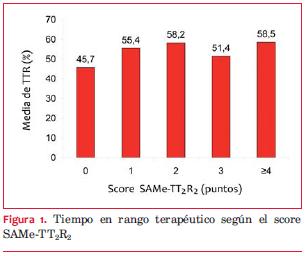
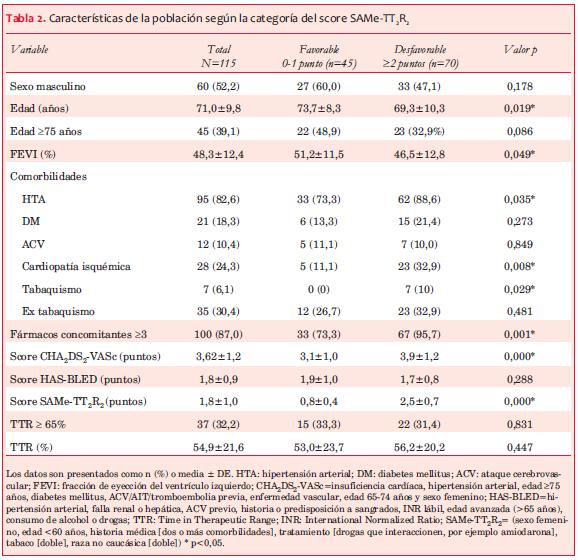
<body><![CDATA[<p class="SUB1" style="margin-bottom: 0.0001pt; line-height: normal; page-break-after: auto;"><span style="font-family: Verdana;">Resultados<o:p></o:p></span></p>             <p class="PRIMER" style="text-align: left; line-height: normal;" align="left"><span style="font-size: 10pt; font-family: Verdana;"></span></p>           <p class="PRIMER" style="text-align: left; line-height: normal;" align="left"><span style="font-size: 10pt; font-family: Verdana;">En el per&iacute;odo considerado se seleccionaron 115 pacientes que cumpl&iacute;an con los criterios propuestos, 45 (39,1%) provenientes de UMIC y 70 (60,9%) de la Policl&iacute;nica de Cardiolog&iacute;a. Las caracter&iacute;sticas de los pacientes se muestran en la <a href="#t2">tabla 2</a>. La media de edad fue de 71,0&plusmn;9,8 a&ntilde;os y sexo masculino 52,2%. Las comorbilidades m&aacute;s frecuentes fueron: HTA 82,6%, cardiopat&iacute;a isqu&eacute;mica 24,3% y diabetes mellitus 18,3%. El 87,0% de los pacientes consum&iacute;a tres o m&aacute;s f&aacute;rmacos concomitantes. La media de FEVI fue 48,3&plusmn;12,4%, el score CHA<sub>2</sub>DS<sub>2</sub>-VASc fue 3,6&plusmn;1,2 puntos y el score HAS-BLED fue 1,8&plusmn;0,9 puntos.</span></p>        <p class="PRIMER" style="text-align: left; line-height: normal;" align="left"><span style="font-size: 10pt; font-family: Verdana;"></span></p>         <p class="PRIMER" style="text-align: left; line-height: normal;" align="left"><a name="t2"></a><img style="width: 578px; height: 560px;" alt="" src="/img/revistas/ruc/v31n3/3a04t2.JPG"></p>         <p class="PRIMER" style="text-align: left; line-height: normal;" align="left"><span style="font-size: 10pt; font-family: Verdana;"><o:p></o:p></span></p>             <p class="MsoBodyText" style="text-align: left; text-indent: 0cm; line-height: normal;" align="left"><span style="font-size: 10pt; font-family: Verdana;">La calidad de la anticoagulaci&oacute;n no fue &oacute;ptima, siendo la media de TTR calculada 54,9&plusmn;21,6% y solamente 37 pacientes (32,2%) tuvieron un TTR </span><span style="font-size: 10pt; font-family: Verdana;">&#61619;</span><span style="font-size: 10pt; font-family: Verdana;">65%. La media de d&iacute;as entre resultados de INR fue de 29,4&plusmn;7,8 d&iacute;as. No se encontr&oacute; asociaci&oacute;n entre un TTR </span><span style="font-size: 10pt; font-family: Verdana;">&#61619;</span><span style="font-size: 10pt; font-family: Verdana;">65% y las variables estudiadas.<o:p></o:p></span></p>             <p class="MsoBodyText" style="text-align: left; text-indent: 0cm; line-height: normal;" align="left"><span style="font-size: 10pt; font-family: Verdana;">El score SAMe-TT<sub>2</sub>R<sub>2 </sub>tuvo una media de 1,8&plusmn;1,0 puntos, 45 pacientes (39,1%) tuvieron un puntaje favorable a warfarina (0-1 punto) y 70 pacientes (60,9%) tuvieron un puntaje desfavorable (</span><span style="font-size: 10pt; font-family: Verdana;">&#61619;</span><span style="font-size: 10pt; font-family: Verdana;">2 puntos). La relaci&oacute;n entre la categor&iacute;a del score SAMe-TT<sub>2</sub>R<sub>2</sub> y las diferentes variables se muestra en la <a href="#t2">tabla 2</a>.<o:p></o:p></span></p>             <p class="MsoBodyText" style="text-align: left; text-indent: 0cm; line-height: normal;" align="left"><span style="font-size: 10pt; font-family: Verdana;">No hubo diferencia significativa en la media de TTR seg&uacute;n la categor&iacute;a del score SAMe-TT<sub>2</sub>R<sub>2 </sub>(53,0&plusmn;23,7% vs 56,2&plusmn;20,2%, p=0,447). En la categor&iacute;a SAMe-TT<sub>2</sub>R<sub>2</sub> favorable, solamente 15 pacientes (33,3%) tuvieron un TTR </span><span style="font-size: 10pt; font-family: Verdana;">&#61619;</span><span style="font-size: 10pt; font-family: Verdana;">65% (p=0,831). La puntuaci&oacute;n del score SAMe-TT</span><sub><span style="font-size: 10pt; font-family: Verdana;">2</span></sub><span style="font-size: 10pt; font-family: Verdana;">R<sub>2 </sub>fue similar en los pacientes con TTR </span><span style="font-size: 10pt; font-family: Verdana;">&#61619;</span><span style="font-size: 10pt; font-family: Verdana;">65% y &lt;65% (1,81&plusmn;0,96 vs 1,81&plusmn;1,1M; p=0,496). Tampoco se encontr&oacute; diferencia entre la calidad de anticoagulaci&oacute;n y un puntaje creciente en el score SAMe-TT<sub>2</sub>R<sub>2 </sub>(p=0,359) (<a href="#g1">figura 1</a>).</span></p>        <p class="MsoBodyText" style="text-align: left; text-indent: 0cm; line-height: normal;" align="left"><span style="font-size: 10pt; font-family: Verdana;"></span></p>         ]]></body>
<body><![CDATA[<p class="MsoBodyText" style="text-align: left; text-indent: 0cm; line-height: normal;" align="left"><a name="g1"></a><img style="width: 306px; height: 256px;" alt="" src="/img/revistas/ruc/v31n3/3a04g1.JPG"><span style="font-size: 10pt; font-family: Verdana;"><o:p></o:p></span></p>             <p class="SUB1" style="margin-bottom: 0.0001pt; line-height: normal; page-break-after: auto;"><span style="font-family: Verdana;"></span></p>           <p class="SUB1" style="margin-bottom: 0.0001pt; line-height: normal; page-break-after: auto;"><span style="font-family: Verdana;">Discusi&oacute;n<o:p></o:p></span></p>             <p class="PRIMER" style="text-align: left; line-height: normal;" align="left"><span style="font-size: 10pt; font-family: Verdana;"></span></p>           <p class="PRIMER" style="text-align: left; line-height: normal;" align="left"><span style="font-size: 10pt; font-family: Verdana;">Considerando el score SAMe-TT<sub>2</sub>R<sub>2 </sub>como variable dicot&oacute;mica (<a href="#t2">tabla 2</a>) o como variable ordinal (<a href="#g1">figura 1</a>) no se encontraron diferencias en la calidad de anticoagulaci&oacute;n. La media de TTR no fue significativamente diferente entre los pacientes con un score SAMe-TT<sub>2</sub>R<sub>2 </sub>favorable a warfarina y uno desfa&shy;vorable.<o:p></o:p></span></p>             <p class="MsoBodyText" style="text-align: left; text-indent: 0cm; line-height: normal;" align="left"><span style="font-size: 10pt; font-family: Verdana;">Los pacientes con score SAMe-TT<sub>2</sub>R<sub>2 </sub>favorable a warfarina tuvieron menor consumo de f&aacute;rmacos concomitantes y menor prevalencia de algunos factores de riesgo cardiovascular (HTA y tabaquismo) y de enfermedad cardiovascular definida (cardiopat&iacute;a isqu&eacute;mica). Estos elementos pueden estar vinculados al hallazgo de una mayor FEVI y un menor score CHA<sub>2</sub>DS<sub>2</sub>-VASc. Sin embargo, ninguna de estas variables se asoci&oacute; a un TTR </span><span style="font-size: 10pt; font-family: Verdana;">&#61619;</span><span style="font-size: 10pt; font-family: Verdana;">65%.<o:p></o:p></span></p>             <p class="MsoBodyText" style="text-align: left; text-indent: 0cm; line-height: normal;" align="left"><span style="font-size: 10pt; font-family: Verdana;">El score SAMe-TT<sub>2</sub>R<sub>2 </sub><sup>(<a href="#39">39</a>)</sup>, es propuesto como un score simple, conformado por variables cl&iacute;nicas y de f&aacute;cil aplicaci&oacute;n, siendo esa su principal fortaleza. Sin embargo, su utilidad es cuestionada por diversos estudios<sup>(<a href="#43">43-45</a>)</sup>. En pacientes con FA no valvular e insuficiencia card&iacute;aca, este score no permiti&oacute; predecir el TTR tras un ingreso por descompensaci&oacute;n<sup>(<a href="#46">46</a>)</sup>.<o:p></o:p></span></p>             <p class="MsoBodyText" style="text-align: left; text-indent: 0cm; line-height: normal;" align="left"><span style="font-size: 10pt; font-family: Verdana;">Es importante considerar que el estudio inicial de Apostolakis y colaboradores<sup>(<a href="#39">39</a>) </sup>incluy&oacute; a todos los pacientes con indicaci&oacute;n de anticoagulaci&oacute;n oral del estudio AFFIRM<sup><a name="-48"></a>(<a href="#48">48</a>)</sup>,<sup> </sup>utiliz&aacute;ndose en la fase de validaci&oacute;n la misma cohorte de pacientes y existiendo 11% de pacientes con FA valvular<sup><a name="-49"></a>(<a href="#49">49</a>)</sup>.<sup> </sup>En dicho estudio se demostr&oacute; que utilizando como punto de corte una media de TTR de 65%, el score SAMe-TT<sub>2R2 </sub>permitir&iacute;a identificar a los pacientes con respuesta favorable a warfarina. Sin embargo, en nuestra cohorte, de los pacientes con puntaje favorable a warfarina (0-1 punto) solamente el 33% tuvo un TTR<sub> </sub></span><span style="font-size: 10pt; font-family: Verdana;">&#61619;</span><span style="font-size: 10pt; font-family: Verdana;"> 65%. La incapacidad de detectar una diferencia se podr&iacute;a explicar debido a que la media de TTR calculada en nuestra poblaci&oacute;n (54,9%) fue inferior al valor &oacute;ptimo (&gt;65%-70%). Este hallazgo de anticoagulaci&oacute;n sub&oacute;ptima coincide con el obtenido en el registro GARFIELD-AF que muestra una media de TTR de 55,8% en pacientes tratados con warfarina provenientes de la &ldquo;vida real&rdquo;<sup><a name="-50"></a>(<a href="#50">50</a>)</sup>.<sup> </sup>Una pregunta a responder es si este score tiene utilidad en poblaciones con anticoagulaci&oacute;n sub&oacute;ptima.<sup> </sup>La publicaci&oacute;n de Abumuaileq y colaboradores<sup>(<a href="#42">42</a>)</sup>,<sup> </sup>que eval&uacute;a la calidad de anticoagulaci&oacute;n calculando el porcentaje de INR dentro del rango terap&eacute;utico (PINRR), no utilizando el TTR, pone en evidencia que el rendimiento del score var&iacute;a de acuerdo al punto de corte de PINRR utilizado. En pacientes con PINRR<sup> </sup></span><span style="font-size: 10pt; font-family: Verdana;">&#61619;</span><span style="font-size: 10pt; font-family: Verdana;"> 70%, el 82,1% ten&iacute;a un puntaje del score SAMETTR favorable (0-1 punto) y este porcentaje se reduc&iacute;a de forma significativa al considerar un punto de corte de PINRR &lt;70% (70,9% para un PINRR </span><span style="font-size: 10pt; font-family: Verdana;">&#61619;</span><span style="font-size: 10pt; font-family: Verdana;"> 65% y 70,7% para un PINRR </span><span style="font-size: 10pt; font-family: Verdana;">&#61619;</span><span style="font-size: 10pt; font-family: Verdana;"> 60%, p&lt;0,001).<o:p></o:p></span></p>             <p class="MsoBodyText" style="text-align: left; text-indent: 0cm; line-height: normal;" align="left"><span style="font-size: 10pt; font-family: Verdana;">Existe adem&aacute;s cierta disparidad en la literatura con respecto al punto de corte utilizado para definir las diferentes categor&iacute;as. En la publicaci&oacute;n de Apostolakis<i> </i>y colaboradores<sup>(<a href="#39">39</a>)</sup> se considera que los pacientes con un puntaje de 0-1 tendr&iacute;an una respuesta favorable al tratamiento con warfarina, mientras que aquellos pacientes con </span><span style="font-size: 10pt; font-family: Verdana;">&#61619;</span><span style="font-size: 10pt; font-family: Verdana;">2 puntos tendr&iacute;an una respuesta desfavorable. Numerosos estudios utilizan este criterio<sup>(<a href="#42">42-46</a>)</sup>. Por otro lado, algunas publicaciones consideran un resultado de 0-2 puntos como favorable a warfarina (0-1 punto: riesgo bajo y 2 puntos: riesgo intermedio) mientras que un puntaje mayor de 2 puntos ser&iacute;a desfavorable, con alto riesgo de pobre TTR<sup><a name="-51"></a><a name="-52"></a>(<a href="#40">40</a>,<a href="#41">41</a>,<a href="#51">51</a>,<a href="#52">52</a>)</sup>. Es necesaria informaci&oacute;n adicional para definir adecuadamente las dife&shy;rentes categor&iacute;as del score y evaluar su validez en diferentes poblaciones.<o:p></o:p></span></p>             <p class="MsoBodyText" style="text-align: left; text-indent: 0cm; line-height: normal;" align="left"><span style="font-size: 10pt; font-family: Verdana;">Las gu&iacute;as de pr&aacute;ctica cl&iacute;nica para la prevenci&oacute;n de eventos tromboemb&oacute;licos en pacientes con FA no valvular avalan la utilizaci&oacute;n de f&aacute;rmacos AVK y nuevos anticoagulantes orales (NACO)<sup>(<a href="#8">8</a>,<a href="#9">9</a>)</sup>. Sin embargo, en el estudio ROCKET-AF<sup>(<a href="#14">14</a>)</sup> (rivaroxab&aacute;n), el grupo control tratado con AVK ten&iacute;a una media de TTR de 55%, en el estudio RE-LY<sup>(<a href="#15">15</a>) </sup>(dabigatr&aacute;n) 64% y en el estudio ARISTOTLE<sup>(<a href="#16">16</a>)</sup> (apixab&aacute;n) fue de 62%, reflejando niveles sub&oacute;ptimos de anticoagulaci&oacute;n incluso en poblaciones &ldquo;controladas&rdquo;. Debemos considerar que si bien los ACOD ofrecen ciertas ventajas, su superioridad en poblaciones con TTR mayor a 70% no ha sido eva&shy;luada.<o:p></o:p></span></p>             ]]></body>
<body><![CDATA[<p class="MsoBodyText" style="text-align: left; text-indent: 0cm; line-height: normal;" align="left"><span style="font-size: 10pt; font-family: Verdana;">La selecci&oacute;n del anticoagulante oral debe ser individualizada de acuerdo a la presencia de comorbilidades, tolerancia, costo, interacciones, riesgo de sangrado y TTR. El principal dilema surge en el paciente portador de una FA no valvular de reciente diagn&oacute;stico, que nunca ha recibido tratamiento anticoagulante con AVK y desconocemos, por lo tanto, si su TTR es adecuado. Se podr&iacute;a considerar realizar una &ldquo;prueba de warfarina&rdquo; durante los seis meses iniciales para documentar la calidad de anti&shy;coagulaci&oacute;n y facilitar la elecci&oacute;n del tipo de anticoagulan&shy;te.<o:p></o:p></span></p>             <p class="SUB1" style="margin-bottom: 0.0001pt; line-height: normal; page-break-after: auto;"><span style="font-family: Verdana;"></span></p>           <p class="SUB1" style="margin-bottom: 0.0001pt; line-height: normal; page-break-after: auto;"><span style="font-family: Verdana;">Implicancias<o:p></o:p></span></p>             <p class="PRIMER" style="text-align: left; line-height: normal;" align="left"><span style="font-size: 10pt; font-family: Verdana;"></span></p>           <p class="PRIMER" style="text-align: left; line-height: normal;" align="left"><span style="font-size: 10pt; font-family: Verdana;">Este estudio nos permite conocer la calidad de la anticoagulaci&oacute;n y las caracter&iacute;sticas de los pacientes con FA no valvular, siendo el TTR el par&aacute;metro recomendado para evaluarla<sup>(<a href="#21">21</a>)</sup> y con criterios de inclusi&oacute;n que aseguran que el TTR calculado realmente refleje la calidad de la anticoagulaci&oacute;n. La media de TTR obtenida es inferior al valor &oacute;ptimo, siendo similar al resultado obtenido en un estudio previo realizado en Uruguay (56,6%)<sup><a name="-53"></a>(<a href="#53">53</a>)</sup>. Un incremento absoluto en la media de TTR mayor a 5% representar&iacute;a una diferencia significativa y cl&iacute;nicamente relevante<sup><a name="-54"></a>(<a href="#54">54</a>)</sup>. Debemos, por lo tanto, estimular el desarrollo de nuevas estrategias educativas y de control de anticoagulaci&oacute;n para optimizar el nivel de la misma.<o:p></o:p></span></p>             <p class="SUB1" style="margin-bottom: 0.0001pt; line-height: normal; page-break-after: auto;"><span style="font-family: Verdana;"></span></p>           <p class="SUB1" style="margin-bottom: 0.0001pt; line-height: normal; page-break-after: auto;"><span style="font-family: Verdana;">Limitaciones<o:p></o:p></span></p>             <p class="PRIMER" style="text-align: left; line-height: normal;" align="left"><span style="font-size: 10pt; font-family: Verdana;"></span></p>           <p class="PRIMER" style="text-align: left; line-height: normal;" align="left"><span style="font-size: 10pt; font-family: Verdana;">Est&aacute;n vinculadas principalmente a su peque&ntilde;o tama&ntilde;o y ser unic&eacute;ntrico, siendo sus resultados, por ende, no generalizables. Desconocemos cu&aacute;l es la calidad de la anticoagulaci&oacute;n de los pacientes con FA no valvular de otros centros de tercer nivel as&iacute; como en policl&iacute;nicas de atenci&oacute;n primaria. Se han excluido aquellos pacientes con FA no valvular que no reciben tratamiento anticoagulante oral o que reciben ACOD, lo cual puede representar un sesgo de selecci&oacute;n. Dichos pacientes deber&iacute;an ser con&shy;siderados en estudios futuros.<o:p></o:p></span></p>             <p class="MsoBodyText" style="text-align: left; text-indent: 0cm; line-height: normal;" align="left"><span style="font-size: 10pt; font-family: Verdana;">Al ser retrospectivo, no se ha evaluado la incidencia de eventos tromboemb&oacute;licos, hemorr&aacute;gicos y muerte cardiovascular. El registro de dichos eventos permitir&iacute;a evaluar si existe asociaci&oacute;n con el puntaje de los scores CHA<sub>2</sub>DS<sub>2</sub>-VASc y HAS-BLED, media de TTR obtenido y la categor&iacute;a del score SAMe-TT<sub>2</sub>R<sub>2</sub>. En un estudio reciente de Lip y colaboradores<sup>(<a href="#51">51</a>)</sup> un score SAMe-TT<sub>2</sub>R<sub>2 </sub>&gt;2 se ha visto asociado con un riesgo incrementado de INR l&aacute;bil (p=0,004), ACV/tromboembolismo (p=0,007), san&shy;grado grave (p&lt;0,0001) y muerte (p=0,002) en el seguimiento.<o:p></o:p></span></p>             ]]></body>
<body><![CDATA[<p class="MsoBodyText" style="text-align: left; text-indent: 0cm; line-height: normal;" align="left"><span style="font-size: 10pt; font-family: Verdana;">Es necesaria la informaci&oacute;n de un estudio prospectivo, multic&eacute;ntrico y de mayor tama&ntilde;o para evaluar la utilidad del score SAMe-TT<sub>2</sub>R<sub>2 </sub>como predictor de calidad de anticoagulaci&oacute;n con warfarina y su asociaci&oacute;n con eventos tromboemb&oacute;licos y hemo&shy;rr&aacute;gicos.<o:p></o:p></span></p>             <p class="SUB1" style="margin-bottom: 0.0001pt; line-height: normal; page-break-after: auto;"><span style="font-family: Verdana;"></span></p>           <p class="SUB1" style="margin-bottom: 0.0001pt; line-height: normal; page-break-after: auto;"><span style="font-family: Verdana;">Conclusi&oacute;n<o:p></o:p></span></p>             <p class="PRIMER" style="text-align: left; line-height: normal;" align="left"><span style="font-size: 10pt; font-family: Verdana;"></span></p>           <p class="PRIMER" style="text-align: left; line-height: normal;" align="left"><span style="font-size: 10pt; font-family: Verdana;">En la poblaci&oacute;n estudiada no hubo diferencias en la calidad de la anticoagulaci&oacute;n oral con warfarina entre las categor&iacute;as (favorable y desfavorable) del score SAMe-TT<sub>2</sub>R<sub>2.</sub><o:p></o:p></span></p>             <p class="SUB1" style="margin-bottom: 0.0001pt; line-height: normal; page-break-after: auto;"><span style="font-family: Verdana;"></span></p>           <p class="SUB1" style="margin-bottom: 0.0001pt; line-height: normal; page-break-after: auto;"><span style="font-family: Verdana;">Bibliograf&iacute;a<o:p></o:p></span></p>             <p class="BIB" style="margin: 0cm 0cm 0.0001pt; text-align: left; text-indent: 0cm; line-height: normal;" align="left"><span style="font-size: 10pt; font-family: Verdana;"></span></p>           <!-- ref --><p class="BIB" style="margin: 0cm 0cm 0.0001pt; text-align: left; text-indent: 0cm; line-height: normal;" align="left"><span style="font-size: 10pt; font-family: Verdana;"><a name="1"></a><a href="#-1">1</a>.<span style="">&nbsp;&nbsp;&nbsp;&nbsp;&nbsp;&nbsp; </span><b>Stewart S, Hart CL, Hole DJ, McMurray JJ. </b></span><span style="font-size: 10pt; font-family: Verdana;" lang="EN-US">Population prevalence, incidence, and predictors of atrial fibrillation in the Renfrew/Paisley study. Heart. 2001;86(5):516-521.    <o:p></o:p></span></p>             ]]></body>
<body><![CDATA[<!-- ref --><p class="BIB" style="margin: 0cm 0cm 0.0001pt; text-align: left; text-indent: 0cm; line-height: normal;" align="left"><span style="font-size: 10pt; font-family: Verdana;" lang="EN-US"><a name="2"></a><a href="#-2">2</a>.<span style="">&nbsp;&nbsp;&nbsp;&nbsp;&nbsp;&nbsp; </span><b>Go AS, Hylek EM, Phillips KA, Chang Y, Henault LE, Selby JV, et al. </b>Prevalence of diagnosed atrial fibrillation in adults. JAMA 2001; 285(18): 2370-2375.    <o:p></o:p></span></p>             <p class="BIB" style="margin: 0cm 0cm 0.0001pt; text-align: left; text-indent: 0cm; line-height: normal;" align="left"><span style="font-size: 10pt; font-family: Verdana;" lang="EN-US"><a name="3"></a><a href="#-3">3</a>.<span style="">&nbsp;&nbsp;&nbsp;&nbsp;&nbsp;&nbsp; </span><b>Lloyd-Jones D, Adams RJ, Brown TM, Carnethon M, Dai S, De Simone G, et al.</b> Executive summary: heart disease and stroke statistics&mdash;2010 update: a report from the American Heart Association. </span><span style="font-size: 10pt; font-family: Verdana;">Circulation. 2010;121(7):948-54.<o:p></o:p></span></p>             <!-- ref --><p class="BIB" style="margin: 0cm 0cm 0.0001pt; text-align: left; text-indent: 0cm; line-height: normal;" align="left"><span style="font-size: 10pt; font-family: Verdana;"><a name="4"></a><a href="#-4">4</a>.<span style="">&nbsp;&nbsp;&nbsp;&nbsp;&nbsp;&nbsp; </span><b>Sandoya E, Aguilar MP, V&aacute;zquez H.</b> Prevalencia de la fibrilaci&oacute;n auricular en la poblaci&oacute;n adulta de Montevideo. Rev Urug Cardiol. 2014;29(2):187-91.    <o:p></o:p></span></p>             <!-- ref --><p class="BIB" style="margin: 0cm 0cm 0.0001pt; text-align: left; text-indent: 0cm; line-height: normal;" align="left"><span style="font-size: 10pt; font-family: Verdana;"><a name="5"></a><a href="#-5">5</a>.<span style="">&nbsp;&nbsp;&nbsp;&nbsp;&nbsp;&nbsp; </span><b>Kannel W, Wolf P, Benjamin E, Levy D. </b>Prevalence, incidence, prognosis, and predisposing conditions for atrial fibrillation: population-based estimates. Am J Cardiol 1998;82(7):2N-9N.    <o:p></o:p></span></p>             <!-- ref --><p class="BIB" style="margin: 0cm 0cm 0.0001pt; text-align: left; text-indent: 0cm; line-height: normal;" align="left"><span style="font-size: 10pt; font-family: Verdana;"><a name="6"></a><a href="#-6">6</a>.<span style="">&nbsp;&nbsp;&nbsp;&nbsp;&nbsp;&nbsp; </span><b>Lip GYH, Nieuwlaat R, Pisters R, Lane DA, Crijns HJGM. </b></span><span style="font-size: 10pt; font-family: Verdana;" lang="EN-US">Refining clinical risk stratification for predicting stroke and thromboembolism in atrial fibrillation using a novel risk factor-based approach: the euro heart survey on atrial fibrillation. Chest. 2010;137(2):263-72.    <o:p></o:p></span></p>             <!-- ref --><p class="BIB" style="margin: 0cm 0cm 0.0001pt; text-align: left; text-indent: 0cm; line-height: normal;" align="left"><span style="font-size: 10pt; font-family: Verdana;" lang="EN-US"><a name="7"></a><a href="#-7">7</a>.<span style="">&nbsp;&nbsp;&nbsp;&nbsp;&nbsp;&nbsp; </span><b>Lip GYH, Frison L, Halperin JL, Lane DA.</b> Identifying patients at high risk for stroke despite anticoagulation: a comparison of contemporary stroke risk stratification schemes in an anticoagulated atrial fibrillation cohort. Stroke 2010;41(12):2731-8.    <o:p></o:p></span></p>             <!-- ref --><p class="BIB" style="margin: 0cm 0cm 0.0001pt; text-align: left; text-indent: 0cm; line-height: normal;" align="left"><span style="font-size: 10pt; font-family: Verdana;" lang="EN-US"><a name="8"></a><a href="#-8">8</a>.<span style="">&nbsp;&nbsp;&nbsp;&nbsp;&nbsp;&nbsp; </span><b>Camm AJ, Lip GY, De Caterina R, Savelieva I, Atar D, Hohnloser SH, et al.</b> 2012 focused update of the ESC Guidelines for the management of atrial fibrillation. Eur Heart J 2012;33(21):2719-47.    <o:p></o:p></span></p>             <!-- ref --><p class="BIB" style="margin: 0cm 0cm 0.0001pt; text-align: left; text-indent: 0cm; line-height: normal;" align="left"><span style="font-size: 10pt; font-family: Verdana;" lang="EN-US"><a name="9"></a><a href="#-9">9</a>.<span style="">&nbsp;&nbsp;&nbsp;&nbsp;&nbsp;&nbsp; </span><b>January CT, Wann LS, Alpert JS, Calkins H, Cigarroa JE, Cleveland JC Jr, et al.</b> 2014 AHA/ACC/HRS Guideline for the management of patients with atrial fibrillation. J Am Coll Cardiol. 2014;64(21):e1-e76.    <o:p></o:p></span></p>             <!-- ref --><p class="BIB" style="margin: 0cm 0cm 0.0001pt; text-align: left; text-indent: 0cm; line-height: normal;" align="left"><span style="font-size: 10pt; font-family: Verdana;" lang="EN-US"><a name="10"></a><a href="#-10">10</a>.<span style="">&nbsp;&nbsp;&nbsp;&nbsp; </span><b>Hart RG.</b> Meta-analysis: antithrombotic therapy to prevent stroke in patients who have nonvalvular atrial fibrillation. Ann Intern Med. 2007; 146(12): 857.    <o:p></o:p></span></p>             <!-- ref --><p class="BIB" style="margin: 0cm 0cm 0.0001pt; text-align: left; text-indent: 0cm; line-height: normal;" align="left"><span style="font-size: 10pt; font-family: Verdana;" lang="EN-US"><a name="11"></a><a href="#-11">11</a>.<span style="">&nbsp;&nbsp;&nbsp;&nbsp; </span><b>Ahrens I, Lip G, Peter K.</b> New oral anticoagulant drugs in cardiovascular disease. </span><span style="font-size: 10pt; font-family: Verdana;">Thromb Haemost. 2010; 104(1):49-60. Disponible en: <a href="https://www.ncbi.nlm.nih.gov/pubmed/20539909">http:file:///D:/Mis%20documentos/Downloads/th_2010-104- 1_13189.pdf</a> (Consultado 30 Abril 2015).    <o:p></o:p></span></p>             <!-- ref --><p class="BIB" style="margin: 0cm 0cm 0.0001pt; text-align: left; text-indent: 0cm; line-height: normal;" align="left"><span style="font-size: 10pt; font-family: Verdana;"><a name="12"></a><a href="#-12">12</a>.<span style="">&nbsp;&nbsp;&nbsp;&nbsp; </span><b>Connolly SJ, Eikelboom J, Joyner C, Diener HC, Hart R, Golitsyn S, et al.</b> </span><span style="font-size: 10pt; font-family: Verdana;" lang="EN-US">Apixaban in patients with atrial fibrillation. N Engl J Med 2011; 364(9):806-17.    <o:p></o:p></span></p>             <!-- ref --><p class="BIB" style="margin: 0cm 0cm 0.0001pt; text-align: left; text-indent: 0cm; line-height: normal;" align="left"><span style="font-size: 10pt; font-family: Verdana;" lang="EN-US"><a name="13"></a><a href="#-13">13</a>.<span style="">&nbsp;&nbsp;&nbsp;&nbsp; </span><b>Connolly SJ, Ezekowitz MD, Yusuf S, Eikelboom J, Oldgren J, Parekh A, et al.</b> Dabigatran versus warfarin in patients with atrial fibrillation. N Engl J Med 2009;361(12):1139-51.    <o:p></o:p></span></p>             <!-- ref --><p class="BIB" style="margin: 0cm 0cm 0.0001pt; text-align: left; text-indent: 0cm; line-height: normal;" align="left"><span style="font-size: 10pt; font-family: Verdana;" lang="EN-US"><a name="14"></a><a href="#-14">14</a>.<span style="">&nbsp;&nbsp;&nbsp;&nbsp; </span><b>Patel MR, Mahaffey KW, Garg J, Pan G, Singer DE, Hacke W, et al.</b> Rivaroxaban versus warfarin in nonvalvular atrial fibrillation. N Engl J Med 2011;365(10):883-91.    <o:p></o:p></span></p>             <!-- ref --><p class="BIB" style="margin: 0cm 0cm 0.0001pt; text-align: left; text-indent: 0cm; line-height: normal;" align="left"><span style="font-size: 10pt; font-family: Verdana;" lang="EN-US"><a name="15"></a><a href="#-15">15</a>.<span style="">&nbsp;&nbsp;&nbsp;&nbsp; </span><b>Flaker G, Ezekowitz M, Yusuf S, Wallentin L, Noack H, Brueckmann M, et al. </b>Efficacy and safety of dabigatran compared to warfarin in patients with paroxysmal, persistent, and permanent atrial fibrillation: results from the RE-LY (Randomized evaluation of long-term anticoagulation therapy) study. J Am Coll Cardiol 2012;59(9):854-5.    <o:p></o:p></span></p>             <!-- ref --><p class="BIB" style="margin: 0cm 0cm 0.0001pt; text-align: left; text-indent: 0cm; line-height: normal;" align="left"><span style="font-size: 10pt; font-family: Verdana;" lang="EN-US"><a name="16"></a><a href="#-16">16</a>.<span style="">&nbsp;&nbsp;&nbsp;&nbsp; </span><b>Granger CB, Alexander JH, McMurray JJ V, Lopes RD, Hylek EM, Hanna M, et al.</b> Apixaban versus warfarin in patients with atrial fibrillation. N Engl J Med 2011;365(11):981-92.    <o:p></o:p></span></p>             <!-- ref --><p class="BIB" style="margin: 0cm 0cm 0.0001pt; text-align: left; text-indent: 0cm; line-height: normal;" align="left"><span style="font-size: 10pt; font-family: Verdana;" lang="EN-US"><a name="17"></a><a href="#-17">17</a>.<span style="">&nbsp;&nbsp;&nbsp;&nbsp; </span><b>Veeger NJGM, Piersma-Wichers M, Tijssen JGP, Hillege HL, Van Der Meer J. </b>Individual time within target range in patients treated with vitamin K antagonists: main determinant of quality of anticoagulation and predictor of clinical outcome. A retrospective study of 2300 consecutive patients with venous thromboembolism. Br J Haematol 2005; 128(4):513-9.    <o:p></o:p></span></p>             <!-- ref --><p class="BIB" style="margin: 0cm 0cm 0.0001pt; text-align: left; text-indent: 0cm; line-height: normal;" align="left"><span style="font-size: 10pt; font-family: Verdana;" lang="EN-US"><a name="18"></a><a href="#-18">18</a>.<span style="">&nbsp;&nbsp;&nbsp;&nbsp; </span><b>Wan Y, Heneghan C, Perera R, Roberts N, Hollowell J, Glasziou P, et al. </b>Anticoagulation control and prediction of adverse events in patients with atrial fibrillation: a systematic review. Circ Cardiovasc Qual Outcomes 2008;1(2):84-91.    <o:p></o:p></span></p>             <!-- ref --><p class="BIB" style="margin: 0cm 0cm 0.0001pt; text-align: left; text-indent: 0cm; line-height: normal;" align="left"><span style="font-size: 10pt; font-family: Verdana;" lang="EN-US"><a name="19"></a><a href="#-19">19</a>.<span style="">&nbsp;&nbsp;&nbsp;&nbsp; </span><b>Ansell J, Hirsh J, Hylek E, Jacobson A, Crowther M, Palareti G.</b> Pharmacology and management of the vitamin K antagonists: American College of Chest Physicians Evidence-Based Clinical Practice Guidelines (8th Edition). Chest 2008;133(6 Suppl): 160S-198S.    <o:p></o:p></span></p>             <!-- ref --><p class="BIB" style="margin: 0cm 0cm 0.0001pt; text-align: left; text-indent: 0cm; line-height: normal;" align="left"><span style="font-size: 10pt; font-family: Verdana;" lang="EN-US"><a name="20"></a><a href="#-20">20</a>.<span style="">&nbsp;&nbsp;&nbsp;&nbsp; </span><b>Phillips KW, Ansell J. </b>Outpatient management of oral vitamin K antagonist therapy: defining and measuring high-quality management. Expert Rev Cardiovasc Ther 2008;6(1):57-70.    <o:p></o:p></span></p>             <!-- ref --><p class="BIB" style="margin: 0cm 0cm 0.0001pt; text-align: left; text-indent: 0cm; line-height: normal;" align="left"><span style="font-size: 10pt; font-family: Verdana;" lang="EN-US"><a name="21"></a><a href="#-21">21</a>.<span style="">&nbsp;&nbsp;&nbsp;&nbsp; </span><b>Hutten BA, Prins MH, Redekop WK, Tijssen JG, Heisterkamp SH, B&uuml;ller HR.</b> Comparison of three methods to assess therapeutic quality control of treatment with vitamin K antagonists. </span><span style="font-size: 10pt; font-family: Verdana;" lang="FR">Thromb Haemost 1999;82(4):1260-3. Disponible en: <a href="http://www.ncbi.nlm.nih.gov/pubmed/10544910">http://www.ncbi.nlm.nih.gov/pubmed/10544910</a>. </span><span style="font-size: 10pt; font-family: Verdana;" lang="PT-BR">(Consultado 30 Abril 2015).    <o:p></o:p></span></p>             <!-- ref --><p class="BIB" style="margin: 0cm 0cm 0.0001pt; text-align: left; text-indent: 0cm; line-height: normal;" align="left"><span style="font-size: 10pt; font-family: Verdana;" lang="PT-BR"><a name="22"></a><a href="#-22">22</a>.<span style="">&nbsp;&nbsp;&nbsp;&nbsp; </span><b>Erkens PMG, ten Cate H, B&uuml;ller HR, Prins MH. </b></span><span style="font-size: 10pt; font-family: Verdana;" lang="EN-US">Benchmark for time in therapeutic range in venous thromboembolism: a systematic review and meta- analysis. </span><span style="font-size: 10pt; font-family: Verdana;" lang="NL">PLoS One. 2012;7(9):e42269.    <o:p></o:p></span></p>             <!-- ref --><p class="BIB" style="margin: 0cm 0cm 0.0001pt; text-align: left; text-indent: 0cm; line-height: normal;" align="left"><span style="font-size: 10pt; font-family: Verdana;" lang="NL"><a name="23"></a><a href="#-23">23</a>.<span style="">&nbsp;&nbsp;&nbsp;&nbsp; </span><b>Locadia M, Van Geest-Daalderop JHH, Sprangers MAG, Hutten BA, Prins MH. </b></span><span style="font-size: 10pt; font-family: Verdana;" lang="EN-US">The relationship between adherence and quality of treatment with vitamin K antagonists. J Thromb Haemost 2004; 2(2): 362-3.    <o:p></o:p></span></p>             <!-- ref --><p class="BIB" style="margin: 0cm 0cm 0.0001pt; text-align: left; text-indent: 0cm; line-height: normal;" align="left"><span style="font-size: 10pt; font-family: Verdana;" lang="EN-US"><a name="24"></a><a href="#-24">24</a>.<span style="">&nbsp;&nbsp;&nbsp;&nbsp; </span><b>Rosendaal FR, Cannegieter SC, van der Meer FJ, Bri&euml;t E.</b> A method to determine the optimal intensity of oral anticoagulant therapy. Thromb Haemost. 1993;69(3):236-9.    <o:p></o:p></span></p>             <!-- ref --><p class="BIB" style="margin: 0cm 0cm 0.0001pt; text-align: left; text-indent: 0cm; line-height: normal;" align="left"><span style="font-size: 10pt; font-family: Verdana;" lang="EN-US"><a name="25"></a><a href="#-25">25</a>.<span style="">&nbsp;&nbsp;&nbsp;&nbsp; </span><b>Connolly SJ, Pogue J, Eikelboom J, Flaker G,Commerford P, Franzosi MG, et al.</b> Benefit of oral anticoagulant over antiplatelet therapy in atrial fibrillation depends on the quality of international normalized ratio control achieved by centers and countries as measured by time in therapeutic range. Circulation. 2008;118(20):2029-37.    <o:p></o:p></span></p>             <p class="BIB" style="margin: 0cm 0cm 0.0001pt; text-align: left; text-indent: 0cm; line-height: normal;" align="left"><span style="font-size: 10pt; font-family: Verdana;" lang="EN-US"><a name="26"></a><a href="#-26">26</a>.<span style="">&nbsp;&nbsp;&nbsp;&nbsp; </span><b>De Caterina R, Husted S, Wallentin L, Andreotti F, Arnesen H, Bachmann F, et al.</b> Vitamin K antagonists in heart disease: current status and perspectives (Section III). Position paper of the ESC Working Group on Thrombosis&mdash;Task Force on Anticoagulants in Heart Disease. Thromb Haemost. 2013;110(6):1087-107.<o:p></o:p></span></p>             <p class="BIB" style="margin: 0cm 0cm 0.0001pt; text-align: left; text-indent: 0cm; line-height: normal;" align="left"><span style="font-size: 10pt; font-family: Verdana;" lang="EN-US"><a name="27"></a><a href="#-27">27</a>.<span style="">&nbsp;&nbsp;&nbsp;&nbsp; </span><b>De Caterina R, Husted S, Wallentin L, Andreotti F, Arnesen H, Bachmann F, et al.</b> General mechanisms of coagulation and targets of anticoagulants (Section I). Position paper of the ESC Working Group on Thrombosis&mdash;Task Force on Anticoagulants in Heart Disease. Thromb Haemost 2013; 109(4):569-79.<o:p></o:p></span></p>             <!-- ref --><p class="BIB" style="margin: 0cm 0cm 0.0001pt; text-align: left; text-indent: 0cm; line-height: normal;" align="left"><span style="font-size: 10pt; font-family: Verdana;" lang="EN-US"><a name="28"></a><a href="#-28">28</a>.<span style="">&nbsp;&nbsp;&nbsp;&nbsp; </span><b>National Institute for Health and Care Excellence. </b>Atrial fibrillation: the management of atrial fibrillation (clinical guideline 180). 2014. Disponible en: <a href="https://www.nice.org.uk/guidance/cg180">https://www.nice.org.uk/guidance/cg180</a>.    <o:p></o:p></span></p>             <!-- ref --><p class="BIB" style="margin: 0cm 0cm 0.0001pt; text-align: left; text-indent: 0cm; line-height: normal;" align="left"><span style="font-size: 10pt; font-family: Verdana;" lang="EN-US"><a name="29"></a><a href="#-29">29</a>.<span style="">&nbsp;&nbsp;&nbsp;&nbsp; </span><b>Gallagher AM, Setakis E, Plumb JM, Clemens A, van Staa T-P.</b> Risks of stroke and mortality associated with suboptimal anticoagulation in atrial fibrillation patients. Thromb Haemost. 2011; 106(5):968-77.    <o:p></o:p></span></p>             <!-- ref --><p class="BIB" style="margin: 0cm 0cm 0.0001pt; text-align: left; text-indent: 0cm; line-height: normal;" align="left"><span style="font-size: 10pt; font-family: Verdana;" lang="EN-US"><a name="30"></a><a href="#-30">30</a>.<span style="">&nbsp;&nbsp;&nbsp;&nbsp; </span><b>Morgan CL, McEwan P, Tukiendorf A, Robinson PA, Clemens A, Plumb JM.</b> Warfarin treatment in patients with atrial fibrillation: observing outcomes associated with varying levels of INR control. Thromb Res 2009;124(1):37-41.    <o:p></o:p></span></p>             <!-- ref --><p class="BIB" style="margin: 0cm 0cm 0.0001pt; text-align: left; text-indent: 0cm; line-height: normal;" align="left"><span style="font-size: 10pt; font-family: Verdana;" lang="EN-US"><a name="31"></a><a href="#-31">31</a>.<span style="">&nbsp;&nbsp;&nbsp;&nbsp; </span><b>Pisters R, Lane DA, Nieuwlaat R, de Vos CB, Crijns HJGM, Lip GYH. </b>A novel user-friendly score (HAS-BLED) to assess 1-year risk of major bleeding in patients with atrial fibrillation: the Euro Heart Survey. Chest 2010;138(5):1093-100.    <o:p></o:p></span></p>             <!-- ref --><p class="BIB" style="margin: 0cm 0cm 0.0001pt; text-align: left; text-indent: 0cm; line-height: normal;" align="left"><span style="font-size: 10pt; font-family: Verdana;" lang="EN-US"><a name="32"></a><a href="#-32">32</a>.<b><span style="">&nbsp;&nbsp;&nbsp;&nbsp;&nbsp;&nbsp; </span>Lip GYH, Frison L, Halperin JL, Lane DA.</b> Comparative validation of a novel risk score for predicting bleeding risk in anticoagulated patients with atrial fibrillation: the HAS-BLED (Hypertension, abnormal renal/liver function, stroke, bleeding history or predisposition, labile INR, elderly, drug. J Am Coll Cardiol 2011;57(2):173-180.    <o:p></o:p></span></p>             <!-- ref --><p class="BIB" style="margin: 0cm 0cm 0.0001pt; text-align: left; text-indent: 0cm; line-height: normal;" align="left"><span style="font-size: 10pt; font-family: Verdana;" lang="EN-US"><a name="33"></a><a href="#-33">33</a>.<span style="">&nbsp;&nbsp;&nbsp;&nbsp; </span><b>FDA. </b>FDA approves Praxbind, the first reversal agent for the anticoagulant Pradaxa. News Release, . Oct 16, 2015. Silver Spring, MD : FDA; 2015. [updated 2015 Oct. 19]. Disponible en:&nbsp;<a href="http://www.fda.gov/NewsEvents/Newsroom/PressAnnouncements/ucm467300.htm">http://www.fda.gov/NewsEvents/Newsroom/PressAnnouncements/ucm467300.htm</a>.    <o:p></o:p></span></p>             <!-- ref --><p class="BIB" style="margin: 0cm 0cm 0.0001pt; text-align: left; text-indent: 0cm; line-height: normal;" align="left"><span style="font-size: 10pt; font-family: Verdana;" lang="EN-US"><a name="34"></a><a href="#-34">34</a>.<span style="">&nbsp;&nbsp;&nbsp;&nbsp; </span><b>European Medicines Agency.</b> Praxbind: idarucizumab. London: EMA; c1995-2015. [updated 2015 Dec. 1]. Disponible en: <a href="http://www.ema.europa.eu/ema/index.jsp?curl=pages/medicines/human/medicines/003986/human_med_001938.jsp&amp;mid=WC0b01ac058001d124">http://www.ema.europa.eu/ema/index.jsp?curl=pages/medicines/human/medicines/003986/human_med_001938.jsp&amp;mid=WC0b01ac058001d124</a>.    <o:p></o:p></span></p>             <!-- ref --><p class="BIB" style="margin: 0cm 0cm 0.0001pt; text-align: left; text-indent: 0cm; line-height: normal;" align="left"><span style="font-size: 10pt; font-family: Verdana;" lang="EN-US"><a name="35"></a><a href="#-35">35</a>.<span style="">&nbsp;&nbsp;&nbsp;&nbsp; </span><b>Huisman M V, Lip GYH, Diener H-C, Brueckmann M, van Ryn J, Clemens A. </b>Dabigatran etexilate for stroke prevention in patients with atrial fibrillation: resolving uncertainties in routine practice. Thromb Haemost. 2012;107(5):838-47.    <o:p></o:p></span></p>             <!-- ref --><p class="BIB" style="margin: 0cm 0cm 0.0001pt; text-align: left; text-indent: 0cm; line-height: normal;" align="left"><span style="font-size: 10pt; font-family: Verdana;" lang="EN-US"><a name="36"></a><a href="#-36">36</a>.<span style="">&nbsp;&nbsp;&nbsp;&nbsp; </span><b>Tripodi A. </b>Measuring the anticoagulant effect of direct factor Xa inhibitors. Is the anti-Xa assay preferable to the prothrombin time test? Thromb Haemost 2011;105(4):735-6.    <o:p></o:p></span></p>             <!-- ref --><p class="BIB" style="margin: 0cm 0cm 0.0001pt; text-align: left; text-indent: 0cm; line-height: normal;" align="left"><span style="font-size: 10pt; font-family: Verdana;" lang="EN-US"><a name="37"></a><a href="#-37">37</a>.<span style="">&nbsp;&nbsp;&nbsp;&nbsp; </span><b>Barrett YC, Wang Z, Frost C, Shenker A. </b>Clinical laboratory measurement of direct factor Xa inhibitors: anti-Xa assay is preferable to prothrombin time assay. Thromb Haemost 2010;104(6):1263-71.    <o:p></o:p></span></p>             <!-- ref --><p class="BIB" style="margin: 0cm 0cm 0.0001pt; text-align: left; text-indent: 0cm; line-height: normal;" align="left"><span style="font-size: 10pt; font-family: Verdana;" lang="EN-US"><a name="38"></a><a href="#-38">38</a>.<span style="">&nbsp;&nbsp;&nbsp;&nbsp; </span><b>Pengo V, Crippa L, Falanga A, Finazzi G, Marongiu F, Palareti G, et al.</b> Questions and answers on the use of dabigatran and perspectives on the use of other new oral anticoagulants in patients with atrial fibrillation. A consensus document of the Italian Federation of Thrombosis Centers (FCSA). Thromb Haemost 2011;106(5):868-76.    <o:p></o:p></span></p>             <!-- ref --><p class="BIB" style="margin: 0cm 0cm 0.0001pt; text-align: left; text-indent: 0cm; line-height: normal;" align="left"><span style="font-size: 10pt; font-family: Verdana;" lang="EN-US"><a name="39"></a><a href="#-39">39</a>.<span style="">&nbsp;&nbsp;&nbsp;&nbsp; </span><b>Apostolakis S, Sullivan RM, Olshansky B, Lip GYH. </b>Factors affecting quality of anticoagulation control among patients with atrial fibrillation on warfarin: the SAMe-TTR score. Chest. 2013;144(5): 1555-63.    <o:p></o:p></span></p>             <!-- ref --><p class="BIB" style="margin: 0cm 0cm 0.0001pt; text-align: left; text-indent: 0cm; line-height: normal;" align="left"><span style="font-size: 10pt; font-family: Verdana;" lang="EN-US"><a name="40"></a><a href="#-40">40</a>.<span style="">&nbsp;&nbsp;&nbsp;&nbsp; </span><b>Poli D, Antonucci E, Testa S, Lip GYH.</b> A prospective validation of the SAME-TT2R 2 score: how to identify atrial fibrillation patients who will have good anticoagulation control on warfarin. Intern Emerg Med. 2014;9(4):443-7.    <o:p></o:p></span></p>             <!-- ref --><p class="BIB" style="margin: 0cm 0cm 0.0001pt; text-align: left; text-indent: 0cm; line-height: normal;" align="left"><span style="font-size: 10pt; font-family: Verdana;" lang="EN-US"><a name="41"></a><a href="#-41">41</a>.<span style="">&nbsp;&nbsp;&nbsp;&nbsp; </span><b>Gallego P, Rold&aacute;n V, Marin F, G&aacute;lvez J, Vald&eacute;s M, Vicente V, et al. </b>SAME-TT<sub>2</sub>R<sub>2</sub> score, time in therapeutic range and outcomes in anticoagulated patients with atrial fibrillation. Am J Med 2014; 127(11):1083-8.    <o:p></o:p></span></p>             <!-- ref --><p class="BIB" style="margin: 0cm 0cm 0.0001pt; text-align: left; text-indent: 0cm; line-height: normal;" align="left"><span style="font-size: 10pt; font-family: Verdana;" lang="EN-US"><a name="42"></a><a href="#-42">42</a>.<span style="">&nbsp;&nbsp;&nbsp;&nbsp; </span><b>Abumuaileq RR-Y, Abu-Assi E, Raposeiras-Roubin S, L&oacute;pez-L&oacute;pez A, Redondo-Di&eacute;guez A, &Aacute;lvarez-Iglesias D, et al.</b> Evaluation of SAMe- TT<sub>2</sub>R<sub>2</sub> risk score for predicting the quality of anticoagulation control in a real-world cohort of patients with non-valvular atrial fibrillation on vitamin-K antagonists. Europace 2015;17(5):711-7.    <o:p></o:p></span></p>             <!-- ref --><p class="BIB" style="margin: 0cm 0cm 0.0001pt; text-align: left; text-indent: 0cm; line-height: normal;" align="left"><span style="font-size: 10pt; font-family: Verdana;" lang="EN-US"><a name="43"></a><a href="#-43">43</a>.<span style="">&nbsp;&nbsp;&nbsp;&nbsp; </span><b>Skov J, Bladbjerg E-M, Bor MV, Gram J.</b> SAMe-TT<sub>2</sub>R<sub>2</sub> does not predict time in therapeutic range of the international normalized ratio in patients attending a high-quality anticoagulation clinic. Chest 2014;145(1):187-8.    <o:p></o:p></span></p>             <!-- ref --><p class="BIB" style="margin: 0cm 0cm 0.0001pt; text-align: left; text-indent: 0cm; line-height: normal;" align="left"><span style="font-size: 10pt; font-family: Verdana;" lang="EN-US"><a name="44"></a><a href="#-44">44</a>.<span style="">&nbsp;&nbsp;&nbsp;&nbsp; </span><b>Park YK, Lee MJ, Kim JH, Kim SJ, Kim JS, Lee SY, et al.</b> Lack of Association of Clinical Factors (SAMe- TT<sub>2</sub>R<sub>2</sub>) with CYP2C9/VKORC1 Genotype and Anticoagulation Control Quality. J Stroke. 2015;17(2):192-8.    <o:p></o:p></span></p>             <!-- ref --><p class="BIB" style="margin: 0cm 0cm 0.0001pt; text-align: left; text-indent: 0cm; line-height: normal;" align="left"><span style="font-size: 10pt; font-family: Verdana;" lang="EN-US"><a name="45"></a><a href="#-45">45</a>.<span style="">&nbsp;&nbsp;&nbsp;&nbsp; </span><b>Tigera U T, Fern&aacute;ndez M, P&eacute;rez R, Hermosa V, Neila Calvo S, S&aacute;nchez Gonz&aacute;lez A, et al. </b></span><span style="font-size: 10pt; font-family: Verdana;">Utilidad del score SAME-TT<sub>2</sub>R<sub>2</sub> en el control de la anticoagulaci&oacute;n con acenocumarol en una muestra de pacientes con fibrilaci&oacute;n auricular no valvular en un hospital universitario de tercer nivel. Rev Clin Esp 2014:214 (Espec Congr):785.    <o:p></o:p></span></p>             <!-- ref --><p class="BIB" style="margin: 0cm 0cm 0.0001pt; text-align: left; text-indent: 0cm; line-height: normal;" align="left"><span style="font-size: 10pt; font-family: Verdana;"><a name="46"></a><a href="#-46">46</a>.<span style="">&nbsp;&nbsp;&nbsp;&nbsp; </span><b>Andreu-Cayuelas J, Puche C, Caro-Mart&iacute;nez C, Flores-Blanco M, Manzano-Fern&aacute;ndez S. </b>La puntuaci&oacute;n SAMe-TT2R2 no predice el tiempo en rango terap&eacute;utico tras un ingreso por insuficiencia cardiaca aguda en pacientes con fibrilaci&oacute;n auricular. Rev Esp Cardiol. 2016; 69(4): 453-4. Avance On - Line. Disponible en: <a href="http://http://www.revespcardiol.org/es/la-puntuacion-same-tt2r2-no-predice/articulo/S0300893216000312/">http://file:///D:/Mis%20documentos/Downloads/S0300893216000312_ S200_es.pdf</a>. (Consultado 3 marzo 2016).    <o:p></o:p></span></p>             <!-- ref --><p class="BIB" style="margin: 0cm 0cm 0.0001pt; text-align: left; text-indent: 0cm; line-height: normal;" align="left"><span style="font-size: 10pt; font-family: Verdana;"><a name="47"></a>47.<span style="">&nbsp;&nbsp;&nbsp;&nbsp; </span><b>Camm AJ, Kirchhof P, Lip GYH, Schotten U, Savelieva I, Ernst S, et al.</b> </span><span style="font-size: 10pt; font-family: Verdana;" lang="EN-US">Guidelines for the management of atrial fibrillation: the Task Force for the Management of Atrial Fibrillation of the European Society of Cardiology (ESC). Eur Heart J. 2010; 31(19):2369-429.    <o:p></o:p></span></p>             <!-- ref --><p class="BIB" style="margin: 0cm 0cm 0.0001pt; text-align: left; text-indent: 0cm; line-height: normal;" align="left"><span style="font-size: 10pt; font-family: Verdana;" lang="EN-US"><a name="48"></a><a href="#-48">48</a>.<span style="">&nbsp;&nbsp;&nbsp;&nbsp; </span><b>Wyse DG, Waldo AL, DiMarco JP, Domanski MJ, Rosenberg Y, Schron EB, et al.</b> A comparison of rate control and rhythm control in patients with atrial fibrillation. N Engl J Med. 2002;347<span style="">&nbsp; </span>(23):1825-33.    <o:p></o:p></span></p>             <!-- ref --><p class="BIB" style="margin: 0cm 0cm 0.0001pt; text-align: left; text-indent: 0cm; line-height: normal;" align="left"><span style="font-size: 10pt; font-family: Verdana;" lang="EN-US"><a name="49"></a><a href="#-49">49</a>.<span style="">&nbsp;&nbsp;&nbsp;&nbsp; </span><b>Zhang H, Yang Y, Zhu J. </b>The SAMe-TT2R2 score: far from clinical application. Chest. 2014;145(2): 418-9.    <o:p></o:p></span></p>             <!-- ref --><p class="BIB" style="margin: 0cm 0cm 0.0001pt; text-align: left; text-indent: 0cm; line-height: normal;" align="left"><span style="font-size: 10pt; font-family: Verdana;" lang="EN-US"><a name="50"></a><a href="#-50">50</a>.<span style="">&nbsp;&nbsp;&nbsp;&nbsp; </span><b>Hass S.</b> Time in therapeutic range and frequency in range with 1-year outcomes in cohorts 1-3 of GARFIELD-AF. London: Thrombosis research Institute London; 2015 [consulta 21 Set. 2016]. Disponible en: <a href="http://congress365.escardio.org/Presentation/120023#.V-MQBTXSPCZ">http://congress365.escardio.org/Presentation/120023#.V-MQBTXSPCZ</a><o:p></o:p></span><!-- ref --><p class="BIB" style="margin: 0cm 0cm 0.0001pt; text-align: left; text-indent: 0cm; line-height: normal;" align="left"><span style="font-size: 10pt; font-family: Verdana;" lang="EN-US"><a name="51"></a><a href="#-51">51</a>.<span style="">&nbsp;&nbsp;&nbsp;&nbsp; </span><b>Lip GYH, Haguenoer K, Saint-Etienne C, Fauchier L.</b> Relationship of the SAMe-TT2R2 score to poor-quality anticoagulation, stroke, clinically relevant bleeding, and mortality in patients with atrial fibrillation. Chest. 2014;146(3):719-726.    <o:p></o:p></span></p>             <!-- ref --><p class="BIB" style="margin: 0cm 0cm 0.0001pt; text-align: left; text-indent: 0cm; line-height: normal;" align="left"><span style="font-size: 10pt; font-family: Verdana;" lang="EN-US"><a name="52"></a><a href="#-52">52</a>.<span style="">&nbsp;&nbsp;&nbsp;&nbsp; </span><b>Proietti M, Lip GYH. </b>Simple decision-making between a vitamin K antagonist and a non-vitamin K antagonist oral anticoagulant: using the SAMe-TT 2 R 2 score. Eur Heart J - Cardiovasc Pharmacother. 2015;1(3):150-152.    <o:p></o:p></span></p>             <!-- ref --><p class="BIB" style="margin: 0cm 0cm 0.0001pt; text-align: left; text-indent: 0cm; line-height: normal;" align="left"><span style="font-size: 10pt; font-family: Verdana;" lang="EN-US"><a name="53"></a><a href="#-53">53</a>.<span style="">&nbsp;&nbsp;&nbsp;&nbsp; </span><b>G&oacute;mez A, Peixoto S, Azc&uacute;naga M, Gama Alejandra, Lluberas N, &Aacute;lvarez P.</b> Calidad de la anticoagulaci&oacute;n oral con warfarina en una policl&iacute;nica de cardiolog&iacute;a: porcentaje de tiempo en rango terap&eacute;utico. Rev Urug Cardiol. 2014;29:311-6.    <o:p></o:p></span></p>             ]]></body>
<body><![CDATA[<!-- ref --><p class="BIB" style="margin: 0cm 0cm 0.0001pt; text-align: left; text-indent: 0cm; line-height: normal;" align="left"><span style="font-size: 10pt; font-family: Verdana;" lang="EN-US"><a name="54"></a><a href="#-54">54</a>.<span style="">&nbsp;&nbsp;&nbsp;&nbsp; </span><b>Samsa GP, Matchar DB.</b> Relationship between test frequency and outcomes of anticoagulation: a literature review and commentary with implications for the design of randomized trials of patient self-management. </span><span style="font-size: 10pt; font-family: Verdana;">J Thromb Thrombolysis 2000;9(3): 283-92.    <o:p></o:p></span></p>         </div>              ]]></body><back>
<ref-list>
<ref id="B1">
<label>1</label><nlm-citation citation-type="journal">
<person-group person-group-type="author">
<name>
<surname><![CDATA[Stewart]]></surname>
<given-names><![CDATA[S]]></given-names>
</name>
<name>
<surname><![CDATA[Hart]]></surname>
<given-names><![CDATA[CL]]></given-names>
</name>
<name>
<surname><![CDATA[Hole]]></surname>
<given-names><![CDATA[DJ]]></given-names>
</name>
<name>
<surname><![CDATA[McMurray]]></surname>
<given-names><![CDATA[JJ]]></given-names>
</name>
</person-group>
<article-title xml:lang="en"><![CDATA[Population prevalence, incidence, and predictors of atrial fibrillation in the Renfrew/Paisley study]]></article-title>
<source><![CDATA[Heart]]></source>
<year>2001</year>
<volume>86</volume>
<numero>5</numero>
<issue>5</issue>
<page-range>516-521</page-range></nlm-citation>
</ref>
<ref id="B2">
<label>2</label><nlm-citation citation-type="journal">
<person-group person-group-type="author">
<name>
<surname><![CDATA[Go]]></surname>
<given-names><![CDATA[AS]]></given-names>
</name>
<name>
<surname><![CDATA[Hylek]]></surname>
<given-names><![CDATA[EM]]></given-names>
</name>
<name>
<surname><![CDATA[Phillips]]></surname>
<given-names><![CDATA[KA]]></given-names>
</name>
<name>
<surname><![CDATA[Chang]]></surname>
<given-names><![CDATA[Y]]></given-names>
</name>
<name>
<surname><![CDATA[Henault]]></surname>
<given-names><![CDATA[LE]]></given-names>
</name>
<name>
<surname><![CDATA[Selby]]></surname>
<given-names><![CDATA[JV]]></given-names>
</name>
</person-group>
<article-title xml:lang="en"><![CDATA[Prevalence of diagnosed atrial fibrillation in adults]]></article-title>
<source><![CDATA[JAMA]]></source>
<year>2001</year>
<volume>285</volume>
<numero>18</numero>
<issue>18</issue>
<page-range>2370-2375</page-range></nlm-citation>
</ref>
<ref id="B3">
<label>3</label><nlm-citation citation-type="journal">
<person-group person-group-type="author">
<name>
<surname><![CDATA[Lloyd-Jones]]></surname>
<given-names><![CDATA[D]]></given-names>
</name>
<name>
<surname><![CDATA[Adams]]></surname>
<given-names><![CDATA[RJ]]></given-names>
</name>
<name>
<surname><![CDATA[Brown]]></surname>
<given-names><![CDATA[TM]]></given-names>
</name>
<name>
<surname><![CDATA[Carnethon]]></surname>
<given-names><![CDATA[M]]></given-names>
</name>
<name>
<surname><![CDATA[Dai]]></surname>
<given-names><![CDATA[S]]></given-names>
</name>
<name>
<surname><![CDATA[De Simone]]></surname>
<given-names><![CDATA[G]]></given-names>
</name>
</person-group>
<article-title xml:lang="en"><![CDATA[Executive summary: heart disease and stroke statistics-2010 update: a report from the American Heart Association]]></article-title>
<source><![CDATA[Circulation]]></source>
<year>2010</year>
<volume>121</volume>
<numero>7</numero>
<issue>7</issue>
<page-range>948-54</page-range></nlm-citation>
</ref>
<ref id="B4">
<label>4</label><nlm-citation citation-type="journal">
<person-group person-group-type="author">
<name>
<surname><![CDATA[Sandoya]]></surname>
<given-names><![CDATA[E]]></given-names>
</name>
<name>
<surname><![CDATA[Aguilar]]></surname>
<given-names><![CDATA[MP]]></given-names>
</name>
<name>
<surname><![CDATA[Vázquez]]></surname>
<given-names><![CDATA[H]]></given-names>
</name>
</person-group>
<article-title xml:lang="es"><![CDATA[Prevalencia de la fibrilación auricular en la población adulta de Montevideo]]></article-title>
<source><![CDATA[Rev Urug Cardiol]]></source>
<year>2014</year>
<volume>29</volume>
<numero>2</numero>
<issue>2</issue>
<page-range>187-91</page-range></nlm-citation>
</ref>
<ref id="B5">
<label>5</label><nlm-citation citation-type="journal">
<person-group person-group-type="author">
<name>
<surname><![CDATA[Kannel]]></surname>
<given-names><![CDATA[W]]></given-names>
</name>
<name>
<surname><![CDATA[Wolf]]></surname>
<given-names><![CDATA[P]]></given-names>
</name>
<name>
<surname><![CDATA[Benjamin]]></surname>
<given-names><![CDATA[E]]></given-names>
</name>
<name>
<surname><![CDATA[Levy]]></surname>
<given-names><![CDATA[D]]></given-names>
</name>
</person-group>
<article-title xml:lang="en"><![CDATA[Prevalence, incidence, prognosis, and predisposing conditions for atrial fibrillation: population-based estimates]]></article-title>
<source><![CDATA[Am J Cardiol]]></source>
<year>1998</year>
<volume>82</volume>
<numero>7</numero>
<issue>7</issue>
<page-range>2N-9N</page-range></nlm-citation>
</ref>
<ref id="B6">
<label>6</label><nlm-citation citation-type="journal">
<person-group person-group-type="author">
<name>
<surname><![CDATA[Lip]]></surname>
<given-names><![CDATA[GYH]]></given-names>
</name>
<name>
<surname><![CDATA[Nieuwlaat]]></surname>
<given-names><![CDATA[R]]></given-names>
</name>
<name>
<surname><![CDATA[Pisters]]></surname>
<given-names><![CDATA[R]]></given-names>
</name>
<name>
<surname><![CDATA[Lane]]></surname>
<given-names><![CDATA[DA]]></given-names>
</name>
<name>
<surname><![CDATA[Crijns]]></surname>
<given-names><![CDATA[HJGM]]></given-names>
</name>
</person-group>
<article-title xml:lang="en"><![CDATA[Refining clinical risk stratification for predicting stroke and thromboembolism in atrial fibrillation using a novel risk factor-based approach: the euro heart survey on atrial fibrillation]]></article-title>
<source><![CDATA[Chest]]></source>
<year>2010</year>
<volume>137</volume>
<numero>2</numero>
<issue>2</issue>
<page-range>263-72</page-range></nlm-citation>
</ref>
<ref id="B7">
<label>7</label><nlm-citation citation-type="journal">
<person-group person-group-type="author">
<name>
<surname><![CDATA[Lip]]></surname>
<given-names><![CDATA[GYH]]></given-names>
</name>
<name>
<surname><![CDATA[Frison]]></surname>
<given-names><![CDATA[L]]></given-names>
</name>
<name>
<surname><![CDATA[Halperin]]></surname>
<given-names><![CDATA[JL]]></given-names>
</name>
<name>
<surname><![CDATA[Lane]]></surname>
<given-names><![CDATA[DA]]></given-names>
</name>
</person-group>
<article-title xml:lang="en"><![CDATA[Identifying patients at high risk for stroke despite anticoagulation: a comparison of contemporary stroke risk stratification schemes in an anticoagulated atrial fibrillation cohort]]></article-title>
<source><![CDATA[Stroke]]></source>
<year>2010</year>
<volume>41</volume>
<numero>12</numero>
<issue>12</issue>
<page-range>2731-8</page-range></nlm-citation>
</ref>
<ref id="B8">
<label>8</label><nlm-citation citation-type="journal">
<person-group person-group-type="author">
<name>
<surname><![CDATA[Camm]]></surname>
<given-names><![CDATA[AJ]]></given-names>
</name>
<name>
<surname><![CDATA[Lip]]></surname>
<given-names><![CDATA[GY]]></given-names>
</name>
<name>
<surname><![CDATA[De Caterina]]></surname>
<given-names><![CDATA[R]]></given-names>
</name>
<name>
<surname><![CDATA[Savelieva]]></surname>
<given-names><![CDATA[I]]></given-names>
</name>
<name>
<surname><![CDATA[Atar]]></surname>
<given-names><![CDATA[D]]></given-names>
</name>
<name>
<surname><![CDATA[Hohnloser]]></surname>
<given-names><![CDATA[SH]]></given-names>
</name>
</person-group>
<article-title xml:lang="en"><![CDATA[2012 focused update of the ESC Guidelines for the management of atrial fibrillation]]></article-title>
<source><![CDATA[Eur Heart J]]></source>
<year>2012</year>
<volume>33</volume>
<numero>21</numero>
<issue>21</issue>
<page-range>2719-47</page-range></nlm-citation>
</ref>
<ref id="B9">
<label>9</label><nlm-citation citation-type="journal">
<person-group person-group-type="author">
<name>
<surname><![CDATA[January]]></surname>
<given-names><![CDATA[CT]]></given-names>
</name>
<name>
<surname><![CDATA[Wann]]></surname>
<given-names><![CDATA[LS]]></given-names>
</name>
<name>
<surname><![CDATA[Alpert]]></surname>
<given-names><![CDATA[JS]]></given-names>
</name>
<name>
<surname><![CDATA[Calkins]]></surname>
<given-names><![CDATA[H]]></given-names>
</name>
<name>
<surname><![CDATA[Cigarroa]]></surname>
<given-names><![CDATA[JE]]></given-names>
</name>
<name>
<surname><![CDATA[Cleveland]]></surname>
<given-names><![CDATA[JC Jr]]></given-names>
</name>
</person-group>
<article-title xml:lang="en"><![CDATA[2014 AHA/ACC/HRS Guideline for the management of patients with atrial fibrillation]]></article-title>
<source><![CDATA[J Am Coll Cardiol]]></source>
<year>2014</year>
<volume>64</volume>
<numero>21</numero>
<issue>21</issue>
<page-range>e1-e76</page-range></nlm-citation>
</ref>
<ref id="B10">
<label>10</label><nlm-citation citation-type="journal">
<person-group person-group-type="author">
<name>
<surname><![CDATA[Hart]]></surname>
<given-names><![CDATA[RG]]></given-names>
</name>
</person-group>
<article-title xml:lang="en"><![CDATA[Meta-analysis: antithrombotic therapy to prevent stroke in patients who have nonvalvular atrial fibrillation]]></article-title>
<source><![CDATA[Ann Intern Med]]></source>
<year>2007</year>
<volume>146</volume>
<numero>12</numero>
<issue>12</issue>
<page-range>857</page-range></nlm-citation>
</ref>
<ref id="B11">
<label>11</label><nlm-citation citation-type="journal">
<person-group person-group-type="author">
<name>
<surname><![CDATA[Ahrens]]></surname>
<given-names><![CDATA[I]]></given-names>
</name>
<name>
<surname><![CDATA[Lip]]></surname>
<given-names><![CDATA[G]]></given-names>
</name>
<name>
<surname><![CDATA[Peter]]></surname>
<given-names><![CDATA[K]]></given-names>
</name>
</person-group>
<article-title xml:lang="en"><![CDATA[New oral anticoagulant drugs in cardiovascular disease]]></article-title>
<source><![CDATA[Thromb Haemost]]></source>
<year>2010</year>
<volume>104</volume>
<numero>1</numero>
<issue>1</issue>
<page-range>49-60</page-range></nlm-citation>
</ref>
<ref id="B12">
<label>12</label><nlm-citation citation-type="journal">
<person-group person-group-type="author">
<name>
<surname><![CDATA[Connolly]]></surname>
<given-names><![CDATA[SJ]]></given-names>
</name>
<name>
<surname><![CDATA[Eikelboom]]></surname>
<given-names><![CDATA[J]]></given-names>
</name>
<name>
<surname><![CDATA[Joyner]]></surname>
<given-names><![CDATA[C]]></given-names>
</name>
<name>
<surname><![CDATA[Diener]]></surname>
<given-names><![CDATA[HC]]></given-names>
</name>
<name>
<surname><![CDATA[Hart]]></surname>
<given-names><![CDATA[R]]></given-names>
</name>
<name>
<surname><![CDATA[Golitsyn]]></surname>
<given-names><![CDATA[S]]></given-names>
</name>
</person-group>
<article-title xml:lang="en"><![CDATA[Apixaban in patients with atrial fibrillation]]></article-title>
<source><![CDATA[N Engl J Med]]></source>
<year>2011</year>
<volume>364</volume>
<numero>9</numero>
<issue>9</issue>
<page-range>806-17</page-range></nlm-citation>
</ref>
<ref id="B13">
<label>13</label><nlm-citation citation-type="journal">
<person-group person-group-type="author">
<name>
<surname><![CDATA[Connolly]]></surname>
<given-names><![CDATA[SJ]]></given-names>
</name>
<name>
<surname><![CDATA[Ezekowitz]]></surname>
<given-names><![CDATA[MD]]></given-names>
</name>
<name>
<surname><![CDATA[Yusuf]]></surname>
<given-names><![CDATA[S]]></given-names>
</name>
<name>
<surname><![CDATA[Eikelboom]]></surname>
<given-names><![CDATA[J]]></given-names>
</name>
<name>
<surname><![CDATA[Oldgren]]></surname>
<given-names><![CDATA[J]]></given-names>
</name>
<name>
<surname><![CDATA[Parekh]]></surname>
<given-names><![CDATA[A]]></given-names>
</name>
</person-group>
<article-title xml:lang="en"><![CDATA[Dabigatran versus warfarin in patients with atrial fibrillation]]></article-title>
<source><![CDATA[N Engl J Med]]></source>
<year>2009</year>
<volume>361</volume>
<numero>12</numero>
<issue>12</issue>
<page-range>1139-51</page-range></nlm-citation>
</ref>
<ref id="B14">
<label>14</label><nlm-citation citation-type="journal">
<person-group person-group-type="author">
<name>
<surname><![CDATA[Patel]]></surname>
<given-names><![CDATA[MR]]></given-names>
</name>
<name>
<surname><![CDATA[Mahaffey]]></surname>
<given-names><![CDATA[KW]]></given-names>
</name>
<name>
<surname><![CDATA[Garg]]></surname>
<given-names><![CDATA[J]]></given-names>
</name>
<name>
<surname><![CDATA[Pan]]></surname>
<given-names><![CDATA[G]]></given-names>
</name>
<name>
<surname><![CDATA[Singer]]></surname>
<given-names><![CDATA[DE]]></given-names>
</name>
<name>
<surname><![CDATA[Hacke]]></surname>
<given-names><![CDATA[W]]></given-names>
</name>
</person-group>
<article-title xml:lang="en"><![CDATA[Rivaroxaban versus warfarin in nonvalvular atrial fibrillation]]></article-title>
<source><![CDATA[N Engl J Med]]></source>
<year>2011</year>
<volume>365</volume>
<numero>10</numero>
<issue>10</issue>
<page-range>883-91</page-range></nlm-citation>
</ref>
<ref id="B15">
<label>15</label><nlm-citation citation-type="journal">
<person-group person-group-type="author">
<name>
<surname><![CDATA[Flaker]]></surname>
<given-names><![CDATA[G]]></given-names>
</name>
<name>
<surname><![CDATA[Ezekowitz]]></surname>
<given-names><![CDATA[M]]></given-names>
</name>
<name>
<surname><![CDATA[Yusuf]]></surname>
<given-names><![CDATA[S]]></given-names>
</name>
<name>
<surname><![CDATA[Wallentin]]></surname>
<given-names><![CDATA[L]]></given-names>
</name>
<name>
<surname><![CDATA[Noack]]></surname>
<given-names><![CDATA[H]]></given-names>
</name>
<name>
<surname><![CDATA[Brueckmann]]></surname>
<given-names><![CDATA[M]]></given-names>
</name>
</person-group>
<article-title xml:lang="en"><![CDATA[Efficacy and safety of dabigatran compared to warfarin in patients with paroxysmal, persistent, and permanent atrial fibrillation: results from the RE-LY (Randomized evaluation of long-term anticoagulation therapy) study]]></article-title>
<source><![CDATA[J Am Coll Cardiol]]></source>
<year>2012</year>
<volume>59</volume>
<numero>9</numero>
<issue>9</issue>
<page-range>854-5</page-range></nlm-citation>
</ref>
<ref id="B16">
<label>16</label><nlm-citation citation-type="journal">
<person-group person-group-type="author">
<name>
<surname><![CDATA[Granger]]></surname>
<given-names><![CDATA[CB]]></given-names>
</name>
<name>
<surname><![CDATA[Alexander]]></surname>
<given-names><![CDATA[JH]]></given-names>
</name>
<name>
<surname><![CDATA[McMurray]]></surname>
<given-names><![CDATA[JJV]]></given-names>
</name>
<name>
<surname><![CDATA[Lopes]]></surname>
<given-names><![CDATA[RD]]></given-names>
</name>
<name>
<surname><![CDATA[Hylek]]></surname>
<given-names><![CDATA[EM]]></given-names>
</name>
<name>
<surname><![CDATA[Hanna]]></surname>
<given-names><![CDATA[M]]></given-names>
</name>
</person-group>
<article-title xml:lang="en"><![CDATA[Apixaban versus warfarin in patients with atrial fibrillation]]></article-title>
<source><![CDATA[N Engl J Med]]></source>
<year>2011</year>
<volume>365</volume>
<numero>11</numero>
<issue>11</issue>
<page-range>981-92</page-range></nlm-citation>
</ref>
<ref id="B17">
<label>17</label><nlm-citation citation-type="journal">
<person-group person-group-type="author">
<name>
<surname><![CDATA[Veeger]]></surname>
<given-names><![CDATA[NJGM]]></given-names>
</name>
<name>
<surname><![CDATA[Piersma-Wichers]]></surname>
<given-names><![CDATA[M]]></given-names>
</name>
<name>
<surname><![CDATA[Tijssen]]></surname>
<given-names><![CDATA[JGP]]></given-names>
</name>
<name>
<surname><![CDATA[Hillege]]></surname>
<given-names><![CDATA[HL]]></given-names>
</name>
<name>
<surname><![CDATA[Van Der Meer]]></surname>
<given-names><![CDATA[J]]></given-names>
</name>
</person-group>
<article-title xml:lang="en"><![CDATA[Individual time within target range in patients treated with vitamin K antagonists: main determinant of quality of anticoagulation and predictor of clinical outcome: A retrospective study of 2300 consecutive patients with venous thromboembolism]]></article-title>
<source><![CDATA[Br J Haematol]]></source>
<year>2005</year>
<volume>128</volume>
<numero>4</numero>
<issue>4</issue>
<page-range>513-9</page-range></nlm-citation>
</ref>
<ref id="B18">
<label>18</label><nlm-citation citation-type="journal">
<person-group person-group-type="author">
<name>
<surname><![CDATA[Wan]]></surname>
<given-names><![CDATA[Y]]></given-names>
</name>
<name>
<surname><![CDATA[Heneghan]]></surname>
<given-names><![CDATA[C]]></given-names>
</name>
<name>
<surname><![CDATA[Perera]]></surname>
<given-names><![CDATA[R]]></given-names>
</name>
<name>
<surname><![CDATA[Roberts]]></surname>
<given-names><![CDATA[N]]></given-names>
</name>
<name>
<surname><![CDATA[Hollowell]]></surname>
<given-names><![CDATA[J]]></given-names>
</name>
<name>
<surname><![CDATA[Glasziou]]></surname>
<given-names><![CDATA[P]]></given-names>
</name>
</person-group>
<article-title xml:lang="en"><![CDATA[Anticoagulation control and prediction of adverse events in patients with atrial fibrillation: a systematic review]]></article-title>
<source><![CDATA[Circ Cardiovasc Qual Outcomes]]></source>
<year>2008</year>
<volume>1</volume>
<numero>2</numero>
<issue>2</issue>
<page-range>84-91</page-range></nlm-citation>
</ref>
<ref id="B19">
<label>19</label><nlm-citation citation-type="journal">
<person-group person-group-type="author">
<name>
<surname><![CDATA[Ansell]]></surname>
<given-names><![CDATA[J]]></given-names>
</name>
<name>
<surname><![CDATA[Hirsh]]></surname>
<given-names><![CDATA[J]]></given-names>
</name>
<name>
<surname><![CDATA[Hylek]]></surname>
<given-names><![CDATA[E]]></given-names>
</name>
<name>
<surname><![CDATA[Jacobson]]></surname>
<given-names><![CDATA[A]]></given-names>
</name>
<name>
<surname><![CDATA[Crowther]]></surname>
<given-names><![CDATA[M]]></given-names>
</name>
<name>
<surname><![CDATA[Palareti]]></surname>
<given-names><![CDATA[G]]></given-names>
</name>
</person-group>
<article-title xml:lang="en"><![CDATA[Pharmacology and management of the vitamin K antagonists: American College of Chest Physicians Evidence-Based Clinical Practice Guidelines (8th Edition)]]></article-title>
<source><![CDATA[Chest]]></source>
<year>2008</year>
<volume>133</volume>
<numero>^s6</numero>
<issue>^s6</issue>
<supplement>6</supplement>
<page-range>160S-198S</page-range></nlm-citation>
</ref>
<ref id="B20">
<label>20</label><nlm-citation citation-type="journal">
<person-group person-group-type="author">
<name>
<surname><![CDATA[Phillips]]></surname>
<given-names><![CDATA[KW]]></given-names>
</name>
<name>
<surname><![CDATA[Ansell]]></surname>
<given-names><![CDATA[J]]></given-names>
</name>
</person-group>
<article-title xml:lang="en"><![CDATA[Outpatient management of oral vitamin K antagonist therapy: defining and measuring high-quality management]]></article-title>
<source><![CDATA[Expert Rev Cardiovasc Ther]]></source>
<year>2008</year>
<volume>6</volume>
<numero>1</numero>
<issue>1</issue>
<page-range>57-70</page-range></nlm-citation>
</ref>
<ref id="B21">
<label>21</label><nlm-citation citation-type="journal">
<person-group person-group-type="author">
<name>
<surname><![CDATA[Hutten]]></surname>
<given-names><![CDATA[BA]]></given-names>
</name>
<name>
<surname><![CDATA[Prins]]></surname>
<given-names><![CDATA[MH]]></given-names>
</name>
<name>
<surname><![CDATA[Redekop]]></surname>
<given-names><![CDATA[WK]]></given-names>
</name>
<name>
<surname><![CDATA[Tijssen]]></surname>
<given-names><![CDATA[JG]]></given-names>
</name>
<name>
<surname><![CDATA[Heisterkamp]]></surname>
<given-names><![CDATA[SH]]></given-names>
</name>
<name>
<surname><![CDATA[Büller]]></surname>
<given-names><![CDATA[HR]]></given-names>
</name>
</person-group>
<article-title xml:lang="en"><![CDATA[Comparison of three methods to assess therapeutic quality control of treatment with vitamin K antagonists]]></article-title>
<source><![CDATA[Thromb Haemost]]></source>
<year>1999</year>
<volume>82</volume>
<numero>4</numero>
<issue>4</issue>
<page-range>1260-3</page-range></nlm-citation>
</ref>
<ref id="B22">
<label>22</label><nlm-citation citation-type="journal">
<person-group person-group-type="author">
<name>
<surname><![CDATA[Erkens]]></surname>
<given-names><![CDATA[PMG]]></given-names>
</name>
<name>
<surname><![CDATA[ten Cate]]></surname>
<given-names><![CDATA[H]]></given-names>
</name>
<name>
<surname><![CDATA[Büller]]></surname>
<given-names><![CDATA[HR]]></given-names>
</name>
<name>
<surname><![CDATA[Prins]]></surname>
<given-names><![CDATA[MH]]></given-names>
</name>
</person-group>
<article-title xml:lang="en"><![CDATA[Benchmark for time in therapeutic range in venous thromboembolism: a systematic review and meta- analysis]]></article-title>
<source><![CDATA[PLoS One]]></source>
<year>2012</year>
<volume>7</volume>
<numero>9</numero>
<issue>9</issue>
</nlm-citation>
</ref>
<ref id="B23">
<label>23</label><nlm-citation citation-type="journal">
<person-group person-group-type="author">
<name>
<surname><![CDATA[Locadia]]></surname>
<given-names><![CDATA[M]]></given-names>
</name>
<name>
<surname><![CDATA[Van Geest-Daalderop]]></surname>
<given-names><![CDATA[JHH]]></given-names>
</name>
<name>
<surname><![CDATA[Sprangers]]></surname>
<given-names><![CDATA[MAG]]></given-names>
</name>
<name>
<surname><![CDATA[Hutten]]></surname>
<given-names><![CDATA[BA]]></given-names>
</name>
<name>
<surname><![CDATA[Prins]]></surname>
<given-names><![CDATA[MH]]></given-names>
</name>
</person-group>
<article-title xml:lang="en"><![CDATA[The relationship between adherence and quality of treatment with vitamin K antagonists]]></article-title>
<source><![CDATA[J Thromb Haemost]]></source>
<year>2004</year>
<volume>2</volume>
<numero>2</numero>
<issue>2</issue>
<page-range>362-3</page-range></nlm-citation>
</ref>
<ref id="B24">
<label>24</label><nlm-citation citation-type="journal">
<person-group person-group-type="author">
<name>
<surname><![CDATA[Rosendaal]]></surname>
<given-names><![CDATA[FR]]></given-names>
</name>
<name>
<surname><![CDATA[Cannegieter]]></surname>
<given-names><![CDATA[SC]]></given-names>
</name>
<name>
<surname><![CDATA[van der Meer]]></surname>
<given-names><![CDATA[FJ]]></given-names>
</name>
<name>
<surname><![CDATA[Briët]]></surname>
<given-names><![CDATA[E]]></given-names>
</name>
</person-group>
<article-title xml:lang="en"><![CDATA[A method to determine the optimal intensity of oral anticoagulant therapy]]></article-title>
<source><![CDATA[Thromb Haemost]]></source>
<year>1993</year>
<volume>69</volume>
<numero>3</numero>
<issue>3</issue>
<page-range>236-9</page-range></nlm-citation>
</ref>
<ref id="B25">
<label>25</label><nlm-citation citation-type="journal">
<person-group person-group-type="author">
<name>
<surname><![CDATA[Connolly]]></surname>
<given-names><![CDATA[SJ]]></given-names>
</name>
<name>
<surname><![CDATA[Pogue]]></surname>
<given-names><![CDATA[J]]></given-names>
</name>
<name>
<surname><![CDATA[Eikelboom]]></surname>
<given-names><![CDATA[J]]></given-names>
</name>
<name>
<surname><![CDATA[Flaker]]></surname>
<given-names><![CDATA[G]]></given-names>
</name>
<name>
<surname><![CDATA[Commerford]]></surname>
<given-names><![CDATA[P]]></given-names>
</name>
<name>
<surname><![CDATA[Franzosi]]></surname>
<given-names><![CDATA[MG]]></given-names>
</name>
</person-group>
<article-title xml:lang="en"><![CDATA[Benefit of oral anticoagulant over antiplatelet therapy in atrial fibrillation depends on the quality of international normalized ratio control achieved by centers and countries as measured by time in therapeutic range]]></article-title>
<source><![CDATA[Circulation]]></source>
<year>2008</year>
<volume>118</volume>
<numero>20</numero>
<issue>20</issue>
<page-range>2029-37</page-range></nlm-citation>
</ref>
<ref id="B26">
<label>26</label><nlm-citation citation-type="journal">
<person-group person-group-type="author">
<name>
<surname><![CDATA[De Caterina]]></surname>
<given-names><![CDATA[R]]></given-names>
</name>
<name>
<surname><![CDATA[Husted]]></surname>
<given-names><![CDATA[S]]></given-names>
</name>
<name>
<surname><![CDATA[Wallentin]]></surname>
<given-names><![CDATA[L]]></given-names>
</name>
<name>
<surname><![CDATA[Andreotti]]></surname>
<given-names><![CDATA[F]]></given-names>
</name>
<name>
<surname><![CDATA[Arnesen]]></surname>
<given-names><![CDATA[H]]></given-names>
</name>
<name>
<surname><![CDATA[Bachmann]]></surname>
<given-names><![CDATA[F]]></given-names>
</name>
</person-group>
<article-title xml:lang="en"><![CDATA[Vitamin K antagonists in heart disease: current status and perspectives (Section III): Position paper of the ESC Working Group on Thrombosis-Task Force on Anticoagulants in Heart Disease]]></article-title>
<source><![CDATA[Thromb Haemost]]></source>
<year>2013</year>
<volume>110</volume>
<numero>6</numero>
<issue>6</issue>
<page-range>1087-107</page-range></nlm-citation>
</ref>
<ref id="B27">
<label>27</label><nlm-citation citation-type="journal">
<person-group person-group-type="author">
<name>
<surname><![CDATA[De Caterina]]></surname>
<given-names><![CDATA[R]]></given-names>
</name>
<name>
<surname><![CDATA[Husted]]></surname>
<given-names><![CDATA[S]]></given-names>
</name>
<name>
<surname><![CDATA[Wallentin]]></surname>
<given-names><![CDATA[L]]></given-names>
</name>
<name>
<surname><![CDATA[Arnesen]]></surname>
<given-names><![CDATA[H]]></given-names>
</name>
<name>
<surname><![CDATA[Bachmann]]></surname>
<given-names><![CDATA[F]]></given-names>
</name>
</person-group>
<article-title xml:lang="en"><![CDATA[General mechanisms of coagulation and targets of anticoagulants (Section I): Position paper of the ESC Working Group on Thrombosis-Task Force on Anticoagulants in Heart Disease]]></article-title>
<source><![CDATA[Thromb Haemost]]></source>
<year>2013</year>
<volume>109</volume>
<numero>4</numero>
<issue>4</issue>
<page-range>569-79</page-range></nlm-citation>
</ref>
<ref id="B28">
<label>28</label><nlm-citation citation-type="">
<collab>National Institute for Health and Care Excellence</collab>
<source><![CDATA[Atrial fibrillation: the management of atrial fibrillation (clinical guideline 180)]]></source>
<year>2014</year>
</nlm-citation>
</ref>
<ref id="B29">
<label>29</label><nlm-citation citation-type="journal">
<person-group person-group-type="author">
<name>
<surname><![CDATA[Gallagher]]></surname>
<given-names><![CDATA[AM]]></given-names>
</name>
<name>
<surname><![CDATA[Setakis]]></surname>
<given-names><![CDATA[E]]></given-names>
</name>
<name>
<surname><![CDATA[Plumb]]></surname>
<given-names><![CDATA[JM]]></given-names>
</name>
<name>
<surname><![CDATA[Clemens]]></surname>
<given-names><![CDATA[A]]></given-names>
</name>
<name>
<surname><![CDATA[van Staa]]></surname>
<given-names><![CDATA[T-P]]></given-names>
</name>
</person-group>
<article-title xml:lang="en"><![CDATA[Risks of stroke and mortality associated with suboptimal anticoagulation in atrial fibrillation patients]]></article-title>
<source><![CDATA[Thromb Haemost]]></source>
<year>2011</year>
<volume>106</volume>
<numero>5</numero>
<issue>5</issue>
<page-range>968-77</page-range></nlm-citation>
</ref>
<ref id="B30">
<label>30</label><nlm-citation citation-type="journal">
<person-group person-group-type="author">
<name>
<surname><![CDATA[Morgan]]></surname>
<given-names><![CDATA[CL]]></given-names>
</name>
<name>
<surname><![CDATA[McEwan]]></surname>
<given-names><![CDATA[P]]></given-names>
</name>
<name>
<surname><![CDATA[Tukiendorf]]></surname>
<given-names><![CDATA[A]]></given-names>
</name>
<name>
<surname><![CDATA[Robinson]]></surname>
<given-names><![CDATA[PA]]></given-names>
</name>
<name>
<surname><![CDATA[Clemens]]></surname>
<given-names><![CDATA[A]]></given-names>
</name>
<name>
<surname><![CDATA[Plumb]]></surname>
<given-names><![CDATA[JM]]></given-names>
</name>
</person-group>
<article-title xml:lang="en"><![CDATA[Warfarin treatment in patients with atrial fibrillation: observing outcomes associated with varying levels of INR control]]></article-title>
<source><![CDATA[Thromb Res]]></source>
<year>2009</year>
<volume>124</volume>
<numero>1</numero>
<issue>1</issue>
<page-range>37-41</page-range></nlm-citation>
</ref>
<ref id="B31">
<label>31</label><nlm-citation citation-type="journal">
<person-group person-group-type="author">
<name>
<surname><![CDATA[Pisters]]></surname>
<given-names><![CDATA[R]]></given-names>
</name>
<name>
<surname><![CDATA[Lane]]></surname>
<given-names><![CDATA[DA]]></given-names>
</name>
<name>
<surname><![CDATA[Nieuwlaat]]></surname>
<given-names><![CDATA[R]]></given-names>
</name>
<name>
<surname><![CDATA[de Vos]]></surname>
<given-names><![CDATA[CB]]></given-names>
</name>
<name>
<surname><![CDATA[Crijns]]></surname>
<given-names><![CDATA[HJGM]]></given-names>
</name>
<name>
<surname><![CDATA[Lip]]></surname>
<given-names><![CDATA[GYH]]></given-names>
</name>
</person-group>
<article-title xml:lang="en"><![CDATA[A novel user-friendly score (HAS-BLED) to assess 1-year risk of major bleeding in patients with atrial fibrillation: the Euro Heart Survey]]></article-title>
<source><![CDATA[Chest]]></source>
<year>2010</year>
<volume>138</volume>
<numero>5</numero>
<issue>5</issue>
<page-range>1093-100</page-range></nlm-citation>
</ref>
<ref id="B32">
<label>32</label><nlm-citation citation-type="journal">
<person-group person-group-type="author">
<name>
<surname><![CDATA[Lip]]></surname>
<given-names><![CDATA[GYH]]></given-names>
</name>
<name>
<surname><![CDATA[Frison]]></surname>
<given-names><![CDATA[L]]></given-names>
</name>
<name>
<surname><![CDATA[Halperin]]></surname>
<given-names><![CDATA[JL]]></given-names>
</name>
<name>
<surname><![CDATA[Lane]]></surname>
<given-names><![CDATA[DA]]></given-names>
</name>
</person-group>
<article-title xml:lang="en"><![CDATA[Comparative validation of a novel risk score for predicting bleeding risk in anticoagulated patients with atrial fibrillation: the HAS-BLED (Hypertension, abnormal renal/liver function, stroke, bleeding history or predisposition, labile INR, elderly, drug]]></article-title>
<source><![CDATA[J Am Coll Cardiol]]></source>
<year>2011</year>
<volume>57</volume>
<numero>2</numero>
<issue>2</issue>
<page-range>173-180</page-range></nlm-citation>
</ref>
<ref id="B33">
<label>33</label><nlm-citation citation-type="book">
<collab>FDA</collab>
<source><![CDATA[FDA approves Praxbind, the first reversal agent for the anticoagulant Pradaxa]]></source>
<year>Oct </year>
<month>16</month>
<day>, </day>
<publisher-loc><![CDATA[Silver Spring^eMD MD]]></publisher-loc>
<publisher-name><![CDATA[FDA]]></publisher-name>
</nlm-citation>
</ref>
<ref id="B34">
<label>34</label><nlm-citation citation-type="book">
<collab>European Medicines Agency</collab>
<source><![CDATA[Praxbind: idarucizumab]]></source>
<year>c199</year>
<month>5-</month>
<day>20</day>
<publisher-loc><![CDATA[London ]]></publisher-loc>
<publisher-name><![CDATA[EMA]]></publisher-name>
</nlm-citation>
</ref>
<ref id="B35">
<label>35</label><nlm-citation citation-type="journal">
<person-group person-group-type="author">
<name>
<surname><![CDATA[Huisman]]></surname>
<given-names><![CDATA[MV]]></given-names>
</name>
<name>
<surname><![CDATA[Lip]]></surname>
<given-names><![CDATA[GYH]]></given-names>
</name>
<name>
<surname><![CDATA[Diener]]></surname>
<given-names><![CDATA[H-C]]></given-names>
</name>
<name>
<surname><![CDATA[Brueckmann]]></surname>
<given-names><![CDATA[M]]></given-names>
</name>
<name>
<surname><![CDATA[van Ryn]]></surname>
<given-names><![CDATA[J]]></given-names>
</name>
<name>
<surname><![CDATA[Clemens]]></surname>
<given-names><![CDATA[A]]></given-names>
</name>
</person-group>
<article-title xml:lang="en"><![CDATA[Dabigatran etexilate for stroke prevention in patients with atrial fibrillation: resolving uncertainties in routine practice]]></article-title>
<source><![CDATA[Thromb Haemost]]></source>
<year>2012</year>
<volume>107</volume>
<numero>5</numero>
<issue>5</issue>
<page-range>838-47</page-range></nlm-citation>
</ref>
<ref id="B36">
<label>36</label><nlm-citation citation-type="journal">
<person-group person-group-type="author">
<name>
<surname><![CDATA[Tripodi]]></surname>
<given-names><![CDATA[A]]></given-names>
</name>
</person-group>
<article-title xml:lang="en"><![CDATA[Measuring the anticoagulant effect of direct factor Xa inhibitors: Is the anti-Xa assay preferable to the prothrombin time test?]]></article-title>
<source><![CDATA[Thromb Haemost]]></source>
<year>2011</year>
<volume>105</volume>
<numero>4</numero>
<issue>4</issue>
<page-range>735-6</page-range></nlm-citation>
</ref>
<ref id="B37">
<label>37</label><nlm-citation citation-type="journal">
<person-group person-group-type="author">
<name>
<surname><![CDATA[Barrett]]></surname>
<given-names><![CDATA[YC]]></given-names>
</name>
<name>
<surname><![CDATA[Wang]]></surname>
<given-names><![CDATA[Z]]></given-names>
</name>
<name>
<surname><![CDATA[Frost]]></surname>
<given-names><![CDATA[C]]></given-names>
</name>
<name>
<surname><![CDATA[Shenker]]></surname>
<given-names><![CDATA[A]]></given-names>
</name>
</person-group>
<article-title xml:lang="en"><![CDATA[Clinical laboratory measurement of direct factor Xa inhibitors: anti-Xa assay is preferable to prothrombin time assay]]></article-title>
<source><![CDATA[Thromb Haemost]]></source>
<year>2010</year>
<volume>104</volume>
<numero>6</numero>
<issue>6</issue>
<page-range>1263-71</page-range></nlm-citation>
</ref>
<ref id="B38">
<label>38</label><nlm-citation citation-type="journal">
<person-group person-group-type="author">
<name>
<surname><![CDATA[Pengo]]></surname>
<given-names><![CDATA[V]]></given-names>
</name>
<name>
<surname><![CDATA[Crippa]]></surname>
<given-names><![CDATA[L]]></given-names>
</name>
<name>
<surname><![CDATA[Falanga]]></surname>
<given-names><![CDATA[A]]></given-names>
</name>
<name>
<surname><![CDATA[Finazzi]]></surname>
<given-names><![CDATA[G]]></given-names>
</name>
<name>
<surname><![CDATA[Marongiu]]></surname>
<given-names><![CDATA[F]]></given-names>
</name>
<name>
<surname><![CDATA[Palareti]]></surname>
<given-names><![CDATA[G]]></given-names>
</name>
</person-group>
<article-title xml:lang="en"><![CDATA[Questions and answers on the use of dabigatran and perspectives on the use of other new oral anticoagulants in patients with atrial fibrillation: A consensus document of the Italian Federation of Thrombosis Centers (FCSA)]]></article-title>
<source><![CDATA[Thromb Haemost]]></source>
<year>2011</year>
<volume>106</volume>
<numero>5</numero>
<issue>5</issue>
<page-range>868-76</page-range></nlm-citation>
</ref>
<ref id="B39">
<label>39</label><nlm-citation citation-type="journal">
<person-group person-group-type="author">
<name>
<surname><![CDATA[Apostolakis]]></surname>
<given-names><![CDATA[S]]></given-names>
</name>
<name>
<surname><![CDATA[Sullivan]]></surname>
<given-names><![CDATA[RM]]></given-names>
</name>
<name>
<surname><![CDATA[Olshansky]]></surname>
<given-names><![CDATA[B]]></given-names>
</name>
<name>
<surname><![CDATA[Lip]]></surname>
<given-names><![CDATA[GYH]]></given-names>
</name>
</person-group>
<article-title xml:lang="en"><![CDATA[Factors affecting quality of anticoagulation control among patients with atrial fibrillation on warfarin: the SAMe-TTR score]]></article-title>
<source><![CDATA[Chest]]></source>
<year>2013</year>
<volume>144</volume>
<numero>5</numero>
<issue>5</issue>
<page-range>1555-63</page-range></nlm-citation>
</ref>
<ref id="B40">
<label>40</label><nlm-citation citation-type="journal">
<person-group person-group-type="author">
<name>
<surname><![CDATA[Poli]]></surname>
<given-names><![CDATA[D]]></given-names>
</name>
<name>
<surname><![CDATA[Antonucci]]></surname>
<given-names><![CDATA[E]]></given-names>
</name>
<name>
<surname><![CDATA[Testa]]></surname>
<given-names><![CDATA[S]]></given-names>
</name>
<name>
<surname><![CDATA[Lip]]></surname>
<given-names><![CDATA[GYH]]></given-names>
</name>
</person-group>
<article-title xml:lang="en"><![CDATA[A prospective validation of the SAME-TT2R 2 score: how to identify atrial fibrillation patients who will have good anticoagulation control on warfarin]]></article-title>
<source><![CDATA[Intern Emerg Med]]></source>
<year>2014</year>
<volume>9</volume>
<numero>4</numero>
<issue>4</issue>
<page-range>443-7</page-range></nlm-citation>
</ref>
<ref id="B41">
<label>41</label><nlm-citation citation-type="journal">
<person-group person-group-type="author">
<name>
<surname><![CDATA[Gallego]]></surname>
<given-names><![CDATA[P]]></given-names>
</name>
<name>
<surname><![CDATA[Roldán]]></surname>
<given-names><![CDATA[V]]></given-names>
</name>
<name>
<surname><![CDATA[Marin]]></surname>
<given-names><![CDATA[F]]></given-names>
</name>
<name>
<surname><![CDATA[Gálvez]]></surname>
<given-names><![CDATA[J]]></given-names>
</name>
<name>
<surname><![CDATA[Valdés]]></surname>
<given-names><![CDATA[M]]></given-names>
</name>
<name>
<surname><![CDATA[Vicente]]></surname>
<given-names><![CDATA[V]]></given-names>
</name>
</person-group>
<article-title xml:lang="en"><![CDATA[SAME-TT2R2 score, time in therapeutic range and outcomes in anticoagulated patients with atrial fibrillation]]></article-title>
<source><![CDATA[Am J Med]]></source>
<year>2014</year>
<volume>127</volume>
<numero>11</numero>
<issue>11</issue>
<page-range>1083-8</page-range></nlm-citation>
</ref>
<ref id="B42">
<label>42</label><nlm-citation citation-type="journal">
<person-group person-group-type="author">
<name>
<surname><![CDATA[Abumuaileq]]></surname>
<given-names><![CDATA[RR-Y]]></given-names>
</name>
<name>
<surname><![CDATA[Abu-Assi]]></surname>
<given-names><![CDATA[E]]></given-names>
</name>
<name>
<surname><![CDATA[Raposeiras-Roubin]]></surname>
<given-names><![CDATA[S]]></given-names>
</name>
<name>
<surname><![CDATA[López-López]]></surname>
<given-names><![CDATA[A]]></given-names>
</name>
<name>
<surname><![CDATA[Redondo-Diéguez]]></surname>
<given-names><![CDATA[A]]></given-names>
</name>
<name>
<surname><![CDATA[Álvarez-Iglesias]]></surname>
<given-names><![CDATA[D]]></given-names>
</name>
</person-group>
<article-title xml:lang="en"><![CDATA[Evaluation of SAMe- TT2R2 risk score for predicting the quality of anticoagulation control in a real-world cohort of patients with non-valvular atrial fibrillation on vitamin-K antagonists]]></article-title>
<source><![CDATA[Europace]]></source>
<year>2015</year>
<volume>17</volume>
<numero>5</numero>
<issue>5</issue>
<page-range>711-7</page-range></nlm-citation>
</ref>
<ref id="B43">
<label>43</label><nlm-citation citation-type="journal">
<person-group person-group-type="author">
<name>
<surname><![CDATA[Skov]]></surname>
<given-names><![CDATA[J]]></given-names>
</name>
<name>
<surname><![CDATA[Bladbjerg]]></surname>
<given-names><![CDATA[E-M]]></given-names>
</name>
<name>
<surname><![CDATA[Bor]]></surname>
<given-names><![CDATA[MV]]></given-names>
</name>
<name>
<surname><![CDATA[Gram]]></surname>
<given-names><![CDATA[J]]></given-names>
</name>
</person-group>
<article-title xml:lang="en"><![CDATA[SAMe-TT2R2 does not predict time in therapeutic range of the international normalized ratio in patients attending a high-quality anticoagulation clinic]]></article-title>
<source><![CDATA[Chest]]></source>
<year>2014</year>
<volume>145</volume>
<numero>1</numero>
<issue>1</issue>
<page-range>187-8</page-range></nlm-citation>
</ref>
<ref id="B44">
<label>44</label><nlm-citation citation-type="journal">
<person-group person-group-type="author">
<name>
<surname><![CDATA[Park]]></surname>
<given-names><![CDATA[YK]]></given-names>
</name>
<name>
<surname><![CDATA[Lee]]></surname>
<given-names><![CDATA[MJ]]></given-names>
</name>
<name>
<surname><![CDATA[Kim]]></surname>
<given-names><![CDATA[JH]]></given-names>
</name>
<name>
<surname><![CDATA[Kim]]></surname>
<given-names><![CDATA[SJ]]></given-names>
</name>
<name>
<surname><![CDATA[Kim]]></surname>
<given-names><![CDATA[JS]]></given-names>
</name>
<name>
<surname><![CDATA[Lee]]></surname>
<given-names><![CDATA[SY]]></given-names>
</name>
</person-group>
<article-title xml:lang="en"><![CDATA[Lack of Association of Clinical Factors (SAMe- TT2R2) with CYP2C9/VKORC1 Genotype and Anticoagulation Control Quality]]></article-title>
<source><![CDATA[J Stroke]]></source>
<year>2015</year>
<volume>17</volume>
<numero>2</numero>
<issue>2</issue>
<page-range>192-8</page-range></nlm-citation>
</ref>
<ref id="B45">
<label>45</label><nlm-citation citation-type="journal">
<person-group person-group-type="author">
<name>
<surname><![CDATA[Tigera]]></surname>
<given-names><![CDATA[UT]]></given-names>
</name>
<name>
<surname><![CDATA[Fernández]]></surname>
<given-names><![CDATA[M]]></given-names>
</name>
<name>
<surname><![CDATA[Pérez]]></surname>
<given-names><![CDATA[R]]></given-names>
</name>
<name>
<surname><![CDATA[Hermosa]]></surname>
<given-names><![CDATA[V]]></given-names>
</name>
<name>
<surname><![CDATA[Neila Calvo]]></surname>
<given-names><![CDATA[S]]></given-names>
</name>
<name>
<surname><![CDATA[Sánchez González]]></surname>
<given-names><![CDATA[A]]></given-names>
</name>
</person-group>
<article-title xml:lang="es"><![CDATA[Utilidad del score SAME-TT2R2 en el control de la anticoagulación con acenocumarol en una muestra de pacientes con fibrilación auricular no valvular en un hospital universitario de tercer nivel]]></article-title>
<source><![CDATA[Rev Clin Esp]]></source>
<year>2014</year>
<volume>214</volume>
<page-range>785</page-range></nlm-citation>
</ref>
<ref id="B46">
<label>46</label><nlm-citation citation-type="journal">
<person-group person-group-type="author">
<name>
<surname><![CDATA[Andreu-Cayuelas]]></surname>
<given-names><![CDATA[J]]></given-names>
</name>
<name>
<surname><![CDATA[Puche]]></surname>
<given-names><![CDATA[C]]></given-names>
</name>
<name>
<surname><![CDATA[Caro-Martínez]]></surname>
<given-names><![CDATA[C]]></given-names>
</name>
<name>
<surname><![CDATA[Flores-Blanco]]></surname>
<given-names><![CDATA[M]]></given-names>
</name>
<name>
<surname><![CDATA[Manzano-Fernández]]></surname>
<given-names><![CDATA[S]]></given-names>
</name>
</person-group>
<article-title xml:lang="es"><![CDATA[La puntuación SAMe-TT2R2 no predice el tiempo en rango terapéutico tras un ingreso por insuficiencia cardiaca aguda en pacientes con fibrilación auricular]]></article-title>
<source><![CDATA[Rev Esp Cardiol]]></source>
<year>2016</year>
<volume>69</volume>
<numero>4</numero>
<issue>4</issue>
<page-range>453-4</page-range></nlm-citation>
</ref>
<ref id="B47">
<label>47</label><nlm-citation citation-type="journal">
<person-group person-group-type="author">
<name>
<surname><![CDATA[Camm]]></surname>
<given-names><![CDATA[AJ]]></given-names>
</name>
<name>
<surname><![CDATA[Kirchhof]]></surname>
<given-names><![CDATA[P]]></given-names>
</name>
<name>
<surname><![CDATA[Lip]]></surname>
<given-names><![CDATA[GYH]]></given-names>
</name>
<name>
<surname><![CDATA[Schotten]]></surname>
<given-names><![CDATA[U]]></given-names>
</name>
<name>
<surname><![CDATA[Savelieva]]></surname>
<given-names><![CDATA[I]]></given-names>
</name>
<name>
<surname><![CDATA[Ernst]]></surname>
<given-names><![CDATA[S]]></given-names>
</name>
</person-group>
<article-title xml:lang="en"><![CDATA[Guidelines for the management of atrial fibrillation: the Task Force for the Management of Atrial Fibrillation of the European Society of Cardiology (ESC)]]></article-title>
<source><![CDATA[Eur Heart J.]]></source>
<year>2010</year>
<volume>31</volume>
<numero>19</numero>
<issue>19</issue>
<page-range>2369-429</page-range></nlm-citation>
</ref>
<ref id="B48">
<label>48</label><nlm-citation citation-type="journal">
<person-group person-group-type="author">
<name>
<surname><![CDATA[Wyse]]></surname>
<given-names><![CDATA[DG]]></given-names>
</name>
<name>
<surname><![CDATA[Waldo]]></surname>
<given-names><![CDATA[AL]]></given-names>
</name>
<name>
<surname><![CDATA[DiMarco]]></surname>
<given-names><![CDATA[JP]]></given-names>
</name>
<name>
<surname><![CDATA[Domanski]]></surname>
<given-names><![CDATA[MJ]]></given-names>
</name>
<name>
<surname><![CDATA[Rosenberg]]></surname>
<given-names><![CDATA[Y]]></given-names>
</name>
<name>
<surname><![CDATA[Schron]]></surname>
<given-names><![CDATA[EB]]></given-names>
</name>
</person-group>
<article-title xml:lang="en"><![CDATA[A comparison of rate control and rhythm control in patients with atrial fibrillation]]></article-title>
<source><![CDATA[N Engl J Med]]></source>
<year>2002</year>
<volume>347</volume>
<numero>23</numero>
<issue>23</issue>
<page-range>1825-33</page-range></nlm-citation>
</ref>
<ref id="B49">
<label>49</label><nlm-citation citation-type="journal">
<person-group person-group-type="author">
<name>
<surname><![CDATA[Zhang]]></surname>
<given-names><![CDATA[H]]></given-names>
</name>
<name>
<surname><![CDATA[Yang]]></surname>
<given-names><![CDATA[Y]]></given-names>
</name>
<name>
<surname><![CDATA[Zhu]]></surname>
<given-names><![CDATA[J]]></given-names>
</name>
</person-group>
<article-title xml:lang="en"><![CDATA[The SAMe-TT2R2 score: far from clinical application]]></article-title>
<source><![CDATA[Chest]]></source>
<year>2014</year>
<volume>145</volume>
<numero>2</numero>
<issue>2</issue>
<page-range>418-9</page-range></nlm-citation>
</ref>
<ref id="B50">
<label>50</label><nlm-citation citation-type="book">
<person-group person-group-type="author">
<name>
<surname><![CDATA[Hass]]></surname>
<given-names><![CDATA[S]]></given-names>
</name>
</person-group>
<source><![CDATA[Time in therapeutic range and frequency in range with 1-year outcomes in cohorts 1-3 of GARFIELD-AF]]></source>
<year>2015</year>
<publisher-loc><![CDATA[London ]]></publisher-loc>
<publisher-name><![CDATA[Thrombosis research Institute London]]></publisher-name>
</nlm-citation>
</ref>
<ref id="B51">
<label>51</label><nlm-citation citation-type="journal">
<person-group person-group-type="author">
<name>
<surname><![CDATA[Lip]]></surname>
<given-names><![CDATA[GYH]]></given-names>
</name>
<name>
<surname><![CDATA[Haguenoer]]></surname>
<given-names><![CDATA[K]]></given-names>
</name>
<name>
<surname><![CDATA[Saint-Etienne]]></surname>
<given-names><![CDATA[C]]></given-names>
</name>
<name>
<surname><![CDATA[Fauchier]]></surname>
<given-names><![CDATA[L]]></given-names>
</name>
</person-group>
<article-title xml:lang="en"><![CDATA[Relationship of the SAMe-TT2R2 score to poor-quality anticoagulation, stroke, clinically relevant bleeding, and mortality in patients with atrial fibrillation]]></article-title>
<source><![CDATA[Chest]]></source>
<year>2014</year>
<volume>146</volume>
<numero>3</numero>
<issue>3</issue>
<page-range>719-726</page-range></nlm-citation>
</ref>
<ref id="B52">
<label>52</label><nlm-citation citation-type="journal">
<person-group person-group-type="author">
<name>
<surname><![CDATA[Proietti]]></surname>
<given-names><![CDATA[M]]></given-names>
</name>
<name>
<surname><![CDATA[Lip]]></surname>
<given-names><![CDATA[GYH]]></given-names>
</name>
</person-group>
<article-title xml:lang="en"><![CDATA[Simple decision-making between a vitamin K antagonist and a non-vitamin K antagonist oral anticoagulant: using the SAMe-TT 2 R 2 score]]></article-title>
<source><![CDATA[Eur Heart J - Cardiovasc Pharmacother.]]></source>
<year>2015</year>
<volume>1</volume>
<numero>3</numero>
<issue>3</issue>
<page-range>150-152</page-range></nlm-citation>
</ref>
<ref id="B53">
<label>53</label><nlm-citation citation-type="journal">
<person-group person-group-type="author">
<name>
<surname><![CDATA[Gómez]]></surname>
<given-names><![CDATA[A]]></given-names>
</name>
<name>
<surname><![CDATA[Peixoto]]></surname>
<given-names><![CDATA[S]]></given-names>
</name>
<name>
<surname><![CDATA[Azcúnaga]]></surname>
<given-names><![CDATA[M]]></given-names>
</name>
<name>
<surname><![CDATA[Gama]]></surname>
<given-names><![CDATA[Alejandra]]></given-names>
</name>
<name>
<surname><![CDATA[Lluberas]]></surname>
<given-names><![CDATA[N]]></given-names>
</name>
<name>
<surname><![CDATA[Álvarez]]></surname>
<given-names><![CDATA[P]]></given-names>
</name>
</person-group>
<article-title xml:lang="es"><![CDATA[Calidad de la anticoagulación oral con warfarina en una policlínica de cardiología: porcentaje de tiempo en rango terapéutico]]></article-title>
<source><![CDATA[Rev Urug Cardiol]]></source>
<year>2014</year>
<volume>29</volume>
<page-range>311-6</page-range></nlm-citation>
</ref>
<ref id="B54">
<label>54</label><nlm-citation citation-type="journal">
<person-group person-group-type="author">
<name>
<surname><![CDATA[Samsa]]></surname>
<given-names><![CDATA[GP]]></given-names>
</name>
<name>
<surname><![CDATA[Matchar]]></surname>
<given-names><![CDATA[DB]]></given-names>
</name>
</person-group>
<article-title xml:lang="en"><![CDATA[Relationship between test frequency and outcomes of anticoagulation: a literature review and commentary with implications for the design of randomized trials of patient self-management]]></article-title>
<source><![CDATA[J Thromb Thrombolysis]]></source>
<year>2000</year>
<volume>9</volume>
<numero>3</numero>
<issue>3</issue>
<page-range>283-92</page-range></nlm-citation>
</ref>
</ref-list>
</back>
</article>