<?xml version="1.0" encoding="ISO-8859-1"?><article xmlns:mml="http://www.w3.org/1998/Math/MathML" xmlns:xlink="http://www.w3.org/1999/xlink" xmlns:xsi="http://www.w3.org/2001/XMLSchema-instance">
<front>
<journal-meta>
<journal-id>1688-0420</journal-id>
<journal-title><![CDATA[Revista Uruguaya de Cardiología]]></journal-title>
<abbrev-journal-title><![CDATA[Rev.Urug.Cardiol.]]></abbrev-journal-title>
<issn>1688-0420</issn>
<publisher>
<publisher-name><![CDATA[Sociedad Uruguaya de Cardiología]]></publisher-name>
</publisher>
</journal-meta>
<article-meta>
<article-id>S1688-04202015000100009</article-id>
<title-group>
<article-title xml:lang="es"><![CDATA[Prevalencia de alteraciones estructurales y funcionales arteriales en niños y adolescentes uruguayos asintomáticos: Detección precoz niño-específico de daño aterosclerótico y riesgo cardiovascular relativo]]></article-title>
<article-title xml:lang="en"><![CDATA[Prevalence of structural and functional arterial abnormalities in asymptomatic Uruguayan children and adolescents: Child-specific early detection of atherosclerotic cardiovascular damage and relative risk]]></article-title>
</title-group>
<contrib-group>
<contrib contrib-type="author">
<name>
<surname><![CDATA[Curcio]]></surname>
<given-names><![CDATA[Santiago]]></given-names>
</name>
<xref ref-type="aff" rid="A01"/>
</contrib>
<contrib contrib-type="author">
<name>
<surname><![CDATA[Zócalo]]></surname>
<given-names><![CDATA[Yanina]]></given-names>
</name>
<xref ref-type="aff" rid="A01"/>
</contrib>
<contrib contrib-type="author">
<name>
<surname><![CDATA[García]]></surname>
<given-names><![CDATA[Victoria]]></given-names>
</name>
<xref ref-type="aff" rid="A01"/>
</contrib>
<contrib contrib-type="author">
<name>
<surname><![CDATA[Farro]]></surname>
<given-names><![CDATA[Ignacio]]></given-names>
</name>
<xref ref-type="aff" rid="A01"/>
</contrib>
<contrib contrib-type="author">
<name>
<surname><![CDATA[Arana]]></surname>
<given-names><![CDATA[Maite]]></given-names>
</name>
<xref ref-type="aff" rid="A02"/>
</contrib>
<contrib contrib-type="author">
<name>
<surname><![CDATA[Mattos]]></surname>
<given-names><![CDATA[Victoria]]></given-names>
</name>
<xref ref-type="aff" rid="A02"/>
</contrib>
<contrib contrib-type="author">
<name>
<surname><![CDATA[Chiesa]]></surname>
<given-names><![CDATA[Pedro]]></given-names>
</name>
<xref ref-type="aff" rid="A03"/>
</contrib>
<contrib contrib-type="author">
<name>
<surname><![CDATA[Giachetto]]></surname>
<given-names><![CDATA[Gustavo]]></given-names>
</name>
<xref ref-type="aff" rid="A02"/>
</contrib>
<contrib contrib-type="author">
<name>
<surname><![CDATA[Bia]]></surname>
<given-names><![CDATA[Daniel]]></given-names>
</name>
<xref ref-type="aff" rid="A01"/>
</contrib>
</contrib-group>
<aff id="A01">
<institution><![CDATA[,Universidad de la República Centro Universitario de Investigacion, Innovación y Diagnóstico Arterial ]]></institution>
<addr-line><![CDATA[ ]]></addr-line>
</aff>
<aff id="A02">
<institution><![CDATA[,Universidad de la República Facultad de Medicina Departamento de Pediatría]]></institution>
<addr-line><![CDATA[ ]]></addr-line>
</aff>
<aff id="A03">
<institution><![CDATA[,Centro Hospitalario Pereira Rossell Servicio de Cardiología Pediátrica ]]></institution>
<addr-line><![CDATA[ ]]></addr-line>
</aff>
<pub-date pub-type="pub">
<day>00</day>
<month>04</month>
<year>2015</year>
</pub-date>
<pub-date pub-type="epub">
<day>00</day>
<month>04</month>
<year>2015</year>
</pub-date>
<volume>30</volume>
<numero>1</numero>
<fpage>48</fpage>
<lpage>57</lpage>
<copyright-statement/>
<copyright-year/>
<self-uri xlink:href="http://www.scielo.edu.uy/scielo.php?script=sci_arttext&amp;pid=S1688-04202015000100009&amp;lng=en&amp;nrm=iso"></self-uri><self-uri xlink:href="http://www.scielo.edu.uy/scielo.php?script=sci_abstract&amp;pid=S1688-04202015000100009&amp;lng=en&amp;nrm=iso"></self-uri><self-uri xlink:href="http://www.scielo.edu.uy/scielo.php?script=sci_pdf&amp;pid=S1688-04202015000100009&amp;lng=en&amp;nrm=iso"></self-uri><abstract abstract-type="short" xml:lang="es"><p><![CDATA[Introducción: Los estudios arteriales no-invasivos se emplean en adultos para valoración de daño de órgano blanco, re-clasificación de riesgo cardiovascular y/o detección temprana de alteraciones en estructura y función arterial. Recientemente, se recomendó su empleo en niños, dado que permitirían detectar aquellos con mayor susceptibilidad a daño aterosclerótico y realizar intervenciones específicas tempranas que permitirían reducir el daño arterial, y por tanto el riesgo cardiovascular en la vida adulta. En Uruguay, en 2014 se inició la implementación de un servicio de evaluación arterial no-invasiva, gratuito. En este se aplican integradamente diversos estudios como evaluación de la rigidez arterial regional y local, espesor parietal, reactividad vascular, presión aórtica central, análisis de parámetros de reflexión de ondas de pulso, viabilidad sub-endocárdica, que permiten valorar el estado estructural y funcional arterial. Objetivo: determinar la prevalencia de alteraciones arteriales en niños y adolescentes asintomáticos evaluados en el nuevo servicio, empleando para ello criterios diagnósticos recientemente propuestos por la Asociación Americana del Corazón (AHA). Métodos: se incluyeron 365 niños/adolescentes (3-17 años, mediana 12 años) sin enfermedad conocida, en los que se valoraron factores de riesgo cardiovascular y se realizó estudio arterial integral. Se analizó: espesor íntima-media carotideo (CIMT; Ultrasonografía/software específico), rigidez aórtica (velocidad de onda de pulso carótido-femoral, VOP; Tonometría de aplanamiento) y reactividad vascular (RV; vasodilatación mediada por flujo). Se consideró alterado: 1) CIMT o VOP ³ percentil 95 (p95; para edad y sexo, propuesto por AHA), 2) RV <5%. Se cuantificó prevalencia de alteraciones, y relación con sexo y edad (mayores vs. menores de 12 años). Resultados: la prevalencia de alteración estructural (CIMT»35%) y funcional (RV»25%) fue elevada, así como la de factores de riesgo cardiovascular. La prevalencia se elevó con la edad. No existió diferencia en prevalencia asociadas al sexo. Conclusión: en los niños/adolescentes evaluados existió elevada prevalencia de niveles de CIMT, VOP y RV, por fuera de niveles de normalidad propuestos por la AHA. Dicha prevalencia, podría estar influenciada por la alta exposición a factores de riesgo. El aumento edad-relacionado en prevalencia de VOP elevada, podría asociarse a mayor tiempo de exposición a factores de riesgo al aumentar la edad (daño acumulado). La prevalencia encontrada podría estar influenciada por inadecuación de los valores de corte propuestos por la AHA para aplicarse en nuestra población. Esto refuerza la necesidad de contar con niveles de referencia/corte nacionales.]]></p></abstract>
<abstract abstract-type="short" xml:lang="en"><p><![CDATA[Introduction: non-invasive vascular studies are used in adults for assessment of target organ damage (TOD), cardiovascular risk re-classification and early detection of impairment in both arterial structure and function. Recently, it has been recommended to apply these studies in pediatric population, in order to detect those children with greater risk of developing atherosclerotic arterial disease and design early specific interventions that would allow to reduce arterial damage, and thus cardiovascular risk during adulthood. In 2014, an open access/free center (service) for children arterial evaluation was created in Uruguay. In this center, several studies are applied as an integrated approach to assess arterial structure and function parameters such as: local and regional arterial stiffness, arterial wall thickness, vascular reactivity, central aortic pressure, pulse-wave reflection analysis and sub-endocardial viability ratio. The aim of this study was to determine the prevalence of arterial alterations in children and adolescents evaluated in the new center, using reference values recently proposed by the American Heart Association (AHA). Methods: 365 children/adolescents without known disease were included (3-17 years old, median 12 years). Cardiovascular risk-factor exposure was assessed and integrated arterial evaluation was applied. Carotid Intima-Media Thickness (CIMT; Ultrasonography/specific border detection software), aortic stiffness (Carotid-femoral Pulse Wave Velocity, PWV; applanation tonometry) and vascular reactivity (VR; flow-mediated dilation) were analyzed. Arterial impairment was considered when: 1) CIMT or PWV = 95th percentile (for age and sex, reference values from AHA), 2) VR<5%. Vascular impairment prevalence was quantified, and its relationship with age (<12 y.o vs. &gt;12 y.o) and sex. Results: the prevalence of structural (CIMT» 35%) and functional (VR» 25%) vascular impairment was high, and so was cardiovascular risk-factor exposure. Prevalence increased with age. No sex-related differences were found. Conclusion: the children/adolescents evaluated showed high prevalence of CIMT, PWV and VR levels outside the reference ranges from the AHA. This prevalence could be partly explained by the high cardiovascular risk-factor exposure. The age-related increase in PWV high levels could be associated with a longer time of risk-factor exposure (accumulated damage). The prevalence found could also be explained by mismatch of the AHA reference values with Uruguayan population, thus enhancing the needs for national reference/normative values]]></p></abstract>
<kwd-group>
<kwd lng="es"><![CDATA[ATEROSCLEROSIS]]></kwd>
<kwd lng="es"><![CDATA[DIAGNÓSTICO PRECOZ]]></kwd>
<kwd lng="es"><![CDATA[FACTORES DE RIESGO]]></kwd>
<kwd lng="es"><![CDATA[PREVALENCIA]]></kwd>
<kwd lng="es"><![CDATA[NIÑO]]></kwd>
<kwd lng="es"><![CDATA[ADOLESCENTE]]></kwd>
<kwd lng="en"><![CDATA[ATHEROSCLEROSIS]]></kwd>
<kwd lng="en"><![CDATA[EARLY DIAGNOSIS]]></kwd>
<kwd lng="en"><![CDATA[RISK FACTORS]]></kwd>
<kwd lng="en"><![CDATA[PREVALENCE]]></kwd>
<kwd lng="en"><![CDATA[CHILD]]></kwd>
<kwd lng="en"><![CDATA[ADOLESCENT]]></kwd>
</kwd-group>
</article-meta>
</front><body><![CDATA[ <div class="Section1">      <p style="margin: 0cm 0cm 0.0001pt;"> <span style="font-size: 10pt; font-family: Verdana; "><o:p>&nbsp;</o:p></span></p>     <multicol gutter="18" cols="2"></multicol>      <p style="margin: 0cm 0cm 0.0001pt;"> <span style="font-size: 10pt; font-family: Verdana; ">Art&iacute;culo original&nbsp; </span><span style="font-size: 10pt; font-family: Verdana;">    <br>    <span style="color: rgb(31, 26, 23);"><o:p></o:p></span></span></p>         <p style="margin: 0cm 0cm 0.0001pt;"><span style="font-size: 10pt; font-family: Verdana;"><o:p>&nbsp;</o:p></span></p>         <p style="margin: 0cm 0cm 0.0001pt;"><span style="font-size: 10pt; font-family: Verdana;">&nbsp;<o:p></o:p></span></p>         <p style="margin: 0cm 0cm 0.0001pt;"><b style=""> <span style="font-family: Verdana; "><font size="4">Prevalencia de alteraciones estructurales y funcionales arteriales en ni&ntilde;os y adolescentes uruguayos asintom&aacute;ticos.&nbsp; </font> </span> <font size="4"><span style="font-family: Verdana">    <br>    Detecci&oacute;n precoz ni&ntilde;o-espec&iacute;fico de da&ntilde;o ateroscler&oacute;tico y riesgo cardiovascular relativo</span></font><o:p></o:p></b></p>         <p style="margin: 0cm 0cm 0.0001pt;"> <span style="font-size: 10pt; font-family: Verdana; "><o:p>&nbsp;</o:p></span></p>         <p style="margin: 0cm 0cm 0.0001pt;"><b style=""> <span style="font-family: Verdana; "> <font size="3">Prevalence of structural and functional arterial abnormalities in asymptomatic Uruguayan children and adolescents. Child-specific early detection of atherosclerotic cardiovascular damage and relative risk </font></span> <o:p></o:p></b></p>         ]]></body>
<body><![CDATA[<p style="margin: 0cm 0cm 0.0001pt;"> <span style="font-size: 10pt; font-family: Verdana; ">&nbsp;</span><span style="font-size: 10pt; font-family: Verdana;"><o:p></o:p></span></p>         <p style="margin: 0cm 0cm 0.0001pt;"> <span style="font-size: 10pt; font-family: Verdana; ">Br. Santiago Curcio</span><sup><span style="font-size: 10pt; font-family: Verdana; "><a name="-a"></a></span><span style="font-size: 10pt; font-family: Verdana; color: rgb(218, 37, 29);"><a href="#a">1</a></span></sup><span style="font-size: 10pt; font-family: Verdana; ">, Dra. Yanina Z&oacute;calo</span><span style="font-size: 10pt; font-family: Verdana; color: rgb(218, 37, 29);"><a href="#a"><sup>1</sup></a></span><span style="font-size: 10pt; font-family: Verdana; "> </span> <span style="font-size: 10pt; font-family: Verdana; ">PhD, Br. Victoria Garc&iacute;a</span><span style="font-size: 10pt; font-family: Verdana; color: rgb(218, 37, 29);"><a href="#a"><sup>1</sup></a></span><span style="font-size: 10pt; font-family: Verdana; ">,     <br>    </span><span style="font-size: 10pt; font-family: Verdana; ">Dres. Ignacio Farro</span><span style="font-size: 10pt; font-family: Verdana; color: rgb(218, 37, 29);"><a href="#a"><sup>1</sup></a></span><span style="font-size: 10pt; font-family: Verdana; ">,  </span> <span style="font-size: 10pt; font-family: Verdana; ">Maite Arana</span><sup><span style="font-size: 10pt; font-family: Verdana; "><a name="-b"></a></span><span style="font-size: 10pt; font-family: Verdana; color: rgb(218, 37, 29);"><a href="#b">2</a></span></sup><span style="font-size: 10pt; font-family: Verdana; ">,  </span> <span style="font-size: 10pt; font-family: Verdana; ">Victoria Mattos</span><span style="font-size: 10pt; font-family: Verdana; color: rgb(218, 37, 29);"><a href="#b"><sup>2</sup></a></span><span style="font-size: 10pt; font-family: Verdana; ">,  </span><span style="font-size: 10pt; font-family: Verdana; ">Pedro Chiesa</span><sup><span style="font-size: 10pt; font-family: Verdana; "><a name="-c"></a></span><span style="font-size: 10pt; font-family: Verdana; color: rgb(218, 37, 29);"><a href="#c">3</a></span></sup><span style="font-size: 10pt; font-family: Verdana; ">,  </span> <span style="font-size: 10pt; font-family: Verdana; ">Gustavo Giachetto</span><span style="font-size: 10pt; font-family: Verdana; color: rgb(218, 37, 29);"><a href="#b"><sup>2</sup></a></span><span style="font-size: 10pt; font-family: Verdana; ">,  </span> <span style="font-size: 10pt; font-family: Verdana; ">Daniel Bia</span><span style="font-size: 10pt; font-family: Verdana; color: rgb(218, 37, 29);"><a href="#a"><sup>1</sup></a></span><span style="font-size: 10pt; font-family: Verdana; "> </span> <span style="font-size: 10pt; font-family: Verdana; ">PhD</span><o:p></o:p></p>         <p style="margin: 0cm 0cm 0.0001pt;"> <span style="font-size: 10pt; font-family: Verdana; ">&nbsp; </span><span style="font-size: 10pt; font-family: Verdana;"><o:p></o:p></span></p>         <p style="margin: 0cm 0cm 0.0001pt;"> <span style="font-size: 10pt; font-family: Verdana; "><a name="a"></a></span><span style="font-size: 10pt; font-family: Verdana; color: rgb(31, 26, 23);"><a href="#-a">1</a></span><span style="font-size: 10pt; font-family: Verdana; ">. Departamiento de Fisiolog&iacute;a. Facultad de Medicina. Centro Universitario de Investigacion, Innovaci&oacute;n y Diagn&oacute;stico Arterial (CUiiDARTE). Universidad de la Rep&uacute;blica, UdelaR.    <br>   <a name="b"></a> </span><span style="font-size: 10pt; font-family: Verdana; color: rgb(31, 26, 23);"> <a href="#-b">2</a></span><span style="font-size: 10pt; font-family: Verdana; ">. Departamento de Pediatr&iacute;a. Facultad de Medicina. UdelaR.    <br>   <a name="c"></a> </span><span style="font-size: 10pt; font-family: Verdana; color: rgb(31, 26, 23);"> <a href="#-c">3</a><span style="font-size: 10pt; font-family: Verdana; ">. Servicio de Cardiolog&iacute;a Pedi&aacute;trica. Centro Hospitalario Pereira Rossel. ASSE.<br style="">    <br style="">    </span>    <o:p></o:p></span></p>         <p style="margin: 0cm 0cm 0.0001pt;"> <span style="font-size: 10pt; font-family: Verdana; ">Tema libre destacado en el 30 Congreso Uruguayo de Cardiolog&iacute;a, 2014.    <br>    <span style="">Correspondencia:</span> Dr. Daniel Bia. Av. Gral Flores 2125. Departamento de Fisiolog&iacute;a, Facultad de Medicina. Montevideo, 11800. Uruguay.</span></p>       <p style="margin: 0cm 0cm 0.0001pt;"> <span style="font-size: 10pt; font-family: Verdana; "> Correo electr&oacute;nico: </span><span style="font-size: 10pt; font-family: Verdana; color: rgb(31, 26, 23);"> <a href="mailto:dbia@fmed.edu.uy">dbia@fmed.edu.uy<br style="">   </a> </span><span style="font-size: 10pt; font-family: Verdana; ">  <br style="">    </span>    <o:p></o:p></p>         ]]></body>
<body><![CDATA[<p style="margin: 0cm 0cm 0.0001pt;"> <span style="font-size: 10pt; font-family: Verdana; ">Recibido febrero 26, 2015; aceptado marzo 30, 2015.&nbsp; </span><span style="font-size: 10pt; font-family: Verdana;"><o:p></o:p></span></p>         <p style="margin: 0cm 0cm 0.0001pt;"><span style="font-size: 10pt; font-family: Verdana;">&nbsp;<o:p></o:p></span></p>         <p style="margin: 0cm 0cm 0.0001pt;"><span style="font-size: 10pt; font-family: Verdana;"><o:p>&nbsp;</o:p></span></p>         <p style="margin: 0cm 0cm 0.0001pt;"> <span style="font-size: 10pt; font-family: Verdana; ">Resumen</span><span style="font-size: 10pt; font-family: Verdana; ">&nbsp; </span><span style="font-size: 10pt; font-family: Verdana;"><o:p></o:p></span></p>         <p style="margin: 0cm 0cm 0.0001pt;"> <span style="font-size: 10pt; font-family: Verdana; ">Introducci&oacute;n: Los estudios arteriales no-invasivos se emplean en adultos para valoraci&oacute;n de da&ntilde;o de &oacute;rgano blanco, re-clasificaci&oacute;n de riesgo cardiovascular y/o detecci&oacute;n temprana de alteraciones en estructura y funci&oacute;n arterial. Recientemente, se recomend&oacute; su empleo en ni&ntilde;os, dado que permitir&iacute;an detectar aquellos con mayor susceptibilidad a da&ntilde;o ateroscler&oacute;tico y realizar intervenciones espec&iacute;ficas tempranas que permitir&iacute;an reducir el da&ntilde;o arterial, y por tanto el riesgo cardiovascular en la vida adulta. En Uruguay, en 2014 se inici&oacute; la implementaci&oacute;n de un servicio de evaluaci&oacute;n arterial no-invasiva, gratuito. En este se aplican integradamente diversos estudios como evaluaci&oacute;n &nbsp;de la rigidez arterial regional y local, espesor parietal, reactividad vascular, presi&oacute;n a&oacute;rtica central, an&aacute;lisis de par&aacute;metros de reflexi&oacute;n de ondas de pulso, viabilidad sub-endoc&aacute;rdica, que permiten valorar el estado estructural y funcional arterial.    <br>    <span style="">Objetivo: </span>determinar la prevalencia de alteraciones arteriales en ni&ntilde;os y adolescentes asintom&aacute;ticos evaluados en el nuevo servicio, empleando para ello criterios diagn&oacute;sticos recientemente propuestos por la Asociaci&oacute;n Americana del Coraz&oacute;n (AHA).    <br>    <span style="">M&eacute;todos: </span>se incluyeron 365 ni&ntilde;os/adolescentes (3-17 a&ntilde;os, mediana 12 a&ntilde;os) sin enfermedad conocida, en los que se valoraron factores de riesgo cardiovascular y se realiz&oacute; estudio arterial integral. Se analiz&oacute;: espesor &iacute;ntima-media carotideo (CIMT; Ultrasonograf&iacute;a/software espec&iacute;fico), rigidez a&oacute;rtica (velocidad de onda de pulso car&oacute;tido-femoral, &nbsp;VOP; Tonometr&iacute;a de aplanamiento) y reactividad vascular (RV; vasodilataci&oacute;n mediada por flujo). Se consider&oacute; alterado: 1) CIMT o VOP &sup3; percentil 95 (p95; para edad y sexo, propuesto por AHA), 2) RV &lt;5%. Se cuantific&oacute; prevalencia de alteraciones, y relaci&oacute;n con sexo y edad (mayores vs. menores de 12 a&ntilde;os).    <br>    <span style="">Resultados:</span> la prevalencia de alteraci&oacute;n estructural (CIMT&raquo;35%) y funcional (RV&raquo;25%) fue elevada, as&iacute; como la de factores de riesgo cardiovascular. La prevalencia se elev&oacute; con la edad. No existi&oacute; diferencia en prevalencia asociadas al sexo.    <br>    <span style="">Conclusi&oacute;n:</span> en los ni&ntilde;os/adolescentes evaluados existi&oacute; elevada prevalencia de niveles de CIMT, VOP y RV, por fuera de niveles de normalidad propuestos por la AHA. Dicha prevalencia, podr&iacute;a estar influenciada por la alta exposici&oacute;n a factores de riesgo. El aumento edad-relacionado en prevalencia de VOP elevada, podr&iacute;a asociarse a mayor tiempo de exposici&oacute;n a factores de riesgo al aumentar la edad (da&ntilde;o acumulado). La prevalencia encontrada podr&iacute;a estar influenciada por inadecuaci&oacute;n de los valores de corte propuestos por la AHA para aplicarse en nuestra poblaci&oacute;n. Esto refuerza la necesidad de contar con niveles de referencia/corte nacionales.</span><o:p></o:p></p>         <p style="margin: 0cm 0cm 0.0001pt;"> <span style="font-size: 10pt; font-family: Verdana; ">&nbsp; </span><span style="font-size: 10pt; font-family: Verdana;"><o:p></o:p></span></p>         ]]></body>
<body><![CDATA[<p style="margin: 0cm 0cm 0.0001pt;"> <span style="font-size: 10pt; font-family: Verdana; ">Palabras clave:    <br>    &nbsp;&nbsp;&nbsp;&nbsp;ATEROSCLEROSIS    <br>    &nbsp;&nbsp;&nbsp;&nbsp;DIAGN&Oacute;STICO PRECOZ    <br>    &nbsp;&nbsp;&nbsp;&nbsp;FACTORES DE RIESGO    <br>    &nbsp;&nbsp;&nbsp;&nbsp;PREVALENCIA    <br>    &nbsp;&nbsp;&nbsp;&nbsp;NI&Ntilde;O    <br>    &nbsp;&nbsp;&nbsp;&nbsp;ADOLESCENTE&nbsp; </span><span style="font-size: 10pt; font-family: Verdana;"><o:p></o:p></span></p>             <p style="margin: 0cm 0cm 0.0001pt;"><span style="font-size: 10pt; font-family: Verdana;"><o:p></o:p></span><span style="font-size: 10pt; font-family: Verdana; color: rgb(78, 75, 74);"><multicol gutter="18" cols="2"></multicol></span><span style="font-size: 10pt; font-family: Verdana;"><o:p></o:p></span></p>         <p style="margin: 0cm 0cm 0.0001pt;"> <span style="font-size: 10pt; font-family: Verdana; ">Summary</span><span style="font-size: 10pt; font-family: Verdana; ">&nbsp; </span><span style="font-size: 10pt; font-family: Verdana;"><o:p></o:p></span></p>         <p style="margin: 0cm 0cm 0.0001pt;"> <span style="font-size: 10pt; font-family: Verdana; ">Introduction: non-invasive vascular studies are used in adults for assessment of target organ damage (TOD), cardiovascular risk re-classification and early detection of impairment in both arterial structure and function. Recently, it has been recommended to apply these studies in pediatric population, in order to detect those children with greater risk of developing atherosclerotic arterial disease and design early specific interventions that would allow to reduce arterial damage, and thus cardiovascular risk during adulthood. In 2014, an open access/free center (service) for children arterial evaluation was created in Uruguay. In this center, several studies are applied as an integrated approach to assess arterial structure and function parameters such as: local and regional arterial stiffness, arterial wall thickness, vascular reactivity, central aortic pressure, pulse-wave reflection analysis and sub-endocardial viability ratio. The aim of this study was to determine the prevalence of arterial alterations in children and adolescents evaluated in the new center, using reference values recently proposed by the American Heart Association (AHA).    ]]></body>
<body><![CDATA[<br>    <span style="">Methods: </span>365 children/adolescents without known disease were included (3-17 years old, median 12 years). Cardiovascular risk-factor exposure was assessed and integrated arterial evaluation was applied. Carotid Intima-Media Thickness (CIMT; Ultrasonography/specific border detection software), aortic stiffness (Carotid-femoral Pulse Wave Velocity, PWV; applanation tonometry) and vascular reactivity (VR; flow-mediated dilation) were analyzed. Arterial impairment was considered when: 1) CIMT or PWV = 95<sup>th</sup> percentile (for age and sex, reference values from AHA), 2) VR&lt;5%. Vascular impairment prevalence was quantified, and its relationship with age (&lt;12 y.o vs. &gt;12 y.o) and sex.    <br>    <span style="">Results: </span>the prevalence of structural (CIMT&raquo; 35%) and functional (VR&raquo; 25%) vascular impairment was high, and so was cardiovascular risk-factor exposure. Prevalence increased with age. No sex-related differences were found.    <br>    <span style="">Conclusion: </span>the children/adolescents evaluated showed high prevalence of CIMT, PWV and VR levels outside the reference ranges from the AHA. &nbsp;This prevalence could be partly explained by the high cardiovascular risk-factor exposure. The age-related increase in PWV high levels could be associated with a longer time of risk-factor exposure (accumulated damage). The prevalence found could also be explained by mismatch of the AHA reference values with Uruguayan population, thus enhancing the needs for national reference/normative values.</span><o:p></o:p></p>         <p style="margin: 0cm 0cm 0.0001pt;"> <span style="font-size: 10pt; font-family: Verdana; ">&nbsp; </span><span style="font-size: 10pt; font-family: Verdana;"><o:p></o:p></span></p>             <p><span style="font-size: 10pt; font-family: Verdana; ">Key words:    <br>    &nbsp;&nbsp;&nbsp;&nbsp;ATHEROSCLEROSIS    <br>    &nbsp;&nbsp;&nbsp;&nbsp;EARLY DIAGNOSIS    <br>    &nbsp;&nbsp;&nbsp;&nbsp;RISK FACTORS    <br>    &nbsp;&nbsp;&nbsp;&nbsp;PREVALENCE    <br>    &nbsp;&nbsp;&nbsp;&nbsp;CHILD    ]]></body>
<body><![CDATA[<br> </span></p> <span style="font-size: 10pt; font-family: Verdana; ">   &nbsp;&nbsp;&nbsp;&nbsp;ADOLESCENT</span><font face="Verdana" size="2">    <br> </font> <span style="font-size: 10pt; font-family: Verdana; ">       <br>     <br> </span><span style="font-size: 10pt; font-family: Verdana;"><o:p></o:p></span> <span style="font-size: 10pt; font-family: Verdana; ">Introducción</span><span style="font-size: 10pt; font-family: Verdana; ">&nbsp;</span><o:p></o:p><font face="Verdana" size="2">        <br> </font> <span style="font-size: 10pt; font-family: Verdana; ">&nbsp;</span><span style="font-size: 10pt; font-family: Verdana;"><o:p></o:p></span><font face="Verdana" size="2">        <br> </font> <span style="font-size: 10pt; font-family: Verdana; ">Diversos estudios arteriales no invasivos se emplean como herramientas para de manera individual valorar el da&ntilde;o de &oacute;rgano blanco, reclasificar el riesgo cardiovascular y/o detectar tempranamente alteraciones <span class="GramE">arteriales<sup><a name="-1"></a><a name="-2"></a><a name="-3"></a>(</sup></span></span><sup><span style="font-size: 10pt; font-family: Verdana; color: rgb(31, 26, 23);"><a href="#1">1-3</a></span><span style="font-size: 10pt; font-family: Verdana; ">)</span></sup><span style="font-size: 10pt; font-family: Verdana; ">. Estos estudios permiten detectar alteraciones arteriales en etapas asintom&aacute;ticas, brindando la posibilidad de iniciar prevenci&oacute;n secundaria en personas en las que se desconoc&iacute;a su compromiso arterial. Dado que la enfermedad ateroscler&oacute;tica (EA) se presenta de manera heterog&eacute;nea, que difiere entre pacientes y territorios afectados, evaluar en un mismo paciente (a) diversos segmentos arteriales y (b) par&aacute;metros complementarios de estructura y funci&oacute;n arterial (por ejemplo, rigidez arterial regional y local, espesores parietales, reactividad vascular, presi&oacute;n a&oacute;rtica central, nivel de reflexi&oacute;n de ondas, viabilidad subendoc&aacute;rdica, gasto card&iacute;aco, resistencias vasculares perif&eacute;ricas, etc&eacute;tera), permiten incrementar significativamente la capacidad diagn&oacute;stica</span><sup><span style="font-size: 10pt; font-family: Verdana; "><a name="-4"></a><a name="-5"></a><a name="-6"></a><a name="-7"></a><a name="-8"></a><a name="-9"></a>(</span><span style="font-size: 10pt; font-family: Verdana; color: rgb(31, 26, 23);"><a href="#4">4-9</a></span><span style="font-size: 10pt; font-family: Verdana; ">)</span></sup><span style="font-size: 10pt; font-family: Verdana; ">.&nbsp; </span><span style="font-size: 10pt; font-family: Verdana;"><o:p></o:p></span>        <p style="margin: 0cm 0cm 0.0001pt;"> <span style="font-size: 10pt; font-family: Verdana; ">A pesar de que es ampliamente conocido que la EA comienza temprano en la <span class="GramE">infancia<sup><a name="-10"></a>(</sup></span></span><sup><span style="font-size: 10pt; font-family: Verdana; color: rgb(31, 26, 23);"><a href="#10">10</a></span><span style="font-size: 10pt; font-family: Verdana; ">)</span></sup><span style="font-size: 10pt; font-family: Verdana; ">, la prevalencia de factores de riesgo cardiovascular (FRCV) en ni&ntilde;os es elevada, y el tiempo de exposici&oacute;n a ellos se asocia a cambios estructurales y funcionales arteriales precoces, los estudios arteriales mencionados han quedado relegados a la poblaci&oacute;n adulta. Sin embargo, recientemente la evaluaci&oacute;n arterial se ha comenzado a incluir en gu&iacute;as de prevenci&oacute;n cardiovascular de ni&ntilde;os y <span class="GramE">adolescentes<sup><a name="-11"></a><a name="-12"></a><a name="-13"></a>(</sup></span></span><sup><span style="font-size: 10pt; font-family: Verdana; color: rgb(31, 26, 23);"><a href="#11">11-13</a></span><span style="font-size: 10pt; font-family: Verdana; ">)</span></sup><span style="font-size: 10pt; font-family: Verdana; "> con el objetivo de: (1) detectar tempranamente alteraciones arteriales y valorar su extensi&oacute;n, principalmente en ni&ntilde;os expuestos a FRCV (por ejemplo, bajo peso al nacer, sobrepeso/obesidad, dislipemias, hipertensi&oacute;n arterial) y/o (2) evaluar el efecto de intervenciones terap&eacute;uticas (no farmacol&oacute;gicas o farmacol&oacute;gicas) en el sistema arterial. Adicionalmente han comenzado a realizarse trabajos destinados a generar valores de referencia/normalidad en poblaci&oacute;n pedi&aacute;trica para los m&uacute;ltiples par&aacute;metros de estructura y funci&oacute;n arterial que surgen de los estudios <span class="GramE">arteriales<sup>(</sup></span></span><span style="font-size: 10pt; font-family: Verdana; color: rgb(31, 26, 23);"><sup><a href="#12">12</a><span style="font-size: 10pt; font-family: Verdana; ">,</span><a href="#13">13</a><span style="font-size: 10pt; font-family: Verdana; ">)</span></sup><span style="font-size: 10pt; font-family: Verdana; ">, as&iacute; como destinados a determinar la asociaci&oacute;n entre alteraciones y la presencia de FRCV</span><sup><span style="font-size: 10pt; font-family: Verdana; "><a name="-14"></a>(</span><a href="#14">14</a><span style="font-size: 10pt; font-family: Verdana; ">)</span></sup><span style="font-size: 10pt; font-family: Verdana; color: rgb(31, 26, 23);"><span style="font-size: 10pt; font-family: Verdana; ">.&nbsp; </span> </span> </span><span style="font-size: 10pt; font-family: Verdana;"><o:p></o:p></span></p>           <p style="margin: 0cm 0cm 0.0001pt;">  <multicol gutter="18" cols="2"></multicol> <span style="font-size: 10pt; font-family: Verdana; ">Con el objetivo de promover el acceso a la poblaci&oacute;n de ni&ntilde;os y adolescentes uruguayos a estudios de evaluaci&oacute;n arterial, y basados en los antecedentes de haber creado un centro de estudios arteriales para adultos (CUiiDARTE-Adultos), profesionales y acad&eacute;micos especialistas en cardiolog&iacute;a, fisiolog&iacute;a, medicina, neumocardiolog&iacute;a y pediatr&iacute;a hemos comenzado a implementar un servicio (centro) de evaluaci&oacute;n arterial no invasivo destinado a menores de 18 a&ntilde;os que se brinda en el Centro Hospitalario Pereira Rossell (CHPR, CUiiDARTE-Pedi&aacute;trico). All&iacute; se realizan estudios que ordenados en una secuencia validada se complementan en la b&uacute;squeda de caracterizar integralmente el estado del sistema arterial del ni&ntilde;o y del <span class="GramE">adolescente<sup>(</sup></span></span><sup><span style="font-size: 10pt; font-family: Verdana; color: rgb(31, 26, 23);"><a href="#6">6</a></span><span style="font-size: 10pt; font-family: Verdana; ">,</span><span style="font-size: 10pt; font-family: Verdana; color: rgb(31, 26, 23);"><a href="#7">7</a></span><span style="font-size: 10pt; font-family: Verdana; ">)</span></sup><span style="font-size: 10pt; font-family: Verdana; ">.&nbsp; </span><span style="font-size: 10pt; font-family: Verdana;"><o:p></o:p></span></p>     <span style="font-size: 10pt; font-family: Verdana; ">Es en este contexto que el objetivo del presente trabajo fue determinar la prevalencia de alteraciones arteriales en los primeros 365 ni&ntilde;os uruguayos asintom&aacute;ticos evaluados en el nuevo servicio, empleando los criterios diagn&oacute;sticos propuestos por la Asociaci&oacute;n Americana del Coraz&oacute;n (AHA).&nbsp; </span><span style="font-size: 10pt; font-family: Verdana;"><o:p></o:p></span>    <font face="Verdana" size="2">        <br> </font> <span style="font-size: 10pt; font-family: Verdana;"><o:p>    <br> </o:p></span><span style="font-size: 10pt; font-family: Verdana; ">M&eacute;todo</span><o:p></o:p><font face="Verdana" size="2"> </font>    <span style="font-size: 10pt; font-family: Verdana; ">    ]]></body>
<body><![CDATA[<br> &nbsp;</span><span style="font-size: 10pt; font-family: Verdana;"><o:p></o:p></span><font face="Verdana" size="2">        <br> </font> <b><span style="font-size: 10pt; font-family: Verdana; ">Poblaci&oacute;n en estudio&nbsp;</span></b><b style=""><span style="font-size: 10pt; font-family: Verdana; "> </span><span style="font-size: 10pt; font-family: Verdana;"><o:p></o:p></span></b>        <p style="margin: 0cm 0cm 0.0001pt;"> <span style="font-size: 10pt; font-family: Verdana; ">Se estudiaron 365 ni&ntilde;os y adolescentes (200 varones) con edades comprendidas entre los 3 y los 17 a&ntilde;os (mediana: 12 a&ntilde;os). Los ni&ntilde;os incluidos en el trabajo fueron enviados por parte de sus m&eacute;dicos de referencia para valoraci&oacute;n arterial de control, en ocasiones por presentar uno o m&aacute;s factores de riesgo cardiovascular. Se excluyeron aquellos que presentaban: patolog&iacute;a cardiovascular cong&eacute;nita y/o adquirida, vasculopat&iacute;as, enfermedad renal cr&oacute;nica, enfermedades neurol&oacute;gicas, enfermedades gen&eacute;ticas, patolog&iacute;a oncol&oacute;gica, inmunodeficiencias primarias y/o secundarias, y enfermedades infecto-contagiosas. La realizaci&oacute;n de los estudios fue aprobada por el Comit&eacute; de &Eacute;tica del CHPR. Todos los estudios fueron realizados luego de la obtenci&oacute;n del consentimiento informado y escrito por parte de los padres o tutores.</span><o:p></o:p></p>         <p style="margin: 0cm 0cm 0.0001pt;"> <span style="font-size: 10pt; font-family: Verdana; ">&nbsp; </span><span style="font-size: 10pt; font-family: Verdana;"><o:p></o:p></span></p>         <p style="margin: 0cm 0cm 0.0001pt;"><b> <span style="font-size: 10pt; font-family: Verdana; ">Entrevista cl&iacute;nica&nbsp;</span></b><b style=""><span style="font-size: 10pt; font-family: Verdana; "> </span><span style="font-size: 10pt; font-family: Verdana;"><o:p></o:p></span></b></p>         <p style="margin: 0cm 0cm 0.0001pt;"> <span style="font-size: 10pt; font-family: Verdana; ">Previo a la realizaci&oacute;n de cada estudio se llev&oacute; a cabo una entrevista cl&iacute;nica con el fin de determinar la presencia de FRCV y recabar datos antropom&eacute;tricos: peso, talla, &iacute;ndice de masa corporal (IMC). Para definir sobrepeso y obesidad se utilizaron tablas elaboradas por la Organizaci&oacute;n Mundial de la Salud (OMS). Se consider&oacute; sobrepeso cuando el IMC es superior al percentil 85 e inferior al percentil 97 para la edad y el sexo; y obesidad IMC mayor o igual al percentil 97 para edad y sexo. Los grupos definidos coinciden con valores de &iacute;ndice Z para IMC (zIMC; valores normalizados) entre +1 y +2 para sobrepeso, y superiores a +2 para obesidad. El valor zIMC es obtenido como: IMC calculado &ndash; percentil 50 (para edad y sexo)/desv&iacute;o est&aacute;ndar. Fueron clasificados como sedentarios aquellos ni&ntilde;os que realizaban un nivel de actividad f&iacute;sica <span style="">inferior</span> a una carga de intensidad <span class="GramE">moderada<sup><a name="-15"></a>(</sup></span></span><sup><span style="font-size: 10pt; font-family: Verdana; color: rgb(31, 26, 23);"><a href="#15">15</a></span><span style="font-size: 10pt; font-family: Verdana; ">)</span></sup><span style="font-size: 10pt; font-family: Verdana; ">. Se consideraron dislip&eacute;micos aquellos ni&ntilde;os o adolescentes que ten&iacute;an el diagn&oacute;stico previamente realizado por sus profesionales tratantes.</span><o:p></o:p></p>         <p style="margin: 0cm 0cm 0.0001pt;"> <span style="font-size: 10pt; font-family: Verdana; ">&nbsp; </span><span style="font-size: 10pt; font-family: Verdana;"><o:p></o:p></span></p>         <p style="margin: 0cm 0cm 0.0001pt;"><b> <span style="font-size: 10pt; font-family: Verdana; ">Estudios arteriales&nbsp;</span></b><b style=""><span style="font-size: 10pt; font-family: Verdana; "> </span><span style="font-size: 10pt; font-family: Verdana;"><o:p></o:p></span></b></p>         <p style="margin: 0cm 0cm 0.0001pt;"> <span style="font-size: 10pt; font-family: Verdana; ">Previo a la realizaci&oacute;n de los estudios, los ni&ntilde;os y adolescentes guardaron reposo en posici&oacute;n supina por al menos 10 minutos, en un ambiente tranquilo y con una temperatura ambiente controlada (21&nbsp;&deg;C a 23&nbsp;&deg;C). Durante la evaluaci&oacute;n se midi&oacute; presi&oacute;n arterial (PA) y frecuencia card&iacute;aca (FC) a intervalos pr&oacute;ximos a los 5 minutos mediante la utilizaci&oacute;n de un sistema oscilom&eacute;trico (Omron HEM-433INT; Omron Healthcare Inc., Illinois, USA). La PA media (PAM) fue calculada como la PA diast&oacute;lica (PAD) m&aacute;s un tercio de la presi&oacute;n de pulso (PP = PAS &ndash; PAD). Si bien el estudio consisti&oacute; en la medici&oacute;n de m&uacute;ltiples par&aacute;metros de estructura y funci&oacute;n arterial, en este trabajo se incluyeron las mediciones de espesor &iacute;ntima-media carot&iacute;deo, velocidad de onda del pulso car&oacute;tido-femoral y reactividad vascular.</span><o:p></o:p></p>         <p style="margin: 0cm 0cm 0.0001pt;"> <span style="font-size: 10pt; font-family: Verdana; ">&nbsp; </span><span style="font-size: 10pt; font-family: Verdana;"><o:p></o:p></span></p>         ]]></body>
<body><![CDATA[<p style="margin: 0cm 0cm 0.0001pt;"><i> <span style="font-size: 10pt; font-family: Verdana; ">Espesor &iacute;ntima-media carot&iacute;deo&nbsp;</span></i><i style=""><span style="font-size: 10pt; font-family: Verdana; "> </span><span style="font-size: 10pt; font-family: Verdana;"><o:p></o:p></span></i></p>     <span style="font-size: 10pt; font-family: Verdana; ">La evaluaci&oacute;n ecogr&aacute;fica de arterias car&oacute;tidas fue realizada mediante ultrasonido de alta resoluci&oacute;n en modo B (SonoSite, MicroMaxx, SonoSite Inc., 21919 30th Drive SE, Bothell, WA 98021, USA; sonda L38e), utilizando un transductor lineal de 7-12MHz. Para ello, en primer lugar se visualizaron las arterias vertebrales y car&oacute;tidas comunes, internas y externas, en ambos hemicuerpos en cortes transversales y longitudinales como m&eacute;todo de screening para placas de ateroma. A continuaci&oacute;n se obtuvieron secuencias de im&aacute;genes ecogr&aacute;ficas (videos de 15 a 30 segundos de duraci&oacute;n) de la porci&oacute;n distal de ambas arterias car&oacute;tidas comunes, que fueron almacenadas para ser posteriormente analizadas con un software de procesamiento espec&iacute;fico. Siguiendo consensos internacionales</span><sup><span style="font-size: 10pt; font-family: Verdana; "><a name="-16"></a>(</span><span style="font-size: 10pt; font-family: Verdana; color: rgb(31, 26, 23);"><a href="#16">16</a></span><span style="font-size: 10pt; font-family: Verdana; ">)</span></sup><span style="font-size: 10pt; font-family: Verdana; ">, se eligi&oacute; una regi&oacute;n de inter&eacute;s ubicada en el cent&iacute;metro arterial final antes del inicio del bulbo carot&iacute;deo, y mediante detecci&oacute;n autom&aacute;tica de bordes por cambios de impedancia ac&uacute;stica (Z) se cuantific&oacute; espesor &iacute;ntima-media carot&iacute;deo (CIMT) en el momento del ciclo card&iacute;aco correspondiente al di&aacute;metro arterial diast&oacute;lico m&iacute;nimo. El CIMT cuantificado para la arteria car&oacute;tida com&uacute;n de cada hemicuerpo fue el CIMT medio de la regi&oacute;n estudiada y resultante del promedio de varios latidos. Los valores de corte utilizados para determinar niveles elevados de CIMT (superiores al percentil 95 para edad y sexo) fueron los propuestos por la <span class="GramE">AHA<sup>(</sup></span></span><sup><span style="font-size: 10pt; font-family: Verdana; color: rgb(31, 26, 23);"><a href="#12">12</a></span><span style="font-size: 10pt; font-family: Verdana; ">)</span></sup><span style="font-size: 10pt; font-family: Verdana; ">.</span><o:p></o:p><font face="Verdana" size="2">        <br>     <br> </font><i><span style="font-size: 10pt; font-family: Verdana; ">Rigidez a&oacute;rtica&nbsp;</span></i><i style=""><span style="font-size: 10pt; font-family: Verdana; "> </span><span style="font-size: 10pt; font-family: Verdana;"><o:p></o:p></span></i>        <p style="margin: 0cm 0cm 0.0001pt;"> <span style="font-size: 10pt; font-family: Verdana; ">La rigidez a&oacute;rtica fue estimada mediante el c&aacute;lculo de la velocidad de la onda de pulso car&oacute;tido-femoral (VOP). Para ello se utiliz&oacute; el m&eacute;todo transcut&aacute;neo de medici&oacute;n &ldquo;pie a pie&rdquo; de la onda de <span class="GramE">pulso<sup>(</sup></span></span><sup><span style="font-size: 10pt; font-family: Verdana; color: rgb(31, 26, 23);"><a href="#4">4</a></span><span style="font-size: 10pt; font-family: Verdana; ">)</span></sup><span style="font-size: 10pt; font-family: Verdana; ">. Este consiste en la obtenci&oacute;n secuencial de la onda de pulso carot&iacute;deo y femoral (tonometr&iacute;a de aplanamiento; SphygmoCor, Atcor Medical, Australia), cuantificando el retardo temporal (Dt) entre los pies de las ondas y la distancia entre los sitios de registro (Dx). Los pies de onda fueron determinados utilizando el algoritmo de intersecci&oacute;n de tangentes y el Dx fue calculado utilizando la llamada &ldquo;distancia sustra&iacute;da<span class="GramE">&rdquo;<sup>(</sup></span></span><sup><span style="font-size: 10pt; font-family: Verdana; color: rgb(31, 26, 23);"><a href="#4">4</a></span><span style="font-size: 10pt; font-family: Verdana; ">)</span></sup><span style="font-size: 10pt; font-family: Verdana; ">. Esta se obtiene de restar la distancia entre el hueco supraesternal (HSE) y el sitio de registro en la car&oacute;tida, a la distancia entre el HSE y el sitio de registro femoral. La VOP se calcula entonces como Dx/Dt considerando el promedio de al menos tres registros. Cada registro fue considerado como v&aacute;lido si fue calculado para al menos diez latidos y si la desviaci&oacute;n est&aacute;ndar fue menor a 10% del valor medio <span class="GramE">obtenido<sup>(</sup></span></span><span style="font-size: 10pt; font-family: Verdana; color: rgb(31, 26, 23);"><sup><a href="#4">4</a><span style="font-size: 10pt; font-family: Verdana; ">)</span></sup><span style="font-size: 10pt; font-family: Verdana; ">. La VOP se consider&oacute; elevada cuando sus valores fueron superiores al percentil 95 seg&uacute;n edad y sexo, utilizando los valores de referencia propuestos por la <span class="GramE">AHA<sup>(</sup></span></span><sup><a href="#13">13</a><span style="font-size: 10pt; font-family: Verdana; ">)</span></sup><span style="font-size: 10pt; font-family: Verdana; ">.</span><o:p></o:p></span></p> <font face="Verdana" size="2">     <br> </font>     <p style="margin: 0cm 0cm 0.0001pt;"><i> <span style="font-size: 10pt; font-family: Verdana; ">Reactividad vascular&nbsp;</span></i><i style=""><span style="font-size: 10pt; font-family: Verdana; "> </span><span style="font-size: 10pt; font-family: Verdana;"><o:p></o:p></span></i></p>         <p style="margin: 0cm 0cm 0.0001pt;"> <span style="font-size: 10pt; font-family: Verdana; ">Se estudi&oacute; la reactividad vascular (RV) mediante test de vasodilataci&oacute;n mediada por flujo (VMF<span class="GramE">)<sup>(</sup></span></span><sup><span style="font-size: 10pt; font-family: Verdana; color: rgb(31, 26, 23);"><a href="#5">5</a></span><span style="font-size: 10pt; font-family: Verdana; ">)</span></sup><span style="font-size: 10pt; font-family: Verdana; ">. Con el ni&ntilde;o/adolescente en posici&oacute;n supina se coloc&oacute; el miembro superior izquierdo en un soporte estereot&aacute;xico que cuenta con un sistema de sujeci&oacute;n que permite colocar (y fijar) el transductor ecogr&aacute;fico de 7-12MHz. A su vez, se coloca un manguito (brazalete) de esfigmoman&oacute;metro (tama&ntilde;o pedi&aacute;trico) a nivel del antebrazo. Este estudio consiste en la visualizaci&oacute;n de la arteria humeral en un corte longitudinal a partir del empleo de ultrasonido en modo B, y de la determinaci&oacute;n de velocidades sangu&iacute;neas humerales mediante empleo de la modalidad Doppler (d&uacute;plex). Para ello, se obtiene al menos una secuencia de im&aacute;genes (videos de al menos 30 segundos de duraci&oacute;n) en condici&oacute;n basal, a la vez que registros de velocidad sangu&iacute;nea, y a continuaci&oacute;n (sin dejar de grabar) se insufla el manguito oclusor hasta al menos 50 mmHg por encima de la PAS humeral, de manera de generar isquemia transitoria en el sector distal al mismo (tercio distal de antebrazo y mano) durante 5 minutos. Finalmente, continuando con la adquisici&oacute;n de datos se procede a liberar la oclusi&oacute;n (dando lugar al fen&oacute;meno conocido como hiperemia reactiva), adquiriendo datos por al menos tres minutos posliberaci&oacute;n. A partir de los datos (videos) adquiridos, y empleando un software espec&iacute;fico, se obtienen las variaciones instant&aacute;neas de di&aacute;metro arterial (variaciones latido-a-latido) y velocidad sangu&iacute;nea. Posteriormente, la m&aacute;xima dilataci&oacute;n generada por el est&iacute;mulo hiper&eacute;mico alcanzado se cuantifica en t&eacute;rminos absolutos y relativos (%; m&aacute;xima dilataci&oacute;n diast&oacute;lica alcanzada respecto del di&aacute;metro diast&oacute;lico basal<span class="GramE">)<sup>(</sup></span></span><sup><span style="font-size: 10pt; font-family: Verdana; color: rgb(31, 26, 23);"><a href="#5">5</a></span><span style="font-size: 10pt; font-family: Verdana; ">)</span></sup><span style="font-size: 10pt; font-family: Verdana; ">. La RV se consider&oacute; disminuida si existi&oacute; constricci&oacute;n o dilataci&oacute;n mediada por flujo inferior a 5%.</span><o:p></o:p></p>         <p style="margin: 0cm 0cm 0.0001pt;"> <span style="font-size: 10pt; font-family: Verdana; ">&nbsp; </span><span style="font-size: 10pt; font-family: Verdana;"><o:p></o:p></span></p>         <p style="margin: 0cm 0cm 0.0001pt;"><b> <span style="font-size: 10pt; font-family: Verdana; ">An&aacute;lisis de datos y procesamiento estad&iacute;stico&nbsp;</span></b><b style=""><span style="font-size: 10pt; font-family: Verdana; "> </span><span style="font-size: 10pt; font-family: Verdana;"><o:p></o:p></span></b></p>         <p style="margin: 0cm 0cm 0.0001pt;"> <span style="font-size: 10pt; font-family: Verdana; ">Los datos fueron expresados como media (M) &plusmn; desv&iacute;o est&aacute;ndar (DE) o como porcentaje respecto de la poblaci&oacute;n total o grupo etario espec&iacute;fico. En Resultados se describen las variables halladas en la poblaci&oacute;n total y se comparan dos grupos: menores de 12 a&ntilde;os y mayores de 12 a&ntilde;os.&nbsp; </span><span style="font-size: 10pt; font-family: Verdana;"><o:p></o:p></span></p>     <span style="font-size: 10pt; font-family: Verdana; ">La comparaci&oacute;n entre grupos fue realizada utilizando prueba t de Student y test de chi cuadrado para la comparaci&oacute;n de proporciones. Un valor de p &lt; 0,05 fue considerado indicador de diferencias estad&iacute;sticamente significativas.     ]]></body>
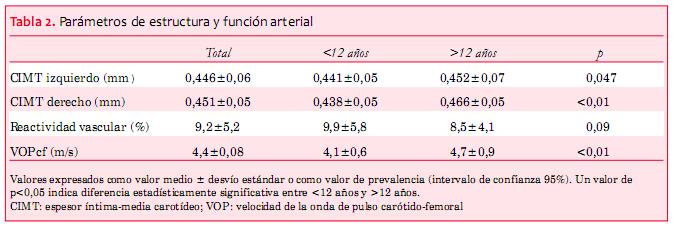
<body><![CDATA[<br>  </span><span style="font-size: 10pt; font-family: Verdana;"><o:p></o:p></span>    <font face="Verdana" size="2">        <br> </font> <span style="font-size: 10pt; font-family: Verdana;"><o:p></o:p></span> <span style="font-size: 10pt; font-family: Verdana; ">Resultados</span><o:p></o:p><font face="Verdana" size="2"> </font>    <span style="font-size: 10pt; font-family: Verdana; ">    <br> &nbsp; </span><span style="font-size: 10pt; font-family: Verdana;"><o:p></o:p></span> <font face="Verdana" size="2">    <br>     </font>     <span style="font-size: 10pt; font-family: Verdana; ">La </span>     <span style="font-size: 10pt; font-family: Verdana; color: rgb(31, 26, 23);"> <a href="/img/revistas/ruc/v30n1/1a09t1.JPG">tabla 1</a></span><span style="font-size: 10pt; font-family: Verdana; "> muestra las caracter&iacute;sticas antropom&eacute;tricas y hemodin&aacute;micas de la poblaci&oacute;n estudiada, as&iacute; como la prevalencia de FRCV cl&aacute;sicos. La proporci&oacute;n de ni&ntilde;as en la poblaci&oacute;n general (45%) y en ambos grupos etarios (42% y 48%) fue similar. La poblaci&oacute;n mostr&oacute; elevada prevalencia de FRCV (sobrepeso/obesidad ~45%; sedentarismo ~55%; cifras hipertensivas durante el estudio ~23%). Como era de esperar, existi&oacute; un aumento edad-relacionado en peso corporal (p &lt; 0,01), altura (p &lt; 0,01) y PA (p &lt; 0,01), as&iacute; como una disminuci&oacute;n en la frecuencia card&iacute;aca (p &lt; 0,01). Con excepci&oacute;n de la obesidad, no existieron diferencias significativas en la prevalencia de FRCV cl&aacute;sicos en los dos grupos etarios evaluados.&nbsp; </span><span style="font-size: 10pt; font-family: Verdana;"><o:p></o:p></span>  <font face="Verdana" size="2">      <br>   </font><span style="font-size: 10pt; font-family: Verdana;"><o:p></o:p></span> <span style="font-size: 10pt; font-family: Verdana; ">En la </span><span style="font-size: 10pt; font-family: Verdana; color: rgb(31, 26, 23);"> <a href="/img/revistas/ruc/v30n1/1a09t2.JPG">tabla 2</a></span><span style="font-size: 10pt; font-family: Verdana; "> se presentan los par&aacute;metros de estructura y funci&oacute;n arterial para el total de ni&ntilde;os y adolescentes, y para los dos grupos etarios. No se encontraron placas de ateroma carot&iacute;deas en la poblaci&oacute;n estudiada. Como era de esperar, a mayor edad se encontraron niveles significativamente mayores de espesores parietales (CIMT) y rigidez a&oacute;rtica (VOP), y menores niveles de reactividad vascular, si bien este &uacute;ltimo qued&oacute; en el umbral de la significancia estad&iacute;stica.&nbsp; </span><span style="font-size: 10pt; font-family: Verdana;"><o:p></o:p>&nbsp;<o:p></o:p></span><font face="Verdana" size="2">      <br>   </font>   <span style="font-size: 10pt; font-family: Verdana; ">La </span>   <span style="font-size: 10pt; font-family: Verdana; color: rgb(31, 26, 23);"> <a href="/img/revistas/ruc/v30n1/1a09t3.JPG">tabla 3</a></span><span style="font-size: 10pt; font-family: Verdana; "> presenta los niveles de prevalencia de valores elevados (para CIMT y VOP) o reducidos (para reactividad vascular) de los par&aacute;metros de estructura y funci&oacute;n arterial. N&oacute;tese que la poblaci&oacute;n estudiada present&oacute; elevada prevalencia (~35%) de niveles de CIMT por encima del punto de corte (p95) propuesto por la AHA, y que la proporci&oacute;n de valores elevados fue mayor en el grupo de mayor edad (~29% vs 42%). Similar hallazgo se encontr&oacute; para la reactividad vascular, si bien la variabilidad intragrupo entre el grupo de menor y mayor edad (~16 vs 31%) no permiti&oacute; alcanzar la significancia estad&iacute;stica. Finalmente, n&oacute;tese c&oacute;mo la prevalencia de niveles de VOP por encima del punto de corte propuesto por la AHA (p95), si bien no se encontr&oacute; particularmente elevada, mostr&oacute; aumento significativo con la edad (~2 vs ~11%).&nbsp; </span><span style="font-size: 10pt; font-family: Verdana;"><o:p></o:p></span>  <font face="Verdana" size="2">      <br> </font> <span style="font-size: 10pt; font-family: Verdana;"><o:p></o:p></span> <font face="Verdana" size="2">    <br> </font> <span style="font-size: 10pt; font-family: Verdana;"><o:p></o:p></span> <span style="font-size: 10pt; font-family: Verdana; ">Discusi&oacute;n</span><o:p></o:p><font face="Verdana" size="2">     <br> </font><span style="font-size: 10pt; font-family: Verdana;"><o:p></o:p></span>    <font face="Verdana" size="2">        <br> </font> <b><span style="font-size: 10pt; font-family: Verdana; ">An&aacute;lisis de resultados&nbsp;</span></b><b style=""><span style="font-size: 10pt; font-family: Verdana; "> </span><span style="font-size: 10pt; font-family: Verdana;"><o:p></o:p></span></b>        ]]></body>
<body><![CDATA[<p style="margin: 0cm 0cm 0.0001pt;"> <span style="font-size: 10pt; font-family: Verdana; ">El presente trabajo tuvo como objetivo determinar la prevalencia de alteraciones arteriales en los primeros 365 ni&ntilde;os uruguayos asintom&aacute;ticos evaluados en el nuevo servicio, empleando para ello criterios diagn&oacute;sticos propuestos recientemente por la AHA. Del an&aacute;lisis de los resultados interesa destacar dos aspectos principales.&nbsp; </span><span style="font-size: 10pt; font-family: Verdana;"><o:p></o:p></span></p>         <p style="margin: 0cm 0cm 0.0001pt;"> <span style="font-size: 10pt; font-family: Verdana; ">Primero, empleando los niveles de corte propuestos por la AHA, se determin&oacute; una elevada prevalencia de alteraciones en estructura y funci&oacute;n arterial evaluados mediante tres de los principales par&aacute;metros empleados en valoraci&oacute;n arterial: CIMT, VOP y RV. Al respecto, un ~35% y ~22% de los ni&ntilde;os y adolescentes evaluados presentaron niveles de CIMT y RV por encima y debajo de los niveles de corte propuestos (</span><span style="font-size: 10pt; font-family: Verdana; color: rgb(31, 26, 23);"><a href="/img/revistas/ruc/v30n1/1a09t2.JPG">tabla 2</a></span><span style="font-size: 10pt; font-family: Verdana; ">).&nbsp; </span><span style="font-size: 10pt; font-family: Verdana;"><o:p></o:p></span></p>         <p style="margin: 0cm 0cm 0.0001pt;"> <span style="font-size: 10pt; font-family: Verdana; ">Esta elevada prevalencia, que determina que ~1/3 de los ni&ntilde;os/adolescentes estudiados presenten CIMT elevado y ~1/5 niveles reducidos de RV, podr&iacute;a al menos deberse a dos causas. Como primer aspecto, la elevada prevalencia podr&iacute;a relacionarse con la elevada exposici&oacute;n a FRCV que mostr&oacute; tener la poblaci&oacute;n estudiada, con especial &eacute;nfasis en los niveles de obesidad. Cabe resaltar que la obesidad infantil se asocia estrechamente con cambios arteriales <span class="GramE">precoces<sup>(</sup></span></span><sup><span style="font-size: 10pt; font-family: Verdana; color: rgb(31, 26, 23);"><a href="#14">14</a></span><span style="font-size: 10pt; font-family: Verdana; ">)</span></sup><span style="font-size: 10pt; font-family: Verdana; ">. Al respecto, de la poblaci&oacute;n estudiada ~1/5 present&oacute; sobrepeso, ~1/4 present&oacute; obesidad, ~1/4 present&oacute; cifras elevadas de PA durante el estudio y ~1/2 present&oacute; niveles de actividad f&iacute;sica compatibles con la definici&oacute;n de sedentarismo. Consecuentemente, al tratarse de una poblaci&oacute;n con elevada exposici&oacute;n a FRCV, era esperable encontrar que su sistema arterial presentase alteraciones detectables de manera no invasiva.&nbsp; </span><span style="font-size: 10pt; font-family: Verdana;"><o:p></o:p></span></p>           <p style="margin: 0cm 0cm 0.0001pt;">  <multicol gutter="18" cols="2"></multicol> <span style="font-size: 10pt; font-family: Verdana; ">  Lejos de sorprender los elevados niveles de prevalencia de alteraciones arteriales encontradas, la importante exposici&oacute;n a FRCV existente en los ni&ntilde;os/adolescentes estudiados y la existencia de una clara asociaci&oacute;n entre FRCV y alteraciones arteriales en ni&ntilde;os determinaba que en los mismos, utilizando la tecnolog&iacute;a apropiada, fuese esperable detectar compromiso temprano del sistema arterial. Al respecto cabe se&ntilde;alar que los ni&ntilde;os obesos han mostrado tener (1) mayor CIMT en adolescencia y vida <span class="GramE">adulta<sup><a name="-17"></a><a name="-18"></a>(</sup></span></span><sup><span style="font-size: 10pt; font-family: Verdana; color: rgb(31, 26, 23);"><a href="#17">17</a></span><span style="font-size: 10pt; font-family: Verdana; ">,</span><span style="font-size: 10pt; font-family: Verdana; color: rgb(31, 26, 23);"><a href="#18">18</a><span style="font-size: 10pt; font-family: Verdana; ">)</span></span></sup><span style="font-size: 10pt; font-family: Verdana; color: rgb(31, 26, 23);"><span style="font-size: 10pt; font-family: Verdana; ">, (2) mayor rigidez arterial</span><sup><span style="font-size: 10pt; font-family: Verdana; "><a name="-19"></a><a name="-20"></a>(</span><a href="#19">19</a><span style="font-size: 10pt; font-family: Verdana; ">,</span><a href="#20">20</a><span style="font-size: 10pt; font-family: Verdana; ">)</span></sup><span style="font-size: 10pt; font-family: Verdana; ">, y (3) menor reactividad vascular</span><sup><span style="font-size: 10pt; font-family: Verdana; ">(</span><a href="#14">14</a><span style="font-size: 10pt; font-family: Verdana; ">,</span><a href="#20">20</a><span style="font-size: 10pt; font-family: Verdana; ">)</span></sup><span style="font-size: 10pt; font-family: Verdana; ">. Espec&iacute;ficamente, mayor IMC en la ni&ntilde;ez se asocia a mayor riesgo de EA coronaria en la vida <span class="GramE">adulta<sup><a name="-21"></a><a name="-22"></a><a name="-23"></a>(</sup></span></span><sup><a href="#21">21-23</a><span style="font-size: 10pt; font-family: Verdana; ">)</span></sup><span style="font-size: 10pt; font-family: Verdana; ">. Asimismo, se demostr&oacute; asociaci&oacute;n entre la resistencia a la insulina y la EA carot&iacute;dea prematura en ni&ntilde;os <span class="GramE">obesos<sup><a name="-24"></a>(</sup></span></span><sup><a href="#24">24</a><span style="font-size: 10pt; font-family: Verdana; ">)</span></sup><span style="font-size: 10pt; font-family: Verdana; ">. Las alteraciones en la producci&oacute;n y respuesta a la insulina pueden resultar en otras alteraciones vasculares, como la disfunci&oacute;n <span class="GramE">endotelial<sup><a name="-25"></a><a name="-26"></a>(</sup></span></span><sup><a href="#25">25</a><span style="font-size: 10pt; font-family: Verdana; ">,</span><a href="#26">26</a><span style="font-size: 10pt; font-family: Verdana; ">)</span></sup><span style="font-size: 10pt; font-family: Verdana; ">. Por otra parte, al igual que en los adultos, existe asociaci&oacute;n entre nivel de PA en ni&ntilde;os y el da&ntilde;o de &oacute;rgano blanco (ventricular y vascular<span class="GramE">)<sup><a name="-27"></a><a name="-28"></a>(</sup></span></span><sup><a href="#27">27</a><span style="font-size: 10pt; font-family: Verdana; ">,</span><a href="#28">28</a><span style="font-size: 10pt; font-family: Verdana; ">)</span></sup><span style="font-size: 10pt; font-family: Verdana; ">. As&iacute;, niveles elevados de PA en ni&ntilde;os/adolescentes se asocian a elevado CIMT y <span class="GramE">RA<sup>(</sup></span></span><sup><a href="#27">27</a><span style="font-size: 10pt; font-family: Verdana; ">,</span><a href="#28">28</a><span style="font-size: 10pt; font-family: Verdana; ">)</span></sup><span style="font-size: 10pt; font-family: Verdana; ">. Adicionalmente, se ha demostrado asociaci&oacute;n positiva entre sedentarismo infantil (medido como horas sentado en una silla en d&iacute;as de la semana, no fin de semana) y RA en el adulto joven, con independencia del resto de la actividad f&iacute;sica <span class="GramE">realizada<sup><a name="-29"></a>(</sup></span></span><sup><a href="#29">29</a><span style="font-size: 10pt; font-family: Verdana; ">)</span></sup><span style="font-size: 10pt; font-family: Verdana; ">. Por &uacute;ltimo, la relaci&oacute;n triglic&eacute;ridos/HDL ser&iacute;a determinante de la rigidez arterial humeral y a&oacute;rtica en adolescentes y adultos j&oacute;venes aparentemente <span class="GramE">sanos<sup><a name="-30"></a>(</sup></span></span><sup><a href="#30">30</a><span style="font-size: 10pt; font-family: Verdana; ">)</span></sup><span style="font-size: 10pt; font-family: Verdana; ">, y predictora de la progresi&oacute;n del CIMT (independientemente de otros FRCV)</span><sup><span style="font-size: 10pt; font-family: Verdana; "><a name="-31"></a>(</span><a href="#31">31</a><span style="font-size: 10pt; font-family: Verdana; ">)</span></sup><span style="font-size: 10pt; font-family: Verdana; ">. Adicionalmente, los niveles de LDL se asocian a cambios arteriales precl&iacute;nicos como CIMT elevado, independientemente de otros <span class="GramE">FRCV<sup><a name="-32"></a><a name="-33"></a>(</sup></span></span><sup><a href="#32">32</a><span style="font-size: 10pt; font-family: Verdana; ">,</span><a href="#33">33</a><span style="font-size: 10pt; font-family: Verdana; ">)</span></sup><span style="font-size: 10pt; font-family: Verdana; color: rgb(31, 26, 23);"><span style="font-size: 10pt; font-family: Verdana; ">.&nbsp; </span> </span> </span><span style="font-size: 10pt; font-family: Verdana;"><o:p></o:p></span></p>         <p style="margin: 0cm 0cm 0.0001pt;"> <span style="font-size: 10pt; font-family: Verdana; ">Es importante se&ntilde;alar que la inclusi&oacute;n de ni&ntilde;os y adolescentes consecutivos que asistieron al servicio, sin un muestreo espec&iacute;fico, hace que esta serie no sea representativa de la poblaci&oacute;n nacional. Al respecto, en especial los niveles de prevalencia de obesidad fueron mayores que los reportados en trabajos previos. Esto podr&iacute;a haber sido generado por una mayor tendencia, por parte de los profesionales que derivaron a los ni&ntilde;os a ser estudiados, a centrarse en aquellos que mostraban evidencias notorias de presentar una alteraci&oacute;n por exceso nutricional. A manera de ejemplo, el estudio ENSO, realizado 15 a&ntilde;os atr&aacute;s en nuestro pa&iacute;s (a&ntilde;o 2000), obtuvo datos de 886 ni&ntilde;os/adolescentes de 9 a 12 a&ntilde;os de poblaciones urbanas, reportando que el 17% presentaba sobrepeso (IMC: p85-p94,9) y 9% obesidad (IMC &gt; p95), y consecuentemente ~26% presentaba sobrepeso u obesidad</span><sup><span style="font-size: 10pt; font-family: Verdana; "><a name="-34"></a>(</span><span style="font-size: 10pt; font-family: Verdana; color: rgb(31, 26, 23);"><a href="#34">34</a></span><span style="font-size: 10pt; font-family: Verdana; ">)</span></sup><span style="font-size: 10pt; font-family: Verdana; ">. Este resultado muestra un muy similar nivel de sobrepeso respecto de esta serie (17% vs 19%), pero una prevalencia mucho menor de obesidad (~9% vs ~26%). Al igual que en esta serie, los autores reportaron reducci&oacute;n significativa en la prevalencia de obesidad al alcanzarse los 12 a&ntilde;os de edad, lo que podr&iacute;a estar vinculado al inicio del empuje de crecimiento determinado por la pubertad</span><sup><span style="font-size: 10pt; font-family: Verdana; ">(</span><span style="font-size: 10pt; font-family: Verdana; color: rgb(31, 26, 23);"><a href="#34">34</a></span><span style="font-size: 10pt; font-family: Verdana; ">)</span></sup><span style="font-size: 10pt; font-family: Verdana; ">.&nbsp; </span><span style="font-size: 10pt; font-family: Verdana;"><o:p></o:p></span></p>           <p style="margin: 0cm 0cm 0.0001pt;">  <multicol gutter="18" cols="2"></multicol> <span style="font-size: 10pt; font-family: Verdana; ">  Como segundo aspecto, que explique al menos parcialmente la elevada prevalencia de alteraciones que fue encontrada en nuestra serie, podr&iacute;a considerarse la inadecuaci&oacute;n de los niveles de corte propuestos por la AHA para ser generalizados a nuestra poblaci&oacute;n. Esto &uacute;ltimo podr&iacute;a encontrarse influenciado por al menos dos factores: (1) las poblaciones estudiadas en los trabajos que proponen dichos valores de corte se encontraban libres de FRCV cl&aacute;sicos al momento del estudio, mientras que la poblaci&oacute;n estudiada en el CHPR mostr&oacute; la elevada prevalencia de FRCV ya discutida, (2) estos valores de corte (normalidad/referencia) provienen de poblaciones europeas y otras (Polonia, Alemania, Turqu&iacute;a, Hungr&iacute;a, Argelia, Suecia e Italia) que no se encuentran particularmente relacionadas desde el punto de vista &eacute;tnico con nuestra poblaci&oacute;n. Al menos en teor&iacute;a podr&iacute;a ocurrir que su aplicaci&oacute;n determinara niveles de sobrediagn&oacute;stico en nuestra poblaci&oacute;n, lo que pone de manifiesto la necesidad de realizar estudios que permitan caracterizar poblacionalmente a los ni&ntilde;os/adolescentes de nuestro pa&iacute;s con vistas a determinar nuestros propios valores de referencia nacionales y/o analizar la compatibilidad con los propuestos por la AHA, considerando, por ejemplo, trabajar con poblaciones libres de FRCV. Finalmente, resulta importante destacar que no existieron diferencias importantes en los abordajes metodol&oacute;gicos utilizados para la evaluaci&oacute;n de los ni&ntilde;os/adolescentes en el CHPR con respecto a los utilizados para la generaci&oacute;n de los valores de corte propuestos por la AHA, por lo que este aspecto no constituye un factor de confusi&oacute;n en la interpretaci&oacute;n de nuestros resultados.&nbsp; </span><span style="font-size: 10pt; font-family: Verdana;"><o:p></o:p></span></p>         <p style="margin: 0cm 0cm 0.0001pt;"> <span style="font-size: 10pt; font-family: Verdana; ">Segundo, existi&oacute; un aumento edad-asociado en la prevalencia de alteraciones arteriales al comparar los grupos de menores y mayores de 12 a&ntilde;os de edad. En este sentido, los mayores de 12 a&ntilde;os presentaron mayor prevalencia de CIMT elevado (p = 0,02), mayor prevalencia de VOP elevada (p &lt; 0,01) y una mayor proporci&oacute;n de RV disminuida (si bien no alcanz&oacute; significancia estad&iacute;stica).&nbsp; </span><span style="font-size: 10pt; font-family: Verdana;"><o:p></o:p></span></p>         <p style="margin: 0cm 0cm 0.0001pt;"> <span style="font-size: 10pt; font-family: Verdana; ">En teor&iacute;a, estas diferencias podr&iacute;an ser parcialmente explicadas por un mayor tiempo de exposici&oacute;n a los FRCV en el grupo de mayores de 12 a&ntilde;os. Al respecto, en el a&ntilde;o 2002, resultados del International Childhood Cardiovascular Cohort (i3C) Consortium (incluy&oacute; a m&aacute;s de 40.000 ni&ntilde;os) demostraron que a los 6 a&ntilde;os de vida en varones y a los 9 en ambos sexos el nivel de exposici&oacute;n a FRCV se asocia con el nivel de EA subcl&iacute;nica (medido por CIMT) en adultos (20-45 a&ntilde;os), y que si bien antes de los 9 a&ntilde;os la asociaci&oacute;n entre FRCV y EA (evaluada por CIMT en adultos j&oacute;venes) es d&eacute;bil, a partir de los 9 a&ntilde;os de edad existe una importante asociaci&oacute;n entre FRCV del ni&ntilde;o/adolescente y el deterioro arterial del adulto</span><sup><span style="font-size: 10pt; font-family: Verdana; "><a name="-35"></a>(</span><span style="font-size: 10pt; font-family: Verdana; color: rgb(31, 26, 23);"><a href="#35">35</a></span><span style="font-size: 10pt; font-family: Verdana; ">)</span></sup><span style="font-size: 10pt; font-family: Verdana; ">. En otras palabras, a mayor edad del ni&ntilde;o, mayor es su exposici&oacute;n a FRCV, y m&aacute;s estrechamente comienza a existir asociaci&oacute;n con el deterioro arterial que tendr&aacute; en su vida adulta. M&aacute;s espec&iacute;ficamente, individualmente el colesterol total (a los 12, 15 y 18 a&ntilde;os), la PA sist&oacute;lica (a los 6, 12, 15 y 18 a&ntilde;os) y el IMC (a los 9, 12, 15 y 18 a&ntilde;os) mostraron asociaci&oacute;n con EA (evaluada por CIMT) en adultos (20-45 a&ntilde;os<span class="GramE">)<sup>(</sup></span></span><sup><span style="font-size: 10pt; font-family: Verdana; color: rgb(31, 26, 23);"><a href="#35">35</a></span><span style="font-size: 10pt; font-family: Verdana; ">)</span></sup><span style="font-size: 10pt; font-family: Verdana; ">. Cuanto mayor sea la edad del ni&ntilde;o que presenta FRCV, mayor es la asociaci&oacute;n con riesgo cardiovascular elevado al ser <span class="GramE">adulto<sup><a name="-36"></a><a name="-37"></a><a name="-38"></a>(</sup></span></span><span style="font-size: 10pt; font-family: Verdana; color: rgb(31, 26, 23);"><sup><a href="#35">35-38</a><span style="font-size: 10pt; font-family: Verdana; ">)</span></sup><span style="font-size: 10pt; font-family: Verdana; ">.</span><o:p></o:p></span></p>     <font face="Verdana" size="2">         <br>     </font>         <p style="margin: 0cm 0cm 0.0001pt;"><b> <span style="font-size: 10pt; font-family: Verdana; ">Aspectos metodol&oacute;gicos&nbsp;</span></b><b style=""><span style="font-size: 10pt; font-family: Verdana; "> </span><span style="font-size: 10pt; font-family: Verdana;"><o:p></o:p></span></b></p>         ]]></body>
<body><![CDATA[<p style="margin: 0cm 0cm 0.0001pt;"> <span style="font-size: 10pt; font-family: Verdana; ">En el presente trabajo se defini&oacute; evaluar tres par&aacute;metros arteriales principales. Esto se debe a que por una parte elevados niveles de CIMT respecto del esperado para la edad y el sexo del paciente han mostrado asociarse a (1) presencia de FRCV, (2) mayor prevalencia e incidencia de eventos cardiovasculares, (3) severidad de la EA en diferentes territorios y/o (4) presencia de da&ntilde;o de &oacute;rgano blanco</span><sup><span style="font-size: 10pt; font-family: Verdana; ">(</span><span style="font-size: 10pt; font-family: Verdana; color: rgb(31, 26, 23);"><a href="#16">16</a></span><span style="font-size: 10pt; font-family: Verdana; ">)</span></sup><span style="font-size: 10pt; font-family: Verdana; ">. Por otra parte, la VOP es el indicador est&aacute;ndar oro para evaluar la rigidez arterial. En la EA antes de que ocurran modificaciones arteriales luminales se producen cambios parietales (por ejemplo, en elastina, col&aacute;geno) que elevan la RA. El nivel de RA es: (1) predictor independiente de riesgo cardiovascular, aditivo y complementario al abordaje tradicional, (2) predictor de mortalidad cardiovascular y de toda causa, (3) &uacute;til en estratificaci&oacute;n de riesgo cardiovascular individual y en reclasificaci&oacute;n del riesgo, (4) modificable terap&eacute;uticamente y de ser mejorado asocia mejor pron&oacute;stico (en subpoblaciones espec&iacute;ficas) y (5) marcador del estado arterial, siendo indicador del &ldquo;da&ntilde;o acumulado<span class="GramE">&rdquo;<sup>(</sup></span></span><sup><span style="font-size: 10pt; font-family: Verdana; color: rgb(31, 26, 23);"><a href="#4">4</a></span><span style="font-size: 10pt; font-family: Verdana; ">)</span></sup><span style="font-size: 10pt; font-family: Verdana; ">. Por &uacute;ltimo se ha evaluado la RV. Al respecto, las arterias regulan su di&aacute;metro, dilat&aacute;ndose o contray&eacute;ndose, seg&uacute;n las condiciones hemodin&aacute;micas que enfrentan. Un elevado flujo sangu&iacute;neo hacia un &oacute;rgano determina que en sus arterias de conducci&oacute;n se eleve la tensi&oacute;n de cizalla ejercida por la sangre tangencialmente sobre la capa endotelial de la pared arterial. Las c&eacute;lulas endoteliales detectan el aumento en tensi&oacute;n de cizalla y liberan factores relajadores del m&uacute;sculo liso parietal causando dilataci&oacute;n arterial. La reducci&oacute;n en la tensi&oacute;n de cizalla genera cambios opuestos. La capacidad arterial de modificar su di&aacute;metro ante est&iacute;mulos fisiol&oacute;gicos y/o experimentales define el concepto de RV. La disfunci&oacute;n endotelial y/o muscular es la causa habitual de alteraciones en la RV, determinando que las arterias no respondan adecuadamente ante variaciones de tensi&oacute;n de cizalla. Esto se encuentra asociado a la presencia de FRCV y se evidencia en estadios tempranos (asintom&aacute;ticos) de la EA. Los marcadores de disfunci&oacute;n endotelial son predictores independientes de eventos cardiovasculares y &uacute;tiles para determinar y reclasificar el riesgo <span class="GramE">cardiovascular<sup><a name="-39"></a>(</sup></span></span><span style="font-size: 10pt; font-family: Verdana; color: rgb(31, 26, 23);"><sup><a href="#39">39</a><span style="font-size: 10pt; font-family: Verdana; ">)</span></sup><span style="font-size: 10pt; font-family: Verdana; ">.</span><o:p></o:p></span></p>         <p style="margin: 0cm 0cm 0.0001pt;"> <span style="font-size: 10pt; font-family: Verdana; ">&nbsp; </span><span style="font-size: 10pt; font-family: Verdana;"><o:p></o:p></span></p>           <p style="margin: 0cm 0cm 0.0001pt;"><b> <span style="font-size: 10pt; font-family: Verdana; ">  Importancia biom&eacute;dica&nbsp;</span></b><b style=""><span style="font-size: 10pt; font-family: Verdana; "> </span><span style="font-size: 10pt; font-family: Verdana;"><o:p></o:p></span></b></p>         <p style="margin: 0cm 0cm 0.0001pt;"> <span style="font-size: 10pt; font-family: Verdana; ">Los resultados expuestos ponen de manifiesto que la evaluaci&oacute;n arterial no invasiva en ni&ntilde;os y adolescentes permite detectar precozmente alteraciones estructurales y/o funcionales asociadas a la EA y a un riesgo cardiovascular relativo (para la edad) elevado. Adem&aacute;s, es sabido que: (1) la susceptibilidad terap&eacute;utica de la EA disminuye conforme aumenta la <span class="GramE">edad<sup><a name="-40"></a>(</sup></span></span><sup><span style="font-size: 10pt; font-family: Verdana; color: rgb(31, 26, 23);"><a href="#40">40</a></span><span style="font-size: 10pt; font-family: Verdana; ">)</span></sup><span style="font-size: 10pt; font-family: Verdana; "> y (2) la aplicaci&oacute;n de intervenciones adecuadas en ni&ntilde;os y adolescentes permite reducir e incluso revertir dichas alteraciones arteriales</span><sup><span style="font-size: 10pt; font-family: Verdana; "><a name="-41"></a>(</span><span style="font-size: 10pt; font-family: Verdana; color: rgb(31, 26, 23);"><a href="#41">41</a></span><span style="font-size: 10pt; font-family: Verdana; ">)</span></sup><span style="font-size: 10pt; font-family: Verdana; ">. Por lo tanto, estos estudios podr&iacute;an permitir discriminar determinados grupos de ni&ntilde;os y adolescentes que se beneficiar&iacute;an de recibir un seguimiento individualizado y/o de la aplicaci&oacute;n de medidas terap&eacute;uticas espec&iacute;ficas.&nbsp; </span><span style="font-size: 10pt; font-family: Verdana;"><o:p></o:p></span></p>         <p style="margin: 0cm 0cm 0.0001pt;"> <span style="font-size: 10pt; font-family: Verdana; ">Por otra parte, estos resultados permiten evidenciar que la prevalencia de alteraciones arteriales en edades tempranas puede ser elevada y que los FRCV a los que se enfrentan los ni&ntilde;os ya pueden estar modificando sustancialmente la estructura y funci&oacute;n arterial. En consecuencia, evidenciar que en edades muy tempranas ya el da&ntilde;o se encuentra funcionalmente presente deber&iacute;a fortalecer la puesta en pr&aacute;ctica de medidas para reducir la exposici&oacute;n a FRCV, a la vez que emplear estas t&eacute;cnicas a la hora de intentar discriminar/diagnosticar tempranamente aquellos ni&ntilde;os que podr&iacute;an necesitar un refuerzo especial en medidas preventivas.&nbsp; </span><span style="font-size: 10pt; font-family: Verdana;"><o:p></o:p></span></p>     <span style="font-size: 10pt; font-family: Verdana; ">Trabajos futuros ser&aacute;n necesarios para determinar la prevalencia de alteraciones en ni&ntilde;os sin exposici&oacute;n a FRCV, a la vez que permitan la generaci&oacute;n de valores de normalidad y/o referencia en par&aacute;metros de estructura y funci&oacute;n arterial para la poblaci&oacute;n pedi&aacute;trica uruguaya.&nbsp; </span><span style="font-size: 10pt; font-family: Verdana;"><o:p></o:p></span>        <font face="Verdana" size="2">            <br>     <br> </font> <span style="font-size: 10pt; font-family: Verdana;"><o:p></o:p></span> <span style="font-size: 10pt; font-family: Verdana; ">Conclusiones</span><span style="font-size: 10pt; font-family: Verdana; ">    <br> <span style="">&nbsp;</span></span><span style="font-size: 10pt; font-family: Verdana;"><o:p></o:p></span><font face="Verdana" size="2">        <br> </font> <span style="font-size: 10pt; font-family: Verdana; ">Existi&oacute; una elevada prevalencia de alteraci&oacute;n en estructura y funci&oacute;n arterial detectable de manera precoz en los primeros 365 ni&ntilde;os estudiados en el nuevo servicio pedi&aacute;trico preventivo. Aproximadamente un 35% y un 22% de los ni&ntilde;os y adolescentes evaluados presentaron niveles de CIMT y RV por encima y debajo de los niveles de corte propuestos. La prevalencia aument&oacute; con la edad de los ni&ntilde;os.&nbsp; </span><span style="font-size: 10pt; font-family: Verdana;"><o:p></o:p></span>    <font face="Verdana" size="2">        <br> </font> <span style="font-size: 10pt; font-family: Verdana; ">Esta prevalencia (as&iacute; como el aumento edad-relacionado en la misma) podr&iacute;a encontrarse determinada por la exposici&oacute;n a FRCV y el tiempo de exposici&oacute;n a los mismos. Tambi&eacute;n podr&iacute;a encontrarse influenciada por los valores de corte utilizados, reforzando esto &uacute;ltimo la necesidad de contar con valores de referencia nacionales.&nbsp;</span><o:p></o:p><font face="Verdana" size="2">        ]]></body>
<body><![CDATA[<br> </font> <span style="font-size: 10pt; font-family: Verdana; ">    <br>     <br> </span><span style="font-size: 10pt; font-family: Verdana;"><o:p></o:p><o:p></o:p></span> <span style="font-size: 10pt; font-family: Verdana; ">Bibliograf&iacute;a</span><o:p></o:p><font face="Verdana" size="2"> </font>        <p style="margin: 0cm 0cm 0.0001pt;"> <span style="font-size: 10pt; font-family: Verdana; ">&nbsp; </span><span style="font-size: 10pt; font-family: Verdana;"><o:p></o:p></span></p>         <!-- ref --><p style="margin: 0cm 0cm 0.0001pt;"> <span style="font-size: 10pt; font-family: Verdana; "><a name="1"></a> </span><span style="font-size: 10pt; font-family: Verdana; color: rgb(31, 26, 23);"><a href="#-1">1</a></span><span style="font-size: 10pt; font-family: Verdana; ">.&nbsp;&nbsp;&nbsp;&nbsp;<span style="">Mancia G, Fagard R, Narkiewicz K, Redon J, Zanchetti A, B&ouml;hm M, et al; Task Force for the Management of Arterial Hypertension of the European Society of Hypertension and the European Society of Cardiology.</span> 2013 ESH/ESC Practice Guidelines for the Management of Arterial Hypertension. Blood Press 2014; 23(1):3-16.    &nbsp; </span><span style="font-size: 10pt; font-family: Verdana;"><o:p></o:p></span></p>         <p style="margin: 0cm 0cm 0.0001pt;"> <span style="font-size: 10pt; font-family: Verdana; "><a name="2"></a> </span><span style="font-size: 10pt; font-family: Verdana; color: rgb(31, 26, 23);"><a href="#-2">2</a></span><span style="font-size: 10pt; font-family: Verdana; ">.&nbsp;&nbsp;&nbsp;&nbsp;<span style="">Perk J, De Backer G, Gohlke H, Graham I, Reiner Z, Verschuren M, et al; European Association for Cardiovascular Prevention &amp; Rehabilitation; ESC Committeefor Practice Guidelines.</span> European Guidelines on cardiovascular diseaseprevention in clinical practice: version 2012. The Fifth Joint Task Force of the European Society of Cardiology and Other Societies on Cardiovascular DiseasePrevention in Clinical Practice (constituted by representatives of nine societies and by invited experts). Eur Heart J 2012<span class="GramE">;33</span>(13):1635-701.&nbsp; </span><span style="font-size: 10pt; font-family: Verdana;"><o:p></o:p></span></p>         <!-- ref --><p style="margin: 0cm 0cm 0.0001pt;"> <span style="font-size: 10pt; font-family: Verdana; "><a name="3"></a> </span><span style="font-size: 10pt; font-family: Verdana; color: rgb(31, 26, 23);"><a href="#-3">3</a></span><span style="font-size: 10pt; font-family: Verdana; ">.&nbsp;&nbsp;&nbsp;&nbsp;<span style="">Naghavi M, Libby P, Falk E, Casscells SW, Litovsky S, Rumberger J, et al.</span> From vulnerable plaque to vulnerable patient: a call for new definitions and risk assessment strategies: Part I. Circulation 2003; 108(14):1664-72.    &nbsp; </span><span style="font-size: 10pt; font-family: Verdana;"><o:p></o:p></span></p>         <!-- ref --><p style="margin: 0cm 0cm 0.0001pt;"> <span style="font-size: 10pt; font-family: Verdana; "><a name="4"></a> </span><span style="font-size: 10pt; font-family: Verdana; color: rgb(31, 26, 23);"><a href="#-4">4</a></span><span style="font-size: 10pt; font-family: Verdana; ">.&nbsp;&nbsp;&nbsp;&nbsp;<span style="">Bia D, Z&oacute;calo Y.</span> Rigidez arterial: evaluaci&oacute;n no invasiva en la pr&aacute;ctica cl&iacute;nica Importancia cl&iacute;nica y an&aacute;lisis de las bases metodol&oacute;gicas de los equipos disponibles para su evaluaci&oacute;n. Rev Urug Cardiol 2014; 29(1):39-59.    &nbsp; </span><span style="font-size: 10pt; font-family: Verdana;"><o:p></o:p></span></p>         <!-- ref --><p style="margin: 0cm 0cm 0.0001pt;"> <span style="font-size: 10pt; font-family: Verdana; "><a name="5"></a> </span><span style="font-size: 10pt; font-family: Verdana; color: rgb(31, 26, 23);"><a href="#-5">5</a></span><span style="font-size: 10pt; font-family: Verdana; ">.&nbsp;&nbsp;&nbsp;&nbsp;<span style="">Bia D, Z&oacute;calo Y.</span> Reactividad vascular: evaluaci&oacute;n no invasiva en la pr&aacute;ctica cl&iacute;nica. Importancia cl&iacute;nica y an&aacute;lisis de las bases metodol&oacute;gicas de los equipos disponibles para su evaluaci&oacute;n. Rev Urug Cardiol 2014; 29:351-68.    &nbsp; </span><span style="font-size: 10pt; font-family: Verdana;"><o:p></o:p></span></p>         <!-- ref --><p style="margin: 0cm 0cm 0.0001pt;"> <span style="font-size: 10pt; font-family: Verdana; "><a name="6"></a> </span><span style="font-size: 10pt; font-family: Verdana; color: rgb(31, 26, 23);"><a href="#-6">6</a></span><span style="font-size: 10pt; font-family: Verdana; ">.&nbsp;&nbsp;&nbsp;&nbsp;<span style="">Santana DB, Z&oacute;calo YA, Armentano RL.</span> Integrated e-Health approach based on vascular ultrasound and pulse wave analysis for asymptomatic atherosclerosis detection and cardiovascular risk stratification in the community. IEEE Trans Inf Technol Biomed 2012<span class="GramE">;16</span>(2):287-94.    &nbsp; </span><span style="font-size: 10pt; font-family: Verdana;"><o:p></o:p></span></p>           <!-- ref --><p style="margin: 0cm 0cm 0.0001pt;">  <span style="font-size: 10pt; font-family: Verdana; "><a name="7"></a> </span>  <span style="font-size: 10pt; font-family: Verdana; color: rgb(31, 26, 23);"><a href="#-7">7</a></span><span style="font-size: 10pt; font-family: Verdana; ">.&nbsp;&nbsp;&nbsp;&nbsp;<span style="">Santana DB, Z&oacute;calo YA, Ventura IF, Arrosa JF, Florio L, Lluberas R, et al.</span> Health informatics design for assisted diagnosis of subclinical atherosclerosis, structural, and functional arterial age calculus and patient-specific cardiovascular risk evaluation. IEEE Trans Inf Technol Biomed 2012; 16(5):943-51.    &nbsp; </span><span style="font-size: 10pt; font-family: Verdana;"><o:p></o:p></span></p>         <!-- ref --><p style="margin: 0cm 0cm 0.0001pt;"> <span style="font-size: 10pt; font-family: Verdana; "><a name="8"></a> </span><span style="font-size: 10pt; font-family: Verdana; color: rgb(31, 26, 23);"><a href="#-8">8</a></span><span style="font-size: 10pt; font-family: Verdana; ">.&nbsp;&nbsp;&nbsp;&nbsp;<span style="">Bia D, Z&oacute;calo Y, Farro I, Torrado J, Farro F, Florio L, et al.</span> Integrated evaluation of age-related changes in structural and functional vascular parameters used to assess arterial aging, subclinical atherosclerosis, and cardiovascular risk in uruguayan adults: CUiiDARTE Project. Int J Hypertens 2011; 2011:587303.    &nbsp; </span><span style="font-size: 10pt; font-family: Verdana;"><o:p></o:p></span></p>         <!-- ref --><p style="margin: 0cm 0cm 0.0001pt;"> <span style="font-size: 10pt; font-family: Verdana; "><a name="9"></a> </span><span style="font-size: 10pt; font-family: Verdana; color: rgb(31, 26, 23);"><a href="#-9">9</a></span><span style="font-size: 10pt; font-family: Verdana; ">.&nbsp;&nbsp;&nbsp;&nbsp;<span style="">Z&oacute;calo Y, Bia D. </span>Presi&oacute;n a&oacute;rtica central y par&aacute;metros cl&iacute;nicos derivados de la onda del pulso: evaluaci&oacute;n no invasiva en la pr&aacute;ctica cl&iacute;nica. Importancia cl&iacute;nica y an&aacute;lisis de las bases metodol&oacute;gicas de los equipos disponibles para su evaluaci&oacute;n. Rev Urug Cardiol 2014; 29(2):92-107.    &nbsp; </span><span style="font-size: 10pt; font-family: Verdana;"><o:p></o:p></span></p>         <!-- ref --><p style="margin: 0cm 0cm 0.0001pt;"> <span style="font-size: 10pt; font-family: Verdana; "><a name="10"></a> </span><span style="font-size: 10pt; font-family: Verdana; color: rgb(31, 26, 23);"><a href="#-10">10</a></span><span style="font-size: 10pt; font-family: Verdana; ">.&nbsp;&nbsp;&nbsp;&nbsp;<span style="">Berenson G, Srinivasan SR, Bao W, Newman WP 3rd, Tracy RE, Wattigney WA.</span> Association between multiple cardiovascular risk factors and atherosclerosis in children and young adults: The Bogalusa Heart Study. N Engl J Med 1998<span class="GramE">;338</span>(23): 1650-6.    &nbsp; </span><span style="font-size: 10pt; font-family: Verdana;"><o:p></o:p></span></p>         <!-- ref --><p style="margin: 0cm 0cm 0.0001pt;"> <span style="font-size: 10pt; font-family: Verdana; "><a name="11"></a> </span><span style="font-size: 10pt; font-family: Verdana; color: rgb(31, 26, 23);"><a href="#-11">11</a></span><span style="font-size: 10pt; font-family: Verdana; ">.&nbsp;&nbsp;&nbsp;&nbsp;<span style="">Urbina EM, Williams RV, Alpert BS, Collins RT, Daniels SR, Hayman L, et al; American Heart Association Atherosclerosis, Hypertension, and Obesity in Youth Committee of the Council on Cardiovascular Disease in the Young.</span> Noninvasive assessment of subclinical atherosclerosis in children and adolescents: recommendations for standard assessment for clinical research: a scientific statement from the American Heart Association. Hypertension 2009; 54(5):919-50.    &nbsp; </span><span style="font-size: 10pt; font-family: Verdana;"><o:p></o:p></span></p>         <!-- ref --><p style="margin: 0cm 0cm 0.0001pt;"> <span style="font-size: 10pt; font-family: Verdana; "><a name="12"></a> </span><span style="font-size: 10pt; font-family: Verdana; color: rgb(31, 26, 23);"><a href="#-12">12</a></span><span style="font-size: 10pt; font-family: Verdana; ">.&nbsp;&nbsp;&nbsp;&nbsp;<span style="">Reusz GS, Cseprekal O, Temmar M, Kis E, Cherif AB, Thaleb A, et al.</span> Reference values of pulse wave velocity in healthy children and teenagers. Hypertension 2010<span class="GramE">;56</span>(2):217-24.    &nbsp; </span><span style="font-size: 10pt; font-family: Verdana;"><o:p></o:p></span></p>         <!-- ref --><p style="margin: 0cm 0cm 0.0001pt;"> <span style="font-size: 10pt; font-family: Verdana; "><a name="13"></a> </span><span style="font-size: 10pt; font-family: Verdana; color: rgb(31, 26, 23);"><a href="#-13">13</a></span><span style="font-size: 10pt; font-family: Verdana; ">.&nbsp;&nbsp;&nbsp;&nbsp;<span style="">Doyon A, Kracht D, Bayazit A, Deveci M, Duzova A, Krmar RT, et al.</span> Carotid artery intima-media thickness and distensibility in children and adolescents: reference values and role of body dimensions. Hypertension 2013<span class="GramE">;62</span>(3):550-6.    &nbsp; </span><span style="font-size: 10pt; font-family: Verdana;"><o:p></o:p></span></p>         <!-- ref --><p style="margin: 0cm 0cm 0.0001pt;"> <span style="font-size: 10pt; font-family: Verdana; "><a name="14"></a> </span><span style="font-size: 10pt; font-family: Verdana; color: rgb(31, 26, 23);"><a href="#-14">14</a></span><span style="font-size: 10pt; font-family: Verdana; ">.&nbsp;&nbsp;&nbsp;&nbsp;<span style="">Cote AT, Harris KC, Panagiotopoulos C, Sandor GG, Devlin AM.</span> Childhood obesity and cardiovascular dysfunction. J Am Coll Cardiol 2013<span class="GramE">;62</span>(15): 1309-19.    &nbsp; </span><span style="font-size: 10pt; font-family: Verdana;"><o:p></o:p></span></p>         <!-- ref --><p style="margin: 0cm 0cm 0.0001pt;"> <span style="font-size: 10pt; font-family: Verdana; "><a name="15"></a> </span><span style="font-size: 10pt; font-family: Verdana; color: rgb(31, 26, 23);"><a href="#-15">15</a></span><span style="font-size: 10pt; font-family: Verdana; ">.&nbsp;&nbsp;&nbsp;&nbsp;<span style="">Argentina. Comit&eacute; Nacional de Medicina del Deporte Infanto-Juvenil.</span> Subcomisi&oacute;n de Epidemiolog&iacute;a. Consenso sobre factores de riesgo de enfermedad cardiovascular en pediatr&iacute;a: sedentarismo. Arch Argent Pediatr 2005<span class="GramE">;103</span>(5):450-63.    &nbsp; </span><span style="font-size: 10pt; font-family: Verdana;"><o:p></o:p></span></p>         <!-- ref --><p style="margin: 0cm 0cm 0.0001pt;"> <span style="font-size: 10pt; font-family: Verdana; "><a name="16"></a> </span><span style="font-size: 10pt; font-family: Verdana; color: rgb(31, 26, 23);"><a href="#-16">16</a></span><span style="font-size: 10pt; font-family: Verdana; ">.&nbsp;&nbsp;&nbsp;&nbsp;<span style="">Stein JH, Korcarz CE, Hurst RT, Lonn E, Kendall CB, Mohler ER, et al; American Society of Echocardiography Carotid Intima-Media Thickness Task Force.</span> Use of carotid ultrasound to identify subclinical vascular disease and evaluate cardiovascular disease risk: a consensus statement from the American Society of Echocardiography Carotid Intima-Media Thickness Task Force. Endorsed by the Society for Vascular Medicine. J Am Soc Echocardiogr 2008; 21(2):93-111.    &nbsp; </span><span style="font-size: 10pt; font-family: Verdana;"><o:p></o:p></span></p>         <!-- ref --><p style="margin: 0cm 0cm 0.0001pt;"> <span style="font-size: 10pt; font-family: Verdana; "><a name="17"></a> </span><span style="font-size: 10pt; font-family: Verdana; color: rgb(31, 26, 23);"><a href="#-17">17</a></span><span style="font-size: 10pt; font-family: Verdana; ">.&nbsp;&nbsp;&nbsp;&nbsp;<span style="">Oren A, Vos LE, Uiterwaal CS, Gorissen WH, Grobbee DE, Bots ML.</span> Change in body mass index from adolescence to young adulthood and increased carotid intima-media thickness at 28 years of age: the Atherosclerosis Risk in Young Adults study. Int J Obes Relat Metab Disord 2003<span class="GramE">;7</span>(11):1383-90.    &nbsp; </span><span style="font-size: 10pt; font-family: Verdana;"><o:p></o:p></span></p>         <!-- ref --><p style="margin: 0cm 0cm 0.0001pt;"> <span style="font-size: 10pt; font-family: Verdana; "><a name="18"></a> </span><span style="font-size: 10pt; font-family: Verdana; color: rgb(31, 26, 23);"><a href="#-18">18</a></span><span style="font-size: 10pt; font-family: Verdana; ">.&nbsp;&nbsp;&nbsp;&nbsp;<span style="">Freedman DS, Patel DA, Srinivasan SR, Chen W, Tang R, Bond MG, et al.</span>The contribution of childhood obesity to adult carotid intima-media thickness: the Bogalusa Heart Study. Int J Obes (Lond) 2008<span class="GramE">;32</span>(5):749-56.    &nbsp; </span><span style="font-size: 10pt; font-family: Verdana;"><o:p></o:p></span></p>         <!-- ref --><p style="margin: 0cm 0cm 0.0001pt;"> <span style="font-size: 10pt; font-family: Verdana; "><a name="19"></a> </span><span style="font-size: 10pt; font-family: Verdana; color: rgb(31, 26, 23);"><a href="#-19">19</a></span><span style="font-size: 10pt; font-family: Verdana; ">.&nbsp;&nbsp;&nbsp;&nbsp;<span style="">Ianuzzi A, Licenziati MR, Acampora C, Salvatore V, Auriemma L, Romano ML, et al. </span>Increased Carotid Intima-Media Thickness and Stiffness in Obese Children. Diabetes Care 2004; 27(10):2506-8.    &nbsp; </span><span style="font-size: 10pt; font-family: Verdana;"><o:p></o:p></span></p>         <!-- ref --><p style="margin: 0cm 0cm 0.0001pt;"> <span style="font-size: 10pt; font-family: Verdana; "><a name="20"></a> </span><span style="font-size: 10pt; font-family: Verdana; color: rgb(31, 26, 23);"><a href="#-20">20</a></span><span style="font-size: 10pt; font-family: Verdana; ">.&nbsp;&nbsp;&nbsp;&nbsp;<span style="">Tounian P, Aggoun Y, Dubern B, Varille V, Guy-Grand B, Sidi D, et al.</span> Presence of increased stiffness of the common carotid artery and endothelial dysfunction in severely obese children: a prospective study. Lancet 2001; 358(9291): 1400-4.    &nbsp; </span><span style="font-size: 10pt; font-family: Verdana;"><o:p></o:p></span></p>         <!-- ref --><p style="margin: 0cm 0cm 0.0001pt;"> <span style="font-size: 10pt; font-family: Verdana; "><a name="21"></a> </span><span style="font-size: 10pt; font-family: Verdana; color: rgb(31, 26, 23);"><a href="#-21">21</a></span><span style="font-size: 10pt; font-family: Verdana; ">.&nbsp;&nbsp;&nbsp;&nbsp;<span style="">Baker JL, Olsen LW, S&oslash;rensen TI. </span>Childhood body-mass index and the risk of coronary heart disease in adulthood. New Engl J Med 2007; 357(23): 2329-37.    &nbsp; </span><span style="font-size: 10pt; font-family: Verdana;"><o:p></o:p></span></p>         <!-- ref --><p style="margin: 0cm 0cm 0.0001pt;"> <span style="font-size: 10pt; font-family: Verdana; "><a name="22"></a> </span><span style="font-size: 10pt; font-family: Verdana; color: rgb(31, 26, 23);"><a href="#-22">22</a></span><span style="font-size: 10pt; font-family: Verdana; ">.&nbsp;&nbsp;&nbsp;&nbsp;<span style="">Must A, Jacques PF, Dallal GE, Bajema CJ, Dietz WH. </span>Long-term mortality of overweight adolescents: a follow-up of the Harvard Growth Study of 1922 to 1935. New Engl J Med 1992; 327(19):1350-5.    &nbsp; </span><span style="font-size: 10pt; font-family: Verdana;"><o:p></o:p></span></p>         <!-- ref --><p style="margin: 0cm 0cm 0.0001pt;"> <span style="font-size: 10pt; font-family: Verdana; "><a name="23"></a> </span><span style="font-size: 10pt; font-family: Verdana; color: rgb(31, 26, 23);"><a href="#-23">23</a></span><span style="font-size: 10pt; font-family: Verdana; ">.&nbsp;&nbsp;&nbsp;&nbsp;<span style="">Gunnell DJ, Frankel SJ, Nanchahal K, Peters TJ, Davey Smith G.</span> Childhood obesity and adult cardiovascular mortality: a 57-y follow-up study based on the Boyd Orr cohort. Am J Clin Nutr 1998; 67(6):1111-8.    &nbsp; </span><span style="font-size: 10pt; font-family: Verdana;"><o:p></o:p></span></p>         <!-- ref --><p style="margin: 0cm 0cm 0.0001pt;"> <span style="font-size: 10pt; font-family: Verdana; "><a name="24"></a> </span><span style="font-size: 10pt; font-family: Verdana; color: rgb(31, 26, 23);"><a href="#-24">24</a></span><span style="font-size: 10pt; font-family: Verdana; ">.&nbsp;&nbsp;&nbsp;&nbsp;<span style="">Atabek ME, Pirgon O, Kirvak AS. </span>Evidence for association between insulin resistance and premature carotid aterosclerosis in childhood obesity. Pediatr Res 2007; 61(3):345-9.    &nbsp; </span><span style="font-size: 10pt; font-family: Verdana;"><o:p></o:p></span></p>         <!-- ref --><p style="margin: 0cm 0cm 0.0001pt;"> <span style="font-size: 10pt; font-family: Verdana; "><a name="25"></a> </span><span style="font-size: 10pt; font-family: Verdana; color: rgb(31, 26, 23);"><a href="#-25">25</a></span><span style="font-size: 10pt; font-family: Verdana; ">.&nbsp;&nbsp;&nbsp;&nbsp;<span style="">Kim I, Moon SO, Kim SH, Kim HJ, Koh YS, Koh GY. </span>Vascular endothelial growth factor expression of intercellular adhesion molecule 1 (ICAM-1), vascular cell adhesion molecule 1 (VCAM-1), and E-selectin through nuclear factor-kappa B activation in endothelial cells. J BiolChem 2001; 276(10):7614-20.    <!-- ref -->&nbsp; </span><span style="font-size: 10pt; font-family: Verdana;"><o:p></o:p></span>&nbsp; </span><span style="font-size: 10pt; font-family: Verdana;"><o:p></o:p></span>    <font face="Verdana" size="2">        <!-- ref --><br>   </font>   <span style="font-size: 10pt; font-family: Verdana; ">  <a name="27"></a> </span>   <span style="font-size: 10pt; font-family: Verdana; color: rgb(31, 26, 23);">  <a href="#-27">27</a></span><span style="font-size: 10pt; font-family: Verdana; ">.&nbsp;&nbsp;&nbsp;&nbsp;<span style="">Urbina EM, Khoury PR, McCoy C, Daniels SR, Kimball TR, Dolan LM.</span> Cardiac and vascular consequences of pre-hypertension in youth. J Clin Hypertens (Greenwich) 2011<span class="GramE">;13</span>(5):332-42.    &nbsp; </span><span style="font-size: 10pt; font-family: Verdana;"><o:p></o:p></span>      <!-- ref --><p style="margin: 0cm 0cm 0.0001pt;"> <span style="font-size: 10pt; font-family: Verdana; "><a name="28"></a> </span><span style="font-size: 10pt; font-family: Verdana; color: rgb(31, 26, 23);"><a href="#-28">28</a></span><span style="font-size: 10pt; font-family: Verdana; ">.&nbsp;&nbsp;&nbsp;&nbsp;<span style="">Urbina EM, de Ferranti S, Steinberger J.</span> Observational studies may be more important than randomized clinical trials: weaknesses in US Preventive ServicesTask Force recommendation on blood pressure screening in youth. Hypertension 2014; 63(4):638-40.    &nbsp; </span><span style="font-size: 10pt; font-family: Verdana;"><o:p></o:p></span></p>         <!-- ref --><p style="margin: 0cm 0cm 0.0001pt;"> <span style="font-size: 10pt; font-family: Verdana; "><a name="29"></a> </span><span style="font-size: 10pt; font-family: Verdana; color: rgb(31, 26, 23);"><a href="#-29">29</a></span><span style="font-size: 10pt; font-family: Verdana; ">.&nbsp;&nbsp;&nbsp;&nbsp;<span style="">Huynh QL, Blizzard CL, Sharman JE, Magnussen CG, Dwyer T, Venn AJ.</span> The cross-sectional association of sitting time with carotid artery stiffness in young adults. BMJ Open 2014<span class="GramE">;4</span>(3):e004384.    &nbsp; </span><span style="font-size: 10pt; font-family: Verdana;"><o:p></o:p></span></p>         ]]></body>
<body><![CDATA[<!-- ref --><p style="margin: 0cm 0cm 0.0001pt;"> <span style="font-size: 10pt; font-family: Verdana; "><a name="30"></a> </span><span style="font-size: 10pt; font-family: Verdana; color: rgb(31, 26, 23);"><a href="#-30">30</a></span><span style="font-size: 10pt; font-family: Verdana; ">.&nbsp;&nbsp;&nbsp;&nbsp;<span style="">Urbina EM, Khoury PR, McCoy CE, Dolan LM, Daniels SR, Kimball TR.</span> Triglyceride to HDL-C ratio and increased arterial stiffness in children, adolescents, and young adults. Pediatrics 2013<span class="GramE">;131</span>(4): e1082-90.    &nbsp; </span><span style="font-size: 10pt; font-family: Verdana;"><o:p></o:p></span></p>         <!-- ref --><p style="margin: 0cm 0cm 0.0001pt;"> <span style="font-size: 10pt; font-family: Verdana; "><a name="31"></a> </span><span style="font-size: 10pt; font-family: Verdana; color: rgb(31, 26, 23);"><a href="#-31">31</a></span><span style="font-size: 10pt; font-family: Verdana; ">.&nbsp;&nbsp;&nbsp;&nbsp;<span style="">Maki KC, Davidson MH, Dicklin MR, Bell M, Witchger M, Feinstein SB. </span>Predictors of anterior and posterior wall carotid intima media thickness progression in men and women at moderate risk of coronary heart disease. J Clin Lipidol 2011<span class="GramE">;5</span>(3): 141-51.    &nbsp; </span><span style="font-size: 10pt; font-family: Verdana;"><o:p></o:p></span></p>         <!-- ref --><p style="margin: 0cm 0cm 0.0001pt;"> <span style="font-size: 10pt; font-family: Verdana; "><a name="32"></a> </span><span style="font-size: 10pt; font-family: Verdana; color: rgb(31, 26, 23);"><a href="#-32">32</a></span><span style="font-size: 10pt; font-family: Verdana; ">.&nbsp;&nbsp;&nbsp;&nbsp;<span style="">Norata GD, Raselli S, Grigore L, Garlaschelli K, Vianello D, Bertocco S, et al.</span> Small dense LDL and VLDL predict common carotid artery IMT and elicit an inflammatory response in peripheral blood mononuclear and endothelial cells. Atherosclerosis 2009<span class="GramE">;206</span>(2):556-62.    &nbsp; </span><span style="font-size: 10pt; font-family: Verdana;"><o:p></o:p></span></p>         <!-- ref --><p style="margin: 0cm 0cm 0.0001pt;"> <span style="font-size: 10pt; font-family: Verdana; "><a name="33"></a> </span><span style="font-size: 10pt; font-family: Verdana; color: rgb(31, 26, 23);"><a href="#-33">33</a></span><span style="font-size: 10pt; font-family: Verdana; ">.&nbsp;&nbsp;&nbsp;&nbsp;<span style="">Mora S, Szklo M, Otvos JD, Greenland P, Psaty BM, Goff DC Jr, et al. </span>LDL particle subclasses, LDL particle size, and carotid atherosclerosis in the Multi-Ethnic Study of Atherosclerosis (MESA). Atherosclerosis 2007; 192(1):211-7.    &nbsp; </span><span style="font-size: 10pt; font-family: Verdana;"><o:p></o:p></span></p>         <!-- ref --><p style="margin: 0cm 0cm 0.0001pt;"> <span style="font-size: 10pt; font-family: Verdana; "><a name="34"></a> </span><span style="font-size: 10pt; font-family: Verdana; color: rgb(31, 26, 23);"><a href="#-34">34</a></span><span style="font-size: 10pt; font-family: Verdana; ">.&nbsp;&nbsp;&nbsp;&nbsp;<span style="">Pisabarro R, Recalde A, Irrazabal E, Chaftare Y.</span> ENSO ni&ntilde;os I: primera encuesta nacional de sobrepeso y obesidad en ni&ntilde;os uruguayos. Rev M&eacute;d Urug 2002; 18(3):244-50.    &nbsp; </span><span style="font-size: 10pt; font-family: Verdana;"><o:p></o:p></span></p>         ]]></body>
<body><![CDATA[<!-- ref --><p style="margin: 0cm 0cm 0.0001pt;"> <span style="font-size: 10pt; font-family: Verdana; "><a name="35"></a> </span><span style="font-size: 10pt; font-family: Verdana; color: rgb(31, 26, 23);"><a href="#-35">35</a></span><span style="font-size: 10pt; font-family: Verdana; ">.&nbsp;&nbsp;&nbsp;&nbsp;<span style="">Juonala M, Magnussen CG, Venn A, Dwyer T, Burns TL, Davis PH, et al.</span> Influence of age on associations between childhood risk factors and carotid intima-media thickness in adulthood: the Cardiovascular Risk in Young Finns Study, the Childhood Determinants of Adult Health Study, the Bogalusa Heart Study, and the Muscatine Study for the International Childhood Cardiovascular Cohort (i3C) Consortium. Circulation 2010; 122(24):2514-20.    &nbsp; </span><span style="font-size: 10pt; font-family: Verdana;"><o:p></o:p></span></p>         <!-- ref --><p style="margin: 0cm 0cm 0.0001pt;"> <span style="font-size: 10pt; font-family: Verdana; "><a name="36"></a> </span><span style="font-size: 10pt; font-family: Verdana; color: rgb(31, 26, 23);"><a href="#-36">36</a></span><span style="font-size: 10pt; font-family: Verdana; ">.&nbsp;&nbsp;&nbsp;&nbsp;<span style="">Webber LS, Srinivasan SR, Wattigney WA, Berenson GS. </span>Tracking of serum lipids and lipoproteins from childhood to adulthood. The Bogalusa Heart Study. Am J Epidemiol 1991<span class="GramE">;133</span>(9):884-99.    &nbsp; </span><span style="font-size: 10pt; font-family: Verdana;"><o:p></o:p></span></p>         <!-- ref --><p style="margin: 0cm 0cm 0.0001pt;"> <span style="font-size: 10pt; font-family: Verdana; "><a name="37"></a> </span><span style="font-size: 10pt; font-family: Verdana; color: rgb(31, 26, 23);"><a href="#-37">37</a></span><span style="font-size: 10pt; font-family: Verdana; ">.&nbsp;&nbsp;&nbsp;&nbsp;<span style="">Juonala M, Raitakari M, S A Viikari J, Raitakari OT. </span>Obesity in youth is not an independent predictor of carotid IMT in adulthood: The Cardiovascular Risk in Young Finns Study. Atherosclerosis 2006; 185(2):388-93.    &nbsp; </span><span style="font-size: 10pt; font-family: Verdana;"><o:p></o:p></span></p>         <!-- ref --><p style="margin: 0cm 0cm 0.0001pt;"> <span style="font-size: 10pt; font-family: Verdana; "><a name="38"></a> </span><span style="font-size: 10pt; font-family: Verdana; color: rgb(31, 26, 23);"><a href="#-38">38</a></span><span style="font-size: 10pt; font-family: Verdana; ">.&nbsp;&nbsp;&nbsp;&nbsp;<span style="">Chen X, Wang Y. </span>Tracking of blood pressure from childhood to adulthood: a systematic review and meta-regression analysis. Circulation 2008<span class="GramE">;117</span> (25): 3171-80.    &nbsp; </span><span style="font-size: 10pt; font-family: Verdana;"><o:p></o:p></span></p>         <p style="margin: 0cm 0cm 0.0001pt;"> <span style="font-size: 10pt; font-family: Verdana; "><a name="39"></a> </span><span style="font-size: 10pt; font-family: Verdana; color: rgb(31, 26, 23);"><a href="#-39">39</a></span><span style="font-size: 10pt; font-family: Verdana; ">.&nbsp;&nbsp;&nbsp;&nbsp;<span style="">Nichols W, O&rsquo;Rourke MF, eds. </span>McDonald&rsquo;s blood flow in arteries: theoretical, experimental and clinical principles. 5ed. London: Hodder Arnold, 2005.&nbsp; </span><span style="font-size: 10pt; font-family: Verdana;"><o:p></o:p></span></p>         <!-- ref --><p style="margin: 0cm 0cm 0.0001pt;"> <span style="font-size: 10pt; font-family: Verdana; "><a name="40"></a> </span><span style="font-size: 10pt; font-family: Verdana; color: rgb(31, 26, 23);"><a href="#-40">40</a></span><span style="font-size: 10pt; font-family: Verdana; ">.&nbsp;&nbsp;&nbsp;&nbsp;<span style="">Kavey RE, Allada V, Daniels SR, Hayman LL, McCrindle BW, Newburger JW, et al; American Heart Association Expert Panel on Population and Prevention Science; Council on Cardiovascular Disease in the Young; Council on Epidemiology and Prevention; Council on Nutrition; Council on Physical Activity and Metabolism; Council on High Blood Pressure Research; Council on Cardiovascular Nursing; Council on the Kidney in Heart Disease; Interdisciplinary Working Group on Quality of Care and Outcomes Research. </span>Cardiovascular risk reduction in high-risk pediatric patients: a scientific statement from the American Heart Association Expert Panel on Population and Prevention Science; the Councils on Cardiovascular Disease in the Young, Epidemiology and Prevention, Nutrition, Physical Activity and Metabolism, High Blood Pressure Research, Cardiovascular Nursing, and the Kidney in Heart Disease; and the Interdisciplinary Working Group on Quality of Care and Outcomes Research. J CardiovascNurs 2007; 22(3):218-53.    &nbsp; </span><span style="font-size: 10pt; font-family: Verdana;"><o:p></o:p></span></p>         <!-- ref --><p style="margin: 0cm 0cm 0.0001pt;"> <span style="font-size: 10pt; font-family: Verdana; "><a name="41"></a></span><span style="font-size: 10pt; font-family: Verdana; color: rgb(31, 26, 23);"><a href="#-41">41</a></span><span style="font-size: 10pt; font-family: Verdana; ">.&nbsp;&nbsp;&nbsp;&nbsp;<span style="">Pahkala K, Heinonen OJ, Simell O, Viikari JS, R&ouml;nnemaa T, Niinikoski H, et al.</span> Association of physical activity with vascular endothelial function and intima-media thickness. Circulation 2011; 124(18):1956-63.    &nbsp;</span><o:p></o:p></p>         <p style="margin: 0cm 0cm 0.0001pt;"> <span style="font-size: 10pt; font-family: Verdana; ">&nbsp;</span><span style="font-size: 10pt; font-family: Verdana;"><o:p></o:p></span></p>       </div>          ]]></body><back>
<ref-list>
<ref id="B1">
<label>1</label><nlm-citation citation-type="journal">
<person-group person-group-type="author">
<name>
<surname><![CDATA[Mancia]]></surname>
<given-names><![CDATA[G]]></given-names>
</name>
<name>
<surname><![CDATA[Fagard]]></surname>
<given-names><![CDATA[R]]></given-names>
</name>
<name>
<surname><![CDATA[Narkiewicz]]></surname>
<given-names><![CDATA[K]]></given-names>
</name>
<name>
<surname><![CDATA[Redon]]></surname>
<given-names><![CDATA[J]]></given-names>
</name>
<name>
<surname><![CDATA[Zanchetti]]></surname>
<given-names><![CDATA[A]]></given-names>
</name>
<name>
<surname><![CDATA[Böhm]]></surname>
<given-names><![CDATA[M]]></given-names>
</name>
</person-group>
<article-title xml:lang="en"><![CDATA[2013 ESH/ESC Practice Guidelines for the Management of Arterial Hypertension]]></article-title>
<source><![CDATA[Blood Press]]></source>
<year>2014</year>
<volume>23</volume>
<numero>1</numero>
<issue>1</issue>
<page-range>3-16</page-range></nlm-citation>
</ref>
<ref id="B2">
<label>2</label><nlm-citation citation-type="journal">
<person-group person-group-type="author">
<name>
<surname><![CDATA[Perk]]></surname>
<given-names><![CDATA[J]]></given-names>
</name>
<name>
<surname><![CDATA[De Backer]]></surname>
<given-names><![CDATA[G]]></given-names>
</name>
<name>
<surname><![CDATA[Gohlke]]></surname>
<given-names><![CDATA[H]]></given-names>
</name>
<name>
<surname><![CDATA[Graham]]></surname>
<given-names><![CDATA[I]]></given-names>
</name>
<name>
<surname><![CDATA[Reiner]]></surname>
<given-names><![CDATA[Z]]></given-names>
</name>
<name>
<surname><![CDATA[Verschuren]]></surname>
<given-names><![CDATA[M]]></given-names>
</name>
</person-group>
<article-title xml:lang="en"><![CDATA[European Guidelines on cardiovascular diseaseprevention in clinical practice: version 2012: The Fifth Joint Task Force of the European Society of Cardiology and Other Societies on Cardiovascular DiseasePrevention in Clinical Practice (constituted by representatives of nine societies and by invited experts)]]></article-title>
<source><![CDATA[Eur Heart J]]></source>
<year>2012</year>
<volume>33</volume>
<numero>13</numero>
<issue>13</issue>
<page-range>1635-701</page-range></nlm-citation>
</ref>
<ref id="B3">
<label>3</label><nlm-citation citation-type="journal">
<person-group person-group-type="author">
<name>
<surname><![CDATA[Naghavi]]></surname>
<given-names><![CDATA[M]]></given-names>
</name>
<name>
<surname><![CDATA[Libby]]></surname>
<given-names><![CDATA[P]]></given-names>
</name>
<name>
<surname><![CDATA[Falk]]></surname>
<given-names><![CDATA[E]]></given-names>
</name>
<name>
<surname><![CDATA[Casscells]]></surname>
<given-names><![CDATA[SW]]></given-names>
</name>
<name>
<surname><![CDATA[Litovsky]]></surname>
<given-names><![CDATA[S]]></given-names>
</name>
<name>
<surname><![CDATA[Rumberger]]></surname>
<given-names><![CDATA[J]]></given-names>
</name>
</person-group>
<article-title xml:lang="en"><![CDATA[From vulnerable plaque to vulnerable patient: a call for new definitions and risk assessment strategies: Part I]]></article-title>
<source><![CDATA[Circulation]]></source>
<year>2003</year>
<volume>108</volume>
<numero>14</numero>
<issue>14</issue>
<page-range>1664-72</page-range></nlm-citation>
</ref>
<ref id="B4">
<label>4</label><nlm-citation citation-type="journal">
<person-group person-group-type="author">
<name>
<surname><![CDATA[Bia]]></surname>
<given-names><![CDATA[D]]></given-names>
</name>
<name>
<surname><![CDATA[Zócalo]]></surname>
<given-names><![CDATA[Y]]></given-names>
</name>
</person-group>
<article-title xml:lang="es"><![CDATA[Rigidez arterial: evaluación no invasiva en la práctica clínica Importancia clínica y análisis de las bases metodológicas de los equipos disponibles para su evaluación]]></article-title>
<source><![CDATA[Rev Urug Cardiol]]></source>
<year>2014</year>
<volume>29</volume>
<numero>1</numero>
<issue>1</issue>
<page-range>39-59</page-range></nlm-citation>
</ref>
<ref id="B5">
<label>5</label><nlm-citation citation-type="journal">
<person-group person-group-type="author">
<name>
<surname><![CDATA[Bia]]></surname>
<given-names><![CDATA[D]]></given-names>
</name>
<name>
<surname><![CDATA[Zócalo]]></surname>
<given-names><![CDATA[Y]]></given-names>
</name>
</person-group>
<article-title xml:lang="es"><![CDATA[Reactividad vascular: evaluación no invasiva en la práctica clínica: Importancia clínica y análisis de las bases metodológicas de los equipos disponibles para su evaluación]]></article-title>
<source><![CDATA[Rev Urug Cardiol]]></source>
<year>2014</year>
<volume>29</volume>
<page-range>351-68</page-range></nlm-citation>
</ref>
<ref id="B6">
<label>6</label><nlm-citation citation-type="journal">
<person-group person-group-type="author">
<name>
<surname><![CDATA[Santana]]></surname>
<given-names><![CDATA[DB]]></given-names>
</name>
<name>
<surname><![CDATA[Zócalo]]></surname>
<given-names><![CDATA[Y A]]></given-names>
</name>
<name>
<surname><![CDATA[Armentano]]></surname>
<given-names><![CDATA[RL]]></given-names>
</name>
</person-group>
<article-title xml:lang="en"><![CDATA[Integrated e-Health approach based on vascular ultrasound and pulse wave analysis for asymptomatic atherosclerosis detection and cardiovascular risk stratification in the community]]></article-title>
<source><![CDATA[IEEE Trans Inf Technol Biomed]]></source>
<year>2012</year>
<volume>16</volume>
<numero>2</numero>
<issue>2</issue>
<page-range>287-94</page-range></nlm-citation>
</ref>
<ref id="B7">
<label>7</label><nlm-citation citation-type="journal">
<person-group person-group-type="author">
<name>
<surname><![CDATA[Santana]]></surname>
<given-names><![CDATA[DB]]></given-names>
</name>
<name>
<surname><![CDATA[Zócalo]]></surname>
<given-names><![CDATA[Y A]]></given-names>
</name>
<name>
<surname><![CDATA[Ventura]]></surname>
<given-names><![CDATA[IF]]></given-names>
</name>
<name>
<surname><![CDATA[Arrosa]]></surname>
<given-names><![CDATA[JF]]></given-names>
</name>
<name>
<surname><![CDATA[Florio]]></surname>
<given-names><![CDATA[L]]></given-names>
</name>
<name>
<surname><![CDATA[Lluberas]]></surname>
<given-names><![CDATA[R]]></given-names>
</name>
</person-group>
<article-title xml:lang="en"><![CDATA[Health informatics design for assisted diagnosis of subclinical atherosclerosis, structural, and functional arterial age calculus and patient-specific cardiovascular risk evaluation]]></article-title>
<source><![CDATA[IEEE Trans Inf Technol Biomed]]></source>
<year>2012</year>
<volume>16</volume>
<numero>5</numero>
<issue>5</issue>
<page-range>943-51</page-range></nlm-citation>
</ref>
<ref id="B8">
<label>8</label><nlm-citation citation-type="journal">
<person-group person-group-type="author">
<name>
<surname><![CDATA[Bia]]></surname>
<given-names><![CDATA[D]]></given-names>
</name>
<name>
<surname><![CDATA[Zócalo]]></surname>
<given-names><![CDATA[Y]]></given-names>
</name>
<name>
<surname><![CDATA[Farro]]></surname>
<given-names><![CDATA[I]]></given-names>
</name>
<name>
<surname><![CDATA[Torrado]]></surname>
<given-names><![CDATA[J]]></given-names>
</name>
<name>
<surname><![CDATA[Farro]]></surname>
<given-names><![CDATA[F]]></given-names>
</name>
<name>
<surname><![CDATA[Florio]]></surname>
<given-names><![CDATA[L]]></given-names>
</name>
</person-group>
<article-title xml:lang="en"><![CDATA[Integrated evaluation of age-related changes in structural and functional vascular parameters used to assess arterial aging, subclinical atherosclerosis, and cardiovascular risk in uruguayan adults: CUiiDARTE Project]]></article-title>
<source><![CDATA[Int J Hypertens]]></source>
<year>2011</year>
<volume>2011</volume>
</nlm-citation>
</ref>
<ref id="B9">
<label>9</label><nlm-citation citation-type="journal">
<person-group person-group-type="author">
<name>
<surname><![CDATA[Zócalo]]></surname>
<given-names><![CDATA[Y]]></given-names>
</name>
<name>
<surname><![CDATA[Bia]]></surname>
<given-names><![CDATA[D]]></given-names>
</name>
</person-group>
<article-title xml:lang="es"><![CDATA[Presión aórtica central y parámetros clínicos derivados de la onda del pulso: evaluación no invasiva en la práctica clínica: Importancia clínica y análisis de las bases metodológicas de los equipos disponibles para su evaluación]]></article-title>
<source><![CDATA[Rev Urug Cardiol]]></source>
<year>2014</year>
<volume>29</volume>
<numero>2</numero>
<issue>2</issue>
<page-range>92-107</page-range></nlm-citation>
</ref>
<ref id="B10">
<label>10</label><nlm-citation citation-type="journal">
<person-group person-group-type="author">
<name>
<surname><![CDATA[Berenson]]></surname>
<given-names><![CDATA[G]]></given-names>
</name>
<name>
<surname><![CDATA[Srinivasan]]></surname>
<given-names><![CDATA[SR]]></given-names>
</name>
<name>
<surname><![CDATA[Bao]]></surname>
<given-names><![CDATA[W]]></given-names>
</name>
<name>
<surname><![CDATA[Newman]]></surname>
<given-names><![CDATA[WP 3rd]]></given-names>
</name>
<name>
<surname><![CDATA[Tracy]]></surname>
<given-names><![CDATA[RE]]></given-names>
</name>
<name>
<surname><![CDATA[Wattigney]]></surname>
<given-names><![CDATA[WA]]></given-names>
</name>
</person-group>
<article-title xml:lang="en"><![CDATA[Association between multiple cardiovascular risk factors and atherosclerosis in children and young adults: The Bogalusa Heart Study]]></article-title>
<source><![CDATA[N Engl J Med]]></source>
<year>1998</year>
<volume>338</volume>
<numero>23</numero>
<issue>23</issue>
<page-range>1650-6</page-range></nlm-citation>
</ref>
<ref id="B11">
<label>11</label><nlm-citation citation-type="journal">
<person-group person-group-type="author">
<name>
<surname><![CDATA[Urbina]]></surname>
<given-names><![CDATA[EM]]></given-names>
</name>
<name>
<surname><![CDATA[Williams]]></surname>
<given-names><![CDATA[RV]]></given-names>
</name>
<name>
<surname><![CDATA[Alpert]]></surname>
<given-names><![CDATA[BS]]></given-names>
</name>
<name>
<surname><![CDATA[Collins]]></surname>
<given-names><![CDATA[RT]]></given-names>
</name>
<name>
<surname><![CDATA[Daniels]]></surname>
<given-names><![CDATA[SR]]></given-names>
</name>
<name>
<surname><![CDATA[Hayman]]></surname>
<given-names><![CDATA[L]]></given-names>
</name>
</person-group>
<article-title xml:lang="en"><![CDATA[Noninvasive assessment of subclinical atherosclerosis in children and adolescents: recommendations for standard assessment for clinical research: a scientific statement from the American Heart Association]]></article-title>
<source><![CDATA[Hypertension]]></source>
<year>2009</year>
<volume>54</volume>
<numero>5</numero>
<issue>5</issue>
<page-range>919-50</page-range></nlm-citation>
</ref>
<ref id="B12">
<label>12</label><nlm-citation citation-type="journal">
<person-group person-group-type="author">
<name>
<surname><![CDATA[Reusz]]></surname>
<given-names><![CDATA[GS]]></given-names>
</name>
<name>
<surname><![CDATA[Cseprekal]]></surname>
<given-names><![CDATA[O]]></given-names>
</name>
<name>
<surname><![CDATA[Temmar]]></surname>
<given-names><![CDATA[M]]></given-names>
</name>
<name>
<surname><![CDATA[Kis]]></surname>
<given-names><![CDATA[E]]></given-names>
</name>
<name>
<surname><![CDATA[Cherif]]></surname>
<given-names><![CDATA[AB]]></given-names>
</name>
<name>
<surname><![CDATA[Thaleb]]></surname>
<given-names><![CDATA[A]]></given-names>
</name>
</person-group>
<article-title xml:lang="en"><![CDATA[Reference values of pulse wave velocity in healthy children and teenagers]]></article-title>
<source><![CDATA[Hypertension]]></source>
<year>2010</year>
<volume>56</volume>
<numero>2</numero>
<issue>2</issue>
<page-range>217-24</page-range></nlm-citation>
</ref>
<ref id="B13">
<label>13</label><nlm-citation citation-type="journal">
<person-group person-group-type="author">
<name>
<surname><![CDATA[Doyon]]></surname>
<given-names><![CDATA[A]]></given-names>
</name>
<name>
<surname><![CDATA[Kracht]]></surname>
<given-names><![CDATA[D]]></given-names>
</name>
<name>
<surname><![CDATA[Bayazit]]></surname>
<given-names><![CDATA[A]]></given-names>
</name>
<name>
<surname><![CDATA[Deveci]]></surname>
<given-names><![CDATA[M]]></given-names>
</name>
<name>
<surname><![CDATA[Duzova]]></surname>
<given-names><![CDATA[A]]></given-names>
</name>
<name>
<surname><![CDATA[Krmar]]></surname>
<given-names><![CDATA[RT]]></given-names>
</name>
</person-group>
<article-title xml:lang="en"><![CDATA[Carotid artery intima-media thickness and distensibility in children and adolescents: reference values and role of body dimensions]]></article-title>
<source><![CDATA[Hypertension]]></source>
<year>2013</year>
<volume>62</volume>
<numero>3</numero>
<issue>3</issue>
<page-range>550-6</page-range></nlm-citation>
</ref>
<ref id="B14">
<label>14</label><nlm-citation citation-type="journal">
<person-group person-group-type="author">
<name>
<surname><![CDATA[Cote]]></surname>
<given-names><![CDATA[AT]]></given-names>
</name>
<name>
<surname><![CDATA[Harris]]></surname>
<given-names><![CDATA[KC]]></given-names>
</name>
<name>
<surname><![CDATA[Panagiotopoulos]]></surname>
<given-names><![CDATA[C]]></given-names>
</name>
<name>
<surname><![CDATA[Sandor]]></surname>
<given-names><![CDATA[GG]]></given-names>
</name>
<name>
<surname><![CDATA[Devlin]]></surname>
<given-names><![CDATA[AM]]></given-names>
</name>
</person-group>
<article-title xml:lang="en"><![CDATA[Childhood obesity and cardiovascular dysfunction]]></article-title>
<source><![CDATA[J Am Coll Cardiol]]></source>
<year>2013</year>
<volume>62</volume>
<numero>15</numero>
<issue>15</issue>
<page-range>1309-19</page-range></nlm-citation>
</ref>
<ref id="B15">
<label>15</label><nlm-citation citation-type="journal">
<collab>Comité Nacional de Medicina del Deporte Infanto-Juvenil^dSubcomisión de Epidemiología</collab>
<article-title xml:lang="es"><![CDATA[Consenso sobre factores de riesgo de enfermedad cardiovascular en pediatría: sedentarismo]]></article-title>
<source><![CDATA[Arch Argent Pediatr]]></source>
<year>2005</year>
<volume>103</volume>
<numero>5</numero>
<issue>5</issue>
<page-range>450-63</page-range></nlm-citation>
</ref>
<ref id="B16">
<label>16</label><nlm-citation citation-type="journal">
<person-group person-group-type="author">
<name>
<surname><![CDATA[Stein]]></surname>
<given-names><![CDATA[JH]]></given-names>
</name>
<name>
<surname><![CDATA[Korcarz]]></surname>
<given-names><![CDATA[CE]]></given-names>
</name>
<name>
<surname><![CDATA[Hurst]]></surname>
<given-names><![CDATA[RT]]></given-names>
</name>
<name>
<surname><![CDATA[Lonn]]></surname>
<given-names><![CDATA[E]]></given-names>
</name>
<name>
<surname><![CDATA[Kendall]]></surname>
<given-names><![CDATA[CB]]></given-names>
</name>
<name>
<surname><![CDATA[Mohler]]></surname>
<given-names><![CDATA[ER]]></given-names>
</name>
</person-group>
<article-title xml:lang="en"><![CDATA[Use of carotid ultrasound to identify subclinical vascular disease and evaluate cardiovascular disease risk: a consensus statement from the American Society of Echocardiography Carotid Intima-Media Thickness Task Force. Endorsed by the Society for Vascular Medicine]]></article-title>
<source><![CDATA[J Am Soc Echocardiogr]]></source>
<year>2008</year>
<volume>21</volume>
<numero>2</numero>
<issue>2</issue>
<page-range>93-111</page-range></nlm-citation>
</ref>
<ref id="B17">
<label>17</label><nlm-citation citation-type="journal">
<person-group person-group-type="author">
<name>
<surname><![CDATA[Oren]]></surname>
<given-names><![CDATA[A]]></given-names>
</name>
<name>
<surname><![CDATA[Vos]]></surname>
<given-names><![CDATA[LE]]></given-names>
</name>
<name>
<surname><![CDATA[Uiterwaal]]></surname>
<given-names><![CDATA[CS]]></given-names>
</name>
<name>
<surname><![CDATA[Gorissen]]></surname>
<given-names><![CDATA[WH]]></given-names>
</name>
<name>
<surname><![CDATA[Grobbee]]></surname>
<given-names><![CDATA[DE]]></given-names>
</name>
<name>
<surname><![CDATA[Bots]]></surname>
<given-names><![CDATA[ML]]></given-names>
</name>
</person-group>
<article-title xml:lang="en"><![CDATA[Change in body mass index from adolescence to young adulthood and increased carotid intima-media thickness at 28 years of age: the Atherosclerosis Risk in Young Adults study]]></article-title>
<source><![CDATA[Int J Obes Relat Metab Disord]]></source>
<year>2003</year>
<volume>7</volume>
<numero>11</numero>
<issue>11</issue>
<page-range>1383-90</page-range></nlm-citation>
</ref>
<ref id="B18">
<label>18</label><nlm-citation citation-type="journal">
<person-group person-group-type="author">
<name>
<surname><![CDATA[Freedman]]></surname>
<given-names><![CDATA[DS]]></given-names>
</name>
<name>
<surname><![CDATA[Patel]]></surname>
<given-names><![CDATA[DA]]></given-names>
</name>
<name>
<surname><![CDATA[Srinivasan]]></surname>
<given-names><![CDATA[SR]]></given-names>
</name>
<name>
<surname><![CDATA[Chen]]></surname>
<given-names><![CDATA[W]]></given-names>
</name>
<name>
<surname><![CDATA[Tang]]></surname>
<given-names><![CDATA[R]]></given-names>
</name>
<name>
<surname><![CDATA[Bond]]></surname>
<given-names><![CDATA[MG]]></given-names>
</name>
</person-group>
<article-title xml:lang="en"><![CDATA[The contribution of childhood obesity to adult carotid intima-media thickness: the Bogalusa Heart Study]]></article-title>
<source><![CDATA[Int J Obes (Lond)]]></source>
<year>2008</year>
<volume>32</volume>
<numero>5</numero>
<issue>5</issue>
<page-range>749-56</page-range></nlm-citation>
</ref>
<ref id="B19">
<label>19</label><nlm-citation citation-type="journal">
<person-group person-group-type="author">
<name>
<surname><![CDATA[Ianuzzi]]></surname>
<given-names><![CDATA[A]]></given-names>
</name>
<name>
<surname><![CDATA[Licenziati]]></surname>
<given-names><![CDATA[MR]]></given-names>
</name>
<name>
<surname><![CDATA[Acampora]]></surname>
<given-names><![CDATA[C]]></given-names>
</name>
<name>
<surname><![CDATA[Salvatore]]></surname>
<given-names><![CDATA[V]]></given-names>
</name>
<name>
<surname><![CDATA[Auriemma]]></surname>
<given-names><![CDATA[L]]></given-names>
</name>
<name>
<surname><![CDATA[Romano]]></surname>
<given-names><![CDATA[ML]]></given-names>
</name>
</person-group>
<article-title xml:lang="en"><![CDATA[Increased Carotid Intima-Media Thickness and Stiffness in Obese Children]]></article-title>
<source><![CDATA[Diabetes Care]]></source>
<year>2004</year>
<volume>27</volume>
<numero>10</numero>
<issue>10</issue>
<page-range>2506-8</page-range></nlm-citation>
</ref>
<ref id="B20">
<label>20</label><nlm-citation citation-type="journal">
<person-group person-group-type="author">
<name>
<surname><![CDATA[Tounian]]></surname>
<given-names><![CDATA[P]]></given-names>
</name>
<name>
<surname><![CDATA[Aggoun]]></surname>
<given-names><![CDATA[Y]]></given-names>
</name>
<name>
<surname><![CDATA[Dubern]]></surname>
<given-names><![CDATA[B]]></given-names>
</name>
<name>
<surname><![CDATA[Varille]]></surname>
<given-names><![CDATA[V]]></given-names>
</name>
<name>
<surname><![CDATA[Guy-Grand]]></surname>
<given-names><![CDATA[B]]></given-names>
</name>
<name>
<surname><![CDATA[Sidi]]></surname>
<given-names><![CDATA[D]]></given-names>
</name>
</person-group>
<article-title xml:lang="en"><![CDATA[Presence of increased stiffness of the common carotid artery and endothelial dysfunction in severely obese children: a prospective study]]></article-title>
<source><![CDATA[Lancet]]></source>
<year>2001</year>
<volume>358</volume>
<numero>9291</numero>
<issue>9291</issue>
<page-range>1400-4</page-range></nlm-citation>
</ref>
<ref id="B21">
<label>21</label><nlm-citation citation-type="journal">
<person-group person-group-type="author">
<name>
<surname><![CDATA[Baker]]></surname>
<given-names><![CDATA[JL]]></given-names>
</name>
<name>
<surname><![CDATA[Olsen]]></surname>
<given-names><![CDATA[LW]]></given-names>
</name>
<name>
<surname><![CDATA[Sørensen]]></surname>
<given-names><![CDATA[TI]]></given-names>
</name>
</person-group>
<article-title xml:lang="en"><![CDATA[Childhood body-mass index and the risk of coronary heart disease in adulthood]]></article-title>
<source><![CDATA[New Engl J Med]]></source>
<year>2007</year>
<volume>357</volume>
<numero>23</numero>
<issue>23</issue>
<page-range>2329-37</page-range></nlm-citation>
</ref>
<ref id="B22">
<label>22</label><nlm-citation citation-type="journal">
<person-group person-group-type="author">
<name>
<surname><![CDATA[Must]]></surname>
<given-names><![CDATA[A]]></given-names>
</name>
<name>
<surname><![CDATA[Jacques]]></surname>
<given-names><![CDATA[PF]]></given-names>
</name>
<name>
<surname><![CDATA[Dallal]]></surname>
<given-names><![CDATA[GE]]></given-names>
</name>
<name>
<surname><![CDATA[Bajema]]></surname>
<given-names><![CDATA[CJ]]></given-names>
</name>
<name>
<surname><![CDATA[Dietz]]></surname>
<given-names><![CDATA[WH]]></given-names>
</name>
</person-group>
<article-title xml:lang="en"><![CDATA[Long-term mortality of overweight adolescents: a follow-up of the Harvard Growth Study of 1922 to 1935]]></article-title>
<source><![CDATA[New Engl J Med]]></source>
<year>1992</year>
<volume>327</volume>
<numero>19</numero>
<issue>19</issue>
<page-range>1350-5</page-range></nlm-citation>
</ref>
<ref id="B23">
<label>23</label><nlm-citation citation-type="journal">
<person-group person-group-type="author">
<name>
<surname><![CDATA[Gunnell]]></surname>
<given-names><![CDATA[DJ]]></given-names>
</name>
<name>
<surname><![CDATA[Frankel]]></surname>
<given-names><![CDATA[SJ]]></given-names>
</name>
<name>
<surname><![CDATA[Nanchahal]]></surname>
<given-names><![CDATA[K]]></given-names>
</name>
<name>
<surname><![CDATA[Peters]]></surname>
<given-names><![CDATA[TJ]]></given-names>
</name>
<name>
<surname><![CDATA[Davey Smith]]></surname>
<given-names><![CDATA[G]]></given-names>
</name>
</person-group>
<article-title xml:lang="en"><![CDATA[Childhood obesity and adult cardiovascular mortality: a 57-y follow-up study based on the Boyd Orr cohort]]></article-title>
<source><![CDATA[Am J Clin Nutr]]></source>
<year>1998</year>
<volume>67</volume>
<numero>6</numero>
<issue>6</issue>
<page-range>1111-8</page-range></nlm-citation>
</ref>
<ref id="B24">
<label>24</label><nlm-citation citation-type="journal">
<person-group person-group-type="author">
<name>
<surname><![CDATA[Atabek]]></surname>
<given-names><![CDATA[ME]]></given-names>
</name>
<name>
<surname><![CDATA[Pirgon]]></surname>
<given-names><![CDATA[O]]></given-names>
</name>
<name>
<surname><![CDATA[Kirvak]]></surname>
<given-names><![CDATA[AS]]></given-names>
</name>
</person-group>
<article-title xml:lang="en"><![CDATA[Evidence for association between insulin resistance and premature carotid aterosclerosis in childhood obesity]]></article-title>
<source><![CDATA[Pediatr Res]]></source>
<year>2007</year>
<volume>61</volume>
<numero>3</numero>
<issue>3</issue>
<page-range>345-9</page-range></nlm-citation>
</ref>
<ref id="B25">
<label>25</label><nlm-citation citation-type="journal">
<person-group person-group-type="author">
<name>
<surname><![CDATA[Kim]]></surname>
<given-names><![CDATA[I]]></given-names>
</name>
<name>
<surname><![CDATA[Moon]]></surname>
<given-names><![CDATA[SO]]></given-names>
</name>
<name>
<surname><![CDATA[Kim]]></surname>
<given-names><![CDATA[SH]]></given-names>
</name>
<name>
<surname><![CDATA[Kim]]></surname>
<given-names><![CDATA[HJ]]></given-names>
</name>
<name>
<surname><![CDATA[Koh]]></surname>
<given-names><![CDATA[YS]]></given-names>
</name>
<name>
<surname><![CDATA[Koh]]></surname>
<given-names><![CDATA[GY]]></given-names>
</name>
</person-group>
<article-title xml:lang="en"><![CDATA[Vascular endothelial growth factor expression of intercellular adhesion molecule 1 (ICAM-1), vascular cell adhesion molecule 1 (VCAM-1), and E-selectin through nuclear factor-kappa B activation in endothelial cells]]></article-title>
<source><![CDATA[J BiolChem]]></source>
<year>2001</year>
<volume>276</volume>
<numero>10</numero>
<issue>10</issue>
<page-range>7614-20</page-range></nlm-citation>
</ref>
<ref id="B26">
<label>26</label><nlm-citation citation-type="journal">
<person-group person-group-type="author">
<name>
<surname><![CDATA[Pandolfi]]></surname>
<given-names><![CDATA[A]]></given-names>
</name>
<name>
<surname><![CDATA[Solini]]></surname>
<given-names><![CDATA[A]]></given-names>
</name>
<name>
<surname><![CDATA[Pellegrini]]></surname>
<given-names><![CDATA[G]]></given-names>
</name>
<name>
<surname><![CDATA[Mincione]]></surname>
<given-names><![CDATA[G]]></given-names>
</name>
<name>
<surname><![CDATA[Di Silvestre]]></surname>
<given-names><![CDATA[S]]></given-names>
</name>
<name>
<surname><![CDATA[Chiozzi]]></surname>
<given-names><![CDATA[P]]></given-names>
</name>
</person-group>
<article-title xml:lang="en"><![CDATA[Selective insulin resistance affecting nitric oxide release but not plasminogen activator inhibitor-1 synthesis in fibroblasts from insulin-resistant individuals]]></article-title>
<source><![CDATA[Arterioscler Thromb Vasc Biol]]></source>
<year>2005</year>
<volume>25</volume>
<numero>11</numero>
<issue>11</issue>
<page-range>2392-7</page-range></nlm-citation>
</ref>
<ref id="B27">
<label>27</label><nlm-citation citation-type="journal">
<person-group person-group-type="author">
<name>
<surname><![CDATA[Urbina]]></surname>
<given-names><![CDATA[EM]]></given-names>
</name>
<name>
<surname><![CDATA[Khoury]]></surname>
<given-names><![CDATA[PR]]></given-names>
</name>
<name>
<surname><![CDATA[McCoy]]></surname>
<given-names><![CDATA[C]]></given-names>
</name>
<name>
<surname><![CDATA[Daniels]]></surname>
<given-names><![CDATA[SR]]></given-names>
</name>
<name>
<surname><![CDATA[Kimball]]></surname>
<given-names><![CDATA[TR]]></given-names>
</name>
<name>
<surname><![CDATA[Dolan]]></surname>
<given-names><![CDATA[LM]]></given-names>
</name>
</person-group>
<article-title xml:lang="en"><![CDATA[Cardiac and vascular consequences of pre-hypertension in youth]]></article-title>
<source><![CDATA[J Clin Hypertens (Greenwich)]]></source>
<year>2011</year>
<volume>13</volume>
<numero>5</numero>
<issue>5</issue>
<page-range>332-42</page-range></nlm-citation>
</ref>
<ref id="B28">
<label>28</label><nlm-citation citation-type="journal">
<person-group person-group-type="author">
<name>
<surname><![CDATA[Urbina]]></surname>
<given-names><![CDATA[EM]]></given-names>
</name>
<name>
<surname><![CDATA[de Ferranti]]></surname>
<given-names><![CDATA[S]]></given-names>
</name>
<name>
<surname><![CDATA[Steinberger]]></surname>
<given-names><![CDATA[J]]></given-names>
</name>
</person-group>
<article-title xml:lang="en"><![CDATA[Observational studies may be more important than randomized clinical trials: weaknesses in US Preventive ServicesTask Force recommendation on blood pressure screening in youth]]></article-title>
<source><![CDATA[Hypertension]]></source>
<year>2014</year>
<volume>63</volume>
<numero>4</numero>
<issue>4</issue>
<page-range>638-40</page-range></nlm-citation>
</ref>
<ref id="B29">
<label>29</label><nlm-citation citation-type="journal">
<person-group person-group-type="author">
<name>
<surname><![CDATA[Huynh]]></surname>
<given-names><![CDATA[QL]]></given-names>
</name>
<name>
<surname><![CDATA[Blizzard]]></surname>
<given-names><![CDATA[CL]]></given-names>
</name>
<name>
<surname><![CDATA[Sharman]]></surname>
<given-names><![CDATA[JE]]></given-names>
</name>
<name>
<surname><![CDATA[Magnussen]]></surname>
<given-names><![CDATA[CG]]></given-names>
</name>
<name>
<surname><![CDATA[Dwyer]]></surname>
<given-names><![CDATA[T]]></given-names>
</name>
<name>
<surname><![CDATA[Venn]]></surname>
<given-names><![CDATA[AJ]]></given-names>
</name>
</person-group>
<article-title xml:lang="en"><![CDATA[The cross-sectional association of sitting time with carotid artery stiffness in young adults]]></article-title>
<source><![CDATA[BMJ Open]]></source>
<year>2014</year>
<volume>4</volume>
<numero>3</numero>
<issue>3</issue>
</nlm-citation>
</ref>
<ref id="B30">
<label>30</label><nlm-citation citation-type="journal">
<person-group person-group-type="author">
<name>
<surname><![CDATA[Urbina]]></surname>
<given-names><![CDATA[EM]]></given-names>
</name>
<name>
<surname><![CDATA[Khoury]]></surname>
<given-names><![CDATA[PR]]></given-names>
</name>
<name>
<surname><![CDATA[McCoy]]></surname>
<given-names><![CDATA[CE]]></given-names>
</name>
<name>
<surname><![CDATA[Dolan]]></surname>
<given-names><![CDATA[LM]]></given-names>
</name>
<name>
<surname><![CDATA[Daniels]]></surname>
<given-names><![CDATA[SR]]></given-names>
</name>
<name>
<surname><![CDATA[Kimball]]></surname>
<given-names><![CDATA[TR]]></given-names>
</name>
</person-group>
<article-title xml:lang="en"><![CDATA[Triglyceride to HDL-C ratio and increased arterial stiffness in children, adolescents, and young adults]]></article-title>
<source><![CDATA[Pediatrics]]></source>
<year>2013</year>
<volume>131</volume>
<numero>4</numero>
<issue>4</issue>
<page-range>e1082-90</page-range></nlm-citation>
</ref>
<ref id="B31">
<label>31</label><nlm-citation citation-type="journal">
<person-group person-group-type="author">
<name>
<surname><![CDATA[Maki]]></surname>
<given-names><![CDATA[KC]]></given-names>
</name>
<name>
<surname><![CDATA[Davidson]]></surname>
<given-names><![CDATA[MH]]></given-names>
</name>
<name>
<surname><![CDATA[Dicklin]]></surname>
<given-names><![CDATA[MR]]></given-names>
</name>
<name>
<surname><![CDATA[Bell]]></surname>
<given-names><![CDATA[M]]></given-names>
</name>
<name>
<surname><![CDATA[Witchger]]></surname>
<given-names><![CDATA[M]]></given-names>
</name>
<name>
<surname><![CDATA[Feinstein]]></surname>
<given-names><![CDATA[SB]]></given-names>
</name>
</person-group>
<article-title xml:lang="en"><![CDATA[Predictors of anterior and posterior wall carotid intima media thickness progression in men and women at moderate risk of coronary heart disease]]></article-title>
<source><![CDATA[J Clin Lipidol]]></source>
<year>2011</year>
<volume>5</volume>
<numero>3</numero>
<issue>3</issue>
<page-range>141-51</page-range></nlm-citation>
</ref>
<ref id="B32">
<label>32</label><nlm-citation citation-type="journal">
<person-group person-group-type="author">
<name>
<surname><![CDATA[Norata]]></surname>
<given-names><![CDATA[GD]]></given-names>
</name>
<name>
<surname><![CDATA[Raselli]]></surname>
<given-names><![CDATA[S]]></given-names>
</name>
<name>
<surname><![CDATA[Grigore]]></surname>
<given-names><![CDATA[L]]></given-names>
</name>
<name>
<surname><![CDATA[Garlaschelli]]></surname>
<given-names><![CDATA[K]]></given-names>
</name>
<name>
<surname><![CDATA[Vianello]]></surname>
<given-names><![CDATA[D]]></given-names>
</name>
<name>
<surname><![CDATA[Bertocco]]></surname>
<given-names><![CDATA[S]]></given-names>
</name>
</person-group>
<article-title xml:lang="en"><![CDATA[Small dense LDL and VLDL predict common carotid artery IMT and elicit an inflammatory response in peripheral blood mononuclear and endothelial cells]]></article-title>
<source><![CDATA[Atherosclerosis]]></source>
<year>2009</year>
<volume>206</volume>
<numero>2</numero>
<issue>2</issue>
<page-range>556-62</page-range></nlm-citation>
</ref>
<ref id="B33">
<label>33</label><nlm-citation citation-type="journal">
<person-group person-group-type="author">
<name>
<surname><![CDATA[Mora]]></surname>
<given-names><![CDATA[S]]></given-names>
</name>
<name>
<surname><![CDATA[Szklo]]></surname>
<given-names><![CDATA[M]]></given-names>
</name>
<name>
<surname><![CDATA[Otvos]]></surname>
<given-names><![CDATA[JD]]></given-names>
</name>
<name>
<surname><![CDATA[Greenland]]></surname>
<given-names><![CDATA[P]]></given-names>
</name>
<name>
<surname><![CDATA[Psaty]]></surname>
<given-names><![CDATA[BM]]></given-names>
</name>
<name>
<surname><![CDATA[Goff]]></surname>
<given-names><![CDATA[DC Jr]]></given-names>
</name>
</person-group>
<article-title xml:lang="en"><![CDATA[LDL particle subclasses, LDL particle size, and carotid atherosclerosis in the Multi-Ethnic Study of Atherosclerosis (MESA)]]></article-title>
<source><![CDATA[Atherosclerosis]]></source>
<year>2007</year>
<volume>192</volume>
<numero>1</numero>
<issue>1</issue>
<page-range>211-7</page-range></nlm-citation>
</ref>
<ref id="B34">
<label>34</label><nlm-citation citation-type="journal">
<person-group person-group-type="author">
<name>
<surname><![CDATA[Pisabarro]]></surname>
<given-names><![CDATA[R]]></given-names>
</name>
<name>
<surname><![CDATA[Recalde]]></surname>
<given-names><![CDATA[A]]></given-names>
</name>
<name>
<surname><![CDATA[Irrazabal]]></surname>
<given-names><![CDATA[E]]></given-names>
</name>
<name>
<surname><![CDATA[Chaftare]]></surname>
<given-names><![CDATA[Y]]></given-names>
</name>
</person-group>
<article-title xml:lang="es"><![CDATA[ENSO niños I: primera encuesta nacional de sobrepeso y obesidad en niños uruguayos]]></article-title>
<source><![CDATA[Rev Méd Urug]]></source>
<year>2002</year>
<volume>18</volume>
<numero>3</numero>
<issue>3</issue>
<page-range>244-50</page-range></nlm-citation>
</ref>
<ref id="B35">
<label>35</label><nlm-citation citation-type="journal">
<person-group person-group-type="author">
<name>
<surname><![CDATA[Juonala]]></surname>
<given-names><![CDATA[M]]></given-names>
</name>
<name>
<surname><![CDATA[Magnussen]]></surname>
<given-names><![CDATA[CG]]></given-names>
</name>
<name>
<surname><![CDATA[Venn]]></surname>
<given-names><![CDATA[A]]></given-names>
</name>
<name>
<surname><![CDATA[Dwyer]]></surname>
<given-names><![CDATA[T]]></given-names>
</name>
<name>
<surname><![CDATA[Burns]]></surname>
<given-names><![CDATA[TL]]></given-names>
</name>
<name>
<surname><![CDATA[Davis]]></surname>
<given-names><![CDATA[PH]]></given-names>
</name>
</person-group>
<article-title xml:lang="en"><![CDATA[Influence of age on associations between childhood risk factors and carotid intima-media thickness in adulthood: the Cardiovascular Risk in Young Finns Study, the Childhood Determinants of Adult Health Study, the Bogalusa Heart Study, and the Muscatine Study for the International Childhood Cardiovascular Cohort (i3C) Consortium]]></article-title>
<source><![CDATA[Circulation]]></source>
<year>2010</year>
<volume>122</volume>
<numero>24</numero>
<issue>24</issue>
<page-range>2514-20</page-range></nlm-citation>
</ref>
<ref id="B36">
<label>36</label><nlm-citation citation-type="journal">
<person-group person-group-type="author">
<name>
<surname><![CDATA[Webber]]></surname>
<given-names><![CDATA[LS]]></given-names>
</name>
<name>
<surname><![CDATA[Srinivasan]]></surname>
<given-names><![CDATA[SR]]></given-names>
</name>
<name>
<surname><![CDATA[Wattigney]]></surname>
<given-names><![CDATA[WA]]></given-names>
</name>
<name>
<surname><![CDATA[Berenson]]></surname>
<given-names><![CDATA[GS]]></given-names>
</name>
</person-group>
<article-title xml:lang="en"><![CDATA[Tracking of serum lipids and lipoproteins from childhood to adulthood: The Bogalusa Heart Study]]></article-title>
<source><![CDATA[Am J Epidemiol]]></source>
<year>1991</year>
<volume>133</volume>
<numero>9</numero>
<issue>9</issue>
<page-range>884-99</page-range></nlm-citation>
</ref>
<ref id="B37">
<label>37</label><nlm-citation citation-type="journal">
<person-group person-group-type="author">
<name>
<surname><![CDATA[Juonala]]></surname>
<given-names><![CDATA[M]]></given-names>
</name>
<name>
<surname><![CDATA[Raitakari]]></surname>
<given-names><![CDATA[M]]></given-names>
</name>
<name>
<surname><![CDATA[S A Viikari]]></surname>
<given-names><![CDATA[J]]></given-names>
</name>
<name>
<surname><![CDATA[Raitakari]]></surname>
<given-names><![CDATA[OT]]></given-names>
</name>
</person-group>
<article-title xml:lang="en"><![CDATA[Obesity in youth is not an independent predictor of carotid IMT in adulthood: The Cardiovascular Risk in Young Finns Study]]></article-title>
<source><![CDATA[Atherosclerosis]]></source>
<year>2006</year>
<volume>185</volume>
<numero>2</numero>
<issue>2</issue>
<page-range>388-93</page-range></nlm-citation>
</ref>
<ref id="B38">
<label>38</label><nlm-citation citation-type="journal">
<person-group person-group-type="author">
<name>
<surname><![CDATA[Chen]]></surname>
<given-names><![CDATA[X]]></given-names>
</name>
<name>
<surname><![CDATA[Wang]]></surname>
<given-names><![CDATA[Y]]></given-names>
</name>
</person-group>
<article-title xml:lang="en"><![CDATA[Tracking of blood pressure from childhood to adulthood: a systematic review and meta-regression analysis]]></article-title>
<source><![CDATA[Circulation]]></source>
<year>2008</year>
<volume>117</volume>
<numero>25</numero>
<issue>25</issue>
<page-range>3171-80</page-range></nlm-citation>
</ref>
<ref id="B39">
<label>39</label><nlm-citation citation-type="book">
<person-group person-group-type="author">
<name>
<surname><![CDATA[Nichols]]></surname>
<given-names><![CDATA[W]]></given-names>
</name>
<name>
<surname><![CDATA[O&rsquo;Rourke]]></surname>
<given-names><![CDATA[MF]]></given-names>
</name>
</person-group>
<source><![CDATA[McDonald&rsquo;s blood flow in arteries: theoretical, experimental and clinical principles]]></source>
<year>2005</year>
<edition>5</edition>
<publisher-loc><![CDATA[London ]]></publisher-loc>
<publisher-name><![CDATA[Hodder Arnold]]></publisher-name>
</nlm-citation>
</ref>
<ref id="B40">
<label>40</label><nlm-citation citation-type="journal">
<person-group person-group-type="author">
<name>
<surname><![CDATA[Kavey]]></surname>
<given-names><![CDATA[RE]]></given-names>
</name>
<name>
<surname><![CDATA[Allada]]></surname>
<given-names><![CDATA[V]]></given-names>
</name>
<name>
<surname><![CDATA[Daniels]]></surname>
<given-names><![CDATA[SR]]></given-names>
</name>
<name>
<surname><![CDATA[Hayman]]></surname>
<given-names><![CDATA[LL]]></given-names>
</name>
<name>
<surname><![CDATA[McCrindle]]></surname>
<given-names><![CDATA[BW]]></given-names>
</name>
<name>
<surname><![CDATA[Newburger]]></surname>
<given-names><![CDATA[JW]]></given-names>
</name>
</person-group>
<article-title xml:lang="en"><![CDATA[Cardiovascular risk reduction in high-risk pediatric patients: a scientific statement from the American Heart Association Expert Panel on Population and Prevention Science; the Councils on Cardiovascular Disease in the Young, Epidemiology and Prevention, Nutrition, Physical Activity and Metabolism, High Blood Pressure Research, Cardiovascular Nursing, and the Kidney in Heart Disease; and the Interdisciplinary Working Group on Quality of Care and Outcomes Research]]></article-title>
<source><![CDATA[J Cardiovasc Nurs]]></source>
<year>2007</year>
<volume>22</volume>
<numero>3</numero>
<issue>3</issue>
<page-range>218-53</page-range></nlm-citation>
</ref>
<ref id="B41">
<label>41</label><nlm-citation citation-type="journal">
<person-group person-group-type="author">
<name>
<surname><![CDATA[Pahkala]]></surname>
<given-names><![CDATA[K]]></given-names>
</name>
<name>
<surname><![CDATA[Heinonen]]></surname>
<given-names><![CDATA[OJ]]></given-names>
</name>
<name>
<surname><![CDATA[Simell]]></surname>
<given-names><![CDATA[O]]></given-names>
</name>
<name>
<surname><![CDATA[Viikari]]></surname>
<given-names><![CDATA[JS]]></given-names>
</name>
<name>
<surname><![CDATA[Rönnemaa]]></surname>
<given-names><![CDATA[T]]></given-names>
</name>
<name>
<surname><![CDATA[Niinikoski]]></surname>
<given-names><![CDATA[H]]></given-names>
</name>
</person-group>
<article-title xml:lang="en"><![CDATA[Association of physical activity with vascular endothelial function and intima-media thickness]]></article-title>
<source><![CDATA[Circulation]]></source>
<year>2011</year>
<volume>124</volume>
<numero>18</numero>
<issue>18</issue>
<page-range>1956-63</page-range></nlm-citation>
</ref>
</ref-list>
</back>
</article>