<?xml version="1.0" encoding="ISO-8859-1"?><article xmlns:mml="http://www.w3.org/1998/Math/MathML" xmlns:xlink="http://www.w3.org/1999/xlink" xmlns:xsi="http://www.w3.org/2001/XMLSchema-instance">
<front>
<journal-meta>
<journal-id>1688-0390</journal-id>
<journal-title><![CDATA[Revista Médica del Uruguay]]></journal-title>
<abbrev-journal-title><![CDATA[Rev. Méd. Urug.]]></abbrev-journal-title>
<issn>1688-0390</issn>
<publisher>
<publisher-name><![CDATA[Sindicato Médico del Uruguay]]></publisher-name>
</publisher>
</journal-meta>
<article-meta>
<article-id>S1688-03902011000400002</article-id>
<title-group>
<article-title xml:lang="es"><![CDATA[Trasplante autólogo de progenitores hematopoyéticos en pacientes con mieloma múltiple: análisis de factores pronósticos y sobrevida. Experiencia del Hospital Británico]]></article-title>
</title-group>
<contrib-group>
<contrib contrib-type="author">
<name>
<surname><![CDATA[Oliver]]></surname>
<given-names><![CDATA[Carolina]]></given-names>
</name>
<xref ref-type="aff" rid="A01"/>
</contrib>
<contrib contrib-type="author">
<name>
<surname><![CDATA[Pierri]]></surname>
<given-names><![CDATA[Silvia]]></given-names>
</name>
<xref ref-type="aff" rid="A02"/>
</contrib>
<contrib contrib-type="author">
<name>
<surname><![CDATA[Galeano]]></surname>
<given-names><![CDATA[Sebastián]]></given-names>
</name>
<xref ref-type="aff" rid="A03"/>
</contrib>
<contrib contrib-type="author">
<name>
<surname><![CDATA[Caneiro]]></surname>
<given-names><![CDATA[Ada]]></given-names>
</name>
<xref ref-type="aff" rid="A04"/>
</contrib>
<contrib contrib-type="author">
<name>
<surname><![CDATA[Bello]]></surname>
<given-names><![CDATA[Laura]]></given-names>
</name>
<xref ref-type="aff" rid="A04"/>
</contrib>
<contrib contrib-type="author">
<name>
<surname><![CDATA[Di Landro]]></surname>
<given-names><![CDATA[Jorge]]></given-names>
</name>
<xref ref-type="aff" rid="A01"/>
</contrib>
<contrib contrib-type="author">
<name>
<surname><![CDATA[Miller]]></surname>
<given-names><![CDATA[Andrew]]></given-names>
</name>
<xref ref-type="aff" rid="A05"/>
</contrib>
<contrib contrib-type="author">
<name>
<surname><![CDATA[Gai]]></surname>
<given-names><![CDATA[Regis]]></given-names>
</name>
<xref ref-type="aff" rid="A06"/>
</contrib>
<contrib contrib-type="author">
<name>
<surname><![CDATA[Muxí]]></surname>
<given-names><![CDATA[Pablo]]></given-names>
</name>
<xref ref-type="aff" rid="A07"/>
</contrib>
</contrib-group>
<aff id="A01">
<institution><![CDATA[,Universidad de la República.Facultad de Medicina Hospital de Clínicas Cátedra de Hematología]]></institution>
<addr-line><![CDATA[ ]]></addr-line>
<country>Uruguay</country>
</aff>
<aff id="A02">
<institution><![CDATA[,Universidad de la República.Facultad de Medicina Hospital de Clínicas Cátedra de Hematología]]></institution>
<addr-line><![CDATA[ ]]></addr-line>
<country>Uruguay</country>
</aff>
<aff id="A03">
<institution><![CDATA[,Universidad de la República.Facultad de Medicina Hospital de Clínicas Cátedra de Hematología]]></institution>
<addr-line><![CDATA[ ]]></addr-line>
<country>Uruguay</country>
</aff>
<aff id="A04">
<institution><![CDATA[,Banco Nacional de Sangre Ex director Cátedra de Medicina Transfusional]]></institution>
<addr-line><![CDATA[ ]]></addr-line>
<country>Uruguay</country>
</aff>
<aff id="A05">
<institution><![CDATA[,Hospital Británico Unidad de Hematología Hematólogo]]></institution>
<addr-line><![CDATA[ ]]></addr-line>
</aff>
<aff id="A06">
<institution><![CDATA[,Hospital Británico Unidad de Hematología Médico hemoterapeuta]]></institution>
<addr-line><![CDATA[ ]]></addr-line>
<country>Uruguay</country>
</aff>
<aff id="A07">
<institution><![CDATA[,Universidad de la República. Facultad de Medicina Hospital de Clínicas Profesor Agregado de Cátedra de Hematología]]></institution>
<addr-line><![CDATA[ ]]></addr-line>
<country>Uruguay</country>
</aff>
<pub-date pub-type="pub">
<day>00</day>
<month>12</month>
<year>2011</year>
</pub-date>
<pub-date pub-type="epub">
<day>00</day>
<month>12</month>
<year>2011</year>
</pub-date>
<volume>27</volume>
<numero>4</numero>
<fpage>202</fpage>
<lpage>210</lpage>
<copyright-statement/>
<copyright-year/>
<self-uri xlink:href="http://www.scielo.edu.uy/scielo.php?script=sci_arttext&amp;pid=S1688-03902011000400002&amp;lng=en&amp;nrm=iso"></self-uri><self-uri xlink:href="http://www.scielo.edu.uy/scielo.php?script=sci_abstract&amp;pid=S1688-03902011000400002&amp;lng=en&amp;nrm=iso"></self-uri><self-uri xlink:href="http://www.scielo.edu.uy/scielo.php?script=sci_pdf&amp;pid=S1688-03902011000400002&amp;lng=en&amp;nrm=iso"></self-uri><abstract abstract-type="short" xml:lang="es"><p><![CDATA[Introducción: el trasplante autólogo de progenitores hematopoyéticos (TAPH) es considerado estándar en el tratamiento de primera línea en pacientes con mieloma múltiple (MM) menores de 65 años. Objetivo: analizar la sobrevida global (SG) y sobrevida libre de eventos (SLEv) de los pacientes con MM trasplantados en el Hospital Británico. Material y método: se realizó un estudio retrospectivo de los pacientes que recibieron un primer TAPH. Resultados: entre el 1º de julio de 1999 y el 30 de junio de 2010 se realizaron 56 TAPH a 48 pacientes con MM. Del análisis de los pacientes al primer TAPH, 46% eran mujeres y 54% hombres. La mediana de edad fue de 54 años (32-65 años). El 73% eran IgG, 17% IgA y 10% de cadenas livianas. El 60,4% logró una RC/nRC (RC, RC no confirmada y VGPR) posTAPH. Con una media de seguimiento de 58,6 meses (5,84-186,56), la mediana de SG fue de 121,8 meses (IC 95%: 70,1-173,54 meses). No se hallaron diferencias significativas en SG entre los pacientes que lograron RC/nRC posTAPH y quienes no lo lograron (log Rank p=0,162). La mediana de SLEv fue de 56 meses (IC 95%: 42,2-70,4 meses). Conclusiones: el TAPH es una herramienta fundamental en el tratamiento de los pacientes con MM y es un procedimiento seguro en la Unidad de Hematología del Hospital Británico.]]></p></abstract>
<abstract abstract-type="short" xml:lang="en"><p><![CDATA[Summary Introduction: autologic transplant of hematopoietic progenitors is regarded as the standard in the first line treatment of patients with multiple myeloma (MM) younger than 65 years old. Objective: to analyse global survival and incident free survival in patients with multiple myeloma transplanted at the British Hospital. Method: we conducted a retrospective study of patients who received the first autologic transplant of hematopoietic progenitors. Results: 56 autologic transplants of hematopoietic progenitors were performed from July 1, 1999 through June 30, 2010 in 48 patients with MM. Upon analysis of patients after the first transplant, 46% were women and 54% were men. Median age was 54 years old (32-65 years old). 73% were IgG, 17% were IgA and 10% were light chains.60.4% achieved CR/nCR (CR), non- confirmed CR and VGPR) after transplant. With an average follow-up of 58.6 months (5.84-186.56), the median global survival was 121.8 months (IC 95%: 70.1-173.54 months). No significant differences were found in the global survival in patients who achieved CR/nCR after autologic transplant of hematopoietic progenitors and those who failed to achieve it (log Rank p=0.162. The median incident-free survival was 56 months (IC 95%: 42.2-70.4 months). Conclusions: autologic transplant of hematopoietic progenitors is an essential tool to treat patients with MM and it is a safe procedure at the Hematology Unit of the British Hospital.]]></p></abstract>
<abstract abstract-type="short" xml:lang="pt"><p><![CDATA[Resumo Introdução: o transplante autólogo de progenitores hematopoiéticos (TAPH) é considerado um padrão no tratamento de primeira linha de pacientes menores de 65 anos com mieloma múltiple (MM). Objetivo: analisar a sobrevida global (SG) e sobrevida livre de eventos (SLEv) dos pacientes com MM transplantados no Hospital Britânico. Material e método: um estudo retrospectivo dos pacientes que receberam um primeiro TAPH foi realizado. Resultados: no período 1º de julho de 1999 a 30 de junho de 2010 foram realizados 56 TAPH a 48 pacientes com MM. A análise dos dados dos pacientes no primeiro TAPH mostrou que 46% eram mulheres e 54% homens. A mediana da idade foi 54 anos (32-65 anos). 73% eram IgG, 17% IgA e 10% de cadeias leves. 60,4% conseguiram uma RC/nRC (RC, RC não confirmada e VGPR) pósTAPH. Com una media de seguimento de 58,6 meses (5,84-186,56), a mediana de SG foi de 121,8 meses (IC 95%: 70,1-173,54 meses). Não foram encontradas diferenças significativas na SG entre os pacientes que conseguiram RC/nRC pósTAPH e os que não a conseguiram (log Rank p=0,162). A mediana de SLEv foi 56 meses (IC 95%: 42,2-70,4 meses). Conclusões: o TAPH é uma ferramenta fundamental para o tratamento de pacientes com MM e é um procedimento seguro na Unidade de Hematologia do Hospital Britânico.]]></p></abstract>
<kwd-group>
<kwd lng="es"><![CDATA[TRASPLANTE DE CÉLULAS MADRE HEMATOPOYÉTICAS]]></kwd>
<kwd lng="es"><![CDATA[TRASPLANTE AUTÓLOGO]]></kwd>
<kwd lng="es"><![CDATA[MIELOMA MÚLTIPLE]]></kwd>
<kwd lng="en"><![CDATA[HEMATOPOIETIC STEM CELL TRANSPLANTATION]]></kwd>
<kwd lng="en"><![CDATA[TRANSPLANTATION, AUTOLOGOUS]]></kwd>
<kwd lng="en"><![CDATA[MULTIPLE MYELOMA]]></kwd>
</kwd-group>
</article-meta>
</front><body><![CDATA[   <small><font size=5><small><strong><span lang="ES">     <p><font size="4" face="Verdana">Trasplante aut&oacute;logo de progenitores hematopoy&eacute;ticos en pacientes con mieloma m&uacute;ltiple: an&aacute;lisis de factores pron&oacute;sticos y sobrevida. Experiencia del Hospital Brit&aacute;nico </font> </p>  </span></strong></small></font></small>     <p><small><font size="5" face="Verdana"><small><font size="4"><small><small><em><a name="1.-"></a>Dres. Carolina Oliver</em></small></small></font><a href="#S1"><font size="4"><small><small><span lang="ES">*</span></small></small></font></a><font size="4"><small><small><em><span lang="ES">, <a name="2.-"></a>Silvia Pierri</span></em></small></small></font><a href="#S2"><font size="4"><small><small><span lang="ES">&dagger;</span></small></small></font></a><font size="4"><small><small><em><span lang="ES">, <a name="3.-"></a>Sebasti&aacute;n Galeano</span></em></small></small></font><a href="#S3"><font size="4"><small><small><span lang="ES">&Dagger;</span></small></small></font></a><font size="4"><small><small><em><span lang="ES">,</span></em></small></small></font></small></font></small></p>      <p><small><font size="5" face="Verdana"><small><font size="4"><small><small><em><a name="4.-"></a>Ada Caneiro</em></small></small></font><a href="#S4"><font size="4"><small><small><span lang="ES">&sect;</span></small></small></font></a><font size="4"><small><small><em><span lang="ES">, Laura Bello</span></em></small></small></font><a href="#S4"><font size="4"><small><small><span lang="ES">&sect;</span></small></small></font></a><font size="4"><small><small><em><span lang="ES">, Jorge Di Landro</span></em></small></small></font><a href="#S1"><font size="4"><small><small><span lang="ES">*</span></small></small></font></a><font size="4"><small><small><em><span lang="ES">, <a name="5.-"></a>Andrew Miller</span></em></small></small></font><a href="#S5"><font size="4"><small><small><span lang="ES">&para;</span></small></small></font></a><font size="4"><small><small><em><span lang="ES">, <a name="6.-"></a>Regis Gai</span></em></small></small></font><a href="#S6"><font size="4"><small><small><span lang="ES">&dagger;&dagger;</span></small></small></font></a><font size="4"><small><small><em><span lang="ES">, <a name="7.-"></a>Pablo Mux&iacute;</span></em></small></small></font><a href="#S7"><font size="4"><small><small><span lang="ES">&Dagger;&Dagger;</span></small></small></font></a></small></font></small></p>  <small><font size=5><small><strong><span lang="ES">     <p style="font-weight: normal;"><font face="Verdana" size="2">Resumen</font></p>      <p><font face="Verdana"><small><span style="font-weight: normal;"> <font size="2">Introducci&oacute;n:</font></span><em><font size="2"> <span style="font-weight: normal;">el trasplante aut&oacute;logo de progenitores hematopoy&eacute;ticos (TAPH) es considerado est&aacute;ndar en el tratamiento de primera l&iacute;nea en pacientes con mieloma m&uacute;ltiple (MM) menores de 65 a&ntilde;os.</span> </font> </em></small> </font></p>      <p style="font-weight: normal;"><font face="Verdana"><small><font size="2">Objetivo:</font><em><font size="2"> analizar la sobrevida global (SG) y sobrevida libre de eventos (SLEv) de los pacientes con MM trasplantados en el Hospital Brit&aacute;nico. </font> </em></small></font></p>      <p style="font-weight: normal;"><font face="Verdana"><small><font size="2">Material y m&eacute;todo: </font> <em><font size="2">se realiz&oacute; un estudio retrospectivo de los pacientes que recibieron un primer TAPH. </font> </em></small> </font></p>      <p style="font-weight: normal;"><font face="Verdana"><small><font size="2">Resultados:</font><em><font size="2"> entre el 1&ordm; de julio de 1999 y el 30 de junio de 2010 se realizaron 56 TAPH a 48 pacientes con MM. Del an&aacute;lisis de los pacientes al primer TAPH, 46% eran mujeres y 54% hombres. La mediana de edad fue de 54 a&ntilde;os (32-65 a&ntilde;os). El 73% eran IgG, 17% IgA y 10% de cadenas livianas. El 60,4% logr&oacute; una RC/nRC (RC, RC no confirmada y VGPR) posTAPH. Con una media de seguimiento de 58,6 meses (5,84-186,56), la mediana de SG fue de 121,8 meses (IC 95%: 70,1-173,54 meses). No se hallaron diferencias significativas en SG entre los pacientes que lograron RC/nRC posTAPH y quienes no lo lograron (log Rank p=0,162). La mediana de SLEv fue de 56 meses (IC 95%: 42,2-70,4 meses). </font> </em></small></font></p>      <p style="font-weight: normal;"><font face="Verdana"><small><font size="2">Conclusiones: </font> <em><font size="2">el TAPH es una herramienta fundamental en el tratamiento de los pacientes con MM y es un procedimiento seguro en la Unidad de Hematolog&iacute;a del Hospital Brit&aacute;nico.</font></em></small></font></p>      ]]></body>
<body><![CDATA[<p style="font-weight: normal;"><font face="Verdana"><small><small>Palabras clave:<em> TRASPLANTE DE C&Eacute;LULAS MADRE HEMATOPOY&Eacute;TICAS. TRASPLANTE AUT&Oacute;LOGO.</em></small></small></font></p>      <p style="font-weight: normal;"><font face="Verdana"><small><small><em>MIELOMA M&Uacute;LTIPLE.</em></small></small></font></p>      <p style="font-weight: normal;"><font face="Verdana"><small><small>Keywords:<em> HEMATOPOIETIC STEM CELL TRANSPLANTATION.</em></small></small></font></p>      <p style="font-weight: normal;"><font face="Verdana"><small><small><em>TRANSPLANTATION, AUTOLOGOUS.</em></small></small></font></p>      <p style="font-weight: normal;"><font face="Verdana"><small><small><em>MULTIPLE MYELOMA.</em></small></small></font></p>      <p><font size="2" face="Verdana"><a name="S1"></a><a href="#1.-">*</a>Asistente Interina de C&aacute;tedra de Hematolog&iacute;a. Hospital de Cl&iacute;nicas. Facultad de Medicina. Universidad de la Rep&uacute;blica. Uruguay.</font></p>      <p><font size="2" face="Verdana"><a name="S2"></a><a href="#2.-">&dagger; </a>Ex Profesor Adjunto de C&aacute;tedra de Hematolog&iacute;a. Hospital de Cl&iacute;nicas. Facultad de Medicina. Universidad de la Rep&uacute;blica. Uruguay.</font></p>      <p><font size="2" face="Verdana"><a name="S3"></a><a href="#3.-">&Dagger;</a> Ex Asistente de C&aacute;tedra de Hematolog&iacute;a. Hospital de Cl&iacute;nicas. Facultad de Medicina. Universidad de la Rep&uacute;blica. Uruguay.</font></p>      <p><font size="2" face="Verdana"><a name="S4"></a><a href="#4.-">&sect;</a> Ex Profesor Adjunto de C&aacute;tedra de Medicina Transfusional. Ex director del Banco Nacional de Sangre. Uruguay.</font></p>      <p><font size="2" face="Verdana"><a name="S5"></a><a href="#5.-">&para;</a> Hemat&oacute;logo. Unidad de Hematolog&iacute;a del Hospital Brit&aacute;nico.</font></p>      ]]></body>
<body><![CDATA[<p><font size="2" face="Verdana"><a name="S6"></a><a href="#6.-">&dagger;&dagger;</a> M&eacute;dico hemoterapeuta. Unidad de Hematolog&iacute;a del Hospital Brit&aacute;nico. Uruguay.</font></p>      <p><font size="2" face="Verdana"><a name="S7"></a><a href="#7.-">&Dagger;&Dagger; </a>Director de Unidad de Hematolog&iacute;a del Hospital Brit&aacute;nico. Ex Profesor Agregado de C&aacute;tedra de Hematolog&iacute;a. Hospital de Cl&iacute;nicas. Facultad de Medicina. Universidad de la Rep&uacute;blica. Uruguay.</font></p>      <p><font size="2" face="Verdana">Correspondencia: Dra. Ana Carolina Oliver Solimano</font></p>      <p><font size="2" face="Verdana">Av. Italia 2420. Unidad de Hematolog&iacute;a. Hospital Brit&aacute;nico. </font></p>      <p><font size="2" face="Verdana">Correo electr&oacute;nico: </font></p>  </span><font face="Verdana"><a href="mailto:carolinaoliver@adinet.com.uy"><font size="2"><span lang="ES">carolinaoliver@adinet.com.uy</span></font></a></font></strong></small></font></small><font face="Verdana" size="2"> </font>     <p>&nbsp;</p>  <small><font size=5><small><strong><font size="2"><span lang="ES">     <p><font face="Verdana">Recibido: 20/7/110.</font></p>      <p><font face="Verdana">Aceptado: 28/10/11.</font></p>      <p><font face="Verdana">Conflicto de intereses: los autores declaran que no existen conflictos de intereses.</font></p>  </span></font>     <p><font face="Verdana" size="2">Introducci&oacute;n</font></p>  </strong></small></font></small>     ]]></body>
<body><![CDATA[<p><small><font size="5" face="Verdana"><small><strong><small><span style="font-weight: normal;"> <font size="2">En los &uacute;ltimos 15 a&ntilde;os ha habido un importante progreso en el tratamiento del mieloma m&uacute;ltiple (MM). El trasplante aut&oacute;logo de progenitores hematopoy&eacute;ticos (TAPH) ha sido considerado como el </font> </span> <font size="2"><em style="font-weight: normal;">gold</em></font><span style="font-weight: normal;"><font size="2"> est&aacute;ndar en el tratamiento de primera l&iacute;nea en pacientes con MM menores de 65 a&ntilde;os a partir de tres trabajos randomizados publicados entre 1996 y el 2004, los cuales demostraron beneficios en t&eacute;rminos de sobrevida global (SG), remisi&oacute;n completa (RC) y sobrevida libre de eventos (SLEv). El primer trabajo que mostr&oacute; mejor&iacute;a en la SG y en sobrevida libre de enfermedad (SLE) con TAPH fue publicado por Attal M y colaboradores. Fue un estudio prospectivo y aleatorizado en 200 pacientes con MM menores de 65 a&ntilde;os que compar&oacute; quimioterapia (QT) convencional con TAPH. La SG estimada a cinco a&ntilde;os fue de 52% en el grupo con TAPH</font></span></small><font size="2"> </font> <small><span style="font-weight: normal;"> <font size="2">versus 12% en el grupo con tratamiento convencional (p=0,03)<a name="1.--"></a></font></span><font size="2"><a style="font-weight: normal;" href="#bib1"><sup><span lang="ES">1</span></sup></a><span style="font-weight: normal;" lang="ES">). En el Medical Research Council Myeloma VII Trial, publicado por Child J y colaboradores, se seleccionaron 407 pacientes menores de 65 a&ntilde;os con MM. Se compar&oacute; QT est&aacute;ndar versus TAPH, en el grupo de pacientes que recibieron QT intensa con infusi&oacute;n de progenitores hematopoy&eacute;ticos se logr&oacute; un aumento de la SG media de casi un a&ntilde;o, 54 meses (95% IC 44,9 a 65,2) versus 42,3 meses (95% IC 33,1 a 51,6) (p&lt;0,01)<a name="2.--"></a>(</span><a style="font-weight: normal;" href="#bib2"><sup><span lang="ES">2</span></sup></a><span style="font-weight: normal;" lang="ES">). En el estudio publicado por Palumbo A y colaboradores, la SG a tres a&ntilde;os fue de 77% para el grupo con TAPH y 62% para el grupo tratado con QT (p&lt;0,01)<a name="3.--"></a>(</span><a style="font-weight: normal;" href="#bib3"><sup><span lang="ES">3</span></sup></a><span style="font-weight: normal;" lang="ES">). Si bien estos tres trabajos son la base del uso actual del TAPH en primera l&iacute;nea dados los beneficios en SG, hay otros trabajos que no lo pudieron demostrar<a name="4-6.--"></a>(</span><a style="font-weight: normal;" href="#bib4"><sup><span lang="ES">4-6</span></sup></a><span style="font-weight: normal;" lang="ES">). Esto se debe a que en estos trabajos se incluyeron solo pacientes quimiosensibles o en una franja muy acotada de edad. Estos hechos se vieron reflejados en la revisi&oacute;n sistem&aacute;tica y metaan&aacute;lisis de estudios randomizados publicada en el a&ntilde;o 2007, que incluy&oacute; a 2.411 pacientes tratados con TAPH o QT convencional, donde se demostr&oacute; una mejor sobrevida libre de progresi&oacute;n (SLP) a favor del TAPH sin impacto significativo en la SG<a name="7.--"></a>(</span><a style="font-weight: normal;" href="#bib7"><sup><span lang="ES">7</span></sup></a></font><span style="font-weight: normal;" lang="ES"><font size="2">).</font></span></small></strong></small></font></small></p>      <p><small><small><font size="5" face="Verdana"><small><small><font size="2">El tratamiento de condicionamiento aceptado es el melphal&aacute;n a una dosis de 200 mg/m2 sin irradiaci&oacute;n corporal total (ICT). La ICT no mostr&oacute; ventajas en t&eacute;rminos de remisi&oacute;n o SG y s&iacute; mayor toxicidad<a name="8.--"></a>(<a href="#bib8"><sup><span lang="ES">8</span></sup></a></font><span lang="ES"><font size="2">). </font> </span></small></small></font></small></small></p>      <p><small><small><font size="5" face="Verdana"><small><small><font size="2">A pesar de los beneficios alcanzados con el uso del TAPH, no se ha logrado llegar a la cura de esta enfermedad, por lo que se han evaluado diferentes estrategias para lograr mejores resultados, entre ellas proceder al TAPH como consolidaci&oacute;n luego de la inducci&oacute;n o en el momento de la reca&iacute;da, o el uso del TAPH en t&aacute;ndem o el trasplante alog&eacute;nico<a name="9-14.--"></a>(<a href="#bib9"><sup><span lang="ES">9-14</span></sup></a></font><span lang="ES"><font size="2">). El uso de estas modalidades es controversial y contin&uacute;a en investigaci&oacute;n.</font></span></small></small></font></small></small></p>      <p><small><small><font size="5" face="Verdana"><small><small><font size="2">El descubrimiento de nuevos f&aacute;rmacos como talidomida, lenalidomida y bortezomib, y su uso en combinaci&oacute;n entre s&iacute; o con corticoides, doxorrubicina o ciclofosfamida, ha logrado aumentar el n&uacute;mero de RC pre y posTAPH, hecho actualmente reconocido como un factor pron&oacute;stico independiente en t&eacute;rminos de SG y SLP en esta enfermedad<a name="15-17.--"></a>(<a href="#bib15"><sup><span lang="ES">15-17</span></sup></a></font><span lang="ES"><font size="2">).</font></span></small></small></font></small></small></p>      <p><small><small><font size="5" face="Verdana"><small><small><font size="2">Material y m&eacute;todo</font></small></small></font></small></small></p>      <p><small><small><font size="5" face="Verdana"><small><small><font size="2">En el Hospital Brit&aacute;nico se comenzaron a trasplantar pacientes con MM en el a&ntilde;o 1998, el primer paciente recibi&oacute; un trasplante alog&eacute;nico. En el per&iacute;odo comprendido entre el 1&ordm; de julio de 1998 y el 30 de junio de 2010 se realizaron 56 TAPH a 48 pacientes con MM en la Unidad de Trasplante de M&eacute;dula &Oacute;sea del Hospital Brit&aacute;nico del Uruguay. Ocho pacientes recibieron un segundo TAPH luego de reca&iacute;da o progresi&oacute;n. Se analizaron retrospectivamente los 48 pacientes que recibieron un primer TAPH luego de terapia de inducci&oacute;n a la remisi&oacute;n mediante la revisi&oacute;n de historias cl&iacute;nicas. </font> </small></small></font></small></small></p>      <p><small><font size="5" face="Verdana"><small><small><font size="2">Los tratamientos de inducci&oacute;n realizados fueron: en 27 pacientes talidomida-dexametasona; en 30 pacientes vincristina-doxorrubicina-dexametasona (VAD); en cinco melphal&aacute;n-prednisona; en dos interfer&oacute;n-alfa (INF-alfa); en dos bortezomib-dexametasona; en uno fludarabina; en siete radioterapia (RT), y en uno ciclofosfamida-vincristina-doxorrubicina-dexametasona (CVAD). La mediana de tratamientos previos fue de 1 (1-4); 66,7% recibieron un tratamiento previo; 25% dos; 6,3% tres, y 2% cuatro.</font></small><strong><font size="2"> </font> </strong></small></font></small></p>      <p><small><small><font size="5" face="Verdana"><small><small><font size="2">De los 48 pacientes, 10,4% fueron trasplantados en 1&ordf; RC; 10,4% en 1&ordf; RC no confirmada (PEF sin pico monoclonal, pero no se cuenta con inmunofijaci&oacute;n); 8,3% en 1&ordf; muy buena remisi&oacute;n parcial (VGPR); 68,8% en 1&ordf; remisi&oacute;n parcial (RP), y 2,1% en 2&ordf; RP. </font> </small></small></font></small></small></p>      <p><small><small><font size="5" face="Verdana"><small><small><font size="2">La movilizaci&oacute;n de <em>stem cells</em> se realiz&oacute; con factores estimulantes de colonias de granulocitos (G-CSF) en 47 pacientes y la media para la movilizaci&oacute;n fue de cinco d&iacute;as (2-11 d&iacute;as). Se utiliz&oacute; para la af&eacute;resis un procesador Cobe Spectra. Un paciente recibi&oacute; progenitores hematopoy&eacute;ticos por cosecha de m&eacute;dula &oacute;sea. Todos los pacientes recibieron como condicionamiento pretrasplante melphal&aacute;n 100 mg/m2 por dos d&iacute;as. La mediana de CD 34 fue de 4,6/kg x 106 (0,89-8,8). La mediana de mononucleares fue de 10/kg x 108 (7,02-38,6). </font> </small></small></font></small></small></p>      <p><small><small><font size="5" face="Verdana"><small><small><font size="2">En todos los pacientes se realiz&oacute; aislamiento en habitaci&oacute;n con c&aacute;mara de flujo laminar y se hizo profilaxis de <em>Pn. jiroveci</em> con trimetropr&iacute;n-sulfametoxazol y de infecci&oacute;n viral por herpes virus con aciclovir. Durante el per&iacute;odo de neutropenia todos los pacientes recibieron profilaxis con fluconazol y ciprofloxacina. Todos los pacientes recibieron factores de crecimiento granulocitarios y eritropoietina. </font> </small></small></font></small></small></p>      ]]></body>
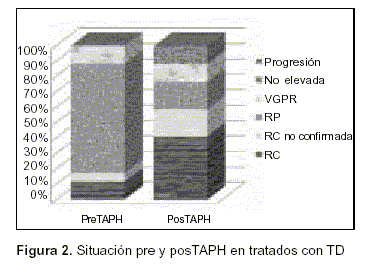
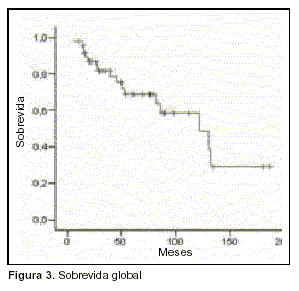
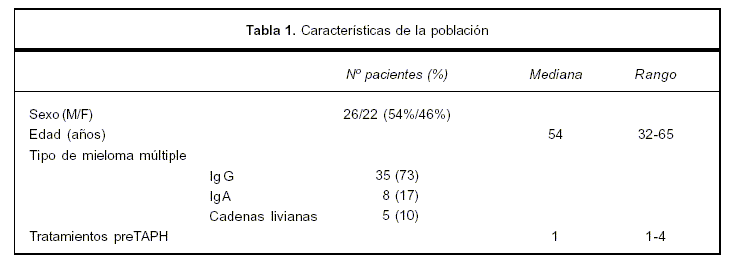
<body><![CDATA[<p><small><small><font size="5" face="Verdana"><small><small><font size="2">Se utilizaron los criterios de respuesta del International Myeloma Working Group Uniform Response Criteria<a name="18.--"></a>(<a href="#bib18"><sup><span lang="ES">18</span></sup></a></font><span lang="ES"><font size="2">).</font></span></small></small></font></small></small></p>      <p><small><small><font size="5" face="Verdana"><small><small><font size="2">El an&aacute;lisis de los datos se realiz&oacute; con el paquete estad&iacute;stico G-Stat 2.0.</font></small></small></font></small></small></p>      <p><small><small><font size="5" face="Verdana"><small><small><font size="2">Resultados</font></small></small></font></small></small></p>      <p><small><small><font size="5" face="Verdana"><small><small><font size="2">De los 48 pacientes, 22 (46%) eran de sexo femenino y 26 (54%) de sexo masculino. La mediana de edad al debut fue de 54 a&ntilde;os (32-65 a&ntilde;os). La mediana de latencia entre el debut y el 1&ordm; TAPH fue de 9,9 meses (3,2-62,5 meses). El 37,5% de los pacientes proced&iacute;an de centros del interior de Uruguay y 62,5% de Montevideo. </font> </small></small></font></small></small></p>      <p><small><small><font size="5" face="Verdana"><small><small><font size="2">Con respecto al tipo de MM, 73% eran IgG, 17% IgA y 10% de cadenas livianas (6% lambda y 4% kappa del total) (<a href="/img/revistas/rmu/v27n4/4a02t1.gif"><span lang="ES">tabla 1</span></a></font><span lang="ES"><font size="2">). Debutaron en estadio I A 10,5%, en II A 25%, en III A 58,5% y en III B 6%; 94% no presentaron insuficiencia renal al debut. </font> </span></small></small></font></small></small></p>      <p><small><small><font size="5" face="Verdana"><small><small><font size="2">Se cuenta con los datos para el c&aacute;lculo del ISS al debut de 26 pacientes. De ellos, 50% ten&iacute;a un ISS I, 27% un ISS II y 23% un ISS III. Con respecto a la citogen&eacute;tica de MO, hay datos en 12 pacientes. De estos 12, solo un paciente present&oacute; un citogen&eacute;tico de mal pron&oacute;stico. Un paciente de los 48 ten&iacute;a amiloidosis asociada demostrada por biopsia y en uno se diagnostic&oacute; amiloidosis en el seguimiento postrasplante. </font> </small></small></font></small></small></p>      <p><small><small><font size="5" face="Verdana"><small><small><font size="2">Como resultado del condicionamiento con melphal&aacute;n se asisti&oacute; a la mielosupresi&oacute;n, con un nadir de gl&oacute;bulos blancos al d&iacute;a +5 (1-9), de gl&oacute;bulos rojos (GR) al d&iacute;a +8 (1-14) y de plaquetas al d&iacute;a +1 (0-8). La recuperaci&oacute;n medular medida por el nivel del PMN 500/mm3 fue en el d&iacute;a +10 (9-24). Treinta y seis pacientes (75%) debieron recibir una o m&aacute;s transfusiones de GR durante el per&iacute;odo de aplasia. La mediana de n&uacute;mero de transfusiones de GR fue de 2 (0-12). El 98% (47 pacientes) recibieron uno o m&aacute;s concentrados de plaquetas de donante &uacute;nico (CPDU). La mediana de CPDU administrados fue de 3 (0-32). La mediana de la &uacute;ltima transfusi&oacute;n de GR fue el d&iacute;a +9 (2-38) y la de plaquetas el d&iacute;a +10 (6-42).</font></small></small></font></small></small></p>      <p><small><small><font size="5" face="Verdana"><small><small><font size="2">De los 48 pacientes, 32 (66,7%) tuvieron fiebre durante el per&iacute;odo de aplasia. La mediana de d&iacute;as de fiebre fue de 1 (0-8); 6/32 tuvieron neutropenia febril documentada microbiol&oacute;gicamente, se hallaron: tres <em> Staphylococcus coagulasa </em>negativo, una <em>C&aacute;ndida Albicans, </em>un<em> Clostridium difficcile </em>y un<em> E. coli. </em>Estos pacientes resolvieron su infecci&oacute;n con el tratamiento adecuado sin otras complicaciones. Los focos cl&iacute;nicos infecciosos demostrados en el per&iacute;odo de aplasia fueron diez (por orden de frecuencia): seis infecciones en zona de cat&eacute;ter Hickman; dos neumopat&iacute;as agudas, una de las cuales evolucion&oacute; a sepsis; una sepsis de origen intestinal; una diverticulitis. En una de las bolsas de <em>stem cells</em> se hall&oacute; <em>Brevundinoma</em> (pseudo) </font> <em> <font size="2">vesicularis. </font> </em></small></small></font></small></small></p>      <p><small><small><font size="5" face="Verdana"><small><small><font size="2">Doce pacientes no requirieron tratamiento ATB emp&iacute;rico u espec&iacute;fico m&aacute;s all&aacute; de la profilaxis infecciosa. La mediana de n&uacute;mero de planes ATB utilizados fue de 1. El 42% requiri&oacute; un solo plan, 25% dos planes, y 4,2% requirieron tres o cuatro planes. </font> </small></small></font></small></small></p>      <p><small><small><font size="5" face="Verdana"><small><small><font size="2">La mediana de d&iacute;as de G-CSF utilizados posTAPH fue de 9 (6-30). La mediana de d&iacute;as al alta, medida desde el d&iacute;a de la infusi&oacute;n hasta el alta, fue de 15 (12-49). </font> </small></small></font></small></small></p>      ]]></body>
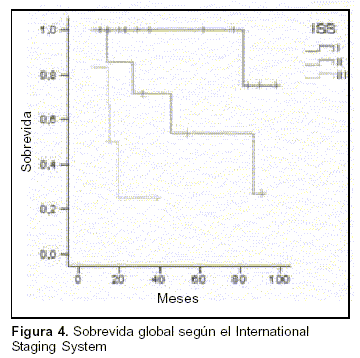
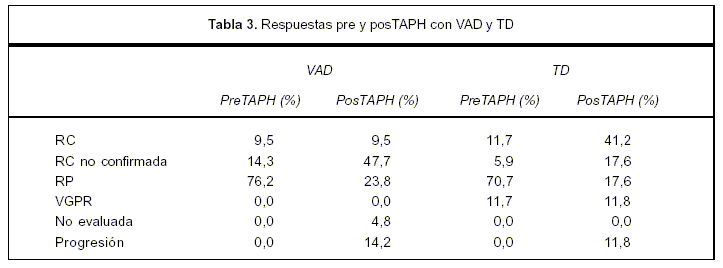
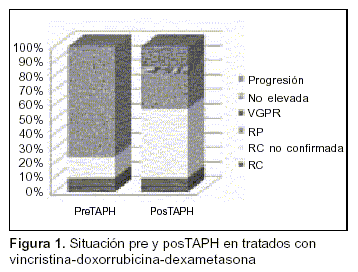
<body><![CDATA[<p><small><small><font size="5" face="Verdana"><small><small><font size="2">La mortalidad relacionada al TAPH en este grupo de 48 pacientes fue 0 (<a href="/img/revistas/rmu/v27n4/4a02t2.gif"><span lang="ES">tabla 2</span></a></font><span lang="ES"><font size="2">). </font> </span></small></small></font></small></small></p>      <p><small><small><font size="5" face="Verdana"><small><small><font size="2">La mejor respuesta alcanzada, evaluada a los tres meses postrasplante, fue: en 11 (22,9%) pacientes RC, en 18 RC no confirmadas (37,5%), en tres VGPR (6,3%), en diez RP (20,8%), en cinco progresi&oacute;n (10,4%), y en uno no se ha evaluado. El 60,4% logr&oacute; una RC/nRC posTAPH. </font> </small></small></font></small></small></p>      <p><small><small><font size="5" face="Verdana"><small><small><font size="2">Se evaluaron las respuestas pre y posTAPH en los pacientes con VAD y TD dado que fueron los tratamientos m&aacute;s utilizados en esta serie y fueron, cada uno de ellos, est&aacute;ndares terap&eacute;uticos en distintas &eacute;pocas (<a href="/img/revistas/rmu/v27n4/4a02t3.gif"><span lang="ES">tabla 3</span></a><span lang="ES"> y </span><a href="#1"><span lang="ES">figura 1</span></a><span lang="ES"> y </span><a href="#2"><span lang="ES">figura 2</span></a></font><span lang="ES"><font size="2">).</font></span></small></small></font></small></small></p>      <p><small><font size="5" face="Verdana"><small><strong><a name="1"> <font size="2"></font></a></strong></small></font></small></p>      <p align="center"><small><font size="5" face="Verdana"><small><strong> <font size="2"><img src="/img/revistas/rmu/v27n4/4a02f1.gif" height="272" width="358"></font></strong></small></font></small></p>      <p><small><font size="5" face="Verdana"><small><strong><a name="2"> <font size="2"></font></a></strong></small></font></small></p>      <p align="center"><small><font size="5" face="Verdana"><small><strong> <font size="2"><img src="/img/revistas/rmu/v27n4/4a02f2.gif" height="272" width="358"></font></strong></small></font></small></p>      <p><small><small><font size="5" face="Verdana"><small><small><font size="2">De los 48 pacientes, a 34 (71%) se les realiz&oacute; mantenimiento. Los mantenimientos fueron con talidomida a 32 pacientes, INF a uno y dexametasona a un paciente. </font> </small></small></font></small></small></p>      <p><small><small><font size="5" face="Verdana"><small><small><font size="2">A la fecha de cierre de este an&aacute;lisis: 31 pacientes est&aacute;n vivos (64,6%), de los cuales nueve tuvieron una o m&aacute;s reca&iacute;das y siete progresaron. Con una media de seguimiento de 58,6 meses (5,84-186,56), la mediana de SG del total de pacientes con TAPH es de 121,8 meses (IC 95%: 70,1-173,54 meses). La SG a tres a&ntilde;os es de 81%, a cuatro a&ntilde;os 75% y a cinco a&ntilde;os 68% (<a href="#3"><span lang="ES">figura 3</span></a></font><span lang="ES"><font size="2">).</font></span></small></small></font></small></small></p>      <p><small><font size="5" face="Verdana"><small><strong><a name="3"> <font size="2"></font></a></strong></small></font></small></p>      ]]></body>
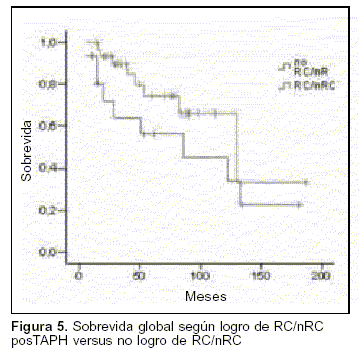
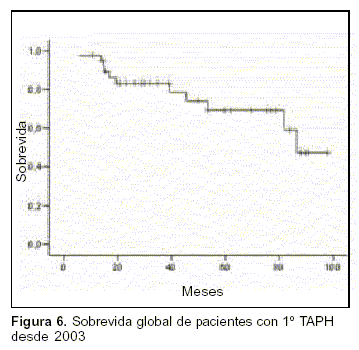
<body><![CDATA[<p align="center"><small><font size="5" face="Verdana"><small><strong> <font size="2"><img src="/img/revistas/rmu/v27n4/4a02f3.gif" height="272" width="358"></font></strong></small></font></small></p>      <p><small><small><font size="5" face="Verdana"><small><small><font size="2">El International Staging System for Multiple Myeloma (ISS) que toma en cuenta el valor de la beta2-microglobulina (B2-M) y la alb&uacute;mina se pudo calcular en 26 pacientes. Una B2-M menor de 3,5 mg/L y alb&uacute;mina mayor o igual a 3,5 g/dL corresponde a un ISS I, una B2-M mayor o igual a 5,5 mg/L es un ISS III y los valores intermedios de B2-M o alb&uacute;mina menor a 3,5 g/dL es un ISS II. El 50% eran ISS I, el 27 % ISS II y 23% ISS III. Se hall&oacute; una diferencia significativa en SG entre los pacientes con diferentes grupos de riesgo (log Rank p=0,002). La mediana de SG para ISS I no se ha alcanzado, la estimada es de 93,7 meses (IC 95%: 87-100,5 meses), la mediana de SG para ISS II fue de 86,3 meses (IC 95%: 30,4-142,27 meses), y para ISS III 14,95 meses (IC 95%: 10,2-19,57 meses) (<a href="#4"><span lang="ES">figura 4</span></a></font><span lang="ES"><font size="2">).</font></span></small></small></font></small></small></p>      <p><small><font size="5" face="Verdana"><small><strong><a name="4"> <font size="2"></font></a></strong></small></font></small></p>      <p align="center"><small><font size="5" face="Verdana"><small><strong> <font size="2"><img src="/img/revistas/rmu/v27n4/4a02f4.gif" height="272" width="358"></font></strong></small></font></small></p>      <p><small><small><font size="5" face="Verdana"><small><small><font size="2">No se hallaron diferencias estad&iacute;sticamente significativas en SG entre los pacientes que lograron RC/nRC (RC, RC no confirmada y VGPR) posTAPH y quienes no lo lograron (log Rank p=0,162). A pesar de que el n&uacute;mero de pacientes es peque&ntilde;o, se ve una tendencia a mayor SG de los pacientes que lograron RC/nRC posTAPH en los primeros a&ntilde;os. La mediana de SG para los que lograron RC/nRC fue de 129,8 meses (IC 95%: 61,3-198,2) y para los que no, 86,3 meses (IC 95%: 0-180 meses). La SG a cinco a&ntilde;os fue de 74% para el grupo que logr&oacute; RC/nRC y de 56% para los que no (<a href="#5"><span lang="ES">figura 5</span></a></font><span lang="ES"><font size="2">).</font></span></small></small></font></small></small></p>      <p><small><font size="5" face="Verdana"><small><strong><a name="5"> <font size="2"></font></a></strong></small></font></small></p>      <p align="center"><small><font size="5" face="Verdana"><small><strong> <font size="2"><img src="/img/revistas/rmu/v27n4/4a02f5.gif" height="272" width="358"></font></strong></small></font></small></p>      <p><small><small><font size="5" face="Verdana"><small><small><font size="2">La mediana de SLEv (progresi&oacute;n, reca&iacute;da o muerte por la enfermedad) fue de 56 meses (IC 95%: 42,2-70,4 meses). La SLEv a tres a&ntilde;os fue de 69% y a siete a&ntilde;os de 25%. </font> </small></small></font></small></small></p>      <p><small><font size="5" face="Verdana"><small><small><font size="2">Treinta y ocho pacientes recibieron el 1&ordm; TAPH desde el a&ntilde;o 2003 al momento. La mediana de SG estimada en este subgrupo de pacientes es de 86,3 meses. La SG a tres a&ntilde;os en este subgrupo es de 83% y a cinco a&ntilde;os de 69%. La mediana de seguimiento es 37 meses (5,84-97,77) (<a href="#6"><span lang="ES">figura 6</span></a></font><span lang="ES"><font size="2">).</font></span></small><strong><span lang="ES"><font size="2"> </font> </span></strong></small></font></small></p>      <p><small><font size="5" face="Verdana"><small><strong><a name="6"> <font size="2"></font></a></strong></small></font></small></p>      ]]></body>
<body><![CDATA[<p align="center"><small><font size="5" face="Verdana"><small><strong> <font size="2"><img src="/img/revistas/rmu/v27n4/4a02f6.gif" height="272" width="358"></font></strong></small></font></small></p>      <p><small><small><font size="5" face="Verdana"><small><small><strong> <font size="2">Discusi&oacute;n</font></strong></small></small></font></small></small></p>      <p><small><small><font size="5" face="Verdana"><small><small><font size="2">El TAPH es una herramienta terap&eacute;utica fundamental y est&aacute;ndar en el manejo de los pacientes con MM. En el Hospital Brit&aacute;nico se comenzaron a trasplantar pacientes con MM en el a&ntilde;o 1998.</font><strong><font size="2"> </font> </strong></small></small></font></small></small></p>      <p><small><small><font size="5" face="Verdana"><small><small><strong style="font-weight: normal;"> <font size="2">La mortalidad relacionada al TAPH a los 100 d&iacute;as en estos 56 procedimientos fue 0%, seg&uacute;n los datos publicados por el CIBMTR (Center for International Blood and Marrow Transplant Research), en el a&ntilde;o 2007-2008 fue menor a 3% a nivel internacional<a name="19.--"></a>(<a href="#bib19"><sup><span lang="ES">19</span></sup></a></font></strong><font size="2"><span lang="ES">). Los datos reportados con respecto a la mielosupresi&oacute;n y la recuperaci&oacute;n de la hematopoyesis son similares a los reportados a nivel internacional<a name="20-21.--"></a>(</span><a href="#bib20"><sup><span lang="ES">20,21</span></sup></a></font><span lang="ES"><font size="2">). </font> </span></small></small></font></small></small></p>      <p><small><font size="5" face="Verdana"><small><small><font size="2">Existen tres trabajos que comparan los reg&iacute;menes talidomida/dexametasona versus VAD. Se logra RC en 13% de los pacientes con el uso de estos planes<a name="22.--"></a>(<a href="#bib22"><sup><span lang="ES">22</span></sup></a><span lang="ES">). En estos trabajos se demostraron beneficios de TD versus VAD como tratamiento de inducci&oacute;n en t&eacute;rminos de respuesta: al menos VGPR 30% versus 15%<a name="23.--"></a>(</span><a href="#bib23"><sup><span lang="ES">23</span></sup></a><span lang="ES">), 35% versus 13%<a name="24.--"></a>(</span></font><a href="#bib24"><sup><span lang="ES"><font size="2">24</font></span></sup></a></small><span lang="ES"><small><font size="2">) y al menos RP 76% versus 52%. Tambi&eacute;n se demostraron mejores resultados postrasplante: al menos VGPR 44% versus 42% y 68% versus 49%. No se demostr&oacute; diferencia estad&iacute;sticamente significativa en SG a cinco a&ntilde;os al comparar estos reg&iacute;menes, si bien en el trabajo publicado por Cavo hubo una tendencia a mayor SG con el uso de TD (69% versus 53% a cinco a&ntilde;os). Las respuestas obtenidas en nuestra serie son similares a las reportadas en estos trabajos. La SG a cinco a&ntilde;os tiene tambi&eacute;n una tendencia a ser mejor con TD versus VAD, 80% versus 66%, pero sin diferencia estad&iacute;sticamente significativa.</font></small><font size="2"> </font> </span></small></font></small></p>      <p><small><font size="5" face="Verdana"><small><small><font size="2">Con una media de seguimiento de 58,6 meses la mediana de SG en el grupo de pacientes trasplantados fue de 121,8 meses, SG muy superior a los datos publicados por Child (54 meses). La SG a tres a&ntilde;os fue de 81%, similar a la publicada por Palumbo, pero superior a los datos aportados por el CIBMTR, cuyas cifras son de 68% a los tres a&ntilde;os(</font><a href="#bib19"><sup><span lang="ES"><font size="2">19</font></span></sup></a></small><span lang="ES"><small><font size="2">). Pensamos que esto es debido a que se trata de una poblaci&oacute;n muy heterog&eacute;nea de pacientes, tanto por el tiempo previo al TAPH, los tratamientos y l&iacute;neas utilizadas, y sesgado por los primeros pacientes trasplantados, dado que solamente se trasplantaban pacientes en RC o RP mayor, sin comorbilidades y con un excelente estado general. Por esto se procedi&oacute; a analizar el grupo de 38 pacientes trasplantados desde el 1&ordm; de enero de 2003 al 30 de junio de 2010, se seleccion&oacute; este grupo ya que en 2003 se comenz&oacute; a trasplantar, si no exist&iacute;a contraindicaci&oacute;n, a todos los pacientes menores de 65 a&ntilde;os portadores de MM luego de una inducci&oacute;n de la remisi&oacute;n independientemente del &eacute;xito logrado con la misma. En este grupo de pacientes, con una media de seguimiento de 37 meses (5,84-97,77), la SG estimada es de 86,3 meses, con SG a tres a&ntilde;os de 83% y a cinco a&ntilde;os de 69%, datos m&aacute;s acorde con los conocidos internacionalmente, de todas maneras la media de seguimiento es corta y el n&uacute;mero de pacientes es limitado, por lo que pueden existir estas diferencias.</font></small><font size="2"> </font> </span></small></font></small></p>      <p><small><font size="5" face="Verdana"><small><small><font size="2">La SLEv en nuestra serie fue de 56 meses, superior a los datos internacionales que refieren una mediana entre 25 y 42 meses(<a href="#bib2"><sup><span lang="ES">2,4,5</span></sup></a><span lang="ES">). Tambi&eacute;n fue superior a los datos aportados en los trabajos de Attal y Palumbo(</span></font><a href="#bib1"><sup><span lang="ES"><font size="2">1,3</font></span></sup></a></small><span lang="ES"><small><font size="2">). Esto podr&iacute;a explicarse por las mismas consideraciones que se realizaron para SG y que ser&iacute;a una diferente poblaci&oacute;n en los estudios.</font></small><font size="2"> </font> </span></small></font></small></p>      <p><small><font size="5" face="Verdana"><small><small><font size="2">El &iacute;ndice ISS ha sido validado en pacientes de diferentes poblaciones, edades, tratados o no con trasplante, y ha demostrado su simplicidad y validez en predecir sobrevida. Con un ISS I la mediana de SG es de 62 meses, con ISS II 44 meses y con ISS III 29 meses. En nuestra poblaci&oacute;n, a pesar de ser escaso el n&uacute;mero de pacientes evaluables, se observ&oacute; tambi&eacute;n una diferencia estad&iacute;sticamente significativa en SG entre los diferentes grupos de riesgo.</font></small><font size="2"> </font> </small></font></small></p>      <p><small><font size="5" face="Verdana"><small><small><font size="2">El impacto de lograr la RC en MM ha sido demostrado luego del inicio del uso del TAPH en esta patolog&iacute;a. La mayor&iacute;a de los estudios que eval&uacute;an TAPH han demostrado que es beneficioso lograr una buena remisi&oacute;n en t&eacute;rminos de SG o al menos de SLP<a name="-25-26.--"></a>(<a href="#bib2"><sup><span lang="ES">2,3,</span></sup></a><a href="#bib25"><sup><span lang="ES">25,26</span></sup></a><span lang="ES">). En esta serie observamos una tendencia a mayor SG al lograr RC/nRC posTAPH. El n&uacute;mero de pacientes es bajo pero se observa una diferencia marcada en los primeros diez a&ntilde;os del debut. La SG a los cinco a&ntilde;os es similar a la obtenida en el trabajo del grupo franc&eacute;s<a name="27.--"></a>(</span></font><a href="#bib27"><sup><span lang="ES"><font size="2">27</font></span></sup></a></small><span lang="ES"><small><font size="2">): 74% versus 61% en este &uacute;ltimo y 74% versus 56% en esta serie.</font></small><font size="2"> </font> </span></small></font></small></p>      <p><small><small><font size="5" face="Verdana"><small><small><strong> <font size="2">Conclusiones</font></strong></small></small></font></small></small></p>      ]]></body>
<body><![CDATA[<p><small><font size="5" face="Verdana"><small><small><font size="2">El TAPH es una herramienta fundamental en el tratamiento de los pacientes con MM. Es un procedimiento seguro en nuestra unidad del Hospital Brit&aacute;nico. La SG en el total de pacientes analizados en esta serie es de 121,8 meses y la SLEv es de 56 meses; pensamos que estos resultados est&aacute;n sesgados por una selecci&oacute;n de pacientes realizada en los primeros a&ntilde;os de uso de la t&eacute;cnica. En concordancia con los datos reportados a nivel internacional hay una tendencia a mejores resultados en los pacientes que logran la RC/nRC y en quienes tienen un ISS de bajo riesgo.</font></small><font size="2"> </font> </small></font></small></p>      <p><small><small><font size="5" face="Verdana"><small><small><strong> <font size="2">Summary</font></strong></small></small></font></small></small></p>      <p><small><small><font size="5" face="Verdana"><small><small><em><font size="2">Introduction:</font></em><font size="2"> autologic transplant of hematopoietic progenitors is regarded as the standard in the first line treatment of patients with multiple myeloma (MM) younger than 65 years old.</font></small></small></font></small></small></p>      <p><small><small><font size="5" face="Verdana"><small><small><em><font size="2">Objective</font></em><font size="2">: to analyse global survival and incident free survival in patients with multiple myeloma transplanted at the British Hospital.</font></small></small></font></small></small></p>      <p><small><font size="5" face="Verdana"><small><small><em><font size="2">Method</font></em><font size="2">: we conducted a retrospective study of patients who received the first autologic transplant of hematopoietic progenitors.</font></small><font size="2"> </font> </small></font></small></p>      <p><small><small><font size="5" face="Verdana"><small><small><em><font size="2">Results: </font> </em><font size="2">56 autologic transplants of hematopoietic progenitors were performed from July 1, 1999 through June 30, 2010 in 48 patients with MM. Upon analysis of patients after the first transplant, 46% were women and 54% were men. Median age was 54 years old (32-65 years old). 73% were IgG, 17% were IgA and 10% were light chains.60.4% achieved CR/nCR (CR), non- confirmed CR and VGPR) after transplant. With an average follow-up of 58.6 months (5.84-186.56), the median global survival was 121.8 months (IC 95%: 70.1-173.54 months). No significant differences were found in the global survival in patients who achieved CR/nCR after autologic transplant of hematopoietic progenitors and those who failed to achieve it (log Rank p=0.162. The median incident-free survival was 56 months (IC 95%: 42.2-70.4 months).</font></small></small></font></small></small></p>      <p><small><font size="5" face="Verdana"><small><small><em><font size="2">Conclusions: </font> </em><font size="2">autologic transplant of hematopoietic progenitors is an essential tool to treat patients with MM and it is a safe procedure at the Hematology Unit of the British Hospital.</font></small><font size="2"> </font> </small></font></small></p>      <p><small><small><font size="5" face="Verdana"><small><small><strong> <font size="2">Resumo</font></strong></small></small></font></small></small></p>      <p><small><small><font size="5" face="Verdana"><small><small><em><font size="2">Introdu&ccedil;&atilde;o:</font></em><font size="2"> o transplante aut&oacute;logo de progenitores hematopoi&eacute;ticos (TAPH) &eacute; considerado um padr&atilde;o no tratamento de primeira linha de pacientes menores de 65 anos com mieloma m&uacute;ltiple (MM). </font> </small></small></font></small></small></p>      <p><small><small><font size="5" face="Verdana"><small><small><em><font size="2">Objetivo:</font></em><font size="2"> analisar a sobrevida global (SG) e sobrevida livre de eventos (SLEv) dos pacientes com MM transplantados no Hospital Brit&acirc;nico.</font></small></small></font></small></small></p>      ]]></body>
<body><![CDATA[<p><small><small><font size="5" face="Verdana"><small><small><em><font size="2">Material e m&eacute;todo:</font></em><font size="2"> um estudo retrospectivo dos pacientes que receberam um primeiro TAPH foi realizado.</font></small></small></font></small></small></p>      <p><small><font size="5" face="Verdana"><small><small><em><font size="2">Resultados:</font></em><font size="2"> no per&iacute;odo 1&ordm; de julho de 1999 a 30 de junho de 2010 foram realizados 56 TAPH a 48 pacientes com MM. A an&aacute;lise dos dados dos pacientes no primeiro TAPH mostrou que 46% eram mulheres e 54% homens. A mediana da idade foi 54 anos (32-65 anos). 73% eram IgG, 17% IgA e 10% de cadeias leves. 60,4% conseguiram uma RC/nRC (RC, RC n&atilde;o confirmada e VGPR) p&oacute;sTAPH. Com una media de seguimento de 58,6 meses (5,84-186,56), a mediana de SG foi de 121,8 meses (IC 95%: 70,1-173,54 meses). N&atilde;o foram encontradas diferen&ccedil;as significativas na SG entre os pacientes que conseguiram RC/nRC p&oacute;sTAPH e os que n&atilde;o a conseguiram (log Rank p=0,162). A mediana de SLEv foi 56 meses (IC 95%: 42,2-70,4 meses).</font></small><font size="2"> </font> </small></font></small></p>      <p><small><small><font size="5" face="Verdana"><small><small><em><font size="2">Conclus&otilde;es: </font> </em><font size="2">o TAPH &eacute; uma ferramenta fundamental para o tratamento de pacientes com MM e &eacute; um procedimento seguro na Unidade de Hematologia do Hospital Brit&acirc;nico.</font></small></small></font></small></small></p>      <p><small><small><font size="5" face="Verdana"><small><small><strong> <font size="2">Bibliograf&iacute;a</font></strong></small></small></font></small></small></p>      <!-- ref --><p><small><small><font size="5" face="Verdana"><small><small><a name="bib1"> <font size="2"></font></a><font size="2"><a href="#1.--">1</a>. <strong>Attal M, Harousseau JL, Stoppa AM, Sotto JJ, Fuzibet JG, Rossi JF, et al.</strong> A prospective, randomized trial of autologous bone marrow transplantation and chemotherapy in multiple myeloma: Intergroupe Fran&ccedil;ais du My&eacute;lome. N Engl J Med 1996; 335(2): 91-7.    </font></small></small></font></small></small></p>      <!-- ref --><p><small><small><font size="5" face="Verdana"><small><small><a name="bib2"> <font size="2"></font></a><font size="2"><a href="#2.--">2</a>. <strong>Child JA, Morgan GJ, Davies FE, Owen RG, Bell SE, Hawkins K, et al.</strong> Medical Research Council Adult Leukaemia Working Party. High-dose chemotherapy with hematopoietic stem-cell rescue for multiple myeloma. N Engl J Med 2003; 348(19): 1875-83.    </font></small></small></font></small></small></p>      <!-- ref --><p><small><small><font size="5" face="Verdana"><small><small><a name="bib3"> <font size="2"></font></a><font size="2"><a href="#3.--">3.</a> <strong>Palumbo A, Bringhen S, Petrucci MT, Musto P, Rossini F, Nunzi M, et al.</strong> Intermediate-dose melphalan improves survival of myeloma patients aged 50 to 70: results of a randomized controlled trial. Blood 2004; 104(10): 3052-7.    </font></small></small></font></small></small></p>      ]]></body>
<body><![CDATA[<!-- ref --><p><small><small><font size="5" face="Verdana"><small><small><a name="bib4"> <font size="2"></font></a><font size="2"><a href="#4-6.--">4</a>. <strong>Blad&eacute; J, Rosi&ntilde;ol L, Sureda A, Ribera JM, D&iacute;az-Mediavilla J, Garc&iacute;a-Lara&ntilde;a J, et al.</strong> High-dose therapy intensification compared with continued standard chemotherapy in multiple myeloma patients responding to the initial chemotherapy: long-term results from a prospective randomized trial from the Spanish Cooperative Group PETHEMA. Blood 2005; 106(12): 3755-9.    </font></small></small></font></small></small></p>      <!-- ref --><p><small><small><font size="5" face="Verdana"><small><small><a name="bib5"> <font size="2"></font></a><font size="2"><a href="#4-6.--">5</a>. <strong>Fermand JP, Katsahian S, Divine M, Leblond V, Dreyfus F, Macro M, et al.</strong> High dose therapy and autologous blood stem cell transplantation compared with conventional treatment in myeloma patients aged 55 to 65 years: long-term results of a randomized control trial from the Group Myelome-Autogreffe. J Clin Oncol 2005; 23(36): 9227-33.    </font></small></small></font></small></small></p>      <!-- ref --><p><small><small><font size="5" face="Verdana"><small><small><a name="bib6"> <font size="2"></font></a><font size="2"><a href="#4-6.--">6</a>. <strong>Barlogie B, Kyle RA, Anderson KC, Greipp PR, Lazarus HM, Hurd DD, et al.</strong> Standard chemotherapy compared with high-dose chemoradiotherapy for multiple myeloma: final results of phase III US Intergroup trial S9321. J. Clin Oncol 2006; 24(6): 929-36.    </font></small></small></font></small></small></p>      <!-- ref --><p><small><small><font size="5" face="Verdana"><small><small><a name="bib7"> <font size="2"></font></a><font size="2"><a href="#7.--">7</a>. <strong>Koreth J, Cutler CS, Djulbegovic B, Behl R, Schlossman RL, Munshi NC, et al.</strong> High dose therapy with single autologous transplantation versus chemotherapy for newly diagnosed multiple myeloma: a systematic review and metaanalysis of randomized controlled trials. Biol Blood Marrow Transplant 2007; 13(2): 183-96.    </font></small></small></font></small></small></p>      <!-- ref --><p><small><small><font size="5" face="Verdana"><small><small><a name="bib8"> <font size="2"></font></a><font size="2"><a href="#8.--">8</a>. <strong>Moreau P, Facon T, Attal M, Hulin C, Michallet M, Maloisel F, et al.</strong> Intergroupe Francophone du My&eacute;lome. Comparison of 200 mg/m2 melphalan and 8 Gy total body irradiation plus 140 mg/m2 melphalan as conditioning regimens for peripheral blood stem cell transplantation in patients with newly diagnosed multiple myeloma: final analysis of the Intergroupe Francophone du My&eacute;lome 9502 randomized trial. Blood 2002; 99(3): 731-5.     </font> </small></small></font></small></small></p>      ]]></body>
<body><![CDATA[<!-- ref --><p><small><small><font size="5" face="Verdana"><small><small><a name="bib9"> <font size="2"></font></a><font size="2"><a href="#9-14.--">9</a>. <strong>Attal M, Harousseau JL, Facon T, Guilhot F, Doyen C, Fuzibet JG, et al.</strong> Single versus double autologous stem-cell transplantation for multiple myeloma. N Engl J Med 2003; 349(26): 2495-502.    </font></small></small></font></small></small></p>      <!-- ref --><p><small><small><font size="5" face="Verdana"><small><small><a name="bib10"> <font size="2"></font></a><font size="2"><a href="#9-14.--">10. </a><strong>Cavo M, Tosi P, Zamagni E, Cellini C, Tacchetti P, Patriarca F, et al.</strong> Prospective, randomized study of single compared with double autologous transplantation for multiple myeloma: Bologna 96 clinical study. J Clin Oncol 2007; 25(17): 2434-41.     </font> </small></small></font></small></small></p>      <!-- ref --><p><small><small><font size="5" face="Verdana"><small><small><a name="bib11"> <font size="2"></font></a><font size="2"><a href="#9-14.--">11</a>. <strong>Crawley C, Iacobelli S, Bj&ouml;rkstrand B, Apperley JF, Niederwieser D, et al.</strong> Reduced-intensity conditioning for myeloma: lower nonrelapse mortality but higher relapse rates compared with myeloablative conditioning. Blood 2007; 109(8): 3588-94.    </font></small></small></font></small></small></p>      <!-- ref --><p><small><small><font size="5" face="Verdana"><small><small><a name="bib12"> <font size="2"></font></a><font size="2"><a href="#9-14.--">12</a>. <strong>Fermand JP, Ravaud P, Chevret S, Divine M, Leblond V, Belanger C, et al.</strong> High-dose therapy and autologous peripheral blood stem cell transplantation in multiple myeloma: Up-front or rescue treatment? Results of a multicenter sequential randomized clinical trial. Blood 1998; 92: 3131-6.    </font></small></small></font></small></small></p>      <!-- ref --><p><small><small><font size="5" face="Verdana"><small><small><a name="bib13"> <font size="2"></font></a><font size="2"><a href="#9-14.--">13</a>. <strong>Facon T, Mary JY, Harousseau JL.</strong> Front-line or rescue autologous bone marrow transplantation (ABMT) following a first course of high dose melphalan (HDM) in multiple myeloma (MM). Preliminary results of a prospective randomized trial (CIAM) protocol. Blood 1996; 88(1): 685a.    </font></small></small></font></small></small></p>      ]]></body>
<body><![CDATA[<!-- ref --><p><small><small><font size="5" face="Verdana"><small><small><a name="bib14"> <font size="2"></font></a><font size="2"><a href="#9-14.--">14.</a> <strong>Barlogie B, Kyle R, Anderson K.</strong> Comparable survival in multiple myeloma (MM) with high dose therapy (HDT) employing MEL 140 mg/m2 1 TBI 12 Gy autotransplants versus standard dose therapy with VBMCP and no benefit from interferon (IFN) maintenance: results of intergroup Trial S9321. Blood 2003; 102: 42a.    </font></small></small></font></small></small></p>      <!-- ref --><p><small><small><font size="5" face="Verdana"><small><small><a name="bib15"> <font size="2"></font></a><font size="2"><a href="#15-17.--">15</a>. <strong>Alexanian R, Weber D, Giralt S, Dimopoulos M, Delasalle K, Smith T, et al.</strong> Impact of complete remission with intensive therapy in patients with responsive multiple myeloma. Bone Marrow Transplant 2001; 27(10): 1037-43.    </font></small></small></font></small></small></p>      <!-- ref --><p><small><small><font size="5" face="Verdana"><small><small><a name="bib16"> <font size="2"></font></a><font size="2"><a href="#15-17.--">16</a>. <strong>Lahuerta JJ, Mateos MV, Mart&iacute;nez-L&oacute;pez J, Rosi&ntilde;ol L, Sureda A, de la Rubia J, et al.</strong> Influence of pre- and post-transplantation responses on outcome of patients with multiple myeloma: sequential improvement of response and achievement of complete response are associated with longer survival. J Clin Oncol 2008; 26(35): 5775-82.    </font></small></small></font></small></small></p>      <!-- ref --><p><small><small><font size="5" face="Verdana"><small><small><a name="bib17"> <font size="2"></font></a><font size="2"><a href="#15-17.--">17</a>. <strong>van de Velde HJ, Liu X, Chen G, Cakana A, Deraedt W, Bayssas M.</strong> Complete response correlates with long-term survival and progression free survival in high-dose therapy in multiple myeloma. Haematologica 2007; 92(10): 1399-406.    </font></small></small></font></small></small></p>      <!-- ref --><p><small><small><font size="5" face="Verdana"><small><small><a name="bib18"> <font size="2"></font></a><font size="2"><a href="#18.--">18</a>. <strong>Durie BG, Harousseau JL, Miguel JS, Blad&eacute; J, Barlogie B, Anderson K, et al.</strong> International uniform response criteria for multiple myeloma. Leukemia 2006; 20(9): 1467-73.    </font></small></small></font></small></small></p>      ]]></body>
<body><![CDATA[<!-- ref --><p><small><small><font size="5" face="Verdana"><small><small><a name="bib19"> <font size="2"></font></a><font size="2"><a href="#19.--">19</a>. <strong>Center for International Blood &amp; Marrow Transplant Research.</strong> Disponible en: <a href="http://www.cibmtr.org/pages/index.aspx"><span lang="ES">http://www.cibmtr.org/pages/index.aspx</span></a></font><span lang="ES"><font size="2">. [Consulta: 26/5/2011].    </font></span></small></small></font></small></small></p>      <!-- ref --><p><small><small><font size="5" face="Verdana"><small><small><a name="bib20"> <font size="2"></font></a><font size="2"><a href="#20-21.--">20</a>. <strong>Papanikolaou X, Maltezas D, Repousis P, Athanassopoulos A, Alexia S, Megalakaki K, et al.</strong> High dose chemotherapy and autologous stem cell transplantation in patients with multiple myeloma: the experience of a single haematological unit. J BUON 2008; 13(2): 193-7.    </font></small></small></font></small></small></p>      <!-- ref --><p><small><small><font size="5" face="Verdana"><small><small><a name="bib21"> <font size="2"></font></a><font size="2"><a href="#20-21.--">21</a>. <strong>Majolino I, Vignetti M, Meloni G, Vegna ML, Scim&egrave; R, Tringali S, et al.</strong> Autologous transplantation in multiple myeloma: a GITMO retrospective analysis on 290 patients. Haematologica 1999; 84(9): 844-52.    </font></small></small></font></small></small></p>      <!-- ref --><p><small><small><font size="5" face="Verdana"><small><small><a name="bib22"> <font size="2"></font></a><font size="2"><a href="#22.--">22</a>. <strong>Cavo M, Zamagni E, Tosi P, Tacchetti P, Cellini C, Cangini D, et al.</strong> Superiority of thalidomide and dexamethasone over vincristine-doxorubicin-dexamethasone (VAD) as primary therapy in preparation for autologous transplantation for multiple myeloma. Blood. 2005; 106(1): 35-9.    </font></small></small></font></small></small></p>      <!-- ref --><p><small><small><font size="5" face="Verdana"><small><small><a name="bib23"> <font size="2"></font></a><font size="2"><a href="#23.--">23</a>. <strong>Cavo M, Di Raimondo F, Zamagni E, Patriarca F, Tacchetti P, Casulli AF, et al.</strong> Short-Term Thalidomide Incorporated Into Double Autologous Stem-Cell Transplantation Improves Outcomes in Comparison With Double Autotransplantation for Multiple Myeloma. J Clin Oncol 2009; 27(30): 5001-7.    </font></small></small></font></small></small></p>      ]]></body>
<body><![CDATA[<!-- ref --><p><small><small><font size="5" face="Verdana"><small><small><a name="bib24"> <font size="2"></font></a><font size="2"><a href="#24.--">24.</a> <strong>Macro M, Divine M, Uzunhan Y.</strong> Dexamethasone + Thalidomide (Dex/Thal) compared to VAD as a Pre-Transplant Treatment in Newly Diagnosed Multiple Myeloma (MM): A Randomized Trial.. Blood 2006; 108: 22a.    </font></small></small></font></small></small></p>      <!-- ref --><p><small><small><font size="5" face="Verdana"><small><small><a name="bib25"> <font size="2"></font></a><font size="2"><a href="#-25-26.--">25</a>. <strong>Lenhoff S, Hjorth M, Turesson I, Westin J, Gimsing P, Wisl&ouml;ff F, et al.</strong> Intensive therapy for multiple myeloma in patients younger than 60 years: Long-term results focusing on the effect of the degree of response on survival and relapse pattern after transplantation. Haematologica 2006; 91(9): 1228-33.    </font></small></small></font></small></small></p>      <!-- ref --><p><small><small><font size="5" face="Verdana"><small><small><a name="bib26"> <font size="2"></font></a><font size="2"><a href="#-25-26.--">26</a>. <strong>Kim JS, Kim K, Cheong JW, Min YH, Suh C, Kim H, et al.</strong> Complete remission status before autologous stem cell transplantation is an important prognostic factor in patients with multiple myeloma undergoing upfront single autologous transplantation. Biol Blood Marrow Transplant 2009; 15(4): 463-70.    </font></small></small></font></small></small></p>      <!-- ref --><p><small><small><font size="5" face="Verdana"><small><small><a name="bib27"> <font size="2"></font></a><font size="2"><a href="#27.--">27</a>. <strong>Harousseau JL, Avet-Loiseau H, Attal M, Charbonnel C, Garban F, Hulin C, et al.</strong> Achievement of at Least Very Good Partial Response Is a Simple and Robust Prognostic Factor in Patients With Multiple Myeloma Treated With High-Dose Therapy: Long-Term Analysis of the IFM 99-02 and 99-04 Trials. J Clin Oncol 2009; 27(34): 5720-6.    </font></small></small></font></small></small></p>       ]]></body><back>
<ref-list>
<ref id="B1">
<label>1</label><nlm-citation citation-type="journal">
<person-group person-group-type="author">
<name>
<surname><![CDATA[Attal]]></surname>
<given-names><![CDATA[M]]></given-names>
</name>
<name>
<surname><![CDATA[Harousseau]]></surname>
<given-names><![CDATA[JL]]></given-names>
</name>
<name>
<surname><![CDATA[Stoppa]]></surname>
<given-names><![CDATA[AM]]></given-names>
</name>
<name>
<surname><![CDATA[Sotto]]></surname>
<given-names><![CDATA[JJ]]></given-names>
</name>
<name>
<surname><![CDATA[Fuzibet]]></surname>
<given-names><![CDATA[JG]]></given-names>
</name>
<name>
<surname><![CDATA[Rossi]]></surname>
<given-names><![CDATA[JF]]></given-names>
</name>
</person-group>
<article-title xml:lang="en"><![CDATA[A prospective, randomized trial of autologous bone marrow transplantation and chemotherapy in multiple myeloma: Intergroupe Français du Myélome]]></article-title>
<source><![CDATA[N Engl J Med]]></source>
<year>1996</year>
<volume>335</volume>
<numero>2</numero>
<issue>2</issue>
<page-range>91-7</page-range></nlm-citation>
</ref>
<ref id="B2">
<label>2</label><nlm-citation citation-type="journal">
<person-group person-group-type="author">
<name>
<surname><![CDATA[Child]]></surname>
<given-names><![CDATA[JA]]></given-names>
</name>
<name>
<surname><![CDATA[Morgan]]></surname>
<given-names><![CDATA[GJ]]></given-names>
</name>
<name>
<surname><![CDATA[Davies]]></surname>
<given-names><![CDATA[FE]]></given-names>
</name>
<name>
<surname><![CDATA[Owen]]></surname>
<given-names><![CDATA[RG]]></given-names>
</name>
<name>
<surname><![CDATA[Bell]]></surname>
<given-names><![CDATA[SE]]></given-names>
</name>
<name>
<surname><![CDATA[Hawkins]]></surname>
<given-names><![CDATA[K]]></given-names>
</name>
</person-group>
<article-title xml:lang="en"><![CDATA[Medical Research Council Adult Leukaemia Working Party.High-dose chemotherapy with hematopoietic stem-cell rescue for multiple myeloma]]></article-title>
<source><![CDATA[N Engl J Med]]></source>
<year>2003</year>
<volume>348</volume>
<numero>19</numero>
<issue>19</issue>
<page-range>1875-83</page-range></nlm-citation>
</ref>
<ref id="B3">
<label>3</label><nlm-citation citation-type="journal">
<person-group person-group-type="author">
<name>
<surname><![CDATA[Palumbo]]></surname>
<given-names><![CDATA[A]]></given-names>
</name>
<name>
<surname><![CDATA[Bringhen]]></surname>
<given-names><![CDATA[S]]></given-names>
</name>
<name>
<surname><![CDATA[Petrucci]]></surname>
<given-names><![CDATA[MT]]></given-names>
</name>
<name>
<surname><![CDATA[Musto]]></surname>
<given-names><![CDATA[P]]></given-names>
</name>
<name>
<surname><![CDATA[Rossini]]></surname>
<given-names><![CDATA[F]]></given-names>
</name>
<name>
<surname><![CDATA[Nunzi]]></surname>
<given-names><![CDATA[M]]></given-names>
</name>
</person-group>
<article-title xml:lang="en"><![CDATA[Intermediate-dose melphalan improves survival of myeloma patients aged 50 to 70: results of a randomized controlled trial]]></article-title>
<source><![CDATA[Blood]]></source>
<year>2004</year>
<volume>104</volume>
<numero>10</numero>
<issue>10</issue>
<page-range>3052-7</page-range></nlm-citation>
</ref>
<ref id="B4">
<label>4</label><nlm-citation citation-type="journal">
<person-group person-group-type="author">
<name>
<surname><![CDATA[Bladé]]></surname>
<given-names><![CDATA[J]]></given-names>
</name>
<name>
<surname><![CDATA[Rosiñol]]></surname>
<given-names><![CDATA[L]]></given-names>
</name>
<name>
<surname><![CDATA[Sureda]]></surname>
<given-names><![CDATA[A]]></given-names>
</name>
<name>
<surname><![CDATA[Ribera]]></surname>
<given-names><![CDATA[JM]]></given-names>
</name>
<name>
<surname><![CDATA[Díaz-Mediavilla]]></surname>
<given-names><![CDATA[J]]></given-names>
</name>
<name>
<surname><![CDATA[García-Laraña]]></surname>
<given-names><![CDATA[J]]></given-names>
</name>
</person-group>
<article-title xml:lang="en"><![CDATA[High-dose therapy intensification compared with continued standard chemotherapy in multiple myeloma patients responding to the initial chemotherapy: long-term results from a prospective randomized trial from the Spanish Cooperative Group PETHEMA]]></article-title>
<source><![CDATA[Blood]]></source>
<year>2005</year>
<volume>106</volume>
<numero>12</numero>
<issue>12</issue>
<page-range>3755-9</page-range></nlm-citation>
</ref>
<ref id="B5">
<label>5</label><nlm-citation citation-type="journal">
<person-group person-group-type="author">
<name>
<surname><![CDATA[Fermand]]></surname>
<given-names><![CDATA[JP]]></given-names>
</name>
<name>
<surname><![CDATA[Katsahian]]></surname>
<given-names><![CDATA[S]]></given-names>
</name>
<name>
<surname><![CDATA[Divine]]></surname>
<given-names><![CDATA[M]]></given-names>
</name>
<name>
<surname><![CDATA[Leblond]]></surname>
<given-names><![CDATA[V]]></given-names>
</name>
<name>
<surname><![CDATA[Dreyfus]]></surname>
<given-names><![CDATA[F]]></given-names>
</name>
<name>
<surname><![CDATA[Macro]]></surname>
<given-names><![CDATA[M]]></given-names>
</name>
</person-group>
<article-title xml:lang="en"><![CDATA[High dose therapy and autologous blood stem cell transplantation compared with conventional treatment in myeloma patients aged 55 to 65 years: long-term results of a randomized control trial from the Group Myelome-Autogreffe]]></article-title>
<source><![CDATA[J Clin Oncol]]></source>
<year>2005</year>
<volume>23</volume>
<numero>36</numero>
<issue>36</issue>
<page-range>9227-33</page-range></nlm-citation>
</ref>
<ref id="B6">
<label>6</label><nlm-citation citation-type="journal">
<person-group person-group-type="author">
<name>
<surname><![CDATA[Barlogie]]></surname>
<given-names><![CDATA[B]]></given-names>
</name>
<name>
<surname><![CDATA[Kyle]]></surname>
<given-names><![CDATA[RA]]></given-names>
</name>
<name>
<surname><![CDATA[Anderson]]></surname>
<given-names><![CDATA[KC]]></given-names>
</name>
<name>
<surname><![CDATA[Greipp]]></surname>
<given-names><![CDATA[PR]]></given-names>
</name>
<name>
<surname><![CDATA[Lazarus]]></surname>
<given-names><![CDATA[HM]]></given-names>
</name>
<name>
<surname><![CDATA[Hurd]]></surname>
<given-names><![CDATA[DD]]></given-names>
</name>
</person-group>
<article-title xml:lang="en"><![CDATA[Standard chemotherapy compared with high-dose chemoradiotherapy for multiple myeloma: final results of phase III US Intergroup trial S9321]]></article-title>
<source><![CDATA[J. Clin Oncol]]></source>
<year>2006</year>
<volume>24</volume>
<numero>6</numero>
<issue>6</issue>
<page-range>929-36</page-range></nlm-citation>
</ref>
<ref id="B7">
<label>7</label><nlm-citation citation-type="journal">
<person-group person-group-type="author">
<name>
<surname><![CDATA[Koreth]]></surname>
<given-names><![CDATA[J]]></given-names>
</name>
<name>
<surname><![CDATA[Cutler]]></surname>
<given-names><![CDATA[CS]]></given-names>
</name>
<name>
<surname><![CDATA[Djulbegovic]]></surname>
<given-names><![CDATA[B]]></given-names>
</name>
<name>
<surname><![CDATA[Behl]]></surname>
<given-names><![CDATA[R]]></given-names>
</name>
<name>
<surname><![CDATA[Schlossman]]></surname>
<given-names><![CDATA[RL]]></given-names>
</name>
<name>
<surname><![CDATA[Munshi]]></surname>
<given-names><![CDATA[NC]]></given-names>
</name>
</person-group>
<article-title xml:lang="en"><![CDATA[High dose therapy with single autologous transplantation versus chemotherapy for newly diagnosed multiple myeloma: a systematic review and metaanalysis of randomized controlled trials]]></article-title>
<source><![CDATA[Biol Blood Marrow Transplant]]></source>
<year>2007</year>
<volume>13</volume>
<numero>2</numero>
<issue>2</issue>
<page-range>183-96</page-range></nlm-citation>
</ref>
<ref id="B8">
<label>8</label><nlm-citation citation-type="journal">
<person-group person-group-type="author">
<name>
<surname><![CDATA[Moreau]]></surname>
<given-names><![CDATA[P]]></given-names>
</name>
<name>
<surname><![CDATA[Facon]]></surname>
<given-names><![CDATA[T]]></given-names>
</name>
<name>
<surname><![CDATA[Attal]]></surname>
<given-names><![CDATA[M]]></given-names>
</name>
<name>
<surname><![CDATA[Hulin]]></surname>
<given-names><![CDATA[C]]></given-names>
</name>
<name>
<surname><![CDATA[Michallet]]></surname>
<given-names><![CDATA[M]]></given-names>
</name>
<name>
<surname><![CDATA[Maloisel]]></surname>
<given-names><![CDATA[F]]></given-names>
</name>
</person-group>
<article-title xml:lang="en"><![CDATA[Intergroupe Francophone du MyélomeComparison of 200 mg/m2 melphalan and 8 Gy total body irradiation plus 140 mg/m2 melphalan as conditioning regimens for peripheral blood stem cell transplantation in patients with newly diagnosed multiple myeloma: final analysis of the Intergroupe Francophone du Myélome 9502 randomized trial]]></article-title>
<source><![CDATA[Blood]]></source>
<year>2002</year>
<volume>99</volume>
<numero>3</numero>
<issue>3</issue>
<page-range>731-5</page-range></nlm-citation>
</ref>
<ref id="B9">
<label>9</label><nlm-citation citation-type="journal">
<person-group person-group-type="author">
<name>
<surname><![CDATA[Attal]]></surname>
<given-names><![CDATA[M]]></given-names>
</name>
<name>
<surname><![CDATA[Harousseau]]></surname>
<given-names><![CDATA[JL]]></given-names>
</name>
<name>
<surname><![CDATA[Facon]]></surname>
<given-names><![CDATA[T]]></given-names>
</name>
<name>
<surname><![CDATA[Guilhot]]></surname>
<given-names><![CDATA[F]]></given-names>
</name>
<name>
<surname><![CDATA[Doyen]]></surname>
<given-names><![CDATA[C]]></given-names>
</name>
<name>
<surname><![CDATA[Fuzibet]]></surname>
<given-names><![CDATA[JG]]></given-names>
</name>
</person-group>
<article-title xml:lang="en"><![CDATA[Single versus double autologous stem-cell transplantation for multiple myeloma]]></article-title>
<source><![CDATA[N Engl J Med]]></source>
<year>2003</year>
<volume>349</volume>
<numero>26</numero>
<issue>26</issue>
<page-range>2495-502</page-range></nlm-citation>
</ref>
<ref id="B10">
<label>10</label><nlm-citation citation-type="journal">
<person-group person-group-type="author">
<name>
<surname><![CDATA[Cavo]]></surname>
<given-names><![CDATA[M]]></given-names>
</name>
<name>
<surname><![CDATA[Tosi]]></surname>
<given-names><![CDATA[P]]></given-names>
</name>
<name>
<surname><![CDATA[Zamagni]]></surname>
<given-names><![CDATA[E]]></given-names>
</name>
<name>
<surname><![CDATA[Cellini]]></surname>
<given-names><![CDATA[C]]></given-names>
</name>
<name>
<surname><![CDATA[Tacchetti]]></surname>
<given-names><![CDATA[P]]></given-names>
</name>
<name>
<surname><![CDATA[Patriarca]]></surname>
<given-names><![CDATA[F]]></given-names>
</name>
</person-group>
<article-title xml:lang="en"><![CDATA[Prospective, randomized study of single compared with double autologous transplantation for multiple myeloma: Bologna 96 clinical study]]></article-title>
<source><![CDATA[J Clin Oncol]]></source>
<year>2007</year>
<volume>25</volume>
<numero>17</numero>
<issue>17</issue>
<page-range>2434-41</page-range></nlm-citation>
</ref>
<ref id="B11">
<label>11</label><nlm-citation citation-type="journal">
<person-group person-group-type="author">
<name>
<surname><![CDATA[Crawley]]></surname>
<given-names><![CDATA[C]]></given-names>
</name>
<name>
<surname><![CDATA[Iacobelli]]></surname>
<given-names><![CDATA[S]]></given-names>
</name>
<name>
<surname><![CDATA[Björkstrand]]></surname>
<given-names><![CDATA[B]]></given-names>
</name>
<name>
<surname><![CDATA[Apperley]]></surname>
<given-names><![CDATA[JF]]></given-names>
</name>
<name>
<surname><![CDATA[Niederwieser]]></surname>
<given-names><![CDATA[D]]></given-names>
</name>
</person-group>
<article-title xml:lang="en"><![CDATA[Reduced-intensity conditioning for myeloma: lower nonrelapse mortality but higher relapse rates compared with myeloablative conditioning]]></article-title>
<source><![CDATA[Blood]]></source>
<year>2007</year>
<volume>109</volume>
<numero>8</numero>
<issue>8</issue>
<page-range>3588-94</page-range></nlm-citation>
</ref>
<ref id="B12">
<label>12</label><nlm-citation citation-type="journal">
<person-group person-group-type="author">
<name>
<surname><![CDATA[Fermand]]></surname>
<given-names><![CDATA[JP]]></given-names>
</name>
<name>
<surname><![CDATA[Ravaud]]></surname>
<given-names><![CDATA[P]]></given-names>
</name>
<name>
<surname><![CDATA[Chevret]]></surname>
<given-names><![CDATA[S]]></given-names>
</name>
<name>
<surname><![CDATA[Divine]]></surname>
<given-names><![CDATA[M]]></given-names>
</name>
<name>
<surname><![CDATA[Leblond]]></surname>
<given-names><![CDATA[V]]></given-names>
</name>
<name>
<surname><![CDATA[Belanger]]></surname>
<given-names><![CDATA[C]]></given-names>
</name>
</person-group>
<article-title xml:lang="en"><![CDATA[High-dose therapy and autologous peripheral blood stem cell transplantation in multiple myeloma: Up-front or rescue treatment?: Results of a multicenter sequential randomized clinical trial]]></article-title>
<source><![CDATA[Blood]]></source>
<year>1998</year>
<volume>92</volume>
<page-range>3131-6</page-range></nlm-citation>
</ref>
<ref id="B13">
<label>13</label><nlm-citation citation-type="journal">
<person-group person-group-type="author">
<name>
<surname><![CDATA[Facon]]></surname>
<given-names><![CDATA[T]]></given-names>
</name>
<name>
<surname><![CDATA[Mary]]></surname>
<given-names><![CDATA[JY]]></given-names>
</name>
<name>
<surname><![CDATA[Harousseau]]></surname>
<given-names><![CDATA[JL]]></given-names>
</name>
</person-group>
<article-title xml:lang="en"><![CDATA[Front-line or rescue autologous bone marrow transplantation (ABMT) following a first course of high dose melphalan (HDM) in multiple myeloma (MM)]]></article-title>
<source><![CDATA[Preliminary results of a prospective randomized trial (CIAM) protocol. Blood]]></source>
<year>1996</year>
<volume>88</volume>
<numero>1</numero>
<issue>1</issue>
<page-range>685a</page-range></nlm-citation>
</ref>
<ref id="B14">
<label>14</label><nlm-citation citation-type="journal">
<person-group person-group-type="author">
<name>
<surname><![CDATA[Barlogie]]></surname>
<given-names><![CDATA[B]]></given-names>
</name>
<name>
<surname><![CDATA[Kyle]]></surname>
<given-names><![CDATA[R]]></given-names>
</name>
<name>
<surname><![CDATA[Anderson]]></surname>
<given-names><![CDATA[K]]></given-names>
</name>
</person-group>
<article-title xml:lang="en"><![CDATA[Comparable survival in multiple myeloma (MM) with high dose therapy (HDT) employing MEL 140 mg/m2 1 TBI 12 Gy autotransplants versus standard dose therapy with VBMCP and no benefit from interferon (IFN) maintenance: results of intergroup Trial S9321]]></article-title>
<source><![CDATA[Blood]]></source>
<year>2003</year>
<volume>102</volume>
<page-range>42a</page-range></nlm-citation>
</ref>
<ref id="B15">
<label>15</label><nlm-citation citation-type="journal">
<person-group person-group-type="author">
<name>
<surname><![CDATA[Alexanian]]></surname>
<given-names><![CDATA[R]]></given-names>
</name>
<name>
<surname><![CDATA[Weber]]></surname>
<given-names><![CDATA[D]]></given-names>
</name>
<name>
<surname><![CDATA[Giralt]]></surname>
<given-names><![CDATA[S]]></given-names>
</name>
<name>
<surname><![CDATA[Dimopoulos]]></surname>
<given-names><![CDATA[M]]></given-names>
</name>
<name>
<surname><![CDATA[Delasalle]]></surname>
<given-names><![CDATA[K]]></given-names>
</name>
<name>
<surname><![CDATA[Smith]]></surname>
<given-names><![CDATA[T]]></given-names>
</name>
</person-group>
<article-title xml:lang="en"><![CDATA[Impact of complete remission with intensive therapy in patients with responsive multiple myeloma]]></article-title>
<source><![CDATA[Bone Marrow Transplant]]></source>
<year>2001</year>
<volume>27</volume>
<numero>10</numero>
<issue>10</issue>
<page-range>1037-43</page-range></nlm-citation>
</ref>
<ref id="B16">
<label>16</label><nlm-citation citation-type="journal">
<person-group person-group-type="author">
<name>
<surname><![CDATA[Lahuerta]]></surname>
<given-names><![CDATA[JJ]]></given-names>
</name>
<name>
<surname><![CDATA[Mateos]]></surname>
<given-names><![CDATA[MV]]></given-names>
</name>
<name>
<surname><![CDATA[Martínez-López]]></surname>
<given-names><![CDATA[J]]></given-names>
</name>
<name>
<surname><![CDATA[Rosiñol]]></surname>
<given-names><![CDATA[L]]></given-names>
</name>
<name>
<surname><![CDATA[Sureda]]></surname>
<given-names><![CDATA[A]]></given-names>
</name>
<name>
<surname><![CDATA[de la Rubia]]></surname>
<given-names><![CDATA[J]]></given-names>
</name>
</person-group>
<article-title xml:lang="en"><![CDATA[Influence of pre- and post-transplantation responses on outcome of patients with multiple myeloma: sequential improvement of response and achievement of complete response are associated with longer survival]]></article-title>
<source><![CDATA[J Clin Oncol]]></source>
<year>2008</year>
<volume>26</volume>
<numero>35</numero>
<issue>35</issue>
<page-range>5775-82</page-range></nlm-citation>
</ref>
<ref id="B17">
<label>17</label><nlm-citation citation-type="journal">
<person-group person-group-type="author">
<name>
<surname><![CDATA[van de Velde]]></surname>
<given-names><![CDATA[HJ]]></given-names>
</name>
<name>
<surname><![CDATA[Liu]]></surname>
<given-names><![CDATA[X]]></given-names>
</name>
<name>
<surname><![CDATA[Chen]]></surname>
<given-names><![CDATA[G]]></given-names>
</name>
<name>
<surname><![CDATA[Cakana]]></surname>
<given-names><![CDATA[A]]></given-names>
</name>
<name>
<surname><![CDATA[Deraedt]]></surname>
<given-names><![CDATA[W]]></given-names>
</name>
<name>
<surname><![CDATA[Bayssas]]></surname>
<given-names><![CDATA[M]]></given-names>
</name>
</person-group>
<article-title xml:lang="en"><![CDATA[Complete response correlates with long-term survival and progression free survival in high-dose therapy in multiple myeloma]]></article-title>
<source><![CDATA[Haematologica]]></source>
<year>2007</year>
<volume>92</volume>
<numero>10</numero>
<issue>10</issue>
<page-range>1399-406</page-range></nlm-citation>
</ref>
<ref id="B18">
<label>18</label><nlm-citation citation-type="journal">
<person-group person-group-type="author">
<name>
<surname><![CDATA[Durie]]></surname>
<given-names><![CDATA[BG]]></given-names>
</name>
<name>
<surname><![CDATA[Harousseau]]></surname>
<given-names><![CDATA[JL]]></given-names>
</name>
<name>
<surname><![CDATA[Miguel]]></surname>
<given-names><![CDATA[JS]]></given-names>
</name>
<name>
<surname><![CDATA[Bladé]]></surname>
<given-names><![CDATA[J]]></given-names>
</name>
<name>
<surname><![CDATA[Barlogie]]></surname>
<given-names><![CDATA[B]]></given-names>
</name>
<name>
<surname><![CDATA[Anderson]]></surname>
<given-names><![CDATA[K]]></given-names>
</name>
</person-group>
<article-title xml:lang="en"><![CDATA[International uniform response criteria for multiple myeloma]]></article-title>
<source><![CDATA[Leukemia]]></source>
<year>2006</year>
<volume>20</volume>
<numero>9</numero>
<issue>9</issue>
<page-range>1467-73</page-range></nlm-citation>
</ref>
<ref id="B19">
<label>19</label><nlm-citation citation-type="">
<collab>Center for International Blood & Marrow Transplant Research</collab>
<source><![CDATA[]]></source>
<year></year>
</nlm-citation>
</ref>
<ref id="B20">
<label>20</label><nlm-citation citation-type="journal">
<person-group person-group-type="author">
<name>
<surname><![CDATA[Papanikolaou]]></surname>
<given-names><![CDATA[X]]></given-names>
</name>
<name>
<surname><![CDATA[Maltezas]]></surname>
<given-names><![CDATA[D]]></given-names>
</name>
<name>
<surname><![CDATA[Repousis]]></surname>
<given-names><![CDATA[P]]></given-names>
</name>
<name>
<surname><![CDATA[Athanassopoulos]]></surname>
<given-names><![CDATA[A]]></given-names>
</name>
<name>
<surname><![CDATA[Alexia]]></surname>
<given-names><![CDATA[S]]></given-names>
</name>
<name>
<surname><![CDATA[Megalakaki]]></surname>
<given-names><![CDATA[K]]></given-names>
</name>
</person-group>
<article-title xml:lang="en"><![CDATA[High dose chemotherapy and autologous stem cell transplantation in patients with multiple myeloma: the experience of a single haematological unit]]></article-title>
<source><![CDATA[J BUON]]></source>
<year>2008</year>
<volume>13</volume>
<numero>2</numero>
<issue>2</issue>
<page-range>193-7</page-range></nlm-citation>
</ref>
<ref id="B21">
<label>21</label><nlm-citation citation-type="journal">
<person-group person-group-type="author">
<name>
<surname><![CDATA[Majolino]]></surname>
<given-names><![CDATA[I]]></given-names>
</name>
<name>
<surname><![CDATA[Vignetti]]></surname>
<given-names><![CDATA[M]]></given-names>
</name>
<name>
<surname><![CDATA[Meloni]]></surname>
<given-names><![CDATA[G]]></given-names>
</name>
<name>
<surname><![CDATA[Vegna]]></surname>
<given-names><![CDATA[ML]]></given-names>
</name>
<name>
<surname><![CDATA[Scimè]]></surname>
<given-names><![CDATA[R]]></given-names>
</name>
<name>
<surname><![CDATA[Tringali]]></surname>
<given-names><![CDATA[S]]></given-names>
</name>
</person-group>
<article-title xml:lang="en"><![CDATA[Autologous transplantation in multiple myeloma: a GITMO retrospective analysis on 290 patients]]></article-title>
<source><![CDATA[Haematologica]]></source>
<year>1999</year>
<volume>84</volume>
<numero>9</numero>
<issue>9</issue>
<page-range>844-52</page-range></nlm-citation>
</ref>
<ref id="B22">
<label>22</label><nlm-citation citation-type="journal">
<person-group person-group-type="author">
<name>
<surname><![CDATA[Cavo]]></surname>
<given-names><![CDATA[M]]></given-names>
</name>
<name>
<surname><![CDATA[Zamagni]]></surname>
<given-names><![CDATA[E]]></given-names>
</name>
<name>
<surname><![CDATA[Tosi]]></surname>
<given-names><![CDATA[P]]></given-names>
</name>
<name>
<surname><![CDATA[Tacchetti]]></surname>
<given-names><![CDATA[P]]></given-names>
</name>
<name>
<surname><![CDATA[Cellini]]></surname>
<given-names><![CDATA[C]]></given-names>
</name>
<name>
<surname><![CDATA[Cangini]]></surname>
<given-names><![CDATA[D]]></given-names>
</name>
</person-group>
<article-title xml:lang="en"><![CDATA[Superiority of thalidomide and dexamethasone over vincristine-doxorubicin-dexamethasone (VAD) as primary therapy in preparation for autologous transplantation for multiple myeloma]]></article-title>
<source><![CDATA[Blood.]]></source>
<year>2005</year>
<volume>106</volume>
<numero>1</numero>
<issue>1</issue>
<page-range>35-9</page-range></nlm-citation>
</ref>
<ref id="B23">
<label>23</label><nlm-citation citation-type="journal">
<person-group person-group-type="author">
<name>
<surname><![CDATA[Cavo]]></surname>
<given-names><![CDATA[M]]></given-names>
</name>
<name>
<surname><![CDATA[Di]]></surname>
<given-names><![CDATA[Raimondo F]]></given-names>
</name>
<name>
<surname><![CDATA[Zamagni]]></surname>
<given-names><![CDATA[E]]></given-names>
</name>
<name>
<surname><![CDATA[Patriarca]]></surname>
<given-names><![CDATA[F]]></given-names>
</name>
<name>
<surname><![CDATA[Tacchetti]]></surname>
<given-names><![CDATA[P]]></given-names>
</name>
<name>
<surname><![CDATA[Casulli]]></surname>
<given-names><![CDATA[AF]]></given-names>
</name>
</person-group>
<article-title xml:lang="en"><![CDATA[Short-Term Thalidomide Incorporated Into Double Autologous Stem-Cell Transplantation Improves Outcomes in Comparison With Double Autotransplantation for Multiple Myeloma]]></article-title>
<source><![CDATA[J Clin Oncol]]></source>
<year>2009</year>
<volume>27</volume>
<numero>30</numero>
<issue>30</issue>
<page-range>5001-7</page-range></nlm-citation>
</ref>
<ref id="B24">
<label>24</label><nlm-citation citation-type="journal">
<person-group person-group-type="author">
<name>
<surname><![CDATA[Macro]]></surname>
<given-names><![CDATA[M]]></given-names>
</name>
<name>
<surname><![CDATA[Divine]]></surname>
<given-names><![CDATA[M]]></given-names>
</name>
<name>
<surname><![CDATA[Uzunhan]]></surname>
<given-names><![CDATA[Y]]></given-names>
</name>
</person-group>
<article-title xml:lang="en"><![CDATA[Dexamethasone + Thalidomide (Dex/Thal) compared to VAD as a Pre-Transplant Treatment in Newly Diagnosed Multiple Myeloma (MM): A Randomized Trial.]]></article-title>
<source><![CDATA[Blood]]></source>
<year>2006</year>
<volume>108</volume>
<page-range>22a</page-range></nlm-citation>
</ref>
<ref id="B25">
<label>25</label><nlm-citation citation-type="journal">
<person-group person-group-type="author">
<name>
<surname><![CDATA[Lenhoff]]></surname>
<given-names><![CDATA[S]]></given-names>
</name>
<name>
<surname><![CDATA[Hjorth]]></surname>
<given-names><![CDATA[M]]></given-names>
</name>
<name>
<surname><![CDATA[Turesson]]></surname>
<given-names><![CDATA[I]]></given-names>
</name>
<name>
<surname><![CDATA[Westin]]></surname>
<given-names><![CDATA[J]]></given-names>
</name>
<name>
<surname><![CDATA[Gimsing]]></surname>
<given-names><![CDATA[P]]></given-names>
</name>
<name>
<surname><![CDATA[Wislöff]]></surname>
<given-names><![CDATA[F]]></given-names>
</name>
</person-group>
<article-title xml:lang="en"><![CDATA[Intensive therapy for multiple myeloma in patients younger than 60 years: Long-term results focusing on the effect of the degree of response on survival and relapse pattern after transplantation]]></article-title>
<source><![CDATA[Haematologica]]></source>
<year>2006</year>
<volume>91</volume>
<numero>9</numero>
<issue>9</issue>
<page-range>1228-33</page-range></nlm-citation>
</ref>
<ref id="B26">
<label>26</label><nlm-citation citation-type="journal">
<person-group person-group-type="author">
<name>
<surname><![CDATA[Kim]]></surname>
<given-names><![CDATA[JS]]></given-names>
</name>
<name>
<surname><![CDATA[Kim]]></surname>
<given-names><![CDATA[K]]></given-names>
</name>
<name>
<surname><![CDATA[Cheong]]></surname>
<given-names><![CDATA[JW]]></given-names>
</name>
<name>
<surname><![CDATA[Min]]></surname>
<given-names><![CDATA[YH]]></given-names>
</name>
<name>
<surname><![CDATA[Suh]]></surname>
<given-names><![CDATA[C]]></given-names>
</name>
<name>
<surname><![CDATA[Kim]]></surname>
<given-names><![CDATA[H]]></given-names>
</name>
</person-group>
<article-title xml:lang="en"><![CDATA[Complete remission status before autologous stem cell transplantation is an important prognostic factor in patients with multiple myeloma undergoing upfront single autologous transplantation]]></article-title>
<source><![CDATA[Biol Blood Marrow Transplant]]></source>
<year>2009</year>
<volume>15</volume>
<numero>4</numero>
<issue>4</issue>
<page-range>463-70</page-range></nlm-citation>
</ref>
<ref id="B27">
<label>27</label><nlm-citation citation-type="journal">
<person-group person-group-type="author">
<name>
<surname><![CDATA[Harousseau]]></surname>
<given-names><![CDATA[JL]]></given-names>
</name>
<name>
<surname><![CDATA[Avet-Loiseau]]></surname>
<given-names><![CDATA[H]]></given-names>
</name>
<name>
<surname><![CDATA[Attal]]></surname>
<given-names><![CDATA[M]]></given-names>
</name>
<name>
<surname><![CDATA[Charbonnel]]></surname>
<given-names><![CDATA[C]]></given-names>
</name>
<name>
<surname><![CDATA[Garban]]></surname>
<given-names><![CDATA[F]]></given-names>
</name>
<name>
<surname><![CDATA[Hulin]]></surname>
<given-names><![CDATA[C]]></given-names>
</name>
</person-group>
<article-title xml:lang="en"><![CDATA[Achievement of at Least Very Good Partial Response Is a Simple and Robust Prognostic Factor in Patients With Multiple Myeloma Treated With High-Dose Therapy: Long-Term Analysis of the IFM 99-02 and 99-04 Trials]]></article-title>
<source><![CDATA[J Clin Oncol]]></source>
<year>2009</year>
<volume>27</volume>
<numero>34</numero>
<issue>34</issue>
<page-range>5720-6</page-range></nlm-citation>
</ref>
</ref-list>
</back>
</article>