<?xml version="1.0" encoding="ISO-8859-1"?><article xmlns:mml="http://www.w3.org/1998/Math/MathML" xmlns:xlink="http://www.w3.org/1999/xlink" xmlns:xsi="http://www.w3.org/2001/XMLSchema-instance">
<front>
<journal-meta>
<journal-id>0717-5000</journal-id>
<journal-title><![CDATA[CLEI Electronic Journal]]></journal-title>
<abbrev-journal-title><![CDATA[CLEIej]]></abbrev-journal-title>
<issn>0717-5000</issn>
<publisher>
<publisher-name><![CDATA[Centro Latinoamericano de Estudios en Informática]]></publisher-name>
</publisher>
</journal-meta>
<article-meta>
<article-id>S0717-50002016000200008</article-id>
<title-group>
<article-title xml:lang="en"><![CDATA[An E-government Interoperability Platform Supporting Personal Data Protection Regulations]]></article-title>
</title-group>
<contrib-group>
<contrib contrib-type="author">
<name>
<surname><![CDATA[González]]></surname>
<given-names><![CDATA[Laura]]></given-names>
</name>
<xref ref-type="aff" rid="A01"/>
</contrib>
<contrib contrib-type="author">
<name>
<surname><![CDATA[Echevarría]]></surname>
<given-names><![CDATA[Andrés]]></given-names>
</name>
<xref ref-type="aff" rid="A01"/>
</contrib>
<contrib contrib-type="author">
<name>
<surname><![CDATA[Morales]]></surname>
<given-names><![CDATA[Dahiana]]></given-names>
</name>
<xref ref-type="aff" rid="A01"/>
</contrib>
<contrib contrib-type="author">
<name>
<surname><![CDATA[Ruggia]]></surname>
<given-names><![CDATA[Raúl]]></given-names>
</name>
<xref ref-type="aff" rid="A01"/>
</contrib>
</contrib-group>
<aff id="A01">
<institution><![CDATA[,Universidad de la República (UDELAR) Facultad de Ingeniería Instituto de Computación]]></institution>
<addr-line><![CDATA[Montevideo ]]></addr-line>
<country>Uruguay</country>
</aff>
<pub-date pub-type="pub">
<day>00</day>
<month>08</month>
<year>2016</year>
</pub-date>
<pub-date pub-type="epub">
<day>00</day>
<month>08</month>
<year>2016</year>
</pub-date>
<volume>19</volume>
<numero>2</numero>
<fpage>8</fpage>
<lpage>8</lpage>
<copyright-statement/>
<copyright-year/>
<self-uri xlink:href="http://www.scielo.edu.uy/scielo.php?script=sci_arttext&amp;pid=S0717-50002016000200008&amp;lng=en&amp;nrm=iso"></self-uri><self-uri xlink:href="http://www.scielo.edu.uy/scielo.php?script=sci_abstract&amp;pid=S0717-50002016000200008&amp;lng=en&amp;nrm=iso"></self-uri><self-uri xlink:href="http://www.scielo.edu.uy/scielo.php?script=sci_pdf&amp;pid=S0717-50002016000200008&amp;lng=en&amp;nrm=iso"></self-uri><abstract abstract-type="short" xml:lang="en"><p><![CDATA[Public agencies are increasingly required to collaborate with each other in order to provide high-quality e-government services. This collaboration is usually based on the service-oriented approach and supported by interoperability platforms. Such platforms are specialized middleware-based infrastructures enabling the provision, discovery and invocation of interoperable software services. In turn, given that personal data handled by governments are often very sensitive, most governments have developed some sort of legislation focusing on data protection. This paper proposes solutions for monitoring and enforcing data protection laws within an E-government Interoperability Platform. In particular, the proposal addresses requirements posed by the Uruguayan Data Protection Law and the Uruguayan E-government Platform, although it can also be applied in similar scenarios. The solutions are based on well-known integration mechanisms (e.g. Enterprise Service Bus) as well as recognized security standards (e.g. eXtensible Access Control Markup Language) and were completely prototyped leveraging the SwitchYard ESB product.]]></p></abstract>
<abstract abstract-type="short" xml:lang="es"><p><![CDATA[Los organismos públicos están obligados cada vez más a colaborar entre sí con el fin de brindar servicios de gobierno electrónico de alta calidad. Esta colaboración se basa generalmente en un enfoque orientado a servicios y en plataformas de interoperabilidad. Estas plataformas son infraestructuras especializadas basadas en tecnologías de middleware que permiten exponer, descubrir e invocar servicios de software interoperables. A su vez, dado que los datos personales gestionados por los gobiernos son a menudo muy sensibles, la mayoría de los gobiernos han desarrollado algún tipo de legislación enfocada en la protección de datos. Este artículo propone soluciones para monitorear y hacer cumplir leyes de protección de datos en una Plataforma de Interoperabilidad de Gobierno Electrónico. En particular, la propuesta aborda requerimientos planteados por la Ley de Protección de Datos de Uruguay y la Plataforma de Gobierno Electrónico de Uruguay, aunque también es aplicable en contextos similares. Las soluciones se basan en mecanismos de integración de uso extendido (por ejemplo, Enterprise Service Bus) así como en estándares de seguridad reconocidos (por ejemplo, eXtensible Access Control Markup Language) y fueron completamente implementadas sobre el producto SwitchYard ESB]]></p></abstract>
<kwd-group>
<kwd lng="en"><![CDATA[data protection]]></kwd>
<kwd lng="en"><![CDATA[privacy, e-government]]></kwd>
<kwd lng="en"><![CDATA[enterprise service bus]]></kwd>
<kwd lng="en"><![CDATA[eXtensible Access Control Markup Language]]></kwd>
<kwd lng="en"><![CDATA[interoperability]]></kwd>
<kwd lng="es"><![CDATA[protección de datos]]></kwd>
<kwd lng="es"><![CDATA[privacidad]]></kwd>
<kwd lng="es"><![CDATA[gobierno electrónico]]></kwd>
<kwd lng="es"><![CDATA[ESB]]></kwd>
<kwd lng="es"><![CDATA[XACML]]></kwd>
<kwd lng="es"><![CDATA[interoperabilidad]]></kwd>
</kwd-group>
</article-meta>
</front><body><![CDATA[ <p lang="en-US" align="center" style="line-height: 0.64cm; orphans: 2; widows: 2"> <font face="Verdana, sans-serif"><font style="font-size: 14pt">An E-government Interoperability Platform Supporting Personal Data Protection Regulations</font></font></p>     <div id="Section1" dir="ltr"> 	    <p lang="en-US" align="center" style="orphans: 2; widows: 2"><font face="Verdana, sans-serif"><font size="2" style="font-size: 10pt"><span lang="es-ES"><span style="font-style: normal"><b>Laura 	Gonz&aacute;lez, Andr&eacute;s Echevarr&iacute;a, Dahiana Morales, 	Ra&uacute;l Ruggia</b></span></span></font></font></p> 	    <p lang="en-US" align="center" style="orphans: 0; widows: 0"><font face="Verdana, sans-serif"><font size="2" style="font-size: 10pt"><span lang="es-ES"><span style="font-style: normal">Instituto 	de Computaci&oacute;n, Facultad de Ingenier&iacute;a, Universidad de 	la Rep&uacute;blica</span></span></font></font></p> 	    <p lang="en-US" align="center" style="font-style: normal; orphans: 2; widows: 2"> 	<font face="Verdana, sans-serif"><font size="2" style="font-size: 10pt">Montevideo, 	Uruguay, 11300</font></font></p> 	    <p lang="en-US" align="center" style="orphans: 2; widows: 2"><font face="Verdana, sans-serif"><font size="2" style="font-size: 10pt"><i>{<a href="mailto:lauragon@fing.edu.uy">lauragon</a>, 	<a href="mailto:juan.echevarria@fing.edu.uy">juan.echevarria</a>, <a href="mailto:dahiana.morales@fing.edu.uy">dahiana.morales</a>, <a href="mailto:ruggia@fing.edu.uy">ruggia</a>}@fing.edu.uy</i></font></font></p> </div>     <div id="Section2" dir="ltr"> 	    <p lang="en-US" align="left" style="margin-right: 1.59cm; margin-top: 0.42cm; margin-bottom: 0.21cm; page-break-inside: avoid; orphans: 0; widows: 0; page-break-after: avoid"> 	<font face="Verdana, sans-serif"><font size="2" style="font-size: 10pt"><b>Abstract</b></font></font></p> 	    <p lang="es-ES" class="western" align="justify" style="margin-right: 1.59cm"> 	<font face="Verdana, sans-serif"><font size="2" style="font-size: 10pt"><span lang="en-GB">Public 	agencies are increasingly required to collaborate with each other in 	order to provide high-quality e-government services. This 	collaboration is usually based on the service-oriented approach and 	supported by interoperability platforms. Such platforms are 	specialized middleware-based infrastructures enabling the provision, 	discovery and invocation of interoperable software services. In 	turn, given that personal data handled by governments are often very 	sensitive, most governments have developed some sort of legislation 	focusing on data protection. This paper proposes solutions for 	monitoring and enforcing data protection laws within an E-government 	Interoperability Platform. In particular, the proposal addresses 	requirements posed by the Uruguayan Data Protection Law and the 	Uruguayan E-government Platform, although it can also be applied in 	similar scenarios. The solutions are based on well-known integration 	mechanisms (e.g. Enterprise Service Bus) as well as recognized 	security standards (e.g. eXtensible Access Control Markup Language) 	and were completely prototyped leveraging the SwitchYard ESB 	product. </span></font></font> 	</p> 	    <p lang="en-US" align="justify" style="margin-right: 1.59cm; margin-top: 0.42cm; margin-bottom: 0.21cm; page-break-inside: avoid; orphans: 0; widows: 0; page-break-after: avoid"> 	<font face="Verdana, sans-serif"><font size="2" style="font-size: 10pt"><b><span lang="en-GB">Abstract 	</span><span lang="en-US">in Spanish</span></b></font></font></p> 	    ]]></body>
<body><![CDATA[<p lang="es-ES" class="western" align="justify" style="margin-right: 1.59cm"> 	<font face="Verdana, sans-serif"><font size="2" style="font-size: 10pt"><span lang="en-GB">Los 	organismos p&uacute;blicos est&aacute;n obligados cada vez m&aacute;s 	a colaborar entre s&iacute; con el fin de brindar servicios de 	gobierno electr&oacute;nico de alta calidad. Esta colaboraci&oacute;n 	se basa generalmente en un enfoque orientado a servicios y en 	plataformas de interoperabilidad. Estas plataformas son 	infraestructuras especializadas basadas en tecnolog&iacute;as de 	middleware que permiten exponer, descubrir e invocar servicios de 	software interoperables. A su vez, dado que los datos personales 	gestionados por los gobiernos son a menudo muy sensibles, la mayor&iacute;a 	de los gobiernos han desarrollado alg&uacute;n tipo de legislaci&oacute;n 	enfocada en la protecci&oacute;n de datos. Este art&iacute;culo 	propone soluciones para monitorear y hacer cumplir leyes de 	protecci&oacute;n de datos en una Plataforma de Interoperabilidad de 	Gobierno Electr&oacute;nico. En particular, la propuesta aborda 	requerimientos planteados por la Ley de Protecci&oacute;n de Datos 	de Uruguay y la Plataforma de Gobierno Electr&oacute;nico de 	Uruguay, aunque tambi&eacute;n es aplicable en contextos similares. 	Las soluciones se basan en mecanismos de integraci&oacute;n de uso 	extendido (por ejemplo, Enterprise Service Bus) as&iacute; como en 	est&aacute;ndares de seguridad reconocidos (por ejemplo, eXtensible 	Access Control Markup Language) y fueron completamente implementadas 	sobre el producto SwitchYard ESB.</span></font></font></p>  	    <p lang="es-ES" class="western" align="justify" style="margin-right: 1.59cm"> 	<font face="Verdana, sans-serif"><font size="2" style="font-size: 10pt"><span lang="en-GB"><b>Keywords:</b></span><span lang="en-GB"> 	</span><span lang="en-GB"><span style="font-weight: normal">data 	protection, privacy, e-government, enterprise service bus, 	eXtensible Access Control Markup Language, interoperability.</span></span></font></font></p> 	    <p lang="es-ES" class="western" align="justify" style="margin-right: 1.59cm"> 	<font face="Verdana, sans-serif"><font size="2" style="font-size: 10pt"><span lang="en-GB"><b>Keywords 	in Spanish:</b></span><span lang="en-GB"><span style="font-weight: normal"> 	protecci&oacute;n de datos, privacidad, gobierno electr&oacute;nico, 	ESB, XACML, interoperabilidad</span></span></font></font></p> 	    <p lang="es-ES" class="western" align="justify" style="margin-right: 1.59cm"> 	<font face="Verdana, sans-serif"><font size="2" style="font-size: 10pt"><span lang="en-US"><span style="font-weight: normal">R</span></span><span lang="en-GB"><span style="font-weight: normal">eceived: 	 2015-11-06 </span></span><span lang="en-US"><span style="font-weight: normal">R</span></span><span lang="en-GB"><span style="font-weight: normal">evised 	2016-04-25 </span></span><span lang="en-US"><span style="font-weight: normal">A</span></span><span lang="en-GB"><span style="font-weight: normal">ccepted 	2016-07-29</span></span></font></font></p> 	    <p lang="en-GB" class="western" align="justify" style="font-weight: normal"> 	<font face="Verdana, sans-serif"><font size="2" style="font-size: 10pt">DOI: 	<a class="western" href="http://dx.doi.org/10.19153/cleiej.19.2.7">http://dx.doi.org/10.19153/cleiej.19.<span lang="en-US">2</span>.<span lang="en-US">7</span></a> 	</font></font> 	</p>  	<h1 lang="en-GB" class="western" align="justify" style="margin-bottom: 0.21cm; font-variant: normal"> 	<font face="Verdana, sans-serif"><font size="2" style="font-size: 10pt"><b>1 	Introduction</b></font></font></h1> 	    <p lang="es-ES" class="western" align="justify"><font face="Verdana, sans-serif"><font size="2" style="font-size: 10pt"><span lang="en-US">During 	the last decades, many governments have driven e-government 	initiatives with the goal of improving the quality of public 	services offered to citizens </span><span lang="en-US"><a id="br1">[</a><a href="#r1">1</a>]</span><span lang="en-US">. 	To this end, governments have implemented e-government systems which 	enable a more efficient inter-organizational coordination between 	public agencies. These systems often rely on interoperability 	platforms which provide a hardware and software infrastructure in 	order to facilitate the interconnection between the software systems 	operating in these agencies </span><span lang="en-US"><a id="br2">[</a><a href="#r2">2</a>]</span><span lang="en-US">.</span></font></font></p> 	    <p lang="es-ES" class="western" align="justify" style="text-indent: 0.64cm"> 	<font face="Times New Roman, serif"><font size="3" style="font-size: 12pt"><font face="Verdana, sans-serif"><font size="2" style="font-size: 10pt"><span lang="en-US">In 	Uruguay, for example, the Electronic Government and Information 	Society Agency (AGESIC </span></font></font><font face="Verdana, sans-serif"><font size="2" style="font-size: 10pt"><span lang="en-US"><a class="western" href="http://www.agesic.gub.uy/">http://www.agesic.gub.uy/</a> 	</span></font></font><font face="Verdana, sans-serif"><font size="2" style="font-size: 10pt"><span lang="en-US">, 	Agencia de Gobierno Electr&oacute;nico y Sociedad de la Informaci&oacute;n) 	have made available an Interoperability Platform (InP), as part of 	the Uruguayan E-Government Platform (EGP) </span></font></font><font face="Verdana, sans-serif"><font size="2" style="font-size: 10pt"><span lang="en-US"><a id="br3">[</a><a href="#r3">3</a>]</span></font></font><font face="Verdana, sans-serif"><font size="2" style="font-size: 10pt"><span lang="en-US">. 	The InP provides infrastructure and utility services in order to 	decrease the complexity of developing e-government services for the 	citizens or for other public agencies. This platform is also the 	foundation for implementing a state-wide Service Oriented 	Architecture (SOA) </span></font></font><font face="Verdana, sans-serif"><font size="2" style="font-size: 10pt"><span lang="en-US"><a id="br4">[</a><a href="#r4">4</a>]</span></font></font><font face="Verdana, sans-serif"><font size="2" style="font-size: 10pt"><span lang="en-US"> 	in which services offered by public agencies are described, 	published, discovered, invoked and combined using standard protocols 	and interfaces.</span></font></font></font></font></p> 	    <p lang="es-ES" class="western" align="justify" style="text-indent: 0.64cm"> 	<font face="Verdana, sans-serif"><font size="2" style="font-size: 10pt"><span lang="en-US">On 	the other hand, given that governments handle citizens' personal 	data, which may be highly sensitive, many countries have developed 	some sort of legislation focused in personal data protection </span><span lang="en-US"><a id="br5">[</a><a href="#r5">5</a>]</span><span lang="en-US">. 	In particular, the Personal Data Protection and &ldquo;Habeas Data&rdquo; 	Action Act (Act 18.331 </span><span lang="en-US"><a id="br6">[</a><a href="#r6">6</a>]</span><span lang="en-US">) 	of Uruguay establishes that the right to the protection of personal 	data is inherent to the person. The act specifies a set of personal 	data which are public (e.g. names, last names, national 	identification number) and establishes that the rest are private or 	sensitive. Moreover, if a public agency wants to use sensitive 	personal data or share them with other agencies, it needs to obtain 	the explicit consent of the involved citizens.</span></font></font></p> 	    <p lang="es-ES" class="western" align="justify" style="text-indent: 0.64cm"> 	<font face="Verdana, sans-serif"><font size="2" style="font-size: 10pt"><span lang="en-US">Since 	developing mechanisms to ensure the compliance with personal data 	protection laws may be complex and costly for public agencies, it 	would be convenient that e-government interoperability platforms 	provide mechanisms which allow managing, monitoring and enforcing 	this type of regulations without involving ad-hoc programming in 	business (i.e. e-government) applications. While the ideal approach 	would consist in performing the enforcement using only platform&rsquo;s 	mechanisms, this approach poses a number of challenges related to 	monitoring inter-agency message interactions, detecting potential 	regulation violations and dynamically transforming messages to be 	compliant with regulations. This may explain the lack of 	implementations based on this approach. </span></font></font> 	</p> 	    <p lang="es-ES" class="western" align="justify" style="text-indent: 0.64cm"> 	<font face="Times New Roman, serif"><font size="3" style="font-size: 12pt"><font face="Verdana, sans-serif"><font size="2" style="font-size: 10pt"><span lang="en-US">This 	paper addresses these issues and proposes an extended e-government 	interoperability platform to monitor and enforce data protection 	regulations in inter-agency interactions through platform&rsquo;s 	mechanisms. Among others, these mechanisms include dynamic 	adaptability capabilities developed in previous work </span></font></font><font face="Verdana, sans-serif"><font size="2" style="font-size: 10pt"><span lang="en-US"><a id="br7">[</a><a href="#r7">7</a>]<a id="br8">[</a><a href="#r8">8</a>]<a id="br9">[</a><a href="#r9">9</a>]</span></font></font><font face="Verdana, sans-serif"><font size="2" style="font-size: 10pt"><span lang="en-US">. 	The application scenario of this work is the Uruguayan InP and Data 	Protection regulations </span></font></font><font face="Verdana, sans-serif"><font size="2" style="font-size: 10pt"><span lang="en-US"><a id="br6">[</a><a href="#r6">6</a>]</span></font></font><font face="Verdana, sans-serif"><font size="2" style="font-size: 10pt"><span lang="en-US"> 	although it may be applied in other platforms and laws with similar 	characteristics. The proposed extensions are based on widely 	established integration mechanisms, like the Enterprise Service Bus 	(ESB) </span></font></font><font face="Verdana, sans-serif"><font size="2" style="font-size: 10pt"><span lang="en-US"><a id="br10">[</a><a href="#r10">10</a>]</span></font></font><font face="Verdana, sans-serif"><font size="2" style="font-size: 10pt"><span lang="en-US">, 	and on recognized security standards, like the eXtensible Access 	Control Markup Language (XACML) </span></font></font><font face="Verdana, sans-serif"><font size="2" style="font-size: 10pt"><span lang="en-US"><a id="br11">[</a><a href="#r11">11</a>]</span></font></font><font face="Verdana, sans-serif"><font size="2" style="font-size: 10pt"><span lang="en-US">. 	The solution was completely prototyped using the SwitchYard 	</span></font></font><font face="Verdana, sans-serif"><font size="2" style="font-size: 10pt"><span lang="en-US">(<a class="western" href="http://switchyard.jboss.org/">http://switchyard.jboss.org/</a>)</span></font></font><font face="Verdana, sans-serif"><font size="2" style="font-size: 10pt"><span lang="en-US"> 	ESB product and was evaluated through the development of case 	studies and response time tests. A previous version of this work was 	presented in </span></font></font><font face="Verdana, sans-serif"><font size="2" style="font-size: 10pt"><span lang="en-US"><a id="br12">[</a><a href="#r12">12</a>]</span></font></font><font face="Verdana, sans-serif"><font size="2" style="font-size: 10pt"><span lang="en-US">.</span></font></font></font></font></p> 	    ]]></body>
<body><![CDATA[<p lang="es-ES" class="western" align="justify" style="text-indent: 0.64cm"> 	<font face="Verdana, sans-serif"><font size="2" style="font-size: 10pt"><span lang="en-US">The 	rest of the paper is organized as follows. Section 2 presents 	background on topics associated with the proposal. Section 3 	analyses and identifies the requirements that were addressed. 	Section 4 describes the proposed solution to deal with the 	identified requirements. Section 5 presents implementation and 	experimentation details. Section 6 analyses related work and, 	finally, Section 7 presents conclusions and future work. Also, a 	list of abbreviations is included in Appendix A.</span></font></font></p> 	<h1 lang="en-US" class="western" align="justify"></h1> 	<h1 lang="es-ES" class="western" align="justify" style="margin-bottom: 0.21cm"> 	<font face="Verdana, sans-serif"><font size="2" style="font-size: 10pt"><span style="font-variant: normal"><span lang="en-GB"><b>2 	Background</b></span></span></font></font></h1> 	    <p lang="en-US" class="western" align="justify"><font face="Verdana, sans-serif"><font size="2" style="font-size: 10pt">This 	section briefly describes technologies, standards and topics which 	are relevant for the proposal.</font></font></p>  	<h2 lang="en-GB" class="western" align="justify" style="margin-bottom: 0.21cm"> 	<font face="Verdana, sans-serif"><font size="2" style="font-size: 10pt">2.1 	Web Services</font></font></h2> 	    <p lang="es-ES" class="western" align="justify"><font face="Verdana, sans-serif"><font size="2" style="font-size: 10pt"><span lang="en-GB">Web 	Services are software applications identified by a URI. Their 	interfaces and access methods are defined, described and discovered 	as XML artefacts. Web Services enable to implement direct 	interaction between software components by using XML messages which 	are exchanged through Internet-based protocols </span><span lang="en-US"><a id="br13">[</a><a href="#r13">13</a>]</span><span lang="en-GB">. 	</span></font></font> 	</p> 	    <p lang="es-ES" class="western" align="justify" style="text-indent: 0.64cm"> 	<font face="Verdana, sans-serif"><font size="2" style="font-size: 10pt"><span lang="en-GB">Web 	Services have become the mainstream technology for implementing 	Service Oriented Architectures (SOA) and they are the main mechanism 	to integrate multi-platform software applications </span><span lang="en-US"><a id="br13">[</a><a href="#r13">13</a>]</span><span lang="en-GB">.</span></font></font></p> 	    <p lang="es-ES" class="western" align="justify" style="text-indent: 0.64cm"> 	<font face="Verdana, sans-serif"><font size="2" style="font-size: 10pt"><span lang="en-GB">The 	main standards supporting the Web Services technology are: Simple 	Object Access Protocol (SOAP) and Web Services Description Language 	(WSDL). Other standards (e.g. WS-Security, WS-Addressing) extend the 	former ones to support advanced features.</span></font></font></p> 	    <p lang="es-ES" class="western" align="justify" style="text-indent: 0.64cm"> 	<font face="Verdana, sans-serif"><font size="2" style="font-size: 10pt"><span lang="en-GB">SOAP 	</span><span lang="en-US"><a id="br14">[</a><a href="#r14">14</a>]</span><span lang="en-GB"> uses an 	XML-based format to build messages independently from the underlying 	transport protocol and provides mechanisms for specifying how 	messages have to be processed. SOAP messages consist of an envelope 	with a </span><span lang="en-GB"><i>header</i></span><span lang="en-GB"> 	and a </span><span lang="en-GB"><i>body</i></span><span lang="en-GB">. 	The message header is extensible and may contain several elements to 	specify different type of information, for example related to 	security and addressing. The most popular transport protocol for 	SOAP messages is HTTP, but the standard is not restricted to it.</span></font></font></p> 	    <p lang="es-ES" class="western" align="justify" style="text-indent: 0.64cm"> 	<font face="Verdana, sans-serif"><font size="2" style="font-size: 10pt"><span lang="en-GB">WSDL 	</span><span lang="en-US"><a id="br15">[</a><a href="#r15">15</a>]</span><span lang="en-GB"> is an 	XML-based language to specify service interfaces, which enables to 	describe Web Services in an standard way. WSDL documents consist of 	two main parts: an abstract description and a concrete description. 	The abstract description includes elements to specify functional 	aspects and those involving to data structures related to Web 	Service operations. The concrete description includes elements that: 	(i) provide instructions to interact with the Web Service through a 	specific protocol (e.g. SOAP over HTTP), and (ii) specify a concrete 	network address to invoke it.</span></font></font></p> 	    <p lang="es-ES" class="western" align="justify" style="text-indent: 0.64cm"> 	<font face="Verdana, sans-serif"><font size="2" style="font-size: 10pt"><span lang="en-GB">Web 	Services Addressing (WS-Addressing) </span><span lang="en-US"><a id="br16">[</a><a href="#r16">16</a>]</span><span lang="en-GB"> 	focuses on features related to the message processing and delivery. 	To this, it defines elements that enable to specify these 	characteristics independently from the transport protocol. For 	example, the element &ldquo;wsa:to&rdquo; enables to specify the 	message destination, while the element &ldquo;wsa:action&rdquo; 	allows to specify its semantics. </span></font></font> 	</p> 	    <p lang="es-ES" class="western" align="justify" style="text-indent: 0.64cm"> 	<font face="Verdana, sans-serif"><font size="2" style="font-size: 10pt"><span lang="en-GB">Web 	Services Security (WS-Security) </span><span lang="en-US"><a id="br17">[</a><a href="#r17">17</a>]</span><span lang="en-GB"> 	specifies extensions to SOAP enabling to ensure the integrity, 	confidentially and authentication of the messages. In particular, 	WS-Security describes how to include and use security tokens in SOAP 	messages. The </span><span lang="en-GB"><i>UserNameToken</i></span><span lang="en-GB">, 	for instance, enables to specify a username and optionally a 	password. On the other hand, XMLTokens enable to attach XML-based 	security tokens using different formats such as the Security 	Assertion Markup Language (SAML).</span></font></font></p>  	<h2 lang="es-ES" class="western" align="justify" style="margin-bottom: 0.21cm"> 	<font face="Verdana, sans-serif"><font size="2" style="font-size: 10pt"><span lang="en-GB">2.2 	Enterprise Service Bus</span></font></font></h2> 	    <p lang="es-ES" class="western" align="justify"><font face="Verdana, sans-serif"><font size="2" style="font-size: 10pt"><span lang="en-GB">An 	Enterprise Service Bus (ESB) is a standards-based integration 	platform which combines Web Services, data transformation and 	intelligent routing in order to reliable implement the interaction 	between software components with transactional integrity </span><span lang="en-US"><a id="br10">[</a><a href="#r10">10</a>]</span><span lang="en-GB">.</span></font></font></p> 	    ]]></body>
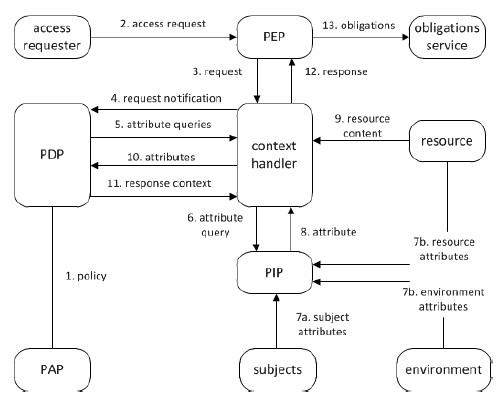
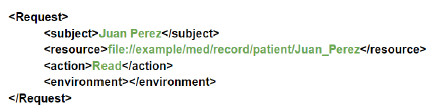
<body><![CDATA[<p lang="es-ES" class="western" align="justify" style="text-indent: 0.64cm"> 	<font face="Verdana, sans-serif"><font size="2" style="font-size: 10pt"><span lang="en-GB">ESBs 	provide an intermediate layer with reusable integration capabilities 	in order to enable the interaction between clients and services in a 	SOA. ESBs receive message-based requests on which they perform 	mediation operations to overcome client-server heterogeneities </span><span lang="en-US"><a id="br10">[</a><a href="#r10">10</a>]</span><span lang="en-GB">.</span></font></font></p> 	    <p lang="es-ES" class="western" align="justify" style="text-indent: 0.64cm"> 	<font face="Verdana, sans-serif"><font size="2" style="font-size: 10pt"><span lang="en-GB">Using 	ESBs promotes a loosely coupling between clients and services by 	providing the means to use large-scale business logic through 	modular services which may be independently invoked. This also 	enables to separate the integration logic, the communication logic 	and the business logic implemented by services </span><span lang="en-US"><a id="br10">[</a><a href="#r10">10</a>]</span><span lang="en-GB">. 	This way, different applications and services implemented on 	different technology stacks and using different data formats and 	protocols may communicate with an ESB through well-defined service 	interfaces. In turn, these services may be orchestrated and used by 	other applications and services.</span></font></font></p> 	    <p lang="es-ES" class="western" align="justify" style="text-indent: 0.64cm"> 	<font face="Verdana, sans-serif"><font size="2" style="font-size: 10pt"><span lang="en-GB">The 	most relevant ESB functionalities for the purpose of this work are 	message transformation, enriching and routing </span><span lang="en-US"><a id="br10">[</a><a href="#r10">10</a>]</span><span lang="en-GB">. 	ESB products provide mechanisms to transform and enrich messages 	exchanged between clients and services by using, for instance, the 	XSLT standard </span><span lang="en-US"><a id="br18">[</a><a href="#r18">18</a>]</span><span lang="en-GB">. 	These transformation mechanisms may be used to solve different 	problems such as heterogeneity of data formats. In addition, ESBs 	have capabilities to define at runtime a message destination using 	different criteria. The main routing types are content-based and 	itinerary-based routing. Content-based routing determines the 	message destination based on its content, for example, using the 	content in the header or body of SOAP messages </span><span lang="en-US"><a id="br9">[</a><a href="#r9">9</a>]</span><span lang="en-GB">. 	On the other hand, the itinerary-based routing (also known as 	Routing Slip) determines message destination taking as input an 	itinerary description, which may be included in the message </span><span lang="en-US"><a id="br10">[</a><a href="#r10">10</a>]</span><span lang="en-GB">.</span></font></font></p>  	<h2 lang="es-ES" class="western" align="justify" style="margin-bottom: 0.21cm"> 	<font face="Verdana, sans-serif"><font size="2" style="font-size: 10pt"><span lang="en-GB">2.3 	eXtensible Access Control Markup Language</span></font></font></h2> 	    <p lang="es-ES" class="western" align="justify"><font face="Verdana, sans-serif"><font size="2" style="font-size: 10pt"><span lang="en-GB">XACML 	</span><span lang="en-US"><a id="br11">[</a><a href="#r11">11</a>]</span><span lang="en-GB"> is an OASIS 	standard specification which describes a language for defining 	access control policies as well as a language to request and 	response access control decisions in XML. Usually, a requester tries 	to run an action on a resource by sending a request to the component 	that protects it: Policy Enforcement Point (PEP). The PEP performs 	an authorization request based on attributes of the requester, the 	resource, the action to be executed and any other relevant 	information. This request is sent to a Policy Decision Point (PDP) 	which issues a response indicating if access should be allowed based 	on the request and policies managed through a Policy Administration 	Point (PAP). Reponses consist of one of the following values: 	Permit, Deny, Indeterminate (some error occurred) and Not Applicable 	(the request cannot be responded by this service). Also, a Policy 	Information Point (PIP) may be used if additional information for 	taking the authorization decision is needed. Based on the 	authorization response, the PEP allows or denies access to the 	requester. </span></font></font> 	</p> 	    <p lang="es-ES" class="western" align="justify" style="text-indent: 0.64cm"> 	<a href="#f1">Figure 1</a> <font face="Verdana, sans-serif"><font size="2" style="font-size: 10pt"><span lang="en-GB">presents 	an XACML information flow which shows the different participating 	components: Policy Administration Point, Policy Decision Point, 	Policy Enforcement Point, Policy Information Point and Context 	handler.</span></font></font></p>  	    <p lang="en-US" align="center" style="line-height: 0.39cm; page-break-after: avoid"><a name="_Ref434602313"></a> <a name="f1"> <img src="/img/revistas/cleiej/v19n2/2a08f1.jpg"> </a>     <br> 	<font face="Verdana, sans-serif"><font size="2" style="font-size: 10pt"><b>Figure 	</b><span lang="en-GB"><b>1</b></span><b>:</b> XACML information 	flow <a id="br11">[</a><a href="#r11">11</a>]</font></font></p>  	    <p lang="es-ES" class="western" align="justify" style="text-indent: 0.64cm"> 	<font face="Verdana, sans-serif"><font size="2" style="font-size: 10pt"><span lang="en-US">The 	Policy Administration Point (PAP) is the component which creates 	policies and sets of policies. The Policy Decision Point (PDP) is 	the component which evaluates the policies and issues an 	authorization decision. The </span><span lang="en-GB">Policy 	Enforcement Point (PEP) is the component which executes the access 	control performing authorization requests and enforcing the 	responses. </span><span lang="en-US">The Policy Information Point 	(PIP) is the component which works as a source of attributes. 	Finally, the Context Handler transforms the requests from the native 	format to the canonic XACML format and the authorization decisions 	from the canonic XACML to the native format.</span></font></font></p> 	    <p lang="es-ES" class="western" align="justify" style="text-indent: 0.64cm"> 	<a href="#f2">Figure 2</a> <font face="Verdana, sans-serif"><font size="2" style="font-size: 10pt"><span lang="en-US">presents 	an example of XACML request where </span><span lang="en-GB">Juan 	Perez (</span><span lang="en-GB"><i>subject</i></span><span lang="en-GB">) 	requests an authorisation to read (</span><span lang="en-GB"><i>action</i></span><span lang="en-GB">) 	his medical records (</span><span lang="en-GB"><i>resource</i></span><span lang="en-GB">).</span></font></font></p>  	    <p lang="en-US" align="center" style="line-height: 0.39cm; page-break-after: avoid"><a name="_Ref434602486"></a> <a name="f2"> <img src="/img/revistas/cleiej/v19n2/2a08f2.jpg"> </a>     ]]></body>
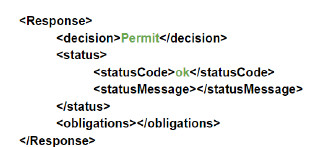
<body><![CDATA[<br> 	<font face="Verdana, sans-serif"><font size="2" style="font-size: 10pt"><span lang="en-GB"><b>Figure 	2:</b></span><span lang="en-GB"> </span>Example of XACML Request</font></font></p>  	    <p lang="es-ES" class="western" align="justify" style="text-indent: 0.64cm"> 	<font face="Verdana, sans-serif"><font size="2" style="font-size: 10pt"><span lang="en-GB">In 	turn, <a href="#f3">Figure 3</a> presents the response to the former request in which 	the decision is to permit (</span><span lang="en-GB"><i>decision</i></span><span lang="en-GB">) 	the access to the records (</span><span lang="en-GB"><i>resource</i></span><span lang="en-GB">) 	as requested by the subject (</span><span lang="en-GB"><i>subject</i></span><span lang="en-GB">) 	for read (</span><span lang="en-GB"><i>action</i></span><span lang="en-GB">).</span></font></font></p> 	    <p lang="en-US" align="center" style="line-height: 0.39cm; page-break-after: avoid"><a name="_Ref434602516"></a> <a name="f3"> <img src="/img/revistas/cleiej/v19n2/2a08f3.jpg"> </a>     <br> 	<font face="Verdana, sans-serif"><font size="2" style="font-size: 10pt"><span lang="en-GB"><b>Figure 	3:</b></span><span lang="en-GB"> </span>Example of XACML Response</font></font></p>  	<h2 lang="es-ES" class="western" align="justify" style="margin-bottom: 0.21cm"> 	<font face="Verdana, sans-serif"><font size="2" style="font-size: 10pt"><span lang="en-GB">2.4 	E-government Platforms</span></font></font></h2> 	    <p lang="es-ES" class="western" align="justify"><font face="Verdana, sans-serif"><font size="2" style="font-size: 10pt"><span lang="en-GB">It 	has been more than a decade since e-government systems were 	recognized as strategic enablers for improving the efficiency and 	quality of public services delivered to citizens. Nowadays, 	e-government systems mainly consist of countrywide infrastructure 	providing self-services and relevant information to citizens, 	implementing shared governmental services such as e-Identity and 	enabling a more effective and reliable inter-organizational 	coordination among public agencies and partners </span><span lang="en-US"><a id="br1">[</a><a href="#r1">1</a>]</span><span lang="en-GB">. 	More recently, the United Nations has linked e-government to 	achieving sustainable development and the Millennium Development 	Goals (MDGs) as </span><span lang="en-GB"><i>&ldquo;E-government and 	innovation can provide significant opportunities to transform public 	administration into an instrument of sustainable development.&rdquo;</i></span><span lang="en-GB"> 	</span><span lang="en-US"><a id="br19">[</a><a href="#r19">19</a>]</span><span lang="en-GB">.</span></font></font></p> 	    <p lang="es-ES" class="western" align="justify" style="text-indent: 0.64cm"> 	<font face="Verdana, sans-serif"><font size="2" style="font-size: 10pt"><span lang="en-GB">In 	this context, e-government platforms have become a key tool to 	support the development of e-government in many countries. Usually 	based on middleware technologies, such platforms provide the means 	to interconnect information systems of public agencies, provide 	common services that generate economy of scale, and foster the 	implementation of multi-agency services </span><span lang="en-US"><a id="br2">[</a><a href="#r2">2</a>]<a id="br3">[</a><a href="#r3">3</a>]</span><span lang="en-GB">.</span></font></font></p> 	    <p lang="es-ES" class="western" align="justify" style="text-indent: 0.64cm"> 	<font face="Verdana, sans-serif"><font size="2" style="font-size: 10pt"><span lang="en-GB">In 	order to facilitate the integration between agencies that may have 	different technological environments, e-government platforms are 	based on standards. Beyond their particular characteristics, these 	platforms usually provide a set of basic capabilities which include, 	among others, security (e.g. authentication), interoperability (e.g. 	through the use of standards) and mediation services implementing 	Enterprise Integration Patterns (EIP), e.g. data transformation 	</span><span lang="en-US"><a id="br20">[</a><a href="#r20">20</a>]</span><span lang="en-GB">. More 	concretely, their mediation and interoperability capabilities are 	usually provided by middleware technologies, such as SOAP Web 	Services and Enterprise Service Bus (ESB). In addition, security 	capabilities usually rely on well-established standards such as 	XACML </span><span lang="en-US"><a id="br11">[</a><a href="#r11">11</a>]</span><span lang="en-GB">.</span></font></font></p> 	    <p lang="es-ES" class="western" align="justify" style="text-indent: 0.64cm"> 	<font face="Verdana, sans-serif"><font size="2" style="font-size: 10pt"><span lang="en-GB">While 	the traditional focus of e-government (systems and platforms) have 	been the implementation of G2C (government-to-consumer), G2G 	(government-to-government) and G2B (government-to-business) 	interactions, new trends for including private organizations 	providing public services (e.g. health services providers) are 	leading to expand e-government models. As a consequence, new 	generation e-government platforms have to include functionalities to 	deal with a wider set of organizations participating in the platform 	services.</span></font></font></p>  	<h2 lang="es-ES" class="western" align="justify" style="margin-bottom: 0.21cm"> 	<font face="Verdana, sans-serif"><font size="2" style="font-size: 10pt"><span lang="en-GB">2.5 	Data Protection Laws</span></font></font></h2> 	    <p lang="es-ES" class="western" align="justify"><font face="Verdana, sans-serif"><font size="2" style="font-size: 10pt"><span lang="en-GB">Data 	Protection regulations establish legal rules on how personal data 	should be managed and used by public and private organizations in 	order to protect individuals&rsquo; privacy and to ensure an 	appropriate quality for these data. </span></font></font> 	</p> 	    <p lang="es-ES" class="western" align="justify" style="text-indent: 0.64cm"> 	<font face="Verdana, sans-serif"><font size="2" style="font-size: 10pt"><span lang="en-GB">The 	increasing implementation of online services, notably in 	e-government, in which individual&rsquo;s personal data is used to 	carry out a transaction has made necessary to consider Data 	Protection enforcement as a key component of e-government systems 	and platforms. Furthermore, as government is maintaining ever larger 	stores of personal information, the risk of privacy invasion by 	governments increases. Personal data handled by governments may be 	very sensitive </span><span lang="en-US"><a id="br5">[</a><a href="#r5">5</a>]</span><span lang="en-GB"> 	and their analysis can be highly invasive when data is combined and 	aggregated.</span></font></font></p> 	    ]]></body>
<body><![CDATA[<p lang="es-ES" class="western" align="justify" style="text-indent: 0.64cm"> 	<font face="Verdana, sans-serif"><font size="2" style="font-size: 10pt"><span lang="en-GB">As 	a result, most governments have promulgated Data Protection laws 	</span><span lang="en-US"><a id="br1">[</a><a href="#r1">1</a>]<a id="br21">[</a><a href="#r21">21</a>] </span><span lang="en-GB">with 	different approaches </span><span lang="en-US"><a id="br5">[</a><a href="#r5">5</a>]</span><span lang="en-GB">, 	which mainly rule on the re-use of information in other contexts 	from which it was provided.</span></font></font></p> 	    <p lang="es-ES" class="western" align="justify" style="text-indent: 0.64cm"> 	<font face="Verdana, sans-serif"><font size="2" style="font-size: 10pt"><span lang="en-GB">In 	turn, the OECD has developed Guidelines on the Protection of Privacy 	and Transborder Flows of Personal Data aiming at &ldquo;</span><span lang="en-GB"><i>harmonising 	national privacy legislation and, while upholding such human rights, 	would at the same time prevent interruptions in international flows 	of data</i></span><span lang="en-GB">&rdquo; </span><span lang="en-US"><a id="br22">[</a><a href="#r22">22</a>]</span><span lang="en-GB">. 	OCDE Guidelines establish a set of basic principles, which 	correspond to the ones in many country regulations: collection 	limitation, data quality, purpose specification, use limitation, 	security safeguards, openness, individual participation and 	accountability.</span></font></font></p> 	    <p lang="es-ES" class="western" align="justify" style="text-indent: 0.64cm"> 	<font face="Verdana, sans-serif"><font size="2" style="font-size: 10pt"><span lang="en-GB">In 	many countries, one of the key mechanisms for Data Protection are 	the </span><span lang="en-GB"><i>explicit consents</i></span><span lang="en-GB"> 	that citizens have to provide in order to allow the agencies to use 	/ share their personal data for a given purpose and within a given 	time period </span><span lang="en-US"><a id="br6">[</a><a href="#r6">6</a>]<a id="br23">[</a><a href="#r23">23</a>]</span><span lang="en-GB">. 	This way, agencies are required to comply with these consents when 	using and sharing information between them. In addition, many 	countries also provide habeas data actions which give citizens the 	right to access and correct their personal data and the right to a 	judicial hearing in the matter of personal data protection </span><span lang="en-US"><a id="br24">[</a><a href="#r24">24</a>]</span><span lang="en-GB">. 	These actions establish specific deadlines for the agencies once a 	citizen has requested access or a correction to their data.</span></font></font></p> 	    <p lang="es-ES" class="western" align="justify" style="text-indent: 0.64cm"> 	<font face="Verdana, sans-serif"><font size="2" style="font-size: 10pt"><span lang="en-GB">Although 	Data Protection regulations have been established since many years, 	their implementation in e-government scale is still very limited.</span></font></font></p>  	<h1 lang="es-ES" class="western" align="justify" style="margin-bottom: 0.21cm"> 	<font face="Verdana, sans-serif"><font size="2" style="font-size: 10pt"><span style="font-variant: normal"><span lang="en-GB"><b>3 	Requirements Analysis</b></span></span></font></font></h1> 	    <p lang="es-ES" class="western" align="justify"><font face="Verdana, sans-serif"><font size="2" style="font-size: 10pt"><span lang="en-US">This 	section analyses the general context of this work and identifies the 	requirements to be met by an interoperability platform in order to 	manage, monitor and enforce data protection regulations. As stated 	before, this work focuses on the Uruguayan InP (described in Section 	3.1) and on the Uruguayan data protection regulations (described in 	Section 3.2). However, as explained in Section 3.4, the identified 	requirements (presented in Section 3.3) may also apply to other 	interoperability platforms and data protection regulations with 	similar characteristics.</span></font></font></p>  	<h2 lang="es-ES" class="western" align="justify" style="margin-bottom: 0.21cm"> 	<font face="Verdana, sans-serif"><font size="2" style="font-size: 10pt"><span lang="en-GB">3.1 	Uruguayan Interoperability Platform</span></font></font></h2> 	    <p lang="es-ES" class="western" align="justify"><font face="Verdana, sans-serif"><font size="2" style="font-size: 10pt"><span lang="en-GB">The 	Uruguayan Interoperability Platform (InP) has the goal of 	facilitating and promoting the development of e-government services 	in Uruguay </span><span lang="en-US"><a id="br3">[</a><a href="#r3">3</a>]</span><span lang="en-GB">. 	The platform has two main components: the Middleware Infrastructure 	and the Security System.</span></font></font></p> 	    <p lang="es-ES" class="western" align="justify" style="text-indent: 0.64cm"> 	<font face="Verdana, sans-serif"><font size="2" style="font-size: 10pt"><span lang="en-US">The 	Middleware Infrastructure (MI) provides mechanisms that facilitate 	the development, deployment and integration of services and 	applications. These mechanisms are also the foundation for 	implementing an state-wide Service Oriented Architecture (SOA). 	Indeed, public agencies can leverage this infrastructure to publish 	and consume services. In addition, they can use its mediation 	capabilities, which are mainly provided by an ESB, in order to 	decouple clients and services.</span></font></font></p> 	    <p lang="es-ES" class="western" align="justify" style="text-indent: 0.64cm"> 	<font face="Verdana, sans-serif"><font size="2" style="font-size: 10pt"><span lang="en-US">The 	Security System (SS) provides security services to the rest of the 	components in the InP and it is the responsible for enforcing the 	required authentication, authorization and auditing policies. In 	particular, the SS provides mechanisms that allow controlling the 	access to the services published in the InP.</span></font></font></p> 	    <p lang="es-ES" class="western" align="justify" style="text-indent: 0.64cm"> 	<font face="Verdana, sans-serif"><font size="2" style="font-size: 10pt"><span lang="en-US">The 	services offered by public agencies through the InP are exposed 	using the Web Services technology. Each Web Service has a set of 	operations which receive and return a set of elements as input and 	output parameters, respectively. <a href="#f4">Figure 4</a>  presents a conceptual 	model with these notions.</span></font></font></p>  	    <p lang="en-US" align="center" style="line-height: 0.39cm; page-break-after: avoid"><a name="_Ref434062514"></a> <a name="f4"> <img src="/img/revistas/cleiej/v19n2/2a08f4.jpg"> </a>     ]]></body>
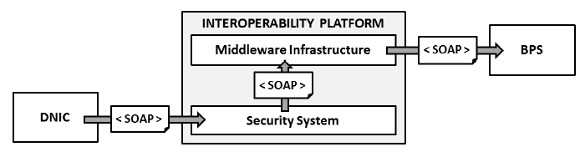
<body><![CDATA[<br> 	<font face="Verdana, sans-serif"><font size="2" style="font-size: 10pt"><b>Figure 	4:</b> Conceptual Model of the Web Services exposed through the InP</font></font></p>  	    <p lang="es-ES" class="western" align="justify" style="text-indent: 0.64cm"> 	<font face="Times New Roman, serif"><font size="3" style="font-size: 12pt"><font face="Verdana, sans-serif"><font size="2" style="font-size: 10pt"><span lang="en-US">For 	example, the Ministry of Industry, Energy and Mining (Ministerio de 	Industria, Energ&iacute;a y Miner&iacute;a, MIEM) provides a Web 	Service named &ldquo;CertificadosService&rdquo; </span></font></font><font face="Verdana, sans-serif"><font size="2" style="font-size: 10pt"><span lang="en-US">( 	<a class="western" href="http://www.agesic.gub.uy/innovaportal/v/3392/1/agesic/dinapyme_consulta_de_certificados.html">http://www.agesic.gub.uy/innovaportal/v/3392/1/agesic/dinapyme_consulta_de_certificados.html</a>) 	</span></font></font><font face="Verdana, sans-serif"><font size="2" style="font-size: 10pt"><span lang="en-US">which 	offers two operations: &ldquo;getCertificadoPymeByRUT&rdquo; and 	&ldquo;getCertificadoCCPByCodigo&rdquo;. Some elements of the 	operation &ldquo;getCertificadoPymeByRUT&rdquo; are: &ldquo;rut&rdquo;, 	&ldquo;code&rdquo;, &ldquo;desc&rdquo;, &ldquo;razonSocial&rdquo;, 	&ldquo;tipoDeSociedad&rdquo; and &ldquo;vigencia&rdquo;.</span></font></font></font></font></p> 	    <p lang="es-ES" class="western" align="justify" style="text-indent: 0.64cm"> 	<font face="Verdana, sans-serif"><font size="2" style="font-size: 10pt"><span lang="en-US">When 	a public agency wants to invoke a Web Service operation through the 	InP, it should send a SOAP message to this platform with the data 	required by the service (e.g. input parameters, security 	information). Once this message arrives at the platform, it is 	routed to the SS which performs access control tasks with the aim of 	allowing or denying the invocation of the operation. In order to 	take this authorization decision, the SS needs that the invoking 	agency includes in the SOAP message the identification of the 	service and the name of the operation it wants to invoke. These 	items have to be included using the WS-Addressing standard through 	the following elements: &ldquo;wsa:to&rdquo;, to specify the 	service, and &ldquo;wsa:action&rdquo;, to specify the operation. In 	addition, the invoking agency must include a security token in the 	message which has to be previously obtained from the InP, using the 	WS-Trust standard. This token, which among other elements contains 	the invoking agency and the role of the invoking user, has to be 	included in the message as an XML Security Token using the 	WS-Security standard.</span></font></font></p> 	    <p lang="es-ES" class="western" align="justify" style="text-indent: 0.64cm"> 	<font face="Verdana, sans-serif"><font size="2" style="font-size: 10pt"><span lang="en-US">After 	these security controls are completed, the message is routed to the 	MI where some validations (e.g. data format validations) and, if 	required, transformations (e.g. including a missing element in the 	message) are performed. Finally, the message is sent to the target 	service which is hosted in the servers of a public agency. </span></font></font> 	</p> 	    <p lang="es-ES" class="western" align="justify" style="text-indent: 0.64cm"> 	<a href="#f5">Figure 5</a> <font face="Verdana, sans-serif"><font size="2" style="font-size: 10pt"><span lang="en-US">depicts 	the process of a Web Service invocation within the InP. In 	particular, it shows how the National Direction of Civil 	Identification (Direcci&oacute;n Nacional de Identificaci&oacute;n 	Civil, DNIC) invokes a Web Service provided by the Social Security 	Institute (Banco de Previsi&oacute;n Social, BPS).</span></font></font></p> 	    <p lang="en-US" align="center" style="line-height: 0.39cm; page-break-after: avoid"><a name="_Ref434066428"></a> <a name="f5"> <img src="/img/revistas/cleiej/v19n2/2a08f5.jpg"> </a>     <br> 	<font face="Verdana, sans-serif"><font size="2" style="font-size: 10pt"><b>Figure 	</b><span lang="es-UY"><b>5</b></span><b>:</b> Service Invocation in 	the InP</font></font></p> 	    <p lang="en-US" class="western" align="justify">  	</p> 	<h2 lang="es-ES" class="western" align="justify" style="margin-bottom: 0.21cm"> 	<font face="Verdana, sans-serif"><font size="2" style="font-size: 10pt"><span lang="en-GB">3.2 	Uruguayan Data Protection Law</span></font></font></h2> 	    <p lang="es-ES" class="western" align="justify"><font face="Verdana, sans-serif"><font size="2" style="font-size: 10pt"><span lang="en-US">The 	Personal Data Protection and &ldquo;Habeas Data&rdquo; Action Act 	</span><span lang="en-US"><a id="br6">[</a><a href="#r6">6</a>]</span><span lang="en-US"> of Uruguay 	establishes that the right to the protection of personal data is 	inherent to the person (natural or legal). Personal data may include 	sounds, images or biometric data, among others. Some examples of 	personal data are names, last names, e-mails, pictures, 	fingerprints, voice and ADN. The act specifies a set of personal 	data which are public, that is, it is not required to obtain the 	explicit consent of the data owner to manipulate them. For natural 	persons these data are: names, last names, national identification 	document, nationality, address and birthdate </span><span lang="en-US"><a id="br6">[</a><a href="#r6">6</a>]</span><span lang="en-US">. 	</span></font></font> 	</p> 	    <p lang="es-ES" class="western" align="justify" style="text-indent: 0.64cm"> 	<font face="Verdana, sans-serif"><font size="2" style="font-size: 10pt"><span lang="en-US">The 	act also define &ldquo;sensitive data&rdquo; as personal data which 	reveals the racial origin, ethnic origin, political preferences, 	religious or moral convictions, union affiliation or information 	related to the health or sexual life of a person. The act 	establishes that no one is obligated to provide such data and if an 	entity wants to obtain them it must have the explicit consent of the 	data owner. This consent must be free, that is, the person should 	provide it in a voluntary way and for a given time period.</span></font></font></p> 	    ]]></body>

<body><![CDATA[<p lang="es-ES" class="western" align="justify" style="text-indent: 0.64cm"> 	<font face="Verdana, sans-serif"><font size="2" style="font-size: 10pt"><span lang="en-US">On 	the other hand, the act establishes that data owners have the right 	to know which data about them each entity (e.g. a public agency) 	has. To this end, data owners can request this information to the 	different entities. This right can be executed every six months and 	the requested information has to be provided within a period of five 	business days. The information can be provided in writing or by 	electronic means.</span></font></font></p> 	    <p lang="en-US" class="western" align="justify" style="text-indent: 0.64cm"> 	<font face="Verdana, sans-serif"><font size="2" style="font-size: 10pt">Through 	the analysis of this regulation, the following concepts were 	identified:</font></font></p> 	<ul> 		    <li>     <p lang="en-US" style="margin-bottom: 0.21cm; orphans: 2; widows: 2"> 		<font face="Verdana, sans-serif"><font size="2" style="font-size: 10pt">Personal 		Datum: Information of any type concerning natural or legal persons 		which are identified or identifiable.</font></font></p> 		    <li>     <p lang="en-US" style="margin-bottom: 0.21cm; orphans: 2; widows: 2"> 		<font face="Verdana, sans-serif"><font size="2" style="font-size: 10pt">Citizen: 		In the context of this work, Citizen refers to a natural person. 		Even though the act also deals with legal persons, they were left 		out of the scope of this work.</font></font></p> 		    <li>     <p lang="en-US" style="margin-bottom: 0.21cm; orphans: 2; widows: 2"> 		<font face="Verdana, sans-serif"><font size="2" style="font-size: 10pt">Purpose: 		It refers to the finality for which personal data will be used. For 		instance, personal data can be used by a public agency for a 		specific e-government procedure.</font></font></p> 		    <li>     <p lang="en-US" style="margin-bottom: 0.21cm; orphans: 2; widows: 2"> 		<font face="Verdana, sans-serif"><font size="2" style="font-size: 10pt">Consent: 		It refers to the permission given by a citizen to an entity (e.g. 		public agency) to share its sensitive personal data with another 		agency. Although the act also refers to consents for using personal 		data, this work focuses on consents for sharing personal data given 		that these are the ones which can be monitored through an 		interoperability platform. Consents are given for a specific 		purpose and for a given time period.</font></font></p> 	    ]]></body>
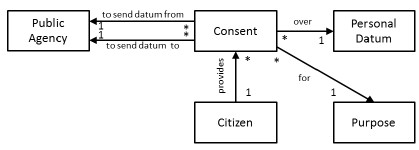
<body><![CDATA[</ul> 	    <p lang="es-ES" class="western" align="justify" style="text-indent: 0.64cm"><a name="_Ref420259863"></a> 	<a href="#f6">Figure 6</a> <font face="Verdana, sans-serif"><font size="2" style="font-size: 10pt"><span lang="en-US">presents 	these concepts as well as their relationships. Briefly, Citizens 	provide Consents to Public Agencies to share their Personal Data 	with other Public Agencies for a given Purpose.</span></font></font></p> 	    <p lang="en-US" align="center" style="line-height: 0.39cm; page-break-after: avoid"><a name="_Ref434088587"></a> <a name="f6"> <img src="/img/revistas/cleiej/v19n2/2a08f6.jpg"> </a>     <br> 	<font face="Verdana, sans-serif"><font size="2" style="font-size: 10pt"><b>Figure 	</b><span lang="es-UY"><b>6</b></span><b>:</b> Conceptual Model of 	the Data Protection Regulation</font></font></p>  	<h2 lang="es-ES" class="western" align="justify" style="margin-bottom: 0.21cm"> 	<font face="Verdana, sans-serif"><font size="2" style="font-size: 10pt"><span lang="en-GB">3.3 	High Level Requirements</span></font></font></h2> 	    <p lang="es-ES" class="western" align="justify"><font face="Verdana, sans-serif"><font size="2" style="font-size: 10pt"><span lang="en-US">The 	analysis of the general context of this work, presented in Section 	3.1 and Section 3.2, allows identifying various high level 	requirements for the solution, which should extend the InP to 	support data protection regulations.</span></font></font></p> 	    <p lang="es-ES" class="western" align="justify" style="text-indent: 0.64cm"> 	<font face="Verdana, sans-serif"><font size="2" style="font-size: 10pt"><span lang="en-US">The 	solution has to monitor the messages (for invoking services) 	exchanged through the InP between public agencies and enforce the 	compliance with the personal data protection law. To this end, the 	solution has to intercept all the exchanged messages and perform the 	required validations in order to determine if messages met what the 	law establishes. The validation have to be performed considering the 	public agencies that participate in the message exchange, the 	citizen who owns the data that is being exchanged, the purpose of 	the data exchange, the date in which messages are sent and the 	consents provided by the citizen.</span></font></font></p> 	    <p lang="es-ES" class="western" align="justify" style="text-indent: 0.64cm"> 	<font face="Verdana, sans-serif"><font size="2" style="font-size: 10pt"><span lang="en-US">In 	addition, the solution has to provide tools that allow citizens to 	manage the consents they provide to the different public agencies. 	Through these tools, citizens have to be able to obtain the personal 	data that each public agency has about them, under the terms and 	forms prescribed by the law. The solution also has to allow public 	agencies to manage the different personal data requests performed by 	the citizens.</span></font></font></p> 	    <p lang="es-ES" class="western" align="justify" style="text-indent: 0.64cm"> 	<font face="Verdana, sans-serif"><font size="2" style="font-size: 10pt"><span lang="en-US">Lastly, 	the solution should provide a configuration tool which allows 	administrators to manage and monitor all the aspects of the 	solution. For example, this tool should allow configuring the 	participating public agencies, the exposed services, the mapping 	between the elements of service operations and personal data, the 	actions to be taken in case a message exchange is not compliant with 	the law, among others.</span></font></font></p> 	    <p lang="es-ES" class="western" align="justify" style="text-indent: 0.64cm"> 	<a href="#f7">Figure 7</a> <font face="Verdana, sans-serif"><font size="2" style="font-size: 10pt"><span lang="en-US">presents 	a consolidated conceptual model for the solution where all the 	concepts identified in Section 3.1 and Section 3.2 are included. In 	addition, according to the analysis of this section the model was 	enhanced with:</span></font></font></p> 	<ul> 		    <li>     ]]></body>
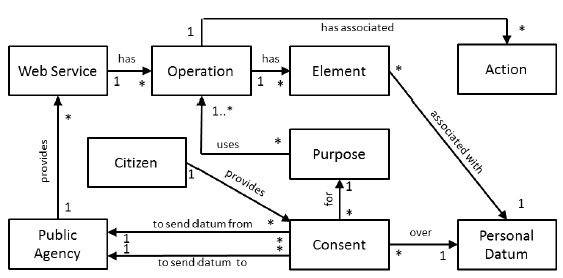
<body><![CDATA[<p lang="en-US" style="margin-bottom: 0.21cm; orphans: 2; widows: 2"> 		<font face="Verdana, sans-serif"><font size="2" style="font-size: 10pt">Action: 		It is a task to be performed in case of detecting that some of the 		aspects of the personal data protection regulation are not being 		met.</font></font></p> 		    <li>     <p lang="en-US" style="margin-bottom: 0.21cm; orphans: 2; widows: 2"> 		&ldquo;<font face="Verdana, sans-serif"><font size="2" style="font-size: 10pt">has 		associated&rdquo;: A relationship between Operation and Action 		which specifies the actions to be taken in case the message 		exchanges to invoke the operation are not compliant with the law.</font></font></p> 		    <li>     <p lang="en-US" style="margin-bottom: 0.21cm; orphans: 2; widows: 2"> 		&ldquo;<font face="Verdana, sans-serif"><font size="2" style="font-size: 10pt">uses&rdquo;: 		A relationship between Purpose and Operation which indicates which 		operations are required for a given purpose (e.g. an e-government 		procedure)</font></font></p> 		    <li>     <p lang="en-US" style="margin-bottom: 0.21cm; orphans: 2; widows: 2"> 		&ldquo;<font face="Verdana, sans-serif"><font size="2" style="font-size: 10pt">associated 		with&rdquo;: A relationship between Element and Personal Datum 		which maps the elements of operations (i.e. input and output 		parameters) with personal data.</font></font></p> 	    </ul> 	    <p lang="en-US" align="center" style="line-height: 0.39cm; page-break-after: avoid"><a name="_Ref434159547"></a> <a name="f7"> <img src="/img/revistas/cleiej/v19n2/2a08f7.jpg"> </a>     <br> 	<font face="Verdana, sans-serif"><font size="2" style="font-size: 10pt"><b>Figure 	</b><span lang="es-UY"><b>7</b></span><b>:</b> Consolidated 	Conceptual Model</font></font></p>  	<h2 lang="es-ES" class="western" align="justify" style="margin-bottom: 0.21cm"> 	<font face="Verdana, sans-serif"><font size="2" style="font-size: 10pt"><span lang="en-GB">3.4 	Detailed Requirements</span></font></font></h2> 	    ]]></body>
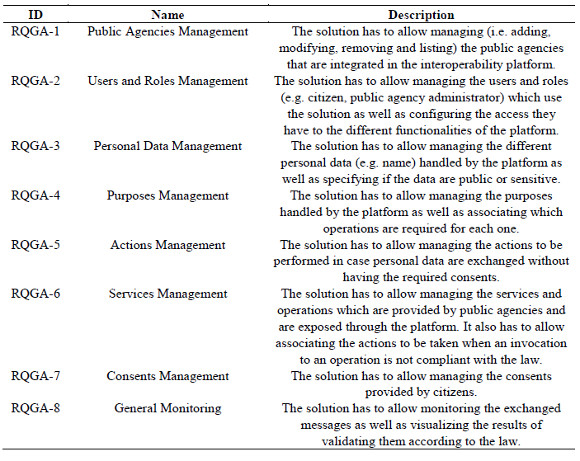
<body><![CDATA[<p lang="es-ES" class="western" align="justify"><font face="Verdana, sans-serif"><font size="2" style="font-size: 10pt"><span lang="en-US">From 	the high level requirements described in Section 3.3, three types of 	users were identified to which the solution should provide 	functionalities: </span></font></font> 	</p> 	<ul> 		    <li>     <p lang="en-US" style="margin-bottom: 0.21cm; orphans: 2; widows: 2"> 		<font face="Verdana, sans-serif"><font size="2" style="font-size: 10pt">General 		Administrators</font></font></p> 		    <li>     <p lang="en-US" style="margin-bottom: 0.21cm; orphans: 2; widows: 2"> 		<font face="Verdana, sans-serif"><font size="2" style="font-size: 10pt">Public 		Agency Administrators</font></font></p> 		    <li>     <p lang="en-US" style="margin-bottom: 0.21cm; orphans: 2; widows: 2"> 		<font face="Verdana, sans-serif"><font size="2" style="font-size: 10pt">Citizens</font></font></p> 	    </ul> 	    <p lang="es-ES" class="western" align="justify" style="text-indent: 0.64cm"> 	<font face="Verdana, sans-serif"><font size="2" style="font-size: 10pt"><span lang="en-US">General 	Administrators have to be able to manage all the aspects of the 	solution. <a href="#t1">Table 1</a> lists and describes the specific requirements for 	this type of users.</span></font></font></p> 	    <p lang="en-US" align="center" style="margin-top: 0.78cm; margin-bottom: 0.18cm; line-height: 0.39cm; page-break-after: avoid"><a name="_Ref434164290"></a> 	<font face="Times New Roman, serif"><font size="2" style="font-size: 9pt"><font size="3" style="font-size: 12pt"><b><font face="Verdana, sans-serif"><font size="2" style="font-size: 10pt">Table 	1:</font></font></b></font><font face="Verdana, sans-serif"><font size="2" style="font-size: 10pt"><b> 	</b></font></font><font face="Verdana, sans-serif"><font size="2" style="font-size: 10pt">Requirements 	for General Administrators</font></font></font></font>    ]]></body>
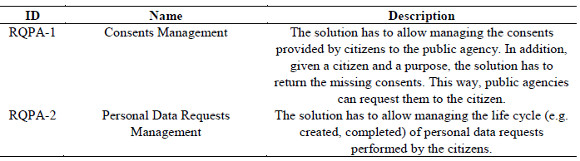
<body><![CDATA[<br> <a name="t1"> <img src="/img/revistas/cleiej/v19n2/2a08t1.jpg">  </a>     <br></p>  	    <p lang="es-ES" class="western" align="justify" style="text-indent: 0.64cm"> 	<font face="Verdana, sans-serif"><font size="2" style="font-size: 10pt"><span lang="en-US">Public 	Agencies Administrators have to be able to manage the aspects of the 	solution concerning their public agency. <a href="#t2">Table 2</a></span><span lang="en-US"><b> 	</b></span><span lang="en-US">lists and describes the specific 	requirements for this type of users.</span></font></font></p> 	    <p lang="en-US" align="center" style="margin-top: 0.78cm; margin-bottom: 0.18cm; line-height: 0.39cm; page-break-after: avoid"><a name="_Ref434449346"></a><a name="_Ref434177573"></a> 	<font face="Times New Roman, serif"><font size="2" style="font-size: 9pt"><font size="3" style="font-size: 12pt"><b><font face="Verdana, sans-serif"><font size="2" style="font-size: 10pt">Table 	2:</font></font></b></font><font face="Verdana, sans-serif"><font size="2" style="font-size: 10pt"> 	Requirements for Public Agencies Administrators</font></font></font></font>    <br> <a name="t2"> <img src="/img/revistas/cleiej/v19n2/2a08t2.jpg">  </a>     <br></p>  	    <p lang="es-ES" class="western" align="justify" style="text-indent: 0.64cm"> 	<font face="Times New Roman, serif"><font size="3" style="font-size: 12pt"><font face="Verdana, sans-serif"><font size="2" style="font-size: 10pt"><span lang="en-US">Citizens 	have to be able to manage the consents they provide and the personal 	data requests they perform. <a href="#t3">Table 3</a></span></font></font><font size="3" style="font-size: 12pt"><b><font face="Verdana, sans-serif"><font size="2" style="font-size: 10pt"><span lang="en-US"> 	</span></font></font></b></font><font face="Verdana, sans-serif"><font size="2" style="font-size: 10pt"><span lang="en-US">lists 	and describes the specific requirements for this type of users.</span></font></font></font></font></p> 	    <p lang="en-US" align="center" style="margin-top: 0.78cm; margin-bottom: 0.18cm; line-height: 0.39cm; page-break-after: avoid"><a name="_Ref434179919"></a> 	<font face="Times New Roman, serif"><font size="2" style="font-size: 9pt"><font size="3" style="font-size: 12pt"><b><font face="Verdana, sans-serif"><font size="2" style="font-size: 10pt">Table 	3:</font></font></b></font><font face="Verdana, sans-serif"><font size="2" style="font-size: 10pt"> 	Requirements for Citizens</font></font></font></font>    <br> <a name="t3"> <img src="/img/revistas/cleiej/v19n2/2a08t3.jpg">  </a>     <br></p>  	    ]]></body>
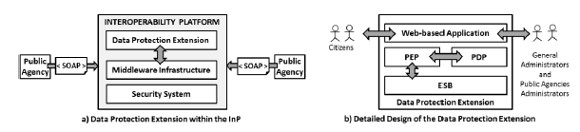
<body><![CDATA[<p lang="es-ES" class="western" align="justify" style="text-indent: 0.64cm"> 	<font face="Verdana, sans-serif"><font size="2" style="font-size: 10pt"><span lang="en-US">Finally, 	<a href="#t4">Table 4</a> lists and describes the requirements associated with message 	exchanges.</span></font></font></p> 	    <p lang="en-US" align="center" style="margin-top: 0.78cm; margin-bottom: 0.18cm; line-height: 0.39cm; page-break-after: avoid"><a name="_Ref434180866"></a> 	<font face="Times New Roman, serif"><font size="2" style="font-size: 9pt"><font size="3" style="font-size: 12pt"><b><font face="Verdana, sans-serif"><font size="2" style="font-size: 10pt">Table 	4:</font></font></b></font><font face="Verdana, sans-serif"><font size="2" style="font-size: 10pt"> 	Requirements for Message Exchanges</font></font></font></font>    <br> <a name="t4"> <img src="/img/revistas/cleiej/v19n2/2a08t4.jpg">  </a>     <br></p>  	<h2 lang="es-ES" class="western" align="justify" style="margin-bottom: 0.21cm"> 	<font face="Verdana, sans-serif"><font size="2" style="font-size: 10pt"><span lang="es-UY">3.5 	Final Remarks</span></font></font></h2> 	    <p lang="es-ES" class="western" align="justify"><font face="Verdana, sans-serif"><font size="2" style="font-size: 10pt"><span lang="en-US">It 	is important to note that although the analysis presented in this 	section was based in the Uruguayan context, it can also be applied 	in other countries. This is due to the fact that interoperability 	platforms are increasingly used in e-government scenarios </span><span lang="en-US"><a id="br2">[</a><a href="#r2">2</a>]<a id="br25">[</a><a href="#r25">25</a>] 	</span><span lang="en-US">and that the countries where they are 	applied have promulgated some sort of data protection regulations 	</span><span lang="en-US"><a id="br26">[</a><a href="#r26">26</a>]</span><span lang="en-US">, which are 	similar to the Uruguayan one (e.g. the organic law 15/1999 of Spain 	</span><span lang="en-US"><a id="br27">[</a><a href="#r27">27</a>]</span><span lang="en-US">).</span></font></font></p>  	<h1 lang="es-ES" class="western" align="justify" style="margin-bottom: 0.21cm"> 	<font face="Verdana, sans-serif"><font size="2" style="font-size: 10pt"><span style="font-variant: normal"><span lang="en-GB"><b>4 	Proposed Solution</b></span></span></font></font></h1> 	    <p lang="es-ES" class="western" align="justify"><font face="Verdana, sans-serif"><font size="2" style="font-size: 10pt"><span lang="en-GB">This 	section presents the proposed solution which extends an 	interoperability platform to manage, monitor and enforce data 	protection regulations. More details concerning the solution can be 	found in </span><span lang="en-US"><a id="br28">[</a><a href="#r28">28</a>]</span><span lang="en-GB">.</span></font></font></p> 	    <p lang="es-ES" class="western" align="justify" style="text-indent: 0.64cm"> 	<font face="Verdana, sans-serif"><font size="2" style="font-size: 10pt"><span lang="en-GB">First, 	the general architecture of the solution and its main components are 	presented. Then, the most relevant characteristics of the proposal 	are described. Finally, the key interactions between the components 	of the solution, in particular the one that takes place between its 	PDP and PEP modules, through XACML messages, are described. </span></font></font> 	</p>  	<h2 lang="es-ES" class="western" align="justify" style="margin-bottom: 0.21cm"> 	<font face="Verdana, sans-serif"><font size="2" style="font-size: 10pt"><span lang="en-GB">4.1 	General Architecture</span></font></font></h2> 	    <p lang="es-ES" class="western" align="justify"><font face="Verdana, sans-serif"><font size="2" style="font-size: 10pt"><span lang="en-GB">As 	depicted in <a href="#f8">Figure 8</a>(a), the proposed solution extends an 	interoperability platform with a data protection component which is 	responsible for providing the functionalities to the three types of 	users identified in the previous section, as shown in <a href="#f8">Figure 8</a>(b). 	On one hand, this component allows general administrators to 	configure the required aspects for controlling messages exchanges 	through the platform as well as to monitor the solution. On the 	other hand, this component allows public agencies administrators to 	manage personal data requests performed by citizens. Finally, the 	extension allows citizens to manage the consents they provide as 	well as to perform personal data requests to the different public 	agencies. </span></font></font> 	</p>  	    <p lang="en-US" align="center" style="line-height: 0.39cm; page-break-after: avoid"><a name="_Ref434402987"></a><a name="_Ref434491770"></a> <a name="f8"> <img src="/img/revistas/cleiej/v19n2/2a08f8.jpg"> </a>     <br> 	<font face="Verdana, sans-serif"><font size="2" style="font-size: 10pt"><b>Figure 	</b><span lang="es-UY"><b>8</b></span><b>:</b> Logical Architecture</font></font></p> 	    ]]></body>
<body><![CDATA[<p lang="en-US" class="western" align="justify">    <br>  	</p> 	    <p lang="es-ES" class="western" align="justify" style="text-indent: 0.64cm"> 	<font face="Verdana, sans-serif"><font size="2" style="font-size: 10pt"><span lang="en-GB">The 	main idea of the proposal is processing all the messages that pass 	through the interoperability platform. Each message is inspected by 	the solution in order to validate its content considering the 	aspects of the data protection law previously analysed. In 	particular, the validation considers the type of personal data that 	is being exchanged (i.e. public or sensitive) and the consents 	provided by citizens regarding these data. If the validation fails, 	the solution performs different pre-configured actions to the 	original message (e.g. execute a message transformation to take out 	elements which do not have the required consents to be shared).</span></font></font></p> 	    <p lang="es-ES" class="western" align="justify" style="text-indent: 0.64cm"> 	<font face="Verdana, sans-serif"><font size="2" style="font-size: 10pt"><span lang="en-US">In 	order to perform these tasks, the solution has to store a set of 	configuration data. For example, the solution stores the consents 	provided by the citizens, the configuration of Web Services and 	operations provided by public agencies and the actions to be taken 	for each operation if a validation fails when it is invoked.</span></font></font></p> 	    <p lang="es-ES" class="western" align="justify" style="text-indent: 0.64cm"> 	<font face="Verdana, sans-serif"><font size="2" style="font-size: 10pt"><span lang="en-US">As 	presented in <a href="#f8">Figure 8</a></span><span lang="en-GB"> (a), messages 	received by the interoperability platform are routed to the data 	protection component by the MI. Then, as shown in <a href="#f8">Figure 8</a>(b), 	within the data protection component, messages are first processed 	by an ESB which routes them to the PEP. The PEP component receives 	messages and sends XACML access requests to the PDP. The PDP 	component evaluates XACML requests, according to the available 	consents, and generates XACML responses which are returned to the 	PEP. Finally, messages are routed to the ESB which applies the 	required actions (e.g. a message transformation to take out 	elements) according to the XACML response.</span></font></font></p> 	    <p lang="es-ES" class="western" align="justify" style="text-indent: 0.64cm"> 	<font face="Verdana, sans-serif"><font size="2" style="font-size: 10pt"><span lang="en-US">The 	data protection component also includes a web-based application 	through which the different functionalities of the solution (e.g. 	consents management, personal data management) are delivered to the 	three types of users identified (i.e. general administrators, public 	agencies administrators and citizens).</span></font></font></p>  	<h2 lang="es-ES" class="western" align="justify" style="margin-bottom: 0.21cm"> 	<font face="Verdana, sans-serif"><font size="2" style="font-size: 10pt"><span lang="en-GB">4.2 	Main Functionalities</span></font></font></h2> 	    <p lang="en-GB" class="western" align="justify"><font face="Verdana, sans-serif"><font size="2" style="font-size: 10pt">This 	section presents the main functionalities of the proposed extension 	which address the requirements identified in Section 3.4.</font></font></p>  	<h3 lang="en-GB" class="western" align="justify" style="margin-bottom: 0.21cm; text-decoration: none"> 	<font face="Verdana, sans-serif"><font size="2" style="font-size: 10pt"><i>4.2.1 	Personal Data Management</i></font></font></h3> 	    <p lang="es-ES" class="western" align="justify"><font face="Verdana, sans-serif"><font size="2" style="font-size: 10pt"><span lang="en-GB">Personal 	data management functionalities allow specifying and configuring the 	personal data that the platform is going to supervise. For example, 	administrators can specify that the platform is going to supervise 	the name, the last name and the address of citizens. </span></font></font> 	</p> 	    <p lang="es-ES" class="western" align="justify" style="text-indent: 0.64cm"> 	<font face="Verdana, sans-serif"><font size="2" style="font-size: 10pt"><span lang="en-GB">The 	solution follows the canonical data model pattern </span><span lang="en-US"><a id="br20">[</a><a href="#r20">20</a>]</span><span lang="en-GB">, 	given that public agencies can use different structures or names to 	represent citizens&rsquo; personal data. For example, a public 	agency can use &ldquo;name&rdquo; to refer to the name of a citizen 	and other agency can use &ldquo;first name&rdquo;. By using a 	Canonical Personal Data Model (CPDM), the platform manages a single 	data model which is mapped to the different elements (i.e. input and 	output parameters) of the Web Services&rsquo; operations provided by 	the different public agencies.</span></font></font></p> 	    <p lang="es-ES" class="western" align="justify" style="text-indent: 0.64cm"> 	<font face="Verdana, sans-serif"><font size="2" style="font-size: 10pt"><span lang="en-GB">In 	order to know which elements of an operation have to be validated 	within a message exchange, personal data have to be configured as 	public or sensitive. In particular, the solution allows classifying 	personal data, included in the CPDM, in one of the following three 	categories:</span></font></font></p> 	<ul> 		    ]]></body>
<body><![CDATA[<li>     <p lang="en-US" style="margin-bottom: 0.21cm; orphans: 2; widows: 2"> 		<font face="Verdana, sans-serif"><font size="2" style="font-size: 10pt">Free: 		This type of personal data does not require the consent of citizens 		to be shared.</font></font></p> 		    <li>     <p lang="en-US" style="margin-bottom: 0.21cm; orphans: 2; widows: 2"> 		<font face="Verdana, sans-serif"><font size="2" style="font-size: 10pt">Limited: 		This type of personal data requires the explicit consent of the 		data owner (i.e. a citizen) to be shared.</font></font></p> 		    <li>     <p lang="en-US" style="margin-bottom: 0.21cm; orphans: 2; widows: 2"> 		<font face="Verdana, sans-serif"><font size="2" style="font-size: 10pt">Denied: 		This type of personal data cannot be shared.</font></font></p> 	    </ul> 	    <p lang="es-ES" class="western" align="justify" style="text-indent: 0.64cm"> 	<font face="Verdana, sans-serif"><font size="2" style="font-size: 10pt"><span lang="en-GB">Note 	that the functionalities described in this section address the 	requirement RQGA-3 (<a href="#t1">Table 1</a>).</span></font></font></p>  	<h3 lang="es-ES" class="western" align="justify" style="margin-bottom: 0.21cm"> 	<font face="Verdana, sans-serif"><font size="2" style="font-size: 10pt"><span lang="en-GB"><i><span style="text-decoration: none">4.2.2 	W</span></i></span><span lang="en-US"><i><span style="text-decoration: none">eb 	Services Management</span></i></span></font></font></h3> 	    <p lang="es-ES" class="western" align="justify"><font face="Verdana, sans-serif"><font size="2" style="font-size: 10pt"><span lang="en-GB">Web 	Services management functionalities allow configuring Web Services 	and operations that public agencies provide through the platform. In 	particular, these functionalities allow general administrators to 	specify the Web Services that are provided by each public agency as 	well as the operations these Web Services offer. In addition, they 	allow specifying the mappings between the CPDM and the elements of 	Web Services operations. <a href="#f9">Figure 9</a> presents an example, where the 	elements of a message are mapped to the personal data in the CPDM.</span></font></font></p>  	    <p lang="en-US" align="center" style="line-height: 0.39cm; page-break-after: avoid"><a name="_Ref434430440"></a> <a name="f9"> <img src="/img/revistas/cleiej/v19n2/2a08f9.jpg"> </a>     ]]></body>
<body><![CDATA[<br> 	<font face="Verdana, sans-serif"><font size="2" style="font-size: 10pt"><b>Figure 	</b><span lang="es-UY"><b>9</b></span><b>:</b> Mapping between 	Message Elements and Personal Data</font></font></p>  	    <p lang="es-ES" class="western" align="justify" style="text-indent: 0.64cm"> 	<font face="Verdana, sans-serif"><font size="2" style="font-size: 10pt"><span lang="en-GB">Note 	that the functionalities described in this section address the 	requirement RQGA-6 (<a href="#t1">Table 1</a>).</span></font></font></p>  	<h3 lang="es-ES" class="western" align="justify" style="margin-bottom: 0.21cm"> 	<font face="Verdana, sans-serif"><font size="2" style="font-size: 10pt"><span lang="en-GB"><i><span style="text-decoration: none">4.2.3 	Consent Management</span></i></span></font></font></h3> 	    <p lang="es-ES" class="western" align="justify"><font face="Verdana, sans-serif"><font size="2" style="font-size: 10pt"><span lang="en-GB">Consent 	management functionalities allow citizens to manage the consents 	that they provide to public agencies through a web-based 	application. This way, citizens have more control over their 	personal data and can stop sharing them at any time. These 	functionalities also allow citizens to perform personal data 	requests to public agencies as well as monitoring the state of these 	requests. In addition, once these requests are completed by public 	agencies citizens are notified, for example, via email.</span></font></font></p> 	    <p lang="es-ES" class="western" align="justify" style="text-indent: 0.64cm"> 	<font face="Verdana, sans-serif"><font size="2" style="font-size: 10pt"><span lang="en-GB">Consent 	management functionalities also provide utilities for public agency 	administrators. On one hand, these administrators can manage the 	personal data requests that citizens perform. On the other hand, 	they can obtain&nbsp;the missing consents to complete a purpose 	(e.g. an e-government procedure) for a given citizen. This way, 	public agency administrators can request these consents to the 	citizen to be able to complete a purpose.</span></font></font></p> 	    <p lang="es-ES" class="western" align="justify" style="text-indent: 0.64cm"> 	<a href="#f10">Figure 10</a> <font face="Verdana, sans-serif"><font size="2" style="font-size: 10pt"><span lang="en-GB">presents 	an example in order to describe how the solution determines the 	missing consents given a purpose and a citizen. </span></font></font> 	</p>  	    <p lang="en-US" align="center" style="line-height: 0.39cm; page-break-after: avoid"><a name="_Ref434447253"></a> <a name="f10"> <img src="/img/revistas/cleiej/v19n2/2a08f10.jpg"> </a>     <br> 	<font face="Verdana, sans-serif"><font size="2" style="font-size: 10pt"><b>Figure 	</b><span lang="es-UY"><b>10</b></span><b>:</b> Determining Missing 	Consents</font></font></p>  	    <p lang="es-ES" class="western" align="justify" style="text-indent: 0.64cm"> 	<font face="Verdana, sans-serif"><font size="2" style="font-size: 10pt"><span lang="en-GB">In 	particular, the figure shows a procedure which requires two 	operations to be complete: Operation 1 and Operation 2. Each 	operation uses a set of data elements: Operation 1 uses A, B and C 	while Operation 2 uses B and D. The union of these sets is a set 	with the data elements used by the procedure. On the other hand, a 	citizen has provided consents for two data elements: A and C. The 	missing consents for the citizen are calculated as the difference 	between the data elements used by the procedure (i.e. {A, B, C, D}) 	and the data elements for which the citizen has provided consents 	(i.e. {A, C}). This way, in order to complete the procedure for the 	given citizen, this citizen has to provide consents for the data 	elements B and D.</span></font></font></p> 	    <p lang="es-ES" class="western" align="justify" style="text-indent: 0.64cm"> 	<font face="Verdana, sans-serif"><font size="2" style="font-size: 10pt"><span lang="en-GB">Note 	that the functionalities described in this section address the 	requirements RQPA-1 (<a href="#t2">Table 2</a>) and RQCT-1 (<a href="#t3">Table 3</a>).</span></font></font></p>  	<h3 lang="es-ES" class="western" align="justify" style="margin-bottom: 0.21cm"> 	<font face="Verdana, sans-serif"><font size="2" style="font-size: 10pt"><span lang="en-GB"><i><span style="text-decoration: none">4.2.4 	Message Validation and Actions </span></i></span></font></font> 	</h3> 	    <p lang="es-ES" class="western" align="justify"><font face="Verdana, sans-serif"><font size="2" style="font-size: 10pt"><span lang="en-GB">When 	a public agency sends a message to invoke a service, or to respond 	to a service request, the solution validates that all the data 	contained in the messages have the required consents to be 	exchanged. In particular, it validates that personal data of type 	&ldquo;Limited&rdquo; have the explicit consent of the data owner. 	If this validation fails, the solution enforces the data protection 	law by taking different actions. &nbsp;To this end, the solution 	provides configuration capabilities which allow specifying which 	actions have to be taken for each operation.</span></font></font></p> 	    ]]></body>
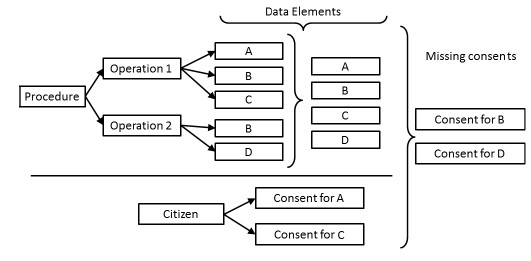
<body><![CDATA[<p lang="es-ES" class="western" align="justify" style="text-indent: 0.64cm"> 	<font face="Verdana, sans-serif"><font size="2" style="font-size: 10pt"><span lang="en-US">First, 	the solution allows specifying an XSLT transformation which will be 	applied to the message if the validation fails. For example, a 	transformation may take out some data elements of the message. For 	example, <a href="#f11">Figure 11</a> presents the results (on the right) of applying a 	transformation to take out two elements of the original message (on 	the left) sent to the platform given that the data owner did not 	provide consents to share some elements.</span></font></font></p> 	    <p lang="es-ES" class="western" align="justify" style="text-indent: 0.64cm"> 	<font face="Verdana, sans-serif"><font size="2" style="font-size: 10pt"><span lang="en-GB">In 	addition, for each method the solution allows specifying a set of 	native actions which are also executed when a message validation 	fails. Some examples of actions are a notification via email and a 	notification via SMS. The extensible design of the solution allows 	including new types of actions. </span></font></font> 	</p> 	    <p lang="es-ES" class="western" align="justify" style="text-indent: 0.64cm"> 	<font face="Verdana, sans-serif"><font size="2" style="font-size: 10pt"><span lang="en-GB">Note 	that the functionalities described in this section address the 	requirements RQME-1 and RQME-2 (<a href="#t4">Table 4</a>).</span></font></font></p>  	    <p lang="en-US" align="center" style="line-height: 0.39cm; page-break-after: avoid"><a name="_Ref434451997"></a> <a name="f11"> <img src="/img/revistas/cleiej/v19n2/2a08f11.jpg"> </a>     <br> 	<font face="Verdana, sans-serif"><font size="2" style="font-size: 10pt"><b>Figure 	</b><span lang="es-UY"><b>11</b></span><b>:</b> Filtering a Message</font></font></p>  	<h2 lang="es-ES" class="western" align="justify" style="margin-bottom: 0.21cm"> 	<font face="Verdana, sans-serif"><font size="2" style="font-size: 10pt"><span lang="en-GB">4.3 	Components Design</span></font></font></h2> 	    <p lang="es-ES" class="western" align="justify"><font face="Verdana, sans-serif"><font size="2" style="font-size: 10pt"><span lang="en-US">The 	detailed design of the solution comprises five components: Data 	Protection Web (DP-Web), Data Protection Service (DP-Service), Data 	Protection Repository (DP-Repo), Data Protection Flow (DP-Flow) and 	Data Protection Service Flow (DP-ServiceFlow). Each component has a 	concrete responsibility aiming to achieve a loosely coupled 	solution. <a href="#f12">Figure 12</a> graphically presents these components as well as 	their dependencies.</span></font></font></p>  	    <p lang="en-US" align="center" style="line-height: 0.39cm; page-break-after: avoid"><a name="_Ref434491838"></a> <a name="f12"> <img src="/img/revistas/cleiej/v19n2/2a08f12.jpg"> </a>     <br> 	<font face="Verdana, sans-serif"><font size="2" style="font-size: 10pt"><b>Figure 	</b><span lang="es-UY"><b>12</b></span><b>:</b> Components Diagram</font></font></p>  	    <p lang="es-ES" class="western" align="justify" style="text-indent: 0.64cm"> 	<font face="Verdana, sans-serif"><font size="2" style="font-size: 10pt"><span lang="en-GB">DP-Web 	is a web-based application which can be used by administrators, to 	perform Configuration and Monitoring tasks, as well as by citizens, 	to manage their consents. </span></font></font> 	</p> 	    <p lang="es-ES" class="western" align="justify" style="text-indent: 0.64cm"> 	<font face="Verdana, sans-serif"><font size="2" style="font-size: 10pt"><span lang="en-GB">DP-Service 	is the component which contains the business logic used by the web 	application. It uses the DP-Repo component to manage the data 	required by the solution (e.g. configuration data, citizens&rsquo; 	consents).</span></font></font></p> 	    ]]></body>
<body><![CDATA[<p lang="en-GB" class="western" align="justify" style="text-indent: 0.64cm"> 	<font face="Verdana, sans-serif"><font size="2" style="font-size: 10pt">DP-Repo 	is the component which encapsulates the access to the database where 	all the data required by the solution are stored.</font></font></p> 	    <p lang="es-ES" class="western" align="justify" style="text-indent: 0.64cm"> 	<font face="Verdana, sans-serif"><font size="2" style="font-size: 10pt"><span lang="en-GB">DP-ServiceFlow 	is the component which contains the logic to validate a message 	exchange. It has the PDP role in the solution given that it returns 	an authorization decision for the messages according to the 	available consents. It uses the DP-Repo component with the aim of 	obtaining the consents that are stored in the database.</span></font></font></p> 	    <p lang="es-ES" class="western" align="justify" style="text-indent: 0.64cm"> 	<font face="Verdana, sans-serif"><font size="2" style="font-size: 10pt"><span lang="en-US">In 	order to validate a message exchange, DP-ServiceFlow uses data 	coming from the DP-Flow component as well as configuration data. In 	particular, it uses the public agency which is sending the message, 	the service and operation that are being invoked, the public agency 	that provides that service, the citizen which owns the data that is 	being exchanged, the not expired consents provided by this citizen 	concerning those data, the purpose of the message exchange and the 	mappings between message elements and the CPDM. With these data, 	DP-ServiceFlow takes an authorization decision which is returned to 	the requester (i.e. DP-Flow). </span></font></font> 	</p> 	    <p lang="es-ES" class="western" align="justify" style="text-indent: 0.64cm"> 	<font face="Verdana, sans-serif"><font size="2" style="font-size: 10pt"><span lang="en-US">Finally, 	DP-Flow is the component which has the PEP role in the solution. It 	is built on top of an ESB which allows leveraging its mediation 	capabilities. In particular, DP-Flow exposes an endpoint through 	which all the SOAP messages that arrive at the interoperability 	platform to invoke services are intercepted. These messages are 	processed by the DP-Flow component in order to obtain the required 	information to request an authorization decision to the 	DP-ServiceFlow component (i.e. the PDP). </span></font></font> 	</p> 	    <p lang="es-ES" class="western" align="justify" style="text-indent: 0.64cm"> 	<font face="Verdana, sans-serif"><font size="2" style="font-size: 10pt"><span lang="en-US">In 	particular, DP-Flow uses the WS-Addressing headers to obtain the 	service and operation that are being invoked, the WS-Security 	headers to obtain the public agency that is performed the invocation 	and an additional header, defined by the proposed solution, to 	obtain the purpose of the invocation and an identification of the 	citizen that owns the data included in the message. <a href="#f13">Figure 13</a> 	presents the structure of this additional header.</span></font></font></p>  	    <p lang="en-US" align="center" style="line-height: 0.39cm; page-break-after: avoid"><a name="_Ref434513522"></a> <a name="f13"> <img src="/img/revistas/cleiej/v19n2/2a08f13.jpg"> </a>     <br> 	<font face="Verdana, sans-serif"><font size="2" style="font-size: 10pt"><b>Figure 	</b><span lang="es-UY"><b>13</b></span><b>:</b> Additional Header</font></font></p> 	<h2 lang="es-ES" class="western" align="justify" style="margin-bottom: 0.21cm"> 	<font face="Verdana, sans-serif"><font size="2" style="font-size: 10pt"><span lang="en-GB">4.4 	Components Interaction</span></font></font></h2> 	    <p lang="es-ES" class="western" align="justify"><a href="#f14">Figure 14</a> <font face="Verdana, sans-serif"><font size="2" style="font-size: 10pt"><span lang="en-GB">presents 	a sequence diagram describing the interaction between some of the 	components presented in the previous section. In particular, the 	figure shows the interaction between the DP-Flow component and the 	DP-ServiceFlow component which, as stated before, have the PEP role 	and the PDP role in the solution, respectively.</span></font></font></p> 	    <p lang="en-US" class="western" align="justify" style="text-indent: 0.64cm; margin-bottom: 0.21cm"> 	<font face="Verdana, sans-serif"><font size="2" style="font-size: 10pt">Briefly, 	the main steps that are taken by the solution to process a message 	that arrives at the platform are:</font></font></p> 	<ol> 		    <li>     ]]></body>
<body><![CDATA[<p lang="en-US" style="margin-bottom: 0.21cm; orphans: 2; widows: 2"> 		<font face="Verdana, sans-serif"><font size="2" style="font-size: 10pt">When 		a message arrives at the platform to invoke a service, it is routed 		to the DP-Flow component (PEP) by the MI.</font></font></p> 		    <li>     <p lang="en-US" style="margin-bottom: 0.21cm; orphans: 2; widows: 2"> 		<font face="Verdana, sans-serif"><font size="2" style="font-size: 10pt">DP-Flow 		validates the structure of the message and, based on its content, 		builds an XACML request.</font></font></p> 		    <li>     <p lang="en-US" style="margin-bottom: 0.21cm; orphans: 2; widows: 2"> 		<font face="Verdana, sans-serif"><font size="2" style="font-size: 10pt">The 		XACML request is sent to the DP-ServiceFlow component (PDP) to 		obtain an access response.</font></font></p> 		    <li>     <p lang="en-US" style="margin-bottom: 0.21cm; orphans: 2; widows: 2"> 		<font face="Verdana, sans-serif"><font size="2" style="font-size: 10pt">The 		DP-ServiceFlow component gets the available consents from the 		DP-Repo component and, based on those, builds an XACML response.</font></font></p> 		    <li>     <p lang="en-US" style="margin-bottom: 0.21cm; orphans: 2; widows: 2"> 		<font face="Verdana, sans-serif"><font size="2" style="font-size: 10pt">The 		XACML response is sent to the DP-Flow component, which based on 		that response performs the required actions over the message (e.g. 		transformations). </font></font> 		</p> 		    <li>     ]]></body>
<body><![CDATA[<p lang="en-US" style="margin-bottom: 0.21cm; orphans: 2; widows: 2"> 		<font face="Verdana, sans-serif"><font size="2" style="font-size: 10pt">Finally, 		the modified message is sent to the MI.</font></font></p> 	    </ol> 	    <p lang="es-ES" class="western" align="justify" style="text-indent: 0.64cm"> 	<font face="Verdana, sans-serif"><font size="2" style="font-size: 10pt"><span lang="en-US">As 	explained before, the communication between DP-Flow and 	DP-ServiceFlow is performed through XACML messages. The proposed 	solution uses the elements of the XACML standard as follows.</span></font></font></p> 	    <p lang="en-US" class="western" align="justify" style="text-indent: 0.64cm; margin-bottom: 0.21cm"> 	<font face="Verdana, sans-serif"><font size="2" style="font-size: 10pt">XACML 	requests use the following XACML elements:</font></font></p> 	<ul> 		    <li>     <p lang="en-US" style="margin-bottom: 0.21cm; orphans: 2; widows: 2"> 		<font face="Verdana, sans-serif"><font size="2" style="font-size: 10pt">Subject: 		It is the entity which requests access to a resource. In the 		proposed solution, this element holds a value which identifies the 		public agency that sends the SOAP message to invoke a service.</font></font></p> 		    <li>     <p lang="en-US" style="margin-bottom: 0.21cm; orphans: 2; widows: 2"> 		<font face="Verdana, sans-serif"><font size="2" style="font-size: 10pt">Resource: 		It is the entity for which access is requested. In the proposed 		solution, the resource is the message that is sent as it contains 		personal data.</font></font></p> 		    <li>     <p lang="en-US" style="margin-bottom: 0.21cm; orphans: 2; widows: 2"> 		<font face="Verdana, sans-serif"><font size="2" style="font-size: 10pt">Action: 		It is the action that is going to be performed over the resource. 		In the proposed solution, the action is always &ldquo;Send&rdquo; 		given that this is what public agencies need to do.</font></font></p> 		    ]]></body>
<body><![CDATA[<li>     <p lang="en-US" style="margin-bottom: 0.21cm; orphans: 2; widows: 2"> 		<font face="Verdana, sans-serif"><font size="2" style="font-size: 10pt">Environment: 		It is a set of attributes which are relevant to take the 		authorization decision and do not depend on the Subject, Resource 		or Action. In the proposed solution this set includes the purpose 		of the message exchange, the identifier of the public agency to 		which the message is sent and the identification number of the 		citizen who owns the data that are sent in the message.</font></font></p> 	    </ul> 	    <p lang="es-ES" class="western" align="justify" style="text-indent: 0.64cm; margin-bottom: 0.21cm"> 	<font face="Verdana, sans-serif"><font size="2" style="font-size: 10pt"><span lang="en-US">XACML 	responses use the following XACML elements:</span></font></font></p> 	<ul> 		    <li>     <p lang="en-US" style="margin-bottom: 0.21cm; orphans: 2; widows: 2"> 		<font face="Verdana, sans-serif"><font size="2" style="font-size: 10pt">Decision: 		It is the authorization decision. The proposed solution uses the 		&ldquo;Permit&rdquo; and &ldquo;Deny&rdquo; values which are 		defined in the XACML standard. </font></font> 		</p> 		    <li>     <p lang="en-US" style="margin-bottom: 0.21cm; orphans: 2; widows: 2"> 		<font face="Verdana, sans-serif"><font size="2" style="font-size: 10pt">Status: 		It indicates if the evaluation of a decision request generates 		errors and it optionally specifies information about these errors.</font></font></p> 		    <li>     <p lang="en-US" style="margin-bottom: 0.21cm; orphans: 2; widows: 2"> 		<font face="Verdana, sans-serif"><font size="2" style="font-size: 10pt">Obligations: 		It is a list of operations to be executed by the PEP for a given 		authorization decision. This section includes the actions to be 		taken (e.g. sending a notification via email) when some of the 		required consents to exchange a message are missing. When required, 		it also includes the identification of the transformation to be 		performed over the message. For example, this transformation could 		filter the personal data which are not authorized to be shared by 		the citizen.</font></font></p> 	    ]]></body>
<body><![CDATA[</ul> 	    <p lang="en-US" align="center" style="line-height: 0.39cm; page-break-after: avoid"><a name="_Ref434514787"></a> <a name="f14"> <img src="/img/revistas/cleiej/v19n2/2a08f14.jpg"> </a>     <br> 	<font face="Verdana, sans-serif"><font size="2" style="font-size: 10pt"><b>Figure 	</b><span lang="es-UY"><b>14</b></span><b>:</b> Sequence Diagram</font></font></p> 	<h1 lang="es-ES" class="western" align="justify" style="margin-bottom: 0.21cm"> 	<font face="Verdana, sans-serif"><font size="2" style="font-size: 10pt"><span style="font-variant: normal"><span lang="en-GB"><b>5 	Implementation and Experimentation</b></span></span></font></font></h1> 	    <p lang="es-ES" class="western" align="justify"><font face="Verdana, sans-serif"><font size="2" style="font-size: 10pt"><span lang="en-GB">This 	section presents details concerning the implementation of the 	proposal as well as experimentation results. </span></font></font> 	</p>  	<h2 lang="en-GB" class="western" align="justify" style="margin-bottom: 0.21cm"> 	<font face="Verdana, sans-serif"><font size="2" style="font-size: 10pt">5.1 	Implementation Details</font></font></h2> 	    <p lang="es-ES" class="western" align="justify"><font face="Times New Roman, serif"><font size="3" style="font-size: 12pt"><font face="Verdana, sans-serif"><font size="2" style="font-size: 10pt"><span lang="en-GB">The 	solution proposed in Section 4 was completely prototyped and a demo 	is available on-line 	</span></font></font><font face="Verdana, sans-serif"><font size="2" style="font-size: 10pt"><span lang="en-GB">http://www.fing.edu.uy/inco/grupos/lins/demos/demo-clouseau.mp4</span></font></font><font face="Verdana, sans-serif"><font size="2" style="font-size: 10pt"><span lang="en-GB">. 	This section presents implementation details of this prototype 	including the software leveraged to implement it (Section 5.1.1), 	detailed aspects of some components (Section 5.1.2 and 5.1.3) and 	other implementation issues (Section 5.1.4).</span></font></font></font></font></p>  	<h3 lang="en-US" class="western" align="justify" style="margin-bottom: 0.21cm; text-decoration: none"> 	<font face="Verdana, sans-serif"><font size="2" style="font-size: 10pt"><i>5.1.1 	Base Software, Tools and Frameworks </i></font></font> 	</h3> 	    <p lang="es-ES" class="western" align="justify"><font face="Times New Roman, serif"><font size="3" style="font-size: 12pt"><font face="Verdana, sans-serif"><font size="2" style="font-size: 10pt"><span lang="en-US">The 	prototype was implemented using Java Enterprise Edition 7, </span></font></font><font face="Verdana, sans-serif"><font size="2" style="font-size: 10pt"><span lang="en-US"> 	<a class="western" href="http://www.oracle.com/technetwork/java/javaee/">http://www.oracle.com/technetwork/java/javaee/</a>, 	</span></font></font><font face="Verdana, sans-serif"><font size="2" style="font-size: 10pt"><span lang="en-US"> 	and deployed on the JBossEAP platform </span></font></font><font face="Verdana, sans-serif"><font size="2" style="font-size: 10pt"><span lang="en-US"> 	<a class="western" href="http://www.jboss.org/products/eap/">http://www.jboss.org/products/eap/</a></span></font></font><font face="Verdana, sans-serif"><font size="2" style="font-size: 10pt"><span lang="en-US">. 	</span></font></font><font face="Verdana, sans-serif"><font size="2" style="font-size: 10pt"><span lang="en-GB">The 	implementation of the solution was mainly based in SwitchYard ESB </span></font></font><font face="Verdana, sans-serif"><font size="2" style="font-size: 10pt"><span lang="en-GB"> 	http://switchyard.jboss.org/</span></font></font><font face="Verdana, sans-serif"><font size="2" style="font-size: 10pt"><span lang="en-GB">. 	In addition, the Spring Framework, </span></font></font><font face="Verdana, sans-serif"><font size="2" style="font-size: 10pt"><span lang="en-GB"> 	http://switchyard.jboss.org/,</span></font></font><font face="Verdana, sans-serif"><font size="2" style="font-size: 10pt"><span lang="en-GB"> 	was used in order to deal with different issues: life cycle 	management of objects, dependency injection and transaction 	management.</span></font></font></font></font></p> 	    <p lang="es-ES" class="western" align="justify" style="text-indent: 0.64cm"> 	<font face="Times New Roman, serif"><font size="3" style="font-size: 12pt"><font face="Verdana, sans-serif"><font size="2" style="font-size: 10pt"><span lang="en-GB">MySQL 	</span></font></font><font face="Verdana, sans-serif"><font size="2" style="font-size: 10pt"><span lang="en-US">(https://www.mysql.com/)</span></font></font><font face="Verdana, sans-serif"><font size="2" style="font-size: 10pt"><span lang="en-GB"> 	was used as the database engine and the Hibernate framework 	</span></font></font><font face="Verdana, sans-serif"><font size="2" style="font-size: 10pt"><span lang="en-US">(http://hibernate.org/)</span></font></font><font face="Verdana, sans-serif"><font size="2" style="font-size: 10pt"><span lang="en-GB"> 	was leveraged for the object-relational mapping.</span></font></font></font></font></p> 	    <p lang="es-ES" class="western" align="justify" style="text-indent: 0.64cm"> 	<font face="Times New Roman, serif"><font size="3" style="font-size: 12pt"><font face="Verdana, sans-serif"><font size="2" style="font-size: 10pt"><span lang="en-GB">The 	Web-based application was developed using JSF</span></font></font><font face="Verdana, sans-serif"><font size="2" style="font-size: 10pt"><span lang="en-US">( 	<a class="western" href="http://www.oracle.com/technetwork/java/javaee/javaserverfaces-139869.html">http://www.oracle.com/technetwork/java/javaee/javaserverfaces-139869.html</a>) 	</span></font></font><font face="Verdana, sans-serif"><font size="2" style="font-size: 10pt"><span lang="en-GB">with 	bootstrap </span></font></font><a class="western" href="https://github.com/twbs/bootstrap"><font face="Verdana, sans-serif"><font size="2" style="font-size: 10pt"><span lang="en-GB">https://github.com/twbs/bootstrap</span></font></font></a><font face="Verdana, sans-serif"><font size="2" style="font-size: 10pt"><span lang="en-GB">. 	Also, Morris.j</span></font></font><font face="Verdana, sans-serif"><font size="2" style="font-size: 10pt"><span lang="en-US">s</span></font></font><font face="Verdana, sans-serif"><font size="2" style="font-size: 10pt"><span lang="en-GB"> 	</span></font></font><font face="Verdana, sans-serif"><font size="2" style="font-size: 10pt"><span lang="en-US">(<a class="western" href="http://morrisjs.github.io/morris.js/">http://morrisjs.github.io/morris.js/</a>)</span></font></font><font face="Verdana, sans-serif"><font size="2" style="font-size: 10pt"><span lang="en-GB"> 	was leveraged for the administration dashboard.</span></font></font></font></font></p>  	<h3 lang="es-ES" class="western" align="justify" style="margin-bottom: 0.21cm"> 	<font face="Verdana, sans-serif"><font size="2" style="font-size: 10pt"><span lang="en-US"><i><span style="text-decoration: none">5.1.2 	DP-ServiceFlow Implementation</span></i></span></font></font></h3> 	    <p lang="es-ES" class="western" align="justify"><font face="Verdana, sans-serif"><font size="2" style="font-size: 10pt"><span lang="en-US">The 	implementation of the DP-ServiceFlow component is based on the 	SwitchYard ESB. It exposes an endpoint through which all SOAP 	messages that arrive at the platform are intercepted. It acts as the 	PEP component of the solution given that it performs authorization 	requests and enforces the returned authorization decisions.</span></font></font></p> 	    <p lang="es-ES" class="western" align="justify" style="text-indent: 0.64cm"> 	<a href="#f15">Figure 15</a> <font face="Times New Roman, serif"><font size="3" style="font-size: 12pt"><font face="Verdana, sans-serif"><font size="2" style="font-size: 10pt"><span lang="en-US">presents 	the detailed implementation of this component as a mediation flow of 	SwitchYard ESB, specified using Service Component Architecture (SCA, 	</span></font></font><a class="western" href="http://www.oasis-opencsa.org/sca"><font face="Verdana, sans-serif"><font size="2" style="font-size: 10pt"><span lang="en-US">http://www.oasis-opencsa.org/sca</span></font></font></a><font face="Verdana, sans-serif"><font size="2" style="font-size: 10pt"><span lang="en-US">).</span></font></font></font></font></p> 	    ]]></body>
<body><![CDATA[<p lang="en-US" align="center" style="line-height: 0.39cm; page-break-after: avoid"><a name="_Ref434536977"></a> <a name="f15"> <img src="/img/revistas/cleiej/v19n2/2a08f15.jpg"> </a>     <br> 	<font face="Verdana, sans-serif"><font size="2" style="font-size: 10pt"><b>Figure 	</b><span lang="es-UY"><b>15</b></span><b>:</b> Detailed 	Implementation of DP-ServiceFlow</font></font></p> 	    <p lang="es-ES" class="western" align="justify" style="text-indent: 0.64cm"> 	<font face="Verdana, sans-serif"><font size="2" style="font-size: 10pt"><span lang="en-GB">The 	Message Validator component has the responsibility to verify that 	messages are structurally valid, that is, they contain all the 	required data to be able to perform the consents validation. If 	messages are valid, they are routed to the PEP Action component; 	otherwise, they are routed to the Error Manager component.</span></font></font></p> 	    <p lang="en-GB" class="western" align="justify" style="text-indent: 0.64cm"> 	<font face="Verdana, sans-serif"><font size="2" style="font-size: 10pt">The 	Error Manager component adds the current error to the message body 	and routes the message to the Log Router component.</font></font></p> 	    <p lang="es-ES" class="western" align="justify" style="text-indent: 0.64cm"> 	<font face="Verdana, sans-serif"><font size="2" style="font-size: 10pt"><span lang="en-GB">The 	PEP Action component processes SOAP messages to extract the required 	data with the aim of building an XACML request to be sent to the 	DP-ServiceFlow component (i.e. the PDP). The XACML response returned 	by the PDP indicates if the involved public agencies are authorized 	to exchange the personal data included in the message. If not, the 	response also includes the action to be taken to enforce the law. If 	public agencies are authorized to exchange the personal data, the 	message is routed to the Log Router component; otherwise, it is 	routed to the Action Router component.</span></font></font></p> 	    <p lang="es-ES" class="western" align="justify" style="text-indent: 0.64cm"> 	<font face="Verdana, sans-serif"><font size="2" style="font-size: 10pt"><span lang="en-US">The 	Action Router component obtains from the XACML response the actions 	to be taken, including the XSLT transformation that should be 	applied to the message. In order to execute these actions, the 	solution leverages the Routing Slip pattern by adding to the message 	header the list of components through which it has to pass.</span></font></font></p> 	    <p lang="es-ES" class="western" align="justify" style="text-indent: 0.64cm"> 	<font face="Verdana, sans-serif"><font size="2" style="font-size: 10pt"><span lang="en-GB">The 	Email Action component sends mails to general administrators each 	time a message arrives at the platform and missing consents are 	detected.</span></font></font></p> 	    <p lang="es-ES" class="western" align="justify" style="text-indent: 0.64cm"> 	<font face="Verdana, sans-serif"><font size="2" style="font-size: 10pt"><span lang="en-GB">The 	Log Router component logs every intercepted message. </span><span lang="en-US">In 	particular, for each message it stores: the public agency that sends 	the message, the public agency to which the message is sent, the 	name of the invoked operation, the original message that arrives at 	the platform and the modified message (i.e. after actions have been 	applied to it).</span></font></font></p>  	<h3 lang="es-ES" class="western" align="justify" style="margin-bottom: 0.21cm"> 	<font face="Verdana, sans-serif"><font size="2" style="font-size: 10pt"><span lang="en-US"><i><span style="text-decoration: none">5.1.3 	Dashboard</span></i></span></font></font></h3> 	    <p lang="es-ES" class="western" align="justify"><font face="Verdana, sans-serif"><font size="2" style="font-size: 10pt"><span lang="en-US">The 	solution provides a Dashboard which allows visualizing various 	metrics concerning the traffic and operation of the system. The 	Dashboard uses the data stored by the Log Router component in order 	to calculate the metrics. </span></font></font> 	</p> 	    <p lang="es-ES" class="western" align="justify" style="text-indent: 0.64cm"> 	<font face="Verdana, sans-serif"><font size="2" style="font-size: 10pt"><span lang="en-GB">Some 	examples of the information provided by the Dashboard are the number 	of messages (authorized and not</span><span lang="en-US"> 	authorized) in the last seven days (<a href="#f16">Figure 16</a>), the number of 	messages per hour (<a href="#f17">Figure 17</a>) and the list of the last messages that 	have arrived at the platform (<a href="#f18">Figure 18</a>).</span></font></font></p>  	    ]]></body>
<body><![CDATA[<p lang="en-US" align="center" style="line-height: 0.39cm; page-break-after: avoid"><a name="_Ref434575840"></a> <a name="f16"> <img src="/img/revistas/cleiej/v19n2/2a08f16.jpg"> </a>     <br> 	<font face="Verdana, sans-serif"><font size="2" style="font-size: 10pt"><b>Figure 	</b><span lang="es-UY"><b>16</b></span><b>:</b> Messages in the Last 	Seven Days</font></font></p> 	    <p lang="en-US" class="western" align="left"><a name="_Ref434576165"></a> 	    <br>  	</p> 	    <p lang="en-US" align="center" style="line-height: 0.39cm; page-break-after: avoid"><a name="_Ref449224281"></a> <a name="f17"> <img src="/img/revistas/cleiej/v19n2/2a08f17.jpg"> </a>     <br> 	<font face="Verdana, sans-serif"><font size="2" style="font-size: 10pt"><b>Figure 	</b><span lang="es-UY"><b>17</b></span><b>:</b> Number of Messages 	per Hour</font></font></p>  	    <p lang="en-US" align="center" style="line-height: 0.39cm; page-break-after: avoid"><a name="_Ref434576176"></a> <a name="f18"> <img src="/img/revistas/cleiej/v19n2/2a08f18.jpg"> </a>     <br> 	<font face="Verdana, sans-serif"><font size="2" style="font-size: 10pt"><b>Figure 	</b><span lang="es-UY"><b>18</b></span><b>:</b> Last Messages in the 	System</font></font></p>  	<h3 lang="es-ES" class="western" align="justify" style="margin-bottom: 0.21cm"> 	<font face="Verdana, sans-serif"><font size="2" style="font-size: 10pt"><span lang="en-US"><i><span style="text-decoration: none">5.1.4 	Other Implementation Details</span></i></span></font></font></h3> 	    <p lang="es-ES" class="western" align="justify" style="text-indent: 0.64cm"> 	<font face="Verdana, sans-serif"><font size="2" style="font-size: 10pt"><span lang="en-GB">With 	the aim of facilitating the configuration of new operations in the 	system as much as possible, the prototype processes WSDL files in 	order obtain the operations as well as their input and output 	parameters. To this end, the prototype leverages the javax.wsdl 	library. If the WSDL file cannot be processed (e.g. due to an 	invalid structure) the prototype also allows configuring operations 	in a manual way.</span></font></font></p> 	    <p lang="en-GB" class="western" align="justify" style="text-indent: 0.64cm"> 	<font face="Verdana, sans-serif"><font size="2" style="font-size: 10pt">The 	prototype includes a native set of actions which can be taken to 	enforce data protection laws. In addition, it provides a mechanism 	through which new types of actions can be included in the system at 	runtime. To this end, the Reflection support provided by Java was 	leveraged. In particular, in order to create new types of actions a 	developer have to implement a Java class, which should extends a 	generic Java class, and include it in the solution. At runtime, an 	instance of this class is created, using the Reflection support, and 	can be used as an action to enforce data protection regulations.</font></font></p> 	    ]]></body>
<body><![CDATA[<p lang="es-ES" class="western" align="justify" style="text-indent: 0.64cm"> 	<font face="Verdana, sans-serif"><font size="2" style="font-size: 10pt"><span lang="en-GB">Finally, 	given that consents can expire, the prototype includes a Consents 	Remover which removes expired consents. In order to implement this 	remover, the scheduled task mechanism provided by Spring was used. 	This mechanism executes tasks every configurable time intervals 	using cron expressions.</span></font></font></p> 	<h2 lang="en-GB" class="western" align="justify" style="margin-bottom: 0.21cm"> 	<font face="Verdana, sans-serif"><font size="2" style="font-size: 10pt">5.2 	Case Studies</font></font></h2> 	    <p lang="es-ES" class="western" align="justify"><font face="Verdana, sans-serif"><font size="2" style="font-size: 10pt"><span lang="en-GB">This 	section presents two case studies which describe how the system 	operates in order to: i) validate the messages received by the 	platform for invoking an operation and ii) allow citizens perform 	personal data requests to public agencies.</span></font></font></p> 	<h3 lang="es-ES" class="western" align="justify" style="margin-bottom: 0.21cm"> 	<font face="Verdana, sans-serif"><font size="2" style="font-size: 10pt"><span lang="en-US"><i><span style="text-decoration: none">5.2.1 	Messages Validation</span></i></span></font></font></h3> 	    <p lang="es-ES" class="western" align="justify"><font face="Verdana, sans-serif"><font size="2" style="font-size: 10pt"><span lang="en-US">This 	case study describes the complete cycle of registering, configuring 	and invoking an operation in the system. In particular, the case 	study shows the exchanged messages to perform the invocation and how 	the system transforms them to enforce the data protection law.</span></font></font></p> 	    <p lang="es-ES" class="western" align="justify" style="text-indent: 0.64cm"> 	<font face="Times New Roman, serif"><font size="3" style="font-size: 12pt"><font face="Verdana, sans-serif"><font size="2" style="font-size: 10pt"><span lang="en-US">The 	Web Service used in this case study is the &ldquo;Basic Information 	Service&rdquo; provided by the National Direction of Civil 	Identification of Uruguay (DNIC) </span></font></font><font face="Verdana, sans-serif"><font size="2" style="font-size: 10pt"><span lang="en-US"> 	<a class="western" href="http://www.agesic.gub.uy/innovaportal/v/1799/9/agesic/servicio-basico-de-informacion.html">http://www.agesic.gub.uy/innovaportal/v/1799/9/agesic/servicio-basico-de-informacion.html</a></span></font></font><font face="Verdana, sans-serif"><font size="2" style="font-size: 10pt"><span lang="en-US">. 	In particular, the case study focuses on an operation of this 	service called &ldquo;</span></font></font><font face="Verdana, sans-serif"><font size="2" style="font-size: 10pt"><span lang="en-GB">ObtPersonaPorDoc</span></font></font><font face="Verdana, sans-serif"><font size="2" style="font-size: 10pt"><span lang="en-US">&rdquo; 	which given an identification number returns personal data of a 	citizen.</span></font></font></font></font></p> 	    <p lang="es-ES" class="western" align="justify" style="text-indent: 0.64cm"> 	<font face="Times New Roman, serif"><font size="3" style="font-size: 12pt"><font face="Verdana, sans-serif"><font size="2" style="font-size: 10pt"><span lang="en-GB">The 	registration of the operation in the system can be performed by 	uploading a WSDL description of the service </span></font></font><font face="Verdana, sans-serif"><font size="2" style="font-size: 10pt"><span lang="en-GB"> 	(</span></font></font><font face="Verdana, sans-serif"><font size="2" style="font-size: 10pt"><span lang="en-US"><a class="western" href="http://www.agesic.gub.uy/innovaportal/file/1799/1/servicio_basico_informacion.wsdl">http://www.agesic.gub.uy/innovaportal/file/1799/1/servicio_basico_informacion.wsdl</a>)</span></font></font><sup><font face="Verdana, sans-serif"><font size="2" style="font-size: 10pt"><span lang="en-GB"> 	 </span></font></font></sup><font face="Verdana, sans-serif"><font size="2" style="font-size: 10pt"><span lang="en-GB">which 	is processed to automatically obtain the input and output parameters 	of the operation. In addition, an XSLT transformation has to be 	specified in case some data have to be filtered in a message 	exchange. Finally, the mappings between the parameters of the 	operation and the elements of the CPDM have to be configured. <a href="#t5">Table 5</a> 	presents the configuration of the operation </span></font></font><font face="Verdana, sans-serif"><font size="2" style="font-size: 10pt"><span lang="en-US">&ldquo;</span></font></font><font face="Verdana, sans-serif"><font size="2" style="font-size: 10pt"><span lang="en-GB">ObtPersonaPorDoc</span></font></font><font face="Verdana, sans-serif"><font size="2" style="font-size: 10pt"><span lang="en-US">&rdquo;.</span></font></font></font></font></p> 	    <p lang="en-US" align="center" style="margin-top: 0.78cm; margin-bottom: 0.18cm; line-height: 0.39cm; page-break-after: avoid"><a name="_Ref434593845"></a> 	<font face="Times New Roman, serif"><font size="2" style="font-size: 9pt"><font size="3" style="font-size: 12pt"><b><font face="Verdana, sans-serif"><font size="2" style="font-size: 10pt">Table 	5:</font></font></b></font><font face="Verdana, sans-serif"><font size="2" style="font-size: 10pt"> 	Configuration of an Operation</font></font></font></font>    <br> <a name="t5"> <img src="/img/revistas/cleiej/v19n2/2a08t5.jpg">  </a>     <br></p> 	    <p lang="es-ES" class="western" align="justify" style="text-indent: 0.64cm"> 	<font face="Verdana, sans-serif"><font size="2" style="font-size: 10pt"><span lang="en-US">This 	configuration data allows the solution to take actions when data 	elements try to be exchanged without the required authorization. For 	example, <a href="#f19">Figure 19</a> - a) presents the original response message of 	the &ldquo;obtPersonaPorDoc&rdquo; operation and <a href="#f19">Figure 19</a> - b) 	shows a message filtered by the solutions according to the 	configuration of the operation.</span></font></font></p> 	    <p lang="es-ES" class="western" align="justify" style="text-indent: 0.64cm"> 	<font face="Verdana, sans-serif"><font size="2" style="font-size: 10pt"><span lang="en-US">In 	particular, the values of the elements &ldquo;CodTipoDocumento&rdquo;, 	&ldquo;NroDocumento&rdquo; and &ldquo;Sexo&rdquo; were taken out 	given that their type is LIMITED and the citizen did not provide 	consents to the DNIC to share them. In addition, the value of the 	element &ldquo;CodNacionalidad&rdquo; was taken out given that its 	type is &ldquo;DENIED&rdquo;.</span></font></font></p> 	    ]]></body>
<body><![CDATA[<p class="western" align="justify">    <br>  	</p> 	    <p lang="en-US" align="center" style="line-height: 0.39cm; page-break-after: avoid"><a name="_Ref434594885"></a> <a name="f19"> <img src="/img/revistas/cleiej/v19n2/2a08f19.jpg"> </a>     <br> 	<font face="Verdana, sans-serif"><font size="2" style="font-size: 10pt"><b>Figure 	</b><span lang="es-UY"><b>19</b></span><b>:</b> Message Responses: 	a) original service response, b) filtered service response</font></font></p> 	<h3 lang="es-ES" class="western" align="justify" style="margin-bottom: 0.21cm"> 	<font face="Verdana, sans-serif"><font size="2" style="font-size: 10pt"><span lang="es-UY"><i><span style="text-decoration: none">5.2.2 	Performing Personal Data Requests</span></i></span></font></font></h3> 	    <p lang="es-ES" class="western" align="justify"><font face="Verdana, sans-serif"><font size="2" style="font-size: 10pt"><span lang="en-US">This 	case study presents how citizens manage personal data access request 	using the web-based application provided by the solution. In 	particular, <a href="#f20">Figure 20</a> presents how a citizen can create a personal 	data request specifying the public agency to which the request is 	going to be sent.</span></font></font></p> 	    <p lang="en-US" class="western" align="justify">    <br>  	</p> 	    <p lang="en-US" align="center" style="line-height: 0.39cm; page-break-after: avoid"><a name="_Ref434595888"></a> <a name="f20"> <img src="/img/revistas/cleiej/v19n2/2a08f20.jpg"> </a>     <br> 	<font face="Verdana, sans-serif"><font size="2" style="font-size: 10pt"><b>Figure 	</b><span lang="es-UY"><b>20</b></span><b>:</b> Creation of a 	personal data access request by a citizen</font></font></p> 	    <p lang="es-ES" class="western" align="justify" style="text-indent: 0.64cm"> 	<font face="Verdana, sans-serif"><font size="2" style="font-size: 10pt"><span lang="en-US">In 	addition, as shown in <a href="#f21">Figure 21</a>, citizens can visualize a list of 	the requests performed by them, where the state of each request is 	indicated. </span></font></font> 	</p> 	    ]]></body>
<body><![CDATA[<p lang="en-US" align="center" style="line-height: 0.39cm; page-break-after: avoid"><a name="_Ref434596179"></a> <a name="f21"> <img src="/img/revistas/cleiej/v19n2/2a08f21.jpg"> </a>     <br> 	<font face="Verdana, sans-serif"><font size="2" style="font-size: 10pt"><b>Figure 	</b><span lang="es-UY"><b>21</b></span><b>:</b> Personal Data Access 	Requests performed by a Citizen</font></font></p> 	<h2 lang="en-GB" class="western" align="justify" style="margin-bottom: 0.21cm"> 	<font face="Verdana, sans-serif"><font size="2" style="font-size: 10pt">5.3 	Response Time Tests</font></font></h2> 	    <p lang="es-ES" class="western" align="justify" style="margin-bottom: 0.21cm"> 	<font face="Verdana, sans-serif"><font size="2" style="font-size: 10pt"><span lang="en-US">With 	the goal of analyzing the overhead of applying different actions 	over the messages (e.g. transformations) when they do not have all 	the required consents to be exchanged, response time tests were 	performed. In particular, the processing time of invoking the 	service presented in Section 5.2.1 was obtained in two situations: </span></font></font> 	</p> 	<ul> 		    <li>     <p lang="en-US" style="margin-bottom: 0.21cm; orphans: 2; widows: 2"> 		<font face="Verdana, sans-serif"><font size="2" style="font-size: 10pt">All 		the required consents for invoking the service were available and 		the application of transformations was not required</font></font></p> 		    <li>     <p lang="en-US" style="margin-bottom: 0.21cm; orphans: 2; widows: 2"> 		<font face="Verdana, sans-serif"><font size="2" style="font-size: 10pt">Consents 		for invoking the service were missing and a transformation had to 		be applied. In particular, a transformation that filters the not 		authorized elements was applied and a notification via email was 		sent to the administrator. </font></font> 		</p> 	    </ul> 	    <p lang="es-ES" class="western" align="justify" style="text-indent: 0.64cm"> 	<font face="Verdana, sans-serif"><font size="2" style="font-size: 10pt"><span lang="en-US">The 	tests were executed in a single notebook with an Intel(R) Core(TM) 	i3 processor (2.53 GHz) and 4GB of RAM. <a href="#t6">Table 6</a> presents the results 	of these tests.</span></font></font></p> 	    <p lang="en-US" align="center" style="margin-top: 0.78cm; margin-bottom: 0.18cm; line-height: 0.39cm; page-break-after: avoid"><a name="_Ref434577398"></a> 	<font face="Times New Roman, serif"><font size="2" style="font-size: 9pt"><font size="3" style="font-size: 12pt"><b><font face="Verdana, sans-serif"><font size="2" style="font-size: 10pt">Table 	6:</font></font></b></font><font face="Verdana, sans-serif"><font size="2" style="font-size: 10pt"> 	Response Times</font></font></font></font>    ]]></body>
<body><![CDATA[<br> <a name="t6"> <img src="/img/revistas/cleiej/v19n2/2a08t6.jpg">  </a>     <br></p> 	    <p lang="es-ES" class="western" align="justify" style="text-indent: 0.64cm"> 	<font face="Verdana, sans-serif"><font size="2" style="font-size: 10pt"><span lang="en-US">On 	one hand, these results show that the platform does not introduce a 	considerable overhead, given that the average processing time 	through the platform is 160 ms which is a reasonable response time 	for invoking a Web Service. On the other hand, the additional time 	required to apply actions to the message (i.e. filtering content and 	sending an email) is significantly lower than the total time 	required for processing the message.</span></font></font></p> 	<h2 lang="es-ES" class="western" align="justify" style="margin-bottom: 0.21cm"> 	<font face="Verdana, sans-serif"><font size="2" style="font-size: 10pt"><span lang="en-GB">5.4 	Lessons Learned</span></font></font></h2> 	    <p lang="es-ES" class="western" align="justify"><font face="Verdana, sans-serif"><font size="2" style="font-size: 10pt"><span lang="en-GB">The 	implementation of the proposal with specific products and the 	development of use cases allow us to identify some lessons which may 	be useful for governments which may decide to leverage this 	proposal.</span></font></font></p> 	    <p lang="es-ES" class="western" align="justify" style="text-indent: 0.64cm"> 	<font face="Verdana, sans-serif"><font size="2" style="font-size: 10pt"><span lang="en-GB">Regarding 	implementation, even though the proposal presented in Section 4 is 	based on established integration patterns usually supported by ESB 	products (e.g. routing), the development effort for implementing the 	solution significantly depends on the selected ESB product. This is 	due to the fact that ESBs from different providers usually present 	dissimilar architectures and internal design. Consequently, 	governments which may want to leverage this solution should 	carefully choose the ESB product which better fits their specific 	needs regarding data protection.</span></font></font></p> 	    <p lang="es-ES" class="western" align="justify" style="text-indent: 0.64cm"> 	<font face="Verdana, sans-serif"><font size="2" style="font-size: 10pt"><span lang="en-GB">In 	addition, the development of case studies let us realize that in 	order to leverage this solution, users with the administrator role 	should have a complete understanding of the data protection 	regulations as well as of the data exchanged in service invocations. 	This is required to be able to correctly configure all the aspects 	of the solution (e.g. which personal data are public or sensitive, 	which data element in a service invocation corresponds to personal 	data). Failing in configuring the system correctly may lead to the 	malfunction of the proposed solution.</span></font></font></p> 	    <p lang="es-ES" class="western" align="justify" style="text-indent: 0.64cm"> 	<font face="Verdana, sans-serif"><font size="2" style="font-size: 10pt"><span lang="en-GB">As 	a more general reflection on these matters, the increasing demand 	for regulatory compliance, not only on data protection but also in 	very wide areas (e.g. finance, health, environmental), requires the 	definition of generic compliance mechanisms capable of dealing with 	different regulations and protocols. </span></font></font> 	</p>  	<h1 lang="es-ES" class="western" align="justify" style="margin-bottom: 0.21cm"> 	<font face="Verdana, sans-serif"><font size="2" style="font-size: 10pt"><span style="font-variant: normal"><span lang="en-GB"><b>6 	Related Work</b></span></span></font></font></h1> 	    <p lang="es-ES" class="western" align="justify"><font face="Times New Roman, serif"><font size="3" style="font-size: 12pt"><font face="Verdana, sans-serif"><font size="2" style="font-size: 10pt"><span lang="en-GB">Monitoring 	and enforcing regulatory compliance requirements in large-scale 	software systems have been addressed by various authors in the last 	decade. One of the most relevant projects in this area is the 	European project COMPAS </span></font></font><font face="Verdana, sans-serif"><font size="2" style="font-size: 10pt"><span lang="en-US"><a id="br29">[</a><a href="#r29">29</a>]</span></font></font><font face="Verdana, sans-serif"><font size="2" style="font-size: 10pt"><span lang="en-GB"> 	that proposes an integrated solution for runtime compliance 	governance in SOA. In the context of this project various tools have 	been developed which allow modelling compliance requirements, 	linking them to business processes, monitoring process execution, 	displaying the current state of compliance and analysing cases of 	non-compliance </span></font></font><font face="Verdana, sans-serif"><font size="2" style="font-size: 10pt"><span lang="en-US"><a id="br30">[</a><a href="#r30">30</a>]<a id="br31">[</a><a href="#r31">31</a>]</span></font></font><font face="Verdana, sans-serif"><font size="2" style="font-size: 10pt"><span lang="en-GB">. 	This work is similar to ours given that it addresses regulatory 	compliance issues in large-scale software systems and it leverages 	sophisticated middleware technologies (e.g. ESB) to provide 	solutions. However, the main differences with our work are: i) the 	project mainly focuses on compliance requirements of business 	processes running under the supervision of a single organization 	while our work focuses on compliance requirements of 	inter-organizational interactions; ii) the project deal with general 	compliance requirements which are then refined in some specific 	cases (e.g. quality of service requirements, licensing requirements) 	but it does not provide solutions for compliance requirements 	related to data protection regulations; and iii) although performing 	corrective actions is mentioned </span></font></font><font face="Verdana, sans-serif"><font size="2" style="font-size: 10pt"><span lang="en-US"><a id="br31">[</a><a href="#r31">31</a>]</span></font></font><font face="Verdana, sans-serif"><font size="2" style="font-size: 10pt"><span lang="en-GB">, 	the project mainly deals with monitoring tasks while our work also 	addresses enforcement activities. Another relevant project in the 	area is the C</span></font></font><sup><font face="Verdana, sans-serif"><font size="2" style="font-size: 10pt"><span lang="en-GB">3</span></font></font></sup><font face="Verdana, sans-serif"><font size="2" style="font-size: 10pt"><span lang="en-GB"> 	Pro project 	</span></font></font><font face="Verdana, sans-serif"><font size="2" style="font-size: 10pt"><span lang="en-US">(<a class="western" href="https://www.uni-ulm.de/en/in/dbis/research/projects/c3pro.html">https://www.uni-ulm.de/en/in/dbis/research/projects/c3pro.html</a>) 	</span></font></font><font face="Verdana, sans-serif"><font size="2" style="font-size: 10pt"><span lang="en-GB">which 	deals with compliance issues in cross-organizational business 	processes. In particular, the authors define a property of 	&ldquo;compliability&rdquo; </span></font></font><font face="Verdana, sans-serif"><font size="2" style="font-size: 10pt"><span lang="en-US"><a id="br32">[</a><a href="#r32">32</a>]<a id="br33">[</a><a href="#r33">33</a>]</span></font></font><font face="Verdana, sans-serif"><font size="2" style="font-size: 10pt"><span lang="en-GB"> 	to characterize interaction models consistent with a set of 	compliance rules. This work is similar to our in that it focuses on 	inter-organizational interactions. However, compared to our work, 	the project focuses on design time checking of compliance rules </span></font></font><font face="Verdana, sans-serif"><font size="2" style="font-size: 10pt"><span lang="en-US"><a id="br34">[</a><a href="#r34">34</a>]</span></font></font><font face="Verdana, sans-serif"><font size="2" style="font-size: 10pt"><span lang="en-GB"> 	while ours focuses on run-time checking mechanisms. In addition, 	this work does not deal either with data protection regulations and 	it does not provide runtime enforcement mechanisms.</span></font></font></font></font></p> 	    <p lang="es-ES" class="western" align="justify" style="text-indent: 0.64cm"> 	<font face="Verdana, sans-serif"><font size="2" style="font-size: 10pt"><span lang="en-GB">Dealing 	with privacy related issues in e-government interoperability 	platforms has also been addressed in the literature. In </span><span lang="en-US"><a id="br35">[</a><a href="#r35">35</a>]</span><span lang="en-GB"> 	the authors present the development of a prototype which implements, 	using software agents, an e-government interoperability model that 	preserves privacy during the dynamic orchestration of services. 	Compared to our work, this proposal deals with privacy at a higher 	level (i.e. organizational level) given that it does not consider 	citizens&rsquo; consents as specified in many data protection laws. 	Another difference with our approach is that the technological 	solution they propose is based on software agents and ours is based 	on middleware platforms. In addition, </span><span lang="en-US"><a id="br36">[</a><a href="#r36">36</a>]</span><span lang="en-GB"> 	presents the STORK project which aims to achieve the 	interoperability of the European electronic identifiers, in order to 	allow European citizens to establish new e-relations with the Public 	Administration and private sectors. Although this proposal argues 	that privacy is guaranteed and enforced by design, given that the 	platform does not store any personal data, the main focus of this 	work is interoperability of electronic identifiers across different 	European regions and countries. On the contrary, our work focuses on 	the specific requirements posed by data protection laws. Finally, in 	</span><span lang="en-US"><a id="br37">[</a><a href="#r37">37</a>]</span><span lang="en-GB"> the authors 	formalize data protection requirements generated by the German 	regulation and prototypes a semi-automatic tool to help service 	providers to verify that their services comply with this regulation. 	Compared to our proposal, this work does not consider citizens&rsquo; 	consents and it does not leverage the mechanisms provided by 	middleware platforms in order to implement the proposed solutions.</span></font></font></p> 	    <p lang="es-ES" class="western" align="justify" style="text-indent: 0.64cm"> 	<font face="Verdana, sans-serif"><font size="2" style="font-size: 10pt"><span lang="en-GB">In 	addition, several works have addressed the issues of data protection 	in the Health area. For example, in </span><span lang="en-US"><a id="br38">[</a><a href="#r38">38</a>]</span><span lang="en-GB">, 	the authors propose an event-based architecture to enforce privacy 	regulations in an inter-organisational scenario involving social 	welfare and health systems. In turn, requirements on Information 	Systems enabling to enforce Health care regulations are identified 	in </span><span lang="en-US"><a id="br39">[</a><a href="#r39">39</a>]</span><span lang="en-GB">. The 	main difference of these works with our proposal is that they do not 	handle users&rsquo; consents to monitor and enforce data protection 	regulations. Finally, </span><span lang="en-US"><a id="br40">[</a><a href="#r40">40</a>]<a id="br41">[</a><a href="#r41">41</a>]</span><span lang="en-GB"> 	consider users&rsquo; consents but the solutions proposed in these 	papers are presented at a higher level of abstraction compared to 	our proposal which presents in a detailed way how citizens&rsquo; 	consents are managed and enforced through an ESB.</span></font></font></p> 	    ]]></body>
<body><![CDATA[<p lang="es-ES" class="western" align="justify" style="text-indent: 0.64cm"> 	<font face="Verdana, sans-serif"><font size="2" style="font-size: 10pt"><span lang="en-GB">Concerning 	cloud-based proposals, some methods for monitoring and enforcing 	privacy regulations in cloud platforms have been proposed</span><span lang="en-US">. 	In </span><span lang="en-US"><a id="br42">[</a><a href="#r42">42</a>]</span><span lang="en-GB"> </span><span lang="en-US">the 	privacy enforcement mechanism leverages Aspect Oriented Programming 	(AOP) features to add privacy-related meta-information to business 	applications by using the Java annotation mechanism. The proposal 	also includes components to filter database operations through JDBC 	and SQL interceptors. Compared to our approach, this work does not 	deal with data protection within inter-organizational data 	exchanges. Finally in </span><span lang="en-US"><a id="br43">[</a><a href="#r43">43</a>]</span><span lang="en-US">, 	the authors describe the design of a framework for automating the 	collection of evidence regarding obligations concerning personal 	data transfers. However, this work only focuses on monitoring 	aspects while ours also considers enforcement mechanisms.</span></font></font></p> 	    <p lang="es-ES" class="western" align="justify" style="text-indent: 0.64cm"> 	<font face="Verdana, sans-serif"><font size="2" style="font-size: 10pt"><span lang="en-GB">Considering 	the limitations of this related work, our proposal focus on 	providing solutions for the concrete compliance requirements posed 	by data protection laws </span><span lang="en-US"><a id="br12">[</a><a href="#r12">12</a>]<a id="br28">[</a><a href="#r28">28</a>]<a id="br44">[</a><a href="#r44">44</a>]</span><span lang="en-GB"> 	as part of a general compliance-aware inter-organizational 	integration platform </span><span lang="en-US"><a id="br45">[</a><a href="#r45">45</a>]<a id="br46">[</a><a href="#r46">46</a>]</span><span lang="en-GB">. 	The main differences of the latter with the proposals mentioned 	before are: (i) the latter&rsquo;s approach performs compliance 	monitoring and enforcement in the middleware connecting business 	application, which is an integration platform; and (ii) it addresses 	the general issues of regulatory compliance including, but not 	limited to, data protection regulations.</span></font></font></p>  	<h1 lang="es-ES" class="western" align="justify" style="margin-bottom: 0.21cm"> 	<font face="Verdana, sans-serif"><font size="2" style="font-size: 10pt"><span style="font-variant: normal"><span lang="en-GB"><b>7 	Conclusions and Future Work</b></span></span></font></font></h1> 	    <p lang="es-ES" class="western" align="justify"><font face="Verdana, sans-serif"><font size="2" style="font-size: 10pt"><span lang="en-US">This 	paper proposed solutions to manage, monitor and enforce regulatory 	compliance related to Data Protection in e-government by using 	capabilities of interoperability platforms and minimizing the impact 	on business applications.</span></font></font></p> 	    <p lang="es-ES" class="western" align="justify" style="text-indent: 0.64cm"> 	<font face="Verdana, sans-serif"><font size="2" style="font-size: 10pt"><span lang="en-US">The 	main contributions of this work are: (i) defining and showing the 	feasibility of a platform-centric approach for data protection 	compliance enforcement, (ii) the analysis of the involved issues and 	the identification of a set of requirements, (iii) the solution 	proposal based on recognized integration technologies and security 	standards, and (iv) the solution implementation using an ESB product 	which enabled to validate the proposal.</span></font></font></p> 	    <p lang="es-ES" class="western" align="justify" style="text-indent: 0.64cm"> 	<font face="Verdana, sans-serif"><font size="2" style="font-size: 10pt"><span lang="en-US">Although 	the analysis and the solution were proposed in the Uruguayan context 	(AGESIC&rsquo;s e-government platforms and Uruguayan Data Protection 	laws) the proposed mechanisms may be applied in other similar 	contexts. This work constitutes a step forward on addressing the 	issues of defining strategies for efficiently monitor and enforce 	regulatory compliance using e-government interoperability platforms 	particularly on Data Protection regulations.</span></font></font></p> 	    <p lang="es-ES" class="western" align="justify" style="text-indent: 0.64cm"> 	<font face="Verdana, sans-serif"><font size="2" style="font-size: 10pt"><span lang="en-US">The 	implementation also led to interesting conclusions concerning the 	used standards and technologies. Firstly, the XACML standard 	responded to the requirements of enforcing Data Protection laws. 	Second, it was shown that ESBs provide the means to implement 	compliance enforcement actions on Data Protection regulations (e.g. 	through transformations). Particularly, the product SwitchYard has a 	big potential and natively solves many of the arisen problems. 	Nevertheless, the difficulties appeared in the implementation have 	shown aspects for improvement.</span></font></font></p> 	    <p lang="es-ES" class="western" align="justify" style="text-indent: 0.64cm"> 	<font face="Verdana, sans-serif"><font size="2" style="font-size: 10pt"><span lang="en-US">As 	future work, an extension to this work may consist in using a 	Complex Event Processing engine (CEP) in the proposed solution. This 	integration would allow generating alarms associated to certain 	events detected on real-time, for example, that a certain number of 	messages are blocked for the same organization. In addition, CEP 	could be used to enforce temporal conditions of Data Protection laws 	(e.g. as established by the Uruguayan regulations, a citizen has the 	right to receive the information about him managed by an 	organization with a delay of five working days after the request).</span></font></font></p> 	    <p lang="es-ES" class="western" align="justify" style="text-indent: 0.64cm"> 	<font face="Verdana, sans-serif"><font size="2" style="font-size: 10pt"><span lang="en-US">Finally, 	other future work would consist of: (i) analyzing the usage of the 	</span><span lang="en-GB">Privacy Policy Profile of XACML v3.0 to 	manage the concept of &ldquo;purpose&rdquo;, (ii) </span><span lang="en-US">analyzing</span><span lang="en-GB"> 	and proposing solutions for scenarios where advanced Web Services 	standards are used (e.g. WS-Security for signing and encrypting SOAP 	messages) as this could hinder message transformations, and (iii) 	further </span><span lang="en-US">analyzing</span><span lang="en-GB"> 	and evaluating the performance and scalability of this type of 	solution.</span></font></font></p> 	    <p lang="en-US" align="left" style="margin-right: 0.02cm; margin-top: 0.42cm; margin-bottom: 0.21cm; page-break-inside: avoid; orphans: 0; widows: 0; page-break-after: avoid"> 	<font face="Verdana, sans-serif"><font size="2" style="font-size: 10pt"><b>Acknowledgements</b></font></font></p> 	    <p lang="es-ES" class="western" align="justify"><font face="Verdana, sans-serif"><font size="2" style="font-size: 10pt"><span lang="es-UY">This 	work was partially funded by the Comisi&oacute;n Sectorial de 	Investigaci&oacute;n Cient&iacute;fica (CSIC), Universidad de la 	Rep&uacute;blica, Uruguay.  </span></font></font> 	</p>  	    ]]></body>
<body><![CDATA[<p lang="en-US" align="left" style="margin-right: 0.02cm; margin-top: 0.42cm; margin-bottom: 0.21cm; page-break-inside: avoid; orphans: 0; widows: 0; page-break-after: avoid"> 	<font face="Verdana, sans-serif"><font size="2" style="font-size: 10pt"><b>References</b></font></font></p> 	    <p lang="en-US" style="margin-left: 0.75cm; text-indent: -0.75cm; margin-bottom: 0.21cm; orphans: 2; widows: 2"> 	<font face="Verdana, sans-serif"><font size="2" style="font-size: 10pt"><a id="r1">[</a><a href="#br1">1</a>] 	John Akeroyd, &ldquo;Information Architecture and e-Government,&rdquo; 	INFuture2009:&ldquo;Digital Resources and Knowledge Sharing, pp. 	687&ndash;701, 2009.</font></font></p> 	    <p lang="en-US" style="margin-left: 0.75cm; text-indent: -0.75cm; margin-bottom: 0.21cm; orphans: 2; widows: 2"> 	<font face="Verdana, sans-serif"><font size="2" style="font-size: 10pt"><a id="r2">[</a><a href="#br2">2</a>] 	Roberto Baldoni, Stefano Fuligni, Massimo Mecella, and Francesco 	Tortorelli, &ldquo;The Italian e-Government Enterprise Architecture: 	A Comprehensive Introduction with Focus on the SLA Issue,&rdquo; in 	Service Availability, T. Nanya, F. Maruyama, A. Pataricza, and M. 	Malek, Eds. Springer Berlin Heidelberg, 2008, pp. 1&ndash;12.</font></font></p> 	    <p lang="en-US" style="margin-left: 0.75cm; text-indent: -0.75cm; margin-bottom: 0.21cm; orphans: 2; widows: 2"> 	<font face="Verdana, sans-serif"><font size="2" style="font-size: 10pt"><a id="r3">[</a><a href="#br3">3</a>] 	L. Gonz&aacute;lez, R. Ruggia, J. Abin, G. Llamb&iacute;as, R. Sosa, 	B. Rienzi, D. Bello, and F. Alvarez, &ldquo;A Service-oriented 	Integration Platform to Support a Joined-up E-government Approach: 	The Uruguayan Experience,&rdquo; in Proceedings of the Joint 	International Conference on Electronic Government, the Information 	Systems Perspective, and Electronic Democracy, Vienna, Austria, 	2012.</font></font></p> 	    <p lang="en-US" style="margin-left: 0.75cm; text-indent: -0.75cm; margin-bottom: 0.21cm; orphans: 2; widows: 2"> 	<font face="Verdana, sans-serif"><font size="2" style="font-size: 10pt"><a id="r4">[</a><a href="#br4">4</a>] 	M. Papazoglou and W.-J. Heuvel, &ldquo;Service oriented 	architectures: approaches, technologies and research issues,&rdquo; 	The VLDB Journal, vol. 16, no. 3, pp. 389&ndash;415, 2007.</font></font></p> 	    <p lang="en-US" style="margin-left: 0.75cm; text-indent: -0.75cm; margin-bottom: 0.21cm; orphans: 2; widows: 2"> 	<font face="Verdana, sans-serif"><font size="2" style="font-size: 10pt"><a id="r5">[</a><a href="#br5">5</a>] 	Yuehua Wu, &ldquo;Protecting personal data in E-government: A 	cross-country study,&rdquo; Government Information Quarterly, vol. 	31, no. 1, pp. 150&ndash;159, Jan. 2014.</font></font></p> 	    <p lang="en-US" style="margin-left: 0.75cm; text-indent: -0.75cm; margin-bottom: 0.21cm; orphans: 2; widows: 2"> 	<font face="Verdana, sans-serif"><font size="2" style="font-size: 10pt"><a id="r6">[</a><a href="#br6">6</a>] 	Parlamento Uruguayo, &ldquo;Ley N&ordm; 18.331 - Protecci&oacute;n 	de Datos Personales y Acci&oacute;n de &quot;Habeas Data&quot;&rdquo;, 	<a class="western" href="http://www.parlamento.gub.uy/leyes/AccesoTextoLey.asp?Ley=18331">http://www.parlamento.gub.uy/leyes/AccesoTextoLey.asp?Ley=18331</a>, 	2008.</font></font></p> 	    <p lang="en-US" style="margin-left: 0.75cm; text-indent: -0.75cm; margin-bottom: 0.21cm; orphans: 2; widows: 2"> 	<font face="Verdana, sans-serif"><font size="2" style="font-size: 10pt"><a id="r7">[</a><a href="#br7">7</a>] 	L. Gonz&aacute;lez and R. Ruggia, &ldquo;Adaptive ESB Infrastructure 	for Service Based Systems,&rdquo; in Adaptive Web Services for 	Modular and Reusable Software Development: Tactics and Solutions, 	IGI Global, 2012.</font></font></p> 	    <p lang="en-US" style="margin-left: 0.75cm; text-indent: -0.75cm; margin-bottom: 0.21cm; orphans: 2; widows: 2"> 	<font face="Verdana, sans-serif"><font size="2" style="font-size: 10pt"><a id="r8">[</a><a href="#br8">8</a>] 	L. Gonz&aacute;lez and R. Ruggia, &ldquo;Addressing QoS issues in 	service based systems through an adaptive ESB infrastructure,&rdquo; 	in Proceedings of the 6th Workshop on Middleware for Service 	Oriented Computing - MW4SOC &rsquo;11, Lisbon, Portugal, 2011, pp. 	1&ndash;7.</font></font></p> 	    <p lang="en-US" style="margin-left: 0.75cm; text-indent: -0.75cm; margin-bottom: 0.21cm; orphans: 2; widows: 2"> 	<font face="Verdana, sans-serif"><font size="2" style="font-size: 10pt"><a id="r9">[</a><a href="#br9">9</a>] 	L. Gonz&aacute;lez, &ldquo;Plataforma ESB Adaptativa para Sistemas 	Basados en Servicios,&rdquo; Tesis de Maestr&iacute;a en 	Inform&aacute;tica, PEDECIBA Inform&aacute;tica | Instituto de 	Computaci&oacute;n &ndash; Facultad de Ingenier&iacute;a &ndash; 	Universidad de la Rep&uacute;blica, 2011.</font></font></p> 	    ]]></body>
<body><![CDATA[<p lang="en-US" style="margin-left: 0.75cm; text-indent: -0.75cm; margin-bottom: 0.21cm; orphans: 2; widows: 2"> 	<font face="Verdana, sans-serif"><font size="2" style="font-size: 10pt"><a id="r10">[</a><a href="#br10">10</a>] 	D. Chappell, Enterprise Service Bus: Theory in Practice. O&rsquo;Reilly 	Media, 2004.</font></font></p> 	    <p lang="en-US" style="margin-left: 0.75cm; text-indent: -0.75cm; margin-bottom: 0.21cm; orphans: 2; widows: 2"> 	<font face="Verdana, sans-serif"><font size="2" style="font-size: 10pt"><a id="r11">[</a><a href="#br11">11</a>] 	OASIS, &ldquo;eXtensible Access Control Markup Language (XACML)&rdquo; 	Version 3.0&rdquo;, 	<a class="western" href="http://docs.oasis-open.org/xacml/3.0/xacml-3.0-core-spec-os-en.html">http://docs.oasis-open.org/xacml/3.0/xacml-3.0-core-spec-os-en.html</a>, 	2013.</font></font></p> 	    <p lang="en-US" style="margin-left: 0.75cm; text-indent: -0.75cm; margin-bottom: 0.21cm; orphans: 2; widows: 2"> 	<font face="Verdana, sans-serif"><font size="2" style="font-size: 10pt"><a id="r12">[</a><a href="#br12">12</a>] 	A. Echevarria, D. Morales, and L. Gonzalez, &ldquo;Monitoring and 	enforcing data protection laws within an e-government 	interoperability platform,&rdquo; in 2015 Latin American Computing 	Conference, 2015, pp. 1&ndash;12.</font></font></p> 	    <p lang="en-US" style="margin-left: 0.75cm; text-indent: -0.75cm; margin-bottom: 0.21cm; orphans: 2; widows: 2"> 	<font face="Verdana, sans-serif"><font size="2" style="font-size: 10pt"><a id="r13">[</a><a href="#br13">13</a>] 	W3C, &ldquo;Web Services Description Requirements&rdquo;, 	<a class="western" href="http://www.w3.org/TR/ws-desc-reqs/#definitions">http://www.w3.org/TR/ws-desc-reqs/#definitions</a>, 	2002. </font></font> 	</p> 	    <p lang="en-US" style="margin-left: 0.75cm; text-indent: -0.75cm; margin-bottom: 0.21cm; orphans: 2; widows: 2"> 	<font face="Verdana, sans-serif"><font size="2" style="font-size: 10pt"><a id="r14">[</a><a href="#br14">14</a>] 	W3C, &ldquo;SOAP Version 1.2&rdquo;, <a class="western" href="https://www.w3.org/TR/soap12/">https://www.w3.org/TR/soap12/</a>, 	2007. </font></font> 	</p> 	    <p lang="en-US" style="margin-left: 0.75cm; text-indent: -0.75cm; margin-bottom: 0.21cm; orphans: 2; widows: 2"> 	<font face="Verdana, sans-serif"><font size="2" style="font-size: 10pt"><a id="r15">[</a><a href="#br15">15</a>] 	W3C, &ldquo;WSDL Version 1.1&rdquo;, <a class="western" href="http://www.w3.org/TR/wsdl">http://www.w3.org/TR/wsdl</a>, 	2001. </font></font> 	</p> 	    <p lang="en-US" style="margin-left: 0.75cm; text-indent: -0.75cm; margin-bottom: 0.21cm; orphans: 2; widows: 2"> 	<font face="Verdana, sans-serif"><font size="2" style="font-size: 10pt"><a id="r16">[</a><a href="#br16">16</a>] 	W3C, &ldquo;Web Services Addressing 1.0 &ndash; Core&rdquo;, 	<a class="western" href="https://www.w3.org/TR/ws-addr-core/">https://www.w3.org/TR/ws-addr-core/</a>, 	2006.</font></font></p> 	    <p lang="en-US" style="margin-left: 0.75cm; text-indent: -0.75cm; margin-bottom: 0.21cm; orphans: 2; widows: 2"> 	<font face="Verdana, sans-serif"><font size="2" style="font-size: 10pt"><a id="r17">[</a><a href="#br17">17</a>] 	OASIS, &ldquo;WS-Security 1.1&rdquo;, 	<a class="western" href="https://www.oasis-open.org/committees/wss/">https://www.oasis-open.org/committees/wss/</a>, 	2004. </font></font> 	</p> 	    <p lang="en-US" style="margin-left: 0.75cm; text-indent: -0.75cm; margin-bottom: 0.21cm; orphans: 2; widows: 2"> 	<font face="Verdana, sans-serif"><font size="2" style="font-size: 10pt"><a id="r18">[</a><a href="#br18">18</a>] 	W3C, &ldquo;XSL Transformations (XSLT) 1.0&rdquo;, 	<a class="western" href="http://www.w3.org/TR/xslt">http://www.w3.org/TR/xslt</a>, 	1999.</font></font></p> 	    <p lang="en-US" style="margin-left: 0.75cm; text-indent: -0.75cm; margin-bottom: 0.21cm; orphans: 2; widows: 2"> 	<font face="Verdana, sans-serif"><font size="2" style="font-size: 10pt"><a id="r19">[</a><a href="#br19">19</a>] 	&ldquo;UN E-Government Survey 2014&rdquo;. 	<a class="western" href="http://unpan3.un.org/egovkb/en-us/Reports/UN-E-Government-Survey-2014">http://unpan3.un.org/egovkb/en-us/Reports/UN-E-Government-Survey-2014</a>, 	2014.</font></font></p> 	    ]]></body>
<body><![CDATA[<!-- ref --><p lang="en-US" style="margin-left: 0.75cm; text-indent: -0.75cm; margin-bottom: 0.21cm; orphans: 2; widows: 2"> 	<font face="Verdana, sans-serif"><font size="2" style="font-size: 10pt"><a id="r20">[</a><a href="#br20">20</a>] 	G. Hohpe and B. Woolf, Enterprise Integration Patterns: Designing, 	Building, and Deploying Messaging Solutions. Addison-Wesley 	Professional, 2003. 	<a class="western" href="http://www.eaipatterns.com/CanonicalDataModel.html">http://www.eaipatterns.com/CanonicalDataModel.html</a>.     	</font></font> 	</p> 	    <p lang="en-US" style="margin-left: 0.75cm; text-indent: -0.75cm; margin-bottom: 0.21cm; orphans: 2; widows: 2"> 	<font face="Verdana, sans-serif"><font size="2" style="font-size: 10pt"><a id="r21">[</a><a href="#br21">21</a>] 	D. Doneda and L. S. Mendes, &ldquo;Data Protection in Brazil: New 	Developments and Current Challenges,&rdquo; in Reloading Data 	Protection, S. Gutwirth, R. Leenes, and P. D. Hert, Eds. Springer 	Netherlands, 2014, pp. 3&ndash;20.</font></font></p> 	    <!-- ref --><p lang="en-US" style="margin-left: 0.75cm; text-indent: -0.75cm; margin-bottom: 0.21cm; orphans: 2; widows: 2"> 	<font face="Verdana, sans-serif"><font size="2" style="font-size: 10pt"><a id="r22">[</a><a href="#br22">22</a>] 	OCDE Privacy Framework, 	<a class="western" href="http://www.oecd.org/internet/ieconomy/privacy-guidelines.htm">http://www.oecd.org/internet/ieconomy/privacy-guidelines.htm</a>, 	2013.    </font></font></p> 	    <p lang="en-US" style="margin-left: 0.75cm; text-indent: -0.75cm; margin-bottom: 0.21cm; orphans: 2; widows: 2"> 	<font face="Verdana, sans-serif"><font size="2" style="font-size: 10pt"><a id="r23">[</a><a href="#br23">23</a>] 	&ldquo;Directive 95/46/EC of the European Parliament and of the 	Council of 24 October 1995 on the protection of individuals with 	regard to the processing of personal data and on the free movement 	of such data&rdquo;, Official Journal L 281 , 23/11/1995 P. 0031 - 	0050.  	<a class="western" href="http://eur-lex.europa.eu/legal-content/EN/TXT/?uri=uriserv:OJ.L_.1995.281.01.0031.01.ENG">http://eur-lex.europa.eu/legal-content/EN/TXT/?uri=uriserv:OJ.L_.1995.281.01.0031.01.ENG</a>, 	1995.</font></font></p> 	    <p lang="en-US" style="margin-left: 0.75cm; text-indent: -0.75cm; margin-bottom: 0.21cm; orphans: 2; widows: 2"> 	<font face="Verdana, sans-serif"><font size="2" style="font-size: 10pt"><a id="r24">[</a><a href="#br24">24</a>] 	 R. Del Villar, A. D. de Leon, and J. G. Hubert, &ldquo;Regulation 	of Personal Data Protection and of Reporting Agencies: a Comparison 	of Selected Countries of Latin America, the United States and 	European Union Countries,&rdquo; Credit Reporting Systems and the 	International Economy, MIT Press, 2001.</font></font></p> 	    <p lang="en-US" style="margin-left: 0.75cm; text-indent: -0.75cm; margin-bottom: 0.21cm; orphans: 2; widows: 2"> 	<font face="Verdana, sans-serif"><font size="2" style="font-size: 10pt"><a id="r25">[</a><a href="#br25">25</a>] 	Gobierno de Canarias, &ldquo;Plataforma de Interoperabilidad del 	Gobierno de Canarias&rdquo;,   	<a class="western" href="http://www.gobiernodecanarias.org/platino/">http://www.gobiernodecanarias.org/platino/</a>.</font></font></p> 	    <!-- ref --><p lang="en-US" style="margin-left: 0.75cm; text-indent: -0.75cm; margin-bottom: 0.21cm; orphans: 2; widows: 2"> 	<font face="Verdana, sans-serif"><font size="2" style="font-size: 10pt"><a id="r26">[</a><a href="#br26">26</a>] 	Unidad Reguladora y de Control de Datos Personales, Leyes 	Internacionales de Protecci&oacute;n de Datos Personales,   	<a class="western" href="http://datospersonales.gub.uy/inicio/normativa/internacional/">http://datospersonales.gub.uy/inicio/normativa/internacional/</a>.     	</font></font> 	</p> 	    ]]></body>
<body><![CDATA[<!-- ref --><p lang="en-US" style="margin-left: 0.75cm; text-indent: -0.75cm; margin-bottom: 0.21cm; orphans: 2; widows: 2"> 	<font face="Verdana, sans-serif"><font size="2" style="font-size: 10pt"><a id="r27">[</a><a href="#br27">27</a>] 	Agencia Espa&ntilde;ola de Protecci&oacute;n de Datos, Agencia 	Espa&ntilde;ola de Protecci&oacute;n de Datos - Estatal,   	<a class="western" href="http://www.agpd.es/portalwebAGPD/canaldocumentacion/legislacion/estatal/index-ides-idphp.php">http://www.agpd.es/portalwebAGPD/canaldocumentacion/legislacion/estatal/index-ides-idphp.php</a>.     	</font></font> 	</p> 	    <p lang="en-US" style="margin-left: 0.75cm; text-indent: -0.75cm; margin-bottom: 0.21cm; orphans: 2; widows: 2"> 	<font face="Verdana, sans-serif"><font size="2" style="font-size: 10pt"><a id="r28">[</a><a href="#br28">28</a>] 	A. Echevarria and D. Morales, &ldquo;Protecci&oacute;n de Datos 	Personales en Plataformas de Integraci&oacute;n,&rdquo; Tesis de 	Grado, Universidad de la Rep&uacute;blica, 2014. </font></font> 	</p> 	    <p lang="en-US" style="margin-left: 0.75cm; text-indent: -0.75cm; margin-bottom: 0.21cm; orphans: 2; widows: 2"> 	<font face="Verdana, sans-serif"><font size="2" style="font-size: 10pt"><a id="r29">[</a><a href="#br29">29</a>] 	COMPAS, &ldquo;COMPAS Project - Final Report&rdquo;, 	<a class="western" href="http://cordis.europa.eu/fp7/ict/ssai/docs/finalreport-compas.pdf">http://cordis.europa.eu/fp7/ict/ssai/docs/finalreport-compas.pdf</a>, 	2011.</font></font></p> 	    <p lang="en-US" style="margin-left: 0.75cm; text-indent: -0.75cm; margin-bottom: 0.21cm; orphans: 2; widows: 2"> 	<font face="Verdana, sans-serif"><font size="2" style="font-size: 10pt"><a id="r30">[</a><a href="#br30">30</a>] 	A. Birukou, V. D&rsquo;Andrea, F. Leymann, J. Serafinski, P. 	Silveira, S. Strauch, and M. Tluczek, &ldquo;An Integrated Solution 	for Runtime Compliance Governance in SOA,&rdquo; in Service-Oriented 	Computing, P. P. Maglio, M. Weske, J. Yang, and M. Fantinato, Eds. 	Springer Berlin Heidelberg, 2010, pp. 122&ndash;136.</font></font></p> 	    <p lang="en-US" style="margin-left: 0.75cm; text-indent: -0.75cm; margin-bottom: 0.21cm; orphans: 2; widows: 2"> 	<font face="Verdana, sans-serif"><font size="2" style="font-size: 10pt"><a id="r31">[</a><a href="#br31">31</a>] 	T. Holmes, E. Mulo, U. Zdun, and S. Dustdar, &ldquo;Model-aware 	Monitoring of SOAs for Compliance,&rdquo; in Service Engineering, 	Springer Vienna, 2011, pp. 117&ndash;136.</font></font></p> 	    <p lang="en-US" style="margin-left: 0.75cm; text-indent: -0.75cm; margin-bottom: 0.21cm; orphans: 2; widows: 2"> 	<font face="Verdana, sans-serif"><font size="2" style="font-size: 10pt"><a id="r32">[</a><a href="#br32">32</a>] 	D. Knuplesch, M. Reichert, J. Mangler, S. Rinderle-Ma, and W. 	Fdhila, &ldquo;Towards Compliance of Cross-Organizational Processes 	and Their Changes,&rdquo; in Business Process Management Workshops, 	M. L. Rosa and P. Soffer, Eds. Springer Berlin Heidelberg, 2013, pp. 	649&ndash;661.</font></font></p> 	    <p lang="en-US" style="margin-left: 0.75cm; text-indent: -0.75cm; margin-bottom: 0.21cm; orphans: 2; widows: 2"> 	<font face="Verdana, sans-serif"><font size="2" style="font-size: 10pt"><a id="r33">[</a><a href="#br33">33</a>] 	D. Knuplesch, M. Reichert, W. Fdhila, and S. Rinderle-Ma, &ldquo;On 	Enabling Compliance of Cross-Organizational Business Processes,&rdquo; 	in Business Process Management, F. Daniel, J. Wang, and B. Weber, 	Eds. Springer Berlin Heidelberg, 2013, pp. 146&ndash;154.</font></font></p> 	    <p lang="en-US" style="margin-left: 0.75cm; text-indent: -0.75cm; margin-bottom: 0.21cm; orphans: 2; widows: 2"> 	<font face="Verdana, sans-serif"><font size="2" style="font-size: 10pt"><a id="r34">[</a><a href="#br34">34</a>] 	D. Knuplesch, M. Reichert, and A. Kumar, &ldquo;Visually Monitoring 	Multiple Perspectives of Business Process Compliance,&rdquo; in 	Business Process Management, H. R. Motahari-Nezhad, J. Recker, and 	M. Weidlich, Eds. Springer International Publishing, 2015, pp. 	263&ndash;279.</font></font></p> 	    <p lang="en-US" style="margin-left: 0.75cm; text-indent: -0.75cm; margin-bottom: 0.21cm; orphans: 2; widows: 2"> 	<font face="Verdana, sans-serif"><font size="2" style="font-size: 10pt"><a id="r35">[</a><a href="#br35">35</a>] 	F. Marques, G. P. Dias, and A. Z&uacute;quete, &ldquo;Agent-based 	interoperability for e-government,&rdquo; Advances in Intelligent 	Systems and Computing, vol. 217, pp. 561&ndash;568, 2013.</font></font></p> 	    ]]></body>
<body><![CDATA[<p lang="en-US" style="margin-left: 0.75cm; text-indent: -0.75cm; margin-bottom: 0.21cm; orphans: 2; widows: 2"> 	<font face="Verdana, sans-serif"><font size="2" style="font-size: 10pt"><a id="r36">[</a><a href="#br36">36</a>] 	J. L. Hernandez-Ardieta, J. Heppe, and J. F. Carvajal-Vion, &ldquo;STORK: 	The European Electronic Identity Interoperability Platform,&rdquo; 	IEEE Latin America Transactions, vol. 8, no. 2, pp. 190&ndash;193, 	Apr. 2010.</font></font></p> 	    <p lang="en-US" style="margin-left: 0.75cm; text-indent: -0.75cm; margin-bottom: 0.21cm; orphans: 2; widows: 2"> 	<font face="Verdana, sans-serif"><font size="2" style="font-size: 10pt"><a id="r37">[</a><a href="#br37">37</a>] 	 Christian Sillaber and Ruth Breu, &ldquo;Managing legal compliance 	through security requirements across service provider chains: A case 	study on the German Federal Data Protection Act.,&rdquo; in 	GI-Jahrestagung, 2012, pp. 1306&ndash;1317.</font></font></p> 	    <p lang="en-US" style="margin-left: 0.75cm; text-indent: -0.75cm; margin-bottom: 0.21cm; orphans: 2; widows: 2"> 	<font face="Verdana, sans-serif"><font size="2" style="font-size: 10pt"><a id="r38">[</a><a href="#br38">38</a>] 	G. Armellin, D. Betti, F. Casati, A. Chiasera, G. Martinez, and J. 	Stevovic, &ldquo;Privacy Preserving Event Driven Integration for 	Interoperating Social and Health Systems,&rdquo; in Secure Data 	Management, W. Jonker and M. Petkovi&#263;, Eds. Springer Berlin 	Heidelberg, 2010, pp. 54&ndash;69.</font></font></p> 	    <p lang="en-US" style="margin-left: 0.75cm; text-indent: -0.75cm; margin-bottom: 0.21cm; orphans: 2; widows: 2"> 	<font face="Verdana, sans-serif"><font size="2" style="font-size: 10pt"><a id="r39">[</a><a href="#br39">39</a>] 	A. Siena, G. Armellin, G. Mameli, J. Mylopoulos, A. Perini, and A. 	Susi, &ldquo;Establishing Regulatory Compliance for Information 	System Requirements: An Experience Report from the Health Care 	Domain,&rdquo; in Conceptual Modeling &ndash; ER 2010, J. Parsons, 	M. Saeki, P. Shoval, C. Woo, and Y. Wand, Eds. Springer Berlin 	Heidelberg, 2010, pp. 90&ndash;103.</font></font></p> 	    <p lang="en-US" style="margin-left: 0.75cm; text-indent: -0.75cm; margin-bottom: 0.21cm; orphans: 2; widows: 2"> 	<font face="Verdana, sans-serif"><font size="2" style="font-size: 10pt"><a id="r40">[</a><a href="#br40">40</a>] 	M. S. Shin, H. S. Jeon, Y. W. Ju, B. J. Lee, S.-P. Jeong, M. S. 	Shin, H. S. Jeon, Y. W. Ju, B. J. Lee, and S.-P. Jeong, 	&ldquo;Constructing RBAC Based Security Model in u-Healthcare 	Service Platform,&rdquo; The Scientific World Journal, The 	Scientific World Journal, vol. 2015, 2015, p. e937914, Jan. 2015.</font></font></p> 	    <p lang="en-US" style="margin-left: 0.75cm; text-indent: -0.75cm; margin-bottom: 0.21cm; orphans: 2; widows: 2"> 	<font face="Verdana, sans-serif"><font size="2" style="font-size: 10pt"><a id="r41">[</a><a href="#br41">41</a>] 	M. Ulieru and D. Ionescu, &ldquo;Privacy and security shield for 	health information systems (e-Health),&rdquo; in Proceedings of the 	35th Annual Hawaii International Conference on System Sciences, 	2002. HICSS, 2002, pp. 496&ndash;501 Vol. 1.</font></font></p> 	    <p lang="en-US" style="margin-left: 0.75cm; text-indent: -0.75cm; margin-bottom: 0.21cm; orphans: 2; widows: 2"> 	<font face="Verdana, sans-serif"><font size="2" style="font-size: 10pt"><a id="r42">[</a><a href="#br42">42</a>] 	P. Yu, J. Sendor, G. Serme, and A. S. de Oliveira, &ldquo;Automating 	Privacy Enforcement in Cloud Platforms&rdquo; in Data Privacy 	Management and Autonomous Spontaneous Security, R. D. Pietro, J. 	Herranz, E. Damiani, and R. State, Eds. Springer Berlin Heidelberg, 	2013, pp. 160&ndash;173.</font></font></p> 	    <p lang="en-US" style="margin-left: 0.75cm; text-indent: -0.75cm; margin-bottom: 0.21cm; orphans: 2; widows: 2"> 	<font face="Verdana, sans-serif"><font size="2" style="font-size: 10pt"><a id="r43">[</a><a href="#br43">43</a>] 	A. S. De Oliveira, J. Sendor, A. Garaga, and K. Jenatton, 	&ldquo;Monitoring Personal Data Transfers in the Cloud&rdquo; in 	2013 IEEE 5th International Conference on Cloud Computing Technology 	and Science (CloudCom), 2013, vol. 1, pp. 347&ndash;354.</font></font></p> 	    <p lang="en-US" style="margin-left: 0.75cm; text-indent: -0.75cm; margin-bottom: 0.21cm; orphans: 2; widows: 2"> 	<font face="Verdana, sans-serif"><font size="2" style="font-size: 10pt"><a id="r44">[</a><a href="#br44">44</a>] 	F. Piedrabuena, L. Gonz&aacute;lez, and R. Ruggia, &ldquo;Enforcing 	Data Protection Regulations within e-Government Master Data 	Management Systems,&rdquo; in 17th International Conference on 	Enterprise Information Systems, Barcelona, Spain, 2015. </font></font> 	</p> 	    <p lang="en-US" style="margin-left: 0.75cm; text-indent: -0.75cm; margin-bottom: 0.21cm; orphans: 2; widows: 2"> 	<font face="Verdana, sans-serif"><font size="2" style="font-size: 10pt"><a id="r45">[</a><a href="#br45">45</a>] 	L. Gonz&aacute;lez and R. Ruggia, &ldquo;Towards a Compliance-Aware 	Inter-organizational Service Integration Platform,&rdquo; in On the 	Move to Meaningful Internet Systems: OTM 2014 Workshops, 2014, pp. 	8&ndash;17.</font></font></p> 	    ]]></body>
<body><![CDATA[<p lang="en-US" style="margin-left: 0.75cm; text-indent: -0.75cm; margin-bottom: 0.21cm; orphans: 2; widows: 2"><a name="_Ref434606675"></a> 	<font face="Verdana, sans-serif"><font size="2" style="font-size: 10pt"><a id="r46">[</a><a href="#br46">46</a>] 	L. Gonz&aacute;lez and R. Ruggia, &ldquo;A reference architecture 	for integration platforms supporting cross-organizational 	collaboration,&rdquo; in Proceedings of the 17th International 	Conference on Information Integration and Web-based Applications &amp; 	Services, iiWAS 2015, Brussels, Belgium, December 11-13, 2015, 2015, 	p. 92.</font></font></p> 	    <p lang="en-US" style="margin-left: 0.75cm; text-indent: -0.75cm; margin-bottom: 0.21cm; orphans: 2; widows: 2"> 	    <br>     <br>  	</p> </div>     <p lang="en-US" class="western" align="left" style="page-break-before: always"> <font face="Verdana, sans-serif"><font size="2" style="font-size: 10pt">Appendix A &ndash; List of Abbreviations</font></font></p>     <p lang="en-US" class="western" align="justify">    <br>  </p>     <p lang="es-ES" class="western" align="justify"><font face="Verdana, sans-serif"><font size="2" style="font-size: 10pt"><span lang="en-US">AGESIC &ndash; Agencia de Gobierno Electr&oacute;nico y Sociedad de la Informaci&oacute;n (Electronic Government and Information Society Agency)</span></font></font></p>     <p class="western" align="justify"><font face="Verdana, sans-serif"><font size="2" style="font-size: 10pt">CEP &ndash; Complex Event Processing</font></font></p>     <p class="western" align="justify"><font face="Verdana, sans-serif"><font size="2" style="font-size: 10pt">CPDM &ndash; Canonical Personal Data Model</font></font></p>     ]]></body>
<body><![CDATA[<p lang="es-ES" class="western" align="justify"><font face="Verdana, sans-serif"><font size="2" style="font-size: 10pt"><span lang="es-UY">CSIC &ndash; Comisi&oacute;n Sectorial de Investigaci&oacute;n Cient&iacute;fica</span></font></font></p>     <p class="western" align="justify"><font face="Verdana, sans-serif"><font size="2" style="font-size: 10pt">DNIC &ndash; Direcci&oacute;n Nacional de Identificaci&oacute;n Civil (National Direction of Civil Identification)</font></font></p>     <p class="western" align="justify"><font face="Verdana, sans-serif"><font size="2" style="font-size: 10pt">DP-Flow &ndash; Data Protection Flow</font></font></p>     <p class="western" align="justify"><font face="Verdana, sans-serif"><font size="2" style="font-size: 10pt">DP-Repo &ndash; Data Protection Repository</font></font></p>     <p lang="es-ES" class="western" align="justify"><font face="Verdana, sans-serif"><font size="2" style="font-size: 10pt"><span lang="en-US">DP-Service &ndash; Data Protection Service</span></font></font></p>     <p lang="es-ES" class="western" align="justify"><font face="Verdana, sans-serif"><font size="2" style="font-size: 10pt"><span lang="en-US">DP-ServiceFlow &ndash; Data Protection Service Flow</span></font></font></p>     <p lang="es-ES" class="western" align="justify"><font face="Verdana, sans-serif"><font size="2" style="font-size: 10pt"><span lang="en-US">DP-Web &ndash; Data Protection Web</span></font></font></p>     <p lang="es-ES" class="western" align="justify"><font face="Verdana, sans-serif"><font size="2" style="font-size: 10pt"><span lang="en-US">EGP &ndash; E-Government Platform</span></font></font></p>     <p lang="es-ES" class="western" align="justify"><font face="Verdana, sans-serif"><font size="2" style="font-size: 10pt"><span lang="en-US">EIP &ndash; Enterprise Integration Patterns</span></font></font></p>     <p lang="es-ES" class="western" align="justify"><font face="Verdana, sans-serif"><font size="2" style="font-size: 10pt"><span lang="en-US">ESB &ndash; Enterprise Service Bus</span></font></font></p>     ]]></body>
<body><![CDATA[<p lang="es-ES" class="western" align="justify"><font face="Verdana, sans-serif"><font size="2" style="font-size: 10pt"><span lang="en-US">InP &ndash; Interoperability Platform</span></font></font></p>     <p lang="es-ES" class="western" align="justify"><font face="Verdana, sans-serif"><font size="2" style="font-size: 10pt"><span lang="en-US">MDM &ndash; Master Data Management</span></font></font></p>     <p lang="es-ES" class="western" align="justify"><font face="Verdana, sans-serif"><font size="2" style="font-size: 10pt"><span lang="en-US">MI &ndash; Middleware Infrastructure</span></font></font></p>     <p lang="es-ES" class="western" align="justify"><font face="Verdana, sans-serif"><font size="2" style="font-size: 10pt"><span lang="en-US">PAP &ndash; Policy Administration Point</span></font></font></p>     <p lang="es-ES" class="western" align="justify"><font face="Verdana, sans-serif"><font size="2" style="font-size: 10pt"><span lang="en-US">PDP &ndash; Policy Decision Point</span></font></font></p>     <p lang="es-ES" class="western" align="justify"><font face="Verdana, sans-serif"><font size="2" style="font-size: 10pt"><span lang="en-US">PEP &ndash; Policy Enforcement Point</span></font></font></p>     <p lang="es-ES" class="western" align="justify"><font face="Verdana, sans-serif"><font size="2" style="font-size: 10pt"><span lang="en-US">PIP &ndash; Policy Information Point</span></font></font></p>     <p lang="es-ES" class="western" align="justify"><font face="Verdana, sans-serif"><font size="2" style="font-size: 10pt"><span lang="en-US">SAML &ndash; Security Assertion Markup Language</span></font></font></p>     <p lang="es-ES" class="western" align="justify"><font face="Verdana, sans-serif"><font size="2" style="font-size: 10pt"><span lang="en-US">SCA &ndash; Service Component Architecture</span></font></font></p>     <p lang="es-ES" class="western" align="justify"><font face="Verdana, sans-serif"><font size="2" style="font-size: 10pt"><span lang="en-US">SOA &ndash; Service Oriented Architecture</span></font></font></p>     ]]></body>
<body><![CDATA[<p lang="es-ES" class="western" align="justify"><font face="Verdana, sans-serif"><font size="2" style="font-size: 10pt"><span lang="en-US">SOAP &ndash; Simple Object Access Protocol</span></font></font></p>     <p lang="es-ES" class="western" align="justify"><font face="Verdana, sans-serif"><font size="2" style="font-size: 10pt"><span lang="en-US">SS &ndash; Security System</span></font></font></p>     <p lang="es-ES" class="western" align="justify"><font face="Verdana, sans-serif"><font size="2" style="font-size: 10pt"><span lang="en-US">WS-Addressing &ndash; Web Services Addressing</span></font></font></p>     <p lang="es-ES" class="western" align="justify"><font face="Verdana, sans-serif"><font size="2" style="font-size: 10pt"><span lang="en-US">WS-Security &ndash; Web Services Security</span></font></font></p>     <p lang="es-ES" class="western" align="justify"><font face="Verdana, sans-serif"><font size="2" style="font-size: 10pt"><span lang="en-US">WSDL &ndash; Web Services Description Language</span></font></font></p>     <p lang="es-ES" class="western" align="justify"><font face="Verdana, sans-serif"><font size="2" style="font-size: 10pt"><span lang="en-US">XACML &ndash; eXtensible Access Control Markup Language</span></font></font></p>     <p lang="es-ES" class="western" align="justify"><font face="Verdana, sans-serif"><font size="2" style="font-size: 10pt"><span lang="en-US">XSLT</span><span lang="es-UY"> &ndash; </span><span lang="en-US">eXtensible Stylesheet Language Transformations</span></font></font></p>      ]]></body><back>
<ref-list>
<ref id="B1">
<label>1</label><nlm-citation citation-type="">
<person-group person-group-type="author">
<name>
<surname><![CDATA[Akeroyd]]></surname>
<given-names><![CDATA[John]]></given-names>
</name>
</person-group>
<source><![CDATA[Information Architecture and e-Government, INFuture2009: Digital Resources and Knowledge Sharing]]></source>
<year>2009</year>
<page-range>687-701</page-range></nlm-citation>
</ref>
<ref id="B2">
<label>2</label><nlm-citation citation-type="book">
<person-group person-group-type="author">
<name>
<surname><![CDATA[Baldoni]]></surname>
<given-names><![CDATA[Roberto]]></given-names>
</name>
<name>
<surname><![CDATA[Fuligni]]></surname>
<given-names><![CDATA[Stefano]]></given-names>
</name>
<name>
<surname><![CDATA[Mecella]]></surname>
<given-names><![CDATA[Massimo]]></given-names>
</name>
<name>
<surname><![CDATA[Tortorelli]]></surname>
<given-names><![CDATA[Francesco]]></given-names>
</name>
</person-group>
<article-title xml:lang="en"><![CDATA[The Italian e-Government Enterprise Architecture: A Comprehensive Introduction with Focus on the SLA Issue]]></article-title>
<person-group person-group-type="editor">
<name>
<surname><![CDATA[Nanya]]></surname>
<given-names><![CDATA[T]]></given-names>
</name>
<name>
<surname><![CDATA[Maruyama]]></surname>
<given-names><![CDATA[F]]></given-names>
</name>
<name>
<surname><![CDATA[Pataricza]]></surname>
<given-names><![CDATA[A]]></given-names>
</name>
<name>
<surname><![CDATA[Malek]]></surname>
<given-names><![CDATA[M]]></given-names>
</name>
</person-group>
<source><![CDATA[Service Availability]]></source>
<year>2008</year>
<page-range>1-12</page-range><publisher-name><![CDATA[Springer Berlin Heidelberg]]></publisher-name>
</nlm-citation>
</ref>
<ref id="B3">
<label>3</label><nlm-citation citation-type="confpro">
<person-group person-group-type="author">
<name>
<surname><![CDATA[González]]></surname>
<given-names><![CDATA[L]]></given-names>
</name>
<name>
<surname><![CDATA[Ruggia]]></surname>
<given-names><![CDATA[R]]></given-names>
</name>
<name>
<surname><![CDATA[Abin]]></surname>
<given-names><![CDATA[J]]></given-names>
</name>
<name>
<surname><![CDATA[Llambías]]></surname>
<given-names><![CDATA[G]]></given-names>
</name>
<name>
<surname><![CDATA[Sosa]]></surname>
<given-names><![CDATA[R]]></given-names>
</name>
<name>
<surname><![CDATA[Rienzi]]></surname>
<given-names><![CDATA[B]]></given-names>
</name>
<name>
<surname><![CDATA[Bello]]></surname>
<given-names><![CDATA[D]]></given-names>
</name>
<name>
<surname><![CDATA[Alvarez]]></surname>
<given-names><![CDATA[F]]></given-names>
</name>
</person-group>
<article-title xml:lang="en"><![CDATA[A Service-oriented Integration Platform to Support a Joined-up E-government Approach: The Uruguayan Experience]]></article-title>
<source><![CDATA[]]></source>
<year>2012</year>
<conf-name><![CDATA[ Proceedings of the Joint International Conference on Electronic Government, the Information Systems Perspective, and Electronic Democracy]]></conf-name>
<conf-loc> </conf-loc>
<publisher-loc><![CDATA[Vienna ]]></publisher-loc>
</nlm-citation>
</ref>
<ref id="B4">
<label>4</label><nlm-citation citation-type="journal">
<person-group person-group-type="author">
<name>
<surname><![CDATA[Papazoglou]]></surname>
<given-names><![CDATA[M]]></given-names>
</name>
<name>
<surname><![CDATA[Heuvel]]></surname>
<given-names><![CDATA[W.-J.]]></given-names>
</name>
</person-group>
<article-title xml:lang="en"><![CDATA[Service oriented architectures: approaches, technologies and research issues]]></article-title>
<source><![CDATA[The VLDB Journal]]></source>
<year>2007</year>
<volume>16</volume>
<numero>3</numero>
<issue>3</issue>
<page-range>389-415</page-range></nlm-citation>
</ref>
<ref id="B5">
<label>5</label><nlm-citation citation-type="journal">
<person-group person-group-type="author">
<name>
<surname><![CDATA[Yuehua]]></surname>
<given-names><![CDATA[Wu]]></given-names>
</name>
</person-group>
<article-title xml:lang="en"><![CDATA[Protecting personal data in E-government: A cross-country study]]></article-title>
<source><![CDATA[Government Information Quarterly]]></source>
<year>Jan.</year>
<month> 2</month>
<day>01</day>
<volume>31</volume>
<numero>1</numero>
<issue>1</issue>
<page-range>150-159</page-range></nlm-citation>
</ref>
<ref id="B6">
<label>6</label><nlm-citation citation-type="">
<collab>Parlamento Uruguayo</collab>
<source><![CDATA[Ley Nº 18.331: Protección de Datos Personales y Acción de Habeas Data]]></source>
<year>2008</year>
</nlm-citation>
</ref>
<ref id="B7">
<label>7</label><nlm-citation citation-type="">
<person-group person-group-type="author">
<name>
<surname><![CDATA[González]]></surname>
<given-names><![CDATA[L]]></given-names>
</name>
<name>
<surname><![CDATA[Ruggia]]></surname>
<given-names><![CDATA[R]]></given-names>
</name>
</person-group>
<article-title xml:lang="en"><![CDATA[Adaptive ESB Infrastructure for Service Based Systems]]></article-title>
<source><![CDATA[Adaptive Web Services for Modular and Reusable Software Development: Tactics and Solutions, IGI Global]]></source>
<year>2012</year>
</nlm-citation>
</ref>
<ref id="B8">
<label>8</label><nlm-citation citation-type="confpro">
<person-group person-group-type="author">
<name>
<surname><![CDATA[González]]></surname>
<given-names><![CDATA[L]]></given-names>
</name>
<name>
<surname><![CDATA[Ruggia]]></surname>
<given-names><![CDATA[R]]></given-names>
</name>
</person-group>
<article-title xml:lang="en"><![CDATA[Addressing QoS issues in service based systems through an adaptive ESB infrastructure]]></article-title>
<source><![CDATA[]]></source>
<year>2011</year>
<conf-name><![CDATA[ Proceedings of the 6th Workshop on Middleware for Service Oriented Computing]]></conf-name>
<conf-loc> </conf-loc>
<page-range>1-7</page-range><publisher-loc><![CDATA[Lisbon ]]></publisher-loc>
</nlm-citation>
</ref>
<ref id="B9">
<label>9</label><nlm-citation citation-type="book">
<person-group person-group-type="author">
<name>
<surname><![CDATA[González]]></surname>
<given-names><![CDATA[L]]></given-names>
</name>
</person-group>
<source><![CDATA[Plataforma ESB Adaptativa para Sistemas Basados en Servicios, Tesis de Maestría en Informática, PEDECIBA Informática]]></source>
<year>2011</year>
<publisher-name><![CDATA[Instituto de Computación - Facultad de Ingeniería - Universidad de la República]]></publisher-name>
</nlm-citation>
</ref>
<ref id="B10">
<label>10</label><nlm-citation citation-type="">
<person-group person-group-type="author">
<name>
<surname><![CDATA[Chappell]]></surname>
<given-names><![CDATA[D]]></given-names>
</name>
</person-group>
<source><![CDATA[Enterprise Service Bus: Theory in Practice. O’Reilly Media]]></source>
<year>2004</year>
</nlm-citation>
</ref>
<ref id="B11">
<label>11</label><nlm-citation citation-type="">
<collab>OASIS</collab>
<source><![CDATA[eXtensible Access Control Markup Language (XACML)” Version 3.0]]></source>
<year>2013</year>
</nlm-citation>
</ref>
<ref id="B12">
<label>12</label><nlm-citation citation-type="confpro">
<person-group person-group-type="author">
<name>
<surname><![CDATA[Echevarria]]></surname>
<given-names><![CDATA[A]]></given-names>
</name>
<name>
<surname><![CDATA[Morales]]></surname>
<given-names><![CDATA[D]]></given-names>
</name>
<name>
<surname><![CDATA[Gonzalez]]></surname>
<given-names><![CDATA[L]]></given-names>
</name>
</person-group>
<article-title xml:lang="en"><![CDATA[Monitoring and enforcing data protection laws within an e-government interoperability platform]]></article-title>
<source><![CDATA[]]></source>
<year>2015</year>
<conf-name><![CDATA[ Latin American Computing Conference]]></conf-name>
<conf-loc> </conf-loc>
<page-range>1-12</page-range></nlm-citation>
</ref>
<ref id="B13">
<label>13</label><nlm-citation citation-type="">
<collab>W3C</collab>
<source><![CDATA[Web Services Description Requirements]]></source>
<year>2002</year>
</nlm-citation>
</ref>
<ref id="B14">
<label>14</label><nlm-citation citation-type="">
<collab>W3C</collab>
<source><![CDATA[SOAP Version 1.2]]></source>
<year>2007</year>
</nlm-citation>
</ref>
<ref id="B15">
<label>15</label><nlm-citation citation-type="">
<collab>W3C</collab>
<source><![CDATA[WSDL Version 1.1]]></source>
<year>2001</year>
</nlm-citation>
</ref>
<ref id="B16">
<label>16</label><nlm-citation citation-type="">
<collab>W3C</collab>
<source><![CDATA[Web Services Addressing 1.0 - Core]]></source>
<year>2006</year>
</nlm-citation>
</ref>
<ref id="B17">
<label>17</label><nlm-citation citation-type="">
<collab>OASIS</collab>
<source><![CDATA[WS-Security 1.1]]></source>
<year>2004</year>
</nlm-citation>
</ref>
<ref id="B18">
<label>18</label><nlm-citation citation-type="">
<collab>W3C</collab>
<source><![CDATA[XSL Transformations (XSLT) 1.0]]></source>
<year>1999</year>
</nlm-citation>
</ref>
<ref id="B19">
<label>19)</label><nlm-citation citation-type="">
<source><![CDATA[UN E-Government Survey 2014]]></source>
<year>2014</year>
</nlm-citation>
</ref>
<ref id="B20">
<label>20</label><nlm-citation citation-type="book">
<person-group person-group-type="author">
<name>
<surname><![CDATA[Hohpe]]></surname>
<given-names><![CDATA[G]]></given-names>
</name>
<name>
<surname><![CDATA[Woolf]]></surname>
<given-names><![CDATA[B]]></given-names>
</name>
</person-group>
<source><![CDATA[Enterprise Integration Patterns: Designing, Building, and Deploying Messaging Solutions]]></source>
<year>2003</year>
<publisher-name><![CDATA[Addison-Wesley Professional]]></publisher-name>
</nlm-citation>
</ref>
<ref id="B21">
<label>21</label><nlm-citation citation-type="book">
<person-group person-group-type="author">
<name>
<surname><![CDATA[Doneda]]></surname>
<given-names><![CDATA[D]]></given-names>
</name>
<name>
<surname><![CDATA[Mendes]]></surname>
<given-names><![CDATA[L. S.]]></given-names>
</name>
</person-group>
<article-title xml:lang="en"><![CDATA[Data Protection in Brazil: New Developments and Current Challenges]]></article-title>
<person-group person-group-type="editor">
<name>
<surname><![CDATA[Gutwirth]]></surname>
<given-names><![CDATA[S]]></given-names>
</name>
<name>
<surname><![CDATA[Leenes]]></surname>
<given-names><![CDATA[R]]></given-names>
</name>
<name>
<surname><![CDATA[Hert]]></surname>
<given-names><![CDATA[P. D.]]></given-names>
</name>
</person-group>
<collab>Reloading</collab>
<source><![CDATA[]]></source>
<year>2014</year>
<page-range>3-20</page-range><publisher-name><![CDATA[Springer Netherlands]]></publisher-name>
</nlm-citation>
</ref>
<ref id="B22">
<label>22</label><nlm-citation citation-type="">
<source><![CDATA[OCDE Privacy Framework]]></source>
<year>2013</year>
</nlm-citation>
</ref>
<ref id="B23">
<label>23</label><nlm-citation citation-type="">
<source><![CDATA[Directive 95/46/EC of the European Parliament and of the Council of 24 October 1995 on the protection of individuals with regard to the processing of personal data and on the free movement of such data]]></source>
<year>1995</year>
</nlm-citation>
</ref>
<ref id="B24">
<label>24</label><nlm-citation citation-type="book">
<person-group person-group-type="author">
<name>
<surname><![CDATA[Del Villar]]></surname>
<given-names><![CDATA[R]]></given-names>
</name>
<name>
<surname><![CDATA[de Leon]]></surname>
<given-names><![CDATA[A. D.]]></given-names>
</name>
<name>
<surname><![CDATA[Hubert]]></surname>
<given-names><![CDATA[. G.]]></given-names>
</name>
</person-group>
<source><![CDATA[Regulation of Personal Data Protection and of Reporting Agencies: a Comparison of Selected Countries of Latin America, the United States and European Union Countries]]></source>
<year>2001</year>
<publisher-name><![CDATA[MIT Press]]></publisher-name>
</nlm-citation>
</ref>
<ref id="B25">
<label>25</label><nlm-citation citation-type="">
<collab>Gobierno de Canarias</collab>
<source><![CDATA[Plataforma de Interoperabilidad del Gobierno de Canarias]]></source>
<year></year>
</nlm-citation>
</ref>
<ref id="B26">
<label>26</label><nlm-citation citation-type="">
<collab>Unidad Reguladora y de Control de Datos Personales</collab>
<source><![CDATA[Leyes Internacionales de Protección de Datos Personales]]></source>
<year></year>
</nlm-citation>
</ref>
<ref id="B27">
<label>27</label><nlm-citation citation-type="">
<collab>Agencia Española de Protección de Datos</collab>
<source><![CDATA[Agencia Española de Protección de Datos - Estatal]]></source>
<year></year>
</nlm-citation>
</ref>
<ref id="B28">
<label>28</label><nlm-citation citation-type="book">
<person-group person-group-type="author">
<name>
<surname><![CDATA[Echevarria]]></surname>
<given-names><![CDATA[A]]></given-names>
</name>
<name>
<surname><![CDATA[Morales]]></surname>
<given-names><![CDATA[D.]]></given-names>
</name>
</person-group>
<source><![CDATA[Protección de Datos Personales en Plataformas de Integración: Tesis de Grado]]></source>
<year>2014</year>
<publisher-name><![CDATA[Universidad de la República]]></publisher-name>
</nlm-citation>
</ref>
<ref id="B29">
<label>29</label><nlm-citation citation-type="">
<collab>COMPAS</collab>
<source><![CDATA[COMPAS Project - Final Report]]></source>
<year>2011</year>
</nlm-citation>
</ref>
<ref id="B30">
<label>30</label><nlm-citation citation-type="book">
<person-group person-group-type="author">
<name>
<surname><![CDATA[Birukou]]></surname>
<given-names><![CDATA[A]]></given-names>
</name>
<name>
<surname><![CDATA[D’Andrea]]></surname>
<given-names><![CDATA[V]]></given-names>
</name>
<name>
<surname><![CDATA[Leymann]]></surname>
<given-names><![CDATA[F]]></given-names>
</name>
<name>
<surname><![CDATA[Serafinski]]></surname>
<given-names><![CDATA[J]]></given-names>
</name>
<name>
<surname><![CDATA[Silveira]]></surname>
<given-names><![CDATA[P]]></given-names>
</name>
<name>
<surname><![CDATA[Strauch]]></surname>
<given-names><![CDATA[S]]></given-names>
</name>
<name>
<surname><![CDATA[Tluczek]]></surname>
<given-names><![CDATA[M.]]></given-names>
</name>
</person-group>
<article-title xml:lang="en"><![CDATA[An Integrated Solution for Runtime Compliance Governance in SOA]]></article-title>
<person-group person-group-type="editor">
<name>
<surname><![CDATA[Maglio]]></surname>
<given-names><![CDATA[P. P.]]></given-names>
</name>
<name>
<surname><![CDATA[Weske]]></surname>
<given-names><![CDATA[M]]></given-names>
</name>
<name>
<surname><![CDATA[Yang]]></surname>
<given-names><![CDATA[J]]></given-names>
</name>
<name>
<surname><![CDATA[Fantinato]]></surname>
<given-names><![CDATA[M]]></given-names>
</name>
</person-group>
<collab>Service-Oriented Computing</collab>
<source><![CDATA[]]></source>
<year>2010</year>
<page-range>122-136</page-range><publisher-name><![CDATA[Springer Berlin Heidelberg]]></publisher-name>
</nlm-citation>
</ref>
<ref id="B31">
<label>31</label><nlm-citation citation-type="book">
<person-group person-group-type="author">
<name>
<surname><![CDATA[Holmes]]></surname>
<given-names><![CDATA[T]]></given-names>
</name>
<name>
<surname><![CDATA[Mulo]]></surname>
<given-names><![CDATA[E]]></given-names>
</name>
<name>
<surname><![CDATA[Zdun]]></surname>
<given-names><![CDATA[U.]]></given-names>
</name>
<name>
<surname><![CDATA[Dustdar]]></surname>
<given-names><![CDATA[S]]></given-names>
</name>
</person-group>
<article-title xml:lang="en"><![CDATA[Model-aware Monitoring of SOAs for Compliance]]></article-title>
<collab>Service Engineering</collab>
<source><![CDATA[]]></source>
<year>2011</year>
<page-range>117-136</page-range><publisher-name><![CDATA[Springer Vienna]]></publisher-name>
</nlm-citation>
</ref>
<ref id="B32">
<label>32</label><nlm-citation citation-type="book">
<person-group person-group-type="author">
<name>
<surname><![CDATA[Knuplesch]]></surname>
<given-names><![CDATA[D]]></given-names>
</name>
<name>
<surname><![CDATA[Reichert]]></surname>
<given-names><![CDATA[M]]></given-names>
</name>
<name>
<surname><![CDATA[Mangler]]></surname>
<given-names><![CDATA[J]]></given-names>
</name>
<name>
<surname><![CDATA[Rinderle-Ma]]></surname>
<given-names><![CDATA[S.]]></given-names>
</name>
<name>
<surname><![CDATA[Fdhila]]></surname>
<given-names><![CDATA[W]]></given-names>
</name>
</person-group>
<article-title xml:lang="en"><![CDATA[Towards Compliance of Cross-Organizational Processes and Their Changes]]></article-title>
<person-group person-group-type="editor">
<name>
<surname><![CDATA[Rosa]]></surname>
<given-names><![CDATA[M. L.]]></given-names>
</name>
<name>
<surname><![CDATA[Soffer]]></surname>
<given-names><![CDATA[P]]></given-names>
</name>
</person-group>
<source><![CDATA[Business Process Management Workshops]]></source>
<year>2013</year>
<page-range>649-661</page-range><publisher-name><![CDATA[Springer Berlin Heidelberg]]></publisher-name>
</nlm-citation>
</ref>
<ref id="B33">
<label>33</label><nlm-citation citation-type="book">
<person-group person-group-type="author">
<name>
<surname><![CDATA[Knuplesch]]></surname>
<given-names><![CDATA[D.]]></given-names>
</name>
<name>
<surname><![CDATA[Reichert]]></surname>
<given-names><![CDATA[M.]]></given-names>
</name>
<name>
<surname><![CDATA[Fdhila]]></surname>
<given-names><![CDATA[W]]></given-names>
</name>
<name>
<surname><![CDATA[Rinderle-Ma]]></surname>
<given-names><![CDATA[S.]]></given-names>
</name>
</person-group>
<article-title xml:lang="en"><![CDATA[On Enabling Compliance of Cross-Organizational Business Processes]]></article-title>
<person-group person-group-type="editor">
<name>
<surname><![CDATA[Daniel]]></surname>
<given-names><![CDATA[F]]></given-names>
</name>
<name>
<surname><![CDATA[Wang]]></surname>
<given-names><![CDATA[J]]></given-names>
</name>
<name>
<surname><![CDATA[Weber]]></surname>
<given-names><![CDATA[B]]></given-names>
</name>
</person-group>
<source><![CDATA[Business Process Management]]></source>
<year>2013</year>
<page-range>146-154</page-range><publisher-name><![CDATA[Springer Berlin Heidelberg]]></publisher-name>
</nlm-citation>
</ref>
<ref id="B34">
<label>34</label><nlm-citation citation-type="book">
<person-group person-group-type="author">
<name>
<surname><![CDATA[Knuplesch]]></surname>
<given-names><![CDATA[D]]></given-names>
</name>
<name>
<surname><![CDATA[Reichert]]></surname>
<given-names><![CDATA[M]]></given-names>
</name>
<name>
<surname><![CDATA[Kumar]]></surname>
<given-names><![CDATA[A]]></given-names>
</name>
</person-group>
<article-title xml:lang="en"><![CDATA[Visually Monitoring Multiple Perspectives of Business Process Compliance]]></article-title>
<person-group person-group-type="editor">
<name>
<surname><![CDATA[Motahari-Nezhad]]></surname>
<given-names><![CDATA[H. R.]]></given-names>
</name>
<name>
<surname><![CDATA[Recker]]></surname>
<given-names><![CDATA[J]]></given-names>
</name>
<name>
<surname><![CDATA[Weidlich]]></surname>
<given-names><![CDATA[M]]></given-names>
</name>
</person-group>
<source><![CDATA[Business Process Management]]></source>
<year>2015</year>
<page-range>263-279</page-range><publisher-name><![CDATA[Springer International Publishing]]></publisher-name>
</nlm-citation>
</ref>
<ref id="B35">
<label>35</label><nlm-citation citation-type="journal">
<person-group person-group-type="author">
<name>
<surname><![CDATA[Marques]]></surname>
<given-names><![CDATA[F]]></given-names>
</name>
<name>
<surname><![CDATA[Dias]]></surname>
<given-names><![CDATA[G. P.]]></given-names>
</name>
<name>
<surname><![CDATA[Zúquete]]></surname>
<given-names><![CDATA[A]]></given-names>
</name>
</person-group>
<article-title xml:lang="en"><![CDATA[Agent-based interoperability for e-government]]></article-title>
<source><![CDATA[Advances in Intelligent Systems and Computing]]></source>
<year>2013</year>
<volume>217</volume>
<page-range>561-568</page-range></nlm-citation>
</ref>
<ref id="B36">
<label>36</label><nlm-citation citation-type="journal">
<person-group person-group-type="author">
<name>
<surname><![CDATA[Hernandez-Ardieta]]></surname>
<given-names><![CDATA[J. L.]]></given-names>
</name>
<name>
<surname><![CDATA[Heppe]]></surname>
<given-names><![CDATA[J]]></given-names>
</name>
<name>
<surname><![CDATA[Carvajal-Vion]]></surname>
<given-names><![CDATA[J. F.]]></given-names>
</name>
</person-group>
<article-title xml:lang="en"><![CDATA[STORK: The European Electronic Identity Interoperability Platform]]></article-title>
<source><![CDATA[IEEE Latin America Transactions]]></source>
<year>Apr.</year>
<month> 2</month>
<day>01</day>
<volume>8</volume>
<numero>2</numero>
<issue>2</issue>
<page-range>190-193</page-range></nlm-citation>
</ref>
<ref id="B37">
<label>37</label><nlm-citation citation-type="">
<person-group person-group-type="author">
<name>
<surname><![CDATA[Sillaber]]></surname>
<given-names><![CDATA[Christian]]></given-names>
</name>
<name>
<surname><![CDATA[Breu]]></surname>
<given-names><![CDATA[Ruth]]></given-names>
</name>
</person-group>
<article-title xml:lang="en"><![CDATA[Managing legal compliance through security requirements across service provider chains: A case study on the German Federal Data Protection Act]]></article-title>
<source><![CDATA[GI-Jahrestagung]]></source>
<year>2012</year>
<page-range>1306-1317</page-range></nlm-citation>
</ref>
<ref id="B38">
<label>38</label><nlm-citation citation-type="book">
<person-group person-group-type="author">
<name>
<surname><![CDATA[Armellin]]></surname>
<given-names><![CDATA[G]]></given-names>
</name>
<name>
<surname><![CDATA[Betti]]></surname>
<given-names><![CDATA[D]]></given-names>
</name>
<name>
<surname><![CDATA[Casati]]></surname>
<given-names><![CDATA[F]]></given-names>
</name>
<name>
<surname><![CDATA[Chiasera]]></surname>
<given-names><![CDATA[A.]]></given-names>
</name>
<name>
<surname><![CDATA[Martinez]]></surname>
<given-names><![CDATA[G]]></given-names>
</name>
<name>
<surname><![CDATA[Stevovic]]></surname>
<given-names><![CDATA[J]]></given-names>
</name>
</person-group>
<article-title xml:lang="en"><![CDATA[Privacy Preserving Event Driven Integration for Interoperating Social and Health Systems]]></article-title>
<person-group person-group-type="editor">
<name>
<surname><![CDATA[Jonker]]></surname>
<given-names><![CDATA[W]]></given-names>
</name>
<name>
<surname><![CDATA[Petkovi&#263;]]></surname>
<given-names><![CDATA[M]]></given-names>
</name>
</person-group>
<collab>Secure Data Management</collab>
<source><![CDATA[]]></source>
<year>2010</year>
<page-range>54-69</page-range><publisher-name><![CDATA[Springer Berlin Heidelberg]]></publisher-name>
</nlm-citation>
</ref>
<ref id="B39">
<label>39</label><nlm-citation citation-type="book">
<person-group person-group-type="author">
<name>
<surname><![CDATA[Siena]]></surname>
<given-names><![CDATA[A.]]></given-names>
</name>
<name>
<surname><![CDATA[Armellin]]></surname>
<given-names><![CDATA[G.]]></given-names>
</name>
<name>
<surname><![CDATA[Mameli]]></surname>
<given-names><![CDATA[G.]]></given-names>
</name>
<name>
<surname><![CDATA[Mylopoulos]]></surname>
<given-names><![CDATA[J]]></given-names>
</name>
<name>
<surname><![CDATA[Perini]]></surname>
<given-names><![CDATA[A]]></given-names>
</name>
<name>
<surname><![CDATA[Susi]]></surname>
<given-names><![CDATA[A]]></given-names>
</name>
</person-group>
<article-title xml:lang="en"><![CDATA[Establishing Regulatory Compliance for Information System Requirements: An Experience Report from the Health Care Domain]]></article-title>
<person-group person-group-type="editor">
<name>
<surname><![CDATA[Parsons]]></surname>
<given-names><![CDATA[J]]></given-names>
</name>
<name>
<surname><![CDATA[Saeki]]></surname>
<given-names><![CDATA[M]]></given-names>
</name>
<name>
<surname><![CDATA[Shoval]]></surname>
<given-names><![CDATA[P.]]></given-names>
</name>
<name>
<surname><![CDATA[Woo]]></surname>
<given-names><![CDATA[C.]]></given-names>
</name>
<name>
<surname><![CDATA[Wand]]></surname>
<given-names><![CDATA[Y.]]></given-names>
</name>
</person-group>
<source><![CDATA[Conceptual Modeling - ER 2010]]></source>
<year>2010</year>
<page-range>90-103</page-range><publisher-name><![CDATA[Springer Berlin Heidelberg]]></publisher-name>
</nlm-citation>
</ref>
<ref id="B40">
<label>40</label><nlm-citation citation-type="journal">
<person-group person-group-type="author">
<name>
<surname><![CDATA[Shin]]></surname>
<given-names><![CDATA[M. S]]></given-names>
</name>
<name>
<surname><![CDATA[Jeon]]></surname>
<given-names><![CDATA[H. S.]]></given-names>
</name>
<name>
<surname><![CDATA[Ju]]></surname>
<given-names><![CDATA[Y. W.]]></given-names>
</name>
<name>
<surname><![CDATA[Lee]]></surname>
<given-names><![CDATA[B. J.]]></given-names>
</name>
<name>
<surname><![CDATA[Jeong]]></surname>
<given-names><![CDATA[S.-P.]]></given-names>
</name>
<name>
<surname><![CDATA[Shin]]></surname>
<given-names><![CDATA[M. S.]]></given-names>
</name>
<name>
<surname><![CDATA[Jeon]]></surname>
<given-names><![CDATA[H. S.]]></given-names>
</name>
<name>
<surname><![CDATA[Ju]]></surname>
<given-names><![CDATA[Y. W]]></given-names>
</name>
<name>
<surname><![CDATA[Lee]]></surname>
<given-names><![CDATA[B. J.]]></given-names>
</name>
<name>
<surname><![CDATA[Jeong]]></surname>
<given-names><![CDATA[S.-P.]]></given-names>
</name>
</person-group>
<article-title xml:lang="en"><![CDATA[Constructing RBAC Based Security Model in u-Healthcare Service Platform]]></article-title>
<source><![CDATA[The Scientific World Journal]]></source>
<year>Jan.</year>
<month> 2</month>
<day>01</day>
<volume>2015</volume>
<numero>2015</numero>
<issue>2015</issue>
<page-range>e937914</page-range></nlm-citation>
</ref>
<ref id="B41">
<label>41</label><nlm-citation citation-type="confpro">
<person-group person-group-type="author">
<name>
<surname><![CDATA[Ulieru]]></surname>
<given-names><![CDATA[M]]></given-names>
</name>
<name>
<surname><![CDATA[Ionescu]]></surname>
<given-names><![CDATA[D]]></given-names>
</name>
</person-group>
<article-title xml:lang="en"><![CDATA[Privacy and security shield for health information systems (e-Health)]]></article-title>
<source><![CDATA[]]></source>
<year>2002</year>
<volume>1</volume>
<conf-name><![CDATA[ 35th Annual Hawaii International Conference on System Sciences]]></conf-name>
<conf-loc> </conf-loc>
<page-range>496-501</page-range><publisher-name><![CDATA[HICSS]]></publisher-name>
</nlm-citation>
</ref>
<ref id="B42">
<label>42</label><nlm-citation citation-type="book">
<person-group person-group-type="author">
<name>
<surname><![CDATA[Yu]]></surname>
<given-names><![CDATA[P]]></given-names>
</name>
<name>
<surname><![CDATA[Sendor]]></surname>
<given-names><![CDATA[J]]></given-names>
</name>
<name>
<surname><![CDATA[Serme]]></surname>
<given-names><![CDATA[G]]></given-names>
</name>
<name>
<surname><![CDATA[de Oliveira]]></surname>
<given-names><![CDATA[A. S.]]></given-names>
</name>
</person-group>
<article-title xml:lang="en"><![CDATA[Automating Privacy Enforcement in Cloud Platforms]]></article-title>
<person-group person-group-type="editor">
<name>
<surname><![CDATA[Pietro]]></surname>
<given-names><![CDATA[R. D.]]></given-names>
</name>
<name>
<surname><![CDATA[Herranz]]></surname>
<given-names><![CDATA[J.]]></given-names>
</name>
<name>
<surname><![CDATA[Damiani]]></surname>
<given-names><![CDATA[E.]]></given-names>
</name>
<name>
<surname><![CDATA[State]]></surname>
<given-names><![CDATA[R.]]></given-names>
</name>
</person-group>
<source><![CDATA[Data Privacy Management and Autonomous Spontaneous Security]]></source>
<year>2013</year>
<page-range>160-173</page-range><publisher-name><![CDATA[Springer Berlin Heidelberg]]></publisher-name>
</nlm-citation>
</ref>
<ref id="B43">
<label>43</label><nlm-citation citation-type="confpro">
<person-group person-group-type="author">
<name>
<surname><![CDATA[De Oliveira]]></surname>
<given-names><![CDATA[A. S.]]></given-names>
</name>
<name>
<surname><![CDATA[Sendor]]></surname>
<given-names><![CDATA[J.]]></given-names>
</name>
<name>
<surname><![CDATA[Garaga]]></surname>
<given-names><![CDATA[A.]]></given-names>
</name>
<name>
<surname><![CDATA[Jenatton]]></surname>
<given-names><![CDATA[K.]]></given-names>
</name>
</person-group>
<article-title xml:lang="en"><![CDATA[Monitoring Personal Data Transfers in the Cloud]]></article-title>
<source><![CDATA[]]></source>
<year>2013</year>
<volume>1</volume>
<conf-name><![CDATA[ IEEE 5th International Conference on Cloud Computing Technology and Science (CloudCom)]]></conf-name>
<conf-loc> </conf-loc>
<page-range>347-354</page-range></nlm-citation>
</ref>
<ref id="B44">
<label>44</label><nlm-citation citation-type="confpro">
<person-group person-group-type="author">
<name>
<surname><![CDATA[Piedrabuena]]></surname>
<given-names><![CDATA[F]]></given-names>
</name>
<name>
<surname><![CDATA[González]]></surname>
<given-names><![CDATA[L]]></given-names>
</name>
<name>
<surname><![CDATA[Ruggia]]></surname>
<given-names><![CDATA[R]]></given-names>
</name>
</person-group>
<article-title xml:lang="en"><![CDATA[Enforcing Data Protection Regulations within e-Government Master Data Management Systems]]></article-title>
<source><![CDATA[]]></source>
<year>2015</year>
<conf-name><![CDATA[ 17th International Conference on Enterprise Information Systems]]></conf-name>
<conf-loc> </conf-loc>
<publisher-loc><![CDATA[Barcelona ]]></publisher-loc>
</nlm-citation>
</ref>
<ref id="B45">
<label>45</label><nlm-citation citation-type="">
<person-group person-group-type="author">
<name>
<surname><![CDATA[González]]></surname>
<given-names><![CDATA[L.]]></given-names>
</name>
<name>
<surname><![CDATA[Ruggia]]></surname>
<given-names><![CDATA[R.]]></given-names>
</name>
</person-group>
<article-title xml:lang="en"><![CDATA[Towards a Compliance-Aware Inter-organizational Service Integration Platform]]></article-title>
<source><![CDATA[On the Move to Meaningful Internet Systems: OTM 2014 Workshops]]></source>
<year>2014</year>
<page-range>8-17</page-range></nlm-citation>
</ref>
<ref id="B46">
<label>46</label><nlm-citation citation-type="confpro">
<person-group person-group-type="author">
<name>
<surname><![CDATA[González]]></surname>
<given-names><![CDATA[L.]]></given-names>
</name>
<name>
<surname><![CDATA[Ruggia]]></surname>
<given-names><![CDATA[R]]></given-names>
</name>
</person-group>
<article-title xml:lang="en"><![CDATA[A reference architecture for integration platforms supporting cross-organizational collaboration]]></article-title>
<source><![CDATA[]]></source>
<year>Dece</year>
<month>mb</month>
<day>er</day>
<conf-name><![CDATA[ 17th International Conference on Information Integration and Web-based Applications & Services]]></conf-name>
<conf-loc> </conf-loc>
<page-range>92</page-range><publisher-loc><![CDATA[Brussels ]]></publisher-loc>
</nlm-citation>
</ref>
</ref-list>
</back>
</article>