<?xml version="1.0" encoding="ISO-8859-1"?><article xmlns:mml="http://www.w3.org/1998/Math/MathML" xmlns:xlink="http://www.w3.org/1999/xlink" xmlns:xsi="http://www.w3.org/2001/XMLSchema-instance">
<front>
<journal-meta>
<journal-id>0717-5000</journal-id>
<journal-title><![CDATA[CLEI Electronic Journal]]></journal-title>
<abbrev-journal-title><![CDATA[CLEIej]]></abbrev-journal-title>
<issn>0717-5000</issn>
<publisher>
<publisher-name><![CDATA[Centro Latinoamericano de Estudios en Informática]]></publisher-name>
</publisher>
</journal-meta>
<article-meta>
<article-id>S0717-50002016000200006</article-id>
<title-group>
<article-title xml:lang="en"><![CDATA[Computerized Medical Diagnosis of Melanocytic Lesions based on the ABCD approach]]></article-title>
</title-group>
<contrib-group>
<contrib contrib-type="author">
<name>
<surname><![CDATA[Bareiro Paniagua]]></surname>
<given-names><![CDATA[Laura Raquel]]></given-names>
</name>
<xref ref-type="aff" rid="A01"/>
</contrib>
<contrib contrib-type="author">
<name>
<surname><![CDATA[Leguizamón Correa]]></surname>
<given-names><![CDATA[Deysi Natalia]]></given-names>
</name>
<xref ref-type="aff" rid="A01"/>
</contrib>
<contrib contrib-type="author">
<name>
<surname><![CDATA[Pinto-Roa]]></surname>
<given-names><![CDATA[Diego P.]]></given-names>
</name>
<xref ref-type="aff" rid="A01"/>
</contrib>
<contrib contrib-type="author">
<name>
<surname><![CDATA[Vázquez Noguera]]></surname>
<given-names><![CDATA[José Luis]]></given-names>
</name>
<xref ref-type="aff" rid="A01"/>
</contrib>
<contrib contrib-type="author">
<name>
<surname><![CDATA[Salgueiro Toledo]]></surname>
<given-names><![CDATA[Lizza A]]></given-names>
</name>
<xref ref-type="aff" rid="A02"/>
</contrib>
</contrib-group>
<aff id="A01">
<institution><![CDATA[,Universidad Nacional de Asunción Facultad Politécnica ]]></institution>
<addr-line><![CDATA[San Lorenzo ]]></addr-line>
<country>Paraguay</country>
</aff>
<aff id="A">
<institution><![CDATA[,jlvazquez@pol.una.py  ]]></institution>
<addr-line><![CDATA[ ]]></addr-line>
</aff>
<aff id="A02">
<institution><![CDATA[,Universidad Nacional de Asunción Facultad de Ciencias Médicas ]]></institution>
<addr-line><![CDATA[San Lorenzo ]]></addr-line>
<country>Paraguay</country>
</aff>
<pub-date pub-type="pub">
<day>00</day>
<month>08</month>
<year>2016</year>
</pub-date>
<pub-date pub-type="epub">
<day>00</day>
<month>08</month>
<year>2016</year>
</pub-date>
<volume>19</volume>
<numero>2</numero>
<fpage>6</fpage>
<lpage>6</lpage>
<copyright-statement/>
<copyright-year/>
<self-uri xlink:href="http://www.scielo.edu.uy/scielo.php?script=sci_arttext&amp;pid=S0717-50002016000200006&amp;lng=en&amp;nrm=iso"></self-uri><self-uri xlink:href="http://www.scielo.edu.uy/scielo.php?script=sci_abstract&amp;pid=S0717-50002016000200006&amp;lng=en&amp;nrm=iso"></self-uri><self-uri xlink:href="http://www.scielo.edu.uy/scielo.php?script=sci_pdf&amp;pid=S0717-50002016000200006&amp;lng=en&amp;nrm=iso"></self-uri><abstract abstract-type="short" xml:lang="en"><p><![CDATA[Melanoma is a type of skin cancer and is caused by the uncontrolled growth of atypical melanocytes. In recent decades, computer aided diagnosis is used to support medical professionals; however, there is still no globally accepted tool. In this context, similar to state-of-the-art we propose a system that receives a dermatoscopy image and provides a diagnostic if the lesion is benign or malignant. This tool is composed with next modules: Preprocessing, Segmentation, Feature Extraction, and Classification. Preprocessing involves the removal of hairs. Segmentation is to isolate the lesion. Feature extraction is considering the ABCD dermoscopy rule. The classification is performed by the Support Vector Machine. Experimental evidence indicates that the proposal has 90.63 % accuracy, 95 % sensitivity, and 83.33 % specificity on a data-set of 104 dermatoscopy images. These results are favorable considering the performance of diagnosis by traditional progress in the area of dermatology]]></p></abstract>
<abstract abstract-type="short" xml:lang="es"><p><![CDATA[El melanoma es un tipo de cáncer de piel y es causada por el crecimiento descontrolado de melanocitos atípicos. En las últimas décadas, el diagnóstico asistido por computadora se utiliza para apoyar a los profesionales médicos; Sin embargo, aún no existe una herramienta aceptada a nivel mundial. En este contexto, similar al estado de la técnica se propone un sistema que recibe una imagen dermatoscopica y proporciona un diagnóstico si la lesión es benigna o maligna. Esta herramienta se compone de los siguientes módulos: preprocesamiento, segmentación, extracción de características y clasificación. El preprocesamiento consiste en la eliminación de los pelos. La segmentación es para aislar la lesión. La extracción de características considera la regla ABCD de la dermatoscopía. La clasificación se lleva a cabo por medio de la máquina de vectores de soporte. Los experimentos indican que la propuesta tiene 90.63]]></p></abstract>
<kwd-group>
<kwd lng="en"><![CDATA[Melanoma]]></kwd>
<kwd lng="en"><![CDATA[Automatic Diagnosis]]></kwd>
<kwd lng="en"><![CDATA[Image Processing]]></kwd>
<kwd lng="en"><![CDATA[Machine Learning]]></kwd>
<kwd lng="es"><![CDATA[Melanoma]]></kwd>
<kwd lng="es"><![CDATA[Diagnóstico Automatizado]]></kwd>
<kwd lng="es"><![CDATA[Procesamiento de Imágenes]]></kwd>
<kwd lng="es"><![CDATA[Aprendizaje de Máquinas]]></kwd>
</kwd-group>
</article-meta>
</front><body><![CDATA[ <div class="maketitle">    <h2 class="titleHead" style="font-size: 14pt"}>Computerized Medical Diagnosis of Melanocytic Lesions based on the ABCD approach</h2>                 <div class="author" > <span  class="cmbx-12">Laura Raquel Bareiro Paniagua, Deysi Natalia Leguizam</span><span  class="cmbx-12">ón Correa</span>     <br>                      <span  class="cmr-12">Universidad Nacional de Asunci</span><span  class="cmr-12">ón, Facultad Polit</span><span  class="cmr-12">écnica,</span>     <br>                                      <span  class="cmr-12">San Lorenzo, Paraguay</span>     <br><span  class="cmti-12"><a href="mailto:laurabareiro@gmail.com"> laurabareiro@gmail.com</a>, <a href="mailto:deysi.leg@gmail.com">deysi.leg@gmail.com</a> </span><br class="and"><span  class="cmbx-12">Diego P. Pinto-Roa, Jos</span><span  class="cmbx-12">é Luis V</span><span  class="cmbx-12">ázquez Noguera</span>     <br>                      <span  class="cmr-12">Universidad Nacional de Asunci</span><span  class="cmr-12">ón, Facultad Polit</span><span  class="cmr-12">écnica,</span>     <br>                                      <span  class="cmr-12">San Lorenzo, Paraguay</span>     <br>               <span  class="cmti-12"><a href="mailto:dpinto@pol.una.py">dpinto@pol.una.py</a>, <a href="mailto:jlvazquez@pol.una.py">jlvazquez@pol.una.py</a> </span><br class="and"><span  class="cmbx-12">Lizza A. Salgueiro Toledo</span>     <br>                 <span  class="cmr-12">Universidad Nacional de Asunci</span><span  class="cmr-12">ón, Facultad de Ciencias M</span><span  class="cmr-12">édicas,</span>     <br>                                      <span  class="cmr-12">San Lorenzo, Paraguay</span>     ]]></body>
<body><![CDATA[<br>                                     <span  class="cmti-12"><a href="mailto:salgueiro.liza@gmail.com">salgueiro.liza@gmail.com</a> </span></div>    <br>     <div class="date" ></div>    </div>        <div  class="abstract"  >     <div class="center"  > <!--l. 31-->    <p class="noindent" >     <div class="minipage">    <div class="center"  > <!--l. 31-->    <p class="noindent" > <!--l. 31-->    <p class="noindent" ><span  class="cmbx-10">Abstract</span></div> <!--l. 33-->    ]]></body>
<body><![CDATA[<p class="noindent" >Melanoma is a type of skin cancer and is caused by the uncontrolled growth of atypical melanocytes. In recent decades, computer aided diagnosis is used to support medical professionals; however, there is still no globally accepted tool. In this context, similar to state-of-the-art we propose a system that receives a dermatoscopy image and provides a diagnostic if the lesion is benign or malignant. This tool is composed with next modules: Preprocessing, Segmentation, Feature Extraction, and Classification. Preprocessing involves the removal of hairs. Segmentation is to isolate the lesion. Feature extraction is considering the ABCD dermoscopy rule. The classification is performed by the Support Vector Machine. Experimental evidence indicates that the proposal has 90.63 % accuracy, 95 % sensitivity, and 83.33 % specificity on a data-set of 104 dermatoscopy images. These results are favorable considering the performance of diagnosis by traditional progress in the area of dermatology. <!--l. 35-->    <p class="noindent" >Abstract in Spanish <!--l. 37-->    <p class="noindent" >El melanoma es un tipo de cáncer de piel y es causada por el crecimiento descontrolado de melanocitos atípicos. En las últimas décadas, el diagnóstico asistido por computadora se utiliza para apoyar a los profesionales médicos; Sin embargo, aún no existe una herramienta aceptada a nivel mundial. En este contexto, similar al estado de la técnica se propone un sistema que recibe una imagen dermatoscopica y proporciona un diagnóstico si la lesión es benigna o maligna. Esta herramienta se compone de los siguientes módulos: preprocesamiento, segmentación, extracción de características y clasificación. El preprocesamiento consiste en la eliminación de los pelos. La segmentación es para aislar la lesión. La extracción de características considera la regla ABCD de la dermatoscopía. La clasificación se lleva a cabo por medio de la máquina de vectores de soporte. Los experimentos indican que la propuesta tiene 90.63</div></div> </div>  <!--l. 40-->    <p class="noindent" ><span  class="cmbx-10">Keywords: </span>Melanoma, Automatic Diagnosis, Image Processing, Machine Learning.<br  class="newline">Keywords in Spanish: Melanoma, Diagnóstico Automatizado, Procesamiento de Imágenes, Aprendizaje de Máquinas<br  class="newline">Received: 2015-11-12 Revised 2016-05-23 Accepted 2016-06-20<br  class="newline">DOI: <a  href="http://dx.doi.org/10.19153/cleiej.19.2.5" class="url" ><span  class="cmtt-10">http://dx.doi.org/10.19153/cleiej.19.2.5</span></a>    <h3 class="sectionHead"><span class="titlemark">1   </span> <a   id="x1-10001"></a>Introduction</h3> <!--l. 54-->    <p class="noindent" >The presence of melanocytic skin lesions is becoming increasingly more common, and early detection becomes vital for decision making regarding the treatment to be followed. There are two types of melanocytic lesions: the benign or nevus and the malignant or melanoma. The latter is a skin cancer produced by the uncontrolled growth of melanocytes <span class="cite">[<a  href="#Xbatugo2013reconocimiento">1</a><a id="br1">]</a></span>. This disease could be asymptomatic for the patient, especially in the early stages, so the dermatological inspection is vital <span class="cite">[<a  href="#Xsbonner2003multiple">2</a><a id="br2">]</a></span>. The spread of melanocytes around the body and its asymptomatic nature <span class="cite">[<a  href="#Xbraun2003dermoscopy">3</a><a id="br3">]</a></span> make it the most lethal skin cancer. In the past years, new methods of non-invasive diagnosis have been developed in order to detect early melanocytic lesions with malignancy features, to reduce unnecessary biopsies, and credit decisions regarding the conduct of the treatment that the specialist suggests <span class="cite">[<a  href="#Xparikh2013survey">4</a><a id="br4">]</a></span>. Early diagnosis of melanoma is crucial due to the absence of effective treatments in advanced disease <span class="cite">[<a  href="#Xzaballos2004criterios">5</a><a id="br5">]</a></span>. <!--l. 58-->    <p class="indent" >   Melanoma makes up less than 5% of skin cancer cases, but it is the cause of 75% of the deaths that occur by this type of cancer <span class="cite">[<a  href="#Xoms2005">6</a><a id="br6">]</a></span>. There is a dramatic increase of melanoma cases; it is estimated that 132,000 cases happen in the world every year, and approximately 66,000 people die because of this, and other types of skin cancer <span class="cite">[<a  href="#Xramos2012epidemiologia">7</a><a id="br7">]</a></span>. The determining factors are given by global warming, the continues unprotected exposure to sun rays, and solar beds increases the chances of contracting melanoma <span class="cite">[<a  href="#Xblandom2010support">8</a><a id="br8">]</a></span>. <!--l. 60-->    <p class="noindent" >    <h4 class="subsectionHead"><span class="titlemark">1.1   </span> <a   id="x1-20001.1"></a>Approach to the problem</h4>      <ul class="itemize1">      <li class="itemize">The  techniques  used  by  dermatologists  for  the  diagnosis  depend  largely  on  the  accuracy  of  the      professional, and the experience in the diagnosis of melanoma as mentioned in Zhou et al. <span class="cite">[<a  href="#Xzhou2010Skin">9</a><a id="br9">]</a></span>.      </li>      <li class="itemize">A bad diagnosis translates into performing unnecessary biopsies for healthy patients and the spreading      of cancer in sick patients, in Gangster et al. <span class="cite">[<a  href="#Xganster2001automated">10</a><a id="br10">]</a></span>.      </li>      <li class="itemize">The task of diagnosis by the specialist is commonly performed under factors associated with the visual      environment that could cause the inaccuracy of the analysis <span class="cite">[<a  href="#Xblandom2010support">8</a><a id="br8">]</a></span>.</li>    </ul> <!--l. 72-->    <p class="noindent" >    <h4 class="subsectionHead"><span class="titlemark">1.2   </span> <a   id="x1-30001.2"></a>General Objective</h4> <!--l. 75-->    <p class="noindent" >To develop a support tool for diagnosis of non-invasive lesions at early stages with sensitivity and specificity of 89% and 79% respectively <span class="cite">[<a  href="#Xzaballos2004criterios">5</a><a id="br5">]</a></span>, using the ABCD rule. The tool, based on techniques of digital image processing and learning machines, should indicate if the image corresponds to a benign or malignant lesion. <!--l. 77-->    ]]></body>
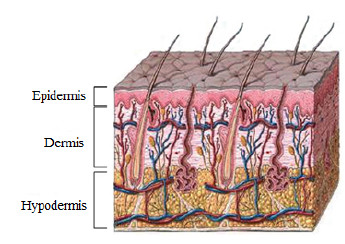
<body><![CDATA[<p class="noindent" >    <h4 class="subsectionHead"><span class="titlemark">1.3   </span> <a   id="x1-40001.3"></a>Specific Objectives</h4>      <ul class="itemize1">      <li class="itemize">To completely remove the hairs covering the lesion.      </li>      <li class="itemize">To do a good segmentation of the lesion.       </li>      <li class="itemize">To find the relevant characteristics that indicate malignancy.      </li>      <li class="itemize">To build, train and validate a binary classifier with the obtained characteristics.      </li>    </ul> <!--l. 97-->    <p class="noindent" >This work is organized as follows: Section 2 presents the concepts of melanocytic lesions and the methods of traditional diagnosis. Section 3 details the tools and algorithms used in the proposed methodology. Section 4 presents the experiments and results obtained. Section 5 shows a discussion of the obtained results. Section 6 shows the final conclusions after the experiments and analysis of the results of the project; and finally, the future works. <!--l. 99-->    <p class="noindent" >    <h3 class="sectionHead"><span class="titlemark">2   </span> <a   id="x1-50002"></a>The Skin and the Melanocytic Lesions</h3> <!--l. 102-->    <p class="noindent" >The skin is the largest human-body organ and is composed of three main layers, the epidermis (outer layer of skin), the dermis (inner layer of skin), and the hypodermis (composed of adipocytes that produce and store fat) <span class="cite">[<a  href="#Xbatugo2013reconocimiento">1</a><a id="br1">]</a></span>. In the epidermis there are numerous cells, such as squamous cells, basal cells or cells called melanocytes, as shown in Figure <a  href="#x1-5001r1">1<!--tex4ht:ref: f1 --></a>. The latter are in charge of producing a substance called melanin, which is the pigment that gives color to the skin <span class="cite">[<a  href="#Xbatugo2013reconocimiento">1</a><a id="br1">]</a></span>. <!--l. 104-->    <p class="indent" >   <hr class="figure">    <div class="figure"  >  <a   id="x1-5001r1"></a>  <!--l. 106-->    <p class="noindent" ><img  src="/img/revistas/cleiej/v19n2/2a06f1.jpg" alt="PIC"   >     <br>     <div class="caption"  ><span class="id">Figure&#x00A0;1: </span><span   class="content">Layers of the Skin <span class="cite">[<a  href="#Xlifshitz2011llega">11</a><a id="br11">]</a></span></span></div><!--tex4ht:label?: x1-5001r1 -->  <!--l. 109-->    ]]></body>
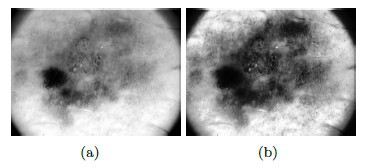
<body><![CDATA[<p class="indent" >   </div><hr class="endfigure"> <!--l. 114-->    <p class="indent" >   When there is a pigmented skin lesion, there are 2 groups: non-melanocytic lesions, and melanocytic lesions <span class="cite">[<a  href="#Xzaballos2004criterios">5</a><a id="br5">]</a></span>. Melanocytic lesions are classified between benign and malignant lesions, which according to its characteristics may become a melanoma <span class="cite">[<a  href="#Xparikh2013survey">4</a><a id="br4">]</a></span>.This work focuses on the study of melanocytic lesions due to the mortality characteristic of melanoma.    <h4 class="subsectionHead"><span class="titlemark">2.1   </span> <a   id="x1-60002.1"></a>Melanoma</h4> <!--l. 128-->    <p class="noindent" >Melanoma is produced by the uncontrolled growth of cells that accumulate pigment (melanocytes), thus, it can be widely spread on the body through the lymphatic vessels and the blood vessels, giving it its main characteristic of mortality <span class="cite">[<a  href="#Xsbonner2003multiple">2</a><a id="br2">]</a></span>. <!--l. 130-->    <p class="noindent" >    <h5 class="subsubsectionHead"><span class="titlemark">2.1.1   </span> <a   id="x1-70002.1.1"></a>Causes</h5> <!--l. 133-->    <p class="noindent" >The factors that cause skin cancer are diverse, however, 86% of melanomas is due to the exposure to ultraviolet radiation (UV) from the Sun <span class="cite">[<a  href="#Xcancermelanoma">12</a><a id="br12">]</a></span>. There are a number of factors that increase the risk of developing melanoma <span class="cite">[<a  href="#Xmelanoma2013">13</a><a id="br13">]</a></span> such as: the presence of atypical nevus, the presence of nevus exceeding 40 units, the presence of congenital nevus, having a family history of atypical nevus, of melanoma, or to have been exposed for many hours to ultraviolet rays (Sun, UVB, UVA) even though having a completely tanned skin. <!--l. 135-->    <p class="noindent" >    <h4 class="subsectionHead"><span class="titlemark">2.2   </span> <a   id="x1-80002.2"></a>Dermoscopy</h4> <!--l. 138-->    <p class="noindent" >The dermoscopy is a non-invasive technique of imaging diagnosis which is used for the observation of skin lesions, allowing the visualization of the structures of the epidermis and dermis <span class="cite">[<a  href="#Xfossati2013lesiones">14</a><a id="br14">]</a></span>. An instrument called a dermatoscope is used for this technique, which consists of a light source and an image amplification system <span class="cite">[<a  href="#Xblandom2010support">8</a><a id="br8">]</a></span>. Figure <a  href="#x1-8001r2">2<!--tex4ht:ref: f2 --></a> (a) shows an image taken with a regular camera, while Figure <a  href="#x1-8001r2">2<!--tex4ht:ref: f2 --></a> (b) shows an image taken with the dermatoscope, offering a better view of the characteristics of the area of interest. <hr class="figure">    <div class="figure"  >  <a   id="x1-8001r2"></a>  <!--l. 141-->    <p class="noindent" ><img  src="/img/revistas/cleiej/v19n2/2a06f2.jpg" alt="PIC"   >     <br>     ]]></body>
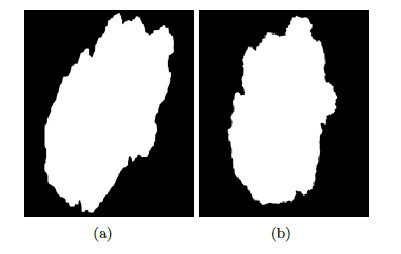
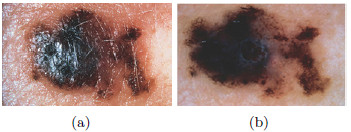
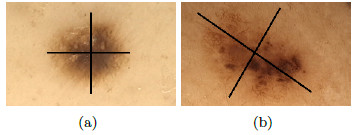
<body><![CDATA[<div class="caption"  ><span class="id">Figure&#x00A0;2: </span><span   class="content">Image confrontation (a) Clinical image (b) Dermoscopic image <span class="cite">[<a  href="#Xsoyer2007color">15</a><a id="br15">]</a></span></span></div><!--tex4ht:label?: x1-8001r2 -->  <!--l. 144-->    <p class="indent" >   </div><hr class="endfigure"> <!--l. 148-->    <p class="indent" >   The use of this technique reaches 89% of sensitivity, and 79% of specificity of the professional <span class="cite">[<a  href="#Xtroya2008estudio">16</a>,&#x00A0;<a  href="#Xstanganelli2012dermoscopy">17</a><a id="br17">]</a></span>. This is the reason why dermoscopy in the diagnosis of the lesions is of vital importance in little expressive lesions and at early stages <span class="cite">[<a  href="#Xtroya2008estudio">16</a>,&#x00A0;<a  href="#Xstanganelli2012dermoscopy">17</a><a id="br17">]</a></span>.    <h4 class="subsectionHead"><span class="titlemark">2.3   </span> <a   id="x1-90002.3"></a>Dermatological diagnostic methods</h4> <!--l. 152-->    <p class="noindent" >The diagnostic method commonly accepted in Dermatology is the 2-stage analysis, where the first stage analyses the lesion of the skin to determine whether it is melanocytic or non-melanocytic; and then the lesion is analyzed to see if the melanocytic one is malignant or benign (second stage) <span class="cite">[<a  href="#Xsoyer2002dermoscopy">18</a>,&#x00A0;<a  href="#Xbraun2003dermoscopy">3</a>,&#x00A0;<a  href="#Xmalvehy2002principios">19</a><a id="br19">]</a></span>. <!--l. 161-->    <p class="indent" >   In the first stage, it is important to detect noticeable features of the melanocytic lesions (for a better study, consult in <span class="cite">[<a  href="#Xfossati2013lesiones">14</a><a id="br14">]</a></span> and <span class="cite">[<a  href="#Xbazzano2013lesiones">20</a><a id="br20">]</a></span>). In the second stage, exhaustive and thorough methods of analysis <span class="cite">[<a  href="#Xzaballos2004criterios">5</a><a id="br5">]</a></span> are required for the diagnosis of benign or malignant lesion. There are several methods commonly used, such as: the Pattern Analysis in Zalaudek et al. <span class="cite">[<a  href="#Xzalaudek2006three">21</a><a id="br21">]</a></span>, the Menzies Method in Menzies et al. <span class="cite">[<a  href="#Xmenzies1996sensitivity">22</a><a id="br22">]</a></span>, the 7-point checklist in Argenziano et al. <span class="cite">[<a  href="#Xargenziano1998epiluminescense">23</a><a id="br23">]</a></span>, and the ABCD rule in Stolz et al. <span class="cite">[<a  href="#Xstolz1994abcd">24</a><a id="br24">]</a></span>, the latter is used in this work. <!--l. 164-->    <p class="noindent" >    <h4 class="subsectionHead"><span class="titlemark">2.4   </span> <a   id="x1-100002.4"></a>The ABCD rule</h4> <!--l. 199-->    <p class="noindent" >Developed by Stolz <span class="cite">[<a  href="#Xstolz1994abcd">24</a><a id="br24">]</a></span> in 1993, it analyzes 4 criteria: asymmetry, borders, colors, and dermoscopic structures. Asymmetry is the pattern generated by the uncontrolled growth of the lesion, it is measured by dividing the pigmented lesion into 2(two) axes, looking for the best symmetry possible <span class="cite">[<a  href="#Xzaballos2004criterios">5</a>,&#x00A0;<a  href="#Xmontero2011descripcion">25</a><a id="br25">]</a></span>. Figure <a  href="#x1-10001r3">3<!--tex4ht:ref: f3 --></a> shows a symmetric and an asymmetric lesion with 2 (two) marked axes. The first axis is outlined on the longest part of the lesion and is called the main axis, the second axis is outlined perpendicular to the main axis. <!--l. 203-->    <p class="indent" >   <hr class="figure">    <div class="figure"  >  <a   id="x1-10001r3"></a>  <!--l. 205-->    <p class="noindent" ><img  src="/img/revistas/cleiej/v19n2/2a06f3.jpg" alt="PIC"   >     ]]></body>
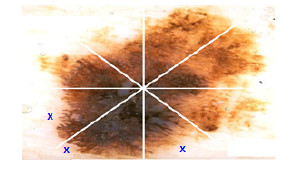
<body><![CDATA[<br>     <div class="caption"  ><span class="id">Figure&#x00A0;3: </span><span   class="content">Melanocytic lesion (a) Symmetrical (b) Asymmetrical.</span></div><!--tex4ht:label?: x1-10001r3 -->  <!--l. 208-->    <p class="indent" >   </div><hr class="endfigure"> <!--l. 215-->    <p class="indent" >   Borders are patterns associated with abnormal terminations of color that melanocytic lesions have, i.e., borders have color variations. The area of interest is divided into 8 segments. Figure <a  href="#x1-10002r4">4<!--tex4ht:ref: f4 --></a> shows normal borders indicated with an X, the others are considered as abrupt. <!--l. 217-->    <p class="indent" >   <hr class="figure">    <div class="figure"  >  <a   id="x1-10002r4"></a>  <!--l. 219-->    <p class="noindent" ><img  src="/img/revistas/cleiej/v19n2/2a06f4.jpg" alt="PIC"   >     <br>     <div class="caption"  ><span class="id">Figure&#x00A0;4: </span><span   class="content">Borders of a lesion divided into 8 segments.</span></div><!--tex4ht:label?: x1-10002r4 -->  <!--l. 222-->    <p class="indent" >   </div><hr class="endfigure"> <!--l. 230-->    ]]></body>
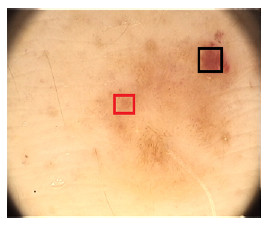
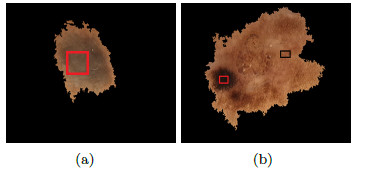
<body><![CDATA[<p class="indent" >   Color is related to the excess of melanin under the surface of the lesion, causing a different color in a concentration of pixels over a specific region. 6 (six) colors are taken into account: white, light brown, dark brown, blue-gray, red, and black. The presence of many colors imply a malignant tendency. Example is shown in Figure <a  href="#x1-10003r5">5<!--tex4ht:ref: f5 --></a>, where it indicates the presence of colors red (black square) and light brown (red square). <!--l. 232-->    <p class="indent" >   <hr class="figure">    <div class="figure"  >  <a   id="x1-10003r5"></a>  <!--l. 234-->    <p class="noindent" ><img  src="/img/revistas/cleiej/v19n2/2a06f5.jpg" alt="PIC"   >     <br>     <div class="caption"  ><span class="id">Figure&#x00A0;5: </span><span   class="content">Image of pigmented lesion with presence of different colors.</span></div><!--tex4ht:label?: x1-10003r5 -->  <!--l. 237-->    <p class="indent" >   </div><hr class="endfigure"> <!--l. 240-->    <p class="indent" >   Dermoscopic structures taken into account are detailed below:      <ol  class="enumerate1" >      <li    class="enumerate" id="x1-10005x1">Linear Branches: They must be more than 2 branches. Both, pseudopods as well as radial projections      are considered as linear branches.      </li>      <li    class="enumerate" id="x1-10007x2">Atypical Pigmented Reticulum: It consists in a connection of intersecting lines causing hollows, regular      or irregular. The lines indicate greater amount of melanin in that region.      </li>      <li    class="enumerate" id="x1-10009x3">Structureless Areas: They correspond to areas of the melanocytic lesion in which structures inside      cannot be distinguished. It has to be more than 10% of the lesion.      </li>      <li    class="enumerate" id="x1-10011x4">Dots: They are pigmented circular structures of 0.1 mm. They must be more than 2 dots. They are      almost invisible to the naked eye.      </li>      <li    class="enumerate" id="x1-10013x5">Globules: They are pigmented structures of a greater size than dots (greater than 0.1 mm). Both, dots      as well as globules can be black, brown, or blue color. They must be of 2 globules or more.</li>    </ol>    <h4 class="subsectionHead"><span class="titlemark">2.5   </span> <a   id="x1-110002.5"></a>Related works</h4> <!--l. 260-->    <p class="noindent" >Some state-of-the-art reported works are presented next, that propose automated diagnostic systems. <!--l. 263-->    ]]></body>
<body><![CDATA[<p class="indent" >   In Batugo <span class="cite">[<a  href="#Xbatugo2013reconocimiento">1</a><a id="br1">]</a></span> an automated diagnostic system was proposed for the detection of melanomas, composed by the following modules: The pre-processing, which consists of the elimination of borders or margins that should not be present in the image at the time of the analysis. Also seeks to isolate objects foreign to the lesion, such as hair. The proposed segmentation was performed by means of the Clustering Method using Gaussian mixtures; the feature extraction was performed based on the ABCD rule. Classification was carried out using linear discriminant classifier <span class="cite">[<a  href="#Xperez2005metodos">26</a><a id="br26">]</a></span>, in order to obtain the diagnosis using the previously extracted characteristics. The tests were carried out with 100 images whose diagnosis is detailed as follows: 29 melanomas and 71 nevus. The evaluation of the system obtained a 79.31% of sensitivity, and 71.83% of specificity. <!--l. 267-->    <p class="indent" >   Similar to the previous work, Oliveira <span class="cite">[<a  href="#Xoliveira2012metodo">27</a><a id="br27">]</a></span> developed a diagnostic system of pigmented lesions formed by 4 modules: pre-processing of images was carried out by anisotropic diffusion filter <span class="cite">[<a  href="#Xbarcelos2003well">28</a><a id="br28">]</a></span> to eliminate the noise. The segmentation module was carried out by using the Chan Vese Method [<a href="#br29">29</a>]. The feature extraction was performed using the ABC-T (Assimetry, Border, Color, Texture) rule. The last characteristic was added in order to consider the &#8221;lesiones queranocíticas&#8221; (Keratinocytic Lesions) which are anomalies of the skin that appear as a crust on its surface. Classification was carried out using the SVM (Support Vector Machine) classifier <span class="cite">[<a  href="#Xcortes1995support">29</a><a id="br29">]</a></span>. The evaluation according to the sensitivity metrics and specificity were of 73.81% and 76.67% respectively. The image bank was composed of 408 digital images, of which 62 were nevus, 86 images with keratosis and 260 melanomas. <!--l. 271-->    <p class="indent" >   Em Rahman et al. <span class="cite">[<a  href="#Xrahman2008multiple">30</a><a id="br30">]</a></span> combined different classifiers in order to develop a melanoma automatic recognition system using dermoscopic images. For the segmentation, the clustering algorithm was used, Fuzzy C-means <span class="cite">[<a  href="#Xbezdek1984fcm">31</a><a id="br31">]</a></span>.Then, an opening and a morphological closing were applied to eliminate noise and soften the border, obtaining this way the outline of the lesion. For the classification of the skin lesions, the combination of the technology of the SVM, GML <span class="cite">[<a  href="#Xstoffer1991bootstrapping">32</a><a id="br32">]</a></span>, and K-NN <span class="cite">[<a  href="#Xsteinbach2009knn">33</a><a id="br33">]</a></span> classifiers were used. The following results were obtained: 62.50% of specificity and 83.75% of sensitivity, from a total of 358 dermoscopic images using 40% for training and 60% for tests. <!--l. 275-->    <p class="indent" >   In Alcon et al. <span class="cite">[<a  href="#Xalcon2009automatic">34</a><a id="br34">]</a></span> a diagnostic system of pigmented lesions was proposed. Segmentation was carried out using the Otsu method <span class="cite">[<a  href="#Xotsu1975threshold">35</a><a id="br35">]</a></span>. The characteristics were extracted through the ABCD method, totaling 55 characteristics. The classification was carried out using the K-NN classifier. Tests conducted on the total of 152 digital images, yielded the following results: 45 nevus and 107 melanoma, corresponding to a 68% of specificity, and 94% of sensitivity. <!--l. 279-->    <p class="indent" >   It is presented in Celebi et al. <span class="cite">[<a  href="#Xcelebi2007methodological">36</a><a id="br36">]</a></span> a methodological approach for the classification of pigmented lesions of the skin using dermoscopic images. Median filter is used for pre-processing and Otsu&#8217;s method for segmentation. In the feature extraction, the following characteristics were used: the area of the lesion, relation of appearance, asymmetry, compactness. For the classification, they used SVM and in experiments conducted on a set of 564 images, they produced a specificity of 92.34% and a sensitivity of 93.33%.  <!--l. 283-->    <p class="indent" >   It is important to note that there are several related works that do not follow any dermatological rule to find the diagnosis, since they propose the study of characteristics such as color and texture of the lesion in a specific way, as the ones reported in <span class="cite">[<a  href="#Xcapdehourat2011toward">37</a>,&#x00A0;<a  href="#Xfornaciali2014statistical">38</a>,&#x00A0;<a  href="#Xmera2014algorithm">39</a>,&#x00A0;<a  href="#Xabbas2013pattern">40</a>,&#x00A0;<a  href="#Xkaur2015real">41</a>,&#x00A0;<a  href="#Xbarata2013two">42</a><a id="br42">]</a></span>. In Scharcanski et al. <span class="cite">[<a  href="#Xscharcanski2014computer">43</a><a id="br43">]</a></span> you can see a summary of the work using computer vision techniques in the diagnosis of skin cancer and provides an orientation of medical image analysis. <!--l. 287-->    <p class="indent" >   This topic is controversial in terms of whether to use or not to use the diagnostic methods approved by the dermatologists <span class="cite">[<a  href="#Xcapdehourat2011toward">37</a><a id="br37">]</a></span>. In this context, this work prefers to follow the line accepted by them, as it is the ABCD rule, developing techniques which comply with the requirements of the dermatologic community and thus improve the performance reported in the state-of-the-art. <!--l. 289-->    <p class="noindent" >    <h3 class="sectionHead"><span class="titlemark">3   </span> <a   id="x1-120003"></a>Proposed Method</h3> <!--l. 291-->    <p class="noindent" >Based on the work of the state-of-the-art, 4 main modules are proposed: Pre-processing, Segmentation, Feature Extraction, and Classification. <!--l. 293-->    <p class="noindent" >    <h4 class="subsectionHead"><span class="titlemark">3.1   </span> <a   id="x1-130003.1"></a>Module 1: Pre-processing</h4> <!--l. 295-->    ]]></body>
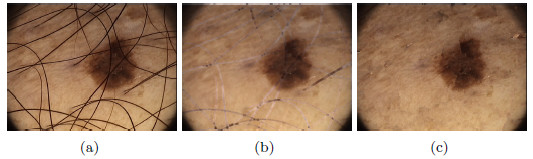
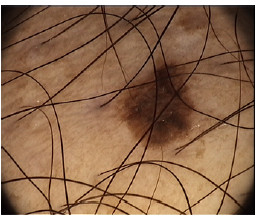
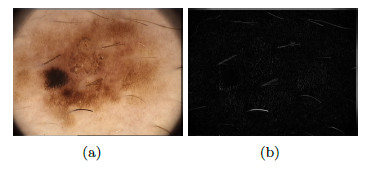
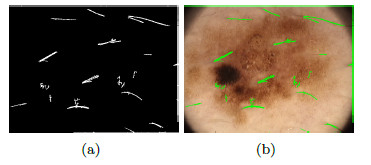
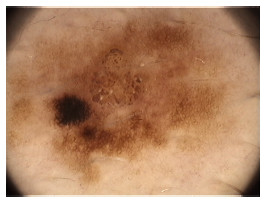
<body><![CDATA[<p class="noindent" >The main obstacle for the study of lesions is the hair presence on the dermoscopic image as shown in Figure <a  href="#x1-14001r6">6<!--tex4ht:ref: f6 --></a>; and therefore, the applied methodology to extract them is presented.    <h5 class="subsubsectionHead"><span class="titlemark">3.1.1   </span> <a   id="x1-140003.1.1"></a>Hair Removal</h5> <!--l. 308-->    <p class="noindent" >An <img  src="/img/revistas/cleiej/v19n2/2a060x.png" alt="fd  "  class="math" > image (dermoscopic melanocytic image) for the removal of hairs is received, to which the bottom-hat operator is applied on each channel of the RGB space. Then, the maximum value among the 3 channels is taken, as shown in Figure <a  href="#x1-14002r7">7<!--tex4ht:ref: f7 --></a> (b). Then, the Otsu algorithm <span class="cite">[<a  href="#Xotsu1975threshold">35</a><a id="br35">]</a></span> is applied to make the image binary, the result of this operation can be seen in Figure <a  href="#x1-14003r8">8<!--tex4ht:ref: f8 --></a> (a), and it is used as a mask for painting the hairs with a very different color from that of the lesion, in this case, green, as shown in Figure <a  href="#x1-14003r8">8<!--tex4ht:ref: f8 --></a> (b). Finally, Inpainting is applied, proposed by <span class="cite">[<a  href="#Xcriminisi2004region">44</a><a id="br44">]</a></span>, which is an algorithm of image restoration that uses information from the rest of it to rebuild the areas associated with the hairs. The output of this module is an <img  src="/img/revistas/cleiej/v19n2/2a061x.png" alt="fp  "  class="math" > image, as shown in Figure <a  href="#x1-15001r9">9<!--tex4ht:ref: f9 --></a>, which at the same time is the entrance to the next module (segmentation). <!--l. 310-->    <p class="indent" >   <hr class="figure">    <div class="figure"  >  <a   id="x1-14001r6"></a>  <!--l. 312-->    <p class="noindent" ><img  src="/img/revistas/cleiej/v19n2/2a06f6.jpg" alt="PIC"   >     <br>     <div class="caption"  ><span class="id">Figure&#x00A0;6: </span><span   class="content">Image with lots of hairs.</span></div><!--tex4ht:label?: x1-14001r6 -->  <!--l. 315-->    <p class="indent" >   </div><hr class="endfigure"> <!--l. 318-->    <p class="indent" >   <hr class="figure">    <div class="figure"  >  <a   id="x1-14002r7"></a>  <!--l. 320-->    ]]></body>
<body><![CDATA[<p class="noindent" ><img  src="/img/revistas/cleiej/v19n2/2a06f7.jpg" alt="PIC"   >     <br>     <div class="caption"  ><span class="id">Figure&#x00A0;7: </span><span   class="content">Enhancement of hairs (a) Input image and (b) Image in grayscale result of Bottom-hat.</span></div><!--tex4ht:label?: x1-14002r7 -->  <!--l. 323-->    <p class="indent" >   </div><hr class="endfigure"> <!--l. 327-->    <p class="indent" >   <hr class="figure">    <div class="figure"  >  <a   id="x1-14003r8"></a>  <!--l. 329-->    <p class="noindent" ><img  src="/img/revistas/cleiej/v19n2/2a06f8.jpg" alt="PIC"   >     <br>     <div class="caption"  ><span class="id">Figure&#x00A0;8: </span><span   class="content">The process of hair removal (a) Binary Image of Hair (b) Hair mask.</span></div><!--tex4ht:label?: x1-14003r8 -->  <!--l. 331-->    <p class="indent" >   </div><hr class="endfigure">    <h4 class="subsectionHead"><span class="titlemark">3.2   </span> <a   id="x1-150003.2"></a>Module 2: Segmentation</h4> <!--l. 338-->    ]]></body>
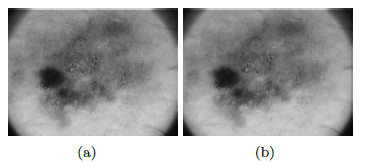
<body><![CDATA[<p class="noindent" >In this phase, it is worked over the <img  src="/img/revistas/cleiej/v19n2/2a062x.png" alt="fp  "  class="math" > image in grayscale Figure <a  href="#x1-15002r10">10<!--tex4ht:ref: f10 --></a> (a). To remove the peaks of intensity between pixels, median filter is applied with a window size of 4 x 4. The level of grey of each point is replaced by the value of gray of a point by the average of the levels of grey of a certain vicinity, the resulting image is shown in Figure <a  href="#x1-15002r10">10<!--tex4ht:ref: f10 --></a> (b). The adjustment of the intensity values of the image is made using the value of gamma = 0.01, in order to reduce noise, as shown in Figure <a  href="#x1-15003r11">11<!--tex4ht:ref: f11 --></a> (a). <!--l. 341-->    <p class="indent" >   <hr class="figure">    <div class="figure"  >  <a   id="x1-15001r9"></a>  <!--l. 343-->    <p class="noindent" ><img  src="/img/revistas/cleiej/v19n2/2a06f9.jpg" alt="PIC"   >     <br>     <div class="caption"  ><span class="id">Figure&#x00A0;9: </span><span   class="content">Resulting image without hair.</span></div><!--tex4ht:label?: x1-15001r9 -->  <!--l. 346-->    <p class="indent" >   </div><hr class="endfigure"> <!--l. 349-->    <p class="indent" >   <hr class="figure">    <div class="figure"  >  <a   id="x1-15002r10"></a>  <!--l. 351-->    <p class="noindent" ><img  src="/img/revistas/cleiej/v19n2/2a06f10.jpg" alt="PIC"   >     ]]></body>
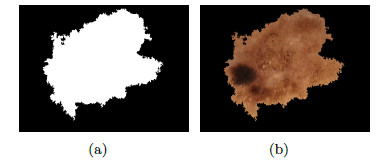
<body><![CDATA[<br>     <div class="caption"  ><span class="id">Figure&#x00A0;10: </span><span   class="content">Preparation of the image (a) Image in gray-scale (b) Results of the average filter.</span></div><!--tex4ht:label?: x1-15002r10 -->  <!--l. 354-->    <p class="indent" >   </div><hr class="endfigure"> <!--l. 360-->    <p class="indent" >   To improve the contrast of the image so that the lesion can be highlighted, the algorithm of improvement of contrast (Contrast Limited Adaptive Histogram Equalization) CLAHE is used <span class="cite">[<a  href="#Xcattaneo2011metodos">45</a><a id="br45">]</a></span>, with Clip Limit = 0.01 and with contextual regions equal to 2 x 2 (see Figure <a  href="#x1-15003r11">11<!--tex4ht:ref: f11 --></a> (b)). Once the image is improved, the threshold is calculated with the maximum-entropy automatic thresholding algorithm <span class="cite">[<a  href="#Xcattaneo2011metodos">45</a><a id="br45">]</a></span> and the binary mask resulting from this stage can be seen in Figure <a  href="#x1-15004r12">12<!--tex4ht:ref: f12 --></a> (a). The image of the lesion associated to the binary mask can be seen in Figure <a  href="#x1-15004r12">12<!--tex4ht:ref: f12 --></a> (b). <!--l. 362-->    <p class="indent" >   <hr class="figure">    <div class="figure"  >  <a   id="x1-15003r11"></a>  <!--l. 364-->    <p class="noindent" ><img  src="/img/revistas/cleiej/v19n2/2a06f11.jpg" alt="PIC"   >     <br>     <div class="caption"  ><span class="id">Figure&#x00A0;11: </span><span   class="content">Improvement of the Image (a) Intensity Adjustment (b) Histogram Equalization.</span></div><!--tex4ht:label?: x1-15003r11 -->  <!--l. 367-->    <p class="indent" >   </div><hr class="endfigure"> <!--l. 369-->    ]]></body>
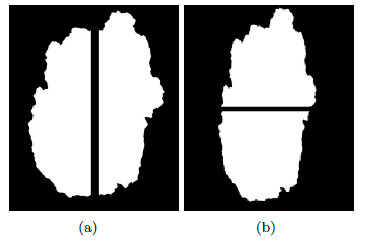
<body><![CDATA[<p class="indent" >   <hr class="figure">    <div class="figure"  >  <a   id="x1-15004r12"></a>  <!--l. 371-->    <p class="noindent" ><img  src="/img/revistas/cleiej/v19n2/2a06f12.jpg" alt="PIC"   >     <br>     <div class="caption"  ><span class="id">Figure&#x00A0;12: </span><span   class="content">Resulting Masks (a) Binary Mask (b) RGB Associated Image.</span></div><!--tex4ht:label?: x1-15004r12 -->  <!--l. 375-->    <p class="indent" >   </div><hr class="endfigure">    <h4 class="subsectionHead"><span class="titlemark">3.3   </span> <a   id="x1-160003.3"></a>Module 3: Feature Extraction</h4> <!--l. 381-->    <p class="noindent" >This work uses the ABCD rule for the diagnosis of Melanoma. In that sense, the features to be extracted are: Asymmetry, Border, Color, Reticular Pattern, Dots and Glabules, Structureless Areas, and Pseudopods. <!--l. 383-->    <p class="noindent" >    <h5 class="subsubsectionHead"><span class="titlemark">3.3.1   </span> <a   id="x1-170003.3.1"></a>Asymmetry</h5> <!--l. 388-->    <p class="noindent" >This feature is obtained through the asymmetry index which is calculated using a combination of instructions. This index indicates asymmetric is the lesion, i.e., the greater the value of it, the more asymmetric the lesion is; and the lower the value of it, the more symmetrical the lesion is. The segmented lesion shown in Figure <a  href="#x1-17001r13">13<!--tex4ht:ref: f13 --></a> (a), is rotated through its centroid by bi-linear interpolation method <span class="cite">[<a  href="#Xstolz1994abcd">24</a><a id="br24">]</a></span>, and is shown in Figure <a  href="#x1-17001r13">13<!--tex4ht:ref: f13 --></a> (b). <!--l. 390-->    <p class="indent" >   <hr class="figure">    ]]></body>
<body><![CDATA[<div class="figure"  >  <a   id="x1-17001r13"></a>  <!--l. 392-->    <p class="noindent" ><img  src="/img/revistas/cleiej/v19n2/2a06f13.jpg" alt="PIC"   >     <br>     <div class="caption"  ><span class="id">Figure&#x00A0;13: </span><span   class="content">Segmented Image (A) Original (b) Rotated.</span></div><!--tex4ht:label?: x1-17001r13 -->  <!--l. 395-->    <p class="indent" >   </div><hr class="endfigure"> <!--l. 399-->    <p class="indent" >   Once the lesion is rotated it is then divided through the main axis, as shown in Figure <a  href="#x1-17002r14">14<!--tex4ht:ref: f14 --></a> (a) and then divided by the secondary axis, in Figure <a  href="#x1-17002r14">14<!--tex4ht:ref: f14 --></a> (b) there is the lesion divided by the secondary axis. <!--l. 401-->    <p class="indent" >   <hr class="figure">    <div class="figure"  >  <a   id="x1-17002r14"></a>  <!--l. 403-->    <p class="noindent" ><img  src="/img/revistas/cleiej/v19n2/2a06f14.jpg" alt="PIC"   >     <br>     ]]></body>
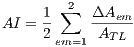
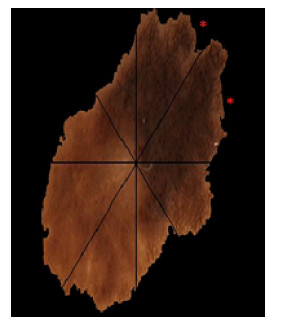
<body><![CDATA[<div class="caption"  ><span class="id">Figure&#x00A0;14: </span><span   class="content">Analysis of the Asymmetry of the Lesion (a) Main Axis (b) Secondary Axis..</span></div><!--tex4ht:label?: x1-17002r14 -->  <!--l. 406-->    <p class="indent" >   </div><hr class="endfigure"> <!--l. 409-->    <p class="indent" >   The asymmetry index <img  src="/img/revistas/cleiej/v19n2/2a063x.png" alt="AI  "  class="math" > is calculated by the expression (<a  href="#x1-17003r1">1<!--tex4ht:ref: eq:ai --></a>)    <table  class="equation"><tr><td>    <center class="math-display" > <img  src="/img/revistas/cleiej/v19n2/2a064x.png" alt="     1 &#x2211;2  &#x0394;Aem-- AI = 2      AT L        em=1 " class="math-display" ><a   id="x1-17003r1"></a></center></td><td class="equation-label">(1)</td></tr></table> <!--l. 414-->    <p class="nopar" > <!--l. 418-->    <p class="indent" >   where <img  src="/img/revistas/cleiej/v19n2/2a065x.png" alt="em  "  class="math" > = 1 is the major axis and <img  src="/img/revistas/cleiej/v19n2/2a066x.png" alt="em  "  class="math" > = 2 is the minor axis, is the area of the non-overlapping lesion; and <img  src="/img/revistas/cleiej/v19n2/2a067x.png" alt="A  TL  "  class="math" > is the area of the lesion. In this way, the first feature is obtained and is denoted by <img  src="/img/revistas/cleiej/v19n2/2a068x.png" alt="C   a  "  class="math" >.    <h5 class="subsubsectionHead"><span class="titlemark">3.3.2   </span> <a   id="x1-180003.3.2"></a>Borders</h5> <!--l. 425-->    <p class="noindent" >For the border analysis, the lesion is divided into 8 regions. Each retrieved sector, as shown in Figure <a  href="#x1-18001r15">15<!--tex4ht:ref: f15 --></a>, is analyzed separately. In this way, if the color of the lesion varies from the center towards the border, it is said that it has an abrupt border, otherwise is a normal or regular border, lesions with abrupt termination are associated with melanoma. The color variation in the borders is measured by calculating the variance from the center of the lesion until the border of it, where high values of variance indicates a border with abrupt termination, and low values indicate a normal border. <!--l. 427-->    <p class="indent" >   <hr class="figure">    <div class="figure"  >  <a   id="x1-18001r15"></a>  <!--l. 429-->    <p class="noindent" ><img  src="/img/revistas/cleiej/v19n2/2a06f15.jpg" alt="PIC"   >     <br>     ]]></body>
<body><![CDATA[<div class="caption"  ><span class="id">Figure&#x00A0;15: </span><span   class="content">Sector of the Lesion.</span></div><!--tex4ht:label?: x1-18001r15 -->  <!--l. 432-->    <p class="indent" >   </div><hr class="endfigure"> <!--l. 434-->    <p class="indent" >   In this way, the feature of border is obtained and is denoted by <img  src="/img/revistas/cleiej/v19n2/2a069x.png" alt="Cb  "  class="math" >. <!--l. 436-->    <p class="indent" >   <hr class="figure">    <div class="figure"  >  <a   id="x1-18002r16"></a>  <!--l. 438-->    <p class="noindent" ><img  src="/img/revistas/cleiej/v19n2/2a06f16.jpg" alt="PIC"   >     <br>     <div class="caption"  ><span class="id">Figure&#x00A0;16: </span><span   class="content">Lesion Divided into 8 Regions.</span></div><!--tex4ht:label?: x1-18002r16 -->  <!--l. 441-->    <p class="indent" >   </div><hr class="endfigure">    <h5 class="subsubsectionHead"><span class="titlemark">3.3.3   </span> <a   id="x1-190003.3.3"></a>Color</h5> <!--l. 446-->    <p class="noindent" >In the study of this feature, 6 colors are taken into account: light brown, dark brown, blue-gray, red, black and white.The presence of these colors suggest melanoma. Each color is detected by means of the Euclidean distance of each pixel to the corresponding intensities to that color. Table <a  href="#x1-19001r1">1<!--tex4ht:ref: tab:tabccolor --></a> shows the value of intensity of each color. The lower the value of the calculated distance suggests closeness to a color. Figure <a  href="#x1-18002r16">16<!--tex4ht:ref: f16 --></a> (a) shows a lesion with the presence of the blue-gray color, and in Figure <a  href="#x1-18002r16">16<!--tex4ht:ref: f16 --></a> (b), a lesion that contains the colors dark brown and light brown. <!--l. 450-->    ]]></body>
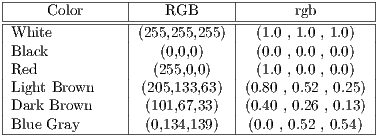
<body><![CDATA[<p class="indent" >   The presence of different colors in the lesion points to a positive diagnosis of Melanoma. For the presence of the color, the obtained features are: light brown denoted by <img  src="/img/revistas/cleiej/v19n2/2a0610x.png" alt="Ccmc  "  class="math" >, dark brown denoted by <img  src="/img/revistas/cleiej/v19n2/2a0611x.png" alt="Ccmo  "  class="math" >, blue-gray denoted by <img  src="/img/revistas/cleiej/v19n2/2a0612x.png" alt="Ccag  "  class="math" >, red denoted by <img  src="/img/revistas/cleiej/v19n2/2a0613x.png" alt="Ccr  "  class="math" >, black denoted by <img  src="/img/revistas/cleiej/v19n2/2a0614x.png" alt="Ccn  "  class="math" > and white denoted by <img  src="/img/revistas/cleiej/v19n2/2a0615x.png" alt="Ccb  "  class="math" >, represented by the vector <img  src="/img/revistas/cleiej/v19n2/2a0616x.png" alt="Cc  "  class="math" >, which in turn is given by: <img  src="/img/revistas/cleiej/v19n2/2a0617x.png" alt="Cc = [Ccmc,Ccmo,Cag,Ccr,Ccn,Ccb]c  "  class="math" >        <div class="table">  <!--l. 452-->    <p class="indent" >   <a   id="x1-19001r1"></a><hr class="float">    <div class="float"  >       <div class="caption"  ><span class="id">Table&#x00A0;1: </span><span   class="content">RGB Values and rgb for colors.</span></div><!--tex4ht:label?: x1-19001r1 -->     <div class="pic-tabular"> <img  src="/img/revistas/cleiej/v19n2/2a0618x.png" alt="|---------------|------------|----------------| |----Color------|---RGB------|------rgb-------| |White          |(255,255,255) |  (1.0 , 1.0 , 1.0)| |Black          |   (0,0,0)    |  (0.0 , 0.0 , 0.0)| |Red            |  (255,0,0)   |  (1.0 , 0.0 , 0.0)| |Light Brown    |(205,133,63) |(0.80 , 0.52 , 0.25) |Dark Brown     | (101,67,33)  |(0.40 , 0.26 , 0.13) -Blue Gray--------(0,134,139)----(0.0 ,-0.52-, 0.54) " ></div>     </div><hr class="endfloat">    </div> <!--l. 474-->    <p class="indent" >   <hr class="figure">    <div class="figure"  >  <a   id="x1-19002r17"></a>  <!--l. 476-->    <p class="noindent" ><img  src="/img/revistas/cleiej/v19n2/2a06f17.jpg" alt="PIC"   >     <br>     ]]></body>
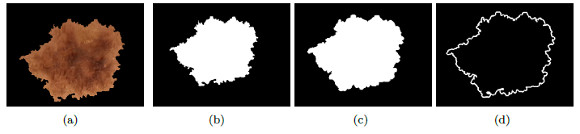
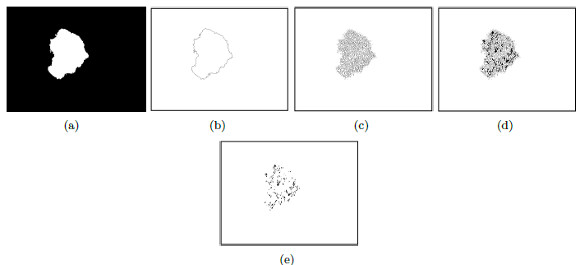
<body><![CDATA[<div class="caption"  ><span class="id">Figure&#x00A0;17: </span><span   class="content">Lesion with presence of Color (A) Blue-Gray (b) Light and Dark Brown.</span></div><!--tex4ht:label?: x1-19002r17 -->  <!--l. 479-->    <p class="indent" >   </div><hr class="endfigure">    <h5 class="subsubsectionHead"><span class="titlemark">3.3.4   </span> <a   id="x1-200003.3.4"></a>Dermoscopic Structures</h5> <!--l. 486-->    <p class="noindent" >They are different patterns associated with melanoma, it includes the study of 5 structures: Linear Branches denoted by <img  src="/img/revistas/cleiej/v19n2/2a0619x.png" alt="Crl  "  class="math" >, Atypical Pigmented Reticulum denoted by <img  src="/img/revistas/cleiej/v19n2/2a0620x.png" alt="Crp  "  class="math" >, Structureless Areas denoted by Cad, points denoted by <img  src="/img/revistas/cleiej/v19n2/2a0621x.png" alt="Cp  "  class="math" >, and globules <img  src="/img/revistas/cleiej/v19n2/2a0622x.png" alt="Cg  "  class="math" >. This set of features is represented by the <img  src="/img/revistas/cleiej/v19n2/2a0623x.png" alt="Ced  "  class="math" > vector defined by: <img  src="/img/revistas/cleiej/v19n2/2a0624x.png" alt="Ced = [Crl,Crp,Cad,Cp,Cg]ed  "  class="math" > . Details of the recognition process of these features are given below. <!--l. 488-->    <p class="indent" >   <span  class="cmti-10">Linear Branches: </span>Pseudopods are bulbous and bent projections as shown in Figure <a  href="#x1-20001r18">18<!--tex4ht:ref: f18 --></a> (a), the borders are finger-like structures (in the form of fingers). <!--l. 494-->    <p class="indent" >   To detect the pseudopods, the variances of the Euclidean distance are analyzed between the centroid and the border of the lesion.The binary mask from the original image can be seen in Figure <a  href="#x1-20001r18">18<!--tex4ht:ref: f18 --></a> (b). To this mask, the morphological operator dilation is applied with a structuring element with the shape of a disc of radious 1, Figure <a  href="#x1-20001r18">18<!--tex4ht:ref: f18 --></a> (c). The border of the lesion results from the subtraction of the dilated image and the original image, as shown in Figure <a  href="#x1-20001r18">18<!--tex4ht:ref: f18 --></a> (d). The variance is calculated as a measure of dispersion of the distances to the border, a high value suggests the presence of pseudopods. <!--l. 496-->    <p class="indent" >   <span  class="cmti-10">Atypical Pigmented Reticulum:</span> <!--l. 499-->    <p class="indent" >   A relevant feature associated to the diagnosis of melanoma is the atypical pigmented reticulum. Figure <a  href="#x1-20002r19">19<!--tex4ht:ref: f19 --></a> (a) shows a lesion with cross-linked, to diagnose as typical or atypical, a series of steps will be taken, which are explained below. <!--l. 503-->    <p class="indent" >   On the image of the segmented lesion in grayscale, Figure <a  href="#x1-20002r19">19<!--tex4ht:ref: f19 --></a> (b), it is applied the detection of border with an Laplacian-of-Gaussian operator (LOG) <span class="cite">[<a  href="#Xgonzalez1992digital">46</a><a id="br46">]</a></span>, the result is shown in Figure <a  href="#x1-20002r19">19<!--tex4ht:ref: f19 --></a> (c). The cross lines which form a mesh over the lesion; and, also the outside border of the lesion that must be removed, can be observed. With the aim of obtaining only formed holes, the border is calculated and then it is subtracted from Figure <a  href="#x1-20002r19">19<!--tex4ht:ref: f19 --></a> (c). <!--l. 505-->    <p class="indent" >   <hr class="figure">    <div class="figure"  >  <a   id="x1-20001r18"></a>  <!--l. 507-->    ]]></body>
<body><![CDATA[<p class="noindent" ><img  src="/img/revistas/cleiej/v19n2/2a06f18.jpg" alt="PIC"   >     <br>     <div class="caption"  ><span class="id">Figure&#x00A0;18: </span><span   class="content">Obtaining the Border of the Lesion (a) Image of a lesion with pseudopods. (b) Original Binary Mask. (c) Dilated Image. (d) Subtraction of the Images (b) and (c).</span></div><!--tex4ht:label?: x1-20001r18 -->  <!--l. 510-->    <p class="indent" >   </div><hr class="endfigure"> <!--l. 513-->    <p class="indent" >   <hr class="figure">    <div class="figure"  >  <a   id="x1-20002r19"></a>  <!--l. 515-->    <p class="noindent" ><img  src="/img/revistas/cleiej/v19n2/2a06f19.jpg" alt="PIC"   >     <br>     <div class="caption"  ><span class="id">Figure&#x00A0;19: </span><span   class="content">(a) Image of a Lesion with Pigmented Reticulum (b) Image in Grayscale (c) LoG filter (Inverted Image).</span></div><!--tex4ht:label?: x1-20002r19 -->  <!--l. 518-->    <p class="indent" >   </div><hr class="endfigure"> <!--l. 523-->    ]]></body>
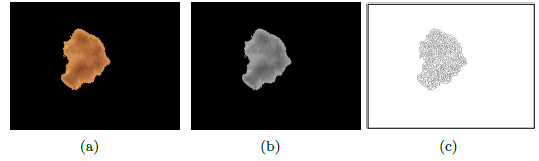
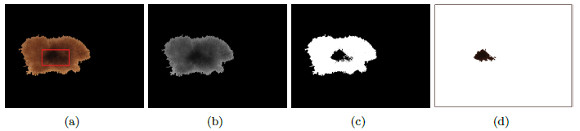
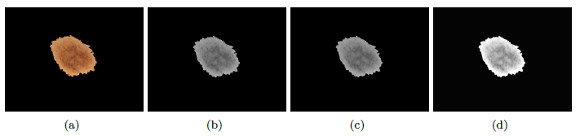
<body><![CDATA[<p class="indent" >   To obtain the border, the morphological operator erosion is applied, with a structuring element in the shape of radium disc of 1 pixel and it is subtracted from the original binary mask (morphological gradient), Figure <a  href="#x1-20003r20">20<!--tex4ht:ref: f20 --></a> (a). The resulting border can be seen in Figure <a  href="#x1-20003r20">20<!--tex4ht:ref: f20 --></a> (b). To remove the border of the lesion, the border of the image is substracted as shown in Figure <a  href="#x1-20003r20">20<!--tex4ht:ref: f20 --></a> (b) of the image that contains the mask of the mesh, shown in Figure <a  href="#x1-20002r19">19<!--tex4ht:ref: f19 --></a> (c) and the result is shown in Figure <a  href="#x1-20003r20">20<!--tex4ht:ref: f20 --></a> (c). Once the border is removed, the holes formed by the cross-linked are filled, as shown in Figure <a  href="#x1-20003r20">20<!--tex4ht:ref: f20 --></a> (d). Finally, the dots and small areas with filtered of areas lower than 30 pixels, the final image is seen in Figure <a  href="#x1-20003r20">20<!--tex4ht:ref: f20 --></a> (e). The area of each zone is examined, if there is not much variation between the areas, the pigmented reticulum is atypical. <!--l. 525-->    <p class="indent" >   <hr class="figure">    <div class="figure"  >  <a   id="x1-20003r20"></a>  <!--l. 527-->    <p class="noindent" ><img  src="/img/revistas/cleiej/v19n2/2a06f20.jpg" alt="PIC"   >     <br>     <div class="caption"  ><span class="id">Figure&#x00A0;20: </span><span   class="content">Obtaining the border of the lesion (a) Original binary mask (b) Border of lesion (Mirror image) (c) Image without border (Mirror image) (d) Filling of holes (Mirror image) (e) Remaining areas of the filtering area (Mirror image).</span></div><!--tex4ht:label?: x1-20003r20 -->  <!--l. 530-->    <p class="indent" >   </div><hr class="endfigure"> <!--l. 532-->    <p class="indent" >   <span  class="cmti-10">Structureless Areas: </span>Structureless areas are regions of the lesion to which the aforementioned structures can not be remunerated. <!--l. 538-->    <p class="indent" >   In the center of the Figure <a  href="#x1-20004r21">21<!--tex4ht:ref: f21 --></a> (a) a lesion is shown, with a structureless area of a dark brown color, indicated by the red square. The image of the lesion is in grayscale as shown in Figure <a  href="#x1-20004r21">21<!--tex4ht:ref: f21 --></a> (b). This lesion is segmented by the traditional Otsu algorithm, to isolate the dark areas as can be seen in Figure <a  href="#x1-20003r20">20<!--tex4ht:ref: f20 --></a> (c). Then, the region that belongs to the structureless area gets separated, and the resulting image is shown in Figure <a  href="#x1-20004r21">21<!--tex4ht:ref: f21 --></a> (d). <!--l. 550-->    <p class="indent" >   <span  class="cmti-10">Dots and Globules: </span>Dots and globules are differentiated by their size, the first are almost invisible to the naked eye. Figure <a  href="#x1-20005r22">22<!--tex4ht:ref: f22 --></a> (a) shows a lesion presenting various dark-brown globules. <!--l. 556-->    ]]></body>
<body><![CDATA[<p class="indent" >   With the aim of locating globules, first, an improvement of the distribution of the pixels of the image in grayscale is made (Figure <a  href="#x1-20005r22">22<!--tex4ht:ref: f22 --></a> (b)), using the average filter with a window size of 4 x 4, as shown in Figure <a  href="#x1-20005r22">22<!--tex4ht:ref: f22 --></a> (c). To highlight them, an intensity adjustment is done with gamma = 0.01 and a contrast improvement is applied through the equalization of the histogram using the CLAHE method with Clip Limit = 0.01 and contextual regions equal to 2 x 2, as shown in Figure <a  href="#x1-20005r22">22<!--tex4ht:ref: f22 --></a> (d). <!--l. 558-->    <p class="indent" >   <hr class="figure">    <div class="figure"  >  <a   id="x1-20004r21"></a>  <!--l. 560-->    <p class="noindent" ><img  src="/img/revistas/cleiej/v19n2/2a06f21.jpg" alt="PIC"   >     <br>     <div class="caption"  ><span class="id">Figure&#x00A0;21: </span><span   class="content">(a) Lesion with presence of structureless areas (b) Image in grayscale (c) segmented area with the OTSU method (d) Structureless area of the lesion (Mirror image).</span></div><!--tex4ht:label?: x1-20004r21 -->  <!--l. 563-->    <p class="indent" >   </div><hr class="endfigure"> <!--l. 565-->    <p class="indent" >   <hr class="figure">    <div class="figure"  >  <a   id="x1-20005r22"></a>  <!--l. 567-->    <p class="noindent" ><img  src="/img/revistas/cleiej/v19n2/2a06f22.jpg" alt="PIC"   >     ]]></body>
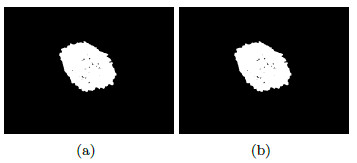
<body><![CDATA[<br>     <div class="caption"  ><span class="id">Figure&#x00A0;22: </span><span   class="content">(a) Image in grayscale (b) Average filter on the image (c) Application of CLAHE.</span></div><!--tex4ht:label?: x1-20005r22 -->  <!--l. 570-->    <p class="indent" >   </div><hr class="endfigure"> <!--l. 574-->    <p class="indent" >   The binary image is obtained through the Otsu method (Figure <a  href="#x1-21001r23">23<!--tex4ht:ref: f23 --></a> (a)). Then, closure is applied with a structural element is the shape of a disk and size 3, in such a way that the nearby components are united as can be seen in Figure <a  href="#x1-21001r23">23<!--tex4ht:ref: f23 --></a> (b). The vector of <img  src="/img/revistas/cleiej/v19n2/2a0625x.png" alt="x  "  class="math" > characteristics consisting of: <img  src="/img/revistas/cleiej/v19n2/2a0626x.png" alt="x = [Ca;Cb;Cc;Ced ]  "  class="math" > where each element represents the sub-vectors previously calculated.    <h4 class="subsectionHead"><span class="titlemark">3.4   </span> <a   id="x1-210003.4"></a>Module 4: Classification</h4> <!--l. 580-->    <p class="noindent" >In this work, the classification of lesions will be done by using the SVM classifier (Support Vector Machine) <span class="cite">[<a  href="#Xcortes1995support">29</a><a id="br29">]</a></span>. Entry data will be formed by <img  src="/img/revistas/cleiej/v19n2/2a0627x.png" alt="D = {x,y} "  class="math" > where <img  src="/img/revistas/cleiej/v19n2/2a0628x.png" alt="x  "  class="math" > is the set of vectors of features while <img  src="/img/revistas/cleiej/v19n2/2a0629x.png" alt="y  "  class="math" > is the set of labels. They represent one of the two classes, <img  src="/img/revistas/cleiej/v19n2/2a0630x.png" alt="yi  "  class="math" >=0 for benign lesions and <img  src="/img/revistas/cleiej/v19n2/2a0631x.png" alt="yi  "  class="math" >=1 for malignant lesions associated with the i-th melanocytic lesion. <!--l. 582-->    <p class="indent" >   <hr class="figure">    <div class="figure"  >  <a   id="x1-21001r23"></a>  <!--l. 584-->    <p class="noindent" ><img  src="/img/revistas/cleiej/v19n2/2a06f23.jpg" alt="PIC"   >     <br>     <div class="caption"  ><span class="id">Figure&#x00A0;23: </span><span   class="content">(a) Binary image. (b) Closure is applied.</span></div><!--tex4ht:label?: x1-21001r23 -->  <!--l. 587-->    ]]></body>
<body><![CDATA[<p class="indent" >   </div><hr class="endfigure"> <!--l. 591-->    <p class="indent" >   The classification will have two stages: a) The construction of the classifier for the learning of the parameters of the system, this process is performed with a set of training. b) The system&#8217;s tests to evaluate the classifier&#8217;s performance is carried out with a set of tests that are independent from the set of training.    <h3 class="sectionHead"><span class="titlemark">4   </span> <a   id="x1-220004"></a>Experimental tests</h3> <!--l. 596-->    <p class="noindent" >This section presents the evaluation metrics used, the experiments done, the results obtained, and those of the state-of-the-art; then, there is a discussion about the results. <!--l. 598-->    <p class="noindent" >    <h4 class="subsectionHead"><span class="titlemark">4.1   </span> <a   id="x1-230004.1"></a>Image Bank</h4> <!--l. 601-->    <p class="noindent" >120 dermatoscopy images were used for the tests (non-melanocytic and melanocytic) acquired through a dermatoscope computerized video with polarized light, which uses lenses with 20 to 70x given by the Centre for Processing Digital Images of the Faculty of Sciences, Universidad Central de Venezuela <span class="cite">[<a  href="#Xtorres2014segmentacion">47</a><a id="br47">]</a></span>. <!--l. 605-->    <p class="indent" >   The images were analyzed by Dr. Lizza Salgueiro, from the Department of Dermatology of the Universidad Nacional de Asunción, since they were not previously diagnosed. According to her diagnosis, 16 non-melanocytic and 104 melanocytic lesions were found, from which 76 were malignant lesions, and 28 were benign lesions. <!--l. 607-->    <p class="noindent" >    <h4 class="subsectionHead"><span class="titlemark">4.2   </span> <a   id="x1-240004.2"></a>Experimental Results from Removal of hairs </h4> <!--l. 610-->    <p class="noindent" >The tests that were carried out for the module of hair removal, consists of the application of 2 techniques for its comparison. <!--l. 614-->    <p class="indent" >   Figure <a  href="#x1-24001r24">24<!--tex4ht:ref: f24 --></a> (a) shows a lesion, with the presence of hair, both, on the lesion as well as on the skin; the goal is to perform the hair removal using the following methods: <!--l. 617-->    <p class="indent" >   The first approach is based on the following operations <span class="cite">[<a  href="#Xtorres2014segmentacion">47</a><a id="br47">]</a></span> : <!--l. 620-->    ]]></body>
<body><![CDATA[<p class="indent" >   First, it applies morphological filters. Then, the Botton-Hat operator is used. Through segmentation by thresholding, the hairs from the skin are separated. Finally, the associated areas with the hairs are reconstructed with the average filter. <!--l. 626-->    <p class="indent" >   The second technique, proposed in this work (section <a  href="#x1-140003.1.1">3.1.1<!--tex4ht:ref: Hair-Removal --></a>), is based on: Obtaining a mask of hairs through the Botton-Hat operator and the traditional Otsu algorithm. On this mask, the Inpainting algorithm [<a href="#br44">44</a>] is applied for the replacement of the pixels associated with hairs. <!--l. 634-->    <p class="indent" >   Figure <a  href="#x1-24001r24">24<!--tex4ht:ref: f24 --></a> (b) shows the resulting image from the first method previously mentioned, it can be noticed that the elimination of hair affected some areas of the skin and the lesion, which is not recommendable. Finally, Figure <a  href="#x1-24001r24">24<!--tex4ht:ref: f24 --></a> (c) shows the image without hairs, resulting from applying the second method; it can be noticed that the colors of the lesion remained intact. <!--l. 636-->    <p class="indent" >   <hr class="figure">    <div class="figure"  >  <a   id="x1-24001r24"></a>  <!--l. 638-->    <p class="noindent" ><img  src="/img/revistas/cleiej/v19n2/2a06f24.jpg" alt="PIC"   >     <br>     <div class="caption"  ><span class="id">Figure&#x00A0;24: </span><span   class="content">Methods for the elimination of hairs. (a) Original image. (b) Image resulting from the first method.(c) Image resulting from the our method</span></div><!--tex4ht:label?: x1-24001r24 -->  <!--l. 641-->    <p class="indent" >   </div><hr class="endfigure"> <!--l. 645-->    <p class="indent" >   As a second test, Figure <a  href="#x1-24002r25">25<!--tex4ht:ref: f25 --></a>(a) shows a lesion with presence of hairs with greater thickness than the previous example. Figure <a  href="#x1-24002r25">25<!--tex4ht:ref: f25 --></a>(b) shows the image resulting from the first method, and it can be noted that eliminating the hairs affected the area of the lesion, and some whitish markings with the shape of hairs were left. Figure <a  href="#x1-24002r25">25<!--tex4ht:ref: f25 --></a>(c) shows the hairless image resulting from applying the Inpainting algorithm, the lesion with a total absence of hairs, unmarked and without alteration of the colors, can be noticed in the image. These methods were visually evaluated by the professional dermatologist. After several tests performed on lesions with thick and fine hairs, the expert arrived to the conclusion that the thickest hairs are best removed with the second method exposed. Despite the computational cost of the Inpainting algorithm, as it is mentioned in <span class="cite">[<a  href="#Xcriminisi2004region">44</a><a id="br44">]</a></span>, in this work is used due to the improvement it represents visually in the results. <!--l. 647-->    ]]></body>
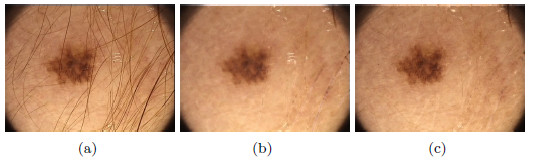
<body><![CDATA[<p class="indent" >   <hr class="figure">    <div class="figure"  >  <a   id="x1-24002r25"></a>  <!--l. 649-->    <p class="noindent" ><img  src="/img/revistas/cleiej/v19n2/2a06f25.jpg" alt="PIC"   >     <br>     <div class="caption"  ><span class="id">Figure&#x00A0;25: </span><span   class="content">Applying the methods for removal of thick hairs. (a) Original Image. (b) Image resulting from the first method.(c) Resulting image from the our method.</span></div><!--tex4ht:label?: x1-24002r25 -->  <!--l. 652-->    <p class="indent" >   </div><hr class="endfigure">    <h4 class="subsectionHead"><span class="titlemark">4.3   </span> <a   id="x1-250004.3"></a>Performance segmentation metrics</h4> <!--l. 658-->    <p class="noindent" >Segmentation seeks to isolate the lesion from the rest of the skin for further study. Performance metrics were defined in this section to evaluate the segmentation method. Four possible outcomes can be obtained from a segmented lesion:      <ul class="itemize1">      <li class="itemize">True positive (TP), the pixel belongs to the lesion and is segmented as a pixel that belongs to the      lesion.      </li>      <li class="itemize">False negative (FN), the pixel belongs to the lesion and is not segmented as a pixel that belongs to the      lesion.      </li>      <li class="itemize">True negative (TN), the pixel does not belong to the lesion and is not segmented as a pixel that belongs      to the lesion.      </li>      <li class="itemize">False positive (FP), the pixel does not belong to the lesion and is segmented as a pixel that belongs      to the lesion.</li>    </ul> <!--l. 671-->    <p class="indent" >   In Figure <a  href="#x1-25001r26">26<!--tex4ht:ref: f26 --></a> you can see the representation of TP, FN, TN and FP variables regarding the segmented lesion and its ideal segmentation, where the pixel associated with the targeted zone is given by <img  src="/img/revistas/cleiej/v19n2/2a0632x.png" alt="(i,j)  "  class="math" >, the ideal image represents the segmentation done by a professional, and the segmented image represents the segmentation of the lesion obtained automatically. <!--l. 673-->    <p class="indent" >   <hr class="figure">    ]]></body>
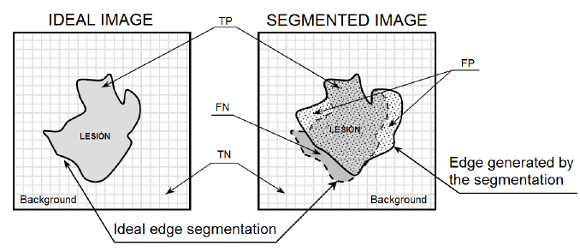
<body><![CDATA[<div class="figure"  >  <a   id="x1-25001r26"></a>  <!--l. 675-->    <p class="noindent" ><img  src="/img/revistas/cleiej/v19n2/2a06f26.jpg" alt="PIC"   >     <br>     <div class="caption"  ><span class="id">Figure&#x00A0;26: </span><span   class="content">Ideal Segmentation and automatic segmentation <span class="cite">[<a  href="#Xcarrasco">48</a><a id="br48">]</a></span>.</span></div><!--tex4ht:label?: x1-25001r26 -->  <!--l. 678-->    <p class="indent" >   </div><hr class="endfigure"> <!--l. 681-->    <p class="indent" >   The metrics used are:      <ul class="itemize1">      <li class="itemize">Sensitivity: The probability of correctly segment the injury.      </li>      <li class="itemize">Specificity is the probability of correctly segmented skin.      </li>      <li class="itemize">Accuracy: The likelihood of the skin or the lesion to obtain a correct segmentation.</li>    </ul>    <h5 class="subsubsectionHead"><span class="titlemark">4.3.1   </span> <a   id="x1-260004.3.1"></a>Experimental Results of Segmentation</h5> <!--l. 695-->    <p class="noindent" >Currently, there are several segmentation methods for melanocytic lesions due to the important role that they play in a diagnostic system. In <span class="cite">[<a  href="#Xsilveira2009comparison">49</a><a id="br49">]</a></span> a comparison of 6 segmentation methods applied to melanoma were carried out, where it was concluded that the AS (Adaptive Snake) and EM-LS (Expectation Maximization Level Set) methods were strong and useful for the segmentation of the lesion in a computer-aided diagnostic system in order to help the clinical diagnosis of dermatologists. On the other hand, this work has as its main objective the improvement of the performance of final diagnosis for which 2 automatic segmentation algorithms were tested: the Otsu&#8217;s traditional algorithm, and that of Maximum Entropy. Table <a  href="#x1-26001r2">2<!--tex4ht:ref: tab:otsuvsmax --></a> shows the results of the 2 algorithms. The results obtained were compared with images of ideal segmentation made by the dermatologist.        <div class="table">  <!--l. 697-->    <p class="indent" >   <a   id="x1-26001r2"></a><hr class="float">    ]]></body>
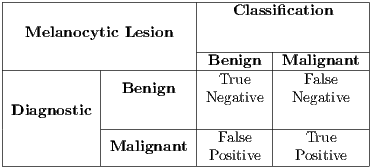
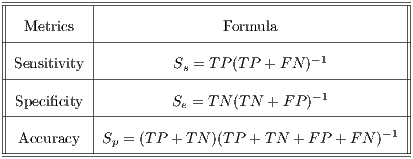
<body><![CDATA[<div class="float"  >       <div class="caption"  ><span class="id">Table&#x00A0;2: </span><span   class="content">Comparison of Segmentation Algorithms</span></div><!--tex4ht:label?: x1-26001r2 -->     <div class="pic-tabular"> <img  src="/img/revistas/cleiej/v19n2/2a0633x.png" alt="|-----------------|---------|----------|----------| |-----Method------|Accuracy-|Sensitivity-|Specificity-| |Otsu-------------|--96%----|---82%----|---98%-----| -Maximum--Entropy----97%--------85%--------99%----- " ></div>     </div><hr class="endfloat">    </div> <!--l. 712-->    <p class="indent" >   As shown in Table <a  href="#x1-26001r2">2<!--tex4ht:ref: tab:otsuvsmax --></a>, the results are similar in terms of performance, specifically, for pigmented lesions were reported <span class="cite">[<a  href="#Xblandom2010support">8</a><a id="br8">]</a></span> which is convenient to use the method of maximum entropy, so that in this work such algorithm is used for the segmentation.    <h4 class="subsectionHead"><span class="titlemark">4.4   </span> <a   id="x1-270004.4"></a>Performance Classifier Metrics</h4> <!--l. 717-->    <p class="noindent" >The objective of the classifier on the proposed methodology is to return a negative or positive diagnosis, ie, whether the input samples represent a malignant or benign lesion. For a given sample, a diagnostic system can lead to one of four possible outcomes:      <ul class="itemize1">      <li class="itemize">True positive (TP), diagnosis is positive and is classified as positive.      </li>      <li class="itemize">False negative (FN), diagnosis is positive and classified as negative.      </li>      <li class="itemize">True negative (TN), diagnosis is negative and is classified as negative.      </li>      <li class="itemize">False positive (FP), diagnosis is negative and is classified as positive.      </li>    </ul> <!--l. 731-->    <p class="indent" >   In Table <a  href="#x1-27001r3">3<!--tex4ht:ref: tab:matrizdeconfusion --></a> the matrix that includes the four possible outcomes is shown. The Sensitivity, Specificity and Accuracy metrics are taken into account in order to assess the results.     <div class="table">  <!--l. 732-->    <p class="indent" >   <a   id="x1-27001r3"></a><hr class="float">    <div class="float"  >       ]]></body>
<body><![CDATA[<div class="caption"  ><span class="id">Table&#x00A0;3: </span><span   class="content">Matrix of possible results</span></div><!--tex4ht:label?: x1-27001r3 -->     <div class="pic-tabular"> <img  src="/img/revistas/cleiej/v19n2/2a0634x.png" alt="|-----------------------|---------------------| |                       |    Classification     | |  Melanocytic Lesion   |                     | |                       |-Benign--|Malignant--| |-----------|-----------|---------|-----------| |           |  Benign   |  True   |   False    | |Diagnostic |           |Negative | Negative   | |           |-----------|---------|-----------| |           |Malignant  |  False   |   True    | --------------------------Positive----Positive--- " ></div>     </div><hr class="endfloat">    </div>      <ul class="itemize1">      <li class="itemize">Sensitivity is the probability of classifying malignant lesions as such. In other words, it is the ability      to properly diagnose sick patients.      </li>      <li class="itemize">Specificity is the probability of classifying benign lesions as such. It is defined as the ability to correctly      diagnose healthy patients.      </li>      <li class="itemize">Accuracy is the probability of correctly classifying a lesion, the probability that a sick or healthy patient      gets a correct diagnosis.</li>    </ul> <!--l. 763-->    <p class="noindent" >Table <a  href="#x1-27002r4">4<!--tex4ht:ref: tab:metricasdes --></a> shows the formal definition of the performance metrics for specificity, sensitivity and accuracy.     <div class="table"> <!--l. 764-->    <p class="indent" >   <a   id="x1-27002r4"></a><hr class="float">    <div class="float"  >       <div class="caption"  ><span class="id">Table&#x00A0;4: </span><span   class="content">Performance Metrics</span></div><!--tex4ht:label?: x1-27002r4 -->     <div class="pic-tabular"> <img  src="/img/revistas/cleiej/v19n2/2a0635x.png" alt="|----------|---------------------------------------| |          |                                       | |--Metrics--|---------------Formula-----------------| |          |                          - 1          | |Sensitivity-|---------Ss-=-TP-(T-P-+-FN-)------------| |          |                           -1          | |Specificity-|---------Se-=-TN-(T-N-+-FP-)------------| |          |                                   - 1 | --Accuracy--Sp-=-(TP-+-TN-)(T-P-+-TN-+-F-P +-F-N-)--- ----------------------------------------------------  " ></div>     </div><hr class="endfloat">    </div> <!--l. 787-->    <p class="indent" >   For the construction of the classifier and the making of the experimental testing, the Bioinformatics Toolbox for Matlab R2013b was used. Experiments are explained below.    <h5 class="subsubsectionHead"><span class="titlemark">4.4.1   </span> <a   id="x1-280004.4.1"></a>Experimental test I</h5> <!--l. 792-->    ]]></body>
<body><![CDATA[<p class="noindent" >This test is based on the retention method which consists in dividing the sample data into 2 complementary sets of 104 images. The first is called set of training <img  src="/img/revistas/cleiej/v19n2/2a0636x.png" alt="Dtraining  "  class="math" > and the second is called test set <img  src="/img/revistas/cleiej/v19n2/2a0637x.png" alt="Dtest  "  class="math" >. Then, the set of training is formed, which contains 32 images of which were randomly selected 12 benign and 20 malignant with a probability p = 30 without repetition.The rest of the images (72 images) are used for the validation of the classifier obtained in the previous step. The results of this process are shown in Table <a  href="#x1-28001r5">5<!--tex4ht:ref: tab:experimentos1 --></a>.        <div class="table">  <!--l. 796-->    <p class="indent" >   <a   id="x1-28001r5"></a><hr class="float">    <div class="float"  >       <div class="caption"  ><span class="id">Table&#x00A0;5: </span><span   class="content">Results of Experiment I</span></div><!--tex4ht:label?: x1-28001r5 -->     <div class="pic-tabular"> <img  src="/img/revistas/cleiej/v19n2/2a0638x.png" alt="|----------|---------------------------|--------| |          |         Images            |        | | Metrics  |                           | Rate   | |          |---------|-----|-Properly--|        | |          |Training |Test | Classified  |        | |----------|---------|-----|-----------|--------| |Sensitivity-|---20----|-56--|----53-----|94.64-%--| |Specificity--|---12----|-16--|----12-----|--75%----| -Accuracy------32------72-------65------90.28%--  " ></div>     </div><hr class="endfloat">    </div>    <h5 class="subsubsectionHead"><span class="titlemark">4.4.2   </span> <a   id="x1-290004.4.2"></a>Experimental Test II</h5> <!--l. 815-->    <p class="noindent" >It is necessary to use other methods since in experiment I the minimum standard of the Specificity Metrics was not reached (greater than 79%). The cross-validation is used to give strength to the classifier. For the K-Fold Cross-Validation, the data set is divided into K groups and K iterations are performed. Each iteration uses a group for the test <img  src="/img/revistas/cleiej/v19n2/2a0639x.png" alt="Dztest = Dz  "  class="math" > and the K-1 remaining groups <img  src="/img/revistas/cleiej/v19n2/2a0640x.png" alt="Dtraining = D - Dz  "  class="math" > are used for training with <img  src="/img/revistas/cleiej/v19n2/2a0641x.png" alt="z = 1,..,K  "  class="math" >. In pseudocode 1, the collection of the <img  src="/img/revistas/cleiej/v19n2/2a0642x.png" alt="SCL  "  class="math" > classification system is described, whereas in the results gathered from this process are shown in Table <a  href="#x1-29009r6">6<!--tex4ht:ref: tab:exp2grupo --></a>.        <div class="algorithm">  <!--l. 818-->    <p class="indent" >   <a   id="x1-29001r1"></a><hr class="float">    <div class="float"  >       ]]></body>
<body><![CDATA[<div class="caption"  ><span class="id">Algorithm 1: </span><span   class="content">K-Fold Cross-Validation</span></div><!--tex4ht:label?: x1-29001r1 --> <span  class="cmbx-10">INPUT: </span>Number of K groups<br  class="newline"><span  class="cmbx-10">OUTPUT:</span> <img  src="/img/revistas/cleiej/v19n2/2a0643x.png" alt="SCL  "  class="math" > Classification System     <div class="algorithmic"> <a   id="x1-29002r1"></a>  <span class="ALCitem"><span  class="cmr-8">1:</span></span><span style="width:5.0pt;">&nbsp;</span> <span  class="cmbx-10">for all</span>&#x00A0;<img  src="/img/revistas/cleiej/v19n2/2a0644x.png" alt="z &#x2190; 1  "  class="math" > <span  class="cmbx-10">to</span> <img  src="/img/revistas/cleiej/v19n2/2a0645x.png" alt="K  "  class="math" >&#x00A0;<span  class="cmbx-10">do</span><span class="for-body"> <a   id="x1-29003r2"></a>      <br><span class="ALCitem"><span  class="cmr-8">2:</span></span><span style="width:15.00002pt;">&nbsp;</span>   <img  src="/img/revistas/cleiej/v19n2/2a0646x.png" alt="Dztest = Dz  "  class="math" > <a   id="x1-29004r3"></a>      <br><span class="ALCitem"><span  class="cmr-8">3:</span></span><span style="width:15.00002pt;">&nbsp;</span>   <img  src="/img/revistas/cleiej/v19n2/2a0647x.png" alt="Dztraining = D - Dz  "  class="math" > <a   id="x1-29005r4"></a>      <br><span class="ALCitem"><span  class="cmr-8">4:</span></span><span style="width:15.00002pt;">&nbsp;</span>   <img  src="/img/revistas/cleiej/v19n2/2a0648x.png" alt="CLz  = trainingSV M (Dztraining)  "  class="math" >; //Calculus of <img  src="/img/revistas/cleiej/v19n2/2a0649x.png" alt="&#x03C9;z &#x22C5;x - bz  "  class="math" >    </span><a   id="x1-29006r5"></a>      <br><span class="ALCitem"><span  class="cmr-8">5:</span></span><span style="width:5.0pt;">&nbsp;</span> <span  class="cmbx-10">end</span>&#x00A0;<span  class="cmbx-10">for</span><a   id="x1-29007r6"></a>      <br><span class="ALCitem"><span  class="cmr-8">6:</span></span><span style="width:5.0pt;">&nbsp;</span> <img  src="/img/revistas/cleiej/v19n2/2a0650x.png" alt="SCL  = {CL1, CL2,CL3, ...,CLK } "  class="math" > <a   id="x1-29008r7"></a>      <br><span class="ALCitem"><span  class="cmr-8">7:</span></span><span style="width:5.0pt;">&nbsp;</span> Return <img  src="/img/revistas/cleiej/v19n2/2a0651x.png" alt="SCL  "  class="math" >; </div>     </div><hr class="endfloat">    </div>        <div class="table">  <!--l. 835-->    <p class="indent" >   <a   id="x1-29009r6"></a><hr class="float">    ]]></body>
<body><![CDATA[<div class="float"  >       <div class="caption"  ><span class="id">Table&#x00A0;6: </span><span   class="content">Results of experiment II</span></div><!--tex4ht:label?: x1-29009r6 -->     <div class="pic-tabular"> <img  src="/img/revistas/cleiej/v19n2/2a0652x.png" alt="|---------|-----------|-----------|-----------| |-Group---|Sensitivity-|Speci-ficity-|-Accuracy--| |---1-----|---80%-----|--52.17%---|--72.73%----| |---2-----|--51.74%----|--48.61%---|--51.11%----| |---3-----|--66.15%----|--69.57%---|--67.04%----| |---4-----|--67.69%----|--47.83%---|---62.5%----| -Average-----66.4%-------54.55%------63.34%---- " ></div>     </div><hr class="endfloat">    </div> <!--l. 852-->    <p class="indent" >   This data partition is unworkable when there is small amount of data, since the amount of images of training that are used by each group still cannot provide a classifier that complies with the performance standards of the dermatoscopy that are sought in this work. Note that the performance by group is less than that obtained by the retention method.    <h4 class="subsectionHead"><span class="titlemark">4.5   </span> <a   id="x1-300004.5"></a>Experimental Test III</h4> <!--l. 858-->    <p class="noindent" >Due to the unfavorable results in experiment II (shown in Table <a  href="#x1-29009r6">6<!--tex4ht:ref: tab:exp2grupo --></a> - less than the standards of specificity and sensitivity of 79% and 89%, respectively) Random Cross-Validation was conducted where K iterations were made, but by each iteration, a set of test <img  src="/img/revistas/cleiej/v19n2/2a0653x.png" alt="Dztest = Dz  "  class="math" > and the set of training <img  src="/img/revistas/cleiej/v19n2/2a0654x.png" alt="Dtraining = D - Dz  "  class="math" > . must be chosen randomly. <!--l. 863-->    <p class="indent" >   In the k-th iteration, it is calculated the k-th classification system CL to conform classifiers K, progressively. In this context, it is in the K-th iteration, the K-th classification system <img  src="/img/revistas/cleiej/v19n2/2a0655x.png" alt="SCL  = {CL1,CL2, CL3,...,CLK } "  class="math" > whose performance is obtained from the average of the classifiers K. Next, The Algorithm 2 is shown, which describes the collection of the classification system <img  src="/img/revistas/cleiej/v19n2/2a0656x.png" alt="SCL  "  class="math" > based on the Random Cross-Validation.        <div class="algorithm">  <!--l. 879-->    <p class="indent" >   <a   id="x1-30001r2"></a><hr class="float">    <div class="float"  >       <div class="caption"  ><span class="id">Algorithm 2: </span><span   class="content">Random Cross-Validation.</span></div><!--tex4ht:label?: x1-30001r2 --> <span  class="cmbx-10">INPUT: </span>Number of K groups<br  class="newline"><span  class="cmbx-10">OUTPUT: </span>Classifications System <img  src="/img/revistas/cleiej/v19n2/2a0657x.png" alt="SCL  "  class="math" >     ]]></body>

<body><![CDATA[<div class="algorithmic"> <a   id="x1-30002r8"></a>  <span class="ALCitem"><span  class="cmr-8">1:</span></span><span style="width:5.0pt;">&nbsp;</span> <span  class="cmbx-10">for all</span>&#x00A0;<img  src="/img/revistas/cleiej/v19n2/2a0658x.png" alt="z &#x2190; 1  "  class="math" > <span  class="cmbx-10">to</span> <img  src="/img/revistas/cleiej/v19n2/2a0659x.png" alt="K  "  class="math" >&#x00A0;<span  class="cmbx-10">do</span><span class="for-body"> <a   id="x1-30003r9"></a>      <br><span class="ALCitem"><span  class="cmr-8">2:</span></span><span style="width:15.00002pt;">&nbsp;</span>   <img  src="/img/revistas/cleiej/v19n2/2a0660x.png" alt="Dztraining = randomSelection{D } "  class="math" > <a   id="x1-30004r10"></a>      <br><span class="ALCitem"><span  class="cmr-8">3:</span></span><span style="width:15.00002pt;">&nbsp;</span>   <img  src="/img/revistas/cleiej/v19n2/2a0661x.png" alt="CLz  = trainingSV M (Dztraining)  "  class="math" >; //Calculus of <img  src="/img/revistas/cleiej/v19n2/2a0662x.png" alt="&#x03C9;z &#x22C5;x - bz  "  class="math" > <a   id="x1-30005r11"></a>      <br><span class="ALCitem"><span  class="cmr-8">4:</span></span><span style="width:15.00002pt;">&nbsp;</span>   <img  src="/img/revistas/cleiej/v19n2/2a0663x.png" alt="Dztest = D - Dz  "  class="math" >    </span><a   id="x1-30006r12"></a>      <br><span class="ALCitem"><span  class="cmr-8">5:</span></span><span style="width:5.0pt;">&nbsp;</span> <span  class="cmbx-10">end</span>&#x00A0;<span  class="cmbx-10">for</span><a   id="x1-30007r13"></a>      <br><span class="ALCitem"><span  class="cmr-8">6:</span></span><span style="width:5.0pt;">&nbsp;</span> <img  src="/img/revistas/cleiej/v19n2/2a0664x.png" alt="SCL  = {CL1, CL2,CL3, ...,CLK } "  class="math" > <a   id="x1-30008r14"></a>      <br><span class="ALCitem"><span  class="cmr-8">7:</span></span><span style="width:5.0pt;">&nbsp;</span> Return <img  src="/img/revistas/cleiej/v19n2/2a0665x.png" alt="SCL  "  class="math" >; </div>     </div><hr class="endfloat">    </div> <!--l. 897-->    <p class="indent" >   As shown in Figure <a  href="#x1-30009r27">27<!--tex4ht:ref: f27 --></a>, the results begin to stabilize from iteration K = 12, so 3 iterations more are performed, until reaching a K=15. <!--l. 899-->    <p class="indent" >   <hr class="figure">    <div class="figure"  >  <a   id="x1-30009r27"></a>  <!--l. 902-->    ]]></body>
<body><![CDATA[<p class="noindent" ><img  src="/img/revistas/cleiej/v19n2/2a06f27.jpg" alt="PIC"   >     <br>     <div class="caption"  ><span class="id">Figure&#x00A0;27: </span><span   class="content">Behavior of results for K=15 iterations.</span></div><!--tex4ht:label?: x1-30009r27 -->  <!--l. 906-->    <p class="indent" >   </div><hr class="endfigure"> <!--l. 910-->    <p class="indent" >   The final average of such tests can be seen in Table <a  href="#x1-30010r7">7<!--tex4ht:ref: tab:experimentos1_2 --></a> that corresponds to a <img  src="/img/revistas/cleiej/v19n2/2a0666x.png" alt="SCL15  "  class="math" > system.        <div class="table">  <!--l. 912-->    <p class="indent" >   <a   id="x1-30010r7"></a><hr class="float">    <div class="float"  >       <div class="caption"  ><span class="id">Table&#x00A0;7: </span><span   class="content">Average result of 15 iterations of the Random Cross-Validation (experiment III).</span></div><!--tex4ht:label?: x1-30010r7 -->     <div class="pic-tabular"> <img  src="/img/revistas/cleiej/v19n2/2a0667x.png" alt="|----------|--------| |          |        | | Metrics  | Rate   | |          |        | |----------|--------| |Sensitivity-|95.12-%--| |Specificity--|79.58-%--| -Accuracy---91.67%--  " ></div>     </div><hr class="endfloat">    </div>    <h5 class="subsubsectionHead"><span class="titlemark">4.5.1   </span> <a   id="x1-310004.5.1"></a>Assembled System - Experimental Test IV</h5> <!--l. 929-->    ]]></body>
<body><![CDATA[<p class="noindent" >This section describes the process of selection of the best assembled system. Next, The Algorithm 3 is shown, where <img  src="/img/revistas/cleiej/v19n2/2a0668x.png" alt="e  "  class="math" > iterations are performed, where <img  src="/img/revistas/cleiej/v19n2/2a0669x.png" alt="e = 1,2,3,4,...&#x03BC;  "  class="math" > and each assembled system <img  src="/img/revistas/cleiej/v19n2/2a0670x.png" alt="SCLe  "  class="math" >, obtained through routine SSVM, it is evaluated by the metric of accuracy.The assembled system selected will be the one that has obtained greater accuracy.        <div class="algorithm">  <!--l. 943-->    <p class="indent" >   <a   id="x1-31001r3"></a><hr class="float">    <div class="float"  >       <div class="caption"  ><span class="id">Algorithm 3: </span><span   class="content">Selection of Assembled System.</span></div><!--tex4ht:label?: x1-31001r3 --> <span  class="cmbx-10">INPUT: </span><br  class="newline"><span  class="cmbx-10">OUTPUT: </span>Best Classification System <img  src="/img/revistas/cleiej/v19n2/2a0671x.png" alt="SCL  "  class="math" >     <div class="algorithmic"> <a   id="x1-31002r15"></a>  <span class="ALCitem"><span  class="cmr-8">1:</span></span><span style="width:5.0pt;">&nbsp;</span> <span  class="cmti-10">Initialize</span> <img  src="/img/revistas/cleiej/v19n2/2a0672x.png" alt="&#x03BC;  "  class="math" > <a   id="x1-31003r16"></a>      <br><span class="ALCitem"><span  class="cmr-8">2:</span></span><span style="width:5.0pt;">&nbsp;</span> <span  class="cmbx-10">for all</span>&#x00A0;<img  src="/img/revistas/cleiej/v19n2/2a0673x.png" alt="e &#x2190; 1  "  class="math" > <span  class="cmbx-10">to</span> <img  src="/img/revistas/cleiej/v19n2/2a0674x.png" alt="&#x03BC;  "  class="math" >&#x00A0;<span  class="cmbx-10">do</span><span class="for-body"> <a   id="x1-31004r17"></a>      <br><span class="ALCitem"><span  class="cmr-8">3:</span></span><span style="width:15.00002pt;">&nbsp;</span>   <img  src="/img/revistas/cleiej/v19n2/2a0675x.png" alt="SCLe  = SSV M ()  "  class="math" > <a   id="x1-31005r18"></a>      <br><span class="ALCitem"><span  class="cmr-8">4:</span></span><span style="width:15.00002pt;">&nbsp;</span>   <img  src="/img/revistas/cleiej/v19n2/2a0676x.png" alt="exae = Accuracy(SCLe )  "  class="math" >    </span><a   id="x1-31006r19"></a>      <br><span class="ALCitem"><span  class="cmr-8">5:</span></span><span style="width:5.0pt;">&nbsp;</span> <span  class="cmbx-10">end</span>&#x00A0;<span  class="cmbx-10">for</span><a   id="x1-31007r20"></a>      ]]></body>
<body><![CDATA[<br><span class="ALCitem"><span  class="cmr-8">6:</span></span><span style="width:5.0pt;">&nbsp;</span> <img  src="/img/revistas/cleiej/v19n2/2a0677x.png" alt="best = M ax(exa)  "  class="math" >    <br> <a   id="x1-31008r21"></a>      <br><span class="ALCitem"><span  class="cmr-8">7:</span></span><span style="width:5.0pt;">&nbsp;</span> <img  src="/img/revistas/cleiej/v19n2/2a0678x.png" alt="SCL  = SCLbest  "  class="math" > <a   id="x1-31009r22"></a>      <br><span class="ALCitem"><span  class="cmr-8">8:</span></span><span style="width:5.0pt;">&nbsp;</span> Return <img  src="/img/revistas/cleiej/v19n2/2a0679x.png" alt="SCL  "  class="math" >; </div>     </div><hr class="endfloat">    </div> <!--l. 961-->    <p class="indent" >   For the specific problem <img  src="/img/revistas/cleiej/v19n2/2a0680x.png" alt="&#x03BC;  "  class="math" > = 30 was used, from the 30 iterations, the assembled system used in the experiments III was selected. <!--l. 964-->    <p class="indent" >   In operation time, an assembled system consisting of classifiers K, obtains the final diagnostic by means of simple vote, because the output of each classifier CL is a discrete value. <!--l. 967-->    <p class="indent" >   The results of the assembled system of the experiment III in operational time are shown in Table <a  href="#x1-31010r8">8<!--tex4ht:ref: tab:entres --></a>.        <div class="table">  <!--l. 969-->    <p class="indent" >   <a   id="x1-31010r8"></a><hr class="float">    <div class="float"  >       ]]></body>
<body><![CDATA[<div class="caption"  ><span class="id">Table&#x00A0;8: </span><span   class="content">Results of the Assembled System of Experiment III</span></div><!--tex4ht:label?: x1-31010r8 -->     <div class="pic-tabular"> <img  src="/img/revistas/cleiej/v19n2/2a0681x.png" alt="|----------|-------| |-Metrics--|-Rate--| |Sensitivity-|96.05%--| |Specificity--|96.43%--| -Accuracy---96.15%--- " ></div>     </div><hr class="endfloat">    </div> <!--l. 985-->    <p class="indent" >   Notice the good results obtained, but they can be tricky since all the data is used to train the classifiers. For this reason, in step A, a set of the total data is isolated for the validation of the assembled system , and step B takes the rest of the set for training and testing, having as base the method of random cross-validation. This experiment is performed with two different data sets, the first set is using the ideal segmentation made by the professional, and the second using the proposed segmentation; both results are shown in Table <a  href="#x1-31011r9">9<!--tex4ht:ref: tab:ensacuatro --></a>.        <div class="table">  <!--l. 996-->    <p class="indent" >   <a   id="x1-31011r9"></a><hr class="float">    <div class="float"  >       <div class="caption"  ><span class="id">Table&#x00A0;9: </span><span   class="content">Results of the Assembled System of Experiment IV</span></div><!--tex4ht:label?: x1-31011r9 -->     <div class="pic-tabular"> <img  src="/img/revistas/cleiej/v19n2/2a0682x.png" alt="|--------------|-----------|------------|----------| |   System     |Sensitivity | Specificity  |Accuracy  | |-Assembler----|-----------|------------|----------| |    Ideal     |    95%     |   91.67%    | 93.75%   | |Segmentation--|-----------|------------|----------| |  Proposed    |    95%     |   83.33%    | 90.63%   | -Segmentation--------------------------------------- " ></div>     </div><hr class="endfloat">    </div>    <h5 class="subsubsectionHead"><span class="titlemark">4.5.2   </span> <a   id="x1-320004.5.2"></a>Experimental test V</h5> <!--l. 1019-->    <p class="noindent" >This experiment is carried out in order to observe the impact of a non-ideal segmentation on the system, which consists in building a classifier based on images with ideal segmentation (generated by the medical professional). All the images are used for the test data, but they follow the proposed segmentation process of this work.The results obtain are shown in Table <a  href="#x1-32001r10">10<!--tex4ht:ref: tab:exp5v --></a>.        <div class="table">  <!--l. 1023-->    ]]></body>
<body><![CDATA[<p class="indent" >   <a   id="x1-32001r10"></a><hr class="float">    <div class="float"  >       <div class="caption"  ><span class="id">Table&#x00A0;10: </span><span   class="content">Results of Experiment V</span></div><!--tex4ht:label?: x1-32001r10 -->     <div class="pic-tabular"> <img  src="/img/revistas/cleiej/v19n2/2a0683x.png" alt="           |-----------|-----------|-----------| |----------|Sensitivity-|Specificity-|Accuracy---| |Classifier |  93.42%    |  89.28%   |  92.30%    | --CLideal-------------------------------------- " ></div>     </div><hr class="endfloat">    </div>    <h3 class="sectionHead"><span class="titlemark">5   </span> <a   id="x1-330005"></a>Discussion of Results</h3> <!--l. 1037-->    <p class="noindent" >This section presents the discussions on the results obtained from the experimental tests of the segmentation and classification modules. <!--l. 1039-->    <p class="noindent" >    <h5 class="subsubsectionHead"><span class="titlemark">5.0.1   </span> <a   id="x1-340005.0.1"></a>Segmentation</h5> <!--l. 1042-->    <p class="noindent" >It must be taken into account that segmentation can be affected by the method of hair extraction used in each work, which could lead to unfavorable or advantageous results. <!--l. 1046-->    <p class="indent" >   The results obtained in the segmentation made on the same bank of images, by means of the proposed method obtained 97% of accuracy as shown in Table <a  href="#x1-34001r11">11<!--tex4ht:ref: tab:compseg --></a>; in the same way, it can be observed that the results of <span class="cite">[<a  href="#Xtorres2014segmentacion">47</a><a id="br47">]</a></span> were favorable but below the proposal. This could be due to the hair extraction method used in this work, hence the importance of a good method for hair extraction.        <div class="table">  <!--l. 1048-->    <p class="indent" >   <a   id="x1-34001r11"></a><hr class="float">    ]]></body>

<body><![CDATA[<div class="float"  >       <div class="caption"  ><span class="id">Table&#x00A0;11: </span><span   class="content">Comparative Table of the Results of the Segmentation</span></div><!--tex4ht:label?: x1-34001r11 -->     <div class="pic-tabular"> <img  src="/img/revistas/cleiej/v19n2/2a0684x.png" alt="|--------------------|---------|----------|----------| |------Method--------|-Accuracy-|-Sensitivity-|-Specificity-| |Torres-[<a href="#br47">47</a>]-----------|---90%---|----------|----------| -Segmentation-proposed-----97%-------85%--------99%----- " ></div>     </div><hr class="endfloat">    </div>    <h5 class="subsubsectionHead"><span class="titlemark">5.0.2   </span> <a   id="x1-350005.0.2"></a>Classification</h5> <!--l. 1065-->    <p class="noindent" >Prior to the discussion of the results, it is important to clarify that the bases of images used in this work and those of the state-of-the-art are different because there are no public database due to confidentiality reasons kept between doctors and their patients. Regarding the reproduction of such works, they could not be done because of the scarce information provided by the authors, in most of the cases, the main obstacle was the lack of information on the methods used for the extraction of hairs. It could also be observed that the characteristics used in these works require knowledge of the consecutive acquisition protocol for image taking, information that is not available, and it is the reason why features such as the area and the diameter of the lesion could not be used. For these reasons, the proposed scheme is incomparable with the state-of-the-art approaches, it can only be alleged that the results obtained in this work are well positioned as shown in the Table <a  href="#x1-35001r12">12<!--tex4ht:ref: tab:compclas --></a>.  <!--l. 1067-->    <p class="indent" >   <a   id="x1-35001r12"></a><hr class="float">    <div class="float"  >       <div class="caption"  ><span class="id">Table&#x00A0;12: </span><span   class="content">Comparative Table of the Results of Classification Systems</span></div><!--tex4ht:label?: x1-35001r12 -->     <div class="center"  > <!--l. 1069-->    <p class="noindent" > <!--l. 1083-->    <p class="noindent" >     ]]></body>
<body><![CDATA[<div class="pic-tabular"><img  src="/img/revistas/cleiej/v19n2/2a0685x.png" alt="|--------------|------------------------------------------------------------------------|-------------------------------| |              |                                Methods                                 |            Results             | |    Work      |                                                                        |                               | |              |-----------------|----------------------------|-------------------------|----------|----------|---------| |--------------|--Segmentation----|-Extraction-of characteristics--|--------Classifiers---------|Sensitivity-|Specificity-|Accuracy-| | Batugo       |   Clustering     |          ABCD              |Linear discriminant classifier |  79.31%   | 71.83%   |   -     | |-[<a href="#br1">1</a>]-----------|-----------------|----------------------------|-------------------------|----------|----------|---------| | Oliveira       |   Chan Veese    |          ABC -T            |          SVM            |  73.81%   | 76.67%   |   -     | |-[<a href="#br27">27</a>]----------|-----------------|----------------------------|-------------------------|----------|----------|---------| | Rahman et al.| Fuzzy C-means   |Histogram of Color and Texture  SE (K -NN,  SVM, GML )   |  83.75%   |  62.5%    |   -     | |-[<a href="#br30">30</a>]----------|-----------------|----------------------------|-------------------------|----------|----------|---------| | Alcon et al.  |                 |                            |                         |          |          |         | |-[<a href="#br34">34</a>]----------|------Otsu-------|----------ABCD--------------|-Linear Regression-Logistics-|---94%----|---68%----|--86%----| | Celebi et al.  |                 |                            |                         |          |          |         | |-[<a href="#br36">36</a>]----------|------Otsu-------|---area-of the lesion, texture-|----------SVM------------|--93.33%---|-92.34%---|---------| | Approach     |                 |                            |                         |          |          |         | --proposed-------Maximum--Entropy------------ABCD---------------------SE-(15 SVMs-)---------95.12%-----79.58%-----91.67%---" ></div></div>     </div><hr class="endfloat"> <!--l. 1090-->    <p class="indent" >   The Retention Method was used in experiment I, where it can be observed that there is an unbalance of loads between benign and malignant lesions, being the latter the kind which prevails. In these cases, the majority of classifiers focuses on learning from the large kinds resulting in a poor accuracy of classification for the smaller kinds. This is verified in the results obtained in this experiment being specificity lower than sensitivity, it is worth mentioning that the result obtained in sensitivity is crucial because the proper detection of malignant lesions is a priority. <!--l. 1094-->    <p class="indent" >   With the aim of improving specificity, experiment II was conducted, whose results were not favorable even affecting sensitivity and showing the effect of insufficient data. This happened because of the division into sets of training and testing of equal size in order to obtain different classifiers which led to few images to train each classifier, which in turn, led to conduct experiment III. <!--l. 1098-->    <p class="indent" >   In experiment III encouraging results were obtained, with a slight improvement in specificity and without sacrificing sensitivity, this is the effect of using more benign lesions during training. <!--l. 1103-->    <p class="indent" >   With the aim of providing strength to the proposed method, an assembled system was used, which consisted of 15 classifiers.First of all, the assembled system of the experiment was formed but it was concluded that these results suggest over-training, which could lead to a poor performance for new samples. <!--l. 1107-->    <p class="indent" >   For this reason, experiment IV was conducted, where the results are satisfactory for an unknown validation group. <!--l. 1117-->    <p class="indent" >   Considering the sensitivity and specificity of the dermoscopy as a basis, the proposed scheme is valid since it reached these metrics which constitute the general objective of this work. <!--l. 1121-->    <p class="indent" >   It can be observed in experiment V that non-ideal segmentation degrades the performance of the classifier that was built with all of the ideal images, getting a more negative impact on specificity than on sensitivity. With this, we can conclude that work must continue in the improvement of a segmentation algorithm that can reach to be as ideal as it can get.    <h3 class="sectionHead"><span class="titlemark">6   </span> <a   id="x1-360006"></a>Conclusions and Future Work</h3> <!--l. 1127-->    <p class="noindent" >A set of image processing techniques were used to obtain features of the ABCD rule, quite used in dermatology, and use it as an input to a classifier.This is done in order to be able to give a diagnosis of skin cancer, specifically, melanoma. Several tests were conducted while classifying, so as to evaluate its performance and get acceptable results by dermatology experts. According to the performance metrics, very favourable results were obtained, taking into account the state-of-the-art approaches. However, for a work confrontation the same database should be used, which was not possible due to lack of public databases. In Dermatology, it is considered as a valid tool only if it reaches the performance of the diagnosis using the dermatoscopy, so the scheme proposed constitutes as a valid tool for the dermatologist. The proposed scheme complies with the outlined objectives, the generals and the specific ones. The tool has been developed in order to assist the dermatologist and not to replace them; it is intended to contribute to obtain an objective diagnosis, independent from the professional experience. <!--l. 1131-->    <p class="indent" >   As future work, the authors propose to carry out the feature extraction using another rule, either pattern analysis <span class="cite">[<a  href="#Xzalaudek2006three">21</a><a id="br21">]</a></span>, the Menzies method <span class="cite">[<a  href="#Xmenzies1996sensitivity">22</a><a id="br22">]</a></span> or another. To build a tool that will point out each of the features found in the lesion and that will display itself as a means of information for the medical professional. To implement a method for the extraction of hairs with lower computational cost and implement metrics to measure its performance. To do tests with a standard database, with a defined acquisition protocol in such a way that it can include characteristics like the area and the compactness of the lesion. <!--l. 2-->    ]]></body>
<body><![CDATA[<p class="noindent" >    <h3 class="likesectionHead"><a   id="x1-370006"></a>References</h3> <!--l. 2-->    <p class="noindent" >         <div class="thebibliography">         <p class="bibitem" ><span class="biblabel">   [<a href="#br1">1</a>]<span class="bibsp">&#x00A0;&#x00A0;&#x00A0;</span></span><a   id="Xbatugo2013reconocimiento"></a>G.&#x00A0;A.  Batugo,  &#8220;Reconocimiento  automático  de  melanomas  mediante  técnicas  de  visión  por     ordenador y reconocimiento de patrones,&#8221; Universidad Carlos III de Madrid, Tech. Rep., 2013.     </p>          <p class="bibitem" ><span class="biblabel">   [<a href="#br2">2</a>]<span class="bibsp">&#x00A0;&#x00A0;&#x00A0;</span></span><a   id="Xsbonner2003multiple"></a>A.&#x00A0;Sboner,  C.&#x00A0;Eccher,  E.&#x00A0;Blanzieri,  P.&#x00A0;Bauer,  M.&#x00A0;Cristofodolini,  G.Zumiani,  and  S.Forti,  &#8220;A     multiple classifier system for early melanoma diagnosis,&#8221; <span  class="cmti-10">Artificial Intelligence in Medicine</span>, vol.&#x00A0;27,     no.&#x00A0;1, pp. 29&#8211;44, 2003. [Online]. Available: <a  href="http://dx.doi.org/10.1016/S0933-3657(02)00087-8" class="url" >http://dx.doi.org/10.1016/S0933-3657(02)00087-8</a>     </p>         <p class="bibitem" ><span class="biblabel">   [<a href="#br3">3</a>]<span class="bibsp">&#x00A0;&#x00A0;&#x00A0;</span></span><a   id="Xbraun2003dermoscopy"></a>P.&#x00A0;Braun, H.&#x00A0;Rabinovitz, M.&#x00A0;Oliviero, A.&#x00A0;Kopf, and J.&#x00A0;Saurat, &#8220;Dermoscopy of pigmented skin     lesions,&#8221; <span  class="cmti-10">Journal of the American Academy of Dermatology</span>, vol.&#x00A0;48, no.&#x00A0;5, pp. 679&#8211;693, may 2003.     [Online]. Available: <a  href="http://dx.doi.org/10.1016/j.jaad.2001.11.001" class="url" >http://dx.doi.org/10.1016/j.jaad.2001.11.001</a>     </p>         <p class="bibitem" ><span class="biblabel">   [<a href="#br4">4</a>]<span class="bibsp">&#x00A0;&#x00A0;&#x00A0;</span></span><a   id="Xparikh2013survey"></a>Parikh  and  Hitesh,  &#8220;A  survey  on  computer  vision  based  diagnosis  for  skin  lesion  detection,&#8221;     <span  class="cmti-10">International Journal of Engineering Science and Innovative Technology</span>, vol.&#x00A0;2, no.&#x00A0;2, pp. 431&#8211;437,     2013.     </p>         <p class="bibitem" ><span class="biblabel">   [<a href="#br5">5</a>]<span class="bibsp">&#x00A0;&#x00A0;&#x00A0;</span></span><a   id="Xzaballos2004criterios"></a>P.&#x00A0;Zaballos, C.&#x00A0;Carrera, S.&#x00A0;Puig, and J.Malvehy, &#8220;Criterios dermatoscópicos para el diagnóstico     del melanoma,&#8221; <span  class="cmti-10">Medigraphic</span>, vol.&#x00A0;32, 2004.     </p>         <p class="bibitem" ><span class="biblabel">   [<a href="#br6">6</a>]<span class="bibsp">&#x00A0;&#x00A0;&#x00A0;</span></span><a   id="Xoms2005"></a>La Organización Mundial de la Salud desaconseja el uso de camas solares a las personas menores de     18 años. <a  href="http://www.who.int/mediacentre/news/notes/2005/np07/es/" class="url" >http://www.who.int/mediacentre/news/notes/2005/np07/es/</a>. Accessed: 2016-06-27.     </p>         <p class="bibitem" ><span class="biblabel">   [<a href="#br7">7</a>]<span class="bibsp">&#x00A0;&#x00A0;&#x00A0;</span></span><a   id="Xramos2012epidemiologia"></a>P.&#x00A0;Ramos,   F.&#x00A0;C.   nete,   R.&#x00A0;Dullak,   L.&#x00A0;Bolla,   N.&#x00A0;Centurión,   A.&#x00A0;Centurión,   S.&#x00A0;Chamorro,     A.&#x00A0;Chaparro, and F.&#x00A0;Chaves, &#8220;Epidemiología del cáncer de piel en pacientes atendidos en la cátedra     de dermatología de la facultad de ciencias médicas de la universidad nacional de asunción, paraguay     (2008-2011),&#8221; <span  class="cmti-10">ANALES de la Facultad de Ciencias M</span><span  class="cmti-10">édicas</span>, vol.&#x00A0;45, no.&#x00A0;2, pp. 49&#8211;69, 2012.     </p>         ]]></body>
<body><![CDATA[<p class="bibitem" ><span class="biblabel">   [<a href="#br8">8</a>]<span class="bibsp">&#x00A0;&#x00A0;&#x00A0;</span></span><a   id="Xblandom2010support"></a>O.&#x00A0;Blandom, &#8220;A support tool for melanoma diagnosis by using dermoscopy images,&#8221; Master&#8217;s thesis,     Universidad Nacional de Colombia, Manizales, Colombia, 2010.     </p>         <p class="bibitem" ><span class="biblabel">   [<a href="#br9">9</a>]<span class="bibsp">&#x00A0;&#x00A0;&#x00A0;</span></span><a   id="Xzhou2010Skin"></a>H.&#x00A0;Zhou,  G.&#x00A0;Schaefer,  M.&#x00A0;Celebi,  H.&#x00A0;Iyatomi,  K.&#x00A0;Norton,  and  F.&#x00A0;L.  T.&#x00A0;Liu,  &#8220;Skin  lesion     segmentation  using  an  improved  snake  model,&#8221;  <span  class="cmti-10">Engineering  in  Medicine  and  Biology  Society</span>     <span  class="cmti-10">(EMBC),   2010   Annual   International   Conference   of   the   IEEE</span>,   2010.   [Online].   Available:     <a  href="http://dx.doi.org/10.1109/IEMBS.2010.5627556" class="url" >http://dx.doi.org/10.1109/IEMBS.2010.5627556</a>     </p>         <p class="bibitem" ><span class="biblabel">  [<a href="#br10">10</a>]<span class="bibsp">&#x00A0;&#x00A0;&#x00A0;</span></span><a   id="Xganster2001automated"></a>H.&#x00A0;Ganster, A.&#x00A0;Pinz, R.&#x00A0;Rohrer, E.&#x00A0;Wildling, M.&#x00A0;Binder, and H.&#x00A0;Kittler, &#8220;Automated melanoma     recognition,&#8221;  <span  class="cmti-10">Medical Imaging, IEEE Transactions on</span>,  vol.&#x00A0;20,  no.&#x00A0;3,  pp.  233&#8211;239,  2001.  [Online].     Available: <a  href="http://dx.doi.org/10.1109/42.918473" class="url" >http://dx.doi.org/10.1109/42.918473</a>     </p>         <p class="bibitem" ><span class="biblabel">  [<a href="#br11">11</a>]<span class="bibsp">&#x00A0;&#x00A0;&#x00A0;</span></span><a   id="Xlifshitz2011llega"></a>A.&#x00A0;Lifshitz.  Llega  Zelboraf:  una  medicina  nueva  contra  el  melanoma,  un  cáncer  de  la  piel.     <a  href="http://www.vidaysalud.com/diario/cancer/llega-zelboraf-una-medicina-nueva-contra-el-melanoma-un-cancer-de-la-piel/" class="url" >http://www.vidaysalud.com/diario/cancer/llega-zelboraf-una-medicina-nueva-contra-el-melanoma-un-cancer-de-la-piel/</a>.     Accessed: 2016-06-27.     </p>         <p class="bibitem" ><span class="biblabel">  [<a href="#br12">12</a>]<span class="bibsp">&#x00A0;&#x00A0;&#x00A0;</span></span><a   id="Xcancermelanoma"></a>Melanoma. <a  href="http://www.dmedicina.com/enfermedades/cancer/melanoma" class="url" >http://www.dmedicina.com/enfermedades/cancer/melanoma</a>. Accessed: 2016-06-27.      </p>         <p class="bibitem" ><span class="biblabel">  [<a href="#br13">13</a>]<span class="bibsp">&#x00A0;&#x00A0;&#x00A0;</span></span><a   id="Xmelanoma2013"></a>R.&#x00A0;J.      Friedman,      D.&#x00A0;S.      Rigel,      A.&#x00A0;W.      Kopf,      and      D.&#x00A0;Polsky.      Melanoma.     <a  href="http://cancerdepiel.org/cancer-de-piel/melanoma" class="url" >http://cancerdepiel.org/cancer-de-piel/melanoma</a>. Accessed: 2016-06-27.     </p>         <p class="bibitem" ><span class="biblabel">  [<a href="#br14">14</a>]<span class="bibsp">&#x00A0;&#x00A0;&#x00A0;</span></span><a   id="Xfossati2013lesiones"></a>M.&#x00A0;Fossati, C.&#x00A0;Guebenlián, M.&#x00A0;Restano, and A.&#x00A0;Wolf, &#8220;Lesiones melanocíticas,&#8221; <span  class="cmti-10">Dermatoscop</span><span  class="cmti-10">ía</span>     <span  class="cmti-10">Elemental</span>, 2013.     </p>         <p class="bibitem" ><span class="biblabel">  [<a href="#br15">15</a>]<span class="bibsp">&#x00A0;&#x00A0;&#x00A0;</span></span><a   id="Xsoyer2007color"></a>H.&#x00A0;P. Soyer, R.&#x00A0;Hofmann-Wellenhof, R.&#x00A0;H. Johr <span  class="cmti-10">et</span><span  class="cmti-10">&#x00A0;al.</span>, <span  class="cmti-10">Color atlas of melanocytic lesions of the</span>     <span  class="cmti-10">skin</span>.   Springer, 2007.     </p>         <p class="bibitem" ><span class="biblabel">  [<a href="#br16">16</a>]<span class="bibsp">&#x00A0;&#x00A0;&#x00A0;</span></span><a   id="Xtroya2008estudio"></a>M.&#x00A0;de&#x00A0;Troya&#x00A0;Martína,  N.&#x00A0;B.  Sáncheza,  I.&#x00A0;F.  Canedoa,  M.&#x00A0;F.  Eliceguia,  R.&#x00A0;F.  Liébanab,  and     F.&#x00A0;R. Ruizc, &#8220;Estudio dermoscópico del melanoma maligno cutáneo: análisis descriptivo de 45 casos,&#8221;     vol.&#x00A0;99, no.&#x00A0;1, pp. 44&#8211;53, 2008.     </p>         <p class="bibitem" ><span class="biblabel">  [<a href="#br17">17</a>]<span class="bibsp">&#x00A0;&#x00A0;&#x00A0;</span></span><a   id="Xstanganelli2012dermoscopy"></a>I.&#x00A0;Stanganelli.  Dermoscopy.  <a  href="http://emedicine.medscape.com/article/1130783-overview" class="url" >http://emedicine.medscape.com/article/1130783-overview</a>.  Accessed:     2016-06-27.     </p>         ]]></body>
<body><![CDATA[<p class="bibitem" ><span class="biblabel">  [<a href="#br18">18</a>]<span class="bibsp">&#x00A0;&#x00A0;&#x00A0;</span></span><a   id="Xsoyer2002dermoscopy"></a>G.&#x00A0;Argenziano, H.&#x00A0;Soyer, S.&#x00A0;Chimenti, and G.&#x00A0;Ruocco, &#8220;Dermoscopy of pigmented skin lesions,&#8221;     <span  class="cmti-10">European Journal of Dermatology</span>, vol.&#x00A0;11, no.&#x00A0;3, pp. 270&#8211;277, may 2002.     </p>         <p class="bibitem" ><span class="biblabel">  [<a href="#br19">19</a>]<span class="bibsp">&#x00A0;&#x00A0;&#x00A0;</span></span><a   id="Xmalvehy2002principios"></a>Malvehy and Puig, &#8220;Principios de dermatoscopía,&#8221; 2002.     </p>         <p class="bibitem" ><span class="biblabel">  [<a href="#br20">20</a>]<span class="bibsp">&#x00A0;&#x00A0;&#x00A0;</span></span><a   id="Xbazzano2013lesiones"></a>A.&#x00A0;Bazzano, M.&#x00A0;Cueto, C.&#x00A0;García, and J.&#x00A0;Pérez, &#8220;Lesiones no melanocíticas,&#8221; <span  class="cmti-10">Dermatoscop</span><span  class="cmti-10">ía</span>     <span  class="cmti-10">Elemental</span>, 2013.     </p>         <p class="bibitem" ><span class="biblabel">  [<a href="#br21">21</a>]<span class="bibsp">&#x00A0;&#x00A0;&#x00A0;</span></span><a   id="Xzalaudek2006three"></a>I.&#x00A0;Zalaudek,  G.&#x00A0;Argenziano,  H.&#x00A0;Soyer,  R.&#x00A0;Corona,  F.&#x00A0;Sera,  A.&#x00A0;Blum,  R.&#x00A0;Braun,  H.&#x00A0;Cabo,     G.&#x00A0;Ferrara,  A.&#x00A0;Kopf  <span  class="cmti-10">et</span><span  class="cmti-10">&#x00A0;al.</span>,  &#8220;Three-point  checklist  of  dermoscopy:  an  open  internet  study,&#8221;     <span  class="cmti-10">British   journal   of   dermatology</span>,   vol.   154,   no.&#x00A0;3,   pp.   431&#8211;437,   2006.   [Online].   Available:     <a  href="http://dx.doi.org/10.1111/j.1365-2133.2005.06983.x" class="url" >http://dx.doi.org/10.1111/j.1365-2133.2005.06983.x</a>     </p>         <p class="bibitem" ><span class="biblabel">  [<a href="#br22">22</a>]<span class="bibsp">&#x00A0;&#x00A0;&#x00A0;</span></span><a   id="Xmenzies1996sensitivity"></a>S.&#x00A0;W. Menzies, C.&#x00A0;Ingvar, and W.&#x00A0;H. McCarthy, &#8220;A sensitivity and specificity analysis of the surface     microscopy features of invasive melanoma,&#8221; vol.&#x00A0;6, no.&#x00A0;1, pp. 55&#8211;62, 1996.     </p>         <p class="bibitem" ><span class="biblabel">  [<a href="#br23">23</a>]<span class="bibsp">&#x00A0;&#x00A0;&#x00A0;</span></span><a   id="Xargenziano1998epiluminescense"></a>G.&#x00A0;Argenziano,               G.&#x00A0;Fabbrocini,               P.&#x00A0;Carli,               V.&#x00A0;D.               Giorgi,     E.&#x00A0;Sammarco, and M.&#x00A0;Delfino, &#8220;Epiluminescence microscopy for the diagnosis of doubtful melanocytic     skin lesions comparison of the abcd rule of dermatoscopy and a new 7-point checklist based on pattern     analysis,&#8221; <span  class="cmti-10">JAMA Dermatology</span>, vol. 134, no.&#x00A0;12, pp. 1563&#8211;1570, December 1998.      </p>         <p class="bibitem" ><span class="biblabel">  [<a href="#br24">24</a>]<span class="bibsp">&#x00A0;&#x00A0;&#x00A0;</span></span><a   id="Xstolz1994abcd"></a>Stolz,  W.&#x00A0;Riemann,  A.&#x00A0;Cognetta,  A.&#x00A0;Pillet,  L.&#x00A0;Abmayr,  and  W.&#x00A0;Hoelzel,  &#8220;Abcd  rule  of     dermatoscopy: a new practical method for early recognition of malignant melanoma.&#8221; <span  class="cmti-10">European Journal</span>     <span  class="cmti-10">of Dermatology</span>, vol.&#x00A0;4, no.&#x00A0;7, pp. 521&#8211;527, 1994.     </p>         <p class="bibitem" ><span class="biblabel">  [<a href="#br25">25</a>]<span class="bibsp">&#x00A0;&#x00A0;&#x00A0;</span></span><a   id="Xmontero2011descripcion"></a>R.&#x00A0;Montero,  A.&#x00A0;H.  Abúndez,  and  A.&#x00A0;Zamarón,  &#8220;Descripción  de  la  asimetriá  de  neoplasias  en     piel utilizando el concepto de compacidad,&#8221; IX Congreso Internacional sobre Innovación y Desarrollo     Tecnológico CIINDET 2011, Cuernavaca Morelos, México, 2011.     </p>         <p class="bibitem" ><span class="biblabel">  [<a href="#br26">26</a>]<span class="bibsp">&#x00A0;&#x00A0;&#x00A0;</span></span><a   id="Xperez2005metodos"></a>C.&#x00A0;Pérez&#x00A0;López, &#8220;Métodos estadísticos avanzados con spss,&#8221; Thompson. Madrid, 2005.     </p>         <p class="bibitem" ><span class="biblabel">  [<a href="#br27">27</a>]<span class="bibsp">&#x00A0;&#x00A0;&#x00A0;</span></span><a   id="Xoliveira2012metodo"></a>R.&#x00A0;B. Oliveira, &#8220;Método de detecção e classificação de lesões de pele em imagens digitais a partir     do modelo chan-vese e máquina de vetor de suporte,&#8221; Universidade Estadual Paulista Júlio de Mesquita     Filho, Tech. Rep., 2012.     </p>         ]]></body>
<body><![CDATA[<p class="bibitem" ><span class="biblabel">  [<a href="#br28">28</a>]<span class="bibsp">&#x00A0;&#x00A0;&#x00A0;</span></span><a   id="Xbarcelos2003well"></a>C.&#x00A0;A.&#x00A0;Z. Barcelos, M.&#x00A0;Boaventura, and E.&#x00A0;C. Silva&#x00A0;Jr, &#8220;A well-balanced flow equation for noise     removal and edge detection,&#8221; <span  class="cmti-10">Image Processing, IEEE Transactions on</span>, vol.&#x00A0;12, no.&#x00A0;7, pp. 751&#8211;763,     2003. [Online]. Available: <a  href="http://dx.doi.org/10.1109/TIP.2003.814242" class="url" >http://dx.doi.org/10.1109/TIP.2003.814242</a>     </p>         <p class="bibitem" ><span class="biblabel">  [<a href="#br29">29</a>]<span class="bibsp">&#x00A0;&#x00A0;&#x00A0;</span></span><a   id="Xcortes1995support"></a>C.&#x00A0;Cortes  and  V.&#x00A0;Vapnik,  &#8220;Support-vector  networks,&#8221;  <span  class="cmti-10">Machine learning</span>,  vol.&#x00A0;20,  pp.  273&#8211;297,     1995. [Online]. Available: <a  href="http://dx.doi.org/10.1007/BF00994018" class="url" >http://dx.doi.org/10.1007/BF00994018</a>     </p>         <p class="bibitem" ><span class="biblabel">  [<a href="#br30">30</a>]<span class="bibsp">&#x00A0;&#x00A0;&#x00A0;</span></span><a   id="Xrahman2008multiple"></a>M.&#x00A0;Rahman,  P.&#x00A0;Bhattacharya,  and  B.&#x00A0;Desai,  &#8220;A  multiple  expert-based  melanoma  recognition     system  for  dermoscopic  images  of  pigmented  skin  lesions,&#8221;  in  <span  class="cmti-10">BioInformatics and BioEngineering,</span>     <span  class="cmti-10">2008. BIBE 2008. 8th IEEE International Conference on</span>.   IEEE, 2008, pp. 1&#8211;6. [Online]. Available:     <a  href="http://dx.doi.org/10.1109/BIBE.2008.4696799" class="url" >http://dx.doi.org/10.1109/BIBE.2008.4696799</a>     </p>         <p class="bibitem" ><span class="biblabel">  [<a href="#br31">31</a>]<span class="bibsp">&#x00A0;&#x00A0;&#x00A0;</span></span><a   id="Xbezdek1984fcm"></a>J.&#x00A0;C.  Bezdek,  R.&#x00A0;Ehrlich,  and  W.&#x00A0;Full,  &#8220;Fcm:  The  fuzzy  c-means  clustering  algorithm,&#8221;     <span  class="cmti-10">Computers    &amp;    Geosciences</span>,    vol.&#x00A0;10,    no.&#x00A0;2,    pp.    191&#8211;203,    1984.    [Online].    Available:     <a  href="http://dx.doi.org/10.1016/0098-3004(84)90020-7" class="url" >http://dx.doi.org/10.1016/0098-3004(84)90020-7</a>     </p>         <p class="bibitem" ><span class="biblabel">  [<a href="#br32">32</a>]<span class="bibsp">&#x00A0;&#x00A0;&#x00A0;</span></span><a   id="Xstoffer1991bootstrapping"></a>D.&#x00A0;S. Stoffer and K.&#x00A0;D. Wall, &#8220;Bootstrapping state-space models: Gaussian maximum likelihood     estimation and the kalman filter,&#8221; <span  class="cmti-10">Journal of the american statistical association</span>, vol.&#x00A0;86, no. 416, pp.     1024&#8211;1033, 1991. [Online]. Available: <a  href="http://dx.doi.org/10.1080/01621459.1991.10475148" class="url" >http://dx.doi.org/10.1080/01621459.1991.10475148</a>     </p>         <p class="bibitem" ><span class="biblabel">  [<a href="#br33">33</a>]<span class="bibsp">&#x00A0;&#x00A0;&#x00A0;</span></span><a   id="Xsteinbach2009knn"></a>M.&#x00A0;Steinbach and P.-N. Tan, &#8220;knn: k-nearest neighbors,&#8221; <span  class="cmti-10">The top ten algorithms in data mining</span>,     pp. 151&#8211;162, 2009. [Online]. Available: <a  href="http://dx.doi.org/10.1201/9781420089653.ch8" class="url" >http://dx.doi.org/10.1201/9781420089653.ch8</a>      </p>         <p class="bibitem" ><span class="biblabel">  [<a href="#br34">34</a>]<span class="bibsp">&#x00A0;&#x00A0;&#x00A0;</span></span><a   id="Xalcon2009automatic"></a>J.&#x00A0;Alcon, C.&#x00A0;Ciuhu, W.&#x00A0;Kate, A.&#x00A0;Heinrich, and N.&#x00A0;Uzunbajakava, &#8220;Automatic imaging system     with decision support for inspection of pigmented skin lesions and melanoma diagnosis,&#8221; <span  class="cmti-10">IEEE Journal</span>     <span  class="cmti-10">of Selected Topics in Signal Processing</span>, vol.&#x00A0;3, no.&#x00A0;1, pp. 14&#8211;25, February 2009. [Online]. Available:     <a  href="http://dx.doi.org/10.1109/JSTSP.2008.2011156" class="url" >http://dx.doi.org/10.1109/JSTSP.2008.2011156</a>     </p>         <p class="bibitem" ><span class="biblabel">  [<a href="#br35">35</a>]<span class="bibsp">&#x00A0;&#x00A0;&#x00A0;</span></span><a   id="Xotsu1975threshold"></a>N.&#x00A0;Otsu,  &#8220;A  threshold  selection  method  from  gray-level  histograms,&#8221;  <span  class="cmti-10">Automatica</span>,  vol.&#x00A0;11,  no.     285-296, pp. 23&#8211;27, 1975.     </p>         <p class="bibitem" ><span class="biblabel">  [<a href="#br36">36</a>]<span class="bibsp">&#x00A0;&#x00A0;&#x00A0;</span></span><a   id="Xcelebi2007methodological"></a>M.&#x00A0;E. Celebi, H.&#x00A0;A. Kingravi, B.&#x00A0;Uddin, H.&#x00A0;Iyatomi, Y.&#x00A0;A. Aslandogan, W.&#x00A0;V. Stoecker, and     R.&#x00A0;H. Moss, &#8220;A methodological approach to the classification of dermoscopy images,&#8221; <span  class="cmti-10">Computerized</span>     <span  class="cmti-10">Medical Imaging and Graphics</span>, vol.&#x00A0;31, no.&#x00A0;6, pp. 362&#8211;373, 2007.     </p>         <p class="bibitem" ><span class="biblabel">  [<a href="#br37">37</a>]<span class="bibsp">&#x00A0;&#x00A0;&#x00A0;</span></span><a   id="Xcapdehourat2011toward"></a>G.&#x00A0;Capdehourat,  A.&#x00A0;Corez,  A.&#x00A0;Bazzano,  R.&#x00A0;Alonso,  and  P.&#x00A0;Musé,  &#8220;Toward  a  combined  tool     to  assist  dermatologists  in  melanoma  detection  from  dermoscopic  images  of  pigmented  skin     lesions,&#8221;  <span  class="cmti-10">Pattern  Recognition  Letters</span>,  vol.&#x00A0;32,  no.&#x00A0;16,  pp.  2187&#8211;2196,  2011.  [Online].  Available:     <a  href="http://dx.doi.org/10.1016/j.patrec.2011.06.015" class="url" >http://dx.doi.org/10.1016/j.patrec.2011.06.015</a>     </p>         ]]></body>
<body><![CDATA[<p class="bibitem" ><span class="biblabel">  [<a href="#br38">38</a>]<span class="bibsp">&#x00A0;&#x00A0;&#x00A0;</span></span><a   id="Xfornaciali2014statistical"></a>M.&#x00A0;Fornaciali,  S.&#x00A0;Avila,  M.&#x00A0;Carvalho,  and  E.&#x00A0;Valle,  &#8220;Statistical  learning  approach  for  robust     melanoma  screening,&#8221;  in  <span  class="cmti-10">Proceedings  of  the  2014  27th  SIBGRAPI  Conference  on  Graphics,</span>     <span  class="cmti-10">Patterns   and   Images</span>.     IEEE   Computer   Society,   2014,   pp.   319&#8211;326.   [Online].   Available:     <a  href="http://dx.doi.org/10.1109/SIBGRAPI.2014.48" class="url" >http://dx.doi.org/10.1109/SIBGRAPI.2014.48</a>     </p>         <p class="bibitem" ><span class="biblabel">  [<a href="#br39">39</a>]<span class="bibsp">&#x00A0;&#x00A0;&#x00A0;</span></span><a   id="Xmera2014algorithm"></a>L.&#x00A0;Y. Mera-González, J.&#x00A0;A. Delgado-Atencio, J.&#x00A0;C. Valdiviezo-Navarro, and M.&#x00A0;Cunill-Rodríguez,     &#8220;An  algorithm  for  the  characterization  of  digital  images  of  pigmented  lesions  of  human  skin,&#8221;  in     <span  class="cmti-10">SPIE Optical Engineering+ Applications</span>.    International Society for Optics and Photonics, 2014, pp.     921 718&#8211;921 718.     </p>         <p class="bibitem" ><span class="biblabel">  [<a href="#br40">40</a>]<span class="bibsp">&#x00A0;&#x00A0;&#x00A0;</span></span><a   id="Xabbas2013pattern"></a>Q.&#x00A0;Abbas, M.&#x00A0;Celebi, C.&#x00A0;Serrano, I.&#x00A0;F. García, and G.&#x00A0;Ma, &#8220;Pattern classification of dermoscopy     images: A perceptually uniform model,&#8221; <span  class="cmti-10">Pattern Recognition</span>, vol.&#x00A0;46, no.&#x00A0;1, pp. 86&#8211;97, 2013.     </p>         <p class="bibitem" ><span class="biblabel">  [<a href="#br41">41</a>]<span class="bibsp">&#x00A0;&#x00A0;&#x00A0;</span></span><a   id="Xkaur2015real"></a>R.&#x00A0;Kaur,  P.&#x00A0;Albano,  J.&#x00A0;Cole,  J.&#x00A0;Hagerty,  R.&#x00A0;LeAnder,  R.&#x00A0;Moss,  and  W.&#x00A0;Stoecker,  &#8220;Real-time     supervised   detection   of   pink   areas   in   dermoscopic   images   of   melanoma:   importance   of     color  shades,  texture  and  location,&#8221;  <span  class="cmti-10">Skin  Research  and  Technology</span>,  2015.  [Online].  Available:     <a  href="http://dx.doi.org/10.1111/srt.12216" class="url" >http://dx.doi.org/10.1111/srt.12216</a>     </p>         <p class="bibitem" ><span class="biblabel">  [<a href="#br42">42</a>]<span class="bibsp">&#x00A0;&#x00A0;&#x00A0;</span></span><a   id="Xbarata2013two"></a>C.&#x00A0;Barata,  M.&#x00A0;Ruela,  M.&#x00A0;Francisco,  T.&#x00A0;Mendonça,  and  J.&#x00A0;Marques,  &#8220;Two  systems  for  the     detection of melanomas in dermoscopy images using texture and color features,&#8221; <span  class="cmti-10">IEEE Syst. J</span>, pp.     1&#8211;15, 2013. [Online]. Available: <a  href="http://dx.doi.org/10.1109/JSYST.2013.2271540" class="url" >http://dx.doi.org/10.1109/JSYST.2013.2271540</a>     </p>         <p class="bibitem" ><span class="biblabel">  [<a href="#br43">43</a>]<span class="bibsp">&#x00A0;&#x00A0;&#x00A0;</span></span><a   id="Xscharcanski2014computer"></a>J.&#x00A0;Scharcanski  and  M.&#x00A0;E.  Celebi,  <span  class="cmti-10">Computer vision techniques for the diagnosis of skin cancer</span>.     Springer, 2014. [Online]. Available: <a  href="http://dx.doi.org/10.1007/978-3-642-39608-3" class="url" >http://dx.doi.org/10.1007/978-3-642-39608-3</a>      </p>         <p class="bibitem" ><span class="biblabel">  [<a href="#br44">44</a>]<span class="bibsp">&#x00A0;&#x00A0;&#x00A0;</span></span><a   id="Xcriminisi2004region"></a>A.&#x00A0;Criminisi, P.&#x00A0;Pérez, and K.&#x00A0;Toyama, &#8220;Region filling and object removal by exemplar-based     image  inpainting,&#8221;  <span  class="cmti-10">Image Processing, IEEE Transactions on</span>,  vol.&#x00A0;13,  no.&#x00A0;9,  pp.  1200&#8211;1212,  2004.     [Online]. Available: <a  href="http://dx.doi.org/10.1109/TIP.2004.833105" class="url" >http://dx.doi.org/10.1109/TIP.2004.833105</a>     </p>         <p class="bibitem" ><span class="biblabel">  [<a href="#br45">45</a>]<span class="bibsp">&#x00A0;&#x00A0;&#x00A0;</span></span><a   id="Xcattaneo2011metodos"></a>C.&#x00A0;A. Cattaneo, L.&#x00A0;I. Larchera, A.&#x00A0;I. Ruggerib, A.&#x00A0;C. Herreraa, and E.&#x00A0;M. Biasoni, &#8220;Métodos de     umbralización de imágenes digitales basados en entropia de shannon y otros,&#8221; <span  class="cmti-10">Machine learning</span>, vol.&#x00A0;20,     no.&#x00A0;3, pp. 2785&#8211;2805, 2011.     </p>         <p class="bibitem" ><span class="biblabel">  [<a href="#br46">46</a>]<span class="bibsp">&#x00A0;&#x00A0;&#x00A0;</span></span><a   id="Xgonzalez1992digital"></a>R.&#x00A0;C. Gonzalez and R.&#x00A0;E. Woods, &#8220;Digital imaging processing,&#8221; <span  class="cmti-10">Massachusetts: Addison-Wesley</span>,     1992.     </p>         <p class="bibitem" ><span class="biblabel">  [<a href="#br47">47</a>]<span class="bibsp">&#x00A0;&#x00A0;&#x00A0;</span></span><a   id="Xtorres2014segmentacion"></a>W.&#x00A0;Torres, M.&#x00A0;Landrove, M.&#x00A0;Torreyes, and M.&#x00A0;López, &#8220;Segmentación de imágenes dermatoscopicas     en el espacio cielab utilizando filtros morfologicos SML,&#8221; in <span  class="cmti-10">XII Congreso Internacional de M</span><span  class="cmti-10">étodos</span>     <span  class="cmti-10">Num</span><span  class="cmti-10">éricos en Ingenier</span><span  class="cmti-10">ía y Ciencias Aplicadas</span>, 2014.     </p>         ]]></body>
<body><![CDATA[<p class="bibitem" ><span class="biblabel">  [<a href="#br48">48</a>]<span class="bibsp">&#x00A0;&#x00A0;&#x00A0;</span></span><a   id="Xcarrasco"></a>Carrasco, Z., &#8220;Segmentación de Fallas en Soldaduras Utilizando Técnicas de Procesamiento Digital     de Imágenes,&#8221; Universidad de Santiago de Chile, Facultad de Ingeniería, Master&#8217;s thesis, 2003.     </p>         <p class="bibitem" ><span class="biblabel">  [<a href="#br49">49</a>]<span class="bibsp">&#x00A0;&#x00A0;&#x00A0;</span></span><a   id="Xsilveira2009comparison"></a>M.&#x00A0;Silveira,  J.&#x00A0;C.  Nascimento,  J.&#x00A0;S.  Marques,  A.&#x00A0;R.  Marçal,  T.&#x00A0;Mendonça,  S.&#x00A0;Yamauchi,     J.&#x00A0;Maeda,  and  J.&#x00A0;Rozeira,  &#8220;Comparison  of  segmentation  methods  for  melanoma  diagnosis  in     dermoscopy images,&#8221; <span  class="cmti-10">Selected Topics in Signal Processing, IEEE Journal of</span>, vol.&#x00A0;3, no.&#x00A0;1, pp. 35&#8211;45,     2009. [Online]. Available: <a  href="http://dx.doi.org/10.1109/JSTSP.2008.2011119" class="url" >http://dx.doi.org/10.1109/JSTSP.2008.2011119</a> </p>     </div>           ]]></body><back>
<ref-list>
<ref id="B1">
<label>1</label><nlm-citation citation-type="book">
<person-group person-group-type="author">
<name>
<surname><![CDATA[Batugo]]></surname>
<given-names><![CDATA[G. A.]]></given-names>
</name>
</person-group>
<source><![CDATA[Reconocimiento automático de melanomas mediante técnicas de visión por ordenador y reconocimiento de patrones]]></source>
<year>2013</year>
<publisher-name><![CDATA[Universidad Carlos III de Madrid]]></publisher-name>
</nlm-citation>
</ref>
<ref id="B2">
<label>2</label><nlm-citation citation-type="journal">
<person-group person-group-type="author">
<name>
<surname><![CDATA[Sboner]]></surname>
<given-names><![CDATA[A]]></given-names>
</name>
<name>
<surname><![CDATA[Eccher]]></surname>
<given-names><![CDATA[C]]></given-names>
</name>
<name>
<surname><![CDATA[Blanzieri]]></surname>
<given-names><![CDATA[E]]></given-names>
</name>
<name>
<surname><![CDATA[Bauer]]></surname>
<given-names><![CDATA[P]]></given-names>
</name>
<name>
<surname><![CDATA[Cristofodolini]]></surname>
<given-names><![CDATA[M]]></given-names>
</name>
<name>
<surname><![CDATA[Zumiani]]></surname>
<given-names><![CDATA[G]]></given-names>
</name>
<name>
<surname><![CDATA[Forti]]></surname>
<given-names><![CDATA[S]]></given-names>
</name>
</person-group>
<article-title xml:lang="en"><![CDATA[A multiple classifier system for early melanoma diagnosis]]></article-title>
<source><![CDATA[Artificial Intelligence in Medicine]]></source>
<year></year>
<volume>27</volume>
<numero>1</numero>
<issue>1</issue>
<page-range>29-44</page-range></nlm-citation>
</ref>
<ref id="B3">
<label>3</label><nlm-citation citation-type="journal">
<person-group person-group-type="author">
<name>
<surname><![CDATA[Braun]]></surname>
<given-names><![CDATA[P]]></given-names>
</name>
<name>
<surname><![CDATA[Rabinovitz]]></surname>
<given-names><![CDATA[H]]></given-names>
</name>
<name>
<surname><![CDATA[Oliviero]]></surname>
<given-names><![CDATA[M]]></given-names>
</name>
<name>
<surname><![CDATA[Kopf]]></surname>
<given-names><![CDATA[A]]></given-names>
</name>
<name>
<surname><![CDATA[Saurat]]></surname>
<given-names><![CDATA[J]]></given-names>
</name>
</person-group>
<article-title xml:lang="en"><![CDATA[Dermoscopy of pigmented skin lesions]]></article-title>
<source><![CDATA[Journal of the American Academy of Dermatology]]></source>
<year>may </year>
<month>20</month>
<day>03</day>
<volume>48</volume>
<numero>5</numero>
<issue>5</issue>
<page-range>679-693</page-range></nlm-citation>
</ref>
<ref id="B4">
<label>4</label><nlm-citation citation-type="journal">
<person-group person-group-type="author">
<name>
<surname><![CDATA[Parikh]]></surname>
<given-names><![CDATA[P]]></given-names>
</name>
<name>
<surname><![CDATA[Hitesh]]></surname>
<given-names><![CDATA[L]]></given-names>
</name>
</person-group>
<article-title xml:lang="en"><![CDATA[A survey on computer vision based diagnosis for skin lesion detection]]></article-title>
<source><![CDATA[International Journal of Engineering Science and Innovative Technology]]></source>
<year>2013</year>
<volume>2</volume>
<numero>2</numero>
<issue>2</issue>
<page-range>431-437</page-range></nlm-citation>
</ref>
<ref id="B5">
<label>5</label><nlm-citation citation-type="journal">
<person-group person-group-type="author">
<name>
<surname><![CDATA[Zaballos]]></surname>
<given-names><![CDATA[P]]></given-names>
</name>
<name>
<surname><![CDATA[Carrera]]></surname>
<given-names><![CDATA[C]]></given-names>
</name>
<name>
<surname><![CDATA[Puig]]></surname>
<given-names><![CDATA[S]]></given-names>
</name>
<name>
<surname><![CDATA[Malvehy]]></surname>
<given-names><![CDATA[J]]></given-names>
</name>
</person-group>
<article-title xml:lang="es"><![CDATA[Criterios dermatoscópicos para el diagnóstico del melanoma]]></article-title>
<source><![CDATA[Medigraphic]]></source>
<year>2004</year>
<volume>32</volume>
</nlm-citation>
</ref>
<ref id="B6">
<label>6</label><nlm-citation citation-type="">
<source><![CDATA[La Organización Mundial de la Salud desaconseja el uso de camas solares a las personas menores de 18 años]]></source>
<year></year>
</nlm-citation>
</ref>
<ref id="B7">
<label>7</label><nlm-citation citation-type="journal">
<person-group person-group-type="author">
<name>
<surname><![CDATA[Ramos]]></surname>
<given-names><![CDATA[P]]></given-names>
</name>
<name>
<surname><![CDATA[nete]]></surname>
<given-names><![CDATA[F. C.]]></given-names>
</name>
<name>
<surname><![CDATA[Dullak]]></surname>
<given-names><![CDATA[R]]></given-names>
</name>
<name>
<surname><![CDATA[Bolla]]></surname>
<given-names><![CDATA[L.]]></given-names>
</name>
<name>
<surname><![CDATA[Centurión]]></surname>
<given-names><![CDATA[N]]></given-names>
</name>
<name>
<surname><![CDATA[Centurión]]></surname>
<given-names><![CDATA[A]]></given-names>
</name>
<name>
<surname><![CDATA[Chamorro]]></surname>
<given-names><![CDATA[S]]></given-names>
</name>
<name>
<surname><![CDATA[Chaparro]]></surname>
<given-names><![CDATA[A]]></given-names>
</name>
<name>
<surname><![CDATA[Chaves]]></surname>
<given-names><![CDATA[F]]></given-names>
</name>
</person-group>
<article-title xml:lang="es"><![CDATA[Epidemiología del cáncer de piel en pacientes atendidos en la cátedra de dermatología de la facultad de ciencias médicas de la universidad nacional de asunción, paraguay]]></article-title>
<source><![CDATA[ANALES de la Facultad de Ciencias Médicas]]></source>
<year></year>
<volume>45</volume>
<numero>2</numero>
<issue>2</issue>
<page-range>49-69</page-range></nlm-citation>
</ref>
<ref id="B8">
<label>8</label><nlm-citation citation-type="book">
<person-group person-group-type="author">
<name>
<surname><![CDATA[Blandom]]></surname>
<given-names><![CDATA[O]]></given-names>
</name>
</person-group>
<source><![CDATA[A support tool for melanoma diagnosis by using dermoscopy images]]></source>
<year>2010</year>
<publisher-loc><![CDATA[Manizales ]]></publisher-loc>
<publisher-name><![CDATA[Universidad Nacional de Colombia]]></publisher-name>
</nlm-citation>
</ref>
<ref id="B9">
<label>9</label><nlm-citation citation-type="confpro">
<person-group person-group-type="author">
<name>
<surname><![CDATA[Zhou]]></surname>
<given-names><![CDATA[H.]]></given-names>
</name>
<name>
<surname><![CDATA[Schaefer]]></surname>
<given-names><![CDATA[G]]></given-names>
</name>
<name>
<surname><![CDATA[Celebi]]></surname>
<given-names><![CDATA[M]]></given-names>
</name>
<name>
<surname><![CDATA[Iyatomi]]></surname>
<given-names><![CDATA[H]]></given-names>
</name>
<name>
<surname><![CDATA[Norton]]></surname>
<given-names><![CDATA[K]]></given-names>
</name>
<name>
<surname><![CDATA[Liu]]></surname>
<given-names><![CDATA[F. L. T.]]></given-names>
</name>
</person-group>
<source><![CDATA[Skin lesion segmentation using an improved snake model]]></source>
<year>2010</year>
<conf-name><![CDATA[ Annual International Conference of the IEEE]]></conf-name>
<conf-loc> </conf-loc>
<publisher-name><![CDATA[Engineering in Medicine and Biology Society (EMBC]]></publisher-name>
</nlm-citation>
</ref>
<ref id="B10">
<label>10</label><nlm-citation citation-type="journal">
<person-group person-group-type="author">
<name>
<surname><![CDATA[Ganster]]></surname>
<given-names><![CDATA[H]]></given-names>
</name>
<name>
<surname><![CDATA[Pinz]]></surname>
<given-names><![CDATA[A]]></given-names>
</name>
<name>
<surname><![CDATA[Rohrer]]></surname>
<given-names><![CDATA[R]]></given-names>
</name>
<name>
<surname><![CDATA[Wildling]]></surname>
<given-names><![CDATA[E]]></given-names>
</name>
<name>
<surname><![CDATA[Binder]]></surname>
<given-names><![CDATA[M]]></given-names>
</name>
<name>
<surname><![CDATA[Kittler]]></surname>
<given-names><![CDATA[H]]></given-names>
</name>
</person-group>
<article-title xml:lang="en"><![CDATA[Automated melanoma recognition]]></article-title>
<source><![CDATA[Medical Imaging, IEEE Transactions]]></source>
<year>2001</year>
<volume>20</volume>
<numero>3</numero>
<issue>3</issue>
<page-range>233-239</page-range></nlm-citation>
</ref>
<ref id="B11">
<label>11</label><nlm-citation citation-type="">
<person-group person-group-type="author">
<name>
<surname><![CDATA[Lifshitz]]></surname>
<given-names><![CDATA[A]]></given-names>
</name>
</person-group>
<source><![CDATA[Llega Zelboraf: una medicina nueva contra el melanoma, un cáncer de la piel]]></source>
<year></year>
</nlm-citation>
</ref>
<ref id="B12">
<label>12</label><nlm-citation citation-type="">
<source><![CDATA[Melanoma]]></source>
<year></year>
</nlm-citation>
</ref>
<ref id="B13">
<label>13</label><nlm-citation citation-type="">
<person-group person-group-type="author">
<name>
<surname><![CDATA[Friedman]]></surname>
<given-names><![CDATA[R. J.]]></given-names>
</name>
<name>
<surname><![CDATA[Rigel]]></surname>
<given-names><![CDATA[D. S.]]></given-names>
</name>
<name>
<surname><![CDATA[Kopf]]></surname>
<given-names><![CDATA[A. W.]]></given-names>
</name>
<name>
<surname><![CDATA[Polsky]]></surname>
<given-names><![CDATA[D]]></given-names>
</name>
</person-group>
<source><![CDATA[Melanoma]]></source>
<year></year>
</nlm-citation>
</ref>
<ref id="B14">
<label>14</label><nlm-citation citation-type="">
<person-group person-group-type="author">
<name>
<surname><![CDATA[Fossati]]></surname>
<given-names><![CDATA[M]]></given-names>
</name>
<name>
<surname><![CDATA[Guebenlián]]></surname>
<given-names><![CDATA[C]]></given-names>
</name>
<name>
<surname><![CDATA[Restano]]></surname>
<given-names><![CDATA[M]]></given-names>
</name>
<name>
<surname><![CDATA[Wolf]]></surname>
<given-names><![CDATA[A]]></given-names>
</name>
</person-group>
<source><![CDATA[Lesiones melanocíticas: Dermatoscopía Elemental]]></source>
<year>2013</year>
</nlm-citation>
</ref>
<ref id="B15">
<label>15</label><nlm-citation citation-type="book">
<person-group person-group-type="author">
<name>
<surname><![CDATA[Soyer]]></surname>
<given-names><![CDATA[H. P.]]></given-names>
</name>
<name>
<surname><![CDATA[Hofmann-Wellenhof]]></surname>
<given-names><![CDATA[R]]></given-names>
</name>
<name>
<surname><![CDATA[Johr]]></surname>
<given-names><![CDATA[R. H.]]></given-names>
</name>
</person-group>
<source><![CDATA[Color atlas of melanocytic lesions of the skin]]></source>
<year>2007</year>
<publisher-name><![CDATA[Springer]]></publisher-name>
</nlm-citation>
</ref>
<ref id="B16">
<label>16</label><nlm-citation citation-type="">
<person-group person-group-type="author">
<name>
<surname><![CDATA[de Troya Martína]]></surname>
<given-names><![CDATA[M]]></given-names>
</name>
<name>
<surname><![CDATA[Sáncheza]]></surname>
<given-names><![CDATA[N. B.]]></given-names>
</name>
<name>
<surname><![CDATA[Canedoa]]></surname>
<given-names><![CDATA[I. F.]]></given-names>
</name>
<name>
<surname><![CDATA[Eliceguia]]></surname>
<given-names><![CDATA[M. F.]]></given-names>
</name>
<name>
<surname><![CDATA[Liébanab]]></surname>
<given-names><![CDATA[R. F.]]></given-names>
</name>
<name>
<surname><![CDATA[Ruizc]]></surname>
<given-names><![CDATA[F. R.]]></given-names>
</name>
</person-group>
<article-title xml:lang="es"><![CDATA[Estudio dermoscópico del melanoma maligno cutáneo: análisis descriptivo de 45 casos]]></article-title>
<source><![CDATA[]]></source>
<year>2008</year>
<volume>99</volume>
<numero>1</numero>
<issue>1</issue>
<page-range>44-53</page-range></nlm-citation>
</ref>
<ref id="B17">
<label>17</label><nlm-citation citation-type="">
<person-group person-group-type="author">
<name>
<surname><![CDATA[Stanganelli]]></surname>
<given-names><![CDATA[I.]]></given-names>
</name>
</person-group>
<source><![CDATA[Dermoscopy]]></source>
<year></year>
</nlm-citation>
</ref>
<ref id="B18">
<label>18</label><nlm-citation citation-type="journal">
<person-group person-group-type="author">
<name>
<surname><![CDATA[Argenziano]]></surname>
<given-names><![CDATA[G]]></given-names>
</name>
<name>
<surname><![CDATA[Soyer]]></surname>
<given-names><![CDATA[H]]></given-names>
</name>
<name>
<surname><![CDATA[Chimenti]]></surname>
<given-names><![CDATA[S]]></given-names>
</name>
<name>
<surname><![CDATA[Ruocco]]></surname>
<given-names><![CDATA[G]]></given-names>
</name>
</person-group>
<article-title xml:lang="en"><![CDATA[Dermoscopy of pigmented skin lesions]]></article-title>
<source><![CDATA[European Journal of Dermatology]]></source>
<year>may </year>
<month>20</month>
<day>02</day>
<volume>11</volume>
<numero>3</numero>
<issue>3</issue>
<page-range>270-277</page-range></nlm-citation>
</ref>
<ref id="B19">
<label>19</label><nlm-citation citation-type="">
<person-group person-group-type="author">
<name>
<surname><![CDATA[Malvehy]]></surname>
<given-names><![CDATA[M]]></given-names>
</name>
<name>
<surname><![CDATA[Puig]]></surname>
<given-names><![CDATA[L]]></given-names>
</name>
</person-group>
<source><![CDATA[Principios de dermatoscopía]]></source>
<year>2002</year>
</nlm-citation>
</ref>
<ref id="B20">
<label>20</label><nlm-citation citation-type="">
<person-group person-group-type="author">
<name>
<surname><![CDATA[Bazzano]]></surname>
<given-names><![CDATA[A]]></given-names>
</name>
<name>
<surname><![CDATA[Cueto]]></surname>
<given-names><![CDATA[M]]></given-names>
</name>
<name>
<surname><![CDATA[García]]></surname>
<given-names><![CDATA[C]]></given-names>
</name>
<name>
<surname><![CDATA[Pérez]]></surname>
<given-names><![CDATA[J]]></given-names>
</name>
</person-group>
<source><![CDATA[Lesiones no melanocíticas: Dermatoscopía Elemental]]></source>
<year>2013</year>
</nlm-citation>
</ref>
<ref id="B21">
<label>21</label><nlm-citation citation-type="journal">
<person-group person-group-type="author">
<name>
<surname><![CDATA[Zalaudek]]></surname>
<given-names><![CDATA[I]]></given-names>
</name>
<name>
<surname><![CDATA[Argenziano]]></surname>
<given-names><![CDATA[G]]></given-names>
</name>
<name>
<surname><![CDATA[Soyer]]></surname>
<given-names><![CDATA[H]]></given-names>
</name>
<name>
<surname><![CDATA[Corona]]></surname>
<given-names><![CDATA[R]]></given-names>
</name>
<name>
<surname><![CDATA[Sera]]></surname>
<given-names><![CDATA[F]]></given-names>
</name>
<name>
<surname><![CDATA[Blum]]></surname>
<given-names><![CDATA[A]]></given-names>
</name>
<name>
<surname><![CDATA[Braun]]></surname>
<given-names><![CDATA[R]]></given-names>
</name>
<name>
<surname><![CDATA[Cabo]]></surname>
<given-names><![CDATA[H]]></given-names>
</name>
<name>
<surname><![CDATA[Ferrara]]></surname>
<given-names><![CDATA[G]]></given-names>
</name>
<name>
<surname><![CDATA[Kopf]]></surname>
<given-names><![CDATA[A]]></given-names>
</name>
</person-group>
<article-title xml:lang="en"><![CDATA[Three-point checklist of dermoscopy: an open internet study]]></article-title>
<source><![CDATA[British journal of dermatology]]></source>
<year>2006</year>
<volume>154</volume>
<numero>3</numero>
<issue>3</issue>
<page-range>431-437</page-range></nlm-citation>
</ref>
<ref id="B22">
<label>22</label><nlm-citation citation-type="">
<person-group person-group-type="author">
<name>
<surname><![CDATA[Menzies]]></surname>
<given-names><![CDATA[S. W.]]></given-names>
</name>
<name>
<surname><![CDATA[Ingvar]]></surname>
<given-names><![CDATA[C]]></given-names>
</name>
<name>
<surname><![CDATA[McCarthy]]></surname>
<given-names><![CDATA[W. H.]]></given-names>
</name>
</person-group>
<article-title xml:lang="en"><![CDATA[A sensitivity and specificity analysis of the surface microscopy features of invasive melanoma]]></article-title>
<source><![CDATA[]]></source>
<year>1996</year>
<volume>6</volume>
<numero>1</numero>
<issue>1</issue>
<page-range>55-62</page-range></nlm-citation>
</ref>
<ref id="B23">
<label>23</label><nlm-citation citation-type="journal">
<person-group person-group-type="author">
<name>
<surname><![CDATA[Argenziano]]></surname>
<given-names><![CDATA[G]]></given-names>
</name>
<name>
<surname><![CDATA[Fabbrocini]]></surname>
<given-names><![CDATA[G]]></given-names>
</name>
<name>
<surname><![CDATA[Carli]]></surname>
<given-names><![CDATA[P]]></given-names>
</name>
<name>
<surname><![CDATA[Giorgi]]></surname>
<given-names><![CDATA[V. D.]]></given-names>
</name>
<name>
<surname><![CDATA[Sammarco]]></surname>
<given-names><![CDATA[E]]></given-names>
</name>
<name>
<surname><![CDATA[Delfino]]></surname>
<given-names><![CDATA[M]]></given-names>
</name>
</person-group>
<article-title xml:lang="en"><![CDATA[Epiluminescence microscopy for the diagnosis of doubtful melanocytic skin lesions comparison of the abcd rule of dermatoscopy and a new 7-point checklist based on pattern analysis]]></article-title>
<source><![CDATA[JAMA Dermatology]]></source>
<year>Dece</year>
<month>mb</month>
<day>er</day>
<volume>134</volume>
<numero>12</numero>
<issue>12</issue>
<page-range>1563-1570</page-range></nlm-citation>
</ref>
<ref id="B24">
<label>24</label><nlm-citation citation-type="journal">
<person-group person-group-type="author">
<name>
<surname><![CDATA[Stolz]]></surname>
<given-names><![CDATA[W]]></given-names>
</name>
<name>
<surname><![CDATA[Riemann]]></surname>
<given-names><![CDATA[A]]></given-names>
</name>
<name>
<surname><![CDATA[Cognetta]]></surname>
<given-names><![CDATA[A]]></given-names>
</name>
<name>
<surname><![CDATA[Pillet]]></surname>
<given-names><![CDATA[L]]></given-names>
</name>
<name>
<surname><![CDATA[Hoelzel]]></surname>
<given-names><![CDATA[W]]></given-names>
</name>
</person-group>
<article-title xml:lang="en"><![CDATA[Abcd rule of dermatoscopy: a new practical method for early recognition of malignant melanoma]]></article-title>
<source><![CDATA[European Journal of Dermatology]]></source>
<year>1994</year>
<volume>4</volume>
<numero>7</numero>
<issue>7</issue>
<page-range>521-527</page-range></nlm-citation>
</ref>
<ref id="B25">
<label>25</label><nlm-citation citation-type="confpro">
<person-group person-group-type="author">
<name>
<surname><![CDATA[Montero]]></surname>
<given-names><![CDATA[R]]></given-names>
</name>
<name>
<surname><![CDATA[Abúndez]]></surname>
<given-names><![CDATA[A. H.]]></given-names>
</name>
<name>
<surname><![CDATA[Zamarón]]></surname>
<given-names><![CDATA[A]]></given-names>
</name>
</person-group>
<article-title xml:lang="es"><![CDATA[Descripción de la asimetriá de neoplasias en piel utilizando el concepto de compacidad]]></article-title>
<source><![CDATA[]]></source>
<year>2011</year>
<conf-name><![CDATA[ IX Congreso Internacional sobre Innovación y Desarrollo Tecnológico CIINDET]]></conf-name>
<conf-loc> </conf-loc>
<publisher-loc><![CDATA[Cuernavaca Morelos ]]></publisher-loc>
</nlm-citation>
</ref>
<ref id="B26">
<label>26</label><nlm-citation citation-type="book">
<person-group person-group-type="author">
<name>
<surname><![CDATA[Pérez López]]></surname>
<given-names><![CDATA[C]]></given-names>
</name>
</person-group>
<source><![CDATA[Métodos estadísticos avanzados con spss]]></source>
<year>2005</year>
<publisher-loc><![CDATA[Madrid ]]></publisher-loc>
<publisher-name><![CDATA[Thompson]]></publisher-name>
</nlm-citation>
</ref>
<ref id="B27">
<label>27</label><nlm-citation citation-type="book">
<person-group person-group-type="author">
<name>
<surname><![CDATA[Oliveira]]></surname>
<given-names><![CDATA[R. B.]]></given-names>
</name>
</person-group>
<source><![CDATA[Método de detecção e classificação de lesões de pele em imagens digitais a partir do modelo chan-vese e máquina de vetor de suporte]]></source>
<year>2012</year>
<publisher-name><![CDATA[Universidade Estadual Paulista Júlio de Mesquita Filho]]></publisher-name>
</nlm-citation>
</ref>
<ref id="B28">
<label>28</label><nlm-citation citation-type="journal">
<person-group person-group-type="author">
<name>
<surname><![CDATA[Barcelos]]></surname>
<given-names><![CDATA[C. A. Z.]]></given-names>
</name>
<name>
<surname><![CDATA[Boaventura]]></surname>
<given-names><![CDATA[M]]></given-names>
</name>
<name>
<surname><![CDATA[Silva Jr]]></surname>
<given-names><![CDATA[E. C.]]></given-names>
</name>
</person-group>
<article-title xml:lang="en"><![CDATA[A well-balanced flow equation for noise removal and edge detection]]></article-title>
<source><![CDATA[Image Processing, IEEE Transactions]]></source>
<year>2003</year>
<volume>12</volume>
<numero>7</numero>
<issue>7</issue>
<page-range>751-763</page-range></nlm-citation>
</ref>
<ref id="B29">
<label>29</label><nlm-citation citation-type="journal">
<person-group person-group-type="author">
<name>
<surname><![CDATA[Cortes]]></surname>
<given-names><![CDATA[C.]]></given-names>
</name>
<name>
<surname><![CDATA[Vapnik]]></surname>
<given-names><![CDATA[V]]></given-names>
</name>
</person-group>
<article-title xml:lang="en"><![CDATA[Support-vector networks]]></article-title>
<source><![CDATA[Machine learning]]></source>
<year>1995</year>
<volume>20</volume>
<page-range>273-297</page-range></nlm-citation>
</ref>
<ref id="B30">
<label>30</label><nlm-citation citation-type="confpro">
<person-group person-group-type="author">
<name>
<surname><![CDATA[Rahman]]></surname>
<given-names><![CDATA[M]]></given-names>
</name>
<name>
<surname><![CDATA[Bhattacharya]]></surname>
<given-names><![CDATA[P]]></given-names>
</name>
<name>
<surname><![CDATA[Desai]]></surname>
<given-names><![CDATA[B]]></given-names>
</name>
</person-group>
<article-title xml:lang="en"><![CDATA[A multiple expert-based melanoma recognition system for dermoscopic images of pigmented skin lesions]]></article-title>
<source><![CDATA[BioInformatics and BioEngineering]]></source>
<year>2008</year>
<conf-name><![CDATA[ 8th IEEE International Conference on. IEEE]]></conf-name>
<conf-loc> </conf-loc>
<page-range>1-6</page-range></nlm-citation>
</ref>
<ref id="B31">
<label>31</label><nlm-citation citation-type="journal">
<person-group person-group-type="author">
<name>
<surname><![CDATA[Bezdek]]></surname>
<given-names><![CDATA[J. C.]]></given-names>
</name>
<name>
<surname><![CDATA[Ehrlich]]></surname>
<given-names><![CDATA[R]]></given-names>
</name>
<name>
<surname><![CDATA[Full]]></surname>
<given-names><![CDATA[W]]></given-names>
</name>
</person-group>
<article-title xml:lang="en"><![CDATA[Fcm: The fuzzy c-means clustering algorithm]]></article-title>
<source><![CDATA[Computers & Geosciences]]></source>
<year>1984</year>
<volume>10</volume>
<numero>2</numero>
<issue>2</issue>
<page-range>191-203</page-range></nlm-citation>
</ref>
<ref id="B32">
<label>32</label><nlm-citation citation-type="journal">
<person-group person-group-type="author">
<name>
<surname><![CDATA[Stoffer]]></surname>
<given-names><![CDATA[D. S.]]></given-names>
</name>
<name>
<surname><![CDATA[Wall]]></surname>
<given-names><![CDATA[K. D.]]></given-names>
</name>
</person-group>
<article-title xml:lang="en"><![CDATA[Bootstrapping state-space models: Gaussian maximum likelihood estimation and the kalman filter]]></article-title>
<source><![CDATA[Journal of the american statistical association]]></source>
<year>1991</year>
<volume>86</volume>
<numero>416</numero>
<issue>416</issue>
<page-range>1024-1033</page-range></nlm-citation>
</ref>
<ref id="B33">
<label>33</label><nlm-citation citation-type="">
<person-group person-group-type="author">
<name>
<surname><![CDATA[Steinbach]]></surname>
<given-names><![CDATA[M]]></given-names>
</name>
<name>
<surname><![CDATA[Tan]]></surname>
<given-names><![CDATA[P.-N.]]></given-names>
</name>
</person-group>
<source><![CDATA[knn: k-nearest neighbors]]></source>
<year>2009</year>
<page-range>151-162</page-range></nlm-citation>
</ref>
<ref id="B34">
<label>34</label><nlm-citation citation-type="journal">
<person-group person-group-type="author">
<name>
<surname><![CDATA[Alcon]]></surname>
<given-names><![CDATA[J]]></given-names>
</name>
<name>
<surname><![CDATA[Ciuhu]]></surname>
<given-names><![CDATA[C]]></given-names>
</name>
<name>
<surname><![CDATA[Kate]]></surname>
<given-names><![CDATA[W]]></given-names>
</name>
<name>
<surname><![CDATA[Heinrich]]></surname>
<given-names><![CDATA[A]]></given-names>
</name>
<name>
<surname><![CDATA[Uzunbajakava]]></surname>
<given-names><![CDATA[N]]></given-names>
</name>
</person-group>
<article-title xml:lang="en"><![CDATA[Automatic imaging system with decision support for inspection of pigmented skin lesions and melanoma diagnosis]]></article-title>
<source><![CDATA[IEEE Journal of Selected Topics in Signal Processing]]></source>
<year>Febr</year>
<month>ua</month>
<day>ry</day>
<volume>3</volume>
<numero>1</numero>
<issue>1</issue>
<page-range>14-25</page-range></nlm-citation>
</ref>
<ref id="B35">
<label>35</label><nlm-citation citation-type="journal">
<person-group person-group-type="author">
<name>
<surname><![CDATA[Otsu]]></surname>
<given-names><![CDATA[N]]></given-names>
</name>
</person-group>
<article-title xml:lang="en"><![CDATA[A threshold selection method from gray-level histograms]]></article-title>
<source><![CDATA[Automatica]]></source>
<year>1975</year>
<volume>11</volume>
<page-range>285-296</page-range><page-range>23-27</page-range></nlm-citation>
</ref>
<ref id="B36">
<label>36</label><nlm-citation citation-type="journal">
<person-group person-group-type="author">
<name>
<surname><![CDATA[Celebi]]></surname>
<given-names><![CDATA[M. E.]]></given-names>
</name>
<name>
<surname><![CDATA[Kingravi]]></surname>
<given-names><![CDATA[H. A]]></given-names>
</name>
<name>
<surname><![CDATA[Uddin]]></surname>
<given-names><![CDATA[B.]]></given-names>
</name>
<name>
<surname><![CDATA[Iyatomi]]></surname>
<given-names><![CDATA[H.]]></given-names>
</name>
<name>
<surname><![CDATA[Aslandogan]]></surname>
<given-names><![CDATA[Y. A]]></given-names>
</name>
<name>
<surname><![CDATA[Stoecker]]></surname>
<given-names><![CDATA[W. V.]]></given-names>
</name>
<name>
<surname><![CDATA[Moss]]></surname>
<given-names><![CDATA[R. H]]></given-names>
</name>
</person-group>
<article-title xml:lang="en"><![CDATA[A methodological approach to the classification of dermoscopy images]]></article-title>
<source><![CDATA[Computerized Medical Imaging and Graphics]]></source>
<year>2007</year>
<volume>31</volume>
<numero>6</numero>
<issue>6</issue>
<page-range>362-373</page-range></nlm-citation>
</ref>
<ref id="B37">
<label>37</label><nlm-citation citation-type="journal">
<person-group person-group-type="author">
<name>
<surname><![CDATA[Capdehourat]]></surname>
<given-names><![CDATA[G]]></given-names>
</name>
<name>
<surname><![CDATA[Corez]]></surname>
<given-names><![CDATA[A]]></given-names>
</name>
<name>
<surname><![CDATA[Bazzano]]></surname>
<given-names><![CDATA[A]]></given-names>
</name>
<name>
<surname><![CDATA[Alonso]]></surname>
<given-names><![CDATA[R]]></given-names>
</name>
<name>
<surname><![CDATA[Musé]]></surname>
<given-names><![CDATA[P]]></given-names>
</name>
</person-group>
<article-title xml:lang="en"><![CDATA[Toward a combined tool to assist dermatologists in melanoma detection from dermoscopic images of pigmented skin lesions]]></article-title>
<source><![CDATA[Pattern Recognition Letters]]></source>
<year>2011</year>
<volume>32</volume>
<numero>16</numero>
<issue>16</issue>
<page-range>2187-2196</page-range></nlm-citation>
</ref>
<ref id="B38">
<label>38</label><nlm-citation citation-type="confpro">
<person-group person-group-type="author">
<name>
<surname><![CDATA[Fornaciali]]></surname>
<given-names><![CDATA[M]]></given-names>
</name>
<name>
<surname><![CDATA[Avila]]></surname>
<given-names><![CDATA[S]]></given-names>
</name>
<name>
<surname><![CDATA[Carvalho]]></surname>
<given-names><![CDATA[M]]></given-names>
</name>
<name>
<surname><![CDATA[Valle]]></surname>
<given-names><![CDATA[E]]></given-names>
</name>
</person-group>
<article-title xml:lang="en"><![CDATA[Statistical learning approach for robust melanoma screening]]></article-title>
<source><![CDATA[Patterns and Images]]></source>
<year>2014</year>
<conf-name><![CDATA[ Proceedings of the 2014 27th SIBGRAPI Conference on Graphics]]></conf-name>
<conf-loc> </conf-loc>
<page-range>319-326</page-range><publisher-name><![CDATA[IEEE Computer Society]]></publisher-name>
</nlm-citation>
</ref>
<ref id="B39">
<label>39</label><nlm-citation citation-type="">
<person-group person-group-type="author">
<name>
<surname><![CDATA[Mera-González]]></surname>
<given-names><![CDATA[L. Y.]]></given-names>
</name>
<name>
<surname><![CDATA[Delgado-Atencio]]></surname>
<given-names><![CDATA[J. A.]]></given-names>
</name>
<name>
<surname><![CDATA[Valdiviezo-Navarro]]></surname>
<given-names><![CDATA[J. C.]]></given-names>
</name>
<name>
<surname><![CDATA[Cunill-Rodríguez]]></surname>
<given-names><![CDATA[M]]></given-names>
</name>
</person-group>
<article-title xml:lang="en"><![CDATA[An algorithm for the characterization of digital images of pigmented lesions of human skin]]></article-title>
<collab>SPIE Optical Engineering+ Applications^dInternational Society for Optics and Photonics</collab>
<source><![CDATA[]]></source>
<year>2014</year>
<page-range>921 718-921 718</page-range></nlm-citation>
</ref>
<ref id="B40">
<label>40</label><nlm-citation citation-type="journal">
<person-group person-group-type="author">
<name>
<surname><![CDATA[Abbas]]></surname>
<given-names><![CDATA[Q.]]></given-names>
</name>
<name>
<surname><![CDATA[Celebi]]></surname>
<given-names><![CDATA[M]]></given-names>
</name>
<name>
<surname><![CDATA[Serrano]]></surname>
<given-names><![CDATA[C]]></given-names>
</name>
<name>
<surname><![CDATA[García]]></surname>
<given-names><![CDATA[I. F.]]></given-names>
</name>
<name>
<surname><![CDATA[Ma]]></surname>
<given-names><![CDATA[G.]]></given-names>
</name>
</person-group>
<article-title xml:lang="en"><![CDATA[Pattern classification of dermoscopy images: A perceptually uniform model]]></article-title>
<source><![CDATA[Pattern Recognition]]></source>
<year>2013</year>
<volume>46</volume>
<numero>1</numero>
<issue>1</issue>
<page-range>86-97</page-range></nlm-citation>
</ref>
<ref id="B41">
<label>41</label><nlm-citation citation-type="journal">
<person-group person-group-type="author">
<name>
<surname><![CDATA[Kaur]]></surname>
<given-names><![CDATA[R]]></given-names>
</name>
<name>
<surname><![CDATA[Albano]]></surname>
<given-names><![CDATA[P.]]></given-names>
</name>
<name>
<surname><![CDATA[Cole]]></surname>
<given-names><![CDATA[J.]]></given-names>
</name>
<name>
<surname><![CDATA[Hagerty]]></surname>
<given-names><![CDATA[J.]]></given-names>
</name>
<name>
<surname><![CDATA[LeAnder]]></surname>
<given-names><![CDATA[R]]></given-names>
</name>
<name>
<surname><![CDATA[Moss]]></surname>
<given-names><![CDATA[R]]></given-names>
</name>
<name>
<surname><![CDATA[Stoecker]]></surname>
<given-names><![CDATA[W]]></given-names>
</name>
</person-group>
<article-title xml:lang="en"><![CDATA[Real-time supervised detection of pink areas in dermoscopic images of melanoma: importance of color shades, texture and location]]></article-title>
<source><![CDATA[Skin Research and Technology]]></source>
<year>2015</year>
</nlm-citation>
</ref>
<ref id="B42">
<label>42</label><nlm-citation citation-type="journal">
<person-group person-group-type="author">
<name>
<surname><![CDATA[Barata]]></surname>
<given-names><![CDATA[C]]></given-names>
</name>
<name>
<surname><![CDATA[Ruela]]></surname>
<given-names><![CDATA[M]]></given-names>
</name>
<name>
<surname><![CDATA[Francisco]]></surname>
<given-names><![CDATA[M]]></given-names>
</name>
<name>
<surname><![CDATA[Mendonça]]></surname>
<given-names><![CDATA[T]]></given-names>
</name>
<name>
<surname><![CDATA[Marques]]></surname>
<given-names><![CDATA[J]]></given-names>
</name>
</person-group>
<article-title xml:lang="en"><![CDATA[Two systems for the detection of melanomas in dermoscopy images using texture and color features]]></article-title>
<source><![CDATA[IEEE Syst. J]]></source>
<year>2013</year>
<page-range>1-15</page-range></nlm-citation>
</ref>
<ref id="B43">
<label>43</label><nlm-citation citation-type="book">
<person-group person-group-type="author">
<name>
<surname><![CDATA[Scharcanski]]></surname>
<given-names><![CDATA[J.]]></given-names>
</name>
<name>
<surname><![CDATA[Celebi]]></surname>
<given-names><![CDATA[M. E.]]></given-names>
</name>
</person-group>
<source><![CDATA[Computer vision techniques for the diagnosis of skin cancer]]></source>
<year>2014</year>
<publisher-name><![CDATA[Springer]]></publisher-name>
</nlm-citation>
</ref>
<ref id="B44">
<label>44</label><nlm-citation citation-type="journal">
<person-group person-group-type="author">
<name>
<surname><![CDATA[Criminisi]]></surname>
<given-names><![CDATA[A.]]></given-names>
</name>
<name>
<surname><![CDATA[Pérez]]></surname>
<given-names><![CDATA[P.]]></given-names>
</name>
<name>
<surname><![CDATA[Toyama]]></surname>
<given-names><![CDATA[K.]]></given-names>
</name>
</person-group>
<article-title xml:lang="en"><![CDATA[Region filling and object removal by exemplar-based image inpainting]]></article-title>
<source><![CDATA[Image Processing, IEEE Transactions on]]></source>
<year>2004</year>
<volume>13</volume>
<numero>9</numero>
<issue>9</issue>
<page-range>1200-1212</page-range></nlm-citation>
</ref>
<ref id="B45">
<label>45</label><nlm-citation citation-type="journal">
<person-group person-group-type="author">
<name>
<surname><![CDATA[Cattaneo]]></surname>
<given-names><![CDATA[C. A.]]></given-names>
</name>
<name>
<surname><![CDATA[Larchera]]></surname>
<given-names><![CDATA[L. I.]]></given-names>
</name>
<name>
<surname><![CDATA[Ruggerib]]></surname>
<given-names><![CDATA[A. I.]]></given-names>
</name>
<name>
<surname><![CDATA[Herreraa]]></surname>
<given-names><![CDATA[A. C.]]></given-names>
</name>
<name>
<surname><![CDATA[Biasoni]]></surname>
<given-names><![CDATA[E.]]></given-names>
</name>
</person-group>
<article-title xml:lang="es"><![CDATA[Métodos de umbralización de imágenes digitales basados en entropia de shannon y otros]]></article-title>
<source><![CDATA[Machine learning]]></source>
<year></year>
<volume>20</volume>
<numero>3</numero>
<issue>3</issue>
<page-range>2785-2805</page-range><page-range>2011</page-range></nlm-citation>
</ref>
<ref id="B46">
<label>46</label><nlm-citation citation-type="book">
<person-group person-group-type="author">
<name>
<surname><![CDATA[Gonzalez]]></surname>
<given-names><![CDATA[R. C.]]></given-names>
</name>
<name>
<surname><![CDATA[Woods]]></surname>
<given-names><![CDATA[R. E.]]></given-names>
</name>
</person-group>
<source><![CDATA[Digital imaging processing]]></source>
<year>1992</year>
<publisher-loc><![CDATA[Massachusetts ]]></publisher-loc>
<publisher-name><![CDATA[Addison-Wesley]]></publisher-name>
</nlm-citation>
</ref>
<ref id="B47">
<label>47</label><nlm-citation citation-type="confpro">
<person-group person-group-type="author">
<name>
<surname><![CDATA[Torres]]></surname>
<given-names><![CDATA[W]]></given-names>
</name>
<name>
<surname><![CDATA[Landrove]]></surname>
<given-names><![CDATA[M.]]></given-names>
</name>
<name>
<surname><![CDATA[Torreyes]]></surname>
<given-names><![CDATA[M]]></given-names>
</name>
<name>
<surname><![CDATA[López]]></surname>
<given-names><![CDATA[M.]]></given-names>
</name>
</person-group>
<article-title xml:lang="es"><![CDATA[Segmentación de imágenes dermatoscopicas en el espacio cielab utilizando filtros morfologicos SML]]></article-title>
<source><![CDATA[]]></source>
<year>2014</year>
<conf-name><![CDATA[ XII Congreso Internacional de Métodos Numéricos en Ingeniería y Ciencias Aplicadas]]></conf-name>
<conf-loc> </conf-loc>
</nlm-citation>
</ref>
<ref id="B48">
<label>48</label><nlm-citation citation-type="book">
<person-group person-group-type="author">
<name>
<surname><![CDATA[Carrasco]]></surname>
<given-names><![CDATA[Z]]></given-names>
</name>
</person-group>
<source><![CDATA[Segmentación de Fallas en Soldaduras Utilizando Técnicas de Procesamiento Digital de Imágenes]]></source>
<year>2003</year>
<publisher-name><![CDATA[Universidad de Santiago de Chile]]></publisher-name>
</nlm-citation>
</ref>
<ref id="B49">
<label>49</label><nlm-citation citation-type="journal">
<person-group person-group-type="author">
<name>
<surname><![CDATA[Silveira]]></surname>
<given-names><![CDATA[M.]]></given-names>
</name>
<name>
<surname><![CDATA[Nascimento]]></surname>
<given-names><![CDATA[J. C.]]></given-names>
</name>
<name>
<surname><![CDATA[Marques]]></surname>
<given-names><![CDATA[J. S.]]></given-names>
</name>
<name>
<surname><![CDATA[Marçal]]></surname>
<given-names><![CDATA[A. R.]]></given-names>
</name>
<name>
<surname><![CDATA[Mendonça]]></surname>
<given-names><![CDATA[T]]></given-names>
</name>
<name>
<surname><![CDATA[Yamauchi]]></surname>
<given-names><![CDATA[S]]></given-names>
</name>
<name>
<surname><![CDATA[Maeda]]></surname>
<given-names><![CDATA[J]]></given-names>
</name>
<name>
<surname><![CDATA[Rozeira]]></surname>
<given-names><![CDATA[J]]></given-names>
</name>
</person-group>
<article-title xml:lang="en"><![CDATA[Comparison of segmentation methods for melanoma diagnosis in dermoscopy images]]></article-title>
<source><![CDATA[Selected Topics in Signal Processing, IEEE Journal of]]></source>
<year>2009</year>
<volume>3</volume>
<numero>1</numero>
<issue>1</issue>
<page-range>35-45</page-range></nlm-citation>
</ref>
</ref-list>
</back>
</article>