<?xml version="1.0" encoding="ISO-8859-1"?><article xmlns:mml="http://www.w3.org/1998/Math/MathML" xmlns:xlink="http://www.w3.org/1999/xlink" xmlns:xsi="http://www.w3.org/2001/XMLSchema-instance">
<front>
<journal-meta>
<journal-id>0717-5000</journal-id>
<journal-title><![CDATA[CLEI Electronic Journal]]></journal-title>
<abbrev-journal-title><![CDATA[CLEIej]]></abbrev-journal-title>
<issn>0717-5000</issn>
<publisher>
<publisher-name><![CDATA[Centro Latinoamericano de Estudios en Informática]]></publisher-name>
</publisher>
</journal-meta>
<article-meta>
<article-id>S0717-50002016000200002</article-id>
<title-group>
<article-title xml:lang="en"><![CDATA[A Multi-Objective Approach for VNE: Problems using multiple ILP formulations]]></article-title>
</title-group>
<contrib-group>
<contrib contrib-type="author">
<name>
<surname><![CDATA[Dávalos]]></surname>
<given-names><![CDATA[Enrique]]></given-names>
</name>
<xref ref-type="aff" rid="A01"/>
</contrib>
<contrib contrib-type="author">
<name>
<surname><![CDATA[Aceval²]]></surname>
<given-names><![CDATA[Cristian]]></given-names>
</name>
<xref ref-type="aff" rid="A02"/>
</contrib>
<contrib contrib-type="author">
<name>
<surname><![CDATA[Franco]]></surname>
<given-names><![CDATA[Víctor]]></given-names>
</name>
<xref ref-type="aff" rid="A01"/>
</contrib>
<contrib contrib-type="author">
<name>
<surname><![CDATA[Barán]]></surname>
<given-names><![CDATA[Benjamín]]></given-names>
</name>
<xref ref-type="aff" rid="A03"/>
</contrib>
</contrib-group>
<aff id="A01">
<institution><![CDATA[,Universidad Nacional de Asunción Facultad Politécnica ]]></institution>
<addr-line><![CDATA[ ]]></addr-line>
<country>Paraguay</country>
</aff>
<aff id="A02">
<institution><![CDATA[,Universidad Nacional de Asunción Centro Nacional de Computación ]]></institution>
<addr-line><![CDATA[ ]]></addr-line>
<country>Paraguay</country>
</aff>
<aff id="A03">
<institution><![CDATA[,Universidad Nacional de Asunción  ]]></institution>
<addr-line><![CDATA[ ]]></addr-line>
<country>Paraguay</country>
</aff>
<pub-date pub-type="pub">
<day>00</day>
<month>08</month>
<year>2016</year>
</pub-date>
<pub-date pub-type="epub">
<day>00</day>
<month>08</month>
<year>2016</year>
</pub-date>
<volume>19</volume>
<numero>2</numero>
<fpage>2</fpage>
<lpage>2</lpage>
<copyright-statement/>
<copyright-year/>
<self-uri xlink:href="http://www.scielo.edu.uy/scielo.php?script=sci_arttext&amp;pid=S0717-50002016000200002&amp;lng=en&amp;nrm=iso"></self-uri><self-uri xlink:href="http://www.scielo.edu.uy/scielo.php?script=sci_abstract&amp;pid=S0717-50002016000200002&amp;lng=en&amp;nrm=iso"></self-uri><self-uri xlink:href="http://www.scielo.edu.uy/scielo.php?script=sci_pdf&amp;pid=S0717-50002016000200002&amp;lng=en&amp;nrm=iso"></self-uri><abstract abstract-type="short" xml:lang="en"><p><![CDATA[Network Virtualization is a key technology for the Future Internet, allowing the deployment of multiple independent virtual networks that use resources of the same basic infrastructure. An important challenge in the dynamic provision of virtual networks resides in the optimal allocation of physical resources (nodes and links) to requirements of virtual networks. This problem is known as Virtual Network Embedding (VNE). For the resolution of this problem, previous research has focused on designing algorithms based on the optimization of a single objective. On the contrary, in this work we present a multi-objective algorithm, called VNE-MO-ILP, for solving dynamic VNE problem, which calculates an approximation of the Pareto Front considering simultaneously resource utilization and load balancing. Experimental results show evidences that the proposed algorithm is better or at least comparable to a state-of-the-art algorithm. Two performance metrics were simultaneously evaluated: (i) Virtual Network Request Acceptance Ratio and (ii) Revenue/Cost Relation. The size of test networks used in the experiments shows that the proposed algorithm scales well in execution times, for networks of 84 nodes]]></p></abstract>
<abstract abstract-type="short" xml:lang="es"><p><![CDATA[La Virtualización de Redes es una tecnología clave para la Internet del Futuro, permitiendo el desarrollo de redes virtuales independientes que utilizan recursos de la misma infraestructura básica. Un desafío importante en la provisión dinámicade redes virtuales reside en la asignación óptima de recursos físicos (nodos y enlaces) a requerimientos de redes virtuales. Este problema es conocido como Virtual Network Embedding (VNE). Para la resolución de este problema, trabajos anteriores se han enfocado en el diseño de algoritmos basados en la optimización de un solo objetivo. Por el contrario, en este trabajo presentamos un algoritmos multi-objetivo llamado VNE-MO-ILP, para resolver el problema VNE dinámico, el cual calcula una aproximación del Frente Pareto considerando simultáneamente la utilización de los recursos y balance de carga. Los resultados experimentales muestran evidencias que el algoritmo propuesto es mejor o por lo menos comparable a los algoritmos del estado de arte. Dos métricas de desempeño fueron evaluados simultáneamente: (i) la Tasa de aceptación de requerimientos de redes virtuales y (ii) la Relación Ganancia/Costo. El tamaño de las redes de prueba utilizados en los experimentos muestran que los algoritmos propuestos escalan bien en tiempos de ejecución, para redes de hasta 84 nodos]]></p></abstract>
<kwd-group>
<kwd lng="en"><![CDATA[ILP]]></kwd>
<kwd lng="en"><![CDATA[VNE]]></kwd>
<kwd lng="en"><![CDATA[Virtual network embedding]]></kwd>
<kwd lng="en"><![CDATA[Network virtualization]]></kwd>
<kwd lng="en"><![CDATA[Multi-objective optimization]]></kwd>
<kwd lng="es"><![CDATA[ILP]]></kwd>
<kwd lng="es"><![CDATA[VNE]]></kwd>
<kwd lng="es"><![CDATA[Virtual Network Embedding]]></kwd>
<kwd lng="es"><![CDATA[Virtualización de Redes]]></kwd>
<kwd lng="es"><![CDATA[Optimización multi-objetivo]]></kwd>
</kwd-group>
</article-meta>
</front><body><![CDATA[ <p lang="en-US" class="western" align="center" style="text-indent: 0cm; letter-spacing: normal; line-height: 100%"> <font face="Verdana, sans-serif"><font size="2" style="font-size: 10pt"><b><font style="font-size: 14pt">A Multi-Objective Approach for VNE Problems using multiple ILP formulations</font> </b></font></font> </p>     <p lang="en-US" class="western" align="center" style="text-indent: 0cm; margin-top: 0.64cm; margin-bottom: 0.07cm; letter-spacing: normal; font-weight: normal; line-height: 100%"><a name="_GoBack"></a> <font face="Verdana, sans-serif"><font size="2" style="font-size: 10pt"><span lang="es-ES">Enrique D&aacute;valos</span><sup><span lang="es-ES">1</span></sup><span lang="es-ES">, Cristian Aceval</span><sup><span lang="es-ES">2</span></sup><span lang="es-ES">, V&iacute;ctor Franco</span><sup><span lang="es-ES">3</span></sup><span lang="es-ES">, Benjam&iacute;n Bar&aacute;n</span><sup><span lang="es-ES">4</span></sup></font></font></p>     <p lang="en-US" class="western" align="center" style="text-indent: 0cm; margin-bottom: 0cm; letter-spacing: normal; line-height: 100%"> <font face="Verdana, sans-serif"><font size="2" style="font-size: 10pt"><span lang="es-ES">Universidad Nacional de Asunci&oacute;n, </span><sup><span lang="es-ES">1,3,4</span></sup><span lang="es-ES">Facultad Polit&eacute;cnica, </span><sup><span lang="es-ES">2</span></sup><span lang="es-ES">Centro Nacional de Computaci&oacute;n</span></font></font></p>     <p lang="es-ES" class="western" align="center" style="text-indent: 0cm; margin-bottom: 0cm; letter-spacing: normal; line-height: 100%"> <font face="Verdana, sans-serif"><font size="2" style="font-size: 10pt">San Lorenzo, Paraguay, 2111</font></font></p>     <p lang="es-UY" class="western" align="center" style="text-indent: 0cm; margin-bottom: 0cm; line-height: 100%"> {<a href="mailto:edavalos@pol.una.py">edavalos</a>, <a href="mailto:bbaran@pol.una.py">bbaran</a>}@pol.una.py, {<a href="mailto:cristian.aceval@gmail.com">cristian.aceval</a>, <a href="mailto:victorfranco90@gmail.com">victorfranco90</a>}@gmail.com</i></p>     <p lang="en-US" class="western" align="left" style="margin-left: 1.59cm; margin-right: 1.59cm; margin-top: 0.42cm; letter-spacing: normal; line-height: 100%; page-break-inside: avoid; orphans: 0; widows: 0; page-break-after: avoid"> <font face="Verdana, sans-serif"><font size="2" style="font-size: 10pt"><b>Abstract</b></font></font></p>     <p lang="en-US" class="western" align="justify" style="margin-left: 1.59cm; margin-right: 1.59cm; margin-bottom: 0cm; letter-spacing: normal; line-height: 100%"> <font face="Verdana, sans-serif"><font size="2" style="font-size: 10pt">Network Virtualization is a key technology for the Future Internet, allowing the deployment of multiple independent virtual networks that use resources of the same basic infrastructure. An important challenge in the dynamic provision <span lang="en-GB">of</span> virtual networks resides in the optimal allocation of physical resources (nodes and links) to requirements of virtual networks. This problem is known as Virtual Network Embedding (VNE). For the resolution of this problem, previous research has focused on designing algorithms based on the optimization of a single objective. On the contrary, in this work we present a multi-objective algorithm, called VNE-MO-ILP, for solving dynamic VNE problem, which calculates an approximation of the Pareto Front considering simultaneously resource utilization and load balancing. Experimental results show evidences that the proposed algorithm is better or at least comparable to a state-of-the-art algorithm. Two performance metrics were simultaneously evaluated: (i) Virtual Network Request Acceptance Ratio and (ii) Revenue/Cost Relation. The size of test networks used in the experiments shows that the proposed algorithm scales well in execution times, for networks of 84 nodes<span lang="en-GB">. </span></font></font> </p>      <p lang="en-US" class="western" align="justify" style="margin-left: 1.59cm; margin-right: 1.59cm; margin-bottom: 0cm; letter-spacing: normal; line-height: 100%"> <font face="Verdana, sans-serif"><font size="2" style="font-size: 10pt"><b><span lang="en-GB">Abstract in Spanish</span></b></font></font></p>     <p lang="en-US" class="western" align="justify" style="margin-left: 1.59cm; margin-right: 1.59cm; margin-bottom: 0cm; letter-spacing: normal; line-height: 100%"> <font face="Verdana, sans-serif"><font size="2" style="font-size: 10pt"><span lang="en-GB">La Virtualizaci&oacute;n de Redes es una tecnolog&iacute;a clave para la Internet del Futuro, permitiendo el desarrollo de redes virtuales independientes que utilizan recursos de la misma infraestructura b&aacute;sica. Un desaf&iacute;o importante en la provisi&oacute;n din&aacute;micade redes virtuales reside en la asignaci&oacute;n &oacute;ptima de recursos f&iacute;sicos (nodos y enlaces) a requerimientos de redes virtuales. Este problema es conocido como Virtual Network Embedding (VNE). Para la resoluci&oacute;n de este problema, trabajos anteriores se han enfocado en el dise&ntilde;o de algoritmos basados en la optimizaci&oacute;n de un solo objetivo. Por el contrario, en este trabajo presentamos un algoritmos multi-objetivo llamado VNE-MO-ILP, para resolver el problema VNE din&aacute;mico, el cual calcula una aproximaci&oacute;n del </span>Frente<span lang="en-GB"> Pareto considerando simult&aacute;neamente la utilizaci&oacute;n de los recursos y balance de carga. Los resultados experimentales muestran evidencias que el algoritmo propuesto es mejor o por lo </span>m<span lang="en-GB">enos comparable a los algoritmos del estado de arte. Dos m&eacute;tricas de desempe&ntilde;o fueron evaluados simult&aacute;neamente: (i) </span>l<span lang="en-GB">a Tasa de aceptaci&oacute;n de requerimientos de redes virtuales y (ii) la Relaci&oacute;n Ganancia/Costo. El tama&ntilde;o de las redes de prueba utilizados en los experimentos muestran que los algoritmos propuestos escalan bien en tiempos de ejecuci&oacute;n, para redes de hasta 84 nodos. </span></font></font> </p>      <p lang="en-US" class="western" align="justify" style="margin-left: 1.59cm; margin-right: 1.59cm; margin-bottom: 0cm; letter-spacing: normal; line-height: 100%; page-break-after: avoid"> <font face="Verdana, sans-serif"><font size="2" style="font-size: 10pt"><span lang="en-GB"><b>Keywords: </b></span>ILP, VNE, Virtual network embedding, Network virtualization, Multi-objective optimization.</font></font></p>      ]]></body>
<body><![CDATA[<p lang="en-US" class="western" align="justify" style="margin-left: 1.59cm; margin-right: 1.59cm; margin-bottom: 0cm; letter-spacing: normal; line-height: 100%"> <font face="Verdana, sans-serif"><font size="2" style="font-size: 10pt"><span lang="en-GB"><b>Keywords in </b></span><span lang="en-GB"><b>S</b></span><span lang="en-GB"><b>panish</b></span><span lang="en-GB">: ILP, VNE, Virtual Network Embedding, Virtualizaci&oacute;n de Redes, Optimizaci&oacute;n multi-objetivo. </span></font></font> </p>      <p lang="en-US" class="western" align="justify" style="margin-left: 1.59cm; margin-right: 1.59cm; margin-bottom: 0cm; letter-spacing: normal; line-height: 100%"> <font face="Verdana, sans-serif"><font size="2" style="font-size: 10pt">Received:  2015-11-14 Revised: 2016-04-15 Accepted: 2016-04-22</font></font></p>      <p lang="en-US" class="western" align="justify" style="margin-left: 1.59cm; margin-right: 1.59cm; margin-bottom: 0cm; letter-spacing: normal; line-height: 100%"> <font face="Verdana, sans-serif"><font size="2" style="font-size: 10pt">DOI: <a href="http://dx.doi.org/10.19153/cleiej.19.2.1">http://dx.doi.org/10.19153/cleiej.19.</a></font></font>       <br></p>   <h1 lang="en-GB" class="western" align="justify" style="margin-top: 0cm; margin-bottom: 0.21cm; font-variant: normal; page-break-inside: auto"> <font face="Verdana, sans-serif"><font size="2" style="font-size: 10pt"><b>1 Introduction</b></font></font></h1>      <p lang="en-US" class="western" style="text-indent: 0cm; margin-bottom: 0cm; letter-spacing: normal; line-height: 100%"> <font face="Verdana, sans-serif"><font size="2" style="font-size: 10pt">Network Virtualization is an important component in the evolution of Internet since it enables functions that were not available in the original design, and it breaks with the process of Internet ossification [1, 2]. Besides, many testbeds of academic and industry organizations are based on this paradigm with the goal of providing an independent research environment to different working groups in the area [3-5].</font></font></p>     <p lang="en-US" class="western" style="text-indent: 0.5cm; margin-bottom: 0cm; letter-spacing: normal; line-height: 100%"> <font face="Verdana, sans-serif"><font size="2" style="font-size: 10pt">A virtual network is formed by virtual nodes and virtual links, and shares resources from nodes and links of the physical or substrate network. Both virtual nodes and virtual links form a Virtual Topology <a id="br6">[</a><a href="#r6">6</a>]. Multiple virtual networks can coexist, isolated and independent from each other, mapped on the same physical hardware.</font></font></p>     <p lang="en-US" class="western" style="text-indent: 0cm; margin-bottom: 0cm; letter-spacing: normal; line-height: 100%"> <font face="Verdana, sans-serif"><font size="2" style="font-size: 10pt">The problem of assigning physical network resources to Virtual Networks Requirements (VNR) is known as VNE (Virtual Network Embedding) and it is critical for the deployment of Network Virtualization <a id="br7">[</a><a href="#r7">7</a>]. As in most engineering optimization problems, the goal is to maximize benefits with an efficient allocation. These benefits can refer to maximizing profits, optimal utilization of physical resources or achieving a desired QoS (Quality of Service). VNE problem is intrinsically complex, not only in its mathematical formulation but also at the computational level <a id="br8">[</a><a href="#r8">8</a>], and currently it is considered as a NP-hard problem <a id="br6">[</a><a href="#r6">6</a>].</font></font></p>     <p lang="en-US" class="western" style="text-indent: 0cm; margin-bottom: 0cm; letter-spacing: normal; line-height: 100%"> <font face="Verdana, sans-serif"><font size="2" style="font-size: 10pt">Due to its complexity, VNE is usually divided in 2 sub-problems: (1) Node Mapping, that assigns resources (as processing capacity) of physical nodes to virtual nodes, and (2) Virtual Link Mapping that assigns links or path formed by consecutive physical links with their corresponding bandwidth, to virtual links. Virtual nodes only can be assigned to physical nodes if there are sufficient resources for hosting this virtual node in the physical node. Analogously, virtual links have to be assigned to physical links with available resources (as bandwidth) to host them.</font></font></p>     <p lang="en-US" class="western" style="text-indent: 0cm; margin-bottom: 0cm; letter-spacing: normal; line-height: 100%"> <font face="Verdana, sans-serif"><font size="2" style="font-size: 10pt">We can consider two versions of the VNE problem: the static or offline version, in which VNRs are known in advance, and the dynamic or online version, where the VNR are treated individually, one at a time, as they appear in a time basis. This work deals with the online version.</font></font></p>     <p lang="en-US" class="western" style="margin-bottom: 0cm; letter-spacing: normal; line-height: 100%"> <font face="Verdana, sans-serif"><font size="2" style="font-size: 10pt">Recently, VNE problem has attracted a lot of attention from the scientific community, as we can see in published surveys [6, 9]. Proposed methods for the VNE resolution are mainly based on heuristics and ILP (Integer Lineal Programming) formulations.</font></font></p>     ]]></body>
<body><![CDATA[<p lang="en-US" class="western" style="margin-bottom: 0cm; letter-spacing: normal; line-height: 100%"> <font face="Verdana, sans-serif"><font size="2" style="font-size: 10pt">Early works dealing with VNE have proposed algorithms in which the allocation of virtual nodes and links are made in an independent way, with no coordination between these two sub-problems, as in [7, 10]. On the other hand, Chowdhury et al. proposed coordinated allocation of virtual nodes and virtual links, but in two separated phases <a id="br11">[</a><a href="#r11">11</a>]. </font></font> </p>     <p lang="en-US" class="western" style="margin-bottom: 0cm; letter-spacing: normal; line-height: 100%"> <font face="Verdana, sans-serif"><font size="2" style="font-size: 10pt">In <a id="br12">[</a><a href="#r12">12</a>], Cheng et al. performed both allocations in one coordinated phase, using topological attributes of the VNR and the Substrate Network, elaborating a ranking of nodes. This work was inspired in the PageRank algorithm used by Google for web page ranking <a id="br13">[</a><a href="#r13">13</a>]. In this way, they tried to take into account the incidence of the network topology. In the same line, the authors of <a id="br14">[</a><a href="#r14">14</a>] present a heuristic that maps virtual nodes and virtual links in a coordinated way. A new metric is proposed, named Global Resource Capacity (GRC), which takes into consideration the network topology. Based on GRC, the heuristic first maps all virtual nodes, and then performs virtual link mapping based on shortest paths. The objective is to minimize the revenue-cost relation. </font></font> </p>     <p lang="en-US" class="western" style="text-indent: 0cm; margin-bottom: 0cm; letter-spacing: normal; line-height: 100%"> <font face="Verdana, sans-serif"><font size="2" style="font-size: 10pt">The work of Lischka and Karl in <a id="br15">[</a><a href="#r15">15</a>] also makes the allocations of nodes and links in a coordinated way, in this case using Subgraph Isomorphism Detection (SID) algorithms. With this proposal, an isomorph subgraph that represents a VNR is searched in the physical topology, applying restrictions that limit the quantity of hops to map the virtual links.</font></font></p>     <p lang="en-US" class="western" style="text-indent: 0cm; margin-bottom: 0cm; letter-spacing: normal; line-height: 100%"> <font face="Verdana, sans-serif"><font size="2" style="font-size: 10pt">In <a id="br16">[</a><a href="#r16">16</a>] the authors make the observation that in many real scenarios, resources requirement of most applications vary in time. They present a model that exploits this situation and try to utilize unused resources of virtual networks to share in a more efficient way physical network resources. However, this strategy breaks with the isolation that must exist among virtual entities sharing the same substrate. As a final example of heuristics applied to VNE, <a id="br17">[</a><a href="#r17">17</a>] analyzes physical topology in order to plan physical network expansion, identifying partitions and cut links, looking for a better interconnection of the network while avoiding blocking of requirements.</font></font></p>     <p lang="en-US" class="western" style="text-indent: 0cm; margin-bottom: 0cm; letter-spacing: normal; line-height: 100%"> <font face="Verdana, sans-serif"><font size="2" style="font-size: 10pt">All these cited works solved the VNE problem with heuristics that optimize a single specific objective. In <a id="br8">[</a><a href="#r8">8</a>], Melo et al. used an ILP formulation getting good results considering performance metrics as well as running time. They have evaluated three different objective-functions for the &ldquo;node-link formulation&rdquo;, concluding that the best option was the Weighted Shorted Distance Path (WSPD), which combines weighted objectives of load balance and shortest paths for the virtual links. A later work using exact methods is <a id="br18">[</a><a href="#r18">18</a>] which uses column generation strategies in order to minimize computational load and facilitate the scalability of the solution to a dynamic VNE problem.</font></font></p>     <p lang="en-US" class="western" style="text-indent: 0cm; margin-bottom: 0cm; letter-spacing: normal; line-height: 100%"> <font face="Verdana, sans-serif"><font size="2" style="font-size: 10pt">While all these approaches are applied to generic packet-switched physical networks, some other works focus on a single technology in the substrate network for the purpose of establishing specific restrictions and proposing a solution over a real scenario. For optical networks, late works are centered on Elastic Optical Networks (EON), in which the optical fiber spectrum is divided in Frequency Slots (FS). One or more contiguous FS can be used by a transducer, depending on its data bit rate and modulation technique. The work presented in <a id="br19">[</a><a href="#r19">19</a>] presents an exact solution for Virtual Optical Network Embedding (VONE) problem, based on the concept called Maximum contiguous slot-block (MCSB). Besides, they proposed two heuristics for both transparent (with no electrical-optical-electrical conversion in physical nodes) networks and opaque networks. Other work in the same area is <a id="br20">[</a><a href="#r20">20</a>] which treats multicast traffic in virtual networks, over optical EON physical substrates. For wireless networks, an example is <a id="br21">[</a><a href="#r21">21</a>] where the authors propose the use of partially available spectrum bands as aggregated capacities in 3G or LTE technologies.</font></font></p>     <p lang="en-US" class="western" style="text-indent: 0cm; margin-bottom: 0cm; letter-spacing: normal; line-height: 100%"> <font face="Verdana, sans-serif"><font size="2" style="font-size: 10pt">The present paper is an extension of our previous work <a id="br22">[</a><a href="#r22">22</a>] in which we presented a multi-objective approach based on the idea that a trade-off exists between the cost of the allocation in terms of the utilization of physical resources, and the balance in a uniform distribution of resources in the substrate network, two of the most studied objective functions and therefore, both objectives should be optimized simultaneously. To the best of our knowledge, this work was the first in proposing a multi-objective approach that allows the calculation of a Pareto Front approximation <a id="br23">[</a><a href="#r23">23</a>] for the VNE, considering simultaneously the two above cited objective functions. In our previous work, we presented limited experiments using two different medium size network topologies. In what follows, the experiments were extended here to network topologies up to 84 nodes and 102 links, which can be already considered as a large network. Experimental results will be presented to demonstrate that the proposed algorithm scales well enough even to these large networks, confirming previous results published in <a id="br22">[</a><a href="#r22">22</a>].</font></font></p>     <p lang="en-US" class="western" style="text-indent: 0cm; margin-bottom: 0cm; letter-spacing: normal; line-height: 100%"> <font face="Verdana, sans-serif"><font size="2" style="font-size: 10pt">The proposed algorithm, named in this work VNE-MO-ILP (Virtual Network Embedding - Multi-objective - Integer Lineal Programming) performs multiple executions of an ILP formulation, each one with variations on a given restriction. In this way, the Pareto Front is generated one point at a time, and the network operator has multiple trade-off options for allocating resources when allocating resources to a VNR. </font></font> </p>     <p lang="en-US" class="western" style="margin-bottom: 0cm; letter-spacing: normal; line-height: 100%"> <font face="Verdana, sans-serif"><font size="2" style="font-size: 10pt">Since the network operator has multiple options for the allocation of a single VNR, it is also interesting to investigate the effect of the criterion to be followed in the selection of a specific Pareto solution at each time instant, over the global performance metrics usually used for evaluating the efficiency of the algorithm, as: (1) the VNR Acceptance Ratio, and (2) the Revenue/Cost Relation <a id="br12">[</a><a href="#r12">12</a>].</font></font></p>     <p lang="en-US" class="western" style="margin-bottom: 0cm; letter-spacing: normal; line-height: 100%"> <font face="Verdana, sans-serif"><font size="2" style="font-size: 10pt">The remainder of this work is organized as follows. In Section II, we formulate a formal description of the VNE problem. In Section III, the proposed algorithm VNE-MO-ILP is described. The simulation results, using a network simulator, is presented in Section IV. Finally, Sections V and VI conclude this paper.</font></font></p>      ]]></body>
<body><![CDATA[<p lang="en-GB" class="western" align="justify" style="text-indent: 0cm; letter-spacing: normal; line-height: 100%"> <font face="Verdana, sans-serif"><font size="2" style="font-size: 10pt"><b>2 Formal Description of the VNE Problem</b></font></font></p>     <p lang="en-US" class="western" align="justify" style="text-indent: 0cm; margin-bottom: 0cm; letter-spacing: normal; line-height: 100%"> <font face="Verdana, sans-serif"><font size="2" style="font-size: 10pt">This section describes the modeling of virtual and physical networks, defining also main restrictions in VNE problem formulation. This formulation is based on the proposal of Melo <i>et al.</i> <a id="br8">[</a><a href="#r8">8</a>]. We also present the performance metrics that will be used to evaluate the efficiency of the proposed algorithm, when compared to a state of the art alternative <a id="br8">[</a><a href="#r8">8</a>].</font></font>    <br></p>  <h2 lang="en-US" class="western" style="margin-top: 0cm; margin-bottom: 0.21cm; font-variant: normal; font-style: normal"> <font face="Verdana, sans-serif"><font size="2" style="font-size: 10pt"><b>2.1 Modeling of the physical network and the VNR</b></font></font></h2>      <p lang="es-UY" class="western" style="text-indent: 0cm; margin-bottom: 0cm; line-height: 100%"> <font face="Verdana, sans-serif"><font size="2" style="font-size: 10pt"><span lang="en-US">The physical (or substrate) network is modeled as a weighted undirected graph  <img src="/img/revistas/cleiej/v19n2/2a02z1.jpg">  composed by a set of physical nodes  <img src="/img/revistas/cleiej/v19n2/2a02z2.jpg">  and a set of physical links  <img src="/img/revistas/cleiej/v19n2/2a02z3.jpg">  . Each physical node  <img src="/img/revistas/cleiej/v19n2/2a02z4.jpg">  is characterized by a processing capacity  <img src="/img/revistas/cleiej/v19n2/2a02z5.jpg">  (for instance, CPU units). We consider that each physical link  <img src="/img/revistas/cleiej/v19n2/2a02z6.jpg">  has a bandwidth  <img src="/img/revistas/cleiej/v19n2/2a02z7.jpg">  and a specific propagation delay <img src="/img/revistas/cleiej/v19n2/2a02z8.jpg">.  </span></font></font></p>     <p lang="es-UY" class="western" style="text-indent: 0cm; margin-bottom: 0cm; line-height: 100%"> <font face="Verdana, sans-serif"><font size="2" style="font-size: 10pt"><span lang="en-US">In turn, a single VNR can be described as a weighted undirected graph  <img src="/img/revistas/cleiej/v19n2/2a02z9.jpg"> composed by a set of virtual nodes  <img src="/img/revistas/cleiej/v19n2/2a02z10.jpg"> and a set of virtual links  <img src="/img/revistas/cleiej/v19n2/2a02z11.jpg">. Each virtual node  <img src="/img/revistas/cleiej/v19n2/2a02z12.jpg"> is characterized by the requirement of some processing capacity  <img src="/img/revistas/cleiej/v19n2/2a02z13.jpg">. With respect to virtual links, each  <img src="/img/revistas/cleiej/v19n2/2a02z14.jpg">, <img src="/img/revistas/cleiej/v19n2/2a02z15.jpg">, requires a bandwidth  <img src="/img/revistas/cleiej/v19n2/2a02z16.jpg"> with a maximum propagation delay of <img src="/img/revistas/cleiej/v19n2/2a02z17.jpg">. This work deals with the dynamic problem, so each VNR is known in a specific time <img src="/img/revistas/cleiej/v19n2/2a02z18.jpg"> and has a life time  <img src="/img/revistas/cleiej/v19n2/2a02z19.jpg"> after which, it must be retired from the physical network and the used physical resources can be released for latter reuse by another VNR. </span></font></font> </p>     <p lang="es-UY" class="western" style="text-indent: 0cm; margin-bottom: 0cm; line-height: 100%"> <font face="Verdana, sans-serif"><font size="2" style="font-size: 10pt"><span lang="en-US">Besides, <img src="/img/revistas/cleiej/v19n2/2a02z20.jpg"> represents the sub-set of physical links  <img src="/img/revistas/cleiej/v19n2/2a02z21.jpg"> that are directly connected to physical node </span><span lang="en-US"><i>i</i></span> <span lang="en-US">in the physical network. Similarly,  <img src="/img/revistas/cleiej/v19n2/2a02z22.jpg"> represents the subset of virtual links  <img src="/img/revistas/cleiej/v19n2/2a02z23.jpg"> that are directly connected to virtual node <i>m</i> in a given VNR. </span></font></font>     <br></p>  <h2 lang="en-US" class="western" style="margin-left: 0.0cm; margin-top: 0cm; margin-bottom: 0.21cm; font-variant: normal; font-style: normal"> <font face="Verdana, sans-serif"><font size="2" style="font-size: 10pt"><b>2.2 Mapping Variables</b></font></font></h2>     <p lang="en-US" class="western" style="text-indent: 0cm; margin-bottom: 0cm"> <font face="Verdana, sans-serif"><font size="2" style="font-size: 10pt">The binary variable  <img src="/img/revistas/cleiej/v19n2/2a02z24.jpg"> represents the mapping of virtual nodes to physical nodes and it is defined by the expression: <a name="eq1"> <img src="/img/revistas/cleiej/v19n2/2a02z25.jpg">   (1) </a>     <br> The binary variable <img src="/img/revistas/cleiej/v19n2/2a02z26.jpg"> represents the allocation of a virtual link to a path formed by consecutive physical links:  <a name="eq2"> <img src="/img/revistas/cleiej/v19n2/2a02z27.jpg">   (2) </a>     <br>  After a successful allocation and before a new incoming VNR is considered, the physical network must be updated, subtracting the resources in use by the new virtual network from the potentially available physical links and nodes.</font></font></p>     ]]></body>
<body><![CDATA[<p lang="es-UY" class="western" style="text-indent: 0cm; margin-bottom: 0cm">     <br>  </p> <h2 lang="en-US" class="western" align="justify" style="margin-top: 0cm; margin-bottom: 0.21cm; font-variant: normal; font-style: normal"> <font face="Verdana, sans-serif"><font size="2" style="font-size: 10pt"><b>2.3 VNE problem Restrictions</b></font></font></h2>     <p lang="es-UY" class="western" style="text-indent: 0cm; margin-bottom: 0cm"> <font face="Verdana, sans-serif"><font size="2" style="font-size: 10pt"><span lang="en-US">In order to ensure a correct mapping of virtual nodes and links, and obeying the conservation of physical network resources law, a set of restrictions are defined following the guideline proposed in <a id="br8">[</a><a href="#r8">8</a>] by Melo </span><span lang="en-US"><i>et al</i></span><span lang="en-US">. </span></font></font> </p>      <p lang="en-US" class="western"><font face="Verdana, sans-serif"><font size="2" style="font-size: 10pt"><i>2.3.1 Allocation of virtual nodes to physical nodes </i></font></font> </p>     <p lang="en-US" class="western" style="text-indent: 0cm; margin-bottom: 0cm"> <font face="Verdana, sans-serif"><font size="2" style="font-size: 10pt">Relations <a href="#eq3">(3)</a> to <a href="#eq5">(5)</a> ensure that each virtual node is assigned to only one physical node, and that each physical node can be used by at most one virtual node per each virtual network (in the same VNR). Besides, the capacity of each physical node cannot be exceeded:     <br> <a name="eq3"> <img src="/img/revistas/cleiej/v19n2/2a02z28.jpg">   (3) </a>     <br> <a name="eq4"> <img src="/img/revistas/cleiej/v19n2/2a02z29.jpg">   (4) </a>    <br> <a name="eq3"> <img src="/img/revistas/cleiej/v19n2/2a02z30.jpg">   (5) </a>    <br> </font></font> </p>        <p lang="en-US" class="western" style="line-height: 100%"><font face="Verdana, sans-serif"><font size="2" style="font-size: 10pt"><i>2.3.2 Allocation of virtual links to physical links</i></font></font></p>     ]]></body>
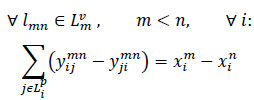
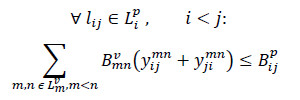
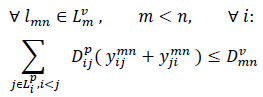
<body><![CDATA[<p lang="es-UY" class="western" style="text-indent: 0cm; margin-bottom: 0cm"> <font face="Verdana, sans-serif"><font size="2" style="font-size: 10pt"><span lang="en-US">In order to allow simultaneous optimization in the allocation of virtual links and virtual nodes, the </span><span lang="en-US"><i>Multi-Commodity Flow </i></span><span lang="en-US"><a id="br24">[</a><a href="#r24">24</a>] restriction is applied as a whole, considering the </span><span lang="en-US"><i>Node-Link Formulation</i></span> <span lang="en-US"><a id="br8">[</a><a href="#r8">8</a>]. Besides, the notion of directional flows is used over the virtual links that represent expression <a href="#eq6">(6)</a>, following the notation proposed in <a id="br8">[</a><a href="#r8">8</a>].     <br> <a name="eq6"> <img src="/img/revistas/cleiej/v19n2/2a02z31.jpg">   (6) </a> </span> </font></font></p>       <p lang="en-US" class="western" style="text-indent: 0cm; line-height: 100%"> <font face="Verdana, sans-serif"><font size="2" style="font-size: 10pt"><i>2.3.3 Bandwidth Limitation </i></font></font> </p>     <p lang="en-US" class="western" style="text-indent: 0cm; line-height: 100%"> <font face="Verdana, sans-serif"><font size="2" style="font-size: 10pt">Expression <a href="#eq7">(7)</a> assures that the available bandwidth capacity at each physical link will not be exceeded.     <br> <a name="eq7"> <img src="/img/revistas/cleiej/v19n2/2a02z32.jpg">   (7) </a> </font></font></p>       <p lang="en-US" class="western"><font face="Verdana, sans-serif"><font size="2" style="font-size: 10pt"><i>2.3.4 Limit in the Propagation Delay of virtual links </i></font></font> </p>     <p lang="es-UY" class="western" style="text-indent: 0cm; margin-bottom: 0cm"> <font face="Verdana, sans-serif"><font size="2" style="font-size: 10pt"><span lang="en-US">The maximum delay <img src="/img/revistas/cleiej/v19n2/2a02z33.jpg"> of a virtual link <img src="/img/revistas/cleiej/v19n2/2a02z34.jpg"> is a parameter of the problem that narrows the value of the additional physical link&rsquo;s delay that composes a virtual link. Melo </span><span lang="en-US"><i>et al</i></span><span lang="en-US">. apply <a href="#eq8">(8)</a> to assure that this delay restriction is fulfilled:      <br> <a name="eq8"> <img src="/img/revistas/cleiej/v19n2/2a02z35.jpg">   (8) </a> </span></font></font>     <br></p>  <h2 lang="en-US" class="western" align="justify" style="margin-left: 0.51cm; text-indent: -0.51cm; margin-top: 0cm; margin-bottom: 0.21cm; font-variant: normal; font-style: normal"> <font face="Verdana, sans-serif"><font size="2" style="font-size: 10pt"><b>2.4 Performance metrics for VNE problem</b></font></font></h2>      <p lang="es-UY" class="western" style="text-indent: 0cm; margin-bottom: 0cm; line-height: 100%"> <font face="Verdana, sans-serif"><font size="2" style="font-size: 10pt"><span lang="en-US">It is necessary to define some metrics to evaluate the efficiency of the studied mapping algorithm. In the case of the dynamic version of the VNE problem, </span><span lang="en-US"><i>i.e.</i></span> <span lang="en-US">when VNRs arrive at different time slots without </span><span lang="en-US"><i>a priori</i></span> <span lang="en-US">knowledge, these metrics are calculated at the end of the simulation process, after making all allocations of virtual networks in a time basis.</span></font></font></p>     ]]></body>
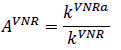
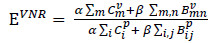
<body><![CDATA[<p lang="en-US" class="western" style="text-indent: 0cm; margin-bottom: 0cm; line-height: 100%"> <font face="Verdana, sans-serif"><font size="2" style="font-size: 10pt">The two performances metrics that we will use in this work are the most accepted in the specialized literature [10, 11] and are the following:</font></font></p>      <p lang="es-UY" class="western" style="text-indent: 0cm; line-height: 100%"> <font face="Verdana, sans-serif"><font size="2" style="font-size: 10pt"><span lang="en-US"><i>2.4.1 VNR Acceptance Ratio</i></span> </font></font> </p>     <p lang="en-US" class="western" style="text-indent: 0cm; margin-bottom: 0cm; line-height: 100%"> <font face="Verdana, sans-serif"><font size="2" style="font-size: 10pt">This metric is denoted as  <img src="/img/revistas/cleiej/v19n2/2a02z36.jpg"> and it is given by equation <a href="#eq9">(9)</a>. It measures the global performance of the allocation method considering its capacity of mapping (and not blocking or rejecting) as many VNRs as possible.      <br> <a name="eq9"> <img src="/img/revistas/cleiej/v19n2/2a02z37.jpg">   (9) </a>     <br>  In this equation, <img src="/img/revistas/cleiej/v19n2/2a02z38.jpg"> represents the total number of arriving VNRs, while <img src="/img/revistas/cleiej/v19n2/2a02z39.jpg">  is the number of VNRs successfully satisfied by the studied algorithm.   VOLVER era span </font></font> </p>      <p lang="en-US" class="western" style="text-indent: 0cm; line-height: 100%"> <font face="Verdana, sans-serif"><font size="2" style="font-size: 10pt"><i>2.4.2 Revenue / Cost Relation </i></font></font> </p>     <p lang="en-US" class="western" style="text-indent: 0cm; margin-bottom: 0cm"> <font face="Verdana, sans-serif"><font size="2" style="font-size: 10pt">The cost of a VNR mapping is considered as the cost of the resources in the physical or substrate network that were used in the mapping process. The revenue can be considered as proportional to the costs of resources requested by a single VNR (CPU of virtual nodes and Bandwidth of virtual links). This indicator  <img src="/img/revistas/cleiej/v19n2/2a02z40.jpg"> gives an idea of the efficiency in the allocation process for the use of network resources and therefore, it represents more profit for the owner of the network infrastructure <a id="br7">[</a><a href="#r7">7</a>]. Coefficients &alpha; and &beta; relate real costs of capacity units in the nodes to link bandwidth costs.      <br> <a name="eq10"> <img src="/img/revistas/cleiej/v19n2/2a02z41.jpg">   (10) </a>     <br> </font></font> </p>       <p lang="en-US" class="western" align="justify" style="text-indent: 0cm; letter-spacing: normal; line-height: 100%"> <font face="Verdana, sans-serif"><font size="2" style="font-size: 10pt"><b>3 VNE-MO-ILP Algorithm</b></font></font></p>     ]]></body>
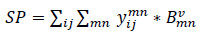
<body><![CDATA[<p lang="es-UY" class="western" style="text-indent: 0cm; margin-bottom: 0cm; line-height: 100%"> <font face="Verdana, sans-serif"><font size="2" style="font-size: 10pt"><span lang="en-US">When an algorithm assigns resources to a given VNR, the objective of this assignation should point to get good results with the considered global performance metrics, in this case, Acceptance Ratio A</span><sup><span lang="en-US">VNR</span></sup> <span lang="en-US">and Revenue/Cost Relation E</span><sup><span lang="en-US">VNR</span></sup><span lang="en-US">. </span></font></font> </p>     <p lang="es-UY" class="western" style="text-indent: 0cm; margin-bottom: 0cm; line-height: 100%"> <font face="Verdana, sans-serif"><font size="2" style="font-size: 10pt"><span lang="en-US">It is necessary to clearly understand the difference between the </span><span lang="en-US"><i>Global performance metrics</i></span> <span lang="en-US">and the </span><span lang="en-US"><i>Objectives for a single VNR. </i></span><span lang="en-US">Global performance metrics evaluate the entire VNE process, </span><span lang="en-US"><i>i.e.</i></span> <span lang="en-US">at the end of all VNR assignment attempts, and measures the efficiency of the VNE algorithm as a whole. For an online process, they are calculated at the end of a large period of time, after many VNR allocations were made. For an offline process, the global performance metrics are calculated when all VNRs were attempted to allocate. These global metrics can be seen as </span><span lang="en-US"><i>a posteriori</i></span> <span lang="en-US">metrics. On the other hand, the objectives for a single VNR are optimization objectives applied to the less complex problem of the allocation of each VNR, </span><span lang="en-US"><i>i.e., </i></span><span lang="en-US">they are </span><span lang="en-US"><i>a priori</i></span> <span lang="en-US">metrics.</span></font></font></p>     <p lang="en-US" class="western" style="text-indent: 0cm; margin-bottom: 0cm; line-height: 100%"> <font face="Verdana, sans-serif"><font size="2" style="font-size: 10pt">This work proposes for the first time the simultaneous optimization of both cited objectives at each mapping, instead of considering only one objective at a time, as already proposed in previous works, i.e., our proposal will simultaneously try to:</font></font></p> <ul> 	    <li>     <p lang="es-UY" class="western" style="text-indent: 0cm; line-height: 100%"> 	<font face="Verdana, sans-serif"><font size="2" style="font-size: 10pt"><span lang="en-US"><i>Minimize 	the utilization of physical resources:</i></span> <span lang="en-US">the 	requirement of virtual nodes cannot be minimized, so it is intended 	to minimize the cost of used physical links, in order to satisfy the 	requirements with the least quantity of resources as possible, 	looking for efficiency. This objective has a direct relation with 	metric E</span><sup><span lang="en-US">VNR</span></sup><span lang="en-US">; 	and</span></font></font></p> 	    <li>     <p lang="es-UY" class="western" style="text-indent: 0cm; line-height: 100%"> 	<font face="Verdana, sans-serif"><font size="2" style="font-size: 10pt"><span lang="en-US"><i>Maximize 	load balance: </i></span><span lang="en-US">in this case, the 	physical network resources will be assigned in such a way that the 	network remains with balanced resource availability in the nodes and 	links, in order to facilitate subsequent allocations and avoiding 	isolation of resources. In this way, we will try to improve the 	Acceptance Ratio A</span><sup><span lang="en-US">VNR</span></sup> 	<span lang="en-US">metric.</span></font></font></p>     </ul>     <p lang="es-UY" class="western" style="text-indent: 0cm; line-height: 100%"> <font face="Verdana, sans-serif"><font size="2" style="font-size: 10pt"><span lang="en-US">In the wake of the above descripted ideas, the algorithm proposed in this work, named here VNE-MO-ILP </span><span lang="en-US"><i>(Virtual Network Embedding-Multi-objective-Integer Lineal Program-ming) </i></span><span lang="en-US">will: </span></font></font> </p> <ul> 	    <li>     ]]></body>
<body><![CDATA[<p lang="es-UY" class="western" style="text-indent: 0cm; line-height: 100%"> 	<font face="Verdana, sans-serif"><font size="2" style="font-size: 10pt"><span lang="en-US"><i>Define 	a mapping cost SP, </i></span><span lang="en-US">given by equation <a href="#eq11">(11)</a>, where </span><span lang="en-US"><i>SP</i></span> <span lang="en-US">is 	limited for a defined </span><span lang="en-US"><i>a priori</i></span> 	<span lang="en-US">minimum and maximum values. The algorithm takes 	(</span><span lang="en-US"><i>s</i></span><span lang="en-US">+1) 	possible values of SP, equally spaced between maximum and minimum 	values, as will be shown in equation <a href="#eq15">(15) </a>.     <br> <a name="eq11"> <img src="/img/revistas/cleiej/v19n2/2a02z42.jpg">   (11) </a>     <br> </span></font></font></p>     </ul>  <ul> 	    <li>     <p lang="es-UY" class="western" style="text-indent: 0cm; line-height: 100%"> 	<font face="Verdana, sans-serif"><font size="2" style="font-size: 10pt"><span lang="en-US"><i>Optimize 	Load Balance: </i></span><span lang="en-US">the algorithm looks for 	resources in physical nodes with more available capacity, and in 	physical links with more bandwidth; therefore, the objective 	function of each ILP formulation will be <a href="#eq12">(12)</a>, where &gamma;  	defines a relation between the costs of physical nodes and links.     <br> <a name="eq12"> <img src="/img/revistas/cleiej/v19n2/2a02z43.jpg">   (12) </a>     <br> </span></font></font></p>     </ul>       <p lang="en-US" class="western" style="text-indent: 0cm; margin-bottom: 0cm; line-height: 100%"> <font face="Verdana, sans-serif"><font size="2" style="font-size: 10pt">The values of maximum load in physical nodes and links,  <img src="/img/revistas/cleiej/v19n2/2a02z46.jpg"> and  <img src="/img/revistas/cleiej/v19n2/2a02z47.jpg"> respectively, are defined according to the following new restrictions which are added to the former restrictions already formulated in Section 2:      ]]></body>
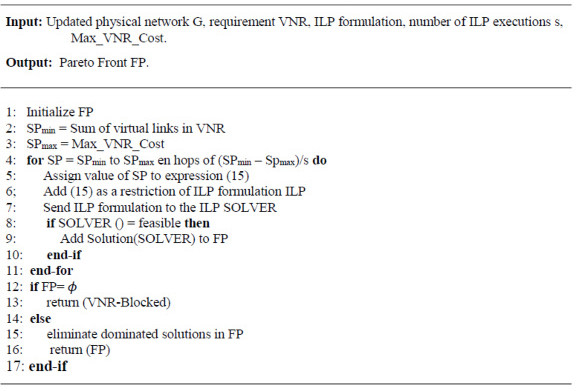
<body><![CDATA[<br> <a name="eq13"> <img src="/img/revistas/cleiej/v19n2/2a02z44.jpg">   (13) </a>     <br> <a name="eq14"> <img src="/img/revistas/cleiej/v19n2/2a02z45.jpg">   (14) </a>     <br> </font></font> </p>        <p lang="en-US" class="western" style="margin-bottom: 0cm"><font face="Verdana, sans-serif"><font size="2" style="font-size: 10pt">The proposed VNE-MO-ILP algorithm calculates an approximation of the Pareto Front, using the above summarized ideas. To the best of our knowledge, no work previous to <a id="br22">[</a><a href="#r22">22</a>] proposed a multi-objective approach to the VNE problem, even when more than a single performance metric to evaluate the efficiency of VNE algorithms is used (usually, as a weighted sum of different objectives). </font></font> </p>     <p lang="en-US" class="western" style="margin-bottom: 0cm"><font face="Verdana, sans-serif"><font size="2" style="font-size: 10pt">In this way, the proposed algorithm offers to a network operator a whole Pareto Front approximation with different solutions (all optimal in a Pareto sense <a id="br23">[</a><a href="#r23">23</a>]) for a single mapping, in order to allow him to choose a Pareto optimal solution that best fits his requirements, in a specific situation, at a given moment in time. </font></font> </p>     <p lang="es-UY" class="western" style="margin-bottom: 0cm"><font face="Verdana, sans-serif"><font size="2" style="font-size: 10pt"><span lang="en-US">The Algorithm VNE-MO-ILP presented in  <a href="#t1">Table 1</a>, initializes variables and parameters, then calculates the acceptable limits of parameter </span><span lang="en-US"><i>SP</i></span> <span lang="en-US">defined in <a href="#eq11">(11)</a>, and the interval [</span><span lang="en-US"><i>SP</i></span><sub><span lang="en-US"><i>min</i></span></sub><span lang="en-US"><i>, SP</i></span><sub><span lang="en-US"><i>max</i></span></sub><span lang="en-US">] is divided in </span><span lang="en-US"><i>s</i></span> <span lang="en-US">sub-intervals, to later assign consecutively those (s+1) values to the SP parameter:      <br> <a name="eq15"> <img src="/img/revistas/cleiej/v19n2/2a02z48.jpg">   (15) </a>     <br> </span></font></font> </p>      <p lang="en-US" class="western"><font face="Verdana, sans-serif"><font size="2" style="font-size: 10pt">Then, an ILP formulation is built with the following elements: </font></font> </p> <ul> 	    <li>     ]]></body>
<body><![CDATA[<p lang="en-US" class="western" style="text-indent: 0cm"><font face="Verdana, sans-serif"><font size="2" style="font-size: 10pt">Parameters, 	assignation variables and restrictions presented in Section 2;</font></font></p> 	    <li>     <p lang="en-US" class="western" style="text-indent: 0cm"><font face="Verdana, sans-serif"><font size="2" style="font-size: 10pt">Additional 	restrictions of expressions <a href="#eq11">(11)</a>, <a href="#eq13">(13)</a> and <a href="#eq14">(14)</a>;</font></font></p> 	    <li>     <p lang="en-US" class="western" style="text-indent: 0cm"><font face="Verdana, sans-serif"><font size="2" style="font-size: 10pt">The 	objective-function defined in <a href="#eq12">(12)</a>.</font></font></p>     </ul>     <p lang="en-US" class="western" align="center" style="text-indent: 0cm; margin-top: 0.78cm; margin-bottom: 0.18cm; letter-spacing: normal; line-height: 0.39cm; page-break-after: avoid"> <font face="Verdana, sans-serif"><font size="2" style="font-size: 10pt"><b>Table 1:</b> VNE-MO-ILP Algorithm     <br> <a name="t1"> <img src="/img/revistas/cleiej/v19n2/2a02t1.jpg">  </a>     <br></font></font></p>      <p lang="es-UY" class="western" style="margin-bottom: 0cm"><font face="Verdana, sans-serif"><font size="2" style="font-size: 10pt"><span lang="en-US">Subsequently, at each iteration, an </span><span lang="en-US"><i>ILP Solver</i></span> <span lang="en-US">tries to solve this ILP problem, returning a solution, if it exists. Each solution calculated by the ILP Solver is a point of the Pareto Front approximation, which will be the output of the VNE-MO-ILP algorithm.</span></font></font></p>     ]]></body>
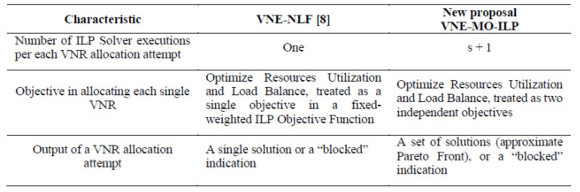
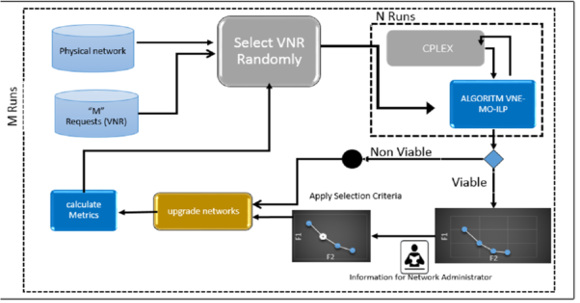
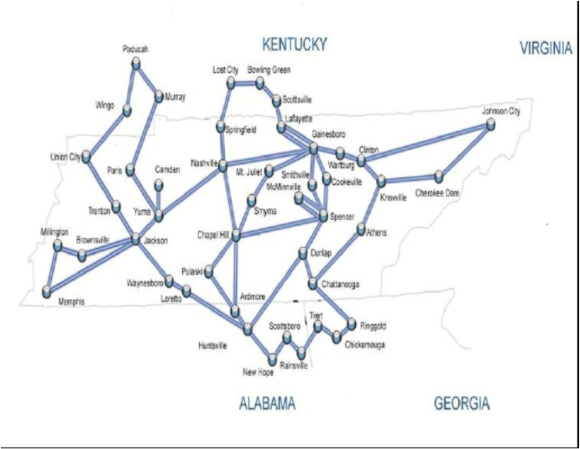
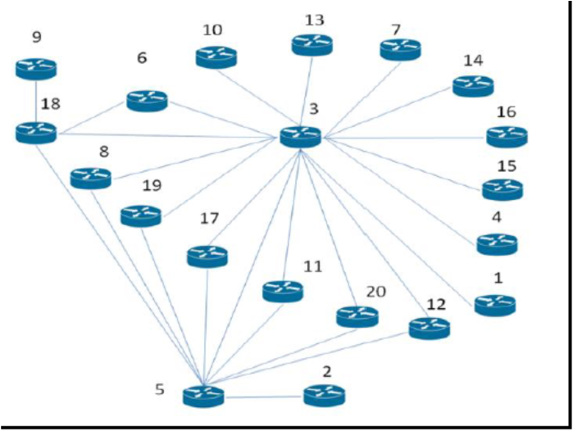
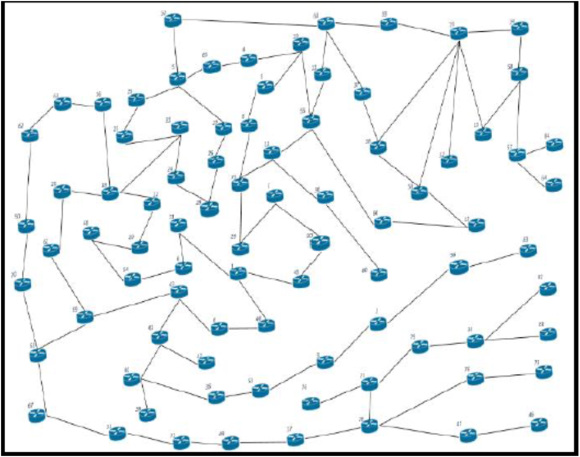
<body><![CDATA[<p lang="es-UY" class="western" style="margin-bottom: 0cm"><font face="Verdana, sans-serif"><font size="2" style="font-size: 10pt"><span lang="en-US">This way, an </span><span lang="en-US"><i>ILP solver</i></span><span lang="en-US">, which solves mono-objective problems, is used to find an approximation of the Pareto Front, being this Pareto Front a typical result of a pure multi-objective problem <a id="br23">[</a><a href="#r23">23</a>].</span></font></font></p>     <p lang="en-US" class="western" style="margin-bottom: 0cm"><font face="Verdana, sans-serif"><font size="2" style="font-size: 10pt">Although ILP method is not scalable to large instances of any problem, our proposed algorithm uses anyway this tool, taking into account the very good execution times reported in the reference work <a id="br8">[</a><a href="#r8">8</a>], and being aware that for more complex networks, efficient heuristics or meta-heuristics will be needed. </font></font> </p>     <p lang="es-UY" class="western" style="margin-bottom: 0cm"><font face="Verdana, sans-serif"><font size="2" style="font-size: 10pt"><span lang="en-US">In this paper we take three different network topologies, which are representative of medium and large sizes ISP </span><span lang="en-US"><i>(Internet Service Provider)</i></span> <span lang="en-US">networks, with very good results and reasonable execution times, proving the viability of this proposal, leaving for future work the development of efficient metaheuristics for the VNE problem in a pure multi-objective context.</span></font></font></p>     <p lang="en-US" class="western" style="margin-bottom: 0cm"><font face="Verdana, sans-serif"><font size="2" style="font-size: 10pt"> <a href="#t2">Table 2</a> highlights main differences between the algorithms proposed in this work VNE-MO-ILP with the VNE-NLF algorithm presented in <a id="br8">[</a><a href="#r8">8</a>], which is taken as a reference to evaluate the presented experimental results. </font></font> </p>      <p lang="en-US" class="western" align="justify" style="text-indent: 0cm; letter-spacing: normal; line-height: 100%"> <font face="Verdana, sans-serif"><font size="2" style="font-size: 10pt"><b>4 Experiments and Results</b></font></font></p> <h2 lang="en-US" class="western" style="margin-left: 0.51cm; text-indent: -0.51cm; margin-top: 0cm; margin-bottom: 0.21cm; font-variant: normal; font-style: normal"> <font face="Verdana, sans-serif"><font size="2" style="font-size: 10pt"><b>4.1 Discrete-Event Network Simulator</b></font></font></h2>     <p lang="es-UY" class="western" style="text-indent: 0cm; margin-bottom: 0cm; line-height: 100%"> <font face="Verdana, sans-serif"><font size="2" style="font-size: 10pt"><span lang="en-US">We have developed a discrete-event Network Simulator in </span></font></font><font face="Verdana, sans-serif"><font size="2" style="font-size: 10pt"><span lang="en-US"><i>Java </i></span></font></font><font face="Verdana, sans-serif"><font size="2" style="font-size: 10pt"><span lang="en-US">language for the evaluation of the proposed algorithm, which is outlined in <a href="#f1">Figure 1</a>. This simulation tool covers exactly all restrictions of the proposed VNE problem, as we presented in Section III, and permits the execution of a complete instance of the VNE problem (a set of VNR stored on a database, treated one by one in a time basis). This network simulator is available for the scientific community at: </span></font></font><a href="http://www.cc.pol.una.py/VNE-MO-ILP/"><font color="#00000a"><span style="text-decoration: none"><font face="Verdana, sans-serif"><font size="2" style="font-size: 10pt"><span lang="es-UY"><span style="background: #ffffff">http://www.cc.pol.una.py/VNE-MO-ILP/</span></span></font></font></span></font></a><font color="#00000a"><span style="text-decoration: none"><font face="Verdana, sans-serif"><font size="2" style="font-size: 10pt"><span lang="en-US"><span style="background: #ffffff">.</span></span></font></font></span></font></p>     <p lang="es-UY" class="western" style="margin-bottom: 0cm; line-height: 100%"> <font face="Verdana, sans-serif"><font size="2" style="font-size: 10pt"><span lang="en-US">After defining parameters of the physical network and a set of M virtual network requirements (VNR), the simulator randomly takes a VNR and it passes this requested VNR to the proposed VNE-MO-ILP algorithm, which interacts with the </span><span lang="en-US"><i>ILP Solver</i></span> <span lang="en-US">to build a Pareto Front approximation in a point-to-point basis with each calculated non-dominated solution (optimal in the Pareto sense). If the algorithm could not find any solution, the performance metrics are updated. On the contrary, if a Pareto Front approximation is found with more than a single solution, it is necessary to apply a (possibly subjective) criterion to choose a single solution, to update performance metrics and network parameters and to pass to the next time slot to continue with the simulation.</span></font></font>    <br></p>  <h2 lang="en-US" class="western" align="justify" style="margin-left: 0.51cm; text-indent: -0.51cm; margin-top: 0cm; margin-bottom: 0.21cm; font-variant: normal; font-style: normal"> <font face="Verdana, sans-serif"><font size="2" style="font-size: 10pt"><b>4.2 Test Networks and experimental environment</b></font></font></h2>       <p lang="es-UY" class="western" style="text-indent: 0cm; margin-bottom: 0cm; line-height: 100%"> <font face="Verdana, sans-serif"><font size="2" style="font-size: 10pt"><span lang="en-US">Three substrate networks were used in the following reported experiments: </span><span lang="en-US"><i>IRIS, MARNET</i></span><span lang="en-US">, and </span><span lang="en-US"><i>BESTEL</i></span><span lang="en-US">. These topologies were obtained from </span><span lang="en-US"><i>The Internet Topology Zoo</i></span> <span lang="en-US"><a id="br25">[</a><a href="#r25">25</a>] and are shown in <a href="#f2">Figures 2</a>, <a href="#f3">3 </a>and <a href="#f4">4</a> respectively. </span><span lang="en-US"><i>IRIS </i></span><span lang="en-US">is a </span><span lang="en-US"><i>mesh</i></span> <span lang="en-US">topology with 51 nodes and 64 links; MARNET is a hybrid topology (</span><span lang="en-US"><i>star/mesh</i></span><span lang="en-US">) with 20 nodes and 27 links. Both are representative of medium size networks. The BESTEL mesh topology has 84 nodes and 102 links and it is a typical large size network. The propagation delay at each physical link is proportional to its length. For the reported simulations, capacities at each node were generated randomly with values ranging from 200 to 300 capacity processing units. The transmission rate at each link is considered to be 512 Mbps.</span></font></font></p>     <p lang="es-UY" class="western" style="text-indent: 0cm; margin-bottom: 0cm; line-height: 100%"> <font face="Verdana, sans-serif"><font size="2" style="font-size: 10pt"><span lang="en-US">The VNRs were generated using network topology generator </span><span lang="en-US"><i>BRITE</i></span> <span lang="en-US"><a id="br26">[</a><a href="#r26">26</a>]. The number of virtual nodes varies between 2 and 10 nodes. The virtual link bandwidth requirement takes an integer value uniformly distributed between 2 and 8 Mbps at each link, while the requirements in virtual nodes were uniformly distributed between 2 and 40 capacity processing units.</span></font></font></p>     ]]></body>
<body><![CDATA[<p lang="es-UY" class="western" style="text-indent: 0cm; margin-bottom: 0cm; line-height: 100%"> <font face="Verdana, sans-serif"><font size="2" style="font-size: 10pt"><span lang="en-US">For the resolution of the ILP sub-problems, solver </span><span lang="en-US"><i>IBM Ilog CPLEX &reg;</i></span> <span lang="en-US"><a id="br27">[</a><a href="#r27">27</a>] version 12.6 was used. The execution times in the tests were registered for later comparisons.</span></font></font></p>     <p lang="es-UY" class="western" align="center" style="text-indent: 0cm; margin-top: 0.78cm; margin-bottom: 0.18cm; line-height: 0.39cm; page-break-after: avoid"> <font face="Verdana, sans-serif"><font size="2" style="font-size: 10pt"><span style="letter-spacing: normal"><span lang="en-US"><b>Table 2:</b></span></span><span style="letter-spacing: normal"><span lang="en-US"> Comparison between VNE-MO-ILP and VNE-NLF Algorithms </span></span></font></font>     <br> <a name="t2"> <img src="/img/revistas/cleiej/v19n2/2a02t2.jpg">  </a>     <br> </p>     <p lang="es-UY" class="western" align="center" style="text-indent: 0cm; margin-top: 0.21cm; margin-bottom: 0cm; line-height: 100%"> <a name="f1"> <img src="/img/revistas/cleiej/v19n2/2a02f1.jpg"> </a>     <br> <font face="Verdana, sans-serif"><font size="2" style="font-size: 10pt"><span style="letter-spacing: normal"><span lang="en-GB"><b>Figure 1</b></span></span><span style="letter-spacing: normal"><span lang="en-GB">: Discrete-event network simulator </span></span></font></font></p>     <p lang="es-UY" class="western" align="center" style="text-indent: 0cm; margin-top: 0.21cm; margin-bottom: 0cm; letter-spacing: normal; line-height: 100%"> <a name="f2"> <img src="/img/revistas/cleiej/v19n2/2a02f2.jpg"> </a>     <br> <font face="Verdana, sans-serif"><font size="2" style="font-size: 10pt"><span lang="en-GB"><b>Figure 2</b></span><span lang="en-GB">: IRIS network topology </span></font></font></p>     <p lang="es-UY" class="western" align="center" style="text-indent: 0cm; margin-top: 0.21cm; margin-bottom: 0cm; line-height: 100%"> <a name="f3"> <img src="/img/revistas/cleiej/v19n2/2a02f3.jpg"> </a>     <br> <font face="Verdana, sans-serif"><font size="2" style="font-size: 10pt"><span style="letter-spacing: normal"><span lang="en-GB"><b>Figure 3</b></span></span><span style="letter-spacing: normal"><span lang="en-GB">: MARNET network topology </span></span> </font></font></p>     ]]></body>
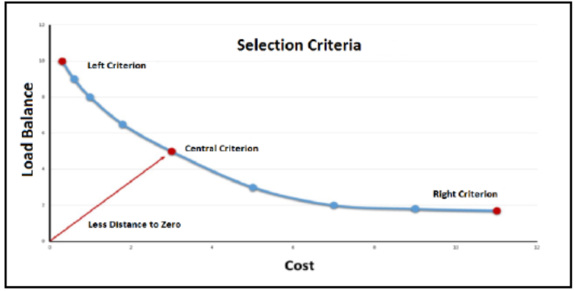
<body><![CDATA[<p lang="es-UY" class="western" align="center" style="text-indent: 0cm; margin-top: 0.21cm; margin-bottom: 0cm; line-height: 100%"> <a name="f4"> <img src="/img/revistas/cleiej/v19n2/2a02f4.jpg"> </a>     <br> <font face="Verdana, sans-serif"><font size="2" style="font-size: 10pt"><span style="letter-spacing: normal"><span lang="en-GB"><b>Figure 4</b></span></span><span style="letter-spacing: normal"><span lang="en-GB">: BESTEL network topology </span></span></font></font></p>      <br>  <h2 lang="en-US" class="western" style="margin-top: 0cm; margin-bottom: 0.21cm; font-variant: normal; font-style: normal"> <font face="Verdana, sans-serif"><font size="2" style="font-size: 10pt"><b>4.3 Experimental Results</b></font></font></h2>     <p lang="en-US" class="western" style="text-indent: 0cm; margin-bottom: 0cm; line-height: 100%"> <font face="Verdana, sans-serif"><font size="2" style="font-size: 10pt">We performed groups of experiments taking VNRs with average life time values of: 10, 20, and so on, until 100 time units. We assumed the arrival of a new VNR at each time slot. The experiments are evaluated after 500, 1000, and so on until 5000 discrete time slots, allowing the network to reach its stable state regarding the number of installed VNRs. All simulations were executed in machines with Intel Core (TM) I7-4770 (3.4 GHz) with a RAM of 8 GB.</font></font></p>     <p lang="es-UY" class="western" style="margin-bottom: 0cm; line-height: 100%"> <font face="Verdana, sans-serif"><font size="2" style="font-size: 10pt"><span lang="en-US">As was mentioned early, this paper presents a multi-objective approach for the first time in VNE literature. Therefore, a fair comparison with any previous work is difficult to develop. For comparison purposes, we have implemented the VNE-NLF algorithm presented in <a id="br8">[</a><a href="#r8">8</a>] in our simulation tool, and made an execution of the same instances of the problem. VNE-NLF algorithm was chosen as representative of the state of the art considering its great performance in terms of the same metrics used in this work, and with reasonable execution times. Besides, the VNE formulation used in this work is the same as the one used in <a id="br8">[</a><a href="#r8">8</a>].</span><font color="#ff0000"> </font></font></font> </p>      <p lang="es-UY" class="western" style="text-indent: 0cm; line-height: 100%"> <font face="Verdana, sans-serif"><font size="2" style="font-size: 10pt"><span lang="en-US"><i>4.3.1 Solution selection Criteria</i></span> </font></font> </p>     <p lang="en-US" class="western" style="text-indent: 0cm; margin-bottom: 0cm; line-height: 100%"> <font face="Verdana, sans-serif"><font size="2" style="font-size: 10pt">For experimental purposes, we have considered three possible criteria for the selection of a unique solution from a Pareto Front approximation, in order to assign resources to the considered VNR at each discrete time interval, using this way the selected solution to simulate the situation at the next time slot. </font></font> </p>     <p lang="es-UY" class="western" style="margin-bottom: 0cm; line-height: 100%"> <font face="Verdana, sans-serif"><font size="2" style="font-size: 10pt"><span lang="en-US">1) The first criterion is to take the solution of the Pareto Front with the least </span><span lang="en-US"><i>Assignation Cost SP</i></span> <span lang="en-US">(11), and worst </span><span lang="en-US"><i>Load Balance </i></span><span lang="en-US">(12) which is called </span><span lang="en-US"><i>Left Criterion (LC).</i></span></font></font></p>     <p lang="es-UY" class="western" style="margin-bottom: 0cm; line-height: 100%"> <font face="Verdana, sans-serif"><font size="2" style="font-size: 10pt"><span lang="en-US">2) For the second criterion, we take the nearest solution to origin of coordinate axis, looking for a trade-off between both objectives. This criterion will be called </span><span lang="en-US"><i>Central Criterion (CC).</i></span></font></font></p>     <p lang="es-UY" class="western" style="margin-bottom: 0cm; line-height: 100%"> <font face="Verdana, sans-serif"><font size="2" style="font-size: 10pt"><span lang="en-US">3) Last, we take the solution of the Pareto Front with the largest Assignation Cost but with the best Load Balance </span><span lang="en-US"><i>(Right Criterion, RC).</i></span></font></font></p>     ]]></body>
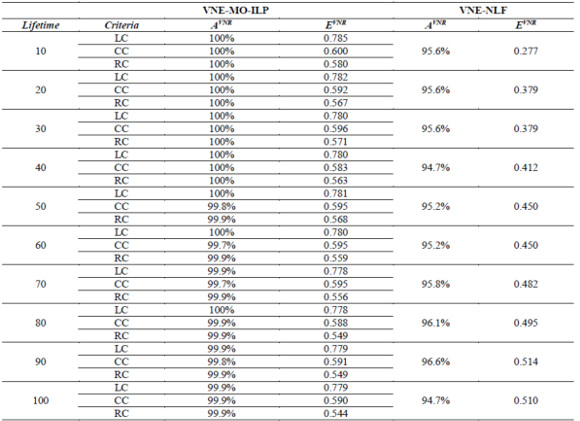
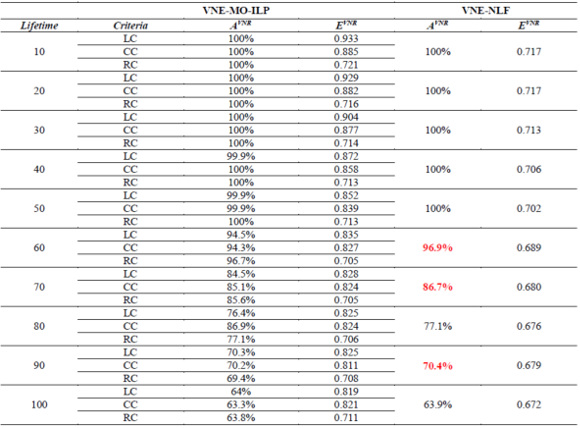
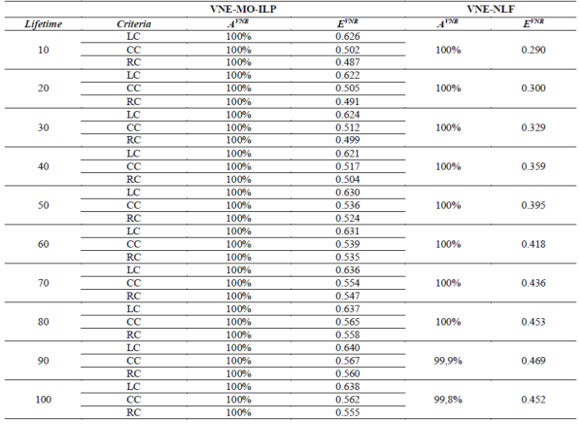
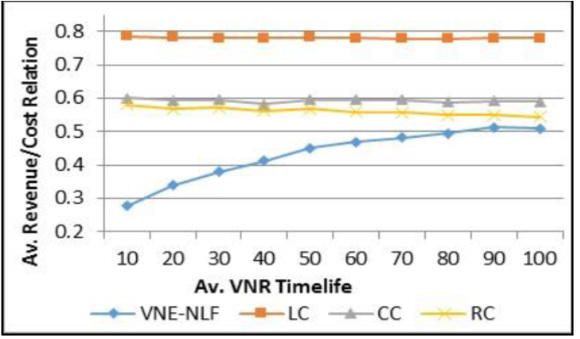
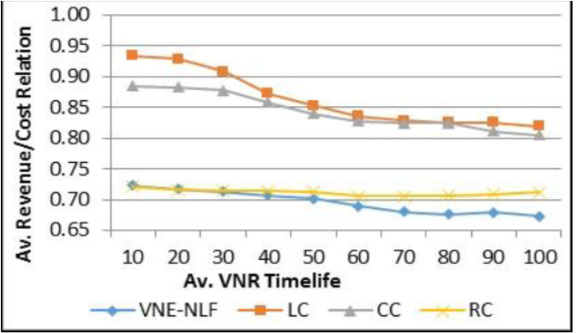
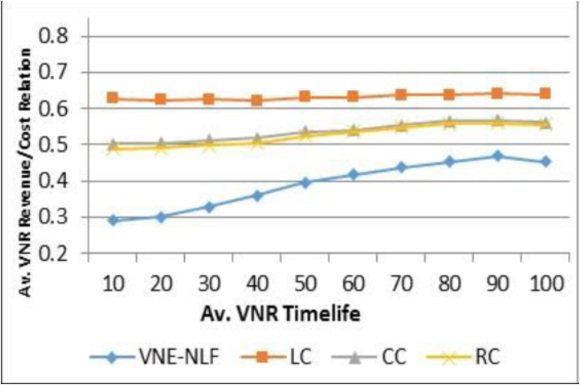
<body><![CDATA[<p lang="en-US" class="western" style="margin-bottom: 0cm; line-height: 100%"> <font face="Verdana, sans-serif"><font size="2" style="font-size: 10pt"><a href="#f5">Figure 5</a> shows an example of a Pareto Front, corresponding to a single VNR assignation, in which the three criteria of selection are indicated.</font></font></p>       <p lang="es-UY" class="western" align="center" style="text-indent: 0cm; margin-bottom: 0cm; line-height: 100%"> <a name="f5"> <img src="/img/revistas/cleiej/v19n2/2a02f5.jpg"> </a>     <br> <font face="Verdana, sans-serif"><font size="2" style="font-size: 10pt"><span style="letter-spacing: normal"><span lang="en-GB"><b>Figure 5</b></span></span><span style="letter-spacing: normal"><span lang="en-GB">: Considered selection criteria from a Pareto Front, for a single VNR allocation, including Left, Central and Right criteria.</span></span></font></font> </p>       <p lang="es-UY" class="western" style="margin-bottom: 0cm; line-height: 100%"> <font face="Verdana, sans-serif"><font size="2" style="font-size: 10pt"><span lang="en-US">The obtained results, comparing the 3 proposed </span><span lang="en-US"><i>Selection Criteria</i></span><span lang="en-US">, are shown in <a href="#t3">Tables 3</a>, <a href="#t4">4</a> and <a href="#t5">5</a> for IRIS, MARNET and BESTEL networks respectively. Presented values are average values of five runs for each instance. It is clear from the presented Tables that the proposed VNE-MO-ILP algorithm outperforms the reference algorithm VNE-NLF presented in <a id="br8">[</a><a href="#r8">8</a>] in almost all comparisons, except for the values marked in bold and red in <a href="#t4">Table 4</a> (MARNET</span> <span lang="en-US">topology), for </span><span lang="en-US"><i>Lifetimes</i></span> <span lang="en-US">of 60, 70 and 90. In fact, <a href="#t3">Tables 3</a> (IRIS topology) and <a href="#t5">5</a> (BESTEL topology) show that our proposed algorithms systematically outperformed the reference algorithm proposed by Melo </span><span lang="en-US"><i>et al</i></span><span lang="en-US">. in all the experiments when simultaneously considering both performance metrics: Acceptance Ratio (A</span><sup><span lang="en-US">VNR</span></sup><span lang="en-US">) and Revenue/Cost Relation E</span><sup><span lang="en-US">VNR</span></sup><span lang="en-US">. </span></font></font> </p>     <p lang="es-UY" class="western" style="margin-bottom: 0cm; line-height: 100%"> <font face="Verdana, sans-serif"><font size="2" style="font-size: 10pt"><span lang="en-US">Even when considering the experimental results presented in <a href="#t3">Table 3</a> for the </span><span lang="en-US"><i>hybrid</i></span> <span lang="en-US">MARNET network, the best values of Revenue/ Cost Relation E</span><sup><span lang="en-US">VNR</span></sup> <span lang="en-US">(considered alone) were reached by the proposed VNE-MO-ILP algorithm, while the reference algorithm VNE-NLF only outperforms VNE-MO-ILP in 3 out of 10 instances. In other words, VNE-MO-ILP finds solutions that dominate in the Pareto sense the solutions calculated by the NVE-NLF algorithm while the latter is not able to find even one solution that dominates the ones calculated by the proposed algorithm.</span></font></font></p>     <p lang="es-UY" class="western" style="margin-bottom: 0cm; line-height: 100%"> <font face="Verdana, sans-serif"><font size="2" style="font-size: 10pt"><span lang="en-US">In short, solutions calculated by the proposed VNE-MO-ILP algorithm are systematically non-dominated (Pareto optimal) and they dominate most solutions calculated with the state of the art algorithm of Melo </span><span lang="en-US"><i>et al</i></span><span lang="en-US">. On the contrary, no solution calculated by this state of the art VNE-NLF algorithm is able to dominate (in the Pareto sense) even a single solution calculated with the proposed algorithm, proving this way the advantages of using the VNE-MO-ILP algorithm.</span></font></font></p>     <p lang="en-US" class="western" style="text-indent: 0cm"><font face="Verdana, sans-serif"><font size="2" style="font-size: 10pt"><i>4.3.2 Revenue/Cost Relation</i></font></font></p>     <p lang="es-UY" class="western" style="text-indent: 0cm; margin-bottom: 0cm; line-height: 100%"> <font face="Verdana, sans-serif"><font size="2" style="font-size: 10pt"><span lang="en-US"><a href="#f6">Figures 6</a>, <a href="#f7">7</a> and <a href="#f8">8</a>  present experimental results considering this E</span><sup><span lang="en-US">VNR</span></sup> <span lang="en-US">metric for each of the 3 considered topology as a function of VNR&rsquo;s lifetime, which varies from 10 to 100 time units. Those three figures show that as the lifetime average increases, a larger number of virtual networks remains simultaneously installed, and more physical network resources are utilized.</span></font></font></p>     <p lang="es-UY" class="western" style="margin-bottom: 0cm; line-height: 100%"> <font face="Verdana, sans-serif"><font size="2" style="font-size: 10pt"><span lang="en-US">For the IRIS network (<a href="#f6">Fig. 6</a>), the three selection criteria outperform the results obtained by the reference algorithm. The best selection criterion is </span><span lang="en-US"><i>LC</i></span> <span lang="en-US">(</span><span lang="en-US"><i>Left Criterion</i></span><span lang="en-US">) as expected, given that it mainly optimizes resources utilization in the mapping of each VNR. </span></font></font> </p>     <p lang="es-UY" class="western" style="margin-bottom: 0cm; line-height: 100%"> <font face="Verdana, sans-serif"><font size="2" style="font-size: 10pt"><span lang="en-US">For the MARNET network (<a href="#f7">Fig. 7</a>), the results using VNE-MO-ILP are also better than the ones using the reference algorithm. However, this time only two criteria obtain better results than the reference algorithm: the </span><span lang="en-US"><i>Left Criterion</i></span> <span lang="en-US">(</span><span lang="en-US"><i>LC</i></span><span lang="en-US">) and the </span><span lang="en-US"><i>Central Criterion</i></span> <span lang="en-US">(</span><span lang="en-US"><i>CC</i></span><span lang="en-US">). For this experiment, the </span><span lang="en-US"><i>Right Criterion</i></span> <span lang="en-US">(</span><span lang="en-US"><i>RC</i></span><span lang="en-US">) only obtains a performance similar to the reference algorithm without significant improvement, as it was the case with the IRIS network shown in <a href="#f6">Fig. 6</a>.</span></font></font></p>     ]]></body>
<body><![CDATA[<p lang="en-US" class="western" align="center" style="text-indent: 0cm; margin-top: 0.78cm; margin-bottom: 0.18cm; letter-spacing: normal; line-height: 0.39cm; page-break-after: avoid"> <font face="Verdana, sans-serif"><font size="2" style="font-size: 10pt"><b>Table 3:</b> Results &ndash; IRIS topology</font></font>     <br> <a name="t3"> <img src="/img/revistas/cleiej/v19n2/2a02t3.jpg">  </a>     <br></p>     <p lang="en-US" class="western" align="center" style="text-indent: 0cm; margin-top: 0.78cm; margin-bottom: 0.18cm; letter-spacing: normal; line-height: 0.39cm; page-break-after: avoid"> <font face="Verdana, sans-serif"><font size="2" style="font-size: 10pt"><b>Table 4:</b> Results &ndash; MARNET topology</font></font>    <br> <a name="t4"> <img src="/img/revistas/cleiej/v19n2/2a02t4.jpg">  </a>     <br></p>     <p lang="es-UY" class="western" align="center" style="text-indent: 0cm; margin-top: 0.78cm; margin-bottom: 0.18cm; line-height: 0.39cm; page-break-after: avoid"> <font face="Verdana, sans-serif"><font size="2" style="font-size: 10pt"><span style="letter-spacing: normal"><span lang="en-US"><b>Table 5:</b></span></span><span style="letter-spacing: normal"><span lang="en-US"> Results &ndash; BESTEL topology </span></span></font></font>     <br> <a name="t5"> <img src="/img/revistas/cleiej/v19n2/2a02t5.jpg">  </a>     <br></p>     <p lang="es-UY" class="western" style="text-indent: 0cm; margin-bottom: 0cm; line-height: 100%"> <font face="Verdana, sans-serif"><font size="2" style="font-size: 10pt"><span lang="en-US">This difference may be explained taking into account that the VNE-NLF algorithm considers, in a single ILP formulation, both components: load balance and resource utilization, without looking at the trade-off between both objectives. On the contrary, proposed VNE-MO-ILP algorithm considers both aspects separately, calculating a Pareto Front approximation, which characterizes this trade-off, achieving in this way better results.</span></font></font></p>     ]]></body>
<body><![CDATA[<p lang="es-UY" class="western"><font face="Verdana, sans-serif"><font size="2" style="font-size: 10pt"><span lang="en-US">For the BESTEL network, the results presented in <a href="#f8">Figure 8</a> show that they are very similar to the experimental results for the IRIS network (<a href="#f6">Fig. 6</a>). The three selection criteria outperform the reference algorithm. In particular, the </span><span lang="en-US"><i>LC</i></span> <span lang="en-US">criterion is once more the best option, reaching values of near 80% for E</span><sup><span lang="en-US">VNR</span></sup><span lang="en-US">. In fact, VNE-NLF begins with very low values, getting better with more loaded instances, until reaching an E</span><sup><span lang="en-US">VNR</span></sup> <span lang="en-US">of only 50%, while the other two selection criteria (</span><span lang="en-US"><i>CC</i></span> <span lang="en-US">and </span><span lang="en-US"><i>RC</i></span><span lang="en-US">) get very similar results, in the range of 50-60%. </span></font></font> </p>     <p lang="es-UY" class="western" align="center" style="text-indent: 0cm; margin-top: 0.21cm; margin-bottom: 0cm; line-height: 100%"> <a name="f6"> <img src="/img/revistas/cleiej/v19n2/2a02f6.jpg"> </a>     <br> <font face="Verdana, sans-serif"><font size="2" style="font-size: 10pt"><span style="letter-spacing: normal"><span lang="en-GB"><b>Figure 6</b></span></span><span style="letter-spacing: normal"><span lang="en-GB">: Results &ndash; Revenue/Cost Relation, IRIS network </span></span></font></font></p>     <p lang="es-UY" class="western" align="center" style="text-indent: 0cm; margin-top: 0.21cm; margin-bottom: 0cm; line-height: 100%"> <a name="f7"> <img src="/img/revistas/cleiej/v19n2/2a02f7.jpg"> </a>     <br> <font face="Verdana, sans-serif"><font size="2" style="font-size: 10pt"><span style="letter-spacing: normal"><span lang="en-GB"><b>Figure 7</b></span></span><span style="letter-spacing: normal"><span lang="en-GB">: Results &ndash; Revenue/Cost Relation, MARNET network </span></span></font></font></p>     <br>      <p lang="es-UY" class="western" align="center" style="text-indent: 0cm"> <a name="f8"> <img src="/img/revistas/cleiej/v19n2/2a02f8.jpg"> </a>     <br>  <font face="Verdana, sans-serif"><font size="2" style="font-size: 10pt"><span style="letter-spacing: normal"><span lang="en-GB"><b>Figure 8</b></span></span><span style="letter-spacing: normal"><span lang="en-GB">: Results &ndash; Revenue/Cost Relation, BESTEL network </span></span></font></font></p>     <br>      <p lang="en-US" class="western" style="text-indent: 0cm"><font face="Verdana, sans-serif"><font size="2" style="font-size: 10pt"><i>4.3.3 VNR Acceptance Ratio</i></font></font></p>     ]]></body>
<body><![CDATA[<p lang="es-UY" class="western" style="text-indent: 0cm; margin-bottom: 0cm; line-height: 100%"> <font face="Verdana, sans-serif"><font size="2" style="font-size: 10pt"><span lang="en-US"><a href="#f9">Figures 9</a>, <a href="#f10">10</a> and <a href="#f11">11</a> show experimental results for this metric. It can be noticed that for the IRIS network (<a href="#f9">Fig. 9</a>) the proposed algorithm successfully assigns almost 100% of the VNRs, with all 3 selected criteria (</span><span lang="en-US"><i>LC, CC, RC</i></span><span lang="en-US">). However, the reference algorithm only gets up to 95% to 97%, without attending all VNRs. On the contrary, for the MARNET network (<a href="#f10">Fig. 10</a>) there is no significant difference among the 4 compared algorithms, i.e., the performance of all algorithms are very similar.</span></font></font></p>     <p lang="en-US" class="western" style="margin-bottom: 0cm; line-height: 100%"> <font face="Verdana, sans-serif"><font size="2" style="font-size: 10pt">For the BESTEL network (see <a href="#f11">Fig. 11</a>), the proposed algorithm consistently gets 100% in all instances, probably because BESTEL is a large mesh network and the tests could not saturate the network reaching to the limits where we can observe some blocked requests. On the contrary, the reference algorithm could not avoid some blocked requests for loaded instances, proving once more the advantage of using the proposed VNE-MO-ILP algorithm.</font></font></p>     <p lang="es-UY" class="western" style="margin-bottom: 0cm; line-height: 100%"> <font face="Verdana, sans-serif"><font size="2" style="font-size: 10pt"><span lang="en-US">These successful results for the proposed VNE-MO-ILP algorithm may be explained considering that it carries out several attempts for mapping each VNR, achieving this way a better search. While some of these candidate solutions may not be feasible, the algorithm tries with almost all possible values of the parameter SP, accomplishing an efficient mapping of almost all VNRs. On the contrary, the reference algorithm only attempts to find a solution once; therefore, it blocks the considered VNR if a solution is not found in this single attempt.</span></font></font></p>     <p lang="en-US" class="western" style="margin-bottom: 0cm; line-height: 100%"> <font face="Verdana, sans-serif"><font size="2" style="font-size: 10pt">The MARNET network is a star/mesh topology, so it does not offer many options at the time of a blocked request; therefore, the results are very similar with both algorithms, as shown in <a href="#f11">Fig. 11</a>.</font></font></p>      <p lang="en-US" class="western" style="text-indent: 0cm; line-height: 100%"> <font face="Verdana, sans-serif"><font size="2" style="font-size: 10pt"><i>4.3.4 Execution Times</i></font></font></p>     <p lang="en-US" class="western" style="text-indent: 0cm; margin-bottom: 0cm; line-height: 100%"> <font face="Verdana, sans-serif"><font size="2" style="font-size: 10pt">Average execution times for the allocation of a single VNR for the VNE-MO-ILP algorithm took values between two and five seconds while for the VNE-NLF algorithm took about one second, given that it only needs to solve one ILP for each VNR. Logically, it is faster than the VNE-MO-ILP that needs several calls to the ILP Solver, consequently needing a shorter running time.</font></font></p>     <p lang="es-UY" class="western" style="text-indent: 0cm; margin-bottom: 0cm; line-height: 100%">     <br>  </p>     <p lang="es-UY" class="western" align="center" style="text-indent: 0cm; margin-top: 0.21cm; margin-bottom: 0cm; line-height: 100%"> <a name="f9"> <img src="/img/revistas/cleiej/v19n2/2a02f9.jpg"> </a>     <br> <font face="Verdana, sans-serif"><font size="2" style="font-size: 10pt"><span style="letter-spacing: normal"><span lang="en-GB"><b>Figure 9</b></span></span><span style="letter-spacing: normal"><span lang="en-GB">: Results &ndash; VNR Acceptance Ratio, IRIS network </span></span></font></font></p>     ]]></body>
<body><![CDATA[<p lang="es-UY" class="western" align="center" style="text-indent: 0cm; margin-top: 0.21cm; margin-bottom: 0cm; line-height: 100%"> <a name="f10"> <img src="/img/revistas/cleiej/v19n2/2a02f10.jpg"> </a>     <br> <font face="Verdana, sans-serif"><font size="2" style="font-size: 10pt"><span style="letter-spacing: normal"><span lang="en-GB"><b>Figure 10</b></span></span><span style="letter-spacing: normal"><span lang="en-GB">: Results &ndash; VNR Acceptance Ratio, MARNET network </span></span><span style="letter-spacing: normal"><span lang="en-US">2a02f10.jpg</span></span></font></font></p>     <p lang="es-UY" class="western" align="center" style="margin-bottom: 0cm; line-height: 100%"> <a name="f11"> <img src="/img/revistas/cleiej/v19n2/2a02f11.jpg"> </a>     <br>  <font face="Verdana, sans-serif"><font size="2" style="font-size: 10pt"><span style="letter-spacing: normal"><span lang="en-GB"><b>Figure 11</b></span></span><span style="letter-spacing: normal"><span lang="en-GB">: Results &ndash; VNR Acceptance Ratio, BESTEL network </span></span></font></font></p>     <p lang="es-UY" class="western" style="text-indent: 0cm; margin-bottom: 0cm; line-height: 100%">     <br>  </p>     <p lang="es-UY" class="western" style="text-indent: 0cm; margin-bottom: 0cm; line-height: 100%"> <font face="Verdana, sans-serif"><font size="2" style="font-size: 10pt"><span lang="en-US">Furthermore, in this work we extend the experiments to a large network (</span>BESTEL <span lang="en-US">topology), verifying experimentally that the execution times still remain acceptable. In any case, we propose as future work the development of new efficient algorithms as ACO (Ant Colony Systems), Evolutionary Algorithms (EA), Harmony Search (HS) or PSO (Particle Swarm Optimization), for networks with more than 100 nodes. </span></font></font> </p>     <p lang="es-UY" class="western" style="margin-bottom: 0cm; line-height: 100%">     <br>  </p>     <p lang="en-US" class="western" align="justify" style="text-indent: 0cm; letter-spacing: normal; line-height: 100%"> <font face="Verdana, sans-serif"><font size="2" style="font-size: 10pt"><b>5 Conclusions and Future Works</b></font></font></p>     ]]></body>
<body><![CDATA[<p lang="es-UY" class="western" style="text-indent: 0cm; margin-bottom: 0cm; line-height: 100%"> <font face="Verdana, sans-serif"><font size="2" style="font-size: 10pt"><span lang="en-US">The VNE problem deals with the efficient allocation of resources from a physical network (nodes and links) to virtual network requirements. In this work, the algorithm VNE-MO-ILP </span><span lang="en-US"><i>(Virtual Network Embedding-Multi Objective- Integer Lineal Programming)</i></span> <span lang="en-US">is proposed for the resolution of the VNE problem in a dynamic (</span><span lang="en-US"><i>or online</i></span><span lang="en-US">) context, using a multi-objective approach. </span></font></font> </p>     <p lang="es-UY" class="western" style="text-indent: 0cm; margin-bottom: 0cm; line-height: 100%"> <font face="Verdana, sans-serif"><font size="2" style="font-size: 10pt"><span lang="en-US">The objectives usually considered for the allocation of a single VNR are two: (i) </span><span lang="en-US"><i>Allocation cost</i></span><span lang="en-US">, which is related to the efficient utilization of physical resources, and (ii) </span><span lang="en-US"><i>Load Balance</i></span><span lang="en-US">, that looks for a uniform distribution of resources in nodes and links of a physical network.</span></font></font></p>     <p lang="en-US" class="western" style="text-indent: 0cm; margin-bottom: 0cm; line-height: 100%"> <font face="Verdana, sans-serif"><font size="2" style="font-size: 10pt">The VNE-MO-ILP proposed algorithm obtains an approximation of the Pareto Front for each single requirement, through multiple executions of ILP formulations, finding trade-off alternative solutions between the two considered objectives: (1) utilization of physical links and (2) load balancing. By calculating a Pareto front approximation, this algorithm gives the network operator several options for selecting a specific solution. It is also worth mentioning that this work is an extension of <a id="br22">[</a><a href="#r22">22</a>], which was, in the best of our knowledge, the first work in proposing a multi-objective approach for the VNE problem. </font></font> </p>     <p lang="es-UY" class="western" style="text-indent: 0cm; margin-bottom: 0cm; line-height: 100%"> <font face="Verdana, sans-serif"><font size="2" style="font-size: 10pt"><span lang="en-US">Many experimental tests were performed comparing the efficiency of the proposed algorithm to a state of the art algorithm as VNE-NLF <a id="br8">[</a><a href="#r8">8</a>], considering three network topologies of medium and large sizes. Presented experimental results clearly prove that the proposed algorithm systematically outperforms the reference algorithm in the two considered </span><span lang="en-US"><i>a posteriori </i></span><span lang="en-US">metrics: (i) VNR Acceptance Ratio, and (ii) Revenue / Cost Relation, with reasonable execution time. </span></font></font> </p>     <p lang="en-US" class="western" style="text-indent: 0cm; margin-bottom: 0cm; line-height: 100%"> <font face="Verdana, sans-serif"><font size="2" style="font-size: 10pt">As this work highlights, the solutions found by the proposed VNE-MO-ILP algorithm dominate in most cases the solutions calculated with the reference algorithm. In other words, the solutions found by the VNE-MO-ILP algorithm are better (in the Pareto sense) than the ones calculated with the reference algorithm, considering simultaneously both performance metrics. We emphasize the relevant experimental fact that no solution calculated with the proposed algorithm was dominated by any solution on the reference state of the art algorithm.</font></font></p>     <p lang="es-UY" class="western" style="margin-bottom: 0cm; line-height: 100%"> <font face="Verdana, sans-serif"><font size="2" style="font-size: 10pt"><span lang="en-US">It is worth remembering that several experiments were performed with three different automatic criteria for the selection of a single solution from each Pareto Front approximation (</span><span lang="en-US"><i>Left Criterion</i></span> <span lang="en-US">- </span><span lang="en-US"><i>LC, Center Criterion</i></span> <span lang="en-US">-</span><span lang="en-US"><i>CC </i></span><span lang="en-US">and</span> <span lang="en-US"><i>Right Criterion</i></span> <span lang="en-US">-</span><span lang="en-US"><i>RC</i></span><span lang="en-US">). Experimental results indicate that the </span><span lang="en-US"><i>Left Criterion</i></span><span lang="en-US">-</span><span lang="en-US"><i>LC</i></span><span lang="en-US">, which uses the solution with the best physical resource utilization, achieved the best experimental results. This does not necessarily mean that this is the only possible option, since the network operator could change the chosen option at each stage of the process, using different criteria at different moments, depending on the specific needs at each decision time. Logically, any solution of a Pareto Front cannot be considered a bad decision, given that it is a non-dominated solution (optimal in a Pareto sense); however, in the long run, one choice may result better than another, depending on the dynamics of the VNR requirements. </span></font></font> </p>     <p lang="es-UY" class="western" style="margin-bottom: 0cm; line-height: 100%"> <font face="Verdana, sans-serif"><font size="2" style="font-size: 10pt"><span lang="en-US">As it was already said, the utilization of ILP formulations in large networks can be prohibitive because of its execution time. However, in this work we presented experimental results with a network of 84 nodes and 102 links (BESTEL network of <a href="#f4">Fig. 4</a>) with reasonable execution times. For larger networks, the authors propose the utilization of different multi-objective meta-heuristics for the VNE resolution, as ACO (Ant Colony Systems) and PSO (Particle Swarm Optimization). Besides, this approach may be used to analyze similar problems, as the VNR (</span><span lang="en-US"><i>Virtual Network Reconfiguration</i></span><span lang="en-US">) problem, given that the VNR problem can be easily treated as a simple extension of this work. </span></font></font> </p>     <p lang="en-US" class="western" align="left" style="text-indent: 0cm; margin-top: 0.42cm; letter-spacing: normal; line-height: 100%"> <font face="Verdana, sans-serif"><font size="2" style="font-size: 10pt"><b>Acknowledgments</b></font></font></p>     <p lang="en-US" class="western" align="justify" style="text-indent: 0cm; margin-bottom: 0cm; letter-spacing: normal; line-height: 100%"> <font face="Verdana, sans-serif"><font size="2" style="font-size: 10pt"><span lang="es-MX"><span style="background: #ffffff">This work is supported by the </span></span><span style="background: #ffffff">&ldquo;</span><span lang="es-MX"><i><span style="background: #ffffff">Vinculaci&oacute;n de Cient&iacute;ficos y Tecn&oacute;logos &ndash; Convocatoria 2015&rdquo;</span></i></span><span style="background: #ffffff"> </span><span lang="es-MX"><span style="background: #ffffff">Program of PROCIENCIA - CONACYT, Paraguay. </span></span></font></font> </p>     <p lang="en-US" class="western" align="left" style="text-indent: 0cm; margin-top: 0.42cm; letter-spacing: normal; line-height: 100%"> <font face="Verdana, sans-serif"><font size="2" style="font-size: 10pt"><b>References</b></font></font></p>     ]]></body>
<body><![CDATA[<p lang="en-US" class="western" align="left" style="text-indent: 0cm; margin-bottom: 0cm; letter-spacing: normal; font-weight: normal; line-height: 100%"> <font face="Verdana, sans-serif"><font size="2" style="font-size: 10pt"><a id="r1">[</a><a href="#br1">1</a>] Feamster, N.; Gao, L.; Rexford,J., &ldquo;How to lease the Internet in your spare time,&rdquo; ACM SIGCOMM Computer Communication Review, vol. 37, No. 1, pp. 61-64, 2007. DOI: 10.1145/1198255.1198265.</font></font></p>     <!-- ref --><p lang="en-US" class="western" align="left" style="text-indent: 0cm; margin-bottom: 0cm; letter-spacing: normal; font-weight: normal; line-height: 100%"> <font face="Verdana, sans-serif"><font size="2" style="font-size: 10pt"><a id="r2">[</a><a href="#br2">2</a>] Anderson, T.; Peterson, L.; Shenker, S.; Turner, J., &quot;Overcoming the Internet impasse through virtualization,&quot; IEEE Computer Magazine , vol.38, no.4, pp.34-41, April 2005. DOI: 10.1109/MC.2005.136.    </font></font></p>     <p lang="en-US" class="western" align="left" style="text-indent: 0cm; margin-bottom: 0cm; letter-spacing: normal; font-weight: normal; line-height: 100%"> <font face="Verdana, sans-serif"><font size="2" style="font-size: 10pt"><a id="r3">[</a><a href="#br3">3</a>] Peterson, L; Anderson, T.; Blumenthal, D.; Casey, D.; Clark, D.; Estrin, D.; Evans, J.; Raychaudhuri, D.; Reiter, M.; Rexford, J.; Shenker, S.; Wroclawski, J., &ldquo;GENI design principles,&rdquo; IEEE Computer Magazine, vol. 39, no. 9, pp. 102-105, Sept. 2006. DOI: 10.1109/MC.2006.307.</font></font></p>     <p lang="es-UY" class="western" align="left" style="text-indent: 0cm; margin-bottom: 0cm; line-height: 100%"> <font face="Verdana, sans-serif"><font size="2" style="font-size: 10pt"><span style="letter-spacing: normal"><span lang="en-US"><span style="font-weight: normal"><a id="r4">[</a><a href="#br4">4</a>] University of Waterloo, &ldquo;User controlled lightpaths project,&rdquo; <a href="http://uclp.uwaterloo.ca/">http://uclp.uwaterloo.ca/</a>.</span></span></span></font></font></p>     <p lang="en-US" class="western" align="left" style="text-indent: 0cm; margin-bottom: 0cm; letter-spacing: normal; font-weight: normal; line-height: 100%"> <font face="Verdana, sans-serif"><font size="2" style="font-size: 10pt"><a id="r5">[</a><a href="#br5">5</a>] Tzanakaki, A.; Anastasopoulos, M.; Georgakilas, K.; Buysse, J.; De Leenheer, M.; Develder, C.; Shuping Peng; Nejabati, R.; Escalona, E.; Simeonidou, D.; Ciulli, N.; Landi, G.; Brogle, M.; Manfredi, A.; Lopez, E.; Riera, J.F.; Garcia-Espin, J.A.; Donadio, P.; Parladori, G.; Jimenez, J., &quot;Energy Efficiency in integrated IT and optical network infrastructures: The GEYSERS approach,&quot; in Computer Communications Workshops (INFOCOM WKSHPS), 2011 IEEE Conference on , vol., no., pp.343-348, 10-15 April 2011. DOI: 10.1109/INFCOMW.2011.5928835.</font></font></p>     <!-- ref --><p lang="en-US" class="western" align="left" style="text-indent: 0cm; margin-bottom: 0cm; letter-spacing: normal; font-weight: normal; line-height: 100%"> <font face="Verdana, sans-serif"><font size="2" style="font-size: 10pt"><a id="r6">[</a><a href="#br6">6</a>] Fischer, A.; Botero, J.F.; Till Beck, M.; de Meer, H.; Hesselbach, X., &quot;Virtual Network Embedding: A Survey,&quot; inCommunications Surveys &amp; Tutorials, IEEE , vol.15, no.4, pp.1888-1906, Fourth Quarter 2013. DOI: 10.1109/SURV.2013.013013.00155.    </font></font></p>     <p lang="en-US" class="western" align="left" style="text-indent: 0cm; margin-bottom: 0cm; letter-spacing: normal; font-weight: normal; line-height: 100%"> <font face="Verdana, sans-serif"><font size="2" style="font-size: 10pt"><a id="r7">[</a><a href="#br7">7</a>] Yu, M.; Yi, Y.; Rexford, J.; Chiang, M., &ldquo;Rethinking virtual network embedding: Substrate support for path splitting and migration,&rdquo; ACM SIGCOMM CCR, vol. 38, no. 2, pp. 17&ndash;29, April 2008. DOI: 10.1145/1355734.1355737.</font></font></p>     <!-- ref --><p lang="en-US" class="western" align="left" style="text-indent: 0cm; margin-bottom: 0cm; letter-spacing: normal; font-weight: normal; line-height: 100%"> <font face="Verdana, sans-serif"><font size="2" style="font-size: 10pt"><a id="r8">[</a><a href="#br8">8</a>] Melo, M.; Sargento, S.; Killat, U.; Timm-Giel, A.; Carapinha, J., &quot;Optimal Virtual Network Embedding: Node-Link Formulation,&quot; in Network and Service Management, IEEE Transactions on , vol.10, no.4, pp.356-368, December 2013. DOI: 10.1109/TNSM.2013.092813.130397.    </font></font></p>     <!-- ref --><p lang="en-US" class="western" align="left" style="text-indent: 0cm; margin-bottom: 0cm; letter-spacing: normal; font-weight: normal; line-height: 100%"> <font face="Verdana, sans-serif"><font size="2" style="font-size: 10pt"><a id="r9">[</a><a href="#br9">9</a>] Chowdhury, N.M.M.K.; Boutaba, R., &quot;Network virtualization: state of the art and research challenges,&quot; in Communications Magazine, IEEE , vol.47, no.7, pp.20-26, July 2009. DOI: 10.1109/MCOM.2009.5183468.    </font></font></p>     <p lang="en-US" class="western" align="left" style="text-indent: 0cm; margin-bottom: 0cm; letter-spacing: normal; font-weight: normal; line-height: 100%"> <font face="Verdana, sans-serif"><font size="2" style="font-size: 10pt"><a id="r10">[</a><a href="#br10">10</a>] Lu, J.; Turner, J., &ldquo;Efficient mapping of virtual networks onto a shared substrate,&rdquo; Washington University in St. Louis, Technical Report, 2006. DOI: 10.7936/K78W3BJ4.</font></font></p>     <!-- ref --><p lang="en-US" class="western" align="left" style="text-indent: 0cm; margin-bottom: 0cm; letter-spacing: normal; font-weight: normal; line-height: 100%"> <font face="Verdana, sans-serif"><font size="2" style="font-size: 10pt"><a id="r11">[</a><a href="#br11">11</a>] Chowdhury, N.M.M.K.; Rahman, M.R.; Boutaba, R., &quot;Virtual Network Embedding with Coordinated Node and Link Mapping,&quot; in INFOCOM 2009, IEEE , vol., no., pp.783-791, 19-25 April 2009. DOI: 10.1109/INFCOM.2009.5061987.    </font></font></p>     <p lang="en-US" class="western" align="left" style="text-indent: 0cm; margin-bottom: 0cm; letter-spacing: normal; font-weight: normal; line-height: 100%"> <font face="Verdana, sans-serif"><font size="2" style="font-size: 10pt"><a id="r12">[</a><a href="#br12">12</a>] Cheng, X.; Su, S.; Zhang, Z.; Wang, H.; Yang, F.; Luo, Y.; Wang, J., &ldquo;Virtual network embedding through topology-aware node ranking,&rdquo; SIGCOMM Computer Communication Review, vol. 41, pp. 38&ndash;47, April 2011. DOI: 10.1145/19711162.1971168.</font></font></p>     <!-- ref --><p lang="es-UY" class="western" align="left" style="text-indent: 0cm; margin-bottom: 0cm; line-height: 100%"> <font face="Verdana, sans-serif"><font size="2" style="font-size: 10pt"><span style="letter-spacing: normal"><span lang="en-US"><span style="font-weight: normal"><a id="r13">[</a><a href="#br13">13</a>] The Google Search Engine: Commercial Search Engine founded by the Originators of PageRank, <a href="http://www.google.com/">http://www.google.com/</a>, 2003.     </span></span></span></font></font> </p>     <!-- ref --><p lang="en-US" class="western" align="left" style="text-indent: 0cm; margin-bottom: 0cm; letter-spacing: normal; font-weight: normal; line-height: 100%"> <font face="Verdana, sans-serif"><font size="2" style="font-size: 10pt"><a id="r14">[</a><a href="#br14">14</a>] L. Gong, Y. Wen, Z. Zhu and T. Lee, &quot;Toward profit-seeking virtual network embedding algorithm via global resource capacity,&quot; INFOCOM, 2014 Proceedings IEEE, Toronto, ON, 2014, pp. 1-9. DOI: 10.1109/INFOCOM.2014.6847918.    </font></font></p>     <p lang="en-US" class="western" align="left" style="text-indent: 0cm; margin-bottom: 0cm; letter-spacing: normal; font-weight: normal; line-height: 100%"> <font face="Verdana, sans-serif"><font size="2" style="font-size: 10pt"><a id="r15">[</a><a href="#br15">15</a>] Lischka, J.; Karl, H., &ldquo;A virtual network mapping algorithm based on subgraph isomorphism detection,&rdquo; in Proceedings of the 1st ACM workshop on Virtualized infrastructure systems and architectures, pp 81-88, New York, USA, August 2009. DOI: 10.1145/1592648.1592662.</font></font></p>     <!-- ref --><p lang="en-US" class="western" align="left" style="text-indent: 0cm; margin-bottom: 0cm; letter-spacing: normal; font-weight: normal; line-height: 100%"> <font face="Verdana, sans-serif"><font size="2" style="font-size: 10pt"><a id="r16">[</a><a href="#br16">16</a>] S. Zhang, Z. Qian, J. Wu, S. Lu and L. Epstein, &quot;Virtual Network Embedding with Opportunistic Resource Sharing,&quot; in IEEE Transactions on Parallel and Distributed Systems, vol. 25, no. 3, pp. 816-827, March 2014. DOI: 10.1109/TPDS.2013.64.    </font></font></p>     <!-- ref --><p lang="en-US" class="western" align="left" style="text-indent: 0cm; margin-bottom: 0cm; letter-spacing: normal; font-weight: normal; line-height: 100%"> <font face="Verdana, sans-serif"><font size="2" style="font-size: 10pt"><a id="r17">[</a><a href="#br17">17</a>] M. C. Luizelli, L. R. Bays, L. S. Buriol, M. P. Barcellos and L. P. Gaspary, &quot;Reconnecting Partitions on Physical Infrastructures: Towards an Expansion Strategy for Efficient Virtual Network Embedding,&quot; Computer Networks and Distributed Systems (SBRC), 2014 Brazilian Symposium on, Florianopolis, 2014, pp. 335-343. DOI:&nbsp;10.1109/SBRC.2014.40</font></font><!-- ref --><p lang="en-US" class="western" align="left" style="text-indent: 0cm; margin-bottom: 0cm; letter-spacing: normal; font-weight: normal; line-height: 100%"> <font face="Verdana, sans-serif"><font size="2" style="font-size: 10pt"><a id="r18">[</a><a href="#br18">18</a>] R. Mijumbi, J. Serrat, J. L. Gorricho and R. Boutaba, &quot;A Path Generation Approach to Embedding of Virtual Networks,&quot; in IEEE Transactions on Network and Service Management, vol. 12, no. 3, pp. 334-348, Sept. 2015. DOI: 10.1109/TNSM.2015.2459073.    </font></font></p>     <p lang="en-US" class="western" align="left" style="text-indent: 0cm; margin-bottom: 0cm; letter-spacing: normal; font-weight: normal; line-height: 100%"> <font face="Verdana, sans-serif"><font size="2" style="font-size: 10pt"><a id="r19">[</a><a href="#br19">19</a>] Long Gong; Zuqing Zhu, &quot;Virtual Optical Network Embedding (VONE) Over Elastic Optical Networks,&quot; Lightwave Technology, Journal of , vol.32, no.3, pp.450,460, Feb.1, 2014. DOI: 10.1109/JLT.2013.2294389.</font></font></p>     <!-- ref --><p lang="en-US" class="western" align="left" style="text-indent: 0cm; margin-bottom: 0cm; letter-spacing: normal; font-weight: normal; line-height: 100%"> <font face="Verdana, sans-serif"><font size="2" style="font-size: 10pt"><a id="r20">[</a><a href="#br20">20</a>] Xiujiao Gao; Zilong Ye; Weida Zhong; Chunming Qiao; Xiaojun Cao; Hanjia Zhao; Hongfang Yu; Anand, V., &quot;Multicast service-oriented Virtual Network mapping over Elastic Optical Networks,&quot; in Communications (ICC), 2015 IEEE International Conference on , vol., no., pp.5174-5179, 8-12 June 2015. DOI: 10.1109/ICC.2015.7249145.    </font></font></p>     ]]></body>
<body><![CDATA[<!-- ref --><p lang="en-US" class="western" align="left" style="text-indent: 0cm; margin-bottom: 0cm; letter-spacing: normal; font-weight: normal; line-height: 100%"> <font face="Verdana, sans-serif"><font size="2" style="font-size: 10pt"><a id="r21">[</a><a href="#br21">21</a>] F. T. Hsu and C. H. Gan, &quot;Resource Allocation with Spectrum Aggregation for Wireless Virtual Network Embedding,&quot; Vehicular Technology Conference (VTC Fall), 2015 IEEE 82nd, Boston, MA, 2015, pp. 1-5. DOI: 10.1109/VTCFall.2015.7391117.    </font></font></p>     <p lang="en-US" class="western" align="left" style="text-indent: 0cm; margin-bottom: 0cm; letter-spacing: normal; font-weight: normal; line-height: 100%"> <font face="Verdana, sans-serif"><font size="2" style="font-size: 10pt"><a id="r22">[</a><a href="#br22">22</a>] Davalos, E.; Aceval, C.; Franco, V.; Baran, B, &ldquo;A multi-objective approach for virtual network embedding&rdquo;, in CLEI 2015, XLI Conferencia Latinoamericana en Inform&aacute;tica, October 2015. DOI: 10.1109/CLEI.2015.7360004.</font></font></p>     <p lang="en-US" class="western" align="left" style="text-indent: 0cm; margin-bottom: 0cm; letter-spacing: normal; font-weight: normal; line-height: 100%"> <font face="Verdana, sans-serif"><font size="2" style="font-size: 10pt"><a id="r23">[</a><a href="#br23">23</a>] Von L&uuml;cken, C.; Bar&aacute;n, B.; Brizuela, C., &ldquo;A survey on multi-objective evolutionary algorithms for many-objective problems&rdquo;. Computational Optimization and Applications, vol. 58, no. 3, pp. 707-756, 2014. DOI: 10.1007/s10589-014-9644-1.</font></font></p>     <!-- ref --><p lang="en-US" class="western" align="left" style="text-indent: 0cm; margin-bottom: 0cm; letter-spacing: normal; font-weight: normal; line-height: 100%"> <font face="Verdana, sans-serif"><font size="2" style="font-size: 10pt"><a id="r24">[</a><a href="#br24">24</a>] Even, S.; Itai, A.; Shamir, A., &quot;On the complexity of time table and multi-commodity flow problems,&quot; Foundations of Computer Science, 16th Annual Symposium on , pp.184-193, 13-15, October 1975. DOI: 10.1109/SFCS.1975.21.    </font></font></p>     <!-- ref --><p lang="es-UY" class="western" align="left" style="text-indent: 0cm; margin-bottom: 0cm; line-height: 100%"> <font face="Verdana, sans-serif"><font size="2" style="font-size: 10pt"><span style="letter-spacing: normal"><span lang="en-US"><span style="font-weight: normal"><a id="r25">[</a><a href="#br25">25</a>] University of Adelaide. Internet topology Zoo. <a href="http://www.topology-zoo.org/index.html">http://www.topology-zoo.org/index.html</a>, 2013.     </span></span></span></font></font> </p>     <!-- ref --><p lang="es-UY" class="western" align="left" style="text-indent: 0cm; margin-bottom: 0cm; line-height: 100%"> <font face="Verdana, sans-serif"><font size="2" style="font-size: 10pt"><span style="letter-spacing: normal"><span lang="en-US"><span style="font-weight: normal"><a id="r26">[</a><a href="#br26">26</a>] Matta, I.: Byers, J.; Medina, A.; Lakhina, A., BRITE topology generator tool. <a href="http://www.cs.bu.edu/brite/">http://www.cs.bu.edu/brite/</a>, 2014.    </span></span></span></font></font></p>     ]]></body>

<body><![CDATA[<!-- ref --><p lang="es-UY" class="western" align="left" style="text-indent: 0cm; margin-bottom: 0cm; line-height: 100%"> <font face="Verdana, sans-serif"><font size="2" style="font-size: 10pt"><span style="letter-spacing: normal"><span lang="en-US"><span style="font-weight: normal"><a id="r27">[</a><a href="#br27">27</a>] IBM ILOG CPLEX Optimization Studio. <a href="https://www.ibm.com/developerworks/downloads/ws/ilogcplex/">https://www.ibm.com/developerworks/downloads/ws/ilogcplex/</a>, 2014.    </span></span></span></font></font></p>        ]]></body><back>
<ref-list>
<ref id="B1">
<label>1</label><nlm-citation citation-type="journal">
<person-group person-group-type="author">
<name>
<surname><![CDATA[Feamster]]></surname>
<given-names><![CDATA[N]]></given-names>
</name>
<name>
<surname><![CDATA[Gao]]></surname>
<given-names><![CDATA[L]]></given-names>
</name>
<name>
<surname><![CDATA[Rexford]]></surname>
<given-names><![CDATA[J]]></given-names>
</name>
</person-group>
<article-title xml:lang="en"><![CDATA[How to lease the Internet in your spare time]]></article-title>
<source><![CDATA[ACM SIGCOMM Computer Communication Review]]></source>
<year>2007</year>
<volume>37</volume>
<numero>1</numero>
<issue>1</issue>
<page-range>61-64</page-range></nlm-citation>
</ref>
<ref id="B2">
<label>2</label><nlm-citation citation-type="journal">
<person-group person-group-type="author">
<name>
<surname><![CDATA[Anderson]]></surname>
<given-names><![CDATA[T]]></given-names>
</name>
<name>
<surname><![CDATA[Peterson]]></surname>
<given-names><![CDATA[L]]></given-names>
</name>
<name>
<surname><![CDATA[Shenker]]></surname>
<given-names><![CDATA[S]]></given-names>
</name>
<name>
<surname><![CDATA[Turner]]></surname>
<given-names><![CDATA[J]]></given-names>
</name>
</person-group>
<article-title xml:lang="en"><![CDATA[Overcoming the Internet impasse through virtualization]]></article-title>
<source><![CDATA[IEEE Computer Magazine]]></source>
<year>Apri</year>
<month>l </month>
<day>20</day>
<volume>38</volume>
<numero>4</numero>
<issue>4</issue>
<page-range>34-41</page-range></nlm-citation>
</ref>
<ref id="B3">
<label>3</label><nlm-citation citation-type="journal">
<person-group person-group-type="author">
<name>
<surname><![CDATA[Peterson]]></surname>
<given-names><![CDATA[L]]></given-names>
</name>
<name>
<surname><![CDATA[Anderson]]></surname>
<given-names><![CDATA[T]]></given-names>
</name>
<name>
<surname><![CDATA[Blumenthal]]></surname>
<given-names><![CDATA[D]]></given-names>
</name>
<name>
<surname><![CDATA[Casey]]></surname>
<given-names><![CDATA[D]]></given-names>
</name>
<name>
<surname><![CDATA[Clark]]></surname>
<given-names><![CDATA[D]]></given-names>
</name>
<name>
<surname><![CDATA[Estrin]]></surname>
<given-names><![CDATA[D]]></given-names>
</name>
<name>
<surname><![CDATA[Evans]]></surname>
<given-names><![CDATA[J]]></given-names>
</name>
<name>
<surname><![CDATA[Raychaudhuri]]></surname>
<given-names><![CDATA[D]]></given-names>
</name>
<name>
<surname><![CDATA[Reiter]]></surname>
<given-names><![CDATA[M]]></given-names>
</name>
<name>
<surname><![CDATA[Rexford]]></surname>
<given-names><![CDATA[J]]></given-names>
</name>
<name>
<surname><![CDATA[Shenker]]></surname>
<given-names><![CDATA[S]]></given-names>
</name>
<name>
<surname><![CDATA[Wroclawski]]></surname>
<given-names><![CDATA[J]]></given-names>
</name>
</person-group>
<article-title xml:lang="en"><![CDATA[GENI design principles]]></article-title>
<source><![CDATA[IEEE Computer Magazine]]></source>
<year>Sept</year>
<month>. </month>
<day>20</day>
<volume>39</volume>
<numero>9</numero>
<issue>9</issue>
<page-range>102-105</page-range></nlm-citation>
</ref>
<ref id="B4">
<label>4</label><nlm-citation citation-type="">
<collab>University of Waterloo</collab>
<source><![CDATA[User controlled lightpaths project]]></source>
<year></year>
</nlm-citation>
</ref>
<ref id="B5">
<label>5</label><nlm-citation citation-type="confpro">
<person-group person-group-type="author">
<name>
<surname><![CDATA[Tzanakaki]]></surname>
<given-names><![CDATA[A]]></given-names>
</name>
<name>
<surname><![CDATA[Anastasopoulos]]></surname>
<given-names><![CDATA[M]]></given-names>
</name>
<name>
<surname><![CDATA[Georgakilas]]></surname>
<given-names><![CDATA[K]]></given-names>
</name>
<name>
<surname><![CDATA[Buysse]]></surname>
<given-names><![CDATA[J]]></given-names>
</name>
<name>
<surname><![CDATA[De Leenheer]]></surname>
<given-names><![CDATA[M]]></given-names>
</name>
<name>
<surname><![CDATA[Develder]]></surname>
<given-names><![CDATA[C]]></given-names>
</name>
<name>
<surname><![CDATA[Shuping Peng]]></surname>
<given-names><![CDATA[T]]></given-names>
</name>
<name>
<surname><![CDATA[Nejabati]]></surname>
<given-names><![CDATA[R]]></given-names>
</name>
<name>
<surname><![CDATA[Escalona]]></surname>
<given-names><![CDATA[E]]></given-names>
</name>
<name>
<surname><![CDATA[Simeonidou]]></surname>
<given-names><![CDATA[D]]></given-names>
</name>
<name>
<surname><![CDATA[Ciulli]]></surname>
<given-names><![CDATA[N]]></given-names>
</name>
<name>
<surname><![CDATA[Landi]]></surname>
<given-names><![CDATA[G]]></given-names>
</name>
<name>
<surname><![CDATA[Brogle]]></surname>
<given-names><![CDATA[M]]></given-names>
</name>
<name>
<surname><![CDATA[Manfredi]]></surname>
<given-names><![CDATA[A]]></given-names>
</name>
<name>
<surname><![CDATA[Lopez]]></surname>
<given-names><![CDATA[E]]></given-names>
</name>
<name>
<surname><![CDATA[Riera]]></surname>
<given-names><![CDATA[J.F.]]></given-names>
</name>
<name>
<surname><![CDATA[Garcia-Espin]]></surname>
<given-names><![CDATA[J.A.]]></given-names>
</name>
<name>
<surname><![CDATA[Donadio]]></surname>
<given-names><![CDATA[P]]></given-names>
</name>
<name>
<surname><![CDATA[Parladori]]></surname>
<given-names><![CDATA[G]]></given-names>
</name>
<name>
<surname><![CDATA[Jimenez]]></surname>
<given-names><![CDATA[J]]></given-names>
</name>
</person-group>
<article-title xml:lang="en"><![CDATA[Energy Efficiency in integrated IT and optical network infrastructures: The GEYSERS approach," in Computer Communications Workshops (INFOCOM WKSHPS), 2011]]></article-title>
<source><![CDATA[]]></source>
<year>10-1</year>
<month>5 </month>
<day>Ap</day>
<conf-name><![CDATA[ IEEE Conference on]]></conf-name>
<conf-loc> </conf-loc>
<page-range>343-348</page-range></nlm-citation>
</ref>
<ref id="B6">
<label>6</label><nlm-citation citation-type="journal">
<person-group person-group-type="author">
<name>
<surname><![CDATA[Fischer]]></surname>
<given-names><![CDATA[A]]></given-names>
</name>
<name>
<surname><![CDATA[Botero]]></surname>
<given-names><![CDATA[J.F.]]></given-names>
</name>
<name>
<surname><![CDATA[Till Beck]]></surname>
<given-names><![CDATA[M]]></given-names>
</name>
<name>
<surname><![CDATA[de Meer]]></surname>
<given-names><![CDATA[H]]></given-names>
</name>
<name>
<surname><![CDATA[Hesselbach]]></surname>
<given-names><![CDATA[X]]></given-names>
</name>
</person-group>
<article-title xml:lang="en"><![CDATA[Virtual Network Embedding: A Survey," inCommunications Surveys & Tutorials]]></article-title>
<source><![CDATA[IEEE]]></source>
<year>2013</year>
<volume>15</volume>
<numero>4</numero>
<issue>4</issue>
<page-range>1888-1906</page-range></nlm-citation>
</ref>
<ref id="B7">
<label>7</label><nlm-citation citation-type="journal">
<person-group person-group-type="author">
<name>
<surname><![CDATA[Yu]]></surname>
<given-names><![CDATA[M]]></given-names>
</name>
<name>
<surname><![CDATA[Yi]]></surname>
<given-names><![CDATA[Y]]></given-names>
</name>
<name>
<surname><![CDATA[Rexford]]></surname>
<given-names><![CDATA[J]]></given-names>
</name>
<name>
<surname><![CDATA[Chiang]]></surname>
<given-names><![CDATA[M]]></given-names>
</name>
</person-group>
<article-title xml:lang="en"><![CDATA[Rethinking virtual network embedding: Substrate support for path splitting and migration]]></article-title>
<source><![CDATA[ACM SIGCOMM CCR]]></source>
<year>Apri</year>
<month>l </month>
<day>20</day>
<volume>38</volume>
<numero>2</numero>
<issue>2</issue>
<page-range>17-29</page-range></nlm-citation>
</ref>
<ref id="B8">
<label>8</label><nlm-citation citation-type="journal">
<person-group person-group-type="author">
<name>
<surname><![CDATA[Melo]]></surname>
<given-names><![CDATA[M]]></given-names>
</name>
<name>
<surname><![CDATA[Sargento]]></surname>
<given-names><![CDATA[S]]></given-names>
</name>
<name>
<surname><![CDATA[Killat]]></surname>
<given-names><![CDATA[U]]></given-names>
</name>
<name>
<surname><![CDATA[Timm-Giel]]></surname>
<given-names><![CDATA[A]]></given-names>
</name>
<name>
<surname><![CDATA[Carapinha]]></surname>
<given-names><![CDATA[J]]></given-names>
</name>
</person-group>
<article-title xml:lang="en"><![CDATA[Optimal Virtual Network Embedding: Node-Link Formulation," in Network and Service Management]]></article-title>
<source><![CDATA[IEEE Transactions on]]></source>
<year>Dece</year>
<month>mb</month>
<day>er</day>
<volume>10</volume>
<numero>4</numero>
<issue>4</issue>
<page-range>356-368</page-range></nlm-citation>
</ref>
<ref id="B9">
<label>9</label><nlm-citation citation-type="journal">
<person-group person-group-type="author">
<name>
<surname><![CDATA[Chowdhury]]></surname>
<given-names><![CDATA[N.M.M.K]]></given-names>
</name>
<name>
<surname><![CDATA[Boutaba]]></surname>
<given-names><![CDATA[R]]></given-names>
</name>
</person-group>
<article-title xml:lang="en"><![CDATA[Network virtualization: state of the art and research challenges," in Communications Magazine]]></article-title>
<source><![CDATA[IEEE]]></source>
<year>July</year>
<month> 2</month>
<day>00</day>
<volume>47</volume>
<numero>7</numero>
<issue>7</issue>
<page-range>20-26</page-range></nlm-citation>
</ref>
<ref id="B10">
<label>10</label><nlm-citation citation-type="book">
<person-group person-group-type="author">
<name>
<surname><![CDATA[Lu]]></surname>
<given-names><![CDATA[J]]></given-names>
</name>
<name>
<surname><![CDATA[Turner]]></surname>
<given-names><![CDATA[J]]></given-names>
</name>
</person-group>
<article-title xml:lang="en"><![CDATA[Efficient mapping of virtual networks onto a shared substrate]]></article-title>
<source><![CDATA[]]></source>
<year>2006</year>
<publisher-loc><![CDATA[St. Louis ]]></publisher-loc>
<publisher-name><![CDATA[Washington University]]></publisher-name>
</nlm-citation>
</ref>
<ref id="B11">
<label>11</label><nlm-citation citation-type="journal">
<person-group person-group-type="author">
<name>
<surname><![CDATA[Chowdhury]]></surname>
<given-names><![CDATA[N.M.M.K.]]></given-names>
</name>
<name>
<surname><![CDATA[Rahman]]></surname>
<given-names><![CDATA[M.R.]]></given-names>
</name>
<name>
<surname><![CDATA[Boutaba]]></surname>
<given-names><![CDATA[R]]></given-names>
</name>
</person-group>
<article-title xml:lang="en"><![CDATA[Virtual Network Embedding with Coordinated Node and Link Mapping: in INFOCOM 2009]]></article-title>
<source><![CDATA[IEEE]]></source>
<year>19-2</year>
<month>5 </month>
<day>Ap</day>
<page-range>783-791</page-range></nlm-citation>
</ref>
<ref id="B12">
<label>12</label><nlm-citation citation-type="journal">
<person-group person-group-type="author">
<name>
<surname><![CDATA[Cheng]]></surname>
<given-names><![CDATA[X]]></given-names>
</name>
<name>
<surname><![CDATA[Su]]></surname>
<given-names><![CDATA[S]]></given-names>
</name>
<name>
<surname><![CDATA[Zhang]]></surname>
<given-names><![CDATA[Z]]></given-names>
</name>
<name>
<surname><![CDATA[Wang]]></surname>
<given-names><![CDATA[H]]></given-names>
</name>
<name>
<surname><![CDATA[Yang]]></surname>
<given-names><![CDATA[F]]></given-names>
</name>
<name>
<surname><![CDATA[Luo]]></surname>
<given-names><![CDATA[Y]]></given-names>
</name>
<name>
<surname><![CDATA[Wang]]></surname>
<given-names><![CDATA[J]]></given-names>
</name>
</person-group>
<article-title xml:lang="en"><![CDATA[Virtual network embedding through topology-aware node ranking]]></article-title>
<source><![CDATA[SIGCOMM Computer Communication Review]]></source>
<year>Apri</year>
<month>l </month>
<day>20</day>
<volume>41</volume>
<page-range>38-47</page-range></nlm-citation>
</ref>
<ref id="B13">
<label>13</label><nlm-citation citation-type="">
<source><![CDATA[The Google Search Engine: Commercial Search Engine founded by the Originators of PageRank]]></source>
<year>2003</year>
</nlm-citation>
</ref>
<ref id="B14">
<label>14</label><nlm-citation citation-type="">
<person-group person-group-type="author">
<name>
<surname><![CDATA[Gong]]></surname>
<given-names><![CDATA[L]]></given-names>
</name>
<name>
<surname><![CDATA[Wen]]></surname>
<given-names><![CDATA[Y]]></given-names>
</name>
<name>
<surname><![CDATA[Zhu]]></surname>
<given-names><![CDATA[Z]]></given-names>
</name>
<name>
<surname><![CDATA[Lee]]></surname>
<given-names><![CDATA[T]]></given-names>
</name>
</person-group>
<article-title xml:lang="en"><![CDATA[Toward profit-seeking virtual network embedding algorithm via global resource capacity]]></article-title>
<collab>INFOCOM</collab>
<source><![CDATA[]]></source>
<year>2014</year>
<month>20</month>
<day>14</day>
<page-range>1-9</page-range><publisher-loc><![CDATA[Toronto ]]></publisher-loc>
</nlm-citation>
</ref>
<ref id="B15">
<label>15</label><nlm-citation citation-type="">
<person-group person-group-type="author">
<name>
<surname><![CDATA[Lischka]]></surname>
<given-names><![CDATA[J]]></given-names>
</name>
<name>
<surname><![CDATA[Karl]]></surname>
<given-names><![CDATA[H]]></given-names>
</name>
</person-group>
<article-title xml:lang="en"><![CDATA[A virtual network mapping algorithm based on subgraph isomorphism detection]]></article-title>
<source><![CDATA[Proceedings of the 1st ACM workshop on Virtualized infrastructure systems and architectures]]></source>
<year>Augu</year>
<month>st</month>
<day> 2</day>
<page-range>81-88</page-range><publisher-loc><![CDATA[New York ]]></publisher-loc>
</nlm-citation>
</ref>
<ref id="B16">
<label>16</label><nlm-citation citation-type="journal">
<person-group person-group-type="author">
<name>
<surname><![CDATA[Zhang]]></surname>
<given-names><![CDATA[S]]></given-names>
</name>
<name>
<surname><![CDATA[Qian]]></surname>
<given-names><![CDATA[Z]]></given-names>
</name>
<name>
<surname><![CDATA[Wu]]></surname>
<given-names><![CDATA[J]]></given-names>
</name>
<name>
<surname><![CDATA[Lu]]></surname>
<given-names><![CDATA[S]]></given-names>
</name>
<name>
<surname><![CDATA[Epstein]]></surname>
<given-names><![CDATA[L]]></given-names>
</name>
</person-group>
<article-title xml:lang="en"><![CDATA[Virtual Network Embedding with Opportunistic Resource Sharing]]></article-title>
<source><![CDATA[IEEE Transactions on Parallel and Distributed Systems]]></source>
<year>Marc</year>
<month>h </month>
<day>20</day>
<volume>25</volume>
<numero>3</numero>
<issue>3</issue>
<page-range>816-827</page-range></nlm-citation>
</ref>
<ref id="B17">
<label>17</label><nlm-citation citation-type="">
<person-group person-group-type="author">
<name>
<surname><![CDATA[Luizelli]]></surname>
<given-names><![CDATA[M. C.]]></given-names>
</name>
<name>
<surname><![CDATA[Bays]]></surname>
<given-names><![CDATA[L. R.]]></given-names>
</name>
<name>
<surname><![CDATA[Buriol]]></surname>
<given-names><![CDATA[L. S.]]></given-names>
</name>
<name>
<surname><![CDATA[Barcellos]]></surname>
<given-names><![CDATA[M. P.]]></given-names>
</name>
<name>
<surname><![CDATA[Gaspary]]></surname>
<given-names><![CDATA[L. P.]]></given-names>
</name>
</person-group>
<article-title xml:lang="en"><![CDATA[Reconnecting Partitions on Physical Infrastructures: Towards an Expansion Strategy for Efficient Virtual Network Embedding]]></article-title>
<source><![CDATA[Computer Networks and Distributed Systems (SBRC)]]></source>
<year>2014</year>
<page-range>335-343</page-range><publisher-loc><![CDATA[Florianopolis ]]></publisher-loc>
</nlm-citation>
</ref>
<ref id="B18">
<label>18</label><nlm-citation citation-type="journal">
<person-group person-group-type="author">
<name>
<surname><![CDATA[Mijumbi]]></surname>
<given-names><![CDATA[R]]></given-names>
</name>
<name>
<surname><![CDATA[Serrat]]></surname>
<given-names><![CDATA[J.]]></given-names>
</name>
<name>
<surname><![CDATA[Gorricho]]></surname>
<given-names><![CDATA[J. L.]]></given-names>
</name>
<name>
<surname><![CDATA[Boutaba]]></surname>
<given-names><![CDATA[R]]></given-names>
</name>
</person-group>
<article-title xml:lang="en"><![CDATA[A Path Generation Approach to Embedding of Virtual Networks]]></article-title>
<source><![CDATA[IEEE Transactions on Network and Service Management]]></source>
<year>Sept</year>
<month>. </month>
<day>20</day>
<volume>12</volume>
<numero>3</numero>
<issue>3</issue>
<page-range>334-348</page-range></nlm-citation>
</ref>
<ref id="B19">
<label>19</label><nlm-citation citation-type="journal">
<person-group person-group-type="author">
<name>
<surname><![CDATA[Long Gong]]></surname>
<given-names><![CDATA[L]]></given-names>
</name>
<name>
<surname><![CDATA[Zuqing Zhu]]></surname>
</name>
</person-group>
<article-title xml:lang="en"><![CDATA[Virtual Optical Network Embedding (VONE) Over Elastic Optical Networks]]></article-title>
<source><![CDATA[Lightwave Technology, Journal of]]></source>
<year>Feb.</year>
<month>1,</month>
<day> 2</day>
<volume>32</volume>
<numero>3</numero>
<issue>3</issue>
<page-range>450,460</page-range></nlm-citation>
</ref>
<ref id="B20">
<label>20</label><nlm-citation citation-type="confpro">
<person-group person-group-type="author">
<name>
<surname><![CDATA[Xiujiao]]></surname>
<given-names><![CDATA[Gao]]></given-names>
</name>
<name>
<surname><![CDATA[Zilong]]></surname>
<given-names><![CDATA[Ye]]></given-names>
</name>
<name>
<surname><![CDATA[Weida]]></surname>
<given-names><![CDATA[Zhong]]></given-names>
</name>
<name>
<surname><![CDATA[Chunming]]></surname>
<given-names><![CDATA[Qiao]]></given-names>
</name>
<name>
<surname><![CDATA[Xiaojun]]></surname>
<given-names><![CDATA[Cao]]></given-names>
</name>
<name>
<surname><![CDATA[Hanjia]]></surname>
<given-names><![CDATA[Zhao]]></given-names>
</name>
<name>
<surname><![CDATA[Hongfang]]></surname>
<given-names><![CDATA[Yu]]></given-names>
</name>
<name>
<surname><![CDATA[Anand]]></surname>
<given-names><![CDATA[V]]></given-names>
</name>
</person-group>
<article-title xml:lang="en"><![CDATA[Multicast service-oriented Virtual Network mapping over Elastic Optical Networks]]></article-title>
<source><![CDATA[]]></source>
<year>8-12</year>
<month> J</month>
<day>un</day>
<conf-name><![CDATA[ Communications (ICC), 2015 IEEE International Conference]]></conf-name>
<conf-loc> </conf-loc>
<page-range>5174-5179</page-range></nlm-citation>
</ref>
<ref id="B21">
<label>21</label><nlm-citation citation-type="confpro">
<person-group person-group-type="author">
<name>
<surname><![CDATA[Hsu]]></surname>
<given-names><![CDATA[F. T.]]></given-names>
</name>
<name>
<surname><![CDATA[Gan]]></surname>
<given-names><![CDATA[C. H.]]></given-names>
</name>
</person-group>
<source><![CDATA[Resource Allocation with Spectrum Aggregation for Wireless Virtual Network Embedding]]></source>
<year>2015</year>
<conf-name><![CDATA[ Vehicular Technology Conference (VTC Fall), 2015 IEEE 82nd]]></conf-name>
<conf-loc> </conf-loc>
<page-range>1-5</page-range><publisher-loc><![CDATA[Boston^eMA MA]]></publisher-loc>
</nlm-citation>
</ref>
<ref id="B22">
<label>22</label><nlm-citation citation-type="confpro">
<person-group person-group-type="author">
<name>
<surname><![CDATA[Davalos]]></surname>
<given-names><![CDATA[E]]></given-names>
</name>
<name>
<surname><![CDATA[Aceval]]></surname>
<given-names><![CDATA[C]]></given-names>
</name>
<name>
<surname><![CDATA[Franco]]></surname>
<given-names><![CDATA[V]]></given-names>
</name>
<name>
<surname><![CDATA[Baran]]></surname>
<given-names><![CDATA[B]]></given-names>
</name>
</person-group>
<article-title xml:lang="en"><![CDATA[A multi-objective approach for virtual network embedding]]></article-title>
<source><![CDATA[]]></source>
<year>2015</year>
<conf-name><![CDATA[ XLI Conferencia Latinoamericana en Informática]]></conf-name>
<conf-loc> </conf-loc>
</nlm-citation>
</ref>
<ref id="B23">
<nlm-citation citation-type="journal">
<person-group person-group-type="author">
<name>
<surname><![CDATA[Von Lücken]]></surname>
<given-names><![CDATA[C]]></given-names>
</name>
<name>
<surname><![CDATA[Barán]]></surname>
<given-names><![CDATA[B]]></given-names>
</name>
<name>
<surname><![CDATA[Brizuela]]></surname>
<given-names><![CDATA[C]]></given-names>
</name>
</person-group>
<article-title xml:lang="en"><![CDATA[A survey on multi-objective evolutionary algorithms for many-objective problems]]></article-title>
<source><![CDATA[Computational Optimization and Applications]]></source>
<year>2014</year>
<volume>58</volume>
<numero>3</numero>
<issue>3</issue>
<page-range>707-756</page-range></nlm-citation>
</ref>
<ref id="B24">
<nlm-citation citation-type="confpro">
<person-group person-group-type="author">
<name>
<surname><![CDATA[Even]]></surname>
<given-names><![CDATA[S]]></given-names>
</name>
<name>
<surname><![CDATA[Itai]]></surname>
<given-names><![CDATA[A]]></given-names>
</name>
<name>
<surname><![CDATA[Shamir]]></surname>
<given-names><![CDATA[A]]></given-names>
</name>
</person-group>
<article-title xml:lang="en"><![CDATA[On the complexity of time table and multi-commodity flow problems]]></article-title>
<source><![CDATA[]]></source>
<year>13-1</year>
<month>5,</month>
<day> O</day>
<conf-name><![CDATA[ Foundations of Computer Science, 16th Annual Symposium on]]></conf-name>
<conf-loc> </conf-loc>
<page-range>184-193</page-range></nlm-citation>
</ref>
<ref id="B25">
<nlm-citation citation-type="book">
<source><![CDATA[]]></source>
<year>2013</year>
<publisher-name><![CDATA[University of Adelaide]]></publisher-name>
</nlm-citation>
</ref>
<ref id="B26">
<nlm-citation citation-type="">
<person-group person-group-type="author">
<name>
<surname><![CDATA[Matta]]></surname>
<given-names><![CDATA[I]]></given-names>
</name>
<name>
<surname><![CDATA[Byers]]></surname>
<given-names><![CDATA[J]]></given-names>
</name>
<name>
<surname><![CDATA[Medina]]></surname>
<given-names><![CDATA[A]]></given-names>
</name>
<name>
<surname><![CDATA[Lakhina]]></surname>
<given-names><![CDATA[A]]></given-names>
</name>
</person-group>
<source><![CDATA[BRITE topology generator tool]]></source>
<year>2014</year>
</nlm-citation>
</ref>
<ref id="B27">
<nlm-citation citation-type="">
<source><![CDATA[IBM ILOG CPLEX Optimization Studio]]></source>
<year>2014</year>
</nlm-citation>
</ref>
</ref-list>
</back>
</article>