<?xml version="1.0" encoding="ISO-8859-1"?><article xmlns:mml="http://www.w3.org/1998/Math/MathML" xmlns:xlink="http://www.w3.org/1999/xlink" xmlns:xsi="http://www.w3.org/2001/XMLSchema-instance">
<front>
<journal-meta>
<journal-id>0717-5000</journal-id>
<journal-title><![CDATA[CLEI Electronic Journal]]></journal-title>
<abbrev-journal-title><![CDATA[CLEIej]]></abbrev-journal-title>
<issn>0717-5000</issn>
<publisher>
<publisher-name><![CDATA[Centro Latinoamericano de Estudios en Informática]]></publisher-name>
</publisher>
</journal-meta>
<article-meta>
<article-id>S0717-50002014000300013</article-id>
<title-group>
<article-title xml:lang="en"><![CDATA[A Detailed Study of the Computer Science Degree at the Central University of Venezuela: Towards a New Curriculum Design]]></article-title>
</title-group>
<contrib-group>
<contrib contrib-type="author">
<name>
<surname><![CDATA[Villapol]]></surname>
<given-names><![CDATA[Maria E.]]></given-names>
</name>
<xref ref-type="aff" rid="A01"/>
</contrib>
<contrib contrib-type="author">
<name>
<surname><![CDATA[Castillo]]></surname>
<given-names><![CDATA[Zenaida]]></given-names>
</name>
<xref ref-type="aff" rid="A01"/>
</contrib>
<contrib contrib-type="author">
<name>
<surname><![CDATA[Acosta]]></surname>
<given-names><![CDATA[Alecia E.]]></given-names>
</name>
<xref ref-type="aff" rid="A01"/>
</contrib>
<contrib contrib-type="author">
<name>
<surname><![CDATA[Gómez]]></surname>
<given-names><![CDATA[Marco]]></given-names>
</name>
<xref ref-type="aff" rid="A01"/>
</contrib>
<contrib contrib-type="author">
<name>
<surname><![CDATA[Bottini]]></surname>
<given-names><![CDATA[Adrian]]></given-names>
</name>
<xref ref-type="aff" rid="A01"/>
</contrib>
<contrib contrib-type="author">
<name>
<surname><![CDATA[Carmona]]></surname>
<given-names><![CDATA[Rhadamés]]></given-names>
</name>
<xref ref-type="aff" rid="A01"/>
</contrib>
<contrib contrib-type="author">
<name>
<surname><![CDATA[Juhasz]]></surname>
<given-names><![CDATA[Harun]]></given-names>
</name>
<xref ref-type="aff" rid="A01"/>
</contrib>
<contrib contrib-type="author">
<name>
<surname><![CDATA[Acosta]]></surname>
<given-names><![CDATA[Carlos]]></given-names>
</name>
<xref ref-type="aff" rid="A01"/>
</contrib>
</contrib-group>
<aff id="A01">
<institution><![CDATA[,Universidad Central de Venezuela Escuela de Computación ]]></institution>
<addr-line><![CDATA[Caracas ]]></addr-line>
<country>Venezuela</country>
</aff>
<pub-date pub-type="pub">
<day>00</day>
<month>12</month>
<year>2014</year>
</pub-date>
<pub-date pub-type="epub">
<day>00</day>
<month>12</month>
<year>2014</year>
</pub-date>
<volume>17</volume>
<numero>3</numero>
<fpage>13</fpage>
<lpage>13</lpage>
<copyright-statement/>
<copyright-year/>
<self-uri xlink:href="http://www.scielo.edu.uy/scielo.php?script=sci_arttext&amp;pid=S0717-50002014000300013&amp;lng=en&amp;nrm=iso"></self-uri><self-uri xlink:href="http://www.scielo.edu.uy/scielo.php?script=sci_abstract&amp;pid=S0717-50002014000300013&amp;lng=en&amp;nrm=iso"></self-uri><self-uri xlink:href="http://www.scielo.edu.uy/scielo.php?script=sci_pdf&amp;pid=S0717-50002014000300013&amp;lng=en&amp;nrm=iso"></self-uri><abstract abstract-type="short" xml:lang="en"><p><![CDATA[Abstract- The Central University of Venezuela, as part of its efforts for adapting its academic offer to national and international needs, is conducting a project to review, evaluate and modify the Computer Science curriculum, in order to form the professional required by the country. In this paper we present the results of the first stage of the project: an assessment of the Computer Science curriculum based on the use of various data collection instruments used to determine the professor, student and graduates perception of the program as well as deficiencies and potential of our graduates, according to the companies and organizations that hire them. The results show that there exist a gap between the perception of our professors about the program and the opinion of the employers. We also present information about student performance during the last decade, which is an input to the next stage of the program redesign.]]></p></abstract>
<abstract abstract-type="short" xml:lang="es"><p><![CDATA[Resumen-- La Universidad Central de Venezuela, como parte de sus esfuerzos para la adaptación de su oferta académica a las necesidades nacionales e internacionales, está llevando a cabo un proyecto para revisar, evaluar y modificar el Plan de Estudios de la cerrera en Computación, con el fin de formar el profesional requerido por el país. En este trabajo se presentan los resultados de la primera etapa del proyecto: evaluación del Plan de Estudios de Computación en base a la utilización de diversos instrumentos de recolección de datos que se utilizan para determinar la percepción del profesor, los estudiantes y egresados de dicho plan, así como también las deficiencias y potencialidades de nuestros egresados, de acuerdo con las empresas y entidades que los contratan. Los resultados muestran que existe una brecha entre la percepción de nuestros profesores sobre el Plan de Estudio y la opinión de los empleadores. También se presenta información sobre el desempeño del estudiante durante la última década, que es valioso insumo para la siguiente etapa del rediseño del programa.]]></p></abstract>
<kwd-group>
<kwd lng="es"><![CDATA[Universidad Central de Venezuela]]></kwd>
<kwd lng="es"><![CDATA[Plan de Estudio de la carrera en Computación]]></kwd>
<kwd lng="es"><![CDATA[evaluación]]></kwd>
<kwd lng="en"><![CDATA[Central University of Venezuela]]></kwd>
<kwd lng="en"><![CDATA[Computer Science curriculum]]></kwd>
<kwd lng="en"><![CDATA[assessment]]></kwd>
</kwd-group>
</article-meta>
</front><body><![CDATA[ <div title="header"> 	    <p lang="en-US" align="center" style="text-indent: 0cm; margin-bottom: 0.63cm; letter-spacing: normal; line-height: 100%"> 	<font face="Verdana" size="2"> 	<br/> <br/>  	</font>  	</p> </div>     <p lang="en-US" align="center" style="text-indent: 0cm; letter-spacing: normal; line-height: 100%; text-align:center"> <font size="4" face="Verdana"><b>A Detailed Study of the Computer Science Degree at the Central University of Venezuela:</b></font></p>     <p lang="en-US" align="center" style="text-indent: 0cm; letter-spacing: normal; line-height: 100%; text-align:center"> <font size="2" face="Verdana"><b>Towards a New Curriculum Design</b></font></p>     <p lang="en-US" align="center" style="text-indent: 0cm; margin-top: 0.64cm; margin-bottom: 0.07cm; letter-spacing: normal; line-height: 100%; text-align:center"> <font size="2" face="Verdana">Maria E. Villapol, Zenaida Castillo, Alecia E. Acosta, Marco G&oacute;mez, Adrian Bottini, Rhadam&eacute;s Carmona, Harun Juhasz, Carlos Acosta </font> </p>     <p align="center" style="text-indent: 0cm; margin-bottom: 0cm; letter-spacing: normal; line-height: 100%; text-align:center">  <font size="2" style="font-size: 10pt" face="Verdana"><i><a href="mailto:maria.villapol@ciens.ucv.ve">maria.villapol@ciens.ucv.ve</a>, <a href="mailto:zenaida.castillo@ciens.ucv.ve">zenaida.castillo@ciens.ucv.ve</a> , <a href="mailto:eleonora.acosta@ciens.ucv.ve">eleonora.acosta@ciens.ucv.ve</a>, <a href="mailto:marcogonzalo@gmail.com">marcogonzalo@gmail.com</a>, <a href="mailto:adrian.bottini@ciens.ucv.ve">adrian.bottini@ciens.ucv.ve</a>, <a href="mailto:rhadames.carmona@ciens.ucv.ve">rhadames.carmona@ciens.ucv.ve</a>,  <a href="mailto:harunjuhasz@gmail.com">harunjuhasz@gmail.com</a>, <a href="mailto:carlos.acosta@ciens.ucv.ve">carlos.acosta@ciens.ucv.ve</a>, </i></font> </p>     <p align="center" style="text-indent: 0cm; margin-bottom: 0cm; letter-spacing: normal; line-height: 100%; text-align:center">   <font face="Verdana" size="2">Escuela de Computaci&oacute;n</font></p>     <p align="center" style="text-indent: 0cm; margin-bottom: 0cm; letter-spacing: normal; line-height: 100%; text-align:center"> <font face="Verdana" size="2">Universidad Central de Venezuela</font></p>     <p align="center" style="text-indent: 0cm; margin-bottom: 0cm; letter-spacing: normal; line-height: 100%; text-align:center"> <font face="Verdana" size="2">Caracas, Venezuela</font></p>     <p lang="es-ES" align="center" style="text-indent: 0cm; margin-bottom: 0cm; line-height: 100%"> <font face="Verdana" size="2"> <br/>  </font>  </p>     ]]></body>
<body><![CDATA[<p lang="en-US" style="text-indent: 0.48cm; margin-bottom: 0.35cm; letter-spacing: normal; line-height: 100%"> <font size="2" face="Verdana"><b><span lang="es-UY"><i>Abstract</i></span>&mdash; <span lang="es-UY">The Central University of Venezuela, as part of its efforts for adapting its academic offer to national and international needs, is conducting a project to review, evaluate and modify the Computer Science curriculum, in order to form the professional required by the country. In this paper we present the results of the first stage of the project: an assessment of the Computer Science curriculum based on the use of various data collection instruments used to determine the professor, student and graduates perception of the program as well as deficiencies and potential of our graduates, according to the companies and organizations that hire them. The results show that there exist a gap between the perception of our professors about the program and the opinion of the employers. We also present information about student performance during the last decade, which is an input to the next stage of the program redesign. </span></b></font> </p>     <p lang="en-US" style="text-indent: 0.48cm; margin-bottom: 0.35cm; letter-spacing: normal; line-height: 100%"> <font size="2" face="Verdana"><b><span lang="es-UY"><i>Resumen</i>-- La Universidad Central de Venezuela, como parte de sus esfuerzos para la adaptaci&oacute;n de su oferta acad&eacute;mica a las necesidades nacionales e internacionales, est&aacute; llevando a cabo un proyecto para revisar, evaluar y modificar el Plan de Estudios de la cerrera en Computaci&oacute;n, con el fin de formar el profesional requerido por el pa&iacute;s. En este trabajo se presentan los resultados de la primera etapa del proyecto: evaluaci&oacute;n del Plan de Estudios de Computaci&oacute;n en base a la utilizaci&oacute;n de diversos instrumentos de recolecci&oacute;n de datos que se utilizan para determinar la percepci&oacute;n del profesor, los estudiantes y egresados de dicho plan, as&iacute; como tambi&eacute;n las deficiencias y potencialidades de nuestros egresados, de acuerdo con las empresas y entidades que los contratan. Los resultados muestran que existe una brecha entre la percepci&oacute;n de nuestros profesores sobre el Plan de Estudio y la opini&oacute;n de los empleadores. Tambi&eacute;n se presenta informaci&oacute;n sobre el desempe&ntilde;o del estudiante durante la &uacute;ltima d&eacute;cada, que es valioso insumo para la siguiente etapa del redise&ntilde;o del programa.</span></b></font></p>     <p style="text-indent: 0.48cm; margin-bottom: 0.35cm; letter-spacing: normal; line-height: 100%"> <font size="2" face="Verdana"><b>Palabras clave: Universidad Central de Venezuela , Plan de Estudio de la carrera en Computaci&oacute;n, evaluaci&oacute;n.</b></font></p>     <p style="text-indent: 0.48cm; font-variant: normal; letter-spacing: normal; font-style: normal; line-height: 100%"> <font size="2" face="Verdana"><b>Keywords&shy;&mdash; Central University of Venezuela, Computer Science curriculum, assessment.  </b></font> </p>     <p style="text-indent: 0.48cm; font-variant: normal; letter-spacing: normal; font-style: normal; line-height: 100%"> <font size="2" face="Verdana"><b>Received 2013-11-15, Revised 2014-02-20 Accepted 2014-02-20 </b></font> </p>     <p lang="en-US"><font face="Verdana" size="2">1. Introduction</font></p>     <p><font face="Verdana" size="2"><a name="_Ref354766917"></a>The rapid development of the hardware and software technologies results in the need of a constant revision of the Computer Science curricula. The Central University of Venezuela (Universidad Central de Venezuela, UCV), in an effort to adapt its academic offer to both international and national education demands is reviewing, evaluating and updating the curriculum of the Computer Science degree in the Computer Science School. The aim of the university is to prepare the students for the computing technology demands of the country.</font></p>     <p><font face="Verdana" size="2">To achieve this objective, we followed a methodology that involves the following stages:</font></p> <ol> 	<li/>     <p><font face="Verdana" size="2">Initial stage: it is aimed to establish the 	needs of the curriculum redesign and the basis required for the 	people who will implement the changes. It is divided into:</font></p> 	<ol> 		<li/>     <p><font face="Verdana" size="2">Increasing awareness in curriculum change</font></p> 		<li/>     ]]></body>
<body><![CDATA[<p><font face="Verdana" size="2">Formation of working teams</font></p> 		<li/>     <p><font face="Verdana" size="2">Detection of updating needs</font></p> 	    </ol> 	<li/>     <p><font face="Verdana" size="2">Development: it involves the following 	activities:</font></p> 	<ol> 		<li/>     <p><font face="Verdana" size="2">Establishment of the basis of the 		curriculum</font></p> 		<li/>     <p><font face="Verdana" size="2">Definition of competency profiles</font></p> 		<li/>     <p><font face="Verdana" size="2">Revision and redesign of the curriculum</font></p> 		<li/>     <p><font face="Verdana" size="2">Revision and redesign of the courses</font></p> 	    </ol>     </ol>     ]]></body>
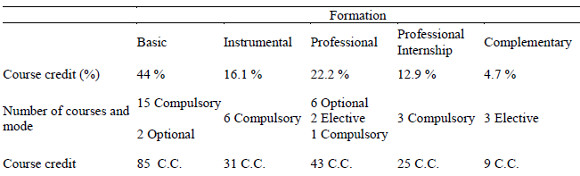
<body><![CDATA[<p><font face="Verdana" size="2">We study the Computer Science curriculum in order to know whether we need to update it or not, which is a compulsory activity of the initial stage. This document describes the results obtained in the study, which includes the use of some tools: surveys to students and graduates, interviews to professors, and brainstorming sessions with groups of professors. We also met representatives of public organizations and private companies. Moreover, we reviewed the performance of the students during a determined period of time. Finally we measured the opinion of the graduates from the Computer Science School at UCV about the curriculum and how it may be improved. The document begins with a detailed description of current Computer Science curriculum, then presents the method for the collection of information and finally shows the results of the study.</font></p>     <p lang="en-US"><font face="Verdana" size="2">2. Background</font></p>     <p lang="es-ES"><font face="Verdana" size="2"><span lang="en-US">A group of professors working in Numerical Calculus in the Mathematical School at the Faculty of Science developed the first Computer Science curriculum </span><span lang="es-UY"><a name="br1">[</a><a href="#r1">1</a>]</span> <span lang="en-US">during the 60s. </span><span lang="es-UY">Later, the new technologies and trends in software development drove the design of a new curriculum, which was released in 1985. At the end of 1990, the Curriculum Committee evaluated the technology changes in the country and around the world and developed the 2000 Computer Science curriculum. Several minor changes were conducted between 2004 and 2005. The current version includes the following components: (a) Basic formation, (b) Instrumental formation, (c) Professional formation, (d) Professional internships, and (e) Complementary formation.</span></font></p>     <p lang="es-ES"><font face="Verdana" size="2"><a href="#t"><a href="#t1">Table 1</a> <span lang="en-US">shows the distribution of these components according to </span><font color="#000000"><span lang="en-US">the number and kind</span></font> <span lang="en-US">of courses: compulsory, elective and optional. </span><span lang="es-UY">We define the types of courses as follows:</span></font></p> <ol> 	<li/>     <p><font face="Verdana" size="2">Compulsory course: it must be completed by 	each student.</font></p> 	<li/>     <p><font face="Verdana" size="2">Elective course: a course that students can 	select from among several courses.</font></p> 	<li/>     <p><font face="Verdana" size="2">Optional course: it belongs to a set of 	courses. A student must complete at least two.</font></p>     </ol>     <p><font face="Verdana" size="2">The students must complete courses which belong to the basic formation and instrumental formation during the first five semesters of the career. These components include the compulsory courses that a student must complete in order to obtain the basic skills.</font></p>     <p lang="es-ES"><font face="Verdana" size="2"><span lang="es-UY">The professional formation supports the Professional Options including the courses that a student must take in order to obtain the skills required in a specific area of computing (e.g. Software Engineering). To complete a Professional Option, a student must pass three elective courses of the option, </span><font color="#000000"><span lang="es-UY">finish successfully</span></font> <span lang="es-UY">the Seminar course and finally develop an Undergraduate Research Project (thesis) in the area.</span></font></p>     ]]></body>
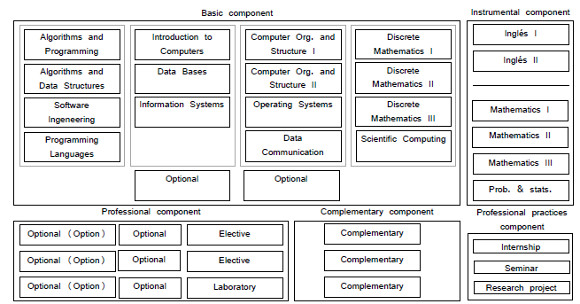
<body><![CDATA[<p lang="en-US"><font face="Verdana" size="2"><a name="_Ref354860972"></a><a name="_Ref374119595"></a> <span lang="es-UY"><a name="t1">Table 1</a> Curriculum components (2000) <a name="br1">[</a><a href="#r1">1</a>]</span>     <br> <img src="/img/revistas/cleiej/v17n3/3a13t1.jpg"> </font> </p>     <p><font face="Verdana" size="2">The School Board establishes the Professional Options, which are managed by the Computer Science Department and academically supported by the Research Centers. The current options are: Information Systems, Database, Technology in Communication and Computer Networks, Scientific Computing, Models and Mathematical Programming, Software Engineering and Human-Computer Interaction, Parallel and Distributed Systems, Artificial Intelligence, Educational Technologies, Computer Graphics, and Internet Applications.</font></p>     <p lang="es-ES" align="center" style="text-indent: 0cm; margin-top: 0.14cm; margin-bottom: 0.35cm; line-height: 100%"> <font face="Verdana" size="2"><a name="_Ref354861003"></a><a name="_Ref374120443"></a> <a name="f1"> <img src="/img/revistas/cleiej/v17n3/3a13f1.jpg"> </a>     <br> <font color="#000000"><span lang="en-US" style="letter-spacing: normal">Figure 1 Distribution of the curriculum components <a name="br1">[</a><a href="#r1">1</a>]</span></font></font></p>     <p lang="es-ES"><font color="#000000" face="Verdana" size="2"><a href="#f1">Figure 1</a> <span lang="en-US">shows the current Computer Science curriculum, which establishes the following aspects:</span></font></p> <ol> 	<li/>     <p><font face="Verdana" size="2">Courses of the basic and instrumental 	components in the first two years are compulsory as well as courses 	of the professional practice components&mdash;Internship, Seminar 	and Undergraduate Research project. </font>  	</p> 	<li/>     <p><font face="Verdana" size="2">Courses of the professional component are 	either elective or optional. The student can take these courses 	after the fifth semester.</font></p> 	<li/>     <p><font face="Verdana" size="2">Complementary courses are elective, and the 	student, enrolled in the third semester or up, must pass at least 	three of them. </font>  	</p> 	<li/>     <p><font face="Verdana" size="2">The Laboratory is a compulsory course 	designed to provide the student with the practical skills. The 	student must select one among the set of Laboratory courses offered. </font> 		</p> 	<li/>     ]]></body>
<body><![CDATA[<p lang="es-ES"><font face="Verdana" size="2"><span lang="es-UY">The 	Internship is compulsory and is aimed to provide the students with 	the professional skills and </span><font color="#000000"><span lang="es-UY">interpersonal 	relationships in professional settings.</span></font> </font>  	</p>     </ol>     <p lang="es-ES"><font color="#000000" face="Verdana" size="2"><span lang="es-UY">In 2010, during an academic staff meeting, the professors decided to review the graduate profile and they appointed a Committee to do that. </span><span lang="en-US">After several meetings and a detailed revision of some documents, such as the proposal of the ACM and IEEE Computer Society for computing curricula </span><span lang="es-UY"><a name="br2">[</a><a href="#r2">2</a>]</span><span lang="en-US">, the Committee defined four graduate profiles: Computer Science, Software Engineering, Information and Communication Technologies and Information Systems </span><span lang="es-UY"><a name="br3">[</a><a href="#r3">3</a>]</span><span lang="en-US">. The proposal was presented to the Department a year later </span><span lang="es-UY"><a name="br3">[</a><a href="#r3">3</a>]</span><span lang="en-US">.</span></font></p>     <p lang="en-US"><font face="Verdana" size="2">3. Methodology </font>  </p>     <p lang="es-ES"><font face="Verdana" size="2"><span lang="es-UY">The study of the current Computer Science curriculum not only included an analysis of its structure, in terms of the relationship between courses, but also considered the perception that professors and students have of the career, as well as, the strengths and weaknesses of the graduates </span><font color="#000000"><span lang="es-UY">according to the opinion of the companies and institutions that hire them. We used several tools, such as interviews, surveys, brainstorming, and meetings, in order to recollect important data and obtain information about the current situation of the curriculum. We describe how we use these tools in our research as follows:</span></font></font></p> <ul> 	<li/>     <p><font face="Verdana" size="2">Interviews and questionnaires to the 	leaders of the eleven (11) Professional Options offered by the 	Department: the goal of the activity was to collect opinion, 	suggestions, and comments about the current curriculum.</font></p> 	<li/>     <p><font face="Verdana" size="2">Student survey: the aim of the survey was 	to know the reasons why the students work before they complete their 	university studies and the consequences of this behavior in their 	academic performance. </font>  	</p> 	<li/>     <p><font face="Verdana" size="2">Statistical analysis of the student 	performance: the objective of the analysis was to determine the 	student academic performance in the first five semesters.</font></p> 	<li/>     <p lang="es-ES"><font color="#000000" face="Verdana" size="2"><span lang="es-UY">Brainstorming 	sessions: we conducted two brainstorm sessions. In each session, 	fifteen (15) professors and an external curriculum design expert</span> <span lang="es-UY">participated. The 	goal of this activity was to know what professors propose to improve 	the graduate skills.</span></font></p> 	<li/>     <p><font face="Verdana" size="2">Meeting with representatives of companies 	and government institutions: the aim of the meeting was to determine 	the strengths and weaknesses of the Computer Science graduates, and 	the job skills and competencies required for the graduates.</font></p> 	<li/>     ]]></body>
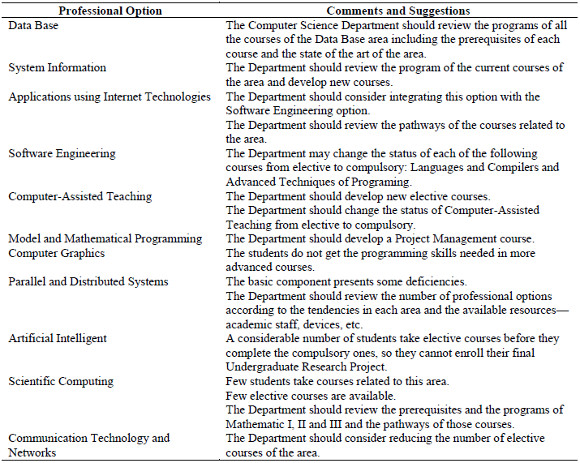
<body><![CDATA[<p><font face="Verdana" size="2">Professor survey: the objective of the 	survey was to know the opinion of the professors about the strengths 	and weaknesses of the current curriculum and the aspects that should 	be reviewed.</font></p> 	<li/>     <p><font face="Verdana" size="2">Graduate survey: the aim of the survey was 	to know the opinion of the Computer Science graduates at the UCV 	about the curriculum and how the School of Computer Science could 	improve it.</font></p>     </ul>     <p lang="en-US"><font face="Verdana" size="2">4 Results</font></p>     <p><font face="Verdana" size="2">We present the results of the study in the following sections.</font></p>     <p lang="en-US" align="left" style="text-indent: 0cm; letter-spacing: normal; line-height: 100%"> <font face="Verdana" size="2"> <b>4.1 Opinion of the Profesional Option Coordinators</b></font></p>     <p lang="es-ES"><font face="Verdana" size="2"><span lang="es-UY">During the interviews, each of the eleven (11) Coordinators of the Professional Options expressed his opinion about the Computer Science curriculum. </span><font color="#800000"><span lang="es-UY"><a href="#t2">Table 2</a></span> </font><span lang="es-UY">shows the comments and suggestions by professional options.</span></font></p>     <p><font face="Verdana" size="2">The coordinators also commented about the factors which may affect the academic performance of the students:</font></p> <ul> 	<li/>     <p><font face="Verdana" size="2">The students do not get the programming 	skills expected for the degree.</font></p> 	<li/>     <p><font face="Verdana" size="2">The students communicate&mdash;oral and 	written&mdash;poorly.</font></p> 	<li/>     ]]></body>
<body><![CDATA[<p><font face="Verdana" size="2">The Department should increase the number 	of elective courses.</font></p> 	<li/>     <p><font face="Verdana" size="2">The Department should update the program of 	the following courses: Mathematic I, Mathematic II and Mathematic II 	in order to guarantee that the students get the mathematical skills 	required in more advanced courses. </font>  	</p> 	<li/>     <p><font face="Verdana" size="2">Eleven (11) professional options are too 	many.</font></p> 	<li/>     <p><font face="Verdana" size="2">The Department should review the Computer 	Science curriculum taking into account the student performance and 	graduate profile.</font></p> 	<li/>     <p><font face="Verdana" size="2">Many students complete the compulsory 	courses but they do not have the expected skills.</font></p> 	<li/>     <p lang="es-ES"><font face="Verdana" size="2"><span lang="es-UY">Some 	professors should review the teaching strategies in order to adapt 	them to the trends</span> <span lang="es-UY">in teaching</span> 	<span lang="es-UY">computing.</span></font></p> 	<li/>     <p><font face="Verdana" size="2">The Department should review 	the program of some courses in order to include some topics related 	to professional ethic and social responsibility.</font></p> 	<li/>     <p><font face="Verdana" size="2">The average performance of 	students working is low because they usually do not go regularly to 	class and do not finish the assignments.</font></p> 	<li/>     <p lang="es-ES"><font face="Verdana" size="2"><span lang="es-UY">The 	Department should review prerequisites and program of several basic 	courses and the pathways of those courses.</span></font></p>     </ul>     ]]></body>
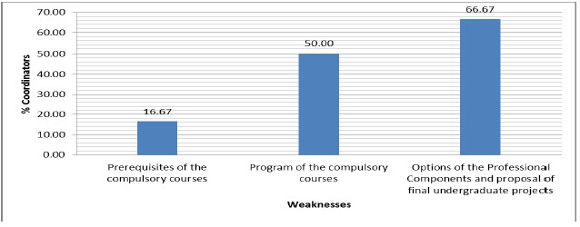
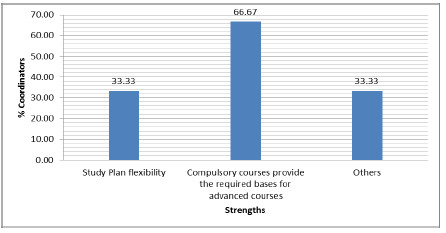
<body><![CDATA[<p lang="en-US"><font face="Verdana" size="2"><a name="_Ref373435143"></a> <span lang="es-UY"><a name="t2">Table 2</a> Opinion of the Coordinators of the Professional Options</span>     <br> <img src="/img/revistas/cleiej/v17n3/3a13t2.jpg"> </font> </p>     <p lang="es-ES" align="left" style="text-indent: 0cm; letter-spacing: normal; line-height: 100%"> <font face="Verdana" size="2"> <b><span lang="en-US">4.2 Strengths and Weaknesses of the</span> <span lang="en-US">Curriculum</span> <span lang="en-US">(Opinion of the Professional</span> <font color="#000000"><span lang="en-US">Option </span></font><span lang="en-US">Coordinators)</span></b></font></p>     <p lang="es-ES"><font face="Verdana" size="2"><span lang="es-UY">Six Professional Option Coordinators answered the survey (see Methodology section). </span><font color="#ff0000"><span lang="es-UY"><a href="#f2">Figure 2</a> </span></font><span lang="es-UY">shows the curriculum strengths according to the coordinators. </span> </font> </p>     <p><font face="Verdana" size="2">The results shows that 33.33% of the coordinators expressed that the curriculum is flexible, since each student can follow different pathways of courses according the professional option he wants to complete. A 66.67% of coordinators considered that the students obtain the formation required for advanced professional courses. </font>  </p>     <p lang="es-ES" align="center" style="text-indent: 0cm; margin-top: 0.14cm; margin-bottom: 0.35cm; line-height: 100%"> <font face="Verdana" size="2"><a name="_Ref354863172"></a> <a name="f2"> <img src="/img/revistas/cleiej/v17n3/3a13f2.jpg"> </a>     <br> <span lang="en-US" style="letter-spacing: normal">Figure 2 Strengths of the currculum acoording to the opinion of the Professional Option Coordinators.</span></font></p>     <p lang="es-ES"><font face="Verdana" size="2"><a href="#f3">Figure 3</a> <span lang="en-US">shows that 16.67% of the coordinators considered that the Department should review the prerequisites of the courses, in particular courses such as Discrete Mathematic III, Probability and Statistical and Scientific Computing. </span><span lang="es-UY">Half of the coordinators commented about the </span><font color="#000000"><span lang="es-UY">pathways or programs</span></font> <span lang="es-UY">of the courses, while 66.67% remarked about some aspects of the professional options: elective courses offered, number of elective courses proposed by the option and number of Undergraduate Research Projects offered.</span></font></p>     <p lang="es-ES" align="center" style="text-indent: 0cm; margin-top: 0.14cm; margin-bottom: 0.35cm; line-height: 100%"> <font face="Verdana" size="2"><a name="_Ref354863223"></a><a name="_Ref373085214"></a> <a name="f3"> <img src="/img/revistas/cleiej/v17n3/3a13f3.jpg"> </a>     <br> <span lang="en-US" style="letter-spacing: normal">Figure 3 Weaknesses</span><span lang="es-ES" style="letter-spacing: normal"> </span><span lang="en-US" style="letter-spacing: normal">of the curriculum acoording to the opinion of the Professional Option Coordinators.</span></font></p>     ]]></body>
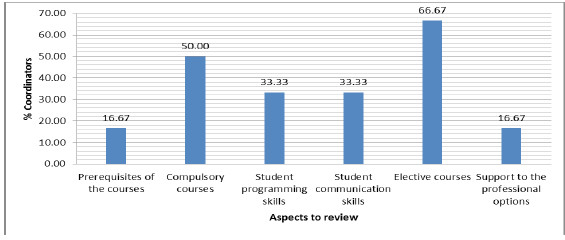
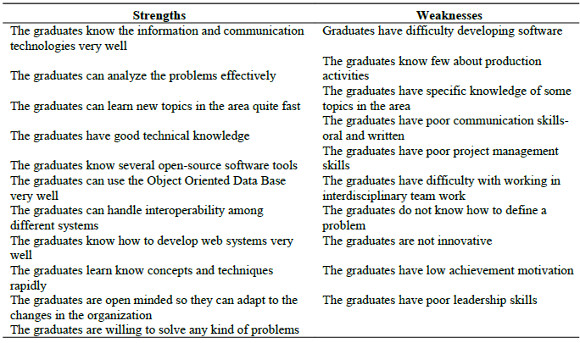
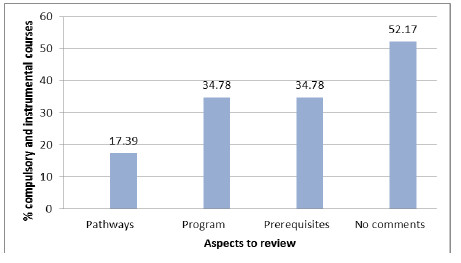
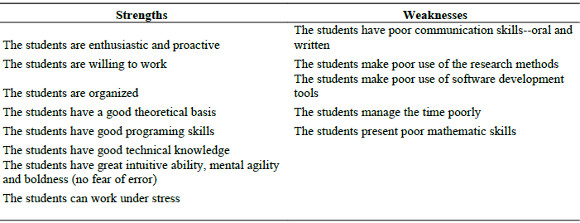
<body><![CDATA[<p lang="es-ES"><font face="Verdana" size="2"><a href="#f4">Figure 4</a> <span lang="en-US">shows the aspects of the curriculum that need to be reviewed according to the coordinators. Consistent with</span> <span lang="en-US">the</span> <span lang="en-US">results presented in</span> <span lang="es-UY"><a href="#f2">Figure 2</a></span><span lang="en-US">, 16.67% of the coordinators considered that the Department should review the prerequisites of the compulsory courses. </span><span lang="es-UY">Half of the coordinators </span><font color="#000000"><span lang="es-UY">commented about the compulsory courses: new courses should be included in the curriculum, the pathways of the courses should be updated and the program of some courses should be reviewed.</span> <span lang="es-UY">33.33% of the coordinators considered that the programming skills of the students are insufficient. Another 33.33% of coordinators indicated</span> <span lang="es-UY">the need to assess</span> <span lang="es-UY">the verbal</span> <span lang="es-UY">and written communication skills of the students.</span> <span lang="es-UY">16.67%</span> <span lang="es-UY">of the coordinators</span> <span lang="es-UY">expressed that</span> <span lang="es-UY">Department should review the elective courses in order to update some courses and to develop new ones.</span></font></font></p>     <p lang="es-ES" align="center" style="text-indent: 0cm; margin-top: 0.14cm; margin-bottom: 0.35cm; line-height: 100%"> <font face="Verdana" size="2"><a name="_Ref354863808"></a> <a name="f4"> <img src="/img/revistas/cleiej/v17n3/3a13f4.jpg"> </a>     <br> <span lang="en-US" style="letter-spacing: normal">Figure 4 Aspects of the curriculum to be reviewed.</span></font></p>     <p lang="en-US" align="left" style="text-indent: 0cm; letter-spacing: normal; line-height: 100%; page-break-after: avoid"> <font face="Verdana" size="2"> <b>4.3 Opinion of the Professors </b> </font> </p>     <p lang="es-ES" style="page-break-after: avoid"><font face="Verdana" size="2"><span lang="en-US">Thirteen (13) professors&mdash;over a total of 93 professors&mdash;answered the survey and gave their opinion about the curriculum (see </span><span lang="es-UY"><a href="#f5">Figure 5</a></span><span lang="en-US">). </span><span lang="es-UY">These professors have taught 46 courses. They considered that some aspects of the compulsory and instrumental courses should be reviewed: pathways of the 17.39% of the courses, programs of 34.78% of the courses and prerequisites of 34.78 % of the courses. </span> </font> </p>     <p lang="es-ES" align="center" style="text-indent: 0cm; margin-top: 0.14cm; margin-bottom: 0.35cm; line-height: 100%"> <font face="Verdana" size="2"><a name="_Ref374045117"></a> <a name="f5"> <img src="/img/revistas/cleiej/v17n3/3a13f5.jpg"> </a>     <br> <span lang="en-US" style="letter-spacing: normal">Figure 5 Aspects of the curriculum to be reviewed.</span></font></p>     <p lang="es-ES"><font face="Verdana" size="2"><span lang="es-UY">The professors also commented about the strengths and</span> <span lang="es-UY">weaknesses of the students. They are summarized in</span><font color="#000000"><span lang="es-UY"> <a href="#t3">Table 3</a></a>.</span></font></font></p>     <p lang="es-ES" align="left" style="text-indent: 0cm; letter-spacing: normal; line-height: 100%"> <font face="Verdana" size="2"> <b><span lang="en-US">4.4 Strengths and</span> <span lang="en-US">Weaknesses of the</span> <span lang="en-US">Computer Science Graduates Acoording to Organzations and Companies</span></b></font></p>     <p lang="es-ES"><font face="Verdana" size="2"><a href="#t4">Table 4</a></a> <span lang="en-US">shows the strengths and weaknesses of the Computer Science Graduates according to the opinion of 4 company representatives and 3 public organization representatives. </span> </font> </p>     ]]></body>
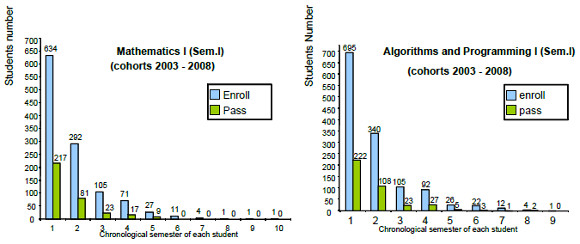
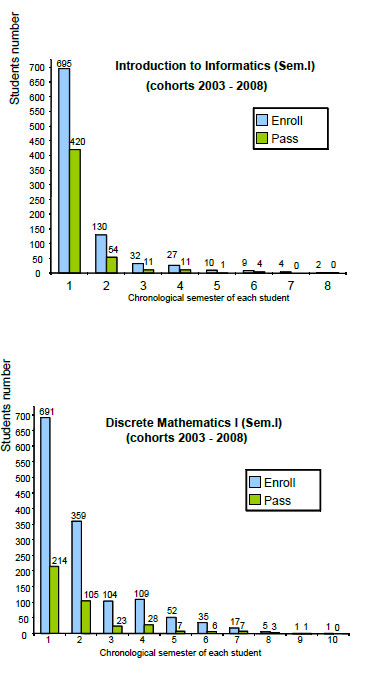
<body><![CDATA[<p lang="en-US" style="page-break-after: avoid"><font face="Verdana" size="2"><a name="_Ref373434944"></a> <span lang="es-UY"><a name="t3">Table 3</a> Strengths and</span><span lang="en-US"> </span><span lang="es-UY">weaknesses of the students according to the professors</span>     <br> <img src="/img/revistas/cleiej/v17n3/3a13t3.jpg"> </font> </p>     <p lang="en-US" align="left" style="text-indent: 0cm; letter-spacing: normal; line-height: 100%"> <font face="Verdana" size="2"> <b>4.5 Student Performance</b></font></p>     <p lang="es-ES"><font face="Verdana" size="2"><font color="#000000"><span lang="es-UY">We analyzed the academic performance of the students enrolled between the years 2003 and 2008 (six years). Examining the performance of the students, starting from the first semester they enrolled in the course up to twenty semesters later. </span><span lang="en-US">Although, we generated severa</span><span lang="en-US" style="letter-spacing: -0.1pt">l</span> <span lang="en-US">graphs which show the student performance during these years </span><span lang="es-UY"><a name="br4">[</a><a href="#r4">4</a>]</span><span lang="en-US">, we</span></font> <span lang="en-US">only include some graphs which are representative for the paper.</span></font></p>     <p lang="es-ES"><font face="Verdana" size="2"><a href="#f6">Figure 6</a> <span lang="es-UY">and <a href="#f7">Figure 7</a> show the number of students who enrolled and passed the first semester courses: Mathematics I, Algorithm and Programing I, Introduction to Informatics and Discrete Mathematics I. We can note that of 634 students who enrolled in Mathematics I, 217 passed the course (i.e. 34%). Of 417 students who failed, 292 students enrolled in Mathematic I again; this shows that a significant number of students desert. In the second semester, 81 students passed Mathematics I which means that the percentage of students who passed the course decreased to 28%. In the third semester, of the 211 students who had not pass the course yet, 105 enrolled in the course and 23 passed it. We can conclude that the students fail to enroll in the course or drop out, so we can note that 27 students of the 634 still enrolled in Mathematics I in the fifth semester. </span> </font> </p>     <p lang="en-US" style="page-break-after: avoid"><font face="Verdana" size="2"><a name="_Ref373434886"></a> <span lang="es-UY"><a name="t4">Table 4</a> Strengths and</span><span lang="en-US"> </span><span lang="es-UY">weaknesses of the students according to companies and public organizations</span>    <br> <img src="/img/revistas/cleiej/v17n3/3a13t4.jpg"> </font> </p>     <p lang="es-ES"><font face="Verdana" size="2"><span lang="es-UY">Six hundred ninety six (695) students enrolled in</span> <span lang="es-UY">Algorithms</span> <span lang="es-UY">and Programming</span> <span lang="es-UY">I for the first time and 222</span> <span lang="es-UY">of those approved</span> <span lang="es-UY">(i.e. 32%); this shows</span> <span lang="es-UY">a similar behavior</span> <span lang="es-UY">to</span> <span lang="es-UY">Mathematics</span> <span lang="es-UY">I.</span> <span lang="es-UY">However,</span> <span lang="es-UY">in the second semester, of the</span> <span lang="es-UY">474 remaining</span> <span lang="es-UY">students,</span> <span lang="es-UY">only 340</span> <span lang="es-UY">the</span> <span lang="es-UY">re-enrolled in the course, and</span> <span lang="es-UY">108 students</span> <span lang="es-UY">(32%) passed. Another 23</span> <span lang="es-UY">students</span> <span lang="es-UY">passed Algorithms</span> <span lang="es-UY">and Programming</span> <span lang="es-UY">I in the</span> <span lang="es-UY">third semester. Even in</span> <span lang="es-UY">the fourth semester,</span> <span lang="es-UY">27</span> <span lang="es-UY">students enrolled in the course and</span> <span lang="es-UY">11 of them</span> <span lang="es-UY">approved.</span> <span lang="es-UY">We can also see</span> <span lang="es-UY">a decrease in the percentage of students who re-enrolled in the course, which could be associated with</span> <span lang="es-UY">student desertion.</span> <span lang="es-UY">Some</span> <span lang="es-UY">students continued</span> <span lang="es-UY">enrolling</span> <span lang="es-UY">in this course</span> <span lang="es-UY">after</span> <span lang="es-UY">he fifth</span> <span lang="es-UY">semester.</span></font></p>     <p lang="es-ES"><font face="Verdana" size="2"><span lang="en-US">Similarly to the other two courses, a high percentage of students who failed Discrete Mathematics I did not re-enroll in the course in the next semester&mdash;</span><span lang="es-UY"><a href="#f7">Figure 7</a></span> <span lang="en-US">shows about a 50% of student desertion. </span><span lang="es-UY">We can also note that from the fourth semester and up, the student pass rate is less than 33%.</span></font></p>     <p><font face="Verdana" size="2">Unlike the other courses, the student performance in Introduction to Informatics is much better. Of 695 students, 420 (60%) passed the course in their first semester. More than half of the remaining students did not enroll in the course in the second semester&mdash;student desertion. Fifty four (54) of those who re-enrolled in the course, 130 students passed. In the following semesters, some students still did not enroll in the course and the percentage of students who passed the course decreased.</font></p>     ]]></body>
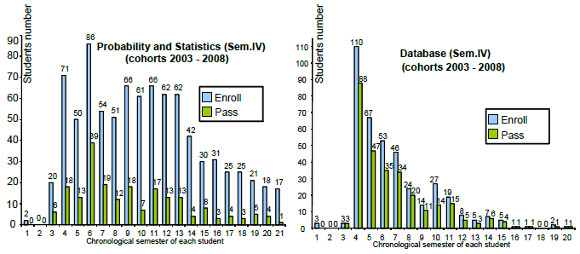
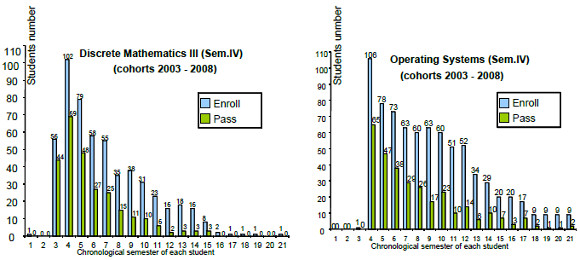
<body><![CDATA[<p lang="es-ES"><font color="#000000" face="Verdana" size="2"><span lang="en-US">In the second and third semesters, the trends of student desertion and dropping out are similar to the previous semester, so we omit the statistics (see </span><span lang="es-UY"><a name="br4">[</a><a href="#r4">4</a>]</span><span lang="en-US">). The study in </span><span lang="es-UY"><a name="br4">[</a><a href="#r4">4</a>]</span> <span lang="en-US">show that 40% of the students who passed Introduction to Informatics&mdash;as shown above&mdash;dropped out.</span></font></p>     <p lang="es-ES" align="center" style="text-indent: 0cm; margin-top: 0.14cm; margin-bottom: 0.35cm; line-height: 100%"> <font face="Verdana" size="2"><a name="_Ref355546402"></a><a name="_Ref374046819"></a> <a name="f6"> <img src="/img/revistas/cleiej/v17n3/3a13f6.jpg"> </a>     <br> <span lang="en-US" style="letter-spacing: normal">Figure 6 Number of students which enrolled and passed Mathemathics I (left) and Algorithms and Programming I (right) during their first semester.</span></font></p>     <p lang="es-ES" align="center" style="text-indent: 0cm; margin-top: 0.14cm; margin-bottom: 0.35cm; line-height: 100%"> <font face="Verdana" size="2"><a name="_Ref355459889"></a><a name="_Ref379058557"></a> <a name="f7"> <img src="/img/revistas/cleiej/v17n3/3a13f7.jpg"> </a>     <br> <span lang="en-US" style="letter-spacing: normal">Figure 7 Number of students which enrolled and passed Introduction to Informatics (left) and Discrete Mathematics I (right) during their first semester.</span></font></p>     <p lang="es-ES"><font face="Verdana" size="2"><span lang="es-ES"><a href="#f8">Figure 8</a> </span><span lang="en-US">and </span><span lang="es-UY"><a href="#f9">Figure 9</a></span><span lang="es-ES"> </span><span lang="en-US">show the number of students who passed the courses of the fourth semester: Discrete Mathematics III, Probability and Statistics, Data Base and Operating Systems. </span><span lang="es-UY">In this semester, we can observe that the students did not follow the pathways of the courses; many of them enrolled Discrete Mathematics III in the third semester and enrolled in Probability and Statically in the sixth semester or later. Thus of the 56 students who enrolled in Discrete Mathematics III in semester three, 44 passed it (79%). Of the 102 students, enrolled in the fourth semester, 59 passed it (57%). As in other courses, the pass percentage decreased in the following semesters. In the tenth semester, some students still enrolled in Discrete Mathematics III.</span></font></p>     <p lang="es-ES"><font color="#000000" face="Verdana" size="2"><span lang="es-UY">In <a href="#f8">Figure 8</a>, we can see that of 102 students who enrolled in Operating Systems, 55 passed the course (i.e. 53%). In the following semester, 78 students enrolled the course and 47 students passed it (60%). In the following semesters the percentage of students who passed decreased, less than 50%. After 15 semesters, some students still enrolled in Operating Systems. </span></font> </p>     <p lang="es-ES" align="center" style="text-indent: 0cm; margin-top: 0.14cm; margin-bottom: 0.35cm; line-height: 100%"> <font face="Verdana" size="2"><a name="_Ref355202114"></a><a name="_Ref374106373"></a> <a name="f8"> <img src="/img/revistas/cleiej/v17n3/3a13f8.jpg"> </a>     <br> <span lang="en-US" style="letter-spacing: normal">Figure 8 Number of students which enrolled and passed Discrete Mathematics III (left) and Operating Systems (right) during their fourth semester. </span></font> </p>     <p lang="es-ES"><font face="Verdana" size="2"><a name="_Ref355460420"></a><span lang="es-UY">The pass rate in Probability and Statistics is the lowest, even for those students who enrolled in the fourth semester courses for first time. In the fourth semester, 71 students enrolled this course and 18 (25%) passed, while only 26% of the 50 students enrolled passed it in the fifth semester. In the sixth semester, we can see that 86 students enrolled in the course&mdash;the higher number of students enrolled&mdash;and 39 of them passed. The pass rate in each of the following semesters&mdash;sixth to twenty first&mdash;is low (it can drop to 9% in some semesters). </span><span lang="en-US">In another analysis </span><span lang="es-UY"><a name="br4">[</a><a href="#r4">4</a>]</span><span lang="en-US">, we found that 38% of the students dropped out, while in other courses the drop-out rate is about 20%.</span></font></p>     ]]></body>
<body><![CDATA[<p><font face="Verdana" size="2">The students perform better in Data Base course.</font></p>     <p lang="es-ES" align="center" style="text-indent: 0cm; margin-top: 0.14cm; margin-bottom: 0.35cm; line-height: 100%"> <font face="Verdana" size="2"><a name="_Ref379058716"></a> <a name="f9"> <img src="/img/revistas/cleiej/v17n3/3a13f9.jpg"> </a>     <br> <span lang="en-US" style="letter-spacing: normal">Figure 9 Number of students which enrolled and passed Probability and Statistics (left) and Database (right) during their fourth semester.</span></font></p>     <p lang="en-US" align="left" style="text-indent: 0cm; letter-spacing: normal; line-height: 100%"> <font face="Verdana" size="2"> <b>4.6 Relationship between Work and Study</b></font></p>     <p style="text-indent: 0cm"><font face="Verdana" size="2">Sixty five (65) students&mdash;19 to 28 year old--answered the survey to students who worked or have worked sometime during their Computer Science studies. Most of them had worked before enrolled in the fourth semester courses, some of them had even worked before enrolled in first semester courses. The results of the survey show the following:</font></p> <ul> 	<li/>     <p><font face="Verdana" size="2">More than 75% of the students worked or had 	worked in computing. The students who did not work in computing or 	any related job reported that they need to work to support their 	families.</font></p> 	<li/>     <p><font face="Verdana" size="2">Fifty seven students (57) dropped out one 	or more courses (23% of them dropped out all the courses and 24% 	students failed or withdrew at least one course).</font></p> 	<li/>     <p><font face="Verdana" size="2">The students work for several reasons: need 	for money, getting work experience and taking the chance.</font></p> 	<li/>     <p lang="es-ES"><font face="Verdana" size="2"><span lang="es-UY">A 70% of 	the students who answered the questionnaire</span> <span lang="es-UY">were 	</span><font color="#000000"><span lang="es-UY">working at the 	moment they were consulted.</span></font></font></p>     </ul>     ]]></body>
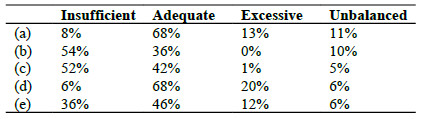
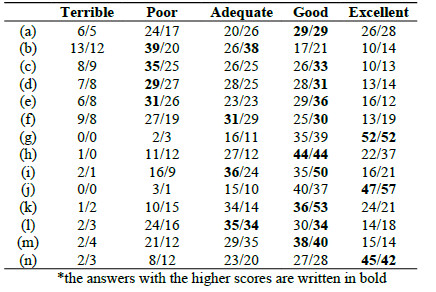
<body><![CDATA[<p lang="en-US" align="left" style="text-indent: 0cm; letter-spacing: normal; line-height: 100%; page-break-after: avoid"> <font face="Verdana" size="2"> <b>4.7 Opinion of the Computer Science Graduates</b></font></p>     <p lang="es-ES" style="page-break-after: avoid"><font face="Verdana" size="2"><font color="#000000"><span lang="es-UY">Two hundred and ten (210) graduates answered the survey&mdash;105 people completed their studies after the year 2003, so they followed the current Computer Science program. 71% of the</span></font> <span lang="es-UY">graduates worked before they completed their studies, and currently 30% of the graduates are working out of the country. <a href="#f5">Figure 5</a></span> <span lang="en-US">shows the opinion of the graduates about some aspects of the curriculum and the preparation obtained during their studies: terrible, poor, adequate, good and excellent. </span><span lang="es-UY">We reviewed the following aspects: (a) Professional ethics, (b) Social responsibility, (c) Oral communication, (d) Written communication, (e ) Elaboration of reports and documents, (f) Leadership and teamwork, (g) Theoretical preparation, (h) Practical training, (i) Professional preparation, (j) Computer science fundamentals, (k) Training in software development methodologies, (l) Networking and communication management, (m) System management and communication technologies, and (n) Analysis and problem solving techniques.</span></font></p>     <p lang="en-US"><font face="Verdana" size="2"><a name="t5">Table 5</a> Opinion of the graduates about some aspects of the curriculum (before 2003/after 2003)*     <br> <img src="/img/revistas/cleiej/v17n3/3a13t5.jpg"> </font> </p>     <p lang="es-ES"><font face="Verdana" size="2"><span lang="es-UY">In overall, the number of <i>good</i></span> <span lang="es-UY">responses given by the graduates after 2003 is 66 more than those given by the other graduates, while the number of <i>excellent</i></span> <span lang="es-UY">responses is 39 more than the others. Thus, the results show that the graduates after 2003 are more satisfied with the formation obtained during their studies than the graduates before this year. </span> </font> </p>     <p lang="es-ES"><font face="Verdana" size="2"><span lang="es-UY">Most of the graduates after 2003 evaluated the aspects g, h, i, j, k, n between good and excellent, moreover the sum of <i>good</i></span> <span lang="es-UY">and <i>excellent</i></span> <span lang="es-UY">responses is twice more the sum of the others. The aspects (j) computer science fundamentals and (g) theoretical preparation obtained the greatest number of positive answers&mdash;excellent or good. The results also show that aspects such as (b) social responsibility, (d) written communication and (c) oral communication need to be improved.</span></font></p>     <p lang="es-ES"><font face="Verdana" size="2"><a href="#t6">Table 6</a></a> <span lang="en-US">shows the perception of graduates in terms of the number of courses or activities in the current curriculum: insufficient, adequate, excessive or unbalanced. </span><span lang="es-UY">We considered the following courses/activities: (a) Basic courses, (b) Professional courses, (c) Practical activities, (d) Theoretical activities, (e) </span>Complementary <span lang="es-UY">courses.</span></font></p>     <p lang="en-US"><font face="Verdana" size="2"><a name="_Ref374114990"></a> <span lang="es-UY"><a name="t6">Table 6</a> Opinion of the graduates about the number of courses/activities included in the curriculum</span>     <br> <img src="/img/revistas/cleiej/v17n3/3a13t6.jpg"> </font> </p>     <p><font face="Verdana" size="2">According to the graduates, the number of basic courses and theoretical activities are acceptable. Most graduates indicated that professional courses and practical activities are insufficient. Almost haft of the graduates think the complementary courses are adequate.</font></p>     ]]></body>
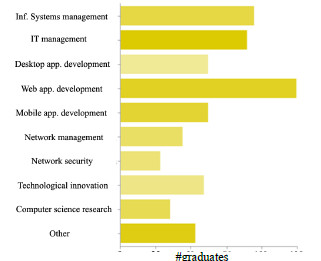
<body><![CDATA[<p lang="es-ES"><font face="Verdana" size="2"><a href="#f10">Figure 10</a> <span lang="en-US">shows distribution of the graduates in the following computing areas: (a) Information systems management, (b) IT management, (c) Web application development, (d) Mobile application development, (e) Network management, (f) Network security, (g) Technological innovation, (h) Computer science research, and (i) Other. </span><span lang="es-UY">We can note that 57 % of the graduates work developing Web applications (19%), Information Systems management (14%), IT management (14%), and Desktop applications development (10%). The information shown in the figure is important in order to define the skills and competencies for a graduate.</span></font></p>     <p lang="es-ES" align="center" style="text-indent: 0cm; margin-top: 0.14cm; margin-bottom: 0.35cm; line-height: 100%"> <font face="Verdana" size="2"><a name="_Ref374118468"></a> <a name="f10"> <img src="/img/revistas/cleiej/v17n3/3a13f10.jpg"> </a>     <br> <span lang="en-US" style="letter-spacing: normal">Figure 10 Distribution of graduates in some computing areas.</span></font></p>     <p><font face="Verdana" size="2">We also measured the opinion of the graduates about the knowledge obtained during their studies in the School of Computer Science. The results are the following:</font></p> <ol> 	<li/>     <p style="margin-bottom: 0cm"><font face="Verdana" size="2">Sufficient 	(62%).</font></p> 	<li/>     <p style="margin-bottom: 0cm"><font face="Verdana" size="2">Slightly 	deficient, needing some professional extension courses (34%).</font></p> 	<li/>     <p style="margin-bottom: 0cm"><font face="Verdana" size="2">Deficient, 	requiring extensive training through professional development 	courses (3%).</font></p> 	<li/>     <p style="margin-bottom: 0cm"><font face="Verdana" size="2">Deficient, 	needing to continue postgraduate studies (0%).</font></p> 	<li/>     <p style="margin-bottom: 0cm"><font face="Verdana" size="2">Highly deficient 	(0%).</font></p>     </ol>     ]]></body>
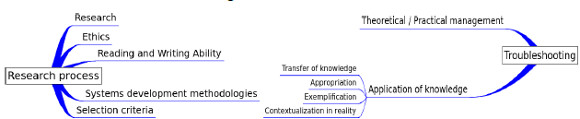
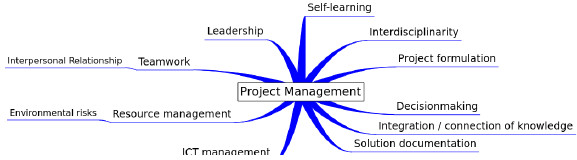
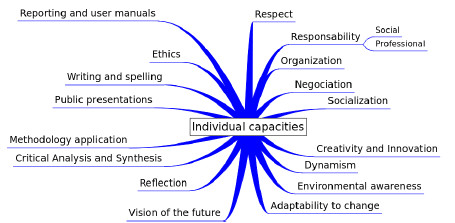
<body><![CDATA[<p lang="es-ES"><font face="Verdana" size="2"><span lang="es-UY">We can see that almost two thirds of graduates answered that knowledge is sufficient, while 34% answered that it is slightly deficient and they needed to take some professional development courses.</span></font></p>     <p lang="en-US" align="left" style="text-indent: 0cm; letter-spacing: normal; line-height: 100%; page-break-after: avoid"> <font face="Verdana" size="2"> <b>4.8 A Proposal to Update the Curriculum </b> </font> </p>     <p lang="es-ES" style="page-break-after: avoid"><font face="Verdana" size="2"><span lang="es-ES"><a href="#f11">Figure 11</a> </span><span lang="en-US">to </span><span lang="es-UY"><a href="#f13">Figure 13</a></span><span lang="es-ES"> </span><span lang="en-US">shows the results of the two brainstorming sessions conducted with professors. From these meetings we detected four (4) aspects to enhance the curriculum: (a) To develop individual skills (</span><span lang="es-UY"><a href="#f11">Figure 11</a></span><span lang="en-US">), (b) To generate skills to conduct researches (</span><span lang="es-UY"><a href="#f12">Figure 12</a></span><span lang="en-US">-left), (c) To increase expertise in solving problems (</span><span lang="es-UY"><a href="#f12">Figure 12</a></span><span lang="en-US">-right), and (d) To develop skills for project management (</span><span lang="es-UY"><a href="#f13">Figure 13</a></span><span lang="en-US">).</span></font></p>     <p lang="es-ES" align="center" style="text-indent: 0cm; margin-top: 0.14cm; margin-bottom: 0.35cm; line-height: 100%"> <font face="Verdana" size="2"><a name="_Ref374116554"></a><a name="_Ref374117026"></a> <a name="f11"> <img src="/img/revistas/cleiej/v17n3/3a13f11.jpg"> </a>     <br> <span lang="en-US" style="letter-spacing: normal">Figure 11 Individual skills. </span></font> </p>     <p lang="en-US" align="center" style="text-indent: 0cm; margin-top: 0.14cm; margin-bottom: 0.35cm; letter-spacing: normal; line-height: 100%"> <font face="Verdana" size="2"><a name="_Ref374117028"></a><a name="_Ref379059078"></a> <a name="f12"> <img src="/img/revistas/cleiej/v17n3/3a13f12.jpg"> </a>     <br> Figure 12 Research skills (left) and Problem solving skills (right)</font></p>     <p lang="es-ES" align="center" style="text-indent: 0cm; margin-top: 0.14cm; margin-bottom: 0.35cm; line-height: 100%"> <font face="Verdana" size="2"><a name="_Ref374116558"></a><a name="_Ref374117057"></a> <a name="f13"> <img src="/img/revistas/cleiej/v17n3/3a13f13.jpg"> </a>     <br> <span lang="en-US" style="letter-spacing: normal">Figure 13 Project managment skills.</span></font></p>     <p lang="es-ES"><font face="Verdana" size="2"><span lang="es-UY">Professors believe that the students should develop ethical values, writing skills, and environmental awareness, among others. The application of different methodologies in software constructions is an important aspect too. </span><span lang="en-US">They also said (see </span><span lang="es-UY"><a href="#f12">Figure 12</a></span><span lang="en-US">-right) that the students should acquire the knowledge to solve problems and be able to transfer this knowledge. </span><span lang="es-UY">Leadership and group-working skills were also mentioned as important competencies (see <a href="#f13">Figure 13</a>). </span> </font> </p>     ]]></body>
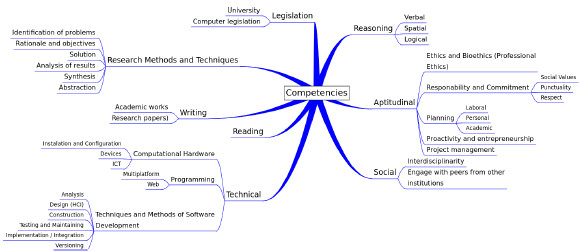
<body><![CDATA[<p lang="es-ES"><font face="Verdana" size="2"><a href="#f14">Figure 14</a> <span lang="en-US">includes general competencies that should be considered when redesigning a new curriculum. </span><span lang="es-UY">After analyzing these diagrams, some priority areas were detected, such as: legislation&mdash;laws, rules and regulations related with information and communication technologies, methods and techniques for research in Computer Sciences, reading and writing technical documents, technical knowledge in computing, scientific reasoning ability, professional ethic, responsibility and commitment, and social aspect of computing.</span></font></p>     <p lang="en-US"><font face="Verdana" size="2">5. Conclusions</font></p>     <p lang="es-ES"><font face="Verdana" size="2"><span lang="es-UY">The School of Computer Science at the Central University of Venezuela has initiated the review, evaluation and modification of the Computer Science curriculum following the guidelines of the Institution for the design and update of the curricula. This paper shows the results of diagnosis of the career which included surveys to professors, students and graduates, meetings with professors and representatives of companies and public institutions, and an analysis of the student performance. </span> </font> </p>     <p lang="es-ES" align="center" style="margin-top: 0.14cm; margin-bottom: 0.35cm; line-height: 100%"> <font face="Verdana" size="2"><a name="_Ref374116861"></a> <a name="f14"> <img src="/img/revistas/cleiej/v17n3/3a13f14.jpg"> </a>     <br> <span lang="en-US" style="letter-spacing: normal">Figure 14 Competencies for a Computer Science student.</span></font></p>     <p><font face="Verdana" size="2">The results reveal that professors have a significant number of observations regarding the pathways, content and prerequisites of the courses of the basic and instrumental components. These results also show a low performance and high level of desertion of students of the four first semesters, which cover a large part of those components. However, we noted that professors have no major observations with respect to the courses of the professional component and their comments only include to update the program of some courses and to increase the number of elective courses offered in some areas. But, this perception of professors is far from the opinion given by the representatives of the companies and public organizations who noted a number of weaknesses of the graduates, many of which are related to graduate competencies. </font>  </p>     <p><font face="Verdana" size="2">In addition, the results show that many students do not follow the pathways of the courses correctly; this may delay the time to complete the degree. Thus we think that the flexibility of the current curriculum&mdash;recognized as one of its strengths&mdash;is not well understood by the students.</font></p>     <p><font face="Verdana" size="2">On the other hand, in recent years the professors are concerned about the negative consequences of work on student performance. The results of our study support the concern of the professors, since it shows that work have affected the performance of the student in more than half of the cases. A redesign of the curriculum and its implementation will need to take into account the reality that many of the students have or want to have a job before to complete their studies.</font></p>     <p><font face="Verdana" size="2">The diagnostic activities also included meetings with several professors to know their opinion about the skills of the graduate in Computer Science. The skills and competencies suggested by the professors should be taken into account in the redesign of the curriculum.</font></p>     <p><font face="Verdana" size="2">Finally, although we are satisfied with the results, we understand that there are aspects that have not been covered, such as the reasons for the high dropout of the students. Although there are some indications of what could be the causes, these have not been studied properly. A limitation of the study was the lack of budget to find more broad and detailed opinion of the private companies and public organizations.</font></p>     ]]></body>
<body><![CDATA[<p lang="es-ES"><font face="Verdana" size="2"><span lang="es-UY">After the study, we not only know the situation of the curriculum but also we have increased the awareness in curriculum change since we have involved many professors in our activities and noted great interest in the study. </span><span lang="en-US">The research certainly is an invaluable input for the next phase, which should be the curriculum redesign, following the institutional guidelines defined by the UCV </span><span lang="es-UY"><a name="br5">[</a><a href="#r5">5</a>]</span><span lang="en-US">.</span></font></p>     <p lang="es-ES"><font face="Verdana" size="2"><span lang="en-US">References</span></font></p>     <!-- ref --><p lang="es-ES" style="text-indent: 0cm; line-height: 0.32cm"> <font face="Verdana" size="2"> <a name="r1">[</a><a href="#br1">1</a>] Comisi&oacute;n Curricular de la Escuela de Computaci&oacute;n de la UCV. Plan de Estudios de la Licenciatura en Computaci&oacute;n. Universidad Central de Venezuela, Septiembre 2004.    </font></p>     <!-- ref --><p lang="es-ES" style="text-indent: 0cm; line-height: 0.32cm"> <font face="Verdana" size="2"> <a name="r2">[</a><a href="#br2">2</a>] ACM. Curricula Recommendations. Consultado el 10 de enero de 2013, de: <a href="http://www.acm.org/education/curricula-recommendations">http://www.acm.org/education/curricula-recommendations</a>.    </font></p>     <!-- ref --><p lang="es-ES" style="text-indent: 0cm; line-height: 0.32cm"> <font face="Verdana" size="2"> <a name="r3">[</a><a href="#br3">3</a>] Rojas O, Villapol M.E., Silva A., Castillo Z., Parada J. y Correa E. Propuesta de Definici&oacute;n de Perfiles del Egresado. Documento de trabajo, Escuela de Computaci&oacute;n, UCV, Marzo 2011.     </font>  </p>     <!-- ref --><p lang="es-ES" style="text-indent: 0cm; line-height: 0.32cm"> <font face="Verdana" size="2"> <a name="r4">[</a><a href="#br4">4</a>] Comisi&oacute;n Curricular de la Escuela de Computaci&oacute;n de la UCV. Informe sobre rendimiento estudiantil. Reporte CCC_2012_04, Escuela de Computacion, UCV, Diciembre 2012.     </font>  </p>     ]]></body>
<body><![CDATA[<!-- ref --><p lang="es-ES" style="text-indent: 0cm; line-height: 0.32cm"> <font face="Verdana" size="2"> <a name="r5">[</a><a href="#br5">5</a>] Comisi&oacute;n Central de Curr&iacute;culo. Lineamientos Curriculares para Formular Dise&ntilde;os de Carreras o Redise&ntilde;os Curriculares en la UCV. Universidad Central de Venezuela, 17 Mayo de 2006. Consultado el 1 de marzo de 2011, de: <a href="http://www.ucv.ve/uploads/media/LINEAMIENTOS_CURRICULARES_PARA_FORMULAR_DISE&Ntilde;OS_DE_CARRERAS_O_REDISE&Ntilde;OS_CURRICULARES.pdf">http://www.ucv.ve/uploads/media/LINEAMIENTOS_CURRICULARES_PARA_FORMULAR_DISE%C3%91OS_DE_CARRERAS_O_REDISE%C3%91OS_CURRICULARES.pdf</a>.     </font> </p>     <p lang="es-ES" style="text-indent: 0cm; line-height: 0.32cm"> <font face="Verdana" size="2"> <br/> <br/>  </font>  </p>     <div title="footer"> 	    <p lang="es-ES" align="center" style="text-indent: 0cm; margin-top: 0.63cm; margin-bottom: 0cm; line-height: 100%"> 	<font face="Verdana" size="2"> 	<br/>  	</font>  	</p> </div>      ]]></body><back>
<ref-list>
<ref id="B1">
<label>1</label><nlm-citation citation-type="book">
<collab>Comisión Curricular de la Escuela de Computación de la UCV</collab>
<source><![CDATA[Plan de Estudios de la Licenciatura en Computación]]></source>
<year>Sept</year>
<month>ie</month>
<day>mb</day>
<publisher-name><![CDATA[Universidad Central de Venezuela]]></publisher-name>
</nlm-citation>
</ref>
<ref id="B2">
<label>2</label><nlm-citation citation-type="">
<collab>ACM</collab>
<source><![CDATA[Curricula Recommendations]]></source>
<year></year>
</nlm-citation>
</ref>
<ref id="B3">
<label>3</label><nlm-citation citation-type="">
<person-group person-group-type="author">
<name>
<surname><![CDATA[Rojas]]></surname>
<given-names><![CDATA[O]]></given-names>
</name>
<name>
<surname><![CDATA[Villapol]]></surname>
<given-names><![CDATA[M.E.]]></given-names>
</name>
<name>
<surname><![CDATA[Silva]]></surname>
<given-names><![CDATA[A]]></given-names>
</name>
<name>
<surname><![CDATA[Castillo]]></surname>
<given-names><![CDATA[Z]]></given-names>
</name>
<name>
<surname><![CDATA[Parada]]></surname>
<given-names><![CDATA[J]]></given-names>
</name>
<name>
<surname><![CDATA[Correa]]></surname>
<given-names><![CDATA[E.]]></given-names>
</name>
</person-group>
<source><![CDATA[Propuesta de Definición de Perfiles del Egresado: Documento de trabajo, Escuela de Computación, UCV]]></source>
<year>Marz</year>
<month>o </month>
<day>20</day>
</nlm-citation>
</ref>
<ref id="B4">
<label>4</label><nlm-citation citation-type="">
<source><![CDATA[Comisión Curricular de la Escuela de Computación de la UCV: Informe sobre rendimiento estudiantil. Reporte CCC_2012_04, Escuela de Computacion, UCV]]></source>
<year>Dici</year>
<month>em</month>
<day>br</day>
</nlm-citation>
</ref>
<ref id="B5">
<label>5</label><nlm-citation citation-type="book">
<collab>Comisión Central de Currículo</collab>
<source><![CDATA[Lineamientos Curriculares para Formular Diseños de Carreras o Rediseños Curriculares en la UCV]]></source>
<year>17 M</year>
<month>ay</month>
<day>o </day>
<publisher-name><![CDATA[Universidad Central de Venezuela]]></publisher-name>
</nlm-citation>
</ref>
</ref-list>
</back>
</article>