<?xml version="1.0" encoding="ISO-8859-1"?><article xmlns:mml="http://www.w3.org/1998/Math/MathML" xmlns:xlink="http://www.w3.org/1999/xlink" xmlns:xsi="http://www.w3.org/2001/XMLSchema-instance">
<front>
<journal-meta>
<journal-id>0717-5000</journal-id>
<journal-title><![CDATA[CLEI Electronic Journal]]></journal-title>
<abbrev-journal-title><![CDATA[CLEIej]]></abbrev-journal-title>
<issn>0717-5000</issn>
<publisher>
<publisher-name><![CDATA[Centro Latinoamericano de Estudios en Informática]]></publisher-name>
</publisher>
</journal-meta>
<article-meta>
<article-id>S0717-50002014000300009</article-id>
<title-group>
<article-title xml:lang="en"><![CDATA[Towards a Model for the Development and Assessment of Competences through Formative Projects]]></article-title>
</title-group>
<contrib-group>
<contrib contrib-type="author">
<name>
<surname><![CDATA[Cardona]]></surname>
<given-names><![CDATA[Sergio]]></given-names>
</name>
<xref ref-type="aff" rid="A01"/>
</contrib>
<contrib contrib-type="author">
<name>
<surname><![CDATA[Vélez]]></surname>
<given-names><![CDATA[Jeimy]]></given-names>
</name>
<xref ref-type="aff" rid="A02"/>
</contrib>
<contrib contrib-type="author">
<name>
<surname><![CDATA[Tobón]]></surname>
<given-names><![CDATA[Sergio]]></given-names>
</name>
<xref ref-type="aff" rid="A03"/>
</contrib>
</contrib-group>
<aff id="A01">
<institution><![CDATA[,Universidad del Quindío Facultad de Ingeniería ]]></institution>
<addr-line><![CDATA[Armenia ]]></addr-line>
<country>Colombia</country>
</aff>
<aff id="A02">
<institution><![CDATA[,Pontificia Universidad Bolivariana Facultad de Ingeniería ]]></institution>
<addr-line><![CDATA[Montería ]]></addr-line>
<country>Colombia</country>
</aff>
<aff id="A03">
<institution><![CDATA[,Corporación Universitaria CIFE  ]]></institution>
<addr-line><![CDATA[Cuernavaca ]]></addr-line>
<country>México</country>
</aff>
<pub-date pub-type="pub">
<day>00</day>
<month>12</month>
<year>2014</year>
</pub-date>
<pub-date pub-type="epub">
<day>00</day>
<month>12</month>
<year>2014</year>
</pub-date>
<volume>17</volume>
<numero>3</numero>
<fpage>9</fpage>
<lpage>9</lpage>
<copyright-statement/>
<copyright-year/>
<self-uri xlink:href="http://www.scielo.edu.uy/scielo.php?script=sci_arttext&amp;pid=S0717-50002014000300009&amp;lng=en&amp;nrm=iso"></self-uri><self-uri xlink:href="http://www.scielo.edu.uy/scielo.php?script=sci_abstract&amp;pid=S0717-50002014000300009&amp;lng=en&amp;nrm=iso"></self-uri><self-uri xlink:href="http://www.scielo.edu.uy/scielo.php?script=sci_pdf&amp;pid=S0717-50002014000300009&amp;lng=en&amp;nrm=iso"></self-uri><abstract abstract-type="short" xml:lang="en"><p><![CDATA[The competence-based formation model has oriented educational policies in different countries during the last decades. From this model, the socioformative approach has its basis and works as a referent in Latin America to orient the formation and competence assessment. The socio-formative approach uses the methodology of the formative projects by means of an articulated set of pedagogical strategies that are used along the time to solve the problems of the context. This paper presents a model for competences development and assessment using formative projects as part of a technological architecture to personalize the students´ educational experience through a Learning Management System. Finally, a case study is presented to validate the proposed model with formation methodology in a virtual course.]]></p></abstract>
<abstract abstract-type="short" xml:lang="es"><p><![CDATA[Durante las últimas décadas el modelo de formación por competencias ha orientado las políticas educativas en diversos países. Dentro de este modelo, surge el enfoque socioformativo el cual es un referente en Latinoamérica para orientar la formación y evaluación de competencias. El enfoque socioformativo usa la metodología de los proyectos formativos, mediante un conjunto articulado de estrategias pedagógicas que se despliegan en el tiempo para resolver los problemas del contexto. Este artículo presenta un modelo para el desarrollo y evaluación de competencias mediante proyectos formativos, como parte de una arquitectura tecnológica para personalizar la experiencia educativa de los estudiantes a través de un sistema de administración de aprendizaje. Finalmente se presenta un caso de estudio que valida el modelo propuesto con la metodología de formación en un curso virtual de CIFE.]]></p></abstract>
<kwd-group>
<kwd lng="en"><![CDATA[assessment model]]></kwd>
<kwd lng="en"><![CDATA[competence]]></kwd>
<kwd lng="en"><![CDATA[formative projects]]></kwd>
<kwd lng="en"><![CDATA[socioformative approach]]></kwd>
<kwd lng="en"><![CDATA[project based learning]]></kwd>
<kwd lng="es"><![CDATA[modelo de evaluación]]></kwd>
<kwd lng="es"><![CDATA[competencias]]></kwd>
<kwd lng="es"><![CDATA[proyectos formativos]]></kwd>
<kwd lng="es"><![CDATA[enfoque socioformativo]]></kwd>
<kwd lng="es"><![CDATA[aprendizaje basado en proyectos]]></kwd>
</kwd-group>
</article-meta>
</front><body><![CDATA[ <div title="header"> 	    <p lang="en-US" align="center" style="margin-bottom: 0.65cm; line-height: 100%"> 	<font face="Verdana" size="2"> 	<br/> <br/>  	</font>  	</p> </div>     <p lang="en-US" align="center" style="margin-bottom: 0.35cm; line-height: 115%; text-align:center"> <font face="Verdana"><b><a name="_GoBack"><font size="4"></font></a> </b><font size="4"><b>Towards a Model for the Development and Assessment of Competences through Formative Projects</b></font></font></p>     <p lang="en-US" align="center" style="margin-bottom: 0cm; line-height: 115%; text-align:center"> <font face="Verdana" size="2"><b>Sergio Cardona</b></font></p>     <p lang="en-US" align="center" style="margin-bottom: 0cm; line-height: 115%; text-align:center"> <font face="Verdana" size="2">Universidad del Quind&iacute;o, Facultad de Ingenier&iacute;a</font></p>     <p lang="en-US" align="center" style="margin-bottom: 0cm; line-height: 115%; text-align:center"> <font face="Verdana" size="2">Armenia, Colombia </font> </p>     <p lang="en-US" align="center" style="margin-bottom: 0cm; line-height: 115%; text-align:center"> <a href="mailto:sergio_cardona@uniquindio.edu.co"><font face="Verdana" size="2"><span lang="en-US">sergio_cardona@uniquindio.edu.co</span></font></a></p>     <p lang="en-US" align="center" style="margin-bottom: 0cm; line-height: 115%; text-align:center"> <font face="Verdana" size="2"><b>Jeimy V&eacute;lez</b></font></p>     <p lang="en-US" align="center" style="margin-bottom: 0cm; line-height: 115%; text-align:center"> <font face="Verdana" size="2">Pontificia Universidad Bolivariana, Facultad de Ingenier&iacute;a</font></p>     <p lang="en-US" align="center" style="margin-bottom: 0cm; line-height: 115%; text-align:center"> <font face="Verdana" size="2">Monter&iacute;a, Colombia</font></p>     ]]></body>
<body><![CDATA[<p lang="en-US" align="center" style="margin-bottom: 0cm; line-height: 115%; text-align:center"> <a href="mailto:jeimy.velez@upb.edu.co"><font face="Verdana" size="2"><span lang="en-US">jeimy.velez@upb.edu.co</span></font></a></p>     <p lang="en-US" align="center" style="margin-bottom: 0cm; line-height: 115%; text-align:center"> <font face="Verdana" size="2">and</font></p>     <p lang="en-US" align="center" style="margin-bottom: 0cm; line-height: 115%; text-align:center"> <font face="Verdana" size="2"><b>Sergio Tob&oacute;n</b></font></p>     <p lang="en-US" align="center" style="margin-bottom: 0cm; line-height: 115%; text-align:center"> <font face="Verdana" size="2">Corporaci&oacute;n Universitaria CIFE</font></p>     <p lang="en-US" align="center" style="margin-bottom: 0cm; line-height: 115%; text-align:center"> <font face="Verdana" size="2">Cuernavaca, M&eacute;xico</font></p>     <p lang="en-US" align="center" style="margin-bottom: 0cm; line-height: 115%; text-align:center"> <a href="mailto:contacto@cife.ws"><font face="Verdana" size="2"><span lang="en-US">contacto@cife.ws</span></font></a></p>     <p lang="en-US" align="justify" style="margin-left: 1.5cm; margin-bottom: 0.35cm; line-height: 115%"> <font size="2" style="font-size: 10pt" face="Verdana"><b>Abstract</b></font></p>     <p lang="en-US" align="justify" style="margin-left: 1.5cm; margin-right: 1.25cm; margin-bottom: 0.35cm; line-height: 100%"> <font size="2" style="font-size: 10pt" face="Verdana">The competence-based formation model has oriented educational policies in different countries during the last decades. From this model, the socioformative approach has its basis and works as a referent in Latin America to orient the formation and competence assessment. The socio-formative approach uses the methodology of the formative projects by means of an articulated set of pedagogical strategies that are used along the time to solve the problems of the context. This paper presents a model for competences development and assessment using formative projects as part of a technological architecture to personalize the students&acute; educational experience through a Learning Management System. Finally, a case study is presented to validate the proposed model with formation methodology in a virtual course. </font> </p>     <p lang="en-US" align="justify" style="margin-left: 1.5cm; margin-right: 1.25cm; margin-bottom: 0.35cm; line-height: 100%"> <font size="2" style="font-size: 10pt" face="Verdana"><b>Spanish Abstract</b></font></p>     <p lang="en-US" align="justify" style="margin-left: 1.5cm; margin-right: 1.25cm; margin-bottom: 0.35cm; line-height: 100%"> <font size="2" style="font-size: 10pt" face="Verdana">Durante las &uacute;ltimas d&eacute;cadas el modelo de formaci&oacute;n por competencias ha orientado las pol&iacute;ticas educativas en diversos pa&iacute;ses. Dentro de este modelo, surge el enfoque socioformativo el cual es un referente en Latinoam&eacute;rica para orientar la formaci&oacute;n y evaluaci&oacute;n de competencias. El enfoque socioformativo usa la metodolog&iacute;a de los proyectos formativos, mediante un conjunto articulado de estrategias pedag&oacute;gicas que se despliegan en el tiempo para resolver los problemas del contexto. Este art&iacute;culo presenta un modelo para el desarrollo y evaluaci&oacute;n de competencias mediante proyectos formativos, como parte de una arquitectura tecnol&oacute;gica para personalizar la experiencia educativa de los estudiantes a trav&eacute;s de un sistema de administraci&oacute;n de aprendizaje. Finalmente se presenta un caso de estudio que valida el modelo propuesto con la metodolog&iacute;a de formaci&oacute;n en un curso virtual de CIFE.</font></p>     ]]></body>
<body><![CDATA[<p lang="en-US" align="justify" style="margin-left: 1.5cm; margin-right: 1.25cm; margin-bottom: 0.35cm; line-height: 100%"> <font size="2" style="font-size: 10pt" face="Verdana"><b>Keywords: </b>assessment model; competence; formative projects; socioformative approach; project based learning.</font></p>     <p lang="en-US" align="justify" style="margin-left: 1.5cm; margin-right: 1.25cm; margin-bottom: 0.35cm; line-height: 100%"> <font size="2" style="font-size: 10pt" face="Verdana"><b>Spanish Keywords:</b></font><font face="Verdana"><font size="2"> </font><font size="2" style="font-size: 10pt">modelo de evaluaci&oacute;n, competencias; proyectos formativos, enfoque socioformativo, aprendizaje basado en proyectos.</font></font></p>     <p lang="en-US" align="justify" style="margin-left: 1.5cm; margin-right: 1.25cm; margin-bottom: 0cm; line-height: 100%"> <font size="2" style="font-size: 10pt" face="Verdana">Received 2013-11-15, Revised 2014-02-20 Accepted 2014-02-20</font></p>     <p lang="en-US" align="justify" style="margin-left: 1.5cm; margin-right: 1.25cm; margin-bottom: 0cm; line-height: 100%"> <font face="Verdana" size="2"> <br/>  </font>  </p>     <p lang="en-US" style="margin-left: 0.4cm; text-indent: -0.4cm; margin-top: 0cm; margin-bottom: 0.21cm"> <font face="Verdana" size="2">1 Introduction</font></p>     <p lang="en-US" align="justify" style="text-indent: 0.38cm; margin-bottom: 0cm; line-height: 100%; widows: 0; orphans: 0"> <font face="Verdana" size="2"> <br/>  </font>  </p>     <p lang="en-US" align="justify" style="text-indent: 0.38cm; margin-bottom: 0cm; line-height: 100%; widows: 0; orphans: 0"> <font size="2" style="font-size: 10pt" face="Verdana">During the last decades, the education reforms have been structured on a large scale in several western countries  <a name="br1">[</a><a href="#r1">1</a>]. A general motivation to guide the quality policies of education towards new educational principles focused on a vision for competence-based education is identified. <span lang="es-CO">P</span>rojects like Tuning from the European Union, Alfa Tuning Latin-America, the DeSeCo Project (Spanish for Definition and Selection of Competences), CORE (CORE Project Competences in Education and Cross border Recognition), demonstrate so. </font> </p>     <p lang="en-US" align="justify" style="text-indent: 0.38cm; margin-bottom: 0cm; line-height: 100%; widows: 0; orphans: 0"> <font size="2" style="font-size: 10pt" face="Verdana">Different approaches appear with the emergence of the competences in education including the socioformative proposed by Tob&oacute;n in the late nineties. The socioformative approach incorporates the fundamental principles of project-based learning. It proposes a methodology for the formation and assessment of competencies through formation projects, which consist of articulated activities oriented to interpret, argue and solve context problems.</font></p>     <p lang="en-US" align="justify" style="text-indent: 0.38cm; margin-bottom: 0cm; line-height: 100%; widows: 0; orphans: 0"> <font size="2" style="font-size: 10pt" face="Verdana">Considering that the theoretical foundations around competence formation have been widely investigated, technological solutions for virtual learning environments are being developed currently which seek to facilitate the educational process of students. However, in many cases these solutions are not supported by a pedagogical approach that guides a whole educational process, they do not identify the proficiency levels of students, and lack a system of formative evaluation that allows making a personalized tracking of the students learning process.</font></p>     <p lang="en-US" align="justify" style="text-indent: 0.38cm; margin-bottom: 0cm; line-height: 100%; widows: 0; orphans: 0"> <font face="Verdana" size="2"> <br/>  </font>  </p>     ]]></body>
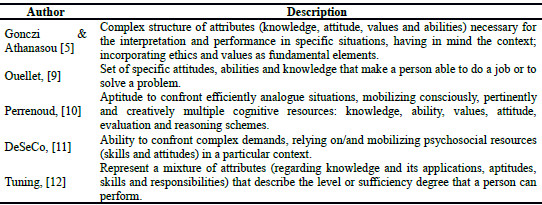
<body><![CDATA[<p lang="en-US" align="justify" style="text-indent: 0.38cm; margin-bottom: 0cm; line-height: 100%; widows: 0; orphans: 0"> <font size="2" style="font-size: 10pt" face="Verdana">Due to the complexity in competence formation, it is necessary to define a model that considers the design elements needed to guide a system of competence formation and assessment. The proposed model is consistent with the pedagogical principles of the socioformative approach, and it is based on the methodology of formation projects where the definition of competences, the criteria statement, and the delivery of evidence are considered. Also, an assessment structure is defined in the model where the proficiency levels of competence and the types of evaluation that are applied during all stages of the learning process of students are considered. </font> </p>     <p lang="en-US" align="justify" style="text-indent: 0.38cm; margin-bottom: 0cm; line-height: 100%; widows: 0; orphans: 0"> <font size="2" style="font-size: 10pt" face="Verdana">On the other hand, everyday more institutions use LMS to enrich the formation scenarios and encourage people learning. However, it is frequent to see from the LMS the offering of learning resources to students in a generalized way without considering issues that may be significant in an individual manner to develop their competences. Some of them do not consider students' own differences and therefore cannot be configured to customize the student learning environment  <a name="br2">[</a><a href="#r2">2</a>]. These differences impact, as each student can have different motivations, interests and levels of knowledge. Based on the above, there is the importance of personalization in which the behavior of a system is adapted to specific characteristics of people, allowing defining alternatives adapted to individual peculiarities, seeking a process of learning, monitoring and evaluating competences more satisfactorily. This proposal presents a model for competences development and assessment as part of a technological architecture to personalize the students&acute; educational experience through a virtual learning environment.</font></p>     <p lang="en-US" align="justify" style="text-indent: 0.38cm; margin-bottom: 0cm; line-height: 100%; widows: 0; orphans: 0"> <font size="2" style="font-size: 10pt" face="Verdana">This paper is organized as follows: Chapter 2 presents the framework with the fundamental concepts of the competences, assessment of competences, and project-based learning. Chapter 3 shows an analysis of works related to academic experiences based on project-based learning, models, and assessment types. The theoretical foundation of the formation project is presented in Chapter 4. Chapter 5 describes the formation project model under the socioformative approach. A case study that illustrates the application of the methodology of the formation projects in a virtual course from CIFE University Corporation of Mexico is presented in Chapter 6. Finally, conclusions and future work proposals are shown.</font></p>     <p lang="en-US" style="margin-left: 0.4cm; text-indent: -0.4cm; margin-bottom: 0.5cm"> <font face="Verdana" size="2">2 Framework</font></p>     <p lang="en-US" align="justify" style="margin-bottom: 0.35cm; line-height: 100%"> <font size="2" style="font-size: 10pt" face="Verdana"><span lang="en-US">The framework contains the theoretical elements that support the model. The concepts of competences, competence assessment, and Project based learning will be shown.</span></font></p>     <p lang="en-US" style="margin-left: 0.4cm; text-indent: -0.4cm; margin-top: 0cm; margin-bottom: 0.21cm"> <font face="Verdana" size="2">2.1 Competences</font></p>     <p lang="en-US" align="justify" style="margin-bottom: 0cm; line-height: 100%"> <font size="2" style="font-size: 10pt" face="Verdana"><span lang="en-US">For the past decades, the competence concept has been employed in the human talent development area where the people&rsquo;s performance in specific work situations is evaluated. In the 1990&rsquo;s, the competences begin to be implemented by the influence of globalization, talent management, and the quality assurance systems <a name="br3">[</a><a href="#r3">3</a>]. The historical development of the concept of competences in different fields is evidenced in  <a name="br3">[</a><a href="#r3">3</a>] and  <a name="br4">[</a><a href="#r">4</a>]. The concept of competences is found on  <a name="br5">[</a><a href="#r5">5</a>] and  <a name="br6">[</a><a href="#r6">6</a>], and it is defined as attribute structures (knowledge, attitudes, values, skills) needed to face situations from the context (tasks, activities, and problems), which integrate diverse dimensions of the human being, acting contexts, and multiple disciplines. The definitions integrate diverse dimensions of people, relate ethical aspects, and emphasize in the attitudes, skills and knowledge  <a name="br7">[</a><a href="#r7">7</a>]. <a href="#t1">Table 1</a> presents definitions of the concept competences  <a name="br8">[</a><a href="#r8">8</a>].</span></font></p>     <p lang="en-US" align="center" style="text-indent: 0.25cm; margin-bottom: 0cm; line-height: 100%"> <font size="2" style="font-size: 10pt" face="Verdana"><span lang="es-CO"><b><a name="t1">Table</a> 1:</b></span><span lang="en-US"> Concepts </span><span lang="es-CO">of </span><span lang="en-US">Competence</span></font><font face="Verdana" size="2">     <br> <img src="/img/revistas/cleiej/v17n3/3a09t1.jpg"> </font> </p>     <p lang="en-US" align="justify" style="text-indent: 0.25cm; margin-bottom: 0cm; line-height: 100%"> <font size="2" style="font-size: 10pt" face="Verdana"><span lang="en-US">Athanasou and Gonczi  <a name="br5">[</a><a href="#r5">5</a>],  <a name="br13">[</a><a href="#r13">13</a>],  <a name="br14">[</a><a href="#r14">14</a>], recognize the existence of different perspectives on the competences approach; some of which are presented in  <a name="br13">[</a><a href="#r13">13</a>] and  <a name="br14">[</a><a href="#r14">14</a>]. Various classifications of competences are also proposed in  <a name="br13">[</a><a href="#r13">13</a>],  <a name="br14">[</a><a href="#r14">14</a>],  <a name="br15">[</a><a href="#r15">15</a>] y  <a name="br16">[</a><a href="#r16">16</a>]. All of these approaches and classifications show great variability according to their context of application, and as it is stated by  <a name="br17">[</a><a href="#r17">17</a>], it is recognized the conceptual complexity of the competences taking into account that in the context of education a consensual acceptation around them does not exist. These approaches have common elements as well as methodological differences to form and assess the competences in people.</span></font></p>     ]]></body>
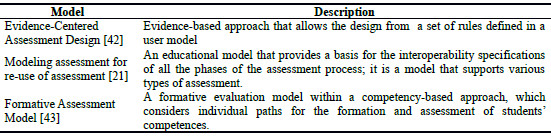
<body><![CDATA[<p lang="en-US" align="justify" style="text-indent: 0.25cm; margin-bottom: 0cm; line-height: 100%"> <font size="2" style="font-size: 10pt" face="Verdana">Within the educational model of competence, the socio-formative approach appears, it guides the formation and evaluation using the methodology of formative projects  <a name="br3">[</a><a href="#r3">3</a>]. A formative project is a set of activities that are being deployed with time to solve a contextualized problem and to contribute to form one or several competences based on criteria and evidence  <a name="br18">[</a><a href="#r18">18</a>]. The formative project constitutes the organizational element that guides, through phases, the implementation of activities that allows reaching performance levels by the development of evidence.</font></p>     <p lang="en-US" align="justify" style="text-indent: 0.25cm; margin-bottom: 0cm; line-height: 100%"> <font size="2" style="font-size: 10pt" face="Verdana">For Tob&oacute;n  <a name="br3">[</a><a href="#r3">3</a>] the competences are integral actions to resolve context problems with appropriateness, continuous improvement, and ethical commitment. They consist of underlying processes (cognitive-affective) as well as public and provable processes, while they always imply an action from themselves to others and/or the context. With this approach based on complex thinking, the addressing of competences around tasks and activities that currently are meaningless against the challenge of formation for the society of knowledge is transcended.</font></p>     <p lang="en-US" style="margin-left: 0.4cm; text-indent: -0.4cm; margin-bottom: 0.5cm"> <font face="Verdana" size="2">2.2 Competence Assessment</font></p>     <p lang="en-US" align="justify" style="margin-bottom: 0cm; line-height: 100%"> <font size="2" style="font-size: 10pt" face="Verdana"><span lang="en-US">The competence approach in education has transformed the traditional assessment practices where the emphasis is shifting from the specific knowledge to comprehensive performances regarding environmental problems. It is recognized that many of the traditional assessment practices are applied and remain valid. They meet the needs of a summative judgment, but they do not monitor the learning process. Quellmalz and Pellegrino  <a name="br19">[</a><a href="#r19">19</a>] made &#8203;&#8203;a distinction between the summative assessment, usually aimed at the assessment of learning outcomes for classification purposes. And the formative assessment used to diagnose and modify the learning conditions. As Zabalza suggests  <a name="br20">[</a><a href="#r20">20</a>], the more formative the assessment is and the greater the educational potential has, the higher its informative level is.</span></font></p>     <p lang="en-US" align="justify" style="text-indent: 0.25cm; margin-bottom: 0cm; line-height: 100%"> <font size="2" style="font-size: 10pt" face="Verdana">This entails the definition of continuous monitoring activities ranging from the assessment proposal to the validation of the evidence with its respective valuation</font></p>     <p lang="en-US" align="justify" style="text-indent: 0.25cm; margin-bottom: 0cm; line-height: 100%"> <font size="2" style="font-size: 10pt" face="Verdana">From the socio-formation, it is proposed the concept of assessment, rather than evaluation, to highlight the appreciative, recognizing, and formative character that every assessment process in the social context should have <a name="br1">[</a><a href="#r1">1</a>]. This model emphasizes on the evaluation of people based on context problems: At the beginning (diagnosis assessment), during the formation development (continuous assessment), at the end of the formation (assessment for the accreditation), and after graduation in the context (socio-assessment). </font> </p>     <p lang="en-US" align="justify" style="text-indent: 0.36cm; margin-bottom: 0cm; line-height: 100%; widows: 0; orphans: 0"> <font size="2" style="font-size: 10pt" face="Verdana">In a formative process by competences, several types of assessment are employed.  <a name="br21">[</a><a href="#r21">21</a>] and  <a name="br22">[</a><a href="#r22">22</a>] describe the so-called new assessment processes which are: self-assessment, portfolio, 360 degree evaluation with feedback, peer- assessment, hereto-assessment among others. <a href="#t2">Table 2</a> shows a description of some types of assessment </font> </p>     <p lang="en-US" align="center" style="text-indent: 0.25cm; margin-bottom: 0cm; line-height: 100%"> <font size="2" style="font-size: 10pt" face="Verdana"><span lang="es-CO"><b><a name="t2">Table 2</a>:</b></span><span lang="en-US"> </span><span lang="es-CO">Assessment </span><span lang="en-US">Types</span></font><font face="Verdana" size="2">    <br> <img src="/img/revistas/cleiej/v17n3/3a09t2.jpg"> </font> </p>     <p lang="en-US" align="justify" style="text-indent: 0.36cm; margin-bottom: 0cm; line-height: 105%; widows: 0; orphans: 0"> <font size="2" style="font-size: 10pt" face="Verdana"><span lang="en-US">Likewise, there are models to support processes and activities for e-assessment,  <a name="br21">[</a><a href="#r21">21</a>] and  <a name="br23">[</a><a href="#r23">23</a>]. Also, there are technological tools that support assessment types in formative scenarios  <a name="br24">[</a><a href="#r24">24</a>] and  <a name="br25">[</a><a href="#r25">25</a>], customized systems that allow feedback to students  <a name="br">[</a><a href="#r">26</a>] and  <a name="br27">[</a><a href="#r27">27</a>], tools for the formation and evaluation of knowledge in specific areas  <a name="br28">[</a><a href="#r28">28</a>], and simulation tools to measure the levels of knowledge  </span><span lang="es-CO"><a name="br19">[</a><a href="#r19">19</a>].</span></font></p>     ]]></body>
<body><![CDATA[<p lang="en-US" style="margin-bottom: 0.5cm"><font face="Verdana" size="2">2.3 Project Method</font></p>     <p lang="en-US" align="justify" style="margin-bottom: 0cm; line-height: 100%; widows: 0; orphans: 0"> <font size="2" style="font-size: 10pt" face="Verdana"><span lang="en-US">The Project Method emerges as an innovative methodology for the formation of people worldwide. This method was conceptualized by Kilpatrick  <a name="br29">[</a><a href="#r29">29</a>], who considered a project as an intentional act in the context of education. Its goal enables people to acquire knowledge through practice in a particular social context emphasizing the authenticity and autonomy in the learning process. This method comprises a whole learning process that starts from an initial idea of the project to its potential solutions where according to Kilpatrick  <a name="br29">[</a><a href="#r29">29</a>] four phases must be executed : proposal , planning, implementation and evaluation. All these steps require the completion of activities in which the student plays an active role in his formation; incorporating among others, motivational aspects, self-regulation, mediation, cooperation and collaboration, aimed at solving a problem considering its variables and constraints. In Adderley et al.  <a name="br30">[</a><a href="#r30">30</a>] some features of the method of projects are highlighted :</span></font></p> <ul> 	<li/>     <p lang="es-UY"><font face="Verdana" size="2"><span lang="en-US">They 	involve the solution of a problem and often result in a final 	product.</span></font></p> 	<li/>     <p lang="en-US"><font face="Verdana" size="2">They involve the 	initiative of a student or group of students with a variety of 	educational activities. </font>  	</p> 	<li/>     <p lang="en-US"><font face="Verdana" size="2">The teaching staff 	is involved as an advisor in any or all stages of the project.</font></p>     </ul>     <p lang="en-US" style="margin-left: 0cm; text-indent: 0.51cm"> <font face="Verdana" size="2">The design of a project in the educational context should consider different aspects. Osada and Miyake  <a name="br31">[</a><a href="#r31">31</a>] include: the timing of the project with the description of each one of the activities that the students must complete. The configuration of the project where the students must apply the knowledge in their field of discipline based on an understanding of the activities, and the project selection based on the interests of students.</font></p>     <p lang="en-US" align="justify" style="text-indent: 0.36cm; margin-bottom: 0cm; line-height: 105%; widows: 0; orphans: 0"> <font size="2" style="font-size: 10pt" face="Verdana">Some critical factors for the formation project management have been highlighted and exposed by Pucher and Lehner in <a name="br32">[</a><a href="#r32">32</a>]:</font></p> <ul> 	<li/>     <p lang="es-UY" style="line-height: 100%"> 	<font face="Verdana" size="2"> 	<span lang="en-US">Inexperience of the students in project 	management.</span></font></p> 	<li/>     <p lang="en-US" style="line-height: 100%"> 	<font face="Verdana" size="2">Motivational aspects of the students.</font></p> 	<li/>     ]]></body>
<body><![CDATA[<p lang="en-US" style="line-height: 100%"> 	<font face="Verdana" size="2">The interactions of teachers with students depend on factors 	associated to the specific experience of a teacher in a specific 	project.</font></p>     </ul>     <p lang="en-US" align="justify" style="text-indent: 0.36cm; margin-bottom: 0cm; line-height: 100%; widows: 0; orphans: 0"> <font size="2" style="font-size: 10pt" face="Verdana">The method of projects in education is a pedagogical method that gives students the opportunity to learn the problem in depth. It facilitates the obtaining of knowledge independently and the development of skills such as the communication competence, the spirit of teamwork, the use of computer technology, the initiative and confidence in their own work  <a name="br33">[</a><a href="#r33">33</a>].</font></p>     <p lang="en-US" style="margin-bottom: 0.5cm"><font face="Verdana" size="2"><span lang="en-US">2.4 Project-based learning</span></font></p>     <p lang="en-US" align="justify" style="margin-bottom: 0cm; line-height: 100%; widows: 0; orphans: 0"> <font size="2" style="font-size: 10pt" face="Verdana"><span lang="en-US">Project-based learning (PBL) has been incorporated in the new formative policies of some countries. Lam, Cheng, and Choy  <a name="br34">[</a><a href="#r34">34</a>] highlight it as a key and innovative element in education. It is based on the intention of engaging the students actively in scenarios similar to the ones they have to confront in the real world, in which they must use their various competences for the planning, management, tracking and evaluation of their job. The students apply the concepts in different stages of the Project according to their needs. This is far from traditional teaching methods where the concepts are accumulated sometimes, but their application in a context is not evident. The role of the student becomes receptive and passive. As Chinnoswsky et al. States  <a name="br35">[</a><a href="#r35">35</a>], the scientific foundation of the project based learning models is to generate learning processes where students are not passive receptors of knowledge. </span></font> </p>     <p lang="en-US" align="justify" style="text-indent: 0.36cm; margin-bottom: 0cm; line-height: 100%; widows: 0; orphans: 0"> <font size="2" style="font-size: 10pt" face="Verdana">Blumenfeld et al.  <a name="br36">[</a><a href="#r36">36</a>], proposes that the PBL promotes the bounds between diverse disciplines or topics in a subject, and it adapts to different types of students and learning situations. The PBL definition is found in several publications,  <a name="br37">[</a><a href="#r37">37</a>] and  <a name="br38">[</a><a href="#r38">38</a>], in which common characteristics are identified: </font> </p> <ul> 	<li/>     <p lang="es-UY"><font face="Verdana" size="2"><span lang="en-US">It 	allows the development of diverse types of competences. </span> 	</font> 	</p> 	<li/>     <p lang="en-US"><font face="Verdana" size="2">The learning 	environments are contextualized. They consider restrictions and 	variables of a real environment. </font>  	</p> 	<li/>     <p lang="en-US"><font face="Verdana" size="2">The learning 	process revolves around the student where the activities of 	co-operation and collaboration with peers are encouraged. </font>  	</p> 	<li/>     <p lang="en-US"><font face="Verdana" size="2">The student builds 	and regulates the development of the solutions himself through 	research questions and problem formulation. </font>  	</p> 	<li/>     ]]></body>
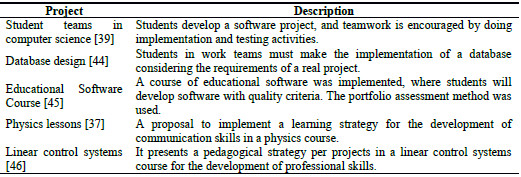
<body><![CDATA[<p lang="en-US"><font face="Verdana" size="2">The teacher role 	is of a mediator and facilitator during the various stages of the 	project development. </font>  	</p> 	<li/>     <p lang="en-US"><font face="Verdana" size="2">The products and 	outcomes can be socialized with different social and cultural 	actors. </font>  	</p>     </ul>     <p lang="en-US" align="justify" style="text-indent: 0.36cm; margin-bottom: 0cm; line-height: 100%; widows: 0; orphans: 0"> <font size="2" style="font-size: 10pt" face="Verdana">There are several proposals for the execution of a project in the context of formation,  <a name="br33">[</a><a href="#r33">33</a>] and  <a name="br39">[</a><a href="#r39">39</a>]. There are highlighted aspects in them such as: fields of application, project duration, number of team members, as well as the way how the students collaborate and co-operate. In  <a name="br38">[</a><a href="#r38">38</a>] and  <a name="br40">[</a><a href="#r40">40</a>], the various types of projects that can be implemented in the formation are recognized, which are classified according to aspects such as the project duration time, the formation level of people that will take place, and the dimension of the project. K&ouml;se  <a name="br41">[</a><a href="#r41">41</a>] recognizes the benefits and difficulties in project based learning. </font> </p>     <p lang="en-US" align="justify" style="text-indent: 0.36cm; margin-bottom: 0cm; line-height: 100%; widows: 0; orphans: 0"> <font size="2" style="font-size: 10pt" face="Verdana"><span lang="es-CO">Van den Bergh et al.  <a name="br22">[</a><a href="#r22">22</a>]</span> highlights two main disadvantages of the PBL: the workload and the differences between various projects, particularly concerning to the organization and assessment. In the same way, the motivational elements in students, the cognitive overload of the project, and the traditional teaching practices deeply rooted in teachers which have a direct impact in the realization of a project are identified.</font></p>     <p lang="en-US" style="margin-left: 0.4cm; text-indent: -0.4cm; margin-bottom: 0.5cm"> <font face="Verdana" size="2">3 Related Works </font>  </p>     <p lang="en-US" align="justify" style="margin-bottom: 0.35cm; line-height: 100%"> <font size="2" style="font-size: 10pt" face="Verdana"><span lang="en-US">Currently, there are different tools, methodologies, and models for assessment supported by technology that allows making valuations within the students&rsquo; formative processes. <a href="#t3">Table 3</a> shows a description based on  <a name="br7">[</a><a href="#r7">7</a>].</span></font></p>     <p lang="en-US" align="center" style="text-indent: 0.25cm; margin-bottom: 0cm; line-height: 100%"> <font size="2" style="font-size: 10pt" face="Verdana"><b><a name="t3">Table</a> </b><span lang="es-CO"><b>3:</b></span> <span lang="es-CO">Assessment </span>Model</font><font face="Verdana" size="2">     <br> <img src="/img/revistas/cleiej/v17n3/3a09t3.jpg"> </font> </p>     <p lang="en-US" align="justify" style="margin-bottom: 0.35cm; line-height: 100%"> <font size="2" style="font-size: 10pt" face="Verdana"><span lang="en-US">A search and analysis of related works done that apply pedagogical strategies for the formation using the PBL method are presented in <a href="#t4">Table 4</a>.</span></font></p>     ]]></body>
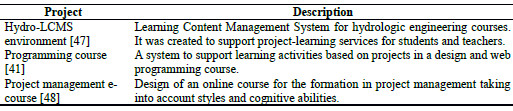
<body><![CDATA[<p lang="en-US" align="center" style="text-indent: 0.25cm; margin-bottom: 0cm; line-height: 100%"> <font size="2" style="font-size: 10pt" face="Verdana"><b><a name="t4">Table</a></b> <span lang="es-CO"><b>4:</b></span> Academic projects with PBL</font><font face="Verdana" size="2">     <br> <img src="/img/revistas/cleiej/v17n3/3a09t4.jpg"> </font> </p>     <p lang="en-US" align="justify" style="text-indent: 0.51cm; line-height: 100%"> <font size="2" style="font-size: 10pt" face="Verdana"> <span lang="en-US" style="letter-spacing: -0.1pt">The works presented are mostly applied in the engineering area and resulted in positive experiences during the learning process of students. Also, there are research reports that were based on PBL with technological support in the process of formation students. <a href="#t5">Table 5</a> shows some of them.</span></font></p>     <p lang="en-US" align="center" style="text-indent: 0.25cm; margin-bottom: 0cm; line-height: 100%"> <font size="2" style="font-size: 10pt" face="Verdana"><b><a name="t5">Table</a> </b><span lang="es-CO"><b>5:</b></span> Academic projects with E-learning support</font><font face="Verdana" size="2">     <br> <img src="/img/revistas/cleiej/v17n3/3a09t5.jpg"> </font> </p>     <p lang="en-US" align="justify" style="text-indent: 0.51cm; line-height: 95%"> <font size="2" style="font-size: 10pt" face="Verdana"> <span lang="en-US" style="letter-spacing: -0.1pt">There are models to manage the activities of PBL, Milentijevic, Ciric and Vojinovic,  <a name="br49">[</a><a href="#r49">49</a>] propose a model that supports different PBL approaches; and using a version control, it allows both teachers and students to monitor the different stages of a project.</span></font></p>     <p lang="en-US" style="margin-left: 0.4cm; text-indent: -0.4cm; margin-bottom: 0.5cm"> <font face="Verdana" size="2">4 Formative Projects </font>  </p>     <p lang="en-US" align="justify" style="line-height: 100%"> <font size="2" style="font-size: 10pt" face="Verdana"> <span lang="en-US" style="letter-spacing: -0.1pt">The conceptions of Kilpatrick  <a name="br29">[</a><a href="#r29">29</a>] were subsequently taken up by educators. These have been expanded, restated, and articulated to different pedagogical models and teaching strategies. One of these proposals is the socioformative approach, which is a framework for educational reflection and action that aims to create the essential pedagogical conditions to facilitate the integral development of people. Besides, it seeks to train people with a strong ethical life plan, entrepreneurship, collaborative work, and the necessary skills to meet challenges of the context  <a name="br3">[</a><a href="#r3">3</a>] and  <a name="br50">[</a><a href="#r50">50</a>]. The methodology of competence evaluation and formation of this approach is essentially through formation projects. A formation project is a coordinated set of activities that are deployed in time to solve a problem situation and contribute to form one or more competences based on criteria and evidence  <a name="br3">[</a><a href="#r3">3</a>] and  <a name="br50">[</a><a href="#r50">50</a>]. The formation projects have three main purposes  <a name="br18">[</a><a href="#r18">18</a>]:</span></font></p> <ul> 	<li/>     <p lang="en-US" style="line-height: 100%"> 	<font face="Verdana" size="2">To conduct a systematic formation of competences by integrating the 	how-to do with the how-to know and how-to be.</font></p> 	<li/>     <p lang="en-US" style="line-height: 100%"> 	<font face="Verdana" size="2">To know, understand, and solve reality problems according to the 	interests of students.</font></p> 	<li/>     ]]></body>
<body><![CDATA[<p lang="en-US" style="line-height: 100%"> 	<font face="Verdana" size="2">To learn to understand and build a reality as a controversial topic 	with strategic recognition and confrontation of uncertainty.</font></p>     </ul>     <p lang="en-US" align="justify" style="text-indent: 0.25cm; margin-bottom: 0.35cm; letter-spacing: -0.1pt; line-height: 100%"> <font size="2" style="font-size: 10pt" face="Verdana">A formation project can be structured through a Formative Route (FR), which is an instrument that the whole methodological process for the development and evaluation of student competencies is oriented. The formative route is the organizational element that directs the formative project through phases and the implementation of activities where students can achieve higher levels of performance. The description of the phases in a formation project is shown in <a href="#t6">Table 6</a>.</font></p>     <p lang="en-US" align="center" style="text-indent: 0.25cm; margin-bottom: 0cm; line-height: 100%"> <font size="2" style="font-size: 10pt" face="Verdana"><span lang="es-CO"><b><a name="t6">Table</a> 6:</b></span> Formative <span lang="es-CO">Project </span>Activities</font><font face="Verdana" size="2">     <br> <img src="/img/revistas/cleiej/v17n3/3a09t6.jpg"> </font> </p>     <p lang="en-US" align="justify" style="text-indent: 0.25cm; margin-bottom: 0.35cm; line-height: 100%"> <font size="2" style="font-size: 10pt" face="Verdana"> <span lang="en-US" style="letter-spacing: -0.1pt">In these phases, students and teachers participate. Its fundamental purpose is to articulate the whole learning process and the assessment of competences. In <a href="#f1">Fig. 1</a>, a sequence diagram with the teacher and student interactions in a Formative Project (FP) is shown. </span></font> </p>     <p lang="en-US" align="center" style="margin-bottom: 0.35cm; line-height: 115%"> <font face="Verdana"><font size="2"> <img src="/img/revistas/cleiej/v17n3/3a09f1.jpg">     <br> </font><font size="2" style="font-size: 10pt"><b><a name="f1">Figure 1</a>: </b>Interactions in a Formative Project</font><font size="2"> </font></font> </p>     <p lang="en-US" align="justify" style="text-indent: 0.25cm; margin-bottom: 0.35cm; letter-spacing: -0.1pt; line-height: 100%"> <font size="2" style="font-size: 10pt" face="Verdana">In each phase, the activities in which there is direct interaction with the teacher, as well as those that include independent and autonomous work from the student are programmed. For each of the phases, the aspects of assessment, which are detailed in the next section, are considered.</font></p>     <p lang="en-US" style="margin-bottom: 0.5cm"><font face="Verdana" size="2">4.1 Assessment Competences</font></p>     ]]></body>
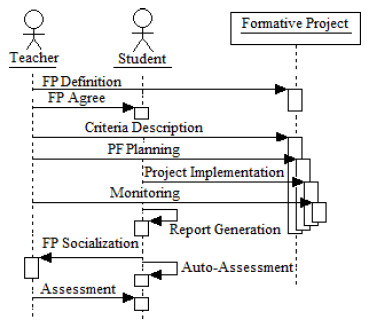
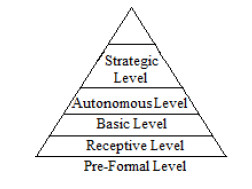
<body><![CDATA[<p lang="en-US" align="justify" style="margin-bottom: 0cm; line-height: 100%"> <font size="2" style="font-size: 10pt" face="Verdana"> <span lang="en-US" style="letter-spacing: -0.1pt">The assessment of competences is conducted essentially looking for students to solve context problems and submit one or several evidences for which exist as reference some key criteria  <a name="br7">[</a><a href="#r7">7</a>]. Based on these elements, the level of student performance, achievements and concrete actions to improve are determined. During the process, students must submit evidence generated in the implementation of the project, which are evaluated according to domain levels.</span></font></p>     <p lang="en-US" align="justify" style="margin-bottom: 0cm; letter-spacing: -0.1pt; line-height: 100%"> <font size="2" style="font-size: 10pt" face="Verdana">The assessment is based on proficiency levels: pre-formal, receptive, basic, autonomous y strategic. These criteria can be applied to a criterion or a competency. These proficiency levels are shown in <a href="#f2">Fig. 2</a>.</font></p>     <p lang="en-US" align="center" style="margin-bottom: 0.35cm; line-height: 115%"> <font face="Verdana"><font size="2"> <img src="/img/revistas/cleiej/v17n3/3a09f2.jpg">     <br> </font><font size="2" style="font-size: 10pt"><span lang="en-US"><b><a name="f2">Figure 2</a>: </b>Proficiency Levels</span></font><font size="2"> </font></font> </p>     <p lang="en-US" align="justify" style="text-indent: 0.25cm; margin-bottom: 0.35cm; letter-spacing: -0.1pt; line-height: 115%"> <font size="2" style="font-size: 10pt" face="Verdana"><a href="#t7">Table 7</a> describes the main characteristics of the proficiency levels  <a name="br3">[</a><a href="#r3">3</a>].</font><font face="Verdana" size="2"> </font> </p>     <p lang="en-US" align="center" style="text-indent: 0.25cm; margin-bottom: 0cm; line-height: 100%"> <font size="2" style="font-size: 10pt" face="Verdana"><b><a name="t7">Table</a></b> <span lang="es-CO"><b>7:</b></span> Proficiency Levels</font><font face="Verdana" size="2">     <br> <img src="/img/revistas/cleiej/v17n3/3a09t7.jpg"> </font> </p>     <p lang="en-US" align="justify" style="text-indent: 0.25cm; margin-bottom: 0cm; line-height: 100%"> <font size="2" style="font-size: 10pt" face="Verdana"> <span lang="en-US" style="letter-spacing: -0.1pt">The assessment process requires a sequence of activities where the definition of competences, criteria, and its related evidence, makes possible to define a learning map (rubrics by competences) that considers different types of assessment and its corresponding feedback  <a name="br7">[</a><a href="#r7">7</a>]. Likewise, this process should be supported by different instruments to ensure the monitoring and obtaining of the student formative purposes. For Tob&oacute;n  <a name="br3">[</a><a href="#r3">3</a>], a matrix configured by proficiency levels is by itself a learning map. The learning maps are tables of double input in which the criteria of the competences along with the proficiency levels are related, and the students&rsquo; evidences are integrated <a name="br3">[</a><a href="#r3">3</a>]. </span></font> </p>     <p lang="en-US" align="justify" style="text-indent: 0.25cm; margin-bottom: 0.35cm; letter-spacing: -0.1pt; line-height: 100%"> <font size="2" style="font-size: 10pt" face="Verdana">This instrument requires validation between teachers and students in order to make adjustments that ensure the competence assessment process. The generic structure of a learning map is presented in <a href="#t8">Table 8</a>: </font> </p>     <p lang="en-US" align="center" style="text-indent: 0.25cm; margin-bottom: 0cm; line-height: 100%"> <font size="2" style="font-size: 10pt" face="Verdana"><span lang="es-CO"><b><a name="t8">Table</a> 8:</b></span> <span lang="es-CO">Learning </span>Map</font><font face="Verdana" size="2">     ]]></body>
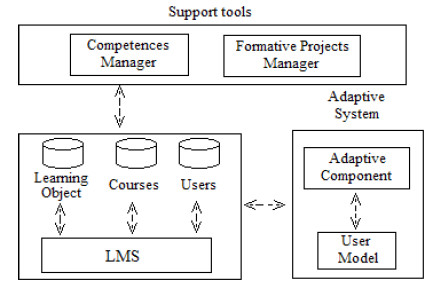
<body><![CDATA[<br> <img src="/img/revistas/cleiej/v17n3/3a09t8.jpg"> </font> </p>     <p lang="en-US" align="justify" style="text-indent: 0.25cm; margin-bottom: 0cm; line-height: 115%"> <font size="2" style="font-size: 10pt" face="Verdana"> <span lang="en-US" style="letter-spacing: -0.1pt">Based on the elements described, the model presented in the next section is proposed.</span></font></p>     <p lang="en-US" style="margin-left: 0.4cm; text-indent: -0.4cm; margin-bottom: 0.5cm"> <font face="Verdana" size="2">5 Proposed Model</font></p>     <p lang="en-US" align="justify" style="margin-bottom: 0cm; line-height: 100%"> <font size="2" style="font-size: 10pt" face="Verdana"> <span lang="en-US" style="letter-spacing: -0.1pt">The information model is based on the socioformative approach, and it constitutes a base element for the construction of adaptive virtual scenarios that allow the formation and assessment of competences through formation projects. The technological platform will be a Learning Management System (LMS), which will integrate an adaptive system that allows the personalization of virtual courses.</span></font></p>     <p lang="en-US" align="justify" style="margin-bottom: 0cm; letter-spacing: -0.1pt; line-height: 100%"> <font size="2" style="font-size: 10pt" face="Verdana">The adaptive systems automatically adapt to the users based on assumptions of the system about their needs  <a name="br51">[</a><a href="#r51">51</a>]. Its main objective is to improve the relationship with the user (presentation of content, navigation interfaces) according to a student model that considers his goals, preferences, knowledge and/or interactions, among others  <a name="br16">[</a><a href="#r16">16</a>].</font></p>     <p lang="en-US" align="justify" style="text-indent: 0.51cm; margin-bottom: 0cm; line-height: 100%"> <font size="2" style="font-size: 10pt" face="Verdana"><span style="letter-spacing: -0.1pt">The most commonly used LMS environments in e-learning processes in educational institutions allow the management of learning content. They have mechanisms of communication between the teacher and the student, and they give support to the assessment of students. Moreover, the LMS usually do not take into account individual differences of students, their learning needs and characteristics  <a name="br52">[</a><a href="#r52">52</a>]. Several investigations report problems with the relation of the customization in the LMS  <a name="br53">[</a><a href="#r53">53</a>], and  <a name="br52">[</a><a href="#r52">52</a>], where it generally stands out that no customization services are offered, and students are given access to the same set of educational resources, ignoring individual differences of the students such as: level of competences, interests, necessities, characteristics and motivations. Although, there has been efforts to customize LMS, works like  <a name="br2">[</a><a href="#r2">2</a>] and  <a name="br54">[</a><a href="#r54">54</a>], have been of research nature, and the social and productive appropriation of this knowledge has been limited. In addition to not providing an adequate level of adaptability of content and services, LMS adaptation requires the development of new software modules, which may become obsolete and incompatible with new versions of LMS  <a name="br53">[</a><a href="#r53">53</a>]. </span></font> </p>     <p lang="en-US" align="justify" style="text-indent: 0.51cm; margin-bottom: 0cm; line-height: 100%"> <font size="2" style="font-size: 10pt" face="Verdana"><span style="letter-spacing: -0.1pt">The architecture includes three components: the supporting tools, the LMS, and the adaptive system, which are shown in <a href="#f3">Fig. 3</a>. The learning resources, the courses, and the information of users enrolled in the LMS are managed through the LMS.</span></font></p>     <p lang="en-US" align="center" style="margin-top: 0.21cm; margin-bottom: 0.42cm; line-height: 0.39cm; page-break-inside: avoid"> <font face="Verdana"><font size="2"> <img src="/img/revistas/cleiej/v17n3/3a09f3.jpg">     <br> </font><font size="2" style="font-size: 10pt"><span lang="es-CO"><b><a name="f3">Figure 3</a>.</b></span></font><font size="2"> </font><font size="2" style="font-size: 9pt"> <font size="2" style="font-size: 10pt"><span lang="es-CO">LMS </span>Extension</font><font size="2"> </font> <font size="2" style="font-size: 10pt">Architecture</font></font><font size="2"> </font></font> </p>     <p lang="en-US" align="justify" style="margin-bottom: 0.35cm; letter-spacing: -0.1pt; line-height: 100%"> <font size="2" style="font-size: 10pt" face="Verdana">The support tools are software applications that allow the management of competences and formative projects. The formative project administrator is the application that supports the design of the projects by teachers. The formative project, competences, activities, and elements for evaluation are defined there.</font></p>     ]]></body>
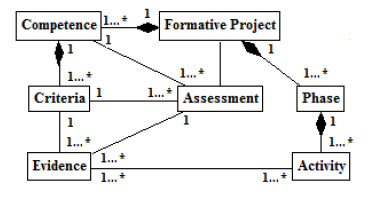
<body><![CDATA[<p lang="en-US" align="justify" style="margin-bottom: 0.35cm; letter-spacing: -0.1pt; line-height: 100%"> <font size="2" style="font-size: 10pt" face="Verdana">In the adaptive system, the adaptive component is responsible for carrying out the task of customizing learning objects. The student model is a source of knowledge that contains user aspects that may be relevant to the behavior of the system  <a name="br2">[</a><a href="#r2">2</a>]. This model is responsible for storing all the information about the user.  <a name="br2">[</a><a href="#r2">2</a>] highlights some of them:</font></p> <ul> 	<li/>     <p lang="en-US" align="justify" style="margin-top: 0.28cm; margin-bottom: 0.28cm; line-height: 100%"> 	<font size="2" style="font-size: 10pt" face="Verdana">User 	Dimension characteristic: the variables associated with the student 	are included: competence level, learning objectives, prior 	knowledge, and learning styles. </font> 	</p> 	<li/>     <p lang="en-US" align="justify" style="margin-top: 0.28cm; margin-bottom: 0.28cm; line-height: 100%"> 	<font size="2" style="font-size: 10pt" face="Verdana">Context 	Dimension: those variables describing the environment or 	circumstances of a student when following a course/learning unit are 	included. Some of the variables considered in this dimension are: 	access device type, bandwidth, operating system, user software, and 	text size.</font></p> 	<li/>     <p lang="en-US" align="justify" style="margin-top: 0.28cm; margin-bottom: 0.28cm; line-height: 100%"> 	<font size="2" style="font-size: 10pt" face="Verdana">Interaction 	Dimension: all the aspects that can be inferred from the use of the 	platform by the student are included. Some variables that may be 	included are: number of sessions, duration per session, 	contributions made in forums.</font></p>     </ul>     <p lang="en-US" style="margin-bottom: 0.5cm"><font face="Verdana" size="2">5.1 Formative Model Project</font></p>     <p lang="en-US" align="justify" style="margin-bottom: 0.35cm; line-height: 100%"> <font size="2" style="font-size: 10pt" face="Verdana"> <span lang="en-US" style="letter-spacing: -0.1pt">The formative project must be designed in phases and activities. Likewise, the formative project consists of one or more competences which are associated with criteria and evidence. In <a href="#f4">Fig. 4</a>, a UML diagram that represents the model that has been validated in  <a name="br7">[</a><a href="#r7">7</a>] is shown.</span></font></p>     <p lang="en-US" align="center" style="margin-bottom: 0.35cm; line-height: 115%"> <font face="Verdana"><font size="2"> <img src="/img/revistas/cleiej/v17n3/3a09f4.jpg">     <br> </font><font size="2" style="font-size: 10pt"><b><a name="f4">Figure 4</a>: </b>Formative project components</font><font size="2"> </font></font> </p>     <p lang="en-US" align="justify" style="margin-left: 1.25cm; text-indent: -0.99cm; margin-bottom: 0.35cm; letter-spacing: -0.1pt; line-height: 115%"> <font size="2" style="font-size: 10pt" face="Verdana">The elements of a formative project are described in <a href="#t9">Table 9</a>. </font> </p>     ]]></body>
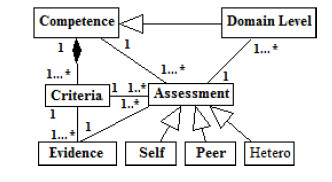
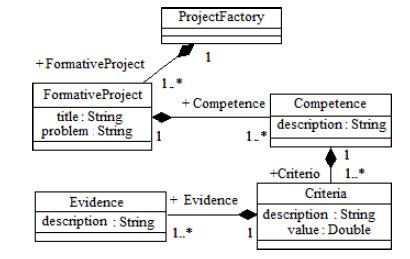
<body><![CDATA[<p lang="en-US" align="center" style="text-indent: 0.25cm; margin-bottom: 0cm; line-height: 100%"> <font size="2" style="font-size: 10pt" face="Verdana"><span lang="es-CO"><b><a name="t9">Table</a> 9:</b></span> Description of activities of a Formative Project. </font> <font face="Verdana" size="2">     <br> <img src="/img/revistas/cleiej/v17n3/3a09t9.jpg"> </font> </p>     <p lang="en-US" align="justify" style="text-indent: 0.25cm; margin-bottom: 0.35cm; line-height: 115%"> <font size="2" style="font-size: 10pt" face="Verdana"> <span lang="en-US" style="letter-spacing: -0.1pt">As a key element, the assessment of competences, which is explained below, stands out.</span></font></p>     <p lang="en-US" style="margin-bottom: 0.5cm"><font face="Verdana" size="2">5.2 Assessment Model</font></p>     <p lang="en-US" align="justify" style="margin-bottom: 0.35cm; line-height: 100%"> <font size="2" style="font-size: 10pt" face="Verdana"> <span lang="en-US" style="letter-spacing: -0.1pt">For the assessment of competences, it is necessary that teachers and students can verify and validate their activities within the formative process. The assessment of competences is based on criteria supported by evidence. The structural elements of the assessment under the socioformative approach are shown in the UML diagram in Fig 5, which has been validated in  <a name="br7">[</a><a href="#r7">7</a>]. </span></font> </p>     <p lang="en-US" align="center" style="margin-bottom: 0.35cm; line-height: 115%"> <font face="Verdana"><font size="2"> <img src="/img/revistas/cleiej/v17n3/3a09f5.jpg">     <br> </font><font size="2" style="font-size: 10pt"><b><a name="f5">Figure 5</a>: </b>Assessment Model</font><font size="2"> </font></font> </p>     <p lang="en-US" align="justify" style="text-indent: 0.48cm; margin-bottom: 0cm; line-height: 100%"> <font size="2" style="font-size: 10pt" face="Verdana">Interdependent processes of assessment that are considered within a formative project are: self-assessment, peer assessment and hetero assessment. <span style="letter-spacing: -0.1pt">They are defined in Table 2. </span></font> </p>     <p lang="en-US" style="margin-bottom: 0.5cm"><font face="Verdana" size="2">5.3 Model Validation </font>  </p>     <p lang="en-US" align="justify" style="margin-bottom: 0.35cm; line-height: 100%"> <font size="2" style="font-size: 10pt" face="Verdana"> <span lang="en-US" style="letter-spacing: -0.1pt">The validation of the model allows determining if the design meets the abstraction of the domain under study. In this context, two models (formative and assessment projects) that describe the elements for the formation and evaluation of competences were designed. A UML diagram with its classes of implementation is presented in <a href="#f6">Fig. 6</a>.</span></font></p>     ]]></body>
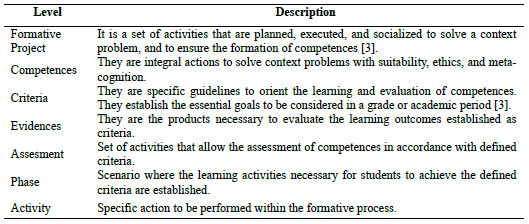
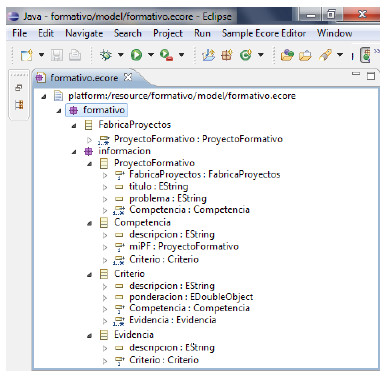
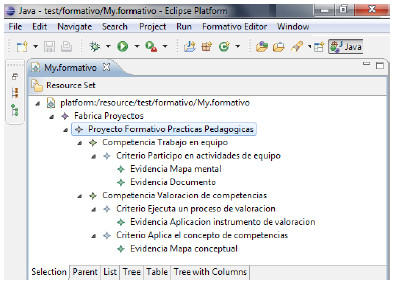
<body><![CDATA[<p lang="en-US" align="center" style="margin-bottom: 0.35cm; line-height: 115%"> <font face="Verdana"><font size="2"> <img src="/img/revistas/cleiej/v17n3/3a09f6.jpg">     <br> </font><font size="2" style="font-size: 10pt"><span lang="en-US"><b><a name="f6">Figure 6</a>: </b>Implementation Classes</span></font><font size="2"> </font></font> </p>     <p lang="en-US" align="justify" style="text-indent: 0.25cm; margin-bottom: 0cm; letter-spacing: -0.1pt; line-height: 100%"> <font size="2" style="font-size: 10pt" face="Verdana">To validate the model, it is considered a subset of elements from <a href="#f4">Figure 4</a>, because the main aspects of the formative projects are based in them.</font></p>     <p lang="en-US" align="justify" style="text-indent: 0.25cm; margin-bottom: 0cm; letter-spacing: -0.1pt; line-height: 100%"> <font size="2" style="font-size: 10pt" face="Verdana">There are frameworks that support the modeling activities with various technologies. Within this are: the Eclipse Modeling Framework (EMF) and the Graphical Modeling Framework (GMF). They are modeling and code generation frameworks for application construction based on a structured data model  <a name="br">[</a><a href="#r">55</a>]. These tools ensure interoperability between different classes of technology platforms. Through the creation of an EMF project, all the model properties from <a href="#f6">Figure 6</a> are imported, and they are converted to a model definition language called Ecore that validates its semantic structure. In the model, a class called project factory, which allows the creation of different formation projects, is included.</font></p>     <p lang="en-US" align="justify" style="text-indent: 0.25cm; margin-bottom: 0.35cm; line-height: 100%"> <font size="2" style="font-size: 10pt" face="Verdana"><span style="letter-spacing: -0.1pt">The eclipse environment displays the ecore model shown in <a href="#f7">Fig. 7</a> by a hierarchical structure with the classes, attributes, and relationships. For example for the competence design class, an attribute of the string type and their relationships with the competence and formative project class is shown.</span></font></p>     <p lang="en-US" align="center" style="margin-bottom: 0.35cm; line-height: 115%"> <font face="Verdana"><font size="2"> <img src="/img/revistas/cleiej/v17n3/3a09f7.jpg">     <br> </font><font size="2" style="font-size: 10pt"><b><a name="f7">Figure 7</a>: </b>Ecore Model</font><font size="2"> </font></font> </p>     <p lang="en-US" align="justify" style="text-indent: 0.25cm; margin-bottom: 0.35cm; line-height: 100%"> <font size="2" style="font-size: 10pt" face="Verdana"><span style="letter-spacing: -0.1pt">Starting from the ecore model and using the GMF editor, it is possible to generate various productions or model checking. The name of the formative project was called pedagogical practices. This formative project in turn has two competences defined: teamwork and competence assessment. The teamwork competence has in turn the criterion: I participate in team activities. Two evidences are also defined: a mental map and a document. A concrete production of the model can be seen in <a href="#f8">Fig. 8</a>.</span></font></p>     <p lang="en-US" align="center" style="margin-bottom: 0.35cm; line-height: 115%"> <font face="Verdana"><font size="2"> <img src="/img/revistas/cleiej/v17n3/3a09f8.jpg">     <br> </font><font size="2" style="font-size: 10pt"><b><a name="f8">Figure 8</a>: </b>Ecore Model Production</font><font size="2"> </font></font> </p>     ]]></body>
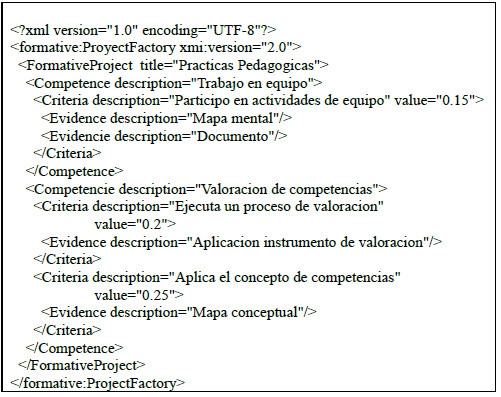
<body><![CDATA[<p lang="en-US" align="justify" style="text-indent: 0.25cm; margin-bottom: 0cm; line-height: 100%"> <font size="2" style="font-size: 10pt" face="Verdana"><span style="letter-spacing: -0.1pt">Through an implicit EMF editor, it is possible to generate the eXtensible Markup Language (XML) of the ecore model. In <a href="#t10">Table 10</a>, an XML document, which is a representation of the ecore production from <a href="#f8">Figure 8</a>, is shown.</span></font></p>     <p lang="en-US" align="center" style="text-indent: 0.25cm; margin-bottom: 0cm; line-height: 100%"> <font size="2" style="font-size: 10pt" face="Verdana"><span lang="es-CO"><b><a name="t10">Table</a> 10:</b></span> Formative <span lang="es-CO">Project XML </span>Document </font><font face="Verdana" size="2">     <br> <img src="/img/revistas/cleiej/v17n3/3a09t10.jpg"> </font> </p>     <p lang="en-US" align="justify" style="text-indent: 0.25cm; margin-bottom: 0cm; line-height: 115%"> <font size="2" style="font-size: 10pt" face="Verdana"> <span lang="en-US" style="letter-spacing: -0.1pt">An application case is presented in a virtual course in the next section, and this intends to show the correspondence with the model.</span></font></p>     <p lang="en-US" style="margin-bottom: 0.5cm"><font face="Verdana" size="2">6 Application Case</font></p>     <p lang="en-US" align="justify" style="margin-bottom: 0cm; line-height: 100%"> <font size="2" style="font-size: 10pt" face="Verdana"> <span lang="en-US" style="letter-spacing: -0.1pt">As an application case, an example of a competence evaluation in the Diplomat of Didactic Strategies and Evaluation, which is offered through the virtual mode in the CIFE University Corporation of Mexico, is presented. <a href="#t11">Table 11</a> shows a matrix (rubrics) that relates the criteria with the evidence, and the proficiency expected.</span></font></p>     <p lang="en-US" align="center" style="text-indent: 0.25cm; margin-bottom: 0cm; line-height: 100%"> <font size="2" style="font-size: 10pt" face="Verdana"><span lang="en-US"><b><a name="t11">Table</a> 11:</b> Learning Map</span></font><font face="Verdana" size="2">     <br> <img src="/img/revistas/cleiej/v17n3/3a09t11.jpg"> </font> </p>     <p lang="en-US" align="justify" style="text-indent: 0.25cm; margin-bottom: 0.35cm; line-height: 100%"> <font size="2" style="font-size: 10pt" face="Verdana"> <span lang="en-US" style="letter-spacing: -0.1pt">In the rubrics, the description of the five proficiency levels associated with a criterion always appears. The virtual environment of the diplomat course is designed by phases, which always retains the same structure of activities to be performed by students. In Fig 9, the basic design of a virtual diplomat course is shown.</span></font></p>     <p lang="en-US" align="center" style="text-indent: 0.25cm; margin-bottom: 0.35cm; line-height: 115%"> <font face="Verdana"><font size="2"> <img src="/img/revistas/cleiej/v17n3/3a09f9.jpg">     ]]></body>
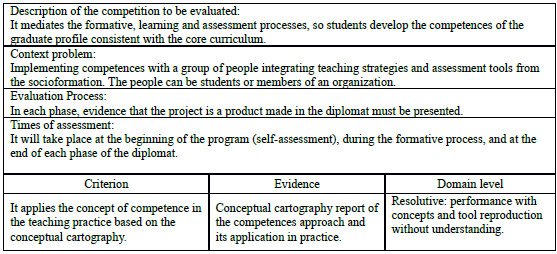
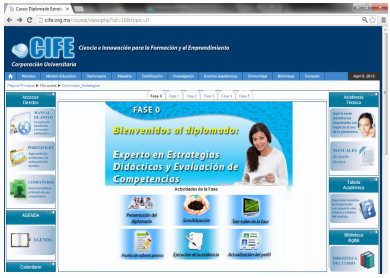
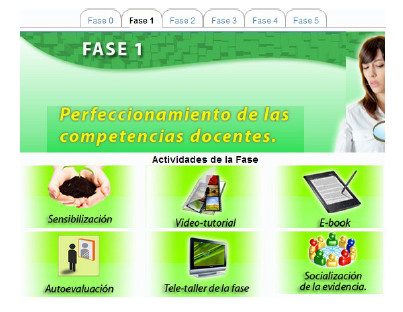
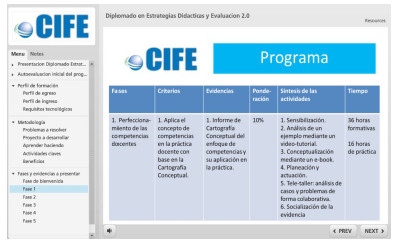
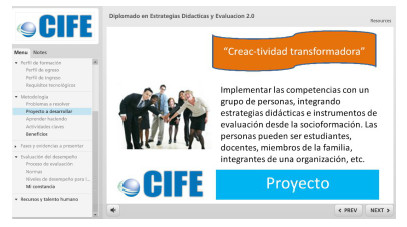
<body><![CDATA[<br> </font><font size="2" style="font-size: 10pt"><span style="letter-spacing: -0.1pt"><b><a name="f9">Figure 9</a>: </b>Design of a Virtual Diplomat</span></font><font size="2"> </font></font> </p>     <p lang="en-US" align="justify" style="text-indent: 0.25cm; margin-bottom: 0.35cm; line-height: 100%"> <font size="2" style="font-size: 10pt" face="Verdana"><span style="letter-spacing: -0.1pt">The instructional design of the graduate shows the activities to be performed. For example, for Phase 1 the sensitization, self-evaluation, socialization of evidence, among others is defined. Each one of these activities has different learning objects that support formation. In <a href="#f10">Fig. 10</a>, the structure of phase 1 is shown in greater detail.</span></font></p>     <p lang="en-US" align="center" style="text-indent: 0.25cm; margin-bottom: 0.35cm; line-height: 115%"> <font face="Verdana"><font size="2"> <img src="/img/revistas/cleiej/v17n3/3a09f10.jpg">     <br> </font><font size="2" style="font-size: 10pt"><span style="letter-spacing: -0.1pt"><b><a name="f10">Figure 10</a>: </b>Phase Activities </span></font></font> </p>     <p lang="en-US" align="justify" style="text-indent: 0.25cm; margin-bottom: 0.35cm; line-height: 100%"> <font size="2" style="font-size: 10pt" face="Verdana"><span style="letter-spacing: -0.1pt">In each phase, the criteria, the evidence, the weight of the evidence, the description of the activities to be done, and the time for their implementation are defined. These aspects are defined in the virtual course as shown in <a href="#f11">Fig. 11</a>.</span></font></p>     <p lang="en-US" align="center" style="text-indent: 0.25cm; margin-bottom: 0.35cm; line-height: 115%"> <font face="Verdana"><font size="2"> <img src="/img/revistas/cleiej/v17n3/3a09f11.jpg">     <br> </font><font size="2" style="font-size: 10pt"><span style="letter-spacing: -0.1pt"><b><a name="f11">Figure 11</a>: </b>Competence Assessment Sequence</span></font><font size="2"> </font></font> </p>     <p lang="en-US" align="justify" style="text-indent: 0.25cm; margin-bottom: 0.35cm; line-height: 100%"> <font size="2" style="font-size: 10pt" face="Verdana"><span style="letter-spacing: -0.1pt">The learning process of the student revolves around a formative project that provides progressively the activities that must be performed for the competence goal. This case study covers only the aspects taken in the model, i.e., the part of the project creation and the definition of competences, criteria and evidence for it. The description of the formative project to be done within the diplomat is shown in <a href="#f12">Fig. 12</a>.</span></font></p>     <p lang="en-US" align="center" style="text-indent: 0.25cm; margin-bottom: 0.35cm; line-height: 115%"> <font face="Verdana"><font size="2"> <img src="/img/revistas/cleiej/v17n3/3a09f12.jpg">     <br> </font><font size="2" style="font-size: 10pt"><span style="letter-spacing: -0.1pt"><b><a name="f12">Figure 12</a>: </b>Formative Project Definition </span></font></font> </p>     ]]></body>
<body><![CDATA[<p lang="en-US" align="justify" style="text-indent: 0.25cm; margin-bottom: 0.35cm; line-height: 100%"> <font size="2" style="font-size: 10pt" face="Verdana"><span style="letter-spacing: -0.1pt">In the CIFE virtual formation, 23 virtual Diplomats were given in Latin America in countries such as Chile, Colombia, Venezuela, Ecuador, Mexico and Bolivia.</span></font></p>     <p lang="en-US" style="margin-left: 0.4cm; text-indent: -0.4cm; margin-bottom: 0.5cm"> <font face="Verdana" size="2">7 Conclusions</font></p>     <p lang="en-US" align="justify" style="text-indent: 0.25cm; margin-bottom: 0cm; line-height: 100%"> <font size="2" style="font-size: 10pt" face="Verdana"> <span lang="en-US" style="letter-spacing: -0.1pt">In a process of competence formation, different types of knowledge of the human performance are considered. They relate ethical issues and emphasize attitudes, skills and knowledge, which are necessary to address and resolve context problems. The integration of these aspects has transformed the assessment in education where it is emphasized on formative assessment oriented towards the diagnosis and valuation of integrated actions before environment problems. The socioformative approach highlights the recognition and appreciative nature of the evaluation during the different stages of the formative process, in which the diagnostic evaluation is contemplated, continuous, for the accreditation and socio-evaluation where it is required the definition and planning of monitoring and feedback.</span></font></p>     <p lang="en-US" align="justify" style="text-indent: 0.25cm; margin-bottom: 0cm; letter-spacing: -0.1pt; line-height: 100%"> <font size="2" style="font-size: 10pt" face="Verdana">Project-based learning places the student as the core of the formative process where he must display his skills in scenarios very similar to the real world, which he should display his various competences for planning, management, monitoring and evaluation of his work. Based on its main concepts, there is a methodology of the formative projects which are aimed at the formation and assessment of competences through an articulated set of actions of planning, acting, and communication.</font></p>     <p lang="en-US" align="justify" style="text-indent: 0.25cm; margin-bottom: 0cm; letter-spacing: -0.1pt; line-height: 100%"> <font size="2" style="font-size: 10pt" face="Verdana">With the review of the related work, it is identified that there are different types of pedagogical strategies and technological tools that support the development of competences in students today. In all such cases, the method of learning through projects where it is clear the use of various formative methodologies; teamwork, the assignment of roles, and collaborative work stands out. Regarding the assessment form it was identified that in many cases the course assessment is summative, and focused on cognitive aspects and disciplinary content, without being explicit the student feedback in the learning process. It was identified only in a couple of jobs that the portfolio method was used for evaluating students.</font></p>     <p lang="en-US" align="justify" style="text-indent: 0.25cm; margin-bottom: 0cm; letter-spacing: -0.1pt; line-height: 100%"> <font size="2" style="font-size: 10pt" face="Verdana">In this context from the socioformative approach, a model based in the methodology of the formative projects was designed, in which the definition of competencies, the assessment criteria and the delivery of evidence is possible. The assessment model includes the proficiency levels of competence and the types of assessment applicable during the formative process of students.</font></p>     <p lang="en-US" align="justify" style="text-indent: 0.25cm; margin-bottom: 0cm; letter-spacing: -0.1pt; line-height: 100%"> <font size="2" style="font-size: 10pt" face="Verdana">The proposed model meets the characteristics of development and assessment of competences of the socioformative approach. The model validation was performed using the EMF and GMF frameworks, which are supported by code generating technological tools that guarantee the semantic and syntactic correctness. Likewise, this validation allows to state that the model meets the abstraction of the domain, and this is reflected in the virtual formative courses of the CIFE University Corporation where the phases, activities, formative projects, and competence assessment are defined.</font></p>     <p lang="en-US" align="justify" style="text-indent: 0.25cm; margin-bottom: 0.35cm; letter-spacing: -0.1pt; line-height: 100%"> <font size="2" style="font-size: 10pt" face="Verdana">As a future work, it should be designed a multidimensional model of a student that considers the individual differences of students based on proficiency levels. Additionally, it must be implemented an architecture to personalize the educational experience of students through a virtual learning environment.</font></p>     <p lang="en-US" align="justify" style="text-indent: 0.25cm; margin-bottom: 0cm; letter-spacing: -0.1pt; line-height: 115%"> <font size="2" style="font-size: 10pt" face="Verdana"><b>Acknowledgements</b></font></p>     <p lang="en-US" align="justify" style="text-indent: 0.25cm; margin-bottom: 0.35cm; line-height: 100%"> <font size="2" style="font-size: 10pt" face="Verdana"> <span lang="en-US" style="letter-spacing: -0.1pt">The members of this paper thank the Administrative Department of Science, Technology and Innovation Colciencias, convening 569 of 2012, for the financial support of the research project: Adaptive Learning Environment Based on a Multidimensional Student Model, code 142556935016.</span></font></p>     ]]></body>
<body><![CDATA[<p lang="en-US" align="justify" style="margin-bottom: 0.35cm; letter-spacing: -0.1pt; line-height: 115%"> <font size="2" style="font-size: 10pt" face="Verdana"><b>References</b></font></p>     <p lang="en-US" style="margin-left: 1.13cm; text-indent: -1.13cm; margin-top: 0.42cm; margin-bottom: 0cm; line-height: 100%"> <font size="2" style="font-size: 10pt" face="Verdana"><a name="r1">[</a><a href="#br1">1</a>] J. Kim, &ldquo;Education reform policies and classroom teaching in South Korea,&rdquo; <i>Int. Stud. Sociol. Educ.</i>, vol. 14, pp. 125&ndash;145, 2004.</font></p>     <p lang="en-US" style="margin-left: 1.13cm; text-indent: -1.13cm; margin-top: 0.42cm; margin-bottom: 0cm; line-height: 100%"> <font size="2" style="font-size: 10pt" face="Verdana"><a name="r2">[</a><a href="#br2">2</a>] J. Velez, &ldquo;Entorno de aprendizaje virtual adaptativo soportado por un modelo de usuario integral,&rdquo; Universitad de Girona, 2009.</font></p>     <!-- ref --><p lang="en-US" style="margin-left: 1.13cm; text-indent: -1.13cm; margin-top: 0.42cm; margin-bottom: 0cm; line-height: 100%"> <font size="2" style="font-size: 10pt" face="Verdana"><a name="r3">[</a><a href="#br3">3</a>] S. Tob&oacute;n, <i>Formaci&oacute;n integral y competencias</i>, Tercera Ed. Bogot&aacute;: ECOE Ediciones, 2010, p. 328.    </font></p>     <p lang="en-US" style="margin-left: 1.13cm; text-indent: -1.13cm; margin-top: 0.42cm; margin-bottom: 0cm; line-height: 100%"> <font size="2" style="font-size: 10pt" face="Verdana"><a name="r4">[</a><a href="#br4">4</a>] &Aacute;. D&iacute;az-barriga, &ldquo;El enfoque de competencias en la educaci&oacute;n. &iquest;Una alternativa o un disfraz de cambio?,&rdquo; <i>Perfiles Educ.</i>, vol. XXVIII, no. 111, pp. 7&ndash;36, 2006.</font></p>     <p lang="en-US" style="margin-left: 1.13cm; text-indent: -1.13cm; margin-top: 0.42cm; margin-bottom: 0cm; line-height: 100%"> <font size="2" style="font-size: 10pt" face="Verdana"><a name="r5">[</a><a href="#br5">5</a>] A. Gonczi and J. Athanasou, <i>Instrumentaci&oacute;n de la educaci&oacute;n basada en competencias. Perspectiva de la teor&iacute;a y la pr&aacute;ctica en Australia</i>, Limusa. Mexico, 1996, pp. 274&ndash;275.</font></p>     <p lang="en-US" style="margin-left: 1.13cm; text-indent: -1.13cm; margin-top: 0.42cm; margin-bottom: 0cm; line-height: 100%"> <font size="2" style="font-size: 10pt" face="Verdana"><a name="r6">[</a><a href="#br6">6</a>] H. Biemans, L. Nieuwenhuis, R. Poell, M. Mulder, and R. Wesselink, &ldquo;Competence-based VET in the Netherlands&#8239;: background and pitfalls,&rdquo; <i>Vocat. Educ. Train.</i>, vol. 56, no. 4, pp. 523&ndash;538, 2005.</font></p>     <p lang="en-US" style="margin-left: 1.13cm; text-indent: -1.13cm; margin-top: 0.42cm; margin-bottom: 0cm; line-height: 100%"> <font size="2" style="font-size: 10pt" face="Verdana"><a name="r7">[</a><a href="#br7">7</a>] S. Cardona, J. Velez, and S. Tob&oacute;n, &ldquo;Towards a model for assessing competencies,&rdquo; in <i>Computing Colombian Conference (8CCC)</i>, 2013, pp. 109&ndash;114.</font></p>     <p lang="en-US" style="margin-left: 1.13cm; text-indent: -1.13cm; margin-top: 0.42cm; margin-bottom: 0cm; line-height: 100%"> <font size="2" style="font-size: 10pt" face="Verdana"><a name="r8">[</a><a href="#br8">8</a>] S. Cardona, J. Velez, and S. Tob&oacute;n, &ldquo;Towards an adaptive system based on competences,&rdquo; in <i>6th COLCOM - IEEE Colombian Conference on Communications and Computer</i>, 2013, pp. 1&ndash;6.</font></p>     ]]></body>
<body><![CDATA[<p lang="en-US" style="margin-left: 1.13cm; text-indent: -1.13cm; margin-top: 0.42cm; margin-bottom: 0cm; line-height: 100%"> <font size="2" style="font-size: 10pt" face="Verdana"><a name="r9">[</a><a href="#br9">9</a>] A. Ouellet, &ldquo;La evaluaci&oacute;n informativa al servicio de las competencias,&rdquo; <i>Rev. Esc. Adm. negocios</i>, vol. 41, pp. 30&ndash;42, 2000.</font></p>     <!-- ref --><p lang="en-US" style="margin-left: 1.13cm; text-indent: -1.13cm; margin-top: 0.42cm; margin-bottom: 0cm; line-height: 100%"> <font size="2" style="font-size: 10pt" face="Verdana"><a name="r10">[</a><a href="#br10">10</a>] P. Perrenoud, <i>Diez nuevas competencias para ense&ntilde;ar</i>, GRAO. Barcelona, 2004, p. 168.    </font></p>     <p lang="en-US" style="margin-left: 1.13cm; text-indent: -1.13cm; margin-top: 0.42cm; margin-bottom: 0cm; line-height: 100%"> <font size="2" style="font-size: 10pt" face="Verdana"><a name="r11">[</a><a href="#br11">11</a>] DeSeCo, &ldquo;The definition and selection of key competencies,&rdquo; 2005.</font></p>     <p lang="en-US" style="margin-left: 1.13cm; text-indent: -1.13cm; margin-top: 0.42cm; margin-bottom: 0cm; line-height: 100%"> <font size="2" style="font-size: 10pt" face="Verdana"><a name="r12">[</a><a href="#br12">12</a>] E. Tuning, &ldquo;Tuning educational structures in Europe,&rdquo; Bilbao, 2006.</font></p>     <p lang="en-US" style="margin-left: 1.13cm; text-indent: -1.13cm; margin-top: 0.42cm; margin-bottom: 0cm; line-height: 100%"> <font size="2" style="font-size: 10pt" face="Verdana"><a name="r13">[</a><a href="#br13">13</a>] &Aacute;. D&iacute;az-barriga, &ldquo;Competencias en educaci&oacute;n . Corrientes de pensamiento e implicaciones para el curr&iacute;culo y el trabajo en el aula,&rdquo; <i>Rev. Iberoam. Educ. Super.</i>, vol. 2, no. 5, pp. 3&ndash;24, 2011.</font></p>     <p lang="en-US" style="margin-left: 1.13cm; text-indent: -1.13cm; margin-top: 0.42cm; margin-bottom: 0cm; line-height: 100%"> <font size="2" style="font-size: 10pt" face="Verdana"><a name="r14">[</a><a href="#br14">14</a>] I. G&oacute;mez, &ldquo;Competencias profesionales: una propuesta de evaluaci&oacute;n para Las facultades de ciencias administrativas,&rdquo; <i>Educ. y Educ.</i>, vol. 8, pp. 45&ndash;66, 2005.</font></p>     <p lang="en-US" style="margin-left: 1.13cm; text-indent: -1.13cm; margin-top: 0.42cm; margin-bottom: 0cm; line-height: 100%"> <font size="2" style="font-size: 10pt" face="Verdana"><a name="r15">[</a><a href="#br15">15</a>] G. Bunk, &ldquo;La transmisi&oacute;n de las competencias en la for maci&oacute;n y perfeccio namiento profesionales de la RFA,&rdquo; <i>Rev. Eur.</i>, vol. 1, pp. 8&ndash;14, 1994.</font></p>     <p lang="en-US" style="margin-left: 1.13cm; text-indent: -1.13cm; margin-top: 0.42cm; margin-bottom: 0cm; line-height: 100%"> <font size="2" style="font-size: 10pt" face="Verdana"><a name="r16">[</a><a href="#br16">16</a>] M. Mulder, T. Weigel, and K. Collins, &ldquo;The concept of competence in the development of vocational education and training in selected EU member states &ndash; a critical analysis,&rdquo; <i>J. Vocat. Educ. Train.</i>, vol. 59, no. 1, pp. 65&ndash;85, 2006.</font></p>     <p lang="en-US" style="margin-left: 1.13cm; text-indent: -1.13cm; margin-top: 0.42cm; margin-bottom: 0cm; line-height: 100%"> <font size="2" style="font-size: 10pt" face="Verdana"><a name="r17">[</a><a href="#br17">17</a>] J. Tardif, &ldquo;Desarrollo de un programa por competencias: De la intenci&oacute;n a su implementaci&oacute;n,&rdquo; <i>Rev. Curric. y Form. del Profr.</i>, vol. 16, no. 3, pp. 36&ndash;45, 2008.</font></p>     ]]></body>
<body><![CDATA[<p lang="en-US" style="margin-left: 1.13cm; text-indent: -1.13cm; margin-top: 0.42cm; margin-bottom: 0cm; line-height: 100%"> <font size="2" style="font-size: 10pt" face="Verdana"><a name="r18">[</a><a href="#br18">18</a>] S. Tob&oacute;n, <i>Formaci&oacute;n basada en competencias</i>, ECOE. Bogot&aacute;, 2005, pp. 1&ndash;286.</font></p>     <p lang="en-US" style="margin-left: 1.13cm; text-indent: -1.13cm; margin-top: 0.42cm; margin-bottom: 0cm; line-height: 100%"> <font size="2" style="font-size: 10pt" face="Verdana"><a name="r19">[</a><a href="#br19">19</a>] E. Quellmalz and J. Pellegrino, &ldquo;Technology and testing,&rdquo; <i>Science (80-. ).</i>, vol. 323, pp. 75&ndash;79, Jan. 2009.</font></p>     <!-- ref --><p lang="en-US" style="margin-left: 1.13cm; text-indent: -1.13cm; margin-top: 0.42cm; margin-bottom: 0cm; line-height: 100%"> <font size="2" style="font-size: 10pt" face="Verdana"><a name="r20">[</a><a href="#br20">20</a>] M. Zabalza, <i>Competencias docentes del profesorado universitario</i>, Narcea. Madrid, 2007, p. 256.    </font></p>     <p lang="en-US" style="margin-left: 1.13cm; text-indent: -1.13cm; margin-top: 0.42cm; margin-bottom: 0cm; line-height: 100%"> <font size="2" style="font-size: 10pt" face="Verdana"><a name="r21">[</a><a href="#br21">21</a>] D. Joosten-ten Brinke, J. van Bruggen, H. Hermans, J. Burgers, B. Giesbers, R. Koper, and I. Latour, &ldquo;Modeling assessment for re-use of traditional and new types of assessment,&rdquo; <i>Comput. Human Behav.</i>, vol. 23, no. 6, pp. 2721&ndash;2741, Nov. 2007.</font></p>     <p lang="en-US" style="margin-left: 1.13cm; text-indent: -1.13cm; margin-top: 0.42cm; margin-bottom: 0cm; line-height: 100%"> <font size="2" style="font-size: 10pt" face="Verdana"><a name="r22">[</a><a href="#br22">22</a>] V. Van den Bergh, D. Mortelmans, P. Spooren, P. Van Petegem, D. Gijbels, and G. Vanthournout, &ldquo;New assessment modes within project-based education - the stakeholders,&rdquo; <i>Stud. Educ. Eval.</i>, vol. 32, no. 4, pp. 345&ndash;368, Jan. 2006.</font></p>     <p lang="en-US" style="margin-left: 1.13cm; text-indent: -1.13cm; margin-top: 0.42cm; margin-bottom: 0cm; line-height: 100%"> <font size="2" style="font-size: 10pt" face="Verdana"><a name="r23">[</a><a href="#br23">23</a>] N. El Faddouli, B. El Falaki, M. K. Idrissi, and S. Bennani, &ldquo;Towards an adaptive competency-based learning system using assessment,&rdquo; <i>Int. J. Comput. Sci.</i>, vol. 8, no. 1, pp. 265&ndash;274, 2011.</font></p>     <p lang="en-US" style="margin-left: 1.13cm; text-indent: -1.13cm; margin-top: 0.42cm; margin-bottom: 0cm; line-height: 100%"> <font size="2" style="font-size: 10pt" face="Verdana"><a name="r24">[</a><a href="#br24">24</a>] E. Essa, A. Dittrich, S. Dascalu, and F. C. H. Jr., &ldquo;ACAT: A web-based software tool to facilitate course assessment for ABET accreditation,&rdquo; in <i>2010 Seventh international conference on Information technology</i>, 2010, pp. 88&ndash;93.</font></p>     <p lang="en-US" style="margin-left: 1.13cm; text-indent: -1.13cm; margin-top: 0.42cm; margin-bottom: 0cm; line-height: 100%"> <font size="2" style="font-size: 10pt" face="Verdana"><a name="r25">[</a><a href="#br25">25</a>] J. G. Moura, L. O. Brand&atilde;o, and A. A. F. Brand&atilde;o, &ldquo;A web-based learning management system with automatic assessment resources,&rdquo; in <i>Frontiers in education conference - Global engineering</i>, 2007, pp. 1&ndash;6.</font></p>     <p lang="en-US" style="margin-left: 1.13cm; text-indent: -1.13cm; margin-top: 0.42cm; margin-bottom: 0cm; line-height: 100%"> <font size="2" style="font-size: 10pt" face="Verdana"><a name="r26">[</a><a href="#br26">26</a>] C. C. Marinagi, V. G. Kaburlasos, and V. T. Tsoukalas, &ldquo;An architecture for an adaptive assessment tool,&rdquo; in <i>37Th annual frontiers in education conference</i>, 2007, pp. 11&ndash;16.</font></p>     ]]></body>
<body><![CDATA[<p lang="en-US" style="margin-left: 1.13cm; text-indent: -1.13cm; margin-top: 0.42cm; margin-bottom: 0cm; line-height: 100%"> <font size="2" style="font-size: 10pt" face="Verdana"><a name="r27">[</a><a href="#br27">27</a>] C. Smaill, &ldquo;The Implementation and Evaluation of OASIS, a Web-Based Learning and Assessment Tool,&rdquo; in <i>Proceedings. Frontiers in education. 36th Annual Conference</i>, 2006, pp. 1&ndash;6.</font></p>     <p lang="en-US" style="margin-left: 1.13cm; text-indent: -1.13cm; margin-top: 0.42cm; margin-bottom: 0cm; line-height: 100%"> <font size="2" style="font-size: 10pt" face="Verdana"><a name="r28">[</a><a href="#br28">28</a>] J. Minstrell and P. Kraus, &ldquo;Guided inquiry in the science classroom,&rdquo; in in <i>How students learn: history, mathematics, and science in the classroom</i>, S. Donovan and J. Bransford, Eds. Washington, 2005, pp. 475&ndash;513.</font></p>     <p lang="en-US" style="margin-left: 1.13cm; text-indent: -1.13cm; margin-top: 0.42cm; margin-bottom: 0cm; line-height: 100%"> <font size="2" style="font-size: 10pt" face="Verdana"><a name="r29">[</a><a href="#br29">29</a>] W. H. Kilpatrick, &ldquo;The Project Method,&rdquo; <i>Teach. Coll.</i>, vol. 19, pp. 319&ndash;335, 1918.</font></p>     <p lang="en-US" style="margin-left: 1.13cm; text-indent: -1.13cm; margin-top: 0.42cm; margin-bottom: 0cm; line-height: 100%"> <font size="2" style="font-size: 10pt" face="Verdana"><a name="r30">[</a><a href="#br30">30</a>] K. Adderley, C. Ashwin, P. Bradbury, J. Freeman, S. Goodlad, J. Greene, D. Jenkins, J. Rae, and O. Uren, &ldquo;Project methods in higher education, SRHE working party on teaching methods: techniques group.,&rdquo; Guildford, 1975.</font></p>     <p lang="en-US" style="margin-left: 1.13cm; text-indent: -1.13cm; margin-top: 0.42cm; margin-bottom: 0cm; line-height: 100%"> <font size="2" style="font-size: 10pt" face="Verdana"><a name="r31">[</a><a href="#br31">31</a>] N. Osada and N. Miyake, &ldquo;From CSCL classroom to real-world settings through project-based learning,&rdquo; in <i>Proceedings of the conference on Computer support for collaborative learning</i>, 2005, pp. 479&ndash;483.</font></p>     <p lang="en-US" style="margin-left: 1.13cm; text-indent: -1.13cm; margin-top: 0.42cm; margin-bottom: 0cm; line-height: 100%"> <font size="2" style="font-size: 10pt" face="Verdana"><a name="r32">[</a><a href="#br32">32</a>] R. Pucher and M. Lehner, &ldquo;Project Based Learning in Computer Science &ndash; A Review of More than 500 Projects,&rdquo; <i>Procedia - Soc. Behav. Sci.</i>, vol. 29, no. 2010, pp. 1561&ndash;1566, Jan. 2011.</font></p>     <p lang="en-US" style="margin-left: 1.13cm; text-indent: -1.13cm; margin-top: 0.42cm; margin-bottom: 0cm; line-height: 100%"> <font size="2" style="font-size: 10pt" face="Verdana"><a name="r33">[</a><a href="#br33">33</a>] L. Arpin and L. Capra, <i>L&rsquo;apprentissage par projets</i>. Montreal: Cheneli&egrave;re/McGraw-Hill, 2001.</font></p>     <p lang="en-US" style="margin-left: 1.13cm; text-indent: -1.13cm; margin-top: 0.42cm; margin-bottom: 0cm; line-height: 100%"> <font size="2" style="font-size: 10pt" face="Verdana"><a name="r34">[</a><a href="#br34">34</a>] S. Lam, R. W. Cheng, and H. C. Choy, &ldquo;School support and teacher motivation to implement project-based learning,&rdquo; <i>Learn. Instr.</i>, vol. 20, no. 6, pp. 487&ndash;497, Dec. 2010.</font></p>     <p lang="en-US" style="margin-left: 1.13cm; text-indent: -1.13cm; margin-top: 0.42cm; margin-bottom: 0cm; line-height: 100%"> <font size="2" style="font-size: 10pt" face="Verdana"><a name="r35">[</a><a href="#br35">35</a>] P. S. Chinowsky, H. Brown, A. Szajnman, and A. Realph, &ldquo;Developing Knowledge Landscapes through Project-Based Learning,&rdquo; <i>J. Prof. issues Eng. Educ. Pract.</i>, vol. 132, no. 2, pp. 118&ndash;124, 2006.</font></p>     <p lang="en-US" style="margin-left: 1.13cm; text-indent: -1.13cm; margin-top: 0.42cm; margin-bottom: 0cm; line-height: 100%"> <font size="2" style="font-size: 10pt" face="Verdana"><a name="r36">[</a><a href="#br36">36</a>] P. Blumenfeld, E. Soloway, R. Marx, J. Krajcik, M. Guzdial, and A. Palincsar, &ldquo;Motivating project-based learning: Sustaining the doing, supporting the learning,&rdquo; <i>Educ. Psychol.</i>, vol. 26, no. 3, pp. 369&ndash;398, 1991.</font></p>     ]]></body>
<body><![CDATA[<p lang="en-US" style="margin-left: 1.13cm; text-indent: -1.13cm; margin-top: 0.42cm; margin-bottom: 0cm; line-height: 100%"> <font size="2" style="font-size: 10pt" face="Verdana"><a name="r37">[</a><a href="#br37">37</a>] M. Garabet and C. Miron, &ldquo;The development of the oral communicative ability at pupils during the physics lessons through the project method,&rdquo; <i>Procedia - Soc. Behav. Sci.</i>, vol. 2, no. 2, pp. 5130&ndash;5138, Jan. 2010.</font></p>     <p lang="en-US" style="margin-left: 1.13cm; text-indent: -1.13cm; margin-top: 0.42cm; margin-bottom: 0cm; line-height: 100%"> <font size="2" style="font-size: 10pt" face="Verdana"><a name="r38">[</a><a href="#br38">38</a>] J. Proulx, <i>Apprentissage par projet</i>. Quebec: Presses de l&rsquo;Universit&eacute; du Qu&eacute;bec, 2004.</font></p>     <p lang="en-US" style="margin-left: 1.13cm; text-indent: -1.13cm; margin-top: 0.42cm; margin-bottom: 0cm; line-height: 100%"> <font size="2" style="font-size: 10pt" face="Verdana"><a name="r39">[</a><a href="#br39">39</a>] A. Breiter, G. Fey, and R. Drechsler, &ldquo;Project-based learning in student teams in computer science education,&rdquo; <i>Electron. Energ. Spec. issue Comput. Sci. Educ.</i>, vol. 18, no. 2, pp. 165&ndash;180, 2005.</font></p>     <p lang="en-US" style="margin-left: 1.13cm; text-indent: -1.13cm; margin-top: 0.42cm; margin-bottom: 0cm; line-height: 100%"> <font size="2" style="font-size: 10pt" face="Verdana"><a name="r40">[</a><a href="#br40">40</a>] A. Morgan, &ldquo;Theoretical aspects of project-based learning in higher education,&rdquo; <i>Br. J. Educ. Technol.</i>, vol. 1, pp. 66&ndash;78, 1983.</font></p>     <p lang="en-US" style="margin-left: 1.13cm; text-indent: -1.13cm; margin-top: 0.42cm; margin-bottom: 0cm; line-height: 100%"> <font size="2" style="font-size: 10pt" face="Verdana"><a name="r41">[</a><a href="#br41">41</a>] U. K&ouml;se, &ldquo;A web based system for project-based learning activities in &lsquo;web design and programming&rsquo; course,&rdquo; <i>Procedia - Soc. Behav. Sci.</i>, vol. 2, no. 2, pp. 1174&ndash;1184, Jan. 2010.</font></p>     <p lang="en-US" style="margin-left: 1.13cm; text-indent: -1.13cm; margin-top: 0.42cm; margin-bottom: 0cm; line-height: 100%"> <font size="2" style="font-size: 10pt" face="Verdana"><a name="r42">[</a><a href="#br42">42</a>] R. J. Mislevy, L. S. Steinberg, F. J. Breyer, R. G. Almond, and L. Johnson, &ldquo;Making sense of data from complex assessments.&rdquo; Princeton, p. 40, 1999.</font></p>     <p lang="en-US" style="margin-left: 1.13cm; text-indent: -1.13cm; margin-top: 0.42cm; margin-bottom: 0cm; line-height: 100%"> <font size="2" style="font-size: 10pt" face="Verdana"><a name="r43">[</a><a href="#br43">43</a>] E. F. Brahim, K. I. Mohammed, and B. Samir, &ldquo;A formative assessment model within the competency-based-approach for an individualized e-learning path,&rdquo; <i>World Acad. Sci. Eng. Technol.</i>, vol. 40, pp. 208&ndash;212, 2010.</font></p>     <p lang="en-US" style="margin-left: 1.13cm; text-indent: -1.13cm; margin-top: 0.42cm; margin-bottom: 0cm; line-height: 100%"> <font size="2" style="font-size: 10pt" face="Verdana"><a name="r44">[</a><a href="#br44">44</a>] C. Dom&iacute;nguez and A. Jaime, &ldquo;Database design learning: A project-based approach organized through a course management system,&rdquo; <i>Comput. Educ.</i>, vol. 55, no. 3, pp. 1312&ndash;1320, Nov. 2010.</font></p>     <p lang="en-US" style="margin-left: 1.13cm; text-indent: -1.13cm; margin-top: 0.42cm; margin-bottom: 0cm; line-height: 100%"> <font size="2" style="font-size: 10pt" face="Verdana"><a name="r45">[</a><a href="#br45">45</a>] Y. G&uuml;lbahar and H. Tinmaz, &ldquo;Implementing project-based learning and e-portfolio assessment in an undergraduate course,&rdquo; <i>Int. Soc. Technol. Educ.</i>, vol. 5191, pp. 309&ndash;327, 2006.</font></p>     <p lang="en-US" style="margin-left: 1.13cm; text-indent: -1.13cm; margin-top: 0.42cm; margin-bottom: 0cm; line-height: 100%"> <font size="2" style="font-size: 10pt" face="Verdana"><a name="r46">[</a><a href="#br46">46</a>] E. N&uacute;&ntilde;ez, L. Fern&aacute;ndez, and J. Ram&iacute;rez, &ldquo;Aproximaci&oacute;n al aprendizaje por proyectos en sistemas lineales de control,&rdquo; <i>Rev. Energ&iacute;ay Comput.</i>, vol. 16, no. 2, pp. 1&ndash;9, 2008.</font></p>     ]]></body>
<body><![CDATA[<p lang="en-US" style="margin-left: 1.13cm; text-indent: -1.13cm; margin-top: 0.42cm; margin-bottom: 0cm; line-height: 100%"> <font size="2" style="font-size: 10pt" face="Verdana"><a name="r47">[</a><a href="#br47">47</a>] O. Jian, D. Yi-ning, and Y. Jin-sheng, &ldquo;Design and Application of a Project-Based Teaching Environment,&rdquo; in <i>International Conference on Computer Technology and Development</i>, 2009, pp. 125&ndash;129.</font></p>     <p lang="en-US" style="margin-left: 1.13cm; text-indent: -1.13cm; margin-top: 0.42cm; margin-bottom: 0cm; line-height: 100%"> <font size="2" style="font-size: 10pt" face="Verdana"><a name="r48">[</a><a href="#br48">48</a>] H. Keser and D. Karahoca, &ldquo;Designing a project management e-course by using project based learning,&rdquo; <i>Procedia - Soc. Behav. Sci.</i>, vol. 2, no. 2, pp. 5744&ndash;5754, Jan. 2010.</font></p>     <p lang="en-US" style="margin-left: 1.13cm; text-indent: -1.13cm; margin-top: 0.42cm; margin-bottom: 0cm; line-height: 100%"> <font size="2" style="font-size: 10pt" face="Verdana"><a name="r49">[</a><a href="#br49">49</a>] I. Milentijevic, V. Ciric, and O. Vojinovic, &ldquo;Version control in project-based learning,&rdquo; <i>Comput. Educ.</i>, vol. 50, no. 4, pp. 1331&ndash;1338, May 2008.</font></p>     <!-- ref --><p lang="en-US" style="margin-left: 1.13cm; text-indent: -1.13cm; margin-top: 0.42cm; margin-bottom: 0cm; line-height: 100%"> <font size="2" style="font-size: 10pt" face="Verdana"><a name="r50">[</a><a href="#br50">50</a>] S. Tob&oacute;n, <i>Metodolog&iacute;a de gesti&oacute;n curricular. Una perspectiva socioformativa</i>. M&eacute;xico: Trillas, 2013.    </font></p>     <p lang="en-US" style="margin-left: 1.13cm; text-indent: -1.13cm; margin-top: 0.42cm; margin-bottom: 0cm; line-height: 100%"> <font size="2" style="font-size: 10pt" face="Verdana"><a name="r51">[</a><a href="#br51">51</a>] R. Oppermann, <i>Adaptive user support</i>, Lawrence E. Hillsdale, New Jersey, 1994, pp. 1&ndash;13.</font></p>     <p lang="en-US" style="margin-left: 1.13cm; text-indent: -1.13cm; margin-top: 0.42cm; margin-bottom: 0cm; line-height: 100%"> <font size="2" style="font-size: 10pt" face="Verdana"><a name="r52">[</a><a href="#br52">52</a>] S. Graf and Kinshuk, &ldquo;Advanced Adaptivity in Learning Management Systems by Considering Learning Styles,&rdquo; <i>2009 IEEE/WIC/ACM Int. Jt. Conf. web Intell. Intell. agent Technol.</i>, pp. 235&ndash;238, 2009.</font></p>     <p lang="en-US" style="margin-left: 1.13cm; text-indent: -1.13cm; margin-top: 0.42cm; margin-bottom: 0cm; line-height: 100%"> <font size="2" style="font-size: 10pt" face="Verdana"><a name="r53">[</a><a href="#br53">53</a>] M. Despotovi&#263;-zraki&#263;, A. Markovi&#263;, Z. Bogdanovi&#263;, D. Bara&#263;, and J. Ili&#263;a, &ldquo;Providing adaptivity in Moodle LMS courses ddaptive e-learning systems,&rdquo; <i>Educ. Technol. Soc.</i>, vol. 15, no. 1, pp. 326&ndash;338, 2012.</font></p>     <p lang="en-US" style="margin-left: 1.13cm; text-indent: -1.13cm; margin-top: 0.42cm; margin-bottom: 0cm; line-height: 100%"> <font size="2" style="font-size: 10pt" face="Verdana"><a name="r54">[</a><a href="#br54">54</a>] S. Graf, T.-C. Liu, and Kinshuk, &ldquo;Analysis of learners&rsquo; navigational behaviour and their learning styles in an online course,&rdquo; <i>J. Comput. Assist. Learn.</i>, vol. 26, no. 2, pp. 116&ndash;131, Mar. 2010.</font></p>     <p lang="en-US" style="margin-left: 1.13cm; text-indent: -1.13cm; margin-top: 0.42cm; margin-bottom: 0cm; line-height: 100%"> <font size="2" style="font-size: 10pt" face="Verdana"><span lang="en-US"><a name="r">[</a><a href="#br">55</a>] Eclipse, &ldquo;Eclipse Modeling Framework Project,&rdquo; 2013. [Online]. Available: <a href="http://www.eclipse.org/modeling/emf/">http://www.eclipse.org/modeling/emf/</a>. [Accessed: 12-Apr-2013]. </span></font> </p>     ]]></body>
<body><![CDATA[<div title="footer"> 	    <p lang="en-US" align="center" style="margin-top: 1.15cm; margin-bottom: 0cm; line-height: 100%"> 	<font face="Verdana" size="2"> 	<br/>  	</font>  	</p> 	    <p lang="en-US" style="margin-bottom: 0cm; line-height: 100%"> 	<font face="Verdana" size="2"> 	<br/>  	</font>  	</p> </div>      ]]></body><back>
<ref-list>
<ref id="B1">
<label>1</label><nlm-citation citation-type="journal">
<person-group person-group-type="author">
<name>
<surname><![CDATA[Kim]]></surname>
<given-names><![CDATA[J]]></given-names>
</name>
</person-group>
<article-title xml:lang="en"><![CDATA[Education reform policies and classroom teaching in South Korea]]></article-title>
<source><![CDATA[Int. Stud. Sociol. Educ]]></source>
<year>2004</year>
<volume>14</volume>
<page-range>125-145</page-range></nlm-citation>
</ref>
<ref id="B2">
<label>2</label><nlm-citation citation-type="book">
<person-group person-group-type="author">
<name>
<surname><![CDATA[Velez]]></surname>
<given-names><![CDATA[J]]></given-names>
</name>
</person-group>
<source><![CDATA[Entorno de aprendizaje virtual adaptativo soportado por un modelo de usuario integral]]></source>
<year>2009</year>
<publisher-name><![CDATA[Universitad de Girona]]></publisher-name>
</nlm-citation>
</ref>
<ref id="B3">
<label>3</label><nlm-citation citation-type="book">
<person-group person-group-type="author">
<name>
<surname><![CDATA[Tobón]]></surname>
<given-names><![CDATA[S]]></given-names>
</name>
</person-group>
<source><![CDATA[Formación integral y competencias]]></source>
<year>2010</year>
<edition>Tercera</edition>
<page-range>328</page-range><publisher-loc><![CDATA[Bogotá ]]></publisher-loc>
<publisher-name><![CDATA[ECOE Ediciones]]></publisher-name>
</nlm-citation>
</ref>
<ref id="B4">
<label>4</label><nlm-citation citation-type="journal">
<person-group person-group-type="author">
<name>
<surname><![CDATA[Díaz-barriga]]></surname>
<given-names><![CDATA[Á.]]></given-names>
</name>
</person-group>
<article-title xml:lang="es"><![CDATA[El enfoque de competencias en la educación: ¿Una alternativa o un disfraz de cambio?]]></article-title>
<source><![CDATA[Perfiles Educ.]]></source>
<year>2006</year>
<volume>XXVIII</volume>
<numero>111</numero>
<issue>111</issue>
<page-range>7-36</page-range></nlm-citation>
</ref>
<ref id="B5">
<label>5</label><nlm-citation citation-type="">
<person-group person-group-type="author">
<name>
<surname><![CDATA[Gonczi]]></surname>
<given-names><![CDATA[A]]></given-names>
</name>
<name>
<surname><![CDATA[Athanasou]]></surname>
<given-names><![CDATA[J.]]></given-names>
</name>
</person-group>
<source><![CDATA[Instrumentación de la educación basada en competencias: Perspectiva de la teoría y la práctica en Australia]]></source>
<year>1996</year>
<page-range>274-275</page-range><publisher-loc><![CDATA[Limusa ]]></publisher-loc>
</nlm-citation>
</ref>
<ref id="B6">
<label>6</label><nlm-citation citation-type="journal">
<person-group person-group-type="author">
<name>
<surname><![CDATA[Biemans]]></surname>
<given-names><![CDATA[H]]></given-names>
</name>
<name>
<surname><![CDATA[Nieuwenhuis]]></surname>
<given-names><![CDATA[L.]]></given-names>
</name>
<name>
<surname><![CDATA[Poell]]></surname>
<given-names><![CDATA[R.]]></given-names>
</name>
<name>
<surname><![CDATA[Mulder]]></surname>
<given-names><![CDATA[M]]></given-names>
</name>
<name>
<surname><![CDATA[Wesselink]]></surname>
<given-names><![CDATA[R.]]></given-names>
</name>
</person-group>
<article-title xml:lang="en"><![CDATA[Competence-based VET in the Netherlands&#8239;: background and pitfalls]]></article-title>
<source><![CDATA[Vocat. Educ. Train]]></source>
<year>2005</year>
<volume>56</volume>
<numero>4</numero>
<issue>4</issue>
<page-range>523-538</page-range></nlm-citation>
</ref>
<ref id="B7">
<label>7</label><nlm-citation citation-type="confpro">
<person-group person-group-type="author">
<name>
<surname><![CDATA[Cardona]]></surname>
<given-names><![CDATA[S]]></given-names>
</name>
<name>
<surname><![CDATA[Velez]]></surname>
<given-names><![CDATA[J.]]></given-names>
</name>
<name>
<surname><![CDATA[Tobón]]></surname>
<given-names><![CDATA[S.]]></given-names>
</name>
</person-group>
<article-title xml:lang="en"><![CDATA[Towards a model for assessing competencies]]></article-title>
<source><![CDATA[]]></source>
<year></year>
<conf-name><![CDATA[ Computing Colombian Conference (8CCC)]]></conf-name>
<conf-date>2013</conf-date>
<conf-loc> </conf-loc>
</nlm-citation>
</ref>
<ref id="B8">
<label>8</label><nlm-citation citation-type="confpro">
<person-group person-group-type="author">
<name>
<surname><![CDATA[Cardona]]></surname>
<given-names><![CDATA[S.]]></given-names>
</name>
<name>
<surname><![CDATA[Velez]]></surname>
<given-names><![CDATA[J.]]></given-names>
</name>
<name>
<surname><![CDATA[Tobón]]></surname>
<given-names><![CDATA[S.]]></given-names>
</name>
</person-group>
<article-title xml:lang="en"><![CDATA[Towards an adaptive system based on competences]]></article-title>
<source><![CDATA[]]></source>
<year></year>
<conf-name><![CDATA[6th COLCOM - IEEE Colombian Conference on Communications and Computer]]></conf-name>
<conf-date>2013</conf-date>
<conf-loc> </conf-loc>
</nlm-citation>
</ref>
<ref id="B9">
<label>9</label><nlm-citation citation-type="journal">
<person-group person-group-type="author">
<name>
<surname><![CDATA[Ouellet]]></surname>
<given-names><![CDATA[A.]]></given-names>
</name>
</person-group>
<article-title xml:lang="es"><![CDATA[La evaluación informativa al servicio de las competencias]]></article-title>
<source><![CDATA[Rev. Esc. Adm. negocios]]></source>
<year></year>
<volume>41</volume>
<page-range>30-42</page-range></nlm-citation>
</ref>
<ref id="B10">
<label>10</label><nlm-citation citation-type="book">
<person-group person-group-type="author">
<name>
<surname><![CDATA[Perrenou]]></surname>
<given-names><![CDATA[P.]]></given-names>
</name>
</person-group>
<source><![CDATA[Diez nuevas competencias para enseñar]]></source>
<year>2004</year>
<page-range>168</page-range><publisher-loc><![CDATA[Barcelona ]]></publisher-loc>
<publisher-name><![CDATA[GRAO]]></publisher-name>
</nlm-citation>
</ref>
<ref id="B11">
<label>11</label><nlm-citation citation-type="">
<collab>DeSeCo</collab>
<source><![CDATA[The definition and selection of key competencies]]></source>
<year>2005</year>
</nlm-citation>
</ref>
<ref id="B12">
<label>12</label><nlm-citation citation-type="">
<person-group person-group-type="author">
<name>
<surname><![CDATA[Tuning]]></surname>
<given-names><![CDATA[E.]]></given-names>
</name>
</person-group>
<source><![CDATA[Tuning educational structures in Europe]]></source>
<year>2006</year>
<publisher-loc><![CDATA[Bilbao ]]></publisher-loc>
</nlm-citation>
</ref>
<ref id="B13">
<label>13</label><nlm-citation citation-type="journal">
<person-group person-group-type="author">
<name>
<surname><![CDATA[Díaz-barriga]]></surname>
<given-names><![CDATA[Á.]]></given-names>
</name>
</person-group>
<article-title xml:lang="en"><![CDATA[Competencias en educación: Corrientes de pensamiento e implicaciones para el currículo y el trabajo en el aula]]></article-title>
<source><![CDATA[Rev. Iberoam. Educ. Super.]]></source>
<year>2011</year>
<volume>2</volume>
<numero>5</numero>
<issue>5</issue>
<page-range>3-24</page-range></nlm-citation>
</ref>
<ref id="B14">
<label>14</label><nlm-citation citation-type="journal">
<person-group person-group-type="author">
<name>
<surname><![CDATA[Gómez]]></surname>
<given-names><![CDATA[I.]]></given-names>
</name>
</person-group>
<article-title xml:lang="es"><![CDATA[Competencias profesionales: una propuesta de evaluación para Las facultades de ciencias administrativas]]></article-title>
<source><![CDATA[Educ. y Educ]]></source>
<year>2005</year>
<volume>8</volume>
<page-range>45-66</page-range></nlm-citation>
</ref>
<ref id="B15">
<label>15</label><nlm-citation citation-type="journal">
<person-group person-group-type="author">
<name>
<surname><![CDATA[Bunk]]></surname>
<given-names><![CDATA[G]]></given-names>
</name>
</person-group>
<article-title xml:lang="es"><![CDATA[La transmisión de las competencias en la for mación y perfeccio namiento profesionales de la RFA]]></article-title>
<source><![CDATA[Rev. Eur]]></source>
<year>1994</year>
<volume>1</volume>
<page-range>8-14</page-range></nlm-citation>
</ref>
<ref id="B16">
<label>16</label><nlm-citation citation-type="journal">
<person-group person-group-type="author">
<name>
<surname><![CDATA[Mulder]]></surname>
<given-names><![CDATA[M]]></given-names>
</name>
<name>
<surname><![CDATA[Weigel]]></surname>
<given-names><![CDATA[T.]]></given-names>
</name>
<name>
<surname><![CDATA[Collins]]></surname>
<given-names><![CDATA[K.]]></given-names>
</name>
</person-group>
<article-title xml:lang="en"><![CDATA['The concept of competence in the development of vocational education and training in selected EU member states - a critical analysis]]></article-title>
<source><![CDATA[J. Vocat. Educ. Train]]></source>
<year>2006</year>
<volume>59</volume>
<numero>1</numero>
<issue>1</issue>
<page-range>65-85</page-range></nlm-citation>
</ref>
<ref id="B17">
<label>17</label><nlm-citation citation-type="journal">
<person-group person-group-type="author">
<name>
<surname><![CDATA[Tardif]]></surname>
<given-names><![CDATA[J]]></given-names>
</name>
</person-group>
<article-title xml:lang="es"><![CDATA['Desarrollo de un programa por competencias: De la intención a su implementación]]></article-title>
<source><![CDATA[Rev. Curric. y Form. del Profr]]></source>
<year>2008</year>
<volume>16</volume>
<numero>3</numero>
<issue>3</issue>
<page-range>36-45</page-range></nlm-citation>
</ref>
<ref id="B18">
<label>18</label><nlm-citation citation-type="">
<person-group person-group-type="author">
<name>
<surname><![CDATA[Tobón]]></surname>
<given-names><![CDATA[S]]></given-names>
</name>
</person-group>
<source><![CDATA[Formación basada en competencias, ECOE]]></source>
<year>2005</year>
<page-range>1-286</page-range><publisher-loc><![CDATA[Bogotá ]]></publisher-loc>
</nlm-citation>
</ref>
<ref id="B19">
<label>19</label><nlm-citation citation-type="journal">
<person-group person-group-type="author">
<name>
<surname><![CDATA[Quellmalz]]></surname>
<given-names><![CDATA[E]]></given-names>
</name>
<name>
<surname><![CDATA[Pellegrino]]></surname>
<given-names><![CDATA[J.]]></given-names>
</name>
</person-group>
<source><![CDATA[Science]]></source>
<year>2009</year>
<volume>323</volume>
<numero>80</numero>
<issue>80</issue>
<page-range>75-79</page-range></nlm-citation>
</ref>
<ref id="B20">
<label>20</label><nlm-citation citation-type="book">
<person-group person-group-type="author">
<name>
<surname><![CDATA[Zabalza]]></surname>
<given-names><![CDATA[M]]></given-names>
</name>
</person-group>
<source><![CDATA[Competencias docentes del profesorado universitario]]></source>
<year>2007</year>
<page-range>256</page-range><publisher-loc><![CDATA[Madrid ]]></publisher-loc>
<publisher-name><![CDATA[Narcea]]></publisher-name>
</nlm-citation>
</ref>
<ref id="B21">
<label>21</label><nlm-citation citation-type="journal">
<person-group person-group-type="author">
<name>
<surname><![CDATA[Joosten-ten Brinke]]></surname>
<given-names><![CDATA[D]]></given-names>
</name>
<name>
<surname><![CDATA[van Bruggen]]></surname>
<given-names><![CDATA[J.]]></given-names>
</name>
<name>
<surname><![CDATA[Hermans]]></surname>
<given-names><![CDATA[H.]]></given-names>
</name>
<name>
<surname><![CDATA[Burgers]]></surname>
<given-names><![CDATA[J]]></given-names>
</name>
<name>
<surname><![CDATA[Giesbers]]></surname>
<given-names><![CDATA[B]]></given-names>
</name>
<name>
<surname><![CDATA[Koper]]></surname>
<given-names><![CDATA[R]]></given-names>
</name>
<name>
<surname><![CDATA[Latour]]></surname>
<given-names><![CDATA[I.]]></given-names>
</name>
</person-group>
<article-title xml:lang="en"><![CDATA['Modeling assessment for re-use of traditional and new types of assessment]]></article-title>
<source><![CDATA[Comput. Human Behav]]></source>
<year></year>
<volume>23</volume>
<numero>6</numero>
<issue>6</issue>
<page-range>2721-2741</page-range></nlm-citation>
</ref>
<ref id="B22">
<label>22</label><nlm-citation citation-type="journal">
<person-group person-group-type="author">
<name>
<surname><![CDATA[Van den Bergh]]></surname>
<given-names><![CDATA[V]]></given-names>
</name>
<name>
<surname><![CDATA[Mortelmans]]></surname>
<given-names><![CDATA[D]]></given-names>
</name>
<name>
<surname><![CDATA[Spooren]]></surname>
<given-names><![CDATA[P]]></given-names>
</name>
<name>
<surname><![CDATA[Van Petegem]]></surname>
<given-names><![CDATA[P]]></given-names>
</name>
<name>
<surname><![CDATA[Gijbels]]></surname>
<given-names><![CDATA[D.]]></given-names>
</name>
<name>
<surname><![CDATA[Vanthournout]]></surname>
<given-names><![CDATA[G.]]></given-names>
</name>
</person-group>
<article-title xml:lang="en"><![CDATA[New assessment modes within project-based education - the stakeholders]]></article-title>
<source><![CDATA[Stud. Educ. Eval]]></source>
<year>Jan.</year>
<month> 2</month>
<day>00</day>
<volume>32</volume>
<numero>4</numero>
<issue>4</issue>
<page-range>345-368</page-range></nlm-citation>
</ref>
<ref id="B23">
<label>23</label><nlm-citation citation-type="journal">
<person-group person-group-type="author">
<name>
<surname><![CDATA[El Faddouli]]></surname>
<given-names><![CDATA[N]]></given-names>
</name>
<name>
<surname><![CDATA[El Falaki]]></surname>
<given-names><![CDATA[B]]></given-names>
</name>
<name>
<surname><![CDATA[Idrissi]]></surname>
<given-names><![CDATA[M. K]]></given-names>
</name>
<name>
<surname><![CDATA[Bennani]]></surname>
<given-names><![CDATA[S]]></given-names>
</name>
</person-group>
<article-title xml:lang="en"><![CDATA[Towards an adaptive competency-based learning system using assessment]]></article-title>
<source><![CDATA[Int. J. Comput. Sci]]></source>
<year>2011</year>
<volume>8</volume>
<numero>1</numero>
<issue>1</issue>
<page-range>265-274</page-range></nlm-citation>
</ref>
<ref id="B24">
<label>24</label><nlm-citation citation-type="">
<person-group person-group-type="author">
<name>
<surname><![CDATA[Essa]]></surname>
<given-names><![CDATA[E.]]></given-names>
</name>
<name>
<surname><![CDATA[Dittrich]]></surname>
<given-names><![CDATA[A]]></given-names>
</name>
<name>
<surname><![CDATA[Dascalu]]></surname>
<given-names><![CDATA[S.]]></given-names>
</name>
<name>
<surname><![CDATA[F. C. H]]></surname>
<given-names><![CDATA[Jr]]></given-names>
</name>
</person-group>
<source><![CDATA[ACAT: A web-based software tool to facilitate course assessment for ABET accreditation,' in 2010 Seventh international conference on Information technology]]></source>
<year>2010</year>
<page-range>88-93</page-range></nlm-citation>
</ref>
<ref id="B25">
<label>25</label><nlm-citation citation-type="confpro">
<person-group person-group-type="author">
<name>
<surname><![CDATA[Moura]]></surname>
<given-names><![CDATA[J. G]]></given-names>
</name>
<name>
<surname><![CDATA[Brandão]]></surname>
<given-names><![CDATA[L. O]]></given-names>
</name>
<name>
<surname><![CDATA[Brandão]]></surname>
<given-names><![CDATA[A. A. F]]></given-names>
</name>
</person-group>
<article-title xml:lang="en"><![CDATA[A web-based learning management system with automatic assessment resources]]></article-title>
<source><![CDATA[]]></source>
<year></year>
<conf-name><![CDATA[ Frontiers in education conference - Global engineering]]></conf-name>
<conf-date>2007</conf-date>
<conf-loc> </conf-loc>
</nlm-citation>
</ref>
<ref id="B26">
<label>26</label><nlm-citation citation-type="confpro">
<person-group person-group-type="author">
<name>
<surname><![CDATA[Marinagi]]></surname>
<given-names><![CDATA[C. C]]></given-names>
</name>
<name>
<surname><![CDATA[Kaburlasos]]></surname>
<given-names><![CDATA[V. G.]]></given-names>
</name>
<name>
<surname><![CDATA[Tsoukalas]]></surname>
<given-names><![CDATA[V. T.]]></given-names>
</name>
</person-group>
<article-title xml:lang="en"><![CDATA[An architecture for an adaptive assessment tool]]></article-title>
<source><![CDATA[]]></source>
<year></year>
<conf-name><![CDATA[37Th annual frontiers in education conference]]></conf-name>
<conf-date>2007</conf-date>
<conf-loc> </conf-loc>
</nlm-citation>
</ref>
<ref id="B27">
<label>27</label><nlm-citation citation-type="confpro">
<person-group person-group-type="author">
<name>
<surname><![CDATA[Smaill]]></surname>
<given-names><![CDATA[C.]]></given-names>
</name>
</person-group>
<article-title xml:lang="en"><![CDATA[The Implementation and Evaluation of OASIS, a Web-Based Learning and Assessment Tool]]></article-title>
<source><![CDATA[Proceedings: Frontiers in education]]></source>
<year></year>
<conf-name><![CDATA[36th Annual Conference]]></conf-name>
<conf-date>2006</conf-date>
<conf-loc> </conf-loc>
</nlm-citation>
</ref>
<ref id="B28">
<label>28</label><nlm-citation citation-type="">
<person-group person-group-type="author">
<name>
<surname><![CDATA[Minstrell]]></surname>
<given-names><![CDATA[J.]]></given-names>
</name>
<name>
<surname><![CDATA[Kraus]]></surname>
<given-names><![CDATA[P]]></given-names>
</name>
</person-group>
<article-title xml:lang="en"><![CDATA[Guided inquiry in the science classroom]]></article-title>
<person-group person-group-type="editor">
<name>
<surname><![CDATA[Donovan]]></surname>
<given-names><![CDATA[S]]></given-names>
</name>
<name>
<surname><![CDATA[Bransford]]></surname>
<given-names><![CDATA[J]]></given-names>
</name>
</person-group>
<source><![CDATA[How students learn: history, mathematics, and science in the classroom]]></source>
<year>2005</year>
<page-range>475-513</page-range><publisher-loc><![CDATA[Washington ]]></publisher-loc>
</nlm-citation>
</ref>
<ref id="B29">
<label>29</label><nlm-citation citation-type="journal">
<person-group person-group-type="author">
<name>
<surname><![CDATA[Kilpatrick]]></surname>
<given-names><![CDATA[W. H.]]></given-names>
</name>
</person-group>
<article-title xml:lang="en"><![CDATA['The Project Method]]></article-title>
<source><![CDATA[Teach. Coll]]></source>
<year></year>
<volume>19</volume>
<page-range>319-335</page-range><page-range>1918</page-range></nlm-citation>
</ref>
<ref id="B30">
<label>30</label><nlm-citation citation-type="book">
<person-group person-group-type="author">
<name>
<surname><![CDATA[Adderley]]></surname>
<given-names><![CDATA[K.]]></given-names>
</name>
<name>
<surname><![CDATA[Ashwin]]></surname>
<given-names><![CDATA[C]]></given-names>
</name>
<name>
<surname><![CDATA[Bradbury]]></surname>
<given-names><![CDATA[P.]]></given-names>
</name>
<name>
<surname><![CDATA[Freeman]]></surname>
<given-names><![CDATA[J]]></given-names>
</name>
<name>
<surname><![CDATA[Goodlad]]></surname>
<given-names><![CDATA[S.]]></given-names>
</name>
<name>
<surname><![CDATA[Greene]]></surname>
<given-names><![CDATA[J]]></given-names>
</name>
<name>
<surname><![CDATA[Jenkins]]></surname>
<given-names><![CDATA[D.]]></given-names>
</name>
<name>
<surname><![CDATA[Rae]]></surname>
<given-names><![CDATA[J]]></given-names>
</name>
<name>
<surname><![CDATA[Uren]]></surname>
<given-names><![CDATA[O.]]></given-names>
</name>
</person-group>
<source><![CDATA[Project methods in higher education, SRHE working party on teaching methods: techniques group]]></source>
<year>1975</year>
<publisher-name><![CDATA[Guildford]]></publisher-name>
</nlm-citation>
</ref>
<ref id="B31">
<label>31</label><nlm-citation citation-type="confpro">
<person-group person-group-type="author">
<name>
<surname><![CDATA[Osada]]></surname>
<given-names><![CDATA[N]]></given-names>
</name>
<name>
<surname><![CDATA[Miyake]]></surname>
<given-names><![CDATA[N.]]></given-names>
</name>
</person-group>
<article-title xml:lang="en"><![CDATA[From CSCL classroom to real-world settings through project-based learning]]></article-title>
<source><![CDATA[]]></source>
<year></year>
<conf-name><![CDATA[ Proceedings of the conference on Computer support for collaborative learning]]></conf-name>
<conf-date>2005</conf-date>
<conf-loc> </conf-loc>
</nlm-citation>
</ref>
<ref id="B32">
<label>32</label><nlm-citation citation-type="journal">
<person-group person-group-type="author">
<name>
<surname><![CDATA[Pucher]]></surname>
<given-names><![CDATA[R.]]></given-names>
</name>
<name>
<surname><![CDATA[Lehner]]></surname>
<given-names><![CDATA[M.]]></given-names>
</name>
</person-group>
<article-title xml:lang="en"><![CDATA['Project Based Learning in Computer Science - A Review of More than 500 Projects]]></article-title>
<source><![CDATA[Behav. Sci]]></source>
<year>Jan.</year>
<month> 2</month>
<day>01</day>
<volume>29</volume>
<numero>2010</numero>
<issue>2010</issue>
<page-range>1561-1566</page-range></nlm-citation>
</ref>
<ref id="B33">
<label>33</label><nlm-citation citation-type="book">
<person-group person-group-type="author">
<name>
<surname><![CDATA[Arpin]]></surname>
<given-names><![CDATA[L.]]></given-names>
</name>
<name>
<surname><![CDATA[Capra]]></surname>
<given-names><![CDATA[L.]]></given-names>
</name>
</person-group>
<source><![CDATA[L&rsquo;apprentissage par projets]]></source>
<year>2001</year>
<publisher-loc><![CDATA[Montreal ]]></publisher-loc>
<publisher-name><![CDATA[Chenelière/McGraw-Hill]]></publisher-name>
</nlm-citation>
</ref>
<ref id="B34">
<label>34</label><nlm-citation citation-type="journal">
<person-group person-group-type="author">
<name>
<surname><![CDATA[Lam]]></surname>
<given-names><![CDATA[S]]></given-names>
</name>
<name>
<surname><![CDATA[Cheng]]></surname>
<given-names><![CDATA[R. W]]></given-names>
</name>
<name>
<surname><![CDATA[Choy]]></surname>
<given-names><![CDATA[H. C.]]></given-names>
</name>
</person-group>
<article-title xml:lang="en"><![CDATA[School support and teacher motivation to implement project-based learning]]></article-title>
<source><![CDATA[Learn. Instr]]></source>
<year>Dec.</year>
<month> 2</month>
<day>01</day>
<volume>20</volume>
<numero>6</numero>
<issue>6</issue>
<page-range>487-497</page-range></nlm-citation>
</ref>
<ref id="B35">
<label>35</label><nlm-citation citation-type="journal">
<person-group person-group-type="author">
<name>
<surname><![CDATA[Chinowsky]]></surname>
<given-names><![CDATA[P. S.]]></given-names>
</name>
<name>
<surname><![CDATA[Brown]]></surname>
<given-names><![CDATA[H.]]></given-names>
</name>
<name>
<surname><![CDATA[Szajnman]]></surname>
<given-names><![CDATA[A]]></given-names>
</name>
<name>
<surname><![CDATA[Realph]]></surname>
<given-names><![CDATA[A]]></given-names>
</name>
</person-group>
<article-title xml:lang="en"><![CDATA[Developing Knowledge Landscapes through Project-Based Learning]]></article-title>
<source><![CDATA[J. Prof. issues Eng. Educ. Pract]]></source>
<year>2006</year>
<volume>132</volume>
<numero>2</numero>
<issue>2</issue>
<page-range>118-124</page-range></nlm-citation>
</ref>
<ref id="B36">
<label>36</label><nlm-citation citation-type="journal">
<person-group person-group-type="author">
<name>
<surname><![CDATA[Blumenfeld]]></surname>
<given-names><![CDATA[P.]]></given-names>
</name>
<name>
<surname><![CDATA[Soloway]]></surname>
<given-names><![CDATA[E.]]></given-names>
</name>
<name>
<surname><![CDATA[Marx]]></surname>
<given-names><![CDATA[R]]></given-names>
</name>
<name>
<surname><![CDATA[Krajcik]]></surname>
<given-names><![CDATA[J.]]></given-names>
</name>
<name>
<surname><![CDATA[Guzdial]]></surname>
<given-names><![CDATA[M.]]></given-names>
</name>
<name>
<surname><![CDATA[Palincsar]]></surname>
<given-names><![CDATA[A]]></given-names>
</name>
</person-group>
<article-title xml:lang="en"><![CDATA[Motivating project-based learning: Sustaining the doing, supporting the learning]]></article-title>
<source><![CDATA[Educ. Psychol]]></source>
<year>1991</year>
<volume>26</volume>
<numero>3</numero>
<issue>3</issue>
<page-range>369-398</page-range></nlm-citation>
</ref>
<ref id="B37">
<label>37</label><nlm-citation citation-type="journal">
<person-group person-group-type="author">
<name>
<surname><![CDATA[Garabet]]></surname>
<given-names><![CDATA[M.]]></given-names>
</name>
<name>
<surname><![CDATA[Miron]]></surname>
<given-names><![CDATA[C.]]></given-names>
</name>
</person-group>
<article-title xml:lang="en"><![CDATA[The development of the oral communicative ability at pupils during the physics lessons through the project method]]></article-title>
<source><![CDATA[Procedia - Soc. Behav. Sci]]></source>
<year>Jan.</year>
<month> 2</month>
<day>01</day>
<volume>2</volume>
<numero>2</numero>
<issue>2</issue>
<page-range>5130-5138</page-range></nlm-citation>
</ref>
<ref id="B38">
<label>38</label><nlm-citation citation-type="book">
<person-group person-group-type="author">
<name>
<surname><![CDATA[Proulx]]></surname>
<given-names><![CDATA[J.]]></given-names>
</name>
</person-group>
<source><![CDATA[Apprentissage par projet]]></source>
<year>2004</year>
<publisher-loc><![CDATA[Quebec ]]></publisher-loc>
<publisher-name><![CDATA[Presses de l&rsquo;Université du Québec]]></publisher-name>
</nlm-citation>
</ref>
<ref id="B39">
<label>39</label><nlm-citation citation-type="journal">
<person-group person-group-type="author">
<name>
<surname><![CDATA[Breiter]]></surname>
<given-names><![CDATA[A]]></given-names>
</name>
<name>
<surname><![CDATA[Fey]]></surname>
<given-names><![CDATA[G]]></given-names>
</name>
<name>
<surname><![CDATA[Drechsler]]></surname>
<given-names><![CDATA[R]]></given-names>
</name>
</person-group>
<article-title xml:lang="en"><![CDATA[Project-based learning in student teams in computer science education]]></article-title>
<source><![CDATA[Electron. Energ. Spec. issue Comput. Sci. Educ]]></source>
<year>2005</year>
<volume>18</volume>
<numero>2</numero>
<issue>2</issue>
<page-range>165-180</page-range></nlm-citation>
</ref>
<ref id="B40">
<label>40</label><nlm-citation citation-type="journal">
<person-group person-group-type="author">
<name>
<surname><![CDATA[Morgan]]></surname>
<given-names><![CDATA[A]]></given-names>
</name>
</person-group>
<article-title xml:lang="en"><![CDATA[Theoretical aspects of project-based learning in higher education]]></article-title>
<source><![CDATA[Br. J. Educ. Technol]]></source>
<year>1983</year>
<volume>1</volume>
<page-range>66-78</page-range></nlm-citation>
</ref>
<ref id="B41">
<label>41</label><nlm-citation citation-type="journal">
<person-group person-group-type="author">
<name>
<surname><![CDATA[Köse]]></surname>
<given-names><![CDATA[U]]></given-names>
</name>
</person-group>
<article-title xml:lang="en"><![CDATA[A web based system for project-based learning activities in &lsquo;web design and programming&rsquo; course]]></article-title>
<source><![CDATA[Procedia - Soc. Behav. Sci]]></source>
<year>Jan.</year>
<month> 2</month>
<day>01</day>
<volume>2</volume>
<numero>2</numero>
<issue>2</issue>
<page-range>1174-1184</page-range></nlm-citation>
</ref>
<ref id="B42">
<label>42</label><nlm-citation citation-type="book">
<person-group person-group-type="author">
<name>
<surname><![CDATA[Mislevy]]></surname>
<given-names><![CDATA[R. J.]]></given-names>
</name>
<name>
<surname><![CDATA[Steinberg]]></surname>
<given-names><![CDATA[L. S.]]></given-names>
</name>
<name>
<surname><![CDATA[Breyer]]></surname>
<given-names><![CDATA[F. J]]></given-names>
</name>
<name>
<surname><![CDATA[Almond]]></surname>
<given-names><![CDATA[R. G.]]></given-names>
</name>
<name>
<surname><![CDATA[Johnson]]></surname>
<given-names><![CDATA[L.]]></given-names>
</name>
</person-group>
<source><![CDATA['Making sense of data from complex assessments]]></source>
<year></year>
<page-range>40</page-range><publisher-name><![CDATA[Princeton]]></publisher-name>
</nlm-citation>
</ref>
<ref id="B43">
<label>43</label><nlm-citation citation-type="journal">
<person-group person-group-type="author">
<name>
<surname><![CDATA[Brahim]]></surname>
<given-names><![CDATA[E. F]]></given-names>
</name>
<name>
<surname><![CDATA[Mohammed]]></surname>
<given-names><![CDATA[K. I.]]></given-names>
</name>
<name>
<surname><![CDATA[Samir]]></surname>
<given-names><![CDATA[B]]></given-names>
</name>
</person-group>
<article-title xml:lang="en"><![CDATA[A formative assessment model within the competency-based-approach for an individualized e-learning path]]></article-title>
<source><![CDATA[World Acad. Sci. Eng. Technol]]></source>
<year>2010</year>
<volume>40</volume>
<page-range>208-212</page-range></nlm-citation>
</ref>
<ref id="B44">
<label>44</label><nlm-citation citation-type="journal">
<person-group person-group-type="author">
<name>
<surname><![CDATA[Domínguez]]></surname>
<given-names><![CDATA[C.]]></given-names>
</name>
<name>
<surname><![CDATA[Jaime]]></surname>
<given-names><![CDATA[A]]></given-names>
</name>
</person-group>
<article-title xml:lang="en"><![CDATA[Database design learning: A project-based approach organized through a course management system]]></article-title>
<source><![CDATA[Comput. Educ]]></source>
<year>Nov.</year>
<month> 2</month>
<day>01</day>
<volume>55</volume>
<numero>3</numero>
<issue>3</issue>
<page-range>1312-1320</page-range></nlm-citation>
</ref>
<ref id="B45">
<label>45</label><nlm-citation citation-type="journal">
<person-group person-group-type="author">
<name>
<surname><![CDATA[Gülbahar]]></surname>
<given-names><![CDATA[Y]]></given-names>
</name>
<name>
<surname><![CDATA[Tinmaz]]></surname>
<given-names><![CDATA[H.]]></given-names>
</name>
</person-group>
<article-title xml:lang="en"><![CDATA[Implementing project-based learning and e-portfolio assessment in an undergraduate course]]></article-title>
<source><![CDATA[Int. Soc. Technol. Educ]]></source>
<year>2006</year>
<volume>5191</volume>
<page-range>309-327</page-range></nlm-citation>
</ref>
<ref id="B46">
<label>46</label><nlm-citation citation-type="journal">
<person-group person-group-type="author">
<name>
<surname><![CDATA[Núñez]]></surname>
<given-names><![CDATA[E.]]></given-names>
</name>
<name>
<surname><![CDATA[Fernández]]></surname>
<given-names><![CDATA[L.]]></given-names>
</name>
<name>
<surname><![CDATA[Ramírez]]></surname>
<given-names><![CDATA[J.]]></given-names>
</name>
</person-group>
<article-title xml:lang="en"><![CDATA[Aproximación al aprendizaje por proyectos en sistemas lineales de control]]></article-title>
<source><![CDATA[Rev. Energíay Comput]]></source>
<year>2008</year>
<volume>16</volume>
<numero>2</numero>
<issue>2</issue>
<page-range>1-9</page-range></nlm-citation>
</ref>
<ref id="B47">
<label>47</label><nlm-citation citation-type="confpro">
<person-group person-group-type="author">
<name>
<surname><![CDATA[Jian]]></surname>
<given-names><![CDATA[O.]]></given-names>
</name>
<name>
<surname><![CDATA[Yi-ning]]></surname>
<given-names><![CDATA[D.]]></given-names>
</name>
<name>
<surname><![CDATA[Jin-sheng]]></surname>
<given-names><![CDATA[Y.]]></given-names>
</name>
</person-group>
<article-title xml:lang="en"><![CDATA[Design and Application of a Project-Based Teaching Environment]]></article-title>
<source><![CDATA[]]></source>
<year></year>
<conf-name><![CDATA[ International Conference on Computer Technology and Development]]></conf-name>
<conf-date>2009</conf-date>
<conf-loc> </conf-loc>
</nlm-citation>
</ref>
<ref id="B48">
<label>48</label><nlm-citation citation-type="journal">
<person-group person-group-type="author">
<name>
<surname><![CDATA[Keser]]></surname>
<given-names><![CDATA[H]]></given-names>
</name>
<name>
<surname><![CDATA[Karahoca]]></surname>
<given-names><![CDATA[D]]></given-names>
</name>
</person-group>
<article-title xml:lang="en"><![CDATA[Designing a project management e-course by using project based learning]]></article-title>
<source><![CDATA[Procedia - Soc. Behav. Sci]]></source>
<year>Jan.</year>
<month> 2</month>
<day>01</day>
<volume>2</volume>
<numero>2</numero>
<issue>2</issue>
<page-range>5744-5754</page-range></nlm-citation>
</ref>
<ref id="B49">
<label>49</label><nlm-citation citation-type="journal">
<person-group person-group-type="author">
<name>
<surname><![CDATA[Milentijevic]]></surname>
<given-names><![CDATA[I]]></given-names>
</name>
<name>
<surname><![CDATA[Ciric]]></surname>
<given-names><![CDATA[V]]></given-names>
</name>
<name>
<surname><![CDATA[Vojinovic]]></surname>
<given-names><![CDATA[O]]></given-names>
</name>
</person-group>
<article-title xml:lang="en"><![CDATA[Version control in project-based learning]]></article-title>
<source><![CDATA[Comput. Educ]]></source>
<year>May </year>
<month>20</month>
<day>08</day>
<volume>50</volume>
<numero>4</numero>
<issue>4</issue>
<page-range>1331-1338</page-range></nlm-citation>
</ref>
<ref id="B50">
<label>50</label><nlm-citation citation-type="book">
<person-group person-group-type="author">
<name>
<surname><![CDATA[Tobón]]></surname>
<given-names><![CDATA[S.]]></given-names>
</name>
</person-group>
<source><![CDATA[Metodología de gestión curricular: Una perspectiva socioformativa]]></source>
<year>2013</year>
<publisher-name><![CDATA[Trillas]]></publisher-name>
</nlm-citation>
</ref>
<ref id="B51">
<label>51</label><nlm-citation citation-type="book">
<person-group person-group-type="author">
<name>
<surname><![CDATA[Oppermann]]></surname>
<given-names><![CDATA[R.]]></given-names>
</name>
</person-group>
<source><![CDATA[Adaptive user support, Lawrence E. Hillsdale]]></source>
<year>1994</year>
<page-range>1-13</page-range><publisher-name><![CDATA[New Jersey]]></publisher-name>
</nlm-citation>
</ref>
<ref id="B52">
<label>52</label><nlm-citation citation-type="confpro">
<person-group person-group-type="author">
<name>
<surname><![CDATA[Graf]]></surname>
<given-names><![CDATA[S]]></given-names>
</name>
<name>
<surname><![CDATA[Kinshuk]]></surname>
<given-names><![CDATA[J]]></given-names>
</name>
</person-group>
<article-title xml:lang="en"><![CDATA[Advanced Adaptivity in Learning Management Systems by Considering Learning Styles]]></article-title>
<source><![CDATA[]]></source>
<year></year>
<conf-name><![CDATA[ Int. Jt. Conf. web Intell. Intell. agent Technol]]></conf-name>
<conf-loc> </conf-loc>
</nlm-citation>
</ref>
<ref id="B53">
<label>53</label><nlm-citation citation-type="journal">
<person-group person-group-type="author">
<name>
<surname><![CDATA[Despotovi&#263;-zraki&#263;]]></surname>
<given-names><![CDATA[M.]]></given-names>
</name>
<name>
<surname><![CDATA[Markovi&#263;]]></surname>
<given-names><![CDATA[A]]></given-names>
</name>
<name>
<surname><![CDATA[Bogdanovi&#263;]]></surname>
<given-names><![CDATA[Z.]]></given-names>
</name>
<name>
<surname><![CDATA[Bara&#263;]]></surname>
<given-names><![CDATA[D.]]></given-names>
</name>
<name>
<surname><![CDATA[Ili&#263;a]]></surname>
<given-names><![CDATA[J.]]></given-names>
</name>
</person-group>
<article-title xml:lang="en"><![CDATA[Providing adaptivity in Moodle LMS courses ddaptive e-learning systems]]></article-title>
<source><![CDATA[Educ. Technol. Soc]]></source>
<year>2012</year>
<volume>15</volume>
<numero>1</numero>
<issue>1</issue>
<page-range>326-338</page-range></nlm-citation>
</ref>
<ref id="B54">
<label>54</label><nlm-citation citation-type="journal">
<person-group person-group-type="author">
<name>
<surname><![CDATA[Graf]]></surname>
<given-names><![CDATA[S]]></given-names>
</name>
<name>
<surname><![CDATA[Liu]]></surname>
<given-names><![CDATA[T.-C]]></given-names>
</name>
<name>
<surname><![CDATA[Kinshuk]]></surname>
<given-names><![CDATA[L]]></given-names>
</name>
</person-group>
<article-title xml:lang="en"><![CDATA[Analysis of learners&rsquo; navigational behaviour and their learning styles in an online course]]></article-title>
<source><![CDATA[J. Comput. Assist. Learn]]></source>
<year>Mar.</year>
<month> 2</month>
<day>01</day>
<volume>26</volume>
<numero>2</numero>
<issue>2</issue>
<page-range>116-131</page-range></nlm-citation>
</ref>
<ref id="B55">
<label>55</label><nlm-citation citation-type="">
<collab>Eclipse</collab>
<source><![CDATA[Eclipse Modeling Framework Project]]></source>
<year>2013</year>
</nlm-citation>
</ref>
</ref-list>
</back>
</article>