<?xml version="1.0" encoding="ISO-8859-1"?><article xmlns:mml="http://www.w3.org/1998/Math/MathML" xmlns:xlink="http://www.w3.org/1999/xlink" xmlns:xsi="http://www.w3.org/2001/XMLSchema-instance">
<front>
<journal-meta>
<journal-id>0717-5000</journal-id>
<journal-title><![CDATA[CLEI Electronic Journal]]></journal-title>
<abbrev-journal-title><![CDATA[CLEIej]]></abbrev-journal-title>
<issn>0717-5000</issn>
<publisher>
<publisher-name><![CDATA[Centro Latinoamericano de Estudios en Informática]]></publisher-name>
</publisher>
</journal-meta>
<article-meta>
<article-id>S0717-50002014000200008</article-id>
<title-group>
<article-title xml:lang="en"><![CDATA[Collective Learning in Multi-Agent Systems Based on Cultural Algorithms]]></article-title>
</title-group>
<contrib-group>
<contrib contrib-type="author">
<name>
<surname><![CDATA[Terán]]></surname>
<given-names><![CDATA[Juan]]></given-names>
</name>
<xref ref-type="aff" rid="A01"/>
</contrib>
<contrib contrib-type="author">
<name>
<surname><![CDATA[Aguilar]]></surname>
<given-names><![CDATA[José L]]></given-names>
</name>
<xref ref-type="aff" rid="A01"/>
</contrib>
<contrib contrib-type="author">
<name>
<surname><![CDATA[Cerrada]]></surname>
<given-names><![CDATA[Mariela]]></given-names>
</name>
<xref ref-type="aff" rid="A01"/>
</contrib>
</contrib-group>
<aff id="A01">
<institution><![CDATA[,Universidad de Los Andes CEMISID ]]></institution>
<addr-line><![CDATA[Mérida ]]></addr-line>
<country>Venezuela</country>
</aff>
<pub-date pub-type="pub">
<day>00</day>
<month>08</month>
<year>2014</year>
</pub-date>
<pub-date pub-type="epub">
<day>00</day>
<month>08</month>
<year>2014</year>
</pub-date>
<volume>17</volume>
<numero>2</numero>
<fpage>8</fpage>
<lpage>8</lpage>
<copyright-statement/>
<copyright-year/>
<self-uri xlink:href="http://www.scielo.edu.uy/scielo.php?script=sci_arttext&amp;pid=S0717-50002014000200008&amp;lng=en&amp;nrm=iso"></self-uri><self-uri xlink:href="http://www.scielo.edu.uy/scielo.php?script=sci_abstract&amp;pid=S0717-50002014000200008&amp;lng=en&amp;nrm=iso"></self-uri><self-uri xlink:href="http://www.scielo.edu.uy/scielo.php?script=sci_pdf&amp;pid=S0717-50002014000200008&amp;lng=en&amp;nrm=iso"></self-uri><abstract abstract-type="short" xml:lang="en"><p><![CDATA[This paper aims to present a learning model for coordination schemes in Multi-Agent Systems (MAS) based on Cultural Algorithms (CA). In this model, the individuals (one of the CA components) are the different conversations that may occur in any multi-agent systems, and the coordination scheme learned is at the level of the way to perform the communication protocols into the conversation. A conversation can has sub-conversations, and the sub-conversations and/or conversations are identified with a particular type of conversation associated with a certain interaction patterns. The interaction patterns use the coordination mechanisms existing in the literature. In order to simulate the proposed learning model, we develop a computational tool called CLEMAS, which has been used to apply the model to a case of study in industrial automation, related to a Faults Management System based on Agents]]></p></abstract>
<kwd-group>
<kwd lng="en"><![CDATA[Cultural Algorithms]]></kwd>
<kwd lng="en"><![CDATA[Coordination]]></kwd>
<kwd lng="en"><![CDATA[Multi-Agent Systems]]></kwd>
</kwd-group>
</article-meta>
</front><body><![CDATA[ <p align="center" style="margin-bottom: 0.85cm; line-height: 100%"> &nbsp;</p>     <p align="center" style="margin-bottom: 0.5cm; line-height: 0.64cm" lang="en-US"> <font size="4" face="Verdana"><b>Collective Learning in Multi-Agent Systems Based on Cultural Algorithms</b></font></p>     <p align="center" style="margin-bottom: 0cm; line-height: 100%"> <font size="3" style="font-size: 10pt" face="Verdana"><span lang="es-UY"><b>Juan Ter&aacute;n</b></span></font></p>     <p align="center" style="margin-bottom: 0cm; line-height: 100%"> <font size="3" style="font-size: 10pt" face="Verdana">Universidad de Los Andes, CEMISID</font></p>     <p align="center" style="margin-bottom: 0cm; line-height: 100%"> <font size="3" style="font-size: 10pt" face="Verdana">M&eacute;rida, Venezuela, 5101</font></p>     <p align="center" style="margin-bottom: 0.42cm; line-height: 100%"> <font size="3" style="font-size: 10pt" face="Verdana" color="#00000a"><i><span style="text-decoration: none"><a href="mailto:carlostp@ula.ve">carlostp@ula.ve</a> </span></i></font> </p>     <p align="center" style="margin-bottom: 0cm; line-height: 100%"> <font size="3" style="font-size: 10pt" face="Verdana"><b>Jos&eacute; L. Aguilar</b></font></p>     <p align="center" style="margin-bottom: 0cm; line-height: 100%"> <font size="3" style="font-size: 10pt" face="Verdana">Universidad de Los Andes, CEMISID</font></p>     <p align="center" style="margin-bottom: 0cm; line-height: 100%"> <font size="3" style="font-size: 10pt" face="Verdana">M&eacute;rida, Venezuela, 5101</font></p>     <p align="center" style="margin-bottom: 0.42cm; line-height: 100%"> <font size="3" style="font-size: 10pt" face="Verdana" color="#00000a"><i><span style="text-decoration: none"><a href="mailto:aguilar@ula.ve">aguilar@ula.ve</a> </span></i></font> </p>     ]]></body>
<body><![CDATA[<p align="center" style="margin-bottom: 0.42cm; line-height: 100%"> <font size="3" style="font-size: 10pt" face="Verdana">and</font></p>     <p align="center" style="margin-bottom: 0cm; line-height: 100%"> <font size="3" style="font-size: 10pt" face="Verdana"><b>Mariela Cerrada</b></font></p>     <p align="center" style="margin-bottom: 0cm; line-height: 100%"> <font size="3" style="font-size: 10pt" face="Verdana">Universidad de Los Andes, CEMISID</font></p>     <p align="center" style="margin-bottom: 0cm; line-height: 100%"> <font size="3" style="font-size: 10pt" face="Verdana">M&eacute;rida, Venezuela, 5101</font></p>     <p align="center" style="margin-bottom: 0.42cm; line-height: 100%"> <font size="3" style="font-size: 10pt" face="Verdana" color="#00000a"><span lang="en-US"><i><span style="text-decoration: none"><a href="mailto:cerradam@ula.ve">cerradam@ula.ve</a> </span></i></span></font> </p>     <p style="margin-left: 1.5cm; margin-right: 1.25cm; margin-top: 0.21cm; margin-bottom: 0cm; line-height: 100%"> <font size="2" style="font-size: 10pt" face="Verdana"><span lang="en-US"><b>Abstract</b></span></font></p>     <p style="margin-left: 1.5cm; margin-right: 1.5cm; margin-top: 0.21cm; margin-bottom: 0.21cm; line-height: 100%"> <font size="2" style="font-size: 10pt" face="Verdana"><span lang="en-US">This paper aims to present a learning model for coordination schemes in Multi-Agent Systems (MAS) based on Cultural Algorithms (CA). In this model, the individuals (one of the CA components) are the different conversations that may occur in any multi-agent systems, and the coordination scheme learned is at the level of the way to perform the communication protocols into the conversation. A conversation can has sub-conversations, and the sub-conversations and/or conversations are identified with a particular type of conversation associated with a certain interaction patterns. The interaction patterns use the coordination mechanisms existing in the literature. In order to simulate the proposed learning model, we develop a computational tool called CLEMAS, which has been used to apply the model to a case of study in industrial automation, related to a Faults Management System based on Agents. </span></font> </p>     <p style="margin-left: 1.5cm; margin-right: 1.5cm; margin-top: 0.21cm; margin-bottom: 0.21cm; line-height: 100%"> <font size="2" style="font-size: 10pt" face="Verdana"><span lang="en-US"><b>Spanish Abstract:</b></span></font></p>     <p style="margin-left: 1.5cm; margin-right: 1.5cm; margin-top: 0.21cm; margin-bottom: 0.21cm; line-height: 100%"> <font size="2" style="font-size: 10pt" face="Verdana"><span lang="en-US">Este trabajo tiene como objetivo presentar un modelo de aprendizaje para esquemas de coordinaci&oacute;n en sistemas multi-agente (MAS) basado en Algoritmos Culturales (CA). En este modelo, los individuos (uno de los componentes de CA) son las diferentes conversaciones que pueden ocurrir en cualquier sistema multi-agente, y el esquema de coordinaci&oacute;n aprendido es a nivel de la forma de utilizar los protocolos de comunicaci&oacute;n en la conversaci&oacute;n. Una conversaci&oacute;n puede tener sub-conversaciones, y estas sub-conversaciones y/o conversaciones, se identifican con un tipo particular de conversaci&oacute;n asociada con ciertos patrones de interacci&oacute;n. Los patrones de interacci&oacute;n utilizan los mecanismos de coordinaci&oacute;n existentes en la literatura. Con el fin de simular el modelo de aprendizaje propuesto, desarrollamos una herramienta computacional llamado CLEMAS, que se ha utilizado para aplicar el modelo a un caso de estudio en la automatizaci&oacute;n industrial, relacionada con un sistema manejador de fallas basado en agentes.</span></font></p>     <p style="margin-left: 1.5cm; margin-right: 1.25cm; margin-top: 0.21cm; margin-bottom: 0.64cm; line-height: 100%"> <font size="2" style="font-size: 10pt" face="Verdana"><span lang="en-US"><b>Keywords: </b>Cultural Algorithms, Coordination, Multi-Agent Systems.</span></font></p>     ]]></body>
<body><![CDATA[<p style="margin-left: 1.5cm; margin-right: 1.25cm; margin-top: 0.21cm; margin-bottom: 0.64cm; line-height: 100%"> <font size="2" style="font-size: 10pt" face="Verdana"><span lang="en-US"><b>Spanish Keywords: </b>Algoritmos Culturales, Coordinaci&oacute;n, Sistemas Multi-Agente.</span></font></p>     <p style="margin-left: 1.5cm; margin-right: 1.25cm; margin-top: 0.21cm; margin-bottom: 0.64cm; line-height: 100%"> <font size="2" style="font-size: 10pt" face="Verdana"><span lang="en-US">Received 2013-11-15, Revised 2014-02-20, Accepted 2014-02-20</span></font></p>     <p style="margin-left: 0.3cm; margin-right: 1.25cm; text-indent: -0.3cm; margin-top: 0.21cm; margin-bottom: 0.21cm; line-height: 100%"> <font size="3" style="font-size: 10pt" face="Verdana"><span lang="en-US"><b>1. Introduction</b></span></font></p>     <p style="margin-bottom: 0cm; line-height: 100%"> <font size="2" style="font-size: 10pt" face="Verdana"><span lang="en-US">A MAS is an agents community that interacts by using high level communication protocols and languages, to solve problems beyond its capabilities or knowledge <a name="br1">[</a><a href="#r1">1</a>]. This society of agents may face conflicts not only to communicate, but also by the use of resources, task allocations, etc. To handle these conflicts, there exist coordination mechanisms (CM), which solve these problems. The interactions between agents can be viewed as conversations, which in turn may have sub-conversations. To characterize these conversations and sub- conversations are used types of conversations (TCs), which defines the interaction patterns that can be performed by using well-known communication protocols  <a name="br2">[</a><a href="#r2">2</a><a name="br3">,</a> <a href="#r">3</a>] . In this paper, a learning model based on Cultural Algorithm (CA) is proposed to optimize coordination schemes in a MAS. It aims to set up the particular CM in each one of their conversations. Then, in this sense, a set of coordination schemes that MAS can use, can be seen as the instantiation of the MAS with a particular configuration of CM in their conversations.</span></font></p>     <p style="margin-bottom: 0cm; line-height: 100%"> <font size="2" style="font-size: 10pt" face="Verdana"><span lang="en-US">The CA can provide knowledge, since one of its main components is a common space of experiences providing the capacity for collective learning based on knowledge sharing. Some works related to the coordination of MAS are: in <a name="br3">[</a><a href="#r3">3</a>] it is studied the ad hoc coordination problem, that is, design autonomous agents, which are able to achieve optimal flexibility and efficiency in a MAS with no mechanisms for prior coordination. This work formally conceptualizes this problem by using a game-theoretic model, called the Stochastic Bayesian Game, in which the behavior of a player is determined by its private information. Based on this model, they derive a solution, called Harsanyi-Bellman Ad hoc coordination (HBA), which uses the concept of Bayesian Nash Equilibrium in a planning procedure to find optimal actions in the sense of Bellman Optimal Control. Other works that address the learning approach to coordinate MAS are <a name="br4">[</a><a href="#r4">4</a><a name="br5">,</a> <a href="#r5">5</a>]. These works use one of the techniques more used in multi-agent learning, the Reinforcement Learning (RL). In <a name="br4">[</a><a href="#r4">4</a>], they propose a Bayesian model for optimal exploration in multi-agent systems where the exploration costs are weighed with respect to their expected bene&#64257;ts, by using the notion of value of information.  Unlike standard RL models, this model requires reasoning about how one&rsquo;s actions will in&#64258;uence the behavior of other agents. The estimated value of an action, given a current model, requires a prediction about how will be the in&#64258;uence of this action on the future actions of other agents. The value of information associated with an action includes the information that is provided about other agent&rsquo;s strategies. The work <a name="br5">[</a><a href="#r5">5</a>] studies the reactive learning in MAS. The central problem addressed is how several agents can collectively learn to coordinate their actions in a way to solve a given environmental task together. In approaching this problem, two important constraints have to be taken into consideration: the incompatibility constraint, that is, the fact that different actions may be mutually exclusive; and the local information constraint, that is a fraction of its environment. They propose  two algorithms, called ACE and AGE (ACtion Estimation and Action Group Estimation, respectively), for the reinforcement learning of appropriate sequences of action sets in MAS. The model proposed by <a name="br4">[</a><a href="#r4">4</a>] will be compared later with our learning model based on AC.</span></font></p>     <p style="margin-bottom: 0cm; line-height: 100%"> <font size="2" style="font-size: 10pt" face="Verdana"><span lang="en-US">The previous works have the same north &lsquo;coordination in MAS&rsquo;, besides to have a planning procedures-oriented approach and coordinated actions, with the goal to ensure the achievement of the MAS objectives. This means addressing the internal behavior of the agents to achieve learning. That is, they attack the problem of coordination based on internal actions and behaviors of MAS, for obtain a strategies model of the agents, and achieve collective learning. This class of approaches needs an internal knowledge model of each agent into the MAS.</span></font></p>     <p style="margin-bottom: 0cm; line-height: 100%"> <font size="2" style="font-size: 10pt" face="Verdana"><span lang="en-US">Our model also aims to coordination in MAS, searching the optimization of coordination schemes through a collective learning process, but from another point of view, an external approach to the MAS based on the communication process, and using the common space provided by the CA. It is from this space of exchanging knowledge that the MAS achieves to discern (learn collectively) which is the most suited CM for a set of conversations. Thus, the proposed learning model optimizes the coordination of MAS relating to the communication tasks, by considering the costs of processing and communication generated by each CM. </span></font> </p>     <p style="margin-bottom: 0cm; line-height: 100%"> <font size="2" style="font-size: 10pt" face="Verdana"><span lang="en-US">The paper is organized as follows; section 2 discusses the theoretical framework in which the model is based. Section 3 presents the proposed formal learning model for coordination schemes for MAS. Section 4 presents the design and implementation of CLEMAS tool. Section 5 presents the application of the model to a case of study and the results; finally, section 6 presents the conclusions. The case study is in the field of industrial automation, which is a MAS-based Fault Management System (FMS).</span></font></p>  	    <p style="margin-top: 0.32cm; margin-bottom: 0.21cm; line-height: 100%"> 	<font size="3" style="font-size: 10pt" face="Verdana"><span lang="en-US"><b>2. Theoretical 	Framework 	</b></span></font> 	</p>      <p style="margin-bottom: 0.21cm; line-height: 100%"> <font size="2" style="font-size: 10pt" face="Verdana"><span lang="en-US">For this paper, we can cite three important issues: cultural algorithms, the problem of coordination in MAS, and collective learning in MAS.</span></font></p> <ol start="2"> 	    ]]></body>
<body><![CDATA[<p style="margin-top: 0.32cm; margin-bottom: 0.21cm; line-height: 100%"> 	<font size="2" style="font-size: 10pt" face="Verdana"><span lang="en-US"><b>2.1 The 	problem of coordination in MAS</b></span></font></p>     </ol>     <p style="margin-bottom: 0cm; line-height: 100%"> <font size="2" style="font-size: 10pt" face="Verdana"><span lang="en-US">We can describe coordination in SMA as the set of complementary necessary activities to be performed in a community of agents to act collectively <a name="br1">[</a><a href="#r1">1</a>]. In MAS, coordination can be seen as a process in which agents involved execute their communication acts in a coherent manner. Coherence refers to how well an agents system behaves as a unit. There are several reasons about why agents need to be coordinated <a name="br6">[</a><a href="#r6">6</a>]:</span></font></p> <ul> 	<li/>     <p style="margin-top: 0.21cm; margin-bottom: 0.21cm; line-height: 100%"> 	<font size="2" style="font-size: 10pt" face="Verdana"><span lang="en-US">Prevent 	anarchy or chaos: coordination is necessary or desirable because, 	with the decentralization in agent-based systems, anarchy can set in 	easily. Any agent no longer does possess a global view of the entire 	community to which it belongs. This is simply not feasible in any 	community of reasonable complexity.</span></font></p> 	<li/>     <p style="margin-top: 0.21cm; margin-bottom: 0.21cm; line-height: 100%"> 	<font size="2" style="font-size: 10pt" face="Verdana"><span lang="en-US">Meet 	global constraints: there usually exist global constraints which a 	group of agents must satisfy to be deemed successful. Agents need to 	coordinate their behavior if they must meet such global constraints. 	</span></font> 	</p> 	<li/>     <p style="margin-top: 0.21cm; margin-bottom: 0.21cm; line-height: 100%"> 	<font size="2" style="font-size: 10pt" face="Verdana"><span lang="en-US">Distribute 	expertise, resources or information: agents may have different 	capabilities and specialized knowledge. Alternatively, they may have 	different sources of information, resources (e.g. processing power, 	memory), reliability levels, responsibilities, limitations, charges 	for services, and so on. In such scenarios, agents have to be 	coordinated.</span></font></p>     </ul>     <p style="margin-bottom: 0cm; line-height: 100%"> <font size="2" style="font-size: 10pt" face="Verdana"><span lang="en-US">Now, one way to obtain a generalized approach for the coordination of MAS from the communication point of view, is characterizing interactions among agents. In this work, a conversation is a set of interactions in the community of agents to achieve a goal at a given time. These interactions are called &ldquo;speech acts&rdquo; or &ldquo;communicative acts&rdquo;. As we said, the conversations can be decomposed, in turn, into sub-conversations. The conversations or sub-conversations can be characterized by types of conversations (TCs), which are specific patterns of interactions. In <a name="br2">[</a><a href="#r2">2</a><a name="br3">,</a> <a href="#r3">3</a>] four TCs are defined, based on the FIPA communicative acts, given by:</span></font></p> <ul> 	<li/>     <p style="margin-top: 0.21cm; margin-bottom: 0.21cm; line-height: 95%"> 	<font size="2" style="font-size: 10pt" face="Verdana"><span lang="en-US">TC1: 	Consult. An agent searches any kind of information in databases, 	repositories, warehouses and Internet.</span></font></p> 	<li/>     <p style="margin-top: 0.21cm; margin-bottom: 0.21cm; line-height: 95%"> 	<font size="2" style="font-size: 10pt" face="Verdana"><span lang="en-US">TC2: 	Assign. An agent assigns the tasks performing to other agents. </span></font> 	</p> 	<li/>     ]]></body>
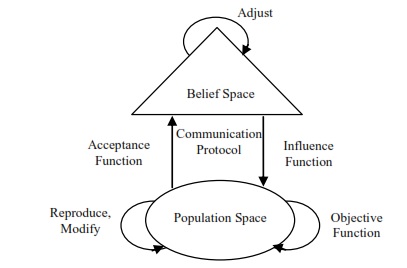
<body><![CDATA[<p style="margin-top: 0.21cm; margin-bottom: 0.21cm; line-height: 100%"> 	<font size="2" style="font-size: 10pt" face="Verdana"><span lang="en-US">TC3: 	Inform. An agent informs to others the occurrence of a certain 	event, information that is being processed or another kind of 	information.</span></font></p> 	<li/>     <p style="margin-top: 0.21cm; margin-bottom: 0.21cm; line-height: 100%"> 	<font size="2" style="font-size: 10pt" face="Verdana"><span lang="en-US">TC4: 	Request. The sender requests to the receiver to perform some action 	or service. </span></font> 	</p>     </ul>     <p style="margin-top: 0.21cm; margin-bottom: 0.21cm; line-height: 100%"> <font size="2" style="font-size: 10pt" face="Verdana"><span lang="en-US">Moreover, these TCs are performed following some CM. In particular, our model uses the following CM standardized by FIPA: English Auction (SI), Dutch Auction (SH), the Contract Net (Tender, L), and Planning (PL). They have been formalized mathematically in previous studies <a name="br2">[</a><a href="#r2">2</a><a name="br3">,</a> <a href="#r3">3</a>], and they are used by CLEMAS tool. Thus, in our model, a conversation can be characterized by one or more TCs, and each one may be treated by different CM.</span></font></p> 	    <p style="margin-top: 0.32cm; margin-bottom: 0.21cm; line-height: 100%"> 	<font size="2" style="font-size: 10pt" face="Verdana"><span lang="es-UY"><b>2.2 Collective 	learning in MAS</b></span></font></p>     <p style="margin-top: 0.21cm; margin-bottom: 0cm; line-height: 100%"> <font size="2" style="font-size: 10pt" face="Verdana"><span lang="en-US">There is a common agreement that there are two important reasons for studying learning in MAS: to be able to endow artificial MAS (e.g., robot swarms, software agents) with the ability to automatically improve their behavior; and to get a better understanding of the learning processes in natural multi-agent systems (e.g., human groups or societies). In MAS two forms of learning can be distinguished <a name="br5">[</a><a href="#r5">5</a>]: first, centralized or isolated learning, i.e. the learning carried out by a single agent (e.g. motor activities); and second, distributed or collective learning, i.e. the learning carried out by the agents as a group (e.g. by exchanging knowledge or by observing other agents). </span></font> </p> 	    <p style="margin-top: 0.32cm; margin-bottom: 0.21cm; line-height: 100%"> 		<font size="2" style="font-size: 10pt" face="Verdana"><b>2.3 Cultural 		Algorithms</b></font></p>      <p style="margin-bottom: 0cm; line-height: 100%"> <font size="2" style="font-size: 10pt" face="Verdana"><span lang="en-US">Evolutionary computation (EC) methods have been successful used in solving many diverse problems of search and optimization due to unbiased nature of their operations, which can be interesting in situations with poor or no knowledge domain. However, there can be considerable improvement in their performance when problems with specific knowledge are used in the solving process. in order to identify patterns in their performance environment <a name="br7">[</a><a href="#r7">7</a>]. Cultural algorithms (CA) were developed by Robert G. Reynolds, as a complement to the metaphor used by EC algorithms. They are based in the fact that the cultural evolution can be seen as a process of inheritance in two levels: the micro-evolution level, which consist in the genetic material inherited from parent to their offspring, and the macro-evolutionary level, which is the knowledge acquired by individuals through generations, and once encoded and stored, serves to guide the behavior of individuals belonging to a population. These algorithms work in two spaces. The first, the population space with a set of individuals, like in all EC methods. Each individual has a set of independent features, with which it is possible to determine their fitness (objective function). On this space operate genetic operators, such as crossover and mutation, for his reproduction. The second is the belief space, where knowledge of previous individuals&rsquo; generation is stored. From the five knowledge used in this belief space defined in the literature, two are the most used (and it will be used in this work), the &ldquo;situational knowledge&rdquo;, consisting of specific examples of important events, such as successful and unsuccessful solutions, and the &ldquo;normative knowledge&rdquo;, which is a collection of ranges of desirable values for the individuals in the population component. There are also a communication protocol that allows the interaction between these two spaces, formed by the &ldquo;acceptance function&rdquo; and the &ldquo;influence function&rdquo; <a name="br7">[</a><a href="#r7">7</a>]. In the <a href="#f1">Fig. 1</a> is illustrated each one of the components of the CA with its operators. </span></font> </p>      <p align="center" style="margin-top: 0.14cm; margin-bottom: 0.35cm; line-height: 100%"> <font face="Verdana"> <a name="f1"> <font size="2"> <img src="/img/revistas/cleiej/v17n2/2a08f1.jpg"> </font> </a> <font size="2">     <br> </font><font size="2" style="font-size: 10pt"><b>Figure 1:</b> Cultural Algorithms Framework</font></font></p>  	    ]]></body>
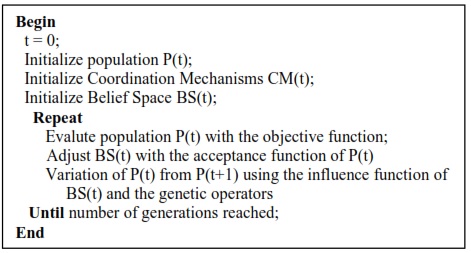
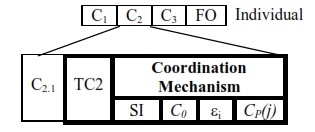
<body><![CDATA[<p style="margin-top: 0.32cm; margin-bottom: 0.21cm; line-height: 100%"> 	<font size="3" style="font-size: 10pt" face="Verdana"><span lang="en-US"><b>3 Learning 	Model of Coordination Schemes in MAS</b></span></font></p>      <p style="margin-bottom: 0.21cm; line-height: 100%"> <font size="2" style="font-size: 10pt" face="Verdana"><span lang="en-US">The formal model of learning proposed in this work involves the formal definition of the CM and the components of a CA <a name="br8">[</a><a href="#r8">8</a>]. Specifically, the components of the learning model are: the population, the CM specification, the belief space, the objective function, and the acceptance and influence functions. A basic pseudo-code for our learning model is shown in <a href="#f2">Fig. 2</a>.    </span></font> </p>     <p align="center" style="margin-top: 0.21cm; margin-bottom: 0cm; line-height: 100%"> <font face="Verdana"> <a name="f2"> <font size="2"> <img src="/img/revistas/cleiej/v17n2/2a08f2.jpg"> </font> </a> <font size="2">     <br> </font><font size="2" style="font-size: 10pt"><span lang="en-US"><b>Figure 2:</b> Basic Pseudo-code for CA- Based Learning Model</span></font></font></p>     <p style="margin-top: 0.21cm; margin-bottom: 0cm; line-height: 100%"> <font size="2" style="font-size: 10pt" face="Verdana"><span lang="en-US">The population, as in any method of CE, is formed by individuals. In our model, each individual is a MAS composed of <i>n</i> different conversations in the community of agents (that is an instantiation of the MAS using in each case different CMs). Remember that, eventually, every conversation, in turn, has sub-conversations. All of them are characterized by the TCs previously defined in section 2.1. </span></font> </p>     <p style="margin-bottom: 0cm; line-height: 100%"> <font size="2" style="font-size: 10pt" face="Verdana"><span lang="en-US">In the <a href="#f3">Fig. 3</a>,  <img src="data:image/png;base64,iVBORw0KGgoAAAANSUhEUgAAABYAAAAUCAIAAAAGHlpnAAABA0lEQVR4nLWUMRKCMBBF4wxHIRYMJ4ATBBorWzopk8ZT2ECJnS2VjXKCcAKGguQuMaDjwBLUjLrln/yXTfYnjlIKfVfOl/5/I2QeYlZPpCATnLofIR7u3VVx8hSrdHVez/xGxN2v7QWZ6GSTddi0IUTIPGG1bhj4BwalJgJEyEtZ6yPHpoaXCiBEa00ACNk1NmYTwl37CNlSwEGwF6BjeZEUjr9KU1T0d6wHlqDTOB4A4dJTVmKGQzQOkbZFzVY8VnD+sothiYp1NPCKjVQ95oGo8xU1IKPGdPYYcwbIPgsOIKO2z0y0/gbQLRGyQ14MNEuEaI+s9OL3d7FcpJh/cj/4cm4hc2CQNY4WeAAAAABJRU5ErkJggg==" name="Objeto1" align="absmiddle" hspace="8"> denotes the conversation <i>i</i> existing in the MAS, <i>FO</i> is the value of the objective function of the individual (instance of the MAS),  <img src="data:image/png;base64,iVBORw0KGgoAAAANSUhEUgAAAB8AAAAUCAIAAAD6C3GtAAABWElEQVR4nMWVMW6DMBSGH1KOghkQJyAncFgysbLBaC/dOnbrQkbYsjJlgZwAToAYMHehD5K2YFtV3RKFCT3b37N+/7+9G8cRHvbtHod+In047QlvViU/FTWz/0u/g+NqrOlX8ZpYF8cEraXf0EjO6KpOj2lPzOAKfThFvEEFJPSMZ8wQLtOHsmhQ3sBQgV/SRbclXKIPfbsRV0e3HQ9gwwaSMsT1IS/Kgcm2viYJZNNRo6UiOMu2n4xWhEoaJLrNzmlBONnDciauPbShuM+oa3WTNnuNO1COS/E7rh4D3Amx+KKKHp2bYaQOrS6xQw9uoIxqszp10HubvqT+uy6xogOHgSNl0PQWE5131DRGs+Xcwn3TVQoN6bMAmnJZeJUI3yLJD4Z00eW8cINZ2UlluEmBuriBHYRASOIsxDGk0+z7KaNZFSefv/NlqhzX318PtOnlWGc/zvkAxomW98tcvAkAAAAASUVORK5CYII=" name="Objeto2" align="absmiddle" hspace="8"> denotes the sub-conversation <i>k</i> of the conversation <i>i,</i> being <i>m</i></span></font><sub><font size="2" style="font-size: 10pt" face="Verdana"><span lang="en-US"><i>i</i></span></font></sub><font size="2" style="font-size: 10pt" face="Verdana"><span lang="en-US"> the number of associated sub-conversations to the conversation,  <img src="data:image/png;base64,iVBORw0KGgoAAAANSUhEUgAAACIAAAASCAIAAACxX5s4AAABSUlEQVR4nN2UMXKDMBBFlxkfRXLBcAI4gezGlVt3oZSa3ANK06WlSuP4BHAChgLpLmRlkAcEEmmczGQrzWpXT/+zaNf3Pbw+dr/A+DuMyhMq6pXCOJMVJ86i6fYPMLKNvvqK4eqeBofGNN/TFMiE8DYWDYGln3s3Y4lRXXji46oBiJ7NYUgNAxFXNutip6yjPoqNIdwol20N8dk0M841RNRojsUw2zAz0zLRNQKWGJ25lQjOjk5zVH4Ro+Mqz+WszoWZi3lmPJRHQdMpYGRiih+zIkZnvMHes5gKGpQrQ+fALMWQfQTgJxFe9Uf9eWjQWmOyjlmKAaBhDEV5U7Yfj2G/mkMRJSGh5WDeBmYpRh/wkZV40wSmnuBwHZqztGCL8LwCqF3M/hFjCuYnHTi6SFW3phBBMaSwa2ME9FHccSXf/kbf/36hXxTfRWSzG/CvMscAAAAASUVORK5CYII=" name="Objeto3" align="absmiddle" hspace="8"> is the type of conversation,  <img src="data:image/png;base64,iVBORw0KGgoAAAANSUhEUgAAADEAAAAUCAIAAACrn0LOAAACGklEQVR4nNWWMY6rMBCGJ9IeJaZAnICcgKVJRZsOSmi2o6TbhpS4S0tFk3ACOAFygbkLOzYkBOyshF7Ee89NCMaej/+fGfPR9z38Y+PjbwNoxn/C1J0PJKrFlX/rM+d5qgx2nxS0U/OVj2GnvAr3f8y0D6velbs3bQfOtGF3TuirMCMOolYTKr5CYawE0jOJwZnl+zVlHBEfEb5zy7drailhBiBVOueYtmQ10gumsmjMo2fTfBKqDBLzEjNCbW8RpjufohrFU70EJwzXI+mZuraxjMywoL4LhbZBXEF7AFjK1F3zGv1013u0iokzMF1U3odkEApt874q4AVGX8rE2ZuRtExSJhHDtKVQIEXaoyKNRqa2eR/Na6ZBJjQN3cOMKgsWZyGMiixlEg/Be7F0/ekuExAUKiIJ1v54X5VJPgQ0v3bhsj+UQQDZmPhYmSe4zFqIKNbc03UvDdNdplEDKx5XaWUS7eyS5iQiB3jeHyN+Nh6fHqoqZV3sM9Cl4Zzp0YjpjoluQ0w/dZ3n/h2RYWa++9BkyS56uovd4Y4oljdKp+1afHfd1JxJ7B7O/stEAifr+0zzRq9XzobzldrfiunohxGCoR5S25zBeCwcl8SYnjTaoUbOstduwiRdWt675taNe8lJrY5NmDijUW66MmlEAgH6BaKS9q4HhATG3L5NmEQ6Ttc3P5C/8gNCl4Zbf9NhZRfH6vd6+QE8Kxta3Adj7AAAAABJRU5ErkJggg==" name="Objeto4" align="absmiddle" hspace="8"> is the CM used, and  <img src="data:image/png;base64,iVBORw0KGgoAAAANSUhEUgAAAB8AAAAWCAIAAAC3w9CmAAABh0lEQVR4nOWULZKDQBCFm6ochUFQnABOADFR2DiQMwaHjFtDZMatRcVATkBOkEIE7jLbTcKyQP5gN2rHTKapfDxez+uFUgrethbvQ/8rer11WOpXBdcPoXOOcP9Lus7joARE1ueTZTxB36EfQs2Tg5qdkGKkgrnEY1Ve9hl0d6cq02HCytXOpQIZIlhoqOicgsHx9Z608t08eqPtCEHsXk9kiPDk/hCZID1NBklii802cuf5jraC7bN+0TaZzgvFLyfOn0u/QyfpVtwKQ2OwD0H+TOmLdJIOR7SgLWBP1XT2bXqdpeh629LfrFt08mXk+vert84aPns56jL2Ar3x5W5WsLHFqHTN2CvaH0mnoJ2SocwmY7ceLcb/bnopmCbsEQbcKLE/Rp+FycWMGeNODegYU/Uwg1VprYY3Ha2UQkPd7vAaTJzA7Zzp1bLUyit/s85qPvjUifSqlCI1l41h5CKgG0ATTV/6wGgU9cyZSCfnut95EDZ7QcRuSMym/1h4y/er4vGg/AJrP7jPUnNWNgAAAABJRU5ErkJggg==" name="Objeto5" align="absmiddle" hspace="8"> are the  <img src="data:image/png;base64,iVBORw0KGgoAAAANSUhEUgAAABAAAAASCAIAAADdWck9AAAApUlEQVR4nGP5//8/AymAhSTVw1LDnYnWqgXHGNK2/Z/pCeJvT2f0YoBxsGlQyT+67Rpji5YqVP+tKwxWYap4nQRSoxOgAuHcvnaMQadGBa8GoBorfBagayBoAbqnt646Bjdz+4ZZDFYT0CzAGazA8Gm5YsWgo4ZmAXooeYdZFRSoMhaAQraGgdFrlpe11u2j+Sq4NIDC9X8+jOP5//9MDKsHYVoCANy6P5yx0S1yAAAAAElFTkSuQmCC" name="Objeto6" align="absmiddle" hspace="8"> parameters of this CM. When a conversation have not sub-conversations, k = 1. </span></font> </p>     <p align="center" style="margin-top: 0.14cm; margin-bottom: 0.35cm; line-height: 100%"> <font face="Verdana"> <a name="f3"> <font size="2"> <img src="/img/revistas/cleiej/v17n2/2a08f3.jpg"> </font> </a> <font size="2">     <br> </font><font size="2" style="font-size: 10pt"><span lang="en-US"><b>Figure 3:</b> Internal Structure of an Individual</span></font></font></p>     <p style="margin-bottom: 0.21cm; line-height: 100%"> <font size="2" style="font-size: 10pt" face="Verdana"><span lang="en-US">The highlighted part of the individual represents the knowledge or experience that it brings. In order to describe a little more the <a href="#f3">Fig. 3</a>, the following example assumes that: There is one individual, a MAS, with three conversations (C</span></font><sub><font size="2" style="font-size: 10pt" face="Verdana"><span lang="en-US">1</span></font></sub><font size="2" style="font-size: 10pt" face="Verdana"><span lang="en-US">, C</span></font><sub><font size="2" style="font-size: 10pt" face="Verdana"><span lang="en-US">2</span></font></sub><font size="2" style="font-size: 10pt" face="Verdana"><span lang="en-US">, C</span></font><sub><font size="2" style="font-size: 10pt" face="Verdana"><span lang="en-US">3</span></font></sub><font size="2" style="font-size: 10pt" face="Verdana"><span lang="en-US">), where C</span></font><sub><font size="2" style="font-size: 10pt" face="Verdana"><span lang="en-US">1</span></font></sub><font size="2" style="font-size: 10pt" face="Verdana"><span lang="en-US"> has two sub-conversations (C</span></font><sub><font size="2" style="font-size: 10pt" face="Verdana"><span lang="en-US">1.1</span></font></sub><font size="2" style="font-size: 10pt" face="Verdana"><span lang="en-US">, C</span></font><sub><font size="2" style="font-size: 10pt" face="Verdana"><span lang="en-US">1.2</span></font></sub><font size="2" style="font-size: 10pt" face="Verdana"><span lang="en-US">), C</span></font><sub><font size="2" style="font-size: 10pt" face="Verdana"><span lang="en-US">2</span></font></sub><font size="2" style="font-size: 10pt" face="Verdana"><span lang="en-US"> has two sub-conversations (C</span></font><sub><font size="2" style="font-size: 10pt" face="Verdana"><span lang="en-US">2.1</span></font></sub><font size="2" style="font-size: 10pt" face="Verdana"><span lang="en-US">, C</span></font><sub><font size="2" style="font-size: 10pt" face="Verdana"><span lang="en-US">2.2</span></font></sub><font size="2" style="font-size: 10pt" face="Verdana"><span lang="en-US">) and C</span></font><sub><font size="2" style="font-size: 10pt" face="Verdana"><span lang="en-US">3</span></font></sub><font size="2" style="font-size: 10pt" face="Verdana"><span lang="en-US"> has three sub-conversations (C</span></font><sub><font size="2" style="font-size: 10pt" face="Verdana"><span lang="en-US">3.1</span></font></sub><font size="2" style="font-size: 10pt" face="Verdana"><span lang="en-US">, C</span></font><sub><font size="2" style="font-size: 10pt" face="Verdana"><span lang="en-US">3.2</span></font></sub><font size="2" style="font-size: 10pt" face="Verdana"><span lang="en-US">, C</span></font><sub><font size="2" style="font-size: 10pt" face="Verdana"><span lang="en-US">3.3</span></font></sub><font size="2" style="font-size: 10pt" face="Verdana"><span lang="en-US">). Besides, it is assumed that the sub-conversation C</span></font><sub><font size="2" style="font-size: 10pt" face="Verdana"><span lang="en-US">2.1</span></font></sub><font size="2" style="font-size: 10pt" face="Verdana"><span lang="en-US"> has a type of sub-conversation TC2 assigned. And finally, for that TC the individual uses the CM <i>english auction</i> (SI). In the <a href="#f4">Fig. 4</a> is shown this example, doing a specific zoom for C</span></font><sub><font size="2" style="font-size: 10pt" face="Verdana"><span lang="en-US">2,1</span></font></sub><font size="2" style="font-size: 10pt" face="Verdana"><span lang="en-US">. This figure also represents the gene of the individual, where C</span></font><sub><font size="2" style="font-size: 10pt" face="Verdana"><span lang="en-US">o</span></font></sub><font size="2" style="font-size: 10pt" face="Verdana"><span lang="en-US">, Cp(j), and </span>&#61541;</font><sub><font size="2" style="font-size: 10pt" face="Verdana"><span lang="en-US">i</span></font></sub><font size="2" style="font-size: 10pt" face="Verdana"><span lang="en-US"> are the parameters of the CM used by C</span></font><sub><font size="2" style="font-size: 10pt" face="Verdana"><span lang="en-US">2,1</span></font></sub><font size="2" style="font-size: 10pt" face="Verdana"><span lang="en-US"> (see <a name="br2">[</a><a href="#r2">2</a><a name="br8">,</a> <a href="#r8">8</a>] for more details about the CM).</span></font></p>      <p align="center" style="margin-top: 0.14cm; margin-bottom: 0.35cm; line-height: 100%"> <font face="Verdana"> <a name="f4"> <font size="2"> <img src="/img/revistas/cleiej/v17n2/2a08f4.jpg"> </font> </a> <font size="2">     ]]></body>
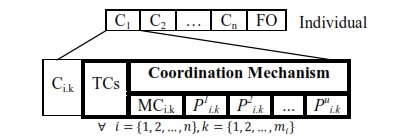
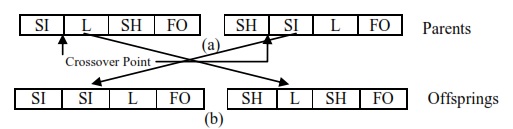
<body><![CDATA[<br> </font><font size="2" style="font-size: 10pt"><span lang="en-US"><b>Figure 4:</b> Example of a Gene on Individual, Zoom in C</span></font></font><sub><font size="2" style="font-size: 10pt" face="Verdana"><span lang="en-US">2</span></font></sub></p>     <p style="margin-bottom: 0cm; line-height: 95%"> <font size="2" style="font-size: 10pt" face="Verdana"><span lang="en-US">For the reproduction of the population are used two genetic operators, mutation and crossover, and only a part of the individual, that is, a gene, is used to apply these genetic operators. For example, assume two individuals like that one of the <a href="#f4">Fig. 4</a>. We further assume that each conversation (C1, C2, C3) has only one sub-conversation (that is, the conversation itself), then, that individual shall be composed of three TCs. Now assume that each of these TCs is defined by a CM. For mutation and crossover, the individual genes are those ones representing the CM and their specific parameters. For these two individual, the application of the crossover operator is shown in <a href="#f5">Fig. 5</a>.</span></font></p>     <p style="margin-bottom: 0cm; line-height: 100%"> <font size="2" style="font-size: 10pt" face="Verdana"><span lang="en-US">In <a href="#f5">Fig. 5</a>, part (a) are the parents and part (b) are their offspring. In the parent to the left, the first CM  is &lsquo;SI&rsquo; for the TC of C1, &lsquo;L&rsquo; for the TC of C2, and &lsquo;SH&rsquo; for the TC of C3, the same in the case of the another parent. The one-point crossover is used (indicated by the double arrow), which is only applied at the level of the CM. We see as two new children are generated. The mutation is simple, it is to take a CM or more from the conversations of a parent, and change it randomly by another CM.</span></font></p>      <p align="center" style="margin-top: 0.14cm; margin-bottom: 0.35cm; line-height: 100%"> <font face="Verdana"> <a name="f5"> <font size="2"> <img src="/img/revistas/cleiej/v17n2/2a08f5.jpg"> </font> </a> <font size="2">     <br></font><font size="2" style="font-size: 10pt"><b>Figure 5:</b> Crossover Operador</font></font></p> <ol start="3"> 	<li/>     <p style="margin-top: 0.32cm; margin-bottom: 0.21cm; line-height: 100%"> 	<font size="2" style="font-size: 10pt" face="Verdana"><span lang="en-US"><b>Objective 	Function</b></span></font></p>     </ol>     <p style="margin-top: 0.21cm; margin-bottom: 0.21cm; line-height: 100%"> <font size="2" style="font-size: 10pt" face="Verdana"><span lang="en-US">The objective function evaluates the performance of each individual. This function is based on the Processing Cost (CP) and Communication Cost (CC) of each CM used by the individual (see equation (1)). There, the parameters <i>a</i> and <i>b</i> are constants defined by the user to weigh the importance of the communication part with respect to the processing part, <i>n</i> is the number of conversations, <i>m</i></span></font><sub><font size="2" style="font-size: 10pt" face="Verdana"><span lang="en-US"><i>i</i></span></font></sub><font size="2" style="font-size: 10pt" face="Verdana"><span lang="en-US"> is the number of sub-conversations in a conversation <i>i</i>, <i>CP</i></span></font><sub><font size="2" style="font-size: 10pt" face="Verdana"><span lang="en-US">i</span></font></sub><font size="2" style="font-size: 10pt" face="Verdana"><span lang="en-US">,</span></font><sub><font size="2" style="font-size: 10pt" face="Verdana"><span lang="en-US">k</span></font></sub><font size="2" style="font-size: 10pt" face="Verdana"><span lang="en-US"> and <i>CC</i></span></font><sub><font size="2" style="font-size: 10pt" face="Verdana"><span lang="en-US"><i>i</i></span></font></sub><font size="2" style="font-size: 10pt" face="Verdana"><span lang="en-US"><i>,</i></span></font><sub><font size="2" style="font-size: 10pt" face="Verdana"><span lang="en-US"><i>k</i></span></font></sub><font size="2" style="font-size: 10pt" face="Verdana"><span lang="en-US"> are the processing cost and the communication cost, respectively, of the CM used in the sub-conversation <i>k</i> of the conversation <i>i</i>. For our case, the best individual will be the one that minimizes the objective function <a name="br2">[</a><a href="#r2">2<a name="br13">,</a> <a href="#r13">13</a>].</span></font></p>     <p align="center" style="margin-top: 0.32cm; margin-bottom: 0.21cm; line-height: 100%"> <font size="2" style="font-size: 10pt" face="Verdana"><span lang="en-US">	<img src="data:image/png;base64,iVBORw0KGgoAAAANSUhEUgAAANgAAAAsCAIAAACIQeG1AAAGm0lEQVR4nO1bPZaqMBiN57ylAAXHFegKwMbKdjopoZnO0s5GSummtbJRVqAr8FgAe+El4T8ESABf8E1uw4wmkBtuvr/EP3EcAwkJ0fgjegASEghSiBKTgBSixCTwPwgxcpfqeXOcO463vd2AaXqLY3i3FdHjkuDAhIRY0hPgUpJi77aO+drFNzAzLzd4WQZvHanE+JiQEHM9xWuLT0lR8Nze7kbk7tPLXJPm8MMwISFmeoKmEWxWPEoKX0BflS7ztY0MrHVdnaSD/hBMSYipkNBVszn6QQEjExhds4vnWOtQP/PdRUIoJiTEVE/o6p3db4MjRryf0DW/xEiAPlgb7xqqxOiYkBAzPSmpkoYhCi6BahjSM38IJiTEcaHYJ+mYPwj/rRAlPgtSiBKTwO8Wou+6qi0rPP8Y1Fn/zUKM3ECzZWb9z2GsND8CSlWJv1iI0VUWGsVAAYEbEeU5mhB9a2Z6tBtsb/EpsyBoZ9h50L5hQLVzDV07zQO7pwgBUDsbMYMypuo4aLM67uGM9Amc76JAJwWuZm1Q8ex3CtE4xaEOHzavMILPP6R/Jowh4buR/z97cgxGsX+OZ8imTqBxEYzYPUEUvEYSYvpmivlIR3Kp7HjXZhV3Uy2tp2zqgE+4gdle78GKjQJrs04o2uvgA6PMu8E1h68HWGwIRvOEom8lKizmzzjdtp7pHHybeU6TEw6e8+WuKloyvo8L7/zu7gi8G4kNSN5N3QoZ62NAKgLN6naXtUs5XPyTMVagGgVPMF/zmlhGCjxMu6Dqelj9hC5ERAgQR1jSCjGW4eL4TQ5mCzy+OU3UW9OSstosWJQ0sDukmGxsV1AxqCwuLnK/sGGmNDRsUuZoVmure9HHgKFxgvrwouv5sdgAdznDrpPNRzNS4GLKgFcQgfK+F12I1aVbPsjiX1AUsqv5YFVflP5r85DF9NC1pNj3OxOVgd1J4AUP/WZspEcjGRSC3jxclYxHhdCszndZW/gM7FlGrB6hBzwe+00YxwqiYFrrTikyUuBjyoDnqxolUoWIDeLDnBVagvNVfENbxFVfDqOV+MQwGuxJnQeXUx+vexlowYN8vVck41vL4Jse/mLWrG+nNqvQvsRjFjHRA/JljlyDcy7MThMLRgpcTLuhaHPiE5oQsfpLdh0ZxLL0KMdOE0PJfxw1TTs8lrU7fvcC/gH5nZ90/FUfquobQCeGpcUKclb7jLLiaDJJ5ykbFEvJRiDpgE3euoEFIwUupr1AEyKZqXSfH0h02OvY1SSkmCgvX++5QcwrFY5D0xBe16xviJr/8SF3NNQYsZqplML8NhaMFLiY9gJFiLRMJR8QMvgOkZTU8xe2GDG7J84en32C9hG6U1AYRHzvyzrU91/gmyJzFBl752tU27DyLQucKjTbZhVr5Qv8VDxn8hMejvpcxSDivOX4k3jpNhaMFJiaDWFBEWLr0k1eu7nUs3tnNcVqFYUxRkyp4J/d9Y2WBnbHQAv+kUxzYj5yNw2ZoEk26AlQao/VJShPNUpDnhuiPNFuECkpFprpV0NMQEPJIGIOoDQnLSwYKTA1Y2dRr1kQQsxNmaPOHHq9PC3Mwu/TD4bGPWJkqGiglLehDHxmIk6L4+24MB3WSjM6xbtyy9OBQIyoa1bR9/X9APyy6F+hhU4bjZfFjTzvhIkCQzNuFhUQQmQzZeOcoUYQaA2JmmqZuc3HrnM6umYVZf+HmtdOKu4aq6QGvRTGzq3NeFjUdxOEHnoQ7JTJmqo4pD88rAD9dMdBG6ej7bu8GzwsdDKmFyjEBh2hAOe16zYDA7vDvEuv7bwLAm2XB2Yb81u42X9REoRpgoMFbKoRL0iYEJvMGS63kdXO0bsjwCjxOg2TGL4856wn+0NZZQag39Yqqw1QxzwX8U6ws6AdwBMkRFzxSYJ3yred5baB3VMYGnAjMAFzU849UNpk4Ss+4DJaNP5+sLMINdIeChJi5O4Zz2q9o3sB6lFhsYCRxWV9Zy59TRStLCI3APWD8UKEODDrHi9pVyaXCGQ/7v5stLJQqDGv0KyZWounNDlo91qQxLHx0HAHiSlBsBC7Dm1l+za0nmwbD813kJgSBNcRs4J7bXM63X9ItnEOtM5Eyb7HHSQmBKFCLGrxXJvTCYiSfY87SEwIYl0zrRbPiM/beJBog1AhFrX4Jsfa3JUs2XPfQWJSECrEohbf4FjzI50zjzhPEpIle+47SEwKYmPEhtNMOZorhqwbD+PVHCXeCsHlGwmJBH8B8vAvx5SNTI0AAAAASUVORK5CYII=" name="Objeto8" align="absmiddle" hspace="8">		(1)</span></font></p>     <p style="margin-bottom: 0.21cm; line-height: 95%"> <font size="2" style="font-size: 10pt" face="Verdana"><span lang="en-US">The processing cost <i>CP</i></span></font><sub><font size="2" style="font-size: 10pt" face="Verdana"><span lang="en-US"><i>i,k</i></span></font></sub><font size="2" style="font-size: 10pt" face="Verdana"><span lang="en-US"> is given by the equation (2), and its units are based on the average execution time:</span></font></p>     ]]></body>
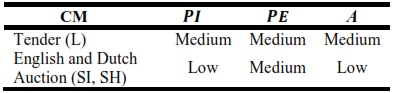
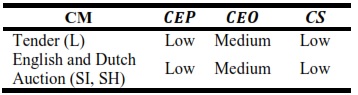
<body><![CDATA[<p align="center" style="margin-top: 0.21cm; margin-bottom: 0.21cm; line-height: 100%"> <font size="2" style="font-size: 10pt" face="Verdana"><span lang="en-US">	<img src="data:image/png;base64,iVBORw0KGgoAAAANSUhEUgAAAMkAAAAsCAIAAABALQtjAAAF5ElEQVR4nO1bO5KjMBCVq/Yo2IGLE3hOgJ04cjoZhCaZzOFkTkwI2aRETsacgDmBy4HhLqzEx0YgTEtCA7ull7h2VuonxKO71ZL+ZFmGNDQU4M/YA9D4b6G1paEKWltTR+q9vaOveG+MPRBuaG1NHcY+jjm7YDnOw93JdN0ArU7JWLrU2po2Ime2vvLKw9gfbHd9O2TZ1nm7KxtbH7S2pg3Lv9gO4vU76f1qX2ILOzC024wWTLW2Jo70jpYb3k7JreiEfxf74k+R5833vxsctbamjfQ7fMgD3ul+NRdG/huE3oeFJRWdbwtfyQi7obU1bVQeiAs4/ffL36zS5XI5H3RgAGhtTRrROTC3A/gbHFkXlrwZPmhtTRZkiRisTom0tEhJAi8ahxgTF7S2JgvLz7JBUiQSGoewwwutLQ1V0NrSUAWtLQ1V0NrSUIVubZHVhftD/Yne98zXMY1OqnZGgVz1ZjJDgdCx2hDYl8znW+4zZvoVsRILbVTLVPH3ydRWOVQ8S/FzljDXeVGnweuYZIkbmtVk5t3mzoJ3bgEAcrWaKaRjcqWe881dozT2X6cQT3j7RXbpd3gLTUTOJ7JXKLgliHs3s0JbW4Ww2l+ftT3dm9OW3LACD1W7Yvs9OEe+paBOB+QizVY7+Ro0hI7FtVwIvIrSvPvubShtWB+nVRD+joU6Uu8THeLtOQiu9xRZguJqaiv13nP5Mz57a9/c10rv1/Z7XKnZXABykWbIhL1f8k2jDg8HoWNwGZDtYBYvOe8QtLVhbHYroDLkLTwHeAx3HzH2VzYKwu9UdIu7oa30O8Sf4gl4LoN8t+ahaosdHna/9oVrJK98NuU7gVxDuq0+OoqLRMONL5FrsrXBczJQ3kKO1Dsvv3zSf76UiooNbeXTBZVW/t3+rGcPbWB/l3HOLrT4DOTicVuydEUbdz5zi39j6cmR5vHL/XGP0V4wW5S3QALXbRsXT2IsTITEoyKtrXy6wKMgPo5/VSQEKBfEbdGustIPlQZD6EoXX/YCJPH9vGVKHqydreCsSluIju5PgGb1UCLsuGhtFUIFdh0q/AzIFZ3xpNg9buvhKrvzLQgdafPkMvZ+n9cC8I6tLpLDX7KMKg6shR1XIybmEZaVvkWOg3xqrK/DD+N2SnFDoLFIhuVbwFCXN7O31ChZpH2A0OVtmmuJ5ywJ8RIUC76rxIJI2AIOh+Hui0rO6nrgfqSGtkrVz99Q3QZJZa+7hG76+ttmZJDkmW9N7wrLt4Bui9GMSToEHSMzJV/9NpbgJYicvGIpsSgQtYDDoXnI6F55ICvTee5HatW3yIGMDVboI0XN0Rjrw9uQTLajPt6+nZIf/ea+uNLHVdp+VKZxs7DW6gUp0bUIHcXl1v8Htwc8LJO3Yh9HWdUjBVQkreYiWM9IDJ93HN1/zgedojLr8vWzsEz0eRuyXjm2YkpxM2DBmf3DPFvnkHlJAXS90yPCSzCez2I/Ej0Xqcc8uh85JFJmsdFazijaq05u5pZRaQ3cGf6MVVTtuzAKqRjveMqCgfVO8+WTnUfS9q0RNdpiXXzC3OYl2X2+ixd6BQYyBqkQb4cuyvPIEOcnb+El+i6ztW+NqNFWcgvccFlUh6sVNyLcxmaH5mq2szsGMgKpAG+Xx8mLaCaEUd5CD1jv1CLbzPa6rNXZFzqZUKOterZa3Awmv/mhCkiuMuRARiDl5iW6QO2VQQlIDVHeQi9Y77T6u1+UXxqfkPKzgdgln7fxb1+7/JeQep8ip2AGtcDL13qntWu2DyjXVnUPU6MLoGWnYgvcfM13yhqCPtM8HUAK37jNcRHLJI7yFqDQ2poOegvfRS3TvohTyFvggNbWhFAt81ubrOX+QHGM+sjuSxXHkYCFwaG1NR08qo/8N6qbxXFjqDvZMtDamg7YhW8IXhTHR4TW1mTwLHx3xcR+VMVxcQsDQmtrMngWvjti4iOlmgWNM7Gt4ji3BRXQ2poMXhy9KfCijNVdHIdaUACtrf8IrOL4iPgLucLB+sJeu2oAAAAASUVORK5CYII=" name="Objeto9" align="absmiddle" hspace="8"> 				(2)</span></font></p>     <p style="margin-top: 0.21cm; margin-bottom: 0.21cm; line-height: 100%"> <font size="2" style="font-size: 10pt" face="Verdana"><span lang="en-US">This cost depends on the actors involved, and processing algorithms. For auction (English or Dutch), <i>PI</i></span></font><sub><font size="2" style="font-size: 10pt" face="Verdana"><span lang="en-US"><i>k</i></span></font></sub><font size="2" style="font-size: 10pt" face="Verdana"><span lang="en-US"> is the initial price setting and start of auction of the sub-conversation <i>k</i>, <i>PE</i></span></font><sub><font size="2" style="font-size: 10pt" face="Verdana"><span lang="en-US"><i>K</i></span></font></sub><font size="2" style="font-size: 10pt" face="Verdana"><span lang="en-US"> is the process of selecting the winning agent, <i>j</i> the number of rounds, <i>n</i></span></font><sub><font size="2" style="font-size: 10pt" face="Verdana"><span lang="en-US"><i>j</i></span></font></sub><font size="2" style="font-size: 10pt" face="Verdana"><span lang="en-US"> the number of bidders for round, and <i>A</i></span></font><sub><font size="2" style="font-size: 10pt" face="Verdana"><span lang="en-US"><i>l,q</i></span></font></sub><font size="2" style="font-size: 10pt" face="Verdana"><span lang="en-US"> is the time to prepare the proposal for auction of the participating agents. For tender, <i>PI</i></span></font><sub><font size="2" style="font-size: 10pt" face="Verdana"><span lang="en-US"><i>k</i></span></font></sub><font size="2" style="font-size: 10pt" face="Verdana"><span lang="en-US"> is the specification of the initial conditions in which a service is required, <i>PE</i></span></font><sub><font size="2" style="font-size: 10pt" face="Verdana"><span lang="en-US"><i>K</i></span></font></sub><font size="2" style="font-size: 10pt" face="Verdana"><span lang="en-US"> is the process of selecting the service agent, <i>j</i> is equal to a round (j=1, in the tender case), <i>n</i></span></font><sub><font size="2" style="font-size: 10pt" face="Verdana"><span lang="en-US"><i>j</i></span></font></sub><font size="2" style="font-size: 10pt" face="Verdana"><span lang="en-US"> number of bidders, and <i>A</i></span></font><sub><font size="2" style="font-size: 10pt" face="Verdana"><span lang="en-US"><i>l,q</i></span></font></sub><font size="2" style="font-size: 10pt" face="Verdana"><span lang="en-US"> is the time to prepare the proposal for bidding agents. For both coordination mechanisms, <i>PI</i>, <i>PE</i> and <i>A,</i> according to <a href="#t1">Table 1</a>, are parameters qualitatively measured (e.g., low, medium and high). </span></font> </p>     <p align="center" style="margin-top: 0.21cm; margin-bottom: 0.21cm; line-height: 100%"> <font size="2" style="font-size: 10pt" face="Verdana"><span lang="en-US"><b>Table 1: </b>Qualitatively Values of the Parameters <i>PI, PE</i> and <i>A</i></span></font><font face="Verdana" size="2">     <br> <a name="t1"> <img src="/img/revistas/cleiej/v17n2/2a08t1.jpg"> </a> </font> </p>      <p style="margin-top: 0.21cm; margin-bottom: 0cm; line-height: 100%"> <font size="2" style="font-size: 10pt" face="Verdana"><span lang="en-US">To measure these parameters with numbers (due to that the equations require it), we have considered the Likert scale as reference  <a name="br9">[</a><a href="#r9">9</a>], which allows us to assign numerical values to such parameters. Thus, we assign the value 0.2 to low, 0.6 to medium, and 1 to high. The other parameters are quantifiable. </span></font> </p>     <p style="margin-bottom: 0.21cm; line-height: 100%"> <font size="2" style="font-size: 10pt" face="Verdana"><span lang="en-US">The communication cost is based on the estimated time for messages exchange (communicative acts) for each CM in each conversation, and it is given in the equation (3) (FIPA has defined the communicative acts of each CM):</span></font></p>     <p style="margin-top: 0.32cm; margin-bottom: 0.21cm; line-height: 100%"> <font size="2" style="font-size: 10pt" face="Verdana"><span lang="en-US">	<img src="data:image/png;base64,iVBORw0KGgoAAAANSUhEUgAAASwAAAAxCAIAAADvIAPTAAAJC0lEQVR4nO1dPXbyOhAdznlLwRQ+rICswNC4oqWD0m7SpUyXBkrovpaKBlgBWQGHIvZeeJJswD+S9WOBJePbJARF1szoSiNpNP7ver1Chw4dmsN/TTfghYhXi/1kHfSbbkeHmmibId+IhPH+4k6CplvRoT76E/eyj6E1LHwfEnYcbA/6A9ju46AtLHwbEsb7LQw6DrYEnj/cRYiMTbdDD+wmYbz6mMG/k8iIGF2GfoGDx0VvvAGYH65rD9XkhL/J76xH/QxOjC87vBqOe/45gidsDilbw4vNbTcJ+8HpJFbyuDu7n4W/eevo4O93491x7XnB6QArJ6BrPTHh/FCvteYAd8PtdDkMww2MlpHQKGYW+oPh+S8GT7Th4raG15vbZhJiXZ3FulD8dx4OSsXi/R8En8uP2Sr2AviDAcss3voauR8/dRtsDPrB1zwcX76uV3/x8dd0a5TguCDlkArbGl5vbptJ6K0P84WYGaLLLwzKf0W2hL4zhdk+nsA7LRnRoDQ/nDw0JcJ0Yt00iCE7FZpsa5tJiLoSuBOxgudRyRvF/07Gwwm2zH4KuKp0vQBQvWSwHdEl0Rz6SbrjcYXcM7ucUrmp0Ghb20xC8Q1PNBEO/ZK5yOAIxDkb9saXQ0B+P11NGiSfg5t3jn5utqtPb7C7DNZNN0oeElOh0ba2mYS34ZwL2kSYLL5HMMFLSs+fj/4c9v/fhszeph3zI+p+6/Qn6YZH12VLbyiQP/orOBXK2BoaMLfFJDzuNkNfefxGi+/rOvPpVKFrY4bMJyGu3qcwF4JToYytoQFzW0pCMraNlpEYB+neaAcCPO5fviyM4nfcUdNN0ARLSZgf2zhA3iiA/8TWWA087jfdBlX8XloRNmMpCTt0QItCuDTdCC14ExKO7Nt46CAAqaNCY/EOJMQn9W7TjejQgYV3IGGHDkajI2EHW+G4o3bszLBJ+AjquYMWcC9YrAYoT9DxNM3VUvWQ3FMoo3wGnF61qdUEiaYpP6ammOUqXnIcrr8Lcbt9oUClmFQSPi5cZY41UTfZ5S8iCBari37wb7lFDyqritZzy8AnFJRjwrrVZh7A1EOwvk5c9OUwawKcIaW0TZQE7mdKkkqdxUBDF9UkqQ4xb5eEblXgzz3BmzA1oM/WINTtSZHhvQBVFRmUSZg8o8xcz19mo30Ei2lBcvNmE85Wk5wOvc/laLNttlqeHvCu0Gia14hLHaVwyfnXrZa0ceT+m6hATNSXVIuYx0XCwEcd+CLMZhz+HIMnT4e6upBYt8+bEj18XRmBUyRhvJqRAYOiEy8IZItpQ2Kskg77k+lInYQaquXqgQQK5K8y9unXFXDJYjdWOFrBQzuUfZ96kmoRk1BwtPws9t45bDSNNcAUH/R0IZluL3F6UiBhvN+iEW3Ju2ImWEwAVe4AZcws6lD8aj0D9arl6yE3Q1Sm6sMlh1+379CIS2YNfW5aDUm1iHnc4fQSXyWBXhd9VrsLCXd7MrKETi8UW/EWSEiUyX+KYDEBSMSfEc8h/NXtu9SplqsHMkP8YnMkn+cHlpuQlBz37iMSGnCveldKypLqEJMUoU3sNEf2WajZhcS7Pe7WPp5fsEG5TMyTkGiKD8FiupEurzfjha9zR029Wq4e0qEz3Q2oWp+TkjV2CvMexY3LhY0IRUn1iUlJMZJMkHW38oTEh5pdSLLbk/mFNGz84VZuPeVJiMPxgP8ksWKUVGhJgiH1vTBlHVY76KrVcvWAh85HD6tan1fNByJau3sU7EVR0gQFSTWKWULCQT9tinL/EBQfatFQkB2FhkXLsxNWH2cW3FHsoG9oeVWPiwWs740WKkZxtvEe1SXXGuE1YaaGcHyW2a8guuOVka8Wg6MHh+aC5TWZgrKxkW/cRdeRtIqkOsTEGyBhWNiAKe7VaJWUBUVbg2C3V8jRXyBhOk44H1A4eByfp5FUMXoqNJIVJvuV1J0kSMyGvAzdx0qK1XL0QFlDxKtv8MsbAdULI0ouHTLiL5fnMH84x4eKpFrETPp+xjO7nRlmuwgja9BtqNZysq/ehYTYEV02OFdI//Yl2U/99zgWpVitdE6Ir5dNkFdwX2QTlBrNLYbXwD+loT1JLDRQ1aVZFMRg6eEAs16PBEyE+a+wjopPT50BXJIalETJpYP338ZbiKJDoTY8qrGbqyqpBjHvAQmPgiVOMbIGHXdn2i4VIn9pp6dafKjbhQTYgSwzzuyv5YRkWI0aMSN4v7+6GCXlNUksFOIICaVDIfMomICuh0A0RQLXGWBoMp1DJJpdvwPWELOijjtokgLW0Neu1+tpmAd1dCEeOyrsybAalYQ6QHMs0EA3PETT75nKyzzU9Vd5EvUkZmsE1UUTTnL1gKWSEiRb/h84cW+N5jeuAYbVnkZC5BqHW3dyCqLHfhVpA1qhgyMdFMnQX5oghVsVK9q+ZrUvwV2T/cfmn0PNKF4FWyX1HqHQqPlFkWWU0LwG6Hngn0jCu3PeJ3my07+RiFb5ZFasIYwcUHH3Ppl5EOpV+ypklzleqsxbzkJR2Csp2/2TSx1kggZYVnsaCW9AA83Ol+sxRZCN7PLSP4VYtAXloFBHtS+GojJbK6lwaK3ZGng6CWXH7BLi1bfkXZMSaItCDdW+HkrKbKuk4llLTNfA00lYGxpSsdKSNbc9oe8DLZZUcElougbMJ2ECkYAm9osd60bqv88bQu2RlP6SHw31vl4DtpCQG9DEe7GjenK8tr0hlA2rJH1KWvVmNGALCe9nSKVg0zTGpPLFjqyXh+TCiPydQs3WIBv5BSo6NA9yN54NtrUtJLwHNMkGmybw/Pk3ZSrMhRGp1WwJ8pFfLZCUdebGhMG2toWEjIAmYdBfKakU/GUl9EV+GQLpkCGDbW0JCR8BTSx3lAP625VzllSs2RZkIr8i+yVFM/v0U6rFBtvaEhI+ApoYjgT3xY6ePyxNhXmXRrVmC1CI/OpbL6m0M2q0rS0hIfeGCv8oyPNhcYTc9Q2hs2/TD5lEICaDRZLKr05MtrUlJNQBz3dXbXiHTwfkjIL6O5rNwxuRELwBIBbatfbpQEHLOPhWJHxOXuIOL4e3bhMFAf4HT6kV2mCDhQIAAAAASUVORK5CYII=" name="Objeto12" align="absmiddle" hspace="8">	(3)</span></font></p>     <p style="margin-top: 0.21cm; margin-bottom: 0.21cm; line-height: 100%"> <font size="2" style="font-size: 10pt" face="Verdana"><span lang="en-US">Where <i>j</i> is the number of rounds, <i>N-1</i> the number of agents least the sender of message and <i>n</i></span></font><sub><font size="2" style="font-size: 10pt" face="Verdana"><span lang="en-US"><i>j</i></span></font></sub><font size="2" style="font-size: 10pt" face="Verdana"><span lang="en-US"> is the number of participants in each round. For auction and tender, <i>CEP</i> is the sending cost of the initial proposal, <i>CEO</i> is the sending cost of bids and <i>CS</i> is the cost of informing who makes service. <a href="#t2">Table 2</a> shows the qualitative values for the parameters <i>CEP</i>, <i>CEO</i>, <i>CS</i>.</span></font></p>     <p align="center" style="margin-top: 0.42cm; margin-bottom: 0.21cm; line-height: 90%"> <font size="2" style="font-size: 10pt" face="Verdana"><b>Table 2: </b>Parameters <i>CEP</i>,<i> CEO</i>,<i> CS</i></font><font face="Verdana" size="2">     <br> <a name="t2"> <img src="/img/revistas/cleiej/v17n2/2a08t2.jpg"> </a> </font> </p>       ]]></body>
<body><![CDATA[<p style="margin-top: 0.21cm; margin-bottom: 0.21cm; line-height: 100%"> 	<font size="2" style="font-size: 10pt" face="Verdana"><b>3.3 Belief 	Space</b></font></p>      <p style="margin-top: 0.21cm; margin-bottom: 0.21cm; line-height: 100%"> <font size="2" style="font-size: 10pt" face="Verdana"><span lang="en-US">There are two categories of knowledge in the belief space: situational and normative.</span></font></p>      <p style="margin-top: 0.32cm; margin-bottom: 0.21cm; line-height: 100%"> 	<font size="2" style="font-size: 10pt" face="Verdana"><i>3.3.1 Situational 	Knowledge</i></font></p>      <p style="margin-top: 0.21cm; margin-bottom: 0.21cm; line-height: 100%"> <font size="2" style="font-size: 10pt" face="Verdana"><span lang="en-US">In situational knowledge are kept examples of successful and unsuccessful individuals. In our model, this knowledge is based on each TCs, which include each CM used for performing this TC, their rate of occurrence (IO), and finally the total occurrences (TO) of the TC (see <a href="#f6">Fig. 6</a>).</span></font></p>     <p align="center" style="margin-top: 0.21cm; margin-bottom: 0.21cm; line-height: 100%"> <font face="Verdana"> <a name="f6"> <font size="2"> <img src="/img/revistas/cleiej/v17n2/2a08f6.jpg"> </font> </a> <font size="2">     <br> </font><font size="2" style="font-size: 10pt"><b>Figure 6:</b> Situational Knowledge</font></font></p>     <p style="margin-top: 0.32cm; margin-bottom: 0.21cm; line-height: 100%"> 	 <font size="2" style="font-size: 10pt" face="Verdana"><i>3.3.2 Normative 	Knowledge</i></font></p>      <p style="margin-top: 0.32cm; margin-bottom: 0.21cm; line-height: 100%"> <font size="2" style="font-size: 10pt" face="Verdana"><span lang="en-US">The normative knowledge keeps the suitable ranges for each of the variables of the CM used by the situational knowledge. In <a href="#f7">Fig. 7</a>, LI and LS are the lower and upper limits of each parameter P</span></font><sup><font size="2" style="font-size: 10pt" face="Verdana"><span lang="en-US">i</span></font></sup><font size="2" style="font-size: 10pt" face="Verdana"><span lang="en-US"> forming each CM. </span></font> </p>     <p align="center" style="margin-top: 0.21cm; margin-bottom: 0.21cm; line-height: 100%"> <font face="Verdana"> <a name="f7"> <font size="2"> <img src="/img/revistas/cleiej/v17n2/2a08f7.jpg"> </font> </a> <font size="2">     <br> </font><font size="2" style="font-size: 10pt"><span lang="en-US"><b>Figure 7:</b> Normative Knowledge</span></font></font></p>      ]]></body>
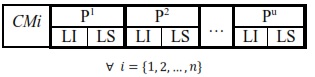
<body><![CDATA[<p style="margin-top: 0.21cm; margin-bottom: 0.21cm; line-height: 100%"> 	<font size="2" style="font-size: 10pt" face="Verdana"><span lang="en-US"><b>3.4 Communication 	Protocol</b></span></font></p>     <p style="margin-bottom: 0.21cm; line-height: 95%"> <font size="2" style="font-size: 10pt" face="Verdana"><span lang="en-US">Functions of acceptance and influence are those that allow the interaction between the population space and the belief space. These</span> <span lang="en-US">functions</span> in <span lang="en-US">this</span> <span lang="en-US">proposal</span> are:</font></p>      <p style="margin-top: 0.32cm; margin-bottom: 0.21cm; line-height: 95%"> 	<font size="2" style="font-size: 10pt" face="Verdana"><span lang="en-US"><i>3.4.1 Acceptance 	Function  for the Situational Knowledge</i></span></font></p>     <p style="margin-bottom: 0cm; line-height: 95%"> <font size="2" style="font-size: 10pt" face="Verdana"><span lang="en-US">This function takes a percentage of the population (20% of individuals is sufficient according to Reynolds <a name="br5">[</a><a href="#r5">5</a>]), in order to nurture the belief space with their experiences. The acceptance function updates the situational knowledge as follows: for a specific TC each of the mechanisms involved in this type of conversation is updated by the equation (4), where s=4, because 4 is the number of the TC defined in section 2.1:</span></font></p>     <p style="margin-top: 0.32cm; margin-bottom: 0.21cm; line-height: 100%"> <font size="2" style="font-size: 10pt" face="Verdana"><span lang="en-US">	<img src="data:image/png;base64,iVBORw0KGgoAAAANSUhEUgAAAVQAAAAWCAIAAAAQF/MxAAAGYUlEQVR4nO1cO5ayShAuzpmlAAGHFeAK0MTI9M80hMTMcLJJJJRsUiMTZQW6Ag+BsBdv8+5HwYCCgpcvmBn70G3VZ1XXo9v5ut/vMGJEI3iOo1iW/G4xRtRF6DiBZZnc6NdbZBkxaHigjp4/KMiWenRCk/vURucf0RTe7aaYfBQZ0W+YKjghsN4/Ov+IhvAOvrp7txBvhreSDvP7bkg7oAIQkBSAHsKcn2g2ddO/jW1w5pKF0Jko9iV7tTwNi4NaGBkoR3gDbcYOFXTlZFEMIvwMnUDv4BraOn3BKkOhX5Yjq3AMwaTlwZzf3N0DjQipi7IlnykR+mzmr6WrqOTAMTJQjsAnFT87lND1bw+Xy/4Yxp1AMnSfrya3tcDLBxAY3q7GYp2JG/h6qkykyrXY/lZsnH274r7Phf6StD/wL2AsFG7UWyXSFw5h7k5Ld2r/eNbA9u4/MTLQCGRLWPxudGWaeX/sIrrK2/UnEBge90TZTLPwps2t9K8rQKGyptHW837FFY0P/bjzc2okiMU3tmtWUnO+BNc9eLvPagGNDCShCfjcB8n6IXN0UyVM5NZM9gOxPvgAAonvX/RNbhlyfubJxgvTovKjfiqOOz8W9kidQ6qUjZCjKJrRkWxtg67kefDl12cy0BlSR5fXW8O1E2tGAv9HEBj5/nKDeCsaLxL0QnFS9HN5P+r8mBrxmKHxeXBZftxHRHVozTb1hzLQFXJHl2cLw068Xwz8n0EgEXY5xyJ1uRZ9VRx1/lKZkH0t2dTQ/W7A+D8zwCZIU4nr42MoHD3x/m9nrQBS8cPwCWQa/TQqAn+MHiqOHvU1kCl5ttgJQ2fyo57707p5TJ5PYqAmCrHzBAmt+dG5VIYvW5ulPd0fjzrWG8DQdwIZeSLfXwSYYTSP4t0qXmM1xPnjLUzIbKiErhgU+hjeEX6j9+PK6zhsBPRY9RFnPL2INenpaDrArL3cbq97+C0NSrJ1njvpxcbaNX8bDMBzJLTHQBUoA6GJago2w4/bWLZ9WZ64GusDTIg95KNRFfhfqjgmdgkQ5y/ZwpItfTrRMj6zc0uKtfAGqhn/1k73u5ndg/Kc1c9EcvVoLHnOcYIqwc3daXv9ztoT3tHXDWMRfTzxZ8iuY+3Ownzmewz51abaNX8LDDxLwrMM8CQgyKTPB5A7YLXAt/bMuO0HYo07JBMCmsCMGa7RT6My8L9OcdzyszfgcrEvbmp2AclWpD1f5aVXXxTJTgeELSiI3zA7/oi2ybg8IvWfy9yXkS31RyI5ZekuFoK6Wfi36FgydIjQ1wvMCffOP/bejaz6ijTh5EyVsDP5katN5WiLgadJeIYBhAQEiTI/xQBPVLRZCrO4nnEepujrKnGk87EoOBATAp7AhBlAG/3UrT1iMzYuzksUb2r5rPOTVOFulTxZ44Hw5gO190UXP+IUSWyQegdiK/fyjCSIv4lwIL+CI8xU347ne8I6UZD54aws2mb3zNUy4WrTowr++QDHADxOwjMMAEZCHdQhStE0KvLg2VREUtn8IZgQCATGzJioWn+aTK3n2lC82vLFq5klN/zagHdw9XlqGPw5h7nbHCRJKqte4u+NzTQ4eg4RWLlNsgarcF4S+PqcZ5TkN4tZT3rHj5LwHANAkVAEpnaukjdKpJ7E20wI3mxFDypeLbPGa96q88uqRgtyzfhWNJhStxiTuiS5/I12JJLyh1iZ/Q3BGYLDRZ/L6DpHQHrKwhYnaN0ZGAbgcRKeZAAoEuoGpgi1iHq0NVALPTEh4K2ocxNqRfEqy6e6URnajfy5XWSloLJSyf5E7O+0IpsV9aRtRz+NbX5qkp8rpZFqD8Gvtt1kfU53FXU/uHWM7VZ37b02O2fN/GgF5XZ1bcnNd0ZE6+5Ae0ZDEtpjwIzNhyFBRJ4R5E/VJKrb0N8LE+IJfIUJtaB4peUHqqBCu84vz9QgjDQQSsE/O+3R1xxW8RpUpIq/H8ZMFNYpblBnK/ChDtG6O+QMACJrNQntMQB14r34RF2isP8L0Rp6YULcGi8xoRYUr7J87D+wtFzzy6S4WsEDFxXIZn2Yn2sdxDVaIRpVzy+8MNI7BhpMrkuUOVO9EOSOvL9vBL7KhFpWnBUb/c9rbTf8yObzEP2PzvtrhefXbUeO7ua1tEKjyXKXX0PrG4EvM6F2FWdHTewT+w+kGWhn4k3/cAAAAABJRU5ErkJggg==" name="Objeto17" align="absmiddle" hspace="8"> 	(4)</span></font></p>     <p style="margin-top: 0.32cm; margin-bottom: 0.21cm; line-height: 100%"> <font face="Verdana" size="2"> <img src="data:image/png;base64,iVBORw0KGgoAAAANSUhEUgAAAL8AAAAUCAIAAABTU3t8AAAEEElEQVR4nO1aO5aqQBAtzpmlAIGHFTArQBMi08kghMTM0MxEQslMjUyEFcAKPATCXnjdgHyku2k+T3jvzM1wiqJuddWtbpivNE3hF78YhK9ZnuqbJpzP2izP5oDvOJJliZO7XTZrNog5maV6kudKt+Z4MCckgBhg6upZOms2iDmZR3t+8X9gKdXjm8L6cYoDxrzAJm55ZXgpdQg0LVW2W4TE+ZaiPd3fwIAn8cPPegYsoHqy/Kiq2m1Z1QG+RwB6KpuWkikzkp44P3YIxpDQx4GTOD/rj2MB1aOd0/SM2//aZReUWdN0A9zHMwGN1LINy91Jda80S1w7R9gaEA6Juu89BBedxPlZz4AR1YN523nWu4fDfIgjFOOW8kekO5Ee6De7l8timixsjIxGsaCIln7Lx2XXujKqp70bqM9orPeKl+LGSBwnFmsmLtlfLduyLPXi1Y7t+QBQ5O6CTZyDix5MTgGunX1ggX9r/i7KcGc1OBIND4TDqiSxNNbDIFqBFwmHx0GA/UsV70lxTCfmhFE9oqxAVF0iZ2vIywUDt3QhomLtPUCmxuwg0ax4bsY1bXK/hurpwvRRrChqn5TSPv4x2p+JZ2htA6aTnOlth9dR0RfIehwwrVAhnx9IOemYXO5aKHsKy1jlFe8nJFsSrr2HlmjtZD8BcXALFbLX8dRiRVHRCwIQgvTNw2oXkO/177Bjuke9o656KcmHWI8DlgRjX+mDur2UjyPlpKN6CtlFS/ADl+a9SOfSDZ6UkhD13QA8n7E2dOfnm71O16J1OV0l++hbjVtw7VwCSgjJE2S2rt1cULy+BD7Iehiw9KhbqbqoySsxJ6zqkVb5YRJV/XVLTDWqoBjQdKyOAXw7gMFA7m/6BElEyx+6rmDXfkIqy7v5b2S5COtfYN0FLD3KXiwvOuW1Q3vQzsa/ZVXfTCr1kw3HDoAP+cuQxnJSktiyTBzzvikHtH+0X3JcWTbDxL/3eY3SyDLGZKyhTYeXdfZDVarZAao2sd+vCWBJDxldJ/brzxoN2/fQkWvXfu2IjHHDuNa3oYTVIM9AJnxhVH1b8U1s5gq1Hs+T17JERW9LNV0pU0qw7BFjuVTZ0SdcCyNfNXMR78N6yPPr9fcuPXjXy26qjuoJQ8UL2nfjPc9UH/wofZvtV461UUvt75YlNbqWZc11R4ye4a5fSzURey7i/KzfLN+DbAfdJAVvaeCSU1b1TFkjfYEa47CKCYX7EUsiDP0TrwY5gxzJpcQ4UrN8qRDl6OiDxooblT4nrb9gGWf/kFBiyEdUAjhYA3eQ/Kwp6EvqLSc55vnOpe1W36avLfI9P0rrAS71F0FYg6fwvCjWvUi1c5Jjpq+kKPapzihTA4VGeYc4heulsmaDlpM/osnxc4TPaJgAAAAASUVORK5CYII=" name="Objeto18" align="absmiddle" hspace="8"></font></p>     <p style="margin-top: 0.32cm; margin-bottom: 0.21cm; line-height: 100%"> <font size="2" style="font-size: 10pt" face="Verdana"><span lang="en-US">Where <i>IO</i></span></font><sub><font size="2" style="font-size: 10pt" face="Verdana"><span lang="en-US"><i>(TCs, MCi, t)</i></span></font></sub><font size="2" style="font-size: 10pt" face="Verdana"><span lang="en-US"> is the rate of occurrence in the iteration <i>t</i> for the <i>TC s</i> and the <i>MC</i></span></font><sub><font size="2" style="font-size: 10pt" face="Verdana"><span lang="en-US"><i>i</i></span></font></sub><font size="2" style="font-size: 10pt" face="Verdana"><span lang="en-US">. <i>IO</i></span></font><sub><font size="2" style="font-size: 10pt" face="Verdana"><span lang="en-US"><i>(TCs, MCi, t-1)</i></span></font></sub><font size="2" style="font-size: 10pt" face="Verdana"><span lang="en-US"> is the rate of occurrence in the iteration <i>t-1</i> which is currently in the belief space, <i>TO</i></span></font><sub><font size="2" style="font-size: 10pt" face="Verdana"><span lang="en-US"><i>(TCs)</i></span></font></sub><font size="2" style="font-size: 10pt" face="Verdana"><span lang="en-US"> is the total of occurrences of <i>TC s</i>, and <i>NO</i></span></font><sub><font size="2" style="font-size: 10pt" face="Verdana"><span lang="en-US"><i>(TCs, MCi, t)</i></span></font></sub><font size="2" style="font-size: 10pt" face="Verdana"><span lang="en-US"> is the number of occurrences in the current instantiation of the MAS of <i>MC</i></span></font><sub><font size="2" style="font-size: 10pt" face="Verdana"><span lang="en-US"><i>i</i></span></font></sub><font size="2" style="font-size: 10pt" face="Verdana"><span lang="en-US"> for this <i>TC s</i>. It is also necessary to update the total occurrences TO, by using the equation (5), where <i>k</i> is the number of CM used in this <i>TC s</i>:</span></font></p>     <font face="Verdana" size="2"> <a name="z5"> <img src="/img/revistas/cleiej/v17n2/2a08z5.jpg"> </a>     <br>      </font>      <p style="margin-top: 0.32cm; margin-bottom: 0.21cm; line-height: 100%"> 	<font size="2" style="font-size: 10pt" face="Verdana"><span lang="en-US"><i>3.4.2 Acceptance 	Function  for the Normative Knowledge</i></span></font></p>      <p style="margin-top: 0.32cm; margin-bottom: 0.21cm; line-height: 100%"> <font size="2" style="font-size: 10pt" face="Verdana"><span lang="en-US">The acceptance function updates the normative knowledge by the following equation:</span></font></p>     ]]></body>
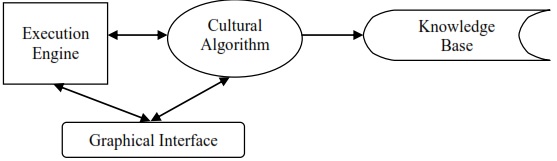
<body><![CDATA[<p style="margin-top: 0.32cm; margin-bottom: 0.21cm; line-height: 100%">                <font size="2" style="font-size: 10pt" face="Verdana"><span lang="en-US">	<img src="data:image/png;base64,iVBORw0KGgoAAAANSUhEUgAAALkAAAAXCAIAAADY2XmVAAAFRElEQVR4nO1aO7aiTBAuz5mlAAHHFXBXgCZGpjfTEBIyQzMTCCEzNTJRVqAr8BBA74Xp5iHddPNqwH/uP/NlIlRXV31dL/iVpin83xDuF6sADDd5WMp/rcsPBPK+VPvJ2+/XJxYPPU+1pN0m8bTuJuk/mshCsR6phbz9rXb9A1xBXqxZpvzz5loLESjyrkdhCKb5t1EHeV5ijbE7h/m5gm6gWaMkKBB7yJSOEygBdUqTTYs8X+7uqT+xjsoabuSMTCdxfq4kAOpIEWomRZIr6BbDpMdrUoTX11z5UllrCZI2mwCzcwXFUX+ukKrqsiUlVbj/ip2ytFK06CR9RCbg6oww/cdsPMbGC38UV5JoQApSrMMuIrtD8WupVbtUdT2RXB/FoM0XVWbLINMgjlGtUMMKXzeS2oq4khugwEg7YFfp6zb5BYoGrbwdM4x9LIoRSJWnSRSJVp+moR6XQVrsMA343B1eA0N3RMv38LOIK6afJjpusZczHRdOftbQq3stdeILiULhfhUs7z79zCuSrVh0nU1Bpp+4LzXSpnDIuAzSbIe5ohQO18bWee+8IibhzQI6/N2Qg5LoCcZ2vjxP5O8OpWIk9dir4Bo6OgSrRbBzXcM+es6791G05bSLG/qfUcM02MGfqn1hwzG6XWB7Ln/SRDc3OwheHbFbzBXMP4Blw9FrSFHFtC9DVyQl8jkqYv9lU6D8lzWuz24BWXy5UfhclO2gK5gW28T73lxzOxATqMXmBRsn6zSd2CY7dO1gqA7FY7fLc3mQj6dirjSGldKcqVk0LcW+MsNjhTOmhvt9R7og8iutsaCsQOyTp0U5vkTP0qoIKzgD3GGxonKbst4al66mCdP5HmEdspCd+kSf49cLH9c0BWKQGxowY5a0g5wOhCpVDKv91xYcSgi5gisgbHn+SeR92+AmhUOqjZL6wnhfx17w608KNHviZFNeMHpXiNjDaYf0DhRhJROGI++qivjoFm3PfqkG07Vz2jO83J6z+xB025uX1GiHRgUkdcD+2m0aqIJpZLhnido2V4QXG55sIlGp7spjD6GW4a57G4loNqy/EnVTsqCrFVU34FJkaeSdwPGrTaj6Vhwd6RojN0KxdaYOYgNgyQcmP3TYoVGB3jrgwr6iDd0CsSAhAOeKzsMq4kpDBmJ0osJK7ToLRQOug5m7cGYRsesTYi/vVNaxs/8ZprxLL9vmfcnUGHQSoQIWUAGwuV5ptkOrAv11oEGosk0E/4R7NTr0OrcCrvC5i7xzXPtr7q4+DufHaL1yI4tqoDe4XqmtX1ObNFg2zkIQg1Odq6wfuW4S/fgNTl1i3TW0zwa1Vy12aFWgvw7UyLrWLZcYNJoTcIWje3i66I6V2fWZ100574t8lF23T6Hl5wXvN5yZLFsfo8mElfeQZHC9ggPbjVqfGLNqG/OS5Xj8gsODkYqXIfYzH5w8iSPdgFY7NCsgpYOwBRo6w2W5UvW9trqwq+u7bDBm+vfdYkX+MNy7a6zsYm6UT7fylMw1bMpap4aH77BA5PeeUY6a0zPDS2LMZ6AuoncIwiXLEzOlt/i2Iw2BYKBF2M1JkbPDQB0QaEVlIGqBSEMCECyoKN2hCMsVar4hBH2qLerOtueYgy3Vxoz7qoFZn1eUXBkijnY9I23Q1sa1cz11wEfErG4ar8L83ySAqYGHYMRLjkQb9fbP1LRJX7f+FIRvqkyED3Bl5IdtyBv7/Yk57lupn4nxZuPwCa6AMub1hiLxpW7ElgHmfC8M/ljImK3A+9vs2kjrI1z5NMYPd/9qNFWfvwGpZeAnf1gpwgAAAABJRU5ErkJggg==" name="Objeto21" align="absmiddle" hspace="8">	(6)</span></font></p>     <p style="margin-top: 0.32cm; margin-bottom: 0.21cm; line-height: 100%"> <font size="2" style="font-size: 10pt" face="Verdana"><span lang="en-US">Where, <i>Lac(P</i></span></font><sup><font size="2" style="font-size: 10pt" face="Verdana"><span lang="en-US"><i>u</i></span></font></sup><font size="2" style="font-size: 10pt" face="Verdana"><span lang="en-US"><i>)</i> is the current limit (either LI or LS), <i>Lv</i> is the previous limit,  <img src="data:image/png;base64,iVBORw0KGgoAAAANSUhEUgAAABMAAAASCAIAAAA2bnI+AAAA20lEQVR4nGP5//8/A1mAhTxtNNO5PZ3RaxZD2rb/Mz1J07l9w5UJt//nq5Bup+fMo9jswq7zzkRr1YJjIAcGbAC5lAHsVlWIKIPVhNtHEU5A1amSf3TbNaAWL0aGbf//zwR5tMX6CkPYQmDUAbWv2nonH64V3bV3bl1hQA2UsIVgi+4AmTpqSJ5G13n7GtCxNZ5wU6zCvFVgElZaqjj9CVWsijBFp0YFLqEToIJbJ7piZFNQrUQPW+KtRNOJz0oGSIjDgw5Vp+dMRM4BxtD/fGSJmageG2x5BT8AAJElda8yteI3AAAAAElFTkSuQmCC" name="Objeto22" align="absmiddle" hspace="8"> is the complement of the moment, namely, <i>(1 - m),</i> <img src="data:image/png;base64,iVBORw0KGgoAAAANSUhEUgAAABMAAAATCAIAAAD9MqGbAAAA1ElEQVR4nJ2SvQ2DMBCFjcQomAIxAZnADJARTIkHYAhSmhFS0SSeACZAKWJ2uQARSAb/YK7zz6f37u6FAIAuVWh6EEWQN4i+gRM/UrRDLaGM/DUJ7wxaLtJdOvLfolpZLTvVu44kHGRywyxdxzM+phMuYmVaBrfy0yNarf+isqIsb1rBCXGQ43dA2R3vDCfKhZ6cJdNqbWsyu6zW3eciifo82MaUaXarI8fXs7elx0zOXg9dniEXr2lsCZ6JPCe5J7f4MBywY24s5BQf4C41LelR18kfaWZUP2T2dzcAAAAASUVORK5CYII=" name="Objeto23" align="absmiddle" hspace="8">is the average value of the limit of all individuals accepted within 20% from the population. Finally,<i> m</i> is the moment, that is given by the equation:</span></font></p>     <p style="margin-top: 0.32cm; margin-bottom: 0.21cm; line-height: 100%"> <font size="2" style="font-size: 10pt" face="Verdana"><span lang="en-US"><i>	m </i>= </span>&#61549;&#61472;&#61487;&#61472;<span lang="en-US"><i>t</i> 	(7)</span></font></p>     <p style="margin-bottom: 0.21cm; line-height: 95%">    <font size="2" style="font-size: 10pt" face="Verdana"><span lang="en-US">Where </span>&#61549;<span lang="en-US"> is a time constant between 0 and 1, and <i>t</i> is the iteration number, (<i>t = 1, 2, 3 ...)</i>. Thus, each time it reaches a new experience of the people, the limits of each parameter of the mechanism are updated. </span></font> </p>      <p style="margin-top: 0.32cm; margin-bottom: 0.21cm; line-height: 0.42cm"> 	<font size="2" style="font-size: 10pt" face="Verdana"><i>3.4.3 Influence 	Function</i></font></p>     <p style="margin-bottom: 0.21cm; line-height: 0.42cm"> <font size="2" style="font-size: 10pt" face="Verdana"><span lang="en-US">The influence function determines how the knowledge of the system influences the individuals in the population. In the case of situational knowledge, it is based on the use of the mutation operator, which switches the current CM of a given conversation, according to a probabilistic rule (stochastic universal sampling or roulette wheel <a name="br10">[</a><a href="#r10">10</a>]), based on the IO parameter of each TC (we call that a targeted mutation).</span></font></p>     <p style="margin-bottom: 0.21cm; line-height: 0.42cm"> <font size="2" style="font-size: 10pt" face="Verdana"><span lang="en-US">In the case of normative knowledge also is based on the mutation operator, only that here the complete structure is not changed, but only specific values of the ranges are setting for each parameter of a given CM.</span></font></p>     <p style="margin-top: 0.32cm; margin-bottom: 0.21cm; line-height: 100%"> 	<font size="3" style="font-size: 10pt" face="Verdana"><span lang="en-US"><b>4 Design 	and Implementation of Cultural System of Multi-Agent Learning 	(CLEMAS).</b></span></font></p>     <p style="margin-top: 0.32cm; margin-bottom: 0.21cm; line-height: 100%"> <font size="2" style="font-size: 10pt" face="Verdana"><span lang="en-US">CLEMAS is a computational tool to implement the proposed learning model. CLEMAS requires the configuration of various parameters. Upon the execution of the model, CLEMAS can display which CM is proposed for each conversation/ sub-conversation of the MAS. Moreover, CLEMAS can display the progress of the learning process. </span></font> </p>     <p style="margin-top: 0.32cm; margin-bottom: 0.21cm; line-height: 100%"> <font size="2" style="font-size: 10pt" face="Verdana"><span lang="en-US"><b>4.1 CLEMAS Components</b></span></font></p>     ]]></body>
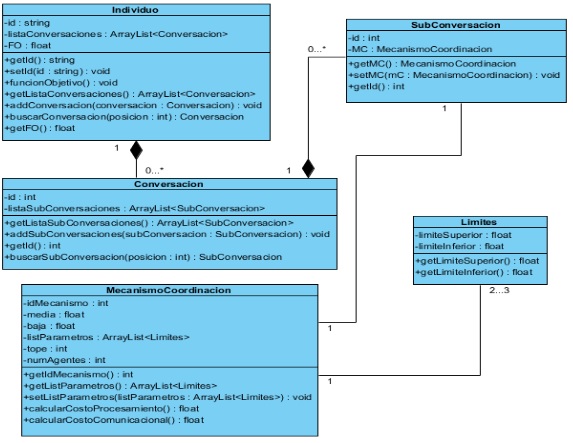
<body><![CDATA[<p style="margin-top: 0.32cm; margin-bottom: 0.21cm; line-height: 100%"> <font size="2" style="font-size: 10pt" face="Verdana"><span lang="en-US">This tool has four main components: the execution engine, a system that emulates the CA, a graphical interface for configuring the system initially and visualizes the learning process with their results, and a database that stores the existing prior knowledge in the belief space (<a href="#f8">Fig. 8</a>). </span></font> </p>     <p align="center" style="text-indent: 0.51cm; margin-bottom: 0.21cm; line-height: 95%"> <font face="Verdana"> <a name="f8"> <font size="2"> <img src="/img/revistas/cleiej/v17n2/2a08f8.jpg"> </font> </a> <font size="2">     <br> </font><font size="2" style="font-size: 10pt"><span lang="en-US"><b>Figure 8: S</b>tructure of CLEMAS</span></font></font></p>     <p style="margin-bottom: 0.21cm; line-height: 95%"> <font size="2" style="font-size: 10pt" face="Verdana"><span lang="en-US">The execution engine component runs the learning process through a class called 'simulation', using for this the initial system configuration. The CA component represents individuals and the belief space. The knowledge base component stores the situational and normative knowledge in belief space (a file with the extension .ccg). The following section details each of the components of CLEMAS.  </span></font> </p>     <p style="margin-bottom: 0.21cm; line-height: 95%"> <font size="2" style="font-size: 10pt" face="Verdana"><span lang="en-US"><b>4.2 Design of CLEMAS</b></span></font></p>     <p style="margin-bottom: 0.21cm; line-height: 95%"> <font size="2" style="font-size: 10pt" face="Verdana"><span lang="en-US">4.1.1<b> </b><i>Representation of the Individuals</i></span></font></p>     <p style="margin-bottom: 0cm; line-height: 95%"> <font size="2" style="font-size: 10pt" face="Verdana"><span lang="en-US">To represent an individual in MAS a class called 'Individuo' is used, whose main attributes are a set of conversations, sub-conversations, an objective function and an identifier. The value of the objective function is calculated in each of the iterations; all calculations are performed by using the equations (1), (2) and (3) of section 3.2. Conversations in an individual contain a set of sub-conversations, whose main attributes are a TC and a CM. The classes used for the definition of the individual are shown in <a href="#f9">Fig. 9</a>.</span></font></p>     <p style="margin-top: 0.32cm; margin-bottom: 0cm; line-height: 100%"> 	<font size="2" style="font-size: 10pt" face="Verdana"><span lang="en-US"><i>4.2.1 Representation 	of the Belief Spaces</i></span></font></p>     <p style="margin-top: 0.32cm; margin-bottom: 0cm; line-height: 100%"> <font size="2" style="font-size: 10pt" face="Verdana"><span lang="en-US">To update the knowledge of the belief space the acceptance function is used, and in order to use this knowledge in the population the influence function is used. The classes used to develop the belief space are three.</span></font></p> <ul> 	<li/>     <p style="margin-bottom: 0cm; line-height: 100%"> <font size="2" style="font-size: 10pt" face="Verdana"><span lang="en-US"><i>EspacioCreencias:</i> 	it is the class that models the belief space; its main attributes 	are a set of both situational and normative knowledge. Also, it is 	responsible for implementing the functions of acceptance and 	influence.</span></font></p> 	<li/>     ]]></body>
<body><![CDATA[<p style="margin-bottom: 0cm; line-height: 95%"> <font size="2" style="font-size: 10pt" face="Verdana"><span lang="en-US"><i>ConocimientoCircunstancial:</i> 	it represents a situational knowledge; its main attributes are an 	identifier for the TC and one for the CM, an index of occurrence and 	the total of occurrence.</span></font></p> 	<li/>     <p style="margin-bottom: 0cm; line-height: 95%"> <font size="2" style="font-size: 10pt" face="Verdana"><span lang="en-US"><i>ConocimientoNormativo:</i> 	it represents a normative knowledge; its main attributes are an 	identifier of the CM, the list of its parameters and the lower and 	upper values of them.</span></font></p>     </ul>      <p style="margin-top: 0.32cm; margin-bottom: 0.21cm; line-height: 95%"> 	<font size="2" style="font-size: 10pt" face="Verdana"><i>4.2.2 Execution 	Engine</i></font></p>     <p style="margin-bottom: 0cm; line-height: 95%"> <font size="2" style="font-size: 10pt" face="Verdana"><span lang="en-US">To run the learning model a class called 'Simulacion' is proposed, and its main attributes are maximum number of generations, population size, acceptance rate, crossover probability, mutation probability, a beliefs space and a set of state (this attribute allows to use the knowledge gained in previous simulations). This class 'simulacion' is responsible for the initialization of the system, determines which ones are the best individuals who will influence the belief space in each of iterations, the genetic operators to be used to create the next generation, and keeps track of what happens along simulation. To do this, it uses the following classes:</span></font></p> <ul> 	<li/>     <p style="margin-bottom: 0cm; line-height: 95%"> <font size="2" style="font-size: 10pt" face="Verdana"><span lang="en-US"><i>CruzarIndividuos: 	</i>is 	responsible for creating new individuals using crossover operator.</span></font></p> 	<li/>     <p style="margin-bottom: 0cm; line-height: 95%"> <font size="2" style="font-size: 10pt" face="Verdana"><span lang="en-US"><i>MutarIndividuo: 	</i>is 	responsible for creating a new individual using the mutation 	operator. The types of mutation are: direct mutation is a targeted 	mutation which is influenced by the belief space; and normal 	mutation is the classical mutation. The mutation is carried out with 	a certain probability. This class selects randomly the conversations 	and sub-conversations that are going to be mutated.</span></font></p>     </ul>      <p align="center" style="margin-top: 0.21cm; margin-bottom: 0.35cm; line-height: 150%"> <font face="Verdana"> <a name="f9"> <font size="2"> <img src="/img/revistas/cleiej/v17n2/2a08f9.jpg"> </font> </a> <font size="2">     <br> </font><font size="2" style="font-size: 10pt"><span lang="en-US"><b>Figure 9:</b> UML Diagram for the class &ldquo;Individuo&rdquo;</span></font></font></p> <ul> 	<li/>     ]]></body>
<body><![CDATA[<p style="margin-bottom: 0cm; line-height: 95%"> <font size="2" style="font-size: 10pt" face="Verdana"><span lang="en-US"><i>States:</i> 	This class stores, at each iteration, the knowledge generated into 	the belief space. It invokes the classes ConocimientoNormativo and 	ConocimientoCircunstancial, representing the cognitive structures 	that are stored in the belief space<i>.</i></span></font></p>     </ul>      <p style="margin-top: 0.32cm; margin-bottom: 0.21cm; line-height: 95%"> 	<font size="2" style="font-size: 10pt" face="Verdana"><span lang="en-US"><i>4.2.3 Control 	Panel for setting the Simulation Conditions</i> </span></font> 	</p>     <p style="margin-bottom: 0cm; line-height: 100%"> <font size="2" style="font-size: 10pt" face="Verdana"><span lang="en-US">This panel has the different controls necessary to run CLEMAS (see Section 5 for examples of this panel). For this, the following classes are defined:</span></font></p> <ul> 	<li/>     <p style="margin-bottom: 0cm; line-height: 100%"> <font size="2" style="font-size: 10pt" face="Verdana"><span lang="en-US"><i>PanelCentral:</i> 	class with the main panel of the system, it allows to set up the 	initial parameters of CLEMAS.</span></font></p> 	<li/>     <p style="margin-bottom: 0cm; line-height: 100%"> <font size="2" style="font-size: 10pt" face="Verdana"><span lang="en-US"><i>PanelConversacionesCreadas:</i> 	with this class we can create, edit and modify the conversations.</span></font></p> 	<li/>     <p style="margin-bottom: 0cm; line-height: 95%"> <font size="2" style="font-size: 10pt" face="Verdana"><span lang="en-US"><i>PanelConversacion:</i> 	with this class we can edit the conversations.</span></font></p> 	<li/>     <p style="margin-bottom: 0cm; line-height: 95%"> <font size="2" style="font-size: 10pt" face="Verdana"><span lang="en-US"><i>PanelSubConversacion:</i> 	this class allows designing a sub-conversation, creating the 	components that allow the user to set the type of conversation, the 	parameters of each mechanism, the maximum of rounds (in the case of 	auction) and the number of agents involved in the sub-conversation.</span></font></p>     </ul>      <p style="margin-top: 0.32cm; margin-bottom: 0.21cm; line-height: 95%"> 	<font size="2" style="font-size: 10pt" face="Verdana"><i>4.2.4 Panel 	to display the results</i></font></p>     ]]></body>
<body><![CDATA[<p style="margin-top: 0.32cm; margin-bottom: 0cm; line-height: 95%"> <font size="2" style="font-size: 10pt" face="Verdana"><span lang="en-US">It defines a window that displays the results in each iteration. To achieve it, several classes are designed: </span></font> </p> <ul> 	<li/>     <p style="margin-bottom: 0cm; line-height: 95%"> <font size="2" style="font-size: 10pt" face="Verdana"><span lang="en-US"><i>PanelResultados: 	</i>It 	is responsible for creating the output window. It receives as 	parameter a reference to the 'Simulacion' class, processes all the 	information obtained from the simulation, and creates the visual 	components that allow the user to see the results (see Section 5 for 	examples of this panel).</span></font></p> 	<li/>     <p style="margin-bottom: 0cm; line-height: 100%"> <font size="2" style="font-size: 10pt" face="Verdana"><span lang="en-US"><i>PanelGraficoFO:</i> 	This mechanism is responsible for plotting the behavior of the CA 	throughout the simulation.</span></font></p> 	<li/>     <p style="margin-bottom: 0cm; line-height: 100%"> <font size="2" style="font-size: 10pt" face="Verdana"><span lang="en-US"><i>PanelGraficoMecanismo: 	</i>This 	class calculates the average use of CM for 20% of individuals 	accepted in each of iterations, and performs a graphic of CM with 	respect to iterations, namely, number of generations.</span></font></p> 	<li/>     <p style="margin-bottom: 0cm; line-height: 100%"> <font size="2" style="font-size: 10pt" face="Verdana"><span lang="en-US"><i>PanelTabla: 	</i>Create 	the table percentage of use of each CM with respect to TC.</span></font></p> 	<li/>     <p style="margin-bottom: 0cm; line-height: 100%"> <font size="2" style="font-size: 10pt" face="Verdana"><span lang="en-US"><i>PanelHistorial:</i> 	This class is in charge of creating a window for displaying detailed 	historical information about each of iterations in the simulation. 	It shows the situational and normative knowledge evolution, further 	genetic operators, in particular when using direct or normal 	mutation.</span></font></p>     </ul>      <p style="margin-top: 0.32cm; margin-bottom: 0.21cm; line-height: 100%"> 	<font size="2" style="font-size: 10pt" face="Verdana"><b>5 Experimentation 	with CLEMAS</b></font></p>     <p style="margin-top: 0.32cm; margin-bottom: 0.21cm; line-height: 100%"> <font size="2" style="font-size: 10pt" face="Verdana"><span lang="en-US">In this section different experiments have been carried out to show the performance of our learning model. For this, we consider a case of study oriented to the agent-based industrial automation, described briefly below. </span></font> </p>      <p style="margin-top: 0.32cm; margin-bottom: 0.21cm; line-height: 100%"> 	<font size="2" style="font-size: 10pt" face="Verdana"><span lang="en-US"><b>5.1 Case 	of Study: Fault Management System MAS-based </b></span></font> 	</p>     ]]></body>
<body><![CDATA[<p style="margin-bottom: 0cm; line-height: 100%"> <font size="2" style="font-size: 10pt" face="Verdana"><span lang="en-US">This case of study is a MAS for faults handling in industrial processes, whose specification is described in detail in <a name="br11">[</a><a href="#r11">11</a>]. The Fault Management Systems (FMS) is a system at the supervision level of an industrial process. The FMS is composed of two modules, the first performs the monitoring and failure analysis, and the second performs the tasks of the maintenance management system. FMS interacts with the Maintenance Engineering and the Fault Tolerant Process. FMS can be seen as a system composed of intelligent agents that cooperate to solve problems related to the handling of system failures. Furthermore, some activities of the FMS follow a distributed computing model, such as those performed for the fault detection in equipment or processes, the performance index estimation, among others. To illustrate the application of our proposed CA-based learning for the coordination of the MAS, two specific conversations of MAS-based FMS are taken. Before that, the coordination model is presented in a general way. </span></font> </p>     <p style="margin-bottom: 0.21cm; line-height: 100%"> <font size="2" style="font-size: 10pt" face="Verdana"><span lang="en-US"><i>Coordination Model: </i>The MAS has six conversations that are: maintenance by condition (C1), maintenance tasks (C2), urgent tasks (C3), replanning of tasks (C4), state of maintenance (C5), and identify functional failure (C6). Only two will be detailed by using the TC proposed in section 2.1:</span></font></p> <ul> 	<li/>     <p style="margin-bottom: 0cm; line-height: 100%"> <font size="2" style="font-size: 10pt" face="Verdana"><span lang="en-US">Conversation 	4 (C4): Replanning of Tasks, this conversation is made up of three 	sub-conversations: C4.1 of type TC1, C4.2 of type TC3 and C4.3 of 	type TC4.</span></font></p>     </ul>     <p style="margin-left: 1.5cm; margin-bottom: 0cm; line-height: 100%"> <font size="2" style="font-size: 10pt" face="Verdana"><span lang="en-US"><i>Description</i>: Through this conversation, the coordinator agent seeks information from the database agent to reschedule outstanding maintenance tasks on the system, and make a new maintenance plan. If the task is urgent and it cannot reschedule, an alarm is given.</span></font></p> <ul> 	<li/>     <p style="margin-bottom: 0cm; line-height: 100%"> <font size="2" style="font-size: 10pt" face="Verdana"><span lang="en-US">Conversation 	5 (C5): State of Maintenance, this conversation is made up of four 	sub-conversations: C5.1 of type TC1, C5.2 of type TC1, C5.3 of type 	TC3 and C5.4 of type TC4.</span></font></p>     </ul>     <p style="margin-left: 1.5cm; margin-bottom: 0cm; line-height: 100%"> <font size="2" style="font-size: 10pt" face="Verdana"><span lang="en-US"><i>Description</i>: Through this conversation, the observer agent seeks information from the database and the actuator agent, to store outstanding maintenance tasks on the system.</span></font></p>     <p style="margin-top: 0.21cm; margin-bottom: 0.21cm; line-height: 95%"> <font size="2" style="font-size: 10pt" face="Verdana"><span lang="en-US">In <a href="#f10">Fig. 10</a>, the interaction diagram of the conversation C5 is presented, in order to show the characterization of TCs in the sub-conversations. In that conversation the observer agent (AO) makes a consult (TC1) in the database twice (process information (TC1) and maintenance information (TC1)), reports (inform, TC3) to the actuator agent (AA) the maintenance tasks, and if those have been not made, requests (TC4) to agent database (ABD) to be incorporated into the database.</span></font></p>     <p align="center" style="margin-bottom: 0.21cm; line-height: 95%"> <font face="Verdana"> <a name="f10"> <font size="2"> <img src="/img/revistas/cleiej/v17n2/2a08f10.jpg"> </font> </a> <font size="2">     ]]></body>
<body><![CDATA[<br> </font> <font size="2" style="font-size: 10pt"><span lang="en-US"><b>Figure 10: </b>Conversation with his TCs<b> </b></span></font></font> </p>      <p style="margin-top: 0.32cm; margin-bottom: 0.21cm; line-height: 100%"> 	<font size="2" style="font-size: 10pt" face="Verdana"><span lang="es-ES"><b>5.2 Design 	of the Experiments</b></span></font></p>     <p style="margin-top: 0.21cm; margin-bottom: 0cm; line-height: 100%"> <font size="2" style="font-size: 10pt" face="Verdana"><span lang="en-US">For the case study, two different scenarios have been characterized:</span></font></p>     <p style="margin-bottom: 0cm; line-height: 100%"> <font size="2" style="font-size: 10pt" face="Verdana"><span lang="en-US"><i>Scenario 1: </i>For this scenario, we assume C4 to be optimized only the sub-conversation (C4.1) which has 4 agents (3 database agents and 1 coordinator agent), and C5 to be optimized for a single sub-conversation (C5.3) with 3 agents (1 observer agent and 2 actuators agents). The objective of the simulation is to show how the number of iterations influences the learning process. To achieve this, CLEMAS is simply configured with a low number of generations. For the maximum number of auction rounds is 5 and for tender 1. The initial values of the parameters of the mechanisms are: C</span></font><sub><font size="2" style="font-size: 10pt" face="Verdana"><span lang="en-US">0</span></font></sub><font size="2" style="font-size: 10pt" face="Verdana"><span lang="en-US"> = [5 ... 15] </span><span lang="es-ES">&epsilon;</span><span lang="en-US"> = [5 ... 20], C</span></font><sub><font size="2" style="font-size: 10pt" face="Verdana"><span lang="en-US">P</span></font></sub><font size="2" style="font-size: 10pt" face="Verdana"><span lang="en-US">(j) = [1 ... 5]. To tender M(F) = [1 ... 3], and f(T) = [5 ... 20]. For this simulation the population is 20 individuals, 8 generations (8 iterations), crossover probability of 0.7 and mutation of 0.5.   </span></font> </p>     <p style="margin-bottom: 0cm; line-height: 100%"> <font size="2" style="font-size: 10pt" face="Verdana"><span lang="en-US"><i>Scenario 2: </i>In this scenario the same sub-conversations are assumed to be optimized, but for C4.1 the number of agents was increased to double, that is, 8 agents; likewise for C5.3 is increasing to 6 agents, this is in order to observe the behavior of the system scalability. Also, the number of generations is increases to 16 to see if individuals actually improve their behavior. The values of the initial parameters, population and genetic probabilities remain the same in this scenario.</span></font></p>      <p style="margin-bottom: 0cm; line-height: 100%"> <font size="2" style="font-size: 10pt" face="Verdana"><span lang="en-US"><b>5.3 Simulation Results</b></span></font></p>     <p style="margin-top: 0.32cm; margin-bottom: 0.21cm; line-height: 100%"> <font size="2" style="font-size: 10pt" face="Verdana"><span lang="en-US"><a href="#f11">Fig. 11</a> shows the numerical summary presented by CLEMAS at the end of the simulation. In this case, for the scenario 1, a detailed description of the final results concerning to the evolutionary process and historical results in each of iterations are given in the <a href="#f12">Fig. 12</a>.</span></font></p>     <p align="center" style="margin-bottom: 0.21cm; line-height: 100%"> <font face="Verdana"> <a name="f11"> <font size="2"> <img src="/img/revistas/cleiej/v17n2/2a08f11.jpg"> </font> </a> <font size="2">     <br> </font><font size="2" style="font-size: 10pt"><span lang="en-US"><b>Figure 11:</b> Summary table of results in CLEMAS for the Scenario 1</span></font></font></p>     <p style="margin-top: 0.32cm; margin-bottom: 0.21cm; line-height: 100%"> <font size="2" style="font-size: 10pt" face="Verdana"><span lang="en-US">In <a href="#f12">Fig. 12</a>, we see that the TC being optimized were TC1 (consult) and TC3 (inform), which are precisely the TC using C4.1 and C5.3. The coordination mechanisms L and SI were used almost interchangeably for TC1, and SH is used 81.25% of the time for TC3. In <a href="#f12">Fig. 12 (a)</a> shows that during the first three generations prevailed L (called <i>&lsquo;Licitacion&rsquo;</i> in the <a href="#f12">Fig. 12</a>), but from that generation SH (called <i>&lsquo;subasta Holandesa&rsquo; </i>in the <a href="#f12">Fig. 12</a>) prevailed. In <a href="#f12">Fig. 12 (b)</a> the red curve represents the average objective function of the population. The blue curve represents the objective function of 20% of the population (selected for the individual acceptance function). Finally the green curve represents the average of the remaining 80% of the population. As can be seen, the two curves (total average and not accepted population) are largely far from of the accepted average (desired behavior).</span></font></p>     ]]></body>
<body><![CDATA[<p align="center" style="margin-bottom: 0cm; line-height: 100%"> <font size="2" style="font-size: 10pt" face="Verdana"><span lang="en-US"><b><a name="f12" href="/img/revistas/cleiej/v17n2/2a08f12.jpg">Figure 12:</a></b> (a) Graphic of the evolution of the CM and (b) The objective function for the Scenario One.</span></font></p>      <p style="margin-bottom: 0cm; line-height: 100%"> <font size="2" style="font-size: 10pt" face="Verdana"><span lang="en-US">According to <a href="#f13">Fig. 13</a>, for the scenario 2, SH is predominating in TC3 and L is predominating in TC1. This makes sense because the number of agents increases in TC3, which generates a cost that can be minimized using SH. Regarding TC1, the use of L will be increased, because it reduces the costs for being a single round.</span></font></p>      <p align="center" style="margin-bottom: 0.21cm; line-height: 100%"> <font size="2" style="font-size: 10pt" face="Verdana"><span lang="en-US"><b><a name="f13" href="/img/revistas/cleiej/v17n2/2a08f13.jpg">Figure 13:</a></b> Summary table of results in CLEMAS for the Scenario Two</span></font></p>     <p style="margin-bottom: 0.21cm; line-height: 100%"> <font size="2" style="font-size: 10pt" face="Verdana"><span lang="en-US"><a href="#f14">Fig. 14(a)</a> shows that the SH and the L curves are very close, from the ninth generation; this is due to the increase in the number of agents in each sub-conversation. Finally, <a href="#f14">Fig. 14(b)</a> shows the difference between the objective functions in the early generations, but as individuals evolve (greater number of generations), its tendency is to follow the blue curve, which are the best individuals, this is because increasing the number of generations individuals acquire greater knowledge and learning (they follow the collective knowledge).</span></font></p>     <p align="center" style="margin-bottom: 0cm; line-height: 100%"> <font size="2" style="font-size: 10pt" face="Verdana"><span lang="en-US"><b><a name="f14" href="/img/revistas/cleiej/v17n2/2a08f14.jpg">Figure 14:</a></b> (a) Graphic of the evolution of the CM and (b) The objective function for the Scenario Two.</span></font></p>      <p style="margin-top: 0.32cm; margin-bottom: 0.21cm; line-height: 100%"> 	<font size="3" style="font-size: 10pt" face="Verdana"><span lang="en-US"><b>6 Comparison 	of Model Based on Cultural Algorithms with other Models of Learning</b></span></font></p>     <p style="margin-bottom: 0cm; line-height: 95%"> <font size="2" style="font-size: 10pt" face="Verdana"><span lang="en-US">Before comparing the model proposed with other learning techniques, is important to note the following: the learning model proposed in this paper has the distinction of not needing to simulate the services of the MAS, i.e., our proposal does not consider decisions, actions, or internal orders, to achieve the goals of the MAS, since we assume that the MAS achieves its tasks in full. The focus of the proposal is that each individual of CA is an instantiation of the conversations of the MAS, characterized by a set of CMs, in order to communicate among them. These individuals share a common space (the space of beliefs) accessible to each ones. This is where the learning emerges, proposing a suitable CM for every TC. Below is a table comparing the Bayesian model in RL proposed in <a name="br7">[</a><a href="#r7">7</a>] and our model based on CA. The table consists of the most important aspects in both models: learning source (here we compare in which model for learning is based), performance measurement (here we explore how the evaluation of the learning process in each model is), knowledge and experience (which past experiences and knowledge are used for learning).</span></font></p>      <p align="center" style="margin-top: 0.21cm; margin-bottom: 0.21cm; line-height: 100%"> <span style="font-variant: small-caps"> <font size="2" style="font-size: 10pt" face="Verdana"><span lang="en-US"> <b><a name="t3">Table 3</a>:</b></span></font><font size="1" style="font-size: 10pt" face="Verdana"><span lang="en-US"> </span></font></span><font size="2" style="font-size: 10pt" face="Verdana"><span lang="en-US"><b>Comparison of Models RL and CA</b></span></font><font face="Verdana" size="2">     <br><img src="/img/revistas/cleiej/v17n2/2a08t3.jpg"> </font> </p>     <p style="margin-top: 0.21cm; margin-bottom: 0.21cm; line-height: 100%"> <font size="2" style="font-size: 10pt" face="Verdana"><span lang="en-US"><a href="#t3">Table 3</a> shows that the learning source is different in both models. The RL models observe the actions of individuals, and based on achieved rewards they learn. This requires sharing actions and rewards among the agents to make everyone learn/know what the other do, which is quite demanding. In our model based on CA, the individuals base their learning for each observed performance (through the FO) in a particular type of conversation (TC), and transfer that information, characterized by the TC and CM used, in a common space for all individuals (belief space). Both models have performance measures based on costs and rewards. The learning equation in RL is based on the Bellman equation, which seeks to maximize rewards. In the case of CA the idea is to minimize the costs of communication and processing of the CM. The experiences used in RL are based on states (s, current state; t, future state; a, actions; and r, rewards). The level of knowledge in RL is very particular because it is based on events leading from a current state to a future state, and accumulated rewards of these actions. In CA the belief space consists of a situational knowledge, which is knowledge of successful experiences of individuals, and normative knowledge, which are ranges of favorable values of each CM, but also other kinds of knowledge could be incorporated. Thus, in general, one can conclude:</span></font></p> <ul> 	<li/>     ]]></body>
<body><![CDATA[<p style="margin-bottom: 0.21cm; line-height: 95%"> <font size="2" style="font-size: 10pt" face="Verdana"><span lang="en-US">The 	goal of coordination in RL is based on actions and strategies 	adopted by individuals, having as indices performance rewards that 	allow assessing these actions. In CA, the learning is achieved about 	the coordination schemes that would best suit the MAS for different 	TC, considering its computation and communication costs.</span></font></p> 	<li/>     <p style="margin-bottom: 0.21cm; line-height: 95%"> <font size="2" style="font-size: 10pt" face="Verdana"><span lang="en-US">CA 	has greater robustness with respect to RL, because the knowledge and 	experiences it uses are the result of a evolution, beyond seek to 	coordinate actions to achieve a given task.</span></font></p>     </ul>      <p style="margin-top: 0.32cm; margin-bottom: 0.21cm; line-height: 100%"> 	<font size="3" style="font-size: 10pt" face="Verdana"><b>7 Conclusions</b></font></p>     <p style="margin-bottom: 0cm; line-height: 95%"> <font size="2" style="font-size: 10pt" face="Verdana"><span lang="en-US">Cultural algorithms are presented as a powerful learning tool for individuals in different societies. In this work it has been used to learning how to coordinate MAS. A learning model of coordination schemes for communities of agents using CA is proposed. The cultural model is systematized in the CLEMAS platform, which allows interactively test different scenarios for a case of study. It graphically displays the results of these scenarios.</span></font></p>     <p style="margin-bottom: 0cm; line-height: 95%"> <font size="2" style="font-size: 10pt" face="Verdana"><span lang="en-US">One of the main advantages of the system is its simplicity and flexibility to adapt to any scenario, allowing tests of aspects like scalability, size of the agent community, etc. In addition, all the accumulated knowledge in the belief space can be reused by the system to optimize the CM of other MAS. In summary, we have presented a Cultural Learning System for coordination schemes for MAS, and the same has been applied to a case study, a fault handler system based on MAS. CLEMAS is presented as a useful tool for collective learning in communities of agents, and can handle different types of knowledge (in our case, situational and normative).</span></font></p>     <p style="margin-bottom: 0cm; line-height: 95%"> <font size="2" style="font-size: 10pt" face="Verdana"><span lang="en-US">Further works will do a more thorough study of the different parameters that can be considered in a learning process of coordination mechanisms of MAS (number of agents, number of communications, etc.), and about the suitable values of CLEMAS (number of generations, probabilities, etc.).</span></font></p>     <p style="margin-top: 0.32cm; margin-bottom: 0.21cm; line-height: 95%"> <span style="text-decoration: none; font-variant:small-caps"> <font size="2" style="font-size: 10pt" face="Verdana"> <span lang="en-US" style="font-variant: normal; letter-spacing: 0.3pt"><b>Acknowledgement</b></span></font></span></p>     <p style="margin-bottom: 0.21cm; line-height: 95%"> <font size="2" style="font-size: 10pt" face="Verdana"><span lang="en-US">To the CDCHT project I-1237-10-02-AA of the Universidad de Los Andes, and the FONACIT project PEI-2011001325, for their financial support.</span></font></p>     <p lang="es-ES" style="margin-top: 0.32cm; margin-bottom: 0.21cm"> <span style="text-decoration: none; font-variant:small-caps"> <font size="2" style="font-size: 10pt" face="Verdana"> <span style="font-variant: normal; letter-spacing:0.3pt">References</span></font></span></p>     ]]></body>
<body><![CDATA[<!-- ref --><p style="margin-top: 0.32cm; margin-bottom: 0.21cm; line-height: 150%"> <span style="text-decoration: none; font-variant:small-caps"> <font size="2" style="font-size: 10pt" face="Verdana"> <span style="font-variant: normal; letter-spacing:0.3pt"><a name="r1">[</a><a href="#br1">1</a>] J. Aguilar, A. Rios Bolivar, F. Hidrobo, M. Cerrada, Sistemas multiagentes y sus aplicaciones en automatizaci&oacute;n industrial, First edition, Consejo de Publicaciones,Universidad de Los Andes, 2012.    </span></font></span></p>     <p style="margin-top: 0.32cm; margin-bottom: 0.21cm; line-height: 150%"> <span style="text-decoration: none; font-variant:small-caps"> <font size="2" style="font-size: 10pt" face="Verdana"> <span style="font-variant: normal; letter-spacing:0.3pt"><a name="r2">[</a><a href="#br2">2</a>] J. C. Ter&aacute;n, J. L. Aguilar, M. Cerrada, &ldquo;Modelo cultural para la coordinaci&oacute;n de sistemas multiagente&rdquo;, Centro de Estudios en Microelectr&oacute;nica y Sistemas Distribuidos (CEMISID), Universidad de Los Andes, Tech. Rep. 3-2013, 2013.</span></font></span></p>     <p style="margin-top: 0.32cm; margin-bottom: 0.21cm; line-height: 150%"> <span style="text-decoration: none; font-variant:small-caps"> <font size="2" style="font-size: 10pt" face="Verdana"> <span style="font-variant: normal; letter-spacing:0.3pt"><a name="r3">[</a><a href="#br3">3</a>] A. Stefano, S. Ramamoorthy, &ldquo;A game theoretic model and best-response learning method for ad hoc coordination in multi-agente systems&rdquo;. In Proc. of the 12th International Conference on Autonomous Agents and Multiagent Systems, St. Paul, Minnesota, USA, 2013</span></font></span></p>     <p style="margin-top: 0.32cm; margin-bottom: 0.21cm; line-height: 150%"> <span style="text-decoration: none; font-variant:small-caps"> <font size="2" style="font-size: 10pt" face="Verdana"> <span style="font-variant: normal; letter-spacing:0.3pt"><a name="r4">[</a><a href="#br4">4</a>] G. Chalkiadakis, C. Boutilier, &ldquo;Coordination in Multiagent Reinforcement Learning: A Bayesian Approach.&rdquo; In Proc. of the Second International Joint Conference on Autonomous Agents and Multiagent Systems, Melbourne, Australia, 2003, pp. 709-716.</span></font></span></p>     <p style="margin-top: 0.32cm; margin-bottom: 0.21cm; line-height: 150%"> <span style="text-decoration: none; font-variant:small-caps"> <font size="2" style="font-size: 10pt" face="Verdana"> <span style="font-variant: normal; letter-spacing:0.3pt"><a name="r5">[</a><a href="#br5">5</a>] R. Reynolds, &ldquo;Cultural Algorithms: Theory and Applications&rdquo;. In New Ideas in Optimization (David Corne, Marco Dorigo and Fred Glover, Editors). McGraw-Hill, pp.367-377, 1999.</span></font></span></p>     <p style="margin-top: 0.32cm; margin-bottom: 0.21cm; line-height: 150%"> <span style="text-decoration: none; font-variant:small-caps"> <font size="2" style="font-size: 10pt" face="Verdana"> <span style="font-variant: normal; letter-spacing:0.3pt"><a name="r6">[</a><a href="#br6">6</a>] H. Nwana, L. Lee, N. Jennings, &ldquo;Coordination in software agent systems&rdquo;. BT Technol J, vol. 14, pp. 79-89, 1996.</span></font></span></p>     <p style="margin-top: 0.32cm; margin-bottom: 0.21cm; line-height: 150%"> <span style="text-decoration: none; font-variant:small-caps"> <font size="2" style="font-size: 10pt" face="Verdana"> <span style="font-variant: normal; letter-spacing:0.3pt"><a name="r7">[</a><a href="#br7">7</a>] G. Weiss.&nbsp;Lernen und Aktionskoordinierung in Mehragentensystemen. In Verteilte K&uuml;nstliche Intelligenz &ndash; Methoden und Anwendungen (J. M&uuml;ller editor), BI Verlag, pp. 122&ndash;132. 1993. </span></font></span> </p>     <p style="margin-top: 0.32cm; margin-bottom: 0.21cm; line-height: 150%"> <span style="text-decoration: none; font-variant:small-caps"> <font size="2" style="font-size: 10pt" face="Verdana"> <span style="font-variant: normal; letter-spacing:0.3pt"><a name="r8">[</a><a href="#br8">8</a>] J. Ter&aacute;n, J. L. Aguilar and M. Cerrada, &ldquo;Mathematical models of coordination mechanisms in multi-agent systems,&rdquo; Clei Electronic Journal, vol 16, 2013.</span></font></span></p>     <p style="margin-top: 0.32cm; margin-bottom: 0.21cm; line-height: 150%"> <span style="text-decoration: none; font-variant:small-caps"> <font size="2" style="font-size: 10pt" face="Verdana"> <span style="font-variant: normal; letter-spacing:0.3pt"><a name="r9">[</a><a href="#br9">9</a>] D. Bertram, &ldquo;Likert Scales&rdquo;, CPSC&nbsp;681. Tech. Rep. <a href="http://poincare.matf.bg.ac.rs/~kristina/topic-dane-likert.pdf">http://poincare.matf.bg.ac.rs/~kristina/topic-dane-likert.pdf</a></span></font></span></p>     ]]></body>
<body><![CDATA[<!-- ref --><p style="margin-top: 0.32cm; margin-bottom: 0.21cm; line-height: 150%"> <span style="text-decoration: none; font-variant:small-caps"> <font size="2" style="font-size: 10pt" face="Verdana"> <span style="font-variant: normal; letter-spacing:0.3pt"><a name="r10">[</a><a href="#br10">10</a>] M. Mitchell, An introduction to genetic algorithms, Eighth printing, Massachusetts Institute of Technology (MIT), 2002.    </span></font></span></p>     <p style="margin-top: 0.32cm; margin-bottom: 0.21cm; line-height: 150%"> <span style="text-decoration: none; font-variant:small-caps"> <font size="2" style="font-size: 10pt" face="Verdana"> <span style="font-variant: normal; letter-spacing:0.3pt"><a name="r11">[</a><a href="#br11">11</a>] M. Cerrada, J. Aguilar, J. Cardillo, R. Faneite, &ldquo;Agents-based design for fault management systems in industrial processes&rdquo;, Journal Computers in Industry, vol. 58, pp. 313-328, 2007.</span></font></span></p>     <p style="margin-top: 0.32cm; margin-bottom: 0.21cm; line-height: 150%"> <font face="Verdana" size="2"> <br/> <br/>  </font>  </p>      ]]></body><back>
<ref-list>
<ref id="B1">
<label>1</label><nlm-citation citation-type="book">
<person-group person-group-type="author">
<name>
<surname><![CDATA[Aguilar]]></surname>
<given-names><![CDATA[J]]></given-names>
</name>
<name>
<surname><![CDATA[Rios Bolivar]]></surname>
<given-names><![CDATA[A]]></given-names>
</name>
<name>
<surname><![CDATA[Hidrobo]]></surname>
<given-names><![CDATA[F]]></given-names>
</name>
<name>
<surname><![CDATA[Cerrada]]></surname>
<given-names><![CDATA[M]]></given-names>
</name>
</person-group>
<source><![CDATA[Sistemas multiagentes y sus aplicaciones en automatización industrial]]></source>
<year>2012</year>
<publisher-name><![CDATA[Consejo de Publicaciones,Universidad de Los Andes]]></publisher-name>
</nlm-citation>
</ref>
<ref id="B2">
<label>2</label><nlm-citation citation-type="journal">
<person-group person-group-type="author">
<name>
<surname><![CDATA[Terán]]></surname>
<given-names><![CDATA[J. C]]></given-names>
</name>
<name>
<surname><![CDATA[Aguilar]]></surname>
<given-names><![CDATA[J. L]]></given-names>
</name>
<name>
<surname><![CDATA[Cerrada]]></surname>
<given-names><![CDATA[M]]></given-names>
</name>
</person-group>
<article-title xml:lang="es"><![CDATA[&ldquo;Modelo cultural para la coordinación de sistemas multiagente: Centro de Estudios en Microelectrónica y Sistemas Distribuidos (CEMISID)]]></article-title>
<source><![CDATA[Tech. Rep]]></source>
<year>2013</year>
<page-range>3-2013</page-range></nlm-citation>
</ref>
<ref id="B3">
<label>3</label><nlm-citation citation-type="confpro">
<person-group person-group-type="author">
<name>
<surname><![CDATA[Stefano]]></surname>
<given-names><![CDATA[A]]></given-names>
</name>
<name>
<surname><![CDATA[Ramamoorthy]]></surname>
<given-names><![CDATA[S]]></given-names>
</name>
</person-group>
<article-title xml:lang="en"><![CDATA[&ldquo;A game theoretic model and best-response learning method for ad hoc coordination in multi-agente systems]]></article-title>
<source><![CDATA[]]></source>
<year></year>
<conf-name><![CDATA[ Proc. of the 12th International Conference on Autonomous Agents and Multiagent Systems]]></conf-name>
<conf-date>2013</conf-date>
<conf-loc>Minnesota St. Paul</conf-loc>
</nlm-citation>
</ref>
<ref id="B4">
<label>4</label><nlm-citation citation-type="confpro">
<person-group person-group-type="author">
<name>
<surname><![CDATA[Chalkiadakis]]></surname>
<given-names><![CDATA[G]]></given-names>
</name>
<name>
<surname><![CDATA[Boutilier]]></surname>
<given-names><![CDATA[C]]></given-names>
</name>
</person-group>
<article-title xml:lang="en"><![CDATA[&ldquo;Coordination in Multiagent Reinforcement Learning: A Bayesian Approach]]></article-title>
<source><![CDATA[]]></source>
<year></year>
<conf-name><![CDATA[ Proc. of the Second International Joint Conference on Autonomous Agents and Multiagent Systems]]></conf-name>
<conf-date>2003</conf-date>
<conf-loc>Melbourne </conf-loc>
</nlm-citation>
</ref>
<ref id="B5">
<label>5</label><nlm-citation citation-type="book">
<person-group person-group-type="author">
<name>
<surname><![CDATA[Reynolds]]></surname>
<given-names><![CDATA[R]]></given-names>
</name>
</person-group>
<article-title xml:lang="en"><![CDATA[&ldquo;Cultural Algorithms: Theory and Applications]]></article-title>
<person-group person-group-type="editor">
<name>
<surname><![CDATA[Corne]]></surname>
<given-names><![CDATA[David]]></given-names>
</name>
<name>
<surname><![CDATA[Dorigo]]></surname>
<given-names><![CDATA[Marco]]></given-names>
</name>
<name>
<surname><![CDATA[Glover]]></surname>
<given-names><![CDATA[Fred]]></given-names>
</name>
</person-group>
<source><![CDATA[New Ideas in Optimization]]></source>
<year>1999</year>
<page-range>367-377</page-range><publisher-name><![CDATA[McGraw-Hill]]></publisher-name>
</nlm-citation>
</ref>
<ref id="B6">
<label>6</label><nlm-citation citation-type="journal">
<person-group person-group-type="author">
<name>
<surname><![CDATA[Nwana]]></surname>
<given-names><![CDATA[H]]></given-names>
</name>
<name>
<surname><![CDATA[Lee]]></surname>
<given-names><![CDATA[L]]></given-names>
</name>
<name>
<surname><![CDATA[Jennings]]></surname>
<given-names><![CDATA[N]]></given-names>
</name>
</person-group>
<article-title xml:lang="en"><![CDATA[&ldquo;Coordination in software agent systems]]></article-title>
<source><![CDATA[BT Technol J]]></source>
<year>1996</year>
<volume>14</volume>
<page-range>79-89</page-range></nlm-citation>
</ref>
<ref id="B7">
<label>7</label><nlm-citation citation-type="book">
<person-group person-group-type="author">
<name>
<surname><![CDATA[Weiss]]></surname>
<given-names><![CDATA[G]]></given-names>
</name>
</person-group>
<article-title xml:lang="de"><![CDATA[Lernen und Aktionskoordinierung in Mehragentensystemen]]></article-title>
<person-group person-group-type="editor">
<name>
<surname><![CDATA[Müller]]></surname>
<given-names><![CDATA[J]]></given-names>
</name>
</person-group>
<source><![CDATA[Verteilte Künstliche Intelligenz: Methoden und Anwendungen]]></source>
<year>1993</year>
<page-range>122-132</page-range><publisher-name><![CDATA[BI Verlag]]></publisher-name>
</nlm-citation>
</ref>
<ref id="B8">
<label>8</label><nlm-citation citation-type="journal">
<person-group person-group-type="author">
<name>
<surname><![CDATA[Terán]]></surname>
<given-names><![CDATA[J]]></given-names>
</name>
<name>
<surname><![CDATA[Aguilar]]></surname>
<given-names><![CDATA[J. L]]></given-names>
</name>
<name>
<surname><![CDATA[Cerrada]]></surname>
<given-names><![CDATA[M]]></given-names>
</name>
</person-group>
<article-title xml:lang="en"><![CDATA[&ldquo;Mathematical models of coordination mechanisms in multi-agent systems]]></article-title>
<source><![CDATA[Clei Electronic Journal]]></source>
<year>2013</year>
<volume>16</volume>
</nlm-citation>
</ref>
<ref id="B9">
<label>9</label><nlm-citation citation-type="book">
<person-group person-group-type="author">
<name>
<surname><![CDATA[Bertram]]></surname>
<given-names><![CDATA[D]]></given-names>
</name>
</person-group>
<source><![CDATA[&ldquo;Likert Scales]]></source>
<year></year>
<publisher-name><![CDATA[CPSC]]></publisher-name>
</nlm-citation>
</ref>
<ref id="B10">
<label>10</label><nlm-citation citation-type="book">
<person-group person-group-type="author">
<name>
<surname><![CDATA[Mitchell]]></surname>
<given-names><![CDATA[M]]></given-names>
</name>
</person-group>
<source><![CDATA[An introduction to genetic algorithms: Eighth printing]]></source>
<year>2002</year>
<publisher-name><![CDATA[Massachusetts Institute of Technology (MIT)]]></publisher-name>
</nlm-citation>
</ref>
<ref id="B11">
<label>11</label><nlm-citation citation-type="journal">
<person-group person-group-type="author">
<name>
<surname><![CDATA[Cerrada]]></surname>
<given-names><![CDATA[M]]></given-names>
</name>
<name>
<surname><![CDATA[Aguilar]]></surname>
<given-names><![CDATA[J]]></given-names>
</name>
<name>
<surname><![CDATA[Cardillo]]></surname>
<given-names><![CDATA[J]]></given-names>
</name>
<name>
<surname><![CDATA[Faneite]]></surname>
<given-names><![CDATA[R]]></given-names>
</name>
</person-group>
<article-title xml:lang="en"><![CDATA[&ldquo;Agents-based design for fault management systems in industrial processes]]></article-title>
<source><![CDATA[Journal Computers in Industry]]></source>
<year>2007</year>
<volume>58</volume>
<page-range>313-328</page-range></nlm-citation>
</ref>
</ref-list>
</back>
</article>