<?xml version="1.0" encoding="ISO-8859-1"?><article xmlns:mml="http://www.w3.org/1998/Math/MathML" xmlns:xlink="http://www.w3.org/1999/xlink" xmlns:xsi="http://www.w3.org/2001/XMLSchema-instance">
<front>
<journal-meta>
<journal-id>0717-5000</journal-id>
<journal-title><![CDATA[CLEI Electronic Journal]]></journal-title>
<abbrev-journal-title><![CDATA[CLEIej]]></abbrev-journal-title>
<issn>0717-5000</issn>
<publisher>
<publisher-name><![CDATA[Centro Latinoamericano de Estudios en Informática]]></publisher-name>
</publisher>
</journal-meta>
<article-meta>
<article-id>S0717-50002014000200004</article-id>
<title-group>
<article-title xml:lang="en"><![CDATA[A Business Process Model for IT Management Based on Enterprise Architecture]]></article-title>
</title-group>
<contrib-group>
<contrib contrib-type="author">
<name>
<surname><![CDATA[Montilva]]></surname>
<given-names><![CDATA[Jonas]]></given-names>
</name>
<xref ref-type="aff" rid="A01"/>
</contrib>
<contrib contrib-type="author">
<name>
<surname><![CDATA[Barrios]]></surname>
<given-names><![CDATA[Judith]]></given-names>
</name>
<xref ref-type="aff" rid="A01"/>
</contrib>
<contrib contrib-type="author">
<name>
<surname><![CDATA[Besembel]]></surname>
<given-names><![CDATA[Isabel]]></given-names>
</name>
<xref ref-type="aff" rid="A01"/>
</contrib>
<contrib contrib-type="author">
<name>
<surname><![CDATA[Montilva]]></surname>
<given-names><![CDATA[William]]></given-names>
</name>
<xref ref-type="aff" rid="A02"/>
</contrib>
</contrib-group>
<aff id="A01">
<institution><![CDATA[,Universidad de Los Andes Mérida Department of Computing EISULA ]]></institution>
<addr-line><![CDATA[ ]]></addr-line>
<country>Venezuela</country>
</aff>
<aff id="A02">
<institution><![CDATA[,BIOSoft C.A  ]]></institution>
<addr-line><![CDATA[ ]]></addr-line>
<country>Venezuela</country>
</aff>
<pub-date pub-type="pub">
<day>00</day>
<month>08</month>
<year>2014</year>
</pub-date>
<pub-date pub-type="epub">
<day>00</day>
<month>08</month>
<year>2014</year>
</pub-date>
<volume>17</volume>
<numero>2</numero>
<fpage>4</fpage>
<lpage>4</lpage>
<copyright-statement/>
<copyright-year/>
<self-uri xlink:href="http://www.scielo.edu.uy/scielo.php?script=sci_arttext&amp;pid=S0717-50002014000200004&amp;lng=en&amp;nrm=iso"></self-uri><self-uri xlink:href="http://www.scielo.edu.uy/scielo.php?script=sci_abstract&amp;pid=S0717-50002014000200004&amp;lng=en&amp;nrm=iso"></self-uri><self-uri xlink:href="http://www.scielo.edu.uy/scielo.php?script=sci_pdf&amp;pid=S0717-50002014000200004&amp;lng=en&amp;nrm=iso"></self-uri><abstract abstract-type="short" xml:lang="en"><p><![CDATA[The successful application of Information Technologies (IT) in an organization depends on the business processes used for managing such technologies. It is widely recognized that the use of the Enterprise Architecture (EA) practice for organizing these technologies into a framework is a key factor for achieving a better IT - business alignment. This article presents a business process model for the IT Management that can be used in medium and large organizations as a framework for modelling and analysing their IT management processes. The main difference between the described model and others found in the literature is that our model places EA concept at the centre of the organization of IT Management activities. It provides a better definition, organization and comprehension of the essential and support IT management activities. The described model is being used in several organizations as a referential framework to improve their current IT Management processes.]]></p></abstract>
<kwd-group>
<kwd lng="en"><![CDATA[IT management]]></kwd>
<kwd lng="en"><![CDATA[Enterprise Architecture]]></kwd>
<kwd lng="en"><![CDATA[Business Process Management (BPM)]]></kwd>
</kwd-group>
</article-meta>
</front><body><![CDATA[ <p lang="en-US" align="center" style="margin-bottom: 0.5cm; line-height: 0.64cm"> <font face="Verdana"><b><a name="_GoBack"><font size="4"></font></a> </b><font size="4"><b>A Business Process Model for IT Management Based on Enterprise Architecture </b></font></font> </p>     <p lang="en-US" align="center" style="margin-bottom: 0.5cm; font-variant: normal; font-style: normal; line-height: 100%; widows: 2; orphans: 2"> <font face="Verdana" size="2"><b>Jonas Montilva, Judith Barrios, Isabel Besembel </b></font> </p>     <p align="center" style="margin-bottom: 0.5cm; font-variant: normal; font-style: normal; line-height: 100%; widows: 2; orphans: 2"> <font face="Verdana" size="2">GIDyC Group, Department of Computing</font></p>     <p align="center" style="margin-bottom: 0.5cm; font-variant: normal; font-style: normal; line-height: 100%; widows: 2; orphans: 2"> <font face="Verdana" size="2">EISULA, Universidad de Los Andes</font></p>     <p align="center" style="margin-bottom: 0.5cm; font-variant: normal; font-style: normal; line-height: 100%; widows: 2; orphans: 2"> <font face="Verdana" size="2">M&eacute;rida, Venezuela</font></p>     <p lang="es-ES" align="center" style="margin-bottom: 0.5cm; line-height: 100%; widows: 2; orphans: 2"> <font face="Verdana" size="2"><span lang="es-VE"><i><a href="mailto:jmontilva@ula.ve">jmontilva@ula.ve</a>, <a href="mailto:ijudith@ula.ve">ijudith@ula.ve</a>, <a href="mailto:ibc@ula.ve">ibc@ula.ve</a></i></span></font></p>     <p lang="es-ES" align="center" style="margin-bottom: 0.5cm; line-height: 100%; widows: 2; orphans: 2"> <span style="font-variant: normal"><font face="Verdana" size="2"> <span style="font-style: normal" lang="en-US">and</span></font></span></p>     <p lang="es-ES" align="center" style="margin-bottom: 0.5cm; line-height: 100%; widows: 2; orphans: 2"> <span style="font-variant: normal"><font face="Verdana" size="2"> <span style="font-style: normal" lang="en-US"><b>William Montilva</b></span></font></span></p>     <p lang="en-US" align="center" style="margin-bottom: 0.5cm; font-variant: normal; font-style: normal; line-height: 100%; widows: 2; orphans: 2"> <font face="Verdana" size="2">BIOSoft C. A.</font></p>     <p align="center" style="margin-bottom: 0.5cm; font-variant: normal; font-style: normal; line-height: 100%; widows: 2; orphans: 2"> <font face="Verdana" size="2">M&eacute;rida, Venezuela</font></p>     ]]></body>
<body><![CDATA[<p lang="es-ES" align="center" style="margin-bottom: 0.5cm; line-height: 100%; widows: 2; orphans: 2"> <font face="Verdana" size="2"><span lang="es-VE"><i><a href="mailto:wmontilva@biosoftca.com">wmontilva@biosoftca.com</a> </i></span></font> </p>     <div id="TextSection" dir="ltr"> 	    <p style="margin-left: 1.59cm; margin-right: 1.59cm; margin-top: 0.42cm; margin-bottom: 0.21cm; line-height: 100%; page-break-inside: avoid; widows: 0; orphans: 0; page-break-after: avoid"> 	<font face="Verdana" size="2"><b>Abstract</b></font></p> 	    <p lang="en-GB" style="margin-left: 1.59cm; margin-right: 1.59cm; margin-bottom: 0.5cm; line-height: 100%"> 	<font face="Verdana" size="2">The successful application of 	Information Technologies (IT) in an organization depends on the 	business processes used for managing such technologies. It is widely 	recognized that the use of the Enterprise Architecture (EA) practice 	for organizing these technologies into a framework is a key factor 	for achieving a better IT - business alignment. This article 	presents a business process model for the IT Management that can be 	used in medium and large organizations as a framework for modelling 	and analysing their IT management processes. The main difference 	between the described model and others found in the literature is 	that our model places EA concept at the centre of the organization 	of IT Management activities. It provides a better definition, 	organization and comprehension of the essential and support IT 	management activities. The described model is being used in several 	organizations as a referential framework to improve their current IT 	Management processes.</font></p> 	    <p lang="es-ES" style="margin-left: 1.59cm; margin-right: 1.59cm; margin-bottom: 0.5cm; line-height: 100%"> 	<font face="Verdana" size="2"><span lang="en-GB">Spanish 	Abstract:</span></font></p> 	    <p lang="en-GB" style="margin-left: 1.59cm; margin-right: 1.59cm; margin-bottom: 0.5cm; line-height: 100%"> 	<font face="Verdana" size="2">La aplicaci&oacute;n exitosa de 	las Tecnolog&iacute;as de Informaci&oacute;n (TI), en una 	organizaci&oacute;n, depende de los procesos de negocio utilizados 	para manejar estas tecnolog&iacute;as. Es ampliamente reconocido que 	el uso de la pr&aacute;ctica de Arquitecturas Empresariales (AE) 	para organizar dichas tecnolog&iacute;as es un factor cr&iacute;tico 	de &eacute;xito para lograr una mejor alineaci&oacute;n Negocio-TI. 	Este art&iacute;culo presenta un modelo de procesos de negocio para 	la Gesti&oacute;n TI que puede ser utilizado en medianas y grandes 	empresas como un marco para modelar y analizar los procesos 	gerenciales de TI. La principal diferencia entre el modelo aqu&iacute; 	descrito y otros publicados en la literatura del &aacute;rea es que 	el primero ubica el concepto de AE en el centro de la gesti&oacute;n 	TI. Nuestro modelo ofrece una mejor definici&oacute;n, organizaci&oacute;n 	y comprensi&oacute;n de las actividades fundamentales y de soporte 	de la gesti&oacute;n TI. El modelo descrito, en este art&iacute;culo, 	es usado en varias organizaciones como un marco de referencia para 	mejorar los procesos de gesti&oacute;n TI que estas organizaciones 	poseen actualmente. </font> 	</p> 	    <p lang="en-GB"><font face="Verdana" size="2">     <span style="font-weight: normal" lang="en-GB">Keywords: 	IT management, Enterprise Architecture, Business Process Management 	(BPM)</span></font></p> 	    <p lang="en-GB" style="font-weight: normal"><font face="Verdana" size="2">Spanish 	Keywords: Gesti&oacute;n TI, Arquitecturas Empresariales, Gesti&oacute;n 	de Procesos de Negocio (BPM)</font></p> 	    <p lang="en-GB" style="font-weight: normal"><font face="Verdana" size="2">Received 	2013-11-15, Revised 2014-02-20, Accepted 2014-02-20 </font>  	</p> 	    <p lang="es-ES" style="margin-bottom: 0.5cm; line-height: 100%"> 	<font face="Verdana" size="2"> 	<br/>  	</font>  	</p> 	    ]]></body>
<body><![CDATA[<p lang="en-GB"><font face="Verdana" size="2">1. Introduction</font></p> 	    <p lang="en-US" style="text-indent: 0cm; margin-bottom: 0.5cm; line-height: 100%"> 	<font face="Verdana" size="2">Information technologies (IT) 	play, today, a strategic role in the majority of public and private 	organizations. The success of an organization, in a global economy 	and interconnected world, depends on these technologies and the way 	they are managed.</font></p> 	    <p lang="en-US" style="margin-bottom: 0.5cm; line-height: 100%"> 	<font face="Verdana" size="2">The alignment between business 	and IT, the frequency of the technological changes and the lack of 	understanding of business processes by the IT staff are three of the 	most common problems that an IT manager must face <a name="br1">[</a><a href="#r1">1</a>].&nbsp;</font></p> 	    <p lang="en-US" style="margin-bottom: 0.5cm; line-height: 100%"> 	<font face="Verdana" size="2">Enterprise Architecture (EA), 	seen as a management practice, has won a lot of attention and 	importance in recent years <a name="br2">[</a><a href="#r2">2</a><a name="br3">,</a><a href="#r3">3</a>]. Its main contribution is in 	solving the three problems aforementioned. The implementation of 	this practice, in an organization, leads to a product of the same 	name &ndash; an enterprise architecture, which is defined as &ldquo;a 	description of the goals of an organization, how the goals are 	realized by business processes, and how these business processes can 	be better served through [information] technology&rdquo; <a name="br3">[</a><a href="#r3">3</a>]. An 	important aggregate value of EA is to provide, to the IT management, 	with a better understanding of the business processes, their 	supporting information systems, and the IT platform used to 	implement and operate these systems. </font> 	</p> 	    <p lang="en-US" style="margin-bottom: 0.5cm; line-height: 100%"> 	<font face="Verdana" size="2">In this article, we define IT 	Management as a set of business processes whose main objectives are 	to plan, implement, operate, maintain, and improve the enterprise 	architecture of an organization. In most medium and large companies, 	this process is executed by an organizational unit that is 	positioned at the highest hierarchical managerial level. To refer to 	this organizational unit we will use, in this article, the term &quot;IT 	Department&quot;.&nbsp;</font></p> 	    <p lang="en-US" style="margin-bottom: 0.5cm; line-height: 100%"> 	<font face="Verdana" size="2">According to the proposed 	definition, the EA must be the center of attention of an IT 	department. The components of this architecture are the resources or 	the business objects that an IT department must manage.</font></p> 	    <p lang="en-US" style="margin-bottom: 0.21cm; line-height: 100%"> 	<font face="Verdana" size="2">An enterprise architecture is a 	description of the following components or elements of a company or 	organization (or of a part of it):&nbsp;</font></p> 	<ul> 		<li/>     <p lang="en-GB" style="margin-bottom: 0.21cm; line-height: 100%"> 		<font face="Verdana" size="2">The objectives of the business, 		its business processes, and activities, its actors and its business 		rules;&nbsp;</font></p> 		<li/>     <p lang="en-GB" style="margin-bottom: 0.21cm; line-height: 100%"> 		<font face="Verdana" size="2">The information systems that 		the company needs to run these business processes; and&nbsp;</font></p> 		<li/>     <p lang="en-GB" style="margin-bottom: 0.21cm; line-height: 100%"> 		<font face="Verdana" size="2">The software, hardware, and 		network platforms or infrastructures, on which the information 		systems are developed, installed, and managed.&nbsp;</font></p> 	    ]]></body>
<body><![CDATA[</ul> 	    <p lang="en-US" style="margin-bottom: 0.5cm; line-height: 100%"> 	<font face="Verdana" size="2">These components determine three 	levels or layers called: Business Architecture, Information Systems 	Architecture, and Technology Architecture, respectively.</font></p> 	    <p lang="en-US" style="margin-bottom: 0.5cm; line-height: 100%"> 	<font face="Verdana" size="2">The concept of EA is not new. It 	has been used since the decade of the 80s with the well-known 	framework of Zachman <a name="br4">[</a><a href="#r4">4</a>]. However, it is in the last few years that 	this concept has gained increasing importance. This is due to the 	so-called problems of the lack of alignment between IT and business 	<a name="br5">[</a><a href="#r5">5</a><a name="br6">,</a><a href="#r6">6</a>].</font></p> 	    <p lang="en-US" style="margin-bottom: 0.5cm; line-height: 100%"> 	<font face="Verdana" size="2">These problems have led to the 	resurgence of the EA as a discipline that has created a set of 	reference models, methods, and bodies of knowledge; among which are 	the frameworks TOGAF <a name="br2">[</a><a href="#r2">2</a>], DODAF <a name="br7">[</a><a href="#r7">7</a>], TEAF <a name="br8">[</a><a href="#r8">8</a>], and the body of 	knowledge EABOK <a name="br9">[</a><a href="#r9">9</a>]. These models and frameworks provide a 	comprehensive overview of the concepts, processes, and resources 	that an IT department is required to manage.</font></p> 	    <p lang="en-US" style="margin-bottom: 0.5cm; line-height: 100%"> 	<font face="Verdana" size="2">In parallel to the evolution of 	EA, different models have emerged that prescribe specific IT 	management processes. The most prominent ones are: ITIL V3 <a name="br10">[</a><a href="#r10">10</a>], 	CMMI-Dev <a name="br11">[</a><a href="#r11">11</a>], COBIT <a name="br12">[</a><a href="#r12">12</a>], and DAMA <a name="br13">[</a><a href="#r13">13</a>]. The first of them is 	oriented toward the management of IT services; CMMI-Dev focuses on 	software development processes; COBIT proposes a set of control 	objectives of particular importance for IT governance; meanwhile, 	DAMA describes a process model for data management. None of them 	covers, by itself, all the processes that an IT department should 	execute.</font></p> 	    <p lang="en-US" style="margin-bottom: 0.5cm; line-height: 100%"> 	<font face="Verdana" size="2">The IBM Process Reference Model 	for IT <a name="br14">[</a><a href="#r14">14</a>] is an exception. It provides a set of methods and 	techniques for identifying and improving all areas associated with 	IT within an organization. Based on the IBM extensive IT management 	experience, this model extends ITIL <a name="br10">[</a><a href="#r10">10</a>] through the incorporation 	of service management practices into IT management processes. This 	model groups all IT management processes into eight categories: 	governance and management, customer relationships, direction, 	realization, transition, operations, resilience, and administration. 	The description of the internal management processes and their 	interrelationships lets IT managers improve the control and 	implementation of IT processes; which facilitates the IT alignment 	with the objectives and priorities of the organization. Being an 	extension of ITIL, this model is based on a service management 	approach to IT management. The notion of enterprise architecture is 	completely absent in the structure of this model.</font></p> 	    <p lang="en-US" style="margin-bottom: 0.5cm; line-height: 100%"> 	<font face="Verdana" size="2">The objective of this article is 	to describe a comprehensive and integrated process model for IT 	management based on the EA approach. This approach provides a 	complete and well-structured framework that facilitates the 	integrated management of the three levels of an enterprise 	architecture: the business architecture, the information systems 	architecture and the technology architecture. </font> 	</p> 	    <p lang="en-US" style="margin-bottom: 0.5cm; line-height: 100%"> 	<font face="Verdana" size="2">In addition to using the 	enterprise architecture as the focus of attention of IT management, 	our model is distinguished from the aforementioned models and 	frameworks in two aspects. Firstly, we use a value chain to divide 	IT management processes into two separated groups of processes: 	fundamentals processes to EA management and supporting processes. 	Secondly, IT management processes are modeled as a set of business 	process using a well-known UML extension to business.&nbsp;By doing 	so, the set of IT management processes may be seen and treated as a 	constituent part of the Business Architecture.</font></p> 	    <p lang="en-US" style="margin-bottom: 0.5cm; line-height: 100%"> 	<font face="Verdana" size="2">The rest of this article is 	organized as follows: Section 2 describes the Business/IT Alignment 	as one of the main problems that IT managers must face today. 	Section 3 presents a summary the main EA concepts. Section 4 	describes our process model to IT management. Each process of our 	model is described, with the detail that the page limit of the 	article allows, in sections 5 and 6. Finally, section 7 discusses 	the contribution of the model and its applicability in medium and 	large organizations.</font></p> 	    <p lang="es-ES" style="margin-bottom: 0.5cm; line-height: 100%"> 	<font face="Verdana" size="2"> 	<br/>  	</font>  	</p> 	    ]]></body>
<body><![CDATA[<p lang="en-GB"><font face="Verdana" size="2">2. The Business/IT Alignment 	Problem</font></p> 	    <p lang="en-US" style="text-indent: 0cm; margin-bottom: 0.5cm; line-height: 100%"> 	<font face="Verdana" size="2">The alignment of IT to business 	has been one of the main concerns of many IT managers for more than 	two decades. Since 2004, this problem has been ranked among the top 	studies that measure the importance of the concerns of IT managers 	and CIOs. It has been shown that companies that achieve greater 	benefits of productivity, performance and presence in the market are 	those that are able to take advantages of technologies and align IT 	to business <a name="br15">[</a><a href="#r15">15</a><a name="br16">,</a><a href="#r16">16</a><a name="br17">,</a><a href="#r17">17</a><a name="br18">,</a><a href="#r18">18</a>].</font></p> 	    <p lang="en-US" style="margin-bottom: 0.5cm; line-height: 100%"> 	<font face="Verdana" size="2">It is clear that the search for 	a good level of alignment, between business objectives and the 	technologies that support them, has transformed the way IT 	management is conducted today in many organizations. This occurs not 	only at the level of strategies for the optimal use of technologies 	and resources already in place (for example, legacy systems, support 	infrastructure, etc.), but at the level of the specification for the 	new technologies that are required to support business processes 	that contribute successfully to the achievement of strategic 	objectives.&nbsp;</font></p> 	    <p lang="en-US" style="margin-bottom: 0.5cm; line-height: 100%"> 	<font face="Verdana" size="2">In addition, the speed at which 	IT evolves increases the complexity of this alignment, because there 	is not enough time to assimilate the new technological changes. It 	is a fact that changes in IT cause, in turn, changes in the way of 	working and in the organization&nbsp;of business processes. On the 	other hand, changes in business strategies - to conform to the 	globalized world - produce changes in the business processes, which 	in turn, cause changes in the technologies required to perform these 	processes. The implementation of new and more advanced technologies 	usually requires the restructuring of the processes and activities 	needed to manage them. This situation creates a kind of cyclic 	relationship cause-effect-cause that the organization must manage in 	a strategic way.</font></p> 	    <p lang="en-US" style="margin-bottom: 0.5cm; line-height: 100%"> 	<font face="Verdana" size="2">It is important to mention that 	the strategic goals are also temporary, with a horizon that does not 	go beyond to three or four years. This is due to the influence of 	the changing and competitive global environment that totally depends 	on information technologies. That is the main reason for extending 	the alignment problem reached in an instant of time, to an ongoing 	maintenance of this alignment throughout a longer period of time. 	The problem of safeguarding the evolution of the links between the 	business and the technology, called in the literature the 	co-evolution of the alignment Business/IT, has been treated from 	different and complementary perspectives <a name="br19">[</a><a href="#r19">19</a><a name="br20">,</a><a href="#r20">20</a>].&nbsp;</font></p> 	    <p lang="en-US" style="margin-bottom: 0.5cm; line-height: 100%"> 	<font face="Verdana" size="2">In the context of this article, 	we understand by business/IT alignment, the establishment of 	parallel and progressive links, among certain elements of the 	business (specifically, strategic goals and key processes), and 	those technological elements that support the achievement of the 	strategic goals; i.e., the information systems, the data and the IT 	infrastructure. Whole elements are considered the primary components 	of what is called the Enterprise Architecture (EA) of an 	organization.&nbsp;</font></p> 	    <p lang="en-US" style="margin-bottom: 0.5cm; line-height: 100%"> 	<font face="Verdana" size="2">According to the previous 	paragraphs, the problem of strategic alignment between business and 	IT is an arduous and complex task. Consequently, our proposal 	establishes that an appropriate business/IT alignment must be based 	on the interdependent and complementary knowledge specified inside 	an EA. Thus, any variation in the organizational needs, strategies, 	processes and activities, will be immediately captured and analyzed 	to establish what effect, and consequent change, must be carried out 	in current links with Information Systems, Data and IT.&nbsp;</font></p> 	    <p lang="en-US" style="margin-bottom: 0.5cm; line-height: 100%"> 	<font face="Verdana" size="2">The IT department has the 	responsibility of planning, implementing, and operating and 	continuously improving the enterprise architecture of its 	organization; so that the enterprise architecture can provide the IT 	services that the organization needs. It is also the responsibility 	of this unit, to maintain the enterprise architecture aligned with 	the strategies and goals of the organization. Subsequently, the 	specification of a business processes model that describe the 	integrated set of technical, administrative and management processes 	of an IT department, is essential. This business process model will 	lead to directly achieve the goals of the IT department, and 	complementary, it will lead, indirectly, to reach the goals and 	strategies defined for the whole organization.&nbsp;</font></p> 	    <p lang="en-US" style="margin-bottom: 0.5cm; line-height: 100%"> 	<font face="Verdana" size="2">Currently, the alignment 	business/IT has been studied from alternative points of view; which 	go from management throughout operational perspective proposals 	where various authors describe the crucial technical details of 	systems and technologies <a name="br21">[</a><a href="#r21">21</a><a name="br22">,</a><a href="#r22">22</a><a name="br23">,</a><a href="#r23">23</a>]. Some of these studies are based on 	standards and reference models&nbsp;such as: COBIT, ITIL, CMMI, ISO 	9000:2007, etc., where the studies specify practices, processes for 	controlling technologies, and heuristics based on case studies. 	However, these proposals are, in a certain way, independent and do 	not cover all the categories of processes that are carried out in 	any IT department. </font> 	</p> 	    <p lang="en-US" style="margin-bottom: 0.5cm; line-height: 100%"> 	<font face="Verdana" size="2">As we pointed out, in an IT 	department there are typical processes such as management of 	technical and operational issues, as well as processes related with 	the governance of the information systems and technology resources; 	but, other management processes, such as the management of technical 	or specialized human resources, financial resources, physical 	infrastructure, and administrative management of risks, are not 	integrated in the above mentioned studies or proposals.</font></p> 	    ]]></body>
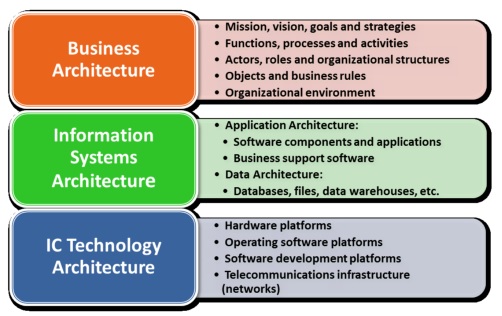
<body><![CDATA[<p lang="en-US" style="margin-bottom: 0.5cm; line-height: 100%"> 	<font face="Verdana" size="2">On the other side, we find that 	EA has been used as a base for the governance of technologies and 	for the definition of the information systems of an organization 	<a name="br5">[</a><a href="#r5">5</a>], <a name="br24">[</a><a href="#r24">24</a>]. However, we have not found in the literature of the area, 	results of research or practice related to the specific use of the 	relationship between the EA and the business processes executed by 	the IT department of an organization. </font> 	</p> 	    <p lang="en-US" style="margin-bottom: 0.5cm; line-height: 100%"> 	<font face="Verdana" size="2">Considering that the IT 	department is responsible for defining, operating and maintaining 	the enterprise architecture of an organization, the practical use of 	this critical relationship remains the main contribution of this 	work. We believe that there is a direct dependence between the 	implantation of a specific business processes model for the 	organizational unit responsible for the enterprise architecture, and 	the positive and effective role that will play this EA in the 	achievement of the alignment between business, IT technologies 	strategies and policies.</font></p> 	    <p lang="en-US" style="margin-bottom: 0.5cm; line-height: 100%"> 	<font face="Verdana" size="2">The model of IT management 	processes described in this article is an integrated set of the 	essential managerial and technical processes that an organization 	should implement in order to carry out an efficient and effective 	management of the EA resources (modeled, created, contained, and 	supervised) within an organization.</font></p> 	    <p lang="es-ES" style="margin-bottom: 0.5cm; line-height: 100%"> 	<font face="Verdana" size="2"> 	<br/>  	</font>  	</p> 	    <p lang="en-GB"><font face="Verdana" size="2">3. Enterprise Architectures</font></p> 	    <p lang="en-US" style="text-indent: 0cm; margin-bottom: 0.5cm; line-height: 100%"> 	<font face="Verdana" size="2">An enterprise architecture is a 	description of the business objectives of an organization, how these 	objectives are achieved through business processes and how these 	business processes can be supported through the use of IT <a name="br3">[</a><a href="#r3">3</a>].&nbsp;</font></p> 	    <p lang="en-US" style="margin-bottom: 0.5cm; line-height: 100%"> 	<font face="Verdana" size="2">The enterprise architecture is 	represented by a set of models that describes and relates the 	business objectives, the business processes, the information systems 	and the IT platform and that will be required to support the 	business processes of an organization or a part of it.</font></p> 	    <p lang="en-GB" style="margin-left: 1cm; text-indent: 0cm"> 	<font face="Verdana" size="2"> 	<span lang="en-GB">3.1 Components of an 	enterprise architecture</span></font></p> 	    <p lang="en-US" style="text-indent: 0cm; margin-bottom: 0.21cm; line-height: 100%"> 	<font face="Verdana" size="2">As shown in <a href="#f1">figure 1</a>, an 	enterprise architecture is composed of three levels or layers. The 	top layer, called the Business Architecture, describes the 	organization (or a part of it), its objectives, its business 	processes, its actors, its business rules, and its organizational 	structure, among others. The middle layer is known as the 	Information Systems Architecture. It describes the software 	applications and the data repositories (e.g., databases, files, data 	warehouses, etc.) that the organization uses to support its business 	processes. The lower layer is identified as the Technology 	Architecture. This layer provides details of the software, hardware 	and telecommunications platforms, on which the information system 	layer is developed, installed, and operated.</font></p> 	    <p lang="es-ES" align="center" style="margin-top: 0.21cm; line-height: 100%"> 	<font face="Verdana" size="2"><span lang="en-GB"><b> <a name="f1"><img src="/img/revistas/cleiej/v17n2/2a04f1.jpg"></a>     ]]></body>
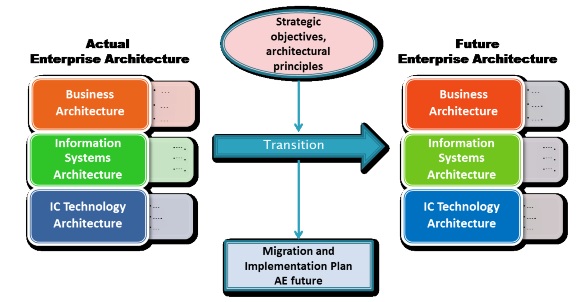
<body><![CDATA[<br> Figure 1</b>: 	Levels of an enterprise architecture</span></font></p> 	    <p lang="es-ES" style="margin-bottom: 0.5cm; line-height: 100%"> 	<font face="Verdana" size="2"> 	<br/>  	</font>  	</p> 	    <p lang="en-US" style="margin-bottom: 0.21cm; line-height: 100%"> 	<font face="Verdana" size="2">The location of the layers 	defines the relations of dependence between architectures. The 	Information Systems Architecture is developed and operated with the 	support of the Technology Architecture. The Business Architecture is 	composed by business processes that are supported by the Information 	Systems Architecture. These relationships are crucial to ensure the 	proper alignment between the business, its information systems, and 	its IT platform.</font></p> 	    <p lang="es-ES" style="margin-bottom: 0.5cm; line-height: 100%"> 	<font face="Verdana" size="2"> 	<br/>  	</font>  	</p> 	<ol> 		<ol start="2"> 			    <p lang="en-GB"><font face="Verdana" size="2">3.2 States of an enterprise 			architecture</font></p> 		    </ol> 	    </ol> 	    <p lang="en-US" style="text-indent: 0cm; margin-bottom: 0.5cm; line-height: 100%"> 	<font face="Verdana" size="2">The enterprise architecture of 	an organization is represented at two different instants of time: 	current and future. These moments determine two different states of 	the architecture, as shown in <a href="#f2">figure 2</a>.&nbsp;At the current moment, 	the enterprise architecture is described as it is by the time the EA 	planning is in progress. This state defines the baseline of the 	enterprise architecture. At the future moment, the enterprise 	architecture is described as it is targeted, that is, as it should 	be implemented in the next 3-5 years.</font></p> 	    <p lang="es-ES" align="center" style="margin-bottom: 0.21cm; line-height: 100%"> <font face="Verdana" size="2"> <br/>  	</font>  	</p> 	    <p lang="es-ES" align="center" style="margin-bottom: 0.21cm; line-height: 100%"> <font face="Verdana" size="2"> <a name="f2"><img src="/img/revistas/cleiej/v17n2/2a04f2.jpg"> </a>    ]]></body>
<body><![CDATA[<br>	<span lang="en-GB"><b>Figure 2</b>: 	States of an enterprise architecture</span></font></p> 	    <p lang="es-ES" style="margin-bottom: 0.5cm; line-height: 100%"> 	<font face="Verdana" size="2"> 	<br/>  	</font>  	</p> 	    <p lang="en-US" style="margin-bottom: 0.5cm; line-height: 100%"> 	<font face="Verdana" size="2">The Baseline Enterprise 	Architecture represents the current state of the organization, its 	systems, and its technological infrastructure.</font></p> 	    <p lang="en-US" style="margin-bottom: 0.21cm; line-height: 100%"> 	<font face="Verdana" size="2">The Target Enterprise 	Architecture is a design of the architectures of the business, 	information systems and of IT that the organization should possess 	in the next three or four years, as it is required in order to meet 	the objectives set out in their strategic plans. This architecture 	is designed on the basis of: </font> 	</p> 	    <p lang="en-US" style="margin-bottom: 0.21cm; line-height: 100%"> 	<font face="Verdana" size="2">(1) the strategic objectives 	that the company hopes to achieve in the long term; and </font> 	</p> 	    <p lang="en-US" style="margin-bottom: 0.21cm; line-height: 100%"> 	<font face="Verdana" size="2">(2) the architectural principles 	that should guide the design of the target architecture.</font></p> 	    <p lang="en-US" style="margin-bottom: 0.5cm; line-height: 100%"> 	<font face="Verdana" size="2">A migration and implementation 	plan guides the transition from the baseline state of the enterprise 	architecture to its target state. This plan organizes and describes 	the portfolio of projects, as well as the activities, schedule, and 	resources that are required to make the transition between the two 	mentioned states.</font></p> 	    <p lang="es-ES" style="margin-bottom: 0.5cm; line-height: 100%"> 	<font face="Verdana" size="2"> 	<br/>  	</font>  	</p> 	<ol> 		<ol start="3"> 			    <p lang="en-GB"><font face="Verdana" size="2">3.3 IT Management and Enterprise 			Architectures</font></p> 		    </ol> 	    ]]></body>
<body><![CDATA[</ol> 	    <p lang="en-US" style="text-indent: 0cm; margin-bottom: 0.5cm; line-height: 100%"> 	<font face="Verdana" size="2">IT Management is a managerial 	process through which an organization plans, develops, operates, and 	constantly improves its enterprise architecture, with the objective 	of providing the IT services that the organization requires.&nbsp;</font></p> 	    <p lang="en-US" style="margin-bottom: 0.5cm; line-height: 100%"> 	<font face="Verdana" size="2">One of the most important 	objectives of the IT Management is to achieve a high degree of 	alignment between business and IT. IT managers must therefore ensure 	that the information systems, and the IT platform on which these 	systems operate, provide the effective support that business 	processes demand for achieving the strategic objectives of the 	organization, as established in the business plans. </font> 	</p> 	    <p lang="en-US" style="margin-bottom: 0.5cm; line-height: 100%"> 	<font face="Verdana" size="2">In order to achieve effectively 	this objective, EA must become the focus of attention of IT managers 	and CIOs. IT Management must be centered on managing the enterprise 	architecture.</font></p> 	    <p lang="es-ES" style="margin-bottom: 0.5cm; line-height: 100%"> 	<font face="Verdana" size="2"><span lang="en-US">In the next 	sections, we describe an IT process model that is based on the close 	relationship that must exist between EA and IT Management</span><font color="#365f91"><span lang="en-US">. 	</span></font></font> 	</p> 	    <p lang="es-ES" style="margin-bottom: 0.5cm; line-height: 100%"> 	 <font face="Verdana" size="2"> 	 <br/>  	</font>  	</p> 	<ol start="4"> 		    <p lang="en-GB"><font face="Verdana" size="2"><span lang="en-US">4. T</span>he 		Process Model for <span lang="en-US">IT Management</span></font></p> 	    </ol> 	    <p lang="en-US" style="text-indent: 0cm; margin-bottom: 0.5cm; line-height: 100%"> 	<font face="Verdana" size="2">A process model for the IT 	management is a description of the set of business processes, and 	their activities, that the IT Management of an organization is 	required to execute, in order to fulfill its business objectives, 	and deliver the IT services that the organization demands.&nbsp;</font></p> 	    <p lang="en-US" style="margin-bottom: 0.5cm; line-height: 100%"> 	<font face="Verdana" size="2">The model that we describe in 	this section is based on the following premise: The main 	responsibility of the IT Management of an organization is to manage 	effectively and efficiently the enterprise architecture of that 	organization, in order to provide the IT services that the 	organization demands. </font> 	</p> 	    ]]></body>
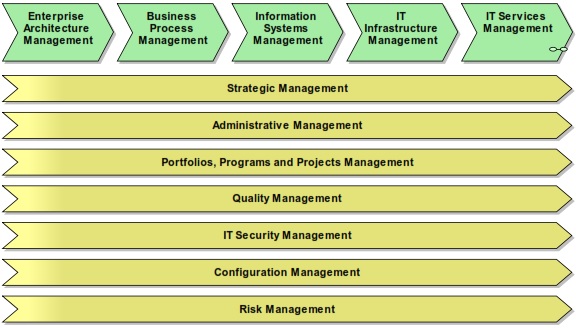
<body><![CDATA[<p lang="en-US" style="margin-bottom: 0.5cm; line-height: 100%"> 	<font face="Verdana" size="2">Managing an enterprise 	architecture involves a set of business activities, such as 	planning, implementing, operating, evaluating and improving the 	enterprise architecture and its three main components: the business 	architecture, the information systems architecture and the 	technology architecture. Using the EA structure as a framework, 	these activities can be organized and grouped into processes using a 	value chain, as illustrated in <a href="#f3">Fig. 3</a>.</font></p> 	    <p lang="es-ES" align="center" style="margin-bottom: 0.21cm; line-height: 100%"> 	<font face="Verdana" size="2"> 	<a name="f3"><img src="/img/revistas/cleiej/v17n2/2a04f3.jpg"> </a>    <br><span lang="en-GB"><b>Figure 3</b>: 	IT Management Value Chain</span></font></p> 	    <p lang="es-ES" style="margin-bottom: 0.5cm; line-height: 100%"> 	<font face="Verdana" size="2"> 	<br/>  	</font>  	</p> 	    <p lang="en-US" style="margin-bottom: 0.5cm; line-height: 100%"> 	<font face="Verdana" size="2">The value chain of an 	organization is a process model that organizes the business 	processes that directly generates customer value and differentiates 	these processes from those that support indirectly this generation 	of value. The first ones, called essential or primary processes, 	justify the existence of the organization and allow it to achieve 	its business goals; the second ones offer the support needed to 	execute the essential or primary processes.</font></p> 	    <p lang="en-US" style="margin-bottom: 0.5cm; line-height: 100%"> 	<font face="Verdana" size="2">The essential processes are 	located at the top of the value chain and organize the set of 	activities that are the raison d'&ecirc;tre of the IT Management. 	These processes are: Enterprise Architecture Management, Business 	Processes Management, Information Systems Management, IT 	Infrastructure Management and IT Service Management.</font></p> 	    <p lang="en-US" style="margin-bottom: 0.5cm; line-height: 100%"> 	<font face="Verdana" size="2">The support processes, located 	at the bottom of the value chain, group administrative and technical 	activities that are necessary to facilitate the execution of the 	activities of the essential processes. This group includes the 	following processes: Strategic Management, Administrative 	Management, Portfolio, Programs, and Projects Management, Quality 	Management, IT Security Management, Configuration Management, and 	Risk Management.</font></p> 	    <p lang="en-US" style="margin-bottom: 0.5cm; line-height: 100%"> 	<font face="Verdana" size="2">Each of these processes is 	described, succinctly, in the following sections of this article.</font></p> 	    <p lang="es-ES" style="margin-bottom: 0.5cm; line-height: 100%"> 	<font face="Verdana" size="2"> 	<br/>  	</font>  	</p> 	<ol start="5"> 		    <p lang="en-GB"><font face="Verdana" size="2">5. The Essential Processes of IT 		Management</font></p> 		<ol> 			    ]]></body>
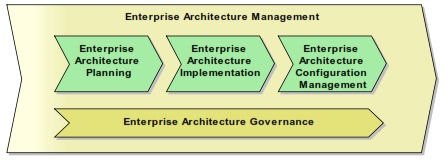
<body><![CDATA[<p lang="en-GB"><font face="Verdana" size="2">5.1 Enterprise Architecture 			Management </font>  			</p> 		    </ol> 	    </ol> 	    <p lang="en-US" style="text-indent: 0cm; margin-bottom: 0.5cm; line-height: 100%"> 	<font face="Verdana" size="2">This process is responsible for 	the planning, implementation, improvement and governance of the 	enterprise architecture as a whole. The decomposition of this 	process into a hierarchy of lower level processes is presented in 	<a href="#f4">Fig. 4</a>.</font></p> 	    <p lang="es-ES" align="center" style="margin-bottom: 0.21cm; line-height: 100%"> 	<font face="Verdana" size="2"> 	<br/>  	</font>  	</p> 	    <p lang="es-ES" align="center" style="margin-bottom: 0.21cm; line-height: 100%"> <font face="Verdana" size="2"> <a name="f4"><img src="/img/revistas/cleiej/v17n2/2a04f4.jpg"> </a>    <br>	<span lang="en-GB"><b>Figure 4</b>: 	Enterprise Architecture Management Processes</span></font></p> 	    <p lang="en-US" style="margin-bottom: 0.5cm; line-height: 100%"> 	<font face="Verdana" size="2">EA Planning consists of three 	groups of activities: (1) the definition of the baseline enterprise 	architecture; (2) the definition of the target enterprise 	architecture, and (3) the process of planning the migration from the 	baseline to the target architecture. The main products of this 	process are the set of models that describes the baseline and target 	architectures and the EA Migration and Implementation Plan (EAP). 	The latter is a long-term plan that contains the portfolio of 	programs and projects needed to implement the target enterprise 	architecture.</font></p> 	    <p lang="en-US" style="margin-bottom: 0.5cm; line-height: 100%"> 	<font face="Verdana" size="2">EA Implementation is the 	management process responsible for coordinating, supervising and 	controlling the execution of each one of the projects defined in the 	portfolio of the EA Migration and Implementation Plan.</font></p> 	    <p lang="en-US" style="margin-bottom: 0.5cm; line-height: 100%"> 	<font face="Verdana" size="2">EA Configuration Management is 	the process of managing the changes to the baseline and target 	architecture and to the components of the EA portfolio. It is also 	in charge of creating, managing, and maintaining the Architecture 	Repository which is used to organize and store all the documents and 	products of the EA processes and endeavors. </font> 	</p> 	    ]]></body>
<body><![CDATA[<p lang="en-US" style="margin-bottom: 0.5cm; line-height: 100%"> 	<font face="Verdana" size="2">The EA Governance process exerts 	an appropriate direction, and control over the planning, 	implementation, and evolution (improvements) of the enterprise 	architecture.</font></p> 	    <p lang="es-ES" style="margin-bottom: 0.5cm; line-height: 100%"> 	<font face="Verdana" size="2"> 	<br/>  	</font>  	</p> 	<ol> 		<ol start="2"> 			    <p lang="en-GB"><font face="Verdana" size="2">5.2 Business Processes Management</font></p> 		    </ol> 	    </ol> 	    <p lang="en-US" style="text-indent: 0cm; margin-bottom: 0.5cm; line-height: 100%"> 	<font face="Verdana" size="2">This process focuses on the 	Business Architecture. It consists of the representation (modeling), 	analysis, evaluation, and improvement of the business processes of 	the organization. It is divided into the set of processes shown in 	<a href="#f5">Fig. 5.</a>&nbsp;</font></p> 	    <p lang="es-ES" align="center" style="margin-bottom: 0.21cm; line-height: 100%"> 	<font face="Verdana" size="2"> 	<br/>  	</font>  	</p> 	    <p lang="es-ES" align="center" style="margin-bottom: 0.21cm; line-height: 100%"> <font face="Verdana" size="2"> <a name="f5"><img src="/img/revistas/cleiej/v17n2/2a04f5.jpg"> </a>    <br> 	<span lang="en-GB"><b>Figure 5</b>: 	Processes of the Business Processes Management</span></font></p> 	    <p lang="es-ES" style="margin-bottom: 0.5cm; line-height: 100%"> 	<font face="Verdana" size="2"> 	<br/>  	</font>  	</p> 	    ]]></body>
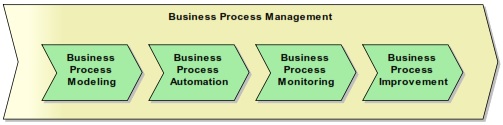
<body><![CDATA[<p lang="en-US" style="margin-bottom: 0.5cm; line-height: 100%"> 	<font face="Verdana" size="2">The main product of the Business 	Processes Management is the set of models that represent the 	processes that the organization should execute to achieve its goals. 	These models describe different organizational elements, such as 	business objectives and goals, business processes and their 	activities, the actors that execute these activities, the business 	rules that the processes must comply, and other elements that 	characterize the organization as a business system <a name="br25">[</a><a href="#r25">25</a>].&nbsp;</font></p> 	    <p lang="en-US" style="margin-bottom: 0.5cm; line-height: 100%"> 	<font face="Verdana" size="2">These models are elaborated 	using appropriate modelling notations or languages, such as BPMN 	<a name="br26">[</a><a href="#r26">26</a>], and the extension of UML to business of Eriksson and Penker 	<a name="br27">[</a><a href="#r27">27</a>].</font></p> 	    <p lang="en-US" style="margin-bottom: 0.5cm; line-height: 100%"> 	<font face="Verdana" size="2">Several of the business 	processes can be automated using suitable languages and tools for 	Business Process Management (BPM). Both manual and automated 	business processes need to be constantly monitored in order to 	evaluate its effectiveness and determine the need for improvements.</font></p> 	    <p lang="es-ES" style="margin-bottom: 0.5cm; line-height: 100%"> 	<font face="Verdana" size="2"> 	<br/>  	</font>  	</p> 	<ol> 		<ol start="3"> 			    <p lang="en-GB"><font face="Verdana" size="2">5.3 Information Systems 			Management</font></p> 		    </ol> 	    </ol> 	    <p lang="en-US" style="text-indent: 0cm; margin-bottom: 0.21cm; line-height: 100%"> 	<font face="Verdana" size="2">It includes all technical and 	operational activities that are needed for the implementation, 	operation, maintenance, and governance of the information systems 	architectures: the Applications Architecture and the Data 	Architecture. This process is responsible, therefore, of:</font></p> 	<ul> 		<li/>     <p lang="en-GB" style="margin-bottom: 0.21cm; line-height: 100%"> 		<font face="Verdana" size="2">The development, operation and 		maintenance of the information systems of the organization, 		including software components (e.g., web services, EJBs, .NET 		components, etc.), business and support applications, and data 		repositories (e.g., files, metadata, data bases, data marts, etc.).</font></p> 		<li/>     <p lang="en-GB" style="margin-bottom: 0.21cm; line-height: 100%"> 		<font face="Verdana" size="2">The governance of information 		systems which is responsible for the direction and control of all 		the activities associated with managing, operating, and maintaining 		the information systems.</font></p> 	    ]]></body>
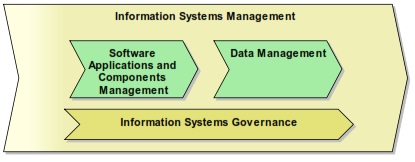
<body><![CDATA[</ul> 	    <p lang="en-US" style="margin-bottom: 0.5cm; line-height: 100%"> 	<font face="Verdana" size="2">The Information System 	Management process is divided into three lower level processes, as 	shown in <a href="#f6">Fig. 6</a>.&nbsp;</font></p> 	    <p lang="es-ES" align="center" style="margin-bottom: 0.21cm; line-height: 100%"> 	<font face="Verdana" size="2"> 	<br/>  	</font>  	</p> 	    <p lang="es-ES" align="center" style="margin-bottom: 0.21cm; line-height: 100%"> <font face="Verdana" size="2"> <a name="f6"><img src="/img/revistas/cleiej/v17n2/2a04f6.jpg"> </a>    <br> 	<span lang="en-GB"><b>Figure 6</b>: 	Processes of Information Systems Management</span></font></p> 	    <p lang="es-ES" style="margin-bottom: 0.5cm; line-height: 100%"> 	<font face="Verdana" size="2"> 	<br/>  	</font>  	</p> 	<ol> 		<ol> 			<ol> 				    <p lang="en-GB"><font face="Verdana" size="2"><span lang="en-GB">5.3.1 Software Applications and Components 				Management</span></font></p> 			    </ol> 		    </ol> 	    </ol> 	    ]]></body>
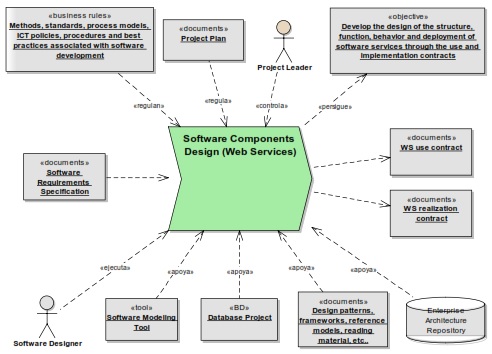
<body><![CDATA[<p lang="en-US" style="text-indent: 0cm; margin-bottom: 0.5cm; line-height: 100%"> 	<font face="Verdana" size="2">This process is responsible for 	the technical and support activities that are needed to develop, 	administer, and maintain all the applications and reusable software 	components that make up the Information Systems Architecture (see 	<a href="#f7">Fig. 7</a>).</font></p> 	    <p lang="es-ES" align="center" style="margin-bottom: 0.21cm; line-height: 100%"> 	<font face="Verdana" size="2"> 	<br/>  	</font>  	</p> 	    <p lang="es-ES" align="center" style="margin-bottom: 0.21cm; line-height: 100%"> <font face="Verdana" size="2"> <a name="f7"><img src="/img/revistas/cleiej/v17n2/2a04f7.jpg"> </a>    <br> 	<span lang="en-GB"><b>Figure 7</b>: 	Processes of Software Applications and Components Management</span></font></p> 	    <p lang="en-US" style="margin-bottom: 0.5cm; line-height: 100%"> 	<font face="Verdana" size="2">Like most of the other processes 	in the model, this one is decomposed into one or more hierarchical 	levels until the lowest level of abstraction is reached. An example 	of one of the low-level process diagram is shown in <a href="#f8">Fig. 8</a>.</font></p> 	    <p lang="es-ES" align="center" style="margin-bottom: 0.21cm; line-height: 100%"> 	<font face="Verdana" size="2"> 	<br/>  	</font>  	</p> 	    <p lang="es-ES" align="center" style="margin-bottom: 0.21cm; line-height: 100%"> <font face="Verdana" size="2"> <a name="f8"><img src="/img/revistas/cleiej/v17n2/2a04f8.jpg"> </a>    <br> 	<span lang="en-GB"><b>Figure 8</b>: 	Processes required for developing software components</span></font></p> 	    <p lang="es-ES" style="margin-bottom: 0.5cm; line-height: 100%"> 	<font face="Verdana" size="2"> 	<br/>  	</font>  	</p> 	    <p lang="en-US" style="margin-bottom: 0.5cm; line-height: 100%"> 	<font face="Verdana" size="2">Each process of the lowest level 	of abstraction is described, in our model, using a UML process 	diagram, as exemplified in <a href="#f9">Fig. 9</a>.</font></p>   	    ]]></body>
<body><![CDATA[<p lang="es-ES" align="center" style="margin-bottom: 0.21cm; line-height: 100%"> <font face="Verdana" size="2"> <a name="f9"><img src="/img/revistas/cleiej/v17n2/2a04f9.jpg"> </a>    <br> 	<span lang="en-GB"><b>Figure 9</b>: 	A low-level process description</span></font></p> 	    <p lang="es-ES" style="margin-bottom: 0.5cm; line-height: 100%"> 	<font face="Verdana" size="2"> 	<br/>  	</font>  	</p> 	    <p lang="en-US" style="margin-bottom: 0.5cm; line-height: 100%"> 	<font face="Verdana" size="2">Our model promotes software 	reusability. Application Development is, therefore, a process that 	is executed in parallel to Software Components Development. Both 	processes produce software solutions based on the assembly of 	reusable components, such as web services and EJB components. </font> 	</p> 	    <p lang="en-US" style="margin-bottom: 0.5cm; line-height: 100%"> 	<font face="Verdana" size="2">These two processes are 	independent of the existing methodological approaches (i.e., agile, 	balanced, disciplined, waterfall, evolutionary, etc.). Our process 	model identifies and brings together the activities of software 	development without indicating or encouraging the use of any method 	or practice. The selection of methods, practices, standards and 	procedures that are required, in any of the processes, is beyond the 	scope of the model. </font> 	</p> 	    <p lang="es-ES" style="margin-bottom: 0.5cm; line-height: 100%"> 	<font face="Verdana" size="2"> 	<br/>  	</font>  	</p> 	<ol> 		<ol> 			<ol start="2"> 				    <p lang="en-GB"><font face="Verdana" size="2">5.3.2 Data Management</font></p> 			    </ol> 		    </ol> 	    </ol> 	    ]]></body>
<body><![CDATA[<p lang="en-US" style="text-indent: 0cm; margin-bottom: 0.5cm; line-height: 100%"> 	<font face="Verdana" size="2">This process is about planning, 	implementing and monitoring policies, practices and projects that 	enable to gather, manage, protect, deliver, and improve the value of 	the data and information. </font> 	</p> 	    <p lang="en-US" style="margin-bottom: 0.5cm; line-height: 100%"> 	<font face="Verdana" size="2">Data Management is intended to 	meet the needs of data and information of the organization and its 	stakeholders or users, ensuring the availability of the data, the 	continuous improvement of the quality of the data and information, 	as well as the privacy, confidentiality and access control to these 	business assets.&nbsp;</font></p> 	    <p lang="es-ES" style="margin-bottom: 0.5cm; line-height: 100%"> 	<font face="Verdana" size="2"><span lang="en-US">The 	management of data uses the architectural principle that considers 	to data and information as assets or corporate resources <a name="br2">[</a><a href="#r2">2</a>]. Data 	Management is executed, therefore, separate from the management of 	applications and software components. <a href="#f10">Fig. 10</a> shows the technical 	processes that make up the Data Management process. This process 	decomposition is based on the body of knowledge of Data Management 	DAMA-DMBOK <a name="br13">[</a><a href="#r13">13</a>]. To the best of our knowledge, DAMA is the only data 	standard published until now. One of its main features is that it 	highlights the differences and clarifies core data concepts, such as 	metadata, master data, and reference data.</span></font></p> 	    <p lang="es-ES" align="center" style="margin-bottom: 0.21cm; line-height: 100%"> <font face="Verdana" size="2"> <a name="f10"><img src="/img/revistas/cleiej/v17n2/2a04f10.jpg"> </a>    <br> 	<span lang="en-GB"><b>Figure 10</b>: 	Data Management Processes</span></font></p> 	    <p lang="es-ES" style="margin-bottom: 0.5cm; line-height: 100%"> 	<font face="Verdana" size="2"> 	<br/>  	</font>  	</p> 	<ol> 		<ol> 			<ol start="3"> 				    <p lang="en-GB"><font face="Verdana" size="2"><span lang="en-GB">5.3.3 Information Systems Governance 				</span></font> 				</p> 			    </ol> 		    </ol> 	    </ol> 	    ]]></body>
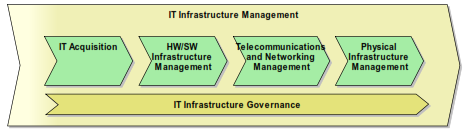
<body><![CDATA[<p lang="en-US" style="text-indent: 0cm; margin-bottom: 0.5cm; line-height: 100%"> 	<font face="Verdana" size="2">It is transversal to the 	processes of managing applications, software components and data. It 	is responsible for the direction and integrated control of the 	Information Systems Management processes.</font></p> 	    <p lang="es-ES" style="margin-bottom: 0.5cm; line-height: 100%"> 	<font face="Verdana" size="2"> 	<br/>  	</font>  	</p> 	<ol> 		<ol start="4"> 			    <p lang="en-GB" style="text-indent: 0cm">             <font face="Verdana" size="2">5.4 IT 			Infrastructure Management</font></p> 		    </ol> 	    </ol> 	    <p lang="es-ES" style="text-indent: 0cm; margin-bottom: 0.5cm; line-height: 100%"> 	<font face="Verdana" size="2"><span lang="en-US">This process 	is responsible for the operational management of the IT 	infrastructure as defined by the Technology Architecture. This 	infrastructure includes the set of hardware, software, network and 	telecommunication technologies employed to support the development, 	installation, operation, maintenance&nbsp;and interaction between 	the components of the Information Systems Architecture. It is 	divided into the processes identified in <a href="#f11">Fig. 11</a>.</span></font></p> 	    <p lang="es-ES" align="center" style="margin-bottom: 0.21cm; line-height: 100%"> <font face="Verdana" size="2"> <a name="f11"><img src="/img/revistas/cleiej/v17n2/2a04f11.jpg"> </a>    <br> 	<span lang="en-GB"><b>Figure 11</b>: 	Processes of IT Infrastructure Management</span></font></p> 	    <p lang="es-ES" style="margin-bottom: 0.5cm; line-height: 100%"> 	<font face="Verdana" size="2"> 	<br/>  	</font>  	</p> 	    <p lang="en-US" style="margin-bottom: 0.5cm; line-height: 100%"> 	<font face="Verdana" size="2">IT Acquisition consists of the 	selection, purchase, installation and replacement of the hardware, 	software and telecommunication products that comprise the IT 	infrastructure.</font></p> 	    ]]></body>
<body><![CDATA[<p lang="en-US" style="margin-bottom: 0.5cm; line-height: 100%"> 	<font face="Verdana" size="2">All the hardware (HW) and system 	software (SW) that the organization owns is a subset of the IT 	infrastructure. The HW/SW Infrastructure Management process includes 	a set of activities to define, install, operate, monitor and 	maintain the hardware/software platforms of the organization. </font> 	</p> 	    <p lang="en-US" style="margin-bottom: 0.5cm; line-height: 100%"> 	<font face="Verdana" size="2">This process also includes all 	those activities that are concerned with the management, operation 	and maintenance of the organization's data center.&nbsp;</font></p> 	    <p lang="en-US" style="margin-bottom: 0.5cm; line-height: 100%"> 	<font face="Verdana" size="2">Telecommunications and 	Networking Management covers all activities related to the 	installation, operation, control and security of the 	telecommunications and networks infrastructure of the organization. 	Its aim is to ensure that all networks of the organization operate 	efficiently and provide a high service availability to their users. 	It includes processes such as capacity planning, design, 	installation and configuration, security, control and maintenance of 	the different types of networks (LAN, MAN or WAN).&nbsp;</font></p> 	    <p lang="en-US" style="margin-bottom: 0.5cm; line-height: 100%"> 	<font face="Verdana" size="2">Physical Infrastructure 	Management is related to the administration and maintenance of the 	physical environments in which the IT Infrastructure of the 	organization is installed, operated, monitored and maintained. It 	includes the processes and activities needed to manage the 	electrical and mechanical subsystems that the Data Centers and any 	other IT installation require.&nbsp;</font></p> 	    <p lang="en-US" style="margin-bottom: 0.5cm; line-height: 100%"> 	<font face="Verdana" size="2">IT Infrastructure Governance 	comprises the activities of planning, coordination, direction and 	control of the resources that are involved in processes and projects 	of the IT infrastructure.</font></p> 	<ol> 		<ol start="5"> 			    <p lang="en-GB"><font face="Verdana" size="2">5.5 IT Services Management</font></p> 		    </ol> 	    </ol> 	    <p lang="en-US" style="text-indent: 0cm; margin-bottom: 0.5cm; line-height: 100%"> 	<font face="Verdana" size="2">An IT Service is an intangible 	non-storable product that is generated by one of the IT Management 	processes with the purpose of responding to requests made by 	internal or external users of the organization. Are examples of IT 	services the following: the creation of an e-mail account, the 	generation of a management report, and the solution of a problem in 	the use of an application.</font></p> 	    <p lang="es-ES" style="margin-bottom: 0.5cm; line-height: 100%"> 	<font face="Verdana" size="2"><span lang="en-US">As shown in 	<a href="#f12">Fig. 12</a>, the IT Services Management processes used by our model are 	based on the ITIL V3 standard <a name="br10">[</a><a href="#r10">10</a>]. We choose this de facto standard 	because of its particular point of view in considering different 	types of events like incidents, problems, request, and events they 	self. According to Dugmore and Taylor <a name="br28">[</a><a href="#r28">28</a>], this is one of the 	differences with the ISO/IEC 20000, which considers all of them in 	its resolution processes, but without making particular differences 	between them. Another IT standard is the Application Services 	Library (ASL). Meijer, Smalley, and Taylor <a name="br29">[</a><a href="#r29">29</a>] point out that &ldquo;ITIL 	describes processes and activities that are common to both models in 	more detail than ASL&rdquo;. In our perception, both standards may 	be considered, but in our Latin-American environment ITIL is more 	known than ASL.</span></font></p> 	    ]]></body>
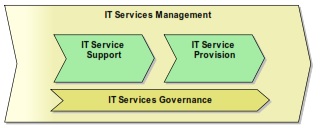
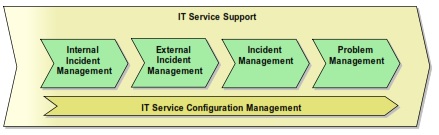
<body><![CDATA[<p lang="es-ES" align="center" style="margin-bottom: 0.21cm; line-height: 100%"> <font face="Verdana" size="2"> <a name="f12"><img src="/img/revistas/cleiej/v17n2/2a04f12.jpg"> </a>    <br> 	<span lang="en-GB"><b>Figure 12</b>: 	IT Service Management Processes</span></font></p> 	    <p lang="es-ES" style="margin-bottom: 0.5cm; line-height: 100%"> 	<font face="Verdana" size="2"> 	<br/>  	</font>  	</p> 	    <p lang="en-US" style="margin-bottom: 0.5cm; line-height: 100%"> 	<font face="Verdana" size="2">This process can be implemented 	using call centers and/or service desks. A call center is able to 	handle a high volume of calls. It may redirect the user to other 	levels of support in case that it may be needed. A service desk is a 	set of services that offers the ability to manage and solve all the 	potential incidents in a holistic manner, including the attention of 	new requirements related to information systems and/or the IT 	infrastructure. A service desk&nbsp;represents an interface for 	clients and users of all IT services that the IT Management offers.</font></p> 	    <p lang="es-ES" style="margin-bottom: 0.5cm; line-height: 100%"> 	<font face="Verdana" size="2"><span lang="en-US">In both 	implementations, the concept of Service Level Agreement (SLA) is 	used. It sets out the conditions for the provision of services.</span></font></p> 	<ol> 		<ol> 			<ol> 				    <p lang="en-GB"><font face="Verdana" size="2">5.5.1 IT Service Support</font></p> 			    </ol> 		    </ol> 	    </ol> 	    <p lang="en-US" style="text-indent: 0cm; margin-bottom: 0.5cm; line-height: 100%"> 	<font face="Verdana" size="2">IT Service Support process is 	concerned with those activities that guarantee the continuity, 	availability and quality of the services provided to the users. 	These activities are organized in processes as indicated in <a href="#f13">Fig. 13</a>.</font></p> 	    ]]></body>
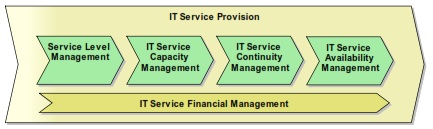
<body><![CDATA[<p lang="es-ES" style="margin-bottom: 0.5cm; line-height: 100%"> 	<font face="Verdana" size="2"> 	<br/>  	</font>  	</p>  	    <p lang="es-ES" align="center" style="margin-bottom: 0.21cm; line-height: 100%"> <font face="Verdana" size="2"> <a name="f13"><img src="/img/revistas/cleiej/v17n2/2a04f13.jpg"> </a>    <br> 	<span lang="en-GB"><b>Figure 13</b>: 	IT Service Support Processes</span></font></p> 	<ol> 		<ol> 			<ol start="2"> 				    <p lang="en-GB"><font face="Verdana" size="2">5.5.2 IT Service Provision</font></p> 			    </ol> 		    </ol> 	    </ol> 	    <p lang="en-US" style="text-indent: 0cm; margin-bottom: 0.5cm; line-height: 100%"> 	<font face="Verdana" size="2">This process deals with the IT 	services themselves as they are offered to their users. It takes 	into consideration the SLAs, the availability of the services, the 	service continuity, the service financial viability, the capacity of 	the IT infrastructure and the levels of security required. <a href="#f14">Fig. 14</a> 	shows the set of processes associated with the provision of IT 	services.&nbsp;</font></p> 	    <p lang="es-ES" style="margin-bottom: 0.5cm; line-height: 100%"> 	<font face="Verdana" size="2"> 	<br/> 	</font> 	</p>  	    <p lang="es-ES" align="center" style="margin-bottom: 0.21cm; line-height: 100%"> 	<font face="Verdana" size="2"> 	<a name="f14"><img src="/img/revistas/cleiej/v17n2/2a04f14.jpg"></a>     ]]></body>
<body><![CDATA[<br>     <span lang="en-GB"><b>Figure 14</b>: 	IT Service Provision Processes</span></font></p> 	    <p lang="es-ES" style="margin-bottom: 0.5cm; line-height: 100%"> 	<font face="Verdana" size="2"> 	<br/>  	</font>  	</p> 	    <p lang="es-ES" style="margin-bottom: 0.5cm; line-height: 100%"> 	<font face="Verdana" size="2"><span lang="en-US">IT Service 	Governance is transversal to the processes of service support and 	service provision. It is responsible for the direction and 	integrated control of these two processes.</span></font></p> 	<ol start="6"> 		    <p lang="en-GB"><font face="Verdana" size="2">6 The Support Processes of IT 		Management</font></p> 	    </ol> 	    <p lang="en-US" style="text-indent: 0cm; margin-bottom: 0.5cm; line-height: 100%"> 	<font face="Verdana" size="2">The fundamental processes, 	described above, are supported by a set of administrative and 	management activities, which contribute to the effectiveness and 	efficiency of such processes. These activities are organized in the 	so-called support processes, located in the lower part of the value 	chain of the IT management model (see figure 3).</font></p> 	    <p lang="es-ES" style="margin-bottom: 0.5cm; line-height: 100%"> 	<font face="Verdana" size="2"><span lang="en-US">Several of 	the support processes are specialized to provide better sustain for 	fundamental or support processes. Such is the case of the 	Configuration Management, Risk Management and IT Security Management 	processes. The latter, for example, specializes in management the 	security of the IT infrastructure, the Data, and the Computing 	Services.</span></font></p> 	<ol> 		<ol> 			    <p lang="en-GB"><font face="Verdana" size="2">6.1 Strategic Management</font></p> 		    </ol> 	    </ol> 	    ]]></body>
<body><![CDATA[<p lang="en-US" style="text-indent: 0cm; margin-bottom: 0.5cm; line-height: 100%"> 	<font face="Verdana" size="2">It is a management process for 	aligning the goals of the IT department to the strategic goals of 	the whole organization. The process consists of a set of activities 	that lead to maximize or at least to maintain at a high level, the 	degree of alignment between the implementation of the IT goals and 	the business goals. </font> 	</p> 	    <p lang="en-US" style="margin-bottom: 0.21cm; line-height: 100%"> 	<font face="Verdana" size="2">To do that, the strategic 	management establishes the medium and long-term mission and vision, 	so it can establish the strategic goals of the business and the IT 	strategies that allow reaching them. It consists of a set of 	planning and strategic control activities. It also includes the 	management of IT policies that will be used to carry out the IT 	governance. This process is comprised of four sub-processes:</font></p> 	<ul> 		<li/>     <p lang="en-GB" style="margin-bottom: 0.21cm; line-height: 100%"> 		<font face="Verdana" size="2">Strategic Direction. It 		consists on establishing the internal and external variables that 		influence both, positively and negatively, in the successful 		attainment of the goals of the IT Management. These variables 		assist to determine the main orientation that the organization must 		follow for defining IT strategic goals; which have to be consistent 		and cohesive with the strategic goals of the whole organization.</font></p> 		<li/>     <p lang="en-GB" style="margin-bottom: 0.21cm; line-height: 100%"> 		<font face="Verdana" size="2">Establishment of IT Strategies. 		The process consists on the definition, analysis and selection of 		IT strategies that lead to implement the strategic goals of the IT 		Management. IT strategies must be in accord with business 		strategies. This process includes the processing and inclusion of 		strategies within the framework of the current and future EA. Among 		the main activities of this process are: strategic options and 		functional projects formulation, evaluation of these strategic 		options and functional projects, and definition of strategies for 		the IT management.</font></p> 		<li/>     <p lang="en-GB" style="margin-bottom: 0.21cm; line-height: 100%"> 		<font face="Verdana" size="2">IT Policy Management. Policies 		are documented statements that establish the set of rules 		associated with the different aspects of the EA. Policy Management 		is a strategic process that requires the implementation of 		activities related to the definition and development of IT 		policies, implementation and maintenance of these policies, as well 		as the establishment of guidelines to eliminate these policies when 		they no longer support the business strategy.</font></p> 		<li/>     <p lang="en-GB" style="margin-bottom: 0.21cm; line-height: 100%"> 		<font face="Verdana" size="2">Monitoring of IT Strategies. 		This process measures the degree of effectiveness of the 		implemented strategies in order to achieve IT goals and strategic 		projects. This process determines the technical and managerial 		mechanisms and instruments, considered necessary to measure 		efficiency and effectiveness of the implemented strategies and to 		establish mechanisms to improve these strategies, if required. In 		addition the process comprises the evaluation of the organizational 		and current EA performance searching to attain a better fit and 		support of strategic business goals.</font></p> 	    </ul> 	    <p lang="es-ES" style="margin-bottom: 0.5cm; line-height: 100%"> 	<font face="Verdana" size="2"> 	<br/> 	</font> 	</p> 	<ol> 		<ol start="2"> 			    <p lang="en-GB"><font face="Verdana" size="2">6.2 Administrative Management</font></p> 		    </ol> 	    ]]></body>
<body><![CDATA[</ol> 	    <p lang="en-US" style="text-indent: 0cm; margin-bottom: 0.5cm; line-height: 100%"> 	<font face="Verdana" size="2">It is responsible for the 	planning, organization, direction, and control of human, financial, 	physical, and budgetary resources that are managed by the IT 	Department.</font></p> 	    <p lang="en-US" style="margin-bottom: 0.21cm; line-height: 100%"> 	<font face="Verdana" size="2">This process breaks down in the 	next set of processes:</font></p> 	<ul> 		<li/>     <p lang="en-GB" style="margin-bottom: 0.21cm; line-height: 100%"> 		<font face="Verdana" size="2">Human Resources Management. It 		is in charge of matters pertaining to staff, the&nbsp;performance 		evaluation of the staff, and&nbsp;the&nbsp;staff training and 		development.</font></p> 		<li/>     <p lang="en-GB" style="margin-bottom: 0.21cm; line-height: 100%"> 		<font face="Verdana" size="2">Management of Financial 		Resources. It is responsible for the management of all of the 		financial resources, including, among others, the management 		of&nbsp;contracts,&nbsp;purchases, and costs; as well as, the 		acquisition of&nbsp;goods, materials, and office supplies,&nbsp;the 		provision of&nbsp;services, and&nbsp;the&nbsp;processing costs and 		flow cash.</font></p> 		<li/>     <p lang="en-GB" style="margin-bottom: 0.21cm; line-height: 100%"> 		<font face="Verdana" size="2">Management of Physical 		Resources. It&nbsp;consists of the&nbsp;control of goods 		and&nbsp;materials; as well as, the administration and control of 		documentation&nbsp;that handles the IT Department.</font></p> 		<li/>     <p lang="en-GB" style="margin-bottom: 0.21cm; line-height: 100%"> 		<font face="Verdana" size="2">Budgetary Management. It is 		responsible for the formulation, monitoring, and control of the 		budget allocated to IT Management.</font></p> 	    </ul> 	    <p lang="es-ES" style="margin-bottom: 0.5cm; line-height: 100%"> 	<font face="Verdana" size="2"> 	<br/>  	</font>  	</p> 	<ol> 		<ol start="3"> 			    <p lang="en-GB"><font face="Verdana" size="2">6.3 Portfolio, Programs and 			Projects Management</font></p> 		    ]]></body>
<body><![CDATA[</ol> 	    </ol> 	    <p lang="en-US" style="text-indent: 0cm; margin-bottom: 0.5cm; line-height: 100%"> 	<font face="Verdana" size="2">This process is related to the 	activities responsible for the management of the portfolio of 	programs and projects described in the EA plan (EAP). The EAP 	comprises the programs and projects that implement&nbsp;new 	architectures for information systems and IT.&nbsp;</font></p> 	    <p lang="en-US" style="margin-bottom: 0.21cm; line-height: 100%"> 	<font face="Verdana" size="2">The standards of the Project 	Management Institute (PMI) describe how to manage portfolios, 	programs and projects <a name="br30">[</a><a href="#r30">30</a><a name="br31">,</a><a href="#r31">31</a><a name="br32">,</a><a href="#r32">32</a>]. Our model uses these standards to 	describe three sub-processes called Portfolios, Program and Projects 	Management, respectively:</font></p> 	<ul> 		<li/>     <p lang="en-GB" style="margin-bottom: 0.21cm; line-height: 100%"> 		<font face="Verdana" size="2">Portfolio Management. The 		portfolio is the collection of projects and/or programs defined 		within the EA that are fundamentals to achieve the strategic 		business goals. The portfolio reflects the investment undertaken or 		planned by the IT Management by identifying required priorities, 		resources and investment. This process includes the set of 		activities necessary to define and maintain the strategic alignment 		between an EA and the business, monitor, and control the behaviour 		of each of the EA components, review their performance, notify 		risks, and analyze and authorize changes.</font></p> 		<li/>     <p lang="en-GB" style="margin-bottom: 0.21cm; line-height: 100%"> 		<font face="Verdana" size="2">Program Management. A program 		is a set of related projects that are managed in a coordinated 		manner to create benefits in pro of attaining the strategic 		business goals. Thus, the activities required for managing programs 		include the administration of the relationship between programs and 		the portfolio of projects, and the administration of risks between 		projects and programs governance.&nbsp;</font></p> 		<li/>     <p lang="en-GB" style="margin-bottom: 0.21cm; line-height: 100%"> 		<font face="Verdana" size="2">Project Management. An IT 		project includes the definition, implementation and control of the 		effort and the resources allocated to deliver a product or a 		service. Project management involves activities for planning, 		organizing, directing, and controlling the required and assigned 		resources of each IT project. It also implies the support 		activities for coordinate changes that may emerge during project 		execution. Project Management process is based on the standards, 		strategies and IT policies established within the organization.</font></p> 	    </ul> 	<ol> 		<ol start="4"> 			    <p lang="en-GB"><font face="Verdana" size="2">6.4 Quality Management&nbsp;</font></p> 		    </ol> 	    ]]></body>
<body><![CDATA[</ol> 	    <p lang="en-US" style="text-indent: 0cm; margin-bottom: 0.5cm; line-height: 100%"> 	<font face="Verdana" size="2">Is carried out through a Quality 	Management System, which must be designed, implemented, and properly 	managed to ensure, monitor, and improve the quality of the products, 	processes, and IT services.</font></p> 	    <p lang="en-US" style="margin-bottom: 0.21cm; line-height: 100%"> 	<font face="Verdana" size="2">The Quality Management System 	has as its main objective to contribute to the achievement of the 	strategic objectives of the EA plan. It is achieve through the 	implementation and execution of processes of assurance, control, 	measurement, and improvement of the quality of the products, 	processes, and IT services for the IT Department. Its main 	sub-processes are identified below:</font></p> 	<ul> 		<li/>     <p lang="en-GB" style="margin-bottom: 0.21cm; line-height: 100%"> 		<font face="Verdana" size="2">Quality Assurance. It 		ensures&nbsp;that the IT management processes are running according 		to the rules, procedures, and standards established by the 		organization. In addition to fulfilling the obligations on the 		quality contracted with users or clients and referring both to the 		IT services and products.</font></p> 		<li/>     <p lang="en-GB" style="margin-bottom: 0.21cm; line-height: 100%"> 		<font face="Verdana" size="2">Quality Control. It deals with 		the definition and implementation of measurement methods and 		standards of measurement and control of the quality of the 		processes, products, and IT services.</font></p> 		<li/>     <p lang="en-GB" style="margin-bottom: 0.21cm; line-height: 100%"> 		<font face="Verdana" size="2">Continuous Improvement of 		Products, Processes, and Services. It refers to the continuous 		improvement of the quality of the processes to ensure compliance 		with the objectives and policies of quality&nbsp;set forth in the 		Quality Plan of the organization.</font></p> 		<li/>     <p lang="en-GB" style="margin-bottom: 0.21cm; line-height: 100%"> 		<font face="Verdana" size="2">Quality Governance. It is 		responsible for planning and controlling the quality of the IT 		processes, products and services. Its main product is the Quality 		Plan.</font></p> 	    </ul> 	    <p lang="es-ES" style="margin-bottom: 0.5cm; line-height: 100%"> 	<font face="Verdana" size="2"> 	<br/>  	</font>  	</p> 	<ol> 		<ol start="5"> 			    <p lang="en-GB"><font face="Verdana" size="2">6.5 IT Security Management</font></p> 		    ]]></body>
<body><![CDATA[</ol> 	    </ol> 	    <p lang="en-US" style="text-indent: 0cm; margin-bottom: 0.5cm; line-height: 100%"> 	<font face="Verdana" size="2">It groups a set of processes 	responsible for ensuring the security of the data and information 	which are handled by the information systems, the IT infrastructure, 	and the services of the IT Department.&nbsp;These processes 	are&nbsp;called, respectively, Management&nbsp;of the Data Security, 	Management of the IT Services Security, and Management of the 	Technological Infrastructure Security.</font></p> 	    <p lang="en-US" style="margin-bottom: 0.21cm; line-height: 100%"> 	<font face="Verdana" size="2">The IT Security Management must 	ensure compliance with three main objectives:</font></p> 	<ul> 		<li/>     <p lang="en-GB" style="margin-bottom: 0.21cm; line-height: 100%"> 		<font face="Verdana" size="2">Confidentiality. It pursues to 		maintain the necessary protection against unauthorized access to 		the corporate data and information. It applies to all data 		(structured, unstructured, documents, and contents) during their 		storage, processing, and transit.</font></p> 		<li/>     <p lang="en-GB" style="margin-bottom: 0.21cm; line-height: 100%"> 		<font face="Verdana" size="2">Integrity. It aims to ensure 		that the data is not altered, in an unauthorized manner, during 		storage, processing, and transit. This goal applies also to other 		resources or computing assets (applications, hardware, software, 		and networks), which should be protected from unauthorized 		modification, not anticipated or accidental.</font></p> 		<li/>     <p lang="en-GB" style="margin-bottom: 0.21cm; line-height: 100%"> 		<font face="Verdana" size="2">Availability. The aim is to 		ensure, without limitations of time or place, authorized access to 		the computational resources and services of the organization, 		avoiding the denial of service to those who have the necessary 		authorization to access the information or to use the computing 		services.&nbsp;</font></p> 	    </ul> 	    <p lang="es-ES" style="margin-bottom: 0.5cm; line-height: 100%"> 	<font face="Verdana" size="2"> 	<br/>  	</font>  	</p> 	<ol> 		<ol start="6"> 			    <p lang="en-GB"><font face="Verdana" size="2">6.6 Configuration Management</font></p> 		    ]]></body>
<body><![CDATA[</ol> 	    </ol> 	    <p lang="en-US" style="text-indent: 0cm; margin-bottom: 0.5cm; line-height: 100%"> 	<font face="Verdana" size="2">It is responsible for the 	administration of the EA Repository, which stores all the models and 	documents related to the enterprise architecture. This process 	manages, in addition, any changes to these documents and models. It 	is, also, used to bring the control of changes in the products that 	are generated in the software development projects and the services 	provided by the IT Department.</font></p> 	    <p lang="en-US" style="margin-bottom: 0.5cm; line-height: 100%"> 	<font face="Verdana" size="2">This process takes an up-to-date 	register of all the elements that configure the EA. This register 	provides control over the changes and versions of those 	architectural elements that the organization wants to follow their 	evolution throughout their life cycle.&nbsp;</font></p> 	    <p lang="en-US" style="margin-bottom: 0.21cm; line-height: 100%"> 	<font face="Verdana" size="2">To organize the activities of 	Configuration Management, our model is based on the IEEE standard 	828-1998 <a name="br33">[</a><a href="#r33">33</a>]. The Configuration Management of the EA consists, 	therefore, of the following processes:</font></p> 	<ul> 		<li/>     <p lang="en-GB" style="margin-bottom: 0.21cm; line-height: 100%"> 		<font face="Verdana" size="2">Configuration Management 		Planning. It is responsible for&nbsp;drawing up the&nbsp;plan of 		each configuration item, specifying its purpose, scope, 		organization, responsibilities of the actors, phases of the 		configurations based on their defined baselines, and the 		documentation of the plan.</font></p> 		<li/>     <p lang="en-GB" style="margin-bottom: 0.21cm; line-height: 100%"> 		<font face="Verdana" size="2">Configuration Identification. 		It is about the identification of configuration items and the 		baseline configuration together with their associated databases, as 		well as documented deliveries or releases.</font></p> 		<li/>     <p lang="en-GB" style="margin-bottom: 0.21cm; line-height: 100%"> 		<font face="Verdana" size="2">Configuration Control. It is 		responsible for the management of the requested changes to the 		configuration items. It is responsible for the authorization of 		these requested changes and the corresponding update of the plan 		after any change is made.</font></p> 		<li/>     <p lang="en-GB" style="margin-bottom: 0.21cm; line-height: 100%"> 		<font face="Verdana" size="2">Configuration Status 		Accounting. It records and disseminates the latest state of the 		configuration items.</font></p> 		<li/>     <p lang="en-GB" style="margin-bottom: 0.21cm; line-height: 100%"> 		<font face="Verdana" size="2">Configuration Auditing. It 		verifies and validates the EA configuration. This determines each 		configuration item of the baseline of the product, its version, and 		the revisions according to the baseline.</font></p> 		<li/>     ]]></body>
<body><![CDATA[<p lang="en-GB" style="margin-bottom: 0.21cm; line-height: 100%"> 		<font face="Verdana" size="2">Release Management and 		Delivery. It controls the distribution or delivery of those 		products that are under configuration control. </font> 		</p> 	    </ul> 	    <p lang="es-ES" style="margin-bottom: 0.5cm; line-height: 100%"> 	<font face="Verdana" size="2"> 	<br/>  	</font>  	</p> 	<ol> 		<ol start="7"> 			    <p lang="en-GB"><font face="Verdana" size="2">6.7 Risk Management</font></p> 		    </ol> 	    </ol> 	    <p lang="en-US" style="text-indent: 0cm; margin-bottom: 0.5cm; line-height: 100%"> 	<font face="Verdana" size="2">This process supports the 	processes in the value chain (see figure 3) that require to control 	the risks that may affect the components of the information system 	and IT architectures. Risk management is applicable also to projects 	contained in the portfolio of the IT department.</font></p> 	    <p lang="en-US" style="margin-bottom: 0.21cm; line-height: 100%"> 	<font face="Verdana" size="2">The proposed model takes and 	adapts the general processes of Risk Management that recommends the 	PMI, specifically, in the body of knowledge PMBOK <a name="br32">[</a><a href="#r32">32</a>]. The selected 	processes are the following:</font></p> 	<ul> 		<li/>     <p lang="en-GB" style="margin-bottom: 0.21cm; line-height: 100%"> 		<font face="Verdana" size="2">Risk Management Planning. The 		main goal of this process is to plan the set of risk management 		activities to carry out. This process is necessary to ensure that 		the rest of risk management activities are performed effectively 		and efficiently. Among the activities included in this process are 		defining methods, tools, techniques and standards that will be used 		to manage risks of each EA component; developing the work breakdown 		structure necessary to manage risks within a risk timetable; 		estimating required resources to manage risks, and outlining the 		risk management plan.</font></p> 		<li/>     <p lang="en-GB" style="margin-bottom: 0.21cm; line-height: 100%"> 		<font face="Verdana" size="2">Risk Identification. This 		process determines the risks that can affect different components 		of the EA and describes the characteristics of each identified 		risk. This process includes activities to develop checklists of 		risks, to analyse the characteristics of the EA components, to 		identify what risks apply to the different EA components, and to 		develop the risk log describing the identified risks.</font></p> 		<li/>     ]]></body>
<body><![CDATA[<p lang="en-GB" style="margin-bottom: 0.21cm; line-height: 100%"> 		<font face="Verdana" size="2">Risk Analysis. Process that 		leads to establish the priorities of the already identified risks 		and to determine the probability of occurrence and the impact of 		each of them over the EA components. The activities of this process 		include selection of the techniques to prioritize the risks; 		estimation of the probability of occurrence for each risk; 		determination of the impact that the risk can have on the EA 		components; development of the probability and impact of risks 		matrix, and the updating of the risk register.</font></p> 		<li/>     <p lang="en-GB" style="margin-bottom: 0.21cm; line-height: 100%"> 		<font face="Verdana" size="2">Response Planning. Planning 		actions that must be taken to prevent or mitigate the negative 		risks (threats) and encourage the occurrence of positive risks 		(opportunities).</font></p> 		<li/>     <p lang="en-GB" style="margin-bottom: 0.21cm; line-height: 100%"> 		<font face="Verdana" size="2">Risk Monitoring and Control. 		Among the main activities that are performed in this process are 		implementations of plans in response to risks, monitoring 		identified risks, identification of new risks, updating risks 		register and risk management plan.</font></p> 	    </ul> 	    <p lang="es-ES" style="margin-bottom: 0.21cm; line-height: 100%"> 	<font face="Verdana" size="2"><span lang="en-US">With this 	last process description, we conclude the general explanation of 	each one of processes included in the IT department chain of value. 	We consider that these processes are essential to perform an 	appropriate</span> <span lang="en-US">IT management within a medium 	or large size&nbsp;organization either it belongs to the public or 	private sector. </span></font> 	</p> 	<ol start="7"> 		    <p lang="en-GB"><font face="Verdana" size="2">7. Conclusions</font></p> 	    </ol> 	    <p lang="en-US" style="text-indent: 0cm; margin-bottom: 0.5cm; line-height: 100%"> 	<font face="Verdana" size="2">This article has described a 	model of business processes that specifies, in a concise manner, a 	complete set of processes for performing IT management in a medium 	or large size organization. </font> 	</p> 	    <p lang="en-US" style="margin-bottom: 0.5cm; line-height: 100%"> 	<font face="Verdana" size="2">The definition of these 	processes is based on the enterprise architecture of the 	organization. It includes a comprehensive set of technical, 	managerial, and administrative processes that would be potentially 	feasible to implement in an organization of the size aforementioned; 	particularly, within the context of Venezuelan and Latin American 	public organizations and/or private.&nbsp;</font></p> 	    <p lang="en-US" style="margin-bottom: 0.21cm; line-height: 100%"> 	<font face="Verdana" size="2">The main contribution of this 	work is the description of a model of business processes for an IT 	department based on the EA. The model may be applied in three 	different ways:</font></p> 	<ol> 		<li/>     ]]></body>
<body><![CDATA[<p lang="en-US" style="margin-bottom: 0.21cm; line-height: 100%"> 		<font face="Verdana" size="2">As a framework or reference 		model for the design and standardization of the IT processes and 		services of an organization. </font> 		</p> 		<li/>     <p lang="en-US" style="margin-bottom: 0.21cm; line-height: 100%"> 		<font face="Verdana" size="2">As an evaluation model to be 		used as a comparison pattern for evaluating and reengineering the 		existing IT management processes of an organization. </font> 		</p> 		<li/>     <p lang="es-ES" style="margin-bottom: 0.21cm; line-height: 100%"> 		<font face="Verdana" size="2"><span lang="en-US">To </span><span lang="en-GB">support 		the organizational design or restructuring of the unit responsible 		for the IT Management in an organization.</span></font></p> 	    </ol> 	    <p lang="en-US" style="margin-bottom: 0.5cm; line-height: 100%"> 	<font face="Verdana" size="2">A relevant feature of our model 	is that it describes the direct relationship between the IT 	processes and the business, information systems and technology 	architectures of an EA. We believe that this way of identifying, 	defining and organizing the processes of the IT organizational unit 	leads to a fully accomplishment of the business goals. Besides, the 	proposed process model in itself constitutes a means to implement 	effective organizational alignment strategies business/IT required 	by any organization.&nbsp;</font></p> 	    <p lang="en-US" style="margin-bottom: 0.5cm; line-height: 100%"> 	<font face="Verdana" size="2">Moreover, our process model 	integrates the different categories of technical, managerial, and 	administrative processes, which are common to any organizational 	unit, in contrast to the different proposals for the IT management 	mentioned in section 2. The main difference between our model and 	the one proposed by IBM <a name="br14">[</a><a href="#r14">14</a>] is the definition of the central 	element on which the models make emphasis. The IBM model emphasizes 	on the delivery of computer services and its management; whereas, 	our model emphasizes on the management of the EA, as the central 	point to determine levels of alignment between IT and business.</font></p> 	    <p lang="en-US" style="margin-bottom: 0.5cm; line-height: 100%"> 	<font face="Verdana" size="2">The model is actually used as a 	framework for process re-engineering and organizational redesign of 	the IT departments of two Venezuelan government organizations. In 	both cases, the implementation of the resulting IT management 	processes and the associated organizational structures has faced 	problems related with the resistance to change. Many employees, who 	are accustomed to execute processes in one way, react or resist to 	perform their tasks in a different way. It may be seeing as a 	natural reaction, since changes normally produce anxiety and 	uncertainty. In order to reduce these problems, we have recommended 	the implementation of a plan for managing resistance to change based 	on several strategies, such as conducting appropriate training, 	communicating the change, and empowering employees to contribute 	with the changes. The verification and validation of the model 	applicability, in the two aforementioned cases of study, will 	therefore take some time and remains as future work. Based on the 	results of model validation, it would be possible to define 	refinements on some of the sub-processes and their activities, as an 	adaptation in response to the organization needs and contexts of 	use.</font></p> 	    <p lang="en-US" style="margin-right: 0.02cm; margin-top: 0.42cm; margin-bottom: 0.21cm; line-height: 100%; page-break-inside: avoid; widows: 0; orphans: 0; page-break-after: avoid"> 	<font face="Verdana" size="2"><b>Acknowledgements</b></font></p> 	    <p lang="es-ES" style="margin-bottom: 0.5cm; line-height: 100%"> 	<font face="Verdana" size="2"><span lang="en-US">This work is 	sponsored by the National Fund for Scientific and Technological 	Research (FONACIT) of Venezuela, under the project numbers 	G-2005000165 and PEI-2012001090. The company BIOSOFT C.A. 	(<a href="http://www.biosoftca.com/">www.biosoftca.com</a>) provided 	the infrastructure, cases of study and space needed to conduct the 	research. &nbsp;</span></font></p> 	    <p lang="en-US" style="margin-right: 0.02cm; margin-top: 0.42cm; margin-bottom: 0.21cm; line-height: 100%; page-break-inside: avoid; widows: 0; orphans: 0; page-break-after: avoid"> 	<font face="Verdana" size="2"><b>References</b></font></p> 	    ]]></body>
<body><![CDATA[<!-- ref --><p lang="en-US" style="text-indent: 0cm; margin-bottom: 0.21cm; line-height: 100%; widows: 2; orphans: 2"> 	<font face="Verdana" size="2"><a name="r1">[</a><a href="#br1">1</a>] J. McAdams, &quot;Seven 	common management obstacles&quot;, <i>Computerworld</i>, 2006.    </font></p> 	    <!-- ref --><p lang="es-ES" style="text-indent: 0cm; margin-bottom: 0.21cm; line-height: 100%; widows: 2; orphans: 2"> 	<font face="Verdana" size="2"><span lang="en-US"><a name="r2">[</a><a href="#br2">2</a>] The 	Open Group, &quot;The Open Group Architecture Framework (TOGAF) &quot;, 	version 9, 2009. [Online]. Available at: 	<a href="http://www.opengroup.org/togaf/">http://www.opengroup.org/togaf/</a>  </span></font> 	<!-- ref --><p lang="en-US" style="text-indent: 0cm; margin-bottom: 0.21cm; line-height: 100%; widows: 2; orphans: 2"> 	<font face="Verdana" size="2"><a name="r3">[</a><a href="#br3">3</a>] R. Sessions, <i>Simple 	Architectures for Complex Enterprises</i>, Redmond, WA: Microsoft 	Press, 2008.    </font></p> 	    <!-- ref --><p lang="en-US" style="text-indent: 0cm; margin-bottom: 0.21cm; line-height: 100%; widows: 2; orphans: 2"> 	<font face="Verdana" size="2"><a name="r4">[</a><a href="#br4">4</a>] J. A. Zachman, &quot;Framework 	for Information Systems Architecture&quot;, <i>IBM Systems Journal</i>, 	Vol. 26, Number 3, 1987.    </font></p> 	    <!-- ref --><p lang="en-US" style="text-indent: 0cm; margin-bottom: 0.21cm; line-height: 100%; widows: 2; orphans: 2"> 	<font face="Verdana" size="2"><a name="r5">[</a><a href="#br5">5</a>] A. Croteau, and F. Bergeron, 	&quot;An information technology trilogy: business strategy, 	technological deployment and organizational performance,&quot; <i>The 	Journal of Strategic Information Systems</i>, vol. 10, pp. 77-99, 	2001.    </font></p> 	    <!-- ref --><p lang="en-US" style="text-indent: 0cm; margin-bottom: 0.21cm; line-height: 100%; widows: 2; orphans: 2"> 	<font face="Verdana" size="2"><a name="r6">[</a><a href="#br6">6</a>] J. Luftman, &quot;Assessing 	business-IT alignment maturity&quot;, <i>Communications of AIS</i>, 	vol. 4, 2000.    </font></p> 	    <p lang="es-ES" style="text-indent: 0cm; margin-bottom: 0.21cm; line-height: 100%; widows: 2; orphans: 2"> 	<font face="Verdana" size="2"><span lang="en-US"><a name="r7">[</a><a href="#br7">7</a>] U.S. 	Department of Defense DOD, &quot;Department of Defense Architecture 	Framework, DODAF&quot;, version 2.0.2, 2010. [Online]. Available at: 	<a href="http://dodcio.defense.gov/dodaf20.aspx">http://dodcio.defense.gov/dodaf20.aspx</a> </span></font> 	</p> 	    <!-- ref --><p lang="en-US" style="text-indent: 0cm; margin-bottom: 0.21cm; line-height: 100%; widows: 2; orphans: 2"> 	<font face="Verdana" size="2"><a name="r8">[</a><a href="#br8">8</a>] U.S. Department of the 	Treasury Chief Information Officer Council, &quot;TEAF - Treasury 	Enterprise Architecture Framework&quot;, version 1, 2000.    </font></p> 	    <!-- ref --><p lang="es-ES" style="text-indent: 0cm; margin-bottom: 0.21cm; line-height: 100%; widows: 2; orphans: 2"> 	<font face="Verdana" size="2"><span lang="en-US"><a name="r9">[</a><a href="#br9">9</a>] Mitre 	Corporation, Enterprise Architecture Body of Knowledge (EABOK).&nbsp;2013 	[Online]. Available at: 	<a href="http://www2.mitre.org/public/eabok/eabok.html">http://www2.mitre.org/public/eabok/eabok.html</a> </span></font> 	<!-- ref --><p lang="es-ES" style="text-indent: 0cm; margin-bottom: 0.21cm; line-height: 100%; widows: 2; orphans: 2"> 	<font face="Verdana" size="2"><span lang="en-US"><a name="r10">[</a><a href="#br10">10</a>] APM 	Group Ltd, &quot;Official ITIL web site&quot;, 2013.&nbsp;[Online]. 	Available at: <a href="http://www.itil-officialsite.com/">http://www.itil-officialsite.com/</a> </span></font> 	<!-- ref --><p lang="en-US" style="text-indent: 0cm; margin-bottom: 0.21cm; line-height: 100%; widows: 2; orphans: 2"> 	<font face="Verdana" size="2"><a name="r11">[</a><a href="#br11">11</a>] Software Engineering 	Institute (SEI), &quot;CMMI for development&quot;, version 1.3, 	Technical report CMU/SEI-2010-TR-033, Carnegie Mellon, November 	2010.    </font></p> 	    <!-- ref --><p lang="es-ES" style="text-indent: 0cm; margin-bottom: 0.21cm; line-height: 100%; widows: 2; orphans: 2"> 	<font face="Verdana" size="2"><span lang="en-US"><a name="r12">[</a><a href="#br12">12</a>] ISACA, 	&quot;COBIT 4.1: Framework for IT governance and control&quot;, 	2013.&nbsp;[Online]. Available at: 	<a href="http://www.isaca.org/Knowledge-Center/cobit/Documents/COBIT-4-1-FR.pdf">http://www.isaca.org/Knowledge-Center/cobit/Documents/COBIT-4-1-FR.pdf</a></span></font><!-- ref --><p lang="en-US" style="text-indent: 0cm; margin-bottom: 0.21cm; line-height: 100%; widows: 2; orphans: 2"> 	<font face="Verdana" size="2"><a name="r13">[</a><a href="#br13">13</a>] DAMA International, <i>The 	DAMA guide to the Data Management Body of Knowledge</i>, 1st. 	Edition, DAMA International, 2009.    </font></p> 	    <!-- ref --><p lang="en-US" style="text-indent: 0cm; margin-bottom: 0.21cm; line-height: 100%; widows: 2; orphans: 2"> 	<font face="Verdana" size="2"><a name="r14">[</a><a href="#br14">14</a>] IBM Corporation, &quot;Align 	IT with business goals using the IBM Process Reference Model for 	IT&quot;, IBM Service Management, 2008.    </font></p> 	    <!-- ref --><p lang="en-US" style="text-indent: 0cm; margin-bottom: 0.21cm; line-height: 100%; widows: 2; orphans: 2"> 	<font face="Verdana" size="2"><a name="r15">[</a><a href="#br15">15</a>] G. S. Kearns and A. L. 	Lederer, &quot;A resource-based view of strategic IT alignment: How 	knowledge sharing creates competitive advantage&quot;, <i>Decision 	Sciences</i>, Vol. 34, No. 1, pp. 1-29, 2003.    </font></p> 	    <!-- ref --><p lang="en-US" style="text-indent: 0cm; margin-bottom: 0.21cm; line-height: 100%; widows: 2; orphans: 2"> 	<font face="Verdana" size="2"><a name="r16">[</a><a href="#br16">16</a>] J. Luftman, &quot;Measure 	your business-IT alignment&quot;, <i>Optimize: Business Execution 	Services for Magazine</i>, Issue 26, 2003.    </font></p> 	    <!-- ref --><p lang="en-US" style="text-indent: 0cm; margin-bottom: 0.21cm; line-height: 100%; widows: 2; orphans: 2"> 	<font face="Verdana" size="2"><a name="r17">[</a><a href="#br17">17</a>] B. H. Reich and K. M. 	Nelson, &quot;In their own words: CIO visions about the future of 	in-house IT organizations&quot;, <i>The DATA BASE for Advances in 	Information Systems</i>, 34, pp. 28-44, 2003.    </font></p> 	    <!-- ref --><p lang="en-US" style="text-indent: 0cm; margin-bottom: 0.21cm; line-height: 100%; widows: 2; orphans: 2"> 	<font face="Verdana" size="2"><a name="r18">[</a><a href="#br18">18</a>] R. Sabherwal and Y. E. 	Chan, &quot;Alignment between business and IS strategies: A study of 	prospectors, analyzers, and defenders&quot;, <i>Information Systems 	Research</i>, Vol. 12, No. 1, pp. 11-33, 2001.    </font></p> 	    <!-- ref --><p lang="fr-FR" style="text-indent: 0cm; margin-bottom: 0.21cm; line-height: 100%; widows: 2; orphans: 2"> 	<font face="Verdana" size="2"><span lang="en-US"><a name="r19">[</a><a href="#br19">19</a>] </span>A. 	Etien, &quot;L'Ing&eacute;nierie de l'alignement: concepts, mod&eacute;les 	et processus. The ACEM m&eacute;thode pour la correction et 	l'&eacute;volution d'systeme d'information aux processus 	d'entreprise&quot;, PhD thesis, Universit&eacute; Paris 1, Pantheon 	- Sorbonne, Paris, France, 2006.    </font></p> 	    <!-- ref --><p lang="en-US" style="text-indent: 0cm; margin-bottom: 0.21cm; line-height: 100%; widows: 2; orphans: 2"> 	<font face="Verdana" size="2"><a name="r20">[</a><a href="#br20">20</a>] I. Gmati and S. Nurcan, &quot;A 	framework for analyzing business/information system alignment 	requirements&quot;, <i>International Conference on Enterprise 	Information Systems</i> (ICEIS), Funchal, Portugal, pp. 512-516, 	2007.    </font></p> 	    <!-- ref --><p lang="en-US" style="text-indent: 0cm; margin-bottom: 0.21cm; line-height: 100%; widows: 2; orphans: 2"> 	<font face="Verdana" size="2"><a name="r21">[</a><a href="#br21">21</a>] S. J. Bleistein, K. Cox and 	J. Verner, &quot;Strategic alignment in requirements analysis for 	organizational IT: an integrated approach&quot;, <i>in&nbsp;20th ACM 	Symposium on Applied Computing (SAC' 05),</i> Santa Fe, USA, pp. 	1300-1307, 2005.    </font></p> 	    <!-- ref --><p lang="en-US" style="text-indent: 0cm; margin-bottom: 0.21cm; line-height: 100%; widows: 2; orphans: 2"> 	<font face="Verdana" size="2"><a name="r22">[</a><a href="#br22">22</a>] M. Rosemann, I. Vessey and 	R. Weber, &quot;Alignment in enterprise systems implementations: the 	role of ontological distance&quot;, <i>in</i> <i>Proceedings of the 	International Conference of Information Systems</i>, Washington, 	D.C., USA, 12-15 December, pp. 439-447, 2004.    </font></p> 	    <!-- ref --><p lang="en-US" style="text-indent: 0cm; margin-bottom: 0.21cm; line-height: 100%; widows: 2; orphans: 2"> 	<font face="Verdana" size="2"><a name="r23">[</a><a href="#br23">23</a>] C. Salinesi and C. Rolland, 	&quot;Fitting business models to systems functionality exploring the 	fitness relationship&quot;, <i>Proceedings of CAiSE'03</i>, Velden, 	Austria, 2003.    </font></p> 	    <!-- ref --><p lang="fr-FR" style="text-indent: 0cm; margin-bottom: 0.21cm; line-height: 100%; widows: 2; orphans: 2"> 	<font face="Verdana" size="2"><span lang="en-US"><a name="r24">[</a><a href="#br24">24</a>] </span>I. 	Gmati, &quot;La m&eacute;thode DEEVA (Design and Evolution Of 	Alignment)&quot;, Phd thesis, Universit&eacute; Paris 1, Pantheon - 	Sorbonne, Specialite : Informatique, Paris, France, 2001.    </font></p> 	    <!-- ref --><p lang="en-US" style="text-indent: 0cm; margin-bottom: 0.21cm; line-height: 100%; widows: 2; orphans: 2"> 	<font face="Verdana" size="2"><a name="r25">[</a><a href="#br25">25</a>] J. Montilva and J. Barrios, 	&quot;BMM: A Business Modeling Method for Information Systems 	Development&quot;, <i>CLEI Electronic Journal</i>, Vol. 7, No. 2, 	2004.    </font></p> 	    <!-- ref --><p lang="en-US" style="text-indent: 0cm; margin-bottom: 0.21cm; line-height: 100%; widows: 2; orphans: 2"> 	<font face="Verdana" size="2"><a name="r26">[</a><a href="#br26">26</a>] Object Management Group 	(OMG), &quot;Business process model and notation (BPMN) &quot;, 	version 2.0, 2011.    </font></p> 	    <!-- ref --><p lang="en-US" style="text-indent: 0cm; margin-bottom: 0.21cm; line-height: 100%; widows: 2; orphans: 2"> 	<font face="Verdana" size="2"><a name="r27">[</a><a href="#br27">27</a>] H. E. Eriksson and M. 	Penker, <i>Business modeling with UML: business patterns at work</i>, 	New York: John Wiley &amp; Sons, 2000.    </font></p> 	    <!-- ref --><p lang="es-ES" style="text-indent: 0cm; margin-bottom: 0.21cm; line-height: 100%; widows: 2; orphans: 2"> 	<font face="Verdana" size="2"><span lang="en-US"><a name="r28">[</a><a href="#br28">28</a>] J. 	Dugmore and S. Taylor, &quot;ITIL V3 and ISO/IEC 20000&quot;,&nbsp;Alignment 	white paper, <a href="http://www.itilnews.org/">www.itilnews.org</a>, 	2008.    </span></font></p> 	    <!-- ref --><p lang="es-ES" style="text-indent: 0cm; margin-bottom: 0.21cm; line-height: 100%; widows: 2; orphans: 2"> 	<font face="Verdana" size="2"><span lang="en-US"><a name="r29">[</a><a href="#br29">29</a>] M. 	Meijer, M. Smalley and S. Taylor, &quot;ITIL V3 and ASL. Sound 	Guidance for Application. Management and Application 	Development&quot;,&nbsp;Alignment white paper, <a href="http://www.itilnews.org/">www.itilnews.org</a>, 	2008.    </span></font></p> 	    <!-- ref --><p lang="en-US" style="text-indent: 0cm; margin-bottom: 0.21cm; line-height: 100%; widows: 2; orphans: 2"> 	<font face="Verdana" size="2"><a name="r30">[</a><a href="#br30">30</a>] Project Management 	Institute (PMI), <i>The standard for portfolio management</i>, 	Second edition, Project Management Institute, 2008a.    </font></p> 	    <!-- ref --><p lang="en-US" style="text-indent: 0cm; margin-bottom: 0.21cm; line-height: 100%; widows: 2; orphans: 2"> 	<font face="Verdana" size="2"><a name="r31">[</a><a href="#br31">31</a>] Project Management 	Institute (PMI), <i>The standard for program management</i>, Second 	edition,&nbsp;Project Management Institute, 2008b.    </font></p> 	    <!-- ref --><p lang="en-US" style="text-indent: 0cm; margin-bottom: 0.21cm; line-height: 100%; widows: 2; orphans: 2"> 	<font face="Verdana" size="2"><a name="r32">[</a><a href="#br32">32</a>] <span lang="es-VE">Project 	Management Institute (PMI), <i>Gu&iacute;a 	de los fundamentos para la direcci&oacute;n de proyectos (Gu&iacute;a 	del PMBOK)</i>, Fourth edition,&nbsp;Project 	Management Institute, 2008.    </span></font></p> 	    <!-- ref --><p lang="en-US" style="text-indent: 0cm; margin-bottom: 0.21cm; line-height: 100%; widows: 2; orphans: 2"> 	<font face="Verdana" size="2"><a name="r33">[</a><a href="#br33">33</a>] Institute of Electrical and 	Electronics Engineering (IEEE), &quot;IEEE standard for software 	configuration management plans&quot;,&nbsp;IEEE Std 828-1998, USA, 	New York, 1998.    </font></p>  </div>      ]]></body><back>
<ref-list>
<ref id="B1">
<label>1</label><nlm-citation citation-type="">
<person-group person-group-type="author">
<name>
<surname><![CDATA[McAdams]]></surname>
<given-names><![CDATA[J]]></given-names>
</name>
</person-group>
<source><![CDATA["Seven common management obstacles"]]></source>
<year>2006</year>
</nlm-citation>
</ref>
<ref id="B2">
<label>2</label><nlm-citation citation-type="">
<source><![CDATA[The Open Group: "The Open Group Architecture Framework (TOGAF)]]></source>
<year>2009</year>
</nlm-citation>
</ref>
<ref id="B3">
<label>3</label><nlm-citation citation-type="book">
<person-group person-group-type="author">
<name>
<surname><![CDATA[Sessions]]></surname>
<given-names><![CDATA[R]]></given-names>
</name>
</person-group>
<source><![CDATA[Simple Architectures for Complex Enterprises]]></source>
<year>2008</year>
<publisher-loc><![CDATA[Redmond^eWA WA]]></publisher-loc>
<publisher-name><![CDATA[Microsoft Press]]></publisher-name>
</nlm-citation>
</ref>
<ref id="B4">
<label>4</label><nlm-citation citation-type="journal">
<person-group person-group-type="author">
<name>
<surname><![CDATA[Zachman]]></surname>
<given-names><![CDATA[J. A]]></given-names>
</name>
</person-group>
<article-title xml:lang="en"><![CDATA["Framework for Information Systems Architecture]]></article-title>
<source><![CDATA[IBM Systems Journal]]></source>
<year>1987</year>
<volume>26</volume>
<numero>3</numero>
<issue>3</issue>
</nlm-citation>
</ref>
<ref id="B5">
<label>5</label><nlm-citation citation-type="journal">
<person-group person-group-type="author">
<name>
<surname><![CDATA[Croteau]]></surname>
<given-names><![CDATA[A]]></given-names>
</name>
<name>
<surname><![CDATA[Bergeron]]></surname>
<given-names><![CDATA[F]]></given-names>
</name>
</person-group>
<article-title xml:lang="en"><![CDATA["An information technology trilogy: business strategy, technological deployment and organizational performance,]]></article-title>
<source><![CDATA[The Journal of Strategic Information Systems]]></source>
<year>2001</year>
<volume>10</volume>
<page-range>77-99</page-range></nlm-citation>
</ref>
<ref id="B6">
<label>6</label><nlm-citation citation-type="journal">
<person-group person-group-type="author">
<name>
<surname><![CDATA[Luftman]]></surname>
<given-names><![CDATA[J]]></given-names>
</name>
</person-group>
<article-title xml:lang="en"><![CDATA["Assessing business-IT alignment maturity]]></article-title>
<source><![CDATA[Communications of AIS]]></source>
<year>2000</year>
<volume>4</volume>
</nlm-citation>
</ref>
<ref id="B7">
<label>7</label><nlm-citation citation-type="">
<collab>S. Department of Defense DOD</collab>
<source><![CDATA["Department of Defense Architecture Framework, DODAF]]></source>
<year>2010</year>
</nlm-citation>
</ref>
<ref id="B8">
<label>8</label><nlm-citation citation-type="">
<collab>U.S. Department of the Treasury Chief Information Officer Council</collab>
<source><![CDATA["TEAF - Treasury Enterprise Architecture Framework]]></source>
<year>2000</year>
</nlm-citation>
</ref>
<ref id="B9">
<label>9</label><nlm-citation citation-type="">
<collab>Mitre Corporation, Enterprise Architecture Body of Knowledge (EABOK)</collab>
<source><![CDATA[]]></source>
<year>2013</year>
</nlm-citation>
</ref>
<ref id="B10">
<label>10</label><nlm-citation citation-type="">
<collab>APM Group Ltd</collab>
<source><![CDATA["Official ITIL web site]]></source>
<year>2013</year>
</nlm-citation>
</ref>
<ref id="B11">
<label>11</label><nlm-citation citation-type="">
<collab>Software Engineering Institute (SEI</collab>
<source><![CDATA["CMMI for development"]]></source>
<year>Nove</year>
<month>mb</month>
<day>er</day>
</nlm-citation>
</ref>
<ref id="B12">
<label>12</label><nlm-citation citation-type="">
<collab>ISACA</collab>
<source><![CDATA["COBIT 4.1: Framework for IT governance and control"]]></source>
<year>2013</year>
</nlm-citation>
</ref>
<ref id="B13">
<label>13</label><nlm-citation citation-type="book">
<collab>DAMA International</collab>
<source><![CDATA[The DAMA guide to the Data Management Body of Knowledge]]></source>
<year>2009</year>
<publisher-name><![CDATA[DAMA International]]></publisher-name>
</nlm-citation>
</ref>
<ref id="B14">
<label>14</label><nlm-citation citation-type="book">
<collab>IBM Corporation</collab>
<source><![CDATA["Align IT with business goals using the IBM Process Reference Model for IT]]></source>
<year>2008</year>
<publisher-name><![CDATA[IBM Service Management]]></publisher-name>
</nlm-citation>
</ref>
<ref id="B15">
<label>15</label><nlm-citation citation-type="journal">
<person-group person-group-type="author">
<name>
<surname><![CDATA[Kearns]]></surname>
<given-names><![CDATA[G. S]]></given-names>
</name>
<name>
<surname><![CDATA[Lederer]]></surname>
<given-names><![CDATA[A. L]]></given-names>
</name>
</person-group>
<article-title xml:lang="en"><![CDATA["A resource-based view of strategic IT alignment: How knowledge sharing creates competitive advantage]]></article-title>
<source><![CDATA[Decision Sciences]]></source>
<year>2003</year>
<volume>34</volume>
<numero>1</numero>
<issue>1</issue>
<page-range>1-29,</page-range></nlm-citation>
</ref>
<ref id="B16">
<label>16</label><nlm-citation citation-type="">
<person-group person-group-type="author">
<name>
<surname><![CDATA[Luftman]]></surname>
<given-names><![CDATA[J.]]></given-names>
</name>
</person-group>
<source><![CDATA["Measure your business-IT alignment: Optimize: Business Execution Services for Magazine]]></source>
<year>2003</year>
<volume>26</volume>
</nlm-citation>
</ref>
<ref id="B17">
<label>17</label><nlm-citation citation-type="journal">
<person-group person-group-type="author">
<name>
<surname><![CDATA[Reich]]></surname>
<given-names><![CDATA[B. H]]></given-names>
</name>
<name>
<surname><![CDATA[Nelson]]></surname>
<given-names><![CDATA[K. M]]></given-names>
</name>
</person-group>
<article-title xml:lang="en"><![CDATA["In their own words: CIO visions about the future of in-house IT organizations]]></article-title>
<source><![CDATA[The DATA BASE for Advances in Information Systems]]></source>
<year>2003</year>
<volume>34</volume>
<page-range>28-44</page-range></nlm-citation>
</ref>
<ref id="B18">
<label>18</label><nlm-citation citation-type="journal">
<person-group person-group-type="author">
<name>
<surname><![CDATA[Sabherwal]]></surname>
<given-names><![CDATA[R]]></given-names>
</name>
<name>
<surname><![CDATA[Chan]]></surname>
<given-names><![CDATA[Y. E]]></given-names>
</name>
</person-group>
<article-title xml:lang="en"><![CDATA["Alignment between business and IS strategies: A study of prospectors, analyzers, and defenders"]]></article-title>
<source><![CDATA[Information Systems Research]]></source>
<year></year>
<volume>12</volume>
<numero>1</numero>
<issue>1</issue>
<page-range>11-33</page-range></nlm-citation>
</ref>
<ref id="B19">
<label>19</label><nlm-citation citation-type="">
<person-group person-group-type="author">
<name>
<surname><![CDATA[Etien]]></surname>
<given-names><![CDATA[A]]></given-names>
</name>
</person-group>
<source><![CDATA["L'Ingénierie de l'alignement: concepts, modéles et processus: The ACEM méthode pour la correction et l'évolution d'systeme d'information aux processus d'entreprise]]></source>
<year></year>
</nlm-citation>
</ref>
<ref id="B20">
<label>20</label><nlm-citation citation-type="confpro">
<person-group person-group-type="author">
<name>
<surname><![CDATA[Gmati]]></surname>
<given-names><![CDATA[I]]></given-names>
</name>
<name>
<surname><![CDATA[Nurcan]]></surname>
<given-names><![CDATA[S]]></given-names>
</name>
</person-group>
<source><![CDATA["A framework for analyzing business/information system alignment requirements"]]></source>
<year></year>
<conf-name><![CDATA[ International Conference on Enterprise Information Systems (ICEIS)]]></conf-name>
<conf-date>2007</conf-date>
<conf-loc>Funchal </conf-loc>
</nlm-citation>
</ref>
<ref id="B21">
<label>21</label><nlm-citation citation-type="confpro">
<person-group person-group-type="author">
<name>
<surname><![CDATA[Bleistein]]></surname>
<given-names><![CDATA[S. J]]></given-names>
</name>
<name>
<surname><![CDATA[Cox]]></surname>
<given-names><![CDATA[K]]></given-names>
</name>
<name>
<surname><![CDATA[Verner]]></surname>
<given-names><![CDATA[J]]></given-names>
</name>
</person-group>
<source><![CDATA["Strategic alignment in requirements analysis for organizational IT: an integrated approach]]></source>
<year></year>
<conf-name><![CDATA[20 ACM Symposium on Applied Computing (SAC' 05)]]></conf-name>
<conf-date>2005</conf-date>
<conf-loc>Santa Fe </conf-loc>
</nlm-citation>
</ref>
<ref id="B22">
<label>22</label><nlm-citation citation-type="confpro">
<person-group person-group-type="author">
<name>
<surname><![CDATA[Rosemann]]></surname>
<given-names><![CDATA[M]]></given-names>
</name>
<name>
<surname><![CDATA[Vessey]]></surname>
<given-names><![CDATA[I.]]></given-names>
</name>
<name>
<surname><![CDATA[Weber]]></surname>
<given-names><![CDATA[R]]></given-names>
</name>
</person-group>
<source><![CDATA["Alignment in enterprise systems implementations: the role of ontological distance]]></source>
<year></year>
<conf-name><![CDATA[ Proceedings of the International Conference of Information Systems]]></conf-name>
<conf-date>12-15 December</conf-date>
<conf-loc>Washington D.C</conf-loc>
</nlm-citation>
</ref>
<ref id="B23">
<label>23</label><nlm-citation citation-type="">
<person-group person-group-type="author">
<name>
<surname><![CDATA[Salinesi]]></surname>
<given-names><![CDATA[C]]></given-names>
</name>
<name>
<surname><![CDATA[Rolland]]></surname>
<given-names><![CDATA[C]]></given-names>
</name>
</person-group>
<source><![CDATA["Fitting business models to systems functionality exploring the fitness relationship"]]></source>
<year>2003</year>
<publisher-loc><![CDATA[Velden ]]></publisher-loc>
</nlm-citation>
</ref>
<ref id="B24">
<label>24</label><nlm-citation citation-type="confpro">
<person-group person-group-type="author">
<name>
<surname><![CDATA[Gmati]]></surname>
<given-names><![CDATA[I]]></given-names>
</name>
</person-group>
<source><![CDATA["La méthode DEEVA (Design and Evolution Of Alignment)]]></source>
<year></year>
<conf-name><![CDATA[ Université Paris 1, Pantheon - Sorbonne, Specialite]]></conf-name>
<conf-date>2001</conf-date>
<conf-loc>Paris </conf-loc>
</nlm-citation>
</ref>
<ref id="B25">
<label>25</label><nlm-citation citation-type="journal">
<person-group person-group-type="author">
<name>
<surname><![CDATA[Montilva]]></surname>
<given-names><![CDATA[J]]></given-names>
</name>
<name>
<surname><![CDATA[Barrios]]></surname>
<given-names><![CDATA[J]]></given-names>
</name>
</person-group>
<article-title xml:lang="en"><![CDATA["BMM: A Business Modeling Method for Information Systems Development]]></article-title>
<source><![CDATA[CLEI Electronic Journal]]></source>
<year>2004</year>
<volume>7</volume>
<numero>2</numero>
<issue>2</issue>
</nlm-citation>
</ref>
<ref id="B26">
<label>26</label><nlm-citation citation-type="">
<collab>Object Management Group (OMG)</collab>
<source><![CDATA["Business process model and notation (BPMN)]]></source>
<year>2011</year>
</nlm-citation>
</ref>
<ref id="B27">
<label>27</label><nlm-citation citation-type="book">
<person-group person-group-type="author">
<name>
<surname><![CDATA[Eriksson]]></surname>
<given-names><![CDATA[H. E]]></given-names>
</name>
<name>
<surname><![CDATA[Penker]]></surname>
<given-names><![CDATA[M]]></given-names>
</name>
</person-group>
<source><![CDATA[Business modeling with UML: business patterns at work]]></source>
<year>2000</year>
<publisher-loc><![CDATA[New York ]]></publisher-loc>
<publisher-name><![CDATA[John Wiley & Sons]]></publisher-name>
</nlm-citation>
</ref>
<ref id="B28">
<label>28</label><nlm-citation citation-type="">
<person-group person-group-type="author">
<name>
<surname><![CDATA[Dugmore]]></surname>
<given-names><![CDATA[J]]></given-names>
</name>
<name>
<surname><![CDATA[Taylor]]></surname>
<given-names><![CDATA[S]]></given-names>
</name>
</person-group>
<source><![CDATA["ITIL V3 and ISO/IEC 20000: Alignment white paper]]></source>
<year>2008</year>
</nlm-citation>
</ref>
<ref id="B29">
<label>29</label><nlm-citation citation-type="">
<person-group person-group-type="author">
<name>
<surname><![CDATA[Meijer]]></surname>
<given-names><![CDATA[M]]></given-names>
</name>
<name>
<surname><![CDATA[Smalley]]></surname>
<given-names><![CDATA[M]]></given-names>
</name>
<name>
<surname><![CDATA[Taylor]]></surname>
<given-names><![CDATA[S]]></given-names>
</name>
</person-group>
<source><![CDATA["ITIL V3 and ASL. Sound Guidance for Application. Management and Application Development: Alignment white paper]]></source>
<year>2008</year>
</nlm-citation>
</ref>
<ref id="B30">
<label>30</label><nlm-citation citation-type="book">
<collab>Project Management Institute (PMI)</collab>
<source><![CDATA[The standard for portfolio management]]></source>
<year>2008</year>
<edition>Second</edition>
<publisher-name><![CDATA[Project Management Institute]]></publisher-name>
</nlm-citation>
</ref>
<ref id="B31">
<label>31</label><nlm-citation citation-type="book">
<collab>Project Management Institute (PMI)</collab>
<source><![CDATA[The standard for program management]]></source>
<year>2008</year>
<edition>Second</edition>
<publisher-name><![CDATA[Project Management Institute]]></publisher-name>
</nlm-citation>
</ref>
<ref id="B32">
<label>32</label><nlm-citation citation-type="book">
<collab>Project Management Institute (PMI)</collab>
<source><![CDATA[Guía de los fundamentos para la dirección de proyectos (Guía del PMBOK)]]></source>
<year>2008</year>
<edition>Fourth</edition>
<publisher-name><![CDATA[Project Management Institute]]></publisher-name>
</nlm-citation>
</ref>
<ref id="B33">
<label>33</label><nlm-citation citation-type="book">
<collab>Institute of Electrical and Electronics Engineering (IEEE)</collab>
<source><![CDATA["IEEE standard for software configuration management plans]]></source>
<year>1998</year>
<page-range>828-1998</page-range><publisher-loc><![CDATA[New York ]]></publisher-loc>
<publisher-name><![CDATA[IEEE]]></publisher-name>
</nlm-citation>
</ref>
</ref-list>
</back>
</article>