<?xml version="1.0" encoding="ISO-8859-1"?><article xmlns:mml="http://www.w3.org/1998/Math/MathML" xmlns:xlink="http://www.w3.org/1999/xlink" xmlns:xsi="http://www.w3.org/2001/XMLSchema-instance">
<front>
<journal-meta>
<journal-id>0717-5000</journal-id>
<journal-title><![CDATA[CLEI Electronic Journal]]></journal-title>
<abbrev-journal-title><![CDATA[CLEIej]]></abbrev-journal-title>
<issn>0717-5000</issn>
<publisher>
<publisher-name><![CDATA[Centro Latinoamericano de Estudios en Informática]]></publisher-name>
</publisher>
</journal-meta>
<article-meta>
<article-id>S0717-50002014000200002</article-id>
<title-group>
<article-title xml:lang="en"><![CDATA[Unified Process for Domain Analysis integrating Quality, Aspects and Goals]]></article-title>
</title-group>
<contrib-group>
<contrib contrib-type="author">
<name>
<surname><![CDATA[Losavio]]></surname>
<given-names><![CDATA[Francisca]]></given-names>
</name>
<xref ref-type="aff" rid="A01"/>
</contrib>
<contrib contrib-type="author">
<name>
<surname><![CDATA[Matteo]]></surname>
<given-names><![CDATA[Alfredo]]></given-names>
</name>
<xref ref-type="aff" rid="A01"/>
</contrib>
<contrib contrib-type="author">
<name>
<surname><![CDATA[Pacilli Camejo]]></surname>
<given-names><![CDATA[Irma]]></given-names>
</name>
<xref ref-type="aff" rid="A02"/>
</contrib>
</contrib-group>
<aff id="A01">
<institution><![CDATA[,Universidad Central de Venezuela Facultad de Ciencias Escuela de Computación]]></institution>
<addr-line><![CDATA[ ]]></addr-line>
<country>Venezuela</country>
</aff>
<aff id="A02">
<institution><![CDATA[,UPT del Norte de Monagas Ludovica Silva Departamento de Informática ]]></institution>
<addr-line><![CDATA[Caripito-Monagas ]]></addr-line>
<country>Venezuela</country>
</aff>
<pub-date pub-type="pub">
<day>00</day>
<month>08</month>
<year>2014</year>
</pub-date>
<pub-date pub-type="epub">
<day>00</day>
<month>08</month>
<year>2014</year>
</pub-date>
<volume>17</volume>
<numero>2</numero>
<fpage>2</fpage>
<lpage>2</lpage>
<copyright-statement/>
<copyright-year/>
<self-uri xlink:href="http://www.scielo.edu.uy/scielo.php?script=sci_arttext&amp;pid=S0717-50002014000200002&amp;lng=en&amp;nrm=iso"></self-uri><self-uri xlink:href="http://www.scielo.edu.uy/scielo.php?script=sci_abstract&amp;pid=S0717-50002014000200002&amp;lng=en&amp;nrm=iso"></self-uri><self-uri xlink:href="http://www.scielo.edu.uy/scielo.php?script=sci_pdf&amp;pid=S0717-50002014000200002&amp;lng=en&amp;nrm=iso"></self-uri><abstract abstract-type="short" xml:lang="en"><p><![CDATA[The Requirements Engineering (RE) discipline is where the software system needs or requirements are captured; these are then &ldquo;translated&rdquo; into software components. At present, functional requirements are treated, but non-functional requirements (NFR) are neglected, causing problems at later stages of development. In an industrial software production context, product quality must be considered, and the Domain Analysis discipline within RE, proposes different approaches to treat NFR for building a Reference Architecture (RA) from which all products of a domain family can be generated. Consequently, the same process is adapted to different contexts and abstraction levels. This paper proposes a Unified Process for Domain Analysis (UPDA), based on Aspect and Goal orientations to deal with NFR, specified by quality standards to enhance communication. UPDA integrates techniques that are separately used: - the Chung and others extended process of Losavio and others, based on the NFR Framework with treatment of crosscutting concerns, and - the ISO/IEC 25010 quality standard to specify NFR. Three sub-processes constitute UPDA: - Construction of the quality model, - Identification of crosscutting concerns and - RA design. The main artifact obtained is the RA, which can be reused as an asset in the context of software product lines]]></p></abstract>
<kwd-group>
<kwd lng="en"><![CDATA[domain analysis]]></kwd>
<kwd lng="en"><![CDATA[Chung extended process]]></kwd>
<kwd lng="en"><![CDATA[NFR Framework]]></kwd>
<kwd lng="en"><![CDATA[aspect-orientation]]></kwd>
<kwd lng="en"><![CDATA[quality standards]]></kwd>
<kwd lng="en"><![CDATA[ISO/IEC 25010]]></kwd>
<kwd lng="en"><![CDATA[reference architecture]]></kwd>
<kwd lng="en"><![CDATA[UPDA]]></kwd>
</kwd-group>
</article-meta>
</front><body><![CDATA[ <P LANG="en-US" ALIGN=CENTER><FONT SIZE=4 FACE="Verdana"><B>Unified Process for Domain Analysis integrating Quality, Aspects and Goals</B></FONT></P>     <DIV ID="Section1" DIR="LTR"> 	    <P LANG="es-VE" ALIGN=CENTER STYLE="text-indent: 0cm; margin-top: 0.64cm; margin-bottom: 0.07cm"> 	<FONT SIZE=2 FACE="Verdana"><B>Francisca 	Losavio</B></FONT></P> 	    <P LANG="es-VE" ALIGN=CENTER STYLE="text-indent: 0cm; margin-bottom: 0cm"> 	<FONT SIZE=2 FACE="Verdana">Laboratorio MoST, 	Centro ISYS, Escuela de Computaci&oacute;n, </FONT> 	</P> 	    <P LANG="es-VE" ALIGN=CENTER STYLE="text-indent: 0cm; margin-bottom: 0cm"> 	<FONT SIZE=2 FACE="Verdana">Facultad de 	Ciencias, Universidad Central de Venezuela</FONT></P> 	    <P LANG="es-VE" ALIGN=CENTER STYLE="text-indent: 0cm; margin-bottom: 0cm"> 	<FONT SIZE=2 FACE="Verdana">Caracas, Venezuela </FONT> 	</P> 	    <P LANG="en-US" ALIGN=CENTER STYLE="text-indent: 0cm; margin-bottom: 0cm"> 	<FONT COLOR="#0000ff" FACE="Verdana"><U><A CLASS="western" HREF="mailto:francisca.losavio@ciens.ucv.ve">     <FONT SIZE=2><SPAN LANG="es-VE">francisca.losavio@ciens.ucv.ve</SPAN></FONT></A></U></FONT></P> 	    <P LANG="es-VE" ALIGN=CENTER STYLE="text-indent: 0cm; margin-bottom: 0cm"> 	<font face="Verdana" size="2"> 	    <BR> 	</font> 	</P> 	    <P LANG="es-VE" ALIGN=CENTER STYLE="text-indent: 0cm; margin-top: 0.64cm; margin-bottom: 0.07cm"> 	<FONT SIZE=2 FACE="Verdana"><B>Alfredo Matteo</B></FONT></P> 	    ]]></body>
<body><![CDATA[<P LANG="es-VE" ALIGN=CENTER STYLE="text-indent: 0cm; margin-bottom: 0cm"> 	<FONT SIZE=2 FACE="Verdana">Laboratorio MoST, 	Centro ISYS, Escuela de Computaci&oacute;n, </FONT> 	</P> 	    <P LANG="es-VE" ALIGN=CENTER STYLE="text-indent: 0cm; margin-bottom: 0cm"> 	<FONT SIZE=2 FACE="Verdana">Facultad de 	Ciencias, Universidad Central de Venezuela</FONT></P> 	    <P LANG="es-VE" ALIGN=CENTER STYLE="text-indent: 0cm; margin-bottom: 0cm"> 	<FONT SIZE=2 FACE="Verdana">Caracas, Venezuela </FONT> 	</P> 	    <P LANG="en-US" ALIGN=CENTER STYLE="text-indent: 0cm; margin-bottom: 0cm"> 	<FONT COLOR="#0000ff" SIZE="2" style="font-size: 10pt"><U><A CLASS="western" HREF="mailto:alfredo.matteo@ciens.ucv.ve">     <FONT FACE="Verdana"><SPAN LANG="es-VE">alfredo.matteo@ciens.ucv.ve</SPAN></FONT></A></U></FONT></P> 	    <P LANG="es-VE" ALIGN=CENTER STYLE="text-indent: 0cm; margin-top: 0.64cm; margin-bottom: 0.07cm"> 	<FONT SIZE=2 STYLE="font-size: 10pt" FACE="Verdana">and</FONT></P> </DIV>     <DIV ID="Section2" DIR="LTR"> 	    <P LANG="es-VE" ALIGN=CENTER STYLE="text-indent: 0cm; margin-top: 0.64cm; margin-bottom: 0.07cm"> 	<FONT SIZE=2 FACE="Verdana"><B>Irma Pacilli 	Camejo</B></FONT></P> 	    <P LANG="es-VE" ALIGN=CENTER STYLE="text-indent: 0cm; margin-bottom: 0cm"> 	<FONT SIZE=2 FACE="Verdana">Departamento de 	Inform&aacute;tica</FONT></P> 	    <P LANG="es-VE" ALIGN=CENTER STYLE="text-indent: 0cm; margin-bottom: 0cm"> 	<FONT SIZE=2 FACE="Verdana">UPT del Norte de 	Monagas &ldquo;Ludovico Silva&rdquo;</FONT></P> 	    <P LANG="es-VE" ALIGN=CENTER STYLE="text-indent: 0cm; margin-bottom: 0cm"> 	<FONT SIZE=2 FACE="Verdana">Caripito-Monagas, 	Venezuela</FONT></P> 	    ]]></body>
<body><![CDATA[<P LANG="en-US" ALIGN=CENTER STYLE="text-indent: 0cm; margin-bottom: 0cm"> 	<FONT COLOR="#0000ff" FACE="Verdana"><U><A CLASS="western" HREF="mailto:pacilli_irma@hotmail.com">     <FONT SIZE=2><SPAN LANG="es-VE">pacilli_irma@hotmail.com</SPAN></FONT></A></U></FONT></P> 	    <P LANG="en-US" ALIGN=CENTER STYLE="text-indent: 0cm; margin-bottom: 0cm"> 	<font face="Verdana" size="2"> 	    <BR> 	</font> 	</P> </DIV>     <DIV ID="Section4" DIR="LTR"> 	    <P LANG="en-US" STYLE="margin-left: 0.75cm; margin-right: 0.78cm; text-indent: 0cm; margin-bottom: 0cm"> 	<FONT FACE="Verdana" size="2"><I>Abstract- </I>The 	Requirements Engineering (RE) discipline is where the software 	system needs or requirements are captured; these are then 	&ldquo;translated&rdquo; into software components. At present, 	functional requirements are treated, but non-functional requirements 	(NFR) are neglected, causing problems at later stages of 	development. In an industrial software production context, product 	quality must be considered, and the 	Domain Analysis discipline within RE, proposes different approaches 	to treat NFR for building a Reference Architecture (RA) from which 	all products of a domain family can be generated. Consequently, the 	same process is adapted to different contexts and abstraction 	levels. This paper proposes a <I>Unified 	Process for Domain Analysis (UPDA)</I>, 	based on Aspect and Goal orientations to deal with NFR, specified by 	quality standards to enhance communication. UPDA integrates 	techniques that are separately used: - the Chung and others extended 	process of Losavio and others, based on the NFR Framework with 	treatment of crosscutting concerns, and &ndash; the ISO/IEC 25010 	quality standard to specify NFR. Three sub-processes constitute 	UPDA: - <I>Construction 	of the quality model, - Identification of crosscutting concerns and 	- RA design</I>. The main 	artifact obtained is the RA, which can be reused as an asset in the 	context of software product lines.</FONT></P> 	    <P LANG="en-US" STYLE="margin-left: 0.75cm; margin-right: 0.78cm; text-indent: 0cm; margin-bottom: 0cm"> 	<font face="Verdana" size="2"> 	    <BR> 	</font> 	</P> 	    <P LANG="en-US" STYLE="margin-left: 0.75cm; margin-right: 0.78cm; text-indent: 0cm; margin-bottom: 0cm"> 	<FONT FACE="Verdana" size="2">Resumen &ndash;La  disciplina de 	Ingenier&iacute;a de Requisitos (IR) es donde las necesidades o 	requisitos del sistema de software son capturados; los cuales son 	luego &quot; traducidos &quot; en componentes de software. En la 	actualidad, los requisitos funcionales son tratados, pero los 	requisitos no funcionales (RNF) se descuidan, causando problemas en 	etapas posteriores del desarrollo. En un contexto de producci&oacute;n 	de software industrial, la calidad del producto debe ser 	considerada, y la disciplina de An&aacute;lisis de Dominio dentro de 	IR, propone diferentes enfoques para tratar los RNF para la 	construcci&oacute;n de una Arquitectura de Referencia (AR) de la que 	todos los productos de una familia de dominio se pueden generar. En 	consecuencia, el mismo proceso se adapta a diferentes contextos y 	niveles de abstracci&oacute;n. En este trabajo se propone un Proceso 	Unificado para el An&aacute;lisis de Dominio (PUAD), basado en 	orientaci&oacute;n a metas y aspectos para hacer frente a los RNF, 	especificado por est&aacute;ndares de calidad para mejorar la 	comunicaci&oacute;n. PUAD integra t&eacute;cnicas que se utilizan 	por separado: - Proceso extendido de Chung de Losavio y otros, 	basado en el NFR Framework con el tratamiento de las incumbencias 	transversales  y - la norma de calidad ISO/IEC  25010 para 	especificar RNF. Tres sub-procesos constituyen PUAD: - Construcci&oacute;n 	del modelo de calidad, - Identificaci&oacute;n de las incumbencias 	transversales y - Dise&ntilde;o AR. El artefacto principal obtenido 	es la AR, que se puede reutilizar como un activo en el contexto de 	las l&iacute;neas de productos de software.</FONT></P> 	    <P LANG="en-US" STYLE="margin-left: 0.75cm; margin-right: 0.78cm; text-indent: 0cm; margin-bottom: 0cm"> 	<font face="Verdana" size="2"> 	    <BR> 	</font> 	</P> 	    ]]></body>
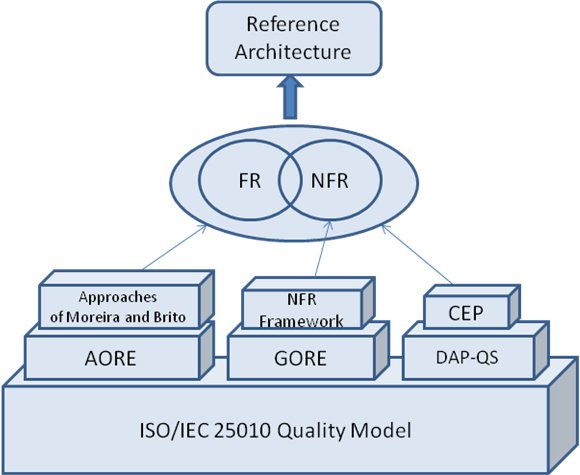
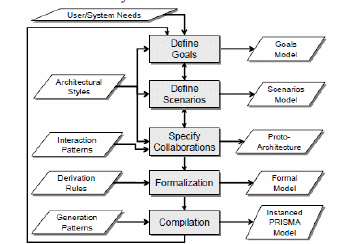
<body><![CDATA[<P LANG="en-US" STYLE="margin-left: 0.75cm; margin-right: 0.78cm; text-indent: 0cm; margin-bottom: 0cm"> 	<FONT FACE="Verdana" size="2"><I>Keywords </I>- 	domain analysis, Chung extended process, NFR Framework, 	aspect-orientation, quality standards, ISO/IEC 25010, reference 	architecture, UPDA</FONT></P> 	    <P LANG="en-US" STYLE="margin-left: 0.75cm; margin-right: 0.78cm; text-indent: 0cm; margin-bottom: 0cm"> 	<FONT FACE="Verdana" size="2"><I>Palabras claves </I>- 	an&aacute;lisis de dominio, proceso extendido de Chung, NFR 	Framework, orientaci&oacute;n a aspectos, est&aacute;ndares de 	calidad, ISO/IEC 25010, arquitectura de referencia, PUAD</FONT></P> 	    <P LANG="en-US" STYLE="margin-left: 0.75cm; margin-right: 0.78cm; text-indent: 0cm; margin-bottom: 0cm"> 	<FONT FACE="Verdana" size="2">Received 2013-11-15, Revised 	2014-02-20, Accepted 2014-02-20 </FONT> 	</P> 	    <P LANG="en-US" STYLE="text-indent: 0.25cm; margin-bottom: 0cm"> 	<font face="Verdana" size="2"> 	    <BR> 	</font> 	</P> 	     <p LANG="es-ES" ALIGN=LEFT STYLE="text-indent: 0cm"> 		 <FONT SIZE=2 face="Verdana"><SPAN LANG="en-US"><B>I Introduction</B></SPAN></FONT></p>  	    <P LANG="en-US" STYLE="margin-bottom: 0cm"><FONT FACE="Verdana" size="2">The 	process of software development has shown great strides since the 	inception of Software Engineering to the present. Modern approaches 	have been defined to improve in general this process; each phase of 	the development is becoming more specialized and the application of 	a variety of techniques and tools have been introduced to help 	improving the quality of the final product, understood as the set of 	desired properties or characteristics that must be present in the 	product, from the user point of view and the product itself <a name="br1">[</a><a href="#r1">1</a>]. 	In 	the same way that the phases of the development process have been 	specialized, approaches have also been presented to raise the 	abstraction level: applications consider now including needs and 	goals of organizations and even their contextual environment. </FONT> 	</P> 	    <P LANG="en-US" STYLE="margin-bottom: 0cm"><FONT FACE="Verdana" size="2">A 	crucial discipline within the software development process is <I>Requirements 	Engineering</I> (RE). 	Different definitions are found in the literature, such as the 	process of discovering the purpose of software systems by 	identifying stakeholders and their needs, while documenting 	these needs to favor analysis and communication. These needs, called 	requirements, will be &ldquo;translated&rdquo; later on into 	software components <a name="br2">[</a><a href="#r2">2</a>]. On the other hand <a name="br3">[</a><a href="#r3">3</a>] defines RE as a 	process including elicitation, evaluation, specification, 	consolidation and evolution of the goals, functionalities, qualities 	and constraints that a software system must accomplish in an 	organizational or physic context. It can then be generalized that RE 	allows determining the services that a system must satisfy, as well 	as the constraints that must be considered. In 	this context, we use the term <I>domain 	</I>and the<I> 	</I>definition given in 	<a name="br4">[</a><a href="#r4">4</a>], as the minimum set of properties that describe accurately a 	family of problems for which computer applications are required. The 	term <I>application domain</I> is 	defined by <a name="br5">[</a><a href="#r5">5</a>] as a specific business area where certain categories 	of software systems are used, helping to generalize functional (FR) 	and non-functional requirements (NFR) for these systems. The <I>Domain 	Engineering</I> (DE) 	discipline, within RE, analyzes the domain knowledge, to produce 	reusable assets for similar systems or family of products. The first 	phase of DE is <I>Domain 	Analysis</I> (DA), where 	the elicited requirements are specified by common and variable 	characteristics for a family of products, modeled in general by a 	generic framework called reference architecture, with focus on the 	reuse of domain assets. DA is widely used in the development of 	complex systems in the context of software product lines <a name="br5">[</a><a href="#r5">5</a>]. From 	these points of view, it is important to ensure that the final 	product satisfies all the stated FR and NFR; in order to achieve 	this, the quality of the software product and intermediate artifacts 	obtained during the development process, must be assured; FR are 	directly perceived by the user; however NFR are inherent software 	properties <a name="br6">[</a><a href="#r6">6</a>] which can be captured from the description of the 	domain or required by some functionality as an implicit 	functionality; they are not directly perceived by the user and they 	are directly associated with Quality Requirements (QR). However, in 	the literature the terms NFR, QR, and quality attributes are 	frequently used indistinctly. In this work we differentiate NFR, QR 	and quality attributes, according to the quality model specification 	of the standard ISO/IEC 25010 <a name="br1">[</a><a href="#r1">1</a>]; 	a <I>quality model</I> 	is a hierarchical structure of 	quality characteristics 	used to decompose QR into measurable elements called <I>quality 	attributes</I>. It 	should be noted that the quality model describing a software product 	is considered a bridge between FR, NFR and their respective QR; it 	must be customized or adapted to specify the quality of a particular 	domain family and it represents a set of <I>scenarios</I> 	in the sense of classical methods of architectural design. In 	this way a clear traceability is established between the requirement 	(FR or NFR) and its required degree of quality. This traceability, 	using different techniques and approaches, briefly described in what 	follows, helps to define precisely all the components of the 	architecture, which is the main structure on which the whole 	software system is built.</FONT></P> 	    <P LANG="en-US" STYLE="margin-bottom: 0cm"><FONT FACE="Verdana" size="2">The <I>architecture</I> 	of a software system is defined 	in <a name="br7">[</a><a href="#r7">7</a>] as 	a set of components 	and connectors, with 	precise behavior. Documented architecture <a name="br8">[</a><a href="#r8">8</a>] 	<a name="br9">[</a><a href="#r9">9</a>] must meet both FR and NFR 	requirements of the 	system. Architecture 	design considers 	that every architectural decision (for example, add and/or remove components and/or connectors) is justified on the basis of having verified that the quality requirements are met. 	A <I>Reference 	Architecture</I> (RA) is 	a generic architecture from which all products (systems), family 	members of the domain, can be generated <a name="br10">[</a><a href="#r10">10</a>] from a reusable common 	core of assets. The term RA is widely used in the context of 	software product lines and we use this term because in our context, 	RA is derived from the domain knowledge, taking into account the 	basic functionality and overall NFR of the domain, for which RA is 	generally responsible for. 	Our proposition is based on establishing RA from DA process using 	one of the approaches of <I>Goal-Oriented 	Requirements Engineering</I> 	(GORE) <a name="br11">[</a><a href="#r11">11</a>]. The GORE approach involves the intentional point of 	view, that is to say, the interest of all participants or 	stakeholders of the software project to obtain, through a refinement 	step, the system&rsquo;s requirements. A <I>goal</I> 	is the interest that the system, artifact, process or activity, must 	achieve <a name="br11">[</a><a href="#r11">11</a>]. This approach proposes a more natural language 	to analyze requirements, decomposing them into a logical structure 	expressing the whole system&rsquo;s needs. Within 	the GORE context, the <I>NFR 	framework </I><a name="br12">[</a><a href="#r12">12</a>] introduces the <I>operationalization 	</I>concept, which states 	the way to implement a NFR as an architectural component; in this 	context a NFR is called &ldquo;softgoal&rdquo; and it is in general 	a goal difficult to express and not directly perceived by the user 	<a name="br8">[</a><a href="#r8">8</a>]; a FR instead is called &ldquo;hardgoal&rdquo;. A graph 	structure, called <I>Softgoals 	Interdependency Graph</I> 	(SIG) is used to decompose and relate softgoals <a name="br12">[</a><a href="#r12">12</a>]. GORE 	proposes other approaches for requirements analysis, such as KAOS (Knowledge 	Acquisition in Automated Specification of Software) in <a name="br14">[</a><a href="#r14">14</a>] and the 	i* Framework in <a name="br15">[</a><a href="#r15">15</a>], however we will discuss here only the 	approaches that have been used in our research. We consider in this 	paper explicitly the <I>NFR 	Framework</I> of the GORE 	approach, as it is used by for analysis and design by Supakkul and 	Chung <a name="br16">[</a><a href="#r16">16</a>]. Aspect orientation is considered by the <I>integration 	of crosscutting concerns </I>to 	the<I> use case model</I> 	of Moreira, Brito and Araujo <a name="br17">[</a><a href="#r17">17</a>], 	following the approach called &quot;early aspects&quot; of the <I>Aspect-Oriented 	Requirements Engineering</I> 	(AORE) <a name="br18">[</a><a href="#r18">18</a>]; they state that crosscutting concerns, which are 	properties of interest that are used by or crosscut other 	properties, are taken into account at early stages of the software 	development process in order to avoid problems of entangled or 	scattered code later on. Losavio, 	Matteo and Pacilli <a name="br19">[</a><a href="#r19">19</a>] have recently incorporated this approach 	to the <I>Chung Extended 	Process</I> (CEP), also 	defined by Losavio, Matteo and Pacilli in <a name="br8">[</a><a href="#r8">8</a>]. Finally, standards 	for product quality specification are included into the <I>Domain 	Analysis Process with Quality Standards</I> 	(DAP-QS), with the proposal of Losavio, Matteo and Rahamut <a name="br20">[</a><a href="#r20">20</a>], 	where the ISO/IEC 25010 standard quality model is used to specify 	the domain QR. 	</FONT> 	</P> 		    <P LANG="en-US" STYLE="margin-bottom: 0cm">         <FONT FACE="Verdana" size="2">The 	main goal of this paper is to present a <I>Unified 	Process for Domain Analysis</I> 	(UPDA) to obtain a reference architecture for a family of systems or 	products in a domain, integrating some of the approaches that have 	proven successful in their individual proposals: aspect and goal 	orientations, the NFR Framework and the NFR specification by 	standard quality models. The integration of these approaches can be 	appreciated in <a href="#f1">Figure 1</a>. </FONT> 	</P> 	<SPAN ID="Cadre1" DIR="LTR" STYLE="float: left; width: 12.69cm; height: 7.46cm; border: none; padding: 0cm; background: #ffffff"> 	    ]]></body>
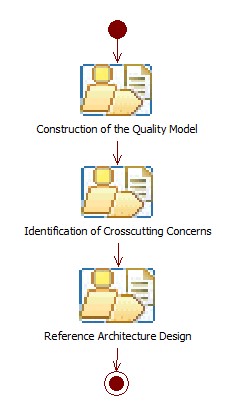
<body><![CDATA[<P LANG="en-US" STYLE="margin-bottom: 0cm"> 		    <P LANG="es-VE" ALIGN=CENTER STYLE="margin-bottom: 0cm"> 		<font face="Verdana" size="2"> 		<a name="f1"><IMG SRC="/img/revistas/cleiej/v17n2/2a02f1.jpg" NAME="f1" ALIGN=BOTTOM WIDTH=342 HEIGHT=251 BORDER=0></a></font></P> 		    <P LANG="en-US" ALIGN=CENTER STYLE="margin-bottom: 0cm"> 		<FONT FACE="Verdana" size="2"><B>Figure 1</B>: <SPAN LANG="es-ES">Approaches integrated in the UPDA 		proposition</SPAN></FONT></P> 	</SPAN><font face="Verdana" size="2">    <BR> 	</font> 	</P> 	    <P LANG="en-US" STYLE="text-indent: 0cm; margin-bottom: 0cm"> 		 <FONT FACE="Verdana" size="2"><B>A. UPDA Overview</B></FONT></P> 	    <P LANG="en-US" STYLE="margin-bottom: 0cm"><FONT FACE="Verdana" size="2">The proposed UPDA process is modeled with SPEM 2.0 (Software &amp; 	Systems Process Engineering Metamodel) of the OMG, which is an 	industrial standard for the representation of process models in 	software engineering and systems engineering <a name="br21">[</a><a href="#r21">21</a>]; UPDA offers three 	main disciplines for generating the RA as the final artifact (see 	<a href="#f2">Fig. 2</a>). </FONT> 	</P>  <SPAN ID="Cadre2" DIR="LTR" STYLE="float: center; width: 6.48cm; height: 8.74cm; border: none; padding: 0cm; background: #ffffff"> 		    <P LANG="es-VE" ALIGN=CENTER STYLE="text-indent: 0cm; margin-bottom: 0cm"> 		<font face="Verdana" size="2"> 		<a name="f2"><IMG SRC="/img/revistas/cleiej/v17n2/2a02f2.jpg" NAME="images2" ALIGN=BOTTOM  BORDER=0></a></font></P> 		    <P LANG="en-US" ALIGN=CENTER STYLE="text-indent: 0cm; margin-bottom: 0cm"> 		<font face="Verdana" size="2"> 		    <BR> 		</font> 		</P> 		    <P LANG="en-US" ALIGN=CENTER STYLE="margin-left: 0.5cm; text-indent: 0cm; margin-bottom: 0cm"> 		<FONT FACE="Verdana" size="2"><B>Figure 2</B>: 		UPDA</FONT></P> 	</SPAN>  	    ]]></body>
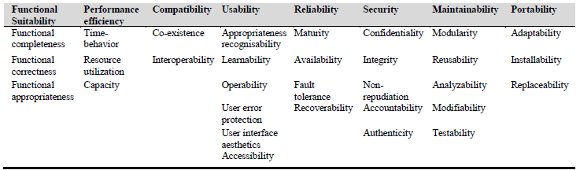
<body><![CDATA[<P LANG="en-US" STYLE="margin-bottom: 0cm"><FONT FACE="Verdana" size="2">In 	the first discipline, <I>construction 	of the quality model</I>, 	the product quality model <a name="br1">[</a><a href="#r1">1</a>] is built through the implementation of 	six activities and the DAP-QS process <a name="br20">[</a><a href="#r20">20</a>], to obtain the <I>functional</I> 	and <I>non-functional</I> <I>&ldquo;cores&rdquo;</I> 	of the domain as intermediate artifacts. The functional core 	contains the basic functionality that is common to the domain family 	of products and its associated QR, called in this case, <I>implicit 	functionalities</I>; the 	non-functional core contains the NFR expressed informally as text 	taken from the domain description, and their correspondence with the 	QR specification. Based on this knowledge of the domain, the quality 	model is built. </FONT> 	</P> 	    <P LANG="en-US" STYLE="margin-bottom: 0cm"><FONT FACE="Verdana" size="2">In 	the second discipline, <I>identification 	of crosscutting concerns</I>, 	the existing crosscutting concerns are identified, according to AORE 	<a name="br18">[</a><a href="#r18">18</a>]. In this discipline the approaches of Moreira, Brito and Araujo 	<a name="br17">[</a><a href="#r17">17</a>], and Supakkul and Chung <a name="br16">[</a><a href="#r16">16</a>] are used to obtain an extended use 	case model with FR and NFR. </FONT> 	</P> 	    <P LANG="en-US" STYLE="margin-bottom: 0cm"><FONT FACE="Verdana" size="2">The 	third and final discipline,<I> 	reference architecture design</I>, 	determines the global NFR, of which the architecture is generally 	responsible for; in the GORE context, these global requirements are 	decomposed using the NFR Framework for their operationalization and 	ultimately the RA is built from these components. </FONT> 	</P> 	    <P LANG="en-US" STYLE="margin-bottom: 0cm"><FONT FACE="Verdana" size="2">The 	structure of this article, besides this introduction and the 	conclusion, is as follows: a second section which describes broadly 	techniques and tools used in UPDA: the quality model of the domain 	as used within the DAP-QS process, the approach of Moreira, Araujo 	and Brito <a name="br17">[</a><a href="#r17">17</a>] and the Chung Extended Process <a name="br19">[</a><a href="#r19">19</a>] based on the NFR 	Framework for the goal-oriented analysis and design <a name="br16">[</a><a href="#r16">16</a>]. In the 	third section, UPDA is described in details. In the fourth section, 	the validation of the proposal is illustrated with a case study in 	the e-banking domain. Finally, in the fifth section, a comparative 	analysis with similar processes and techniques is presented.</FONT></P>     <p LANG="en-US" ALIGN=LEFT STYLE="text-indent: 0cm; line-height: 100%"> 		<FONT SIZE=2 face="Verdana"><B>II. Techniques and Tools used by the Unified Process 		for Domain Analysis (UPDA)</B></FONT></p> 	    <p LANG="en-US"><font face="Verdana" size="2">A. Quality Model of the domain 			with the ISO/IEC 25010 standard</font></p> 	    <P LANG="en-US" STYLE="margin-bottom: 0cm"><font face="Verdana" size="2">1The 	quality of a system is the degree to which the system meets the 	specified and implied needs of stakeholders. In this sense, the 	establishment of quality characteristics that the software product 	must satisfy takes on significant importance <a name="br1">[</a><a href="#r1">1</a>].</font></P> 	    <P LANG="en-US" STYLE="margin-bottom: 0cm"><font size="2" FACE="Verdana">To 	specify the quality of the product in this proposal, the ISO/IEC 	25010 standard <a name="br1">[</a><a href="#r1">1</a>] will be used, since it is</font><FONT FACE="Verdana" COLOR="#000000" size="2"> 	a</FONT><font size="2" FACE="Verdana"> recognized 	standard, accepted and much used in the software development process 	by the software engineering community. It should be noted that other 	quality models could be used (standard or not), besides the ISO/IEC 	25010; however all of them need to be adapted or customized to the 	particular domain. However, dealing with the adaptation standards is 	not straightforward because they do not provide guidelines for the 	customization, which make their use difficult and based on the 	expert knowledge on the standard and on the domain. We use the 	ISO/IEC 25010 because, on one hand it is well known within the 	software community and it has been recently updated, and on the 	other hand, we have experience is using and customizing it.</font></P> 	    <P LANG="en-US" STYLE="margin-bottom: 0cm"><FONT FACE="Verdana" size="2">The 	ISO/IEC 25010 standard <a name="br1">[</a><a href="#r1">1</a>] consists of eight (8) main quality 	characteristics, which are hierarchically represented, from features 	of high abstraction level, which are refined into 	sub-characteristics of lower level, until the so-called <I>attributes</I>, 	which are measurable properties. <a href="#t1">Table 1</a> shows the hierarchy, until 	the sub-characteristics level. These qualities after the respective 	analysis, translate into architectural components, derived from 	global system or organizational constraints, which are not directly 	perceived by the user, they represent &ldquo;implicit 	functionalities&rdquo; derived from the functionality required by 	the end user. We will speak indistinctly of quality characteristics 	or QR.</FONT></P>  		    <P LANG="de-DE" ALIGN=CENTER STYLE="margin-top: 0.42cm; font-variant: small-caps; line-height: 90%"> 		<FONT SIZE=1 STYLE="font-size: 8pt" FACE="Verdana"><SPAN STYLE="font-variant: normal"><FONT SIZE=2><SPAN LANG="en-US"><a name="t1"><B>Table 		1</B></a>: 		Characteristics and Sub-characteristics of the ISO/IEC 25010 		quality model</SPAN></FONT></SPAN></FONT></P>      <font face="Verdana" size="2">  <img src="/img/revistas/cleiej/v17n2/2a02t1.jpg"> </font>  </DIV>     ]]></body>
<body><![CDATA[<DIV ID="Section5" DIR="LTR"> 	    <P LANG="en-US" STYLE="margin-bottom: 0cm"><font face="Verdana" size="2">    <BR> 	</font> 	</P> 	    <P LANG="en-US" STYLE="margin-bottom: 0cm"><FONT FACE="Verdana" size="2">The 	establishment of the quality model for the domain family of products 	helps to define the overall NFR, valid for the entire domain, as 	well as some quality requirements for common functionalities and 	represent a <I>quality 	view of the domain knowledge</I> 	<a name="br22">[</a><a href="#r22">22</a>]. In this case, the <I>domain 	quality model</I> is 	expressed using the process defined by Losavio and others <a name="br20">[</a><a href="#r20">20</a>], 	DAP-QS, where it is developed for a family of products. The steps of 	this process are presented in what follows:</FONT></P> 	    <P LANG="en-US" STYLE="margin-bottom: 0cm"><font face="Verdana" size="2">    <BR> 	</font> 	</P> 	    <P LANG="en-US" STYLE="text-indent: 0cm; margin-bottom: 0cm"> 	<FONT FACE="Verdana" size="2"><I>DAP-QS Process</I></FONT></P> 	    <P LANG="en-US" STYLE="margin-left: 0.01cm; text-indent: 0.25cm; margin-bottom: 0cm"> 	<FONT FACE="Verdana" size="2"><I>Input:</I> 	the textual description of the problem, for which a computational 	solution (system or application) is required; identify 	the high-level architectural solution (s) or style 	(s) for the family.</FONT></P> 	<OL TYPE="a"> 		    <LI>    <P LANG="en-US" STYLE="margin-bottom: 0cm"> 		<FONT FACE="Verdana" size="2">Define a taxonomy of the main functionalities for the family: the functionality list</FONT></P> 		    ]]></body>
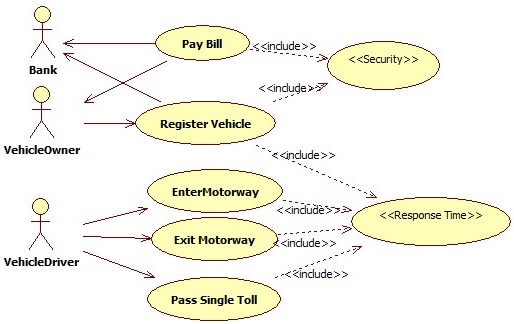
<body><![CDATA[<LI>    <P LANG="en-US" STYLE="margin-bottom: 0cm"> 		<FONT FACE="Verdana" size="2">Define the domain quality 		model, using 		the ISO/IEC 25010 standard.</FONT></P> 	    </OL> 	    <P LANG="en-US" STYLE="margin-left: 2.25cm; text-indent: -0.72cm; margin-bottom: 0cm"> 	<FONT FACE="Verdana" size="2">b.1) The <I>domain architectural 	quality</I> is 	specified using the quality properties 	of the architectural solution or a style for the domain 	family. </FONT> 	</P> 	    <P LANG="en-US" STYLE="margin-left: 2.25cm; text-indent: -0.72cm; margin-bottom: 0cm"> 	<FONT FACE="Verdana" size="2">b.2) The <I>domain 	functional quality</I> is 	specified, where each functionality of step &ldquo;a&rdquo; 	is associated with its quality 	requirements or quality 	characteristics specified by ISO/IEC 25010, as goals to be met to achieve the respective functionality.</FONT></P> 	    <P LANG="en-US" STYLE="margin-left: 0.25cm; text-indent: 0.02cm; margin-bottom: 0cm"> 	<FONT FACE="Verdana" size="2"><I>Output:</I> quality model of the 	domain family. </FONT> 	</P> 	    <P LANG="en-US" STYLE="text-indent: 0.02cm; margin-bottom: 0cm"> 	<FONT FACE="Verdana" size="2">Notice that<I> 	</I>QR derived from 	business and organizational rules, such as &ldquo;portability&rdquo; 	to other platforms, or the system &ldquo;interoperability&rdquo; are 	global QR that should be considered, and they were included as 	architectural quality in the DAP-QS process; in the UPDA complete 	process (see Section III) all these QR are included in the non- 	functional core.</FONT></P>      <p LANG="en-US"><font face="Verdana" size="2">B. Extended use case model</font></p>  	    <P LANG="en-US" STYLE="margin-bottom: 0cm"><FONT FACE="Verdana" size="2">In 	the field of RE, several research trends are found that seek the 	integration and modeling of FR and NFR at design level. Note that in 	all these works, the term &quot;quality attribute&quot; is 	equivalent to the term of ISO/IEC 25010 &quot;quality 	characteristic&quot; or QR already discussed; recall that <I>quality 	attribute</I> for this 	standard means a low level measurable quality characteristic. 	Moreira, Araujo and Brito <a name="br17">[</a><a href="#r17">17</a>] consider quality attributes (QR) of 	crosscutting FR in the use case model, and they propose a process 	that consists of three main activities: a) <I>identification</I>, 	where system requirements are identified and these quality 	attributes relevant for the application and stakeholders are 	selected, b) <I>specification,</I> 	first FR are specified using an approach based on use cases and 	then, quality attributes are described using special templates and 	the crosscutting FR are identified, and c) <I>requirements 	integration</I>, where a 	set of models are proposed to represent the mainstreaming of quality 	attributes and FR. According to the SQuaRE standard <a name="br6">[</a><a href="#r6">6</a>], a quality 	attribute in <a name="br17">[</a><a href="#r17">17</a>] corresponds to a QR. The first two activities use 	tables to display 	relevant information, but only in the third activity, quality is 	considered.</FONT></P> 	    <P LANG="en-US" STYLE="margin-bottom: 0cm"><FONT FACE="Verdana" size="2">Quality attributes are associated with FR, for 	the entire system, through an &ldquo;extended use case model&rdquo;; 	they are represented in a UML (Unified 	Modeling Language) <a name="br13">[</a><a href="#r13">13</a>] 	extended diagram to include new use cases stereotyped for each 	quality attribute, in such a way that the initial use cases include 	new crosscutting attributes; they 	are represented in the diagrams with the use case oval and their 	names are indicated with the quality attribute symbol stereotype of 	UML this can be 	appreciated in <a href="#f3">Fig. 3</a>, where such &lt;&lt;include&gt;&gt; use cases 	are stereotyped as  &lt;&lt;Security&gt;&gt; and  &#8203;&#8203;&lt;&lt;Response 	Time&gt;&gt; representing the NFR within the extended use case 	model, proposed, in a case study of an automatic toll payment system 	for vehicles registered through an electronic device installed in 	each vehicle <a name="br17">[</a><a href="#r17">17</a>]. </FONT> 	</P>  	    ]]></body>
<body><![CDATA[<P LANG="es-VE" ALIGN=CENTER STYLE="text-indent: 0cm; margin-bottom: 0cm"> 		<font face="Verdana" size="2"> 		<a name="f3"><IMG SRC="/img/revistas/cleiej/v17n2/2a02f3.jpg" NAME="images3" ALIGN=BOTTOM WIDTH=394 HEIGHT=275 BORDER=0></a></font></P> 		    <P LANG="en-US" ALIGN=CENTER STYLE="text-indent: 0cm; margin-bottom: 0cm"> 		<FONT FACE="Verdana" size="2"><B>Figure 3</B>: 		Integrated diagram of FR and NFR <a name="br17">[</a><a href="#r17">17</a>]</FONT></P>      <p LANG="en-US"><font face="Verdana" size="2">Chung Extended Process (CEP)</font></p> 	    <P LANG="en-US" STYLE="margin-bottom: 0cm"><FONT FACE="Verdana" size="2">The 	Chung Extended Process (CEP) presented in <a name="br19">[</a><a href="#r19">19</a>] proposes the 	extension of the original Chung process <a name="br16">[</a><a href="#r16">16</a>] integrating the DAP-QS 	process described above, plus the analysis of crosscutting concerns, 	while identifying global NFR as in <a name="br17">[</a><a href="#r17">17</a>].</FONT></P> 	    <P LANG="en-US" STYLE="margin-bottom: 0cm"><FONT FACE="Verdana" size="2">Recall 	that the basic premises set forth in this process are based on the 	NFR Framework, initially defined in <a name="br23">[</a><a href="#r23">23</a>] and the classic 	scenario-based or use case approach. These premises provide:</FONT></P> 	<UL> 		    <LI>    <P LANG="en-US" STYLE="text-indent: 0cm; margin-bottom: 0cm"> 		  <FONT FACE="Verdana" size="2">NFR integrated to the use 		case model, that correspond to the main users FR through the 		so-called association points, used to classify NFR</FONT></P> 		    <LI>    <P LANG="en-US" STYLE="text-indent: 0cm; margin-bottom: 0cm"> 		  <FONT FACE="Verdana" size="2">Establish the extent of 		propagation rules for partnership proposals related to the use case 		model.</FONT></P> 	    </UL> 	    ]]></body>
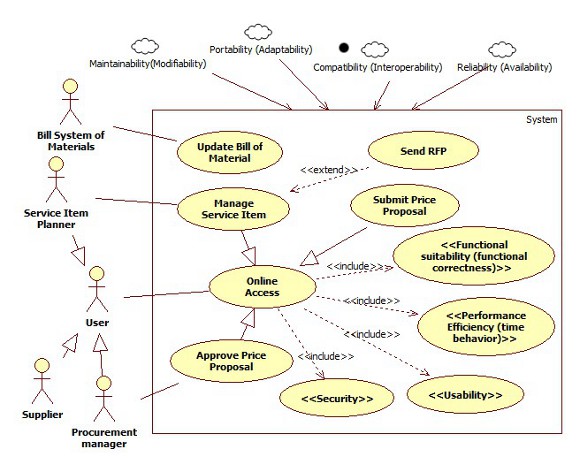
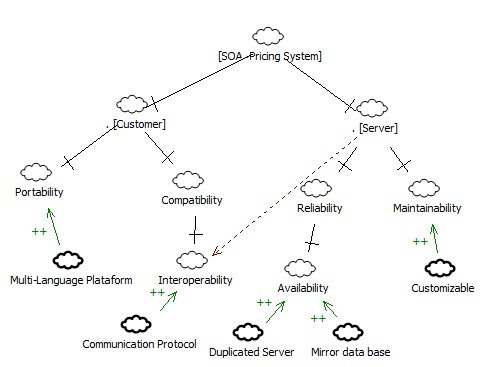
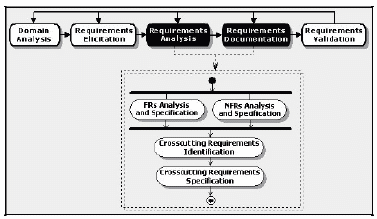
<body><![CDATA[<P LANG="en-US" STYLE="margin-bottom: 0cm"><FONT FACE="Verdana" size="2">Both 	association points as propagation rules allow to pinpoint global NFR 	and the inclusion of specific NFR as included use cases, stereotyped 	as &lt;&lt;include&gt;&gt; in UML <a name="br13">[</a><a href="#r13">13</a>] within the use case model 	<a name="br17">[</a><a href="#r17">17</a>], as it has been previously explained.</FONT></P> 	    <P LANG="en-US" STYLE="margin-bottom: 0cm"> <FONT FACE="Verdana" size="2">Then, potential crosscutting concerns are identified from 	composition tables <a name="br17">[</a><a href="#r17">17</a>], in the context of an early-aspects design. 	The activity diagram in <a href="#f4">Fig. 4</a> illustrates the incremental and 	iterative process with the integrated FR and NFR; Figures <a href="#f5">5</a> and <a href="#f6">6</a> 	illustrate this process with an example taken from <a name="br19">[</a><a href="#r19">19</a>] for a 	pricing system for airlines, where providers are requesting a 	service sending their proposals, which may or may not be approved by 	the manager. </FONT> 	</P>  		    <P LANG="es-VE" ALIGN=CENTER STYLE="text-indent: 0cm; margin-bottom: 0cm"> 		<font face="Verdana" size="2"> 		<a name="f4"><IMG SRC="/img/revistas/cleiej/v17n2/2a02f4.jpg" NAME="images4" ALIGN=BOTTOM WIDTH=454 HEIGHT=209 BORDER=0></a></font></P> 		    <P LANG="en-US" STYLE="text-indent: 0cm; margin-bottom: 0cm"> 		<FONT FACE="Verdana" size="2"><B>Figure 4</B>: 		CEP Activity Diagram integrating FR and NFR with the DAP-QS process 		and identification of candidate aspects <a name="br19">[</a><a href="#r19">19</a>]</FONT></P>  	    <P LANG="es-ES" STYLE="margin-bottom: 0cm"> 		    <P LANG="es-VE" ALIGN=CENTER STYLE="text-indent: 0cm; margin-bottom: 0cm"> 		<font face="Verdana" size="2"> 		<a name="f5"><IMG SRC="/img/revistas/cleiej/v17n2/2a02f5.jpg" NAME="images5" ALIGN=BOTTOM WIDTH=580 HEIGHT=328 BORDER=0></a></font></P> 		    <P LANG="es-VE" ALIGN=CENTER STYLE="text-indent: 0cm; margin-bottom: 0cm"> 		<font face="Verdana" size="2"> 		    <BR> 		</font> 		</P> 		    <P LANG="en-US" STYLE="text-indent: 0cm; margin-bottom: 0cm"> 		<FONT FACE="Verdana" size="2"><B>Figure 5</B>: 		Restructuring of common NFR in the use case model according to <a name="br16">[</a><a href="#r16">16</a>] 		and <a name="br17">[</a><a href="#r17">17</a>], as a result of step 4 of CEP</FONT></P> 		<font face="Verdana" size="2"> 		    <BR> 	</font> 	</P> 	    ]]></body>
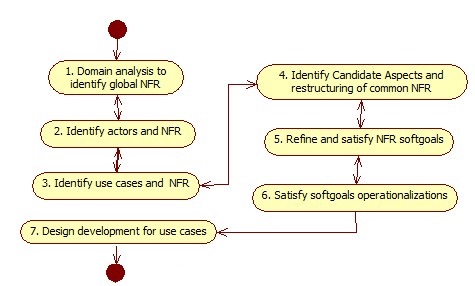
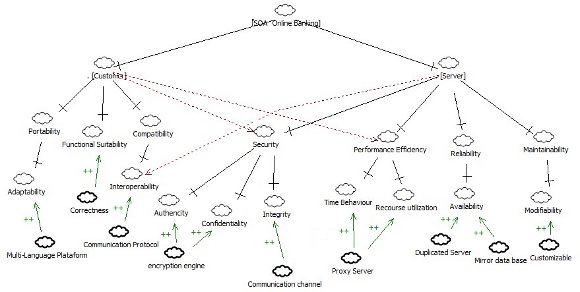
<body><![CDATA[<P LANG="en-US" STYLE="margin-bottom: 0cm"><font face="Verdana" size="2">In this 	case, the NFR framework is used to represent NFR as softgoals, 	associated with a certain context of action (usually a system 	component), using the SIG structure <a name="br12">[</a><a href="#r12">12</a>]. <a href="#f6">Fig 6</a> shows a SIG example 	adapted from <a name="br16">[</a><a href="#r16">16</a>] to the SOA (Service Oriented Architecture) <a name="br24">[</a><a href="#r24">24</a>] 	for an Airline Pricing System context in <a name="br19">[</a><a href="#r19">19</a>], representing the 	decomposition of all NFR associated with the architecture of the 	system context of action, into more reachable softgoals through 	which the goal of the superior level is attained. Each symbol (a 	cloud) representing the softgoal is identified by a <I>name</I> and 	the <I>subject </I>or<I> context of action</I> of the named softgoal 	and its is denoted by <I>name [context of action]</I> <a name="br16">[</a><a href="#r16">16</a>], for 	example Security [Account]; it can be decomposed into two or more 	softgoals that must be satisfied to reach the &ldquo;father&rdquo; 	goal; in the example of <a href="#f6">Fig. 6</a>, it is represented by a single arch 	indicating &ldquo;AND&rdquo; decomposition, meaning that, for 	example, that <I>Portability</I> and <I>Compatibility</I> are needed 	for the <I>Customer</I> context of action; softgoals could also be 	selectively satisfied and represented by a double arch, indicating 	&ldquo;OR&rdquo; decomposition. SOA 	for the Pricing System is the context of action for all the NFR that 	the architecture must satisfy specified as softgoals (<I>Portability, 	Compatibility, Reliability, </I>and<I> 	Maintainability</I>; in 	our context these QR constitute the SOA quality model); it is 	decomposed into two softgoals, specified as follows: <I>Portability, 	Compatibility</I> <I>[Customer] </I>and <I>Reliability, 	Maintainability [Server]</I>. 	The <I>Portability</I> 	softgoal is decomposed reaching immediately an operationalization, 	meaning that the <I>Customer</I>, 	which is the context of action of <I>Portability</I>, 	will be &ldquo;solved&rdquo; or &ldquo;implemented&rdquo; by a <I>Multi-Language 	Platform</I>. Instead, to 	satisfy the <I>Compatibility</I> 	softgoal we need to decompose it farther into the <I>Interoperability</I> 	softgoal, which is operationalized into a <I>Communication 	Protocol</I> as solution. 	This decomposition process is continued for all softgoals specified 	for the system, until each one reaches an operationalization for a 	solution <a name="br11">[</a><a href="#r11">11</a>]. </font> 	</P> 	    <P LANG="en-US" STYLE="text-indent: 0.25cm; margin-bottom: 0cm">  	    <P LANG="es-VE" ALIGN=CENTER STYLE="text-indent: 0cm; margin-bottom: 0cm"> 		<font face="Verdana" size="2"> 		<a name="f6"><IMG SRC="/img/revistas/cleiej/v17n2/2a02f6.jpg" NAME="images6" ALIGN=BOTTOM WIDTH=519 HEIGHT=310 BORDER=0></a></font></P> 		    <P LANG="es-VE" ALIGN=CENTER STYLE="text-indent: 0cm; margin-bottom: 0cm"> 		<font face="Verdana" size="2"> 		    <BR> 		</font> 		</P> 		    <P LANG="en-US" ALIGN=CENTER STYLE="text-indent: 0cm; margin-bottom: 0cm"> 		<FONT FACE="Verdana" size="2"><B>Figure 6</B>: 		Softgoals Interdependence Graphics (SIG) for SOA (Service Oriented 		Architecture) <a name="br19">[</a><a href="#r19">19</a>]</FONT></P> 	<font face="Verdana" size="2"> 	    <BR> 	</font> 	</P>       <p LANG="es-ES" ALIGN=LEFT STYLE="line-height: 100%"> 		 <FONT SIZE=2 face="Verdana"><SPAN LANG="en-US"><B>III. Unified Process for Domain 		Analysis (UPDA) </B></SPAN></FONT> 		</p>  	    <P LANG="en-US" STYLE="margin-bottom: 0cm"><FONT FACE="Verdana" size="2">UPDA 	integrates the domain quality model according to ISO/IEC 25010 to 	specify NFR, Aspect and Goal orientations of the AORE approach and 	the NFR Framework of the GORE approach; the process seeks the 	integration of these different well-known approaches for the early 	treatment of NFR into a unique process, to obtain, as the main 	artifact, the reference architecture for a specific domain. A 	process can be defined as a series of steps including activities, 	constraints and resources to produce a particular desired result 	<a name="br25">[</a><a href="#r25">25</a>]. In this sense, the UPDA process is presented (see <a href="#f2">Fig. 2</a>) as a 	proposed solution for the integration of these approaches. In what 	follows, the three disciplines of UPDA are detailed:  </FONT> 	</P> 	    <p LANG="en-US"><font face="Verdana" size="2">A.Construction of the domain 	quality model</font></p> 	    ]]></body>
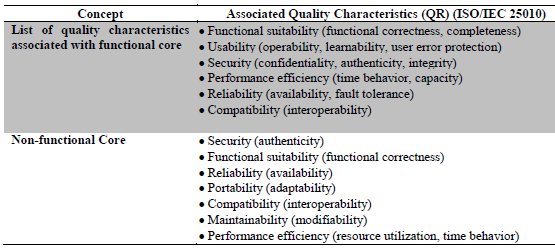
<body><![CDATA[<P LANG="en-US" STYLE="margin-bottom: 0cm"><FONT FACE="Verdana" size="2">This 	first discipline aims to determine the <I>Functional 	and Non-functional Cores of the domain</I>, 	to build the <I>domain 	quality model</I> (<a href="#f7">Fig. 	7</a>). Six activities are 	considered, namely </FONT> 	</P> 	<OL TYPE="a"> 		    <LI>    <P LANG="en-US" STYLE="text-indent: 0cm; margin-bottom: 0cm"> 		 <FONT FACE="Verdana" size="2"><I>Identify the main 		functionalities of the domain</I> 		(<I>Functional Core</I>): 		in this activity all the functionalities must be captured from a 		detailed domain description or from existing domain knowledge. QR 		can be associated with each functionality to determine the implicit 		functionalities. </FONT> 		</P> 		    <LI>    <P LANG="en-US" STYLE="text-indent: 0cm; margin-bottom: 0cm"> 		 <FONT FACE="Verdana" size="2"><I>Identify organizational 		constraints and business rules</I>: 		it means to identify mandatory regulations, organization rules or 		laws currently used in the domain. The constraints identified can 		be associated with the QR.</FONT></P> 		    <LI>    <P LANG="en-US" STYLE="text-indent: 0cm; margin-bottom: 0cm"> 		 <FONT FACE="Verdana" size="2"><I>Identify architectural 		styles of the domain</I>: 		this activity involves the software architect expertise for the 		correct use of existing architectural patterns and styles/patterns 		catalogues to evaluate the &ldquo;best&rdquo; architectural 		solution (s) for the system with respect to the domain QR; this 		step may involve an architectural evaluation process. 		Organizational constraints and business rules must be considered. 		QR must be assigned for each style or solution; they are in general 		present in the catalogues. The commonality and variability of the 		domain family of products can be also identified. A selection of 		styles or architectural solutions that will be used later on in the 		construction of the RA is produced.</FONT></P> 		    <LI>    <P LANG="en-US" STYLE="text-indent: 0cm; margin-bottom: 0cm"> 		 <FONT FACE="Verdana" size="2"><I>Determine the Candidate 		Architecture</I>: from 		the precedent functional core and choice of architectural styles 		and solutions, a first initial or Candidate Architecture is built. 		The software architect expertise is also crucial in this step.</FONT></P> 		    <LI>    ]]></body>
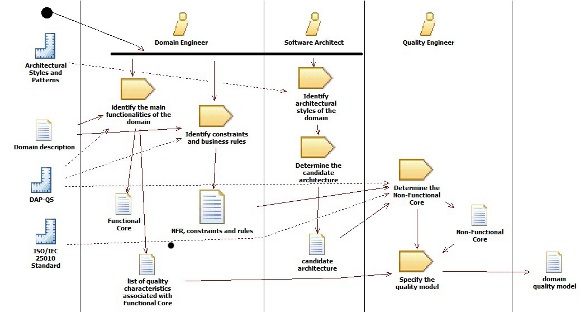
<body><![CDATA[<P LANG="en-US" STYLE="text-indent: 0cm; margin-bottom: 0cm"> 		 <FONT FACE="Verdana" size="2"><I>Determine the 		Non-Functional Core; </I>this 		activity concerns the assembly of all the QR for the domain, 		obtained in activities a), b) and c). It is used to determine the 		&ldquo;global&rdquo; requirements of the system which in general 		correspond to organizational constraints obtained in b) and 		architectural requirements obtained in c).</FONT></P> 		    <LI>    <P LANG="en-US" STYLE="text-indent: 0cm; margin-bottom: 0cm"> 		 <FONT FACE="Verdana" size="2"><I>Specify the Domain Quality 		Model</I>; in this 		activity, a table is constructed with all QR obtained in a), b) and 		c), eliminating repetitions. QR associated with the functional and 		non-functional core are placed in the table; QR associated with the 		styles or architectural solutions of step c) represent in general 		the global QR of the system.</FONT></P> 	    </OL> 	     <P LANG="es-ES" STYLE="margin-bottom: 0cm">  		    <P LANG="es-VE" STYLE="text-indent: 0cm; margin-bottom: 0cm"> 		<font face="Verdana" size="2"> 		<a name="f7"><IMG SRC="/img/revistas/cleiej/v17n2/2a02f7.jpg" NAME="images7" ALIGN=BOTTOM WIDTH=614 HEIGHT=367 BORDER=0></a></font></P> 		    <P LANG="es-VE" STYLE="text-indent: 0cm; margin-bottom: 0cm"> 		<font face="Verdana" size="2"> 		    <BR> 		</font> 		</P> 		    <P LANG="en-US" ALIGN=CENTER STYLE="text-indent: 0cm; margin-bottom: 0cm"> 		<FONT FACE="Verdana" size="2"><B>Figure 7</B>: 		Construction of the Domain Quality Model</FONT></P> 		    <P LANG="en-US" STYLE="margin-bottom: 0cm">         <font face="Verdana" size="2">    ]]></body>
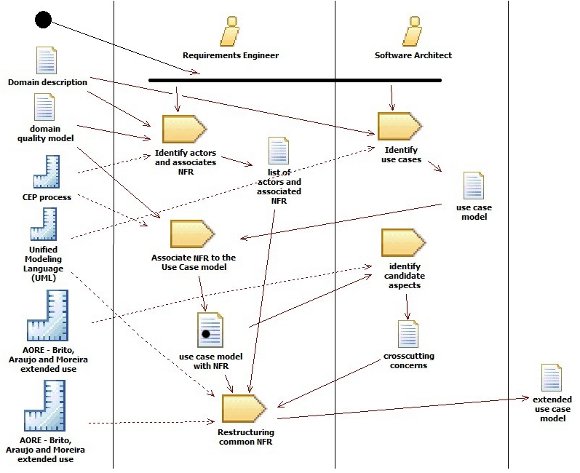
<body><![CDATA[<BR> 		</font> 		</P> 	</P>  	    <P LANG="en-US" STYLE="margin-bottom: 0cm"><FONT FACE="Verdana" size="2">Note 	that all intermediate 	artifacts obtained in the activities for the construction of the 	Domain Quality Model will be used in the construction of the RA for 	the domain, from the techniques described in detail in previous 	sections (DAP-QS), ISO/IEC 25010, NFR Framework and the Chung 	Extended Process (CEP), in addition to a catalog of architectural 	Styles and Patterns taken from the domain assets. As shown in <a href="#f7">Fig. 	7</a>, domain engineers, quality engineers and software architects are 	involved as actors in this discipline and several artifacts are 	generated: &ldquo;Functional Core&rdquo;, &ldquo;list of QR 	associated with Functional Core&rdquo;, &ldquo;list of NFR&rdquo;, 	&ldquo;constraints and business rules with corresponding QR&rdquo;, 	and the &ldquo;Candidate Architecture&rdquo;, which is constructed 	from the catalog of styles and patterns that matches the QR of the 	domain under study; the &ldquo;Non-Functional Core&rdquo; that 	provides the NFR derived from constraints, business rules, 	architectural style (s) QR. Finally the last artifact produced is 	the &ldquo;domain quality model&rdquo;.</FONT></P> 	    <p LANG="en-US"><font face="Verdana" size="2">B.Identification of crosscutting 	concerns</font></p> 	    <P LANG="en-US" STYLE="margin-bottom: 0cm"><FONT FACE="Verdana" size="2">The 	second discipline of UPDA aims to <I>generate 	the Extended Use Case Model of the domain</I>. 	This discipline, as can be seen in <a href="#f8">Figure 8</a>, is composed of five (5) 	activities that allow first the generation of the <I>Use 	case Model</I> and then 	the NFR identification, global or not, to determine the <I>crosscutting 	concerns</I> for 	inclusion in the extended use case model. Note that activities a), 	b) and c) are basically taken from the CEP process, that activity d) 	involves the AORE approach, and also that NFR are now associated 	with the QR of the ISO/IEC 25010 Quality Model: </FONT> 	</P> 	 	<OL TYPE="a"> 		    <LI>    <P LANG="en-US" STYLE="text-indent: 0cm; margin-bottom: 0cm"> 		 <FONT FACE="Verdana" size="2"><I>Identify actors and 		associated NFR</I>: the 		requirements engineer must identify external entities and their 		associations (specialization/generalization) from the domain 		description and functional core. </FONT> 		</P> 		    <LI>    <P LANG="en-US" STYLE="text-indent: 0cm; margin-bottom: 0cm"> 		 <FONT FACE="Verdana" size="2"><I>Identify use cases</I>: 		from the domain description and functional core, the software 		architect must specify the system functionality, expressing it in 		UML, in terms of the use case model </FONT> 		</P> 		    <LI>    <P LANG="en-US" STYLE="text-indent: 0cm; margin-bottom: 0cm"> 		 <FONT FACE="Verdana" size="2"><I>Associate RNF to the Use 		Case Model</I>: NFR are 		associated with the Use case Model, using the &lt;&lt;include&gt;&gt; 		stereotype. </FONT> 		</P> 		    ]]></body>
<body><![CDATA[<LI>    <P LANG="en-US" STYLE="text-indent: 0cm; margin-bottom: 0cm"> 		 <FONT FACE="Verdana" size="2"><I>Identify candidate aspects</I>: 		the requirements engineer takes from the non-functional core the 		global QR that apply to the whole system, and represents them in a 		new use case diagram; for this step, the <I>association 		points</I> of Supakkul 		and Chung <a name="br16">[</a><a href="#r16">16</a>] are used. QR associated with actors are also 		represented in this use case diagram. The association point 		establishes a relationship between the actor and the use case, 		indication the QR involved. Finally, the QR of the functional core 		are represented as association points directly on the use case.</FONT></P> 		    <LI>    <P LANG="en-US" STYLE="text-indent: 0cm; margin-bottom: 0cm"> 		 <FONT FACE="Verdana" size="2"><I>Restructuring common NFR</I>: 		in this activity, NFR that can be candidate aspects are identified; 		they are represented in the use case diagram applying the 		generalization/specialization principles of UML and the propagation 		rules of Supakkul and Chung <a name="br16">[</a><a href="#r16">16</a>]. </FONT> 		</P> 	    </OL> 	     <P LANG="en-US" STYLE="margin-bottom: 0cm"><FONT FACE="Verdana" size="2">In 	the development of this discipline, the actors involved are software 	architects and requirements engineers. These actors take as input 	the artifacts &quot;domain description&quot;, &quot;quality model&quot;, 	 &ldquo;policies and guidelines&rdquo; issued by the CEP process 	<a name="br19">[</a><a href="#r19">19</a>], Brito, Araujo and Moreira <a name="br17">[</a><a href="#r17">17</a>] for both the extended use case 	model and the composition tables are followed, generating the 	following intermediate artifacts: <I>list 	of actors and associated NFR, use case model, use case model with 	NFR and crosscutting concerns</I>; 	they contribute to construct the <I>Extended 	use case model </I>that 	includes domain global NFR and all the identified crosscutting 	concerns.</FONT></P> 	     <P LANG="en-US" ALIGN=CENTER STYLE="text-indent: 0.5cm; margin-bottom: 0cm"> 			    <P LANG="es-VE" ALIGN=CENTER STYLE="text-indent: 0cm; margin-bottom: 0cm"> 		<font face="Verdana" size="2"> 		<a name="f8"><IMG SRC="/img/revistas/cleiej/v17n2/2a02f8.jpg" NAME="images8" ALIGN=BOTTOM WIDTH=605 HEIGHT=404 BORDER=0></a></font></P> 		    <P LANG="en-US" ALIGN=CENTER STYLE="margin-bottom: 0cm"> 		<FONT FACE="Verdana" size="2"><B>Figure 8</B>: 		Identification of crosscutting concerns </FONT> 		</P>     <font face="Verdana" size="2">     <BR> 	</font> 	</P>  	    ]]></body>
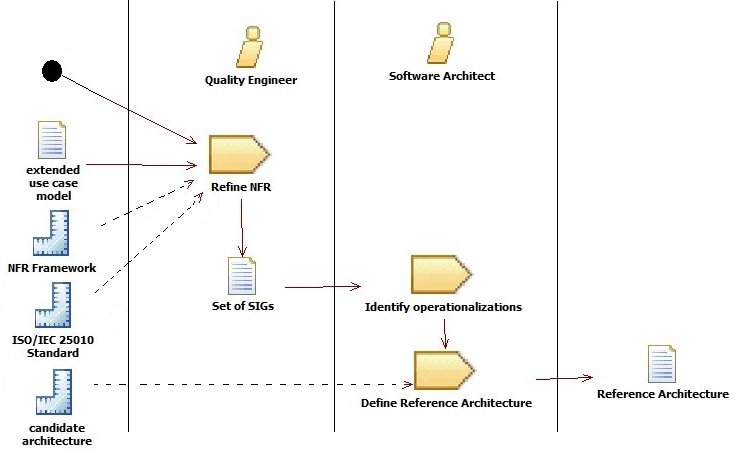
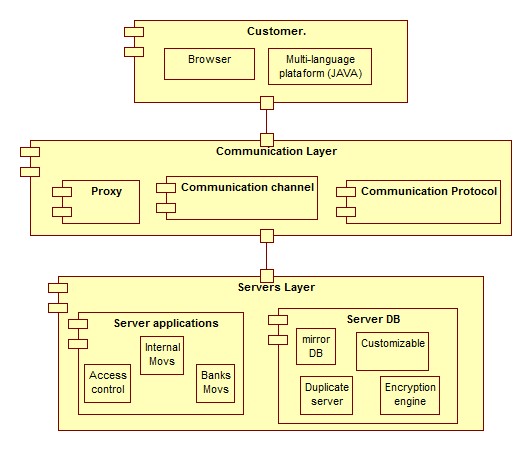
<body><![CDATA[<p LANG="en-US"><font face="Verdana" size="2">C.Reference Architecture Design</font></p> 	    <P LANG="en-US" STYLE="margin-bottom: 0cm"><FONT FACE="Verdana" size="2">The 	third and last discipline of UPDA aims to <I>design 	the domain reference architecture</I> 	(<a href="#f9">Fig. 9</a>). The three (3) activities take as input the main artifact 	generated in the previous discipline, the <I>extended 	use case model</I>; each 	global NFR is decomposed through the SIG <a name="br12">[</a><a href="#r12">12</a>]; a SIG for every 	global non-functional requirement is obtained; the 	operationalizations of each softgoal are then identified, as the 	final step to get the domain RA. The activities of this discipline 	are the following: </FONT> 	</P> 	 <OL TYPE="a"> 		    <LI>    <P LANG="en-US" STYLE="text-indent: 0cm; margin-bottom: 0cm"> 		 <FONT FACE="Verdana" size="2"><I>Refine NFR</I>: 		the NFR obtained in step A. f) and used in step B to construct the 		Extended Use Case Model, using the NFR Framework, to generate the 		corresponding SIG. It must be noticed that global NFR are satisfied 		by the reference architecture; on the other hand NFR represented as 		&lt;&lt;inclued&gt;&gt; use cases are specified with the 		composition tables proposed in <a name="br17">[</a><a href="#r17">17</a>]; they will be later on 		satisfied by modules or methods during the implementation stage.</FONT></P> 		    <LI>    <P LANG="en-US" STYLE="text-indent: 0cm; margin-bottom: 0cm"> 		 <FONT FACE="Verdana" size="2"><I>Identify 		operationalizations</I>: 		the software architect must analyze in the SIG positive or negative 		contributions (trade-offs) of the QR context of action (component) 		by a bottom-up process, to relate operationalizations with the 		global NFR of the components in the superior level.</FONT></P> 		    <LI>    <P LANG="en-US" STYLE="text-indent: 0cm; margin-bottom: 0cm"> 		 <FONT FACE="Verdana" size="2"><I>Define Reference 		Architecture</I>: each 		operationalization is listed in a table and associated with its 		possible architectural solutions, the candidate architecture 		obtained in step A. d) is modified adding these components.</FONT></P> 	    </OL> 	    <P LANG="en-US" STYLE="margin-bottom: 0cm"><FONT FACE="Verdana" size="2">The 	development of these activities involves two actors, the quality 	engineer, who must ensure the application of the ISO/IEC 25010 	standard for refinement of the NFR and the software architect. </FONT> 	</P> 	     ]]></body>
<body><![CDATA[<P LANG="en-US" STYLE="margin-bottom: 0cm"> 		    <P LANG="es-VE" ALIGN=CENTER STYLE="margin-bottom: 0cm"> 		<font face="Verdana" size="2"> 		<a name="f9"><IMG SRC="/img/revistas/cleiej/v17n2/2a02F9.jpg" NAME="images9" ALIGN=BOTTOM WIDTH=554 HEIGHT=340 BORDER=0></a></font></P> 		    <P LANG="en-US" ALIGN=CENTER STYLE="text-indent: 0cm; margin-bottom: 0cm"> 		<FONT FACE="Verdana" size="2"><SPAN LANG="es-VE"><B>Figure 9</B>: 		Reference Architecture Design</SPAN></FONT></P> 	<font face="Verdana" size="2"> 	<BR CLEAR=LEFT>    <BR> 	</font> 	</P> 	     <p LANG="es-ES" ALIGN=LEFT STYLE="text-indent: 0cm; line-height: 100%"> 		 <FONT SIZE=2 face="Verdana"><SPAN LANG="en-US"><B>IV. Case Study: Customer Service 		Online Banking </B></SPAN></FONT> 		</p>  	    <P LANG="en-US" STYLE="margin-bottom: 0cm"><FONT FACE="Verdana" size="2">In 	what follows, the UPDA process is validated applying it to a case 	study, adapted from <a name="br26">[</a><a href="#r26">26</a>] for the e-banking domain; each activity of 	the UPDA disciplines is applied for the development of the RA for 	the e-banking domain.</FONT></P>     <p LANG="en-US"><font face="Verdana" size="2">A. Construction of the quality 		model</font></p> 	    <P LANG="en-US" STYLE="margin-bottom: 0cm"><FONT FACE="Verdana" size="2">Input: 	Description of the domain. The online banking, as it is commonly 	called, is part of the domain of electronic banking. Online banking 	provides to its clients the majority of bank services through the 	use of a computer with internet access; electronic banking is the 	term used to generalize the use of any electronic device that is 	used to communicate with the bank, including ATMs and mobile phones 	<a name="br27">[</a><a href="#r27">27</a>]. The domain of online banking aims at allowing its customers to 	make ubiquitous transactions (from any place and at any time), 	through any personal computer with internet access, offering a 	maximum of security and confidence in transactions.  Additionally, 	it is important for the online banking, to promote its entire 	investment portfolios at the largest number of customers, offering 	security, speed of responses, as well as reliability in the managed 	data.</FONT></P> 	 <OL TYPE="a"> 		    <LI>    <p LANG="en-US"><font face="Verdana" size="2">Identify functionalities of 		the domain</font>    ]]></body>
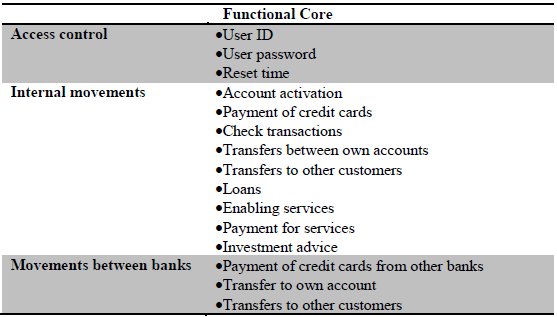
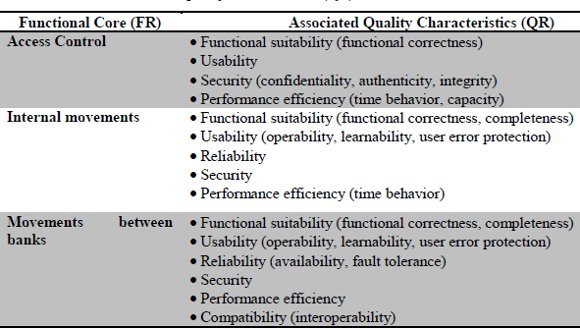
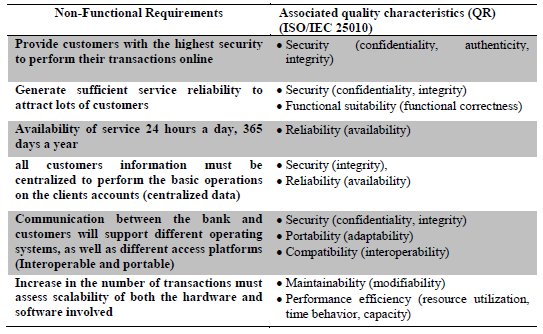
<body><![CDATA[</OL> 	    <P LANG="en-US" STYLE="margin-bottom: 0cm"><FONT FACE="Verdana" size="2">From 	the description of the online banking domain, main functionalities 	can be clearly identified: display of banking movements, transfers 	between own accounts and third parties, cancellation and payment of 	services, visualization and acquisition of investments, application 	and payment of loans; all these functionalities are considered 	transactions, which are defined in <a name="br24">[</a><a href="#r24">24</a>] as a set of activities 	grouped into a unit; a transaction is accomplished as a whole, if 	any activity fails, the entire transaction fails.</FONT></P> 	 	    <P LANG="en-US" STYLE="margin-bottom: 0cm"><FONT FACE="Verdana" size="2">Applying 	the principle of generalization of processes, we can group some of 	the functionalities in three main branches, thereby generating the 	domain Functional Core: a) Internal movements, meaning any 	transaction with the same bank products; b) movements between banks, 	which involve transactions between two or more banks and ultimately, 	implicit functionality such as access control by the type of data 	exchange occurring in the domain (see <a href="#t2">table 2</a>).</FONT></P> 	  		    <P LANG="de-DE" ALIGN=CENTER STYLE="margin-top: 0.42cm; font-variant: small-caps; line-height: 90%"> 		<FONT SIZE=1 STYLE="font-size: 8pt" FACE="Verdana"><SPAN STYLE="font-variant: normal"><FONT SIZE=2><SPAN LANG="en-US"><B><a name="t2">Table 		2</a></B>: 		Functional Core</SPAN></FONT></SPAN></FONT><font face="Verdana" size="2">         </font> </P> <font face="Verdana" size="2"> <img src="/img/revistas/cleiej/v17n2/2a02t2.jpg"> </font>       <P LANG="en-US" STYLE="margin-bottom: 0cm"><FONT FACE="Verdana" size="2">After 	determining the main functionalities of the domain, they are with 	quality characteristics that must be fulfilled for each one of them. 	The functionality &quot;internal movements&quot; are transactions 	involving both consultations and transfers and payments within the 	same organization, so that it requires security, efficiency, 	usability, reliability and functional suitability. In the case of 	&quot;movements between banks&quot; in addition to the 	above-mentioned quality characteristics, support is required for the 	interoperability of the systems involved. Finally the functionality 	of Access Control involves the QR of functional suitability, 	usability, security, and efficiency (see <a href="#t3">table 3</a>).</FONT></P> 	      <p LANG="en-US"><font face="Verdana" size="2">b. Identify business rules &amp; 		organizational constraints</font></p> 	  	    <P LANG="en-US" STYLE="margin-bottom: 0cm"><FONT FACE="Verdana" size="2">In 	the online banking domain, there are some basic rules that should 	not be neglected; a) provide customers with the highest security to 	perform their transactions via internet; b) generate sufficient 	service reliability to attract lots of customers; c) availability of 	service 24 hours a day, 365 days a year and, d) all customer 	information must be concentrated to carry out basic operations on 	the clients accounts.</FONT></P> 	     <P LANG="en-US" STYLE="margin-bottom: 0cm"><font face="Verdana" size="2">The 	listed QR are traceable from the functionality requiring them (see 	<a href="#t3">Tables 3</a> and <a href="#t4">4</a>) and the precise quality goals to be reached can be 	measured, if the quality attribute level is specified according to 	ISO/IEC 25010. Here they are presented as quality characteristics 	and sub-characteristics; quality attributes are not shown.</font></P> 	     <P LANG="en-US" STYLE="margin-bottom: 0cm"><font face="Verdana" size="2">The 	communication between the bank and customers must support different 	operating systems as well as different access platforms. On the 	other hand, the implementation of the online banking domain implies 	indirectly the increase in the amount of transactions, therefore the 	scalability of the hardware and software involved should be 	evaluated (see <a href="#t4">table 4</a>). </font>  	</P> 	     <P LANG="en-US" STYLE="margin-bottom: 0cm"><FONT FACE="Verdana" size="2">As 	for legal constraints, it is necessary to review the country laws 	and regulations.</FONT></P> 	  		    ]]></body>
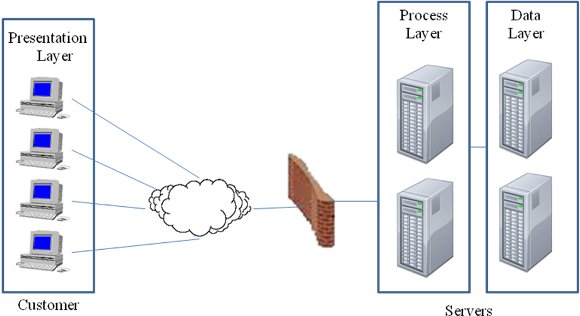
<body><![CDATA[<P LANG="de-DE" ALIGN=CENTER STYLE="margin-top: 0.42cm; font-variant: small-caps; line-height: 90%"> 		<FONT SIZE=1 STYLE="font-size: 8pt" FACE="Verdana"><SPAN STYLE="font-variant: normal"><FONT SIZE=2><SPAN LANG="en-US"><B><a name="t3">Table 		3</a></B>: 		List of quality characteristics (QR) associated with the Functional 		Core</SPAN></FONT></SPAN></FONT></P> <font face="Verdana" size="2"> <img src="/img/revistas/cleiej/v17n2/2a02t3.jpg"> </font>       <p LANG="es-ES"><font face="Verdana" size="2"><SPAN LANG="en-US">c. Identify Architectural Styles </SPAN> </font> 		</p>  	    <P LANG="en-US" STYLE="margin-bottom: 0cm"><FONT FACE="Verdana" size="2">For 	the online banking domain several architectural solutions are 	available. In our case, on the basis of previous studies <a name="br28">[</a><a href="#r28">28</a>] <a name="br19">[</a><a href="#r19">19</a>], 	we prefer to use the Service Oriented Architecture (SOA), which 	follows a layered style, with a client/server communication layer.  </FONT> 	</P> 	     <P LANG="en-US" STYLE="margin-bottom: 0cm"><FONT FACE="Verdana" size="2">The 	SOA architecture is defined by <a name="br29">[</a><a href="#r29">29</a>] as a set of patterns, principles 	and practices to build pieces of software that can interoperate, 	regardless of the technology used in their implementation; It is 	normal to apply a design of three-layer which includes the 	presentation of the client-side, the processing layer, also known as 	application server, and the data management or database server 	layer.</FONT></P> 	 		    <P LANG="de-DE" ALIGN=CENTER STYLE="margin-top: 0.42cm; font-variant: small-caps; line-height: 90%"> 		<FONT SIZE=1 STYLE="font-size: 8pt" FACE="Verdana"><SPAN STYLE="font-variant: normal"><FONT SIZE=2><SPAN LANG="en-US"><B><a name="t4">Table 		4</a></B>: 		Online banking domain constraints</SPAN></FONT></SPAN></FONT></P> <font face="Verdana" size="2"> <img src="/img/revistas/cleiej/v17n2/2a02t4.jpg"> </font>   	    <p LANG="es-ES"><font face="Verdana" size="2"><SPAN LANG="en-US">d. Determine Candidate Architecture</SPAN></font></p>  	    <P LANG="en-US" STYLE="margin-bottom: 0cm"><FONT FACE="Verdana" size="2">Candidate 	Architecture is determined on the basis of the main features of the 	domain as well as its constraints and business rules. The quality 	characteristics originated from the architectural styles considered 	for the domain are identified.  In our case, the candidate 	architecture can be represented graphically as shown in <a href="#f10">Fig. 10</a>, 	revealing the layered design with service selection and 	communication (Internet and firewall) layers.</FONT></P> 	    <P LANG="en-US" STYLE="margin-bottom: 0cm"> 		    <P LANG="es-VE" ALIGN=CENTER STYLE="text-indent: 0cm; margin-bottom: 0cm"> 		<font face="Verdana" size="2"> 		<a name="f10"><IMG SRC="/img/revistas/cleiej/v17n2/2a02f10.jpg" NAME="images10" ALIGN=BOTTOM BORDER=0></a></font></P> 		    <P LANG="es-VE" ALIGN=CENTER STYLE="text-indent: 0cm; margin-bottom: 0cm"> 		<font face="Verdana" size="2"> 		    ]]></body>
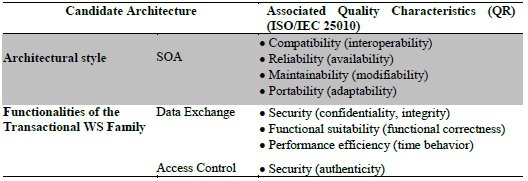
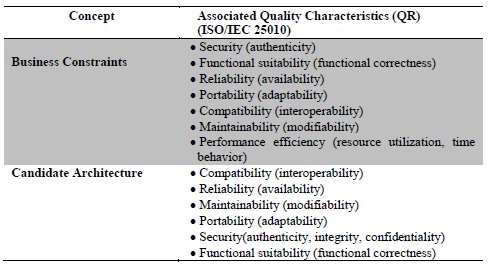
<body><![CDATA[<BR> 		</font> 		</P> 		    <P LANG="en-US" ALIGN=CENTER STYLE="text-indent: 0cm; margin-bottom: 0cm"> 		<FONT FACE="Verdana" size="2"><B>Figure 10</B>: 		Basic components of Candidate Architecture</FONT></P> <font face="Verdana" size="2">     <BR> 	</font> 	</P> 	     <P LANG="en-US" STYLE="margin-bottom: 0cm"><FONT FACE="Verdana" size="2">The 	SOA architecture quality characteristics, according to previous 	studies <a name="br20">[</a><a href="#r20">20</a>] <a name="br19">[</a><a href="#r19">19</a>] are <I>compatibility 	(interoperability), maintainability (ability to be modified), 	reliability (availability) and portability (adaptability)</I>. 	On the other hand, the domain of online banking belongs to the 	family of applications based on web services (WS) of transaction 	type <a name="br20">[</a><a href="#r20">20</a>] <a name="br19">[</a><a href="#r19">19</a>], which implies that two general functionalities are 	clearly identified: data exchange and access control. <a href="#t5">Table 5</a> shows 	an overview of quality characteristics associated with the SOA 	architecture <a name="br19">[</a><a href="#r19">19</a>].</FONT></P> 	 		    <P LANG="de-DE" ALIGN=CENTER STYLE="margin-top: 0.42cm; font-variant: small-caps; line-height: 90%"> 		<FONT SIZE=1 STYLE="font-size: 8pt" FACE="Verdana"><SPAN STYLE="font-variant: normal"><FONT SIZE=2><SPAN LANG="en-US"><B><a name="t5">Table 		5</a></B>: 		Quality Characteristics (QR) associated with the candidate 		architecture</SPAN></FONT></SPAN></FONT></P> 	 <font face="Verdana" size="2"> 	 <img src="/img/revistas/cleiej/v17n2/2a02t5.jpg"> </font>  	    <P LANG="en-US" STYLE="margin-bottom: 0cm"><font face="Verdana" size="2">    <BR> 	</font> 	</P>      <p LANG="en-US"><font face="Verdana" size="2">e. Determine Non-functional Core</font></p>  	    <P LANG="en-US" STYLE="margin-bottom: 0cm"><FONT FACE="Verdana" size="2">The non-functional core is 	the union of the quality characteristics determined in previous 	activities (constraints 	and business rules and quality of candidate architecture); <a href="#t6">table 6</a> 	them in details the online banking non-functional core. 	</FONT> 	</P> 	    <P LANG="en-US" STYLE="margin-bottom: 0cm"><font face="Verdana" size="2">    ]]></body>
<body><![CDATA[<BR> 	</font> 	</P>      <p LANG="en-US"><font face="Verdana" size="2">f. Specify the domain quality 		model</font></p>  	    <P LANG="en-US" STYLE="margin-bottom: 0cm"><FONT FACE="Verdana" size="2">The 	quality model consists of the set of quality characteristic and 	sub-characteristic determined in the previous steps, which are 	specified by the ISO/IEC 25010 standard. The domain quality model 	helps to define global non-functional requirements (based on the 	non-functional core) and represent the quality view of the domain 	knowledge <a name="br19">[</a><a href="#r19">19</a>]. In this case, the quality model is represented in 	<a href="#t7">table 7</a> with the quality characteristic associated with the 	originating functional core (<I>functional 	suitability, usability, reliability, safety, efficiency and 	compatibility)</I>, and 	of the quality characteristics of the non-functional core <I>(security, 	functional suitability, reliability, portability, compatibility, 	maintainability, efficiency)</I>.</FONT></P> 	    <P LANG="en-US" STYLE="margin-bottom: 0cm"><font face="Verdana" size="2">    <BR> 	</font> 	</P>  		    <P LANG="de-DE" ALIGN=CENTER STYLE="margin-top: 0.42cm; font-variant: small-caps; line-height: 90%"> 		<FONT SIZE=1 STYLE="font-size: 8pt" FACE="Verdana"><SPAN STYLE="font-variant: normal"><FONT SIZE=2><SPAN LANG="en-US"><B><a name="t6">Table 		6</a></B>: 		Non-functional Core of online banking domain </SPAN></FONT></SPAN></FONT> 		</P> <font face="Verdana" size="2"> <img src="/img/revistas/cleiej/v17n2/2a02t6.jpg"> </font>       <p LANG="es-ES" STYLE="margin-left: 0.64cm; text-indent: -0.64cm"> 	</p>      <p LANG="en-US"><font face="Verdana" size="2">B. Identification of crosscutting 		concerns</font></p>  	    <P LANG="en-US" STYLE="margin-bottom: 0cm"><FONT FACE="Verdana" size="2">The 	aim of this discipline is to determine which NFR specified in the 	quality model are candidates to be considered an aspect, by applying 	the basics concepts of AORE and specifically the approach of Brito, 	Moreira and Araujo <a name="br17">[</a><a href="#r17">17</a>], resulting in the extended use case model</FONT></P> 	     <p LANG="en-US"><font face="Verdana" size="2">a. Identify actors and associated 		RNF </font>  		</p> 	    ]]></body>
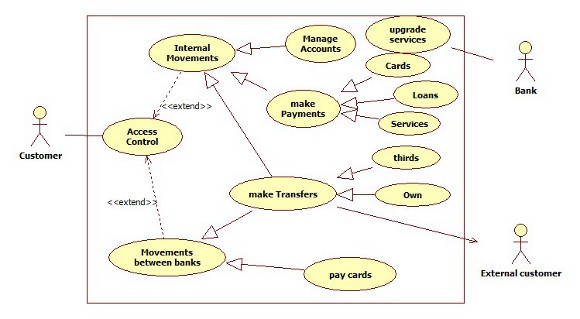
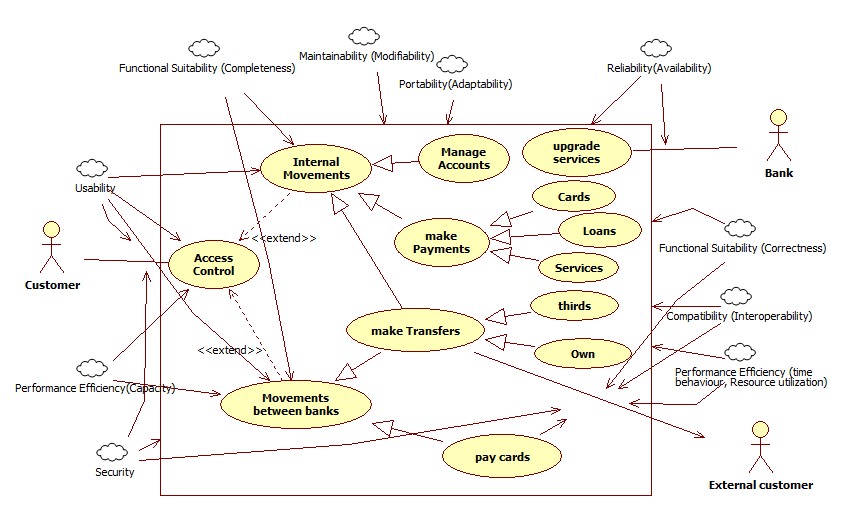
<body><![CDATA[<P LANG="en-US" STYLE="margin-bottom: 0cm"><FONT FACE="Verdana" size="2">From 	the description of the domain and considering the functionalities identified in the 	previous phase, it can be appreciated that for this domain, the main 	human actor is the <I>customer</I> 	of the bank. However, two external systems can be considered as 	actors: the domestic banking system and the external banking system, 	which we will call <I>external 	customer </I>and <I>bank 	respectively</I>. </FONT> 	</P> 	     <P LANG="en-US" STYLE="margin-bottom: 0cm"><FONT FACE="Verdana" size="2">The 	RNF's <I>security</I> 	and <I>usability </I>are 	associated with the customer actor; the external customer actor is 	associated with <I>security, 	efficiency</I> (<I>behavior 	in time</I>), <I>functional 	suitability</I> 	(<I>correctness</I>), <I>compatibility 	(interoperability</I>) 	and the bank actor is associated with <I>reliability</I></FONT></P>  		    <P LANG="de-DE" ALIGN=CENTER STYLE="margin-top: 0.42cm; font-variant: small-caps; line-height: 90%"> 		<FONT SIZE=1 STYLE="font-size: 8pt" FACE="Verdana"><SPAN STYLE="font-variant: normal"><FONT SIZE=2><SPAN LANG="en-US"><B><a name="t7">Table 		7</a></B>: 		The Domain Quality Model</SPAN></FONT></SPAN></FONT></P> <font face="Verdana" size="2"> <img src="/img/revistas/cleiej/v17n2/2a02t7.jpg"> </font>       <p LANG="en-US"><font face="Verdana" size="2">b. Identify use cases</font></p>  	    <P LANG="en-US" STYLE="margin-bottom: 0cm"><FONT FACE="Verdana" size="2">With the information in <a href="#t2">table 2</a> (Functional 	Core) and description of the domain the main use cases for the 	domain of banking online can be identified on the basic use case 	model (see <a href="#f11">Fig. 11</a>). </FONT> 	</P>  		    <P LANG="es-VE" ALIGN=CENTER STYLE="text-indent: 0cm; margin-bottom: 0cm"> 		<font face="Verdana" size="2"> 		<a name="f11"><IMG SRC="/img/revistas/cleiej/v17n2/2a02f11.jpg" NAME="images11" ALIGN=BOTTOM  BORDER=0></a></font></P> 		    <P LANG="en-US" ALIGN=CENTER STYLE="margin-bottom: 0cm"> 		<FONT FACE="Verdana" size="2"><SPAN LANG="es-VE"><B>Figure 		11</B>: 		Use case diagram</SPAN></FONT></P> 	    <P LANG="en-US" STYLE="margin-bottom: 0cm"><font face="Verdana" size="2">    <BR> 	</font> 	</P> 		       <p LANG="en-US"><font face="Verdana" size="2">c. NFR associated with the use 		case model</font></p> 	    ]]></body>
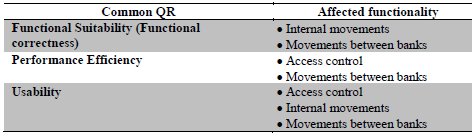
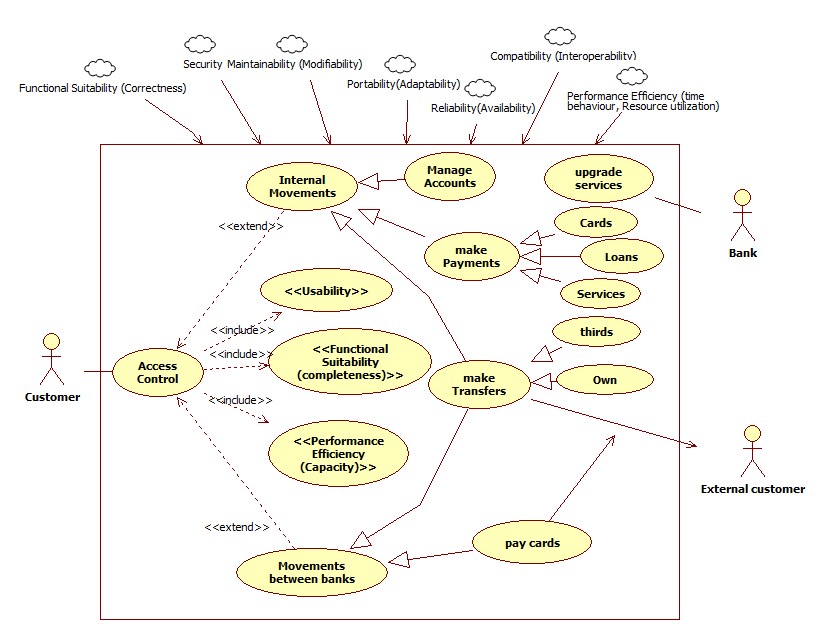
<body><![CDATA[<P LANG="en-US" STYLE="margin-bottom: 0cm"><FONT FACE="Verdana" size="2">Based on the quality model in <a href="#t7">table 7</a>, <a href="#f12">Fig. 12</a> 	shows the quality characteristics of the Non-functional Core as 	global NFR (with Association Point on the border of the use case 	diagram), the quality characteristics associated with actors as NFR 	with Association Points on the communication between actor and use 	case, and finally the quality characteristics of the functional 	core, which are directly associated with use cases. </FONT> 	</P>  		    <P LANG="es-VE" ALIGN=CENTER STYLE="text-indent: 0cm; margin-bottom: 0cm"> 		<font face="Verdana" size="2"> 		<a name="f12" href="/img/revistas/cleiej/v17n2/2a02f12.jpg">Figure 12: Use case model with associated NFR</a></font></P>      <p LANG="en-US"><font face="Verdana" size="2">d. Identify aspects candidates</font></p> 	    <P LANG="en-US" STYLE="margin-bottom: 0cm"><FONT FACE="Verdana" size="2">To 	identify candidate aspects it is necessary to remind that according 	to the aspects-oriented approach, those NFR affecting more than one 	functionality should be considered as a candidate aspect or 	crosscutting concern <a name="br17">[</a><a href="#r17">17</a>]. <a href="#t8">Table 8</a> summarizes the association of the 	functionalities and the crosscutting NFR.</FONT></P> 	  		    <P LANG="de-DE" ALIGN=CENTER STYLE="margin-top: 0.42cm; font-variant: small-caps; line-height: 90%"> 		<FONT SIZE=1 STYLE="font-size: 8pt" FACE="Verdana"><SPAN STYLE="font-variant: normal"><FONT SIZE=2><SPAN LANG="en-US"><B><a name="t8">Table 		8</a></B>: 		Crosscutting concerns</SPAN></FONT></SPAN></FONT></P>  <font face="Verdana" size="2">  <img src="/img/revistas/cleiej/v17n2/2a02t8.jpg"> </font>       <p LANG="en-US"><font face="Verdana" size="2">e. Restructuring of crosscutting 		NFR</font></p>     <P LANG="en-US" STYLE="margin-bottom: 0cm"><FONT FACE="Verdana" size="2">Verify 	the NFR which affect more than one functionality and apply the rules 	of propagation <a name="br19">[</a><a href="#r19">19</a>] within the use case diagram, they are relocated 	as use cases with a relation of &quot;include&quot; based on the 	combination of approaches <a name="br16">[</a><a href="#r16">16</a>] and <a name="br17">[</a><a href="#r17">17</a>], getting the graph of <a href="#f13">Fig. 	13</a>, as the final artifact of this discipline, which we have called 	Extended use case model.</FONT></P>  	    <p LANG="en-US"><font face="Verdana" size="2">C. Reference Architecture Design</font></p> 	    <P LANG="en-US" STYLE="margin-bottom: 0cm"><FONT FACE="Verdana" size="2">Continuing with the main disciplines of UPDA, at this point 	part of the extended use case model obtained in the previous stage 	and the graphics of interdependence of objectives (SIG) are 	generated and each softgoal corresponding to a NFR is refined into 	an operationalization, to construct the reference architecture of 	the domain. </FONT> 	</P>  		    <P LANG="es-VE" ALIGN=CENTER STYLE="text-indent: 0cm; margin-bottom: 0cm"> 		<font face="Verdana" size="2"> 		<a name="f13" href="/img/revistas/cleiej/v17n2/2a02f13.jpg" >Figure 13: Extended use case model</a></font></P>     ]]></body>
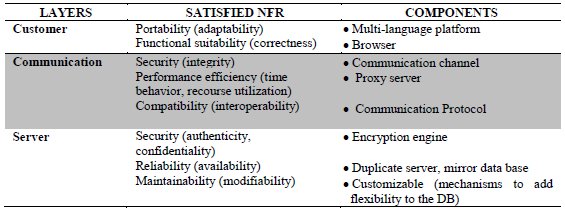
<body><![CDATA[<P><font face="Verdana" size="2">    <BR></font></P> 	     <p LANG="en-US"><font face="Verdana" size="2">a. Refine NFR</font></p> 	    <P LANG="en-US" STYLE="margin-bottom: 0cm"><FONT FACE="Verdana" size="2">On 	the basis of the Extended Use case Model (<a href="#f13">Fig. 13</a>) each NFR is 	considered, identified as &lt;&lt;include&gt;&gt; use case, and 	decomposed using the tree structure known as SIG <a name="br12">[</a><a href="#r12">12</a>], in order to 	capture in this structure the sub-goals that satisfy the NFR. </FONT> 	</P> 	    <P LANG="en-US" STYLE="margin-bottom: 0cm"><FONT FACE="Verdana" size="2">In 	the same way, the global NFRs expressed in <a href="#f13">Fig. 13</a> are considered 	within the SIG for the selected architecture, since all of them must 	be satisfied. </FONT> 	</P> 	    <P LANG="en-US" STYLE="margin-bottom: 0cm"><font face="Verdana" size="2">    <BR> 	</font> 	</P>     <p LANG="en-US"><font face="Verdana" size="2">b. Identify Operationalizations</font></p> 	    <P LANG="en-US" STYLE="margin-bottom: 0cm"><FONT FACE="Verdana" size="2">The 	refinement of NFR produces a graph of softgoals, where the last 	sub-goal can be satisfied with a software component, this is known 	as operationalization within a top-down approach. In our case, the 	operationalization of global NFR (fulfilled by SOA) is expressed in 	<a href="#f14">Fig. 14</a>.</FONT></P> 	    <P LANG="en-US" STYLE="margin-bottom: 0cm"><font face="Verdana" size="2">    ]]></body>
<body><![CDATA[<BR> 	</font> 	</P> 	    <p LANG="en-US"><font face="Verdana" size="2">c. Define Reference Architecture</font></p>  	    <P LANG="en-US" STYLE="margin-bottom: 0cm"><FONT FACE="Verdana" size="2">After 	operationalizing each NFR to obtain the software components 	satisfying it, the contribution of each one is evaluated on a 	bottom-up approach, taking feasible solutions as those who are the 	&ldquo;most&rdquo; positive within the branches of the tree, 	creating thus the reference architecture of the domain (see <a href="#t9">table 	9</a>). The logic view of this architecture is represented in a UML <a name="br30">[</a><a href="#r30">30</a>] 	diagram of components in <a href="#f15">Fig. 15</a>. </FONT> 	</P> 	    <P LANG="en-US" STYLE="margin-bottom: 0cm"><font face="Verdana" size="2">    <BR> 	</font> 	</P>  		    <P LANG="de-DE" ALIGN=CENTER STYLE="margin-bottom: 0cm; font-variant: small-caps; line-height: 100%"> 		<FONT SIZE=1 STYLE="font-size: 8pt" FACE="Verdana"><SPAN STYLE="font-variant: normal"><FONT SIZE=2><SPAN LANG="en-US"><B><a name="t9">Table 		9</a></B>: 		Online Banking Domain Reference Architecture</SPAN></FONT></SPAN></FONT></P>  <font face="Verdana" size="2">  <img src="/img/revistas/cleiej/v17n2/2a02t9.jpg"> </font>  			    <P LANG="es-VE" ALIGN=CENTER STYLE="text-indent: 0cm; margin-bottom: 0cm"> 			<font face="Verdana" size="2"> 			<a name="f14"><IMG SRC="/img/revistas/cleiej/v17n2/2a02f14.jpg" NAME="images14" ALIGN=BOTTOM BORDER=0></a></font></P> 		    <P LANG="en-US" ALIGN=CENTER STYLE="margin-bottom: 0cm"> 			<FONT FACE="Verdana" size="2"><B>Figure 14</B>: 			SIG of SOA Architecture for Online Banking</FONT></P> 	 		    <P STYLE="margin-bottom: 0cm"><font face="Verdana" size="2">    <BR> 		</font> 		</P> 		    ]]></body>
<body><![CDATA[<P ALIGN=CENTER STYLE="margin-bottom: 0cm">         <font face="Verdana" size="2"><a name="f15"><IMG SRC="/img/revistas/cleiej/v17n2/2a02f15.jpg" NAME="images15" ALIGN=BOTTOM BORDER=0></a></font></P> 		    <P LANG="en-US" ALIGN=CENTER STYLE="margin-bottom: 0cm"> 		<FONT FACE="Verdana" size="2"><B>Figure 15</B>: 		Reference Architecture for Online Banking</FONT></P>  	     <p LANG="es-ES" ALIGN=LEFT STYLE="line-height: 100%"> 		  <FONT SIZE=2 face="Verdana"><SPAN LANG="en-US"><B>V. Related Works</B></SPAN></FONT></p>  	    <P LANG="en-US" STYLE="margin-bottom: 0cm"><FONT FACE="Verdana" size="2">In 	the review concerning the topics of this research, various proposals 	can be found in the literature seeking the combination, within the 	processes for Requirements Engineering, of aspects and goals 	techniques to relate functional and non-functional requirements.</FONT></P> 	     <P LANG="en-US" STYLE="margin-bottom: 0cm"><FONT FACE="Verdana" size="2">Among 	the proposals considered, we can mention the works of De Sousa <a name="br31">[</a><a href="#r31">31</a>] 	and Navarro <a name="br32">[</a><a href="#r32">32</a>]. </FONT> 	</P> 	     <P LANG="en-US" STYLE="margin-bottom: 0cm"><FONT FACE="Verdana" size="2">In the de Sousa methodology, Goal-Oriented 	Requirements founded on the Separation of Concerns, arises the 	(GREMSoC) methodology, which aims to produce improvements in 	requirements specifications, with focus on the separation of 	concerns. This methodology addresses the crosscutting requirements 	in the phases of Analysis and Documentation of Requirements 	Engineering, as shown in <a href="#f16">Fig. 16</a> <a name="br31">[</a><a href="#r31">31</a>]. The process is divided into 	four main activities: FR analysis and specification, NFR analysis 	and specification, crosscutting requirements identification and 	crosscutting requirements specification. For the second activity, 	they use an adaptation of the NFR Framework proposing the 	specification of the NFR in specific composition tables, indicating 	when the requirements are affected and when the crosscutting 	requirement can be activated by the operators &quot;overlap&quot; 	and &quot;override&quot;, eliminating invasive or direct 	relationships of crosscutting requirements with the affected 	requirements. </FONT> 	</P> 	  		    <P STYLE="margin-bottom: 0cm"><font face="Verdana" size="2"><a name="f16"><IMG SRC="/img/revistas/cleiej/v17n2/2a02f16.gif" NAME="images16" ALIGN=BOTTOM  BORDER=0></a></font></P> 	 	    <P LANG="en-US" STYLE="margin-bottom: 0cm"><FONT FACE="Verdana" size="2"><B>Figure 		16</B>: Outline diagram 		of GREMSoc Methodology <a name="br31">[</a><a href="#r31">31</a>]</FONT></P>       <P LANG="en-US" STYLE="margin-bottom: 0cm"><FONT FACE="Verdana" size="2">Navarro 	also integrates aspect and goal oriented approaches, with focus on a 	proper and organized document of system requirements, taking into 	consideration the ISO/IEC 9126-1 standard, which is the older 	version of ISO/IEC 25010, to specify NFR. The proposed methodology 	<a name="br32">[</a><a href="#r32">32</a>], called ATRIUM defines software architectures from 	requirements.  It is oriented to the concurrent definition of 	requirements and architecture through five (5) general activities 	(see <a href="#f17">Fig. 17</a>). The first activity of integration of FR and NFR is 	based on the NFR Framework and the KAOS technique <a name="br11">[</a><a href="#r11">11</a>]<a name="br32">[</a><a href="#r32">32</a>], 	obtaining a goals model of the product, defined in <a name="br32">[</a><a href="#r32">32</a>] as the set 	of graphs that are interrelated to each other, which is obtained 	determining stakeholders needs in addition to the review of all 	existing documentation of the current system. </FONT> 	</P> 	 	    <P ALIGN=CENTER STYLE="margin-bottom: 0cm"><font face="Verdana" size="2"><a name="f17"><IMG SRC="/img/revistas/cleiej/v17n2/2a02f17.gif" NAME="images17" ALIGN=BOTTOM  BORDER=0></a></font></P> 		    ]]></body>
<body><![CDATA[<P LANG="en-US" ALIGN=CENTER STYLE="margin-bottom: 0cm"> 		<FONT FACE="Verdana" size="2"><B>Figure 17</B>: 		ATRIUM Activities and Artifacts <a name="br32">[</a><a href="#r32">32</a>]</FONT></P> 	  	    <P LANG="en-US" STYLE="margin-bottom: 0cm"><FONT FACE="Verdana" size="2">Both 	methodologies described above integrate FR and NFR in the RE 	discipline. The first, proposes improvement to the requirements 	document based on the proper handling of crosscutting concerns 	through its specification tables in the phases of analysis and 	documentation of requirements unlike our proposal that seeks the 	early integration of FR and NFR and at a higher abstraction level, 	such as the domain analysis phase. With respect to the second 	proposal considered, it can be observed that it aims at generating 	formal derivation rules and patterns by instantiating the goals 	model through a formal architecture description language, taken from 	KAOS. In our proposal, a domain analysis process, which integrates 	well-known requirements engineering techniques enhancing the 	treatment and modeling of NFR, is used to generate a reference 	architecture.  However, in general one of the main limitations of 	goal and aspect-oriented approaches is the absence of standards in 	specification and notations; we used standards as much as possible, 	responding to best practices of software engineering. </FONT> 	</P>      <p LANG="es-ES" ALIGN=LEFT> <FONT SIZE=2 face="Verdana"><SPAN LANG="en-US"><B>VI. Conclusion</B></SPAN></FONT></p> 	    <P LANG="en-US" STYLE="margin-bottom: 0cm"><FONT FACE="Verdana" size="2">The 	unified process for domain analysis is proposed as an early stage of 	a software development process that allows integrating FR and NFR. </FONT> 	</P> 	     <P LANG="en-US" STYLE="margin-bottom: 0cm"><FONT FACE="Verdana" size="2">The 	UPDA process allows firstly, to ensure quality throughout the 	development process, guaranteeing communication among the software 	development work team, since it is based on the ISO/IEC 25010 	standard, and secondly, identify NFR as candidate aspects so that 	they can be integrated into the process from early stages of 	analysis and design, facilitating their implementation from the RA, 	at the end of the development process.</FONT></P> 	     <P LANG="en-US" STYLE="margin-bottom: 0cm"><FONT FACE="Verdana" size="2">The 	integration of different known requirements engineering approaches 	into a unified process was performed smoothly and did not generate 	major problems, since only essential activities for the process were 	used; activities and components were reused as assets, focusing on a 	future work in the context of architecture-centric processes or 	software product lines. Actually, UPDA can be easily used in a 	requirements engineering discipline or in a software product line 	context. The integration of different requirements engineering 	techniques and approaches at early stages of development into a 	unified process has the advantages of offering a complete set of a 	smoothly integrated portfolio of tools and techniques, which have 	been used separately up to know. The integration process, from a 	theoretical point of view, was not difficult; models and concepts 	could be easily integrated. However, it has to be pointed out that 	aspect and goal oriented techniques in general, do not offer 	standard conceptual models or notations, being this a great 	limitation of these approaches. A future work will be to design a 	computational tool, integrating existing systems, or designing from 	scratch new tools, supporting the techniques and practices used by 	UPDA.</FONT></P> 	    <p LANG="en-US"><font face="Verdana" size="2">Acknowledgment</font></p> 	    <P LANG="en-US" STYLE="margin-bottom: 0cm"><font face="Verdana" size="2">This 	research has been partially sponsored by the PEII-Fonacit DISoft 	project N<SUP>o</SUP> 2011001343, the CDCH DesCCaP project N<SUP>o</SUP> 	PG-03-8014-2011, the CDCH DARGRAF project N<SUP>o</SUP> 	PG-03-730-2013/1, Universidad Central de Venezuela, and the 	Postgrado en Ciencias de la Computaci&oacute;n. </font>  	</P> 	     <!-- ref --><P LANG="en-US" STYLE="margin-left: 0.4cm; text-indent: -0.4cm; margin-bottom: 0cm"> 	<font face="Verdana" size="2"> 	<a name="r1">[</a><a href="#br1">1</a>] ISO/IEC 25010. Systems and software engineering -- Systems and 	software Quality Requirements and Evaluation (SQuaRE) -- Systems and 	software quality models, ISO/IEC JTC1/SC7/WG6, 2011</font><!-- ref --><P LANG="en-US" STYLE="margin-left: 0.4cm; text-indent: -0.4cm; margin-bottom: 0cm"> 	<font face="Verdana" size="2"> 	<a name="r2">[</a><a href="#br2">2</a>] B. Nuseibeh, S. Easterbrook, Requirements Engineering: A 	Roadmap. Proc. Conference on the Future of Software Engineering. 	Limerick, Ireland. 2000.    </font></P> 	    <!-- ref --><P LANG="en-US" STYLE="margin-left: 0.4cm; text-indent: -0.4cm; margin-bottom: 0cm"> 	<font face="Verdana" size="2"> 	<a name="r3">[</a><a href="#br3">3</a>] A. Lamsweerde, Requirements Engineering: From Craft to 	Discipline.Proc. FSE'2008: 16th ACM Sigsoft Intl. Symposium on the 	Foundations of Software Engineering, Atlanta, Noviembre. 2008.    </font></P> 	    <!-- ref --><P LANG="en-US" STYLE="margin-left: 0.4cm; text-indent: -0.4cm; margin-bottom: 0cm"> 	<font face="Verdana" size="2"> 	<a name="r4">[</a><a href="#br4">4</a>] E. Berard, Essays in Object-Oriented Software Engineering, 	Prentice Hall, 1992.    </font></P> 	    <!-- ref --><P LANG="en-US" STYLE="margin-left: 0.4cm; text-indent: -0.4cm; margin-bottom: 0cm"> 	<font face="Verdana" size="2"> 	<a name="r5">[</a><a href="#br5">5</a>] I. Sommerville, Software Engineering. 9th Edition. Pearson 	Education. 2011.    </font></P> 	    <!-- ref --><P LANG="en-US" STYLE="margin-left: 0.4cm; text-indent: -0.4cm; margin-bottom: 0cm"> 	<font face="Verdana" size="2"> 	<a name="r6">[</a><a href="#br6">6</a>] ISO/IEC. Systems and software engineering -- Systems and 	software Quality Requirements and Evaluation (SQuaRE) 2006</font><!-- ref --><P LANG="en-US" STYLE="margin-left: 0.4cm; text-indent: -0.4cm; margin-bottom: 0cm"> 	<font face="Verdana" size="2"> 	<a name="r7">[</a><a href="#br7">7</a>] M. Shaw, D. Garlan, Software Architecture: Perspectives on an 	Emerging Discipline. 2d Ed Pearson Us Imports &amp; PHIPEs, 1996</font><P LANG="en-US" STYLE="margin-left: 0.4cm; text-indent: -0.4cm; margin-bottom: 0cm"> 	<font face="Verdana" size="2"> 	<a name="r8">[</a><a href="#br8">8</a>] F. Losavio, A. Matteo, I. Pacilli, &ldquo;Proceso dirigido por 	objetivos para an&aacute;lisis de dominio bajo est&aacute;ndares de 	calidad&rdquo;. Enl@ce Revista Venezolana de Informaci&oacute;n, 	Tecnolog&iacute;a y Conocimiento, 6(3), 11-28,  2009</font></P> 	    ]]></body>
<body><![CDATA[<!-- ref --><P LANG="en-US" STYLE="margin-left: 0.4cm; text-indent: -0.4cm; margin-bottom: 0cm"> 	<font face="Verdana" size="2"> 	<a name="r9">[</a><a href="#br9">9</a>] P. Clements, F. Bauchmann, L. Bass, D. Varlan, J. Ivers, R. 	Little, P. Merson, R. Nord, J. Stafford, Documenting Software 	Architecture, Views and Beyond. 2nd Edition, Addison Wesley, SEI 	Series in Software Engineering, NJ, 2010</font><!-- ref --><P LANG="en-US" STYLE="margin-left: 0.4cm; text-indent: -0.4cm; margin-bottom: 0cm"> 	<font face="Verdana" size="2"> 	<a name="r10">[</a><a href="#br10">10</a>] E. Nakagawa, P. Antonio and M. Becker, Reference architecture 	and product line architecture: a subtle but critical difference, 	Crancovic V., Grhun, and M. Book (Eds.): ECSA 2011, LNCS 6903, pp. 	207-211, Springer-Verlag Berlin Heidelberg 2011</font><P LANG="en-US" STYLE="margin-left: 0.4cm; text-indent: -0.4cm; margin-bottom: 0cm"> 	<font face="Verdana" size="2"> 	<a name="r11">[</a><a href="#br11">11</a>] A. Lamsweerde, &ldquo;A Goal-Oriented Requirements Engineering: 	A Guided Tour&rdquo;, 5th Int&rsquo;l  Symp. On RE, IEEE CS Press. 	2001</font></P> 	    <!-- ref --><P LANG="en-US" STYLE="margin-left: 0.4cm; text-indent: -0.4cm; margin-bottom: 0cm"> 	<font face="Verdana" size="2"> 	<a name="r12">[</a><a href="#br12">12</a>] L. Chung, B. Nixon, E. Yu, J. Mylopoulos, Non-Functional 	Requirements in Software Engineering. Kluwer Acad. Publishers. 2000</font><!-- ref --><P LANG="en-US" STYLE="margin-left: 0.4cm; text-indent: -0.4cm; margin-bottom: 0cm"> 	<font face="Verdana" size="2"> 	<a name="r13">[</a><a href="#br13">13</a>] G. Booch, J. Rumbaugh, I. Jacobson, The Unified Modeling 	Language User Guide. Addison-Wesley, U.S.A. 1999</font><P LANG="en-US" STYLE="margin-left: 0.4cm; text-indent: -0.4cm; margin-bottom: 0cm"> 	<font face="Verdana" size="2"> 	<a name="r14">[</a><a href="#br14">14</a>] A. Dardenne, A. Lamsweerde, &ldquo;Goal-Directed Requirements 	Acquisition&rdquo;, Science of Computer Programming. vol. 20, pp 	179-190. 1993</font></P> 	    <P LANG="en-US" STYLE="margin-left: 0.4cm; text-indent: -0.4cm; margin-bottom: 0cm"> 	<font face="Verdana" size="2"> 	<a name="r15">[</a><a href="#br15">15</a>] E. Yu, Towards Modelling and Reasoning Support for Early-Phase 	Requirements Engineering. Proc. RE-97 &ndash; 3rd Int. Symp. On 	Requirements Engineering, Annapolis, 226-235. 1997.</font></P> 	    <P LANG="en-US" STYLE="margin-left: 0.4cm; text-indent: -0.4cm; margin-bottom: 0cm"> 	<font face="Verdana" size="2"> 	<a name="r16">[</a><a href="#br16">16</a>] S. Supakkul, L. Chung, &ldquo;Integrating FRs and NFRs: A Use 	Case and Goal Driven Approach&rdquo;, 2nd ICSE, pp 30-37, 2004</font></P> 	    <P LANG="en-US" STYLE="margin-left: 0.4cm; text-indent: -0.4cm; margin-bottom: 0cm"> 	<font face="Verdana" size="2"> 	<a name="r17">[</a><a href="#br17">17</a>] A. Moreira, I. Brito, J. Ara&uacute;jo, &ldquo;Crosscutting 	quality attributes for requirements engineering&rdquo;, The 14th 	ICSE and SEKE&rsquo;02, Ischia, Italy, ACM Press, pp 167-174, 2002</font></P> 	    <P LANG="en-US" STYLE="margin-left: 0.4cm; text-indent: -0.4cm; margin-bottom: 0cm"> 	<font face="Verdana" size="2"> 	<a name="r18">[</a><a href="#br18">18</a>] G. De Sousa, J. Silva, J. Castro, &ldquo;Adapting the NFR 	framework to aspect-oriented requirement engineering&rdquo;, In The 	XVII Brazilian Symposium on Software Engineering, Manaus, Brazil, 	October, 2003. </font>  	</P> 	    ]]></body>
<body><![CDATA[<P LANG="en-US" STYLE="margin-left: 0.4cm; text-indent: -0.4cm; margin-bottom: 0cm"> 	<font face="Verdana" size="2"> 	<a name="r19">[</a><a href="#br19">19</a>] F. Losavio, A. Matteo, I. Pacilli, &ldquo;Proceso Extendido de 	Chung con An&aacute;lisis de Dominio identificaci&oacute;n de 	Aspectos y Est&aacute;ndares de Calidad&rdquo;, II Simposio 	Cient&iacute;fico y Tecnol&oacute;gico en Computaci&oacute;n, pp 	148-155, 7-9 de mayo, Escuela de Computaci&oacute;n, Caracas, 	Venezuela, 2012</font></P> 	    <P LANG="en-US" STYLE="margin-left: 0.4cm; text-indent: -0.4cm; margin-bottom: 0cm"> 	<font face="Verdana" size="2"> 	<a name="r20">[</a><a href="#br20">20</a>] F. Losavio, A. Matteo, R. Rahamut, &ldquo;Web Services Domain 	Analysis Based on Quality Standards&rdquo;, 2nd ECSA, Cyprus, 2008, 	R. Morrison, D. Balasubramaniam, and K. Falkner (Eds.): ECSA 2008, 	LNCS Vol. 5292, 354&ndash;358 &copy; Springer-Verlag Berlin 2008</font></P> 	    <!-- ref --><P LANG="en-US" STYLE="margin-left: 0.4cm; text-indent: -0.4cm; margin-bottom: 0cm"> 	<font face="Verdana" size="2"> 	<a name="r21">[</a><a href="#br21">21</a>] F. Ruiz, J. Verdugo, Gu&iacute;a de Uso de SPEM 2 con EPF 	Composer. V 3.0. 2008</font><P LANG="en-US" STYLE="margin-left: 0.4cm; text-indent: -0.4cm; margin-bottom: 0cm"> 	<font face="Verdana" size="2"> 	<a name="r22">[</a><a href="#br22">22</a>] F. Losavio, A. Matteo, N. Levy, &ldquo;Web services domain 	knowledge with an ontology on software quality standards&rdquo;, 	ITA&rsquo;09, CAIR, Glyndwr University, UK, Sept.  2011</font></P> 	    <P LANG="en-US" STYLE="margin-left: 0.4cm; text-indent: -0.4cm; margin-bottom: 0cm"> 	<font face="Verdana" size="2"> 	<a name="r23">[</a><a href="#br23">23</a>] E. Yu, J. Mylopoulos, &ldquo;Why goal-oriented requirements 	engineering&rdquo;. Proceedings of the Fourth International Workshop 	on Requirements Engineering: Foundations of Software Quality, Pisa, 	Italy, pp. 15-22,1998</font></P> 	    <!-- ref --><P LANG="en-US" STYLE="margin-left: 0.4cm; text-indent: -0.4cm; margin-bottom: 0cm"> 	<font face="Verdana" size="2"> 	<a name="r24">[</a><a href="#br24">24</a>] World Wide Web Consortium, Web Services Architecture 	Requirements.  W3C Working Group Note, 11 February (2004). Copyright 	&copy; 2004 W3C&reg; (MIT, ERCIM, Keio). Available: </font> 	<A CLASS="western" HREF="http://www.w3.org/TR/wsa-reqs">     <FONT SIZE=2 FACE="Verdana">http://www.w3.org/TR/wsa-reqs</FONT></A><P LANG="en-US" STYLE="margin-left: 0.4cm; text-indent: -0.4cm; margin-bottom: 0cm"> 	<font face="Verdana" size="2"> 	<a name="r25">[</a><a href="#br25">25</a>] S. Pfleeger, &ldquo;Ingenier&iacute;a del Software. Teor&iacute;a 	y Pr&aacute;ctica&rdquo;. Prentice Hall, 2002</font></P> 	    <P LANG="en-US" STYLE="margin-left: 0.4cm; text-indent: -0.4cm; margin-bottom: 0cm"> 	<font face="Verdana" size="2"> 	<a name="r26">[</a><a href="#br26">26</a>] F. Losavio, A. Matteo, &ldquo;Reference Architecture Design 	Using Domain Quality View&rdquo;. Journal of Software Engineering &amp; 	Methodology, Vol. 3 (1) pp 47-61, March 2013</font></P> 	    <!-- ref --><P LANG="en-US" STYLE="margin-left: 0.4cm; text-indent: -0.4cm; margin-bottom: 0cm"> 	<font face="Verdana" size="2"> 	<a name="r27">[</a><a href="#br27">27</a>] F. Mu&ntilde;oz, La adopci&oacute;n de una innovaci&oacute;n 	basada en la Web. An&aacute;lisis y modelizaci&oacute;n de los 	mecanismos generadores de confianza. Tesis doctoral, departamento de 	Comercializaci&oacute;n e Investigaci&oacute;n de Mercados, 	Universidad de Granada. 2008</font><P LANG="en-US" STYLE="margin-left: 0.4cm; text-indent: -0.4cm; margin-bottom: 0cm"> 	<font face="Verdana" size="2"> 	<a name="r28">[</a><a href="#br28">28</a>] F. Losavio, L. Chirinos, A. Matteo, N. L&eacute;vy, A. 	Ramdane-Cherif, &ldquo;Designing Quality Architecture: Incorporating 	ISO Standards into the Unified Process&rdquo;. Journal of ISYM, Vol. 	21(1), 27-44. 2004</font></P> 	    ]]></body>
<body><![CDATA[<P LANG="en-US" STYLE="margin-left: 0.4cm; text-indent: -0.4cm; margin-bottom: 0cm"> 	<font face="Verdana"> 	<a name="r29"><font size="2">[</font></a><font size="2"><a href="#br29">29</a>] J. V&aacute;zquez  &ldquo;&iquest;Por qu&eacute; SOA?&rdquo;. 	2010 </font></font><font size="2"> <A CLASS="western" HREF="http://blogs.tecsisa.com/articulos-tecnicos/por-que-soa/">     <FONT FACE="Verdana"><SPAN LANG="es-VE">http://blogs.tecsisa.com/articulos-tecnicos/por-que-soa/</SPAN></FONT></A></font><font size="2" face="Verdana">     </font> </P> 	    <!-- ref --><P LANG="en-US" STYLE="margin-left: 0.4cm; text-indent: -0.4cm; margin-bottom: 0cm"> 	<font face="Verdana"> 	<a name="r30"><font size="2">[</font></a><font size="2"><a href="#br30">30</a>] OMG. (2005). Unified Modeling Language&trade; (UML&reg;) 2.0.     </font></font> 	<A CLASS="western" HREF="http://www.omg.org/spec/UML/"><FONT FACE="Verdana"><SPAN LANG="es-VE">     <font size="2">http://www.omg.org/spec/UML/</font></SPAN></FONT></A><P LANG="en-US" STYLE="margin-left: 0.4cm; text-indent: -0.4cm; margin-bottom: 0cm"> 	<font face="Verdana" size="2"> 	<a name="r31">[</a><a href="#br31">31</a>] G. De Sousa, J. Castro, &ldquo;Towards a Goal-Oriented 	Requirements Methodology Based on the Separation of Concerns 	Principle&rdquo;. In: Anais do WER 2003 - Workshop em Engenharia de 	Requisitos, Piracicaba-SP, Brasil, November 27-28, 2003, pp. 	223&ndash;239, 2003, </font> 	<A CLASS="western" HREF="http://wer.inf.puc-rio.br/WERpapers/artigos/artigos_WER03/georgia_souza.pdf">     <FONT SIZE=2 FACE="Verdana">http://wer.inf.puc-rio.br/WERpapers/artigos/artigos_WER03/georgia_souza.pdf</FONT></A></P> 	    <P LANG="en-US" STYLE="margin-left: 0.4cm; text-indent: -0.4cm; margin-bottom: 0cm"> 	<font face="Verdana" size="2"> 	<a name="r32">[</a><a href="#br32">32</a>] E. Navarro, P. Letelier, I. Ramos, &ldquo;Goals and Quality 	Characteristics: Separating Concerns&rdquo;. Early Aspects: 	Aspect-Oriented Requirements Engineering and Architecture Design 	Workshop, collocated to OOPSLA 2004, Vancouver, Canada: October 25, 	2004</font></P> 	       ]]></body><back>
<ref-list>
<ref id="B1">
<label>1</label><nlm-citation citation-type="book">
<collab>ISO/IEC 25010</collab>
<source><![CDATA[Systems and software engineering -- Systems and software Quality Requirements and Evaluation (SQuaRE) -- Systems and software quality models]]></source>
<year>2011</year>
<publisher-name><![CDATA[ISO/IEC JTC1/SC7/WG6]]></publisher-name>
</nlm-citation>
</ref>
<ref id="B2">
<label>2</label><nlm-citation citation-type="book">
<person-group person-group-type="author">
<name>
<surname><![CDATA[Nuseibeh]]></surname>
<given-names><![CDATA[B]]></given-names>
</name>
<name>
<surname><![CDATA[Easterbrook]]></surname>
<given-names><![CDATA[S]]></given-names>
</name>
</person-group>
<source><![CDATA[Requirements Engineering: A Roadmap. Proc. Conference on the Future of Software Engineering]]></source>
<year>2000</year>
<publisher-name><![CDATA[Limerick,]]></publisher-name>
</nlm-citation>
</ref>
<ref id="B3">
<label>3</label><nlm-citation citation-type="">
<person-group person-group-type="author">
<name>
<surname><![CDATA[Lamsweerde]]></surname>
<given-names><![CDATA[A]]></given-names>
</name>
</person-group>
<source><![CDATA[Requirements Engineering: From Craft to Discipline.Proc. FSE'2008: 16th ACM Sigsoft Intl. Symposium on the Foundations of Software Engineering]]></source>
<year>Novi</year>
<month>em</month>
<day>br</day>
<publisher-loc><![CDATA[Atlanta ]]></publisher-loc>
</nlm-citation>
</ref>
<ref id="B4">
<label>4</label><nlm-citation citation-type="book">
<person-group person-group-type="author">
<name>
<surname><![CDATA[Berard]]></surname>
<given-names><![CDATA[E]]></given-names>
</name>
</person-group>
<source><![CDATA[Essays in Object-Oriented Software Engineering]]></source>
<year>1992</year>
<publisher-name><![CDATA[Prentice Hall]]></publisher-name>
</nlm-citation>
</ref>
<ref id="B5">
<label>5</label><nlm-citation citation-type="book">
<person-group person-group-type="author">
<name>
<surname><![CDATA[Sommerville]]></surname>
<given-names><![CDATA[I]]></given-names>
</name>
</person-group>
<source><![CDATA[Software Engineering]]></source>
<year>2011</year>
<edition>9th</edition>
<publisher-name><![CDATA[Pearson Education]]></publisher-name>
</nlm-citation>
</ref>
<ref id="B6">
<label>6</label><nlm-citation citation-type="">
<collab>ISO/IEC</collab>
<source><![CDATA[Systems and software engineering: -- Systems and software Quality Requirements and Evaluation (SQuaRE)]]></source>
<year>2006</year>
</nlm-citation>
</ref>
<ref id="B7">
<label>7</label><nlm-citation citation-type="book">
<person-group person-group-type="author">
<name>
<surname><![CDATA[Shaw]]></surname>
<given-names><![CDATA[M]]></given-names>
</name>
<name>
<surname><![CDATA[Garlan]]></surname>
<given-names><![CDATA[D]]></given-names>
</name>
</person-group>
<source><![CDATA[Software Architecture: Perspectives on an Emerging Discipline]]></source>
<year>1996</year>
<edition>2d</edition>
<publisher-name><![CDATA[Pearson Us Imports & PHIPEs]]></publisher-name>
</nlm-citation>
</ref>
<ref id="B8">
<label>8</label><nlm-citation citation-type="journal">
<person-group person-group-type="author">
<name>
<surname><![CDATA[Losavio]]></surname>
<given-names><![CDATA[F]]></given-names>
</name>
<name>
<surname><![CDATA[Matteo]]></surname>
<given-names><![CDATA[A]]></given-names>
</name>
<name>
<surname><![CDATA[Pacilli]]></surname>
<given-names><![CDATA[I]]></given-names>
</name>
</person-group>
<article-title xml:lang="es"><![CDATA[&ldquo;Proceso dirigido por objetivos para análisis de dominio bajo estándares de calidad&rdquo;]]></article-title>
<source><![CDATA[Revista Venezolana de Información, Tecnología y Conocimiento]]></source>
<year>2009</year>
<volume>6</volume>
<numero>3</numero>
<issue>3</issue>
<page-range>11-28</page-range></nlm-citation>
</ref>
<ref id="B9">
<label>9</label><nlm-citation citation-type="book">
<person-group person-group-type="author">
<name>
<surname><![CDATA[Clements]]></surname>
<given-names><![CDATA[P]]></given-names>
</name>
<name>
<surname><![CDATA[Bauchmann]]></surname>
<given-names><![CDATA[F]]></given-names>
</name>
<name>
<surname><![CDATA[Bass]]></surname>
<given-names><![CDATA[L]]></given-names>
</name>
<name>
<surname><![CDATA[Varlan]]></surname>
<given-names><![CDATA[D]]></given-names>
</name>
<name>
<surname><![CDATA[Ivers]]></surname>
<given-names><![CDATA[J]]></given-names>
</name>
<name>
<surname><![CDATA[Little]]></surname>
<given-names><![CDATA[R]]></given-names>
</name>
<name>
<surname><![CDATA[Merson]]></surname>
<given-names><![CDATA[P]]></given-names>
</name>
<name>
<surname><![CDATA[Nord]]></surname>
<given-names><![CDATA[R]]></given-names>
</name>
<name>
<surname><![CDATA[Stafford]]></surname>
<given-names><![CDATA[J]]></given-names>
</name>
</person-group>
<source><![CDATA[Documenting Software Architecture, Views and Beyond]]></source>
<year>2010</year>
<edition>2nd</edition>
<publisher-name><![CDATA[Addison Wesley]]></publisher-name>
</nlm-citation>
</ref>
<ref id="B10">
<label>10</label><nlm-citation citation-type="book">
<person-group person-group-type="author">
<name>
<surname><![CDATA[Nakagawa]]></surname>
<given-names><![CDATA[E]]></given-names>
</name>
<name>
<surname><![CDATA[Antonio]]></surname>
<given-names><![CDATA[P]]></given-names>
</name>
<name>
<surname><![CDATA[Becker]]></surname>
<given-names><![CDATA[M]]></given-names>
</name>
<name>
<surname><![CDATA[Crancovic]]></surname>
<given-names><![CDATA[V]]></given-names>
</name>
<name>
<surname><![CDATA[Book]]></surname>
<given-names><![CDATA[M]]></given-names>
</name>
</person-group>
<source><![CDATA[Reference architecture and product line architecture: a subtle but critical difference]]></source>
<year>2011</year>
<page-range>207-211</page-range><publisher-name><![CDATA[Springer-Verlag Berlin Heidelberg]]></publisher-name>
</nlm-citation>
</ref>
<ref id="B11">
<label>11</label><nlm-citation citation-type="book">
<person-group person-group-type="author">
<name>
<surname><![CDATA[Lamsweerde]]></surname>
<given-names><![CDATA[A]]></given-names>
</name>
</person-group>
<source><![CDATA[&ldquo;A Goal-Oriented Requirements Engineering: A Guided Tour&rdquo;]]></source>
<year>2001</year>
<edition>5</edition>
<publisher-name><![CDATA[IEEE CS Press]]></publisher-name>
</nlm-citation>
</ref>
<ref id="B12">
<label>12</label><nlm-citation citation-type="book">
<person-group person-group-type="author">
<name>
<surname><![CDATA[Chung]]></surname>
<given-names><![CDATA[L]]></given-names>
</name>
<name>
<surname><![CDATA[Nixon]]></surname>
<given-names><![CDATA[B]]></given-names>
</name>
<name>
<surname><![CDATA[Yu]]></surname>
<given-names><![CDATA[E]]></given-names>
</name>
<name>
<surname><![CDATA[Mylopoulos]]></surname>
<given-names><![CDATA[J]]></given-names>
</name>
</person-group>
<source><![CDATA[Non-Functional Requirements in Software Engineering]]></source>
<year>2000</year>
<publisher-name><![CDATA[Kluwer]]></publisher-name>
</nlm-citation>
</ref>
<ref id="B13">
<label>13</label><nlm-citation citation-type="book">
<person-group person-group-type="author">
<name>
<surname><![CDATA[Booch]]></surname>
<given-names><![CDATA[G]]></given-names>
</name>
<name>
<surname><![CDATA[Rumbaugh]]></surname>
<given-names><![CDATA[J]]></given-names>
</name>
<name>
<surname><![CDATA[Jacobson]]></surname>
<given-names><![CDATA[I]]></given-names>
</name>
</person-group>
<source><![CDATA[The Unified Modeling Language User Guide]]></source>
<year>1999</year>
<publisher-name><![CDATA[Addison-Wesley]]></publisher-name>
</nlm-citation>
</ref>
<ref id="B14">
<label>14</label><nlm-citation citation-type="journal">
<person-group person-group-type="author">
<name>
<surname><![CDATA[Dardenne]]></surname>
<given-names><![CDATA[A]]></given-names>
</name>
<name>
<surname><![CDATA[Lamsweerde]]></surname>
<given-names><![CDATA[A]]></given-names>
</name>
</person-group>
<article-title xml:lang="en"><![CDATA[&ldquo;Goal-Directed Requirements Acquisition&rdquo;]]></article-title>
<source><![CDATA[Science of Computer Programming.]]></source>
<year>1993</year>
<volume>. 20</volume>
<page-range>179-190</page-range></nlm-citation>
</ref>
<ref id="B15">
<label>15</label><nlm-citation citation-type="book">
<person-group person-group-type="author">
<name>
<surname><![CDATA[Yu]]></surname>
<given-names><![CDATA[E]]></given-names>
</name>
</person-group>
<source><![CDATA[Towards Modelling and Reasoning Support for Early-Phase Requirements Engineering: On Requirements Engineering]]></source>
<year>1997</year>
<page-range>226-235</page-range><publisher-name><![CDATA[Annapolis]]></publisher-name>
</nlm-citation>
</ref>
<ref id="B16">
<label>16</label><nlm-citation citation-type="">
<person-group person-group-type="author">
<name>
<surname><![CDATA[Supakkul]]></surname>
<given-names><![CDATA[S]]></given-names>
</name>
<name>
<surname><![CDATA[Chung]]></surname>
<given-names><![CDATA[L]]></given-names>
</name>
</person-group>
<source><![CDATA[&ldquo;Integrating FRs and NFRs: A Use Case and Goal Driven Approach&rdquo;]]></source>
<year>2004</year>
<edition>2nd</edition>
<page-range>30-37</page-range></nlm-citation>
</ref>
<ref id="B17">
<label>17</label><nlm-citation citation-type="book">
<person-group person-group-type="author">
<name>
<surname><![CDATA[Moreira]]></surname>
<given-names><![CDATA[A]]></given-names>
</name>
<name>
<surname><![CDATA[Brito]]></surname>
<given-names><![CDATA[I]]></given-names>
</name>
<name>
<surname><![CDATA[Araújo]]></surname>
<given-names><![CDATA[J]]></given-names>
</name>
</person-group>
<source><![CDATA[&ldquo;Crosscutting quality attributes for requirements engineering&rdquo;: The 14th ICSE and SEKE&rsquo;02, Ischia]]></source>
<year>2002</year>
<page-range>167-174</page-range><publisher-name><![CDATA[ACM Press]]></publisher-name>
</nlm-citation>
</ref>
<ref id="B18">
<label>18</label><nlm-citation citation-type="confpro">
<person-group person-group-type="author">
<name>
<surname><![CDATA[De Sousa]]></surname>
<given-names><![CDATA[G]]></given-names>
</name>
<name>
<surname><![CDATA[Silva]]></surname>
<given-names><![CDATA[J]]></given-names>
</name>
<name>
<surname><![CDATA[Castro]]></surname>
<given-names><![CDATA[J]]></given-names>
</name>
</person-group>
<source><![CDATA[&ldquo;Adapting the NFR framework to aspect-oriented requirement engineering&rdquo;]]></source>
<year></year>
<conf-name><![CDATA[ XVII Brazilian Symposium on Software Engineering]]></conf-name>
<conf-date>October, 2003</conf-date>
<conf-loc>Manaus </conf-loc>
</nlm-citation>
</ref>
<ref id="B19">
<label>19</label><nlm-citation citation-type="confpro">
<person-group person-group-type="author">
<name>
<surname><![CDATA[Losavio]]></surname>
<given-names><![CDATA[F]]></given-names>
</name>
<name>
<surname><![CDATA[Matteo]]></surname>
<given-names><![CDATA[A]]></given-names>
</name>
<name>
<surname><![CDATA[Pacilli]]></surname>
<given-names><![CDATA[I]]></given-names>
</name>
</person-group>
<source><![CDATA[&ldquo;Proceso Extendido de Chung con Análisis de Dominio identificación de Aspectos y Estándares de Calidad&rdquo;]]></source>
<year></year>
<conf-name><![CDATA[ II Simposio Científico y Tecnológico en Computación]]></conf-name>
<conf-date>2012</conf-date>
<conf-loc>Caracas </conf-loc>
</nlm-citation>
</ref>
<ref id="B20">
<label>20</label><nlm-citation citation-type="book">
<person-group person-group-type="author">
<name>
<surname><![CDATA[Losavio]]></surname>
<given-names><![CDATA[F]]></given-names>
</name>
<name>
<surname><![CDATA[Matteo]]></surname>
<given-names><![CDATA[A]]></given-names>
</name>
<name>
<surname><![CDATA[Rahamut]]></surname>
<given-names><![CDATA[R]]></given-names>
</name>
</person-group>
<source><![CDATA[&ldquo;Web Services Domain Analysis Based on Quality Standards]]></source>
<year>2008</year>
<volume>5292</volume>
<page-range>354-358</page-range><publisher-name><![CDATA[Springer-Verlag Berlin]]></publisher-name>
</nlm-citation>
</ref>
<ref id="B21">
<label>21</label><nlm-citation citation-type="">
<person-group person-group-type="author">
<name>
<surname><![CDATA[Ruiz]]></surname>
<given-names><![CDATA[F]]></given-names>
</name>
<name>
<surname><![CDATA[Verdugo]]></surname>
<given-names><![CDATA[J]]></given-names>
</name>
</person-group>
<source><![CDATA[Guía de Uso de SPEM 2 con EPF Composer]]></source>
<year>2008</year>
<volume>3.0</volume>
</nlm-citation>
</ref>
<ref id="B22">
<label>22</label><nlm-citation citation-type="book">
<person-group person-group-type="author">
<name>
<surname><![CDATA[Losavio]]></surname>
<given-names><![CDATA[F]]></given-names>
</name>
<name>
<surname><![CDATA[Matteo]]></surname>
<given-names><![CDATA[A]]></given-names>
</name>
<name>
<surname><![CDATA[Levy]]></surname>
<given-names><![CDATA[N]]></given-names>
</name>
</person-group>
<source><![CDATA[&ldquo;Web services domain knowledge with an ontology on software quality standards]]></source>
<year>Sept</year>
<month>. </month>
<day>20</day>
<publisher-loc><![CDATA[^eUK UK]]></publisher-loc>
<publisher-name><![CDATA[Glyndwr University]]></publisher-name>
</nlm-citation>
</ref>
<ref id="B23">
<label>23</label><nlm-citation citation-type="journal">
<person-group person-group-type="author">
<name>
<surname><![CDATA[Yu]]></surname>
<given-names><![CDATA[E]]></given-names>
</name>
<name>
<surname><![CDATA[Mylopoulos]]></surname>
<given-names><![CDATA[J]]></given-names>
</name>
</person-group>
<article-title xml:lang="en"><![CDATA[&ldquo;Why goal-oriented requirements engineering&rdquo;.: Proceedings of the Fourth International Workshop on Requirements Engineering: Foundations of Software Quality]]></article-title>
<source><![CDATA[CLEI ELECTRONIC JOURNAL]]></source>
<year></year>
<volume>17</volume>
<numero>2</numero>
<issue>2</issue>
<page-range>15- 20</page-range></nlm-citation>
</ref>
<ref id="B24">
<label>24</label><nlm-citation citation-type="">
<source><![CDATA[]]></source>
<year></year>
</nlm-citation>
</ref>
<ref id="B25">
<label>25</label><nlm-citation citation-type="book">
<person-group person-group-type="author">
<name>
<surname><![CDATA[Pfleeger]]></surname>
<given-names><![CDATA[S]]></given-names>
</name>
</person-group>
<source><![CDATA[&ldquo;Ingeniería del Software: Teoría y Práctica]]></source>
<year>2002</year>
<publisher-name><![CDATA[Prentice Hall]]></publisher-name>
</nlm-citation>
</ref>
<ref id="B26">
<label>26</label><nlm-citation citation-type="">
<person-group person-group-type="author">
<name>
<surname><![CDATA[Losavio]]></surname>
<given-names><![CDATA[F]]></given-names>
</name>
<name>
<surname><![CDATA[Matteo]]></surname>
<given-names><![CDATA[A]]></given-names>
</name>
</person-group>
<article-title xml:lang="en"><![CDATA[&ldquo;Reference Architecture Design Using Domain Quality View&rdquo;]]></article-title>
<source><![CDATA[]]></source>
<year>Marc</year>
<month>h </month>
<day>20</day>
<volume>3</volume>
<numero>1</numero>
<issue>1</issue>
<page-range>47-61</page-range></nlm-citation>
</ref>
<ref id="B27">
<label>27</label><nlm-citation citation-type="">
<person-group person-group-type="author">
<name>
<surname><![CDATA[Muñoz]]></surname>
<given-names><![CDATA[F]]></given-names>
</name>
</person-group>
<source><![CDATA[La adopción de una innovación basada en la Web: Análisis y modelización de los mecanismos generadores de confianza]]></source>
<year></year>
</nlm-citation>
</ref>
<ref id="B28">
<label>28</label><nlm-citation citation-type="journal">
<person-group person-group-type="author">
<name>
<surname><![CDATA[Losavio]]></surname>
<given-names><![CDATA[F]]></given-names>
</name>
<name>
<surname><![CDATA[Chirinos]]></surname>
<given-names><![CDATA[L.]]></given-names>
</name>
<name>
<surname><![CDATA[Matteo]]></surname>
<given-names><![CDATA[A]]></given-names>
</name>
<name>
<surname><![CDATA[Lévy]]></surname>
<given-names><![CDATA[N]]></given-names>
</name>
</person-group>
<article-title xml:lang="en"><![CDATA[&ldquo;Designing Quality Architecture: Incorporating ISO Standards into the Unified Process&rdquo;.]]></article-title>
<source><![CDATA[Journal of ISYM]]></source>
<year>2004</year>
<volume>21</volume>
<page-range>27-44</page-range></nlm-citation>
</ref>
<ref id="B29">
<label>29</label><nlm-citation citation-type="">
<person-group person-group-type="author">
<name>
<surname><![CDATA[Vázquez]]></surname>
<given-names><![CDATA[J]]></given-names>
</name>
</person-group>
<source><![CDATA[&ldquo;¿Por qué SOA?&rdquo;]]></source>
<year>2010</year>
</nlm-citation>
</ref>
<ref id="B30">
<label>30</label><nlm-citation citation-type="">
<collab>OMG</collab>
<source><![CDATA[]]></source>
<year>2005</year>
</nlm-citation>
</ref>
<ref id="B31">
<label>31</label><nlm-citation citation-type="">
<person-group person-group-type="author">
<name>
<surname><![CDATA[De Sousa]]></surname>
<given-names><![CDATA[G]]></given-names>
</name>
<name>
<surname><![CDATA[Castro]]></surname>
<given-names><![CDATA[J]]></given-names>
</name>
</person-group>
<source><![CDATA[]]></source>
<year></year>
</nlm-citation>
</ref>
<ref id="B32">
<label>32</label><nlm-citation citation-type="">
<person-group person-group-type="author">
<name>
<surname><![CDATA[Navarro]]></surname>
<given-names><![CDATA[E]]></given-names>
</name>
<name>
<surname><![CDATA[Letelier]]></surname>
<given-names><![CDATA[P]]></given-names>
</name>
<name>
<surname><![CDATA[Ramos]]></surname>
<given-names><![CDATA[I]]></given-names>
</name>
</person-group>
<source><![CDATA[&ldquo;Goals and Quality Characteristics: Separating Concerns&rdquo;. Early Aspects: Aspect-Oriented Requirements Engineering and Architecture Design Workshop]]></source>
<year>Octo</year>
<month>be</month>
<day>r </day>
<publisher-loc><![CDATA[VancouverCanada ]]></publisher-loc>
</nlm-citation>
</ref>
</ref-list>
</back>
</article>