<?xml version="1.0" encoding="ISO-8859-1"?><article xmlns:mml="http://www.w3.org/1998/Math/MathML" xmlns:xlink="http://www.w3.org/1999/xlink" xmlns:xsi="http://www.w3.org/2001/XMLSchema-instance">
<front>
<journal-meta>
<journal-id>0717-5000</journal-id>
<journal-title><![CDATA[CLEI Electronic Journal]]></journal-title>
<abbrev-journal-title><![CDATA[CLEIej]]></abbrev-journal-title>
<issn>0717-5000</issn>
<publisher>
<publisher-name><![CDATA[Centro Latinoamericano de Estudios en Informática]]></publisher-name>
</publisher>
</journal-meta>
<article-meta>
<article-id>S0717-50002013000200002</article-id>
<title-group>
<article-title xml:lang="en"><![CDATA[Reviewing the Service Specification of the IEEE 802.16 MAC Layer Connection Management: A Formal Approach]]></article-title>
</title-group>
<contrib-group>
<contrib contrib-type="author">
<name>
<surname><![CDATA[Morales]]></surname>
<given-names><![CDATA[Ana]]></given-names>
</name>
<xref ref-type="aff" rid="A01"/>
</contrib>
<contrib contrib-type="author">
<name>
<surname><![CDATA[Villapol]]></surname>
<given-names><![CDATA[María]]></given-names>
</name>
<xref ref-type="aff" rid="A01"/>
</contrib>
</contrib-group>
<aff id="A01">
<institution><![CDATA[,universidad central de venezuela Facultad de Ciencias ]]></institution>
<addr-line><![CDATA[Caracas ]]></addr-line>
<country>Venezuela</country>
</aff>
<pub-date pub-type="pub">
<day>00</day>
<month>08</month>
<year>2013</year>
</pub-date>
<pub-date pub-type="epub">
<day>00</day>
<month>08</month>
<year>2013</year>
</pub-date>
<volume>16</volume>
<numero>2</numero>
<fpage>2</fpage>
<lpage>2</lpage>
<copyright-statement/>
<copyright-year/>
<self-uri xlink:href="http://www.scielo.edu.uy/scielo.php?script=sci_arttext&amp;pid=S0717-50002013000200002&amp;lng=en&amp;nrm=iso"></self-uri><self-uri xlink:href="http://www.scielo.edu.uy/scielo.php?script=sci_abstract&amp;pid=S0717-50002013000200002&amp;lng=en&amp;nrm=iso"></self-uri><self-uri xlink:href="http://www.scielo.edu.uy/scielo.php?script=sci_pdf&amp;pid=S0717-50002013000200002&amp;lng=en&amp;nrm=iso"></self-uri><abstract abstract-type="short" xml:lang="en"><p><![CDATA[In most of the communication protocol specification documents, there is little, if any, use of more formal techniques for specifying the protocols, such as state and service primitive tables. Thus, these documents are sometimes ambiguous, difficult to understand, and imprecise. The IEEE 802.16 standard document is responsible for specifying and describing the air interface of the BWA systems (Broadband Wireless Access Systems) point to multipoint fixed and mobile networks, and is limited to the description of the MAC(Medium Access Control) layer and physical (PHY). Since the MAC layer is connection-oriented, the standard defines how the connection management service is provided. The service is specified as the occurrence of a set of well-defined service primitives. However, the description of the service specification is somehow informal and presents some ambiguities and inconsistences. So in this paper, we describe the omissions, uncertainties and discrepancies found in the standard documents and propose some solutions to fix these problems. We also provide a formal description of the connection management service specification using Finite State Automata (FSA).]]></p></abstract>
<abstract abstract-type="short" xml:lang="es"><p><![CDATA[En la mayoría de los documentos de especificación de protocolos de comunicación, hay poca, uso de métodos formales para la especificación de los protocolos, como las tablas de estado y primitivas de servicio. Así, estos documentos son a veces ambiguos, difíciles de entender, e imprecisos. El documento del estándar IEEE 802.16 es responsable de especificar y describir la interfaz de aire de los sistemas de BWA (Sistemas de Acceso Inalámbrico de Banda Ancha) de redes punto a multipunto fijas y móviles, y se limita a la descripción de la MAC (Medium Access Control) y la capa física (PHY). Puesto que la capa MAC es orientada a la conexión, la norma define cómo el servicio de gestión de conexión se proporciona. El servicio se especifica como la ocurrencia de un conjunto de primitivas de servicio bien definidas. Sin embargo, la descripción de la especificación del servicio es de alguna manera informal y presenta algunas ambigüedades e inconsistencias. Así que en este artículo se describen las omisiones, incertidumbres y discrepancias encontradas en los documentos del estándar, y se proponen algunas soluciones para corregir estos problemas. También proporcionamos una descripción formal de la especificación del servicio para la gestión de las conexiones mediante autómatas de estados finitos (FSA).]]></p></abstract>
<kwd-group>
<kwd lng="en"><![CDATA[IEEE 802.16]]></kwd>
<kwd lng="en"><![CDATA[MAC Layer]]></kwd>
<kwd lng="en"><![CDATA[Service Primitives]]></kwd>
<kwd lng="en"><![CDATA[Service Specification]]></kwd>
<kwd lng="en"><![CDATA[Finite State Automata]]></kwd>
<kwd lng="es"><![CDATA[IEEE 802.16]]></kwd>
<kwd lng="es"><![CDATA[la capa MAC]]></kwd>
<kwd lng="es"><![CDATA[primitivas de servicio]]></kwd>
<kwd lng="es"><![CDATA[Especificación de Servicio]]></kwd>
<kwd lng="es"><![CDATA[Autómatas de estados finitos (FSA)]]></kwd>
</kwd-group>
</article-meta>
</front><body><![CDATA[ <div class=Section1>      <p><b style='mso-bidi-font-weight:normal'><font face="Verdana" size="4"> <span lang=EN-US style='mso-ansi-language:EN-US'>Reviewing the Service Specification of the IEEE 802.16 MAC Layer Connection Management: A Formal Approach </span></font> <o:p></o:p></b></p>      <p align=center style='margin-bottom:0cm;margin-bottom:.0001pt; text-align:center;text-indent:0cm;mso-layout-grid-align:none;text-autospace: none'><b style='mso-bidi-font-weight:normal'> <span lang=EN-US style='mso-ansi-language:EN-US'><font face="Verdana" size="2"><![if !supportEmptyParas]>&nbsp;<![endif]></font></span><o:p></o:p></b></p>      <p align=center style='margin-bottom:0cm;margin-bottom:.0001pt; text-align:center;text-indent:0cm;mso-layout-grid-align:none;text-autospace: none'><b style='mso-bidi-font-weight:normal'> <span lang=ES-VE style='mso-ansi-language:ES-VE'><font face="Verdana" size="2">Ana Morales</font></span><o:p></o:p></b></p>      <p align=center style='margin-bottom:0cm;margin-bottom:.0001pt; text-align:center;text-indent:0cm;mso-layout-grid-align:none;text-autospace: none'> <span lang=ES-VE style='mso-ansi-language:ES-VE; mso-fareast-language:PT'><font face="Verdana" size="2">Facultad de Ciencias, Universidad Central de Venezuela </font></span> <o:p></o:p></p>      <p align=center style='margin-bottom:0cm;margin-bottom:.0001pt; text-align:center;text-indent:0cm;mso-layout-grid-align:none;text-autospace: none'><font face="Verdana"> <span lang=ES-VE style='font-size:10pt;mso-ansi-language:ES-VE; mso-fareast-language:PT'>Caracas, Venezuela,</span><span lang=ES-VE><font size="2"> </font> </span></font> <span lang=ES-VE style='mso-ansi-language:ES-VE;mso-fareast-language: PT'><font face="Verdana" size="2">1040</font></span><o:p></o:p></p>      <p align=center style='margin-bottom:0cm;margin-bottom:.0001pt; text-align:center;text-indent:0cm;mso-layout-grid-align:none;text-autospace: none'> <span lang=ES-VE style='mso-ansi-language:ES-VE; mso-fareast-language:PT'><font face="Verdana" size="2"><a href="ana.morales@ciens.ucv.ve">ana.morales@ciens.ucv.ve</a></font></span><o:p></o:p></p>      <p align=center style='margin-bottom:0cm;margin-bottom:.0001pt; text-align:center;text-indent:0cm;mso-layout-grid-align:none;text-autospace: none'><span lang=ES-VE style='font-size:10.0pt;mso-ansi-language:ES-VE; mso-fareast-language:PT'><font face="Verdana"><![if !supportEmptyParas]>&nbsp;<![endif]></font><o:p></o:p></span></p>      <p align=center style='margin-bottom:0cm;margin-bottom:.0001pt; text-align:center;text-indent:0cm;mso-layout-grid-align:none;text-autospace: none'> <span lang=ES-VE style='mso-ansi-language:ES-VE; mso-fareast-language:PT'><font face="Verdana" size="2">and </font></span> <o:p></o:p></p>      <p align=center style='margin-bottom:0cm;margin-bottom:.0001pt; text-align:center;text-indent:0cm;mso-layout-grid-align:none;text-autospace: none'><span lang=ES-VE style='font-size:10.0pt;mso-ansi-language:ES-VE; mso-fareast-language:PT'><font face="Verdana"><![if !supportEmptyParas]>&nbsp;<![endif]></font><o:p></o:p></span></p>      ]]></body>
<body><![CDATA[<p align=center style='margin-bottom:0cm;margin-bottom:.0001pt; text-align:center;text-indent:0cm;mso-layout-grid-align:none;text-autospace: none'><b style='mso-bidi-font-weight:normal'> <span lang=ES-VE style='mso-ansi-language:ES-VE'><font face="Verdana" size="2">María Villapol</font></span><o:p></o:p></b></p>      <p align=center style='margin-bottom:0cm;margin-bottom:.0001pt; text-align:center;text-indent:0cm;mso-layout-grid-align:none;text-autospace: none'> <span lang=ES-VE style='mso-ansi-language:ES-VE; mso-fareast-language:PT'><font face="Verdana" size="2">Facultad de Ciencias, Universidad Central de Venezuela </font></span> <o:p></o:p></p>      <p align=center style='margin-bottom:0cm;margin-bottom:.0001pt; text-align:center;text-indent:0cm;mso-layout-grid-align:none;text-autospace: none'><font face="Verdana"> <span lang=ES-VE style='font-size:10pt;mso-ansi-language:ES-VE; mso-fareast-language:PT'>Caracas, Venezuela,</span><span lang=ES-VE><font size="2"> </font> </span></font> <span lang=ES-VE style='mso-ansi-language:ES-VE;mso-fareast-language: PT'><font face="Verdana" size="2">1040</font></span><o:p></o:p></p>      <p align=center style='margin-bottom:0cm;margin-bottom:.0001pt; text-align:center;text-indent:0cm;mso-layout-grid-align:none;text-autospace: none'><a href="maria.villapol@ciens.ucv.ve"> <span lang=ES-VE style='mso-ansi-language:ES-VE; mso-fareast-language:PT'><font face="Verdana" size="2">maria.villapol@ciens.ucv.ve</font></span><o:p></o:p></a></p>      <p style='margin-top:0cm;margin-right:14.15pt;margin-bottom:9.0pt;margin-left: 14.2pt;mso-list:none'><span lang=ES-VE style='font-size:10.0pt;text-transform: uppercase;mso-ansi-language:ES-VE'><font face="Verdana"><![if !supportEmptyParas]>&nbsp;<![endif]></font><o:p></o:p></span></p>      <p style='margin-top:0cm;margin-right:1.0cm;margin-bottom:9.0pt;margin-left: 42.55pt;mso-list:none;tab-stops:404.0pt'><span lang=EN-US style='font-size: 10.0pt;text-transform:uppercase;mso-ansi-language:EN-US'><font face="Verdana">Abstract</font><o:p></o:p></span></p>      <p style='margin-top:0cm;margin-right:1.0cm;margin-bottom:0cm; margin-left:42.55pt;margin-bottom:.0001pt;text-indent:0cm;tab-stops:404.0pt'> <font face="Verdana"><i style='mso-bidi-font-style:normal'><span lang=EN-US style='font-size:10.0pt; mso-ansi-language:EN-US'>In most of the communication protocol specification documents, there is little, if any, use of more formal techniques for specifying the protocols, such as state and service primitive tables. Thus, these documents are sometimes ambiguous, difficult to understand, and imprecise. The IEEE 802.16 standard document is responsible for specifying and describing the air interface of the BWA systems (Broadband Wireless Access Systems) point to multipoint fixed and mobile networks, and is limited to the description of the MAC(Medium Access Control) layer <span style="mso-spacerun: yes"> </span>and physical (PHY). Since the MAC layer is connection-oriented, the standard defines how the connection management service is provided. The service is specified as the occurrence of a set of well-defined service primitives. However, the description of the service specification is somehow informal and presents some ambiguities</span></i><span class=hps><span lang=EN-US><font size="2"> </font> </span></span><i style='mso-bidi-font-style:normal'><span lang=EN-US style='font-size:10.0pt; mso-ansi-language:EN-US'>and inconsistences.</span></i><span lang=EN-US><font size="2"> </font> </span></font><i style='mso-bidi-font-style:normal'><span lang=EN-US style='font-size:10.0pt; mso-ansi-language:EN-US'><font face="Verdana">So in this paper, we describe the omissions, uncertainties and discrepancies found in the standard documents and propose some solutions to fix these problems. We also provide a formal description of the connection management service specification using Finite State Automata (FSA). </font> <o:p></o:p></span></i></p>      <p style='margin-top:0cm;margin-right:1.0cm;margin-bottom:0cm; margin-left:42.55pt;margin-bottom:.0001pt;text-indent:0cm;tab-stops:404.0pt'><i style='mso-bidi-font-style:normal'><span lang=EN-US style='font-size:10.0pt; mso-ansi-language:EN-US'><font face="Verdana"><![if !supportEmptyParas]>&nbsp;<![endif]></font><o:p></o:p></span></i></p>      <p style='margin-top:0cm;margin-right:1.0cm;margin-bottom:9.0pt;margin-left: 42.55pt;mso-list:none;tab-stops:404.0pt'><font face="Verdana"><span lang=EN-US style='font-size: 10.0pt;text-transform:uppercase;mso-ansi-language:EN-US'>SPANISH </span></font><span lang=ES-VE style='font-size:10.0pt;text-transform:uppercase;mso-ansi-language: ES-VE'><font face="Verdana">Abstract</font><o:p></o:p></span></p>      <p style='margin-top:0cm;margin-right:1.0cm;margin-bottom:0cm; margin-left:42.55pt;margin-bottom:.0001pt;text-indent:0cm;tab-stops:404.0pt'><i style='mso-bidi-font-style:normal'><span lang=ES-VE style='font-size:10.0pt; mso-ansi-language:ES-VE'><font face="Verdana">En la mayoría de los documentos de especificación de protocolos de comunicación, hay poca, uso de métodos formales para la especificación de los protocolos, como las tablas de estado y primitivas de servicio. Así, estos documentos son a veces ambiguos, difíciles de entender, e imprecisos. El documento del estándar IEEE 802.16<span style="mso-spacerun: yes">  </span>es responsable de especificar y describir la interfaz de aire de los sistemas de BWA (Sistemas de Acceso Inalámbrico de Banda Ancha) de redes punto a multipunto fijas y móviles, y se limita a la descripción de la MAC (Medium Access Control) y la capa física (PHY). Puesto que la capa MAC es orientada a la conexión, la norma define cómo el servicio de gestión de conexión se proporciona. El servicio se especifica como la ocurrencia de un conjunto de primitivas de servicio bien definidas. Sin embargo, la descripción de la especificación del servicio es de alguna manera informal y presenta algunas ambigüedades e inconsistencias. Así que en este artículo se describen las omisiones, incertidumbres y discrepancias encontradas en los documentos del estándar, y se proponen algunas soluciones para corregir estos problemas. También proporcionamos una descripción formal de la especificación del servicio para la gestión de las conexiones mediante autómatas de estados finitos (FSA).</font><o:p></o:p></span></i></p>      ]]></body>
<body><![CDATA[<p style='margin-top:0cm;margin-right:1.0cm;margin-bottom:4.0pt; margin-left:42.55pt;text-indent:0cm;tab-stops:404.0pt'><b style='mso-bidi-font-weight: normal'><span lang=ES-VE style='font-size:10.0pt;mso-ansi-language:ES-VE'> <font face="Verdana"><![if !supportEmptyParas]>&nbsp;<![endif]></font><o:p></o:p></span></b></p>      <p style='margin-top:0cm;margin-right:1.0cm;margin-bottom:4.0pt; margin-left:42.55pt;text-indent:0cm;tab-stops:404.0pt'><font face="Verdana"><b style='mso-bidi-font-weight: normal'><span lang=EN-US style='font-size:10.0pt;mso-ansi-language:EN-US'>Keywords</span></b><i style='mso-bidi-font-style:normal'><span lang=EN-US style='font-size:10.0pt; mso-ansi-language:EN-US'>: </span></i></font><span lang=EN-US style='font-size:10.0pt; mso-ansi-language:EN-US'><font face="Verdana">IEEE 802.16, MAC Layer, Service Primitives, Service Specification, Finite State Automata (FSA)</font><o:p></o:p></span></p>      <p style='margin-top:0cm;margin-right:1.0cm;margin-bottom:4.0pt; margin-left:42.55pt;text-indent:0cm;tab-stops:404.0pt'><font face="Verdana"><b style='mso-bidi-font-weight: normal'><span lang=ES-VE style='font-size:10.0pt;mso-ansi-language:ES-VE'>Spanish keywords</span></b><i style='mso-bidi-font-style:normal'><span lang=ES-VE style='font-size:10.0pt;mso-ansi-language:ES-VE'>: </span></i></font><span lang=ES-VE style='font-size:10.0pt;mso-ansi-language:ES-VE'><font face="Verdana">IEEE 802.16, la capa MAC, primitivas de servicio, Especificación de Servicio, Autómatas de estados finitos (FSA)</font><o:p></o:p></span></p>      <p style='margin-top:0cm;margin-right:1.0cm;margin-bottom:4.0pt; margin-left:42.55pt;text-indent:0cm;tab-stops:404.0pt'><span lang=EN-US style='font-size:10.0pt;mso-ansi-language:EN-US'><font face="Verdana">Received 2012-05-30, Revised 2013-01-15, Accepted 2013-01-15</font><o:p></o:p></span></p>      <div style='border:none;border-top:solid windowtext .5pt;padding:8.0pt 0cm 0cm 0cm'>      <p style='margin-bottom:0cm;margin-bottom:.0001pt;border:none; mso-border-top-alt:solid windowtext .5pt;padding:0cm;mso-padding-alt:8.0pt 0cm 0cm 0cm'><i style='mso-bidi-font-style:normal'><span lang=EN-US style='font-size:10.0pt; mso-ansi-language:EN-US'><font face="Verdana"><![if !supportEmptyParas]>&nbsp;<![endif]></font><o:p></o:p></span></i></p>      <p style='margin-bottom:0cm;margin-bottom:.0001pt;border:none; mso-border-top-alt:solid windowtext .5pt;padding:0cm;mso-padding-alt:8.0pt 0cm 0cm 0cm'><i style='mso-bidi-font-style:normal'><span lang=EN-US style='font-size:10.0pt; mso-ansi-language:EN-US'><font face="Verdana"><![if !supportEmptyParas]>&nbsp;<![endif]></font><o:p></o:p></span></i></p>  </div>  </div>  <i style='mso-bidi-font-style:normal'> <span lang=EN-US style='font-size:10.0pt; font-family:"Verdana";mso-fareast-font-family:"Times New Roman"; mso-ansi-language:EN-US;mso-fareast-language:EN-US;mso-bidi-language:AR-SA'><br clear=all style='page-break-before:auto;mso-break-type:section-break'> </span></i>      <div class=Section2>      <p style='margin-left:0cm;text-indent:0cm;mso-list:l37 level1 lfo34; tab-stops:7.1pt'><![if !supportLists]> <span lang=EN-US style='mso-ansi-language:EN-US'><font face="Verdana" size="2">1</font></span><span style='font-style:normal; font-variant:normal; font-weight:normal; font-size:10pt; font-family:Verdana; mso-ansi-language:EN-US' lang="EN-US"> </span> <![endif]><span lang=EN-US style='mso-ansi-language:EN-US'><font face="Verdana" size="2">Introduction</font></span><o:p></o:p></div>  <span lang=EN-US style='font-size:10.0pt;font-family:"Verdana"; mso-fareast-font-family:"Times New Roman";mso-ansi-language:EN-US;mso-fareast-language: EN-US;mso-bidi-language:AR-SA'><br clear=all style='page-break-before:auto; mso-break-type:section-break'> </span>      <div class=Section3>      ]]></body>
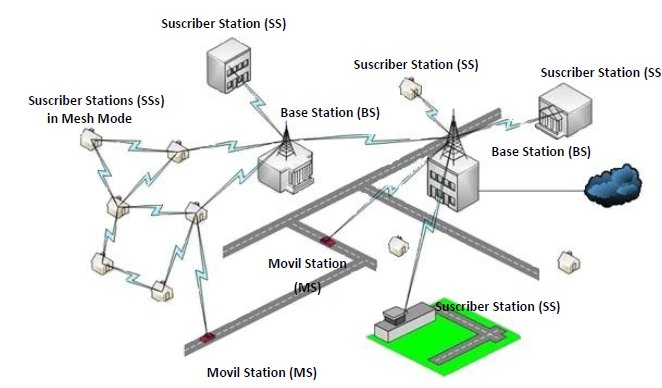
<body><![CDATA[<p style='margin-top:12.0pt;margin-right:0cm;margin-bottom:12.0pt; margin-left:0cm;text-indent:0cm'><font face="Verdana" size="2"><span lang=EN-US>WiMax is a wireless technology for metropolitan area networks that was developed by the IEEE Working Group 802.16 <a href="#r1">(1)</a>. This technology provides an alternative to cable access networks such as fiber optic links and digital subscriber lines (DSLs). Compared to its competitor cable technologies, WiMax is easier to deploy and is poised for more ubiquitous broadband access in the future. WiMax users (subscriber stations, SS) access the network through exterior networks communicating with central radio base stations (BS). The IEEE 802.16 protocol stack includes two layers: the physical and MAC layers. The MAC layer is connection-oriented, so all the services including connectionless services are mapped to a connection. Thus, the standard defines the connection management procedures and how the service is provided to the upper layer protocol <a href="#r1">(1)</a> <a href="#r2">(2)</a>.</span></font></p>      <p style='margin-bottom:0cm;margin-bottom:.0001pt;text-indent: 0cm;mso-layout-grid-align:none;text-autospace:none'><font face="Verdana"><span class=hps><span lang=EN-US style='font-size:10.0pt;mso-ansi-language:EN-US'>The <i style='mso-bidi-font-style:normal'>service specification</i> describes the service that is provided to the user. This is often given as a sequence of events that are possible at an abstract interface between the user (an application or another protocol) and the protocol.</span></span><span lang=EN-US style='font-size:10.0pt;mso-ansi-language:EN-US'> <span class=hps>The communication between adjacent layers can be described at an abstract level through the occurrence of the <i style='mso-bidi-font-style:normal'>service primitives</i>, which provide an abstract way to describe the interaction between the service user and the service provider. The service specification is defined at a higher level of abstraction than the protocol specification and can be described in the protocol specification document or in a separate one <a href="#r3">(3)</a></span>. The IEEE 802.16 MAC layer connection management service specification is described in the standard document <span class=hps><a href="#r1">(1)</a></span>. The specification explains the service by using narrative and some event sequence diagrams. However,</span><span lang=EN-US style='font-size:10.0pt;font-family:TimesNewRoman;mso-bidi-font-family: TimesNewRoman;mso-ansi-language:EN-US;mso-fareast-language:ES'> does not impose message formats or state machines for the use of these primitives </span><span lang=PT><a href="#r1"><font size="2">(1)</font></a></span><span lang=EN-US style='font-size:10.0pt;font-family:TimesNewRoman; mso-bidi-font-family:TimesNewRoman;mso-ansi-language:EN-US;mso-fareast-language: ES'>. </span><span lang=EN-US style='font-size:10.0pt;mso-ansi-language:EN-US'>Thus, <span class=hps>this lack of</span> <span class=hps>formalism in</span> describing the service specification may lead to ambiguity and inconsistency which may cause possible errors in the implementation of the MAC layer protocol. </span> <span lang=EN-US style='font-size:10pt;color:black;mso-ansi-language:EN-US; mso-fareast-language:ES'>Our first attempt at modeling and analysis of the MAC CPS connection management service specification is presented in <a href="#r14">(14)</a>, w</span></font><span lang=EN-US style='font-size:10.0pt;mso-ansi-language:EN-US'><font face="Verdana">here a formal and detailed description of the service specification given. The analysis results of the model of the service specification show some inconsistencies and information gaps in the standard document. Thus, this paper describes the omissions, ambiguities and inconsistencies observed in the standard, and propose some solutions to fix these problems. We also provide a formal description of the connection management service specification using <i style='mso-bidi-font-style:normal'>Finite State Automata</i> (<i style='mso-bidi-font-style:normal'>FSA</i>). </font> <span class=hps><o:p></o:p></span></span></p>      <p style='margin-bottom:0cm;margin-bottom:.0001pt;text-indent: 0cm'><span class=hps><span lang=EN-US style='font-size:10.0pt;mso-ansi-language: EN-US'><font face="Verdana"><![if !supportEmptyParas]>&nbsp;<![endif]></font><o:p></o:p></span></span></p>      <p><font face="Verdana"><i style='mso-bidi-font-style:normal'><span lang=EN-AU style='mso-ansi-language:EN-AU'><font size="2">Coloured Petri Nets (CPNs)</font></span></i><font size="2"><span lang=EN-AU style='mso-ansi-language:EN-AU'> are a formal technique used for modelling many systems, particularly communication protocols </span><span lang=EN-US style='mso-ansi-language:EN-US;mso-fareast-language:ES-VE'><a href="#r4">(4)</a><a href="#r5">(5)</a><a href="#r6">(6)</a><a href="#r7">(7)</a><a href="#r8">(8)</a></span><span lang=EN-AU style='mso-ansi-language:EN-AU'>. </span><span lang=FR style='mso-ansi-language:FR'>Billington et al. </span><span class=hps><span lang=EN-US style='mso-ansi-language:EN-US'>[</span></span><span lang=EN-US style='mso-ansi-language:EN-US'>5] </span><span lang=EN-AU style='mso-ansi-language: EN-AU'>present </span><span lang=EN-GB style='mso-ansi-language:EN-GB'>a methodology for specifying and validating communication protocols and show some example of how the methodology can be applied using CPNs. In the methodology, the specification process is divided into: the service specification and protocol specification. We use the formal approach proposed by Billington </span><span class=hps><span lang=EN-US style='mso-ansi-language:EN-US'>[</span></span><span lang=EN-US style='mso-ansi-language:EN-US'>5] </span></font></font><span lang=EN-GB style='mso-ansi-language:EN-GB'><font size="2" face="Verdana">to describe the IEEE 802.16 MAC layer connection management service specification.</font><o:p></o:p></span></p>      <p><span lang=EN-GB style='mso-ansi-language:EN-GB'> <font face="Verdana" size="2"><![if !supportEmptyParas]>&nbsp;<![endif]></font><o:p></o:p></span></p>      <p><font face="Verdana"><span lang=EN-GB style='mso-ansi-language:EN-GB'> <font size="2">The paper is organised as follows. </font> </span><font size="2"><span class=hps> <span style="mso-spacerun: yes; mso-ansi-language:EN-US" lang="EN-GB"> </span></span><span class=MsoFootnoteReference><span style="mso-spacerun: yes; mso-ansi-font-size:10.0pt; mso-ansi-language:EN-US" lang="EN-GB"> </span></span><span class=hps><span lang=EN-US style='mso-ansi-language:EN-US'>Section</span></span></font></font><span lang=EN-US style='mso-ansi-language:EN-US'><font face="Verdana"><font size="2"> <span class=hps>2 presents a</span> <span class=hps>description of the</span> <span class=hps>IEEE</span> <span class=hps>802.16</span> <span class=hps>standard</span>. <span class=hps>Section</span> <span class=hps>3 explains</span> <span class=hps>briefly</span> <span class=hps>the protocol verification methodology</span> <span class=hps>proposed by Billington.</span> <span class=hps>Section</span> <span class=hps>4 describes the</span> IEEE 802.16 MAC layer connection management <span class=hps>service</span> <span class=hps>specification. Section 5 presents</span> <span class=hps>some relevant aspects of</span> <span class=hps>the service specification</span> <span class=hps>based on</span> <span class=hps>the application</span> <span class=hps>of the methodology.</span> <span class=hps>And finally</span> <span class=hps>in Section</span> </font> <span class=hps><font size="2">6 concludes the papers and show some future directions of the work.</font></span></font><o:p></o:p></span></p>      <p style='mso-list:none'><span lang=EN-US style='mso-ansi-language: EN-US'><font face="Verdana" size="2">2 An Overview of IEEE 802.16</font></span><o:p></o:p></p>      <p style='margin-top:12.0pt;text-indent:0cm'><font face="Verdana"><span class=hps><span lang=EN-US style='font-size:10.0pt;mso-ansi-language:EN-US'>The</span></span></font><span lang=EN-US style='font-size:10.0pt;mso-ansi-language:EN-US'><font face="Verdana"> <span class=hps>IEEE</span> <span class=hps>802.16</span> <span class=hps>standard</span> <span class=hps>is responsible for specifying</span> <span class=hps>and describing</span> <span class=hps>the air interface</span> <span class=hps>for</span> <span class=hps><i style='mso-bidi-font-style:normal'>Broadband</i></span><i style='mso-bidi-font-style: normal'> <span class=hps>Wireless</span> <span class=hps>Access</span></i> (<span class=hps><i style='mso-bidi-font-style:normal'>BWA</i>)</span> <span class=hps>systems for fixed and mobile users and is limited to</span> <span class=hps>the description of the</span> <span class=hps>MAC</span> <span class=hps>and PHY</span> layers. <span class=hps>The initial version of the IEEE</span> <span class=hps>802.16</span> standard <span class=hps>was completed</span> <span class=hps>in October 2001</span> <span class=hps><a href="#r1">(1)</a></span> and its <span class=hps>main</span> <span class=hps>goal was to provide</span> <span class=hps>broadband wireless access.</span> <span class=hps>It was also developed</span> <span class=hps>to provide support for</span> <span class=hps>mesh</span> <span class=hps>topologies</span> <span class=hps>and provide</span> <span class=hps>handoff</span> <span class=hps>(handover)</span> <span class=hps>of the signal between</span> </font> <span class=hps><font face="Verdana">base stations <a href="#r9">(9)</a><a href="#r10">(10)</a>.</font><o:p></o:p></span></span></p>      <p style='margin-top:12.0pt;text-indent:0cm'><font face="Verdana"><span class=hps><span lang=EN-US style='font-size:10.0pt;mso-ansi-language:EN-US'>The standard was</span></span></font><span lang=EN-US style='font-size:10.0pt;mso-ansi-language:EN-US'><font face="Verdana"> <span class=hps>designed</span> <span class=hps>to accommodate</span> <span class=hps>a set of</span> <span class=hps>air</span> <span class=hps>interfaces</span> <span class=hps>based on a</span> <span class=hps>common</span> <span class=hps>MAC</span> <span class=hps>protocol</span> <span class=hps>but with different</span> <span class=hps>physical layer</span> <span class=hps>specifications</span> <span class=hps>depending on the use</span> <span class=hps>of radio spectrum and</span> <span class=hps>the regulations</span> <span class=hps>associated with them <a href="#r1">(1)</a></span> <span class=hps>[2</span>].</font><o:p></o:p></span></p>      <p style='margin-left:18.0pt;text-indent:-18.0pt;mso-list:l16 level2 lfo37'><![if !supportLists]><span lang=EN-US style='font-size:10.0pt;mso-ansi-language:EN-US'> <font face="Verdana">2.1</font><span style='font-style:normal; font-variant:normal; font-weight:normal; font-family:Verdana'>&nbsp;&nbsp;&nbsp;&nbsp; </span></span> <![endif]><font face="Verdana"><span class=hps><span lang=EN-US style='font-size:10.0pt;mso-ansi-language:EN-US'>Components</span></span><span class=shorttext><span lang=EN-US style='font-size:10.0pt;mso-ansi-language: EN-US'> </span></span><span class=hps><span lang=EN-US style='font-size:10.0pt; mso-ansi-language:EN-US'>of the</span></span><span class=shorttext><span lang=EN-US style='font-size:10.0pt;mso-ansi-language:EN-US'> </span></span><span class=hps><span lang=EN-US style='font-size:10.0pt;mso-ansi-language:EN-US'>IEEE</span></span><span class=shorttext><span lang=EN-US style='font-size:10.0pt;mso-ansi-language: EN-US'> </span></span><span class=hps><span lang=EN-US style='font-size:10.0pt; mso-ansi-language:EN-US'>802.16</span></span><span class=shorttext><span lang=EN-US style='font-size:10.0pt;mso-ansi-language:EN-US'> </span></span><span class=hps><span lang=EN-US style='font-size:10.0pt;mso-ansi-language:EN-US'>Architecture</span></span></font><span lang=EN-US style='font-size:10.0pt;mso-ansi-language:EN-US'><o:p></o:p></span></p>      ]]></body>
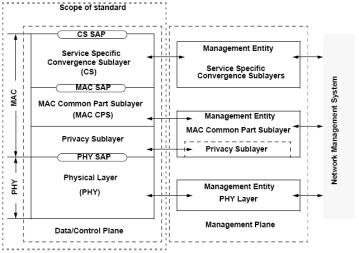
<body><![CDATA[<p style='margin-top:12.0pt;text-indent:0cm'><span lang=EN-US style='font-size:10.0pt;mso-ansi-language:EN-US'><font face="Verdana">The IEEE 802.16 standard <span class=hps>specifies</span> the <span class=hps>basic</span> <span class=hps>entities</span> <span class=hps>in the architecture</span> </font> <span class=hps> <font face="Verdana">(see <a href="#f1"> Figure 1</a>). They are described as follows:</font><o:p></o:p></span></span></p>       <p align="center"> <font face="Verdana" size="2"> <a name="f1" href="/img/revistas/cleiej/v16n2/2a02f1.jpg"> Figure 1: Basic Components of the IEEE 802.16 Architecture. </a> </font> </p>      <p style='margin-top:12.0pt;text-indent:0cm'><font face="Verdana"><span class=hps><b style='mso-bidi-font-weight:normal'><span lang=EN-US style='font-size:10.0pt; mso-ansi-language:EN-US'>Base</span></b></span><b style='mso-bidi-font-weight: normal'><span lang=EN-US style='font-size:10.0pt;mso-ansi-language:EN-US'> <span class=hps>Station</span> (BS):</span></b></font><span lang=EN-US style='font-size: 10.0pt;mso-ansi-language:EN-US'><font face="Verdana"> <span class=hps>is a device</span> <span class=hps>that provides</span> <span class=hps>general</span> <span class=hps>control service</span>, management functions and <span class=hps>connectivity to the</span> <span class=hps>subscriber station</span> <span class=hps>and</span> <span class=hps>includes</span> some entity <span class=hps>instances of the</span> <span class=hps>MAC and PHY</span> <span class=hps>layers</span>.<span class=hps> </span> </font><o:p></o:p></span></p>      <p style='margin-top:12.0pt;text-indent:0cm'><font face="Verdana"><span class=hps><b style='mso-bidi-font-weight:normal'><span lang=EN-US style='font-size:10.0pt; mso-ansi-language:EN-US'>Subscriber</span></b></span><b style='mso-bidi-font-weight: normal'><span lang=EN-US style='font-size:10.0pt;mso-ansi-language:EN-US'> <span class=hps>Station (</span>SS):</span></b></font><span lang=EN-US style='font-size: 10.0pt;mso-ansi-language:EN-US'><font face="Verdana"> <span class=hps>is a</span> <span class=hps>generalized</span> <span class=hps>device</span> which <span class=hps>provides connectivity between </span>a <span class=hps>suscriber</span> <span class=hps>equipment</span> <span class=hps>and a base station</span> <span class=hps>and</span> <span class=hps>includes some</span> entity <span class=hps>instances of the</span> <span class=hps>MAC and PHY</span> <span class=hps>layers</span>.</font><o:p></o:p></span></p>      <p style='margin-top:12.0pt;text-align:justify'><span class=hps><b style='mso-bidi-font-weight:normal'> <span lang=EN-US style='font-size:10.0pt; font-family:"Verdana";color:windowtext;mso-ansi-language:EN-US; mso-fareast-language:EN-US'>Mobile Station (MS):</span></b><font face="Verdana"><span lang=EN-US style='font-size:10.0pt;color:windowtext;mso-ansi-language:EN-US;mso-fareast-language:EN-US'> is an optional entity defined in the later versions of the IEEE 802.16 standard document <a href="#r9">(9)</a> <a href="#r10">(10)</a> and includes some additional capabilities to support vehicular mobility. It also provides additional support for specific functions such as SS handoff management and energy saving. Thus the MS delivers the functionalities for supporting both wireless broadband fixed and mobile users.</span></font><o:p></o:p></span></p>      <p style='margin-left:18.0pt;text-indent:-18.0pt;mso-list:l11 level2 lfo36'><![if !supportLists]><span lang=EN-US style='font-size:10.0pt;mso-ansi-language:EN-US'> <font face="Verdana">2.2</font><span style='font-style:normal; font-variant:normal; font-weight:normal; font-family:Verdana'>&nbsp;&nbsp;&nbsp;&nbsp; </span></span> <![endif]><font face="Verdana"><span class=hps><span lang=EN-US style='font-size:10.0pt;mso-ansi-language:EN-US'>Reference Model</span></span></font><span lang=EN-US style='font-size:10.0pt;mso-ansi-language: EN-US'><o:p></o:p></span></p>      <p><font face="Verdana" size="2"><span lang=EN-US>The IEEE 802.16 Reference Model includes two major components: the data/control plane and the management plane <span class=hps><a href="#r1">(1)</a><a href="#r9">(9)</a><a href="#r10">(10)</a></span>. The data/control plane includes two layers: the physical and MAC layers. The MAC layer is further divided in three sub-layers: <i style='mso-bidi-font-style:normal'>Service Specific Converge Sublayer</i> (CS), <i style='mso-bidi-font-style:normal'>MAC Common Part Sublayer</i> (MAC CPS), and <i style='mso-bidi-font-style:normal'>Security Sublayer </i><span class=hps>(</span>see <a href="#f2"> Figure 2</a>).<span style="mso-spacerun: yes">  </span><span class=hps>The control and data planes </span>define <span class=hps>how the information is</span> <span class=hps>encapsulated or</span> <span class=hps>desencapsulated</span> at the <span class=hps>MAC</span> <span class=hps>level</span>, <span class=hps>and modulated</span> <span class=hps>or</span> <span class=hps>demodulated</span> <span class=hps>at the physical level</span>. <span class=hps>The functions of the management plane</span> <span class=hps>are:</span> <span class=hps>classification</span>, security, application <span class=hps>QoS and</span> <span class=hps>connection settings</span> <span class=hps>among others.</span> The layers are described as follows:</span></font></p>       <p align="center"> <a name="f2" href="/img/revistas/cleiej/v16n2/2a02f2.jpg"> <font size="2" face="Verdana">Figure 2: IEEE 802.16 </font><font face="Verdana"> <span class=hps> <font size="2">Reference Model. </font></span></font> </a> </p>  <span class=hps>      <p style='margin-top:12.0pt;margin-right:0cm;margin-bottom: 4.0pt;margin-left:7.1pt;text-indent:-7.1pt;mso-list:l29 level1 lfo22; tab-stops:list 7.1pt 263.75pt'><![if !supportLists]><font face="Verdana"> <span lang=EN-US style='font-size:10pt;mso-bidi-font-size:10.0pt;mso-ansi-language: EN-US'>·</span></font><span style='font-style:normal; font-variant:normal; font-weight:normal; font-size:10pt; font-family:Verdana; mso-bidi-font-size:10.0pt; mso-ansi-language:EN-US' lang="EN-US">&nbsp;&nbsp; </span> <![endif]><font face="Verdana"><b style='mso-bidi-font-weight:normal'><i style='mso-bidi-font-style:normal'><span lang=EN-US style='font-size:10.0pt;mso-ansi-language:EN-US'>Service Specific</span></i></b><i style='mso-bidi-font-style:normal'><span lang=EN-US><font size="2"> </font> </span></i><b style='mso-bidi-font-weight:normal'><i style='mso-bidi-font-style:normal'><span lang=EN-US style='font-size:10.0pt;mso-ansi-language:EN-US'>Convergence Sublayer (CS</span></i></b></font><span lang=EN-US style='font-size:10.0pt;mso-ansi-language: EN-US'><font face="Verdana">)<b style='mso-bidi-font-weight:normal'>: </b>the <i style='mso-bidi-font-style: normal'>Service Data Units</i> (<i style='mso-bidi-font-style:normal'>SDUs</i>) from the external networks are received through the MAC CS SAPs. Thus, the functions of the CS include the classification of external SDUs and their <span style="mso-spacerun: yes"> </span>associations with the appropriate <i style='mso-bidi-font-style:normal'>Service</i><i style='mso-bidi-font-style: normal'> Flow</i> (<i style='mso-bidi-font-style:normal'>SFID</i>) and <i style='mso-bidi-font-style:normal'>Connection</i><i style='mso-bidi-font-style: normal'> ID</i> (<i style='mso-bidi-font-style:normal'>CID</i>).</font><o:p></o:p></span></p>      <p style='margin-top:12.0pt;margin-right:0cm;margin-bottom: 4.0pt;margin-left:7.1pt;text-indent:-7.1pt;mso-list:l29 level1 lfo22; tab-stops:list 7.1pt 263.75pt'><![if !supportLists]><font face="Verdana"> <span lang=EN-US style='font-size:10pt;mso-bidi-font-size:10.0pt;mso-ansi-language:EN-US'>·</span></font><span style='font-style:normal; font-variant:normal; font-weight:normal; font-size:10pt; font-family:Verdana; mso-bidi-font-size:10.0pt; mso-ansi-language:EN-US' lang="EN-US">&nbsp;&nbsp; </span><![endif]><font face="Verdana"><b style='mso-bidi-font-weight:normal'><i style='mso-bidi-font-style:normal'><span lang=EN-US style='font-size:10.0pt; mso-ansi-language:EN-US'>Common Part Sublayer (MAC CPS</span></i></b><span lang=EN-US style='font-size:10.0pt;mso-ansi-language:EN-US'>)<b style='mso-bidi-font-weight:normal'>: </b></span> <span style="mso-spacerun: yes; font-size:10.0pt" lang="EN-US"> </span></font><span lang=EN-US style='font-size:10.0pt;mso-ansi-language:EN-US'><font face="Verdana">is responsible for controlling the access to the medium. The other basic functions of the MAC CPS layer are data encapsulation/de-encapsulation, and data packing and fragmentation. It is also responsible for data control error (error detection and retransmission strategy). Additionally, this provides mechanisms for traffic control and QoS provision. The MAC layer is connection-oriented, so all the services including connectionless services are mapped to a connection.</font><o:p></o:p></span></p>      ]]></body>
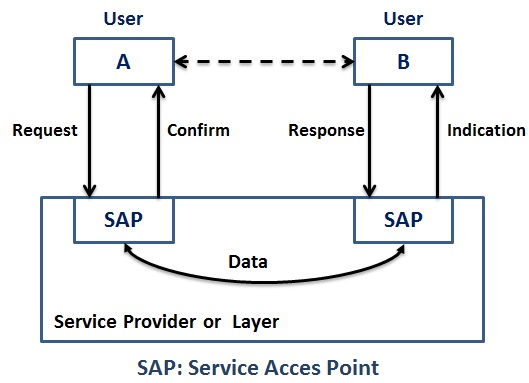
<body><![CDATA[<p style='margin-top:12.0pt;margin-right:0cm;margin-bottom: 4.0pt;margin-left:7.1pt;text-indent:-7.1pt;mso-list:l29 level1 lfo22; tab-stops:list 7.1pt 263.75pt'><![if !supportLists]><font face="Verdana"> <span lang=EN-US style='font-size:10pt;mso-bidi-font-size:10.0pt;mso-ansi-language:EN-US'>·</span></font><span style='font-style:normal; font-variant:normal; font-weight:normal; font-size:10pt; font-family:Verdana; mso-bidi-font-size:10.0pt; mso-ansi-language:EN-US' lang="EN-US">&nbsp;&nbsp; </span><![endif]><font face="Verdana"><b style='mso-bidi-font-weight:normal'><i style='mso-bidi-font-style:normal'><span lang=EN-US style='font-size:10.0pt; mso-ansi-language:EN-US'>Security Sublayer</span></i></b><b style='mso-bidi-font-weight: normal'><span lang=EN-US style='font-size:10.0pt;mso-ansi-language:EN-US'>:</span></b></font><span lang=EN-US style='font-size:10.0pt;mso-ansi-language:EN-US'><font face="Verdana"> is responsible for delivering privacy to subscribers in the wireless network. It provides authentication and secure key exchange and encryption on the connections established between the either a SS or a MS and the BS.</font><o:p></o:p></span></p>      <p style='margin-top:12.0pt;margin-right:0cm;margin-bottom: 4.0pt;margin-left:7.1pt;text-indent:-7.1pt;mso-list:l29 level1 lfo22; tab-stops:list 7.1pt 263.75pt'><![if !supportLists]><font face="Verdana"> <span lang=EN-US style='font-size:10pt;mso-bidi-font-size:10.0pt;mso-ansi-language: EN-US'>·</span></font><span style='font-style:normal; font-variant:normal; font-weight:normal; font-size:10pt; font-family:Verdana; mso-bidi-font-size:10.0pt; mso-ansi-language:EN-US' lang="EN-US">&nbsp;&nbsp; </span> <![endif]><font face="Verdana"><b style='mso-bidi-font-weight:normal'><span lang=EN-US style='font-size:10.0pt;mso-ansi-language:EN-US'>Physical Layer</span><span lang=EN-US style='font-size:10.0pt; mso-ansi-language:EN-US'> (PHY):</span></b><span lang=EN-US style='font-size:10.0pt;mso-ansi-language:EN-US'> </span><span lang=PT style='font-size:10.0pt'>defined to work on the 10-66 GHz band. It supports adaptive burst profiling in which some transmission parameters, such as modulation and coding schemes, may be changed on either a per-connection or per-subscriber basis to adapt to channel changing conditions and to provide varying levels of service. <i style='mso-bidi-font-style:normal'>Time Division Duplexing</i> (TDD) and <i style='mso-bidi-font-style:normal'>Frequency Division Duplexing</i> (FDD) techniques are supported. The data encapsulated in MPDUs are carried in TDD or FDD PHY frames</span></font><span lang=EN-US style='font-size:10.0pt;mso-ansi-language:EN-US'><o:p></o:p></span></p>      <p style='margin-left:18.0pt;text-indent:-18.0pt;mso-list:l11 level2 lfo36'><![if !supportLists]><span lang=EN-US style='font-size:10.0pt;mso-ansi-language:EN-US'> <font face="Verdana">2.3</font><span style='font-style:normal; font-variant:normal; font-weight:normal; font-family:Verdana'>&nbsp;&nbsp;&nbsp;&nbsp; </span></span> <![endif]><font face="Verdana"><span lang=EN-US style='font-size:10.0pt;mso-ansi-language:EN-US'>Connection Management</span><span class=shorttext><span lang=EN-US style='font-size:10.0pt;mso-ansi-language:EN-US'> </span></span></font><span lang=EN-US style='font-size:10.0pt;mso-ansi-language:EN-US'><o:p></o:p></span> </p>      <p style='margin-top:12.0pt;text-indent:0cm'><font face="Verdana"><span lang=EN-US style='font-size:10.0pt;mso-ansi-language:EN-US'>The MAC CPS is connection-oriented, </span><span lang=PT style='font-size:10.0pt'>so a connection must be established between peer convergence processes. Once a connection is established, it may require to be maintened. Maintenance activities are needed, for example, to deal with dynamic bandwidth requirements. Finally, a connection may be terminated by either the BS or SS. </span> <span style="mso-spacerun: yes; font-size:10.0pt; mso-ansi-language:EN-US" lang="PT"> </span><span lang=EN-US style='font-size:10.0pt; mso-ansi-language:EN-US'>Management activities</span></font><span lang=EN-US style='font-size:10.0pt;mso-ansi-language:EN-US'><font face="Verdana"> of connections are supported through a set of service primitives between the entities of the MAC CS and CPS implemented in both the SSs and the BS. <span style="mso-spacerun: yes"> </span>Some aspects of the connections are described as follows <a href="#r1">(1)</a> <a href="#r11">(11)</a>:</font><o:p></o:p></span></p>      <p style='margin-top:12.0pt;margin-right:0cm;margin-bottom: 4.0pt;margin-left:7.1pt;text-indent:-7.1pt;mso-list:l29 level1 lfo22; tab-stops:list 7.1pt 263.75pt'><![if !supportLists]><font face="Verdana"> <span lang=EN-US style='font-size:10pt;mso-bidi-font-size:10.0pt;mso-ansi-language: EN-US'>·</span></font><span style='font-style:normal; font-variant:normal; font-weight:normal; font-size:10pt; font-family:Verdana; mso-bidi-font-size:10.0pt; mso-ansi-language:EN-US' lang="EN-US">&nbsp;&nbsp; </span> <![endif]><font face="Verdana"><b style='mso-bidi-font-weight:normal'><span lang=EN-US style='font-size:10.0pt;mso-ansi-language:EN-US'>Connection establishment</span><span lang=EN-US style='font-size:10.0pt; mso-ansi-language:EN-US'>:</span></b></font><span lang=EN-US style='font-size:10.0pt; mso-ansi-language:EN-US'><font face="Verdana"> after a SS register with the BS, the transport connections are established. Each connection is associated with a service flow and defines the relationship between the CS peer entities that use this MAC service flow. Additionally, new connections can be established in order to change the established characteristics of a client service.</font><o:p></o:p></span></p>      <p style='margin-top:12.0pt;margin-right:0cm;margin-bottom: 4.0pt;margin-left:7.1pt;text-indent:-7.1pt;mso-list:l29 level1 lfo22; tab-stops:list 7.1pt 263.75pt'><![if !supportLists]><font face="Verdana"> <span lang=EN-US style='font-size:10pt;mso-bidi-font-size:10.0pt;mso-ansi-language: EN-US'>·</span></font><span style='font-style:normal; font-variant:normal; font-weight:normal; font-size:10pt; font-family:Verdana; mso-bidi-font-size:10.0pt; mso-ansi-language:EN-US' lang="EN-US">&nbsp;&nbsp; </span> <![endif]><font face="Verdana"><b style='mso-bidi-font-weight:normal'><span lang=EN-US style='font-size:10.0pt;mso-ansi-language:EN-US'>Changes of</span><span lang=EN-US style='font-size:10.0pt; mso-ansi-language:EN-US'> the connection characteristics:</span></b></font><span lang=EN-US style='font-size:10.0pt;mso-ansi-language:EN-US'><font face="Verdana"> once a connection is established it may need to be actively maintained. Maintenance requirements vary according to the type of service. The modification of the connections may require maintenance stimulated by the SSs or the network connection (BS). </font> <o:p></o:p></span></p>      <p style='margin-top:12.0pt;margin-right:0cm;margin-bottom: 4.0pt;margin-left:7.1pt;text-indent:-7.1pt;mso-list:l29 level1 lfo22; tab-stops:list 7.1pt 263.75pt'><![if !supportLists]><font face="Verdana"> <span lang=EN-US style='font-size:10pt;mso-bidi-font-size:10.0pt;mso-ansi-language: EN-US'>·</span></font><span style='font-style:normal; font-variant:normal; font-weight:normal; font-size:10pt; font-family:Verdana; mso-bidi-font-size:10.0pt; mso-ansi-language:EN-US' lang="EN-US">&nbsp;&nbsp; </span> <![endif]><font face="Verdana"><b style='mso-bidi-font-weight:normal'><span lang=EN-US style='font-size:10.0pt;mso-ansi-language:EN-US'>Connection termination</span><span lang=EN-US style='font-size:10.0pt; mso-ansi-language:EN-US'>:</span></b></font><span lang=EN-US style='font-size:10.0pt; mso-ansi-language:EN-US'><font face="Verdana"> connections can be terminated. The termination of a connection can be initiated by either the BS or the SS. </font> <o:p></o:p></span></p>      <p style='margin-top:12.0pt;text-indent:0cm'><font face="Verdana"><span lang=EN-US style='font-size:10.0pt;mso-ansi-language:EN-US'>The</span></font><span lang=EN-US style='font-size:10.0pt;mso-ansi-language:EN-US'><font face="Verdana"> mentioned management activities are supported through the use of static configurations and, dynamic additions, modifications and terminations of the connection. </font> <o:p></o:p></span></p>      <p style='margin-top:12.0pt;margin-right:0cm;margin-bottom:9.0pt;margin-left: 18.0pt;text-indent:-18.0pt;mso-list:l11 level2 lfo36'><![if !supportLists]><span lang=EN-US style='font-size:10.0pt;mso-ansi-language:EN-US'> <font face="Verdana">2.4</font><span style='font-style:normal; font-variant:normal; font-weight:normal; font-family:Verdana'>&nbsp;&nbsp;&nbsp;&nbsp; </span></span> <![endif]><font face="Verdana"><span lang=EN-US style='font-size:10.0pt;mso-ansi-language:EN-US'>Definition of</span><span class=shorttext><span lang=EN-US style='font-size:10.0pt; mso-ansi-language:EN-US'> the </span></span><span lang=EN-US style='font-size:10.0pt;mso-ansi-language:EN-US'>MAC</span><span class=shorttext><span lang=EN-US style='font-size:10.0pt;mso-ansi-language: EN-US'> </span></span><span lang=EN-US style='font-size:10.0pt; mso-ansi-language:EN-US'>Services</span></font><span lang=EN-US style='font-size:10.0pt;mso-ansi-language:EN-US'><o:p></o:p></span></p>      <p><font face="Verdana"><span lang=EN-US><font size="2">More communication technologies use layers structured hierarchically to divide the communication functions. Each layer performs a set of functions intended to provide some services to the higher layer. A service is a capability of a layer (service provider) that is provided to the layer above it (i.e. service user) through the <i style='mso-bidi-font-style:normal'>service access point</i> (SAP) (see <a href="#f3"> Figure 3</a>). A SAP is an address, which identifies the boundary between two adjacent layers. The communication between adjacent layers can be described at an abstract level through the occurrence of the service primitives (see <a href="#f3"> Figure 3</a>). The service primitives provide an abstract way to describe the interaction between the service user and the service provider. Each primitive can be a request, indication, response or confirmation. </font> </span></font><span lang=EN-US> <font size="2" face="Verdana">A <i style='mso-bidi-font-style:normal'>request</i> is issued by the service user for requesting some service from the service provider. An <i style='mso-bidi-font-style: normal'>indication</i> is used by the service provider to notify the service user that the other peer has invoked a request primitive or the provider itself has generated an event. A <i style='mso-bidi-font-style:normal'>response</i> is used by the service user to acknowledge receipt of the indication primitive from the service provider. Finally a <i style='mso-bidi-font-style:normal'>confirmation</i> is used by the service provider to notify the requesting service user that the activity initiated by the request has been successfully completed <a href="#r12">(12)</a>.</font><o:p></o:p></span></p>         ]]></body>
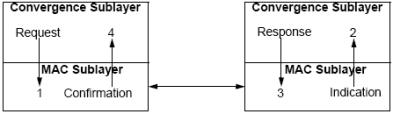
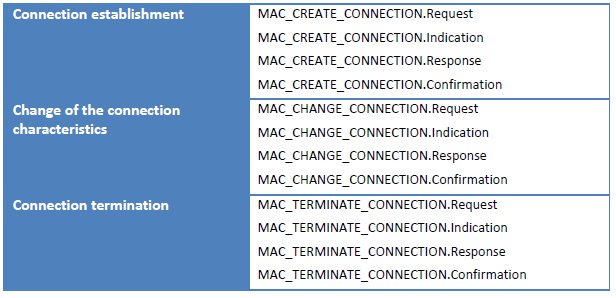
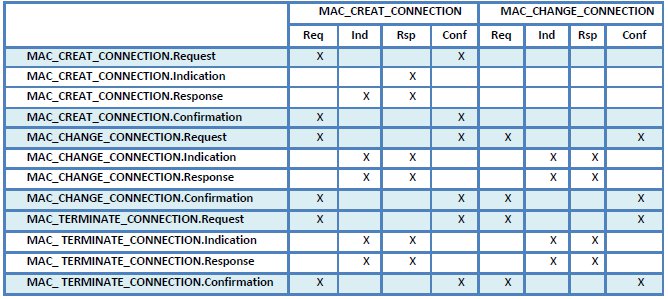
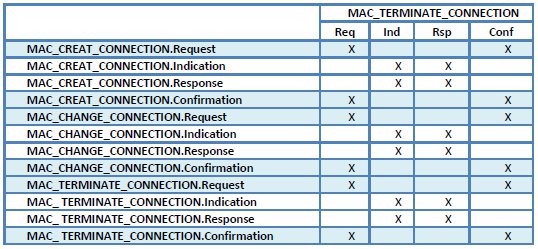
<body><![CDATA[<p align="center"> <font face="Verdana" size="2"> <a name="f3" href="/img/revistas/cleiej/v16n2/2a02f3.jpg"> Figure 3: Communication between peer entities and between CS and MAC layers CPS. </a> </font> </p>       <p style='margin-top:12.0pt;text-indent:0cm'><font face="Verdana"><span lang=EN-US style='font-size:10.0pt;mso-ansi-language:EN-US;mso-fareast-language:ES-VE'>The IEEE 802.16 standard </span><span lang=EN-US style='font-size:10.0pt; mso-ansi-language:EN-US'><a href="#r1">(1)</a> </span><span lang=EN-US style='font-size:10.0pt; mso-ansi-language:EN-US;mso-fareast-language:ES-VE'>defines the service specification for the connection establishment, change and termination. It includes a set of service primitives which provide an abstract way to describe the interaction between the CS (service user) and the MAC CPS (service provider) </span><span lang=PT style='font-size:10.0pt'>(see <a href="#f4"> Figure 4</a>)</span><span lang=EN-US style='font-size:10.0pt;mso-ansi-language: EN-US;mso-fareast-language:ES-VE'>. <span style="mso-spacerun: yes"> </span>These primitives are</span></font><span lang=EN-US style='font-size:10.0pt;mso-ansi-language: EN-US'><font face="Verdana"> shown in <a href="#t1"> Table 1</a> and described as follows:</font><o:p></o:p></span></p>      <p style='margin-top:12.0pt;text-indent:0cm'><span lang=EN-US style='font-size:10.0pt;mso-ansi-language:EN-US'> <font face="Verdana">MAC_CREATE_CONNECTION (Request/Indication/Response/Confirmation): a CS entity uses this primitive to establish a connection.</font><o:p></o:p></span></p>      <p style='margin-top:12.0pt;text-indent:0cm'><span lang=EN-US style='font-size:10.0pt;mso-ansi-language:EN-US'> <font face="Verdana">MAC_CHANGE_CONNECTION (Request/Indication/Response/Confirmation): a CS entity uses this primitive to change the characteristics of an established connection.</font><o:p></o:p></span></p>      <p style='margin-top:12.0pt;text-indent:0cm'><span lang=EN-US style='font-size:10.0pt;mso-ansi-language:EN-US'> <font face="Verdana">MAC_TERMINATION_CONNECTION (Request/Indication/Response/Confirmation): a CS entity uses this primitive to terminate a connection.</font><o:p></o:p></span></p>       <p align="center"> <font face="Verdana" size="2"> <a name="f4" href="/img/revistas/cleiej/v16n2/2a02f4.jpg"> Figure 4: Communication between peer entities and between CS and MAC layers CPS.  </a> </font> </p>       <p align="center"> <font face="Verdana" size="2"> <a name="t1" href="/img/revistas/cleiej/v16n2/2a02t1.jpg"> Table 1: Service primitives for connection management </a> </font> </p>       <p style='text-align:justify;mso-list:none'><font face="Verdana"><span lang=EN-US style='font-size:10.0pt;mso-font-kerning:0pt;mso-ansi-language:EN-US; font-weight:normal'>The messages DSA-REQ, DSC-REQ and DSD-REQ are generated as a consequence of the occurrence of the MAC_CREATE, MAC_CHANGE, and MAC_TERMINATION service primitive requests respectively. The messages DSA-RSP, DSC-RSP and DSD-RSP are generated as a consequence of the occurrence of the MAC_CREATE, MAC_CHANGE, and MAC_TERMINATION service primitive responses respectively. <span style='color:black'>The messages DSA-ACK or DSC-ACK are generated by the requesting MAC CS entity as an acknowledgement of a dynamic service addition or dynamic service change, respectively </span></span><span lang=EN-US style='font-size:10.0pt;mso-ansi-language:EN-US;font-weight:normal'><a href="#r1">(1)</a></span></font><span lang=EN-US style='font-size:10.0pt;color:black;mso-font-kerning: 0pt;mso-ansi-language:EN-US;font-weight:normal'><font face="Verdana">. They are not generated as the occurrence of any service primitive.</font><o:p></o:p></span></p>      <p style='margin-left:18.0pt;text-indent:-18.0pt;mso-list:l11 level2 lfo36'><![if !supportLists]><span lang=EN-US style='font-size:10.0pt;mso-ansi-language:EN-US'> <font face="Verdana">2.5</font><span style='font-style:normal; font-variant:normal; font-weight:normal; font-family:Verdana'>&nbsp;&nbsp;&nbsp;&nbsp; </span></span> <![endif]><font face="Verdana"><span lang=EN-US style='font-size:10.0pt;mso-ansi-language:EN-US'>Sequence of</span><span class=shorttext><span lang=EN-US style='font-size:10.0pt; mso-ansi-language:EN-US'> </span></span><span lang=EN-US style='font-size:10.0pt;mso-ansi-language:EN-US'>Service</span><span class=shorttext><span lang=EN-US style='font-size:10.0pt;mso-ansi-language: EN-US'> </span></span><span lang=EN-US style='font-size:10.0pt; mso-ansi-language:EN-US'>Primitives</span></font><span lang=EN-US style='font-size:10.0pt;mso-ansi-language:EN-US'><font face="Verdana"> </font> <o:p></o:p></span> </p>      <p style='margin-top:12.0pt;text-indent:0cm'><font face="Verdana"><span lang=EN-US style='font-size:10.0pt;mso-ansi-language:EN-US'>A service primitive sequence may include some or all of the above types of service primitives. The MAC CPS connection establishment, change and termination service primitive sequences allowed for each service user are defined and shown in <a href="#t2"> Table 2</a> and <a href="#t3"> Table 3</a>. A primitive listed in a column header may only be followed by the primitives listed in the row headers that are marked with an “X”. The shaded rows indicate the sequences that can occur at the requesting side while the others represent the sequences that can occur at the requested side. These service primitive sequences were derived from IEEE 802.16 standard document </span></font><span lang=EN-US style='font-size:10.0pt;mso-ansi-language:EN-US'> <font face="Verdana"><a href="#r1">(1)</a>.</font><o:p></o:p></span></p>      ]]></body>
<body><![CDATA[<p style='margin-top:12.0pt;margin-right:0cm;margin-bottom: 4.0pt;margin-left:36.0pt;text-indent:-36.0pt'><font face="Verdana"><span lang=EN-US style='font-size:10.0pt;mso-ansi-language:EN-US'>A service is confirmed (confirmed service) when the service provider, which may be either the network or the requested service user, gives an explicit confirmation to the </span><span lang=PT style='font-size:10.0pt'>requesting</span></font><span lang=EN-US style='font-size:10.0pt;mso-ansi-language:EN-US'><font face="Verdana"> service user. Thus a confirmed service primitive sequence includes all of the service primitives defined above. If a service is not confirmed (non-confirmed service), an explicit confirmation from the service provider is not required. Thus a non-confirmed service primitive sequence only includes a request and an indication. As we can see in <a href="#t2"> Table 2</a> and <a href="#t3"> Table 3</a>, all the MAC CPS connection management services are confirmed.</font><o:p></o:p></span></p>       <p align="center"> <font face="Verdana" size="2"> <a name="t2" href="/img/revistas/cleiej/v16n2/2a02t2.jpg"> Table 2: Service primitives sequences Part1  </a> </font> </p>      <p align=center style='margin-bottom:0cm;margin-bottom:.0001pt; text-align:center;text-indent:0cm'><span lang=FR style='font-size:10.0pt;mso-ansi-language:FR'><font face="Verdana"><![if !supportEmptyParas]>&nbsp;<![endif]></font><o:p></o:p></span></p>      <p align="center"> <font face="Verdana" size="2"> <a name="t3" href="/img/revistas/cleiej/v16n2/2a02t3.jpg"> Table 3: Service primitives sequences Part2  </a> </font> </p>        <p><![if !supportLists]><span lang=EN-US><font face="Verdana" size="2">3</font><span style='font-style:normal; font-variant:normal; font-weight:normal; font-size:10pt; font-family:Verdana'>&nbsp;&nbsp;&nbsp;&nbsp;&nbsp;&nbsp;&nbsp;&nbsp;&nbsp; </span></span><![endif]><font face="Verdana" size="2"><span lang=EN-US>Protocol Verification Methodology</span><span class=shorttext><span lang=EN-US> </span></span></font></p>      <p><font face="Verdana" size="2"><span lang=EN-US>Formal protocol specification and verification involves a set of activities, which range from the description of the protocol architecture to the verification of the proposed model <a href="#r3">(3)</a> <a href="#r5">(5)</a>. </span><span lang=FR style='mso-ansi-language:FR'>Billington et al. </span><span lang=EN-US><a href="#r5">(5)</a> present these activities as a set of systematic steps and call them a protocol verification methodology. The aim of this section is to describe the main steps involved in the protocol verification methodology as follows:</span></font></p>      <p style='margin-left:21.3pt;text-indent:-18.0pt;mso-list:l18 level1 lfo44'><![if !supportLists]> <font face="Verdana" size="2"><span lang=EN-US>·</span></font><span style='font-style:normal; font-variant:normal; font-weight:normal; font-size:10pt; font-family:Verdana' lang="EN-US">&nbsp;&nbsp;&nbsp;&nbsp;&nbsp;&nbsp;&nbsp;&nbsp;&nbsp;&nbsp; </span><![endif]><font face="Verdana"><span lang=EN-US><font size="2">Service specification: </font> </span></font><span lang=EN-US> <font size="2" face="Verdana">describes the service that is provided to the user. This is often given as a sequence of events that are possible at an abstract interface between the user (an application or another protocol) and the protocol. The service specification is defined at a higher level of abstraction than the protocol specification;</font><o:p></o:p></span></p>      <p style='margin-left:21.3pt;text-indent:-18.0pt;mso-list:l18 level1 lfo44'><![if !supportLists]> <font face="Verdana" size="2"><span lang=EN-US>·</span></font><span style='font-style:normal; font-variant:normal; font-weight:normal; font-size:10pt; font-family:Verdana' lang="EN-US">&nbsp;&nbsp;&nbsp;&nbsp;&nbsp;&nbsp;&nbsp;&nbsp;&nbsp;&nbsp; </span><![endif]><font face="Verdana"><span lang=EN-US><font size="2">Protocol specification: </font> </span></font><span lang=EN-US> <font size="2" face="Verdana">includes a detailed description of the features of the protocol, which allows it to provide the explicit or implicit services. It consists of a set of rules, formats, and procedures for two or more entities to communicate on different machines (e.g. computer) within a network;</font><o:p></o:p></span></p>      <p style='margin-left:21.3pt;text-indent:-18.0pt;mso-list:l18 level1 lfo44'><![if !supportLists]> <font face="Verdana" size="2"><span lang=EN-US>·</span></font><span style='font-style:normal; font-variant:normal; font-weight:normal; font-size:10pt; font-family:Verdana' lang="EN-US">&nbsp;&nbsp;&nbsp;&nbsp;&nbsp;&nbsp;&nbsp;&nbsp;&nbsp;&nbsp; </span><![endif]><span lang=EN-US><font face="Verdana" size="2">Underlying service specification: specifies the characteristics of the communication technology by which the different protocol entities communicate and includes the communication service provided by the underlying service in the protocol architecture;</font><o:p></o:p></span></p>      <p style='margin-left:21.3pt;text-indent:-18.0pt;mso-list:l18 level1 lfo44'><![if !supportLists]> <font face="Verdana" size="2"><span lang=EN-US>·</span></font><span style='font-style:normal; font-variant:normal; font-weight:normal; font-size:10pt; font-family:Verdana' lang="EN-US">&nbsp;&nbsp;&nbsp;&nbsp;&nbsp;&nbsp;&nbsp;&nbsp;&nbsp;&nbsp; </span><![endif]><span lang=EN-US><font face="Verdana" size="2">Composite specification: includes the protocol specification and the underlying service specification. The two specifications <span style="mso-spacerun: yes"> </span>form the composite specification of the protocol entities communicating over the underlying service;</font><o:p></o:p></span></p>      ]]></body>
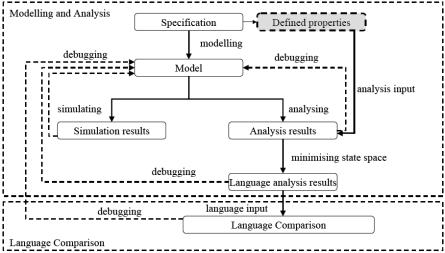
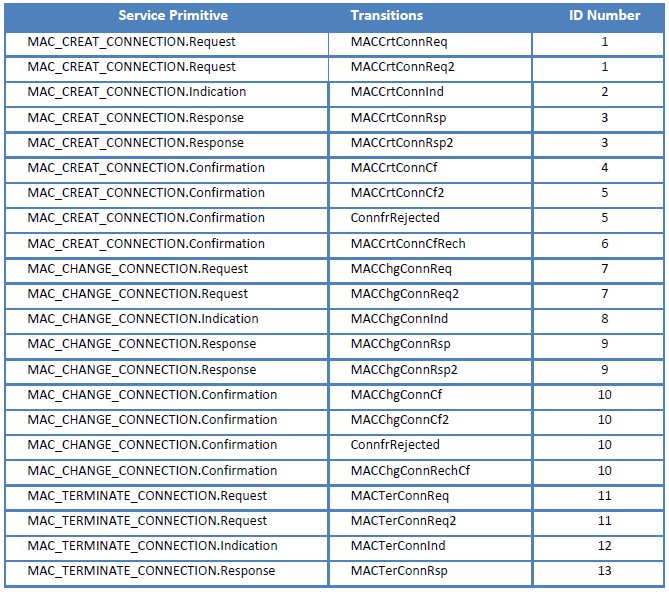
<body><![CDATA[<p style='margin-left:21.3pt;text-indent:-18.0pt;mso-list:l18 level1 lfo44'><![if !supportLists]> <font face="Verdana" size="2"><span lang=EN-US>·</span></font><span style='font-style:normal; font-variant:normal; font-weight:normal; font-size:10pt; font-family:Verdana' lang="EN-US">&nbsp;&nbsp;&nbsp;&nbsp;&nbsp;&nbsp;&nbsp;&nbsp;&nbsp;&nbsp; </span><![endif]><font face="Verdana"><span lang=EN-US><font size="2">Analysis: </font> </span></font><span lang=EN-US><font size="2" face="Verdana">requires the proof of the desired properties of the composite specification using reachability analysis and/or theorem proving.</font><o:p></o:p></span></p>      <p style='margin-left:21.3pt;text-indent:-18.0pt;mso-list:l18 level1 lfo44'><![if !supportLists]> <font face="Verdana" size="2"><span lang=EN-US>·</span></font><span style='font-style:normal; font-variant:normal; font-weight:normal; font-size:10pt; font-family:Verdana' lang="EN-US">&nbsp;&nbsp;&nbsp;&nbsp;&nbsp;&nbsp;&nbsp;&nbsp;&nbsp;&nbsp; </span><![endif]><font face="Verdana"><span lang=EN-US><font size="2">Comparison: </font> </span></font><span lang=EN-US><font size="2" face="Verdana">consists of checking if the service specification satisfies the <span style="mso-spacerun: yes"> </span>service specification with the composite specification to see if the composite specification is a correct refinement of the service. </font> <o:p></o:p></span></p>      <p><font face="Verdana" size="2"><span lang=EN-US><a href="#f5"> Figure 5</a> shows the steps involved in the protocol verification methodology. Initially, the service specification is modeled using a formal method such as CPNs <a href="#r4">(4)</a>. Then the composite specification is also modeled. Simulations can be used for initial debugging of the models. While errors are found in the simulation, the model is modified and the simulation activities repeated as shown in <a href="#f5"> Figure 5</a>.</span></font></p>       <p align="center"> <font face="Verdana" size="2"> <a name="f5" href="/img/revistas/cleiej/v16n2/2a02f5.jpg"> Figure 5: Abstract View of the Protocol Verification Methodology <a href="#r3">(3)</a>  </a> </font> </p>      <p><font face="Verdana" size="2"><span lang=EN-US>A <i style='mso-bidi-font-style:normal'>property</i> refers to a particular characteristic, which should be present in a protocol. For example, Holzmann <a href="#r13">(13)</a><span style='color:red'> </span>defines a set of general properties, which can apply to any protocol, such as no deadlocks and no livelocks. Some other particular properties, which apply to the protocol under study, can be also defined. They can be generated from the protocol specification. The desired properties of the protocol must be verified (analysis results) using formal analysis techniques such as state space analysis, system invariants, temporal logic and model checking. The analysis results may show some errors. The errors need to be analyzed in order to determine their causes. They can be a consequence of, for example, a model mistake (e.g. erroneous inscriptions), an inaccuracy of the specification or modeling assumptions. Thus, it may or may not require the model to be modified. If the model does require modification then the simulation and analysis activities must be repeated as shown in <a href="#f5"> Figure 5</a>.</span></font></p>      <p><font face="Verdana" size="2"><span lang=EN-US>A <i style='mso-bidi-font-style:normal'>service language</i> consists of all the possible service primitive occurrence sequences, which can occur between the (end-to-end) users of the protocol. The <i style='mso-bidi-font-style:normal'>protocol language</i> consists of all the possible service primitive occurrence sequences, which can be generated by the protocol entities. The resulting (service or protocol) language can be analyzed. The analysis may consist of checking that all the service primitive sequences are expected. The service and protocol language must be compared to check if they are equivalent. If some of the service primitive sequences are in the protocol language, but not in the service language or vice versa, they need to be analyzed. These sequences can be a result of, for example, a model mistake, an inaccuracy of the specification or modeling/scope assumptions. Thus, it may or may not require the model to be modified.</span></font></p>      <p><![if !supportLists]><span lang=EN-US><font face="Verdana" size="2">4</font><span style='font-style:normal; font-variant:normal; font-weight:normal; font-size:10pt; font-family:Verdana'>&nbsp;&nbsp;&nbsp;&nbsp;&nbsp;&nbsp;&nbsp;&nbsp;&nbsp; </span></span><![endif]><span lang=EN-US><font face="Verdana" size="2">Service Specification of the MAC CPS Connection Management <span style="mso-spacerun: yes"> </span></font><o:p></o:p></span></p>      <p><font face="Verdana" size="2"><span lang=EN-US>In this work, we model and analyze the service specification of the MAC CPS connection management using the protocol verification methodology presented above. The service specification is mostly described in the IEEE 802.16 standard document <a href="#r1">(1)</a>. Since the service primitive sequences are not clearly specified in the document, we have created the <a href="#t2"> Table 2</a> and <a href="#t3"> Table 3</a>. Then we model the service specification using CPNs, with the help of the software tool CPN Tools 2.0 <a href="#r15">(15)</a>. The model is debugging using the simulation tool integrated into CPN Tools. We validate the model against some behavioral properties of the CPNs such as non-presence of deadlocks <a href="#r11">(11)</a> <a href="#r14">(14)</a><i style='mso-bidi-font-style: normal'> </i>using the <i style='mso-bidi-font-style:normal'>state space</i> (also called <i style='mso-bidi-font-style:normal'>Occurrence Graph</i> (OG)) method. The model is described and analyzed in <a href="#r11">(11)</a> <a href="#r14">(14)</a>.</span></font></p>      <p><span lang=EN-US style='font-family:"Verdana"; mso-bidi-font-family:Times'><font size="2">The OG graph includes not only the transitions representing the connection management service primitives but other transitions, such as error transitions. CPN Tools </font> </span> <font face="Verdana"><font size="2"><span lang=EN-US style='mso-ascii-font-family:Times;mso-hansi-font-family:Times; mso-bidi-font-family:Times'><a href="#r15">(15)</a> </span></font> <span lang=EN-US style='mso-bidi-font-family:Times'><font size="2">does not provide explicit support for language generation, which includes only the service primitive sequences. Since the OG graph can be seen as a <i style='mso-bidi-font-style:normal'>Finite State Automaton</i> (<i style='mso-bidi-font-style:normal'>FSA</i>), the service language was generated by using a well-known FSA reduction technique (Barret et al. <a href="#r16">(16)</a>) with the aid of the FSM Tool <a href="#r17">(17)</a>. The following steps were followed for the service language generation:</font></span></font><o:p></o:p></p>      <p style='margin-left:18.0pt;text-indent:-18.0pt;mso-list:l25 level1 lfo41'><![if !supportLists]> <font face="Verdana"> <span lang=EN-US style='font-size:10.0pt;mso-ansi-language: EN-US'>1)</span></font><span style='font-style:normal; font-variant:normal; font-weight:normal; font-size:10pt; font-family:Verdana; mso-ansi-language:EN-US' lang="EN-US">&nbsp;&nbsp;&nbsp;&nbsp;&nbsp;&nbsp;&nbsp; </span><![endif]><font face="Verdana"><span lang=EN-US style='font-size:10.0pt;mso-bidi-font-size: 11.0pt;mso-ansi-language:EN-US'>The service primitive transitions in the CPN model are assigned different numbers (no zero). The others are marked as zero epsilon (or empty) transitions </span><span lang=EN-US style='mso-ansi-language: EN-US'><font size="2">[1</font></span></font><span lang=EN-US style='font-size:10.0pt;font-family:"Verdana"; mso-ansi-language:EN-US'>6</span><font face="Verdana"><span lang=EN-US style='mso-ansi-language: EN-US'><font size="2">]</font></span></font><span lang=EN-US style='font-family:"Verdana"; mso-ansi-language:EN-US'><font size="2">.</font></span><span lang=EN-US style='font-size:10.0pt; font-family:"Verdana";mso-ansi-language:EN-US'> The</span><font face="Verdana" size="2"><span lang=EN-US style='mso-ansi-language:EN-US'> identification numbers used for the connection </span></font> <span lang=EN-US style='font-size:10.0pt;font-family:"Verdana"; mso-ansi-language:EN-US'>management</span><font face="Verdana" size="2"><span lang=EN-US style='mso-ansi-language: EN-US'> service primitives are shown in </span></font> <span lang=EN-US style='font-size:10.0pt;font-family:"Verdana";mso-ansi-language:EN-US'>t</span><font face="Verdana"><span lang=EN-US style='mso-ansi-language:EN-US'><font size="2">able 4</font></span></font><span lang=EN-US style='font-family:"Verdana";mso-ansi-language:EN-US'><font size="2">.</font></span><span lang=EN-US style='font-size:10.0pt;font-family:"Times New Roman";mso-ansi-language: EN-US'><o:p></o:p></span></p>      ]]></body>
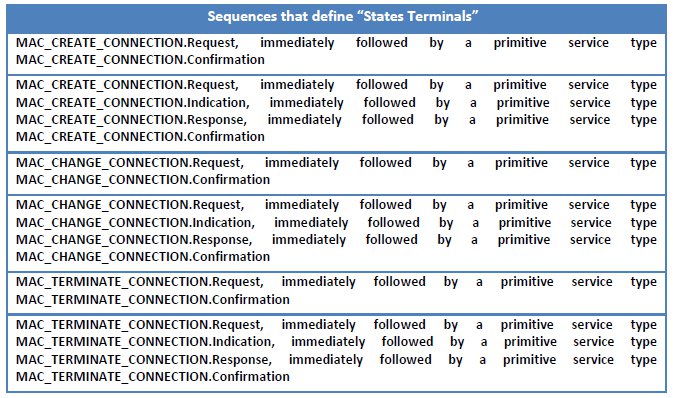
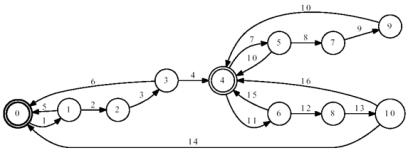
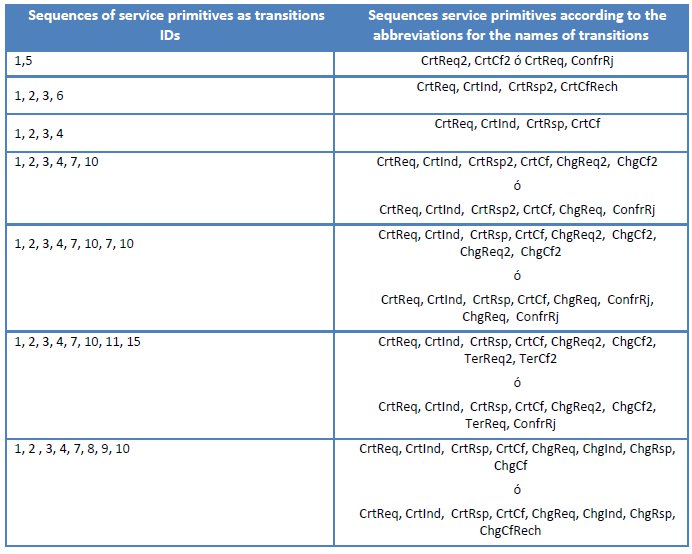
<body><![CDATA[<p align="center"> <font face="Verdana" size="2"> <a name="t4" href="/img/revistas/cleiej/v16n2/2a02t4.jpg"> Table 4: Abbreviations and ID numbers used for connection management service primitives </a> </font> </p>        <p style='margin-left:18.0pt;text-indent:-18.0pt;mso-list:l25 level1 lfo41'><![if !supportLists]> <font face="Verdana"> <span lang=EN-US style='font-size:10.0pt;mso-ansi-language: EN-US'>2)</span></font><span style='font-style:normal; font-variant:normal; font-weight:normal; font-size:10pt; font-family:Verdana; mso-ansi-language:EN-US' lang="EN-US">&nbsp;&nbsp;&nbsp;&nbsp;&nbsp;&nbsp;&nbsp; </span><![endif]><font face="Verdana"> <span lang=EN-US style='font-size:10.0pt;mso-ansi-language:EN-US'>The OG is written to a file in a text format that can be read by the <i style='mso-bidi-font-style:normal'>FSM tool </i><a href="#r17">(17)</a> using an algorithm created for doing this and shown <a href="#r3">(3)</a>. The <i style='mso-bidi-font-style:normal'>Terminal States</i>, which are the dead markings and probably other markings in the OG, are generated and written to a text file. Each line of the file corresponds to a <i style='mso-bidi-font-style: normal'>Terminal State</i>. To simplify and make understandable OG analysis and for the correct generation of the <i style='mso-bidi-font-style:normal'>sequence of service primitives</i> (e.g. the <i style='mso-bidi-font-style:normal'>language of service</i>), it is necessary to generate the <i style='mso-bidi-font-style: normal'>Terminal States</i> for the FSA, which determine the completion of a <i style='mso-bidi-font-style:normal'>sequence service primitives</i>. Such <i style='mso-bidi-font-style:normal'>Terminal States</i> are determined by the occurrence of sequences service primitives shown in <a href="#t5"> Table 5</a>.</span></font><o:p></o:p></p>      <p style='margin-top:0cm;margin-right:0cm;margin-bottom: 0cm;margin-left:18.0pt;margin-bottom:.0001pt;text-indent:-18.0pt;mso-list:l25 level1 lfo41; mso-layout-grid-align:none;text-autospace:none'><![if !supportLists]><span lang=EN-US style='font-size:10.0pt;mso-ansi-language:EN-US;mso-fareast-language: ES'><font face="Verdana">3)</font><span style='font-style:normal; font-variant:normal; font-weight:normal; font-family:Verdana'>&nbsp;&nbsp;&nbsp;&nbsp;&nbsp;&nbsp;&nbsp; </span></span><![endif]><span lang=EN-US style='font-size:10.0pt;mso-ansi-language: EN-US;mso-fareast-language:ES'><font face="Verdana">A FSM file is generated. It is the result of concatenating the files generated in steps 2. The resulting file, which includes the FSA for the OG is converted to the binary format understood by the FSM tool (using the <i>fsmcompile </i>function <a href="#r17">(17)</a>).</font><o:p></o:p></span></p>      <p style='margin-bottom:0cm;margin-bottom:.0001pt;text-indent: 0cm;mso-layout-grid-align:none;text-autospace:none'><span lang=EN-US style='font-size:10.0pt;mso-ansi-language:EN-US;mso-fareast-language:ES'> <font face="Verdana"><![if !supportEmptyParas]>&nbsp;<![endif]></font><o:p></o:p></span></p>      <p style='margin-top:0cm;margin-right:0cm;margin-bottom: 0cm;margin-left:18.0pt;margin-bottom:.0001pt;text-indent:-18.0pt;mso-list:l25 level1 lfo41; mso-layout-grid-align:none;text-autospace:none'><![if !supportLists]><span lang=EN-US style='font-size:10.0pt;mso-ansi-language:EN-US;mso-fareast-language: ES'><font face="Verdana">4)</font><span style='font-style:normal; font-variant:normal; font-weight:normal; font-family:Verdana'>&nbsp;&nbsp;&nbsp;&nbsp;&nbsp;&nbsp;&nbsp; </span></span><![endif]><span lang=EN-US style='font-size:10.0pt;mso-ansi-language: EN-US;mso-fareast-language:ES'><font face="Verdana">The FSA is reduced by following the algorithm described in <a href="#r16">(16)</a>. The algorithm is based on the following steps: removal of empty move cycles (remove empties), removal of empty moves (remove empties), removal of non-determinism (determinization), removal of inaccessible states (minimization), and reduction by identifying and merging equivalent states (minimization). The FSM tool provides all the programs for supporting these steps. A description of the algorithm and how the FSM tool can be used to implement it is given in <a href="#r11">(11)</a>.</font><o:p></o:p></span></p>      <p style='margin-bottom:0cm;margin-bottom:.0001pt;text-indent: 0cm;mso-layout-grid-align:none;text-autospace:none'><span lang=EN-US style='font-size:10.0pt;mso-ansi-language:EN-US;mso-fareast-language:ES'> <font face="Verdana"><![if !supportEmptyParas]>&nbsp;<![endif]></font><o:p></o:p></span></p>      <p style='margin-top:0cm;margin-right:0cm;margin-bottom: 0cm;margin-left:18.0pt;margin-bottom:.0001pt;text-indent:-18.0pt;mso-list:l25 level1 lfo41; mso-layout-grid-align:none;text-autospace:none'><![if !supportLists]><span lang=PT style='font-size:10.0pt;mso-fareast-language:ES'><font face="Verdana">5)</font><span style='font-style:normal; font-variant:normal; font-weight:normal; font-family:Verdana'>&nbsp;&nbsp;&nbsp;&nbsp;&nbsp;&nbsp;&nbsp; </span></span><![endif]><font face="Verdana"><span lang=EN-US style='font-size:10.0pt;mso-ansi-language: EN-US;mso-fareast-language:ES'>The language accepted by the resulting minimal FSA is generated using FSM Tools <a href="#r17">(17)</a>.</span></font><span lang=PT style='font-size: 10.0pt;mso-fareast-language:ES'><o:p></o:p></span></p>      <p style='margin-top:12.0pt;text-indent:0cm'><font face="Verdana"><span lang=EN-US style='font-size:10.0pt;mso-ansi-language:EN-US'><a href="#f6"> Figure 6</a> shows the FSA that represents the occurrence of the service primitives derived from the OG. The labels on the arcs represent the ID Number which identifies the connection management service primitive as specified in <a href="#t4"> Table 4</a>. Each service primitive sequence starts at node &quot;<span class=atn>0&quot; (</span>initial state), and ends in a <i style='mso-bidi-font-style:normal'>Terminal State</i> represented by a double circle (node &quot;0&quot; and &quot;4&quot;).<b style='mso-bidi-font-weight:normal'> </b></span><span lang=EN-GB style='font-size:10.0pt;mso-ansi-language:EN-GB'>The sequences </span><span lang=EN-US style='font-size:10.0pt;mso-ansi-language: EN-US'>service primitives </span><span lang=EN-GB style='font-size:10.0pt; mso-ansi-language:EN-GB'>shown in <a href="#t6"> Table 6</a> and can be found in the FSA</span><span lang=EN-GB style='font-size:10.0pt;mso-ansi-language:EN-US'> </span><span lang=EN-US style='font-size:10.0pt;mso-ansi-language:EN-US'>in the <a href="#f6"> Figure 6</a> <a href="#r11">(11)</a></span></font><span lang=EN-US style='font-size:10.0pt; mso-ansi-language:EN-US'><font face="Verdana"> <a href="#r14">(14)</a>.</font><o:p></o:p></span></p>      <p style='margin-top:12.0pt;text-indent:0cm'><span lang=EN-US style='font-size:10.0pt;mso-ansi-language:EN-US'><font face="Verdana">We validate the FSA by visual inspection which is possible because of the small size of the automata. Validation procedure consisted to check that all the occurrences of the service primitive sequences are correct. Also, the resulting FSA has cycles. This is expected because of the multiple setup, change and termination requests which can be initiated by an entity.</font><o:p></o:p></span></p>       <p align="center"> <a name="t5" href="/img/revistas/cleiej/v16n2/2a02t5.jpg"> <font face="Verdana" size="2">Table 5: Service Primitives sequences that define the &quot;Terminals States&quot;</font><o:p></o:p><font face="Verdana" size="2"> </font> </a> </p>       ]]></body>
<body><![CDATA[<p align="center"> <font face="Verdana" size="2"> <a name="f6" href="/img/revistas/cleiej/v16n2/2a02f6.jpg"> Figure 6: Minimal FSA for the connection management model  </a> </font> </p>       <p align=center style='margin-top:12.0pt;margin-right:0cm; margin-bottom:0cm;margin-left:0cm;margin-bottom:.0001pt;text-align:center; text-indent:0cm'><span lang=EN-US style='font-size:10.0pt; mso-ansi-language:EN-US'><font face="Verdana"><![if !supportEmptyParas]>&nbsp;<![endif]></font><o:p></o:p></span></p>      <p><![if !supportLists]><span lang=EN-US style='mso-font-kerning: 0pt'><font face="Verdana" size="2">5</font><span style='font-style:normal; font-variant:normal; font-weight:normal; font-size:10pt; font-family:Verdana'>&nbsp;&nbsp;&nbsp;&nbsp;&nbsp;&nbsp;&nbsp;&nbsp;&nbsp; </span></span><![endif]><font face="Verdana" size="2"><span lang=EN-US>Highlights</span><span class=shorttext><span lang=EN-US> </span></span><span lang=EN-US>of the</span><span class=shorttext><span lang=EN-US> </span></span><span lang=EN-US>Service Specification</span></font><span lang=EN-US style='mso-font-kerning:0pt'><o:p></o:p></span></p>      <p style='margin-top:12.0pt;text-indent:0cm'><font face="Verdana"><span lang=EN-US style='font-size:10.0pt;mso-ansi-language:EN-US'>In this section, we initially describe some problems found during the modeling and analysis of the connection management service specification. Then we explain some proposals to solve the problems. I</span><span lang=EN-US style='font-size:10.0pt; mso-ansi-language:EN-US'>n the service specification step of the protocol verification methodology, we found some information gaps and aspects that are not clearly specified in the document <a href="#r11">(11)</a> <a href="#r14">(14)</a>. For example, the standard document does not specify the state of the interface between the </span><span lang=PT style='font-size:10.0pt'>requesting</span></font><span lang=EN-US style='font-size:10.0pt;mso-ansi-language:EN-US'><font face="Verdana"> entity and the service provider after the service provider terminates the protocol. Moreover, we could not find the meaning of “terminate the protocol” in the document.</font><o:p></o:p></span></p>      <p style='margin-top:12.0pt;text-indent:0cm'><font face="Verdana"><span lang=EN-US style='font-size:10.0pt;mso-ansi-language:EN-US'>Also, it is important that the standard document specifies the actions taken when a connection management message is received by the protocol entity. Unfortunately, some of these actions are not clearly specified in the IEEE 802.16 standard document. For example, the actions taken by the </span><span lang=PT style='font-size:10.0pt'>requested</span><span lang=EN-US style='font-size:10.0pt;mso-ansi-language:EN-US'> entity when receiving either a DSA-ACK message (i.e. an acknowledgment of a connection creation request) or a DSC-ACK message (i.e. an acknowledgment of a change connection request) sent by the </span><span lang=PT style='font-size:10.0pt'>requesting </span><span lang=EN-US style='font-size:10.0pt;mso-ansi-language:EN-US'>entity are not explained.</span></font><span lang=EN-US style='font-size:10.0pt; mso-ansi-language:EN-US'><font face="Verdana"> </font> <o:p></o:p></span></p>      <p style='margin-top:12.0pt;text-indent:0cm'><font face="Verdana"><span lang=EN-US style='font-size:10.0pt;mso-ansi-language:EN-US'>A connection setup, change or termination request may be rejected by the service provider. The user service (i.e. the MAC CS layer entity) should know that its request has not been accepted. The standard document does not specify how this situation is reported to the </span><span lang=PT style='font-size:10.0pt'>requesting</span><span lang=PT style='font-size:10.0pt;mso-ansi-language:EN-US'> </span><span lang=EN-US style='font-size:10.0pt;mso-ansi-language:EN-US'>CS</span></font><span lang=EN-US style='font-size:10.0pt;mso-ansi-language:EN-US'><font face="Verdana"> entity.</font><o:p></o:p></span></p>      <p style='margin-top:12.0pt;text-indent:0cm'><font face="Verdana"><span lang=EN-US style='font-size:10.0pt;mso-ansi-language:EN-US'>We have proposed some solutions to above questions. They were modeled and analyzed using CPNs as part of the service specification <a href="#r11">(11)</a></span></font><span lang=EN-US style='font-size:10.0pt;mso-ansi-language:EN-US'><font face="Verdana"> <a href="#r14">(14)</a> and are described briefly as follows: </font> <o:p></o:p></span></p>      <p style='margin-top:12.0pt;margin-right:0cm;margin-bottom: 4.0pt;margin-left:7.1pt;text-indent:-7.1pt;mso-list:l29 level1 lfo22; tab-stops:list 7.1pt 263.75pt'><![if !supportLists]><font face="Verdana"> <span lang=EN-US style='font-size:10pt;mso-bidi-font-size:10.0pt;mso-ansi-language:EN-US'>·</span></font><span style='font-style:normal; font-variant:normal; font-weight:normal; font-size:10pt; font-family:Verdana; mso-bidi-font-size:10.0pt; mso-ansi-language:EN-US' lang="EN-US">&nbsp;&nbsp; </span><![endif]><font face="Verdana"><span lang=EN-US style='font-size:10.0pt;mso-ansi-language:EN-US'>We assume that </span></font><span lang=EN-US style='font-size:10.0pt;mso-ansi-language:EN-US'> <font face="Verdana">“terminate the protocol” means that the interface between the service user and the provider returns to the state immediately prior to the generation of a rejected service request that causes the end of the protocol.</font><o:p></o:p></span></p>      <p style='margin-top:12.0pt;margin-right:0cm;margin-bottom: 4.0pt;margin-left:7.1pt;text-indent:-7.1pt;mso-list:l29 level1 lfo22; tab-stops:list 7.1pt 263.75pt'><![if !supportLists]><font face="Verdana"> <span lang=EN-US style='font-size:10pt;mso-bidi-font-size:10.0pt;mso-ansi-language: EN-US'>·</span></font><span style='font-style:normal; font-variant:normal; font-weight:normal; font-size:10pt; font-family:Verdana; mso-bidi-font-size:10.0pt; mso-ansi-language:EN-US' lang="EN-US">&nbsp;&nbsp; </span> <![endif]><font face="Verdana"><span lang=EN-US style='font-size:10.0pt;mso-ansi-language:EN-US'><span style="mso-spacerun: yes"> </span>The requested MAC should return to the state it was prior to receive an acknowledgment of a negative response to the request sent by the </span><span lang=PT style='font-size:10.0pt'>requesting</span><span lang=EN-US style='font-size:10.0pt;mso-ansi-language:EN-US'> entity</span></font><span lang=EN-US style='font-size:10.0pt;mso-ansi-language: EN-US'><font face="Verdana"> (such as a DSA-REQ or DSC-REQ message). </font> <o:p></o:p></span></p>      <p style='margin-top:12.0pt;margin-right:0cm;margin-bottom: 4.0pt;margin-left:7.1pt;text-indent:-7.1pt;mso-list:l34 level1 lfo26; tab-stops:list 7.1pt'><![if !supportLists]><font face="Verdana"> <span lang=EN-US style='font-size: 10.0pt;mso-ansi-language:EN-US'>·</span></font><span style='font-style:normal; font-variant:normal; font-weight:normal; font-size:10pt; font-family:Verdana; mso-ansi-language:EN-US' lang="EN-US">&nbsp; </span><![endif]><font face="Verdana"><span lang=EN-US style='font-size:10.0pt; mso-ansi-language:EN-US'>The</span><span lang=EN-US style='font-size: 10.0pt;mso-ansi-language:EN-US'> </span><span lang=PT style='font-size:10.0pt'>requesting</span><span lang=PT style='font-size:10.0pt;mso-ansi-language:EN-US'> </span><span lang=EN-US style='font-size:10.0pt;mso-ansi-language:EN-US'>CS</span></font><span lang=EN-US style='font-size:10.0pt;mso-ansi-language:EN-US'><font face="Verdana"> entity could be informed of a denial of its request through the occurrence of a service primitive called &quot;Confirmation Rejected&quot; which clearly states that the request was rejected.</font><o:p></o:p></span></p>      ]]></body>
<body><![CDATA[<p align="center"> <font face="Verdana" size="2"> <a name="t6" href="/img/revistas/cleiej/v16n2/2a02t6.jpg"> Table 6: Examples of service primitive sequences accepted by the FSA  </a> </font> </p>       <p align=left style='margin-top:12.0pt;text-align:left; text-indent:0cm'><font face="Verdana"><b style='mso-bidi-font-weight:normal'> <span lang=EN-US style='font-size:10pt;mso-font-kerning:14.0pt;mso-ansi-language: EN-US'>Acknowledgements</span></b></font><b style='mso-bidi-font-weight: normal'><span lang=EN-US style='font-size:12.0pt;font-family:Calibri; mso-font-kerning:14.0pt;mso-ansi-language:EN-US'><o:p></o:p></span></b></p>      <p style='margin-top:12.0pt;text-indent:0cm'><span lang=PT style='font-size:10.0pt;mso-fareast-language:ES;mso-bidi-font-weight:bold'> <font face="Verdana">This work was developed with financial support from the Council of Scientific and Humanistic (CDCH) Central University of Venezuela (UCV) as part of the project No. PI03-8240-2011/1.</font><o:p></o:p></span></p>      <p align=center style='margin-top:12.0pt;text-align:center; text-indent:0cm'><span lang=PT style='font-size:10.0pt'><font face="Verdana"><![if !supportEmptyParas]>&nbsp;<![endif]></font><o:p></o:p></span></p>      <p><![if !supportLists]><span lang=EN-US style='mso-font-kerning: 0pt'><font face="Verdana" size="2">6</font><span style='font-style:normal; font-variant:normal; font-weight:normal; font-size:10pt; font-family:Verdana'>&nbsp;&nbsp;&nbsp;&nbsp;&nbsp;&nbsp;&nbsp;&nbsp;&nbsp; </span></span><![endif]><span lang=EN-US style='mso-font-kerning:0pt'> <font face="Verdana" size="2">Conclusions</font><o:p></o:p></span></p>      <p style='text-align:justify;background:white'> <span lang=EN-US style='font-family:"Verdana";mso-ansi-language:EN-US; mso-fareast-language:EN-US'><font size="2">In this paper, a service specification of the IEEE 802.16 MAC CPS connection management has been presented and described in detail </font> </span><font size="2"> <span lang=EN-US style='font-family:"Verdana";mso-ansi-language: EN-US'>following the </span> <span lang=EN-US style='font-family:"Verdana";mso-ansi-language:EN-US;mso-fareast-language: EN-US'>protocol verification methodology</span><font face="Verdana"><span lang=EN-US style='mso-ascii-font-family:"Courier New";mso-hansi-font-family: "Courier New";mso-bidi-font-family:"Courier New";mso-ansi-language:EN-US'> </span> </font> <span lang=EN-US style='font-family:"Verdana";mso-ansi-language: EN-US;mso-fareast-language:EN-US'>proposed by Billington.</span><span lang=EN-US style='font-family:"Verdana";mso-ansi-language: EN-US'> </span> <span lang=EN-US style='font-family:"Verdana"; mso-ansi-language:EN-US;mso-fareast-language:EN-US'>Because CPN Tool does not support explicit generation of the language service, the FSM tool was used instead. <span style="mso-spacerun: yes"> </span>Since, the validation of the service language represented by the minimal FSA was possible because of the small size of the automata. </span> </font><span lang=EN-US style='mso-ascii-font-family:"Courier New"; mso-hansi-font-family:"Courier New";mso-bidi-font-family:"Courier New"; mso-ansi-language:EN-US'><font face="Verdana"><span style="mso-spacerun: yes"> <font size="2"> </font></span></font><o:p></o:p></span></p>      <p style='margin-top:12.0pt;text-indent:0cm'><font face="Verdana"><span lang=EN-US style='font-size:10.0pt;mso-ansi-language:EN-US'>During our research, we found that</span><span lang=EN-US><font size="2"> </font> </span><span lang=EN-US style='font-size:10.0pt;mso-ansi-language:EN-US'>the IEEE</span><span lang=EN-US><font size="2"> </font> </span><span lang=EN-US style='font-size: 10.0pt;mso-ansi-language:EN-US'>802.16 standard document has</span><span lang=EN-US><font size="2"> </font> </span><span lang=EN-US style='font-size: 10.0pt;mso-ansi-language:EN-US'>some</span><span lang=EN-US style='font-size:10.0pt;mso-ansi-language:EN-US'> information gaps and some aspects are not clearly specified, such as: the state of the interfaces between the service user and the service provider after the termination of the protocol; the meaning of “terminate the protocol”; the actions taken by a requesting MAC CPS entity after receiving a ACK message; and the procedure to report a connection rejection to the MAC CS entity (i.e. requesting service user). We proposed some answers to these questions and change our initial model to incorporate these new aspects <a href="#r11">(11)</a><a href="#r14">(14)</a>. The model was validated <a href="#r11">(11)</a> and the service language is generated and analyzed I this paper. T</span></font><span lang=EN-US style='font-size:10.0pt;mso-ansi-language:EN-US;mso-fareast-language:ES-VE'><font face="Verdana">he analysis results are satisfactory providing us confidence on the correctness of the model.</font><o:p></o:p></span></p>      <p style='margin-top:12.0pt;text-indent:0cm'><span lang=EN-US style='font-size:10.0pt;mso-ansi-language:EN-US;mso-fareast-language:ES-VE'> <font face="Verdana">Future work includes to model and analyzing the IEEE 802.16 MAC CPS protocol. After the validation and verification of the protocol specification, and following the protocol verification methodology, we will compare the service specification presented in this paper with the protocol specification.</font><o:p></o:p></span></p>      <p style='mso-list:none'> <span lang=EN-US style='mso-font-kerning: 0pt;mso-ansi-language:EN-US'><font face="Verdana" size="2">References</font></span><o:p></o:p></p>      <!-- ref --><p><span lang=EN-US style='mso-ansi-language:EN-US'> <font face="Verdana" size="2"><a name="r1">(1)</a><span style='mso-tab-count:1'>         </span>Marks R. B., Kiernan B. G., Bushue C. J. IEEE Sta. 802.16-2001. Local and Metropolitan Area Network, Part 16: Air Interface for Fixed Broadband Wireless Access Systems. October 2002.     </font> <o:p></o:p></span></p>      <!-- ref --><p><font face="Verdana"><span lang=EN-US style='mso-ansi-language:EN-US'><a name="r2"> <font size="2">(2)</font></a><font size="2"><span style='mso-tab-count:1'>         </span>Eklud C., Marks R., Stanwood K. and Wang S. IEEE Standard 802.16: A Technical Overview of the Wireless MAN™ Air Interface for Broadband Wireless Access. </font> </span><font size="2"><span lang=FR style='mso-ansi-language: FR'>IEEE Communication Magazine. </span></font></font><span lang=EN-US style='mso-ansi-language: EN-US'><font size="2" face="Verdana">June 2002.     </font> <o:p></o:p></span></p>      <!-- ref --><p><span lang=EN-US style='mso-ansi-language:EN-US'> <font face="Verdana" size="2"><a name="r3">(3)</a><span style='mso-tab-count:1'>         </span>Villapol M.E. “Modelling and Analysis of the Resource Reservation Protocol Using Coloured Petri Nets”. Doctoral Thesis, University of South Australia, November 2003.     </font> <o:p></o:p></span></p>      <!-- ref --><p><span lang=EN-US style='mso-ansi-language:EN-US'> <font face="Verdana" size="2"><a name="r4">(4)</a><span style='mso-tab-count:1'>         </span>Jensen, K. and Kristensen, L. Coloured Petri Nets: Modelling and Validation of Concurrent Systems. Springer-Verlag, Berlin Heidelberg. 2009.     </font> <o:p></o:p></span></p>      <!-- ref --><p><span lang=EN-US style='mso-ansi-language:EN-US'> <font face="Verdana" size="2"><a name="r5">(5)</a><span style='mso-tab-count:1'>         </span>Billington J., Gallasch G. and Bing H. A Coloured Petri Net Approach to protocol Verification. Lectures on Concurrency and Petri Nets. 2004, Volume 3098/2004, 49-70.    </font><o:p></o:p></span></p>      <!-- ref --><p><span lang=EN-US style='mso-ansi-language:EN-US'> <font face="Verdana" size="2"><a name="r6">(6)</a><span style='mso-tab-count:1'>         </span>Villapol M.E. and Billington J. “A Coloured Petri Net Approach to Formalising and Analysing the Resource Reservation Protocol”. Special issue of Best Papers presented at CLEI'2002, CLEI (Latinamerican Center for Informatics Studies) Electronic Journal. ISSN 0717-5000, Vol. 6, No. 1, Paper 1 (25 pages), 2004.    </font><o:p></o:p></span></p>      <!-- ref --><p><span lang=EN-US style='mso-ansi-language:EN-US'> <font face="Verdana" size="2"><a name="r7">(7)</a><span style='mso-tab-count:1'>         </span>Villapol M.E. “Modelado y Análisis Inicial del Establecimiento de una Conexión Bluetooth Usando las Redes de Petri Coloreadas”, in Proceedings of the Thirty-Second Latin American Computing Conference, CLEI 2006, Santiago de Chile, Chile, August 21-25(2006).    </font><o:p></o:p></span></p>      <!-- ref --><p><font face="Verdana"><span lang=ES-VE style='mso-ansi-language:ES-VE'><a name="r8"> <font size="2">(8)</font></a><font size="2"><span style='mso-tab-count:1'>         </span>Villapol M.E, Modelado del establecimiento de la conexión entre dos dispositivos Bluetooth Usando las Redes de Petri Coloreadas. Magazine “Avances en Sistemas e Informática”, ISSN 1657-7663, Vol. 5, No. 3, Pages 219-231. </font> </span></font><span lang=EN-US style='mso-ansi-language:EN-US'><font size="2" face="Verdana">December 2008.    </font><o:p></o:p></span></p>      <!-- ref --><p><span lang=EN-US style='mso-ansi-language:EN-US'> <font face="Verdana" size="2"><a name="r9">(9)</a><span style='mso-tab-count:1'>         </span>Eklud C., Marks R., Ponnuswamy S., Stanwood K y Van Waes N. Wireless MAN: Inside IEEE 802.16 Standard for Wireless Metropolitan Area Network (Paperback). 1ra Ed., Standard Information Network. IEEE Press. May 2006.    </font><o:p></o:p></span></p>      <!-- ref --><p><font face="Verdana"><span lang=EN-US style='mso-ansi-language:EN-US'><a name="r10"> <font size="2">(10)</font></a><font size="2"><span style='mso-tab-count:1'>       </span>Marks R. B., Stanwood K., Chang D. IEEE Sta. 802.16e-2005. Local and Metropolitan Area Network, Part 16: Air Interface for Fixed and Mobile Broadband Wireless Access Systems, Amendment 2: Physical and Medium Access Control Layers for Combined Fixed and Mobile Operation in Licensed Bands and Corrigendum 1. </font> </span></font><span lang=ES-VE style='mso-ansi-language: ES-VE'><font size="2" face="Verdana">February 2006</font><o:p></o:p></span><!-- ref --><p><font face="Verdana"><span lang=ES-VE style='mso-ansi-language:ES-VE'><a name="r11"> <font size="2">(11)</font></a><font size="2"><span style='mso-tab-count:1'>       </span>Morales, A. “Modelado y Análisis de los Procesos involucrados en la gestión de las conexiones en la capa MAC IEEE 802.16 utilizando Redes de Petri Coloreadas (CPNs)”. </font> </span></font><span lang=EN-US style='mso-ansi-language:EN-US'><font size="2" face="Verdana">Faculty of Science, School of Computing, Central University of Venezuela. Working Up to Category Assistant. UCV, April 2011.     </font> <o:p></o:p></span></p>      ]]></body>
<body><![CDATA[<!-- ref --><p><span lang=EN-US style='mso-ansi-language:EN-US'> <font face="Verdana" size="2"><a name="r12">(12)</a><span style='mso-tab-count:1'>       </span>Black U. OSI: A Model for Computer Communications Standards. New Yersey. Prentice-Hall. 1991.     </font> <o:p></o:p></span></p>      <!-- ref --><p><span lang=EN-US style='mso-ansi-language:EN-US'> <font face="Verdana" size="2"><a name="r13">(13)</a><span style='mso-tab-count:1'>       </span>Holzmann G. Design and Validation of Computer Protocols. Prentice Hall. 1991</font><o:p></o:p></span><!-- ref --><p><span lang=EN-US style='mso-ansi-language:EN-US'> <font face="Verdana" size="2"><a name="r14">(14)</a><span style='mso-tab-count:1'>       </span>Morales Ana y Villapol Maria E. “Towards Formal Specification of the Service in the IEEE 802.16 MAC Layer for Connection Management”. 9th WSEAS International Conference on Computational Intelligence, Man-Machine Systems and Cybernetics (CIMMACS `10). ISSN: 1792-6998. ISBN: 978-960-474-257-8. Pp. 140-146.     </font> <o:p></o:p></span></p>      <!-- ref --><p><span lang=EN-US style='mso-ansi-language:EN-US'> <font face="Verdana" size="2"><a name="r15">(15)</a><span style='mso-tab-count:1'>       </span>Ratzer, A.V, Wells, L, at el. CPN Tools for Editing, Simulating, and Analysing Coloured Petri Net. Lecture Notes in Computer Science, Volume 2679 / 2003, pp. 450 – 462.     </font> <o:p></o:p></span></p>      <!-- ref --><p><span lang=EN-US style='mso-ansi-language:EN-US'> <font face="Verdana" size="2"><a name="r16">(16)</a><span style='mso-tab-count:1'>       </span>Barret W. and Couch J. Compiler Construction: Theory and Practice. Science Research<span style="mso-spacerun: yes">                   </span>Associates. Chicago, 1979</font><o:p></o:p></span><!-- ref --><p><span lang=EN-US style='mso-ansi-language:EN-US'> <font face="Verdana" size="2"><a name="r17">(17)</a><span style='mso-tab-count:1'>       </span>Mohri M., Pereira F., and Riley M. FSM Library. AT&amp;T Labs-Research. 2011. <a href="http://www.research.att.com/sw/tools/fsm/">http://www.research.att.com/sw/tools/fsm/</a>.    <span style="mso-spacerun: yes">  </span></font><o:p></o:p></span></p>      ]]></body>
<body><![CDATA[<p><span lang=EN-US style='mso-ansi-language:EN-US'> <font face="Verdana" size="2"><![if !supportEmptyParas]>&nbsp;<![endif]></font><o:p></o:p></span></p>      <p align=left style='margin-bottom:0cm;margin-bottom:.0001pt; text-align:left;text-indent:0cm;mso-layout-grid-align:none;text-autospace:none'><span lang=EN-US style='font-size:10.0pt;mso-ansi-language:EN-US'> <font face="Verdana"><![if !supportEmptyParas]>&nbsp;<![endif]></font><o:p></o:p></span></p>  </div>      <div style='mso-element:comment-list'><![if !supportAnnotations]>  <hr class=msocomoff align=left size=1 width="33%">  <![endif]></div>       ]]></body><back>
<ref-list>
<ref id="B1">
<label>1</label><nlm-citation citation-type="book">
<person-group person-group-type="author">
<name>
<surname><![CDATA[Marks]]></surname>
<given-names><![CDATA[R. B]]></given-names>
</name>
<name>
<surname><![CDATA[Kiernan]]></surname>
<given-names><![CDATA[B. G]]></given-names>
</name>
<name>
<surname><![CDATA[Bushue]]></surname>
<given-names><![CDATA[C. J]]></given-names>
</name>
</person-group>
<source><![CDATA[Local and Metropolitan Area Network: Air Interface for Fixed Broadband Wireless Access Systems]]></source>
<year>Octo</year>
<month>be</month>
<day>r </day>
<publisher-name><![CDATA[IEEE Sta. 802.16-2001]]></publisher-name>
</nlm-citation>
</ref>
<ref id="B2">
<label>2</label><nlm-citation citation-type="book">
<person-group person-group-type="author">
<name>
<surname><![CDATA[Eklud]]></surname>
<given-names><![CDATA[C]]></given-names>
</name>
<name>
<surname><![CDATA[Marks]]></surname>
<given-names><![CDATA[R]]></given-names>
</name>
<name>
<surname><![CDATA[Stanwood]]></surname>
<given-names><![CDATA[K]]></given-names>
</name>
<name>
<surname><![CDATA[Wang]]></surname>
<given-names><![CDATA[S]]></given-names>
</name>
</person-group>
<source><![CDATA[IEEE Standard 802.16: A Technical Overview of the Wireless MAN™ Air Interface for Broadband Wireless Access]]></source>
<year>June</year>
<month> 2</month>
<day>00</day>
<publisher-name><![CDATA[IEEE Communication Magazine]]></publisher-name>
</nlm-citation>
</ref>
<ref id="B3">
<label>3</label><nlm-citation citation-type="book">
<person-group person-group-type="author">
<name>
<surname><![CDATA[Villapol]]></surname>
<given-names><![CDATA[M.E]]></given-names>
</name>
</person-group>
<source><![CDATA[Modelling and Analysis of the Resource Reservation Protocol Using Coloured Petri Nets: Doctoral Thesis]]></source>
<year>Nove</year>
<month>mb</month>
<day>er</day>
<publisher-name><![CDATA[University of South Australia]]></publisher-name>
</nlm-citation>
</ref>
<ref id="B4">
<label>4</label><nlm-citation citation-type="book">
<person-group person-group-type="author">
<name>
<surname><![CDATA[Jensen]]></surname>
<given-names><![CDATA[K]]></given-names>
</name>
<name>
<surname><![CDATA[Kristensen]]></surname>
<given-names><![CDATA[L]]></given-names>
</name>
</person-group>
<source><![CDATA[Coloured Petri Nets: Modelling and Validation of Concurrent Systems]]></source>
<year>2009</year>
<publisher-loc><![CDATA[Berlin ]]></publisher-loc>
<publisher-name><![CDATA[Springer-Verlag]]></publisher-name>
</nlm-citation>
</ref>
<ref id="B5">
<label>5</label><nlm-citation citation-type="">
<person-group person-group-type="author">
<name>
<surname><![CDATA[Billington]]></surname>
<given-names><![CDATA[J]]></given-names>
</name>
<name>
<surname><![CDATA[Gallasch]]></surname>
<given-names><![CDATA[G]]></given-names>
</name>
<name>
<surname><![CDATA[Bing]]></surname>
<given-names><![CDATA[H]]></given-names>
</name>
</person-group>
<source><![CDATA[Lectures on Concurrency and Petri Nets]]></source>
<year>2004</year>
<page-range>49-70</page-range></nlm-citation>
</ref>
<ref id="B6">
<label>6</label><nlm-citation citation-type="journal">
<person-group person-group-type="author">
<name>
<surname><![CDATA[Villapol]]></surname>
<given-names><![CDATA[M.E]]></given-names>
</name>
<name>
<surname><![CDATA[Billington]]></surname>
<given-names><![CDATA[J]]></given-names>
</name>
</person-group>
<article-title xml:lang="en"><![CDATA[A Coloured Petri Net Approach to Formalising and Analysing the Resource Reservation Protocol]]></article-title>
<source><![CDATA[CLEI]]></source>
<year>2004</year>
<volume>6</volume>
<numero>1</numero>
<issue>1</issue>
</nlm-citation>
</ref>
<ref id="B7">
<label>7</label><nlm-citation citation-type="confpro">
<person-group person-group-type="author">
<name>
<surname><![CDATA[Villapol]]></surname>
<given-names><![CDATA[M.E]]></given-names>
</name>
</person-group>
<source><![CDATA[Modelado y Análisis Inicial del Establecimiento de una Conexión Bluetooth Usando las Redes de Petri Coloreadas]]></source>
<year></year>
<conf-name><![CDATA[ Thirty-Second Latin American Computing Conference]]></conf-name>
<conf-date>August 21-25,2006</conf-date>
<conf-loc>Santiago de Chile </conf-loc>
</nlm-citation>
</ref>
<ref id="B8">
<label>8</label><nlm-citation citation-type="journal">
<person-group person-group-type="author">
<name>
<surname><![CDATA[Villapol]]></surname>
<given-names><![CDATA[M.E]]></given-names>
</name>
</person-group>
<article-title xml:lang="es"><![CDATA[Modelado del establecimiento de la conexión entre dos dispositivos Bluetooth Usando las Redes de Petri Coloreadas]]></article-title>
<source><![CDATA[Avances en Sistemas e Informática]]></source>
<year>Dece</year>
<month>mb</month>
<day>er</day>
<volume>5</volume>
<numero>3</numero>
<issue>3</issue>
<page-range>219-231</page-range></nlm-citation>
</ref>
<ref id="B9">
<label>9</label><nlm-citation citation-type="book">
<person-group person-group-type="author">
<name>
<surname><![CDATA[Eklud]]></surname>
<given-names><![CDATA[C]]></given-names>
</name>
<name>
<surname><![CDATA[Marks]]></surname>
<given-names><![CDATA[R]]></given-names>
</name>
<name>
<surname><![CDATA[Ponnuswamy]]></surname>
<given-names><![CDATA[S]]></given-names>
</name>
<name>
<surname><![CDATA[Stanwood]]></surname>
<given-names><![CDATA[K]]></given-names>
</name>
<name>
<surname><![CDATA[Van Waes]]></surname>
<given-names><![CDATA[N]]></given-names>
</name>
</person-group>
<source><![CDATA[Wireless MAN: Inside IEEE 802.16 Standard for Wireless Metropolitan Area Network (Paperback)]]></source>
<year>May </year>
<month>20</month>
<day>06</day>
<edition>1ra</edition>
<publisher-name><![CDATA[IEEE Press]]></publisher-name>
</nlm-citation>
</ref>
<ref id="B10">
<label>10</label><nlm-citation citation-type="">
<person-group person-group-type="author">
<name>
<surname><![CDATA[Marks]]></surname>
<given-names><![CDATA[R. B]]></given-names>
</name>
<name>
<surname><![CDATA[Stanwood]]></surname>
<given-names><![CDATA[K]]></given-names>
</name>
<name>
<surname><![CDATA[Chang]]></surname>
<given-names><![CDATA[D]]></given-names>
</name>
</person-group>
<source><![CDATA[IEEE Sta. 802.16e-2005. Local and Metropolitan Area Network, Part 16: Air Interface for Fixed and Mobile Broadband Wireless Access Systems, Amendment 2: Physical and Medium Access Control Layers for Combined Fixed and Mobile Operation in Licensed Bands and Corrigendum 1]]></source>
<year>Febr</year>
<month>ua</month>
<day>ry</day>
</nlm-citation>
</ref>
<ref id="B11">
<label>11</label><nlm-citation citation-type="book">
<person-group person-group-type="author">
<name>
<surname><![CDATA[Morales]]></surname>
<given-names><![CDATA[A]]></given-names>
</name>
</person-group>
<source><![CDATA[“Modelado y Análisis de los Procesos involucrados en la gestión de las conexiones en la capa MAC IEEE 802.16 utilizando Redes de Petri Coloreadas (CPNs)”]]></source>
<year>Apri</year>
<month>l </month>
<day>20</day>
<publisher-name><![CDATA[Faculty of Science, School of Computing, Central University of Venezuela. Working Up to Category Assistant. UCV]]></publisher-name>
</nlm-citation>
</ref>
<ref id="B12">
<label>12</label><nlm-citation citation-type="book">
<person-group person-group-type="author">
<name>
<surname><![CDATA[Black]]></surname>
<given-names><![CDATA[U]]></given-names>
</name>
</person-group>
<source><![CDATA[OSI: A Model for Computer Communications Standards]]></source>
<year>1991</year>
<publisher-loc><![CDATA[New Yersey ]]></publisher-loc>
<publisher-name><![CDATA[Prentice-Hall]]></publisher-name>
</nlm-citation>
</ref>
<ref id="B13">
<label>13</label><nlm-citation citation-type="book">
<person-group person-group-type="author">
<name>
<surname><![CDATA[Holzmann]]></surname>
<given-names><![CDATA[G]]></given-names>
</name>
</person-group>
<source><![CDATA[Design and Validation of Computer Protocols]]></source>
<year>1991</year>
<publisher-name><![CDATA[Prentice Hall]]></publisher-name>
</nlm-citation>
</ref>
<ref id="B14">
<label>14</label><nlm-citation citation-type="confpro">
<person-group person-group-type="author">
<name>
<surname><![CDATA[Morales]]></surname>
<given-names><![CDATA[Ana]]></given-names>
</name>
<name>
<surname><![CDATA[Villapol]]></surname>
<given-names><![CDATA[Maria E]]></given-names>
</name>
</person-group>
<source><![CDATA[“Towards Formal Specification of the Service in the IEEE 802.16 MAC Layer for Connection Management”]]></source>
<year></year>
<conf-name><![CDATA[ 9th WSEAS International Conference on Computational Intelligence, Man-Machine Systems and Cybernetics (CIMMACS `10]]></conf-name>
<conf-loc> </conf-loc>
</nlm-citation>
</ref>
<ref id="B15">
<label>15</label><nlm-citation citation-type="">
<person-group person-group-type="author">
<name>
<surname><![CDATA[Ratzer]]></surname>
<given-names><![CDATA[A.V]]></given-names>
</name>
<name>
<surname><![CDATA[Wells]]></surname>
<given-names><![CDATA[L]]></given-names>
</name>
</person-group>
<source><![CDATA[CPN Tools for Editing, Simulating, and Analysing Coloured Petri Net: Lecture Notes in Computer Science]]></source>
<year>2003</year>
<volume>2679</volume>
<page-range>450 - 462</page-range></nlm-citation>
</ref>
<ref id="B16">
<label>16</label><nlm-citation citation-type="book">
<person-group person-group-type="author">
<name>
<surname><![CDATA[Barret]]></surname>
<given-names><![CDATA[W]]></given-names>
</name>
<name>
<surname><![CDATA[Couch]]></surname>
<given-names><![CDATA[J]]></given-names>
</name>
</person-group>
<source><![CDATA[Compiler Construction: Theory and Practice]]></source>
<year>1979</year>
<publisher-loc><![CDATA[Chicago ]]></publisher-loc>
<publisher-name><![CDATA[Science Research Associates]]></publisher-name>
</nlm-citation>
</ref>
<ref id="B17">
<label>17</label><nlm-citation citation-type="book">
<person-group person-group-type="author">
<name>
<surname><![CDATA[Mohri]]></surname>
<given-names><![CDATA[M]]></given-names>
</name>
<name>
<surname><![CDATA[Pereira]]></surname>
<given-names><![CDATA[F]]></given-names>
</name>
<name>
<surname><![CDATA[Riley]]></surname>
<given-names><![CDATA[M]]></given-names>
</name>
</person-group>
<source><![CDATA[]]></source>
<year>2011</year>
<publisher-name><![CDATA[FSM Library]]></publisher-name>
</nlm-citation>
</ref>
</ref-list>
</back>
</article>