<?xml version="1.0" encoding="ISO-8859-1"?><article xmlns:mml="http://www.w3.org/1998/Math/MathML" xmlns:xlink="http://www.w3.org/1999/xlink" xmlns:xsi="http://www.w3.org/2001/XMLSchema-instance">
<front>
<journal-meta>
<journal-id>0717-5000</journal-id>
<journal-title><![CDATA[CLEI Electronic Journal]]></journal-title>
<abbrev-journal-title><![CDATA[CLEIej]]></abbrev-journal-title>
<issn>0717-5000</issn>
<publisher>
<publisher-name><![CDATA[Centro Latinoamericano de Estudios en Informática]]></publisher-name>
</publisher>
</journal-meta>
<article-meta>
<article-id>S0717-50002013000100010</article-id>
<title-group>
<article-title xml:lang="en"><![CDATA[Conducting Empirical Studies to Evaluate a Technique to Inspect Software Testing Artifacts]]></article-title>
</title-group>
<contrib-group>
<contrib contrib-type="author">
<name>
<surname><![CDATA[Brito]]></surname>
<given-names><![CDATA[Jardelane]]></given-names>
</name>
<xref ref-type="aff" rid="A01"/>
</contrib>
<contrib contrib-type="author">
<name>
<surname><![CDATA[Dias-Neto]]></surname>
<given-names><![CDATA[Arilo Claudio]]></given-names>
</name>
<xref ref-type="aff" rid="A01"/>
</contrib>
</contrib-group>
<aff id="A01">
<institution><![CDATA[,Federal University of Amazonas (UFAM) Institute of Computing (IComp) ]]></institution>
<addr-line><![CDATA[Manaus Amazonas]]></addr-line>
<country>Brazil</country>
</aff>
<pub-date pub-type="pub">
<day>00</day>
<month>04</month>
<year>2013</year>
</pub-date>
<pub-date pub-type="epub">
<day>00</day>
<month>04</month>
<year>2013</year>
</pub-date>
<volume>16</volume>
<numero>1</numero>
<fpage>10</fpage>
<lpage>10</lpage>
<copyright-statement/>
<copyright-year/>
<self-uri xlink:href="http://www.scielo.edu.uy/scielo.php?script=sci_arttext&amp;pid=S0717-50002013000100010&amp;lng=en&amp;nrm=iso"></self-uri><self-uri xlink:href="http://www.scielo.edu.uy/scielo.php?script=sci_abstract&amp;pid=S0717-50002013000100010&amp;lng=en&amp;nrm=iso"></self-uri><self-uri xlink:href="http://www.scielo.edu.uy/scielo.php?script=sci_pdf&amp;pid=S0717-50002013000100010&amp;lng=en&amp;nrm=iso"></self-uri><abstract abstract-type="short" xml:lang="en"><p><![CDATA[Experimentation is becoming increasingly used in the Software Engineering field. Several methodologies adopt empirical studies as an instrument to support the software technologies’ conception and maturation. This paper presents the application of a methodology based on the conduction of primary studies to develop a new checklist-based technique, named TestCheck, for inspection of software testing artifacts (test plan, cases, and procedures). Thus far, three empirical studies have been conducted (two feasibility studies and one observational study). The results of the first feasibility study indicate that TestCheck is more efficient and effective when detecting defects in software testing artifacts than an Ad-hoc approach. The results of the second feasibility study suggest an improvement in TestCheck regarding the defects detection and the reduction of the number of false positives per inspector. Finally, the results of the third study (observational study) evaluated positively the application of TestCheck by software engineers inspecting testing artifacts developed in an industrial environment. Thus, it would be qualified for the execution of the methodology’s next steps (case studies in the software industry).]]></p></abstract>
<abstract abstract-type="short" xml:lang="pt"><p><![CDATA[Experimentação tem se tornado cada vez mais usada na área de Engenharia de Software. Várias metodologias adotam estudos experimentais como um instrumento de apoio à concepção e amadurecimento de tecnologias de software. Este artigo apresenta a aplicação de uma metodologia baseada na condução de estudos primários para desenvolvimento de uma nova técnica baseada em checklist, chamada TestCheck, para inspeção de artefatos de teste de software (plano, casos e procedimentos de teste). Até o momento, três estudos experimentais foram conduzidos (dois estudos de viabilidade e um estudo de observação). Os resultados do primeiro estudo de viabilidade indicam que TestCheck é mais eficiente e efetiva quando detectando defeitos em artefatos de teste de software que uma abordagem Ad-hoc. Os resultados do segundo estudo de viabilidade sugerem uma melhoria em TestCheck em relação à detecção de defeitos e a a redução do número de falso positivos por inspetor. Finalmente, os resultados do terceiro estudo (estudo de observação) avaliaram positivamente a aplicação de TestCheck por engenheiros de software inspecionando artefatos de teste desenvolvidos em um ambiente industrial. Assim, a técnica estaria qualificada para a execução dos próximos passos da metodologia (estudos de caso na indústria de software).]]></p></abstract>
<kwd-group>
<kwd lng="en"><![CDATA[Software Inspection]]></kwd>
<kwd lng="en"><![CDATA[Software Testing]]></kwd>
<kwd lng="en"><![CDATA[Checklist, Software Quality]]></kwd>
<kwd lng="pt"><![CDATA[inspección de software]]></kwd>
<kwd lng="pt"><![CDATA[ensayos de software]]></kwd>
<kwd lng="pt"><![CDATA[calidad de software]]></kwd>
</kwd-group>
</article-meta>
</front><body><![CDATA[ <div class="Section1">     <p  style="margin-bottom: 0.0001pt; line-height: normal;"><b><span lang="EN-US"> <font face="Verdana" size="4">Conducting Empirical Studies to Evaluate a Technique to Inspect Software Testing Artifacts </font></span></b> <o:p></o:p></p>     <p><span lang="EN-US"><font face="Verdana" size="2">&nbsp;</font><o:p></o:p></span></p>     <p  style="margin-bottom: 0.0001pt; text-indent: 0cm; line-height: normal; vertical-align: baseline;"><b  style=""><font face="Verdana"><span style="font-size: 10pt; "  lang="PT-BR">Jardelane Brito, Arilo Claudio Dias-Neto</span></font><o:p></o:p></b></p>     <p><span style="" lang="PT-BR"><font face="Verdana" size="2">&nbsp;</font><o:p></o:p></span></p>     <p style="line-height: normal;"><span lang="EN-US"> <font face="Verdana" size="2">Federal University of Amazonas (UFAM), Institute of Computing (IComp)</font></span><o:p></o:p></p>     <p style="line-height: 97%;"><span lang="PT-BR"><font face="Verdana" size="2">Manaus, Amazonas, Brazil, CEP 69077-000</font></span><o:p></o:p></p>     <p style="line-height: normal;"><i style=""><span lang="PT-BR"> <font face="Verdana" size="2">&nbsp;</font></span><o:p></o:p></i></p>     <p style="line-height: normal;"><span class="e-mail"><i  style=""><font face="Verdana"><span style="font-size: 10pt; "  lang="PT-BR">{<a href="mailto:jardelane.brito@icomp.ufam.edu.br">jardelane.brito</a>, <a href="mailto:arilo@icomp.ufam.edu.br">arilo</a>}@icomp.ufam.edu.br</span></font><o:p></o:p></i></span></p>     <p style="text-align: center;" align="center"><u><span lang="PT-BR"> <font face="Verdana" size="2">&nbsp;</font></span><o:p></o:p></u></p>     ]]></body>
<body><![CDATA[<p  style="margin: 0cm 42.55pt 0.0001pt; line-height: normal; vertical-align: baseline;"><span  class="e-mail"><b style=""><font face="Verdana"> <span  style="font-size: 10pt; " lang="EN-US">Abstract</span></font><o:p></o:p></b></span></p>     <p  style="margin: 0cm 42.55pt 0.0001pt; line-height: normal; vertical-align: baseline;"> <font face="Verdana"><span  style="font-size: 10pt; " lang="EN-US">&nbsp;</span></font><o:p></o:p></p>     <p  style="margin: 0cm 42.55pt 0.0001pt; line-height: normal; vertical-align: baseline;"> <font face="Verdana"><span  style="font-size: 10pt; " lang="EN-US">Experimentation is becoming increasingly used in the Software Engineering field. Several methodologies adopt empirical studies as an instrument to support the software technologies&rsquo; conception and maturation. This paper presents the application of a methodology based on the conduction of primary studies to develop a new checklist-based technique, named <i  style="">TestCheck</i>, for inspection of software testing artifacts (test plan, cases, and procedures). Thus far, three empirical studies have been conducted (two feasibility studies and one observational study). The results of the first feasibility study indicate that <i  style="">TestCheck</i> is more efficient and effective when detecting defects in software testing artifacts than an Ad-hoc approach. The results of the second feasibility study suggest an improvement in <i style="">TestCheck</i> regarding the defects detection and the reduction of the number of false positives per inspector. Finally, the results of the third study (observational study) evaluated positively the application of <i style="">TestCheck</i> by software engineers inspecting testing artifacts developed in an industrial environment. Thus, it would be qualified for the execution of the methodology&rsquo;s next steps (case studies in the software industry). </span></font> <o:p></o:p></p>     <p  style="margin: 0cm 42.55pt 0.0001pt; line-height: normal; vertical-align: baseline;"> <font face="Verdana"><span  style="font-size: 10pt; " lang="EN-US">&nbsp;</span></font><o:p></o:p></p>     <p  style="margin: 0cm 42.55pt 0.0001pt; line-height: normal; vertical-align: baseline;"><span  class="e-mail"><b style=""><font face="Verdana"> <span  style="font-size: 10pt; " lang="EN-US">Portuguese abstract</span></font><o:p></o:p></b></span></p>     <p  style="margin: 0cm 42.55pt 0.0001pt; line-height: normal; vertical-align: baseline;"> <font face="Verdana"><span  style="font-size: 10pt; ">&nbsp;</span></font><o:p></o:p></p>     <p  style="margin: 0cm 42.55pt 0.0001pt; line-height: normal; vertical-align: baseline;"> <span  style="font-size: 10pt; "><font face="Verdana">Experimenta&ccedil;&atilde;o tem se tornado cada vez mais usada na &aacute;rea de Engenharia de Software. V&aacute;rias metodologias adotam estudos experimentais como um instrumento de apoio &agrave; concep&ccedil;&atilde;o e amadurecimento de tecnologias de software. Este artigo apresenta a aplica&ccedil;&atilde;o de uma metodologia baseada na condu&ccedil;&atilde;o de estudos prim&aacute;rios para desenvolvimento de uma nova t&eacute;cnica baseada em checklist, chamada TestCheck, para inspe&ccedil;&atilde;o de artefatos de teste de software (plano, casos e procedimentos de teste). At&eacute; o momento, tr&ecirc;s estudos experimentais foram conduzidos (dois estudos de viabilidade e um estudo de observa&ccedil;&atilde;o). Os resultados do primeiro estudo de viabilidade indicam que TestCheck &eacute; mais eficiente e efetiva quando detectando defeitos em artefatos de teste de software que uma abordagem Ad-hoc. Os resultados do segundo estudo de viabilidade sugerem uma melhoria em TestCheck em rela&ccedil;&atilde;o &agrave; detec&ccedil;&atilde;o de defeitos e a a redu&ccedil;&atilde;o do n&uacute;mero de falso positivos por inspetor. Finalmente, os resultados do terceiro estudo (estudo de observa&ccedil;&atilde;o) avaliaram positivamente a aplica&ccedil;&atilde;o de TestCheck por engenheiros de software inspecionando artefatos de teste desenvolvidos em um ambiente industrial. Assim, a t&eacute;cnica estaria qualificada para a execu&ccedil;&atilde;o dos pr&oacute;ximos passos da metodologia (estudos de caso na ind&uacute;stria de software).</font></span><o:p></o:p></p>     <p style=""><span style=""><font face="Verdana" size="2">&nbsp;</font><o:p></o:p></span></p>     <p  style="margin: 0cm 42.55pt 0.0001pt; text-indent: 0cm; line-height: normal;"><b  style=""><span style="font-family: &quot;Verdana&quot;;" lang="EN-US"> <font size="2">Keywords: </font> </span></b><font face="Verdana"><span lang="EN-US"><font size="2">Software Inspection, Software Testing, Checklist, Software Quality.</font></span></font><o:p></o:p></p>     <p  style="margin: 0cm 42.55pt 0.0001pt; text-indent: 0cm; line-height: normal;"><b  style=""><span style="font-family: &quot;Verdana&quot;;" lang="EN-US"> <font size="2">Portuguese keywords: </font> </span></b><span  lang="EN-US"> <font size="2"></font><font size="2" face="Verdana">inspecci&oacute;n de software, ensayos de software, calidad de software .</font></span><o:p></o:p></p>     ]]></body>
<body><![CDATA[<p  style="margin: 0cm 42.55pt 0.0001pt; text-indent: 0cm; line-height: normal;"> <font face="Verdana" size="2"><span lang="EN-US"> Received 2012-07-09, Revised 2012-12-13, Accepted 2012-12-13</span></font><o:p></o:p></p>     <p  style="margin-left: 0cm; line-height: normal;"><b style=""> <span  style="text-transform: uppercase" lang="EN-US"><font face="Verdana" size="2">&nbsp;</font></span><o:p></o:p></b></p>     <p  style="margin-left: 0cm; line-height: normal;"><b style=""> <span  style="text-transform: uppercase" lang="EN-US"><font face="Verdana" size="2">&nbsp;</font></span><o:p></o:p></b></p>     <p  style="margin: 0cm 0cm 0.0001pt 21.3pt; text-indent: -21.3pt; line-height: normal; page-break-after: auto;"><a  name="_Ref327890067"><span style="" lang="EN-US"><font face="Verdana" size="2">1</font><span  style="font-family: &quot;Verdana&quot;; font-style: normal; font-variant: normal; font-weight: normal; font-size: 10pt; line-height: normal; font-size-adjust: none; font-stretch: normal">&nbsp;&nbsp;&nbsp;&nbsp;&nbsp;&nbsp;&nbsp;&nbsp;&nbsp;&nbsp;&nbsp;&nbsp;&nbsp;</span></span><font face="Verdana" size="2"><span  style="" lang="EN-US">Introduction</span></font></a><span style=""  lang="EN-US"><o:p></o:p></span></p>     <p  style="text-indent: 0cm; line-height: normal;"><span lang="EN-US"> <font face="Verdana" size="2">&nbsp;</font><o:p></o:p></span></p>     <p style="text-indent: 0cm; line-height: normal;"><font face="Verdana" size="2"><span  lang="EN-US">The application of experimentation concepts in the area of software engineering (known as Empirical Software Engineering &ndash; ESE) goes back to the 70s and 80s <span style=""><a href="#r1">(1)</a></span><a name="1"></a> and has been growing significantly every year <span style=""><a href="#r2">(2)</a></span><a  name="2"></a>. As a consequence of this development, the technical literature has provided research methodologies <span style=""><a  href="#r3">(3)</a><a name="3"></a><a href="#r4">(4)</a></span><a  name="4"></a>, ontologies and knowledge repositories <span style=""><a href="#r5">(5)</a><a name="5"></a><a href="#r6">(6)</a></span><a name="6"></a>, and environments to support experimental studies <span style=""><a href="#r7">(7)</a><a name="7"></a><a href="#r8">(8)</a></span><a name="8"></a> among others. Thus, more and more experimentation has been used for the conception and evaluation of new software technologies.</span></font></p>     <p style="text-indent: 22.5pt; line-height: normal;"> <font face="Verdana" size="2"><span  lang="EN-US">In this context, this paper describes the application of concepts published in the ESE area for the experimental evaluation of a new checklist-based inspection technique for reviewing artifacts produced during the software testing process, called <i style="">TestCheck</i>. Despite the advances in Software Engineering regarding the utilization of methods and techniques to obtain quality systems, a piece of software still needs to be tested before it can be delivered to a client. Thus, software testing presents itself as one of the most effective means to ensure the quality of software, and it is also one of the most complex areas in software engineering, as well as one of the most studied <span style=""><a  href="#r9">(9)</a><a name="9"></a><a href="#r10">(10)</a></span><a  name="10"></a>.</span></font></p>     <p style="text-indent: 22.5pt; line-height: normal;"> <font face="Verdana" size="2"><span  lang="EN-US">In order to achieve the goals outlined by the software testing activities, it is necessary to follow a process that manages the tasks from their planning through to the analysis of their results. The testing activities, if carried out without an objective, planning or adequate techniques, can present unpleasant consequences to a software project, since the discovery of defects at an advanced stage, among other things, increases correction costs, leads to delays in the schedule and provokes customer dissatisfaction. However, merely following a process does not guarantee its quality. The quality of the tests is directly related to the possibility of revealing failures in the system. If the artifacts produced during the tests (e.g. test plan, cases, and procedures) present defects, it is unlikely that the objective of providing quality tests will be achieved and the final result of the tests will not be satisfactory <span style=""><a href="#r11">(11)</a></span><a name="11"></a>.</span></font></p>     <p  style="margin-top: 3pt; text-indent: 22.5pt; line-height: normal;"><span  style="" lang="EN-US"><font face="Verdana" size="2">Thus, applying quality assurance techniques to the artifacts that are produced in the testing process may be a viable solution to guarantee the quality of tests in software projects. In this context, software inspection <span style=""><a  href="#r12">(12)</a><a name="12"></a></span> is a quality assurance technique that has been established to detect defects at an early stage in the system&rsquo;s development, and it is applied to any software artifact. In <span style=""><a  href="#r13">(13)</a><a name="13"></a></span>, the authors present an approach based on a checklist for the inspection of test artifacts, called <i style="">TestCheck</i>. Its objective is to minimize and prevent defects occurring in the artifacts that are produced in the testing process. This paper presents the procedures followed for the experimental evaluation of <i  style="">TestCheck</i> and their results. The studies we carried out were based on the study packages for the evaluation of checklist-based inspection techniques published in <span style=""><a href="#r14">(14)</a></span><a  name="14"></a> and <span style=""><a href="#r15">(15)</a><a name="15"></a></span>.</font><o:p></o:p></span></p>     <p style="text-indent: 22.5pt; line-height: normal;"> <font face="Verdana" size="2"><span  lang="EN-US">The application of ESE concepts generally occurs in different Software Engineering subareas, but it has a special scenario in the Software Inspection subarea, where we can see a large volume of evidence coming from experimental studies, as can be seen in a systematic literature review published in 2005 <span style=""><a href="#r16">(16)</a><a name="16"></a></span>. This scenario results in study packages that can be replicated by other researchers in order to provide an experimental evaluation of inspection techniques. For the evaluation of <i style="">TestCheck</i> we will apply a scientific methodology based on different experimental studies <span style=""><a href="#r3">(3)</a></span>. According to the methodology, the first study to be carried out for the evaluation of a new technology is a feasibility study, which should be repeated until the feasibility of the new proposed technique in relation to its goal is known. Then, an observation study should be carried out in order to evaluate the behavior of software engineers when they use the new technique. Continuing the methodology, case studies in a real lifecycle in the industry need to be carried out to evaluate the proposed technology from its definition right through to its transfer to the industrial environment. Thus far, in our research, the first two stages of this methodology have been completed in three experimental studies (two feasibility studies and one observation study). This paper describes the evolution process of the <i style="">TestCheck</i> technique guided by the results obtained in these studies.</span></font></p>     ]]></body>
<body><![CDATA[<p style="text-indent: 22.5pt; line-height: normal;"> <font face="Verdana" size="2"><span  lang="EN-US">This paper is an extended version of the paper published in <span style=""><a href="#r17">(17)</a><a name="17"></a></span>, where new details, including a new version, regarding the proposed approach to inspect testing artifacts and results from the first two evaluation (feasibility) studies are described. Moreover, a third (observational) study performed with practitioners is described. The results indicate efficiency and effectiveness of the proposed techniques to detect defects in testing artifacts in controlled and industrial environments.</span></font></p>     <p style="text-indent: 22.5pt; line-height: normal;"> <font face="Verdana" size="2"><span  lang="EN-US">Besides this Introduction, this comprises more 5 sections. In Section 2 we present the checklist-based technique to support the inspection of software testing artifacts (<i style="">TestCheck</i>), which is the main instrument of evaluation in the studies carried out and described in this paper. In Section 3 we present the planning, design, and results of the first experimental study carried out, with the objective of evaluating the feasibility of <i style="">TestCheck</i> when compared to an Ad-hoc technique. In Section 4 we present the second feasibility study, with the objective of evaluating the evolution of <i style="">TestCheck</i> in continuation from the first study, analyzing whether it satisfies the necessary criteria for the next step in the methodology (evaluation in industry). In Section 5 we present the third (observational) study, which evaluated <i style="">TestCheck</i>&rsquo;s behavior in an industrial environment of software developent. Finally, in Section 6, we present the conclusions, limitations and next steps to be taken to follow through this research.</span></font></p>     <p><span lang="EN-US"><font face="Verdana" size="2">&nbsp;</font><o:p></o:p></span></p>     <p  style="margin: 0cm 0cm 0.0001pt 21.3pt; text-indent: -21.3pt; line-height: 97%; page-break-after: auto;"><span  style="" lang="EN-US"><font face="Verdana" size="2">2</font><span  style="font-family: &quot;Verdana&quot;; font-style: normal; font-variant: normal; font-weight: normal; font-size: 10pt; line-height: normal; font-size-adjust: none; font-stretch: normal">&nbsp;&nbsp;&nbsp;&nbsp;&nbsp;&nbsp;&nbsp;&nbsp;&nbsp;&nbsp;&nbsp;&nbsp;&nbsp;</span></span><font face="Verdana"><i  style=""><span style="" lang="EN-US"><font size="2">TestCheck</font></span></i></font><span style=""  lang="EN-US"><font size="2" face="Verdana"> &ndash; Checklist-Based Technique to Support the Inspection of Software Testing Artifacts</font><o:p></o:p></span></p>     <p style="vertical-align: baseline;"><font face="Verdana" size="2"><span style=""  lang="EN-US">    <br> &nbsp;</span></font></p>     <p style="text-indent: 0cm;"><font face="Verdana" size="2"><span lang="EN-US">The <i  style="">TestCheck</i> approach has been developed with the aim of complying with the technical features required in an inspection approach, as described in <span style=""><a href="#r18">(18)</a><a  name="18"></a></span>. Acting on these features, the following tasks were carried out, as detailed in the subsections that follow:</span></font></p>     <p  style="margin-left: 36pt; text-indent: -18pt; vertical-align: baseline;"> <font face="Verdana" size="2"><span lang="EN-US">&middot;</span></font><span  style="font-family: &quot;Verdana&quot;; font-style: normal; font-variant: normal; font-weight: normal; font-size: 10pt; line-height: normal; font-size-adjust: none; font-stretch: normal" lang="EN-US">&nbsp;&nbsp;&nbsp;&nbsp;&nbsp;&nbsp;&nbsp;&nbsp;&nbsp;&nbsp;</span><span  style="" lang="EN-US"><font face="Verdana" size="2">Definition of the technique used to detect the defects in the inspected artifacts;</font><o:p></o:p></span></p>     <p  style="margin-left: 36pt; text-indent: -18pt; vertical-align: baseline;"> <span  style="font-family: &quot;Verdana&quot;; font-style: normal; font-variant: normal; font-weight: normal; font-size: 10pt; line-height: normal; font-size-adjust: none; font-stretch: normal" lang="EN-US">&nbsp;&nbsp;&nbsp;&nbsp;&nbsp;&nbsp;&nbsp;&nbsp;&nbsp;&nbsp;</span><span  style="" lang="EN-US"><font face="Verdana" size="2">Determination of the software artifact that needs to be evaluated by the approach;</font><o:p></o:p></span></p>     <p  style="margin-left: 36pt; text-indent: -18pt; vertical-align: baseline;"> <font face="Verdana" size="2"><span lang="EN-US">&middot;</span></font><span  style="font-family: &quot;Verdana&quot;; font-style: normal; font-variant: normal; font-weight: normal; font-size: 10pt; line-height: normal; font-size-adjust: none; font-stretch: normal" lang="EN-US">&nbsp;&nbsp;&nbsp;&nbsp;&nbsp;&nbsp;&nbsp;&nbsp;&nbsp;&nbsp;</span><span  style="" lang="EN-US"><font face="Verdana" size="2">Specification of the evaluation items that need to comprise the proposed approach.</font><o:p></o:p></span></p>     ]]></body>
<body><![CDATA[<p><span lang="EN-US"><font face="Verdana" size="2">&nbsp;</font><o:p></o:p></span></p>     <p  style="margin: 0cm 0cm 0.0001pt 18pt; text-indent: -18pt; line-height: normal; page-break-after: auto;"><span  style="font-size: 10pt;" lang="EN-US"><font face="Verdana">2.1</font><span  style="font-family: &quot;Verdana&quot;; font-style: normal; font-variant: normal; font-weight: normal; line-height: normal; font-size-adjust: none; font-stretch: normal">&nbsp;&nbsp;&nbsp;&nbsp;&nbsp;&nbsp;&nbsp;&nbsp;</span><font face="Verdana">Defect Detection Technique to be adopted </font> <o:p></o:p></span></p>     <p  style="margin: 0cm 0cm 0.0001pt; line-height: normal; page-break-after: auto;"><span  style="" lang="EN-US"><font face="Verdana" size="2">&nbsp;</font><o:p></o:p></span></p>     <p style="text-indent: 0cm; line-height: normal;"><font face="Verdana" size="2"><span  lang="EN-US">Within the 3 categories of defect detection techniques that can be applied in an inspection approach (Ad-hoc, checklist-based, or reading technique) it is not possible to instantiate the use of an Ad-hoc technique, as such a technique does not use any support tools and depends exclusively on the experience and previous knowledge of the inspector, without providing any additional support. When analyzing the feasibility of creating a reading technique, we perceived that this requires the document to be inspected to follow a standard format to guide the reading process, and this scenario cannot as yet be attained in the Software Testing area, as there is no standardization for representing test artifacts. Despite the existence of the IEEE-Std 829 standard <span  style=""><a href="#r19">(19)</a><a name="19"></a></span> as a guideline for the documentation of test artifacts, in practice it is little used, as can be seen in <span  style=""><a href="#r20">(20)</a><a name="20"></a></span>. Furthermore, this standard only describes templates that can (must) still be customized in the process of applying them to software projects.</span></font></p>     <p style="text-indent: 22.5pt; line-height: normal;"> <font face="Verdana" size="2"><span  lang="EN-US">Finally, analyzing the technique based on checklist, we can see that it is an evolution from the Ad-hoc technique and, as opposed to the reading techniques, it does not require a standardization of the artifacts&rsquo; representation. When reviewing software documents using a checklist, the inspector is supplied with a set of questions that help him identify defects by indicating in which part of the artifact to be evaluated he needs to look for them. Therefore, due to the features of the Software Testing area, the defects detection technique based on checklists has features that make it feasible to be applied in an inspection of test artifacts. It was this technique, therefore, that we selected to detect defects in this study.</span></font></p>     <p style="line-height: normal;"><span lang="EN-US"> <font face="Verdana" size="2">&nbsp;</font><o:p></o:p></span></p>     <p  style="margin: 0cm 0cm 0.0001pt 18pt; text-indent: -18pt; line-height: normal; page-break-after: auto;"><span  style="font-size: 10pt;" lang="EN-US"><font face="Verdana">2.2</font><span  style="font-family: &quot;Verdana&quot;; font-style: normal; font-variant: normal; font-weight: normal; line-height: normal; font-size-adjust: none; font-stretch: normal">&nbsp;&nbsp;&nbsp;&nbsp;&nbsp;&nbsp;&nbsp;&nbsp;</span><font face="Verdana">Software Testing Artifacts to be inspected</font><o:p></o:p></span></p>     <p style="line-height: normal; vertical-align: baseline;"><span  style="" lang="EN-US"><font face="Verdana" size="2">&nbsp;</font><o:p></o:p></span></p>     <p style="text-indent: 0cm; line-height: normal;"><font face="Verdana"><span  lang="EN-US"><font size="2">To develop <i style="">TestCheck</i>, we selected the artifacts that would be evaluated by the proposed technique. We looked for testing artifact templates that would be candidates to be reviewed in different sources, such as software development methodologies/frameworks, including predictive (process-based, like RUP &ndash; Rational Unified Process) and adaptive (agile) methods. In this analysis, we observed that the templates suggested by these methods are originated from the same source: IEEE-Std 829 <span style=""><a href="#r19">(19)</a></span>. In general, these methods suggest test documentation templates that consist of</font></span><span style="font-size: 10pt;"  lang="EN-US"> </span><span lang="EN-US"><font size="2">a</font></span><span  style="font-size: 10pt;" lang="EN-US"> </span><span lang="EN-US"> <font size="2">sub</font></span><span  style="font-size: 10pt;" lang="EN-US">-</span><span lang="EN-US"><font size="2">set</font></span><span  style="font-size: 10pt;" lang="EN-US"> </span><span lang="EN-US"> <font size="2">of</font></span><span  style="font-size: 10pt;" lang="EN-US"> </span><span lang="EN-US"> <font size="2">templates proposed by IEEE-Std 829. This standard proposes a set of eight templates that can be applied to different development methodologies, such as predictive and adaptive methods. It was published initially in 1983, and reviewed in 1998 and 2008. The current version (published in 2008 <span style=""><a  href="#r19">(19)</a></span>) describes templates for eight different testing artifacts: Master Test Plan (MTP), Level Test Plan (LTP),<span style="">&nbsp; </span>Level Test Design (LTD),<span style="">&nbsp; </span>Level Test Case (LTC), Level Test Procedure (LTPr), Level Test Log (LTL), Anomaly Report (AR), Level Interim Test Status Report (LITSR), Level Test Report (LTR), and Master Test Report (MTR).</font><span style=""><font size="2">&nbsp; </font> </span></span> </font></p>     <p style="line-height: normal; vertical-align: baseline;"><span  style="" lang="EN-US"><font face="Verdana" size="2"><span style="">&nbsp;&nbsp;&nbsp;&nbsp;&nbsp;&nbsp;&nbsp;&nbsp;&nbsp;&nbsp; </span>The selection of which testing artifacts would be reviewed by the proposed technique was based, initially, on the <b style="">test planning stage</b>. We decided to evaluate, in the first moment, only artifacts produced in this stage as an attempt to minimize and prevent the incidence of defects during the testing execution stage, which could make the tests&rsquo; execution in a software project unfeasible. Thus, this decision limited the choice to the artifacts MPT, LTP, LTD, LTC, and LTPr.</font><o:p></o:p></span></p>     ]]></body>
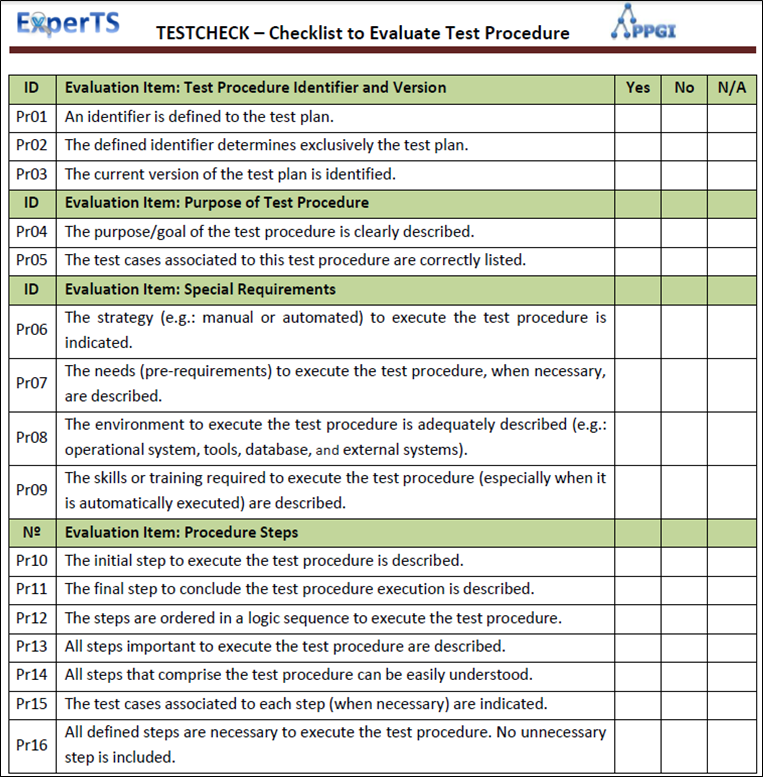
<body><![CDATA[<p style="line-height: normal; vertical-align: baseline;"><font face="Verdana"> <span style="" lang="EN-US"><font size="2">&nbsp;&nbsp;&nbsp;&nbsp;&nbsp;&nbsp;&nbsp;&nbsp;&nbsp;&nbsp; </font> </span><span lang="EN-US"><font size="2">In a second decision,</font></span><span  style="font-size: 10pt;" lang="EN-US"> </span><span lang="EN-US"> <font size="2">we</font></span><span  style="font-size: 10pt;" lang="EN-US"> </span><span lang="EN-US"> <font size="2">decided</font></span><span  style="font-size: 10pt;" lang="EN-US"> </span><span lang="EN-US"> <font size="2">to</font></span><span  style="font-size: 10pt;" lang="EN-US"> </span><span lang="EN-US"> <font size="2">select</font></span><span  style="font-size: 10pt;" lang="EN-US"> </span><span lang="EN-US"> <font size="2">testing</font></span><span  style="font-size: 10pt;" lang="EN-US"> </span><span lang="EN-US"> <font size="2">artifacts included in the versions of IEEE-Std 829 published in 1998 and 2008, because the old version is still applied intensely in software projects <span style=""><a href="#r20">(20)</a></span>. Therefore, templates included in only one of these versions were not selected. This decision limited the choice to the artifacts LTP, LTD, LTC, and LTPr.</font></span></font></p>     <p style="line-height: normal; vertical-align: baseline;"> <font face="Verdana" size="2"><span  lang="EN-US"><span style="">&nbsp;&nbsp;&nbsp;&nbsp;&nbsp;&nbsp;&nbsp;&nbsp;&nbsp;&nbsp; </span>Finally, in the third decision, we decided to review the testing artifacts most used in the software industry. In <span style=""><a href="#r20">(20)</a></span> the authors presented the results of a survey conducted with practitioners regarding the preferable IEEE-Std 829 test documentation in an international perspective. The authors reported that the following three testing artifacts are the most applied in real software projects in the testing planning phase: test plan (LTP), test cases (LTC), and test procedures (LTPr). Therefore, they were selected to be reviewed by the proposed technique. The remaining testing artifacts can be considered in the evolution of this research. <span style="">&nbsp;</span>A very brief description of the selected artifacts is as follows:</span></font><span  style="" lang="EN-US"><o:p></o:p></span></p>     <p  style="margin: 0cm 0cm 0.0001pt 25.1pt; text-indent: -18pt; line-height: normal;"><span  class="hps"><font face="Verdana" size="2"><span lang="EN-US">&middot;</span></font><span  style="font-family: &quot;Verdana&quot;; font-style: normal; font-variant: normal; font-weight: normal; font-size: 10pt; line-height: normal; font-size-adjust: none; font-stretch: normal" lang="EN-US">&nbsp;&nbsp;&nbsp;&nbsp;&nbsp;&nbsp;&nbsp;&nbsp;&nbsp;</span></span><font face="Verdana"><b  style=""><span lang="EN-US"><font size="2">Level Test Plan</font></span></b></font><span  lang="EN-US"><font face="Verdana" size="2"> presents the planning to execute tests<span class="hps">, including its scope, goals, tasks allocation, resources distribution, schedule, and risks associated to testing </span><span style=""><a href="#r19">(19)</a></span></font><span  class="hps"><font face="Verdana" size="2">.</font><b style=""><font size="2" face="Verdana"> </font> <o:p></o:p></b></span></span></p>     <p  style="margin: 0cm 0cm 0.0001pt 25.1pt; text-indent: -18pt; line-height: normal;"><span  class="hps"><font face="Verdana" size="2"><span lang="EN-US">&middot;</span></font><span  style="font-family: &quot;Verdana&quot;; font-style: normal; font-variant: normal; font-weight: normal; font-size: 10pt; line-height: normal; font-size-adjust: none; font-stretch: normal" lang="EN-US">&nbsp;&nbsp;&nbsp;&nbsp;&nbsp;&nbsp;&nbsp;&nbsp;&nbsp;</span></span><font face="Verdana"><span  class="hps"><b style=""><span lang="EN-US"><font size="2">Level Test Case </font> </span></b><font size="2"><span  lang="EN-US">defines inputs (test data), expected results/behaviors, actions and conditions to execute the test case </span></font></span></font><span lang="EN-US"> <font face="Verdana" size="2"><span  style=""><a href="#r19">(19)</a></span></font><span class="hps"><font size="2" face="Verdana">.</font><b  style=""><o:p></o:p></b></span></span></p>     <p  style="margin: 0cm 0cm 0.0001pt 25.1pt; text-indent: -18pt; line-height: normal;"> <font face="Verdana" size="2"><span lang="EN-US">&middot;</span></font><span  style="font-family: &quot;Verdana&quot;; font-style: normal; font-variant: normal; font-weight: normal; font-size: 10pt; line-height: normal; font-size-adjust: none; font-stretch: normal" lang="EN-US">&nbsp;&nbsp;&nbsp;&nbsp;&nbsp;&nbsp;&nbsp;&nbsp;&nbsp;</span><font face="Verdana"><span  class="hps"><b style=""><span lang="EN-US"><font size="2">Level Test Procedure </font> </span></b><font size="2"><span  lang="EN-US">specifies the steps to execute a set of test cases, their pre-conditions and special requirements to be executed </span></font></span></font><span lang="EN-US"> <font face="Verdana"><font size="2"><span  style=""><a href="#r19">(19)</a></span></font><span class="hps"><font size="2">.</font></span></font><b  style=""><o:p></o:p></b></span></p>     <p style="line-height: normal;"><span lang="EN-US"> <font face="Verdana" size="2">&nbsp;</font><o:p></o:p></span></p>     <p style="text-indent: 22.5pt; line-height: normal;"> <font face="Verdana" size="2"><span  lang="EN-US">The selected artifacts can be applied to tests at different levels (e.g. unit, integration, system and acceptance). Thus, the checklists that compose the <i style="">TestCheck</i> approach were elaborated in such a way as to apply them to these different levels, consisting of items that inquire into the artifacts&rsquo; structure and content without being directed toward a specific level.</span></font></p>     <p style="text-indent: 22.5pt; line-height: normal;"> <font face="Verdana" size="2"><span  lang="EN-US"><a name="f1"> Figure 1</a> graphically represents an evolution of the sub-process of test planning described in <span style=""><a href="#r21">(21)</a><a  name="21"></a></span> It indicates the artifacts to be inspected and at what moment (represented by a diamond) of the testing process this occurs.</span></font></p>     <p align="center"> <font face="Verdana" size="2"> <a name="f1" href="/img/revistas/cleiej/v16n1/1a10f1.png">Figure 1: Evolution of the Test Planning Sub-process including Inspection Activities </a></font></p>     <p  style="margin-bottom: 0.0001pt; text-indent: 0cm; line-height: normal;"> <font face="Verdana" size="2"><span  lang="EN-US">Three checklists were developed, one for each selected testing artifact: Test Plan, Test Case, and Test Procedure. </span></font></p>     ]]></body>
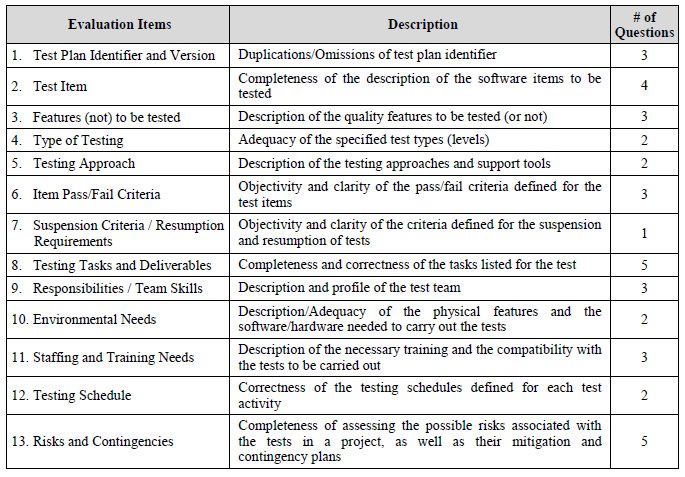
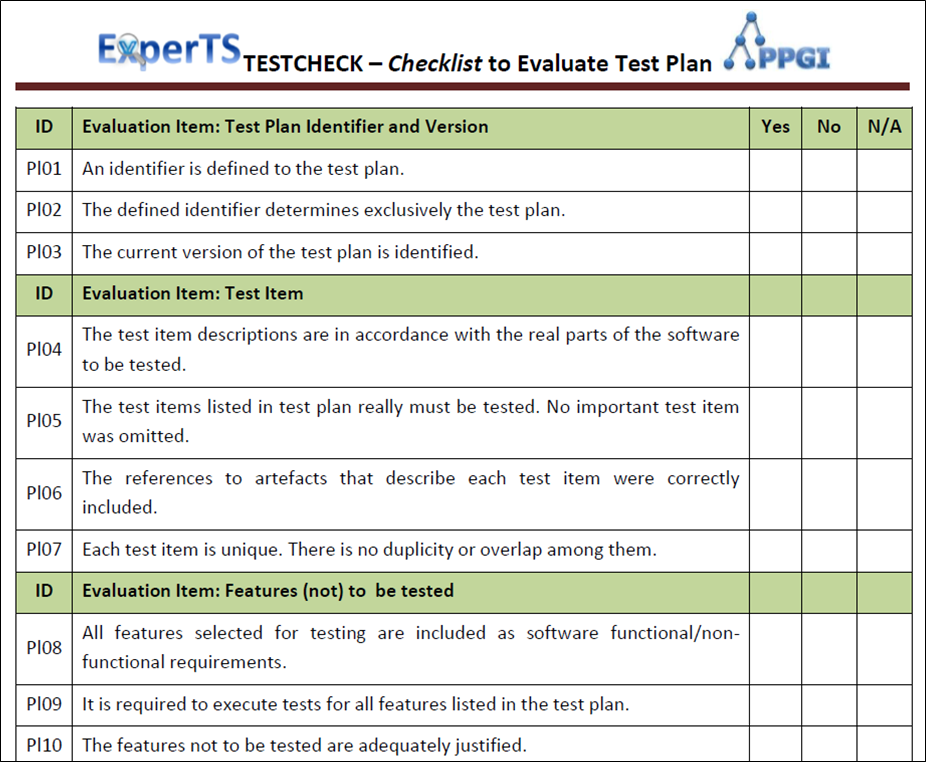
<body><![CDATA[<p  style="margin-bottom: 0.0001pt; text-indent: 0cm; line-height: normal;"><span  lang="EN-US"><font face="Verdana" size="2">&nbsp;</font><o:p></o:p></span></p>     <p  style="margin-left: 14.2pt; text-indent: -14.2pt; line-height: normal;"> <font face="Verdana" size="2"><span lang="EN-US">&middot;</span></font><span  style="font-family: &quot;Verdana&quot;; font-style: normal; font-variant: normal; font-weight: normal; font-size: 10pt; line-height: normal; font-size-adjust: none; font-stretch: normal" lang="EN-US">&nbsp;&nbsp;&nbsp;&nbsp;&nbsp;</span><b  style=""><span style="" lang="EN-US"><font face="Verdana" size="2">Checklist to Inspect Testing Plans</font><o:p></o:p></span></b></p>     <p style="text-indent: 21.3pt; line-height: normal;"><span  style="" lang="EN-US"><font face="Verdana" size="2">&nbsp;</font><o:p></o:p></span></p>     <p style="text-indent: 21.3pt; line-height: normal;"><span  style="" lang="EN-US"><font face="Verdana" size="2">Starting with the testing plan, this artifact needs to contain all the information that is relevant to the planning of testing activities, as any defects existing in this document can undermine the final result of the tests. The <i style="">checklist</i> developed to check this artifact has <u>13 items</u> (listed below) to be evaluated by <u>38 questions</u> (see <a  href="#t1"> Table 1</a>).</font><o:p></o:p></span></p>     <p align="center"> <font face="Verdana" size="2"> <a name="t1" href="/img/revistas/cleiej/v16n1/1a10t1.jpg">Table 1: Evaluation Items Comprising the Checklist for Inspection of Test Plans </a></font></p>     <p style="text-indent: 21.3pt; line-height: normal;"> <font face="Verdana" size="2"><span  style="" lang="EN-GB">Due to the limited space, we cannot present the full checklist proposed to inspect test plans. </span><span lang="EN-US">An extract of this checklist is shown in <span style=""><a name="f2"> Figure 2</a></span>.</span></font><span  style="" lang="EN-US"><o:p></o:p></span></p>     <p align="center"> <font face="Verdana" size="2"> <a name="f2" href="/img/revistas/cleiej/v16n1/1a10f2.png">Figure 2:Partial Extract of the Checklist to Evaluate the Test Plan </a> </font> </p>     <p  style="margin-left: 14.2pt; text-indent: -14.2pt; line-height: normal;"> <font face="Verdana" size="2"><span lang="EN-US">&middot;</span></font><span  style="font-family: &quot;Verdana&quot;; font-style: normal; font-variant: normal; font-weight: normal; font-size: 10pt; line-height: normal; font-size-adjust: none; font-stretch: normal" lang="EN-US">&nbsp;&nbsp;&nbsp;&nbsp;&nbsp;</span><b  style=""><span style="" lang="EN-US"><font face="Verdana" size="2">Checklist to Inspect Test Cases</font><o:p></o:p></span></b></p>     <p style="text-indent: 21.3pt; line-height: normal;"><span  style="" lang="EN-US"><font face="Verdana" size="2">&nbsp;</font><o:p></o:p></span></p>     <p style="text-indent: 21.3pt; line-height: normal;"><span  style="" lang="EN-US"><font face="Verdana" size="2">The checklist to inspect specification of test cases evaluates <u>6 items</u> (listed below) that comprise this artifact, detailed in 19 questions, as shown in <span  style=""><a href="#t2"> Table 2</a></span>.</font><o:p></o:p></span></p>     ]]></body>
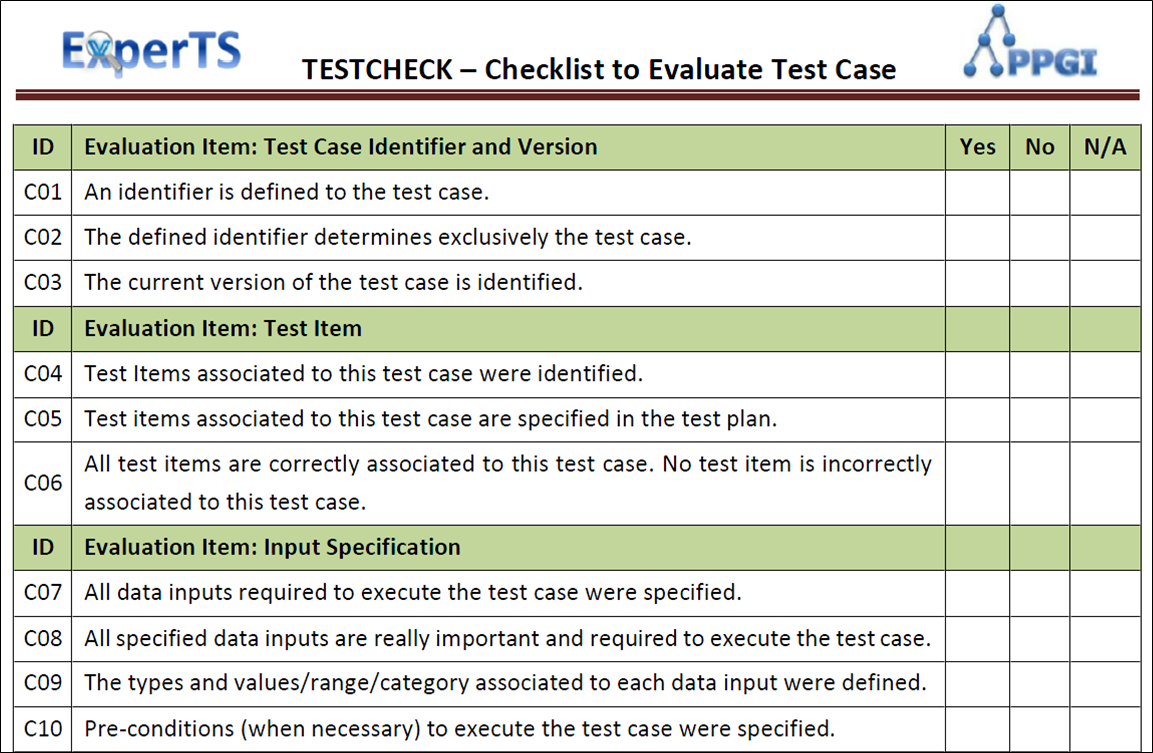
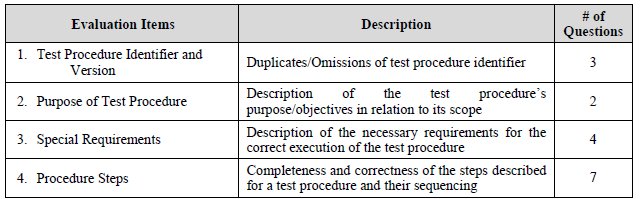
<body><![CDATA[<p align="center"> <font face="Verdana" size="2"> <a name="t2" href="/img/revistas/cleiej/v16n1/1a10t2.jpg">Table 2: Evaluation Items Comprising the Checklist for Inspection of Test Cases </a></font></p>     <p style="line-height: normal;"><font face="Verdana"><span style=""  lang="EN-GB"><font size="2">Again, due to the limited space, we will not also present the full checklist proposed to inspect test cases. An extract of this checklist is shown in </font> </span><font size="2"><span  style="" lang="EN-GB"><a name="f3"> Figure 3</a></span></font></font><span  style="" lang="EN-GB"><font size="2" face="Verdana">. </font> <b style=""><o:p></o:p></b></span></p>     <p align="center"> <font face="Verdana" size="2"> <a name="f3" href="/img/revistas/cleiej/v16n1/1a10f3.png">Figure 3: Extract of checklist to support inspection of test cases </a></font></p>     <p  style="margin-left: 14.2pt; text-indent: -14.2pt; line-height: normal;"> <font face="Verdana" size="2"><span lang="EN-US">&middot;</span></font><span  style="font-family: &quot;Verdana&quot;; font-style: normal; font-variant: normal; font-weight: normal; font-size: 10pt; line-height: normal; font-size-adjust: none; font-stretch: normal" lang="EN-US">&nbsp;&nbsp;&nbsp;&nbsp;&nbsp;</span><b  style=""><span style="" lang="EN-US"><font face="Verdana" size="2">Checklist to Inspect Test Procedures</font><o:p></o:p></span></b></p>     <p style="text-indent: 21.3pt; line-height: normal;"><span  style="" lang="PT-BR"><font face="Verdana" size="2">&nbsp;</font><o:p></o:p></span></p>     <p  style="margin-top: 6pt; text-indent: 21.3pt; line-height: normal;"><span  style="" lang="EN-US"><font face="Verdana" size="2">The checklist for inspecting the specification of test procedures evaluates <u>4 items</u> (listed below), detailed in <u>16 questions</u>, as shown in <span style=""><a href="#t3"> Table 3</a></span>.</font><o:p></o:p></span></p>     <p align="center"> <font face="Verdana" size="2"> <a name="t3" href="/img/revistas/cleiej/v16n1/1a10t3.jpg">Table 3: Evaluation Items Comprising the Checklist for Inspection of Test Procedures </a></font></p>     <p style="margin-top: 12pt; line-height: normal;"><font face="Verdana" size="2"><span  style="" lang="EN-GB">As it is smaller than the other two, in </span><span style="" lang="EN-GB"><a  name="f4"> Figure 4</a> we present the full checklist proposed to inspect specifications of test procedures, including all evaluation items and questions.</span></font><i  style=""><span style="font-size: 8pt;" lang="EN-US"><o:p></o:p></span></i></p>     <p align="center"> <font face="Verdana" size="2"> <a name="f4" href="/img/revistas/cleiej/v16n1/1a10f4.png">Figure 4: Extract of checklist to support inspection of test procedures </a><a href="#r13">(13)</a> </font> </p>     <p style="text-indent: 22.5pt;"><font face="Verdana"><span lang="EN-US"> <font size="2">Currently, <i style="">TestCheck</i> is in its third version. The complete version of the checklists can be found at http://www.icomp.ufam.edu.br/experts/testcheck-en.zip</font></span></font><span  style="" lang="EN-US"><font size="2" face="Verdana">. More details about <i style="">TestCheck</i>&rsquo;s conception process, the content of its checklist and previous versions can be obtained in <span  style=""><a href="#r13">(13)</a></span>.</font><o:p></o:p></span></p>     ]]></body>
<body><![CDATA[<p style="text-indent: 0cm;"><span style=""  lang="EN-US"><font face="Verdana" size="2"><span style="">&nbsp;&nbsp;&nbsp;&nbsp;&nbsp;&nbsp;&nbsp;&nbsp;&nbsp;&nbsp;&nbsp; </span>Having concluded the technique&rsquo;s conception phase, in the next section we will present the first experimental study carried out to evaluate the proposed technique.</font><o:p></o:p></span></p>     <p><span lang="EN-US"><font face="Verdana" size="2">&nbsp;</font><o:p></o:p></span></p>     <p  style="margin: 0cm 0cm 0.0001pt 21.3pt; text-indent: -21.3pt; line-height: 97%; page-break-after: auto;"><span  style="" lang="EN-US"><font face="Verdana" size="2">3</font><span  style="font-family: &quot;Verdana&quot;; font-style: normal; font-variant: normal; font-weight: normal; font-size: 10pt; line-height: normal; font-size-adjust: none; font-stretch: normal">&nbsp;&nbsp;&nbsp;&nbsp;&nbsp;&nbsp;&nbsp;&nbsp;&nbsp;&nbsp;&nbsp;&nbsp;&nbsp;</span><font face="Verdana" size="2">Feasibility Study 1</font><o:p></o:p></span></p>     <p><font face="Verdana" size="2"><span style="" lang="PT-BR">    <br> &nbsp;</span></font></p>     <p style="text-indent: 0cm;"><font face="Verdana" size="2"><span lang="EN-US">According to the scientific method for evaluation of software technologies based on experimental studies defined in <span style=""><a href="#r3">(3)</a></span>, the first experimental study that has to be carried out to evaluate a new technology is a <u>feasibility study</u>, which aims to assess whether the new technology is in fact feasible and whether the time spent using it is well employed.</span></font></p>     <p style="text-indent: 22.5pt;"><font face="Verdana" size="2"><span lang="EN-US">The feasibility of the technique was assessed in relation to its effectiveness (number of defects in relation to the total number of discrepancies encountered) and efficiency (number of defects identified per unit of time) in identifying defects.</span></font></p>     <p><span lang="EN-US"><font face="Verdana" size="2">&nbsp;</font><o:p></o:p></span></p>     <p  style="margin: 0cm 0cm 0.0001pt 18pt; text-indent: -18pt; line-height: 97%; page-break-after: auto;"><span  style="font-size: 10pt;" lang="EN-US"><font face="Verdana">3.1</font><span  style="font-family: &quot;Verdana&quot;; font-style: normal; font-variant: normal; font-weight: normal; line-height: normal; font-size-adjust: none; font-stretch: normal">&nbsp;&nbsp;&nbsp;&nbsp;&nbsp;&nbsp;&nbsp;&nbsp;</span><font face="Verdana">Planning and Execution of the Feasibility Study</font><o:p></o:p></span></p>     <p style="vertical-align: baseline;"><span style=""  lang="EN-US"><font face="Verdana" size="2">&nbsp;</font><o:p></o:p></span></p>     ]]></body>
<body><![CDATA[<p style="text-indent: 0cm;"><font face="Verdana" size="2"><span lang="EN-US">The premise for an inspection approach is that it should guide inspectors in the detection of defects in artifacts in a reduced space of time and generate a low number of false positives (discrepancies reported as defect by the inspector, but that are not a real defect). To evaluate this premise, we carried out a comparison between the defects detected by the proposed approach (<i style="">TestCheck</i>) and the results obtained by an <i style="">Ad-hoc</i> approach, as we did not find any other approach in the technical literature based on a checklist or reading technique with a similar objective to <i style="">TestCheck</i>. In addition to evaluating this premise, this first study also aims to provide a baseline for the <i style="">TestCheck</i> approach, allowing for future comparisons in the course of its evolution. Comparing it initially with the <i style="">Ad-hoc</i> approach contributes to this objective. Thus, we defined the Null Hypothesis (and the alternatives ones) for this study, as described below:</span></font></p>     <p style="text-indent: 22.5pt;"><span lang="EN-US"> <font face="Verdana" size="2">&nbsp;</font><o:p></o:p></span></p>     <div style="border: 0.5pt solid windowtext; padding: 1pt 4pt;">     <p  style="border: medium none ; margin: 12pt 28.3pt 12pt 42.55pt; padding: 0cm; text-indent: -15.3pt;"> <font face="Verdana" size="2"><span lang="EN-US">&middot;</span></font><span  style="font-family: &quot;Verdana&quot;; font-style: normal; font-variant: normal; font-weight: normal; font-size: 10pt; line-height: normal; font-size-adjust: none; font-stretch: normal" lang="EN-US">&nbsp;&nbsp;&nbsp;&nbsp;&nbsp;&nbsp;&nbsp;&nbsp;</span><b  style=""><span style="font-family: &quot;Verdana&quot;;" lang="EN-US"><font size="2">Null Hypothesis (H0): </font> </span></b><font face="Verdana"><span lang="EN-US"> <font size="2">There is no difference between the results obtained by the <i style="">TestCheck</i> and the <i style="">Ad-hoc</i> approaches as regards the detection of defects (effectiveness and efficiency) in test artifacts.</font></span></font><o:p></o:p></p>     <p  style="border: medium none ; margin: 12pt 28.3pt 12pt 42.55pt; padding: 0cm; text-indent: -15.3pt;"> <span  style="font-family: &quot;Verdana&quot;; font-style: normal; font-variant: normal; font-weight: normal; font-size: 10pt; line-height: normal; font-size-adjust: none; font-stretch: normal" lang="EN-US">&nbsp;&nbsp;&nbsp;&nbsp;&nbsp;&nbsp;&nbsp;&nbsp;</span><b  style=""><span style="font-family: &quot;Verdana&quot;;" lang="EN-US"><font size="2">Alternative 1 Hypothesis (H1): </font> </span></b><font size="2"><i style=""> <span style="font-family: &quot;Verdana&quot;;"  lang="EN-US">TestCheck</span></i></font><font face="Verdana"><span lang="EN-US"><font size="2"> obtains a better result in regard to the detection of defects (effectiveness and efficiency) than the <i  style="">Ad-hoc</i> approach. </font></span></font> <o:p></o:p></p>     <p  style="border: medium none ; margin: 12pt 28.3pt 12pt 42.55pt; padding: 0cm; text-indent: -15.3pt;"> <font face="Verdana" size="2"><span lang="EN-US">&middot;</span></font><span  style="font-family: &quot;Verdana&quot;; font-style: normal; font-variant: normal; font-weight: normal; font-size: 10pt; line-height: normal; font-size-adjust: none; font-stretch: normal" lang="EN-US">&nbsp;&nbsp;&nbsp;&nbsp;&nbsp;&nbsp;&nbsp;&nbsp;</span><b  style=""><span style="font-family: &quot;Verdana&quot;;" lang="EN-US"><font size="2">Alternative 2 Hypothesis (H2): </font> </span></b><span style="font-family: &quot;Verdana&quot;;" lang="EN-US"> <font size="2">The <i style="">Ad-hoc</i> approach obtains a better result in regard to the detection of defects (effectiveness and efficiency) than <i  style="">TestCheck</i>.</font></span></p> </div>     <p style="line-height: normal; vertical-align: baseline;"> <font face="Verdana" size="2"><span style="" lang="EN-US">&nbsp;&nbsp;&nbsp;&nbsp;&nbsp;&nbsp;&nbsp;&nbsp;&nbsp;&nbsp; </span><span lang="EN-US">This first study was carried out in the Amazonas state in Brazil and 12 undergraduate and graduate students of a class about software quality at the Federal University of Amazonas (UFAM) took part in it. In order to assess each student&rsquo;s knowledge and experience, they were asked to answer a Profile Questionnaire, which evidenced the participants&rsquo; low level of technical knowledge regarding the application of inspection techniques in the industry, as most of their previous experience had been only in an academic environment. Each participant carried out the inspection off-line and did not know who else participated in the study in order to avoid the exchange of information between participants.</span></font></p>     <p style="text-indent: 22.5pt; line-height: normal;"> <font face="Verdana" size="2"><span  lang="EN-US">In the study design, the participants were divided into 2 groups (A and B) based on the information in their profile questionnaires so as to mix participants with different levels of experience. Test artifacts of two distinct projects (called <i style="">Industrial</i> and <i style="">Academic</i>) were used during the experiment. The test artifacts of the <i style="">Industrial</i> project originated from a real project being developed in industry for managing users, their profiles and functionalities in a web system for the management of research projects. The test artifacts of the <i style="">Academic</i> project originated from an assignment given in a subject about software testing taught in 2010, in which students (not participants of the study) designed tests for a library&rsquo;s control system. At no time did the researchers insert defects into these artifacts. It was the versions created by their authors that were evaluated. The participants carried out the study in 3 different phases, as described in <span style="">Table 4</span>.</span></font></p>     <p align="center"> <font face="Verdana" size="2"> <a name="t4" href="/img/revistas/cleiej/v16n1/1a10t4.jpg">Table 4: Procedure followed in the study </a></font></p>     <p style="text-indent: 0cm; line-height: normal;"><font face="Verdana" size="2"><span  lang="EN-US"><span style="">&nbsp;&nbsp;&nbsp;&nbsp;&nbsp;&nbsp;&nbsp;&nbsp;&nbsp;&nbsp;&nbsp; </span>In phase 1 everybody applied an <i style="">Ad-hoc</i> technique. At this point each student received documents pertaining to one of the projects, according to which group they belonged to, containing 1 test plan, 5 test cases, 5 test procedures, 1 list of discrepancies to be filled out by the participants during the inspection, and 1 requirements specification document for any clarification about the test artifacts. The requirements specification document was not inspected.</span></font></p>     ]]></body>
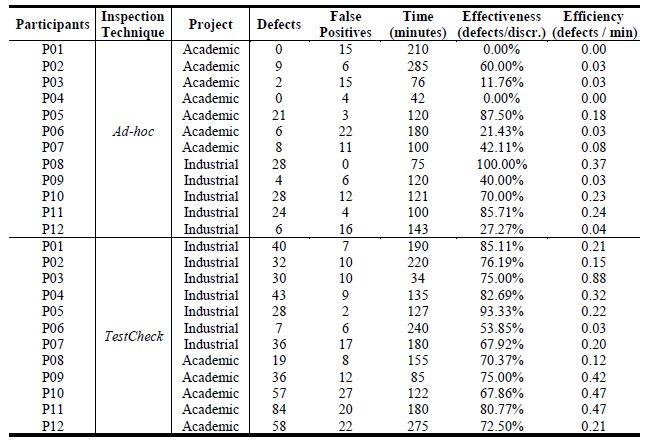
<body><![CDATA[<p style="text-indent: 22.5pt; line-height: normal;"> <font face="Verdana" size="2"><span  lang="EN-US">After phase 1, the students received training on how to employ the second technique, <i style="">TestCheck</i>. In this phase, they were given an explanation of the items that comprise the checklists and of the new template of the list of discrepancies to be filled out. After the training, phase 3 was started where artifacts of a new software project were distributed to the students, inverting the artifacts distributed between the groups in phase 1.</span></font></p>     <p style="text-indent: 22.5pt; line-height: normal;"> <font face="Verdana" size="2"><span  lang="EN-US">After the conclusion of phase 3, the data obtained were organized. The individual lists of discrepancies were integrated into one single list. Then, each discrepancy was evaluated and classified either as a defect or a false positive. This analysis was performed by the researcher involved and a specialist in software testing. In the case of doubt, a third researcher was consulted.</span></font></p>     <p style="line-height: normal;"><span lang="EN-US"> <font face="Verdana" size="2">&nbsp;</font><o:p></o:p></span></p>     <p  style="margin: 0cm 0cm 0.0001pt 18pt; text-indent: -18pt; line-height: normal; page-break-after: auto;"><span  style="font-size: 10pt;" lang="EN-US"><font face="Verdana">3.2</font><span  style="font-family: &quot;Verdana&quot;; font-style: normal; font-variant: normal; font-weight: normal; line-height: normal; font-size-adjust: none; font-stretch: normal">&nbsp;&nbsp;&nbsp;&nbsp;&nbsp;&nbsp;&nbsp;&nbsp;</span><font face="Verdana">Results of the Feasibility Study 1</font><o:p></o:p></span></p>     <p style="text-indent: 0cm; line-height: normal;"><span  style="" lang="EN-US"><font face="Verdana" size="2">&nbsp;</font><o:p></o:p></span></p>     <p  style="margin-left: 0cm; text-indent: 0cm; line-height: normal;"> <font face="Verdana" size="2"><span  lang="EN-US">In order to assess the feasibility of the proposed inspection technique, we analyzed the variables: defects detected, occurrence of false positives, and the time each inspector needed for the inspection, as shown in <span style="">Table 5</span>. Two other variables were also analyzed, derived from the data obtained from the simple variables cited. They are:</span></font></p>     <p  style="margin-left: 1cm; text-indent: -14.15pt; line-height: normal;"> <font face="Verdana" size="2"><span lang="EN-US">&middot;</span></font><span  style="font-family: &quot;Verdana&quot;; font-style: normal; font-variant: normal; font-weight: normal; font-size: 10pt; line-height: normal; font-size-adjust: none; font-stretch: normal" lang="EN-US">&nbsp;&nbsp;&nbsp;</span><font face="Verdana" size="2"><b  style=""><span lang="EN-US">Effectiveness:</span></b><span lang="EN-US"> the percentage of defects detected in relation to the total of reported discrepancies.</span></font></p>     <p  style="margin-left: 1cm; text-indent: -14.15pt; line-height: normal;"> <font face="Verdana" size="2"><span lang="EN-US">&middot;</span></font><span  style="font-family: &quot;Verdana&quot;; font-style: normal; font-variant: normal; font-weight: normal; font-size: 10pt; line-height: normal; font-size-adjust: none; font-stretch: normal" lang="EN-US">&nbsp;&nbsp;&nbsp;</span><font face="Verdana" size="2"><b  style=""><span lang="EN-US">Efficiency:</span></b><span lang="EN-US"> number of defects detected per minute.</span></font></p>     <p align="center"> <font face="Verdana" size="2"> <a name="t5" href="/img/revistas/cleiej/v16n1/1a10t5.jpg">Table 5: Summary of the data obtained in the feasibility study 1 </a></font></p>     <p  style="margin-top: 12pt; text-indent: 21.3pt; line-height: normal;"> <font face="Verdana" size="2"><span  lang="EN-US">After that, the averages for the collected variables were analyzed, as shown in <span style=""><a  href="#t6"> Table 6</a></span>.</span></font></p>     ]]></body>
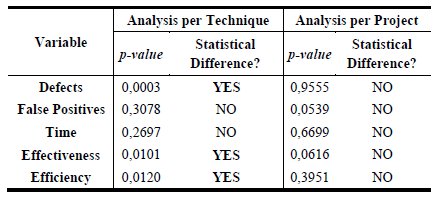
<body><![CDATA[<p align="center"> <font face="Verdana" size="2"> <a name="t6" href="/img/revistas/cleiej/v16n1/1a10t6.jpg">Table 6: Average of the defects, time, effectiveness and efficiency. </a></font></p>     <p  style="margin-top: 12pt; text-indent: 21.3pt; line-height: normal;"> <font face="Verdana" size="2"><span  lang="EN-US">Starting with the analysis of the total number of defects detected, we see that the <i style="">TestCheck</i> technique found, on average per participant, more defects than the <i style="">Ad-hoc</i> technique (39.17 x 11.33 defects), while the analysis of the total number of defects per software project showed, on average, a similar results (25.0 x 25.5 defects). However, we notice that <i style="">TestCheck</i> takes, on average, more time to carry out the inspection than the <i style="">Ad-hoc</i> technique (161.9 x 131.0 minutes). This result was expected, as <i style="">TestCheck</i> provides additional instruments for the detection of defects during an inspection (checklists). Analyzing the time spent per software project, we see that, on average, the results of the two are similar (131.0 x 138.5 minutes).</span></font></p>     <p style="text-indent: 21.3pt; line-height: normal;"> <font face="Verdana" size="2"><span  lang="EN-US">Another variable considered during the analysis was the number of false positives each technique generated, which in this first study did not show such a positive result for the <i style="">TestCheck</i> technique, having generated on average 12.5 false positives per inspector, whereas the <i style="">Ad-hoc</i> technique generated 9.5. This result suggested a possible point for the technique&rsquo;s evolution in a new version. Analyzing the results per software project, one also notices a discrepancy between the two, with one of the projects (Academic) obtaining an average of 8.0 false positives, against 13.5 of the other project (Industrial), suggesting that the software project used in the study could be a factor that influences the amount of false positives generated during an inspection.</span></font></p>     <p style="text-indent: 21.3pt; line-height: normal;"> <font face="Verdana" size="2"><span  lang="EN-US">In regard to the variables&rsquo; effectiveness and efficiency, the <i style="">TestCheck</i> technique obtained positive results for both when compared to the <i style="">Ad-hoc</i> technique. The average in relation to effectiveness was 75% for <i style="">TestCheck</i>, against 45% for the <i style="">Ad-hoc</i> technique. The average regarding efficiency was 0.31 defects/minute for <i style="">TestCheck</i>, against 0.11 defects/minute for the <i style="">Ad-hoc</i> technique. Analyzing the results of the two variables per software project, we can see that the average of one project is disproportional to the other in regard to the variable effectiveness (71% x 49%), but fairly similar for the variable efficiency (0.24 x 0.17 defects/minute).</span></font></p>     <p style="text-indent: 21.3pt; line-height: normal;"> <font face="Verdana" size="2"><span  lang="EN-US">However, despite this preliminary result, it was necessary to apply some statistical tests to the obtained data in order to evaluate the existence of any statistically significant differences between them. For this, we first carried out an outlier analysis to check if there are any points substantially diverging from the values obtained. The results show that there were no outliers between participants. After that an Analysis of Variance (ANOVA) was applied with a level of accuracy of 95% (error rate </span><span  style="" lang="EN-US">&alpha;</span><span lang="EN-US"> = 0.05). All the variables listed in <span style="">Table 6</span> were analyzed considering the two factors evaluated in this study: the inspection technique applied (<i style="">Ad-hoc</i> or <i style="">TestCheck</i>) and the software project inspected (<i style="">Industrial</i> and <i style="">Academic</i>). The results obtained are described in <span style=""><a href="#t7"> Table 7</a></span>.</span></font></p>     <p align="center"> <font face="Verdana" size="2"> <a name="t7" href="/img/revistas/cleiej/v16n1/1a10t7.jpg">Table 7: Summary of the Analysis of Variance (ANOVA) applied to Feasibility Study </a></font></p>     <p  style="margin-top: 12pt; text-indent: 21.3pt; line-height: normal;"><span  style="" lang="EN-US"><font face="Verdana" size="2">Analyzing the technique that was applied, we can observe that there is a statistical difference (since the <i style="">p-value</i> obtained is inferior to the error rate adopted in the study, &alpha; = 0.05) between the <i style="">TestCheck</i> and <i style="">Ad-hoc</i> techniques for the variables <i style=""><u>Number of defects</u></i>, <i style=""><u>Effectiveness</u></i> and <i style=""><u>Efficienc</u>y</i>, and the <i style="">TestCheck</i> technique always would be the factor influencing positively on the result. This indicates that <i  style="">TestCheck</i> detects a higher number of defects in the course of test artifacts inspections in absolute value, as well as a higher number of defects in relation to the total number of discrepancies reported by the inspectors (effectiveness), and also in relation to the number of defects detected per unit of time spent on the inspection (efficiency).</font><o:p></o:p></span></p>     <p style="text-indent: 21.3pt; line-height: normal;"><span  style="" lang="EN-US"><font face="Verdana" size="2">Analyzing the variables <i style="">False positives</i> and <i style="">Time</i>, the data indicates that there would be no statistical difference between the techniques. This result was considered to be positive in regard to evaluating the feasibility of the <i style="">TestCheck</i> technique, as this technique introduces new elements (checklists) which could turn into factors that make the inspection of the software testing artifacts more difficult. However, this did not happen with these variables.</font><o:p></o:p></span></p>     <p style="text-indent: 21.3pt; line-height: normal;"> <font face="Verdana" size="2"><span  lang="EN-US">Evaluating the results obtained for each software project, one notices that the projects used in the study did not influence the results. All the <i style="">p-values</i> for all the variables (<span style="">Table 7</span>) were above the error rate (</span><span style="" lang="EN-US">&alpha; = </span><span lang="EN-US">0.05) defined in the study, thus indicating that there would be no statistical difference between the projects employed.</span></font></p>     <p style="text-indent: 21.3pt; line-height: normal;"><span  lang="EN-US"><font face="Verdana" size="2">Therefore, the null hypothesis was rejected, as the results indicated that <i style="">TestCheck</i> makes a positive contribution to the detection of defects when compared to an <i style="">Ad-hoc</i> approach.    ]]></body>
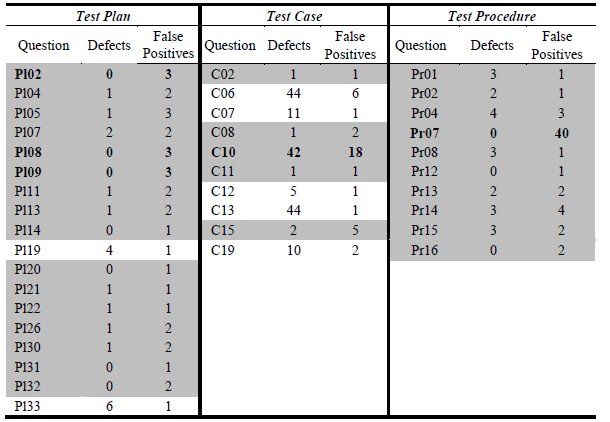
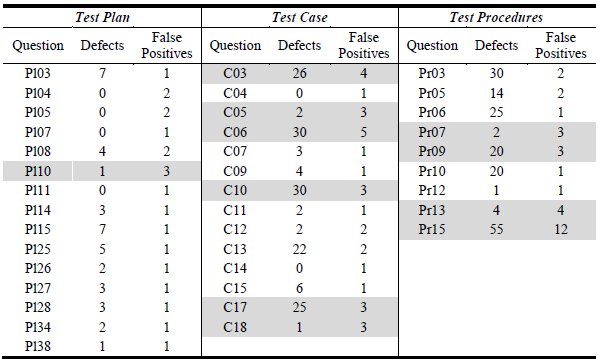
<body><![CDATA[<br> &nbsp;</font><o:p></o:p></span></p>     <p  style="margin: 0cm 0cm 0.0001pt 18pt; text-indent: -18pt; line-height: 97%; page-break-after: auto;"><span  style="font-size: 10pt;" lang="EN-US"><font face="Verdana">3.3</font><span  style="font-family: &quot;Verdana&quot;; font-style: normal; font-variant: normal; font-weight: normal; line-height: normal; font-size-adjust: none; font-stretch: normal">&nbsp;&nbsp;&nbsp;&nbsp;&nbsp;&nbsp;&nbsp;&nbsp;</span><font face="Verdana">Evolution of the Checklists</font><o:p></o:p></span></p>     <p style="text-indent: 0cm; line-height: normal;"><span  style="" lang="EN-US"><font face="Verdana" size="2">&nbsp;</font><o:p></o:p></span></p>     <p style="text-indent: 0cm; line-height: normal;"><font face="Verdana" size="2"><span  lang="EN-US">Despite the good performance of <i style="">TestCheck</i> in this first evaluation study, we know that this technique is still in a phase of development, and so it is important to pay attention to points that can be improved upon. One of the points to be improved was the number of <b style="">false positives</b> generated when applying <i style="">TestCheck</i>, which amounted to 12.5 per participant and were thought to be high by the researchers, considering that the rate of defects detected by the technique was 39.16 per participant. Thus, for every 3 defects, approximately, 1 false positive would be generated by <i style="">TestCheck</i>. The objective for evolution, therefore, is to reduce the rate of false-positives encountered in the first study and maintain the high rate of defects encountered when using <i style="">TestCheck</i> as compared to the <i style="">Ad-hoc</i> technique.</span></font></p>     <p style="text-indent: 21.3pt; line-height: normal;"> <font face="Verdana" size="2"><span  lang="EN-US">For this reason, as a more detailed analysis of <i  style="">TestCheck</i>&rsquo;s performance, an individual analysis was carried out for each question that comprises the checklists that constitute the technique. The objective was to identify questions that can be developed and improved on for having had a low performance during the study. For this analysis we investigated the relation between the number of false positives that the question generated and the number of defects it detected. All the questions of the three checklists that constitute <i style="">TestCheck</i> that had a <b style="">defect rate per false positive below or equal to 3.0</b> (this being a value obtained in the general scenario, as cited previously) would be a potential candidate to be evolved for the next version of the technique. This analysis is described in <span style=""><a href="#t8"> Table 8</a></span>, where the questions that did not attain this standard are highlighted in gray. The items that did not generate a single false positive were not included in the analysis and are not shown in this table so as to simplify the description.</span></font></p>     <p align="center"> <font face="Verdana" size="2"> <a name="t8" href="/img/revistas/cleiej/v16n1/1a10t8.jpg">Table 8: Defects and false positives per <i style="">TestCheck</i> question (version 1.0) </a></font></p>     <p style="text-indent: 21.3pt; line-height: normal;"><font face="Verdana"><span  style="" lang="EN-US"><font size="2">A total of 31 questions (out of the 75 questions that constituted the 3 checklists in version 1.0) were selected as candidates for evolution. They were revised and rewritten (not necessarily all of them) to create a new version of <i style="">TestCheck</i>. Some questions required more attention, as is the case with questions Pl02, Pl08 and Pl09 of the test plan, C10 in the test case, and Pr07 in the test procedure (all boldfaced in <a href="#t8"> Table 8</a>), which had a high rate of false positives. Several factors may have had</font></span><span style="font-size: 10pt;" lang="EN-US"> </span><span  style="" lang="EN-US"><font size="2">an</font></span><span style="font-size: 10pt;"  lang="EN-US"> </span><span style="" lang="EN-US"><font size="2">influence</font></span><span  style="font-size: 10pt;" lang="EN-US"> </span><span style=""  lang="EN-US"><font size="2">on</font></span><span style="font-size: 10pt;" lang="EN-US"> </span><span  style="" lang="EN-US"><font size="2">this</font></span><span style="font-size: 10pt;"  lang="EN-US"> </span></font><span style="" lang="EN-US"> <font face="Verdana" size="2">result, one of them being the question&rsquo;s wording, which could have led inspectors to different interpretations.</font><o:p></o:p></span></p>     <p style="text-indent: 21.3pt; line-height: normal;"><span  style="" lang="EN-US"><font face="Verdana" size="2">&nbsp;</font><o:p></o:p></span></p>     <p  style="margin: 0cm 0cm 0.0001pt 18pt; text-indent: -18pt; line-height: 97%; page-break-after: auto;"><span  style="font-size: 10pt;" lang="EN-US"><font face="Verdana">3.4</font><span  style="font-family: &quot;Verdana&quot;; font-style: normal; font-variant: normal; font-weight: normal; line-height: normal; font-size-adjust: none; font-stretch: normal">&nbsp;&nbsp;&nbsp;&nbsp;&nbsp;&nbsp;&nbsp;&nbsp;</span><font face="Verdana">Threats to the Validity</font><o:p></o:p></span></p>     <p><span lang="EN-US"><font face="Verdana" size="2">&nbsp;</font><o:p></o:p></span></p>     ]]></body>
<body><![CDATA[<p style="text-indent: 0cm; line-height: normal;"><span  style="" lang="EN-US"><font face="Verdana" size="2">The threats to the viability of this study will be described here according to their type:</font><o:p></o:p></span></p>     <p  style="margin: 0cm 0cm 6pt 29.35pt; text-indent: -18pt; line-height: normal;"> <font face="Verdana" size="2"><span lang="EN-US">&middot;</span></font><span  style="font-family: &quot;Verdana&quot;; font-style: normal; font-variant: normal; font-weight: normal; font-size: 10pt; line-height: normal; font-size-adjust: none; font-stretch: normal" lang="EN-US">&nbsp;&nbsp;&nbsp;&nbsp;&nbsp;</span><font face="Verdana" size="2"><b  style=""><span style="" lang="EN-US">Conclusion Validity: </span></b><span  lang="EN-US">classification of each discrepancy as a defect by the experimentalists and heterogeneity of the participants, who were undergraduate and graduate students of Software Engineering.</span></font></p>     <p  style="margin: 0cm 0cm 6pt 29.35pt; text-indent: -18pt; line-height: normal;"> <font face="Verdana" size="2"><span lang="EN-US">&middot;</span></font><span  style="font-family: &quot;Verdana&quot;; font-style: normal; font-variant: normal; font-weight: normal; font-size: 10pt; line-height: normal; font-size-adjust: none; font-stretch: normal" lang="EN-US">&nbsp;&nbsp;&nbsp;&nbsp;&nbsp;</span><font face="Verdana" size="2"><b  style=""><span style="" lang="EN-US">Internal Validity: </span></b><span  lang="EN-US">the sample of participants was not random, as it depended on the availability of students attending a class conducted by the researchers, and there may have been plagiarism, which would be the potential exchange of information between the participants about the study&rsquo;s tasks.</span></font></p>     <p  style="margin: 0cm 0cm 6pt 29.35pt; text-indent: -18pt; line-height: normal;"> <font face="Verdana" size="2"><span lang="EN-US">&middot;</span></font><span  style="font-family: &quot;Verdana&quot;; font-style: normal; font-variant: normal; font-weight: normal; font-size: 10pt; line-height: normal; font-size-adjust: none; font-stretch: normal" lang="EN-US">&nbsp;&nbsp;&nbsp;&nbsp;&nbsp;</span><font face="Verdana" size="2"><b  style=""><span style="" lang="EN-US">Construction Validity: </span></b><span  style="" lang="EN-US">mono-operation bias</span><span lang="EN-US">, which would be the uncertainty of whether the study&rsquo;s results were arrived at due to the application of the <i style="">TestCheck</i> or rather because of the &ldquo;ease&rdquo; of detecting defects in the document used in the selected projects, as well as the probability of participants &ldquo;touching up&rdquo; their data due to personal expectations about the evaluation of their results.</span></font></p>     <p  style="margin: 0cm 0cm 6pt 29.35pt; text-indent: -18pt; line-height: normal;"> <font face="Verdana" size="2"><span lang="EN-US">&middot;</span></font><span  style="font-family: &quot;Verdana&quot;; font-style: normal; font-variant: normal; font-weight: normal; font-size: 10pt; line-height: normal; font-size-adjust: none; font-stretch: normal" lang="EN-US">&nbsp;&nbsp;&nbsp;&nbsp;&nbsp;</span><font face="Verdana" size="2"><b  style=""><span style="" lang="EN-US">External Validity: </span></b><span  lang="EN-US">interaction between selection and treatment, as academic students may not be a substitute for inspectors coming from the industry; interaction between environment and treatment, since the academic environment may not be able to entirely simulate the conditions of an industrial environment.</span></font></p>     <p style="text-indent: 0cm; line-height: normal;"><span lang="EN-US"> <font face="Verdana" size="2">&nbsp;</font></span><o:p></o:p></p>     <p style="margin-left: 9.95pt; line-height: normal;"><span  style="" lang="EN-US"><font face="Verdana" size="2">This process of evolution generated a new <i style="">TestCheck</i> version. Having concluded this phase of the technique&rsquo;s evolution, we will now present the second study we carried out and its results.</font><o:p></o:p></span></p>     <p style="line-height: normal;"><span style=""  lang="EN-US"><font face="Verdana" size="2">&nbsp;</font><o:p></o:p></span></p>     <p  style="margin: 0cm 0cm 0.0001pt 21.3pt; text-indent: -21.3pt; line-height: 97%; page-break-after: auto;"><span  style="" lang="EN-US"><font face="Verdana" size="2">4</font><span  style="font-family: &quot;Verdana&quot;; font-style: normal; font-variant: normal; font-weight: normal; font-size: 10pt; line-height: normal; font-size-adjust: none; font-stretch: normal">&nbsp;&nbsp;&nbsp;&nbsp;&nbsp;&nbsp;&nbsp;&nbsp;&nbsp;&nbsp;&nbsp;&nbsp;&nbsp;</span><font face="Verdana" size="2">Feasibility Study 2</font><o:p></o:p></span></p>     <p style="text-indent: 0cm; line-height: normal;"><span lang="EN-US"> <font face="Verdana" size="2">&nbsp;</font></span><o:p></o:p></p>     ]]></body>
<body><![CDATA[<p style="text-indent: 0cm; line-height: normal;"><span  style="" lang="EN-US"><font face="Verdana" size="2">In order to evaluate the evolution of <i style="">TestCheck</i> it is necessary to assess the results obtained in a second feasibility study to analyze if the implemented changes lead to improvements in the proposed technique. The second study followed the same framework as the first one, in which the objective was to evaluate the application of <i style="">TestCheck</i> compared to an <i style="">Ad-hoc</i> technique, and it was made up of two inspection rounds using the <i  style="">Ad-hoc</i> and <i style="">TestCheck</i> techniques and it was carried out in December 2011 in an academic environment.</font><o:p></o:p></span></p>     <p  style="margin: 10pt 0cm 4pt 18pt; text-indent: -18pt; line-height: normal; page-break-after: auto;"><span  style="font-size: 10pt;" lang="EN-US"><font face="Verdana">4.1</font><span  style="font-family: &quot;Verdana&quot;; font-style: normal; font-variant: normal; font-weight: normal; line-height: normal; font-size-adjust: none; font-stretch: normal">&nbsp;&nbsp;&nbsp;&nbsp;&nbsp;&nbsp;&nbsp;</span><font face="Verdana">Planning and Execution of Feasibility Study 2</font><o:p></o:p></span></p>     <p style="text-indent: 0cm;"><span lang="EN-US"><font face="Verdana" size="2">&nbsp;</font></span><o:p></o:p></p>     <p style="text-indent: 21.3pt; line-height: normal;"> <font face="Verdana" size="2"><span  style="" lang="EN-US">Initially, 19 undergraduate students </span><span lang="EN-US">of a software engineering class at the Federal University of Amazonas (UFAM) participated in the study; however, only 10 students concluded it. As in the first study, each student&rsquo;s knowledge and experience was evaluated by means of a profile questionnaire, and the inspection was again carried out off-line to avoid the exchange of information between participants.</span></font></p>     <p style="text-indent: 21.3pt; line-height: normal;"> <font face="Verdana" size="2"><span  lang="EN-US">In the study design, the participants were once more divided into two groups (A and B) based on their questionnaires, thus mixing participants with different levels of experience. The same software projects (<i style="">Industrial</i> and <i style="">Academic</i>) and their test artifacts were used during the experiment (1 test plan, 5 test cases, 5 test procedures, 1 requirements specification document for any clarification about the test artifacts). The same procedure was followed for carrying out the study and consolidating the final list of discrepancies, as shown in <span  style=""><a href="#t4"> Table 4</a></span>. After carrying out the study, the analysis of the data was initiated.</span></font></p>     <p style="text-indent: 21.3pt; line-height: normal;"><span lang="EN-US"> <font face="Verdana" size="2">&nbsp;</font></span><o:p></o:p></p>     <p  style="margin: 6pt 0cm 4pt 18pt; text-indent: -18pt; line-height: normal; page-break-after: auto;"><span  style="font-size: 10pt;" lang="EN-US"><font face="Verdana">4.2</font><span  style="font-family: &quot;Verdana&quot;; font-style: normal; font-variant: normal; font-weight: normal; line-height: normal; font-size-adjust: none; font-stretch: normal">&nbsp;&nbsp;&nbsp;&nbsp;&nbsp;&nbsp;&nbsp;</span><font face="Verdana">Result of Feasibility Study 2</font><o:p></o:p></span></p>     <p><span lang="PT-BR"><font face="Verdana" size="2">&nbsp;</font></span><o:p></o:p></p>     <p  style="margin-left: 0cm; text-indent: 0cm; line-height: normal;"><a  name="_Ref314002080"><span lang="EN-US"><font size="2" face="Verdana">To evaluate the <i style="">TestCheck</i> technique, we collected the data for the same variables as in study 1, which we described in Section 3. </font></span></a><font size="2" face="Verdana"><a href="#t9"> Table 9</a> shows a summary of the data obtained for each participant.</font></p>     <p  style="margin-left: 0cm; text-indent: 0cm; line-height: normal;"> <font face="Verdana" size="2"><span lang="EN-US" style><span style="">&nbsp;&nbsp;&nbsp;&nbsp;&nbsp; </span>Working with this data, we analyzed the averages obtained for each variable, analyzing the defect detection techniques evaluated and the software projects used. After that, the statistical method ANOVA was applied to the data. As the main focus of this second study was to evaluate the evolution of <i style="">TestCheck</i> in relation to the number of false positives encountered by each inspector and ascertain the maintenance of the high defect detection rate, and also due to the limited space, the results obtained in the statistical tests of the variables will not be shown in this article. They can, however, be calculated from the data presented in <span style=""><a  href="#t9"> Table 9</a></span>.</span></font></p>     ]]></body>
<body><![CDATA[<p align="center"> <font face="Verdana" size="2"> <a name="t9" href="/img/revistas/cleiej/v16n1/1a10t9.jpg">Table 9: Summary of the data obtained in feasibility study 2. </a></font></p>     <p  style="margin: 6pt 0cm; text-indent: 21.3pt; line-height: normal;"><span  style="" lang="EN-US"><font face="Verdana" size="2">Analyzing the evolution of <i style="">TestCheck,</i> <span style=""><a href="#t10"> Table 10</a></span> presents a comparison between the inspection techniques focusing on the number of defects detected and the false positives generated per participant. The rate of false positives generated was 4.9 per inspector, a better result as the one obtained in the previous study, in which the rate was 12.5. This means that, when looking only at the average obtained, the objective for <i style="">TestCheck</i>&rsquo;s evolution was achieved without undermining the second objective of the study, which was to maintain <i style="">TestCheck</i>&rsquo;s high rate of defect detection when compared to the <i style="">Ad-hoc</i> technique. On average, for every 7 defects, 1 false-positive is generated by the <i style="">TestCheck</i> technique, whereas in the previous study the ratio was 3:1.</font><o:p></o:p></span></p>     <p align="center"> <font face="Verdana" size="2"> <a name="t10" href="/img/revistas/cleiej/v16n1/1a10t10.jpg">Table 10: Comparative Results of the Techniques regarding false positives. </a></font></p>     <p style="text-indent: 22.5pt; line-height: normal;"><font face="Verdana"><span  style="" lang="EN-US"><font size="2">Analyzing the data (number of defects and false positives) obtained for each question that comprise the 3 checklists that make up <i style="">TestCheck</i>, we notice a better distribution of the false positives, no longer concentrated in a reduced number of questions, as observed in the first study (<span  style=""><a href="#t11"> Table 11</a></span>). However, nine questions, highlighted in </font> </span><font size="2"><span lang="EN-US"><span  style=""><a href="#t11"> Table 11</a></span>,</span></font></font><span  style="" lang="EN-US"><font size="2" face="Verdana"> that generated 3 false positives or more will be investigated and possibly evolved in a new <i style="">TestCheck</i> version.</font><o:p></o:p></span></p>     <p style="line-height: normal;"><span style=""  lang="EN-US"><font face="Verdana" size="2">It is not possible to eliminate the presence of false positives, as this is an element which is part of the inspection process and depends on various factors that cannot necessarily be controlled. However, they can be optimized by reducing some of the factors that lead to the occurrence of false positives, mainly in relation to the wording of the questions that comprise the checklists, thus eliminating ambiguities that can lead to multiple interpretations of the questions presented.</font><o:p></o:p></span></p>     <p align="center"> <font face="Verdana" size="2"> <a name="t11" href="/img/revistas/cleiej/v16n1/1a10t11.jpg">Table 11: Defects and false positives per <i style="">TestCheck </i>question (version 2.0). </a></font></p>     <p style="text-indent: 21.3pt; line-height: normal;"> <font face="Verdana" size="2"><span  lang="EN-US">The threats to the validity of this study are the same as those of the previous one, and for this reason they are not listed again in this section.</span></font></p>     <p style="text-indent: 21.3pt; line-height: normal;"> <font face="Verdana" size="2"><span  lang="EN-US">After analyzing the averages, we again carried out statistical tests on the data obtained to check for the existence of statistically significant differences between results. An Analysis of Variance (ANOVA) was applied, with a level of accuracy of 95% (error rate </span><span  style="" lang="EN-US">&alpha; = 0.05)</span><span lang="EN-US">. The same variables analyzed in study 1 were again analyzed in this study, considering the two factors evaluated in the study: applied inspection technique applied (<i style="">Ad-hoc</i> or <i style="">TestCheck</i>) and inspected software project (<i style="">Industrial</i> and <i style="">Academic</i>). The results obtained are described in </span><span  style="" lang="EN-US"><a href="#t12"> Table 12</a></span><span  lang="EN-US">.</span></font></p>     <p align="center"> <font face="Verdana" size="2"> <a name="t12" href="/img/revistas/cleiej/v16n1/1a10t12.jpg">Table 12: Summary of the Analysis of Variance (ANOVA) applied to feasibility study 2. </a></font></p>     <p  style="margin-top: 6pt; text-indent: 21.3pt; line-height: normal;"> <font face="Verdana" size="2"><span  lang="EN-US">Analyzing the techniques, we observed a statistical difference (p-value &lt; 0.05 [&alpha;]) between <i  style="">TestCheck</i> and <i style="">Ad-hoc</i> for the variables <i  style=""><u>Defects</u></i>, <i style=""><u>Time</u></i>, and <i style=""><u>Effectiveness</u></i>. For the variables <i style="">Defects</i> and <i style="">Effectiveness</i> the result was the same as observed in the first study, suggesting <i  style="">TestCheck</i> detects more defects than <i style="">Ad-Hoc</i>. However, <i style="">Time</i> was a variable where <i style="">TestCheck</i> obtained a negative result. One possible reason was lower expertise level of the participants on software engineering when compared to the first study&rsquo;s participants. We need to conduct new experiments to obtain more evidence regarding the impact of <i style="">TestCheck</i> with beginners on software engineering. The result of <i style="">Time</i> also impacted in the variable <i style="">Efficiency</i>, since <i  style="">TestCheck</i> detected more defects, but required more time to be invested. For the last variable, False-positive, no statistical difference was found between the techniques.</span></font></p>     ]]></body>
<body><![CDATA[<p style="text-indent: 21.3pt; line-height: normal;"> <font face="Verdana" size="2"><span  lang="EN-US">Analyzing the software project, no statistical difference was found for any of the variables, suggesting the technique would be the factor that influences the results.</span></font></p>     <p style="text-indent: 21.3pt; line-height: normal;"><span  lang="EN-US"><font face="Verdana" size="2">&nbsp;</font><o:p></o:p></span></p>     <p  style="margin: 0cm 0cm 0.0001pt 21.3pt; text-indent: -21.3pt; line-height: 97%; page-break-after: auto;"><span  style="" lang="EN-US"><font face="Verdana" size="2">5</font><span  style="font-family: &quot;Verdana&quot;; font-style: normal; font-variant: normal; font-weight: normal; font-size: 10pt; line-height: normal; font-size-adjust: none; font-stretch: normal">&nbsp;&nbsp;&nbsp;&nbsp;&nbsp;&nbsp;&nbsp;&nbsp;&nbsp;&nbsp;&nbsp;&nbsp;&nbsp;</span><font face="Verdana" size="2">Observation Study in the Industry with Practitioners </font> <o:p></o:p></span></p>     <p style="text-indent: 0cm; line-height: normal;"><span  style="" lang="EN-US"><font face="Verdana" size="2">&nbsp;</font><o:p></o:p></span></p>     <p  style="margin: 0cm 0cm 0.0001pt 18pt; text-indent: -18pt; line-height: normal; page-break-after: auto;"><span  style="font-size: 10pt;" lang="EN-US"><font face="Verdana">5.1</font><span  style="font-family: &quot;Verdana&quot;; font-style: normal; font-variant: normal; font-weight: normal; line-height: normal; font-size-adjust: none; font-stretch: normal">&nbsp;&nbsp;&nbsp;&nbsp;&nbsp;&nbsp;&nbsp;</span><font face="Verdana">Planning and Execution of the Observation Study</font><o:p></o:p></span></p>     <p><b style=""><span style="" lang="EN-US"><font face="Verdana" size="2">&nbsp;</font><o:p></o:p></span></b></p>     <p style="text-indent: 0cm; line-height: normal;"><span  style="" lang="EN-US"><font face="Verdana" size="2">Proceeding within the methodology adopted in this study <span style=""><a href="#r3">(3)</a></span> the new technique is now to be applied in a second phase in order to analyze its evolution. Since the results obtained in the first two studies presented indications of <i style="">TestCheck</i>&rsquo;s feasibility, this phase was conducted in a Brazilian research institute and aimed to assess whether the approach is adequate for use in a real-life environment. The items analyzed were its capacity to detect defects (quantitative evaluation) and the level of satisfaction of the inspectors from industry that applied the approach (qualitative evaluation). <span style="">Table 13</span> presents information about the participants. In this study, one of the participants is the author of the documents inspected and he participated in the inspection section as a facilitator, evaluating the discrepancies and assessing their impact (severity) on the software project.</font><o:p></o:p></span></p>     <p align="center"> <font face="Verdana" size="2"> <a name="t13" href="/img/revistas/cleiej/v16n1/1a10t13.jpg">Table 13: Profile of the participants of the observation study. </a></font></p>     <p style="text-indent: 21.3pt; line-height: normal;"> <font face="Verdana" size="2"><span  style="" lang="EN-US">This observation study proposes to respond to one question: </span><span lang="EN-US">Do the checklists proposed by <i style="">TestCheck</i> detect defects that would affect the quality of the execution of tests in a software project? To answer this question we analyzed the opinions of the participants of the inspection, evaluating whether the <i style="">TestCheck</i> approach allows the inspectors to identify defects in test artifacts (test plans, cases and procedures) within a reasonable amount of time, thus showing the effectiveness/efficiency of the checklists that comprise the approach.</span></font><span  style="" lang="EN-US"><o:p></o:p></span></p>     <p style="text-indent: 21.3pt; line-height: normal;"><span  style="" lang="EN-US"><font face="Verdana" size="2">As we were dealing with professionals from industry, with limited time on their hands, the inspection process was modified. The observation study in industry was conducted in only one session and all the participants carried out the inspection at the same time and in the same environment. In this session the candidates completed the <u>Profile Questionnaire</u> so as to identify their competency and experience with regard to the study&rsquo;s objective, as well as to identify the participant&rsquo;s knowledge of the problem domain to which the inspected artifact belongs. After the profiling, the participants were oriented to complete the <u>Consent Form</u>.</font><o:p></o:p></span></p>     ]]></body>
<body><![CDATA[<p style="text-indent: 21.3pt; line-height: normal;"><span  style="" lang="EN-US"><font face="Verdana" size="2">The test artifacts inspected (test plan, cases and procedures) consist of documents of a real project of that organization and they had already been evaluated by means of a self-devised (<i style="">Ad-hoc</i>) approach, however without keeping record of its performance (e.g. time and number of defects). After the first stage, the inspectors received training about the <i style="">TestCheck</i> approach and the procedures they should follow during this activity. They started the inspection by completing the list of discrepancies.</font><o:p></o:p></span></p>     <p style="text-indent: 21.3pt; line-height: normal;"><span  style="" lang="EN-US"><font face="Verdana" size="2">Having concluded the inspection, each participant was asked to complete the <u>Post-Experiment Evaluation Questionnaire</u> so as to obtain their qualitative evaluation of working with the <i style="">TestCheck</i> approach.</font><o:p></o:p></span></p>     <p style="text-indent: 21.3pt; line-height: normal;"><span  style="" lang="EN-US"><font face="Verdana" size="2">In possession of the <u>Discrepancies Reports</u> produced by each participant, a single meeting was held to classify the discrepancies either as defects or false positives. To qualify a discrepancy as a defect or a false positive we relied on the participants&rsquo; own judgment as well as that of specialists in software testing<span  style="">&nbsp;&nbsp;&nbsp; </span>(as happens in any traditional inspection process).</font><o:p></o:p></span></p>     <p  style="margin: 0cm 0cm 0.0001pt 18pt; text-indent: -18pt; line-height: normal; page-break-after: auto;"><span  style="font-size: 10pt;" lang="EN-US"><font face="Verdana">5.2</font><span  style="font-family: &quot;Verdana&quot;; font-style: normal; font-variant: normal; font-weight: normal; line-height: normal; font-size-adjust: none; font-stretch: normal">&nbsp;&nbsp;&nbsp;&nbsp;&nbsp;&nbsp;&nbsp;</span><font face="Verdana">Quantitative Analysis</font><o:p></o:p></span></p>     <p style="text-indent: 0cm; line-height: normal;"><span  style="" lang="EN-US"><font face="Verdana" size="2">&nbsp;</font><o:p></o:p></span></p>     <p style="text-indent: 0cm; line-height: normal;"><font face="Verdana" size="2"><span  lang="EN-US">Considering that the evaluated testing artifacts had been previously inspected and approved by other professionals for tests execution, the number of defects detected using <i style="">TestCheck</i> was considered satisfactory by the software engineers that participated in the study (<span style=""><a href="#t14"> Table 14</a></span>). All reviewers detected a high number of new defects.</span></font></p>     <p align="center"> <font face="Verdana" size="2"> <a name="t14" href="/img/revistas/cleiej/v16n1/1a10t14.jpg">Table 14: Result of the observation study carried out in the industry. </a></font></p>     <p  style="margin-bottom: 0.0001pt; line-height: normal;"><font face="Verdana"><span style=""  lang="EN-GB"><font size="2">Another aspect observed in </font> </span><font size="2"><span style="" lang="EN-US"><a  href="#t14"> Table 14</a></span></font></font><span style=""  lang="EN-GB"><font size="2" face="Verdana"> was the low number of false positives generated using <i style="">TestCheck </i>(only 1 false positive was generated). This result can be related to several factors, such as the evolution of the checklists after the two feasibility studies or the previous experience of the reviewers. Thus, new studies would be necessary to get more evidence regarding this observation.</font><o:p></o:p></span></p>     <p style="text-indent: 21.3pt; line-height: normal;"><font face="Verdana"><i  style=""><span style="" lang="EN-GB"><font size="2">TestCheck</font></span></i><span  style="font-size: 10pt;" lang="EN-GB"> </span><span style=""  lang="EN-GB"><font size="2">obtained,</font></span><span style="font-size: 10pt;" lang="EN-GB"> </span><span style="" lang="EN-GB"><font size="2">on</font></span><span  style="font-size: 10pt;" lang="EN-GB"> </span><span style=""  lang="EN-GB"><font size="2">average,</font></span><span style="font-size: 10pt;" lang="EN-GB"> </span><span style="" lang="EN-GB"><font size="2">96%</font></span><span  style="font-size: 10pt;" lang="EN-GB"> </span><span style=""  lang="EN-GB"><font size="2">of</font></span><span style="font-size: 10pt;" lang="EN-GB"> </span><span  style="" lang="EN-GB"><font size="2">effectiveness</font></span><span style="font-size: 10pt;"  lang="EN-GB"> </span><span style="" lang="EN-GB"><font size="2">(defects per discrepancies) and efficiency of 0.10 defects per minute. Therefore, we assessed as positive the use of <i style="">TestCheck</i> in this study.</font></span></font><span style="" lang="EN-US"><o:p></o:p></span></p>     <p style="text-indent: 0cm; line-height: normal;"><span  style="" lang="EN-US"><font face="Verdana" size="2">&nbsp;</font><o:p></o:p></span></p>     ]]></body>
<body><![CDATA[<p  style="margin: 0cm 0cm 0.0001pt 18pt; text-indent: -18pt; line-height: normal; page-break-after: auto;"><span  style="font-size: 10pt;" lang="EN-US"><font face="Verdana">5.3</font><span  style="font-family: &quot;Verdana&quot;; font-style: normal; font-variant: normal; font-weight: normal; line-height: normal; font-size-adjust: none; font-stretch: normal">&nbsp;&nbsp;&nbsp;&nbsp;&nbsp;&nbsp;&nbsp;</span><font face="Verdana">Qualitative Analysis</font><o:p></o:p></span></p>     <p  style="margin-bottom: 0.0001pt; line-height: normal;"><span style=""  lang="EN-GB"><font face="Verdana" size="2">&nbsp;</font><o:p></o:p></span></p>     <p  style="margin-bottom: 0.0001pt; text-indent: 0cm; line-height: normal;"> <font face="Verdana" size="2"><span  lang="EN-US">Analyzing just the total number of defects detected by <i style="">TestCheck</i> in these artifacts cannot represent how the technique contributed to the quality of testing in the software project. Thus, we investigated which defects were found and their estimated impact (severity) to the software project. The goal was to observe if they were related to important system features that would affect the testing quality, if not fixed.</span></font></p>     <p style="line-height: normal;"><font face="Verdana" size="2"><span lang="EN-US">The 27 reported defects were analyzed by the researchers and the artifacts&rsquo; author, who would be the professional responsible for the tests&rsquo; execution in this project. Removing duplicated defects 20 new defects were identified (Test Plan: 11 defects; Test Cases: 6 defects; Test Procedures: 3 defects). The author classified them according to their impact to the quality of testing activity in three possible levels (<span style="">Figure 5</span>):</span></font></p>     <p  style="margin: 0cm 0cm 0.0001pt 1cm; text-indent: -14.15pt; line-height: normal;"> <font face="Verdana" size="2"><span lang="EN-US">&middot;</span></font><span  style="font-family: &quot;Verdana&quot;; font-style: normal; font-variant: normal; font-weight: normal; font-size: 10pt; line-height: normal; font-size-adjust: none; font-stretch: normal" lang="EN-US">&nbsp;&nbsp;&nbsp;</span><font face="Verdana" size="2"><span  lang="EN-US">High: it could make the tests&rsquo; execution unfeasible;</span></font></p>     <p  style="margin: 0cm 0cm 0.0001pt 1cm; text-indent: -14.15pt; line-height: normal;"> <font face="Verdana" size="2"><span lang="EN-US">&middot;</span></font><span  style="font-family: &quot;Verdana&quot;; font-style: normal; font-variant: normal; font-weight: normal; font-size: 10pt; line-height: normal; font-size-adjust: none; font-stretch: normal" lang="EN-US">&nbsp;&nbsp;&nbsp;</span><font face="Verdana" size="2"><span  lang="EN-US">Medium: it would affect the testing, but the tester could observe and fix it before the execution.</span></font></p>     <p  style="margin: 0cm 0cm 0.0001pt 1cm; text-indent: -14.15pt; line-height: normal;"> <font face="Verdana" size="2"><span lang="EN-US">&middot;</span></font><span  style="font-family: &quot;Verdana&quot;; font-style: normal; font-variant: normal; font-weight: normal; font-size: 10pt; line-height: normal; font-size-adjust: none; font-stretch: normal" lang="EN-US">&nbsp;&nbsp;&nbsp;</span><font face="Verdana" size="2"><span  lang="EN-US">Low: it would affect the testing management, but have minmum impact on test execution.</span></font></p>     <p style="line-height: normal;"><span lang="EN-GB"> <font face="Verdana" size="2">&nbsp;</font></span><o:p></o:p></p>     <p style="line-height: normal;"><span style=""  lang="EN-GB"><font face="Verdana" size="2">Describing the defects classified as &ldquo;high impact&rdquo;, they were related to: </font> <o:p></o:p></span></p>     <p  style="margin: 0cm 0cm 0.0001pt 1cm; text-indent: -14.15pt; line-height: normal;"> <font face="Verdana" size="2"><span lang="EN-GB">&middot;</span></font><span  style="font-family: &quot;Verdana&quot;; font-style: normal; font-variant: normal; font-weight: normal; font-size: 10pt; line-height: normal; font-size-adjust: none; font-stretch: normal" lang="EN-GB">&nbsp;&nbsp;&nbsp;</span><span  style="" lang="EN-GB"><font face="Verdana" size="2">Test Plan: absence of quality attribute to be tested and incorrect addition of features not developed in the current iteration (sprint) as test item. </font> <o:p></o:p></span></p>     ]]></body>
<body><![CDATA[<p  style="margin: 0cm 0cm 0.0001pt 1cm; text-indent: -14.15pt; line-height: normal;"> <font face="Verdana" size="2"><span lang="EN-GB">&middot;</span></font><span  style="font-family: &quot;Verdana&quot;; font-style: normal; font-variant: normal; font-weight: normal; font-size: 10pt; line-height: normal; font-size-adjust: none; font-stretch: normal" lang="EN-GB">&nbsp;&nbsp;&nbsp;</span><span  style="" lang="EN-GB"><font face="Verdana" size="2">Test Case: one incorrect expected result was described and the dependency among test cases was not defined.</font><o:p></o:p></span></p>     <p  style="margin: 0cm 0cm 0.0001pt 1cm; text-indent: -14.15pt; line-height: normal;"> <font face="Verdana" size="2"><span lang="EN-GB">&middot;</span></font><span  style="font-family: &quot;Verdana&quot;; font-style: normal; font-variant: normal; font-weight: normal; font-size: 10pt; line-height: normal; font-size-adjust: none; font-stretch: normal" lang="EN-GB">&nbsp;&nbsp;&nbsp;</span><span  style="" lang="EN-GB"><font face="Verdana" size="2">Test Procedures: the execution order of test cases was not optimized, causing additional effort for the tests&rsquo; execution.</font><o:p></o:p></span></p>     <p align="center"> <font face="Verdana" size="2"> <a name="f5" href="/img/revistas/cleiej/v16n1/1a10f5.png">Figure 5: Classification of Defects per Impact on the Testing Quality. </a></font></p>     <p  style="margin: 0cm 0cm 0.0001pt 18pt; text-indent: -18pt; line-height: normal; page-break-after: auto;"><span  style="font-size: 10pt;" lang="EN-US"><font face="Verdana">5.4</font><span  style="font-family: &quot;Verdana&quot;; font-style: normal; font-variant: normal; font-weight: normal; line-height: normal; font-size-adjust: none; font-stretch: normal">&nbsp;&nbsp;&nbsp;&nbsp;&nbsp;&nbsp;&nbsp;</span><font face="Verdana">Analysis of the Participants&rsquo; Satisfaction</font><o:p></o:p></span></p>     <p><span lang="EN-US"><font face="Verdana" size="2">&nbsp;</font><o:p></o:p></span></p>     <p style="text-indent: 0cm; line-height: normal;"><font face="Verdana"><span  style="" lang="EN-US"><font size="2">Analyzing the results obtained and each inspector&rsquo;s opinion (</font></span><font size="2"><span style="" lang="EN-US"><a href="#t15"> Table 15</a></span></font></font><span  style="" lang="EN-US"><font size="2" face="Verdana">), we can identify the potential of this approach being applied in an industrial context. Some modifications would be necessary, and based on the post-experiment evaluation questionnaire it is possible to improve the approach for future experiments.</font><o:p></o:p></span></p>     <p align="center"> <font face="Verdana" size="2"> <a name="t15" href="/img/revistas/cleiej/v16n1/1a10t15.jpg"> Table 15: Evaluation reported by each inspector </a></font></p>     <p style="text-indent: 21.3pt; line-height: normal;"><span  style="" lang="EN-US"><font face="Verdana" size="2">Analyzing the answers to the questions we come to the following conclusion: With regard to detecting defects, all inspectors believe that the approach contributed positively, as it was possible to detect defects even after the document had already been reviewed. Another positive point highlighted by the inspectors is the fact that the approach allows to point defects in the artifacts, in addition to the evaluation of the quality of the test artifact. On account of these benefits, all inspectors believe that it is possible to use the approach in an industrial context, giving due consideration to some points of improvement described in <span style=""><a href="#t16"> Table 16</a></span>.</font><o:p></o:p></span></p>     <p align="center"> <font face="Verdana" size="2"> <a name="t16" href="/img/revistas/cleiej/v16n1/1a10t16.jpg">Table 16: Inspectors&rsquo; suggestions for improvement. </a></font></p>     <p style="text-indent: 21.3pt; line-height: normal;"><span  style="" lang="EN-US"><font face="Verdana" size="2">The improvement suggested by inspectors 01 and 03 refers to the creation of checklists directed toward companies that use agile methodologies. However, in this study we aimed to develop an approach that could be applied in different contexts, independently of the development methodology employed by an organization. That way, the <i style="">TestCheck</i> approach would be adaptable, bearing in mind that there is a wide range of items on the checklists, which allows firms to choose the items that fit the context of their company.</font><o:p></o:p></span></p>     ]]></body>
<body><![CDATA[<p style="text-indent: 21.3pt; line-height: normal;"><span  style="" lang="EN-US"><font face="Verdana" size="2">All suggestions were taken into account and analyzed, as the study focuses on the suitability of this approach for an industrial context. The suggestion of inspector 02 was considered to be very pertinent. Thus a glossary of terms will be included in a new version of <i style="">TestCheck</i>. Regarding customization, as suggested by Inspector 02, the checklists of the approach can be customized. However, this would have to be done manually, which would be costly in a project. One possible improvement would be to implement the <i style="">TestCheck</i> approach in a support tool in such a way as to allow for its customization, thus keeping to a minimum the work required for this task.</font><o:p></o:p></span></p>     <p style="text-indent: 21.3pt; line-height: normal;"><span  style="" lang="EN-US"><font face="Verdana" size="2">&nbsp;</font><o:p></o:p></span></p>     <p  style="margin: 0cm 0cm 0.0001pt 18pt; text-indent: -18pt; line-height: normal; page-break-after: auto;"><span  style="font-size: 10pt;" lang="EN-US"><font face="Verdana">5.5</font><span  style="font-family: &quot;Verdana&quot;; font-style: normal; font-variant: normal; font-weight: normal; line-height: normal; font-size-adjust: none; font-stretch: normal">&nbsp;&nbsp;&nbsp;&nbsp;&nbsp;&nbsp;&nbsp;</span><font face="Verdana">Threats to the Validity </font> <o:p></o:p></span></p>     <p><span lang="EN-US"><font face="Verdana" size="2">&nbsp;</font><o:p></o:p></span></p>     <p style="text-indent: 0cm; line-height: normal;"><span  style="" lang="EN-US"><font face="Verdana" size="2">Despite the identification of possible threats to the validity of the results, no conclusions were drawn beyond the limits imposed by these threats, and therefore they do not invalidate the study&rsquo;s results.</font><o:p></o:p></span></p>     <p style="text-indent: 0cm; line-height: normal;"><span  style="" lang="EN-US"><font face="Verdana" size="2">&nbsp;</font><o:p></o:p></span></p>     <p  style="margin: 0cm 0cm 6pt 18pt; text-indent: -18pt; line-height: normal;"><span  style="font-family: Calibri;" lang="EN-US"><font face="Verdana" size="2">&bull;</font><span  style="font-family: &quot;Verdana&quot;; font-style: normal; font-variant: normal; font-weight: normal; font-size: 10pt; line-height: normal; font-size-adjust: none; font-stretch: normal">&nbsp;&nbsp;&nbsp;&nbsp;&nbsp;</span></span><b  style=""><span style="" lang="EN-US"><font face="Verdana" size="2">Conclusion Validity: </font> <o:p></o:p></span></b></p>     <p  style="margin: 0cm 0cm 6pt 43.65pt; text-indent: -18pt; line-height: normal;"> <font face="Verdana" size="2"><span lang="EN-US">o</span></font><span  style="font-family: &quot;Verdana&quot;; font-style: normal; font-variant: normal; font-weight: normal; font-size: 10pt; line-height: normal; font-size-adjust: none; font-stretch: normal" lang="EN-US">&nbsp;&nbsp;&nbsp;&nbsp;&nbsp;&nbsp;&nbsp;&nbsp;&nbsp;</span><font face="Verdana"><b  style=""><span style="" lang="EN-US"><font size="2">Reliability of the Measures:</font></span></b></font><span  style="" lang="EN-US"><font size="2" face="Verdana"> The aim of this study was to identify the number of real defects and the type of defect the <i  style="">TestCheck</i> approach identified with greater intensity. This being so, a potential threat to the validity of the study&rsquo;s conclusion refers to the classification of each discrepancy as a defect by the experimentalists. However, this process is subjective, and it therefore represents a threat.</font><b style=""><o:p></o:p></b></span></p>     <p  style="margin: 0cm 0cm 6pt 18pt; text-indent: -18pt; line-height: normal;"><span  style="font-family: Calibri;" lang="EN-US"><font face="Verdana" size="2">&bull;</font><span  style="font-family: &quot;Verdana&quot;; font-style: normal; font-variant: normal; font-weight: normal; font-size: 10pt; line-height: normal; font-size-adjust: none; font-stretch: normal">&nbsp;&nbsp;&nbsp;&nbsp;&nbsp;</span></span><b  style=""><span style="" lang="EN-US"><font face="Verdana" size="2">Internal Validity:</font><o:p></o:p></span></b></p>     <p  style="margin: 0cm 0cm 6pt 43.65pt; text-indent: -18pt; line-height: normal;"> <font face="Verdana" size="2"><span lang="EN-US">o</span></font><span  style="font-family: &quot;Verdana&quot;; font-style: normal; font-variant: normal; font-weight: normal; font-size: 10pt; line-height: normal; font-size-adjust: none; font-stretch: normal" lang="EN-US">&nbsp;&nbsp;&nbsp;&nbsp;&nbsp;&nbsp;&nbsp;&nbsp;&nbsp;</span><font face="Verdana"><b  style=""><span style="" lang="EN-US"><font size="2">Participants: </font> </span></b> </font><span  style="" lang="EN-US"><font size="2" face="Verdana">a potential problem is related to the sample of participants. However, as they are professionals in this field and work in industry, we can assume that they constitute a representative sample of inspectors, with participants having different levels of knowledge.</font><o:p></o:p></span></p>     ]]></body>
<body><![CDATA[<p  style="margin: 0cm 0cm 6pt 43.65pt; text-indent: -18pt; line-height: normal;"> <font face="Verdana" size="2"><span lang="EN-US">o</span></font><span  style="font-family: &quot;Verdana&quot;; font-style: normal; font-variant: normal; font-weight: normal; font-size: 10pt; line-height: normal; font-size-adjust: none; font-stretch: normal" lang="EN-US">&nbsp;&nbsp;&nbsp;&nbsp;&nbsp;&nbsp;&nbsp;&nbsp;&nbsp;</span><font face="Verdana"><b  style=""><span style="" lang="EN-US"><font size="2">Competency: </font> </span></b> </font><span  style="" lang="EN-US"><font size="2" face="Verdana">A possible threat to the validity is the necessary competency for carrying out the inspection. However, as they are professionals in this area with their skills and competency described in the profile questionnaire, this threat will be minimal.</font><o:p></o:p></span></p>     <p  style="margin: 0cm 0cm 6pt 18pt; text-indent: -18pt; line-height: normal;"><span  style="font-family: Calibri;" lang="EN-US"><font face="Verdana" size="2">&bull;</font><span  style="font-family: &quot;Verdana&quot;; font-style: normal; font-variant: normal; font-weight: normal; font-size: 10pt; line-height: normal; font-size-adjust: none; font-stretch: normal">&nbsp;&nbsp;&nbsp;&nbsp;&nbsp;</span></span><b  style=""><span style="" lang="EN-US"><font face="Verdana" size="2">Design Validity: </font> <o:p></o:p></span></b></p>     <p  style="margin: 0cm 0cm 6pt 43.65pt; text-indent: -18pt; line-height: normal;"> <font face="Verdana" size="2"><span lang="EN-US">o</span></font><span  style="font-family: &quot;Verdana&quot;; font-style: normal; font-variant: normal; font-weight: normal; font-size: 10pt; line-height: normal; font-size-adjust: none; font-stretch: normal" lang="EN-US">&nbsp;&nbsp;&nbsp;&nbsp;&nbsp;&nbsp;&nbsp;&nbsp;&nbsp;</span><font face="Verdana"><b  style=""><span style="" lang="EN-US"><font size="2">Mono-operation bias: </font></span></b> </font><span style=""  lang="EN-US"><font size="2" face="Verdana">the observation study in the industry will use real projects containing different artifacts: one single Test Plan, five Test Cases and five Test Procedures as object of inspection. Therefore, as they are artifacts developed in industry, it can be assumed that they are representative of the theory on which they are based, and therefore the result obtained will be due to the application of <i style="">TestCheck</i>, and not to the &ldquo;ease&rdquo; of detecting defects in the document used, remembering that those artifacts had already been previously inspected using an <i style="">Ad-hoc</i> technique adopted by the organization.</font><o:p></o:p></span></p>     <p style="line-height: normal;"><span style=""  lang="EN-US"><font face="Verdana" size="2">&nbsp;</font><o:p></o:p></span></p>     <p  style="margin: 0cm 0cm 0.0001pt 21.3pt; text-indent: -21.3pt; line-height: 97%; page-break-after: auto;"><span  style="" lang="EN-US"><font face="Verdana" size="2">6</font><span  style="font-family: &quot;Verdana&quot;; font-style: normal; font-variant: normal; font-weight: normal; font-size: 10pt; line-height: normal; font-size-adjust: none; font-stretch: normal">&nbsp;&nbsp;&nbsp;&nbsp;&nbsp;&nbsp;&nbsp;&nbsp;&nbsp;&nbsp;&nbsp;&nbsp;&nbsp;</span><font face="Verdana" size="2">Conclusions</font><o:p></o:p></span></p>     <p  style="margin: 0cm 0cm 0.0001pt; line-height: 97%; page-break-after: auto;"><span  lang="EN-US"><font face="Verdana" size="2">&nbsp;</font><o:p></o:p></span></p>     <p style="text-indent: 0cm; line-height: normal;"><font face="Verdana" size="2"><span  lang="EN-US">This article presented a sequence of studies and their results, the objective of which is to provide a sequential evaluation of the <i style="">TestCheck</i> technique (a technique to support inspection of software testing artifacts), envisaging its evolution and, consequently, transfer to the software industry.</span></font></p>     <p style="text-indent: 21.3pt; line-height: normal;"> <font face="Verdana" size="2"><span  lang="EN-US">The first experimental study carried out evaluated <i  style="">TestCheck</i>&rsquo;s efficiency and effectiveness by comparing it to an <i style="">Ad-hoc</i> technique. The results of this study were rather positive and indicate that <i style="">TestCheck</i> would be more efficient and effective in detecting defects than an <i style="">Ad-hoc</i> technique. However, an opportunity for improvement was identified for its further development: the rate of false positives encountered during inspections. Thus a new version of the technique was produced aiming to reduce the rate of false positives being generated.</span></font></p>     <p style="text-indent: 21.3pt; line-height: normal;"> <font face="Verdana" size="2"><span  lang="EN-US">Then a second experimental study was conducted with the objective of evaluating the modifications made in <i style="">TestCheck</i> and their impact on the rate of false positives encountered. The aim of the technique continued to be providing a higher rate of defect detection when compared to an <i style="">Ad-hoc</i> technique. The data obtained points to a positive result, with the rate of false positives per inspector having gone down from 12.5 to 4.9 when compared to the results obtained in the first study.</span></font></p>     <p style="text-indent: 21.3pt; line-height: normal;"> <font face="Verdana" size="2"><span  lang="EN-US">Finally, a third experimental study was conducted, with the objective of observing <i style="">TestCheck</i>&rsquo;s application in the hands of practitioners (software engineers in the industry). The results indicate that <i style="">TestCheck</i> contributed positively to the detection of defects in test artifacts that had already been inspected previously with an <i style="">Ad-hoc</i> approach. The qualitative analysis carried out with the participants indicated their satisfaction in regard to working with the proposed approach.</span></font></p>     ]]></body>
<body><![CDATA[<p style="text-indent: 21.3pt; line-height: normal;"> <font face="Verdana" size="2"><span  lang="EN-US">The data obtained in both studies are not conclusive; they do however indicate that the approach has undergone an evolution and matured in the course of the studies. A further development will be the construction of a support tool for the application of <i style="">TestCheck</i>, allowing for the customization of the checklists that comprise it. The scientific methodology (proposed in <span style=""><a  href="#r3">(3)</a></span>) for evaluating the approach will continue to be followed and <i style="">TestCheck</i> will proceed to the third phase, which is applying the method to a case study in an industrial environment. Thus new points for evolution will be identified and applied to the technique with the aim of eventually establishing it in an industrial environment.</span></font></p>     <p style="text-indent: 0cm; line-height: normal;"><span  style="" lang="EN-US"><font face="Verdana" size="2">&nbsp;</font><o:p></o:p></span></p>     <p style="text-indent: 0cm; line-height: normal;"><font face="Verdana"><b  style=""><span style="" lang="EN-US"><font size="2">Acknowledgments.</font></span></b></font><span  style="" lang="EN-US"><font size="2" face="Verdana"> The authors thank FAPEAM, FAPESP, CNPq (process 575696/2008-7) and INCT-SEC (processes 573963/2008-8 and 08/57870-9) for their kind support and assisting us in this research.</font><o:p></o:p></span></p>     <p style="text-indent: 0cm; line-height: normal;"><span lang="EN-US"> <font face="Verdana" size="2">&nbsp;</font></span><o:p></o:p></p>     <p  style="margin: 12pt 0cm 6pt; line-height: normal; page-break-after: auto;"><span  style="" lang="EN-US"><font face="Verdana" size="2">References</font><o:p></o:p></span></p>     <p  style="margin: 0cm 0cm 1pt 1cm; text-indent: -1cm; line-height: normal; vertical-align: baseline;"> <font face="Verdana" size="2"><a href="#1" name="r1">(1)</a></font><span  style="font-family: &quot;Verdana&quot;; font-style: normal; font-variant: normal; font-weight: normal; font-size: 10pt; line-height: normal; font-size-adjust: none; font-stretch: normal">&nbsp;&nbsp;&nbsp;&nbsp;&nbsp;&nbsp;&nbsp;&nbsp;&nbsp;</span><span  style="font-family: &quot;Verdana&quot;;" lang="EN-US"><font size="2">Basili, V.R., Selby, R.W., Hutchens, D.H.; &ldquo;Experimentation in Software Engineering&rdquo;, IEEE Transactions on Software Engineering, 12 (7), 1986, pp. 733-743.</font></span><span  style="font-family: &quot;Times New Roman&quot;;" lang="EN-US"><o:p></o:p></span></p>     <!-- ref --><p  style="margin: 0cm 0cm 1pt 1cm; text-indent: -1cm; line-height: normal; vertical-align: baseline;"> <font face="Verdana" size="2"><a href="#2" name="r2">(2)</a></font><span  style="font-family: &quot;Verdana&quot;; font-style: normal; font-variant: normal; font-weight: normal; font-size: 10pt; line-height: normal; font-size-adjust: none; font-stretch: normal">&nbsp;&nbsp;&nbsp;&nbsp;&nbsp;&nbsp;&nbsp;&nbsp;&nbsp;</span><span  style="font-family: &quot;Verdana&quot;;" lang="EN-US"><font size="2">Hannay, J. E., Hansen, O., By Kampenes, V., Karahasanovic, A., Liborg, N., and C. Rekdal, A; A Survey of Controlled Experiments in Software Engineering. IEEE Transaction on Software Engineering, 31, 9, 2005, pp. 733-753.    </font></span><span  style="font-family: &quot;Times New Roman&quot;;" lang="EN-US"><o:p></o:p></span></p>     <p  style="margin: 0cm 0cm 1pt 1cm; text-indent: -1cm; line-height: normal; vertical-align: baseline;"> <font face="Verdana" size="2"><a  name="_Ref222248333"></a><a  href="#3" name="r3">(3)</a></font><span  style="font-family: &quot;Verdana&quot;; font-style: normal; font-variant: normal; font-weight: normal; font-size: 10pt; line-height: normal; font-size-adjust: none; font-stretch: normal">&nbsp;&nbsp;&nbsp;&nbsp;&nbsp;&nbsp;&nbsp;&nbsp;&nbsp;</span><span  style="font-family: &quot;Verdana&quot;;" lang="EN-US"><font size="2">Shull, F., Carver, J., Travassos, G. (2001) &ldquo;An Empirical Methodology for Introducing Software Processes&rdquo;, In: Joint 8th ESEC and 9th ACM SIGSOFT FSE-9, pp. 288-296.</font></span><span  style="font-family: &quot;Times New Roman&quot;;" lang="EN-US"><o:p></o:p></span></p>     <!-- ref --><p  style="margin: 0cm 0cm 1pt 1cm; text-indent: -1cm; line-height: normal; vertical-align: baseline;"> <font face="Verdana" size="2"><a  href="#4" name="r4">(4)</a></font><span  style="font-family: &quot;Verdana&quot;; font-style: normal; font-variant: normal; font-weight: normal; font-size: 10pt; line-height: normal; font-size-adjust: none; font-stretch: normal">&nbsp;&nbsp;&nbsp;&nbsp;&nbsp;&nbsp;&nbsp;&nbsp;&nbsp;</span><a  href="http://lattes.cnpq.br/9112415346373126" target="blank"><span  style="font-family: &quot;Verdana&quot;; color: windowtext; text-decoration: none"  lang="PT-BR"><font size="2">Dias Neto, A. C.</font></span></a><font size="2"><span style="font-family: &quot;Verdana&quot;;" lang="PT-BR">;&nbsp;</span><a href="http://lattes.cnpq.br/3699892841059441"  target="blank"><span  style="font-family: &quot;Verdana&quot;; color: windowtext; text-decoration: none"  lang="PT-BR">Spinola, R.</span></a><span style="font-family: &quot;Verdana&quot;;" lang="PT-BR">&nbsp;</span><span style="font-family: &quot;Verdana&quot;;" lang="FR">; Travassos, G. H. . </span><span  style="font-family: &quot;Verdana&quot;;" lang="EN-US">Developing Software Technologies through Experimentation: Experiences from the Battlefield. In: XIII Congresso Iberoamericano en "Software Engineering" (CIBSE). </span></font> <span style="font-family: &quot;Verdana&quot;;"><font size="2">Cuenca : Universidad del Azuay, 2010. v. I. p. 107-121.    </font></span><span  style="font-family: &quot;Times New Roman&quot;;"><o:p></o:p></span></p>     <!-- ref --><p  style="margin: 0cm 0cm 1pt 1cm; text-indent: -1cm; line-height: normal; vertical-align: baseline;"> <font face="Verdana" size="2"><a href="#5" name="r5">(5)</a></font><span  style="font-family: &quot;Verdana&quot;; font-style: normal; font-variant: normal; font-weight: normal; font-size: 10pt; line-height: normal; font-size-adjust: none; font-stretch: normal">&nbsp;&nbsp;&nbsp;&nbsp;&nbsp;&nbsp;&nbsp;&nbsp;&nbsp;</span><a  href="http://lattes.cnpq.br/1287998611558420" target="blank"><span  style="font-family: &quot;Verdana&quot;; color: windowtext; text-decoration: none"  lang="FR"><font size="2">Biolchini, J.</font></span></a><font size="2"><span style="font-family: &quot;Verdana&quot;;" lang="FR">&nbsp;;&nbsp;</span><a href="http://lattes.cnpq.br/2940767515698292"  target="blank"><span  style="font-family: &quot;Verdana&quot;; color: windowtext; text-decoration: none"  lang="FR">Mian, P.</span></a><span  style="font-family: &quot;Verdana&quot;;" lang="FR">&nbsp;;&nbsp;</span><a  href="http://lattes.cnpq.br/6682919653508224" target="blank"><span  style="font-family: &quot;Verdana&quot;; color: windowtext; text-decoration: none"  lang="FR">Conte, T. U.</span></a><span  style="font-family: &quot;Verdana&quot;;" lang="FR">&nbsp;;&nbsp;</span><a href="http://lattes.cnpq.br/4240820707470739"  target="blank"><span  style="font-family: &quot;Verdana&quot;; color: windowtext; text-decoration: none"  lang="FR">Natali, A. C. C.</span></a><span style="font-family: &quot;Verdana&quot;;" lang="FR">&nbsp;</span><span style="font-family: &quot;Verdana&quot;;" lang="EN-US">; Travassos, G. H.; Scientific research ontology to support systematic review in Software Engineering. Advanced Engineering Informatics, v. 21, p. 133-151, 2007.    </span></font><font face="Verdana"><span  lang="EN-US"><font size="2">&nbsp;</font></span></font><o:p></o:p></p>     <!-- ref --><p  style="margin: 0cm 0cm 1pt 1cm; text-indent: -1cm; line-height: normal; vertical-align: baseline;"> <font face="Verdana" size="2"><a href="#6" name="r6">(6)</a></font><span  style="font-family: &quot;Verdana&quot;; font-style: normal; font-variant: normal; font-weight: normal; font-size: 10pt; line-height: normal; font-size-adjust: none; font-stretch: normal">&nbsp;&nbsp;&nbsp;&nbsp;&nbsp;&nbsp;&nbsp;&nbsp;&nbsp;</span><span  style="font-family: &quot;Verdana&quot;;" lang="EN-US"><font size="2">Siy, H., &amp; Wu, Y. (2009). An Ontology to Support Empirical Studies in Software Engineering. In: International Conference on Computing, Engineering and Information (ICC '09), April, 2009, pp. 12-15. doi:10.1109/ICCEIS.2009.72.    </font></span><span  style="font-family: &quot;Times New Roman&quot;;" lang="EN-US"><o:p></o:p></span></p>     <!-- ref --><p  style="margin: 0cm 0cm 1pt 1cm; text-indent: -1cm; line-height: normal; vertical-align: baseline;"> <font face="Verdana" size="2"><a href="#7" name="r7">(7)</a></font><span  style="font-family: &quot;Verdana&quot;; font-style: normal; font-variant: normal; font-weight: normal; font-size: 10pt; line-height: normal; font-size-adjust: none; font-stretch: normal">&nbsp;&nbsp;&nbsp;&nbsp;&nbsp;&nbsp;&nbsp;&nbsp;&nbsp;</span><a  href="http://lattes.cnpq.br/3302642517608223" target="blank"><span  style="font-family: &quot;Verdana&quot;; color: windowtext; text-decoration: none"  lang="PT-BR"><font size="2">Lopes, V. P.</font></span></a><font size="2"><span style="font-family: &quot;Verdana&quot;;" lang="PT-BR">&nbsp;; Travassos, G. H. . </span></font> <span  style="font-family: &quot;Verdana&quot;;" lang="EN-US"><font size="2">Knowledge Repository Structure of an Experimental Software Engineering Environment. In: XXIII Brazilian Symposium on Software Engineering, Fortaleza, 2009. v. 1. p. 32-42.    </font></span><span  style="font-family: &quot;Times New Roman&quot;;" lang="EN-US"><o:p></o:p></span></p>     <!-- ref --><p  style="margin: 0cm 0cm 1pt 1cm; text-indent: -1cm; line-height: normal; vertical-align: baseline;"> <font face="Verdana" size="2"><a href="#8" name="r8">(8)</a></font><span  style="font-family: &quot;Verdana&quot;; font-style: normal; font-variant: normal; font-weight: normal; font-size: 10pt; line-height: normal; font-size-adjust: none; font-stretch: normal">&nbsp;&nbsp;&nbsp;&nbsp;&nbsp;&nbsp;&nbsp;&nbsp;&nbsp;</span><span  style="font-family: &quot;Verdana&quot;;" lang="EN-US"><font size="2">Travassos, G.H.;&nbsp;</font></span><font size="2"><a href="http://lattes.cnpq.br/4314710449766037"  target="blank"><span  style="font-family: &quot;Verdana&quot;; color: windowtext; text-decoration: none"  lang="EN-US">Santos, P.S. M.</span></a><span  style="font-family: &quot;Verdana&quot;;" lang="EN-US">;&nbsp;</span><a  href="http://lattes.cnpq.br/2940767515698292" target="blank"><span  style="font-family: &quot;Verdana&quot;; color: windowtext; text-decoration: none"  lang="EN-US">Mian, P.</span></a><span  style="font-family: &quot;Verdana&quot;;" lang="EN-US">;&nbsp;</span><a  href="http://lattes.cnpq.br/9112415346373126" target="blank"><span  style="font-family: &quot;Verdana&quot;; color: windowtext; text-decoration: none"  lang="EN-US">Dias-Neto, A.C.</span></a><span  style="font-family: &quot;Verdana&quot;;" lang="EN-US">;&nbsp;</span><a  href="http://lattes.cnpq.br/1287998611558420" target="blank"><span  style="font-family: &quot;Verdana&quot;; color: windowtext; text-decoration: none"  lang="EN-US">Biolchini, J.</span></a></font><span  style="font-family: &quot;Verdana&quot;;" lang="EN-US"><font size="2">; An Environment to Support Large Scale Experimentation in Software Engineering. In: IEEE International Conference on Engineering of Complex Computer Systems, 2008, Belfast, p. 193-202.    </font></span><span  style="font-family: &quot;Times New Roman&quot;;" lang="EN-US"><o:p></o:p></span></p>     <!-- ref --><p  style="margin: 0cm 0cm 1pt 1cm; text-indent: -1cm; line-height: normal; vertical-align: baseline;"> <font face="Verdana" size="2"><a  name="_Ref307921737"></a><a  href="#9" name="r9">(9)</a></font><span  style="font-family: &quot;Verdana&quot;; font-style: normal; font-variant: normal; font-weight: normal; font-size: 10pt; line-height: normal; font-size-adjust: none; font-stretch: normal">&nbsp;&nbsp;&nbsp;&nbsp;&nbsp;&nbsp;&nbsp;&nbsp;&nbsp;</span><span  style="font-family: &quot;Verdana&quot;;" lang="EN-US"><font size="2">Luo, L. (2010), Software Testing Techniques - Technology Maturation and Research Strategies; In: Institute for Software Research International - Carnegie Mellon University, Pittsburgh, Technical Report 17-939A.    </font></span><span  style="font-family: &quot;Times New Roman&quot;;" lang="EN-US"><o:p></o:p></span></p>     <p  style="margin: 0cm 0cm 1pt 1cm; text-indent: -1cm; line-height: normal; vertical-align: baseline;"> <font face="Verdana" size="2"><a href="#10" name="r10">(10)</a></font><span  style="font-family: &quot;Verdana&quot;; font-style: normal; font-variant: normal; font-weight: normal; font-size: 10pt; line-height: normal; font-size-adjust: none; font-stretch: normal">&nbsp;&nbsp;&nbsp;&nbsp;&nbsp;</span><span  style="font-family: &quot;Verdana&quot;;" lang="EN-US"><font size="2">Poon, P.L.; Tse, T. H.; Tang, S.F.; Kuo, F.C. (2011), &ldquo;Contributions of tester experience and a checklist guideline to the identification of categories and choices for software testing&rdquo;, Software Quality Control 19, 1 (March 2011), pp. 141-163. DOI=10.1007/s11219-010-9109-4 http://dx.doi.org/10.1007/s11219-010-9109-4.</font></span><span  style="font-family: &quot;Times New Roman&quot;;" lang="EN-US"><o:p></o:p></span></p>     <p  style="margin: 0cm 0cm 1pt 1cm; text-indent: -1cm; line-height: normal; vertical-align: baseline;"> <font face="Verdana" size="2"><a href="#11" name="r11">(11)</a></font><span  style="font-family: &quot;Verdana&quot;; font-style: normal; font-variant: normal; font-weight: normal; font-size: 10pt; line-height: normal; font-size-adjust: none; font-stretch: normal">&nbsp;&nbsp;&nbsp;&nbsp;&nbsp;</span><font face="Verdana" size="2"><span  lang="EN-US">Itoken, J. V.; Mantyla, M,V.; Lassenius, C. (2007), &ldquo;Defect Detection Efficiency: Test Case Based vs. Exploratory Testing&rdquo;, In: First International Symposium on Empirical Software Engineering and Measurement, pp. 61-70, DOI 10.1109/ESEM.2007.56.</span></font><span style="font-family: &quot;Times New Roman&quot;;"  lang="EN-US"><o:p></o:p></span></p>     <p  style="margin: 0cm 0cm 1pt 1cm; text-indent: -1cm; line-height: normal; vertical-align: baseline;"> <font face="Verdana" size="2"><a href="#12" name="r12">(12)</a></font><span  style="font-family: &quot;Verdana&quot;; font-style: normal; font-variant: normal; font-weight: normal; font-size: 10pt; line-height: normal; font-size-adjust: none; font-stretch: normal">&nbsp;&nbsp;&nbsp;&nbsp;&nbsp;</span><font face="Verdana" size="2"><span  lang="EN-US">Fagan. M. (1976); &ldquo;Design and Code Inspections to Reduce Errors in Program Development&rdquo;. IBM Systems Journal. Riverton. NJ. V.15. n.3.p.182-211.</span></font><span  style="font-family: &quot;Times New Roman&quot;;" lang="EN-US"><o:p></o:p></span></p>     <p  style="margin: 0cm 0cm 1pt 1cm; text-indent: -1cm; line-height: normal; vertical-align: baseline;"> <font face="Verdana" size="2"><a href="#13" name="r13">(13)</a></font><span  style="font-family: &quot;Verdana&quot;; font-style: normal; font-variant: normal; font-weight: normal; font-size: 10pt; line-height: normal; font-size-adjust: none; font-stretch: normal">&nbsp;&nbsp;&nbsp;&nbsp;&nbsp;</span><span  style="font-family: &quot;Verdana&quot;;" lang="EN-US"><font size="2">Brito, J.; Dias-Neto, A.C., </font> </span><font face="Verdana" size="2"><i style=""><span lang="EN-US">TestCheck</span></i><span  lang="EN-US"> &ndash; A Checklist-Based Approach to Inspect Software Testing Artifacts (In Portuguese), In: Brazilian Symposium on Software Quality, Fortaleza, Junho, </span></font> <span  style="font-family: &quot;Verdana&quot;;" lang="EN-US"><font size="2">2012.</font></span><span  style="font-family: &quot;Times New Roman&quot;;" lang="EN-US"><o:p></o:p></span></p>     <p  style="margin: 0cm 0cm 1pt 1cm; text-indent: -1cm; line-height: normal; vertical-align: baseline;"> <font face="Verdana" size="2"><a href="#14" name="r14">(14)</a></font><span  style="font-family: &quot;Verdana&quot;; font-style: normal; font-variant: normal; font-weight: normal; font-size: 10pt; line-height: normal; font-size-adjust: none; font-stretch: normal">&nbsp;&nbsp;&nbsp;&nbsp;&nbsp;</span><span  style="font-family: &quot;Verdana&quot;;" lang="EN-US"><font size="2">Barcelos, R. F.; Travassos, G. H., &ldquo;An Approach to Inspect Architectural Artifacts Based on Checklist&rdquo;. In: Braziliam Symposium on Software Quality, 2006, Vila Velha.</font></span><span style="font-family: &quot;Times New Roman&quot;;"  lang="EN-US"><o:p></o:p></span></p>     <!-- ref --><p  style="margin: 0cm 0cm 1pt 1cm; text-indent: -1cm; line-height: normal; vertical-align: baseline;"> <font face="Verdana" size="2"><a href="#15" name="r15">(15)</a></font><span  style="font-family: &quot;Verdana&quot;; font-style: normal; font-variant: normal; font-weight: normal; font-size: 10pt; line-height: normal; font-size-adjust: none; font-stretch: normal">&nbsp;&nbsp;&nbsp;&nbsp;&nbsp;</span><a  href="http://lattes.cnpq.br/6682919653508224" target="blank"><span  style="font-family: &quot;Verdana&quot;; color: windowtext; text-decoration: none"  lang="PT-BR"><font size="2">Conte, T. U.</font></span></a><font size="2"><span style="font-family: &quot;Verdana&quot;;" lang="PT-BR">&nbsp;;&nbsp;</span><a  href="http://lattes.cnpq.br/5469727548838387" target="blank"><span  style="font-family: &quot;Verdana&quot;; color: windowtext; text-decoration: none"  lang="PT-BR">Vaz, V.T.</span></a><span  style="font-family: &quot;Verdana&quot;;" lang="PT-BR">&nbsp;</span><span style="font-family: &quot;Verdana&quot;;" lang="EN-US">; Massolar, J. ;&nbsp;</span><a  href="http://lattes.cnpq.br/4143582724454168" target="blank"><span  style="font-family: &quot;Verdana&quot;; color: windowtext; text-decoration: none"  lang="EN-US">Mendes, E.</span></a><span  style="font-family: &quot;Verdana&quot;;" lang="EN-US">&nbsp;; Travassos, G. H. . Improving a Web Usability Inspection Technique using Qualitative and Quantitative Data from an Observational Study. </span></font> <span style="font-family: &quot;Verdana&quot;;" lang="PT-BR"><font size="2">In: Simp&oacute;sio Brasileiro de Engenharia de Software, 2009. v. 1., Fortaleza,<span style="">&nbsp; </span>p. 227-235.    </font></span><span  style="font-family: &quot;Times New Roman&quot;;" lang="PT-BR"><o:p></o:p></span></p>     <!-- ref --><p  style="margin: 0cm 0cm 1pt 1cm; text-indent: -1cm; line-height: normal; vertical-align: baseline;"> <font face="Verdana" size="2"><a href="#16" name="r16">(16)</a></font><span  style="font-family: &quot;Verdana&quot;; font-style: normal; font-variant: normal; font-weight: normal; font-size: 10pt; line-height: normal; font-size-adjust: none; font-stretch: normal">&nbsp;&nbsp;&nbsp;&nbsp;&nbsp;</span><span  style="font-family: &quot;Verdana&quot;;" lang="EN-US"><font size="2">Mafra, S. N.; Travassos, G. H.; A Skeptical Discussion Regarding Experimentation in Software Engineering Based on Reading Techniques Studies. In: 2nd Experimental Software Engineering Latin American Workshop, 2005, Uberlandia, v.1.    </font></span><span  style="font-family: &quot;Times New Roman&quot;;" lang="EN-US"><o:p></o:p></span></p>     ]]></body>
<body><![CDATA[<p  style="margin: 0cm 0cm 1pt 1cm; text-indent: -1cm; line-height: normal; vertical-align: baseline;"> <font face="Verdana" size="2"><a href="#17" name="r17">(17)</a></font><span  style="font-family: &quot;Verdana&quot;; font-style: normal; font-variant: normal; font-weight: normal; font-size: 10pt; line-height: normal; font-size-adjust: none; font-stretch: normal">&nbsp;&nbsp;&nbsp;&nbsp;&nbsp;</span><span  style="font-family: &quot;Verdana&quot;;" lang="PT-BR"><font size="2">Brito, J.; Dias-Neto, A. C.; (2012), &ldquo;Conduzindo Estudos Experimentais para Avalia&ccedil;&atilde;o de uma T&eacute;cnica de Inspe&ccedil;&atilde;o de Artefatos de Teste de Software&rdquo; (<i style="">in Portuguese</i>), In: Experimental Software Engineering Latin American Workshop (ESELAW 2012), pp. 41-50, Buenos Aires.</font></span><span style="font-family: &quot;Times New Roman&quot;;" lang="PT-BR"><o:p></o:p></span></p>     <p  style="margin: 0cm 0cm 1pt 1cm; text-indent: -1cm; line-height: normal; vertical-align: baseline;"> <font face="Verdana" size="2"><a href="#18" name="r18">(18)</a></font><span  style="font-family: &quot;Verdana&quot;; font-style: normal; font-variant: normal; font-weight: normal; font-size: 10pt; line-height: normal; font-size-adjust: none; font-stretch: normal">&nbsp;&nbsp;&nbsp;&nbsp;&nbsp;</span><span  style="font-family: &quot;Verdana&quot;;" lang="DE"><font size="2">Laitenberger, O., DeBaud, J.M., (1997). </font> </span><font size="2"> <span  style="font-family: &quot;Verdana&quot;;" lang="EN-US">Perspective-based Reading of Code documents at Robert Bosch GmbH. </span> <span style="font-family: &quot;Verdana&quot;;" lang="PT-BR">Information and So</span></font><span  style="font-family: &quot;Verdana&quot;;" lang="EN-US"><font size="2">ftware Technology, 39:781&ndash;791.</font></span><span  style="font-family: &quot;Times New Roman&quot;;" lang="EN-US"><o:p></o:p></span></p>     <!-- ref --><p  style="margin: 0cm 0cm 1pt 1cm; text-indent: -1cm; line-height: normal; vertical-align: baseline;"> <font face="Verdana" size="2"><a href="#19" name="r19">(19)</a></font><span  style="font-family: &quot;Verdana&quot;; font-style: normal; font-variant: normal; font-weight: normal; font-size: 10pt; line-height: normal; font-size-adjust: none; font-stretch: normal">&nbsp;&nbsp;&nbsp;&nbsp;&nbsp;</span><span  style="font-family: &quot;Verdana&quot;;" lang="EN-US"><font size="2">IEEE Standard 829-2008: Standard for Software Test Documentation, IEEE Press, 2008.    </font></span><span style="font-family: &quot;Times New Roman&quot;;"  lang="EN-US"><o:p></o:p></span></p>     <!-- ref --><p  style="margin: 0cm 0cm 1pt 1cm; text-indent: -1cm; line-height: normal; vertical-align: baseline;"> <font face="Verdana" size="2"><a href="#20" name="r20">(20)</a></font><span  style="font-family: &quot;Verdana&quot;; font-style: normal; font-variant: normal; font-weight: normal; font-size: 10pt; line-height: normal; font-size-adjust: none; font-stretch: normal">&nbsp;&nbsp;&nbsp;&nbsp;&nbsp;</span><font face="Verdana" size="2"><span  lang="EN-US">Sidek, R.M.; Noraziah, A.; Wahab, M.H.A.; "The Preferable Test Documentation Using IEEE 829", &nbsp;In: International Conference on Software Engineering and Computer Systems (ICSECS), Vol. 181, 2011, pp.109-118.    </span></font><span  style="font-family: &quot;Times New Roman&quot;;" lang="EN-US"><o:p></o:p></span></p>     <!-- ref --><p  style="margin: 0cm 0cm 1pt 1cm; text-indent: -1cm; line-height: normal; vertical-align: baseline;"> <font face="Verdana" size="2"><a  name="_Ref309385677"></a><a  href="#21" name="r21">(21)</a></font><span  style="font-family: &quot;Verdana&quot;; font-style: normal; font-variant: normal; font-weight: normal; font-size: 10pt; line-height: normal; font-size-adjust: none; font-stretch: normal">&nbsp;&nbsp;&nbsp;&nbsp;&nbsp;</span><span  style="font-family: &quot;Verdana&quot;;" lang="PT-BR"><font size="2">Dias-Neto, A. C.;&nbsp;</font></span><font size="2"><a href="http://lattes.cnpq.br/7541486051032916"  target="blank"><span  style="font-family: &quot;Verdana&quot;; color: windowtext; text-decoration: none"  lang="PT-BR">Travassos, G. H.</span></a></font><span  style=""><font size="2"><span style="font-family: &quot;Verdana&quot;;" lang="PT-BR">&nbsp;. </span></font><span  style="font-family: &quot;Verdana&quot;;" lang="EN-US"><font size="2">Evolving a Computerized Infrastructure to support the Selection of Model-Based Testing Techniques. In: IFIP International Conference on Testing Software and Systems (ICTSS'10), PP. 85-90, Natal, 2010.     </font></span></span><span  style="font-family: &quot;Times New Roman&quot;;" lang="EN-US"><o:p></o:p></span></p> </div>      ]]></body><back>
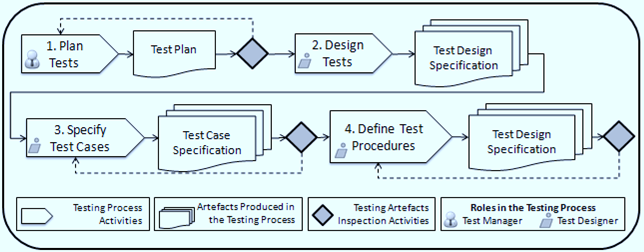
<ref-list>
<ref id="B1">
<label>(1)</label><nlm-citation citation-type="journal">
<person-group person-group-type="author">
<name>
<surname><![CDATA[Basili]]></surname>
<given-names><![CDATA[V.R]]></given-names>
</name>
<name>
<surname><![CDATA[Selby]]></surname>
<given-names><![CDATA[R.W]]></given-names>
</name>
<name>
<surname><![CDATA[Hutchens]]></surname>
<given-names><![CDATA[D.H]]></given-names>
</name>
</person-group>
<article-title xml:lang="en"><![CDATA[Experimentation in Software Engineering]]></article-title>
<source><![CDATA[IEEE Transactions on Software Engineering]]></source>
<year>1986</year>
<volume>12</volume>
<numero>7</numero>
<issue>7</issue>
<page-range>733-743</page-range></nlm-citation>
</ref>
<ref id="B2">
<label>(2)</label><nlm-citation citation-type="journal">
<person-group person-group-type="author">
<name>
<surname><![CDATA[Hannay]]></surname>
<given-names><![CDATA[J. E]]></given-names>
</name>
<name>
<surname><![CDATA[Hansen]]></surname>
<given-names><![CDATA[O]]></given-names>
</name>
<name>
<surname><![CDATA[By Kampenes]]></surname>
<given-names><![CDATA[V]]></given-names>
</name>
<name>
<surname><![CDATA[Karahasanovic]]></surname>
<given-names><![CDATA[A]]></given-names>
</name>
<name>
<surname><![CDATA[Liborg]]></surname>
<given-names><![CDATA[N]]></given-names>
</name>
<name>
<surname><![CDATA[Rekdal]]></surname>
<given-names><![CDATA[C]]></given-names>
</name>
</person-group>
<article-title xml:lang="en"><![CDATA[A Survey of Controlled Experiments in Software Engineering]]></article-title>
<source><![CDATA[IEEE Transaction on Software Engineering]]></source>
<year>2005</year>
<volume>31</volume>
<numero>9</numero>
<issue>9</issue>
<page-range>733-753</page-range></nlm-citation>
</ref>
<ref id="B3">
<label>(3)</label><nlm-citation citation-type="confpro">
<person-group person-group-type="author">
<name>
<surname><![CDATA[Shull]]></surname>
<given-names><![CDATA[F]]></given-names>
</name>
<name>
<surname><![CDATA[Carver]]></surname>
<given-names><![CDATA[J]]></given-names>
</name>
<name>
<surname><![CDATA[Travassos]]></surname>
<given-names><![CDATA[G]]></given-names>
</name>
</person-group>
<article-title xml:lang="en"><![CDATA[An Empirical Methodology for Introducing Software Processes]]></article-title>
<source><![CDATA[]]></source>
<year>2001</year>
<conf-name><![CDATA[89 ESECACM SIGSOFT FSE-9]]></conf-name>
<conf-loc> </conf-loc>
</nlm-citation>
</ref>
<ref id="B4">
<label>(4)</label><nlm-citation citation-type="confpro">
<person-group person-group-type="author">
<name>
<surname><![CDATA[Dias Neto]]></surname>
<given-names><![CDATA[A. C]]></given-names>
</name>
<name>
<surname><![CDATA[Spinola]]></surname>
<given-names><![CDATA[R]]></given-names>
</name>
<name>
<surname><![CDATA[Travassos]]></surname>
<given-names><![CDATA[G. H]]></given-names>
</name>
</person-group>
<article-title xml:lang="en"><![CDATA[Developing Software Technologies through Experimentation: Experiences from the Battlefield]]></article-title>
<source><![CDATA[]]></source>
<year>2010</year>
<volume>I</volume>
<conf-name><![CDATA[XIII Congresso Iberoamericano en "Software Engineering]]></conf-name>
<conf-loc> </conf-loc>
<page-range>107-121</page-range><publisher-loc><![CDATA[Cuenca ]]></publisher-loc>
<publisher-name><![CDATA[Universidad del Azuay]]></publisher-name>
</nlm-citation>
</ref>
<ref id="B5">
<label>(5)</label><nlm-citation citation-type="journal">
<person-group person-group-type="author">
<name>
<surname><![CDATA[Biolchini]]></surname>
<given-names><![CDATA[J]]></given-names>
</name>
<name>
<surname><![CDATA[Mian]]></surname>
<given-names><![CDATA[P]]></given-names>
</name>
<name>
<surname><![CDATA[Conte]]></surname>
<given-names><![CDATA[T. U]]></given-names>
</name>
<name>
<surname><![CDATA[Natali]]></surname>
<given-names><![CDATA[A. C. C]]></given-names>
</name>
<name>
<surname><![CDATA[Travassos]]></surname>
<given-names><![CDATA[G. H]]></given-names>
</name>
</person-group>
<article-title xml:lang="en"><![CDATA[Scientific research ontology to support systematic review]]></article-title>
<source><![CDATA[Software Engineering. Advanced Engineering Informatics]]></source>
<year>2007</year>
<volume>21</volume>
<page-range>133-151</page-range></nlm-citation>
</ref>
<ref id="B6">
<label>(6)</label><nlm-citation citation-type="confpro">
<person-group person-group-type="author">
<name>
<surname><![CDATA[Siy]]></surname>
<given-names><![CDATA[H]]></given-names>
</name>
<name>
<surname><![CDATA[Wu]]></surname>
<given-names><![CDATA[Y]]></given-names>
</name>
</person-group>
<article-title xml:lang="en"><![CDATA[An Ontology to Support Empirical Studies in Software Engineering]]></article-title>
<source><![CDATA[]]></source>
<year>2009</year>
<conf-name><![CDATA[ International Conference on Computing, Engineering and Information]]></conf-name>
<conf-date>April, 2009</conf-date>
<conf-loc> </conf-loc>
<page-range>12-15</page-range></nlm-citation>
</ref>
<ref id="B7">
<label>(7)</label><nlm-citation citation-type="confpro">
<person-group person-group-type="author">
<name>
<surname><![CDATA[Lopes]]></surname>
<given-names><![CDATA[V. P]]></given-names>
</name>
<name>
<surname><![CDATA[Travassos]]></surname>
<given-names><![CDATA[G. H]]></given-names>
</name>
</person-group>
<article-title xml:lang="en"><![CDATA[Knowledge Repository Structure of an Experimental Software Engineering Environment]]></article-title>
<source><![CDATA[]]></source>
<year></year>
<volume>1</volume>
<conf-name><![CDATA[XXIII Brazilian Symposium on Software Engineering]]></conf-name>
<conf-date>2009</conf-date>
<conf-loc>Fortaleza </conf-loc>
<page-range>32-42</page-range></nlm-citation>
</ref>
<ref id="B8">
<label>(8)</label><nlm-citation citation-type="confpro">
<person-group person-group-type="author">
<name>
<surname><![CDATA[Travassos]]></surname>
<given-names><![CDATA[G.H]]></given-names>
</name>
<name>
<surname><![CDATA[Santos]]></surname>
<given-names><![CDATA[P.S . M.;]]></given-names>
</name>
<name>
<surname><![CDATA[Mian]]></surname>
<given-names><![CDATA[P]]></given-names>
</name>
<name>
<surname><![CDATA[Dias-Neto]]></surname>
<given-names><![CDATA[A.C]]></given-names>
</name>
<name>
<surname><![CDATA[Biolchini]]></surname>
<given-names><![CDATA[J]]></given-names>
</name>
</person-group>
<article-title xml:lang="en"><![CDATA[An Environment to Support Large Scale Experimentation in Software Engineering]]></article-title>
<source><![CDATA[]]></source>
<year></year>
<conf-name><![CDATA[ IEEE International Conference on Engineering of Complex Computer Systems]]></conf-name>
<conf-date>2008</conf-date>
<conf-loc>Belfast </conf-loc>
<page-range>193-202</page-range></nlm-citation>
</ref>
<ref id="B9">
<label>(9)</label><nlm-citation citation-type="">
<person-group person-group-type="author">
<name>
<surname><![CDATA[Luo]]></surname>
<given-names><![CDATA[L]]></given-names>
</name>
</person-group>
<article-title xml:lang="en"><![CDATA[), Software Testing Techniques: Technology Maturation and Research Strategies]]></article-title>
<collab>Carnegie Mellon University^dInstitute for Software Research International</collab>
<source><![CDATA[]]></source>
<year>2010</year>
<publisher-loc><![CDATA[Pittsburgh ]]></publisher-loc>
</nlm-citation>
</ref>
<ref id="B10">
<label>(10)</label><nlm-citation citation-type="journal">
<person-group person-group-type="author">
<name>
<surname><![CDATA[Poon]]></surname>
<given-names><![CDATA[P.L]]></given-names>
</name>
<name>
<surname><![CDATA[Tse]]></surname>
<given-names><![CDATA[T. H]]></given-names>
</name>
<name>
<surname><![CDATA[Tang]]></surname>
<given-names><![CDATA[S.F]]></given-names>
</name>
<name>
<surname><![CDATA[Kuo]]></surname>
<given-names><![CDATA[F.C]]></given-names>
</name>
</person-group>
<article-title xml:lang="en"><![CDATA[Contributions of tester experience and a checklist guideline to the identification of categories and choices for software testing]]></article-title>
<source><![CDATA[Software Quality Control]]></source>
<year>2011</year>
<month>Ma</month>
<day>rc</day>
<volume>19</volume>
<numero>1</numero>
<issue>1</issue>
<page-range>141-163</page-range></nlm-citation>
</ref>
<ref id="B11">
<label>(11)</label><nlm-citation citation-type="confpro">
<person-group person-group-type="author">
<name>
<surname><![CDATA[Itoken]]></surname>
<given-names><![CDATA[J. V]]></given-names>
</name>
<name>
<surname><![CDATA[Mantyla]]></surname>
<given-names><![CDATA[M,V]]></given-names>
</name>
<name>
<surname><![CDATA[Lassenius]]></surname>
<given-names><![CDATA[C]]></given-names>
</name>
</person-group>
<article-title xml:lang="en"><![CDATA[Defect Detection Efficiency: Test Case Based vs. Exploratory Testing]]></article-title>
<source><![CDATA[]]></source>
<year>2007</year>
<conf-name><![CDATA[ First International Symposium on Empirical Software Engineering and Measurement]]></conf-name>
<conf-loc> </conf-loc>
<page-range>61-70</page-range></nlm-citation>
</ref>
<ref id="B12">
<label>(12)</label><nlm-citation citation-type="journal">
<person-group person-group-type="author">
<name>
<surname><![CDATA[Fagan]]></surname>
<given-names><![CDATA[M]]></given-names>
</name>
</person-group>
<article-title xml:lang="en"><![CDATA[Design and Code Inspections to Reduce Errors in Program Development]]></article-title>
<source><![CDATA[IBM Systems Journal]]></source>
<year>1976</year>
<volume>15</volume>
<numero>3</numero>
<issue>3</issue>
<page-range>182-211</page-range><publisher-loc><![CDATA[Riverton ]]></publisher-loc>
</nlm-citation>
</ref>
<ref id="B13">
<label>(13)</label><nlm-citation citation-type="confpro">
<person-group person-group-type="author">
<name>
<surname><![CDATA[Brito]]></surname>
<given-names><![CDATA[J]]></given-names>
</name>
<name>
<surname><![CDATA[Dias-Neto]]></surname>
<given-names><![CDATA[A.C]]></given-names>
</name>
</person-group>
<article-title xml:lang="pt"><![CDATA[TestCheck - A Checklist-Based Approach to Inspect Software Testing Artifacts]]></article-title>
<source><![CDATA[]]></source>
<year></year>
<conf-name><![CDATA[ Brazilian Symposium on Software Quality]]></conf-name>
<conf-date>Junho, 2012</conf-date>
<conf-loc>Fortaleza </conf-loc>
</nlm-citation>
</ref>
<ref id="B14">
<label>(14)</label><nlm-citation citation-type="confpro">
<person-group person-group-type="author">
<name>
<surname><![CDATA[Barcelos]]></surname>
<given-names><![CDATA[R. F]]></given-names>
</name>
<name>
<surname><![CDATA[Travassos]]></surname>
<given-names><![CDATA[G. H]]></given-names>
</name>
</person-group>
<article-title xml:lang="en"><![CDATA[An Approach to Inspect Architectural Artifacts Based on Checklist]]></article-title>
<source><![CDATA[]]></source>
<year></year>
<conf-name><![CDATA[ Braziliam Symposium on Software Quality]]></conf-name>
<conf-date>2006</conf-date>
<conf-loc>Vila Velha </conf-loc>
</nlm-citation>
</ref>
<ref id="B15">
<label>(15)</label><nlm-citation citation-type="confpro">
<person-group person-group-type="author">
<name>
<surname><![CDATA[Conte]]></surname>
<given-names><![CDATA[T. U]]></given-names>
</name>
<name>
<surname><![CDATA[Vaz]]></surname>
<given-names><![CDATA[V.T]]></given-names>
</name>
<name>
<surname><![CDATA[Massolar]]></surname>
<given-names><![CDATA[J]]></given-names>
</name>
<name>
<surname><![CDATA[Mendes]]></surname>
<given-names><![CDATA[E]]></given-names>
</name>
<name>
<surname><![CDATA[Travassos]]></surname>
<given-names><![CDATA[G. H]]></given-names>
</name>
</person-group>
<article-title xml:lang="en"><![CDATA[Improving a Web Usability Inspection Technique using Qualitative and Quantitative Data from an Observational Study]]></article-title>
<source><![CDATA[]]></source>
<year></year>
<volume>1</volume>
<conf-name><![CDATA[ Simpósio Brasileiro de Engenharia de Software]]></conf-name>
<conf-date>2009</conf-date>
<conf-loc> </conf-loc>
<page-range>227-235</page-range><publisher-loc><![CDATA[Fortaleza ]]></publisher-loc>
</nlm-citation>
</ref>
<ref id="B16">
<label>(16)</label><nlm-citation citation-type="confpro">
<person-group person-group-type="author">
<name>
<surname><![CDATA[Mafra]]></surname>
<given-names><![CDATA[S. N]]></given-names>
</name>
<name>
<surname><![CDATA[Travassos]]></surname>
<given-names><![CDATA[G. H]]></given-names>
</name>
</person-group>
<article-title xml:lang="en"><![CDATA[A Skeptical Discussion Regarding Experimentation in Software Engineering Based on Reading Techniques Studies]]></article-title>
<source><![CDATA[]]></source>
<year></year>
<conf-name><![CDATA[2 Experimental Software Engineering Latin American Workshop]]></conf-name>
<conf-date>2005</conf-date>
<conf-loc>Uberlandia </conf-loc>
</nlm-citation>
</ref>
<ref id="B17">
<label>(17)</label><nlm-citation citation-type="">
<person-group person-group-type="author">
<name>
<surname><![CDATA[Brito]]></surname>
<given-names><![CDATA[J]]></given-names>
</name>
<name>
<surname><![CDATA[Dias-Neto]]></surname>
<given-names><![CDATA[A. C]]></given-names>
</name>
</person-group>
<article-title xml:lang="pt"><![CDATA[Conduzindo Estudos Experimentais para Avaliação de uma Técnica de Inspeção de Artefatos de Teste de Software]]></article-title>
<source><![CDATA[Experimental Software Engineering Latin American Workshop (ESELAW 2012)]]></source>
<year>2012</year>
<page-range>41-50</page-range><publisher-loc><![CDATA[Buenos Aires ]]></publisher-loc>
</nlm-citation>
</ref>
<ref id="B18">
<label>(18)</label><nlm-citation citation-type="journal">
<person-group person-group-type="author">
<name>
<surname><![CDATA[Laitenberger]]></surname>
<given-names><![CDATA[O]]></given-names>
</name>
<name>
<surname><![CDATA[DeBaud]]></surname>
<given-names><![CDATA[J.M]]></given-names>
</name>
</person-group>
<article-title xml:lang="en"><![CDATA[Perspective-based Reading of Code documents at Robert Bosch GmbH]]></article-title>
<source><![CDATA[Information and Software Technology]]></source>
<year>1997</year>
<volume>39</volume>
<page-range>781-791</page-range></nlm-citation>
</ref>
<ref id="B19">
<label>(19)</label><nlm-citation citation-type="book">
<source><![CDATA[IEEE Standard 829-2008: Standard for Software Test Documentation]]></source>
<year>2008</year>
<publisher-name><![CDATA[IEEE Press]]></publisher-name>
</nlm-citation>
</ref>
<ref id="B20">
<label>(20)</label><nlm-citation citation-type="confpro">
<person-group person-group-type="author">
<name>
<surname><![CDATA[Sidek]]></surname>
<given-names><![CDATA[R.M]]></given-names>
</name>
<name>
<surname><![CDATA[Noraziah]]></surname>
<given-names><![CDATA[A]]></given-names>
</name>
<name>
<surname><![CDATA[Wahab]]></surname>
<given-names><![CDATA[M.H.A]]></given-names>
</name>
</person-group>
<article-title xml:lang="en"><![CDATA[The Preferable Test Documentation Using IEEE 829]]></article-title>
<source><![CDATA[]]></source>
<year>2011</year>
<volume>181</volume>
<conf-name><![CDATA[ International Conference on Software Engineering and Computer Systems]]></conf-name>
<conf-loc> </conf-loc>
<page-range>109-118</page-range></nlm-citation>
</ref>
<ref id="B21">
<label>(21)</label><nlm-citation citation-type="confpro">
<person-group person-group-type="author">
<name>
<surname><![CDATA[Dias-Neto]]></surname>
<given-names><![CDATA[A. C]]></given-names>
</name>
<name>
<surname><![CDATA[Travassos]]></surname>
<given-names><![CDATA[G. H]]></given-names>
</name>
</person-group>
<article-title xml:lang="en"><![CDATA[Evolving a Computerized Infrastructure to support the Selection of Model-Based Testing Techniques.]]></article-title>
<source><![CDATA[]]></source>
<year>2010</year>
<conf-name><![CDATA[ IFIP International Conference on Testing Software and Systems]]></conf-name>
<conf-loc> </conf-loc>
<page-range>85-90</page-range><publisher-loc><![CDATA[Natal ]]></publisher-loc>
</nlm-citation>
</ref>
</ref-list>
</back>
</article>