<?xml version="1.0" encoding="ISO-8859-1"?><article xmlns:mml="http://www.w3.org/1998/Math/MathML" xmlns:xlink="http://www.w3.org/1999/xlink" xmlns:xsi="http://www.w3.org/2001/XMLSchema-instance">
<front>
<journal-meta>
<journal-id>0717-5000</journal-id>
<journal-title><![CDATA[CLEI Electronic Journal]]></journal-title>
<abbrev-journal-title><![CDATA[CLEIej]]></abbrev-journal-title>
<issn>0717-5000</issn>
<publisher>
<publisher-name><![CDATA[Centro Latinoamericano de Estudios en Informática]]></publisher-name>
</publisher>
</journal-meta>
<article-meta>
<article-id>S0717-50002013000100003</article-id>
<title-group>
<article-title xml:lang="en"><![CDATA[From MoProSoft Level 2 to ISO/IEC 29110 Basic Profile: Bridging the Gap]]></article-title>
</title-group>
<contrib-group>
<contrib contrib-type="author">
<name>
<surname><![CDATA[Morales-Trujillo]]></surname>
<given-names><![CDATA[Miguel E.]]></given-names>
</name>
<xref ref-type="aff" rid="A01"/>
</contrib>
<contrib contrib-type="author">
<name>
<surname><![CDATA[Oktaba]]></surname>
<given-names><![CDATA[Hanna]]></given-names>
</name>
<xref ref-type="aff" rid="A01"/>
</contrib>
<contrib contrib-type="author">
<name>
<surname><![CDATA[Ventura]]></surname>
<given-names><![CDATA[Teresa]]></given-names>
</name>
<xref ref-type="aff" rid="A01"/>
</contrib>
<contrib contrib-type="author">
<name>
<surname><![CDATA[Torres]]></surname>
<given-names><![CDATA[Rodrigo]]></given-names>
</name>
<xref ref-type="aff" rid="A02"/>
</contrib>
</contrib-group>
<aff id="A01">
<institution><![CDATA[,Universidad Nacional Autónoma de México Ciencia e Ingeniería de la Computación ]]></institution>
<addr-line><![CDATA[ ]]></addr-line>
<country>México</country>
</aff>
<aff id="A02">
<institution><![CDATA[,INNEVO Servicios de Consultoría de Calidad ]]></institution>
<addr-line><![CDATA[Ciudad de México ]]></addr-line>
<country>México</country>
</aff>
<pub-date pub-type="pub">
<day>00</day>
<month>04</month>
<year>2013</year>
</pub-date>
<pub-date pub-type="epub">
<day>00</day>
<month>04</month>
<year>2013</year>
</pub-date>
<volume>16</volume>
<numero>1</numero>
<fpage>3</fpage>
<lpage>3</lpage>
<copyright-statement/>
<copyright-year/>
<self-uri xlink:href="http://www.scielo.edu.uy/scielo.php?script=sci_arttext&amp;pid=S0717-50002013000100003&amp;lng=en&amp;nrm=iso"></self-uri><self-uri xlink:href="http://www.scielo.edu.uy/scielo.php?script=sci_abstract&amp;pid=S0717-50002013000100003&amp;lng=en&amp;nrm=iso"></self-uri><self-uri xlink:href="http://www.scielo.edu.uy/scielo.php?script=sci_pdf&amp;pid=S0717-50002013000100003&amp;lng=en&amp;nrm=iso"></self-uri><abstract abstract-type="short" xml:lang="en"><p><![CDATA[The spread of the interest and the need for process reference models, specifically for small and medium software development organizations, has been a catalyst for generating ISO/IEC 29110 Software Engineering - Lifecycle profiles for Very Small Entities. Based on the Mexican standard NMX-I-059-NYCE-2005, better known as MoProSoft, ISO/IEC 29110 is the first international standard specifically designed for very small entities. Thanks to the COMPETISOFT Project and MoProSoft, the background knowledge and models adoption experience have been introduced in Latin America. In Mexico more than 300 organizations have been evaluated in NMX-I-059-NYCE-2005, in 2009 MoProSoft became a national standard in Peru, while COMPETISOFT included the experience and viewpoints of 13 countries and 23 research groups of the region. As a whole, it gives small software development organizations in the region an advantage in adopting an international standard. This paper clarifies the gap between ISO/IEC 29110 and MoProSoft level 2. As a result of a theoretical and practical review both standards have been mapped defining the coverage level between processes, considering the defined tasks, work products and roles. Several recommendations have been suggested to bridge the gap between these standards. Finally, the effort needed to adopt the Basic Profile of the new international standard starting from the Mexican standard has been estimated. The results have been extended to also consider organizations that adopted COMPETISOFT as their process reference model.]]></p></abstract>
<abstract abstract-type="short" xml:lang="es"><p><![CDATA[La propagación del interés y la necesidad de modelos de referencia de procesos, específicamente dirigidos para las pequeñas y medianas organizaciones desarrolladoras de software, fueron catalizadores para la generación de la norma ISO/IEC 29110 Ingeniería del Software - Perfiles de ciclo de vida para pequeñas organizaciones. Basada en la norma mexicana NMX-I-059-NYCE-2005, mejor conocida como MoProSoft, ISO/IEC 29110 es el primer estándar internacional diseñado específicamente para organizaciones pequeñas. Gracias al Proyecto COMPETISOFT y MoProSoft, en América Latina se adquirieron el conocimiento previo y la experiencia en adopción de modelos. En México, más de 300 organizaciones han sido evaluadas bajo la NMX-I-059-NYCE-2005; en 2009, en Perú, MoProSoft se convirtió en estándar nacional. Mientras que COMPETISOFT incluyó la experiencia y puntos de vista de 13 países y 23 grupos de investigación de la región. En conjunto, esto da a las pequeñas organizaciones de desarrollo de software de la región una importante ventaja para la adopción de la norma internacional. Este artículo clarifica la brecha entre la norma ISO/IEC 29110 y MoProSoft nivel 2. Como resultado de la revisión teórica y práctica, ambas normas fueron mapeadas definiendo el nivel de cobertura entre sus procesos, para este mapeo se tomaron en cuenta las tareas, productos de trabajo y roles definidos en ambas normas. Diversas recomendaciones se sugieren para reducir la brecha entre ellas. Por último, se presenta una estimación del esfuerzo necesario para adoptar el Perfil Básico de la nueva norma internacional a partir de la norma mexicana. Los resultados obtenidos de este mapeo se ampliaron para considerar también a aquellas organizaciones que adoptaron COMPETISOFT como modelo de referencia de procesos y quisieran adoptar el Perfil Básico.]]></p></abstract>
<kwd-group>
<kwd lng="es"><![CDATA[ISO/IEC 29110]]></kwd>
<kwd lng="es"><![CDATA[MoProSoft]]></kwd>
<kwd lng="es"><![CDATA[COMPETISOFT]]></kwd>
<kwd lng="es"><![CDATA[ISO/IEC 29110]]></kwd>
<kwd lng="es"><![CDATA[MoProSoft]]></kwd>
<kwd lng="es"><![CDATA[COMPETISOFT]]></kwd>
</kwd-group>
</article-meta>
</front><body><![CDATA[  <font face="Verdana" size="2">&nbsp; </font>     <div class="Section1">     <p style="margin: 0cm 0cm 0.0001pt;"><span lang="EN-US"> <font face="Verdana" size="2">&nbsp;</font></span><o:p></o:p></p>     <p style="margin: 0cm 0cm 0.0001pt;"><b><span lang="EN-US"> <font face="Verdana" size="4">From MoProSoft Level 2 to ISO/IEC 29110 Basic Profile: Bridging the Gap</font></span></b><o:p></o:p></p> </div> <b style=""> <span  style="font-size: 10pt; font-family: &quot;Verdana&quot;;" lang="EN-US"><br  style="page-break-before: auto;" clear="all"> </span></b>     <div class="Section2">     <p style="text-align: center;" align="center"><span  style="font-size: 10pt; font-style: normal;" lang="EN-US"><font face="Verdana">&nbsp;</font><o:p></o:p></span></p>     <p style="text-align: center;" align="center"><b  style=""><span style="font-size: 10pt; font-style: normal;"  lang="EN-US"><o:p></o:p></span></b></p>     <p style="text-align: center;" align="center"><b  style=""><span style="font-style: normal;" lang="ES-MX"> <font face="Verdana" size="2">Miguel E. Morales-Trujillo</font><o:p></o:p></span></b></p>     <p style="text-align: center;" align="center"><span  style="font-style: normal;" lang="ES-MX"><font face="Verdana" size="2">Universidad Nacional Aut&oacute;noma de M&eacute;xico, </font> <o:p></o:p></span></p>     <p style="text-align: center;" align="center"><span  style="font-style: normal;" lang="ES-MX"><font face="Verdana" size="2">Posgrado en Ciencia e Ingenier&iacute;a de la Computaci&oacute;n,</font><o:p></o:p></span></p>     ]]></body>
<body><![CDATA[<p style="text-align: center;" align="center"><span  style="font-style: normal;" lang="ES-MX"><font face="Verdana" size="2">Ciudad Universitaria, M&eacute;xico, 04510</font><o:p></o:p></span></p>     <p style="text-align: center;" align="center"><span  style="" lang="ES-MX"><font face="Verdana" size="2">&lt;<a href="mailto:migmor@ciencias.unam.mx">migmor@ciencias.unam.mx</a></font><o:p></o:p></span></p>     <p style="text-align: center;" align="center"><span  style="font-style: normal;" lang="ES-MX"><font face="Verdana" size="2">&nbsp;</font><o:p></o:p></span></p>     <p style="text-align: center;" align="center"><span  style="font-style: normal;" lang="ES-MX"><font face="Verdana" size="2">and</font><o:p></o:p></span></p>     <p style="text-align: center;" align="center"><span  style="font-style: normal;" lang="ES-MX"><font face="Verdana" size="2">&nbsp;</font><o:p></o:p></span></p>     <p style="text-align: center;" align="center"><b  style=""><span style="font-style: normal;" lang="ES-MX"> <font face="Verdana" size="2">Hanna Oktaba</font><o:p></o:p></span></b></p>     <p style="text-align: center;" align="center"><span  style="font-style: normal;" lang="ES-MX"><font face="Verdana" size="2">Universidad Nacional Aut&oacute;noma de M&eacute;xico, </font> <o:p></o:p></span></p>     <p style="text-align: center;" align="center"><span  style="font-style: normal;" lang="ES-MX"><font face="Verdana" size="2">Posgrado en Ciencia e Ingenier&iacute;a de la Computaci&oacute;n,</font><o:p></o:p></span></p>     <p style="text-align: center;" align="center"><span  style="font-style: normal;" lang="ES-MX"><font face="Verdana" size="2">Ciudad Universitaria, M&eacute;xico, 04510</font><o:p></o:p></span></p>     <p style="text-align: center;" align="center"><font face="Verdana"><span  style="" lang="ES-MX"><a href="mailto:hanna.oktaba@ciencias.unam.mx"> <font size="2">hanna.oktaba@ciencias.unam.mx</font></a></span></font><span  style="font-style: normal;" lang="ES-MX"><font size="2" face="Verdana"> </font> <o:p></o:p></span></p>     ]]></body>
<body><![CDATA[<p style="text-align: center;" align="center"><span  style="font-style: normal;" lang="ES-MX"><font face="Verdana" size="2">&nbsp;</font><o:p></o:p></span></p>     <p style="text-align: center;" align="center"><span  style="font-style: normal;" lang="ES-MX"><font face="Verdana" size="2">and</font><o:p></o:p></span></p>     <p style="text-align: center;" align="center"><span  style="font-style: normal;" lang="ES-MX"><font face="Verdana" size="2">&nbsp;</font><o:p></o:p></span></p>     <p style="text-align: center;" align="center"><font face="Verdana" size="2"><b  style=""><span style="font-style: normal;" lang="ES-MX">Teresa Ventura</span></b></font><span  style="font-style: normal;" lang="ES-MX"><o:p></o:p></span></p>     <p style="text-align: center;" align="center"><span  style="font-style: normal;" lang="ES-MX"><font face="Verdana" size="2">Universidad Nacional Aut&oacute;noma de M&eacute;xico, </font> <o:p></o:p></span></p>     <p style="text-align: center;" align="center"><span  style="font-style: normal;" lang="ES-MX"><font face="Verdana" size="2">Direcci&oacute;n General de C&oacute;mputo y de Tecnolog&iacute;as de Informaci&oacute;n y Comunicaci&oacute;n,</font><o:p></o:p></span></p>     <p style="text-align: center;" align="center"><span  style="font-style: normal;" lang="ES-MX"><font face="Verdana" size="2">Ciudad Universitaria, M&eacute;xico, 04510</font><o:p></o:p></span></p>     <p style="text-align: center;" align="center"><span  style="" lang="ES-MX"><font face="Verdana" size="2"><a href="mailto:tventura@unam.mx">tventura@unam.mx</a></font><o:p></o:p></span></p>     <p style="text-align: center;" align="center"><span  style="font-style: normal;" lang="ES-MX"><font face="Verdana" size="2">&nbsp;</font><o:p></o:p></span></p>     <p style="text-align: center;" align="center"><span  style="font-style: normal;" lang="ES-MX"><font face="Verdana" size="2">and</font><o:p></o:p></span></p>     ]]></body>
<body><![CDATA[<p style="text-align: center;" align="center"><span  style="font-style: normal;" lang="ES-MX"><font face="Verdana" size="2">&nbsp;</font><o:p></o:p></span></p>     <p style="text-align: center;" align="center"><font face="Verdana" size="2"><b  style=""><span style="font-style: normal;" lang="ES-MX">Rodrigo Torres</span></b></font><span  style="font-style: normal;" lang="ES-MX"><o:p></o:p></span></p>     <p style="text-align: center;" align="center"><span  style="font-style: normal;" lang="ES-MX"><font face="Verdana" size="2">INNEVO,</font><o:p></o:p></span></p>     <p style="text-align: center;" align="center"><span  style="font-style: normal;" lang="ES-MX"><font face="Verdana" size="2">Servicios de Consultor&iacute;a de Calidad,</font><o:p></o:p></span></p>     <p style="text-align: center;" align="center"><span  style="font-style: normal;" lang="ES-MX"><font face="Verdana" size="2">Ciudad de M&eacute;xico, M&eacute;xico, 02300</font><o:p></o:p></span></p>     <p style="text-align: center;" align="center"><span  style="" lang="ES-MX"><font face="Verdana" size="2"><a href="mailto:rtorres@innevo.com">rtorres@innevo.com</a></font><o:p></o:p></span></p> </div> <i style=""> <span  style="font-size: 10pt; font-family: &quot;Verdana&quot;;" lang="ES-MX"><br  style="page-break-before: auto;" clear="all"> </span></i>     <div class="Section3"></div> <span style="font-size: 10pt; font-family: &quot;Verdana&quot;;"  lang="ES-MX"><br style="page-break-before: always;" clear="all"> </span>     <div class="Section4">     <p style="margin: 12pt 45pt 6pt;"><font face="Verdana" size="2"><span lang="EN-US">Abstract</span></font></p>     <p  style="margin: 0cm 45pt 0.0001pt; text-align: justify;"><span  style="font-size: 10pt;" lang="EN-US"><font face="Verdana">The spread of the interest and the need for process reference models, specifically for small and medium software development organizations, has been a catalyst for generating ISO/IEC 29110 Software Engineering &mdash; Lifecycle profiles for Very Small Entities. Based on the Mexican standard NMX-I-059-NYCE-2005, better known as MoProSoft, ISO/IEC 29110 is the first international standard specifically designed for very small entities. </font> <o:p></o:p></span></p>     ]]></body>
<body><![CDATA[<p  style="margin: 0cm 45pt 0.0001pt; text-align: justify;"><span  style="font-size: 10pt;" lang="EN-US"><font face="Verdana">Thanks to the COMPETISOFT Project and MoProSoft, the background knowledge and models adoption experience have been introduced in Latin America. In Mexico more than 300 organizations have been evaluated in NMX-I-059-NYCE-2005, in 2009 MoProSoft became a national standard in Peru, while COMPETISOFT included the experience and viewpoints of 13 countries and 23 research groups of the region. As a whole, it gives small software development organizations in the region an advantage in adopting an international standard.</font><o:p></o:p></span></p>     <p  style="margin: 0cm 45pt 0.0001pt; text-align: justify;"><span  style="font-size: 10pt;" lang="EN-US"><font face="Verdana">This paper clarifies the gap between ISO/IEC 29110 and MoProSoft level 2. As a result of a theoretical and practical review both standards have been mapped defining the coverage level between processes, considering the defined tasks, work products and roles. Several recommendations have been suggested to bridge the gap between these standards. Finally, the effort needed to adopt the Basic Profile of the new international standard starting from the Mexican standard has been estimated. The results have been extended to also consider organizations that adopted COMPETISOFT as their process reference model. </font> <o:p></o:p></span></p>     <p style="margin: 12pt 45pt 6pt;"><font face="Verdana" size="2"><span lang="EN-US">Spanish abstract</span></font></p>     <p  style="margin: 0cm 45pt 0.0001pt; text-align: justify;"><span  style="font-size: 10pt;" lang="EN-US"><font face="Verdana">La propagaci&oacute;n del inter&eacute;s y la necesidad de modelos de referencia de procesos, espec&iacute;ficamente dirigidos para las peque&ntilde;as y medianas organizaciones desarrolladoras de software, fueron catalizadores para la generaci&oacute;n de la norma ISO/IEC 29110 Ingenier&iacute;a del Software &mdash; Perfiles de ciclo de vida para peque&ntilde;as organizaciones. Basada en la norma mexicana NMX-I-059-NYCE-2005, mejor conocida como MoProSoft, ISO/IEC 29110 es el primer est&aacute;ndar internacional dise&ntilde;ado espec&iacute;ficamente para organizaciones peque&ntilde;as.</font><o:p></o:p></span></p>     <p  style="margin: 0cm 45pt 0.0001pt; text-align: justify;"><span  style="font-size: 10pt;" lang="EN-US"><font face="Verdana">Gracias al Proyecto COMPETISOFT y MoProSoft, en Am&eacute;rica Latina se adquirieron el conocimiento previo y la experiencia en adopci&oacute;n de modelos. En M&eacute;xico, m&aacute;s de 300 organizaciones han sido evaluadas bajo la NMX-I-059-NYCE-2005; en 2009, en Per&uacute;, MoProSoft se convirti&oacute; en est&aacute;ndar nacional. Mientras que COMPETISOFT incluy&oacute; la experiencia y puntos de vista de 13 pa&iacute;ses y 23 grupos de investigaci&oacute;n de la regi&oacute;n. En conjunto, esto da a las peque&ntilde;as organizaciones de desarrollo de software de la regi&oacute;n una importante ventaja para la adopci&oacute;n de la norma internacional.</font><o:p></o:p></span></p>     <p  style="margin: 0cm 45pt 0.0001pt; text-align: justify;"><span  style="font-size: 10pt;" lang="EN-US"><font face="Verdana">Este art&iacute;culo clarifica la brecha entre la norma ISO/IEC 29110 y MoProSoft nivel 2. Como resultado de la revisi&oacute;n te&oacute;rica y pr&aacute;ctica, ambas normas fueron mapeadas definiendo el nivel de cobertura entre sus procesos, para este mapeo se tomaron en cuenta las tareas, productos de trabajo y roles definidos en ambas normas. Diversas recomendaciones se sugieren para reducir la brecha entre ellas. Por &uacute;ltimo, se presenta una estimaci&oacute;n del esfuerzo necesario para adoptar el Perfil B&aacute;sico de la nueva norma internacional a partir de la norma mexicana. Los resultados obtenidos de este mapeo se ampliaron para considerar tambi&eacute;n a aquellas organizaciones que adoptaron COMPETISOFT como modelo de referencia de procesos y quisieran adoptar el Perfil B&aacute;sico.</font><o:p></o:p></span></p>     <p  style="margin: 0cm 45pt 0.0001pt; text-align: justify;"><span  style="font-size: 10pt;" lang="EN-US"><font face="Verdana">&nbsp;</font><o:p></o:p></span></p>     <p  style="margin: 0cm 45pt 0.0001pt; text-align: justify; text-indent: 0cm;"> <span  style="font-size: 10pt; font-family: &quot;Verdana&quot;;" lang="EN-US">Keywords: </span><font face="Verdana"> <span  style="font-size: 10pt; font-weight: normal"  lang="EN-US">ISO/IEC 29110, MoProSoft, COMPETISOFT, gap, coverage, adoption, very small entities.</span></font><o:p></o:p></p>     <p  style="margin: 0cm 45pt 0.0001pt; text-align: justify; text-indent: 0cm;"> <span  style="font-size: 10pt; font-family: &quot;Verdana&quot;;" lang="EN-US">Spanish keywords: </span><font face="Verdana"> <span  style="font-size: 10pt; font-weight: normal"  lang="EN-US">ISO/IEC 29110, MoProSoft, COMPETISOFT, brecha, cobertura, adopci&oacute;n, peque&ntilde;as organizaciones.</span></font><o:p></o:p></p>     <p></p>     ]]></body>
<body><![CDATA[<p  style="margin: 0cm 45pt 0.0001pt; text-align: justify; text-indent: 0cm;"> <font face="Verdana"> <span  style="font-size: 10pt; font-weight: normal"  lang="EN-US"> Received: 9/7/2012 Revised: 13/12/2012 Accepted: 29/12/2012 </span></font> <o:p></o:p></p>     <p style="text-align: justify;"><span  style="font-size: 10pt;" lang="EN-US"><font face="Verdana">&nbsp;</font><o:p></o:p></span></p>     <p style="text-align: justify;"><span  style="font-size: 10pt;" lang="EN-US"><font face="Verdana">&nbsp;</font><o:p></o:p></span></p>     <p  style="margin: 0cm 0cm 5.95pt; text-align: justify; text-indent: 0cm;"><b  style=""> <span  style="font-family: &quot;Verdana&quot;; font-style: normal; font-variant: normal; font-weight: normal; font-size: 10pt; line-height: normal; font-size-adjust: none; font-stretch: normal" lang="EN-US">&nbsp;&nbsp;&nbsp;&nbsp;&nbsp;&nbsp;&nbsp;&nbsp;&nbsp;&nbsp;&nbsp;&nbsp;&nbsp;&nbsp;&nbsp;</span><font face="Verdana"><span  style="font-size: 10pt; font-variant: normal"  lang="EN-US">1 Introduction</span></font><o:p></o:p></b></p>     <p style="text-align: justify;"><span  style="font-size: 10pt;" lang="EN-US"><font face="Verdana">The increase of the processes capabilities of a software development organization is regularly guided by a process reference model, for that reason the models should be attached to the environment and maturity of the organization.</font><o:p></o:p></span></p>     <p style="text-align: justify; text-indent: 18.15pt;"><span  style="font-size: 10pt;" lang="EN-US"><font face="Verdana">The need for process reference models, specifically those designed for small and medium organizations, aroused the creation of standards that would fit the particular environment and accomplish objectives of those organizations. </font> <o:p></o:p></span></p>     <p style="text-align: justify; text-indent: 18.15pt;"><span  style="font-size: 10pt;" lang="EN-US"><font face="Verdana">MoProSoft <a href="#r1">(1)</a><a  name="1."></a>, a process reference model developed in Mexico, is one of the first widely known efforts, and then comes its offspring COMPETISOFT <a href="#r2">(2)</a><a name="2."></a>, generated by the Latin American organizations and research groups, thus bringing to the region a culture of models adoption and increasing competitiveness.</font><o:p></o:p></span></p>     <p style="text-align: justify; text-indent: 18.15pt;"><span  style="font-size: 10pt;" lang="EN-US"><font face="Verdana">Those attempts were taken into account by Working Group 24 (WG 24) of ISO/IEC <a href="#r3">(3)</a><a name="3."></a>, who focused on creating an international standard for very small entities ISO/IEC 29110 <a href="#r4">(4)</a><a name="4."></a>, based on the experience acquired from developing MoProSoft.</font><o:p></o:p></span></p>     <p style="text-align: justify; text-indent: 18.15pt;"><span  style="font-size: 10pt;" lang="EN-US"><font face="Verdana">Considering the common origins, the similarity of the target audience and objectives that pursue both standards, a mapping between the ISO/IEC 29110 Basic Profile and MoProSoft was carried out and presented in this work. One of our main concerns was the question: <i style="">What is needed to be done or improved in order to achieve ISO/IEC 29110 Basic Profile if the organization has already adopted MoProSoft level 2?</i> </font> <o:p></o:p></span></p>     <p style="text-align: justify; text-indent: 18.15pt;"><span  style="font-size: 10pt;" lang="EN-US"><font face="Verdana">Finding a clear answer to this question would be a step forward in motivating MoProSoft evaluated organizations to also obtain international recognition adopting ISO/IEC 29110. This work was done by the National Autonomous University of Mexico (UNAM) <a href="#r5">(5)</a><a  name="5."></a> specialists in software process together with consultants from INNEVO <a href="#r6">(6)</a><a name="6."></a> who have experience in the adoption of the Mexican standard and an expert involved in the development of both standards.</font><o:p></o:p></span></p>     ]]></body>
<body><![CDATA[<p style="text-align: justify; text-indent: 18.15pt;"><span  style="font-size: 10pt;" lang="EN-US"><font face="Verdana">This paper is organized as follows: in part 2 we present the Mexican standard for software industry MoProSoft, part 3 shows the origins and structure of ISO/IEC 29110. Later, in part 4 the mapping between standards is presented; part 5 concentrates and analyses the coverage between tasks, work products and roles. Part 6 presents our answer to the initial question making explicit the gap and providing recommendations to bridge it. </font> <o:p></o:p></span></p>     <p style="text-align: justify; text-indent: 18.15pt;"><span  style="font-size: 10pt;" lang="EN-US"><font face="Verdana">In the end, in part 7 an estimated effort, calculated in hours, to fill out the gap is offered and compared against migrating or upgrading to other standards or models. Finally we conclude. </font> <o:p></o:p></span></p>     <p style="margin-left: 0cm; text-align: justify; text-indent: 0cm;"><b  style=""> <span  style="font-family: &quot;Verdana&quot;; font-style: normal; font-variant: normal; font-weight: normal; font-size: 10pt; line-height: normal; font-size-adjust: none; font-stretch: normal; text-transform:uppercase" lang="EN-US">&nbsp;&nbsp;&nbsp;&nbsp;&nbsp;&nbsp;&nbsp;&nbsp;&nbsp;&nbsp;&nbsp;&nbsp;&nbsp;&nbsp;&nbsp;</span><font face="Verdana"><span  style="font-size: 10pt; font-variant: normal; text-transform: uppercase"  lang="EN-US">&nbsp;</span></font><o:p></o:p></b></p>     <p  style="margin: 0cm 0cm 5.95pt; text-align: justify; text-indent: 0cm;"><b> <span  style="font-family: &quot;Verdana&quot;; font-style: normal; font-variant: normal; font-weight: normal; font-size: 10pt; line-height: normal; font-size-adjust: none; font-stretch: normal" lang="EN-US">&nbsp;&nbsp;&nbsp;&nbsp;&nbsp;&nbsp;&nbsp;&nbsp;&nbsp;&nbsp;&nbsp;&nbsp;&nbsp;&nbsp;&nbsp;</span><font face="Verdana"><span  style="font-size: 10pt; font-variant: normal"  lang="EN-US">2 MoProSoft</span></font><o:p></o:p></b></p>     <p style="text-align: justify;"><span  style="font-size: 10pt;" lang="EN-US"><font face="Verdana">In 2002 the Ministry of Economy in Mexico <a href="#r7">(7)</a><a  name="7."></a>, launched a call for proposals to create a process reference model that would accumulate up-to-date sets of best practices in the industry of software development of the country. </font> <o:p></o:p></span></p>     <p style="text-align: justify; text-indent: 18.15pt;"><span  style="font-size: 10pt;" lang="EN-US"><font face="Verdana">The proposal was developed together with the UNAM, the Mexican Association for the Quality in Software Engineering (AMCIS) <a  href="#r8">(8)</a><a name="8."></a> and the Ministry of Economy, under the coordination of Hanna Oktaba, a coauthor of this paper.</font><o:p></o:p></span></p>     <p style="text-align: justify; text-indent: 18.15pt;"><span  style="font-size: 10pt;" lang="EN-US"><font face="Verdana">At the beginning of 2004 the process reference (MoProSoft) and evaluation (EvalProSoft) <a href="#r9">(9)</a><a name="9."></a> models were defined and by mid 2004 the controlled testing of both models started. </font> <o:p></o:p></span></p>     <p style="text-align: justify; text-indent: 18.15pt;"><span  style="font-size: 10pt;" lang="EN-US"><font face="Verdana">The controlled testing objective was to demonstrate the feasibility of increasing process capability levels of a software development organization in a short period of time. The group of study was composed of four organizations, each made up of about 18 members. </font> <o:p></o:p></span></p>     <p style="text-align: justify; text-indent: 18.15pt;"><span  style="font-size: 10pt;" lang="EN-US"><font face="Verdana">The average starting process capability level of the organizations was 0.13 and at the end of the test resulted in 1.19, achieving these results in eight months. By the end of the testing period, each organization got to level 1 of MoProSoft, similar to maturity level 2 CMMI <a href="#r10">(10)</a><a  name="10."></a>.</font><o:p></o:p></span></p>     <p  style="margin-bottom: 5.95pt; text-align: justify; text-indent: 18pt;"> <font face="Verdana"><span  style="font-size: 10pt;" lang="EN-US">By the third quarter of 2005 MoProSoft was turned into the Mexican standard <i style="">NMX-I-059-NYCE-2005 &ndash; Information Technology &ndash; Software &ndash; Development and Maintenance Process Reference Model and Evaluation Model</i> <a href="#r11">(11)</a><a  name="11."></a>.</span></font></p>     ]]></body>
<body><![CDATA[<p  style="margin-bottom: 5.95pt; text-align: justify; text-indent: 18pt;"><span  style="font-size: 10pt;" lang="EN-US"><font face="Verdana">. This Mexican standard is composed of four parts:</font><o:p></o:p></span></p> <ul style="margin-top: 0cm;" type="disc">   <li class="MsoNormal"  style="margin-bottom: 5.95pt; text-align: justify;"><span  style="font-size: 10pt;" lang="EN-US"><font face="Verdana">Part 01 Concepts and products definition</font><o:p></o:p></span></li>   <li class="MsoNormal"  style="margin-bottom: 5.95pt; text-align: justify;"><span  style="font-size: 10pt;" lang="EN-US"><font face="Verdana">Part 02 Process requirements (MoProSoft)</font><o:p></o:p></span></li>   <li class="MsoNormal"  style="margin-bottom: 5.95pt; text-align: justify;"><span  style="font-size: 10pt;" lang="EN-US"><font face="Verdana">Part 03 Process implementation guidelines</font><o:p></o:p></span></li>   <li class="MsoNormal"  style="margin-bottom: 5.95pt; text-align: justify;"><span  style="font-size: 10pt;" lang="EN-US"><font face="Verdana">Part 04 Evaluation principles (EvalProSoft)</font><o:p></o:p></span></li>     </ul>     <p style="text-align: justify; text-indent: 18pt;"><span  style="font-size: 10pt;" lang="EN-US"><font face="Verdana">The normalization work was strictly coordinated by the association of Electronics Standardization and Certification (NYCE) <a href="#r12">(12)</a><a  name="12."></a>. </font> <o:p></o:p></span></p>     <p  style="margin-bottom: 5.95pt; text-align: justify; text-indent: 18pt;"><span  style="font-size: 10pt;" lang="EN-US"><font face="Verdana">The MoProSoft process model consists of three layers or categories:</font><o:p></o:p></span></p> <ul style="margin-top: 0cm;" type="disc">   <li class="MsoNormal"  style="margin-bottom: 5.95pt; text-align: justify;"><span  style="font-size: 10pt;" lang="EN-US"><font face="Verdana">High Management: contains the Business Management process.</font><o:p></o:p></span></li>   <li class="MsoNormal"  style="margin-bottom: 5.95pt; text-align: justify;"><span  style="font-size: 10pt;" lang="EN-US"><font face="Verdana">Management: composed of the Process Management, Projects Management and Resources Management processes.</font><o:p></o:p></span></li>   <li class="MsoNormal"  style="margin-bottom: 5.95pt; text-align: justify;"><span  style="font-size: 10pt;" lang="EN-US"><font face="Verdana">Operation: includes the Specific Project Management process (SPM), Software Development and Maintenance process (SDM). </font> <o:p></o:p></span></li>     </ul>     <p style="text-align: justify; text-indent: 18.15pt;"><span  style="font-size: 10pt;" lang="EN-US"><font face="Verdana">The three-layer approach reflects the structure of majority of software development organizations in Mexico. Consequently by the end of 2010 more than 300 organizations in Mexico were certified under NMX-I-059-NYCE-2005. </font> <o:p></o:p></span></p>     <p style="text-align: justify; text-indent: 18.15pt;"><span  style="font-size: 10pt;" lang="EN-US"><font face="Verdana">This work targets mainly the Operation layer, which contains core processes, due to their critical importance for software development organizations.</font><o:p></o:p></span></p>     <p style="text-align: justify; text-indent: 18.15pt;"><b  style=""><span style="font-size: 10pt;" lang="EN-US"><font face="Verdana">&nbsp;</font><o:p></o:p></span></b></p>     <p style="margin-bottom: 5.95pt; text-align: justify;"> <span  style="font-family: &quot;Verdana&quot;; font-style: normal; font-variant: normal; font-weight: normal; font-size: 10pt; line-height: normal; font-size-adjust: none; font-stretch: normal" lang="EN-US">&nbsp;&nbsp;&nbsp;&nbsp;&nbsp;&nbsp;&nbsp;&nbsp;&nbsp;&nbsp;&nbsp;&nbsp;&nbsp;&nbsp;&nbsp;&nbsp;&nbsp;&nbsp;&nbsp;</span><font face="Verdana"><span  style="font-size: 10pt; " lang="EN-US">2.1 MoProSoft in Latin America</span></font><o:p></o:p></p>     <p style="text-align: justify;"><span  style="font-size: 10pt;" lang="EN-US"><font face="Verdana">In Latin America the Mexican standard gathered momentum when the Ibero-American Program for Science, Technology and Development (CYTED) <a href="#r13">(13)</a><a  name="13."></a>, granted the project <i style="">COMPETISOFT: Process improvement to enhance the competitiveness of small and medium organizations in Latin America</i> <a href="#r2">(2)</a> <a href="#r14">(14)</a><a name="14."></a>.</font><o:p></o:p></span></p>     ]]></body>
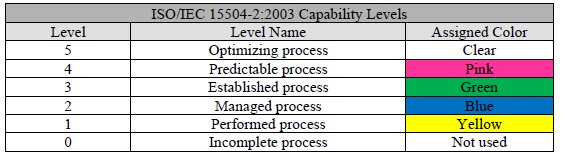
<body><![CDATA[<p style="text-align: justify; text-indent: 18.15pt;"><span  style="font-size: 10pt;" lang="EN-US"><font face="Verdana">COMPETISOFT defined three objectives: (i) To create a common methodological framework in Latin America; (ii) To spread the process culture into the researchers, academics and students communities and (iii) To influence in the standardization and certification entities, in order to establish a common and mutually recognized mechanism <a href="#r2">(2)</a>.</font><o:p></o:p></span></p>     <p style="text-align: justify; text-indent: 18.15pt;"><span  style="font-size: 10pt;" lang="EN-US"><font face="Verdana">Initially MoProSoft provided a base for COMPETISOFT which turns out expanded and enhanced. The main improvements were the incorporation of the Software Maintenance agile process <a href="#r15">(15)</a><a name="15."></a> to the Operation layer, along with the inclusion of the experience and viewpoints of 13 countries and 23 research groups. The main differences between COMPETISOFT and MoProSoft are:</font><o:p></o:p></span></p> <ul style="margin-top: 0cm;" type="disc">   <li class="MsoNormal"  style="margin-bottom: 5.95pt; text-align: justify;"><span  style="font-size: 10pt;" lang="EN-US"><font face="Verdana">MoProSoft considers the development and maintenance software processes as one, Software Development and Maintenance, while COMPETISOFT considers two processes: Software Development and Software Maintenance.</font><o:p></o:p></span></li>   <li class="MsoNormal"  style="margin-bottom: 5.95pt; text-align: justify;"><span  style="font-size: 10pt;" lang="EN-US"><font face="Verdana">MoProSoft considers within one phase the activities of Analysis and Design, while COMPETISOFT considers one phase for each one of these activities. </font> <o:p></o:p></span></li>   <li class="MsoNormal"  style="margin-bottom: 5.95pt; text-align: justify;"><span  style="font-size: 10pt;" lang="EN-US"><font face="Verdana">MoProSoft considers within one phase the activities of Integration and Testing, while COMPETISOFT considers one phase for each one of these activities. </font> <o:p></o:p></span></li>   <li class="MsoNormal"  style="margin-bottom: 5.95pt; text-align: justify;"><span  style="font-size: 10pt;" lang="EN-US"><font face="Verdana">COMPETISOFT added activity diagrams to each of its Activities in order to facilitate their understanding.</font><o:p></o:p></span></li>   <li class="MsoNormal"  style="margin-bottom: 5.95pt; text-align: justify;"><span  style="font-size: 10pt;" lang="EN-US"><font face="Verdana">Naming variations of work products and roles were made without affecting their objectives or responsibilities.</font><o:p></o:p></span></li>     </ul>     <p style="text-align: justify; text-indent: 18.15pt;"><span  style="font-size: 10pt;" lang="EN-US"><font face="Verdana">Another effort was made in Peru, where National Institute for the Defense of Competition and Protection of Intellectual Property (INDECOPI) <a href="#r16">(16)</a><a name="16."></a> developed a technical standard based on MoProSoft, the <i style="">Software Engineering: Software Development and Maintenance Process and Evaluation Models NTP 291.100:2009</i> <a href="#r17">(17)</a><a  name="17."></a>. The Peruvian standard was published in 2009. </font> <o:p></o:p></span></p>     <p  style="margin-bottom: 5.95pt; text-align: justify; text-indent: 0cm;"> <font face="Verdana"><span  style="font-size: 10pt; " lang="EN-US">&nbsp;</span></font><o:p></o:p></p>     <p style="margin-bottom: 5.95pt; text-align: justify;"> <span  style="font-family: &quot;Verdana&quot;; font-style: normal; font-variant: normal; font-weight: normal; font-size: 10pt; line-height: normal; font-size-adjust: none; font-stretch: normal" lang="EN-US">&nbsp;&nbsp;&nbsp;&nbsp;&nbsp;&nbsp;&nbsp;&nbsp;&nbsp;&nbsp;&nbsp;&nbsp;&nbsp;&nbsp;&nbsp;&nbsp;&nbsp;&nbsp;&nbsp;</span><font face="Verdana"><span  style="font-size: 10pt; " lang="EN-US">2.2 Colored Version</span></font><o:p></o:p></p>     <p style="text-align: justify;"><span  style="font-size: 10pt;" lang="EN-US"><font face="Verdana">After the publication of the Mexican standard, a colored version of MoProSoft was presented <a href="#r18">(18)</a><a name="18."></a>. In that version each task and work product is colored according to their capability level, see <a href="#t1">Table 1</a>, in order to facilitate their understanding and clarify their scope. </font> <o:p></o:p></span></p>     <p style="text-align: justify; text-indent: 18.15pt;"><span  style="font-size: 10pt;" lang="EN-US"><font face="Verdana">The capability levels of the processes are defined according to the Mexican standard <i style="">NMX-I-15504/02-NYCE-2004 Information Technology &ndash; Process Assessment &ndash; Part 02: Realization</i> <a href="#r19">(19)</a><a name="19."></a>, which in its turn is based on the international standard <i style="">ISO/IEC 15504-2: 2003 Information technology &ndash; Process assessment &ndash; Part 2: Performing an assessment </i><a href="#r20">(20)</a><a  name="20."></a>.</font><o:p></o:p></span></p>     <p align="center"> <font face="Verdana" size="2"> <a name="t1">Table 1: ISO/IEC 15504-2:2003 capability levels and their corresponding colors    <br> <img src="/img/revistas/cleiej/v16n1/1a03t1.jpg"> </a></font></p>     ]]></body>
<body><![CDATA[<p style="text-align: justify; text-indent: 18.15pt;"><span  style="font-size: 10pt;" lang="EN-US"><font face="Verdana">&nbsp;</font><o:p></o:p></span></p>     <p style="text-align: justify; text-indent: 18.15pt;"><span  style="font-size: 10pt;" lang="EN-US"><font face="Verdana">In this work the colored version was used to define the capability level of an organization, in this case we took into account the tasks and work products corresponding to MoProSoft level 2, that is to say, all yellow and blue tasks and work products were considered for the mapping.</font><o:p></o:p></span></p>     <p style="text-align: justify; text-indent: 18.15pt;"><span  style="font-size: 10pt;" lang="EN-US"><font face="Verdana">&nbsp;</font><o:p></o:p></span></p>     <p  style="margin: 0cm 0cm 5.95pt; text-align: justify; text-indent: 0cm;"><b  style=""> <span  style="font-family: &quot;Verdana&quot;; font-style: normal; font-variant: normal; font-weight: normal; font-size: 10pt; line-height: normal; font-size-adjust: none; font-stretch: normal" lang="EN-US">&nbsp;&nbsp;&nbsp;&nbsp;&nbsp;&nbsp;&nbsp;&nbsp;&nbsp;&nbsp;&nbsp;&nbsp;&nbsp;&nbsp;&nbsp;</span><font face="Verdana"><span  style="font-size: 10pt; font-variant: normal"  lang="EN-US">3 ISO/IEC 29110</span></font><o:p></o:p></b></p>     <p style="text-align: justify;"><span  style="font-size: 10pt;" lang="EN-US"><font face="Verdana">In 2005 the Subcommittee 7 <a href="#r21">(21)</a> of ISO/IEC Joint Technical Committee 1 decided to start a new project with the objective of creating an international standard addressed to the Software Life Cycle Profiles and Guidelines to be used in Very Small Entities (VSEs), organizations with less than 25 employees.</font><o:p></o:p></span></p>     <p style="text-align: justify; text-indent: 18.15pt;"><span  style="font-size: 10pt;" lang="EN-US"><font face="Verdana">For that purpose WG 24 was created taking charge of a new project under the coordination of Tanin Uthayanaka from Thailand <a href="#r21">(21)</a><a  name="21."></a>. Having identified problems that affect small organizations, WG24 defined a set of objectives for the group to achieve by implementing the new project of standard, ISO/IEC 29110 Software engineering &mdash; Lifecycle profiles for Very Small Entities (VSEs) <a href="#r4">(4)</a>.</font><o:p></o:p></span></p>     <p style="text-align: justify; text-indent: 18.15pt;"><span  style="font-size: 10pt;" lang="EN-US"><font face="Verdana">The first meeting of WG24 took place in Thailand in 2006, and was attended by the United States, India, Ireland, Belgium, Finland, Luxembourg, Canada, New Zealand, South Korea and Mexico. During the meeting the group made the decision to take the Mexican standard as a basis for their work <a  href="#r22">(22)</a><a name="22."></a>.</font><o:p></o:p></span></p>     <p  style="margin-bottom: 5.95pt; text-align: justify; text-indent: 18pt;"><span  style="font-size: 10pt;" lang="EN-US"><font face="Verdana">The ISO/IEC 29110 standard is composed of five parts arranged into three groups, being this the family of documents:</font><o:p></o:p></span></p> <ul style="margin-top: 0cm;" type="disc">   <li class="MsoNormal"  style="margin-bottom: 5.95pt; text-align: justify;"><span  style="font-size: 10pt;" lang="EN-US"><font face="Verdana">Overview</font><o:p></o:p></span></li>     </ul>     <p  style="margin: 0cm 0cm 5.95pt 54pt; text-align: justify; text-indent: -18pt;"> <font face="Verdana"><span  style="font-size: 10pt; " lang="EN-US">&#9702;</span></font><span  style="font-family: &quot;Verdana&quot;; font-style: normal; font-variant: normal; font-weight: normal; font-size: 10pt; line-height: normal; font-size-adjust: none; font-stretch: normal" lang="EN-US">&nbsp;&nbsp;&nbsp;&nbsp;&nbsp;&nbsp;&nbsp;</span><span  style="font-size: 10pt;" lang="EN-US"><font face="Verdana">Part 1 Overview </font> <o:p></o:p></span></p> <ul style="margin-top: 0cm;" type="disc">   <li class="MsoNormal"  style="margin-bottom: 5.95pt; text-align: justify;"><span  style="font-size: 10pt;" lang="EN-US"><font face="Verdana">Profiles</font><o:p></o:p></span></li>     ]]></body>
<body><![CDATA[</ul>     <p  style="margin: 0cm 0cm 5.95pt 54pt; text-align: justify; text-indent: -18pt;"> <font face="Verdana"><span  style="font-size: 10pt; " lang="EN-US">&#9702;</span></font><span  style="font-family: &quot;Verdana&quot;; font-style: normal; font-variant: normal; font-weight: normal; font-size: 10pt; line-height: normal; font-size-adjust: none; font-stretch: normal" lang="EN-US">&nbsp;&nbsp;&nbsp;&nbsp;&nbsp;&nbsp;&nbsp;</span><span  style="font-size: 10pt;" lang="EN-US"><font face="Verdana">Part 2 Framework and Taxonomy </font> <o:p></o:p></span></p>     <p  style="margin: 0cm 0cm 5.95pt 54pt; text-align: justify; text-indent: -18pt;"> <font face="Verdana"><span  style="font-size: 10pt; " lang="EN-US">&#9702;</span></font><span  style="font-family: &quot;Verdana&quot;; font-style: normal; font-variant: normal; font-weight: normal; font-size: 10pt; line-height: normal; font-size-adjust: none; font-stretch: normal" lang="EN-US">&nbsp;&nbsp;&nbsp;&nbsp;&nbsp;&nbsp;&nbsp;</span><span  style="font-size: 10pt;" lang="EN-US"><font face="Verdana">Part 4 Specifications of VSE Profiles</font><o:p></o:p></span></p> <ul style="margin-top: 0cm;" type="disc">   <li class="MsoNormal"  style="margin-bottom: 5.95pt; text-align: justify;"><span  style="font-size: 10pt;" lang="EN-US"><font face="Verdana">Guides</font><o:p></o:p></span></li>     </ul>     <p  style="margin: 0cm 0cm 5.95pt 54pt; text-align: justify; text-indent: -18pt;"> <font face="Verdana"><span  style="font-size: 10pt; " lang="EN-US">&#9702;</span></font><span  style="font-family: &quot;Verdana&quot;; font-style: normal; font-variant: normal; font-weight: normal; font-size: 10pt; line-height: normal; font-size-adjust: none; font-stretch: normal" lang="EN-US">&nbsp;&nbsp;&nbsp;&nbsp;&nbsp;&nbsp;&nbsp;</span><span  style="font-size: 10pt;" lang="EN-US"><font face="Verdana">Part 3 Assessment Guide</font><o:p></o:p></span></p>     <p  style="margin: 0cm 0cm 5.95pt 54pt; text-align: justify; text-indent: -18pt;"> <font face="Verdana"><span  style="font-size: 10pt; " lang="EN-US">&#9702;</span></font><span  style="font-family: &quot;Verdana&quot;; font-style: normal; font-variant: normal; font-weight: normal; font-size: 10pt; line-height: normal; font-size-adjust: none; font-stretch: normal" lang="EN-US">&nbsp;&nbsp;&nbsp;&nbsp;&nbsp;&nbsp;&nbsp;</span><span  style="font-size: 10pt;" lang="EN-US"><font face="Verdana">Part 5 Management and Engineering Guide</font><o:p></o:p></span></p>     <p style="text-align: justify; text-indent: 18.15pt;"><font face="Verdana"><i  style=""><span style="font-size: 10pt;" lang="EN-US">Overview</span></i></font><span  style="font-size: 10pt;" lang="EN-US"><font face="Verdana"> presents the main concepts to gain a better understanding and to make use of the documents of the standard.</font><o:p></o:p></span></p>     <p style="text-align: justify; text-indent: 18.15pt;"><span  style="font-size: 10pt;" lang="EN-US"><font face="Verdana"><span style="">&nbsp;</span><i  style="">Profiles</i> are defined with the purpose of concentrating the essentials of the rest of the documents, in order to be tailored to organization&rsquo;s needs and characteristics.</font><o:p></o:p></span></p>     <p style="text-align: justify; text-indent: 18.15pt;"><span  style="font-size: 10pt;" lang="EN-US"><font face="Verdana">The <i style="">Framework and Taxonomy</i> part specifies common elements of each defined profile, while <i  style="">Specifications of VSE Profiles</i> lays down the components and structure for each created profile. </font> <o:p></o:p></span></p>     <p style="text-align: justify; text-indent: 18.15pt;"><span  style="font-size: 10pt;" lang="EN-US"><font face="Verdana">The <i style="">Guides</i> part defines applying principles to develop an assessment in order to determine the processes capability and maturity of the organization, in <i style="">Assessment Guide</i>. Also <i style="">Management and Engineering Guide</i> offers orientation about the use and implementation of each profile.</font><o:p></o:p></span></p>     ]]></body>
<body><![CDATA[<p style="text-align: justify; text-indent: 18.15pt;"><span  style="font-size: 10pt;" lang="EN-US"><font face="Verdana">At the moment, part 5 for Basic profile of the Generic profiles group is published. Other three generic profiles: Entry, specific for startup entities; Intermediate and Advanced are under development. The scope of this work is centered on Basic Profile.</font><o:p></o:p></span></p>     <p style="text-align: justify;"><span  style="font-size: 10pt;" lang="EN-US"><font face="Verdana">&nbsp;</font><o:p></o:p></span></p>     <p style="margin-bottom: 5.95pt; text-align: justify;"> <span  style="font-family: &quot;Verdana&quot;; font-style: normal; font-variant: normal; font-weight: normal; font-size: 10pt; line-height: normal; font-size-adjust: none; font-stretch: normal" lang="EN-US">&nbsp;&nbsp;&nbsp;&nbsp;&nbsp;&nbsp;&nbsp;&nbsp;&nbsp;&nbsp;&nbsp;&nbsp;&nbsp;&nbsp;&nbsp;&nbsp;&nbsp;&nbsp;&nbsp;</span><font face="Verdana"><span  style="font-size: 10pt; " lang="EN-US">3.1 Basic Profile </span></font> <o:p></o:p></p>     <p style="text-align: justify;"><span  style="font-size: 10pt;" lang="EN-US"><font face="Verdana">Basic Profile was published in May 2011, known as ISO/IEC 29110-5-1-2 <a  href="#r23">(23)</a><a name="23."></a>, where digit 1 means that it is a generic profile, and digit 2 represents a consecutive number. Previous to the Basic Profile comes the Entry Profile therefore getting number 1. </font> <o:p></o:p></span></p>     <p style="text-align: justify; text-indent: 18.15pt;"><span  style="font-size: 10pt;" lang="EN-US"><font face="Verdana">The rationale of Basic Profile is to define a software development and project management guide for a subset of processes and outcomes of ISO/IEC 12207 <a href="#r24">(24)</a><a name="24."></a> and products of ISO/IEC 15289 <a href="#r25">(25)</a><a name="25."></a>, appropriate for characteristics and needs of VSEs <a href="#r23">(23)</a>. </font> <o:p></o:p></span></p>     <p style="text-align: justify; text-indent: 18.15pt;"><span  style="font-size: 10pt;" lang="EN-US"><font face="Verdana">Basic Profile describes a software development of a single application by a single project team with no special risk or situational factors. This kind of project may be carried out to fulfill an external or internal contract <a href="#r23">(23)</a>. </font> <o:p></o:p></span></p>     <p style="text-align: justify; text-indent: 18.15pt;"><span  style="font-size: 10pt;" lang="EN-US"><font face="Verdana">Software Implementation (SI) and Project Management (PM) are the two processes that compose Basic Profile. The reason to include PM is that VSEs&rsquo; core business is software development and their financial success depends on project profits <a href="#r23">(23)</a>. </font> <o:p></o:p></span></p>     <p style="text-align: justify; text-indent: 18.15pt;"><span  style="font-size: 10pt;" lang="EN-US"><font face="Verdana">The PM process input is the customer&rsquo;s <i style="">Statement of Work</i>, used to create <i  style="">Project Plan</i>. The execution of the SI process is driven by the <i style="">Project Plan</i>. The PM Project Assessment and Control activities compare project progress against the <i style="">Project Plan</i> and actions are taken to eliminate deviations or incorporate changes into it. The PM Project Closure activity delivers <i style="">Software Configuration</i>, produced by SI, and gets the customer&rsquo;s agreement to formalize the end of the project. A project repository is established to save work products and to control their versions during the project.</font><o:p></o:p></span></p>     <p style="text-align: justify; text-indent: 18.15pt;"><span  style="font-size: 10pt;" lang="EN-US"><font face="Verdana">The purpose of the PM process is to establish and carry out activities of SI process in an efficient way, which allows fulfilling the project&rsquo;s objectives within the expected quality, time and costs. The purpose of the SI process is to define a systematic performance of the Analysis, Design, Construction, Integration and Tests activities for new or modified software products according to specific requirements.</font><o:p></o:p></span></p>     <p style="text-align: justify;"><span  style="font-size: 10pt;" lang="EN-US"><font face="Verdana">&nbsp;</font><o:p></o:p></span></p>     ]]></body>
<body><![CDATA[<p  style="margin: 0cm 0cm 5.95pt; text-align: justify; text-indent: 0cm;"><b  style=""> <span  style="font-family: &quot;Verdana&quot;; font-style: normal; font-variant: normal; font-weight: normal; font-size: 10pt; line-height: normal; font-size-adjust: none; font-stretch: normal" lang="EN-US">&nbsp;&nbsp;&nbsp;&nbsp;&nbsp;&nbsp;&nbsp;&nbsp;&nbsp;&nbsp;&nbsp;&nbsp;&nbsp;&nbsp;&nbsp;</span><font face="Verdana"><span  style="font-size: 10pt; font-variant: normal"  lang="EN-US">4 Mapping ISO/IEC 29110-5-1-2 and MoProSoft</span></font><o:p></o:p></b></p>     <p style="text-align: justify;"><span  style="font-size: 10pt;" lang="EN-US"><font face="Verdana">The mapping was made taking into consideration an organization evaluated in MoProSoft level 2 and asking oneself: <i style="">What is needed to be done or improved in order to achieve ISO/IEC 29110 Basic Profile if the organization has already adopted MoProSoft level 2?</i><span  style="">&nbsp; </span></font><o:p></o:p></span></p>     <p style="text-align: justify; text-indent: 18.15pt;"><span  style="font-size: 10pt;" lang="EN-US"><font face="Verdana">Finding the proper answer will clarify the gap and ease the transition between standards, providing the organization with benefits of international recognition.</font><o:p></o:p></span></p>     <p style="text-align: justify; text-indent: 18.15pt;"><span  style="font-size: 10pt;" lang="EN-US"><font face="Verdana">Therefore, the tasks and work products of each process of ISO/IEC 29110-5-1-2 were faced against the tasks and work products of the equivalent process in MoProSoft, as shown in <a href="#t2">Table 2</a>. </font> <o:p></o:p></span></p>     <p align="center"> <font face="Verdana" size="2"> <a name="t">Table 2: Equivalence between processes involved in the mapping    <br> <img src="/img/revistas/cleiej/v16n1/1a03t2.jpg"> </a></font></p>     <p><span style="" lang="EN-US"><font face="Verdana" size="2">&nbsp;</font><o:p></o:p></span></p>     <p style="text-align: justify; text-indent: 18.15pt;"><span  style="font-size: 10pt;" lang="EN-US"><font face="Verdana">For consistency and simplicity reasons, the acronyms used to refer to each task were taken considering notations used in each standard, see <a  href="#t3">Table 3</a>. It is important to note that, according to the table above, it is possible to use the same acronym for both types of tasks in the Mexican standard, since a task from PM is always mapped against a SPM task, and a task from SI, if mapped, will always be against SDM.</font><o:p></o:p></span></p>     <p align="center"> <font face="Verdana" size="2"> <a name="t3">Table 3: Equivalence between processes involved in the mapping    <br> <img src="/img/revistas/cleiej/v16n1/1a03t3.jpg"> </a></font></p>     ]]></body>
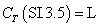
<body><![CDATA[<p style="text-align: justify; text-indent: 18.15pt;"><span  style="font-size: 10pt;" lang="EN-US"><font face="Verdana">&nbsp;</font><o:p></o:p></span></p>     <p style="text-align: justify; text-indent: 18.15pt;"><span  style="font-size: 10pt;" lang="EN-US"><font face="Verdana">Alongside with the task mapping, mapping corresponding to work products was carried out.</font><o:p></o:p></span></p>     <p style="text-align: justify; text-indent: 18.15pt;"><span  style="font-size: 10pt;" lang="EN-US"><font face="Verdana">&nbsp;</font><o:p></o:p></span></p>     <p  style="margin: 0cm 0cm 5.95pt; text-align: justify; text-indent: 0cm;"> <span  style="font-family: &quot;Verdana&quot;; font-style: normal; font-variant: normal; font-weight: normal; font-size: 10pt; line-height: normal; font-size-adjust: none; font-stretch: normal" lang="EN-US">&nbsp;&nbsp;&nbsp;&nbsp;&nbsp;&nbsp;&nbsp;&nbsp;&nbsp;&nbsp;&nbsp;&nbsp;&nbsp;&nbsp;&nbsp;&nbsp;&nbsp;&nbsp;&nbsp;</span><font face="Verdana"><span  style="font-size: 10pt; " lang="EN-US">4.1 Metrics</span></font><o:p></o:p></p>     <p style="text-align: justify;"><span  style="font-size: 10pt;" lang="EN-US"><font face="Verdana">The capability ratings defined in ISO/IEC 15504-2:2003 <a href="#r20">(20)</a> were used to determine the Coverage values essential for this work, see <a href="#t4">Table 4</a>, with the aim of defining the Coverage level (<i style="">C</i>). Then a Score was associated to each <i style="">C</i> value, which in its turn is used to define the Quantitative level (<i  style="">Q</i>).</font><o:p></o:p></span></p>     <p align="center"> <font face="Verdana" size="2"> <a name="t4">Table 4: Capability ratings and scores assigned    <br> <img src="/img/revistas/cleiej/v16n1/1a03t4.jpg"> </a></font></p>     <p style="text-align: justify; text-indent: 18.15pt;"><span  style="font-size: 10pt;" lang="EN-US"><font face="Verdana">&nbsp;</font><o:p></o:p></span></p>     <p style="text-align: justify; text-indent: 18.15pt;"><span  style="font-size: 10pt;" lang="EN-US"><font face="Verdana">The <i style="">C</i> and <i  style="">Q</i> values apply for tasks (<i style="">C<sub>T</sub></i> or <i style="">Q<sub>T</sub></i>), work products (<i style="">C<sub>W</sub></i> or <i style="">Q<sub>W</sub></i>) and process (<i style="">C<sub>P</sub></i> or <i style="">Q<sub>P</sub></i>). </font> <o:p></o:p></span></p>     <p  style="margin-bottom: 12pt; text-align: justify; text-indent: 18.15pt;"><span  style="font-size: 10pt;" lang="EN-US"><font face="Verdana">For example, the <i style="">C<sub>T</sub></i> value of the task SI.3.5 is obtained like that:</font><o:p></o:p></span></p>     ]]></body>
<body><![CDATA[<p align="center"> <font face="Verdana" size="2"> <a name="f1"> <img src="/img/revistas/cleiej/v16n1/1a03z1.gif"></a></font></p>     <p  style="margin: 12pt 0cm; text-align: justify; text-indent: 18.15pt;"><span  style="font-size: 10pt;" lang="EN-US"><font face="Verdana">And the <i style="">Q<sub>T</sub></i> value for the same task as follows:</font><o:p></o:p></span></p>     <p align="center"> <font face="Verdana" size="2"> <a name="f2"> <img src="/img/revistas/cleiej/v16n1/1a03z2.gif"></a></font></p>     <p  style="margin-top: 12pt; text-align: justify; text-indent: 18.15pt;"><span  style="font-size: 10pt;" lang="EN-US"><font face="Verdana">The <i style="">C<sub>W</sub></i> and <i style="">Q<sub>W</sub></i> are calculated in the same way.</font><o:p></o:p></span></p>     <p style="text-align: justify; text-indent: 18.15pt;"><span  style="font-size: 10pt;" lang="EN-US"><font face="Verdana">The <i style="">Q<sub>P</sub></i> is calculated by the sum of each of the quantitative levels of the process tasks divided between the total num of the process tasks:</font><o:p></o:p></span></p>     <p align="center"> <font face="Verdana" size="2"> <a name="f3"> <img src="/img/revistas/cleiej/v16n1/1a03z3.gif"></a></font></p>     <p  style="margin: 12pt 0cm; text-align: justify; text-indent: 18.15pt;"><span  style="font-size: 10pt;" lang="EN-US"><font face="Verdana">Where <i style="">T</i> is the set of tasks, and each <i style="">T<sub>i</sub></i> is a task of the process, for example:</font><o:p></o:p></span></p>     <p align="center"> <font face="Verdana" size="2"> <a name="f4"><img src="/img/revistas/cleiej/v16n1/1a03z4.gif"></a></font></p>     <p  style="margin: 12pt 0cm; text-align: justify; text-indent: 18.15pt;"><span  style="font-size: 10pt;" lang="EN-US"><font face="Verdana">Finally, the <i style="">C<sub>P</sub></i> can be calculated using the <i style="">Q<sub>P</sub></i> value and the values of <a href="#t4">Table 4</a>, then:</font><o:p></o:p></span></p>     <p align="center"> <font face="Verdana" size="2"> <a name="f5"><img src="/img/revistas/cleiej/v16n1/1a03z5.gif"></a></font></p>     ]]></body>
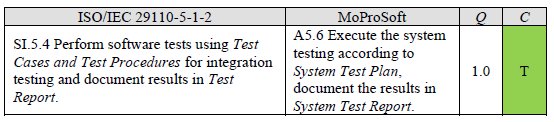
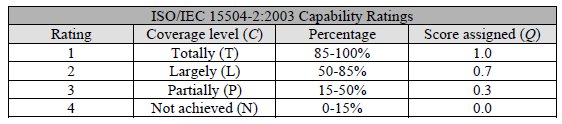
<body><![CDATA[<p  style="margin-top: 12pt; text-align: justify; text-indent: 18.15pt;"><span  style="font-size: 10pt;" lang="EN-US"><font face="Verdana">Those values are used to clarify the gap between standards, and are presented in the Numerical Results section.</font><o:p></o:p></span></p>     <p style="text-align: justify; text-indent: 18.15pt;"><i  style=""><span style="font-size: 10pt;" lang="EN-US"><font face="Verdana">&nbsp;</font><o:p></o:p></span></i></p>     <p  style="margin: 0cm 0cm 5.95pt; text-align: justify; text-indent: 0cm;"> <span  style="font-family: &quot;Verdana&quot;; font-style: normal; font-variant: normal; font-weight: normal; font-size: 10pt; line-height: normal; font-size-adjust: none; font-stretch: normal" lang="EN-US">&nbsp;&nbsp;&nbsp;&nbsp;&nbsp;&nbsp;&nbsp;&nbsp;&nbsp;&nbsp;&nbsp;&nbsp;&nbsp;&nbsp;&nbsp;&nbsp;&nbsp;&nbsp;&nbsp;</span><font face="Verdana"><span  style="font-size: 10pt; " lang="EN-US">4.2 Coverage Rules</span></font><o:p></o:p></p>     <p style="text-align: justify;"><span  style="font-size: 10pt;" lang="EN-US"><font face="Verdana">The coverage rules that guided the mapping are based on the interpretation of written texts of each standard, their inputs and outputs as well as general objectives. </font> <o:p></o:p></span></p>     <p style="text-align: justify; text-indent: 18.15pt;"><span  style="font-size: 10pt;" lang="EN-US"><font face="Verdana">Although maps are convenient, they reflect subjective judgment and cannot replace an understanding of the frameworks being mapped <a  href="#r26">(26)</a><a name="26."></a>. The decision of considering all compared tasks as equal is based on the comment pronounced by Software Engineering Institute <a href="#r27">(27)</a><a  name="27."></a>, with respect on mappings between models or standards: <i style="">Determining the appropriate granularity of maps between models is subjective. We have found that mapping at the level of each item in an enumerated list makes the most sense</i> <a href="#r26">(26)</a>. That is why it is crucial to emphasize that the coverage values obtained after applying those criteria may not match those applied by an accreditation body during an assessment process. </font> <o:p></o:p></span></p>     <p style="text-align: justify; text-indent: 18.15pt;"><span  style="font-size: 10pt;" lang="EN-US"><font face="Verdana">Each of the coverage rules was detailed for Tasks and Work Products.</font><o:p></o:p></span></p>     <p style="text-align: justify; text-indent: 18.15pt;"><span  style="font-size: 10pt;" lang="EN-US"><font face="Verdana">&nbsp;</font><o:p></o:p></span></p>     <p  style="margin: 0cm 0cm 5.95pt; text-align: justify; text-indent: 0cm;"><i  style=""> <span  style="font-family: &quot;Verdana&quot;; font-style: normal; font-variant: normal; font-weight: normal; font-size: 10pt; line-height: normal; font-size-adjust: none; font-stretch: normal; text-decoration:none" lang="EN-US">&nbsp;&nbsp;&nbsp;&nbsp;&nbsp;&nbsp;&nbsp;&nbsp;&nbsp;&nbsp;&nbsp;&nbsp;&nbsp;&nbsp;&nbsp;&nbsp;&nbsp;&nbsp;&nbsp;&nbsp;&nbsp;&nbsp;&nbsp;&nbsp;</span><font face="Verdana"><span  style="font-size: 10pt; text-decoration: none"  lang="EN-US">4.2.1 Tasks</span></font><o:p></o:p></i></p>     <p style="text-align: justify;"><span  style="font-size: 10pt;" lang="EN-US"><font face="Verdana">A task from ISO/IEC 29110-5-1-2 is considered <i style="">totally</i> covered if there exist one or more tasks from MoProSoft that fully accomplish its purpose, an example is shown in <a href="#t5">Table 5</a>. The first column presents the task to cover; the second column shows the task that covers it; the third one includes Quantitative level and the last one Coverage level. In the example below, the task SI.5.4 of ISO/IEC29110-5-1-2 is totally covered by the task A5.6 of MoProSoft.</font><o:p></o:p></span></p>     <p align="center"> <font face="Verdana" size="2"> <a name="t5">Table 5: Example of a totally covered task     ]]></body>
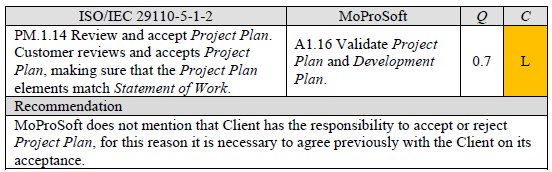
<body><![CDATA[<br> <img src="/img/revistas/cleiej/v16n1/1a03t5.jpg"></a></font><span  style="font-family: &quot;Verdana&quot;; font-style: normal; font-variant: normal; font-weight: normal; font-size: 10pt; line-height: normal; font-size-adjust: none; font-stretch: normal" lang="EN-US">&nbsp;&nbsp;&nbsp;&nbsp;&nbsp;&nbsp;&nbsp;&nbsp;&nbsp;&nbsp;&nbsp;&nbsp;&nbsp;&nbsp;&nbsp;&nbsp;&nbsp;</span><font face="Verdana"><span  style="font-size: 10pt; " lang="EN-US">&nbsp;</span></font><o:p></o:p></p>     <p style="text-align: justify; text-indent: 18.15pt;"><span  style="font-size: 10pt;" lang="EN-US"><font face="Verdana">A task is considered <i style="">largely</i> covered if there exist one or more tasks that cover a part of it. The effort needed to fill in the gap is taken into account, based on the recommendation to achieve the totally covered qualification. <a href="#t6">Table 6</a> shows a largely covered task. In this example the task PM.1.14 of ISO/IEC29110-5-1-2 is largely covered by the task A1.16 of MoProSoft. The gap between this task and the required by the international standard could be closed if the Recommendation is observed.</font><o:p></o:p></span></p>     <p align="center"> <font face="Verdana" size="2"> <a name="t6">Table 6: Example of a largely covered task     <br> <img src="/img/revistas/cleiej/v16n1/1a03t6.jpg"> </a></font></p>     <p style="text-align: justify; text-indent: 18.15pt;"><span  style="font-size: 10pt;" lang="EN-US"><font face="Verdana">&nbsp;</font><o:p></o:p></span></p>     <p style="text-align: justify; text-indent: 18.15pt;"><span  style="font-size: 10pt;" lang="EN-US"><font face="Verdana">A task is considered <i style="">partially</i> covered if there exists a task that tries to cover it, or if its objective is achieved in a clear way by the execution of the whole process. <a  href="#t7">Table 7</a> gives an example of a partially covered task. In this case the task SI.3.2 of ISO/IEC29110-5-1-2 is partially covered, the reason is that it results obvious that an understanding of requirements is executed, in some way, by the organization, whether the Mexican standard specifies it or not.</font><o:p></o:p></span></p>     <p align="center"> <font face="Verdana" size="2"> <a name="t7">Table 7: Example of a partially covered task    <br> <img src="/img/revistas/cleiej/v16n1/1a03t7.jpg"> </a></font></p>     <p style="text-align: justify; text-indent: 18.15pt;"><span  style="font-size: 10pt;" lang="EN-US"> <font face="Verdana">Finally, a task is <i style="">not achieved</i> if there does not exist a task with the same or similar objective. In this case the task will have to be done entirely on its own, in order to implement the standard. <a href="#t8">Table 8</a> shows a not achieved task. </font> <o:p></o:p></span></p>     <p align="center"><font face="Verdana" size="2"><a name="t8">Table 8: Example of a not achieved task    ]]></body>

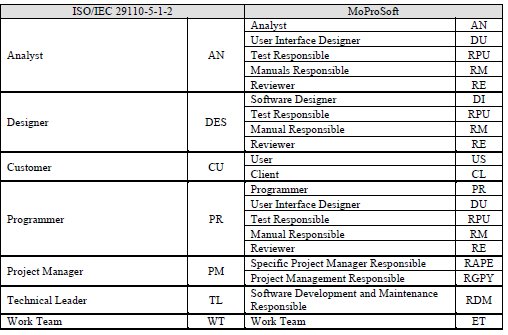
<body><![CDATA[<br> <img src="/img/revistas/cleiej/v16n1/1a03t8.jpg"> </a></font></p>     <p  style="margin: 0cm 0cm 5.95pt; text-align: justify; text-indent: 0cm;"><i  style=""> <span  style="font-family: &quot;Verdana&quot;; font-style: normal; font-variant: normal; font-weight: normal; font-size: 10pt; line-height: normal; font-size-adjust: none; font-stretch: normal; text-decoration:none" lang="EN-US">&nbsp;&nbsp;&nbsp;&nbsp;&nbsp;&nbsp;&nbsp;&nbsp;&nbsp;&nbsp;&nbsp;&nbsp;&nbsp;&nbsp;&nbsp;&nbsp;&nbsp;&nbsp;&nbsp;&nbsp;&nbsp;&nbsp;&nbsp;&nbsp;</span><font face="Verdana"><span  style="font-size: 10pt; text-decoration: none"  lang="EN-US">4.2.2 Work Products</span></font><o:p></o:p></i></p>     <p style="text-align: justify;"><span  style="font-size: 10pt;" lang="EN-US"><font face="Verdana">A work product is an artifact generated while executing a task or a set of tasks. Both standards include a section that lists each work product and their characteristics. The MoProSoft&rsquo;s sections are: <i style="">Inputs</i>, <i style="">Outputs</i> and <i style="">Intern Products</i>, while the ISO/IEC29110-5-1-2&rsquo;s section is:<i style=""> 9. Product description</i>. </font> <o:p></o:p></span></p>     <p style="text-align: justify; text-indent: 18.15pt;"><span  style="font-size: 10pt;" lang="EN-US"><font face="Verdana">For the purpose of this work, these sections were taken as guidelines for the mapping and scope limits. We applied the same rules of coverage defined for the tasks.</font><o:p></o:p></span></p>     <p  style="margin: 0cm 0cm 5.95pt; text-align: justify; text-indent: 0cm;"><i  style=""> <span  style="font-family: &quot;Verdana&quot;; font-style: normal; font-variant: normal; font-weight: normal; font-size: 10pt; line-height: normal; font-size-adjust: none; font-stretch: normal; text-decoration:none" lang="EN-US">&nbsp;&nbsp;&nbsp;&nbsp;&nbsp;&nbsp;&nbsp;&nbsp;&nbsp;&nbsp;&nbsp;&nbsp;&nbsp;&nbsp;&nbsp;&nbsp;&nbsp;&nbsp;&nbsp;&nbsp;&nbsp;&nbsp;&nbsp;&nbsp;</span><font face="Verdana"><span  style="font-size: 10pt; text-decoration: none"  lang="EN-US">&nbsp;</span></font><o:p></o:p></i></p>     <p  style="margin: 0cm 0cm 5.95pt; text-align: justify; text-indent: 0cm;"><i  style=""> <span  style="font-family: &quot;Verdana&quot;; font-style: normal; font-variant: normal; font-weight: normal; font-size: 10pt; line-height: normal; font-size-adjust: none; font-stretch: normal; text-decoration:none" lang="EN-US">&nbsp;&nbsp;&nbsp;&nbsp;&nbsp;&nbsp;&nbsp;&nbsp;&nbsp;&nbsp;&nbsp;&nbsp;&nbsp;&nbsp;&nbsp;&nbsp;&nbsp;&nbsp;&nbsp;&nbsp;&nbsp;&nbsp;&nbsp;&nbsp;</span><font face="Verdana"><span  style="font-size: 10pt; text-decoration: none"  lang="EN-US">4.2.3 Roles</span></font><o:p></o:p></i></p>     <p style="text-align: justify;"><span  style="font-size: 10pt;" lang="EN-US"><font face="Verdana">A role is a set of competences, abilities, knowledge and skills required to perform a task in a specific situation. In the end, in order to complete the mapping, the roles required in both standards were analyzed. The MoProSoft section that defines the roles is: <i style="">Involved Roles and Training</i>, while the ISO/IEC 29110-5-1-2 section is: <i  style="">8. Roles</i>.</font><o:p></o:p></span></p>     <p style="text-align: justify; text-indent: 18.15pt;"><span  style="font-size: 10pt;" lang="EN-US"><font face="Verdana">These sections have been used to map the roles between the standards, where the main criteria used is the list of competences required by each standard. It is important to clarify that the mapping of roles cannot be taken into consideration to calculate the <i style="">Q</i> or the <i style="">C</i> values, and the purpose of this mapping is informative.</font><o:p></o:p></span></p>     <p style="text-align: justify; text-indent: 18.15pt;"><span  style="font-size: 10pt;" lang="EN-US"><font face="Verdana"><a href="#t9">Table 9</a> shows the mapping between roles. It can be read as follows: the competences of the Project Manager role defined at ISO/IEC 29110-5-1-2 are covered by the Specific Project Manager Responsible and the Project Management Responsible roles of MoProSoft.</font><o:p></o:p></span></p>     <p align="center"> <font face="Verdana" size="2"> <a name="t9">Table 9: Mapping between roles     ]]></body>
<body><![CDATA[<br> <img src="/img/revistas/cleiej/v16n1/1a03t9.jpg"> </a></font></p>     <p style="text-align: justify; text-indent: 18.15pt;"><span  style="font-size: 10pt;" lang="EN-US"><font face="Verdana">&nbsp;</font><o:p></o:p></span></p>     <p style="text-align: justify; text-indent: 18.15pt;"><span  style="font-size: 10pt;" lang="EN-US"><font face="Verdana">According to the mapping of roles, an organization evaluated level 2 of MoProSoft can take advantage of the roles at their disposal and no new role has to be created to cover the requirements of the ISO/IEC 29110-5-1-2.<span  style="">&nbsp; </span></font><o:p></o:p></span></p>     <p style="text-align: justify; text-indent: 18.15pt;"><span  style="font-size: 10pt;" lang="EN-US"><font face="Verdana">&nbsp;</font><o:p></o:p></span></p>     <p  style="margin: 0cm 0cm 5.95pt; text-align: justify; text-indent: 0cm;"><b  style=""> <span  style="font-family: &quot;Verdana&quot;; font-style: normal; font-variant: normal; font-weight: normal; font-size: 10pt; line-height: normal; font-size-adjust: none; font-stretch: normal" lang="EN-US">&nbsp;&nbsp;&nbsp;&nbsp;&nbsp;&nbsp;&nbsp;&nbsp;&nbsp;&nbsp;&nbsp;&nbsp;&nbsp;&nbsp;&nbsp;</span><font face="Verdana"><span  style="font-size: 10pt; font-variant: normal"  lang="EN-US">5 Numerical Results</span></font><o:p></o:p></b></p>     <p style="text-align: justify;"><span  style="font-size: 10pt;" lang="EN-US"><font face="Verdana">This section displays numerical values obtained from tasks and work products mappings. Finding the answer to the initial question <i style="">What is needed to be done or improved in order to achieve ISO/IEC 29110 Basic Profile if the organization has already adopted MoProSoft level 2?</i> we will use the values <i style="">Q</i> and <i style="">C</i>, explained earlier.</font><o:p></o:p></span></p>     <p style="text-align: justify; text-indent: 18.15pt;"><span  style="font-size: 10pt;" lang="EN-US"><font face="Verdana">&nbsp;</font><o:p></o:p></span></p>     <p  style="margin: 0cm 0cm 5.95pt; text-align: justify; text-indent: 0cm;"> <span  style="font-family: &quot;Verdana&quot;; font-style: normal; font-variant: normal; font-weight: normal; font-size: 10pt; line-height: normal; font-size-adjust: none; font-stretch: normal" lang="EN-US">&nbsp;&nbsp;&nbsp;&nbsp;&nbsp;&nbsp;&nbsp;&nbsp;&nbsp;&nbsp;&nbsp;&nbsp;&nbsp;&nbsp;&nbsp;&nbsp;&nbsp;&nbsp;&nbsp;</span><font face="Verdana"><span  style="font-size: 10pt; " lang="EN-US">5.1 Values Obtained for Quantitative and Coverage Levels of Tasks</span></font><o:p></o:p></p>     <p style="margin-bottom: 12pt; text-align: justify;"><span  style="font-size: 10pt;" lang="EN-US"><font face="Verdana">ISO/IEC 29110-5-1-2 presents 26 tasks in the PM process, 18 of them are totally covered by MoProSoft, 3 are largely covered and 5 are not achieved. The <i style="">Q<sub>P</sub></i> of PM process is 0.77, obtained from:</font><o:p></o:p></span></p>     <p align="center"> <font face="Verdana" size="2"> <a name="f6"><img src="/img/revistas/cleiej/v16n1/1a03z6.gif"></a></font></p>     ]]></body>
<body><![CDATA[<p  style="margin: 12pt 0cm; text-align: justify; text-indent: 18.15pt;"><span  style="font-size: 10pt;" lang="EN-US"><font face="Verdana">The SI process has 41 tasks defined, 34 are totally covered by MoProSoft, 2 are largely covered, 5 partially covered and none is not achieved. The <i style="">Q<sub>P</sub></i> of SI process is 0.90, detailed as follows:</font><o:p></o:p></span></p>     <p align="center"> <font face="Verdana" size="2"> <a name="f7"><img src="/img/revistas/cleiej/v16n1/1a03z7.gif"></a></font></p>     <p align="center"> <font face="Verdana" size="2"> <a name="t10">Table 10: Mapping results between MoProSoft and ISO/IEC 29110-5-1-2    <br> <img src="/img/revistas/cleiej/v16n1/1a03t10.jpg"> </a></font></p>     <p style="text-align: justify; text-indent: 18.15pt;"><span  style="font-size: 10pt;" lang="EN-US"><font face="Verdana">&nbsp;</font><o:p></o:p></span></p>     <p style="text-align: justify; text-indent: 18.15pt;"><span  style="font-size: 10pt;" lang="EN-US"><font face="Verdana">We can conclude that an organization evaluated in MoProSoft level 2 covers 85% of tasks defined in ISO/IEC 29110-5-1-2. It is viable to bridge the gap between both standards, for the sake of total tasks coverage, by following the suggestions given in the section Bridging the Gap.</font><o:p></o:p></span></p>     <p style="text-align: justify; text-indent: 18.15pt;"><span  style="font-size: 10pt;" lang="EN-US"><font face="Verdana">&nbsp;</font><o:p></o:p></span></p>     <p  style="margin: 0cm 0cm 5.95pt; text-align: justify; text-indent: 0cm;"> <span  style="font-family: &quot;Verdana&quot;; font-style: normal; font-variant: normal; font-weight: normal; font-size: 10pt; line-height: normal; font-size-adjust: none; font-stretch: normal" lang="EN-US">&nbsp;&nbsp;&nbsp;&nbsp;&nbsp;&nbsp;&nbsp;&nbsp;&nbsp;&nbsp;&nbsp;&nbsp;&nbsp;&nbsp;&nbsp;&nbsp;&nbsp;&nbsp;&nbsp;</span><font face="Verdana"><span  style="font-size: 10pt; " lang="EN-US">5.2 Values Obtained for Quantitative and Coverage Levels of Work Products</span></font><o:p></o:p></p>     <p style="text-align: justify;"><span  style="font-size: 10pt;" lang="EN-US"><font face="Verdana">ISO/IEC29110-5-1-2 defines 22 work products, 20 are <i style="">totally</i> covered by the work products defined in MoProSoft, one is <i style="">largely</i> covered and one is <i style="">not achieved</i>. </font> <o:p></o:p></span></p>     <p  style="margin-bottom: 12pt; text-align: justify; text-indent: 18.15pt;"><span  style="font-size: 10pt;" lang="EN-US"><font face="Verdana">The <i style="">Q<sub>W</sub></i> value that involves all the work products was calculated as follows:</font><o:p></o:p></span></p>     ]]></body>

<body><![CDATA[<p align="center"> <font face="Verdana" size="2"> <a name="f8"><img src="/img/revistas/cleiej/v16n1/1a03z8.gif"></a></font></p>     <p  style="margin: 0cm 0cm 5.95pt; text-align: justify; text-indent: 0cm;"><b  style=""> <span  style="font-family: &quot;Verdana&quot;; font-style: normal; font-variant: normal; font-weight: normal; font-size: 10pt; line-height: normal; font-size-adjust: none; font-stretch: normal" lang="EN-US">&nbsp;&nbsp;&nbsp;&nbsp;&nbsp;&nbsp;&nbsp;&nbsp;&nbsp;&nbsp;&nbsp;&nbsp;&nbsp;&nbsp;&nbsp;</span><font face="Verdana"><span  style="font-size: 10pt; font-variant: normal"  lang="EN-US">6 Bridging the Gap</span></font><o:p></o:p></b></p>     <p style="text-align: justify;"><span  style="font-size: 10pt;" lang="EN-US"><font face="Verdana">We should note that only tasks and work products qualified less than <i  style="">totally</i> covered will be presented, taking into account all those qualified as <i style="">largely</i>, <i style="">partially</i> or <i style="">not achieved</i>.</font><o:p></o:p></span></p>     <p  style="margin: 0cm 0cm 5.95pt; text-align: justify; text-indent: 0cm;"> <span  style="font-family: &quot;Verdana&quot;; font-style: normal; font-variant: normal; font-weight: normal; font-size: 10pt; line-height: normal; font-size-adjust: none; font-stretch: normal" lang="EN-US">&nbsp;&nbsp;&nbsp;&nbsp;&nbsp;&nbsp;&nbsp;&nbsp;&nbsp;&nbsp;&nbsp;&nbsp;&nbsp;&nbsp;&nbsp;&nbsp;&nbsp;&nbsp;&nbsp;</span><font face="Verdana"><span  style="font-size: 10pt; " lang="EN-US">6.1 Not Totally Covered Tasks</span></font><o:p></o:p></p>     <p style="text-align: justify;"><span  style="font-size: 10pt;" lang="EN-US"><font face="Verdana">This section concentrates all the tasks identified as not totally covered by MoProSoft, mentioning those with values L, P or N. Moreover we offer a recommendation for each task to achieve a T value. The PM process tasks are presented in Table 11.</font><o:p></o:p></span></p>     <p align="center"> <font face="Verdana" size="2"> <a name="t11">Table 11: Not totally covered tasks of Project Management    <br> <img src="/img/revistas/cleiej/v16n1/1a03t11.jpg"> </a></font></p>     <p  style="margin-top: 12pt; text-align: justify; text-indent: 18.15pt;"><span  style="font-size: 10pt;" lang="EN-US"><font face="Verdana">In <a href="#t12">Table 12</a> we offer recommendations for the tasks corresponding to the SI process.</font><o:p></o:p></span></p>     <p align="center"> <font face="Verdana" size="2"> <a name="t12">Table 12: Tasks of Software Implementation not totally covered    <br> <img src="/img/revistas/cleiej/v16n1/1a03t12.jpg"> </a></font></p>     ]]></body>
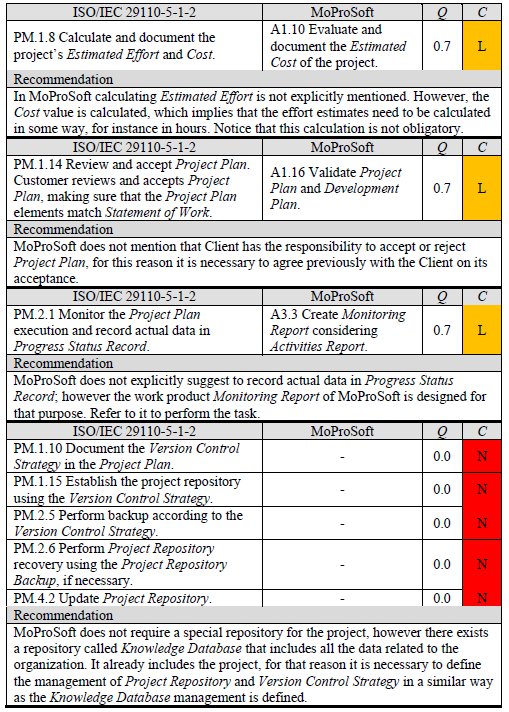
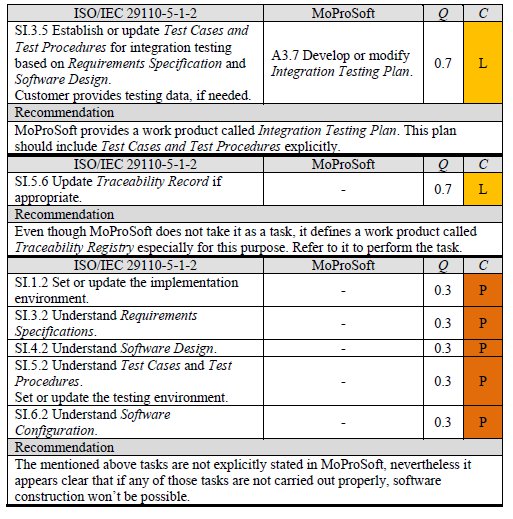
<body><![CDATA[<p  style="margin: 0cm 0cm 5.95pt; text-align: justify; text-indent: 0cm;"> <span  style="font-family: &quot;Verdana&quot;; font-style: normal; font-variant: normal; font-weight: normal; font-size: 10pt; line-height: normal; font-size-adjust: none; font-stretch: normal" lang="EN-US">&nbsp;&nbsp;&nbsp;&nbsp;&nbsp;&nbsp;&nbsp;&nbsp;&nbsp;&nbsp;&nbsp;&nbsp;&nbsp;&nbsp;&nbsp;&nbsp;&nbsp;&nbsp;&nbsp;</span><font face="Verdana"><span  style="font-size: 10pt; " lang="EN-US">6.2 Not Totally Covered Work Products</span></font><o:p></o:p></p>     <p style="text-align: justify;"><span  style="font-size: 10pt;" lang="EN-US"><font face="Verdana">This section focuses on the ISO/IEC 29110-5-1-2 work products identified as <i  style="">not totally</i> covered by MoProSoft. <a href="#t13">Table 13</a> presents the referred work products.</font><o:p></o:p></span></p>     <p align="center"> <font face="Verdana" size="2"> <a name="t13">Table 13: Not totally covered work products    <br> <img src="/img/revistas/cleiej/v16n1/1a03t13.jpg"> </a></font></p>     <p style="text-align: justify;"><span  style="font-size: 10pt;" lang="EN-US"><font face="Verdana">&nbsp;</font><o:p></o:p></span></p>     <p style="text-align: justify; text-indent: 18.15pt;"><span  style="font-size: 10pt;" lang="EN-US"><font face="Verdana">After all we can declare that what is needed to cover the international standard starting from MoProSoft level 2, is feasible to achieve in a short period of time and with little amount of effort following the recommendations, thus getting a great return of investment. Based on the results, the following steps are proposed as general migration actions:</font><o:p></o:p></span></p>     <p  style="margin-left: 54.15pt; text-align: justify; text-indent: -18pt;"><span  style="font-size: 10pt;" lang="EN-US"><font face="Verdana">1.</font><span  style="font-family: &quot;Verdana&quot;; font-style: normal; font-variant: normal; font-weight: normal; line-height: normal; font-size-adjust: none; font-stretch: normal">&nbsp;&nbsp;&nbsp;&nbsp;&nbsp;&nbsp;&nbsp;&nbsp;</span><font face="Verdana">If the task exists implicitly in the organization process and/or related work products are produced: Make it explicit in the organization process (SI.1.2, SI.3.2, SI.4.2, SI.5.2 and SI.6.2).</font><o:p></o:p></span></p>     <p  style="margin-left: 54.15pt; text-align: justify; text-indent: -18pt;"><span  style="font-size: 10pt;" lang="EN-US"><font face="Verdana">2.</font><span  style="font-family: &quot;Verdana&quot;; font-style: normal; font-variant: normal; font-weight: normal; line-height: normal; font-size-adjust: none; font-stretch: normal">&nbsp;&nbsp;&nbsp;&nbsp;&nbsp;&nbsp;&nbsp;&nbsp;</span><font face="Verdana">If the related work products exist but need improvement: Complete or improve what is necessary and make the improvement to the work product explicit as a part of organization process (SI.3.5 and PM.1.8).</font><o:p></o:p></span></p>     <p  style="margin-left: 54.15pt; text-align: justify; text-indent: -18pt;"><span  style="font-size: 10pt;" lang="EN-US"><font face="Verdana">3.</font><span  style="font-family: &quot;Verdana&quot;; font-style: normal; font-variant: normal; font-weight: normal; line-height: normal; font-size-adjust: none; font-stretch: normal">&nbsp;&nbsp;&nbsp;&nbsp;&nbsp;&nbsp;&nbsp;&nbsp;</span><font face="Verdana">If the related work products exist and do not need improvement: Include explicitly the needed tasks related to the existing work products as a part of organization process (SI.5.6, PM.1.14 and PM.2.1).</font><o:p></o:p></span></p>     <p  style="margin-left: 54.15pt; text-align: justify; text-indent: -18pt;"><span  style="font-size: 10pt;" lang="EN-US"><font face="Verdana">4.</font><span  style="font-family: &quot;Verdana&quot;; font-style: normal; font-variant: normal; font-weight: normal; line-height: normal; font-size-adjust: none; font-stretch: normal">&nbsp;&nbsp;&nbsp;&nbsp;&nbsp;&nbsp;&nbsp;&nbsp;</span><font face="Verdana">If the related work products do not exist: Create the work products and include the needed tasks to the organization process (PM.1.10, PM.1.15, PM.2.5, PM.2.6 and PM.4.2).</font><o:p></o:p></span></p>     ]]></body>
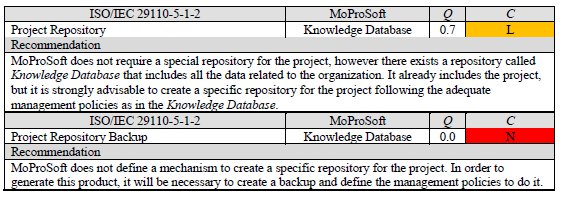
<body><![CDATA[<p style="text-align: justify;"><span  style="font-size: 10pt;" lang="EN-US"><font face="Verdana">&nbsp;</font><o:p></o:p></span></p>     <p  style="margin: 0cm 0cm 5.95pt; text-align: justify; text-indent: 0cm;"><b  style=""> <span  style="font-family: &quot;Verdana&quot;; font-style: normal; font-variant: normal; font-weight: normal; font-size: 10pt; line-height: normal; font-size-adjust: none; font-stretch: normal" lang="EN-US">&nbsp;&nbsp;&nbsp;&nbsp;&nbsp;&nbsp;&nbsp;&nbsp;&nbsp;&nbsp;&nbsp;&nbsp;&nbsp;&nbsp;&nbsp;</span><font face="Verdana"><span  style="font-size: 10pt; font-variant: normal"  lang="EN-US">7 Needed Effort to Bridge the Gap</span></font><o:p></o:p></b></p>     <p style="text-align: justify;"><span  style="font-size: 10pt;" lang="EN-US"><font face="Verdana">Based on the numerical results presented above, approximate time was calculated in order to estimate how long it takes to migrate from the Mexican to the international standard. Also a comparison of needed efforts in case of upgrading to MoProSoft level 3 or migrating to CMMI for Development (CMMI-DEV) <a href="#r28">(28)</a><a name="28."></a> level 3 is presented.</font><span  style="background: yellow none repeat scroll 0% 50%; -moz-background-clip: initial; -moz-background-origin: initial; -moz-background-inline-policy: initial;"><o:p></o:p></span></span></p>     <p style="text-align: justify; text-indent: 18.15pt;"><span  style="font-size: 10pt;" lang="EN-US"><font face="Verdana">Taking part in 43 projects, 27 as leader consultant and 16 as participant, of software process improvement, adopting MoProSoft and CMMI-DEV, have provided the necessary experience and in-practice knowledge for the coauthors of this paper to calculate the estimations and make the comparisons mentioned above.</font><o:p></o:p></span></p>     <p style="text-align: justify; text-indent: 18.15pt;"><span  style="font-size: 10pt;" lang="EN-US"><font face="Verdana">The estimations presented below is derived from the experience obtained in similar projects, developed in Mexico,<span style="">&nbsp; </span>varying from 5 to 14 months duration,<span style="">&nbsp; </span>198 mean hours per project, organization size from 9 to 75 employees, business oriented to develop software for government, financial resources, sales and customized.<span style="">&nbsp;&nbsp; </span></font><o:p></o:p></span></p>     <p  style="margin: 0cm 0cm 5.95pt; text-align: justify; text-indent: 0cm;"> <font face="Verdana"><span  style="font-size: 10pt; " lang="EN-US">&nbsp;</span></font><o:p></o:p></p>     <p  style="margin: 0cm 0cm 5.95pt; text-align: justify; text-indent: 0cm;"> <span  style="font-family: &quot;Verdana&quot;; font-style: normal; font-variant: normal; font-weight: normal; font-size: 10pt; line-height: normal; font-size-adjust: none; font-stretch: normal" lang="EN-US">&nbsp;&nbsp;&nbsp;&nbsp;&nbsp;&nbsp;&nbsp;&nbsp;&nbsp;&nbsp;&nbsp;&nbsp;&nbsp;&nbsp;&nbsp;&nbsp;&nbsp;&nbsp;&nbsp;</span><font face="Verdana"><span  style="font-size: 10pt; " lang="EN-US">7.1 Duration of the Effort Needed to Bridge the Gap</span></font><o:p></o:p></p>     <p style="text-align: justify;"><span  style="font-size: 10pt;" lang="EN-US"><font face="Verdana">The accuracy of activity duration estimates can be improved by considering estimation uncertainty and risk. The Three-Point Estimates is a concept originated by the Program Evaluation and Review Technique (PERT) <a  href="#r29">(29)</a><a name="29."></a>. PERT is a statistical tool designed to analyze and represent the tasks involved in a project that uses three estimates to define an approximate range of activity duration.</font><o:p></o:p></span></p>     <p  style="margin-bottom: 12pt; text-align: justify; text-indent: 18.15pt;"><span  style="font-size: 10pt;" lang="EN-US"><font face="Verdana">The three estimates considered are the Most Likely (t<sub>M</sub>), the Optimistic (t<sub>O</sub>), based on the analysis of the best-case scenario, and the Pessimistic (t<sub>P</sub>), based on the analysis of the worst-case scenario. PERT analysis calculates an Expected (t<sub>E</sub>) activity duration using a weighted average of the three mentioned estimates:</font><o:p></o:p></span></p>     <p align="center"> <font face="Verdana" size="2"> <a name="f9"><img src="/img/revistas/cleiej/v16n1/1a03z9.gif"></a></font></p>     ]]></body>
<body><![CDATA[<p  style="margin-top: 12pt; text-align: justify; text-indent: 18.15pt;"><span  style="font-size: 10pt;" lang="EN-US"><font face="Verdana">The effort needed to totally cover the 15 tasks, 8 from Project Management and 7 from Software Implementation, was calculated using PERT and based on the experience and in-practice knowledge of two coauthors of this paper. Each not totally covered task recommendation was analyzed and individual estimation in hours was calculated. <a href="#t14">Table 14</a> presents the estimated effort duration, calculated in hours, to carry out the PM tasks.<span  style="">&nbsp; </span></font><o:p></o:p></span></p>     <p align="center"> <font face="Verdana" size="2"> <a name="t14">Table 14: Effort duration (in hours) to carry out the not totally covered PM tasks     <br> <img src="/img/revistas/cleiej/v16n1/1a03t14.jpg"> </a></font></p>     <p style="text-align: justify;"><span  style="font-size: 10pt;" lang="EN-US"><font face="Verdana">&nbsp;</font><o:p></o:p></span></p>     <p style="text-align: justify;"><span  style="font-size: 10pt;" lang="EN-US"><font face="Verdana">Table 15 presents the estimated effort duration, calculated in hours, to carry out the SI tasks.<span style="">&nbsp; </span></font><o:p></o:p></span></p>     <p align="center"> <font face="Verdana" size="2"> <a name="t15">Table 15: Effort duration (in hours) to carry out the not totally covered SI tasks    <br> <img src="/img/revistas/cleiej/v16n1/1a03t15.jpg"> </a></font></p>     <p style="text-align: justify;"><span  style="font-size: 10pt;" lang="EN-US"><font face="Verdana">&nbsp;</font><o:p></o:p></span></p>     <p style="text-align: justify; text-indent: 18.15pt;"><span  style="font-size: 10pt;" lang="EN-US"><font face="Verdana">It is important to mention that the effort duration estimates also include the implementation of the not totally covered work products associated with <i style="">Project Repository</i> and <i style="">Project Repository Backup</i>. Consequently <a href="#t16">Table 16</a> demonstrates a summary of the values obtained from the calculation of the effort duration, calculated in hours, in order to carry out the not totally covered tasks and work products.</font><o:p></o:p></span></p>     <p align="center"> <font face="Verdana" size="2"> <a name="t16">Table 16: Total effort duration (in hours) to carry out the not totally covered tasks    ]]></body>
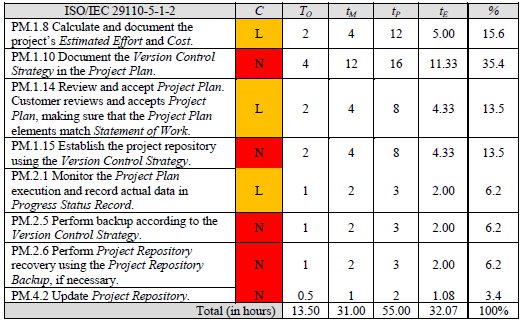
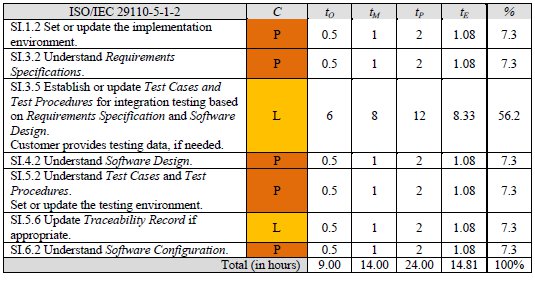
<body><![CDATA[<br> <img src="/img/revistas/cleiej/v16n1/1a03t16.jpg"> </a></font></p>     <p><span style="" lang="EN-US"><font face="Verdana" size="2">&nbsp;</font><o:p></o:p></span></p>     <p style="text-align: justify; text-indent: 18.15pt;"><font face="Verdana"><span  style="font-size: 10pt;" lang="EN-US">Therefore, based on the calculated estimations, we can conclude that it is viable to bridge the gap between both standards in 46.88 hours. </span><span  style="font-size: 10pt;" lang="EN-GB">The time to bridge the gap depends on the organization; for example, if the organization decides to invest 10 hours a week, 2 hours per day, the gap can be covered in less than 5 weeks.</span></font><span  style="font-size: 10pt;" lang="EN-US"><o:p></o:p></span></p>     <p><span style="" lang="EN-US"><font face="Verdana" size="2">&nbsp;</font><o:p></o:p></span></p>     <p  style="margin: 0cm 0cm 5.95pt; text-align: justify; text-indent: 0cm;"> <span  style="font-family: &quot;Verdana&quot;; font-style: normal; font-variant: normal; font-weight: normal; font-size: 10pt; line-height: normal; font-size-adjust: none; font-stretch: normal" lang="EN-US">&nbsp;&nbsp;&nbsp;&nbsp;&nbsp;&nbsp;&nbsp;&nbsp;&nbsp;&nbsp;&nbsp;&nbsp;&nbsp;&nbsp;&nbsp;&nbsp;&nbsp;&nbsp;&nbsp;</span><font face="Verdana"><span  style="font-size: 10pt; " lang="EN-US">7.2 Comparing Effort against other Models and Standards</span></font><o:p></o:p></p>     <p style="text-align: justify;"><span  style="font-size: 10pt;" lang="EN-US"><font face="Verdana">After answering the initial question about the gap between the Mexican and international standard, and calculating the necessary effort to bridge it, a valid interest of an organization is to make a comparison of migrating to other standards or models. In this work we have considered two alternatives to compare: one is to upgrade to MoProSoft level 3, in a national context; and the other is to migrate to CMMI-DEV 1.3 level 3, in an international context.</font><o:p></o:p></span></p>     <p style="text-align: justify; text-indent: 18.15pt;"><span  style="font-size: 10pt;" lang="EN-US"><font face="Verdana">In the next subsections a comparison between the results presented in this paper and the two alternatives is presented.</font><o:p></o:p></span></p>     <p style="text-align: justify;"><span  style="font-size: 10pt;" lang="EN-US"><font face="Verdana">&nbsp;</font><o:p></o:p></span></p>     <p  style="margin: 0cm 0cm 5.95pt; text-align: justify; text-indent: 0cm;"><i  style=""> <span  style="font-family: &quot;Verdana&quot;; font-style: normal; font-variant: normal; font-weight: normal; font-size: 10pt; line-height: normal; font-size-adjust: none; font-stretch: normal; text-decoration:none" lang="EN-US">&nbsp;&nbsp;&nbsp;&nbsp;&nbsp;&nbsp;&nbsp;&nbsp;&nbsp;&nbsp;&nbsp;&nbsp;&nbsp;&nbsp;&nbsp;&nbsp;&nbsp;&nbsp;&nbsp;&nbsp;&nbsp;&nbsp;&nbsp;&nbsp;</span><font face="Verdana"><span  style="font-size: 10pt; text-decoration: none"  lang="EN-US">7.2.1 MoProSoft Level 3</span></font><o:p></o:p></i></p>     <p style="text-align: justify;"><span  style="font-size: 10pt;" lang="EN-US"><font face="Verdana">The capability level 3 of MoProSoft means that the process is defined and implemented within the organization. In the colored version of MoProSoft the color green is used to define it.</font><o:p></o:p></span></p>     ]]></body>
<body><![CDATA[<p style="text-align: justify; text-indent: 18.15pt;"><span  style="font-size: 10pt;" lang="EN-US"><font face="Verdana">Upgrade to level 3 of MoProSoft implies implementing 6 new tasks and 2 new work products and proving that the organization has been maintaining level 2. The estimated effort to upgrade from level 2 to level 3 of MoProSoft is 206 hours which is four times more than the time effort required to achieve ISO/IEC 29110-5-1-2.</font><o:p></o:p></span></p>     <p style="text-align: justify; text-indent: 18.15pt;"><span  style="font-size: 10pt;" lang="EN-US"><font face="Verdana">&nbsp;</font><o:p></o:p></span></p>     <p  style="margin: 0cm 0cm 5.95pt; text-align: justify; text-indent: 0cm;"><i  style=""> <span  style="font-family: &quot;Verdana&quot;; font-style: normal; font-variant: normal; font-weight: normal; font-size: 10pt; line-height: normal; font-size-adjust: none; font-stretch: normal; text-decoration:none" lang="EN-US">&nbsp;&nbsp;&nbsp;&nbsp;&nbsp;&nbsp;&nbsp;&nbsp;&nbsp;&nbsp;&nbsp;&nbsp;&nbsp;&nbsp;&nbsp;&nbsp;&nbsp;&nbsp;&nbsp;&nbsp;&nbsp;&nbsp;&nbsp;&nbsp;</span><font face="Verdana"><span  style="font-size: 10pt; text-decoration: none"  lang="EN-US">7.2.2 CMMI for Development 1.3 Level 3</span></font><o:p></o:p></i></p>     <p style="text-align: justify;"><span  style="font-size: 10pt;" lang="EN-US"><font face="Verdana">CMMI models are collections of best practices that help organizations to improve their processes. These models are developed by product teams with members from industry, government, and the Software Engineering Institute <a  href="#r28">(28)</a>. CMMI-DEV provides a comprehensive integrated set of guidelines for products and services development. </font> <o:p></o:p></span></p>     <p style="text-align: justify; text-indent: 18.15pt;"><span  style="font-size: 10pt;" lang="EN-US"><font face="Verdana">Migrating to CMMI-DEV 1.3 level 3 from MoProSoft level 2 implies implementing 35 new subpractices or tasks. The estimated effort time in this case is 358 hour which is seven times more than the effort needed to achieve ISO/IEC 29110-5-1-2.</font><o:p></o:p></span></p>     <p style="text-align: justify; text-indent: 18.15pt;"><span  style="font-size: 10pt;" lang="EN-US"><font face="Verdana">&nbsp;</font><o:p></o:p></span></p>     <p  style="margin: 0cm 0cm 5.95pt; text-align: justify; text-indent: 0cm;"> <span  style="font-family: &quot;Verdana&quot;; font-style: normal; font-variant: normal; font-weight: normal; font-size: 10pt; line-height: normal; font-size-adjust: none; font-stretch: normal" lang="EN-US">&nbsp;&nbsp;&nbsp;&nbsp;&nbsp;&nbsp;&nbsp;&nbsp;&nbsp;&nbsp;&nbsp;&nbsp;&nbsp;&nbsp;&nbsp;&nbsp;&nbsp;&nbsp;&nbsp;</span><font face="Verdana"><span  style="font-size: 10pt; " lang="EN-US">7.3 Extending the Mapping from COMPETISOFT to ISO/IEC 29110-5-1-2</span></font><o:p></o:p></p>     <p style="text-align: justify;"><span  style="font-size: 10pt;" lang="EN-US"><font face="Verdana">Considering COMPETISOFT as evolution and amplification of MoProSoft, an analysis was carried out taking a case of an Iberoamerican organization that has adopted COMPETISOFT and would like to migrate to ISO/IEC 29110-5-1-2. The analysis was divided in two steps:</font><o:p></o:p></span></p> <ul style="margin-top: 0cm;" type="disc">   <li class="MsoNormal"  style="margin-bottom: 5.95pt; text-align: justify;"><font face="Verdana"><b style=""><span  style="font-size: 10pt;" lang="EN-US">Step 1:</span></b><span  style="font-size: 10pt;" lang="EN-US"> To build a mapping between MoProSoft and COMPETISOFT.</span><span style="" lang="EN-US"><font size="2">   </font> </span></font><span  style="font-size: 10pt;" lang="EN-US"><font face="Verdana">For this reason, the tasks and work products of each process of MoProSoft were faced against the tasks and work products of the equivalent process in COMPETISOFT, as shown in     <a href="#t17">Table 17</a>. </font> <span class="capLabel"><span  style="font-weight: normal;"><o:p></o:p></span></span></span></li>     </ul>     <p align="center"> <font face="Verdana" size="2"> <a name="t17">Table 17: Equivalence between processes involved in the extended mapping    ]]></body>
<body><![CDATA[<br> <img src="/img/revistas/cleiej/v16n1/1a03t17.jpg"> </a></font></p> <ul style="margin-top: 0cm;" type="disc">   <li class="MsoNormal"  style="margin-bottom: 5.95pt; text-align: justify;"><font face="Verdana"><b style=""><span  style="font-size: 10pt;" lang="EN-US">Step 2:</span></b></font><span  style="font-size: 10pt;" lang="EN-US"><font face="Verdana"> To analyze the tasks considered by COMPETISOFT but left out by MoProSoft in order to establish if COMPETISOFT achieves a larger coverage level to get to ISO/IEC 29110-5-1-2 than MoProSoft.</font><o:p></o:p></span></li>     </ul>     <p style="text-align: justify; text-indent: 18.15pt;"><span  style="font-size: 10pt;" lang="EN-US"><font face="Verdana">Analysis step1completed, <a  href="#t18">Table 18</a> shows a summary of values obtained from mapping the tasks.</font><o:p></o:p></span></p>     <p align="center"> <font face="Verdana" size="2"> <a name="t18">Table 18: Mapping results between COMPETISOFT and MoProSoft     <br> <img src="/img/revistas/cleiej/v16n1/1a03t18.jpg"> </a></font></p>     <p style="text-align: justify;"><span  style="font-size: 10pt;" lang="EN-US"><font face="Verdana"><span style="">&nbsp; </span> </font><o:p></o:p></span></p>     <p style="text-align: justify; text-indent: 18.15pt;"><span  style="font-size: 10pt;" lang="EN-US"><font face="Verdana">According to the results of the first step, it can be concluded that a COMPETISOFT-adopted organization covers 99% of the Mexican standard tasks. The not totally covered<i style=""> </i>task is<i style=""> A1.13 Generate or update the Development Plan according the Project Plan before each cycle</i>. In consequence, the work product <i style="">Development Plan</i> is the only one not generated by COMPETISOFT, but required by MoProSoft. </font> <o:p></o:p></span></p>     <p style="text-align: justify; text-indent: 18.15pt;"><span  style="font-size: 10pt;" lang="EN-US"><font face="Verdana">On the other hand, it is important to declare that the mentioned task and work product are not required by ISO/IEC 29110-5-1-2. Thus, the main results presented in this paper can be applied directly to organizations that have already adopted COMPETISOFT.</font><o:p></o:p></span></p>     <p style="text-align: justify; text-indent: 18.15pt;"><span  style="font-size: 10pt;" lang="EN-US"><font face="Verdana">Later, taking into account that COMPETISOFT is an amplification of MoProSoft, the tasks included in COMPETISOFT but missed by MoProSoft were analyzed against the gap identified in Tables 11 and 12. It turns out that COMPETISOFT added tasks to explicitly create a project repository, to define the version control strategy and the policies for its management in PM process, see <a href="#t19">Table 19</a>. </font> <o:p></o:p></span></p>     <p align="center"> <font face="Verdana" size="2"> <a name="t19">Table 19: PM tasks totally covered by COMPETISOFT    ]]></body>

<body><![CDATA[<br> <img src="/img/revistas/cleiej/v16n1/1a03t19.jpg"> </a></font></p>     <p style="text-align: justify; text-indent: 18.15pt;"><span  style="font-size: 10pt;" lang="EN-US"><font face="Verdana">Besides, in SI two more tasks become totally covered by COMPETISOFT, see <a href="#t20">Table 20</a>.</font><o:p></o:p></span></p>     <p align="center"> <font face="Verdana" size="2"> <a name="t20">Table 20: SI tasks totally covered by COMPETISOFT    <br> <img src="/img/revistas/cleiej/v16n1/1a03t20.jpg"> </a></font></p>     <p  style="margin-top: 12pt; text-align: justify; text-indent: 18.15pt;"><span  style="font-size: 10pt;" lang="EN-US"><font face="Verdana">For the reason that COMPETISOFT covers seven tasks, five from PM and two from SI, more than MoProSoft, the coverage level increases from 85% to 93%, as shown in <a href="#t20">Table 21</a>.<span style="">&nbsp; </span></font><o:p></o:p></span></p>     <p  style="margin-top: 12pt; text-align: justify; text-indent: 18.15pt;"><span  style="font-size: 10pt;" lang="EN-US"><o:p></o:p></span></p>     <p align="center"> <font face="Verdana" size="2"> <a name="t21">Table 21: Results of mapping between COMPETISOFT and ISO/IEC 29110-5-1-2     <br> <img src="/img/revistas/cleiej/v16n1/1a03t21.jpg"> </a></font></p>     <p style="text-align: justify; text-indent: 18.15pt;"><span  style="font-size: 10pt;" lang="EN-US"><font face="Verdana">&nbsp;</font><o:p></o:p></span></p>     <p style="text-align: justify; text-indent: 18.15pt;"><span  style="font-size: 10pt;" lang="EN-US"><font face="Verdana">Using the retrieved results, <a  href="#t22">Table 22</a> presents a summary of the values obtained from the calculation of the effort duration, in hours, in order to fulfill the not totally covered tasks starting from COMPETISOFT.</font><o:p></o:p></span></p>     ]]></body>
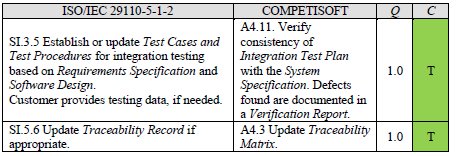

<body><![CDATA[<p align="center"> <font face="Verdana" size="2"> <a name="t22">Table 22: Total effort duration (in hours) to fulfill the not totally covered tasks    <br> <img src="/img/revistas/cleiej/v16n1/1a03t22.jpg"> </a></font></p>     <p><span style="" lang="EN-US"><font face="Verdana" size="2">&nbsp;</font><o:p></o:p></span></p>     <p style="text-align: justify; text-indent: 18.15pt;"><font face="Verdana"><span  style="font-size: 10pt;" lang="EN-US">Therefore, based on the calculated estimations, we can conclude that it is viable to bridge the gap between both COMPETISOFT and ISO/IEC 29110-5-1-2 in 16.73 hours. </span><span style="font-size: 10pt;" lang="EN-GB">The time distribution to bridge the gap depends on the organization; for example, if the organization decides to invest 10 hours a week, 2 hours a day, the gap can be covered in less than 2 weeks.</span></font><span style="font-size: 10pt;" lang="EN-US"><o:p></o:p></span></p>     <p style="text-align: justify; text-indent: 18.15pt;"><span  style="font-size: 10pt;" lang="EN-US"><font face="Verdana">&nbsp;</font><o:p></o:p></span></p>     <p  style="margin: 0cm 0cm 5.95pt; text-align: justify; text-indent: 0cm;"><b  style=""> <span  style="font-family: &quot;Verdana&quot;; font-style: normal; font-variant: normal; font-weight: normal; font-size: 10pt; line-height: normal; font-size-adjust: none; font-stretch: normal" lang="EN-US">&nbsp;&nbsp;&nbsp;&nbsp;&nbsp;&nbsp;&nbsp;&nbsp;&nbsp;&nbsp;&nbsp;&nbsp;&nbsp;&nbsp;&nbsp;</span><font face="Verdana"><span  style="font-size: 10pt; font-variant: normal"  lang="EN-US">Conclusions and Future Work</span></font><o:p></o:p></b></p>     <p style="text-align: justify;"><span  style="font-size: 10pt;" lang="EN-US"><font face="Verdana">This paper describes a mapping between the international standard ISO/IEC 29110-5-1-2 and the Mexican standard NMX-I-059-NYCE-2005, MoProSoft. As a result of the theoretical and practical review done by specialists in software processes, consultants from INNEVO with broad experience in the adoption of the Mexican standard and the expert participation of a close developer of both standards, the gap between standards was clarified and punctual recommendations in order to adopt the international standard starting from MoProSoft level 2 were offered.</font><o:p></o:p></span></p>     <p style="text-align: justify; text-indent: 18.15pt;"><span  style="font-size: 10pt;" lang="EN-US"><font face="Verdana">The MoProSoft broad scope of influence in Latin America, thanks to COMPETISOFT and NTP 291.100:2009, serves as a strong factor to believe that software development organizations in the region receive a real opportunity to adopt an international standard. Besides, the coverage values obtained from the mapping, 0.77 for PM process and 0.90 for SI process, suggest an attainable objective of reaching not only national, but international recognition as well.</font><o:p></o:p></span></p>     <p style="text-align: justify; text-indent: 18.15pt;"><span  style="font-size: 10pt;" lang="EN-US"><font face="Verdana">The estimated effort to reach the ISO/IEC 29110-5-1-2 from MoProSoft level 2 is approximately 46.88 hours. Compared with other alternatives, such as upgrading to MoProSoft level 3 or migrating to CMMI-DEV 1.3 level 3, the estimated time investment is four and seven times less respectively.</font><o:p></o:p></span></p>     <p style="text-align: justify; text-indent: 18.15pt;"><span  style="font-size: 10pt;" lang="EN-US"><font face="Verdana">Finally we conclude that an organization evaluated in MoProSoft level 2 covered 85% of tasks and 94% of work products defined in ISO/IEC 29110-5-1-2, making it possible to acquire an international standard in a short period of time and little effort, 46.88 hours, if the suggested recommendations are followed.</font><o:p></o:p></span></p>     ]]></body>
<body><![CDATA[<p style="text-align: justify; text-indent: 18.15pt;"><span  style="font-size: 10pt;" lang="EN-US"><font face="Verdana">As a parallel result of this paper we can add that an organization using COMPETISOFT covers 93% of tasks defined in ISO/IEC 29110-5-1-2, making it possible to acquire the international standard in 16.73 hours.</font><o:p></o:p></span></p>     <p style="text-align: justify; text-indent: 18.15pt;"><span  style="font-size: 10pt;" lang="EN-US"><font face="Verdana">As future work to be done, experiments in organizations migrating to ISO/IEC 29110-5-1-2 will be conducted to corroborate the estimations of effort presented in this paper.</font><o:p></o:p></span></p>     <p style="text-align: justify; text-indent: 18.15pt;"><span  style="font-size: 10pt;" lang="EN-US"><font face="Verdana">Taking into account the influence of MoProSoft and COMPETISOFT in Latin American and the little amount of effort and time needed to bridge the gap, it gives small software development organizations in the region an advantage in adopting ISO/IEC 29110-5-1-2, increasing considerably the impact of the international standard in this geographical area, and making it a promising region for software industry.</font><o:p></o:p></span></p>     <p><font face="Verdana" size="2"><span lang="EN-US">Acknowledgements</span></font></p>     <p style="text-align: justify;"><span  style="font-size: 10pt;" lang="EN-US"><font face="Verdana">This work has been possible thanks to MC. Marcela Pe&ntilde;aloza B&aacute;ez and Ferm&iacute;n Mar&iacute;n Arzate General Directors of DCV-DGTIC-UNAM and INNEVO respectively. Also we would like to thank Nubia Fern&aacute;ndez from DCV-DGTIC-UNAM and Mauricio Arreola from INNEVO for their constant participation.<span style="">&nbsp; </span></font><o:p></o:p></span></p>     <p><font face="Verdana" size="2"><span lang="EN-US">References</span></font></p>     <!-- ref --><p style="margin-left: 21.3pt; text-indent: -21.3pt;"><span  lang="EN-US"><font face="Verdana" size="2"><a href="#1." name="r1">(1)</a></font><span  style="font-family: &quot;Verdana&quot;; font-style: normal; font-variant: normal; font-weight: normal; font-size: 10pt; line-height: normal; font-size-adjust: none; font-stretch: normal">&nbsp;&nbsp;&nbsp;&nbsp;&nbsp;&nbsp;&nbsp;&nbsp;&nbsp;</span></span><font face="Verdana" size="2"><span  lang="EN-US">H. Oktaba.: <i style="">MoProSoft: A Software Process Model for Small Enterprises</i>. Proceedings of the First International Research Workshop for Process Improvement in Small Settings. pp. 93-100. Software Engineer Institute, Carnegie Mellon University, 2005</span></font><!-- ref --><p style="margin-left: 21.3pt; text-indent: -21.3pt;"><span  lang="EN-US"><font face="Verdana" size="2"><a href="#2." name="r2">(2)</a></font><span  style="font-family: &quot;Verdana&quot;; font-style: normal; font-variant: normal; font-weight: normal; font-size: 10pt; line-height: normal; font-size-adjust: none; font-stretch: normal"><a  href="#2." name="r2">&nbsp;</a>&nbsp;&nbsp;&nbsp;&nbsp;&nbsp;&nbsp;&nbsp;&nbsp;</span></span><font face="Verdana" size="2"><span  lang="EN-US">H. Oktaba, M. Piattini, F. Garc&iacute;a, F. Pino, C. Alquicira, F. Ruiz: <i style="">Software Process Improvement: The COMPETISOFT Project</i>. IEEE Computer. Vol. 40, N. 10. p: 21-28, 2007</span></font><!-- ref --><p style="margin-left: 21.3pt; text-indent: -21.3pt;"><span  lang="EN-US"><font face="Verdana" size="2"><a href="#3." name="r3">(3)</a></font><span  style="font-family: &quot;Verdana&quot;; font-style: normal; font-variant: normal; font-weight: normal; font-size: 10pt; line-height: normal; font-size-adjust: none; font-stretch: normal">&nbsp;&nbsp;&nbsp;&nbsp;&nbsp;&nbsp;&nbsp;&nbsp;&nbsp;</span></span><font face="Verdana" size="2"><span  lang="EN-US">International Organization for Standardization (ISO), <a href="http://www.iso.org">http://www.iso.org</a> 03/07/12</span></font><!-- ref --><p style="margin-left: 21.3pt; text-indent: -21.3pt;"><span  lang="EN-US"><font face="Verdana" size="2"><a href="#4." name="r4">(4)</a></font><span  style="font-family: &quot;Verdana&quot;; font-style: normal; font-variant: normal; font-weight: normal; font-size: 10pt; line-height: normal; font-size-adjust: none; font-stretch: normal">&nbsp;&nbsp;&nbsp;&nbsp;&nbsp;&nbsp;&nbsp;&nbsp;&nbsp;</span></span><font face="Verdana" size="2"><span  lang="EN-US">Standard ISO/IEC 29110:2011 Software engineering -- Lifecycle profiles for Very Small Entities (VSEs), 2011</span></font><!-- ref --><p style="margin-left: 21.3pt; text-indent: -21.3pt;"><span  lang="EN-US"><font face="Verdana" size="2"><a href="#5." name="r5">(5)</a></font><span  style="font-family: &quot;Verdana&quot;; font-style: normal; font-variant: normal; font-weight: normal; font-size: 10pt; line-height: normal; font-size-adjust: none; font-stretch: normal">&nbsp;&nbsp;&nbsp;&nbsp;&nbsp;&nbsp;&nbsp;&nbsp;&nbsp;</span></span><font face="Verdana" size="2"><span  lang="EN-US">National Autonomous University of Mexico (UNAM), <a href="http://www.unam.mx">http://www.unam.mx</a> 03/07/12</span></font><!-- ref --><p style="margin-left: 21.3pt; text-indent: -21.3pt;"><span  lang="EN-US"><font face="Verdana" size="2"><a href="#6." name="r6">(6)</a></font><span  style="font-family: &quot;Verdana&quot;; font-style: normal; font-variant: normal; font-weight: normal; font-size: 10pt; line-height: normal; font-size-adjust: none; font-stretch: normal">&nbsp;&nbsp;&nbsp;&nbsp;&nbsp;&nbsp;&nbsp;&nbsp;&nbsp;</span></span><font face="Verdana" size="2"><span  lang="EN-US">INNEVO, <a href="http://www.innevo.com">http://www.innevo.com</a> 03/07/12</span></font><!-- ref --><p style="margin-left: 21.3pt; text-indent: -21.3pt;"><span  lang="EN-US"><font face="Verdana" size="2"><a href="#7." name="r7">(7)</a></font><span  style="font-family: &quot;Verdana&quot;; font-style: normal; font-variant: normal; font-weight: normal; font-size: 10pt; line-height: normal; font-size-adjust: none; font-stretch: normal">&nbsp;&nbsp;&nbsp;&nbsp;&nbsp;&nbsp;&nbsp;&nbsp;&nbsp;</span></span><font face="Verdana" size="2"><span  lang="EN-US">Ministry of Economy, <a href="http://www.economia.gob.mx">http://www.economia.gob.mx</a> 03/07/12</span></font><!-- ref --><p style="margin-left: 21.3pt; text-indent: -21.3pt;"><span  lang="EN-US"><font face="Verdana" size="2"><a href="#8." name="r8">(8)</a></font><span  style="font-family: &quot;Verdana&quot;; font-style: normal; font-variant: normal; font-weight: normal; font-size: 10pt; line-height: normal; font-size-adjust: none; font-stretch: normal">&nbsp;&nbsp;&nbsp;&nbsp;&nbsp;&nbsp;&nbsp;&nbsp;&nbsp;</span></span><font face="Verdana" size="2"><span  lang="EN-US">Mexican Association for the Quality in Software Engineering (AMCIS), <a href="http://www.software.net.mx">http://www.software.net.mx</a> defunct</span></font><!-- ref --><p style="margin-left: 21.3pt; text-indent: -21.3pt;"><span  style="" lang="ES-MX"><font face="Verdana" size="2"><a href="#9." name="r9">(9)</a></font><span  style="font-family: &quot;Verdana&quot;; font-style: normal; font-variant: normal; font-weight: normal; font-size: 10pt; line-height: normal; font-size-adjust: none; font-stretch: normal">&nbsp;&nbsp;&nbsp;&nbsp;&nbsp;&nbsp;&nbsp;&nbsp;&nbsp;</span><font face="Verdana" size="2">NMX-I-059-NYCE-2005 parte 4: Tecnolog&iacute;a de la informaci&oacute;n - Software - Modelos de procesos y evaluaci&oacute;n para desarrollo y mantenimiento de software - Parte 4: Directrices para la evaluaci&oacute;n, 2005</font><o:p></o:p></span><!-- ref --><p style="margin-left: 21.3pt; text-indent: -21.3pt;"><span  style="" lang="ES-MX"><font face="Verdana" size="2"><a href="#10." name="r10">(10)</a></font><span  style="font-family: &quot;Verdana&quot;; font-style: normal; font-variant: normal; font-weight: normal; font-size: 10pt; line-height: normal; font-size-adjust: none; font-stretch: normal">&nbsp;&nbsp;&nbsp;&nbsp;&nbsp;&nbsp;</span><font face="Verdana" size="2">Terminan pruebas controladas de MoProSoft, Software Gur&uacute;, Mayo 2005 <a href="http://www.sg.com.mx/content/view/53/99999999">http://www.sg.com.mx/content/view/53/99999999</a> 03/07/11 </font> <o:p></o:p></span><!-- ref --><p style="margin-left: 21.3pt; text-indent: -21.3pt;"><span  style="" lang="ES-MX"><font face="Verdana" size="2"><a href="#11." name="r11">(11)</a></font><span  style="font-family: &quot;Verdana&quot;; font-style: normal; font-variant: normal; font-weight: normal; font-size: 10pt; line-height: normal; font-size-adjust: none; font-stretch: normal">&nbsp;&nbsp;&nbsp;&nbsp;&nbsp;&nbsp;</span><font face="Verdana" size="2">NMX-I-059-NYCE-2005 parte 2: Tecnolog&iacute;a de la informaci&oacute;n - Software - Modelos de procesos y evaluaci&oacute;n para desarrollo y mantenimiento de software - Parte 2: Requisitos y procesos, 2005</font><o:p></o:p></span><!-- ref --><p style="margin-left: 21.3pt; text-indent: -21.3pt;"><span  lang="EN-US"><font face="Verdana" size="2"><a href="#12." name="r12">(12)</a></font><span  style="font-family: &quot;Verdana&quot;; font-style: normal; font-variant: normal; font-weight: normal; font-size: 10pt; line-height: normal; font-size-adjust: none; font-stretch: normal">&nbsp;&nbsp;&nbsp;&nbsp;&nbsp;&nbsp;</span></span><font face="Verdana" size="2"><span  lang="EN-US">Electronics Standardization and Certification (NYCE), <a href="http://www.nyce.org.mx">http://www.nyce.org.mx</a> 03/07/12</span></font><!-- ref --><p style="margin-left: 21.3pt; text-indent: -21.3pt;"><span  lang="EN-US"><font face="Verdana" size="2"><a href="#13." name="r13">(13)</a></font><span  style="font-family: &quot;Verdana&quot;; font-style: normal; font-variant: normal; font-weight: normal; font-size: 10pt; line-height: normal; font-size-adjust: none; font-stretch: normal">&nbsp;&nbsp;&nbsp;&nbsp;&nbsp;&nbsp;</span></span><font face="Verdana" size="2"><span  lang="EN-US">Ibero-American Programme for Science, Technology and Development (CYTED), <a href="http://www.cyted.org">http://www.cyted.org</a> 03/07/12</span></font><!-- ref --><p style="margin-left: 21.3pt; text-indent: -21.3pt;"><span  style="" lang="ES-MX"><font face="Verdana" size="2"><a href="#14." name="r14">(14)</a></font><span  style="font-family: &quot;Verdana&quot;; font-style: normal; font-variant: normal; font-weight: normal; font-size: 10pt; line-height: normal; font-size-adjust: none; font-stretch: normal">&nbsp;&nbsp;&nbsp;&nbsp;&nbsp;&nbsp;</span><font face="Verdana" size="2">Oktaba, H., Piattini, M., Pino, F., Orozco, M., Alquicira, C.: <i style="">COMPETISOFT: Mejora de procesos software para peque&ntilde;as y medianas empresas y proyectos</i>. Alfaomega Ra-Ma 2009</font><o:p></o:p></span><!-- ref --><p style="margin-left: 21.3pt; text-indent: -21.3pt;"><span  lang="EN-US"><font face="Verdana" size="2"><a href="#15." name="r15">(15)</a></font><span  style="font-family: &quot;Verdana&quot;; font-style: normal; font-variant: normal; font-weight: normal; font-size: 10pt; line-height: normal; font-size-adjust: none; font-stretch: normal">&nbsp;&nbsp;&nbsp;&nbsp;&nbsp;&nbsp;</span></span><font face="Verdana" size="2"><span  lang="EN-US">F. Pino, J. Tri&ntilde;anes, F. Garc&iacute;a, M. Piattini: <i style="">A software maintenance methodology for small organizations: Agile_MANTEMA</i>. Journal of Software: Evolution and Process. Vol. 24, N. 8. p: 851-876, 2012</span></font><!-- ref --><p style="margin-left: 21.3pt; text-indent: -21.3pt;"><span  lang="EN-US"><font face="Verdana" size="2"><a href="#16." name="r16">(16)</a></font><span  style="font-family: &quot;Verdana&quot;; font-style: normal; font-variant: normal; font-weight: normal; font-size: 10pt; line-height: normal; font-size-adjust: none; font-stretch: normal">&nbsp;&nbsp;&nbsp;&nbsp;&nbsp;&nbsp;</span></span><font face="Verdana" size="2"><span  lang="EN-US">National Institute for the Defense of Competition and Protection of Intellectual Property (INDECOPI), <a href="http://www.indecopi.gob.pe">http://www.indecopi.gob.pe</a> 03/07/12</span></font><!-- ref --><p style="margin-left: 21.3pt; text-indent: -21.3pt;"><span  style="" lang="ES-MX"><font face="Verdana" size="2"><a href="#17." name="r17">(17)</a></font><span  style="font-family: &quot;Verdana&quot;; font-style: normal; font-variant: normal; font-weight: normal; font-size: 10pt; line-height: normal; font-size-adjust: none; font-stretch: normal">&nbsp;&nbsp;&nbsp;&nbsp;&nbsp;&nbsp;</span><font face="Verdana" size="2">NTP 291.100-1:2009 Ingenier&iacute;a de Software: Modelos de procesos y evaluaci&oacute;n para desarrollo y mantenimiento de software, 2009</font><o:p></o:p></span><!-- ref --><p style="margin-left: 21.3pt; text-indent: -21.3pt;"><span  style="" lang="ES-MX"><font face="Verdana" size="2"><a href="#18." name="r18">(18)</a></font><span  style="font-family: &quot;Verdana&quot;; font-style: normal; font-variant: normal; font-weight: normal; font-size: 10pt; line-height: normal; font-size-adjust: none; font-stretch: normal">&nbsp;&nbsp;&nbsp;&nbsp;&nbsp;&nbsp;</span><font face="Verdana" size="2">Modelo de Procesos para la Industria de Software: MoProSoft por Niveles de Capacidad de Procesos, Versi&oacute;n 1.3, 2005</font><o:p></o:p></span><!-- ref --><p style="margin-left: 21.3pt; text-indent: -21.3pt;"><span  style="" lang="ES-MX"><font face="Verdana" size="2"><a href="#19." name="r19">(19)</a></font><span  style="font-family: &quot;Verdana&quot;; font-style: normal; font-variant: normal; font-weight: normal; font-size: 10pt; line-height: normal; font-size-adjust: none; font-stretch: normal">&nbsp;&nbsp;&nbsp;&nbsp;&nbsp;&nbsp;</span><font face="Verdana" size="2">NMX-I-15504-2-NYCE-2010 parte 2: Tecnolog&iacute;a de la informaci&oacute;n - Evaluaci&oacute;n de los procesos- Parte 2: Realizaci&oacute;n de una evaluaci&oacute;n, 2010</font><o:p></o:p></span><!-- ref --><p style="margin-left: 21.3pt; text-indent: -21.3pt;"><span  lang="EN-US"><font face="Verdana" size="2"><a href="#20." name="r20">(20)</a></font><span  style="font-family: &quot;Verdana&quot;; font-style: normal; font-variant: normal; font-weight: normal; font-size: 10pt; line-height: normal; font-size-adjust: none; font-stretch: normal">&nbsp;&nbsp;&nbsp;&nbsp;&nbsp;&nbsp;</span></span><font face="Verdana" size="2"><span  lang="EN-US">Standard ISO/IEC 15504-2:2003. Information Technology - Process assessment - Part 2 Performing an assessment, 2003</span></font><!-- ref --><p style="margin-left: 21.3pt; text-indent: -21.3pt;"><span  lang="EN-US"><font face="Verdana" size="2"><a href="#21." name="r21">21)</a></font><span  style="font-family: &quot;Verdana&quot;; font-style: normal; font-variant: normal; font-weight: normal; font-size: 10pt; line-height: normal; font-size-adjust: none; font-stretch: normal">&nbsp;&nbsp;&nbsp;&nbsp;&nbsp;&nbsp;</span></span><font face="Verdana" size="2"><span  lang="EN-US">ISO/IEC JTC1/SC7 Software and Systems Engineering, <a href="http://www.jtc1-sc7.org">http://www.jtc1-sc7.org</a> 03/07/12</span></font><!-- ref --><p style="margin-left: 21.3pt; text-indent: -21.3pt;"><span  style="" lang="ES-MX"><font face="Verdana" size="2"><a href="#22." name="r22">(22)</a></font><span  style="font-family: &quot;Verdana&quot;; font-style: normal; font-variant: normal; font-weight: normal; font-size: 10pt; line-height: normal; font-size-adjust: none; font-stretch: normal">&nbsp;&nbsp;&nbsp;&nbsp;&nbsp;&nbsp;</span><font face="Verdana" size="2">Oktaba, H.: <i style="">Tejiendo Nuestra Red: Ya Naci&oacute; ISO/IEC 29110 Perfil B&aacute;sico</i>. Software Gur&uacute;, Septiembre 2011 <a href="http://www.sg.com.mx/content/view/1211">http://www.sg.com.mx/content/view/1211</a> 03/07/12</font><o:p></o:p></span><!-- ref --><p style="margin-left: 21.3pt; text-indent: -21.3pt;"><span  lang="EN-US"><font face="Verdana" size="2"><a href="#23." name="r23">(23)</a></font><span  style="font-family: &quot;Verdana&quot;; font-style: normal; font-variant: normal; font-weight: normal; font-size: 10pt; line-height: normal; font-size-adjust: none; font-stretch: normal">&nbsp;&nbsp;&nbsp;&nbsp;&nbsp;&nbsp;</span></span><font face="Verdana" size="2"><span  lang="EN-US">Standard ISO/IEC 29110-5-1-2:2011 Software engineering -- Lifecycle profiles for Very Small Entities (VSEs) -- Part 5-1-2: Management and engineering guide: Generic profile group: Basic profile, 2011</span></font><!-- ref --><p style="margin-left: 21.3pt; text-indent: -21.3pt;"><span  lang="EN-US"><font face="Verdana" size="2"><a href="#24." name="r24">(24)</a></font><span  style="font-family: &quot;Verdana&quot;; font-style: normal; font-variant: normal; font-weight: normal; font-size: 10pt; line-height: normal; font-size-adjust: none; font-stretch: normal">&nbsp;&nbsp;&nbsp;&nbsp;&nbsp;&nbsp;</span></span><font face="Verdana" size="2"><span  lang="EN-US">Standard ISO/IEC 12207:2008 Systems and software engineering -- Software life cycle processes, 2008</span></font><!-- ref --><p style="margin-left: 21.3pt; text-indent: -21.3pt;"><span  lang="EN-US"><font face="Verdana" size="2"><a href="#25." name="r25">(25)</a></font><span  style="font-family: &quot;Verdana&quot;; font-style: normal; font-variant: normal; font-weight: normal; font-size: 10pt; line-height: normal; font-size-adjust: none; font-stretch: normal">&nbsp;&nbsp;&nbsp;&nbsp;&nbsp;&nbsp;</span></span><font face="Verdana" size="2"><span  lang="EN-US">Standard ISO/IEC 15289:2006 Systems and software engineering -- Content of life-cycle information products (documentation), 2006</span></font><!-- ref --><p style="margin-left: 21.3pt; text-indent: -21.3pt;"><span  lang="EN-US"><font face="Verdana" size="2"><a href="#26." name="r26">(26)</a></font><span  style="font-family: &quot;Verdana&quot;; font-style: normal; font-variant: normal; font-weight: normal; font-size: 10pt; line-height: normal; font-size-adjust: none; font-stretch: normal">&nbsp;&nbsp;&nbsp;&nbsp;&nbsp;&nbsp;</span></span><font face="Verdana" size="2"><span  lang="EN-US">Mutafelija, B., Stromberg, H.: <i style="">Mapping ISO Standards to CMMI-DEV V1.2</i>. <a href="http://www.sei.cmu.edu/cmmi/solutions/cmmi12-iso.cfm">http://www.sei.cmu.edu/cmmi/solutions/cmmi12-iso.cfm</a> 25/11/12</span></font><!-- ref --><p style="margin-left: 21.3pt; text-indent: -21.3pt;"><span  lang="EN-US"><font face="Verdana" size="2"><a href="#27." name="r27">(27)</a></font><span  style="font-family: &quot;Verdana&quot;; font-style: normal; font-variant: normal; font-weight: normal; font-size: 10pt; line-height: normal; font-size-adjust: none; font-stretch: normal">&nbsp;&nbsp;&nbsp;&nbsp;&nbsp;&nbsp;</span></span><font face="Verdana" size="2"><span  lang="EN-US">Software Engineering Institute, <a href="http://www.sei.cmu.edu/">http://www.sei.cmu.edu/</a> 29/11/12</span></font><!-- ref --><p style="margin-left: 21.3pt; text-indent: -21.3pt;"><span  lang="EN-US"><font face="Verdana" size="2"><a href="#28." name="r28">(28)</a></font><span  style="font-family: &quot;Verdana&quot;; font-style: normal; font-variant: normal; font-weight: normal; font-size: 10pt; line-height: normal; font-size-adjust: none; font-stretch: normal">&nbsp;&nbsp;&nbsp;&nbsp;&nbsp;&nbsp;</span></span><font face="Verdana" size="2"><span  lang="EN-US">CMMI for Development, version 1.3, Software Engineering Institute, 2010</span></font><!-- ref --><p style="margin-left: 0cm; text-indent: 0cm;"><span  lang="EN-US"><font face="Verdana" size="2"><a href="#29." name="r29">(29)</a></font><span  style="font-family: &quot;Verdana&quot;; font-style: normal; font-variant: normal; font-weight: normal; font-size: 10pt; line-height: normal; font-size-adjust: none; font-stretch: normal">&nbsp;&nbsp;&nbsp;&nbsp;&nbsp;&nbsp;</span></span><font face="Verdana" size="2"><span  lang="EN-US">Fazar, W.: <i style="">Program Evaluation and Review Technique</i>. The American Statistician. Vol. 13, No. 2, p.10, 1959</span></font> ]]></body><back>
<ref-list>
<ref id="B1">
<label>(1)</label><nlm-citation citation-type="">
<person-group person-group-type="author">
<name>
<surname><![CDATA[Oktaba]]></surname>
<given-names><![CDATA[H]]></given-names>
</name>
</person-group>
<article-title xml:lang="en"><![CDATA[MoProSoft: A Software Process Model for Small Enterprises]]></article-title>
<collab>Carnegie Mellon University^dSoftware Engineer Institute</collab>
<source><![CDATA[Proceedings of the First International Research Workshop for Process Improvement in Small Settings.]]></source>
<year>2005</year>
<page-range>93-100</page-range></nlm-citation>
</ref>
<ref id="B2">
<label>(2)</label><nlm-citation citation-type="journal">
<person-group person-group-type="author">
<name>
<surname><![CDATA[Oktaba]]></surname>
<given-names><![CDATA[H]]></given-names>
</name>
<name>
<surname><![CDATA[Piattini]]></surname>
<given-names><![CDATA[M]]></given-names>
</name>
<name>
<surname><![CDATA[García]]></surname>
<given-names><![CDATA[F]]></given-names>
</name>
<name>
<surname><![CDATA[Pino]]></surname>
<given-names><![CDATA[F]]></given-names>
</name>
<name>
<surname><![CDATA[Alquicira]]></surname>
<given-names><![CDATA[C]]></given-names>
</name>
<name>
<surname><![CDATA[Ruiz]]></surname>
<given-names><![CDATA[F]]></given-names>
</name>
</person-group>
<article-title xml:lang="en"><![CDATA[Software Process Improvement: The COMPETISOFT Project]]></article-title>
<source><![CDATA[IEEE Computer]]></source>
<year>2007</year>
<volume>40</volume>
<numero>10</numero>
<issue>10</issue>
<page-range>21-28</page-range></nlm-citation>
</ref>
<ref id="B3">
<label>(3)</label><nlm-citation citation-type="">
<collab>International Organization for Standardization</collab>
<source><![CDATA[]]></source>
<year></year>
</nlm-citation>
</ref>
<ref id="B4">
<label>(4)</label><nlm-citation citation-type="">
<source><![CDATA[Standard ISO/IEC 29110: 2011 Software engineering -- Lifecycle profiles for Very Small Entities (VSEs)]]></source>
<year>2011</year>
</nlm-citation>
</ref>
<ref id="B5">
<label>(5)</label><nlm-citation citation-type="">
<collab>National Autonomous University of Mexico</collab>
<source><![CDATA[]]></source>
<year></year>
</nlm-citation>
</ref>
<ref id="B6">
<label>(6)</label><nlm-citation citation-type="">
<collab>INNEVO</collab>
<source><![CDATA[]]></source>
<year></year>
</nlm-citation>
</ref>
<ref id="B7">
<label>(7)</label><nlm-citation citation-type="">
<collab>Ministry of Economy</collab>
<source><![CDATA[]]></source>
<year></year>
</nlm-citation>
</ref>
<ref id="B8">
<label>(8)</label><nlm-citation citation-type="">
<collab>Mexican Association for the Quality in Software Engineering</collab>
<source><![CDATA[]]></source>
<year></year>
</nlm-citation>
</ref>
<ref id="B9">
<label>(9)</label><nlm-citation citation-type="">
<source><![CDATA[NMX-I-059-NYCE-2005 parte 4: Tecnología de la información - Software - Modelos de procesos y evaluación para desarrollo y mantenimiento de software: Directrices para la evaluación]]></source>
<year>2005</year>
</nlm-citation>
</ref>
<ref id="B10">
<label>(10)</label><nlm-citation citation-type="">
<source><![CDATA[Terminan pruebas controladas de MoProSoft, Software Gurú]]></source>
<year>Mayo</year>
<month> 2</month>
<day>00</day>
</nlm-citation>
</ref>
<ref id="B11">
<label>(11)</label><nlm-citation citation-type="">
<source><![CDATA[NMX-I-059-NYCE-2005 parte 2: Tecnología de la información - Software - Modelos de procesos y evaluación para desarrollo y mantenimiento de software: Requisitos y procesos]]></source>
<year>2005</year>
</nlm-citation>
</ref>
<ref id="B12">
<label>(12)</label><nlm-citation citation-type="">
<source><![CDATA[Electronics Standardization and Certification (NYCE)]]></source>
<year></year>
</nlm-citation>
</ref>
<ref id="B13">
<label>(13)</label><nlm-citation citation-type="">
<source><![CDATA[Ibero-American Programme for Science, Technology and Development (CYTED)]]></source>
<year>03/0</year>
<month>7/</month>
<day>12</day>
</nlm-citation>
</ref>
<ref id="B14">
<label>(14)</label><nlm-citation citation-type="book">
<person-group person-group-type="author">
<name>
<surname><![CDATA[Oktaba]]></surname>
<given-names><![CDATA[H]]></given-names>
</name>
<name>
<surname><![CDATA[Piattini]]></surname>
<given-names><![CDATA[M]]></given-names>
</name>
<name>
<surname><![CDATA[Pino]]></surname>
<given-names><![CDATA[F]]></given-names>
</name>
<name>
<surname><![CDATA[Orozco]]></surname>
<given-names><![CDATA[M]]></given-names>
</name>
<name>
<surname><![CDATA[Alquicira]]></surname>
<given-names><![CDATA[C]]></given-names>
</name>
</person-group>
<source><![CDATA[COMPETISOFT: Mejora de procesos software para pequeñas y medianas empresas y proyectos]]></source>
<year>2009</year>
<publisher-name><![CDATA[Alfaomega Ra-Ma]]></publisher-name>
</nlm-citation>
</ref>
<ref id="B15">
<label>(15)</label><nlm-citation citation-type="journal">
<person-group person-group-type="author">
<name>
<surname><![CDATA[Pino]]></surname>
<given-names><![CDATA[F]]></given-names>
</name>
<name>
<surname><![CDATA[Triñanes]]></surname>
<given-names><![CDATA[J]]></given-names>
</name>
<name>
<surname><![CDATA[García]]></surname>
<given-names><![CDATA[F]]></given-names>
</name>
<name>
<surname><![CDATA[Piattini]]></surname>
<given-names><![CDATA[M]]></given-names>
</name>
</person-group>
<article-title xml:lang="en"><![CDATA[A software maintenance methodology for small organizations: Agile_MANTEMA]]></article-title>
<source><![CDATA[Journal of Software: Evolution and Process]]></source>
<year>2012</year>
<volume>24</volume>
<numero>8</numero>
<issue>8</issue>
<page-range>851-876</page-range></nlm-citation>
</ref>
<ref id="B16">
<label>(16)</label><nlm-citation citation-type="">
<collab>National Institute for the Defense of Competition and Protection of Intellectual Property</collab>
<source><![CDATA[]]></source>
<year></year>
</nlm-citation>
</ref>
<ref id="B17">
<label>(17)</label><nlm-citation citation-type="">
<source><![CDATA[NTP 291.100-1:2009 Ingeniería de Software: Modelos de procesos y evaluación para desarrollo y mantenimiento de software]]></source>
<year>2009</year>
</nlm-citation>
</ref>
<ref id="B18">
<label>(18)</label><nlm-citation citation-type="">
<source><![CDATA[Modelo de Procesos para la Industria de Software: MoProSoft por Niveles de Capacidad de Procesos, Versión 1.3]]></source>
<year>2005</year>
</nlm-citation>
</ref>
<ref id="B19">
<label>(19)</label><nlm-citation citation-type="">
<source><![CDATA[NMX-I-15504-2-NYCE-2010 parte 2: Tecnología de la información - Evaluación de los procesos: Realización de una evaluación]]></source>
<year>2010</year>
</nlm-citation>
</ref>
<ref id="B20">
<label>(20)</label><nlm-citation citation-type="">
<source><![CDATA[Standard ISO/IEC 15504-2:2003. Information Technology - Process assessment: Performing an assessment]]></source>
<year>2003</year>
</nlm-citation>
</ref>
<ref id="B21">
<label>21)</label><nlm-citation citation-type="">
<source><![CDATA[ISO/IEC JTC1/SC7 Software and Systems Engineering]]></source>
<year></year>
</nlm-citation>
</ref>
<ref id="B22">
<label>(22)</label><nlm-citation citation-type="">
<person-group person-group-type="author">
<name>
<surname><![CDATA[Oktaba]]></surname>
<given-names><![CDATA[H]]></given-names>
</name>
</person-group>
<source><![CDATA[Tejiendo Nuestra Red: Ya Nació ISO/IEC 29110 Perfil Básico. Software Gurú]]></source>
<year>Sept</year>
<month>ie</month>
<day>mb</day>
</nlm-citation>
</ref>
<ref id="B23">
<label>(23)</label><nlm-citation citation-type="">
<source><![CDATA[Standard ISO/IEC 29110-5-1-2:2011 Software engineering -- Lifecycle profiles for Very Small Entities (VSEs): Management and engineering guide: Generic profile group: Basic profile]]></source>
<year>2011</year>
</nlm-citation>
</ref>
<ref id="B24">
<label>(24)</label><nlm-citation citation-type="">
<source><![CDATA[Standard ISO/IEC 12207:2008 Systems and software engineering: Software life cycle processes]]></source>
<year>2008</year>
</nlm-citation>
</ref>
<ref id="B25">
<label>(25)</label><nlm-citation citation-type="">
<source><![CDATA[Standard ISO/IEC 15289:2006 Systems and software engineering: Content of life-cycle information products (documentation)]]></source>
<year>2006</year>
</nlm-citation>
</ref>
<ref id="B26">
<label>(26)</label><nlm-citation citation-type="">
<person-group person-group-type="author">
<name>
<surname><![CDATA[Mutafelija]]></surname>
<given-names><![CDATA[B]]></given-names>
</name>
<name>
<surname><![CDATA[Stromberg]]></surname>
<given-names><![CDATA[H]]></given-names>
</name>
</person-group>
<source><![CDATA[Mapping ISO Standards to CMMI-DEV V1.2]]></source>
<year></year>
</nlm-citation>
</ref>
<ref id="B27">
<label>(27)</label><nlm-citation citation-type="">
<source><![CDATA[Software Engineering Institute]]></source>
<year></year>
</nlm-citation>
</ref>
<ref id="B28">
<label>(28)</label><nlm-citation citation-type="">
<collab>Software Engineering Institute</collab>
<source><![CDATA[CMMI for Development, version 1.3]]></source>
<year>2010</year>
</nlm-citation>
</ref>
<ref id="B29">
<label>(29)</label><nlm-citation citation-type="journal">
<person-group person-group-type="author">
<name>
<surname><![CDATA[Fazar]]></surname>
<given-names><![CDATA[W]]></given-names>
</name>
</person-group>
<article-title xml:lang="es"><![CDATA[Program Evaluation and Review Technique]]></article-title>
<source><![CDATA[The American Statistician]]></source>
<year>1959</year>
<volume>13</volume>
<numero>2</numero>
<issue>2</issue>
<page-range>10</page-range></nlm-citation>
</ref>
</ref-list>
</back>
</article>