<?xml version="1.0" encoding="ISO-8859-1"?><article xmlns:mml="http://www.w3.org/1998/Math/MathML" xmlns:xlink="http://www.w3.org/1999/xlink" xmlns:xsi="http://www.w3.org/2001/XMLSchema-instance">
<front>
<journal-meta>
<journal-id>0717-5000</journal-id>
<journal-title><![CDATA[CLEI Electronic Journal]]></journal-title>
<abbrev-journal-title><![CDATA[CLEIej]]></abbrev-journal-title>
<issn>0717-5000</issn>
<publisher>
<publisher-name><![CDATA[Centro Latinoamericano de Estudios en Informática]]></publisher-name>
</publisher>
</journal-meta>
<article-meta>
<article-id>S0717-50002012000300008</article-id>
<title-group>
<article-title xml:lang="en"><![CDATA[Using distributed local information to improve global performance in Grids]]></article-title>
</title-group>
<contrib-group>
<contrib contrib-type="author">
<name>
<surname><![CDATA[Verghelet]]></surname>
<given-names><![CDATA[Paula]]></given-names>
</name>
<xref ref-type="aff" rid="A01"/>
</contrib>
<contrib contrib-type="author">
<name>
<surname><![CDATA[Fernández Slezak]]></surname>
<given-names><![CDATA[Diego]]></given-names>
</name>
<xref ref-type="aff" rid="A01"/>
</contrib>
<contrib contrib-type="author">
<name>
<surname><![CDATA[Turjanski]]></surname>
<given-names><![CDATA[Pablo]]></given-names>
</name>
<xref ref-type="aff" rid="A01"/>
</contrib>
<contrib contrib-type="author">
<name>
<surname><![CDATA[Mocskos]]></surname>
<given-names><![CDATA[Esteban]]></given-names>
</name>
<xref ref-type="aff" rid="A01"/>
</contrib>
</contrib-group>
<aff id="A01">
<institution><![CDATA[,Universidad de Buenos Aires  ]]></institution>
<addr-line><![CDATA[ ]]></addr-line>
</aff>
<pub-date pub-type="pub">
<day>00</day>
<month>12</month>
<year>2012</year>
</pub-date>
<pub-date pub-type="epub">
<day>00</day>
<month>12</month>
<year>2012</year>
</pub-date>
<volume>15</volume>
<numero>3</numero>
<fpage>7</fpage>
<lpage>7</lpage>
<copyright-statement/>
<copyright-year/>
<self-uri xlink:href="http://www.scielo.edu.uy/scielo.php?script=sci_arttext&amp;pid=S0717-50002012000300008&amp;lng=en&amp;nrm=iso"></self-uri><self-uri xlink:href="http://www.scielo.edu.uy/scielo.php?script=sci_abstract&amp;pid=S0717-50002012000300008&amp;lng=en&amp;nrm=iso"></self-uri><self-uri xlink:href="http://www.scielo.edu.uy/scielo.php?script=sci_pdf&amp;pid=S0717-50002012000300008&amp;lng=en&amp;nrm=iso"></self-uri><abstract abstract-type="short" xml:lang="en"><p><![CDATA[Grid computing refers to the federation of geographically distributed and heterogeneous computer resources. These resources may belong to different administrative domains, but are shared among users. Every grid presents a key component responsible for obtaining, distributing, indexing and archiving information about the configuration and state of services and resources. Optimizing tasks assignations and user requests to resources require the maintenance of up-to-date information about the grid. In large scale Grids, the dynamics of the resource information cannot be captured using a static hierarchy and relying in manual configuration and administration. It is necessary to design new policies for discovery and propagation of resource information. There is a growing interest in the interaction of Grid Computing and the Peer to Peer (P2P) paradigm, pushing towards scalable solutions. In this work, starting from the Best-Neighbor policy based on previously published ideas, the reasons behind its lack of performance are explored. A new improved Best-Neighbor policy are proposed and analyzed, comparing it with Random, Hierarchical and Super-Peer policies.]]></p></abstract>
<abstract abstract-type="short" xml:lang="es"><p><![CDATA[Este trabajo presenta implementaciones paralelas de la heurística de planificación MinMin para entornos de computación heterogénea usando unidades de procesamiento gráfico, con el fin de mejorar su eficiencia computacional. La evaluación experimental de las cuatro variantes propuestas para la heuristica MinMin demuestra que se puede alcanzar una reducción significativa en los tiempos de cálculo, lo que permite hacer frente a grandes escenarios de planificación en los tiempos de ejecución razonables.]]></p></abstract>
<kwd-group>
<kwd lng="en"><![CDATA[Resource Information]]></kwd>
<kwd lng="en"><![CDATA[Information Policies]]></kwd>
<kwd lng="en"><![CDATA[Grid Computing]]></kwd>
<kwd lng="en"><![CDATA[Best Neighbor]]></kwd>
<kwd lng="es"><![CDATA[computación en GPU]]></kwd>
<kwd lng="es"><![CDATA[computación heterogénea]]></kwd>
<kwd lng="es"><![CDATA[planificación]]></kwd>
</kwd-group>
</article-meta>
</front><body><![CDATA[ <div class="maketitle">    <b><font face="Verdana" size="4">Using distributed local information to improve global performance in Grids</font></b>    <div class="author">    <font face="Verdana" size="2"> <span class="cmbx-12">Paula Verghelet, Diego Fern&aacute;ndez Slezak, Pablo Turjanski </span><br class="and"> <span class="cmbx-12">Esteban Mocskos</span>    <br>      <br>           <span class="cmr-12">Laboratorio de Sistemas Complejos, Departamento de Computaci&oacute;n,</span>     <br>         <span class="cmr-12">Facultad de Ciencias Exactas y Naturales, Universidad de Buenos Aires</span>     <br>                         <span class="cmr-12">Buenos Aires (C1428EGA), Argentina.</span>     <br>       {<a href="mailto:pverghelet@dc.uba.ar"><span class="cmitt-10x-x-120">pverghelet</span></a>, <a href="mailto:dslezak@dc.uba.ar"><span class="cmitt-10x-x-120">dslezak</span></a>, <a href="mailto:pturjanski@dc.uba.ar"><span class="cmitt-10x-x-120">pturjanski</span></a>, <a href="mailto:emocskos@dc.uba.ar"><span class="cmitt-10x-x-120">emocskos</span></a>}@dc.uba.ar</font></div> <font face="Verdana" size="2">     <br>  </font>      <div class="date"></div>     </div>          <div class="abstract">     ]]></body>
<body><![CDATA[<div class="center"> <font face="Verdana" size="2">     <br> </font>     <p> </p>     <div class="minipage">     <div class="center"> <font face="Verdana" size="2">     <br> </font>     <p> </p>     <p><font face="Verdana" size="2"><span class="cmbx-10">Abstract</span></font></p> </div>  <font face="Verdana" size="2">      <br> </font>     <p><font face="Verdana" size="2">Grid computing refers to the federation of geographically distributed and heterogeneous computer resources. These resources may belong to different administrative domains, but are shared among users. Every grid presents a key component responsible for obtaining, distributing, indexing and archiving information about the configuration and state of services and resources. Optimizing tasks assignations and user requests to resources require the maintenance of up-to-date information about the grid.&nbsp;</font></p>     ]]></body>
<body><![CDATA[<p><font face="Verdana" size="2">In large scale Grids, the dynamics of the resource information cannot be captured using a static hierarchy and relying in manual configuration and administration. It is necessary to design new policies for discovery and propagation of resource information. There is a growing interest in the interaction of Grid Computing and the Peer to Peer (P2P) paradigm, pushing towards scalable solutions.&nbsp;</font></p>     <p><font face="Verdana" size="2">In this work, starting from the Best-Neighbor policy based on previously published ideas, the reasons behind its lack of performance are explored. A new improved Best-Neighbor policy are proposed and analyzed, comparing it with Random, Hierarchical and Super-Peer policies.&nbsp;</font></p>     <p><font face="Verdana" size="2"><span class="cmbx-10">Spanish abstract:</span>&nbsp;</font></p>     <p><font face="Verdana" size="2">Resumen: Este trabajo presenta implementaciones paralelas de la heur&iacute;stica de planificaci&oacute;n MinMin para entornos de computaci&oacute;n heterog&eacute;nea usando unidades de procesamiento gr&aacute;fico, con el fin de mejorar su eficiencia computacional. La evaluaci&oacute;n experimental de las cuatro variantes propuestas para la heuristica MinMin demuestra que se puede alcanzar una reducci&oacute;n significativa en los tiempos de c&aacute;lculo, lo que permite hacer frente a grandes escenarios de planificaci&oacute;n en los tiempos de ejecuci&oacute;n razonables. </font> </p> </div> </div>  </div>   <font face="Verdana" size="2">       <br> </font>     <p><font face="Verdana" size="2"><span class="cmbx-10">Keywords: </span>Resource Information, Information Policies, Grid Computing, Best Neighbor&nbsp;</font></p>     <p>   <font face="Verdana" size="2">Spanish keywords: computaci&oacute;n en GPU, computaci&oacute;n heterog&eacute;nea, planificaci&oacute;n.&nbsp;</font></p>     <p>   <font face="Verdana" size="2">Received: 2012-06-10 Revised 2012-10-01 Accepted 2012-10-04 </font>    </p>     <p><font face="Verdana" size="2"><span class="titlemark">1   </span> <a id="x1-10001"></a>Introduction</font></p>  <font face="Verdana" size="2">      <br> </font>     ]]></body>
<body><![CDATA[<p><font face="Verdana" size="2">Grid computing refers to the federation of geographically distributed and heterogeneous computer resources<span class="cite"><a name="c1."></a>(<a href="#c1">1</a>)</span>. These resources may belong to different administrative domains, but are shared among users. Grid infrastructure may be confined to a small network of workstations within a corporation or large public collaborations across many countries and networks.&nbsp;</font></p>     <p>   <font face="Verdana" size="2">Every grid infrastructure needs a component responsible for obtaining, distributing, indexing and archiving information about the configuration and state of services and resources. Optimizing tasks assignations and user requests to resources require the maintenance of up-to-date information about the grid<span class="cite"><a name="c2."></a>(<a href="#c2">2</a>)</span>. It is widely known that standard centralized organization approach has several drawbacks<span class="cite"><a name="c3."></a>(<a href="#c3">3</a>)</span>. Static hierarchy has become the defacto implementation of grid information systems<span class="cite"><a name="c4."></a>(<a href="#c4">4</a>)</span>.&nbsp;</font></p>     <p>   <font face="Verdana" size="2">In medium-to-large scale environments, the dynamics of the resource information cannot be captured using a static hierarchy<span class="cite"><a name="c5."></a><a href="#c5">(5</a>)</span>. This approach has similar drawbacks to the centralized one, such as the point of failure, and poor scaling for a large number of users/providers<span class="cite"><a name="c6."></a><a name="c7."></a>(<a href="#c6">6</a>,&nbsp;<a href="#c7">7</a>)</span>. Therefore, it is necessary to design new policies for discovery and propagation of resource information.&nbsp;</font></p>     <p>   <font face="Verdana" size="2">There is a growing interest in the interaction of Grid Computing and the P2P paradigm, pushing towards scalable solutions<span class="cite"><a name="c8."></a>(<a href="#c8">8</a>,&nbsp;<a href="#c5">5</a>)</span>. These initiatives are base in two common facts: i) very dynamic and heterogeneous environment and ii) create a virtual working environment by collecting the resources available from a series of distributed, individual entities<span class="cite">(<a href="#c7">7</a>)</span>.&nbsp;</font></p>     <p>   <font face="Verdana" size="2">Iamnitchi et al.<a name="c9."></a><a name="c10."></a><span class="cite">(<a href="#c9">9</a>,&nbsp;<a href="#c10">10)</a></span> proposed a P2P approach for organizing the information components in a flat dynamic P2P network. This decentralized approach envisages that every administrative domain maintains its information services and makes it available as part of the P2P network. Schedulers may initiate look-up queries that are forwarded in the P2P network using flooding (a similar approach to the unstructured P2P network Gnutella<span class="cite">(<a href="#c11">11</a>)</span>).<a name="c11."></a>&nbsp;</font></p>     <p>   <font face="Verdana" size="2">A key aspect of P2P systems is how peers interact between them. Different algorithms for this interaction are available and the selection may severally impact in system performance. The most common policies are: </font>      </p> <ul class="itemize1">       <li class="itemize"><font face="Verdana" size="2"><span class="cmbx-10">Random: </span>Every node chooses randomly any other node to query information from. There      is no structure at all. </font>      </li>       <li class="itemize"><font face="Verdana" size="2"><span class="cmbx-10">Best-Neighbor: </span>Some information about each answer is stored and the next neighbor to      query is selected using the quality of the previous answers. At the beginning, the node has      no information about its neighbors, thus it chooses randomly. As information is collected ,      the probability of choosing a neighbor randomly is inversely proportional to the amount of      information stored. </font>      </li>       <li class="itemize"><font face="Verdana" size="2"><span class="cmbx-10">Super-Peer: </span>Some nodes are defined as <span class="cmti-10">super-peers </span>working like servers for a subset of      nodes and as peers in the network of super-peers. In this way, a two level structure is defined      such that the <span class="cmti-10">normal </span>nodes are allowed to <span class="cmti-10">talk </span>only with a single super-peer and the cluster      defined by it.</font></li>     </ul>  <font face="Verdana" size="2">      <br> </font>     <p>   <font face="Verdana" size="2">Mastroiani et al.<span class="cite"><a name="c12."></a>(<a href="#c12">12</a>)</span> evaluated the performance of these policies and analyzed the pros and cons of each solution. In despite of the majority of the evaluated aspects strongly depend on time, it is usually discarded in the analysis leading to a the missing of the inherent dynamical nature of the system. Some  other structured P2P approaches have also been proposed, see for example the work of Basu et al <span class="cite"><a name="c13."></a>(<a href="#c13">13</a>)</span>.&nbsp;</font></p>     <p>   <font face="Verdana" size="2">In Mocskos et al.<span class="cite"><a name="c14."></a>(<a href="#c14">14</a>)</span> the authors introduced a new set of metrics (LIR, GIR and GIV) that incorporate the notion of time decay of information for evaluating system performance. The best results in terms of the proposed metrics were attained by the hierarchical policy, followed by super-peer which outperformed random and best-neighbor.&nbsp;</font></p>     ]]></body>
<body><![CDATA[<p>   <font face="Verdana" size="2">Iamnitchi et al.<span class="cite">(<a href="#c9">9</a>,&nbsp;<a href="#c10">10</a>)</span> introduced the Best-Neighbor policy which records the requests answered by each node and directs the following to the peer that previously answered or chooses randomly if no relevant experience exists. Following the taxonomy proposed in Ranjan et al <span class="cite">(<a href="#c3">3)</a></span>, this approach can be included in the class of unstructured and non-deterministic P2P systems.&nbsp;</font></p>     <p>   <font face="Verdana" size="2">Based on these results, in Mocskos et al<span class="cite">(<a href="#c14">14</a>)</span> some good initial results of this policy were shown. Best-neighbor get good performance and, mainly, the overall information known by the system increases with time. Notwithstanding, in later studies with the system growth Best-Neighbor shows a similar performance of Random policy without getting the increase of GIR with time (data not shown).&nbsp;</font></p>     <p>   <font face="Verdana" size="2">In this work, we start from the Best-Neighbor policy based on the ideas of Iamnitchi et al.<span class="cite">(<a href="#c9">9</a>,&nbsp;<a href="#c10">10</a>)</span> and explore the reasons behind its lack of performance. We propose and analyze some improvements to the policy. Finally, we compare the obtained policy with Random, Hierarchical and Super-Peer.&nbsp;</font></p>     <p>    </p>     <p><font face="Verdana" size="2"><span class="titlemark">2   </span> <a id="x1-20002"></a>Materials and Methods</font></p>  <font face="Verdana" size="2">      <br> </font>     <p><font face="Verdana" size="2">To evaluate the different scenarios and policies, we used GridMatrix (for a complete description of this tool, see <span class="cite">(<a href="#c14">14</a>)</span>, <span class="cite"><a name="c15."></a>(<a href="#c15">15</a>)</span>), an open source tool focused on the analysis of discovery and monitoring information policies, based on SimGrid2<span class="cite">(<a href="#c16">16</a>)</span><a name="c16."></a>. This simulator includes three different metrics<span class="cite">(<a href="#XMocskos2012">14</a>)</span> for the study of information propagation, described below: </font>      </p> <ul class="itemize1">       <li class="itemize"><font face="Verdana" size="2"><span class="cmbx-10">Local Information Rate (LIR)</span>: captures the amount of information that a particular host has      from all the entire grid in a single moment. For the host <img src="/img/revistas/cleiej/v15n3/3a080x.png" alt="k  " class="math">, <img src="/img/revistas/cleiej/v15n3/3a081x.png" alt="LIRk  " class="math"> is:      </font>           <table class="equation">       <tbody>         <tr>           <td><font face="Verdana" size="2"><a id="x1-2001r1"></a>                 </font>                 <center class="math-display">      <font face="Verdana" size="2">      <img src="/img/revistas/cleiej/v15n3/3a082x.png" alt="        &sum;N LIRk  = --h=1f(ageh,expirationh-)&sdot;resourceCounth-                   totalResourceCount      " class="math-display"></font></center>           </td>           <td class="equation-label"><font face="Verdana" size="2">(1)</font></td>         </tr>       </tbody>     </table>       <font face="Verdana" size="2">           <br>      </font>         <p>      <font face="Verdana" size="2">where <img src="/img/revistas/cleiej/v15n3/3a083x.png" alt="N  " class="math"> is number of hosts in the system, <img src="/img/revistas/cleiej/v15n3/3a084x.png" alt="expirationh  " class="math"> is the expiration time of the resources of      host <img src="/img/revistas/cleiej/v15n3/3a085x.png" alt="h  " class="math"> in host <img src="/img/revistas/cleiej/v15n3/3a086x.png" alt="k  " class="math">, <img src="/img/revistas/cleiej/v15n3/3a087x.png" alt="ageh  " class="math"> is the time passed since the information was obtained from that host,      <img src="/img/revistas/cleiej/v15n3/3a088x.png" alt="resourceCounth  " class="math"> is the amount of resources in host <img src="/img/revistas/cleiej/v15n3/3a089x.png" alt="h  " class="math"> and <img src="/img/revistas/cleiej/v15n3/3a0810x.png" alt="totalResourceCount  " class="math"> is the total      amount of resources in the whole grid. </font>             </p>   </li>   <li class="itemize"><font face="Verdana" size="2"><span class="cmbx-10">Global Information Rate (GIR)</span>: captures the amount of information that the whole grid      knows of itself, calculated as the mean value of every node&rsquo;s LIR.   </font>      </li>       <li class="itemize"><font face="Verdana" size="2"><span class="cmbx-10">Global Information Variability (GIV)</span>: measures the variability of GIR in the system (less is      better), calculated as the standard deviation of GIR.</font></li>     </ul>  <font face="Verdana" size="2">      ]]></body>

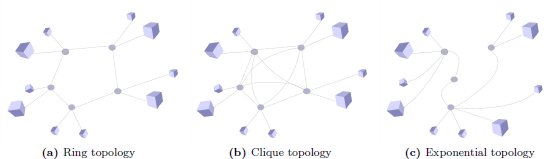
<body><![CDATA[<br> </font>     <p>   <font face="Verdana" size="2">Three topologies were used to study the information dynamics: Ring, Clique and Exponential (see figure <a href="#x1-20021">1</a>). In a Ring topology, every node is connected exactly to two other nodes, forming a cycle (figure <a href="#x1-20021">1</a>). Clique topology proposes a scenario where every node is connected to every other node (figure <a href="#x1-20021">1</a>). To represent a more realistic network, the exponential distribution model is used for the connections, where the amount of connections of each node follows an exponential distribution law (figure <a href="#x1-20021">1</a>), commonly seen in the Internet or collaborative networks<span class="cite"><a name="c17."></a><a name="c18."></a>(<a href="#c17">17,</a>&nbsp;<a href="#c18">18</a>)</span>. All theses topologies and scenarios were generated by the included features in the GridMatrix simulator.&nbsp;</font></p>     <p>   </p> <hr class="figure">     <div class="figure">  <font face="Verdana" size="2">      <br> </font>     <p>  <font face="Verdana" size="2">  <a id="x1-20021"> <img src="/img/revistas/cleiej/v15n3/3a08f1.jpg"></a>     <br>  </font>  </p>     <div class="caption"><font face="Verdana" size="2"><span class="id">Figure&nbsp;1: </span><span class="content">Schemes of the network topologies analysed in this work. In the Ring topology each node connects to exactly two other nodes, while the Clique is an all-to-all connected network. Exponential topology is formed following an exponential distribution law. </span>   </font></div> <font face="Verdana" size="2">&nbsp;    <br> </font>     <p>   </p> </div> <hr class="endfigure"> <font face="Verdana" size="2">     ]]></body>
<body><![CDATA[<br> </font>     <p>   <font face="Verdana" size="2">The standard best-neighbor implementation (<span class="cmbx-10">BN</span>) ranks the nodes with the following scoring function<span class="cite">(<a href="#XMocskos2012">14</a>)</span>: </font>    </p> <table class="equation-star">   <tbody>     <tr>       <td>           <center class="math-display">       <font face="Verdana" size="2">       <img src="/img/revistas/cleiej/v15n3/3a0811x.png" alt="fscoring = a *RESxCOUNT  - b* RTT - c* RESPONSExFAILED" class="math-display"></font></center>       </td>     </tr>   </tbody> </table>  <font face="Verdana" size="2">      <br> </font>     <p> <font face="Verdana" size="2">where RES<img src="/img/revistas/cleiej/v15n3/3a0812x.png" alt="x  " class="math">COUNT is the amount of available resources in the node, RTT corresponds to the Round Trip Time and RESPONSE<img src="/img/revistas/cleiej/v15n3/3a0813x.png" alt="x  " class="math">FAILED counts the number of messages looses. <img src="/img/revistas/cleiej/v15n3/3a0814x.png" alt="a  " class="math">, <img src="/img/revistas/cleiej/v15n3/3a0815x.png" alt="b  " class="math">, and <img src="/img/revistas/cleiej/v15n3/3a0816x.png" alt="c  " class="math"> are parameters to change the weight of each variable.&nbsp;</font></p>     <p>   <font face="Verdana" size="2">We present <span class="cmbx-10">fBN</span>, an implementation of Best-Neighbor policy that incorporates a new term which captures information about the amount of local resources of the node: </font>    </p> <table class="equation-star">   <tbody>     <tr>       <td>           <center class="math-display">       <font face="Verdana" size="2">       <img src="/img/revistas/cleiej/v15n3/3a0817x.png" alt="fscoring = a* RESxCOUNT   - b*RTT  - c*RESPONSExFAILED    + d* OWNxRESxCOUNT" class="math-display"></font></center>       </td>     </tr>   </tbody> </table>  <font face="Verdana" size="2">      <br> </font>     <p> <font face="Verdana" size="2">where the new term OWN<img src="/img/revistas/cleiej/v15n3/3a0818x.png" alt="x  " class="math">RES<img src="/img/revistas/cleiej/v15n3/3a0819x.png" alt="x  " class="math">COUNT is the amount of local resources in the node and <img src="/img/revistas/cleiej/v15n3/3a0820x.png" alt="d  " class="math"> is the weighting coefficient of this variable. </font>    </p>     <p><font face="Verdana" size="2"><span class="titlemark">3   </span> <a id="x1-30003"></a>Results and Discussion</font></p>  <font face="Verdana" size="2">      <br> </font>     <p><font face="Verdana" size="2">The standard best-neighbor implementation (<span class="cmbx-10">BN</span>) strongly depends on knowing as much nodes as possible in the network. When the policy starts, the nodes are randomly selected until sufficient nodes are known (some threshold value is selected) creating a local database with the information about the known neighbors. In medium-to-large scale networks, knowing the whole network can be very demanding, and so starting the best-neighbor strategy may be delayed leading to extremely large &ldquo;random&rdquo; stage (also known as <span class="cmti-10">learning stage</span>).&nbsp;</font></p>     ]]></body>
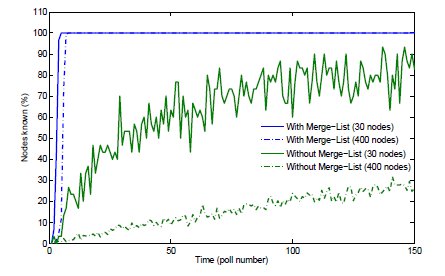
<body><![CDATA[<p>   <font face="Verdana" size="2">To achieve this, many methods have been proposed, from which we choose <span class="cmti-10">merging lists </span>for our implementation. This technique consists of sharing the lists of neighbors that a particular node has to any other node that communicates with it. With such simple implementation, significant improvements are reported and all nodes know about almost all the network greatly shortening the learning stage. In figure <a href="#x1-30012">2</a>, we show the learning curve of the nodes in two exponential networks (<img src="/img/revistas/cleiej/v15n3/3a0821x.png" alt="30  " class="math"> and <img src="/img/revistas/cleiej/v15n3/3a0822x.png" alt="400  " class="math"> nodes) using the merging list algorithm versus just randomly exploring the network. Using this improvement, all the nodes of the network are quickly known and best neighbor method can start choosing the  most appropriate nodes (figure <a href="#x1-30012">2</a>, blue lines). On the other hand, as network sizes scale, knowing every node in the infrastructure is increasingly demanding (figure <a href="#x1-30012">2</a>, green lines), leading eventually to a situation where the learning stage become the strongly dominant phase.&nbsp;</font></p>     <p>   </p> <hr class="figure">     <div class="figure">    <font face="Verdana" size="2">        <br> </font>     <p> <font face="Verdana" size="2"> <a id="x1-30012"> <img src="/img/revistas/cleiej/v15n3/3a08f2.jpg" alt="PIC"></a>     <br>  </font>  </p>     <div class="caption"><font face="Verdana" size="2"><span class="id">Figure&nbsp;2: </span><span class="content">Learning curve of the nodes in two exponential networks (30 and 400 nodes) using the merging list algorithm versus just using the random nodes selected. In very little time steps, with the merge-list method, all nodes of the network are known using less messages.</span></font></div> <font face="Verdana" size="2">&nbsp;    <br> </font>     <p>   </p> </div> <hr class="endfigure"> <font face="Verdana" size="2">     <br> </font>     ]]></body>
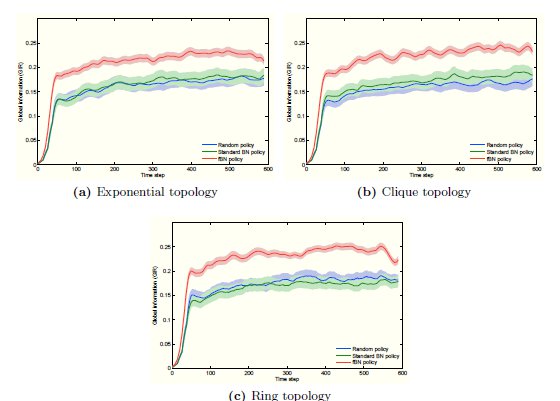
<body><![CDATA[<p>   <font face="Verdana" size="2">Once the network is sufficiently well known, Best-Neighbor method can rank the nodes to connect with, and select the most informative one following the scoring function. This function involves an implicit relation between their weighting coefficients (see Materials and Methods for details). The selection of each weight in this relation leads to focusing on some of the aspect of the system, in this work a standard set of parameters were used following previous works<span class="cite"><a name="c19."></a><a name="c20."></a>(<a href="#c19">19</a>,&nbsp;<a href="#c20">20</a>,&nbsp;<a href="#c14">14</a>)</span>. Using the standard scoring function, the scoring function may select a node that do not have much proper information and instead has lots of data about its neighbors. This fact would penalize the amount of information collected due to the time delay of propagation of information.&nbsp;</font></p>     <p>   <font face="Verdana" size="2">In figure <a href="#x1-30023">3</a>, green line shows the evolution of GIR for this situation, performing just over random policy (blue line). To overcome this problem, we introduce the fBN, a modification to the original Best-Neighbor policy that takes into account the amount of proper information available. In all the topologies and networks sizes studied (only shown 400 nodes networks in figure <a href="#x1-30023">3</a>), fBN outperforms Random and BN policies.&nbsp;</font></p>     <p>   </p> <hr class="figure">     <div class="figure">   <font face="Verdana" size="2">       <br> </font>     <p> <font face="Verdana" size="2"> <a id="x1-30023"> <img src="/img/revistas/cleiej/v15n3/3a08f3.jpg" alt="PIC"></a>     <br>  </font>  </p>     <div class="caption"><font face="Verdana" size="2"><span class="id">Figure&nbsp;3: </span><span class="content">Evolution of GIR for Random, BN and fBN policies in three topologies with <img src="/img/revistas/cleiej/v15n3/3a0823x.png" alt="400  " class="math"> nodes. BN shows similar behavior to Random, while fBN outperforms both other policies.</span></font></div> <font face="Verdana" size="2">&nbsp;    <br> </font>     <p>   </p> </div> <hr class="endfigure"> <font face="Verdana" size="2">     ]]></body>
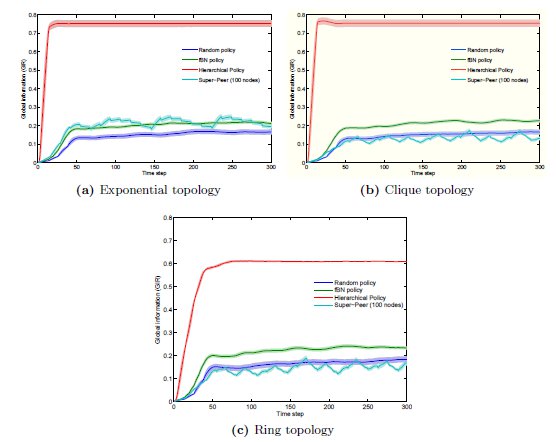
<body><![CDATA[<br> </font>     <p>   <font face="Verdana" size="2">Next, we compare this new implementation with the different policies: Random, Hierarchical and Super-peer. These policies have different needs of administration. Hierarchical consists of a human supervised construction of a logical hierarchy using the nodes. Evidently, this policy has a very high cost of configuration and maintenance, but would result in very high GIR values. We compare this policy with other policy which needs very little supervision: Super-peer. In the used setup, <img src="/img/revistas/cleiej/v15n3/3a0824x.png" alt="100  " class="math"> nodes are selected to act as super-peers. Finally, we present the comparison to the proposed implementation of Best-Neighbor, a completely unsupervised policy.&nbsp;</font></p>     <p>   <font face="Verdana" size="2">In figure <a href="#x1-30034">4</a>, we show the evolution of GIR for the exposed policies. Data is smoothed by taking the moving average <img src="/img/revistas/cleiej/v15n3/3a0825x.png" alt="5  " class="math"> points to each side of each point. Hierarchical (red line) shows the higher GIR values, far from the other implementations. This policy shows a lower GIR in the case of Ring topology due to the underlying network infrastructure and the longer paths needed to send messages between the nodes. On the other hand, random (blue line) shows the worst values. In the middle, closer to Random policy, Super-peer (cyan line) and best-neighbor (green line) shows a similar average GIR in the case of Exponential topology. For the other two policies, Super-peer overlaps with Random policy. Super-peer results in a more variable GIR over time, while best-neighbor shows a very stable behavior.&nbsp;</font></p>     <p>   </p> <hr class="figure">     <div class="figure">   <font face="Verdana" size="2">       <br> </font>     <p> <font face="Verdana" size="2"> <a id="x1-30034"> <img src="/img/revistas/cleiej/v15n3/3a08f4.jpg" alt="PIC"></a>     <br>  </font>  </p>     <div class="caption"><font face="Verdana" size="2"><span class="id">Figure&nbsp;4: </span><span class="content">Evolution of GIR for Random, fBN, Super-Peer (<img src="/img/revistas/cleiej/v15n3/3a0826x.png" alt="100  " class="math"> nodes) and hierarchical policies. fBN  shows  similar  behavior  to  Super-Peer,  indicating  that  unsupervised  method  may  obtain comparable result to supervised ones. Both results perform better Random, but very far from the hierarchical policy.</span></font></div> <font face="Verdana" size="2">&nbsp;    <br> </font>     ]]></body>
<body><![CDATA[<p>   </p> </div> <hr class="endfigure">         <p><font face="Verdana" size="2"><span class="titlemark">4   </span> <a id="x1-40004"></a>Conclusions</font></p>  <font face="Verdana" size="2">      <br> </font>     <p><font face="Verdana" size="2">Grid computing refers to the federation of geographically distributed and heterogeneous computer resources. Every grid infrastructure needs a component responsible for obtaining, distributing, indexing and archiving information about the configuration and state of services and resources. The dynamics of the resource information cannot be captured using a static hierarchy due to similar drawbacks as the centralized one. Therefore, it is necessary to design new policies for discovery and propagation of resource information.&nbsp;</font></p>     <p>   <font face="Verdana" size="2">Four policies are usually considered: Random, Best-Neighbor, Super-Peer and Hierarchical, all of them have different needs of administration and supervision.&nbsp;</font></p>     <p>   <font face="Verdana" size="2">Two modifications are introduced to improve the performance of Best-Neighbor policy obtaining fBN: i) merge the lists of neighbors during the learning stage to decrease the length of this phase, ii) a new term which considers the amount of local resources provided by the node is added to the scoring function.&nbsp;</font></p>     <p>   <font face="Verdana" size="2">fBN presents a short learning phase which maintains almost constant with the considered system sizes. On the other hand, fBN outperforms Random policy and shows similar behavior as Super-peer. Hierarchical shows the best performance, but on the other hand, is the policy needing more setup and administration.&nbsp;</font></p>     <p>   <font face="Verdana" size="2">fBN results in a good trade-off between fully automated policy and obtained performance.&nbsp;</font></p>     <p>    </p>     <p><font face="Verdana" size="2"><a id="x1-50004"></a>Acknowledgments</font></p>  <font face="Verdana" size="2">      ]]></body>
<body><![CDATA[<br> </font>     <p><font face="Verdana" size="2">The authors specially thank Intel Corporation and Centro de C&oacute;mputo de Alto Rendimiento (<a href="cecar.fcen.uba.ar" class="url"><span class="cmtt-10">cecar.fcen.uba.ar</span></a>) for allowing the usage of essential computing equipment needed for obtaining the presented results. This work was partially supported by the grant from Universidad de Buenos Aires (UBACyT 20020100100889).&nbsp;</font></p>     <p>    </p>     <p><font face="Verdana" size="2"><a id="x1-60004"></a>References</font></p>  <font face="Verdana" size="2">      <br> </font>     <p>     </p>     <div class="thebibliography">          <p><font face="Verdana" size="2"><span class="biblabel"><a name="c1"></a>   (<a href="#c1.">1</a>)<span class="bibsp">&nbsp;&nbsp;&nbsp;</span></span>D.&nbsp;De Roure, M.&nbsp;Baker, N.&nbsp;Jennings, and N.&nbsp;Shadbolt, <span class="cmti-10">Grid computing - making the</span>     <span class="cmti-10">global infrastructure a reality</span>.   John Wiley &amp; Sons Ltd, 2003, ch. The evolution of the Grid,     pp. 65&ndash;100. (Online). Available: <a href="http://eprints.ecs.soton.ac.uk/6871/" class="url">http://eprints.ecs.soton.ac.uk/6871/</a> </font>     </p>           <p><font face="Verdana" size="2"><span class="biblabel"><a name="c2"></a>   (<a href="#c2.">2</a>)<span class="bibsp">&nbsp;&nbsp;&nbsp;</span></span>G.&nbsp;Aloisio,  M.&nbsp;Cafaro,  I.&nbsp;Epicoco,  S.&nbsp;Fiore,  D.&nbsp;Lezzi,  M.&nbsp;Mirto,  and  S.&nbsp;Mocavero,     &ldquo;Resource and service discovery in the igrid information service,&rdquo; in <span class="cmti-10">Computational Science</span>     <span class="cmti-10">and Its Applications - ICCSA</span>, 2005, pp. 1&ndash;9. </font>     </p>           <p><font face="Verdana" size="2"><span class="biblabel"><a name="c3"></a>   (<a href="#c3.">3</a>)<span class="bibsp">&nbsp;&nbsp;&nbsp;</span></span>R.&nbsp;Ranjan, A.&nbsp;Harwood, and R.&nbsp;Buyya, &ldquo;Peer-to-peer-based resource discovery in global     grids: a tutorial,&rdquo; <span class="cmti-10">IEEE Commun Surv Tut</span>, vol.&nbsp;10, no.&nbsp;2, pp. 6&ndash;33, 2008. </font>      </p>           ]]></body>
<body><![CDATA[<!-- ref --><p><font face="Verdana" size="2"><span class="biblabel"><a name="c4"></a>   (<a href="#c4.">4</a>)<span class="bibsp">&nbsp;&nbsp;&nbsp;</span></span>I.&nbsp;Foster and C.&nbsp;Kesselman, <span class="cmti-10">The Grid 2: Blueprint for a New Computing Infrastructure</span>,     ser. The Morgan Kaufmann Series in Computer Architecture and Design.    San Francisco,     CA, USA: Morgan Kaufmann Publishers Inc., Nov. 2003.     </font>     </p>           <p><font face="Verdana" size="2"><span class="biblabel"><a name="c5"></a>   (<a href="#c5.">5</a>)<span class="bibsp">&nbsp;&nbsp;&nbsp;</span></span>P.&nbsp;Trunfio,  D.&nbsp;Talia,  C.&nbsp;Papadakis,  P.&nbsp;Fragopoulou,  M.&nbsp;Mordacchini,  M.&nbsp;Pennanen,     K.&nbsp;Popov, V.&nbsp;Vlassov, and S.&nbsp;Haridi, &ldquo;Peer-to-Peer resource discovery in Grids: Models and     systems,&rdquo; <span class="cmti-10">Future Gener Comp Sy</span>, vol.&nbsp;23, no.&nbsp;7, pp. 864&ndash;878, Aug. 2007. </font>     </p>           <p><font face="Verdana" size="2"><span class="biblabel"><a name="c6"></a>   (<a href="#c6.">6</a>)<span class="bibsp">&nbsp;&nbsp;&nbsp;</span></span>B.&nbsp;Plale,   C.&nbsp;Jacobs,   S.&nbsp;Jensen,   Y.&nbsp;Liu,   C.&nbsp;Moad,   R.&nbsp;Parab,   and   P.&nbsp;Vaidya,     &ldquo;Understanding  grid  resource  information  management  through  a  synthetic  database     benchmark/workload,&rdquo;  in  <span class="cmti-10">CCGRID  &rsquo;04:  Proceedings  of  the  2004  IEEE  International</span>     <span class="cmti-10">Symposium on Cluster Computing and the Grid</span>.   Washington, DC, USA: IEEE Computer     Society, Apr. 2004, pp. 277&ndash;284. </font>     </p>           <p><font face="Verdana" size="2"><span class="biblabel"><a name="c7"></a>   (<a href="#c7.">7</a>)<span class="bibsp">&nbsp;&nbsp;&nbsp;</span></span>D.&nbsp;Puppin,   S.&nbsp;Moncelli,   R.&nbsp;Baraglia,   N.&nbsp;Tonellotto,   and   F.&nbsp;Silvestri,   &ldquo;A   grid     information service based on peer-to-peer,&rdquo; in <span class="cmti-10">Euro-Par 2005 Parallel Processing</span>, ser. Lecture     Notes in Computer Science, J.&nbsp;C. Cunha and P.&nbsp;D. Medeiros, Eds., vol. 3648.    Springer,     2005, pp. 454&ndash;464. </font>     </p>           <p><font face="Verdana" size="2"><span class="biblabel"><a name="c8"></a>   (<a href="#c8.">8</a>)<span class="bibsp">&nbsp;&nbsp;&nbsp;</span></span>C.&nbsp;Mastroianni,     D.&nbsp;Talia,     and     O.&nbsp;Verta,     &ldquo;A     super-peer     model     for     resource     discovery     services     in     large-scale     Grids,&rdquo;     <span class="cmti-10">Future     Gener     Comp</span>     <span class="cmti-10">Sy</span>,     vol.&nbsp;21,     no.&nbsp;8,     pp.     1235&ndash;1248,     October     2005.     (Online).     Available:     <a href="http://www.sciencedirect.com/science/article/pii/S0167739X05000701" class="url">http://www.sciencedirect.com/science/article/pii/S0167739X05000701</a> </font>     </p>           <p><font face="Verdana" size="2"><span class="biblabel"><a name="c9"></a>   (<a href="#c9.">9</a>)<span class="bibsp">&nbsp;&nbsp;&nbsp;</span></span>A.&nbsp;Iamnitchi, I.&nbsp;Foster, and D.&nbsp;Nurmi, &ldquo;A peer-to-peer approach to resource discovery     in grid environments,&rdquo; in <span class="cmti-10">Proceedings of the 11 th IEEE International Symposium on High</span>     <span class="cmti-10">Performance Distributed Computing HPDC-11 (HPDC&rsquo; 02)</span>.    Edinbourgh, UK: IEEE, Jul     2002, p. 419. </font>     </p>           <p><font face="Verdana" size="2"><span class="biblabel"><a name="c10"></a>  (<a href="#c10.">10</a>)<span class="bibsp">&nbsp;&nbsp;&nbsp;</span></span>A.&nbsp;Iamnitchi and I.&nbsp;Foster, <span class="cmti-10">Grid resource management: state of the art and future trends</span>.     Norwell,  MA,  USA:  Kluwer  Academic  Publishers,  2004,  ch.  A  peer-to-peer  approach  to     resource location in Grid environments, pp. 413&ndash;429. </font>     </p>           <p><font face="Verdana" size="2"><span class="biblabel"><a name="c11"></a>  (<a href="#c11.">11</a>)<span class="bibsp">&nbsp;&nbsp;&nbsp;</span></span>&ldquo;Gnutella  protocol  development,&rdquo;  last  visited  on  30/09/2012.  (Online).  Available:     <a href="http://rfc-gnutella.sourceforge.net/index.html" class="url">http://rfc-gnutella.sourceforge.net/index.html</a> </font>      </p>           <p><font face="Verdana" size="2"><span class="biblabel"><a name="c12"></a>  (<a href="#c12.">12</a>)<span class="bibsp">&nbsp;&nbsp;&nbsp;</span></span>C.&nbsp;Mastroianni, D.&nbsp;Talia, and O.&nbsp;Verta, &ldquo;Designing an information system for grids:     Comparing hierarchical, decentralized P2P and super-peer models,&rdquo; <span class="cmti-10">Parallel Comput</span>, vol.&nbsp;34,     no.&nbsp;10, pp. 593&ndash;611, 2008. </font>     </p>           ]]></body>
<body><![CDATA[<p><font face="Verdana" size="2"><span class="biblabel"><a name="c13"></a>  (<a href="#c13.">13</a>)<span class="bibsp">&nbsp;&nbsp;&nbsp;</span></span>S.&nbsp;Basu,  L.&nbsp;Costa,  F.&nbsp;Brasileiro,  S.&nbsp;Banerjee,  P.&nbsp;Sharma,  and  S.-J.  Lee,  &ldquo;Nodewiz:     Fault-tolerant grid information service,&rdquo; <span class="cmti-10">Peer Peer Netw Appl</span>, vol.&nbsp;2, pp. 348&ndash;366, 2009. </font>     </p>           <p><font face="Verdana" size="2"><span class="biblabel"><a name="c14"></a>  (<a href="#c14.">14</a>)<span class="bibsp">&nbsp;&nbsp;&nbsp;</span></span>E.&nbsp;E. Mocskos, P.&nbsp;Yabo, P.&nbsp;G. Turjanski, and D.&nbsp;Fernandez&nbsp;Slezak, &ldquo;Grid matrix: a grid     simulation tool to focus on the propagation of resource and monitoring information,&rdquo; <span class="cmti-10">Simul-T</span>     <span class="cmti-10">Soc Mod Sim</span>, May 2012. </font>     </p>           <p><font face="Verdana" size="2"><span class="biblabel"><a name="c15"></a>  (<a href="#c15.">15</a>)<span class="bibsp">&nbsp;&nbsp;&nbsp;</span></span>&ldquo;Grid   matrix   home   page,&rdquo;   last   visited   on   30/09/2012.   (Online).   Available:     <a href="http://lsc.dc.uba.ar/hpc-grid/grid/grid-matrix" class="url">http://lsc.dc.uba.ar/hpc-grid/grid/grid-matrix</a> </font>     </p>           <p><font face="Verdana" size="2"><span class="biblabel"><a name="c16"></a>  (<a href="#c16.">16</a>)<span class="bibsp">&nbsp;&nbsp;&nbsp;</span></span>H.&nbsp;Casanova,  A.&nbsp;Legrand,  and  M.&nbsp;Quinson,  &ldquo;Simgrid:  A  generic  framework  for     large-scale distributed experiments,&rdquo; in <span class="cmti-10">10th IEEE International Conference on Computer</span>     <span class="cmti-10">Modeling and Simulation</span>.   Los Alamitos, CA, USA: IEEE Computer Society, Mar. 2008, pp.     126&ndash;131. </font>     </p>           <p><font face="Verdana" size="2"><span class="biblabel"><a name="c17"></a>  (<a href="#c17.">17</a>)<span class="bibsp">&nbsp;&nbsp;&nbsp;</span></span>A.-L. Barab&aacute;si and R.&nbsp;Albert, &ldquo;Emergence of scaling in random networks,&rdquo; <span class="cmti-10">Science</span>, vol.     286, no. 5439, pp. 509&ndash;512, October 1999. </font>     </p>           <p><font face="Verdana" size="2"><span class="biblabel"><a name="c18"></a>  (<a href="#c18.">18</a>)<span class="bibsp">&nbsp;&nbsp;&nbsp;</span></span>R.&nbsp;Albert,    H.&nbsp;Jeong,    and    A.-L.    Barab&aacute;si,    &ldquo;Internet:    Diameter    of    the     World-Wide   Web,&rdquo;   <span class="cmti-10">Nature</span>,   vol.   401,   pp.   130&ndash;131,   sep   1999.   (Online).   Available:     <a href="http://adsabs.harvard.edu/abs/1999Natur.401..130A" class="url">http://adsabs.harvard.edu/abs/1999Natur.401..130A</a> </font>     </p>           <p><font face="Verdana" size="2"><span class="biblabel"><a name="c19"></a>  (<a href="#c19.">19</a>)<span class="bibsp">&nbsp;&nbsp;&nbsp;</span></span>D.&nbsp;G.  M&aacute;rquez,  E.&nbsp;E.  Mocskos,  D.&nbsp;F.  Slezak,  and  P.&nbsp;G.  Turjanski,  &ldquo;Simulation     of   resource   monitoring   and   discovery   in   grids.&rdquo;   in   <span class="cmti-10">Proceedings   of   HPC   2010</span>     <span class="cmti-10">High-Performance  Computing  Symposium</span>,   2010,   pp.   3258&ndash;3270.   (Online).   Available:     <a href="http://www.39jaiio.org.ar/node/121" class="url">http://www.39jaiio.org.ar/node/121</a> </font>     </p>           <p><font face="Verdana" size="2"><span class="biblabel"><a name="c20"></a>  (<a href="#c20.">20</a>)<span class="bibsp">&nbsp;&nbsp;&nbsp;</span></span>D.&nbsp;G. M&aacute;rquez, D.&nbsp;F. Slezak, P.&nbsp;G. Turjanski, and E.&nbsp;E. Mocskos, &ldquo;Gaining insight     in  the  analysis  of  performance  for  resource  monitoring  and  discovery  in  grids,&rdquo;  in     <span class="cmti-10">Proceedings  of  HPC  2011  High-Performance  Computing  Symposium</span>,  2011.  (Online).     Available: <a href="http://www.40jaiio.org.ar/sites/default/files/T2011/HPC/1227.pdf" class="url">http://www.40jaiio.org.ar/sites/default/files/T2011/HPC/1227.pdf</a> </font> </p>      </div>             ]]></body><back>
<ref-list>
<ref id="B1">
<label>1</label><nlm-citation citation-type="book">
<person-group person-group-type="author">
<name>
<surname><![CDATA[De Roure]]></surname>
<given-names><![CDATA[D.]]></given-names>
</name>
<name>
<surname><![CDATA[Baker]]></surname>
<given-names><![CDATA[M.]]></given-names>
</name>
<name>
<surname><![CDATA[Jennings]]></surname>
<given-names><![CDATA[N.]]></given-names>
</name>
<name>
<surname><![CDATA[Shadbolt]]></surname>
<given-names><![CDATA[N.]]></given-names>
</name>
</person-group>
<source><![CDATA[, Grid computing - making the global infrastructure a reality]]></source>
<year>2003</year>
<page-range>65-100</page-range><publisher-name><![CDATA[John Wiley & Sons Ltd]]></publisher-name>
</nlm-citation>
</ref>
<ref id="B2">
<label>2</label><nlm-citation citation-type="confpro">
<person-group person-group-type="author">
<name>
<surname><![CDATA[Aloisio]]></surname>
<given-names><![CDATA[G.]]></given-names>
</name>
<name>
<surname><![CDATA[Cafaro]]></surname>
<given-names><![CDATA[M.]]></given-names>
</name>
<name>
<surname><![CDATA[Epicoco]]></surname>
<given-names><![CDATA[I.]]></given-names>
</name>
<name>
<surname><![CDATA[Fiore]]></surname>
<given-names><![CDATA[S.]]></given-names>
</name>
<name>
<surname><![CDATA[Lezzi]]></surname>
<given-names><![CDATA[D.]]></given-names>
</name>
<name>
<surname><![CDATA[Mirto]]></surname>
<given-names><![CDATA[M.]]></given-names>
</name>
<name>
<surname><![CDATA[Mocavero]]></surname>
<given-names><![CDATA[S.]]></given-names>
</name>
</person-group>
<article-title xml:lang="en"><![CDATA[Resource and service discovery in the igrid information service]]></article-title>
<source><![CDATA[]]></source>
<year></year>
<conf-name><![CDATA[ Computational Science and Its Applications]]></conf-name>
<conf-date>2005</conf-date>
<conf-loc> </conf-loc>
</nlm-citation>
</ref>
<ref id="B3">
<label>3</label><nlm-citation citation-type="journal">
<person-group person-group-type="author">
<name>
<surname><![CDATA[Ranjan]]></surname>
<given-names><![CDATA[R.]]></given-names>
</name>
<name>
<surname><![CDATA[Harwood]]></surname>
<given-names><![CDATA[A.]]></given-names>
</name>
<name>
<surname><![CDATA[Buyya]]></surname>
<given-names><![CDATA[R.]]></given-names>
</name>
</person-group>
<article-title xml:lang="en"><![CDATA[Peer-to-peer-based resource discovery in global grids: a tutorial]]></article-title>
<source><![CDATA[IEEE Commun Surv Tut]]></source>
<year>2008</year>
<volume>10</volume>
<numero>2</numero>
<issue>2</issue>
<page-range>6-33</page-range></nlm-citation>
</ref>
<ref id="B4">
<label>4</label><nlm-citation citation-type="book">
<person-group person-group-type="author">
<name>
<surname><![CDATA[Foster]]></surname>
<given-names><![CDATA[I.]]></given-names>
</name>
<name>
<surname><![CDATA[Kesselman]]></surname>
<given-names><![CDATA[C.]]></given-names>
</name>
</person-group>
<source><![CDATA[The Grid 2: Blueprint for a New Computing Infrastructure]]></source>
<year>Nov.</year>
<month> 2</month>
<day>00</day>
<publisher-loc><![CDATA[San Francisco^eCA CA]]></publisher-loc>
<publisher-name><![CDATA[Morgan Kaufmann Publishers Inc.]]></publisher-name>
</nlm-citation>
</ref>
<ref id="B5">
<label>5</label><nlm-citation citation-type="journal">
<person-group person-group-type="author">
<name>
<surname><![CDATA[Trunfio]]></surname>
<given-names><![CDATA[P.]]></given-names>
</name>
<name>
<surname><![CDATA[Talia]]></surname>
<given-names><![CDATA[D.]]></given-names>
</name>
<name>
<surname><![CDATA[Papadakis]]></surname>
<given-names><![CDATA[C.]]></given-names>
</name>
<name>
<surname><![CDATA[Fragopoulou]]></surname>
<given-names><![CDATA[P.]]></given-names>
</name>
<name>
<surname><![CDATA[Mordacchini]]></surname>
<given-names><![CDATA[M.]]></given-names>
</name>
<name>
<surname><![CDATA[Pennanen]]></surname>
<given-names><![CDATA[M.]]></given-names>
</name>
<name>
<surname><![CDATA[Popov]]></surname>
<given-names><![CDATA[K.]]></given-names>
</name>
<name>
<surname><![CDATA[Vlassov]]></surname>
<given-names><![CDATA[V.]]></given-names>
</name>
<name>
<surname><![CDATA[Haridi]]></surname>
<given-names><![CDATA[S.]]></given-names>
</name>
</person-group>
<article-title xml:lang="en"><![CDATA[Peer-to-Peer resource discovery in Grids: Models and systems]]></article-title>
<source><![CDATA[Future Gener Comp Sy]]></source>
<year>Aug.</year>
<month> 2</month>
<day>00</day>
<volume>23</volume>
<numero>7</numero>
<issue>7</issue>
<page-range>864-878</page-range></nlm-citation>
</ref>
<ref id="B6">
<label>6</label><nlm-citation citation-type="confpro">
<person-group person-group-type="author">
<name>
<surname><![CDATA[Plale]]></surname>
<given-names><![CDATA[B.]]></given-names>
</name>
<name>
<surname><![CDATA[Jacobs]]></surname>
<given-names><![CDATA[C.]]></given-names>
</name>
<name>
<surname><![CDATA[Jensen]]></surname>
<given-names><![CDATA[S.]]></given-names>
</name>
<name>
<surname><![CDATA[Liu]]></surname>
<given-names><![CDATA[Y.]]></given-names>
</name>
<name>
<surname><![CDATA[Moad]]></surname>
<given-names><![CDATA[C.]]></given-names>
</name>
<name>
<surname><![CDATA[Parab]]></surname>
<given-names><![CDATA[R.]]></given-names>
</name>
<name>
<surname><![CDATA[Vaidya]]></surname>
<given-names><![CDATA[P.]]></given-names>
</name>
</person-group>
<article-title xml:lang="en"><![CDATA[Understanding grid resource information management through a synthetic database benchmark/workload]]></article-title>
<source><![CDATA[]]></source>
<year></year>
<conf-name><![CDATA[ 2004 IEEE International Symposium on Cluster Computing and the Grid]]></conf-name>
<conf-date>Apr. 2004</conf-date>
<conf-loc>Washington DC</conf-loc>
</nlm-citation>
</ref>
<ref id="B7">
<label>7</label><nlm-citation citation-type="book">
<person-group person-group-type="author">
<name>
<surname><![CDATA[Puppin]]></surname>
<given-names><![CDATA[D.]]></given-names>
</name>
<name>
<surname><![CDATA[Moncelli]]></surname>
<given-names><![CDATA[S.]]></given-names>
</name>
<name>
<surname><![CDATA[Baraglia]]></surname>
<given-names><![CDATA[R.]]></given-names>
</name>
<name>
<surname><![CDATA[Tonellotto]]></surname>
<given-names><![CDATA[N.]]></given-names>
</name>
<name>
<surname><![CDATA[Silvestri]]></surname>
<given-names><![CDATA[F.]]></given-names>
</name>
</person-group>
<article-title xml:lang="en"><![CDATA[A grid information service based on peer-to-peer]]></article-title>
<person-group person-group-type="editor">
<name>
<surname><![CDATA[Cunha]]></surname>
<given-names><![CDATA[J. C.]]></given-names>
</name>
<name>
<surname><![CDATA[Medeiros]]></surname>
<given-names><![CDATA[P. D.]]></given-names>
</name>
</person-group>
<source><![CDATA[Euro-Par 2005 Parallel Processing]]></source>
<year>2005</year>
<volume>vol. 3648</volume>
<page-range>454-464</page-range><publisher-name><![CDATA[Springer]]></publisher-name>
</nlm-citation>
</ref>
<ref id="B8">
<label>8</label><nlm-citation citation-type="journal">
<person-group person-group-type="author">
<name>
<surname><![CDATA[Mastroianni]]></surname>
<given-names><![CDATA[C.]]></given-names>
</name>
<name>
<surname><![CDATA[Talia]]></surname>
<given-names><![CDATA[D.]]></given-names>
</name>
<name>
<surname><![CDATA[Verta]]></surname>
<given-names><![CDATA[O.]]></given-names>
</name>
</person-group>
<article-title xml:lang="en"><![CDATA[A super-peer model for resource discovery services in large-scale Grids]]></article-title>
<source><![CDATA[Future Gener Comp Sy]]></source>
<year>Octo</year>
<month>be</month>
<day>r </day>
<volume>21</volume>
<numero>8</numero>
<issue>8</issue>
<page-range>1235-1248</page-range></nlm-citation>
</ref>
<ref id="B9">
<label>9</label><nlm-citation citation-type="confpro">
<person-group person-group-type="author">
<name>
<surname><![CDATA[Iamnitchi]]></surname>
<given-names><![CDATA[A.]]></given-names>
</name>
<name>
<surname><![CDATA[Foster]]></surname>
<given-names><![CDATA[I.]]></given-names>
</name>
<name>
<surname><![CDATA[Nurmi]]></surname>
<given-names><![CDATA[D.]]></given-names>
</name>
</person-group>
<article-title xml:lang="en"><![CDATA[A peer-to-peer approach to resource discovery in grid environments]]></article-title>
<source><![CDATA[]]></source>
<year></year>
<conf-name><![CDATA[ 11 th IEEE International Symposium on High Performance Distributed Computing]]></conf-name>
<conf-date>Jul 2002</conf-date>
<conf-loc>Edinbourgh </conf-loc>
</nlm-citation>
</ref>
<ref id="B10">
<label>10</label><nlm-citation citation-type="book">
<person-group person-group-type="author">
<name>
<surname><![CDATA[Iamnitchi]]></surname>
<given-names><![CDATA[A.]]></given-names>
</name>
<name>
<surname><![CDATA[Foster]]></surname>
<given-names><![CDATA[I.]]></given-names>
</name>
</person-group>
<source><![CDATA[Grid resource management: state of the art and future trends]]></source>
<year>2004</year>
<page-range>413-429</page-range><publisher-loc><![CDATA[Norwell^eMA MA]]></publisher-loc>
<publisher-name><![CDATA[Kluwer Academic Publishers]]></publisher-name>
</nlm-citation>
</ref>
<ref id="B11">
<label>11</label><nlm-citation citation-type="">
<source><![CDATA[Gnutella protocol development]]></source>
<year>30/0</year>
<month>9/</month>
<day>20</day>
</nlm-citation>
</ref>
<ref id="B12">
<label>12</label><nlm-citation citation-type="journal">
<person-group person-group-type="author">
<name>
<surname><![CDATA[Mastroianni]]></surname>
<given-names><![CDATA[C.]]></given-names>
</name>
<name>
<surname><![CDATA[Talia]]></surname>
<given-names><![CDATA[D.]]></given-names>
</name>
<name>
<surname><![CDATA[Verta]]></surname>
<given-names><![CDATA[O.]]></given-names>
</name>
</person-group>
<article-title xml:lang="en"><![CDATA[Designing an information system for grids: Comparing hierarchical, decentralized P2P and super-peer models]]></article-title>
<source><![CDATA[Parallel Comput]]></source>
<year>2008</year>
<volume>34</volume>
<numero>10</numero>
<issue>10</issue>
<page-range>593-611</page-range></nlm-citation>
</ref>
<ref id="B13">
<label>13</label><nlm-citation citation-type="">
<person-group person-group-type="author">
<name>
<surname><![CDATA[Basu]]></surname>
<given-names><![CDATA[S.]]></given-names>
</name>
<name>
<surname><![CDATA[Costa]]></surname>
<given-names><![CDATA[L.]]></given-names>
</name>
<name>
<surname><![CDATA[Brasileiro]]></surname>
<given-names><![CDATA[F.]]></given-names>
</name>
<name>
<surname><![CDATA[Banerjee]]></surname>
<given-names><![CDATA[S.]]></given-names>
</name>
<name>
<surname><![CDATA[Sharma]]></surname>
<given-names><![CDATA[P.]]></given-names>
</name>
<name>
<surname><![CDATA[Lee]]></surname>
<given-names><![CDATA[S.-J.]]></given-names>
</name>
</person-group>
<article-title xml:lang="en"><![CDATA[Nodewiz: Fault-tolerant grid information service]]></article-title>
<source><![CDATA[]]></source>
<year></year>
</nlm-citation>
</ref>
<ref id="B14">
<label>14</label><nlm-citation citation-type="journal">
<person-group person-group-type="author">
<name>
<surname><![CDATA[Mocskos]]></surname>
<given-names><![CDATA[E. E.]]></given-names>
</name>
<name>
<surname><![CDATA[Yabo]]></surname>
<given-names><![CDATA[P.]]></given-names>
</name>
<name>
<surname><![CDATA[Turjanski]]></surname>
<given-names><![CDATA[P. G.]]></given-names>
</name>
<name>
<surname><![CDATA[Fernandez Slezak]]></surname>
<given-names><![CDATA[D.]]></given-names>
</name>
</person-group>
<article-title xml:lang="en"><![CDATA[Grid matrix: a grid simulation tool to focus on the propagation of resource and monitoring information]]></article-title>
<source><![CDATA[Simul-T Soc Mod Sim]]></source>
<year>May </year>
<month>20</month>
<day>12</day>
</nlm-citation>
</ref>
<ref id="B15">
<label>15</label><nlm-citation citation-type="">
<source><![CDATA[Grid matrix home page]]></source>
<year>30/0</year>
<month>9/</month>
<day>20</day>
</nlm-citation>
</ref>
<ref id="B16">
<label>16</label><nlm-citation citation-type="confpro">
<person-group person-group-type="author">
<name>
<surname><![CDATA[Casanova]]></surname>
<given-names><![CDATA[H.]]></given-names>
</name>
<name>
<surname><![CDATA[Legrand]]></surname>
<given-names><![CDATA[A.]]></given-names>
</name>
<name>
<surname><![CDATA[Quinson]]></surname>
<given-names><![CDATA[M.]]></given-names>
</name>
</person-group>
<article-title xml:lang="en"><![CDATA[Simgrid: A generic framework for large-scale distributed experiments]]></article-title>
<source><![CDATA[]]></source>
<year></year>
<conf-name><![CDATA[ 10th IEEE International Conference on Computer Modeling and Simulation]]></conf-name>
<conf-date>Mar. 2008</conf-date>
<conf-loc>Los Alamitos CA</conf-loc>
</nlm-citation>
</ref>
<ref id="B17">
<label>17</label><nlm-citation citation-type="journal">
<person-group person-group-type="author">
<name>
<surname><![CDATA[Barabási]]></surname>
<given-names><![CDATA[A.-L.]]></given-names>
</name>
<name>
<surname><![CDATA[Albert]]></surname>
<given-names><![CDATA[R.]]></given-names>
</name>
</person-group>
<article-title xml:lang="en"><![CDATA[Emergence of scaling in random networks]]></article-title>
<source><![CDATA[Science]]></source>
<year>Octo</year>
<month>be</month>
<day>r </day>
<volume>286</volume>
<numero>5439</numero>
<issue>5439</issue>
<page-range>509-512</page-range></nlm-citation>
</ref>
<ref id="B18">
<label>18</label><nlm-citation citation-type="journal">
<person-group person-group-type="author">
<name>
<surname><![CDATA[Albert]]></surname>
<given-names><![CDATA[R.]]></given-names>
</name>
<name>
<surname><![CDATA[Jeong]]></surname>
<given-names><![CDATA[H.]]></given-names>
</name>
<name>
<surname><![CDATA[Barabási]]></surname>
<given-names><![CDATA[A.-L.]]></given-names>
</name>
</person-group>
<article-title xml:lang="en"><![CDATA[Internet: Diameter of the World-Wide Web]]></article-title>
<source><![CDATA[Nature]]></source>
<year>sep </year>
<month>19</month>
<day>99</day>
<volume>401</volume>
<page-range>130-131</page-range></nlm-citation>
</ref>
<ref id="B19">
<label>19</label><nlm-citation citation-type="confpro">
<person-group person-group-type="author">
<name>
<surname><![CDATA[Márquez]]></surname>
<given-names><![CDATA[D. G.]]></given-names>
</name>
<name>
<surname><![CDATA[Mocskos]]></surname>
<given-names><![CDATA[E. E.]]></given-names>
</name>
<name>
<surname><![CDATA[Slezak]]></surname>
<given-names><![CDATA[D. F.]]></given-names>
</name>
<name>
<surname><![CDATA[Turjanski]]></surname>
<given-names><![CDATA[P. G.]]></given-names>
</name>
</person-group>
<article-title xml:lang="en"><![CDATA[Simulation of resource monitoring and discovery in grids]]></article-title>
<source><![CDATA[]]></source>
<year></year>
<conf-name><![CDATA[ HPC 2010 High-Performance Computing Symposium]]></conf-name>
<conf-date>2010</conf-date>
<conf-loc> </conf-loc>
</nlm-citation>
</ref>
<ref id="B20">
<label>20</label><nlm-citation citation-type="confpro">
<person-group person-group-type="author">
<name>
<surname><![CDATA[Márquez]]></surname>
<given-names><![CDATA[D. G.]]></given-names>
</name>
<name>
<surname><![CDATA[Slezak]]></surname>
<given-names><![CDATA[D. F.]]></given-names>
</name>
<name>
<surname><![CDATA[Turjanski]]></surname>
<given-names><![CDATA[P. G.]]></given-names>
</name>
<name>
<surname><![CDATA[Mocskos]]></surname>
<given-names><![CDATA[E. E.]]></given-names>
</name>
</person-group>
<article-title xml:lang="en"><![CDATA[Gaining insight in the analysis of performance for resource monitoring and discovery in grids]]></article-title>
<source><![CDATA[]]></source>
<year></year>
<conf-name><![CDATA[ HPC 2011 High-Performance Computing Symposium]]></conf-name>
<conf-date>2011</conf-date>
<conf-loc> </conf-loc>
</nlm-citation>
</ref>
</ref-list>
</back>
</article>