<?xml version="1.0" encoding="ISO-8859-1"?><article xmlns:mml="http://www.w3.org/1998/Math/MathML" xmlns:xlink="http://www.w3.org/1999/xlink" xmlns:xsi="http://www.w3.org/2001/XMLSchema-instance">
<front>
<journal-meta>
<journal-id>0717-5000</journal-id>
<journal-title><![CDATA[CLEI Electronic Journal]]></journal-title>
<abbrev-journal-title><![CDATA[CLEIej]]></abbrev-journal-title>
<issn>0717-5000</issn>
<publisher>
<publisher-name><![CDATA[Centro Latinoamericano de Estudios en Informática]]></publisher-name>
</publisher>
</journal-meta>
<article-meta>
<article-id>S0717-50002012000200002</article-id>
<title-group>
<article-title xml:lang="en"><![CDATA[Providing TPC-W with web user dynamic behavior]]></article-title>
</title-group>
<contrib-group>
<contrib contrib-type="author">
<name>
<surname><![CDATA[Peña-Ortiz]]></surname>
<given-names><![CDATA[Raúl]]></given-names>
</name>
<xref ref-type="aff" rid="A01"/>
</contrib>
<contrib contrib-type="author">
<name>
<surname><![CDATA[Gil]]></surname>
<given-names><![CDATA[José A]]></given-names>
</name>
<xref ref-type="aff" rid="A01"/>
</contrib>
<contrib contrib-type="author">
<name>
<surname><![CDATA[Sahuquillo]]></surname>
<given-names><![CDATA[Julio]]></given-names>
</name>
<xref ref-type="aff" rid="A01"/>
</contrib>
<contrib contrib-type="author">
<name>
<surname><![CDATA[Pont]]></surname>
<given-names><![CDATA[Ana]]></given-names>
</name>
<xref ref-type="aff" rid="A01"/>
</contrib>
</contrib-group>
<aff id="A01">
<institution><![CDATA[,Departament d&#8217;Informàtica de Sistemes i Computadors (DISCA) Universitat Politècnica de València  ]]></institution>
<addr-line><![CDATA[Valencia ]]></addr-line>
<country>Spain</country>
</aff>
<pub-date pub-type="pub">
<day>00</day>
<month>08</month>
<year>2012</year>
</pub-date>
<pub-date pub-type="epub">
<day>00</day>
<month>08</month>
<year>2012</year>
</pub-date>
<volume>15</volume>
<numero>2</numero>
<fpage>2</fpage>
<lpage>2</lpage>
<copyright-statement/>
<copyright-year/>
<self-uri xlink:href="http://www.scielo.edu.uy/scielo.php?script=sci_arttext&amp;pid=S0717-50002012000200002&amp;lng=en&amp;nrm=iso"></self-uri><self-uri xlink:href="http://www.scielo.edu.uy/scielo.php?script=sci_abstract&amp;pid=S0717-50002012000200002&amp;lng=en&amp;nrm=iso"></self-uri><self-uri xlink:href="http://www.scielo.edu.uy/scielo.php?script=sci_pdf&amp;pid=S0717-50002012000200002&amp;lng=en&amp;nrm=iso"></self-uri><abstract abstract-type="short" xml:lang="en"><p><![CDATA[English abstract The evolution of the World Wide Web from hypermedia information repositories to web applications such as social networking, wikis or blogs has introduced a new paradigm where users are no longer passive web consumers. Instead, users have become active contributors to web applications, so introducing a high level of dynamism in their behavior. Moreover, this trend is even expected to rise in the incoming Web. As a consequence, there is a need to develop new software tools that consider user dynamism in an appropiate and accurate way when generating dynamic workload for evaluating the performance of the current and incoming web. This paper presents a new testbed with the ability of defining and generating web dynamic workload for e-commerce. For this purpose, we integrated a dynamic workload generator (GUERNICA) with a widely used benchmark for e-commerce (TPC-W).]]></p></abstract>
<abstract abstract-type="short" xml:lang="es"><p><![CDATA[Spanish abstract: En los últimos años venimos asistiendo a un aumento en la cantidad de servicios ofrecidos a través de la World Wide Web (Web). Estos servicios han ido evolucionando paulatinamente, desde los primitivos servicios estáticos de primera generación, hasta las complejas y personalizadas aplicaciones web actuales, en las que el usuario es algo más que un mero espectador y se ha convertido en un creador de contenido dinámico. Esta evolución ha producido a su vez una evolución en las pautas de comportamiento de estos usuarios, que resultan cada vez más dinámicas. Consecuencia directa de la evolución de la Web es la necesidad de nuevas herramientas para una evaluación de prestaciones más acorde con las características dinámicas de la misma; herramientas que deben ser capaces de representar el comportamiento dinámico del usuario en la generación de la carga web. Este trabajo presenta un nuevo entorno de prueba capaz de incorporar generación de carga dinámica en la evaluación de prestaciones de sistemas de comercio electrónico basados en web. Con tal fin, se ha partido del reconocido benchmark de comercio electrónico TPC-W y se ha integrado la generación de carga dinámica proporcionada por el generador GUERNICA, aprovechando sus cualidades a la hora de caracterizar y reproducir carga web basada en los patrones dinámicos del comportamiento del usuario. El nuevo entorno ha sido validado contra TPC-W, mostrando resultados similares cuando no se considera dinamismo en la caracterización de la carga.]]></p></abstract>
<kwd-group>
<kwd lng="en"><![CDATA[Web performance evaluation]]></kwd>
<kwd lng="en"><![CDATA[web workload generator]]></kwd>
<kwd lng="en"><![CDATA[dynamic web workload]]></kwd>
<kwd lng="en"><![CDATA[modeling user dynamic behavior]]></kwd>
<kwd lng="en"><![CDATA[e-commerce]]></kwd>
<kwd lng="es"><![CDATA[Evaluación de prestaciones web]]></kwd>
<kwd lng="es"><![CDATA[generador de carga web]]></kwd>
<kwd lng="es"><![CDATA[carga web dinámica]]></kwd>
<kwd lng="es"><![CDATA[modelado del comportamiento dinámico del usuario]]></kwd>
<kwd lng="es"><![CDATA[comercio electrónico]]></kwd>
</kwd-group>
</article-meta>
</front><body><![CDATA[ <div class="maketitle">                                                                                                                                                                                                                                                                                                                                                                          <b><font face="Verdana" size="4">Providing TPC-W with web user dynamic behavior</font></b>    <div class="author">    <font face="Verdana" size="2"> <span class="cmr-12">Ra&uacute;l Pe&ntilde;a-Ortiz, Jos&eacute; A. Gil, Julio Sahuquillo, Ana Pont</span>     <br>    <span class="cmr-12">Departament d&rsquo;Inform&agrave;tica de Sistemes i Computadors (DISCA)</span>     <br>                   <span class="cmr-12">Universitat Polit&egrave;cnica de Val&egrave;ncia</span>     <br>                            <span class="cmr-12">Valencia, Spain</span>     <br>       <span class="cmr-12"><a href="mailto:rpenya@upvnet.upv.es"> rpenya@upvnet.upv.es</a>, </span><span class="cmsy-10x-x-120">{</span><span class="cmr-12"><a href="mailto:jagil@upvnet.upv.es">jagil</a>,<a href="mailto:jsahuqui@upvnet.upv.es">jsahuqui</a>,<a href="mailto:apont@upvnet.upv.es">apont</a></span><span class="cmsy-10x-x-120">}</span><span class="cmr-12">@disca.upv.es</span>    <br>     </font>   </div>   <font face="Verdana" size="2">       <br>    </font>        <div class="date"></div>       </div>            <div class="abstract">     ]]></body>
<body><![CDATA[<div class="center"> <font face="Verdana" size="2">     <br>   </font>       <p>                                                                                                                                                                                     </p>       <div class="minipage">     <div class="center"> <font face="Verdana" size="2">     <br>   </font>       <p> </p>       <p><font face="Verdana" size="2"><span class="cmbx-10">English abstract</span></font></p>   </div>    <font face="Verdana" size="2">        <br>   </font>       <p><font face="Verdana" size="2">The evolution of the World Wide Web from hypermedia information repositories to web applications such as social networking, wikis or blogs has introduced a new paradigm where users are no longer passive web consumers. Instead, users have become active contributors to web applications, so introducing a high level of dynamism in their behavior. Moreover, this trend is even expected to rise in the incoming Web.&nbsp;</font></p>       ]]></body>
<body><![CDATA[<p><font face="Verdana" size="2">As a consequence, there is a need to develop new software tools that consider user dynamism in an appropiate and accurate way when generating dynamic workload for evaluating the performance of the current and incoming web.&nbsp;</font></p>       <p><font face="Verdana" size="2">This paper presents a new testbed with the ability of defining and generating web dynamic workload for e-commerce. For this purpose, we integrated a dynamic workload generator (GUERNICA) with a widely used benchmark for e-commerce (TPC-W).&nbsp;</font></p>       <p><font face="Verdana" size="2">Spanish abstract: En los &uacute;ltimos a&ntilde;os venimos asistiendo a un aumento en la cantidad de servicios ofrecidos a trav&eacute;s de la World Wide Web (Web). Estos servicios han ido evolucionando paulatinamente, desde los primitivos servicios est&aacute;ticos de primera generaci&oacute;n, hasta las complejas y personalizadas aplicaciones web actuales, en las que el usuario es algo m&aacute;s que un mero espectador y se ha convertido en un creador de contenido din&aacute;mico. Esta evoluci&oacute;n ha producido a su vez una evoluci&oacute;n en las pautas de comportamiento de estos usuarios, que resultan cada vez m&aacute;s din&aacute;micas. Consecuencia directa de la evoluci&oacute;n de la Web es la necesidad de nuevas herramientas para una evaluaci&oacute;n de prestaciones m&aacute;s acorde con las caracter&iacute;sticas din&aacute;micas de la misma; herramientas que deben ser capaces de representar el comportamiento din&aacute;mico del usuario en la generaci&oacute;n de la carga web.&nbsp;</font></p>       <p><font face="Verdana" size="2">Este trabajo presenta un nuevo entorno de prueba capaz de incorporar generaci&oacute;n de carga din&aacute;mica en la evaluaci&oacute;n de prestaciones de sistemas de comercio electr&oacute;nico basados en web. Con tal fin, se ha partido del reconocido benchmark de comercio electr&oacute;nico TPC-W y se ha integrado la generaci&oacute;n de carga din&aacute;mica proporcionada por el generador GUERNICA, aprovechando sus cualidades a la hora de caracterizar y reproducir carga web basada en los patrones din&aacute;micos del comportamiento del usuario. El nuevo entorno ha sido validado contra TPC-W, mostrando resultados similares cuando no se considera dinamismo en la caracterizaci&oacute;n de la carga.&nbsp;</font></p>       <p><font face="Verdana" size="2"><span class="cmbx-10">Keywords: </span>Web performance evaluation, web workload generator, dynamic web workload, modeling user dynamic behavior, e-commerce.&nbsp;</font></p>       <p><font face="Verdana" size="2"><span class="cmbx-10">Spanish keywords: </span> Evaluaci&oacute;n de prestaciones web, generador de carga web, carga web din&aacute;mica, modelado del comportamiento din&aacute;mico del usuario, comercio electr&oacute;nico. Received 2011-12-15, Revised 2012-05-16, Accepted 2012-05-16&nbsp;</font></p>       <p><font face="Verdana" size="2"><span class="cmbx-10">Received 2011-12-15, Revised 2012-05-16, Accepted 2012-05-16 </span> </font> </p>   </div>   </div>    </div>            <p><font face="Verdana" size="2"><span class="titlemark">1   </span> <a id="x1-10001"></a>Introduction</font></p>    <font face="Verdana" size="2">        <br>   </font>       <p><font face="Verdana" size="2">As a consequence of the recent and incessant changes in web technology, the range of services offered through World Wide Web (Web) have suffered a continuous evolution during the last years. This evolution also has implied significant changes in web users behavior <span class="cite">(<a href="#c1">1</a>)</span><a name="c1."></a>.&nbsp;</font></p>       ]]></body>
<body><![CDATA[<p>   <font face="Verdana" size="2">The first generation of web-based services (called static services) were a low cost method to share a large amount of information with little or no privacy. Most of this information was offered using formatted text with only a small number of images (about 10%). As a consequence, the vast majority of its users were simply acting as consumers of content; in other words, they reviewed contents by navigating the web following the hyperlinks of the pages they visited <span class="cite"><a href="#c2">(2</a>)</span><a name="c2."></a>. Subsequently, dynamic contents became more and more frequent and web services evolved through their second generation. This generation could be distinguished by important changes both in its infrastructure and architecture, which allowed generation, querying and storage of dynamic content. This dynamism was extended to users&rsquo; behavior <span class="cite">(<a href="#c3">3</a>)</span><a name="c3."></a>, who changed their navigations guidelines (more and more dynamic and personalized), and consequently, their related traffic <span class="cite">(<a href="#c4">4</a>)</span><a name="c4."></a>. Nowadays, we are in a new web paradigm where users are no longer passive consumers, but they have become participative contributors to the dynamic web content                                                                                                                                                                                     <span class="cite">(<a href="#c2">2</a>)</span>.&nbsp;</font></p>       <p>   <font face="Verdana" size="2">As a system that is continuously changing, both in the offered applications and infrastructure, performance evaluation studies are a major concern to provide sound proposals when designing new web-related systems <span class="cite">(<a href="#c5">5</a>)</span><a name="c5."></a>, such as web services, web servers, proxies or content distribution policies. As in any performance evaluation process, accurate and representative workload models should be used in order to guarantee the validity of the results. In the case of the WWW, the implicit users&rsquo; dynamism makes difficult to design accurate workload models representing users&rsquo; navigation.&nbsp;</font></p>       <p>   <font face="Verdana" size="2">In a previous work <span class="cite">(<a href="#c6">6</a>)<a name="c6."></a></span>, we introduced an approach to characterize dynamic web workload, namely, Dweb model. This model is based on users&rsquo; dynamism and implements the capability of changing the user behavior with time. For example, users can dynamically adopt different roles (e.g., browsing or shopping) in e-commerce; that is, they are allowed to navigate the e-commerce website with different behaviors in the same navigation session. Moreover, a dynamic workload generator named GUERNICA was implemented to show a practical application of Dweb model.&nbsp;</font></p>       <p>   <font face="Verdana" size="2">This paper proposes a new testbed with the ability of generating web dynamic workload for e-commerce. This new testbed results from the integration of GUERNICA and the commonly used TPC-W benchmark for e-commerce <span class="cite">(<a href="#c7">7</a>)<a name="c7."></a></span>, in order to consider user dynamic behavior when generating workload in an accurate way by using Dweb model.&nbsp;</font></p>       <p>   <font face="Verdana" size="2">The remainder of this paper is organized as follows. Section <a href="#x1-20002">2</a> discusses the reasons that motivated us to propose a new benchmark. Sections <a href="#x1-30003">3</a> and <a href="#x1-70004">4</a> present and validate our proposal, respectively. Finally, we draw some concluding remarks and future work in Section <a href="#x1-110005">5</a>.&nbsp;</font></p>       <p>    </p>       <p><font face="Verdana" size="2"><span class="titlemark">2   </span> <a id="x1-20002"></a>Background and motivation</font></p>    <font face="Verdana" size="2">        <br>   </font>       <p><font face="Verdana" size="2">The need to characterize workload in order to model and reproduce the user behavior <span class="cite"><a href="#c8">(8</a>)</span><a name="c8."></a> grows with the increasing importance of web applications. This need presents a special importance in e-commerce environments, where characterizing the user&rsquo;s workload not only has the objective of evaluating the performance of the web system, but also of modeling the behavior of those users who can become new potential clients. E-commerce applications have two main objectives: to acquire new clients and to maintain them as active users. This kind of applications presents the following characteristics: i) importance of critical information, ii) high percentage of dynamic and personalized content, iii) need for service and product quality offered to their potential clients, and iv) use of latest generation technologies. Consequently, using inaccurate models in e-commerce performance evaluation would lead to incorrect conclusions that could yield to inappropriate actions on business and system performance.&nbsp;</font></p>       <p>   <font face="Verdana" size="2">Floyd et al. <span class="cite">(<a href="#c9">9</a>)</span><a name="c9."></a> describe the main drawbacks when evaluating system performance using an analytical model. This is mainly due to the dynamic nature of workload and the high number of parameters that directly affect its characteristics (e.g., different protocols, types of traffic, client navigation patterns, etc). In general, three main challenges must be addressed when modeling dynamic workload. First, the user&rsquo;s behavior must be modeled <span class="cite">(<a href="#c8">8</a>)</span>. Then, the different roles that users play in the Web must be characterized <span class="cite">(<a href="#c10">10</a>)</span><a name="c10."></a>. Finally, continuous changes in these behaviors must be represented <span class="cite">(<a href="#c11">11</a>)</span><a name="c11."></a>.&nbsp;</font></p>       ]]></body>
<body><![CDATA[<p>   <font face="Verdana" size="2">There have been few but interesting efforts to define user&rsquo;s behavior models in order to obtain more representative workloads for specific web applications. Menasc&eacute; et al. <span class="cite">(<a href="#c12">12)</a><a name="c12."></a></span> introduced the Customer Behavior Model Graph (CBMG) that describes patterns of user behavior in workloads of e-commerce sites. CBMG is a workload model included in TPC-W, which is the first benchmark for e-commerce sites used in web performance studies <span class="cite">(<a href="#c13">13</a>)</span><a name="c13."></a>. Duarte et al. <span class="cite">(<a href="#c14">14)</a></span><a name="c14."></a> applied this model for workload definition of blogspace; and Shams et al. <span class="cite">(<a href="#c15">15)</a></span><a name="c15."></a> extended CBMG to capture an application&rsquo;s inter-request and data dependencies. Benevenuto et al. <span class="cite">(<a href="#Xbenevenuto:2009">16</a>)</span><a name="c16."></a> introduced the Clickstream Model to characterize user&rsquo;s behavior in online social networks. However, these models only characterize web workload for specific paradigms or applications, do not model user&rsquo;s dynamic behavior in an appropiate and accurate way (first challenge), and do not consider dynamic roles that users play (second and third challenges). These shortcomings motivated us to propose a general purpose workload model called Dweb (Dynamic web workload model) <span class="cite">(<a href="#c6">6</a>)</span>, which permits to define dynamic web workload in an accurate way, taking into account the mentioned challenges, by introducing user&rsquo;s dynamic behavior models in workload characterization.&nbsp;</font></p>       <p>   <font face="Verdana" size="2">Web performance evaluation studies are supported by specific software with the aim of validating the quality of service provided by a web system under specific workload conditions. Among web performance evaluation software we can highlight benchmarks and workload generators. A benchmark is defined to reproduce workload conditions of a typical working environment with the aim of evaluating whether the system meets established quality standards. On the other hand, a web workload generator pursues a degradation in the quality of service by producing enough                                                                                                                                                                                     HTTP requests. Among the evaluated benchmarks in a previous work <span class="cite">(<a href="#c17">17</a>)</span><a name="c17."></a>, we found that TPC-W is the best benchmark for an e-commmerce system. In addition, we also concluded that GUERNICA is the only generator that reproduces in an accurate way web dynamic workload, by using Dweb model. TPC-W reproduces multiple on-line browser sessions over a bookstore. It generates dynamic workload but not in an accurate way because it is based on CBMG that only considers a partial representation of the users&rsquo; dynamic behavior.&nbsp;</font></p>       <p>   <font face="Verdana" size="2">To deal with this challenge, we decide to develop a new testbed for e-commerce by extending TPC-W using GUERNICA in order to exploit Dweb model on dynamic workload characterization.&nbsp;</font></p>       <p>    </p>       <p><font face="Verdana" size="2"><span class="titlemark">3   </span> <a id="x1-30003"></a>Integration between TPC-W and GUERNICA</font></p>    <font face="Verdana" size="2">        <br>   </font>       <p><font face="Verdana" size="2">We developed a new testbed to accomplish three main goals. First, it must define and reproduce dynamic web workload in an accurate and appropiate way. Second, it must be able to provide client and server metrics with the aim of being used for web performance evaluation studies. Finally, it should be representative of web transactional systems that have been established in recent years.&nbsp;</font></p>       <p>   <font face="Verdana" size="2">Among the evaluated benchmarks in <span class="cite">(<a href="#c17">17)</a></span>, TPC-W is the best candidate to provide an appropriate testbed for our purposes, because it satisfies most of previous goals. But it does not consider users&rsquo; dynamic behavior in an accurate way on workload characterization. To achieve the three previous goals, we integrate TPC-W and GUERNICA in order to use Dweb model on the workload generation process.&nbsp;</font></p>       <p>   <font face="Verdana" size="2">Section <a href="#x1-40003.1">3.1</a> presents the main features and the architecture of TPC-W. After that, we introduce the main functionalities of GUERNICA and its architecture in Section <a href="#x1-50003.2">3.2</a>. Finally, Section <a href="#x1-60003.3">3.3</a> shows the devised architecture of integrating TPC-W and GUERNICA.&nbsp;</font></p>       <p>    </p>       ]]></body>
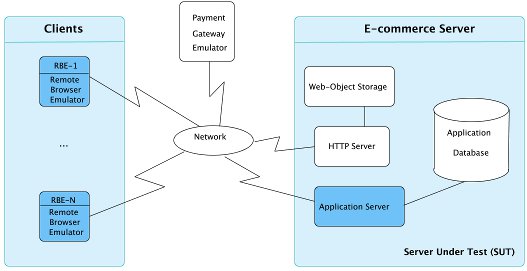
<body><![CDATA[<p><font face="Verdana" size="2"><span class="titlemark">3.1   </span> <a id="x1-40003.1"></a>TPC Benchmark<img src="/img/revistas/cleiej/v15n2/2a020x.png" alt="TM  " class="math"> W</font></p>    <font face="Verdana" size="2">        <br>   </font>       <p><font face="Verdana" size="2">TPC Benchmark<img src="/img/revistas/cleiej/v15n2/2a021x.png" alt="TM  " class="math"> W (TPC-W) is a transactional web benchmark that models a representative e-commerce system, specifically an on-line bookstore environment <span class="cite">(<a href="#c7">7</a>)</span>. The benchmark reproduces the workload generated by multiple on-line browser sessions over a web application, which serves dynamic and static contents related to the bookstore activities (e.g., catalog searches or sales).&nbsp;</font></p>       <p>   <font face="Verdana" size="2">TPC-W provides a standard environment that is independent of the underlying technology, designed architecture and deployed infrastructure. Also, it has been commonly accepted by the scientist-technical community in many research works <span class="cite">(<a href="#c13">13</a>)</span>, <span class="cite">(<a href="#c18">18</a>)</span><a name="c18."></a>, <span class="cite">(<a href="#c19">19</a>)<a name="c19."></a></span>. As shown in Figure <a href="#x1-40011">1</a>, TPC-W presents a client-server architecture. Remote Browser Emulators (RBE) are located in the client side and generate workload towards the e-commerce web application, which is located in the server side (E-commerce server). With the aim of reproducing a representative workload, the emulators simulate real users&rsquo; behavior when they navigate the website by using CBMG model. The server hosts the system under test (Server Under Test), which consists of: i) a web server and its storage of static contents, and ii) an application server with a database system to generate dynamic content. The payment gateway (Payment Gateway Emulator) represents an entity to authorize users&rsquo; payments. These three main architecture components are connected together by a dedicated network.&nbsp;</font></p>       <p>   </p>       <div class="figure">                                                                                                                                                                                                                                                                                                                                                                          <font face="Verdana" size="2">                                                                                                                                                                                                                                                                                                                                                                              <br>   </font>       <p><font face="Verdana" size="2"><a id="x1-40011"><img src="/img/revistas/cleiej/v15n2/2a02f1.jpg"></a>     <br>    </font>    </p>       <div class="caption"><font face="Verdana" size="2"><span class="id">Figure&nbsp;1: </span><span class="content">TPC-W architecture</span></font></div>   <font face="Verdana" size="2">&nbsp;    ]]></body>
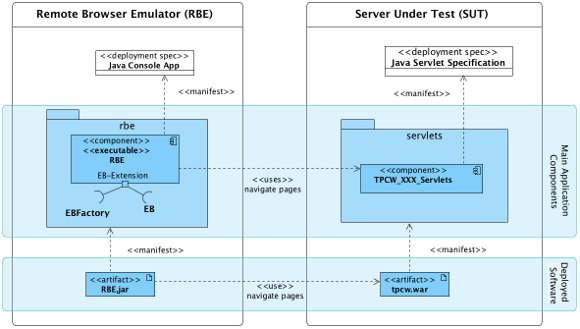
<body><![CDATA[<br>   </font>       <p>   </p>   </div>    <font face="Verdana" size="2">        <br>   </font>       <p>   <font face="Verdana" size="2">A TPC-W Java implementation developed by the UW-Madison Computer Architecture Group <span class="cite">(<a href="#c20">20</a>)</span><a name="c20."></a> was selected as framework of our testbed. As shown in Figure <a href="#x1-40022">2</a>, the architecture client side is a Java console application that provides two interfaces for workload generation; an emulator for clients simulation (<span class="cmtt-10">EB</span>) and a factory (<span class="cmtt-10">EBFactory</span>) to create, configure and manage them. These interfaces allow to define new processes for workload generation. The server side was developed as a Java web application made of a set of <span class="cmtt-10">Servlets</span>. Each <span class="cmtt-10">Servlet </span>resolves client requests by requiring the database information.&nbsp;</font></p>       <p>   </p>       <div class="figure">                                                                                                                                                                                   <font face="Verdana" size="2">                                                                                                                                                                                       <br>   </font>       <p><font face="Verdana" size="2"><a id="x1-40022"><img src="/img/revistas/cleiej/v15n2/2a02f2.jpg"></a>     <br>    </font>    </p>       <div class="caption"><font face="Verdana" size="2"><span class="id">Figure&nbsp;2: </span><span class="content">Main software components of TPC-W <span class="cmtt-10">Java </span>implementation</span></font></div>   <font face="Verdana" size="2">       ]]></body>
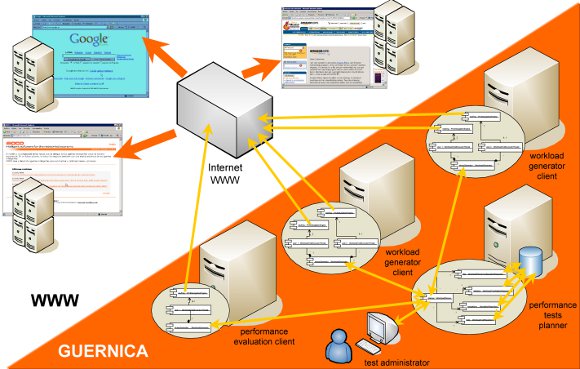
<body><![CDATA[<br>   &nbsp; </font>     <p>   </p>   </div>            <p><font face="Verdana" size="2"><span class="titlemark">3.2   </span> <a id="x1-50003.2"></a>GUERNICA</font></p>    <font face="Verdana" size="2">        <br>   </font>       <p><font face="Verdana" size="2">GUERNICA (Universal Generator of Dynamic Workload under WWW Platforms) is a web workload generator developed as a result of the cooperation among the Web Architecture Research Group (Polytechnic University of Valencia), Intelligent Software Components, and the Institute of Computer Technology; thereby, bridging the gap between academia and industry.&nbsp;</font></p>       <p>   <font face="Verdana" size="2">The main benefit of GUERNICA lies in its workload generation process, which is based on Dweb model (Dynamic web workload model) <span class="cite">(<a href="#c6">6</a>)</span> in order to generate dynamic web workload in a more accurate and appropiate way, taking into account the three mentioned challenges in dynamic workload characterization. The navigation concept defines users&rsquo; behavior while they interact with the web, and it facilitates the characterization of users&rsquo; dynamism in the navigations. By the other hand, the concept of workload test models a set of navigations, which defines behaviors of a user by considering the capability of changing them with time.&nbsp;</font></p>       <p>   <font face="Verdana" size="2">As shown in Figure <a href="#x1-50013">3</a>, GUERNICA is a software made up of three main applications: workload generator, performance evaluator and performance tests planner. Each application permits an autonomous distribution among the different machine nodes of the main activities in the evaluation of performance and functional specifications of a web application.&nbsp;</font></p>       <p>   </p>       <div class="figure"> <font face="Verdana" size="2">     <br>     </font>       ]]></body>
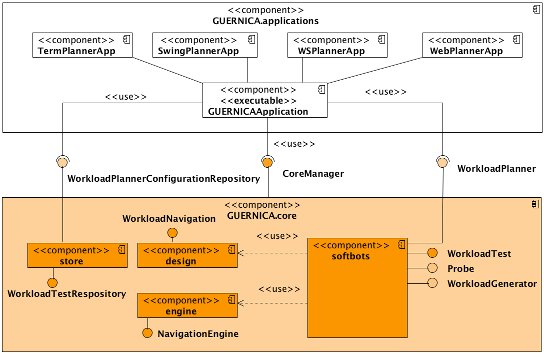
<body><![CDATA[<p><font face="Verdana" size="2"><a id="x1-50013"> <img src="/img/revistas/cleiej/v15n2/2a02f3.jpg"></a>     <br>    </font>    </p>       <div class="caption"><font face="Verdana" size="2"><span class="id">Figure&nbsp;3: </span><span class="content">Main applications of GUERNICA</span></font></div>     <font face="Verdana" size="2">       <br>   &nbsp; </font>     <p>   </p>   </div>    <font face="Verdana" size="2">        <br>   </font>       <p>   <font face="Verdana" size="2">These three applications are defined in a software architecture based on components, as Figure <a href="#x1-50024">4</a> depicts. The main component of the architecture is the <span class="cmtt-10">GUERNICA.core</span>, which carries out the workload generation process by using Dweb. The navigation and workload test concepts are implemented by <span class="cmtt-10">WorkloadTest </span>and <span class="cmtt-10">WorkloadNavigation </span>interfaces, respectively. The <span class="cmtt-10">NavigationEngine </span>simulates the user behavior; its configuration is defined in terms of Dweb, and it is stored in a repository called <span class="cmtt-10">WorkloadTestRespository</span>. A centralized access to <span class="cmtt-10">GUERNICA.core </span>is possible by using <span class="cmtt-10">CoreManager</span>.&nbsp;</font></p>       <p>   </p>       <div class="figure">                                                                                                                                                                                                                                                                                <font face="Verdana" size="2">                                                                                                                                                                                                                                                                                    <br>   </font>       ]]></body>
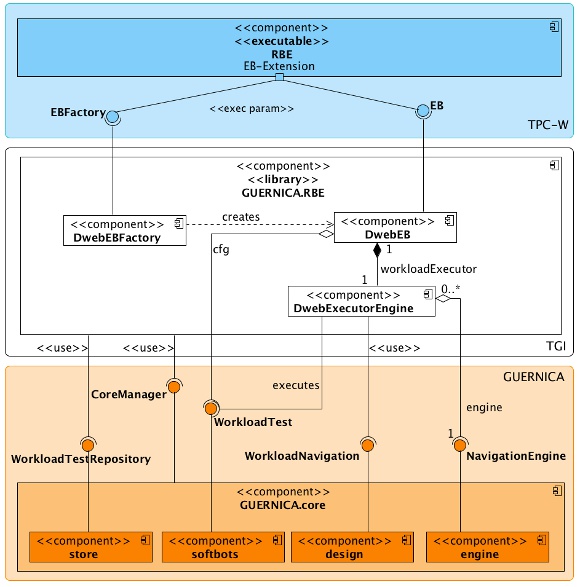
<body><![CDATA[<p><font face="Verdana" size="2"><a id="x1-50024"><img src="/img/revistas/cleiej/v15n2/2a02f4.jpg"></a>     <br>    </font>    </p>       <div class="caption"><font face="Verdana" size="2"><span class="id">Figure&nbsp;4: </span><span class="content">Main software components of GUERNICA</span></font></div>   <font face="Verdana" size="2">       <br>   &nbsp; </font>     <p>   </p>   </div>            <p><font face="Verdana" size="2"><span class="titlemark">3.3   </span> <a id="x1-60003.3"></a>Integration architecture</font></p>    <font face="Verdana" size="2">        <br>   </font>       <p><font face="Verdana" size="2">The architecture of the TPC-W and GUERNICA integration is depicted in Figure <a href="#x1-60015">5</a>, which is organized in three main layers: </font>      </p>   <ul class="itemize1">         <li class="itemize"><font face="Verdana" size="2">The top layer is defined at the client side of TPC-W and supplies the two interfaces related to the      workload generation process (<span class="cmtt-10">EB</span>, <span class="cmtt-10">EBFactory</span>), as introduced in Section <a href="#x1-40003.1">3.1</a>.      </font>      </li>         <li class="itemize"><font face="Verdana" size="2">The bottom layer is related to the process of workload generation in GUERNICA, detailed in Section      <a href="#x1-50003.2">3.2</a>. </font>      </li>         <li class="itemize"><font face="Verdana" size="2">Finally,  the  intermediate  layer  defines  the  integration  between  TPC-W  and  GUERNICA.  The      integration is provided by an independent Java library named <span class="cmtt-10">TGI</span>. This library implements a new      type of emulated browser (i.e., <span class="cmtt-10">DwebEB</span>) that uses the <span class="cmtt-10">GUERNICA core </span>to reproduce users&rsquo; dynamic      behavior in the workload generation process. In order to simplify the new emulated browser, a workload      generation engine (i.e., <span class="cmtt-10">DwebExecutorEngine</span>) is implemented to carry out the generation process. A      browser factory (i.e., <span class="cmtt-10">DwebEBFactory</span>) was also developed to manage the creation and configuration of      new browsers. </font>      </li>       </ul>    <font face="Verdana" size="2">        <br>   </font>       ]]></body>
<body><![CDATA[<p>   </p>       <div class="figure"> <font face="Verdana" size="2">     <br>     </font>       <p><font face="Verdana" size="2"><a id="x1-60015"><img src="/img/revistas/cleiej/v15n2/2a02f5.jpg"></a>          <br>    </font>    </p>       <div class="caption"><font face="Verdana" size="2"><span class="id">Figure&nbsp;5: </span><span class="content">Architecture of the TPC-W and GUERNICA integration</span></font></div>     <font face="Verdana" size="2">&nbsp;    <br>     </font>       <p>   </p>   </div>            <p><font face="Verdana" size="2"><span class="titlemark">4   </span> <a id="x1-70004"></a>Testbed validation</font></p>    <font face="Verdana" size="2">        <br>   </font>       ]]></body>
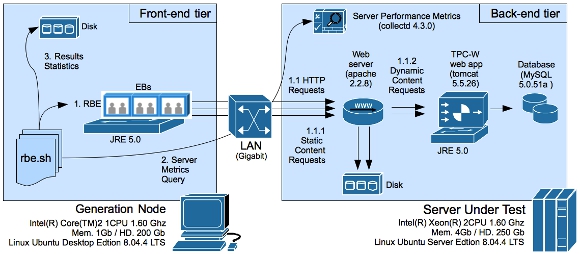
<body><![CDATA[<p><font face="Verdana" size="2">This section compares the main functionalities and behavior of the devised testbed against TPC-W. We found that both implementations present similar behavior in traditional web workloads. Section <a href="#x1-80004.1">4.1</a> and Section <a href="#x1-90004.2">4.2</a> describe the experimental setup and the main measured performance metrics in this process, respectively. The validation process is discussed in Section <a href="#x1-100004.3">4.3</a>.&nbsp;</font></p>       <p>    </p>       <p><font face="Verdana" size="2"><span class="titlemark">4.1   </span> <a id="x1-80004.1"></a>Experimental setup</font></p>    <font face="Verdana" size="2">        <br>   </font>       <p><font face="Verdana" size="2">The experimental setup used in this study is a typical two-tier configuration that consists of an Ubuntu Linux Server back-end and an Ubuntu Linux client front-end tier. The back-end runs the TPC-W server part, whose core is a Java web application (<span class="cmtt-10">TPC-W web app</span>) deployed on the Tomcat web application server. Requests to static content of this web application, such as images, are served by the Apache web server, which redirects requests for dynamic content to Tomcat. TPC-W web application generates this type of content by fetching data from the MySQL database. On the other side, the front-end generates the workload using conventional or dynamic models. Both web application and workload generators are run on the SUN Java Runtime Environment 5.0 (<span class="cmtt-10">JRE 5.0</span>). Figure <a href="#x1-80016">6</a> illustrates the hardware and the software used in the experimental setup.&nbsp;</font></p>       <p>   <font face="Verdana" size="2">Given the multi-tier configuration of this environment, system parameters (both in the server and in the workload generators) have been properly tuned to avoid that middleware and infrastructure bottlenecks interfere the results. TPC-W has been configured with 100 emulated browsers and a large number of items (100,000) that forced us to review the tunning of accessing to the database (e.g., pool connection size), static content service by Apache (e.g., number of workers to attend HTTP requests), or dynamic content service by Tomcat (e.g., number of threads providing dynamic contents). For each workload, measurements were performed during several runs having a 15-minute warm-up phase and a 30-minute measurement phase.&nbsp;</font></p>       <p>   </p>       <div class="float">                                                                                                                                                                                     <font face="Verdana" size="2">                                                                                                                                                                                     <a id="x1-80016"><img src="/img/revistas/cleiej/v15n2/2a02f6.jpg"></a>     <br>     </font>         <div class="caption"><font face="Verdana" size="2"><span class="id">Figure&nbsp;6: </span><span class="content">Experimental setup</span></font></div>   <font face="Verdana" size="2">       ]]></body>
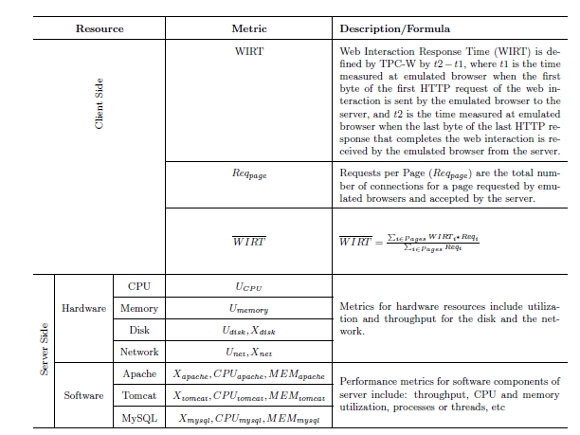
<body><![CDATA[<br>                                                                                                                                                                                           </font>                                                                                                                                                                                           </div>            <p><font face="Verdana" size="2"><span class="titlemark">4.2   </span> <a id="x1-90004.2"></a>Performance metrics</font></p>    <font face="Verdana" size="2">        <br>   </font>       <p><font face="Verdana" size="2">Table <a href="#x1-90011">1</a> summarizes the performance metrics available in the experimental setup. The main metrics measured on the client side are the response time and the total requests per page. On server side, the study collects server performance statistics required by TPC-W specification (i.e., CPU and memory utilization, database I/O activity, system I/O activity, and web server statistics) as well as other optional statistics that allow a better understanding of the system behavior under test and the techniques to improve performance when applying a dynamic web workload. The collected metrics can be classified in two main groups: metrics related with the usage of main hardware resources, and performance metrics for the software components of back-end. We use a middleware named <span class="cmtt-10">collectd </span><a href="http://collectd.org/" class="url"><span class="cmtt-10">http://collectd.org/</span></a> which collects system performance statistics periodically, and allows us to standardize the performance evaluation.&nbsp;</font></p>       <p>   <font face="Verdana" size="2">   <a id="x1-90011"></a></font></p>       <div class="float">                                                                                                                                                                                           <div class="caption"><font face="Verdana" size="2"><span class="id">Table&nbsp;1: </span><span class="content">Performance metrics classification</span></font></div>   <font face="Verdana" size="2">&nbsp;<img src="/img/revistas/cleiej/v15n2/2a02t1.jpg"> </font>                                                                                                                                                                                        </div>    <font face="Verdana" size="2">        <br>   </font>       <p>                                                                                                                                                                                        </p>       <p><font face="Verdana" size="2"><span class="titlemark">4.3   </span> <a id="x1-100004.3"></a>Results</font></p>    <font face="Verdana" size="2">        ]]></body>
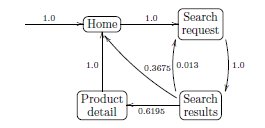
<body><![CDATA[<br>   </font>       <p><font face="Verdana" size="2">This section compares the devised testbed against TPC-W. According to the TPC-W specification, the full CBMG for the on-line bookstore consists of 14 unique pages and the associated transition probability. Figure <a href="#x1-100017">7</a> depicts an example of a simplified CBMG for the search process of on-line bookstore, showing that customers may be in several pages (i.e., Home, Search request, Search results, and Product Detail) and may transit among these pages according to the arcs&rsquo; weight. The numbers in the arcs indicate the probability of making that transition. For example, the probability of going to the Product detail page from the Search results page is 0.6195 and means that after a search, regardless of whether a list of books is returned or not, the Product detail page will be visited 61.95% of the cases. This detailed book is a result of the search or a member of the banner for latest books, which is included in all pages of the website.&nbsp;</font></p>       <p>   </p>       <div class="figure">                                                                                                                                                                                                                                                                                <font face="Verdana" size="2">                                                                                                                                                                                                                                                                                    <br>   </font>       <p><font face="Verdana" size="2"><a id="x1-100017">                                                                         <img src="/img/revistas/cleiej/v15n2/2a02f7.jpg"></a>                      <br>    </font>    </p>       <div class="caption"><font face="Verdana" size="2"><span class="id">Figure&nbsp;7: </span><span class="content">Example of a simplified CBMG </span>   </font></div>   <font face="Verdana" size="2">&nbsp;    <br>   </font>       <p>   </p>   </div>    <font face="Verdana" size="2">        ]]></body>
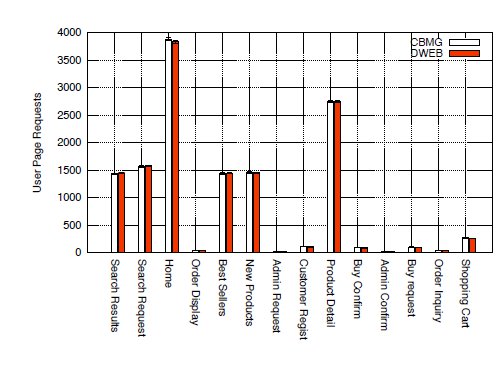
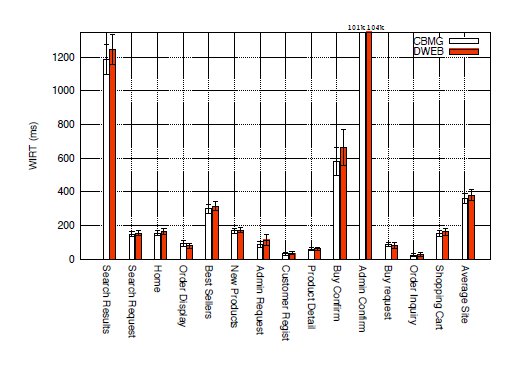
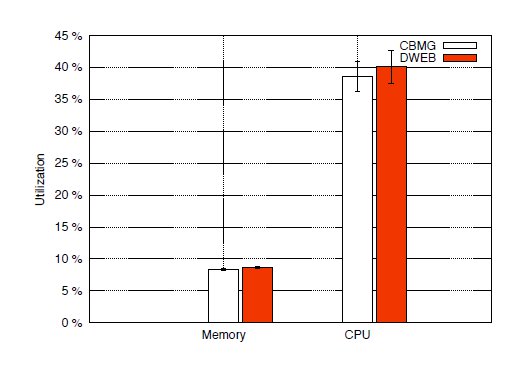
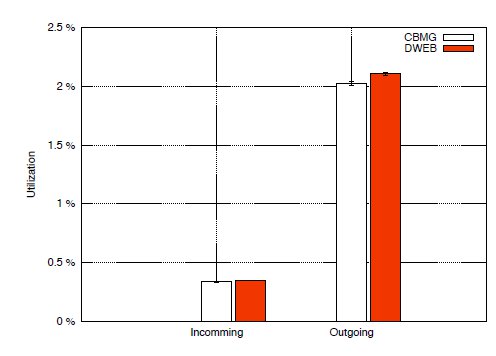
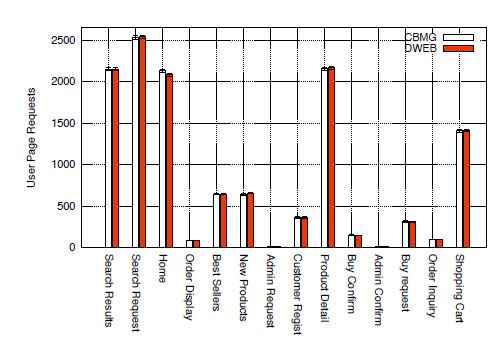
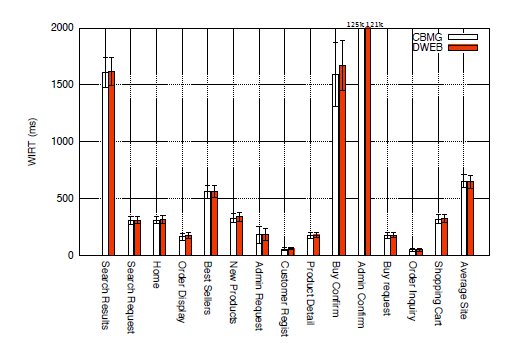
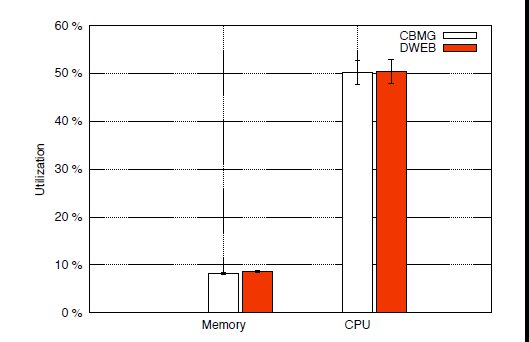
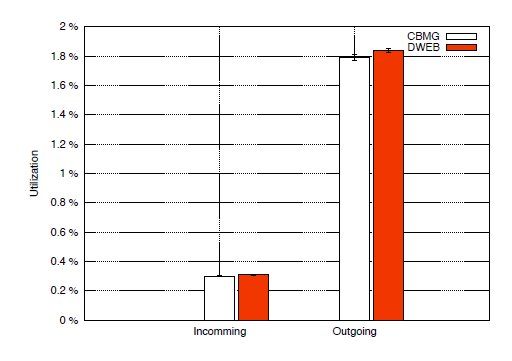
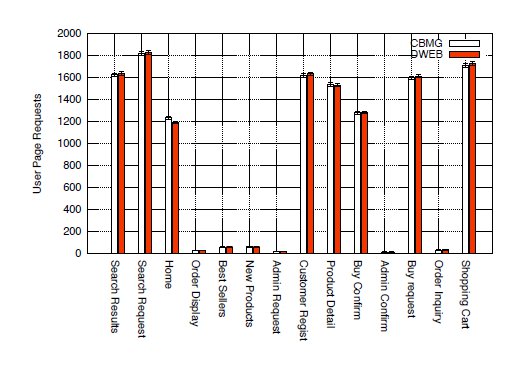
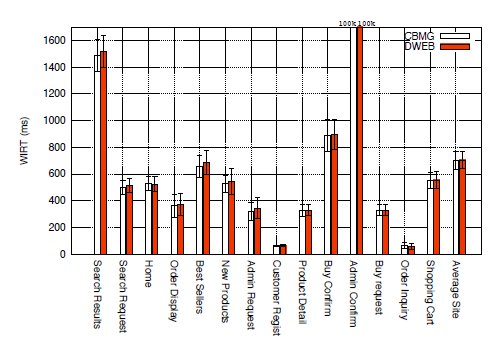
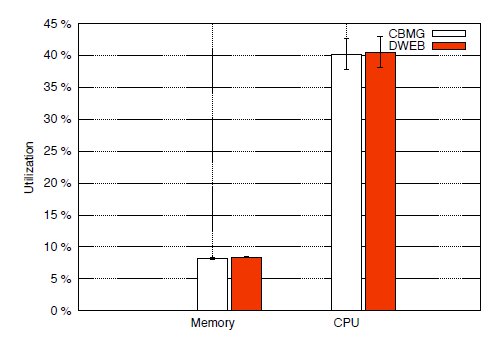
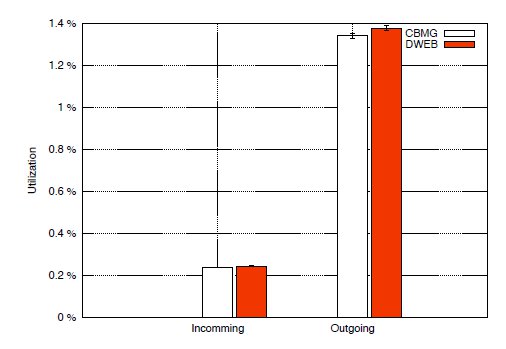
<body><![CDATA[<br>   </font>       <p>   <font face="Verdana" size="2">Three scenarios are defined by the TPC-W specification when characterizing the web workload: shopping, browsing, and ordering. The shopping scenario presents browsing and ordering activities; the browsing scenario consists of significant browsing activity and relatively little ordering activity; and the ordering scenario mixes significant ordering activity and relatively little browsing activity. In order to consider these scenarios, TPC-W needs to define three web workloads based on different CBMGs.&nbsp;</font></p>       <p>   <font face="Verdana" size="2">Regarding the checking test, we contrasted both workload characterization approximations (i.e., CBMG and Dweb) for each scenario. This test considers 50 emulated browsers because the Java implementation of the TPC-W generator presents some limitations in the workload generation process. The measurements were performed repeating 50 runs and obtaining confidence intervals with a 99% confidence level.&nbsp;</font></p>       <p>   <font face="Verdana" size="2">For illustrative purposes, this section presents results of a subset of the most significative metrics when running TPC-W for different scenarios (i.e., shopping, browsing, and ordering) defined by CBMG and Dweb. Note that we are able to model the same workloads by using only the navigation concept of the Dweb model, and disabling all the parameters used to include user dynamism in the workload characterization.&nbsp;</font></p>       <p>   <font face="Verdana" size="2">Figures <a href="#x1-100028">8</a> and <a href="#x1-100039">9</a> depict client and server performance metrics for the shopping scenario. As shown in Figure <a href="#x1-100028">8</a>a, both approximations generate a similar number of page requests. Figure <a href="#x1-100028">8</a>b shows that the response time is, on average, 5% higher for Dweb than for CBMG, because some pages (e.g., Search results or Buy confirm) present very wide confidence intervals in this scenario. However, this difference does not affect the server performance metrics, since as observed in Figure <a href="#x1-100039">9</a> the highest utilization is lower than 40% in both cases. The CPU and memory usages are rather low and similar in both cases (see Figure <a href="#x1-100039">9</a>a). Incoming and outgoing traffics do not increase network utilization more than 2% in any workloads (see Figure <a href="#x1-100039">9</a>b). Finally, the disk utilization is lower than 0.2% in both workloads (not represented).&nbsp;</font></p>       <p>   </p>       <div class="float">                                                                                                                                                                                     <font face="Verdana" size="2">                                                                                                                                                                                     <a id="x1-100028"><img src="/img/revistas/cleiej/v15n2/2a02f8.jpg"> (User page requests) <img src="/img/revistas/cleiej/v15n2/2a02f9.jpg"> (WIRT)</a>     <br>     </font>         <div class="caption"><font face="Verdana" size="2"><span class="id">Figure&nbsp;8: </span><span class="content">Client metrics obtained for the shopping scenario in the testbed</span></font></div>   <font face="Verdana" size="2">       <br>                                                                                                                                                                                           </font>                                                                                                                                                                                           </div>                                                                                                                                                                                        <font face="Verdana" size="2">                                                                                                                                                                                            ]]></body>
<body><![CDATA[<br>   </font>       <p>   </p>       <div class="float">                                                                                                                                                                                     <font face="Verdana" size="2">                                                                                                                                                                                     <a id="x1-100039"><img src="/img/revistas/cleiej/v15n2/2a02f10.jpg"> (Server memory and CPU utilization) <img src="/img/revistas/cleiej/v15n2/2a02f11.jpg"> (Server network utilization) </a>    <br>     </font>         <div class="caption"><font face="Verdana" size="2"><span class="id">Figure&nbsp;9: </span><span class="content">Server metrics obtained for the shopping scenario in the testbed</span></font></div>   <font face="Verdana" size="2">       <br>                                                                                                                                                                                           </font>                                                                                                                                                                                           </div>    <font face="Verdana" size="2">        <br>   </font>       <p>                                                                                                                                                                                     </p>       <p>   <font face="Verdana" size="2">Browsing scenario results are illustrated by Figures <a href="#x1-1000410">10</a> and <a href="#x1-1000511">11</a>. Both workloads generate a similar number of page requests and response time as shown in Figure <a href="#x1-1000410">10</a>. On the other hand, the server is characterized by a middle level of stress in both cases. CPU usages are 50%, while usages for memory, network and disk are low, as observed in Figure <a href="#x1-1000511">11</a>.&nbsp;</font></p>       <p>   </p>       ]]></body>
<body><![CDATA[<div class="float">                                                                                                                                                                                     <font face="Verdana" size="2">                                                                                                                                                                                     <a id="x1-1000410"><img src="/img/revistas/cleiej/v15n2/2a02f12.jpg">(User page requests) <img src="/img/revistas/cleiej/v15n2/2a02f13.jpg"> (WIRT)</a>     <br>     </font>         <div class="caption"><font face="Verdana" size="2"><span class="id">Figure&nbsp;10: </span><span class="content">Client metrics obtained for the browsing scenario in the testbed</span></font></div>   <font face="Verdana" size="2">       <br>                                                                                                                                                                                           </font>                                                                                                                                                                                           </div>                                                                                                                                                                                        <font face="Verdana" size="2">                                                                                                                                                                                            <br>   </font>       <p>   </p>       <div class="float">                                                                                                                                                                                     <font face="Verdana" size="2">                                                                                                                                                                                     <a id="x1-1000511"><img src="/img/revistas/cleiej/v15n2/2a02f14.jpg"> (Server memory and CPU utilization) <img src="/img/revistas/cleiej/v15n2/2a02f15.jpg"> (Server network utilization) </a>     <br>     </font>         <div class="caption"><font face="Verdana" size="2"><span class="id">Figure&nbsp;11: </span><span class="content">Server metrics obtained for the browsing scenario validation</span></font></div>   <font face="Verdana" size="2">       <br>                                                                                                                                                                                           </font>                                                                                                                                                                                           </div>    <font face="Verdana" size="2">        ]]></body>
<body><![CDATA[<br>   </font>       <p>   <font face="Verdana" size="2">Figure <a href="#x1-1000612">12</a> and Figure <a href="#x1-1000713">13</a> depict results for the ordering scenario. The former shows that both workloads present similar levels on client metrics. The latter presents how the highest server&rsquo;s utilization is lower than 40% in both cases.&nbsp;</font></p>       <p>   </p>       <div class="float">                                                                                                                                                                                     <font face="Verdana" size="2">                                                                                                                                                                                     <a id="x1-1000612"><img src="/img/revistas/cleiej/v15n2/2a02f16.jpg"> (User page requests) <img src="/img/revistas/cleiej/v15n2/2a02f17.jpg"> (WIRT)</a>     <br>     </font>         <div class="caption"><font face="Verdana" size="2"><span class="id">Figure&nbsp;12: </span><span class="content">Client metrics obtained for the ordering scenario validation</span></font></div>   <font face="Verdana" size="2">       <br>                                                                                                                                                                                           </font>                                                                                                                                                                                           </div>                                                                                                                                                                                        <font face="Verdana" size="2">                                                                                                                                                                                            <br>   </font>       <p>   </p>       <div class="float">                                                                                                                                                                                     <font face="Verdana" size="2">                                                                                                                                                                                     <a id="x1-1000713"><img src="/img/revistas/cleiej/v15n2/2a02f18.jpg"> (Server memory and CPU utilization) <img src="/img/revistas/cleiej/v15n2/2a02f19.jpg"> (Server network utilization) </a>     ]]></body>
<body><![CDATA[<br>     </font>         <div class="caption"><font face="Verdana" size="2"><span class="id">Figure&nbsp;13: </span><span class="content">Server metrics obtained for the ordering scenario validation</span></font></div>   <font face="Verdana" size="2">       <br>                                                                                                                                                                                           </font>                                                                                                                                                                                           </div>    <font face="Verdana" size="2">        <br>   </font>       <p>   <font face="Verdana" size="2">Finally, we can conclude that the Dweb model and GUERNICA can generate accurate traditional workloads for web performance studies based on TPC-W. Moreover, due to their designs, our new testbed can be used to generate web workloads with users&rsquo; dynamic behavior. </font>    </p>       <p><font face="Verdana" size="2"><span class="titlemark">5   </span> <a id="x1-110005"></a>Conclusions and future work</font></p>    <font face="Verdana" size="2">        <br>   </font>       <p><font face="Verdana" size="2">The evolution of the World Wide Web from the first generation to the second and third generations has involved a new paradigm where users are no longer passive consumers, but they become participative contributors to the dynamic web content accessible on the web. Consequently, users are characterized by a more dynamic behavior. This dynamism is the main shortcoming to model representative web workload to carry out performance evaluation studies.&nbsp;</font></p>       <p>   <font face="Verdana" size="2">This paper has proposed a new e-commerce testbed with the ability of generating web dynamic workload on web performance evaluation, by considering user dynamic behavior in an appropriate and accurate way. To this end, we used GUERNICA as a dynamic workload generator, and integrated it with TPC-W benchmark. Also, we contrasted the new testbed main functionalities and behavior against the benchmark.&nbsp;</font></p>       <p>   <font face="Verdana" size="2">As for future work we plan to demonstrate that our workload model is a more valuable alternative, because it is able to reproduce user dynamic behavior on workload characterization. With this aim, we should quantify the effect of using dynamic workload on web performance evaluation studies.&nbsp;</font></p>       ]]></body>
<body><![CDATA[<p>    </p>       <p><font face="Verdana" size="2"><a id="x1-120005"></a>Acknowledgements</font></p>    <font face="Verdana" size="2">        <br>   </font>       <p><font face="Verdana" size="2">This work has been partially supported by the Spanish Ministry of Science and Innovation under grant TIN-2009-08201.&nbsp;</font></p>       <p>                                                                                                                                                                                        </p>       <p><font face="Verdana" size="2"><a id="x1-130005"></a>References</font></p>    <font face="Verdana" size="2">        <br>   </font>       <p>     </p>       <div class="thebibliography">          <p><font face="Verdana" size="2"><span class="biblabel"><a name="c1"></a>   (<a href="#c1.">1</a>)<span class="bibsp">&nbsp;&nbsp;&nbsp;</span></span>P.&nbsp;Rodriguez, &ldquo;Web Infrastructure for the 21st Century,&rdquo; in <span class="cmti-10">18th International World Wide Web</span>     <span class="cmti-10">Conference</span>, 2009. </font>     </p>             ]]></body>
<body><![CDATA[<p><font face="Verdana" size="2"><span class="biblabel"><a name="c2"></a>   (<a href="#c2.">2</a>)<span class="bibsp">&nbsp;&nbsp;&nbsp;</span></span>G.&nbsp;Cormode and B.&nbsp;Krishnamurthy, &ldquo;Key differences between Web 1.0 and Web 2.0,&rdquo; <span class="cmti-10">First Monday</span>     <span class="cmti-10">Journal</span>, vol.&nbsp;13, no.&nbsp;6, January 2008. </font>     </p>             <p><font face="Verdana" size="2"><span class="biblabel"><a name="c3"></a>   (<a href="#c3.">3</a>)<span class="bibsp">&nbsp;&nbsp;&nbsp;</span></span>T.&nbsp;O&rsquo;Reilly, &ldquo;What is Web 2.0. Design Patterns and Business Models for the Next Generation of     Software,&rdquo; <span class="cmti-10">O&rsquo;Reilly Online Publishing</span>, 2005. </font>     </p>             <p><font face="Verdana" size="2"><span class="biblabel"><a name="c4"></a>   (<a href="#c4.">4</a>)<span class="bibsp">&nbsp;&nbsp;&nbsp;</span></span>G.&nbsp;Abdulla, &ldquo;Analysis and Modeling of World Wide Web Traffic,&rdquo; Ph.D. dissertation, Faculty of     the Virginia Polytechnic Institute and State University, Blacksburg, Virginia, May 1998. </font>     </p>             <p><font face="Verdana" size="2"><span class="biblabel"><a name="c5"></a>   (<a href="#c5.">5</a>)<span class="bibsp">&nbsp;&nbsp;&nbsp;</span></span>P.&nbsp;Barford  and  M.&nbsp;Crovella,  &ldquo;Generating  representative  web  workloads  for  network  and  server     performance evaluation,&rdquo; in <span class="cmti-10">ACM SIGMETRICS joint international conference on Measurement and</span>     <span class="cmti-10">modeling of computer systems</span>.   Performance Evaluation Review, July 1998, pp. 151&ndash;160. </font>     </p>             <p><font face="Verdana" size="2"><span class="biblabel"><a name="c6"></a>   (<a href="#c6.">6</a>)<span class="bibsp">&nbsp;&nbsp;&nbsp;</span></span>R.&nbsp;Pe&ntilde;a-Ortiz, J.&nbsp;Sahuquillo, A.&nbsp;Pont, and J.&nbsp;A. Gil&nbsp;Salinas, &ldquo;Dweb model: representing Web 2.0 dynamism,&rdquo; <span class="cmti-10">Computer Communications Journal</span>, vol.&nbsp;32, no.&nbsp;6, pp. 1118&ndash;1128, April 2009. </font>     </p>             <p><font face="Verdana" size="2"><span class="biblabel"><a name="c7"></a>   (<a href="#c7.">7</a>)<span class="bibsp">&nbsp;&nbsp;&nbsp;</span></span>&ldquo;TPC  BENCHMARK(TM)  W  Specification.  Version  1.8,&rdquo;  Transaction  Processing  Performance     Council, Tech. Rep., February 2002. </font>     </p>             <p><font face="Verdana" size="2"><span class="biblabel"><a name="c8"></a>   (<a href="#c8.">8)</a><span class="bibsp">&nbsp;&nbsp;&nbsp;</span></span>P.&nbsp;Barford, A.&nbsp;Bestavros, A.&nbsp;Bradley, and M.&nbsp;Crovella, &ldquo;Changes in Web client access patterns:     Characteristics and caching implications,&rdquo; <span class="cmti-10">World Wide Web</span>, vol.&nbsp;2, pp. 15&ndash;28, 1999. </font>     </p>             <p><font face="Verdana" size="2"><span class="biblabel"><a name="c9"></a>   (<a href="#c9.">9</a>)<span class="bibsp">&nbsp;&nbsp;&nbsp;</span></span>S.&nbsp;Floyd and V.&nbsp;Paxson, &ldquo;Difficulties in simulating the Internet,&rdquo; <span class="cmti-10">IEEE/ACM Transactions on</span>     <span class="cmti-10">Networking</span>, vol.&nbsp;9, no.&nbsp;4, pp. 392&ndash;403, January 2001. </font>     </p>             <p><font face="Verdana" size="2"><span class="biblabel"><a name="c10"></a>  (<a href="#c10.">10</a>)<span class="bibsp">&nbsp;&nbsp;&nbsp;</span></span>H.&nbsp;Weinreich, H.&nbsp;Obendorf, E.&nbsp;Herder, and M.&nbsp;Mayer, &ldquo;Off the beaten tracks: exploring three     aspects of web navigation,&rdquo; in <span class="cmti-10">15th international conference on World Wide Web, WWW 2006</span>, 2006,     pp. 133&ndash;142. </font>     </p>             <p><font face="Verdana" size="2"><span class="biblabel"><a name="c11"></a>  (<a href="#c11.">11)</a><span class="bibsp">&nbsp;&nbsp;&nbsp;</span></span>S.&nbsp;Goel, A.&nbsp;Broder, E.&nbsp;Gabrilovich, and B.&nbsp;Pang, &ldquo;Anatomy of the long tail: ordinary people with     extraordinary tastes,&rdquo; in <span class="cmti-10">3rd ACM international conference on Web search and data mining </span>, 2010, pp.     201&ndash;210. </font>                                                                                                                                                                                         </p>             ]]></body>
<body><![CDATA[<!-- ref --><p><font face="Verdana" size="2"><span class="biblabel"><a name="c12"></a>  (<a href="#c12.">12</a>)<span class="bibsp">&nbsp;&nbsp;&nbsp;</span></span>D.&nbsp;A. Menasc&eacute; and V.&nbsp;A.&nbsp;F. Almeida, <span class="cmti-10">Scaling for E-Business: Technologies, Models, Performance,</span>     <span class="cmti-10">and Capacity Planning</span>.   Upper Saddle River, NJ, USA: Prentice Hall PTR, 2000.     </font>     </p>             <p><font face="Verdana" size="2"><span class="biblabel"><a name="c13"></a>  (<a href="#c13.">13</a>)<span class="bibsp">&nbsp;&nbsp;&nbsp;</span></span>R.&nbsp;C. Dodge&nbsp;JR, D.&nbsp;A. Menasc&nbsp;e, and D.&nbsp;Barbar&aacute;, &ldquo;Testing e-commerce site scalability with TPC-W,&rdquo; in <span class="cmti-10">Computer Measurement Group Conference</span>, 2001, pp. 457&ndash;466. </font>     </p>             <p><font face="Verdana" size="2"><span class="biblabel"><a name="c14"></a>  (<a href="#c14.">14</a>)<span class="bibsp">&nbsp;&nbsp;&nbsp;</span></span>F.&nbsp;Duarte, B.&nbsp;Mattos, J.&nbsp;Almeida, V.&nbsp;A.&nbsp;F. Almeida, M.&nbsp;Curiel, and A.&nbsp;Bestavros, &ldquo;Hierarchical characterization and generation of blogosphere workloads,&rdquo; Computer Science, Boston University, Tech. Rep., 2008. </font> </p>             <p><font face="Verdana" size="2"><span class="biblabel"><a name="c15"></a>  (<a href="#c15.">15)</a><span class="bibsp">&nbsp;&nbsp;&nbsp;</span></span>M.&nbsp;Shams,  D.&nbsp;Krishnamurthy&nbsp;Ph.D,  and  B.&nbsp;Far,  &ldquo;A  model-based  approach  for  testing  the     performance of web applications,&rdquo; in <span class="cmti-10">International Workshop on Software Quality Assurance</span>.   ACM,     November 2006, pp. 54&ndash;61. </font>     </p>             <p><font face="Verdana" size="2"><span class="biblabel"><a name="c16"></a>  (<a href="#c16.">16</a>)<span class="bibsp">&nbsp;&nbsp;&nbsp;</span></span>F.&nbsp;Benevenuto, T.&nbsp;R. de&nbsp;Magalh&atilde;es, M.&nbsp;Cha, and V.&nbsp;A.&nbsp;F. Almeida, &ldquo;Characterizing user behavior in online social networks,&rdquo; in <span class="cmti-10">9th ACM SIGCOMM conference on Internet measurement</span>     <span class="cmti-10">conference</span>, 2009, pp. 49&ndash;62. </font>     </p>             <p><font face="Verdana" size="2"><span class="biblabel"><a name="c17"></a>  (<a href="#c17.">17</a>)<span class="bibsp">&nbsp;&nbsp;&nbsp;</span></span>R.&nbsp;Pe&ntilde;a-Ortiz, J.&nbsp;Sahuquillo, J.&nbsp;A. Gil&nbsp;Salinas, and A.&nbsp;Pont, &ldquo;WEB WORKLOAD GENERATORS: A survey focusing on user dynamism representationa,&rdquo; in <span class="cmti-10">International</span>     <span class="cmti-10">Conference on Web Information Systems and Technologies</span>, May 2011. </font>     </p>             <p><font face="Verdana" size="2"><span class="biblabel"><a name="c18"></a>  (<a href="#c18.">18</a>)<span class="bibsp">&nbsp;&nbsp;&nbsp;</span></span>C.&nbsp;Amza,  A.&nbsp;Chanda,  and  A.&nbsp;Cox,  &ldquo;Specification  and  implementation  of  dynamic  web  site     benchmarks,&rdquo; <span class="cmti-10">IEEE International Workshop on Workload Characterization</span>, pp. 3&ndash;13, 2002. </font>     </p>             <p><font face="Verdana" size="2"><span class="biblabel"><a name="c19"></a>  (<a href="#c19.">19</a>)<span class="bibsp">&nbsp;&nbsp;&nbsp;</span></span>D.&nbsp;Garc&iacute;a and J.&nbsp;Garc&iacute;a, &ldquo;TPC-W e-commerce benchmark evaluation,&rdquo; <span class="cmti-10">Computer</span>, vol.&nbsp;36, no.&nbsp;2,     pp. 42&ndash;48, February 2003. </font>     </p>             <p><font face="Verdana" size="2"><span class="biblabel"><a name="c20"></a>  (<a href="#c20.">20</a>)<span class="bibsp">&nbsp;&nbsp;&nbsp;</span></span>H.&nbsp;W.  Cain,  R.&nbsp;Rajwar,  M.&nbsp;Marden,  and  M.&nbsp;H.  Lipasti,  &ldquo;An  architectural  evaluation  of  Java     TPC-W,&rdquo; in <span class="cmti-10">7th International Symposium on High Performance Computer Architecture</span>, 2001, p. 229. </font> </p>        </div>             ]]></body>
<body><![CDATA[ ]]></body><back>
<ref-list>
<ref id="B1">
<label>1</label><nlm-citation citation-type="confpro">
<person-group person-group-type="author">
<name>
<surname><![CDATA[Rodriguez]]></surname>
<given-names><![CDATA[P]]></given-names>
</name>
</person-group>
<article-title xml:lang="en"><![CDATA[Web Infrastructure for the 21st Century]]></article-title>
<source><![CDATA[]]></source>
<year></year>
<conf-name><![CDATA[ 18th International World Wide Web Conference]]></conf-name>
<conf-date>2009</conf-date>
<conf-loc> </conf-loc>
</nlm-citation>
</ref>
<ref id="B2">
<label>2</label><nlm-citation citation-type="journal">
<person-group person-group-type="author">
<name>
<surname><![CDATA[Cormode]]></surname>
<given-names><![CDATA[G]]></given-names>
</name>
<name>
<surname><![CDATA[Krishnamurthy]]></surname>
<given-names><![CDATA[B]]></given-names>
</name>
</person-group>
<article-title xml:lang="en"><![CDATA[Key differences between Web 1.0 and Web 2.0]]></article-title>
<source><![CDATA[First Monday Journal]]></source>
<year>Janu</year>
<month>ar</month>
<day>y </day>
<volume>13</volume>
<numero>6</numero>
<issue>6</issue>
</nlm-citation>
</ref>
<ref id="B3">
<label>3</label><nlm-citation citation-type="book">
<person-group person-group-type="author">
<name>
<surname><![CDATA[O&#8217;Reilly]]></surname>
<given-names><![CDATA[T]]></given-names>
</name>
</person-group>
<source><![CDATA[What is Web 2.0. Design Patterns and Business Models for the Next Generation of Software]]></source>
<year>2005</year>
<publisher-name><![CDATA[O&#8217;Reilly Online Publishing]]></publisher-name>
</nlm-citation>
</ref>
<ref id="B4">
<label>4</label><nlm-citation citation-type="">
<person-group person-group-type="author">
<name>
<surname><![CDATA[Abdulla]]></surname>
<given-names><![CDATA[G]]></given-names>
</name>
</person-group>
<source><![CDATA[Analysis and Modeling of World Wide Web Traffic]]></source>
<year></year>
</nlm-citation>
</ref>
<ref id="B5">
<label>5</label><nlm-citation citation-type="journal">
<person-group person-group-type="author">
<name>
<surname><![CDATA[Barford]]></surname>
<given-names><![CDATA[P]]></given-names>
</name>
<name>
<surname><![CDATA[Crovella]]></surname>
<given-names><![CDATA[M]]></given-names>
</name>
</person-group>
<article-title xml:lang="en"><![CDATA[Generating representative web workloads for network and server performance evaluation]]></article-title>
<source><![CDATA[Performance Evaluation Review]]></source>
<year>July</year>
<month> 1</month>
<day>99</day>
<page-range>151-160</page-range></nlm-citation>
</ref>
<ref id="B6">
<label>6</label><nlm-citation citation-type="journal">
<person-group person-group-type="author">
<name>
<surname><![CDATA[Peña-Ortiz]]></surname>
<given-names><![CDATA[R]]></given-names>
</name>
<name>
<surname><![CDATA[Sahuquillo]]></surname>
<given-names><![CDATA[J]]></given-names>
</name>
<name>
<surname><![CDATA[Pont]]></surname>
<given-names><![CDATA[A]]></given-names>
</name>
<name>
<surname><![CDATA[Gil Salinas]]></surname>
<given-names><![CDATA[J. A]]></given-names>
</name>
</person-group>
<article-title xml:lang="en"><![CDATA[Dweb model: representing Web 2.0 dynamism,]]></article-title>
<source><![CDATA[Computer Communications Journal]]></source>
<year>Apri</year>
<month>l </month>
<day>20</day>
<volume>32</volume>
<page-range>1118-1128</page-range></nlm-citation>
</ref>
<ref id="B7">
<label>7</label><nlm-citation citation-type="">
<collab>Transaction Processing Performance Council</collab>
<source><![CDATA[TPC BENCHMARK(TM) W Specification: Version 1.8]]></source>
<year>Febr</year>
<month>ua</month>
<day>ry</day>
</nlm-citation>
</ref>
<ref id="B8">
<label>8</label><nlm-citation citation-type="journal">
<person-group person-group-type="author">
<name>
<surname><![CDATA[Barford]]></surname>
<given-names><![CDATA[P]]></given-names>
</name>
<name>
<surname><![CDATA[Bestavros]]></surname>
<given-names><![CDATA[A]]></given-names>
</name>
<name>
<surname><![CDATA[Bradley]]></surname>
<given-names><![CDATA[A]]></given-names>
</name>
<name>
<surname><![CDATA[Crovella]]></surname>
<given-names><![CDATA[M]]></given-names>
</name>
</person-group>
<article-title xml:lang="en"><![CDATA[Changes in Web client access patterns: Characteristics and caching implications]]></article-title>
<source><![CDATA[World Wide Web]]></source>
<year>1999</year>
<volume>2</volume>
<page-range>15-28</page-range></nlm-citation>
</ref>
<ref id="B9">
<label>9</label><nlm-citation citation-type="journal">
<person-group person-group-type="author">
<name>
<surname><![CDATA[Floyd]]></surname>
<given-names><![CDATA[S]]></given-names>
</name>
<name>
<surname><![CDATA[Paxson]]></surname>
<given-names><![CDATA[V]]></given-names>
</name>
</person-group>
<article-title xml:lang="en"><![CDATA[Difficulties in simulating the Internet]]></article-title>
<source><![CDATA[IEEE/ACM Transactions on Networking]]></source>
<year>Janu</year>
<month>ar</month>
<day>y </day>
<volume>9</volume>
<numero>4,</numero>
<issue>4,</issue>
<page-range>392-403</page-range></nlm-citation>
</ref>
<ref id="B10">
<label>10</label><nlm-citation citation-type="confpro">
<person-group person-group-type="author">
<name>
<surname><![CDATA[Weinreich]]></surname>
<given-names><![CDATA[H]]></given-names>
</name>
<name>
<surname><![CDATA[Obendorf]]></surname>
<given-names><![CDATA[H]]></given-names>
</name>
<name>
<surname><![CDATA[Herder]]></surname>
<given-names><![CDATA[E]]></given-names>
</name>
<name>
<surname><![CDATA[Mayer]]></surname>
<given-names><![CDATA[M]]></given-names>
</name>
</person-group>
<source><![CDATA[]]></source>
<year></year>
<conf-name><![CDATA[ 15th international conference on World Wide Web]]></conf-name>
<conf-date>2006</conf-date>
<conf-loc> </conf-loc>
</nlm-citation>
</ref>
<ref id="B11">
<label>11</label><nlm-citation citation-type="confpro">
<person-group person-group-type="author">
<name>
<surname><![CDATA[Goel]]></surname>
<given-names><![CDATA[S]]></given-names>
</name>
<name>
<surname><![CDATA[Broder]]></surname>
<given-names><![CDATA[A]]></given-names>
</name>
<name>
<surname><![CDATA[Gabrilovich]]></surname>
<given-names><![CDATA[E]]></given-names>
</name>
<name>
<surname><![CDATA[Pang]]></surname>
<given-names><![CDATA[B]]></given-names>
</name>
</person-group>
<article-title xml:lang="en"><![CDATA[&#8220;Anatomy of the long tail: ordinary people with extraordinary tastes,&#8221;]]></article-title>
<source><![CDATA[]]></source>
<year></year>
<conf-name><![CDATA[ 3rd ACM international conference on Web search and data mining]]></conf-name>
<conf-date>2010</conf-date>
<conf-loc> </conf-loc>
</nlm-citation>
</ref>
<ref id="B12">
<label>12</label><nlm-citation citation-type="">
<person-group person-group-type="author">
<name>
<surname><![CDATA[Menascé]]></surname>
<given-names><![CDATA[D. A]]></given-names>
</name>
<name>
<surname><![CDATA[Almeida]]></surname>
<given-names><![CDATA[V. A. F]]></given-names>
</name>
</person-group>
<source><![CDATA[Scaling for E-Business: Technologies, Models, Performance, and Capacity Planning]]></source>
<year>2000</year>
<publisher-loc><![CDATA[NJ ]]></publisher-loc>
</nlm-citation>
</ref>
<ref id="B13">
<label>13</label><nlm-citation citation-type="journal">
<person-group person-group-type="author">
<name>
<surname><![CDATA[Dodge JR]]></surname>
<given-names><![CDATA[R. C.]]></given-names>
</name>
<name>
<surname><![CDATA[Menasc e]]></surname>
<given-names><![CDATA[D. A]]></given-names>
</name>
<name>
<surname><![CDATA[Barbará]]></surname>
<given-names><![CDATA[D]]></given-names>
</name>
</person-group>
<article-title xml:lang="en"><![CDATA[Testing e-commerce site scalability with TPC-W]]></article-title>
<source><![CDATA[Computer Measurement Group Conference]]></source>
<year>2001</year>
<page-range>457-466</page-range></nlm-citation>
</ref>
<ref id="B14">
<label>14</label><nlm-citation citation-type="">
<person-group person-group-type="author">
<name>
<surname><![CDATA[Duarte]]></surname>
<given-names><![CDATA[F]]></given-names>
</name>
<name>
<surname><![CDATA[Mattos]]></surname>
<given-names><![CDATA[B]]></given-names>
</name>
<name>
<surname><![CDATA[Almeida]]></surname>
<given-names><![CDATA[J]]></given-names>
</name>
<name>
<surname><![CDATA[Almeida]]></surname>
<given-names><![CDATA[V. A. F]]></given-names>
</name>
<name>
<surname><![CDATA[Curiel]]></surname>
<given-names><![CDATA[M]]></given-names>
</name>
<name>
<surname><![CDATA[Bestavros]]></surname>
<given-names><![CDATA[A]]></given-names>
</name>
</person-group>
<collab>Boston University</collab>
<source><![CDATA[Hierarchical characterization and generation of blogosphere workloads]]></source>
<year>2008</year>
</nlm-citation>
</ref>
<ref id="B15">
<nlm-citation citation-type="journal">
<person-group person-group-type="author">
<name>
<surname><![CDATA[Shams]]></surname>
<given-names><![CDATA[M]]></given-names>
</name>
<name>
<surname><![CDATA[Krishnamurthy Ph.D]]></surname>
<given-names><![CDATA[D]]></given-names>
</name>
<name>
<surname><![CDATA[Far]]></surname>
<given-names><![CDATA[B]]></given-names>
</name>
</person-group>
<article-title xml:lang="en"><![CDATA[A model-based approach for testing the performance of web applications,]]></article-title>
<source><![CDATA[International Workshop on Software Quality Assurance]]></source>
<year>Nove</year>
<month>mb</month>
<day>er</day>
<page-range>54-61</page-range></nlm-citation>
</ref>
<ref id="B16">
<label>16</label><nlm-citation citation-type="confpro">
<person-group person-group-type="author">
<name>
<surname><![CDATA[Benevenuto]]></surname>
<given-names><![CDATA[F]]></given-names>
</name>
<name>
<surname><![CDATA[de Magalhães]]></surname>
<given-names><![CDATA[T. R.]]></given-names>
</name>
<name>
<surname><![CDATA[Cha]]></surname>
<given-names><![CDATA[M]]></given-names>
</name>
<name>
<surname><![CDATA[Almeida]]></surname>
<given-names><![CDATA[V. A. F]]></given-names>
</name>
</person-group>
<article-title xml:lang="en"><![CDATA[Characterizing user behavior in online social networks]]></article-title>
<source><![CDATA[]]></source>
<year></year>
<conf-name><![CDATA[ 9th ACM SIGCOMM conference on Internet measurement conference]]></conf-name>
<conf-date>2009</conf-date>
<conf-loc> </conf-loc>
</nlm-citation>
</ref>
<ref id="B17">
<label>17</label><nlm-citation citation-type="confpro">
<person-group person-group-type="author">
<name>
<surname><![CDATA[Peña-Ortiz]]></surname>
<given-names><![CDATA[R]]></given-names>
</name>
<name>
<surname><![CDATA[Sahuquillo]]></surname>
<given-names><![CDATA[J]]></given-names>
</name>
<name>
<surname><![CDATA[Gil Salinas]]></surname>
<given-names><![CDATA[J. A]]></given-names>
</name>
<name>
<surname><![CDATA[Pont]]></surname>
<given-names><![CDATA[A]]></given-names>
</name>
</person-group>
<article-title xml:lang="en"><![CDATA[WEB WORKLOAD GENERATORS: A survey focusing on user dynamism representationa]]></article-title>
<source><![CDATA[]]></source>
<year></year>
<conf-name><![CDATA[ International Conference on Web Information Systems and Technologies]]></conf-name>
<conf-date>May 2011</conf-date>
<conf-loc> </conf-loc>
</nlm-citation>
</ref>
<ref id="B18">
<label>18</label><nlm-citation citation-type="journal">
<person-group person-group-type="author">
<name>
<surname><![CDATA[Amza]]></surname>
<given-names><![CDATA[C]]></given-names>
</name>
<name>
<surname><![CDATA[Chanda]]></surname>
<given-names><![CDATA[A]]></given-names>
</name>
<name>
<surname><![CDATA[Cox]]></surname>
<given-names><![CDATA[A]]></given-names>
</name>
</person-group>
<article-title xml:lang="en"><![CDATA[Specification and implementation of dynamic web site benchmarks]]></article-title>
<source><![CDATA[IEEE International Workshop on Workload Characterization]]></source>
<year>2002</year>
<page-range>3-13</page-range></nlm-citation>
</ref>
<ref id="B19">
<label>19</label><nlm-citation citation-type="journal">
<person-group person-group-type="author">
<name>
<surname><![CDATA[García]]></surname>
<given-names><![CDATA[D]]></given-names>
</name>
<name>
<surname><![CDATA[García]]></surname>
<given-names><![CDATA[J]]></given-names>
</name>
</person-group>
<article-title xml:lang="en"><![CDATA[TPC-W e-commerce benchmark evaluation]]></article-title>
<source><![CDATA[Computer]]></source>
<year>Febr</year>
<month>ua</month>
<day>ry</day>
<volume>36</volume>
<numero>2</numero>
<issue>2</issue>
<page-range>42-48</page-range></nlm-citation>
</ref>
<ref id="B20">
<label>20</label><nlm-citation citation-type="confpro">
<person-group person-group-type="author">
<name>
<surname><![CDATA[Cain]]></surname>
<given-names><![CDATA[H. W]]></given-names>
</name>
<name>
<surname><![CDATA[Rajwar]]></surname>
<given-names><![CDATA[R]]></given-names>
</name>
<name>
<surname><![CDATA[Marden]]></surname>
<given-names><![CDATA[M]]></given-names>
</name>
<name>
<surname><![CDATA[Lipasti]]></surname>
<given-names><![CDATA[M. H]]></given-names>
</name>
</person-group>
<article-title xml:lang="en"><![CDATA[An architectural evaluation of Java TPC-W]]></article-title>
<source><![CDATA[]]></source>
<year></year>
<conf-name><![CDATA[ 7th International Symposium on High Performance Computer Architecture]]></conf-name>
<conf-date>2001</conf-date>
<conf-loc> </conf-loc>
</nlm-citation>
</ref>
</ref-list>
</back>
</article>